Category: Climate Change

  • MIL-OSI USA: IAM Air Transport Members Receive Essential Support Through IAM Disaster Relief Program Following Hurricane Beryl   

    Source: US GOIAM Union

    After Hurricane Beryl caused devastation earlier this year, IAM Air Transport members, especially those from IAM Local 2198 in Houston, have found hope through the IAM Disaster Relief Program. 

    The hurricane profoundly impacted the Gulf Coast communities. Among those affected were IAM members who have received crucial assistance in navigating the aftermath of this natural disaster.

    The IAM Disaster Relief Program highlights the union’s dedication to prioritizing the well-being and needs of its members, particularly during crises.

    “The IAM Disaster Relief Program stands as a pillar of support for our members during their most challenging times,” said IAM Air Transport Territory Richie Johnsen. “Our swift action following Hurricane Beryl’s impact demonstrates our commitment to every member.”

    IAM Air Transport leadership continues to take a proactive role in leading efforts to swiftly coordinate with Locals to ensure that members impacted by natural disasters are promptly informed about and provided access to the support services offered by the IAM Disaster Relief Program. 

    “The IAM’s proactive approach in reaching out to its members and providing immediate assistance exemplifies the organization’s dedication to serving and supporting its community,” said IAM Air Transport Territory Chief of Staff Edison Fraser. “This program will remain a vital resource for affected IAM members, ensuring they receive the help they most need.”

    In the event of a disaster, it requires the collective effort of many moving pieces and people, including IAM staff, Locals, Districts, and the work of the IAM Retirees and Membership Assistance Department, to organize and provide support programs for our members. They play a vital role in ensuring that all members are well-informed about the array of available programs aimed at providing assistance during challenging times.

    If you’re an IAM member and suffer property damage from a natural disaster, you can apply for assistance from the IAM Disaster Relief Fund here.

    To address urgent needs, the IAM encourages its members impacted by the hurricane to apply for support through the IAM Disaster Relief Fund. This fund is specifically designed to provide assistance during natural disasters, helping members and their families navigate hardships.

    Apply for assistance here.

    Share and Follow:

    MIL OSI USA News

  • MIL-OSI USA: All aboard! More clean buses and trains coming to California’s communities most affected by pollution

    Source: US State of California 2

    Oct 8, 2024

    What you need to know: The state is awarding $206 million in new funding to expand bus and rail services in disadvantaged communities, which face disproportionate impacts from pollution. 

    SACRAMENTO — Governor Gavin Newsom today announced that Caltrans will award $206 million for 149 local, clean transportation projects to reduce pollution, especially in disadvantaged communities across the state. The funding announced today brings the state’s total investment in these projects to more than $1 billion in the last decade.

    “Thanks to California’s cap-and-trade program, more clean transit is coming to communities impacted most by pollution. With more than $1 billion invested in clean transit in our communities, we’re bettering the health and day-to-day lives of countless Californians.”

    Governor Gavin Newsom

    This funding is possible through the California Climate Investment funds in the Low Carbon Transit Operation Program (LCTOP), funded by the state’s cap-and-trade program. Over the last decade, LCTOP has provided over $1 billion for over 1,400 projects which expanded bus or rail service, helped transit agencies purchase zero emission vehicles, funded zero emission infrastructure projects, and supported free or reduced transit fare programs. About 96% of this funding has gone to disadvantaged and low-income communities.

    “Caltrans is investing in transit services and infrastructure improvements to enhance and increase travel options in local, disadvantaged communities and help combat climate change,” said Caltrans Director Tony Tavares. “The program exemplifies our commitment to ensuring a transportation network that respects the environment and serves all Californians.”

    LCTOP is funded by the Greenhouse Gas Reduction fund and is part of California Climate Investments, a statewide program that allocates billions of cap-and-trade dollars to reduce greenhouse gas emissions, strengthen the economy, and improve public health and the environment — particularly in disadvantaged communities. 

    Some of the projects that will benefit from LCTOP funding this year include:

    • Los Angeles County Metropolitan Transportation Authority – Metro E-Line Operations: $51.3 million for operations benefitting Metro’s E Line light rail service. The new and expanded transit line serves 29 stations and operates 7 days a week
    • San Francisco Municipal Transportation Agency – Free Muni for seniors, people with disabilities and youth: $18 million to operate the Free Muni program that reduces or eliminates Muni fares for seniors, people with disabilities and youth
    • Orange County Transportation Authority (OCTA) – 40 Hydrogen Fuel Cell Electric Bus Project: $10.3 million to purchase 40 Hydrogen Fuel Cell Electric Buses in support of OCTA’s transition to a zero-emission fleet

    A full list of projects can be found here.

    For more information about California’s transportation investments, visit RebuildingCA.ca.gov and build.ca.gov.

    Press Releases, Recent News

    Recent news

    News In total, California has deployed 284 highly specialized personnel to support hurricane response efforts in recent weeksSACRAMENTO – With Hurricane Milton expected to make landfall in Florida this week as a Category 5 hurricane, Governor Gavin Newsom today…

    News What you need to know: Governor Newsom’s Advisory Council and Million Coaches Challenge are joining forces to train 25,000 youth coaches in California by 2025, setting a new standard for positive youth development and equity in sports. Sacramento, California –…

    News SACRAMENTO – Governor Gavin Newsom today issued the following statement marking one year since the October 7, 2023 attack by Hamas on Israel:“Today marks the somber anniversary of the horrific massacre of more than 1,200 innocent people — men, women, and children…

    MIL OSI USA News

  • MIL-OSI USA: A meaty haul: CHP seizes $1.7 million worth of fentanyl in less than a week — including in raw beef

    Source: US State of California 2

    Oct 8, 2024

    What you need to know: The California Highway Patrol recently conducted two enforcement stops leading to the seizure of nearly $1.7 million of illegal fentanyl and multiple illegally possessed firearms and the arrests of three out-of-state suspects in the Central Valley — including one who attempted to hide fentanyl inside multiple packages of raw beef. 

    SACRAMENTO — The California Highway Patrol (CHP) last week conducted two traffic stops on Interstate 5 in the Central Valley, leading to the seizure of 120,000 fentanyl-laced pills and 11 pounds of fentanyl valued at $1.7 million. The officers arrested three suspects from out of state, including one who had attempted to conceal the illegal drugs inside multiple packages of raw beef.

    “Throughout the state, California continues the tough work to get deadly and illegal drugs off our streets. I am proud of the efforts by our CHP officers here to help keep our community safe and hold drug peddlers accountable.”

    Governor Gavin Newsom

    In the last week, the CHP announced the following operations:

    • Fresno County – On October 3, a traffic stop on Interstate 5 in Fresno County led to a major drug bust after a CHP canine officer was alerted to the presence of narcotics in a cooler in the vehicle. The cooler contained multiple packages of carne asada beef, used to conceal the presence of 11 pounds of fentanyl valued at approximately $500,000. The suspect, a resident of the State of Washington, was arrested at the scene and booked into the Fresno County Jail on felony charges of possession of fentanyl for sale and transportation of fentanyl across non-contiguous counties.
    • Merced County — On October 4, 2024, a CHP Central Division canine officer seized around 120,000 fentanyl-laced pills and two handguns during a traffic stop on Interstate 5 in Los Banos. The discovery, with an estimated street value of $1.2 million, resulted in the arrest of two suspects, both from the State of Washington, on multiple felony charges.

    Cracking down on fentanyl

    California is taking aggressive action to end the fentanyl and opioid crisis. The Governor’s Master Plan for Tackling the Fentanyl and Opioid Crisis provides a comprehensive framework to deepen the impact of these investments, including aggressive steps to support overdose prevention efforts, hold the opioid pharmaceutical industry accountable, crack down on drug trafficking, and raise awareness about the dangers of opioids, including fentanyl.
     
    In June, Governor Newsom expanded the deployment of the Cal Guard’s Counterdrug Task Force by more than doubling the number of service members interdicting fentanyl and other drugs at California ports of entry from 155 to nearly 400. This effort has produced strong results. Cal Guard’s Counterdrug Task Force has now seized over 5,000 pounds of fentanyl powder and 9.6 million pills containing fentanyl since January 2024. These seizures are valued at over $43 million. Fentanyl is primarily smuggled into the country by U.S. citizens through ports of entry.

    Addressing the opioid crisis

    The state launched opioids.ca.gov, a one-stop tool for Californians seeking resources for prevention and treatment, as well as information on how California is working to hold Big Pharma and drug traffickers accountable in this crisis.
     
    As part of Governor Newsom’s Master Plan for Tackling the Fentanyl and Opioid Crisis, over-the-counter CalRx®-branded naloxone is now becoming available across the state. Through the Naloxone Distribution Project (NDP), CalRx®-branded over-the-counter (OTC) naloxone HCL nasal spray, 4 mg, will be available for free to eligible organizations through the state or for sale for $24 per twin-pack through Amneal.

    Images above may be credited to the California Highway Patrol.

    Recent news

    News What you need to know: The state is awarding $206 million in new funding to expand bus and rail services in disadvantaged communities, which face disproportionate impacts from pollution.  SACRAMENTO — Governor Gavin Newsom today announced that Caltrans will award…

    News In total, California has deployed 284 highly specialized personnel to support hurricane response efforts in recent weeksSACRAMENTO – With Hurricane Milton expected to make landfall in Florida this week as a Category 5 hurricane, Governor Gavin Newsom today…

    News What you need to know: Governor Newsom’s Advisory Council and Million Coaches Challenge are joining forces to train 25,000 youth coaches in California by 2025, setting a new standard for positive youth development and equity in sports. Sacramento, California –…

    MIL OSI USA News

  • MIL-OSI USA: Rep. Carbajal Celebrates Launch of Federal Home Energy Rebate Program, Encourages Central Coast Families to Utilize New Cost-Savings to Lower Utility Bills and Energy Costs

    Source: United States House of Representatives – Representative Salud Carbajal (CA-24)

    Today, Congressman Salud Carbajal (CA-24) is celebrating the launch of the first phase of California’s first federal Home Energy Rebates program to help lower utility bills and home energy costs for Central Coast residents.

    The rebate program launching today will make it cheaper for California residents to install energy cost-saving measures such as heat pumps, electrical panels, and insulation.

    The rebate program is made possible by the Inflation Reduction Act, the landmark climate law that Rep. Carbajal helped get signed into law in his previous term.

    “My number one priority in Congress is lowering the cost of living for Central Coast residents. That’s why I worked in 2022 to pass a landmark cost-savings law, the Inflation Reduction Act, to provide both tax incentives and direct rebates for Central Coast families looking to lower their energy costs,” said Rep. Carbajal. “We are already seeing the impact these incentives are having on the Central Coast, and the new programs launching today will help more families not only bring down their monthly bills, but also improve their quality of life and cut harmful pollution while they’re at it.”

    These rebates are projected by the U.S. Department of Energy to save American households up to $1 billion annually in energy costs and support an estimated 50,000 U.S. jobs in residential construction, manufacturing, and other sectors.

    California’s Home Energy Rebate Programs 

    California’s Home Electrification and Appliance Rebates (HEAR) program—one of two Federal Home Energy Rebate programs—will be overseen by the California Energy Commission, and the first phase will be implemented by TECH Clean California.

    Available now: Eligible owners of multifamily buildings can save up to $14,000 per dwelling unit, including up to:  

    • $8,000 for an ENERGY STAR-certified heat pump HVAC. 
    • $4,000 for an electrical panel. 
    • $2,500 for electrical wiring. 
    • $1,750 for an ENERGY STAR-certified heat pump water heater. 
    • $840 for an ENERGY STAR-certified electric stove, cooktop, range, or oven.
    • $840 for an ENERGY STAR-certified electric heat pump clothes dryer. 

    To apply for the HEAR multifamily program, Californian building owners should visit  https://techcleanca.com/heehrarebates/  

    “California has long been at the vanguard of combating climate change and advancing energy efficiency,” said U.S. Deputy Secretary of Energy David M. Turk. “DOE is thrilled to provide nearly $300 million to California through the HEAR program. This investment will build upon California’s strong foundation, helping thousands of additional residents enjoy lower energy bills and cleaner air while strengthening our collective fight against climate change.”   

    “Home energy rebates for clean and energy-efficient appliances and upgrades are good for the planet because they help cut pollution, but more importantly, they are good for Californians because they will save money by lowering energy bills,” said John Podesta, Senior Advisor to the President for International Climate Policy. “Congratulations to California for making these game-changing Inflation Reduction Act incentives available to their residents.” 

    “California has led the way on saving people money while taking climate action,” said California Governor Gavin Newsom. “With the help of the Biden-Harris Administration and the historic Inflation Reduction Act, Californians can now get up to thousands of dollars to make the switch to energy efficient appliances. Saving money and fighting the climate crisis has never been easier.” 

    “Electrifying and upgrading appliances is not just good for consumers’ wallets, but also for our planet,” said U.S. Senator Alex Padilla. “Thanks to the historic Inflation Reduction Act, the Home Electrification and Appliance Rebates program will help working families switch to sustainable, energy-efficient appliances — from home HVAC systems to water heaters — lowering their electric costs, improving indoor air quality, and reducing harmful emissions.” 

    “This program from DOE and CEC will make sure that California families can afford energy efficient appliances that will save them money on energy bills, reduce greenhouse gas emissions, and improve the air quality in their homes,” said U.S. Senator Laphonza Butler. “I applaud the Biden-Harris Administration’s investment in making sure that families are equipped to adapt to our changing climate.” 

    More rebates available soon: 

    Thanks to the Inflation Reduction Act, eligible owners of single-family homes will be able to save up to the following amounts on ENERGY STAR-certified heat pump HVAC units:  

    • $8,000 for low-income households (i.e., those earning less than 80% of their area’s median income). 
    • $4,000 for middle-income households (i.e., those earning between 80-150% of their area’s median income). 

    There also is a second Home Energy Rebates program that California will launch in 2025. Under the Home Efficiency Rebates program, eligible Californians can save money on retrofits that reduce whole-home energy consumption.  

    Information on California’s first phase of the HEAR program can be found at the TECH Clean California website

    For more information, visit http://www.energy.gov/save

    MIL OSI USA News

  • MIL-OSI Video: Love Ssega Composes a Harmonious Future | The Future Thanks You | United Nations

    Source: United Nations (Video News)

    UK-based musician Love Ssega shares his vision of a creative, community-focused 2045. What does your future look like?

    Visit thefuturethanksyou.com to unlock a message from the future and see how today’s choices can make it real.

    The Future Thanks You – a campaign from the Verified initiative by the United Nations and Purpose – aims to build support for a future powered by renewable energy.

    #TheFutureThanksYou #ClimateAction

    https://www.youtube.com/watch?v=hQOyO9Rm2IA

    MIL OSI Video

  • MIL-OSI USA: USGS experts responding simultaneously to two major natural hazards

    Source: US Geological Survey

    RESTON, Va. – As U.S. Geological Survey staff prepare for Hurricane Milton to hit Florida’s west coast as soon as Wednesday, agency experts are still dealing with the after-effects of Hurricane Helene that made landfall in Florida late last month and continued a path of destruction north through Georgia, North Carolina, South Carolina and Tennessee.

    While USGS experts are deploying wave sensors and forecasting coastal change in anticipation of Milton’s arrival, many of their agency colleagues have been hard at work mapping landslides, repairing and replacing damaged streamgages, and analyzing sensor data to provide the science information needed to help emergency responders and local officials with ongoing Helene recovery efforts.

    “Thank you to all our USGS employees and our partners for their dedication and commitment in supporting hurricane response efforts throughout the region,” said Holly Weyers, USGS Southeast Regional Director. “I’ve seen remarkable resiliency exhibited by our entire team in the face of incredible challenges. I’m proud of all our USGS employees and our partners and their ability to work together to find effective solutions, even in the most demanding situations, as we continue to support the needs of the communities in the affected areas. You have all made a remarkable difference.”

    To meet requests for local technical assistance, USGS activated its landslide event team last week to collect remotely sensed imagery and map landslides to gain a better picture of the extent and severity of landslide impacts. USGS continues to support requests from the North Carolina and Tennessee geological survey offices to identify landslide locations and landslide impacts to state transportation networks and the infrastructure environments. Hurricanes are known to lead to landslide and debris flow hazards in the southern Appalachian Mountains so experts at the USGS Geologic Hazards Science Center helped create a multi-agency Landslides Observations Dashboard to map landslides associated with Helene and aid state officials in determining the extent and severity of landslide occurrence and impacts. At time of publication, the dashboard shows more than 450 landslides across North Carolina, South Carolina, Tennessee and Virginia, with nearly 320 of these having impacted rivers, roads or structures. 

    Two USGS landslide experts conducted aerial reconnaissance flights between October 3 and October 5 in partnership with U.S. Fish & Wildlife Services to obtain a better understanding of the extent and severity of landslide impacts in the southern Appalachian region. USGS experts continue to review the data and imagery from these flights to confirm locations of some landslides and assist local authorities as they work to protect lives and vital infrastructure. 

    Locations of landslides identified by the team can be viewed on the USGS Landslide Observations Dashboard.

    Well before deadly Hurricane Helene made landfall September 26 on the Florida Big Bend region, USGS water monitoring, coastal storm hazards, and modeling experts were preparing for its arrival and gathering data needed to help emergency managers and communities prepare for and respond to the onset of the large and powerful storm.

    Days prior to the storm striking, hydrographers from the USGS Caribbean Florida Water Science Center in Davie, Florida, deployed wave sensors and barometric pressure sensors to monitor large waves and surge along the coasts. USGS also activated seasonal hurricane real-time gauges in Florida and USGS crews in several other states in Helene’s projected track maintained streamgages critical to helping with flood forecasting. 

    After making landfall as a Category 4 storm with 140 mph winds, Hurricane Helene caused coastal flooding along the entire west coast of Florida and damaged multiple gauging stations that are operated out of the Caribbean Florida Water Science Center. Due to the speed of the storm, the state did not receive a high amount of rainfall, so there was minimal inland flooding and USGS teams were not deployed for high water measurements. 

    Helene quickly moved north and further inland, bringing heavy rain and destructive winds across Georgia and the southern Appalachian region, resulting in widespread power outages. Areas such as Atlanta, eastern Tennessee, and western North Carolina experienced extreme or record high river levels, flash floods, landslides, and extensive river flooding. The mountainous terrain around Asheville, North Carolina, and upstate South Carolina worsened the flooding, creating dangerous conditions for local communities.

    The storm saturated the region and many USGS streamgages recorded extreme and historic water levels. Several gauges exceeded the peak of record in north Georgia and western parts of the Carolinas. According to the USGS Asheville field office, dozens of sites serviced by the office observed peak gauge heights that exceeded the current ratings following the storm runoff. Major basins affected included the French Broad and Catawba Basins in western North Carolina, urban tributaries of the Chattahoochee Basin in low-lying parts of Atlanta, and the Ogeechee and Savannah River Basin in Georgia and South Carolina. USGS officials estimated 10 to 20 gauges in Asheville and the upstate South Carolina area were damaged or inundated because of the storm.

    USGS experts from the South Atlantic Water Science Center and the Lower Mississippi-Gulf Water Science Center conducted post-storm field operations at safely accessible sites, obtaining high-flow measurements, completing repairs and needed equipment checks, and conducting verifications for streamgages that were inundated but not destroyed during the catastrophic flooding. USGS crews from the Virginia-West Virginia Water Science Center field offices in Marion and Leetown conducted discharge measurements and water-quality sampling in the New River, Shenandoah, and Potomac basins. The most significant flooding was found in the New River basin, with the peak at New River at Galax reaching the second highest peak of record ever documented. New River at Glen Lynn, at the West Virginia border, reached the fourth highest peak on record, which dates back over 100 years.

    With federal and state emergency response agencies conducting extensive rescue and recovery operations, and numerous washed out and blocked roads in the region causing unsafe conditions, it’s no surprise that USGS teams were limited in their immediate ability to assess damage to streamgage networks and replace equipment in several states. Response team members estimate that some locations where streamgages are located still won’t be accessible for at least several weeks. 

    Despite some limitations, dozens of USGS experts were able to safely deploy to other areas to collect sensors, repair gauges and gather scientific data about the storm surge and flooding Helene caused. A USGS team retrofitted a radar gauge at the Nolichucky River below the Nolichucky Dam in Tennessee to bring data back online, while a second team conducted survey work to verify peaks of record at several locations in Tennessee where crest stage gauges were either overtopped or destroyed. In North Carolina, crews from the USGS Asheville and Raleigh field offices continue to repair damaged gauges, flag and survey high water marks, and conduct post-storm field operations for completion of indirect discharge measurements needed for more than 40 streamgages.

    USGS scientists and field crews in Florida continue to access the damage to the streamgage network and replace equipment across three of the hardest hit counties in the state. Crews also retrieved the 13 wave sensors that were deployed between Venice and Panama City days before the hurricane hit the Florida coast. The sensors measure water levels and provide insight on wave height and frequency, storm tide and storm surge. USGS scientists are analyzing the collected data to help identify areas hit the hardest by storm surge and guide emergency responders and local officials with recovery efforts. The resulting information can be used to fine-tune future storm surge and coastal change forecasts during what is proving to be a busy hurricane season. 

    MIL OSI USA News

  • MIL-OSI USA: Congressman Jake Ellzey’s Statement on FEMA Aid

    Source: United States House of Representatives – Representative Jake Ellzey (Texas, 6)

    The Department of Homeland Security, under Secretary Mayorkas, has taken actions that make illegal immigration more attractive by reallocating funds that should be prioritized for disaster relief efforts. At a time when FEMA is warning that they do not have enough funding to cover the rest of the hurricane season, money has been funneled into programs that provide aid to noncitizen migrants.

    Over $1 billion has been directed to programs like the Shelter and Services Program (SSP) and the Emergency Food and Shelter Program, which have been repurposed to support illegal immigrants. With 150,000 households already relying on FEMA aid after devastating hurricanes, this is a gross misallocation of resources.

    The current Administration needs to stop diverting taxpayer money to initiatives that encourage illegal immigration and instead focus on supporting the American people and their immediate needs during natural disasters.

    Here is what we know:

    • Homeland Security Secretary Alejandro Mayorkas said Federal Emergency Management Agency (FEMA) can meet immediate needs but does not have enough funds for the rest of Hurricane season.
      • Congress recently granted $20 Billion for FEMA’s disaster relief fund as part of the September continuing resolution.
      • The Biden Administration has granted North Carolina additional aid in the recovery effort with a 100 percent federal cost share for debris removal and emergency protective measures for six months.
      • 150,000 households have registered for FEMA aid.
    • The Shelter and Services Program (SSP) administered by FEMA provides financial support to non-federal agencies to provide humanitarian services to “noncitizen migrants.”
      • FEMA, on their website, said they have funneled at least $1 billion into the program between FY23 and FY24.
      • New York City’s Department of Homeless Services has given $4,000 in grants to 150 families to help illegal immigrants settle into permanent homes.
      • The Emergency Food and Shelter Program, also under FEMA, was repurposed into a fund for Illegal immigrants. Many of these funds went to Catholic Charities on the border, totaling $13,937,331 in 2023.
    • Secretary Mayorkas’ response is that SSP is a separate appropriated account from disaster relief and is not associated with those funding streams.
      • On FEMA’s website, they claim, “No money is being diverted from disaster response needs. FEMA’s disaster response efforts and individual assistance are funded through the Disaster Relief Fund, which is a dedicated fund for disaster efforts. Disaster Relief Fund money has not been diverted to other, non-disaster related efforts.”
      • The December 2022 consolidated funding bill authorizing the split-off program for spending on migrants vaguely described the purpose as for “providing shelter and other services to families and individuals encountered by the Department of Homeland Security.”

    ######

    MIL OSI USA News

  • MIL-OSI USA: SBA to Close Business Recovery Center in Richmond

    Source: United States Small Business Administration

    SACRAMENTO, Calif. – Francisco Sánchez Jr., associate administrator for the Office of Disaster Recovery and Resilience at the Small Business Administration, announced today that SBA will close its Richmond Business Recovery Center at 4:30 p.m. on Friday, Oct. 11. “SBA opened the center to provide personalized assistance to businesses that were affected by the Hurricane Beryl that occurred July 5-9,” said Sánchez.

    Until the center closes, SBA customer service representatives will continue to meet with business owners to answer questions about SBA’s disaster loan program, explain the application process and help each individual complete their electronic loan application. No appointment is necessary.

    FORT BEND COUNTY
    Business Recovery Center
    TW Davis Family YMCA
    911 Thompson Rd.
    Richmond, TX  77469
    Monday – Friday, 8:00 a.m. – 4:30 p.m.
    Closes 4:30 p.m. Friday, Oct. 11

    SBA continues to provide one-on-one assistance to disaster loan applicants in all the federal-state Disaster Recovery Centers and SBA Business Recovery Centers located throughout Texas. Please see a complete listing of locations and hours at SBA.gov/disaster.

    Businesses of all sizes and private nonprofit organizations may borrow up to $2 million to repair or replace damaged or destroyed real estate, machinery and equipment, inventory and other business assets.

    For small businesses, small agricultural cooperatives, small businesses engaged in aquaculture and most private nonprofit organizations of any size, SBA offers Economic Injury Disaster Loans to help meet working capital needs caused by the disaster. Economic injury assistance is available regardless of whether the business suffered any property damage.

    “SBA’s disaster loan program offers an important advantage–the chance to incorporate measures that can reduce the risk of future damage,” Sánchez continued. “Work with contractors and mitigation professionals to strengthen your property and take advantage of the opportunity to request additional SBA disaster loan funds for these proactive improvements.”

    Disaster loans up to $500,000 are available to homeowners to repair or replace damaged or destroyed real estate. Homeowners and renters are eligible for up to $100,000 to repair or replace damaged or destroyed personal property, including personal vehicles.

    Interest rates can be as low as 4 percent for businesses, 3.25 percent for private nonprofit organizations, and 2.688 percent for homeowners and renters with terms up to 30 years. Loan amounts and terms are set by SBA and are based on each applicant’s financial condition.

    Interest does not begin to accrue until 12 months from the date of the first disaster loan disbursement. SBA disaster loan repayment begins 12 months from the date of the first disbursement.

    Applicants may apply online and receive additional disaster assistance information at SBA.gov/disaster. Applicants may also call SBA’s Customer Service Center at (800) 659-2955 or email disastercustomerservice@sba.gov for more information on SBA disaster assistance. For people who are deaf, hard of hearing, or have a speech disability, please dial 7-1-1 to access telecommunications relay services.

    The deadline to apply for property damage is Oct. 10, 2024. The deadline to apply for economic injury is April 14, 2025.

    ###

    About the U.S. Small Business Administration
    The U.S. Small Business Administration helps power the American dream of business ownership. As the only go-to resource and voice for small businesses backed by the strength of the federal government, the SBA empowers entrepreneurs and small business owners with the resources and support they need to start, grow, expand their businesses, or recover from a declared disaster. It delivers services through an extensive network of SBA field offices and partnerships with public and private organizations. To learn more, visit http://www.sba.gov.

    MIL OSI USA News

  • MIL-OSI Global: Hurricane Milton explodes into a powerful Category 5 storm as it heads for Florida − here’s how rapid intensification works

    Source: The Conversation – USA – By Zachary Handlos, Atmospheric Science Educator, Georgia Institute of Technology

    Hurricane Milton rapidly intensified into a dangerous Category 5 hurricane on Oct. 7, 2024, as it headed across the Gulf of Mexico toward Florida. Twenty-four hours earlier, it was barely a Category 1 storm.

    As its wind speed increased, Milton became one of the most rapidly intensifying storms on record. And with 180 mph sustained winds and very low pressure, it also became one of the strongest storms on the planet in 2024.

    Less than two weeks after Hurricane Helene’s devastating impact, this kind of storm was the last thing Florida wanted to see. Hurricane Milton was expected to make landfall as a major hurricane late on Oct. 9 or early Oct. 10 and had already prompted widespread evacuations.

    Hurricane Milton’s projected storm track, as of midday Oct. 7, 2024, shows how quickly it grew from formation into a major hurricane (M). Storm tracks are projections, and Milton’s path could shift as it moves across the Gulf of Mexico. The cone is a probable path and does not reflect the storm’s size.
    National Hurricane Center

    So, what exactly is rapid intensification, and what does global climate change have to do with it? We research hurricane behavior and teach meteorology. Here’s what you need to know.

    What is rapid intensification?

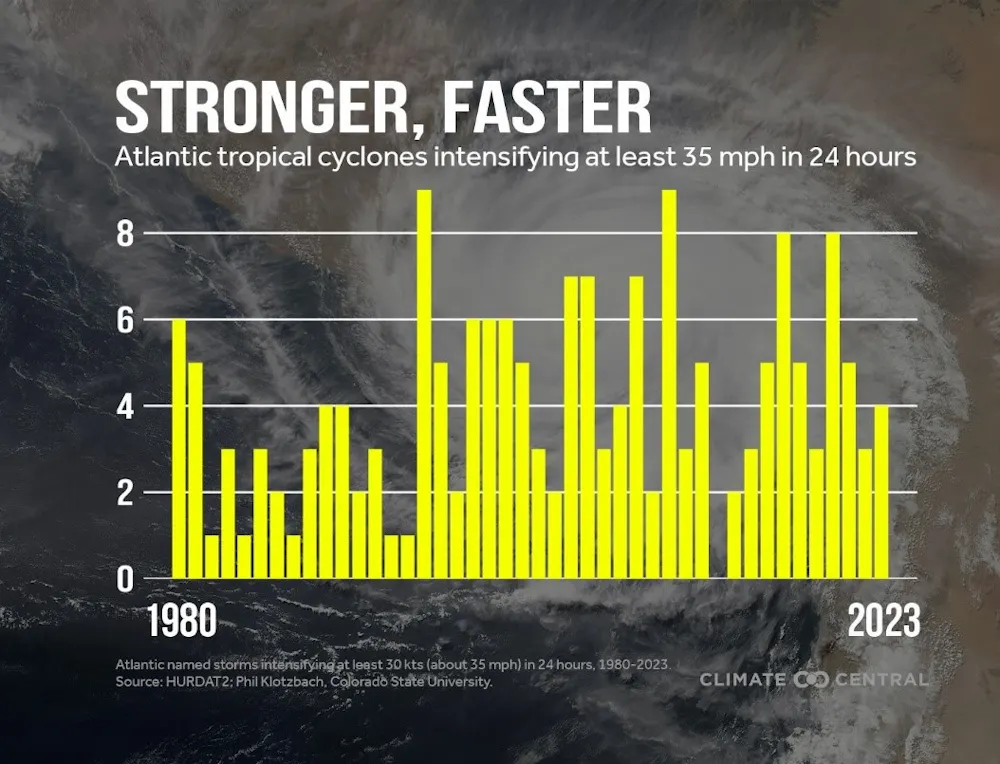
    Rapid intensification is defined by the National Weather Service as an increase in a tropical cyclone’s maximum sustained wind speed of at least 30 knots – about 35 mph within a 24-hour period. That increase can be enough to escalate a storm from Category 1 to Category 3 on the Saffir-Simpson scale.

    Milton’s wind speed went from 80 mph to 175 mph from 1 p.m. Sunday to 1 p.m. Monday, and its pressure dropped from 988 millibars to 911.

    The National Hurricane Center had been warning that Milton was likely to become a major hurricane, but this kind of rapid intensification can catch people off guard, especially when it occurs close to landfall.

    Hurricane Michael did billions of dollars in damage in 2018 when it rapidly intensified into a Category 5 storm just before hitting near Tyndall Air Force Base in the Florida Panhandle. In 2023, Hurricane Otis’ maximum wind speed increased by 100 mph in less than 24 hours before it hit Acapulco, Mexico. Hurricane Ian also rapidly intensified in 2022 before hitting just south of where Milton is projected to cross Florida.

    What causes hurricanes to rapidly intensify?

    Rapid intensification is difficult to forecast, but there are a few driving forces.

    • Ocean heat: Warm sea surface temperatures, particularly when they extend into deeper layers of warm water, provide the energy necessary for hurricanes to intensify. The deeper the warm water, the more energy a storm can draw upon, enhancing its strength.
    Sea surface temperatures have been warm in the Gulf of Mexico, where Hurricane Milton was crossing just northwest of the tip of Mexico’s Yucatan Peninsula on Oct. 7, 2024. A temperature of 30 degrees Celsius is equivalent to 86 degrees Fahrenheit.
    NOAA
    • Low wind shear: Strong vertical wind shear – a rapid change in wind speed or direction with height – can disrupt a storm’s organization, while low wind shear allows hurricanes to grow more rapidly. In Milton’s case, the atmospheric conditions were particularly conducive to rapid intensification.

    • Moisture: Higher sea surface temperatures and lower salinity increase the amount of moisture available to storms, fueling rapid intensification. Warmer waters provide the heat needed for moisture to evaporate, while lower salinity helps trap that heat near the surface. This allows more sustained heat and moisture to transfer to the storm, driving faster and stronger intensification.

    • Thunderstorm activity: Internal dynamics, such as bursts of intense thunderstorms within a cyclone’s rotation, can reorganize a cyclone’s circulation and lead to rapid increases in strength, even when the other conditions aren’t ideal.

    Research has found that globally, a majority of hurricanes Category 3 and above tend to undergo rapid intensification within their lifetimes.

    How does global warming influence hurricane strength?

    If it seems as though you’ve been hearing about rapid intensification a lot more in recent years, that’s in part because it’s happening more often.

    The annual number of tropical cyclones in the Atlantic Ocean that achieved rapid intensification each year between 1980-2023 shows an upward trend.
    Climate Central, CC BY-ND

    A 2023 study investigating connections between rapid intensification and climate change found an increase in the number of tropical cyclones experiencing rapid intensification over the past four decades. That includes a significant rise in the number of hurricanes that rapidly intensify multiple times during their development. Another analysis comparing trends from 1982 to 2017 with climate model simulations found that natural variability alone could not explain these increases in rapidly intensifying storms, indicating a likely role of human-induced climate change.

    How future climate change will affect hurricanes is an active area of research. As global temperatures and oceans continue to warm, however, the frequency of major hurricanes is projected to increase. The extreme hurricanes of recent years, including Beryl in June 2024 and Helene, are already raising alarms about the intensifying impact of warming on tropical cyclone behavior.

    Zachary Handlos receives funding from the National Science Foundation. He is affiliated with the American Meteorological Society as the incoming chair of their Board on Higher Education. He is also an academic faculty partner of the Georgia Climate Project.

    Ali Sarhadi receives funding from NSF and Georgia Tech.

    ref. Hurricane Milton explodes into a powerful Category 5 storm as it heads for Florida − here’s how rapid intensification works – https://theconversation.com/hurricane-milton-explodes-into-a-powerful-category-5-storm-as-it-heads-for-florida-heres-how-rapid-intensification-works-240754

    MIL OSI – Global Reports

  • MIL-OSI USA: UPDATE: Hurricane Milton Emergency Resources And Declarations – As Of 6:00 PM

    Source: United States House of Representatives – Representative Byron Donalds (R-FL)

    UPDATE: Hurricane Milton Emergency Resources And Declarations – As Of 6:00 PM

    Naples, Fla., October 7, 2024

    NAPLES, Fla. – This Wednesday, Hurricane Milton is projected to make landfall on the Gulf Coast of Florida as a major hurricane.

    The office of Congressman Byron Donalds is closely monitoring Hurricane Milton and is actively coordinating storm preparations alongside federal, state, and local partners. The Congressman and his team stand ready to support our Southwest Florida community and ensure all necessary resources are available. Please see below for the latest emergency resources and declarations:

    Southwest Florida Formal Evacuation Declarations:

    Southwest Florida Shelters Open To Public:

    • Collier County:
    • Lee County:

    Emergency Hotlines:

    Local Government Operations:

    School Closures:

    Live Cameras:

    Southwest Florida International Airport (RSW) Operations:

    Weather Updates:

    Other Emergency Resources:

    MIL OSI USA News

  • MIL-OSI Video: SDIM24: Innovation for Decarbonization: Industry’s Transition

    Source: World Economic Forum (video statements)

    From mining to manufacturing, achieving a successful energy transition and net-zero emissions will require industries to accelerate their pace of decarbonization.

    What new innovations and technologies can make decarbonization more efficient, cost-effective and scalable?

    This session was recorded live September 23, 2024 during the World Economic Forum’s Sustainable Development Impact Meetings. 

    Speakers:  Sadaf Hosseini Head of Growth, Partnerships and Innovation Ecosystems, UpLink, World Economic Forum

    Vivek Salgaocar Managing Director and Founder, Prospect Innovation PTE LTD

    Melissa C. Lott Professor, Climate School, Columbia University

    Barinder Rasode CEO and Co-Founder, Tersa Earth Innovations

    https://www.youtube.com/watch?v=ofCKFmCcNp4

    MIL OSI Video

  • MIL-OSI Australia: Priority areas to be focus of flood recovery, prevention works

    Source: State of Victoria Local Government 2

    Between December 2023 and February 2024, the City of Greater Bendigo experienced widespread flooding across the municipality.

    In addition to the cleanup, recovery and additional proactive inspection and maintenance works undertaken, the City has prioritised six key areas to receive upgrade and improvement works after they experienced significant flood and storm damage earlier this year.

    The program of works includes:

    • Willis Road, Huntly – install new box culverts
    • Pasley Street, Huntly – drain reshaping/widening and driveway culvert upgrades
    • Gungurru Road, Huntly – pit installation
    • Domain Village, McIvor Highway, Junortoun – install new box culverts
    • Strickland Street / Sullivan Street, Epsom – pipe realignment
    • Railway Place / Midland Highway, Goornong – drain reshaping and widening and vegetation management, subject to V-Line authorisation

    Chief Executive Officer Andrew Cooney said the works would take up to six months to complete.

    “The works are subject to contractor and material availability, but these are our priority areas to receive treatment as soon as possible,” Mr Cooney said.

    “These areas have been chosen following an assessment of our customer request enquiries, feedback received through our recovery drop-in sessions held earlier this year, and impact assessment data undertaken immediately after the flood and storm events.”

    Priority pit inspection and drain clearing will also take place in the next three months in the following precincts:

    • Dead Horse Gully/Shakespeare Street to Patterson Street, Heathcote
    • Gungurru Road, Huntly
    • McIvor Forest Estate, Junortoun
    • Cameron Court / Aspiring Drive, Huntly
    • Peake Court / Strickland Street, Epsom
    • Heathcote Redesdale Road / Moylans Road, Redesdale
    • Shakespeare Street floodway, Heathcote

    Earlier this year the City submitted four applications to the Federal Government’s Disaster Ready Fund.

    Applications to undertake waterway flood mitigation plans for Epsom, Huntly, Junortoun and Heathcote, and prepare a Goornong Flood Study were successful.

    Unfortunately, applications to prepare a separate Huntly drainage analysis and flood mitigation plan, with a focus on Goldleaf Wetland, and a drainage and culvert improvement program were not supported this time around.

    Mr Cooney said despite being unsuccessful, the City would still release its share of the funds for these projects to progress works and would continue to seek other funding opportunities.  

    “The City will invest $2.25M over the next three years, with a particular focus on improving drainage and culvert infrastructure in Huntly, Junortoun and Heathcote. Our focus will be on fixing infrastructure that otherwise sees streets or suburbs cut off for a period of time when we get flood events.

    “The City will also invest in expanding the scope of the Huntly waterway flood mitigation plan to include Goldleaf Wetland and use this process to identify future investment opportunities for the site, which is used as a detention basin to store stormwater runoff.

    “The City is in the final stages of designing the Racecourse Creek levy, which would help mitigate flooding along the Epsom/Ascot/Midland corridor, to the right of Bendigo Creek, and will seek State and Federal funding to repair a critical 1.2km section.

    “I thank residents for their patience when it comes to our flood recovery. The damage that has been caused is extensive and very expensive to fix.”

    To support the community’s resilience during an emergency, the City is currently working with emergency services and community organisations on a range of emergency initiatives, including:

    • Confirming locations for sandbagging before a rain event
    • Ensuring clear processes and protocols are in place to activate emergency relief centres when required
    • Facilitating conversations amongst agencies and community organisations about other emergency planning initiatives needed at a local level

    Mr Cooney said the City was taking a community-led approach to understand what communities need heading into the summer months.

    “This means the processes we put in place will be different for each community and we’ll be working with local community groups to confirm the details and promote key locations where people can access help and support, as they are needed,” he said.

    “If we do find ourselves in an emergency this summer, these details will also be promoted via the City’s social media accounts.

    “The City also has a range of information on our website and an engagement program planned to raise awareness about how to prepare your property for floods and fires, and the importance of having a plan in the event of an emergency.”

    MIL OSI News

  • MIL-OSI Banking: Verizon is ready, offers tips as Hurricane Milton approaches Florida

    Source: Verizon

    Headline: Verizon is ready, offers tips as Hurricane Milton approaches Florida

    ALPHARETTA, GA – As Hurricane Milton approaches the Florida coast, Verizon remains committed to keeping communities and first responders connected. In addition to a hardened network designed to withstand the most extreme conditions, Verizon’s engineers undertook steadfast preparation measures to ensure resources are in place for rapid response.

    “At Verizon, our top priority is supporting the communities we serve. Our responsiveness and partnership at times of crises truly matters” said Atlantic South Market President, Leigh Anne Lanier. “From families, to businesses, to first responders, we are here to provide the reliable service they can count on. Our team is working tirelessly to keep our customers connected now and in the days ahead.”

    In the aftermath of Hurricane Helene, satellite communications have proven to be an important communication tool when terrestrial services have been impacted. Make sure your phone is ready in advance. Customers with an iPhone 14 or newer should upgrade to iOS 18 to ensure they can send text messages or connect with emergency services via satellite. And for those with Google Pixel 9 devices, emergency messaging is also available via satellite. Both operating systems have demos available allowing customers practice in messaging via satellite in advance. Learn more, here.

    Verizon’s networks are primed

    Verizon’s networks are primed to maintain connectivity even in the face of extreme weather conditions. With redundancy built into critical paths and components, Verizon’s network is engineered with the goal of withstanding severe weather. Verizon engineers have prepared by conducting thorough checks, as well as ensuring backup systems, like batteries and generators, are operational and refueled. Verizon has also installed liaisons at area Emergency Operations Centers to allow seamless partnership with local, state, and government agencies to ensure a rapid restoration.

    In preparation for potential network recovery operations, Verizon has staged in close proximity a fleet of portable network solutions, including satellite-based portable network assets, providing crucial connectivity in scenarios where fiber connections are compromised, as well as mobile generators to assist communities in the result of commercial power loss.

    Verizon Frontline stands at the ready, prepared to assist first responders in any capacity needed

    The Verizon Frontline Crisis Response Team stands ready to help ensure that public safety agencies on the front line of any potential disaster have the mission-critical communications capabilities needed to achieve their missions. This team, composed primarily of former first responders and military personnel, is solely dedicated to supporting public safety customers during emergencies at no cost to the supported agencies.

    In the first nine months of 2024, the Verizon Frontline Crisis Response Team has responded to more than 1,000 requests for mission-critical communications support from more than 500 different agencies in 46 states.

    Being prepared is essential to support local businesses and communities

    Recognizing the critical role of connectivity in business continuity, Verizon Business provides a suite of solutions tailored for seamless operations during emergencies. Businesses and government organizations need the right game plan. Suggested actions include:

    • Mitigate customer disruption: Think about what you need to ensure continuous service to your customers, and what software and equipment your business needs to continue operations. Make a detailed list, including service contracts and warranty information, and all pertinent phone numbers for local authorities, utility companies, suppliers, and vendors.
    • The right tech makes an impact: Ensure you have the right technology to support your business connectivity needs assuming you might need to move away from your primary location.
    • Contacts and documents are key: Make sure you have contact information updated and readily available for all employees, including at-home information for remote workers and branch information for satellite offices.
    • Test, test, and test again: Stress-test primary and backup networks and shore up any weak areas.
    • Keep track of equipment: Ensure employees working from home have documented all corporate equipment being used to work from home in case of damage or loss.
    • Have a backup plan: Ensure backup plans are in place to shift work in case work-from-home employees in a storm-impacted area have to evacuate their homes or their home loses commercial power.

    Are you hurricane ready?

    Verizon’s team works year-round to ensure customers remain connected to their loved ones and the activities that provide comfort during a disaster. As residents prepare to stay connected and entertained, consider these tips:

    • Stock Up on power supplies like batteries for flashlights and radios or device chargers. Take it a step further by charging your devices that can act as chargers for other devices like laptops and power stations. Don’t forget to ensure you have the cables!
    • Download movies, books, apps and games in case of a power outage. Or gather board games, card games, and puzzles to go device-free.
    • Locate important documents that you may need later as well as sentimental photos and items.
    • Plan non-perishable meals. Keep a few non-perishable ingredients, like a manual can opener and other kitchen tools on hand.
    • Grab some candles, blankets, pillows, or anything that makes your hurricane safe space comfortable.
    • Read up on the American Red Cross’ hurricane preparedness tips.
    • Bookmark our Check Network Status page or go to My Verizon app and click Support Topics to notify us if you experience any network issues or to check to see if there are any known issues in your area. Enter your location, select the type of service issue, and we will provide a real time status update.

    More information

    Visit Verizon’s Online Emergency Resource Center, verizon.com/about/news/emergency-resource-center, for further details on Verizon’s emergency response capabilities.

    MIL OSI Global Banks

  • MIL-OSI United Kingdom: Half a billion-pound investment in electric buses to spark a new era of green growth

    Source: United Kingdom – Executive Government & Departments

    Communities across the country will benefit from brand new, state-of-the-art green buses.

    • £500 million investment announced to deliver 1,200 UK-made zero emission buses, ensuring greener and better journeys for passengers
    • bus operator Go Ahead’s investment to benefit communities across the country, supporting hundreds of jobs and delivering growth
    • Transport Secretary brings together industry to advance opportunities for investment in the UK ahead of investment summit

    Up to 500 UK manufacturing jobs are set to be supported as bus operator Go Ahead today (8 October 2024) announces a major £500 million investment to decarbonise its fleet, including creating a new dedicated manufacturing line and partnership with Northern Ireland-based bus manufacturer Wrightbus.

    The investment is set to fund the manufacturing of up to 1,200 new zero emission buses over the next 3 years. Built for operator Go Ahead, this investment will accelerate the transition to greener buses across the country including in Plymouth, Gloucestershire, East Yorkshire, London and the Isle of Wight.

    On top of directly supporting 500 manufacturing jobs, the £500 million investment for Wrightbus will also support an additional 2,000 jobs across the wider UK supply chain by 2026, helping to get us back on track for growth.

    The Transport Secretary will also announce plans to create a new UK Bus Manufacturing Expert Panel. This panel will bring together industry experts and local leaders to explore ways to ensure the UK remains a leader in bus manufacturing, help local authorities deliver on their transport ambitions, and begin to seize opportunities to embrace zero emission transport technologies.

    The Transport Secretary is expected to meet with key industry leaders today including Wrightbus owner Jo Bamford and CEO Jean-Marc Gales, to reaffirm the government’s commitment to decarbonising local transport and fostering an environment for investment in the UK manufacturing industry, bringing sustained economic growth and supporting jobs.

    The announcement comes ahead of the International Investment Summit, which will gather UK leaders, high-profile investors and businesses from across the world to discuss how we can deepen our partnership to drive investment and growth.

    The Transport Secretary is expected to hold several bilateral meetings at the summit with international business leaders and make clear the UK is “open for business” so that she can help attract further investment to support the delivery of our transport priorities across the country.

    The Prime Minister will also convene the first Council of Nations and Regions later this week, bringing together first ministers, Northern Ireland’s First Minister and Deputy First Minister and regional mayors from across England, as the government forges new partnerships, resets relationships to secure long term investment with the aim of boosting growth and living standards in every part of the UK.

    Transport Secretary, Louise Haigh said:

    The number one mission of this government is growing the economy. The half a billion pounds Go Ahead is announcing today shows the confidence industry has in investing in the UK.

    This announcement will see communities across the country benefit from brand new, state-of-the-art green buses – which will deliver cleaner air and better journeys.

    We’re creating the right conditions for businesses to flourish, so we can support jobs and accelerate towards decarbonising the transport sector.

    Under this government, Britain is open for business.

    For every vehicle manufactured, 10 trees will be planted by Go-Ahead and Wrightbus in the towns and cities where the buses are deployed.

    Buses, as the most used form of public transport, have been prioritised by this government from the outset. The Transport Secretary has made improving bus services and delivering greener transport 2 of her 5 core priorities.

    Last month, the Transport Secretary announced a package of measures to empower local leaders to take back control of their bus services and deliver services based on the needs of communities, to grow passenger numbers and deliver better services for all. 

    Building on this, the government’s new buses bill is set to be introduced in Parliament by the end of this year and will bring an end to the current postcode lottery by taking steps to improve bus services no matter where you live.

    Further details on the UK Bus Manufacturing Expert Panel will be confirmed in due course.

    Go-Ahead Bus CEO, Matt Carney said:

    This multi-million pound investment and partnership with Wrightbus will accelerate the transition to zero-emission fleet across the UK.

    We are proud to be working in partnership with the UK government and local authorities to deliver transformational environmental change for communities, while supporting UK jobs and the growth of the country’s supply chain. 

    Wrightbus CEO, Jean-Marc Gales said:

    The deal with Go-Ahead is hugely significant and represents a huge boost to the UK’s economy. It will support homegrown manufacturing, jobs and skills for the next three years and beyond. We’ve always been proud to support the UK’s supply chain and our Go-Ahead partnership will ensure even more money can be spent securing good green jobs.

    We must also not forget that this deal represents a massive step forward in our ambition to help decarbonise the transport sector with our world-leading products. It was heartening today to hear the government reaffirm its commitment to a green transport sector.

    Roads media enquiries

    Media enquiries 0300 7777 878

    Switchboard 0300 330 3000

    Updates to this page

    Published 8 October 2024

    MIL OSI United Kingdom

  • MIL-OSI USA: Marshall, Lankford Slam Biden-Harris for Using Disaster Relief Funds for Migrant Shelters

    US Senate News:

    Source: United States Senator for Kansas Roger Marshall
    Washington, D.C. – U.S. Senator Roger Marshall, M.D. joined Senator James Lankford (R-OK) in a letter to President Joe Biden calling out the Administration’s reliance on the Federal Emergency Management Agency (FEMA) to address the border crisis which has diminished FEMA’s readiness for disaster relief, including hurricane response.
    “Yesterday, Secretary of Homeland Security Alejandro Mayorkas stated: ‘We are expecting another hurricane hitting—we do not have the funds, FEMA does not have the funds, to make it through the season.’…Your Administration has spent over $650 million on FEMA’s border-related programs in FY2024. Since taking office, the Biden-Harris Administration has spent around $1.5 billion on FEMA’s border-related programs. We are concerned that your Administration’s reliance on FEMA to address the ongoing border crisis, under Vice President Harris as ‘border czar,’ has diminished FEMA’s readiness for disaster relief, including hurricane response,” the Senators wrote in the letter. 
    “FEMA’s continued entanglement in DHS’s efforts to respond to the border crisis could impact its readiness and emergency response mission. Rather than ensuring FEMA is ready to respond to hurricanes and other emergencies, FEMA has been pulled into a border crisis mission. FEMA’s mission is ‘helping people before, during, and after disasters,’ not helping DHS clean up the impact of your Administration’s reckless border policies. We are very concerned that FEMA’s role at the border has impacted its readiness and preparation efforts for Hurricane Helene and its response efforts,” the Senators continued. 
    View the letter here or by scrolling below. 

    MIL OSI USA News

  • MIL-OSI USA: News 10/7/2024 Blackburn Announces Pop-Up Office Hours to Assist Flood Victims in East Tennessee

    US Senate News:

    Source: United States Senator Marsha Blackburn (R-Tenn)
    NASHVILLE, Tenn. – In response to the devastating impact of Hurricane Helene in counties across East Tennessee, U.S. Senator Marsha Blackburn (R-Tenn.) announced pop-up office hours in affected counties for staff to provide immediate assistance to flood victims:
    “Our hearts go out to everyone affected by the recent flooding,” said Senator Blackburn. “As we continue to coordinate with local, state, and federal agencies to support recovery efforts, I want to ensure that every impacted resident has access to the resources they need.”

    ADDITIONAL INFORMATION:

    Pop-up office hours will be available to help residents access critical federal resources and navigate replacing any federal documentation that may be needed to receive federal assistance, including social security cards, veteran records, and tax information.
    Staff can also assist flood victims in following up on disaster assistance applications with the U.S. Small Business Administration (SBA) and the Federal Emergency Management Agency (FEMA). 
    Constituents are encouraged to bring any relevant documentation with them, such as proof of residency and identification, to streamline the process.
    For more information on pop-up office hours, please contact (423) 753-4009. 

    SCHEDULE AND LOCATIONS:

    Tuesday, October 8, 2024 – Johnson and Carter Counties
    Johnson County Courthouse – Lower Courtroom9:00AM – 12:00PM ET222 West Main StreetMountain City, TN 37683
    Carter County Courthouse – Mayor’s Conference Room2:00PM – 5:00PM ET
    801 E Elk AveElizabethton, TN 37643
    Wednesday, October 9, 2024 – Washington and Unicoi Counties
    Jonesborough Visitors Center Community Room9:00AM – 12:00PM ET117 Boone St.Jonesborough, TN 37659
    Erwin City Hall2:00PM – 5:00PM ET211 N Main AveErwin, TN 37650
    Thursday, October 10, 2024 – Greene and Cocke Counties
    Greene County Annex
    9:00AM – 12:00PM ET204 N Cutler St.Greeneville, TN 37745
    Cocke County Recreation Center2:00PM – 5:00PM ET466 Learning WayNewport, TN 37821
    Friday, October 11, 2024 – Hamblen and Hawkins Counties
    Hamblen County Mayor’s Office
    9:00AM – 12:00PM ET511 W 2nd St. Morristown, TN 37814
    Mayor’s Office Admin Building2:00PM – 5:00PM ET301 E. Washington St. Rogersville, TN 37857

    MIL OSI USA News

  • MIL-OSI USA: PHOTOS AVAILABLE: Governor Cooper, FEMA Administrator Criswell Meet with Military Leaders in Western North Carolina

    Source: US State of North Carolina

    Headline: PHOTOS AVAILABLE: Governor Cooper, FEMA Administrator Criswell Meet with Military Leaders in Western North Carolina

    PHOTOS AVAILABLE: Governor Cooper, FEMA Administrator Criswell Meet with Military Leaders in Western North Carolina
    mseets

    Today, Governor Roy Cooper and FEMA Administrator Deanne Criswell met with U.S. Northern Command Commander General Gregory Guillot and Dual Status Commander Brigadier General Wes Morrison in Western North Carolina. More than 2,500 Soldiers and Airmen are now working in Western North Carolina with approximately 500 more on their way.

    After the meeting, Governor Cooper traveled to Chimney Rock and Lake Lure to thank volunteers and assess damage from Hurricane Helene. While in Chimney Rock, Governor Cooper met with Mayor Peter O’Leary and walked through Main Street to survey damage of the area. The Governor also visited the fire department where he thanked first responders. In Lake Lure, Governor Cooper and Mayor Carol Pritchett stopped at the Lake Lure Inn before touring damage of the area.

    “Today, I visited with military personnel and traveled to Chimney Rock and Lake Lure to talk with people there and see firsthand the devastation caused by Hurricane Helene,” said Governor Cooper. “These communities are home to family-owned businesses and neighbors who are helping one another. We will continue to work with Western North Carolina to respond and recover from this catastrophic storm.”

    Photos from today’s visit can be found here.

    North Carolina National Guard and Military Response

    More than 2,500 Soldiers and Airmen are now working in Western North Carolina area with approximately 500 more on their way. Joint Task Force- North Carolina, the task force led by the North Carolina National Guard is made up of Soldiers and Airmen from 12 different states, two different XVIII Airborne Corps units from Ft. Liberty, a unit coming from Ft. Campbell’s 101st Airborne Division, and numerous civilian entities are working side-by-side to get the much-needed help to the citizens in western North Carolina.

    National Guard and military personnel are operating more than 40 helicopters and more than 1,100 specialized vehicles in Western North Carolina to facilitate these missions. The U.S. Army Corps of Engineers is helping to assess water and wastewater plants and dams. Residents can track the status of the public water supply in their area through a website launched on Saturday.

    FEMA Assistance

    More than $33 million in FEMA Individual Assistance funds have been paid so far to Western NC disaster survivors and more than 109,000 people have registered for Individual Assistance. Nearly 2,111 people are now housed in hotels through FEMA’s Transitional Sheltering Assistance. Federal partners have delivered more than 9.36 million liters of water and more than 7.06 million meals in North Carolina to support both responders and people living in the affected communities.

    More than 800 FEMA staff are in the state to help with the western North Carolina relief effort. In addition to search and rescue and providing commodities, they are meeting with disaster survivors in shelters and neighborhoods to provide rapid access to relief resources. They can be identified by their FEMA logo apparel and federal government identification.

    The Major Disaster Declaration requested by Governor Cooper and granted by President Biden now includes 27 North Carolina counties (Alexander, Alleghany, Ashe, Avery, Buncombe, Burke, Caldwell, Catawba, Clay, Cleveland, Gaston, Haywood, Henderson, Jackson, Lincoln, Macon, Madison, McDowell, Mecklenburg, Mitchell, Polk, Rutherford, Swain, Transylvania, Watauga, Wilkes and Yancey) and the Eastern Band of Cherokee Indians.

    North Carolinians can apply for Individual Assistance by calling 1-800-621-3362 from 7am to 11pm daily or by visiting www.disasterassistance.gov, or by downloading the FEMA app. FEMA may be able to help with serious needs, displacement, temporary lodging, basic home repair costs, personal property loss or other disaster-caused needs.

    Help from Other States

    More than 1,300 responders from 35 state and local agencies have performed 107 missions supporting the response and recovery efforts through the Emergency Management Assistance Compact (EMAC). This includes public health nurses, emergency management teams supporting local governments, veterinarians, teams with search dogs and more.

    Beware of Misinformation

    North Carolina Emergency Management and local officials are cautioning the public about false Helene reports and misinformation being shared on social media. NCEM has launched a fact versus rumor response webpage to provide factual information in the wake of this storm. FEMA also has a rumor response webpage.

    Food, Water and Commodity Points of Distribution

    Efforts continue to provide food, water and basic necessities to residents in affected communities, using both ground resources and air drops from the NC National Guard. More than 20,000 hot meals a day are being prepared and served by mobile kitchens. Food, water and commodity points of distribution are open throughout western North Carolina. For information on these sites in your community, visit your local emergency management and local government social media and websites or visit ncdps.gov/Helene.

    Missing Persons

    To report a missing person or request non-emergency support, please call NC 211 or 1-888-892-1162 if calling from out-of-state. NC 211 also has a registry page for missing persons and welfare check requests.

    Shelters

    A total of 19 shelters are open in Western North Carolina and Saturday night served more than 780 people and 95 pets.

    Storm Damage Cleanup

    If your home has damages and you need assistance with clean up, please call Crisis Cleanup for access to volunteer organizations that can assist you at 844-965-1386.

    Power Outages

    Across Western North Carolina, approximately 139,000 customers remained without power, down from a peak of more than 1 million. Overall power outage numbers will fluctuate up and down as power crews temporarily take circuits or substations offline to make repairs and restore additional customers.

    Road Closures

    Travel remains dangerous, with approximately 650 roads closed. More than 100 of those roads are primary routes connecting the region. As connectivity and reporting measures improve, these number may increase.

    NCDOT is asking people to avoid unnecessary travel to or in Western North Carolina. NCDOT has posted at ncdot.gov an interstate detour map for travelers to avoid western N.C. NCDOT currently has more than 2,050 employees and 1,100 pieces of equipment working on more than 4,100 damaged road sites.

    Fatalities

    Seventy-seven storm-related deaths have been confirmed in North Carolina by the Office of Chief Medical Examiner. We expect that this number will continue to rise over the coming days. The North Carolina Office of the Chief Medical Examiner will continue to confirm numbers twice daily. If you have an emergency or believe that someone is in danger, please call 911. To report that you have been unable to reach a person in Western North Carolina, please call 211.

    Volunteers and Donations

    Due to dangerous road conditions and the need to maintain open routes for emergency operations, travel to Western North Carolina is strongly discouraged. Instead, consider the following options for donations and volunteer opportunities:

    • If you would like to donate to the North Carolina Disaster Relief Fund, visit nc.gov/donate. Donations will help to support local nonprofits working on the ground.
    • For information on volunteer opportunities, please visit nc.gov/volunteernc

    Additional Assistance

    There is no right or wrong way to feel in response to the trauma of a hurricane. If you have been impacted by the storm and need someone to talk to, call or text the Disaster Distress Helpline at 1-800-985-5990. Help is also available to anyone, anytime in English or Spanish through a call, text or chat to 988. Learn more at 988Lifeline.org.

    If you are seeking a representative from the North Carolina Joint Information Center, please email ncempio@ncdps.gov or call 919-825-2599.

    For general information, access to resources, or answers to frequently asked questions, please visit ncdps.gov/helene.

    If you are seeking information on resources for recovery help for a resident impacted from the storm, please email IArecovery@ncdps.gov.

    ###

    Oct 7, 2024

    MIL OSI USA News

  • MIL-OSI USA: Inclusive Response and Recovery: FEMA’s Disability Integration Efforts During Hurricane Helene

    Source: US Federal Emergency Management Agency

    Headline: Inclusive Response and Recovery: FEMA’s Disability Integration Efforts During Hurricane Helene

    Inclusive Response and Recovery: FEMA’s Disability Integration Efforts During Hurricane Helene

    FEMA Supporting Survivors with Disabilities Through Proactive and Inclusive Disaster Recovery Efforts

    WASHINGTON — FEMA’s Disability Integration Advisors are on the ground in areas impacted by Helene to ensure recovery resources are accessible to all survivors. At FEMA, accessibility isn’t confined to one program or specialist, it is incorporated into the execution of all our work and programs. The Disability Integration Advisors are experts in proactively addressing the disability community’s equities and work alongside FEMA leadership to guide FEMA staff in incorporating these equities into their work. Having these advisors on the ground now is crucial to developing recovery systems that are planned and executed with survivors with disabilities in mind. Their duties include ensuring the distribution of water and food factors in survivors who cannot get to reach points and those who require assistive aids to file a FEMA application receive what they need to begin the recovery process. 

    At the direction of FEMA Administrator Deanne Criswell, Director of FEMA’s Office of Disability Integration Sherman Gillums plans to visit Helene-impacted areas to meet and collaborate with disability advocates and provide disability integration guidance to emergency managers. 

    “Disability, in some form or fashion, affects just about every family in our country and it is impossible to have a successful response without keeping accessibility at the forefront,” said Director Sherman Gillums. “We’re making sure people can access the information they need to make informed decisions in their recovery. Along with our state, local and voluntary partners, we’re working to get people access to their care needs such as oxygen and prescription medications. Meeting these needs early prevents medical complications and helps preserve independence while reducing the likelihood of forced institutionalization or premature death.” 

    As part of FEMA’s broader efforts to ensure all survivors have access to vital recovery information, specialized teams are actively addressing the needs of the Deaf and Hard-of-Hearing communities. FEMA’s Office of External Affairs’ Certified Deaf Interpreter and communication access specialists are working with disability integration specialists, non-profit partners and state agencies, such as the North Carolina Department of Health and Human Services’ Division of Deaf and Hard of Hearing Emergency Preparedness team. Together, they are coordinating events to provide information on FEMA assistance, helping survivors complete the application for assistance and ensuring critical updates are communicated in accessible formats, including American Sign Language (ASL). This collaborative effort ensures that Deaf and Hard-of-Hearing survivors receive the support they need throughout the recovery process.

    For those needing to apply for FEMA disaster assistance: You can apply online now or get help to apply using one of the methods below:

    • Call the FEMA Helpline: 1-800-621-3362, 7 a.m. to 10 p.m. (in your time zone), 7 days a week.
      Hours may be longer during high disaster activity. If you use a video relay service (VRS), captioned telephone (CTS), or other service, give FEMA your number for that service.
    • Find a Disaster Recovery Center (DRC) near you.
      DRCs are accessible and set up to provide help and answer questions after a disaster. The operating hours and services offered may vary at each DRC.
    • Downloading and applying on the FEMA App. 

    amy.ashbridge

    MIL OSI USA News

  • MIL-OSI USA: Senator Graham, Governor McMaster, Lt. Governor Evette Announce Team South Carolina Days For Hurricane Helene Recovery Resources

    US Senate News:

    Source: United States Senator for South Carolina Lindsey Graham
    WASHINGTON – In order to best serve South Carolinians who were impacted by Hurricane Helene, U.S. Senator Lindsey Graham (R-South Carolina) is joining Governor Henry McMaster and Lieutenant Governor Pamela Evette in announcing a series of Team South Carolina Days. These will be one-stop-shops for South Carolinians who need access to federal, state and nonprofit resources as the state rebuilds after Hurricane Helene.
    Click here to watch Graham’s video on Team South Carolina Days
    Graham said, “I know it’s been tough on our state. There has been so much devastation. I’ll be working with Governor McMaster and Lieutenant Governor Evette to host Team South Carolina Days where we will get federal, state and local people together so you’ll know where to go to get the services you need.”
    Graham concluded, “I know people are hurting out there. I believe this will help.”
    Team South Carolina Days will include representatives from South Carolina state agencies to assist with a variety of services including information for seniors, veterans, and children, and information concerning insurance and unemployment benefits. Officials from the Small Business Administration (SBA) will be on hand to provide information on disaster loans for small businesses. The South Carolina Office of Resilience will be able to provide assistance with applying for disaster relief and the Federal Emergency Management Agency (FEMA) will attend to take applications for individual assistance. Several nonprofits are expected to be in attendance as well.
    Please see below for information on the Team South Carolina Days that have been announced.
    Serving Pickens, Anderson, and Oconee Counties:
    Wednesday, October 9
    10:00 am – 4:00 pm
    Clemson Littlejohn Coliseum
    219 Perimeter Road
    Clemson, SC 29634
     
    Serving Spartanburg and Cherokee Counties:
    Thursday, October 10
    10:00 am – 4:00 pm
    University of South Carolina Upstate
    Health Education Complex
    300 N. Campus Blvd
    Spartanburg, SC, 29303
     
    Serving Greenville County:
    Friday, October 11
    10:00 am – 4:00 pm
    Greenville Technical College
    Student Success Center
    506 South Pleasantburg Drive
    Greenville, SC 29607
    Additional Team South Carolina Days will soon be announced for the weeks of October 14 and 21 for other impacted counties.

    MIL OSI USA News

  • MIL-OSI New Zealand: Media are invited to the 378 Recruit Wing graduation

    Source: New Zealand Police (National News)

    New Zealand Police is pleased to announce the 378-recruit wing will be graduating from their initial training course on Thursday morning 10 October in front of whānau and friends.

    Attending the ceremony will be Assistant Commissioner Jevon McSkimming and the Police executive, Hon Mark Mitchell the Minister for Police, Hon Casey Costello, Associate Minister for Police along with Wing Patron, Hon Hekia Parata.

    Wing 378’s prize-winners are spread across five policing districts, namely Auckland City, Bay of Plenty, Eastern, Tasman and Canterbury.

    More details about statistics, prize winners and other recruits will be shared after graduation on Thursday.

    Patron details:

    The Honourable Hekia Parata (Ngāi Tahu and Ngāti Porou) has provided 41 years of public service to New Zealand.

    She began her public service career with the Ministry of Foreign Affairs after graduating from the University of Waikato with a Bachelor of Arts and Master of Arts in Māori Studies. Hekia was a Member of Parliament, representing the National Party, from 2008 until 2017 when she retired.  Since then she’s has had several appointments to ministerial inquiries, such as leading the 2023 inquiry into forestry land use after Cyclone Gabrielle.

    Graduation day:

    Media are welcome to attend the graduation parade which takes place at 10am at The Te Rauparaha Arena, Porirua.

    Please RSVP to the Police Media Centre as soon as possible:  media@police.govt.nz

    ENDS

    Issued by Police Media Centre

    MIL OSI New Zealand News

  • MIL-OSI New Zealand: Europe: Severe Flooding

    Source: New Zealand Ministry of Foreign Affairs and Trade – Safe Travel

    Share this page:

    Latest News features

    MIL OSI New Zealand News

  • MIL-OSI New Zealand: Mexico & United States: Hurricane Milton

    Source: New Zealand Ministry of Foreign Affairs and Trade – Safe Travel

    Hurricane Milton, a Category 5 hurricane is expected to impact the northern coast of the Yucatan Peninsula with dangerous hurricane-force winds, life-threatening storm surges, and heavy rainfall in the coming days.

    The National Water Commission of Mexico (CONAGUA) and the Mexican Civil Defence agency are issuing advice on their X accounts @conagua_mx and @CNPC_MX.

    You can also track the information in English on the National Oceanic and Atmospheric Administration website: HURRICANE MILTON (noaa.gov).

    Hurricane Milton is then expected to make landfall in Florida on Wednesday 9 October as a Category 4 hurricane or stronger.  The National Hurricane Centre (NHC) is issuing advice on their website: https://www.nhc.noaa.gov/ and additional information is available on the State of Florida’s website: 
    https://www.stateofflorida.com/articles/hurricane-preparedness-guide

    We also advise New Zealanders in the affected areas to follow the advice of local authorities at all times (including any evacuation orders) and seek suitable shelter. Visitors and tourists staying in travel accommodation should follow the guidance of hotel/resort management. It is considered sensible practice not to venture outdoors during a hurricane and remain well away from the sea and rivers. We recommend you stay informed of developments by monitoring local news and weather reports.

    Please also ensure you keep your family and friends in New Zealand informed of your safety and well-being, including after the hurricane has passed.

    New Zealanders in Mexico or the United States requiring emergency assistance should contact the local emergency services by calling 911.

    If you require consular assistance, please contact:

    New Zealand Embassy in Mexico City on: +52 55 5283 9460 or nzmexico@mfat.govt.nz

    New Zealand Embassy in Washington DC on: +1 202 438 4800 or WSHinfo@mfat.govt.nz

    For consular emergencies only after-hours on +64 99 20 20 20.

    Associated Advisories:

    Share this page:

    Share this page:

    Latest News features

    MIL OSI New Zealand News

  • MIL-OSI New Zealand: Taiwan: Typhoon Krathon

    Source: New Zealand Ministry of Foreign Affairs and Trade – Safe Travel

    Typhoon Krathon is expected to impact Taiwan from Wednesday 2 October. You should expect strong winds, heavy rain and storm surges during this time.

    Up to date information on Typhoon Krathon can be found on the Central Weather Administration website: Home | Central Weather Administration (cwa.gov.tw) We also recommend that you stay informed of developments by monitoring local media.

    We advise New Zealanders in Taiwan to follow the advice of the local authorities at all times and seek suitable shelter. Visitors and tourists staying in travel accommodation should follow the guidance of hotel/resort management. It is considered sensible practice not to venture outdoors during a typhoon and remain well away from the sea and rivers. 

    Please also ensure you keep your family and friends in New Zealand informed of your safety and well-being, including after the typhoon has passed.

    If you require emergency assistance, local emergency services can be contacted via the following numbers: Fire and Ambulance (119) and Police (110).

    New Zealanders requiring consular assistance can contact the New Zealand Commerce and Industry Office in Taipei between 9am to 5pm Monday to Thursday and between 9am and 12.30pm on Friday on +886 2 2720 5228 or email nzcio.tpe@msa.hinet.net. For after-hours emergency consular assistance for New Zealanders please call +64 9 920 2020.

    Associated Advisories:

    Share this page:

    Share this page:

    Latest News features

    MIL OSI New Zealand News

  • MIL-OSI China: NASA, SpaceX postpone Europa Clipper mission launch

    Source: China State Council Information Office

    NASA and SpaceX are standing down from the launch attempt of the agency’s Europa Clipper mission due to anticipated hurricane conditions in the area, NASA said on Monday.

    The mission was originally planned to launch on Oct. 10 from the Kennedy Space Center in Florida.

    Hurricane Milton is expected to move from the Gulf of Mexico this week eastward to the Space Coast. High winds and heavy rain are expected in the Cape Canaveral and Merritt Island regions on Florida’s east coast.

    Launch teams have secured Europa Clipper spacecraft in SpaceX’s hangar at Launch Complex 39A at the Kennedy Space Center ahead of the severe weather, and the center began hurricane preparations Sunday, according to NASA.

    NASA will determine the next launch opportunity. Europa Clipper has launch windows until Nov. 6.

    The mission’s main science goal is to determine whether there are places below the surface of Jupiter’s icy moon, Europa, that could support life, according to NASA.

    Europa Clipper spacecraft will conduct detailed reconnaissance of Europa and investigate whether the icy moon could have conditions suitable for life. The spacecraft will perform dozens of close flybys of Europa, gathering detailed measurements to investigate the moon, according to NASA. 

    MIL OSI China News

  • MIL-OSI USA: DHS Statement on Safety and Enforcement During Hurricane Milton

    Source: US Federal Emergency Management Agency

    Headline: DHS Statement on Safety and Enforcement During Hurricane Milton

    uring emergency events, the Department of Homeland Security (DHS) works with its federal, state, local, and non-governmental partners to support the needs of the people in the areas that may be impacted.

    In such circumstances, U.S. Immigration and Customs Enforcement (ICE) and U.S. Customs and Border Protection (CBP) remind the public that sites that provide emergency response and relief are considered protected areas. To the fullest extent possible, ICE and CBP do not conduct immigration enforcement activities at protected areas such as along evacuation routes, sites used for sheltering or the distribution of emergency supplies, food or water, or registration sites for disaster-related assistance or the reunification of families and loved ones.

    At the request of FEMA or local and state authorities, ICE and CBP may help conduct search and rescue, air traffic de-confliction and public safety missions. ICE and CBP provide emergency assistance to individuals regardless of their immigration status. DHS officials do not and will not pose as individuals providing emergency-related information as part of any enforcement activities.

    DHS is committed to ensuring that every individual who seeks shelter, aid, or other assistance as a result of a natural disaster or emergency event is able to do so regardless of their immigration status.

    DHS carries out its mission without discrimination on the basis of race, religion, gender, sexual orientation or gender identity, ethnicity, disability or political associations, and in compliance with law and policy.

    For information about filing a complaint with the DHS Office for Civil Rights and Civil Liberties about these matters, please visit our Make a Civil Rights Complaint page.

    MIL OSI USA News

  • MIL-OSI Security: Coast Guard sets port conditions for Georgia, South Carolina

    Source: United States Coast Guard

    News Release  

    U.S. Coast Guard 7th District PA Detachment Jacksonville
    Contact: Coast Guard PA Detachment Jacksonville
    Office: 904-714-7606/7607
    After Hours: 786-393-4138
    PA Detachment Jacksonville online newsroom


    10/07/2024 08:54 PM EDT

    JACKSONVILLE, Fla. — Coast Guard captains of the ports (COTP) set port conditions, Tuesday, for the Ports of Brunswick, Savannah, coastal South Carolina and all other terminals and facilities due to forecasted sustained tropical storm force winds generated by Hurricane Milton that may arrive within 24 to 48 hours.

    MIL Security OSI

  • MIL-OSI Security: Philippine Navy and U.S. Navy commence Sama Sama 2024

    Source: United States INDO PACIFIC COMMAND

    The U.S. Navy, ​U.S. ​Marine Corps, Armed Forces of the Philippines​, and allied forces commenced the eighth iteration of Exercise Sama Sama in the vicinity of Subic Bay, the ​Republic of the ​Philippines, marking the beginning of two weeks of maritime engagements designed to enhance interoperability and strengthen security ties among regional partners, Oct. 7.

    ​​Sama Sama 2024, part of the Cooperation Afloat Readiness and Training (CARAT) series, builds on the legacy of ​previous maritime ​collaboration​,​ ​expanding its​ scope of operations​ with​​ both shore and sea phases​.​ ​Participants ​will engage ​​in specialized training across a wide range of disciplines, including medicine, legal operations, engineering, logistics, and public affairs. ​

    “This exercise has evolved significantly since its inception. What began as a bilateral event between the United States and the Philippines has grown into a multilateral and multiplatform operation, bringing together like-minded partners from across the Indo-Pacific,” said the U.S. Head of Delegation, Rear Adm. Todd Cimicata, Commander Logistics Western Pacific, and Task Force 73. “This development highlights the strength of our alliances and our shared commitment to peace, security, and cooperation in the maritime domain and it’s never been more important.”

    ​​Working alongside naval vessels and maritime surveillance aircraft, ​​​​specialized teams​, including ​diving and explosive ordnance disposal units​,​​ ​will conduct high-intensity drills focusing on anti-submarine warfare​, ​anti-​surface warfare​, ​anti-​air warfare​, and maritime domain awareness.

    “Sama Sama”​,​ which means “togetherness​” ​in Tagalog, reflects ​​the spirit of the decades-long partnership between allies in the region. Sama Sama 2024, a Philippine-U.S. bilateral exercise with invited allied and partner participants, continues to evolve in both complexity and scope into a more sophisticated and multinational environment with each iteration.
    This year​’s​ ​exercise includes participants from ​Australia, Japan, Canada, France​, and​ Japan, representing a collective ​commitment ​to stability and security in the Indo-Pacific region.

    “Today we witness the deepening of ties between the Philippine Navy and the U.S. Navy along with our partners from Australia, Canada, France, United Kingdom, and Japan” said the Philippine Navy Head of Delegation, Rear Adm. Jose Ma. Ambrosio Ezpeleta, Vice Commander of the Philippine Navy. “This exercise is a powerful investment for our collective movement and an opportunity to address regional challenges together.”

    ​​Participating assets​ from the United States​ include the​ Navy’s​ Arleigh Burke-class guided-missile destroyer USS Howard (DDG 83), and a P-8A Poseidon ​maritime surveillance aircraft​.​ ​P​​ersonnel from ​U.S. 7th Fleet​;​ Command Task Forces (CTF) 76, 75 and 72​;​ Command, Destroyer Squadron Seven (DESRON 7)​;​ and the Marine Corps’ ​​Marine Rotational Force​ – Southeast Asia​ (MRF-SEA)​​,​​ are also taking part in Sama Sama 2024​.​

    From partner nations, we welcome the Philippine Navy’s BRP Jose Rizal (FF 150)​;​ BRP Waray (LC-288)​;​​ BRP Nestor Reinoso (PC 380)​;​​ a Force Reconnaissance Group, Naval Special Operations Unit 2​;​ and supporting units ​that include​ a medical and media team. ​The Royal Canadian Navy​ will bring the Halifax-class frigate ​​HMCS Vancouver (FFH 331) and a CH-148 Cyclone helicopter​. A​ ​Japa​n Maritime Self-Defense Force​Shin Maywa US-2 amphibious aircraft and Kawasaki P-1 maritime patrol aircraft​ ​​are​​​ also participating.

    “Through exercises like Sama Sama, we continue to improve our interoperability and our readiness while deepening our understanding of each other’s capabilities. This exercise reflects our enduring partnership—one built on trust, shared values, and mutual defense,” said Cimicata. “Together, we will refine our ability to respond to natural disasters, maritime threats, and humanitarian crises, while ensuring the safety and security of this vital region.

    This year marks the 30th iteration of CARAT, a multinational exercise series designed to enhance U.S. and partner navies’ abilities to operate together in response to traditional and non-traditional maritime security challenges in the Indo-Pacific region.

    As the U.S. Navy’s forward-deployed DESRON in Southeast Asia, DESRON 7 serves as the primary tactical and operational commander of littoral combat ships rotationally deployed to Singapore​. DESRON 7 also​​ functions as ​the ​​​CTF ​​76 Sea Combat

    ​​Commander and​ builds partnerships through training exercises and military-to-military engagements as the executing agent of Commander, Task Group CARAT.

    ​​U.S. ​7th Fleet is the​ ​Navy’s largest forward-deployed numbered fleet, and routinely interacts and operates with allies and partners in preserving a free and open Indo-Pacific region.

    MIL Security OSI

  • MIL-OSI Economics: Targeted Policies for Digital Creative Industries Can Drive Economic Growth in Asia and Pacific

    Source: Asia Development Bank

    MANILA, PHILIPPINES (8 October 2024) — Coherent national strategies that develop talent and expand digital creative industries can help developing countries tap into the global creative economy, generating high-quality jobs that contribute to economic growth, according to a new report published today by the Asian Development Bank (ADB).

    “Digital disruption of creative industries can present huge economic potential in Asia and the Pacific,” said ADB Director General for Climate Change and Sustainable Development Bruno Carrasco about the launch of A Review of Digital Creative Industries in Asia: Opportunities and Policies to Foster Growth and Create High-Quality Jobs.

    “Yet the policy environment does not always allow creatives to thrive and connect with the global value chain,” added Mr. Carrasco. “This report can help industry and policy makers shape Asia and the Pacific’s digital creative industries, foster opportunities to bridge the region’s rich cultural heritage with the rest of the world and drive economic growth.”

    Based on more than 40 interviews with key individuals across India, Indonesia, Thailand, and Viet Nam—including with industry associations and creative professionals in the film, gaming and music industries—the report highlights opportunities for emerging countries to boost their digital creative industries, assess domestic talent development, and encourage policies that create high-quality jobs.

    While there is strong demand from global entertainment companies to produce local content and work with local talent, there are not enough skilled local producers, screenwriters, and programmers. To address this, the report recommends that governments and industry define the essential knowledge and skills required to perform different creative roles, build lifelong training systems, incentivize businesses to upskill their workers, and improve creative industry working standards.

    Such long-term strategies have helped creative powerhouses—such as Canada, the Republic of Korea, Singapore, and the United Kingdom—to grow their domestic talent pools and attract foreign investment. The report distills key lessons from these countries that can help guide policymakers aiming to develop creative industries.

    Another barrier identified is a severe lack of funding in the four countries examined in South and Southeast Asia. This limits the potential for local film producers, game developers, and musicians to grow, even as high-speed internet, streaming platforms, and portable devices have enabled them to reach much wider audiences.

    Establishing structured funding facilities, including loans, credit guarantees, grants, and venture capital financing, can transform creative ideas into concrete projects, according to the report. With sufficient support from the government or through public–private collaboration, these businesses can be provided with a financial safety net to innovate.

    The report was produced with support from Netflix, the video entertainment streaming service. As ADB’s knowledge partner, Netflix provided experts to be interviewed for the report and enabled access to key stakeholders in the digital creative industry. The work on the report is part of the two organizations’ ongoing collaboration to generate knowledge and boost Asia and the Pacific’s creative industries.
        
    ADB is committed to achieving a prosperous, inclusive, resilient, and sustainable Asia and the Pacific, while sustaining its efforts to eradicate extreme poverty. Established in 1966, it is owned by 69 members—49 from the region.

    MIL OSI Economics

  • MIL-OSI United Nations: Paraguay achieves inter-institutional commitment to risk management in the Jesuit Guarani Missions

    Source: UNESCO World Heritage Centre

    Presentation events were held to present the results of the project with technical assistance from UNESCO and financed by the Netherlands Funds-in-Trust.

    Asunción hosted on 6 August the presentation of the initial results of the project ‘Design and implementation of the Risk Management Plan for the Jesuit Missions of Santísima Trinidad de Paraná and Jesús de Tavarangüe, World Heritage site in Paraguay’, financed by the Netherlands Funds-in-Trust and implemented by the National Secretariat of Tourism-SENATUR and UNESCO Montevideo, in coordination with the Latin America and Caribbean Unit of the UNESCO World Heritage Centre. 

    The participation of the National Secretariat of Culture and other national and local stakeholders in this process was fundamental in the framework of the technical assistance project for the elaboration of a risk management plan for the Jesuit Missions of Santísima Trinidad de Paraná and Jesús de Tavarangüe, a site included in the World Heritage List since 1993. 

    ‘This document is intended to be a National Risk Plan due to the responsibility that all Paraguayans have towards World Heritage and the different risks that have been identified and those that will continue to be added,’ said Paraguay’s Minister of Tourism, Angie Duarte

    The work carried out for the preparation of the risk management plan document through various workshops and training sessions lays the foundations for a long-term inter-institutional commitment between SENATUR and the National Secretariat of Culture-SNC, as well as coordination with local and departmental governments and other key institutions of the central administration, such as the Ministry of Environment and Sustainable Development, Ministry of Foreign Affairs, National Emergency Secretariat, National Institute of Indigenous People, Armed Forces, National Police, INTERPOL Paraguay, among others. 

    This cooperation will continue in the future to further develop risk prevention and risk management protocols that will prevent or reduce the negative effects of potential disasters on the World Heritage property and thus protect its outstanding universal value. 

    In this sense, the Minister of Culture, Adriana Ortiz underlined the relevance of the project implemented in view of the need to ‘continuously promote and coordinate this type of action to preserve this world heritage that distinguishes us as unique’.

    Subsequently, on 8 August, two presentations of the results of the project were held in the Mission of Jesus and the Mission of Trinidad, respectively, in the presence of national authorities from SENATUR, local authorities and officials from the Missions, as well as members of local communities, civil society, universities and the Church. 

    During the event, a message was delivered by Elma Stoffelen, Head of Policy, Press and Culture of the Netherlands Representation in Buenos Aires, who stressed: ‘The identification and mitigation of risks is key to the management of world heritage and for this reason we are grateful for the cooperation we have with the State of Paraguay for the implementation of this project and for the participation of other state agencies’. 

    Alcira Sandoval Ruiz, Culture Specialist at UNESCO’s Regional Office in Montevideo, said that ‘with this project, Paraguay is fulfilling one more of the requirements established for the proper conservation of the site’ and thanked the national consultants and the international consultant in charge of the implementation of the plan in coordination with the counterparts. 

    The project has also enabled the preparation of a carrying capacity study at the World Heritage site, as well as a climate change impact study, relevant documents that complement the risk management plan and align with the provisions of the 2014-2024 Action Plan for World Heritage in the Latin America and Caribbean Region and the Policy Document on Climate Action for World Heritage

    A second stage is planned, in which working groups will be held to elaborate protocols for action and responsibilities with the partners who have participated in the process. 

    The project’s consulting team was made up of Francisco Vidargas, Bettina Bray and Edgar García.

    MIL OSI United Nations News

  • MIL-OSI Europe: Frank Elderson: Interview with Delo

    Source: European Central Bank

    Interview with Frank Elderson, Member of the Executive Board of the ECB and Vice-Chair of the Supervisory Board of the ECB, conducted by Miha Jenko

    8 October 2024

    You hold two high positions in the European Central Bank: you are a member of the ECB’s Executive Board as well as the Vice-Chair of its Supervisory Board. You are responsible for both monetary matters and banking supervision in the euro area. Can you explain your dual role at the ECB?

    Let me clarify that, at the ECB, decision-making on monetary policy and banking supervision is separate, and for good reason. We want these two functions to pursue their specific objectives and we want to avoid potential conflicts of interest.

    That being said, it is important for each side to be aware of what the other is thinking and to understand how the decisions being taken affect the other side. Let me give you a couple of examples. During our strategy review in 2021 we explicitly recognised the importance of safe and sound banks for our price stability mandate, acknowledging that financial stability is a precondition for price stability. Moreover, banks that are safe and sound are able to effectively pass through our monetary policy.

    So in the governance of the ECB there is a bridge between the two sides. And I currently occupy this bridge as a member of the Executive Board, which has six members including President Lagarde, as a member of the Governing Council and as Vice-Chair of the Supervisory Board. In practice, this means that I inform the Executive Board about what was discussed in the Supervisory Board, and I debrief the Supervisory Board on the decisions taken by the Governing Council. In short, my role is to help ensure that the ECB does not carry out these two separate tasks in isolation.

    What is the purpose of your current visit to Slovenia?

    The ECB’s two decision-making bodies – the Supervisory Board and the Governing Council – will meet in Slovenia in the space of a week. The Supervisory Board will meet for its regular retreat to discuss strategic issues, while the Governing Council will hold its next monetary policy meeting here. Our colleagues at Banka Slovenije are kindly hosting both events.

    Turning to banking supervision, how are banks’ activities and lending affected by the current environment of weak economic growth and deteriorating economic trends, which include increasing bankruptcies in some euro area countries? How resilient is the banking sector in Europe?

    European banks are resilient. They have sufficient and adequate capital and liquidity buffers which enable them to absorb losses and withstand shocks. But they should not be complacent, especially in the context of the worsening geopolitical environment, which could have direct and indirect effects on banks. Near-term growth prospects have deteriorated and are subject to high uncertainty because of these rising geopolitical risks. And banks also face several medium-term, more structural challenges.

    In this context, our supervisory priorities, which we update every year, help us focus on both the near-term and medium-term challenges faced by banks. We want to ensure that banks are resilient not only today, but also in the long run. As part of our priorities, we want to increase their resilience to sudden macroeconomic and geopolitical shocks and to accelerate the remediation of shortcomings in the governance and management of climate-related and environmental risks. At the same time, banks need to make further progress with their digital transformation and build up their operational resilience.

    In short, banks are resilient, but we should not be complacent amid these longer-term challenges, which we will address through our supervision over the coming years.

    What lessons have the ECB and the Eurosystem learned from the last financial crisis in order to be better prepared for a possible new crisis, which will not necessarily originate in the banking sector itself, but in companies connected to it?

    Since the global financial crisis we have created strong pan-European supervision – the Single Supervisory Mechanism. The financial reforms implemented after that crisis have strengthened banks without compromising their lending capacity. Several things have happened since the global financial crisis: we have had a pandemic, Russia’s invasion of Ukraine, an energy shock and high inflation. So European economies have been exposed to unforeseen challenges. We also witnessed turmoil in international banking markets last year, which exposed fragilities in banks’ risk management and internal governance.

    The European banking sector has shown itself to be resilient in the face of these challenges. Take non-performing loans, for example, which have fallen significantly in the European banking system. In 2015, their share was 7%, while in 2023 it was below 2%. That is a big step forward. And as I said, capital and liquidity indicators are now much higher than they were a decade ago. But as supervisors, we should never be complacent, especially given the new risk drivers, such as energy prices, cyberattacks, climate and nature-related risks and geopolitical risks.

    Turning now to current developments in the European banking sector, where UniCredit Group’s intention to take over the German bank Commerzbank has recently made headlines. What is your view as euro area banking supervisor?

    Let me first say that I cannot comment on individual banks, so my answer will be more general.

    We have been crystal clear that cross-border consolidation can be an instrument for further integration of the European banking sector, and we stand by that. Consolidation can also help address long-standing issues in the European banking sector, such as low profitability.

    Nonetheless, mergers always carry risks and, as supervisors, we assess them carefully, always applying the limitative criteria set out in Article 23 of the Capital Requirements Directive. Our job is to ensure that every banking transaction – whether at cross-border or national level – results in a banking group that can comply with supervisory requirements in the foreseeable future.

    What is your view of the banking sector in our country? What is your message to Slovenia?

    Thanks to the reforms implemented after the great financial crisis, banks in Slovenia have come a long way, and in the right direction. When the crisis hit, the Government had to support the three largest banks with a recapitalisation of €3.5 billion. And, naturally, it has taken several years for lending to strengthen. More recently, the privatisation of state-owned banks increased competition in the sector, and this has attracted international banks. Slovenian banks are now well-capitalised, highly profitable and are above the euro area average for profitability, mainly on account of very high net interest margins. Some of this progress can also be attributed to the work of supervisors, including those at Banka Slovenije, with whom we work very well.

    So, like in the rest of Europe, your banks are robust but they will continue to face a number of headwinds stemming from the macro-financial environment, geopolitical shocks and challenges related to the green and digital transitions.

    As mentioned, our central bank will host a Governing Council meeting next week. Do you expect a new interest rate decision at this meeting?

    We will come to Slovenia with an open mind, so I am looking forward to the trip to Ljubljana and to a very genuine and open discussion. Before the meeting, we will take note of all the data and analysis and, as we have said many times before, we will take a meeting-by-meeting approach. A number of recent indicators suggest that downside risks to economic growth are already materialising, so we will need to carefully assess whether this has any implications for our inflation outlook.

    What is very clear, however, is the direction of travel in the period ahead. If our projections that inflation will converge towards our 2% target in the second half of 2025 continue to be confirmed, we will continue to gradually ease our restrictive policy stance. At the same time, we need to maintain flexibility regarding the pace of adjustments. This will depend on incoming data, on the economic situation and on inflation. The latest data will of course be taken into account in whatever decision we take in Slovenia.

    What specific downside risks to growth do you have in mind?

    Economic growth came in at 0.2% in the second quarter, falling somewhat short of our projections. We look at a broad range of data, but we have seen that households are consuming less than anticipated and firms are less keen to invest than we had projected.

    What is your view on the exact nature of inflation in the euro area? In particular, services price inflation remains very persistent. Why?

    We expect inflation to decline to our target in the second half of 2025. Headline inflation is projected to average 2.5% in 2024, then 2.2% in 2025 and 1.9% in 2026. Services inflation remains strong but, according to our projections, we will see a deceleration going into the new year.

    We always look at the upside and downside risks surrounding these projections. Geopolitical tensions could raise energy prices, shipping costs and other transport costs in the short term, which could also lead to disruptions to global trade, which would push prices up. Inflation could also increase if wages rise more than expected or if profit margins increase, and extreme weather events and the climate crisis could increase food prices. However, there are also downside risks to inflation, such as lower than expected demand or an unexpected deterioration in the economic environment in the United States and globally.

    At the ECB, you are also responsible for monitoring the effects of climate change, in addition to the dual tasks mentioned at the beginning. This year we saw the catastrophic effects of floods in some central European countries, and last year we experienced them in Slovenia as well. Greece, Spain and other parts of southern Europe are ravaged by catastrophic droughts and fires. Can the ECB and national central banks contribute more effectively to mitigating the effects of climate change? After all, you have the power – you have monetary policy and banking supervision in your hands…

    I am very aware of the consequences of floods, and of those last year in Slovenia. They caused €10 billion of damage and more than two-thirds of the country was affected. Some places in the Koroška region were cut off from the world and most roads were completely submerged. Recently, we have seen similar things in several other EU countries.

    When talking about climate, nature and the ECB, I always say that we are not climate policymakers. We are not involved in climate policy. This is a task for governments, who implement legislation and policies like the European Climate Law and the EU “Fit for 55” plan, for example.

    But this topic is also extremely relevant for our mandate, because extreme events like flooding, wildfires and summer droughts also lead to financial risks for banks and the wider economy. In our banking supervision, we check whether banks are adequately managing their climate and nature-related risks. We also take climate and nature into account in our macroeconomic projections.

    Are you in favour of introducing more decisive measures that would offer banks more targeted incentives to grant loans for more environmentally friendly or “greener” purposes?

    It would be speculative to talk about possible measures that we might hypothetically take in the future. What is clear is that any measure we implement must be consistent with our primary objective of price stability. Our current monetary policy stance is restrictive, so a green lending facility would be something for us to consider in the future, in another phase of the cycle.

    That being said, climate change is part of our monetary policy strategy, and we have committed to regularly reviewing our climate-related measures to ensure that we continue to support a decarbonisation path that is consistent with the EU’s climate objectives. For this, within our mandate, all options are on the table. If we were to design new instruments in the future, it’s fair to assume that they would include climate considerations.

    In terms of global competitiveness, the EU is falling behind the United States and China. Former ECB President Mario Draghi recently presented a very ambitious plan to increase European competitiveness, including investments of up to €800 billion per year. In his opinion, this money could also be raised through European borrowing, so common European debt. What is your take on this proposal and Mr Draghi’s other recommendations?

    We welcome the publication of this report, how concrete it is and its call for urgent action. Competitiveness is critical for sustainable growth, improving the living standards of citizens and boosting economic resilience, especially in the current environment of heightened geopolitical fragmentation. We strongly support this urgent call for coordinated action at the European and national levels. It is now a matter of turning these proposals into concrete measures.

    Meeting the strategic investment needs identified in the report requires completing the capital markets union, which we have been advocating for a long time.

    The private sector will not be able to finance all of these investment needs alone. European initiatives, including financing through common European funds, could help finance common European public goods such as defence, public procurement, energy grids, disruptive innovation and cross-border infrastructure. Under the right conditions, the potential issuance of common European debt could help bridge the financing gap.

    Finally, a new European Commission is expected to start its work in a few weeks’ time. How do you see your cooperation, including on the common objective of making Europe more competitive?

    I am very much looking forward to continuing our excellent interactions with the European Commission, both with the outgoing Commission and the incoming one. There are a number of common European initiatives that we both have a very strong interest in. I have already mentioned the capital markets union. Further progress could be made on that, as well as on finalising all aspects of the banking union. And we know from the ECB’s stress tests that the longer we take to complete the green transition, the more it will cost us, so we would very much welcome further progress on that front as well.

    MIL OSI Europe News