Category: Climate Change

  • BRICS: Indonesia joins as full member, 10 countries welcomed as partners

    Source: Government of India

    Source: Government of India (4)

    Leaders of the BRICS nations on Sunday welcomed Indonesia as a full member of the group, along with the inclusion of 10 countries — Belarus, Bolivia, Kazakhstan, Nigeria, Malaysia, Thailand, Cuba, Vietnam, Uganda, and Uzbekistan — as partner countries.

    In a joint declaration issued at the 17th BRICS Summit in Rio de Janeiro, the leaders said, “We welcome the Republic of Indonesia as a BRICS member, as well as the Republic of Belarus, the Plurinational State of Bolivia, the Republic of Kazakhstan, the Republic of Cuba, the Federal Republic of Nigeria, Malaysia, the Kingdom of Thailand, the Socialist Republic of Vietnam, the Republic of Uganda, and the Republic of Uzbekistan as BRICS partner countries.”

    The declaration also highlighted key initiatives adopted during the summit, including the BRICS Leaders’ Framework Declaration on Climate Finance, the BRICS Leaders’ Statement on the Global Governance of Artificial Intelligence, and the launch of the BRICS Partnership for the Elimination of Socially Determined Diseases. 

    During the BRICS session on ‘Peace and Security and Reform of Global Governance,’ Prime Minister Narendra Modi emphasised that the expansion demonstrates BRICS’ ability to evolve with changing times. He called for urgent reforms in global institutions such as the United Nations Security Council, the World Trade Organisation (WTO), and Multilateral Development Banks.

    “The expansion of BRICS and the inclusion of new partners reflect its ability to evolve with the times. Now, we must demonstrate the same determination to reform institutions like the UN Security Council, the WTO, and Multilateral Development Banks. In the age of AI, where technology evolves every week, it’s unacceptable for global institutions to go eighty years without reform. You can’t run 21st-century software on 20th-century typewriters,” the Prime Minister said.

    BRICS was originally established as BRIC after the leaders of Russia, India, China, and Brazil met during the G8 Outreach Summit in 2006. The grouping formalised its cooperation with the first BRIC Summit in Russia in 2009. South Africa joined in 2010, expanding the group to BRICS.

    A further expansion took place in 2024 with Egypt, Ethiopia, Iran, and the UAE becoming full members from January 1. Indonesia became a full member in January 2025, while Belarus, Bolivia, Kazakhstan, Cuba, Malaysia, Nigeria, Thailand, Uganda, and Uzbekistan were inducted as BRICS partner countries.

    (ANI)


  • BRICS nations support India’s bid to host COP 33; call for stronger climate action

    Source: Government of India

    Source: Government of India (4)

    Leaders of the BRICS nations on Sunday welcomed India’s candidacy to host the 33rd Conference of the Parties (COP 33) of the United Nations Framework Convention on Climate Change (UNFCCC) in 2028.

    In a joint declaration at the 17th BRICS Summit, the leaders said, “We express our full support to the Presidency of the United Nations Framework Convention on Climate Change (UNFCCC) COP-30, which will take place in Belém, Brazil, highlighting the importance of action and cooperation on all pillars of the UNFCCC as applicable, considering each country’s membership and commitments thereunder. We also underscore our full commitment to a successful COP30 that will catalyze progress in implementing the UNFCCC and its Paris Agreement. We welcome India’s candidacy to host COP 33 in 2028.”

    The declaration reiterated the commitment of BRICS countries to remain united in pursuing the goals of the UNFCCC and called on all countries to uphold their existing commitments under the UNFCCC and the Paris Agreement. It urged intensified efforts in mitigation, adaptation, and providing support to developing nations, reflecting equity and the principle of common but differentiated responsibilities.

    The BRICS leaders called for a stronger global response to climate change, linking it to sustainable development and poverty eradication. They endorsed the BRICS Climate Leadership Agenda as a pledge to advance solutions that support development priorities while accelerating implementation of the UNFCCC and the Paris Agreement.

    The joint statement also highlighted the critical role of forests in conserving biodiversity, regulating water cycles, combating desertification, and serving as carbon sinks. It noted the United for Our Forests initiative and India’s proposal to form an international Big Cats Alliance, encouraging cooperation among BRICS countries on conservation efforts.

    The leaders stressed the urgent need to reform the governance of the Global Environment Facility (GEF) to ensure fairer representation and easier access to resources for developing countries, including Indigenous peoples and local communities.

    The declaration praised Brazil’s BRICS Chairship in 2025 and expressed full support for India’s Chairship in 2026 and the hosting of the 18th BRICS Summit.

    Prime Minister Narendra Modi, along with other leaders, attended the 17th BRICS Summit held in Rio de Janeiro on Sunday. Brazil took over the BRICS Chairship on January 1, 2025, under the theme ‘Strengthening Global South Cooperation for More Inclusive and Sustainable Governance.

    ANI

  • Death toll from Texas floods reaches 78; Trump plans visit

    Source: Government of India

    Source: Government of India (4)

    The death toll from catastrophic floods in Texas reached at least 78 on Sunday, including at least 28 children, as the search for girls missing from a summer camp entered a third day and fears of more flash flooding as rain fell on saturated ground prompted fresh evacuations.

    Larry Leitha, the Kerr County Sheriff in Texas Hill Country, said 68 people had died in flooding in his county, the epicenter of the flooding, among them 28 children. Texas Governor Greg Abbott, speaking at a press conference on Sunday afternoon, said another 10 had died elsewhere in Texas and 41 confirmed missing. The governor did not say how many of the dead outside Kerr were children.

    Among the most devastating impacts of the flooding occurred at Camp Mystic summer camp, a nearly century-old Christian girls camp. Sheriff Leitha said on Sunday that 10 Camp Mystic campers and one counselor were still missing.

    “It was nothing short of horrific to see what those young children went through,” said Abbott, who said he toured the area on Saturday and pledged to continue efforts to locate the missing.

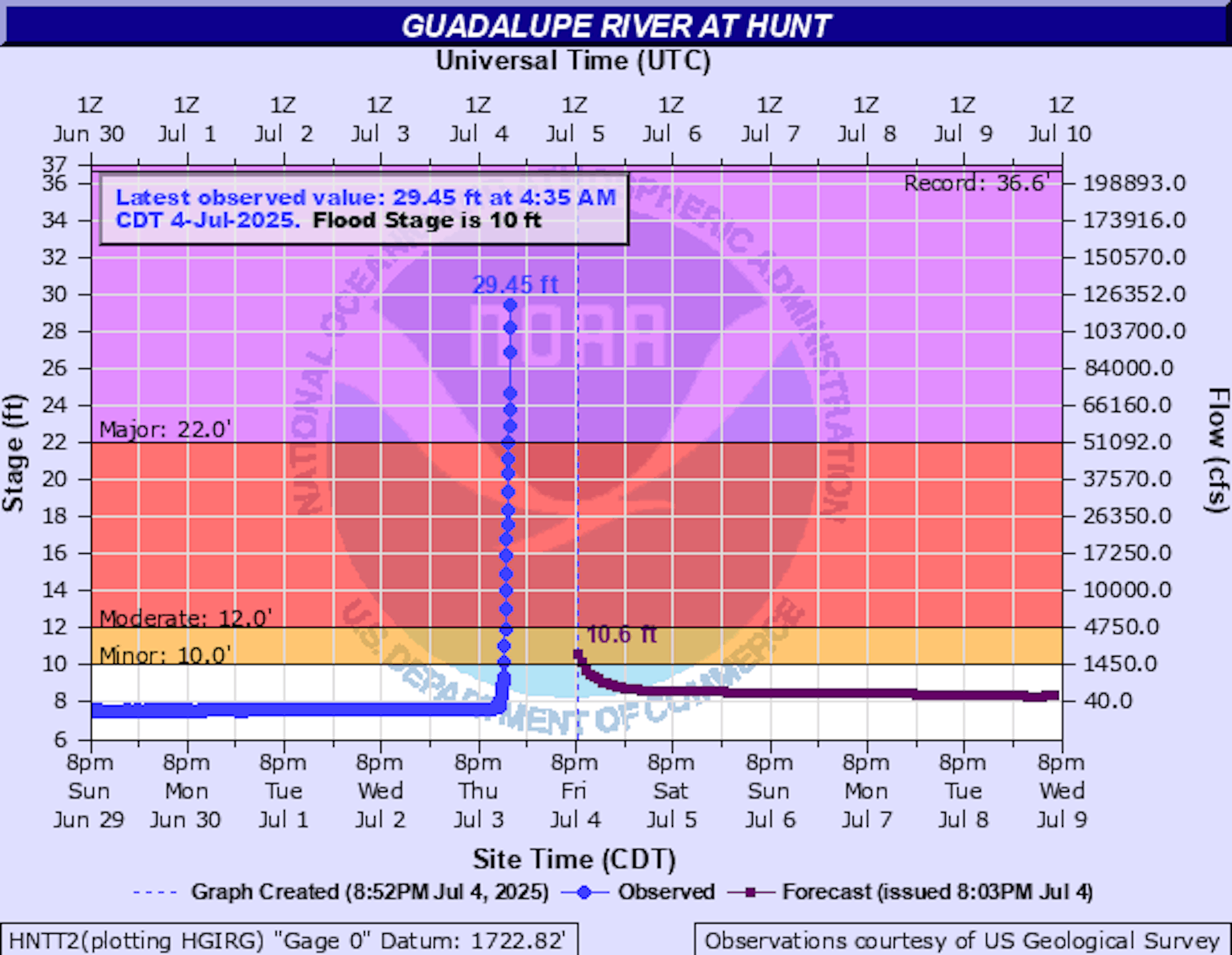
    The flooding occurred after the nearby Guadalupe River broke its banks after torrential rain fell in the central Texas area on Friday, the U.S. Independence Day holiday.

    Texas Division of Emergency Management Chief Nim Kiddsaid at the press conference on Sunday afternoon the destruction killed three people in Burnet County, one in Tom Green County, five in Travis County and one in Williamson County.

    “You will see the death toll rise today and tomorrow,” said Freeman Martin, director of the Texas Department of Public Safety, also speaking on Sunday.

    Officials said on Saturday that more than 850 people had been rescued, including some clinging to trees, after a sudden storm dumped up to 15 inches (38 cm) of rain across the region, about 85 miles (140 km) northwest of San Antonio.

    “Everyone in the community is hurting,” Leitha told reporters.

    WALL OF WATER

    Kidd said he was receiving unconfirmed reports of “an additional wall of water” flowing down some of the creeks in the Guadalupe Rivershed, as rain continued to fall on soil in the region already saturated from Friday’s rains.

    He said aircraft were sent aloft to scout for additional floodwaters, while search-and-rescue personnel who might be in harm’s way were alerted to pull back from the river in the meantime.

    The National Weather Service issued flood warnings and advisories for central Texas that were to last until 4:15 p.m. local time (2115 GMT) as rains fell, potentially complicating rescue efforts.

    The Federal Emergency Management Agency was activated on Sunday and is deploying resources to first responders in Texas after President Donald Trump issued a major disaster declaration, the Department of Homeland Security said in a statement.

    U.S. Coast Guard helicopters and planes are helping the search and rescue efforts, the department said.

    SCALING BACK FEDERAL DISASTER RESPONSE

    Trump, who said on Sunday he would visit the disaster scene, probably on Friday, has previously outlined plans to scale back the federal government’s role in responding to natural disasters, leaving states to shoulder more of the burden themselves.

    Some experts questioned whether cuts to the federal workforce by the Trump administration, including to the agency that oversees the National Weather Service, led to a failure by officials to accurately predict the severity of the floods and issue appropriate warnings ahead of the storm.

    Trump’s administration has overseen thousands of job cuts from the National Weather Service’s parent agency, the National Oceanic and Atmospheric Administration, leaving many weather offices understaffed, former NOAA director Rick Spinrad said.

    Spinrad said he did not know if those staff cuts factored into the lack of advance warning for the extreme Texas flooding, but that they would inevitably degrade the agency’s ability to deliver accurate and timely forecasts.

    Homeland Security Secretary Kristi Noem, who oversees NOAA, said a “moderate” flood watch issued on Thursday by the National Weather Service had not accurately predicted the extreme rainfall and said the Trump administration was working to upgrade the system.

    Joaquin Castro, a Democratic U.S. congressman from Texas, told CNN’s “State of the Union” program that fewer personnel at the weather service could be dangerous.

    “When you have flash flooding, there’s a risk that if you don’t have the personnel … to do that analysis, do the predictions in the best way, it could lead to tragedy,” Castro said.

    ‘COMPLETE DEVASTATION’

    Camp Mystic had 700 girls in residence at the time of the flooding.

    Katharine Somerville, a counselor on the Cypress Lake side of Camp Mystic, on higher ground than the Guadalupe River side, said her 13-year-old campers were scared as their cabins sustained damage and lost power in the middle of the night.

    “Our cabins at the tippity top of hills were completely flooded with water. I mean, y’all have seen the complete devastation, we never even imagined that this could happen,” Somerville said in an interview on Fox News on Sunday.

    Somerville said the campers in her care were put on military trucks and evacuated, and that all were safe.

    The disaster unfolded rapidly on Friday morning as heavier-than-forecast rain drove river waters rapidly to as high as 29 feet (9 meters).

    A day after the disaster struck, the summer camp was a scene of devastation. Inside one cabin, mud lines indicating how high the water had risen were at least six feet (1.83 m) from the floor. Bed frames, mattresses and personal belongings caked with mud were scattered inside. Some buildings had broken windows, one had a missing wall.

    -Reuters

  • Death toll from Texas floods reaches 78; Trump plans visit

    Source: Government of India

    Source: Government of India (4)

    The death toll from catastrophic floods in Texas reached at least 78 on Sunday, including at least 28 children, as the search for girls missing from a summer camp entered a third day and fears of more flash flooding as rain fell on saturated ground prompted fresh evacuations.

    Larry Leitha, the Kerr County Sheriff in Texas Hill Country, said 68 people had died in flooding in his county, the epicenter of the flooding, among them 28 children. Texas Governor Greg Abbott, speaking at a press conference on Sunday afternoon, said another 10 had died elsewhere in Texas and 41 confirmed missing. The governor did not say how many of the dead outside Kerr were children.

    Among the most devastating impacts of the flooding occurred at Camp Mystic summer camp, a nearly century-old Christian girls camp. Sheriff Leitha said on Sunday that 10 Camp Mystic campers and one counselor were still missing.

    “It was nothing short of horrific to see what those young children went through,” said Abbott, who said he toured the area on Saturday and pledged to continue efforts to locate the missing.

    The flooding occurred after the nearby Guadalupe River broke its banks after torrential rain fell in the central Texas area on Friday, the U.S. Independence Day holiday.

    Texas Division of Emergency Management Chief Nim Kiddsaid at the press conference on Sunday afternoon the destruction killed three people in Burnet County, one in Tom Green County, five in Travis County and one in Williamson County.

    “You will see the death toll rise today and tomorrow,” said Freeman Martin, director of the Texas Department of Public Safety, also speaking on Sunday.

    Officials said on Saturday that more than 850 people had been rescued, including some clinging to trees, after a sudden storm dumped up to 15 inches (38 cm) of rain across the region, about 85 miles (140 km) northwest of San Antonio.

    “Everyone in the community is hurting,” Leitha told reporters.

    WALL OF WATER

    Kidd said he was receiving unconfirmed reports of “an additional wall of water” flowing down some of the creeks in the Guadalupe Rivershed, as rain continued to fall on soil in the region already saturated from Friday’s rains.

    He said aircraft were sent aloft to scout for additional floodwaters, while search-and-rescue personnel who might be in harm’s way were alerted to pull back from the river in the meantime.

    The National Weather Service issued flood warnings and advisories for central Texas that were to last until 4:15 p.m. local time (2115 GMT) as rains fell, potentially complicating rescue efforts.

    The Federal Emergency Management Agency was activated on Sunday and is deploying resources to first responders in Texas after President Donald Trump issued a major disaster declaration, the Department of Homeland Security said in a statement.

    U.S. Coast Guard helicopters and planes are helping the search and rescue efforts, the department said.

    SCALING BACK FEDERAL DISASTER RESPONSE

    Trump, who said on Sunday he would visit the disaster scene, probably on Friday, has previously outlined plans to scale back the federal government’s role in responding to natural disasters, leaving states to shoulder more of the burden themselves.

    Some experts questioned whether cuts to the federal workforce by the Trump administration, including to the agency that oversees the National Weather Service, led to a failure by officials to accurately predict the severity of the floods and issue appropriate warnings ahead of the storm.

    Trump’s administration has overseen thousands of job cuts from the National Weather Service’s parent agency, the National Oceanic and Atmospheric Administration, leaving many weather offices understaffed, former NOAA director Rick Spinrad said.

    Spinrad said he did not know if those staff cuts factored into the lack of advance warning for the extreme Texas flooding, but that they would inevitably degrade the agency’s ability to deliver accurate and timely forecasts.

    Homeland Security Secretary Kristi Noem, who oversees NOAA, said a “moderate” flood watch issued on Thursday by the National Weather Service had not accurately predicted the extreme rainfall and said the Trump administration was working to upgrade the system.

    Joaquin Castro, a Democratic U.S. congressman from Texas, told CNN’s “State of the Union” program that fewer personnel at the weather service could be dangerous.

    “When you have flash flooding, there’s a risk that if you don’t have the personnel … to do that analysis, do the predictions in the best way, it could lead to tragedy,” Castro said.

    ‘COMPLETE DEVASTATION’

    Camp Mystic had 700 girls in residence at the time of the flooding.

    Katharine Somerville, a counselor on the Cypress Lake side of Camp Mystic, on higher ground than the Guadalupe River side, said her 13-year-old campers were scared as their cabins sustained damage and lost power in the middle of the night.

    “Our cabins at the tippity top of hills were completely flooded with water. I mean, y’all have seen the complete devastation, we never even imagined that this could happen,” Somerville said in an interview on Fox News on Sunday.

    Somerville said the campers in her care were put on military trucks and evacuated, and that all were safe.

    The disaster unfolded rapidly on Friday morning as heavier-than-forecast rain drove river waters rapidly to as high as 29 feet (9 meters).

    A day after the disaster struck, the summer camp was a scene of devastation. Inside one cabin, mud lines indicating how high the water had risen were at least six feet (1.83 m) from the floor. Bed frames, mattresses and personal belongings caked with mud were scattered inside. Some buildings had broken windows, one had a missing wall.

    -Reuters

  • Death toll from Texas floods reaches 69, including 21 children

    Source: Government of India

    Source: Government of India (4)

    The death toll from catastrophic floods in Texas reached at least 69 on Sunday, including at least 21 children, as the search for girls missing from a summer camp entered a third day.

    Texas Governor Greg Abbott, speaking at a press conference on Sunday afternoon, said the death toll in Kerr county, the epicenter of the flooding, had reached 59, while another 10 had died elsewhere in Texas and 41 remained missing.

    Among the most devastating impacts of the flooding occurred at Camp Mystic summer camp, a nearly century-old Christian girls camp, where 11 girls and a counselor are still missing.

    “It was nothing short of horrific to see what those young children went through,” said Abbott, who said he toured the area on Saturday and pledged to continue efforts to locate the missing.

    The flooding occurred after the nearby Guadalupe River broke its banks after torrential rain fell in the central Texas area on Friday, the U.S. Independence Day holiday. Larry Leitha, the Kerr County Sheriff in Texas Hill Country, said earlier that 21 children have died in the flooding.

    Officials speaking at the press conference on Sunday afternoon said the destruction killed three people in Burnet County, one in Tom Green county, five in Travis county and one in Williamson county.

    Officials said on Saturday that more than 850 people had been rescued, including some clinging to trees, after a sudden storm dumped up to 15 inches (38 cm) of rain across the region, about 85 miles (140 km) northwest of San Antonio.

    “Everyone in the community is hurting,” Leitha told reporters.

    The National Weather Service issued flood warnings and advisories for central Texas that were to last until 4:15 p.m. local time (2115 GMT) as rains fell, potentially complicating rescue efforts.

    The Federal Emergency Management Agency was activated on Sunday and is deploying resources to first responders in Texas after President Donald Trump issued a major disaster declaration, the Department of Homeland Security said in a statement.

    U.S. Coast Guard helicopters and planes are helping the search and rescue efforts, the department said.

    Trump has previously outlined plans to scale back the federal government’s role in responding to natural disasters, leaving states to shoulder more of the burden themselves.

    Some experts questioned whether cuts to the federal workforce by the Trump administration, including to the agency that oversees the National Weather Service, led to a failure by officials to accurately predict the severity of the floods and issue appropriate warnings ahead of the storm.

    Trump’s administration has overseen thousands of job cuts from the National Weather Service’s parent agency, the National Oceanic and Atmospheric Administration, leaving many weather offices understaffed, former NOAA director Rick Spinrad said.

    Spinrad said he did not know if those staff cuts factored into the lack of advance warning for the extreme Texas flooding, but that they would inevitably degrade the agency’s ability to deliver accurate and timely forecasts.

    Homeland Security Secretary Kristi Noem, who oversees NOAA, said a “moderate” flood watch issued on Thursday by the National Weather Service had not accurately predicted the extreme rainfall and said the Trump administration was working to upgrade the system.

    Joaquin Castro, a Democratic U.S. congressman from Texas, told CNN’s “State of the Union” program that fewer personnel at the weather service could be dangerous.

    “When you have flash flooding, there’s a risk that if you don’t have the personnel … to do that analysis, do the predictions in the best way, it could lead to tragedy,” Castro said.

    ‘COMPLETE DEVASTATION’

    Camp Mystic had 700 girls in residence at the time of the flooding.

    Katharine Somerville, a counselor on the Cypress Lake side of Camp Mystic, on higher ground than the Guadalupe River side, said her 13-year-old campers were scared as their cabins sustained damage and lost power in the middle of the night.

    “Our cabins at the tippity top of hills were completely flooded with water. I mean, y’all have seen the complete devastation, we never even imagined that this could happen,” Somerville said in an interview on Fox News on Sunday.

    Somerville said the campers in her care were put on military trucks and evacuated, and that all were safe.

    The disaster unfolded rapidly on Friday morning as heavier-than-forecast rain drove river waters rapidly to as high as 29 feet (9 meters).

    A day after the disaster struck, the summer camp was a scene of devastation. Inside one cabin, mud lines indicating how high the water had risen were at least six feet (1.83 m) from the floor. Bed frames, mattresses and personal belongings caked with mud were scattered inside. Some buildings had broken windows, one had a missing wall.

    -REUTERS

  • MIL-OSI Russia: 59 Dead, 11 Children Missing in Texas Floods

    Translation. Region: Russian Federal

    Source: People’s Republic of China in Russian – People’s Republic of China in Russian –

    An important disclaimer is at the bottom of this article.

    Source: People’s Republic of China – State Council News

    HOUSTON, July 6 (Xinhua) — Eleven children were still missing as of July 6, three days after massive flash floods killed at least 59 people in the central part of the U.S.’s second-largest state of Texas, local authorities said.

    Search crews continue to look for children and one counselor missing from Camp Mystic in Kerr County, Kerr County Sheriff Larry Leita said at a briefing.

    “We will continue the search until everyone is found,” he assured.

    The confirmed death toll includes 21 children, he said.

    Flooding has affected about 20 Texas counties. –0–

    Please note: This information is raw content obtained directly from the source of the information. It is an accurate report of what the source claims and does not necessarily reflect the position of MIL-OSI or its clients.

    .

    MIL OSI Russia News

  • BRICS nations urge advanced economies to scale up climate finance for developing countries

    Source: Government of India

    Source: Government of India (4)

    BRICS member nations have called on advanced economies and the international financial system to provide “substantial” financing to support climate mitigation efforts in developing economies.

    “We call on advanced economies and other relevant actors in the international financial system, as well as the private sector, to provide substantial finance for climate actions in developing countries, including by expanding concessional finance and increasing private capital mobilisation,” Finance Ministers and Central Bank Governors of BRICS countries said in a joint statement on Sunday, just ahead of the Summit.

    Highlighting the growing needs of emerging markets and developing economies (EMDEs), the group urged international financial institutions to scale up adaptation support and create conditions that would attract greater private sector participation in mitigation efforts.

    BRICS members also acknowledged the structural challenges posed by climate change, energy transitions, biodiversity loss and conservation efforts.

    “We reaffirm that predictable, equitable, accessible and affordable climate finance is indispensable for just transitions, in line with country circumstances and development priorities, and for meeting the goals of the UNFCCC and its Paris Agreement,” the statement said.

    India, a BRICS member, has consistently advocated for stronger climate finance arrangements, primarily from developed countries that are historically major carbon emitters. India has repeatedly underlined the need for adequate financial support, particularly for the Global South.

    Climate finance generally refers to funding directed at mitigation and adaptation measures to tackle climate change. Developing countries have long argued that developed nations, being historically larger emitters, must shoulder greater responsibility for funding mitigation and adaptation.

    Against the backdrop of global economic uncertainty and volatility, BRICS members said the International Monetary Fund (IMF) must remain adequately resourced and flexible to protect its members, particularly the most vulnerable.

    The statement also welcomed the New Development Bank’s steady efforts to expand its funding capacity, promote local currency financing, diversify funding sources, and back projects that advance sustainable development, reduce inequality and drive investment in infrastructure and economic integration.

    “As the New Development Bank is set to embark on its second golden decade of high-quality development, we recognise and support its growing role as a robust and strategic agent of development and modernisation in the Global South,” it said.

    BRICS members also reaffirmed that they would continue working through the second half of 2025 to push forward these initiatives and strengthen coordination for a smooth transition to India’s presidency in 2026.

    Finance Ministers and Central Bank Governors of BRICS countries met in Rio de Janeiro, Brazil, on July 5 under the theme, “Strengthening Global South Cooperation for More Inclusive and Sustainable Governance.”

    Together, BRICS countries — Brazil, Russia, India, China and South Africa — account for nearly half of the world’s population, spread across four continents, and nearly 40 per cent of global GDP. The bloc has become more integrated with the world economy and now represents about a quarter of global trade and investment flows.

    The joint statement underlined that more needs to be done to ensure the benefits of globalisation, economic growth and productivity are shared more equally.

    According to a report by Rubix Data Sciences, total international trade (exports plus imports) of BRICS countries stood at USD 10.5 trillion in 2024, growing at a compound annual growth rate of 7.9 per cent between 2020 and 2024.

    BRICS nations remain net exporters, collectively selling more goods abroad than they import, underlining their strong production capacity and growing clout in global trade.

  • MIL-OSI Russia: Guangdong province steps up precautions against Typhoon Danas

    Translation. Region: Russian Federal

    Source: People’s Republic of China in Russian – People’s Republic of China in Russian –

    An important disclaimer is at the bottom of this article.

    Source: People’s Republic of China – State Council News

    GUANGZHOU, July 6 (Xinhua) — An emergency response was issued Sunday in south China’s Guangdong Province for Typhoon Danas, the fourth typhoon recorded this year by China’s meteorological service. The center of the typhoon was located 230 km southeast of Shantou City at 8 a.m., with wind speeds of up to 36.9 m/s near the center, local sources said.

    The provincial emergency management agency said 361 vessels in the dangerous waters had returned to ports by 2 p.m., and more than 2,000 people had been evacuated from maritime facilities. All five coastal tourist areas in the province have been closed.

    Six rescue helicopters are deployed in key cities, 21 patrol ships and 64 emergency rescue vessels are on standby along the coast.

    Meteorologists have warned that heavy rain and gusty winds are expected in eastern coastal areas. The provincial flood and drought control headquarters has called for increased vigilance against the possible impact of adverse weather. –0–

    Please note: This information is raw content obtained directly from the source of the information. It is an accurate report of what the source claims and does not necessarily reflect the position of MIL-OSI or its clients.

    .

    MIL OSI Russia News

  • MIL-OSI Africa: Eastern Cape provincial government strengthens oversight in flood-affected areas

    Source: Government of South Africa

    Eastern Cape provincial government strengthens oversight in flood-affected areas

    The Eastern Cape Provincial Government has intensified efforts to coordinate disaster relief and recovery measures following the devastating floods that have impacted the province, particularly in the OR Tambo and Amathole Districts. 

    In a statement on Friday, the provincial government said a multidisciplinary team led by the Office of the Premier, supported by the Departments of Cooperative Governance and Traditional Affairs, Human Settlements, Health, Home Affairs, SASSA, and affected local municipalities, has been deployed since the disaster began. 

    A Provincial Joint Operations Centre (JOC) has been activated to streamline disaster response as well as the Donations Management Team which coordinates humanitarian support, including food, sanitary items, and household necessities. 

    The provincial government said this team has been actively assessing the functionality, safety, and welfare of residents in temporary shelters across the province, while coordinating and distributing humanitarian aid. 

    The team is also making significant progress in the resettlement of displaced residents, which is expected to resume once all proper government processes have been followed. 

    “As of [Friday], the official death toll stands at 103, tragically including 32 school-going children. Out of the 103, there are 50 men and 53 females, 63 are adults and 40 are children. 

    “The OR Tambo District has the most fatalities with 79 victims, followed by Amathole District with 10, Alfred Nzo district 5, Chris Hani 5, Joe Gqabi 2, and Sarah Baartman District with 2. 

    “Of the 103 deceased, 98 bodies have been identified and collected, while 5 bodies remain unidentified. The Department of Home Affairs has registered 92 deaths out of the 103,” a statement issued by the provincial government said. 

    Floodwaters have ravaged over 6 800 households, leaving 4 724 without homes and partially damaging another 2 145 dwellings. 

    Search and recovery efforts are still underway, while emergency response and relief teams continue their critical work. 

    The Provincial Government thanked all the stakeholders involved and assured affected communities that comprehensive support services will remain in place until full recovery and stability are achieved. 

    “The South African National Defence Force and Mercedes-Benz have all joined the collective effort to support flood victims in the OR Tambo and Amathole districts. These key stakeholders have delivered substantial donations of food, clothing, and other essential supplies, reinforced the broader relief operation and demonstrated a strong spirit of solidarity across public and private sectors. Donations have also been received from entities such as Shoprite, Meals on Wheels, AbaThembu Kingdom, and numerous community contributors,” the provincial government said. 

    COGTA MEC Zolile Williams this week conducted an oversight visit to assess the conditions at all eight of the Community Care Centres (CCCs) accommodating displaced residents in and around OR Tambo District Municipality. 

    Mayor of OR Tambo District Municipality, Mesuli Ngqondwana, and the Mayor of King Sabata Dalindyebo (KSD) Local Municipality, Nyaniso Nelani were also there. 

    Community members shared their appreciation for the support received but also raised concerns about an urgent need for a more durable and dignified housing solutions. 

    Responding to these concerns, MEC Williams reaffirmed the government’s commitment to restoring dignity and stability for all affected families. He emphasised that municipalities have identified land for the erection of temporary structures as part of broader resettlement plans. 

    “Suitable land has been identified in both KSD and Mnquma municipalities for the construction of 1 230 Temporary Residential Units (TRUs), with R120 million reprioritised to begin implementation. A further R461 million is needed to meet the full TRU demand. 

    “The verification of damaged homes is underway in Mnquma and OR Tambo Districts, with Joe Gqabi District having completed the process. 

    “This critical step aims to determine which families require temporary or permanent housing, ensuring that those displaced or affected by structural damage receive appropriate support and stability as part of the ongoing recovery and resettlement strategy,” the provincial government said. 

    Additionally, the exercise will further determine households that must be permanently moved as they are situated in flood plans. 

    Furthermore, key progress milestones for the road to recovery so far includes: 

    • 62 burials have been completed; with 9 more planned for this weekend.
    • 1442 individuals received psychosocial support.
    • 760 families have been supported with SASSA food vouchers.
    • 989 smart ID and 96 birth certificate applications have been processed. 

    Additionally, the provincial government said infrastructure repairs are in motion, with 235 schools, 69 health facilities, and 149 roads and 91 bridges damaged across various districts. 

    A total of R5.04 billion is the estimated cost to repair damaged infrastructure. 

    “The collaboration across government and with civil society has been instrumental in responding to this humanitarian crisis. We remain committed to ensuring that displaced families are cared for with dignity and that donations are managed transparently. The province thanks all donors,” the MEC said. – SAnews.gov.za

    DikelediM

    MIL OSI Africa

  • MIL-OSI Russia: East China’s Zhejiang Province Issues Emergency Response for Typhoon Danas

    Translation. Region: Russian Federal

    Source: People’s Republic of China in Russian – People’s Republic of China in Russian –

    An important disclaimer is at the bottom of this article.

    Source: People’s Republic of China – State Council News

    HANGZHOU, July 6 (Xinhua) — An emergency response was activated in east China’s Zhejiang Province on Sunday morning to deal with Typhoon Danas, the fourth typhoon this year.

    According to the provincial meteorological observatory, Danas is expected to move northeast at 10-15 km per hour, cross the Taiwan Strait from south to north between Sunday afternoon and Monday morning, and possibly either pass by or make landfall on the west coast of Taiwan Island.

    The typhoon will reach the East China Sea on Monday and may make landfall in coastal areas from central and southern Zhejiang Province to northern Fujian Province in east China after midday Tuesday, the observatory added.

    The Zhejiang provincial government called on all coastal regions and various departments to closely monitor the typhoon’s development trend, intensify joint consultations and take preventive measures in accordance with the emergency plan. These include sheltering ships in bays, anchoring fishing boats, suspending navigation on sea routes, suspending work on construction projects and closing off marine tourism areas.

    China’s National Meteorological Center also extended a yellow alert on Sunday for Typhoon Danas, which is expected to bring strong winds and heavy rain to parts of the country’s south.

    Let us recall that China has a four-level typhoon warning system, in which the highest level of danger is indicated by red, followed by orange, yellow and blue. -0-

    Please note: This information is raw content obtained directly from the source of the information. It is an accurate report of what the source claims and does not necessarily reflect the position of MIL-OSI or its clients.

    .

    MIL OSI Russia News

  • MIL-OSI China: Chinese premier says to expand cooperation with Brazil in digital economy, aerospace

    Source: People’s Republic of China – State Council News

    Chinese Premier Li Qiang said on Saturday that China is willing to work with Brazil to leverage each other’s complementary advantages and expand cooperation in such areas as digital economy, green economy, sci-tech innovation and aerospace.

    Li made the remarks during his meeting with Brazilian President Luiz Inacio Lula da Silva. The Chinese premier arrived in Rio de Janeiro on Saturday to attend the 17th BRICS Summit.

    Li conveyed Chinese President Xi Jinping’s warm greetings to Lula, noting that China-Brazil relations are in their best shape ever, with both sides working together to build a China-Brazil community with a shared future for a more just world and a more sustainable planet.

    During Lula’s visit to China in May, the two heads of state reached important consensus on pushing for building a China-Brazil community with a shared future and upholding multilateralism, Li said.

    China stands ready to work with Brazil to continue the efforts in enriching the dimensions of bilateral relations and achieving more concrete results in cooperation so as to deliver more benefits to the two peoples, Li added.

    China is willing to work with Brazil to further consolidate and deepen bilateral cooperation in trade, finance and infrastructure development under the framework of high-quality Belt and Road cooperation, said the premier.

    Li also urged both countries to jointly ensure the success of the China-Brazil Year of Culture in 2026, step up cooperation in education, youth, healthcare and other areas, further facilitate people-to-people exchanges and strengthen public support for China-Brazil friendship and cooperation.

    Depicting both countries as staunch supporters of multilateralism and free trade, Li said that China is willing to enhance communication and coordination with Brazil within multilateral frameworks such as the United Nations, BRICS and the G20, work in unity with developing countries to promote an equal and orderly multipolar world and a universally beneficial and inclusive economic globalization, and provide more certainty and stability for the world.

    China supports Brazil in hosting the UN Climate Change Conference in Belem (COP30) later this year, Li said.

    For his part, Lula asked Li to convey his sincere regards to Xi. He noted that the two peoples share a profound friendship.

    Brazil attaches great importance to advancing its relations with China, and stands ready to work with China to follow through on the important consensus reached by the two heads of state and further strengthen high-level exchanges, he said.

    Brazil is ready to promote exchanges and cooperation with China in such areas as economy and trade, science and technology, finance, and aerospace, he added.

    Brazil also seeks to deepen collaboration with China in addressing climate change, said Lula, noting the country welcomes China’s participation in the upcoming COP30 in Belem.

    He also congratulated China on successfully hosting the fourth ministerial meeting of the China-CELAC (the Community of Latin American and Caribbean States) Forum this year.

    Lula said Brazil is willing to deepen multilateral communication and coordination with China, jointly oppose unilateralism, and uphold multilateralism and free trade so as to promote world peace and development.

    Following the meeting, the two sides witnessed the signing of cooperation documents in such fields as fiscal and financial affairs, artificial intelligence, development strategies alignment and aerospace. 

    MIL OSI China News

  • Heavy rain likely in Himachal Pradesh, Odisha, Konkan & Goa: IMD

    Source: Government of India

    Source: Government of India (4)

    The India Meteorological Department (IMD) on Sunday said that Odisha, Himachal Pradesh, Chhattisgarh, central Maharashtra, Vidarbha, Madhya Pradesh, and east Rajasthan are expected to witness intense rainfall activity between July 6 to July 9.

    Heavy to very heavy rainfall is likely across several parts of Northwest, West Coast, and Northeast India over the next 6–7 days, with extremely heavy rainfall (more than 21 cm) likely at isolated locations, the IMD added.

    A low-pressure area is also forming over Gangetic West Bengal and its neighbourhood, further intensifying rainfall in the eastern region.

    Heavy rainfall is particularly likely in regions including Gangetic West Bengal, Jharkhand, Jammu & Kashmir, Himachal Pradesh, Uttarakhand, Punjab, Haryana, Chandigarh, Saurashtra & Kutch, and parts of the Northeast. Central India, including Madhya Pradesh, Gujarat, and Vidarbha, is also likely to receive continued heavy rains between July 6 to July 9.

    Delhi-NCR Weather Forecast

    Today, Delhi will experience a generally cloudy sky with light to moderate rain accompanied by thunderstorms and lightning. Maximum temperatures are expected to range between 32–34°C, below normal by 2–4°C. Winds will be southwesterly at 15 kmph, later shifting to southeasterly at 8–12 kmph by evening.

    On Monday (July 7), similar weather conditions will persist, with light to moderate rainfall and thunderstorms. Temperatures will remain in the 32–34°C (max) and 25–27°C (min) range. Southeast winds in the morning will weaken to under 10 kmph from the northeast by afternoon, picking up slightly in the evening.

    On Tuesday (July 8), light rain with thunderstorms is likely to continue under a cloudy sky. Temperatures will be slightly cooler, with maximums at 32–34°C and minimums at 25–27°C. Winds will shift from the east in the morning to the northeast in the afternoon, and to the southeast by night.

    On Wednesday (July 9), very light to light rain with thunderstorms is forecast. Daytime temperatures will rise slightly to 33–35°C, with nighttime lows of 24–26°C. Winds will be calm in the morning, becoming northeasterly by afternoon and evening with speeds up to 15 kmph.

  • Heavy rain likely in Himachal Pradesh, Odisha, Konkan & Goa: IMD

    Source: Government of India

    Source: Government of India (4)

    The India Meteorological Department (IMD) on Sunday said that Odisha, Himachal Pradesh, Chhattisgarh, central Maharashtra, Vidarbha, Madhya Pradesh, and east Rajasthan are expected to witness intense rainfall activity between July 6 to July 9.

    Heavy to very heavy rainfall is likely across several parts of Northwest, West Coast, and Northeast India over the next 6–7 days, with extremely heavy rainfall (more than 21 cm) likely at isolated locations, the IMD added.

    A low-pressure area is also forming over Gangetic West Bengal and its neighbourhood, further intensifying rainfall in the eastern region.

    Heavy rainfall is particularly likely in regions including Gangetic West Bengal, Jharkhand, Jammu & Kashmir, Himachal Pradesh, Uttarakhand, Punjab, Haryana, Chandigarh, Saurashtra & Kutch, and parts of the Northeast. Central India, including Madhya Pradesh, Gujarat, and Vidarbha, is also likely to receive continued heavy rains between July 6 to July 9.

    Delhi-NCR Weather Forecast

    Today, Delhi will experience a generally cloudy sky with light to moderate rain accompanied by thunderstorms and lightning. Maximum temperatures are expected to range between 32–34°C, below normal by 2–4°C. Winds will be southwesterly at 15 kmph, later shifting to southeasterly at 8–12 kmph by evening.

    On Monday (July 7), similar weather conditions will persist, with light to moderate rainfall and thunderstorms. Temperatures will remain in the 32–34°C (max) and 25–27°C (min) range. Southeast winds in the morning will weaken to under 10 kmph from the northeast by afternoon, picking up slightly in the evening.

    On Tuesday (July 8), light rain with thunderstorms is likely to continue under a cloudy sky. Temperatures will be slightly cooler, with maximums at 32–34°C and minimums at 25–27°C. Winds will shift from the east in the morning to the northeast in the afternoon, and to the southeast by night.

    On Wednesday (July 9), very light to light rain with thunderstorms is forecast. Daytime temperatures will rise slightly to 33–35°C, with nighttime lows of 24–26°C. Winds will be calm in the morning, becoming northeasterly by afternoon and evening with speeds up to 15 kmph.

  • Heavy rain likely in Himachal Pradesh, Odisha, Konkan & Goa: IMD

    Source: Government of India

    Source: Government of India (4)

    The India Meteorological Department (IMD) on Sunday said that Odisha, Himachal Pradesh, Chhattisgarh, central Maharashtra, Vidarbha, Madhya Pradesh, and east Rajasthan are expected to witness intense rainfall activity between July 6 to July 9.

    Heavy to very heavy rainfall is likely across several parts of Northwest, West Coast, and Northeast India over the next 6–7 days, with extremely heavy rainfall (more than 21 cm) likely at isolated locations, the IMD added.

    A low-pressure area is also forming over Gangetic West Bengal and its neighbourhood, further intensifying rainfall in the eastern region.

    Heavy rainfall is particularly likely in regions including Gangetic West Bengal, Jharkhand, Jammu & Kashmir, Himachal Pradesh, Uttarakhand, Punjab, Haryana, Chandigarh, Saurashtra & Kutch, and parts of the Northeast. Central India, including Madhya Pradesh, Gujarat, and Vidarbha, is also likely to receive continued heavy rains between July 6 to July 9.

    Delhi-NCR Weather Forecast

    Today, Delhi will experience a generally cloudy sky with light to moderate rain accompanied by thunderstorms and lightning. Maximum temperatures are expected to range between 32–34°C, below normal by 2–4°C. Winds will be southwesterly at 15 kmph, later shifting to southeasterly at 8–12 kmph by evening.

    On Monday (July 7), similar weather conditions will persist, with light to moderate rainfall and thunderstorms. Temperatures will remain in the 32–34°C (max) and 25–27°C (min) range. Southeast winds in the morning will weaken to under 10 kmph from the northeast by afternoon, picking up slightly in the evening.

    On Tuesday (July 8), light rain with thunderstorms is likely to continue under a cloudy sky. Temperatures will be slightly cooler, with maximums at 32–34°C and minimums at 25–27°C. Winds will shift from the east in the morning to the northeast in the afternoon, and to the southeast by night.

    On Wednesday (July 9), very light to light rain with thunderstorms is forecast. Daytime temperatures will rise slightly to 33–35°C, with nighttime lows of 24–26°C. Winds will be calm in the morning, becoming northeasterly by afternoon and evening with speeds up to 15 kmph.

  • MIL-OSI Africa: President Ramaphosa arrives in Brazil ahead of Rio Summit

    Source: Government of South Africa

    By Gabi Khumalo

    Rio de Janeiro, Brazil – President Cyril Ramaphosa is in Rio de Janeiro, Brazil for his working visit to attend the 17th BRICS Summit, which kicks off today.

    The President, who arrived on Saturday evening, will attend the Brazil, Russia, India, China, and South Africa (BRICS) Summit at the invitation of President of Brazil, Luiz Inacio Lula da Silva.

    Ahead of the high-level engagements, officials and delegations could be seen entering and exiting the summit venue making final preparations, while tight security measures were in place. 

    The objectives for this year’s summit include highlighting the ongoing humanitarian impact of Israeli military action in Gaza and in conflicts in Sudan, Ukraine and Iran; and advocating for the sustainable resolution of conflicts through diplomacy, inclusive dialogue, and a commitment to the United Nations Charter.

    The summit, taking place from 6 to 7 July 2025, will also explore ways of expanding tangible trade, tourism, investment, and financial cooperation within BRICS and with BRICS partner countries.

    “For South Africa, these deliberations will enhance our efforts to further diversify trade and enhance resilience, growth and development. The summit will look into synergies between BRICS, COP30 (Conference of the Parties) and G20 (Group of Twenty) outcomes, including in global governance of artificial intelligence and prioritising climate finance that is just, accessible, and transformational.

    “BRICS leaders will continue advocating for the reform of global governance systems to be more inclusive and representative of contemporary realities. This includes the goal of countries of the South for more meaningful participation of the global South in global decision-making processes and structures, including in the United Nations Security Council,” the Presidency said.

    The specific objectives of South Africa’s engagement in BRICS are:
    • To enhance the future growth and development of South Africa through its BRICS membership.
    • To strengthen intra-BRICS relations and develop mutually beneficial cooperation across the three pillars of cooperation, political and security, financial and economic, and cultural and people-to-people cooperation.
    • To shape global governance reform to be more equitable, balanced and representative.

    South Africa has emphasised concrete cooperation that contributes both directly and indirectly to the priorities of a better South Africa, a better Africa, and a better world through its partnership in BRICS.

    During the 17th BRICS Summit, session leaders are expected to deliberate on topics, including global governance reform, peace, and security, including a report by National Security Advisors.

    “Heads of State and government will discuss a BRICS Leaders Statement on Global Governance of Artificial Intelligence. This will be followed by the adoption of a BRICS Leaders Framework Declaration on Climate Finance and the launch of the BRICS Partnership for the Elimination of Socially Determined Diseases.”

    The summit will conclude with the adoption of the Rio de Janeiro Declaration.

    The summit will be attended by leaders of the BRICS member states, including Brazil, Russia, India, China, South Africa, Egypt, Ethiopia, Iran, Saudi Arabia, the United Arab Emirates, and Indonesia.

    Member states participate in all BRICS meetings, while partner states participate principally in summits. Partner states may be invited to other meetings of the association if members agree on this.

    Leaders of BRICS partner countries will come from Belarus, Bolivia, Kazakhstan, Cuba, Malaysia, Nigeria, Thailand, Uganda and Uzbekistan.

    The Rio Summit will also be attended by leaders of outreach countries, which in the BRICS system are countries from the region, where the rotational Presidency is located.

    In this context, Bolivia, Chile, Colombia, Mexico and Uruguay have also been invited by the Government of Brazil to participate in the Rio gathering. 

    The United Nations, the African Union (AU) and International Organisations will also participate.

    Leaders of all BRICS members are confirmed for the Rio Summit with President Putin participating virtually and China represented by Premier Li Qiang.

    President Ramaphosa is supported by Minister of International Relations and Cooperation Ronald Lamola; Minister in the Presidency Khumbudzo Ntshavheni; Deputy Minister of Finance Dr David Masondo and Deputy Minister of Trade Industry and Competition Zuko Godlimpi. – SAnews.gov.za
     

    MIL OSI Africa

  • MIL-OSI Russia: China extends yellow alert for Typhoon Danas

    Translation. Region: Russian Federal

    Source: People’s Republic of China in Russian – People’s Republic of China in Russian –

    An important disclaimer is at the bottom of this article.

    Source: People’s Republic of China – State Council News

    BEIJING, July 6 (Xinhua) — China’s National Meteorological Center (NMC) on Sunday extended a yellow alert for Typhoon Danas as it is expected to bring strong winds and heavy rain to southern parts of the country.

    According to the agency, as of 05:00 on Sunday, the epicenter of the typhoon was located at a point with coordinates of 21.3 degrees north latitude and 118.1 degrees east longitude. It is expected to continue moving in a northeasterly direction at a speed of 10-15 km per hour, gaining strength.

    From Sunday night to Monday morning, Danas is forecast to cross the Taiwan Strait from south to north and may pass by or make landfall on the west coast of Taiwan.

    On Monday, the typhoon will reach the East China Sea and gradually approach the coastal areas of northern Fujian Province, as well as the central and southern parts of Zhejiang Province, the NMC added.

    According to the NMC forecast, from 08:00 Sunday to 08:00 Monday, strong winds will rage in some parts of the South China Sea, the Taiwan Strait area, the sea area east of Taiwan, the Bashi Strait area and some parts of the East China Sea, as well as coastal areas of Guangdong, Fujian, Zhejiang provinces and Taiwan Island.

    During the same period, heavy or torrential rains are expected in southeastern Zhejiang Province, northeastern Fujian Province and Taiwan Island. Heavy rains with precipitation amounts of up to 230 mm are possible in some areas of Taiwan Island.

    It should be recalled that China has a four-level typhoon warning system, with the highest level of danger indicated by red, followed by orange, yellow and blue.

    Under the influence of the typhoon, strong waves are expected in sea areas near Taiwan Island, the South China Sea and coastal waters off Fujian, Guangdong and Zhejiang provinces from Sunday afternoon to Monday afternoon, according to the National Marine Forecasting Center. -0-

    Please note: This information is raw content obtained directly from the source of the information. It is an accurate report of what the source claims and does not necessarily reflect the position of MIL-OSI or its clients.

    .

    MIL OSI Russia News

  • MIL-OSI Russia: China’s Premier Announces Intention to Expand Cooperation with Brazil in Digital Economy, Aerospace

    Translation. Region: Russian Federal

    Source: People’s Republic of China in Russian – People’s Republic of China in Russian –

    An important disclaimer is at the bottom of this article.

    Source: People’s Republic of China – State Council News

    RIO DE JANEIRO, July 6 (Xinhua) — Chinese Premier Li Qiang said Saturday that China is willing to work with Brazil to leverage the complementary advantages of both countries and expand cooperation in areas such as the digital economy, green economy, scientific and technological innovation and aerospace.

    Li Qiang made the remarks during a meeting with Brazilian President Luiz Inacio Lula da Silva, who arrived in Rio de Janeiro to attend the 17th BRICS summit.

    He conveyed warm greetings from Chinese President Xi Jinping to L. I. Lula da Silva, noting that China-Brazil relations are at their best stage. Both sides are committed to building a China-Brazil community with a shared future and a more just and sustainable world.

    Li Qiang recalled that during Lula da Silva’s visit to China in May, the two heads of state reached an important consensus on moving towards the creation of a China-Brazil community with a shared future and supporting multilateralism.

    China is willing to continue to work with Brazil to expand bilateral relations and achieve more concrete results in cooperation so as to bring more tangible benefits to the peoples of both countries, Li added.

    He stressed that China is willing to deepen cooperation with Brazil in trade, finance and infrastructure within the framework of high-quality construction of the Belt and Road.

    In addition, the Premier called for successfully holding the China-Brazil Culture Year in 2026, strengthening cooperation in education, youth, health care and other fields, promoting further people-to-people and cultural exchanges, so as to strengthen public support for China-Brazil friendship and cooperation.

    Calling both countries staunch supporters of multilateralism and free trade, Li Qiang said China is willing to strengthen communication and coordination with Brazil within multilateral frameworks such as the UN, BRICS and G20, and work with developing countries to promote an equitable and orderly multipolar world and universal, beneficial and inclusive economic globalization, bringing greater certainty and stability to the world.

    China supports Brazil in hosting the 30th session of the Conference of the Parties to the United Nations Framework Convention on Climate Change (COP30) in Belem this year, he added. –0–

    Please note: This information is raw content obtained directly from the source of the information. It is an accurate report of what the source claims and does not necessarily reflect the position of MIL-OSI or its clients.

    .

    MIL OSI Russia News

  • MIL-OSI Russia: Texas flood death toll rises to 49, 27 children still missing

    Translation. Region: Russian Federal

    Source: People’s Republic of China in Russian – People’s Republic of China in Russian –

    An important disclaimer is at the bottom of this article.

    Source: People’s Republic of China – State Council News

    HOUSTON, July 5 (Xinhua) — At least 49 people have been killed and dozens are missing after massive flooding hit parts of central Texas, authorities said, as rescue operations continued in several counties.

    In Kerr County, at least 43 people, including 28 adults and 15 children, were killed after heavy rains caused flash flooding early Friday, county Sheriff Larry Leita said at a news conference.

    Another 27 children, most of whom were at Camp Mystic, a Christian summer camp for girls on the Guadalupe River, are missing, said Kerrville Mayor Dalton Rice. The camp serves about 750 children a year.

    Four people have been confirmed dead in Travis County, with 13 others missing, KXAN-TV reported, citing Travis County Judge Andy Brown.

    In Burnet County, rescue efforts were continuing as of Saturday afternoon. The sheriff’s office confirmed two people were dead and said two others were missing.

    This isn’t the first major flooding event in Texas this year, AccuWeather reports. 2024 saw a record number of flash flood emergencies across the U.S. –0–

    Please note: This information is raw content obtained directly from the source of the information. It is an accurate report of what the source claims and does not necessarily reflect the position of MIL-OSI or its clients.

    .

    MIL OSI Russia News

  • MIL-OSI China: China activates emergency response as Typhoon Danas approaches

    Source: People’s Republic of China – State Council News

    BEIJING, July 5 — China on Saturday activated a Level-IV emergency response to flooding and typhoon in two provinces as Typhoon Danas approaches, according to the Ministry of Emergency Management.

    Emergency measures were initiated by the State Flood Control and Drought Relief Headquarters in the eastern province of Fujian and the southern province of Guangdong, while a work team was dispatched to Fujian to assist local flood and typhoon control efforts.

    The maximum wind force of Typhoon Danas, the fourth typhoon of this year, is estimated to reach grade-12 to grade-13 at a speed of 35-40 meters per second, according to meteorological authorities. It will approach the coastal regions in southwestern parts of Taiwan Island and northern parts of Fujian.

    The National Meteorological Center issued a yellow alert for typhoon on Saturday evening, forecasting strong winds and rainstorms in affected areas from Saturday to Sunday.

    China has a four-tier emergency response system, with Level I being the most severe response, and a four-tier weather warning system, with red representing the most severe warning, followed by orange, yellow and blue.

    MIL OSI China News

  • MIL-OSI United Nations: Secretary-General’s remarks at the Evocation Ceremony Celebration of the 50th Anniversary of Cabo Verde’s Independence and 50th Anniversary of the Partnership with the United Nations [as delivered]

    Source: United Nations secretary general

    Honourable President José Maria Neves; Honourable Prime Minister José Ulisses Correia e Silva; Distinguished Heads of State and Government; Excellencies, Ladies and gentlemen,

    I am happy to be with you today on behalf of the United Nations Secretary-General, Antonio Guterres, and I thank the Government and the people of Cabo Verde for your warm welcome and hospitality.

    I am honoured to deliver his remarks on this historic occasion:

    It is with deep emotion that I send these words to a country I hold close to my heart.

    As Secretary-General of the United Nations, as former Prime Minister of Portugal, and as a long-time friend, I am honoured to mark this fiftieth anniversary of Cabo Verdean independence and partnership with the United Nations.

    Cabo Verde has shaped my conscience and conviction. 

    And I celebrate with you the enduring spirit of the povo cabo-verdiano – a people whose determination has long outshone the constraints of geography.

    Dear friends,

    The story of Cabo Verde is a story of freedom reclaimed.

    On July 5, 1975, the world bore witness to the birth of a new Republic.

    After centuries of colonial rule, the people of Cabo Verde – together with their brothers and sisters in Guinea-Bissau – rose up to demand self-determination.

    As a Portuguese citizen, I cannot speak of Cabo Verde without acknowledging the deep and complex history we share – a history marked by pain, injustice, but also by solidarity.

    I carry with me the memory of walking through the gates of the former Tarrafal concentration camp — in the company of Edmundo Pedro and Sérgio Vilarigues, who had endured its horrors.

    Their stories of suffering and resistance are etched into my memory.

    Today, we honour so many heroes of that struggle – heroes like Amílcar Cabral. 

    Receiving the Order of Amílcar Cabral by Prime Minister Carlos Veiga, remains one of the greatest honours of my life.

    Dear friends,

    From the beginning, Cabo Verde chose the harder path:

    Stability over strife.

    Dialogue over division.

    The peaceful transition to independence, the embrace of democracy and good governance… a model that endures.

    Cabo Verde is also a wonder of geography.

    Ten volcanic islands scattered across the Atlantic, bound by morabeza – that singular warmth and grace that define the Cabo Verdean soul.

    But it is the people who truly set Cabo Verde apart.

    A culture that is at once rooted and global, melancholic and joyful.

    This nation gave the world morna — a music of sodade, of longing for home across distant seas.

    It brought us the timeless voice of Cesária Évora, who sang from Mindelo to the world – and made every listener feel a little closer to Cabo Verde.

    Dear friends,

    When Cabo Verde gained independence, many may have doubted. 

    Yet five decades later, you stand as a middle-income country and a champion of peace and equality.

    As Prime Minister of Portugal, I had the privilege of working closely with Cabo Verde to deepen our cooperation.

    I recall with pride the signing of the Acordo de Cooperação Cambial – a monetary agreement that was more than a technical arrangement.

    It was a bridge between our economies, a symbol of trust, and a recognition of Cabo Verde’s growing role on the global stage.

    And through it all, you have remained true to your values.

    Welcoming migrants.

    Upholding the rule of law.

    And staying true to the principles of solidarity and open cooperation.

    I saw these values in action during my last visit.

    At the port of Mindelo, I watched the sails of the Ocean Race rise against the horizon — a striking reminder of Cabo Verde’s openness, resolve, and connection to the wider world.

    What stayed with me was not just the race, but the spirit onshore — young people learning, communities coming together, leaders thinking boldly about the future.

    It reinforced what I have always felt: Cabo Verde is not just navigating the tides of change — it is helping to chart the course.

    And the United Nations has been honoured to journey with you.

    From the earliest development plans — schools, health systems, and social protection;

    To our shared work on food security, disaster resilience, and democratic institutions;

    From supporting the graduation from Least Developed Country status;

    To cooperating on climate action, ocean conservation, biodiversity protection, renewable energy;

    And advancing the Multidimensional Vulnerability Index — a vital tool to reflect the unique challenges of small island developing countries.

    Together, we are exploring new frontiers: the blue economy, digital inclusion, and diaspora engagement.

    And today, as we celebrate your past, we also recommit to your future.

    A future shaped by resolve.

    Cabo Verde knows, more than most, the realities of climate change.

    Rising seas. Droughts. External shocks.

    Your location also brings higher costs — for transport, for energy, for resilience.

    But you have turned water scarcity into a frontier of innovation.

    You are building climate resilience in your infrastructure and communities.

    You are expanding clean energy.

    You are leading on marine conservation.

    And as co-lead of the SIDS Coalition for Nature, you are rallying global action to protect our planet’s most vulnerable ecosystems.

    You are showing the world that ocean stewardship is a responsibility.

    And the world must match your determination with support — through climate finance, technology, and fairer systems for Small Island Developing States.

    Dear friends,

    Fifty years ago, Cabo Verde was born into freedom.

    Today, it moves boldly into the future.

    With ambitious plans grounded in the Sustainable Development Goals.

    With innovation in the blue economy, biodiversity and climate resilience.

    With empowered youth and inclusive growth.

    With leadership in regional affairs – from ECOWAS to the African Union.

    And with more regional integration – taking advantage of the African Continental Free Trade Area.

    The people of Cabo Verde understand what it means to struggle – and to overcome.

    To the povo cabo-verdiano, in every island and across the ocean:

    This celebration belongs to you.

    As Secretary-General of the United Nations, I salute your journey.

    As a friend, I rejoice in this moment and celebrate with you.

    As a citizen of the world, I thank you — for your example, your partnership, your promise.

    May Cabo Verde forever shine:

    As a light in the Atlantic.

    A bridge between continents.

    A country of hope and dreams.

    Parabéns, Cabo Verde.

    Long live the Republic.

    Long live your journey.

    Long live your future.

    Obrigado. Thank you.

    MIL OSI United Nations News

  • MIL-OSI Analysis: Why Texas Hill Country, where a devastating flood killed dozens, is one of the deadliest places in the US for flash flooding

    Source: The Conversation – USA (2) – By Hatim Sharif, Professor of Civil and Environmental Engineering, The University of Texas at San Antonio

    A Kerrville, Texas, resident watches the flooded Guadalupe River on July 4, 2025. Eric Vryn/Getty Images

    Texas Hill Country is known for its landscapes, with shallow rivers winding among hills and through rugged valleys. But that geography also makes it one of the deadliest places in the U.S. for flash flooding.

    In the early hours of July 4, 2025, a rush of flood water swept through an area dotted with summer camps and small towns about 70 miles west of San Antonio. At least 27 people died, and about two dozen girls from one camp and other people in the area were still unaccounted for the following morning, officials said. More than 200 people had to be rescued.

    The flooding began as many flash floods in this region do, with a heavy downpour that sent water sheeting off the hillsides into creeks. The creeks poured into the Guadalupe River. Around 3 a.m. on July 4, National Weather Service data shows the river was rising about 1 foot every 5 minutes near the camp. By 4:30 a.m., the water had risen more than 20 feet.

    Flood expert Hatim Sharif, a hydrologist and civil engineer at the University of Texas at San Antonio, explains what makes this part of the country, known as Flash Flood Alley, so dangerous.

    What makes Hill Country so prone to flooding?

    Texas as a whole leads the nation in flood deaths, and by a wide margin. A colleague and I analyzed data from 1959 to 2019 and found 1,069 people had died in flooding in Texas over those six decades. The next highest total was in Louisiana, with 693.

    Many of those flood deaths have been in Hill County, an area known as Flash Flood Alley. It’s a crescent of land that curves from near Dallas down to San Antonio and then westward.

    The hills are steep, and the water moves quickly when it floods. This is a semi-arid area with soils that don’t soak up much water, so the water sheets off quickly and the shallow creeks can rise fast.

    When those creeks converge on a river, they can create a wall of water that wipes out homes and washes away cars and, unfortunately, anyone in its path.

    Hill Country has seen some devastating flash floods. In 1987, heavy rain in western Kerr County quickly flooded the Guadalupe River, triggering a flash flood similar to the one in 2025. Ten teenagers being evacuated from a camp died in the rushing water.

    San Antonio, considered the gateway to Hill Country, was hit with another flash flood on June 12, 2025, that killed 13 people whose cars were swept away when they drove into high water from a flooding creek near an interstate ramp in the early morning.

    Why does the region get such strong downpours?

    One reason Hill Country gets powerful downpours is the Balcones Escarpment.

    The escarpment is a line of cliffs and steep hills created by a geologic fault. When warm air from the Gulf rushes up the escarpment, it condenses and can dump a lot of moisture. That water flows down the hills quickly, from many different directions, filling streams and rivers below.

    As temperature rise, the warmer atmosphere can hold more moisture, increasing the downpour and flood risk.

    A tour of the Guadalupe River and its flood risk.

    The same effect can contribute to flash flooding in San Antonio, where the large amount of paved land and lack of updated drainage to control runoff adds to the risk.

    What can be done to improve flash flood safety?

    First, it’s important for people to understand why flash flooding happens and just how fast the water can rise and flow. In many arid areas, dry or shallow creeks can quickly fill up with fast-moving water and become deadly. So people should be aware of the risks and pay attention to the weather.

    Improving flood forecasting, with more detailed models of the physics and water velocity at different locations, can also help.

    Probabilistic forecasting, for example, can provide a range of rainfall scenarios, enabling authorities to prepare for worst-case scenarios. A scientific framework linking rainfall forecasts to the local impacts, such as streamflow, flood depth and water velocity, could also help decision-makers implement timely evacuations or road closures.

    Education is particularly essential for drivers. One to two feet of moving water can wash away a car. People may think their trucks and SUVs can go through anything, but fast-moving water can flip a truck and carry it away.

    Officials can also do more to barricade roads when the flood risk is high to prevent people from driving into harm’s way. We found that 58% of the flood deaths in Texas over the past six decades involved vehicles.

    The storm on June 12 in San Antonio was an example. It was early morning, and drivers has poor visibility. Cars drove into floodwater without seeing the risk until it was too late.

    Hatim Sharif does not work for, consult, own shares in or receive funding from any company or organization that would benefit from this article, and has disclosed no relevant affiliations beyond their academic appointment.

    ref. Why Texas Hill Country, where a devastating flood killed dozens, is one of the deadliest places in the US for flash flooding – https://theconversation.com/why-texas-hill-country-where-a-devastating-flood-killed-dozens-is-one-of-the-deadliest-places-in-the-us-for-flash-flooding-260555

    MIL OSI Analysis

  • MIL-OSI United Kingdom: expert reaction to Texas floods

    Source: United Kingdom – Executive Government & Departments

    Scientists comment on the flooding in Texas.

    Dr Martina Egedusevic, Impact Fellow in Green Futures, University of Exeter, said:

    “The devastating floods in Texas are a stark reminder of how intensifying extreme weather events driven by climate change are interacting with land-use change, urbanisation, and aging infrastructure to produce severe impacts.  While individual flood events are influenced by multiple factors, we know that warmer air holds more moisture, increasing the likelihood of intense rainfall.  In many urban areas like those affected in Texas, impervious surfaces prevent water absorption, overwhelming drainage systems and exacerbating flash flooding.

    “This underlines the importance of not only improving forecasting and emergency response but also investing in long-term, systemic approaches to flood resilience.  Nature-based solutions such as wetland restoration, reforestation, and sustainable urban drainage systems can complement engineering infrastructure by slowing runoff and increasing infiltration.  As our research in the UK and internationally shows, working with nature can help mitigate the worst effects of flooding while delivering co-benefits for biodiversity, air quality, and climate adaptation.

    “However, each region has its own hydrological and social context, so local knowledge and inclusive planning are essential.  Understanding where and why such flood events happen also means tackling the underlying vulnerabilities like poorly planned development, socio-economic inequalities, and environmental degradation.”

    Prof Bill McGuire, Professor Emeritus of Geophysical & Climate Hazards, UCL, said:

    “The tragic events in Texas are exactly what we would expect in our hotter, climate-changed, world.  There has been an explosion in extreme weather in recent years, including more devastating flash floods caused by slow-moving, wetter, storms, that dump exceptional amounts of rain over small areas across a short time.  This frequently overwhelms river catchments leading to severe damage to adjacent infrastructure and loss of life.  Such events will only become more commonplace as the global temperature continues to climb, driven by carbon dioxide emissions that still top 40 billion tonnes every year.”

    Dr Jess Neumann, University of Reading, said:

    “The devastating floods of Kerr County in Texas is a tragic reminder of the dangers of sudden extreme rainfall and flash flooding.

    “Flash floods are not uncommon in the Hill Country area of Texas, where the weather is easily influenced by a ready supply of moist air from the Gulf of Mexico.  When very heavy rain falls on steep hillsides, this can create the conditions for raging torrents to be created in previously dry river beds, in just a matter of hours.

    “Totals of 200mm (around 8 inches) of rainfall were originally forecast, which is a significant amount in any location.  In places, this is expected to have reached more than 12 inches of rain.  For context, in the UK, 50mm of rain a day is considered heavy rainfall with serious potential for flooding.

    “This terrible event, in which children are missing and many have died, raises critical questions about effective early warning systems, flood planning and preparedness in the region.

    “It cannot be right that a flood of this magnitude, in an area known to be at high risk of flash floods, caused such devastation and has taken so many people by surprise.”

    Prof Hannah Cloke, professor of hydrology at the University of Reading, said: 

    “For so many children to be swept away in a flood is an almost unimaginable horror.  Sadly, it can be the inability to see such a tragedy emerging that can be part of the failure of an early warning system for floods.  An alert system is a chain of human communication, and if one person in any part of the chain doesn’t respond as they should to take action, the system runs the risk of failure.  Human communication about events that have not yet occurred requires the use of imagination, and a lack of imagination can be lethal.

    “This downpour seems to have been well forecasted by multiple forecasters around the world, several hours in advance.  Warnings were issued, but the systems do not seem to have been in place to get information to those in harm’s way fast enough.  The timing of the flood, which happened in the middle of the night, would have meant that any last-minute actions to get out of the way of the water would have been hampered by darkness.

    “It is not good enough for authorities to say they were not aware that floods were coming.  Warnings were available but the message just didn’t get through.  This must be a reminder of the need to invest more effort in checking every aspect of early warning systems, from the science, to the communications, to the education required to spread more understanding of the risks and how to respond to them.”

    “Once again, we are left horrified and humbled by the dreadful power of the weather and the ability of our rivers to take lives.”

    Declared interests

    Prof Bill McGuire: “No conflicts of interest.”

    Dr Jess Neumann: “I am a trustee of the Charity River Mole River Watch.  We work with water companies including SES Water and the Environment Agency.  We receive funding for research from local Government, NGO’s and private business / industry.  No other conflicts of interest to declare.”

    Prof Hannah Cloke: “Works with and advises the Met Office, ECMWF and Environment Agency.”

    For all other experts, no reply to our request for DOIs was received.

    MIL OSI United Kingdom

  • MIL-OSI Russia: UN Tourism to Promote Sustainable Tourism Development in Uzbekistan

    Translation. Region: Russian Federal

    Source: People’s Republic of China in Russian – People’s Republic of China in Russian –

    Source: People’s Republic of China – State Council News

    Tashkent, July 5 /Xinhua/ — UN Tourism Secretary-General Zurab Pololikashvili visited the Central Asian University for Environment and Climate Change Studies /Green University/ under the Ministry of Ecology, Environmental Protection and Climate Change as part of his visit to Uzbekistan. As reported by Dunyo news agency on Friday, UN Tourism and Green University signed a memorandum of understanding aimed at developing cooperation in the areas of sustainable tourism, ecology and education.

    It is noted that the document envisages strengthening the potential of Uzbekistan in the field of sustainable tourism through the training of qualified personnel and the exchange of best practices, increasing public understanding of the importance of sustainable tourism as a factor in positive changes for society and nature, promoting tourism as a tool for achieving the Sustainable Development Goals, facilitating the implementation of innovative solutions for environmental protection, natural resource management and combating climate change, supporting scientific research and academic exchanges, and developing joint educational and awareness-raising programs.

    The memorandum also includes regular interaction between UN Tourism and Green University, coordination of joint projects, organization of training programs and exchange of best practices, the agency reported. –0–

    MIL OSI Russia News

  • MIL-OSI United Nations: Countries set to adopt ‘vital’ pandemic preparedness accord

    Source: United Nations MIL OSI

    The stakes are high for this year’s World Health Assembly, the UN’s premier health forum, where officials will tackle a sweeping agenda – from pandemic readiness and climate-related health risks to mental health, maternal care, and environmental justice. But with geopolitical tensions running high, international collaboration on these and other vital issues will be tested.

    Here are some of the key areas set to dominate discussion:

    1. ‘Cautious optimism’: Signing off on a pandemic accord

    The coronavirus“>COVID-19 pandemic showed that there are stark inequities in access to diagnostics, treatments, and vaccines, both within and between countries. Healthcare services were overwhelmed, economies were severely disrupted and nearly seven million lives were lost.

    This was the motivation for countries to come together to work on an accord to ensure that the world handles the next pandemic in a fairer and more efficient way. When the delegates arrive in Geneva on Monday 19 May, they will thrash out the text of the agreement, which Tedros Adhanom Ghebreyesus, the head of the World Health Organization (WHO), described as “vital for future generations.”

    If the agreement is adopted, it will be a major breakthrough in the way the world handles pandemics and health crises. Negotiations, though, remain politically delicate: several nations, including the United States, have raised concerns about national sovereignty and intellectual property rights. Still, in recent weeks, Dr. Tedros has expressed “cautious optimism” that consensus can be reached.

    © UNDP Malawi

    A woman wearing a mask, Malawi.

    2. Climate Change: An existential threat

    The climate crisis isn’t just about rising temperatures – it’s putting lives at risk. Extreme weather and disease outbreaks are on the rise, threatening the health of millions. An action plan created by WHO calls for climate and health policies to work together, strengthens resilience, and ensures funding to safeguard vulnerable communities.

    A draft version of the plan was released following a resolution adopted at the 2024 conference and, this year, delegates are expected to finalise the draft, which includes strategies to adapt to and mitigate climate-related health risks.

    3. Health for all: Getting universal health care back on track

    Ensuring that all people have affordable access to the full range of quality health services they need is one of the Sustainable Development Goals (SDGs), which all UN Member States signed up to in 2015. However, the health target is way off track: in fact, improvements to health services have stagnated over the last ten years.

    Nevertheless, universal health care (UHC) will be a top priority at the Assembly, where delegates will discuss strategies to strengthen primary healthcare systems, secure sustainable financing and provide care for vulnerable populations.

    © WHO/Panos/Eduardo Martino

    4. Healthy Beginnings: Maternal and newborn health

    Close to 300,000 women lose their life during pregnancy or childbirth each year, while over two million babies die in their first month of life. In April, WHO launched a year-long campaign to end preventable maternal and newborn deaths.

    Titled “Healthy beginnings, hopeful futures”, it will urge governments and the health community to ramp up efforts to end preventable maternal and newborn deaths, and to prioritize women’s longer-term health and well-being.

    Expect new targets and renewed commitments to end preventable deaths to be announced at the Assembly.

    5. Closing the gaps: Noncommunicable diseases

    Noncommunicable diseases (NCDs), such as heart disease, cancer, and diabetes, kill tens of millions of people each year. Around three-quarters of those deaths are in low and middle-income countries.

    Many lives could be saved if more countries had strong national responses, providing detection, screening and treatment, as well as palliative care.

    In preparation for a WHO meeting on NCDs and mental health in September, delegates will review the way the UN health agency collaborates with governments, civil society, and the private sector to prevent and control these diseases, and address ways to improve access to essential medicines and health technologies.

    WHO/Eduardo Martino

    6. Getting the finances in order

    This year has been described as one of the most challenging ever at the UN, which is being buffeted by extreme pressures on its finances. The US, a major donor announced that it would be leaving WHO in January, and other countries have also cut development and aid funding.

    This year’s Assembly will see Member States negotiating a 50 per cent increase in the base budget, something that has been in the works since the 2022 meeting. If a funding boost is approved, it will provide a vital boost at a challenging time. WHO is also seeking additional voluntary contributions, and additional pledges are anticipated from member states and philanthropic organisations.

    Follow the sessions at the World Health Assembly here

    MIL OSI United Nations News

  • MIL-OSI United Nations: Thousands flee homes in Mozambique as conflict and disasters fuel worsening crisis

    Source: United Nations 2

    The latest displacement brings the total number of people uprooted by violence, cyclones and social unrest in Mozambique to nearly 1.3 million, according to the UN refugee agency, UNHCR.

    The situation is particularly dire in Cabo Delgado province, where attacks by non-state armed groups continue to drive displacement, destroy infrastructure and disrupt recovery efforts.

    Thousands have lost their homes, many for the second or third time and are seeking safety in already overstretched communities,” Xavier Creach, UNHCR Representative in Mozambique told journalists at a regular news briefing in Geneva on Friday.

    A ‘triple crisis’

    Mr. Creach warned that the southeast African country is grappling with a “triple crisis” – armed conflict and displacement, recurring extreme weather events, and months of post-electoral unrest.

    At the same time, extreme weather events – most recently Cyclone Jude in March – have devastated communities already hosting large numbers of displaced families. Food prices have surged by up to 20 per cent in some areas, compounding the strain on households and deepening the economic fragility in one of the world’s poorest countries.

    The risks facing displaced people, particularly women and children, are severe. Protection concerns, including gender-based violence, family separation and limited access to documentation, are rising sharply.

    According to UNHCR estimates, nearly 5.2 million people across the country require some form of humanitarian assistance.

    Dwindling funds

    In the challenging environment, UNHCR’s response is constrained by lack of funding with less than one-third of the $42.7 million funding appeal for the year met so far.

    The agency warned that unless urgent support is mobilized, vital programmes will be at risk.

    The broader UN humanitarian appeal, addressing other critical sectors such as nutrition and food security, health, water and sanitation, and education also faces severe shortages, having received only about 15 per cent of the required $352 million.

    A perfect storm is gathering. If we turn away now, the country will face a much larger humanitarian emergency,” Mr. Creach said.

    “The crisis is unfolding now. We have a choice. We can act to prevent, support and protect – or we can sit on our hands.

    MIL OSI United Nations News

  • MIL-OSI United Nations: Five humanitarians killed in ‘horrendous’ attack on aid convoy in Sudan

    Source: United Nations 2

    The World Food Programme (WFP) and the United Nations Children’s Fund (UNICEF) condemned the attack on the joint humanitarian convoy and reminded the international community that under humanitarian law, aid must be able to move securely.  

    “Aid convoys must be protected and parties have the obligation to allow and facilitate rapid and unimpeded passage of humanitarian relief for civilians in need,” the two agencies said in a joint statement.

    UN Spokesperson Stéphane Dujarric reiterated this sentiment, saying that the United Nations condemns this “horrendous attack in the strongest possible terms.”  

    ‘Devastating’ attack  

    The five aid workers killed were all Sudanese contractors working for WFP and UNICEF.

    The convoy had travelled over 1,800 kilometres from the city of Port Sudan, located on the Red Sea coast, which has itself endured ongoing drone strikes.  

    The 15 trucks were carrying vital nutritional supplies to North Darfur, a region in which hundreds of thousands of internally displaced people are at high risk of malnutrition and starvation. 

    The agencies noted that all parties on the ground had been notified about the convoy and its movements. 

    “They were 80 kilometres from El Fasher, parked on the side of the road, waiting for clearance, and they were attacked,” said Mr. Dujarric. 

    This would have been the first convoy to reach El Fasher in over a year. In April, the city and the nearby Zamzam displacement camp were attacked, displacing hundreds of thousands, many of whom had already been displaced.  

    The attack on the convoy comes amidst a two-year conflict which has ravaged Sudan, displacing over nine million people. Famine has been declared in multiple places, including in El Fasher, and many more regions remain at risk.   

    Broader attacks on aid 

    The attack on the convoy comes amidst other attacks on humanitarian operations and civilians and civilian infrastructure in Sudan.  

    Last week, the WFP premises in El Fasher were bombed and damaged and an international hospital in Al Obeid also experienced a deadly drone strike. 

    Civilian infrastructure around the country continues to be targeted, including electricity infrastructure in Khartoum. The damage of this infrastructure in the capital has worsened an already spreading cholera outbreak in the city.   

    WFP and UNICEF reiterated that attacks on humanitarian activities and personnel are unacceptable and must stop immediately.  

    “Attacks on humanitarian staff, aid, operations as well as civilians and civilian infrastructure in Sudan have continued for far too long with impunity,” they said.  

    MIL OSI United Nations News

  • MIL-OSI United Nations: ‘We are the present’: Tajik climate activist urges leaders to include youth voices in dialogue

    Source: United Nations MIL OSI

    At the end of April, Fariza Dzhobirova attended a Model United Nations Conference on Glaciers’ Preservation in Tajikistan’s capital, Dushanbe, where she represented Switzerland.

    For Ms. Dzhobirova, it was a rehearsal of sorts for the actual High-level Conference on Glaciers’ Preservation which began on Thursday in Dushanbe. There, she will serve as a panel member representing her own country.

    “The [Model UN] conference gave me a platform to raise my voice, collaborate with like-minded peers from across the region and develop policy recommendations that we hope will influence real-world decisions,” she said.

    The High-level Conference on Glaciers’ Preservation, hosted by the Government of Tajikistan and supported by a variety of United Nations agencies, will work to underline the extreme urgency of melting glaciers, elevating it as a global climate and development challenge. 

    Will glaciers survive the 21st century? 

    Glaciers, alongside ice sheets, account for over 70 per cent of the world’s freshwater resources and are integral to many local economies, providing water, sustaining agriculture and generating energy. 

    However, due to the increasing temperature of the planet, glaciers are melting at unprecedented rates – scientists predict that if the current rate of melting continues, many glaciers will not survive the 21st century.

    In Tajikistan alone, 30 per cent of glaciers have disappeared over the last century, disrupting local and national water supplies and agricultural patterns. And Slovenia and Venezuela have lost all their glaciers.

    Just yesterday, one day before the conference was set to begin, a partial glacier collapse in Switzerland buried most of a small village, according to news reports.

    “The death of a glacier is more than just the loss of ice,” said World Meteorological Organization (WMO) Secretary-General Celeste Saulo.

    Youth voices are the present and the future

    Before the conference, Parviz Boboev from the UN Country Team in Tajikistan sat down with Ms. Dzhobirova to discuss what motivates her climate activism. 

    Photo by UN Tajikistan

    Fariza Dzhobirova, a young climate activist from Tajikistan, represents Switzerland at a Model United Nations conference on glacier preservation.

    Parviz Boboev: What inspired you to get involved in the climate movement?

    Fariza Dzhobirova: Growing up in Tajikistan, where more than 90% of our freshwater comes from glaciers, I’ve seen how climate change is already impacting people’s lives. Rivers are shrinking, water is becoming less accessible, and natural disasters like landslides and floods are affecting more and more communities.

    I’ve met a family who lost their home because of mudflow. I saw a teenage girl from that family of the same age as me that had totally different problems because of this climate-related disaster. I was thinking about my classes. She was thinking about how to survive.

    My message is that young people are not just the future — we are the present, and we are ready to contribute today

    And I know there are many examples similar to this – farmers whose land can no longer be irrigated and children whose futures are at risk. Seeing this pain and injustice made it impossible for me to stay silent or uninvolved.

    Participating in the upcoming Glaciers’ Preservation conference means a lot to me. It’s about raising the voices of people who are often left out of global discussions. For me, it’s a chance to speak on behalf of my generation and my country, and to show that young people are ready to be part of the solution.

    Parviz Boboev: What message do you hope to share at the conference about the impact of climate change on your community and generation?

    Fariza Dzhobirova: Being invited to speak is a great responsibility for me. It’s a chance to represent not only Tajikistan, but the voice of a generation.

    My message is that young people are not just the future — we are the present, and we are ready to contribute today. Climate change is not only about the environment — it’s about how we live, how we work, how we learn. It affects our opportunities, our mental health, our ability to plan for the future. And yet, many young people are still excluded from decision-making processes.

    At the conference, I want to encourage leaders and policymakers to truly listen not just to the facts and data, but to the experiences and hopes of young people. When you give youth a platform, you don’t just invest in their potential — you strengthen the resilience and sustainability of entire communities.

    Parviz Boboev: Youth voices are becoming increasingly important in global climate conversations. How do you see the role of young people in shaping solutions?

    Fariza Dzhobirova: I truly believe that young people have a unique role to play in shaping more just, inclusive and forward-looking climate solutions. We bring fresh ideas, the courage to question outdated systems and a strong sense of responsibility for the future.

    In countries like Tajikistan, where glaciers are directly connected to people’s livelihoods, youth are already stepping up. What we need now is more trust and investment in young people. We don’t expect to solve everything alone, but we do hope to be included — in dialogue, in decision-making, and in designing real solutions.

    Protecting glaciers and water resources is not just a technical challenge; it’s a human one. By working together — across generations and borders — we can make our region stronger, more resilient, and more united in the face of climate change.

    MIL OSI United Nations News

  • MIL-OSI United Nations: Climate change: World likely to breach 1.5°C limit in next five years

    Source: United Nations MIL OSI b

    According to the Global Annual to Decadal Climate Update, the planet is predicted to experience temperatures between 1.2°C and 1.9°C above pre-industrial levels (1850–1900) over the next five years.

    Breaching critical thresholds

    In 2024, the WMO estimated that the average global temperature was between 1.34°C and 1.41°C higher than pre-industrial levels (1850-1900). The WMO now projects the 20-year average warming for 2015–2034 to reach around 1.44°C above pre-industrial levels.

    The report finds a staggering 86 per cent chance that global average temperatures will exceed 1.5°C above pre-industrial levels in at least one of the next five years, and a one per cent chance of one of those years exceeding 2°C of warming.

    There is a 70 per cent chance that the five-year average itself will exceed this 1.5 degree threshold.

    The WMO stressed that the 1.5°C Paris Agreement target refers to long-term averages over 20 years, meaning its threshold has not been breached quite yet.

    However, these near-term spikes are warning signs of an accelerating climate crisis.

    The forecast also highlights regional precipitation impacts, including wetter-than-average conditions expected in the African Sahel, northern Europe, and South Asia. Conversely, the Amazon region could see continued drought.

    Arctic warming accelerates

    The situation is even more catastrophic in the Arctic than in the rest of the world. The average Arctic temperature over the next five winters (November to March) is expected to be 2.4°C warmer than the 1991–2020 average, more than three and a half times the increase in the global average temperature.

    Sea ice is expected to keep shrinking, particularly in the Barents, Bering, and Okhotsk Seas, contributing to rising sea levels and disrupted weather patterns worldwide.

    As the world enters this critical window, the UN agency urged climate action to prevent even more dangerous warming in the decades ahead and keep long-term warming below the 1.5°C limit.

    MIL OSI United Nations News

  • MIL-OSI United Nations: Deadly flooding in Nigeria displaces thousands

    Source: United Nations MIL OSI b

    Nigerian officials estimate that over 500 people are still missing and presumed dead, according to news reports.

    Deputy Secretary-General Amina Mohammed, a former Nigerian Government minister, said she was heartbroken at the extent of the loss and damage.

    “My deepest condolences to all those affected – especially the families who have lost loved ones. My prayers are with you,” she said.

    UN relief operation 

    United Nations agencies and partners are working alongside the Nigerian Government to provide essential humanitarian aid to individuals and households in Niger State who have been affected.

    Beginning 29 May, heavy rains in the Local Government Area of Mokwa – known as a trading hub – prompted flash flooding which flattened entire neighbourhoods.

    Hundreds were killed, thousands displaced and key roads and bridges were damaged, disrupting movement and economic activity.

    Nigeria’s rainy season extends from April-October, making it particularly prone to flooding, which has become more severe in recent years.

    Climate change factor

    In 2024, a flood in September killed 230 people in Borno state in eastern Nigeria and displaced over 600,000 people. In 2022, severe flooding across the country impacted 34 out of the 36 states, killed hundreds and displaced more than 1.3 million.

    A recent report from the UN weather agency (WMO) said the worsening severity is related to climate change and increasing surface and water temperatures, all of which is taking a high toll throughout the African continent.

    Agencies on the ground

    According to UN Spokesperson Stéphane Dujarric, Nigerian authorities are leading recovery efforts and UN agencies and partners are providing supplementary assistance.

    The World Health Organization (WHO) is preparing to ship medicine and medical equipment to supplement and support existing primary care systems.

    For their part, the International Organization for Migration (IOM) is providing materials for temporary shelter and other non-essential food items.

    The UN reproductive health agency (UNFPA) is working to establish temporary clinics and safe spaces for women and girls displaced by the flooding. In these spaces, women can access maternal and reproductive health services, dignity kits and psychosocial assistance. UNFPA is also working to deploy midwives and nurses.

    Mohammed M. Malick Fall, resident and humanitarian coordinator in Nigeria, commended Government efforts to respond to the humanitarian situation in Mokwa and said that the UN “stands ready to support the response.”

    MIL OSI United Nations News

  • MIL-OSI United Nations: World News in Brief: Türk speaks out on sexual violence, Brazil floods update, Nicaraguan human rights violations

    Source: United Nations MIL OSI

    “We are not meeting the minimum requirement to prevent women from being silenced, and support their participation and leadership in…building peace,” Mr. Türk said.

    25 years ago, the UN Security Council passed a resolution which affirmed the vital role that women play in preventing and resolving conflict and emphasized the importance of ending impunity for sexual violence in and around conflict.

    Since then, other resolutions have reinforced these principles and UN agencies and their partners have worked to implement them. While this work has led to trials which held perpetrators accountable, gender-based violence is becoming more, not less, prevalent.

    Justice is not the norm

    Mr. Türk’s office has documented thousands of horrific cases in the Democratic Republic of the CongoIsrael and the Occupied Palestinian TerritoryHaitiSudanUkraine and many other conflict-affected areas.

    “Fighters are being encouraged or instructed to victimize women, often as a deliberate weapon of warfare – to terrorize communities and force them to flee; and to silence the voices of women who speak out against war-mongering, and seek to build peace,” he said.

    Funding and aid cuts are also impeding the efforts of humanitarians and human rights agencies, impeding the provision of essential medical and psychosocial support for affected women and girls.

    Mr. Türk noted that the failure to provide these essential services has long-term impacts on survivors and “leaves young girls and women alone, outcast and traumatised.”

    Floods in Brazil displacing communities two years in a row

    The UN migration organization (IOM) raised the alarm on Tuesday over heavy rains pounding Brazil’s southern state of Rio Grande do Sul.

    Since mid-June, over 5,000 people have been displaced, four have died, one person remains missing, and 132 municipalities have reported damage.

    This latest disaster comes just a year after record flooding forced many communities from their homes, some now displaced for the second time.

    IOM response

    IOM’s presence and partnerships in the region were expanded and strengthened during the 2024 crisis, allowing for a swift response in 2025.

    This year, the organization is focused on supporting recovery efforts by providing technical expertise and helping authorities assess needs and develop long-term solutions.

    The goal is to ensure aid reaches those most in need and that systems are in place to help communities rebuild safely and sustainably.

    While committed to supporting the people of Rio Grande do Sul, IOM has called for critical support: “As extreme weather events become more frequent and intense, humanitarian action must go hand in hand with investments in preparedness and resilience,” said Paolo Caputo, IOM Chief of Mission in Brazil.

    Nicaraguan dissident killed in Costa Rica is part of a pattern, experts say

    The Group of Human Rights Experts on Nicaragua, independent experts appointed by the UN Human Rights Council, condemned the murder of Nicaraguan exile Roberto Samcam on Tuesday, saying that reports indicate the crime may be part of a larger pattern to silence dissidents abroad.

    Mr. Samcam was killed in Costa Rica on 19 June by someone posing to be a delivery man who shot him five times before fleeing.

    The victim was a retired army major who, in 2018, publicly denounced the current Nicaraguan government led by President Daniel Ortega and his wife Rosario Murillo.

    “We condemn the murder of Roberto Samcam in the strongest terms, and welcome the swift action of Costa Rica, which we trust will expose the motivations behind this terrible act and bring justice to his family,” said Jan-Michael Simon, chair of the group.

    A pattern of silencing dissidents

    Since 2018 when security forces in Nicaragua violently suppressed anti-government protests, independent experts have documented many alleged human rights violations and abuses.

    Most recently, in February, the UN group released a report warning that the repressive actions of the Nicaraguan State have extended beyond their territorial borders, affecting dissidents – real or perceived – living abroad.

    “Nowhere in the world seems to be safe for Nicaraguans opposed to the Government of Daniel Ortega and Rosario Murillo,” said expert Reed Broady.

    The experts noted that there is information to indicate there may be links to the murder of another Nicaraguan dissident Rodolfo Rojas Cordero in 2022 in Honduras and the twice attempted murder of Jaoa Maldonado in 2021 and 2024.

    “States must be held accountable for committing transborder human rights violations,” Mr. Simon said.

    Independent rights experts are not UN staff, receive no salary for their work and and independent of any government or organization.

    MIL OSI United Nations News