Category: Climate Change

  • MIL-OSI Africa: Energy Intensive Users Group of Southern Africa (EIUG) and VUKA Group Forge Ahead with 3-Year Partnership for C&I Energy + Storage Summit

    Source: APO – Report:

    We are thrilled to share that the Energy Intensive Users Group of Southern Africa (EIUG) and VUKA Group (https://WeAreVUKA.com) are continuing their dynamic partnership to co-host the EIUG Conference and C&I Energy + Storage Summit (https://Energy-StorageSummit.com) for the next three years, building on the success of last year’s inaugural event. This collaboration is a bold step toward shaping a sustainable and resilient energy future for South Africa’s commercial and industrial (C&I) sectors.

    Driving Sustainable Energy Solutions

    For over 25 years, EIUG has been a steadfast advocate for energy-intensive industries, championing competitive and sustainable energy frameworks. By partnering with VUKA Group for the C&I Energy + Storage Summit, we’re creating a powerful platform to address the challenges and opportunities in South Africa’s rapidly evolving electricity industry. This partnership aligns with the South Africa Climate Act and Just Energy Transition principles, empowering C&I power users to achieve energy independence, security, and sustainability while reducing their carbon footprint.

    C&I Energy + Storage Summit 2025, brough to you by VUKA Group, will take place from 4- 5 November 2025 at The Maslow Hotel in Sandton, Johannesburg, South Africa. Register today (http://apo-opa.co/3U37Lqn).

    What to Expect at the Summit

    The C&I Energy + Storage Summit is your opportunity to engage with the future of energy. This year’s event will:

    Explore scalable solutions: Dive into power generation options, credible technologies, and the financial and business cases for independent generation and storage.

    Navigate industry changes: Unpack the implications of South Africa’s Electricity Supply Industry (ESI) initiatives, including the anticipated wholesale market establishment.

    Foster collaboration: Connect service providers, off-takers, and consumers for mutually beneficial commercial opportunities.

    Offer practical insights: Participate in technical masterclasses, project showcases, and networking sessions designed to equip you with the tools to lead in this transformative era.

    A Commitment to Change

    This partnership is more than a collaboration — it’s a commitment to driving meaningful progress. By bringing together stakeholders from across the energy landscape, including Eskom, bilateral Independent Power Producers (IPPs), and potential players in a future wholesale energy trading market, we aim to influence a resilient, sustainable, and forward-thinking energy ecosystem.

    Join Us

    We invite all industry leaders, innovators, and stakeholders to join us at the C&I Energy + Storage Summit and EIUG Conference. Together, we can shape the future of South Africa’s energy landscape and ensure it thrives for both businesses and the planet.

    Register for the Summit: https://apo-opa.co/3U37Lqn

    – on behalf of VUKA Group.

    For speaking opportunities, contact Boipelo Mothlowa: Boipelo.mothlowa@wearevuka.com

    For sponsorship enquires, contact Marcel du Toit: marcel.dutoit@wearevuka.com

    For media enquires, contact Natalie Simms: Natalie.simms@wearevuka.com

    About VUKA Group:
    As part of the Power and Energy Portfolio of VUKA Group (https://WeAreVUKA.com), this Summit aligns with VUKA’s mission to connect industries, spark innovation, and fuel economic growth. VUKA Group is a premier organiser of conferences, exhibitions, and events across Africa, delivering tailored platforms for networking, knowledge sharing, and business development in energy and related sectors.

    Media files

    .

    MIL OSI Africa

  • MIL-OSI New Zealand: Weather News – Heavy rain, strong wind, and potential downpours on the cards – MetService

    Source: MetService

    Covering period of Monday 28 – Thursday 31 July – Severe Weather Warnings and Watches issued for heavy rain and strong winds – Potential upgrade to Red Heavy Rain Warning for southeast Tasman – Large northeast swells expected for the east coast of the upper North Island.
     
    MetService has issued Severe Weather Warnings and Watches for heavy rain and strong wind, as a frontal system is set to move slowly over the motu tomorrow (Tuesday). Large northeast swells are also expected for the east coast of the upper North Island.

     While the front arrives early on Tuesday and departs to our east Wednesday afternoon, it packs a punch while it crosses the country. Blustery northeasterly winds, widespread heavy rain and even the potential for downpours are all on the cards.

    Orange Heavy Rain Warnings have been issued over the North Island for Coromandel Peninsula, the Bay of Plenty, Taranaki Maunga, and the Central North Island mountains. For the South Island, Orange Heavy Rain Warnings are in force for Tasman, Nelson, western Marlborough, the ranges of Westland, and the headwaters of the Otago lakes and rivers, and of the Canterbury lakes and rivers south of Arthurs Pass. Much of the central and upper North Island is covered by Watches for heavy rain and strong wind.

    MetService meteorologist Alwyn Bakker advises to pay extra attention to “Tasman east and south of Motueka, excluding Nelson City District, where there is a high chance the Orange Warning will be upgraded to a Red Warning. Aside from Motueka township, this is the same region that was covered by a Red Warning back on 11 July.” There is also a moderate risk for inland parts of the Bay of Plenty to be upgraded to a Red Warning.  

    Swells of 3 to 4.5 metres are forecast on Tuesday for parts of the coast between the Bay of Islands and Whakatane.  

    “Northeast swell is expected to peak at 4 metres in the Bay of Islands on Tuesday morning, and at 4-4.5 metres at Great Mercury Island in the evening. Northerly swell is expected to peak at 4-4.5 metres at Whakatane around midnight,” states Bakker.

    Along with the wind and rain, overnight temperatures are expected to rise. Much of the North Island will stay above 10°C on Tuesday night. Whakatane will be particularly notable, with its overnight minimum of 13°C only two degrees cooler than its recorded maximum temperature on Sunday.

    Towards the end of the working week, a deep low to the east of Aotearoa New Zealand is forecast to direct a strong southerly flow onto the eastern North Island, while a second low is expected to move east past the far north.

    “At this stage, the risk of Severe Weather from Thursday onwards is minimal, but MetService advises that people keep an eye on the forecast,” Bakker notes.

    MIL OSI New Zealand News

  • MIL-OSI Submissions: Australia – WA continues its streak as Australia’s strongest economic performer: CommSec State of the States – CBA

    Source: Commonwealth Bank of Australia (CBA)

    Strong retail and business investment keep WA on top, while anticipated rate cuts could eventually support a lift in performance for NSW and Victoria.

    Western Australia has once again claimed the top spot in the latest CommSec State of the States report, leading the nation’s economic performance rankings for a fourth consecutive quarter.

    South Australia also began 2025 with a bang, climbing from fourth to second, driven by solid gains across several key indicators.

    The State of the States report determines which Australian state or territory economy is performing best by tracking eight key economic indicators and comparing the latest observation with decade averages (or the “normal”).

    “Western Australia led across several economic measures, taking first place in retail trade, housing finance, and business investment. Meanwhile South Australia ranks first on two indicators – construction work and dwelling starts,” Chief CommSec Economist Ryan Felsman said.

    “Overall, the economic performance of Australia’s states and territories is being supported by a combination of slowing inflation, falling interest rates, rising real wages, robust government spending and a solid labour market.

    “But economic growth has moderated, held back by slowing public investment, population growth and household spending. The future path will depend on the resiliency of the job market, further interest rate cuts and US President Donald Trump’s trade policies.”

    In the July 2025 edition of the State of the States:

    Western Australia leads the national performance rankings for the fourth successive report. The state is ranked first on three of the eight economic indicators – retail trade, housing finance and equipment spending.

    South Australia has jumped to second from fourth after a strong start to 2025, with a pickup in consumer spending and business investment. South Australia now leads other economies on dwelling starts and construction work done, lifting from second spot in the previous quarter.

    Queensland stays third, ranking second on relative unemployment and housing finance, but consumer activity in the southeast of the state was disrupted in the March quarter by ex-Tropical Cyclone Alfred.

    Victoria dropped from second to fourth place. The state is in third spot on four indicators but is held back by weakness in relative unemployment. Victoria stays in second spot for retail spending with it being 10 per cent above its ‘normal’ levels or the decade average.

    Tasmania is steady in fifth place – ranking first on relative unemployment, with the trend jobless rate at a record low 3.8 per cent in June. But the state is held back by relative population growth, which is at the weakest level in nearly a decade.

    New South Wales slips back to sixth from equal fifth position due to a delayed transition from public to private sector led growth, while the ACT joins NSW in sixth, ranking first on relative economic growth, constrained by more modest public demand and weak business investment

    The Northern Territory stays in eighth place despite strength in relative population growth. The decade-average method of assessing economic performance disadvantages the Top End given significant LNG construction over 2012–18 inflated a range of economic indicators. That said, the Territory has lifted its economic performance in the past 12 months.

    Annual growth rates

    The State of the States report also compares the annual growth rates across the eight major indicators, enabling comparisons in terms of more recent economic momentum. This quarter’s report revealed:

    • The commodities and tourism-focused state of Western Australia continues to outperform the rest of the nation, also ranking first on four of the eight key economic indicators. Population growth is particularly strong.
    • South Australia is the big improver, also jumping to second from fourth spot, supported by a pick-up in consumer spending, business investment and construction activity.
    • The Northern Territory lifts from fifth to third due to robust growth in business investment and construction activity.
    • Queensland slips to fourth from second following a fall in coal and agricultural exports caused by ex-Tropical Cyclone Alfred.
    • Victoria dips from third to fifth despite above-average net overseas migration, supporting household spending.
    • New South Wales joins Victoria in fifth, up from sixth, with Sydney’s heavily mortgaged households benefiting from interest rate cuts.
    • The ACT (seventh) and Tasmania (eighth) are both being held back by weakness in private sector investment.

    About the CommSec State of the States Report

    The July 2025 edition of the State of the States report uses the most recent economic data available. While population growth data relates to the December quarter of 2024, other data – such as unemployment – is much timelier, covering the month of June 2025, with the majority of the other indicators using March quarter of 2025 figures.

    CommSec, the self-directed broking arm of Australia’s largest bank, assesses the performance of each state and territory on a quarterly basis using eight key indicators. Those indicators include economic growth, retail spending, equipment investment, unemployment, construction work done, population growth, housing finance and dwelling commencements.

    Just as the Reserve Bank of Australia (RBA) uses long-term averages to determine the level of “normal” interest rates, CommSec compares the key indicators to decade averages; that is, against “normal” performance.

    CommSec also compares annual growth rates for eight key indicators for all states and territories, in addition to Australia as a whole, enabling a comparison of economic momentum.

    MIL OSI – Submitted News

  • MIL-Evening Report: Barnaby Joyce wants Australia to abandon net zero – but his 4 central claims don’t stack up

    Source: The Conversation (Au and NZ) – By Ella Vines, Post-doctoral researcher, Green Lab, Monash University

    One-time Nationals leader Barnaby Joyce sought to dominate the first sitting week of the current federal parliament by proposing a divisive plan to reverse Australia’s net zero emissions target.

    The campaign, backed by fellow former Nationals leader Michael McCormack, aims to repeal what Joyce calls Australia’s “lunatic crusade” of net zero by 2050. It comes as Opposition Leader Sussan Ley convenes a working group to set a way forward on climate and energy policy following the Coalition’s historic election defeat.

    Meanwhile, the Albanese government is considering Australia’s next round of emissions reduction targets. And scientists warn just three years remain for the world to keep global warming below the vital 1.5°C threshold.

    If Australia is to take meaningful climate action, federal parliament must engage with the facts honestly and without distortion. So let’s take a closer look at whether Joyce and McCormack’s latest claims withstand scrutiny.

    Claim 1: Australia’s net zero policy will not address climate change

    Joyce describes as “perverse” the notion that Australia’s net zero goal can meaningfully help address global climate change.

    This claim is not backed by science.

    Every tonne of greenhouse gas emissions adds to global warming. What’s more, Joyce’s claim ignores the near-universal agreement of nations signed up to the Paris Agreement – including Australia – to pursue efforts (including domestic measures) to limit the average global temperature rise to 1.5°C.

    It’s true that collective national efforts to curb warming have so far been insufficient. But that doesn’t mean they should be abandoned.

    Claim 2: Global support for net zero is waning

    McCormack claims there is a growing global shift against net zero, and Joyce describes it as “a peculiar minority position”.

    This statement is not backed by evidence.

    In fact, the number of countries, cities, businesses and other institutions pledging to get to net-zero is growing.

    In the United States, President Donald Trump has dismantled climate policy, damaging that nation’s progress towards net zero. But many US states have retained the target, and global climate action will continue regardless of Trump’s actions.

    A landmark court ruling this week is likely to further strengthen global pressure for nations to ramp up emissions reduction. The advisory opinion by the International Court of Justice observed countries are legally obliged to prevent harms caused by climate change – including by regulating the fossil fuel industry.

    As others have noted, Australia must now reconsider its stance on approving new fossil fuel projects – including those geared to export markets.

    the International Court of Justice said countries are legally obliged to prevent harms caused by climate change.
    JOHN THYS/AFP via Getty Images

    Claims 3: the net zero goal is a security threat

    Joyce claims a net zero policy agenda is “treacherous” for Australia’s security and will “inflame our incapacity” to contend with geopolitical threats.

    But evidence suggests the opposite is true. There is a significant link between climate change and certain types of military conflicts.

    Research predicts the Australian Defence Force will become involved in more wars as the climate crisis escalates, and respond to more frequent climate-related disasters inside our borders.

    Claim 4: net zero is bad for regional Australia

    Both Joyce and McCormack say the net zero target and associated renewable energy rollout is devastating regional Australia. The Institute of Public Affairs, a prominent right-wing think tank, this week launched a documentary making similar claims.

    Joyce cited division in rural communities over renewable energy. In reality, there is significant support in regional Australia for such technology. A poll last year by Farmers for Climate Action found 70% of regional Australians in renewable energy zones support the development of renewable energy projects on local farmland.

    Joyce also pointed to “the removal of agricultural land from production” to support his stance. However, analysis shows very little farmland is required for the clean energy transition.

    What’s more, the cost of inaction is high. Climate change is disproportionately affecting cost of living for regional households – for example, due to higher insurance premiums.

    Joyce also appears deaf to the myriad regional voices calling for stronger climate action.

    The Mackay Conservation Group, for example, is challenging Whitehaven’s Winchester South coal mine in Queensland’s Land Court. Similarly, an environment group based in the NSW Hunter Valley this week successfully appealed the expansion of MACH Energy’s Mount Pleasant coal mine.

    Only facts can stop a new wave of climate wars

    Clearly, the efforts of Joyce and McCormack to undermine Australia’s net zero goal are not backed by evidence.

    The Coalition must heed the facts – not backbench pressure – as it weighs its climate and energy policy. Only then can Australia avoid reigniting the divisive climate wars that stalled progress and positioned Australia as a global laggard.

    Likewise, the Albanese government must not be distracted from the climate action task. Australia’s next round of climate targets should be based on the best available science, and make a meaningful, credible contribution to the objectives of the Paris Agreement.

    Ella Vines does not work for, consult, own shares in or receive funding from any company or organisation that would benefit from this article, and has disclosed no relevant affiliations beyond their academic appointment.

    ref. Barnaby Joyce wants Australia to abandon net zero – but his 4 central claims don’t stack up – https://theconversation.com/barnaby-joyce-wants-australia-to-abandon-net-zero-but-his-4-central-claims-dont-stack-up-261837

    MIL OSI AnalysisEveningReport.nz

  • MIL-Evening Report: Barnaby Joyce wants Australia to abandon net zero – but his 5 central claims don’t stack up

    Source: The Conversation (Au and NZ) – By Ella Vines, Post-doctoral researcher, Green Lab, Monash University

    One-time Nationals leader Barnaby Joyce sought to dominate the first sitting week of the current federal parliament by proposing a divisive plan to reverse Australia’s net zero emissions target.

    The campaign, backed by fellow former Nationals leader Michael McCormack, aims to repeal what Joyce calls Australia’s “lunatic crusade” of net zero by 2050. It comes as Opposition Leader Sussan Ley convenes a working group to set a way forward on climate and energy policy following the Coalition’s historic election defeat.

    Meanwhile, the Albanese government is considering Australia’s next round of emissions reduction targets. And scientists warn just three years remain for the world to keep global warming below the vital 1.5°C threshold.

    If Australia is to take meaningful climate action, federal parliament must engage with the facts honestly and without distortion. So let’s take a closer look at whether Joyce and McCormack’s latest claims withstand scrutiny.

    Claim 1: Australia’s net zero policy will not address climate change

    Joyce describes as “perverse” the notion that Australia’s net zero goal can meaningfully help address global climate change.

    This claim is not backed by science.

    Every tonne of greenhouse gas emissions adds to global warming. What’s more, Joyce’s claim ignores the near-universal agreement of nations signed up to the Paris Agreement – including Australia – to pursue efforts (including domestic measures) to limit the average global temperature rise to 1.5°C.

    It’s true that collective national efforts to curb warming have so far been insufficient. But that doesn’t mean they should be abandoned.

    Claim 2: Global support for net zero is waning

    McCormack claims there is a growing global shift against net zero, and Joyce describes it as “a peculiar minority position”.

    This statement is not backed by evidence.

    In fact, the number of countries, cities, businesses and other institutions pledging to get to net-zero is growing.

    In the United States, President Donald Trump has dismantled climate policy, damaging that nation’s progress towards net zero. But many US states have retained the target, and global climate action will continue regardless of Trump’s actions.

    A landmark court ruling this week is likely to further strengthen global pressure for nations to ramp up emissions reduction. The advisory opinion by the International Court of Justice observed countries are legally obliged to prevent harms caused by climate change – including by regulating the fossil fuel industry.

    As others have noted, Australia must now reconsider its stance on approving new fossil fuel projects – including those geared to export markets.

    the International Court of Justice said countries are legally obliged to prevent harms caused by climate change.
    JOHN THYS/AFP via Getty Images

    Claims 3: the net zero goal is a security threat

    Joyce claims a net zero policy agenda is “treacherous” for Australia’s security and will “inflame our incapacity” to contend with geopolitical threats.

    But evidence suggests the opposite is true. There is a significant link between climate change and certain types of military conflicts.

    Research predicts the Australian Defence Force will become involved in more wars as the climate crisis escalates, and respond to more frequent climate-related disasters inside our borders.

    Claim 4: net zero is bad for regional Australia

    Both Joyce and McCormack say the net zero target and associated renewable energy rollout is devastating regional Australia. The Institute of Public Affairs, a prominent right-wing think tank, this week launched a documentary making similar claims.

    Joyce cited division in rural communities over renewable energy. In reality, there is significant support in regional Australia for such technology. A poll last year by Farmers for Climate Action found 70% of regional Australians in renewable energy zones support the development of renewable energy projects on local farmland.

    Joyce also pointed to “the removal of agricultural land from production” to support his stance. However, analysis shows very little farmland is required for the clean energy transition.

    What’s more, the cost of inaction is high. Climate change is disproportionately affecting cost of living for regional households – for example, due to higher insurance premiums.

    Joyce also appears deaf to the myriad regional voices calling for stronger climate action.

    The Mackay Conservation Group, for example, is challenging Whitehaven’s Winchester South coal mine in Queensland’s Land Court. Similarly, an environment group based in the NSW Hunter Valley this week successfully appealed the expansion of MACH Energy’s Mount Pleasant coal mine.

    Only facts can stop a new wave of climate wars

    Clearly, the efforts of Joyce and McCormack to undermine Australia’s net zero goal are not backed by evidence.

    The Coalition must heed the facts – not backbench pressure – as it weighs its climate and energy policy. Only then can Australia avoid reigniting the divisive climate wars that stalled progress and positioned Australia as a global laggard.

    Likewise, the Albanese government must not be distracted from the climate action task. Australia’s next round of climate targets should be based on the best available science, and make a meaningful, credible contribution to the objectives of the Paris Agreement.

    Ella Vines does not work for, consult, own shares in or receive funding from any company or organisation that would benefit from this article, and has disclosed no relevant affiliations beyond their academic appointment.

    ref. Barnaby Joyce wants Australia to abandon net zero – but his 5 central claims don’t stack up – https://theconversation.com/barnaby-joyce-wants-australia-to-abandon-net-zero-but-his-5-central-claims-dont-stack-up-261837

    MIL OSI AnalysisEveningReport.nz

  • MIL-OSI Australia: Designs unveiled for Newcastle green energy precinct

    Source: Workplace Gender Equality Agency

    The final concept designs have been unveiled for the Port of Newcastle’s Clean Energy Precinct, which will establish the Hunter region as an industry leader in Australia’s transformation to net-zero.    

    Community members, prospective commercial partners and international investors attended a virtual-reality walk-through of the site today, where the future design of the precinct was brought to life.The Clean Energy Precinct will be located on a disused 220-hectare site on Kooragang Island, just north of Newcastle’s CBD and straddling the south channel of the Hunter River.

    With a $100 million investment from the Australian Government committed in the 22/23 Federal Budget, the Port of Newcastle site will be transformed into a burgeoning industrial hub enabling the production, storage, distribution and export of clean energy products, including green hydrogen and ammonia. The precinct will integrate clean energy production and storage with the Hunter’s Hydrogen Hub gateway projects, the New South Wales Renewable Energy Zones, and offshore wind developments – making it a vital cog in our net zero future.

    The Port of Newcastle has been progressing Front-End Engineering and Design and Environmental Impact Statement (EIS) studies, backed by community consultation and industry engagement, and today’s release of designs allow the public and potential commercial partners to visualise the planned layout of the precinct infrastructure. 

    The precinct infrastructure includes electrical and water services, production facilities, storage, vehicle access, and pipelines for distribution and export.

    The EIS will be released publicly later this year, and construction of the precinct is expected to break ground in 2027. 

    For progress updates on the Clean Energy Precinct, visit the Port of Newcastle’s website

    Quotes attributable to Infrastructure, Transport, Regional Development and Local Government Minister Catherine King:

    “Australia’s largest coal port is diversifying its offering and preparing to accommodate new and growing industries on the shores of the Hunter River. 

    “Newcastle has always been one of the most productive industrial centres in Australia, and we’re ensuring its legacy continues with the Clean Energy Precinct. 

    “It’s crucial that we develop the infrastructure now to be prepared for Australia’s energy future, and that’s exactly what we’re doing here on Kooragang Island.”

    Quotes attributable to Minister for Climate Change and Energy Chris Bowen:

    “The Hunter has been an industrial and economic powerhouse for decades, making the Port of Newcastle an ideal location for a Clean Energy Precinct that can support decarbonisation of heavy industry and connect Australia’s renewable resources to the world.

    “The Albanese Labor Government is supporting industrial regions like the Hunter to take advantage of the economic and job opportunities that come with reliable renewable energy.”

    Quotes attributable to Federal Member for Newcastle Sharon Claydon:

    “The Clean Energy Precinct will be the jewel in the crown of Newcastle’s future. 

    “It will create thousands of secure and well-paid jobs for Novocastrians, and stimulate the economy of the CBD and surrounds thanks to its central location.

    “Being here today to see the plans first hand fills me with excitement for what the future holds for our city, it’s people, and the greater Hunter region.”

    MIL OSI News

  • MIL-OSI Africa: Second Africa Climate Summit Takes Shape with Clear Focus on Real Outcomes and African Leadership

    Source: APO – Report:

    .

    The Government of the Federal Democratic Republic of Ethiopia (GoE), in collaboration with the African Union Commission (AUC), is pleased to share key updates on preparations for the Second Africa Climate Summit (ACS2), taking place 8-10 September 2025, in Addis Ababa, Ethiopia. 

    The Government of Ethiopia and the African Union Commission are mobilizing the dignitaries at all levels: Heads of State, ministers, technical experts towards the successful summit that aims Africa’s priorities at the center of the global climate negotiations.     

    About ACS2
    The Second Africa Climate Summit (ACS2) builds on the legacy of the inaugural 2023 Nairobi Summit (ACS1) and aims to position Africa as a leader and solutions provider in the global climate agenda under the theme: “Accelerating Global Climate Solutions: Financing for Africa’s Resilient and Green Development”.  

    Building on the momentum of ACS1, the summit will highlight African-led solutions, track progress on commitments, and define a roadmap for implementation. It will also focus on strengthening systems and institutions to drive impacts, with sessions dedicated to climate finance, just transitions, adaptation, resilience, trade, innovation and technology.

    ACS2 is strategically timed between the G20, UNGA, and COP30, providing Africa with a platform to shape the global climate and finance agendas around its priorities and realities. The Summit will showcase successful initiatives, launch new partnerships, and align regional action with international processes.

    The Summit will feature high-level plenary sessions, ministerial roundtables, side events and exhibitions, youth forums, and regional pavilions, while spotlighting successful African initiatives in energy, food systems, innovation, and climate-smart infrastructure, among others.

    “The urgent need for global cooperation has never been clearer, as Africa strives to combat various climate-related challenges. “The ACS2 provides a pivotal moment for us to show leadership in climate actions and showcase the continent as a solution provider. I urge our partners to support us and our member states in building a climate-resilient and green development agenda for the Africa We Want”. H.E. Moses Vilakati, Commissioner for Agriculture, Rural Development, Blue Economy and Sustainable Environment, African Union Commission. 

    “Africa needs a platform that reflects its priorities and drives real outcomes. ACS2 is that platform. It brings voices together, builds alignment and alliances, and creates the space to turn ambition into action on our terms.” H.E Dr. Fitsum Assefa, Minister of Planning and Development, Ethiopia. 

    Key Highlights:

    Engagement with Major Stakeholders
    Over the past two weeks, the ACS2 teams have been successfully convening targeted roundtable and briefing sessions with key stakeholders; including, AU Member States, high-level diplomatic missions, UN agencies, philanthropies and foundations, Africa Ministerial Conference on Environment (AMCEN) member states, and non-state actors. These sessions have helped align expectations and deepen support for the summit’s collaborative approach.

    45+ African Heads of State and Government expected to attend:
    With this landmark summit, African and global climate leaders together with all stakeholders will gather to make an actionable climate dialogue, showcase proven African led Climate Solutions and decide the future of Africa in the global climate regime.   

    Overwhelming Response to Side Events
    The online portal has already received over 100 side event proposals, representing thematic diversity and regional balance across Africa. The organizing committee continues to process submissions and encourages early application to secure space.

    Pavilion Space in High Demand
    Of the dedicated thematic pavilions planned for the venue, more than 50% have already been secured. Governments, institutions, and partners are encouraged to express interest early, as availability is becoming limited.

    Continued call for Partnership 
    Ethiopia and the African Union Commission invite further financial and in-kind contributions from partners and stakeholders in support of the ACS2 delivery, visibility, and impact. Contributions will help scale innovations in logistics, technology, youth engagement, and sustainability. The GoE and AUC call upon all member States, stakeholders and partners to join forces in supporting for the preparations of the Summit from now to the Summit dates and prepare themselves for a meaningful engagement through the three days of the Summit.

    – on behalf of African Union (AU).

    MIL OSI Africa

  • MIL-OSI Russia: Over 3,000 residents evacuated in Beijing’s Miyun district due to heavy rains

    Translation. Region: Russian Federal

    Source: People’s Republic of China in Russian – People’s Republic of China in Russian –

    An important disclaimer is at the bottom of this article.

    Source: People’s Republic of China – State Council News

    BEIJING, July 27 (Xinhua) — More than 3,000 residents in the suburban Miyun district of the Chinese capital have been evacuated due to heavy rains, local authorities said.

    At 9:06 p.m. Saturday, the Miyun District weather station raised its torrential rainfall alert to red, the highest level in the country’s four-tier weather warning system.

    From 12:00 noon on Saturday to 02:00 on Sunday, Miyun County received an average of 73.5 mm of rainfall, with the highest rainfall reaching 315.3 mm at Huangtuliang hydrological station. Flash floods caused by the downpours damaged roads and disrupted telecommunications and power supply facilities in several villages in Miyun.

    The extreme weather conditions closed 12 major highways in Myun, seven of which have since reopened. Communications have been restored to all flood-affected villages. As of 5:00 a.m. Sunday, a total of 3,065 residents from 149 villages had been evacuated. No casualties were reported, although evacuation and rescue operations are still ongoing.

    Forecasters said rainfall would continue in Miyun on Sunday, with conditions expected to improve slightly on Monday, but heavy rainfall is expected in mountainous areas of the Beijing suburb.

    The Miyun District Flood and Drought Control Headquarters has activated the Level 1 flood emergency response mechanism and will continue to carry out related rescue operations. -0-

    Please note: This information is raw content obtained directly from the source of the information. It is an accurate report of what the source claims and does not necessarily reflect the position of MIL-OSI or its clients.

    .

    MIL OSI Russia News

  • MIL-OSI New Zealand: Rural News – Farm confidence surges after tough years – Federated Farmers

    Source: Federated Farmers

    Lower interest rates, strong dairy and meat prices, and Government cuts to excessive red tape have delivered a big lift in farmer confidence.
    Federated Farmers’ latest six-monthly Farm Confidence Survey shows the rural mood has improved significantly this year, rebounding from record lows 12 months ago.
    “Farming families have been through some really tough years recently and that’s weighed heavily on our rural communities,” Federated Farmers president Wayne Langford says.
    “For the last few seasons, we’ve been farming with sky-high interest rates, rising on-farm costs, fluctuating incomes, and a web of red tape that felt near impossible to navigate.
    “It’s great to see our July survey showing many farmers are feeling a whole lot more positive, thanks to better returns, lower interest rates, and easing inflation.
    “We’ve also seen a Government that’s been willing to work with farmers and scrap some of the most unworkable, impractical rules that were killing the rural economy.”
    Langford says lifting farmers’ confidence has been his number one focus since stepping into the role as president and he’s taken that responsibility seriously.
    “We took a long hard look at what was concerning farmers the most back in 2023 and came out with 12 key policy changes for the next government to implement.
    “We called it a ‘roadmap for restoring farmer confidence’ and we’ve been absolutely relentless in pursuing the changes we knew would make the biggest difference behind the farm gate.
    “That list included fixing unworkable freshwater rules, getting RMA reform right, urgently reviewing our methane reduction targets, and rethinking the rules for carbon forestry.
    “The Government has really listened to farmers, got stuck in making some much-needed changes, and they’ve essentially ticked 11 of those 12 policy priorities off the list.”
    The Farm Confidence survey found farmer perceptions of current economic conditions have risen to their highest level in almost a decade.
    A net 33% of respondents believe conditions are currently good, a dramatic turnaround from the record low of -66% just a year ago, and up from 2% in January this year.
    Meanwhile, current farm profitability has reached its highest level ever recorded in the survey, with a net 65% of farmers feeling confident about profitability – up 12 points since January.
    Langford says it’s important to note that not all farmers are feeling positive, with arable farmers in particular continuing to face significant headwinds and challenges.
    “Many arable farmers aren’t even breaking even, and let’s not forget the farmers in Nelson Tasman who are facing a very long recovery after the recent flooding.”
    The survey found that while confidence in current conditions is high, the forward-looking indicators have started to soften.
    A net 6% of farmers expect economic conditions to improve over the next 12 months – still in positive territory, but well down from 23% in January.
    Future profitability expectations are also softer, sitting at a net 18%, down from 31% earlier this year.
    The dairy sector led the decline, with expectations dropping 32 points, likely due to concerns about poorer milk prices, while meat and wool remains most upbeat.
    “There’s still plenty of uncertainty on the horizon,” Langford says.
    “Commodity price volatility, arable sector struggles, and global market jitters are making farmers a bit more cautious about what’s coming.”
    Despite global uncertainty, farmers remain focused on strengthening their financial footing, with 43% planning to reduce debt in the next 12 months, almost double from a year ago.
    “Farmers are using the breathing room from lower interest rates and improved profitability to pay down debt and build resilience. That’s smart business,” Langford says.
    The survey also found hiring challenges have eased slightly, with a net 14% of farmers reporting difficulty recruiting staff in the past six months – the most favourable result since 2012.
    “Immigration settings have improved and that’s helping farmers get the skilled and motivated people we need,” Langford says.
    The results show rural mental health has been continuously improving too, moving from a net 52% negative in January 2023, to net 26% positive in July 2025.
    When asked about their biggest concerns, regulation and compliance costs remain the number one concern, followed by climate change policy and the Emissions Trading Scheme in second, and local government and rates in third.
    In terms of what they want from central government, farmers are calling for a focus on fiscal policy, regulation and compliance costs, and the economy and business environment.
    “This survey really highlights the progress we’ve made in just 12 months,” Langford says.
    “Arable growers are still doing it tough, but there’s a noticeable lift in confidence across the board. That’s something that needs to be celebrated and built upon.
    “Federated Farmers are getting some real traction now, but we’ve got to keep the foot down to make sure farmer confidence keeps climbing and the economy keeps growing.”
    Full copy of Farm Confidence Survey report –  https://www.fedfarm.org.nz/Web/Resources/Farmer-Confidence-Survey

    MIL OSI New Zealand News

  • MIL-OSI United Nations: Pollution, melting microbes, undamming rivers, risks for elders: 4 key climate issues

    Source: United Nations MIL OSI b

    From ancient microbes awakening in melting glaciers to toxic pollutants unleashed by floods, the dangers are no longer distant or theoretical. They are here, and they are growing.

    The Frontiers Report 2025, released by the UN Environment Programme (UNEP), highlights four critical areas where environmental degradation intersects with human vulnerability: legacy pollution, melting glacier microbes, undamming rivers and climate risks for an ageing population that is growing.

    The report paints a vivid picture of how climate change is not only altering ecosystems but also exposing communities – especially the most vulnerable – to new and intensifying dangers. Some issues may be local or relatively small-scale issues today, but have the potential to become issues of regional or global concern if not addressed early, the report warned.

    UNEP Executive Director Inger Andersen said action must be taken “to protect people, nature and economies from threats that will only grow with each passing year”.

    Here’s what’s at stake and why it matters to all of us:

    UN Nepal/Narendra Shrestha

    UN Secretary-General António Guterres visits the Annapurna base camp in Nepal in 2023. (file)

    Melting glacier microbes

    Climate scientists are saying many glaciers will not survive this century unless action is taking to slow the melting rate caused by climate change. That means those living downstream will face a tide of floods alongside threats posed by reactivated microbes in a warming cryosphere or frozen parts of the Earth.

    Frozen in ice sheets, glaciers and permafrost are bacteria, fungi and viruses. While most are dead, some are dormant and some are active. As global temperatures hit record highs, these microorganisms will become more active in many ecosystems. Even if the melting can be slowed down by mitigating greenhouse gas emissions, efforts must assess and prepare for possible threats from potential pathogens.

    Also crucial is documenting and preserving cryospheric microorganisms, which can shed light on the history of climate and evolution, help in finding therapies for diseases and develop innovative biotechnologies.

    © UNICEF/Felipe Chic Jiménez

    Indigenous communities in the Amazonía region in southern Colombia. (file)

    Dismantling dams

    In the Colombian Amazon, river water levels have dropped by up to 80 per cent, restricting access to drinking water and food supplies, leading to shuttering 130 schools, increasing children’s risk of recruitment, use and exploitation by non-State armed groups and resulting in increased respiratory infections, diarrhoeal diseases, malaria and acute malnutrition among youngsters under age five.

    Part of what is making the problem worse in Colombia and other hot spots around the world are the plethora of dams operating at a time when climate change is triggering droughts around the world. Drought is keeping more than 420,000 children out of school in Brazil, Colombia and Peru alone, according to a report by the UN Children’s Fund (UNICEF).

    As such, there is a growing need to remove dams and other barriers to rehabilitate river ecosystems, a process increasingly initiated by local communities, Indigenous Peoples, women and youth. Rivers and streams can recover remarkably once barriers are gone, but other stressors, from pollution to climate change, need to be addressed in parallel. Understanding the restoration outcomes of barrier removal is necessary not only to guide future removals, but also to inform decisions about existing and future barriers.

    © ADB/Samir Jung Thapa

    Elderly people suffer disproportionately from climate change consequences.

    Climate risks for the elderly

    Older people face increased risks during extreme weather and suffer more from ongoing environmental degradation. As the World Meteorological Organization (WMO) predicts ever more hot weather, the elderly are suffering disproportionately, as seen in rising numbers of deaths and illnesses amid recent heat waves around the world.

    At the same time, the world’s ageing population is growing: the global share of people over 65 years old will rise from 10 per cent in 2024 to 16 per cent by 2050. Most of them will live in cities, where they will be exposed to extreme heat and air pollution and experience more frequent disasters.

    Older people are already more at risk, so effective adaptation strategies will need to evolve to protect these older populations.

    © UNOCHA/Pierre Peron

    A family outside their flood damaged home in N’Djamena, Chad. (file)

    Legacy pollutants

    Flooding has crippled communities in all regions of the world as the number of extreme weather events climb. Among the hidden dangers are legacy pollutants that have been secreted into the ground over time and released as extreme rainfall and floods wash away sediments and debris.

    The Pakistan floods of 2010, flooding in the Niger Delta in 2012 and Hurricane Harvey off the coast of Texas in 2017 are all examples when floodwaters stirred up sediments, releasing heavy metals and persistent organic pollutants.

    Evaluating sediments to understand hazards, rethinking flood protection to lean on nature-based solutions and investments in natural remediation of contaminated sediments are all options to deal with this problem.

    Read the full Frontiers Report here.

    MIL OSI United Nations News

  • MIL-OSI Submissions: Which wildfire smoke plumes are hazardous? New satellite tech can map them in 3D for air quality alerts at neighborhood scale

    Source: The Conversation – USA (2) – By Jun Wang, Professor of Chemical and Biochemical Engineering, University of Iowa

    Smoke from Canadian wildfires prompted air quality alerts in Chicago as it blanketed the city on June 5, 2025. Scott Olson/Getty Images

    Canada is facing another dangerous wildfire season, with burning forests sending smoke plumes across the provinces and into the U.S. again. The pace of the 2025 fires is reminiscent of the record-breaking 2023 wildfire season, which exposed millions of people in North America to hazardous smoke levels.

    For most of the past decade, forecasters have been able to use satellites to track these smoke plumes, but the view was only two-dimensional: The satellites couldn’t determine how close the smoke was to Earth’s surface.

    The altitude of the smoke matters.

    If a plume is high in the atmosphere, it won’t affect the air people breathe – it simply floats by far overhead.

    But when smoke plumes are close to the surface, people are breathing in wildfire chemicals and tiny particles. Those particles, known as PM2.5, can get deep into the lungs and exacerbate asthma and other respiratory and cardiac problems.

    An animation on May 30, 2025, shows a thick smoke plume from Canada moving over Minnesota, but the air quality monitors on the ground detected minimal risk, suggesting it was a high-level smoke plume.
    NOAA NESDIS Center for Satellite Applications and Research

    The Environmental Protection Agency uses a network of ground-based air quality monitors to issue air quality alerts, but the monitors are few and far between, meaning forecasts have been broad estimates in much of the country.

    Now, a new satellite-based method that I and colleagues at universities and federal agencies have been working on for the past two years is able to give scientists and air quality managers a 3D picture of the smoke plumes, providing detailed data of the risks down to the neighborhood level for urban and rural areas alike.

    Building a nationwide smoke monitoring system

    The new method uses data from a satellite that NASA launched in 2023 called the Tropospheric Emissions: Monitoring of Pollution, or TEMPO, satellite.

    Data from the TEMPO satellite shows the height of the smoke plume, measured in kilometers. Light blue areas are closest to the ground, suggesting the worst air quality. Pink areas suggest the smoke is more than 2 miles (3.2 kilometers) above the ground, where it poses little risk to human health. The data aligns with air monitor readings taken on the ground at the same time.
    NOAA NESDIS Center for Satellite Applications and Research

    TEMPO makes it possible to determine a smoke plume’s height by providing data on how much the oxygen molecules absorb sunlight at the 688 nanometer wavelength. Smoke plumes that are high in the atmosphere reflect more solar radiation at this wavelength back to space, while those lower in the atmosphere, where there is more oxygen to absorb the light, reflect less.

    Understanding the physics allowed scientists to develop algorithms that use TEMPO’s data to infer the smoke plume’s altitude and map its 3D movement in nearly real time.

    Aerosol particles in high smoke plumes reflect more light back into space. Closer to Earth’s surface, there is more oxygen to absorb light at the 688 nanometer wavelength, so less light is reflected. Satellites can detect the difference, and that can be used to determine the height of the smoke plume.
    Adapted from Xu et al, 2019, CC BY

    By combining TEMPO’s data with measurements of particles in the atmosphere, taken by the Advanced Baseline Imager on the NOAA’s GOES-R satellites, forecasters can better assess the health risk from smoke plumes in almost real time, provided clouds aren’t in the way.

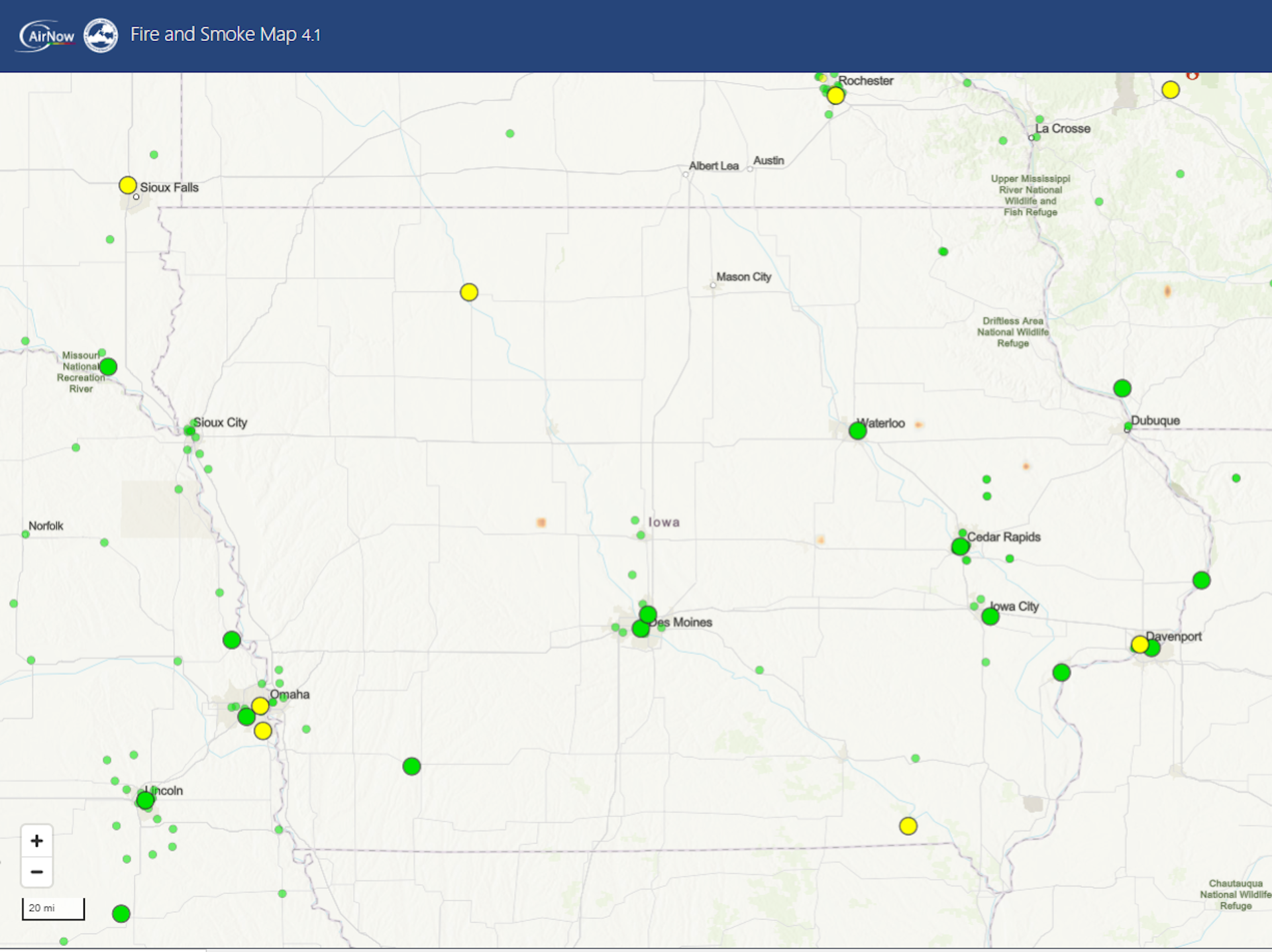
    That’s a big jump from relying on ground-based air quality monitors, which may be hundreds of miles apart. Iowa, for example, had about 50 air quality monitors reporting data on a recent day for a state that covers 56,273 square miles. Most of those monitors were clustered around its largest cities.

    NOAA’s AerosolWatch tool currently provides a near-real-time stream of wildfire smoke images from its GOES-R satellites, and the agency plans to incorporate TEMPO’s height data. A prototype of this system from my team’s NASA-supported research project on fire and air quality, called FireAQ, shows how users can zoom in to the neighborhood level to see how high the smoke plume is, however the prototype is currently only updated once a day, so the data is delayed, and it isn’t able to provide smoke height data where clouds are also overhead.

    Wildfire health risks are rising

    Fire risk is increasing across North America as global temperatures rise and more people move into wildland areas.

    While air quality in most of the U.S. improved between 2000 and 2020, thanks to stricter emissions regulations on vehicles and power plants, wildfires have reversed that trend in parts of the western U.S. Research has found that wildfire smoke has effectively erased nearly two decades of air quality progress there.

    Our advances in smoke monitoring mark a new era in air quality forecasting, offering more accurate and timely information to better protect public health in the face of these escalating wildfire threats.

    Prof. Wang’s group have been supported from NOAA, NASA, and Naval ONR to develop research algorithm to retrieve aerosol layer height. The compute codes of the research algorithm were shared with colleagues in NOAA.

    ref. Which wildfire smoke plumes are hazardous? New satellite tech can map them in 3D for air quality alerts at neighborhood scale – https://theconversation.com/which-wildfire-smoke-plumes-are-hazardous-new-satellite-tech-can-map-them-in-3d-for-air-quality-alerts-at-neighborhood-scale-259654

    MIL OSI

  • MIL-OSI USA: Senator Murray, Commerce Director Nguyễn, WA Clean Energy and Business Leaders Highlight How Clean Energy Cuts in Republican Law Will Raise Energy Costs, Kill Jobs in WA State

    US Senate News:

    Source: United States Senator for Washington State Patty Murray

    Elimination of clean energy tax credits in Republican legislation recently signed into law could cost WA over $8.7 billion, raise household electricity costs by 12 percent; cost 21,800 jobs in Washington state

    ***WATCH FULL EVENT HERE; PHOTOS AND B-ROLL HERE***

    Washington, D.C. –  Today, U.S. Senator Patty Murray (D-WA), Vice Chair of the Senate Appropriations Committee, held a roundtable discussion at the Seattle City Light Denny Substation in downtown Seattle with Washington State Commerce Director Joe Nguyễn and labor, clean energy, and business leaders to discuss how cuts to critical clean energy tax credits in President Trump and Republicans’ One Big Beautiful Bill Act—which was recently signed into law—will raise energy prices for Washington state households, kill thousands of clean energy jobs, and put billions of dollars in new investments for Washington state projects at risk.

    Joining Senator Murray for the event were Joe Nguyễn, Director, Washington Department of Commerce; Dawn Lindell, CEO of Seattle City Light; Christine Reid, Political Director for IBEW 77; Gregg Small, Executive Director of Climate Solutions; and Brandon Provalenko, General Manager of Western Solar in Bellingham.

    The One Big Beautiful Bill Act rapidly phases out critical clean energy tax credits that Democrats passed in the Inflation Reduction Act in 2022, and will slow the construction of solar, wind, and battery projects, which made up over 90 percent of new electricity connected to the grid last year. So far in Washington state, the clean energy tax credits from the Inflation Reduction Act have generated at least $978 million in new private-led investment across seven energy manufacturing facilities in the state. $8.75 billion in outstanding investments to 27 facilities in Washington are at risk under the cuts in the One Big Beautiful Bill Act. The U.S. Climate Alliance estimates 21,800 Washingtonians will lose their jobs by 2030 due to the reconciliation bill’s cuts to clean energy and manufacturing tax credits, and Washington households will face a $115 annual increase in their energy bills by 2029. The legislation threatens Washington’s energy security and electric grid reliability by stifling renewable energy development at a time of soaring electricity demand. A one-pager from Energy Innovation on how the energy provisions in the Republican bill will affect Washington state is HERE.

    “The fact is, we need clean and renewable energy now more than ever. It’s critical to secure our grid, tackle the climate crisis—and lower costs! That’s why I worked hard to secure clean energy tax credits in the Inflation Reduction Act. Then, Trump and Republicans came in like a wrecking ball—with truly shortsighted and destructive cuts. The harm to our clean energy sector is really immense,” Senator Murray said. “It’s an uphill battle to reverse so much damage, but I am not going to stop fighting. Everyone should know, Trump and Republicans are trying to make even more cuts to clean energy right now in our government funding bills. I’m using every bit of leverage I have as Vice Chair of the Appropriations Committee to fight back and reject these cuts. And I’m using my voice—and urging everyone to use theirs as well—to shine a spotlight on what these shortsighted, damaging policy changes mean for businesses and families.”

    “This is an attack on Washington’s workers, our economy, and our values. It threatens the jobs we’ve built, makes energy more expensive for families, and puts our competitiveness at risk. These tax credits have brought real investment and real savings to communities across our state. Gutting them now would do real damage — and Washington won’t stand by and let it happen,” said Joe Nguyễn, Director for the Washington Department of Commerce.

    “The passing of the Reconciliation Bill directly impacts City Light and its customers by removing critical clean energy tax credits and incentives necessary for public and private investment in new renewable energy and energy efficiency projects,” said Dawn Lindell, General Manager and CEO, Seattle City Light. “It strips away essential support needed to keep pace with load growth forecasts. Every new megawatt of generation we add will cost significantly more than our current energy portfolio. These are costs that we must now pass on to our customers in the electric rates.”

    “At a time when we have rapidly rising energy costs and increased needs for power due largely to AI and data centers, we need more energy than ever,” said Gregg Small, Executive Director of Climate Solutions. “Renewables like solar and wind and batteries are the cheapest and fastest energy that we can build. We need to double down and accelerate the building of these resilient power sources. The Trump Administration and Republicans in Congress’ policies do the exact opposite, increasing energy costs for everybody and making it much more likely we will have blackouts at critical times.”

    “IBEW 77’s highly trained workforce stands ready to meet the clean energy challenge of the future. Our members—experienced in every facet of utility work, from generation, transmission, safe delivery, and all of the critical supporting classifications—have the skills, adaptability, and drive to build and maintain the advanced energy infrastructure our communities need. But the reduction in clean energy projects threatens this progress. When projects stall, it’s not just jobs at risk—it’s the pace of innovation and the reliability of our energy system that suffers. Our union believes we need to keep building. Investing in clean energy isn’t about today’s economy alone; it’s laying the foundation for a safer, more resilient, and more sustainable future,” said Christine Reid, Political Director for IBEW 77.IBEW 77 is one of the largest outside utility locals in the country, representing about 8,800 members across 34 Washington counties, Northern Idaho, and parts of Montana. Overall, IBEW represents over 20,000 workers in WA state alone. “Our members are on the front lines of energy infrastructure, ensuring the lights stay on and our communities remain connected and safe. In short, these cuts make it harder for new workers to enter the field and for the industry. Our IBEW members are trained and ready to build. We need to build now.”

    “This bill will accelerate rising energy costs across Washington, every household and business will feel it in their utility bills,” said Brandon Provalenko, General Manager of Western Solar in Bellingham and a member of the Washington Solar Energy Industries Association (WASEIA). “Fewer families will go solar, fewer small businesses will reduce or eliminate their bills, and we’ll face a slower, more expensive path to producing the power we need to meet our state’s growing energy demand. That’s the wrong direction, especially when solar and storage remain the fastest, cleanest, and most cost-effective solution on the table.”

    The cuts to clean energy tax credits in the legislation come at the same time as Trump and the Department of Energy’s decision to illegally cut investments provided by Congress to support the research and development of wind and solar energy, in defiance of legislation President Trump himself signed into law in March. In fiscal year 2024, Congress provided $137 million for the Department of Energy to support wind energy initiatives and provided $318 million to support solar energy. The fiscal year 2025 full-year CR that House Republicans wrote, and President Trump signed into law continued these fiscal year 2024 funding levels. But in a spend plan made public by DOE, the Trump administration revealed it is steering hundreds of millions of dollars designated by Congress to support wind and solar energy to other, favored industries—jeopardizing critical progress and ceding ground on key energy solutions of the future—among other harmful cuts. Instead of funding wind energy initiatives at $137 million, the administration is funding them at $29.8 million (a 78 percent cut), and instead of funding solar initiatives at $318 million, it is funding them at $41.9 million (an 87 percent cut).

    Senator Murray has held constant recent events—including multiple events in Washington state—to sound the alarm on Republicans’ devastating reconciliation bill and encourage constituents to raise their voices and call on their Members of Congress to oppose the legislation. Senator Murray and Democrats forced Republicans to take dozens of tough votes over a nonstop 30-hour “vote-a-rama,” which came after Democrats forced a full reading of every word of Republicans’ 940-page bill. Senator Murray spoke repeatedly on the Senate floor during debate over the bill, laying out in detail the harm the legislation would cause. Senator Murray also spoke out repeatedly on the Senate floor against Republicans’ use of a depictive so-called “current policy baseline” to hide the true cost of their deficit-busting tax cuts for billionaires.

    MIL OSI USA News

  • MIL-OSI: Diginex Announces Execution of Warrants Agreement, Bonus Share Issuance and Cancelation of EGM

    Source: GlobeNewswire (MIL-OSI)

    LONDON, July 25, 2025 (GLOBE NEWSWIRE) — Diginex Limited (“Diginex” or the “Company”) (NASDAQ: DGNX), a leading provider of Sustainability RegTech solutions, today announced that on July 22, 2025 Rhino Ventures Limited exercised warrants, with an exercise price of $5.13 per share, to purchase 2,250,000 ordinary shares of Diginex. The total exercise price of US$11,542,500 has been delivered in full to the Company. The warrants exercised by Rhino Ventures Limited were due to expire on 23rd July 2025.

    The board of directors of Diginex (the “Board”) has determined to terminate its plans for an 8 shares for 1 share forward stock split in favour of a bonus share issuance which is expected to be declared and distributed during the third quarter of 2025. Accordingly, the Board has determined to cancel Diginex’s extraordinary general meeting that was scheduled to take place on July 29, 2025. 

    About Diginex

    Diginex Limited (Nasdaq: DGNX; ISIN KYG286871044), headquartered in London, is a sustainable RegTech business that empowers businesses and governments to streamline ESG, climate, and supply chain data collection and reporting. The Company utilizes blockchain, AI, machine learning and data analysis technology to lead change and increase transparency in corporate regulatory reporting and sustainable finance. Diginex’s products and services solutions enable companies to collect, evaluate and share sustainability data through easy-to-use software. 

    The award-winning diginexESG platform supports 19 global frameworks, including GRI (the “Global Reporting Initiative”), SASB (the “Sustainability Accounting Standards Board”), and TCFD (the “Task Force on Climate-related Financial Disclosures”). Clients benefit from end-to-end support, ranging from materiality assessments and data management to stakeholder engagement, report generation and an ESG Ratings Support Service.

    For more information, please visit the Company’s website:

    https://www.diginex.com/.

    Forward-Looking Statements
    Certain statements in this announcement are forward-looking statements. These forward-looking statements involve known and unknown risks and uncertainties and are based on the Company’s current expectations and projections about future events that the Company believes may affect its financial condition, results of operations, business strategy and financial needs. Investors can identify these forward-looking statements by words or phrases such as “approximates,” “believes,” “hopes,” “expects,” “anticipates,” “estimates,” “projects,” “intends,” “plans,” “will,” “would,” “should,” “could,” “may” or other similar expressions. The Company undertakes no obligation to update or revise publicly any forward-looking statements to reflect subsequent occurring events or circumstances, or changes in its expectations, except as may be required by law. Although the Company believes that the expectations expressed in these forward-looking statements are reasonable, it cannot assure you that such expectations will turn out to be correct, and the Company cautions investors that actual results may differ materially from the anticipated results and encourages investors to review other factors that may affect its future results disclosed in the Company’s filings with the SEC.

    Diginex
    Investor Relations
    Email: ir@diginex.com 

    IR Contact – Europe
    Anna Höffken
    Phone: +49.40.609186.0
    Email: diginex@kirchhoff.de 

    IR Contact – US
    Jackson Lin
    Lambert by LLYC
    Phone: +1 (646) 717-4593
    Email: jian.lin@llyc.global 

    IR Contact – Asia
    Shelly Cheng
    Strategic Financial Relations Ltd.
    Phone: +852 2864 4857
    Email: sprg_diginex@sprg.com.hk 

    The MIL Network

  • MIL-OSI United Nations: China-European Union Commitment to Strengthen Cooperation Critical to Ensure Upcoming Climate Change Conference Represents ‘Major Turning Point’, Secretary-General Says

    Source: United Nations 4

    SG/SM/22739

    The following statement was issued today by the Spokesman for UN Secretary-General António Guterres:

    The Secretary-General welcomes the commitment of China and the European Union to strengthen cooperation on climate change and drive the global just transition.  As two of the world’s largest economies, the Secretary-General believes it is critical that China and the European Union continue to work together to ensure that the Thirtieth Session of the Conference of the Parties to the United Nations Framework Convention on Climate Change (COP30) in Brazil represents a major turning point in the global effort to address the climate crisis.

    The Secretary-General reiterates his call to all Group of Twenty (G20) countries to present 2035 NDCs that are economy-wide, cover all emissions, align with the 1.5-degree goal and define a credible pathway to transition away from fossil fuels as agreed at the First Global Stocktake.

    For information media. Not an official record.

    MIL OSI United Nations News

  • MIL-OSI USA: Senate Appropriations Committee Advances Interior And Transportation, Housing, & Urban Development Funding Bills With Illinois Priorities Secured By Durbin, Duckworth

    US Senate News:

    Source: United States Senator for Illinois Dick Durbin
    July 25, 2025
    The Senate Appropriations Committee passed Interior, Environment, & Related Agencies; and Transportation, Housing, & Urban Development, & Related Agencies government funding bills
    SPRINGFIELD – U.S. Senate Democratic Whip Dick Durbin (D-IL), a member of the Senate Appropriations Committee, and U.S. Senator Tammy Duckworth (D-IL) announced that the Senate Appropriations Committee advanced a funding bill for Interior, Environment, and Related Agencies, as well as for Transportation, Housing and Urban Development, and Related Agencies for Fiscal Year 2026 (FY26). Durbin and Duckworth worked to secure various priorities for Illinois in the appropriations bills, both through Congressionally Directed Spending requests and through the programmatic appropriations process.
    “It is the responsibility of Congress to fund our government programs and agencies through the appropriations process. Rather than rely on continuing resolutions, I hope that we can prioritize a true bipartisan process to pass these funding bills through the Senate in a timely process,” said Durbin. “While the Trump Administration continues to drain resources from critical programs, I will fight for the funding and support for the programs Illinoisans rely on.”
    “Our state and our nation are stronger when we invest in our communities and families—and that’s what these bipartisan funding bills do,” Duckworth said. “Appropriating federal funding is the primary role of Congress, and it’s critical this responsibility remains in the legislative branch. I’m proud I was able to help secure critical support for projects throughout Illinois that help modernize our state’s infrastructure, clean up our water, improve accessibility and more.”
    The two funding bills include the following Illinois priorities secured by Congressionally Directed Spending requests:
    Interior, Environment, and Related Agencies
    · City of Chester, Chester, Illinois. $1.2 million to the City of Chester to help fund the Route 150 water main replacement.
    · City of Markham, Markham, Illinois. $1.5 million to the City of Markham to help fund water system infrastructure improvements.
    · Infrastructure Improvements, Lockport, Illinois. $250,000 to the Bonnie Brae Forest Manor Sanitary District to fund water main infrastructure improvement projects.
    · Lead Service Line Replacements, Chicago, Illinois. $2 million to the City of Chicago to replace more than 200 lead service lines. Chicago has more lead service lines than any other municipality in the country and the majority of properties in Chicago receive their water from lead service lines.
    · Lead Service Line Replacements, Macomb, Illinois. $1 million to the City of Macomb to replace lead drinking water service lines in various locations throughout the City.
    · PFAS Remediation, Rockford, Illinois: $1 million to Winnebago County to help fund water infrastructure upgrades to address PFAS contamination in Rockford.
    · Stormwater and Flooding Mitigation Project, Carbondale, Illinois. $1.5 million for the City of Carbondale to replace storm sewer piping. The failing pipes cause frequent flooding during significant rain events and is also causing pavement failures on an arterial street that is heavily traveled.
    · Wastewater Improvements, Paris, Illinois. $500,000 to the City of Paris to help fund wastewater treatment plant upgrades.
    · Water Main Extension, Winnebago County, Illinois. $600,000 to Winnebago County to extend a water main to provide water to additional areas of the County.
    · Water Main Improvements, Park Forest, Illinois. $1.45 million to the Village of Park Forest to replace the highest priority water main.
    · Water Main Replacement, Springfield, Illinois. $900,000 to the City of Springfield to replace a water main on South Seventh Street in downtown Springfield. The water main was installed in 1931 and has had 27 breaks and is need of replacement. The main serves the historic downtown Springfield area, including Lincoln’s Home National Historic Site Visitor Center, the Illinois State Police Memorial Park, Springfield Clinic, and the Elijah Iles House.
    · Well Reconstruction and Water Treatment, Machesney Park and Roscoe, Illinois. $1 million to North Park Public Water District for the reconstruction of Roscoe and Machesney Park’s well to accommodate PFAS treatment. This funding will ensure continued access to a reliable source of safe, plentiful, and affordable drinking water for the communities of Machesney Park and Roscoe in Winnebago County, Illinois.
     
    Transportation, Housing and Urban Development, and Related Agencies
    · Accessibility Upgrades, Chicago, Illinois. $750,000 to Boys & Girls Clubs of Chicago to help fund accessibility upgrades at the Boys and Girls Club True Value in Little Village.
    · Affordable Housing, Edwardsville, Illinois. $1 million to Home First Housing to help expand affordable housing units in Edwardsville.
    · Affordable Housing, Joliet, Illinois: $1 million to Volunteers of America Illinois to help fund the expansion of Hope Manor Village Joliet’s housing development initiative.
    · Capital Improvements, Chicago, Illinois. $500,000 to Boys & Girls Clubs of Chicago to make capital improvements at the Bartlett J. McCartin Boys & Girls Club in the Bridgeport neighborhood of Chicago.
    · City of Marseilles, Marseilles, Illinois. $1.5 million to the City of Marseilles to help fund the Sycamore Street Bridge rehabilitation.
    · Construction of the National Institute for Advanced Manufacturing, Chicago, Illinois. $2.5 million to Illinois Institute of Technology to fund construction of a facility to serve as the National Institute for Advanced Manufacturing (NIAM). The NIAM on IIT’s Bronzeville Campus will train more than 4,000 students in advanced manufacturing fields through in-person instruction and online curricula.
    · Economic Hub Project, Carbondale, Illinois. $693,000 to Carbondale Community Arts, Inc. (d.b.a. Artspace 304) to make facility improvements for an economic hub.
    · Equipment Upgrades, Chicago, Illinois. $722,000 to Navy Pier Inc. to upgrade the Pier’s surveillance apparatus to ensure the safety of the Pier’s guests and businesses.
    · Environmental Justice Institute, Chicago, Illinois. $900,000 to People for Community Recovery to help fund the development of the Hazel M. Johnson Institute for Sustainability and Environmental Justice.
    · Facilities Improvements and Technology Upgrades, Carbondale, Illinois. $500,000 to Southern Illinois University’s (SIU) Center for Teaching Excellence to revitalize learning spaces at the SIU campus and community colleges throughout Southern Illinois.
    · Facility Improvements, Springfield, Illinois. $450,000 to the Lincoln Presidential Foundation for facility improvements at the Visitor Center at the Lincoln Home National Historic Site.
    · Fire Truck, North Chicago, Illinois. $861,000 to the City of North Chicago to purchase a new fire truck, as the City’s current fire truck has exceeded its useful life by nearly 10 years.
    · Food Security Project, Hamilton, Illinois. $2.5 million to the City of Hamilton to establish a rural health village, in partnership with Memorial Hospital, to address food insecurities in the region by offering meal subscription/prescription programming, home-delivered meals, and more.
    · Infrastructure Developments, Chicago, Illinois: $1.6 million to North Lawndale Catalyst Impact Initiative, Inc. to help fund infrastructure developments in Chicago’s North Lawndale community.
    · Infrastructure Updates, Mascoutah, Illinois. $4 million to MidAmerica St. Louis Airport to help fund infrastructure upgrades at airport.
    · Land Remediation, Will County, Illinois. $3 million to the State of Illinois, in coordination with the State of Michigan, to remediate 3.6 acres of land on the bank of the channel of the Des Plaines River needed for construction of the Brandon Road Lock and Dam Interbasin Project.
    · Station Improvements, Macomb, Illinois. $134,000 to the Illinois Department of Transportation to make improvements to Macomb’s Amtrak Station, including HVAC upgrades, electrical work, and painting.
    · Supportive Housing Development, Arlington Heights, Illinois. $750,000 to Full Circle Communities for construction of a housing development to support veterans and people with disabilities.
    · Track Reconstruction Design, Chicago, Illinois. $2 million to the Chicago Transit Authority (CTA) to fund design of track reconstruction of CTA’s Blue Line Forest Park Branch from Western Avenue to Lathrop Avenue, a roughly 6.5-mile section of the line. This reconstruction is needed in order to improve safety and on-time performance of the Forest Park Branch.
    · Trail Extension, Normal, Illinois. $1.9 million to the Town of Normal to fund engineering and construction of a trail connection. This will close a gap in pedestrian and bicycle accommodations between the existing Constitution Trail network and major employers located in west Normal, and promote safe multimodal travel by separating pedestrians and cyclists from motor vehicles.
    · Transit Improvements; Vermilion County, Williamson County, and Jackson County; Illinois. $3.711 million to the Illinois Department of Transportation to fulfill ongoing transit needs, including vehicle and equipment purchases, maintenance, and other improvements for transit agencies serving Carbondale, Marion, and Danville.
    · Transitional Shelter, Chicago, Illinois. $650,000 to BEDS Plus, Inc. to help fund the expansion of transitional shelter services at BEDS Plus Inc.
    · Transportation Center Pedestrian Access Improvements, Normal, Illinois. $1.6 million to Connect Transit to improve pedestrian access to the City of Bloomington’s Downtown Transportation Center.
    · Unhoused Population Support, Carbondale, Illinois: $2 million to the City of Carbondale to help fund the development of a new homeless center facility in Carbondale.
    · Workforce Accelerator Program, Chicago, Illinois. $1 million to the North Lawndale Employment Network to transform a vacant lot across the street from its workforce development campus to offer an agricultural and environmental workforce accelerator program.
    · Youth Mentoring, Springfield, Illinois. $1 million to The Outlet Mentoring Program to help fund the development of a youth mentoring center in Springfield.
     
    The two funding bills include additional Illinois priorities secured through the programmatic appropriations process:
    Interior, Environment, and Related Agencies
    Department of Interior
    Bureau of Land Management (BLM)
    Plant Conservation Activities. $20.6 million for conservation activities and includes language supporting BLM’s continued support of the Seed Strategy, the interagency Native Plant Materials Development Program, the Seeds of Success program, the Plant Conservation Alliance, and regional native plant materials development programs.
    o Urban and Community Forestry (Chicago Region Trees Initiative). Includes language prioritizing multi-organizational collaborations to support conservation and offset climate change for urban and community forestry grants.
    o Migratory Bird Management Program, Incidental Take. Includes language supporting an incidental take authorization program for the Migratory Bird Treaty Act, which will help bird species that are experiencing population decline.
     
    National Park Service
    New Philadelphia National Historic Site. Includes language directing the National Park Service to ensure park operation begins in a reasonable timeframe for the newly established New Philadelphia site.
    Springfield Race Riot Site. Includes language directing the National Park Service to work with the community to complete the Foundation Document for the Springfield 1908 Race Riot National Monument and provide for park planning.
    Land and Water Conservation Fund
    Hackmatack National Wildlife Refuge. Includes language supporting federal land acquisition by the National Fish and Wildlife Service for the Hackmatack National Wildlife Refuge
    Environmental Health Program. $30.5 million for the program and includes language that sets aside $1 million for addressing PFAS contamination in the Great Lakes.
     
    Environmental Protection Agency
    Clean Water State Revolving Funds (CWSRF). $1.6 billion to provide critical investments that create jobs, repair crumbling wastewater infrastructure, and protect public health and environmental quality. Ten percent of CWSRF may be used as grants to address lead exposure.
    Drinking Water State Revolving Funds (SRF). $1.13 billion to help water systems and states to ensure clean and safe drinking water is reliably delivered to communities. Fourteen percent of DWSRF may be used as grants to address lead exposure.
    EPA Compliance. $97.7 million to enable EPA and co-regulators to undertake inspections and other monitoring activities to determine if regulated entities are complying with environmental statutes as well as applicable regulations and permit conditions.
    EPA Enforcement. $284.9 million to ensure consistent and fair enforcement of all major environmental statutes and numerous regulations implementing each of those statutes. Includes report language supporting EPA in addressing PFAS contamination through National Enforcement and Compliance Initiatives and incorporating Supplemental Environmental Projects (SEPs) in settlements.
    Bubbly Creek. Includes report language on the inclusion of the restoration Bubbly Creek in EPA’s Lakewide Management Plan (LAMP) and directs EPA to maximize its partnerships and resources to ensure no further delays.
    Great Lakes Restoration Initiative (GLRI). $368 million for GLRI and includes report language to allow funds from the program to be used for projects in the Chicago River Watershed. Congress established the GLRI to provide funding to states, tribes, local governments, and federal agencies to protect the Great Lakes. The program has provided $4 billion since 2010 to fund projects that restore habitat, fight invasive species, clean up toxic pollution, and reduce pollution runoff.
    Lake Explorer II Support Vessel Decommission. Includes language regarding the importance of EPA replacing the Great Lakes research vessel Lake Explorer II so the agency may continue uninterrupted water quality and biological monitoring of the Great Lakes.
    Coal Combustion Residual Permit Program. Includes language requesting $9 million for federal and state permitting programs for coal combustion residuals (CCR, coal ash).
    Transportation, Housing, and Urban Development
    Department of Transportation
    Capital Investment Grants (CIG). $1.95 billion for grants to fund the extension and improvements of existing transit systems. This amount would fully fund the Chicago Transit Authority’s Red Line Extension Project for FY26.
    Protections for the Chicago Transit Authority’s Red Line Extension Project. Includes language protecting Chicago’s FY26 allocation of $350 million and requiring disbursement within 120 days of enactment.
    Amtrak. $2.43 billion in nationwide funding to support Amtrak operations, with $1.57 billion for the National Network.
    BUILD (formerly RAISE) Grants. $250 million to fund innovative transportation projects that will create jobs and have a significant impact on the nation, a region, or a metropolitan area.
    Passenger Rail Grant Programs. The two rail grant programs were reauthorized in the Infrastructure Investment and Jobs Act (IIJA) and address gaps in supporting and growing our nation’s rail infrastructure:
    Consolidated Rail Infrastructure and Safety Improvements (CRISI) Grants. $151.52 million for the CRISI program.
    Federal-State Partnerships for Intercity Passenger Rail Grant (FSP) Program. $75 million for FSP grants for capital improvement projects that expand or establish intercity passenger rail service.

    Midwest Rail Commission Study. Includes report language directing GAO to examine the establishment of a federally authorized commission for the purposes of developing a long-term delivery strategy for Midwest rail. The study would identify lessons learned from the establishment of the Northeast Corridor Commission that could be applied to a Midwest Rail Commission, it also would examine any Federal resources necessary to establishment of the commission.
    FRA Rail Research & Development Center of Excellence (COE). Supports the FRA’s intent to use no less than $2.5 million of its and development funding for the FRA COE, which Durbin established in IIJA and secured funding for in FY22, FY23, and FY24 (FY25’s full-year CR did not have a report, so the COE was not funded in the CR). The University of Illinois Urbana-Champaign was competitively selected to host the COE.
    Blocked Crossings Causes & Solutions Identification. Includes report language directing the FRA to include in its annual report potential solutions and best practices to improve safety, mobility, and emergency response capabilities at highway-rail crossings. This would require the FRA to consider technology’s potential role in detecting the highest risk areas and to explore what role train length plays in blocked crossings, among other measures.
    Emergency Response Blocked Crossing Reports. Includes report language urging the FRA to require states receiving track inspection funding to require first responders to report verified blocked crossing incidents to the FRA’s blocked crossings portal, which you established through previous appropriations legislation. It also directs the FRA to continue working with stakeholders to identify root causes of blocked crossings and identify meaningful solutions.
    Federal Aviation Administration (FAA). $22.4 billion for the FAA. This includes $13.8 billion for FAA operations and $4 billion for facilities and equipment. This funding will allow the FAA to hire 2,500 additional air traffic controllers; improve air traffic control facilities, equipment, and systems; improve the aircraft certification process; improve hazardous materials transport oversight, and more.
    Airport Improvement Program. More than $4 billion for airport improvement grants for capital improvements at the nation’s airports, including investments that emphasize capacity development, safety improvements, and security needs.
    Digital Alert Technologies. Includes report language urging National Highway Traffic Safety Administration (NHTSA) to deploy digital alert technologies, with local law enforcement, that can provide up-to-date information about dynamic road conditions to drivers.
    NHTSA Rulemakings. Includes language directing NHTSA to continue to provide quarterly briefings on the status of all major rulemakings to the House and Senate Committees on Appropriations. In 2023, DOT implemented a key provision of Durbin and Duckworth’s Protecting Roadside First Responders Act by proposing a rule to require automatic emergency braking (AEB) on all new cars and light trucks, and finalizing this rule in April 2024. The provision, which was passed in the bipartisan Infrastructure Investment and Jobs Act, aims to reduce the number of traffic fatalities and injuries. According to NHTSA, the rule could save more than 360 lives and prevent more than 24,000 injuries each year. The Trump Administration has delayed the effective date of this rule.
    Automated Track Inspections. Includes no less than $21.6 million to support the FRA’s fleet of advanced inspection vehicles that accompany its field inspectors to validate the railroads’ inspection programs and advance research priorities, with a special emphasis on routes transporting passengers and hazardous materials.
    Department of Housing and Urban Development
    HEAL Initiative Pilot Program. Includes $5 million to support efforts underway between HUD and HHS to provide direct technical assistance to communities leveraging programs like Medicaid to cover and provide housing-related supportive services and behavioral healthcare. Includes report language acknowledging that several studies have demonstrated that interventions based on social determinants of health can help support housing permanency.
    Lead Hazard Control and Healthy Homes. $295.6 million to provide funding to state and local governments to develop cost-effective ways to reduce lead-based paint hazards.
    Housing Opportunities for Persons with AIDS (HOPWA). $529 million to help cities and states address the housing crisis facing people living with HIV/AIDS.
    Homeless Assistance Grants. $4.5 billion to provide funding to state and local governments for emergency shelters, rapid re-housing, permanent supportive housing, and other crisis response programs.
    Housing Counseling. $57.5 million to enable housing counseling organizations to provide foreclosure prevention counseling, mortgage counseling before and after purchase, rental counseling, homelessness prevention counseling, and fair housing education.
    Fair Housing and Equal Opportunity (FHEO). $86.36 million to provide resources to nonprofit fair housing organizations that tackle discrimination and predatory lending and ensure that our nation’s fair housing laws are enforced.
    Community Development Block Grant (CDBG). $3.1 billion to provide states and localities with resources to meet the needs of low-income communities, including housing rehabilitation, supportive services, public improvements, and economic development projects.
    Home Investment Partnerships Program (HOME). $1.25 billion to provide state and local governments the funding necessary to provide affordable housing in low-income communities.
    Public Housing Capital and Operating Funds. $3.2 billion for Capital Funds and $4.87 billion for Operating Funds. This includes $30 million for emergency capital needs; $10 million for safety and security measures, with report language supporting safety and security improvements to protect tenants; and $65 million for lead remediation grants.
    Section 8 Tenant-Based Rental Assistance. $37.35 billion for Section 8 Tenant-Based rental assistance. This includes $429 million for new Tenant Protection Vouchers, $15 million to expand the HUD-VASH program, and $30 million for new Family Unification Program vouchers.
    Self-Help Homeownership Opportunity Program (SHOP) and Rural Capacity Building Program (RCB). $13 million for SHOP and $5 million for RCB. Both programs support affordable housing in rural communities.
    Section 4 Capacity Building Program. $49 million for Section 4 Capacity Building Program. This program allows HUD to partner with national nonprofit community development organizations to provide education, training, and financial support to local community development corporations (CDCs) across the country.
    Choice Neighborhoods Program. $40 million to provide funding for the transformation, rehabilitation, and replacement of distressed public and HUD-assisted housing, as well as support for communities working to revitalize neighborhoods of concentrated poverty.
    Family Self-Sufficiency (FSS) Program. $156.4 million to provide funding for an asset-building program to serve more households, both within already-established Public Housing and Housing Choice Voucher FSS Programs
    Neighborhood Reinvestment Corporation (NeighborWorks). $158 million to create opportunities for Americans to live in affordable and safe homes by providing community development organizations in all fifty states with financial resources and counseling services.
    -30-


    MIL OSI USA News

  • MIL-OSI USA: Last Day to Apply for FEMA Assistance Following April Flooding

    Source: US Federal Emergency Management Agency

    Headline: Last Day to Apply for FEMA Assistance Following April Flooding

    Last Day to Apply for FEMA Assistance Following April Flooding

    FRANKFORT, Ky

    – Kentucky homeowners and renters who experienced damage or loss caused by the April severe storms, straight-line winds, flooding, landslides and mudslides have until 11:59 p

    m

    today to apply for federal disaster assistance

     The deadline to apply is today

    How To Apply for FEMA AssistanceThere are several ways to apply for FEMA assistance:Online at DisasterAssistance

    gov

    Visit any Disaster Recovery Center

    To find a center close to you, visit fema

    gov/DRC, or text DRC along with your Zip Code to 43362 (Example: “DRC 29169”)

    Use the FEMA mobile app

    Call the FEMA Helpline at 800-621-3362

    Help is available in many languages

    If you use a relay service, such as Video Relay Service (VRS), captioned telephone or other service, give FEMA your number for that service

    FEMA works with every household on a case-by-case basis

    FEMA representatives can explain available assistance programs, how to apply to FEMA, and help connect survivors with resources for their recovery needs

    When you apply, you will need to provide:A current phone number where you can be contacted

    Your address at the time of the disaster and the address where you are now staying

    Your Social Security Number

    A general list of damage and losses

    Banking information if you choose direct deposit

    If insured, the policy number or the agent and/or the company name

    Survivors should keep their contact information updated with FEMA as the agency may need to call to schedule a home inspection or get additional information

     Disaster assistance is not a substitute for insurance and is not intended to compensate for all losses caused by a disaster

    The assistance is intended to meet basic needs and supplement disaster recovery efforts

     For more information about Kentucky flooding recovery, visit www

    fema

    gov/disaster/4864

    Follow the FEMA Region 4 X account at x

    com/femaregion4

    martyce

    allenjr
    Fri, 07/25/2025 – 12:25

    MIL OSI USA News

  • PM Modi, Maldivian President Muizzu inaugurate new Defence Ministry building in Male

    Source: Government of India

    Source: Government of India (4)

    Prime Minister Narendra Modi and Maldivian President Mohamed Muizzu on Friday jointly inaugurated the state-of-the-art Ministry of Defence (MoD) building of the Maldives in Male.

    Overlooking the Indian Ocean, the eleven-storey building stands as a symbol of the strong and long-standing defence and security cooperation between the two countries. According to a release from the Prime Minister’s Office (PMO), the MoD building has been constructed with India’s financial assistance and is expected to enhance the capabilities of the Maldives’ defence and law enforcement authorities.

    In a post on X, the Maldivian President’s Office said, “His Excellency President Dr Mohamed Muizzu and His Excellency Shri Narendra Modi, Prime Minister of the Republic of India, inaugurate the Dhoshimeyna Building, the new office premises of the Maldives National Defence Force (MNDF).”

    Prime Minister Modi described the inauguration as another testament to strong India-Maldives cooperation.

    In a post on X, he stated, “President Muizzu and I inaugurated a new building of the Ministry of Defence in Male. This is yet another instance of strong India–Maldives cooperation.”

    Earlier in the day, PM Modi reaffirmed the Maldives’ significance in India’s regional outreach.

    He added, “Held very fruitful discussions with President Muizzu. Maldives is at the core of our ‘Neighbourhood First’ and Mahasagar Vision. Our discussion covered several sectors, notably commercial and cultural linkages. We both agree that the India–Maldives friendship will always be bright and clear. India is honoured to work closely with the Maldives in areas such as housing, connectivity, infrastructure, defence, digital technology, and more. Climate change and renewable energy are also two vital pillars of our bilateral cooperation.”

    In a further gesture of goodwill, PM Modi gifted two Aarogya Maitri Health Cubes to President Muizzu on behalf of the Government of India.

    In a post on X, the President’s Office shared, “His Excellency President Dr Mohamed Muizzu accepts two Aarogya Maitri Health Cubes gifted by His Excellency Shri Narendra Modi, Prime Minister of India, on behalf of the Government of India to the Maldives. The state-of-the-art portable hospitals are equipped with an ICU, operating theatre, laboratory, X-ray, and other emergency medical facilities. Each unit can operate independently for 72 hours and treat up to 200 individuals.”

    Prime Minister Modi is currently on a two-day visit to the Maldives at the invitation of President Muizzu.

    (ANI)

  • MIL-OSI United Nations: Country heat policy review: Australia

    Source: UNISDR Disaster Risk Reduction

    Australia has implemented a coordinated, multi-tiered approach to managing extreme heat through federal and state-level initiatives.

    Australia has implemented a coordinated, multi-tiered approach to managing extreme heat through federal and state- level initiatives. The Australian Bureau of Meteorology (BOM) launched the National Heatwave Warning Framework in November 2022, which issues heatwave warnings along with behavioural advice during periods of extreme heat. These warnings are disseminated nationwide through online portals, mobile apps, and media partnerships, supporting the management of critical services and infrastructure while providing targeted advice to vulnerable populations. State and territory government emergency services and health departments, in collaboration with federal health authorities, implement localized heat action plans tailored to regional needs, ensuring that responses to extreme heat are context- specific.

    The National Heatwave Warning Framework aligns with the Australian Warning System, providing a consistent three-level warning structure (Advice, Watch and Act, Emergency Warning) across Commonwealth, State, and Territory Governments. This system is designed to reduce the impact of heatwaves not only on health but also on critical infrastructure, ecosystems, and societal functions. The warnings allow for a wide range of preparatory actions as heatwaves intensify, escalating advice from vulnerable individuals to healthy people, and including guidance on protecting infrastructure.

    Each State and Territory has developed its own heat health plans to address heat risks through prevention, preparedness, response, and recovery strategies. Lead agencies vary by jurisdiction but typically include health departments, emergency services, and meteorological bodies. The decentralized approach ensures that State and Territory Governments can adapt their heat action plans to local conditions while benefiting from federal coordination.

    Cross-sectoral collaboration primarily involves the integration of public health, meteorological services, and emergency management. While public-private partnerships have not played a prominent role in Australia’s heat resilience efforts, there is ongoing exploration of partnerships to incorporate heat resilience into urban planning and infrastructure projects.

    Efforts are increasingly focused on integrating Indigenous knowledge into heat resilience strategies, recognizing that Western approaches may not be sufficient and that engagement with Indigenous ways of understanding and managing heat could offer valuable insights.

    Key achievements include the nationwide Multi Hazard Early Warning System (MHEWS), an informed heatwave warning system developed by BOM, which provides timely information to both the public and authorities, enabling prompt action.

    Localized heat action plans have been developed across States and Territories, allowing for tailored responses to regional climate conditions and population needs. These efforts have significantly strengthened Australia’s resilience to extreme heat and improved cross-sectoral public health response capabilities.

    Australia’s model of decentralized, State-led heat management supported by strong national coordination highlights the importance of localized adaptation strategies. While public- private partnerships were not prominently featured, Australia’s comprehensive warning system and cross-government collaboration provide a robust foundation for responding to extreme heat. This model offers valuable insights for countries with similar governance structures and emphasizes the need for integrating Indigenous knowledge, health, climate, and urban planning efforts to build long-term resilience.

    MIL OSI United Nations News

  • MIL-OSI United Nations: Country heat policy review: Argentina

    Source: UNISDR Disaster Risk Reduction

    Argentina has adopted several governance structures to address the impacts of extreme heat, focusing on integrating efforts into broader climate adaptation and disaster management frameworks.

    The National Weather Service (SMN) first introduced an early warning system for extreme heat in Buenos Aires in 2009, which has now expanded to cover 71 meteorological stations for country-wide alerts issued year-round due to changing climate patterns. These alerts are disseminated through various channels, including email systems and media partnerships, ensuring broad coverage across regions.

    The Ministry of Health, in collaboration with SMN, leads public health campaigns and has developed a sentinel surveillance system to monitor heat-related morbidity, tracking the health impacts of extreme temperatures across provinces. Argentina also involves provincial and local governments in implementing heat action plans and managing hospital responses during heatwave alerts, with emergency services playing a critical role in the outreach and protection of vulnerable populations.

    Early warning systems are further integrated into workplace regulations, adapting work hours and hydration protocols during extreme heat events, particularly in sectors like construction and agriculture, where workers are at higher risk. While not formalized, coordination with the energy and agricultural sectors helps manage the impacts of blackouts and other heat-related disruptions.

    Public-private partnerships play an increasing role in Argentina’s heat resilience efforts, including collaborations with organizations like the Argentine Red Cross and professional medical associations to improve emergency care and healthcare system capacity.

    Partnerships are also emerging in urban planning and energy sectors, including projects to develop green spaces and cool roofs to mitigate the urban heat island effect in low-income areas, such as the Cool Roofs Initiative, which targets temperature reduction in disadvantaged neighbourhoods.

    An important actor in these efforts is the Centre for the Implementation of Public Policies for Equity and Growth (CIPPEC), an independent, non-partisan organization dedicated to policy innovation. Through its “Cities” Programme, CIPPEC conducted dialogues on urban heat resilience to support climate adaptation at the municipal level and was instrumental in presenting a forthcoming project with Wellcome Trust, which aims to enhance Argentina’s heat resilience framework through strengthened municipal engagement.

    Argentina’s key achievements include expanding the early warning system to cover the entire population, developing the sentinel surveillance project to improve data on heat-related health impacts, and leveraging international funding for research.

    Additionally, Argentina’s public-private partnerships have enhanced its ability to respond to heat risks, and collaborations with international organizations, such as the United Nations and the World Bank, continue to strengthen the country’s capacity to manage extreme heat effectively. Argentina has also begun discussions around integrating heat resilience measures into long-term urban development plans, aiming to create a sustainable framework for heat adaptation in the years to come.

    MIL OSI United Nations News

  • MIL-OSI United Nations: Country heat policy review: Egypt

    Source: UNISDR Disaster Risk Reduction

    Egypt has implemented various governance structures to address the challenges posed by extreme heat, integrating these efforts into broader climate change adaptation and disaster risk management strategies.

    The National Climate Change Strategy and Egy pt Vision 2030 outline Egypt’s overall approach to enhancing resilience across sectors such as agriculture, health, and urban planning. The Egyptian Environmental Affairs Agency (EEAA) and the Ministry of Environment lead these efforts, collaborating with other relevant ministries and organizations.

    The National Centre for Disaster Risk Reduction (NCDRR) is expected to play an increasing role in disaster risk management, including extreme heat preparedness, though its involvement in this area is still developing. Local initiatives in cities like Cairo and Alexandria are focused on addressing the urban heat island effect through increased green spaces, improved urban planning, and public awareness campaigns. However, the scale and impact of these initiatives vary, and they may be more pilot projects than widespread programmes at this stage.

    Community-based adaptation programmes, supported by NGOs and international organizations, contribute to local resilience through awareness programmes and infrastructure improvements, including cooling centres, health services, and urban greening. However, these initiatives are often localized and vary in scope and effectiveness.

    Public-private partnerships (PPPs) are beginning to play a role in enhancing climate resilience, though their scale and impact are still evolving. For example, Cairo has explored smart city technologies to monitor heat, with potential partnerships involving companies like IBM and Vodafone Egypt. These efforts are in the early stages, and their impact is still being assessed.

    In Alexandria, there are ongoing discussions about potential collaborations between the Alexandria Health Directorate and private sector entities like Cleopatra Hospitals Group to improve heat-health preparedness, but these initiatives are not yet fully operational.

    Egypt also collaborates with international organizations like the United Nations Development Programme (UNDP) and the World Bank for technical assistance and funding. Ongoing research and data collection by Egyptian institutions, supported by international partners, aims to better understand and mitigate the impacts of extreme heat. These efforts are part of a broader strategy to build resilience against climate-related risks, including extreme heat

    MIL OSI United Nations News

  • MIL-OSI United Nations: Country heat policy review: Ecuador

    Source: UNISDR Disaster Risk Reduction

    Ecuador has integrated measures to address extreme heat within its broader climate change adaptation and disaster risk management frameworks.

    Key national strategies include the National Climate Change Strategy (ENCC), which outlines resilience building across sectors like agriculture, health, and urban planning, and the National Plan for Good Living, which incorporates environmental sustainability and climate resilience. The National Adaptation Plan(NAP) focuses on adapting to climate change impacts, including extreme weather events like heat waves, by enhancing early warning systems and promoting public awareness.

    The Ministry of Environment, Water, and Ecological Transition (MAATE) leads climate policy development, while the National Risk and Emergency Management Service (SNGRE) manages disaster risk, including preparedness and response to extreme heat. Local initiatives, especially in cities like Quito and Guayaquil, include municipal climate action plans aimed at mitigating the urban heat island effect through green spaces and improved urban planning. Community-based adaptation programmes, supported by NGOs and international organizations, focus on local resilience through education and infrastructure improvements.

    Public private partnerships (PPPs) do play a role in Ecuador, though perhaps not as robust as in other case study nations. For example, in Guayaquil, the local government partners with construction companies and paint manufacturers to promote the installation of cool roofs in residential and commercial buildings. These roofs use reflective materials to reduce indoor temperatures and energy consumption.

    In addition, utility companies in Ecuador, in partnership with local governments and international organizations, promote energy efficiency programmes that help residents and businesses reduce their energy consumption during heatwaves. These programmes include incentives for installing energy-efficient cooling systems and improving building insulation. And, the Ministry of Agriculture works with agribusinesses and NGOs to promote sustainable farming practices that can withstand extreme heat. This includes the development and distribution of heat-resistant crop varieties and the implementation of water-efficient irrigation systems.

    Key measures include developing early warning systems, conducting public awareness campaigns, and incorporating green infrastructure in urban planning. The healthcare sector is being strengthened to handle heat-related illnesses through training and improved infrastructure. Ecuador collaborates with international organizations like the UNDP and the World Bank for technical assistance and funding and conducts research to better understand and mitigate the impacts of extreme heat.

    These integrated efforts aim to build resilience against the impacts of extreme heat in Ecuador.

    MIL OSI United Nations News

  • MIL-OSI United Nations: Country heat policy review: Canada

    Source: UNISDR Disaster Risk Reduction

    Canada has adopted comprehensive governance structures to address extreme heat, involving national strategies, institutional frameworks, provincial and local government initiatives, and public-private partnerships.

    At the national level, the National Adaptation Strategy and the Pan-Canadian Framework on Clean Growth and Climate Change outline measures to build resilience against extreme heat. The Health and well-being system in the National Adaptation Strategy particularly emphasizes protecting Canadians from climate-related health risks, including extreme heat.

    Health Canada plays a pivotal role by providing evidence-based guidance, heat health science, and best practices for provincial and local authorities to implement Heat Alert and Response Systems (HARS). It also collaborates with Environment and Climate Change Canada (ECCC) to inform heat-related weather warnings. Provincial and territorial governments lead the response to heat health risks, with the Federal Government supporting local-level adaptation.

    Provincial heat action plans in Ontario, Quebec, and British Columbia, along with municipal heat response plans in cities like Toronto, Montreal, and Vancouver, outline specific measures such as establishing cooling centres, disseminating heat health messages, and modifying urban design to reduce heat risks. These efforts are also extended to Indigenous communities, where culturally appropriate response planning is underway.

    Public-private partnerships (PPPs) play a significant role in enhancing heat resilience. In Toronto, PPPs have focused on retrofitting buildings with energy-efficient cooling systems, creating green roofs, and expanding urban parks to mitigate the urban heat island effect. Similarly, Hydro-Québec collaborates with businesses to promote energy-saving technologies that reduce electricity demand during heatwaves.

    Key achievements include the widespread implementation of HARS, public education campaigns, and strengthened health sector preparedness to manage heat-related illnesses. Canada also collaborates with international organizations to share best practices, filling knowledge gaps and advancing research, such as addressing indoor heat health risks. These coordinated efforts aim to protect public health, enhance urban resilience, and mitigate the impacts of extreme heat across Canada.

    MIL OSI United Nations News

  • MIL-OSI United Nations: Country heat policy review: Bangladesh

    Source: UNISDR Disaster Risk Reduction

    Bangladesh has adopted various governance structures within its broader climate change adaptation and disaster management frameworks to address extreme heat.

    Key national policies include the National Adaptation Programme of Action (NAPA), the Bangladesh Climate Change Strategy and Action Plan (BCCSAP), and the National Disaster Management Plan(NDMP), which collectively outline measures for mitigating and adapting to extreme heat.

    The Ministry of Environment, Forest and Climate Change, the Bangladesh Meteorological Department (BMD), and the Disaster Management Bureau (DMB) play central roles in policy development, early warning systems, and disaster preparedness. Local governments and municipalities implement heat adaptation plans, supported by NGOs and community-based programmes that raise awareness and build resilience.

    Public-private partnerships (PPPs) are increasingly vital in addressing extreme heat in Bangladesh. These partnerships focus on enhancing climate resilience through various initiatives and enhance Bangladesh’s ability to adapt to and mitigate the impacts of extreme heat, contributing significantly to the country’s overall climate resilience.

    Examples of PPPs for extreme heat include the Dhaka North City Corporation (DNCC) collaboration with private real estate developers to create green spaces in urban areas, including parks, rooftop gardens, and green belts, to mitigate the urban heat island effect; the Cool Roofs Initiative, a partnership between the Government and local private companies, implements reflective rooftops in urban slums to reduce indoor temperatures; and BRAC, a major NGO, partners with private hospitals and pharmaceutical companies to improve healthcare responses to heat-related illnesses through training and public awareness campaigns. These diverse PPPs enhance Bangladesh’s resilience to extreme heat and contribute to overall climate adaptation efforts.

    Key achievements include developing heat action plans, enhancing urban planning to reduce heat impacts, conducting public education campaigns, and preparing the health sector to manage heat-related illnesses. Bangladesh also collaborates with international organizations to strengthen its capacity to manage extreme heat effectively.

    MIL OSI United Nations News

  • MIL-OSI United Nations: Country heat policy review: United States of America

    Source: UNISDR Disaster Risk Reduction

    The United States has adopted comprehensive governance structures to address extreme heat, involving federal, state, local, and Tribal initiatives.

    At the federal level, the National Integrated Heat Health Information System (NIHHIS) is an interagency effort initially formed by the National Oceanic and Atmospheric Administration (NOAA) and the Centers for Disease Control and Prevention (CDC). The mission of NIHHIS is to develop and provide actionable, science-based information to help decision- makers protect people from heat. Currently, NIHHIS coordinates more than 27 federal agencies. The U.S. Global Change Research Program (USGCRP) also manages a National Climate Assessment (NCA) that summarizes the impact of climate change on the US and includes chapters specific to extreme heat. Most recently, the Federal Emergency Management Agency (FEMA) has declared heat a priority and improved its guidance to help state-level emergency managers prepare for and respond to heat impacts.

    As an innovative approach to improve heat governance, NIHHIS and NOAA collaborate with local governments and community- based organizations to host tabletop exercises that test and evaluate heat response efforts. These exercises bring together leaders from various sectors, including health departments and emergency management, to identify and refine strategies for enhancing heat resilience in their communities. This proactive, hands-on approach allows participants to simulate heat emergencies and collaboratively develop effective response plans tailored to local needs.

    States like California, Arizona, New York, and North Carolina have developed specific heat action plans, and cities such as New York City (NYC), Los Angeles, Miami, and Phoenix have implemented heat response programmes focusing on public awareness, emergency response, and urban design modifications.

    Public-private partnerships (PPPs) are integral to these efforts, with initiatives like Cool Neighborhoods NYC and Phoenix’s HeatReady Initiative collaborating with private organizations, nonprofits, and academic institutions to enhance heat resilience. For example, the City of New York collaborates with private organizations and community groups through the Cool Neighborhoods NYC programme. This initiative focuses on increasing tree canopies, installing cool roofs, and educating residents about heat risks. Private companies contribute funding, technology, and expertise to support these efforts.

    Kaiser Permanente, a major healthcare provider, also works with local health departments and nonprofits to support community health initiatives addressing extreme heat. They fund programmes that provide cooling centres, hydration stations, and public education on heat-related health risks.

    Key measures include Heat Alert and Response Systems (HARS), urban planning initiatives, public awareness campaigns, and the establishment of cooling centres and hydration stations. Additionally, ongoing research and data collection by federal agencies, academic institutions, and private organizations help refine adaptation strategies, while international collaboration ensures the sharing of best practices. These coordinated efforts protect public health, enhance urban resilience, and mitigate the impacts of extreme heat across the United States.

    MIL OSI United Nations News

  • MIL-OSI United Nations: Country heat policy review: Republic of Korea

    Source: UNISDR Disaster Risk Reduction

    The Republic of Korea has developed a comprehensive and multi-tiered approach to managing extreme heat, integrating national policies, institutional frameworks, local government initiatives, and community-based actions.

    National frameworks such as the Climate Change Adaptation Plan and the Basic Plan for the Promotion of Climate Change Response guide efforts to address extreme heat as part of broader climate resilience strategies.

    The Korea Meteorological Administration (KMA) plays a key role by issuing heatwave warnings and impact-based heatwave forecasts , using an updated alert system based on Daily Maximum Perceived Temperature, which takes humidity into account to better reflect health impacts.

    Additionally, the Korean Disease Control and Prevention Agency (KDCA), alongside the KMA, published the first Climate Health Impact Assessment Report in March 2022. In this report, published every five years, heat-related deaths and illnesses are identified as key health indicators to be monitored.

    Collaboration among key institutions enables a coordinated response to heat risks across sectors-including health, industry, livestock, agriculture, and aquaculture-each managed by distinct governmental bodies, and consolidated guidelines have been given. Healthcare preparedness has been strengthened with the publication of the Climate Health Impact Assessment Report, which monitors heat-related illnesses and deaths. Hospitals and healthcare centres, particularly those with emergency services, have improved their capacity to manage heat-related conditions. Additionally, the Ministry of the Interior and Safety, Republic of Korea, has called for meetings with other governmental institutions across different sectors.

    Local governments, especially in urban areas like Seoul, lead heat mitigation efforts through urban cooling strategies, public awareness campaigns, and the expansion of green spaces.

    Initiatives include installing green roofs, promoting public transportation through the Climate Card programme, and constructing cooling stations in public areas to offer relief from heat.

    Public-private partnerships have been instrumental in enhancing the country’s resilience to extreme heat. The Seoul Metropolitan Government collaborates with private real estate developers to implement green rooftops across the city, while telecommunications company SK Telecom partners with KMA to send real-time heatwave alerts to millions of subscribers.

    Currently, emergency information about heatwaves is being provided through the cell broadcast service in Korea. Hyundai Motor Company collaborates with local governments in urban cooling projects, such as installing cooling stations in public areas. These stations provide cool air and water, offering relief to residents and visitors during heatwaves. LG Electronics partners with Seoul National University Hospital to develop and distribute advanced cooling technologies for healthcare facilities, ensuring hospitals are equipped with energy-efficient air conditioning systems that improve patient care during extreme heat periods. These examples demonstrate the impact of leveraging resources and expertise to enhance resilience to extreme heat.

    On the international stage, the Republic of Korea partners with organizations such as the World Health Organization (WHO) Asia-Pacific Centre for Environment and Health, the Green Climate Fund, and the International Vaccine Institute-all located in the country-to advance knowledge and technical capacity for climate resilience. These collaborations contribute to their leadership in responding to extreme heat.

    Through its coordinated approach involving national agencies, local governments, public-private partnerships, and international collaboration, the Republic of Korea has strengthened its ability to manage extreme heat. Key achievements include the updated heatwave alert system, localized urban cooling projects, and strengthened healthcare preparedness, positioning the country as a regional leader in climate adaptation.

    MIL OSI United Nations News

  • MIL-OSI United Nations: Country heat policy review: United Kingdom of Great Britan and Northern Ireland

    Source: UNISDR Disaster Risk Reduction

    The United Kingdom, through the collaborative efforts of the UK Health Security Agency (UKHSA) and the Met Office, has developed comprehensive strategies for managing extreme heat.

    In England – one of the four nations of the UK – the Adverse Weather and Health Plan (AWHP) defines and guides planning and response efforts related to the health impacts of extreme heat and other adverse weather. The AWHP outlines a common framework for responding to adverse weather, including periods of high temperature, and defines the roles and responsibilities of the different delivery groups at the local, regional, and national levels. The AWHP is underpinned by four core pillars: the Plan itself; guidance; the supporting evidence base; and the Weather-Health Alerting system. Other UK nations, such as Scotland (Public Health Scotland), have recently published their own AWHP.

    In England, two early warning systems operate to address the diverse impacts of extreme temperatures. The Heat-Health Alerts (HHA), part of the Weather-Health Alerting system, are issued by UKHSA and the Met Office for England to protect vulnerable populations and health and social care services with yellow, amber, and red alerts. The National Severe Weather Warning System (NSWWS), managed by the Met Office across the UK, issues amber and red alerts for broader public impacts in addition to health, including effects on sectors like transport and utilities. These systems are coordinated to ensure consistent public messaging, aligning HHA and NSWWS warnings when necessary for clear, authoritative communication on heat risks.

    Public health campaigns play an integral role in the UK’s strategy. The UKHSA’s “Beat the Heat” and the Met Office’s “Weather Ready” campaigns provide practical advice on how to stay cool during hot weather, with materials distributed to the public, particularly targeting high-risk groups. UKHSA and the Met Office, in collaboration with various partners, lead these awareness efforts across multiple communication platforms.

    UKHSA coordinates with the Met Office, local governments, and emergency services to ensure a comprehensive national response to extreme heat. Local and national authorities are tasked with implementing action plans and providing critical services during extreme heat events.

    The UK engages in partnerships with academic institutions, community organizations, and the private sector to bolster heat resilience. Public-private partnerships, particularly with utilities and infrastructure sectors, focus on energy efficiency and public health protection during extreme heat events.

    The UK has seen measurable success in managing extreme heat, as evidenced by the response to the record-breaking 2022 heatwave. Despite the extreme conditions, over 1,000 fewer heat-related deaths occurred than historically expected for such record-breaking temperatures. After the event, a Met Office survey revealed that 98% of the public took some form of action in response to issued alerts and warnings during the record-breaking heat period. UKHSA’s and Met Office initiatives, including early warnings and public health interventions, contributed to reducing heat-related illnesses and fatalities. The increased public awareness and improved coordination between health services and local authorities highlight the effectiveness of the planning and early warning systems.

    MIL OSI United Nations News

  • MIL-OSI Africa: Turkish Cooperation and Coordination Agency (TIKA) Establishes “Model Farm” to Promote Sustainable Agriculture in Kenya

    Source: APO

    Turkish Cooperation and Coordination Agency (TİKA) has completed its Drought-Resistant Agricultural Practices Project in Wajir County, located in northeastern Kenya. Implemented in collaboration with the Wajir County Government, the project established a model farm to demonstrate sustainable and climate-resilient agricultural techniques.

    As part of the initiative, a solar-powered shallow water well, a two-acre open-field drip irrigation system, a shaded greenhouse, and an agricultural nursery with tree species adapted to arid climates were constructed. The handover ceremony was attended by Wajir Governor Ahmed Abdullahi, TİKA’s Coordinator in Nairobi Yasemin Cansuz Kurt, local officials, and residents of the area.

    In the initial phase of the project, crops such as papaya, watermelon, various vegetables, and drought-tolerant forage species were harvested at the model farm. Plants like Napier grass, moringa, and sorghum hold strategic importance for livestock farming, which is the traditional livelihood of the local community.

    Speaking at the ceremony, Governor Abdullahi stated, “Drought poses a serious threat not only to food production but also to livestock farming due to the degradation of pastureland. Through this project, we aim to offer our people a new perspective on agriculture and empower them to sustain their livelihoods using drought-resistant farming methods.”

    TİKA’s Coordinator in Nairobi, Cansuz Kurt, emphasized that the initiative goes beyond providing support, it represents a development model focused on long-term transformation. She noted that following the completion of the project, many local residents reached out to TİKA seeking information about agricultural suppliers, reflecting growing interest in sustainable farming solutions.

    About the model farm

    The model farm, now officially handed over to the Wajir Governorate, will serve not only as a production site but also as a center for education and capacity building. Local farmers will receive hands-on training in areas such as irrigation techniques, soil enhancement, tree planting, and organic fertilizer production.

    Through its projects in Kenya, TİKA continues to strengthen community resilience and promote sustainable livelihoods with a particular focus on climate change mitigation, food security, and rural development.

    Distributed by APO Group on behalf of Turkish Cooperation and Coordination Agency (TIKA).

    Media files

    .

    MIL OSI Africa

  • MIL-OSI USA: SBA Relief Still Available to North Dakota Small Businesses and Private Nonprofits Affected by Adverse Weather

    Source: United States Small Business Administration

    SACRAMENTO, Calif. – The U.S. Small Business Administration (SBA) is reminding eligible small businesses and private nonprofit (PNP) organizations in North Dakota of the deadline to apply for low interest federal disaster loans to offset economic losses caused by adverse weather conditions occurring in the counties listed below.

    The disaster declarations cover the counties listed below:

    Declaration Number

    Primary
    Counties

    Neighboring
    Counties

    Incident Type

    Incident Date

    Deadline

    20941

    Burke, Mercer and Oliver Burleigh, Divide, Dunn, McLean, Morton, Mountrail, Renville, Stark, Ward and Williams. Drought, Heat, and Winds July 30–Oct. 6, 2024 8/25/25

    20942

    Cavalier, Pembina, Ransom and Sargent Barnes, Cass, Dickey, LaMoure, Ramsey, Richland, Towner and Walsh in North Dakota, Kittson and Marshall in Minnesota, Brown, Marshall and Roberts in South Dakota. Excessive Rain and Flooding April 1–Oct. 1, 2024 8/25/25

    20943

    Sioux Adams, Emmons, Grant and Morton in North Dakota, Campbell, Corson and Perkins in South Dakota. Wildfire and High Winds Sept. 12–Oct. 2, 2024 8/25/25

    Under this declaration, SBA’s Economic Injury Disaster Loan (EIDL) program is available to small businesses, small agricultural cooperatives, nurseries, and PNPs with financial losses directly related to the disaster. The SBA is unable to provide disaster loans to agricultural producers, farmers, or ranchers, except for small aquaculture enterprises.

    EIDLs are available for working capital needs caused by the disaster and are available even if the business or PNP did not suffer any physical damage. The loans may be used to pay fixed debts, payroll, accounts payable and other bills not paid due to the disaster.

    “Through a declaration by the U.S. Secretary of Agriculture, SBA provides critical financial assistance to help communities recover,” said Chris Stallings, associate administrator of the Office of Disaster Recovery and Resilience at the SBA. “We’re pleased to offer loans to small businesses and private nonprofits impacted by these disasters.”

    The loan amount can be up to $2 million with interest rates as low as 4% for small businesses and 3.25% for PNPs with terms up to 30 years. Interest does not accrue, and payments are not due until 12 months from the date of the first loan disbursement. The SBA sets loan amounts and terms based on each applicant’s financial condition.

    To apply online and receive additional disaster assistance information visit sba.gov/disaster. Applicants may also call SBA’s Customer Service Center at (800) 659-2955 or email disastercustomerservice@sba.gov for more information on SBA disaster assistance. For people who are deaf, hard of hearing, or have a speech disability, please dial 7-1-1 to access telecommunications relay services.

    Submit completed loan applications to SBA no later than Aug. 25.

    ###

    About the U.S. Small Business Administration

    The U.S. Small Business Administration helps power the American dream of business ownership. As the only go-to resource and voice for small businesses backed by the strength of the federal government, the SBA empowers entrepreneurs and small business owners with the resources and support they need to start, grow, expand their businesses, or recover from a declared disaster. It delivers services through an extensive network of SBA field offices and partnerships with public and private organizations. To learn more, visit www.sba.gov.

    MIL OSI USA News

  • MIL-OSI USA: SBA Relief Still Available to Montana Small Businesses and Private Nonprofits Affected by Adverse Weather

    Source: United States Small Business Administration

    SACRAMENTO, Calif. – The U.S. Small Business Administration (SBA) is reminding eligible small businesses and private nonprofit (PNP) organizations in Montana of the deadline to apply for low interest federal disaster loans to offset economic losses caused by adverse weather conditions occurring as indicated below.

    The disaster declarations cover the counties listed below:

    Declaration Number

    Primary
    Counties

    Neighboring
    Counties

    Incident Type

    Incident Date

    Deadline

    20940 Dawson McCone, Prairie, Richland and Wibaux. Hail and High Winds Sept. 17, 2024 8/25/25
    20945 Toole Glacier, Liberty and Pondera. Drought, Excessive Heat and High Winds June 15, 2024, and continuing 8/25/25

    Under this declaration, SBA’s Economic Injury Disaster Loan (EIDL) program is available to small businesses, small agricultural cooperatives, nurseries, and PNPs with financial losses directly related to the disaster. The SBA is unable to provide disaster loans to agricultural producers, farmers, or ranchers, except for small aquaculture enterprises.

    EIDLs are available for working capital needs caused by the disaster and are available even if the business or PNP did not suffer any physical damage. The loans may be used to pay fixed debts, payroll, accounts payable and other bills not paid due to the disaster.

    “Through a declaration by the U.S. Secretary of Agriculture, SBA provides critical financial assistance to help communities recover,” said Chris Stallings, associate administrator of the Office of Disaster Recovery and Resilience at the SBA. “We’re pleased to offer loans to small businesses and private nonprofits impacted by these disasters.”

    The loan amount can be up to $2 million with interest rates as low as 4% for small businesses and 3.25% for PNPs with terms up to 30 years. Interest does not accrue, and payments are not due until 12 months from the date of the first loan disbursement. The SBA sets loan amounts and terms based on each applicant’s financial condition.

    To apply online and receive additional disaster assistance information visit sba.gov/disaster. Applicants may also call SBA’s Customer Service Center at (800) 659-2955 or email disastercustomerservice@sba.gov for more information on SBA disaster assistance. For people who are deaf, hard of hearing, or have a speech disability, please dial 7-1-1 to access telecommunications relay services.

    Submit completed loan applications to SBA no later than Aug. 25.

    ###

    About the U.S. Small Business Administration

    The U.S. Small Business Administration helps power the American dream of business ownership. As the only go-to resource and voice for small businesses backed by the strength of the federal government, the SBA empowers entrepreneurs and small business owners with the resources and support they need to start, grow, expand their businesses, or recover from a declared disaster. It delivers services through an extensive network of SBA field offices and partnerships with public and private organizations. To learn more, visit www.sba.gov.

    MIL OSI USA News

  • MIL-OSI USA: Baldwin, Colleagues Introduce Bill to Protect Workers from Extreme Heat

    US Senate News:

    Source: United States Senator for Wisconsin Tammy Baldwin

    WASHINGTON, D.C. – On the heels of a heat advisory issued this week and extreme heat conditions rising across Wisconsin, U.S. Senator Tammy Baldwin (D-WI) joined her colleagues in introducing the Asunción Valdivia Heat Illness, Injury, and Fatality Prevention Act, legislation to protect the safety and health of workers who are exposed to dangerous heat conditions in the workplace.

    “Far too many of our workers are being pushed to the brink in dangerous heat conditions – it’s wrong, and they deserve the dignity to be protected,” said Senator Baldwin. “As we continue to face record-breaking heat waves, we have to stand up for these workers and give them the protections that they need and deserve – and I am proud to work with my colleagues to introduce this bill that will do just that.”

    The legislation would protect workers against occupational exposure to excessive heat by requiring the Occupational Safety and Health Administration (OSHA) to establish an enforceable federal standard to protect workers in high-heat environments with commonsense measures like paid breaks in cool spaces, access to water, limitations on time exposed to heat, and emergency response for workers with heat-related illness. The bill also directs employers to provide training for their employees on the risk factors that can lead to heat illness and guidance on the proper procedures for responding to symptoms.

    The legislation is named in honor of Asunción Valdivia, who died in 2004 after picking grapes for 10 hours straight in 105-degree temperatures. Mr. Valdivia fell unconscious, but instead of calling an ambulance, his employer told Mr. Valdivia’s son to drive his father home. On his way home, he died of heat stroke at the age of 53.

    According to the National Oceanic and Atmospheric Administration (NOAA), 2024 was the warmest year on record for the United States. The past decade, including 2024, was the hottest on record, marking a decade of extreme heat that will only get worse. Heat-related illnesses can cause heat cramps, organ damage, heat exhaustion, stroke, and even death. Between 1992 and 2017, heat stress injuries killed 815 U.S. workers and seriously injured more than 70,000. The Washington Center for Equitable Growth estimates hot temperatures caused at least 360,000 workplace injuries in California from 2001 to 2018, or about 20,000 injuries a year. The failure to implement simple heat safety measures costs U.S. employers nearly $100 billion every year in lost productivity.

    From 2011-2020, heat exposure killed at least 400 workers and caused nearly 34,000 injuries and illnesses resulting in days away from work; both are likely vast underestimates. Farm workers and construction workers suffer the highest incidence of heat illness. And no matter what the weather is outside, workers in factories, commercial kitchens, and other workplaces, including ones where workers must wear personal protective equipment (PPE), can face dangerously high heat conditions all year round.

    A new analysis by the nonprofit group Climate Central finds extreme heat streaks are becoming more common across the state. In Wisconsin, the city of Milwaukee has warmed 3.4 degrees in the last 55 years and other cities like Wausau, Green Bay, Madison, La Crosse and Eau Claire have seen temperatures increase between 1.6 to 2.8 degrees during the same timeframe.

    The Asunción Valdivia Heat Illness, Injury, and Fatality Prevention Act has the support of a broad coalition of over 250 groups, including: Rural Coalition, International Brotherhood of Teamsters, AFL-CIO, UNITE HERE!, Communication Workers of America, Alianza Nacional de Campesinas, Sierra Club, United Farm Workers, Farmworker Justice, Public Citizen, International Union of Bricklayers and Allied Craftworkers, United Food and Commercial Workers International Union, Union of Concerned Scientists, United Steelworkers, National Resources Defense Council, American Lung Association, and Health Partnerships.

    “Every worker safety rule in America is written in blood,” said UFW President Teresa Romero. “The UFW has been fighting for heat safety protections for decades. Over 20 years later, Asuncion Valdivia’s death still hurts. There are so many other farm workers — many whose names we do not know — who have also been killed by extreme heat on the job in the years since. Enough is enough. Every farm worker deserves access to water, shade, and paid rest breaks — it’s past time for Congress get this done.”

    “For the Steelworkers Union, we represent workers in manufacturing settings and in a host of other areas where not only is it hot outside, but the areas that they work around are as hot as up to 3,000 degrees and they must wear protective equipment. The Asunción Valdivia Heat, Illness, Injury, and Fatality Prevention Act is important because it will provide a basic standard for not just outdoor, but indoor workplaces as well to ensure that there is proper rest breaks and the ability to stay cool. The Steelworkers are absolutely supportive of this bill and are going to work with Republicans and Democrats to ensure that heat illness is the last thing a worker should worry about,” said Roy Houseman, Legislative Director of United Steelworkers.

    “Everyone deserves safe working conditions, but powerful corporations have not done enough to protect their workers from hot working environments, exacerbated by the climate crisis,” said Liz Shuler, President of the AFL-CIO. “Extreme heat is increasingly causing indoor and outdoor workers to collapse or even die on the job, and our union family has already lost too many members to preventable, work-related heat illness. The Occupational Safety and Health Administration (OSHA) must issue a strong heat rule, not a weak one, to ensure workers have specific protections they need and to be able to raise unsafe working conditions without fear of retaliation.”

    “It’s long past time for meaningful legislation to protect Teamsters and other workers from the effects of prolonged heat exposure and dangerous heat levels while at work,” said Teamsters General President Sean M. O’Brien. “Paid breaks in cool spaces, access to water, and limitations on time exposed to heat are simple common sense steps that should be mandated immediately. Waiting to implement these measures is unacceptable and will result in the further loss of lives.”

    The legislation is led by Senators Alex Padilla (D-CA), Ed Markey (D-MA), and Catherine Cortez Masto (D-NV), and co-sponsored by 21 of their Senate colleagues.

    Full text of the legislation is here. 

    MIL OSI USA News