NewzIntel.com

    • Checkout Page
    • Contact Us
    • Default Redirect Page
    • Frontpage
    • Home-2
    • Home-3
    • Lost Password
    • Member Login
    • Member LogOut
    • Member TOS Page
    • My Account
    • NewzIntel Alert Control-Panel
    • NewzIntel Latest Reports
    • Post Views Counter
    • Privacy Policy
    • Public Individual Page
    • Register
    • Subscription Plan
    • Thank You Page

Category: DJF

  • MIL-Evening Report: Despite decades of cost cutting, governments spend more than ever. How can we make sense of this?

    Source: The Conversation (Au and NZ) – By Ian Lovering, Lecturer in International Relations, Te Herenga Waka — Victoria University of Wellington

    Getty Images

    Recent controversies over New Zealand’s Ka Ora, Ka Ako school lunch program have revolved around the apparent shortcomings of the food and its delivery. Stories of inedible meals, scalding packaging and general waste have dominated headlines.

    But the story is also a window into the wider debate about the politics of “fiscal responsibility” and austerity politics.

    As part of the mission to “cut waste” in government spending, ACT leader and Associate Education Minister David Seymour replaced the school-based scheme with a centralised program run by a catering corporation. The result was said to have delivered “saving for taxpayers” of $130 million – in line with the government’s overall drive for efficiency and cost cutting.

    While Finance Minister Nicola Willis dislikes the term “austerity”, her May budget cut the government’s operating allowance in half, to $1.3 billion. This came on top of budget cuts last year of around $4 billion.

    Similar policy doctrines have been subscribed to by governments of all political persuasions for decades. As economic growth (and the tax revenue it brings) has been harder for OECD countries to achieve over the past 50 years, governments have looked to make savings.

    What is strange, though, is that despite decades of austerity policies reducing welfare and outsourcing public services to the most competitive corporate bidder, state spending has kept increasing.

    New Zealand’s public expense as a percentage of GDP increased from 25.9% in 1972 to 35.9% in 2022. And this wasn’t unusual. The OECD as a whole saw an increase from 18.9% in 1972 to 29.9% in 2022.

    How can we make sense of so-called austerity when, despite decades of cost cutting, governments spend more than ever?

    Austerity and managerialism

    In a recent paper, I argued that the politics of austerity is not only about how much governments spend. It is also about who gets to decide how public money is used.

    Austerity sounds like it is about spending less, finding efficiencies or living within your means. But ever rising budgets mean it is about more than that.

    In particular, austerity is shaped by a centralising system that locks in corporate and bureaucratic control over public expenditure, while locking out people and communities affected by spending decisions. In other words, austerity is about democracy as much as economics.

    We typically turn to the ideology of neoliberalism – “Rogernomics” being the New Zealand variant – to explain the history of this. The familiar story is of a revolutionary clique taking over a bloated postwar state, reorienting it towards the global market, and making it run more like a business.

    Depending on your political persuasion, the contradiction of austerity’s growing cost reflects either the short-sightedness of market utopianism or the stubbornness of the public sector to reform.

    But while the 1980s neoliberal revolution was important, the roots of austerity’s managerial dimension go back further. And it was shaped less by a concern that spending was too high, and more by a desire to centralise control over a growing budget.

    Godfather of ‘rational’ budgeting: US Secretary of Defense Robert McNamara at a Vietnam War briefing in 1964.
    Getty Images

    Many of the managerial techniques that have arrived in the public sector over the austerity years – such as results-based pay, corporate contracting, performance management or evaluation culture – have their origins in a budgetary revolution that took place in the 1960s at the US Department of Defense.

    In the early 1960s, Defense Secretary Robert McNamara was frustrated with being nominally in charge of budgeting but having to mediate between the seemingly arbitrary demands of military leaders for more tanks, submarines or missiles.

    In response, he called on the RAND Corporation, a US think tank and consultancy, to remake the Defense Department’s budgetary process to give the secretary greater capacity to plan.

    The outcome was called the Planning Programming Budgeting System. Its goal was to create a “rational” budget where policy objectives were clearly specified in quantified terms, the possible means to achieve them were fully costed, and performance indicators measuring progress were able to be reviewed.

    This approach might have made sense for strategic military purposes. But what happens when you apply the same logic to planning public spending in healthcare, education, housing – or school lunches? The past 50 years have largely been a process of finding out.

    What began as a set of techniques to help McNamara get control of military spending gradually diffused into social policy. These ideas travelled from the US and came to be known as the “New Public Management” framework that transformed state sectors all over the world.

    What are budgets for?

    Dramatic moments of spending cuts – such as the 1991 “Mother of all Budgets” in New Zealand or Elon Musk’s recent DOGE crusade in the US – stand out as major exercises in austerity. And fiscal responsibility is a firmly held conviction within mainstream political thinking.

    Nevertheless, government spending has become a major component of OECD economies. If we are to make sense of austerity in this world of permanent mass expenditure, we need a broader idea of what public spending is about.

    Budgets are classically thought to do three things. For economists, they are a tool of macroeconomic stabilisation: if growth goes down, “automatic stabilisers” inject public money into the economy to pick it back up.

    For social reformers, the budget is a means of progressively redistributing resources through tax and welfare systems. For accountants, the budget is a means of cost accountability: it holds a record of public spending and signals a society’s future commitments.

    But budgeting as described here also fulfils a fourth function – managerial planning. Decades of reform have made a significant portion of the state budget a managerial instrument for the pursuit of policy objectives.

    From this perspective, underlying common austerity rhetoric about eliminating waste, or achieving value for money, is a deeper political struggle over who decides how that public money is used.

    To return to New Zealand’s school lunch program, any savings achieved should not distract from the more significant democratic question of who should plan school lunches – and public spending more broadly.

    Should it be the chief executives of corporatised public organisations and outsourced conglomerates managing to KPIs on nutritional values and price per meal, serving the directives of government ministers? Or should it be those cooking, serving and eating the lunches?

    Ian Lovering is affiliated with the Tertiary Education Union Te Hautū Kahurangi o Aotearoa.

    – ref. Despite decades of cost cutting, governments spend more than ever. How can we make sense of this? – https://theconversation.com/despite-decades-of-cost-cutting-governments-spend-more-than-ever-how-can-we-make-sense-of-this-258902

    MIL OSI Analysis – EveningReport.nz –

    June 20, 2025
  • MIL-Evening Report: Bribe or community benefit? Sweeteners smoothing the way for renewables projects need to be done right

    Source: The Conversation (Au and NZ) – By Hugh Breakey, Deputy Director, Institute for Ethics, Governance & Law, Griffith University

    Louise Beaumont/Getty

    When a renewable energy developer announces a new project, there’s one big question mark – how will nearby communities react?

    Community pushback has scuttled many renewables projects. Sometimes, communities are angry landowners hosting infrastructure will be paid, but neighbours and those further afield may not.

    As a result, renewable projects often involve schemes where the developer gives funding or resources to local community initiatives.

    Australia has dozens of these schemes, with many more to come as the clean energy transition accelerates. The Clean Energy Council estimates developers contribute about A$1,050 to communities for every megawatt of wind and about $850 for solar.

    The problem is, research shows poorly designed schemes can look a lot like bribery. Developers dish out money to gain community acceptance. Our new research points to a clear solution: design these schemes carefully.

    How do these schemes work?

    Renewable developers usually structure community-benefit schemes in one of three ways:

    • community funds, where a developer offers a one-time or ongoing payment for local infrastructure such as roads, services or community projects

    • in-kind benefits, such as investment in local sports fields or tourism initiatives

    • local ownership models, such as offering community members preferential access to shares in the company or a community co-ownership model of the project.

    In Australia, a number of community schemes are already established or planned.

    More are on their way. The Queensland government has introduced laws which require wind and solar farm developers enter into community benefit agreements.

    Worldwide, offshore wind farms have for many years involved community benefit sharing. Australia is very likely to follow suit as this industry emerges.

    Developers will sometimes set up more targeted neighbour payment schemes where funding is given to nearby landowners.

    What are they for?

    There are three reasons why benefit sharing can be a good idea overall. They are:

    1. Impact on locals: solar farms take up large areas of land, while wind farms on land or sea draw the eye and can compete with other uses of the space. Community benefit schemes can help counterbalance these impacts.

    2. Benefits are centralised: solar, wind and battery developments generate significant economic value. But this is largely captured by the developer. Benefit schemes can make residents feel the deal is fairer.

    3. Acceptance: change of any kind is often hard. Offering incentives to towns and communities can make the change easier.

    Payments to communities hosting renewable projects can look like bribes if not done carefully.
    myphotobank.com.au/Shutterstock

    Straying into bribery?

    The definition of a bribe is a benefit which influences or intends to influence a person to violate their role-based obligations. Offering money to a police officer to avoid losing your licence would count as a bribe.

    Community benefit sharing isn’t a bribe in a strict legal sense. But the payments can resemble bribes if they influence community members to accept the new development. Improving community acceptance is often a central goal of such schemes.

    The accusation is common. In the United Kingdom, researchers observe these schemes are regularly seen:

    as an attempt by local developers to ‘bribe’ local communities to ‘buy’ support for their wind farm development.

    Community members may decry a scheme as a “paltry bribe” or “shut up candy”. Some insist their “principles are not for sale”.

    Developers recognise this too. As one says:

    you don’t just turn up in a community and say, don’t worry, we’ll buy you a new rugby pitch […] because it really does look like you’re trying to buy them off.

    But do local communities have obligations which accepting a renewables project might violate?

    As part of a democracy, residents have civic obligations to make public-spirited decisions, evaluating policies and developments based not on self-interest but in a principled way.

    This is why it’s illegal to pay someone to vote for a particular candidate in an election, for instance.

    Offering money for community initiatives isn’t intrinsically wrong. As a community objector to a wind farm proposal put it:

    Of course it is a relevant planning consideration if a wind power company is offering to pour significant sums of money into a community for the life of a wind farm […] Why should that not be recognised as a good thing?

    But any economic boon to a town must be considered alongside other important concerns, rather than wiping them away.

    If these schemes operate by influencing citizens to ignore their civic duties, that’s intrinsically wrong. Worse still, it risks a backlash from offended community members.

    In the worst cases, benefit sharing operates as a pay-off, where uneasy communities are given money to reduce their resistance.

    Offshore wind farm developers overseas often set up community benefit schemes.
    Tupungato/Shutterstock

    Achieving fairness, avoiding bribery

    The solutions are straightfoward: design these schemes strategically so they are fair and avoid eroding civic obligations. Here are four aims:

    1. Minimise self-interest. Schemes should avoid large up-front payments and focus on in-kind benefits.

    2. Respect the community. Employ and contract local staff, keep the community informed and respond transparently to complaints.

    3. Encourage community involvement. Big renewable projects should stack up on energy, environmental, economic and community grounds. Robust and genuine community consultation should be used when designing any benefit scheme.

    4. Ensure integrity. Development and implementation of any scheme should be genuine, transparent and accountable.

    Getting it right

    As climate change intensifies, Australia’s clean energy transition has a clear moral urgency. But this cannot be done by steamrolling local residents or buying them off with cash for community projects.

    When community benefit schemes are sensibly designed with local input, it will boost both climate action and civic legitimacy.

    Hugh Breakey receives funding from the Blue Economy CRC. This research was funded through the project ‘Pre-conditions for the Development of Offshore Wind Energy in Australia’ by the Blue Economy Cooperative Research Centre.

    Charles Sampford receives funding from the Australian Research Council, the Professional Services Council and the Blue Economy CRC.

    Larelle Bossi does not work for, consult, own shares in or receive funding from any company or organisation that would benefit from this article, and has disclosed no relevant affiliations beyond their academic appointment.

    – ref. Bribe or community benefit? Sweeteners smoothing the way for renewables projects need to be done right – https://theconversation.com/bribe-or-community-benefit-sweeteners-smoothing-the-way-for-renewables-projects-need-to-be-done-right-258903

    MIL OSI Analysis – EveningReport.nz –

    June 20, 2025
  • MIL-Evening Report: Bribe or community benefit? Sweeteners smoothing the way for renewables projects need to be done right

    Source: The Conversation (Au and NZ) – By Hugh Breakey, Deputy Director, Institute for Ethics, Governance & Law, Griffith University

    Louise Beaumont/Getty

    When a renewable energy developer announces a new project, there’s one big question mark – how will nearby communities react?

    Community pushback has scuttled many renewables projects. Sometimes, communities are angry landowners hosting infrastructure will be paid, but neighbours and those further afield may not.

    As a result, renewable projects often involve schemes where the developer gives funding or resources to local community initiatives.

    Australia has dozens of these schemes, with many more to come as the clean energy transition accelerates. The Clean Energy Council estimates developers contribute about A$1,050 to communities for every megawatt of wind and about $850 for solar.

    The problem is, research shows poorly designed schemes can look a lot like bribery. Developers dish out money to gain community acceptance. Our new research points to a clear solution: design these schemes carefully.

    How do these schemes work?

    Renewable developers usually structure community-benefit schemes in one of three ways:

    • community funds, where a developer offers a one-time or ongoing payment for local infrastructure such as roads, services or community projects

    • in-kind benefits, such as investment in local sports fields or tourism initiatives

    • local ownership models, such as offering community members preferential access to shares in the company or a community co-ownership model of the project.

    In Australia, a number of community schemes are already established or planned.

    More are on their way. The Queensland government has introduced laws which require wind and solar farm developers enter into community benefit agreements.

    Worldwide, offshore wind farms have for many years involved community benefit sharing. Australia is very likely to follow suit as this industry emerges.

    Developers will sometimes set up more targeted neighbour payment schemes where funding is given to nearby landowners.

    What are they for?

    There are three reasons why benefit sharing can be a good idea overall. They are:

    1. Impact on locals: solar farms take up large areas of land, while wind farms on land or sea draw the eye and can compete with other uses of the space. Community benefit schemes can help counterbalance these impacts.

    2. Benefits are centralised: solar, wind and battery developments generate significant economic value. But this is largely captured by the developer. Benefit schemes can make residents feel the deal is fairer.

    3. Acceptance: change of any kind is often hard. Offering incentives to towns and communities can make the change easier.

    Payments to communities hosting renewable projects can look like bribes if not done carefully.
    myphotobank.com.au/Shutterstock

    Straying into bribery?

    The definition of a bribe is a benefit which influences or intends to influence a person to violate their role-based obligations. Offering money to a police officer to avoid losing your licence would count as a bribe.

    Community benefit sharing isn’t a bribe in a strict legal sense. But the payments can resemble bribes if they influence community members to accept the new development. Improving community acceptance is often a central goal of such schemes.

    The accusation is common. In the United Kingdom, researchers observe these schemes are regularly seen:

    as an attempt by local developers to ‘bribe’ local communities to ‘buy’ support for their wind farm development.

    Community members may decry a scheme as a “paltry bribe” or “shut up candy”. Some insist their “principles are not for sale”.

    Developers recognise this too. As one says:

    you don’t just turn up in a community and say, don’t worry, we’ll buy you a new rugby pitch […] because it really does look like you’re trying to buy them off.

    But do local communities have obligations which accepting a renewables project might violate?

    As part of a democracy, residents have civic obligations to make public-spirited decisions, evaluating policies and developments based not on self-interest but in a principled way.

    This is why it’s illegal to pay someone to vote for a particular candidate in an election, for instance.

    Offering money for community initiatives isn’t intrinsically wrong. As a community objector to a wind farm proposal put it:

    Of course it is a relevant planning consideration if a wind power company is offering to pour significant sums of money into a community for the life of a wind farm […] Why should that not be recognised as a good thing?

    But any economic boon to a town must be considered alongside other important concerns, rather than wiping them away.

    If these schemes operate by influencing citizens to ignore their civic duties, that’s intrinsically wrong. Worse still, it risks a backlash from offended community members.

    In the worst cases, benefit sharing operates as a pay-off, where uneasy communities are given money to reduce their resistance.

    Offshore wind farm developers overseas often set up community benefit schemes.
    Tupungato/Shutterstock

    Achieving fairness, avoiding bribery

    The solutions are straightfoward: design these schemes strategically so they are fair and avoid eroding civic obligations. Here are four aims:

    1. Minimise self-interest. Schemes should avoid large up-front payments and focus on in-kind benefits.

    2. Respect the community. Employ and contract local staff, keep the community informed and respond transparently to complaints.

    3. Encourage community involvement. Big renewable projects should stack up on energy, environmental, economic and community grounds. Robust and genuine community consultation should be used when designing any benefit scheme.

    4. Ensure integrity. Development and implementation of any scheme should be genuine, transparent and accountable.

    Getting it right

    As climate change intensifies, Australia’s clean energy transition has a clear moral urgency. But this cannot be done by steamrolling local residents or buying them off with cash for community projects.

    When community benefit schemes are sensibly designed with local input, it will boost both climate action and civic legitimacy.

    Hugh Breakey receives funding from the Blue Economy CRC. This research was funded through the project ‘Pre-conditions for the Development of Offshore Wind Energy in Australia’ by the Blue Economy Cooperative Research Centre.

    Charles Sampford receives funding from the Australian Research Council, the Professional Services Council and the Blue Economy CRC.

    Larelle Bossi does not work for, consult, own shares in or receive funding from any company or organisation that would benefit from this article, and has disclosed no relevant affiliations beyond their academic appointment.

    – ref. Bribe or community benefit? Sweeteners smoothing the way for renewables projects need to be done right – https://theconversation.com/bribe-or-community-benefit-sweeteners-smoothing-the-way-for-renewables-projects-need-to-be-done-right-258903

    MIL OSI Analysis – EveningReport.nz –

    June 20, 2025
  • MIL-Evening Report: New cases of meningococcal disease have been detected. What are the symptoms? And who can get vaccinated?

    Source: The Conversation (Au and NZ) – By Archana Koirala, Paediatrician and Infectious Diseases Specialist; Clinical Researcher, University of Sydney

    Two Tasmanian women have been hospitalised with invasive meningococcal disease, bringing the number of cases nationally so far this year to 48. Health authorities are urging people to watch for symptoms and to check if they’re eligible for vaccination.

    Invasive meningococcal disease is a rare but life-threatening illness caused by the bacteria Neisseria meningitidis. Invasive means the infection spreads rapidly through the blood and into your organs.

    Early emergency medical care is important for survival and to reduce the chance of long-term complications. Even in those who survive, up to 30% suffer permanent cognitive, physical or psychological disabilities.

    Thankfully, vaccines are available to protect against it.

    How do you catch it?

    Around one in ten people carry the meningococcal bacteria in their nose or throats.

    The bacteria does not easily pass from person to person by breathing the same air or sharing drinks or food – and the bacteria do not survive well outside the human body.

    It is spread through close and prolonged contact of oral and respiratory secretions, such as saliva, from others who live in your household or through deep, intimate kissing.

    There is no way to know if you carry the bacteria, as carriers don’t have symptoms.

    Who is most at risk?

    Meningococcal disease can affect anyone.

    But infants under one, adolescents and young adults aged 15–25 years, and people without a spleen or who are immunosuppressed are at a higher risk of developing invasive disease.

    Meningococcal disease notifications by age and sex

    Babies and teens are more likely to contract the disease than other age groups.
    National Notifiable Disease Surveillance System

    Although sensitive to common antibiotics such as penicillin, the meningococcal bacteria can cause severe infection and death in a matter of hours. The difficulty in picking up meningococcal disease early is that, early on, it can mimic common viral illnesses that people would recover from without any treatment.

    Most people experience a sudden onset of fever, difficulty looking at light and/or a rash. The rash is non-blanching, meaning it doesn’t fade when you apply pressure to it. But early in the illness, it can start out as a blanching rash that fades with pressure.

    Young infants may also become irritable, have difficulty waking up, or refuse to feed.

    The bacteria usually causes a meningitis – inflammation of the lining around the brain and spinal cord – or a bloodstream infection, called septicemia or sepsis. But sometimes it can cause an infection of the bone, lungs (pneumonia) or eyes (conjunctivitis).

    Protection against different strains

    There are 13 types of meningococcal bacteria that cause invasive disease, but types A, B, C, W and Y cause the most illness.

    The rapid disease progression occurs because the bacteria has a sugar capsule which allows it to evade the immune system.

    But each of the 13 types has its own unique capsule. So immunity to one strain does not offer immunity to other strains.

    Currently, two types of vaccines are available: a vaccine that protects against meningococcal A, C, W and Y (MenACWY); and another vaccine that protects against meningococcal B.

    The vaccines are manufactured differently and therefore have different mechanisms of protection.

    The MenACWY vaccine uses parts of the sugar capsule within each of the bacteria and joins them to a protein. This is called a “conjugate vaccine” and allows for a better immune response, especially in young infants.

    The MenB vaccine does not contain the sugar capsule but includes four other proteins from the surface of the meningococcal B bacteria.

    Both vaccines are registered for all people aged six months and older, and are safe for immunocompromised people.

    The vaccines can be given from six months.
    lavizzara/Shutterstock

    MenACWY vaccine

    The MenACWY vaccine is funded under the National Immunisation Program, and given for free, to all infants aged 12 months. There is also a free catch-up program for teens in Year 10.

    The MenACWY vaccine protects against disease and also decreases the bacteria load in the throat, reducing the likelihood of transmission to others.

    MenB vaccine

    The MenB vaccine recommended for all infants aged six weeks or more. But it’s only available for free to infants in South Australia and Queensland, through state-based programs, and to Aboriginal and Torres Strait Islander infants nationally, via the National Immunisation Program.

    Parents of non-Indigenous infants in other states will pay around A$220–270 for two doses of the MenB vaccine.

    The MenB vaccine is highly protective against invasive disease for the person who receives the vaccine. But it does not eradicate the bacteria from the throat, nor does it decrease spread of the bacteria to others.

    Reducing meningococcal disease

    Other people who are at high risk of meningococcal exposure are also recommended for vaccination: people without a functional spleen, those with certain immunocompromising conditions, certain travellers and some lab workers.

    Since the rollout of the conjugate MenC vaccine in 2001 and the MenACWY in 2018, rates of invasive meningococcal disease have dropped dramatically, from 684 cases in 2002, to 136 cases in 2024. The most common strain to cause disease is now meningococcal B.

    Meningococcal notifications by jurisdiction

    Vaccination has reduced case numbers.
    National Notifiable Disease Surveillance System

    Another reason for adults to get vaccinated

    The MenB vaccine has also been shown to lower rates of another bacterial infection, gonorrhoea, by 33–47%. This is because the gonococcal bacteria is closely related and shares similar surface protein structures to meningococcal bacteria.

    In Australia, rates of gonorrhea have doubled over the past ten years , with higher rates among young Aboriginal and Torres Islander people.

    The Northern Territory began offering the vaccine to people aged 14 to 19 last year as part of a research trial.

    Further research is underway in Australia to better understand the meningococcal bacteria, its capability to evade the immune system and the cross protection against gonorrhoea.

    Archana Koirala has worked on research funded by the Australian Department of Health and Aged Care and NSW health. She is the chair of the Vaccination Special Interest Group through the Australasian Society for Infectious Diseases.

    – ref. New cases of meningococcal disease have been detected. What are the symptoms? And who can get vaccinated? – https://theconversation.com/new-cases-of-meningococcal-disease-have-been-detected-what-are-the-symptoms-and-who-can-get-vaccinated-259049

    MIL OSI Analysis – EveningReport.nz –

    June 20, 2025
  • MIL-Evening Report: New cases of meningococcal disease have been detected. What are the symptoms? And who can get vaccinated?

    Source: The Conversation (Au and NZ) – By Archana Koirala, Paediatrician and Infectious Diseases Specialist; Clinical Researcher, University of Sydney

    Two Tasmanian women have been hospitalised with invasive meningococcal disease, bringing the number of cases nationally so far this year to 48. Health authorities are urging people to watch for symptoms and to check if they’re eligible for vaccination.

    Invasive meningococcal disease is a rare but life-threatening illness caused by the bacteria Neisseria meningitidis. Invasive means the infection spreads rapidly through the blood and into your organs.

    Early emergency medical care is important for survival and to reduce the chance of long-term complications. Even in those who survive, up to 30% suffer permanent cognitive, physical or psychological disabilities.

    Thankfully, vaccines are available to protect against it.

    How do you catch it?

    Around one in ten people carry the meningococcal bacteria in their nose or throats.

    The bacteria does not easily pass from person to person by breathing the same air or sharing drinks or food – and the bacteria do not survive well outside the human body.

    It is spread through close and prolonged contact of oral and respiratory secretions, such as saliva, from others who live in your household or through deep, intimate kissing.

    There is no way to know if you carry the bacteria, as carriers don’t have symptoms.

    Who is most at risk?

    Meningococcal disease can affect anyone.

    But infants under one, adolescents and young adults aged 15–25 years, and people without a spleen or who are immunosuppressed are at a higher risk of developing invasive disease.

    Meningococcal disease notifications by age and sex

    Babies and teens are more likely to contract the disease than other age groups.
    National Notifiable Disease Surveillance System

    Although sensitive to common antibiotics such as penicillin, the meningococcal bacteria can cause severe infection and death in a matter of hours. The difficulty in picking up meningococcal disease early is that, early on, it can mimic common viral illnesses that people would recover from without any treatment.

    Most people experience a sudden onset of fever, difficulty looking at light and/or a rash. The rash is non-blanching, meaning it doesn’t fade when you apply pressure to it. But early in the illness, it can start out as a blanching rash that fades with pressure.

    Young infants may also become irritable, have difficulty waking up, or refuse to feed.

    The bacteria usually causes a meningitis – inflammation of the lining around the brain and spinal cord – or a bloodstream infection, called septicemia or sepsis. But sometimes it can cause an infection of the bone, lungs (pneumonia) or eyes (conjunctivitis).

    Protection against different strains

    There are 13 types of meningococcal bacteria that cause invasive disease, but types A, B, C, W and Y cause the most illness.

    The rapid disease progression occurs because the bacteria has a sugar capsule which allows it to evade the immune system.

    But each of the 13 types has its own unique capsule. So immunity to one strain does not offer immunity to other strains.

    Currently, two types of vaccines are available: a vaccine that protects against meningococcal A, C, W and Y (MenACWY); and another vaccine that protects against meningococcal B.

    The vaccines are manufactured differently and therefore have different mechanisms of protection.

    The MenACWY vaccine uses parts of the sugar capsule within each of the bacteria and joins them to a protein. This is called a “conjugate vaccine” and allows for a better immune response, especially in young infants.

    The MenB vaccine does not contain the sugar capsule but includes four other proteins from the surface of the meningococcal B bacteria.

    Both vaccines are registered for all people aged six months and older, and are safe for immunocompromised people.

    The vaccines can be given from six months.
    lavizzara/Shutterstock

    MenACWY vaccine

    The MenACWY vaccine is funded under the National Immunisation Program, and given for free, to all infants aged 12 months. There is also a free catch-up program for teens in Year 10.

    The MenACWY vaccine protects against disease and also decreases the bacteria load in the throat, reducing the likelihood of transmission to others.

    MenB vaccine

    The MenB vaccine recommended for all infants aged six weeks or more. But it’s only available for free to infants in South Australia and Queensland, through state-based programs, and to Aboriginal and Torres Strait Islander infants nationally, via the National Immunisation Program.

    Parents of non-Indigenous infants in other states will pay around A$220–270 for two doses of the MenB vaccine.

    The MenB vaccine is highly protective against invasive disease for the person who receives the vaccine. But it does not eradicate the bacteria from the throat, nor does it decrease spread of the bacteria to others.

    Reducing meningococcal disease

    Other people who are at high risk of meningococcal exposure are also recommended for vaccination: people without a functional spleen, those with certain immunocompromising conditions, certain travellers and some lab workers.

    Since the rollout of the conjugate MenC vaccine in 2001 and the MenACWY in 2018, rates of invasive meningococcal disease have dropped dramatically, from 684 cases in 2002, to 136 cases in 2024. The most common strain to cause disease is now meningococcal B.

    Meningococcal notifications by jurisdiction

    Vaccination has reduced case numbers.
    National Notifiable Disease Surveillance System

    Another reason for adults to get vaccinated

    The MenB vaccine has also been shown to lower rates of another bacterial infection, gonorrhoea, by 33–47%. This is because the gonococcal bacteria is closely related and shares similar surface protein structures to meningococcal bacteria.

    In Australia, rates of gonorrhea have doubled over the past ten years , with higher rates among young Aboriginal and Torres Islander people.

    The Northern Territory began offering the vaccine to people aged 14 to 19 last year as part of a research trial.

    Further research is underway in Australia to better understand the meningococcal bacteria, its capability to evade the immune system and the cross protection against gonorrhoea.

    Archana Koirala has worked on research funded by the Australian Department of Health and Aged Care and NSW health. She is the chair of the Vaccination Special Interest Group through the Australasian Society for Infectious Diseases.

    – ref. New cases of meningococcal disease have been detected. What are the symptoms? And who can get vaccinated? – https://theconversation.com/new-cases-of-meningococcal-disease-have-been-detected-what-are-the-symptoms-and-who-can-get-vaccinated-259049

    MIL OSI Analysis – EveningReport.nz –

    June 20, 2025
  • MIL-OSI Canada: Tribunal Issues Determination of Reasonable Indication of Injury—Certain Carbon or Alloy Steel Wire from Various Countries 

    Source: Government of Canada News (2)

    Ottawa, Ontario, June 19, 2025—The Canadian International Trade Tribunal today determined that there is a reasonable indication that the dumping of certain carbon or alloy steel wire from China, Chinese Taipei, India, Italy, Malaysia, Portugal, Spain, Thailand, Türkiye and Vietnam has caused injury to the domestic industry.

    The Tribunal’s inquiry was conducted pursuant to the Special Import Measures Act as a result of the initiation of a dumping investigation by the Canada Border Services Agency (CBSA). The CBSA will continue its investigation and, by July 21, 2025, will issue a preliminary determination.

    The Tribunal is an independent quasi-judicial body that reports to Parliament through the Minister of Finance. It hears cases on dumped and subsidized imports, safeguard complaints, complaints about federal government procurement and appeals of customs and excise tax rulings. When requested by the federal government, the Tribunal also provides advice on other economic, trade and tariff matters.

    MIL OSI Canada News –

    June 20, 2025
  • MIL-OSI Canada: First-of-its-kind in Canada, First Nations healing centre breaks ground

    Source: Government of Canada regional news

    People in northeastern British Columbia are one step closer to a new centre that will offer a holistic, culturally safe approach to addictions treatment and recovery, supporting more people on their healing journey.

    “This groundbreaking marks a meaningful step forward in building a more inclusive and culturally safe health-care system,” said Josie Osborne, Minister of Health. “The North Wind Wellness Centre will provide vital, comprehensive support for people on their healing journey, closer to home and community. It’s a powerful example of how we can work together to build services that are rooted in community and focused on wellness.”

    Located in Pouce Coupe at 5213 Hospital Rd., the new North Wind Wellness Centre (NWWC) will have 55 spaces and will integrate First Nations healing practices with clinical care to support people at all stages of recovery. The NWWC will provide five detox beds, 10 addiction treatment beds, 40 self-contained supportive housing units and the Junction, a recovery-based community centre at the heart of the complex that will serve as a resource hub for those in treatment.

    “At the North Wind Wellness Centre, people near and around Pouce Coupe will be able to get the care and housing they need locally, in the community they know,” said Ravi Kahlon, Minister of Housing and Municipal Affairs. “The centre offers stable, safe homes and continued support after treatment, helping people build a foundation for a healthier life. At the same time, cutting-edge care and services will honour and deepen connections to family, First Nations culture and community.”

    The NWWC will deliver a full continuum of addictions recovery services in one place, combining detox, early recovery housing, treatment and supportive housing through the Addictions Recovery Community Housing (ARCH) model. This model combines Indigenous healing traditions with western medicine practices, including co-ordinated access, live-in treatment supports and post-recovery supports.

    “With the generous support of our funders, the NWWC is proud to establish Canada’s first health and wellness centre, pioneering an innovative approach that unites the full continuum of care under one roof with the ARCH model,” said Isaac Hernandez, executive director, North Wind Wellness Centre. “This integrated model combines withdrawal management, addiction treatment, and assisted recovery housing, providing comprehensive support for individuals on their healing journey. The Northeast Junction, a peer-led central hub, connects all components, fostering a strong sense of community and holistic support.”

    Designed with input from local First Nations and featuring culturally significant design elements, the new 3,200-square-metre (35,000-square-foot) centre will provide trauma-informed, culturally safe care to people 19 and older.

    “Too many people in rural and Indigenous communities face barriers to accessing appropriate addiction care,” said Amna Shah, parliamentary secretary for mental health and addictions. “By building a centre that blends traditional Indigenous wellness with clinical supports, we are helping people heal in a place that feels like home, close to culture, community and care.”

    This project is a partnership between the Province, the First Nations Health Authority, Northern Health, BC Housing, the Canadian Mortgage and Housing Corporation and the North Wind Wellness Centre Society. The project also received support from the Treaty 8 Tribal Association, the Peace River Regional District and the Village of Pouce Coupe.

    Enhancing supports for people living with mental-health and addiction challenges is an integral part of government’s work to build a full continuum of mental-health and substance-use care that works for everyone.

    Quotes:

    Rob Turnbull, president and chief executive officer, Streetohome –

    “This project reflects nearly a decade of cross-sector collaboration, vision and heart. It began with a commitment to do better – for individuals, for communities, and for future generations. With the collective support of funders including BC Housing, CMHC, FNHA, Northern Health and Streetohome, we’re not just building a facility, we’re creating a lifeline rooted in respect, culture and long-term recovery.”

    Marlene Roy, executive director, Treaty 8 Tribal Association –

    “Treaty 8 Tribal Association has proudly supported NWWC, recognizing that having this facility is a crucial and vital step forward in addressing the needs of our communities.  As we continue to navigate this toxic drug crisis together, this facility will represent a shared commitment to resilience, support and healing.  Situated in Pouce Coupe, the centre will stand on the traditional, ancestral territory of the Treaty 8 First Nations, fostering healing and support for those in need.”

    Danielle Veach, mayor of Pouce Coupe –

    “The new North Wind Wellness Centre brings hope to our region. Many families have suffered unendurable losses due to the toxic drug epidemic in our communities. This facility offers a second chance to those struggling with addiction, and reassurance to families that help is close to home.”

    Leonard Hiebert, board chair, Peace River Regional District –

    “The Peace River Regional District is pleased to support the NWWC’s new Health and Wellness Centre. This facility will bring a unique approach to addiction recovery services to our region, helping those who have previously had to travel far for this essential support. It will serve people throughout the province as well. We’re excited to see this project move forward – it’s going to make a real difference for people who need help.”

    Katie Hughes, vice-president, public health response, First Nations Health Authority –

    “Today’s groundbreaking ceremony for the North Wind Wellness Centre marks the latest milestone in bringing culturally safe treatment and healing closer to home for First Nations people in B.C. This ground-breaking reaffirms the First Nations Health Authority’s commitment as tripartite partners along with the First Nations Health Council, the Province and the Government of Canada, to meet the urgent need to support healing and wellness services for First Nations people and families across the province.”

    Colleen Nyce, Northern Health board chair –

    “The North Wind Wellness Centre fills a critical need in the region and will allow people to get the care they need in a facility rooted in healing, culture and community. Northern Health is proud to be a partner in this journey, supporting a model of care that is both innovative and deeply respectful of Indigenous traditions.”

    Quick Fact:

    • NWWC was established in 1996 to serve Indigenous communities in Treaty 8 Territory.
    • The new centre represents a significant advancement in addiction recovery in Canada, by integrating the entire continuum of care under one roof and combining Western medical practices with Traditional Indigenous healing.

    Learn More:

    To learn more about NWWC, visit: https://northwindwellnesscentre.ca/about-us/about-the-centre/

    MIL OSI Canada News –

    June 20, 2025
  • MIL-OSI United Kingdom: PM meeting with Prime Minister of Bahrain: 19 June 2025

    Source: United Kingdom – Government Statements

    Press release

    PM meeting with Prime Minister of Bahrain: 19 June 2025

    The Prime Minister welcomed His Royal Highness Crown Prince Salman bin Hamad Al Khalifa, Prime Minister of Bahrain to Downing Street today.

    The Prime Minister welcomed His Royal Highness Crown Prince Salman bin Hamad Al Khalifa, Prime Minister of Bahrain to Downing Street today.

    The leaders reflected on the strength of the UK-Bahrain relationship, and welcomed the UK becoming a full member of the Comprehensive Security Integration and Prosperity Agreement (C-SIPA) today. The agreement will deepen trilateral cooperation with Bahrain and the United States on regional security at a critical time, both agreed.

    The Prime Minister also welcomed the signing of the Strategic Investment and Collaboration Partnership, building on the two-way investment partnership between the countries, and how this will unlock new investment, growth and jobs into the UK, delivering on the Plan for Change. 

    The leaders also underscored the importance of the new Defence Cooperation Accord between the two countries, deepening joint military training and building on the two nations’ strong naval ties.

    Highlighting the strength of the 200-year relationship between both nations, the leaders looked forward to further cooperation, including trade negotiations with the Gulf Cooperation Council. 

    Turning to the situation in the Middle East, the leaders called for de-escalation and both agreed on the need for enduring and closer relationships across the region to support stability. 

    The Prime Minister and Crown Prince looked forward to speaking again soon.

    Share this page

    The following links open in a new tab

    • Share on Facebook (opens in new tab)
    • Share on Twitter (opens in new tab)

    Updates to this page

    Published 19 June 2025

    MIL OSI United Kingdom –

    June 20, 2025
  • MIL-OSI Video: AliExpress in breach of the DSA

    Source: European Commission (video statements)

    AliExpess has been found in breach of the Digital Services Act, relating to the dissemination of illegal products on its marketplace. The DSA’s purpose is to regulate online platforms and protect consumers from disinformation and illegal activities.

    https://www.youtube.com/shorts/pCGGSRcYYNc

    MIL OSI Video –

    June 20, 2025
  • MIL-OSI Africa: South Sudan: Free medical care by Indian peacekeepers gives hope to over 300 displaced people

    As security concerns continue in parts of Upper Nile state, the United Nations Mission in South Sudan (UNMISS) is making every effort to protect civilians and boost community confidence.

    As an example—Blue Helmets from India hosted a two-day medical outreach at the UN Protection of Civilians site, adjacent to the Mission’s base in Malakal where some 315 displaced people received free treatment.

    Patients suffering from various ailments were diagnosed and provided with care options.

    For Dr. Sandeep Ravi, a medical peacekeeper, such interventions lie at the heart of the UN Peacekeeping mission’s mandate to help build lasting peace in this country.

    “Accessible and inclusive healthcare is key for communities to thrive. Across Upper Nile state, conflict has disrupted not only people’s lives and livelihoods but also reduced the number of available health facilities. So, we decided to come together and, for a limited time, bridge this gap as much as possible,” he explained.

    “Bringing quality healthcare directly to communities goes beyond free consultations and treatment. It gives hope to people who are most vulnerable.”

    Mary Joseph, a 20-year-old patient, can testify to Dr Ravi’s opinion.

    “I’ve had a problem with my leg for three months now but had no money to pay for treatment at the local clinics in town. Today, Indian doctors have examined me carefully and given me medications to treat the condition as well as manage my pain. I hope I can restart my small business soon,” she said with a smile.

    Albino Amum, a community leader residing at the camp who helped peacekeepers mobilize this event, described the activity as timely and significant.

    “Earlier, we were receiving healthcare from various international and nongovernmental organizations, but we understand that there is a reduction in funding, which has left a big vacuum. So, this medical drive by our friends at UNMISS came at a very opportune time. We hope they’ll consider doing similar activities for us for five or six days in future. It makes a big difference for those who are financially constrained yet need urgent health checks,” stated Mr. Amum.

    For his part, Dr. Ravi reveals that the biggest satisfaction was the response from community members.

    “As medical professionals and peacekeepers, there is no greater reward than the genuine appreciation we have received from the displaced communities we treated. I believe this initiative is a testament to what collective effort and compassion can achieve in strengthening public health.”

    Distributed by APO Group on behalf of United Nations Mission in South Sudan (UNMISS).

    MIL OSI Africa –

    June 20, 2025
  • MIL-OSI Canada: Minister Joly travels to France to support innovative Canadian industries

    Source: Government of Canada News (2)

    June 19, 2025 – Paris, France 

    The Honourable Mélanie Joly, Minister of Industry and Minister responsible for Canada Economic Development for Quebec Regions, led Canada’s presence at the 55th International Paris Air Show.

    Minister Joly showcased Canada’s highly innovative aerospace sector and promoted the country as a top destination for global aerospace investment—at a time when Canada is seeking to help build trusted, reliable partnerships that support its companies and workers.

    Minister Joly met with CEOs of Canadian and global aerospace businesses as well as with key provincial partners, including François Legault, Premier of Quebec; Christine Fréchette, Quebec Minister of Economy, Innovation and Energy; and the Honourable Victor Fedeli, Ontario Minister of Economic Development, Job Creation and Trade.

    During the visit, Minister Joly underscored Canada’s world-class aerospace sector, with its strong workforce and cutting-edge innovation, and highlighted that the government is committed to making major investments in the economy and supporting Canada’s defence sector. These investments will generate jobs and opportunities throughout Canada’s industrial base, strengthen domestic capabilities, and diversity Canada’s international partnerships. She also advocated for workers across other Canadian industries, including steel and aluminum, which are well positioned to be better integrated into global aerospace supply chains.

    A highlight of the visit was LOT Polish Airlines’ announcement of its intention to purchase up to 84 Canadian-built Airbus A220 aircraft, made in Mirabel, Quebec. This is a major win for Canadian workers. The deal will create many high-paying jobs and highlights Canada’s desire for deeper industrial and commercial ties with Europe at a time when cooperation with reliable partners is more important than ever.

    Minister Joly welcomed France’s announcement of its purchase of new GlobalEye aircraft from Saab, which uses Bombardier’s Canadian-designed, -developed and -built Global 6500 platform. 

    In addition, Minister Joly welcomed the announcement of $87.4 million for the latest projects from the Initiative for Sustainable Aviation Technology (INSAT), a pan-Canadian, industry-led network focused on accelerating sustainable innovation in aviation.

    Prior to the Paris Air Show, Minister Joly represented Canada at VivaTech 2025, Europe’s largest startup and tech event. Canada was Country of the Year at the event, and its participation was a celebration of our leadership in AI and new technologies that the world needs.

    MIL OSI Canada News –

    June 20, 2025
  • MIL-OSI USA: LEADER JEFFRIES STATEMENT ON JUNETEENTH

    Source: United States House of Representatives – Congressman Hakeem Jeffries (8th District of New York)

    Today, Democratic Leader Hakeem Jeffries released the following statement:

    160 years ago, today, Union troops reached Texas and delivered news of emancipation, marking the end of slavery in the United States and the first commemoration of Juneteenth. Today, we celebrate the freedom that Black Americans long fought for and the rich culture that grew from that great struggle.

    That struggle roars on, with President Trump and MAGA extremists banning books about Black history, dismantling diversity, equity and inclusion programs and trying to detonate the citizenship protections of the 14th Amendment. This is an intentional effort to turn back the clock and tear our country apart. 

    House Democrats are in an all-hands-on-deck fight in the Congress, the Courts and communities across the country to push back against the malignant assault on our nation’s progress. We will always stand up for liberty and justice for all, not just the privileged few.

    ###

    MIL OSI USA News –

    June 20, 2025
  • MIL-OSI Security: NATO Deputy Secretary General attends the international Paris Air Show 2025

    Source: NATO

    On Thursday (19 June), NATO Deputy Secretary General Radmila Shekerinska met leading Allied industry representatives at the international Paris Air Show 2025 at Le Bourget.

    The Deputy Secretary previewed the priorities of the NATO Summit in The Hague next week, where Allies are expected to agree a new defence investment plan that raises defence spending commitments to levels not seen in decades, reflecting the challenging security environment and taking into account the Capability Targets agreed by NATO Defence Ministers on 5 June 2025.  During her visit, increasing Allies’ defence industrial capacity and production and expediting innovation, adoption and integration in defence capabilities were among the main topics of discussion with executives from both established aerospace industry and start-ups. 
     
    The Deputy Secretary General further stressed the importance of expanding and reinforcing transatlantic defence industry cooperation to ensure the delivery of the capabilities and technologies the Alliance needs now and in the future. 
     
    The Deputy Secretary General also reviewed cutting-edge technologies in critical areas for defence including satellite communications, sensors and surveillance, secure information sharing and autonomous systems.

    MIL Security OSI –

    June 20, 2025
  • MIL-OSI Security: Expert workshop held in Nigeria to boost judicial cooperation with EU

    Source: Eurojust

    In a significant milestone in the fight against transnational organised crime, a high-level expert workshop was convened in Abuja, Nigeria, on 18 June 2025. The workshop brought together top officials from Eurojust, the Nigerian government, and EU Member States to discuss the judicial cooperation between partners. 

    The expert workshop between Eurojust and Nigeria aims to tackle the complex challenges posed by transnational organised crime, particularly in areas such as fraud, cybercrime, and human trafficking, and terrorism. The impact of these crimes is felt in both the EU and Nigeria, with significant consequences for regional security, economic stability, and good governance, underscoring the need for enhanced cooperation and collaboration.

    During the workshop, participants could join sessions on the role of Eurojust, judicial cooperation procedures in Nigeria, and challenges to judicial cooperation. The workshop also provided a platform for constructive dialogue and knowledge-sharing. By exploring ways to enhance collaboration, participants aimed to identify opportunities for more effective cooperation between Nigeria and EU Member States in the fight against organised crime.

    The workshop is a key event in the implementation of the Working Arrangement, signed between Eurojust and the Nigeria’s Federal Ministry of Justice in November 2023. Nigeria is the first sub-Saharan African country to partner with Eurojust, and the working arrangement lays the foundation for structured and closer cooperation.

    In Abuja, the Eurojust delegation, led by Vice-President José de la Mata, also participated in several high-level meetings, including with the Attorney General of the Federation and Minister of Justice, the EU and EU Member States Ambassadors and the United Nations Office on Drugs and Crime (UNODC).

    MIL Security OSI –

    June 20, 2025
  • MIL-OSI Security: Expert workshop held in Nigeria to boost judicial cooperation with EU

    Source: Eurojust

    In a significant milestone in the fight against transnational organised crime, a high-level expert workshop was convened in Abuja, Nigeria, on 18 June 2025. The workshop brought together top officials from Eurojust, the Nigerian government, and EU Member States to discuss the judicial cooperation between partners. 

    The expert workshop between Eurojust and Nigeria aims to tackle the complex challenges posed by transnational organised crime, particularly in areas such as fraud, cybercrime, and human trafficking, and terrorism. The impact of these crimes is felt in both the EU and Nigeria, with significant consequences for regional security, economic stability, and good governance, underscoring the need for enhanced cooperation and collaboration.

    During the workshop, participants could join sessions on the role of Eurojust, judicial cooperation procedures in Nigeria, and challenges to judicial cooperation. The workshop also provided a platform for constructive dialogue and knowledge-sharing. By exploring ways to enhance collaboration, participants aimed to identify opportunities for more effective cooperation between Nigeria and EU Member States in the fight against organised crime.

    The workshop is a key event in the implementation of the Working Arrangement, signed between Eurojust and the Nigeria’s Federal Ministry of Justice in November 2023. Nigeria is the first sub-Saharan African country to partner with Eurojust, and the working arrangement lays the foundation for structured and closer cooperation.

    In Abuja, the Eurojust delegation, led by Vice-President José de la Mata, also participated in several high-level meetings, including with the Attorney General of the Federation and Minister of Justice, the EU and EU Member States Ambassadors and the United Nations Office on Drugs and Crime (UNODC).

    MIL Security OSI –

    June 20, 2025
  • MIL-OSI Security: WBCJ Project Organises the Regional Environmental Crime Conference in North Macedonia

    Source: Eurojust

    Environmental crime remains one of the most under-prioritised yet damaging threats in the Western Balkan region. Illegal logging, unregulated mining, hazardous waste trafficking, and other illicit environmental activities continue to endanger public health, biodiversity, and regional economies.

    The conference brought together prosecutors, judges, law enforcement officials, customs authorities, and civil society experts from both the EU and the Western Balkans. Participants shared insights into successful cross-border investigations, discussed recent legislative developments, and explored best practices for coordinated action against environmental crime. Sessions involved case studies on waste trafficking investigations, as well as practical discussions on the roles of Eurojust and the WBCJ Project, Europol, CEPOL, ENPE and OLAF.

    On the second day of the conference, a dedicated field visit to the Qafë Thanë–Kjafasan border station took place, offering participants a first-hand look at operational cross-border cooperation in action.

    By convening key stakeholders from the Western Balkans and the EU, the conference facilitated collaboration, enabled the sharing of expertise and best practices, and strengthened our shared commitment to combating environmental crime through cross-border cooperation.

    MIL Security OSI –

    June 20, 2025
  • MIL-OSI NGOs: Georgia: Court order on five independent NGOs a blow to freedom of association 

    Source: Amnesty International –

    Reacting to news that a court in Georgia has ordered five independent civil society organizations to submit highly sensitive information about beneficiaries protected through their human rights work, as well as information on their activities and grants, to the Anti-Corruption Bureau, Denis Krivosheev, Amnesty International’s Deputy Director for Eastern Europe and Central Asia, said:

    “This order is yet another example of the authorities’ escalating repression of the rights to freedom of expression and association in Georgia and weaponization of the country’s justice system and the Anti-Corruption Bureau to target and crackdown on human rights defenders, activists and independent civil society organizations. Targeting those who fight for justice and combat corruption is contrary to Georgia’s international human rights obligations including the rights to freedom of expression and association.

    Targeting those who fight for justice and combat corruption is contrary to Georgia’s international human rights obligations including the rights to freedom of expression and association

    Denis Krivosheev, Amnesty International’s Deputy Director for Eastern Europe and Central Asia

    “Forcing non-governmental organizations to hand over sensitive information, including their beneficiaries’ names, photographs, banking records and health data limits the independence and autonomy of the organizations, and grants disproportionate governmental control over the operations of the organizations. It places impingements on the crucial work of Georgia’s vibrant civil society and human rights defenders who protect those who have suffered from torture, sexual violence, corruption or other human rights violations. This blatant violation of the rights to privacy and freedom of expression and association must stop.

    “The authorities must immediately revert the order, repeal the repressive legislation which targets the independence and autonomy of civil society organizations, and guarantee and ensure that human rights defenders and activists can work free from fear of retaliation.”

    Background

    An order by the Tbilisi City Court, dated 12 June 2025, granted the Anti-Corruption Bureau the right to demand from five civil society organizations – Transparency International Georgia, Sapari, Civil Society Foundation, Economic Policy Research Center and Georgia’s Future Academy – vast amounts of programmatic, administrative, financial and personal information, including on all their contractors and individual beneficiaries, from 1 January 2024 to 10 June 2025.

    The order invokes the Law on Grants, the Law on Political Associations of Citizens and the Law on Combatting Corruption, all recently amended by the ruling Georgian Dream party in its campaign aimed at curtailing the rights to freedom of association and expression and other human rights.

    The NGOs have condemned the move and vowed to challenge it in court.

    MIL OSI NGO –

    June 20, 2025
  • MIL-OSI Global: How to stay safe during heat waves – and the heat stroke warning signs to watch for

    Source: The Conversation – USA – By Brian Bossak, Professor of Public Health, College of Charleston

    Extreme heat can become lethal quickly. A young man cools off at Washington, D.C.’s Yards Park during a heat wave in 2021. Olivier Douliery/AFP via Getty Images

    Beach trips, cookouts and other outdoor activities are in full swing as summer heats up and the first widespread heat wave of 2025 arrives.

    For many people, summer is their favorite time of year. However, summer also brings the risk of dangerously high temperatures that can become lethal.

    In the U.S., hundreds of people working or playing outside – even those who seem healthy – succumb to heat-related illnesses each year. Older adults and people in areas that historically haven’t needed air conditioning tend to see the highest rates of illnesses during heat waves, as Chicago saw in 1995 when at least 700 people died in a heat wave.

    Even in places where heat is recognized as a dangerous health threat, people can be caught off guard as the thermometer creeps higher, on average, each year. In some cases, dangerous heat can arise quickly. In 2021, a young family died of heat stroke on a California trail after setting out for a hike when temperatures were still in the 70s Fahrenheit (low to mid 20s Celsius).

    I study health risks in a warming climate as a professor of public health, and I’ve seen heat become a growing concern. Here are some of the key warning signs to watch for when temperatures rise – and ways to keep cool when the heat and humidity get too high.

    Signs of heat-related illness to watch for

    Heat-related illnesses occur across a spectrum, and mild heat stress can quickly progress to life-threatening heat stroke if a person is exposed to dangerous conditions for too long.

    Mild forms of heat-related illness include heat cramps and heat rash, both of which can be caused by extensive sweating during hot conditions. Cooling the body and drinking cool fluids can help.

    When heat-related illnesses progress into heat exhaustion, the situation is more serious. Heat exhaustion includes symptoms such as dizziness, nausea, excessive sweating, feeling weak, thirst and getting a headache.

    Construction workers are often out in the heat for long periods of time while wearing long sleeves, durable long pants, gloves and hard hats considered necessary to stay safe. This worker faces a heat wave in Los Angeles in July 2024.
    Etienne Laurent/AFP via Getty Images

    Heat exhaustion is a signal that the body is losing its ability to maintain a stable core temperature. Immediate action such as moving to a cool, ideally air-conditioned space, drinking liquids, loosening clothes and applying wet cloths are some of the recommended steps that can help keep heat exhaustion from progressing to the most dangerous form of heat-related illness, heat stroke.

    Heat stroke is a medical emergency. At this point, the body can no longer maintain a stable core temperature. A body with heat stroke can reach 106 degrees Fahrenheit or higher rapidly, and that heat can quickly damage the brain, heart and kidneys.

    Signs of heat exhaustion and heat stroke, from the National Weather Service and Centers for Disease Control and Prevention.
    NOAA/CDC

    Typically, someone suffering heat stroke has exhausted their reserves of sweat and salt to stay cool, so sweating eventually stops during heat stroke. Their cognitive ability fails, and they cannot remove themselves from danger. Heat stroke can cause seizures or put someone into a coma as their core temperature rises. If the condition is not treated immediately, and the core temperature continues to rise, heat stroke becomes fatal.

    Because heat exhaustion can lead to heat stroke, addressing heat-related illnesses before they progress is vital.

    How to tell when the heat is too high

    Heat risk isn’t just about temperature – humidity also increases the risk of heat-related illnesses because it affects how well sweating will cool the human body when it gets hot.

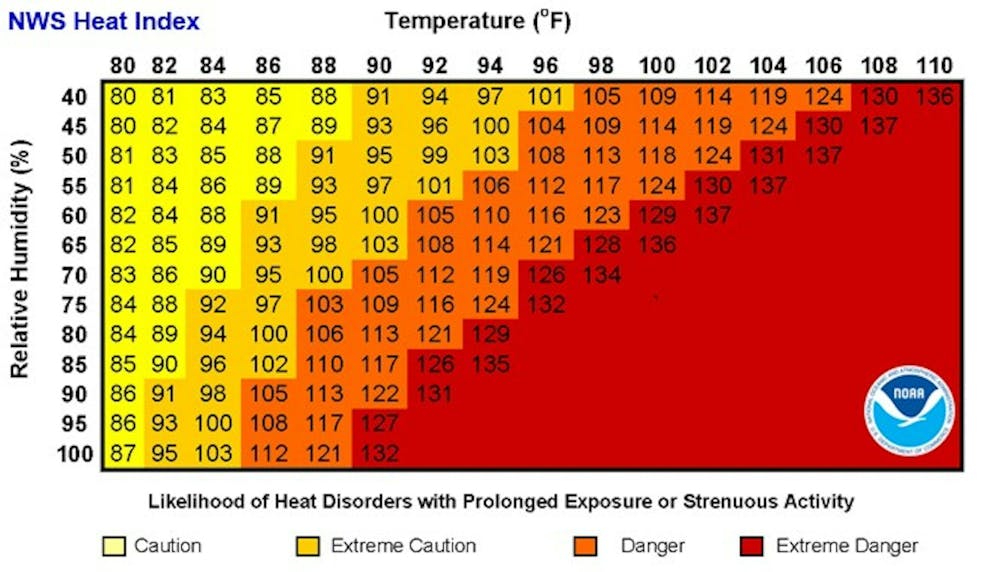
    Instead of just looking at temperature when planning outdoor activities, check the heat index, which accounts for heat illness risk associated with temperature and relative humidity.

    It doesn’t take very high temperatures or very high humidity for the heat index to enter dangerous territory.

    A heat index chart shows how heat and humidity combine for dangerous conditions.
    NOAA

    However, the heat index is still a conservative measure of the impact of heat on humans, particularly for outdoor workers and athletes at summer practices. This is because temperature measurements used in weather forecasting are taken in the shade and are not exposed to direct sunlight. If someone is outside and exposed to the direct sun, the actual heat index can be as much as 15 F higher than the heat index chart indicates.

    A more sophisticated measurement of heat effects on human health is what’s known as the wet-bulb globe temperature, which takes into account other variables, such as wind speed and cloud cover. Neither takes into account a person’s physical exertion, which also raises their body temperature, whether working at a construction site or playing soccer.

    Tips for staying safe in a heat wave

    How can you stay cool when heat waves set in? The answer depends in part on where you are, but the main points are the same:

    • Avoid strenuous outdoor activities in high temperatures if possible. If you start to feel symptoms of heat-related illnesses, drink fluids that will hydrate you. Find shade, rest, and use cool, damp cloths to lower your body temperature. If you see signs of heat stroke in someone else, call for medical help.

    • Be careful with fans. Fans can be useful if the temperature isn’t too high because they wick sweat away from the body and induce evaporative cooling. But at very high temperatures, they can accelerate heat buildup in the body and lead to dangerous conditions. If indoor temperatures reaches 95 degrees or higher, using fans can actually be dangerous and raise the risk of heat-related illnesses.

    • Find a cooling center, library or community center where you can get inside and rest in an air-conditioned space in the hottest hours. In places such as Phoenix, where high temperatures are a regular hazard, cooling centers are typically opened in summer. Northern cities are also opening cooling centers as heat waves occur there more frequently than they did in the past. Urban areas with a lot of pavement and buildings – known as heat islands – can have temperatures well above the city’s average.

    • Hydrate, hydrate, hydrate! Drink plenty of fluids, and don’t forget about the importance of electrolytes. Heat-related dehydration can occur when people sweat excessively, losing water and necessary salts from the body. Some sports drinks or rehydration fluids restore electrolytes and hydration levels.

    Older adults and people with disabilities often face higher risks from heat waves, particularly if they can’t easily move to a cooler environment. Communities and neighbors can help protect vulnerable populations by providing cooling centers and bottled water and making regular wellness checks during high heat.

    Summer can be a season of fun. Just remember the risks, keep an eye on your friends and neighbors when temperatures rise, and plan ahead so you can beat the heat.

    Brian Bossak is not currently receiving relevant external funding for heat-related illness research. In 2017-2019, he served as a consultant on a heat-related research award from the Southeastern Coastal Center for Agricultural Health and
    Safety at the University of Florida.

    – ref. How to stay safe during heat waves – and the heat stroke warning signs to watch for – https://theconversation.com/how-to-stay-safe-during-heat-waves-and-the-heat-stroke-warning-signs-to-watch-for-257708

    MIL OSI – Global Reports –

    June 20, 2025
  • MIL-OSI Banking: Independent Petroleum Association of America Awards Highest Honor to Midland’s Don Sparks of Discovery Operating, Inc.

    Source: Independent Petroleum Association of America

    Headline: Independent Petroleum Association of America Awards Highest Honor to Midland’s Don Sparks of Discovery Operating, Inc.

    Jun 19, 2025 Independent Petroleum Association of America Awards Highest Honor to Midland’s Don Sparks of Discovery Operating, Inc.

    Posted at 14:49h in Press Releases by Jennifer Pett

    66th Annual Oil & Gas Lifetime Achievement Award Presented to Discovery Operating, Inc. Chairman and Cofounder

    WILLIAMSBURG, VA – At the 96th Annual Meeting of the Independent Petroleum Association of America (IPAA) in Williamsburg, VA, Don Sparks the cofounder and chairman of the board of Discovery Operating, Inc. was presented with the 2025 Chief Roughneck Award.

    IPAA represents thousands of independent businesses that develop 91 percent of America’s oil and natural gas wells. The Chief Roughneck honor dates back to 1955 and has included pioneers in the industry. Sparks was selected by industry peers as the 66th recipient of the award. Past winners of the Chief Roughneck Award can view viewed on the American Oil & Gas Historical Society website.

    The Chief Roughneck Award recognizes one individual whose accomplishments and character represented the highest ideals of the U.S. oil and natural gas industry. The award is considered one of the most meaningful honors in the industry; the award and the character behind it – Joe Roughneck – symbolize the spirit, determination, leadership and integrity of individuals who have made a lasting impression on the energy industry.

    Jeff Eshelman, IPAA President and CEO: “It is the IPAA leadership’s honor to present the Chief Roughneck Award to Don Sparks. Don has made his mark on Midland, mark on the industry and mark on the country. We are immensely grateful to have had him and his family active in IPAA and our advocacy for decades. His technical consulting and independent producing background enables him to be especially sensitive to the particular needs of independent producers, along with working interest participants and royalty interest owners. He’s a true patriot and has played a significant role in our country achieving energy dominance. Don and the Sparks family are the embodiment of this award, and we wish them and Discovery Operating, Inc. success for many more years and generations.”

    Don Sparks, cofounder and Chairman of the Board of Discovery Operating, Inc.: “I’ve been very blessed to work in an industry that I truly believe helps this world and all the people in it and I’m proud to be a part of it. I thank those that helped me get here, it was not by myself. It was one of my dreams to build a family company; My wife has been in partnership in Discovery Operating, Inc. with me from the beginning, and I’ve been blessed to have my sons and three grandchildren involved.  I’ve been blessed with the guys that work with me in the field; they go out there everyday and put their bodies and their time and energy into making sure this industry survives and gets by no matter the oil price. Thank you to the IPAA for this recognition.”

    Don Sparks was born in Pampa, Texas, raised in Amarillo, Texas, and received his bachelor’s degree in petroleum engineering from The University of Texas at Austin in 1962. After graduation, Sparks served as an officer in the U.S. Navy for four years and worked in various engineering and consulting capacities for Bailey, Sipes, Williamson and Runyan; Freeport Oil Company; and Shell Oil Company. He co-founded Discovery Operating, Inc. (DOI) in 1973. More than five decades later, Discovery Operating has evolved into a classic small family owned and operated independent oil and gas company with 31 full-time employees. Discovery operates approximately 420 wells located within a 300-400 mile radius of Midland. Today with the horizontal shale play, DOI’s operated production is over 15,000 BOPD and 35 million cubic feet per day of natural gas. He has been influential in the development of the Wolfcamp and Spraberry shales, and the logging suite and analysis he helped establish has been the basis for picking the landing zones in the horizontal wells drilled and completed in the Midland Basin today. Sparks also cofounded Platt, Sparks & Associates with Ronald Platt which evaluates properties, performs reservoir studies and provides expert testimony for hearings and litigations in Midland and Austin; both men retired from the firm in 2014.

    Sparks is a registered professional engineer and a renowned member of the petroleum engineering community. He has received numerous awards in recognition of his accomplishments, including the IPAA’s Leadership Award, the University of Texas Cockrell School of Engineering Distinguished Graduate Award and the Hearst Lifetime Achievement Energy Award. He previously served as president of the Permian Basin Chapter of the Society of Petroleum Engineers, director of the Permian Basin Petroleum Association and regional vice president, governor and executive committee member of the IPAA. He also served as a member of the U.S. Department of Energy Unconventional Resources Technology Advisory Committee. He is an active member of the National Society of Petroleum Engineers, American Association of Drilling Engineers and Texas Alliance of Energy Producers. Don also served on the Executive Committee and as chairman of the Mountain States Legal Foundation Executive Board.

    Sparks currently resides in Midland, Texas, with his wife, Gwyndolyn. They have three sons, eleven grandchildren and twelve great-grandchildren. All three of his children are partners in Discovery Operating, Inc. William Jeffrey Sparks is Chief Operating Officer, Kevin Don Sparks is Chief Executive Officer and Christopher Todd Sparks is Chief Financial Officer and takes care of outside investments. Gwyn Sparks works at Discovery in accounting.

    About the Independent Petroleum Association of America

    The Independent Petroleum Association of America (IPAA) is a national upstream trade association representing thousands of independent oil and natural gas producers and service companies across the United States. Independent producers develop 91 percent of the nation’s oil and natural gas wells. These companies account for 83 percent of America’s oil production, 90 percent of its natural gas and natural gas liquids (NGL) production, and support over 4.5 million American jobs. Learn more about IPAA by visiting www.ipaa.org and following @IPAAaccess on Twitter.

    About Discovery Operating Company

    Founded in 1973, Discovery Operating, Inc. is a family owned, independent exploration and production company located in Midland, Texas with 31 employees. The company currently operates over 400 wells across Texas.

    MIL OSI Global Banks –

    June 20, 2025
  • MIL-OSI USA: Rep. Estes Reacts to Social Security Trustees’ Report

    Source: United States House of Representatives – Congressman Ron Estes (R-Kansas)

    Rep. Ron Estes (R-Kansas), chair of the House Ways and Means Social Security Subcommittee, released the following statement after the Social Security Board of Trustees released its 2025 report.

    “It’s time to be honest about the health of our Social Security Old-Age and Survivors Insurance Trust Fund and not use the program or the trustees’ report for political gamesmanship,” said Chairman Estes. “While the most recent report shows a slight acceleration for insolvency, it’s not new, and it’s something I’ve been concerned about for years. Republicans and Democrats agree that we need to protect and strengthen Social Security, but we can only do so in a responsible manner that safeguards it for current, near and future retirees when we don’t use Social Security as a political weapon.”

    Background
    The report, released on June 18, 2025, highlighted the strength of the Disability Insurance (DI) Trust Fund, which will remain solvent and pay 100% of benefits through at least 2099, one year longer than the last report projected. Meanwhile, the report noted that the Old-Age and Survivors Insurance (OASI) Trust Fund would only remain solvent to pay 100% of benefits through 2033, three-quarters of a year earlier than the previous report’s projection, which was also in 2033. Chairman Estes has committed to focusing on improving Social Security customer service and processes, as well as strengthening the program.

    MIL OSI USA News –

    June 20, 2025
  • MIL-OSI USA: Statement from Governor Phil Scott on Juneteenth

    Source: US State of Vermont

    Montpelier, Vt. – Governor Phil Scott today issued the following statement:

    “On June 19, 1865, two and a half years after President Lincoln proclaimed all enslaved people in the Confederacy, “henceforth and forever free,” Union soldiers finally made their way to Texas to deliver the news to nearly 250,000 American slaves that the war was over, the south had lost, that each of them were now free.

    “We celebrate Juneteenth as the end of slavery in America, but more importantly, we mark this day because we understand that equality is not created with the sweep of a pen and that we must never stop fighting for true equality and freedom for all, each and every day.”

    MIL OSI USA News –

    June 20, 2025
  • MIL-OSI USA: Senators Marshall, Warnock, & Gallego Introduce Legislation Promoting Fatherhood Engagement

    US Senate News:

    Source: United States Senator for Kansas Roger Marshall
    Washington – On Wednesday, U.S. Senator Roger Marshall, M.D. (R-Kansas) joined Senators Raphael Warnock (D-Georgia) and Ruben Gallego (D-Arizona) introduced The Dads Matter Act of 2025, which would direct the U.S. Department of Health and Human Services (HHS) to raise awareness about father inclusion and engagement and to provide state-level guidance aimed at strengthening the role of fathers in supporting healthy mothers and babies.
    “As an OBGYN for more than 25 years, I know firsthand the challenges facing mothers, and how important a stable support system can be to both pediatric and maternal health outcomes,” said Senator Marshall. “Fathers play such a critical role in their households, and I am proud to support legislation that champions their role as providers, spouses, and caregivers.”
    “Georgia’s maternal mortality rate is a crisis that we must address with every tool at our disposal. That includes redoubling our efforts to uplift the role of fathers in keeping their family healthy during pregnancy and early childhood,” said Senator Reverend Warnock. “Now is the time to spread awareness about the critical role of fathers in improving maternal health outcomes and creating thriving families and communities.” 
    “Too many women in Arizona die from pregnancy-related causes. This bill helps reverse this trend by recognizing that engaged fathers are part of the solution,” said Senator Gallego. When dads show up, maternal health outcomes are better, babies are healthier, and families are stronger.”
    The Dads Matter Act of 2025 would also direct HHS to issue guidance to states to incentivize maternity care providers to offer training and education to health care professionals about the benefits of including and engaging fathers in the pregnancy, birth, and postpartum process. Additionally, it would direct the Government Accountability Office (GAO) to submit a report to Congress that describes the results and effectiveness of this legislation. 

    MIL OSI USA News –

    June 20, 2025
  • MIL-OSI USA: Senators Marshall & Baldwin Introduce Bill to Strengthen Rail Supply & Improve Freight Rail Services for American Farmers & Businesses

    US Senate News:

    Source: United States Senator for Kansas Roger Marshall
    Washington – On Wednesday, U.S. Senator Roger Marshall, M.D. (R-Kansas) joined Senator Tammy Baldwin (D-Wisconsin) in reintroducing the Reliable Rail Service Act, which addresses unreliable service and high rail shipping costs for farmers and manufacturers and aims to strengthen our rail supply chains. It ensures major freight railroads deliver reliable service at reasonable rates, enabling American businesses to get products to market more efficiently.
    “Kansas’s farmers and ranchers depend upon reliable transport of their world-class goods to the rest of the country, and Class 1 railroads are not meeting expectations – this is a disservice to hard-working Kansans,” said Senator Marshall. “This bill lays out reasonable requirements for rail carriers to meet these important obligations, and I look forward to working with Senator Baldwin on getting this to the finish line.”
    “Across the Badger State, our farmers, small businesses, and manufacturers rely on rail service to get their products to market and make ends meet,” said Senator Baldwin. “But when rail service is unreliable, it puts their livelihoods on the line, disrupts supply chains, and drives up costs for hardworking Wisconsin families. That’s why I am proud to work with my Republican colleague to once again introduce our Reliable Rail Service Act and help level the playing field for Wisconsin workers, grow our Made in Wisconsin economy, and keep costs down for consumers.”
    The Reliable Rail Service Act is supported by members of the agricultural industry, labor organizations, energy producers, and manufacturers who know firsthand how poor service, significant disruptions, and sky-high prices are impacting their businesses and prices for consumers.
    Click here to read the full text of the bill.

    MIL OSI USA News –

    June 20, 2025
  • MIL-OSI USA: Senators Marshall & Baldwin Introduce Bill to Strengthen Rail Supply & Improve Freight Rail Services for American Farmers & Businesses

    US Senate News:

    Source: United States Senator for Kansas Roger Marshall

    Washington – On Wednesday, U.S. Senator Roger Marshall, M.D. (R-Kansas) joined Senator Tammy Baldwin (D-Wisconsin) in reintroducing the Reliable Rail Service Act, which addresses unreliable service and high rail shipping costs for farmers and manufacturers and aims to strengthen our rail supply chains. It ensures major freight railroads deliver reliable service at reasonable rates, enabling American businesses to get products to market more efficiently.
    “Kansas’s farmers and ranchers depend upon reliable transport of their world-class goods to the rest of the country, and Class 1 railroads are not meeting expectations – this is a disservice to hard-working Kansans,” said Senator Marshall. “This bill lays out reasonable requirements for rail carriers to meet these important obligations, and I look forward to working with Senator Baldwin on getting this to the finish line.”
    “Across the Badger State, our farmers, small businesses, and manufacturers rely on rail service to get their products to market and make ends meet,” said Senator Baldwin. “But when rail service is unreliable, it puts their livelihoods on the line, disrupts supply chains, and drives up costs for hardworking Wisconsin families. That’s why I am proud to work with my Republican colleague to once again introduce our Reliable Rail Service Act and help level the playing field for Wisconsin workers, grow our Made in Wisconsin economy, and keep costs down for consumers.”
    The Reliable Rail Service Act is supported by members of the agricultural industry, labor organizations, energy producers, and manufacturers who know firsthand how poor service, significant disruptions, and sky-high prices are impacting their businesses and prices for consumers.
    Click here to read the full text of the bill.

    MIL OSI USA News –

    June 20, 2025
  • MIL-OSI USA: Senators Marshall & Baldwin Introduce Bill to Strengthen Rail Supply & Improve Freight Rail Services for American Farmers & Businesses

    US Senate News:

    Source: United States Senator for Kansas Roger Marshall

    Washington – On Wednesday, U.S. Senator Roger Marshall, M.D. (R-Kansas) joined Senator Tammy Baldwin (D-Wisconsin) in reintroducing the Reliable Rail Service Act, which addresses unreliable service and high rail shipping costs for farmers and manufacturers and aims to strengthen our rail supply chains. It ensures major freight railroads deliver reliable service at reasonable rates, enabling American businesses to get products to market more efficiently.
    “Kansas’s farmers and ranchers depend upon reliable transport of their world-class goods to the rest of the country, and Class 1 railroads are not meeting expectations – this is a disservice to hard-working Kansans,” said Senator Marshall. “This bill lays out reasonable requirements for rail carriers to meet these important obligations, and I look forward to working with Senator Baldwin on getting this to the finish line.”
    “Across the Badger State, our farmers, small businesses, and manufacturers rely on rail service to get their products to market and make ends meet,” said Senator Baldwin. “But when rail service is unreliable, it puts their livelihoods on the line, disrupts supply chains, and drives up costs for hardworking Wisconsin families. That’s why I am proud to work with my Republican colleague to once again introduce our Reliable Rail Service Act and help level the playing field for Wisconsin workers, grow our Made in Wisconsin economy, and keep costs down for consumers.”
    The Reliable Rail Service Act is supported by members of the agricultural industry, labor organizations, energy producers, and manufacturers who know firsthand how poor service, significant disruptions, and sky-high prices are impacting their businesses and prices for consumers.
    Click here to read the full text of the bill.

    MIL OSI USA News –

    June 20, 2025
  • MIL-OSI USA: Senator Marshall’s Office Offers Assistance to Kansans in Israel

    US Senate News:

    Source: United States Senator for Kansas Roger Marshall
    SALINA, KS – On Thursday, Senator Roger Marshall, M.D. (R-Kansas) announced his office’s assistance in helping any Kansan in Israel safely evacuate to the U.S. The Senator’s office has previously helped Americans safely evacuate. 
    “My office has successfully helped Americans escape from other, dangerous situations in foreign nations, and we stand ready to do the same in Israel,” Senator Marshall said.
    Any Kansans with family or loved ones in Israel are asked to email EvacHelp@marshall.senate.gov or call (785)829-9000.

    MIL OSI USA News –

    June 20, 2025
  • MIL-OSI USA: Senator Marshall’s Office Offers Assistance to Kansans in Israel

    US Senate News:

    Source: United States Senator for Kansas Roger Marshall

    SALINA, KS – On Thursday, Senator Roger Marshall, M.D. (R-Kansas) announced his office’s assistance in helping any Kansan in Israel safely evacuate to the U.S. The Senator’s office has previously helped Americans safely evacuate. 
    “My office has successfully helped Americans escape from other, dangerous situations in foreign nations, and we stand ready to do the same in Israel,” Senator Marshall said.
    Any Kansans with family or loved ones in Israel are asked to email EvacHelp@marshall.senate.gov or call (785)829-9000.

    MIL OSI USA News –

    June 20, 2025
  • MIL-OSI Europe: Answer to a written question – New GAR-based reporting standards introduced under the EU’s sustainable finance policies – E-000904/2025(ASW)

    Source: European Parliament

    The Commission emphasises the need for large financial institutions to disclose alignment with Taxonomy criteria. The Commission intends to address issues with the methodology of the Green Asset Ratio as part of the planned review of the Taxonomy Disclosures Delegated Act[1]. A draft amending Delegated Regulation was published for consultation between 26 February and 26 March 2025[2].

    Financial institutions are also expected to benefit from the possibility to disclose economic activities meeting only certain criteria, like climate change mitigation.

    This is reflected in the proposed amendment to the Corporate Sustainability Reporting Directive to revise reporting rules and better reflect the transition efforts introducing disclosures of partial alignment with the Taxonomy.

    In view of meeting the environment and climate objectives, the 8th Environment Action Programme Mid-Term Review[3] calls for collaborative efforts to render laws effective and promote clean solutions.

    Simplification, modernisation, digitalisation and funding are pivotal. Successful implementation hinges on overcoming challenges to ensure stakeholder buy-in, showcasing the benefits of the green transition.

    The Commission commits to ongoing dialogue with Member States, fostering understanding of climate risks and opportunities and building support for effective policies. This approach precedes legislative revisions, adhering to evidence-based policy-making aligned with Better Regulation guidelines.

    In addition, inclusive dialogues with stakeholders ensure that policies enshrined in the European Green Deal contribute to a just and competitive transition.

    Notably, the Clean Industrial Deal[4] that facilitates achievement of EU climate goals by incentivising industry decarbonisation, was supported by stakeholder initiatives like the Antwerp Declaration for a European Industrial Deal[5] and Clean Transition Dialogues[6], tailored to sectors such as automotive, steel, metals and chemicals.

    • [1] Commission Delegated Regulation (EU) 2021/2178 of 6 July 2021 supplementing Regulation (EU) 2020/852 of the European Parliament and of the Council by specifying the content and presentation of information to be disclosed by undertakings subject to Articles 19a or 29a of Directive 2013/34/EU concerning environmentally sustainable economic activities, and specifying the methodology to comply with that disclosure obligation
      OJ L 443, 10.12.2021, p. 9-67.
    • [2] https://ec.europa.eu/info/law/better-regulation/have-your-say/initiatives/14546-Taxonomy-Delegated-Acts-amendments-to-make-reporting-simpler-and-more-cost-effective-for-companies_en.
    • [3] COM(2024)123 final.
    • [4] COM(2025) 85.
    • [5] https://antwerp-declaration.eu/.
    • [6] COM (2024)163 final.

    MIL OSI Europe News –

    June 20, 2025
  • MIL-OSI Europe: Answer to a written question – New GAR-based reporting standards introduced under the EU’s sustainable finance policies – E-000904/2025(ASW)

    Source: European Parliament

    The Commission emphasises the need for large financial institutions to disclose alignment with Taxonomy criteria. The Commission intends to address issues with the methodology of the Green Asset Ratio as part of the planned review of the Taxonomy Disclosures Delegated Act[1]. A draft amending Delegated Regulation was published for consultation between 26 February and 26 March 2025[2].

    Financial institutions are also expected to benefit from the possibility to disclose economic activities meeting only certain criteria, like climate change mitigation.

    This is reflected in the proposed amendment to the Corporate Sustainability Reporting Directive to revise reporting rules and better reflect the transition efforts introducing disclosures of partial alignment with the Taxonomy.

    In view of meeting the environment and climate objectives, the 8th Environment Action Programme Mid-Term Review[3] calls for collaborative efforts to render laws effective and promote clean solutions.

    Simplification, modernisation, digitalisation and funding are pivotal. Successful implementation hinges on overcoming challenges to ensure stakeholder buy-in, showcasing the benefits of the green transition.

    The Commission commits to ongoing dialogue with Member States, fostering understanding of climate risks and opportunities and building support for effective policies. This approach precedes legislative revisions, adhering to evidence-based policy-making aligned with Better Regulation guidelines.

    In addition, inclusive dialogues with stakeholders ensure that policies enshrined in the European Green Deal contribute to a just and competitive transition.

    Notably, the Clean Industrial Deal[4] that facilitates achievement of EU climate goals by incentivising industry decarbonisation, was supported by stakeholder initiatives like the Antwerp Declaration for a European Industrial Deal[5] and Clean Transition Dialogues[6], tailored to sectors such as automotive, steel, metals and chemicals.

    • [1] Commission Delegated Regulation (EU) 2021/2178 of 6 July 2021 supplementing Regulation (EU) 2020/852 of the European Parliament and of the Council by specifying the content and presentation of information to be disclosed by undertakings subject to Articles 19a or 29a of Directive 2013/34/EU concerning environmentally sustainable economic activities, and specifying the methodology to comply with that disclosure obligation
      OJ L 443, 10.12.2021, p. 9-67.
    • [2] https://ec.europa.eu/info/law/better-regulation/have-your-say/initiatives/14546-Taxonomy-Delegated-Acts-amendments-to-make-reporting-simpler-and-more-cost-effective-for-companies_en.
    • [3] COM(2024)123 final.
    • [4] COM(2025) 85.
    • [5] https://antwerp-declaration.eu/.
    • [6] COM (2024)163 final.

    MIL OSI Europe News –

    June 20, 2025
  • MIL-OSI Europe: Answer to a written question – Hawala banking – E-001447/2025(ASW)

    Source: European Parliament

    Hawala is an informal, trust-based money transfer system often used for money remittances. It operates outside traditional banking, without using authorised financial institutions.

    Under EU legislation, all operators providing payment services[1] must become authorised payment institutions. This mandates such operators to perform customer due diligence[2] and report suspicious transactions to law enforcement authorities[3].

    Enforcement actions have been ongoing since 2019, both at national level and through international monitoring mechanisms. The Commission actively participates in the Financial Action Task Force and MONEYVAL[4] mutual evaluation processes, which assess countries’ compliance with anti-money laundering and countering the financing of terrorism (AML/CFT) standards.

    These evaluations have identified risks associated with informal value transfer systems, including hawala, in both EU Member States and third countries.

    They recommend strengthening supervision and adopting measures, practices and detailed guidelines on effective parallel financial investigations.

    Conducting these types of funds transfers informally and without authorisation already exposes their perpetrators to the risk of being severely sanctioned in all EU Member States. Hence, making a legislative proposal to limit the use of hawala has so far not been considered necessary.

    Instead, the focus remains on practical enforcement and supervision. With the entry into application of the AML/CFT package adopted in 2024[5] and the establishment of the AML Authority (AMLA), the EU and its Member States will further enhance their capacities to supervise illicit financial flows, including when performed through unauthorised hawala activities.

    • [1] Which includes money remittance, as per Annex I, point 6 of Directive (EU) 2015/2366 of the European Parliament and of the Council of 25 November 2015 on payment services in the internal market (PSD2).
    • [2] As per Article 11 of Directive (EU) 2015/849, OJ L 141, 5.6.2015, p. 73-117.
    • [3] As per Article 33 of Directive (EU) 2015/849, OJ L 141, 5.6.2015, p. 73-117.
    • [4] Committee of Experts on the Evaluation of Anti-Money Laundering Measures and the Financing of Terrorism.
    • [5] https://finance.ec.europa.eu/news/latest-update-anti-money-laundering-and-countering-financing-terrorism-legislative-package-2024-04-24_en.
    Last updated: 19 June 2025

    MIL OSI Europe News –

    June 20, 2025
←Previous Page
1 … 1,069 1,070 1,071 1,072 1,073 … 5,175
Next Page→
NewzIntel.com

NewzIntel.com

MIL Open Source Intelligence

  • Blog
  • About
  • FAQs
  • Authors
  • Events
  • Shop
  • Patterns
  • Themes

Twenty Twenty-Five

Designed with WordPress