Category: Economics

  • MIL-OSI Economics: Study: Microsoft 365 Copilot drove up to 353% ROI for small and medium businesses

    Source: Microsoft

    Headline: Study: Microsoft 365 Copilot drove up to 353% ROI for small and medium businesses

    As a small or medium-sized business (SMB) leader, you’ve likely heard a lot about generative AI and how it’s transforming businesses of all sizes. To better understand how AI is helping businesses grow and compete, Microsoft commissioned Forrester Consulting to study the potential return on investment (ROI) of Microsoft 365 Copilot for SMBs.

    The results of the study are eye-opening. Forrester’s New Technology: Projected Total Economic Impact Of Microsoft 365 Copilot for SMB1 projects that over a three-year period, businesses can experience a return on investment (ROI) ranging from 132% to 353%.2

    Moreover, the study reports that businesses are already experiencing the transformational impact of AI for their organizations in the following areas:

    • Faster time to market
    • Increased productivity
    • Improved employee satisfaction

    Let’s take a closer look at how early adopters of Copilot have used the power of AI to transform their businesses, while keeping their data secure with enterprise data protection.

    Microsoft 365 Copilot

    Focus on what matters most with Microsoft 365 Copilot and the power of AI.

    Investing in Copilot delivers substantial returns for SMBs

    The Forrester study demonstrates the transformative results that AI can help bring to businesses—making Copilot not just a productivity tool but a strategic investment for long-term growth:

    • 6% increase in net revenue
    • 20% reduction in operating costs
    • 25% acceleration in new-hire onboarding

    “Upskilling on AI now is absolutely critical to being prepared for its capabilities in a few years. In five years, running a business without Copilot would be like trying to run a company today using typewriters instead of computers.”

    Forrester Study: Head Vice President of Technology Services, IT Services and Business Consulting

    Turning innovation into action with faster time to market

    Bringing new products to market faster and promptly meeting customer demands are critical for business success. Forrester’s study highlights how Copilot can help accelerate revenue growth and open doors to additional business opportunities.

    The study found that 24% of businesses experienced a 16% to 20% reduction in time to market for new products, and 27% of businesses saw improvements in time to market ranging from 11% to 15%. These improvements can help you enhance your agility and increase competitiveness in the market.

    “With Copilot, we have faster turnarounds…with the ability to turn things around more quickly, clients can come to us with more work. It can be 15% more business.”

    —Forrester Study: Head Vice President of Technology Services, Managed Technology Solutions

    You can optimize your business processes by working with Copilot to map out your workflow and ask Copilot for recommendations to eliminate inefficiencies. Then you can share the list of recommendations with your team for feedback before deciding how to move forward. Copilot can help ensure projects move forward without delays—ask Copilot to provide updates on your team’s progress to quickly identify where support is needed.

    Increasing productivity across your business

    Employees at small and medium-sized businesses often wear multiple hats, doing jobs across different departments, and sometimes having less time to spend on their own projects. Copilot can help address this challenge by taking on routine, repetitive tasks, helping teams to focus on more strategic work.

    Forrester’s study shows that 51% of businesses using Copilot reported a 1% to 10% reduction in supply chain costs, while 59% saw operating costs decrease by 1% to 20%. This can help you to shift resources toward growth-focused initiatives without overwhelming your team.

    “In terms of getting the information to the various departments and having my legal assistants then redo it, so they can enter that data and answer questions from other departments more easily. My guess is on contract review we’ll save at least 50% of time in the coming years.” 

    —Forrester study: General Counsel, Chief Diversity Officer at the Staffing, IT, and Business Solutions Firm

    With Copilot, your team can quickly find critical details from client contracts or vendor agreements and have emails from key clients prioritized, helping to ensure that the most urgent emails are addressed first. Copilot can also gather data from spreadsheets and text documents, analyze it, and create easy-to-understand charts and tables for faster decision-making.

    Enhancing employee satisfaction and retention

    The study also highlights Copilot’s impact on employee satisfaction. By freeing up time for employees to collaborate more effectively and take on more fulfilling tasks, SMBs have experienced or anticipated, on average, an 18% increase in employee satisfaction, with a corresponding 11% to 20% reduction in employee churn.

    “People have a lot of anxiety [about going] on vacation because of what they’re going to miss. Well, the ability to ramp up fast with summarization on a lot of those key meetings doesn’t just save the person the time, but it also is going to save the other leaders in the organization the time to have to ramp them up.”
    Forrester study: President, Staffing, IT, and Business Solutions

    Use Copilot to help pull together training materials and build presentations so you quickly bring new team members up to speed. Copilot’s meeting and email summaries also allow your employees to stay on top of work, even when they miss a meeting. This can help reduce stress and help create smoother transitions between projects, fostering a more inclusive and productive work environment.

    Now is the right time to invest in AI. We are here to help.

    With potential benefits like increased revenue, faster time to market, and significant ROI, Microsoft 365 Copilot can be a valuable investment for SMBs looking to thrive in a competitive market.

    To find out more about the Forrester findings and learn how you can best implement Copilot for your business, please join our webinar on October 31, 2024, 9 AM PST to 10 AM PST.

    To use Copilot across all your Microsoft 365 apps and work data, you can purchase Microsoft 365 Copilot as an add-on to your Microsoft 365 Business Basic, Microsoft 365 Standard, or Microsoft 365 Business Premium subscriptions. If you do not already have these core productivity offerings, you can purchase them now.

    Find out more about Microsoft 365 Copilot or reach out to a Microsoft Cloud Solution Partner to learn more.

    You can also learn how to make Copilot part of your everyday business activities by exploring the new Copilot Success Kit for Small and Medium-Sized Business, which provides resources on licensing, technical requirements, and AI capabilities.


    Sources:

    1. “New Technology: The Projected Total Economic Impact : Of Microsoft 365 Copilot for SMB,” a commissioned study conducted by Forrester Consulting on behalf of Microsoft. Results are based on Microsoft 365 Copilot customer interviews and surveys of over 200 companies with up to 300 employees across various industries, from retail to financial services.
    2. Forrester modeled a range of projected low-, medium-, and high-impact outcomes based on evaluated risk. This financial analysis projects that the composite organization accrues the following three-year net present value (NPV) for each scenario by enabling Microsoft 365 Copilot: 
      • Projected high impact of a $955,000 NPV and projected ROI of 353%. 
      • Projected medium impact of a $658,000 NPV and projected ROI of 243%. 
      • Projected low impact of a $358,000 NPV and projected ROI of 132%.

    MIL OSI Economics

  • MIL-OSI Economics: Joint African Development Bank- Government of Japan Visit to FAPA-Funded Projects in Ghana

    Source: African Development Bank Group

    The African Development Bank and the Government of Japan recently concluded a joint visit to two projects funded by the Fund for African Private Sector Assistance (FAPA) in Ghana to assess their impact on stimulating the growth of small businesses and boosting private sector development.

    The Japanese delegation led by Japan’s Deputy Vice Minister of Finance for International Affairs, Mr. Daiho Fujii, together with the African Development Bank’s Executive Director for Japan, Mr. Takaaki Nomoto, were received by the African Development Bank Country Manager for Ghana, Ms. Eyerusalem Fasika. The Delegation engaged with implementing agencies and beneficiaries of two FAPA funded projects – the Ghana SME Business Linkage Program, and Fashionomics Africa Online Platform and Mobile App.

    FAPA, a joint initiative between the Bank and the Japanese government, provides untied grants to support the implementation of the Bank’s Private Sector Development Strategy. Through capacity building and technical assistance, the Fund enhances the business environment, strengthens financial systems, promotes the development of micro, small, and medium enterprises (MSMEs), and facilitates trade across African countries.

    Focusing on the projects’ contribution to Ghana’s broader economic and social development goals, Deputy Vice Minister Fujii reaffirmed Japan’s support to FAPA and the Bank. “My thrill turned into confidence that the Japanese taxpayers’ money via FAPA contributes to motivating the beneficiaries by developing their businesses as micro, small, and medium enterprises (MSMEs), and improving their livelihood and well-being. I was also glad that FAPA projects in Ghana played the catalytic role in applying such models to other African countries and in attracting other donors.”

    Referencing the positive impact of the projects, Fasika emphasized FAPA’s pivotal role in driving inclusive private sector development and economic growth, creating job opportunities, and reducing poverty. She also expressed gratitude for Japan’s continued support and highlighted the importance of the partnership between the Bank and the Government of Japan. “The projects funded by FAPA are clear examples of how strategic partnerships can have a tangible impact on the ground. We are pleased with the progress made and the transformative effects these projects have on local communities (in Ghana),” she stated.

    The visit underscores the continued commitment of the African Development Bank and the Government of Japan to fostering economic growth and strengthening private sector development in Africa through sustainable and impactful investments.

    MIL OSI Economics

  • MIL-OSI Economics: Coming Soon: Regional Economic Outlook for the Middle East and Central Asia, October 2024

    Source: International Monetary Fund

    COMING SOON

    Launch of the October 2024 Regional Economic Outlook for the Middle East and Central Asia

    The Regional Economic Outlook (REO) report provides comprehensive insights into recent economic developments and future prospects specifically for countries in the region. It analyzes the impact of economic policy changes on performance, highlighting key challenges faced by policymakers in navigating complex economic landscapes.

    IMPORTANT DATES
    • THURSDAY, OCTOBER 24, 10:30 AM ET: Press Briefing: Regional Economic Outlook for the Middle East and Central Asia
    • THURSDAY, OCTOBER 31, 2 AM ET/10 AM GMT+4: Full report release with press briefing in Dubai, United Arab Emirates

    The chapters and main report will be available for download on this page starting on October 31. Stay tuned for updates!

    Publications

    MIL OSI Economics

  • MIL-OSI Economics: Coming Soon: Regional Economic Outlook for the Western Hemisphere, October 2024

    Source: International Monetary Fund

    COMING SOON

    Launch of the October 2024 Regional Economic Outlook for the Western Hemisphere

    The Regional Economic Outlook (REO) report provides comprehensive insights into recent economic developments and future prospects specifically for countries in the region. It analyzes the impact of economic policy changes on performance, highlighting key challenges faced by policymakers in navigating complex economic landscapes. 

    RELEASE DATE
    • FRIDAY, OCTOBER 25, 10:15 AM ET | 3:15 UTC: Online report and analytical notes with press briefing 

    The full report, analytical notes, and the live webcast of the press briefing will be available on this page on October 25 (10:15 AM ET | 3:15 PM UTC). 

    Publications

    MIL OSI Economics

  • MIL-OSI Economics: Lufthansa Cargo appoints Elodie Berthonneau as Vice President Asia Pacific

    Source: Lufthansa Group

    As of 1 October 2024, Elodie Berthonneau will take over the position of Vice President Asia-Pacific at Lufthansa Cargo in Singapore. She will head the sales and handling organization in one of the most important markets for Lufthansa Cargo. This includes among others the regions China, Japan, South Korea, Thailand, Vietnam, Singapore, Malaysia, Indonesia, Philippines and Oceania. Berthonneau joins Lufthansa Cargo from Qatar Cargo where she was Vice President Network Planning and Strategic Partnership.

    With more than 25 years of experience in the aviation industry, Berthonneau has held various management positions in sales, pricing, profit management and strategic planning at Qatar Airways and Air France KLM. Her previous roles have included building start-ups, restructuring organizations, network redesign, major strategic partnerships and people management. Having worked in Europe, the Middle East and Asia, she also has broad international experience.

    “We are happy to welcome Elodie Berthonneau as Head of Asia Pacific. The Asian region is one of our most important markets and is expected to become even more relevant in the coming years. Combining her expertise and experience within the industry and the Lufthansa Cargo brand and knowledge, she will set new accents in our Asia Pacific organization and in the dialogue with our customers,” explains Anand Kulkarni, Head of Global Markets at Lufthansa Cargo

    About Lufthansa Cargo

    With revenue of 3.0 billion euros and a transport performance of 7.5 billion freight ton kilometers in 2023, Lufthansa Cargo is one of the world’s leading companies in the transport of airfreight. The company currently employs around 4,150 people worldwide. Lufthansa Cargo’s focus is on the airport-to-airport business. The route network covers around 300 destinations in more than 100 countries, using both freighter aircraft and cargo capacity from passenger aircraft operated by Lufthansa, Austrian Airlines, Brussels Airlines, Discover Airlines and SunExpress, as well as trucks. The majority of the cargo business is handled via Frankfurt Airport. 

    MIL OSI Economics

  • MIL-OSI Economics: Money Market Operations as on October 17, 2024

    Source: Reserve Bank of India


    (Amount in ₹ crore, Rate in Per cent)

      Volume
    (One Leg)
    Weighted
    Average Rate
    Range
    A. Overnight Segment (I+II+III+IV) 556,222.72 6.29 0.01-6.50
         I. Call Money 8,226.89 6.43 5.10-6.50
         II. Triparty Repo 406,519.90 6.28 6.16-6.40
         III. Market Repo 140,522.93 6.31 0.01-6.50
         IV. Repo in Corporate Bond 953.00 6.41 6.39-6.50
    B. Term Segment      
         I. Notice Money** 122.10 6.30 6.10-6.45
         II. Term Money@@ 380.00 6.75-6.90
         III. Triparty Repo 231.00 6.45 6.35-6.45
         IV. Market Repo 98.04 6.55 6.55-6.55
         V. Repo in Corporate Bond 0.00
      Auction Date Tenor (Days) Maturity Date Amount Current Rate /
    Cut off Rate
    C. Liquidity Adjustment Facility (LAF), Marginal Standing Facility (MSF) & Standing Deposit Facility (SDF)
    I. Today’s Operations
    1. Fixed Rate          
    2. Variable Rate&          
      (I) Main Operation          
         (a) Repo          
         (b) Reverse Repo          
      (II) Fine Tuning Operations          
         (a) Repo          
         (b) Reverse Repo Thu, 17/10/2024 1 Fri, 18/10/2024 40,385.00 6.49
    3. MSF# Thu, 17/10/2024 1 Fri, 18/10/2024 5,717.00 6.75
    4. SDFΔ# Thu, 17/10/2024 1 Fri, 18/10/2024 82,925.00 6.25
    5. Net liquidity injected from today’s operations [injection (+)/absorption (-)]*       -117,593.00  
    II. Outstanding Operations
    1. Fixed Rate          
    2. Variable Rate&          
      (I) Main Operation          
         (a) Repo          
         (b) Reverse Repo Fri, 04/10/2024 14 Fri, 18/10/2024 44,275.00 6.49
      (II) Fine Tuning Operations          
         (a) Repo          
         (b) Reverse Repo Mon, 14/10/2024 4 Fri, 18/10/2024 24,070.00 6.49
    3. MSF#          
    4. SDFΔ#          
    5. On Tap Targeted Long Term Repo Operations Mon, 15/11/2021 1095 Thu, 14/11/2024 250.00 4.00
    Mon, 27/12/2021 1095 Thu, 26/12/2024 2,275.00 4.00
    6. Special Long-Term Repo Operations (SLTRO) for Small Finance Banks (SFBs)£ Mon, 15/11/2021 1095 Thu, 14/11/2024 105.00 4.00
    Mon, 22/11/2021 1095 Thu, 21/11/2024 100.00 4.00
    Mon, 29/11/2021 1095 Thu, 28/11/2024 305.00 4.00
    Mon, 13/12/2021 1095 Thu, 12/12/2024 150.00 4.00
    Mon, 20/12/2021 1095 Thu, 19/12/2024 100.00 4.00
    Mon, 27/12/2021 1095 Thu, 26/12/2024 255.00 4.00
    D. Standing Liquidity Facility (SLF) Availed from RBI$       7,222.87  
    E. Net liquidity injected from outstanding operations [injection (+)/absorption (-)]*     -57,582.13  
    F. Net liquidity injected (outstanding including today’s operations) [injection (+)/absorption (-)]*     -175,175.13  
    G. Cash Reserves Position of Scheduled Commercial Banks
         (i) Cash balances with RBI as on October 17, 2024 984,522.44  
         (ii) Average daily cash reserve requirement for the fortnight ending October 18, 2024 1,001,756.00  
    H. Government of India Surplus Cash Balance Reckoned for Auction as on¥ October 17, 2024 0.00  
    I. Net durable liquidity [surplus (+)/deficit (-)] as on September 20, 2024 418,318.00  
    @ Based on Reserve Bank of India (RBI) / Clearing Corporation of India Limited (CCIL).
    – Not Applicable / No Transaction.
    ** Relates to uncollateralized transactions of 2 to 14 days tenor.
    @@ Relates to uncollateralized transactions of 15 days to one year tenor.
    $ Includes refinance facilities extended by RBI.
    & As per the Press Release No. 2019-2020/1900 dated February 06, 2020.
    Δ As per the Press Release No. 2022-2023/41 dated April 08, 2022.
    * Net liquidity is calculated as Repo+MSF+SLF-Reverse Repo-SDF.
    As per the Press Release No. 2020-2021/520 dated October 21, 2020, Press Release No. 2020-2021/763 dated December 11, 2020, Press Release No. 2020-2021/1057 dated February 05, 2021 and Press Release No. 2021-2022/695 dated August 13, 2021.
    ¥ As per the Press Release No. 2014-2015/1971 dated March 19, 2015.
    £ As per the Press Release No. 2021-2022/181 dated May 07, 2021 and Press Release No. 2021-2022/1023 dated October 11, 2021.
    # As per the Press Release No. 2023-2024/1548 dated December 27, 2023.
    Ajit Prasad          
    Deputy General Manager
    (Communications)    
    Press Release: 2024-2025/1328

    MIL OSI Economics

  • MIL-OSI Economics: Zoom undergoes GenAI-driven renaissance, says GlobalData

    Source: GlobalData

    Zoom undergoes GenAI-driven renaissance, says GlobalData

    Posted in Technology

    Zoom Video Communications Inc (Zoom) has recently unveiled a wide array of new and upcoming platform enhancements powered by generative AI (GenAI) at its annual showcase event “Zoomtopia 2024.” The announcements were compelling for their sheer volume, breadth, and substance and continue the renaissance of Zoom’s platform that began one year ago at Zoomtopia 2023, says GlobalData, a leading data and analytics company.

    Gregg Willsky, Principal Analyst, Enterprise Technology & Services at GlobalData, comments: “At Zoomtopia 2023, Zoom unveiled an extensive and eclectic list of features that marked the latest milestone in the rapid build-out of its GenAI arsenal and collectively moved the ball dramatically forward for the company. What began as an evolution during the dark, nascent days of the COVID-19 pandemic took a sharp trajectory upward and morphed into a full-blown renaissance.”

    Dial the clock ahead one year and that renaissance remains in full swing. Zoom entered Zoomtopia 2024 with some especially impressive jewels recently secured in its crown. These include GenAI assistant Zoom AI Companion; Zoom Workplace, a suite of platform tools with Zoom AI Companion at its core; and Zoom Docs, a modular, digital workspace for creating and editing content that natively integrates with Zoom Workplace.

    Willsky continues: “Zoomtopia 2024 builds upon that momentum. Multiple capabilities go beyond ‘plan vanilla’ and demonstrate real ingenuity made possible by GenAI. For example, Zoom AI Companion 2.0 (coming October 2024) can gather, synthesize, and share information from multiple sources across Zoom such as meetings, chats, and docs; Zoom Tasks synthesizes material such as meeting summaries, emails, documents, and whiteboards and then takes action by detecting tasks, making recommendations, and helping users get started; Zoom Virtual Agent now helps contact center agents handle more complex customer queries in greater numbers within a single customer interaction.”

    Collectively, the announcements made at Zoomtopia 2024 place Zoom on even more solid footing with rivals while simultaneously positioning it well for the near future.

    Willsky concludes: “Zoomtopia 2024 was shorter in duration and hosted a smaller onsite audience compared to Zoomtopia 2023. However, the volume, breadth, and quality of features unveiled was as impressive if not more so. Zoom continues its renaissance in earnest.”

    MIL OSI Economics

  • MIL-OSI Economics: 400 Students of Samsung Innovation Campus Certified in Future-Tech Skills at Gautam Buddha University

    Source: Samsung

     
    Samsung India’s flagship CSR programme, Samsung Innovation Campus, concluded the Artificial Intelligence (AI) course for 400 students of Gautam Buddha University in Greater Noida, Uttar Pradesh, reiterating the brand’s commitment to being a strong partner of the country and working alongside the Government in its mission of skilling the country’s youth and powering #DigitalIndia.
     
    The students were certified at a felicitation ceremony attended by Prof. R.K. Sinha, Vice Chancellor, Gautam Buddha University, alongside officials from Samsung and the Electronics Sector Skills Council of India (ESSCI).
     
    At the conclusion of the entire programme for the year, the toppers from each domain will be awarded a cash prize of INR 1 lakh and will get a chance to visit Samsung’s facilities in Delhi/NCR. During these visits, they will have the opportunity to engage with Samsung’s leadership team. Not just that, the national course toppers will receive exciting Samsung products.
     
    “Educating the nation’s youth in future-tech skills such as AI, IoT, Big Data and Coding is part of a larger plan at Samsung to contribute to the nation’s growth story and drive the Digital India initiative. The second season of Samsung Innovation Campus, Samsung’s flagship CSR programme, has taken a step further in that direction by imparting valuable knowledge and training to youngsters across the country to boost their employability,” said SP Chun, Corporate Vice President, Samsung Southwest Asia.        
     
    Samsung Innovation Campus offers in-depth training across four key technology areas—AI, IoT, Big Data, and Coding & Programming. Students gain hands-on experience through capstone projects and soft skills training aimed at boosting their employability. The AI course participants undergo 270 hours of theory training followed by 80 hours of project work, while those enrolled in IoT and Big Data courses receive 160 hours of theory training and complete 80 hours of project work. Participants in the Coding & Programming course complete 80 hours of training and take part in a hackathon. Samsung will train 3,500 students across India as part of this programme.
     
    The programme covers eight educational institutions across four states. In the northern region, training centres are established in Lucknow and Gorakhpur, besides two in Delhi NCR. In the southern region, which includes Tamil Nadu and Karnataka, training centres are located in Chennai and Sriperumbudur, in addition to two in Bengaluru.
     
    During the programme, participants will continue to receive instructor-led blended classroom and online training through approved training and education partners of ESSCI across the country. Youth enrolled for the programme will undergo classroom and online training and complete their hands-on capstone project work in their selected technology areas in AI, IoT, Big Data and Coding & Programming.
     
    They will also be imparted soft skills training to enhance their employability. The participants are being mobilized through ESSCI’s training and education partners across India. The approach includes a combination of offline and online learning, immersive hackathons and capstone projects, as well as expert mentorship provided by Samsung employees.
     
    In 2023, Samsung Innovation Campus successfully trained 3000 students in future-tech courses. Samsung’s involvement in this initiative underscores its commitment to nation building through Corporate Social Responsibility (CSR) activities in India. It complements Samsung’s other CSR endeavours, including Samsung Solve for Tomorrow. Through these initiatives, Samsung aims to empower future leaders of India by providing them with the necessary education and skills to drive meaningful change.
     

    MIL OSI Economics

  • MIL-OSI Economics: APAC deal volume drops 6.8% during Q1-Q3 2024, as India, Japan, and Australia defy global trend, reveals GlobalData

    Source: GlobalData

    APAC deal volume drops 6.8% during Q1-Q3 2024, as India, Japan, and Australia defy global trend, reveals GlobalData

    Posted in Business Fundamentals

    Deal activity in the Asia-Pacific (APAC) region saw a 6.8% year-on-year (YoY) decline during January to September (Q1-Q3) 2024, with mergers & acquisitions, private equity, and venture financing facing headwinds from economic uncertainties and geopolitical tensions. However, APAC demonstrated resilience compared to global markets, with countries like India, Japan, and Australia bucking the trend and showing growth in deal volume, according to GlobalData, a leading data and analytics company.

    An analysis of GlobalData’s Deals Database reveals that a total of 10,551 deals were announced in APAC during Q1-Q3 2024 compared to the 11,317 deals announced during the same period in previous year,

    The number of M&A, private equity, and venture financing deals registered a YoY decline of 3.1%, 20.7%, and 10.2%, respectively, during the review period.

    Aurojyoti Bose, Lead Analyst at GlobalData, comments: “In line with the global trend, APAC also witnessed decline in deal activity amid the economic uncertainties, ongoing wars and geopolitical tensions. However, it is noteworthy that APAC showcased relative resilience compared to other regions and even though there was a decline, it was the least among all the regions.”

    For instance, North America, Europe, Middle East and Africa, and South and Central American regions experienced respective deal volume fall by 16%, 13.6%, 7.6%, and 22.3% YoY during Q1-Q3 2024.

    Bose adds: “While deal activity across the APAC region presented a varied picture, the bulk of the decline was concentrated in China. In contrast, key markets like India, Japan, and Australia showed positive momentum, highlighting their resilience amid broader economic challenges.”

    China experienced a 22.8% YoY decrease in the number of deals announced during Q1-Q3 2024 compared to Q1-Q3 2023. Other markets such as South Korea, Singapore, Malaysia, Hong Kong, Indonesia, and New Zealand experienced decline in deal volume by 1.2%, 19.1%, 14.4%, 16%, 34.2%, and 4.7%, respectively. Meanwhile, India, Japan and Australia saw their respective deal volume grow by 9.6%, 16.2% and 2.2%.

    Bose concludes: “The growth seen in India, Japan, and Australia reflects a strategic shift in investor focus on markets with strong fundamentals and growth prospects. These markets continue to offer compelling opportunities, and their ability to buck the global trend reinforces the importance of a diversified approach in venture capital and private equity investments within the region.”

    MIL OSI Economics

  • MIL-OSI Economics: Consumer preference for clean label products spurs innovation in APAC, says GlobalData

    Source: GlobalData

    Consumer preference for clean label products spurs innovation in APAC, says GlobalData

    Posted in Consumer

    The rising demand for clean label products is spurring advancements and innovations in the Asia-Pacific (APAC) region, as companies recognize the need to adapt to changing consumer preferences. This demand is not just limited to food and beverages; it extends to personal care and household products as well. A survey corroborates this trend, where 49% of respondents in Asia & Australasia stated that their product purchasing decisions for household cleaning products are either always or often influenced by how ethical/environmentally friendly/socially responsible the product/service is*, says GlobalData, a leading data and analytics company.

    Mani Bhushan Shukla, Consumer Analyst at GlobalData, comments: “Clean label products often use simple, natural ingredients, are free from additives and artificial chemicals, and also commonly feature sustainable and ethical credentials. The expected characteristics of clean label products can vary between industries. Healthy attributes such as “low-sugar” and “low-fat” are prioritized more in food and beverages, while “natural” and “free-from” attributes are prioritized more in personal care. Clean label household care products tend to include natural ingredients instead of synthetic ingredients or “harsh” chemicals, as well as exhibiting sustainability credentials like recyclable packaging.”

    Deepak Nautiyal, Consumer and Retail Commercial Director, Asia-Pacific and Middle East, GlobalData, adds: “Manufacturers are exploring innovative sourcing methods, sustainable packaging solutions, and alternative ingredients that align with the clean label ethos. As brands strive to meet consumer expectations, they are also exploring new marketing strategies that highlight their commitment to transparency and sustainability, ultimately leading to a broader range of clean label options for consumers.

    “Aligning with this trend, Unilever introduced the Sunlight BioCare Nature dishwashing liquid in Vietnam, Indonesia, and Thailand, featuring RhamnoClean Technology for superior grease removal. This product is integrated into the company’s Clean Future sustainability initiative, which employs circular economy principles in both its formulation and packaging to minimize CO2 emissions and plastic waste.”

    Shukla notes: “Heightened health and wellbeing concerns are seeing consumers seek ways to safeguard health and wellness and boost immunity, while increased awareness of sustainability issues amid a rising frequency of extreme weather events has resulted in proactive efforts to reduce carbon footprints. Many consumers are switching to clean label products that feature simple and natural ingredient lists to address such concerns, as well as eco-friendly or ethically sound products. For instance, Garnier, part of the L’Oréal’s family, renewed its commitment to providing sustainable products for consumers in Asia. By utilizing green science, the brand seeks to reduce the environmental footprint of its products, aligning with the increasing consumer interest in eco-friendly beauty solutions.”

    Nautiyal continues: “The integration of sustainable packaging and a clean label will significantly influence consumer purchasing decisions and foster brand loyalty, as evidenced in a GlobalData consumer survey, wherein 78% of APAC consumers consider it essential/nice to have recyclable packaging*. This dual approach not only attracts eco-conscious consumers but also fosters a deeper emotional connection with the brand, leading to increased customer retention and loyalty.”

    Shukla concludes: “As environmental concerns rise in Asia, companies emphasizing eco-friendly ingredients and sustainable supply chains will find new growth opportunities. The demand for safe, environmentally beneficial products will drive innovation in the clean label market. By investing in innovative sourcing and transparent supply chains, these companies can enhance their clean label offerings, attract eco-conscious consumers, and build brand loyalty for long-term success.”

    *GlobalData Q2 2024 Consumer Survey­ – Asia & Australasia, published in July 2024, with 6,506 respondents

    MIL OSI Economics

  • MIL-OSI Economics: 2024/25 LaLiga generates estimated $117.47 million in sponsorship revenue, reveals GlobalData

    Source: GlobalData

    2024/25 LaLiga generates estimated $117.47 million in sponsorship revenue, reveals GlobalData

    Posted in Sport

    Spanish football league LaLiga’s largest sponsorship deal in terms of annual value for the 2024/25 season is its title sponsorship with EA Sports. The deal came into effect from the 2023/24 season and covers the top-flight LaLiga and second-tier Segunda Division, LaLiga Promises, and eLaLiga. Additionally, the league’s longest active partner is Microsoft, which has been in partnership with the league since 2016. Overall, the football league generated an estimated $117.47 million in sponsorship revenue for the 2024/25 season, reveals GlobalData, a leading data and analytics company.

    GlobalData’ s latest report, “The Business of LaLiga 2024/25”, reveals that the estimated domestic media revenue for the 2024/25 LaLiga is $1.12 billion. FC Barcelona’s kit supplier deal with Nike has the largest annual value across the 2024/25 LaLiga competing teams. New partners for the 2024-25 season were Uber Eats, Exness, Luckia, SportBet, and ACTIVA Group.

    Olivia Snooks, Sport Analyst at GlobalData, comments: “Over half of the annual deal revenue for LaLiga is being generated from American-based brands. So, developing partnerships with US-based brands is a logical step for the league to take.”

    Real Madrid, being the most successful Spanish soccer club, boasts the second largest kit supplier deal with adidas. Barcelona and Real Madrid hold a far superior commercial value compared to the other competing teams. Both club kit suppliers, Nike and adidas, are comfortably the biggest spenders in the kit supplier market across the LaLiga 2024/25 season.

    Snooks continues: “There is a notable drop off in terms of spend between Nike and adidas, and the other kit supplier brands across the market. As mentioned, given the commercial value of Barcelona and Real Madrid, the likes of Castore and Hummel just cannot match the ability to commit to such a high value partnership, unlike Nike and adidas.”

    Worth an estimated $381.54 million annually, Barcelona has the highest estimated annual sponsorship revenue for the season, closely followed by Real Madrid in second. Barcelona’s largest deal in terms of annual value ahead of the 2024/25 season is with Spotify. Real Madrid’s largest deal is with HP, which is the team’s first ever sleeve sponsor; the deal is worth an estimated $35 million annually.

    Snooks concludes: “It is no surprise that the two teams that have the highest commercial value across kit suppliers, front-of-shirt sponsors, and sleeve sponsors, also have the largest sponsorship revenue across the 20 competing LaLiga teams. It is worth noting that both Real Madrid and Barcelona did not even rank in the top three teams in terms of deal volume; however, both teams have such huge commercial value that the deal volume is not so important.”

    MIL OSI Economics

  • MIL-OSI Economics: Results of Underwriting Auctions Conducted on October 18, 2024

    Source: Reserve Bank of India

    In the underwriting auctions conducted on October 18, 2024, for Additional Competitive Underwriting (ACU) of the undernoted Government securities, the Reserve Bank of India has set the cut-off rates for underwriting commission payable to Primary Dealers as given below:

    (₹ crore)
    Nomenclature of the Security Notified Amount Minimum Underwriting Commitment (MUC) Amount Additional Competitive Underwriting Amount Accepted Total Amount underwritten ACU Commission Cut-off rate
    (paise per ₹100)
    7.02% GS 2031 10,000 5,019 4,981 10,000 0.06
    7.23% GS 2039 13,000 6,510 6,490 13,000 0.08
    7.09% GS 2054 10,000 5,019 4,981 10,000 0.11
    Auction for the sale of securities will be held on October 18, 2024.

    Ajit Prasad          
    Deputy General Manager
    (Communications)    

    Press Release: 2024-2025/1329

    MIL OSI Economics

  • MIL-OSI Economics: Result of the 13-day Variable Rate Reverse Repo (VRRR) auction held on October 18, 2024

    Source: Reserve Bank of India

    Tenor 13-day
    Notified Amount (in ₹ crore) 1,00,000
    Total amount of offers received (in ₹ crore) 20,073
    Amount accepted (in ₹ crore) 20,073
    Cut off Rate (%) 6.49
    Weighted Average Rate (%) 6.49
    Partial Acceptance Percentage of offers received at cut off rate NA

    Ajit Prasad          
    Deputy General Manager
    (Communications)    

    Press Release: 2024-2025/1330

    MIL OSI Economics

  • MIL-OSI Economics: RBI to conduct 3-day Variable Rate Reverse Repo (VRRR) auction under LAF on October 18, 2024

    Source: Reserve Bank of India

    On a review of the current and evolving liquidity conditions, it has been decided to conduct a second Variable Rate Reverse Repo (VRRR) auction on October 18, 2024, Friday, as under:

    Sl. No. Notified Amount
    (₹ crore)
    Tenor
    (day)
    Window Timing Date of Reversal
    1 1,25,000 3 12:00 Noon to 12:30 PM October 21, 2024
    (Monday)

    2. The operational guidelines for the auction as given in the Reserve Bank’s Press Release 2019-2020/1947 dated February 13, 2020 will remain the same.

    (Puneet Pancholy)  
    Chief General Manager

    Press Release: 2024-2025/1331

    MIL OSI Economics

  • MIL-OSI Economics: Secretary-General of ASEAN receives Ambassador of Peru to Indonesia, Timor-Leste, and ASEAN

    Source: ASEAN

    Secretary-General of ASEAN, Dr. Kao Kim Hourn, today received Ambassador of Peru to Indonesia, Timor-Leste, and ASEAN Luis Tsuboyama at the ASEAN Headquarters/ASEAN Secretariat. They discussed Dr. Kao’s participation in the upcoming Asia-Pacific Economic Cooperation (APEC) Ministerial Meeting, scheduled to be held in Lima, Peru, on 14 November 2024. Peru is the chair of APEC this year, having previously served as the APEC Chair in 2008 and 2016. The ASEAN Secretariat is one of the official observers of APEC, along with the Pacific Islands Forum Secretariat and the Pacific Economic Cooperation Council.

    The post Secretary-General of ASEAN receives Ambassador of Peru to Indonesia, Timor-Leste, and ASEAN appeared first on ASEAN Main Portal.

    MIL OSI Economics

  • MIL-OSI Economics: Analysis of the Crypt Ghouls group: continuing the investigation into a series of attacks on Russia

    Source: Securelist – Kaspersky

    Headline: Analysis of the Crypt Ghouls group: continuing the investigation into a series of attacks on Russia

    Last December, we discovered a new group targeting Russian businesses and government agencies with ransomware. Further investigation into this group’s activity suggests a connection to other groups currently targeting Russia. We have seen overlaps not only in indicators of compromise and tools, but also tactics, techniques, and procedures (TTPs). Moreover, the infrastructure partially overlaps across attacks.

    The group under review has a toolkit that includes utilities such as Mimikatz, XenAllPasswordPro, PingCastle, Localtonet, resocks, AnyDesk, PsExec, and others. As the final payload, the group used the well-known ransomware LockBit 3.0 and Babuk. We have dubbed the group “Crypt Ghouls”.

    Delivery and persistence

    It was only in two of the group’s attacks that we were able to determine the initial access vector. The attackers used a contractor’s login information to connect to the victim’s internal systems via a VPN. The VPN connections were established from IP addresses associated with a Russian hosting provider’s network and a contractor’s network. Nowadays attackers are increasingly gaining initial access through their targets’ contractors. We suspect that contractors are compromised via VPN services or unpatched vulnerabilities.

    To maintain access to the system, the attackers used the NSSM and Localtonet utilities. NSSM creates and manages services on a host, while Localtonet provides an encrypted tunnel for connecting to that host from an external network. Both utilities were downloaded directly from localtonet.com:

    Harvesting login credentials

    XenAllPasswordPro

    The attackers employed the XenAllPasswordPro tool to harvest a range of authentication data from the target system.

    This utility and the path to it, “allinone2023”, are characteristic of this series of attacks. Following is a list of locations for XenAllPasswordPro that we have observed in various victim infrastructures.

    • c:programdataallinone2023xenallpasswordpro.exe
    • c:programdatadbgallinone2023xenallpasswordpro.exe
    • c:programdata1callinone2023xenallpasswordpro.exe
    • $userdesktopallinone2023xenallpasswordpro.exe
    • c:intelxenallpasswordpro.exe

    The parent process for the commands above was wmiprvse.exe. Moreover, we found an Impacket artifact in command-line output. These are signs of using the Impacket WmiExec.py module:

    In one Crypt Ghouls attack, we discovered a malicious CobInt backdoor loader. This is a telltale tool that allowed us to draw parallels with other campaigns. The CobInt downloader we encountered is a VBScript called Intellpui.vbs that executes obfuscated PowerShell code. This code, in turn, communicates with a C2 server to load the CobInt backdoor into memory.

    In other cases, hackers used RDP instead of WMI.

    Additionally, we noticed that in certain attacks, the HKLMSECURITY registry hive was being saved to a temporary folder. The hive stores the host’s security policies and the secrets managed by the Local Security Authority.

    Mimikatz

    We detected the use of the Mimikatz utility in some of the investigated attacks. One case involved injection of malicious code from the utility into the memory of the rundll32.exe process.

    In another, a Mimikatz command was used to dump the memory of the lsass.exe process. This holds various login details of authenticated users:

    In this way, attackers used Mimikatz to extract victims’ credentials.

    dumper.ps1

    Crypt Ghouls ran an open-source PowerShell script that allowed them to dump Kerberos tickets from the LSA cache. The attackers renamed it to disguise it as a Group Policy script.

    MiniDump Tool

    MiniDump Tool is a utility designed to create a memory dump of a specified process. It helped Crypt Ghouls to extract login credentials from the memory of lsass.exe. The attackers initiated this by running the following command:

    The first argument is the process ID (PID). The second argument is the file name and directory to save the dump of the selected process to.

    The MiniDump Tool creates a driver at the following path:

    Next, it runs the driver and passes to it a control code to read the memory of the process whose identifier is specified as the first argument, then it saves the dump in the system, in this case — in a file in the current directory while using the process ID as its name.

    Login credentials from browsers

    Crypt Ghouls also copied files containing credentials stored in browsers to a temporary directory:

    The commands on the hosts were run via WMI.

    The attackers then used PowerShell to request a list of local users:

    NTDS.dit dump

    Crypt Ghouls connected to the domain controller with compromised credentials via WMI. After establishing the connection, they tried to save the NTDS.dit dump. The attackers leveraged an existing scheduler task to obtain the dump. They modified the task four times. First, they obtained the NTDS.dit dump with the Ntdsutil utility. Then they archived the folder containing the dump and deleted the folder. The final change to the scheduler task restored its original value.

    The 7-Zip utility was also downloaded from GitHub:

    However, we did not detect any further data exfiltration after the archiving.

    Network reconnaissance and spread

    Crypt Ghouls used the PingCastle utility (MD5: F4A84D6F1CAF0875B50135423D04139F) to collect information about the infrastructure of the domain they resided in. Additionally, the attackers periodically scanned the network using the legitimate utility SoftPerfect Network Scanner to identify open ports and network shares.

    As we mentioned above, the attackers used the WmiExec.py Impacket module for network navigation. We found that two of the targets had PAExec, a remote command tool, running on their systems at some point:

    Infrastructure

    Crypt Ghouls uses several remote access utilities. AnyDesk was the most commonly used tool according to our research, but the attackers employed a variety of other methods as well. The table below presents the names of the utilities and the directories where they were found.

    Name Directory
    AnyDesk C:Users[redacted]DownloadsAnyDesk.exe
    Localtonet C:WindowsTemplocaltonet.exe
    resocks /usr/sbin/xfs-modules

    The IP addresses used for remote connections to AnyDesk and Localtonet belonged to a Surfshark VPN subnet.

    Resocks is a reverse SOCKS5 proxy for tunneling traffic. While investigating this group’s activity, we found a proxy sample that was configured to use the IP address 91.142.73[.]178, which is part of the hosting provider VDSina’s network.

    Below are the notable parameters of the resocks sample, which provide additional context for the research:

    DLL sideloading

    The malicious actor used the DLL sideloading technique by placing a legitimate Windows installer management application, dism.exe, and a malicious loader, dismcore.dll, in the same folder: c:ProgramDataoracle.

    The dismcore.dll loader attempted to locate the file odbcconf.xml, which contained the payload, but we were unable to retrieve that file.

    File encryption

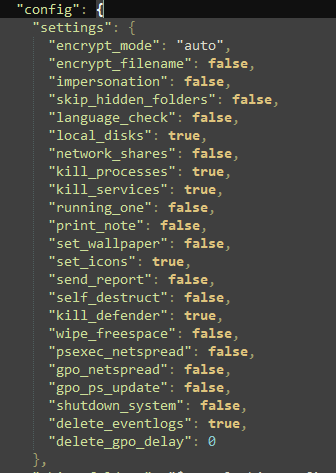
    The attackers encrypted data with publicly available versions of the popular LockBit 3.0 (for Windows systems) and Babuk (for Linux) malware. The LockBit sample we analyzed was configured with commands to encrypt local drives, terminate specific processes and services, disable Windows Defender, and delete event logs. The ransomware added system directories, as well as a folder named intel where the attackers loaded tools to harvest credentials, to the encryption exclusions list.

    A snippet of the LockBit 3.0 sample’s configuration

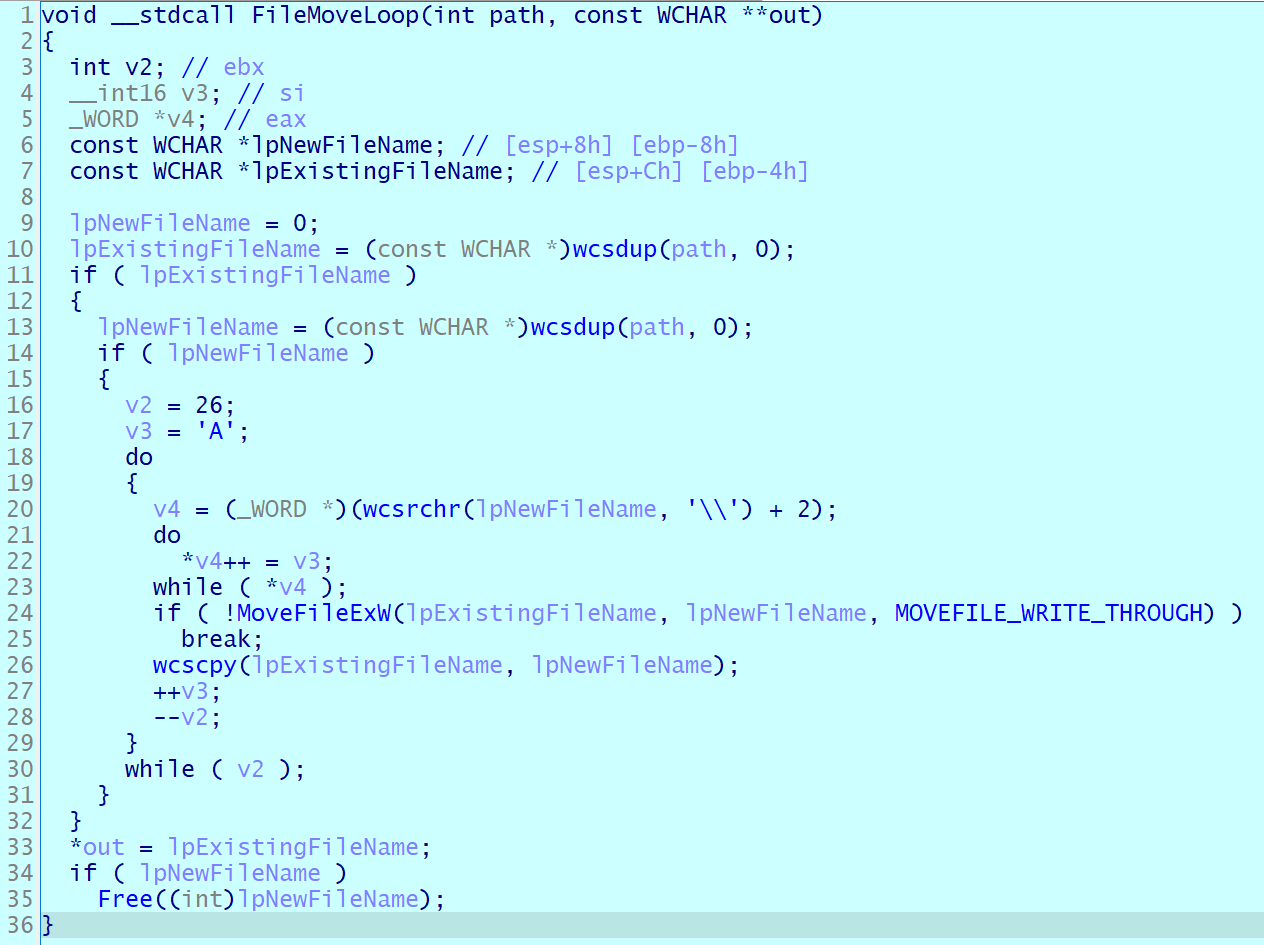
    We noticed something strange about how a victim’s files were encrypted. First, LockBit encrypted files with specific extensions, as defined in its sample configuration. These are the files that the attackers may find most valuable. Besides these, the malware encrypts files in the recycle bin while inserting random characters in these. Beyond the primary algorithm, we found a cycle that systematically renamed the original file in the recycle bin. This process iterated through every letter of the English alphabet, continuing until it reached the last one. This type of encryption makes it really hard, or even impossible, to recover the user’s files.

    The file renaming cycle

    Below is an example of how this appears in logs:

    The algorithm then attempts to delete the last version of
    c:$recycle.bin[redacted]zzzzzzzzzzz.

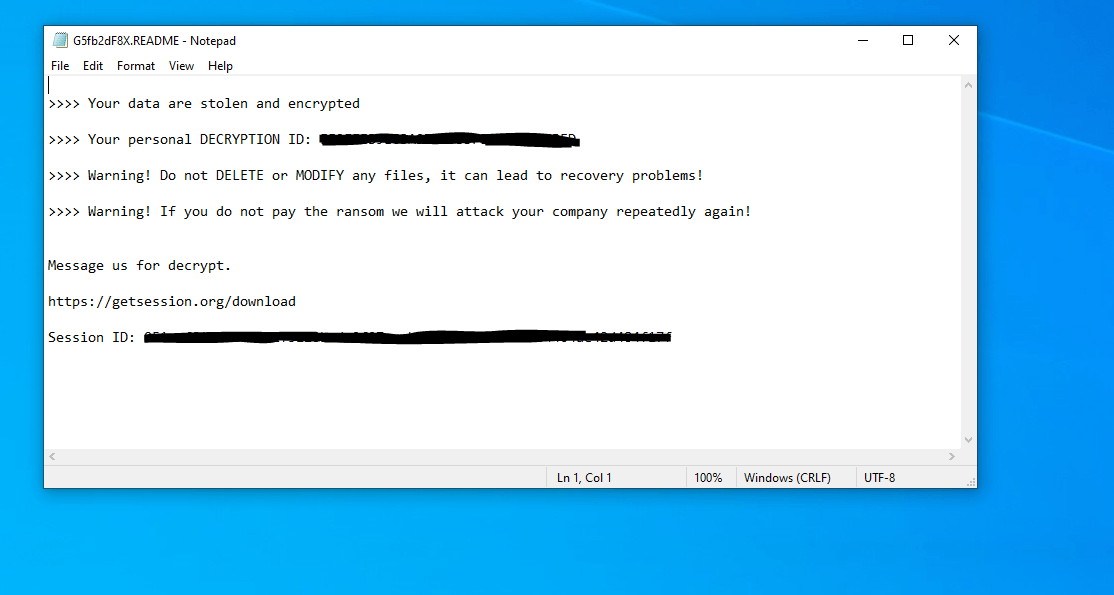
    The attackers leave a ransom note with a link containing their ID in the Session messaging service for future contact:

    A LockBit 3.0 ransom note

    Session supports end-to-end encryption, which minimizes the risk of data breaches. The developers claim their messaging service is built to guarantee complete privacy. Session has been used by other ransomware groups, such as GhostLocker, SEXi, and MorLock, in their attacks.

    Additionally, attackers targeted ESXi servers with the Babuk ransomware. They would connect to the ESXi server via SSH, upload Babuk, and initiate the encryption process for the files within the virtual machines:

    We believe the goal of the attackers was to disrupt the targeted organizations’ operations, besides financial gain.

    We are seeing a lot of overlap in the tools and techniques used by cybercriminals targeting Russian businesses and government agencies. Below, we outline the key similarities we found in attacks by different groups.

    MorLock

    MorLock activities, as investigated by F.A.C.C.T., shares many features with several of the attacks we analyzed for this report. The groups share most of the tools they use: SoftPerfect Network Scanner, XenAllPasswordPro, AnyDesk, PingCastle, Localtonet, NSSM, resocks, LockBit 3.0, and Babuk.

    The file and folder names used in attacks by both groups also show similarities. Thus we found a resocks utility named “xfs-healthcheck”, a name that follows the same template as the resocks names on the list of indicators published by F.A.C.C.T.: [xxx]-healthcheck. We noticed a further similarity when studying the XenAllPasswordPro utility: in MorLock attacks, it was located in a directory named “allinone2023”.

    Furthermore, we checked the MorLock infrastructure as reported by F.A.C.C.T., only to find that the group also used Surfshark VPN and the VDSina hosting services provider.

    BlackJack

    While investigating the utilities used in Crypt Ghouls attacks, we found an overlap with the toolkit employed by the BlackJack group, which also used XenAllPasswordPro. This caught our attention, as XenAllPasswordPro is not the most popular tool among cybercriminals despite being freely available.

    Twelve

    We have seen XenAllPasswordPro used in attacks by Twelve too. Furthermore, we discovered Intellpui.vbs, a loader for CobInt, also used by Twelve, on one of the systems attacked by Crypt Ghouls.

    Shedding Zmiy

    Shedding Zmiy is a group associated with the (Ex)Cobalt activity cluster. We found a further overlap in a report by Solar 4RAYS on this group-related incidents, namely the use of DLL sideloading with the dismcore.dll malicious loader. The report mentioned other familiar utilities and malware: resocks, SoftPerfect Network Scanner, and CobInt. In addition, Shedding Zmiy used VDSina to host its command-and-control servers.

    The similarities between the groups described above led to the conclusion that these attacks overlap with the activity of Crypt Ghouls. Our analysis of cybercriminal tools and tactics suggests that different groups may be collaborating, sharing resources, or exchanging intelligence. Other vendors have found evidence of the (Ex)Cobalt cluster members participating in these groups’ activities, and our analysis confirms this. Right now, we cannot say for sure that these campaigns are connected, but we anticipate their number will increase further. We will continue to monitor activity targeting Russian organizations.

    Victims

    Russian government agencies as well as mining, energy, finance, and retail companies have fallen victim to the Crypt Ghouls group.

    Conclusion

    Crypt Ghouls is another group attacking Russia. Cybercriminals are leveraging compromised credentials, often belonging to subcontractors, and popular open-source tools. These include modified configurations of the LockBit 3.0 and Babuk ransomware, whose builders and source code are publicly available. As the number of attackers using leaked builds increases, identifying the perpetrators of threats becomes increasingly difficult. The shared toolkit used in attacks on Russia makes it challenging to pinpoint the specific hacktivist groups involved. In the attacks carried out by the Crypt Ghouls, we have identified components of infrastructure and a variety of popular tools that are also used by many other groups. This suggests that the current actors are not only sharing knowledge but also their toolkits. All of this only makes it more difficult to identify specific malicious actors behind the wave of attacks directed at Russian organizations.

    Indicators of compromise

    Note: Network addresses specified in this section are valid at the time of publishing, but may change over time.

    SHA256:

    File paths:
    С:ProgramDataoracledismcore.dll
    odbcconf.xml – payload
    C:UsersUserDownloadsdumper.ps1 – dumper.ps1
    C:UsersUserDesktopx86x64mimikatz.exe
    C:programdata1callinone2023xenallpasswordpro.exe
    С:programdataallinone2023xenallpasswordpro.exe
    С:programdatadbgallinone2023xenallpasswordpro.exe
    С:programdata1callinone2023xenallpasswordpro.exe
    $userdesktopallinone2023xenallpasswordpro.exe
    C:programdataallinone2023XenAllPasswordPro.exe
    C:WindowsTempnssm-2.24win64nssm.exe
    C:Users[redacted]DownloadsAnyDesk.exe
    C:WindowsTemplocaltonet.exe
    C:ProgramDatat.exe (MiniDump Tool)
    C:UsersUserAppDataLocalTempkxxxxxxx.sys
    C:WindowsTempkxxxxxxx.sys
    /tmp/lock.out (Babuk)
    /usr/sbin/xfs-healthcheck (resocks)
    /usr/sbin/xfs-modules (resocks)
    c:programdataintellintellpui.vbs (CobInt)

    IP addresses and URLs:
    45.11.181[.]152 – netstaticpoints[.]com – CobInt C2
    169.150.197[.]10 – SurfShark VPN
    169.150.197[.]18 – SurfShark VPN
    91.142.73[.]178 – VDSINA-NET
    91.142.74[.]87 – VDSINA-NET
    95.142.47[.]157 – VDSINA-NET
    185.231.155[.]124 – VDSINA-NET

    Utilities:
    XenAllPasswordPro
    PsExec
    PAExec
    SoftPerfect Network Scanner
    Localtonet
    PingCastle
    Mimikatz
    AnyDesk
    NSSM
    resocks
    MIL OSI Economics

  • MIL-OSI Economics: RBI imposes monetary penalty on Andhra Pragathi Grameena Bank, Andhra Pradesh

    Source: Reserve Bank of India

    The Reserve Bank of India (RBI) has, by an order dated October 10, 2024, imposed a monetary penalty of ₹1.00 lakh (Rupees One Lakh only) on Andhra Pragathi Grameena Bank, Andhra Pradesh (the bank) for non-compliance with certain directions issued by RBI on ‘Strengthening of Prudential Norms- Provisioning Asset Classification and Exposure Limit’ read with ‘Income Recognition, Asset Classification and Provisioning Norms-Guidelines (IRAC norms)’. This penalty has been imposed in exercise of powers vested in RBI, conferred under section 47A(1)(c) read with sections 46(4)(i) and 51(1) of the Banking Regulation Act, 1949.

    The statutory inspection of the bank was conducted by NABARD with reference to its financial position as on March 31, 2023. Based on supervisory findings of non-compliance with RBI directions and related correspondence in that regard, a notice was issued to the bank advising it to show cause as to why penalty should not be imposed on it for its failure to comply with the said directions.

    After considering the bank’s reply to the notice and oral submissions made by it during the personal hearing, RBI found, inter alia, that the following charge against the bank was sustained, warranting imposition of monetary penalty.

    The bank had not classified certain loan accounts as non-performing assets in accordance with the IRAC norms.

    This action is based on deficiencies in regulatory compliance and is not intended to pronounce upon the validity of any transaction or agreement entered into by the bank with its customers. Further, imposition of this monetary penalty is without prejudice to any other action that may be initiated by RBI against the bank.

    (Puneet Pancholy)  
    Chief General Manager

    Press Release: 2024-2025/1335

    MIL OSI Economics

  • MIL-OSI Economics: Stronger Together: Back to Building Dreams at the Samsung Chennai Plant

    Source: Samsung

     
    Samsung’s Chennai Plant is bustling with optimism as workers return after a long absence. In an address to the workforce, SH Yoon, Managing Director, Samsung Chennai Plant, welcomed the employees with a heartfelt message, acknowledging the difficulties faced during this time and reinforcing the company’s vision for a positive and happy workplace.
     
    “I welcome you after a 38-day absence. I was deeply hurt by the situation. Do you remember my vision when I first came to the Chennai Plant—to build a happy and positive workplace? The current circumstances have been painful, and my heart is heavy,” Yoon expressed, speaking directly to the workers.
     
    Yoon also assured the workforce that their concerns and grievances have been heard and will be addressed step by step, staying true to Samsung’s commitment to a “People First” approach.
     
    “During this time, we’ve had interactions with your colleagues. They’ve shared your major concerns, and I assure you, everything will be resolved step by step,” Yoon added.
     
    The atmosphere at the Chennai Plant is now one of relief and optimism. Workers were seen reuniting with their colleagues, sharing smiles, and resuming their roles with a renewed sense of belonging. Many expressed joy at being back together.
     
    “It feels like a family again,” said a senior technician at the plant. “I’m happy to see my colleagues back. Now it feels like we’re ready to move forward together.”
     
    Another technician echoed this sentiment: “We’ve always been more than just co-workers. Seeing everyone back here feels like a reunion. I’m grateful that our concerns are being addressed, and I’m optimistic about the future.”
     
    The Chennai Plant has always prided itself on its strong sense of community, and now, the spirit of togetherness is stronger than ever. With the promise of continuous dialogue and a commitment to building a healthier workplace, the team is ready to work together toward a brighter future.

    MIL OSI Economics

  • MIL-OSI Economics: Local Tech and Lifestyle Journalists Praise Samsung’s Galaxy Z Fold6 and Z Flip6

    Source: Samsung

    In recent weeks, the Samsung Galaxy Z Fold6 and Z Flip6 have garnered enthusiastic praise from South African tech and lifestyle journalists, who are lauding these innovative devices for their cutting-edge features and transformative potential in the mobile industry.
     
    The Samsung Galaxy Z Fold6 has been described as a remarkable advancement in foldable technology, with some pointing out its versatility, enhanced performance, impressive build quality and seamless user experience. The improved hinge design and more durable screen of the Z Fold6 have been particularly well-received.
     
    Another key highlight from local reviews is the device’s multitasking capabilities from its expansive display which allows users to effortlessly juggle multiple tasks, making it an ideal tool for professionals.
     
    On the flip side, the Samsung Galaxy Z Flip6 has also captured the imagination of South African journalists and mobile tech enthusiasts with its stylish design and innovative features. The compact form factor and customisation options of the Z Flip6 have been particularly praised. Its ability to fold into a compact, pocket-sized form makes it incredibly convenient, while the customisable cover screen allows users to personalise their experience.
     
    Here’s a look at some of the glowing reviews;
     
    Cody Nery – Tech Journalist, New Age Gaming
    As much as the sub-display (Galaxy Z Fold6’s cover screen) exists for quick and easy tasks, if I‘m really going to spend a good hour editing a reel for Instagram or even more time improving my KDA while gaming, I’m going to open the fold up, revealing its true nature. For one, the larger display allows me to have multiple apps open, which I find makes editing much simpler than having to switch between apps if I need to find a cool song from another app or quickly move files around. It‘s not surprising at all that it’s also amazing to game on the much larger screen.


    Wesley Diphoko – Editor-in-Chief: Fast Company SA
    In 2024, Apple and Samsung entered the Al hardware race. So far, it seems Samsung is leading the race. Earlier this year, Samsung launched their AI phone, now the South Korean tech-giant has launched a suite of AI-powered products. Last week, Samsung launched its first AI-powered foldable phones, the Galaxy Z Fold6 and Z Flip6. The AI functionality which stands out about the devices is the interpreter mode, which can be used when translating a conversation. The translating functionality has conversation mode and listening mode. The functionality lets the user run the microphone as someone talks in another language, and the user is able to see their speech translated as text on the screen.


    Thobeka Phanyeko – Lifestyle Editor: Glamour
    Samsung has truly positioned itself as a digital disruptor and innovator, bringing cutting-edge technology that keeps up with the fast-paced demands of modern journalism. Having a trusted companion by my side as the media landscape continues to evolve, is a game-changer! I can’t wait to see what’s next!


    MIL OSI Economics

  • MIL-OSI Economics: Intelligent automation primed for $47 billion revenue by 2030, driven by GenAI, says GlobalData

    Source: GlobalData

    Intelligent automation primed for $47 billion revenue by 2030, driven by GenAI, says GlobalData

    Posted in Thematic Intelligence

    Intelligent automation goes beyond traditional automation systems by integrating artificial intelligence (AI) to manage more complex business processes. It drives innovation and creativity, making it essential for organizations looking to stay competitive in today’s market. The intelligent automation market is set to grow from $18 billion in 2023 to $47 billion in 2030, driven by advancements in AI, particularly the rapid adoption of generative AI (GenAI), according to GlobalData, a leading data and analytics company.

    GlobalData’s latest report, “Thematic Intelligence: Intelligent Automation,” reveals that AI is now integrated across most facets of intelligent automation. This new era of automation goes beyond simple task execution, allowing systems to analyze data, make decisions, and learn from interactions. This boosts efficiency and fosters innovation, potentially leading to a future where software bots not only perform tasks but also drive strategic growth and creativity.

    Nicklas Nilsson, Consultant, Strategic Intelligence at GlobalData, comments: “Intelligent automation is transforming how businesses operate, not just enhancing efficiency but fundamentally reshaping processes through AI-driven innovation. As automation evolves into a strategic asset for organizations, it unlocks new areas of creativity and growth. Companies that embrace this transformation will be better positioned to navigate the demands of an ever-changing business landscape.”

    GenAI has emerged as a key driver in intelligent automation, expanding the scope of automatable tasks and empowering non-technical employees to create their own solutions. In the past year, every major player in the field added GenAI capabilities through integrations with well-known solutions like ChatGPT and the development of bespoke copilot tools, allowing businesses to speed up innovation and broaden access to automation.

    Nilsson continues: “GenAI’s ability to generate new, contextually relevant content from simple prompts has opened many possibilities. By democratizing access and empowering employees without technical expertise to craft solutions, it accelerates innovation and boosts productivity across organizations. However, it is essential that companies establish strong governance frameworks to ensure these tools are used securely and effectively.

    Despite its benefits, GenAI faces challenges related to governance, security, and compliance. As automation becomes more advanced, companies will need to implement stricter controls to protect sensitive data and ensure their systems comply with industry regulations.

    Nilsson concludes: “The future of intelligent automation will depend on a delicate balance between innovation and governance. As AI continues to evolve, businesses must ensure that their automation strategies are secure, compliant, and equipped to handle the complexity of modern business operations.”

    MIL OSI Economics

  • MIL-OSI Economics: Global deal activity down by 12.5% YoY during Q1-Q3 2024, finds GlobalData

    Source: GlobalData

    Global deal activity down by 12.5% YoY during Q1-Q3 2024, finds GlobalData

    Posted in Business Fundamentals

    A total of 36,992 deals (comprising mergers & acquisitions (M&A), private equity, and venture financing deals) were announced globally during January to September (Q1-Q3) 2024, which represents a 12.5% year-on-year (YoY) decline over 42,288 deals announced during the same period in 2023, according to GlobalData, a leading data and analytics company.

    An analysis of GlobalData’s Deals Database disclosed that the volume of M&A deals declined by 6.7% during Q1-Q3 2024 compared to Q1-Q3 2023 while the number of private equity deals and venture financing deals experienced YoY fall of 8.9% and 22.2%, respectively.

    Aurojyoti Bose, Lead Analyst at GlobalData, comments: “The majority of the decline in global deal activity came from Q1 and Q2 while the impact was relatively much lesser in Q3. Although the deal activity continued to remain subdued in 2024, the impact seems to be diminishing in recent months or quarters. For instance, the decline in Q3 2024 compared to Q3 2023 remained at just 1%, whereas when compared between Q1 2024 and Q1 2023, the decline stood much higher at around 20% in Q1 2024.

    “The relatively lesser decline could be attributed to improving deal-making sentiments in some regions. In fact, the trend across regions also remained a mixed bag during Q1-Q3 2024, with regions like Asia-Pacific showcasing just a single-digit decline while North America experienced a double-digit decline.”

    North America experienced a 16% YoY decrease in the number of deals announced during Q1-Q3 2024 compared to Q1-Q3 2023, whereas Europe, Asia-Pacific, Middle East and Africa, and South and Central America regions saw respective deal volume fall by 13.6%, 6.8%, 7.6%, and 22.3% YoY.

    Bose adds: “Deal activity across several countries also remained a mixed bag, with some experiencing significant decline and some witnessing relatively lesser decline while few markets experienced improvement.”

    For instance, the US, the UK, China, Canada, Germany, France, Italy, the Netherlands, Spain, and Sweden witnessed YoY decline in deal volume by 15.4%, 7.2%, 22.8%, 21%, 17.9%, 30.8%, 9.4%, 16.7%, 20.2%, and 16%, respectively, during Q1-Q3 2024. Meanwhile, India, Japan, and Australia witnessed deal volume improve by 9.6%, 16.2%, and 2.2% during Q1-Q3 2024 compared to Q1-Q3 2023, respectively.

    MIL OSI Economics

  • MIL-OSI Economics: mRNA licensing agreements surge 800% in value as confidence grows beyond vaccines, reveals GlobalData

    Source: GlobalData

    mRNA licensing agreements surge 800% in value as confidence grows beyond vaccines, reveals GlobalData

    Posted in Business Fundamentals

    Messenger ribonucleic acid (mRNA)-based innovator pharmaceuticals saw a staggering 800% increase in licensing agreement deal values from 2019 to 2024YTD, driven by the remarkable success of mRNA vaccines during the COVID-19 pandemic. With growing confidence in this transformative technology, key companies are investing heavily in its potential to address unmet medical needs, indicating that mRNA will remain a critical focus for pharmaceutical innovation and development, says GlobalData, a leading data and analytics company.

    Ophelia Chan, Business Fundamentals Senior Analyst at GlobalData, comments: “The COVID-19 pandemic highlighted the key advantages of mRNA technology in vaccine development, including rapid production, precise immune targeting, and streamlined manufacturing- factors that drove the success of mRNA-based COVID-19 vaccines.”

    Since the FDA approved Pfizer’s Comirnaty in August 2021, the first mRNA vaccine to achieve global market entry, rising licensing agreement values have reflected growing confidence in mRNA technology’s broader potential beyond vaccines, marking a pivotal shift in its applications across the pharmaceutical landscape.

    According to GlobalData’s Drugs Database, the global sales of innovator mRNA-based drugs are expected to grow from $22 billion in 2023 to $26.2 billion in 2030.

    Chan adds: “Licensing agreement deal values for mRNA-based pharmaceuticals have doubled since 2023, reaching $3.8 billion, as major players like GSK and Bristol Myers Squibb invest in mRNA therapeutics to address unmet medical needs.”

    GSK and CureVac restructured their 2020 collaboration into a new licensing agreement worth up to $1.57 billion in July 2024. This deal focuses on the development, manufacturing, and commercialization of mRNA vaccine candidates for influenza and COVID-19, spanning from preclinical to Phase II trials.

    Bristol Myers Squibb formed a multi-year, $1.87 billion strategic collaboration with Repertoire Immune Medicines in April 2024 to develop mRNA-based tolerizing vaccines for up to three autoimmune diseases, including type 1 diabetes and multiple sclerosis, along with other vaccine candidates.

    The US Department of Health and Human Services (HHS) recently allocated $176 million to Moderna for the development of mRNA-based vaccines targeting multiple strains of pandemic influenza. This investment highlights HHS’s focus on pandemic preparedness, reinforcing the versatility and potential of mRNA platforms.

    Chan concludes: “The increase in licensing agreement values for mRNA pharmaceuticals indicates that this will continue to be a key area for innovation and investment. With advancements in mRNA technology and delivery systems, drugmakers have significant opportunities to expand their portfolios, paving the way for breakthroughs in treating various diseases.”

    Note: Includes all announced and completed deals for companies headquartered globally from 2020–2024YTD as a percentage growth from the baseline year 2019. Includes deals where at least one drug involved is an innovator mRNA-based drug where Marketed, Pre-Registration, Phase III, Phase II, Phase I, Preclinical, and Discovery stages are considered. Includes deal values disclosed in the public domain. YTD= Year to date.

    MIL OSI Economics

  • MIL-OSI Economics: Huawei Globally Unveils Intelligent Campus 2030 White Paper

    Source: Huawei

    Headline: Huawei Globally Unveils Intelligent Campus 2030 White Paper

    [Dubai, UAE, October 16, 2024] During GITEX Global 2024, Huawei released the Intelligent Campus 2030 white paper for markets outside China at the forum Redefining Intelligent Campus with ICTs, Maximizing Enterprises’ Intelligent Productivity with Xinghe Intelligent Campus. This white paper envisions the future of the intelligent campus.
    David Shi, Vice President of Huawei’s ICT Marketing & Solution Sales Dept, delivered an opening speech at the forum. He highlighted that as digital technology advances, the intelligent connectivity of everything will become a reality, which will allow campuses to be fully digital and intelligent. He added that future campuses will become fully perceptible, collaborative, and constantly online smart buildings that are capable of self-learning, self-troubleshooting, and making decisions and executing them independently. “Huawei is committed to bringing digital to every campus for pervasive intelligence and has been deeply involved with intelligent campuses for many years. We have proposed to redefine campuses with ICTs and have leveraged the advantages of our product portfolios to reshape campus connectivity, platform, and business. Up to now, we have helped over 1000 customers worldwide build secure, green, digital, and intelligent campuses,” said David Shi.
    David Shi, Vice President of ICT Marketing & Solution Sales Dept, Huawei

    Eric He, CEO of Huawei Campus Team, said in his speech that revolutions in energy and information take us closer to the intelligent world, where campuses will play a crucial role. As Eric He explains, we have entered the stage of intelligent campus 2.0, which is 10 Gbps, digital, intelligent, and green. During this stage, campus networks will evolve from simply transmitting data to providing quality connections, campus platforms will move beyond integrating IoT to providing data intelligence, and extensive business management will be upgraded to low-carbon operations. “Relying on ICTs to redefine campuses, Huawei looks forward to working with customers and industry peers to innovate as well as envision and build intelligent campus 2030,” he said.
    Eric He, CEO of Huawei Campus Team

    Hawn Zhao, President of the Campus Network Domain, Data Communication Product Line, Huawei, introduced Huawei’s Xinghe Intelligent Campus Solution at the forum. As enterprises are witnessing a surge in the number of devices and video conferences, their digital and intelligent office requires improved network performance, security, experiences, and O&M. Huawei’s all-scenario Wi-Fi 7 products can strengthen signals by 100% and improve concurrency by 50%. In addition, Huawei’s application experience assurance solution ensures smooth video conferences and protects VIP services from being compromised, while the Wi-Fi Shield prevents data eavesdropping to ensure 100% network security.
    Helping Customers Advance Digital and Intelligent Transformation
    Ibrahim Al Kindi, IT Director of the Arab Authority for Agricultural Investment and Development (AAAID), shared AAAID’s experience in intelligent campus construction. AAAID and Huawei have collaborated to enhance its office experiences in five areas: seamless access, intelligent office conferences, full wireless network coverage, AI-based building control, and centralized IoT device access. Ibrahim Al Kindi stated that this is just the beginning of a new era of intelligent office, and AAAID will continue to explore the digital and intelligent transformation of the office field.
    Fahad Daghriri, Chief Information Officer of Technical and Vocational Training Corporation (TVTC) in Saudi Arabia, shared how TVTC built an intelligent campus network with the help of Huawei. This network allows for wide coverage, high performance, and efficient O&M, improving mobile office for teachers and studying for students. “Our collaboration aims to achieve a win-win situation, promote digital transformation, build a one-stop campus network, create a smart education platform, and lay a solid foundation for long-term development,” said Fahad Daghriri.
    Releasing the Intelligent Campus 2030 White Paper
    Huawei globally unveils the Intelligent Campus 2030 white paper

    The campus is a basic unit in the making of a city. It is the main place where people live and work. It acts as an important carrier to boost the digital economy, and a key point to realize green and low-carbon transformation. In recent years, the industry has conducted in-depth exploration and cultivated practices surrounding the intelligent campus. Huawei, along with industry experts and scholars, provides insights into its future in the Intelligent Campus 2030 white paper.
    Based on the insights into and practices of global intelligent campuses, this white paper proposes a far-sighted definition of future intelligent campus along with visions for its advancement. It outlines five trends that affect intelligent campus development, systematically depicts 10 typical future scenarios, and defines six key technical features of future intelligent campuses for the first time. Innovatively, the white paper proposes a unique reference architecture for the intelligent campus and 22 quantitative indicators to predict the prospects of intelligent campuses, guiding their implementation and construction.
    Click the link to read more about the white paper: https://www.huawei.com/en/giv/intelligent-campus-2030

    MIL OSI Economics

  • MIL-OSI Economics: Samsung Partners with Contiki Travel for Exclusive Summer Offer

    Source: Samsung

    Samsung Electronics is excited to announce a new partnership with Contiki Travel, aimed at travel enthusiasts looking to enhance their journeys with cutting-edge technology. This collaboration showcases how the Galaxy S24 FE’s state-of-the-art camera and Galaxy AI features come to life during travel, offering a unique opportunity to create unforgettable memories this summer.
     
    From October 11 to November 30, 2024, customers who purchase a Samsung Galaxy S24 FE will receive up to 40% off a Contiki trip to destinations around the globe[1]. This exclusive offer caters to young travellers who embody the spirit of adventure, living by the Contiki motto Travel Together. Contiki Travel was created for 18 to 35 year-olds who want to travel the world and experience as much as possible. With dream itineraries designed for those eager to explore the world, Contiki offers great experiences that maximise travel.
     
    To enjoy this special offer, you need to:
    Purchase a Samsung Galaxy S24 FE at Samsung Online or participating retailers and operators.
    Claim your voucher code via the Samsung Members App.
    Call Contiki to book your next dream holiday.
     
    Note: The redemption period for this offer is 11 October to 15 December 2024.


    “At Samsung, we aim to create opportunities for our beloved customers to enjoy the best that life has to offer and this partnership is one example of that. We believe in empowering our users to experience the world around them through the lens of innovation,” said Kgomotso Mosiane, Head of Marketing for Mobile eXperience at Samsung Electronics. “The Galaxy S24 FE is designed to enhance every moment, ensuring that every adventure is captured beautifully, and we’re thrilled to partner with Contiki to offer this exciting travel opportunity.”
     
    The Galaxy S24 FE is equipped with a powerful triple camera setup led by a 50 MP sensor, the most advanced in the Galaxy FE series. With features like Super HDR for vibrant colours, low-light enhancements, and Optical Quality Zoom, users can capture stunning images of your travels from every angle. The ProVisual Engine and AI-powered tools offer an unparalleled photography experience, while the Instant Slow-mo feature adds a creative touch to video memories.
     
    In addition, the Galaxy AI suite includes Circle to Search with Google for effortless information retrieval on your journeys and real-time voice translation with Live Translator, making international communication seamless. With the Interpreter feature, users have a personal assistant to help navigate foreign environments.
     
    This partnership between Samsung and Contiki is set to redefine how young travellers document their journeys, blending advanced technology with extraordinary experiences. Don’t miss out on this exclusive offer—capture your adventures and travel without regrets.
     

    @kukwami_la Exam in Progress, The Travel Math is mathing with @Samsung South Africa & @Contiki | Travel Together Save up to 40% on a Contiki trip when you buy the Samsung Galaxy S24 FE. This is how I plan to travel this summer. #TravelMath #GalaxyS24FE #GalaxyAI #Contiki ♬ original sound – Nokwanda Gumede


    @ash_sewlal You buy a Samsung Galaxy S24 FE, you get up to 40% off on a Contiki trip, which means you’re saving money, which means you’re basically making money – seems like a no brainer to me @Samsung South Africa @Contiki | Travel Together #TravelMaths #GalaxyS24FE #GalaxyAI #Contiki ♬ original sound – Ash Sewlal


    @minojaa And gurla you actually can’t stop me bc I already have the Samsung Galaxy S24 FE but it makes sense right?? Up to 40% off my next Contiki trip just for getting a phone? I basically got the phone and pocket money for free! @Samsung @Contiki | Travel Together #GalaxyS24FE #GalaxyAI #TravelMath #Contiki ♬ original sound – Nintendo

     
    [1]Terms and Conditions Apply. Redemption through Samsung Members app. Contiki voucher Ts & Cs apply. Participating operators and retailers Ts &Cs apply.

    MIL OSI Economics

  • MIL-OSI Economics: Samsung Expands Its Galaxy Wearables Ecosystem in India to Bring Premium Healthcare Experience with Galaxy Ring Starting INR 38999

    Source: Samsung

     
    Samsung, India’s largest consumer electronics brand, today announced the launch of its highly anticipated Galaxy Ring in India. Providing a sleek, stylish and compact form factor, this latest addition to the wearable’s portfolio is central to Samsung’s vision for Galaxy AI to enhance digital health, delivering personalized insights and tailored health experiences to customers.
     
    The launch of Galaxy Ring marks a new step in active and autonomous health management, moving beyond mere monitoring to offer users valuable guidance for healthier lifestyles. Galaxy Ring features advanced sensors that provide insights to help users understand their lifestyle patterns, helping them to manage their health goals.
     
    Designed for 24/7 health monitoring, Galaxy Ring offers a simple approach to everyday wellness. Blending timeless style with revolutionary functionality, it will be available in 9 different sizes, ranging from Size 5 to Size 13. Weighing just 2.3 grams for Size 5 with a width of just 7.0 mm, Galaxy Ring is ultra-lightweight, making it ideal for all-day wear. The weight of Galaxy Ring varies with size, going up to 3 grams for the biggest size (Size 13). Its distinct concave design adds a touch of elegance while maintaining durability. Despite its size, the device offers up to 7 days of battery life encased in a specially designed charging case that features aesthetic LED lighting to indicate charging status. The charging case comes with a clamshell design reminiscent of a jewellery box.
     
    Engineered with premium materials, including a titanium finish for enhanced durability, Galaxy Ring is IP68 water- and dust-resistant and can withstand depths of up to 100 meters with its 10ATM rating. This makes Galaxy Ring a sophisticated yet rugged accessory, perfect for all use cases.
     
    “The launch of Galaxy Ring marks a massive leap in Samsung’s commitment to democratize cutting-edge technology for everyone, helping users turn data in to meaningful insights and create a whole new era of expanded, intelligent health experiences. Galaxy Ring is not just another wearable, it’s a revolutionary health-tech device that blends innovation with accessibility. With advanced AI-driven insights, 24/7 health monitoring and a sleek, lightweight design, it empowers users to seamlessly track their wellness anytime, anywhere. With Galaxy Ring, we’re paving the way for a healthier, more connected future for all,” said Aditya Babbar, Vice President, MX Business, Samsung India.
     
    Powered by Samsung’s proprietary “Health AI”, Galaxy Ring delivers real-time insights intuitively, so users can simply wear it and let the AI-driven insights work in the background, providing personalized recommendations and wellness tips. All data and insights are integrated into Samsung Health for seamless access within one cohesive platform without a subscription.
     
    Starting with sleep, Galaxy Ring features Samsung’s best-in-class sleep analysis and a powerful sleep AI algorithm. Along with Sleep Score and snoring analysis, new sleep metrics such as movement during sleep, sleep latency, heart and respiratory rate provide a detailed and accurate analysis of sleep quality.
     
    Additionally, Galaxy AI generates a detailed health report that includes health metrics like Energy Score to enhance consumer’s awareness of the ways their health influences your daily life. This score is calculated by evaluating physical and mental capacity across four significant factors: Sleep, Activity, Sleeping Heart Rate and Sleeping Heart Rate Variability. In addition, the Wellness Tips feature is driven by comprehensive data and provides personalized insights according to user’s goals. Galaxy Ring also supports everyday wellness monitoring, allowing users to stay informed about heart health with HR monitoring providing alerts for high/low heart rates. Galaxy Ring is able to auto-detect workouts (walking & running) as well as provides inactive alerts to users keeping them motivated to achieve their goals. Furthermore, Galaxy Smartphone consumers can activate simple Gesture controls (like double pinch) on Galaxy Ring to easily take photos or dismiss alarms.  Furthermore, Galaxy Ring works seamlessly when worn simultaneously with Samsung Galaxy Watch providing enhanced accuracy of health and wellness tracking and improved battery life (up to 30%)
     
    Design, Availability and Pricing
    Galaxy Ring starts at INR 38999 and will be available on Samsung.com, select retail stores, Amazon.in and Flipkart.com.
     
    Empowering consumers to stay true to their personal style with three colour choices — Titanium Black, Titanium Silver and Titanium Gold, Galaxy Ring is poised to fit comfortably on users’ fingers like a traditional ring. Customers who are unsure about their ring size have the option to first get a sizing kit to verify the best fit before purchasing Galaxy Ring.
     
    Customers can also purchase the Galaxy Ring starting at just INR 1,625 per month with 24 months No Cost EMI across leading bank cards as well as financing through Samsung Finance+ and Bajaj Finance. In addition, Samsung is also offering a 25W Travel adapter to customers who purchase Galaxy Ring until 18th October, 2024.

    MIL OSI Economics

  • MIL-OSI Economics: Wild Bunch AG: BaFin imposes administrative fine

    Source: Bundesanstalt für Finanzdienstleistungsaufsicht – In English

    Annual financial reports / halfyearly financial reports are available in the Company Register. However, companies must provide information about when and where their financial reports are published in addition to this.

    An appeal may be lodged against the administrative fine order.

    Background information:

    Financial reports provide information on companies’ assets, financial position and results of operations. This information is important to investors because it allows them to make informed investment decisions.

    Companies such as Wild Bunch AG that are domiciled in Germany and issue securities that are traded on an organised market in Germany must publish an announcement about the date from which and the website where their annual financial reports and half-yearly financial reports are made publicly available, in addition to their availability in the company register.

    For annual financial reports, the announcement must be published no later than four months after the end of each reporting period and before the annual financial report; for half-yearly financial reports, the announcement must be published no later than three months after the end of each reporting period and before the half-yearly financial report.

    Failure to publish financial reports and announcements stating when and where these reports are made publicly available, or failure to publish such reports and announcements within the prescribed period, constitutes a contravention of sections 114 et seq. of the WpHG. BaFin may in each case impose administrative fines on companies that fail to comply with this obligation. The maximum amount for this fine is 10 million euros or up to 5% of total revenue.

    MIL OSI Economics

  • MIL-OSI Economics: Huawei Globally Unveils Intelligent Campus 2030 White Paper Oct 16, 2024

    Source: Huawei

    Headline: Huawei Globally Unveils Intelligent Campus 2030 White Paper
    Oct 16, 2024

    [Dubai, UAE, October 16, 2024] During GITEX Global 2024, Huawei released the Intelligent Campus 2030 white paper for markets outside China at the forum Redefining Intelligent Campus with ICTs, Maximizing Enterprises’ Intelligent Productivity with Xinghe Intelligent Campus. This white paper envisions the future of the intelligent campus.
    David Shi, Vice President of Huawei’s ICT Marketing & Solution Sales Dept, delivered an opening speech at the forum. He highlighted that as digital technology advances, the intelligent connectivity of everything will become a reality, which will allow campuses to be fully digital and intelligent. He added that future campuses will become fully perceptible, collaborative, and constantly online smart buildings that are capable of self-learning, self-troubleshooting, and making decisions and executing them independently. “Huawei is committed to bringing digital to every campus for pervasive intelligence and has been deeply involved with intelligent campuses for many years. We have proposed to redefine campuses with ICTs and have leveraged the advantages of our product portfolios to reshape campus connectivity, platform, and business. Up to now, we have helped over 1000 customers worldwide build secure, green, digital, and intelligent campuses,” said David Shi.
    David Shi, Vice President of ICT Marketing & Solution Sales Dept, Huawei

    Eric He, CEO of Huawei Campus Team, said in his speech that revolutions in energy and information take us closer to the intelligent world, where campuses will play a crucial role. As Eric He explains, we have entered the stage of intelligent campus 2.0, which is 10 Gbps, digital, intelligent, and green. During this stage, campus networks will evolve from simply transmitting data to providing quality connections, campus platforms will move beyond integrating IoT to providing data intelligence, and extensive business management will be upgraded to low-carbon operations. “Relying on ICTs to redefine campuses, Huawei looks forward to working with customers and industry peers to innovate as well as envision and build intelligent campus 2030,” he said.
    Eric He, CEO of Huawei Campus Team

    Hawn Zhao, President of the Campus Network Domain, Data Communication Product Line, Huawei, introduced Huawei’s Xinghe Intelligent Campus Solution at the forum. As enterprises are witnessing a surge in the number of devices and video conferences, their digital and intelligent office requires improved network performance, security, experiences, and O&M. Huawei’s all-scenario Wi-Fi 7 products can strengthen signals by 100% and improve concurrency by 50%. In addition, Huawei’s application experience assurance solution ensures smooth video conferences and protects VIP services from being compromised, while the Wi-Fi Shield prevents data eavesdropping to ensure 100% network security.
    Helping Customers Advance Digital and Intelligent Transformation
    Ibrahim Al Kindi, IT Director of the Arab Authority for Agricultural Investment and Development (AAAID), shared AAAID’s experience in intelligent campus construction. AAAID and Huawei have collaborated to enhance its office experiences in five areas: seamless access, intelligent office conferences, full wireless network coverage, AI-based building control, and centralized IoT device access. Ibrahim Al Kindi stated that this is just the beginning of a new era of intelligent office, and AAAID will continue to explore the digital and intelligent transformation of the office field.
    Fahad Daghriri, Chief Information Officer of Technical and Vocational Training Corporation (TVTC) in Saudi Arabia, shared how TVTC built an intelligent campus network with the help of Huawei. This network allows for wide coverage, high performance, and efficient O&M, improving mobile office for teachers and studying for students. “Our collaboration aims to achieve a win-win situation, promote digital transformation, build a one-stop campus network, create a smart education platform, and lay a solid foundation for long-term development,” said Fahad Daghriri.
    Releasing the Intelligent Campus 2030 White Paper
    Huawei globally unveils the Intelligent Campus 2030 white paper

    The campus is a basic unit in the making of a city. It is the main place where people live and work. It acts as an important carrier to boost the digital economy, and a key point to realize green and low-carbon transformation. In recent years, the industry has conducted in-depth exploration and cultivated practices surrounding the intelligent campus. Huawei, along with industry experts and scholars, provides insights into its future in the Intelligent Campus 2030 white paper.
    Based on the insights into and practices of global intelligent campuses, this white paper proposes a far-sighted definition of future intelligent campus along with visions for its advancement. It outlines five trends that affect intelligent campus development, systematically depicts 10 typical future scenarios, and defines six key technical features of future intelligent campuses for the first time. Innovatively, the white paper proposes a unique reference architecture for the intelligent campus and 22 quantitative indicators to predict the prospects of intelligent campuses, guiding their implementation and construction.
    Click the link to read more about the white paper: https://www.huawei.com/en/giv/intelligent-campus-2030

    MIL OSI Economics

  • MIL-OSI Economics: Training course on market access for governments acceding to WTO concludes in Geneva

    Source: WTO

    Headline: Training course on market access for governments acceding to WTO concludes in Geneva

    The governments represented were Azerbaijan, Bahamas, Belarus, Bhutan, Iraq, Libya, Somalia, Turkmenistan and Uzbekistan. Participants were given guidance on how to prepare initial goods offers, consolidate bilateral market access agreements and verify schedules of concessions and commitments on goods.
    Speaking at the opening session, the Director of the WTO Accessions Division Maika Oshikawa emphasised the importance of the training programme in strengthening acceding governments’ negotiation capacities. “Managing market access negotiations on goods alone can be a challenging task, even for the biggest economies with capacities,” she told participants. “This training is designed not only to equip you to start negotiations but, more importantly, to successfully conclude them.”
    The curriculum included lectures and interactive exercises organized by WTO experts. A roundtable took place with representatives of selected WTO members active in accessions and another with negotiators from recently acceded governments. The objective was to gain insights on market access negotiations with specific WTO members, known as “bilateral negotiations”. Participants also simulated the negotiation of bilateral market access agreements on goods.
    Participating in the course was Bokhodirjon Bobokulov, Chief Inspector at Uzbekistan’s State Customs Committee, who said: “I gained practical knowledge on negotiating market access, analysing non-tariff barriers and aligning trade policies with WTO principles. This training has equipped me with essential tools to engage more effectively in international trade discussions.”
    Another course participant, Sharmarke Abdi Jama, Senior Trade Advisor in the Office of the President of Somalia, underlined the importance of preparation and strategy in market access negotiations: “The course significantly enhanced my understanding of tariff schedules and taught me how to find a balance when it comes to stakeholders’ interests in the negotiations, while also aligning with global trade rules. The combination of theoretical insights and practical exercises will be particularly beneficial to my work.”
    Also taking part in the course was Diveen Abduraheem, Head of the Trade in Goods Division at Iraq’s Ministry of Trade. Underscoring the comprehensive nature of the training programme, she stressed: “Through this course, I improved my understanding of WTO rules and trade agreements. It enhanced my negotiation skills and taught me how to analyse trade data effectively. Overall, the course has prepared me for real-world trade negotiations.”
    A training course on navigating WTO rules in accession negotiations took place in December 2023.

    Share

    MIL OSI Economics

  • MIL-OSI Economics: 611th Meeting of Central Board of the Reserve Bank of India

    Source: Reserve Bank of India

    The 611th meeting of the Central Board of Directors of Reserve Bank of India was held today in Bhubaneswar under the Chairmanship of Shri Shaktikanta Das, Governor. The Board passed a condolence resolution in memory of Shri Ratan N. Tata, a former Director of the Central Board. The Central Board Members also took the Integrity pledge in observance of the ensuing Vigilance Awareness week 2024.

    The Board reviewed the current economic and financial situation, including challenges posed by evolving geopolitical conflicts. The Board also discussed the functioning of various Sub-Committees of the Central Board, the Ombudsman Scheme and activities of select Central Office Departments.

    Deputy Governors Dr. Michael Debabrata Patra, Shri M. Rajeshwar Rao, Shri T. Rabi Sankar, Shri Swaminathan J. and other Directors of the Central Board – Shri Satish K. Marathe, Smt. Revathy Iyer, Prof. Sachin Chaturvedi and Dr. Ravindra H. Dholakia – attended the meeting. Shri Ajay Seth, Secretary, Department of Economic Affairs and Shri Nagaraju Maddirala, Secretary, Department of Financial Services, also attended the meeting.

    (Puneet Pancholy)  
    Chief General Manager

    Press Release: 2024-2025/1308

    MIL OSI Economics

  • MIL-OSI Economics: Google.org announces $15 million in AI training grants for the government workforce

    Source: Google

    The public sector is already transforming government services using AI, from improving cancer detection systems for service members, to advancing water conservation, to identifying disaster relief areas. That’s why today at Google Public Sector Summit in Washington, D.C., we’re announcing $15 million in total new Google.org funding to two leading public sector organizations — the Partnership for Public Service and InnovateUS — to further upskill the U.S. government workforce in responsible AI.

    The Partnership for Public Service: leading the charge in federal AI training

    A $10 million grant to the nonpartisan nonprofit the Partnership for Public Service will help establish the Center for Federal AI, a hub launching in Spring 2025 that is dedicated to cultivating AI leadership and talent within the federal government. At the Center, everyone from interns to executives can learn how to use AI responsibly in their government agencies. As part of this, the Center will offer a federal AI leadership program, federal AI internship program, and initiatives to foster a vibrant learning community for federal AI leaders.

    The Partnership for Public Service has been instrumental in promoting AI adoption within the federal government. With the support of Google.org and other partners, the organization has been working since 2019 to train 550 of the most senior career government leaders — representing more than 50 agencies across 35 states and overseeing hundreds of thousands of federal employees — in AI skills.

    “AI is today’s electricity — it’s a transformative technology that is fundamental to the public sector and to our society,” says Max Stier, president and CEO of the Partnership for Public Service. “Google.org’s generous investment will enable the Partnership to expand our current programming and research, and offer innovative new programming to empower agencies to capitalize on AI and better serve the public. We appreciate Google.org’s commitment to effective government, and we are excited to partner with them to launch the Partnership’s new Center for Federal AI this spring.”

    InnovateUS: addressing skills gaps across state and local governments

    An additional $5 million of funding will go to InnovateUS, supported by a consortium of federal, state, and local government partners. This organization has been at the forefront of providing no-cost AI training to public sector workers through at-your-own-pace courses, live workshops, and training programs. InnovateUS has trained more than 40,000 learners and has more than 100 agency partners.

    With Google.org’s support, InnovateUS will expand its reach, providing AI courses, workshops and coaching programs tailored to state and local government to more than 100,000 public sector workers across more than 30 states. Curriculum will include custom AI training for government workers developed by InnovateUS, as well as access to the Google Career Certificates program which includes AI training. New Jersey, a founding member of InnovateUS, has already seen the benefits of AI training, with thousands of state employees embracing AI to improve service delivery.

    “For government to work better and be more accessible to the people it serves, our workers must have the opportunity to take advantage of the latest tools and technologies,” said Beth Simone Noveck, Founder of InnovateUS and Chief AI Strategist for the State of New Jersey. “By continuing to invest in upskilling programs for public sector professionals offered through InnovateUS, we can improve the effectiveness of how we solve problems while restoring much-needed trust in our government.”

    The future of AI in government

    The funding announced today is a part of Google.org’s $75 million AI Opportunity Fund, which aims to help Americans learn essential AI skills. This funding, along with the efforts of organizations like the Partnership for Public Service and InnovateUS, are paving the way for AI to play a central role in improving government services and addressing societal challenges. By investing in AI training and upskilling, we can help ensure the public sector harnesses the full potential of AI to support critical needs such as healthcare access, infrastructure management and public safety, which benefit us all.

    MIL OSI Economics