Category: Economics

  • MIL-OSI Economics: Directions under Section 35A read with Section 56 of the Banking Regulation Act, 1949 – Indian Mercantile Co-operative Bank Limited (IMCBL), Lucknow – Extension of period

    Source: Reserve Bank of India

    The Reserve Bank of India issued Directions under Section 35A read with Section 56 of the Banking Regulation Act, 1949, to Indian Mercantile Co-operative Bank Limited (IMCBL), Lucknow vide Directive DOS.CO.OCCD.185569/12.28.007/2021-22 dated January 28, 2022 for a period of six months upto July 27, 2022, as modified from time to time, which were last extended upto April 27, 2025 vide Directive DOR.MON/D-94/12.28.007/2024-25 dated January 16, 2025. The Reserve Bank of India is satisfied that in the public interest, it is necessary to further extend the period of operation of the Directive beyond April 27, 2025.

    2. Accordingly, the Reserve Bank of India, in the exercise of powers vested in it under sub-section (1) of Section 35A read with Section 56 of the Banking Regulation Act, 1949, hereby extends the Directive for a further period of three months from close of business of April 27, 2025 to close of business of July 27, 2025, subject to review.

    3. Other terms and conditions of the Directives under reference shall remain unchanged.

    (Puneet Pancholy)  
    Chief General Manager

    Press Release: 2025-2026/173

    MIL OSI Economics

  • MIL-OSI Economics: Press Release of the 33rd Meeting of ASEAN Socio-Cultural Community (ASCC) Council

    Source: ASEAN

    KUCHING, Sarawak, Malaysia, 24 April 2025 – The 33rd Meeting of ASEAN Socio-Cultural Community (ASCC) Council successfully concluded today. “As the ASCC Blueprint 2025 draws near to its conclusion, the ASCC has taken proactive steps in future-proofing its post-2025 future with the ASCC Strategic Plan, which presents a holistic strategy and measures anchored on sectoral priorities and people’s aspirations.” Secretary-General of ASEAN, Dr. Kao Kim Hourn, delivered this optimistic message at the opening of the 33rd Meeting of ASEAN Socio-Cultural Community (ASCC) Council on 24 April, in Kuching, Sarawak, Malaysia.
     
    The ASCC Council Meeting brought together Ministers and representatives of ASEAN Member States to discuss the path forward for the ASEAN Socio-Cultural Community, ensuring that it is aligned with the ASEAN Community Vision 2045. The Meeting was presided over by Dato Sri Tiong King Sing, Malaysia’s Minister of Tourism, Arts and Culture and the current chair of the ASCC Council. Representatives from Timor-Leste also joined the meeting as Observers.
     
    In his opening message, Dr. Kao Kim Hourn spoke about the ASCC Strategic Plan’s emphasis on deepening engagement with partners and strengthening collaboration with other pillars to address urgent crosscutting challenges, especially in the areas of climate resilience, disaster risk reduction and management, and narrowing the development gaps.
     
    Minister Tiong King Sing lauded the Ad Hoc Working Group and all the sectoral bodies who worked on the ASCC Strategic Plan and highlighted the need to support and sustain its implementation to achieve the ASEAN Community Vision 2045 of a resilient, innovative, dynamic, and people-centred ASEAN.  He also reiterated Malaysia’s commitment in advancing inclusivity, creating fair opportunities for all levels of society, and ensuring that no one is left behind.
     
    At the meeting, the ASCC Council likewise affirmed its support for key priorities under the ASCC Chairmanship of Malaysia that include the following:
     
    (i) Cultural Heritage for Value Creation
    (ii) Artificial Intelligence, Digitalisation and Green Jobs towards Future Proofing Skills and Talents for ASEAN
    (iii) Healthy ASEAN Initiatives Towards a Prosperous ASEAN
    (iv) Youth and Sports Potential for All to Foster Growth, Unity and Excellence
    (v) Climate Action for Stewardship, Partnership and Ownership.
     
    The ASCC Council also endorsed three outcome documents for adoption and notation at the upcoming 46th ASEAN Summit on 26 May 2025, in Kuala Lumpur, namely the ASEAN Declaration of Commitment on ASEAN Drug Security and Self-Reliance (ADSSR), Checklist for ASEAN Member State governments, labour recruiters and employers of migrant workers on fair recruitment and decent employment practices, and 33rd ASCC Council Report to the 46th ASEAN Summit, while the ASEAN Creative Economy Sustainability Framework will be endorsed via ad referendum.
     
    The meeting concluded with the Ministers and representatives expressing their unanimous support for the ASCC Strategic Plan, and demonstrating a renewed vigour to help realise the ASEAN Community Vision 2045.

    Photos credit: Ministry of Tourism Arts and Culture (MOTAC) of Malaysia
    The post Press Release of the 33rd Meeting of ASEAN Socio-Cultural Community (ASCC) Council appeared first on ASEAN Main Portal.

    MIL OSI Economics

  • MIL-OSI Economics: Independent Directors of Phillips 66 Issue Letter to Investors and Their Stewardship Teams

    Source: Phillips

    Encourages Honest, Independent Interrogation of Facts
    Raises Key Questions Stewardship Teams and Investors Should Reach Their Own Conclusions On

    HOUSTON–(BUSINESS WIRE)– Phillips 66 (NYSE:PSX) today sent a letter from the Independent Directors of the Board to the Company’s shareholders and to independent proxy advisors, particularly those involved in assessing corporate governance topics.
    In conjunction with today’s letter, Phillips 66 published a new video to phillips66delivers.com. The video provides shareholders a unique perspective into how the Board approaches overseeing the Company’s strategy, monitoring progress against that strategy, allocating capital, engaging with shareholders and driving long-term value for Phillips 66 shareholders.
    The full text of the Board’s letter to investors and their stewardship teams follows:
    Dear Phillips 66 Shareholders,
    Due to the unique nature of shareholder engagement in 2025 and our concerns with the agenda Elliott is pushing, this letter is written directly to the stewardship teams, proxy advisers and all shareholders who prioritize strong corporate governance. This letter is intended to highlight critical areas for consideration that uniquely pertain to corporate governance, independence and transparency.
    It is our strongly held view that two core tenets of best-in-class corporate governance are transparency and independence. Transparency allows shareholders to make informed decisions with full, complete and straight-forward information. Independence ensures that a Board is impartial, unbiased and objective in its pursuit of protecting the interests of all shareholders.
    We have been surprised and concerned by the actions taken by Elliott in pursuit of its campaign to break-up Phillips 66. These actions, in our view, reveal a concerning disregard for good corporate governance, raise important questions of independence and demonstrate an alarming pattern of opaque disclosure.
    There are serious questions about Elliott’s expectation of director loyalty.
    Elliott is seeking to replace Bob Pease, a Board member it supported only one year ago.
    Does this sudden switch in support, and Elliott’s own acknowledgment of its effort to have one-on-one conversations with Bob during the time he has been on our Board, suggest an expectation of loyalty to the activist and its thesis instead of fair evaluation of what is in the best interest of all shareholders?
    Elliott, who is compensating its purportedly independent nominees, denied Phillips 66 access to those nominees for interview and evaluation, despite multiple attempts from Phillips 66. In fact, one of Elliott’s nominees told representatives of Phillips 66 that he was instructed not to engage directly and instead referred the Board to Elliott itself.
    Does this action further reveal an expectation of loyalty rather than true independence?
    Elliott’s competitive interests merit careful attention.
    Elliott’s subsidiary, Amber Energy, is in pursuit of a direct Phillips 66 competitor, CITGO. That pursuit has been ongoing for more than a year, and Elliott’s most recent bid for CITGO is valued meaningfully above the amount of Elliott’s investment in Phillips 66.
    Elliott’s public solicitation materials do not clearly mention its pursuit of CITGO, or that multiple members of the Amber Energy leadership team have been directly involved in soliciting Phillips 66 shareholders.
    On Elliott’s recent podcast episode, John Pike confirmed that the same Elliott professionals on their energy team invest in public equities and private situations. In other words, the same team that is investing in Phillips 66 is also leading the CITGO process.
    At what point does pursuit of control of a company while trying influence the strategy of a direct competitor raise conflicts of interest concerns? Has Elliott adequately disclosed this competitive position to Phillips 66 shareholders? Should shareholders have legitimate concerns about how Elliott’s interests may differ from those of other Phillips 66 shareholders?
    Elliott and affiliated parties have provided misleading, incomplete disclosure.
    The CEO of Elliott’s Amber Energy, Gregory Goff, issued a public letter claiming to be merely an investor in Phillips 66 in support of Elliott’s campaign. The day prior to this letter, Mr. Goff had entered into an agreement with Elliott where Mr. Goff’s solicitation expenses would be paid for by Elliott. Mr. Goff’s letter does not mention Amber Energy or its ongoing pursuit of CITGO, and it does not mention this agreement with Elliott.
    Why is Mr. Goff misleadingly soliciting Phillips 66 shareholders in his capacity as “a 40-year energy industry veteran and shareholder of Phillips 66” and not in his capacity as an interested Elliott employee? More importantly, why was that relationship not fully and clearly disclosed to Phillips 66 shareholders in the letter?
    A number of Elliott’s nominees have close personal ties to Mr. Goff, including decades of direct work experience. Much like everything related to Elliott’s Amber Energy, these relationships call into question Elliott’s nominees’ independence.
    Given Amber Energy’s role in the campaign against Phillips 66 and Mr. Goff’s highly misleading public solicitation, should shareholders have concerns about the honesty of Elliott’s disclosures or the independence of Elliott’s nominees?
    Elliott has put forth illegal corporate governance demands, masked by misleading communications.
    As you know, we are fully committed to declassifying the Board so that each of our directors is up for election each year. Our last attempt to do so received approval from 73% of outstanding shares. With the attention this annual meeting is receiving, we are hoping that voter turnout will be higher than ever to achieve this important governance milestone.
    But unlike Elliott, we want to do so legally, completely and without subjecting the Company to litigation and reputational harm.
    Elliott is asking us to devise a slipshod workaround to declassify the Board in a de facto manner, without obtaining the required stockholder vote to do so. Put simply, if implemented, Elliott’s annual resignation proposal would contravene Delaware law, our Company’s charter and by-laws and our Board’s fiduciary duty to shareholders. Some resignation policies are acceptable, but not those with the specific purpose of evading a corporate charter. We will not establish the dangerous precedent of conveniently disregarding and circumventing our fundamental governing documents.
    Don’t just take our word for it – a leading academic has said the proposal is “certainly creative; it is also, for three distinct reasons, illegal.”1We also received an advisory letter from a top Delaware law firm stating that, by implementing Elliott’s proposal, the Board would violate Delaware law and be exposed to potential claims for breaches of fiduciary duty. This leading law firm advised the Board not to implement Elliott’s proposal if passed.
    Legal experts have also commented that shareholders are not accustomed to seeing proposals that violate state law because the SEC allows companies to exclude shareholder proposals submitted under Exchange Act Rule 14a-8 that would, if implemented, cause the company to violate applicable law. The difference, here, is that Elliott has included its proposal withinits ownproxy solicitation, which bypasses the SEC’s Rule 14a-8 vetting process and allows Elliott to present its proposal and the 2025 Annual Meeting. The Company never had a chance to exclude the proposal, which we believe we would have achieved under Rule 14a-8 based on the legal advice given by a leading Delaware law firm that the Company does not have the power to implement the proposal.
    Do not be misled by Elliott’s claims that its mandatory resignation policy is legal because directors are already free to resign at any time, or its statements that its proposal is just voluntary. Any director canchooseto resign at any time, but a company policyrequiringsuch resignations to achieve de facto declassification is plainly illegal under well-settled Delaware law and our charter.Read for yourself – the plain text of Elliott’s proposal is arequirement, and the fact that directors can refuse to comply with it does not make it legitimate:“RESOLVED, that stockholders request that the Board adopt an annual election policy for directors, requiring each incumbent director (including directors with terms not set to expire at the next annual meeting) to deliver to the Board a letter of resignation effective at the next annual meeting of stockholders, each year prior to the nomination of director candidates for election at the annual meeting.”
    Why is Elliott distracting from our actual efforts to declassify in a legal manner? Why does Elliott feel that companies should treat their governing documents as optional? Why does Elliott want shareholders to act as lawyers, rather than submitting its proposal in a manner that would have allowed the SEC to review it for illegality? What Pandora’s box would be opened if shareholders approved proposals that companies would have to breach their duties to implement?
    Elliott’s lawsuit further exhibits its lack of transparency and preference for theatrics over engagement.
    Do not believe Elliott’s misleading claims that this Board ever intended to reduce the size of the class standing for election. Unlike Elliott’s proposal, which treats our charter as an option, we respect our governing documents and their requirement that our classes be as nearly equal as possible.
    Had Elliott waited just one more day – until March 26, the date Elliott was entitled to learn about our slate under the universal proxy rules – they would have seen that. Instead, they sought selective disclosure from us about our slate and then filed a lawsuit to compel what we were always planning to do – have four seats up for election this year.
    Why did Elliott knowingly file a distracting lawsuit when it knew we would reveal our slate the next day in accordance with the universal proxy rules? Why did Elliott think it was entitled to selective disclosure?
    In the spirit of transparency and strong corporate governance, we encourage you to gather all of the facts, assess these questions holistically and independently and reach your own conclusions.
    Sincerely,
    Independent Directors of the Phillips 66 Board of Directors
    About Phillips 66
    Phillips 66 (NYSE: PSX) is a leading integrated downstream energy provider that manufactures, transports and markets products that drive the global economy. The company’s portfolio includes Midstream, Chemicals, Refining, Marketing and Specialties, and Renewable Fuels businesses. Headquartered in Houston, Phillips 66 has employees around the globe who are committed to safely and reliably providing energy and improving lives while pursuing a lower-carbon future. For more information, visit phillips66.com or follow @Phillips66Co on LinkedIn.
    Forward-Looking Statements
    This news release contains forward-looking statements within the meaning of the federal securities laws relating to Phillips 66’s operations, strategy and performance. Words such as “anticipated,” “committed,” “estimated,” “expected,” “planned,” “scheduled,” “targeted,” “believe,” “continue,” “intend,” “will,” “would,” “objective,” “goal,” “project,” “efforts,” “strategies” and similar expressions that convey the prospective nature of events or outcomes generally indicate forward-looking statements. However, the absence of these words does not mean that a statement is not forward-looking. Forward-looking statements included in this news release are based on management’s expectations, estimates and projections as of the date they are made. These statements are not guarantees of future events or performance, and you should not unduly rely on them as they involve certain risks, uncertainties and assumptions that are difficult to predict. Therefore, actual outcomes and results may differ materially from what is expressed or forecast in such forward-looking statements. Factors that could cause actual results or events to differ materially from those described in the forward-looking statements include: changes in governmental policies or laws that relate to our operations, including regulations that seek to limit or restrict refining, marketing and midstream operations or regulate profits, pricing, or taxation of our products or feedstocks, or other regulations that restrict feedstock imports or product exports; our ability to timely obtain or maintain permits necessary for projects; fluctuations in NGL, crude oil, refined petroleum, renewable fuels and natural gas prices, and refining, marketing and petrochemical margins; the effects of any widespread public health crisis and its negative impact on commercial activity and demand for refined petroleum or renewable fuels products; changes to worldwide government policies relating to renewable fuels and greenhouse gas emissions that adversely affect programs including the renewable fuel standards program, low carbon fuel standards and tax credits for renewable fuels; potential liability from pending or future litigation; liability for remedial actions, including removal and reclamation obligations under existing or future environmental regulations; unexpected changes in costs for constructing, modifying or operating our facilities; our ability to successfully complete, or any material delay in the completion of, any asset disposition, acquisition, shutdown or conversion that we have announced or may pursue, including receipt of any necessary regulatory approvals or permits related thereto; unexpected difficulties in manufacturing, refining or transporting our products; the level and success of drilling and production volumes around our midstream assets; risks and uncertainties with respect to the actions of actual or potential competitive suppliers and transporters of refined petroleum products, renewable fuels or specialty products; lack of, or disruptions in, adequate and reliable transportation for our products; failure to complete construction of capital projects on time or within budget; our ability to comply with governmental regulations or make capital expenditures to maintain compliance with laws; limited access to capital or significantly higher cost of capital related to illiquidity or uncertainty in the domestic or international financial markets, which may also impact our ability to repurchase shares and declare and pay dividends; potential disruption of our operations due to accidents, weather events, including as a result of climate change, acts of terrorism or cyberattacks; general domestic and international economic and political developments, including armed hostilities (such as the Russia-Ukraine war), expropriation of assets, and other diplomatic developments; international monetary conditions and exchange controls; changes in estimates or projections used to assess fair value of intangible assets, goodwill and property and equipment and/or strategic decisions with respect to our asset portfolio that cause impairment charges; investments required, or reduced demand for products, as a result of environmental rules and regulations; changes in tax, environmental and other laws and regulations (including alternative energy mandates); political and societal concerns about climate change that could result in changes to our business or increase expenditures, including litigation-related expenses; the operation, financing and distribution decisions of equity affiliates we do not control; and other economic, business, competitive and/or regulatory factors affecting Phillips 66’s businesses generally as set forth in our filings with the Securities and Exchange Commission. Phillips 66 is under no obligation (and expressly disclaims any such obligation) to update or alter its forward-looking statements, whether as a result of new information, future events or otherwise.
    Additional Information
    On April 8, 2025, Phillips 66 filed a definitive proxy statement on Schedule 14A (the “Proxy Statement”) and accompanying WHITE proxy card with the U.S. Securities and Exchange Commission (the “SEC”) in connection with its 2025 Annual Meeting of Shareholders (the “2025 Annual Meeting”) and its solicitation of proxies for Phillips 66’s director nominees and for other matters to be voted on. This communication is not a substitute for the Proxy Statement or any other document that Phillips 66 has filed or may file with the SEC in connection with any solicitation by Phillips 66. PHILLIPS 66 SHAREHOLDERS ARE STRONGLY ENCOURAGED TO READ THE PROXY STATEMENT (AND ANY AMENDMENTS AND SUPPLEMENTS THERETO) AND ACCOMPANYING WHITE PROXY CARD AND ANY OTHER RELEVANT SOLICITATION MATERIALS FILED WITH THE SEC AS THEY CONTAIN IMPORTANT INFORMATION. Shareholders may obtain copies of the Proxy Statement, any amendments or supplements to the Proxy Statement and other documents (including the WHITE proxy card) filed by Phillips 66 with the SEC without charge from the SEC’s website at www.sec.gov. Copies of the documents filed by Phillips 66 with the SEC also may be obtained free of charge at Phillips 66’s investor relations website at https://investor.phillips66.com or upon written request sent to Phillips 66, 2331 CityWest Boulevard, Houston, TX 77042, Attention: Investor Relations.
    Certain Information Regarding Participants
    Phillips 66, its directors, its director nominees and certain of its executive officers and employees may be deemed to be participants in connection with the solicitation of proxies from Phillips 66 shareholders in connection with the matters to be considered at the 2025 Annual Meeting. Information regarding the names of such persons and their respective interests in Phillips 66, by securities holdings or otherwise, is available in the Proxy Statement, which was filed with the SEC on April 8, 2025, including in the sections captioned “Beneficial Ownership of Phillips 66 Securities” and “Appendix C: Supplemental Information Regarding Participants in the Solicitation.” To the extent that Phillips 66’s directors and executive officers who may be deemed to be participants in the solicitation have acquired or disposed of securities holdings since the applicable “as of” date disclosed in the Proxy Statement, such transactions have been or will be reflected on Statements of Changes in Ownership of Securities on Form 4 or Initial Statements of Beneficial Ownership of Securities on Form 3 filed with the SEC. These documents are or will be available free of charge at the SEC’s website at www.sec.gov.
    1 Andrew Verstein, “How Not to De‑Classify a Board,” The CLS Blue Sky Blog, April 22, 2025. https://clsbluesky.law.columbia.edu/2025/04/22/how-not-to-de%E2%80%91classify-a-board/

    Source: Phillips 66

    MIL OSI Economics

  • MIL-OSI Economics: Thales reports its order intake and sales for the first quarter of 2025

    Source: Thales Group

    Headline: Thales reports its order intake and sales for the first quarter of 2025

    • Order intake: €3.8 billion, down -25% (-27% on an organic basis1)
    • Sales: €5.0 billion, up +12.2% (+9.9% on an organic basis)
    • All 2025 financial objectives confirmed2

    Thales (Euronext Paris: HO) today announced its order intake and sales for the first quarter of 2025.


    In the first quarter of 2025, Thales recorded organic sales growth of nearly 10%, demonstrating the strong momentum of our Defence and Avionics activities, as well as the excellent visibility the Group enjoys.
    ​Order intake in the first quarter of 2025 was solid, and showed growth compared to the same periods in 2022 and 2023. The decline observed compared to the first quarter of 2024 is explained by a particularly high comparison basis.
    ​Thanks to the commitment of our teams, we confirm all our annual financial targets for 2025, including a book-to-bill ratio over 1 for the year 2025.
    ” ​
    ​Patrice Caine, Chairman & Chief Executive Officer

    Order intake

    Order intake for the first quarter of 2025 amounted to €3,778 million, down -27% at constant scope and exchange rates compared to the first three months of 2024 (-25% on a reported basis) due to a very high comparison base, particularly in the Defence segment. In the first quarter of 2024, Thales had recorded, among other contracts, two contracts with a unit value exceeding €500 million each: the third phase of the contract signed by Indonesia for the acquisition of Rafale aircraft (18 out of a total of 42), as well as an order for an air surveillance system for a military customer in the Middle East. However, the Group is benefiting from a robust commercial momentum in all its activities for this first quarter of 2025, particularly in the Aerospace segment. For reference, order intake amounted to €3,422 million in Q1 2023 and €3,033 million in Q1 2022.

    During the first quarter of 2025, Thales recorded five large orders worth over €100 million each, for a total of €707 million:

    • Order from Space Norway, Northern Europe’s leading satellite operator, for the supply of a telecommunications satellite, THOR 8;
    • Order from SKY Perfect JSAT to Thales Alenia Space for JSAT-32, a geostationary telecommunications satellite;
    • Signing of a contract between Thales and the European Space Agency (ESA) to develop Argonaut, a future autonomous and versatile lunar lander designed to deliver cargo and scientific instruments to the Moon;
    • Order from the Dutch Ministry of Defence for the modernisation and support of vehicle tactical simulators;
    • Order from the French Defence Procurement Agency (DGA) for the development, production, and maintenance of vetronics equipment for various Army vehicles as part of the SCORPION programme.

    At €3,071 million, order intake with a unit value of less than €100 million was down -10% compared to the first three months of 2024; meanwhile, those with a unit value of less than €10 million were slightly up in the first quarter of 2025.

    Geographically4, order intake in mature markets amounted to €2,914 million, similar to the first quarter of 2024 (+2% on a reported basis and a decrease of -1% at constant scope and exchange rates). Order intake in emerging markets amounted to €864 million (-61% as of March 31, 2025, in organic terms), affected by a very high comparison basis in these markets from the first quarter of 2024 (contracts for the Rafale in Indonesia and for an air surveillance system for a military customer in the Middle East mentioned previously).

    Order intake in the Aerospace segment totaled €1,530 million, compared to €1,003 million in the first three months of 2024 (+45% at constant scope and exchange rates). The Avionics market continued to benefit from strong demand across its various businesses and recorded one large order with a unit value exceeding €100 million in its Training and Simulation business. In addition, Space benefited in the first quarter from favorable phasing of expected 2025 order intake, with the notification of three large orders with a unit value greater than €100 million, two related to the telecommunications business and one to the exploration business.

    At €1,302 million (compared to €3,122 million in the first three months of 2024, representing an organic change of -59%), order intake in the Defence segment compared to a very high base in Q1 2024. One large order with a unit value over €100 million was recorded in the first quarter of 2025 compared to four in the same period in 2024. The Group reaffirms its objective of a book-to-bill ratio greater than 1 for the Defence segment in 2025.

    At €922 million, order intake in the Cyber & Digital segment was structurally very close to sales as most business lines in this segment operate on short sales cycles. The order book is therefore not significant.

    Sales

    Sales for the first quarter of 2025 reached €4,960 million, compared to €4,421 million in the first quarter of 2024, up 9.9%5 at constant scope and exchange rates (up 12.2% on a reported basis).

    Geographically6, sales recorded solid growth in both mature markets (+9.7% in organic terms), notably in the United Kingdom (+14.9%) and emerging markets with organic growth of +10.5% during the period.

    Sales in the Aerospace segment amounted to €1,342 million, up 13.5% compared to the first quarter of 2024 (+8.4% at constant scope and exchange rates). This growth reflects ongoing robust demand in the Avionics market, leading the business to grow double-digit and achieve a solid performance across all activities as well as in both civil and military domains. Sales in the Space business continue to be impacted by the weak demand observed over the past two years in telecommunications satellites.

    Sales in the Defence segment totaled €2,685 million, up +16.5% compared to the first quarter of 2024 (+15.0% at constant scope and exchange rates). This growth is observed across all businesses in the Defence segment, notably in land and air systems, which benefitted from production capacity expansion projects being deployed, especially for radars’ production.

    Sales in the Cyber & Digital segment stood at €903 million, down -1.5% compared to the first three months of 2024 (-2.1% at constant scope and exchange rates), reflecting contrasting trends:

    • Cyber businesses were stable in the first quarter of 2025 (+0.2% at constant scope and exchange rates):
      • The Cyber Security Products business is recording growth, leveraging Imperva’s complementary offer. The beginning of 2025 is moreover marked by the merger of the Imperva and Thales’ sales teams, a key step in the integration process that will unlock the full potential of the business, though its execution may generate some short-term disturbances;
      • The Cyber Premium Services business was impacted by a soft market demand start this first 2025 quarter, notably in Australia, and reported a decline in sales compared to the first quarter of 2024. For this business, which represents approximately 20% of total Cyber activity, the Group’s priority is to standardise operations to improve margins and focus the sales strategy on selective profitable growth segments.
    • In Digital businesses (down -3.6% at constant scope and exchange rates):
      • Sales from Payment Services returned to positive growth in the first quarter of 2025, after five consecutive quarters of decline;
      • Sales in Identity and Biometrics solutions declined. This business faced revenues downturn due to COVID in 2020. Post pandemic, an important catch-up effect occurred through to 2024, in the travel documents segment. As a consequence, the comparison effect is not favourable as this business is now normalising to a more usual run rate.

    Outlook

    Thales continues to benefit from a strong visibility in the vast majority of its businesses and enjoys a robust medium to long-term outlook.

    The Group has initiated preliminary work to assess the impacts of the increase in tariffs, as they are stand today. Such analysis takes into account the affected flows on the one hand, and the cases of exemption from tariffs on the other hand (such as in defence activities), along with certain protective contractual conditions in our export contracts (incoterms). Furthermore, Thales is working on mitigation plans in response to these new regulations: use of specific customs programmes such as duty drawback or temporary Importations under Bonds, the redirection of certain production flows, transfer pricing, supply chain adjustments (alternate sourcing), customer surcharging…

    These estimates are based on the latest available information on announced tariffs increases and exemptions as known on April 24, 2025, and Thales’ estimates to date. At this stage, the Group estimates that the net direct impact from those elements is contained. The potential indirect impact is not known at this stage.

    As a result, assuming no new disruptions of the macroeconomic geopolitical context and the evolution of new tariffs, Thales confirms all of its 2025 financial objectives, as listed below:

    • A book-to-bill ratio above 1;
    • Organic sales growth of between +5% and +6%, corresponding to annual sales in the range of €21.7 billion to €21.9 billion7;
    • An Adjusted EBIT margin between 12.2% and 12.4%.

    ****

    This press release contains certain forward-looking statements. Although Thales believes that its expectations are based on reasonable assumptions, actual results may differ significantly from the forward-looking statements due to various risks and uncertainties, as described in the Company’s Universal Registration Document, which has been filed with the French financial markets authority (Autorité des marchés financiers – AMF).


    1In this press release, “organic” means “at constant scope and exchange rates”.

    2Assuming no new disruptions of the macroeconomic geopolitical context or evolution of new tariffs.

    3Mature markets: Europe, North America, Australia, New Zealand. Emerging markets: all other countries.

    4See table on page 6.

    5Taking into account a currency effect of €17 million and a net scope effect of €84 million.

    6See table on page 6.

    7 Based on April 2025 scope and year to date average foreign exchange rates as of April 2025.

    MIL OSI Economics

  • MIL-OSI Economics: Project Meridian FX shows possibility of cross-border linkages for FX transactions between wholesale payment infrastructures

    Source: European Central Bank

    24 April 2024

    • Project Meridian FX proves that wholesale payment infrastructures, such as real-time gross settlement (RTGS) systems, can be interoperable via new technologies for FX transactions
    • The joint project between the Bank for International Settlements, Bank of England, Banque de France, Banca d’Italia, Deutsche Bundesbank and European Central Bank explored synchronising foreign exchange (FX) transactions
    • It demonstrated that FX transactions could be settled across jurisdictions and different types of infrastructures

    The Bank for International Settlements and its central bank partners have successfully demonstrated how wholesale payment infrastructures, such as RTGS systems, can interoperate with each other for FX transactions via new technologies.

    The project involved synchronising the settlement of FX transactions, using distributed ledger technology, so that the transfer of one leg of the transaction (such as buying a currency) happens only if the transfer of the other (such as selling another currency) occurs.

    Meridian FX sought to address some of the actions called for in the Group of 20 cross-border payments roadmap. For example, reducing foreign exchange settlement risk using payment-versus-payment transactions and establishing realistic links between the wholesale payment infrastructures of different countries. Synchronisation could also mitigate some of the liquidity risk and credit risk challenges in the foreign exchange market.

    The project connected a synthetic version of the UK RTGS system to three experimental Eurosystem interoperability solutions: DL3S (developed by the Banque de France), TIPS Hash-Link (developed by the Banca d’Italia) and the Trigger Solution (developed by the Deutsche Bundesbank).

    Combined with the results of previous work undertaken by the BIS and the Bank of England, Meridian FX shows that synchronisation can be agnostic to both the asset or fund of the transaction involved and the technology of the ledgers, highlighting its potential use in other markets.

    Insights gained from the project will inform the work programmes of the participating central banks.

    For media queries, please contact Benoit Deeg, tel.: +49 172 1683704.

    MIL OSI Economics

  • MIL-OSI Economics: ECB publishes indicative operational calendars for 2026

    Source: European Central Bank

    24 April 2025

    • ECB publishes indicative calendars for the Eurosystem’s regular tender operations and reserve maintenance periods for 2026

    The European Central Bank (ECB) today published the indicative calendars for the Eurosystem’s regular tender operations and reserve maintenance periods in 2026.

    The indicative calendar for the Eurosystem’s reserve maintenance periods takes into account the calendar for Governing Council meetings in 2026, as well as the calendar for regular tender operations.

    The indicative calendar for the Eurosystem’s regular tender operations includes only main refinancing operations (MROs) and three-month longer-term refinancing operations (LTROs). It does not include any supplementary or ad hoc operations which may be carried out in 2026.

    Indicative calendar for reserve maintenance periods in 2026 (including maintenance period 8 of 2025):

    MP

    Relevant Governing Council meeting

    Start of maintenance period

    End of maintenance period

    Reserve base data for credit institutions reporting monthly

    Reserve base data for credit institutions reporting quarterly

    Length of the maintenance period (days)

    8

    18 December 2025

    23 December 2025

    10 February 2026

    October 2025

    September 2025

    50

    1

    5 February 2026

    11 February 2026

    24 March 2026

    December 2025

    September 2025

    42

    2

    19 March 2026

    25 March 2026

    5 May 2026

    January 2026

    December 2025

    42

    3

    30 April 2026

    6 May 2026

    16 June 2026

    March 2026

    December 2025

    42

    4

    11 June 2026

    17 June 2026

    28 July 2026

    April 2026

    March 2026

    42

    5

    23 July 2026

    29 July 2026

    15 September 2026

    May 2026

    March 2026

    49

    6

    10 September 2026

    16 September 2026

    3 November 2026

    July 2026

    June 2026

    49

    7

    29 October 2026

    4 November 2026

    22 December 2026

    September 2026

    June 2026

    49

    8

    17 December 2026

    23 December 2026

    tbd

    October 2026

    September 2026

    tbd

    For media queries, please contact Lise Handal, tel.: +49 69 1344 17441.

    MIL OSI Economics

  • MIL-OSI Economics: Create Better Sleeping Habits with the Samsung Galaxy Ring

    Source: Samsung

    With the recently launched Galaxy Ring, Samsung is redefining wearable technology by combining sleek design, advanced health sensors, and powerful insights into one simple, elegant device. The cutting-edge wearable is designed to transform the way we approach sleep management and overall wellness. Boasting advanced technology and powerful health features, the Galaxy Ring provides users with personalised insights that promote better sleep habits and a more mindful, healthier lifestyle.

    Revolutionise Your Sleep Routine
    The Galaxy Ring isn’t just another sleep tracker – it’s your personal sleep assistant. Equipped with Samsung Health, the Galaxy Ring offers tailored sleep suggestions based on your unique sleep patterns, habits, and conditions. By analysing both your sleep quality and daily routines, it recommends the most suitable bedtime to ensure you get the rest you deserve.
     
    Sleep Tracking and Insights
    The Galaxy Ring goes beyond basic sleep analysis, providing actionable insights for improving sleep hygiene. It suggests optimal bedtimes and tracks sleep quality to help users establish healthy routines. Plus, with snore detection capabilities, you’ll be able to assess your sleep environment and discover how to address potential disruptions.


    Sleep Score
    The Galaxy Ring offers personalised Sleep Scores, a comprehensive assessment of your sleep quality. By evaluating various factors, such as how long you stay in deep sleep versus lighter stages, the ring provides suggestions on how to improve your nightly rest, empowering you to make data-driven decisions for better sleep health.
     
    Exceptional Design and Advanced Health Features
    Crafted with precision, the Galaxy Ring features a sleek and slim curved body made from durable, lightweight titanium[1]. Available in three stylish colours, silver, gold, and black, it is designed to be worn comfortably on any finger. The smart ring also includes LED lights, which indicate its charging progress, so you always know how much battery life remains. The ring combines cutting-edge health technology to track more than just sleep. It’s your go-to device for monitoring your daily activities, including heart rate, skin temperature, and movement.
     
    Heart Rate Monitoring
    With its built-in heart rate monitor sensor[2], the Galaxy Ring filters out any body movement for more accurate readings, allowing users to make better-informed decisions about their health and well-being.
     
    Mindfulness Tracker
    Take your mental health to the next level with the mindfulness tracker. By monitoring your mood, the Galaxy Ring enables you to use Samsung Health’s curated breathing exercises and meditations. All these tools are conveniently accessible in a single tracker, giving you a holistic approach to managing your stress and improving your sleep quality.
     
    Energy Score
    The Galaxy Ring also calculates your Energy Score[3] using Galaxy AI. This score reflects your physical readiness for the day, based on sleep quality, heart rate, and activities from the previous day. It helps you understand how well-rested and prepared you are to tackle the day ahead.
     
    Long-Lasting Power
    The Galaxy Ring features an impressive battery life of up to seven days on a single charge[4], so you can focus on your health and sleep without worrying about frequent recharges. It’s all about less charging and more tracking—keeping you on top of your health and wellness without the interruptions.


    The Galaxy Ring is available in Samsung stores, online, the Samsung Shop App, as well as participating retailers and operators, at a recommended retail price of R7,999[5].
     
    [1] Titanium is only applied on Galaxy Ring device frame.
    [2] The heart rate software functions are not intended for use in the diagnosis of disease or other conditions, or in the cure, mitigation, treatment or prevention of disease.
    [3] Energy Score insights track data and require compatible Samsung Galaxy AI phone, Samsung Health app and Samsung account.
    [4] Based on the battery life of a size 13 product. Battery life will vary depending on ring size.
    [5] Recommended Retail Price Only. Prices may vary per retailer.

    MIL OSI Economics

  • MIL-OSI Economics: Using the Incoterms® 2020 rules to manage tariff risk in international trade

    Source: International Chamber of Commerce

    Headline: Using the Incoterms® 2020 rules to manage tariff risk in international trade

    We use necessary cookies to make our site work. We’d also like to set optional cookies to optimize site functionality and to give you the most relevant experience. We won’t set optional cookies unless you enable them. Using this tool will set a cookie on your device to remember your preferences.

    The technical storage or access is strictly necessary for the legitimate purpose of enabling the use of a specific service explicitly requested by the subscriber or user, or for the sole purpose of carrying out the transmission of a communication over an electronic communications network.

    The technical storage or access is necessary for the legitimate purpose of storing preferences that are not requested by the subscriber or user.

    The technical storage or access that is used exclusively for statistical purposes. The technical storage or access that is used exclusively for anonymous statistical purposes. Without a subpoena, voluntary compliance on the part of your Internet Service Provider, or additional records from a third party, information stored or retrieved for this purpose alone cannot usually be used to identify you.

    The technical storage or access is required to create user profiles to send advertising, or to track the user on a website or across several websites for similar marketing purposes.

    MIL OSI Economics

  • MIL-OSI Economics: Secretary-General of ASEAN and ASCC Council Ministers meet with The Right Honourable Premier of Sarawak

    Source: ASEAN

    Secretary-General of ASEAN, Dr. Kao Kim Hourn, this morning joined the ASCC Council Ministers in meeting with The Right Honourable Datuk Patinggi Tan Sri (Dr) Abang Haji Abdul Rahman Zohari bin Tun Datuk Abang Haji Openg, Premier of Sarawak, in Kuching, Sarawak, Malaysia, prior to the convening of the 33rd ASCC Council Meeting. The ASCC Council Ministers expressed their appreciation to the Premier and to the State Government of Sarawak for the warm welcome and kind hospitality extended to them and to their delegations, while at the same time, commended Malaysia for its active role in chairing ASEAN this year.

    Photos credit: Ministry of Tourism Arts and Culture (MOTAC) of Malaysia
    The post Secretary-General of ASEAN and ASCC Council Ministers meet with The Right Honourable Premier of Sarawak appeared first on ASEAN Main Portal.

    MIL OSI Economics

  • MIL-OSI Economics: Secretary-General of ASEAN delivers remarks at the Opening Ceremony of the 33rd ASEAN Socio-Cultural Community Council Meeting in Kuching, Sarawak, Malaysia

    Source: ASEAN

    Secretary-General of ASEAN, Dr. Kao Kim Hourn, this morning delivered remarks at the Opening Ceremony of the 33rd ASEAN Socio-Cultural Community (ASCC) Council Meeting, along with The Right Honourable Datuk Patinggi Tan Sri (Dr) Abang Haji Abdul Rahman Zohari bin Tun Datuk Abang Haji Openg, Premier of Sarawak and H.E. Dato Sri Tiong King Sing, ASCC Council Chair 2025 and Minister of Tourism, Arts & Culture of Malaysia. In his remarks, SG Dr. Kao highlighted the significant role of the ASCC Strategic Plan in shaping and future-proofing the region’s socio-cultural landscape.
     
    Download the full remarks here.

    Photos credit: Ministry of Tourism Arts and Culture (MOTAC) of Malaysia
    The post Secretary-General of ASEAN delivers remarks at the Opening Ceremony of the 33rd ASEAN Socio-Cultural Community Council Meeting in Kuching, Sarawak, Malaysia appeared first on ASEAN Main Portal.

    MIL OSI Economics

  • MIL-OSI Economics: Result of the Daily Variable Rate Repo (VRR) auction held on April 24, 2025

    Source: Reserve Bank of India

    Tenor 1-day
    Notified Amount (in ₹ crore) 1,00,000
    Total amount of bids received (in ₹ crore) 9,634
    Amount allotted (in ₹ crore) 9,634
    Cut off Rate (%) 6.01
    Weighted Average Rate (%) 6.01
    Partial Allotment Percentage of bids received at cut off rate (%) NA

    Ajit Prasad          
    Deputy General Manager
    (Communications)    

    Press Release: 2025-2026/171

    MIL OSI Economics

  • MIL-OSI Economics: Stakeholders acknowledge progress with Zimbabwe arrears clearance dialogue, call for more effort and support

    Source: African Development Bank Group
    International organisations, creditors, and other stakeholders in the Zimbabwe arrears clearance and debt resolution unanimously acknowledged on Monday that tremendous progress has been made after two years of an extensive Structured Dialogue process but observed several challenges that need to be addressed. 

    MIL OSI Economics

  • MIL-OSI Economics: Operation SyncHole: Lazarus APT goes back to the well

    Source: Securelist – Kaspersky

    Headline: Operation SyncHole: Lazarus APT goes back to the well

    We have been tracking the latest attack campaign by the Lazarus group since last November, as it targeted organizations in South Korea with a sophisticated combination of a watering hole strategy and vulnerability exploitation within South Korean software. The campaign, dubbed “Operation SyncHole”, has impacted at least six organizations in South Korea’s software, IT, financial, semiconductor manufacturing, and telecommunications industries, and we are confident that many more companies have actually been compromised. We immediately took action by communicating meaningful information to the Korea Internet & Security Agency (KrCERT/CC) for rapid action upon detection, and we have now confirmed that the software exploited in this campaign has all been updated to patched versions.

    Timeline of the operation

    Our findings in a nutshell:

    • At least six South Korean organizations were compromised by a watering hole attack combined with exploitation of vulnerabilities by the Lazarus group.
    • A one-day vulnerability in Innorix Agent was also used for lateral movement.
    • Variants of Lazarus’ malicious tools, such as ThreatNeedle, Agamemnon downloader, wAgent, SIGNBT, and COPPERHEDGE, were discovered with new features.

    Background

    The initial infection was discovered in November of last year when we detected a variant of the ThreatNeedle backdoor, one of the Lazarus group’s flagship malicious tools, used against a South Korean software company. We found that the malware was running in the memory of a legitimate SyncHost.exe process, and was created as a subprocess of Cross EX, legitimate software developed in South Korea. This potentially was the starting point for the compromise of further five organizations in South Korea. Additionally, according to a recent security advisory posted on the KrCERT website, there appear to be recently patched vulnerabilities in Cross EX, which were addressed during the timeframe of our research.

    In the South Korean internet environment, the online banking and government websites require the installation of particular security software to support functions such as anti-keylogging and certificate-based digital signatures. However, due to the nature of these software packages, they constantly run in the background to interact with the browser. The Lazarus group shows a strong grasp of these specifics and is using a South Korea-targeted strategy that combines vulnerabilities in such software with watering hole attacks. The South Korean National Cyber Security Center published its own security advisory in 2023 against such incidents, and also published additional joint security advisories in cooperation with the UK government.

    Cross EX is designed to enable the use of such security software in various browser environments, and is executed with user-level privileges except immediately after installation. Although the exact method by which Cross EX was exploited to deliver malware remains unclear, we believe that the attackers escalated their privileges during the exploitation process as we confirmed the process was executed with high integrity level in most cases. The facts below led us to conclude that a vulnerability in the Cross EX software was most likely leveraged in this operation.

    • The most recent version of Cross EX at the time of the incidents was installed on the infected PCs.
    • Execution chains originating from the Cross EX process that we observed across the targeted organizations were all identical.
    • The incidents that saw the Synchost process abused to inject malware were concentrated within a short period of time: between November 2024 and February 2025.

    In the earliest attack of this operation, the Lazarus group also exploited another South Korean software product, Innorix Agent, leveraging a vulnerability to facilitate lateral movement, enabling the installation of additional malware on a targeted host of their choice. They even developed malware to exploit this, avoiding repetitive tasks and streamlining processes. The exploited software, Innorix Agent (version 9.2.18.450 and earlier), was previously abused by the Andariel group, while the malware we obtained targeted the more recent version 9.2.18.496.

    While analyzing the malware’s behavior, we discovered an additional arbitrary file download zero-day vulnerability in Innorix Agent, which we managed to detect before any threat actors used it in their attacks. We reported the issues to the Korea Internet & Security Agency (KrCERT) and the vendor. The software has since been updated with patched versions.

    Installing malware through vulnerabilities in software exclusively developed in South Korea is a key part of the Lazarus group’s strategy to target South Korean entities, and we previously disclosed a similar case in 2023, as did ESET and KrCERT.

    Initial vector

    The infection began when the user of a targeted system accessed several South Korean online media sites. Shortly after visiting one particular site, the machine was compromised by the ThreatNeedle malware, suggesting that the site played a key role in the initial delivery of the backdoor. During the analysis, it was discovered that the infected system was communicating with a suspicious IP address. Further examination revealed that this IP hosted two domains (T1583.001), both of which appeared to be hastily created car rental websites using publicly available HTML templates.

    Appearance of www.smartmanagerex[.]com

    The first domain, www.smartmanagerex[.]com, seemed to be masquerading as software provided by the same vendor that distributes Cross EX. Based on these findings, we reconstructed the following attack scenario.

    Attack flow during initial compromise

    Given that online media sites are typically visited quite frequently by a wealth of users, the Lazarus group filters visitors with a server-side script and redirects desired targets to an attacker-controlled website (T1608.004). We assess with medium confidence that the redirected site may have executed a malicious script (T1189), targeting a potential flaw in Cross EX (T1190) installed on the target PC, and launching malware. The script then ultimately executed the legitimate SyncHost.exe and injected a shellcode that loaded a variant of ThreatNeedle into that process. This chain, which ends with the malware being injected into SyncHost.exe, was common to all of the affected organizations we identified, meaning that the Lazarus group has conducted extensive operations against South Korea over the past few months with the same vulnerability and the same exploit.

    Execution flow

    We have divided this operation into two phases based on the malware used. The first phase focused primarily on the execution chain involving ThreatNeedle and wAgent. It was then followed by the second phase which involved the use of SIGNBT and COPPERHEDGE.

    We derived a total of four different malware execution chains based on these phases from at least six affected organizations. In the first infection case, we found a variant of the ThreatNeedle malware, but in subsequent attacks, the SIGNBT malware took its place, thus launching the second phase. We believe this is due to the quick and aggressive action we took with the first victim. In subsequent attacks, the Lazarus group introduced three updated infection chains including SIGNBT, and we observed a wider range of targets and more frequent attacks. This suggests that the group may have realized that their carefully prepared attacks had been exposed, and extensively leveraged the vulnerability from then on.

    Chains of infection across the operation

    First-phase malware

    In the first infection chain, many updated versions of the malware previously used by the Lazarus group were used.

    Variant of ThreatNeedle

    The ThreatNeedle sample used in this campaign was also referred to as “ThreatNeedleTea” in a research paper published by ESET; we believe this is an updated version of the early ThreatNeedle. However, the ThreatNeedle seen in this attack had been modified with additional features.

    This version of ThreatNeedle is divided into a Loader and Core samples. The Core version retrieves five configuration files from C_27098.NLS to C_27102.NLS, and contains a total of 37 commands. The Loader version, meanwhile, references only two configuration files and implements only four commands.

    The Core component receives a specific command from the C2, resulting in an additional loader file being created for the purpose of persistence. This file can be disguised as the ServiceDLL value of a legitimate service in the netsvcs group (T1543.003), the IKEEXT service (T1574.001), or registered as a Security Service Provider (SSP) (T1547.005). It ultimately loads the ThreatNeedle Loader component.

    Behavior flow to load ThreatNeedle Loader by target service

    The updated ThreatNeedle generates a random key pair based on the Curve25519 algorithm (T1573.002), sends the public key to the C2 server, and then receives the attacker’s public key. Finally, the generated private key and the attacker’s public key are scalar-operated to create a shared key, which is then used as the key for the ChaCha20 algorithm to encrypt the data (T1573.001). The data is sent and received in JSON format.

    LPEClient

    LPEClient is a tool known for victim profiling and payload delivery (T1105) that has previously been observed in attacks on defense contractors and the cryptocurrency industry. We disclosed that this tool had been loaded by SIGNBT when we first documented SIGNBT malware. However, we did not observe LPEClient being loaded by SIGNBT in this campaign. It was only loaded by the variant of ThreatNeedle.

    Variant of wAgent

    In addition to the variant of ThreatNeedle, a variant of the wAgent malware was also discovered in the first affected organization. wAgent is a malicious tool that we documented in 2020, and a similar version was mentioned in Operation GoldGoblin by KrCERT. The origin of its creation is still shrouded in mystery, but we discovered that the wAgent loader was disguised as liblzma.dll and executed via the command line rundll32.exe c:Programdataintelutil.dat, afunix 1W2UUEZNOB99Z (T1218.011). The export function retrieves the given filename 1W2UUEZNOB99Z in C:ProgramData, which also serves as the decryption key. After converting this filename into wide bytes, it uses the highest 16 bytes of the resulting value as the key for the AES-128-CBC algorithm and decrypts (T1140) the contents of the file located in C:ProgramData (T1027.013). The upper four bytes of the decrypted data subsequently represent the size of the payload (T1027.009), which we identified as an updated version of the wAgent malware.

    The variant of wAgent has the ability to receive data in both form-data and JSON formats, depending on the C2 server it succeeds in reaching. Notably, it includes the __Hostnextauthtoken key within the Cookie field in the request header during the communication (T1071.001), carrying the sequence of communication appended by random digits. In this version, the new observed change is that an open-source GNU Multiple-Precision (GMP) library is employed to carry out RSA encryption computations, which is a previously unseen library in malware used by the Lazarus group. According to the wAgent configuration file, it is identified as the x64_2.1 version. This version manages payloads using a C++ STL map, with emphasis on receiving additional payloads from the C2 and loading them directly into memory, along with creating a shared object. With this object, the main module is able to exchange command parameters and execution results with the delivered plugins.

    Operational structure of the wAgent variant

    Variant of the Agamemnon downloader

    The Agamemnon downloader is also responsible for downloading and executing additional payloads received from the C2 server. Although we did not obtain the configuration file of Agamemnon, it receives commands from the C2 and executes the payload by parsing the commands and parameters based on ;; characters, which serve as command and parameter delimiters. The value of the mode in response passed with a 2 command determines how to execute the additional payload, which is delivered along with a 3 command. There are two methods of execution: the first one is to load the payload reflectively (T1620), which is commonly used in malware, whereas the second one is to utilize the open-source Tartarus-TpAllocInject technique, which we have not previously seen in malware from the Lazarus group.

    Structure of the commands where additional data is passed

    The open-source loader is built on top of another open-source loader named Tartarus’ Gate. Tartarus’ Gate is based on Halo’s Gate, which is in turn based on Hell’s Gate. All of these techniques are designed to bypass security products such as antivirus and EDR solutions, but they load the payload in different ways.

    Innorix Agent exploit for lateral movement

    Unlike the previously mentioned tools, the Innorix abuser is used for lateral movement. It is downloaded by the Agamemnon downloader (T1105) and exploits a specific version of a file transfer software tool developed in South Korea, Innorix Agent, to fetch additional malware on internal hosts (T1570). Innorix Agent is another software product that is mandatory for some financial and administrative tasks in the South Korean internet environment, meaning that it is likely to be installed on many PCs of both corporations and individuals in South Korea, and any user with a vulnerable version is potentially a target. The malware embeds a license key allegedly bound to version 9.2.18.496, which allows it to perform lateral movement by generating malicious traffic disguised as legitimate traffic against targeted network PCs.

    The Innorix abuser is given parameters from the Agamemnon downloader: the target IP, URL to download a file, and file size. It then delivers a request to that target IP to check if Innorix Agent is installed and running. If a successful response is returned, the malware assumes that the software is running properly on the targeted host and transmits traffic that allows the target to download the additional files from the given URL due to a lack of traffic validation.

    Steps to deploy additional malware via the Innorix abuser

    The actor created a legitimate AppVShNotify.exe and a malicious USERENV.dll file in the same path via the Innorix abuser, and then executed the former using a legitimate feature of the software. The USERENV.dll was sideloaded (T1574.002) as a result, which ultimately led to the execution of ThreatNeedle and LPEClient on the targeted hosts, thus launching the infection chain on previously unaffected machines.

    We reported this vulnerability to KrCERT due to the potentially dangerous impact of the Innorix abuser, but were informed that the vulnerability has been exploited and reported in the past. We have confirmed that this malware does not work effectively in environments with Innorix Agent versions other than 9.2.18.496.

    In addition, while digging into the malware’s behavior, we identified another additional arbitrary file download vulnerability that applies to versions up to 9.2.18.538. It is tracked as KVE-2025-0014 and we have not yet found any evidence of its use in the wild. KVE is a vulnerability identification number issued exclusively by KrCERT. We successfully contacted Innorix to share our findings containing the vulnerabilities via KrCERT, and they managed to release a patched version in March with both vulnerabilities fixed.

    Second phase malware

    The second phase of the operation also introduces newer versions of malicious tools previously seen in Lazarus attacks.

    SIGNBT

    The SIGNBT we documented in 2023 was version 1.0, but in this attack, version 0.0.1 was used at the forefront. In addition, we identified a more recent version, SIGNBT 1.2. Unlike versions 1.0 and 0.0.1, the 1.2 version had minimal remote control capabilities and was focused on executing additional payloads. The malware developers named this version “Hijacking”.

    In the second phase of this operation, SIGNBT 0.0.1 was the initial implant executed in memory in SyncHost.exe to fetch additional malware. In this version, the C2 server was hardcoded without reference to any configuration files. During this investigation, we found a credential dumping tool that was fetched by SIGNBT 0.0.1, identical to what we have seen in previous attacks.

    As for version 1.2, it fetches the path to the configuration file from its resources and retrieves the file to obtain C2 server addresses. We were able to extract two configuration file paths from each identified SIGNBT 1.2 sample, which are shown below. Another change in SIGNBT 1.2 is that the number of prefixes starting with SIGN are reduced to only three: SIGNBTLG, SIGNBTRC, and SIGNBTSR. The malware receives an RSA public key from the C2 and encrypts a randomly generated AES key using the public key. All traffic is encrypted with the generated AES key.

    • Configuration file path 1: C:ProgramDataSamsungSamsungSettingssettings.dat
    • Configuration file path 2: C:ProgramDataMicrosoftDRMServerdrm.ver

    COPPERHEDGE

    COPPERHEDGE is a malicious tool that was named by US-CERT in 2020. It is a Manuscrypt variant and was primarily used in the DeathNote cluster attacks. Unlike the other malware used in this operation, COPPERHEDGE has not changed dramatically, with only several commands being slightly changed compared to the older versions. This version, however, retrieves configuration information such as the C2 server address from the ADS %appdata%MicrosoftInternet Explorerbrndlog.txt:loginfo (T1564.004). The malware then sends HTTP traffic to C2 with three or four parameters for each request, where the parameter name is chosen randomly out of three names in any order.

    • First HTTP parameter name: bih, aqs, org
    • Second HTTP parameter name: wib, rlz, uid
    • Third HTTP parameter name: tib, hash, lang
    • Fourth HTTP parameter name: ei, ie, oq

    The actor primarily used the COPPERHEDGE malware to conduct internal reconnaissance in this operation. There are a total of 30 commands from 0x2003 to 0x2032, and 11 response codes from 0x2040 to 0x2050 inside the COPPERHEDGE backdoor.

    The evolution of Lazarus malware

    In recent years, the malware used by the Lazarus group has been rapidly evolving to include lightweighting and modularization. This applies not only to newly added tools, but also to malware that has been used in the past. We have observed such changes for a few years, and we believe there are more on the way.

    Use of asymmetric encryption Load plugins Divided into core and loader version
    MISTPEN O
    CookiePlus O (RSA) O
    ThreatNeedle O (Curve25519) O O
    wAgent (downloader) O (RSA) O
    Agamemnon downloader
    SIGNBT O (RSA) O O
    COPPERHEDGE O (RSA) O

    Discoveries

    During our investigation into this campaign, we gained extensive insight into the Lazarus group’s post-exploitation strategy. After installing the COPPERHEDGE malware, the actor executed numerous Windows commands to gather basic system information (T1082, T1083, T1057, T1049, T1016, T1087.001), create a malicious service (T1569.002, T1007) and attempt to find valuable hosts to perform lateral movement (T1087.002, T1135).

    While analyzing the commands executed by the actor, we were able to identify the actor’s mistake when using the taskkill command: the /im parameter when using taskkill means imagename, which should specify the image name of the process, not the process id. This shows that the actor is still performing internal reconnaissance by manually entering commands.

    Infrastructure

    Throughout this operation, most of the C2 servers were legitimate but compromised websites in South Korea (T1584.001), further indicating that this operation was highly focused on South Korea. In the first phase, other media sites were utilized as C2 servers to avoid detection of media-initiated watering hole attacks. However, as the infection chain turned to the second phase, legitimate sites in various other industries were additionally exploited.

    Unlike other cases, LPEClient’s C2 server was hosted by the same hosting company as www.smartmanagerex[.]com, which was deliberately created for initial compromise. Given that LPEClient is heavily relied upon by the Lazarus group for delivering additional payloads, it is likely that the attackers deliberately rented and configured the server (T1583.003), assigning a domain under their control to maintain full operational flexibility. In addition to this, we also found that two domains that were exploited as C2 servers for SIGNBT 0.0.1 resolved to the same hosting company’s IP range.

    We confirmed that the domain thekportal[.]com belonged to a South Korean ISP until 2020 and was the legitimate domain of an insurance company that was acquired by another company. Since then, the domain had been parked and its status was changed in February 2025, indicating that the Lazarus group re-registered the domain to leverage it in this operation.

    Attribution

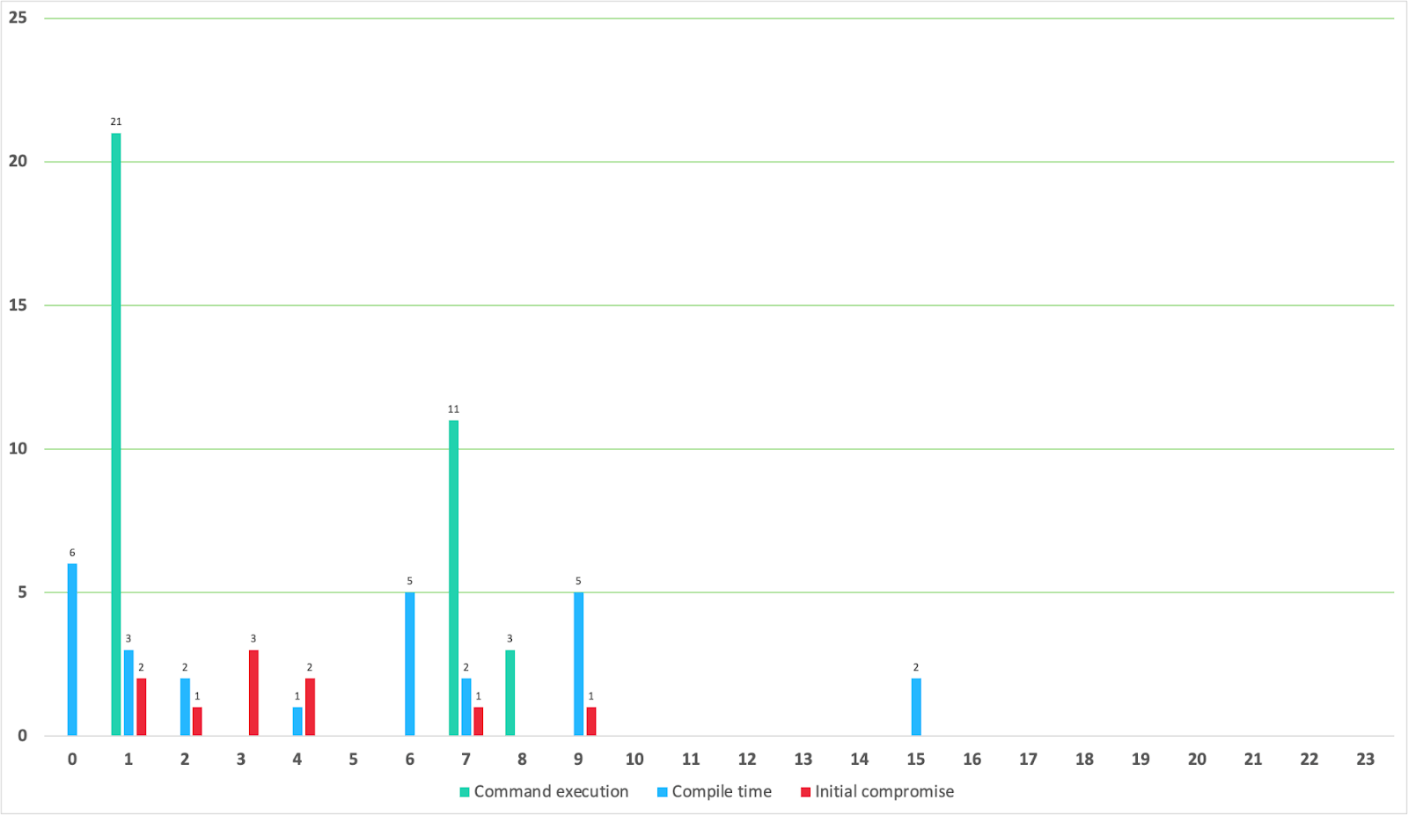
    Throughout this campaign, several malware samples were used that we managed to attribute to the Lazarus group through our ongoing and dedicated research conducted for a long time. Our attribution is supported by the historical use of the malware strains, as well as their TTPs, all of which have been well documented by numerous security solutions vendors and governments. Furthermore, we have analyzed the execution time of the Windows commands delivered by the COPPERHEDGE malware, the build timestamps of all malicious samples we described above, and the time of initial compromise per host, demonstrating that the timeframes were mostly concentrated between GMT 00:00 and 09:00. Based on our knowledge of normal working hours in various time zones, we can infer that the actor is located in the GMT+09 time zone.

    Timeline of malicious activity

    Victims

    We identified at least six software, IT, financial, semiconductor manufacturing and telecommunication organizations in South Korea that fell victim to “Operation SyncHole”. However, we are confident that there are many more affected organizations across a broader range of industries, given the popularity of the software exploited by Lazarus in this campaign.

    Conclusion

    This is not the first time that the Lazarus group exploited supply chains with a full understanding of the software ecosystem in South Korea. We have already described similar attacks in our analysis reports on the Bookcode cluster in 2020, the DeathNote cluster in 2022, and the SIGNBT malware in 2023. All of these cases targeted software developed by South Korean vendors that required installation for online banking and government services. Both of the software products exploited in this case are in line with past cases, meaning that the Lazarus group is endlessly adopting an effective strategy based on cascading supply chain attacks.

    The Lazarus group’s specialized attacks targeting supply chains in South Korea are expected to continue in the future. Our research over the past few years provided evidence that many software development vendors in Korea have already been attacked, and if the source code of a product has been compromised, other zero-day vulnerabilities may continue to be discovered. The attackers are also making efforts to minimize detection by developing new malware or enhancing existing malware. In particular, they introduce enhancements to the communication with the C2, command structure, and the way they send and receive data.

    We have proven that accurate detection and quick response can effectively deter their tactics, and in the meantime, we were able to remediate vulnerabilities and mitigate attacks to minimize damage. We will continue to monitor the activity of this group and remain agile in responding to their changes. We also recommend using reliable security solutions to stay alert and mitigate potential risks. Our product line for businesses helps identify and prevent attacks of any complexity at an early stage.

    Kaspersky products detect the exploits and malware used in this attack with the following verdicts: Trojan.Win64.Lazarus.*, Trojan.Win32.Lazarus.*, MEM:Trojan.Win32.Cometer.gen, MEM:Trojan.Win32.SEPEH.gen, Trojan.Win32.Manuscrypt.*, Trojan.Win64.Manuscrypt.*, Trojan.Win32.Zenpak.*.

    Indicators of Compromise

    More IoCs are available to customers of the Kaspersky Intelligence Reporting Service. Contact: intelreports@kaspersky.com.

    Variant of the ThreatNeedle loader
    f1bcb4c5aa35220757d09fc5feea193b C:System32PCAuditex.dll

    Variant of the wAgent loader
    dc0e17879d66ea9409cdf679bfea388c C:ProgramDataintelutil.dat

    COPPERHEDGE dropper
    2d47ef0089010d9b699cd1bbbc66f10a %AppData%hnc_net.tmp

    C2 servers
    www[.]smartmanagerex[.]com
    hxxps://thek-portal[.]com/eng/career/index.asp
    hxxps://builsf[.]com/inc/left.php
    hxxps://www[.]rsdf[.]kr/wp-content/uploads/2024/01/index.php
    hxxp://www[.]shcpump[.]com/admin/form/skin/formBasic/style.php
    hxxps://htns[.]com/eng/skin/member/basic/skin.php
    hxxps://kadsm[.]org/skin/board/basic/write_comment_skin.php
    hxxp://bluekostec[.]com/eng/community/write.asp
    hxxp://dream.bluit.gethompy[.]com/mobile/skin/board/gallery/index.skin.php

    MIL OSI Economics

  • MIL-OSI Economics: Sales, Production, and Export Results for March 2025

    Source: Toyota

    Headline: Sales, Production, and Export Results for March 2025

    Toyota Motor Corporation announces its sales, production, and export results for March 2025 as well as the cumulative total from January to March 2025, and the fiscal year from April 1, 2024 to March 31, 2025, including those for subsidiaries Daihatsu Motor Co., Ltd. and Hino Motors, Ltd.

    MIL OSI Economics

  • MIL-OSI Economics: ASEAN digital senior officials call for collaboration towards an inclusive and trusted digital ecosystem

    Source: ASEAN – Association of SouthEast Asian Nations

    JAKARTA, 23 April 2025 – The First ASEAN Digital Senior Officials’ Meeting and ASEAN Telecommunications Regulators’ Council (ADGSOM – ATRC) Leaders’ Retreat of 2025 took place on 22-23 April in Jakarta.
     
    The two-day event was chaired by Thailand as the ADGSOM Chair for 2025. The meeting discussed the outcomes and follow-up actions from the 5th ASEAN Digital Ministers’ Meeting (ADGMIN) held on 13-17 January 2025 in Bangkok. Additionally, the 5th Meeting of the ASEAN Working Group on Anti-Online Scam (WG-AS) was held on the sidelines, to discuss ASEAN Member States’ (AMS) collective measures in tackling online scams in the region.
     
    Under the theme of Thailand’s ADGMIN Chairmanship in 2025, “Secure, Innovative, Inclusive: Shaping ASEAN’s Digital Future” is essential to fully unlock the potential of ASEAN Digital Economy by harnessing the transformative power of artificial intelligence (AI) which requires multiple stakeholder’s collaboration including policy makers, private sector and the community towards shaping ASEAN’s Digital Future.
     
    The meeting welcomed a proposal for joint collaboration between ADGSOM and the ASEAN Foundation to organise the ASEAN Digital Forum 2026, which will be held alongside the 6th ADGMIN in early 2026 in Viet Nam. Additionally, the development of the ASEAN Digital Outlook 2025, supported by Google.org. This initiative shall support effective long-term planning across member states, fostering sustained growth and competitiveness in the digital era. The meeting also welcomed the proposals which should strengthen public-private partnerships for knowledge exchange, policy alignment, and the coordination of digital initiatives for alignment with global digital trends and standards.
     
    The meeting welcomed the successful implementation of the ASEAN Digital Masterplan 2025 (ADM2025), noting that 100% of its Enabling Actions (EAs) had been initiated as of April 2025. As ADM2025 approaches its conclusion, the meeting reaffirmed the importance of sustaining the region’s digital transformation momentum through the upcoming ASEAN Digital Masterplan 2030 (ADM2030).
     
    ADM2030 will serve as a visionary framework that will set the pace for ASEAN’s digital future over the next 5 years. In this regard, Viet Nam has been entrusted to lead the development of ADM2030 in 2025, targeted for endorsement at the 6th ADGMIN in early 2026.
     
     
    ###

    Photos Credit: Biro Humas Kementerian Komunikasi dan Digital
     
    The post ASEAN digital senior officials call for collaboration towards an inclusive and trusted digital ecosystem appeared first on ASEAN Main Portal.

    MIL OSI Economics

  • MIL-OSI Economics: Secretary-General of ASEAN meets with 2025’s ASCC Council Chair in Malaysia

    Source: ASEAN – Association of SouthEast Asian Nations

    Secretary-General of ASEAN, Dr. Kao Kim Hourn, this morning met with H.E. Dato Sri Tiong King Sing, ASEAN Socio-Cultural Community (ASCC) Council Chair 2025 and Minister of Tourism, Arts & Culture of Malaysia, in Kuching, Sarawak, Malaysia, prior to the convening of the 33rd ASCC Council Meeting. The Meeting exchanged views on the ASCC’s priorities for 2025, including the anticipated adoption of the ASCC Strategic Plan by the ASEAN Leaders in May of this year, in Malaysia.

    The post Secretary-General of ASEAN meets with 2025’s ASCC Council Chair in Malaysia appeared first on ASEAN Main Portal.

    MIL OSI Economics

  • MIL-OSI Economics: Money Market Operations as on April 23, 2025

    Source: Reserve Bank of India


    (Amount in ₹ crore, Rate in Per cent)

      Volume
    (One Leg)
    Weighted
    Average Rate
    Range
    A. Overnight Segment (I+II+III+IV) 6,17,832.68 5.87 4.51-6.75
         I. Call Money 16,433.95 5.91 5.00-6.05
         II. Triparty Repo 4,23,148.05 5.83 5.62-6.50
         III. Market Repo 1,76,708.68 5.97 4.51-6.75
         IV. Repo in Corporate Bond 1,542.00 6.20 6.19-6.25
    B. Term Segment      
         I. Notice Money** 163.20 5.70 5.50-5.90
         II. Term Money@@ 1,204.00 5.75-6.20
         III. Triparty Repo 3,160.00 5.90 5.80-6.15
         IV. Market Repo 75.00 5.00 5.00-5.00
         V. Repo in Corporate Bond 0.00
      Auction Date Tenor (Days) Maturity Date Amount Current Rate /
    Cut off Rate
    C. Liquidity Adjustment Facility (LAF), Marginal Standing Facility (MSF) & Standing Deposit Facility (SDF)
    I. Today’s Operations
    1. Fixed Rate          
    2. Variable Rate&          
      (I) Main Operation          
         (a) Repo          
         (b) Reverse Repo          
      (II) Fine Tuning Operations          
         (a) Repo Wed, 23/04/2025 1 Thu, 24/04/2025 18,872.00 6.01
         (b) Reverse Repo          
      (III) Long Term Operations^          
         (a) Repo          
         (b) Reverse Repo          
    3. MSF# Wed, 23/04/2025 1 Thu, 24/04/2025 304.00 6.25
    4. SDFΔ# Wed, 23/04/2025 1 Thu, 24/04/2025 1,33,629.00 5.75
    5. Net liquidity injected from today’s operations [injection (+)/absorption (-)]*       -1,14,453.00  
    II. Outstanding Operations
    1. Fixed Rate          
    2. Variable Rate&          
      (I) Main Operation          
         (a) Repo          
         (b) Reverse Repo          
      (II) Fine Tuning Operations          
         (a) Repo          
         (b) Reverse Repo          
      (III) Long Term Operations^          
         (a) Repo Thu, 17/04/2025 43 Fri, 30/05/2025 25,731.00 6.01
         (b) Reverse Repo          
    3. MSF#          
    4. SDFΔ#          
    D. Standing Liquidity Facility (SLF) Availed from RBI$       10,031.22  
    E. Net liquidity injected from outstanding operations [injection (+)/absorption (-)]*     35,762.22  
    F. Net liquidity injected (outstanding including today’s operations) [injection (+)/absorption (-)]*     -78,690.78  
    G. Cash Reserves Position of Scheduled Commercial Banks
         (i) Cash balances with RBI as on April 23, 2025 9,61,528.98  
         (ii) Average daily cash reserve requirement for the fortnight ending May 02, 2025 9,51,938.00  
    H. Government of India Surplus Cash Balance Reckoned for Auction as on¥ April 23, 2025 18,872.00  
    I. Net durable liquidity [surplus (+)/deficit (-)] as on April 04, 2025 2,36,088.00  
    @ Based on Reserve Bank of India (RBI) / Clearing Corporation of India Limited (CCIL).
    – Not Applicable / No Transaction.
    ** Relates to uncollateralized transactions of 2 to 14 days tenor.
    @@ Relates to uncollateralized transactions of 15 days to one year tenor.
    $ Includes refinance facilities extended by RBI.
    & As per the Press Release No. 2019-2020/1900 dated February 06, 2020.
    Δ As per the Press Release No. 2022-2023/41 dated April 08, 2022.
    * Net liquidity is calculated as Repo+MSF+SLF-Reverse Repo-SDF.
    ¥ As per the Press Release No. 2014-2015/1971 dated March 19, 2015.
    # As per the Press Release No. 2023-2024/1548 dated December 27, 2023.
    ^ As per the Press Release No. 2025-2026/91 dated April 11, 2025.
    Ajit Prasad          
    Deputy General Manager
    (Communications)    
    Press Release: 2025-2026/169

    MIL OSI Economics

  • MIL-OSI Economics: Transcript of April 2025 Fiscal Monitor Press Briefing

    Source: International Monetary Fund

    April 23, 2025

    Speakers:

    Vitor Gaspar, Director, Fiscal Affairs Department
    Era Dabla‑Norris, Deputy Director, Fiscal Affairs Department
    Davide Furceri, Division Chief, Fiscal Affairs Department

    Moderator: Tatiana Mossot, Moderator, Senior Communications Officer

    The Moderator: Good morning, good afternoon, and good evening for our viewers around the world. I am Tatiana Mossot with the IMF Communications Department, and I will be your host for today’s press briefing on the Spring Meetings 2025 Fiscal Monitor named “Fiscal Policy Under Uncertainty.” I am pleased to introduce the Director of the IMF Fiscal Affairs Department, Vitor Gaspar. He is joined by Era Dabla‑Norris, Deputy Director of the Fiscal Affairs Department, and Davide Furceri, Division Chief of the Fiscal Affairs Department. Good morning, Vitor, Era, and Davide.

    Before taking your questions, let me start our briefing by turning to Vitor for his opening remarks. Vitor, the floor is yours.

    Mr. Vitor Gaspar: Good morning. Many thanks for your kind introduction. Thank you all for your interest in the Fiscal Monitor, covering fiscal policies around the world. Since the last Fiscal Monitor in October 2024, global economic prospects have significantly deteriorated and risks to the economic outlook are elevated and tilted to the downside. Uncertainty is very high, and confidence has been weakening. Financial markets have partially corrected, and financing conditions have tightened.

    Global public debt is very high and rising. According to the WEO reference projection in 2025, it will rise above 95 percent of GDP. It is higher and growing faster than pre‑pandemic. It will be approaching 100 percent of GDP by the end of the decade, surpassing the pandemic peak, but global numbers hide a wide diversity across countries. In the figure, every bubble represents a country. The larger the bubble, the larger the country’s GDP. The figure shows debt levels on the vertical axis and debt growth on the horizontal axis compared to pre‑pandemic. The higher the bubble in the figure, the more debt has increased compared to 2019.

    119 countries are above the horizontal axis. For these countries, public debt is higher than pre‑pandemic. The further to the right in the figure, the faster debt grows compared to pre‑pandemic trends. Bubbles as you can see are all over the chart. That illustrates a wide diversity across countries. Therefore, fiscal policies must vary in line with country‑specific factors and circumstances, but in the face of turbulent and threatening times ahead, resilience is needed everywhere. Countries should redouble efforts to keep their own fiscal house in order.

    Let us zoom in on the top, the right top quadrant. Countries in the quadrant have public debt higher and rising faster. This group includes 59 countries. That is about one third of the 175 countries in the chart. But their economies represent 80 percent of world GDP. Their economic weight makes them the main drivers of global trends. You can see many large bubbles in this quadrant. No surprise. Most large economies, including the largest, are there.

    Now, let us focus on the remaining two thirds of countries in the world. There are 116 countries in the group that represent about 20 percent of world GDP. In the chart that you are looking at, the blue line represents all countries except for the 59 that I have mentioned before. The two lines in the chart representing the world and representing the remaining 116 countries evolve similarly up to the year of the pandemic. After 2020, as you can see, the trends diverge. The two lines actually cross in 2023. For these 116 countries, aggregate public debt is now well below pandemic levels, but going forward, it is very flat, indicating a stabilization of public debt at high levels. But the distinctive feature of the current conjuncture is uncertainty. One must go beyond referenced projections.

    In the words of the Managing Director, trade policy uncertainty is off the charts. Upside risk to public debt projections dominates the outlook. The October 2024 Fiscal Monitor introduced a novel tool to quantify the distribution of debt risks around the referenced projection. We call it public debt at risk. According to this tool, global public debt three years ahead would come at 117 percent of GDP in a severe adverse scenario.

    Recent developments with sharpening, increasing, and persistent uncertainty, tightening financing conditions push public debt at risk even higher. In a fast-changing and perilous world, Ministers of Finance must act urgently and decisively. They face stark tradeoffs and painful choices. Policymakers should invest their political capital in building confidence and trust. That starts with keeping their own houses in order. That is especially important in a situation that tested the resilience of individual economies, not to mention the entire system. Putting the house in order involves three policy priorities.

    First, fiscal policy should be part of overall stability‑oriented macroeconomic policies. Second, fiscal policy should in most countries aim at reducing public debt and rebuilding buffers to create space to respond to spending pressures and other economic shocks through a credible medium‑term framework. Third, fiscal policy should, together with other threshold policies, aim at improving potential growth, thereby easing policy tradeoffs. In these times of high uncertainty, fiscal policy must be an anchor for confidence and stability that can contribute to a competitive economy, delivering growth and prosperity for all.

    Ministers of Finance must build trust, tax fairly, spend wisely and take the long view. My colleagues and I are ready to answer any questions that you may have.

    The Moderator: Thank you, Vitor. We will now open the floor to your questions, but before we do that, a couple of ground rules, please. If you want to ask a question, please raise your hand first, wait until I call you and a colleague will give you the microphone. When you ask your questions, please identify yourself and the network you are working for. And for colleagues online, please ask your questions on Webex, and we will come to you.

    QUESTION: According to the report, tariffs and trade tensions have increased uncertainty and risks to economic growth. How can affected countries manage the negative impact on public confidence and growth, especially considering the high level of public debt and financial challenges they are already facing?

    Mr. Vitor Gaspar: Thank you very much for your question. That allows me to summarize again the top‑level message from the Fiscal Monitor. Global public debt, as you said, is high, rising, and we always emphasize it is also risky. It rose above $100 trillion in 2024, and that was a headline six months ago. In the IMF referenced projections, that will continue rising, approaching 100 percent of GDP by the end of the decade.

    But what we emphasize most at this point in time is the unusually elevated degree of uncertainty. To repeat the quote from the Managing Director, “Trade policy uncertainty is literally off the charts.” There is, therefore, a sense of urgency in policymaking. According to our public‑debt‑at‑risk tool, our estimates for three years ahead point to debt at risk at 117 percent of GDP for the world, which is a level that has not been seen in many decades.

    But even that extreme adverse scenario may be under‑estimating tail risks because trade and geoeconomic uncertainty has escalated, financing conditions tightened, financial market volatility is visible from headlines, and spending pressures have intensified further. So, in those conditions, the point about countries keeping their own houses in order is crucial, and that is instrumental to deliver resilience and sustained growth from a long‑term perspective.

    The Moderator: Thank you, Vitor. As you may have seen, there are two chapters, the second one is on emerging markets. And I think Era and Davide; we have some questions for you too.

    QUESTION: Given the current global economic slow‑down, what are the specific challenges and impacts faced by emerging and developing countries and what policy measures can be implemented to mitigate these effects?

    Ms. Era Dabla‑Norris: Let me start with what we see as some of the key sources of uncertainty that emerging market and developing economies are facing. Vitor had laid out some of the broader issues but let me highlight three. So, in addition to the fact that we see growth prospects being marked down across the board, and we see that emerging markets and developing economies could be impacted through trade, financial and commodity channels, let me highlight three specific risks. The first is escalating uncertainty about tariffs and associated policies. In the Fiscal Monitor, we find that geoeconomic uncertainty, in particular, an escalation of geoeconomic uncertainty actually can push up debt over the medium term by about 4.5 percentage points. For emerging market economies in particular, it could be as high as 6 percent of GDP.

    Why is this the case? Because essentially, with higher geoeconomic uncertainty, that can dampen growth prospects, it lowers revenues because consumption production tends to fall. It also leads to higher spending, so as a result, fiscal positions deteriorate and debt increases. That is one important source of risks.

    A second source of risks is more volatile financial conditions. In the U.S., for instance, or other systemically important economies can spillover into emerging market and developing economies. And it can do so by raising sovereign borrowing costs. So, our analysis in the Fiscal Monitor shows that at 100 basis point increase in U.S. nominal Treasury yields translates into 100 basis point increase in emerging market economies’ borrowing costs. And this lasts for several months.

    A third source of risk is that we have seen that debt levels are high in many emerging markets and developing economies, so interest expenses are commensurately very high, and they are eating up a larger share of the budget. So, our analysis shows that 1 percentage point of GDP increase in interest expenses results in crowding out of other essential items within the budget, such as social spending and infrastructure investment. So, as Vitor pointed out, in this environment, it is very, very important for countries to put their own fiscal house in order.

    What does that mean? Country specifics will vary, but what it really means is that countries need to think about putting in place a gradual fiscal adjustment within a credible medium‑term fiscal framework. For EMDEs, where tax revenues are low, they can mobilize additional revenues by expanding the tax base. They can eliminate energy subsidies and other types of subsidies that can be distortionary. They can find ways to reprioritize spending. And most importantly, they can think about the policies that are needed to boost growth because that really can help ease these fiscal tradeoffs.

    QUESTION: My question is about energy subsidies and perhaps pension reforms, which are not related to emerging markets but pretty much the same problem. It is when the margin exists in many countries when you want to have some fiscal space. But in those many countries you have already social tensions that are quite high, so what are the possibilities for countries to make those reforms that are highly unpopular most of the time if they want to have this margin created?

    Ms. Dabla‑Norris: Let me talk about energy subsidies and my colleague Davide can speak a little bit about pension reforms. As you correctly pointed out, countries need to reduce debt. They need to create fiscal space. And energy subsidies and pension reforms can be important reforms that countries can undertake to generate fiscal savings. So, when we look at energy subsidy reforms in particular, energy, they account for about 1.5 percent of GDP on average in emerging markets and developing economies. And reforming them can have tremendous benefits for the economy. So let me enumerate some of them.

    First, it increases energy efficiency in the economy. Secondly, it generates fiscal savings that can then be used to increase other types of social spending and needed priority infrastructure investments. And finally, many of these subsidies tend to be highly regressive, so they do not necessarily benefit the poorest segment or the most vulnerable segments of society.

    In our Fiscal Monitor Chapter 2, what we did is we developed a novel real‑time measure of public sentiment. This is the sentiment of households, civil society organizations, and other stakeholders to gauge how governments can leverage strategies in order to make these kinds of reforms acceptable. There are a number of things that we found that are specific to energy subsidy reforms that I would like to talk about.

    The first is that we found that reforms that are—or changes that take place gradually have greater success of being implemented. To give you an example, Colombia very recently had an energy subsidy reform. They implemented it over a two‑year period, that was preannounced, so that people had time to adjust.

    A second strategy that we found successful—to be successful in shaping the acceptability of these reforms is that there was timely implementation of accompanying measures. And countries that put in place accompanying measures to really protect and support the most vulnerable, countries that put in place measures up‑front and invested in social programs and social infrastructure that was very visible to the public had a greater chance of succeeding.

    We also found that policies that were well‑communicated, that built consensus, that explained the tradeoffs to people had a much higher success of being accepted by the general public. For example, Morocco made it very clear that there was going to be a comprehensive communication strategy at the very beginning, at the very outset, and the message that was conveyed was that subsidies were a poor instrument for providing social support. A host of these strategies can be used by countries to implement these politically challenging reforms.

    Mr. Davide Furceri: The chapter also deals with pension reforms. We know that in many countries, spending on pensions is quite high. Just to give you a couple of numbers, in the case of advanced economies, it is 8 percent of GDP; in emerging market, about four. This spending is projected to increase due to increasing life expectancy and retirement. Reforming the pension system is important to generate fiscal savings but also to sustain labor‑force participation, as well as employment.

    Some of the key messages that we find in the chapter on reforms touch upon some of the issues that Era mentioned, gradual and timly of the reform. But for pension, what we find is that strategic communication and stakeholder engagement has been especially important. Indeed, there are cases of countries that have succeeded in implementing significant reform, for example, presenting an increasing retirement age as part of the reform that was trying to sustain adequate benefit levels. Or in some cases they were creating bipartisan commissions where they were engaging with stakeholders to hear their concerns and think about implementing the reform in the best way.

    An important issue when we think about pension reform is strengthening financial literacy and making sure that various stakeholders will talk about the potential benefits and cost of various pension schemes. Thank you.

    The Moderator: Very last one before we move to the U.S. and the other countries and regional and then we will move to other topics.

    QUESTION: I still want to focus on Chapter 2 because we are talking about developing economies and public sentiment. Era, when you were talking, you talked about subsidies being discretionary, not making the budgets, you know, complete and all of that, but we also know for many developing countries and even frontier economies, they are under pressure to cut back energy subsidies to ease debt burdens, yet these same subsidies often help keep the lights on for millions of families, low‑income families and businesses. You talked about growth earlier on. So, without these low‑income businesses, how would you also get growth? How does the IMF suggest governments manage this delicate balance and enable these countries to rationalize subsidies while safeguarding energy subsidies and cushioning the most vulnerable without leaving them behind because we are torn between having to think that subsidies are really 100 percent bad, so I really wanted to comment on that.

    Then on Nigeria, energy subsidy reforms that were seen have sparked protests and public frustrations, reflecting a top balance between fiscal responsibility and social equity. How do you think that Nigeria can navigate this difficult path and what specific measures can the IMF suggest ensuring that these reforms are fair, inclusive and accepted by the public. Thank you.

    Ms. Era Dabla‑Norris: Let me talk in more detail about subsidies. Thank you for your question. These are challenging reforms to undertake. Why? Because they impact people’s, small firms’ pocketbooks immediately. An increase in energy prices as the government is moving towards cost recovery, pricing impacts pocketbooks immediately. This is a very tangible impact. Whereas the benefits that I spoke of, which are energy efficiency, the ability to reallocate fiscal savings take time to materialize. They are much more diffuse. Everyone benefits from those, but the pocket impact is felt immediately. This is why it is important as we note in our chapter, this is why it is important to have—for governments to think about a comprehensive strategy on how to implement these reforms. When you look at public sentiment across different sort of steps of these reforms, what we find that is really important is that countries that put in place compensatory mechanisms — whether this is cash transfers or more targeted transfers — really for those people who need it most have an easier time in carrying out these types of reforms. So in environments where the public does not trust the government, where there is weak accountability, doing these things up‑front in a very visible way, increasing support for social programs makes it very tangible to the public that the government is going to be doing this, and it is going to be accountable, if you will, for the fiscal savings that will be generated.

    QUESTION: Good morning. As risks for the fiscal outlook have intensified and debt levels may rise even further, as stated in the Fiscal Monitor, how worried are you about any sort of global debt crisis or regional crises that can appear, considering slower growth and new spending pressures on countries?

    Mr. Vitor Gaspar: As you heard yesterday, recession and crisis more than an individual nature are not in our reference projections, although, of course, part of the role of the Fiscal Monitor is precisely to systemically look at risks and vulnerabilities, and our public‑debt‑at‑risk tool is one of the instruments to do exactly that.

    Now, one point which I believe is very important is that precisely because risks and uncertainty are so elevated right now, there is a sense of urgency in policy action. Why? Because there is still time to adopt policies that improve resilience, and there is still time to think through what are the most relevant vulnerability scenarios that apply to individual countries, to regions, or even to broader systems. And it is very important to do that result systemically so that one is ready if and when a crisis comes. Our experience during the pandemic showed that countries that had easy access to financial markets and ample fiscal space did substantially better than others at managing the shocks associated with the pandemic.

    The Moderator: Thank you. We will get back to this part of the room.

    QUESTION: My question is that you just mentioned the public debt remains very elevated and also this would cause fiscal space to continue to narrow down in many countries, including some major economies. So, what consequence will this bring to the world global economy if this kind of situation continues to develop?

    Mr. Vitor Gaspar: So I think that the answer that I gave to the question just now applies, given these elevated risks and uncertainties, it is crucial that countries focus on keeping their own house in order since situations around the world are so diverse, as Era emphasized, that will imply different policies in different countries. But the crucial thing is that in a situation that is as fast changing as the one we are facing now and where risks and uncertainties are so elevated, there is an urgency in acting to improve fiscal space, build buffers, and, therefore, be in a position to ensure resilience and sustain growth.

    The Moderator: Thank you. We will get back to this part of the room. The gentleman with the red shirt, please.

    QUESTION: Thank you very much. Allow me to back‑pedal to the EMDEs. The Fiscal Monitor speaks about the need to widen the tax base. A number of frontier market economies have been rolling out significant economic present stacks and minimum top‑up tax in line with the Pillar 1 and Pillar 2. But now this puts them in the cross‑hairs with the Trump administration, and many are now wondering whether they should be rolling back. So which pathway does the Fund see sustainable, considering many are looking at preferential access to the American market?

    Mr. Davide Furceri: Regarding the tax, I think it is important to make three important points. The first is that in the current situation where many emerging market and developing countries are characterized by three factors, one, foreign aid is declining; second, we have seen that increasing financial volatility can increase interest rates in these countries. This is in a situation where interest rates over revenue for many countries is about 10 percent of GDP. Third, [volatile] financial conditions also implies that less flows will go to these countries. The point that we make in the Fiscal Monitor is that revenue and revenue mobilization can be a stable source for financing significant spending for social benefit or public investment. How we should strengthen revenue mobilization, typically there are three sorts of arrows that you can go. One is expanding the tax base. Second, eliminate tax exemptions. Third, which is also important, and that the IMF does a lot of work in terms of capacity development is strengthening tax administrations. When we think about the tax strategy, we have to consider all of these three elements, and for many emerging markets and developing countries, there are significant potential tax gains that can be achieved.

    The Moderator: Yes, please.

    Mr. Vitor Gaspar: Just one word of addition. Davide correctly pointed out these three very important elements, broadening the tax base, dealing with tax expenditures and strengthening revenue administration. Yesterday I participated in a high‑level panel precisely on the mobilization of resources, and these three elements were repeated by the Ministers of Pakistan, Paraguay and Rwanda, and they found this frame relevant in their own experience of trying to improve the capacity of their countries to mobilize revenues.

    The Moderator: We have two questions online. I think this one will be for you, Era, about Spain. Yesterday they revised upwards the growth of Spain and have already highlighted the good performance of the Spanish economy. What should this country do with these good growth results regarding its fiscal policies in the short and medium term? And we will have another one for South Africa online.

    Ms. Era Dabla‑Norris: Thank you for the question. Given Spain’s relatively strong fiscal position as well as economic position, there is scope now to front‑load some of the adjustment that they were thinking about because public debt levels in Spain still remain very high, although they have come down from the pandemic peaks. They still remain very high. This would be really important to put debt firmly down on a downward trajectory.

    Accumulative adjustment of about 3 percent of GDP over the next three years, say 2025 to 2029, similar to the one that was envisaged in terms of magnitude by the authorities but more frontloaded, would help achieve the goal. Now, as Vitor has pointed out, we are encouraging countries to bring debt down for a number of reasons. This is important because you want to reduce debt risks. This is important because countries should either expand or replenish the buffers that were diminished in the wake of the pandemic and also because of ongoing uncertainties. Finally, because countries will need—countries like Spain will need to spend on other areas, population aging, climate, defense and such.

    The Moderator: Just before we go to South Africa, any other European question? One time, two time, no European question in the room. OK.

    QUESTION: Thank you. The question on South Africa but also on the broader region: On South Africa, the IMF is quite significantly more pessimistic on the fiscal trajectory than our own government, which sees debt stabilizing, whereas the IMF sees it rising close to 90 percent of GDP at the end of the decade. Why are you so much more pessimistic of the authorities’ promised consolidation? But also on the region, sub‑Saharan Africa more broadly, how do you see the impact of what is happening globally on the region’s ability to borrow and particularly to borrow in international markets, and given a lot of the countries in the region are in debt distress or close to debt distress, what impact will that have on the economies of the sub‑Saharan Africa? Thank you.

    The Moderator: Thank you very much.

    Ms. Era Dabla‑Norris: Thank you very much. Briefly on South Africa, the general government deficit in South Africa was about 6 percent of GDP in 2024. We project the fiscal deficit in 2025, although this is subject to considerable—all projections are subject to considerable uncertainties at this juncture to be around 6.6 percent of GDP. This is mainly driven by higher spending. Some of the differences stem from the fact that our projections are based on much more conservative assumptions regarding the buoyancy of the tax system, as well as the extent of primary spending compression that can be undertaken. So that really accounts for differences in projections between the two countries and also the path of debt going forward. Let me turn it over to Davide.

    Mr. Davide Furceri: Yes, more broadly and on financing costs for sub‑Saharan African regions, let me point out two factors. The first is that, of course, we have seen interest rates rising. So, this increasing interest rate in many countries, including South Africa, is basically driven by two factors. You have sort of an interest rate in main advanced economies that has been on a rising trend. On the positive side, in many countries, especially those with better fiscal positions, you actually have seen spreads, so the difference between the domestic interest rate and the foreign interest rate declines. However, and this is something that we point out in the Fiscal Monitor, that increased risk, increase of risk of uncertainty, financial market volatility, can turn things around. In other words, we see that increasing financial market volatility globally can lead to an increase in spreads.

    The second point is that one part we have seen for many low‑income countries since the pandemic is they are relying much more on domestic issuance of debt rather than on the foreign market. This is on one hand sort of offset some of the challenges like to the global environment but also increase some sort of domestic vulnerability, because sometimes the interest rates rise. There are things that are important to think about this strategy. But definitely, as we mentioned, interest rate is a source of rising in terms of revenue is a source of concern. Let me make the point again that we made, I think strengthening fiscal buffers, revenue mobilization are important elements to reduce — to have this trend to decline.

    The Moderator: Thank you. I believe we received some questions for Latin America and, yes, there are some reporters in the room. Yes, please, the lady in the third row here.

    QUESTION: Thank you. You already talked about emerging markets, but focusing on Latin America, I want to know which one—you already have talked about it too, but which one is the biggest fiscal risk and what should economies in Latin America should be thinking about doing in terms of growing and accepting new investment, for example, to confront the situation abroad? Thank you.

    Ms. Era Dabla‑Norris: Thank you for your question. Many of the risks that other emerging market economies face, countries in Latin America obviously also face, we have already talked at length about that. But I am going to talk about a few things that are specific to many of the countries in Latin America. So, there is two challenges that limit fiscal flexibility in Latin America. The first is that there are spending rigidities. What I mean by that is there is a lot of amounts of spending that is mandatory, on pensions, on wages, on transfers. This leaves very little room for fiscal flexibility.

    At the same time, like many other emerging markets and developing economies, spending pressures are on the rise. There are growing demands for social services, for infrastructure, for adopting to climate change, and all of these are putting pressures on the budget. Now, when you look at what has happened since the pandemic, countries have made ambitious plans to consolidate their budget. There have been ambitious announcements of fiscal consolidation plans, but at the same time expenditure increases have outpaced revenue gains. So, for many countries in the region, we see debt levels continuing to rise. And the challenge here is that we are in a world with greater uncertainty than we were even six months ago. So, it is really important for countries in the region to implement at a minimum the announced fiscal consolidation plan and to do this within credible medium‑term frameworks. Many countries in Latin America and the Caribbean region have fiscal rules. So to implement these rules, to spend efficiently, to think about the types of fiscal reforms that are needed, whether it is revenue mobilization in countries where revenue‑to‑GDP ratios are low, whether it is spending prioritization or reprioritization, to create the room that is needed for priority investments and social spending and infrastructure and such.

    The Moderator: Thank you. One last question.

    QUESTION: I am from Thailand. I want to ask about the overall trend of the public debt, especially for the ASEAN 5. It would be great if you could mention specifically on Thailand.

    The Moderator: I think we had the Nigeria question to answer too, and we will close there. Thank you.

    Mr. Davide Furceri: Let me start with Nigeria. So, Nigeria managed to do a very difficult reform that was important to deliver fiscal savings. The authorities also scaled up transfers, technical transfers. What we think there is, what is important to act on two pillars. One is to generate additional fiscal savings. We mentioned revenue mobilization. To really scale up spending on social protection, spending on investment, in a way as was mentioned, many countries, they need to spend, and there I want to go back to Vitor’s first remarks. We encourage countries to spend very wisely. Strengthening prioritization in terms of spending, strengthening the efficiency of spending is important. Final important message we would like to give for Nigeria but also for other countries is that fiscal institutions are very important. Having a medium‑term fiscal framework, Public Financial Management are key important because on the one hand they try to help the fiscal anchor, so they set apart for the fiscal adjustment, but also reduce the fiscal uncertainty per se. So as Vitor mentioned, we want the fiscal to be a source of stability and not a source of uncertainty, and that is where fiscal institutions have an important role to play.

    The Moderator: Thank you. Very quickly, Era.

    Ms. Era Dabla‑Norris: On ASEAN, there is a huge variation in fiscal positions across the region. On average, the ASEAN region debt‑to‑GDP ratios are lower than they are in other emerging market and developing economies. That said, in Thailand, relative to the other countries in ASEAN, debt levels are slightly more elevated, over 60 percent of GDP. Our advice has been that fiscal policy should be prudent and parsimonious, given all the reasons we have discussed over the course of this morning. So, measures that are needed to smooth adjustment in light of higher tariffs should be thought of in a wise way, temporary, targeted measures in the context of tariff uncertainty, and ongoing consolidation plans implemented to bring debt down in a sustainable manner.

    The Moderator: Thank you very much

    IMF Communications Department
    MEDIA RELATIONS

    PRESS OFFICER: Tatiana Mossot

    Phone: +1 202 623-7100Email: MEDIA@IMF.org

    MIL OSI Economics

  • MIL-OSI Economics: How AI can support sustainable energy

    Source: Microsoft

    Headline: How AI can support sustainable energy

    The global energy landscape is constantly evolving with one thing remaining constant: the demand for energy, regardless of the type, continues to increase. There are 8.2 billion people in the world today who all need access to affordable, sustainable, and secure energy. Global energy demand is projected to grow between 11% and 18% by 2050,1 and meeting this growing demand will require innovation from every part of the energy sector value chain.  

    As we witnessed in many leadership dialogues at CERAWeek 2025, AI adoption is taking place at an accelerated speed in the energy sector. The role of AI in meeting rising energy demand is multifaceted and transformative. AI can optimize operations, reduce  energy consumption, enhance grid capacity and reliability, and support renewable energy integration. It can also address energy security and sustainability efforts, such as carbon capture and storage, and methane management and mitigation. AI’s potential in the energy sector is robust. Critically, all these innovations are underpinned by the industry’s collective goal to mitigate environmental impact and continue to move towards a more sustainable future, while meeting the growing demand for energy.   

    Microsoft is committed to helping to drive progress in the energy industry through technological innovation—working to empower the energy workforce, optimize operational efficiency and safety, advance net zero commitments, and grow sustainable, AI-powered businesses.  

    Microsoft for energy and resources

    CERAWeek 2025 takeaways 

    In March 2025, we attended CERAWeek 2025, one of the most influential energy gatherings of the year, which provides a platform for over 8,000 attendees to connect, share and discuss insights, and explore where the industry is headed.  

    This year, a few key takeaways from the event were: 

    • AI is changing the game across industries, and energy is no exception.
      Jason Zander, Executive Vice President for Strategic Missions and Technologies at Microsoft, spoke in the session “Will AI Revolutionize the Energy Sector?” and discussed the ways in which AI is transforming the energy sector with innovative solutions that boost energy efficiency, optimize production, and integrate renewable resources. One of the recent breakthroughs that Jason highlighted is Microsoft’s Majorana 1, the world’s first Quantum Processing Unit (QPU) powered by a Topological Core, designed to scale to a million qubits on a single chip. This advancement has practical applications to help solve some of the most difficult global challenges. It brings the potential to revolutionize the energy industry with possibilities such as developing self-healing materials, enhancing safety, creating catalysts to break down plastics, and significantly advancing sustainability through more recyclable and reusable materials. 
    • Powerful collaboration with industry-leading, strategic partners is key to growth and innovation.
      Several of our partners; Accenture, Cognite, Honeywell, Kongsberg Digital, Schneider Electric, and SLB showcased their industry-leading, real-world solutions in the Microsoft booth. These innovative AI-powered solutions illustrate the immense opportunity to transform the energy industry and empower the energy workforce with modern technology.

      One standout demo was Schneider Electric’s new One Digital Grid Platform, an AI-powered system that helps improve the reliability and efficiency of power grids. Using Microsoft Azure, this platform allows different software solutions to work together, helping utilities modernize their grids and provide cleaner, more affordable energy at a lower overall cost. Schneider Electric is leveraging Microsoft solutions to improve grid reliability, and is collaborating with Itron to do so. Solutions like these, built with strategic partners, address the need for a modern, digital grid to provide energy to all who need it.   

    Transform and optimize resilient energy systems with AI 

    AI’s potential in the energy industry is transformative, with the capability to optimize operations, strengthen security, and advance decarbonization. To provide the energy that the world will require, the energy industry needs intelligent solutions that address these needs with faster insights and increased productivity.  

    The impact of AI solutions is directly correlated to the amount of data companies have at their disposal. For energy companies that may have a fractured data estate spanning diverse environments and proprietary data formats, establishing a unified data foundation is a difficult task. This is why Microsoft is committed to equipping industry leaders with powerful, enterprise platforms like the Microsoft Cloud to accelerate this transformation. And with Microsoft Fabric, data, AI, security, and applications are integrated to enable real-time data processing and AI-powered insights so that companies can make informed decisions more quickly. Microsoft Azure Data Manager for Energy is also an important piece of this energy data journey, and critical to carbon storage and planning. Most powerfully, it can create a repository for all of an organization’s data in a single location. Furthermore, by adopting our adaptive cloud approach and unifying siloed teams, distributed sites, and sprawling systems into a single operation, organizations can increase security, improve data modeling, and leverage cloud-native and AI technologies across hybrid, multicloud, edge, and Internet of Things (IoT) environments. 

    From there, custom reports and insights can be generated with Microsoft 365 Copilot. These cutting-edge solutions are designed to help energy companies harness the full potential of their data with AI—enabling seamless integration, real-time insights, and predictive analytics to help drive efficiency and innovation across the sector.  

    One vast opportunity for the energy sector when it comes to using AI is its power to help decarbonize the energy value chain. It’s clear that decarbonization is a critical step towards achieving a sustainable and net-zero future—involving reducing carbon emissions across all stages of energy production, distribution, and consumption. By integrating renewable energy sources and improving energy efficiency through adopting innovative technologies like AI, the energy sector has the potential to significantly lower its carbon footprint more quickly than was possible without the efficiency gains from AI. The recent International Energy Agency report, “Energy and AI” shares several potential examples of cost and energy savings in power plant operations and end-use sectors, such as manufacturing and transportation. For example, AI in transportation can enhance vehicle operation and management, potentially cutting energy consumption—and therefore emissions—up to 20%.2 

    AI’s potential in enhancing security is immense, offering both vast implications and opportunities. Using AI to enhance security is already making a difference for companies, with a recent study of Copilot users showing that using Microsoft Security Copilot reduced mean time to resolution by 30%.3 Harnessing the power of AI to bolster security in the energy industry, we recently introduced six new Microsoft Security Copilot agents. These agents represent the power of AI to respond to an increasingly high volume of security threats that energy organizations face today. They are designed to autonomously manage high-volume security tasks, helping to provide robust protection for critical energy infrastructure. By leveraging advanced threat intelligence and machine learning, these agents can swiftly detect, investigate, and respond to security incidents, helping to mitigate risks associated with cyberattacks.  

    Demonstrating the power of collaboration in AI innovation, new partner-developed agents will also be available in Security Copilot. These solutions offer industry-specific solutions, such as the ability to understand sector-specific compliance needs. This approach enhances operational efficiency and will help to strengthen the overall security posture for energy companies that adopt agents, allowing IT and operations teams to focus on their core operations while maintaining a resilient defense against ever-evolving threats.  

    Our customers like Chevron are also already seeing the impact of AI in their operations, integrating real-time data from IoT devices, optimizing equipment and bandwidth costs, and accelerating decision-making with AI at the edge. 

    Collaborating with Chevron on facilities of the future with Azure IoT Operations  

    With its Facilities and Operations of the Future initiative, Chevron is reimagining the monitoring of its physical operations to support remote and autonomous operations through enhanced capabilities and real-time access to data. This includes ongoing efforts to use technology to unlock access to connected data across a vast network of IoT devices—ultimately for greater speed to decisions. Chevron worked closely with Microsoft to deploy Azure IoT Operations, enabled by Azure Arc. This edge-to-cloud data plane facilitates data capture from various devices like Wi-Fi cameras, thermal cameras, sensors, robots, and drones at the edge before sending it to the cloud.  Chevron chose Azure for its flexible infrastructure to control data and scale globally, unifying sites and systems into one AI-assisted control pane. Using AI at the edge, where sensors are located at the equipment, helps optimize equipment and bandwidth costs and accelerates speed to insights.  

    Learn more about energy and resources solutions with Microsoft  

    As we look to the future, AI is becoming an increasingly important force in the energy industry—enabling companies to achieve greater safety and efficiency, help secure their operations, and increase sustainability. Key to this growth and innovation is powerful collaboration with our strategic partners and secure, resilient solutions that meet the industry’s robust needs. Microsoft remains dedicated to supporting this journey, providing the tools and technologies needed to thrive in an ever-evolving energy landscape. 

    Microsoft for energy and resources

    Drive innovation to achieve net zero


    1Global Energy Perspective 2024, McKinsey, September 2024. 

    2Energy and AI, AI for energy optimization and innovation.  

    3Agentic AI and Microsoft Security Copilot: Revolutionizing cybersecurity, March 2025.

    MIL OSI Economics

  • MIL-OSI Economics: JP Morgan top M&A financial adviser in power sector during Q1 2025, reveals GlobalData

    Source: GlobalData

    JP Morgan top M&A financial adviser in power sector during Q1 2025, reveals GlobalData

    Posted in Business Fundamentals

    JP Morgan was the top mergers and acquisitions (M&A) financial adviser in the power sector during the first quarter (Q1) of 2025 by both value and volume, according to the latest financial advisers league table by GlobalData, a leading data and analytics company.

    An analysis of GlobalData’s Deals Database reveals that JP Morgan achieved the leading position by advising on four deals of worth $19.5 billion.

    Aurojyoti Bose, Lead Analyst at GlobalData, comments: “JP Morgan registered an year-on-year (YoY) growth in the total volume and value during Q1 2025 but the growth is more prominent in terms of value, primarily driven by its involvement in $16.4 billion deal for the acquisition of Calpine by Constellation Energy. It went ahead from occupying the 14th position by value in Q1 2024 to the top position by this metric in Q1 2025. Interestingly, it occupied the 14th position by deal volume in Q1 2024 as well.”

    Goldman Sachs occupied the second position in terms of value, by advising on $19.4 billion worth of deals, followed by Morgan Stanley with $19.2 billion, Barclays with $16.4 billion and Lazard with $16.4 billion.

    Meanwhile, Goldman Sachs occupied the second position in terms of volume with four deals, followed by Moelis & Company with four deals, Ernst & Young with four deals and Morgan Stanley with three deals.

    MIL OSI Economics

  • MIL-OSI Economics: White & Case and Kirkland & Ellis top M&A legal advisers in power sector during Q1 2025, reveals GlobalData

    Source: GlobalData

    White & Case and Kirkland & Ellis top M&A legal advisers in power sector during Q1 2025, reveals GlobalData

    Posted in Business Fundamentals

    White & Case and Kirkland & Ellis were the top mergers and acquisitions (M&A) legal advisers in the power sector during the first quarter (Q1) of 2025 by value and volume, respectively, according to the latest legal advisers league table by GlobalData, a leading data and analytics company.

    An analysis of GlobalData’s Deals Database reveals that White & Case achieved the leading position in terms of value by advising on $23.8 billion worth of deals. Meanwhile, Kirkland & Ellis led in terms of volume by advising on eight deals.

    Aurojyoti Bose, Lead Analyst at GlobalData, comments: “There is an year-on-year (YoY) improvement in the total number of deals advised by Kirkland & Ellis during Q1 2025. Resultantly, its ranking by volume improved from the fourth position to the top position. Apart from leading by volume, Kirkland & Ellis also held the second position by value in Q1 2025.

    “Meanwhile, White & Case, which led by value in Q1 2025, was not even among the top 10 by this metric in Q1 2024. Due to the involvement in some big-ticket deals, it registered multifold jump in the total value of deals advised by it during Q1 2025. Resultantly, it went ahead from occupying the 24th position by value in Q1 2024 to top the chart in Q1 2025. It advised on billion-dollar deals* during Q1 2025 that also included a mega deal valued more than $10 billion. Apart from leading by value, the company also held the fifth position by volume in Q1 2025.”

    Kirkland & Ellis occupied the second position in terms of value, by advising on $20.9 billion worth of deals, followed by Latham & Watkins with $19 billion and Gibson, Dunn & Crutcher with $16.4 billion.

    Meanwhile, Latham & Watkins occupied the second position in terms of volume with eight deals, followed by Cuatrecasas with seven deals, CMS with seven deals and White & Case with six deals.

    *Deal valued more than or equal to $1 billion

    MIL OSI Economics

  • MIL-OSI Economics: Russia nuclear power capacity to reach 33.6GW in 2035, forecasts GlobalData

    Source: GlobalData

    Russia nuclear power capacity to reach 33.6GW in 2035, forecasts GlobalData

    Posted in Power

    Russia stands as a global leader in nuclear power production and technology. Following the Chernobyl disaster, nuclear power experienced a decline in public support within the country. However, in 2020, the Russian government endorsed the creation of over 40GW of nuclear power capacity by 2030. Against this backdrop, nuclear power capacity in the country is expected to reach 33.6GW in 2035, registering a compound annual growth rate (CAGR) of 2.1% during 2024-35, according to GlobalData, a leading data and analytics company.

    GlobalData’s latest report, “Russia Power Market Outlook to 2035, Update 2025 – Market Trends, Regulations, and Competitive Landscape,” reveals that annual nuclear power generation in Russia is expected to increase at a CAGR of 2% between 2024-35 to reach 251.6TWh.

    According to the most recent General Scheme, the government’s objective is to elevate the share of nuclear energy in the national capacity from the current 10.4% to over 15% by 2042. This strategic initiative underscores Russia’s dedication to enhancing its nuclear power infrastructure and securing a more substantial role for nuclear energy in its long-term energy strategy.

    Attaurrahman Ojindaram Saibasan, Senior Power Analyst at GlobalData, comments: “Russia is investing in advanced reactor technologies to improve efficiency and safety. The BREST-OD-300, a lead-cooled fast reactor currently under construction in Seversk, is engineered for passive safety features and a closed fuel cycle. Additionally, the development of the RITM Series Reactors, including the RITM-200 and RITM-400, is progressing. These small modular reactors (SMRs) are designed for deployment in remote areas and for integration with floating nuclear power plants, offering enhanced flexibility and a diminished environmental footprint.”

    Russia is exploring regional partnerships with Uzbekistan, Iran, and Vietnam for nuclear development and harbors ambitious plans to investigate the use of SMRs in extraterrestrial settings. In collaboration with China, Russia aims to establish a nuclear-powered lunar base by 2035, which will include a command center, power station, and scientific laboratories. While the concept may seem implausible, it showcases the nation’s expertise in nuclear technology.

    Saibasan concludes: “The focus would be on SMRs to meet the increasing demand in Russia. Some of the key upcoming SMR projects include Seversk-BREST SMR, Primorsk SMR 1& 2, Zheleznogorsk MCC SMR 1, and North West SMR 2. Though the country may fall short of achieving its 40GW nuclear power target by 2030, it will continue to progress aggressively towards nuclear power development to ensure supply security.”

    MIL OSI Economics

  • MIL-OSI Economics: Hilco offers Lakeland a lifeline, but it must adapt, says GlobalData

    Source: GlobalData

    Hilco offers Lakeland a lifeline, but it must adapt, says GlobalData

    Posted in Retail

    Following the news of Lakeland being close to agreeing a Hilco-financed management buyout;

    Oliver Maddison, Retail Analyst at GlobalData, a leading data and analytics company, offers his view:

    “Lakeland’s inability to adapt has meant that it has struggled to compete for some time; it took a global pandemic for it to start taking online seriously, meaning its website offers less functionality than its rivals, which combined with its low store count of just 58, has made it inconvenient to shop at. This left it vulnerable to competition from the likes of Dunelm, which has over 200 stores and online penetration of 41%; rival kitchen specialist ProCook, which grew its Q4 online sales by 23.4%; and the grocers, which offer readily available ranges of low-cost cookware.

    “Its lack of agility meant that it was unable to adapt its offering to changing circumstances. Lakeland made hay out of its ‘Smart Save’ campaign, promoting energy-saving electrical items like air fryers and heated airers when energy prices were high, but failed to shift the campaign’s focus to other more relevant areas, such as its cooking and baking range, when energy prices normalised but inflation remained elevated.”

    Maddison concludes: “As a proportion of its revenues, Lakeland’s operating costs (52.0%) are much higher than rivals like Dunelm (38.6%), even though gross margins are similar (50.8% vs 52.8% respectively), exposing Lakeland’s operational inefficiencies. Tellingly, the only years between 2018 and 2023 that Lakeland made a profit were during 2020 and 2021, when its operating costs were effectively subsidised through policies such as the furlough scheme. Especially with increases to NICs and the minimum wage, cost control will be at the top of the agenda for Lakeland’s new ownership.”

    MIL OSI Economics

  • MIL-OSI Economics: Big day for Microsoft 365 Copilot: I’m really excited about our latest update. Copilot has truly become the UI for AI – and for me, it’s the scaffolding for my workday. Here are four new features I’ve especially been enjoying…

    Source: Microsoft

    Headline: Big day for Microsoft 365 Copilot: I’m really excited about our latest update. Copilot has truly become the UI for AI – and for me, it’s the scaffolding for my workday. Here are four new features I’ve especially been enjoying…

    Big day for Microsoft 365 Copilot: I’m really excited about our latest update. Copilot has truly become the UI for AI – and for me, it’s the scaffolding for my workday. Here are four new features I’ve especially been enjoying: 1) Agents: Our new Researcher and Analyst agents have become my go-to 24/7 experts. I use them all the time. With Researcher, the multi-step reasoning aggregates and synthesizes information from the web and all enterprise data and creates super insightful reports on any topic or project. And Analyst can turn raw data across multiple sources into deep insights, forecasts or a great visualization. With our new Agent Store, you can easily find a range of additional agents from our many partners too. And with Copilot Studio you can create your own agents. It’s as straightforward as creating a Word doc or Excel sheet. 2) Notebooks: With Web + Work + Pages, you can ideate with AI and collaborate with other people. It has entirely changed my workflow. And now with Notebooks, I can organize all of my heterogeneous data for a project, whether it’s Pages, docs, websites, team meetings – and Copilot will ground itself just on that content. And this might be the best part: I can turn it all into a new modality like an audio overview. For example, I can collect all the latest things I’m reading about agents and agent frameworks, and then I can listen to it. 3) Search: We have added new comprehensive search capability that spans all your apps, including third-party sources from ServiceNow to Google Drive, Slack, Confluence, Jira, and more, breaking down silos across the enterprise. Search brings back both a Copilot answer, as well as all of the source data from all of these artifacts. 4) Create: This one is fun. Turn a PowerPoint into an explainer video, or generate an image from a prompt in Copilot with just a few clicks. We’ve also added new features to make Copilot even more personalized to you, plus a redesigned app built for human-agent collaboration. Learn more about our update here: https://lnkd.in/g_FGnKZA

    MIL OSI Economics

  • MIL-OSI Economics: Why international alignment of cybersecurity regulations needs to be a priority

    Source: Microsoft

    Headline: Why international alignment of cybersecurity regulations needs to be a priority

    The cyber threat landscape continues to become more dangerous and complex. Ransomware attacks have disrupted services to the public in dozens of countries around the world. Sophisticated cyber threat actors challenge even the best-prepared organizations and individuals.

    In response, governments around the world have passed new cybersecurity laws and regulations in recent years, hoping to better protect societies from malicious cyber activity. We commend these efforts to keep our digital systems secure. However, as we’ve said before, the fragmentation of cybersecurity regulations complicates our efforts to thwart these attacks.

    This growing regulatory divergence across countries and across sectors makes it difficult to implement consistent security measures across jurisdictions and causes potential delays due to the complexity of managing multiple regulatory landscapes. It also exacerbates the global cybersecurity talent shortage organizations are facing.

    To effectively strengthen our collective defenses, the public and private sectors must streamline regulations and promote international alignment, including reciprocity agreements. 

    Greater alignment of cybersecurity regulations is a growing priority for industry leaders. More than 50 Chief Information Security Officers (CISOs) from leading global companies, including Microsoft, have signed a letter emphasizing the urgency to take such action.

    The CISO letter highlights key challenges created by the current regulatory landscape, including incident response and crisis management complexities during cyberattacks and delays in coordinating defense efforts. The increasing divergence among regulations across different jurisdictions also limits the ability of governments and private sector entities to share threat intelligence efficiently, weakening collective cyber resilience.

    The CISO community calls on governments to:

    1. Encourage high-level commitments from global policymakers to enhance regulatory alignment and promote a balanced approach to cybersecurity regulations
    2. Facilitate international dialogue among regulators through established global platforms, including the OECD, ensuring diverse stakeholder participation.
    3. Explore mutual recognition agreements and other mechanisms that streamline compliance while raising the global cybersecurity baseline.

    While there are many cybersecurity conferences, there is currently no dedicated forum that regularly convenes cybersecurity regulators and provides an opportunity to learn from each other and to engage with industry to ensure we achieve stronger cybersecurity.

    The joint CISO letter recommends leveraging the Organisation for Economic Co-Operation and Development (OECD), which is uniquely positioned to help drive meaningful progress across key countries. By convening relevant stakeholders, analyzing regulatory impacts, and providing data-driven recommendations, the OECD can serve as a key facilitator in ensuring cybersecurity regulations are effective and aligned across jurisdictions.

    Collaboration between international organizations, governments, and industry is essential to translating these efforts into impactful, real-world solutions.

    Countries around the world have an opportunity to lead together. Through cooperation across borders and sectors, we can reduce complexity, build trust, and create a regulatory environment that strengthens cyber resilience worldwide.

    Microsoft is ready to partner with governments, international organizations, and industry partners to promote alignment in cybersecurity regulation. We invite all stakeholders to join this global conversation because protecting our shared digital future is a team effort.

    Read the full letter from the CISO’s here.

    MIL OSI Economics

  • MIL-OSI Economics: Toyota Invests Additional $88 Million its U.S. West Virginia Plant

    Source: Toyota

    Headline: Toyota Invests Additional $88 Million its U.S. West Virginia Plant

    Toyota’s North American subsidiary Toyota North America, Inc, announced today an additional investment of $88 million in its West Virginia plant to assemble the next generation of hybrid transaxles. This brings the total investment in this plant to more than $2.8 billion.

    MIL OSI Economics

  • MIL-OSI Economics: zfstiftung.de: BaFin warns about ZukunftsFinanz Stiftung

    Source: Bundesanstalt für Finanzdienstleistungsaufsicht – In English

    The financial supervisory authority BaFin warns against investment recommendations and investment offers from ZukunftsFinanz Stiftung, particularly via its WhatsApp group. Neither the allegedly Frankfurt-based ZukunftsFinanz Stiftung nor its representative, Dr Max Becker, have been granted a licence to conduct banking, financial and/or investment services in Germany.

    Anyone providing financial or investment services in Germany may do so only with authorisation from BaFin. However, some companies offer these services without the necessary authorisation.

    The information provided by BaFin is based on section 37 (4) of the German Banking Act (Kreditwesengesetz – KWG).

    Please be aware:

    BaFin, the German Federal Criminal Police Office (BundeskriminalamtBKA) and the German state criminal police offices (Landeskriminalämter) recommend that consumers seeking to invest money online should exercise the utmost caution and do the necessary research beforehand in order to identify fraud attempts at an early stage.

    MIL OSI Economics

  • MIL-OSI Economics: Panasonic Energy Named Official Battery Cell Supplier for Harbinger’s Medium-Duty Electric Vehicles

    Source: Panasonic

    Headline: Panasonic Energy Named Official Battery Cell Supplier for Harbinger’s Medium-Duty Electric Vehicles

    The content in this website is accurate at the time of publication but may be subject to change without notice.Please note therefore that these documents may not always contain the most up-to-date information.Please note that German, French and Chinese versions are machine translations, so the quality and accuracy may vary.

    MIL OSI Economics

  • MIL-OSI Economics: Exports through warehouses in ‘Bharat Mart’ in UAE – relaxations

    Source: Reserve Bank of India

    RBI/2025-26/30
    A.P. (DIR Series) Circular No. 03

    April 23, 2025

    To,

    All Authorised Dealer Category-I banks

    Madam / Sir,

    Exports through warehouses in ‘Bharat Mart’ in UAE – relaxations

    Attention of Authorised Dealer Category – I banks (AD banks) is invited to Clause (a) of Sub regulation 1 of Regulation 9 of Foreign Exchange Management (Export of Goods & Services) Regulations, 2015 {Notification No. FEMA 23(R)/2015-RB} and Para C.6 and C.13 of Master Direction – Export of Goods & Services.

    2. To facilitate export through warehouses in ‘Bharat Mart’, a multimodal logistics network based marketplace in United Arab Emirates (UAE) that will provide Indian traders, exporters, and manufacturers access to the markets in UAE as well as worldwide, it has been decided to provide the following relaxations:

    a) AD banks may allow exporters to realise and repatriate full export value of goods exported to ‘Bharat Mart’ within nine months from the date of sale of the goods from the warehouse.

    b) AD banks may allow the following without any pre-conditions, after verifying the reasonableness of the same:

    1. Opening/hiring of a warehouse in ‘Bharat Mart’ by an Indian exporter with a valid Importer Exporter Code.

    2. Remittances by the Indian exporter for initial as well as recurring expenses for setup and continuing business operations of its offices.

    3. The above instructions shall come into force with immediate effect. AD Category-I banks may bring the contents of this circular to the notice of their constituents concerned.

    4. The directions contained in this circular have been issued under sections 10(4) and 11(1) of the Foreign Exchange Management Act (FEMA), 1999 (42 of 1999) and are without prejudice to permissions / approvals, if any, required under any other law.

    Yours faithfully,

    (N. Senthil Kumar)
    Chief General Manager

    MIL OSI Economics

  • MIL-OSI Economics: Primary (Urban) Co-operative Banks’ Outlook 2023-24

    Source: Reserve Bank of India

    The Reserve Bank of India today herewith releases the 11th volume of the annual publication titled ‘Primary (Urban) Co-operative Banks’ Outlook 2023-24’. It can be accessed at https://data.rbi.org.in/#/dbie/reports/Publication/Time-Series%20Publications/Primary%20%28Urban%29%20Co-operative%20Banks’%20Outlook. The publication has been brought out by the ‘Department of Supervision’ of the Reserve Bank of India.

    The publication covers the financial accounts of Scheduled and Non-Scheduled Primary (Urban) Co-operative Banks for the financial year 2023-24. The publication provides aggregate information on major items of balance sheet, profit and loss account, non-performing assets, financial ratios, state-wise distribution of offices and details of priority sector advances. Besides, the publication also provides bank-wise information of Scheduled Primary (Urban) Co-operative Banks on balance sheet items, select financial ratios on Capital Adequacy, Profitability, and Employee Productivity. The publication is being brought out in only electronic form on an annual basis on the Reserve Bank’s website through the link https://data.rbi.org.in/#/dbie/reports/Publication/Time-Series%20Publications/Primary%20%28Urban%29%20Co-operative%20Banks’%20Outlook of Database on Indian Economy (DBIE). There will be no hard copies of the publication available for the reference in the matter.

    (Puneet Pancholy)  
    Chief General Manager

    Press Release: 2025-2026/168

    MIL OSI Economics