Category: Economics

  • MIL-OSI Economics: BSTDB Clarifies No Affiliation with the Black Sea Bank for Reconstruction and Development

    Source: Black Sea Trade and Development Bank

    Press Release | 25-Feb-2025

    Reaffirmation of our Distinct Identity as a Multilateral Financial Institution

    Following the announcement of EU sanctions concerning the Black Sea Bank for Reconstruction and Development (ChBRR, in Russian – ЧБРР, based in Simferopol, Crimea), the Black Sea Trade and Development Bank (BSTDB) is issuing this public clarification to unequivocally state that BSTDB has no (no) affiliation, connection, or dealings with the Black Sea Bank for Reconstruction and Development.

    BSTDB is an International Financial Institution established by an intergovernmental treaty, comprising eleven Member States from the Black Sea region. Headquartered in Thessaloniki, Greece, the Bank was established under an intergovernmental treaty registered with the United Nations (Multilateral, No. 36909) and operates in accordance with international standards.

    BSTDB remains committed to its mission of promoting economic development and regional cooperation across the Black Sea region and underscores its distinct and separate identity from any similarly named organizations.

    To avoid any misrepresentation, BSTDB also urges all media outlets and stakeholders to ensure the correct use of its official logo and branding in any related reporting.


    The Black Sea Trade and Development Bank (BSTDB) is an international financial institution established by Albania, Armenia, Azerbaijan, Bulgaria, Georgia, Greece, Moldova, Romania, Russia, Türkiye, and Ukraine. The BSTDB headquarters are in Thessaloniki, Greece. BSTDB supports economic development and regional cooperation by providing loans, credit lines, equity and guarantees for projects and trade financing in the public and private sectors in its member countries. The authorized capital of the Bank is EUR 3.45 billion. For information on BSTDB, visit www.bstdb.org.


    Contact: Haroula Christodoulou

    : @BSTDB

    MIL OSI Economics

  • MIL-OSI Economics: BSTDB and TuranBank Partner to Boost Small Businesses in Azerbaijan

    Source: Black Sea Trade and Development Bank

    Press Release | 28-Feb-2025

    Promoting Sustainable Growth and Trade in the Country

    To facilitate development and growth in Azerbaijan, the Black Sea Trade and Development Bank (BSTDB) has extended the Azeri Manat equivalent of a USD 6 million loan to TuranBank. The funds will be channeled to domestic small and medium-sized enterprises (SMEs) to meet their investment programmes and working capital needs, as well as enhance their trade activity.

    In addition, the funding will also expand access to local-currency financing for private companies, further reducing their reliance on foreign currency borrowings and protecting business owners from direct exposure to exchange rate risks.

    “BSTDB is pleased to continue its partnership with TuranBank to empower SMEs in the country, giving them access to resources they need to grow, innovate and drive inclusive economic progress. This will help unlock employment opportunities and foster sustainable development both within the country and across the region. We are confident that our joint efforts will continue to deliver meaningful results in the future.”, said Dr. Serhat Köksal, BSTDB President.

    “The funds raised in local currency will be allocated to financing the real sector, particularly micro, small, and medium-sized enterprises, which are the primary focus of the bank’s strategic objectives. This will also help support entrepreneurs operating in the regions. This agreement further underscores international financial institutions’ confidence in the long-term stability and sustainable development of our bank as a reliable partner,” said Orkhan Garayev, Chairman of the Management of TuranBank OJSC.

    BSTDB has been cooperating with TuranBank since 2011, having provided revolving trade finance and SME finance facilities that have benefited dozens of beneficiaries.

    Established in 1992 and headquartered in Baku, TuranBank OJSC is a mid-sized bank expanding to 22 sales points across the country. The bank is one of the key participants in the country’s financial sector, distinguished by its stability and reliability. For detailed information about the products and services offered by TuranBank, visit https://www.turanbank.az/en/pages/1, or follow its social media pages.

    The Black Sea Trade and Development Bank (BSTDB) is an international financial institution established by Albania, Armenia, Azerbaijan, Bulgaria, Georgia, Greece, Moldova, Romania, Russia, Türkiye, and Ukraine. The BSTDB headquarters are in Thessaloniki, Greece. BSTDB supports economic development and regional cooperation by providing loans, credit lines, equity and guarantees for projects and trade financing in the public and private sectors in its member countries. The authorized capital of the Bank is EUR 3.45 billion. For information on BSTDB, visit www.bstdb.org.


    Contact:
    Haroula Christodoulou
    E-mail: cchristodoulou@bstdb.org
    Phone: +30 2310 290533
    Twitter: @BSTDB; @Haroulax 

    MIL OSI Economics

  • MIL-OSI Economics: Huawei Named a Customers’ Choice in Gartner® Peer Insights™ Voice of the Customer for Primary Storage Four Times Feb 28, 2025

    Source: Huawei

    Headline: Huawei Named a Customers’ Choice in Gartner® Peer Insights Voice of the Customer for Primary Storage Four Times
    Feb 28, 2025

    [Shenzhen, China, February 27, 2025] With a 100% willingness to recommend rating and a full score of 5.0 based on 227 reviews as of December 2024, Huawei was named a Customers’ Choice for the fourth time in 2025 Gartner® Peer Insights Voice of the Customer for Primary Storage Platforms.
    Huawei named a Customers’ Choice in Gartner® Peer Insights four times

    Gartner Peer Insights is a free peer review and ratings platform designed for enterprise software and services decision makers. Reviews are organized by products in live markets that align to Gartner research markets, defined as Magic Quadrant or Market Guide–defined markets, or GPI-defined markets that are opened at the discretion of the GPI team and do not require research published to open the space on Peer Insights. And the “Voice of the Customer” is a document that applies a methodology to aggregated Gartner Peer Insights’ reviews in a market to provide an overall perspective for IT decision makers.
    By December 2024, Huawei OceanStor Dorado All-Flash Storage had been reviewed by hundreds of customers worldwide in various regions covering industries in a wide range of economic sectors, such as finance, manufacturing, and telecommunications, among others.
    Huawei OceanStor Dorado All-Flash Storage is deployed at customers sites in over 150 countries and regions including Latin America, Europe, Africa, the Middle East, and Asia-Pacific, where it provides reliable services in sectors such as finance, telecommunications, government, and public utilities.
    “We appreciate our global customers for their positive feedback and strong recommendations for Huawei’s primary storage. Being named a Customers’ Choice four times is the highest form of recognition we can receive from our customers and a driving force for our continuous improvement,” remarked Huang Tao, President of Huawei Flash Storage Domain. “In our commitment to innovation, we will continue investing in storage performance, reliability, usability, and management efficiency. Our goal is to provide an exceptional data service experience for our customers and become the preferred choice for data infrastructure in every field,” added Huang.
    To learn more about Huawei Data Storage products and solutions, please visit the Huawei Data Storage official website: https://e.huawei.com/en/products/storage

    MIL OSI Economics

  • MIL-OSI Economics: Huawei Named a Customers’ Choice in Gartner® Peer Insights™ Voice of the Customer for Primary Storage Four Times

    Source: Huawei

    Headline: Huawei Named a Customers’ Choice in Gartner® Peer Insights Voice of the Customer for Primary Storage Four Times

    [Shenzhen, China, February 27, 2025] With a 100% willingness to recommend rating and a full score of 5.0 based on 227 reviews as of December 2024, Huawei was named a Customers’ Choice for the fourth time in 2025 Gartner® Peer Insights Voice of the Customer for Primary Storage Platforms.
    Huawei named a Customers’ Choice in Gartner® Peer Insights four times

    Gartner Peer Insights is a free peer review and ratings platform designed for enterprise software and services decision makers. Reviews are organized by products in live markets that align to Gartner research markets, defined as Magic Quadrant or Market Guide–defined markets, or GPI-defined markets that are opened at the discretion of the GPI team and do not require research published to open the space on Peer Insights. And the “Voice of the Customer” is a document that applies a methodology to aggregated Gartner Peer Insights’ reviews in a market to provide an overall perspective for IT decision makers.
    By December 2024, Huawei OceanStor Dorado All-Flash Storage had been reviewed by hundreds of customers worldwide in various regions covering industries in a wide range of economic sectors, such as finance, manufacturing, and telecommunications, among others.
    Huawei OceanStor Dorado All-Flash Storage is deployed at customers sites in over 150 countries and regions including Latin America, Europe, Africa, the Middle East, and Asia-Pacific, where it provides reliable services in sectors such as finance, telecommunications, government, and public utilities.
    “We appreciate our global customers for their positive feedback and strong recommendations for Huawei’s primary storage. Being named a Customers’ Choice four times is the highest form of recognition we can receive from our customers and a driving force for our continuous improvement,” remarked Huang Tao, President of Huawei Flash Storage Domain. “In our commitment to innovation, we will continue investing in storage performance, reliability, usability, and management efficiency. Our goal is to provide an exceptional data service experience for our customers and become the preferred choice for data infrastructure in every field,” added Huang.
    To learn more about Huawei Data Storage products and solutions, please visit the Huawei Data Storage official website: https://e.huawei.com/en/products/storage

    MIL OSI Economics

  • MIL-OSI Economics: Miami Dolphins and Hard Rock International lead high-value hotel sponsorships, reveals GlobalData

    Source: GlobalData

    Miami Dolphins and Hard Rock International lead high-value hotel sponsorships, reveals GlobalData

    Posted in Sport

    The partnership between the Miami Dolphins and Hard Rock Cafe International (Hard Rock International) stands as a prime example of high-value sponsorships in the travel and tourism sector. With an annual worth of $13.90 million, this 18-year deal combines stadium naming rights and team affiliations, reflecting the increasing significance of sports sponsorships in the hotel industry, particularly within the soccer and NFL landscapes, reveals GlobalData, a leading data and analytics company.

    GlobalData’ s latest report, “Sponsorship Sector Report – Travel & Tourism – Hotels 2025,” reveals that soccer holds the premier position in annual sponsorship deal value and volume within the hotel sector for 2025. Hilton stands as the most active hotel brand in 2025, bosting 36 deals.

    Olivia Snooks, Sport Analyst at GlobalData, comments: “Despite engaging in only three deals across the hotel sector, Hard Rock International ranks as the third-largest spender in terms of annual value. According to GlobalData, the brand’s deal with the Miami Dolphins accounts for nearly 70% of the brand’s annual expenditure.”

    Marriott Hotels & Resorts, while recognized as the second most active brand, also stands as the largest spending within the hotel sector in 2025. Notably, the hotel brand maintains high-value partnerships with sporting federations, including the National Football League (NFL), National Collegiate Athletic Association (NCAA), and US Soccer. The collaboration with US Soccer is, in fact, a deal secured by Marriott Bonvoy, which is the loyalty program of Marriott International. This is a four-year partnership set to span the 2024-2027 period.

    Snooks continues: “Hotel brands such as Hilton and Marriott & Hotels & Resorts emphasize the volume of their sponsorship agreement, therefore will potentially focus on lower value deals. For example, across Hilton’s sponsorship portfolio so far in 2025, only three out of the 36 partnerships are estimated to be worth over $1 million annually.”

    Circa Las Vegas, the casino and hotel resort, has agreed a deal to sponsor the Vegas Golden Knights. The five-year deal, which was announced April 2022, covers the 2022-23 to 2026-27 period. As part of the agreement, Circa Las Vegas’ Sportsbook operator Circa Sports will serve as the team’s jersey patch partner, including both home and alternative kits only. The deal is worth an estimated $2.50 million annually.

    Snooks Concludes: “It is important to note the relatively lower annual value of the agreement. Although the Vegas Golden Knights’ fan base includes numerous hotel patrons, the intense competition among brands must be acknowledged. Consequently, while hotel brands are eager to align themselves with the franchise, their willingness to invest substantial sums is tempered by the competitive landscape.”

    MIL OSI Economics

  • MIL-OSI Economics: Multiplay service revenue in China to maintain steady CAGR of 1.2% during 2024-2029, forecasts GlobalData

    Source: GlobalData

    Multiplay service revenue in China to maintain steady CAGR of 1.2% during 2024-2029, forecasts GlobalData

    Posted in Technology

    Multiplay service revenue in China is expected to grow at a steady compound annual growth rate (CAGR) of 1.2% from $179.8 billion in 2024 to $190.4 billion in 2029. This growth is driven by increasing adoption of tripleplay and quadplay service bundles. As more households subscribe to multiplay services, operators, particularly China Mobile, are focusing on enhancing service offerings and reducing churn to expand their market share, according to GlobalData, a leading data and analytics company.

    GlobalData’s research reveals that the total multiplay household subscriptions will increase from 491.1 million in 2024 to 514.7 million in 2029, primarily led by growing adoption of triple-play and quad-play service bundles.

    Well-established fixed network infrastructure and relatively high fixed broadband household penetration in the country, allow telcos to promote multiplay service bundles built around high-speed internet services.

    Sarwat Zeeshan, Telecom Analyst at GlobalData, says: “While doubleplay service plans will account for a large share of multiplay households in China during the forecast period, its household subscriber volume will continue to decline through the forecast period. On the other hand, tripleplay and quadplay services’ share of total multiplay households will continue to grow through 2029.

    The average monthly household spend on the overall multiplay bundles will continue to decline over the next few years, weighed down by the decline in doubleplay and tripleplay ARPUs. The average monthly household spend on quadplay bundles, however, will increase from $45.98 in 2024 to $55.54 in 2029, owing to the growth in fixed mobile convergence household penetration, which will increase significantly from 19% in 2024 to 48% in 2029.

    China Mobile will lead the multiplay market in terms of household subscriptions through to 2029. The operator is leveraging its fiber-to-the-home (FTTH) networks to accelerate multiplay services adoption, with focus on reducing churn and increasing revenue-generating units (RGUs).

    Zeeshan concludes: “As China’s multiplay market evolves, the rise of tripleplay and quadplay bundles will be key to driving long-term growth. The increasing adoption of fixed mobile convergence will help push average spending on quadplay services, despite the decline in doubleplay plans. China Mobile’s focus on expanding its FTTH network will be crucial in capturing a larger share of this growing market while ensuring customer loyalty and reducing churn.”

    MIL OSI Economics

  • MIL-OSI Economics: Amgen strategic hiring push in India: GlobalData insights on R&D growth and tech integration

    Source: GlobalData

    Amgen strategic hiring push in India: GlobalData insights on R&D growth and tech integration

    Posted in Business Fundamentals

    Amgen is expanding its presence in India by ramping up hiring for its new technology and innovation center in Hyderabad. The company aims to strengthen its operations and R&D capabilities by recruiting tech professionals skilled in data analytics, AI, and digital health technologies. This investment highlights Amgen’s commitment to innovation and further solidifies Hyderabad as a key hub for life sciences and technology integration, according to GlobalData, a leading data and analytics company.

    Sherla Sriprada, Business Fundamentals Analyst at GlobalData, comments: “Amgen’s tech and innovation center in Hyderabad signals a strategic move to enhance its global R&D capabilities. By tapping into India’s thriving tech industry and emphasising on digital transformation, the US biotech major is looking to recruit tech professionals for integrating cutting-edge data analytics, AI, and digital health technologies into its operations.”

    An analysis of GlobalData’s Job Analytics Database reveals that Amgen’s hiring strategy in India reflects a strong emphasis on leadership in procurement, technology integration, and data-driven decision-making. The company is focused on developing and implementing innovative strategies for indirect materials procurement, overseeing data analytics governance, and spearheading efforts to improve procurement processes through technology.

    Additionally, Amgen is looking for professionals to drive end-to-end technology implementation and integrating new solutions to optimize procurement functions, while also focusing on supplier risk, cost analysis, and demand forecasting.

    Moreover, Amgen is prioritizing roles for the Hyderabad office for leading pharmacovigilance activities. The company is actively seeking individuals with expertise in cloud technology and generative AI to drive innovation.

    A deep dive into  GlobalData’s Company Filings Analytics Database and News Database also reveals that the company announced a $200 million investment in the newly opened technology and innovation center in Hyderabad. The company is focusing on driving efficiencies and prioritizing resources. This includes leveraging both automation and newly established innovation and technology hub in India to enhance digital capabilities, such as artificial intelligence, data science, life science, and medical advancements.

    Sriprada concludes: “The recent job postings, along with media reports on potential investment, not only suggest the company’s commitment to expanding its global footprint and enhancing its capabilities in India.”

    MIL OSI Economics

  • MIL-OSI Economics: Anthropic Claude 3.7 Sonnet: Influencers weigh in on AI impact on coding, reveals GlobalData

    Source: GlobalData

    Anthropic Claude 3.7 Sonnet: Influencers weigh in on AI impact on coding, reveals GlobalData

    Posted in Business Fundamentals

    Anthropic, an American artificial intelligence (AI) public-benefit startup, has recently unveiled its first hybrid reasoning AI model “Claude 3.7 Sonnet,” along with its agentic coding tool “Claude Code.” The release has sparked significant buzz among social media influencers in late February 2025. Claude Code has garnered attention for its ability to automate and streamline complex coding tasks, with users reporting remarkable efficiency in task completion, reveals the Social Media Analytics Platform of GlobalData, a leading data and analytics company

    Shreyasee Majumder, Social Media Analyst at GlobalData, comments: “Influencer sentiment surrounding Claude Code is mixed. While many are optimistic about its potential to significantly reduce development time and effort, some express concern over the cost, citing the expense associated with running even relatively simple requests.”

    Despite the cost concerns, there is a consensus that the value provided by Claude Code justifies the expense for many coding tasks.

    Majumder adds: “There is optimism surrounding Sonnet 3.7’s speed and overall improvement compared to previous versions, but it is noted that those improvements may be difficult to fully appreciate through the Claude chat interface alone. Some influencers have shared that in early testing, Claude Code completed tasks in one pass that would normally take over 45 minutes of manual work.”

    Below are a few popular influencer opinions captured by GlobalData’s Social Media Analytics Platform:

    1. Fred Oliveira, VP of Engineering at Capital Factory:

    “Claude Code looks great so far, but I sure am glad they included a /cost command, because at 50cents for a relatively simple couple of requests, this thing eats coins. Whether I think it is worth the cost is another matter, and I happen to think it is.”

    1. Pietro Schirano, Co-Founder at EverArt:

    “Claude Code is a command line tool that lets developers delegate substantial engineering tasks to Claude directly from their terminal. In early testing, Claude completed tasks in one pass that would normally take 45+ minutes of manual work.”

    1. Dan Shipper, Co-founder & CEO at Every:

    “Claude Sonnet 3.7 is out! We’ve had access for a few days @every and here’s a vibe check: It’s extremely fast. And it’s definitely better than 3.5 Sonnet. But other than that, though, I couldn’t tell! And I mean that honestly…it could be a totally genius model and it would be hard to say right now. I only had access through the Claude chat interface and LLM performance is basically already good enough there, so differences are hard to spot. It’s like getting a new graphics card and testing it out by doing your email. I’m psyched to try Claude Code though—and we’ll have a lot more thoughts once we’ve given it a thorough test drive.”

    1. Deedy Das, Principal at Menlo Ventures:

    “Claude Code w/Sonnet 3.7 is the closes thing to AGI I’ve seen. It’s magic. It built this Connect 4 app from scratch that 1. supports mobile 2. a minimax-tree AI 3. frontend, backend, DBs, git, and deploy! ~5000 lines of code, 30mins, $10. Why use Cursor anymore?…”

    1. John Rush, Founder at MarsX Inc:

    “36. Claude Code can search code, run tests, and push to GitHub. Claude Code is a CLI tool that lets you delegate engineering tasks to Claude with full access to your codebase, tests, and GitHub – all from your terminal.”

    1. Rowan Cheung, Founder & CEO at The Rundown:

    “Anthropic released the world’s first hybrid reasoning AI ‘Claude 3.7 Sonnet’ and a new CLI coding agent ‘Claude Code’ 3.7 achieves SOTA performance on real-world coding benchmarks and agentic tool use, beating o1, o3-mini, and DeepSeek R1.”

    Majumder concludes: “As AI technology evolves, hybrid reasoning models like Claude 3.7, integrated with existing development tools, have the potential to revolutionize software development. However, as influencers’ feedback suggests, their full impact will only become clear through comprehensive testing and deeper insights into their long-term influence on development workflows and cost-effectiveness. The true value of these innovations will unfold with continued practical application and analysis.”

    MIL OSI Economics

  • MIL-OSI Economics: The 31st AEM Retreat convenes in Johor, Malaysia

    Source: ASEAN

    Secretary-General of ASEAN, Dr. Kao Kim Hourn, today attended the 31st ASEAN Economic Ministers’ Retreat (AEM Retreat) held in Johor, Malaysia. The AEM Retreat was chaired by Minister of Investment, Trade and Industry of Malaysia Tengku Zafrul Tengku Abdul Aziz. The Meeting expressed its support for ASEAN’s economic priorities under Malaysia’s 2025 Chairmanship under the theme of “Inclusivity and Sustainability.” The Meeting also exchanged views on the current regional and global economic outlook, progress of implementation of the AEC Blueprint 2025, as well as key initiatives to further integrate ASEAN’s economy including the ongoing negotiations for the ASEAN Trade in Goods Agreement (ATIGA) upgrade, the ASEAN Digital Economy Framework Agreement (DEFA), as well as Timor-Leste’s accession to ASEAN economic agreements and ASEAN’s external economic relations.

    The Meeting was preceded by an open session with the ASEAN Business Advisory Council (ASEAN-BAC), followed by the Economic Research Institute for ASEAN and East Asia (ERIA), and McKinsey, which engaged in discussions on ASEAN’s economic integration as well as emerging regional and global issues.

    The post The 31st AEM Retreat convenes in Johor, Malaysia appeared first on ASEAN Main Portal.

    MIL OSI Economics

  • MIL-OSI Economics: Panasonic Connect Announces Changes of Board Members, Leadership Team and Audit & Supervisory Board

    Source: Panasonic

    Headline: Panasonic Connect Announces Changes of Board Members, Leadership Team and Audit & Supervisory Board

    The content in this website is accurate at the time of publication but may be subject to change without notice.Please note therefore that these documents may not always contain the most up-to-date information.Please note that German, French and Chinese versions are machine translations, so the quality and accuracy may vary.

    MIL OSI Economics

  • MIL-OSI Economics: The SOC files: Chasing the web shell

    Source: Securelist – Kaspersky

    Headline: The SOC files: Chasing the web shell

    Web shells have evolved far beyond their original purpose of basic remote command execution, and many now function more like lightweight exploitation frameworks. These tools often include features such as in-memory module execution and encrypted command-and-control (C2) communication, giving attackers flexibility while minimizing their footprint.

    This article walks through a SOC investigation where efficient surface-level analysis led to the identification of a web shell associated with a well-known toolset commonly associated with Chinese-speaking threat actors. Despite being a much-discussed tool, it is still used by the attackers for post-exploitation activities, thanks to its modular design and adaptability. We’ll break down the investigative process, detail how the analysts uncovered the web shell family, and highlight practical detection strategies to help defenders identify similar threats.

    Onset

    It’s early Monday morning, almost 4am UTC time, and the apparent nighttime calm inside the SOC is abruptly interrupted by an alert from our SIEM. It indicates that Kaspersky Endpoint Security’s heuristic engine has detected a web shell (HEUR:Backdoor.MSIL.WebShell.gen) on the SharePoint server of a government infrastructure in Southeast Asia, a warning that no SOC analyst would want to ignore.

    The night shift team springs into action, knowing that the web shell could be the beginning of much worse activity, and that every second counts. Initial analysis of the telemetry suggests that the attackers exploited the affected web server, either by taking advantage of another web shell or a command injection vulnerability.

    From the listing above, where the process tree that triggered the first detection is reported, it is possible to observe an attempt to deploy a web shell disguised as a 404 page. The certutil utility was used to download the ASPX payload, which was hosted by abusing Bashupload. This web service, which is used to upload files from the command line and allows one-time downloads of samples, is no stranger to being abused as an ingress tool transfer technique.

    As is common practice, the command has been slightly obfuscated by using escape characters (such as ^ and “) to break up the keywords “certutil” and “urlcache” in order to bypass basic detection rules based on simple pattern matching.
    As part of our MDR service, we are required to operate within pre-established boundaries that are tailored to the customer’s business continuity needs and risk tolerance. In this case, the customer retains ownership of decisions regarding sensitive assets, including the isolation of compromised hosts, so we can’t instantly block the attack and must continue to observe and perform a preliminary threat analysis.

    A manual reconnaissance and discovery activity by an operator starts appearing, and despite the tension, an occasional typo (“localgorup”) manages to draw a smile:

    Aftermath

    To gain system privileges, the threat actors used several variants of the well-known Potato tools, either as memory-only modules or as standalone executables:

    To bring standalone binaries into the environment, the attackers again used the Bashupload free web service, which we saw in the initial web shell alert. Of all the tools, the GodPotato standalone binary ultimately succeeded in gaining system privileges.

    With elevated access, the attackers moved on to domain trust enumeration, mapping relationships between domains and identifying potential targets for lateral movement. But let’s get back to the main question: What kind of web shell are we dealing with here?

    Identifying the threat

    Unfortunately, we were unable to retrieve the web shell sample used during the initial access phase. However, starting with the privilege escalation phase, several .NET modules began to appear in the memory of the IIS worker process ( w3wp.exe), ranging from popular tools like Potato to other lesser known ones. One set of libraries in particular caught our attention, so we decided to investigate further by performing a manual inspection.

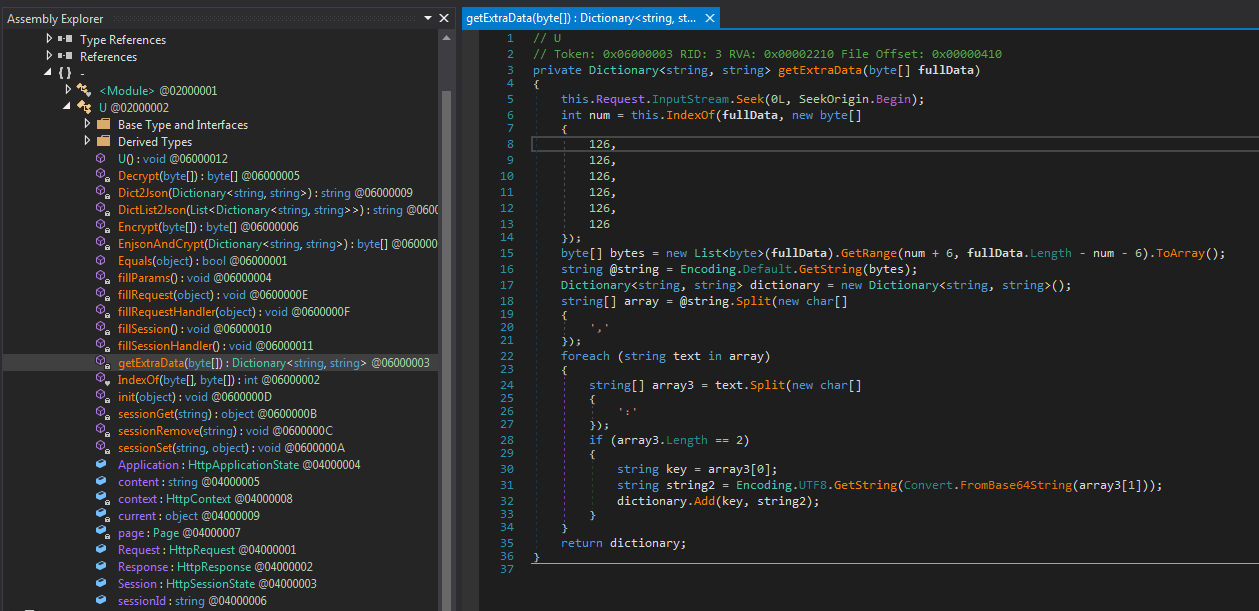
    Fortunately, the libraries were not obfuscated and lent themselves to quick static analysis:

    Example of a library detected in IIS process memory (0x0B593115C273A90886864AF7D4973EED)

    In the image above, if you look at the orange method names in the Assembly Explorer on the left, you can observe some peculiarities that can be used to identify similar samples. Although many of the methods names are very generic, there is one that is quite unique, EnjsonAndCrypt. A quick Google search of this name yields no results, which means it may be sample-specific.

    The getExtraData method is also interesting: although it has a non-specific name, there is a sequence of bytes [126, 126, 126, 126, 126, 126] that is used to parse key:value pairs whose value is base64 encoded:

    The “extraData” structure example

    Threat actors need to use the same byte sequence if they want to maintain backward compatibility across different implant versions, but since it is also very generic, we should combine both indicators, the getExtraData name and this byte array, to define a sufficiently precise detection condition that can be used in conjunction with EnjsonAndCrypt to create a detection rule.

    Uncovering modules and variants

    By feeding our newly created YARA rule to a multi-AV platform such as VirusTotal, we can identify additional samples that differ from those observed in the targeted infrastructure. It is worth noting that some of these have a poor detection rate:

    Poorly detected BasicInfo.dll (32865229279DE31D08166F7F24226843) sample

    Below are the most common names of libraries that match the rule:

    Module filenames

    Those familiar with the toolkit used may have already identified it by looking at these filenames, but if not, it is also possible to infer the relationship by simply pivoting to the samples available on VT:

    Sample FC793D722738C7FCDFE8DED66C96495B relations on VT

    Behinder, also known as Rebeyond, Ice Scorpion, 冰蝎 (Bīng xiē), is known as a cross-platform web shell designed to be compatible with most popular web servers running PHP, Java or ASP.NET as in our investigation. Although the web shell sample itself is very lightweight and somewhat basic, the tool includes a powerful GUI for operators with numerous capabilities including loading additional modules and giving them full control over compromised environments.

    Its built-in AES-encrypted communication allows threat actors to maintain stealthy control over a compromised web server, often bypassing traditional network detection mechanisms, and its modular, flexible nature allows malicious actors to use it as a base for customization even though it is only available as a pre-built tool on GitHub. Moreover, the presence of several step-by-step Chinese language tutorials on CSDN (Chinese Software Developer Network) makes it widely accessible to opportunistic bad actors.

    The bigger picture

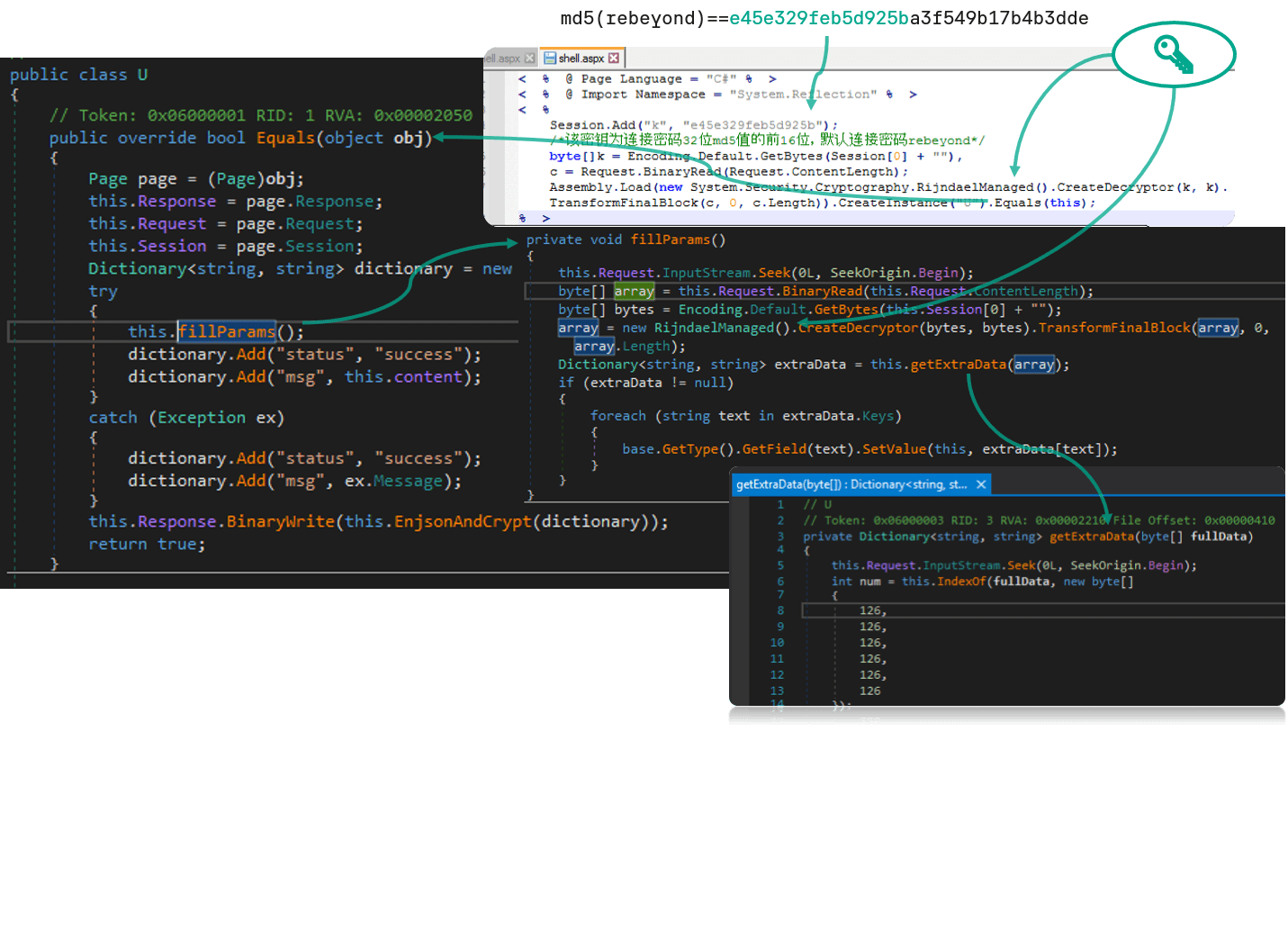
    Taking a step back, the relationship between the memory artifacts observed on the customer’s server during the post-exploitation phase and the web shell source code becomes evident. The web shell is not just a foothold, it’s a fully functional backdoor that facilitates encrypted communication with the operators’ infrastructure, allowing them to call built-in or custom-loaded libraries, deploy additional tools, conduct reconnaissance and exfiltrate data while remaining hidden:

    ASPX web shell side by side with .NET payload

    Although the Behinder web shell has been widely discussed in the past, especially the PHP and JSP variants, it is still a current and evolving cyberweapon. Even if attackers make mistakes or act carelessly by reusing the same encryption keys or exhibiting the same patterns, we can’t afford to let our guard down. In the incident described in this article, if we had not taken the time to dig deeper into the artifacts observed in memory, we likely would have missed the toolkit altogether.

    Threats evolve quickly, and signature-based malware detection only catches what we already know. Underestimating the potential of memory-based payloads can lead to a false sense of security. Teams may assume that if they haven’t detected any suspicious files, they are safe, when in fact threats may be actively operating in memory.

    For SOC teams, continuous learning, proactive threat hunting, and refining detection techniques are essential to staying ahead of adversaries.

    Happy hunting and see you on the next mission!

    YARA rule

    Indicators of compromise

    Payloads
    EF153E1E216C80BE3FDD520DD92526F4                          god.exe
    B8A468615E0B0072D2F32E44A7C9A62F                          BadPotato.dll
    B5755BE4AAD8D8FE1BD0E6AC5728067B                          SweetPotato.dll
    578A303D8A858C3265DE429DB9F17695                         BasicInfo.dll
    EA19D6845B6FC02566468FF5F838BFF1                          FileOperation.dll
    CD56A5A7835B71DF463EC416259E6F8F                          Cmd.dll
    5EA7F17E75D43474B9DFCD067FF85216                          Echo.dll

    File paths

    C:ProgramDataDRM
    C:UsersDefaultVideos
    MIL OSI Economics

  • MIL-OSI Economics: Renewal of the Bilateral Swap Arrangement between Japan and India

    Source: Reserve Bank of India

    Japan and India renewed the Bilateral Swap Arrangement (BSA) effective today (Feb. 28, 2025).

    The Bank of Japan, acting as agent for the Minister of Finance of Japan, and the Reserve Bank of India signed the second Amendment and Restatement Agreement of the BSA. The BSA is a two-way arrangement where both authorities can swap their local currencies in exchange for the US Dollar. The size of the BSA remains unchanged, that is, up to 75 billion US Dollars.

    Japan and India believe that the BSA, which aims to strengthen and complement other financial safety nets, will further deepen financial cooperation between the two countries and contribute to regional and global financial stability.

    (Puneet Pancholy)  
    Chief General Manager

    Press Release: 2024-2025/2272

    MIL OSI Economics

  • MIL-OSI Economics: Result of the Daily Variable Rate Repo (VRR) auction held on February 28, 2025

    Source: Reserve Bank of India

    Tenor 3-day
    Notified Amount (in ₹ crore) 25,000
    Total amount of bids received (in ₹ crore) 16,258
    Amount allotted (in ₹ crore) 16,258
    Cut off Rate (%) 6.26
    Weighted Average Rate (%) 6.27
    Partial Allotment Percentage of bids received at cut off rate (%) N.A.

    Ajit Prasad          
    Deputy General Manager
    (Communications)    

    Press Release: 2024-2025/2271

    MIL OSI Economics

  • MIL-OSI Economics: Panasonic clarifies the mechanism of cedar pollen allergen inactivation by gaseous hypochlorous acid

    Source: Panasonic

    Headline: Panasonic clarifies the mechanism of cedar pollen allergen inactivation by gaseous hypochlorous acid

    Osaka, Japan, February 28, 2025 – Panasonic Corporation today announced that its Heating & Ventilation A/C Company clarified the mechanism of cedar pollen allergen inactivation by gaseous hypochlorous acid, jointly with ITEA Inc., Institute of Tokyo Environmental Allergy.*2 This suggests that the same inactivation mechanism can also be applied to other protein-based allergens.
    The prevalence of hay fever, a common allergic disease, has been increasing in Japan every year, with rates recorded at 19.6% in 1998, 29.8% in 2008, and 42.5% in 2019.*3 Cedar pollen allergens, to which approximately 90% of hay fever patients have an allergic reaction,*3 include Cry j 1 adhered to the surface of the pollen outer wall, and Cry j 2, which is present inside the pollen grain and is emitted when the outer wall is broken. It has been revealed that they are composed of proteins, similar to mold and mite allergens.
    Since adopting the hypochlorous acid solution*4 for the hygiene maintenance system of cup-dispensing vending machines in 1987, Panasonic has been researching hypochlorous acid technology for approximately 40 years*5 and conducted various tests to verify bacterial and viral inhibition and deodorization. Although the company has verified that hypochlorous acid inactivates the Cry j 1 cedar pollen allergen, its mechanism had not yet been clarified.
    During ongoing joint research, Panasonic exposed the Cry j 1 cedar pollen allergen to gaseous hypochlorous acid by using a dedicated device to verify whether changes in the amino acid sequences of proteins present in Cry j 1 would be observed. As a result, the random split of peptide bonds*6 formed between amino acids was confirmed. The company revealed that this phenomenon inactivated Cry j 1, and that the antigenicity causing allergy symptoms was no longer detected.
    Regarding the current verification results, Director Masahiro Sakaguchi of the Institute of Tokyo Environmental Allergy, ITEA Inc., and Professor Emeritus at Azabu University, commented, “Based on the inactivation mechanism of the Cry j 1 cedar pollen allergen identified through current research, I infer that if other problematic indoor allergens are also composed of proteins, they will be inactivated by similar mechanisms. I believe that these verification efforts bear significant meaning for the future development of allergy-related research.”
    Panasonic will engage in research on hypochlorous acid technology to create a space, where people can live with a sense of security and safety.

    Notes:
    *1: Substance causing allergy symptoms
    *2: These verifications were conducted for basic research purposes and did not involve any products.
    *3: Hay Fever Environmental Health Manual 2022, Ministry of the Environment (https://www.env.go.jp/chemi/anzen/kafun/2022_full.pdf) *Japanese only
    *4: Solution made by electrolysis of salt water
    *5: Including the SANYO Electric era
    *6: Covalent bond formed by alpha-amino acids through dehydration and condensation

    MIL OSI Economics

  • MIL-OSI Economics: Well into the Future: A Recap of Panasonic at CES 2025

    Source: Panasonic

    Headline: Well into the Future: A Recap of Panasonic at CES 2025

    Exhibiting at this premier consumer technology event for the 58th consecutive year, Panasonic used the theme “Well into the future” to express the company’s vision of utilizing AI and data-driven businesses to build a more resilient and sustainable future for generations to come. The event began with a keynote delivered by CEO Yuki Kusumi, who was joined by leaders from across the company to explain what’s to come for Panasonic and how they’re working to create a better global society and planet.

    Under the theme “Well into the future,” Yuki Kusumi marked a new chapter for Panasonic’s commitment to innovation, emphasizing AI expansion and initiatives like Panasonic Go. By 2035, 30% of revenue will come from software and AI-enabled solutions.

    As part of Panasonic GREEN IMPACT’s commitment to addressing global environmental issues, the company announced the expansion of Panasonic HX in Europe, the production and recycling of automotive lithium-ion batteries, and the launch of OASYS, a whole-house air conditioning system designed for energy efficiency.

    As part of Panasonic Go, Blue Yonder continues to deliver safe, sustainable solutions through its global supply chain. And Panasonic Well introduced Umi, a digital family wellness service that supports families via an app. The company also announced various partnerships, including one with Anthropic, Inc., to further promote Panasonic Go.

    Click here for the article.

    CES 2025 was attended by over 141,000 people, and this year’s Panasonic booth led visitors through the story of the company’s shift toward AI and data-driven businesses, exemplified by Umi, a digital wellness coach using AI to help families build healthy habits and routines.

    Carbon Neutral and Circular Economy—two areas in the exhibition space—introduced solutions and technologies that will be contributing to achieving the goals established under Panasonic’s long-term environmental vision, Panasonic GREEN IMPACT.

    Watch this interview with Mike King, Director of Brand Marketing & Creative Services, to see how Panasonic aimed to use storytelling at this year’s booth to emphasize their 100-year commitment to improving people’s lives.

    Click here for the article.

    The seventh episode of the Panasonic PR People Vlog takes you behind the scenes at CES 2025, featuring keynote preparations and must-see booth exhibits recommended by our team. If you missed it, watch here.

    Find more CES-related content here: CES 2025 Press Kit

    MIL OSI Economics

  • MIL-OSI Economics: Money Market Operations as on February 27, 2025

    Source: Reserve Bank of India


    (Amount in ₹ crore, Rate in Per cent)

      Volume
    (One Leg)
    Weighted
    Average Rate
    Range
    A. Overnight Segment (I+II+III+IV) 5,68,518.08 6.23 5.15-6.65
         I. Call Money 18,397.29 6.31 5.15-6.40
         II. Triparty Repo 3,97,349.95 6.21 5.90-6.32
         III. Market Repo 1,51,241.64 6.27 5.75-6.45
         IV. Repo in Corporate Bond 1,529.20 6.41 6.40-6.65
    B. Term Segment      
         I. Notice Money** 224.50 6.28 5.80-6.45
         II. Term Money@@ 910.00 6.50-7.25
         III. Triparty Repo 380.00 6.40 6.40-6.40
         IV. Market Repo 633.79 6.61 6.35-6.62
         V. Repo in Corporate Bond 0.00
      Auction Date Tenor (Days) Maturity Date Amount Current Rate /
    Cut off Rate
    C. Liquidity Adjustment Facility (LAF), Marginal Standing Facility (MSF) & Standing Deposit Facility (SDF)
    I. Today’s Operations
    1. Fixed Rate          
    2. Variable Rate&          
      (I) Main Operation          
         (a) Repo          
         (b) Reverse Repo          
      (II) Fine Tuning Operations          
         (a) Repo Thu, 27/02/2025 1 Fri, 28/02/2025 49,955.00 6.26
         (b) Reverse Repo          
      (III) Long Term Operations^          
         (a) Repo          
         (b) Reverse Repo          
    3. MSF# Thu, 27/02/2025 1 Fri, 28/02/2025 1,334.00 6.50
    4. SDFΔ# Thu, 27/02/2025 1 Fri, 28/02/2025 1,03,098.00 6.00
    5. Net liquidity injected from today’s operations [injection (+)/absorption (-)]*       -51,809.00  
    II. Outstanding Operations
    1. Fixed Rate          
    2. Variable Rate&          
      (I) Main Operation          
         (a) Repo Fri, 21/02/2025 14 Fri, 07/03/2025 41,046.00 6.26
         (b) Reverse Repo          
      (II) Fine Tuning Operations          
         (a) Repo          
         (b) Reverse Repo          
      (III) Long Term Operations^          
         (a) Repo Fri, 21/02/2025 45 Mon, 07/04/2025 57,951.00 6.26
      Fri, 14/02/2025 49 Fri, 04/04/2025 75,003.00 6.28
      Fri, 07/02/2025 56 Fri, 04/04/2025 50,010.00 6.31
         (b) Reverse Repo          
    3. MSF#          
    4. SDFΔ#          
    D. Standing Liquidity Facility (SLF) Availed from RBI$       9,095.71  
    E. Net liquidity injected from outstanding operations [injection (+)/absorption (-)]*     2,33,105.71  
    F. Net liquidity injected (outstanding including today’s operations) [injection (+)/absorption (-)]*     1,81,296.71  
    G. Cash Reserves Position of Scheduled Commercial Banks
         (i) Cash balances with RBI as on February 27, 2025 9,42,396.93  
         (ii) Average daily cash reserve requirement for the fortnight ending March 07, 2025 9,22,740.00  
    H. Government of India Surplus Cash Balance Reckoned for Auction as on¥ February 27, 2025 49,955.00  
    I. Net durable liquidity [surplus (+)/deficit (-)] as on February 07, 2025 -1,973.00  
    @ Based on Reserve Bank of India (RBI) / Clearing Corporation of India Limited (CCIL).
    – Not Applicable / No Transaction.
    ** Relates to uncollateralized transactions of 2 to 14 days tenor.
    @@ Relates to uncollateralized transactions of 15 days to one year tenor.
    $ Includes refinance facilities extended by RBI.
    & As per the Press Release No. 2019-2020/1900 dated February 06, 2020.
    Δ As per the Press Release No. 2022-2023/41 dated April 08, 2022.
    * Net liquidity is calculated as Repo+MSF+SLF-Reverse Repo-SDF.
    ¥ As per the Press Release No. 2014-2015/1971 dated March 19, 2015.
    # As per the Press Release No. 2023-2024/1548 dated December 27, 2023.
    ^ As per the Press Release No. 2024-2025/2013 dated January 27, 2025, Press Release No. 2024-2025/2138 dated February 12, 2025, and Press Release No. 2024-2025/2209 dated February 20, 2025.
    Ajit Prasad          
    Deputy General Manager
    (Communications)    
    Press Release: 2024-2025/2269

    MIL OSI Economics

  • MIL-OSI Economics: Sony and JLPGA Sign Official DX Partner Agreement

    Source: Sony

    Tokyo, Japan — Sony Group Corporation (“Sony”) and the Japan Ladies Professional Golfers’ Association (“JLPGA”) announced today that they have signed a three-year partnership agreement under which Sony will be the JLPGA’s Official DX Partner from FY2025 to 2027.

    MIL OSI Economics

  • MIL-OSI Economics: Panasonic Group completes Pavilion “The Land of NOMO” for Expo 2025

    Source: Panasonic

    Headline: Panasonic Group completes Pavilion “The Land of NOMO” for Expo 2025

    The construction of “The Land of NOMO” began in July 2023, utilizing recycled materials such as iron, copper, and glass collected from used home appliances. Recycled iron accounts for approximately 98% (97.1 tons) of the main columns and beams, recycled copper amounts to approximately 1.2 tons used in the main trunk cables, and recycled glass from around 9,200 drum-type washer-dryers was used for exterior paving blocks.The building construction excluding the facade membrane was completed in August 2024, followed by interior and exhibition work. By the end of January 2025, the facade membrane was installed on 730 facade frames (out of a total of 1,404 frames), completing the pavilion’s exterior.Outdoors, a prototype of a “glass-type perovskite solar cell” designed by artist Kaede Wajima, in collaboration with HERALBONY Co., Ltd., which handles many projects that decorate cities with art by artists with disabilities, is on display. The interior, exhibitions, and various content installations were finished in early February, marking the completion of all construction work.

    MIL OSI Economics

  • MIL-OSI Economics: Asia Small and Medium-Sized Enterprise Monitor 2024—Volume II: Trends and Challenges Facing Small Businesses in Timor-Leste—Key Survey Findings

    Source: Asia Development Bank

    The report explores how Timor-Leste’s largely homogenous MSMEs are trading and looks at issues around financing, digitalization, and supply chains. It shows how policies designed to incentivize exports, boost innovation by clustering businesses, and encourage digitalization could support a mid- to long-term strategy to develop a diverse range of growth-orientated ventures.

    MIL OSI Economics

  • MIL-OSI Economics: Galaxy Buds3 Series Offers Enhanced Convenience on the Galaxy S25 Series

    Source: Samsung

    The Galaxy S25 series has redefined how we interact with our phones and the world around us, helping elevate the power of Galaxy AI1 to the next level. These more natural, context-aware, and personalized mobile experiences bring new possibilities to Samsung’s full device ecosystem, including the Galaxy Buds3 series.
    And now, with the rollout of One UI 7, you can access the most convenient and intelligent audio with Galaxy Buds3 and Buds3 Pro. Easily change sound settings on the quick settings panel and have your preferences applied to specific apps, all for your convenience. Plus, users can enjoy the more accessible, personalized audio experience enabled by Adapt sound feature.
    Let’s take a closer look at how the Galaxy Buds3 series can enhance and transform your everyday soundscape.

    New Features for Advanced Customization and Convenient Control
    Adjust Sound Settings with More Convenience   
    Fine-tuning your audio should be quick and easy so you can enjoy whatever you’re listening to anytime, anywhere. Galaxy Buds3 series makes the job much simpler with One UI 7, eliminating the need to separately access the Galaxy Wearable app on your smartphone each time you want to adjust the settings for your device. Now for the first time, conveniently adjust volume, noise control, and sound settings all from your device’s quick settings panel for a hassle-free listening experience.
    How to Adjust Buds Setting on Quick settings panel
    Open Quick settings panel on your connected smartphone
    Touch and hold the Volume slider in the panel
    Tap which setting you would like to change

    Personalize Sound Settings for Specific Apps
    Sound setting preferences often vary by the app you’re using. For instance, when listening to music you may prefer the bass turned high, but when watching a movie, you prefer a more immersive 360-degree sound experience. With App sound settings, you no longer need to adjust sound settings each time you visit an app. Simply set your sound preferences for individual apps2 once via quick settings panel, and the Galaxy Buds3 series will automatically apply them whenever the app starts playing media. A first-of-its-kind feature, this capability delivers a more seamless daily audio routine, tailored to your liking.
    How to Use App sound settings
    Open Quick settings panel on your connected smartphone
    Touch the Earbuds icon in the media panel or touch and hold the Volume slider above the media panel
    Tap on the sound setting you would like to adjust for the application that is being

    Tailored Sound for Personal Hearing Needs
    One UI 7 expands ambient sound capabilities even further with the updated Adapt sound feature,3 allowing you to curate the personalized sound experience with clearer and more accurate sound when on calls or watching videos so you don’t miss a line of dialogue. The advanced hearing test helps you create your own sound profile unique to you, or if you’re pressed for time, simply choose from three preset profiles based on your age groups.
    How to Enable Adapt sound 1
    Open the Galaxy Wearable app on your connected smartphone
    Tap on Earbuds settings
    Tap on Accessibility
    Tap on Adapt sound
    Choose among three preset profiles or do Hearing test
    How to Enable Adapt sound 2
    Open the Galaxy Wearable app on your connected smartphone
    Tap on Sound quality and effects
    Tap on Adapt sound
    Choose among three preset profiles or do Hearing test

    An Intelligent Audio Experience for All
    With the power of Galaxy AI, the Galaxy Buds3 series not only offers greater convenience, but supports enhanced communication with features that eliminate language barriers and enrich sound regardless of how you wear your earbuds or your environment, for more intelligently tailored moments.
    Seamless Communication in 20 Languages
    With Interpreter4 in Listening mode, language barriers are no longer an obstacle. Whether listening to a lecture in a foreign language or having a conversation with someone in another language, Interpreter in Listening Mode allows you to hear the translation directly through your Galaxy Buds plugged into your ears without needing to look at your smartphone. Now, you can focus solely on the conversation and engage with others face-to-face.
    How to Use Interpreter in Listening mode
    Open the Interpreter app on your connected smartphone
    Place the earbuds in your ears
    Tap on Listening mode on the left side
    Select your desired language
    Tap on the microphone icon to start the translation
    Tap on the microphone icon again to stop the translation
    Pause, resume the translation using the Buds’ pinch control

    Intelligently Optimized Sound, Anytime, Anywhere
    Regardless of how you choose to wear your earbuds, the microphones in the Galaxy Buds3 series analyze both internal and external sound in real time to apply the optimal sound and Active Noise Cancellation (ANC) through Adaptive EQ and Adaptive ANC for each user.
    What’s more, Galaxy Buds3 Pro can intelligently optimize sound in any environment. You can still enjoy your music fully when walking at a park, with Adaptive Noise Control constantly analyzing surrounding sound and automatically adjusting the optimal level of noise without you needing to make any manual adjustments. Siren Detect and Voice Detect5 automatically recognizes emergency siren or your voice and raises the ambient sound, allowing you to stay aware of your surroundings or focus your attention on your conversation.

    How to Enable Adaptive Noise Control
    Open the Galaxy Wearable app on your connected smartphone
    Tap on Adaptive
    How to Enable Siren Detect
    Open the Galaxy Wearable app on your connected smartphone
    Tap on Auto switch to ambient sound
    Select Siren detect
    How to Enable Voice Detect
    Open the Galaxy Wearable app on your connected smartphone
    Tap on Auto switch to ambient sound
    Select Voice detect

    Sound Innovation for Everyone
    With the launch of the Galaxy S25 series, Samsung has set a new standard for mobile AI, introducing a true AI companion that offers the most natural and effortless interactions between you and your world. As these intuitive and intelligent capabilities spread across the Galaxy ecosystem, the Galaxy Buds series will remain at the forefront of sound innovation — unlocking immersive and convenient audio experience for all.

    MIL OSI Economics

  • MIL-OSI Economics: Major upgrades for Azure AI Foundry today… The app server for AI is here! Learn more.

    Source: Microsoft

    Headline: Major upgrades for Azure AI Foundry today… The app server for AI is here! Learn more.

    Major upgrades for Azure AI Foundry today: GPT-4.5 is now in preview, demonstrating a big step forward in both pre-training and post-training scale. Plus, new models from Cohere, Stability, and Microsoft. As AI becomes core to building every product, we’re also rolling out new capabilities for distillation, fine-tuning and network isolation for our agent service. The app server for AI is here! Learn more: https://lnkd.in/gswHbTn2

    MIL OSI Economics

  • MIL-OSI Economics: New models, customization and agent upgrades in Azure AI Foundry 

    Source: Microsoft

    Headline: New models, customization and agent upgrades in Azure AI Foundry 

    We are excited to announce major updates to Azure AI Foundry, our integrated platform for designing, customizing, and managing enterprise-grade AI applications.

    At Microsoft, we are dedicated to advancing AI innovation to empower organizations, transform industries, and redefine productivity. Today, we are excited to announce major updates to Azure AI Foundry, our integrated platform for designing, customizing, and managing enterprise-grade AI applications. These updates include groundbreaking new models like OpenAI’s GPT-4.5, enhanced fine-tuning and distillation techniques, and the launch of new enterprise tools for agents. These advancements are designed to accelerate the journey from AI experimentation to tangible business impact.

    Build with Azure AI Foundry

    Introducing GPT-4.5 in preview on Azure OpenAI Service 

    Building on the success of previous models, GPT-4.5 is the latest and strongest general-purpose model. This research preview demonstrates the achievements from scaling pre and post-training, a step forward in unsupervised learning techniques.

    • Natural interaction: GPT-4.5 offers a more natural interaction experience. It has a broader knowledge base, and its higher “EQ” can help to improve coding, writing, and problem-solving tasks. 
    • Accuracy and hallucinations: With a lower hallucination rate (37.1% vs. 61.8%) and higher accuracy (62.5% vs. 38.2%) compared to GPT-4o, developers can rely on more precise and relevant responses.
    • Stronger human alignment: Enhanced alignment techniques improve GPT-4.5’s ability to follow instructions, understand nuances, and engage in natural conversations, making it a more effective tool for coding and project management. 

     Developers can leverage GPT-4.5 in numerous ways to enhance productivity and creativity. In communication, users can rely on GPT-4.5 to craft clear and effective emails, messages, and documentation. It also offers personalized learning and coaching experiences, helping users to acquire new skills or deepen knowledge in specific areas. During brainstorming sessions, GPT-4.5 can generate innovative ideas and solutions, making it a valuable tool for creative thinking. 

    For project planning and execution, GPT-4.5 assists users in organizing their tasks, ensuring thorough and efficient approaches. It can also handle complex task automation, simplifying intricate processes and workflows. Developers can streamline their coding workflows by getting step-by-step guidance and automating repetitive tasks, to save time and reduce errors. Overall, GPT-4.5 is a versatile model. Starting today, enterprise customers can access GPT-4.5 in Azure AI Foundry.

    New models: Phi-4, Stability AI, and recent releases 

    The latest wave of AI models shares a common focus: delivering specialized capabilities with greater efficiency. These releases represent a shift toward purpose-built AI that excels in specific domains while requiring fewer computational resources. Here are some standout launches on Azure AI Foundry. 

    Microsoft’s Phi models continue to push the boundaries of what’s possible with smaller, more efficient architectures: 

    • Phi-4-multimodal unifies text, speech, and vision for context-aware interactions. Retail kiosks can now diagnose product issues via camera and voice inputs, eliminating the need for complex manual descriptions. 
    • Phi-4-mini It outperforms larger models on coding and math tasks while increasing inference speed by 30% compared to previous models. 
    Experiment with Phi for free

    Stability AI continues to advance generative imaging with models that accelerate creative workflows: 

    • Stable Diffusion 3.5 Large generates high-fidelity marketing assets faster than previous versions, maintaining brand consistency across diverse visual styles. 
    • Stable Image Ultra achieves photorealism for product imagery, reducing photoshoot costs through accurate material rendering and color fidelity. 
    • Stable Image Core an enhanced version of SDXL (text-to-image generative AI model developed by Stability AI), provides high-quality output with exceptional speed and efficiency. 

    Cohere enhances information retrieval capabilities with its latest ranking technology: 

    • Cohere ReRank v3.5 delivers more accurate search results through its 4,096-token context window and support for over 100 languages, surfacing relevant content even without exact keyword matches. 

    The GPT-4o family expands with two specialized variants: 

    • GPT-4o-Audio-Preview handles audio prompts and generates spoken responses with appropriate emotion and emphasis, which is ideal for digital assistants and customer service. 
    • GPT-4o-Realtime-Preview eliminates conversation lag with breakthrough latency reduction, creating genuinely human-like interaction flows. 

    Agora, a pioneer in enabling real-time engagement, notes:

    GPT-4o-Realtime has revolutionized voice interaction for our conversational AI product, empowering developers with multilingual human-like voices, stable streaming, and ultra-low latency across customer service, telemedicine, and education.

    These advances collectively signal AI’s evolution toward more natural, responsive, and efficient interactions across diverse use cases and deployment environments. 

    As our model library surpasses 1,800 offerings, we continue to push the boundaries of experimentation and observability. Our new suite of fine-tuning tools complements the rise of unsupervised learning techniques.  

    • Reinforcement fine-tuning: Now in private preview, this technique teaches models to reason in new ways by rewarding correct logical paths and penalizing incorrect reasoning.
    • Provisioned Deployment for fine-tuning: Azure OpenAI Service now offers Provisioned Deployments for fine-tuned models, ensuring predictable performance and costs through Provisioned Throughput Units (PTUs) in addition to token-based billing.
    • Fine-tuning for Mistral Models: Exclusive to Azure AI Foundry, Mistral Large 2411 and Ministral 3B now support fine-tuning for industry-specific tasks like healthcare document redaction. 
    Build custom generative AI solutions with Azure OpenAI

    Secure automation and scale for enterprise agents 

    In today’s enterprise landscape, security, and scalability are strategic imperatives. We’re introducing two powerful features designed to help you securely harness AI for mission-critical tasks: 

    • Bring your Vnet: Azure AI Agent Service now enables all AI agent interactions, data processing, and API calls to remain securely within your organization’s own virtual network, eliminating exposure to the public internet. Early adopters like Fujitsu are leveraging this capability to improve sales by 67% with their sales proposal creation agent, saving countless hours that can be redirected toward customer engagement and strategic planning, all while maintaining data integrity. 

    To learn more about building multi-agent applications with Azure AI Foundry, check out this informative webinar. 

    Create your AI solution with Azure AI Foundry 

    We are excited about these new developments and look forward to seeing how you will leverage these powerful tools and features to drive innovation. Get going with new models and tools in Azure AI Foundry.

    MIL OSI Economics

  • MIL-OSI Economics: IPAA, U.S. Chamber and 500+ Groups Urge Urge Congress to Permanently Extend Pro-Growth Tax Reforms

    Source: Independent Petroleum Association of America

    Headline: IPAA, U.S. Chamber and 500+ Groups Urge Urge Congress to Permanently Extend Pro-Growth Tax Reforms

    IPAA, U.S. Chamber and 500+ Groups Urge Urge Congress to Permanently Extend Pro-Growth Tax Reforms

    To Members of the United States Congress:

    The undersigned organizations support extending pro-growth tax policies that have raised workers’ wages, helped families weather inflation, and led to more well-paying jobs. The individual, business, and estate tax provisions of the 2017 Tax Cuts and Jobs Act (“TCJA”) have been instrumental in helping achieve these goals and should be made permanent.

    As lawmakers contemplate advancing tax reform legislation through budget reconciliation this year, the importance of adopting the appropriate budget baseline cannot be overstated. We believe it is imperative that Congress adopt a current-policy baseline.

    Adopting a current-policy baseline would avoid a $4 trillion dollar tax increase on American families and employers by creating a pathway for Congress to make the TCJA permanent. Doing so would provide businesses the certainty and stability they need to make the long-term investments that drive growth, accelerate productivity, and increase prosperity across all segments of the economy. …

    MIL OSI Economics

  • MIL-OSI Economics: Thales partners with Cubic to launch next-generation eSIM solutions for connected vehicles

    Source: Thales Group

    Headline: Thales partners with Cubic to launch next-generation eSIM solutions for connected vehicles

    • Cubic, a leading global provider of software-defined vehicle (SDV) solutions integrates Thales’s eSIM technology to address the rising need for smart and efficient connectivity that matches the latest GSMA standards.
    • Thales, a worldwide eSIM management platform leader, has driven reliable successful deployments in high-volume device markets, making it ideally suited to support Cubic.

    MEUDON, France, Feb 27th, 2025 – Thales, a global leader in advanced technologies, and Cubic, a leading global provider of software-defined vehicle (SDV) solutions, have announced a collaboration to drive innovation and simplify connectivity management. Leveraging Thales’s eSIM management platform, Cubic will enhance its eSIM solution capabilities to align with the latest GSMA standards, ensuring seamless global connectivity across industries such as automotive, transportation, and agriculture.

    With the adoption of the GSMA SGP.32* standard for IoT, the stakes for the sector are significant. This standard outlines several important technical and business requirements for eSIM management in the IoT, including enhanced security, interoperability across devices and network operators, and scalability for high-volume deployments. This new framework is critical for enabling the large-scale deployment of eSIM technology across a variety of devices, addressing the need for smart and seamless connectivity management.

    This partnership introduces Thales’s eSIM management platform – compliant with the GSMA SGP.32 standard – to Cubic’s existing multi-network and global connectivity management ecosystem. This innovation enables the continued mass deployment of eSIMs across Cubic’s vast footprint of over 200 countries, while simplifying connectivity management across multiple devices by automating subscription activation and updates remotely. This dramatically reduces the need for manual intervention, physical SIM swaps or device recalls.

    Cubic’s customers, including Volkswagen AG, Cariad, General Motors, SEAT, IVECO and CNH could benefit from enhanced solutions such as this, to help ensure managing vehicle connectivity becomes effortless. Vehicles equipped with Cubic’s solution which now integrates Thales’s platform can automatically connect to local networks when crossing borders, eliminating the need for complex development or additional costs. This ensures a seamless global experience for automotive manufacturers and their customers as cars can be pre-configured with connectivity profiles at the factory level and activated dynamically as they are deployed in the field.

    “Thales has been a trusted partner of Cubic since 2017″, said Nick Power, CTO at Cubic. “For OEMs, adopting GSMA M2M eSIM has been anything but simple. Technical complexity, vendor lock-in, and managing multi-MNO connectivity at a global scale have all slowed adoption. Transitioning to a leaner, more efficient GSMA eSIM IoT architecture will be essential. This collaboration highlights our commitment to standardisation, interoperability and innovation ensuring Cubic customers can enjoy a more flexible, cost efficient and a future-proof approach to global connectivity.”

    “With this upgrade, Cubic aims to remain at the forefront of IoT connectivity by addressing evolving market demands. The integration of Thales’s “On-Demand Subscription Manager” platform will enable Cubic to maximize end-to-end connectivity management for OEMs, ensuring devices are seamlessly connected from factory to field,” said Eva Rudin, VP Mobile Connectivity Solutions at Thales. “This collaboration highlights our commitment to standardization, interoperability, and innovation for IoT.”

    * GSMA SGP. 32 contains the technical specifications for the remote eSIM management of Internet of things (IoT) devices and other types of mobile device deployments.

    About Thales

    Thales (Euronext Paris: HO) is a global leader in advanced technologies specialized in three business domains: Defence, Aerospace, and Cyber & Digital.

    It develops products and solutions that help make the world safer, greener and more inclusive.

    The Group invests close to €4 billion a year in Research & Development, particularly in key innovation areas such as AI, cybersecurity, quantum technologies, cloud technologies and 6G.

    Thales has close to 81,000 employees in 68 countries. In 2023, the Group generated sales of €18.4 billion.

    About Cubic Telecom

    Cubic Telecom delivers advanced software-defined vehicle solutions in over 200 countries and regions around the world. Working with the world’s leading automotive, transportation and agriculture OEMs, we connect 23 million cars and vehicles globally and enable 1 billion mobile internet data transmissions daily. To compete globally, OEMs must manage the complexities of connecting with different technologies while complying with regulatory mandates in different countries. Cubic Telecom cuts through this complexity through providing a single, global solution that enables any vehicle shipped anywhere in the world to have fully compliant built-in connectivity regardless of local market requirements.

    MIL OSI Economics

  • MIL-OSI Economics: Thales signs major contract with Stephanix for remote management of medical equipment

    Source: Thales Group

    Headline: Thales signs major contract with Stephanix for remote management of medical equipment

    Thales, a world leader in cybersecurity for critical environments, has secured a contract with Stephanix, a leader in medical imaging in France, to develop and implement its TrustFleet digital platform on Stephanix’s remotely controlled radiology tables. With ransomware attacks in the medical sector increasing by over 27% in 2023*, cybersecurity has become a key concern for healthcare professionals.

    TrustFleet, developed by Thales, remotely manages medical devices such as mobile radiology units, fluoroscopy tables, and mammography equipment. It enables the optimisation of predictive maintenance operations and remote troubleshooting of these devices, in both hospitals and private institutions.

    Fully cybersecured and hosted in the Cloud, TrustFleet provides immediate access to protected data for quick and effective intervention. This reduces the downtime of medical equipment (updates, reboots, technical issues) while also lowering associated operational costs. This first collaboration with Stephanix will speed up and improve patient care, and represents a significant advancement in the medical sector.

    « This collaboration with Stephanix to deploy TrustFleet in the healthcare sector will ensure the continuous availability of radiology tables and provide optimal protection for health data. The partnership will improve patient care and make healthcare workers’ jobs easier, » said Kaïs Mnif, Vice President, Radiology Business Segment at Thales.

    « This collaboration with Thales allows us to offer our customers enhanced protection for their radiology equipment, combining innovation and reliability, while maintaining the efficiency and responsiveness of our after-sales service. Thanks to TrustFleet, healthcare professionals will have a secure, high-performance solution for managing their radiology equipment, ensuring smooth and uninterrupted daily use. I commend the expertise and know-how of the teams at Thales and Stephanix that have contributed to the success of this project, a 100% French collaboration, » added Florian Haddad, CEO of Stephanix.

    * Thales reveals an increase in ransomware attacks, with non-compliance cases exposing companies to vulnerabilities | Thales Group

    Find out more about Thales’s expertise in the medical imaging field

    MIL OSI Economics

  • MIL-OSI Economics: Verizon announces new savings & VIP benefits for customers who bring together Mobile & Home

    Source: Verizon

    Headline: Verizon announces new savings & VIP benefits for customers who bring together Mobile & Home

    Only Verizon lets you bundle your mobile and home plan and get…

    • Incredible savings, with Verizon Home Internet plans for as low as $35/mo
    • Your favorite entertainment subscriptions like Netflix and Max, the Disney Bundle (Disney+, Hulu and ESPN+), Apple Music Family or YouTube Premium included on us1 (up to $10/mo) with our fastest Verizon Home Internet plans
    • Priority customer support, with benefits like faster access to expert support representatives.

    NEW YORK – Verizon today announced an industry-leading converged offer for Mobile and Home Internet customers, providing savings for myPlan mobility and myHome internet joint customers. Customers who combine their mobile and home services with Verizon can now unlock incredible savings as well as exciting entertainment options and premium customer support in a simplified experience.

    Verizon Consumer CEO Sowmynarayan Sampath shared:

    “We built the Verizon model of convergence to meet the changing habits of our customers’ lives and provide them with the most choice in the industry. Customers deserve an amazing network experience at home and on the go, and value on entertainment they cannot get anywhere else. You get more value from Verizon across our full portfolio of products and services versus anyone else in the industry.”

    Combining Verizon’s Mobile and Home Internet services gives customers $15 off home internet every month, ways to save on entertainment they love and priority customer treatment.

    Here’s how it works:

    • Simplicity and Savings: Customers with Verizon Home Internet will be eligible for a $15/mo discount when combined with any postpaid mobile phone plan. That means access to Verizon Home Internet for as low as $35/mo2. This discount can be combined with the discounts Verizon offers to Military, First Responders, Students, and Teachers to save even more, and Verizon doesn’t reduce the device offers available to these segments like some other carriers do.
    • The best of entertainment, on us: Verizon mobile customers who add a premium home internet plan3 are eligible for a perk credit on us – up to $10/mo toward great entertainment options like Netflix & Max (With Ads). That’s up to $215/year3 in savings when you are a mobile and home customer with Verizon!
    • Priority Care: Mobile + Home customers will receive premium customer care, including personalized greetings and expedited support when they contact us by phone or live messaging/chat.

    Learn more about these benefits at verizon.com/promos/mobile-and-home.

    Enjoy exclusive entertainment experiences with Verizon partners at your local Verizon store, like Max’s new season of HBO Original The White Lotus

    Beginning March 1st through April 4th, select Verizon stores across the country will feature an immersive experience where fans can explore a mini pop-up inspired by the show’s scenic resort and discover their hidden aura colors with a personality quiz.

    For more information on Mobile + Home benefits – including a perk on us (like Max!) – and to participate in the immersive retail experience–please visit your local Verizon retail store.

    Verizon Value Customers get exclusive home internet deals too

    This May, Verizon Value customers who have both an eligible Verizon Fios Home Internet plan and a mobile service plan from Verizon Value brands including Verizon Prepaid, Total Wireless, Straight Talk Wireless, Tracfone, Simple Mobile, Walmart Family, and Visible, will receive a $15/mo discount off of their Fios bill excluding Verizon Forward.


    1 Perk On Us Credit: Availability of each perk is subject to specific terms, and age requirements. Requires one paid perk on eligible Verizon mobile phone line or eligible home internet plan. Up to $10/month credit will be applied to your mobile or Fios Internet bill as long as one paid perk remains active on either account. Perk credit canceled if paid perk removed, mobile line or home internet plan canceled, or home internet moved to ineligible plan. Perk promotional offers are not eligible for the perk discount. Credit applied in 1-2 billing cycles.

    2 Verizon Home Internet: General: Verizon Home Internet includes 5G Home, LTE Home and Fios internet services. Availability varies. Auto Pay & paper-free billing req’d. Subject to credit approval. 5G Home/LTE Home/Fios 300 Mbps: Plans start at $35/mo. when combined with postpaid Verizon mobile phone plan (excludes business and data-only plans). Fios 300 Mbps: Mobile + Home Discount enrollment req’d. $99 setup and other terms apply.

    3 Versus the retail rate for $17.98/month.

    MIL OSI Economics

  • MIL-OSI Economics: New administration can create a stronger AI tech export rule

    Source: Microsoft

    Headline: New administration can create a stronger AI tech export rule

    A high-stakes race is underway that will determine which country will supply the technology that powers the world’s emerging AI economy. Vice President Vance got it right at the recent AI Summit in Paris, emphasizing the need to focus on AI opportunities, pursue lighter regulations, and prioritize bringing American AI to the world. However, a last-minute Biden administration regulation, if left unchanged, risks undermining America’s ability to succeed.  

    The Biden administration’s interim final AI Diffusion Rule caps the export of essential American AI components to many fast-growing and strategically vital markets. As drafted, the rule undermines two Trump administration priorities: strengthening U.S. AI leadership and reducing the nation’s near trillion-dollar trade deficit. Left unchanged, the Biden rule will give China a strategic advantage in spreading over time its own AI technology, echoing its rapid ascent in 5G telecommunications a decade ago.    

    As a company, we support the need to protect national security by preventing adversaries from acquiring advanced AI technology. And there are important elements in the rule that should be retained. For example, the rule’s qualitative provisions would ensure that AI technology components are deployed in certified, secure, and trusted datacenters. This avoids shipments of advanced chips to entities that do not meet these standards and thereby helps reduce the risk of chip diversion to China. Similarly, the rule rightly imposes strict requirements on these trusted datacenter operators to protect against chip diversion and to ensure that advanced AI services cannot be used by adversaries.  

    There is an important opportunity to further strengthen these provisions, including by ensuring the Commerce Department has the resources it will need to put the Rule into effect. This can help both expedite approval processes for companies and strengthen enforcement, including against unlawful chip diversion. 

    But a significant problem remains. Namely, the Biden rule goes beyond what’s needed. It puts many important U.S. allies and partners in a Tier Two category and imposes quantitative limits on the ability of American tech companies to build and expand AI datacenters in their countries. This includes many American friends, such as Switzerland, Poland, Greece, Singapore, India, Indonesia, Israel, the UAE, and Saudi Arabia. These are countries where we and many other American companies have significant datacenter operations.  

    This Tier Two status is undermining one of the essential requirements needed for a business to succeed—namely, confidence by our customers that they will be able to buy from us the AI computing capacity that they will need in the future. Customers in Tier Two countries now worry that an insufficient supply of critical American AI technology will restrict their opportunities for economic growth.  

    The unintended consequence of this approach is to encourage Tier Two countries to look elsewhere for AI infrastructure and services. And it’s obvious where they will be forced to turn. If left unchanged, the Diffusion Rule will become a gift to China’s rapidly expanding AI sector.  

    All this comes at precisely the time when the American tech sector wants to invest in AI computing capacity at an unprecedented level. Our own company’s plans are illustrative. This year alone, Microsoft will spend $80 billion to build AI infrastructure around the world, with more than half of this total on U.S. soil. As this reflects, the solid majority of our computing power will remain in the United States.   

    But our ability to continue growing and investing at this level, including in the United States, depends in important part on exporting our technology services. This requires building AI infrastructure in other countries, so AI services can be accessed and used with low latency by local enterprises and consumers. Ironically, the Diffusion Rule discourages what should be regarded as an American economic opportunity—the export of world-leading chips and technology services. 

    The potentially negative impact on American economic growth doesn’t stop there. As the tech sector invests billions of dollars to build datacenters around the world, we are developing global supply chains that combine international and American suppliers of more traditional manufactured goods. I saw this first-hand when I was in Warsaw last week to announce with Prime Minister Donald Tusk a $700 million expansion of Microsoft’s datacenter infrastructure in Poland. Among the beneficiaries are American workers manufacturing advanced electrical generators in Lafayette, Indiana, so they can be shipped to Poland. 

    The irony could not be clearer. At the very moment when the Trump administration is pressing Europe to buy more American goods, the Biden Diffusion Rule leaves the leaders of partners like Poland asking why they have been relegated to Tier Two status and an uncertain ability to buy more American AI chips in the future. 

    This puts the opportunity for the Trump administration in bold relief. It can take an overly complex rule that requires 41 pages in the Federal Register and right-size it. Make it simpler. Stop relegating American friends and allies into a second tier that undermines their confidence in ongoing access to American products. Eliminate the quantitative caps that would interfere with a well-functioning economic market. And keep what matters most, such as the qualitative security standards and AI use restrictions that protect national security. 

    We need to recognize the obvious. America’s AI race with China begins at home. It’s founded on the ability of innovative American firms to bring manufactured goods and technology services to like-minded countries around the world. We’re prepared to invest. What we need now is an AI diffusion rule that gives us the ability to do so. 

    Tags: AI diffusion rule, AI economy, supply chains

    MIL OSI Economics

  • MIL-OSI Economics: IPAA Applauds Senate Passage of Congressional Review Act Resolution to Nullify Biden Methane Tax Regulations

    Source: Independent Petroleum Association of America

    Headline: IPAA Applauds Senate Passage of Congressional Review Act Resolution to Nullify Biden Methane Tax Regulations

    IPAA Applauds Senate Passage of Congressional Review Act Resolution to Nullify Biden Methane Tax Regulations

    WASHINGTON – The Independent Petroleum Association of America (IPAA) issued the following statement following the Senate passage of H.J.Res.35 which through the Congressional Review Act process disapproves of the Biden Environmental Protection Agency’s (EPA) methane emissions fee on oil and natural gas facilities which will lead to higher prices for consumers, reduced domestic energy production, and increased American reliance on foreign energy sources.

    IPAA President & CEO Jeff Eshelman: “The Independent Petroleum Association of America (IPAA) applauds Sen. John Hoeven for his leadership in overturning the EPA’s Waste Emissions Charge (Methane Tax) regulations. This Congressional Review Act (CRA) resolution approved by the Senate today allows Congress to nullify the regulations the Biden Administration established to implement the misguided methane tax. The Biden Administration and Democrats in Congress passed the methane tax to single out and punish the oil and natural gas industry despite its already burdensome EPA regulatory framework. The tax was passed without appropriate understanding of its impact or industry safeguards. IPAA has always opposed the methane tax and believe it is simply a tax designed to hamper American oil and gas production.  With the passage of H.J.Res.35 in both the House and Senate, IPAA urges quick action by President Trump to sign this resolution and will work with his Administration to eliminate this unnecessary tax on American oil and natural gas producers as soon as possible.”

    IPAA also supports legislation led by Senator Ted Cruz (R-TX) and Congressman August Pfluger (R-TX-11) to repeal the Methane Tax.

    MIL OSI Economics

  • MIL-OSI Economics: IMF Managing Director Kristalina Georgieva’s Statement at the Conclusion of the First Meeting of the G20 Finance Ministers and Central Bank Governors

    Source: International Monetary Fund

    February 27, 2025

    Cape Town, South Africa: International Monetary Fund Managing Director Kristalina Georgieva delivered the following remarks at the first meeting of the G20 Finance Ministers and Central Bank Governors in Cape Town, South Africa:

    “I would like to thank the Government of South Africa for hosting this week’s G20 meeting, and Minister Godongwana and Governor Kganyago for their leadership in shepherding a focused discussion on our shared global economic challenges.

    There was one resounding common theme I heard during our discussions: the need to reinvigorate global growth in an environment characterized by limited macroeconomic policy space and heightened policy uncertainties. Against this backdrop, I see important opportunities to advance the reforms needed to deliver lasting global economic prosperity.

    Global Outlook: Low Growth, High Debt

    We project global growth at 3.3 percent this year and next—steady but well below historic average and in the context of high public debt levels. Underlying this, we see divergences widening across economies, with growth in the U.S. stronger and a somewhat more gradual pick up in the EU than previously expected. In emerging markets and developing economies, growth in 2025 broadly matches last year’s performance.

    The global disinflation process continues. With the gradual cooling of labor markets and energy prices expected to decline further, headline inflation is projected to continue its trajectory toward central bank targets.

    At the same time, uncertainty with regard to economic policies is high. Governments around the world are shifting policy priorities. There are significant policy changes in the United States, in areas such as trade policy, taxation, public spending, immigration, and deregulation, with implications for the U.S. economy and the rest of the world. Governments in other countries are also adjusting their policies. The combined impacts of possible policy changes are complex and still difficult to assess but will come into clearer view in the months ahead.

    Risks are also diverging. In the short-term, there is some upside potential in the U.S., where positive sentiment could boost activity. But, overall risks are to the downside for most other economies, including the risk of policy-induced disruptions to the disinflation process or capital outflows from emerging market economies.

    Domestic Policies to Boost Growth

    With the outlook for growth stuck at its lowest in decades, the central task is to craft policies that provide a strong foundation for higher and more durable growth.

    Macroeconomic and financial stability must be preserved to enable growth. To that end, countries must manage multiple pressures: contain short-term risks, rebuild buffers, lift medium-term growth prospects.

    For central banks, the focus remains fully restoring price stability, and to do so while supporting activity and employment.

    On the fiscal side, most countries need to put public debt on sustainable path and rebuild fiscal buffers. While mobilizing more domestic revenues is crucial in many countries, it is equally important to promote more efficient public spending. The two go hand-in-hand to ensure that countries have the fiscal space to meet future shocks and provide the basis for higher future growth.

    Critically, it is important that countries embrace ambitious reforms to lift productivity and enhance growth prospects. The specific priorities will vary from country to country, but in general this calls for a pivot toward supply side policies: cutting red tape, increasing competition and encouraging entrepreneurship, strengthening education systems, smart regulation that can encourage risk-taking and rapid but safe advances productivity-enhancing technology, such as AI.

    Cooperative Actions to Boost Growth

    While domestic reforms are essential, many countries cannot go it alone. Stepped up external support is vital to help countries implement reforms, through capacity development and concessional external support, and actions to crowd-in more private inflows.

    There is also an urgent need to address debt challenges. A few countries may need to restructure their debt, while many more face high interest payments and refinancing needs that cripple their ability to invest in their future. A key step is to improve the predictability and timeliness of restructuring processes, building on the significant progress already achieved, including under the Common Framework. We also need to help countries with sustainable debt but faced with elevated interest payment and refinancing needs that crowd out their capacity to invest in education, health or infrastructure.

    The IMF has a role to play. Through policy advice, capacity development, and lending where relevant, we help countries maintain or restore macroeconomic stability and implement sound policies needed for durable growth. We will continue to play a leading role on debt through our debt sustainability analyses and our support for international efforts to address debt challenges, including the Global Sovereign Debt Roundtable.

    We remain committed to helping our member countries achieve greater prosperity and stability.”

    IMF Communications Department
    MEDIA RELATIONS

    PRESS OFFICER: Kwabena Akuamoah-Boateng

    Phone: +1 202 623-7100Email: MEDIA@IMF.org

    MIL OSI Economics

  • MIL-OSI Economics: IMF Staff Concludes Visit to Zambia

    Source: International Monetary Fund

    February 27, 2025

    Lusaka, Zambia: An International Monetary Fund (IMF) staff team, led by Mercedes Vera Martin, visited Zambia during February 19-25, 2025, as part of the Fund’s ongoing engagement with the Zambian authorities and other stakeholders.

    At the conclusion of the visit, Mrs. Vera Martin issued the following statement:

    “The mission team engaged with the Zambian authorities on recent macroeconomic developments and the economic outlook. Encouragingly, the Zambian economy has shown greater resilience than previously anticipated in 2024, supported by stronger-than-projected performance in both the mining and non-mining sectors”.

    “We also took stock of the authorities’ progress in meeting key commitments under the IMF-supported program. These efforts will be formally assessed in the context of the fifth review of the Extended Credit Facility arrangement, which is expected to be initiated with a mission in early May 2025.”

    “During this visit, IMF staff held discussions with Finance Minister Musokotwane, Bank of Zambia Governor Kalyalya, and their teams, as well as representatives from various government agencies and other key stakeholders. The IMF team would like to express its gratitude to the Zambian authorities and all stakeholders for their constructive engagement and support during this mission.”

    IMF Communications Department
    MEDIA RELATIONS

    PRESS OFFICER: Kwabena Akuamoah-Boateng

    Phone: +1 202 623-7100Email: MEDIA@IMF.org

    MIL OSI Economics