Sudan’s civil war has devastated the country and strained relations with neighbouring South Sudan. Events in January 2025 have stirred up xenophobic feelings in Sudan and outrage in its southern neighbour, heightening the risk of regional instability.
In the days following the army’s takeover of Wad Madani, various images and videos surfaced online. They showed brutal reprisals from the soldiers, including systemic killings and torture. Some of these acts were ethnically targeted against South Sudanese workers employed in the region’s agricultural schemes.
The Sudanese army formed a committee to investigate the attacks in Wad Madani. The credibility of these investigation is questionable, however, given that the committee is composed of army loyalists.
Further hurting the investigation’s credibility was a statement a few days later from the army’s second-in-command, Mohamed al-Atta, alleging that South Sudanese fighters constitute 65% of the Rapid Support Forces.
These events have strained relations between Sudan and South Sudan, compounding an already volatile association.
They also highlight a war strategy the Sudanese army is pursuing to gain domestic support: that the Rapid Support Forces is primarily composed of foreigners, in this case, South Sudanese fighters.
Further, the narrative that the Rapid Support Forces largely comprises foreign fighters – helpfully for the army – feeds and taps into nationalistic and xenophobic sentiments in Sudan. These sentiments date back to the post-independence efforts of the ruling elite to establish an Islamic and Arab state. This marginalised smaller ethnic groups.
The army’s rhetoric is further supported by the overlap of tribal and ethnic affiliations across Sudan’s borders, including South Sudan and Chad. There are also the numerous reports of the paramilitary group receiving support from foreign players like the United Arab Emirates.
I have studied transition processes and conflict dynamics in Sudan and South Sudan for more than 15 years. In my view, the army has used the narrative that the Rapid Support Forces is a foreign one to rally domestic support – and distract attention from its own actions and failures.
The strategy
The leadership of the Sudanese Armed Forces has frequently emphasised the Rizeigat origins of the paramilitary forces’ leader, Mohamed Hamdan Dagalo, or Hemedti.
The Rizeigat tribe spans both the Darfur and Chad border. This has supported claims that the Rapid Support Forces includes Chadians. Reports of the paramilitary group recruiting in Chad and the presence of Chadian militants in Khartoum have further reinforced this portrayal.
When it comes to South Sudanese involvement, there is documented evidence of South Sudanese fighters participating in the Sudan conflict. However, the scale of their involvement is grossly overstated. Even the highest estimates from my research contacts suggest fewer than 5,000 South Sudanese fighters have been involved. This is a mere fraction of the Rapid Support Forces’ estimated 100,000-strong militia.
Since the onset of the war, I have learned in the course of my work that some South Sudan People’s Movement/Army troops have aligned with the Rapid Support Forces and participated in battles across Khartoum. Others have used their time in Sudan to acquire weapons and supplies for operations in South Sudan.
However, these opposition fighters are primarily motivated by pragmatic considerations. These include access to resources and political leverage, rather than any ideological alignment with the paramilitary group’s broader goals. These goals include reshaping the power dynamics in Sudan.
The South Sudanese group’s leader Stephen Buay has formally denied any links with the Rapid Support Forces. However, he has occasionally praised the paramilitary troops’ push against the Sudanese army.
Against this background, al-Atta’s claim that South Sudanese fighters make up most of the Rapid Support Forces is best understood as part of a broader strategy to justify the army’s actions and rally nationalist sentiment.
This strategy, however, worsens ethnic and regional tensions. It scapegoats South Sudanese fighters and further entrenches divisions between the two nations.
Source: United States Senator for Wisconsin Tammy Baldwin
Published: 02.01.2025
Baldwin: “Families across the country are going to be paying more out of their wallets from the gas pump and the grocery store – and it will only get worse when retaliation hits”
WASHINGTON, D.C. – Today, U.S. Senator Tammy Baldwin (D-WI) released the following statement on President Donald Trump’s announcement of across-the-board 25% tariffs on imports from Canada and Mexico and a 10% additional tariff on imports from China.
“When it comes to the high-level goals of tackling the fentanyl epidemic and securing our border, President Trump and I agree. We have to do both. Tariffs are an important tool to crack down on other countries’ unfair practices, and one I have long supported using. But the tariffs the President announced today will force Wisconsin families to pay the price. Industries where people grow things and make things – like Wisconsin’s iconic farming and manufacturing sectors – are going to be crushed by this. Families across the country are going to be paying more out of their wallets from the gas pump and the grocery store – and it will only get worse when retaliation hits. If President Trump is going to impose these broad tariffs on our closest trading partners, he needs to do it with a real plan to address retaliation and make sure costs aren’t passed on to hardworking Wisconsinites – but right now, none of those are in place and it’s Wisconsinites and our economy that will suffer the consequences.”
Senator Baldwin has long worked to crack down on other countries exploiting trade loopholes that undermine our manufacturers, farmers, and producers, and also bring illicit drugs like fentanyl into the United States. Last year, Senator Baldwin led her colleagues in calling on the Biden Administration to support a group of families’ petition under Section 301 of the Trade Act of 1974 to hold China accountable for its role in actively supporting the production and export of fentanyl into the United States. Senator Baldwin also led her colleagues in support of the United Steelworkers Section 301 petition to launch an investigation into China’s unfair trade practices in the commercial shipbuilding industry that undermine American workers and jeopardize our national security.
Source: United States Senator for Rhode Island Jack Reed
PROVIDENCE, RI – Today, U.S. Senator Jack Reed issued the following statement on President Trump’s announcement that he will impose tariffs on goods from Canada, Mexico, and China:
“I am focused on bringing prices down, but Donald Trump isn’t. Trump’s tariffs and economic policies are likely to make things like groceries and construction more expensive and place a burden on working families. There’s no economic or strategic reason to put 25 percent tariffs on Canada and Mexico, while letting China – an actual economic and strategic challenger – face a 10 percent tariff. It’s just another piece of his chaos agenda.
“It’s unclear how effective these tariffs will be, but it’s already clear that American consumers will take a financial hit. This is a de facto ‘Trump tax’ and it will cost Americans in every state.
“President Trump should take a smarter, more balanced approach to our economy that focuses on helping American families and creating opportunities for sustainable growth.”
A flooded street in TownsvilleJohn Wilkinson/Facebook
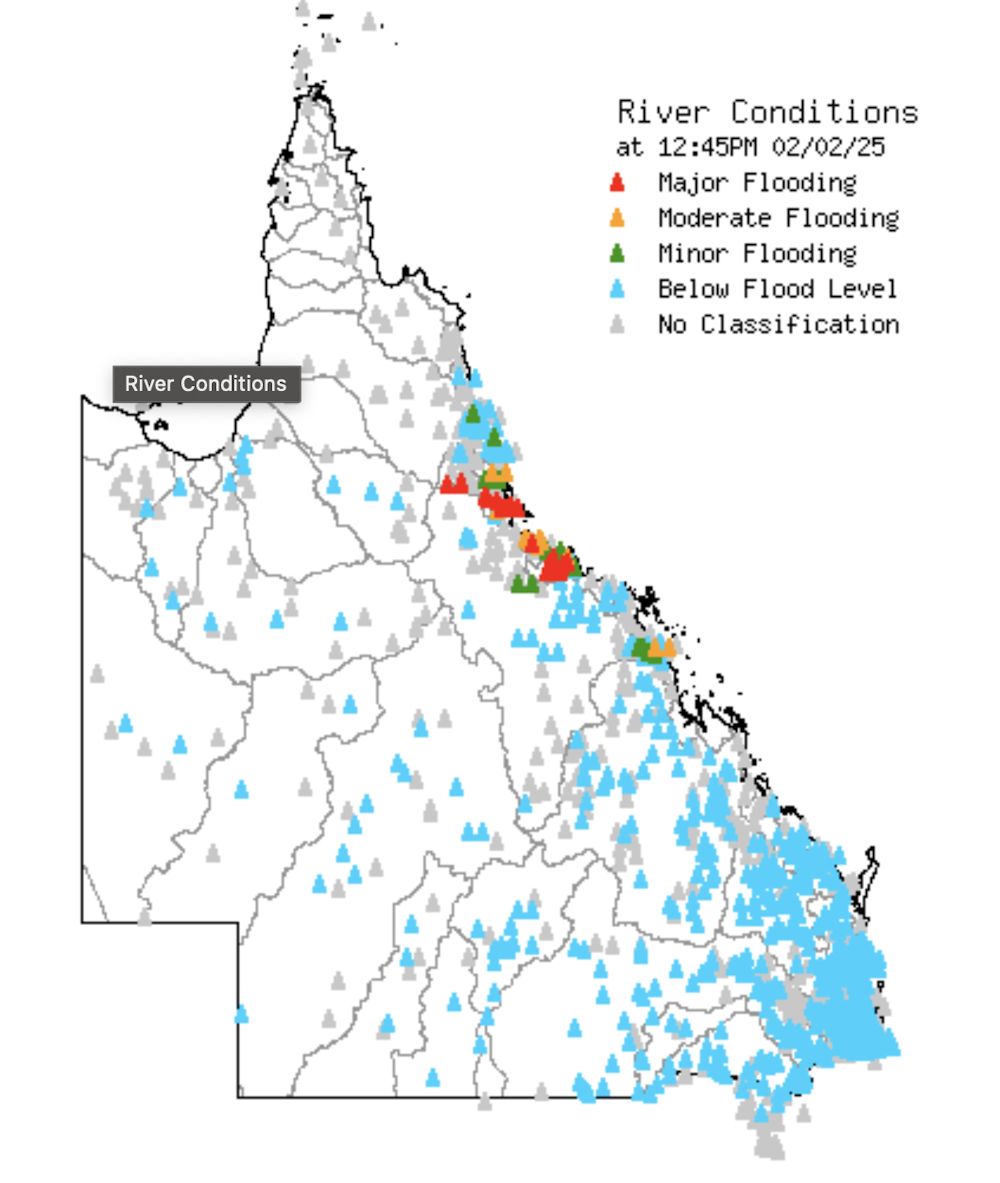
Record-breaking floods across north Queensland have now turned deadly, with one woman drowning while being rescued on Sunday morning. And the floodwaters are still rising, with rain set to continue.
Over the 48 hours to Sunday, there were reports of up to 1 metre of rainfall in parts of northeast Queensland. The torrential rain continues, particularly in the Herbert Coast region and north to around Tully.
Major flooding in northern Queensland rivers, as of 12.45pm February 2. Bureau of Meteorology
Residents of Ingham and nearby towns, about 100km from Townsville, are witnessing flooding from the nearby Herbert River. This morning, it was at 15 metres and rising. With more heavy rain forecast for the next 24 hours, the Herbert River is likely to break the 1967 record of 15.2 metres later today.
Queensland Premier David Crisafulli – who grew up on his family’s sugar cane farm in Ingham – has said the floods will be a “once in a century” event for the town. To make matters worse, authorities say the town has lost power and an extended outage is likely.
The atmospheric factors behind these floods are very similar to recent floods in the region – and climate change is no doubt playing a role.
The flood level for the Herbert River at Ingham set in 1967 was 15.2 metres. It’s likely to be breached this afternoon (Sunday February 2). Australian Bureau of Meteorology, CC BY
Where are the floods hitting?
For many people in Townsville – the largest city in Northern Australia – the unfolding emergency will bring back memories of the devastating February 2019 floods, which caused A$1.24 billion in damage. Residents have been asked to evacuate from several low-lying suburbs which were inundated in 2019.
Authorities in Townsville asked all residents in the low-lying black zone to evacuate by midday Sunday February 2. Floodwaters could reach second-storey heights in this zone. Residents in pink suburbs have been asked to be on standby. Townsville Council, CC BY
It is too early to say if this flood event will be worse. Fortunately, water levels in the city’s Ross River Dam are much lower than 2019. Townsville Airport has recorded 545mm of rain over the past 48 hours, with many northwest suburbs recording much higher levels. The township of Rollingstone – 60km northwest of Townsville – recorded a whopping 702mm over the 24 hours to 9am Sunday.
Further north in the Cairns to Daintree region, residents are watching with concern, with many still raw after the record-breaking floods of December 2023.
What triggered each of these floods was prolonged heavy rain falling on the southeast flank of a stationary tropical low weather system. Normally, tropical lows bring wind and rain, but move through quite quickly. But in recent years, we have seen a tendency for these systems to stall, sitting in place over or near land and dumping huge volumes of rain.
Last week, the Bureau of Meteorology warned that five tropical lows were forming around northern Australia. Most tropical cyclones form from tropical lows embedded in the region’s monsoon trough, a large low pressure band which forms over summer and draws in warm, moist air from the adjacent tropical seas.
But significant rain events like this one don’t necessarily require a tropical cyclone. Slow-moving deep monsoon lows over land can also deliver huge amounts of rain and widespread flooding.
These atmospheric conditions allow intense rain bands to form between converging winds: warm, moist winds from the northeast and southeast winds originating from the Coral Sea. As the winds collide, they push the moist air up into the cooler parts of the atmosphere where it condenses and falls as torrential rain.
More extreme rainfall and higher frequencies of flooded rivers and flash floods around the world have a clear link to climate change and ongoing global heating.
The main drivers behind these events include warming of the atmosphere. For every 1°C of warming, the atmosphere holds 7% more water vapour. Recent research suggests this figure could be even higher for short duration rainfall.
Hotter oceans hold more energy, meaning they can also amplify the global water cycle when atmospheric conditions are suitable.
This year’s latest ever monsoon
This year, sea surface temperatures in the northwest Coral Sea are 1-2°C above average. Ocean temperatures have risen because of a lack of cloud cover and rain last month. In northwestern Australia, this has given rise to an intensifying marine heatwave.
This ocean heat is likely to be driven by the Australian monsoon’s latest ever arrival. The monsoon brings heavy rains to northern Australia, triggering the wet season. When it arrives, sea surface temperatures generally drop due to a combination of high cloud cover and the cooling effect of rainwater.
After a slow start, the North Australian monsoon season is now in full swing.
The Bureau of Meteorology is monitoring an active monsoon trough for any low pressure systems, which may develop into tropical cyclones over the next week or so. If any cyclone does form, it will gain energy from warmer than usual sea surface temperatures.
What’s next for north Queensland?
The flood emergency in north Queensland is far from over. All global circulation models predict heavy rain to continue in the region, extending up towards Cape York and the Gulf Country as an active monsoon surge moves in from Indonesia.
As river catchments get saturated, more and more water will run off and engorge rivers. Forecasts are for rain to continue well into tonight and the next few days. We are likely to see more flooding in more places this week.
A flooded street in TownsvilleJohn Wilkinson/Facebook
Record-breaking floods across north Queensland have now turned deadly, with one woman drowning while being rescued on Sunday morning. And the floodwaters are still rising, with rain set to continue.
Over the 48 hours to Sunday, there were reports of up to 1 metre of rainfall in parts of northeast Queensland. The torrential rain continues, particularly in the Herbert Coast region and north to around Tully.
Major flooding in northern Queensland rivers, as of 12.45pm February 2. Bureau of Meteorology
Residents of Ingham and nearby towns, about 100km from Townsville, are witnessing flooding from the nearby Herbert River. This morning, it was at 15 metres and rising. With more heavy rain forecast for the next 24 hours, the Herbert River is likely to break the 1967 record of 15.2 metres later today.
Queensland Premier David Crisafulli – who grew up on his family’s sugar cane farm in Ingham – has said the floods will be a “once in a century” event for the town. To make matters worse, authorities say the town has lost power and an extended outage is likely.
The atmospheric factors behind these floods are very similar to recent floods in the region – and climate change is no doubt playing a role.
The flood level for the Herbert River at Ingham set in 1967 was 15.2 metres. It’s likely to be breached this afternoon (Sunday February 2). Australian Bureau of Meteorology, CC BY
Where are the floods hitting?
For many people in Townsville – the largest city in Northern Australia – the unfolding emergency will bring back memories of the devastating February 2019 floods, which caused A$1.24 billion in damage. Residents have been asked to evacuate from several low-lying suburbs which were inundated in 2019.
Authorities in Townsville asked all residents in the low-lying black zone to evacuate by midday Sunday February 2. Floodwaters could reach second-storey heights in this zone. Residents in pink suburbs have been asked to be on standby. Townsville Council, CC BY
It is too early to say if this flood event will be worse. Fortunately, water levels in the city’s Ross River Dam are much lower than 2019. Townsville Airport has recorded 545mm of rain over the past 48 hours, with many northwest suburbs recording much higher levels. The township of Rollingstone – 60km northwest of Townsville – recorded a whopping 702mm over the 24 hours to 9am Sunday.
Further north in the Cairns to Daintree region, residents are watching with concern, with many still raw after the record-breaking floods of December 2023.
What triggered each of these floods was prolonged heavy rain falling on the southeast flank of a stationary tropical low weather system. Normally, tropical lows bring wind and rain, but move through quite quickly. But in recent years, we have seen a tendency for these systems to stall, sitting in place over or near land and dumping huge volumes of rain.
Last week, the Bureau of Meteorology warned that five tropical lows were forming around northern Australia. Most tropical cyclones form from tropical lows embedded in the region’s monsoon trough, a large low pressure band which forms over summer and draws in warm, moist air from the adjacent tropical seas.
But significant rain events like this one don’t necessarily require a tropical cyclone. Slow-moving deep monsoon lows over land can also deliver huge amounts of rain and widespread flooding.
These atmospheric conditions allow intense rain bands to form between converging winds: warm, moist winds from the northeast and southeast winds originating from the Coral Sea. As the winds collide, they push the moist air up into the cooler parts of the atmosphere where it condenses and falls as torrential rain.
More extreme rainfall and higher frequencies of flooded rivers and flash floods around the world have a clear link to climate change and ongoing global heating.
The main drivers behind these events include warming of the atmosphere. For every 1°C of warming, the atmosphere holds 7% more water vapour. Recent research suggests this figure could be even higher for short duration rainfall.
Hotter oceans hold more energy, meaning they can also amplify the global water cycle when atmospheric conditions are suitable.
This year’s latest ever monsoon
This year, sea surface temperatures in the northwest Coral Sea are 1-2°C above average. Ocean temperatures have risen because of a lack of cloud cover and rain last month. In northwestern Australia, this has given rise to an intensifying marine heatwave.
This ocean heat is likely to be driven by the Australian monsoon’s latest ever arrival. The monsoon brings heavy rains to northern Australia, triggering the wet season. When it arrives, sea surface temperatures generally drop due to a combination of high cloud cover and the cooling effect of rainwater.
After a slow start, the North Australian monsoon season is now in full swing.
The Bureau of Meteorology is monitoring an active monsoon trough for any low pressure systems, which may develop into tropical cyclones over the next week or so. If any cyclone does form, it will gain energy from warmer than usual sea surface temperatures.
What’s next for north Queensland?
The flood emergency in north Queensland is far from over. All global circulation models predict heavy rain to continue in the region, extending up towards Cape York and the Gulf Country as an active monsoon surge moves in from Indonesia.
As river catchments get saturated, more and more water will run off and engorge rivers. Forecasts are for rain to continue well into tonight and the next few days. We are likely to see more flooding in more places this week.
. Gov. Kelly Announces Winners of 2nd Annual New Venture Competition
LINCOLN, NE – Lieutenant Governor Joe Kelly awarded prizes to three teams of aspiring college entrepreneurs through the 2nd Annual Nebraska Governor’s New Venture Competition. Awardees were announced during Thursday’s Nebraska Business Hall of Fame banquet at the Lincoln Marriott Cornhusker Hotel. Ten teams were selected as semi-finalists. The winners, prize amounts and a description of each project follow:
First Place: Golden Garden Compost, UNO, $20,000 prize
Golden Garden Compost creates premium organic compost for home gardeners using efficient production and innovative marketing to maximize profits.
Second Place: brAIn Rot, UNL, $15,000 prize
brAIn Rot is an educational platform that helps developers enhance their coding skills by solving real world puzzles and competing in coding contests.
Third Place: IndoFilm, UNL, $10,000 prize
InfoFilm helps share the impactful stories within the agriculture industry through videography, product photography, branding photography and social media management.
“This program is a great opportunity to publicize and support Nebraska-based ideas with world-changing potential,” said Lt. Gov. Kelly. “This year’s pool of finalists brought a variety of ideas to impact education, healthcare, agriculture, AI and other significant areas. They are risk takers willing to put in the long hours for the potential rewards of starting a new venture and watching it blossom.”
Governor Jim Pillen created the competition in 2023 to showcase and encourage student-led entrepreneurship. The competition is designed for contemplated and pre-seed businesses. Applicants must designate how their business falls into one of nine industry tracks: Agtech, Fintech/Insurtech, Cleantech, Advanced Manufacturing, Biotech/Healthtech, Emerging Media Arts, Sportstech, General Tech and the Bioeconomy. Submissions must have been received by Dec. 15, 2024.
This year, 15 teams – including undergraduate and graduate students – submitted proposals. Participating teams hailed from the University of Nebraska – Lincoln (UNL), University of Nebraska – Omaha (UNO), University of Nebraska – Kearney (UNK) and Metro Community College (MCC). The 15 teams made their initial pitch virtually to a panel of judges representing Flyover Capital, Nebraska Innovation Labs, Nelnet Ventures, Redbud VC and Tech Nebraska. Judges evaluated each project and whittled the group to 10 semi-finalists.
“Starting a business is hard enough but starting a business while also attending college is extremely challenging due to time constraints and academic obligations,” said Dan Hoffman, CEO of Invest Nebraska. “Nebraska’s entrepreneurial ecosystem of startup founders, funders, and service providers are excited to mentor and support these young teams as they begin their entrepreneurial journey.”
Semi-finalist teams were mentored leading up to their final project presentation yesterday during the Nebraska State Chamber of Commerce annual meeting. The judges, from Lincoln Partnership for Economic Development, MOVE Venture Capital, Nelnet, Nave Analytics, Nebraska Public Power District andWorkshop, selected the awardees.
“I appreciate that Governor Pillen is prioritizing entrepreneurship as a key economic development strategy,” said Nebraska Department of Economic Development (DED) Director K.C. Belitz. “The New Venture Competition is a great way to showcase and encourage the inventiveness of Nebraska’s rising generation. Across the state, we’re building an entrepreneurial ecosystem to support young Nebraskans in turning their ideas into successful businesses.”
“Congratulations to the 15 teams of students who shared their ideas for pursuing an entrepreneurial opportunity and competed in the New Venture Competition,” added Nebraska Chamber President Bryan Slone. “We’re always excited to support the next generation of Nebraska business professionals and it was exciting to watch these young entrepreneurs reach new heights.”
Sponsors for the New Venture Competition include the Nebraska Chamber of Commerce & Industry, Nebraska Public Power District (NPPD), Omaha Public Power District (OPPD), Invest Nebraska, Nebraska Diplomats, Nebraska Economic Developers Association (NEDA) and the Nebraska Department of Economic Development (DED).
For more information about the Governor’s New Venture Competition, visit the contest’s website: https://negovnewventure.com.
First Place Team Golden Garden Compost of the University of Nebraska – Omaha
Second Place Team brAIn Rot of the University of Nebraska – Lincoln
Third Place Team InfoFilm of the University of Nebraska – Lincoln
A flooded street in TownsvilleJohn Wilkinson/Facebook
Record-breaking floods across north Queensland have now turned deadly, with one woman drowning while being rescued on Sunday morning. And the floodwaters are still rising, with rain set to continue.
Over the 48 hours to Sunday, there were reports of up to 1 metre of rainfall in parts of northeast Queensland. The torrential rain continues, particularly in the Herbert Coast region and north to around Tully.
Major flooding in northern Queensland rivers, as of 12.45pm February 2. Bureau of Meteorology
Residents of Ingham and nearby towns, about 100km from Townsville, are witnessing flooding from the nearby Herbert River. This morning, it was at 15 metres and rising. With more heavy rain forecast for the next 24 hours, the Herbert River is likely to break the 1967 record of 15.2 metres later today.
Queensland Premier David Crisafulli – who grew up on his family’s sugar cane farm in Ingham – has said the floods will be a “once in a century” event for the town. To make matters worse, authorities say the town has lost power and an extended outage is likely.
The atmospheric factors behind these floods are very similar to recent floods in the region – and climate change is no doubt playing a role.
The flood level for the Herbert River at Ingham set in 1967 was 15.2 metres. It’s likely to be breached this afternoon (Sunday February 2). Australian Bureau of Meteorology, CC BY
Where are the floods hitting?
For many people in Townsville – the largest city in Northern Australia – the unfolding emergency will bring back memories of the devastating February 2019 floods, which caused A$1.24 billion in damage. Residents have been asked to evacuate from several low-lying suburbs which were inundated in 2019.
Authorities in Townsville asked all residents in the low-lying black zone to evacuate by midday Sunday February 2. Floodwaters could reach second-storey heights in this zone. Residents in pink suburbs have been asked to be on standby. Townsville Council, CC BY
It is too early to say if this flood event will be worse. Fortunately, water levels in the city’s Ross River Dam are much lower than 2019. Townsville Airport has recorded 545mm of rain over the past 48 hours, with many northwest suburbs recording much higher levels. The township of Rollingstone – 60km northwest of Townsville – recorded a whopping 702mm over the 24 hours to 9am Sunday.
Further north in the Cairns to Daintree region, residents are watching with concern, with many still raw after the record-breaking floods of December 2023.
What triggered each of these floods was prolonged heavy rain falling on the southeast flank of a stationary tropical low weather system. Normally, tropical lows bring wind and rain, but move through quite quickly. But in recent years, we have seen a tendency for these systems to stall, sitting in place over or near land and dumping huge volumes of rain.
Last week, the Bureau of Meteorology warned that five tropical lows were forming around northern Australia. Most tropical cyclones form from tropical lows embedded in the region’s monsoon trough, a large low pressure band which forms over summer and draws in warm, moist air from the adjacent tropical seas.
But significant rain events like this one don’t necessarily require a tropical cyclone. Slow-moving deep monsoon lows over land can also deliver huge amounts of rain and widespread flooding.
These atmospheric conditions allow intense rain bands to form between converging winds: warm, moist winds from the northeast and southeast winds originating from the Coral Sea. As the winds collide, they push the moist air up into the cooler parts of the atmosphere where it condenses and falls as torrential rain.
More extreme rainfall and higher frequencies of flooded rivers and flash floods around the world have a clear link to climate change and ongoing global heating.
The main drivers behind these events include warming of the atmosphere. For every 1°C of warming, the atmosphere holds 7% more water vapour. Recent research suggests this figure could be even higher for short duration rainfall.
Hotter oceans hold more energy, meaning they can also amplify the global water cycle when atmospheric conditions are suitable.
This year’s latest ever monsoon
This year, sea surface temperatures in the northwest Coral Sea are 1-2°C above average. Ocean temperatures have risen because of a lack of cloud cover and rain last month. In northwestern Australia, this has given rise to an intensifying marine heatwave.
This ocean heat is likely to be driven by the Australian monsoon’s latest ever arrival. The monsoon brings heavy rains to northern Australia, triggering the wet season. When it arrives, sea surface temperatures generally drop due to a combination of high cloud cover and the cooling effect of rainwater.
After a slow start, the North Australian monsoon season is now in full swing.
The Bureau of Meteorology is monitoring an active monsoon trough for any low pressure systems, which may develop into tropical cyclones over the next week or so. If any cyclone does form, it will gain energy from warmer than usual sea surface temperatures.
What’s next for north Queensland?
The flood emergency in north Queensland is far from over. All global circulation models predict heavy rain to continue in the region, extending up towards Cape York and the Gulf Country as an active monsoon surge moves in from Indonesia.
As river catchments get saturated, more and more water will run off and engorge rivers. Forecasts are for rain to continue well into tonight and the next few days. We are likely to see more flooding in more places this week.
Premier David Eby is announcing immediate counter-measures to stand up for B.C.’s workers and businesses after the United States announced incoming 25% tariffs on Canadian goods and 10% tariffs on energy.
“President Trump’s 25% tariffs are a complete betrayal of the historic bond between our countries and a declaration of economic war against a trusted ally,” said Premier Eby. “As British Columbians, and as Canadians, we will stand strong and united in the face of this unprecedented attack.”
As a first step in response to the tariffs, Premier Eby announced immediate measures, including:
directing the BC Liquor Distribution Branch to immediately stop buying American liquor from “red states”, and remove the top-selling “red-state” brands from the shelves of public liquor stores; and
directing the B.C. government and Crown corporations to buy Canadian goods and services first.
The Province is assessing private-sector projects worth $20 billion with the goal of getting them approved as quickly as possible, and issuing their permits faster. These are expected to create 6,000 jobs in remote and rural communities. In addition, the Province has vowed to support and help implement the actions being taken by the federal government.
Premier Eby added that additional measures are under consideration by B.C. and could be introduced in the coming days and weeks.
“We won’t back down or be bullied into becoming another state,” said Premier Eby. “Our province is unified and resolute. We’ll never stop standing up for B.C. and Canada.”
In January 2025, B.C. released its preliminary assessment of 25% tariffs. That analysis showed that B.C. could see a cumulative loss of $69 billion in economic activity between 2025 and 2028, along with the loss of more than 120,000 jobs. Estimates also indicated 25% tariffs on Canadian mineral exports alone will cost American companies over US$11 billion and have a profound effect on the U.S. defense industry, energy production, and manufacturing.
The B.C. government has a three-point approach to fight back against the tariffs and protect British Columbians:
respond to U.S. tariffs with tough counter-actions and outreach to American decision-makers;
strengthen B.C.’s economy by expediting projects and supporting industry and workers; and
diversify trade markets for products so British Columbia is less reliant on U.S. markets and customers.
To support B.C.’s strong tariff response and ensure actions are swift, responsive and co-ordinated, Premier Eby has established a trade and economic security task force to bring together business, labour and Indigenous leadership. The task force is co-chaired by Tamara Vrooman from the Vancouver International Airport, Jonathan Price from Teck, Bridgitte Anderson from the Greater Vancouver Board of Trade, and includes B.C.’s largest business organizations.
A new cabinet committee will act as a day-to-day war room, co-ordinating the whole-of-government approach the Province is taking to protect B.C.’s workers, businesses and economy.
Quick Facts:
54% of BC exports in 2023 were sent to the United States;
Wood, pulp and paper, metallic mineral and energy products combined make up approximately 67% of total goods exports.
The top five states for B.C.’s exports were: Washington ($9.8 billion), California ($3.2 billion), Illinois ($2.1 billion), Texas ($1.5 billion), Oregon ($1.3 billion)
ROAD TOWN, British Virgin Islands, Feb. 01, 2025 (GLOBE NEWSWIRE) — Investing in projects that are on the forefront of AI and blockchain innovations offers tremendous growth potential. Analysts estimate that Ozak AI, an AI-powered blockchain project, might grow 10x or higher by 2025 end. The project has already achieved considerable traction. Because of its predictive technology, Ozak AI has gained significant recognition in the cryptocurrency sector. The platform’s real-time data analysis and forecasting capabilities are made possible by artificial intelligence and decentralized networks.
Diverse Ecosystem Offerings
With the help of its Prediction Agents and Ozak Stream Network (OSN), Ozak AI is able to provide precise market data for the financial sector. Beyond its analytics capabilities, the Ozak Prediction Agent (PA) Business provides trustworthy decision-making through autonomous analysis of internal and external proprietary data.
Thanks to the Ozak Stream Network’s efficient processing, users can make data-driven investment decisions. By using decentralized data processing and storage methods, the DePIN system aims to strengthen security resilience.
One of the main features of Ozak AI is Prediction Agents, which allow users to create their own AI models for predicting market movements, analyzing risks, and formulating investment strategies. Data inputted into the systems is guaranteed to be accurate, tamper-proof, and trustless by means of OSN – Ozak Stream Network. Utilizing the most distributed DePIN, OSN is able to offer you the highest quality data.
Ozak AI is distinct because it combines decentralized network infrastructure with predictive AI in a novel way. The platform offers several key advantages:
Real-Time Data Processing: Ozak Stream Network (OSN) enables low-latency data intake and processing.
Decentralized Security: Integration with DePIN enables better data security and resilience via decentralized storage and processing.
Customization: The Prediction Agents (PAs) are extremely customizable, allowing users to adjust the models to their individual requirements.
Scalability: The architecture of Ozak AI is built to dynamically scale, so it can handle increasing data volumes and user demands.
$OZ at the Heart of the Ecosystem
Ozak AI platform’s native cryptocurrency is the OZ token. Enabling participation in governance decisions, powering transactions within the ecosystem, and providing access to premium features are just a few of its multiple purposes. Users can also be rewarded for their contributions to the network using OZ tokens.
Fair and Transparent Token Allocation
The $OZ tokens are distributed in a fair, transparent, and balanced manner to support the growth and sustainability of the ecosystem.
In a lifetime, only 10 Billion $OZ can be minted. Part of the key economic strategy is a supply that is deflationary. A portion of the token allocation goes toward presale and public sale events, some reserved for platform development, incentives for teams and communities, and rewards for strategic partnerships.
Massive Presale Success and Poised for Rapid Growth
The success of the platform’s presale shows how popular it is among cryptocurrency investors. Amid predictions from crypto analysts that the $OZ token will reach $1 before the end of 2025, the project is close to its funding goal with over $750k raised so far and 52,773,977 $OZ tokens sold during the ongoing presale phase 3. The pricing strategy, which is now in its third phase, has attracted early investors and contributed to significant fundraising efforts and has already offered massive gains for early backers.
It offers a cutting-edge platform that combines blockchain technology with artificial intelligence to provide financial decision-makers with predictive analytics, which is appealing to those looking to maximize return with little risk. Experts anticipate the $OZ token will witness massive gains, and the positive indicators of progress during the ongoing pre-sale period make it worth continuously watching.
About Ozak AI:
Ozak AI is a decentralized network for advanced data analytics and interpretation powered by predictive AI. Ozak AI is unique because it blends decentralized network infrastructure with predictive AI in an innovative way.
Disclaimer: This content is provided by Ozak AI. The statements, views and opinions expressed in this column are solely those of the content provider. The information provided in this press release is not a solicitation for investment, nor is it intended as investment advice, financial advice, or trading advice. It is strongly recommended you practice due diligence, including consultation with a professional financial advisor, before investing in or trading cryptocurrency and securities. Please conduct your own research and invest at your own risk.
Why has any discussion about Israel, its violations of international law, and the international legal expectations for third party states to hold IDF soldiers accountable not been addressed in Aotearoa New Zealand?
ANALYSIS:By Katrina Mitchell-Kouttab
Palestine Solidarity Network Aotearoa national chair John Minto’s campaign to identify Israeli Defence Force (IDF) soldiers in New Zealand and then call a PSNA number hotline has come under intense criticism from the likes of Winston Peters, Stephen Rainbow, the Jewish Council and NZ media outlets. Accusations of antisemitism have been made.
Despite making it clear that holding IDF soldiers accountable for potential war crimes is his goal, not banning all Israelis or targeting Jewish people, there are many just concerns regarding Minto’s campaign. He is clear that his focus remains on justice, not on creating divisions or fostering discrimination, but he has failed to provide strict criteria to distinguish between individuals directly involved in human rights violations and those who are innocent, or to ground the campaign in legal frameworks and due process.
Any allegations of participation in war crimes should be submitted through proper legal channels, not through the PSNA. Broader advocacy could have been used to address concerns of accountability and to minimise any risk that the campaign could lead to profiling based on religion, ethnicity, or language.
While there are many concerns that need to be addressed with PSNA’s campaign, why has the conversation stopped there? Why has the core issue of this campaign been ignored? Namely, that IDF soldiers who have committed war crimes in Gaza have been allowed into New Zealand?
PSNA’s controversial Gaza “genocide hotline” . . . why has the conversation stopped there? Why has the core issue about war crimes been ignored? Image: PSNA screenshot APR
Why has any discussion about Israel, its violations of international law, and the international legal expectations for third party states to hold IDF soldiers accountable not been addressed? Why is criticism of Israel being conflated with racism, even though many Jewish people oppose Israel’s war crimes, and what about Palestinians, what does this mean for a people experiencing genocide?
Concerns should be discussed but they must not be used to protect possible war criminals and shield Israel’s crimes.
It is true that PSNA’s campaign may possibly target individuals, including targeting individuals solely based on their nationality, religion, or language. This is not acceptable. But it has also uncovered the exceptionally biased, racist, and unjust views towards Palestinians.
Racism against Palestinians ignored Palestinians have been dehumanised by Israel for decades, but real racism against Palestinians is being ignored. As a Christian Palestinian I know all too well what it is like to be targeted.
In fact, it was only recently at a New Zealand First State of the Nation gathering last year that Winston Peter’s followers called me a terrorist for being Palestinian and told me that all Muslims were Hamas lovers and were criminals.
The question that has been ignored in this very public debate is simple: are Israeli soldiers who have participated in war crimes in Aotearoa, if so, why, and what does this mean for the New Zealand Palestinian population and the upholding of international law?
By refusing to address concerns of IDF soldiers the focus is deliberately shifted away from the actual genocide happening in Gaza. If IDF soldiers have engaged in rape, extrajudicial executions, torture, destruction of homes, or killing of civilians, they should be investigated and held accountable.
Countries have a legal and moral duty to prevent war criminals from using their nations as safe havens.
Since 1948, Palestinians have been subjected to systematic oppression, apartheid, ethnic cleansing, violence and now, genocide. From its creation and currently with Israel’s illegal occupation, Palestinian massacres have been frequent and unrelenting.
This includes the execution of my great grandmother on the steps of our Katamon home in Jerusalem. Land has been stolen from Palestinians over the decades, including well over 42 percent of the West Bank. Palestinians have been denied the right to return to their country, the right to justice, accountability, and self-determination.
Living under illegal military law We are still forced to live under illegal military law, face mass arrests and torture, and our history, identity, culture and heritage are targeted.
Almost 10 children lose one or both of their legs every day in Gaza according to the UN agency for Palestinian refugees (UNWRA). 2.2 million people are starving because Israel refuses them access to food. 95 percent of Gaza’s population have been forced onto the streets, with only 25 percent of Gaza’s shelters needs being met, according to the Norwegian Refugee Council.
One out of 20 people in Gaza have been injured and 18,000 children have been murdered. 6500 Palestinians from the Gaza Strip were taken hostage by Israel who also stole 2300 bodies from numerous cemeteries. 87,000 tons of explosives have been dropped on all regions in the Gaza Strip.
Dr Ghassan Abu-Sittah, a British Palestinian reconstructive surgeon who worked in Al Shifa and Al Ahly Baptist hospital and who is part of Medicine Sans Frontiers, estimates as many as 300,000 Palestinian civilians, most of them children, have been murdered by Israel.
This is because official numbers do not include those bodies that cannot be recognised or are blown to a pulp, those buried under the rubble and those expected to die and have died of disease, starvation and lack of medicine — denied by Israel to those with chronic illnesses.
‘A Genocidal Project’: real death toll closer to 300,000. Video: Democracy Now!
As a signatory to the Geneva Convention, the Rome Statute of the International Criminal Court (ICC), and UN resolutions, New Zealand is expected to investigate, prosecute and deport any individual accused of these serious crimes. This government has an obligation to deny entry to any individual suspected of war crimes, crimes against humanity or genocide.
IDF has turned war crimes into entertainment Israel has violated all of these, its IDF soldiers filming themselves committing such atrocities and de-humanising Palestinians over the last 15 months on social media.
IDF soldiers have posted TikTok videos mocking their Palestinian victims, celebrating destruction, and making jokes about killing civilians, displaying a disturbing level of dehumanisation and cruelty. They have filmed themselves looting Palestinian homes, vandalising property, humiliating detainees, and posing with dead bodies.
They have turned war crimes into entertainment while Palestinian families suffer and mourn. Israel has deliberately targeted civilians, bombing schools, hospitals, refugee camps, and even designated safe zones, then lied about their operations, showing complete disregard for human life.
Israel and the IDF’s global reputation among ordinary people are not positive. Out on the streets over 15 months, millions have been demonstrating against Israel. They do not like what its army has done, and rightly so. Many want to see justice and Israel and its army held accountable, something this government has ignored.
Israel’s state forced conscription or imprisonment, enforced military service that contributes to the occupation, ethnic cleansing, systematic oppression of a people, war crimes and genocide is fascism on display. Israel is a totalitarian, apartheid, military state, but this government sees no problems with that.
The UN and human rights organisations like Amnesty International and Human Rights Watch have repeatedly condemned Israeli military operations, including the indiscriminate killing of civilians, the use of white phosphorus, and sexual violence by Israeli forces.
While not all IDF soldiers may have committed direct atrocities, those serving in occupied Palestinian territories are complicit in enforcing illegal occupation, which itself is a violation of international law.
Following orders not an excuse The precedent set by international tribunals, such as Nuremberg, establishes that following orders is not an excuse for war crimes — meaning IDF soldiers who have participated in military actions in occupied areas should be subject to scrutiny.
This government has a duty to protect Palestinian communities from further harm, this includes preventing known perpetrators of ethnic cleansing from entering New Zealand. The presence of IDF soldiers in New Zealand is a direct threat to the safety, dignity, and well-being of our communities.
Many Palestinian New Zealanders have lost family members, homes, and entire communities due to the IDF’s actions. Seeing known war criminals walking freely in New Zealand re-traumatises those who have suffered from Israel’s illegal military brutality.
Survivors of ethnic cleansing should not have to live in fear of encountering the very people responsible for their suffering. This was not acceptable after the Second World War, throughout modern history, and is not acceptable now.
IDF soldiers are also trained in brutal tactics, including arbitrary arrests, sexual violence, and the assassination of Palestinian civilians. The presence of war criminals in any society creates a climate of fear and intimidation.
Given their history, there is a concern within New Zealand that these soldiers will engage in racist abuse, Islamophobia, or Zionist hate crimes not only against Palestinians and Arabs, but other communities of colour.
New Zealand society should be scrutinising not just this government’s response to the genocide against Palestinians, but also our political parties.
Moral bankruptcy and xenophobia This moral bankruptcy and neutral stance in the face of genocide and racism has been clearly demonstrated this week in Parliament with both Shane Jones and Peter’s xenophobic remarks, and responses to the PSNA’s campaign.
Winston Peter’s tepid response to Israel’s behaviour and its violations is a staggering display of double standards and hypocrisy. Racism it seems, is clearly selective.
His comments about Mexicans in Parliament this week were xenophobic and violate the principles of responsible governance by promoting discrimination. Peters’ comments that immigrants should be grateful creates a hierarchy of worthiness.
Similarly, Shane Jones calling for Mexicans to go home does not uphold diplomatic and professional standards, reinforces harmful racial stereotypes and discriminates based on one’s nationality. Mexicans, Māori, and Palestinians are not on equal standing as others when it comes to human rights.
Why is there a defence of foreign soldiers who may have participated in genocide or war crimes in the occupied Palestinian territories, but then migrants and refugees are attacked?
“John Minto’s call to identify people from Israel . . . is an outrageous show of fascism, racism, and encouragement of violence and vigilantism. New Zealand should never accept this kind of extreme totalitarian behaviour in our country”. Why has Winston Peter’s never condemned the actual racism Palestinians are facing — including ethnic cleansing, forced displacement, and apartheid?
Why has he never used such strong language and outrage to condemn Israel’s actions despite evidence of violations of international law? Instead, he directs outrage at a human rights activist who is pointing out the shortcomings of the government’s response to Israels violations.
IDF soldiers’ documented atrocities ignored Peters has completely ignored IDF soldiers’ documented atrocities and distorted the campaign’s purpose for legal accountability to that of violence.
There has been no mention of Palestinian suffering associated with the IDF and Israel, nor has the government been transparent in admitting that there are no security measures in place when it comes to Israel.
For Peters, killing Palestinians in their thousands is not racist but an activist wanting to prevent war criminals from entering New Zealand is?
Recently, Simon Court of the ACT party in response to Minto wrote: “Undisguised antisemitic behaviour is not acceptable . . . military service is compulsory for Israeli citizens . . . any Israeli holidaying, visiting family or doing business in New Zealand could be targeted . . . it is intimidation towards Jewish visitors . . . and should be condemned by parties across Parliament.”
This comment is misleading, and hypocritical.
PSNA’s campaign is not targeting Jewish people, something the Jewish Council has also misrepresented. It is about identifying Israeli soldiers who have actively participated in human rights violations and war crimes in the occupied Palestinian territories.
It intentionally blurs the lines between Israeli soldiers and Jewish civilians, as the lines between Palestinian civilians and Hamas have been blurred.
Erases distinction between civilians and a militant group Even MFAT cannot use the word “Palestinian” but identifies us all as “Hamas” on its website. This erases the distinction between civilians and a militant group, and conflates Israeli military personnel with Jewish civilians, which is both deceptive and dangerous.
The MFAT website states the genocide in Gaza is an “Israel-Hamas” conflict, denying the intentional targeting of Palestinian civilians and erasing our humanity.
Israel’s assault has purposely killed thousands of children, women and men, all innocent civilians. Israel has not provided any evidence of any of its claims that it is targeting “Hamas” and has even been caught out lying about the “mass rapes and burned babies”, the tunnels under the hospitals and militants hiding behind Palestinian toddlers and whole generations of families.
Despite this, MFAT had not condemned Israeli war crimes. This is not a just war. It is a genocide against Palestinians which is also being perpetrated in the West Bank. There is no Hamas in the West Bank.
The ACT Party has been silent or outright supportive of Israel’s atrocities in Gaza and the West Bank, despite overwhelming evidence of war crimes. If they were truly concerned about targeting individuals as they are with Minto’s campaign, then they would have called for an end to Israel’s assaults against Palestinians, sanctioned Israel for its war crimes, and called for investigations into Israeli soldiers for mass killings, sexual violence and starving the Palestinian people.
What is clear from Court and Seymour (who has also openly supported Israel alongside members of the Zionist Federation), is that Palestinian lives are irrelevant, we should silently accept our genocide, and that we do not deserve justice. That Israeli IDF soldiers should be given impunity and should be able to spend time in New Zealand with no consequences for their crimes.
This is simply xenophobic, dangerous and “not acceptable in a liberal democracy like New Zealand”.
New Zealand cartoonist Malcolm Evans with two of his anti-Zionism placards at yesterday’s “march for the martyrs” in Auckland . . . politicians’ silence on Israel’s war crimes and violations of international law fails to comply with legal norms and expectations. Image: Asia Pacific Report
Erased the voice of Jewish critics ACT, alongside Peters, Prime Minister Christopher Luxon, Labour leader Chris Hipkins, and the Jewish council have erased the voice of Jewish people who oppose Israel and its crimes and who do not associate being Jewish with being Israeli.
There is a clear distinction, something Alternative Jewish Voices, Jewish Voices for Peace, Holocaust survivors and Dayenu have clearly reiterated. Equating Zionism with Judaism, and identifying Israeli military actions with Jewish identity, is dangerously antisemitic.
By failing to distinguish Judaism from Zionism, politicians and the Jewish Council are in danger of fuelling the false narrative that all Jewish people support Israel’s actions, which ultimately harms Jewish communities by increasing resentment and misunderstanding.
Antisemitism should never be weaponised or used to silence criticism of Israel or justify Israel’s impunity. This is harmful to both Palestinians and Jews.
Seymour’s upcoming tenure as deputy prime minister should also be questioned due to his unwavering support and active defence of a regime committing mass atrocities. This directly contradicts New Zealand’s values of justice and accountability demonstrating a complete disregard for human rights and international law.
His silence on Israel’s war crimes and violations of international law fails to comply with legal norms and expectations. He has positioned himself away from representing all New Zealanders.
While we focus on Minto, let’s be fair and ensure Palestinians are also being protected from discrimination and targeting in New Zealand. Are the Zionist Federation, the New Zealand Jewish Council, and the Holocaust Centre supporting Israel economically or culturally, aiding and abetting its illegal occupation, and do they support the genocide?
Canada investigated funds linked to illegal settlements Canada recently investigated the Jewish National Fund (JNF) of Canada for potentially violating charitable tax laws by funding projects linked to Israeli settlements in the occupied Palestinian territories, which are illegal under international law.
In August 2024, the Canada Revenue Agency (CRA) revoked the Jewish National Fund of Canada’s (JNF Canada) charitable status after a comprehensive audit revealed significant non-compliance with Canadian tax laws.
On the 31 January 2025, Haaretz reported that Israel had recruited the Jewish National Fund to illegally secretly buy Palestinian land in the Occupied Palestinian Territories. What does that mean for the New Zealand branch of the Jewish National Fund?
None of these organisations should be funnelling resources to illegal settlements or supporting Israel’s war machine. A full investigation into their financial and political activities is necessary to ensure any money coming from New Zealand is not supporting genocide, land theft or apartheid.
The government has already investigated Palestinians sending money to relatives in Gaza, the same needs to be done to organisations supporting Israel. Are any of these groups supporting war crimes under the guise of charity?
While Jewish communities and Palestinians have rallied together and supported each other these last 15 months, we have received no support from the Jewish Council or the Holocaust Centre, who have remained silent or have supported Israel’s actions. Dayenu, and Alternative Jewish voices have vocally opposed Israel’s genocide in Gaza and reached out to us. As Jews dedicated to human rights, justice, and the prevention of genocide because of their own history, they unequivocally condemn Israel’s actions.
Given the Holocaust, you would expect the Holocaust Centre and the Jewish Council to oppose any acts of violence, especially that on such an industrial scale. You would expect them to oppose apartheid, ethnic cleansing, and the dehumanisation of Palestinians as the other Jewish organisations are doing.
Genocide, war crimes must not be normalised War crimes and genocide must never be normalised. Israel must not be shielded and the suffering and dehumanisation of Palestinians supported.
We must ensure that all New Zealanders, whether Jewish, Israeli or Palestinian are not targeted, and are protected from discrimination, racism, violence and dehumanisation. All organisations are subject to scrutiny, but only some have been.
Instead of just focusing on John Minto, the ACT Party, NZ First, National, and Labour should be answering why Israeli soldiers who may have committed atrocities, are allowed into New Zealand in the first place.
Israel and its war criminals should not be treated any differently to any other country.
We must shift the focus back to Israel’s genocide, apartheid, and impunity, while exposing the hypocrisy of those who defend Israel but attack Palestinian solidarity.
Source: Africa Press Organisation – English (2) – Report:
DAR ES SALAAM, Tanzania, February 1, 2025/APO Group/ —
African countries have taken bold commitments to implement clean cooking energy solutions to offset the devastating effects of open fire cooking which kills roughly 600,000 women and children annually across the continent.
In energy compacts (apo-opa.co/40Fdx4z) signed during the Mission 300 Africa Energy Summit, held in Tanzania 27-28 January, 12 African countries signalled their intent to accelerate the pace of access to electricity and clean cooking solutions on the world’s fastest-growing continent, in line with the United Nations’ Sustainable Development Goal 7 and the African Union’s Agenda 2063 (apo-opa.co/40X7qK8).
Commending these countries, Tanzanian President Suluhu Hassan stated in closing remarks: “I understand that the 12 governments have only pioneered, and many others will join us in the future.” Earlier, at the opening speaking about the purpose of the summit she said, “This gathering is a platform to consolidate commitments, announce new partnerships and drive momentum towards the 2030 goal.”
The two-day meeting (apo-opa.co/40GUtCH) was organized by the Government of Tanzania and Mission 300, an unprecedented collaboration between the African Development Bank Group, the World Bank Group and global partners, to address Africa’s electricity access gap through the use of new technology and innovative financing.
Moderating a special panel on clean cooking on Monday, Rashid Abdallah, Executive Director of the African Energy Commission (AFREC) (apo-opa.co/40Es3JJ), noted that whilst 600 million Africans live without access to electricity, one billion -nearly double the number – were without access to clean cooking, relying on biomass fuels such as wood and charcoal, with severe economic, social and environmental impact. Conservative estimates put the cost of this across the continent to $790 billion a year, he noted.
Abdallah was joined by Dr. Richard Muyungi, Special Envoy to the President of Tanzania, Peter Scott, CEO of Burn Manufacturing (apo-opa.co/40Vxy8b), and Martin Kimani, CEO of M-Gas (apo-opa.co/3CtCZBZ), who each highlighted the significant health, environmental, and economic impacts of relying on polluting fuels for cooking, as well as the innovative approaches being developed to address this crisis.
Muyungi shared Tanzania’s experience in launching a comprehensive National Clean Cooking Strategy, emphasizing the importance of high-level political commitment, coordinated stakeholder engagement, and the integration of private sector participation.
He praised President Hassan’s role as a global champion bringing the issue to the highest level of African governments.
“It is important to elevate it to the highest level… She is the champion of clean cooking,” he said. He stressed: “It’s important that there is a champion who can elevate clean cooking in terms of partnerships and partner with others to address this issue. He added that Tanzania is on track to transition 80 percent of its population to clean cooking technologies by 2034, thanks to the efforts of President Hassan.
Scott, whose company Burn Manufacturing is the largest clean cooking manufacturer in Africa, discussed the diverse range of solutions being deployed across the continent, from fuel-efficient biomass stoves to cutting-edge electric cooking appliances with pay-as-you-go financing models. He stressed the availability of funding for clean cooking projects, pending the approval of carbon credit regulations by governments.
“This is the most exciting time in the history of clean cooking,” Scott declared. “Now, there’s a lot of money standing by to approve carbon credit regulations to allow carbon trading, carbon finance, to grow. “
Kimani’s pioneering pay-as-you-cook LPG model has provided an innovative and affordable solution to enable households to transition to clean cooking. He shared the success of M-Gas in onboarding half a million households in Kenya and Tanzania within just three years, demonstrating the scalability of this approach. “One of the most important considerations is affordability, how do we close that gap?” he asked.
M-Gas has found an answer by installing IOT enabled smart meters which are fixed into gas cylinders without upfront payment.
“We mirror the (pay as you go) environment they can now cook using LPG. With 35 cents they can cook three meals in a day,” he added.
Tanzania pioneers clean cooking and global awareness
Tanzania published its clean cooking strategy in 2024-2034 last year in response to its own challenges – 3,000 people dying annually and the effects of a devastating 400 hectares of deforestation annually from the use of charcoal and firewood.
Championed by President Hassan, the Clean Cooking agenda has embraced everyone and is part of the national agenda, Muyungi said. “This discussion has highlighted the innovative approaches, and the political will required to transform the lives of millions of Africans and secure a sustainable future for the continent.”
In a recognition of national efforts, awards were handed out to winners of a national clean cooking innovation challenge on the first day of the summit. The winners included creators of a biogas production plant and a click gas LPG delivery system.
The African Development Bank Group has pledged $2 billion over 10 years towards clean cooking solutions in Africa. The pledge represents an important contribution to the $4 billion per year needed to allow African families to have access to clean cooking by 2030.
“Why should anybody have to die just for trying to cook a decent meal that is taken for granted in other parts of the world,” African Development Bank President Akinwumi Adesina asked during a discussion as part of the summit. “Africa must develop with dignity, with pride. Its women, its population must have access to clean energy solutions.”
SAN FRANCISCO, Feb. 01, 2025 (GLOBE NEWSWIRE) — OpenMind, building the foundation for a world where humans and machines collaborate seamlessly, is set to debut its cutting-edge, open-source intelligent agent framework, OM1, at the upcoming Coinbase AI Hackathon this Saturday.
As the race for the best humanoid robot heats, with global teams integrating autonomous systems across workflows in healthcare, manufacturing, and defense, OpenMind’s launch couldn’t be more timely. At the heart of their innovation is OM1, an open-source operating system for building “thinking machines”—intelligent systems that combine perception, decision-making, and action. It provides developers with a modular, scalable, and transparent framework that simplifies the creation and deployment of intelligent agents that operate across digital, physical, and hybrid environments.
At the heart of OM1 is the idea of modular intelligence, leveraging large language models (LLMs) to enable machines to process and respond to human language. Developers and users can interact directly with the system to debug, improve, or guide its operation. Designed like a system of building blocks, it allows components —perception systems, actuators, and reasoning modules to snap together seamlessly. This modular approach enables unified decision-making, where multiple inputs—such as cameras, voice recognition, and sensors—are fused in a shared decision-making process that outputs behaviors or actions in physical or virtual environments.
OM1 doesn’t just help machines become smart—it enables them to think, adapt, and learn in ways that are fundamentally more flexible and robust than traditional systems. This approach ensures developers can create intelligent agents that are not only smarter but also more capable of solving real-world challenges.
OpenMind is also developing FABRIC, a decentralized communication and coordination layer that enables intelligent agents to interact, negotiate, and collaborate efficiently. Key features include a robust framework for machine-to-machine interaction and data exchange; real-time team formation, adaptation, and dissolution based on task demands; and blockchain-powered auctions and evaluation systems ensure fair and efficient task assignments to the most capable human-machine teams.
OpenMind will showcase OM1 at the Coinbase AI Hackathon this Saturday, offering developers, researchers, and AI enthusiasts an exclusive look into the future of decentralized intelligence and human-machine collaboration, giving everyone an opportunity to help define the next chapter in robotics.
Disclaimer: This content is provided by OpenMind. The statements, views and opinions expressed in this column are solely those of the content provider. The information provided in this press release is not a solicitation for investment, nor is it intended as investment advice, financial advice, or trading advice. It is strongly recommended you practice due diligence, including consultation with a professional financial advisor, before investing in or trading cryptocurrency and securities. Please conduct your own research and invest at your own risk.
Source: United States Senator Joni Ernst (R-IA)
WASHINGTON – U.S. Senator Joni Ernst (R-Iowa) will be the top Republican on the Senate Agriculture Subcommittee on Rural Development, Energy, and Credit in the 119th Congress.
This important subset of the Senate Agriculture Committee oversees rural development loan and grant programs, renewable energy, and farm loan programs. As subcommittee chair, Senator Ernst will lead discussions on essential resources for farmers, biofuel producers, and rural communities while continuing to advocate for Iowans as Congress works on a Farm Bill.
“I’m thrilled to be Chair of the Senate Agriculture Subcommittee on Rural Development, Energy, and Credit this Congress,” said Senator Ernst. “From building certainty and clarity into biofuel policies to creating a Farm Bill that delivers real results for those who feed and fuel our world, Iowans and the issues that matter to them will always have a seat at the table under my leadership. I look forward to working on solutions to support Iowa and American agriculture.”
Mark Jensen, President and Chief Executive Officer of Farm Credit Services of America
“Farm Credit Services of America proudly congratulates Senator Joni Ernst on her appointment as Chairwoman of the Senate Agriculture Subcommittee on Rural Development, Energy, and Credit. Senator Ernst’s unwavering dedication to the vitality and prosperity of rural communities across America is truly commendable. Senator Ernst is poised to steer the discussion and shape legislation to strengthen our agriculture sector, foster innovation, and drive economic success to ensure our rural communities continue to thrive. We stand in support and are committed to collaborating with Senator Ernst and her subcommittee to fulfill the Farm Credit System mission of providing reliable and consistent credit and financial services, today and for the future.”
Monte Shaw, Executive Director of the Iowa Renewable Fuels Association
“Senator Ernst has been a fierce advocate for agriculture and biofuels, prioritizing Iowa farmers and keeping the U.S. a dominant energy leader. IRFA members look forward to working with the Senator as chair of the subcommittee while she continues to champion higher biofuel blends and opening up new markets for farmers at home and abroad. Expanding the production and use of biofuels is the single best tool we have to enhance rural economies.”
Brent Swart, Iowa Soybean Association President and farmer from Spencer
“We are supportive of Senator Ernst’s chairmanship of the Subcommittee on Rural Development, Energy, and Credit. We are confident that the Senator will advocate for policies that create access to the tools and resources Iowa farmers and rural communities need to thrive. We look forward to continue working with her to position soybean growers for success.”
Iowa Farm Bureau
“The Iowa Farm Bureau applauds Senator Ernst’s leadership on these important issues to our farmers and rural communities. Her work has been vital to the continued success of agriculture in Iowa and across the country, and we appreciate the commitment she has to rural America.”
Background:
Ernst works tirelessly on behalf of Iowa farmers and producers.
Within the subcommittee’s jurisdiction, she is a leading advocate for homegrown, Iowa biofuels. Ernst has fought to expand the availability of upgraded fuel infrastructure, which is essential to bringing consumers higher blends of renewable fuel like E15 and B20. She has also made biofuels an important component of domestic energy security through her work to accelerate the production and development of sustainable aviation fuel.
Ernst has taken action to ensure rural Iowa has access to essential resources for everything from propane storage to child care. She has also been on the front lines of helping Iowa farmers get the resources they need to recover from natural disasters and will keep working to find new markets for our producers.
JASON CLARE, MINISTER FOR EDUCATION: G’day everyone. Thanks very much for coming along. I think this sign says it all. If Labor wins the next election, we’ll cut student debt by 20 per cent. It’ll be the first piece of legislation that we introduce to the Parliament after the election and it’ll cut the debt of three million Aussies. Today we’re releasing information on what this means in every state and territory across the country and how much average debt people will see cut if we win the next election.
What this means for a person with the average student debt is we’ll cut their debt by over 5,000 bucks. That’s real money. That’ll make a real difference. And if you’ve got a student debt of $50,000 it will mean that debt is cut by $10,000. That’ll help a lot of some people in their 20s, in their 30s, who’ve just finished uni, got their first job. They might have just moved out of home and are just getting started. Labor will cut your student debt by 20 per cent.
Now compare that to Peter Dutton. The only policy that he’s got to help people with the cost of living is this crazy idea that says that he wants taxpayers to pay for their boss’ lunch. Labor will cut your debt. The Liberals want you to pick up the boss’ tab. It’s as basic as that.
Today I can also announce that the Student Ombudsman has started work. This is a national first, a National Student Ombudsman. You ask why we need this? Well, the evidence is compelling. One in 20 students at university report being raped. One in six students say they’ve been the victims of sexual harassment and one in two say that when they complain to their university, nothing happens. Now for too long, universities have failed their students on this front and previous governments have failed students as well.
I want to give a quick shout out to organisations like End Rape on Campus, STOP and Fair Agenda for never giving up and for fighting for this. For wanting a Student Ombudsman to make sure that when the worst happens to students, that there’s somewhere to go to report, to see that real action happens. And that’s what this Student Ombudsman is all about. They start work today.
But it’s just the first step. The next step is legislation that I’ll introduce to the Parliament next week to give me the power as the Minister for Education to set up a National Code that will set rules that universities need to comply with. That includes requiring vice chancellors to report to their boards every six months on the actions that they’re taking here, making sure that their staff are properly trained to do the investigations they need to do and to make sure that this Ombudsman’s recommendations have real teeth. This Code will mean that when the Ombudsman makes a recommendation about what a university has to do, this Code will require them to implement it. This is real change that’s long overdue and it’s finally happening. Happy to take questions.
JOURNALIST: Thanks, Minister. It’s Amanda from Nine here. Just a couple on the second announcement, what kind of powers will the Ombudsman actually have to compel universities to do anything at this stage?
CLARE: The National Student Ombudsman will have the same sort of powers as a Royal Commission does. It’ll have the power to go into university, it’ll have the power to get documents, it’ll have the power to compel people to give evidence. But not only that, the laws that I’ll introduce into the Parliament this week are the next step. They will make sure that when the Ombo makes a recommendation, that it’s implemented. There are ombudsmen all around the country at the moment doing different things. They have the power to make recommendations, but they don’t have the power to make sure they’re implemented. This Ombudsman will, and they will because of the Code that we will introduce legislation to make real this week.
JOURNALIST: And you talked a bit about sexual assault on campus there but antisemitism has also been a huge issue over the last couple of months, if not years. So, will the Ombudsman have any kind of powers to try and stop the antisemitism that we’re seeing on university campuses?
CLARE: The short answer to that is yes. The powers of this Ombudsman are broader than just dealing with complaints from students about sexual assault, sexual harassment and sexual violence. They’ll be able to deal with complaints from students about antisemitism or any sort of discrimination or hate that students experience at university. I want our students to be safe. And that’s what the job of this Ombudsman is, to make sure that when the worst happens to students that there’s action that can be taken.
JOURNALIST: Minister, it’s Josh from Seven News. Just on the debt bill, you said will be the first bill you’ll introduce in the new Parliament. Why not do it in the next two weeks and give students certainty that their debts will be reduced?
CLARE: We’ve made it very clear when the Prime Minister announced this policy late last year that this is a policy we would take to the next election. We’ve made it clear to 3 million Aussies right across the country that have got a HECS debt that if Labor wins the next election, we will cut your debt by 20 per cent. And this will make a big difference to 3 million Aussies right across the country. What’s the Liberal Party got to offer? They oppose this, Josh. This is the thing people have got to remember when we announced this, the Liberal Party said that they would oppose this. So, if the Liberals win the next Election, this will never happen. We’re making it very clear here today, if Labor wins the next Election, we’ll cut your student debt by 20 per cent.
JOURNALIST: The PM and Opposition Leader are both at a Lunar New Year event in the electorate of Chisholm today, how important will the Chinese-Australian vote be at the next election? It seems both sides are doing their best to court that vote.
JASON CLARE: I think everyone’s vote’s going to be critical. You know, in a couple of months time, all Australians will get a chance to vote. They’ll get a chance to choose who they want to run the country for the next three years. And I think the choice is clear. There’s a choice between a Labor government which is acting to help people with the real pressures that they’re under, with the cost of living through tax cuts for every taxpayer, through a $300 energy rebate, through things like the things I’m talking about today, cutting your student debt by 20 per cent, or the Liberal Party that have no real answers at all. And the only policy that they’ve got on this is to make taxpayers’ pay for their boss’ lunch. You know, how crazy is that? This policy is that insane, they had to put out a statement the other day saying it won’t apply to brothels or strip clubs. When you have to put out a statement like that, I think that shows just how insane this policy is. It shows that Peter Dutton hasn’t any real answers for the challenges the Australian people face.
JOURNALIST: The Trump administration has announced again that it’s going to proceed with tariffs on China. How concerned is the government considering China’s obvious trading economy?
CLARE: You’re right. China is our biggest trading partner. And the work that we’ve done with China over the last two years, over the last two and a half years, has helped to remove those trade barriers with China. That’s creating jobs here in Australia. When you remove trade barriers for the exports that we sell to China, whether it’s meat or wine or anything else, it creates jobs for farmers, it creates jobs for Aussie workers and that’s a good thing. I think one in four jobs in Australia are related to trade. The things that we dig out of the ground, the things we grow, the things we make and create for our jobs here in Australia. I’d just make the other important point about trade with the US and that is Australia is different to most countries around the world in that America has a trade surplus with Australia. America sells us more than we sell them.
JOURNALIST: It’s Pablo here from the ABC. Just back on the Ombudsman. The Coalition is being quite critical of the government’s response to anti-Semitism in universities. Have you spoken with the Opposition and do you expect the support on the introduction of this Ombudsman?
CLARE: The Liberal Party had 10 years to act here and they did bugger all. They did nothing. For 10 years, organisations like End Rape on Campus and STOP and Fair Agenda have been knocking on doors in Parliament House asking for politicians to listen, asking for politicians to act. And the Liberal Party slammed the door on these organisations that are fighting for victims and survivors of sexual assault. I’ve listened and I’ve acted. That’s why we’ve got the Parliament to pass laws to create this Student Ombudsman. It should have happened years ago. It’s finally happening because a Labor government listened and is acting. I hope that the Liberal Party will support this legislation.
JOURNALIST: And the former boss of the Home Affairs Department, Mike Pezzullo, has been quite critical of the Coalition’s response to the rise in antisemitism and he’s calling for an Operation Sovereign Borders type, multi agency campaign to combat this. Is this something that the government should consider?
CLARE: The bottom line here is that governments take the advice of our law enforcement agencies on this. Now law enforcement agencies are working hand in glove across the country. Federal agencies and state agencies, federal police, state police, our security agencies, they’re all working closely together and can I give them a shout out. As a former Minister for Home Affairs and a former Minister for Justice, I know how important the work they do is. I’ve got 100 per cent confidence in the work that they’re doing. The work that they’re doing is helping to keep Australians safe. The work that they’re doing is helping to hunt down the perpetrators of these violent evil acts and make sure that they’re locked up. And I back them and I hope that everybody else does too.
JOURNALIST: Just one more from me, Josh from Seven News. Earlier this week, Peter Dutton claimed the Coalition would be a better friend of China than the Albanese Government. Do you think that claim has any credibility? And should Peter Dutton outline what he’s going to do to improve the relationship?
CLARE: I think that’s laughable. Just Google what Peter Dutton has said about China over the last 10 years and you’ll realise how ridiculous that statement is.
JOURNALIST: That’s all the questions we have. Thanks so much for taking us on the phone.
With only a few weeks until Germany’s election, Elon Musk has unambiguously thrown his support behind the far-right Alternative for Germany (AfD) party. In a video address to a party rally last week, he appeared to urge Germans to “move on” from any “past guilt” related to the Holocaust.
It’s good to be proud of German culture, German values, and not to lose that in some sort of multiculturalism that dilutes everything.
Troublingly, the AfD is now firmly entrenched as Germany’s second-most popular political party, behind the centre-right Christian Democratic Union (CDU). Like all parties in German elections, however, it cannot win an outright majority. It is also unlikely to be invited to join any ruling coalition that emerges from the February 23 election.
But the AfD’s anti-migrant, anti-government sloganeering has already seriously distorted Germany’s public debate and democratic culture, leaving many to ask whether it even needs to win elections to see its policies implemented.
This was evident following a dramatic week in Germany’s Bundestag.
First, in a radical break with Germany’s political norms, opposition leader Friedrich Merz deliberately drew on the votes of the AfD on Wednesday to ram a radical anti-asylum seeker motion through the parliament.
It was the first time in the history of the Bundestag that a parliamentary majority was reached with the help of the far right. Merz’s action was widely condemned as a “taboo-breaking” step towards legitimising the AfD.
Merz tried to take this a step further with a far-reaching bill to tighten immigration controls on Friday. Although the bill narrowly failed, all of the AfD voted with Merz. Twelve members of his own CDU party refused to back him.
Merz’s courting of the far right is widely seen as politically unnecessary, given his conservative CDU is already leading the national polls, making him the favourite to succeed the Social Democratic Party (SDP)‘s Olaf Scholz as chancellor.
This raises a couple crucial questions heading into the election. Is it insiders or outsiders that are playing the biggest role in bringing the far right into the mainstream? And just how big a role will the AfD play after the election?
The Musk effect
Musk’s embrace of the AfD should come as no surprise, given the integral part he played in Donald Trump’s election victory in the United States. In the German context, however, his behaviour and statements have taken on darker hues.
Germans know only too well what is at stake when democracy is eroded by those who abuse its freedoms to attack it. Had Musk’s now notorious Nazi salutes following Trump’s inauguration been performed in Berlin, for example, he might have faced up to three years in prison.
The catchphrase “never again” has underpinned German politics since the second world war. Yet, the response to Musk’s recent provocations was oddly muted in some sections of the German media.
With a few notable exceptions, it was left to activists to remind Germans of the severity of this gesture – projecting an image of Musk’s salute on a German Tesla plant, alongside the word “heil”.
Given the seriousness with which Germany patrols representations of its Nazi past, it was surprising just how few journalists were prepared to state without equivocation that “a Hitler salute is a Hitler salute is a Hitler salute”.
Merz’s embrace of the far right
Initially, there were some signs Germany’s main political leaders would decry Musk’s attempts to normalise far-right politics in the country.
Scholz has continued to label Musk’s blatant attempts to influence German politics as “unacceptable” and “disgusting”.
Merz claims to be keeping his distance from Musk. But it appears his strategy for winning the election is not far from what Musk is suggesting – mimicking AfD policies and collaborating with the party on anti-immigration votes.
In his most radical break with the centrism that characterised the CDU under former Chancellor Angela Merkel, Merz cracked the “firewall” against working with the far-right this week. Knowing just what it meant, he used the AfD’s support to pass the starkly worded nationalist border protection motion in the Bundestag.
Democratic party leaders, meanwhile, registered their shock and dismay. Merkel herself spoke out against Merz, saying it was “wrong” to “knowingly” work with the AfD.
Her intervention appears to have been critical to the immigration bill failing on Friday, with many of her former supporters in the CDU withholding their votes.
What AfD’s rise could mean
Given the two votes in the past week and Musk’s high-profile intervention, many in Germany now fear a CDU victory in the election could signal more collaboration with the AfD.
The Greens’ Robert Habeck, Germany’s vice chancellor, has said Merz’s nationalist coalition would “destroy Europe”. He has also warned Musk to keep his “hands off our democracy”, prompting Musk to label Habeck “a traitor to the German people”.
Musk is by no means the cause of the AfD’s popularity, but his embrace of the extremist party has given it a global profile and credibility in circles that might not have otherwise considered supporting it.
As some commentators have suggested, it is probably not coincidental the AfD’s plans for the German economy would benefit Musk’s business interests. Economic self-interest alone seems insufficient, however, to explain why Musk has gravitated to the extreme right.
The same might be said of Merz. Electoral calculations alone cannot explain his risky courting of the far right. He has long been the frontrunner to win the next election. Cosying up to the AfD will only make it harder to form a coalition with either Scholz’s Social Democratic Party or the Greens.
If these two parties refuse to deal with Merz, the only other bloc large enough to deliver his party control of the government would be the AfD. Would he go so far?
Whether it is formally part of the next government or not, the AfD and its camp followers (such as Musk) could be set to have a much bigger influence on German politics. How this will change Germany in the long term remains to be seen.
Matt Fitzpatrick receives funding from the Australian Research Council.
Source: United States Senator Alex Padilla (D-Calif.)
Padilla, Schiff, Colleagues Call on EPA Administrator Zeldin to Provide Valid Legal Basis for Dangerous EPA Funding Freeze
Zeldin rubber stamps Trump’s crippling funding freeze and violates federal law, threatening jobs and jeopardizing infrastructure projects
WASHINGTON, D.C. — Today, U.S. Senators Alex Padilla and Adam Schiff (both D-Calif.) joined Senator Sheldon Whitehouse (D-R.I.) and all Democratic members of the Senate Environment and Public Works (EPW) Committee in demanding answers from newly confirmed Environmental Protection Agency (EPA) Administrator Lee Zeldin about the agency’s freezing of congressionally appropriated funds, including those that have already been obligated.
According to public reporting, EPA sent letters to grant recipients explaining it was pausing “all funding actions related to” the Inflation Reduction Act and the Bipartisan Infrastructure Law. Not only are these funding cuts already having devastating effects on communities — with reports of jobs in jeopardy and essential infrastructure projects on the chopping block — but failing to allow grant recipients to access funds that have already been obligated violates federal law.
“We write concerning troubling reports that the Environmental Protection Agency is attempting to claw back funds that have already been obligated to grant recipients. We believe that this is contrary to federal law,” wrote the Senators. “… Many of us have also been contacted by grantees in our states reporting that they no longer have access to the grant money that has been obligated to them.”
“Federal law and regulations require that obligated funds be provided to grantees absent proof of misuse of funds,” continued the Senators. “We further note that the Solar for All program furthers several goals, all of which are part of EPA’s core mission, which you support. It is designed to help reduce carbon pollution, air pollutants, and household energy costs by financing community and rooftop solar in low-income communities. It will further help drive American manufacturing, boosting the economy and creating jobs.”
The Senators further pressed Administrator Zeldin on his failure to abide by the commitments he made to members of the EPW committee during his confirmation hearing. When asked if he believed the President or executive branch could ignore congressional appropriations decisions and instructions, then-nominee Zeldin responded, “If confirmed, I pledge to respect all of Congress’ duly enacted statutes.” When asked if he pledged to respect congressional appropriations decisions and instructions and resist any efforts within the executive branch to circumvent them, he reaffirmed his commitment to executing EPA’s mission and recognized Congress’ power of the purse, stating “Particularly as a former Member of Congress, I appreciate and respect the congressional funding process. I commit to fully following the law.”
But it appears that in his first days as EPA Administrator, Zeldin is already allowing President Trump to pull the strings at EPA by failing to address these funding freezes that undermine EPA’s core mission and run contrary to federal law.
Accordingly, the Senators demanded that Administrator Zeldin provide a valid legal justification for the funding freezes and explain when he plans restore the availability of the funds to grant recipients.
In addition to Senators Padilla, Schiff, and Whitehouse, the letter is also signed by Senators Angela Alsobrooks (D-Md.), Lisa Blunt Rochester (D-Del.), Mark Kelly (D-Ariz.), Edward J. Markey (D-Mass.), Jeff Merkley (D-Ore.), and Bernie Sanders (I-Vt.).
Full text of the letter is available here and below:
Dear Administrator Zeldin:
We write concerning troubling reports that the Environmental Protection Agency (EPA) is attempting to claw back funds that have already been obligated to grant recipients. We believe that this is contrary to federal law.
On January 30, 2025, Politico’s E&E News reported that the EPA had sent letters two days prior to recipients of funding through the Solar for All program informing them that their grants had been paused until further notice. EPA’s letter went on to explain that it was pausing “all funding actions related to” climate and infrastructure laws enacted during the Biden Administration, citing President Donald J. Trump’s “Unleashing American Energy” Executive Order. Many of us have also be contacted by grantees in our states reporting that they no longer have access to the grant money that has been obligated to them.
During your confirmation before the Senate Environment and Public Works Committee, you were asked:
“Several statutes give effect to Congress’s constitutional power of the purse, reflecting its responsibility to provide appropriations to federal agencies, and its prerogative to place limitations on the availability of those appropriations, specifically, their availability as to purpose, amount, and time. Among these, the Antideficiency Act prohibits agencies from spending in advance, or in excess, of an appropriation. There is also a statutory framework for the execution – that is, the obligation and expenditure – of appropriations, as well as procedures for use when the President or executive branch disagrees with the policy embodied in an appropriation and therefore does not wish to obligate available funds. Do you believe that the president or executive branch can ignore congressional appropriation decisions and instructions?”
You responded: “If confirmed, I pledge to respect all of Congress’s duly enacted statutes.” You were further asked:
Do you pledge to respect congressional appropriation decisions and instructions and resist any efforts within the executive branch to circumvent them?
You responded: “Particularly as a former Member of Congress, I appreciate and respect the Congressional funding process. I commit to fully following the law.”
Federal law and regulations require that obligated funds be provided to grantees absent proof of misuse of funds. We further note that the Solar for All program furthers several goals, all of which are part of EPA’s core mission, which you support. It is designed to help reduce carbon pollution, air pollutants, and household energy costs by financing community and rooftop solar in low-income communities. It will further help drive American manufacturing, boosting the economy and creating jobs. Even President Trump’s Department of Energy continues to acknowledge that “[i]nvesting in energy innovations creates well-paying jobs, drives economic growth, and makes our industries more competitive,” and that the “growing global market for renewable energy technologies and innovations is projected to be worth at least $23 trillion by 2030.”
Accordingly, in order to assist in our understanding of EPA’s actions, please respond to the following questions:
On what legal grounds did EPA pause already-obligated grants to grantees under the Solar for All program? Please cite to specific statutory or regulatory authority. We note that any executive orders do not qualify as such statutory or regulatory authority, as they are neither statutes nor regulations, and all potentially relevant executive orders clearly state in any case that they “shall be implemented consistent with applicable law,” thereby clearly acknowledging that they cannot supersede or contravene statutory authority.
When do you intend to lift the pause on the already-obligated funding under this program?
As many of our offices have also received reports of other EPA grant programs that seem to have been “paused” or where obligated funds may have been cut off, please provide us a list of all EPA grant and other programs that are currently paused. Please further note whether this pause applies only to future grant-making, to post- award but pre-obligation grants, and/or to already obligated grants.
For each of these programs, when do you intend to lift the pause(s)?
We are cognizant that EPA’s initial decision to pause funding appears to have been taken before you had been confirmed as EPA Administrator. Perhaps you intend to reverse this pause immediately in accordance with applicable law. If not, however, please provide your detailed responses as soon as possible.
The Hon Amanda Rishworth MP Minister for Social Services Minister for the National Disability Insurance Scheme Member for Kingston
Senator the Hon Murray Watt Minister for Employment and Workplace Relations Senator for Queensland
Today marks the second-year anniversary of the Albanese Labor Government’s introduction of paid family and domestic violence leave.
Labor believes no one should ever have to choose between their job or their safety.
As one of the first acts of our Government, Labor ensured all 12.4 million workers in Australia – including casuals – received a minimum legislated entitlement of up to 10 days of paid leave each year.
Violence against women and children is a problem of epidemic proportions in Australia. One in three women has experienced physical violence since the age of 15, and one in five has experienced sexual violence.
An independent statutory review into the operation of paid family and domestic violence leave conducted by Flinders University found it is succeeding in supporting the financial security of those escaping or experiencing violence, without jeopardising their income or employment.
The review found that of the victim-survivors who had taken paid family and domestic violence leave, 91 per cent surveyed said it helped them maintain their income, and 89 per cent said it helped them to retain their employment, with 41 per cent of victim-survivors using the leave to arrange for their safety, 43 per cent to arrange for their children’s safety, 39 per cent to access police services, 22 per cent to access medical services, and 24 per cent to access legal services.
Minister for Social Services Amanda Rishworth said legislating paid family and domestic violence leave was a milestone achievement which has saved and changed lives.
“We know from our many consultations with victim-survivors just how difficult it can be to leave violent situations – and financial means should not be a barrier to safety,” Minister Rishworth said.
“This entitlement allows people who are working full-time, part-time and casually in Australia to make arrangements to support their safety, and the safety of their families, without fear of losing their jobs or income.
“We refuse to be a country where people have to sacrifice their safety for a wage. Our legislated 10 days of paid FDV leave provides all employees who are experiencing family and domestic violence the opportunity to build a better life for themselves, free from violence.”
Minister for Employment and Workplace Relations Senator Murray Watt said these changes are an important step towards making sure workers no longer have to choose between their pay and safety.
“This change meant for the first time, all Australian employees – including casuals – can access 10 days paid leave each year when impacted by family and domestic violence,” Minister Watt said.
“This critical leave entitlement ensures workers can maintain their financial independence through what is an incredibly difficult and terrifying time in their lives and it saves lives.
“But this entitlement is under threat from Peter Dutton and the Coalition, with Shadow Minister for Employment and Workplace Relations, Michaelia Cash claiming it’s a ‘perverse disincentive’ to employers hiring women.
“Peter Dutton and Michaelia Cash need to tell Australians whether paid family and domestic violence leave will be part of the “targeted set of repeals” of workplace laws they’ve promised to take to the election.”
The Government gave small businesses additional time to adjust to the payment and invested $3.4 million to support the creation and updating of resources on paid FDV leave, including those specifically for small business.
Paid FDV leave is one of many actions the Government has taken to address family and domestic violence. All governments have committed to ending gender-based violence in one generation under the National Plan to End Violence Against Women and Children 2022-32, supported by Government investment of $4 billion.
Small businesses can find out more about how to support employees impacted by FDV by listening to the Small Business, Big Impact podcast, available on the Acast website, Spotify, Google Podcasts, Apple Podcasts, and a range of other podcast platforms.
If you or someone you know is experiencing, or at risk of experiencing, domestic, family, or sexual violence, call 1800 737 732, text 0458 737 732 or visit www.1800RESPECT.org.au for online chat and video call services.
If you are concerned about your behaviour or use of violence, you can contact the Men’s Referral Service on 1300 766 491 or visit www.ntv.org.au
Feeling worried or no good? Connect with 13YARN Aboriginal & Torres Strait Islander Crisis Supporters on 13 92 76, available 24/7 from any mobile or pay phone, or visit www.13yarn.org.au No shame, no judgement, safe place to yarn.
Earlier today, Governor Kathy Hochul was a guest on Univision 41. The Governor spoke with Mariela Salgado on her affordability agenda, immigration, public safety and more.
AUDIO: The Governor’s remarks are available in audio form here.
A rush transcript of the Governor’s remarks is available below:
Mariela Salgado, Univision 41: So we’re very blessed that you’re talking to us and we’re very thankful, because we know how busy you are. So when you guys are ready, let us know. Just give me five minutes before we start, so I know we’re good. We’re good? Okay.
Governor, so the first question is to talk about the economy, and after I’m done with the question, I’ll just do a quick Spanish question. So, when you talk about your agenda, you talk about fighting for New Yorkers families. And I’ve been in your press conferences, and you talk about your family, you allude to your daughter in law and having to spend — and knowing for yourself how expensive things are — and you talk about inflation, and you see how things have gone up. And you’ve heard what New Yorkers are saying, and you’ve presented an array of so many things. When you planned your agenda for this budget, what were the main areas that you were concerned about when you presented that?
Governor Hochul: I am concerned so much about New York’s struggling families. My own family, my grandparents were immigrants, came here and lived in great poverty. They were migrant farm workers. My grandpa was a steel worker. My parents lived in a trailer park. We were raised having to get our clothes at used clothing stores. And you know, we were not doing well financially for a long time. But what I also know is my experience as a young mom and how expensive it is to pay for the diapers and the formula, and the kids outgrow their clothes every three months. And not just from my life, but I see now my own son and daughter in law struggling as well.
So I come to a Budget process and look at it as a statement of my priorities of what I want for New Yorkers and New York families, and to be able to firmly say, “I’m on your side, your family is on my fight and here’s what I’m going to do to find countless ways to put money back in your pockets.” And whether it’s the inflation rebate — which puts money back to the people who weren’t paid because of inflation — $500 per family. Someone with children under the age of four — $1,000 per child, school age child $500. Also covering the cost of all school breakfasts and lunches — that’s money back for every parent to be able to not have to spend $1,600 a year.
You add it all up, plus a middle class tax cut, there are many families in New York who will receive $5,000 more in their pockets. So, I took my own life experience, but also what I’ve seen as Governor going to every corner of the State and here in the boroughs where life can be hard for people — they struggle, they want to be successful — and anything I can do as Governor to relieve them of that burden is what drives me every single day.
Mariela Salgado, Univision 41: Now, those are immediate reliefs: the child tax credit, the rebate. Those are things that people are going to get right away and will see an impact on their pockets. But the child care, as a parent, I know how expensive it is. That’s going to take some time because there are spaces that need to be built and things need to be figured out. So when do you think parents are going to start to see those benefits coming through?
Governor Hochul: We announced a program that for families earning $108,000 or less, their child care costs are kept at $15 a week. Now think about that. An average family pays, right now, $21,000 a year for child care for one child. You may have two and you’re paying even more, but we are saying that there’s families that are struggling. We should have that expense capped at $15. The problem is, we need to have more providers. We need more facilities. So in my Budget, I understood this, and I’m putting $110 million into building new child care facilities, renovating existing ones and making home child care more available for people as well.
So there’s no one answer, but we’re working hard. I know people want to know when, but it is hard to try to break through a system where no one paid attention before. I’m New York’s first Mom Governor. I had to leave a job I loved because I couldn’t find child care. I know what that does to your family when one income is gone, or if you’re a single parent and you can’t find anyone to watch your children. So those are real struggles, but it’s something I’m fighting for every day and trying to solve for people, and there will come a time when people will have all the access to affordable child care that they need.
Mariela Salgado, Univision 41: That’s kind of the question with housing — and we’ll go quickly on with the interview, but — these are the things people need: To go from child care to housing, and you’ve done a couple of things. One is the $100 million investment, which is geared to people who — and I’ll talk about what my community needs, which is trying to have the American dream and be a homeowner. We see that a lot in places like Long Island where people have been struggling to be able to access that. When do you think that would be, you know, a reality for them? And then also we talk about New York City, “City of Yes”; creating more space. That’s a very robust plan — long term — but very robust. More than 80,000 new housing there. So, when do you think people in Long Island, per se, will be able to access those benefits?
Governor Hochul: Well, with respect to the assistance for first time homebuyers, I want to pass it in my Budget this year and make it available almost immediately. So, let’s get through the Budget. It usually wraps up in the spring, and then we’ll talk about how to get that money out there. So, that is so important because that is the manifestation of the dream: to have your own place to call your own. And this is where your family can grow up, and someday, your own children might live in the neighborhood.
And the problem with places like Long Island and others, is they’ve not built enough housing to meet the demand for people to want to raise their children there. And I’ve taken this on and it’s been a hard fight, but I did support the City with $1 billion to help the Mayor get the “City of Yes” done. But also, we have thousands and thousands of housing units and apartments that are not online because they need repairs done to them.
So we’re trying to make it so landlords will make those repairs and bring on more units. So what happens is you flood the zone. You bring in as much housing as you can. And then what happens? Prices start to drop. That’s what we also need to have. So people starting out in that first apartment, you can save the money to get that home. We’ll have that apartment available to them. So it’s, it’s a whole continuum of approaches to it, but no other Governor has worked harder on what is people’s largest expense, whether they’re paying rent or mortgage. And some families are paying half of their income, half of their earnings, in just their housing alone. And that doesn’t consider all the other bills they have in covering the cost of children.
So I know how important it is. My family struggled. My parents lived in a trailer park. My grandparents had a family of 10 in a tiny, little house with two bedrooms. I grew up with that experience, seeing them live like that, and I know how critical it is for people just to feel that they have that within their reach.
Mariela Salgado, Univision 41: Congestion price was not easy. It was — you had some criticism. First it was one price, then you came to a different, more reduced price, but still people were complaining about what they had to pay because of the economy. We are hearing from people in the Bronx and I’m not sure this is correct, because I’m sure there have to be studies, that some of the people who are driving through the zone are trying to avoid paying the toll, and they’re using their bridges or their roads, and that’s creating more congestion on their roads. Is that something that was considered when that was put in place? Are you going to be looking at it, maybe creating more studies to see if that needs to be tweaked somehow or fixed?
Governor Hochul: Right. This is a program that was passed back by my predecessor in the Legislature back in 2019. And they did study for many years the environmental impacts and also the traffic impacts. It was supposed to go into effect in June. I knew that $15 was just too much for New Yorkers, especially when inflation was so high. So I paused it. I got a lot of criticism for doing that. But I had to work hard to reduce the price, and we did by 40 percent. So I’m very much aware of the cost and what it does for families.
But there are areas of our city that are seeing less traffic. But you’re absolutely right, we need to go back to the areas that might be affected in a way that wasn’t anticipated. There is money for traffic mitigation for the Bronx, about $150 million. But also to look at the effects of, if traffic’s congregating — are there higher rates of asthma, for example. I’m very concerned about the health of our children in places like the Bronx. So, of course, this is always going under review and study.
Mariela Salgado, Univision 41: And another question and I have to talk about the Trump administration because we’ve had conversations with Republican legislators who have told us that there’s a possibility that the new administration might want to somehow revert the plan. Is that something that can happen?
Governor Hochul: It is already the law. It was supported by the Biden administration and all the — it has already started. So I don’t know if that will happen or not.
Mariela Salgado, Univision 41: Okay. So we don’t really know? If this is something that–
Governor Hochul: No.
Mariela Salgado, Univision 41: And to that effect, we’ve heard President Trump speak highly of you. Do you have a relationship with him? Have you talked to him about certain issues? And the reason I bring it up is because immigration is in everybody’s mind and I know that this is a sanctuary state, and it’s not new in New York, and many states have helped the federal government when it comes to immigrants. Now it’s front and stage, but it’s something that’s been done for a long time. But, of course, there is concern and fear right now among people because it’s frontal. So, are you having any connection with them right now? Are you having conversations with Tom Homan?
Governor Hochul: I have been having conversations. And what I’ve reinforced is the fact that we have always worked with ICE when it comes to removing people who have committed serious crimes. Whether they’re in their own country, they never should have been able to arrive here, or they do something while they’re here. This has happened. So we want to make sure that all of our citizens and all the residents and all the people who have come before, whether they have status or not, that they’re safe from criminals. So we have said we will work with the Trump administration, just like we did with the Biden administration.
These ICE raids are not something new. There’s just more attention on them. But this has been going on for a while. But, even though we want to support removing criminals, I want people to not live in fear. It is heartbreaking to me to know that there are children not going to school today, or not going to a doctor’s office, someone who’s ill or a senior citizen needs that appointment. They’re not going to churches. So, people’s lives are being so disrupted because of that.
And I reinforce the administration that we’ll help you with the criminal element, absolutely. But, let’s not go after these families and separate them. Let’s not have a cruel approach to this.
I mean, we can find them jobs. I said before, we have 400,000 open jobs in the State of New York. We give people work authorization. They can actually do what they came for and what we want them to do, get a job — get a job and work and take care of their family.
Mariela Salgado, Univision 41: So, you’re having that conversation with them?
Governor Hochul: Yes.
Mariela Salgado, Univision 41: And the reason why I bring it up is because we’re hearing stories like this mom, for example, she was 60-years-old and she had an order of deportation. Her mom never told her to do anything. Now she’s an adult, she has kids, and she has to be deported. So things like that. Or you know, somebody who had a DUI 20 years ago and now is a grandparent. I’m not saying that a DUI is something right to do and people need to be accountable. But urging the administration to see it case by case.
Governor Hochul: We cannot give up our compassion. We cannot be a State where people are not feeling protected and supported. That’s never been who we are as New Yorkers. And we’re proud of that. So again, it is very easy for me to separate someone who will do harm to other people and say, “You do not belong here.”
But other people should not have that hanging over their heads that they’ve been doing — especially ones who were brought here as children. I mean, think about those individuals. Or someone who may have done something when they’re 20 and now they’re 60 years old. We have to have compassion for people and understand that they’re part of our society. And we cannot reject them now.
Mariela Salgado, Univision 41: We’re hearing things from — I like speaking with you. I’m sorry, I know we’re running out of time — but we’re hearing things from teachers. I have a very good relationship with teachers from high schools. And they tell me, “Look, we have gang members here.” You know, like from MS-13. And that’s going to happen in Long Island. They’re going to want to come in. Because some of the police are not going to let them in, so they’re going to have to come in. And that’s the reality.
Governor Hochul: The gangs have to go. I mean, there’s a gang — a dangerous gang from Venezuela — which is showing up here and causing crimes and wreaking havoc. And we have to just round them up and send them back. That’s not legal activity here. And that is exactly what the administration has been doing.
Mariela Salgado, Univision 41: But I’m also talking about — sorry to interrupt, Governor — the gangs that are in schools who might be like MS-13.
Governor Hochul: No, no. MS-13 has been here for a long time. I mean, they murdered a 13-year-old girl on Long Island years ago. I met her parents. So, no, they have been here. And they have to be removed. We cannot have gang members operating freely in our schools, whether they’re from a gang, from another country, or they’re a street gang here. We have to protect our children and our teachers in a school environment. That’s a basic necessity.
Mariela Salgado, Univision 41: I won’t talk about immigration anymore because I don’t have time. I have two more questions, but I want to shift to subway safety. And I think it’s important because the subway is related to the economy, too. There was a very big fear — I think we’re better now. But there was a moment where the perception of fear was scary.
Because one thing is, “Oh, we’re okay, the crime has gone down.” You know, Mayor Adams kept saying that. Another thing is people having the perception of being afraid and not going, and that’s hard to break. But now I think it’s better than perception. However we are hearing from people that six months patrolling at night might just not be enough.
So, then there’s the mental health initiatives that might not be hitting on time. So the question is, do you think it’s being done enough?
Governor Hochul: I’m very impatient when it comes to protecting our subways, and that’s why I took dramatic steps where I have actually used State support, State money, to hire more police officers, to put them on overtime so we can have those patrols all night long. People coming in for their jobs, whether they’re health care workers, they work the night shift, they work at a hotel or a restaurant. I mean, it is scary to be on a train when there’s not a lot of other people, and you feel so vulnerable. That’s why every single train will have two police officers — not one, but two — patrolling during the nighttime hours. We said six months just so we could manage the Budget. I’m willing to look at the numbers, but I do believe that the crimes are going down.
But as long as there’s still that really frightening story that you hear where someone’s pushed onto the subway track and, or, you know, assaulted. These are horrible crimes. They do create fear. So, I can tell you the statistics. I just had a briefing with the — I guess it was at the breakfast hosted by the new Commissioner of Police — and she gave statistics that are really, really inspiring to know that our police are working so hard to protect our community. And there’s always going to be those cases that grab the attention of the public and are just creating fear. And that’s something that is unfortunate because it’s not the entire story, but how people feel is what matters to me.
And I want to help break through that. So, we’re going to keep funding this. Every single train car, at my insistence, now has a camera in it. If someone’s committing a crime, they will be caught. And people know that as well. And also, the Commissioner of Police announced a whole initiative dealing with the quality of life crimes.
And saying that people with mental health issues need to be removed, we support that. We’re trying to change State law in this Budget that says that if someone who’s not able to take care of themselves does harm to others — they cannot live on the subway. The subways are not rolling homeless shelters. We need to get people into supportive care, housing or hospitalizations. So, we have to do more, but there is progress being made.
Mariela Salgado, Univision 41: So this could be perpetual if needed. I have one more question. I have 30 seconds, so one more question. And it’s a quick one. I just have to ask it. The possibility of Mayor Adams being pardoned by President Trump — what do you think?
Governor Hochul: I don’t know that that’s going to happen. We’re also hearing about charges being dropped. Two different things could happen: You get pardoned and you’re forgiven for crimes — which is what a pardon does — or if the charges are dropped. That’s a whole different dynamic. It’s still evolving right now, we really don’t know what the outcome is like.
Mariela Salgado, Univision 41: Thank you very much, Governor.
Source: United States Senator for New Jersey Cory Booker
WASHINGTON, D.C. – Today, U.S. Senator Cory Booker (D-NJ) announced that he will serve as the top Democrat on three Senate subcommittees during the 119th Congress.
Booker will be the ranking member of the Senate Judiciary Subcommittee on Competition Policy, Antitrust, and Consumer Rights, the ranking member of the Senate Agriculture Subcommittee on Commodities, Derivatives, Risk Management, and Trade, and the ranking member on the Senate Foreign Relations Subcommittee on Africa and Global Health.
“On the Subcommittee on Competition Policy, Antitrust, and Consumer Rights, I will continue my work to reduce consolidation and increase competition in our markets to lower prices for everyday Americans, empower workers, support small businesses, and make our economy work for everyone. This is an opportunity to show Americans how strong and well-enforced antitrust laws can be a solution for kitchen table issues.
“On the Subcommittee on Commodities, Derivatives, Risk Management, and Trade, I look forward to continuing my work to make sure our farm crop insurance and disaster programs are effective for small farmers and farmers growing fruits and vegetables. I also hope to work in a bipartisan matter to ensure our financial markets are safe, robust, and fair for farmers and ranchers, crypto users, and for everyday Americans concerned about the price of gas and groceries. I also hope we can work together to further clarify and strengthen the regulation of our financial system and improve oversight of digital commodities.
“I look forward to continuing my work on the subcommittee on Africa and Global Health Policy. We must continue to engage our African partners to work together and boost trade, protect human rights, strengthen democracy, and promote global health initiatives across the continent. I look forward to working in a bipartisan fashion on these vital priorities so we can ensure a healthier, safer, and more prosperous future for the United States and Africa.”
The subcommittee on Competition Policy, Antitrust, and Consumer Rights oversees: Antitrust law and competition policy, including the Sherman, Clayton and Federal Trade Commission Acts; Oversight of antitrust enforcement and competition policy at the Justice Department; Oversight of antitrust enforcement and competition policy at the Federal Trade Commission; Oversight of competition policy at other federal agencies. Booker was appointed to the Senate Judiciary Committee in January 2018.
The subcommittee on Africa and Global Health Policy deals with all matters concerning: U.S. relations with countries in Africa (except those, like the countries of North Africa, specifically covered by other subcommittees), as well as regional intergovernmental organizations like the African Union and the Economic Community of West African States. This subcommittee’s regional responsibilities include matters relating to: terrorism and non-proliferation; crime and illicit narcotics; U.S. foreign assistance programs; and the promotion of U.S. trade and exports. In addition, this subcommittee has global responsibility for health-related policy, including disease outbreak and response. Booker was appointed to the Senate Foreign Relations Committee in January 2017.
The subcommittee on Commodities, Derivatives, Risk Management, and Trade oversees: commodity programs, derivatives and digital assets, crop insurance, and agricultural trade. Booker was appointed to the Senate Agriculture Committee in January 2021.
With only a few weeks until Germany’s election, Elon Musk has unambiguously thrown his support behind the far-right Alternative for Germany (AfD) party. In a video address to a party rally last week, he appeared to urge Germans to “move on” from any “past guilt” related to the Holocaust.
It’s good to be proud of German culture, German values, and not to lose that in some sort of multiculturalism that dilutes everything.
Troublingly, the AfD is now firmly entrenched as Germany’s second-most popular political party, behind the centre-right Christian Democratic Union (CDU). Like all parties in German elections, however, it cannot win an outright majority. It is also unlikely to be invited to join any ruling coalition that emerges from the February 23 election.
But the AfD’s anti-migrant, anti-government sloganeering has already seriously distorted Germany’s public debate and democratic culture, leaving many to ask whether it even needs to win elections to see its policies implemented.
This was evident following a dramatic week in Germany’s Bundestag.
First, in a radical break with Germany’s political norms, opposition leader Friedrich Merz deliberately drew on the votes of the AfD on Wednesday to ram a radical anti-asylum seeker motion through the parliament.
It was the first time in the history of the Bundestag that a parliamentary majority was reached with the help of the far right. Merz’s action was widely condemned as a “taboo-breaking” step towards legitimising the AfD.
Merz tried to take this a step further with a far-reaching bill to tighten immigration controls on Friday. Although the bill narrowly failed, all of the AfD voted with Merz. Twelve members of his own CDU party refused to back him.
Merz’s courting of the far right is widely seen as politically unnecessary, given his conservative CDU is already leading the national polls, making him the favourite to succeed the Social Democratic Party (SDP)‘s Olaf Scholz as chancellor.
This raises a couple crucial questions heading into the election. Is it insiders or outsiders that are playing the biggest role in bringing the far right into the mainstream? And just how big a role will the AfD play after the election?
The Musk effect
Musk’s embrace of the AfD should come as no surprise, given the integral part he played in Donald Trump’s election victory in the United States. In the German context, however, his behaviour and statements have taken on darker hues.
Germans know only too well what is at stake when democracy is eroded by those who abuse its freedoms to attack it. Had Musk’s now notorious Nazi salutes following Trump’s inauguration been performed in Berlin, for example, he might have faced up to three years in prison.
The catchphrase “never again” has underpinned German politics since the second world war. Yet, the response to Musk’s recent provocations was oddly muted in some sections of the German media.
With a few notable exceptions, it was left to activists to remind Germans of the severity of this gesture – projecting an image of Musk’s salute on a German Tesla plant, alongside the word “heil”.
Given the seriousness with which Germany patrols representations of its Nazi past, it was surprising just how few journalists were prepared to state without equivocation that “a Hitler salute is a Hitler salute is a Hitler salute”.
Merz’s embrace of the far right
Initially, there were some signs Germany’s main political leaders would decry Musk’s attempts to normalise far-right politics in the country.
Scholz has continued to label Musk’s blatant attempts to influence German politics as “unacceptable” and “disgusting”.
Merz claims to be keeping his distance from Musk. But it appears his strategy for winning the election is not far from what Musk is suggesting – mimicking AfD policies and collaborating with the party on anti-immigration votes.
In his most radical break with the centrism that characterised the CDU under former Chancellor Angela Merkel, Merz cracked the “firewall” against working with the far-right this week. Knowing just what it meant, he used the AfD’s support to pass the starkly worded nationalist border protection motion in the Bundestag.
Democratic party leaders, meanwhile, registered their shock and dismay. Merkel herself spoke out against Merz, saying it was “wrong” to “knowingly” work with the AfD.
Her intervention appears to have been critical to the immigration bill failing on Friday, with many of her former supporters in the CDU withholding their votes.
What AfD’s rise could mean
Given the two votes in the past week and Musk’s high-profile intervention, many in Germany now fear a CDU victory in the election could signal more collaboration with the AfD.
The Greens’ Robert Habeck, Germany’s vice chancellor, has said Merz’s nationalist coalition would “destroy Europe”. He has also warned Musk to keep his “hands off our democracy”, prompting Musk to label Habeck “a traitor to the German people”.
Musk is by no means the cause of the AfD’s popularity, but his embrace of the extremist party has given it a global profile and credibility in circles that might not have otherwise considered supporting it.
As some commentators have suggested, it is probably not coincidental the AfD’s plans for the German economy would benefit Musk’s business interests. Economic self-interest alone seems insufficient, however, to explain why Musk has gravitated to the extreme right.
The same might be said of Merz. Electoral calculations alone cannot explain his risky courting of the far right. He has long been the frontrunner to win the next election. Cosying up to the AfD will only make it harder to form a coalition with either Scholz’s Social Democratic Party or the Greens.
If these two parties refuse to deal with Merz, the only other bloc large enough to deliver his party control of the government would be the AfD. Would he go so far?
Whether it is formally part of the next government or not, the AfD and its camp followers (such as Musk) could be set to have a much bigger influence on German politics. How this will change Germany in the long term remains to be seen.
Matt Fitzpatrick receives funding from the Australian Research Council.
One of the key early leaders of a national Palestinian solidarity network in Aotearoa New Zealand today praised the “heroic” resilience and sacrifice of the people of Gaza in the face of Israel’s ruthless attempt to destroy the besieged enclave of more than 2 million people.
Speaking at the first solidarity rally in Auckland Tāmaki Makaurau since the fragile ceasefire came into force last Sunday, Janfrie Wakim of the Palestine Solidarity Network Aotearoa (PSNA) also paid tribute to New Zealand protesters who have supported the Palestine cause for the 68th week.
“Thank you all for coming to this rally — the first since 7 October 2023 when no bombs are dropping on Gaza,” she declared.
“The ceasefire in Gaza is fragile but let’s celebrate the success of the resistance, the resilience, and the fortitude — the sumud [steadfastness] — of the heroic Palestinian people.”
Wakim was formerly a member of Palestine Human Rights Campaign (PHRC) in Auckland which began in the 1970s. This was later absorbed into the nationwide movement PSNA at a conference in 2013.
“Israel has failed,” she continued. “It has not achieved its aims — in the longest war [15 weeks] in its history — even with $40 billion in aid from the United States.
“It has failed to depopulate the north of Gaza, it has a crumbling economy, and 1 million Israelis [out if 9 million] have left already.”
Wakim said that the resistance and success in defeating Israel’s “deadly objectives” had come at a “terrible cost”.
“We mourn those with families here and in Gaza and now in the West Bank who made the ultimate sacrifice with their lives — 47,000 people killed, 18,000 of them children, thousands unaccounted for in the rubble and over 100,000 injured.
Grieving for journalists, humanitarian workers “We grieve for but salute the journalists and the humanitarian workers who have been murdered serving humanity.”
Janfrie Wakim speaking at today’s Palestine rally in Tamaki Makaurau. Video: APR
She said the genocide had been enabled by the wealthiest countries in the world and the Western media — “including our own with few exceptions”.
“Without its lies, its deflections, its failure to report the agonising reality of Palestinians suffering, Israel would not have been able to commit its atrocities,” Wakim said.
“And now while we celebrate the ceasefire there’s been an escalation on the West Bank — air strikes, drones, snipers, ethnic cleansing in Jenin with homes and infrastructure being demolished.
“Checkpoints have doubled to over 900 — sealing off communities. And still the Palestinians resist.
“And we must too. Solidarity. Unity of purpose is all important. Bury egos. Let humanity triumph.”
Palestinian liberation advocate Janfrie Wakim . . . “Without its lies, its deflections, its failure to report the agonising reality of Palestinians suffering, Israel could not have been able to commit its atrocities.” Image: David Robie/APR
90-year-old supporter During her short speech, Wakim introduced to the crowd the first Palestinian she had met in New Zealand, Ghazi Dassouki, who is now aged 90.
She met him at a Continuing Education seminar at the University of Auckland in 1986 that addressed the topic of “The Palestine Question”. It shocked the establishment of the time with Zionist complaints and intimidation of staff which prevented any similar academic event until 2006.
Wakim called for justice for the Palestinians.
“Freedom from occupation. Liberation from apartheid. And peace at last after 76 years of subjugation and oppression by Israel and its allies,” she said
She called on supporters to listen to what was being suggested for local action — “do what suits your situation and energy. Our task is to persist, as Howard Zinn put it”.
“When we organise with one another, when we get involved, when we stand up and speak out together, we can create a power no government can suppress,” she said.
“We don’t have to engage in grand, heroic actions to participate in the process of change. Small acts, when multiplied by millions of people, can transform the world.”
Introduced to the Auckland protest crowd today . . . Ghazi Dassouki, who is now aged 90.
As a symbol for peace and justice in Palestine, slices of water melon and dates were handed out to the crowd.
Calls to block NZ visits by IDF soldiers Among many nationwide rallies across Aotearoa New Zealand this weekend, were many calls for the government to suspend entry to the country from soldiers in the Israeli Defence Forces (IDF).
“New Zealand should not be providing rest and recreation for Israeli soldiers fresh from the genocide in Gaza,” said PSNA national chair John Minto.
“We wouldn’t allow Russian soldiers to come here for rest and recreation from the invasion of Ukraine so why would we accept soldiers from the genocidal, apartheid state of Israel?”
As well as the working holiday visa, since 2019 Israelis have been able to enter New Zealand for three months without needing a visa at all.
This visa-waiver is used by Israeli soldiers for “rest and recreation” from the genocide in Gaza.
Minto stressed that IDF soldiers had killed at least 47,000 Palestinians — 70 percent of them women and children.
“All these red flags for genocide have been visible for months but the government is still giving the green light to those involved in war crimes to enter New Zealand,” Minto said.
Last month, PSNA again wrote to the government asking for the suspension of travel to New Zealand for all Israeli soldiers and reservists.
Meanwhile, 200 Palestinian prisoners held in Israeli jails have been set free under the terms of the Gaza ceasefire deal between Israel and Hamas. Seventy of them will be deported to countries in the region, reports Al Jazeera.
Masses of people have congregated in Ramallah, celebrating the return of the released Palestinian prisoners.
A huge crowd waved Palestinian flags, shouted slogans and captured the joyful scene with their phones and live footage shows.
The release came after Palestinian fighters earlier handed over four female Israeli soldiers who had been held in Gaza to the International Red Cross in Palestine Square.
The smiling and waving soldiers appeared to be in good health and were in high spirits.
VANCOUVER, BC, Jan. 31, 2025 (GLOBE NEWSWIRE) — Eat & Beyond Global Holdings Inc. (CSE: EATS) (OTCPK: EATBF) (FSE: 988) (“Eat &Beyond” or the “Company”), an investment issuer focused on the global plant-based and alternative protein sector, is pleased to announce that the Company has entered into a securities exchange agreement dated January 31, 2025 (the “Definitive Agreement”), which sets out the terms and conditions for the acquisition by the Company of 100% of the issued and outstanding shares and 100% of the outstanding warrants in the capital of Milo Media Technologies Inc. (“Milo Media”) in exchange for securities of Eat & Beyond (the “Transaction”).
Pursuant to the terms of the Definitive Agreement, the material terms of the Transaction are as follows:
In consideration for the Transaction and on closing thereof, Eat & Beyond will issue an aggregate of 15,000,000 common shares of Eat & Beyond (the “Payment Shares”) to Milo Media shareholders at a deemed price of $0.185 per Payment Share and will issue 15,000,000 common share purchase warrants (“Replacement Warrants”);
Each Replacement Warrant will permit the holder thereof to acquire one common share in the capital of Eat & Beyond at the price of $0.05 per share for a period of 24 months from the date of issuance (being the same exercise price and expiration of the original warrants surrendered for cancellation); and
There is no hold period for the Payment Shares or the Replacement Warrants pursuant to applicable securities laws.
The Transaction is an arms-length transaction and no change in management or the Board of Directors of Eat & Beyond is being contemplated at this time. The Definitive Agreement contemplates other material conditions precedent to the closing of the Transaction, including, compliance with all applicable regulatory requirements and receipt of all necessary regulatory, corporate, third-party, board and shareholder approvals being obtained, including the approval of the Canadian Securities Exchange. There can be no assurance that the Transaction will be completed as proposed, or at all. No finder’s fees are expected to be paid in connection with the Transaction.
About Milo Media
Milo Media is a private company existing under the laws of the Province of British Columbia. Milo Media has developed cutting-edge financial infrastructure technology designed to seamlessly integrate digital assets with traditional financial networks. Its intellectual property includes:
Advanced Order Routing Software – A dynamic system that optimizes payment pathways on-chain and across the Interledger Protocol (ILP) to maximize liquidity efficiency.
Scalable Infrastructure – A modular architecture designed to handle high transaction volumes, enabling financial institutions to interact with the XRP ledger (XRPL) and other blockchain networks effortlessly.
Liquidity Provisioning & Automated Market Making (AMM) – Proprietary technology that enhances liquidity access within on-chain and ILP networks, ensuring efficient transaction execution.
Compliance & Security Framework – A regulatory framework designed to align with Know-Your-Customer (KYC) and Anti-Money Laundering (AML) requirements and help facilitate adherence to jurisdictional standards.
Strategic Significance of the Acquisition
The acquisition of Milo Media is intended to provide Eat & Beyond with a first-mover advantage as the first publicly traded company – to the best of the Company’s knowledge – to actively participate in the XRPL ecosystem. Milo Media’s financial infrastructure solutions are expected to enable Eat & Beyond to acquire Ripple (XRP) through active participation on the XRP network, akin to how Bitcoin miners earn Bitcoin. This unique model is expected to position Eat & Beyond to generate value directly from the network’s growth and adoption.
“By acquiring Milo Media, Eat & Beyond is hopes to strategically position itself at the forefront of blockchain-powered financial infrastructure,” said Young Bann, CEO of Eat & Beyond. “This move is expected to cement our role as early adopters in the digital asset space, providing shareholders with exposure to the XRPL and Ripple while actively contributing to its expansion.”
About Eat & Beyond
Eat & Beyond is an investment issuer that identifies and makes equity investments in global companies that are developing and commercializing innovative food tech, sustainability and technology. Led by a team of industry experts, Eat & Beyond provides retail investors with the unique opportunity to participate in the growth of a broad cross-section of opportunities in the alternative food, sustainability and technology sectors.
The Canadian Securities Exchange does not accept responsibility for the adequacy or accuracy of this release and has neither approved nor disapproved the contents of this press release.
For further information: For further information, please contact Young Bann, CEO, young@purposeesg.com.
This press release shall not constitute an offer to sell or the solicitation of an offer to buy securities in the United States, nor shall there be any sale of the securities in any jurisdiction in which such offer, solicitation or sale would be unlawful. The securities being offered have not been, nor will they be, registered under the 1933 Act or under any U.S. state securities laws, and may not be offered or sold in the United States absent registration or an applicable exemption from the registration requirements of the 1933 Act, as amended, and applicable state securities laws.
Caution Regarding Forward-Looking Information
This press release includes certain “forward-looking information” within the meaning of applicable Canadian securities legislation. All statements herein, other than statements of historical fact, constitute forward-looking information. Forward-looking information is frequently, but not always, identified by words such as “expects”, “anticipates”, “believes”, “intends”, “estimates”, “potential”, “possible”, and similar expressions, or statements that events, conditions, or results “will”, “may”, “could”, or “should” occur or be achieved.
Forward-looking information in this press release includes, but is not limited to, statements relating to the Company’s business plans and expected future growth, the completion of the Transaction on the terms described herein or at all, the expected benefits of the Transaction, the Company’s future cryptocurrency plans and strategies, the Company’s proposed strategic expansion and growth strategies, the Company’s ability to provide investors with exposure to digital assets, the potential success of the Company’s business and its brand, the growth of XRP and other digital assets and the mainstream adoption of various cryptocurrencies. Forward-looking information reflects the beliefs, opinions and projections on the date the statements are made and are based upon a number of assumptions and estimates that, while considered reasonable by the Company, are inherently subject to significant business, technical, economic, and competitive uncertainties and contingencies, including the speculative nature of cryptocurrencies. Many factors, both known and unknown, could cause actual results, performance or achievements to be materially different from the results, performance or achievements that are or may be expressed or implied by such forward-looking information. Such risks, uncertainties and other factors include, without limitation, the Company’s ability to execute on its business plans; the Company’s ability to raise debt or equity through future financing activities; the Company’s ability to increase its business in cryptocurrency-based technologies; any adverse changes and developments regarding XRP, XRPL or the cryptocurrency ecosystem; the growth and development of decentralized finance and the digital asset sector; any new rules and regulations with respect to decentralized finance and digital assets; the inherent volatility in the prices of certain cryptocurrencies including XRP; increasing competition in the crypto and blockchain industries; general economic, political and social uncertainties in Canada and the United States; currency exchange rates and interest rates; the limited resources of the Company; the Company’s reliance on the expertise and judgment of senior management and the Company’s ability to attract and retain key personnel; the speculative nature of cryptocurrencies in general; and the Company’s ability to continue as a going concern.
There can be no assurance that such forward-looking information will prove to be accurate, as actual results and future events could differ materially from those anticipated in such information. Accordingly, readers should not place undue reliance on forward-looking information. Forward-looking statements are made based on management’s beliefs, estimates and opinions on the date that statements are made and the Company undertakes no obligation to update forward-looking statements if these beliefs, estimates and opinions or other circumstances should change, except as required by law. Investors are cautioned against attributing undue certainty to forward-looking statements.
Source: United Kingdom – Executive Government & Departments 3
Four years on from military coup, additional UK humanitarian funding delivers healthcare to one million people in Myanmar
Uplift in support announced four years on from the military coup, as humanitarian needs reach record levels
Despite the ongoing conflict, healthcare will be delivered to nearly one million people across Myanmar in the first half of 2025 including maternal care, nutrition support and disease treatment
New climate resilience funding will help rural communities tackle extreme weather, improve water management and strengthen food security
Almost one million vulnerable people in Myanmar will receive essential medical care through UK aid support in the first six months of 2025, helping communities access vital healthcare services despite ongoing conflict.
The UK is announcing an uplift of £22.45 million in humanitarian support for 2024/25 to deliver this support, four years on from the military coup. On 1 February 2021, the Myanmar military overthrew the democratically elected government, led by Aung San Suu Kyi, and installed a military regime. Since then, they have used violence and atrocities to maintain power and suppress opposition voices. The UK has consistently called for the release of Aung San Suu Kyi and all those arbitrarily detained in Myanmar.
UK funding will provide maternal and child health services to around 107,000 women and children, while 86,000 people will be reached with crucial nutrition support. It is expected that a further 142,000 people will be able to access sexual and reproductive health services and treatment for diseases like tuberculosis and malaria.
The life-saving assistance comes as Myanmar faces an unprecedented humanitarian crisis, with nearly 20 million people now requiring aid – a twenty-fold increase since the military coup four years ago.
Minister for Development, Anneliese Dodds, said:
While global attention may shift, the UK will not forget the millions in Myanmar still living through a brutal conflict, creating a humanitarian crisis in a country already vulnerable to the impacts of the climate crisis.
Four years on from the military coup and amid ongoing violence, the UK is matching words with action – providing additional support to meet urgent health needs and tackle long-term climate challenges.
Over 3.5 million people are now displaced from their homes due to the fighting, 19.9 million people are in need of humanitarian assistance, and Myanmar is now seeing a proliferation in serious and organised crime.
Typhoon Yagi caused devastation across South-East Asia in September 2024, severely affecting over one million people across Myanmar. Additional funding will help rural communities prepare for future climate-related disasters, through improved food systems and early warning mechanisms, including support for areas recovering from recent typhoons.
Agriculture is vital to Myanmar’s economy and without it, the country will find it difficult to rebuild and grow when the conflict finally ends. UK support is planting the seeds for Myanmar’s long-term recovery, restoring security and stability to make the world safer for all of us.
The UK continues to support ASEAN’s central role in addressing the crisis. The UK convened a UN Security Council meeting on 30 January, calling for full humanitarian access across Myanmar to help protect civilians and pressed for further action to secure a peaceful democratic future for the Myanmar people. As penholder on Myanmar at the UNSC, the UK will continue to take action to bring stability to Myanmar and the wider region, maintaining our commitment to a free and open Indo-Pacific in the interests of UK national security.
Notes to editors
UK humanitarian support to Myanmar in the financial year 2024 to 2025 has increased to £66.45 million from an initial allocation of £44 million (excluding support from the UK’s Integrated Security Fund), following a decision to uplift funding due to increasing humanitarian need. By comparison, support in the 2023 to 2024 financial year began at £30.1 million and concluded at £38.83 million.
Not for distribution to U.S. newswire services or for dissemination in the United States.
TORONTO, Jan. 31, 2025 (GLOBE NEWSWIRE) — (TSX: DGS, DGS.PR.A) Dividend Growth Split Corp. (the “Fund”) is pleased to announce it has renewed its at-the-market equity program (“ATM Program”) so that the Fund can issue class A and preferred shares (the “Class A Shares” and “Preferred Shares”, respectively) to the public from time to time, at the Fund’s discretion. This ATM Program replaces the prior program established in August 2024 that has terminated. Any Class A Shares or Preferred Shares sold under the ATM Program will be sold through the Toronto Stock Exchange (the “TSX”) or any other marketplace in Canada on which the Class A Shares and Preferred Shares are listed, quoted or otherwise traded at the prevailing market price at the time of sale. Sales of Class A Shares and Preferred Shares through the ATM Program will be made pursuant to the terms of an equity distribution agreement dated January 31, 2025 (the “Equity Distribution Agreement”) with RBC Capital Markets (the “Agent”).
Sales of Class A Shares and Preferred Shares will be made by way of “at-the-market distributions” as defined in National Instrument 44-102 Shelf Distributions on the TSX or on any marketplace for the Class A Shares and Preferred Shares in Canada. Since the Class A Shares and Preferred Shares will be distributed at the prevailing market prices at the time of the sale, prices may vary among purchasers during the period of distribution. The ATM Program is being offered pursuant to a prospectus supplement dated January 31, 2025 to the Fund’s short form base shelf prospectus dated August 1, 2024. The maximum gross proceeds from the issuance of the shares will be $100 million for each of the Class A and Preferred Shares. Copies of the prospectus supplement and the short form base shelf prospectus may be obtained from your registered financial advisor or from representatives of the Agent and are available on SEDAR+ at www.sedarplus.ca.
The volume and timing of distributions under the ATM Program, if any, will be determined at the Fund’s sole discretion. The ATM Program will be effective until September 1, 2026, unless terminated prior to such date by the Fund. The Fund intends to use the proceeds from the ATM Program in accordance with the investment objectives and investment strategies of the Fund, subject to the investment restrictions of the Fund.
The Fund invests in a portfolio (the “Portfolio”) consisting primarily of equity securities of Canadian dividend growth companies. In addition, the Fund may hold up to 20% of the total assets of the Portfolio in global dividend growth companies for diversification and improved return potential, at the discretion of Brompton Funds Limited (the “Manager”). In order to qualify for inclusion in the Portfolio, at the time of investment, each dividend growth company included in the Portfolio must have (i) a market capitalization of at least $2.0 billion; and (ii) a history of dividend growth or, in the Manager’s view, have high potential for future dividend growth.
The investment objectives for the Class A Shares are to provide holders with regular monthly cash distributions targeted to be at least $0.10 per Class A Share and to provide the opportunity for growth in the net asset value per Class A Share.
The investment objectives for the Preferred Shares are to provide holders with fixed cumulative preferential quarterly cash distributions in the amount of $0.16875 per Preferred Share (6.75% per annum on the original $10.00 issue price) until August 30, 2029, and to return the original issue price to holders of Preferred Shares on August 30, 2029.
Over the last 10 years, the Class A Shares have delivered a 12.8% per annum total return based on NAV, outperforming the S&P/TSX Composite Total Return Index by 4.1% per annum.(1) The Preferred Shares have returned 5.5% per annum over the last 10 years, outperforming the S&P/TSX Preferred Share Total Return Index by 2.5% per annum.(1)
About Brompton Funds
Founded in 2000, Brompton is an experienced investment fund manager with income and growth focused investment solutions including exchange-traded funds (ETFs) and other TSX traded investment funds. For further information, please contact your investment advisor, call Brompton’s investor relations line at 416-642-6000 (toll-free at 1-866-642-6001), email info@bromptongroup.com or visit our website at www.bromptongroup.com.
(1) See Performance table below.
Dividend Growth Split Corp. Compound Annual Returns to December 31, 2024
1-Yr
3-Yr
5-Yr
10-Yr
Since Inception
Class A Shares (TSX: DGS)
54.6%
15.9%
19.0%
12.8%
11.1%
S&P/TSX Composite Total Return Index
15.7%
7.8%
10.5%
7.4%
6.4%
Preferred Shares (TSX: DGS.PR.A)
5.6%
5.6%
5.6%
5.5%
5.4%
S&P/TSX Preferred Share Total Return Index
21.6%
1.6%
5.8%
2.5%
3.2%
Returns are for the periods ended December 31, 2024, and are unaudited. Inception date December 3, 2007. The table shows the compound return on a Class A Share and Preferred Share for each period indicated compared to the S&P/TSX Composite Total Return Index (“Composite Index”), and the S&P/TSX Preferred Share Total Return Index (“Preferred Share Index”) (together the “Indices”). The Composite Index tracks the performance, on a market weight basis and total return basis, of a broad index of large-capitalization issuers listed on the TSX. The Preferred Share Index tracks the performance, on a market‑weight basis and total return basis, of a broad index of preferred shares trading on the TSX that meet the criteria relating to size, liquidity and issuer rating. The Fund is actively managed; therefore, its performance is not expected to mirror that of the Indices, which have more diversified portfolios and include a substantially larger number of companies. Furthermore, the Indices’ performance is calculated without the deduction of management fees, fund expenses and trading commissions, whereas the performance of the Fund is calculated after deducting such fees and expenses. Additionally, the performance of the Class A Shares is impacted by the leverage provided by the Preferred Shares. The performance information shown is based on the net asset value per Class A Share and the redemption price per Preferred Share and assumes that cash distributions made by the Fund during the periods shown were reinvested at net asset value per Class A Share and redemption price per Preferred Share in additional Class A Shares or Preferred Shares of the Fund. Past performance does not necessarily indicate how the Fund will perform in the future.
You will usually pay brokerage fees to your dealer if you purchase or sell shares of the Fund on the TSX or other alternative Canadian trading system (an “exchange”). If the shares are purchased or sold on an exchange, investors may pay more than the current net asset value when buying shares of the Fund and may receive less than the current net asset value when selling them.
There are ongoing fees and expenses associated with owning shares of an investment fund. An investment fund must prepare disclosure documents that contain key information about the Fund. You can find more detailed information about the Fund in its public filings available at www.sedarplus.ca. The indicated rates of return are the historical annual compounded total returns including changes in share value and reinvestment of all distributions and does not take into account sales, redemption, distribution or optional charges or income tax payable by any securityholder that would have reduced returns. Investment funds are not guaranteed, their values change frequently and past performance may not be repeated.
Certain statements contained in this document constitute forward-looking information within the meaning of Canadian securities laws. Forward-looking information may relate to matters disclosed in this document and to other matters identified in public filings relating to the Fund, to the future outlook of the Fund and anticipated events or results and may include statements regarding the future financial performance of the Fund. In some cases, forward-looking information can be identified by terms such as “may”, “will”, “should”, “expect”, “plan”, “anticipate”, “believe”, “intend”, “estimate”, “predict”, “potential”, “continue” or other similar expressions concerning matters that are not historical facts. Actual results may vary from such forward-looking information. Investors should not place undue reliance on forward-looking statements. These forward-looking statements are made as of the date hereof and we assume no obligation to update or revise them to reflect new events or circumstances.
The securities offered have not been registered under the U.S. Securities Act of 1933, as amended, and may not be offered or sold in the United States absent registration or any applicable exemption from the registration requirements. This news release does not constitute an offer to sell or the solicitation of an offer to buy securities nor will there be any sale of such securities in any state in which such offer, solicitation or sale would be unlawful.
Source: United States Senator for Massachusetts Ed Markey
During his first days on the job, EPA Administrator Zeldin rubber stamps Trump’s crippling funding freeze and violates federal law
Washington (January 31, 2025) – Today, Senator Edward J. Markey (D-Mass.) joined Senator Sheldon Whitehouse (D-R.I.), Ranking Member of the Senate Environment and Public Works (EPW) Committee, and all Democratic members of the Committee in demanding answers from newly-confirmed Environmental Protection Agency (EPA) Administrator Lee Zeldin about the agency’s freezing of Congressionally appropriated funds, including those that have already been obligated. According to public reporting, the EPA sent letters to grant recipients explaining it was pausing “all funding actions related to” the Inflation Reduction Act and the Bipartisan Infrastructure Law. Not only are these funding cuts already having devastating effects on communities, with reports of jobs in jeopardy and essential infrastructure projects on the chopping block, but failing to allow grant recipients to access funds that have already been obligated violates federal law.
“We write concerning troubling reports that the Environmental Protection Agency is attempting to claw back funds that have already been obligated to grant recipients. We believe that this is contrary to federal law,” wrote Senators Whitehouse, Markey, Sanders, Merkley, Kelly, Padilla, Schiff, Blunt Rochester, and Alsobrooks. “Many of us have also been contacted by grantees in our states reporting that they no longer have access to the grant money that has been obligated to them.”
The Senators further pressed Administrator Zeldin on his failure to abide by the commitments he made to Members of the Committee during his confirmation hearing. When asked if he believed the president or executive branch could ignore congressional appropriation decisions and instructions, then-nominee Zeldin responded, “If confirmed, I pledge to respect all of Congress’s duly enacted statutes.” When asked if he pledged to respect congressional appropriation decisions and instructions and resist any efforts within the executive branch to circumvent them, he reaffirmed his commitment to executing on EPA’s mission and recognized Congress’s power of the purse, stating “Particularly as a former Member of Congress, I appreciate and respect the Congressional funding process. I commit to fully following the law.”
But it appears that in his first days as EPA Administrator, Zeldin is already allowing President Trump to pull the strings at EPA by failing swiftly to address these funding freezes that undermine EPA’s core mission and run contrary to federal law.
“Federal law and regulations require that obligated funds be provided to grantees absent proof of misuse of funds,” wrote the Senators. “We further note that the Solar for All program furthers several goals, all of which are part of EPA’s core mission, which you support. It is designed to help reduce carbon pollution, air pollutants, and household energy costs by financing community and rooftop solar in low-income communities. It will further help drive American manufacturing, boosting the economy and creating jobs.”
Accordingly, the Senators demanded that Administrator Zeldin provide a valid legal justification for the funding freezes and explain when he plans restore the availability of the funds to grant recipients.
The text of the letter is below, and a full version (with footnotes) is available here.
Source: United States Senator for Delaware Christopher Coons
WASHINGTON – U.S. Senators Chris Coons (D-Del.) and Tim Kaine (D-Va.) yesterday introduced the Stopping Tariffs on Allies and Bolstering Legislative Exercise of (STABLE) Trade Policy Act, which would rein in chaos that President Trump could create by unilaterally imposing tariffs on trading partners like the ones expected to go into effect this weekend on Canada and Mexico.
The STABLE Trade Policy Act would institute a requirement of congressional approval before a president could impose new tariffs on U.S. allies and free trade agreement (FTA) partners. Currently, the president can impose tariffs on any nation using authorities that Congress created to combat national security risks and address international emergencies. The bill reclaims congressional authority over trade policy and limits the president’s ability to treat allies as enemies.
“Congress gave the president the authority to impose tariffs so that he could combat our enemies in the event of a national security crisis, not so that he could pursue grudges against our allies and neighbors. If the president is going abuse this power to bully and coerce our allies, Congress should take this authority back,” said Senator Coons. “If this weekend’s tariffs go into effect, they’ll do catastrophic damage to our relationships with our allies and raise costs for working families by hundreds of dollars a year. Congress needs to stop this from happening again.”
“Virginians want costs to go down, not up. But President Trump’s plans to impose broad-based tariffs would raise the price of everyday goods and hurt our economy,” said Senator Kaine. “It’s time for Congress to make it clear that no president should abuse existing tariff authorities designed to protect America’s national security from threats posed by our adversaries to slap tariffs on our allies and closest trading partners. I’m proud to introduce this legislation with Senator Coons to take that step to protect Americans’ pocketbooks from sharp price hikes and safeguard our relationships with our allies.”
The introduction of STABLE Trade Policy Act comes shortly before President Trump’s across-the-board tariffs on Canada and Mexico are expected to go into effect. On his first day in office, President Trump pledged 25% tariffs on Mexico and Canada to go into effect February 1. The two nations, both members of the U.S.M.C.A. trade agreement that President Trump negotiated, accounted for almost one-third of all U.S. goods imports last year. Additionally, President Trump has promised 10% tariffs on China. President Trump has already threatened and then rescinded tariffs on Colombia.
Specifically, the STABLE Trade Policy Act would:
Require the president to explain to Congress any proposal to impose tariffs on allies and FTA partners.
The president must explain why challenges with allies cannot be better addressed through diplomacy or other mechanisms.
The president must assess of how tariffs will impact the U.S. economy and U.S. foreign policy interests.
Require congressional approval for new or additional tariffs on imports from allies and FTA partners.
The bill constrains tariff authorities created by Congress to combat national security risks and address international economic emergencies.
The executive branch retains full authority to impose safeguard tariffs to combat unfair trade practices.
The full bill text is available here.
Source: United States Senator Joni Ernst (R-IA)
WASHINGTON – As Chair of the Senate Committee on Small Business and Entrepreneurship, U.S. Senator Joni Ernst (R-Iowa) is introducing bipartisan legislation with Senator Jacky Rosen (D-Nev.) to increase the availability of affordable, high-quality child care for working families. This bill would allow non-profit child care providers to participate in Small Business Administration (SBA) loan programs.
“When traveling river to river across Iowa, I consistently hear about the difficulties families face in finding affordable, high-quality child care,” said Chair Ernst. “As chair of the Small Business Committee, I’m bringing Iowans’ concerns to Washington. In many of our state’s rural communities, religious organizations often offer the only child care options but for too long have been denied access to federal funding. To drive down prices, I’m dedicated to real solutions like this that expand options and kick down regulatory hurdles on behalf of hardworking families.”
“There is a significant need for additional child care in Decatur County, and oftentimes, for-profit business isn’t able to completely meet that need. If a program like the SBA loan program was available to help fund small, rural, non-profit child care centers, this would help reduce the upfront financial cost of construction and expedite the process of expanding services and adding additional child care slots,” said Shannon Erb, President of Decatur County Development Corporation. “The team at Decatur County Development Corporation wholeheartedly supports this bill and would like to thank Senator Ernst for leading the way to support rural child care. We are excited about the direct impact this could have on the future of our community and other rural communities across the country.”
“The Iowa Women’s Foundation proudly supports the bipartisan Small Business Child Care Investment Act being introduced in the U.S. Senate by Senators Joni Ernst (R) and Jacky Rosen (D). This bill will expand access to quality affordable child care by allowing non-profit child care providers to utilize programs offered by the Small Business Administration,” said Iowa Women’s Foundation. “This bill will help meet a critical need for affordable quality child care in Iowa communities across the state, a major focus of the Iowa Women’s Foundation. We applaud the bipartisan work of Senators Ernst and Rosen in addressing this critical need in our state.”
“As a director of a non-profit child care center in a rural community, we would greatly appreciate the opportunity to apply for the SBA Loans. There continues to be a need for child care that offers families the same quality found in larger communities,” said Tiffany Finch, Director of Cambridge Little Achievers Center. “Allowing non-profit child care centers the same access to SBA Loans would allow us to apply for funding that can focus on the quality and culture of the programs without adding more expense to rural families. The SBA loans can help and invest in our staff and families!”
The bipartisan Small Business Child Care Investment Act would:
Ensure that qualified non-profit providers have equal access to key SBA loan options that allow providers to invest in and expand their operations;
Create local jobs and give working families more options for affordable and quality child care; and
Protect religiously-affiliated non-profit providers access to the larger and more flexible loan programs like 7(a) and 504 that can be used for real estate, construction, remodeling, and other expenses critical to maintaining and expanding high-quality child care operations.
Background:
Ernst has been a strong advocate for increasing access to affordable, high-quality child care in Iowa.
On her annual River to River Tour, Ernst routinely visits child care centers to understand the needs of Iowans and bring their voices to Washington.
Conference Call Scheduled for 8:30 a.m. Eastern Time
WEST PALM BEACH, Fla., Jan. 31, 2025 (GLOBE NEWSWIRE) — AMG (NYSE: AMG) will report financial and operating results for the fourth quarter and full year ended December 31, 2024 on Thursday, February 6, 2025. A conference call will be held at 8:30 a.m. Eastern time on the same day.
In addition to quarterly results, the conference call may include discussion of management’s expectations of future financial and operating results. Jay C. Horgen, President and Chief Executive Officer, Thomas M. Wojcik, Chief Operating Officer, and Dava E. Ritchea, Chief Financial Officer, will host the session.
Parties interested in listening to the conference call should dial 1-877-407-8291 (U.S. calls) or 1-201-689-8345 (non-U.S. calls) shortly before the call begins.
The conference call will also be available for replay beginning approximately one hour after the conclusion of the call. To hear a replay of the call, please dial 1-877-660-6853 (U.S. calls) or 1-201-612-7415 (non-U.S. calls) and provide conference ID 13750674. The live call and replay of the session, and a presentation highlighting the Company’s performance, can also be accessed via AMG’s website at https://ir.amg.com/.
For more information on AMG, please visit www.amg.com.
An Arizona couple pleaded guilty for causing over $1.2 billion of false and fraudulent claims to be submitted to Medicare and other health insurance programs for expensive, medically unnecessary wound grafts that were applied to elderly and terminally ill patients.
According to court documents, Alexandra Gehrke, 39, and her husband, Jeffrey King, 46, both of Phoenix, conspired with others to orchestrate the massive scheme. Gehrke ran two companies, Apex Medical LLC and Viking Medical Consultants LLC, that contracted with medically untrained “sales representatives” to locate elderly patients, including hospice patients, who had wounds at any stage and order amniotic wound grafts from a specific graft distributor. Gehrke instructed and financially incentivized the sales representatives to order grafts only in sizes 4×6 centimeters or larger, even if the wound was much smaller, to maximize health insurance reimbursement. Gehrke, through companies she owned and controlled, received over $279 million in illegal kickbacks from the distributor of the grafts in exchange for the orders. Gehrke in turn paid the sales representatives tens of millions of dollars in unlawful kickbacks. Gehrke then referred the patients to a company co-owned by King, which contracted with nurse practitioners to apply the grafts. King’s company fraudulently billed Medicare, TRICARE (the health care program for U.S. service members and their families), CHAMPVA (the health care program for spouses and children of permanently disabled veterans), and commercial insurance plans for the grafts. Gehrke and King, who had no medical training, directed the nurse practitioners to suspend their own medical judgment and apply all grafts ordered by the sales representatives, even when medically unreasonable and unnecessary, which resulted in the application of grafts to infected wounds, wounds that had already healed, and wounds that were not responding to the grafts.
From November 2022 through May 2024, Gehrke, King, and others, through companies they owned, operated, and controlled, submitted $1,212,005,778 in false and fraudulent claims to health insurance plans. This included over $960 million in false and fraudulent claims to the federal health care programs — Medicare, TRICARE, and CHAMPVA. The federal and private health care insurers paid $614,990,420 based on the false and fraudulent claims.
In their plea agreements, Gehrke and King agreed to pay restitution in the amounts of $614,990,420 and $605,690,110, respectively. They also agreed collectively to forfeit over $410 million in funds that they obtained from the fraud. To date, the government has seized nearly $100 million in assets that Gehrke and King accumulated from the scheme, including bank account balances exceeding $68 million, four luxury vehicles valued over $980,000, $22 million of life insurance annuities, and jewelry and precious metals.
Gehrke pleaded guilty on Oct. 24, 2024, to conspiracy to commit health care fraud and wire fraud. She is scheduled to be sentenced on Feb. 11 and faces a maximum penalty of 20 years in prison. King pleaded guilty on Jan. 31 to conspiracy to commit health care fraud and wire fraud and faces a maximum penalty of 20 years in prison. His sentencing date has not yet been scheduled. A federal district court judge will determine any sentence after considering the U.S. Sentencing Guidelines and other statutory factors.
Supervisory Official Antoinette T. Bacon of the Justice Department’s Criminal Division; U.S. Attorney Gary M. Restaino for the District of Arizona; Acting Special Agent in Charge Sean Burke of the FBI Atlanta Field Office; Deputy Inspector General Christian J. Schrank of the Department of Health and Human Services Office of Inspector General (HHS-OIG); Director Kelly Mayo of the Department of Defense Office of Inspector General, Defense Criminal Investigative Service (DCIS); and Special Agent in Charge Kris Raper of the Department of Veterans Affairs Office of Inspector General (VA-OIG) South Central Field Office made the announcement.
The FBI, HHS-OIG, DCIS, and VA-OIG investigated the case.
Trial Attorney Shane Butland of the National Rapid Response Strike Force of the Criminal Division’s Fraud Section and Assistant U.S. Attorney Matthew Williams for the District of Arizona are prosecuting the case.
The Fraud Section leads the Criminal Division’s efforts to combat health care fraud through the Health Care Fraud Strike Force Program. Since March 2007, this program, currently comprised of nine strike forces operating in 27 federal districts, has charged more than 5,800 defendants who collectively have billed federal health care programs and private insurers more than $30 billion. In addition, the Centers for Medicare & Medicaid Services, working in conjunction with HHS-OIG, are taking steps to hold providers accountable for their involvement in health care fraud schemes. More information can be found at www.justice.gov/criminal-fraud/health-care-fraud-unit.
Source: United States Senator for New Hampshire Jeanne Shaheen
(Durham, NH) – Today, U.S. Senator Jeanne Shaheen (D-NH), former Chair and now senior member of the U.S. Senate Commerce, Justice and Science Appropriations Subcommittee, delivered remarks at New Hampshire Sea Grant’s Annual Research Symposium and highlighted the importance of federal funding for coastal communities. The New Hampshire Sea Grant Research Symposium is a showcase of recent projects which are supported by federal funding through the National Oceanic and Atmospheric Administration (NOAA)’s National Sea Grant College Program. The event provides a forum to discuss putting scientific research into action through applied research, education and engagement in local communities. You can view photos from the event here.
“Sea Grant is a key driver of efforts to protect our coast that not only strengthens the health of our coastal areas, but also informs and improves how we utilize coastal resources to benefit our local communities and the coastal economy,” said Senator Shaheen. “Unfortunately, the current administration’s efforts to cut grants and loans that these communities rely on has caused chaos and panic, while fueling uncertainty about the future of these programs. We need to be focused on creating jobs and strengthening our economy, not gutting programs that help to do just that.”
Based at the University of New Hampshire since 1980, New Hampshire Sea Grant is one of 34 Sea Grant programs in the U.S. under the umbrella of the National Oceanic and Atmospheric Administration (NOAA)’s National Sea Grant College Program. New Hampshire Sea Grant works to support a coastal environment that sustains healthy ecosystems, economies and people through integrated research, extension, education and communications efforts.
As a senior member and former Chair of the U.S. Senate Commerce, Justice and Science Appropriations Subcommittee, Shaheen has long advocated for robust funding for the Sea Grant account, which directly supports the New Hampshire Sea Grant program. In the fiscal year (FY) 2024 government funding bill, Shaheen helped secure $80 million for the National Sea Grant College Program which directly funds the New Hampshire Sea Grant program. She also worked across party lines to secure, within that funding, $2 million for lobster research, $1 million to train young fishermen and $1 million to support research into the impacts of PFAS and other emerging contaminants, efforts that will help ensure that New Hampshire’s coastal economy remains strong for future generations.