Category: Economy

  • MIL-OSI China: Media registration now open for 2nd China International Supply Chain Expo

    Source: China State Council Information Office 3

    The registration platform for media representatives of the 2nd China International Supply Chain Expo (CISCE, hereinafter referred to as “Supply Chain Expo”) will be open to both domestic and international media from October 18th to November 10th, 2024.

    Journalists can register through official platforms, such as the Media Registration Section of the Online Media Center on official website of the Supply Chain Expo (https://media.cisce.org.cn/register) and the WeChat mini program named “Supply Chain Media Home”.

    For domestic media, it is necessary to submit their valid press cards issued by the General Administration of Press and Publication of China, screenshots of articles published within the last six months, or a certificate of employment issued by their media organizations. Foreign media are required to register using their permanent journalist permits or proof of their media organizations. Notifications will be dispatched via phone, SMS, or email. The details will be announced on official platforms of the Supply Chain Expo in a timely manner.

    The 2nd CISCE is scheduled on November 26th-30th, 2024, at the China International Exhibition Center in Beijing. With the theme of “Connecting the World for a Shared Future”, this year’s exhibition covers more than 100,000 square meters with 6 key industrial chains and 1 exhibition area: Advanced Manufacturing Chain, Clean Energy Chain, Smart Vehicle Chain, Digital Technology Chain, Healthy Life Chain, Green Agriculture Chain, and Supply Chain Service Area. It vertically showcases advanced concepts, products, and technologies of relevant industrial chains, and horizontally showcases supporting services such as finance and insurance, logistics and distribution, business consulting, legal services, etc.

    Media Registration Entry for Supply Chain Expo

    Access the Media Registration Area of the Online Media Center on the official website of the Supply Chain Expo (https://media.cisce.org.cn/register) or scan the QR of the “Supply Chain Media Home” WeChat mini-app to register.

    Contact: FU Zhichen; HE Ming

    Tel: 15589090767; 15601376301

    Email: guoyan@ccpit.org

    MIL OSI China News

  • MIL-OSI China: Shanghai boasts 998 regional headquarters of multinationals

    Source: China State Council Information Office 3

    This panoramic aerial photo taken on Jan. 10, 2023 shows a view of Lujiazui area in the China (Shanghai) Pilot Free Trade Zone in east China’s Shanghai. [Photo/Xinhua]

    Shanghai, China’s financial hub and a popular foreign investment destination, is home to 998 regional headquarters of multinational companies at present, said the Shanghai Foreign Investment Association.

    Shanghai has over 75,000 foreign-invested enterprises, with the cumulative actual use of foreign capital reaching 350 billion U.S. dollars.

    Among them, 258 enterprises made it onto Shanghai’s top 100 rankings across four key categories in 2023, namely operating revenue, total imports and exports, tax contributions and job creation, according to the association’s announcement of the city’s top foreign-invested enterprises.

    In terms of the origin of investors, companies from the United States ranked first, with a total of 83 enterprises represented in the rankings, followed by 32 Japanese firms and 28 German companies. In 2023, Tesla Shanghai Co., Ltd. was the only enterprise to rank in the top 10 for all four categories, said the association.

    The municipal government of Shanghai issues certification to foreign companies’ regional headquarters as official recognition. In July, the certification was given to 30 regional headquarters of multinational companies and 15 foreign-funded research and development centers.

    Nearly half of them are from key industries prioritized by the city, such as electronic information, life sciences, advanced equipment, and consumption, including British pharmaceutical giant GlaxoSmithKline, French exhibition company GL events and global mining leader Anglo American. 

    “Shanghai is one of the most attractive destinations for foreign investment globally,” said Liu Ping, deputy secretary-general of the Shanghai municipal government, describing the foreign-invested enterprises gathered in Shanghai as a key engine driving the city’s industrial upgrades and a major force in promoting technological innovation.

    Official data indicates that foreign-invested enterprises in Shanghai contribute significantly to the city’s economy, accounting for nearly 60 percent of the city’s total imports and exports, 40 percent of its industrial output, one-third of its tax revenue, one-quarter of its GDP and one-fifth of its employment.

    MIL OSI China News

  • MIL-OSI Global: What does China want from the next US president?

    Source: The Conversation – UK – By Chee Meng Tan, Assistant Professor of Business Economics, University of Nottingham

    During a Taiwan National Day speech on October 10, Taiwanese president Lai Ching-te said that Taipei was determined to defend Taiwan’s sovereignty against “annexation and encroachment”, and emphasised that “China has no right to represent Taiwan”.

    China’s response was swift. Less than a week after Lai’s provocative speech, a record 153 Chinese war planes swarmed and surrounded Taiwan during a Chinese military exercise over 24 hours. Beijing’s intention was simple: issue Taipei a “stern warning” for what China considers a “separatist act”.

    Beijing sees the island as a “sacred and inseparable part of China’s territory” that must return to the fold. The Taiwanese president sees things differently. Currently, the self-governing island has a different political system, and few Taiwanese are in favour of reunification with China.

    Though Washington doesn’t have diplomatic relations with Taipei officially, it does have regular communication through back channels and a strong economic relationship. The island is a key US trading partner and is a major supplier of semiconductors which are critical to the production of computers and other technologies. It also sells arms to Taiwan, although this has reduced significantly under Joe Biden.

    China has not ruled out taking Taiwan by force, and if it does, the US might come to the self-ruling island’s defence as indicated by Washington in the past.

    China holds extensive military exercises around the island of Taiwan in October 2024.

    But Xi will be hoping the outcome of the 2024 US presidential election might bring a leader that would have a different attitude to Taiwan as well as helping China resolve its economic storm, which has resulted in a rising number of protests. So, between an outspoken Donald Trump and a seemingly even-tempered Kamala Harris, does Beijing have a favourite? And do either of them offer Xi anything new?

    Taiwan and Xi’s legitimacy

    Aside from Mao Zedong, the founder of the People’s Republic of China, Xi is the only sitting Chinese head of state without term limits and whose political ideology is enshrined in the Chinese constitution.

    Xi could potentially prove his place in history by resolving China’s economic crisis. However, Beijing’s increasing isolation from the west due to its support of Russia’s Ukraine conquest makes this doubly hard.


    Read more:
    Biden on Taiwan: Did he really commit US forces to stopping any invasion by China? An expert explains why, on balance, probably not


    Like it or not, Xi might have to ramp up whatever agenda Beijing has for Taiwan. If he could make sufficient progress towards unification, he may be hailed as one of the greats of the Chinese Communist Party, which would consolidate his status within the party, and distract from the nation’s economic woes.

    Unlike Harris, who appears to take take alliances and partnerships seriously, Trump questions the benefits of many alliances forged by the US. In fact, the few times that he spoke about Taiwan centres on how the island state has taken America’s semiconductor business, and should pay more to the US for its defence.

    So, would Trump come to Taiwan’s aid if China does invade Taiwan? Given the importance of semiconductors to electronics and AI, he just might. But Trump also has a reputation as a “dealmaker-in-chief”, so he might just cut a deal with Beijing, which erodes Taiwan’s independence. And that is likely to worry Taipei.

    The Russia dilemma

    As Russia’s “partner of no limits”, China has been supplying Russia with technology that fuels Russia’s war machinery against Ukraine. But this has strained Sino-western relations and earned Beijing trade and import restrictions, which hampers China’s economic recovery.

    China could halt its aid to Russia to avoid western scrutiny, but that is not likely. Beijing needs a strong Russia to be a viable ally in its battle against a US-led world order, and to avoid being the focus of the west if Russia falters amid its conquest in Ukraine.

    While Harris backs Kyiv and sees the war as a strategic and moral issue, Trump has criticised US aid to Ukraine. He also believes that Kyiv should provide concessions to Russia to end the war that Putin started in February 2022.

    A future Trump administration might strengthen Russia by withdrawing support for Ukraine and lifting sanctions against Russia. And a more robust Russia is good news for Beijing.

    US economic hostility

    So, at first glance, Trump and Harris’s approaches towards China are different. Trump’s return to the White House could also intensify the trade war that he started in 2018, as tariffs on Chinese goods could go to as high as 60%. This might hasten the economic decoupling between the US and China.

    Harris, on the other hand, wishes to “de-risk” China. This approach seeks to maintain US global interest while engaging with the east Asian economic behemoth. In such a scenario, Beijing might prefer a Harris presidency as it leaves room for negotiation.

    However, Harris has relatively little foreign policy experience, and is expected to pick up where Joe Biden left off. This means the tariffs and technological restrictions that China faced under a Biden administration could stay under her presidency.

    Another factor is Tesla founder Elon Musk, who is an ardent supporter of Trump, and may take a top job within a Trump administration.

    How much influence the tech multi-billionaire actually has over Trump is uncertain. However, it’s worth noting that Musk has substantial business dealings in China, and might seek to lean on Trump if the former president’s policies harms Tesla’s interests.

    With many of these factors unclear at the moment, Beijing will be hoping for a US leader who is more interested in economic wins than protecting Taiwan, and one that Xi can negotiate with to warm up relations between the two countries.

    Chee Meng Tan does not work for, consult, own shares in or receive funding from any company or organisation that would benefit from this article, and has disclosed no relevant affiliations beyond their academic appointment.

    ref. What does China want from the next US president? – https://theconversation.com/what-does-china-want-from-the-next-us-president-240516

    MIL OSI – Global Reports

  • MIL-OSI United Kingdom: City of York Council named most productive council in country

    Source: City of York

    Published Friday, 18 October 2024

    City of York Council has topped a new list of the most productive English councils, meaning that we achieve the highest value for residents per pound of council spending.

    Independent consultancy, IMPOWER, analysed 149 councils across eight core areas using their index. 

    These are the areas where councils spend the most money and include:

    • housing 
    • homelessness 
    • waste and recycling 
    • high needs 
    • children’s social care 
    • working age adults 
    • older adults 
    • health 

    They used nationally available metrics to determine the top 10 and found York is achieving the best outcomes for people, for a relatively low spend.
     
    Leader of City of York Council, Cllr Claire Douglas said:

    “This is fantastic news and testament to the hard work of staff right across the council.

    “York is amongst the lowest funded councils in the country and we’ve long been committed to making the best of what we have in delivering good quality services and value for money for the citizens of York. 

    “Despite a very challenging situation, we pull together and strive for excellence in all we do. We thank our fantastic workforce that continues to make this possible”.
     
    Ian Floyd, Chief Operating Officer of City of York Council, welcomed the news, saying: 

    “I’m extremely proud that, despite the financial challenges, we, and councils across the country are facing, York’s commitment to delivering value for money for our residents has been recognised.

    “Our staff work tirelessly each and every day and the news that we have been named England’s most productive council is testament to their dedication and diligence – I’d like to take this opportunity to thank them for everything that they do.

    “While this achievement is a welcome endorsement of our work, we cannot afford to be complacent and we will continue to work together as one council, delivering for the people of York.”

    MIL OSI United Kingdom

  • MIL-OSI: ChainSwap Announces Plans to Integrate Solana for Faster Multi-Chain Transactions During Future Blockchain Summit

    Source: GlobeNewswire (MIL-OSI)

    Dubai, United Arab Emirates, Oct. 18, 2024 (GLOBE NEWSWIRE) — – ChainSwap, the cross-chain swap platform, has announced during its attendance at the major Dubai conference Future Blockchain Summit, its plans to integrate Solana into its decentralized application (dApp), further expanding its multi-chain transaction capabilities. This planned integration will allow ChainSwap users to perform same-chain and cross-chain token swaps on the Solana network, known for its high-speed transactions and low fees.
    The integration, expected to launch in the coming months, will enable faster and more efficient token swaps across Solana and other popular blockchain networks such as Ethereum, Binance Smart Chain, and Polygon.
    Integrating Solana into our platform is a strategic step to improve the user experience and expand the range of supported blockchains,” said Fitzy, CEO and Founder of ChainSwap. “Solana’s fast and affordable transactions make it a perfect fit for our platform, and we are excited to bring this option to our users in the near future.”
    Once completed, the integration will offer:

    • Same-Chain Swaps: Users will be able to swap tokens within the Solana network, leveraging its fast transaction speeds and low costs.
    • Cross-Chain Swaps: Users will benefit from secure and efficient token swaps between Solana and other major networks like Ethereum, Polygon, and Avalanche.

    Solana’s integration is a crucial step forward in ChainSwap’s mission to deliver an accessible and scalable platform for decentralized finance (DeFi) users, offering a broad range of multi-chain options to meet the growing needs of the DeFi ecosystem. -END- About ChainSwap  ChainSwap is a platform at the forefront of Web3 innovation, facilitating seamless transactions across multiple blockchains and servicing any blockchain where demand arises. Leveraging cutting-edge security protocols such as Chainlink’s CCIP, ChainSwap provides a secure layer 5 environment for cross-chain transactions. ChainSwap’s multi-chain DEX simplifies swaps, ensuring privacy and effortless token distribution within a unified ecosystem, and allows for users to eliminate the need for bridges and decentralised exchanges that do not provide cross-chain support. ChainSwap revolutionises blockchain communication, enhancing chain interoperability and security to unprecedented levels.
    Discover more on https://www.chain-swap.org
    Media Contacts:
    LJ Collier
    lj@lunapr.io

    The MIL Network

  • MIL-OSI United Kingdom: Cost of living advice available at North West Information and Support Event

    Source: Northern Ireland – City of Derry

    Cost of living advice available at North West Information and Support Event

    18 October 2024

    Foyle and Lisnagelvin Jobs and Benefits Offices, in partnership with Derry and Strabane Labour Market Partnership, are hosting a special information event in the Guildhall next week to allow people to avail of advice and guidance from local organisations and community support services.

    The free event in the Guildhall will take place on Thursday October 24th from 11am to 2pm and no prebooking is required.

    A range of community and voluntary organisations and partners will be in attendance to give information on the help and support available.

    Attendees will be able to access free advice on a range of cost-of-living issues surrounding housing, mortgages and benefits as well as general tips and advice.

    Department for Communities’ Make the Call and Finance Support staff will also be on hand to advise people on any additional supports they may be entitled to regarding pension credits, working tax credits, tax-free childcare or benefit entitlements and financial support.

    Representatives from Council will be in attendance to give advice on some of the services available.

    A spokesperson for Derry City and Strabane District Council encouraged people to take advantage of the chance to learn more about the range of support available in the Council area.

    “This event is open to everyone and is an ideal way to find out important information on a range of topics including cost of living support, wellbeing, benefits and employability.

    “Whether it’s advice support from the local Jobs and Benefits Offices or from Make the Call to ensure you’re getting the benefits, services and supports you’re entitled to, the correct entitlements or pension credits you need, or you’re just looking to find out what independent and community support is available, there is something for everyone.”

    Contact Foyle or Lisnagelvin Jobs and Benefits Office for further information and contact details can be found at https://www.communities-ni.gov.uk/articles/job-fairs-and-events-calendar

    MIL OSI United Kingdom

  • MIL-OSI China: China likely to further slash reserve requirement ratio before year-end: official

    Source: People’s Republic of China – State Council News

    China likely to further slash reserve requirement ratio before year-end: official

    BEIJING, Oct. 18 — China’s central bank is considering a cut of 0.25 to 0.5 percentage points in reserve requirement ratio at an appropriate time before the end of 2024, depending on market liquidity situations, Pan Gongsheng, governor of the People’s Bank of China, said on Friday.

    The loan prime rate (LPR), which will be released on Oct. 21, is expected to move downward by 0.2 to 0.25 percentage points, Pan said at the Annual Conference of Financial Street Forum 2024.

    China has recently introduced a package of financial measures to support the economy, and these policy moves have received positive feedback from both home and abroad, according to Pan. He added that these policies have bolstered social confidence and contributed to the stable operation of the economy and financial markets.

    The reserve requirement ratio was cut by 0.5 percentage points in late September. Major state-owned commercial banks announced reductions in deposit interest rates on Friday morning.

    The recent cut in mortgage rates for existing home loans is expected to benefit 50 million households and reduce total interest expenses for households by approximately 150 billion yuan (about 21.05 billion U.S. dollars) per year, Pan said.

    MIL OSI China News

  • MIL-OSI China: China’s GDP expands 4.8% in first three quarters

    Source: China State Council Information Office

    A drone photo shows machinery at a port in Lianyungang City, east China’s Jiangsu Province, May 27, 2024. [Photo/Xinhua]

    China’s gross domestic product (GDP) grew 4.8 percent year on year in the first three quarters of 2024, data from the National Bureau of Statistics (NBS) showed Friday.

    The GDP reached around 94.97 trillion yuan (about 13.33 trillion U.S. dollars) in the January-September period, NBS data showed.

    In the third quarter, the economy expanded 4.6 percent year on year and went up 0.9 percent on a quarterly basis, according to the NBS.

    Despite a complicated external environment and emerging challenges at home, the Chinese economy has posted generally stable performance, Sheng Laiyun, deputy head of the NBS, told a press conference Friday.

    “Positive factors driving a steady economic recovery accumulated and increased in September,” Sheng said, stressing that most indicators on production and demand improved and market expectations also became better.

    In a breakdown, industrial output climbed 5.8 percent compared with a year earlier in the first nine months, as robust increases were seen in equipment and high-tech manufacturing industries. The service sector reported continued recovery with a 4.7-percent increase in added value.

    Consumption maintained an upward trend during the period with retail sales of consumer goods up 3.3 percent from a year ago. Fixed-asset investment rose 3.4 percent, spurred by vibrant capital influx into high-tech industries.

    The job market was stable as the surveyed urban unemployment rate on average stood at 5.1 percent in the first three quarters, down from 5.3 percent a year ago. The nominal growth of urban and rural residents’ incomes came in at 5.2 percent.

    While there have been positive changes in major economic indicators, Sheng noted that the external environment has become more complex, and that economic recovery needs to be further consolidated.

    More efforts will be made to strengthen the coordination of existing and incremental policies and push for the swift and effective policy implementation in a bid to achieve the full-year economic and social development targets, Sheng added.

    MIL OSI China News

  • MIL-OSI China: China’s consumer market grows as policies fuel domestic demand

    Source: China State Council Information Office

    China’s retail sales of consumer goods went up 3.3 percent year on year in the first three quarters of this year, the National Bureau of Statistics (NBS) said Friday.

    The country’s retail sales of consumer goods totaled 35.3564 trillion yuan (about 4.96 trillion U.S. dollars) during the period, data from the NBS showed.

    During the first three quarters of the year, rural consumption gained 4.4 percent year on year, and the catering sector saw its revenue rise by 6.2 percent.

    Online sales remained a bright spot, rising by 8.6 percent year on year in the January-September period. In particular, sales of physical goods increased by 7.9 percent and accounted for a quarter of total retail sales during the period.

    Pro-consumption policies, including the consumer goods trade-in program, have played a significant role in unleashing the domestic demand, Sheng Laiyun, deputy director of the NBS, told a press conference.

    China introduced a large-scale equipment upgrade and consumer goods trade-in program in March this year to expand domestic demand and shore up the economy, and stepped up policy support in July with an extra funds injection of 300 billion yuan via ultra-long special treasury bonds.

    Boosted by the policies, retail sales rose 3.2 percent year on year in September alone, with sales of automobiles reversing months of decline and edging up 0.4 percent year on year, Sheng said.

    Home appliance sales saw a notable 20.5-percent jump in September, up 17.1 percentage points from the previous month.

    Sheng noted that while some policies need time to fully take effect, he called for local authorities to expedite their implementation to further consolidate the economy’s recovery momentum. 

    MIL OSI China News

  • MIL-OSI China: China likely to further slash reserve requirement ratio

    Source: China State Council Information Office

    China’s central bank is considering a cut of 0.25 to 0.5 percentage points in reserve requirement ratio at an appropriate time before the end of 2024, depending on market liquidity situations, Pan Gongsheng, governor of the People’s Bank of China, said on Friday.

    The loan prime rate (LPR), which will be released on Oct. 21, is expected to move downward by 0.2 to 0.25 percentage points, Pan said at the Annual Conference of Financial Street Forum 2024.

    China has recently introduced a package of financial measures to support the economy, and these policy moves have received positive feedback from both home and abroad, according to Pan. He added that these policies have bolstered social confidence and contributed to the stable operation of the economy and financial markets.

    The reserve requirement ratio was cut by 0.5 percentage points in late September. Major state-owned commercial banks announced reductions in deposit interest rates on Friday morning.

    The recent cut in mortgage rates for existing home loans is expected to benefit 50 million households and reduce total interest expenses for households by approximately 150 billion yuan (about 21.05 billion U.S. dollars) per year, Pan said.

    MIL OSI China News

  • MIL-OSI Global: Who is Tundu Lissu? Tanzania’s opposition leader is fighting for change in the face of fresh attacks on political freedoms

    Source: The Conversation – Africa – By Nicodemus Minde, Researcher, United States International University

    Tundu Lissu has become the face of opposition in Tanzania following his defiant and unrelenting criticism of the government. Since he came into the national limelight in 1995 when running for a parliamentary seat, Lissu has been a champion of democracy and human rights. He has taken on the ruling elite, exposing corruption and demanding accountability. This almost cost him his life in 2017.

    In September 2024, new evidence presented at a London tribunal revealed that the telecommunications company Tigo had shared Lissu’s mobile phone data – including his location – with the Tanzanian government. The implication was that the company was assisting the government in its harassment of the politician. Tigo’s owners have distanced themselves from these reports.

    The revelations coincided with a resurgence in government crackdowns on opposition figures.

    In the most recent developments, leaders of the country’s main opposition party Chadema (Chama cha Demokrasia na Maendeleo) – including Lissu, who is the party’s vice-chairperson, and chairman Freeman Mbowe – were arrested in September 2024. This followed their attempt to organise mass protests, which were foiled by the police. The protests had been organised to demand government accountability after the killing of a senior Chadema official and the disappearance of other party members believed to have been abducted by state operatives.

    I have studied Tanzania’s political party dynamics for a decade and interviewed Lissu as part of my PhD research on the country’s democracy. Lissu’s persistence in tackling democratic backsliding in Tanzania has made him a formidable force, challenging the ruling Chama Cha Mapinduzi party.

    Lissu spent about three years in exile in Belgium after the 2017 shooting. He staged a comeback as a presidential candidate in the 2020 elections. He lost to John Magufuli in a poll marred by violence and allegations of rigging.

    There have been changes in the country since Magufuli’s death in March 2021 and a string of political reforms under President Samia Suluhu. This has created the space for Lissu and his party Chadema to establish an opposition that now threatens the ruling party’s six-decade hold on power. Presidential elections are due to be held in 2025.

    So who is Lissu? What’s his history and how did he became involved in politics?

    Early years

    Lissu’s political activism began during his university years in the early 1990s. This marked the start of a career that would later shape Tanzania’s political landscape. Lissu studied law at the University of Dar es Salaam before going to the UK for a master’s degree in law.

    His first foray into national politics came in 1995, when he vied for a parliamentary seat. He was 27. The election was Tanzania’s first under a multiparty system. It introduced Lissu to the arena of opposition politics following his defeat.

    A year later, Lissu was one of the lead investigative lawyers for a public interest environmental law organisation investigating abuses and irregularities at a World Bank-backed gold mine in northern Tanzania. His early work focused on environmental and human rights.

    Lissu and his colleague Rugemeleza Nshala were investigating the killing of 62 small-scale miners and the evictions of thousands at the mine in 1996. They were charged with sedition over these investigations. The government eventually stopped following up on the case.

    Lissu thereafter worked on community land rights at the World Resources Institute, a global organisation focusing on policy research.

    Parliamentary years

    In 2010, Lissu won the parliamentary seat for Singida East under the opposition party Chadema. As a first-term member of parliament, he gained prominence by exposing significant state corruption scandals, particularly in the energy sector.

    Lissu and other Chadema opposition figures became a formidable force, openly naming corrupt government officials and exposing grand theft.

    They also began making calls for constitutional reform. These were aimed at addressing excessive presidential powers and the power imbalances of the union between Tanganyika and Zanzibar. This push culminated in then president Jakaya Kikwete initiating a constitutional review process in 2010.

    Lissu’s legal acumen played out in the constituent assembly, the body convened to deliberate on constitutional reforms. However, the assembly, dominated by members of the ruling party Chama Cha Mapinduzi, rejected many of the key provisions of the draft constitution. It had been widely regarded as the “people’s draft” because it included citizen participation. Its key provisions included reduced presidential powers and the establishment of independent state institutions.

    The process was to culminate in a referendum in 2014. This prematurely aborted and Tanzania went into the 2015 election without a new constitution.

    In these elections, Lissu successfully defended his parliamentary seat. As a second-term legislator, he focused on strengthening Chadema’s presence. This included door-to-door conversations with the public and grassroots mobilisation to build the party.

    The party’s momentum, however, was halted by a repressive regime under Magufuli, who became president in 2015. He cracked down on critics and instituted a partial ban on political rallies.

    Lissu became very critical of Magufuli’s economic policies. In a public address in 2017, Magufuli admitted to the government’s tapping of Lissu’s phone and described those who opposed his own economic reforms as traitors. Soon after this, Lissu was shot 16 times after leaving parliament buildings in the capital, Dodoma.

    Exile

    Lissu officially went into exile in Belgium after the shooting. In 2020, he published Remaining in the Shadows: Parliament and Accountability in East Africa, a critical examination of the presidentialist systems in Uganda, Kenya and Tanzania, which he argued had undermined democratic consolidation in the region.

    Through this publication, Lissu continued his activism, challenging political structures.

    His brief return to Tanzania to contest the presidency in 2020 was marked by repeated arrests and intimidation during the electoral campaign. After his loss to Magufuli, Lissu went back to Belgium.

    He announced his return home in 2023.

    Tanzania today

    It’s important to understand why Lissu and Chadema are viewed as a current threat in Tanzania.

    The country is entering an election period. Local government elections are scheduled for November 2024 ahead of general elections in 2025.

    The ruling party, Chama Cha Mapinduzi, has in the recent past relied on state violence to secure electoral victories. The last general election in 2020 was marred by violence, as well as intimidation of the opposition and censorship.

    It looks likely that Chadema will once again nominate Lissu to contest the presidency in the 2025 general election against president Samia. Lissu’s fearlessness and defiance make him the best candidate to take on the ruling party. Samia has already described Lissu as a troublesome character.

    With the ongoing opposition clampdown, it looks clear that the ruling party is once again willing to do whatever it will take to hold on to power. Even if Tanzania’s democracy suffers.

    Nicodemus Minde is affiliated with the Institute for Security Studies.

    ref. Who is Tundu Lissu? Tanzania’s opposition leader is fighting for change in the face of fresh attacks on political freedoms – https://theconversation.com/who-is-tundu-lissu-tanzanias-opposition-leader-is-fighting-for-change-in-the-face-of-fresh-attacks-on-political-freedoms-240821

    MIL OSI – Global Reports

  • MIL-OSI Submissions: Africa – Shelter Afrique Development Bank (ShafDB) Wins Pan-African Development Bank Leadership Award

    Source: Media Fast

    · The award is in recognition of the institution’s leadership and commitment to advancing sustainable development in the continent’s housing and urban development sectors.

    Zanzibar, Tanzania: 18 October 2024 – Shelter Afrique Development Bank (ShafDB), a leading Pan-African multilateral development bank, dedicated to financing and promoting housing, urban & related infrastructure development across the African continent, has been honored with the prestigious “Pan-African Development Bank Leadership Award – A Pioneer in Housing Finance” for its outstanding contributions to the development of the continent.

    The award, presented during the 40th Anniversary Gala of the African Union for Housing Finance (AUHF) and the International Secondary Mortgage Market Association (ISSMA), recognized Shelter Afrique Development Bank for its pioneering leadership and unwavering commitment to advancing sustainable development in Africa’s housing sector. This prestigious honor was conferred by Ambassador Sharon Trail, founder of the AUHF 42 years ago, who was also honored with a lifetime achievement award at the same event.

    Receiving the award, Shelter Afrique Development Bank Managing Director, Thierno-Habib Hann expressed gratitude for the recognition, stating, “This honor is a testament to our mission of transforming Africa’s housing and urban landscape. We are proud of the work we’ve done in collaboration with governments, development financial institutions (DFIs), private developers, and financial institutions across Africa to provide affordable housing solutions.”

    The award highlights the transformative changes taking place at ShafDB, driven by its visionary leadership and the ‘New Dawn’ strategy now coming to light.

    Last month, ShafDB was designated as the anchor resource mobilization partner at the African Union’s Inaugural Africa Urban Forum in its Addis Ababa Declaration, further solidifying the Bank’s central role in shaping Africa’s urban development and housing landscape.

    Shaping the housing agenda

    Over the past four decades, ShafDB has spearheaded various affordable housing projects in over 40 African countries, playing a crucial role in shaping the housing agenda by providing long-term financing solutions, promoting green building initiatives, and supporting the construction of inclusive communities.

    Going forward, the institution aims to build on its success by leveraging its expertise and resources to address Africa’s housing and urban challenges, focusing on scalable, sustainable, inclusive, and impactful solutions.

    “We dedicate this award to our shareholders, partners, clients, and the communities we serve. It is through these collaborations that we will continue to make a lasting impact on Africa’s development. My thanks go to our esteemed Board Members who have shown relentless support to our transformation, and to our bold staff at Shelter Afrique Development Bank. They are the reason for our success. For it is only through teamwork, passion, and dedication that we can elevate ShafDB to fulfill its mission for Africa,” Mr. Hann concluded.

    Note:

    About Shelter Afrique Development Bank:

    Shelter Afrique Development Bank (ShafDB) is the Pan-African Multilateral Development Bank (MDB) dedicated to promoting and financing sustainable green housing, urban development and related infrastructure. It operates through a shareholding of 44 African governments and two institutional shareholders: the African Development Bank (AfDB) and the African Reinsurance Corporation (Africa-Re).

    The institution is involved in financing housing and related infrastructure across the value chain, both on the demand and supply sides, through its four (4) business lines: Financial Institutions Group (FIG), the Project Finance Group (PFG), the Sovereign and Public-Private partnerships (PPP) Group, and the Fund Management Group (FMG).

    About African Union Housing Finance (AUHF)

    Since its formation in 1984, the AUHF has evolved into a member-based, industry association of mortgage banks, building societies, housing corporations, Development Finance Institutions and other organisations involved in the mobilisation of funds for shelter and housing on the African continent. As an industry body, the AUHF promotes the development of effective housing markets and the delivery of affordable housing across Africa, working in the interests of the members and the industry as a whole. The AUHF is governed by a board of industry leaders elected every two years at its Annual General Body. The Centre for Affordable Housing Finance in Africa (CAHF), based in South Africa, acts as the Secretariat of the AUHF.

    International Secondary Mortgage Market Association (ISSMA)

    International Secondary Mortgage Market Association (ISMMA) is the first global association to bring together secondary mortgage markets institutions to focus on advocacy on regulatory issues, share information, and provide support to newly established institutions in this space.

    The association provides a platform for member countries to exchange ideas on how to improve access to housing finance for their citizens and ultimately reach the goal of adequate, safe and affordable housing for all. The UN estimates that the global population will reach 8.5 billion by 2030, with almost 60% of the population living in urban centers. An estimated 3 billion people will need new housing and basic urban infrastructure by 2030. Against the backdrop of rapid urbanization putting pressure on housing delivery systems, many urban poor will not be able to afford formal housing without proper housing finance solutions. This puts the issue of housing finance at the forefront of the global development agenda, and the ISMMA will serve as an important platform to envision and design solutions to enhance access to housing finance.

    The ISMMA Secretariat has moved from the World Bank to the European Mortgage Federation – European Covered Bond Council (EMF-ECBC) as of July 1, 2022.

    MIL OSI – Submitted News

  • MIL-OSI Banking: Asian Development Blog: Why Nations Succeed: Three Ways to Enhance Capacity for Resilient Development

    Source: Asia Development Bank

    Building intellectual capacity and fostering learning partnerships enhance long-term capabilities in organizations and communities. Localized solutions rooted in indigenous knowledge and governance reforms empower societies to achieve resilient, sustainable development.

    Through my three decades in international development work from environment management to urban resilience to policy analysis to monitoring and evaluation, if I were to distill one recurring aspect – it is capacity. 

    The Oxford English Dictionary defines capacity as “the ability to learn or retain knowledge and to make a decision about an issue”. This could be a combination of knowledge, skills, infrastructure, and resources that allow organizations, individuals, and groups to address issues, enhance awareness, solve problems, and learn lessons. 

    For a person to have capacity for a decision, he or she must be able to “understand information, make choices, and communicate the decision to others.”  Capability is defined as “the power or ability to do something.”  

    Capacity is needed for completing a project successfully, and capability to assure its long-term sustainability. These aspects visibly support communities to thrive, and organizations and systems to innovate and adapt to achieve lasting impact. 

     Capacity and capability are the critical “invisible infrastructure” that ensures the effectiveness of development interventions through the efficient functioning of public systems to provide the desired quality of services. 

    However, despite its fundamental importance, capacity remains hidden due to its intangibility and its value is difficult to measure. Unlike projects that deliver physical infrastructure like roads, schools, hospitals and water treatment plants. 

    Building capacity and capabilities both at an individual and institutional level is now more important than ever as global challenges such as climate change, environment degradation, depleting natural water reserves, communicable diseases and technological advancements rapidly reshape the future. 

    Building capacity requires sustained investment over time, often without immediate, visible outcomes. This slow, often incremental process may not capture public attention or political will in the same way a new bridge or highway might. 

    Moreover, capacity-building efforts can be complex, requiring cooperation among organizations, regions, countries and sectors, investment in education and training, and a commitment to long-term, sustained and resilient development. These efforts are not perceived to be fashionable and glamorous compared to visible projects that can be tangibly measured. 

     Advancing economies have demonstrated that unlocking the potential of capacity and building capable institutions brings systemic improvements over short term project gains.

    This also builds resilience in times of crisis due to natural disasters, pandemics, or economic shocks and ensure individuals, communities, and institutions respond and recover; spur innovation to help individuals and organizations experiment, adapt, and scale solutions; enhance governance in institutions to manage resources, deliver services, that benefit citizens ensuring the transparent, accountable, and equitable functioning of society. 

    Communities and institutions would thereby solve their own problems, reduce reliance on external support making development more effective in the long term.

    Capacity is needed for completing a project successfully, and capability to assure its long-term sustainability. 

    Here are three ways to enhance capacity as the pathway to resilient development and effectiveness: 

    Build intellectual capacity and capability by strengthening public and private institutions through a combination of financial, technical and learning support that will foster cultural and behavioral change to do things differently and evolve over the long term.  

    This means designing interventions not only in smart infrastructure design using innovative financing models but also strategic planning, project and data management, leadership training and monitoring and evaluation systems, that allow institutions to deliver relevant and high-quality services over time. 

     Investments that enable cultural shifts from learning from what works and what can be done differently can create positive domino effects in organizations and societies, enhancing individual and collective capacity and capabilities to deliver solutions in complex situations.  

    The city of Melaka in Malaysia pioneered the green city action planning process in 2014 using local government participatory processes. This spurred a multiplier effect with city governments continuing to engage and collaborate across sectoral ministries to deliver projects that improve environmental quality and strengthen economic competitiveness.

    Foster learning partnerships that not only enhance capacity but also ensure long term capabilities. For example, educational institutions with strong research and teaching capacities generate new knowledge, ideas, and technologies that benefit the wider public. 

    When infused with experiential knowledge from the development community, these partnerships can become a powerful tool for grooming young learners to deliver interventions with lasting impacts. In the Pacific, the first structured diploma course on monitoring, evaluation and learning at the University of South Pacific has been accredited by the Pacific Board of Education Quality and launched. 

    Localize solutions and empower communities through investments that harness indigenous knowledge, combine awareness building, local knowhow, and technology. Further, improving governance to empower communities to take ownership of local issues to ensure solutions are rooted in local knowledge for lasting impacts.  

    In the state of Karnataka in India, a coastal protection and management project includes a specific component on capacity building for shoreline management. Unique community associations such as shoreline management organizations and dune care groups were formed and involved in project monitoring. 

    Funds were provided by the project and site-specific activities such as beach cleaning and beach festivals turned beneficiaries into project partners. Capacity and capabilities were enhanced both for communities as well as for the executing and implementing agencies. 

    Learning from the capacity building process to strengthen decision making and understand how economic institutions influence these efforts should be a mantra for development organizations as they prepare for an uncertain future.

    As Nobel Laureate Daron Acemoglu, co-author of Why Nations Fail: The Origins of Power, Prosperity, and Poverty, writes: “Economic institutions shape economic incentives: the incentives to become educated, to save and invest, to innovate and adopt new technologies.”
     

    MIL OSI Global Banks

  • MIL-OSI Economics: Analysis of the Crypt Ghouls group: continuing the investigation into a series of attacks on Russia

    Source: Securelist – Kaspersky

    Headline: Analysis of the Crypt Ghouls group: continuing the investigation into a series of attacks on Russia

    Last December, we discovered a new group targeting Russian businesses and government agencies with ransomware. Further investigation into this group’s activity suggests a connection to other groups currently targeting Russia. We have seen overlaps not only in indicators of compromise and tools, but also tactics, techniques, and procedures (TTPs). Moreover, the infrastructure partially overlaps across attacks.

    The group under review has a toolkit that includes utilities such as Mimikatz, XenAllPasswordPro, PingCastle, Localtonet, resocks, AnyDesk, PsExec, and others. As the final payload, the group used the well-known ransomware LockBit 3.0 and Babuk. We have dubbed the group “Crypt Ghouls”.

    Delivery and persistence

    It was only in two of the group’s attacks that we were able to determine the initial access vector. The attackers used a contractor’s login information to connect to the victim’s internal systems via a VPN. The VPN connections were established from IP addresses associated with a Russian hosting provider’s network and a contractor’s network. Nowadays attackers are increasingly gaining initial access through their targets’ contractors. We suspect that contractors are compromised via VPN services or unpatched vulnerabilities.

    To maintain access to the system, the attackers used the NSSM and Localtonet utilities. NSSM creates and manages services on a host, while Localtonet provides an encrypted tunnel for connecting to that host from an external network. Both utilities were downloaded directly from localtonet.com:

    Harvesting login credentials

    XenAllPasswordPro

    The attackers employed the XenAllPasswordPro tool to harvest a range of authentication data from the target system.

    This utility and the path to it, “allinone2023”, are characteristic of this series of attacks. Following is a list of locations for XenAllPasswordPro that we have observed in various victim infrastructures.

    • c:programdataallinone2023xenallpasswordpro.exe
    • c:programdatadbgallinone2023xenallpasswordpro.exe
    • c:programdata1callinone2023xenallpasswordpro.exe
    • $userdesktopallinone2023xenallpasswordpro.exe
    • c:intelxenallpasswordpro.exe

    The parent process for the commands above was wmiprvse.exe. Moreover, we found an Impacket artifact in command-line output. These are signs of using the Impacket WmiExec.py module:

    In one Crypt Ghouls attack, we discovered a malicious CobInt backdoor loader. This is a telltale tool that allowed us to draw parallels with other campaigns. The CobInt downloader we encountered is a VBScript called Intellpui.vbs that executes obfuscated PowerShell code. This code, in turn, communicates with a C2 server to load the CobInt backdoor into memory.

    In other cases, hackers used RDP instead of WMI.

    Additionally, we noticed that in certain attacks, the HKLMSECURITY registry hive was being saved to a temporary folder. The hive stores the host’s security policies and the secrets managed by the Local Security Authority.

    Mimikatz

    We detected the use of the Mimikatz utility in some of the investigated attacks. One case involved injection of malicious code from the utility into the memory of the rundll32.exe process.

    In another, a Mimikatz command was used to dump the memory of the lsass.exe process. This holds various login details of authenticated users:

    In this way, attackers used Mimikatz to extract victims’ credentials.

    dumper.ps1

    Crypt Ghouls ran an open-source PowerShell script that allowed them to dump Kerberos tickets from the LSA cache. The attackers renamed it to disguise it as a Group Policy script.

    MiniDump Tool

    MiniDump Tool is a utility designed to create a memory dump of a specified process. It helped Crypt Ghouls to extract login credentials from the memory of lsass.exe. The attackers initiated this by running the following command:

    The first argument is the process ID (PID). The second argument is the file name and directory to save the dump of the selected process to.

    The MiniDump Tool creates a driver at the following path:

    Next, it runs the driver and passes to it a control code to read the memory of the process whose identifier is specified as the first argument, then it saves the dump in the system, in this case — in a file in the current directory while using the process ID as its name.

    Login credentials from browsers

    Crypt Ghouls also copied files containing credentials stored in browsers to a temporary directory:

    The commands on the hosts were run via WMI.

    The attackers then used PowerShell to request a list of local users:

    NTDS.dit dump

    Crypt Ghouls connected to the domain controller with compromised credentials via WMI. After establishing the connection, they tried to save the NTDS.dit dump. The attackers leveraged an existing scheduler task to obtain the dump. They modified the task four times. First, they obtained the NTDS.dit dump with the Ntdsutil utility. Then they archived the folder containing the dump and deleted the folder. The final change to the scheduler task restored its original value.

    The 7-Zip utility was also downloaded from GitHub:

    However, we did not detect any further data exfiltration after the archiving.

    Network reconnaissance and spread

    Crypt Ghouls used the PingCastle utility (MD5: F4A84D6F1CAF0875B50135423D04139F) to collect information about the infrastructure of the domain they resided in. Additionally, the attackers periodically scanned the network using the legitimate utility SoftPerfect Network Scanner to identify open ports and network shares.

    As we mentioned above, the attackers used the WmiExec.py Impacket module for network navigation. We found that two of the targets had PAExec, a remote command tool, running on their systems at some point:

    Infrastructure

    Crypt Ghouls uses several remote access utilities. AnyDesk was the most commonly used tool according to our research, but the attackers employed a variety of other methods as well. The table below presents the names of the utilities and the directories where they were found.

    Name Directory
    AnyDesk C:Users[redacted]DownloadsAnyDesk.exe
    Localtonet C:WindowsTemplocaltonet.exe
    resocks /usr/sbin/xfs-modules

    The IP addresses used for remote connections to AnyDesk and Localtonet belonged to a Surfshark VPN subnet.

    Resocks is a reverse SOCKS5 proxy for tunneling traffic. While investigating this group’s activity, we found a proxy sample that was configured to use the IP address 91.142.73[.]178, which is part of the hosting provider VDSina’s network.

    Below are the notable parameters of the resocks sample, which provide additional context for the research:

    DLL sideloading

    The malicious actor used the DLL sideloading technique by placing a legitimate Windows installer management application, dism.exe, and a malicious loader, dismcore.dll, in the same folder: c:ProgramDataoracle.

    The dismcore.dll loader attempted to locate the file odbcconf.xml, which contained the payload, but we were unable to retrieve that file.

    File encryption

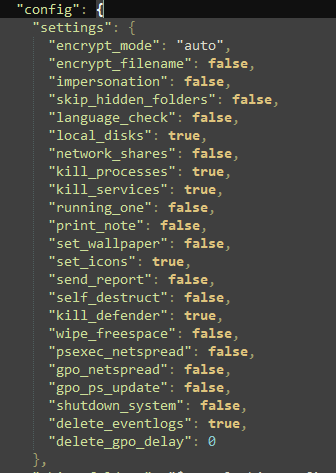
    The attackers encrypted data with publicly available versions of the popular LockBit 3.0 (for Windows systems) and Babuk (for Linux) malware. The LockBit sample we analyzed was configured with commands to encrypt local drives, terminate specific processes and services, disable Windows Defender, and delete event logs. The ransomware added system directories, as well as a folder named intel where the attackers loaded tools to harvest credentials, to the encryption exclusions list.

    A snippet of the LockBit 3.0 sample’s configuration

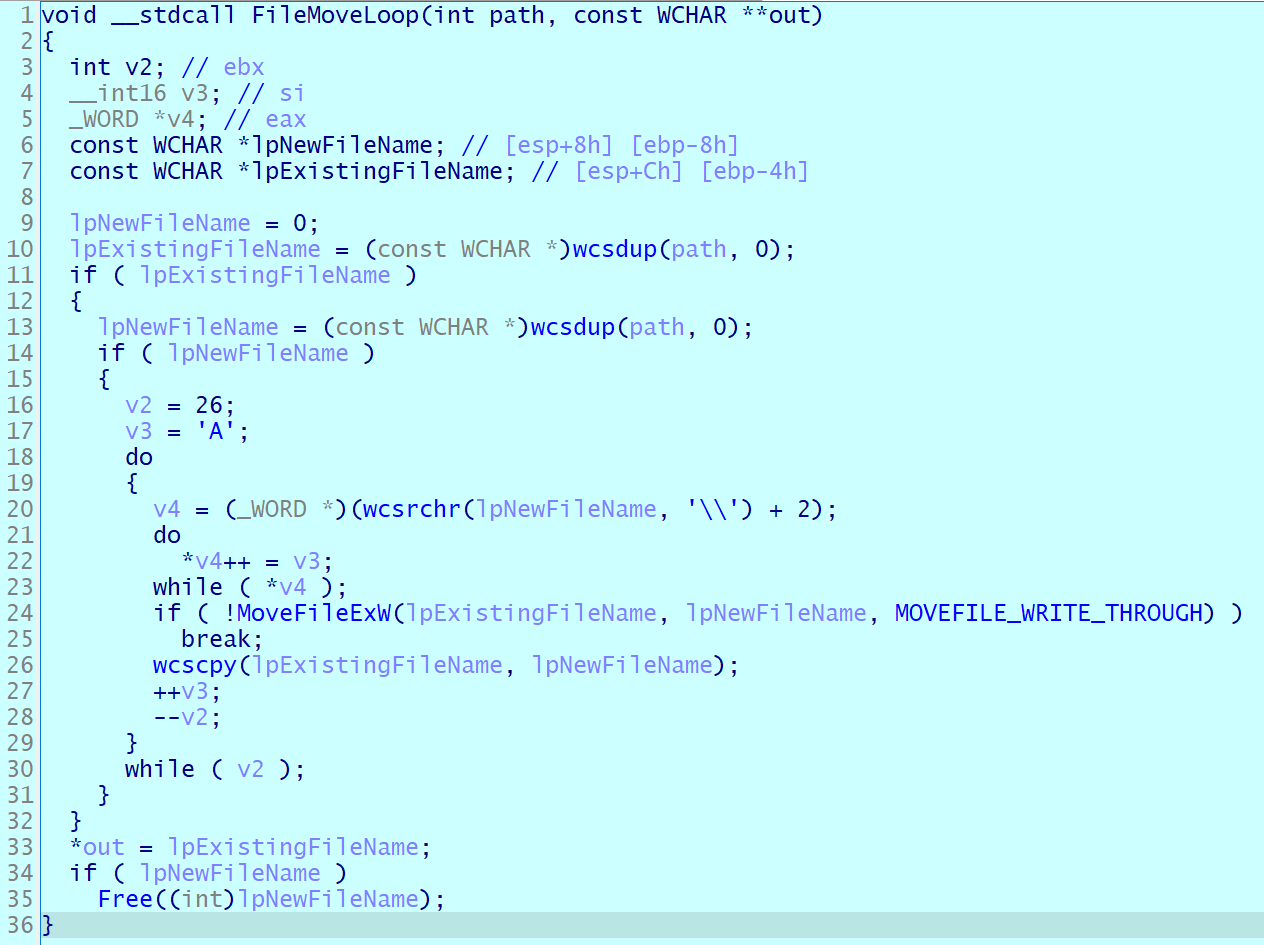
    We noticed something strange about how a victim’s files were encrypted. First, LockBit encrypted files with specific extensions, as defined in its sample configuration. These are the files that the attackers may find most valuable. Besides these, the malware encrypts files in the recycle bin while inserting random characters in these. Beyond the primary algorithm, we found a cycle that systematically renamed the original file in the recycle bin. This process iterated through every letter of the English alphabet, continuing until it reached the last one. This type of encryption makes it really hard, or even impossible, to recover the user’s files.

    The file renaming cycle

    Below is an example of how this appears in logs:

    The algorithm then attempts to delete the last version of
    c:$recycle.bin[redacted]zzzzzzzzzzz.

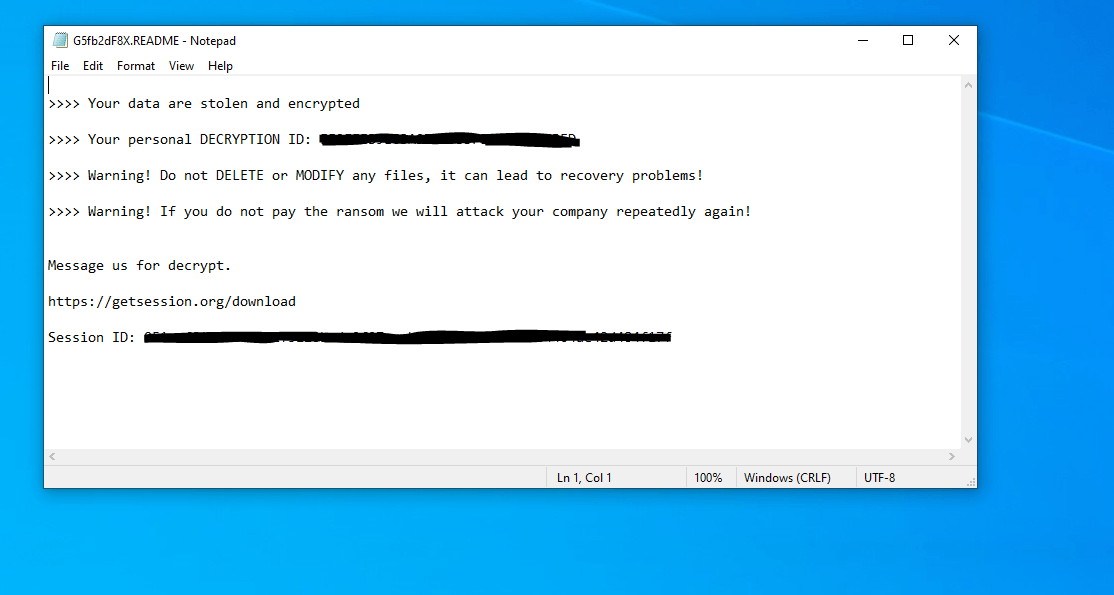
    The attackers leave a ransom note with a link containing their ID in the Session messaging service for future contact:

    A LockBit 3.0 ransom note

    Session supports end-to-end encryption, which minimizes the risk of data breaches. The developers claim their messaging service is built to guarantee complete privacy. Session has been used by other ransomware groups, such as GhostLocker, SEXi, and MorLock, in their attacks.

    Additionally, attackers targeted ESXi servers with the Babuk ransomware. They would connect to the ESXi server via SSH, upload Babuk, and initiate the encryption process for the files within the virtual machines:

    We believe the goal of the attackers was to disrupt the targeted organizations’ operations, besides financial gain.

    We are seeing a lot of overlap in the tools and techniques used by cybercriminals targeting Russian businesses and government agencies. Below, we outline the key similarities we found in attacks by different groups.

    MorLock

    MorLock activities, as investigated by F.A.C.C.T., shares many features with several of the attacks we analyzed for this report. The groups share most of the tools they use: SoftPerfect Network Scanner, XenAllPasswordPro, AnyDesk, PingCastle, Localtonet, NSSM, resocks, LockBit 3.0, and Babuk.

    The file and folder names used in attacks by both groups also show similarities. Thus we found a resocks utility named “xfs-healthcheck”, a name that follows the same template as the resocks names on the list of indicators published by F.A.C.C.T.: [xxx]-healthcheck. We noticed a further similarity when studying the XenAllPasswordPro utility: in MorLock attacks, it was located in a directory named “allinone2023”.

    Furthermore, we checked the MorLock infrastructure as reported by F.A.C.C.T., only to find that the group also used Surfshark VPN and the VDSina hosting services provider.

    BlackJack

    While investigating the utilities used in Crypt Ghouls attacks, we found an overlap with the toolkit employed by the BlackJack group, which also used XenAllPasswordPro. This caught our attention, as XenAllPasswordPro is not the most popular tool among cybercriminals despite being freely available.

    Twelve

    We have seen XenAllPasswordPro used in attacks by Twelve too. Furthermore, we discovered Intellpui.vbs, a loader for CobInt, also used by Twelve, on one of the systems attacked by Crypt Ghouls.

    Shedding Zmiy

    Shedding Zmiy is a group associated with the (Ex)Cobalt activity cluster. We found a further overlap in a report by Solar 4RAYS on this group-related incidents, namely the use of DLL sideloading with the dismcore.dll malicious loader. The report mentioned other familiar utilities and malware: resocks, SoftPerfect Network Scanner, and CobInt. In addition, Shedding Zmiy used VDSina to host its command-and-control servers.

    The similarities between the groups described above led to the conclusion that these attacks overlap with the activity of Crypt Ghouls. Our analysis of cybercriminal tools and tactics suggests that different groups may be collaborating, sharing resources, or exchanging intelligence. Other vendors have found evidence of the (Ex)Cobalt cluster members participating in these groups’ activities, and our analysis confirms this. Right now, we cannot say for sure that these campaigns are connected, but we anticipate their number will increase further. We will continue to monitor activity targeting Russian organizations.

    Victims

    Russian government agencies as well as mining, energy, finance, and retail companies have fallen victim to the Crypt Ghouls group.

    Conclusion

    Crypt Ghouls is another group attacking Russia. Cybercriminals are leveraging compromised credentials, often belonging to subcontractors, and popular open-source tools. These include modified configurations of the LockBit 3.0 and Babuk ransomware, whose builders and source code are publicly available. As the number of attackers using leaked builds increases, identifying the perpetrators of threats becomes increasingly difficult. The shared toolkit used in attacks on Russia makes it challenging to pinpoint the specific hacktivist groups involved. In the attacks carried out by the Crypt Ghouls, we have identified components of infrastructure and a variety of popular tools that are also used by many other groups. This suggests that the current actors are not only sharing knowledge but also their toolkits. All of this only makes it more difficult to identify specific malicious actors behind the wave of attacks directed at Russian organizations.

    Indicators of compromise

    Note: Network addresses specified in this section are valid at the time of publishing, but may change over time.

    SHA256:

    File paths:
    С:ProgramDataoracledismcore.dll
    odbcconf.xml – payload
    C:UsersUserDownloadsdumper.ps1 – dumper.ps1
    C:UsersUserDesktopx86x64mimikatz.exe
    C:programdata1callinone2023xenallpasswordpro.exe
    С:programdataallinone2023xenallpasswordpro.exe
    С:programdatadbgallinone2023xenallpasswordpro.exe
    С:programdata1callinone2023xenallpasswordpro.exe
    $userdesktopallinone2023xenallpasswordpro.exe
    C:programdataallinone2023XenAllPasswordPro.exe
    C:WindowsTempnssm-2.24win64nssm.exe
    C:Users[redacted]DownloadsAnyDesk.exe
    C:WindowsTemplocaltonet.exe
    C:ProgramDatat.exe (MiniDump Tool)
    C:UsersUserAppDataLocalTempkxxxxxxx.sys
    C:WindowsTempkxxxxxxx.sys
    /tmp/lock.out (Babuk)
    /usr/sbin/xfs-healthcheck (resocks)
    /usr/sbin/xfs-modules (resocks)
    c:programdataintellintellpui.vbs (CobInt)

    IP addresses and URLs:
    45.11.181[.]152 – netstaticpoints[.]com – CobInt C2
    169.150.197[.]10 – SurfShark VPN
    169.150.197[.]18 – SurfShark VPN
    91.142.73[.]178 – VDSINA-NET
    91.142.74[.]87 – VDSINA-NET
    95.142.47[.]157 – VDSINA-NET
    185.231.155[.]124 – VDSINA-NET

    Utilities:
    XenAllPasswordPro
    PsExec
    PAExec
    SoftPerfect Network Scanner
    Localtonet
    PingCastle
    Mimikatz
    AnyDesk
    NSSM
    resocks

    MIL OSI Economics

  • MIL-OSI: Seraph Launches Public Test Realm, Offering Exclusive Early Access and Rewards to Players

    Source: GlobeNewswire (MIL-OSI)

    Web3 Game Launches Final PTR Test, Paving the Way for Official Season 1 Release

    SEOUL, Korea, Oct. 18, 2024 (GLOBE NEWSWIRE) — Seraph, one of the most highly anticipated AAA Web3 games, is set to launch its Public Test Realm (PTR) on Oct. 17, 2024. This milestone marks a significant step in the game’s development, giving players early access to new features and gameplay mechanics ahead of the official release of Season 1.

    The PTR will allow players to explore exclusive in-game content, participate in time-limited events, and earn valuable rewards. This testing phase offers players the opportunity to provide feedback and help shape the final version of the game.

    Exciting Play-to-Earn Opportunities

    Coinciding with the PTR launch, Seraph is also unveiling the RUSH Season 1 event. During this event, players can earn Starry Feathers, which will be redeemable for $SERAPH tokens in the future. By completing tasks and earning points, players can unlock rewards, including:

    • 100 Points: 1 Starry Feather
    • 200 Points: 1 Starry Feather
    • 500 Points: 3 Starry Feathers
    • 1,000 Points: 5 Starry Feathers

    Starry Feathers can be minted as NFTs, providing players with the flexibility to trade or hold them for future token airdrops. All in-game activities, including NFT minting, will be managed through the ActPass wallet system.

    New Features and Content in the PTR

    Throughout the PTR test, players can expect a series of updates designed to enhance gameplay and introduce new content. Key features include:

    • Activation Code Invitation Rewards
    • Secret Prison Mode
    • New Guild Gameplay and Class Adjustments
    • Cosmetic System Enhancements
    • Chaos Dungeon Treasure Chest Broadcast
    • Adventure Notes and New Dark Gold Equipment

    Players will also get a first look at the new Druid character, along with updated Void Realm maps, new leveling systems, and dynamic gameplay elements designed to keep the testing experience engaging.

    Seraph’s Growing Success

    Seraph has already made waves in the GameFi space, achieving over 17,000 ETH in NFT trading volume and attracting more than 90,000 active players during its Season 0 phase. Built on the BNB Chain, Seraph continues to push the boundaries of Web3 gaming innovation.

    By joining the PTR, players can secure early access to exclusive content, unlock rewards during the RUSH event, and gain valuable assets for future game updates—without any upfront investment required.

    How to Participate

    To join the PTR, players need to obtain an activation code, which can be accessed through official Seraph channels. Registration is open at https://reserve.seraph.game/, where players can secure their spot and start exploring Seraph’s final PTR phase.

    For more information and updates, visit the official website at https://www.seraph.game/#/news.

    Contact:
    Nell Loo
    Brand Director
    seraph@actoz.com

    Disclaimer: This content is provided by Seraph. The statements, views and opinions expressed in this column are solely those of the content provider. The information provided in this press release is not a solicitation for investment, nor is it intended as investment advice, financial advice, or trading advice. It is strongly recommended you practice due diligence, including consultation with a professional financial advisor, before investing in or trading cryptocurrency and securities. Please conduct your own research and invest at your own risk.

    A photo accompanying this announcement is available at https://www.globenewswire.com/NewsRoom/AttachmentNg/edc7d671-799b-422d-bfd6-dd635c933186

    The MIL Network

  • MIL-OSI Africa: Who is Tundu Lissu? Tanzania’s opposition leader is fighting for change in the face of fresh attacks on political freedoms

    Source: The Conversation – Africa – By Nicodemus Minde, Researcher, United States International University

    Tundu Lissu has become the face of opposition in Tanzania following his defiant and unrelenting criticism of the government. Since he came into the national limelight in 1995 when running for a parliamentary seat, Lissu has been a champion of democracy and human rights. He has taken on the ruling elite, exposing corruption and demanding accountability. This almost cost him his life in 2017.

    In September 2024, new evidence presented at a London tribunal revealed that the telecommunications company Tigo had shared Lissu’s mobile phone data – including his location – with the Tanzanian government. The implication was that the company was assisting the government in its harassment of the politician. Tigo’s owners have distanced themselves from these reports.

    The revelations coincided with a resurgence in government crackdowns on opposition figures.

    In the most recent developments, leaders of the country’s main opposition party Chadema (Chama cha Demokrasia na Maendeleo) – including Lissu, who is the party’s vice-chairperson, and chairman Freeman Mbowe – were arrested in September 2024. This followed their attempt to organise mass protests, which were foiled by the police. The protests had been organised to demand government accountability after the killing of a senior Chadema official and the disappearance of other party members believed to have been abducted by state operatives.

    I have studied Tanzania’s political party dynamics for a decade and interviewed Lissu as part of my PhD research on the country’s democracy. Lissu’s persistence in tackling democratic backsliding in Tanzania has made him a formidable force, challenging the ruling Chama Cha Mapinduzi party.

    Lissu spent about three years in exile in Belgium after the 2017 shooting. He staged a comeback as a presidential candidate in the 2020 elections. He lost to John Magufuli in a poll marred by violence and allegations of rigging.

    There have been changes in the country since Magufuli’s death in March 2021 and a string of political reforms under President Samia Suluhu. This has created the space for Lissu and his party Chadema to establish an opposition that now threatens the ruling party’s six-decade hold on power. Presidential elections are due to be held in 2025.

    So who is Lissu? What’s his history and how did he became involved in politics?

    Early years

    Lissu’s political activism began during his university years in the early 1990s. This marked the start of a career that would later shape Tanzania’s political landscape. Lissu studied law at the University of Dar es Salaam before going to the UK for a master’s degree in law.

    His first foray into national politics came in 1995, when he vied for a parliamentary seat. He was 27. The election was Tanzania’s first under a multiparty system. It introduced Lissu to the arena of opposition politics following his defeat.

    A year later, Lissu was one of the lead investigative lawyers for a public interest environmental law organisation investigating abuses and irregularities at a World Bank-backed gold mine in northern Tanzania. His early work focused on environmental and human rights.

    Lissu and his colleague Rugemeleza Nshala were investigating the killing of 62 small-scale miners and the evictions of thousands at the mine in 1996. They were charged with sedition over these investigations. The government eventually stopped following up on the case.

    Lissu thereafter worked on community land rights at the World Resources Institute, a global organisation focusing on policy research.

    Parliamentary years

    In 2010, Lissu won the parliamentary seat for Singida East under the opposition party Chadema. As a first-term member of parliament, he gained prominence by exposing significant state corruption scandals, particularly in the energy sector.

    Lissu and other Chadema opposition figures became a formidable force, openly naming corrupt government officials and exposing grand theft.

    They also began making calls for constitutional reform. These were aimed at addressing excessive presidential powers and the power imbalances of the union between Tanganyika and Zanzibar. This push culminated in then president Jakaya Kikwete initiating a constitutional review process in 2010.

    Lissu’s legal acumen played out in the constituent assembly, the body convened to deliberate on constitutional reforms. However, the assembly, dominated by members of the ruling party Chama Cha Mapinduzi, rejected many of the key provisions of the draft constitution. It had been widely regarded as the “people’s draft” because it included citizen participation. Its key provisions included reduced presidential powers and the establishment of independent state institutions.

    The process was to culminate in a referendum in 2014. This prematurely aborted and Tanzania went into the 2015 election without a new constitution.

    In these elections, Lissu successfully defended his parliamentary seat. As a second-term legislator, he focused on strengthening Chadema’s presence. This included door-to-door conversations with the public and grassroots mobilisation to build the party.

    The party’s momentum, however, was halted by a repressive regime under Magufuli, who became president in 2015. He cracked down on critics and instituted a partial ban on political rallies.

    Lissu became very critical of Magufuli’s economic policies. In a public address in 2017, Magufuli admitted to the government’s tapping of Lissu’s phone and described those who opposed his own economic reforms as traitors. Soon after this, Lissu was shot 16 times after leaving parliament buildings in the capital, Dodoma.

    Exile

    Lissu officially went into exile in Belgium after the shooting. In 2020, he published Remaining in the Shadows: Parliament and Accountability in East Africa, a critical examination of the presidentialist systems in Uganda, Kenya and Tanzania, which he argued had undermined democratic consolidation in the region.

    Through this publication, Lissu continued his activism, challenging political structures.

    His brief return to Tanzania to contest the presidency in 2020 was marked by repeated arrests and intimidation during the electoral campaign. After his loss to Magufuli, Lissu went back to Belgium.

    He announced his return home in 2023.

    Tanzania today

    It’s important to understand why Lissu and Chadema are viewed as a current threat in Tanzania.

    The country is entering an election period. Local government elections are scheduled for November 2024 ahead of general elections in 2025.

    The ruling party, Chama Cha Mapinduzi, has in the recent past relied on state violence to secure electoral victories. The last general election in 2020 was marred by violence, as well as intimidation of the opposition and censorship.

    It looks likely that Chadema will once again nominate Lissu to contest the presidency in the 2025 general election against president Samia. Lissu’s fearlessness and defiance make him the best candidate to take on the ruling party. Samia has already described Lissu as a troublesome character.

    With the ongoing opposition clampdown, it looks clear that the ruling party is once again willing to do whatever it will take to hold on to power. Even if Tanzania’s democracy suffers.

    – Who is Tundu Lissu? Tanzania’s opposition leader is fighting for change in the face of fresh attacks on political freedoms
    https://theconversation.com/who-is-tundu-lissu-tanzanias-opposition-leader-is-fighting-for-change-in-the-face-of-fresh-attacks-on-political-freedoms-240821

    MIL OSI Africa

  • MIL-OSI Video: Intl Day for the Eradication of Poverty 2024 – UN Chief Message | United Nations

    Source: United Nations (Video News)

    Secretary-General’s message on the International Day for the Eradication of Poverty: “Ending social and institutional maltreatment: acting together for just, peaceful and inclusive societies”

    Poverty is a global plague, affecting hundreds of millions of people around the world.

    But poverty is not inevitable. It is the direct result of the choices that societies and governments make — or fail to make.

    This year’s theme reminds us that people mired in poverty contend with societal discrimination and systemic barriers that make it more difficult to access vital services and support.

    Ending global poverty — and achieving the Sustainable Development Goals — requires governments shaping institutions and systems that put people first.

    It demands that we prioritize investments in decent work, learning opportunities and social protection that offer ladders out of poverty.

    And it calls on us to fully implement the new Pact for the Future by supporting an SDG Stimulus and reforming the global financial architecture to help developing countries invest in their people.

    Eradicating poverty is an essential foundation for humane, dignified societies that leave no one behind.

    On this important day, let’s re-commit to making poverty history.

    *****
    (En français)

    La pauvreté est un fléau mondial qui touche des centaines de millions de personnes à travers la planète.

    Toutefois, elle n’est pas une fatalité. Elle résulte directement des choix que font, ou ne font pas, les sociétés et les États.

    Le thème de cette année nous rappelle que les personnes en proie à la pauvreté sont confrontées à des discriminations sociétales et à des obstacles systémiques qui les empêchent d’accéder à l’aide et aux services essentiels.

    Pour éliminer la pauvreté dans le monde et atteindre les objectifs de développement durable, il faut que les États se dotent d’institutions et de systèmes qui placent les gens au cœur de leur action.

    Il convient d’investir en premier lieu dans le travail décent, l’apprentissage et la protection sociale, véritables marchepieds pour sortir de la pauvreté.

    Il convient enfin de mettre pleinement en œuvre le nouveau Pacte pour l’avenir, en soutenant le plan de relance des objectifs de développement durable et en réformant l’architecture financière internationale afin d’aider les pays en développement à investir dans leur population.

    L’éradication de la pauvreté est indispensable à l’édification de sociétés humaines et dignes où personne n’est laissé de côté.

    En ce jour important, redisons notre détermination à faire de la pauvreté une histoire ancienne.

    https://www.youtube.com/watch?v=TB2ruwh3XTY

    MIL OSI Video

  • MIL-OSI: UXLINK Strengthens Ecosystem with Strategic Partnerships to Drive Token Growth and Innovation

    Source: GlobeNewswire (MIL-OSI)

    SINGAPORE, Oct. 18, 2024 (GLOBE NEWSWIRE) — UXLINK is pleased to announce several strategic partnerships aimed at expanding its ecosystem and supporting the growth of new Web3 projects. Through its UFLY eco-fund, UXLINK will provide resources to top-tier developers and emerging projects, enabling them to issue tokens and develop thriving communities.

    “Partnering with innovative projects aligns with our vision of creating a robust and sustainable Web3 ecosystem,” said Sean, Founder at UXLINK. “By leveraging our infrastructure and UFLY eco-fund, we aim to attract the brightest minds in the industry to build on UXLINK.”

    Supporting Community Development and Growth

    These partnerships will deploy new applications on platforms such as Line and KakaoTalk, offering unique social experiences and driving user engagement. UXLINK’s UFLY eco-fund is designed to accelerate the growth of these projects, ensuring they have the support and resources needed to succeed in the competitive Web3 landscape.

    For more information on UXLINK’s partnership opportunities, visit http://www.uxlink.io.

    About UXLINK:

    UXLINK is the world’s largest Web3 social platform and infrastructure provider, connecting a wide array of ecosystem partners and users through a seamless and interactive digital experience. By leveraging blockchain technology, UXLINK aims to redefine social networking, ensuring a secure, transparent, and rewarding environment for its global community.

    Contact Details:

    UXLINK: https://www.uxlink.io/
    Twitter: https://twitter.com/UXLINKofficial
    Telegram: https://t.me/uxlinkofficial, https://t.me/uxlinkofficial2
    CMC: https://coinmarketcap.com/currencies/uxlink/

    Contact Information:
    UXLINK
    admin@uxlink.io

    Media Contact:
    Rachita Chettri
    MediaX Agency
    contact@mediax.agency

    Disclaimer: This content is provided by UXLINK. The statements, views and opinions expressed in this column are solely those of the content provider. The information provided in this press release is not a solicitation for investment, nor is it intended as investment advice, financial advice, or trading advice. It is strongly recommended you practice due diligence, including consultation with a professional financial advisor, before investing in or trading cryptocurrency and securities. Please conduct your own research and invest at your own risk.

    A photo accompanying this announcement is available at https://www.globenewswire.com/NewsRoom/AttachmentNg/8e758ba4-9fe2-4c14-bbcd-6fc2fade87c5

    The MIL Network

  • MIL-OSI Banking: Euro area monthly balance of payments: August 2024

    Source: European Central Bank

    18 October 2024

    • Current account recorded €31 billion surplus in August 2024, down from €41 billion in previous month
    • Current account surplus amounted to €408 billion (2.8% of euro area GDP) in the 12 months to August 2024, up from €138 billion (1.0%) one year earlier
    • In financial account, euro area residents’ net acquisitions of non-euro area portfolio investment securities totalled €510 billion and non-residents’ net acquisitions of euro area portfolio investment securities totalled €718 billion in the 12 months to August 2024

    Chart 1

    Euro area current account balance

    (EUR billions unless otherwise indicated; working day and seasonally adjusted data)

    Source: ECB.

    The current account of the euro area recorded a surplus of €31 billion in August 2024, a decrease of €10 billion from the previous month (Chart 1 and Table 1). Surpluses were recorded for goods (€32 billion) and services (€19 billion). Deficits were recorded for secondary income (€15 billion) and primary income (€ 4 billion).

    Table 1

    Current account of the euro area

    (EUR billions unless otherwise indicated; transactions; working day and seasonally adjusted data)

    Source: ECB.

    Note: Discrepancies between totals and their components may be due to rounding.

    Data for the current account of the euro area

    In the 12 months to August 2024, the current account surplus widened to €408 billion (2.8% of euro area GDP), up from €138 billion (1.0% of euro area GDP) one year earlier. This increase was mainly driven by a larger surplus for goods (up from €147 billion to €379 billion), and, to a lesser extent, by larger surpluses for services (up from €129 billion to €162 billion) and primary income (up from €29 billion to €33 billion). The secondary income deficit remained broadly stable (slightly down from €166 billion to €165 billion).

    Chart 2

    Selected items of the euro area financial account

    (EUR billions; 12-month cumulated data)

    Source: ECB.

    Notes: For assets, a positive (negative) number indicates net purchases (sales) of non-euro area instruments by euro area investors. For liabilities, a positive (negative) number indicates net sales (purchases) of euro area instruments by non-euro area investors.

    In direct investment, euro area residents made net disinvestments of €196 billion in non-euro area assets in the 12 months to August 2024, declining from net disinvestments of €324 billion one year earlier (Chart 2 and Table 2). Non-residents disinvested €358 billion in net terms from euro area assets in the 12 months to August 2024, decreasing from net disinvestments of €471 billion one year earlier.

    In portfolio investment, euro area residents’ net purchases of non-euro area equity increased to €105 billion in the 12 months to August 2024, up from €56 billion one year earlier. Over the same period, net purchases of non-euro area debt securities by euro-area residents rose to €406 billion, up from €361 billion one year earlier. Non-residents’ net purchases of euro area equity increased to €324 billion in the 12 months to August 2024, up from €208 billion one year earlier. Over the same period, non-residents’ net purchases of euro area debt securities widened to €395 billion, up from €370 billion one year earlier.

    Table 2

    Financial account of the euro area

    (EUR billions unless otherwise indicated; transactions; non-working day and non-seasonally adjusted data)

    Source: ECB.

    Notes: Decreases in assets and liabilities are shown with a minus sign. Net financial derivatives are reported under assets. “MFIs” stands for monetary financial institutions. Discrepancies between totals and their components may be due to rounding.

    Data for the financial account of the euro area

    In other investment, euro area residents recorded net acquisitions of non-euro area assets amounting to €204 billion in the 12 months to August 2024 (following net disposals of €73 billion one year earlier), while they recorded net disposals of liabilities of €248 billion (down from €280 billion one year earlier).

    Chart 3

    Monetary presentation of the balance of payments

    (EUR billions; 12-month cumulated data)

    Source: ECB.

    Notes: “MFI net external assets (enhanced)” incorporates an adjustment to the MFI net external assets (as reported in the consolidated MFI balance sheet items statistics) based on information on MFI long-term liabilities held by non-residents, available in b.o.p. statistics. B.o.p. transactions refer only to transactions of non-MFI residents of the euro area. Financial transactions are shown as liabilities net of assets. “Other” includes financial derivatives and statistical discrepancies.

    The monetary presentation of the balance of payments (Chart 3) shows that the net external assets (enhanced) of euro area MFIs increased by €541 billion in the 12 months to August 2024. This increase was mainly driven by the current and capital accounts surplus and, to a lesser extent, by euro area non-MFIs’ net inflows in portfolio investment debt, portfolio investment equity and other investment. These developments were partly offset by euro area non-MFIs’ net outflows in direct investment and other flows.

    In August 2024 the Eurosystem’s stock of reserve assets increased to €1,288.4 billion up from €1,282.8 billion in the previous month (Table 3). This increase was mainly driven by positive price changes (€15.4 billion), mostly due to an increase in the price of gold. This development was partly offset by negative exchange rate changes (€6.8 billion) and net sales of assets (€3.0 billion).

    Table 3

    Reserve assets of the euro area

    (EUR billions; amounts outstanding at the end of the period, flows during the period; non-working day and non-seasonally adjusted data)

    Source: ECB.

    Notes: “Other reserve assets” comprises currency and deposits, securities, financial derivatives (net) and other claims. Discrepancies between totals and their components may be due to rounding.

    Data for the reserve assets of the euro area

    Data revisions

    This press release incorporates revisions to the data for July 2024. These revisions did not significantly alter the figures previously published.

    Next releases:

    • Monthly balance of payments: 19 November 2024 (reference data up to September 2024)
    • Quarterly balance of payments: 13 January 2025 (reference data up to the third quarter of 2024)[1]

    For media queries, please contact Nicos Keranis, tel.: +49 69 1344 5482.

    Notes

    • Current account data are always seasonally and working day-adjusted, unless otherwise indicated, whereas capital and financial account data are neither seasonally nor working day-adjusted.
    • Hyperlinks in this press release lead to data that may change with subsequent releases as a result of revisions.

    MIL OSI Global Banks

  • MIL-OSI Europe: Written question – Possible distortions of competition in Formula 1 team entries – P-002093/2024

    Source: European Parliament

    16.10.2024

    Priority question for written answer  P-002093/2024
    to the Commission
    Rule 144
    Christine Anderson (ESN)

    The fact that the Formula One Group (FOG) rejected Andretti’s entry into Formula 1, despite the team having FIA approval, could indicate a fundamental conflict of interest. Existing teams may be forming a de facto cartel that systematically excludes new competitors to protect their revenues and market values. This practice could significantly distort competition in the European motor sport industry.

    The case of the Williams team illustrates the issue, as financial difficulties during the COVID-19 crisis meant that the long-established company had to be sold, with the Williams family having to give up all its shares. The high team values resulting from market foreclosure make it practically impossible for innovative private entrepreneurs such as Eddie Jordan or Ross Brawn to enter into Formula 1 or take over existing teams.

    This situation has direct implications on the internal market, as many Formula 1 teams are based in the EU.

    • 1.Given this problematic set-up, what is the Commission’s assessment of the cartel-like structures in Formula 1, which hinder the entry of new teams and lead to a concentration of team owners among large investors?
    • 2.What measures is the Commission considering to ensure a fairer and more transparent process for the entry of new teams into Formula 1 and a wide range of team owners?
    • 3.Is the Commission planning to investigate the impact of these entry barriers and the resulting market concentration on innovation, jobs and the competitiveness of the motor sport and automotive sector in the EU?

    Submitted: 16.10.2024

    Last updated: 18 October 2024

    MIL OSI Europe News

  • MIL-OSI Europe: Written question – Defence of the public interest in the nationalisation of Efacec – E-002013/2024

    Source: European Parliament

    10.10.2024

    Question for written answer  E-002013/2024
    to the Commission
    Rule 144
    Lídia Pereira (PPE), Sebastião Bugalho (PPE), Hélder Sousa Silva (PPE), Sérgio Humberto (PPE)

    The nationalisation of Efacec in July 2020[1] was ‘carried out without technical or independent justification of the public interest’ and ‘when making the decision, the State did not prepare a forecast of its impact on public finances, which harmed the taxpayers’ right to transparency.’ Those are two of the conclusions in a Portuguese Court of Auditors report following its audit of the public funding of Efacec[2]. The Commission has twice been asked about this matter[3][4].

    According to the report, (i) ‘the goals of nationalisation have not been achieved’, (ii) ‘deterioration in Efacec’s financial and commercial standing was not avoided’, (iii) ‘its financial and operational value was not stabilised’ and (iv) ‘jobs have not been protected’. In light of these points, the natural conclusion is that the decision went against the public interest and the rights of Portuguese taxpayers. The operation involved public funding to the tune of EUR 484 million, which could rise to EUR 564 million as a result of contingent liabilities.

    • 1.What contact was there with the Portuguese Government during this process?
    • 2.What does the Commission make of this audit with regard to competition rules?

    Submitted: 10.10.2024

    • [1] https://diariodarepublica.pt/dr/detalhe/decreto-lei/33-a-2020-137126910
    • [2] https://www.tcontas.pt/pt-pt/ProdutosTC/Relatorios/RelatoriosAuditoria/Documents/2024/rel009-2024-2s.pdf
    • [3] https://www.europarl.europa.eu/doceo/document/E-9-2021-005241_EN.html
    • [4] https://www.europarl.europa.eu/doceo/document/E-9-2022-003870_EN.html
    Last updated: 18 October 2024

    MIL OSI Europe News

  • MIL-OSI Europe: Italy: Europe to gain advanced industrial edge as EIB finances BeDimensional with €20 million for new graphene and other 2D materials plants

    Source: European Investment Bank

    EIB

    • EIB supports Italian materials manufacturer BeDimensional to scale up production of cutting-edge graphene.
    • BeDimensional to expand production more than tenfold following inauguration today of Genoa plant.
    • EIB financing backed by InvestEU, the investment programme of the European Union.

    The European Investment Bank (EIB) is offering Italian materials manufacturer BeDimensional SpA financial support to expand production of cutting-edge graphene that promises to help Europe bolster its industrial base and global competitiveness. The EIB is providing €20 million in venture debt financing to BeDimensional to help it become a leading producer of breakthrough two-dimensional crystals known as Few-Layer Graphene (FLG) and Few-Layer Hexagonal Boron Nitride (FLhBN or FLB).  

    EIB Vice-President Gelsomina Vigliotti and BeDimensional Chief Executive Officer Vittorio Pellegrini announced the financing accord at the inauguration today of the company plant in Genoa that is the world’s first producer of FLG and FLB. BeDimensional plans to build a second plant in Italy to scale-up production of FLG and FLB by 2027.

    BeDimensional’s new graphene technologies have shown unprecedented performance in batteries for electric vehicles and a new generation of metal-free engine oils. As a result, the technologies mark a milestone in Europe’s green transition and will herald job creation in Italy’s advanced-manufacturing sector.

    “This project is a perfect example of how the EIB can help European innovators scale up new technologies that are critical for the EU’s industrial base and the green transition,” said EIB Vice-President Gelsomina Vigliotti. “We are contributing to Europe’s technological leadership, reducing our dependence on external suppliers and creating high-skilled jobs.”

    With EIB support, which is backed by the InvestEU programme, BeDimensional plans to increase its capacity to produce two-dimensional crystals more than tenfold to over 30 tonnes a year by 2028. Today’s plant inauguration was attended by academics, researchers, members of Italy’s Parliament officials from the Liguria Region and the Municipality of Genoa, executives from BeDimensional’s partner companies and financial-sector representatives.

    “We are at the beginning of novel greentech market opportunities,” said BeDimensional CEO Vittorio Pellegrini. “We are excited and grateful that the EIB has decided to join our investors to support our industrial expansion. We are committed to becoming a champion of this emerging market of two-dimensional crystals, securing Europe a leadership position in the production and supply of these advanced materials.”  

    BeDimensional, a spin-off from the Graphene Labs of the Istituto Italiano di Tecnologia, has established itself as a leader in the development of two-dimensional crystals. The company’s mission is to revolutionise material manufacturing by producing graphene, hexagonal boron nitride and other two-dimensional crystals at industrial scale and competitive costs.

    Graphene is widely recognised for its transformative potential in a range of industries including energy storage and conversion, smart textiles, paints, coatings and composite materials. Its most promising application is in battery technology, where it has been already shown to play a crucial role in stabilising silicon-dominant anodes.

    By enhancing the lifecycle and maximising the capacity of new generation anodes, graphene-based batteries deliver substantial advantages over traditional technologies, such as increased specific capacity and faster charging speeds. These advancements are expected to boost the adoption of EVs, significantly contributing to the decarbonisation of transport and supporting the EU’s environmental goals.

    Background information

    The European Investment Bank (EIB) is the long-term lending institution of the European Union owned by its Member States. It finances sound investments that contribute to EU policy. EIB projects boost competitiveness, foster innovation, promote sustainable development and improve social and territorial cohesion while supporting a fair and rapid transition towards climate neutrality. Over the past five years, the EIB Group has provided more than €58 billion in financing for projects in Italy.

    The EIB provides a long-term Venture Debt product tailored to meet the specific funding needs of rapidly growing innovative companies. This financing structure features bullet repayments and compensation tied to the equity risk of the investees, complementing existing venture capital investments. Since 2015, the EIB has invested €6 billion in Venture Debt, backing over 200 companies and realising over 50 exits. For more information on Venture Debt, click here: Venture debt (eib.org)

    The InvestEU programme provides the European Union with long-term funding by leveraging substantial private and public funds in support of a sustainable recovery. It also helps to mobilise private investment for the European Union’s strategic priorities such as the European Green Deal and the digital transition. InvestEU brings all EU financial instruments previously available for supporting investments within the European Union together under one roof, making funding for investment projects in Europe simpler, more efficient and more flexible. The programme has three components: the InvestEU Fund, the InvestEU Advisory Hub and the InvestEU Portal. The InvestEU Fund is allocated through implementing partners that will invest in projects using the EU budget guarantee of €26.2 billion. The entire budget guarantee will back the investment projects of implementing partners, increase their risk-bearing capacity and thus mobilise at least €372 billion in additional investment.

    BeDimensional is a leading producer of Few-Layer Graphene (FLG) and Few-Layer Hexagonal Boron Nitride (FLhBN or FLB). Its mission is to scale up production of these two-dimensional crystals for industrial use at competitive costs, revolutionizing manufacturing with more efficient and sustainable materials. As a spin-off from the Italian Institute of Technology’s Graphene Labs, BeDimensional leverages deep scientific expertise to drive rapid industrialization. Its patented process produces FLG and FLhBN with atomic-level thickness, the highest quality on the market, which can easily be integrated into any material to enhance performance and durability. BeDimensional’s technologies are applied across industries, in energy storage and conversion products, smart textiles, paints, coatings, and composite materials. Its growth potential has attracted major investors, including Eni Next and venture capital funds like CDP Venture, Eureka! Venture, and Nova Capital. The EIB investment follows BeDimensional’s collaboration, since its founding, with the EU’s Graphene Flagship, the community’s largest investment in research and development dedicated to bringing 2D materials to market.

    MIL OSI Europe News

  • MIL-OSI Europe: EIB and European Environment Agency deepen cooperation over biodiversity and climate action

    Source: European Investment Bank

    The European Investment Bank (EIB) and the European Environment Agency (EEA) will strengthen collaboration to promote climate action, environmental sustainability, and sustainable finance. In a new agreement, the EIB and the EEA pledged deeper cooperation in technical areas including biodiversity, climate adaptation, circular economy, and urban sustainability.

    The Memorandum of Understanding (MoU) will allow the EIB to use the EEA’s expertise on data and modelling when evaluating projects and measuring impact of the Bank’s financing. For its part, the EEA will be able to integrate the EIB’s sustainable finance expertise in way that makes European environmental data more useful to the broader financial community.

    “We need the best available data and knowledge to address the triple planetary crisis of biodiversity, climate change and pollution,” EIB Vice-President Ambroise Fayolle said. “That’s why we are reinforcing our partnership with the European Environment Agency. We will work on methodologies and technical approaches that will help to enhance the impact of our projects to accelerate the green transition worldwide.”

    “Scaling up and re-orienting financial flows in a more sustainable direction is a pre-requisite for meeting our environment, climate and sustainability objectives under the European Green Deal. Enhanced co-operation between the European Environment Agency and the European Investment Bank will boost our common knowledge base across a wide spectrum of areas to further support the transition towards a more sustainable and competitive European economy,” said EEA Executive Director Leena Ylä-Mononen.

    Background information

    The European Investment Bank (EIB) is the long-term lending institution of the European Union owned by its Member States. It is active in more than 160 countries and makes long-term finance available for sound investment in order to contribute towards EU policy goals.

    The EIB Group has consolidated its role as “The Climate Bank”. The EIB Group Climate Bank Roadmap 2021-2025 lays out how the EIB Group supports the European Green Deal and a just transition to low-carbon, climate-resilient and environmentally sustainable development. Consolidating our role as the EU Climate Bank is one of the eight key priorities in the EIB Group’s 2024-2027 Strategic Roadmap. In 2021, the EIB Group became the first MDB to apply Paris alignment criteria to all its new financing operations. In 2023, the EIB Group achieved a record year of green finance with €49 billion: this is more than 50% of our total financing activities. The mid-term review of our Climate Bank Roadmap has confirmed that the EIB Group is on track to achieve the goal of supporting €1 trillion of green financing in this decade.

    The EEA is an agency of the European Union that delivers knowledge and data to support Europe’s environment and climate goals. In collaboration with its partner network, Eionet, the EEA informs decision-makers and the public about the state of Europe’s environment, climate change and wider sustainability issues.

    MIL OSI Europe News

  • MIL-OSI Europe: Investing in nature

    Source: European Investment Bank

    To scale up nature-positive investment, we need to do four things. First, build more effective public-private partnerships. Between countries and public development banks, as well as with nature organisations, companies and private-sector financial institutions. This would help de-risk investments, prepare projects, and deliver impact at scale for climate, nature, and inclusive economic development. Second, revive and mainstream regenerative practices and stewardship of biodiversity, particularly in the agriculture, forestry and fishing sectors. Third, common principles, standards and disclosure mechanisms to track nature-positive finance and its impact, and to disclose more information on the nature-related impact, dependencies and risk exposure of companies and financial institutions. Finally, to take nature into consideration in all policies and investment decisions, to reorientate and decrease the flow of financing to activities harmful to nature.


    Multilateral development banks will play a key role in scaling up green investments. Institutions like the European Investment Bank are already stepping up support for the protection, restoration, and sustainable use of nature with the launch of common principles for tracking nature-positive finance. Such information is essential for measuring and incorporating nature into multilateral lenders’ operations, as well as informing other investors about what constitutes a nature-positive investment. Partnerships and joint efforts to put these principles into practice are ongoing.

    At the European level, the EIB is working closely with the European Commission to support the implementation of the European Union’s 2030 Biodiversity Strategy worldwide. We strive to ensure that all the projects we finance cause “no loss” of biodiversity, and we are factoring biodiversity and ecosystem considerations into all our activities.

    Moreover, because one of the biggest challenges in scaling up nature-positive investments lies in structuring projects, we are providing advisory services to help nature-restoration and biodiversity initiatives get off the ground. In Morocco, the EIB advised and lent €100 million ($109 million) to preserve and restore more than 600,000 hectares of forest. In Ivory Coast, we are gearing up to support sustainable cocoa farming in which forests are preserved, rather than cut down. And to support marine conservation, we are working with partner institutions on the very successful Clean Oceans Initiative, which is ahead of schedule in providing €4 billion for projects to limit plastic waste.


    MIL OSI Europe News

  • MIL-OSI Europe: Answer to a written question – The rule of law in Cyprus and the case of Auditor General Odysseas Michaelides – P-001794/2024(ASW)

    Source: European Parliament

    Under the EU Treaties, the Commission has no general powers to intervene in individual judicial cases, nor is the Commission in a position to examine how individual cases are addressed by the judicial authorities of a Member State. The adjudication in specific cases comes under the responsibility of judicial authorities of each Member State.

    The Commission monitors significant developments concerning the rule of law in all Member States, including Cyprus, in the context of the annual Rule of Law Report[1], which includes country specific recommendations to all Member States.

    The 2024 Country Chapter on Cyprus, published in July 2024, reported that limited access to relevant information affects the ability of the Audit Office to effectively perform audits on the finance of public institutions.

    The Commission follows closely developments in this area, also in view of the important oversight role of the Audit Office in checking the expenditure of public institutions and detecting suspicions of corruption, and will provide an up-to-date assessment in its 2025 Rule of Law Report.

    • [1] https://commission.europa.eu/strategy-and-policy/policies/justice-and-fundamental-rights/upholding-rule-law/rule-law/annual-rule-law-cycle_en
    Last updated: 18 October 2024

    MIL OSI Europe News

  • MIL-OSI Asia-Pac: Text of Vice-President’s address at the Foundation Day Celebration of the National Human Rights Commission

    Source: Government of India

    Very warm good morning to all of you.

    Distinguished audience, excellencies and friends in the cause of human rights. I had a tenure which I will not be able to forget, because it is reminded on every platform, my tenure as Governor State of West Bengal. That makes me resonate about state of human rights but ladies and gentlemen, post-poll violence in West Bengal does not define the scene in the country it is in isolation but whenever someone calls me former-Governor of the State of West Bengal, I am reminded of the great contribution by the National Human Rights Commission and law of the ruler rather than the rule of law defined the situation. It emanated from a report rendered by the former member of the National Human Rights Commission Shri Rajiv Jain, a thorough report that addressed all issues and also indicated the way ahead.

    Friends, I am happy to be here today to mark the 31st Foundation Day of the National Human Rights Commission of India. Today, we are not only commemorating an institution but the fundamental value that is integral to this institution, integral to the Constitution of India, and integral to our society and culture.

    This year the World Human Rights Day theme is Equality – Reducing inequalities and advancing human rights. Equality has to be understood as it is beyond definition as such. However at its core is that all human beings are born free and equal in dignity and in rights.  Religion, race, colour, sex, status, or other facets are surficial. Discrimination in any form is challenging to core aspects of human rights.  Human rights are best secured and nurtured with public response. There can be no greater custodian of human rights than the public at large. We need to stand firm when such violations occur.

    To respect others’ human rights is divine duty.  These rights are inviolable.  Preamble of our Constitution seeking justice, liberty, equality to all citizens is essence of human rights.  There is need to have fraternal feelings with respect for different perceptions and views.

    Human rights can be defined in two ways. First is the narrow, legal way of defining human rights at the drop of a hat, we jump to it make a very small isolated instance systemic that’s a legal way. The notion grants certain rights to individuals by their inherent being. No law is needed. We are born with human rights. We are born with basic rights, we are inalienable to humanity, inalienable to the individual and therefore, according to me, in all humility, we must see human rights from this prism that that is our way, that is the Indian way, that is the way we have lived for over 5,000 years. No country in the world can lay such a claim.

    When we go into the evolution of these rights, they primarily started with political rights, including the right to life and liberty. There was a gradual accretion of other rights. Judiciary in this country has added many dimensions to these rights but there is another way, and that is the civilisational way of thinking about human rights. That is organicist way. It looks at human beings as part of an organic whole, including society and Prakriti or nature. And the system as a whole has to live in peace. It is encapsulated ‘Sarvam Shanti’. We have dictated our lives over centuries in spite of various difficulties by this dictum. For us as a nation nurturing of human rights is a way of life.

    The civilizational way of thinking of rights did not evolve from political rights to economic rights and then adding other rights such as the freedom of conscious. The basic, the pristine, the organic, the original can be looked into our Vedas and our functioning over the ages, this defined sukha for all, well-being of all, happiness for all. This defines that we come to the planet as trustees, not as exploiters. We live not for us, but for all, we know for sure that we can be happy only with everyone being happy in as much as we have in togetherness to save this planet, because this existential challenge is not to an individual.

    It is beyond any element of race, caste, creed, colour, or geographic boundaries. Similar is the situation with respect to human rights. Sarve sukhina bhavantu, the Chairman focused it. This is the motto of NHRC. What a grandiose motto! A motto emanating from our civilisational ethos, emanating from what we have lived through. We have, all through history exemplified it, and in the face of very daunting circumstances, some of which were ruthless, reckless, trampling our civilisation yet the nation stood firm. That’s what India is, that’s what Bharat is.

    Our scriptures were and are our charters, they are repositories of knowledge and wisdom, they are repositories of the human way of life. One will have to strive for years to come to add to them. That is the ultimate when it comes to knowledge and these scriptures were loud, every day proclamation of these rights that society and the civilization granted.

    Our civilization created institutions to ensure that these rights were honoured. In any governance in this country, at any point in time, those who governed had to listen to the voice of the people. Our sages, our seers, they were the real controllers of morality, property, and all that constitutes the welfare of humanity at large.

    Our temples ran open kitchens so that there was freedom from hunger. Temples ran open kitchens so there was freedom from hunger. Education was free, so there was right to education. Friends, if you look at the Indian Constitution it has 22 paintings. The first one is the Gurukul, It defines our society is concerned that everyone would have access to education. You gave dakshina according to your ability, but there was no tuition fee. Guru dakshina if you got education, you can reward your teacher, you can honour your teacher but it did not have a compulsory element; it had an optional element. It had to emanate not from your fiduciary strength, but from the call of your soul that was the sublimity. We practised and are on our way to it. Everyone was allowed to practise their faith. Look at our country who came? They came, they were received, they were absorbed, they were in oneness, and they felt at home in this country in the same manner as they felt at home in other countries.

    A country where they had to live under circumstances which are indescribable that was the scenario, friends. So on and so forth, I can keep on going, but the list is endless. In a way, human rights are very much part of our moral fabric, our way of life, and why only just the past? Our contemporaneous governance look at it.cIt underlines this very philosophy in several ways.

    Policies are driven by the idea of human rights. When COVID hit us and hit the world, it was a non-discriminatory challenge to the entire planet. High and mighty and great nations suffered. In that scenario, the government ensured in this country that no one sleeps hungry, regardless of access to their means of livelihood. Free grains were given, friends, to 850 million people, empowering them to face the challenge. What started on 1st April 2020 continues till date and I wonder still in the world people talk of hunger crisis in this country? 850 million people are getting support of free ration in this country, and that is irrespective of their colour, caste, creed, religion, geographical location, or other aspects. All I can say is, those who think about India’s hunger situation need to reflect and get into a repentance mode. This moral fibre is driving governance in this country. I don’t want to reflect all on this so much attention has been bestowed on human rights in this country that what was unthinkable is now a ground reality.

    If a widow has to stand in queue for two hours and suffer to get a pension for the service her late husband rendered, this was a loss of dignity. Not any longer, she gets it sitting at home, and this makes Bharat accounting for more than 50% of global direct digital transfers. Which indicates promptness, no leakage, no liasioning. The world needs to know it. I am not seeking recognition, just to be informed. Direct benefit transfers hit at the corrupt and you will be happy to note, friends, that corruption has been neutralised from power corridors in this country. Corruption is no longer a password to a contract to employment.

    Corruption leads you to be attendant to law, gone are the days when some thought they were above the law. The equality before the law in this country has been demonstrated to such a wholesome level that human rights are flourishing and blossoming is taking place, such a large country, with such diversity, the world needs to know about it.

    Another serious issue is that they know it, they seek to undermine it. I’ll come to that later.

    Not long ago, in our country and in the world it still happens in major parts of the world states. Ignominy of women defecating in public, a huge challenge for a country like ours 1.4 billion people, to take care of this significant human rights aspect, which occurs minimum twice a day, and look at now our scene is dotted by the areas that are 100% free of this menace. The work is ongoing and the world has to see it to believe.

    What a transformative change it was. Wealth out of policies has ensured toilets in every home a fundamental right not required to be scripted by any constitutional prescription or law. A ground reality at the moment, imparting to our women, and others also, dignity, which is the most precious facet of human rights. Friends, these are just illustrative.

    Technological penetration has created an equalising situation and helps curb iniquitous practices, making everyone equal before the law. No country in the world can claim the kind of equality before law ecosystem we have. Those who thought they were above the law, beyond the reach of the law, enjoyed immunity from the law are suffering at the hands of the law and everyone in this country is accountable only and only in accordance with the law. A big change the world has to notice, we are perhaps a country in a single-digit situation on this score.

    The strong arm of the law in our country curtails the environment of impunity. Friends, do you think a country that had such a holistic idea of rights takes care of everyone? Do we require sermonising? Do we require lecturing about human rights? We are open to all ideas, we are resilient but we don’t need lecturing or sermonising on the human rights aspect, certainly not. I must, friends, compulsively advert to an unfortunate aspect as well. Unfortunately, this great civilisation suffered a taint on its otherwise unblemished record. I must record it, you see. Not that we have not had air pockets or strong headwinds that traumatised people on the plank of human rights.

    Bharat, long championed as a guardian of human rights, faced three stark transgressions that scarred generations: the brutal Partition, the oppressive Emergency, and the horrific 1984 riots. These traumatic events stand as sombre reminders of the fragility of civil liberties and the imperative to vigilantly safeguard human dignity. But then we are a nation quick to fix situations, to learn our lessons.

    As a tribute to our deep commitment to human rights, laudable steps have been taken by way of celebrating Constitution Day from 2015 onwards on November 26. This will remind us all to fervently work towards realisation of noble values emanating from our preamble. Thereby nurturing human rights and creating an atmosphere for their blossoming.

    Another significant step was taken this year- June 25 to be observed as year as ‘Samvidhaan Hatya Diwas’ to mark imposition of draconian Emergency. This intended to honour the spirit of millions who struggled to revive democracy despite facing inexplicable persecution at the hands of an oppressive government then. This will help keep the eternal flame of individual freedom and the defence of the democracy alive in every Indian.

    The nation and its youth in particular must be informed that on June 25, 1975, the then PM Indira Gandhi, in a brazen display of a dictatorial mindset, strangled the soul of our democracy by imposing the emergency on the nation resulting in violation of human rights. Lakhs of people were thrown behind bars for no fault of their own and the voice of the media was silenced and the judiciary at the apex level failed as never before therefore, this step has been taken. These are not being looked at in this country from a partisan angle. In this country, we look at events and situations only from one angle, and that is the angle of nationalism, the angle of the Constitution.

    Friends, Constitution is our north star for human rights. Celebration every year of Constitution Day on November 26 is reminder of our duty to nurture human rights. Every person in this country, particularly the youth, will be reminded of this solemn obligation, solemn duty to be performed for democracy and for the nation. Constitution Hatya Diwas, similarly, on June 25th every year will act as a reminder of the dangers and challenges to human rights while the record of Bharat as a nation and as custodian of human rights is singularly remarkable, and I am saying this with utmost restraint, I am using minimum words. In this scenario, there are pernicious forces within and without that in a structured manner, seek to unfairly tempt us. These forces are overzealously in overdrive. They have an agenda that is far distanced from human values or concern for human rights. Friends, such is the sinister design that, on all conceivable occasions, these forces that are inimical to Bharat avail national and international fora to tarnish our fair human rights record, arrogating for themselves the right to calibrate. I pose a question to myself. Who has imparted this right to them? And it is most opaque, hardly any due diligence. Ground reality is very different, as I indicated about the hunger situation. Some of these think and that is a colonial mindset. They think they are ordained to enjoy such a right, a right to harangue civilisations like ours, to doctor situations, to impede our growth. These forces have to be neutralised by actions that exemplify, if I may say so, in the Indian context, ‘Pratighaat’.

    They also think they are entitled to create indices and rank everyone in the world. This exercise smacks of imperial hubris. To show a nation in bad colour, they have a list of nations. I dare them to come to this country if there is a heavenly spirit, heavenly ecosystem, it exists more here than in any part of the globe. We are a nation of saints and sages, culture and civilisation, empathy and sympathy.

    During COVID, facing a challenge, we supported hundred other countries. Wherever there has been a crisis in the globe by way of evacuation requirement or earthquake, this country has always gone ahead.

    Expansion is the worst form of human rights transgression, this country has never believed in expansion has been a victim of expansion. The Prime Minister of this country has unequivocally stated on a global platform “We are not living in an era of expansion, we have to address issues and conflagrations by discussion and diplomacy.” This is Bharat. These sinister forces are driven by an agenda that is fiscally fuelled by people who seek to make a name for themselves, time to shame them. They try to create havoc with the economic system of this country and made no bones about it, no secret of it. First one partly successful, second one collapsed, the balloon was punctured.

    Human rights, friends, as a concept should ignite us to look inwards. There are occasions in your life, day in and day out when you can serve human rights by hand-holding people the aged, the challenged, the needy and also you can do it by counselling, people need counselling. Every country in the world should measure human rights on a yardstick of the well-being of their country’s body politic overall economy.

    In the last decade, India’s economic growth, which is exponential, incremental, and now unstoppable, is not pyramidical; it is plateau. Everyone is getting the benefit, who is in the last row affordable housing, gas connections, tap water, internet connectivity, road connectivity  and this is non-discriminatory progress.

    Never in this country a developmental project been dictated by circumstances that are not sublime, serving the ultimate cause of human rights. A country where, even for a single person to exercise their right to vote, arrangements have been made. Steps have been taken by the government to ensure that those in hilly areas or difficulty, challenged areas get electricity in their house such is the track record and concern for human rights. Friends, look around the world, look around the globe. You’ll find Bharat way ahead of other nations when it comes to the preservation of human rights, particularly for minorities, the marginalised, and vulnerable sections of society.

    Tell me, which country in the world treats its minorities the way Bharat does? We have seen condition of minorities in several nations. Geographically, several nations’ names have been totally eradicated when it comes to their demographic composition. Surprisingly, the small segment left behind had to seek refuge in this country. Human rights cannot and should not be used as a tool of foreign policy to exert power and influence over others.

    Naming and shaming the wrong is a degraded form of diplomacy. You have to preach only what you practise. Friends, if one incident happens, it is disproportionately blown out, fast-tracked, and the narrative gets wings. Voices rise all over, fuelled by fiscal power. That is the time when our youth and media must be vigilant. We have to be vigilant of every aspect of human rights. We have to remember we are a nation of 1.4 billion people, an isolated incident cannot define us but their incidents just go unnoticed. Nielsen has never been remembered more when I think of those nations that turned Nielsen’s eye to such horrendous transgressions of human rights, I do not wish to dwell more on it, but catalogue the events in Europe alone. You’ll find it. Look at our school system, we don’t have the kind of shootings that some countries, which claim to be very developed, experience on a regular basis.

    Friends, with those who are closely aligned, the approach turns from clinical analysis to blissful ignorance, which allows us to draw conclusions about the political nature of the approach to human rights and let me remind you of one recent incident, an incident that defines what human rights ought not to be. That is virtually a crucible of decimating human rights. The world has seen it, some have suffered in this country.

    The most disheartening aspect of the plight of Hindus in our neighbourhood is the deepening silence of so-called moral preachers, custodians of human rights. They are totally exposed. They are mercenaries of something which is totally antithetical to human rights. Look at the kind of barbarity, torture, traumatised experiences of boys, girls, and women. Look at our religious places being sacrilege. We are too tolerant and have been too tolerant of such transgressions. This is not appropriate. I call upon everyone in the country to seriously reflect, think if you were one of those.

    Evidence, episode after episode, is piling up that the deep state is engaging in lawfare against rising powers. Somehow, it seems they are unable to digest the rise of civilisational states in the international system who assert their own identity.

    Let me reflect little away from the issue. Does the United Nations Security Council reflect a sense of human rights when it keeps one-sixth of humanity away from it? There has to be auditing of its performance. Friends, the discourse of human rights is calibrated for political projects. Get a project, get money, get some people employed. You are applauded only when you talk negative    of this country. I know of an institution in the world that claims to be at the peak.   They call them Ivy League institutions. A book has been written, Snakes in Ganges over it.

    A celebrated figure, world-renowned, Dalai Lama ji, was invited. The invitation was cancelled. The one who took the call to invite was shown the door and we got preachings from there that in our premier institutions, admissions are accorded by a privileged pedigree system, not by merit. I went to a school on foot, travelling six-kilometres got educated by scholarship, come from a farmer’s family, I am before you.

    Droupadi Murmu, a tribal woman who faced all kinds of challenges, is the First Lady and first tribal President of this country and Prime Minister Narendra Modi, for historic third term after six-decades, and the first term with a full majority after three-decades, one who has changed the landscape of this country is an OBC from backward community. The only memory he has of his youth is serving tea while the train came that too in a hurry to make money.

    I am defining these three top posts in this country of 1.4 billion if this change is not pro-human rights, if this change is not transformative, well, I fail to understand how to define it. People-centric governance is our mantra, our philosophy. Last-mile delivery, welfare of the weakest. You see our civil services, you will be amazed, particularly the people outside the country who get into there, the marginalised.

    I was so happy to find that the father was a painter in a police station, and the girl came there as superintendent of police and these instances are not isolated, there are many. My mother was not educated formally, my father did not go beyond class five, I am before you. This defines the great change in human rights this country has.

    Friends, when you ignore these developments and artificial issues are inputted to portray Bharat in a bad light, I can only lament the intellect of those heaviness who are distanced from a rational approach. It is painful to find such realities when you scratch the surface of those who claim to champion and advocate human rights. We have a system, and institutions are being used, including the judiciary. We have to be on guard. Those trying to challenge are inspired by ill motivations to destabilise this country. They find our growth indigestible, they are not acting as per their soul or mind, they are being financially manipulated. Much of it has been contained. It shall not be allowed to happen in this country. We are a nation to us belongs this century. And we’ll be a developed nation by 2047, making our people, in every respect, enjoy human rights.

    Domestically, we should be wary of elements that use human rights to advance their political agenda. I am addressing the community of politicians. Citizen Amendment Act—how can this be an issue? The act does not deprive any citizen of this country of his or her citizenship. The act does not handicap any person on the globe to take recourse to taking citizenship of this country. The act is an affirmative step to give citizenship to those who are being hunted, persecuted and this is not limited to one religion, many religions. Even such a soothing aspect is to be challenged. Well, we have a situation deep state takes shape only in this way. Therefore, nip it ruthlessly in the bud when it is seen.

    Look at the prime example I indicated, there couldn’t be a better gesture of social magnanimity collectively expressed by an act of parliament in CAA. Stateless refugees were to flee from Bharat under severe repression for committing the “sin” of choosing to follow their conscience from our neighbourhood. They had the option to be here, they committed the “sin” of conscience when they were suffering day in and day out and this is being opposed. This balm is soothing medicine is being opposed on the plank of human rights. How sharper the serpent’s tooth could it be?

    Friends, this duality exposes a sinister political agenda that includes another aspect which is germane to human rights blossoming and flourishing and that is, demographic balance in this country. History is testimony that nations have completely lost their identity by not addressing this issue. It has as a matter of fact global repercussions from the perspective of human rights.

    The tremors are being felt nearly all over, more in countries that have espoused this menace. They are getting the heat of it. The demographic climate change in the world and particularly in the nation is an issue that calls for urgent systemic addressing. I emphasise, friends, demographic climate change is a challenge that is required to be addressed.

    If the world has to live in peace and harmony, nations have to believe in their nationalism and preserve their identity. I have no doubt you’ll appreciate and be one with me. It is already taking shape as an existential challenge. Let’s defuse this, thereby sublimely serving human rights.

    Another aspect human rights should not be sealed for those who take law into their own hands who challenge the law, who use firearms, who create terror. When you deal with them in accordance with the law, they have easy friends on the point of human rights. पुलिस ने कहां गोली मारी, कैसे मारी यह नहीं देखेते किसको मारी, किस हालत में मारी, क्यों मारी।

    The Society can’t be held as a hostage or captive to these violators of the law. Law-enforcing agencies have to come and play on the front foot to deal with these rogue elements who are not only loose cannons to society but a severe threat to human rights. Fortunately, this is being done in this country effectively. Violators of law threaten attitudes, challenge law and order, there can be no worse enemies of human rights than these sections. But painfully, what a travesty these rogue elements of society, these violators of the law, who are a threat to society at large, are afforded cover by human rights plank institutions.

    On this occasion, I want to leave you with two ideas, friends. First, if you are a practitioner of law, some of you are, and I have been one myself for decades fight for the rights and dignity of the weaker sections of society. Also, fight against those who seemingly seek to fight for them but are fighting for someone else, expose those. Never let anyone appropriate the discourse and guaranteed rights for sinister political designs. This is happening. I want to look only through the political prism. What then is it for me? And then I moderate my response. Please don’t do this when it comes to nationalism, when it comes to the nation, when it comes to development, when it comes to human rights. Play your politics. Be partisan, but on these issues, please be bipartisan.

    Second, if you have legal education or are interested in research, take time to focus on those who seek to teach us but are ignorant, who seek to teach us not the subject but indoctrination. Overcome them, expose them. Pick up any part of the globe, and you’ll find they have to take many lessons from Bharat that has nurtured human rights since ages.

    Friends, we have heard great stories about the care of the last-mile individual, but we want to find the precise governance model that enables this execution of human rights. Study it, evolve one, contribute to policymaking, and that has to be translated into politics also.

    Friends, as we celebrate the establishment of the NHRC, let us renew our commitment to the idea of human rights, the rights of our fellow citizens, the idea inherent to us for generations and centuries, praying for the good of all ‘Sarve Sukhinah Santu’.

    I conclude, always remember, human rights preservation, blossoming and sustainability is in our hands. It is our collective and societal duty that we must unfailingly perform.

    Thank you for your time.

    MIL OSI Asia Pacific News

  • MIL-OSI Asia-Pac: Appointments to Board of West Kowloon Cultural District Authority

    Source: Hong Kong Government special administrative region

    Appointments to Board of West Kowloon Cultural District Authority
    Appointments to Board of West Kowloon Cultural District Authority
    *****************************************************************

         The Government today (October 18) announced appointments made by the Chief Executive to the Board of the West Kowloon Cultural District Authority (WKCDA) for a two-year term from October 23, 2024, to October 22, 2026.           The list of appointees is as follows: Mr Bernard Charnwut Chan (Vice-Chairman)Mr Abraham Chan Lok-shung*Mr Vincent Cheng Wing-shun *Dr Roy Chung Chi-pingMr Andy Hei Kao-chiangMr Benjamin Hung Pi-cheng*Mr Jat Sew-tongMr Leo Kung Lin-cheng*Mr Liu Che-ningMs Yolanda Ng Yuen-tingDr Pang Yiu-kai*Mr Paulo Pong Kin-yeeMr Anthony Wu Ting-yuk*Ms Catherine Yen Kai-shunSecretary for Culture, Sports and Tourism or alternate representativeSecretary for Development or alternate representativeSecretary for Financial Services and the Treasury or alternate representative (*new appointee)      A Government spokesman said that the non-official members appointed are experienced in their respective areas of expertise, including arts and culture, tourism, engineering, business and finance, law and community service. They will provide the necessary knowledge and valuable advice in helping the Board to discharge its statutory duties and oversee the development and operation of the West Kowloon Cultural District (WKCD).     “I would like to thank the outgoing members – Ms Winnie Tam Wan-chi, Mr Henry Fan Hung-ling, Mr Glenn Fok, Ms Rose Lee Wai-mun, Ms Dee Poon Chu-ying and Ms Tennessy Hui Mei-sheung – for their efforts and contributions. I also welcome the new appointees, and look forward to continuing to work closely with the WKCDA Board”, said the Secretary for Culture, Sports and Tourism, Mr Kevin Yeung.     The WKCDA Ordinance (Cap. 601) provides that the Board is the governing and executive body of the WKCDA. It is responsible for the planning, development, operation and maintenance of the arts and cultural facilities and related facilities in the WKCD. The Chairman of the Board is Mr Henry Tang Ying-yen. In addition to the aforementioned members, Mr Kenneth Fok Kai-kong is also a member of the Board.

     
    Ends/Friday, October 18, 2024Issued at HKT 18:27

    NNNN

    MIL OSI Asia Pacific News

  • MIL-OSI Asia-Pac: Launch of Pilot projects in Steel Sector under the National Green Hydrogen Mission

    Source: Government of India

    Posted On: 18 OCT 2024 11:21AM by PIB Delhi

    As part of National Green Hydrogen Mission, the Union Government has sanctioned three pilot projects for use of Hydrogen in steel production. Earlier the Ministry of New and Renewable Energy had issued guidelines for Implementation of Pilot projects in Steel Sector under this Mission.

    The objectives of the scheme were to identify advance technologies for utilizing green hydrogen in steelmaking, through pilot projects. These pilot projects can demonstrate safe and secure operations of green hydrogen-based steel making processes, validating technical feasibility and performance, evaluating their economic viability thereby leading to low-carbon iron and steel production. Accordingly, the proposals were invited for three components (i) Pilot project to produce DRI using 100 % Hydrogen using vertical shaft, (ii) Use of Hydrogen in Blast Furnace to reduce coal/ coke consumption and (iii) Injection of Hydrogen in vertical shaft based DRI making unit.

    Based on the evaluations of the proposals received, the Ministry of New and Renewable Energy has sanctioned total three pilot projects in the steel sector, (a) Matrix Gas and Renewables Ltd (Consortium members: Gensol Engineering Ltd, Indian Institute of Technology Bhubaneswar, Metsol AB, Sweden) with pilot plant capacity 50 ton-per-day (TPD), (b) Simplex Castings Ltd (Consortium member: BSBK Pvt. Ltd., Ten Eight Investment, IIT Bhilai) with pilot plant capacity 40 TPD and  (c) Steel Authority of India Ltd (Ranchi) with plant capacity 3200 TPD.

    The total financial support made available will be Rs. 347 Crore from the Government of India. These pilot projects are likely to be commissioned in next 3 years, paving way to the scaleup of such technologies in India.

    The Scheme Guidelines can be accessed here.

    The National Green Hydrogen Mission was launched on 04th January 2023 with an outlay of Rs. 19,744 crores up to FY 2029-30. It will contribute to India’s goal to become Aatmanirbhar (self-reliant) through clean energy and serve as an inspiration for the global Clean Energy Transition. The Mission will lead to significant decarbonization of the economy, reduced dependence on fossil fuel imports, and enable India to assume technology and market leadership in Green Hydrogen.

    ******

    Navin Sreejith


    RELATED:

    https://pib.gov.in/PressReleaseIframePage.aspx?PRID=1954950

    https://pib.gov.in/PressReleaseIframePage.aspx?PRID=2002034

    (Release ID: 2065985) Visitor Counter : 140

    MIL OSI Asia Pacific News

  • MIL-OSI Asia-Pac: Ministry of Rural Development signs MoU with ten banks to promote individual financing for higher order enterprises

    Source: Government of India (2)

    Posted On: 18 OCT 2024 3:05PM by PIB Delhi

    Deendayal Antyodaya Yojana-National Rural Livelihood Mission (DAY NRLM) under Ministry of Rural Development signed Memorandum of Understanding with nine Public Sector Banks and one Private Bank. These Banks are Bank of Baroda, Bank of India, Bank of Maharashtra, Canara Bank, Central Bank of India, Indian Bank, Indian Overseas Bank, Punjab National Bank, UCO Bank and IDBI Bank Limited.

    These Banks have designed specific products for financing individual women entrepreneurs under the fold of DAY-NRLM. The loan products so designed will help women avail bigger ticket size loans for scaling up their enterprises. This move is in lines with the realisation of goal of making Lakhpati Didi, as announced by the Prime Minister Shri Narendra Modi.

    Secretary, Rural Development Shri Shailesh Kumar Singh advised Banks to leverage this opportunity to fund women SHG members with improved assets to start their economic activities in rural areas. This initiative will go a long way in providing employment in the rural areas and a number of women SHG members will be benefitted. 

    Additional Secretary, Rural Development Shri Charanjit Singh said that banks to make their branch officials aware about the specific products designed by them so that the rural women do not face difficulty  in getting finance at the branch level.

    DAY NRLM has witnessed SHG Bank linkage grow leaps and bounds as the programme evolved. More than Rs. 9.5 crore loans have been extended by Banks to the self-help groups since the start of the Mission. The move of extending individual loans is a strategic shift in the programme indicating how women have graduated from small enterprises and are aspiring to scale up higher order enterprises.

    ******

    SS

    (Release ID: 2066039) Visitor Counter : 85

    MIL OSI Asia Pacific News

  • MIL-OSI Asia-Pac: National Conclave on Women-led Entrepreneurship organises by the Ministry of Rural Development

    Source: Government of India (2)

    Posted On: 18 OCT 2024 3:07PM by PIB Delhi

    Deendayal Antyodaya Yojana-National Rural Livelihood Mission under Ministry of Rural Development organised a National Conclave on Women led Entrepreneurship yesterday in New Delhi. Secretary, Rural Development Shri Shailesh Kumar Singh presented awards to the Banks. Additional Secretary, Rural Development Shri Charanjit Singh exchanged MoU with Banks. Joint Secretary, Ms. Smriti Sharan and other officers were also present in the conclave. The conclave was organised to give a push to women entrepreneurship by engaging Banks for extending loans for individual women entrepreneurs.

    Twenty banks were facilitated for their outstanding performance in SHG Bank linkage for the financial year 2023-24. Online integration with Jansamarth portal for SHG was launched during the conclave. Financial Literacy initiative with the support of Reserve Bank of India under the Depositors’ Education and Awareness Fund was also commenced

    Shri Shailesh Kumar Singh, Secretary, Rural Development presenting awards to the Banks

    Shri Shailesh Kumar Singh said that women show high degree of empathy, ownership, commitment, honesty, transparency and invest substantial time and energy to implement an intervention of their interest. Banks have a crucial role to play in advancement of women led enterprises.

    Shri Charanjit Singh advised Banks to make their branch officials aware about the specific products designed by them, so that the rural women do not face difficulty in getting finance at the branch level.


    Shri Charanjit Singh, Additional Secretary, Rural Development exchanging MoU with Banks.

    Ms. Smriti Sharan said that there is a need to create and nurture an ecosystem which instils confidence among women to pursue entrepreneurship. She urged all stakeholders including Banks, Regulator and other partners present to create a platform for these women entrepreneurs to address the challenges faced by them.

    The conclave witnessed a vibrant panel discussion on “Pathways from Financial Inclusion to Economic Prosperity- Vikshit Bharat@2047”. Esteemed panelists from Banks, IIM Kolkata, Fintech, State Rural Livelihoods Mission and IFMR (a research organisation) deliberated on ways to conceptualise a framework for creating an enabling ecosystem for nurturing women led enterprises in the rural areas. Active deliberations were made on demand side and supply side issues and the possible ways to bridge the gaps.

    DAY NRLM has made substantial strides in the area of financial inclusion. The conclave emphasised on the need to make a shift from group lending to individual lending in order to meet the aspirations of women entrepreneurs and helping them upscale their enterprises. In order to realise the vision of Prime Minister on creation of 3 crore lakhpati didis, Bank financing has a significant role.

    The conclave had participation from Reserve Bank of India, NABARD, Public Sector Banks, Private Banks, Regional Rural Banks, State Co-operative Banks, State Rural Livelihood Missions, various Ministries/Departments of Government of India and CSO partners.

    ******

    SS


    (Release ID: 2066041) Visitor Counter : 66

    MIL OSI Asia Pacific News