Category: Education

  • MIL-OSI USA: Governor Newsom appeals abrupt end of USDA farm subsidies used to supply food banks

    Source: US State of California 2

    Apr 5, 2025

    Family farmers share how these cuts will harm their businesses and communities

    What you need to know: Governor Newsom sent a letter of appeal today to the Department of Agriculture asking for a reversal of the termination of $47 million meant to support California’s farmers who grow produce for food banks and community centers.

    SACRAMENTO – Governor Gavin Newsom sent an appeal to the United States Department of Agriculture today appealing the abrupt and inexplicable termination of funding for California’s Local Food Purchase Assistance (LFPA) Program. Since 2022, California has utilized more than $88.5 million in LFPA funding to support local farmers, strengthen the state’s food supply system, and distribute high quality nutritious food to food insecure communities and families. Despite the inevitable harm that will fall upon farmers and communities, California’s $47 million from USDA for LFPA and Local Food for Schools Program that had been awarded for next year have been completely terminated.  

    “California’s agriculture sector – which produces nearly half the country’s fruits and vegetables – relies on the support of the Department of Agriculture to ensure that they can get fresh, healthy foods onto families’ tables. The irrational and malicious slashing of funds will not only hurt our farmers, but also the families who need food banks and school meals to stay healthy and thrive. I implore the USDA to immediately reverse this decision.”

    Governor Gavin Newsom

    “Farmers, families, and schoolchildren rely on the Local Food Purchase Assistance Program to nourish our communities and strengthen our local food systems. Through California Farm to School, we’ve seen firsthand how these initiatives provide fresh, nutritious meals to families while supporting local growers. Without this funding, families facing food insecurity will have fewer options, children will miss out on the meals they rely on, and farmers who have built their livelihoods around feeding our communities will face devastating losses. We urge the USDA to reconsider this decision and continue working with us to ensure a stronger, more resilient food system for all.”

    First Partner Jennifer Siebel Newsom

    Read the full letter HERE.

    Impact on California 

    California is the nation’s agricultural leader, producing nearly half of the Country’s fruits and vegetables. The local food production sector faces mounting pressures, including climate change, labor shortages, and market fluctuations, all impacting food availability and affordability. In 2024 alone, California’s LFPA Program allocated the California Association of Food Banks, CDSS’s largest LFPA partner, over $22.3 million to provide local healthy food and 18,647,546 meals to food-insecure Californians.

    The sole basis for the termination of LFPA25 was that “AMS [USDA’s Agricultural Marketing Service] has determined that this agreement no longer effectuates agency priorities, and that termination of the award is appropriate,” even though USDA’s mission includes “promot[ing] agriculture production that better nourishes Americans.”  This decision will cause irreparable harm to the farmers and communities that have participated in and benefitted from California’s LFPA Program. 

    Testimonials 

    The testimonies below highlight just a few examples of the devastating impact that the interrupted LFPA and LFPA Plus payments, and termination of the LFPA25 Program, has, and will continue to have, on California farms, including family-operated farms.

    Recent news

    News California Just a Nevada-Sized Economy Away from Overtaking Germany and Japan as World’s No. 3 Economy— Bloomberg News SACRAMENTO — As President Trump threatens the U.S. economy with reckless tariffs and rising uncertainty, Governor Gavin Newsom announced new…

    News “California is not Washington, D.C.” What you need to know:As President Trump’s tariffs take effect, Governor Gavin Newsom is pursuing new strategic partnerships with international trading partners while calling for California-made products to be excluded from…

    News SACRAMENTO – Governor Gavin Newsom today announced the following appointments:Trista H. Woessner-Gonzalez, of Granite Bay, has been appointed Director of the California Department of Tax and Fee Administration, where she has served in several roles including as…

    MIL OSI USA News

  • MIL-OSI Asia-Pac: MeitY and UNESCO to Host the 3rd AI Readiness consultation in Hyderabad

    Source: Government of India

    Posted On: 07 APR 2025 2:33PM by PIB Hyderabad

    The UNESCO Regional Office for South Asia, in collaboration with the Union Ministry of Electronics and Information Technology (MeitY) and Ikigai Law as the implementing partner, will be organizing a stakeholder consultation on the AI Readiness Assessment Methodology (RAM) in India. This event will take place on April 8, 2025, at 1:30 PM, at T-Works in Hyderabad.


    A key segment of the event is a fireside chat on the IndiaAI Mission, featuring Mr. Abhishek Singh, CEO, IndiaAI Mission, and Additional Secretary, MeitY. The event will also include a panel discussion on “Shaping Ethics in AI Governance: Government and Multilateral Perspectives”, with participation from senior officials representing the MeitY, Office of the Principal Scientific Adviser to the Government of India, Amrita University, UNESCO, and the Government of Telangana. Participants will also engage in four thematic breakout groups on governance, workforce readiness, infrastructure, and use cases, facilitating deeper dialogue and input on key dimensions of India’s AI readiness.


    About AI RAM initiative


    This is the third of five multi-stakeholder consultations under the AI RAM initiative by UNESCO and MeitY, following earlier sessions in New Delhi and Bangalore. Aimed at shaping an India-specific AI policy report, the initiative focuses on mapping strengths and opportunities in the ethical AI ecosystem. Open to policymakers, technologists, academia, and practitioners, this consultation is an opportunity to help shape a responsible, future-ready AI roadmap for the country. Interested participants may register on this link: https://forms.gle/3emuaGpgZuvMghYq9


    This initiative comes at a pivotal time as India rolls out its ambitious INDIAai Mission, backed by over ₹10,000 crore in funding. At its core is the Safe and Trusted AI pillar, reinforcing the Government of India’s commitment to ethical, accountable, and secure AI development. By advancing indigenous frameworks, governance tools, and self-assessment guidelines, the mission seeks to empower innovators and make the benefits of AI accessible across sectors.


    ******

    Dharmendra Tewari Navin Sreejith

    (Release ID: 2119746) Visitor Counter : 87

    MIL OSI Asia Pacific News

  • MIL-OSI Asia-Pac: 18th National Seminar on National Sample Surveys: “Critical Insights through Research and Emerging Trends in latest Survey Findings”

    Source: Government of India

    Posted On: 07 APR 2025 9:12AM by PIB Delhi

    The National Statistics Office (NSO), Ministry of Statistics & Programme Implementation (MoSPI) organizes National Seminars at regular intervals following the release of survey reports based on data collected in the National Sample Surveys. The seminar serves as an academic platform where experts, researchers, academia, and government officials from various institutions present and discuss research papers based on the survey findings. So far, seventeen (17) National Seminars have been organized in reputed institutes and universities across the country.

    Continuing this tradition, the 18th National Seminar on survey results of  NSS 78th  Round: Multiple indicator Survey, 79th Round: Comprehensive Annual Modular Survey (CAMS) and Survey on Ayush, Annual Survey of Unincorporated Sector Enterprises (ASUSE), Household Consumption Expenditure Survey (HCES), and Annual Survey of Industries (ASI) is being organized by the National Statistics Office (NSO), Ministry of Statistics & Programme Implementation (MoSPI), Government of India at Goa University, Panaji, Goa, on the 8th and 9th  of April 2025.

    The seminar will be inaugurated by Director General (NSS) and the Vice-Chancellor of Goa University will grace the occasion. Distinguished members of various expert Committees under whose guidance the survey instruments were finalised will also honour the event with their presence and participation in the discussions.

    The event will host 225 participants, including researchers, academicians, policymakers, and other stakeholders. The event will also be attended by the experts from international organizations, experts from private survey agencies and professors/scholars from renowned institutions.

    For the 18th National Seminar around 40 research papers were received from Assistant Professors, Research scholars & students of various universities/colleges of across India, in-service and retired officers of Indian Statistical Service, other Government officers of different State /Central Govt. departments, researchers, data users etc.. Following a thorough evaluation by the Paper Selection Committee, 14 papers have been shortlisted for presentation. The seminar will comprise five technical sessions, during which these selected papers will be presented. The presentations will be based on survey findings related to the aforementioned key thematic areas of the seminar.

    The seminar will present research papers which broadly cover emerging topics of current importance, including ICT skills inequality, financial inclusion, the impact of health insurance, digital competency among youth, and insights into the platform economy, particularly app-based cab services and delivery services, all based on NSS survey data. Topics related to consumption patterns across household types, and AYUSH utilization, productivity in informal economies related to the unincorporated sector and industries will also be covered.

    The papers titled “Predicting an NSS Indicator Value: A Machine Learning Approach” , “A neural network approach to identify features associated with multidimensional poverty in rural India”, utilise advanced computational techniques to analyze large datasets, uncover patterns, and make predictions or classifications across various fields.

    Apart from the research papers, a session on presentations by the Stakeholder Ministries/Private survey agencies on utility of National Sample Survey data is also included in the proceedings of the seminar. The seminar aims to facilitate informed discussions, policy recommendations, and data-driven insights on these critical topics, contributing to evidence-based policymaking and governance.

    Participants are encouraged to join this significant event through open registration. The registration link is provided below:

    https://docs.google.com/forms/d/e/1FAIpQLSea7ooVF5HGOs0__FRZ6KmPE1wcMCIgWAu2EDtcIbALXPomvQ/viewform?usp=header

    For those unable to attend in person, the event will be streamed live on YouTube. Watch it on the official MoSPI YouTube Channel here: https://www.youtube.com/@GoIStats.

    For more information about National Sample Surveys and Reports, please visit the MoSPI website at www.mospi.gov.in.

    ****

    Samrat/ Allen

    (Release ID: 2119640) Visitor Counter : 50

    MIL OSI Asia Pacific News

  • MIL-OSI Europe: Text adopted – Estimates of revenue and expenditure for the financial year 2026 – Section I – European Parliament – P10_TA(2025)0060 – Thursday, 3 April 2025 – Strasbourg

    Source: European Parliament

    The European Parliament,

    –  having regard to Article 314 of the Treaty on the Functioning of the European Union,

    –  having regard to Council Regulation (EU, Euratom) 2020/2093 of 17 December 2020 laying down the multiannual financial framework for the years 2021-2027(1) and to the joint declaration agreed between Parliament, the Council and the Commission in this context(2) and the related unilateral declarations(3),

    –  having regard to Council Regulation (EU, Euratom) 2022/2496 of 15 December 2022 amending Regulation (EU, Euratom) 2020/2093 laying down the multiannual financial framework for the years 2021 to 2027(4),

    –  having regard to the Council Regulation (EU, Euratom) 2024/765 amending Regulation (EU, Euratom) 2020/2093 laying down the multiannual financial framework for the years 2021 to 2027(5) (”MFF revision”),

    –  having regard to its legislative resolution of 16 December 2020 on the draft Council regulation laying down the multiannual financial framework for the years 2021 to 2027(6),

    –  having regard to its resolution of 15 December 2022 on upscaling the 2021-2027 multiannual financial framework: a resilient EU budget fit for new challenges(7),

    –  having regard to its resolution of 3 October 2023 on the proposal for a mid-term revision of the multiannual financial framework 2021-2027(8),

    –  having regard to its resolution of 27 February 2024 on the draft Council regulation amending Regulation (EU, Euratom) 2020/2093 laying down the multiannual financial framework for the years 2021 to 2027(9),

    –  having regard to Regulation (EU, Euratom) 2024/2509 of the European Parliament and of the Council of 23 September 2024 on the financial rules applicable to the general budget of the Union (recast)(10) (the “Financial Regulation”),

    –  having regard to the Interinstitutional Agreement of 16 December 2020 between the European Parliament, the Council of the European Union and the European Commission on budgetary discipline, on cooperation in budgetary matters and on sound financial management, as well as on new own resources, including a roadmap towards the introduction of new own resources(11),

    –  having regard to the general budget of the European Union for the financial year 2025(12) and the joint statements agreed between Parliament, the Council and the Commission annexed hereto,

    –  having regard to the Secretary-General’s report to the Bureau on drawing up Parliament’s preliminary draft estimates for the financial year 2026,

    –  having regard to the preliminary draft estimates drawn up by the Bureau on 10 March 2025 pursuant to Rules 25(7) and 104(1) of Parliament’s Rules of Procedure,

    –  having regard to the draft estimates drawn up by the Committee on Budgets pursuant to Rule 104(2) of Parliament’s Rules of Procedure,

    –  having regard to Rule 104 of its Rules of Procedure,

    –  having regard to the report of the Committee on Budgets (A10-0048/2025),

    A.  whereas the budget proposed on 10 February 2025 by the Secretary-General for the Parliament’s preliminary draft estimates for 2026 amounts to EUR 2 641 609 620 and represents an increase of 4,30 % or EUR 108 914 512 compared to 2025 budget;

    B.  whereas the Union annual inflation was 2,8 % in January 2025 according to Eurostat, up from 2,7 % in December 2024; whereas the level of expenditure in Heading 7 of the multiannual financial framework (MFF) 2021-2027 is based on a 2 % yearly increase;

    C.  whereas the credibility of the Parliament depends on its ability to deliver on its core budgetary, legislative and scrutiny work to the highest standard, while setting an example vis-à-vis other Union institutions to plan and conduct its spending prudently and efficiently and to reflect the prevalent economic realities;

    General framework

    1.  Is concerned with the situation of Heading 7 in the current MFF; recalls that the constraints are the results of the cuts applied by the Council to the Commission’s already very low initial proposal when agreeing on the current MFF 2021-2027; regrets the Council’s opposition to the Commission’s proposal to increase the ceiling of Heading 7 in the MFF revision as from 2024; points out the failure to address the issue of the ceiling of Heading 7 in the MFF revision; highlights that the forecasted negative margin for 2026 presupposes the use of special instruments in Heading 7 for that purpose;

    2.  Endorses the agreement reached in the Conciliation between the Bureau and the Committee on Budgets on 18 March 2025 to set the increase over the 2025 budget at 4,09 %, corresponding to an overall of estimates of EUR 2 636 241 620 for 2026, and to reduce accordingly the appropriations proposed on the following budget lines for a total of EUR 12 378 000:

    1 0 0 6 — General expenditure allowance, 1 4 2 — External translation services, 2 0 0 0 — Rent, 2 0 0 7 — Construction of buildings and fitting-out of premises, 2 0 2 4 — Energy consumption, 2 1 0 1 — Business applications management, 3 2 0 — Acquisition of expertise, 3 2 4 3 — European Parliament visitors’ centres, 3 2 4 8 — Expenditure on audiovisual information, 4 4 — Meetings and other activities of current and former Members;

    furthermore, it was decided to increase the level of expenditure of the preliminary draft estimates approved by the Bureau on 10 March 2025 by EUR 7 010 000 and to increase accordingly the appropriations proposed on the following budget lines:

    1 2 0 0 — Remuneration and allowances, 1 6 3 0 — Social welfare: welfare expenditure, 4 0 0 — Current administrative expenditure and expenditure relating to the political and information activities of the political groups and non-attached Members, and 4 0 3 — Funding of European political foundations;

    finally, it was agreed to modify the budgetary remarks of item 1 6 3 0 — Social welfare: welfare expenditure to include the reference to the APA Committee;

    3.  Recalls that almost two-thirds of the budget is fixed by statutory obligations; notes that out of the increase of EUR 103,5 million compared to the 2025 budget an increase of EUR 85,3 million is due to statutory financial obligations, mainly for salary updates of officials and temporary staff (EUR 52,7 million), of contract agents (EUR 9,2 million) and of accredited parliamentary assistants (EUR 15,1 million); recalls that the salary indexation, in line with the Staff Regulations and Statute for Members of the European Parliament, is currently forecasted by the Commission for April 2025, July 2025, April 2026 and July 2026 at 1,2 %, 4,6 %, 0,6 % and 3,4 % respectively;

    4.  Notes that the Parliament does not request any additional posts for 2026, the third year in a row;

    5.  Notes that the increase for non-statutory expenditures between 2025 and 2026 is 1,96 %;

    6.  Welcomes the initiative of the Secretary-General to conduct a major screening exercise aimed at identifying opportunities for administrative simplification, eliminating inefficiencies and ensuring tangible cost reductions, thereby increasing efficiency and ensuring a smart use of resources; asks the Secretary-General to provide the Committee on Budgets with semestrial updates on the actions taken and on the Action Plan on Simplification as well as their impact in terms of budget and staff; underlines that administrative procedures and human resources management represent a heavy burden for Members, in particular when hiring local assistants, and calls for simplification in that regard;

    7.  Notes that Parliament’s budget should be established on a realistic basis, in compliance with the principles of budgetary discipline and sound financial management; highlights that it is essential to ensure that financial prudence and security remain key priorities while guaranteeing that these measures do not impede the efficiency, effectiveness and operational capacity of the institution and its essential staff in carrying out their duties successfully; stresses that, given the geopolitical context and the investments that the Union will have to make for its strategic autonomy, the Parliament must set an example in the management of its budget;

    8.  Highlights Parliament’s role in building European political awareness and promoting Union values and policies such as the digital and green transition; stresses that transparency, accountability, gender equality and integrity are essential principles within the Union institutions and particularly Parliament as a house of European democracy;

    Strengthening Parliament’s core functions

    9.  Takes note of the four new thematic Directorates-General (DGs) created in September 2024, responsible for legislative, budgetary and scrutiny activities, from the previous Directorate-General for Internal Policies, in order to improve the functioning of Parliament as a co-legislator, as one arm of the budgetary authority, and as discharge authority; requests the Secretary-General to provide the Committee on Budgets with regular updates on the evolution of work and staff in these DGs;

    10.  Recognises the need for more political decision-making based on evidence and facts; takes note of the budget of EUR 16,75 million to strengthen Parliament’s administrative capacity in supporting Members in their parliamentary work and reinforcing its capacity to navigate complexity and uncertainty;

    11.  Stresses the crucial role of political groups in providing expertise and political support to Members in their legislative and parliamentary work; underlines the need to ensure the important objective of strengthening Parliament’s capacity to support the work of Members;

    Digital transition

    12.  Underlines that Parliament’s cybersecurity is a key priority; notes that the overall IT budget represents 7,40 % of the total budget in the 2026 estimates; stresses the importance of a sound cybersecurity infrastructure in geopolitically turbulent times and welcomes the increase in the appropriations dedicated to cybersecurity; supports the planned gradual increase of the cybersecurity financial appropriations to 10 % of Parliament’s ICT budget by 2027;

    13.  Welcomes the adoption by the Bureau on 10 February 2025 of the Framework on an internal cybersecurity risk management, governance and control framework; recalls that investments in cybersecurity are key to protect the democratic voice of the Parliament and the Union;

    14.  Welcomes investments in Artificial Intelligence (AI) amounting to EUR 1 million; calls for the use of AI to be increased in order to gain efficiencies, while keeping in mind the related risks, including ethics and data protection; highlights the potential of AI to streamline administrative processes; stresses that AI deployment must balance innovation with necessary safeguards; notes that the development of AI will be closely monitored in line with the principles established by the Bureau, which include among others a thorough risk assessment with the use of new technologies; calls the Secretariat to provide solutions, such as applications and tools, to be made available to Members and staff as soon as possible;

    Green transition

    15.  Welcomes Parliament’s environmental management system (EMAS) targets for 2025-2029; recalls that energy efficiency investments are a good method of achieving value for money; takes note of the budget of EUR 8,45 million for investments on energy efficiency and environment in the 2026 estimates to further improve the environmental performance of its buildings; notes that this corresponds to an increase of 74 % compared to 2025 budget; acknowledges however, that these environmental actions are part of the 2007 ‘Construction of building and fitting out of premises’ budget line whose grand total has decreased by EUR 3,7 million in 2026 vs 2025;

    16.  Recalls that nearly two-thirds of Parliament’s carbon footprint originate from the transportation of people; calls for a reasonable decrease of travel for meetings that can be effectively conducted remotely or in hybrid mode and to promote a shift to low carbon alternatives for all remaining travel, in so far as this does not affect the quality of legislative and political work;

    17.  Takes note of the projected increase in carbon credits prices, that with the current emissions levels would need an estimated EUR 900 000 for 2026; calls the administration to continue decreasing, in line with sound financial management, Parliament’s emissions over buying carbon credits; welcomes the introduction of an enhanced train offer for missions to Strasbourg as of July 2025, as a positive step towards reducing CO2 emissions;

    18.  Notes that Parliament has installed and is continuing to install photovoltaic solar panels to further increase the share of renewable energy produced on-site to reach the target of 25 %; takes note of the answers provided by the Secretary-General to Parliament’s estimates of revenue and expenditure for the financial year 2024 pointing out that a study on the use of photovoltaic panels for Strasbourg buildings was carried out in 2022 and was completed in 2023 and that further studies were to be conducted in 2024 for viable solutions, in particular for the WEISS building;

    Multilingualism, communication and disinformation

    19.  Highlights that multilingualism is a key principle on which Parliament’s work is based; takes note of the revision of the Code of Conduct on Multilingualism planned for spring 2025; asks that, where appropriate, Parliament capitalise on major technological evolutions in multilingualism-related services, including the development and use of AI; asks the Secretary-General to timely inform the Committee on Budgets on any budgetary impacts following this revision;

    20.  Highlights the role played by European Parliament Liaison Offices (EPLOs) in countering foreign interference and disinformation; takes note in that regard of the work of EPLOs proactively promoting the work of Parliament in their local languages across multiple channels; highlights EPLOs’ role in the UK as the main contact point for Union nationals resident in the UK, providing them with information about the Parliament and encouraging them to vote in the European elections; requests the Bureau to expand the production and dissemination of communication materials in an accessible and inclusive manner;

    21.  Highlights the low participation rate of young people in the recent European elections in some regions of the Union and Parliament’s role in strengthening EU citizenship education;

    22.  Recalls the importance of the European Parliament Ambassador School programme to promote active engagement among young Europeans and of the training programme for young journalists named in honour of David Sassoli to strengthen the understanding of the Union and its functioning amongst journalists, as the best antidote against disinformation, in light of recent trends demonstrating a worrying decline in media freedom and independence across the Union;

    23.  Recognises the importance of visitors groups as an important tool to connect citizens with the work of Members; welcomes in that regard the increase of the ceilings and cost factors for the calculation of the financial contribution to sponsored visitors as from 1 January 2025; requests the Bureau to assess the impact of the revised rules related to visitors groups in relation to travel costs taking into account market fluctuation and to avoid indirect geographical discrimination for visitors; notes that about 15 % of the quota for visitors is historically not being used by Members; calls the Secretary-General to propose to the Bureau to make the unused quota available to interested Members; notes that the budget for visitors groups represents 22 % of the overall budget of the Directorate-General for Communication;

    24.  Notes with concern the internal rules governing Members’ visitor groups, which result in 30 % of the up-front costs having to be incurred by Accredited Parliamentary Assistants (APAs) in some circumstances; stresses the impracticability of these rules and the financial burden this places on APAs; takes note of the answers provided by the Secretary-General to Parliament’s estimates of revenue and expenditure for the financial year 2024 in regard to the rationale of the two-step approach; understands the rationale but emphasises the growing challenges this presents for APAs, particularly with the continuous shift towards more stringent rules;

    25.  Stresses the increasingly challenging communication landscape and the multiple ways in which political communication should be performed, including through engaging in various social media platforms and other media; underlines the need for the political groups to convey and communicate their message across all Member States as a key principle of a well-functioning European democracy;

    Infrastructure

    26.  Acknowledges the new approach related to buildings, where, after a period of acquisition, Parliament has entered an era of consolidation of buildings, taking into account sustainability, accessibility and mobility of Members and staff;

    27.  Takes note that EUR 4 million are included in the 2026 estimates for studies and the contractor’s preparatory works related to the SPAAK building renovation while the overall costs are estimated at EUR 36 million; notes therefore that EUR 32 million of costs related to the SPAAK building renovation are not included in the 2026 estimates; notes that the Secretary-General intends to cover these costs by a mopping-up transfer or the use of a loan; requests the Secretary-General to provide the Committee on Budgets with detailed information on a possible loan to cover these costs, in accordance with Article 272 (6) of the Financial Regulation, as soon as possible as well as the full planning of the works including the planning of the costs; insists that costs not directly linked to the renovation works should also be clearly listed and budgeted; notes that as of December 2024, the direct costs of the SPAAK project amount to EUR 14,12 million;

    28.  Welcomes the pilot project of DG INLO aimed at removing legionella from the pipeline sanitary system of the Parliament and highlights that the only effective way to fight the further spreading of legionella is to bring the water temperature inside the pipelines to 55 degrees Celsius for a limited time;

    29.  Notes that it is planned to invest EUR 11,45 million in Europa Experiences in 2026; takes note of the decision by the Bureau in November 2024 to revise the concept of Europa Experience and expects the revised concept to be more cost-efficient and more attractive to visitors; regrets that there are still no Europa Experiences in Bucharest, Riga, Madrid, Lisbon, Nicosia, Valletta or Vilnius; calls for the establishment of Europa Experiences in all Member States as soon as a revised concept has been established; recalls that Europa Experiences should allow citizens to have a better understanding of the functioning of the Union and learn about our shared values; reiterates therefore that Europa Experiences are an integral part of Parliament’s ongoing engagement with Union citizens;

    30.  Takes note that no additional financing is needed for the opening of Parliament offices in Moldova and the Western Balkans, as these would be set up within EEAS premises; stresses the importance of Parliament’s presence in these countries as a sign of European solidarity and a sign of Parliament’s commitment to the accession process;

    31.  Takes note of the early termination of the contract with the previous provider of the Crèche Wayenberg after a number of serious allegations against the contractor; welcomes the agreement with a new provider that foresees better working conditions of the nursery staff and better quality of the service for the children; acknowledges, however, that this results in an increase of the budget necessary for this purpose, but emphasises that decent working conditions for external staff should, where relevant, be a priority consideration in public procurement of Parliament as a matter of principle;

    32.  Reiterates the need for high quality nursing rooms in Parliament’s premises and calls on the competent services to upgrade the current facilities in terms of equipment, space and accessibility in order to make them child-friendly; calls for an impact assessment on the need for a family room within the premises of the Brussels seat of the Parliament, for children of Members without permanent residence in Brussels, mirroring the arrangements in Strasbourg;

    Others

    33.  Reiterates its request, adopted at Plenary level at several occasions, for the relevant bodies to reflect on a solution enabling Members to exercise their right to vote remotely, during benefiting from maternity or paternity leave, during a certified long-term illness, taking advantage of the lessons learnt during the pandemic on the technical aspects of this voting method;

    34.  Reaffirms its call for the Secretary-General to emphasise the fundamental principle that all recruitment should be based on competency while also ensuring geographical balance among all Member States at every staff level; calls on Parliament to build its own outreach capacity, with the goal of attracting to competitions quality candidates that Parliament needs, in terms of profile, age, gender and nationality and especially from under-represented countries; underscores that achieving fair geographical representation is essential to fostering a genuinely European public service; notes that Parliament has consistently taken measures to support this objective, including the organisation of nationality-specific competitions while maintaining a strict merit-based selection approach;

    35.  Believes that Parliament should lead by example concerning the rights of persons with disabilities, both as an employer and as a public institution; welcomes Parliament’s policy aiming to ensure the fully independent use of Parliament buildings by persons with disabilities and supports further measures and adaptations that will be necessary in this regard; notes that the budget foresees EUR 3,7 million for this purpose;

    36.  Stresses the fact that Parliament having a single seat could reduce the financial and environmental costs; recalls that, according to the Treaty on European Union, Parliament is to have its seat in Strasbourg; notes that permanent changes would require a Treaty change for which unanimity is needed;

    37.  Notes that mission expenses of Members and staff amount to EUR 116 million in Parliament’s budget; calls for Parliament’s bodies to reflect on mission practices and a revision of mission rules and practices with the overall aim of continuing to improve the nature of missions and further diminishing the associated financial and environmental costs; encourages Members to use low-carbon transport alternatives and advocates for responsible and measured use of best-value flights options, and the preference for train travel where it is a viable option;

    38.  Takes note that Article 46(2) of the Implementing Measures for the Statute for Members of the European Parliament provides for the possibility to finance extra costs linked to the parliamentary assistance budgets with appropriations from their General Expenditure Allowance (GEA); calls on Parliament’s administration to take the necessary measures to enable Members who wish to do so to use their GEA to cover the cost of APA missions; highlights that such a measure would address increasing costs in Members’ offices while being budgetary neutral;

    39.  Calls on the Bureau not to index the GEA and not to grant GEA to former Members, thus allowing for significant savings in the statutory costs;

    40.  Calls on the Bureau to revise the rules and to introduce a cooling-off period for former Members during which they cannot engage in lobbying or representational activities with the Parliament equal to the time during which Members receive a transitional allowance;

    41.  Recalls that Parliament has consistently voted in Plenary since 2018 to consider lifting the overall ban on APAs participating in official delegations and missions; regrets that the Conference of Presidents’ decisions of March 2025 on the Implementing provisions governing the missions outside the three places of work of the European Parliament did not align with Plenary’s call; maintains its position that APAs should be allowed, under certain conditions, to accompany Members on official delegations and missions; calls on its relevant bodies to amend the relevant articles of its internal rules to allow the participation of APAs in official missions and delegations outside Parliament’s three places of work without further delay;

    42.  Welcomes the work of the APA Committee which represents around 2 000 APAs, whose work is crucial to the smooth operation of the MEP’s daily activities; notes the earmarking of EUR 10 000 in order for the APA Committee to fulfil its role and ensure sufficient resources to effectively support and properly represent the APAs;

    43.  Welcomes the exceptional 10 % increase in scholarships for each trainee in 2026, budgeted for EUR 1 million in 2026 to help them cope with growing housing costs in Brussels and Luxembourg;

    44.  Expects that requests voted by the Plenary should be treated by the responsible bodies as a matter of high priority;

    o
    o   o

    45.  Adopts the estimates for the financial year 2026;

    46.  Instructs its President to forward this resolution and the estimates to the Council and the Commission.

    (1) OJ L 433 I, 22.12.2020, p. 11, ELI: http://data.europa.eu/eli/reg/2020/2093/oj.
    (2) OJ C 444 I, 22.12.2020, p. 4.
    (3) OJ C 445, 29.10.2021, p. 252.
    (4) OJ L 325, 20.12.2022, p. 11, ELI: http://data.europa.eu/eli/reg/2022/2496/oj.
    (5) OJ L, 2024/765, 29.2.2024, ELI: http://data.europa.eu/eli/reg/2024/765/oj.
    (6) OJ C 445, 29.10.2021, p. 240.
    (7) OJ C 177, 17.5.2023, p. 115.
    (8) OJ C, C/2024/1195, 23.02.2024, ELI: http://data.europa.eu/eli/C/2024/1195/oj.
    (9) OJ C, C/2024/6751, 26.11.2024, ELI: http://data.europa.eu/eli/C/2024/6751/oj.
    (10) OJ L 2024/2509, 26.9.2024, ELI: http://data.europa.eu/eli/reg/2024/2509/oj.
    (11) OJ L 433 I, 22.12.2020, p. 28, ELI: http://data.europa.eu/eli/agree_interinstit/2020/1222/oj.
    (12) OJ L, 2025/31, 27.2.2025, ELI: http://data.europa.eu/eli/budget/2025/31/oj.

    MIL OSI Europe News

  • MIL-OSI United Kingdom: Crane back in business – with a little help from Spot the robot

    Source: United Kingdom – Government Statements

    News story

    Crane back in business – with a little help from Spot the robot

    Spot, the robot “dog,” recently assisted colleagues in Dounreay’s Fuel Cycle Area by reactivating a crucial building crane in a reprocessing plant.

    The crane had been deactivated at the switchboard in 2023 due to concerns about the ageing asset. Safety restrictions prohibited human interaction with the switchboard, which further delayed its reactivation. However, the facility required the crane for waste shipment and for ongoing decommissioning efforts.

    Following consultations with the innovation team, it was decided to use Spot for the task. As the site’s Spot was not equipped with an “arm” handling device, the team asked the Robotics and Artificial Intelligence Collaboration (RAICo) for support. RAICo — a collaboration between UK Atomic Energy Authority, Nuclear Decommissioning Authority, Sellafield Ltd, and the University of Manchester —specialises in solving shared nuclear decommissioning and fusion energy challenges by accelerating the use of robotics and AI in the industry, and has previously worked successfully with Dounreay on various projects.

    Robotics experts from RAICo brought Spot to the site and worked with the Dounreay team to devise the best approach. After conducting a week of trials on a non-live switch mock-up in a nearby substation storeroom, the team confirmed that Spot could push the switch into the “on” position.

    In an unprecedented manoeuvre, Spot used a gripped pole to flip the switch, successfully restoring power to the crane. A loud “clunk” marked the operation’s success.

    Senior Facility Manager Suzy Nellies said:

    Thanks to outstanding teamwork between the decommissioning team, RAICo, our colleagues in Works Control, and the electrical team, we have achieved an excellent outcome. We can now proceed with modernising the crane to bring it back into full service.

    Kate Canning, NDA’s Head of R&D added:

    This is a fantastic example of collaboration through RAICo leading to acceleration of deployment of robotic technology to unlock a real-world challenge in an efficient and safe way. It’s supporting us to keep our people out of harm while developing them, transferring specialist knowledge and skills across our group.

    Updates to this page

    Published 7 April 2025

    MIL OSI United Kingdom

  • MIL-OSI United Kingdom: University welcomes fifth Entrepreneur in Residence The University of Aberdeen has welcomed it latest Entrepreneur in Residence as part of a prestigious Royal Society programme designed to boost industrial links and provide staff and students with valuable expertise and advice on how to become a successful entrepreneur.

    Source: University of Aberdeen

    Entrepreneur in Residence, Ian PhillipsThe University of Aberdeen has welcomed it latest Entrepreneur in Residence as part of a prestigious Royal Society programme designed to boost industrial links and provide staff and students with valuable expertise and advice on how to become a successful entrepreneur.
    Ian Phillips has taken up the post with aim of helping to add energy transition knowledge and information to teaching programmes, to present the challenges of the energy transition to researchers to help them identify new research opportunities, and to support individual academics, researchers and students to commercialise ideas and technologies – by licencing or by spinning out companies.
    Having gained an MSc in Petroleum Engineering and an MBA, Ian spent more than 25 years working in the oil and gas industry, rising to the role of Project Director for a large gas field development.
    Ian said: “In 1987 I – along with three colleagues – set up the world’s first company trying to do carbon capture and storage (CCS) while also offering energy transition consultancy to industry. My final role before I retired was as Project Director of the Acorn CCS project based at St Fergus, north of Aberdeen.
    “I am delighted to be able to now share my years of experience with staff and students at the University and am looking forward to helping to support, advise and develop their ideas where ever I can.”

    It is fantastic that we are able to welcome Ian to the University of Aberdeen and I know his considerable knowledge and expertise will be hugely valuable to our community.” Professor Peter Edwards

    The University’s Entrepreneur in Residence scheme has been running for STEM subjects (funded by the Royal Society) for three years, bringing innovators Paddy Collins of Italmatch Chemicals GB Ltd, Steve Aitken of Intelligent Plant and Christine Reynet, a drug discovery consultant to the University.
    The University also recently welcomed Nuno Sacramento as an Entrepreneur in Residence specifically for culture and the arts.
    Professor Peter Edwards, Vice-Principal Regional Engagement at the University of Aberdeen, said: “It is fantastic that we are able to welcome Ian to the University of Aberdeen and I know his considerable knowledge and expertise will be hugely valuable to our community.
    “The University is committed to making an effective contribution to our region’s economy, and it is through initiatives such as our expanding network of Entrepreneurs in Residence – encouraging commercialisation and entrepreneurship among our students and staff – that we aim to create new business opportunities and equip the students of today with the skills to become the entrepreneurs of the future.”

    MIL OSI United Kingdom

  • MIL-OSI Russia: Polytechnics’ reports recognized as the best at the conference of young scientists

    Translartion. Region: Russians Fedetion –

    Source: Peter the Great St Petersburg Polytechnic University – Peter the Great St Petersburg Polytechnic University –

    The XXVII Conference of Young Scientists “Navigation and Traffic Control” with international participation was held in Saint Petersburg. At the conference, Polytechnic University was successfully represented by 4th-year students Nikolay Kiz and Georgy Makarov from the Institute of Mechanical Engineering, Materials and Transport of SPbPU, studying in the field of “Mechatronics and Robotics”.

    The conference was held at the State Scientific Center of the Russian Federation JSC Concern TsNII Elektropribor and brought together students and postgraduates from Russia, Belarus, Kazakhstan, China, Vietnam and Syria. The program featured more than 120 reports, divided into nine sections.

    Students of the Higher School of Automation and Robotics Nikolay Kiz and Georgy Makarov spoke in the sections “Integrated inertial and satellite systems” and “Artificial intelligence technologies in navigation and traffic control problems”. Nikolay presented a report on the topic “Research and development of a calibration algorithm for a four-diode sensor for the orientation of a small spacecraft”, and Georgy – “Detection of road obstacles on a digital terrain model”. Following the conference, their work was recognized as the best in the sections.

    For Georgy and me, this conference was the first such experience, so the result surprised us both. It is very nice that the experts appreciated our reports. This experience will certainly help in the upcoming defense of the diploma work, so the presentation at the conference can be considered excellent training, – Nikolay noted.

    The conference of young scientists marked the beginning of my scientific career. Nikolay and I really liked the level of organization on the part of the Central Research Institute “Elektropribor”, the involvement of the participants. All the reports were informative and interesting. Winning in the nomination will serve as a good incentive to conduct further research in satellite systems and artificial intelligence, – said Georgy.

    Please note: This information is raw content directly from the source of the information. It is exactly what the source states and does not reflect the position of MIL-OSI or its clients.

    MIL OSI Russia News

  • MIL-OSI Australia: Official naming and opening ceremony for Shirley Smith High School

    Source: Northern Territory Police and Fire Services

    Ngunnawal elder Aunty Tina Brown, a distant relative of Shirley Smith’s, welcomed everyone to the site.

    Shirley Smith High School has been officially named, with a plaque unveiled at a naming ceremony to mark the occasion.

    The school opened this year in Kenny, welcoming its first cohort of year 7 students.

    It will, in time, cater to up to 800 students from across east Gungahlin, providing high-quality public high school education.

    The school was named after prominent activist and Wiradjuri woman Shirley Smith.

    She was a founding member of many important community services in Redfern, Sydney, including the Aboriginal Medical Service, Aboriginal Legal Service, the Aboriginal Housing Company, and the Aboriginal Children’s Service. 

    Shirley Smith’s advocacy for Aboriginal and Torres Strait Islander people influenced other communities to establish similar services.

    The school has been designed with flexible learning in mind, and also has spaces available for use by both students and the community, including a double gymnasium, covered hard court, an oval and a multipurpose hall.

    In addition to the plaque unveiling, a Welcome to Country and smoking ceremony were provided by Ngunnawal elder Aunty Tina Brown – who is a distant relative of Shirley Smith’s – to officially welcome everyone to the site. 

    Find out more on the Shirley Smith High School website or enrol for 2025.


    Get ACT news and events delivered straight to your inbox, sign up to our email newsletter:


    MIL OSI News

  • MIL-OSI Australia: Garran Primary School modernisation kicks off

    Source: Northern Territory Police and Fire Services

    Students were present at the Garran Primary School sod-turning event.

    The first sod has been turned at Garran Primary, kicking off work on the project to modernise and expand the school.

    This key milestone marks the beginning of work to establish the site and begin construction.

    The complete modernisation and expansion of the school will deliver new learning and administration facilities, car parking and improvements to school access.

    The school’s capacity will be increased to up to 975 students.

    The works will also include a new gymnasium, hard courts and green spaces, providing more sporting facilities for the Woden community.

    The new learning spaces will provide students with an environment that fosters creativity, innovation and personal growth.

    The redevelopment will also support the community by developing modern facilities. It is hoped these become a meeting hub for local clubs and groups in the Garran area.

    Some preliminary works have already taken place during the school holidays, including providing new alternative play spaces and facilities. These will help ensure the continued delivery of a well-rounded curriculum for all students throughout the construction period at Garran Primary School.

    The project’s staged construction approach will allow learning to continue onsite in the existing school as work takes place.

    It will also reduce the impact on parking and ensure the site’s surrounding area is safe for students, families and members of the public.

    The first stage of the Garran Primary School modernisation project – the construction of the new school campus – is scheduled to be completed by the end of 2025.

    For more information about these works, or to follow along with the construction progress,  visit www.builtforcbr.act.gov.au/projects/education/garran-primary-school-expansion-and-modernisation


    Get ACT news and events delivered straight to your inbox, sign up to our email newsletter:


    MIL OSI News

  • MIL-Evening Report: Antarctica’s hidden threat: meltwater under the ice sheet amplifies sea-level rise

    Source: The Conversation (Au and NZ) – By Chen Zhao, ARC DECRA Senior Research Fellow, Institute for Marine and Antarctic Studies, University of Tasmania

    LouieLea, Shutterstock

    One of the biggest challenges in predicting Antarctica’s deeply uncertain future is understanding exactly what’s driving its ice loss.

    A vast network of lakes and streams lies beneath the thick ice sheet. This water can lubricate the ice, allowing it to slide more rapidly toward the ocean.

    Our new research shows “subglacial water” plays a far larger role in Antarctic ice loss than previously thought. If it’s not properly accounted for, future sea-level rise may be vastly underestimated.

    Including the effects of evolving subglacial water in ice sheet models can triple the amount of ice flowing to the ocean. This adds more than two metres to global sea levels by 2300, with potentially enormous consequences for coastal communities worldwide.

    How hidden lakes threaten Antarctic Ice Sheet stability. (European Space Agency)

    Understanding the role of subglacial water

    Subglacial water forms when the base of the ice sheet melts. This occurs either due to friction from the movement of the ice, or geothermal heat from the bedrock below.

    The presence of subglacial water enables ice to slide over the bedrock more easily. It can also cause further melting under ice shelves, leading to even faster ice loss.

    So it’s crucial to understand how much subglacial water is generated and where it goes, as well as its effect on ice flow and further melting.

    But subglacial water is largely invisible. Being hidden underneath an ice sheet more than two kilometres deep makes it incredibly difficult to observe.

    Scientists can drill boreholes through hundreds to thousands of metres of ice to get to it. But that’s an expensive and logistically challenging process.

    Alternatively, they can use ice-penetrating radar to “see” through the ice. Another technique called laser altimetry examines changes in the height of the ice at the surface. Bulges might appear when lakes under the ice sheet fill, or disappear when they empty.

    More than 140 active subglacial lakes have been identified beneath Antarctica over the past two decades. These discoveries provide valuable insights. But vast regions — especially in East Antarctica — remain unexplored. Little is known about the connections between these lakes.

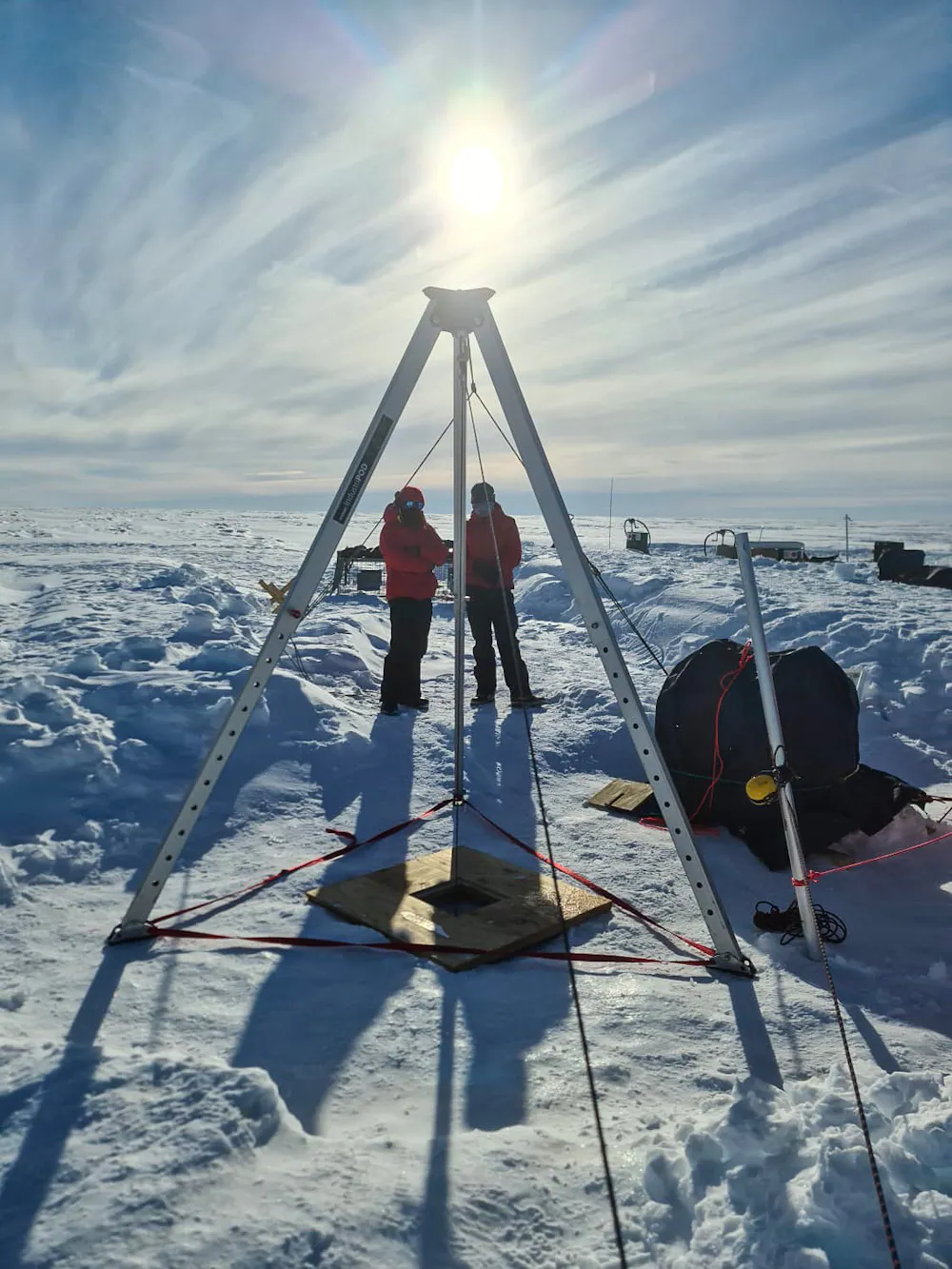
    Hot water drilling at Shackleton Ice Shelf, East Antarctica.
    Duanne White, University of Canberra/Australian Antarctic Division

    What we did and what we found

    We used computer simulations to predict the influence of subglacial water on ice sheet behaviour.

    We used two computer models:

    Then we explored how different assumptions about subglacial water pressure affect ice sheet dynamics. Specifically, we compared scenarios where water pressure was allowed to change over time against scenarios where it remained constant.

    When the effects of changing subglacial water pressure were included in the model, the amount of ice flowing into the ocean under future climate nearly tripled.

    These findings suggest many existing sea-level rise projections may be too low, because they do not fully account for the dynamic influence of subglacial water.

    Our research highlights the urgent need to incorporate subglacial water dynamics into these models. Otherwise we risk significantly underestimating the rate and magnitude of future sea-level rise.

    We simulated subglacial water pressure across Antarctica, revealing vulnerable regions potentially influenced by subglacial water, and mapped both active (blue) and stable (yellow) subglacial lakes and subglacial water channels (black lines).
    Zhao, C., et al, 2025. Nature Communications.

    In the video below, the moving dark lines show where grounded ice begins to float. The left panel is a scenario where subglacial water is not included in the ice sheet model and the right panel is a scenario that includes the effects of evolving subglacial water.

    Simulated Antarctic ice velocity over 1995–2300, using the Elmer/Ice model of ice sheets.

    A looming threat

    Failing to account for subglacial water means global sea-level rise projections are underestimated by up to two metres by 2300.

    A two-metre rise would put many coastal cities in extreme danger and potentially displace millions of people. The economic damage could reach trillions of dollars, damaging vital infrastructure and reshaping coastlines worldwide.

    It also means the timing of future tipping points are underestimated too. This is the point at which the ice sheet mass loss becomes much more rapid and likely irreversible. In our study, most regions cross this threshold much earlier, some as soon as 2050. This is deeply concerning.

    The way forward

    Understanding Antarctica’s hidden water system is challenging. The potential for rapid, catastrophic and irreversible ice loss remains.

    More observations are needed to improve our models, particularly from remote regions such as East Antarctica. Continuing to gather information from boreholes, ice-penetrating radar and satellites will help us better understand how the underside of the ice sheet behaves. These techniques can then be combined with computer simulations to enable more accurate projections of future ice loss and sea-level rise.

    Our new research shows integrating subglacial water dynamics into ice sheet models is a top priority. Understanding this hidden threat is crucial as the world grapples with the consequences of global warming especially rising seas.

    Chen Zhao is the recipient of an Australian Research Council Discovery Early Career Researcher Award. Dr Zhao is affiliated with Australian Antarctic Program Partnership (AAPP), at the Institute of Marine and Antarctic Studies (IMAS), University of Tasmania, supported under the Antarctic Science Collaboration Initiative program.

    Ben Galton-Fenzi is also affiliated with Australian Antarctic Program Partnership (AAPP), at the Institute of Marine and Antarctic Studies (IMAS), supported under the Antarctic Science Collaboration Initiative program, and the Australian Centre for Excellence in Antarctic Science, supported under the Australian Research Council Special Research Initiative, both based at the University of Tasmania.

    ref. Antarctica’s hidden threat: meltwater under the ice sheet amplifies sea-level rise – https://theconversation.com/antarcticas-hidden-threat-meltwater-under-the-ice-sheet-amplifies-sea-level-rise-250780

    MIL OSI AnalysisEveningReport.nz

  • MIL-OSI Australia: Canberra in focus on Gardening Australia

    Source: Northern Territory Police and Fire Services

    Volunteer Carol can spot a caterpillar at ten paces, even if it is hidden under the husk of a corn cob.

    The popular Gardening Australia program will have a distinctly Canberra flavour on Friday 17 May.

    ABC TV’s gardening flagship will air a story featuring two ACT schools, several students and much-loved volunteer Carol Quashie-Williams, scientist in residence at both Farrer Primary and Namadgi School.

    As a CSIRO STEM Professional in Schools, Carol has enriched the lives of thousands of young people during two decades of volunteering.

    She teaches life skills in gardening, nutrition, cooking and teamwork, with lessons in biology, chemistry, earth and environmental science, physics, maths, literacy and art sprouting here and there.

    An agricultural and environmental scientist and entomologist, Carol can spot a caterpillar at ten paces, even if it is hidden under the husk of a corn cob.

    Namadgi School Principal Gareth Richards says Carol’s way of engaging the kids means her presence is felt whether she is on site or not.

    “Even when she’s not at school, the kids are still carrying on with activities she’s taught them,” he said.

    “We’ll see them walking around the garden with magnifying glasses in hand, inspecting bugs they find along the way. She has a lasting impact on our students’ lives.”

    Another legacy of Carol’s involvement is professional growth and development.

    “She builds the capacity of our staff. Working shoulder to shoulder with Carol they have picked up expertise they’ve been able to go on to share with our students,” Gareth said.

    Named Volunteer of the Year at the 2019 ACT Public Education Awards, Carol started volunteering when her own children were at school and found it so rewarding she continued after they had left.

    With a day job in the Department of Agriculture, Fisheries and Forestry, she says her involvement in the schools program enables her to maintain her pest surveillance and diagnostic and science communication skills.

    “I enjoy inspiring the next generation of scientists and gardeners and love the enthusiasm of the students when working outside and in the environment centres,” she said.

    ‘My Garden Path – Carol STEM’ airs on Gardening Australia this Friday 17 May at 7:30pm (repeated Sunday 1:30pm, or catch up via iView or the Gardening Australia website).


    Get ACT news and events delivered straight to your inbox, sign up to our email newsletter:


    MIL OSI News

  • MIL-OSI Russia: Everything about admission to GUU: answers to the most important questions

    Translartion. Region: Russians Fedetion –

    Source: State University of Management – Official website of the State –

    The 2025 admissions campaign will begin in June. Information for applicants is available on the official website of the GUU Admissions Committee and in the Telegram channel “Applicant’s Assistant”.

    However, we decided to get answers to the most frequently asked questions directly from the head of the department for organizing admissions of applicants at our university, Vadim Dikikh.

    What applicants need to do now

    At the moment, applicants do not have much time left before the start of the admissions campaign, so it is important to start preparing a portfolio for admission now.

    Applicants to bachelor’s degree programs can pass the GTO, participate in tournaments held by universities and various organizations, and receive volunteer hours.

    Applicants to Master’s programs can take part in SUM tournaments and also publish articles in the Russian Science Citation Index and Higher Attestation Commission.

    Applicants to postgraduate programs can participate in all-Russian and/or international student Olympiads and competitions, publish articles in journals included in the core of the Russian Science Citation Index (RSCI), in the list of the Higher Attestation Commission (HAC) categories K1, K2, K3, monographs indexed in the RSCI database, and also undergo professional retraining.

    In addition to the above, it is necessary to choose the direction and university in which the potential will be best revealed.

    What areas are recruited at the State University of Management?

    In 2025, recruitment is underway in 16 bachelor’s degree programs, 13 master’s degree programs, and 14 postgraduate research specialties.

    How many budget and contract places are provided in 2025

    I would like to note that this year the innovations affected places for training under a contract: now their specific number is set at the beginning of the campaign and does not change anymore, so the competition here may become stricter and you should not postpone the conclusion of the contract until the last days of the campaign.

    In 2025, the State University of Management has allocated 188 budget places and 2029 contract places for undergraduate studies, and 37 and 1206 places for graduate studies, respectively.

    In 2025, 15 budget places and 98 contract places are provided for in scientific specialties of postgraduate studies at the State University of Management.

    Who can apply using the Unified State Exam, and who will have to take entrance examinations

    For applicants to bachelor’s degree programs who graduated from Russian schools and do not have benefits, admission will be based solely on the results of the Unified State Exam; no additional entrance examinations need to be taken.

    For graduates with secondary vocational education (colleges, technical schools, etc.), there is the possibility of admission based on the results of the Unified State Exam and/or based on the results of entrance examinations in a specialized field, conducted by the State University of Management independently.

    Other categories that have the right to take general education entrance examinations (in subjects and assignments of the Unified State Exam), conducted by the State University of Management independently:

    disabled persons; applicants entitled to a separate quota (participants, children of participants of the Secondary Military School); foreign citizens who have not passed the Unified State Exam; graduates of schools located in the territory of foreign states and who do not have the Unified State Exam results.

    Applicants to master’s and postgraduate programs, regardless of category, take entrance examinations.

    What entrance examinations will you have to take and in what form?

    In 2025, entrance examinations at the State University of Management will be held online using neural networks and a proctoring system.

    The full list of entrance examinations required for applicants to bachelor’s degree programs is set out in Appendix No. 1 to the Admission Rules and is available at the link. For convenience, we have prepared visual cards with the names of subjects and the minimum acceptable scores.

    To enroll in a Master’s program, you must pass 1 entrance exam for each area of study, for example, to enroll in the Management area, you must pass the comprehensive entrance exam “Management”. Entrance exams for the corresponding areas of study are taken in a similar manner.

    The minimum score for admission in all areas of study is 40.

    Applicants to postgraduate studies must pass 3 entrance examinations

    Entrance examinations

    Number of points

    Philosophy

    30

    Foreign language

    35

    Special discipline

    45

    A special discipline is a comprehensive entrance examination in the chosen specialty. For example, for applicants to the specialty “Regional and Sectoral Economics”, the entrance examination is “Special Discipline (Regional and Sectoral Economics)”

    What individual achievements are taken into account and for what period

    Infographics with ranking of achievements have been prepared for applicants to the bachelor’s degree. In addition, applicants to targeted training can receive 5 points for participating in career guidance events of customers of targeted training.

    It is important to note that the All-Russian and list Olympiads of the Ministry of Education and Science are taken into account exclusively for the 11th grade, and all other things being equal, the average grade point average will play an important role.

    You can also find out what individual achievements are taken into account on the website of the Admissions Committee of the State University of Management.

    What individual achievements provide the greatest advantages when applying

    The most obvious individual achievement that gives the highest score at all levels of education is an educational document with honors.

    In addition, scientific activity and participation in tournaments and olympiads provide a great advantage in both undergraduate, graduate and postgraduate studies.

    “Today is exactly the time when applicants can get additional points and increase their chances of admission.”

    What documents must be provided to confirm achievements

    The document confirming an individual achievement may vary, depending on the type of achievement.

    Since 2025, most individual achievements will be verified and confirmed through the public services portal when submitting documents.

    For example, to receive additional points for graduating from an educational institution with honors, you must provide a scanned copy or receive confirmation on government services when submitting documents.

    For reliability, we recommend that you attach all documents that confirm individual achievements (diplomas, certificates, etc.).

    Minimum passing scores for budget/contract courses last year

    How to apply for targeted training: step-by-step instructions

    Start filling out an application for admission to a university on public services. Indicate that you are ready to consider targeted training. You will see a list of offers from customers of targeted training. The offer includes the university and the competitive group, the future employer, the conditions of study and work, and support measures. Select the ones you like — at this stage, you can indicate several offers. Finish filling out the application to the university. Make sure that you have selected the competitive groups specified in the application for targeted training. After sending the application, the customer of targeted training will receive your application automatically. If you are under 18, your legal representative must give consent to conclude an agreement on targeted training. He will receive a notification in his personal account. The submitted application will be available in your personal account. Edit it if you find an error. For example, you can check whether the competitive groups from the application for targeted training have been added to it. Pass the competitive selection and wait for enrollment in the university. An agreement on targeted training will be sent to your personal account, sign it in the Gosklyuch application. The terms of the contract can be changed by agreement with the customer. If the terms of the contract are not met, you will have to pay a fine – the details will be specified in the contract

    What documents are needed for admission?

    How to submit documents

    Documents can be submitted in any convenient way:

    in person; online through the unified portal of public services; online through the university’s personal account; via a postal operator.

    Is it possible to submit documents online: pros and cons

    Submitting documents online has many advantages:

    Submission of documents without being tied to a specific location; step-by-step and convenient procedure for submitting documents; the ability to track the status of document processing; a convenient procedure for concluding an agreement on the provision of paid educational services.

    One of the disadvantages is the lack of live communication with university representatives.

    What to do if an applicant is in another city or country and cannot submit documents in person

    In 2025, applicants located in other cities and countries have an excellent opportunity to submit documents for admission to the State University of Management remotely in two ways:

    online through the unified portal of public services; online through the university’s personal account.

    It is important to know that if an applicant does not have a SNILS, application can only be submitted through the university’s personal account.

    The most common mistakes of applicants

    Critical

    changing a passport right before the day of the entrance exam; submitting documents through State Services without having a full account in your personal account; typos in certificates that no one checked when they were received at school.

    Simple but inconvenient

    travel time to the university (if you live in the Moscow region, the university will not be able to provide a dormitory right away, since applicants from distant regions will be given priority); loss of SNILS, passport or even a volunteer book; refusal to take the Unified State Exam in specialized mathematics.

    Frequent changes in statuses on the State Services portal, which can lead to a technical error in the service and universities simply will not see changes in priorities or documents that have changed more than 5-8 times in an hour.

    Advice for applicants for successful admission this year

    Do not miss the admissions campaign checklist dates and get into the desired university. Do not be afraid to participate in the budget competition, use any opportunity to get a higher education. While there is an opportunity, try to participate in Olympiads and competitions, and even if you have not yet tried to engage in volunteer activities, do not waste a minute, you can still manage to gain the necessary 100 hours to qualify for individual points in most universities in the country. Upload all the achievements that you have, and the admissions committee staff will check the entire set of documents and select those achievements that give additional points. Do not make emotional and ill-considered decisions that can only be changed during the next admissions campaign, and thereby lose an entire year of study.

    The most important thing is to make a conscious choice of higher education institution and the field of study. Try to understand the profession now, and if you have any questions, come to the Open Days, we will definitely help you make the right choice.

    Key dates of the admission campaign

    For applicants to bachelor’s degree programs

    June 20 – start of accepting documents; July 15 – end of accepting documents from applicants to the budget based on entrance examinations; July 25 – end of accepting documents from applicants to the budget based on the Unified State Exam results; July 27 – publication of competitive lists of applicants to the budget; August 1, 12:00 – end of submitting consent for enrollment from applicants under quotas; August 3 – publication of the order on enrolling applicants to places within quotas; August 5 – end of submitting consent for enrollment from applicants to the budget; August 7 – publication of the order on enrolling applicants to budget places; August 15 – end of accepting documents from applicants to a contract based on entrance examinations; August 23 – end of accepting documents from applicants to a contract based on the Unified State Exam results; August 24 – end of concluding contracts; August 25 – publication of an order on the enrollment of applicants to contractual places.

    For applicants to Master’s programs

    June 20 – start of accepting documents; August 20 – end of accepting documents from applicants to the budget; August 24 – end of submitting consent for enrollment from applicants to the budget; August 29 – issuing an order on enrolling applicants to budget places; September 10 – end of accepting documents from applicants to a contract; September 18 – end of concluding contracts; September 20 – issuing an order on enrolling applicants to contract places.

    For applicants to postgraduate specialties

    June 20 – start of accepting documents; September 7 – end of accepting documents; September 23 – end of submitting consent for enrollment from applicants to the target quota; September 24 – issuing an order on enrolling applicants to the target quota; September 25 – end of submitting consent for enrollment from applicants to the budget; September 26 – issuing an order on enrolling applicants to the budget; September 27 – end of concluding an agreement; September 28 – issuing an order on enrolling applicants to an agreement.

    How can I get advice and answers to questions from the admissions committee if the applicant cannot come to the university in person?

    We are always available not only in person, but also remotely on social networks VKontakte and Telegram, and during working hours we answer phone calls at 8 (495) 371-00-55.

    If the question includes the need to check a certificate or other copy of a document, it is better to contact via e-mail prkom@guu.ru

    Subscribe to the TG channel “Our GUU” Date of publication: 04/07/2025

    официальном сайте Приёмной комиссии ГУУ и в телеграм-канале «Помощник абитуриента»….” data-yashareImage=”https://guu.ru/wp-content/uploads/ГУУ-2024.1.jpg” data-yashareLink=”https://guu.ru/%d0%b2%d1%81%d1%91-%d0%be-%d0%bf%d0%be%d1%81%d1%82%d1%83%d0%bf%d0%bb%d0%b5%d0%bd%d0%b8%d0%b8-%d0%b2-%d0%b3%d1%83%d1%83-%d0%be%d1%82%d0%b2%d0%b5%d1%82%d1%8b-%d0%bd%d0%b0-%d1%81%d0%b0%d0%bc%d1%8b%d0%b5/”>

    Please note: This information is raw content directly from the source of the information. It is exactly what the source states and does not reflect the position of MIL-OSI or its clients.

    MIL OSI Russia News

  • MIL-OSI United Kingdom: Gut health links to frailty in old age explored The role gut health plays in contributing to frailty in our old age is the subject of a new study which has been awarded a share of £7.6 million.

    Source: University of Aberdeen

    Dr Candice QuinThe role gut health plays in contributing to frailty in our old age is the subject of a new study which has been awarded a share of £7.6 million.
    Researchers at the University of Aberdeen will try to pinpoint what change occurs in gut microbiota as we get older which may lead to us suffering more illnesses.
    Frailty can increase the risk of vulnerability to infections and inflammatory diseases including cancers, diabetes and cardiovascular diseases.
    Older people with frailty are significantly more likely to die or experience disability, yet the factors which contribute to some people becoming frail while others do not are poorly understood.
    The microbiota – bacteria, viruses, fungi etc. – that live in our intestine play a critical role in regulating our immune systems and as we age, the composition of this microbiota changes.
    The Aberdeen researchers will attempt to zero-in on the specific changes which occur in later life.
    The research project is one of 62 across 41 UK universities receiving a share of £7.6 million through the Academy for Medical Science’s Springboard programme, in its largest ever funding initiative. The funding for early-career researchers aims to tackle urgent health challenges.
    Lecturer in Immunology at the University of Aberdeen Dr Candice Quin, who will lead the project, received £125,000 to further her research on frailty in older adults.
    “There is an urgent need to reduce the economic, societal and individual costs of frailty in our ageing population, yet we currently do not have any effective therapeutic strategies,” said Dr Quin. We have shown that age-related changes in the intestinal microbiome contribute to the development of frailty, providing an exciting new avenue for therapeutic intervention.

    There is an urgent need to reduce the economic, societal and individual costs of frailty in our ageing population, yet we currently do not have any effective therapeutic strategies.” Dr Candice Quin

    “The proposed experiments in this Springboard application will identify novel microbial targets that contribute to frailty with age, which we can selectively deplete in future intervention studies and clinical trials. Vaccination with the microbiota has already been shown to improve metabolism and reduce diet-induced obesity.
    “This research will pave the way for similar cutting-edge interventions against frailty and ultimately provide older people with more years of healthy, independent living.”
    Dr Quin will conduct the research in collaboration with Dr Marius Wenzel from the School of Biological Sciences and Dr Huan Cao from the School of Medicine, Medical Sciences and Nutrition.
    Professor James Naismith FRS FRSE FMedSci, Vice-President (Non-Clinical) at the Academy of Medical Sciences, said: “This record investment demonstrates our unwavering commitment to supporting the next generation of research leaders. By backing these talented early-career researchers, we’re not only addressing today’s urgent health challenges but also strengthening the UK’s position as a global leader in medical research.
    The breadth and ambition of projects funded by the Academy’s Springboard programme is remarkable–from understanding teenage drinking behaviours to investigating why women are disproportionately affected by Alzheimer’s disease. Each Springboard awardee brings fresh perspectives and innovative approaches that will ultimately translate to improved health outcomes for patients and the public.
    “The Academy is proud to provide the financial resources and career development support needed to help these outstanding scientists establish their independent research careers.”
    UK Science Minister Lord Vallance said: “Research supported by the Springboard programme can help to address some of the most pressing health challenges, like antimicrobial resistance and cancer, by giving early-career researchers across the UK the opportunity to test their ideas. “Through this programme we are supporting the next generation of researchers to lead their own groundbreaking research so that the UK can continue to be a pioneer in medical science.”

    MIL OSI United Kingdom

  • MIL-OSI United Kingdom: Change of His Majesty’s Ambassador to Panama: Greg Houston

    Source: United Kingdom – Government Statements

    Press release

    Change of His Majesty’s Ambassador to Panama: Greg Houston

    Mr Greg Houston has been appointed His Majesty’s Ambassador to the Republic of Panama

    Mr Greg Houston has been appointed His Majesty’s Ambassador to the Republic of Panama in succession to Mr James Dauris.  Mr Houston will take up his appointment during July 2025.

    Curriculum Vitae

    Full name: Greg Houston

    Year Role
    2022 to present Foreign, Commonwealth and Development Office (FCDO), Deputy Director and Head of Migration Department
    2020 to 2022 FCDO, Deputy Head North America Department
    2017 to 2020 Bogotá, Deputy Head of Mission
    2013 to 2017 Rome, Political Counsellor
    2011 to 2013 Foreign & Commonwealth Office (FCO), Head of EU Strategy
    2007 to 2011 UK Representation to the EU in Brussels, First Secretary, EU Budget
    2006 to 2007 UK Representation to the EU in Brussels, Second Secretary, EU Customs
    2005 to 2006 Brussels, European Commission, Intern
    2005 Joined FCO

    Media enquiries

    Email newsdesk@fcdo.gov.uk

    Telephone 020 7008 3100

    Contact the FCDO Communication Team via email (monitored 24 hours a day) in the first instance, and we will respond as soon as possible.

    Updates to this page

    Published 7 April 2025

    MIL OSI United Kingdom

  • MIL-Evening Report: Do I need another COVID booster? Which one should I choose? Can I get it with my flu shot?

    Source: The Conversation (Au and NZ) – By Paul Griffin, Professor, Infectious Diseases and Microbiology, The University of Queensland

    Tijana Simic/Shutterstock

    Australians are being urged to roll up their sleeves for a flu vaccine amid rising cases of influenza.

    It’s an opportune time to think about other vaccines too, particularly because some vaccines can be given at the same time as the flu vaccine.

    One is the COVID vaccine.

    Should you get another COVID shot?

    More than five years since COVID was declared a pandemic, we hear much less about this virus. But it’s still around.

    In 2024 there were 4,953 deaths involving COVID. This is nearly 20% lower than in 2023, but still nearly five times that of influenza (1,002).

    Vaccines, which do a very good job at reducing the chances of severe COVID, remain an important tool in our ongoing battle against the virus.

    Case numbers don’t tell us as much about COVID anymore as fewer people are testing. But based on other ways we monitor the virus, such as cases in ICU and active outbreaks in residential aged care homes, there have essentially been two peaks a year over recent years – one over summer and one over winter.

    This doesn’t mean we can predict exactly when another wave will happen, but it’s inevitable and may well be within the next few months. So it’s worth considering another COVID vaccine if you’re eligible.

    Who can get one, and when?

    There are several risk factors for more severe COVID, but some of the most important include being older or immunocompromised. For this reason, people aged 75 and older are recommended to receive a COVID booster every six months.

    In the slightly younger 65 to 74 age bracket, or adults aged 18 to 64 who are immunocompromised, booster doses are recommended every 12 months, but people are eligible every six months.

    Healthy adults under 65 are eligible for a booster dose every 12 months.

    Healthy children aren’t recommended to receive boosters but those who are severely immunocompromised may be eligible.

    What COVID shots are currently available?

    We’ve seen multiple types of COVID vaccines since they first became available about four years ago. Over time, different vaccines have targeted different variants as the virus has evolved.

    While some vaccine providers may still offer other options, such as the older booster that targeted the Omicron variant XBB.1.5, the recent JN.1 booster is the most up-to-date and best option.

    This is a relatively recently updated version to improve protection against some of the newer strains of COVID that are circulating. The new booster only became available in Australia in late 2024.

    This booster, as the name suggests, targets a subvariant called JN.1. Although JN.1 has not been the dominant subvariant in Australia for some time, this shot is still expected to provide good protection against circulating subvariants, including new subvariants such as LP.8.1, which is descended from JN.1.

    While it’s great we have an updated booster available, unfortunately uptake remains poor. Only 17.3% of people 75 and over had received a COVID vaccine in the six months to March.

    COVID vaccine uptake has been poor recently.
    Steve Heap/Shutterstock

    Getting a flu and COVID shot together

    Data from more than 17,000 people who completed a survey after receiving the JN.1 booster shows that while 27% reported at least one adverse event following vaccination, the majority of these were mild, such as local pain or redness or fatigue.

    Only 4% of people reported an impact on their routine activities following vaccination, such as missing school or work.

    If you choose to get the flu vaccine and the COVID vaccine at the same time, they’ll usually be given in different arms. There shouldn’t be a significant increase in side effects. What’s more, getting both shots at the same time doesn’t reduce your immune response against either vaccine.

    Now is the ideal time to get your flu vaccine. If you’re eligible for a COVID booster as well, getting both vaccines at the same time is safe and can be very convenient.

    We’re conducting trials in Australia, as are scientists elsewhere, of combined vaccines. One day these could allow vaccination against COVID and flu in a single shot – but these are still a way off.

    If you’re not sure about your eligibility or have any questions about either vaccine, discuss this with your GP, specialist of pharmacist. Australian state and federal government websites also provide reliable information.

    Paul Griffin has been the principal investigator on many vaccine clinical trials and received speaker honoraria and been a member of medical advisory boards for vaccine manufacturers. He is also a scientific advisory board member and director of the immunisation coalition.

    ref. Do I need another COVID booster? Which one should I choose? Can I get it with my flu shot? – https://theconversation.com/do-i-need-another-covid-booster-which-one-should-i-choose-can-i-get-it-with-my-flu-shot-252914

    MIL OSI AnalysisEveningReport.nz

  • MIL-Evening Report: Financial markets are tanking. Here’s why it’s best not to panic

    Source: The Conversation (Au and NZ) – By Luke Hartigan, Lecturer in Economics, University of Sydney

    Financial markets around the world have been slammed by the Trump adminstration’s sweeping tariffs on its trading partners, and China’s swift retaliation.

    Share markets have posted their biggest declines since the COVID pandemic hit in 2020, as fears of US recession surged. Iron ore, copper, oil, gold and the Australian dollar have all tumbled.

    On Wall Street, leading indices have fallen around 10% since the tariffs were announced, while the tech-heavy Nasdaq is down 20% from its recent peak. European and Asian markets have also slumped.

    In Australia, the key S&P/ASX 200 slid another 4.2% on Monday to levels last seen in December 2023, taking its three-day losses since the announcement to more than 7%.


    Why are markets reacting so badly?

    Financial markets reacted so negatively because the tariffs were much larger than expected. They represent the biggest upheaval in global trade in 80 years.

    Many traders were hoping the tariffs would be used mainly as a bargaining tool. But comments by US President Donald Trump that markets may need to “take medicine” seem to suggest otherwise.

    The tariffs are expected to weaken economic growth in the US as consumers pare back spending on more expensive imports, while businesses shelve investment plans. Leading US bank JP Morgan has put the chance of a US recession as high as 60%.

    This comes at a time when the US economy was already looking fragile. The highly regarded GDPNow model developed by the Atlanta Federal Reserve Bank indicates US March quarter GDP will fall 2.8%, and that was before the tariff announcement.

    Worries about global growth

    Fears of a recession in the United States and the potential for a global downturn has led to a broad sell-off in commodity prices, including iron ore, copper and oil. Further, the Australian dollar, which is seen as a barometer for risk, has fallen below 60 US cents in local trading – its lowest level since 2009.

    While the direct impact of tariffs on Australia is expected to be modest (with around 6% of our exports going to US), the indirect impact could be substantial. China, Japan and South Korea together take more than 50% of Australia’s exports, and all have been hit with significantly higher tariffs.

    Treasurer Jim Chalmers said on Monday that the direct impact on the Australian economy would be “manageable”.

    The full effect on Australia will depend on how other countries respond, and whether we can redirect trade to other markets.

    The rapid decline in the Australian dollar will help offset some of the negative effects associated with a global downturn and the fall in commodity prices.

    We can also expect some interest-rate relief. Economists are now predicting three further interest rate cuts by the Reserve Bank, starting in May. This brings economists into line with financial market forecasts.


    Read more:
    US tariffs will upend global trade. This is how Australia can respond


    Hang in there, markets will recover

    Watching equity markets tumble so dramatically can be unsettling for any investor. However, it is important to note that equity markets have experienced many downturns over the past 125 years due to wars, pandemics, financial crises and recessions. But these market impacts have generally been temporary.


    History suggests that over the long term, equity prices continue to rise, supported by growing economies and rising incomes.

    The key thing for investors to remember is to not panic. Now is not the time to decide to switch your superannuation or other investments to cash. This risks missing the next upswing while also crystallising any current losses.

    For example, despite the steep market sell-off in March 2020 as the first COVID lockdowns came into effect, the Australian share market had completely recovered those losses by June 2021.

    It is good practice for investors to regularly reassess their risk profile to make sure it is right for their current stage of life. This means reducing the allocation to riskier assets as investors get closer to retirement age, while also maintaining a cash buffer to avoid having to sell assets during more turbulent periods such as now.

    Super funds are exposed to global risks

    The current sell-off has highlighted a potential issue facing the superannuation industry.

    So much of our superannuation is now invested in global equity markets, mostly in the US, because Australia’s superannuation savings pool – at more than A$4 trillion – has outgrown the investment opportunities available in Australia.

    Another issue facing the superannuation industry is the growth of cyber attacks, with several funds targeted in a recent attack. Given the massive size of the assets held by some funds, it would seem they need to improve their security to be on par with that of the banking system.

    Luke Hartigan receives funding from the Australian Research Council.

    ref. Financial markets are tanking. Here’s why it’s best not to panic – https://theconversation.com/financial-markets-are-tanking-heres-why-its-best-not-to-panic-253929

    MIL OSI AnalysisEveningReport.nz

  • MIL-OSI Australia: Instrumental Music Program welcomes new principal

    Source: Northern Territory Police and Fire Services

    New IMP Principal Joel Copeland with University of Canberra High School Kaleen students Matilda (trumpet), Yohaan (saxaphone), Isabel (trombone), and Sofia (percussion).

    The ACT Instrumental Music Program has long focused on teaching year 5 and 6 students woodwind, brass, and percussion instruments in a group setting.

    Its new principal, however, is also a fan of making music without a physical instrument. Or, at least, without a tangible one.

    “Singing is a beautiful thing and a powerful tool in education,” Joel Copeland said.

    “Everybody has a voice.”

    The respected educator has shown before how powerful singing can be in building community. He founded a hugely successful choir at his last school, Canberra Girls Grammar School (CGGS), which welcomed singers regardless of ability.

    As with the IMP, it was an experiential program that fostered the joy of making music together.

    Joel took on the role of Principal in January and has seen such joy in the faces of IMP students during school visits across Canberra.

    “Within a few lessons in the IMP, our students are making a great sound together,” he said.

    “That’s the beauty of the way the system is set up … group tuition is more time efficient and staff efficient, but it’s also more fun.”

    The Instrumental Music Program operates instrumental music classes in 57 public primary schools and 8 public secondary schools across the ACT.

    There are also performance opportunities via Step into the Limelight, the ACT’s creative and performing arts showcase event for public schools.

    Once fully settled into the new role, Joel will consult widely and with experts on the IMP’s strategic direction, considering ways to build on the quality music learning children have experienced through the IMP’s first 50 years.

    His dream is for every child to have access to high-quality music education.

    Joel was motivated to apply for the role when he heard Naida Blackley was retiring as IMP Principal after an incredible 17 years in the role.

    “Naida had always been a bit of a hero of mine,” Joel said.

    “She is exceptional, and I guess I thought she would be here forever … when I learnt she was retiring, that was the catalyst.”

    Part of what attracted him to the role was the opportunity to work with the IMP’s teachers, who he calls “a brilliant team of music educators”.

    But most of all, he is passionate about ensuring children who are keen to learn and be part of something get the most out of their IMP experience.

    “Music can make a significant difference in these students’ lives,” he said.

    The IMP at a glance:

    • Over 2300 ACT public students are in IMP programs
    • 57 primary schools and 8 high schools are in IMP programs
    • there are 12 teaching staff, 1 admin officer, 2 Executive Teachers and 1 Principal
    • the System bands include 3 concert bands, percussion ensemble, string ensemble, primary and senior choir and jazz band
    • non-band programs include ukelele (4) and strings (2)
    • over 3000 instruments
    • over 2600 music scores.

    Find out more about the Instrumental Music Program at imp.act.edu.au


    Get ACT news and events delivered straight to your inbox, sign up to our email newsletter:


    MIL OSI News

  • MIL-OSI Australia: What to do when you move to Canberra

    Source: Northern Territory Police and Fire Services

    In addition to enjoying Canberra’s beautiful scenery, there are a few things you may need to do.

    The to-do list can seem never ending when you move to a new city.

    With Canberra’s population projected to reach 500,000 by 2027, there’s a growing number of people calling Canberra home.

    The ACT is also home to 22,000 veterans and their families.

    We’ve taken the guess work away with this handy list of things you need to do when you move to Canberra.

    This includes:

    • Update your details with Access Canberra
    • Get an ACT driver licence
    • Update your Medicare details
    • Update your details with Access Canberra
    • Update your details on the electoral roll
    • Get familiar with the recycling and waste system
    • Enrol your child in school
    • Register your pet
    • Sign up to MyWay+, Transport Canberra’s ticketing system
    • Find where to go for health care
    • Join the library
    • Find disability support
    • Find support for Defence families
    • Connect with Canberra’s multicultural community.

    Find out more below!

    Update your details with Access Canberra

    If you’ve moved to Canberra from interstate, you have three months to update your details with Access Canberra.

    This will ensure that you don’t miss out on any important reminders.

    You can easily update your details online, and it will apply to other services including:

    • occupational licences
    • building and construction licences
    • Working with Vulnerable People registration.

    Find out how to update your details with Access Canberra.

    Get an ACT driver licence

    If you plan on driving in the ACT, you’ll need to get an ACT driver licence within three months of moving here.

    If you’re moving to Canberra from overseas, what you will need to do depends on the type of license you have and the country that issued it.

    If you’ve moved to Canberra from interstate, you need to visit an Access Canberra Service Centre to get an ACT driver licence. You will need to bring:

    • your proof of identity and residency
    • your current interstate licence
    • your licence history from the state or territory that issued it (you need to take this into an Access Canberra Service Centre within 7 calendar days of receiving it).

    For interstate drivers’ licences, there’s no fee for this transaction if you’re issued with an ACT licence with the same expiry date as your interstate licence.

    Update your Medicare details

    Once you’ve got your ACT driver licence, log onto MyGov to update your Medicare details.

    Update your details on the electoral roll

    Once you’ve lived at your new address for at least one month, you are eligible to enrol at your new address.

    The details on the electoral roll are used for both federal and state elections so you’ll only need to do this once.

    Get familiar with the recycling and waste system

    There are three different types of bins that are collected in the ACT:

    • recycling bins have a yellow lid
    • rubbish/landfill bins have a dark green or red lid
    • garden organic green waste bins with a light green lid.

    The green waste bins are optional. If you don’t have one, you can easily order one.

    Bins are collected on a weekly or fortnightly basis. The bin collection calendar can tell you when bins are collected in your suburb. It will also tell you what can and cannot go in your household bins.

    Enrol your child in school

    Every ACT child or young person from kindergarten to year 12 is guaranteed a place at their local public school, determined by their priority enrolment area.

    Children from the age of 6 must be enrolled in and attending school (or registered for Home Education) until they complete Year 12 or turn 17, whichever happens first.

    Prior to starting school, your child may be eligible for preschool.

    Canberra families can access up to 300 hours of free preschool per year with the three-year-old preschool program offered by participating Early Childhood and Education Care (ECEC) services.

    Register your pet

    All dogs and cats over eight weeks who have been in the ACT for 28 days or more must be registered.

    When you register you pet for the first time, you’ll need to:

    • complete the application form
    • pay a one-off fee.

    Cat and dog owners must renew their pets registration annually.

    Pet services are now a part of the ACT Digital Account. This means that with your online account, you can:

    • register your pet
    • pay online
    • renew, update or change your pet’s registration details.

    Get set up with MyWay+

    Canberra’s public transport system has two main parts: buses and the light rail.

    MyWay+ is the ticketing system used to pay for both services. MyWay+ is as simple as tapping on and off with your regular bank card or payment method on your phone

    You can also download the MyWay+ app and create a MyWay+ account. This gives you the added benefits of personalised journey planning and real time information.

    If you don’t want to use the digital features of MyWay+, you can also purchase a MyWay+ card.

    Find out how to set up a MyWay+ account and download the app.

    Find where to go for health care

    The ACT Government has developed a new online tool to help the community find out more about local health services in Canberra.

    The tool includes information about GP services and public, community-based health care services that people (mostly) don’t need a referral for. It also has information about non-government health related services.

    Join the library

    Libraries ACT has nine branches plus the ACT Heritage Library in Fyshwick.

    Your local library offers so much more than just books to borrow. You can scan and print your important documents for free, use the public PC’s, connect to free Wi-Fi or even meet a, Justice of the Peace.

    Plus, the library is a great way to meet people and connect with your new community with events and programming happening daily such as, Geri-Fit active sessions, children’s school holiday activities and much more.

    Plus, joining Libraries ACT gives you access to free digital resources across categories like language learning, music and film, newspapers and magazines, personal and professional development and more.

    Find disability support

    If you or someone you care for has disability, there are programs and services that can support you.

    Connect with Canberra’s multicultural community

    There are programs and services for members of Canberra’s multicultural community.

    This includes:

    • overseas qualifications assessments
    • work experience and support
    • Translating and Interpreting Service
    • support for migrants, refugees and asylum seekers
    • and more.

    You can also visit the Theo Notaras Multicultural Centre to speak to community organisations that can you give you advice, help you access support services and help you with English.

    Explore your new home!

    Don’t forget to get out and about and enjoy our beautiful city. Here are some stories that you might enjoy as someone new to Canberra:


    Get ACT news and events delivered straight to your inbox, sign up to our email newsletter:


    MIL OSI News

  • MIL-OSI Australia: School enrolments for 2025 now open

    Source: Northern Territory Police and Fire Services

    Local schools offer an excellent, inclusive and equitable education and learning environment.

    ACT public school enrolments for the 2025 school year are now open.

    There is a place for every child in their local public school, from kindergarten to year 12.

    Local schools offer an excellent, inclusive and equitable education and learning environment.

    Enrolling before 7 June means you will receive an offer from 29 July 2024. This way you can start planning for the year ahead, knowing where your child will be attending school.

    Find out more about your local school

    Go online to learn more about your local school and what makes it great.

    Some schools will hold information sessions in the coming weeks – these are a great way to discover what your local school offers.

    You can also contact the school directly to find out more.

    Enrolling in preschool

    Every four-year-old child is guaranteed 15 hours of preschool a week in the ACT.

    Children are eligible for preschool in 2025 if they turn four on or before 30 April 2025.

    Preschool places, like school places, are notallocated on a first-come, first-served basis.

    Families are encouraged to apply for the preschool for their local primary school. Please note, however, it is not always possible to guarantee a place at your local or preferred preschool, due to capacity constraints at some sites.

    Priority Enrolment Areas

    Enrolment is determined by a child or young person’s place of residence.

    The ACT is divided into Priority Enrolment Areas (PEAs) which are defined geographical areas.

    In 2025 a new high school will open in the north Gungahlin suburb of Taylor. As a result, there are some changes to Priority Enrolment Areas (PEA) for 2025.

    PEA changes can be found on the Education Directorate’s website.

    Upgrading and improving schools

    The ACT Government is committed to building, expanding and upgrading schools across Canberra.

    Upgrades are improving facilities and ensuring students with disability can take full advantage of education opportunities.

    Other works include new learning spaces and wet areas, bike sheds, outdoor shade areas and improvements to playgrounds.

    Enrolment key dates

    • 30 April 2024 – online applications open
    • 7 June 2024 – apply by this date to receive an offer from 29 July 2024

    Applications received after 7 June may receive an offer later in the year.

    For more information

    • visit the Education Directorate’s website to enrol online
    • phone the Enrolment Helpline on 6205 5429.

    Get ACT news and events delivered straight to your inbox, sign up to our email newsletter:


    MIL OSI News

  • MIL-Evening Report: Without women, Australia’s defence force will struggle to recruit enough people

    Source: The Conversation (Au and NZ) – By Sarah Percy, Professor of International Relations, The University of Queensland

    Australia faces crisis-level workforce shortfalls in security and defence. Recruiting more people to the defence force is now an urgent matter of national security.

    So, comments – such as those recently made by a Liberal candidate that we “need to remove females from combat corps” in order to “fix” the military – come at the worst possible time.

    Such beliefs are not just unhelpful. They are dangerous.

    Without women in the national security workforce, and in combat roles, Australia will fail to hit its recruitment targets – at a time of critical international insecurity.

    Why is it so hard to attract women to the defence force?

    We know women are interested and engaged in international affairs.

    So, why don’t they want to join the defence force? In short, we don’t know – but we desperately need to find out.

    Women make up just 20.7% of the Australian Defence Force (ADF).

    Compared with a decade ago, this is an improvement. But the improvement has stalled. The latest figure represents a mere 0.1% increase compared with 2021 figures.

    This is serious.

    Australia’s recruitment problems put at risk our ability to:

    • conduct maritime patrols
    • defend against cyber attacks
    • maintain force readiness.

    Other democratic states worldwide are also struggling to achieve recruitment targets.

    Despite ambitious multi-year government programs aimed a boosting women’s participation in national security, and thousands of pages of reports and reviews on the issue, results have been limited and inconsistent.

    Most attempts to attract more women are focused on workplace improvements.

    Efforts include:

    Of the many government reviews and audits analysing the question, the vast majority focused on such workplace solutions.

    But what if the problem doesn’t lie in the workplace, but rather in wider society?

    What if one factor dissuading women was the archaic idea women just don’t really belong in the military at all?

    Societal attitudes matter

    The Liberal candidate who made the recent comments about women in combat roles has now been replaced. It’s positive to see his party saying such views are “inconsistent with the party’s position.”

    However, the incident suggests doubt remains in some quarters about women’s readiness to serve and take up combat roles.

    There’s a dearth of research on why exactly Australian women appear reluctant to join the ADF. Some of the reasons may be linked to the perception the ADF has a problem with sexual assault or sexism.

    But broader social gender norms matter too. When women hear comments reinforcing the idea national security is primarily a male field, they may simply not see a future for themselves or their daughters in it.

    A recent US study found 60% of teenage girls “have never considered joining the military or pictured themselves in uniform”.

    A passing glance at American politics demonstrates the often precarious position of women already working in national security. There, in recent months, debate has turned to:

    Trump’s America is not Australia, of course. But the recent backlash against women in the US security and defence arenas shows how quickly previous progress can be unwound.

    Could these debates be having a chilling effect on women in Australia who might otherwise consider a career in the military?

    More research is required to answer that question. But it’s possible public denigration of women in these roles deters women from seeking them at all, and may reinforce attitudes of those seeking to keep women out.

    Broadening the talent pool

    Australia’s own response to supporting diversity in the military has been mixed. In 2013, Chief of Army David Morrison made international headlines for a powerful speech about diversity.

    But Morrison faced criticism in the aftermath. Petitions called for his resignation and condemnation after he spoke about gender equality (and not veterans’ welfare) at an awards ceremony. He was criticised for caling for non-gendered language in Defence workplaces.

    Women make vital contributions to critical and creative thinking and decision-making in national security.

    Women in the military can do jobs men cannot do. Think, for example, of women who served in Afghanistan or Iraq, where it would be culturally unacceptable for a male soldier to talk to and work with local women. These were roles female soldiers were able to take up.

    Including women in defence increases the available talent pool, addressing pressing issues of workforce capability in the ADF.

    Australia’s national security requires women to be part of our military, including in combat roles. Without them, recruitment targets will fail. It is not diversity, equality and inclusion: it is reality.

    It is critically important to Australia’s national security we resist the trend from the United States. We must find out what’s stopping women from joining our defence force and address those problems urgently.

    Sarah Percy receives funding from the Australian Army History Unit.

    Elise Stephenson receives funding from the Australian Research Council and the Australian government. She is affiliated with Women in International Security Australia.

    Maria Rost Rublee has received funding from the Australian Department of Defence, the Canadian Department of Defence, and the US Institute of Peace. She is affiliated with Women in International Security-Australia and Women in Nuclear-Australia.

    Rebecca Strating receives funding from the Australian Department of Foreign Affairs and Trade.

    Danielle Chubb does not work for, consult, own shares in or receive funding from any company or organisation that would benefit from this article, and has disclosed no relevant affiliations beyond their academic appointment.

    ref. Without women, Australia’s defence force will struggle to recruit enough people – https://theconversation.com/without-women-australias-defence-force-will-struggle-to-recruit-enough-people-253844

    MIL OSI AnalysisEveningReport.nz

  • MIL-OSI Russia: We invite you to the IV All-Russian Conference “Library Marketing 360°”

    Translartion. Region: Russians Fedetion –

    Source: State University of Management – Official website of the State –

    On April 17, 2025, the State University of Management will host the IV All-Russian scientific and practical conference with international participation “Library Marketing 360°”, organized by the Scientific Library of the State University of Management and the Knorus publishing group, with the support of the Section on Library Management and Marketing of the Russian Library Association and the University Book journal.

    The purpose of the conference: exchange of experience in the field of library marketing, study of effective channels for attracting readers, analysis of the resource component and current marketing tools in libraries.

    The main areas of work of the conference:

    Artificial intelligence tools in library marketing; Patriotic education as an aspect of library marketing activities; Formation of an inclusive library space; Development of creative thinking of library staff; Gamification in library project activities; Marketing in librarianship (library as a brand, library marketing trends, work with social media, organization of library space).

    The target audience is employees of public, scientific and university libraries.

    We invite students, postgraduates and graduates to take part in the work of the youth section.

    You can register and find out more information on the conference website.

    Subscribe to the tg channel “Our State University” Announcement date: 04/7/2025

    Please note: This information is raw content directly from the source of the information. It is exactly what the source states and does not reflect the position of MIL-OSI or its clients.

    MIL OSI Russia News

  • MIL-OSI China: Initiative to help workers improve

    Source: People’s Republic of China – State Council News

    More than 3 million industrial workers in China will receive financial support for continuing education by 2030 under a nationwide initiative aimed at improving workforce skills, according to a guideline released on Thursday.

    The document, jointly issued by the All-China Federation of Trade Unions, the Ministry of Education, the Ministry of Human Resources and Social Security, and the All-China Federation of Industry and Commerce, lays out plans to help industrial workers pursue further education and enhance their qualifications.

    At least 300 programs will be established to help workers boost their academic credentials and vocational skills, the guideline said. More than 3 million eligible workers, including at least 2 million migrant workers, will receive financial aid for continuing and non-degree education.

    The initiative seeks to promote lifelong learning among industrial workers and encourage them to upgrade their capabilities, contributing to the development of a world-class workforce, according to the guideline.

    China has about 402 million workers, with industrial workers accounting for about half the total workforce, according to the All-China Federation of Trade Unions.

    The initiative was officially launched on Wednesday in Beijing. Since 2016, the trade union federation and the Ministry of Education have implemented a program to improve the educational levels of migrant workers, which has produced notable results.

    As of June 2024, trade unions nationwide had invested a total of 1.12 billion yuan ($154 million) to help more than 2.4 million migrant workers upgrade their educational qualifications and skills.

    The newly released guideline expands the initiative to include all industrial workers and outlines five key objectives: innovating talent training models, enhancing learning platforms, expanding educational resources, improving the recognition and transfer of learning outcomes, and encouraging greater enterprise involvement.

    The document calls for collaboration among government bodies, trade unions, businesses, educational institutions and society to strengthen workforce training. Schools and companies are encouraged to jointly establish off-campus teaching or training centers for continuing education.

    “Specialized programs and projects tailored to industrial workers that are closely aligned with industrial, supply and innovation chains should be developed. Existing platforms, such as the national smart vocational education platform and the Workers’ Home app, should be leveraged to build a national smart learning platform for industrial skills,” the guideline said.

    Enterprises are also encouraged to increase investment in worker education and support paid learning opportunities, it said.

    MIL OSI China News

  • MIL-OSI Australia: New Assistant Commissioner appointed

    Source: New South Wales Community and Justice

    New Assistant Commissioner appointed

    Monday, 7 April 2025 – 3:07 pm.

    A new Assistant Commissioner of Tasmania Police has been appointed.
    Commissioner Donna Adams said today that Commander Doug Oosterloo had been appointed to the rank of Assistant Commissioner, effective immediately.
    “I congratulate Doug on his appointment as his outstanding leadership and communication skills and project management expertise ensure he will provide critical strategic leadership in this senior role,” Commissioner Adams said.
    “I look forward to working together with AC Oosterloo and the senior leadership team to continue our focus on back-to-basics policing so the Tasmanian community continue to build a high level of trust and confidence in our police service.
    “I’m confident that his capability, experience and drive will contribute immensely to positively shape Tasmania Police well into the future.”
    AC Oosterloo brings to the role more than 30 years of experience with Tasmania Police, joining the service in 1994 and spending the first decade of his career on the North-West Coast.
    AC Oosterloo rose through the ranks serving in a variety of policing areas across the state including uniform, criminal investigation, recruit training, and Professional Standards, as well as overseeing the delivery of a range of vital projects including firearms reform, national information systems, helicopter and marine vessel procurements.
    As the Commander of Statewide Services, he led a diverse command which includes a mix of core service delivery and frontline support areas including Marine and Rescue, Radio Dispatch, Forensics, Firearms and Community Engagement.
    AC Oosterloo has qualifications and experience in national counter terrorism arrangements including command, investigations, forensic response and intelligence, and holds a Graduate Certificate in Police Studies (UTAS).
    The appointment is effective from today, 7 April 2025. AC Oosterloo replaces retired AC Glenn Keating.

    MIL OSI News

  • MIL-OSI New Zealand: Agriculture Research – Climate change conditions impacting critical element for plant growth, fertiliser need

    Source: AgResearch

    Rising carbon dioxide levels in the atmosphere are altering phosphorus (P) available for plant growth, potentially leading to costly and unnecessary fertiliser application by farmers.

    New research published in the Global Change Biology journal by scientists from AgResearch and Lincoln University has found that the test used in New Zealand to estimate the amount of available P in the soil may be underestimating the true accessibility of this crucial element for pasture plant growth.

    The research, which drew on data from a long-running AgResearch experiment* in which carbon dioxide is artificially elevated on an area of grazed pasture, is the latest to throw up surprising new results about what happens under rising carbon dioxide levels tied to climate change.

    “For decades, New Zealand farmers have relied on the Olsen P test to determine the P available in soils and to guide decisions about fertiliser use,” says lead author Zac Beechey-Gradwell. 

    “The data from the AgResearch experiment shows a substantial and sustained reduction in available P in the topsoil extracted by the Olsen P measure under elevated carbon dioxide, prior to annual P fertiliser application. In addition, the effectiveness of P fertiliser in raising Olsen P was significantly reduced.”      

    “Scientists have known for a while that elevated carbon dioxide reduces the amount of P extracted by the Olsen P test, but we didn’t fully understand why or what the consequences of this might be. Our latest research confirms that more of the fertiliser P that is applied under elevated carbon dioxide is rapidly converted into organic forms in the topsoil, in a process called ‘biological immobilisation’. This essentially makes it invisible to standard soil P tests.”

    “If a soil P test indicates phosphorus deficiency, farmers may respond by applying more fertiliser than is necessary, driving up costs without improving pasture performance. Phosphorus is an essential macro-nutrient for plant growth. Without it, production will decline.”

    “At a minimum, this research suggests we are going to need to recalibrate soil P test targets under elevated carbon dioxide to ensure that P fertiliser recommendations remain cost-effective and environmentally sustainable in the years ahead.”

    AgResearch principal scientist Alec Mackay says the phosphorus findings have landed against a backdrop of expected gains in pasture productivity not materialising under climate change.

    “We need further research to see if similar trends are occurring in different soil types, and what the impact is on clovers and nitrogen fixation.”

    Research co-author, Professor Leo Condron of Lincoln University, says: “Phosphorus fertiliser manufacture in New Zealand is dependent on imported phosphate rock and the cost has increased and become more volatile since 2007-08, and it is therefore important to ensure that fertiliser P is being used efficiently”.

    Read the full research at: https://doi.org/10.1111/gcb.70150

    *New Zealand’s globally unique Free Air Carbon Dioxide Enrichment (FACE) experiment has allowed scientists to study plant and soil responses to elevated carbon dioxide in a sheep grazed pasture for almost 24 years (1997-2021). Read more at:https://www.agresearch.co.nz/our-research/future-facing-experiment-helping-to-combat-climate-change/

    AgResearch’s core focus is to deliver high quality science to enhance the value, productivity and sustainability of New Zealand’s pastoral, agri-food and agri-technology sectors. More at www.agresearch.co.nz

    MIL OSI New Zealand News

  • MIL-OSI New Zealand: Northland Regional Council News

    Source: Northland Regional Council

    NO BUSES – APRIL 2025 HOLIDAYS AND SCHOOL HOLIDAYS
    A reminder that there will be no CityLink Whangārei or BusLink bus services on the upcoming public holidays on Friday 18, Monday 21 and Friday 25 April.
    This applies to all CityLink routes and the Far North Link’s Kaitaia – Mangonui route.
    Additionally, CityLink Whangārei’s SchoolLink service will not run during the two-week school holiday period, from Monday 14 April. School Link services resume on Monday 28 April, when schools go back.
    Further information on NRCs BusLink services around the region can be found at buslink.co.nz. For CityLink, go to citylinkwhangarei.co.nz or follow CityLink on Facebook for more information.
    ORDERS OPEN FOR NRC’S EROSION-CONTROL POPLARS AND WILLOWS
    The Northland Regional Council offers subsidised poplars and willows for sale as three metre poles, 1.5 or two metre stakes, or one metre wands every autumn before the winter planting season.
    Poplars and willows offer many benefits, stabilising pastoral hill country and sequestering carbon, they provide timber, reduce sediment runoff, improve water quality, provide stock shade and enhance the farm environment.
    With the subsidy, prices for the poplars and willows range from $5.75 per pole to $1.15 per wand (GST inclusive). The subsidy is available for orders of 20 or more trees for erosion control. Protective sleeves are available at $8.60 each (GST incl.).
    A planting subsidy is also available to help farmers fund a contractor to get their council poplars into the ground. The subsidy offers up to $7 per pole and $1 per stake or wand.
    For more information on Northland Regional Council poplars and willows, and the planting grant, visit nrc.govt.nz/orderingpoplars or contact our Land Management team on 0800 002 004 or by email:
    nursery@nrc.govt.nz (for poplar and willow orders)
    landadmin@nrc.govt.nz (for planting grant enquiries) 

    MIL OSI New Zealand News

  • MIL-OSI Russia: Global cooling may have caused the Neolithic revolution in the ancient Volga region

    Translartion. Region: Russians Fedetion –

    Source: Novosibirsk State University – Novosibirsk State University –

    Scientists from NSU together with colleagues from Samara State Social and Pedagogical University and the Institute of Archaeology and Ethnography of the Siberian Branch of the Russian Academy of Sciences studied artifacts from Mesolithic sites in the Volga region using radiocarbon and isotope analysis methods. Human and animal bone fragments, tools and even soil were studied at the NSU-NSC Accelerator Mass Spectrometry Shared Use Center. These studies are intended to shed light on the history of the development of the forest-steppe by ancient human populations and to identify the connection between fluctuations in human activity and major climatic events. The result of this work was the creation of an absolute chronology of Mesolithic complexes in the forest-steppe Volga region.

    — The work was interesting for us for several reasons. First of all, the wide range of dating centers that analyzed the presented samples and the combination of results from two different radiocarbon dating methods: scintillation and accelerator mass spectrometry. It is impossible not to note the diversity of objects for dating and the results of the accompanying analysis of stable isotopes (isotopes C-13 and N-15) in the entire set of samples. We described 28 samples dated in six centers, of which 6 samples were analyzed by the scintillation method (one in Moscow, five in St. Petersburg), and 22 samples by the accelerator mass spectrometry method. Scientists abroad worked with six samples (1 in Belgium, 2 in Finland, 3 in the USA), in Russia — with 22, of which 16 were dated here, at the NSU-NSC UMS Collective Use Center.

    All the results fit into a single theory of the development of forest-steppe by ancient human populations, which suggests significant fluctuations in human activity associated with major climatic events of the Holocene, namely, with pronounced cooling phases against the background of general climate warming. These short periods are called the “preboreal oscillation”, which occurred 11.3-11.15 thousand years ago, the “event of 10.2 thousand years ago”, the “event of 8.2 thousand years ago”, etc. For example, it is known that in the Upper Volga basin in the European territory of Russia during the cooling period corresponding to the “event of 8.2 thousand years ago”, the average annual temperature dropped by 2-3 °C, and on average in Europe – by 1 °C. The probability distribution obtained on the basis of the dates presented in the work demonstrates approximately the same fluctuations as the average annual temperature, said Ekaterina Parkhomchuk, Director of the UMS NSU-NNC Collective Use Center and Candidate of Chemical Sciences.

    The set of objects studied included human bone fragments and bone items (parts of a knife, a chisel, a bow overlay). There were also teeth of bears and elks, antlers of aurochs and elks, bones of beavers, horses and even soil. Ekaterina Parkhomchuk explained that the diversity of materials and full isotope analysis ensure the reliability of dating, since they allow taking into account various interfering factors, such as the characteristics of the human and animal diet or the so-called reservoir effect. It occurs, for example, if a person eats fish. As a result, the isotopic composition of his bone collagen (isotopic shifts in C-13 and N-15) can differ significantly from the indicators of those people and animals that live and eat mainly on land. Obviously, the same phenomenon will be observed for C-14 – people and animals with a marine diet will show an older radiocarbon age compared to land creatures that lived at the same time. Therefore, it is so important to conduct the most complete studies of a wide variety of archaeological objects. Moreover, determining not only the radiocarbon age, but also the isotopic and chemical composition of the material.

    — In addition to interesting technical aspects, this work is also important for us because it was carried out jointly with specialists from the European part of the country. Our center conducted most of the research on radiocarbon and isotope analysis and provided a tenfold increase in the database on the chronology of the Mesolithic forest-steppe Volga region. It is encouraging that the work continues, there are still many historical discoveries ahead! — Ekaterina Parkhomchuk summed up.

    Associate Professor of the Department of Russian History and Archaeology of the Samara State Social and Pedagogical University, Candidate of Historical Sciences Konstantin Andreev noted that within the framework of this study, an intermediate result of many years of work on establishing the absolute age of the existence of Mesolithic complexes of the forest-steppe Volga region was summed up, which found support in the projects of the Russian Science Foundation (No. 19-78-10001 and No. 23-78-10088).

    — Up until the beginning of the 21st century, we did not have a single absolute date for these materials, and we had a very general understanding of the time of existence of this or that cultural tradition in the region. Thanks to the efforts of the last five years, about 30 age estimates have been obtained for many artifacts, which made it possible to date the region’s reference sites. Moreover, more than half of them were made at the NSU-NNC Accelerator Mass Spectrometry Collective Use Center. The earliest estimates of about 30 definitions of the appearance of new people in the forest-steppe Volga region include the period of the third quarter of the 9th millennium BC. At this time, population groups first from the Southern Urals, and then from the Southern Trans-Urals penetrated into the forest-steppe Volga region, with which contact was subsequently maintained until the end of the Mesolithic era in the first half of the 7th millennium BC. These population groups, in all likelihood, practiced hunting large ungulates – elk and horses. Judging by the short duration of their stay at the sites, they made frequent transitions following the beast. The basis of their stone industry was the tradition of obtaining plates and making a few tools from them (scrapers, piercers, etc.). Bone was also used, but it is rarely preserved in the cultural layer, – said Konstantin Andreev.

    According to the obtained dates, scientists were able to establish that from about the middle of the 8th millennium BC, individual groups from more northern (forested) territories penetrated the forest-steppe Volga region, which led to the spread of chopping tools and a few arrowheads. Thus, the thesis about active contacts of different cultural groups in the forest-steppe is confirmed, and thanks to the conducted determination of the absolute time of existence of the region’s support complexes, it became possible to tie these contacts to a chronological scale.

    In the future, Samara scientists plan to continue their collaboration with the NSU-NNC Accelerator Mass Spectrometry Collective Use Center, since the data obtained as a result of their joint work allowed them to significantly refine their understanding not only of the Mesolithic era, but also of later periods and cultures of the Middle Volga region.

    Associate Professor of the Institute of Intelligent Robotics of NSU Petr Menshanov explained that modern archaeological research does not end with simply determining radiocarbon dates for found artifacts – scientists must reconstruct the course of events that took place in the distant past. To do this, they actively use machine learning and artificial intelligence methods that build chronological models based on dates obtained, among other things, by the Novosibirsk Center for Accelerator Mass Spectrometry.

    — Using a chronological model created using machine learning methods for radiocarbon dates obtained from the ancient Volga region, we determined periods of high and low activity for the Stone Age people who inhabited this territory. And then we compared the time boundaries of the activity of the people of the ancient Volga region with global data on climate changes that occurred on Earth after the end of the last ice age. It turned out that the ancient people who inhabited the Volga region in the Stone Age did not differ much in behavior from modern people. If the living conditions of our ancestors were satisfactory and stable, then they stayed in one place for a long time, fished, hunted, raised children. And with sharp climate changes, the ancient inhabitants of the forest-steppe Volga region preferred to change their “apartment” and move to more comfortable conditions, where there was still prey and water.

    During the most difficult periods, ancient people actively invented and mastered the innovations of their time, which led to a change of eras. In our case, after the Global Cooling Event 8.2k, people of the ancient Volga region were forced to think about the future, – said Petr Menshanov.

    Konstantin Andreev explained that the global cooling event of 8.2k had the most significant impact on the Mesolithic communities of the forest-steppe Volga region and led to the extinction of their cultural tradition. The Mesolithic people were replaced by new migrants, who, in addition to specific stone processing skills, also brought to the region one of the innovations of the next archaeological era (Neolithic) – ceramics.

    Scientists are confident that further research will allow them to more accurately establish the course of events that influenced the life and everyday life of the ancient people of the Volga region, the Urals and Siberia in the Stone and Bronze Ages.

    Please note: This information is raw content directly from the source of the information. It is exactly what the source states and does not reflect the position of MIL-OSI or its clients.

    MIL OSI Russia News

  • MIL-OSI Australia: Canberra’s best kids’ menus

    Source: Northern Territory Police and Fire Services

    Pollen Café at the Australian National Botanic Gardens is a hit with kids and parents. Image: Tourism Australia

    Canberra has so much to offer when it comes to café culture, and that extends to the smallest community members as well.

    A babycino is well and good, but when little tummies rumble, these are some of the cafes serving up seriously yummy fare:

    Southern Cross Club Woden

    If you’re after lunch or dinner, the Southern Cross Club Woden offers a large range of options for kids.

    The kid’s menu boasts 10 different options. Choices range from items like chicken nuggets and a wagyu beef burger to things like rice paper rolls, a whole foods tasting plate and make your own tacos.

    There are also kid-friendly sweet treats. Options include strawberry or banana fondue, yoghurt crunch, and gelato.

    Mains are $13 for members (or $15 for non-members), while desserts are $5 for members ($6 for non-members).

    Café Stepping Stone, Dickson and Strathnairn

    Café Stepping Stone’s seasonal and locally sourced menu extends to kids.

    Options for children include toast, and cheese toasties with or without tomato. There’s also hummus and carrot sticks or a bowl of yoghurt.

    Prices start at just $5.

    There are also toys in the cafés and room for them to roam.

    Kitchen Garden at Rodney’s, Pialligo

    This picturesque café, located in Rodney’s Plants Plus, has a good range of adults and kids’ options.

    Their kid’s menu includes eggs and bacon on toast and pancakes. There’s also spaghetti bolognese, fish and chips or a ham and cheese pizza. The lunch box option includes a sandwich, sultanas, cheese, a fruit box and a chocolate treat.

    There’s a playground next to the café and lots of space to play.

    Prices start at $12.

    Pollen Café, Australian National Botanic Gardens

    A trip to the Australian National Botanic Garden is always fun for kids. A stop in at Pollen Café helps fill little bellies for big adventures.

    During the school holidays, Pollen offers a Bilby Bites menu item that includes vegetable sticks, bilby-shaped toast, fresh fruit and a sweet treat for kids.

    Pollen’s regular kids’ menu includes dippy eggs and a mini hot dog. An optional fruit juice popper, shortbread cookie or paddle pop ice cream can be added to both.

    Prices start at $13.90.

    As the café is sit within the Australian Botanic Gardens, there is plenty to see and do including a children’s discovery walk.

    Café Gather, Braddon

    Café Gather’s menu of colourful, healthy food includes a selection for kids. Choices include a toad in the hole, a mini hashbrown with avocado and egg, a bacon and egg roll, and a crumpet with honey and blueberries.

    All options are $12.

    Sweet Bones, Scullin and Braddon

    This vegan café features an all-day breakfast menu at both the Scullin and Braddon locations. The kid’s menu has a blueberry pancake with coconut whipped cream, a sandwich with cucumber, avocado and hummus, or carrot sticks with peanut butter or hummus.

    Prices start at $6.

    Two Blind Mice, Curtin

    Locals love this family-friendly spot, not least because of the weekly meal specials.

    On Thursday, kids eat free with every $50 spend. The lunch and dinner kids’ menu includes a cheeseburger and chips, ham and cheese pizza or spaghetti napoletana.

    On the weekends, the kids breakfast menu offers toast and jam, a hotcake, or a bacon and egg roll.

    Prices start at $7 for breakfast, or $15 for breakfast and lunch.

    Penny University, Kingston

    The kid’s menu at this inner south spot has a range of options. Choose from a ham and cheese toastie, egg and ham, or a chicken burger. There’s also a brekkie plate with porridge, yoghurt and fruit, a lunch box with a toastie, fruit and a brownie, or crisp barramundi bites.

    Prices start at $8.

    Did we miss your favourite? Send us an email at ourcanberra@act.gov.au.


    Get ACT news and events delivered straight to your inbox, sign up to our email newsletter:


    MIL OSI News

  • MIL-OSI Australia: How COVID has changed the nature of teaching

    Source: Northern Territory Police and Fire Services

    Jen is a Principal at an ACT public school.

    Jen remembers the day she decided to become a teacher. She was in year 7 and knew someone whose mum was a teacher who worked with young people with disabilities.

    “I just remember seeing what she would do and how she would talk with people and engage with people,” says Jen. “I remember that exact moment going, ‘That’s what I want to do. I want to be a teacher.’”

    So Jen did just that, and today she is a Principal at an ACT public school.

    Having worked in the public school system since 2001, Jen says her career has been just as rewarding as she expected. However, she notes that the nature of teaching has changed during that time, especially after the global pandemic and its impact on educators, their students and school communities.

    “COVID has certainly increased [demand] within the community,” explains Jen. “School has had to change.”

    While Jen says learning during lockdowns was “scaffolded and supported” there’s no denying the strain that independent learning put on educators, students and families alike in addition to the collective community trauma of a global pandemic.

    “Young people’s school and social lives have been disrupted for the most part of the last three years…[and] my belief is that this has led to more anxiety and mental health needs,” she says.

    “Schools and other support services have really had to work in that space around wellbeing for students and families…And there’s no doubt that with rising living costs, this is having an impact for our families.”

    Helping families and students, even now that face-to-face learning has resumed, can be challenging when aggression and violence enter the picture. Occupational violence is a very real challenge for educators, who are already prioritising education and care for their young charges.

    Workplace violence towards teachers and school staff—which spans everything from confronting phone calls to abusive emails and even physical encounters—is never okay, and often, it’s parents who are the perpetrators.

    A paper from the Australian Institute for Teaching and School Leadership, published in late 2020, found that 80% of surveyed teachers had experienced bullying and harassment in the preceding 9-12 month period; with over half reporting this unacceptable behaviour coming from both students and parents.

    “Occupational violence is challenging, I’ll be straight up,” says Jen.

    “It’s a challenging space because what [occupational violence] means is that a person has become so dysregulated or distressed about something in their life that they’re acting out in ways that are either physically violent, or verbally violent, or both. And that can also relate to parents as well.”

    “By violence I do include verbal abuse, but also do include online abuse as well…you know, naming a member of staff and writing about them in threatening or harmful ways.”

    While Jen says she always tries to “come back to the point that everyone in life makes mistakes” and notes the wide range of quality support services that educators can access to help manage these behaviours, there’s no doubt they can cause a lasting impact.

    Supporting school staff and teachers faced with workplace violence is a focus for the Education Directorate’s Safe at School Taskforce.

    Jessie Atkins, Executive Branch Manager of the Directorate’s Safe at School Taskforce, says staff have a right and responsibility to be safe at work. Occupational violence is a serious and complex matter requiring a measured and consistent response from staff, schools and the education system.

    “The Directorate has developed evidence-based approaches to preventing and managing occupational violence risk to support the safety of our staff,” explains Jessie. “These include experienced staff who can provide assistance to schools, training and resources to help keep our staff safe at work, and support services for staff if they experience occupational violence.”

    “The Directorate is working with schools and communities to promote respectful relationships because every student and every family are important to us. Verbal or physical abuse is not okay and we want to work together to resolve concerns. We know that when we work together, our children and young people can learn, develop and reach their full potential.”

    When asked whether Jen would recommend a teaching career to other people, she says the benefits “far outweigh the challenges”.

    “I love this job. I absolutely love it and while it’s challenging, and the challenge has increased and pivoted, I certainly wouldn’t walk away.”

    “It’s about helping young people understand that their differences are what they should embrace in life and that pressure and conforming is not what life’s about. It’s about standing on your feet and declaring who you are—by helping them to understand who they are, and what pathway they want to choose in their own life.”

    “That’s what I love—because every young person has a different story. Every young person has a different journey that they need to walk. So, in fact, it’s quite inspiring as an educator and I love that young people inspire me. I’ve learned a lot from them across my 20 years in this career, and being able to embrace that has been crucial for me to do my job better.”

    Find out more about how you can help make Canberra’s workplaces free from aggression and violence.

    ACT Government employees featured in these articles have volunteered their stories to raise awareness around occupational violence and the impact this has on them and the Canberra workforce.


    Get ACT news and events delivered straight to your inbox, sign up to our email newsletter:


    MIL OSI News

  • MIL-Evening Report: Batteries for all, not just the rich? Labor’s home battery plan must be properly targeted to be fair

    Source: The Conversation (Au and NZ) – By Rohan Best, Senior Lecturer, Department of Economics, Macquarie University

    NOWRA photography/Shutterstock

    Over the weekend, Labor promised to subsidise home batteries by 30%. This would save about A$4,000 per household up front for an average battery. The scheme has a goal of one million batteries by 2030, costing an estimated $2.3 billion.

    The promise was received broadly favourably as a measure to help with cost of living pressures and encourage the broader shift to clean energy. Labor’s policy has some similarity to an earlier Greens pledge. Last month, the Coalition hinted it was working on its own home battery plan. Opposition leader Peter Dutton has attacked Labor’s plan, claiming the subsidies would benefit the rich.

    Dutton makes a good point. Upfront subsidies have to be well targeted. If they’re not, they could easily go to wealthier households and leave poorer ones behind.

    To fix it, Labor should start with lower subsidies – and means test them.

    What’s the fuss about home batteries?

    Homes with batteries can use stored solar energy instead of grid energy, or charge from the grid when power is cheap and use it when grid power is expensive. They can reduce power bills by around $1,000 a year.

    Over 300,000 Australian households already have a home battery. Uptake was already accelerating in Australia and overseas, as battery prices fall and power prices climb.

    If this policy leads to 1 million batteries by 2030 as Labor hopes, they would boost grid stability, reduce demand for expensive peak power from gas generators and even avoid the need to build some new transmission lines. These would be positive – if the benefits can be spread fairly.

    Subsidies must be properly targeted

    Caution is necessary, because we have seen very similar issues with previous schemes.

    When solar panels were expensive in the 2000s, many state governments offered subsidies to encourage more households to put them on their roofs. On one level, this worked well – one third of all Australian households now have solar. But on another, it failed – richer households took up solar subsidies much more than poorer, as my research has shown. As solar prices have fallen, this imbalance has partly been corrected.

    Home batteries are now in a similar situation. Installing an average sized home battery of between 5 and 10 kilowatt hours can cost less than $10,000, without the proposed federal subsidy. But this upfront cost means it’s currently largely wealthy households doing it, as I have shown in other research.

    If Labor’s policy isn’t properly targeted, wealthier households are more likely to take it up. This is because they can more easily afford to spend the remaining cost. Studies on electric and other vehicle subsidies in the United States show at least half of the subsidies went to people who would have bought the vehicle regardless. That’s good for wealthy households, but unfair to others.

    Targeting has advantages for governments, too. Proper targeting would reduce the cost to the public purse.

    Wealthier households like these in an expensive Sydney suburb were more likely to take up solar – and benefit from early subsidies.
    Harley Kingston/Shutterstock

    So who should be eligible?

    Wealthier households are likely to be able to afford home batteries without the subsidy – especially as costs fall.

    The cost of living crisis has hit less wealthy households hardest. A home battery policy should focus heavily on giving these households a way to reduce their power bills.

    How can governments do this? Largely by means-testing. To qualify for the subsidy, households should have to detail their financial assets.

    To begin with, a policy like this should only be eligible for households outside the top 25% for wealth.

    What about the 31% of Australians who rent their homes? This diverse group requires careful thought.

    Governments may have to offer extra incentives to encourage landlords to install home batteries. The solar roll-out shows landlords do benefit, as they can charge slightly higher rent for properties with solar.

    How much should subsidies be?

    Labor’s election offering of a 30% subsidy is too generous.

    While home batteries can cost more than $10,000, cheaper battery options are now available and state incentive schemes are also emerging. Western Australia, for instance, will have its own generous battery subsidy scheme running before July 1.

    Some households might be able to get subsidies at both state and national levels, which would cover most of the cost of a smaller battery.

    When governments offer high subsidies at the start of a new scheme, there’s a real risk of a cost blowout.

    To avoid this, governments should begin with the lowest subsidy which still encourages household investment. If low subsidies lead to low uptake, the government could then raise subsidies after an annual review.

    Another option is to vary how much the subsidy is based on household wealth. Lower wealth households get higher subsidies (say $2,500) while higher wealth households get a much lower subsidy (say $500).

    Governments could even consider equitable reverse auctions, where households with similar wealth compete for subsidies. Governments can then choose lower bids in the interest of cost-effectiveness.

    At present, Labor’s policy would give higher subsidies for larger batteries. This isn’t ideal. On solar, there’s a lack of evidence higher subsidies lead to larger solar systems, while households with more wealth tend to get larger solar systems.

    Good start, improvement needed

    Labor’s home battery policy has been welcomed by many in the energy sector. But as it stands, we cannot be sure it will fairly share the benefits of home batteries.

    If Labor or the Coalition does offer a well-targeted home battery policy, it would be world leading. Over time, it would directly help with the rising cost of living and ensure less wealthy households benefit.

    Rohan Best previously received funding from the Economic Research Institute for ASEAN and East Asia (ERIA).

    ref. Batteries for all, not just the rich? Labor’s home battery plan must be properly targeted to be fair – https://theconversation.com/batteries-for-all-not-just-the-rich-labors-home-battery-plan-must-be-properly-targeted-to-be-fair-253445

    MIL OSI AnalysisEveningReport.nz

  • MIL-OSI Asia-Pac: President Lai delivers remarks on US tariff policy response

    Source: Republic of China Taiwan

    Details
    2025-03-13
    President Lai holds press conference following high-level national security meeting
    On the afternoon of March 13, President Lai Ching-te convened a high-level national security meeting, following which he held a press conference. In remarks, President Lai introduced 17 major strategies to respond to five major national security and united front threats Taiwan now faces: China’s threat to national sovereignty, its threats from infiltration and espionage activities targeting Taiwan’s military, its threats aimed at obscuring the national identity of the people of Taiwan, its threats from united front infiltration into Taiwanese society through cross-strait exchanges, and its threats from using “integrated development” to attract Taiwanese businesspeople and youth. President Lai emphasized that in the face of increasingly severe threats, the government will not stop doing its utmost to ensure that our national sovereignty is not infringed upon, and expressed hope that all citizens unite in solidarity to resist being divided. The president also expressed hope that citizens work together to increase media literacy, organize and participate in civic education activities, promptly expose concerted united front efforts, and refuse to participate in any activities that sacrifice national interests. As long as every citizen plays their part toward our nation’s goals for prosperity and security, he said, and as long as we work together, nothing can defeat us. A translation of President Lai’s remarks follows: At many venues recently, a number of citizens have expressed similar concerns to me. They have noticed cases in which members of the military, both active-duty and retired, have been bought out by China, sold intelligence, or even organized armed forces with plans to harm their own nation and its citizens. They have noticed cases in which entertainers willingly followed instructions from Beijing to claim that their country is not a country, all for the sake of personal career interests. They have noticed how messaging used by Chinese state media to stir up internal opposition in Taiwan is always quickly spread by specific channels. There have even been individuals making careers out of helping Chinese state media record united front content, spreading a message that democracy is useless and promoting skepticism toward the United States and the military to sow division and opposition. Many people worry that our country, as well as our hard-won freedom and democracy and the prosperity and progress we achieved together, are being washed away bit by bit due to these united front tactics. In an analysis of China’s united front, renowned strategic scholar Kerry K. Gershaneck expressed that China plans to divide and conquer us through subversion, infiltration, and acquisition of media, and by launching media warfare, psychological warfare, and legal warfare. What they are trying to do is to sow seeds of discord in our society, keep us occupied with internal conflicts, and cause us to ignore the real threat from outside. China’s ambition over the past several decades to annex Taiwan and stamp out the Republic of China has not changed for even a day. It continues to pursue political and military intimidation, and its united front infiltration of Taiwan’s society grows ever more serious. In 2005, China promulgated its so-called “Anti-Secession Law,” which makes using military force to annex Taiwan a national undertaking. Last June, China issued a 22-point set of “guidelines for punishing Taiwan independence separatists,” which regards all those who do not accept that “Taiwan is part of the People’s Republic of China” as targets for punishment, creating excuses to harm the people of Taiwan. China has also recently been distorting United Nations General Assembly Resolution 2758, showing in all aspects China’s increasingly urgent threat against Taiwan’s sovereignty. Lately, China has been taking advantage of democratic Taiwan’s freedom, diversity, and openness to recruit gangs, the media, commentators, political parties, and even active-duty and retired members of the armed forces and police to carry out actions to divide, destroy, and subvert us from within. A report from the National Security Bureau indicates that 64 persons were charged last year with suspicion of spying for China, which was three times the number of persons charged for the same offense in 2021. Among them, the Unionist Party, Rehabilitation Alliance Party, and Republic of China Taiwan Military Government formed treasonous organizations to deploy armed forces for China. In a democratic and free society, such cases are appalling. But this is something that actually exists within Taiwan’s society today. China also actively plots ways to infiltrate and spy on our military. Last year, 28 active-duty and 15 retired members of the armed forces were charged with suspicion of involvement in spying for China, respectively comprising 43 percent and 23 percent of all of such cases – 66 percent in total. We are also alert to the fact that China has recently used widespread issuance of Chinese passports to entice Taiwanese citizens to apply for the Residence Permit for Taiwan Residents, permanent residency, or the Resident Identity Card, in an attempt to muddle Taiwanese people’s sense of national identity. China also views cross-strait exchanges as a channel for its united front against Taiwan, marking enemies in Taiwan internally, creating internal divisions, and weakening our sense of who the enemy really is. It intends to weaken public authority and create the illusion that China is “governing” Taiwan, thereby expanding its influence within Taiwan. We are also aware that China has continued to expand its strategy of integrated development with Taiwan. It employs various methods to demand and coerce Taiwanese businesses to increase their investments in China, entice Taiwanese youth to develop their careers in China, and unscrupulously seeks to poach Taiwan’s talent and steal key technologies. Such methods impact our economic security and greatly increase the risk of our young people heading to China. By its actions, China already satisfies the definition of a “foreign hostile force” as provided in the Anti-Infiltration Act. We have no choice but to take even more proactive measures, which is my purpose in convening this high-level national security meeting today. It is time we adopt proper preventive measures, enhance our democratic resilience and national security, and protect our cherished free and democratic way of life. Next, I will be giving a detailed account of the five major national security and united front threats Taiwan now faces and the 17 major strategies we have prepared in response. I. Responding to China’s threats to our national sovereignty We have a nation insofar as we have sovereignty, and we have the Republic of China insofar as we have Taiwan. Just as I said during my inaugural address last May, and in my National Day address last October: The moment when Taiwan’s first democratically elected president took the oath of office in 1996 sent a message to the international community, that Taiwan is a sovereign, independent, democratic nation. Among people here and in the international community, some call this land the Republic of China, some call it Taiwan, and some, the Republic of China Taiwan. The Republic of China and the People’s Republic of China are not subordinate to each other, and Taiwan resists any annexation or encroachment upon our sovereignty. The future of the Republic of China Taiwan must be decided by its 23 million people. This is the status quo that we must maintain. The broadest consensus in Taiwanese society is that we must defend our sovereignty, uphold our free and democratic way of life, and resolutely oppose annexation of Taiwan by China. (1) I request that the National Security Council (NSC), the Ministry of National Defense (MND), and the administrative team do their utmost to promote the Four Pillars of Peace action plan to demonstrate the people’s broad consensus and firm resolve, consistent across the entirety of our nation, to oppose annexation of Taiwan by China. (2) I request that the NSC and the Ministry of Foreign Affairs draft an action plan that will, through collaboration with our friends and allies, convey to the world our national will and broad social consensus in opposing annexation of Taiwan by China and in countering China’s efforts to erase Taiwan from the international community and downgrade Taiwan’s sovereignty. II. Responding to China’s threats from infiltration and espionage activities targeting our military (1) Comprehensively review and amend our Law of Military Trial to restore the military trial system, allowing military judges to return to the frontline and collaborate with prosecutorial, investigative, and judicial authorities in the handling of criminal cases in which active-duty military personnel are suspected of involvement in such military crimes as sedition, aiding the enemy, leaking confidential information, dereliction of duty, or disobedience. In the future, criminal cases involving active-duty military personnel who are suspected of violating the Criminal Code of the Armed Forces will be tried by a military court. (2) Implement supporting reforms, including the establishment of a personnel management act for military judges and separate organization acts for military courts and military prosecutors’ offices. Once planning and discussion are completed, the MND will fully explain to and communicate with the public to ensure that the restoration of the military trial system gains the trust and full support of society. (3) To deter the various types of controversial rhetoric and behavior exhibited by active-duty as well as retired military personnel that severely damage the morale of our national military, the MND must discuss and propose an addition to the Criminal Code of the Armed Forces on penalties for expressions of loyalty to the enemy as well as revise the regulations for military personnel and their families receiving retirement benefits, so as to uphold military discipline. III. Responding to China’s threats aimed at obscuring the national identity of the people of Taiwan (1) I request that the Ministry of the Interior (MOI), Mainland Affairs Council (MAC), and other relevant agencies, wherever necessary, carry out inspections and management of the documents involving identification that Taiwanese citizens apply for in China, including: passports, ID cards, permanent residence certificates, and residence certificates, especially when the applicants are military personnel, civil servants, or public school educators, who have an obligation of loyalty to Taiwan. This will be done to strictly prevent and deter united front operations, which are performed by China under the guise of “integrated development,” that attempt to distort our people’s national identity. (2) With respect to naturalization and integration of individuals from China, Hong Kong, and Macau into Taiwanese society, more national security considerations must be taken into account while also attending to Taiwan’s social development and individual rights: Chinese nationals applying for permanent residency in Taiwan must, in accordance with the law of Taiwan, relinquish their existing household registration and passport and may not hold dual identity status. As for the systems in place to process individuals from Hong Kong or Macau applying for residency or permanent residency in Taiwan, there will be additional provisions for long-term residency to meet practical needs. IV. Responding to China’s threats from united front infiltration into Taiwanese society through cross-strait exchanges  (1) There are increasing risks involved with travel to China. (From January 1, 2024 to today, the MAC has received reports of 71 Taiwanese nationals who went missing, were detained, interrogated, or imprisoned in China; the number of unreported people who have been subjected to such treatment may be several times that. Of those, three elderly I-Kuan Tao members were detained in China in December of last year and have not yet been released.) In light of this, relevant agencies must raise public awareness of those risks, continue enhancing public communication, and implement various registration systems to reduce the potential for accidents and the risks associated with traveling to China. (2) Implement a disclosure system for exchanges with China involving public officials at all levels of the central and local government. This includes everyone from administrative officials to elected representatives, from legislators to village and neighborhood chiefs, all of whom should make the information related to such exchanges both public and transparent so that they can be accountable to the people. The MOI should also establish a disclosure system for exchanges with China involving public welfare organizations, such as religious groups, in order to prevent China’s interference and united front activities at their outset. (3) Manage the risks associated with individuals from China engaging in exchanges with Taiwan: Review and approval of Chinese individuals coming to Taiwan should be limited to normal cross-strait exchanges and official interactions under the principles of parity and dignity, and relevant factors such as changes in the cross-strait situation should be taken into consideration. Strict restrictions should be placed on Chinese individuals who have histories with the united front coming to Taiwan, and Chinese individuals should be prohibited from coming to Taiwan to conduct activities related in any way to the united front. (4) Political interference from China and the resulting risks to national security should be avoided in cross-strait exchanges. This includes the review and management of religious, cultural, academic, and education exchanges, which should in principle be depoliticized and de-risked so as to simplify people-to-people exchanges and promote healthy and orderly exchanges. (5) To deter the united front tactics of a cultural nature employed by Chinese nationals to undermine Taiwan’s sovereignty, the Executive Yuan must formulate a solution to make our local cultural industries more competitive, including enhanced support and incentives for our film, television, and cultural and creative industries to boost their strengths in democratic cultural creation, raise international competitiveness, and encourage research in Taiwan’s own history and culture. (6) Strengthen guidance and management for entertainers developing their careers in China. The competent authorities should provide entertainers with guidelines on conduct while working in China, and make clear the scope of investigation and response to conduct that endangers national dignity. This will help prevent China from pressuring Taiwanese entertainers to make statements or act in ways that endanger national dignity. (7) The relevant authorities must adopt proactive, effective measures to prevent China from engaging in cognitive warfare against Taiwan or endangering cybersecurity through the internet, applications, AI, and other such tools. (8) To implement these measures, each competent authority must run a comprehensive review of the relevant administrative ordinances, measures, and interpretations, and complete the relevant regulations for legal enforcement. Should there be any shortcomings, the legal framework for national security should be strengthened and amendments to the National Security Act, Anti-Infiltration Act, Act Governing Relations between the People of the Taiwan Area and the Mainland Area, Laws and Regulations Regarding Hong Kong & Macao Affairs, or Cyber Security Management Act should be proposed. Communication with the public should also be increased so that implementation can happen as soon as possible. V. Responding to threats from China using “integrated development” to attract Taiwanese businesspeople and youth (1) I request that the NSC and administrative agencies work together to carry out strategic structural adjustments to the economic and trade relations between Taiwan and China based on the strategies of putting Taiwan first and expanding our global presence while staying rooted in Taiwan. In addition, they should carry out necessary, orderly adjustments to the flow of talent, goods, money, and skills involved in cross-strait economic and trade relations based on the principle of strengthening Taiwan’s foundations to better manage risk. This will help boost economic security and give us more power to respond to China’s economic and trade united front and economic coercion against Taiwan. (2) I request that the Ministry of Education, MAC, Ministry of Economic Affairs, and other relevant agencies work together to comprehensively strengthen young students’ literacy education on China and deepen their understanding of cross-strait exchanges. I also request these agencies to widely publicize mechanisms for employment and entrepreneurship for Taiwan’s youth and provide ample information and assistance so that young students have more confidence in the nation’s future and more actively invest in building up and developing Taiwan. My fellow citizens, this year marks the 80th anniversary of the end of the Second World War. History tells us that any authoritarian act of aggression or annexation will ultimately end in failure. The only way we can safeguard freedom and prevail against authoritarian aggression is through solidarity. As we face increasingly severe threats, the government will not stop doing its utmost to ensure that our national sovereignty is not infringed upon, and to ensure that the freedom, democracy, and way of life of Taiwan’s 23 million people continues on as normal. But relying solely on the power of the government is not enough. What we need even more is for all citizens to stay vigilant and take action. Every citizen stands on the frontline of the defense of democracy and freedom. Here is what we can do together: First, we can increase our media literacy, and refrain from spreading and passing on united front messaging from the Chinese state. Second, we can organize and participate in civic education activities to increase our knowledge about united front operations and build up whole-of-society defense resilience. Third, we can promptly expose concerted united front efforts so that all malicious attempts are difficult to carry out. Fourth, we must refuse to participate in any activities that sacrifice national interests. The vigilance and action of every citizen forms the strongest line of defense against united front infiltration. Only through solidarity can we resist being divided. As long as every citizen plays their part toward our nation’s goals for prosperity and security, and as long as we work together, nothing can defeat us.

    Details
    2025-02-14
    President Lai holds press conference following high-level national security meeting
    On the morning of February 14, President Lai Ching-te convened the first high-level national security meeting of the year, following which he held a press conference. In remarks, President Lai announced that in this new year, the government will prioritize special budget allocations to ensure that Taiwan’s defense budget exceeds 3 percent of GDP. He stated that the government will also continue to reform national defense, reform our legal framework for national security, and advance our economic and trade strategy of being rooted in Taiwan while expanding globally. The president also proposed clear-cut national strategies for Taiwan-US relations, semiconductor industry development, and cross-strait relations. President Lai indicated that he instructed the national security and administrative teams to take swift action and deliver results, working within a stable strategic framework and according to the various policies and approaches outlined. He also instructed them to keep a close watch on changes in the international situation, seize opportunities whenever they arise, and address the concerns and hope of the citizens with concrete actions. He expressed hope that as long as citizens remain steadfast in their convictions, are willing to work hand in hand, stand firm amidst uncertainty, and look for ways to win within changing circumstances, Taiwan is certain to prevail in the test of time yet again. A translation of President Lai’s remarks follows: First, I would like to convey my condolences for the tragic incident which occurred at the Shin Kong Mitsukoshi department store in Taichung, which resulted in numerous casualties. I have instructed Premier Cho Jung-tai (卓榮泰) to lead the relevant central government agencies in assisting Taichung’s municipal government with actively resolving various issues regarding the incident. It is my hope that these issues can be resolved efficiently. Earlier today, I convened this year’s first high-level national security meeting. I will now report on the discussions from the meeting to all citizens. 2025 is a year full of challenges, but also a year full of hope. In today’s global landscape, the democratic world faces common threats posed by the convergence of authoritarian regimes, while dumping and unfair competition from China undermine the global economic order. A new United States administration was formed at the beginning of the year, adopting all-new strategies and policies to address challenges both domestic and from overseas. Every nation worldwide, including ours, is facing a new phase of changes and challenges. In face of such changes, ensuring national security, ensuring Taiwan’s indispensability in global supply chains, and ensuring that our nation continues to make progress amidst challenges are our top priorities this year. They are also why we convened a high-level national security meeting today. At the meeting, the national security team, the administrative team led by Premier Cho, and I held an in-depth discussion based on the overall state of affairs at home and abroad and the strategies the teams had prepared in response. We summed up the following points as an overall strategy for the next stage of advancing national security and development. First, for overall national security, so that we can ensure the freedom, democracy, and human rights of the Taiwanese people, as well as the progress and development of the nation as we face various threats from authoritarian regimes, Taiwan must resolutely safeguard national sovereignty, strengthen self-sufficiency in national defense, and consolidate national defense. Taiwan must enhance economic resilience, maintain economic autonomy, and stand firm with other democracies as we deepen our strategic partnerships with like-minded countries. As I have said, “As authoritarianism consolidates, democratic nations must come closer in solidarity!” And so, in this new year, we will focus on the following three priorities: First, to demonstrate our resolve for national defense, we will continue to reform national defense, implement whole-of-society defense resilience, and prioritize special budget allocations to ensure that our defense budget exceeds 3 percent of GDP. Second, to counter the threats to our national security from China’s united front tactics, attempts at infiltration, and cognitive warfare, we will continue with the reform of our legal framework for national security and expand the national security framework to boost societal resilience and foster unity within. Third, to seize opportunities in the restructuring of global supply chains and realignment of the economic order, we will continue advancing our economic and trade strategy of being rooted in Taiwan while expanding globally, strengthening protections for high-tech, and collaborating with our friends and allies to build supply chains for global democracies. Everyone shares concern regarding Taiwan-US relations, semiconductor industry development, and cross-strait relations. For these issues, I am proposing clear-cut national strategies. First, I will touch on Taiwan-US relations. Taiwan and the US have shared ideals and values, and are staunch partners within the democratic, free community. We are very grateful to President Donald Trump’s administration for their continued support for Taiwan after taking office. We are especially grateful for the US and Japan’s joint leaders’ statement reiterating “the importance of maintaining peace and stability across the Taiwan Strait as an indispensable element of security and prosperity for the international community,” as well as their high level of concern regarding China’s threat to regional security. In fact, the Democratic Progressive Party government has worked very closely with President Trump ever since his first term in office, and has remained an international partner. The procurement of numerous key advanced arms, freedom of navigation critical for security and stability in the Taiwan Strait, and many assisted breakthroughs in international diplomacy were made possible during this time. Positioned in the first island chain and on the democratic world’s frontline countering authoritarianism, Taiwan is willing and will continue to work with the US at all levels as we pursue regional stability and prosperity, helping realize our vision of a free and open Indo-Pacific. Although changes in policy may occur these next few years, the mutual trust and close cooperation between Taiwan and Washington will steadfastly endure. On that, our citizens can rest assured. In accordance with the Taiwan Relations Act and the Six Assurances, the US announced a total of 48 military sales to Taiwan over the past eight years amounting to US$26.265 billion. During President Trump’s first term, 22 sales were announced totaling US$18.763 billion. This greatly supported Taiwan’s defensive capabilities. On the foundation of our close cooperation with the past eight years’ two US administrations, Taiwan will continue to demonstrate our determination for self-defense, accelerate the bolstering of our national defense, and keep enhancing the depth and breadth of Taiwan-US security cooperation, along with all manner of institutional cooperation. In terms of bilateral economic cooperation, Taiwan has always been one of the US’s most reliable trade partners, as well as one of the most important cooperative partners of US companies in the global semiconductor industry. In the past few years, Taiwan has greatly increased both direct and indirect investment in the US. By 2024, investment surpassed US$100 billion, creating nearly 400,000 job opportunities. In 2023 and 2024, investment in the US accounted for over 40 percent of Taiwan’s overall foreign investment, far surpassing our investment in China. In fact, in 2023 and 2024, Taiwanese investment in China fell to 11 percent and 8 percent, respectively. The US is now Taiwan’s biggest investment target. Our government is now launching relevant plans in accordance with national development needs and the need to establish secure supply systems, and the Executive Yuan is taking comprehensive inventory of opportunities for Taiwan-US economic and trade cooperation. Moving forward, close bilateral cooperation will allow us to expand US investment and procurement, facilitating balanced trade. Our government will also strengthen guidance and support for Taiwanese enterprises on increasing US investment, and promote the global expansion and growth of Taiwan’s industries. We will also boost Taiwan-US cooperation in tech development and manufacturing for AI and advanced semiconductors, and work together to maintain order in the semiconductor market, shaping a new era for our strategic economic partnership. Second, the development of our semiconductor industry. I want to emphasize that Taiwan, as one of the world’s most capable semiconductor manufacturing nations, is both willing and able to address new situations. With respect to President Trump’s concerns about our semiconductor industry, the government will act prudently, strengthen communications between Taiwan and the US, and promote greater mutual understanding. We will pay attention to the challenges arising from the situation and assist businesses in navigating them. In addition, we will introduce an initiative on semiconductor supply chain partnerships for global democracies. We are willing to collaborate with the US and our other democratic partners to develop more resilient and diversified semiconductor supply chains. Leveraging our strengths in cutting-edge semiconductors, we will form a global alliance for the AI chip industry and establish democratic supply chains for industries connected to high-end chips. Through international cooperation, we will open up an entirely new era of growth in the semiconductor industry. As we face the various new policies of the Trump administration, we will continue to uphold a spirit of mutual benefit, and we will continue to communicate and negotiate closely with the US government. This will help the new administration’s team to better understand how Taiwan is an indispensable partner in the process of rebuilding American manufacturing and consolidating its leadership in high-tech, and that Taiwan-US cooperation will benefit us both. Third, cross-strait relations. Regarding the regional and cross-strait situation, Taiwan-US relations, US-China relations, and interactions among Taiwan, the US, and China are a focus of global attention. As a member of the international democratic community and a responsible member of the region, Taiwan hopes to see Taiwan-US relations continue to strengthen and, alongside US-China relations, form a virtuous cycle rather than a zero-sum game where one side’s gain is another side’s loss. In facing China, Taiwan will always be a responsible actor. We will neither yield nor provoke. We will remain resilient and composed, maintaining our consistent position on cross-strait relations: Our determination to safeguard our national sovereignty and protect our free and democratic way of life remains unchanged. Our efforts to maintain peace and stability in the Taiwan Strait, as well as our willingness to work alongside China in the pursuit of peace and mutual prosperity across the strait, remain unchanged. Our commitment to promoting healthy and orderly exchanges across the strait, choosing dialogue over confrontation, and advancing well-being for the peoples on both sides of the strait, under the principles of parity and dignity, remains unchanged. Regarding the matters I reported to the public today, I have instructed our national security and administrative teams to take swift action and deliver results, working within a stable strategic framework and according to the various policies and approaches I just outlined. I have also instructed them to keep a close watch on changes in the international situation, seize opportunities whenever they arise, and address the concerns and hope of the citizens with concrete actions. My fellow citizens, over the past several years, Taiwan has weathered a global pandemic and faced global challenges, both political and economic, arising from the US-China trade war and Russia’s invasion of Ukraine. Through it all, Taiwan has persevered; we have continued to develop our economy, bolster our national strength, and raise our international profile while garnering more support – all unprecedented achievements. This is all because Taiwan’s fate has never been decided by the external environment, but by the unity of the Taiwanese people and the resolve to never give up. A one-of-a-kind global situation is creating new strategic opportunities for our one-of-a-kind Taiwanese people, bringing new hope. Taiwan’s foundation is solid; its strength is great. So as long as everyone remains steadfast in their convictions, is willing to work hand in hand, stands firm amidst uncertainty, and looks for ways to win within changing circumstances, Taiwan is certain to prevail in the test of our time yet again, for I am confident that there are no difficulties that Taiwan cannot overcome. Thank you.

    Details
    2025-01-01
    President Lai delivers 2025 New Year’s Address
    On the morning of January 1, President Lai Ching-te delivered his 2025 New Year’s Address, titled “Bolstering National Strength through Democracy to Enter a New Global Landscape,” in the Reception Hall of the Presidential Office. President Lai stated that today’s Taiwan is receiving international recognition for its performance in many areas, among them democracy, technology, and economy. In this new year, he said, Taiwan must be united, and we must continue on the right course. The president expressed hope that everyone in the central and local governments, regardless of party, can work hard together, allowing Taiwan sure footing as it strides forward toward ever greater achievements.  President Lai emphasized that in 2025, we must keep firm on the path of democracy, continue to bolster our national strength, make Taiwan more economically resilient, enhance the resilience of supply chains for global democracies, and continue working toward a Balanced Taiwan and generational justice, ensuring that the fruits of our economic growth can be enjoyed by all our people. The president said that Taiwan will keep going strong, and we will keep walking tall as we enter the new global landscape. A translation of President Lai’s address follows: Today is the first day of 2025. With a new year comes new beginnings. I wish that Taiwan enjoys peace, prosperity, and success, and that our people lead happy lives. Taiwan truly finished 2024 strong. Though there were many challenges, there were also many triumphs. We withstood earthquakes and typhoons, and stood firm in the face of constant challenges posed by authoritarianism. We also shared glory as Taiwan won the Premier12 baseball championship, and now Taiwanese people around the world are all familiar with the gesture for Team Taiwan. At the Paris Olympics, Wang Chi-lin (王齊麟) and Lee Yang (李洋) clinched another gold in men’s doubles badminton. Lin Yu-ting (林郁婷) took home Taiwan’s first Olympic gold in boxing. At the International Junior Science Olympiad, every student in our delegation of six won a gold medal. And Yang Shuang-zi’s (楊双子) novel Taiwan Travelogue, translated into English by King Lin (金翎), became a United States National Book Award winner and a tour de force of Taiwan literature on the international level. Our heroes of Taiwan are defined by neither age nor discipline. They have taken home top prizes at international competitions and set new records. They tell Taiwan’s story through their outstanding performances, letting the world see the spirit and culture of Taiwan, and filling all our citizens with pride. My fellow citizens, we have stood together through thick and thin; we have shared our ups and downs. We have wept together, and we have laughed together. We are all one family, all members of Team Taiwan. I want to thank each of our citizens for their dedication, fueling Taiwan’s progress and bringing our nation glory. You have given Taiwan even greater strength to stand out on the global stage. In this new year, we must continue bringing Taiwan’s stories to the world, and make Taiwan’s successes a force for global progress. In 2025, the world will be entering a new landscape. Last year, over 70 countries held elections, and the will of the people has changed with the times. As many countries turn new pages politically, and in the midst of rapid international developments, Taiwan must continue marching forward with steady strides. First, we must keep firm on the path of democracy. Taiwan made it through a dark age of authoritarianism and has since become a glorious beacon of democracy in Asia. This was achieved through the sacrifices of our democratic forebears and the joint efforts of all our citizens. Democracy’s value to Taiwan lies not just in our free way of life, or in the force driving the diverse and vigorous growth of our society. Democracy is the brand that has earned us international trust in terms of diplomacy. No matter the threat or challenge Taiwan may face, democracy is Taiwan’s only path forward. We will not turn back. Domestic competition among political parties is a part of democracy. But domestic political disputes must be resolved democratically, within the constitutional system. This is the only way democracy can continue to grow. The Executive Yuan has the right to request a reconsideration of the controversial bills passed in the Legislative Yuan, giving it room for reexamination. Constitutional institutions can also lodge a petition for a constitutional interpretation, and through Constitutional Court adjudication, ensure a separation of powers, safeguard constitutional order, and gradually consolidate the constitutional system. The people also have the right of election, recall, initiative, and referendum, and can bring together even greater democratic power to show the true meaning of sovereignty in the hands of the people. In this new year, the changing international landscape will present democratic nations around the world with many grave challenges. Russia’s invasion of Ukraine and conflict between Israel and Hamas rage on, and we are seeing the continued convergence of authoritarian regimes including China, Russia, North Korea, and Iran, threatening the rules-based international order and severely affecting peace and stability in the Indo-Pacific region and the world at large. Peace and stability in the Taiwan Strait are essential components for global security and prosperity. Taiwan needs to prepare for danger in times of peace. We must continue increasing our national defense budget, bolster our national defense capabilities, and show our determination to protect our country. Everyone has a responsibility to safeguard Taiwan’s democracy and security. We must gather together every bit of strength we have to enhance whole-of-society defense resilience, and build capabilities to respond to major disasters and deter threats or encroachment. We must also strengthen communication with society to combat information and cognitive warfare, so that the populace rejects threats and enticements and jointly guards against malicious infiltration by external forces. Here at home, we must consolidate democracy with democracy. Internationally, we must make friends worldwide through democracy. This is how we will ensure security and peace. The more secure Taiwan, the more secure the world. The more resilient Taiwan, the sounder the defense of global democracy. The global democratic community should work even closer together to support the democratic umbrella as we seek ways to resolve the war in Ukraine and conflict between Israel and Hamas. Together, we must uphold stability in the Taiwan Strait and security in the Indo-Pacific, and achieve our goal of global peace. Second, we must continue to bolster our national strength, make Taiwan more economically resilient, and enhance the resilience of supply chains for global democracies. In the first half of 2024, growth in the Taiwan Stock Index was the highest in the world. Our economic growth rate for the year as a whole is expected to reach 4.2 percent, leading among the Four Asian Tigers. Domestic investment is soaring, having exceeded NT$5 trillion, and inflation is gradually stabilizing. Export orders from January to November totaled US$536.6 billion, up 3.7 percent from the same period in 2023. And compared over the same period, exports saw a 9.9 percent increase, reaching US$431.5 billion. Recent surveys also show that in 2024, the average increase in salaries at companies was higher than that in 2023. Additionally, over 90 percent of companies plan to raise salaries this year, which is an eight-year high. All signs indicate that Taiwan’s economic climate continues to recover, and that our economy is growing steadily. Our overall economic performance is impressive; still, we must continue to pay attention to the impact on Taiwan’s industries from the changing geopolitical landscape, uncertainties in the global economic environment, and dumping by the “red supply chain.”  For a nation, all sectors and professions are equally important; only when all our industries are strong can Taiwan be strong as a nation. Our micro-, small-, and medium-sized enterprises (MSMEs) are the lifeblood of Taiwan, and the development of our various industrial parks has given Taiwan the impetus for our prosperity. We must carry the spirit of “Made in Taiwan” forward, bringing it to ever greater heights. Thus, beyond just developing our high-tech industry, our Executive Yuan has already proposed a solution that will help traditional industries and MSMEs comprehensively adopt technology applications, engage in the digital and net-zero twin transition, and develop channels, all for better operational structures and higher productivity. Taiwan must continue enhancing its economic resilience. In recent years, Taiwan has significantly increased its investments in the US, Japan, Europe, and the New Southbound countries, and such investment has already surpassed investment in China. This indicates that our efforts in diversifying markets and reducing reliance on any single market are working. Moving forward, we must keep providing assistance so that Taiwan industries can expand their global presence and market internationally from a solid base here in Taiwan. At the same time, Taiwan must use democracy to promote economic growth with the rest of the world. We must leverage our strengths in the semiconductor and AI industries. We must link with democratic countries so that we can together enhance the resilience of supply chains for global democracies. And through international cooperation across many sectors, such as UAVs, low-orbit communications satellites, robots, military, security and surveillance, or biopharmaceuticals, renewable energy technology, new agriculture, and the circular economy, we must keep abreast of the latest cutting-edge technology and promote diverse development. This approach will help Taiwan remain a leader in advancing global democratic supply chains, ensuring their security and stability. Third, we must continue working toward a Balanced Taiwan and generational justice, ensuring that the fruits of our economic growth can be enjoyed by all our people. Democracy means the people have the final say. Our nation belongs to all 23 million of us, without regard for ethnic group, generation, political party, or whether we live in urban or rural areas. In this new year, we must continue to pursue policies that promote the well-being of the nation and the people. But to that end, the central government needs adequate financial resources to ensure that it can enact each of these measures. Therefore, I hope that the ruling and opposition parties can each soberly reconsider the amendments to the Act Governing the Allocation of Government Revenues and Expenditures and find a path forward that ensures the lasting peace and stability of our country. For nine consecutive years, the minimum wage has continued to rise. Effective today, the minimum monthly salary is being raised from NT$27,470 to NT$28,590, and the hourly salary from NT$183 to NT$190. We hope by raising the pay for military personnel, civil servants, and educators for two consecutive years, coupled with benefits through wage increases and tax reductions, that private businesses will also raise wages, allowing all our people to enjoy the fruits of our economic growth. I know that everyone wants to pay lower taxes and rent. This year, we will continue to promote tax reductions. For example, unmarried individuals with an annual income of NT$446,000 or less can be exempt from paying income tax. Dual-income families with an annual income of NT$892,000 or less and dual-income families with two children aged six or younger with an annual income of NT$1,461,000 or less are also exempt from paying income tax. Additionally, the number of rent-subsidized housing units will also be increased, from 500,000 to 750,000 units, helping lighten the load for everyone. This year, the age eligibility for claiming Culture Points has been lowered from 16 to 13 years, so that now young people aged between 13 and 22 can receive government support for experiencing more in the arts. Also, our Taiwan Global Pathfinders Initiative is about to take effect, which will help more young people in Taiwan realize their dreams by taking part in education and exchange activities in many places around the world. We are also in the process of establishing a sports ministry to help young athletes achieve their dreams on the field, court, and beyond. The ministry will also be active in developing various sports industries and bringing sports and athletics more into the lives of the people, making our people healthier as a result. This year, as Taiwan becomes a “super-aged society,” we will launch our Long-term Care 3.0 Plan to provide better all-around care for our seniors. And we will expand the scope of cancer screening eligibility and services, all aimed at creating a Healthy Taiwan. In addition, Taiwan will officially begin collecting fees for its carbon fee system today. This brings us closer in line with global practices and helps us along the path to our goal of net-zero emissions by 2050. We will also continue on the path to achieving a Balanced Taiwan. Last month, the Executive Yuan launched the Trillion NT Dollar Investment National Development Plan and its six major regional flagship projects. Both of these initiatives will continue to expand the investment in our public infrastructure and the development of local specialty industries, narrowing urban-rural and wealth gaps so that all our people can live and work in peace and happiness. My fellow citizens, today’s Taiwan is receiving international recognition for its performance in many areas, among them democracy, technology, and economy. This tells us that national development is moving in the right direction. In this new year, Taiwan must be united, and we must continue on the right course. We hope that everyone in the central and local governments, regardless of party, can work hard together to ensure that national policies are successfully implemented, with the people’s well-being as our top priority. This will allow Taiwan sure footing as it strides forward toward ever greater achievements. In this new year, we have many more brilliant stories of Taiwan to share with the world, inspiring all Taiwanese, both here and around the world, to cheer time and again for the glory of Taiwan. Taiwan will keep going strong. And we will keep walking tall as we enter the new global landscape. Thank you.

    Details
    2024-10-10
    President Lai delivers 2024 National Day Address
    President Lai Ching-te on the morning of October 10 attended the ROC’s 113th Double Tenth National Day Celebration in the plaza fronting the Presidential Office Building, and delivered an address titled “Taiwan Together for Our Shared Dream.” A translation of the president’s address follows: National Day Celebration Chairperson Han Kuo-yu (韓國瑜), Vice President Bi-khim Hsiao, Premier Cho Jung-tai (卓榮泰), Prime Minister of Tuvalu Feleti Teo and Madame Tausaga Teo, heads of delegations from diplomatic allies and friendly nations, distinguished guests from home and abroad, and my fellow citizens here in person and watching on TV or online: Good morning. Today, we gather together to celebrate the birthday of the Republic of China, praise the beautiful Taiwan of today, and usher in the better Taiwan for tomorrow. One hundred and thirteen years ago, a group of people full of ideals and aspirations rose in revolt and overthrew the imperial regime. Their dream was to establish a democratic republic of the people, to be governed by the people and for the people. Their ideal was to create a nation of freedom, equality, and benevolence. However, the dream of democracy was engulfed in the raging flames of war. The ideal of freedom had for long eroded under authoritarian rule. But we will never forget the Battle of Guningtou 75 years ago, or the August 23 Artillery Battle 66 years ago. Though we arrived on this land at different times and belonged to different communities, we defended Taiwan, Penghu, Kinmen, and Matsu. We defended the Republic of China. We will never forget the Kaohsiung Incident 45 years ago, or wave after wave of democracy movements. Again and again, people who carried the dream of democracy and the ideal of freedom, through valiant sacrifice and devotion, gave their lives to open the door to democracy. Over more than a century, the people’s desire to master their own destiny has finally been fulfilled. My fellow citizens, though the Republic of China was driven out of the international community, the people of Taiwan have never exiled themselves. On this land, the people of Taiwan toil and labor, but when our friends face natural disasters or an unprecedented pandemic, we do not hesitate to extend a helping hand. “Taiwan Can Help” is not just a slogan. It is a movement by the people of Taiwan to cherish peace and do good for others. In the past, our people, going out into the world equipped with only a briefcase, sparked Taiwan’s economic achievements. Now, Taiwan’s chip technology drives the whole world, and has become a global force for prosperity and development. The people of Taiwan are diverse, and they are fearless. Our own Nymphia Wind is a queen on the world stage. The people of Taiwan are truly courageous. Lin Yu-ting (林郁婷), a daughter of Taiwan, is a queen of the boxing world. At 17 years old, Taiwan’s own Tsai Yun-rong (蔡昀融) put steady hands to work and won first place for woodwork in a global skills competition. Chen Sz-yuan (陳思源), at 20, took first for refrigeration and air conditioning, using the skills passed down by his father. A new generation of “Made in Taiwan” youth is putting a new shine on an old label. I want to thank generation after generation of fellow citizens for coming together and staying together through thick and thin. The Republic of China has already put down roots in Taiwan, Penghu, Kinmen, and Matsu. And the Republic of China and the People’s Republic of China are not subordinate to each other. On this land, democracy and freedom are growing and thriving. The People’s Republic of China has no right to represent Taiwan. The 23 million people of Taiwan, now more than ever, must reach out our branches to embrace the future. My fellow citizens, we have overcome challenge after challenge. All along, the Republic of China has shown steadfast resolve; and all along, the people of Taiwan have shown unwavering tenacity. We fully understand that our views are not all the same, but we have always been willing to accept one another. We fully understand that we have differences in opinion, but we have always been willing to keep moving forward hand in hand. This is how the Republic of China Taiwan became what it is today. As president, my mission is to ensure that our nation endures and progresses, and to unite the 23 million people of Taiwan. I will also uphold the commitment to resist annexation or encroachment upon our sovereignty. It is also my mission to safeguard the lives and property of the public, firmly carry out our Four Pillars of Peace action plan, strengthen national defense, stand side by side with democratic countries, jointly demonstrate the strength of deterrence, and ensure peace through strength, so that all generations can lead good lives. All the more, my mission is to care for the lives and livelihoods of the 23 million people of Taiwan, actively develop our economy, and expand investment in social care. I must also ensure that the fruits of our economic growth can be enjoyed by all our people. However, Taiwan faces relentless challenges, and the world’s challenges are just as much our own. The world must achieve sustainable development as we grapple with global climate change. Sudden outbreaks of infectious diseases impact human lives and health around the globe. And expanding authoritarianism is posing a host of challenges to the rules-based international order, threatening our hard-won free and democratic way of life. For these reasons, I have established three committees at the Presidential Office: the National Climate Change Committee, the Healthy Taiwan Promotion Committee, and the Whole-of-Society Defense Resilience Committee. These committees are interrelated, and they are closely connected by the theme of national resilience. We intend to build up a more resilient Taiwan, proactively deal with challenges, and bring Taiwan into deeper cooperation with the international community. We must strengthen Taiwan’s ability to adapt to the risks associated with extreme weather, continue promoting our second energy transition, and ensure a stable power supply. We must steadily advance toward our goal of net-zero transition by 2050 through the development of more forms of green energy, deep energy saving, and advanced energy storage. In terms of health, we must effectively fight the spread of global infectious diseases, and raise the population’s average life expectancy while reducing time spent living with illness or disability. We must achieve health equality so that people are healthy, the nation is stronger, and so that the world embraces Taiwan. Finally, we must strengthen resilience throughout Taiwan in national defense, economic livelihoods, disaster prevention, and democracy. As the people of Taiwan become more united, our nation grows more stable. As our society becomes better prepared, our nation grows more secure, and there is also greater peace and stability in the Taiwan Strait. Taiwan is resolved in our commitment to upholding peace and stability in the Taiwan Strait and achieving global security and prosperity. We are willing to work with China on addressing climate change, combatting infectious diseases, and maintaining regional security to pursue peace and mutual prosperity for the well-being of the people on the two sides of the Taiwan Strait. For a long time now, countries around the world have supported China, invested in China, and assisted China in joining the World Trade Organization, thereby promoting China’s economic development and enhancing its national strength. This was done out of the hope that China would join the rest of the world in making global contributions, that internally it would place importance on the livelihoods of the people, and that externally it would maintain peace. As we stand here today, international tensions are on the rise, and each day countless innocents are suffering injuries or losing their lives in conflict. We hope that China will live up to the expectations of the international community, that it will apply its influence and work with other countries toward ending Russia’s invasion of Ukraine and conflicts in the Middle East. And we hope that it will take up its international responsibilities and, along with Taiwan, contribute to the peace, security, and prosperity of the region and the globe. In an era when the international landscape is becoming increasingly chaotic, Taiwan will become more calm, more confident, and stronger; it will become a force for regional peace, stability, and prosperity. I believe that a stronger democratic Taiwan is not only the ideal of our 23 million people, but also the expectation of the international community. We will continue to make Taiwan stronger and promote cross-sector economic development. Taiwan’s economic strength is no “miracle”; it is the result of the joint efforts of all the people of Taiwan. We must strive for an innovative economy, a balanced Taiwan, and inclusive growth; we must stay on top of changes in global trends, and continue to remain a key player in supply chains for global democracies. Going forward, in addition to our 5+2 innovative industries plan and Six Core Strategic Industries policy, we will more vigorously develop Taiwan’s Five Trusted Industry Sectors, namely semiconductors, AI, military, security and surveillance, and next-generation communications, and help expand their global presence. We will also promote the transformation and development of medium, small, and micro enterprises and help them develop their international markets. My fellow citizens, we will continue working to achieve a Taiwan that is balanced across all its regions. In the central government’s proposed general budget plan for next year, general grants for local governments and general centrally funded tax revenues increased significantly, by NT$89.5 billion, reaching a total of NT$724.1 billion, a record high. And our budget for flood control will be raised by NT$15.9 billion from this year, bringing the total to NT$55.1 billion. This will help municipalities across the country in addressing the challenges of extreme weather.  We will also expedite improvements to the safety of our national road network and create a human-friendly transportation environment. Furthermore, we will improve our mass rapid transit network and connect the greater Taipei area comprising Taipei, New Taipei, Keelung, and Taoyuan. We will roll out the new Silicon Valley plan for Taoyuan, Hsinchu, and Miaoli to form a central technology cluster connecting the north with the south and launch the Smart Technology Southern Industrial Ecosystem Development Plan. We will accelerate promotion of safety in our eastern transportation network so that locals can go home on safer roads. We will also enhance basic infrastructure in the outlying island areas to raise the quality of life for locals and increase their capacity for tourism. My fellow citizens, we must all the more ensure the well-being of our people across the generations. To our young parents, we will continue to promote version 2.0 of our national childcare policy for ages 0–6. We are going even further by already increasing childcare subsidies, and we will also enhance the quality of preschool services. Children are the future of our country, and the government has the responsibility to help take care of them. To our young students, we will continue to provide free tuition for students of high schools and vocational high schools, and we will also continue to subsidize tuition for students of private junior colleges, colleges, and universities. And we are taking that a step further by establishing the Ten-Billion-Dollar Youth Overseas Dream Fund. Young people have dreams, and the government has the responsibility to help youth realize those dreams. To our young adults and those in the prime of life, next year, the minimum wage will once again be raised, and the number of rent-subsidized housing units will be increased. We will expand investment in society and provide more support across life, work, housing, and health, and support for the young and old. Raising a family is hard work, and the government has a responsibility to help lighten the load. To our senior citizens all around Taiwan, next year, Taiwan will become a “super-aged society.” In advance, we will launch our Long-term Care 3.0 Plan and gradually implement the 888 Program for the prevention and treatment of chronic diseases. We will also establish a NT$10 billion fund for new cancer drugs and advance the Healthy Taiwan Cultivation Plan. We will build a stronger social safety net and provide enhanced care for the disadvantaged. And we will bring mental health support to people of all ages, including the young and middle-aged, to truly achieve care for all people of all ages throughout the whole of our society. I am deeply aware that what everyone cares about the most is the pressure of high housing prices, and that what they most detest is rampant fraud. I give the people my promise that our administration will not shirk these issues; even if it offends certain groups, we will address them no matter the price. We will redouble our efforts to combat fraud and fight housing speculation. We will expand care for renters and strike a balance with the needs of people looking to change homes. We will walk together, continuing down the path toward achieving housing justice. We have with us today former President Chen Shui-bian, former President Tsai Ing-wen, and leaders from different political parties. I want to thank all of you for attending. Your presence represents the strength our nation has built up over generations, as well as the values and significance of Taiwan’s diverse democracy. Our nation must become more united, and our society must grow more stable. I also want to thank Legislative Yuan President Han and Premier Cho for recently initiating cooperation among the ruling and opposition parties to facilitate discussion among the ruling and opposition party caucuses. In democratic countries, political parties internally promote the nation’s progress through competition, and externally they unite to work toward achieving national interests. No matter our political party, no matter our political stances, national interests come before the interests of parties, and the interests of parties can never take precedence over the interests of the people. And this is precisely the spirit upheld by those who sacrificed, who gave everything they had, in order to establish the Republic of China. This is the lesson we take from our predecessors who, generation upon generation, overcame authoritarianism, and sacrificed and devoted themselves to the pursuit of democracy. That is precisely why, regardless of party affiliation or regardless of our differences, we are gathered here today. Regardless of what name we choose to call our nation – the Republic of China; Taiwan; or the Republic of China Taiwan – we must all share common convictions: Our determination to defend our national sovereignty remains unchanged. Our efforts to maintain the status quo of peace and stability in the Taiwan Strait remain unchanged. Our commitment to hoping for parity and dignity, and healthy and orderly dialogue and exchanges between the two sides of the strait remains unchanged. Our determination, from one generation to the next, to protect our free and democratic way of life remains unchanged. I believe this is the dream that Taiwan’s 23 million people all share; it is also the shared ideal that Taiwanese society and the international community hold. The stronger the commitment of the Taiwanese people, the greater the tenacity of democracy around the world. The greater the tenacity of the Taiwanese people, the stronger the commitment of democracy around the world. Let’s keep going, Republic of China! Let’s keep going, Taiwan! Regardless of our differences, let’s keep going forward! Thank you.

    Details
    2024-06-24
    President Lai’s remarks on legislative amendments
    On the morning of June 24, President Lai Ching-te delivered his remarks on recent legislative amendments. In remarks, President Lai emphasized opposition to an expansion of legislative power, not legislative reforms, and said that the legislature should naturally engage in reforms, but refrain from an excessive expansion of power, adding that any proposal for legislative reform should remain legal and constitutional. Particularly, the president said, the investigative powers of the Legislative Yuan should not infringe upon the powers of the judiciary or the Control Yuan, and more importantly, they must not infringe upon people’s basic rights, including the right to privacy, trade secrets, and the freedom to withhold expression. Therefore, on the basis of safeguarding the constitutional order and protecting the rights of the people, the president stated that he will petition the Constitutional Court for a constitutional interpretation, as well as petition for a preliminary injunction. Emphasizing that the president’s role is as a guardian of democratic and constitutional governance, President Lai said that given that there are concerns about the recent amendments being unconstitutional, concerns that they confound constitutional provisions on the separation of powers and those on checks and balances, it is incumbent upon him to perform his duties as president and take action. Today, he said, he has decided to petition the Constitutional Court for a constitutional interpretation to rule on the constitutionality and legitimacy of the recent amendments. Stating that this approach is responsible to our nation and to our history and actually reflects the expectations of the people, the president expressed his hope that all of our fellow citizens can work together to safeguard our constitutional system and more deeply entrench our democracy, allowing for the sustainable development of Taiwan’s democracy. A translation of President Lai’s remarks follows: One month ago, I was sworn in as president, taking an oath before the people to observe the Constitution and faithfully perform my duties. Therefore, following the legislature’s passing of amendments to the Law Governing the Legislative Yuan’s Power and to the Criminal Code, earlier this morning, I signed these amendments into law in accordance with the Constitution, and will promulgate the bills today. However, aside from the deliberative process over the amendments raising pronounced concerns from the public, the contents of the bills also risk compromising the constitutional principle of separation of powers, as well as that of checks and balances. A moment ago, Attorney Hong Wei-sheng (洪偉勝) explained our reasons for seeking to petition for a constitutional interpretation. I would like to share with our fellow citizens that it is the responsibility and mission of the president to safeguard our free and democratic constitutional system and protect the rights of the people. In a free and democratic constitutional system, core principles include separation of powers, checks and balances, and the protection of human rights. Separation of powers should be based on the Constitution, with the branches working independently while respecting one another. Regarding checks and balances, branches should function according to their institutional design to ensure constitutionally responsible government. Therefore, I must emphasize that we are opposing an expansion of legislative power, not legislative reforms. The legislature should naturally engage in reforms, but refrain from an excessive expansion of power. Any proposal for legislative reform should remain legal and constitutional. Particularly, the investigative powers of the Legislative Yuan should not infringe upon the powers of the judiciary or the Control Yuan. More importantly, they must not infringe upon people’s basic rights, including the right to privacy, trade secrets, and the freedom to withhold expression. Therefore, on the basis of safeguarding the constitutional order and protecting the rights of the people, I will petition the Constitutional Court for a constitutional interpretation, as well as petition for a preliminary injunction. On the issue of the president giving an address on the state of the nation at the Legislative Yuan, there are already existing regulations in place in the Constitution and the Law Governing the Legislative Yuan’s Power. During legislative sessions, the legislature may invite the president to give a state of the nation address on national security and major policies. I have previously said that on the condition of legal and constitutional procedures, I am willing to deliver a state of the nation address at the Legislative Yuan. However, recent amendments passed by the legislature redefine the president’s address on the state of the nation as compulsory and require that the address be followed with an on-the-spot question and answer session, in an attempt to change the design of responsible government in the Constitution. This disrupts the institution of the Executive Yuan being responsible to the Legislative Yuan, leading to concerns about an overreaching expansion of the power originally bestowed to legislators by the Constitution. As president, I will not impose my personal opinions on the constitutional order; nor will I place my personal interests before national interests. As a physician, I deeply understand that any diagnosis should be made with care. When performing organ transplants, the physician must carefully evaluate and match various attributes, such as blood type, physical constitution, and other conditions. The same principles for treating illness hold true for governing a country. Institutional or legal transplants performed in the absence of careful evaluation or discussion could lead to negative outcomes for the nation’s constitutional governance and the protection of the people’s rights. We must address these issues seriously. Every law has far-reaching impact on our nation, our society, and the next generation. The president’s role is as a guardian of democratic and constitutional governance. Given that there are concerns about the recent amendments being unconstitutional, concerns that they confound constitutional provisions on the separation of powers and those on checks and balances, it is incumbent upon me to perform my duties as president and take action. Today, I have decided to petition the Constitutional Court for a constitutional interpretation to rule on the constitutionality and legitimacy of the recent amendments. This approach is responsible to our nation and to our history and actually reflects the expectations of the people. The Constitution stands as the supreme legal basis of our nation, and the Constitutional Court is the highest judicial organ that works to maintain the constitutional order and protect the rights of citizens. As to the interpretation, ruling and opposition parties must respect and accept the results, no matter what they turn out to be. And we also hope that the public will be able to support the results. In the coming days, as this process of constitutional interpretation unfolds, there will be much discussion and debate among the public. I am confident that this will be a reaffirmation, by Taiwanese society, of our democratic and constitutional governance, and that it will make our democratic society even more mature. For democracy to be even more deeply entrenched, it needs defending, and it needs dialogue. And the historic moment to defend the constitutional structure of free democracy is now. I hope that all of my fellow citizens can work together to safeguard our constitutional system and more deeply entrench our democracy, allowing for the sustainable development of Taiwan’s democracy. Thank you. Also in attendance were Secretary-General to the President Pan Men-an (潘孟安), Deputy Secretary-General to the President Xavier Chang (張惇涵), and agent ad litem Attorney Hong.

    Details
    2025-04-06
    President Lai delivers remarks on US tariff policy response
    On April 6, President Lai Ching-te delivered recorded remarks regarding the impact of the 32 percent tariff that the United States government recently imposed on imports from Taiwan in the name of reciprocity. In his remarks, President Lai explained that the government will adopt five response strategies, including making every effort to improve reciprocal tariff rates through negotiations, adopting a support plan for affected domestic industries, adopting medium- and long-term economic development plans, forming new “Taiwan plus the US” arrangements, and launching industry listening tours. The president emphasized that as we face this latest challenge, the government and civil society will work hand in hand, and expressed hope that all parties, both ruling and opposition, will support the measures that the Executive Yuan will take to open up a broader path for Taiwan’s economy. A translation of President Lai’s remarks follows: My fellow citizens, good evening. The US government recently announced higher tariffs on countries around the world in the name of reciprocity, including imposing a 32 percent tariff on imports from Taiwan. This is bound to have a major impact on our nation. Various countries have already responded, and some have even adopted retaliatory measures. Tremendous changes in the global economy are expected. Taiwan is an export-led economy, and in facing future challenges there will inevitably be difficulties, so we must proceed carefully to turn danger into safety. During this time, I want to express gratitude to all sectors of society for providing valuable opinions, which the government regards highly, and will use as a reference to make policy decisions.  However, if we calmly and carefully analyze Taiwan’s trade with the US, we find that last year Taiwan’s exports to the US were valued at US$111.4 billion, accounting for 23.4 percent of total export value, with the other 75-plus percent of products sold worldwide to countries other than the US. Of products sold to the US, competitive ICT products and electronic components accounted for 65.4 percent. This shows that Taiwan’s economy does still have considerable resilience. As long as our response strategies are appropriate, and the public and private sectors join forces, we can reduce impacts. Please do not panic. To address the reciprocal tariffs by the US, Taiwan has no plans to adopt retaliatory tariffs. There will be no change in corporate investment commitments to the US, as long as they are consistent with national interests. But we must ensure the US clearly understands Taiwan’s contributions to US economic development. More importantly, we must actively seek to understand changes in the global economic situation, strengthen Taiwan-US industry cooperation, elevate the status of Taiwan industries in global supply chains, and with safeguarding the continued development of Taiwan’s economy as our goal, adopt the following five strategies to respond. Strategy one: Make every effort to improve reciprocal tariff rates through negotiations using the following five methods:  1. Taiwan has already formed a negotiation team led by Vice Premier Cheng Li-chiun (鄭麗君). The team includes members from the National Security Council, the Office of Trade Negotiations, and relevant Executive Yuan ministries and agencies, as well as academia and industry. Like the US-Mexico-Canada free trade agreement, negotiations on tariffs can start from Taiwan-US bilateral zero-tariff treatment. 2. To expand purchases from the US and thereby reduce the trade deficit, the Executive Yuan has already completed an inventory regarding large-scale procurement plans for agricultural, industrial, petroleum, and natural gas products, and the Ministry of National Defense has also proposed a military procurement list. All procurement plans will be actively pursued. 3. Expand investments in the US. Taiwan’s cumulative investment in the US already exceeds US$100 billion, creating approximately 400,000 jobs. In the future, in addition to increased investment in the US by Taiwan Semiconductor Manufacturing Company, other industries such as electronics, ICT, petrochemicals, and natural gas can all increase their US investments, deepening Taiwan-US industry cooperation. Taiwan’s government has helped form a “Taiwan investment in the US” team, and hopes that the US will reciprocate by forming a “US investment in Taiwan” team to bring about closer Taiwan-US trade cooperation, jointly creating a future economic golden age.  4. We must eliminate non-tariff barriers to trade. Non-tariff barriers are an indicator by which the US assesses whether a trading partner is trading fairly with the US. Therefore, we will proactively resolve longstanding non-tariff barriers so that negotiations can proceed more smoothly. 5. We must resolve two issues that have been matters of longstanding concern to the US. One regards high-tech export controls, and the other regards illegal transshipment of dumped goods, otherwise referred to as “origin washing.” Strategy two: We must adopt a plan for supporting our industries. For industries that will be affected by the tariffs, and especially traditional industries as well as micro-, small-, and medium-sized enterprises, we will provide timely and needed support and assistance. Premier Cho Jung-tai (卓榮泰) and his administrative team recently announced a package of 20 specific measures designed to address nine areas. Moving forward, the support we provide to different industries will depend on how they are affected by the tariffs, will take into account the particular features of each industry, and will help each industry innovate, upgrade, and transform. Strategy three: We must adopt medium- and long-term economic development plans. At this point in time, our government must simultaneously adopt new strategies for economic and industrial development. This is also the fundamental path to solutions for future economic challenges. The government will proactively cooperate with friends and allies, develop a diverse range of markets, and achieve closer integration of entities in the upper, middle, and lower reaches of industrial supply chains. This course of action will make Taiwan’s industrial ecosystem more complete, and will help Taiwanese industries upgrade and transform. We must also make good use of the competitive advantages we possess in such areas as semiconductor manufacturing, integrated chip design, ICT, and smart manufacturing to build Taiwan into an AI island, and promote relevant applications for food, clothing, housing, and transportation, as well as military, security and surveillance, next-generation communications, and the medical and health and wellness industries as we advance toward a smarter, more sustainable, and more prosperous new Taiwan. Strategy four: “Taiwan plus one,” i.e., new “Taiwan plus the US” arrangements: While staying firmly rooted in Taiwan, our enterprises are expanding their global presence and marketing worldwide. This has been our national economic development strategy, and the most important aspect is maintaining a solid base here in Taiwan. We absolutely must maintain a solid footing, and cannot allow the present strife to cause us to waver. Therefore, our government will incentivize investments, carry out deregulation, and continue to improve Taiwan’s investment climate by actively resolving problems involving access to water, electricity, land, human resources, and professional talent. This will enable corporations to stay in Taiwan and continue investing here. In addition, we must also help the overseas manufacturing facilities of offshore Taiwanese businesses to make necessary adjustments to support our “Taiwan plus one” policy, in that our national economic development strategy will be adjusted as follows: to stay firmly rooted in Taiwan while expanding our global presence, strengthening US ties, and marketing worldwide. We intend to make use of the new state of supply chains to strengthen cooperation between Taiwanese and US industries, and gain further access to US markets. Strategy five: Launch industry listening tours: All industrial firms, regardless of sector or size, will be affected to some degree once the US reciprocal tariffs go into effect. The administrative teams led by myself and Premier Cho will hear out industry concerns so that we can quickly resolve problems and make sure policies meet actual needs. My fellow citizens, over the past half-century and more, Taiwan has been through two energy crises, the Asian financial crisis, the global financial crisis, and pandemics. We have been able to not only withstand one test after another, but even turn crises into opportunities. The Taiwanese economy has emerged from these crises stronger and more resilient than ever. As we face this latest challenge, the government and civil society will work hand in hand, and I hope that all parties in the legislature, both ruling and opposition, will support the measures that the Executive Yuan will take to open up a broader path for Taiwan’s economy. Let us join together and give it our all. Thank you.

    MIL OSI Asia Pacific News