NewzIntel.com

    • Checkout Page
    • Contact Us
    • Default Redirect Page
    • Frontpage
    • Home-2
    • Home-3
    • Lost Password
    • Member Login
    • Member LogOut
    • Member TOS Page
    • My Account
    • NewzIntel Alert Control-Panel
    • NewzIntel Latest Reports
    • Post Views Counter
    • Privacy Policy
    • Public Individual Page
    • Register
    • Subscription Plan
    • Thank You Page

Category: Education

  • MIL-Evening Report: New satellite data shows NZ’s major cities are sinking – meaning rising seas will affect them sooner

    Source: The Conversation (Au and NZ) – By Jesse Kearse, Postdoctoral Researcher, Geophysics, Kyoto University

    Shutterstock/Jakub Maculewicz

    Rising seas are already affecting coastal communities in Aotearoa New Zealand. On a global average, the sea level is now 18 centimetres higher than it was in 1900, and the annual rate of increase has been accelerating to currently 4.4 millimetres per year.

    This may not seem much, but it is already amplifying the impact of storm and tidal surges. Over the coming decades and centuries, this will pose increasingly serious problems for all coastal communities.

    But this is not the end of our troubles. Some parts of New Zealand’s coastline are also sinking. In many New Zealand cities, shorelines are steadily subsiding, with growing impacts on coastal infrastructure.

    Our new research reveals where and how fast this is happening. We found the coastlines near all major cities in New Zealand are sinking a few millimetres each year, with some of the fastest rates in coastal suburbs of Christchurch, where the land is still adjusting to the impact of the 2011 earthquake.

    Relative increase in sea level

    Sea-level rise is happening globally because the ocean is expanding as it continues to warm and glaciers and polar ice sheets are melting.

    Meanwhile, land subsidence operates on regional or local scales, but it can potentially double or triple the effects of sea-level rise in certain places. This dual effect of rising seas and sinking land is know as relative sea-level rise and it gives coastal communities a more accurate projection of what they need to prepare for.

    To understand which parts of the coast are most at risk requires detailed and precise measurements of land subsidence. The key to this is to observe Earth from space.

    We have used a technique known as interferometric synthetic aperture radar (InSAR). This involves the repeat acquisition of satellite radar images of the Earth’s surface, tied to very accurate global navigation satellite system measurements of ground stations.

    This builds on earlier work by the NZSeaRise project, which measured vertical land movement for every two kilometres of New Zealand’s coastline. Our study uses a significantly higher resolution (every ten metres in most places) and more recent datasets, highlighting previously missed parts of urban coastlines.

    Urban hotspots

    For instance, in Christchurch the previous NZSeaRise dataset showed very little subsidence at Southshore and New Brighton. The big differences in the new data are not due to the increase in spatial resolution, but because the rate of vertical land movement is very different from the time prior to the 2011 earthquake.

    Localised subsidence in these Christchurch suburbs is up to 8mm per year, among the fastest rates of urban subsidence we observed. These areas sit upon natural coastal sand dunes above the source area of the earthquake and the Earth’s crust is still responding to that sudden change in stress.

    This map shows vertical land movement (VLM) in Christchurch, highlighting areas that are sinking. The circles around the coastline show NZSeaRise estimates (2003-2011) and continous blue shading highlights new results (2018-2021).
    Jesse Kearse, CC BY-SA

    We have tracked vertical movement of the land with millimetre-scale precision for five major cities in New Zealand. The InSAR technique works particularly well in urban areas because the smooth surface of pavements, roads and buildings better reflects the satellite radar beam back into space where it is picked up by the orbiting satellite.


    This means the estimates of relative sea-level rise for these cities are close to or above 7mm per year. If sustained, this amounts to around 70cm of sea-level rise per century – enough to seriously threaten most sea defences.

    Our new satellite measurements provide a detailed picture of urban subsidence, even within single suburbs. It can vary by as much as 10mm per year between parts of a city, as this map of Dunedin and the Otago Harbour shows.

    This map shows vertical land movement (VLM) in Dunedin. The darker blue colours highlight parts of the city where land is sinking at a rate of 4mm per year or more.
    Jesse Kearse, CC BY-SA

    We found hotspots of very rapidly sinking regions. They tend to match areas of land that have been modified, particularly along the waterfront. During the 20th century, many acres of land were reclaimed from the ocean, and this new land is still compacting, creating an unstable base for the overlying infrastructure.

    One example of this is in Porirua Harbour, where a section of reclaimed land near the mouth of Porirua Stream is sinking at 3–5mm per year. This is more than double the average rate for Porirua’s coast.

    Rapidly sinking regions often match areas of land that have been modified or reclaimed, such as along the waterfront of Porirua Harbour.
    Jesse Kearse, from http://retrolens.nz, licensed by Land Information NZ, CC BY-SA

    Paradoxically, perhaps, it is only by looking back on our planet from outer space that we can begin to see with sufficient detail what is happening to the land in our own backyard.

    The good news is that we can use the results to identify coastlines that are particularly vulnerable to sea-level rise and plan accordingly for any future development. Our new measurements are just the first step in what must become a major effort to watch the ups and downs of our coastlines and urban areas.

    Jesse Kearse does not work for, consult, own shares in or receive funding from any company or organisation that would benefit from this article, and has disclosed no relevant affiliations beyond their academic appointment.

    – ref. New satellite data shows NZ’s major cities are sinking – meaning rising seas will affect them sooner – https://theconversation.com/new-satellite-data-shows-nzs-major-cities-are-sinking-meaning-rising-seas-will-affect-them-sooner-252881

    MIL OSI Analysis – EveningReport.nz –

    April 7, 2025
  • MIL-Evening Report: Friend, tutor, doctor, lover: why AI systems need different rules for different roles

    Source: The Conversation (Au and NZ) – By Brian D Earp, Associate Director, Yale-Hastings Program in Ethics and Health Policy, University of Oxford

    Cybermagician / Shutterstock

    “I’m really not sure what to do anymore. I don’t have anyone I can talk to,” types a lonely user to an AI chatbot. The bot responds: “I’m sorry, but we are going to have to change the topic. I won’t be able to engage in a conversation about your personal life.”

    Is this response appropriate? The answer depends on what relationship the AI was designed to simulate.

    Different relationships have different rules

    AI systems are taking up social roles that have traditionally been the province of humans. More and more we are seeing AI systems acting as tutors, mental health providers and even romantic partners. This increasing ubiquity requires a careful consideration of the ethics of AI to ensure that human interests and welfare are protected.

    For the most part, approaches to AI ethics have considered abstract ethical notions, such as whether AI systems are trustworthy, sentient or have agency.

    However, as we argue with colleagues in psychology, philosophy, law, computer science and other key disciplines such as relationship science, abstract principles alone won’t do. We also need to consider the relational contexts in which human–AI interactions take place.

    What do we mean by “relational contexts”? Simply put, different relationships in human society follow different norms.

    How you interact with your doctor differs from how you interact with your romantic partner or your boss. These relationship-specific patterns of expected behaviour – what we call “relational norms” – shape our judgements of what’s appropriate in each relationship.

    What is deemed appropriate behaviour of a parent towards her child, for instance, differs from what is appropriate between business colleagues. In the same way, appropriate behaviour for an AI system depends upon whether that system is acting as a tutor, a health care provider, or a love interest.

    Human morality is relationship-sensitive

    Human relationships fulfil different functions. Some are grounded in care, such as that between parent and child or close friends. Others are more transactional, such as those between business associates. Still others may be aimed at securing a mate or the maintenance of social hierarchies.

    These four functions — care, transaction, mating and hierarchy — each solve different coordination challenges in relationships.

    Care involves responding to others’ needs without keeping score — like one friend who helps another during difficult times. Transaction ensures fair exchanges where benefits are tracked and reciprocated — think of neighbours trading favours.

    Our relationships with other people fulfil different basic functions – and observe different norms of behaviour.
    PintoArt / Shutterstock

    Mating governs romantic and sexual interactions, from casual dating to committed partnerships. And hierarchy structures interactions between people with different levels of authority over one another, enabling effective leadership and learning.

    Every relationship type combines these functions differently, creating distinct patterns of expected behaviour. A parent–child relationship, for instance, is typically both caring and hierarchical (at least to some extent), and is generally expected not to be transactional — and definitely not to involve mating.

    Research from our labs shows that relational context does affect how people make moral judgements. An action may be deemed wrong in one relationship but permissible, or even good, in another.

    Of course, just because people are sensitive to relationship context when making moral judgements doesn’t meant they should be. Still, the very fact that they are is important to take into account in any discussion of AI ethics or design.

    Relational AI

    As AI systems take up more and more social roles in society, we need to ask: how does the relational context in which humans interact with AI systems impact ethical considerations?

    When a chatbot insists upon changing the subject after its human interaction partner reports feeling depressed, the appropriateness of this action hinges in part on the relational context of the exchange.

    If the chatbot is serving in the role of a friend or romantic partner, then clearly the response is inappropriate – it violates the relational norm of care, which is expected for such relationships. If, however, the chatbot is in the role of a tutor or business advisor, then perhaps such a response is reasonable or even professional.

    It gets complicated, though. Most interactions with AI systems today occur in a commercial context – you have to pay to access the system (or engage with a limited free version that pushes you to upgrade to a paid version).

    But in human relationships, friendship is something you don’t usually pay for. In fact, treating a friend in a “transactional” manner will often lead to hurt feelings.

    When an AI simulates or serves in a care-based role, like friend or romantic partner, but ultimately the user knows she is paying a fee for this relational “service” — how will that affect her feelings and expectations? This is the sort of question we need to be asking.

    What this means for AI designers, users and regulators

    Regardless of whether one believes ethics should be relationship-sensitive, the fact most people act as if it is should be taken seriously in the design, use and regulation of AI.

    Developers and designers of AI systems should consider not just abstract ethical questions (about sentience, for example), but relationship-specific ones.

    Is a particular chatbot fulfilling relationship-appropriate functions? Is the mental health chatbot sufficiently responsive to the user’s needs? Is the tutor showing an appropriate balance of care, hierarchy and transaction?

    Users of AI systems should be aware of potential vulnerabilities tied to AI use in particular relational contexts. Becoming emotionally dependent upon a chatbot in a caring context, for example, could be bad news if the AI system cannot sufficiently deliver on the caring function.

    Regulatory bodies would also do well to consider relational contexts when developing governance structures. Instead of adopting broad, domain-based risk assessments (such as deeming AI use in education “high risk”), regulatory agencies might consider more specific relational contexts and functions in adjusting risk assessments and developing guidelines.

    As AI becomes more embedded in our social fabric, we need nuanced frameworks that recognise the unique nature of human-AI relationships. By thinking carefully about what we expect from different types of relationships — whether with humans or AI — we can help ensure these technologies enhance rather than diminish our lives.

    Brian D Earp receives funding from Google DeepMind.

    Sebastian Porsdam Mann receives funding from a Novo Nordisk Foundation Grant for a scientifically independent International Collaborative Bioscience Innovation & Law Programme (Inter-CeBIL programme – grant no. NNF23SA0087056).

    Simon Laham does not work for, consult, own shares in or receive funding from any company or organisation that would benefit from this article, and has disclosed no relevant affiliations beyond their academic appointment.

    – ref. Friend, tutor, doctor, lover: why AI systems need different rules for different roles – https://theconversation.com/friend-tutor-doctor-lover-why-ai-systems-need-different-rules-for-different-roles-252302

    MIL OSI Analysis – EveningReport.nz –

    April 7, 2025
  • MIL-OSI New Zealand: Shellebrating* groundbreaking turtle research |

    Source: Department of Conservation

    By Krysia Nowak and Karen Middlemiss

    *While leatherback turtles don’t actually have a shell, they have pretty thick skins, so we think they wouldn’t mind the pun.

    A leatherback turtle | Nathan Pettigrew

    What if we told you the largest sea turtles in the world visit Aotearoa New Zealand and that our waters are important to their survival? That they’re Critically Endangered, and that we know almost nothing about how they spend their time here? 

    You might say it’s about time we learn about them, and that’s exactly what we’re doing in our new research collaborating with USA-based Upwell Turtles.  

    Turtles crossing borders 

    Leatherback turtles aren’t worried about international boundaries.  

    The leatherbacks which visit New Zealand waters are part of the Western Pacific population that forage on the US West Coast and then migrate some 12,000km to nesting beaches in Indonesia, Papua New Guinea, New Caledonia, and the Solomon Islands.  

    Leatherbacks have been tagged for monitoring when they come ashore at nesting beaches overseas, but there aren’t many known foraging areas where it’s possible to tag them in open water and study their movements. The Bay of Plenty is one of those known areas. 

    For the love of jelly(fish)

    We have the opportunity to tag turtles at sea during summer and early autumn when our waters are full of their favourite food – jellyfish! 

    Leatherbacks can weigh more than 350 kilograms and need to eat more than 1/2 their body weight in jellyfish to get enough energy for long trips. The jellyfish-rich waters off the Bay of Plenty are important to leatherback migration success.

    Human for scale: Upwell Executive Director George Shillinger tagging nesting leatherbacks in Playa Grande Costa Rica in 2007 | Upwell Turtles

    Running the gauntlet 

    Leatherbacks face many risks in various countries across the huge distances they travel between foraging grounds and nesting beaches. Threats can include unintentional capture by fisheries (bycatch), the harvesting of adult turtles and eggs, plastic pollution, nesting beach habitat loss, climate change, and vessel strike.

    Currently, the biggest threat to leatherback turtles, globally, is from commercial fishing. Most turtles accidentally caught by fisheries in New Zealand waters are released alive, but we need to learn how to reduce bycatch numbers to better protect them. 

    It’s a minefield for a turtle travelling across international boundaries, and we’ve seen a decline in this population of over 80% in the last 40 years. That’s why international collaboration is so important for their research and conservation if we are to have any chance of recovering the population. 

    Collaborating for conservation  

    We’re working with scientists who have been studying leatherbacks for decades. Being able to work together to study their habitat use in New Zealand waters will be another piece in the migration puzzle for these ancient turtles. 

    Dr George Shillinger, Executive Director of Upwell Turtles, says leatherbacks are among the most highly migratory and transboundary marine species on the planet.  

    “Effective conservation requires international collaboration from nesting beaches all the way to distant foraging habitats.” 

    Some of the leatherback researchers and partners out on the boat | DOC

    Taking to the air 

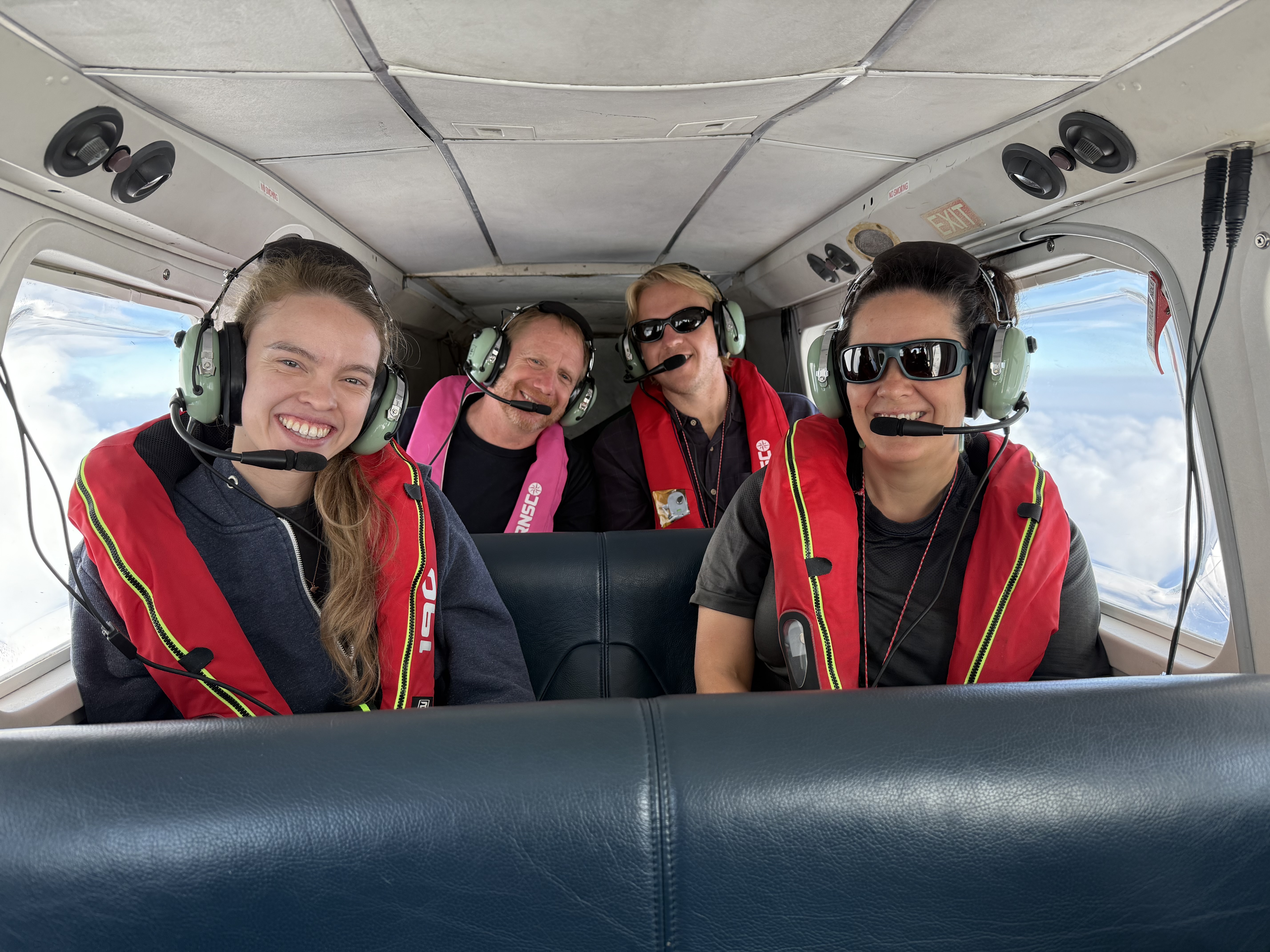
    Our turtle-team recently took to the air over the Bay of Plenty as a starting point to find out more about leatherbacks in New Zealand waters. We worked with Upwell Turtles, and with support and expertise from NIWA, Monash University (Australia), and Moss Landing Marine Laboratories (USA).  

    While we had George and Scott here from Upwell Turtles, they graciously gave us some of their time and expertise, to help develop our own techniques to catch and tag leatherbacks. 

    The international research crew monitoring for leatherbacks from a plane | Sean Williamson

    Practice Makes Perfect 

    Along with our international experts, we assembled an array of technical equipment, and formed a team including Tauranga DOC staff, Tuhua Island kaitiaki, and a local marine conservationist, all eager to embrace the challenge of finding and netting such large animals. 

    Heading out on our DOC boat off the coast of Tauranga on calm, sunny weekend in March we focused our efforts on a large rubber fender co-opted as a ‘pretend’ turtle. Few fenders have had such an exciting couple of days! 

    The team has now honed the required skills and techniques to safely net actual turtles. In future, when we do this for real, we will have a spotter plane in the air and other boats on the water to help us find turtles – leatherbacks can be tricky to spot from sea level. 

    Practicing netting aboard a DOC vessel | DOC
    DOC Senior Marine Science Advisor Dr Karen Middlemiss practicing netting | DOC

    Where to from here? 

    Because leatherback turtles have historically visited the Bay of Plenty, we’re working to build partnerships with local iwi and hapū, and the Bay of Plenty community, as well as collaborating with our research partners. 

    We’re starting to plan our next steps into the world of tagging, aiming for next summer when the turtles and jellyfish have returned to the Bay.  

    Everything we learn from tagging studies of leatherback turtles in our waters will help inform future conservation efforts for this species, which is so ancient we call it the tuatara of our oceans. We’ll be doing our part in the international effort to protect a species on the brink of extinction.   

    How you can help leatherback turtles: 

    • No marine turtles nest on beaches in New Zealand, any turtle on the beach should be reported immediately to 0800 DOC HOT (0800 362 468).
    • Spot a sea turtle in the water around New Zealand? You can report sightings to
    turtles@doc.govt.nz 
    • You can help protect leatherbacks and other marine animals by preventing plastics and pollution from reaching our oceans. 

    Share this:

    MIL OSI New Zealand News –

    April 7, 2025
  • MIL-OSI USA: ICYMI: Senate Republicans Block Senator Markey’s Amendment to Protect Social Security Phone Service

    US Senate News:

    Source: United States Senator for Massachusetts Ed Markey

    Watch: Senator Markey slams Republican attempts to make accessing Social Security benefits more difficult for seniors

    Washington (April 6, 2025) – On April 4, Senator Edward J. Markey (D-Mass.) forced Republicans to vote on preserving phone services at the Social Security Administration so seniors can continue to access their earned benefits. Republicans voted down the amendment from passing. Below is an excerpt from Senator Markey’s remarks on protecting Social Security phone service:

    “Ten days from now, the DOGE chainsaw is threatening to cut phone services at the Social Security Administration. This Administration is proposing to force Grandma and Grandpa to go online or drive long distances to a field office – if it is still open – just to access their earned benefits. And why is this happening? Because of the lie that Social Security is rife with fraud.

    “Republicans haven’t been able to destroy Social Security yet, and we’re not going to let Trump, Musk, or their billionaire buddies succeed in destroying Social Security with lies, cuts, and cruelty. We will NOT neglect the promise we made – and we will preserve security and dignified retirement for everyone.”

    Senator Markey is fighting to protect Social Security benefits for current and future generations. On March 28, Senator Markey hosteda press conference in Boston to spotlight how the Trump administration’s attempts to gut Social Security impact Massachusetts residents. In February 2025, Senator Markey led his colleagues in a letter to Appropriations Committee Chair Susan Collins (R-Maine) and Ranking Member Patty Murray (D-Wash.) urging them to provide at least $15.402 billion for the Social Security Administration in the Fiscal Year (FY) 2025 Labor-HHS-Education Appropriations bill, allowing for full and timely implementation of the Social Security Fairness Act, while improving customer service.

    Senator Markey is an original cosponsor of the Social Security Fairness Act, signed into law by President Biden in January 2025. TheSocial Security Fairness Act repealed the Windfall Elimination Provision and Government Pension Offset, which had reduced benefits for 3.2 million public servants. As a member of the House of Representatives in 1983, Markey was one of a handful of Democrats to vote against the Social Security Reform Act, which created WEP/GPO. Senator Markey is an original cosponsor of the Social Security Expansion Act to protect and expand Social Security benefits.

    MIL OSI USA News –

    April 7, 2025
  • MIL-OSI USA: SPC Tornado Watch 132 Status Reports

    Source: US National Oceanic and Atmospheric Administration

    Search by city or zip code. Press enter or select the go button to submit request
    Local forecast by”City, St” or “ZIP” 

    SPC on Facebook

    @NWSSPC

    NCEP Quarterly Newsletter

    Home (Classic)SPC Products   All SPC Forecasts   Current Watches   Meso. Discussions   Conv. Outlooks   Tstm. Outlooks   Fire Wx Outlooks     RSS Feeds   E-Mail AlertsWeather Information   Storm Reports   Storm Reports Dev.   NWS Hazards Map   National RADAR   Product Archive   NOAA Weather RadioResearch   Non-op. Products   Forecast Tools   Svr. Tstm. Events   SPC Publications   SPC-NSSL HWTEducation & Outreach   About the SPC   SPC FAQ   About Tornadoes   About Derechos   Video Lecture Series   WCM Page   Enh. Fujita Page   Our History   Public ToursMisc.   StaffContact Us   SPC Feedback

    Watch 132 Status Reports

    Watch 132 Status Message has not been issued yet.

    Top/Watch Issuance Text for Watch 132/All Current Watches/Forecast Products/Home

    Weather Topics:Watches, Mesoscale Discussions, Outlooks, Fire Weather, All Products, Contact Us

    NOAA / National Weather ServiceNational Centers for Environmental PredictionStorm Prediction Center120 David L. Boren Blvd.Norman, OK 73072 U.S.A.spc.feedback@noaa.govPage last modified: April 06, 2025
    DisclaimerInformation QualityHelpGlossary
    Privacy PolicyFreedom of Information Act (FOIA)About UsCareer Opportunities

    MIL OSI USA News –

    April 7, 2025
  • MIL-OSI Global: Kids’ physical activity in child care is essential — how an online course equips educators to lead the way

    Source: The Conversation – Canada – By Myranda Hawthorne, PhD Student, Health and Rehabilitation Sciences, Western University

    Physical activity — primarily in the form of active play — promotes young children’s physical, mental, emotional and social health. It can also influence how active people will be later in life.

    It’s recommended that pre-school children, aged three to four years, engage in at least three hours of physical activity per day, and that should include one hour of high-intensity, heart-pumping movement. Sedentary screen time should also be limited to less than one hour per day.

    Despite this, many children in Canada and around the world do not meet recommended levels of physical activity and engage in far more sedentary screen time than recommended.

    Early childhood educators (ECEs) play many important roles in helping young children grow and learn, and one of these roles is encouraging engagement in physical activity. Our research in the Child Health and Physical Activity Lab at Western University focuses on promoting physical activity of young children.

    A large part of our research involves working with ECEs to create active child-care settings, where children are supported and encouraged to engage in the physical activity they need for their development. We believe providing physical activity training opportunities for ECEs is an essential first step towards reaching that goal.

    Why kids aren’t moving

    There are many barriers to promoting physical activity in child-care settings, including prioritization of academic outcomes and limited space or equipment.

    For ECEs, the lack of formal training on the integral role of physical activity on children’s learning, health and development may present a key barrier.

    Only 32 per cent of students in early childhood education programs in Canada have taken a course related to physical activity in their post-secondary degree.

    Furthermore, ECEs across Canada have reported a lack of knowledge and confidence in their ability to incorporate physical activity opportunities into daily programming in child-care settings. This is the case even while ECEs have expressed interest in pursuing more training on these important subjects.

    The TEACH course

    We created the TEACH e-learning course (TEACH stands for Training EArly CHildhood educators in physical activity) to help bridge this gap.

    This course aims to educate ECEs on the important role of physical activity in child development, and to provide them with the knowledge and confidence to implement physical activity within child-care environments.

    The TEACH course was developed with both early childhood education experts and physical activity specialists to create comprehensive and relevant course content in four online modules. These include instructive videos, practical tips and “knowledge checks” (encouraging self-reflection on current knowledge and practices) for promoting physical activity and limiting sedentary behaviour in child-care environments.

    Important topics like outdoor and risky play are also covered in the course. It strives to overcome some of the other barriers to physical activity promotion in child-care settings, including suggestions for incorporating movement with limited space or equipment, as well as how to combine physical activities with other important skills like literacy and numeracy.

    The TEACH course is endorsed by the Canada Child Care Federation as a resource which can be used for practising ECEs to help fulfil their annual professional development activity requirements.

    Real-world results show promise

    The course has been tested with 200 practising ECEs and 300 ECE students across Canada, and has been shown to increase ECEs’ knowledge, confidence and intentions to incorporate physical activity during the child-care day.

    Not only that, but the positive changes in self-efficacy and confidence were sustained up to three months after completing the training. This shows that the e-learning course can have a lasting impact.

    Both practising ECEs and those in training benefited from the TEACH course. Practicing ECEs, who could immediately apply their new knowledge and skills to their everyday work, maintained these gains more effectively when compared to the ECEs still in training.


    Read more:
    Outdoor play in shorter, more frequent windows can boost physical activity in early learning settings


    Expanding and integrating the TEACH course

    The online format of the TEACH course increases accessibility of the course, as ECEs can work through the content in their own time, from anywhere. The online format also provides promise for the feasibility of expanding the course to a wider audience to be a cost-effective way to train a large number of ECEs, without much strain on resources.

    Members of the Child Health and Physical Activity Lab have translated the TEACH course into French (TEACH-FR). They’re currently testing its impact on francophone ECEs across the country, to ensure this resource can eventually be made available to both English- and French-speaking ECEs across Canada.

    Children’s engagement in physical activity and healthy movement while at child care matters — and can impact their health and development. The TEACH course can help improve educators’ knowledge and confidence in promoting physical activity opportunities in child-care settings, better equipping them for this challenge.

    By providing training for ECEs on the importance of physical activity behaviours, as well as how to effectively program daily active play opportunities, we can help children to move more during their time in child care. This helps set the stage for future healthy active lives.

    Myranda Hawthorne receives funding from the Ontario Graduate Scholarship.

    Sophie M Phillips receives funding from Children’s Health Research Institute and Mitacs.

    Trish Tucker receives funding from the Canadian Institutes of Health Research, Social Sciences and Humanities Research Council, and the Children’s Health Research Institute.

    – ref. Kids’ physical activity in child care is essential — how an online course equips educators to lead the way – https://theconversation.com/kids-physical-activity-in-child-care-is-essential-how-an-online-course-equips-educators-to-lead-the-way-251418

    MIL OSI – Global Reports –

    April 7, 2025
  • MIL-OSI Global: Federal election: Conservatives and Liberals are targeting different generations and geographies online

    Source: The Conversation – Canada – By Philip Mai, Co-director and Senior Researcher, Social Media Lab, Toronto Metropolitan University, Toronto Metropolitan University

    Amid a Canadian federal election campaign focused in part on the country’s sovereignty, Canada’s two leading political parties are taking sharply different approaches to their advertising strategies. A close analysis of digital ad impressions on Facebook and Instagram reveals that the battleground is not just ideological, but demographic and geographic.

    While both the Conservative and Liberal parties invest ad dollars in Canada’s most populous provinces, their strategies reveal a deeper story: Conservatives bet on Gen Z and Millennial voters, while Liberals double down on older voters and those in Francophone Canada.

    We first observed these divergent strategies as part of an analysis conducted by the Ted Rogers School of Management Social Media Lab at Toronto Metropolitan University. As part of our Election Transparency and Accountability initiative, we examined Canadian political ad spending on Meta-owned platforms Facebook and Instagram, using PoliDashboard, the open-source platform we developed.

    We conducted a detailed analysis of the ad impression data for the campaigns of all major parties. Here, we focus our findings on online ads purchased by the Liberal and Conservative parties, the current frontrunners in the polls.

    Conservatives woo younger voters

    Based on impressions data from Facebook and Instagram during March 23-30, the week after the election announced, there was a clear generational divide in digital outreach. The Conservatives devoted much of their messaging to Canadians under 45, while the Liberals appeared to focus more on those 55 and older.

    A significant portion of Conservative Party Facebook and Instagram ad impressions came from men aged 25 to 34, who accounted for 16 per cent of all Conservative ad views. Additional impressions came from men aged 18 to 24, women aged 25 to 34, and women aged 35 to 44; each of these groups made up 10 per cent of the total impressions. This suggests an apparent effort by the Conservatives to connect with Gen Z and millennial voters.

    In contrast, Liberal ads garnered higher impressions among older demographics, with women aged 65 and over accounting for the largest share (21 per cent) of total impressions. Women aged 55 to 64 and men over 65 each contributed 12 per cent of Liberal ad impressions. This distribution points to a strategic emphasis on older voters, a group known for reliably turning out on election day.

    The estimated percentage of Meta ad impressions for Conservative and Liberals by demographic groups.
    (PoliDashboard/Social Media Lab), CC BY

    While traditional wisdom suggests that young adults favour progressive politics and parties, public polling suggests that young Canadians are increasingly embracing conservatism amid a housing and affordability crisis. The Conservatives appear poised to channel young peoples’ economic dissatisfaction into votes, using online advertising to reach them.

    Meanwhile, the Liberals appear to be consolidating support among those who have a longer history of voting, especially older women, who represent the largest age and gender cohort that is likely to vote for the party. It’s a tale of two electorates, and two very different strategies for winning.

    Impression data alone doesn’t confirm explicit age or gender targeting, nor does it guarantee support. Sometimes, a demographic simply has more affinity for a party’s content, leading to more impressions. These numbers can reflect both how parties aim their ads and how voters gravitate toward what resonates with them most.

    Regional divides

    The differences between the parties extend beyond age and gender, and into geographic territory. Both campaigns prioritize ad spending in Canada’s most populous provinces — British Columbia, Ontario and Québec — but the way they distribute their focus tells its own story.

    The Conservatives receive a larger share of their ad impressions from British Columbia, with 17 per cent of their total ad impressions; in comparison, the Liberals received just 11 per cent. The contrast is even sharper in Ontario, where 54 per cent of all Conservative ad impressions are concentrated, versus only 31 per cent for the Liberals.

    This difference is likely a deliberate strategic targeting tactic. Ontario, home to 122 federal ridings (with about 36 per cent of all seats in the House of Commons), is a pivotal battleground. The Conservatives’ strategy appears to hinge on flipping key seats in the province, particularly in suburban and outer suburban areas that could decide the election. Combined with their reach with younger voters, this approach signals an all-in effort to gain ground where it counts most.

    The Liberal Party, meanwhile, is doubling down in Québec — one of the largest and most culturally distinct provinces in the country — and where the Liberals are clearly on the offensive. Twenty-nine per cent of Liberal ad impressions are located in the province, compared to just three per cent for the Conservatives.

    Québec has long been a stronghold for the Liberals, particularly in urban areas like Montréal. While the province can be volatile and deeply influenced by local issues, the Liberals’ heavy advertising push suggests they’re working to defend the 33 seats they currently hold and possibly add a couple of new seats.

    Two parties, two visions

    Liberals and Conservatives are both vocally aligned in their repudiation of United States President Donald Trump’s frequent allusion to Canada becoming the “51st state,” a sentiment shared by an overwhelming majority of the Canadian public.

    With external pressure mounting from Trump’s tariff threats and democratic norms being tested across the border, this election isn’t just about policies or parties: it’s about protecting Canada’s independence, values and place in the world.

    However, the trends we’ve identified paint a picture of two distinct campaigns playing to different strengths and chasing different voters. The Conservatives are betting on young, digitally engaged Canadians, especially in Ontario. The Liberals are reinforcing their support among older voters, and looking to hold ground in Québec, where cultural identity and party loyalty still carry significant weight.

    Of course, ad impressions are only one part of the equation. Factors like grassroots efforts, candidate appeal and regional dynamics also play a major role. Still, the ad impression numbers provide a unique glimpse into each campaign’s strategy, and reveal the part of Canada each party believes it must win over.

    Philip Mai receives funding from the Department of Canadian Heritage Digital Citizen Contribution Program.

    Anatoliy Gruzd receives funding from the Department of Canadian Heritage Digital Citizen Contribution Program.

    William Hollingshead does not work for, consult, own shares in or receive funding from any company or organisation that would benefit from this article, and has disclosed no relevant affiliations beyond their academic appointment.

    – ref. Federal election: Conservatives and Liberals are targeting different generations and geographies online – https://theconversation.com/federal-election-conservatives-and-liberals-are-targeting-different-generations-and-geographies-online-253607

    MIL OSI – Global Reports –

    April 7, 2025
  • MIL-OSI Global: Kids’ physical activity in child care is essential — how an online course equips educators to lead this

    Source: The Conversation – Canada – By Myranda Hawthorne, PhD Student, Health and Rehabilitation Sciences, Western University

    Physical activity — primarily in the form of active play — promotes young children’s physical, mental, emotional and social health. It can also influence how active people will be later in life.

    It’s recommended that pre-school children, aged three to four years, engage in at least three hours of physical activity per day, and that should include one hour of high-intensity, heart-pumping movement. Sedentary screen time should also be limited to less than one hour per day.

    Despite this, many children in Canada and around the world do not meet recommended levels of physical activity and engage in far more sedentary screen time than recommended.

    Early childhood educators (ECEs) play many important roles in helping young children grow and learn, and one of these roles is encouraging engagement in physical activity. Our research in the Child Health and Physical Activity Lab at Western University focuses on promoting physical activity of young children.

    A large part of our research involves working with ECEs to create active child-care settings, where children are supported and encouraged to engage in the physical activity they need for their development. We believe providing physical activity training opportunities for ECEs is an essential first step towards reaching that goal.

    Why kids aren’t moving

    There are many barriers to promoting physical activity in child-care settings, including prioritization of academic outcomes and limited space or equipment.

    For ECEs, the lack of formal training on the integral role of physical activity on children’s learning, health and development may present a key barrier.

    Only 32 per cent of students in early childhood education programs in Canada have taken a course related to physical activity in their post-secondary degree.

    Furthermore, ECEs across Canada have reported a lack of knowledge and confidence in their ability to incorporate physical activity opportunities into daily programming in child-care settings. This is the case even while ECEs have expressed interest in pursuing more training on these important subjects.

    The TEACH course

    We created the TEACH e-learning course (TEACH stands for Training EArly CHildhood educators in physical activity) to help bridge this gap.

    This course aims to educate ECEs on the important role of physical activity in child development, and to provide them with the knowledge and confidence to implement physical activity within child-care environments.

    The TEACH course was developed with both early childhood education experts and physical activity specialists to create comprehensive and relevant course content in four online modules. These include instructive videos, practical tips and “knowledge checks” (encouraging self-reflection on current knowledge and practices) for promoting physical activity and limiting sedentary behaviour in child-care environments.

    Important topics like outdoor and risky play are also covered in the course. It strives to overcome some of the other barriers to physical activity promotion in child-care settings, including suggestions for incorporating movement with limited space or equipment, as well as how to combine physical activities with other important skills like literacy and numeracy.

    The TEACH course is endorsed by the Canada Child Care Federation as a resource which can be used for practising ECEs to help fulfil their annual professional development activity requirements.

    Real-world results show promise

    The course has been tested with 200 practising ECEs and 300 ECE students across Canada, and has been shown to increase ECEs’ knowledge, confidence and intentions to incorporate physical activity during the child-care day.

    Not only that, but the positive changes in self-efficacy and confidence were sustained up to three months after completing the training. This shows that the e-learning course can have a lasting impact.

    Both practising ECEs and those in training benefited from the TEACH course. Practicing ECEs, who could immediately apply their new knowledge and skills to their everyday work, maintained these gains more effectively when compared to the ECEs still in training.


    Read more:
    Outdoor play in shorter, more frequent windows can boost physical activity in early learning settings


    Expanding and integrating the TEACH course

    The online format of the TEACH course increases accessibility of the course, as ECEs can work through the content in their own time, from anywhere. The online format also provides promise for the feasibility of expanding the course to a wider audience to be a cost-effective way to train a large number of ECEs, without much strain on resources.

    Members of the Child Health and Physical Activity Lab have translated the TEACH course into French (TEACH-FR). They’re currently testing its impact on francophone ECEs across the country, to ensure this resource can eventually be made available to both English- and French-speaking ECEs across Canada.

    Children’s engagement in physical activity and healthy movement while at child care matters — and can impact their health and development. The TEACH course can help improve educators’ knowledge and confidence in promoting physical activity opportunities in child-care settings, better equipping them for this challenge.

    By providing training for ECEs on the importance of physical activity behaviours, as well as how to effectively program daily active play opportunities, we can help children to move more during their time in child care. This helps set the stage for future healthy active lives.

    Myranda Hawthorne receives funding from the Ontario Graduate Scholarship.

    Sophie M Phillips receives funding from Children’s Health Research Institute and Mitacs.

    Trish Tucker receives funding from the Canadian Institutes of Health Research, Social Sciences and Humanities Research Council, and the Children’s Health Research Institute.

    – ref. Kids’ physical activity in child care is essential — how an online course equips educators to lead this – https://theconversation.com/kids-physical-activity-in-child-care-is-essential-how-an-online-course-equips-educators-to-lead-this-251418

    MIL OSI – Global Reports –

    April 7, 2025
  • MIL-Evening Report: The graver Israel’s atrocities in Gaza, the quieter the BBC grows

    ANALYSIS: By Jonathan Cook

    The BBC’s news verification service, Verify, digitally reconstructed a residential tower block in Mandalay earlier this week to show how it had collapsed in a huge earthquake on March 28 in Myanmar, a country in Southeast Asia largely cut off from the outside world.

    The broadcaster painstakingly pieced together damage to other parts of the city using a combination of phone videos, satellite imagery and Nasa heat detection images.

    Verify dedicated much time and effort to this task for a simple reason: to expose as patently false the claims made by the ruling military junta that only 2000 people were killed by Myanmar’s 7.7-magnitude earthquake.

    The West sees the country’s generals as an official enemy, and the BBC wanted to show that the junta’s account of events could not be trusted. Myanmar’s rulers have an interest in undercounting the dead to protect the regime’s image.

    The BBC’s determined effort to strip away these lies contrasted strongly with its coverage — or rather, lack of it — of another important story this week.

    Israel has been caught in another horrifying war crime. Late last month, it executed 15 Palestinian first responders and then secretly buried them in a mass grave, along with their crushed vehicles.

    Israel is an official western ally, one that the United States, Britain and the rest of Europe have been arming and assisting in a spate of crimes against humanity being investigated by the world’s highest court. Fourteen months ago, the International Court of Justice ruled it was “plausible” that Israel was committing genocide in Gaza.

    Israeli Prime Minister Benjamin Netanyahu, meanwhile, is a fugitive from its sister court, the International Criminal Court. Judges there want to try him for crimes against humanity, including starving the 2.3 million people of Gaza by withholding food, water and aid.

    Israel is known to have killed tens of thousands of Palestinians, many of them women and children, in its 18-month carpet bombing of the enclave. But there are likely to be far more deaths that have gone unreported.

    This is because Israel has destroyed all of Gaza’s health and administrative bodies that could do the counting, and because it has created unmarked “kill zones” across much of the enclave, making it all but impossible for first responders to reach swathes of territory to locate the dead.

    The latest crime scene in Gaza is shockingly illustrative of how Israel murders civilians, targets medics and covers up its crimes — and of how Western media collude in downplaying such atrocities, helping Israel to ensure that the extent of the death toll in Gaza will never be properly known.

    Struck ‘one by one’
    Last Sunday, United Nations officials were finally allowed by Israel to reach the site in southern Gaza where the Palestinian emergency crews had gone missing a week earlier, on March 23. The bodies of 15 Palestinians were unearthed in a mass grave; another is still missing.

    All were wearing their uniforms, and some had their hands or legs zip-tied, according to eyewitnesses. Some had been shot in the head or chest. Their vehicles had been crushed before they were buried.

    Two of the emergency workers were killed by Israeli fire while trying to aid people injured in an earlier air strike on Rafah. The other 13 were part of a convoy sent to retrieve the bodies of their colleagues, with the UN saying Israel had struck their ambulances “one by one”.

    Even the usual excuses, as preposterous as they are, simply won’t wash in the case of Israel’s latest atrocity — which is why it initially tried to black out the story

    More details emerged during the week, with the doctor who examined five of the bodies reporting that all but one — which had been too badly mutilated by feral animals to assess — were shot from close range with multiple bullets. Ahmad Dhaher, a forensic consultant working at Nasser hospital in Khan Younis, said: “The bullets were aimed at one person’s head, another at their heart, and a third person had been shot with six or seven bullets in the torso.”

    Bashar Murad, the Red Crescent’s director of health programmes, observed that one of the paramedics in the convoy was in contact with the ambulance station when Israeli forces started shooting: “During the call, we heard the sound of Israeli soldiers arriving at the location, speaking in Hebrew.

    “The conversation was about gathering the [Palestinian] team, with statements like: ‘Gather them at the wall and bring some restraints to tie them.’ This indicated that a large number of the medical staff were still alive.”

    Jonathan Whittall, head of the UN office for the coordination of humanitarian affairs in Palestine, reported that, on the journey to recover the bodies, he and his team witnessed Israeli soldiers firing on civilians fleeing the area. He saw a Palestinian woman shot in the back of the head and a young man who tried to retrieve her body shot, too.

    Concealing slaughter
    The difficulty for Israel with the discovery of the mass grave was that it could not easily fall back on any of the usual mendacious rationalisations for war crimes that it has fed the Western media over the past year and a half, and which those outlets have been only too happy to regurgitate.

    Since Israel unilaterally broke a US-backed ceasefire agreement with Hamas last month, its carpet bombing of the enclave has killed more than 1000 Palestinians, taking the official death toll to more than 50,000. But Israel and its apologists, including Western governments and media, always have a ready excuse at hand to mask the slaughter.

    Israel disputes the casualty figures, saying they are inflated by Gaza’s Health Ministry, even though its figures in previous wars have always been highly reliable. It says most of those killed were Hamas “terrorists”, and most of the slain women and children were used by Hamas as “human shields”.

    Israel has also destroyed Gaza’s hospitals, shot up large numbers of ambulances, killed hundreds of medical personnel and disappeared others into torture chambers, while denying the entry of medical supplies.

    Israel implies that all of the 36 hospitals in Gaza it has targeted are Hamas-run “command and control centres”; that many of the doctors and nurses working in them are really covert Hamas operatives; and that Gaza’s ambulances are being used to transport Hamas fighters.

    Even if these claims were vaguely plausible, the Western media seems unwilling to ask the most obvious of questions: why would Hamas continue to use Gaza’s hospitals and ambulances when Israel made clear from the outset of its 18-month genocidal killing rampage that it was going to treat them as targets?

    Even if Hamas fighters did not care about protecting the health sector, which their parents, siblings, children, and relatives desperately need to survive Israel’s carpet bombing, why would they make themselves so easy to locate?

    Hamas has plenty of other places to hide in Gaza. Most of the enclave’s buildings are wrecked concrete structures, ideal for waging guerrilla warfare.

    Israeli cover-up
    Even the usual excuses, as preposterous as they are, simply won’t wash in the case of Israel’s latest atrocity — which is why it initially tried to black out the story.

    Given that it has banned all Western journalists from entering Gaza, killed unprecedented numbers of local journalists, and formally outlawed the UN refugee agency Unrwa, it might have hoped its crime would go undiscovered.

    But as news of the atrocity started to appear on social media last week, and the mass grave was unearthed on Sunday, Israel was forced to concoct a cover story.

    It claimed the convoy of five ambulances, a fire engine, and a UN vehicle were “advancing suspiciously” towards Israeli soldiers. It also insinuated, without a shred of evidence, that the vehicles had been harbouring Hamas and Islamic Jihad fighters.

    Once again, we were supposed to accept not only an improbable Israeli claim but an entirely nonsensical one. Why would Hamas fighters choose to become sitting ducks by hiding in the diminishing number of emergency vehicles still operating in Gaza?

    Why would they approach an Israeli military position out in the open, where they were easy prey, rather than fighting their enemy from the shadows, like other guerrilla armies — using Gaza’s extensive concrete ruins and their underground tunnels as cover?

    If the ambulance crews were killed in the middle of a firefight, why were some victims exhumed with their hands tied? How is it possible that they were all killed in a gun battle when the soldiers could be heard calling for the survivors to be zip-tied?

    And if Israel was really the wronged party, why did it seek to hide the bodies and the crushed vehicles under sand?

    ‘Deeply disturbed’
    All available evidence indicates that Israel killed all or most of the emergency crews in cold blood — a grave war crime.

    But as the story broke on Monday, the BBC’s News at Ten gave over its schedule to a bin strike by workers in Birmingham; fears about the influence of social media prompted by a Netflix drama, Adolescence; bad weather on a Greek island; the return to Earth of stranded Nasa astronauts; and Britain’s fourth political party claiming it would do well in next month’s local elections.

    All of that pushed out any mention of Israel’s latest war crime in Gaza.

    Presumably under pressure from its ordinary journalists — who are known to be in near-revolt over the state broadcaster’s persistent failure to cover Israeli atrocities in Gaza — the next day’s half-hour evening news belatedly dedicated 30 seconds to the item, near the end of the running order.

    This was the perfect opportunity for BBC Verify to do a real investigation, piecing together an atrocity Israel was so keen to conceal

    The perfunctory report immediately undercut the UN’s statement that it was “deeply disturbed” by the deaths, with the newsreader announcing that Israel claimed nine “terrorists” were “among those killed”.

    Where was the BBC Verify team in this instance? Too busy scouring Google maps of Myanmar, it would seem.

    If ever there was a region where its forensic, open-source skills could be usefully deployed, it is Gaza. After all, Israel keeps out foreign journalists, and it has killed Palestinian journalists in greater numbers than all of the West’s major wars of the past 150 years combined.

    This was the perfect opportunity for BBC Verify to do a real investigation, piecing together an atrocity Israel was so keen to conceal. It was a chance for the BBC to do actual journalism about Gaza.

    Why was it necessary for the BBC to contest the narrative of an earthquake in a repressive Southeast Asian country whose rulers are opposed by the West but not contest the narrative of a major atrocity committed by a Western ally?

    Missing in action
    This is not the first time that BBC Verify has been missing in action at a crucial moment in Gaza.

    Back in January 2024, Israeli soldiers shot up a car containing a six-year-old girl, Hind Rajab, and her relatives as they tried to flee an Israeli attack on Gaza City. All were killed, but before Hind died, she could be heard desperately pleading with emergency services for help.

    Two paramedics who tried to rescue her were also killed. It took two weeks for other emergency crews to reach the bodies.

    It was certainly possible for BBC Verify to have done a forensic study of the incident — because another group did precisely that. Forensic Architecture, a research team based at the University of London, used available images of the scene to reconstruct the events.

    It found that the Israeli military had fired 335 bullets into the small car carrying Hind and her family. In an audio recording before she was killed, Hind’s cousin could be heard telling emergency services that an Israeli tank was near them.

    The sound of the gunfire, most likely from the tank’s machine gun, indicates it was some 13 metres away — close enough for the crew to have seen the children inside.

    Not only did BBC Verify ignore the story, but the BBC also failed to report it until the bodies were recovered. As has happened so often before, the BBC dared not do any reporting until Israel was forced to confirm the incident because of physical evidence.

    We know from a BBC journalist-turned-whistleblower, Karishma Patel, that she pushed editors to run the story as the recordings of Hind pleading for help first surfaced, but she was overruled.

    When the BBC very belatedly covered Hind’s horrific killing online, in typical fashion, it did so in a way that minimised any pushback from Israel. Its headline, “Hind Rajab, 6, found dead in Gaza days after phone calls for help”, managed to remove Israel from the story.

    Evidence buried
    A clear pattern thus emerges. The BBC also tried to bury the massacre of the 15 Palestinian first responders — keeping it off its website’s main page — just as Israel had tried to bury the evidence of its crime in Gaza’s sand.

    The story’s first headline was: “Red Cross outraged over killing of eight medics in Gaza”. Once again, Israel was removed from the crime scene.

    Only later, amid massive backlash on social media and as the story refused to go away, did the BBC change the headline to attribute the killings to “Israeli forces”.

    But subsequent stories have been keen to highlight the self-serving Israeli claim that its soldiers were entitled to execute the paramedics because the presence of emergency vehicles at the scene of much death and destruction was “suspicious”.

    In one report, a BBC journalist managed to shoe-horn this same, patently ridiculous “defence” twice into her two-minute segment. She reduced the discovery of an Israeli massacre to mere “allegations”, while a clear war crime was soft-soaped as only an “apparent” one.

    Notably, the BBC has on one solitary occasion managed to go beyond other media in reporting an attack on an ambulance crew. The footage incontrovertibly showed a US-supplied Apache helicopter firing on the crew and a young family they were trying to evacuate.

    There was no possibility the ambulance contained “terrorists” because the documentary team were filming inside the vehicle with paramedics they had been following for months. The video was included near the end of a documentary on the suffering of Palestinians in Gaza, seen largely through the eyes of children.

    But the BBC quickly pulled that film, titled Gaza: How to Survive a War Zone, after the Israel lobby manufactured a controversy over one of its child narrators being the son of Gaza’s deputy Agriculture Minister, who served in the Hamas-run civilian government.

    Wholesale destruction
    The unmentionable truth, which has been evident since the earliest days of the 18-month genocide, is that Israel is intentionally dismantling and destroying Gaza’s health sector, piece by piece.

    According to the UN, Israel’s war has killed at least 1060 healthcare workers and 399 aid workers — those deaths it has been possible to identify — and wrecked Gaza’s health facilities. Israel has rounded up hundreds of medical staff and disappeared many of them into what Israeli human rights groups call torture chambers.

    One doctor, Dr Hussam Abu Safiya, director of the Kamal Adwan hospital in northern Gaza, has been held by Israel since he was abducted in late December. During brief contacts with lawyers, Dr Safiya revealed that he is being tortured.

    Other doctors have been killed in Israeli detention from their abuse, including one who was allegedly raped to death.

    Israel’s destruction of Gaza’s hospitals and execution of medical personnel is part of the same message: there is nowhere safe, no sanctuary, the laws of war no longer apply

    Why is Israel carrying out this wholesale destruction of Gaza’s health sector? There are two reasons. Firstly, Netanyahu recently reiterated his intent to carry out the complete ethnic cleansing of Gaza.

    He presents this as “voluntary migration”, supposedly in accordance with US President Donald Trump’s plan to relocate the enclave’s population of 2.3 million Palestinians to other countries.

    There can be nothing voluntary about Palestinians leaving Gaza when Israel has refused to allow any food or aid into the enclave for the past month, and is indiscriminately bombing Gaza. Israel’s ultimate intention has always been to terrify the population into flight.

    Israel’s ambassador to Austria, David Roet, was secretly recorded last month stating that “there are no uninvolved in Gaza”— a constant theme from Israeli officials. He also suggested that there should be a “death sentence” for anyone Israel accuses of holding a gun, including children.

    Meanwhile, Israeli Defence Minister Israel Katz has threatened the “total devastation” of Gaza’s civilian population should they fail to “remove Hamas” from the enclave, something they are in no position to do.

    Not surprisingly, faced with the prospect of an intensification of the genocide and the imminent annihilation of themselves and their loved ones, ordinary people in Gaza have started organising protests against Hamas — marches readily reported by the BBC and others.

    Israel’s destruction of Gaza’s hospitals and execution of medical personnel is part of the same message: there is nowhere safe, no sanctuary, the laws of war no longer apply, and no one will come to your aid in your hour of need.

    You are alone against our snipers, drones, tanks and Apache helicopters.

    Too much to bear
    The second reason for Israel’s destruction of Gaza’s health sector is that we in the West, or at least our governments and media, have consented to Israel’s savagery — and actively participated in it — every step of the way. Had there been any meaningful pushback at any stage, Israel would have been forced to take another course.

    When David Lammy, Britain’s Foreign Secretary, let slip in Parliament last month the advice he has been receiving from his officials since he took up the job last summer — that Israel is clearly violating international law by starving the population — he was immediately rebuked by Prime Minister Keir Starmer’s office.

    Let us not forget that Starmer, when he was opposition leader, approved Israel’s genocidal blocking of food, water and electricity to Gaza, saying Israel “had that right”.

    In response to Lammy’s comments, Starmer’s spokesperson restated the government’s view that Israel is only “at risk” of breaching international law — a position that allows the UK to continue arming Israel and providing it with intelligence from British spy flights over Gaza from a Royal Air Force base in Cyprus.

    Our politicians have consented to everything Israel has done, and not just in Gaza over the past 18 months. This genocide has been decades in the making.

    Three-quarters of a century ago, the West authorised the ethnic cleansing of most of Palestine to create a self-declared Jewish state there. The West consented, too, to the violent occupation of the last sections of Palestine in 1967, and to Israel’s gradual colonisation of those newly seized territories by armed Jewish extremists.

    The West nodded through waves of house demolitions carried out against Palestinian communities by Israel to “Judaise” the land. It backed the Israeli army creating extensive “firing zones” on Palestinian farmland to starve traditional agricultural communities of any means of subsistence.

    The West ignored Israeli settlers and soldiers destroying Palestinian olive groves, beating up shepherds, torching homes, and murdering families. Even being an Oscar winner offers no immunity from the rampant settler violence.

    The West agreed to Israel creating an apartheid road system and a network of checkpoints that kept Palestinians confined to ever-shrinking ghettoes, and building walls around Palestinian areas to permanently isolate them from the rest of the world.

    It allowed Israel to stop Palestinians from reaching one of their holiest sites, Al-Aqsa Mosque, on land that was supposed to be central to their future state.

    The West kept quiet as Israel besieged the two million people of Gaza for 17 years, putting them on a tightly rationed diet so their children would grow ever-more malnourished. It did nothing — except supply more weapons — when the people of Gaza launched a series of non-violent protests at their prison walls around the enclave, and were greeted with Israeli sniper fire that left thousands dead or crippled.

    The West only found a collective voice of protest on 7 October 2023, when Hamas managed to find a way to break out of Gaza’s choking isolation to wreak havoc in Israel for 24 hours. It has been raising its voice in horror at the events of that single day ever since, drowning out 18 months of screams from the children being starved and exterminated in Gaza.

    The murder of 15 Palestinian medics and aid workers is a tiny drop in an ocean of Israeli criminality — a barbarism rewarded by Western capitals decade after decade.

    This genocide was made in the West. Israel is our progeny, our ugly reflection in the mirror — which is why Western leaders and establishment media are so desperate to make us look the other way. That reflection is too much for anyone with a soul to bear.

    Jonathan Cook is a writer, journalist and media critic, and author of many books about Palestine. He is a winner of the Martha Gellhorn Special Prize for Journalism. Republished from the Middle East Eye and the author’s blog with permission.

    MIL OSI Analysis – EveningReport.nz –

    April 7, 2025
  • MIL-Evening Report: Election Diary: Dutton backs down on working-from-home crackdown after outcry threatens to cost votes

    Source: The Conversation (Au and NZ) – By Michelle Grattan, Professorial Fellow, University of Canberra

    Peter Dutton has raised the white flag on his controversial attempt to force Canberra public servants back into the office, with the opposition now saying there will be no change in current arrangements.

    The shadow minister for the public service, Jane Hume, said: “We have listened, and understand that flexible work, including working from home, is part of getting the best out of any workforce”.

    The Coalition’s public service policy, released Sunday, says a Dutton government will “support flexible working arrangements for the public service, including working from home, by respecting existing flexible working arrangements, and enshrining them in future agreements.

    “There will be no mandated minimum number of days for public servants to work in the office.”

    Originally the Coalition wanted to get public servants back into the office five days a week, with Hume saying they had shown a “lack of respect for the work that went into earning the taxes the spend”.

    But on Sunday, Hume said, “Many professional men and women in the Commonwealth public service are benefiting from flexible working arrangements, including working from home, which allow them to make valuable contributions to serving Australians.

    “We know the importance of flexible work for many Australians, and have always supported the private sector making its own decisions on flexible work arrangements.”

    The move to try to return the public servants to the office has been a bugbear for the opposition from the start. Dutton landed in further trouble when he suggested women who were adversely affected by the policy could share jobs.

    Many voters feared if the return-to-the-office policy was introduced for public service workers, it could quickly lead to more pressure in the private sector. Many private employers have been trying to limit work-from-home arrangements.

    Working from home has become particularly entrenched since the pandemic, and the Liberals’ hard line threatened to lose them votes widely, especially among women.

    Dutton has progressively been qualifying and walking back the opposition’s proposal. Now, it’s been ditched completely.

    The Coalition’s public service policy would reduce the federal public service by 41,000 jobs over five years, while protecting frontline services and national security positions.

    Penny Wong paints Dutton as a ‘risk’ in an uncertain world

    The Liberals like to see national security issues as one of their strong suits. But Labor – thanks to US President Donald Trump’s global tariffs – is now boldly casting Dutton as posing a risk to Australia in a changing, uncertain world.

    Foreign Minister Penny Wong on Sunday described the opposition leader as stubborn, arrogant and always believing he knows best.

    “That leads him to make bad calls,” Wong told the ABC. “You see that in his stubborn insistence on a deal with President Trump at whatever cost. You see that in a reckless and risky linking of defence into this trade dispute.

    “What this showed us was this was a man who makes bad calls and this is a man who is a risk to this country when we face these uncertain times.”

    Penny Wong on Insiders on Sunday.

    Dutton has insisted he would have more chance of winning an exemption from US tariffs than Prime Minister Anthony Albanese.

    Trying to make his point, he was loose in his language last week. Notably, he said one of the things he would invoke was our defence relationship with the US.

    This was immediately interpreted as a threat. Later it was clarified he meant offering something positive to the US. But in an election campaign, the clarification seldom catches up with the original statement.

    Meanwhile, former Prime Minister John Howard weighed in to say the Australian-American defence relationship should never be brought into such a negotiation.

    Albanese is also saying the government will try to change Trump’s mind about applying tariffs to Australia. Like Dutton, he would have Australia’s critical minerals in the negotiating mix, although exactly how is not clear.

    The Liberals say if Dutton became PM he’d visit Washington within 60 days. There’d be a lot of pressure on the new prime minister to get a deal.

    If Labor is returned, Albanese would no doubt make an effort. But one suspects when push came to shove, he’d be reluctant to cede much, given the direct hit from the 10% tariff on Australian exports is relatively mild.

    The 2025 Liberal Party is a narrow congregation

    Petro Georgiou, one of the Liberals’ high-profile backbench moderates during the Howard years, died last week. His death reminded people – if they needed reminding – that the Liberal Party is a very different beast these days.

    Howard talked about the party being a “broad church”, embracing both conservatives and moderates. Howard, himself, of course, was no moderate but there were a number of small-“l” liberals with strong voices in his government – among them Robert Hill, John Fahey (former NSW premier), and Michael Wooldridge.

    While some powerful moderates were in the tent, others were kicking up the sand around it from the backbench. Prominent among them was Georgiou, a former adviser to Prime Minister Malcolm Fraser. He and colleagues took on Howard over various issues, especially on refugees.

    Fast forward to the Abbott government and, despite Tony Abbott’s conservatism, moderates were prominent: Julie Bishop, Christopher Pyne, Malcolm Turnbull, George Brandis.

    One significant reason for the important place the moderates had in the past was the nature of the Liberal Party. Its strongholds were affluent, urban areas, where voters were above average in income and education.

    But from Howard’s time on, Liberal leaders increasingly turned their eyes elsewhere. Howard had his “battlers”, and pursued voters from the right in Queensland. Abbott went after his “tradies”. Dutton is looking to outer suburbia to make his gains.

    Turnbull, the only moderate among the last four Liberal leaders, has, ironically, undermined the moderates. His trenchant criticisms of subsequent leaders have given many small-“l” liberal voters permission to vote teal.

    Last election, the teals dispatched several moderate Liberals, including Josh Frydenberg, who lost to independent Monique Ryan in Georgiou’s old seat of Kooyong. (Frydenberg hadn’t started out as a moderate, but effectively became one.) Other moderates, most notably Simon Birmingham, have exited politics before or at this election.

    One of Georgiou’s strongest allies back in the day was Victorian MP Russell Broadbent. Broadbent, who was also close to Turnbull, lost preselection for his seat of Monash and defected to the crossbench in 2023. He’s now running in Monash as an independent against the new Liberal candidate Mary Aldred (whose father was in parliament).

    In Monash, the Liberals don’t just have Broadbent snapping at their heels, but a teal candidate, as well. Broadbent says his old party should be glad he’s in the contest.

    “The teal would have won it otherwise,” he claims. The Liberals consider the seat pretty safe, but they’ll be thankful he is giving them his preferences.

    Michelle Grattan does not work for, consult, own shares in or receive funding from any company or organisation that would benefit from this article, and has disclosed no relevant affiliations beyond their academic appointment.

    – ref. Election Diary: Dutton backs down on working-from-home crackdown after outcry threatens to cost votes – https://theconversation.com/election-diary-dutton-backs-down-on-working-from-home-crackdown-after-outcry-threatens-to-cost-votes-253732

    MIL OSI Analysis – EveningReport.nz –

    April 7, 2025
  • MIL-OSI Global: 4 actions to support a sustainable democracy: No heroism required

    Source: The Conversation – Canada – By Wolfgang Linden, Professor Emeritus in Clinical and Health Psychology, University of British Columbia

    The media make an urgent case that democracy is threatened and autocrats are gaining ground. Democracy fatigue is in large part attributable to an inherently slow process, requiring many compromises and engagement by citizens. I argue that we are not helpless and offer action strategies to make the effort required to maintain democracy more palatable.

    As a researcher in psychology, I discovered (as have others) that the basic principles driving human behaviour are remarkably similar across a wide range of domains. They include child development, social psychology, psychotherapy and also politics. Now, as an emeritus professor, I am applying this knowledge to the wider-reaching application of ways to strengthen democracy.

    Using research-based and realistic views of the degree of control we have over politics, I propose four actions for individuals in support of strengthening democracy.

    1. Make voting social and celebratory

    A yardstick of a healthy democracy is election participation, which has dropped over time and hovers around two-thirds of eligible voters, with slightly higher rates in Canada than in the United States. Human beings are by nature social and seek company, and that alone is a perfect reason to go voting together with family and friends; make it an event.

    We know that couples go voting together and thus have greater participation rates than singles. Also, efforts to mobilize reluctant voters have possible spillover effects to other hesitant voters in their nearby environment. Lastly, it makes especially good sense to engage any first-time eligible voter because starting a voting habit early builds habitual voting. You could even encourage this first-time voter to get a (paid) job in the polling station!

    2. Reframe voting probabilities

    Sentiments like “my vote counts for little” are common. Nevertheless, we often see cliff-hanger results where tiny pools of votes count a lot.

    In 2024 in British Columbia, for example, three out of 93 races showed the two leading parties apart by fewer than 225 votes. One of these battles was ultimately won with a 22-vote difference, which really mattered because it was the one seat needed to swing the entire election towards winning a majority in the legislature.

    3. Use the word ‘us,’ challenge use of ‘they’

    Some politicians use fearmongering as a deliberate strategy and label non-supporters or people who differ from them as dangerous. “They” get blamed for the world’s ills, and can be excluded, or worse.

    When people around you overdo the divisiveness, ask them who are “they” and in what ways are they really different? Ultimately, when studied worldwide, all of “us” seek physical safety, supportive social networks, and stable, decent-paying jobs. We hope for fairness and want to support our families.

    Also, when dealing with issues like pollution, for example, remember that dirty air and water or radioactive waste don’t care about politically defined borders. They are all “our” garbage and “our” problem.

    4. How to shift from ‘they’ to ‘we’

    One proposition to help shift from “they” to “we” is to engage in new hobbies that excite you but involve people who are predictably unlike you. If you are a desk jockey by day, you might meet people with very different backgrounds when you join a hiking group or a woodworking co-op.

    Once you build this bridge and better understand others’ worlds, it becomes easier to work on solutions for joint social problems. At the workplace, hiring people with very diverse expertise has been shown to lead to more creative and satisfactory solutions than by drawing experts from a narrow pool.

    Also, by seeking consensus with others, you strengthen your own conflict-resolution skills. They can then be used in other places like marriage, condominium self-government, workplace politics or in holding groups of friends together.

    Yet another way of actively adopting the idea of “us” is to join advocacy groups that work on topics important to you and your community. Participedia is a global platform for anyone interested in public participation and democratic innovation. They have explored hundreds of organizations in 159 countries.

    Bottom line, neither heroic behaviour nor exceptional courage is required to engage in these readily available building blocks of a sustainable democracy.

    Wolfgang Linden is affiliated with Council of Canadians, Fair Vote Canada; both not for profit, not aligned with a political party

    – ref. 4 actions to support a sustainable democracy: No heroism required – https://theconversation.com/4-actions-to-support-a-sustainable-democracy-no-heroism-required-248748

    MIL OSI – Global Reports –

    April 7, 2025
  • MIL-OSI Global: 5 tips from an expert for choosing a self-help book that will actually work

    Source: The Conversation – Canada – By Joanna Pozzulo, Chancellor’s Professor, Psychology, Carleton University

    With over 15,000 self-help books published yearly, sifting through so many books can be challenging. (Shutterstock)

    The wellness industry is one of the fastest growing markets, with an estimated global value of US$6.3 trillion in 2023. Gen Z and millennials are driving much of this growth, spending more on wellness products and services than older generations.

    The challenge, however, is that the wellness industry has few guardrails, allowing social media influencers and media personalities to position themselves as experts on well-being — sometimes without scientific backing.

    In a space where personal opinions and untested strategies are often presented as facts, it can be difficult to distinguish between helpful guidance and misleading information.

    Self-help books and bibliotherapy

    One form of self-help that has gained attention is bibliotherapy, which uses books to support well-being. If you’re looking to improve your well-being, you may find yourself at your local bookstore or library scouring the shelves for a self-help book.

    The self-help category is one of the largest non-fiction book categories. But not all self-help books contain strategies that are actually tested to determine their efficacy.

    With over 15,000 self-help books published yearly in the United States alone, sifting through so many books can be challenging.

    As a professor of psychology and founder of a book club that selects evidence-based books on well-being and self-improvement, I identify self-help books that rely on research rather than personal opinions or commercialized wellness trends.


    Ready to make a change? The Quarter Life Glow-up is a new, six-week newsletter course from The Conversation’s UK and Canada editions.

    Every week, we’ll bring you research-backed advice and tools to help improve your relationships, your career, your free time and your mental health – no supplements or skincare required. Sign up here to start your glow-up at any time.


    5 tips for choosing self-help books

    Here are five key tips for choosing self-help books that are grounded in reliable evidence:

    1. Consider the author’s credentials

    Check the qualifications of an author before assuming their book is evidence-based. Keep in mind that writing a book doesn’t qualify an author as an expert.

    Some self-help books are based on personal experiences rather than scientific research, and while lived experience can be valuable, it is not the same as strategies that have been tested to determine their efficacy.

    Look for authors with academic credentials, like a PhD or doctor of medicine from a reputable school, rather than those claiming expertise solely through personal experience.

    Many professional writers simply summarize existing research rather having conducted the research they are writing about. This can sometimes lead to oversimplification or misrepresentation of scientific findings.

    A quick online search can help determine whether an author has the necessary expertise to offer credible, science-based advice.

    The self-help category is one of the largest non-fiction book categories.
    (Shutterstock)

    2. Don’t judge a book by its popularity

    Just because a book is a bestseller or endorsed by celebrities doesn’t mean it’s grounded in science or evidence-based. Unlike academic research, which undergoes peer review before publication, self-help books are not always vetted for accuracy.

    A book’s success may be driven by marketing, emotional appeal or trendy ideas rather than solid scientific evidence.

    3. Consider where a book is shelved

    Bookstores and libraries categorize self-help books in a variety of sections, including health, wellness, well-being and new age. While some books in these categories are evidence-based, you might consider looking under the science and nature section instead.

    Exploring beyond traditional self-help sections can increase the likelihood of you finding books based on credible, scientific evidence.

    4. Be open to different topics

    Self-improvement is not limited to a single aspect of life. Well-being is a multifaceted construct with some experts including nine or more dimensions, including but not limited to physical, emotional, social, intellectual, spiritual, financial, environmental, occupational and cultural.

    When searching for a self-help book, consider exploring a well-being dimension that you may not know much about to expand your knowledge. This can contribute to a more well-rounded sense of personal development. Or, consider a topic that you want to know more about from a scientific perspective.

    You might consider looking for wellness books outside the health, wellness, well-being and new age categories.
    (Shutterstock)

    5. Think critically about what you read

    Even evidence-based books may report findings that are surprising or contradictory. If you read something that seems contrary in a book, seek out additional sources to verify the claims for yourself.

    The most credible self-help books will include a list of references to original studies that allow you to verify claims for yourself and draw your own conclusions. The extra-benefit of these references is that they can also serve as a gateway to additional resources on the topic.

    A pathway to better health and well-being

    Reading offers a number of benefits for well-being, including helping cognitive function, reducing stress, improving sleep quality and quantity, improving mood, and decreasing blood pressure.

    Although reading is often considered a solitary activity, it can also be a way to connect with others. Being part of a community can help reduce social isolation, decrease loneliness and increase connectedness.

    Book clubs, in particular, can provide a way for you to reap the benefits of reading and community. I created the the Reading for Well-Being Community Book Club at Carleton University.

    I select evidence-based books on various aspects of well-being and self-improvement as Professor Pozzulo’s Picks. I also interview the authors of the books I select on my Reading for Well-Being podcast.

    Each month, members receive a newsletter announcing my pick and a link to the digital platform where my review is posted including a discussion board where club members can share their thoughts about the book. There are no fees and all are welcome to join.

    Whether reading alone or with a group, the benefits of books extend far beyond their pages. So pick up a book and start your journey toward a healthier and more connected life.

    Happy reading!

    Joanna Pozzulo receives funding from the Social Sciences and Humanities Research Council of Canada.

    – ref. 5 tips from an expert for choosing a self-help book that will actually work – https://theconversation.com/5-tips-from-an-expert-for-choosing-a-self-help-book-that-will-actually-work-252596

    MIL OSI – Global Reports –

    April 7, 2025
  • MIL-OSI USA: A Dose of History: Excellence In Pharmacy, Excellence In Athletics

    Source: US State of Connecticut

    No One Knows School Spirit Like Pat 

    If you ask Patrick Doherty (PHARM ‘24) what he did during his time at UConn’s School of Pharmacy, you might want to first ask what he didn’t do – because the list of what Pat didn’t do at UConn is quite short.  

    From energizing crowds at basketball games as Jonathan the Mascot, to hurdling teammates through the air as a cheerleader, to working long nights as a bartender at Huskies – all while pursuing his passion for pharmacy – Pat took on every role he could.  

    As a lifelong Husky fan, Pat had his eye on UConn growing up, but it wasn’t until high school that he knew he belonged at UConn’s School of Pharmacy. Interested in science and accessible healthcare during high school, Pat felt compelled to make a difference in his community and be part of something bigger than himself: “Pharmacy is constantly driving innovation in healthcare through new treatments.” With this newfound passion for pharmacy, which he knew would grow stronger at UConn, Pat realized he couldn’t continue to just root for the Huskies – he had to be a Husky! 

    Ben takes a try at Basketball (Emerson Ricciardone)

    Once a pharmacy student at UConn, Pat took his new title as a Husky very seriously. During his freshman year, while getting acclimated to a demanding schedule at the School, he decided to take on the exciting role of being Jonathan the Mascot, trading in his lab coat for a ten-pound Husky head when he needed to de-stress.

    Although he gave out endless high-fives and took picture after picture with fans at action-packed basketball and football games, Pat longed for the sense of camaraderie he had felt while on his high school basketball and golf teams.  This was around the time when a friend of his suggested he try cheerleading, to which he was hesitant: “I’ll admit, I didn’t think cheerleading was a sport before coming to UConn.” But Pat, having never said no to an opportunity before, took a risk and tried out for the cheerleading team. 

    Once a pharmacy student and a cheerleader at UConn, Pat began to feel like UConn was truly his home. “It was almost like having two families – a cheer family and a pharmacy family.” 

    His cheer family took him to the NCA Championships in December (a national cheerleading competition), the 2022 Women’s Final Four, the 2022 Men’s Big East Tournament at Madison Square Garden, and countless football games – his favorite being UConn vs. West Point. 

    Ben in the lab with his classmates

    On the other hand, Pat’s pharmacy family provided many academic and professional opportunities: a proud member of Alpha Zeta Omega Pharmaceutical Fraternity (AZO) and the American Society of Health-System Pharmacy, he fostered connections and grew his curiosity. As a Pharmacy Leaders’ Track Scholar and part of No Friends Left Naloxone (a club focused on opioid overdose awareness), Pat also cultivated new interests in the medical field. These involvements, along with the opportunity to create customized dosage forms for patients during an advanced compounding class and his internship at Hartford Hospital – he knew he was destined to work in a hospital setting, helping patients throughout their lives. 

    While Pat enjoyed both his cheer and pharmacy families at UConn, he also made sure to find opportunities outside of these groups, becoming an active member of the Paint Club and intramural basketball. During his sophomore year, Pat decided to pick up a job working as a bouncer at Huskies. The bar quickly realized, however, that Pat was too nice to be cut out for the job, so he was moved behind the bar and worked as a bartender for two years.  

    So, at this point, you might be asking yourself how Pat managed to fit so much into his schedule. To that, Pat emphasizes time management skills and the connections he fostered during his time at UConn. Adhering to a rigid schedule, Pat made sure to keep calendars, to-do lists, and timetables while taking advantage of any downtime he had to study. “Scheduling time to study in between workouts, practice, and class helped me retain the information better and improve my exam scores.” Pat even studied for exams on buses and planes going to games!  

    Ben and his team cheer during a game

    But while strict schedules and calendars helped Pat find the time, it was really the friends and connections he made at UConn that gave him the motivation to pursue his passions. Frequenting the School’s library, Pat would find time to talk to friends between classes and form study groups with close friends. Pat’s first year in the Pharm.D. program year was especially rough, as this was the first year of the pandemic, but his classmates and professors helped him tremendously. “With School of Pharmacy professors, I never felt like just a number.”  

    Now a Yale Health System Pharmacy Administration and Leadership Resident while pursuing a Master’s in Healthcare Administration, Pat manages his time and thrives in his new roles thanks to the lessons he learned at UConn.

    “The School’s curriculum set me up for success, and I learned how to manage my time.” – Pat

    Pat also credits the School and his cheerleading team for teaching him hard work, determination, and the skill of managing interpersonal relationships. In line with all his roles at UConn and now, Pat’s biggest piece of advice for current students at the School is to set unreasonable goals and work on them until they become reasonable. But while transforming unreasonable goals into reasonable ones and inspiring others to do the same, Pat encourages himself and current students to “never take anything too seriously and always find time to laugh.”  

    Being a Husky Isn’t a Title, It’s a Lifestyle: Cathy’s Legacy 

    Just one conversation with Cathy Bouchain (BS PHARM ‘85), and you’ll quickly see how much she is a true testament to ‘Once a Husky, Always a Husky.’ An excellent athlete and scholar in high school, Cathy turned down acceptance to prestigious schools, including Yale, to become one of the founding pioneers of the UConn Basketball legacy while also finding her passion for pharmacy. Forty years later, UConn is grateful Cathy chose to be a Husky – not a bulldog! 


    Cathy Bochain during her days as a member of the UConn women’s basketball team (Cyril Morris / UConn Athletics Photo).

    Growing up in Plainfield and graduating third in her class, Cathy balanced schoolwork and athletics with ease. Excelling in science and math but knowing very little about pharmacy, she decided to challenge herself by attending UConn’s School of Pharmacy: “You know, I like challenges, and I heard that pharmacy school was hard.” Although Cathy didn’t have the easiest time adjusting to the academic rigor of the program, she worked hard her first two semesters at UConn, even earning a 4.0 GPA  in her first professional year. Over time, she developed the time management skills and support system that allowed her to thrive, ultimately graduating 8th in her class and as the all-time leader in scoring and steals in university history for women’s basketball.  

    For Cathy, her success on the court and in the classroom was interdependent: “I was a jock in my classes and a nerd on the court.” Because of her busy basketball schedule, Cathy learned to tailor her studying to what mattered, going to professors for advice on the most important material. When she knew the key material, she would form study groups with her classmates and act as a teacher, strengthening her learning through teaching.

    As President of The Rho Chi Society (a National Honor Society for Pharmacy), she grew to be even stronger leader, both for her classmates and teammates. While her classmates sat at the front of the class, furiously jotting down notes, Cathy knew to sit in the back where she could take focused notes and easily come in late or leave early for practice without distracting anyone.  This mutual relationship helped Cathy achieve better grades during her basketball season, as she was so determined to find that perfect balance.  

    Bochain, right, with teammate Mary Ellen Langfield ’83 (UConn Athletics Photo).

    It wasn’t always balancing the two settings that made success possible, Cathy explained, but the people within the environments. During basketball games, her classmates would form their own cheer section with decorated signs. Cathy’s professors even let her join their basketball pickup games, where she grew closer to them and became more comfortable asking for help.

    “I think everybody was rooting for me.” – Cathy 

    And when it came to her team, everyone strived for academic success. From studying on buses to grabbing a bite to eat and studying for a few hours after practice, Cathy’s teammates leaned on each other for support, both as teammates and students of the University. And all this studying paid off: “I remember that during my senior year, our team had the highest GPA in the Big East.” 

    After graduating from the School, where she spent her last two years as a grad assistant to the team while completing rotations and internships, Cathy received her Bachelor of Science in Pharmacy and became a registered pharmacist. Her passions for basketball and pharmacy have been lifelong, creating a successful career in retail pharmacy while playing on a women’s basketball league in Manchester and local travel teams for many years. Aside from playing, Cathy has found adventure in restoring historic homes and hiking the Appalachian trail, and she plans to coach a youth basketball league called Frog Rock after she retires. She has also found adventure in her own family, raising three children with her partner Anne – all of whom are successful in their own endeavors. 

    Cathy talks during a recent interview (UConn Photo)

    Cathy remains strongly connected to UConn’s basketball program, staying close with Chris Dailey, Peggy Walsh Myers, and other basketball greats that remain etched in the Huskies’ basketball legacy.  She is grateful for every opportunity to connect with the program and is especially fond of a recent memory—a basketball alumni dinner at Geno Auriemma’s house. Geno is also fond of Cathy, having been picked up from the airport by her for his initial interview for head coach in 1985.  

    Looking back on all her years of service and leadership within and outside of the UConn community, Cathy remains appreciative of the lessons she learned and the people she met while at the School. Having worked with college-aged pharmacy students throughout her career, and having been one herself, Cathy understands how overwhelming balancing everything can feel. Her biggest message? “One day at a time.” If you take college one day at a time, Cathy advises, you don’t have to look at the whole picture. And when needed, always ask for help!

    Ben: From a UConn Family, Creating a UConn Family 

    For Ben Gottsche (PHARM ‘28), being a Husky wasn’t just a choice – it was destiny. Growing up in a small Connecticut town with parents who both attended UConn, blue was in his blood even before he was born. Ben was confident that UConn would be a perfect combination of “academics, athletics, and personal connection.” As a junior, actively involved in the School of Pharmacy and UConn’s Men’s Club Lacrosse Team, he’s a testament of this ideal combination.  

    Not only was UConn part of Ben’s family legacy – pharmacy was, too. Growing up, Ben saw firsthand how his dad thrived as a pharmacist and his mom as a nurse. With both parents in healthcare, Ben gradually became interested in the mix of science, problem-solving, and patient care the field of pharmacy offers. While looking at pharmacy programs in high school (with a little help from his dad, who graduated in 1997 from UConn’s School of Pharmacy, ), Ben picked UConn – or more accurately, UConn picked Ben. 

    Headshot of Ben in his professional attire (Spencer Sloan)

     Now, as a junior at the School, Ben is proving why UConn picked him. An active member of AZO and the Dean’s Student Liaison Committee (DLSC), he prides himself on his connections with alumni, professors, and classmates while also coordinating communication between Dean Hritcko and fellow classmates. Most proud of the relationships he’s built during his time at UConn, Ben also serves as a peer advisor for pre-professional students, mentoring students first starting out in the program who are eager to build connections of their own.   

    Ben isn’t just a leader in the School – he’s a leader on the field. A lifelong lacrosse player, Ben was initially drawn to the sport because of its sense of family. “What initially drew me to the sport was the camaraderie – there’s something about the way a team comes together and relies on each other that really interests me.” When Ben started playing lacrosse at six years old, he had no idea where it would take him. But now, as president of the Men’s Club Lacrosse Team, he’s making his six-year-old self proud. From managing league regulations to navigating brand deals, Ben handles all the logistical components of the team. His favorite memory with the team has been their trip to New Orleans, where they had the opportunity to play against LSU, Texas Tech, and Tulane, all while finding time to explore Bourbon Street and the city’s culture and food.  

    Ben can’t pick just one favorite memory when it comes to the School of Pharmacy, though many of his best memories revolve around attending class and studying with a small, dedicated group of classmates and friends. It’s this close-knit community that provided him with support during his first semester in the Pharm.D. program. During this challenging transition, Ben leaned on his AZO community, connecting with older students and learning time management skills.  

    Ben on the lacrosse field (Louis Magnuson)

    When asked about balancing his time between academics and athletics, Ben emphasizes the connections he’s made above all else: “Everyone is interconnected in ways that you wouldn’t imagine.” Through these connections, Ben has formed two families – referring to his lacrosse family as “mom and dad” and his pharmacy family as “brother and sister.” Whether it’s pushing each other at practice, traveling for games, or spending time together off the field, Ben finds the friendships with his lacrosse team to be a huge source of support. This support, in turn, has helped him connect to his pharmacy family. With his class consisting of only around 70 students, Ben has forged meaningful relationships with his classmates who share similar goals. And when he does face difficulties, he takes advantage of the School’s support system, including the Student Educational Assistance (SEA) study resources, which have helped him stay on top of coursework while managing his commitments and participating in various study groups within the School.   

    Ben receives an award from Dean Hritcko (Spencer Sloan)

    Because Ben still has three more years as a Husky, he’s looking forward to more opportunities to expand his passions. He plans to use his knowledge and network to establish a presence in the pharmacy industry by seeking out internships and opportunities that will help him gain hands-on experience.

    He’s also excited about broadening his interests by taking a sign language class: “I’ve had an interest in it and thought it would be a fun and useful skill to learn.” Currently, Ben works for Hartford Healthcare in the emergency department, helping with patient medications and deliveries. In the future, he plans to explore the pharmacy industry’s manufacturing side. 

    As a leader in his many roles, Ben is no stranger to giving advice. When talking about the students in the School of Pharmacy and student-athletes, he emphasizes the importance of time management and building strong social networks: “Plan ahead, set priorities, and don’t be afraid to ask for help when needed.” Whether it’s teammates, classmates, or mentors, having a solid support system can make all the difference in staying motivated and feeling connected. To be successful, Ben surrounds himself with people who inspire and challenge him. 

    “Surround yourself with people who push you to succeed both on and off the field.” – Ben

    From energizing the crowds at Gampel to setting records and shooting high, to being both a player and president of a team, these students – past, present, and future – continue to make UConn’s School of Pharmacy proud, truly embodying their blue blood in academics and athletics   


    MIL OSI USA News –

    April 7, 2025
  • MIL-Evening Report: The Coalition has announced an even more radical plan to cut international students than Labor. Here’s how it would work

    Source: The Conversation (Au and NZ) – By Andrew Norton, Professor of Higher Education Policy, Monash University

    Last year, the Coalition made the surprise decision to oppose Labor’s plans for new international student caps.

    On Sunday, Opposition Leader Peter Dutton proposed an even more radical policy of his own to limit the number of international students in Australia.

    He announced a combination of tighter enrolment limits, increased visa application fees and changes to temporary graduate visas, which allow some former students to remain in Australia to work.

    This is aimed at either deterring potential students from applying or stopping them from going to their preferred university.

    What’s the Coalition’s policy?

    The Coalition and Labor similarly argue high numbers of international students are putting pressure on housing markets.

    But the opposition is also concerned there are too many international students in some courses. They say some courses can have international enrolments of up to 80%.

    To address both problems, the Coalition proposes a maximum international student enrolment share at public universities (which is almost all universities in Australia). This would be around 25% of all commencing (or new) enrolments. Other education providers, such as private colleges and TAFEs, would face separate caps.

    The Coalition estimates this would result in 30,000 fewer new international students per year than Labor’s policy.

    What is happening under Labor?

    Last year, Labor wanted to give the education minister wide powers to cap international student enrolments by education provider, campus and course.

    Apart from some exempt categories (such as postgraduate research students), vocational and higher education providers would have been allocated 270,000 commencing enrolments between them for 2025. This is compared to 323,000 commencing enrolments in 2023.

    But the bill was opposed by the Greens and the Coalition. So Labor had to move to plan B.

    Using its migration powers, in December 2024, the government issued a ministerial direction on how the Department of Home Affairs should process applications for student visas. This is arguably a de facto cap.

    Immigration officials have been instructed to prioritise student visa applications for all institutions until they near the individual caps that were blocked by the Senate last year.

    Once visa applications are at 80% of each provider’s cap, subsequent applications go into a slower visa processing stream.


    Read more:
    International student numbers in Australia will be controlled by a new informal cap. Here’s how it will work


    Signs applications are already down

    Prospective international students cannot apply for a visa unless an education provider gives them a “confirmation of enrolment”.

    We are seeing signs the ministerial direction is leading to fewer “confirmations of enrolment” and resulting applications.

    My analysis below shows student visa applications for January and February 2025 are well down on equivalent months in 2024, 2023 and 2019 (pre-Covid).

    In late 2024, demand was below the boom times of 2023 and early 2024, but still above 2019.

    What does the Coalition’s plan mean for unis?

    Labor’s policy for university caps uses a formula based on past international student enrolments. The Coalition’s caps would be a percentage of total new enrolments. They expect this to be around 25%, but will set the precise number after consultation and receiving the most recent data.

    Coalition education spokesperson Sarah Henderson has expressed concerns high concentrations of international students have “not been good for our country or for the education outcomes of Australian students”.

    Based on 2023 enrolment data – the latest that also includes domestic students – 35% of new university students in Australia were from overseas. But several universities had international student shares above 50%.

    On the Coalition’s estimates, their policy would see no more than 115,000 new international students in public universities each year, down from 139,000 under Labor’s approach.

    The Coalition acknowledges this will particularly affect the highly ranked Group of Eight universities, including The University of Melbourne and The University of Sydney. Dutton argues these universities have admitted “excessive numbers” of international students.

    Coalition caps for private providers

    One reason the Coalition gave for not supporting Labor’s legislation last year was the disproportionate effect on private education providers, which include both vocational and higher education colleges.

    Under the Coalition’s plan, private providers will still have caps, but they will be different than those for universities. Exactly how this will work is unclear. Their combined caps will be “at most 125,000”, according to the Coalition. Under Labor’s policy, their combined cap is a little higher, at about 132,000.

    A complicating factor here is the government’s existing migration policies have smashed demand for vocational education – as my analysis shows.

    This means many vocational education providers may not be able to fully use the places allocated under Labor’s indicative cap. These shortfalls may create space to increase caps for other private education providers.

    Visa application fees

    Last year, in a bid to cut international student numbers, Labor more than doubled the student visa application fee from A$710 to $1,600. They subsequently reversed this for Pacific Islander applicants.

    Under the Coalition, the visa application fee would more than triple to $5,000 for applicants to Group of Eight universities. For students seeking entry to other providers, the fee would be $2,500.

    Temporary graduate visas

    The Coalition also promises a “rapid review” of the temporary graduate visa program. This would be to prevent its “misuse” as a way to gain access to the Australian labour market and permanent migration.

    Labor has already reduced the number of years former students can stay on temporary graduate visas, reduced the age limit to be granted a visa from 50 to 35 years, and increased the minimum English requirements.

    Applications for temporary graduate visas are down on past levels.

    While Labor’s changes made some potential visa applicants ineligible, recent applications could be the calm before the storm. Large numbers of 2023 and 2024 international students will complete their courses in the coming years, with many of them eligible for temporary graduate visas under current policies.

    International education will take a hit regardless

    The Coalition’s international student election policy is less of a surprise than its refusal to back Labor’s caps last year. They have foreshadowed tough policies many times in recent months.

    But the proposed increased visa application fees and enrolment caps would be painful for both students and education providers.

    Universities have repeatedly argued international students are not major causes of the housing crisis. They have also argued international education is a valuable export and it is being undermined by policy changes out of Canberra. But this has had no impact on the stance of either Labor or the Coalition.

    So, the number of international students in Australia will fall regardless of the federal election result. The decline is set to be greater under a Coalition government. But regardless of the election result, the days of unlimited international student numbers are over.

    The Conversation

    Andrew Norton works for Monash University, which is a member of the Group of Eight and would be significantly affected by the policies discussed in this article.

    – ref. The Coalition has announced an even more radical plan to cut international students than Labor. Here’s how it would work – https://theconversation.com/the-coalition-has-announced-an-even-more-radical-plan-to-cut-international-students-than-labor-heres-how-it-would-work-253919

    MIL OSI Analysis – EveningReport.nz –

    April 6, 2025
  • MIL-OSI Global: Woman-to-woman marriage in west Africa: a vanishing tradition of power and agency

    Source: The Conversation – Africa – By Bright Alozie, Assistant Professor, Portland State University

    Marriage in west Africa has played a central role in shaping aspects of society, and has evolved over time. While traditional heterosexual unions dominate discussions, a lesser-known but significant practice – woman-to-woman marriage – has existed for centuries.

    In my research, I examined this institution, which allows a woman to assume the role of a husband by marrying another woman. There’s evidence of woman-to-woman marriage in more than 40 societies across west Africa, including the Igbo of Nigeria, the Frafra of Ghana and the Dahomeans of present-day Benin.

    How it works is that a woman – often wealthy or of high status – pays a bride price and takes on a wife who is expected to bear children. A male relative or chosen partner, known as the genitor, fathers the children. The children will legally belong to the female husband and are considered part of her lineage. This reinforces kinship structures, or family ties within traditional communities and clans, vital to west African societies.

    Unlike romantic same-sex unions, these are social contracts. They aim to preserve lineage, secure inheritance, and enhance a woman’s economic and political agency.

    Female husbands gain significant control over property by assuming the role of head of household. This enables them to own and manage assets independently, a right typically reserved for men.

    Securing heirs through their wives ensures the continuation of their lineage and the inheritance of their property and status. It solidifies their long-term agency and influence within the community.

    The union also grants them more legal standing – they can enter into contracts, resolve disputes, and represent their family in legal matters, further empowering them in a patriarchal society.

    This all translates into considerable influence. Female husbands can hold positions of authority, and command respect. They challenge traditional gender roles.

    Colonial distortions and modern misconceptions have obscured the meaning and function of this historically prevalent practice. Despite its important role, it has declined over time. With growing stigma, the old customs have become less common.

    My research seeks to underscore the historical value of woman-to-woman marriage. It offers a lens for understanding the complexities of African gender systems, female agency and social structures.

    Tradition rooted in kinship and social stability

    Using a combination of oral interviews, archival research and literature reviews, I found that there are various scenarios in which woman-to-woman marriage is practised in west Africa.

    In Okrika, in Nigeria’s Rivers State, for example, I was told how a married woman who has no male child in her family is allowed to marry a woman so that a male child can be born into the family. If her marriage does not produce a male child and she has money, the culture allows her to marry more than one wife as long as she can take care of them and the union can produce a male child to carry the name of her family.

    In my interview with Chief Nkemjirika Njoku, of the Mbaise Igbo in Nigeria, he described another scenario. He explained that if a man died without male heirs, his daughters could pay a bride price for a woman to bear children in his name. This ensured his lineage did not disappear.

    Similarly, among the Frafra people of Ghana one study shows how:

    a wealthy woman may marry one or more women for her husband by providing the bridewealth. These women bear children in her name in the event of her being childless or to offer extra labour.

    These accounts illustrate how marriage and kinship complement each other and how this practice provided women with economic influence and social mobility, often rivalling men’s.

    Colonial disruptions and modern challenges

    Despite the tradition’s important role, during the 19th century European colonial officials and Christian missionaries misunderstood and condemned the practice.

    Viewing it through a Victorian moral framework – rigid and conservative values of 19th-century Britain which emphasised strict gender roles, sexual restraint and moral purity – they mistakenly equated it with homosexuality and sought to outlaw it. For instance, in 1882 British colonial authorities in Ghana criminalised same-sex relations. These laws included woman-to-woman marriages, despite their deeply rooted cultural significance.

    The practice persisted in various forms, however, but did become less prevalent.

    In some cases, the unions were subtly restructured to avoid colonial scrutiny. Participants framed them more as business partnerships or familial arrangements rather than marriages. For instance, many prominent traders would use the unions to expand their wealth and business networks. Among the Hausa-Fulani textile traders of the Sokoto Caliphate, for example, a wealthy widow could marry a woman to manage her trade. This ensured that children born within the union inherited her wealth.

    Subverting or reinforcing patriarchy?

    Today, woman-to-woman marriage remains misunderstood. Some argue it reinforces patriarchal structures, while others conflate it with lesbian relationships.

    The growing influence of Christianity and Islam has led to its stigmatisation. Meanwhile modern legal systems fail to recognise the unions, leaving female husbands and their children vulnerable in inheritance disputes.

    Advancements in reproductive technology provide alternative means for childbearing, reducing the need for these marriages.

    In my opinion, though, this tradition remains a valuable and powerful system. It highlights the ingenuity of African societies in creating alternative structures of power, kinship and economic security – especially for women.

    Based on my research I concluded that woman-to-woman marriage is an example of flexible African gender constructs. Gender is not strictly tied to biological sex but to social roles and responsibilities. African societies have creatively adapted marriage and kinship to meet economic and social needs.

    More than a marriage practice, woman-marriage has been an assertion of female agency, an economic strategy, and a means of preserving lineage.

    Bright Alozie does not work for, consult, own shares in or receive funding from any company or organisation that would benefit from this article, and has disclosed no relevant affiliations beyond their academic appointment.

    – ref. Woman-to-woman marriage in west Africa: a vanishing tradition of power and agency – https://theconversation.com/woman-to-woman-marriage-in-west-africa-a-vanishing-tradition-of-power-and-agency-251919

    MIL OSI – Global Reports –

    April 6, 2025
  • MIL-OSI Global: Do African MPs reflect the people who vote for them? We studied 17 countries to find out

    Source: The Conversation – Africa – By Robert Mattes, Professor in Government and Public Policy, University of Strathclyde, and Adjunct Professor in the Nelson Mandela School of Public Governance, University of Cape Town, University of Strathclyde

    By the end of 2025, 42 African countries will have held national elections in the previous 24 months. But do these elections produce parliaments that accurately reflect the societies they serve? Aside from studies of women in Africa’s legislatures, there is surprisingly little information about this important issue.

    Elected parliaments are the essence of representative democracy. Law makers are more likely to know what voters need and want if they are alike in age, gender, language, education or occupation.

    As scholars of African politics, we wanted to find out if African legislators actually represented their voters. We compared the results of two separate surveys conducted between 2009 and 2012 across the same 17 African countries.

    The first comes from the African Legislatures Project. This interviewed 823 elected representatives (MPs). The second was produced by Afrobarometer, a pan-African research network.

    Our study found wide gaps between citizens and their representatives in some respects, but a high degree of similarity in others.

    Compared to ordinary African citizens, African legislators possess much higher levels of education. They are also far more likely to be older, male and to come from professional or business backgrounds. Yet the overall profile of legislators closely matches that of the voters in terms of ethnicity and religion.

    Religion and ethnicity

    One of the most striking findings is the match between the religious, language and ethnic make-up of African legislatures and voters.

    Across all 17 countries, the proportion of law makers who are either Muslim or Christian closely resembles their electorates. They are also similar at the level of religious denomination (for example Catholic, Methodist or Pentecostal).

    Legislatures closely mirror the languages spoken by citizens in their countries. In some countries the overlap is very high. In Lesotho, for example, almost all MPs and citizens speak the same language (Sesotho). In Zimbabwe, the distribution of Shona and Ndebele speaking MPs is much the same as it is for the public.

    There’s less overlap in Tanzania (where many more parliamentarians point to Swahili as their home language than Kisukuma, which most citizens speak). And in Namibia and South Africa, most MPs claim English as their home language rather than the otherwise dominant Oshiwambo or Zulu, respectively.

    Many scholars argue that proportional representation voting systems (where people vote for party lists, rather than candidates) are necessary to reflect ethnic diversity. Our findings demonstrate that this is not necessarily the case. We found high levels of correspondence in diverse societies that elect members from “first past the post” single member districts, such as Zimbabwe, Ghana, Malawi and Uganda. This is because political parties will strategically select candidates who reflect the religious and ethnic identities of specific constituencies so that candidates are seen as “one of us”.

    Where presented with a choice between candidates of differing religious or ethnic backgrounds, voters will tend to prefer the one similar to them. They feel that candidates who come from their area, or speak their language, are more likely to understand their needs and preferences.

    Education and occupation

    Our study also established that African elections produce legislatures that are older, more male, far more educated and wealthier than their voters.

    While only 9% of citizens possessed a university degree across these 17 countries in the years under review, 58% of MPs had one. In Uganda, this figure climbed to 90%: a substantial educational disparity.

    Occupational backgrounds also reveal a pronounced skew. A large proportion of parliamentarians come from business (24%) or professional (27%) sectors. Average citizens are likely to be blue collar or agricultural workers.

    Gender and age

    Despite making up roughly 50% of African societies, just 18% of the parliamentarians we interviewed were women.

    Proportional representation voting systems do increase gender balance. This shows in Mozambique (40% of parliamentarians are female), Namibia (35%) and South Africa (28%). But other mechanisms such as gender quotas in the governing party nomination process (Tanzania, 32%), or reserved seats (Uganda, 27%), also increase women’s representation.

    Finally, elected legislatures are almost always older than their electorate. But African legislators appear to be especially venerable. While the median age of the over-18 citizen population across these 17 societies is 33, the median age of our sample of MPs was 53. This raises questions about the ability of older legislators to fully understand and address the concerns of younger generations.

    Are parliamentarians an unaccountable ‘power elite’?

    We also wondered whether the social and economic advantages provided by higher education and experience in business and the professions might keep MPs in power, and out of touch with the needs of citizens.

    Two factors appear to work against this outcome.

    First, we examined potential markers of status and influence: university education; high-status occupational background; and previously held positions in party leadership, national government, or local government. It turns out that the average MP had only accumulated two of these things.

    Second, consistent with other studies of African legislatures that find surprising levels of turnover of individual parliamentarians, the typical law maker in our surveys had been in office for just five years. Whatever status or privilege they carry with them into the legislative chamber does not guarantee a long stay.

    What can we learn from this?

    These results provide some insights for the continent’s next election season.

    Most ruling parties were humbled at the polls in 2024, and several lost their majority in parliament (Botswana, Ghana, Mauritius, Senegal and South Africa). The trend of high legislator turnover seems likely to continue.

    Thus, newly elected parliamentarians are unlikely to form a coherent “power elite”. The real challenge seems to be to harness the impressive skills African MPs bring to their jobs to enable them to play a more meaningful role in writing laws and holding their executives to account.

    Robert Mattes is co-founder and Senior Advisor to Afrobarometer.

    Matthias Krönke is affiliated with Afrobarometer.

    Shaheen Mozaffar does not work for, consult, own shares in or receive funding from any company or organisation that would benefit from this article, and has disclosed no relevant affiliations beyond their academic appointment.

    – ref. Do African MPs reflect the people who vote for them? We studied 17 countries to find out – https://theconversation.com/do-african-mps-reflect-the-people-who-vote-for-them-we-studied-17-countries-to-find-out-252055

    MIL OSI – Global Reports –

    April 6, 2025
  • MIL-Evening Report: Ian Powell: When apartheid met Zionism – the case for NZ recognising Palestine as a state

    COMMENTARY: By Ian Powell

    The 1981 Springbok Tour was one of the most controversial events in Aotearoa New Zealand’s history. For 56 days, between July and September, more than 150,000 people took part in more than 200 demonstrations in 28 centres.

    It was the largest protest in the country’s history.

    It caused social ruptures within communities and families across the country. With the National government backing the tour, protests against apartheid sport turned into confrontations with both police and pro-tour rugby fans — on marches and at matches.

    The success of these mass protests was that this was the last tour in either country between the two teams with the strongest rivalry among rugby playing nations.

    This deeply rooted antipathy towards the racism of apartheid helps provide context to today’s growing opposition by New Zealanders to the horrific actions of another apartheid state.

    Depuis la révolte de 1976, le nom de ce township noir symbolise la lutte de la population noire contre le système d’apartheid. Les habitants mènent leur vie quotidienne au milieu des conflits et manifestations, le 15 juin 1980. (Photo by William Campbell/Sygma via Getty Images)

    ” data-medium-file=”https://politicalbytes.blog/wp-content/uploads/2025/03/apartheid-in-south-africa.jpg?w=300″ data-large-file=”https://politicalbytes.blog/wp-content/uploads/2025/03/apartheid-in-south-africa.jpg?w=612″/>

    A township protest against apartheid in South Africa in 1980. Image: politicalbytes.blog

    Understanding apartheid
    Apartheid is a humiliating, repressive and brutal legislated segregation through separation of social groups. In South Africa, this segregation was based on racism (white supremacy over non-whites; predominantly Black Africans but also Asians).

    For nearly three centuries before 1948, Africans had been dispossessed and exploited by Dutch and British colonists. In 1948, this oppression was upgraded to an official legal policy of apartheid.

    Apartheid does not have to be necessarily by race. It could also be religious based. An earlier example was when Christians separated Jews into ghettos on the false claim of inferiority.

    In August 2024, Le Monde Diplomatic published article (paywalled) by German prize-winning journalist and author Charlotte Wiedemann on apartheid in both Israel and South Africa under the heading “When Apartheid met Zionism”:

    She asked the pointed question of what did it mean to be Jewish in a country that saw Israel through the lens of its own experience of apartheid?

    It is a fascinating question making her article an excellent read. Le Monde Diplomatic is a quality progressive magazine, well worth the subscription to read many articles as interesting as this one.

    Relevant Wiedemann observations
    Wiedemann’s scope is wider than that of this blog but many of her observations are still pertinent to my analysis of the relationship between the two apartheid states.

    Most early Jewish immigrants to South Africa fled pogroms and poverty in tsarist Lithuania. This context encouraged many to believe that every human being deserved equal respect, regardless of skin colour or origin.

    Blatant widespread white-supremacist racism had been central to South Africa’s history of earlier Dutch and English colonialism. But this shifted to a further higher level in May 1948 when apartheid formally became central to South Africa’s legal and political system.

    Although many Jews were actively opposed to apartheid it was not until 1985, 37 years later, that Jewish community leaders condemned it outright. In the words of Chief Rabbi Cyril Harris to the post-apartheid Truth and Reconciliation Commission:

    “The Jewish community benefited from apartheid and an apology must be given … We ask forgiveness.”

    On the one hand, Jewish lawyers defended Black activists, But, on the other hand, it was a Jewish prosecutor who pursued Nelson Mandela with “extraordinary zeal” in the case that led to his long imprisonment.

    Israel became one of apartheid South Africa’s strongest allies, including militarily, even when it had become internationally isolated, including through sporting and economic boycotts. Israel’s support for the increasingly isolated apartheid state was unfailing.

    Jewish immigration to South Africa from the late 19th century brought two powerful competing ideas from Eastern Europe. One was Zionism while the other was the Bundists with a strong radical commitment to justice.

    But it was Zionism that grew stronger under apartheid. Prior to 1948 it was a nationalist movement advocating for a homeland for Jewish people in the “biblical land of Israel”.

    Zionism provided the rationale for the ideas that actively sought and achieved the existence of the Israeli state. This, and consequential forced removal of so many Palestinians from their homeland, made Zionism a “natural fit” in apartheid South Africa.

    Nelson Mandela and post-apartheid South Africa
    Although strongly pro-Palestinian, post-apartheid South Africa has never engaged in Holocaust denial. In fact, Holocaust history is compulsory in its secondary schools.

    Its first president, Nelson Mandela, was very clear about the importance of recognising the reality of the Holocaust. As Charlotte Wiedemann observes:

    “Quite the reverse . . .  In 1994 Mandela symbolically marked the end of apartheid at an exhibition about Anne Frank. ‘By honouring her memory as we do today’ he said at its opening, ‘we are saying with one voice: never and never again!’”

    In a 1997 speech, on the International Day of Solidarity with the Palestinian People, Mandela also reaffirmed his support for Palestinian rights:

    “We know too well that our freedom is incomplete without the freedom of the Palestinians.”

    There is a useful account of Mandela’s relationship with and support for Palestinians published by Middle East Eye.

    Mandela’s identification with Palestine was recognised by Palestinians themselves. This included the construction of an impressive statue of him on what remains of their West Bank homeland.

    Palestinians stand next to a giant statue of Nelson Mandela following its inauguration ceremony in the West Bank city of Ramallah on April 26, 2016. – Palestinians inaugurated the statue of Mandela donated by the South African city of Johannesburg to their political capital. The six-metre (20-foot) two-tonne bronze statue was a gift from Johannesburg with which Ramallah is twinned. (Photo by ABBAS MOMANI / AFP)

    ” data-medium-file=”https://politicalbytes.blog/wp-content/uploads/2025/03/mandela-statue-in-west-bank-city-of-ramallah.jpg?w=300″ data-large-file=”https://politicalbytes.blog/wp-content/uploads/2025/03/mandela-statue-in-west-bank-city-of-ramallah.jpg?w=750″/>

    Palestinians stand next to a 6 metre high statue of Nelson Mandela following its inauguration ceremony in the West Bank city of Ramallah in 2016. It was donated by the South African city of Johannesburg, which is twinned with Ramallah. Image: politicalbytes.blog

    Comparing apartheid in South Africa and Israel
    So how did apartheid in South Africa compare with apartheid in Israel. To begin with, while both coincidentally began in May 1948, in South Africa this horrendous system ended over 30 years ago. But in Israel it not only continues, it intensifies.

    Broadly speaking, this included Israel adapting the infamously cruel “Bantustan system” of South Africa which was designed to maintain white supremacy and strengthen the government’s apartheid policy. It involved an area set aside for Black Africans, purportedly for notional self-government.

    In South Africa, apartheid lasted until the early 1990s culminating in South Africa’s first democratic election in 1994.

    Tragically, for Palestinians in their homeland, apartheid not only continues but is intensified by ethnic cleansing delivered by genocide, both incrementally and in surges.

    Apartheid Plus: ethnic cleansing and genocide
    Israel has gone further than its former southern racist counterpart. Whereas South Africa’s economy depended on the labour exploitation of its much larger African workforce, this was relatively much less so for Israel.

    As much as possible Israel’s focus was, and still is, instead on the forcible removal of Palestinians from their homeland.

    This began in 1948 with what is known by Palestinians as the Nakba (“the catastrophe”) when many were physically displaced by the creation of the Israeli state. Genocide is the increasing means of delivering ethnic cleansing.

    Ethnic cleansing is an attempt to create ethnically homogeneous geographic areas by deporting or forcibly displacing people belonging to particular ethnic groups.

    It can also include the removal of all physical vestiges of the victims of this cleansing through the destruction of monuments, cemeteries, and houses of worship.

    This destructive removal has been the unfortunate Palestinian experience in much of today’s Israel and its occupied or controlled territories. It is continuing in Gaza and the occupied West Bank.

    Genocide involves actions intended to destroy, in whole or in part, a national, ethnic, racial, or religious group.

    In contrast with civil war, genocide usually involves deaths on a much larger scale with civilians invariably and deliberately the targets. Genocide is an international crime, according to the Convention on the Prevention and Punishment of the Crime of Genocide (1948).

    Today the Israeli slaughter and destruction in Gaza is a huge genocidal surge with the objective of being the “final solution” while incremental genocide of Palestinians speeds up in the occupied West Bank.

    Notwithstanding the benefits of the recent ceasefire, it freed up Israel to militarily focus on repressing West Bank Palestinians.

    Meanwhile, Israel’s genocide in Gaza during the current vulnerable hiatus of the ceasefire has shifted from military action to starvation.

    The final word
    One of the encouraging features has been the massive protests against the genocide throughout the world. In a relative context, and while not on the same scale as the mass protests against the racist South African rugby tour in 1981, this includes New Zealand.

    Many Jews, including in New Zealand and in the international protests such as at American universities, have been among the strongest critics of the ethnic cleansing through genocide of the apartheid Israeli state.

    They have much in common with the above-mentioned Bundist focus on social justice in contrast to the dogmatic biblical extremism of Zionism.

    Amos Goldberg, professor of genocidal studies at the Hebrew University in Jerusalem is one such Jew. Let’s leave the final word to him:

    “It’s so difficult and painful to admit it, but we can no longer avoid this conclusion. Jewish history will henceforth be stained.”

    This is a compelling case for the New Zealand government to join the many other countries in formally recognising the state of Palestine.

    Ian Powell is a progressive health, labour market and political “no-frills” forensic commentator in New Zealand. A former senior doctors union leader for more than 30 years, he blogs at Second Opinion and Political Bytes, where this article was first published. Republished with the author’s permission.

    MIL OSI Analysis – EveningReport.nz –

    April 6, 2025
  • MIL-OSI United Kingdom: Government-branded merchandise and away days banned

    Source: United Kingdom – Executive Government & Departments

    Press release

    Government-branded merchandise and away days banned

    Spending taxpayer money on unnecessary branded merchandise and staff ‘away days’ will be banned in the latest crackdown on wasteful spending across departments

    • Government doing away with costly away days and pricy merchandise
    • Every pound of taxpayer money targeted on securing Britain’s future through the Plan for Change, delivering security for working people and renewal for our country
    • Part of crackdown on wasteful spending in government in favour of a more productive and agile state

    Spending taxpayer money on unnecessary branded merchandise and staff ‘away days’ will be banned in the latest crackdown on wasteful spending across departments.

    Staff training and development are key to boosting productivity, but officials will now be instructed to hold training and team-building exercises and ‘away days’ in government buildings that are available for free, instead of hiring external venues.  

    Thousands of pounds have also been spent in recent years on goods branded with department logos or slogans—including mugs, jumpers, water bottles, and even fidget cubes. 

    Such spending will be banned, focusing funding where it matters to working people such as rebuilding the NHS and strengthening our borders.

    Chancellor of the Duchy of Lancaster, Pat McFadden MP, said:

    By cutting wasteful spending we can target resources at frontline public services with more teachers, extra hospital appointments and police back on the beat.

    We will use taxpayers’ money to deliver our Plan for Change, kick-starting economic growth, rebuilding the NHS and strengthening our borders.

    The Cabinet Office has set out requirements for all departments to review their policies on procuring corporate-branded and non-essential merchandise, with a view to restricting future purchases. 

    These stricter rules will permit government merchandise only when essential for delivering the government’s agenda, for example, in overseas trade and diplomacy, to promote growth.

    Further measures will require departments to ensure that external venues for away days are only used when space in government buildings is unavailable.  

    This announcement builds on plans to significantly reduce the approximately 20,000 government credit cards in circulation. Last week, all departments and their public bodies were instructed to freeze their cards, with cardholders required to reapply under tighter new guidelines.

    Share this page

    The following links open in a new tab

    • Share on Facebook (opens in new tab)
    • Share on Twitter (opens in new tab)

    Updates to this page

    Published 6 April 2025

    MIL OSI United Kingdom –

    April 6, 2025
  • MIL-OSI Russia: Celebrating the International Day of Sport for Development and Peace

    Translartion. Region: Russians Fedetion –

    Source: State University of Management – Official website of the State –

    The International Day of Sport for Development and Peace was established by the United Nations General Assembly in 2013. The date of 6 April was chosen to commemorate the opening day of the first modern Olympic Games in 1896.

    The theme of this year’s celebration is aimed at combating stereotypes, promoting equal opportunities and ensuring inclusive sport for everyone, regardless of age, gender or nationality. Sport is an ideal means of promoting ideas of tolerance, solidarity, cooperation and social integration at the interpersonal, national and international levels, even though it has become overly politicized in recent years.

    The State University of Management congratulates the staff of the Department of Physical Education, the Department of Management in Healthcare and Sports Industry, as well as the Student Sports Club of the State University of Management and, of course, all students who defend the honor of the university at various competitions or simply play sports for their own pleasure on this international holiday. The sports facilities of the State University of Management are always open to you, to guests from other universities and to residents of the Vykhino-Zhulebino district. Always follow the rules, respect your opponents and take care of your health. May only victories accompany you!

    You can follow the schedule and results of all competitions in which our athletes participate in the VKontakte community of the Student Sports Club of the State University of Management.

    Subscribe to the TG channel “Our GUU” Date of publication: 04/06/2025

    Please note: This information is raw content directly from the source of the information. It is exactly what the source states and does not reflect the position of MIL-OSI or its clients.

    MIL OSI Russia News –

    April 6, 2025
  • MIL-OSI China: Taiwan’s youth delegation wraps up mainland visit

    Source: China State Council Information Office 2

    A group of 30 young people from Taiwan wrapped up their eight-day visit to the eastern province of Shandong on Friday.
    They set off from Taiwan on March 28, participated in a cross-Strait Confucius cultural exchange event, and visited places including Tai’an and Zaozhuang.
    Hsiao Hsu-tsen, executive director of the Ma Ying-jeou Culture and Education Foundation in Taiwan, led the delegation.
    During the visit, the delegation visited the Temple of Confucius in Qufu, where they paid respects to the ancient Chinese sage Confucius.
    A Taiwan youth participating in the ceremony told Xinhua that people usually pray for success in exams and academic progress at the Confucius Temple in Taiwan. This time, he prayed for realizing his dream of becoming a civil engineering technician.
    Traditional sacrificial activities such as those honoring Confucius and the Yan Emperor are shared spiritual bonds for people on both sides of the Taiwan Strait, carrying deep emotional significance and playing a crucial role in strengthening cross-Strait relations, said Hsiao.
    He emphasized that this shared cultural understanding demonstrates the inseparable cultural ties between the two sides. “No matter how external forces may try to interfere, this inherent and close connection cannot be severed,” he said.
    As the visit coincided with the approach of the Qingming Festival, the delegation attended a flower-wreath-presenting ceremony at the Taierzhuang War Memorial Hall in the city of Zaozhuang.
    Hsiao and the young participants laid flowers at a monument commemorating the Battle of Taierzhuang, the first major Japanese defeat during the Chinese People’s War of Resistance Against Japanese Aggression, in tribute to the war heroes.
    They also visited a cross-Strait themed park in Taierzhuang.
    “Cross-Strait people-to-people exchanges are essential. The more the people understand each other, the more consensus and fewer misunderstandings there will be. Therefore, we continue to promote various exchanges,” Hsiao said.
    During the visit, youth from both sides of the Taiwan Strait engaged in friendly exchanges.
    Earlier this year, Hsiao led a group of about 40 Taiwan students to Beijing for cultural and sports exchanges. In late 2024, the foundation invited 40 students and faculty from seven mainland universities to Taiwan. Their visit received a warm welcome. 

    MIL OSI China News –

    April 6, 2025
  • MIL-OSI China: Chinese int’l rescue team continues to conduct medical outreach in Myanmar’s Mandalay

    Source: China State Council Information Office

    A member of China Search and Rescue Team provides medical consultations for local residents in Mandalay, Myanmar, April 5, 2025. (Xinhua/Cai Yang)

    The China International Search and Rescue Team continued to conduct medical outreach on Saturday in the urban area of Mandalay region, Myanmar.

    Through disease screening, consultations, medication guidance, and medicine distribution, the team provided “zero-distance” medical services to the 7.9-magnitude earthquake-affected residents.

    At a relief camp near the University of Medicine in Mandalay, the team’s medical personnel utilized self-developed mobile diagnostic equipment such as handheld ultrasound devices, portable X-ray machines, and bedside ECG monitors to conduct free examinations for over 250 local residents. Essential medications, including anti-infectives, analgesics, and antihypertensives, were distributed on-site based on diagnoses.

    Near Mandalay Palace, the medical personnel team tailored solutions for prevalent local diseases, particularly respiratory, digestive, and immune system disorders exacerbated by the high temperatures in the earthquake-affected areas, providing medication guidance and conducting health education on respiratory care and chronic disease management to enhance public health awareness and self-care capabilities.

    The team comprises over 10 experts from the China International Search and Rescue Team, spanning 14 specialties, including internal medicine, surgery, and pediatrics.

    Since deploying to Myanmar, they have supported search-and-rescue operations and structural assessments while disinfecting over 120,000 square meters of rescue and operational zones.

    Collaborating with other Chinese rescue teams, including China Search and Rescue Team, a rescue team from China’s Hong Kong and Shenzhen Public Welfare Rescue Team, they have provided round-the-clock medical support, conducting over 500 medical consultations.

    The China International Search and Rescue Team will continue to conduct medical outreach across Mandalay’s relief camps in batches, prioritizing treatment for acute and chronic conditions such as respiratory, hepatobiliary, cardiovascular, and endocrine disorders.

    Additionally, they plan to donate urgently needed medical supplies and equipment to local facilities. 

    MIL OSI China News –

    April 6, 2025
  • MIL-OSI Russia: Dmitry Chernyshenko opened a branch of the Southern Federal University in Havana

    Translartion. Region: Russians Fedetion –

    Source: Government of the Russian Federation – An important disclaimer is at the bottom of this article.

    Dmitry Chernyshenko opened a branch of the Southern Federal University in Havana

    April 5, 2025

    Dmitry Chernyshenko opened a branch of the Southern Federal University in Havana

    April 5, 2025

    Dmitry Chernyshenko took part in the opening of the exhibition “Evolution of Technologies in Cuba: Challenges and Opportunities for New Generations” of the Geocuba Group of Companies

    April 5, 2025

    Dmitry Chernyshenko took part in the opening of the exhibition “Evolution of Technologies in Cuba: Challenges and Opportunities for New Generations” of the Geocuba Group of Companies

    April 5, 2025

    Dmitry Chernyshenko took part in the ceremonial departure of the first car from the UAZ assembly line in Havana

    April 5, 2025

    Dmitry Chernyshenko took part in the ceremonial departure of the first car from the UAZ assembly line in Havana

    April 5, 2025

    Dmitry Chernyshenko took part in the ceremonial departure of the first car from the UAZ assembly line in Havana

    April 5, 2025

    Previous news Next news

    Dmitry Chernyshenko opened a branch of the Southern Federal University in Havana

    As part of his working visit to the Republic of Cuba, Deputy Prime Minister of Russia Dmitry Chernyshenko took part in the opening ceremony of the branch of the Southern Federal University (SFedU) in Havana. This is the first branch of a Russian university in the republic.

    The Deputy Prime Minister noted that Russian President Vladimir Putin and Cuban President Miguel Diaz-Canel have repeatedly emphasized the strategic importance of the partnership between the countries.

    “Our countries have long been friends and cooperate in various fields, including science and education. And today, here in Havana, we are ceremoniously opening the first branch of a Russian university on Cuban soil – the Southern Federal University. This is a historic event. Cuban students will be able to master advanced supplementary education programs in Russian and prepare for admission to Russian universities. The first students will begin classes in the next academic year. We have a huge responsibility: to ensure a bright future for our countries, their prosperity and sovereignty – technological, financial, cultural and ideological,” said Dmitry Chernyshenko.

    The Deputy Prime Minister expressed gratitude to everyone who participated in the implementation of this important project, especially noting the President of the Southern Federal University Marina Borovskaya and the Rector of the University of Havana Miriam Nicado Garcia.

    Dmitry Chernyshenko also presented certificates for the purchase of computer equipment to students and scientists, wishing them success in their work and studies.

    During the opening ceremony of the branch, the rector of the University of Havana, Miriam Nicado Garcia, was awarded the title of Honorary Doctor of SFedU. Dmitry Chernyshenko congratulated the rector, noting her outstanding achievements and contribution to the development of the university.

    Also in the presence of Dmitry Chernyshenko, an agreement was signed between the University of Havana and the Southern Federal University on the free use of the premises of the branch building for the educational process.

    SFedU President Marina Borovskaya expressed confidence that the opening of a SFedU branch at the University of Havana will take the interaction between the universities to a new level.

    “The University of Havana is our long-standing friend and reliable partner. We are already solving a number of joint research and educational tasks, successfully exchanging experience. Last year, Cuban students and university staff visited SFedU, where they not only got acquainted with the university, but also underwent training, collected information for their research projects, found colleagues from SFedU, with whom they joined forces to continue their research. The opening of the SFedU branch in Havana will give impetus to even closer cooperation in many scientific fields,” Marina Borovskaya emphasized.

    Another important event of the visit to Havana was Dmitry Chernyshenko’s participation in the ceremonial departure of the first vehicle from the UAZ assembly line in Havana.

    The Deputy Prime Minister noted that this joint project became possible thanks to the support of the presidents of Russia and Cuba. Now SUVs, light trucks and minibuses will be produced here, on a modern conveyor. The production capacity of the line is up to one and a half thousand cars per year. The Deputy Prime Minister expressed confidence that the project will become a serious support for the Cuban economy and will strengthen cooperation between the countries.

    In addition, Dmitry Chernyshenko took part in the opening of the exhibition “Evolution of Technologies in Cuba: Challenges and Opportunities for New Generations” of the Geocuba group of companies, one of whose key partners is the Moscow State University of Geodesy and Cartography. The Deputy Prime Minister familiarized himself with the educational and industrial expositions presented at the exhibition.

    Please note: This information is raw content directly from the source of the information. It is exactly what the source states and does not reflect the position of MIL-OSI or its clients.

    MIL OSI Russia News –

    April 6, 2025
  • MIL-OSI Russia: Dmitry Chernyshenko and Deputy Prime Minister of the Republic of Cuba Ricardo Cabrisas held the 22nd meeting of the Russian-Cuban Intergovernmental Commission

    Translartion. Region: Russians Fedetion –

    Source: Government of the Russian Federation – An important disclaimer is at the bottom of this article.

    Dmitry Chernyshenko and Deputy Prime Minister of the Republic of Cuba Ricardo Cabrisas

    April 4, 2025

    Dmitry Chernyshenko and Deputy Prime Minister of the Republic of Cuba Ricardo Cabrisas held the 22nd meeting of the Russian-Cuban Intergovernmental Commission

    April 4, 2025

    Dmitry Chernyshenko during the 22nd meeting of the Russian-Cuban Intergovernmental Commission

    April 4, 2025

    Deputy Prime Minister of the Republic of Cuba Ricardo Cabrisas during the 22nd meeting of the Russian-Cuban Intergovernmental Commission

    April 4, 2025

    Previous news Next news

    Dmitry Chernyshenko and Deputy Prime Minister of the Republic of Cuba Ricardo Cabrisas

    The 22nd meeting of the Intergovernmental Russian-Cuban Commission on Trade, Economic, Scientific and Technical Cooperation was held in the capital of Cuba, Havana. The co-chairs were Deputy Prime Minister of Russia Dmitry Chernyshenko and Deputy Prime Minister of the Republic of Cuba Ricardo Cabrisas.

    The parties discussed key areas of bilateral cooperation, including in the fields of energy, industry, tourism, agriculture, technology, education, culture and sports, as well as issues of implementing promising investment projects. Following the meeting, 13 documents were signed, including the final act and cooperation agreements.

    Dmitry Chernyshenko thanked Ricardo Cabrisas for the warm welcome of the Russian delegation in Havana and stressed that Russia expects the visit of Cuban President Miguel Diaz-Canel to celebrate the 80th anniversary of Victory in the Great Patriotic War in May 2025. Earlier, the President of the Republic accepted an invitation sent on behalf of Russian President Vladimir Putin.

    “I would like to note with great satisfaction the regularity of the meetings of the intergovernmental commission. This allows us to work effectively to advance key issues on the bilateral agenda. We highly value the trusting and constructive political dialogue at all levels, including the highest. We intend to further strengthen Russian-Cuban relations in a wide range of areas: in the field of industrial cooperation, trade and humanitarian cooperation, exchange of experience and transfer of Russian technological developments, joint scientific research,” noted Dmitry Chernyshenko.

    The Deputy Prime Minister spoke about the support provided to Cuba, including the emergency measures program to minimize the consequences of the energy crisis that occurred on the island at the end of last year.

    In addition, according to Dmitry Chernyshenko, the educational sphere is an integral part of bilateral cooperation. Last year, over 60 agreements were concluded between Russian and Cuban universities. From 2023 to the present, eight open education centers for the study of the Russian language have been operating on the island. In 2024, Russian universities opened two geological classes in Cuban universities, as well as a Center for the targeted training of specialists in the field of energy and electronics. As part of the current visit of the Russian delegation, the work of the branch of the Southern Federal University in Havana will be launched.

    It is planned to continue work on expanding the portfolio of bilateral investment initiatives, the total number of which currently exceeds 100. The Deputy Prime Minister also noted the resumption of deliveries of Russian cars to Cuba. In 2024, over 180 units of mechanical engineering products were exported to the island.

    Within the framework of agro-industrial cooperation, a project for processing Russian wheat at a Cuban flour mill is being implemented for the second year in a row. The possibility of Russian business participation in the modernization of the sugar industry in Cuba is being considered.

    The tourism industry continues to develop. In 2024, the Russian tourist flow to Cuba remained at the level of the record 2023 and amounted to 160 thousand people. At the same time, the number of Cuban citizens who visited Russia last year increased by more than 50%.

    “To solve the challenges we face today, it is extremely important to have the support of reliable partners and allies, such as the Russian Federation. The current meeting of the intergovernmental commission is a suitable platform for studying the proposals that are on the negotiating table. I am confident that the meetings will yield concrete results that will help strengthen the relations between our countries,” said Ricardo Cabrisas.

    On the Russian side, representatives of the Ministry of Energy, the Ministry of Agriculture, the Ministry of Economic Development, the Ministry of Finance, the Ministry of Transport, the Ministry of Industry and Trade, the Ministry of Health, the Ministry of Digital Development, the Ministry of Education and Science, the Ministry of Education, the Ministry of Culture and other departments also took part in the meeting of the IPC.

    Please note: This information is raw content directly from the source of the information. It is exactly what the source states and does not reflect the position of MIL-OSI or its clients.

    MIL OSI Russia News –

    April 6, 2025
  • MIL-OSI USA: Davids Works to Protect Tribal Schools, Students from Trump’s Harmful Voucher Plan

    Source: United States House of Representatives – Congresswoman Sharice Davids (KS-3)

    This week, Representative Sharice Davids urged the U.S. Secretary of the Interior Doug Burgum and U.S. Secretary of Education Linda McMahon to listen to widespread Tribal opposition to their proposed school voucher program and fully fund Tribal education and BIE programs. Representatives Melanie Stansbury (NM-01) and Teresa Leger Fernández (NM-03) also led the effort. 

    “We urge the Department of the Interior and Department of Education to heed the call of dozens of Tribal Nations who continue to voice their opposition to the proposed efforts by the Administration to restructure tribal education and Bureau of Indian Education (BIE) programs into school voucher programs,” the Members wrote. “As you heard during the March 14, 2025 tribal meeting held via Zoom, many Tribal Nations across the country oppose the proposition. The proposal would effectively defund BIE schools, threaten Tribal self-determination, and violate multiple federal statutes, including the federal trust and treaty responsibilities.” 

    “The proposed voucher system would weaken BIE schools in profound ways … Over 90% of BIE-funded schools are located in remote locations with no alternative schools. Destabilizing and closing schools would be traumatic for the students and families in these communities,” the Members wrote. “BIE-funded schools are the schools of choice for Tribes and students because they reflect the cultures, languages, traditional belief systems, and priorities of the communities that other educational options cannot provide. These schools often provide critical support services for the most vulnerable in their community, such as housing, meals, and internet access.”

    This week’s letter follows up on a February 11, 2025 letter from Reps. Davids, Stansbury, and Leger Fernández to Secretary Burgum, where they raised concerns about an executive order that could enable families with students eligible to attend BIE schools to use federal funding for other educational options — including private, faith-based, or public charter schools — as soon as the 2025–2026 school year.

    The full letter is here or below: 

    Dear Secretary Burgum and Secretary McMahon:


    We urge the Department of the Interior and Department of Education to heed the call of dozens of Tribal Nations who continue to voice their opposition to the proposed efforts by the Administration to restructure tribal education and Bureau of Indian Education (BIE) programs into school voucher programs. As you heard during the March 14, 2025 tribal meeting held via Zoom, many Tribal Nations across the country oppose the proposition. The proposal would effectively defund BIE schools, threaten Tribal self-determination, and violate multiple federal statutes, including the federal trust and treaty responsibilities. 


    On February 11, 2025, we sent a letter to Secretary Burgum about our concerns regarding Executive Order 14191 on “Expanding Educational Freedom and Opportunity for Families,” which directs the Secretary of the Interior to “review any available mechanisms under which families of students eligible to attend BIE schools may use their Federal funding for educational options of their choice, including private, faith-based, or public charter schools, and submit a plan to the President describing such mechanisms and steps that would be necessary to implement them for the 2025-2026 school year.” It is clear that implementing Section 7 of Executive Order 14191, as discussed above would violate multiple federal statutes, and impact the fundamental education programs that serve tens of thousands of tribal students. It is also our understanding that the overwhelming consensus on the March 14th call was that Tribes are not supportive of this proposal or any proposal that would weaken or defund the BIE and tribal education systems, including moving to a lump-sum voucher system. Many tribal communities schools are distinctive in that they are often the only educational institution serving students within a 45+ mile radius.  


    Therefore, the proposed voucher system would weaken BIE schools in profound ways. By redirecting federal funds away from BIE schools, it would create funding instability that will almost certainly lead to school closures. Over 90% of BIE-funded schools are located in remote areas with no alternative schools. For example, Seba Dalkai Community School in Arizona requires students and parents to travel over an hour round trip for services. Destabilizing and closing schools would be traumatic for the students and families in these communities. Redirecting federal funds would also bypass Tribal governance and oversight, particularly in the case of the nearly 70% of BIE-funded schools that are Tribally-Controlled Schools.  


    As you know, the U.S. government has both trust and treaty responsibilities to provide Tribal education services. The BIE administers funding for hundreds of schools and programs that are vital to meeting the Federal government’s obligations to Tribes—obligations that in many cases predate both the Department of the Interior and the Department of Education. Congress has laid out a detailed system for funding this trust and treaty responsibility in P.L. 95-561 and P.L. 100-297. The proposed lump-sum voucher system stands in direct violation of these statutes.  


    Congress has also already worked with Tribes to place school choice into the hands of Tribal communities through the Tribally Controlled Schools Act (P.L. 100-297), which President Reagan signed into law in 1988. We again urge you to review sections (a) through (d) of the Act, which clearly state that “Congress declares that a national goal of the United States is to provide the resources, processes, and structure that will enable tribes and local communities to obtain the quantity and quality of educational services and opportunities that will permit Indian children— (1) to compete and excel in areas of their choice; and (2) to achieve the measure of self-determination essential to their social and economic well-being.” In the words of the National Indian Education Association’s January 30, 2025, letter to you: “These schools are our schools of choice.” 


    BIE-funded schools are the schools of choice for Tribes and students because they reflect the cultures, languages, traditional belief systems, and priorities of the communities that other educational options cannot provide. These schools often provide critical support services for the most vulnerable in their community, such as housing, meals, and internet access. And they serve as community centers for sporting and cultural events in rural areas where there are few other options. That is why, time and time again, Tribal leaders, educators, parents, and students have affirmed the importance of BIE programs and the need to increase—not decrease—funding for them. 


    The proposed educational restructuring of the BIE and tribal school programs into a voucher system was not requested by Tribes, is not supported by Tribal nations pursuant to your consultation, and is a clear violation of federal law. We again urge you to abandon efforts to implement the voucher system and ensure that tribal education and BIE programs are fully funded, as appropriated by Congress. Further, we welcome your team to visit many of these BIE schools and learn more on their position on why this proposal is not fitting for the demographics being served.

    MIL OSI USA News –

    April 6, 2025
  • MIL-OSI United Kingdom: Wavertree Academy secures Government funding for September opening

    Source: City of Liverpool

    King’s Leadership Academy Wavertree, a non-selective free school, is set to open in September following confirmation from the Department for Education that it is entering into a funding agreement.

    The Secretary of State for Education has agreed that the multi-academy trust, the Great Schools Trust, can open the school with its first cohort of 210 year 7 students. The school will eventually provide 1050 places for students aged 11 to 16.

    A planning application has now been submitted to Liverpool City Council by the Department for Education (DfE) for students to use modern purpose-built temporary classrooms when the school opens in September.

    This is adjacent to the former office building of computer game company Sony, located on Wavertree Technology Park, where the new school will be built. It is projected that the new school building will open in 2028.

    Benjamin Barker, Principal of King’s Leadership Academy Wavertree, said: “We are delighted to have the funding agreement in place. When the new building is complete, it will provide state-of-the-art classrooms and facilities and be a fantastic learning environment for our students.

    “Since announcing our intention to open the co-educational King’s Wavertree, there has been strong interest and support from the local community and across the city.

    “We are now focused on letting the 210 parents who have an offer of a place at the school know the good news so we can start preparing to welcome our first cohort of pioneering students in September.”

    Shane Ierston, Chief Executive of the Great Schools Trust, added: “The agreement with the DfE to move forward with King’s Wavertree is a landmark day for our multi-academy trust. It also offers families of all faiths a broader choice to access high-quality secondary education for their child.

    “Our trust is built on our core ASPIRE values and King’s Wavertree will have an unwavering commitment to providing every child with the tools and skills to achieve their full potential and thrive in an ever-changing world.”

    King’s Wavertree is the fifth secondary school in the Great Schools Trust. In Merseyside, the Trust has two secondary schools: King’s Liverpool in Dingle and King’s Hawthornes in Bootle, rated as “Good” by Ofsted.

    MIL OSI United Kingdom –

    April 6, 2025
  • MIL-OSI USA: Garamendi Reintroduces Bill to Provide Funding to School Districts Serving Military and Native American Children

    Source: United States House of Representatives – Congressman John Garamendi – Representing California’s 3rd Congressional District

    WASHINGTON, DC—Today, U.S. Representative John Garamendi (D-CA-08) and U.S. Senator Mazie K. Hirono (D-HI) led 16 of their colleagues in introducing the Impact Aid Infrastructure Partnership Act, which will provide $1 billion over four years for Impact Aid Construction Grants to address the significant backlog of facility needs at federally impacted schools. In addition to Representative Garamendi, the bill was co-sponsored by Representative Jay Obernolte (R-CA-23). This legislation was first introduced in the Senate by Senator Mazie Hirono (D-HI)

    The federal Impact Aid program offers federal support for public school districts where federal activity has reduced the available tax base. This is because federally impacted school districts have significantly less tax revenue and bonding capacity to meet their needs. Currently, Impact Aid supports over 1,100 school districts, totaling more than 10 million students.

    “This bill addresses long-overdue repair needs to ensure equitable access to quality education and safe learning environments for students across the country,” said Rep. Garamendi. “I am grateful to Senator Hirono for introducing this legislation in the Senate and for fighting for safe environments for teachers and students,” said Garamendi. “Every child should have the opportunity to learn and excel in a safe environment. This legislation brings us closer to realizing that goal.”

    “Every child deserves to receive a quality education in a safe, suitable learning environment,” said Senator Hirono. “The Impact Aid Infrastructure Partnership Act would provide critical funding for over 1,000 school districts across the country to address their significant backlogs of construction, repair, and maintenance needs. Impact Aid is one of many critical programs administered by the Department of Education and this bill would strengthen this program to help ensure that federally impacted school districts have the funding they need to support millions of students as they learn and grow in our public schools.”

    “In California’s 23rd District, many of our schools serve military families and are located near federal lands that do not pay local tax and therefore reduce local tax revenues,” said Rep. Obernolte. “These schools face serious infrastructure challenges—from outdated buildings to limited capacity for critical upgrades. The Impact Aid Infrastructure Partnership Act is a vital step forward. It provides the resources and federal-local collaboration our schools need to modernize their facilities and create safe, effective learning environments for every student. I’m proud to help lead this legislation because it delivers real support to our communities and honors our commitment to military families and rural schools alike.”

    “The Impact Aid Infrastructure Partnership Act is a crucial investment in the future of federally impacted school districts,” said Nicole Russell, Executive Director, National Association of Federally Impacted Schools (NAFIS). “Too many schools serving military-connected children, Native American students, and others affected by federal property face deteriorating facilities that undermine student achievement and make it difficult to recruit and retain teachers–and they lack the tax base to overcome these challenges due to the presence of nontaxable federal property. By addressing the extensive backlog of infrastructure needs, this legislation is an important step in leveling the playing field and ensuring every student has access to a safe, modern learning environment that supports their success.”

    “2025 marks the 75th anniversary of the Impact Aid law, which recognized the Federal Government’s obligation to replace lost tax revenue in school districts with a federal presence by providing operational and minimal construction funding,” said Brent Gish, Executive Director, National Indian Impacted Schools Association (NIISA). “The Impact Aid Infrastructure Partnership Act would provide crucial funding to districts serving students residing on Indian land and those in military and federal property areas. These districts have very limited and sometimes no bonding capacity to construct new or renovate existing facilities and teacher housing. The growing backlog of need now exceeds $4 billion. It is our strong belief that in America, all children deserve a high-quality education in a safe and modern facility that supports innovative, culturally rich teaching. Quality facilities coupled with research-based instruction yields positive learning outcomes!”

    “Schools around the country that receive Federal Impact Aid have a distinct disadvantage when it comes to raising funds for school construction,” said Kyle Fairbairn, Executive Director, Military Impacted Schools Association (MISA). “In a majority of states, the only way to build a school or do an extensive remodel is by passing a local bond issue supported by property taxes. In Impact Aid districts, these funds become the responsibility of local taxpayers because the federal government does not pay taxes on land it owns. This makes passing a bond issue very difficult, as it places a tremendous burden on taxpayers who do pay property taxes. The Impact Aid Infrastructure Partnership Act is a way to have the federal government help fund local schools, benefiting all taxpayers within an LEA.”  

    The Impact Aid Infrastructure Partnership Act would ensure that federally impacted school districts have the resources needed to provide every student with a quality education and safe learning environment by authorizing $250 million annually for four years for Impact Aid Construction Grants. Of this funding, 25% would be allocated through formula funding to all eligible school districts. The Department of Education would distribute the remaining 75% as competitive grants, prioritizing school districts with urgent facility needs.

    The Impact Aid Infrastructure Partnership Act is endorsed by National Association of Federally Impacted Schools (NAFIS); National Indian Impacted Schools Association (NIISA); Military Impacted Schools Association (MISA); and Build America’s School Infrastructure Coalition (BASIC).  

    In the Senate, this legislation was cosponsored by Senators Richard Blumenthal (D-CT), Dick Durbin (D-IL), Ruben Gallego (D-AZ), Kirsten Gillibrand (D-NY), Martin Heinrich (D-NM), Amy Klobuchar (D-MN), Alex Padilla (D-CA), Brian Schatz (D-HI), and Tina Smith (D-MN).

    In the House, it was cosponsored by Representatives Eleanor Holmes Norton (D-DC), Julia Brownley (D-CA-26), Marilyn Strickland (D-WA-10), Josh Gottheimer (D-NJ-5), Don Davis (D-NC-1), Teresa Leger Fernández (D-NM-03), and Emily Randall (D-WA-06).  

    The full text of the legislation is available here.

    ### 

    MIL OSI USA News –

    April 6, 2025
  • MIL-Evening Report: Election Diary: Albanese promises 30% discount on household batteries in latest energy bill help

    Source: The Conversation (Au and NZ) – By Michelle Grattan, Professorial Fellow, University of Canberra

    In the government’s latest initiative on energy prices, Anthony Albanese on Sunday will promise that if re-elected, Labor will reduce the cost of installing a typical home battery by 30% from July 1.

    This would cut about $4,000 from the upfront cost of an 11.5 kWh battery, which is the typical household size.

    Small businesses and community facilities would be eligible for the discount, as well as households.

    The government says the discount would save a household with existing rooftop solar panels up to $1,100 off their power bill every year. For those with new solar panels and battery, the saving would be up to $2,300 annually – up to 90% of a typical power bill.

    More than one million installations would be expected by 2030 under the measure. The initiative would cost an estimated $2.3 billion over the forward estimates, including in the 2025-26 budget.

    The discount would be applied on installing virtual power plant-ready battery systems beside new or existing rooftop solar until 2030. The absolute value of the discount would decline over the five years in line with the expected fall in the cost of batteries.

    Albanese said the measure was “good for power bills and good for the environment”.

    Labor’s number one priority is delivering cost-of-living relief. That’s why we want to make sure Australians have access to cheaper, cleaner energy.

    Energy Minister Chris Bowen said:

    The contrast is clear – a re-elected Albanese government will take pressure off household energy bills, while Peter Dutton’s Liberals will spend $600 billion on a nuclear plan that drives power bills up.

    Mixing politics and sport can be risky on campaign trail

    For the second election campaign in a row, a Liberal leader has claimed a victim on the football field.

    At least, some relieved Liberals might be saying, Opposition Leader Peter Dutton felled a member of the media, not a child.

    Dutton, campaigning in Darwin on Saturday with a few million dollars in hand to promise for the local footy ground, was happy to have a kick with kids for the cameras.

    But the ball hit a TV camera, which went into the face of Channel Ten cameraman Ghaith Nadir. A federal policeman helped with a bandage for Nadir’s forehead. Dutton promised a compensatory beer.

    In the 2022 campaign, Prime Minister Scott Morrison joined some youngsters in their junior soccer training.

    Becoming rather too competitive, Morrison crashed into a boy, and they both ended on the ground. It made for plenty of jokes about the man who’d admitted in the campaign that “I can be a bit of a bulldozer”. The clip was replayed again and again.

    After Saturday’s incident, Dutton quipped, “If the prime minister kicked it, he would have told you that it didn’t hit anyone”.

    Last week, Albanese stepped back off a stage, appearing to fall, during an event. He later insisted he hadn’t fallen. “I stepped back onto a step, I didn’t fall off the stage,” he said. “Just one leg went down, and I was sweet.”

    Way back in 1984, there was another unfortunate incident on the sporting field during a campaign. That time, the perpetrator was a journalist and the victim was Prime Minister Bob Hawke.

    Hawke had called an election a few days before playing in a cricket match against the parliamentary press gallery. A ball from Gary O’Neill, a journalist with the Melbourne Herald, caught the edge of Hawke’s bat and smashed into his glasses.

    Hawke went to the Canberra Hospital, where (after he jumped the queue) a patch was put on his eye. He returned to the match, watching from the sidelines.

    At least he scored 27 before the incident. However, the accident set him back for the early days of what was an eight-week campaign.

    Over the years there are plenty of examples of leaders losing their (physical) footing.

    A few months before the 2007 election, Prime Minister John Howard tripped and fell on his hands on the way to a radio interview in Perth.

    Visiting India in 2012, Prime Minister Julia Gillard tumbled when her shoe got stuck in grass. She explained:

    For men who get to wear flat shoes all day every day, if you wear a heel it can get embedded in soft grass and when you pull your foot out the shoe doesn’t come.

    Michelle Grattan does not work for, consult, own shares in or receive funding from any company or organisation that would benefit from this article, and has disclosed no relevant affiliations beyond their academic appointment.

    – ref. Election Diary: Albanese promises 30% discount on household batteries in latest energy bill help – https://theconversation.com/election-diary-albanese-promises-30-discount-on-household-batteries-in-latest-energy-bill-help-253736

    MIL OSI Analysis – EveningReport.nz –

    April 6, 2025
  • MIL-Evening Report: 100 children killed or wounded every day since Gaza ceasefire broken

    Asia Pacific Report

    The chief of the UN agency for Palestinian refugees has described Gaza as “no land” for children, as two rallies were held in New Zealand’s largest city Auckland today to mark Palestine Children’s Day.

    Citing the UN agency for children UNICEF, Phillipe Lazzarini said that “at least 100 children are reported killed or injured every day in Gaza” since Israel broke the truce with Hamas on March 18.

    “The ceasefire at the beginning of the year gave Gaza’s children a chance to survive and be children,” said Lazzarini, who is Commissioner-General of UNRWA.

    “The resumption of the war is again robbing them of their childhood. The war has turned Gaza into a ‘no land’ for children. This is a stain on our common humanity.

    Harrowing.
    At least 100 children are reported killed or injured every day in #Gaza, since the strikes resumed (on 18 March) according to @UNICEF

    Young lives cut short in a war not of children’s making.

    Since the war began 1.5 years ago, 15,000 children were reportedly…

    — Philippe Lazzarini (@UNLazzarini) April 4, 2025

    The two Auckland Palestinian solidarity events today marking April 5 — one a children’s activities gathering in Albert Park and the other a regular weekly rally at “Palestine Corner” in downtown Te Komititanga Square — were among 25 activist happenings across the country on week 78 of continuous protests.

    In Albert Park, one of the organisers said the children “had lots of fun — painting, drawing, listening to stories, making collages, playing games with Palestinian themes and some families had picnics.”

    In “Palestine Corner”, several teachers spoke of the realities of the genocide in Gaza, protesters carried placards with photos and names of children killed by the Israeli bombing, while children coloured pictures and blew bubbles.

    Adults holding pictures of children killed in the bombing of Gaza since the ceasefire was broken by the Israeli forces this week. Image: APR

    Huge toll on children
    Reporting from Deir el-Balah, Gaza, Al Jazeera’s Tareq Abu Azzoum reports that children have been among the most severely affected by the continuing Israeli war on Gaza.

    “Many of them have been killed, injured and orphaned and we can see that thousands of children have lost their limbs and they are suffering from severe trauma,” he said.

    “As the UNRWA spokesperson stated: 51 percent of Gaza’s population are children and they make up the largest proportion of those that were killed since the war began back on October 7, 2023.

    A girl drawing at the Rotunda in Auckland’s Albert Park today. In the foreground are olive trees with the slogan “Free Palestine”. Image: Del Abcede/APR

    “For many children here in Gaza, displacement has taken a very heavy, huge toll on them.

    “They have been repeatedly displaced, forced to flee their homes and right now they are forced to live in overcrowded shelters and tents and on the rubble of their destroyed homes and residential buildings.”

    The Palestinian Human Rights Organisations Council (PHROC) — made up of nine groups — has written to UN High Commissioner for Human Rights Volker Turk to demand action on Israel in protest over the killing of children.

    Israeli forces continued to kill Palestinians on a genocidal scale in Gaza and had created “conditions of life unfit for human survival,” the council told Turk.

    Israel’s “intent to eliminate and eventually destroy Palestinians across unlawfully occupied Palestine” is also evident in occupied West Bank, the council said.

    The council called on Turk to clearly label Israel’s conduct as genocide, pressure the Israeli government to end its genocide, ensure accountability for Israeli perpetrators, and mobilise the UN to implement a plan to end genocide against Palestinians across the occupied territory.

    Boys decorating pictures with Palestinian poppies at the Rotunda in Auckland’s Albert Park today. Image: Del Abcede/APR

    Albanese’s mandate renewed
    Meanwhile, Francesca Albanese will continue to serve as Special Rapporteur until 30 April 2028, a spokesperson for the UN Human Rights Council announced after the vote today in Geneva by the UNHRC to retain her.

    The UN Human Rights Council defied the efforts of Israel, the US, The Netherlands and other Western countries trying to unseat Albanese, who has been special rapporteur on human rights in the occupied Palestinian territories occupied since 1967 for the past three years.

    Albanese had faced a smear campaign for many months by deniers of Israel’s genocide against Palestinians, which she had warned about in October 2023.

    She documented the crimes against humanity, notably in her devastating report Anatomy Of A Genocide in April 2024.

    The influence of the West is crumbling. Francesca Albanese‘s mandate has been renewed – as it is usual procedure – despite heavy pressure from Western Zionist genocidal lobby ❤️‍🔥 the tables are turning 🔥 pic.twitter.com/vULovc3bVn

    — Melanie Schweizer 🇩🇪 (@Melaniebelizi) April 5, 2025

    Children painting and drawing Palestinian themes in the Rotunda at Auckland’s Albert Park today. Image: Del Abcede/APR
    “Palestinian kids matter” . . . images of the 500 children who have been killed by Israeli forces since the ceasefire was broken by the IDF at the start of last month. Image: Del Abcede/APR

    MIL OSI Analysis – EveningReport.nz –

    April 6, 2025
  • MIL-Evening Report: Election Diary: Albanese promises 30% discount on solar batteries, in latest energy bill help

    Source: The Conversation (Au and NZ) – By Michelle Grattan, Professorial Fellow, University of Canberra

    In the government’s latest initiative on energy prices, Anthony Albanese on Sunday will promise that if re-elected, Labor will reduce the cost of installing a typical home solar battery by 30% from July 1.

    This would cut about $4,000 from the upfront cost of an 11.5 kWh battery, which is the typical household size.

    Small businesses and community facilities would be eligible for the discount, as well as households.

    The government says the discount would save a household with existing rooftop solar panels up to $1,100 off their power bill every year. For those with new solar panels and battery, the saving would be up to $2,300 annually – up to 90% of a typical power bill.

    More than one million installations would be expected by 2030 under the measure. The initiative would cost an estimated $2.3 billion over the forward estimates, including in the 2025-26 budget.

    The discount would be applied on installing virtual power plant-ready battery systems beside new or existing rooftop solar until 2030. The absolute value of the discount would decline over the five years in line with the expected fall in the cost of batteries.

    Albanese said the measure was “good for power bills and good for the environment”.

    Labor’s number one priority is delivering cost-of-living relief. That’s why we want to make sure Australians have access to cheaper, cleaner energy.

    Energy Minister Chris Bowen said:

    The contrast is clear – a re-elected Albanese government will take pressure off household energy bills, while Peter Dutton’s Liberals will spend $600 billion on a nuclear plan that drives power bills up.

    Mixing politics and sport can be risky on campaign trail

    For the second election campaign in a row, a Liberal leader has claimed a victim on the football field.

    At least, some relieved Liberals might be saying, Opposition Leader Peter Dutton felled a member of the media, not a child.

    Dutton, campaigning in Darwin on Saturday with a few million dollars in hand to promise for the local footy ground, was happy to have a kick with kids for the cameras.

    But the ball hit a TV camera, which went into the face of Channel Ten cameraman Ghaith Nadir. A federal policeman helped with a bandage for Nadir’s forehead. Dutton promised a compensatory beer.

    In the 2022 campaign, Prime Minister Scott Morrison joined some youngsters in their junior soccer training.

    Becoming rather too competitive, Morrison crashed into a boy, and they both ended on the ground. It made for plenty of jokes about the man who’d admitted in the campaign that “I can be a bit of a bulldozer”. The clip was replayed again and again.

    After Saturday’s incident, Dutton quipped, “If the prime minister kicked it, he would have told you that it didn’t hit anyone”.

    Last week, Albanese stepped back off a stage, appearing to fall, during an event. He later insisted he hadn’t fallen. “I stepped back onto a step, I didn’t fall off the stage,” he said. “Just one leg went down, and I was sweet.”

    Way back in 1984, there was another unfortunate incident on the sporting field during a campaign. That time, the perpetrator was a journalist and the victim was Prime Minister Bob Hawke.

    Hawke had called an election a few days before playing in a cricket match against the parliamentary press gallery. A ball from Gary O’Neill, a journalist with the Melbourne Herald, caught the edge of Hawke’s bat and smashed into his glasses.

    Hawke went to the Canberra Hospital, where (after he jumped the queue) a patch was put on his eye. He returned to the match, watching from the sidelines.

    At least he scored 27 before the incident. However, the accident set him back for the early days of what was an eight-week campaign.

    Over the years there are plenty of examples of leaders losing their (physical) footing.

    A few months before the 2007 election, Prime Minister John Howard tripped and fell on his hands on the way to a radio interview in Perth.

    Visiting India in 2012, Prime Minister Julia Gillard tumbled when her shoe got stuck in grass. She explained:

    For men who get to wear flat shoes all day every day, if you wear a heel it can get embedded in soft grass and when you pull your foot out the shoe doesn’t come.

    Michelle Grattan does not work for, consult, own shares in or receive funding from any company or organisation that would benefit from this article, and has disclosed no relevant affiliations beyond their academic appointment.

    – ref. Election Diary: Albanese promises 30% discount on solar batteries, in latest energy bill help – https://theconversation.com/election-diary-albanese-promises-30-discount-on-solar-batteries-in-latest-energy-bill-help-253736

    MIL OSI Analysis – EveningReport.nz –

    April 6, 2025
  • MIL-OSI United Nations: AI’s ‘Oppenheimer moment’: Why new thinking is needed on disarmament

    Source: United Nations MIL OSI b

    By By Juliette Maigné

    5 April 2025 Peace and Security

    The Artificial Intelligence (AI) race needs to slow down and IT firms should instead be focusing on the bigger picture to ensure that the technology is not misused on the battlefield, UN disarmament experts and leaders of ‘big tech’ companies have insisted. 

    Engaging with the tech community is not “a nice to have” sideline for defence policymakers – it is “absolutely indispensable to have this community engaged from the outset in the design, development and use of the frameworks that will guide the safety and security of AI systems and capabilities”, said Gosia Loy, co-deputy head of the UN Institute for Disarmament Research (UNIDIR).

    Speaking at the recent Global Conference on AI Security and Ethics hosted by UNIDIR in Geneva, she stressed the importance of erecting effective guardrails as the world navigates what is frequently called AI’s “Oppenheimer moment” – in reference to Robert Oppenheimer, the US nuclear physicist best known for his pivotal role in creating the atomic bomb.

    Oversight is needed so that AI developments respect human rights, international law and ethics – particularly in the field of AI-guided weapons – to guarantee that these powerful technologies develop in a controlled, responsible manner, the UNIDIR official insisted.

    Flawed tech

    AI has already created a security dilemma for governments and militaries around the world.

    The dual-use nature of AI technologies – where they can be used in civilian and military settings alike – means that developers could lose touch with the realities of battlefield conditions, where their programming could cost lives, warned Arnaud Valli, Head of Public Affairs at Comand AI.

    The tools are still in their infancy but have long fuelled fears that they could be used to make life-or-death decisions in a war setting, removing the need for human decision-making and responsibility. Hence the growing calls for regulation, to ensure that mistakes are avoided that could lead to disastrous consequences.

    “We see these systems fail all the time,” said David Sully, CEO of the London-based company Advai, adding that the technologies remain “very unrobust”.

    “So, making them go wrong is not as difficult as people sometimes think,” he noted.

    A shared responsibility

    At Microsoft, teams are focusing on the core principles of safety, security, inclusiveness, fairness and accountability, said Michael Karimian, Director of Digital Diplomacy.

    The US tech giant founded by Bill Gates places limitations on real-time facial recognition technology used by law enforcement that could cause mental or physical harm, Mr. Karimian explained.

    Clear safeguards must be put in place and firms must collaborate to break down silos, he told the event at UN Geneva.

    “Innovation isn’t something that just happens within one organization. There is a responsibility to share,” said Mr. Karimian, whose company partners with UNIDIR to ensure AI compliance with international human rights.

    Oversight paradox

    Part of the equation is that technologies are evolving at a pace so fast, countries are struggling to keep up.

    “AI development is outpacing our ability to manage its many risks,” said Sulyna Nur Abdullah, who is strategic planning chief and Special Advisor to the Secretary-General at the International Telecommunication Union (ITU).

    “We need to address the AI governance paradox, recognizing that regulations sometimes lag behind technology makes it a must for ongoing dialogue between policy and technical experts to develop tools for effective governance,” Ms. Abdullah said, adding that developing countries must also get a seat at the table.

    Accountability gaps

    More than a decade ago in 2013, renowned human rights expert Christof Heyns in a report on Lethal Autonomous Robotics (LARs) warned that “taking humans out of the loop also risks taking humanity out of the loop”.  

    Today it is no less difficult to translate context-dependent legal judgments into a software programme and it is still crucial that “life and death” decisions are taken by humans and not robots, insisted Peggy Hicks, Director of the Right to Development Division of the UN Human Rights Office (OHCHR).

    Mirroring society

    While big tech and governance leaders largely see eye to eye on the guiding principles of AI defence systems, the ideals may be at odds with the companies’ bottom line.

    “We are a private company – we look for profitability as well,” said Comand AI’s Mr. Valli.

    “Reliability of the system is sometimes very hard to find,” he added. “But when you work in this sector, the responsibility could be enormous, absolutely enormous.”

    Unanswered challenges

    While many developers are committed to designing algorithms that are “fair, secure, robust” according to Mr. Sully – there is no road map for implementing these standards – and companies may not even know what exactly they are trying to achieve.  

    These principles “all dictate how adoption should take place, but they don’t really explain how that should happen,” said Mr. Sully, reminding policymakers that “AI is still in the early stages”.

    Big tech and policymakers need to zoom out and mull over the bigger picture.

    “What is robustness for a system is an incredibly technical, really challenging objective to determine and it’s currently unanswered,” he continued.

    No AI ‘fingerprint’

    Mr. Sully, who described himself as a “big supporter of regulation” of AI systems, used to work for the UN-mandated Comprehensive Nuclear-Test-Ban Treaty Organization in Vienna, which monitors whether nuclear testing takes place.  

    But identifying AI-guided weapons, he says, poses a whole new challenge which nuclear arms – bearing forensic signatures – do not.

    “There is a practical problem in terms of how you police any sort of regulation at an international level,” the CEO said. “It’s the bit nobody wants to address. But until that’s addressed… I think that’s going to be a huge, huge obstacle.”

    Future safeguarding

    The UNIDIR conference delegates insisted on the need for strategic foresight, to understand the risks posed by the cutting-edge technologies now being born.

    For Mozilla, which trains the new generation of technologists, future developers “should be aware of what they are doing with this powerful technology and what they are building”, the firm’s Mr. Elias insisted.

    Academics like Moses B. Khanyile of Stellenbosch University in South Africa believe universities also bear a “supreme responsibility” to safeguard core ethical values.

    The interests of the military – the intended users of these technologies – and governments as regulators must be “harmonised”, said Dr. Khanyile, Director of the Defence Artificial Intelligence Research Unit at Stellenbosch University.

    “They must see AI tech as a tool for good, and therefore they must become a force for good.”

    Countries engaged

    Asked what single action they would take to build trust between countries, diplomats from China, the Netherlands, Pakistan, France, Italy and South Korea also weighed in.

    “We need to define a line of national security in terms of export control of hi-tech technologies”, said Shen Jian, Ambassador Extraordinary and Plenipotentiary (Disarmament) and Deputy Permanent Representative of the People’s Republic of China.

    Pathways for future AI research and development must also include other emergent fields such as physics and neuroscience.

    “AI is complicated, but the real world is even more complicated,” said Robert in den Bosch, Disarmament Ambassador and Permanent Representative of the Netherlands to the Conference on Disarmament. “For that reason, I would say that it is also important to look at AI in convergence with other technologies and in particular cyber, quantum and space.”

    MIL OSI United Nations News –

    April 5, 2025
←Previous Page
1 … 540 541 542 543 544 … 1,010
Next Page→
NewzIntel.com

NewzIntel.com

MIL Open Source Intelligence

  • Blog
  • About
  • FAQs
  • Authors
  • Events
  • Shop
  • Patterns
  • Themes

Twenty Twenty-Five

Designed with WordPress