Category: Education

  • MIL-OSI Russia: NSU teachers are prize winners of the regional Spartakiad

    Translartion. Region: Russians Fedetion –

    Source: Novosibirsk State University – Novosibirsk State University –

    NSU
    News and Events
    News
    NSU teachers are prize winners of the regional Spartakiad

    02.20.2025

    Latest news

    02/19/2025

    NSU scientist talks about the current epidemic season

    In the last two weeks of January and the first two weeks of February, there was a slight increase in the incidence of respiratory viral infections; the H3N2 subtype of influenza A viruses that were dominant in the 2023/24 season were replaced by strains of the H1N1 subtype.

    02/19/2025

    Exhibition “Life as a Vocation” to Open at NSU

    It is dedicated to the 100th anniversary of the birth of Doctor of Historical Sciences, Professor, Honorary Professor of NSU, Honored Scientist of the Russian Federation, founder of the scientific school of modern Siberian science studies and cultural studies, veteran of the Great Patriotic War Varlen Lvovich Soskin.

    02/18/2025

    Sergey Netesov: “You have to root for the positive”

    To overcome ARVI, medications and immune stimulation alone are not enough. The patient’s emotional state is no less important. A positive attitude will make the medications more effective.

    All news

    Please note: This information is raw content directly from the source of the information. It is exactly what the source states and does not reflect the position of MIL-OSI or its clients.

    MIL OSI Russia News

  • MIL-OSI Russia: ISI opens coworking space and interactive video studio

    Translartion. Region: Russians Fedetion –

    Source: Peter the Great St Petersburg Polytechnic University – Peter the Great St Petersburg Polytechnic University –

    Two new locations have opened at the Institute of Civil Engineering of SPbPU — the coworking space “koTworking” and the interactive video studio “Dzhalinga”. The event was attended by the management of Peter the Great St. Petersburg Polytechnic University, as well as teachers and students of the Institute of Civil Engineering. The coworking space will become a comfortable place for them to work, study and relax. The ribbon was cut by the Vice-Rector for Educational Activities of SPbPU Lyudmila Pankova and the Director of the Institute of Civil Engineering Marina Petrochenko.

    The ceremonial event was also attended by Vice-Rector for Organizational and Economic Work Stanislav Vladimirov, Vice-Rector for Information Technology Andrey Lyamin, Vice-Rector for Youth Policy and Communication Technologies Maxim Pasholikov, Vice-Rector for Economics and Finance Alexander Rechinsky, Vice-Rector for Additional and Pre-University Education Dmitry Tikhonov, Acting Vice-Rector for Prospective Projects Maria Vrublevskaya, Advisor to the Rector’s Office Vladimir Glukhov, Academic Secretary of the University Dmitry Karpov, and Director of the Department of Economics and Finance Elena Vinogradova.

    The event began with a speech by the Vice-Rector for Educational Activities of SPbPU Lyudmila Pankova, who noted the need for such platforms for students: I congratulate the students of ISI on the opening of a wonderful coworking location, where you can not only relax and communicate, but also use this space for learning and implementing your ideas. I wish the institute to create more such points of attraction, where students can spend their time and joint events.

    Guys, we are happy to congratulate you on the opening of a space for rest and study. In this place, we wanted to create an atmosphere of home comfort, especially for out-of-town students who miss home. That is why cute cats greet you here, and our coworking is called “koTworking”, which means a place for joint creativity. I congratulate you and wish you creative success, – emphasized the director of the Civil Engineering Institute Marina Petrochenko.

    Coworking “koTworking” is a modern space created specifically for students of the Civil Engineering Institute. The initiative is aimed at supporting the creative potential of students in an informal, friendly atmosphere. “KoTworking” is equipped with everything necessary for productive work: comfortable work areas and cozy corners for rest are provided here. The space should become a place where students can exchange ideas, hold meetings and find inspiration for the implementation of their own ideas.

    ISI also opened a digital interactive video studio “Jalinga”. It allows you to conduct webinars for a large audience of listeners in real time, shoot video content for lectures and practical classes, conduct interviews, shoot reels in high quality, with subsequent quick processing of the resulting material without an operator and almost without editing. This significantly saves resources and time for developing online courses, and also reduces the cost of video production. The studio and software “Jalinga” allow you to independently control the filming, without resorting to the help of specialists.

    Today, the video studio is filming 15 online courses of the Master’s program “Industrial and Civil Construction” and 5 courses of the DPO programs, – noted Marina Petrochenko.

    The opening of the video studio will expand the capabilities of ISI in the field of online education. Now students and teachers will be able to prepare high-quality video materials that will make the learning process more visual and accessible.

    Photo archive

    Please note: This information is raw content directly from the source of the information. It is exactly what the source states and does not reflect the position of MIL-OSI or its clients.

    MIL OSI Russia News

  • MIL-OSI Russia: The Russian House in Addis Ababa opened the Information Center of RAFU and SPbPU

    Translartion. Region: Russians Fedetion –

    Source: Peter the Great St Petersburg Polytechnic University – Peter the Great St Petersburg Polytechnic University –

    The grand opening of the Information Center of the Russian-African Network University Consortium and Peter the Great St. Petersburg Polytechnic University took place in the capital of Ethiopia, Addis Ababa, at the Russian House. The event was attended by Deputy Minister of Science and Higher Education of the Russian Federation Konstantin Mogilevsky, Head of Rossotrudnichestvo Yevgeny Primakov, Deputy Director of the International Cooperation Department Stepan Sokolov and Head of the Russian House in Ethiopia Vladimir Golovachev. The Polytechnic was represented by the head of the RAFU project office, Maxim Zalyvsky.

    The new center will become an important link in strengthening scientific and educational cooperation between Russia and Ethiopia, and will also promote Russian education on the African continent. The main goal is to develop partnerships with Ethiopian universities, popularize Russian educational programs, and prepare applicants interested in entering universities participating in the RAFU consortium. The center is equipped with information materials about Russian universities and methodological literature that will help future students make an informed choice.

    At the opening ceremony, Deputy Minister of Science and Higher Education Konstantin Mogilevsky emphasized: Cooperation between Russia and Ethiopia is developing in various key areas: education, science, culture. To obtain the best Russian education, especially in the engineering and technical field, it is important to have a good knowledge of mathematics, physics and other natural sciences from the very beginning. To help you on this path, today we are opening three new centers at the Russian House.

    As part of the event, the Russian Language Center of the Nizhny Novgorod State Linguistic University and the Pre-University Education Center of the Saint Petersburg State Electrotechnical University “LETI” were also opened in the capital of Ethiopia.

    We strive to create conditions so that every potential applicant could receive all the necessary information about Russian universities, areas of study, admission procedures, as well as available grants and scholarships. This will help young people make the right choice of their future profession and discover new opportunities for studying in Russia, – said Maxim Zalyvsky, head of the RAFU project office.

    The opening of the center was an important step in strengthening Russian-Ethiopian relations in the field of education and science. It will become not only a platform for information, but also a place where students and teachers can exchange experiences, participate in joint projects and build long-term cooperation.

    The head of Rossotrudnichestvo, Yevgeny Primakov, added: We are happy to share knowledge and strive for young people, enriched by Russian culture and science, to make their countries stronger, to raise their economies, technologies, and businesses. The Russian House in Ethiopia is a living embodiment of this philosophy. It will develop, filling with people, ideas, and the energy of the young.

    The Russian-African Network University unites leading Russian universities that are actively developing partnerships with African countries. The Polytechnic University has been the coordinator of the RAFU consortium since 2023.

    As part of the ceremonial event, NGLU and the Ethiopian Association of Graduates of Soviet and Russian Universities joined the RAFU consortium.

    The Polytechnic University is interested in strengthening educational and scientific ties with Ethiopia and other African countries. The opening of the joint Information Center of SPbPU and RAFU is an important step in implementing the strategy of the Russian Government to expand the presence of Russian education and science on the African continent, emphasized Dmitry Arsenyev, Vice-Rector for International Affairs at SPbPU.

    Please note: This information is raw content directly from the source of the information. It is exactly what the source states and does not reflect the position of MIL-OSI or its clients.

    MIL OSI Russia News

  • MIL-OSI Europe: Netherlands to return looted Benin Bronzes to Nigeria

    Source: Government of the Netherlands

    At the request of Nigeria, the Netherlands is returning 113 Benin Bronzes from the Dutch State Collection. This decision was taken by the Minister of Education, Culture and Science Eppo Bruins. In 1897 British soldiers looted these objects from the Kingdom of Benin (now part of modern-day Nigeria) and sold them. They eventually ended up in the Dutch State Collection. The Benin Bronzes are an important record of the history of the Kingdom of Benin and, thus, of great significance to Nigeria. The Bronzes, consisting of plaques, personal ornaments and figures, are currently housed in the collection of Wereldmuseum Leiden. The return of these objects is the result of intensive cooperation between experts and representatives of both countries.

    Minister Bruins: “This restitution contributes to redressing a historical injustice that is still being felt today. Cultural heritage is essential for telling and living the history of a country and a community. The Benin Bronzes are indispensable to Nigeria. It is good that they are going back.”

    The transfer agreement will be signed in Leiden on 19 February by Mr Bruins and Olugible Holloway, Director-General of the Nigerian National Commission for Museums and Monuments.

    DG Holloway: ‘The return from the Netherlands will represent the single largest return of Benin antiquities directly linked to the 1897 British punitive expedition. We thank the Netherlands for their cooperation and hope this will set a good example for other nations of the world in terms of repatriation of lost or looted antiquities.’

    The return follows the publication of an advisory report by the Colonial Collections Committee, chaired by Lilian Gonçalves-Ho Kang You. The objects will be returned to the Nigerian government, which will then decide how and where they will be displayed. The Wereldmuseum hopes that the return of the objects will not mark the end of the process, but rather serve as a starting point for further cooperation between museums in Nigeria and the Netherlands.

    Return of objects by the municipality of Rotterdam

    In addition to the return of 113 objects from the Dutch State Collection, on 19 February the municipality of Rotterdam will also be returning a further six objects that fall under the Benin Bronzes collection. These objects – a bell, three relief plaques, a coconut casing and a staff – were also looted in 1897.

    Said Kasmi, a member of the Rotterdam municipal executive: ‘Art and heritage should be where they belong. These objects belong in Nigeria. By returning them, we’re taking an important step towards recognising the past and respecting the value these objects hold for Nigeria.’

    Advisory report published by the Colonial Collections Committee

    On the basis of a provenance investigation conducted by the Wereldmuseum and the municipality of Rotterdam, the Colonial Collections Committee advised the minister to return these objects in line with the Netherlands’ colonial collections policy. This advisory report resulted from close consultation and collaboration with the Nigerian National Commission for Museums and Monuments. The Committee published the report on its website. This is the fifth time that the Netherlands is returning objects as a direct result of an advisory report by the Committee. The Committee is currently drawing up advisory reports in response to requests submitted by Sri Lanka, India and Indonesia.

    MIL OSI Europe News

  • MIL-OSI New Zealand: Universities – With a little help from their friends: school challenges – UoA

    Source: University of Auckland (UoA)

    School friendships and social connections are vital to positive student experiences so need to be actively fostered, according to findings from the Our Voices project at the University of Auckland.

    Peer friendships and caring social connections with teachers and other school community members are central to students’ experiences of school, according to two recently published reports from the Our Voices project at Waipapa Taumata Rau University of Auckland.
     
    The reports analysed responses to a range of general wellbeing questions from 1,000 13-year-olds in theGrowing Up in New Zealand (GUiNZ) longitudinal study.
     
    One of the reports’ authors, Dr Emma Marks, a research fellow in Social and Community Health, says the latest research shows how important it is for schools and other groups to create a range of opportunities for social connection, both in and out of school.
     
    “Respondents felt that increasing school engagement should focus not only on learning and achievement, but also on offering students’ good experiences to make school more attractive; for example, teachers who care about a young person in their entirety, not just as a learner, and extracurricular activities that help them ‘find their people’,” she says.
     
    Young people mostly felt a sense of belonging with friends and whānau through talking, having fun together and positive emotional engagement. However, they believed strengthening those things takes time and opportunity, says Marks.
     
    “They need to be given a range of opportunities to develop meaningful social connections, particularly during school transitions, like moving from intermediate to high school, when they can get separated from friends.”
     
    She says a sense of belonging can be created in different contexts and groups, including between peers, family, sports teams and cultural groups, and on social media, although that comes with pitfalls.
     
    “The ease of communicating on social media provides opportunities for friendships and connections beyond the school environment but also comes with risks our respondents were well aware of; in particular cyberbullying.”
     
    However, she says it is clear social media is an important part of many young people’s social lives, and that they use it to feel connected to “friends, family, others, everyone, and the world.”
     
    Marks says bullying remains a significant concern, especially for anyone who is seen as ‘different’ or not ‘fitting in’, but friendships can create a ballast.

    “Having friends is important across all life stages, but particularly during adolescence, when young people are more likely to spend time with peers in and out of school than with their family.”
     
    The reports note that challenges for young people, both in school and out, vary in type and who’s most affected, depending on things like home environment, learning abilities, individual differences and peer pressure.
     
    “So having a better understanding of these particular challenges can help target support to those who need it most,” says Marks.
     
    Respondents viewed friends as being similar to themselves, with shared qualities and interests, and as worthy of being cherished and valued, the reports note.
     
    “However, the data clearly shows not all young people have friends, and some feel like they don’t belong anywhere,” says Marks.
     
    She says young people have good ideas about how to make school a more inclusive place, but recognise they need support from school staff and leadership to make this happen.
     
    “Some of their ideas included more effective antibullying programmes, more teacher intervention and clearer disciplinary action.”
     
    “Other suggestions included greater efforts to support students’ mental health, smaller classes, and removing ability groupings (that put students in the same year in different groups for subjects like Maths and English, depending on perceived ability).
     
    The Our Voices project aims to understand what young people in Aotearoa need to thrive to inform policies and services focused on supporting their wellbeing.
     
    A further two reports will focus on the influence of teachers and how young people seek help to solve problems.
     
    The project was funded by the Ministry for Business, Innovation and Employment and involves a multidisciplinary team of national and international experts.

    Visit the Our Voices website for the full reports: https://ourvoices.auckland.ac.nz/
     
    ‘School Experiences: Overcoming Challenges’ by Dawson-Bruce, R., Rudd, G., Peterson, E. R., Marks, E., Walker, C., & Meissel, K. (2025).
    ‘Social Connections: In-person and online’ by Fan, J., Ogden S. E., Rudd, G., Marks E., Peterson, E. R., Walker, C. G. & Meissel, K. (2025).
     
    Tō Mātou Rerenga – Our Journey app and Growing Up in New Zealand
     
    Data was collected within Tō Mātou Rerenga – Our Journey, an app co-designed by University of Auckland researchers alongside young people from the Growing Up in New Zealand longitudinal study (GUiNZ).
     
    GUiNZ recruited over 6,000 New Zealand children born between 2009 and 2010, with the aim of creating an in-depth summary of what life is like for them and what factors affect their happiness, health and development.

    MIL OSI New Zealand News

  • MIL-Evening Report: A new play about Julian Assange, Truth is an intelligent, thoughtful and unsettling work

    Source: The Conversation (Au and NZ) – By Kate Hunter, Senior Lecturer in Art and Performance, Deakin University

    Pia Johnson/Malthouse Theatre

    Truth, the new play from writer-director pair Patricia Cornelius and Susie Dee, dives headfirst into the contentious world of Julian Assange. It offers us a nuanced portrait of the WikiLeaks founder who transformed from hacker wunderkind to global lightning rod.

    An apt celebration of the significant body of work from the acclaimed duo, Truth opens nearly 40 years after the pair created and performed their first collaboration, Lilly and May.

    Assange rose to global prominence by publishing classified documents that exposed government secrets and surveillance programs. He became both a celebrated whistleblower and a controversial figure in debates about transparency and national security.

    Truth unravels the threads of his story.

    Truth reveals the complex legacy of a man whose actions have both championed and challenged modern democracy.
    Pia Johnson/Malthouse Theatre

    A complex legacy

    The work is set in a spare, black-box space, characterised by Matilda Woodroofe’s bureaucratic brutalist design.

    A backdrop of hard mesh enclosures and scaffolded structures evokes a monotonous line of outdoor exercise yards or prison cells. This is flanked by colourless filing cabinets, 80s-style laminated brown desks and office chairs on wheels. A giant LED screen crowns the structure.

    The ensemble (Emily Havea, Tomàš Kantor, James O’Connell, Eva Rees and Eva Seymour) weaves together key moments in Assange’s life, revealing the complex legacy of a man whose actions have both championed and challenged modern democracy.

    Speaking in chorus at times, the actors perform multiple versions of Assange and other characters. They are journalists, whistleblowers, narrators, and include the key figures of Edward Snowden and Chelsea Manning.

    A terrific and youthful ensemble cast delivers sensitive and energised performances.
    Pia Johnson/Malthouse Theatre

    Characterised by Cornelius’ trademark rapid-fire dialogue, the text is tightly calibrated with smart, sparse, dry comments that, at times, comically undercut our Australian sensibilities. As one character says, “the worst thing to be in this country is too smart”.

    The ensemble is physically dynamic and vocally strong. They have a particular choreographic fluidity. A spaciousness and attention to timing allows each performance to land. This is a testament both to Dee’s sharp, contained direction, and a terrific and youthful ensemble cast who deliver sensitive and energised performances.

    From geek to advocate

    The play moves chronologically through Assange’s life. We begin with the rocky early years marked by the dissonance between his sharp intelligence and reputation as computer nerd. We witness his arrests for hacking. We follow his evolution from awkward geek to outspoken advocate for free speech.

    The play offers us a nuanced portrait of the WikiLeaks founder who transformed from hacker wunderkind to global lightning rod.
    Pia Johnson/Malthouse Theatre

    The play is grounded in comprehensive research, and solo moments featuring Snowden and Manning serve as poignant interludes to the fast-paced narrative of Assange’s life events.

    I am struck by the way the work unsettles my preconceptions. The small, stark image of a naked Private Manning in her isolated cell is particularly raw and affecting – but is juxtaposed on stage against Assange’s dubious behaviour towards two young women in Sweden.

    The show clips along, all the while unfolding a nuanced consideration of the complexities of reported narratives and the myriad ways in which journalistic narratives are influenced – and controlled.

    The delivery to the audience is largely direct-address. This risks becoming tedious, but Cornelius’ intelligent style and the ensemble’s strong performance carries through.

    The LED screen is used to great effect. The video design (Meri Blazevski) shifts through rainstorms of binary digits, to list of early Assange manifestos or leaked stories, to pixellated images of actors’ faces as teenage gamers.

    The work is set in a spare, black-box space, characterised by Matilda Woodroofe’s bureaucratic brutalist design.
    Pia Johnson/Malthouse Theatre

    In a long and shocking sequence, we witness drone footage from the Afghanistan war logs accompanied by the chillingly dispassionate commentary of the operators.

    Often, the screen becomes a surface for live video feeds which work to personalise or disembody characters, functioning variously as narrator, witness, and surveillance device. Transitions between closeups, documentation and stark data both drive and complicate the storytelling.

    Kelly Ryall’s composition and sound design – often paired with the pulsing or flashing giant texts on the screen – is a retro-electronic tapestry of victory chimes, synthetic bleeps and Pac Man pings. It is all underscored by deep digital tones and rapid analogue tapping of keyboards.

    A long artistic relationship

    This is an intelligent and thoughtful show that manages to be both complex and entertaining. The play is particularly salient given current global events, challenging us to consider the scale of what we’re up against, how long we should remain silent, and what power – if any – we have to effect change.

    In an era of heated debate about transparency and fake news, Truth emerges as a vital and edgy work in the capable hands of two highly respected theatre makers.

    The work is testament to the longevity of an artistic relationship between two older women that carries decades of embodied knowledge.

    Despite the persistent ageism in Australian theatre that often equates “urgency” exclusively with youth, this work reminds us older artists can and do challenge and disrupt – and bring a special and necessary currency to our cultural life.

    Truth is at Malthouse Theatre, Melbourne, until March 8.

    Kate Hunter does not work for, consult, own shares in or receive funding from any company or organisation that would benefit from this article, and has disclosed no relevant affiliations beyond their academic appointment.

    ref. A new play about Julian Assange, Truth is an intelligent, thoughtful and unsettling work – https://theconversation.com/a-new-play-about-julian-assange-truth-is-an-intelligent-thoughtful-and-unsettling-work-247909

    MIL OSI AnalysisEveningReport.nz

  • MIL-Evening Report: A defence treaty with PNG might seem like a ‘win’ for Australia. But there are 4 crucial questions to answer

    Source: The Conversation (Au and NZ) – By Joanne Wallis, Professor of International Security, University of Adelaide

    Today, Australian Defence Minister Richard Marles began negotiations with his Papua New Guinean counterpart, Billy Joseph, on a defence treaty. This builds on the bilateral security agreement signed between the countries in 2023.

    Analysts have been quick to link the new defence treaty with Australia’s anxiety about China’s increasingly visible presence in the Pacific region.

    This reflects Australia’s longstanding anxiety about powers with potentially hostile interests establishing a foothold here.

    Because it’s only three kilometres from Australian territory, PNG has always been a particular concern. TB Millar, one of the architects of modern Australian strategic policy, went so far as to observe in 1965 that:

    if the whole island [of Papua New Guinea] were to sink under the sea, the net result for Australia in terms of military strategy would be a gain. It is an exposed and vulnerable front door.

    So, the possibility of a defence treaty seems like a “win” for an Australian government keen to bolster its security credentials in the frantic months before the federal election.

    But the government needs to have good answers to four questions before it signs on the dotted line.

    1. How will Australia enforce the treaty?

    Although treaties are theoretically legally binding, there are very few practical enforcement mechanisms.

    The constant agonising in Australia about whether the United States will meet its obligations under the Australia, New Zealand and United States Security Treaty (ANZUS) exemplifies this.

    The Trump administration’s actions also illustrate how quickly a change of government can switch foreign and strategic policy directions, including obligations under longstanding treaties. Like ANZUS, the risk of unenforceability of the PNG treaty is higher for Australia. Australia’s anxieties about China mean that it needs the treaty more than PNG does.

    Sanctions are the most likely way Australia could try to enforce the treaty if, say, PNG breached it by striking a security deal with China. But sanctions can be ineffective.

    Alternatively, Australia could threaten to withdraw its support if PNG breached the treaty. But this is also unlikely because Australia knows China is likely to step into any gap.

    This has been demonstrated in Solomon Islands. Even though Australia has a security treaty with Solomon Islands and invested A$3 billion in the 2003–17 Regional Assistance Mission, Solomon Islands still signed a security agreement with China in 2022.

    2. Has Australia mitigated any risks?

    No previous Australian government has offered PNG a binding security guarantee.

    In 1977, Australia and PNG adopted a formal defence relationship. Australia, however, was cautious about instability in PNG and the risk of being drawn into a conflict along its land border with Indonesia. As such, it didn’t provide a commitment to defend PNG.

    In the mid-1980s, PNG requested a defence commitment from Australia. Again, Australia was reluctant. As then-Defence Minister Kim Beazley recalled, PNG was “right in the frame of our relationship with Indonesia”, due to the shared border with Indonesia and the challenge of West Papuan independence activists crossing it.

    As a compromise, the two countries made a Joint Declaration of Principles in 1987 that only provided the two governments “will consult … about matters affecting their common security interests”.

    As the self-determination struggle in West Papua continues, PNG currently has defence units posted on its border with Indonesia.

    Under what circumstances, if any, would Australia provide military support to PNG if violence on the border worsened? And what impact would this have on our relationship with Indonesia?

    Not responding to a call for support from PNG could damage Australia’s reputation in the region. But if Australia did become involved in a conflict, it may be criticised for supporting activities that breach human rights.

    The risk of Australia being unable to respond to a PNG request for military assistance is high because Australia does not have the defence (or policing) capacity to defend or stabilise a sprawling country like PNG.

    Australia’s reliance on US assistance to stabilise Timor-Leste after its 1999 independence referendum illustrates the logistical challenges it faces when making large deployments, even in the region.

    While Australia’s defence capabilities have improved since then, it would still likely only have the capacity to secure key cities in PNG and evacuate Australian citizens if there was serious unrest.

    3. Can Australia justify the cost at home?

    Australian taxpayers – already experiencing cost-of-living pressures – need to be told what funding commitments the government is willing to make to facilitate the treaty negotiations.

    Australia’s promise of A$600 million to fund a PNG team in the National Rugby League is already attracting opposition at home.

    4. What are the long-term defence plans?

    PNG’s strategic location means Australia and the US have long had designs on establishing a permanent military base there.

    Manus Island, for example, has been identified as an ideal submarine base. With Australia developing nuclear-powered submarines under the AUKUS partnership, are there plans to eventually base – or at least resupply – Australian submarines there?

    This could have an impact on Australia’s relationships in the broader Pacific Islands region. There are already concerns in the region about whether the nuclear-powered submarines will comply with Australia’s obligations under the South Pacific Nuclear Free Zone Treaty.

    Australia has legitimate strategic interests in PNG. As such, it’s understandable why a defence treaty is tempting.

    But for 50 years, Australian governments have resisted this temptation because they decided that the risks outweighed the rewards. The current government will need to provide a good justification for its change of course.

    Joanne Wallis receives funding from the Australian Research Council and the Australian Department of Defence. She is a Nonresident Senior Fellow of the Brookings Institution, a nonprofit public policy organisation.

    ref. A defence treaty with PNG might seem like a ‘win’ for Australia. But there are 4 crucial questions to answer – https://theconversation.com/a-defence-treaty-with-png-might-seem-like-a-win-for-australia-but-there-are-4-crucial-questions-to-answer-250396

    MIL OSI AnalysisEveningReport.nz

  • MIL-Evening Report: Microsoft just claimed a quantum breakthrough. A quantum physicist explains what it means

    Source: The Conversation (Au and NZ) – By Stephan Rachel, Professor, School of Physics, The University of Melbourne

    Microsoft says the Majorana 1 processor is a ‘transformative leap toward practical quantum computing’. Microsoft

    Researchers at Microsoft have announced the creation of the first “topological qubits” in a device that stores information in an exotic state of matter, in what may be a significant breakthrough for quantum computing.

    At the same time, the researchers also published a paper in Nature and a “roadmap” for further work. The design of the Majorana 1 processor is supposed to fit up to a million qubits, which may be enough to realise many significant goals of quantum computing – such as cracking cryptographic codes and designing new drugs and materials faster.

    If Microsoft’s claims pan out, the company may have leapfrogged competitors such as IBM and Google, who currently appear to be leading the race to build a quantum computer.

    However, the peer-reviewed Nature paper only shows part of what the researchers have claimed, and the roadmap still includes many hurdles to be overcome. While the Microsoft press release shows off something that is supposed to be quantum computing hardware, we don’t have any independent confirmation of what it can do. Nevertheless, the news from Microsoft is very promising.

    By now you probably have some questions. What’s a topological qubit? What’s a qubit at all, for that matter? And why do people want quantum computers in the first place?

    Quantum bits are hard to build

    Quantum computers were first dreamed up in the 1980s. Where an ordinary computer stores information in bits, a quantum computer stores information in quantum bits – or qubits.

    An ordinary bit can have a value of 0 or 1, but a quantum bit (thanks to the laws of quantum mechanics, which govern very small particles) can have a combination of both. If you imagine an ordinary bit as an arrow that can point either up or down, a qubit is an arrow that can point in any direction (or what is called a “superposition” of up and down).

    This means a quantum computer would be much faster than an ordinary computer for certain kinds of calculations – particularly some to do with unpicking codes and simulating natural systems.

    So far, so good. But it turns out that building real qubits and getting information in and out of them is extremely difficult, because interactions with the outside world can destroy the delicate quantum states inside.

    Researchers have tried a lot of different technologies to make qubits, using things like atoms trapped in electric fields or eddies of current swirling in superconductors.

    Tiny wires and exotic particles

    Microsoft has taken a very different approach to build its “topological qubits”. They have used what are called Majorana particles, first theorised in 1937 by Italian physicist Ettore Majorana.

    Majoranas are not naturally occurring particles like electrons or protons. Instead, they only exist inside a rare kind of material called a topological superconductor (which requires advanced material design and must be cooled down to extremely low temperatures).

    Indeed, Majorana particles are so exotic they are usually only studied in universities – not used in practical applications.

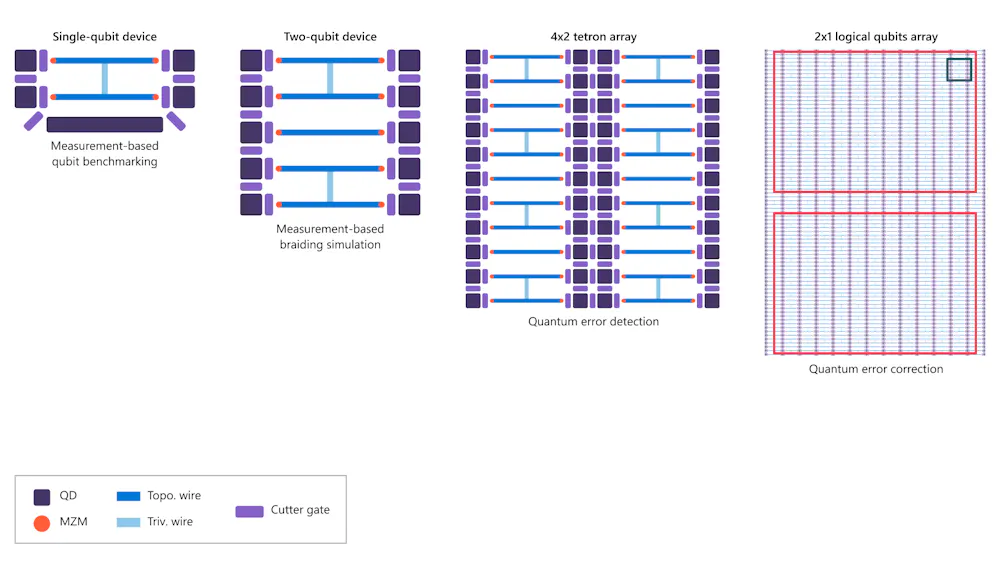
    The Microsoft team say they have used a pair of tiny wires, each with a Majorana particle trapped at either end, to act as a qubit. They measure the value of the qubit – expressed by means of whether an electron is in one wire or the other – using microwaves.

    Braided bits

    Why has Microsoft put in all this effort? Because by swapping the positions of Majorana particles (or measuring them in a certain way), they can be “braided” so they can be measured without error and are resistant to outside interference. (This is the “topological” part of “topological qubits”.)

    In theory, a quantum computer made using Majorana particles can be completely free of the qubit errors that plague other designs.

    This is why Microsoft has chosen such a seemingly laborious approach. Other technologies are more prone to errors, and hundreds of physical qubits may need to be combined together to produce a single reliable “logical qubit”.

    Microsoft has instead put its time and resources into developing Majorana-based qubits. While they are late to the big quantum party, they hope they will be able to catch up quickly.

    There’s always a catch

    As always, if something sounds too good to be true, there is a catch. Even for a Majorana-based quantum computer, such as the one announced by Microsoft, one operation – known as T-gate – won’t be achievable without errors.

    So the Majorana-based quantum chip is only “almost error-free”. However, correcting for T-gate errors is much simpler than the general error correction of other quantum platforms.

    Microsoft plans to scale up by grouping together more and more qubits.
    Microsoft

    What now? Microsoft will try to move ahead with its roadmap, steadily building larger and larger collections of qubits.

    The scientific community will closely watch how Microsoft’s quantum computing processors operate, and how they perform in comparison to the other already established quantum computing processors.

    At the same time, research into the exotic and obscure behaviour of Majorana particles will continue at universities around the globe.

    Stephan Rachel receives funding from Australian Research Council (ARC).

    ref. Microsoft just claimed a quantum breakthrough. A quantum physicist explains what it means – https://theconversation.com/microsoft-just-claimed-a-quantum-breakthrough-a-quantum-physicist-explains-what-it-means-250388

    MIL OSI AnalysisEveningReport.nz

  • MIL-OSI China: Chinese scientists achieve breakthrough in integrated photonic quantum chips

    Source: China State Council Information Office 2

    Chinese scientists have achieved a major breakthrough in integrated photonic quantum chips by demonstrating the first “continuous-variable” quantum multipartite entanglement and cluster states on the chip.
    The breakthrough addresses a critical gap in the development of photonic quantum chips and lays the foundation for scalable quantum entanglement, with potential applications in quantum computing and quantum networks.
    The research, led by scientists from Peking University and Shanxi University, was published in the latest issue of Nature.
    Integrated photonic quantum chips are advanced platforms designed to encode, process, transmit, and store quantum information at the chip level. However, achieving large-scale quantum entanglement of photonic qubits on these chips has long posed a significant challenge.
    One key difficulty has been the deterministic and scalable preparation of cluster states, which are crucial in quantum information science, particularly for photonic quantum chips, said Wang Jianwei, a professor at Peking University.
    By developing new technologies for coherent pumping, control, and measurement of continuous-variable cluster states, the team successfully prepared various cluster states in a deterministic and reconfigurable manner. The entanglement structures were rigorously validated through extensive experimental testing.
    “We have pioneered the development of a continuous-variable quantum chip, enabling the deterministic generation of cluster states directly on the chip,” Wang said. “Our work highlights the potential of these integrated devices for advancing quantum computing, networking and sensing.”
    “This achievement marks a breakthrough by Chinese scientists in the field of integrated photonic quantum chips,” said Gong Qihuang, an academician of the Chinese Academy of Sciences.
    This breakthrough opens a new pathway for the preparation and manipulation of large-scale quantum entangled states, which are critical for the development of quantum computing and quantum network technologies, Gong said.
    Earlier, the research team developed an ultra-large-scale photonic quantum chip that integrates about 2,500 components, providing a scalable and stable core for future quantum computers. 

    MIL OSI China News

  • MIL-Evening Report: US backing for Pacific disinformation media course casualty of Trump aid ‘freeze’

    Pacific Media Watch

    A New Zealand-based community education provider, Dark Times Academy, has had a US Embassy grant to deliver a course teaching Pacific Islands journalists about disinformation terminated after the new Trump administration took office.

    The new US administration requested a list of course participants and to review the programme material amid controversy over a “freeze” on federal aid policies.

    The course presentation team refused and the contract was terminated by “mutual agreement” — but the eight-week Pacific workshop is going ahead anyway from next week.

    Dark Times Academy’s co-founder Mandy Henk . . . “A Bit Sus”, an evidence-based peer-reviewed series of classes on disinfiormation for Pacific media. Image: Newsroom

    “As far as I can tell, the current foreign policy priorities of the US government seem to involve terrorising the people of Gaza, annexing Canada, invading Greenland, and bullying Panama,” said Dark Times Academy co-founder Mandy Henk.

    “We felt confident that a review of our materials would not find them to be aligned with those priorities.”

    The course, called “A Bit Sus”, is an evidence-based peer-reviewed series of classes that teach key professions the skills needed to identify and counter disinformation and misinformation in their particular field.

    The classes focus on “prebunking”, lateral reading, and how technology, including generative AI, influences disinformation.

    Awarded competitive funds
    Dark Times Academy was originally awarded the funds to run the programme through a public competitive grant offered by the US Embassy in New Zealand in 2023 under the previous US administration.

    The US Embassy grant was focused on strengthening the capacity of Pacific media to identify and counter disinformation. While funded by the US, the course was to be a completely independent programme overseen by Dark Times Academy and its academic consultants.

    Co-founder Henk was preparing to deliver the education programme to a group of Pacific Island journalists and media professionals, but received a request from the US Embassy in New Zealand to review the course materials to “ensure they are in line with US foreign policy priorities”.

    Henk said she and the other course presenters refused to allow US government officials to review the course material for this purpose.

    She said the US Embassy had also requested a “list of registered participants for the online classes,” which Dark Times Academy also declined to provide as compliance would have violated the New Zealand Privacy Act 2020.

    Henk said the refusal to provide the course materials for review led immediately to further discussions with the US Embassy in New Zealand that ultimately resulted in the termination of the grant “by mutual agreement”.

    However, she said Dark Times Academy would still go ahead with running the course for the Pacific Island journalists who had signed up so far, starting on February 26.

    Continuing the programme
    “The Dark Times Academy team fully intends to continue to bring the ‘A Bit Sus’ programme and other classes to the Pacific region and New Zealand, even without the support of the US government,” Henk said.

    “As noted when we first announced this course, the Pacific Islands have experienced accelerated growth in digital connectivity over the past few years thanks to new submarine cable networks and satellite technology.

    “Alongside this, the region has also seen a surge in harmful rumours and disinformation that is increasingly disrupting the ability to share accurate and truthful information across Pacific communities.

    “This course will help participants from the media recognise common tactics used by disinformation agents and support them to deploy proven educational and communications techniques.

    “By taking a skills-based approach to countering disinformation, our programme can help to spread the techniques needed to mitigate the risks posed by digital technologies,” Henk said.

    Especially valuable for journalists
    Dark Times Academy co-founder Byron Clark said the course would be especially valuable for journalists in the Pacific region given the recent shifts in global politics and the current state of the planet.

    Dark Times Academy co-founder and author Byron Clark . . . “We saw the devastating impacts of disinformation in the Pacific region during the measles outbreak in Samoa.” Image: APR

    “We saw the devastating impacts of disinformation in the Pacific region during the measles outbreak in Samoa, for example,” said Clark, author of the best-selling book Fear: New Zealand’s Underworld of Hostile Extremists.

    “With Pacific Island states bearing the brunt of climate change, as well as being caught between a geopolitical stoush between China and the West, a course like this one is timely.”

    Henk said the “A Bit Sus” programme used a “high-touch teaching model” that combined the current best evidence on how to counter disinformation with a “learner-focused pedagogy that combines discussion, activities, and a project”.

    Past classes led to the creation of the New Zealand version of the “Euphorigen Investigation” escape room, a board game, and a card game.

    These materials remain in use across New Zealand schools and community learning centres.

    MIL OSI AnalysisEveningReport.nz

  • MIL-Evening Report: Households are burning plastic waste as fuel for cooking and heating in slums the world over

    Source: The Conversation (Au and NZ) – By Bishal Bharadwaj, Adjunct Research Fellow, Curtin Institute for Energy Transition, Curtin University

    Poor people in vast city slums across the Global South are burning plastic to cook their food, warm their homes and boil water for hot showers.

    Waste plastic is plentiful and highly flammable. So it’s not surprising people in developing countries, mainly in Africa, Asia and Latin America, are putting it to use – especially as wood is increasingly scarce.

    But burning plastic is hazardous, as it releases toxins into the surrounding air – and possibly into the food on the stove.

    We wanted to draw attention to this growing problem, which has received little attention to date despite the many potential harms.

    In our new “perspective” paper, published in Nature Cities, we explain why so many communities are using plastic as an energy source.

    We then explore further research needed and recommend ways for policymakers to tackle the issue.

    Mountains of plastic waste

    The world has produced more plastic in the past 20 years than the total previously produced since commercial production began in 1950. Roughly half a billion tonnes of plastic is now produced every year.

    Plastic production is still accelerating. Global plastic use is predicted to almost triple by 2060 due to soaring demand from a growing population with rising incomes.

    Unfortunately, most plastic is not recycled. Instead, it is discarded and ultimately ends up polluting marginal land such as flooded areas and open dumping grounds before making its way into the ocean.

    Burning plastic waste for cooking and heating is becoming increasingly common in city slums. a–f, Photographs showing the use of plastic to start a fire in Koshi Province in Nepal (a), a household heating milk by burning plastic in Madhesh province of Nepal (b) and the burning of plastic in Guwahati, India (c), in Enugu, Nigeria (d,e) and in the slums of Lahore, Pakistan (f). Credits for photographs: a, Srijana Baniya; b, Pramesh Dhungana; c, Monjit Borthakur; d,e, Chizoba Obianuju Oranu; f, Sobia Rose.
    Bharadwaj, B., Gates, T., Borthakur, M. et al. The use of plastic as a household fuel among the urban poor in the Global South. Nat Cities (2025).

    A product of energy poverty in city slums

    Increasing urbanisation is reducing access to traditional fuels such as wood and crop residue from farmland.

    But plastic is readily available. Low-income households with little or no access to gas or electricity often find themselves living alongside mountains of rubbish.

    This plastic, made from fossil fuels, represents a cheap and convenient fuel. It’s lightweight, easy to transport, and a nuisance material that people want to be rid of. Plastic is also relatively easy to dry and store, but can burn even when wet. It’s also flexible and pliable, so it can be used easily in traditional cooking arrangements such as basic stoves.

    Burning plastic releases toxins such as dioxins, furans and heavy metals into the air. These chemicals are known to cause cancer, heart disease and lung diseases.

    The more vulnerable people in the household – including women and children and those who spend more time indoors – tend to be most exposed to the fumes. But the problem also affects people in the neighbourhood and the wider community.

    Burning plastic is likely to also contaminate food. For example, eggs from farms near plastic waste incinerators in Indonesia contained hazardous chemicals from burned plastic. However, more evidence is needed around food contamination.

    Furthermore, when households burn plastic bottles and other containers, some of the original contents also burn. Given chemicals are poorly regulated, the consequences of burning plastic could be greater still.

    Overcoming the problem

    A first step to overcoming the problem is understanding the reality of those living in slums. Policy-makers need to recognise these people’s needs and the challenges they face.

    Extensive research is needed to design the most effective and inclusive policy interventions. This needs to be addressed if we are to reduce the associated health and environmental impacts on such large populations across the world.

    We have gathered a collaborative, multidisciplinary team of researchers from around 35 countries – mostly in the Global South – to better understand the problem. We recently completed a survey of people exposed to the issue such as local government employees, teachers and community workers in more than 100 cities in 26 countries.

    We are also examining the emissions from waste plastic during food preparation to determine the extent of contamination in variety of stoves.

    Nobody wants to burn plastic waste to cook food, so policies like ban on burning plastic with out contextual intervention will not work. There is a need to design inclusive policy interventions that provide equitable benefits to the wider community. For example, encouraging people to:

    • wash any plastic before it is burned, to remove chemical residues
    • use improved cookstoves that vent the fumes outside
    • expand basic urban amenities like waste management to low income settlements
    • provide support to help lift households out of poverty.

    Each approach will depend on the specific requirements of the slum settlement. But by implementing multiple approaches in parallel, we can tackle the problem more effectively.

    The authors do not work for, consult, own shares in or receive funding from any company or organisation that would benefit from this article, and have disclosed no relevant affiliations beyond their academic appointment.

    ref. Households are burning plastic waste as fuel for cooking and heating in slums the world over – https://theconversation.com/households-are-burning-plastic-waste-as-fuel-for-cooking-and-heating-in-slums-the-world-over-250265

    MIL OSI AnalysisEveningReport.nz

  • MIL-Evening Report: Having an x-ray to diagnose knee arthritis might make you more likely to consider potentially unnecessary surgery

    Source: The Conversation (Au and NZ) – By Belinda Lawford, Senior Research Fellow in Physiotherapy, The University of Melbourne

    pikselstock/Shutterstock

    Osteoarthritis is a leading cause of chronic pain and disability, affecting more than two million Australians.

    Routine x-rays aren’t recommended to diagnose the condition. Instead, GPs can make a diagnosis based on symptoms and medical history.

    Yet nearly half of new patients with knee osteoarthritis who visit a GP in Australia are referred for imaging. Osteoarthritis imaging costs the health system A$104.7 million each year.

    Our new study shows using x-rays to diagnose knee osteoarthritis can affect how a person thinks about their knee pain – and can prompt them to consider potentially unnecessary knee replacement surgery.

    What happens when you get osteoarthritis?

    Osteoarthritis arises from joint changes and the joint working extra hard to repair itself. It affects the entire joint, including the bones, cartilage, ligaments and muscles.

    It is most common in older adults, people with a high body weight and those with a history of knee injury.

    Many people with knee osteoarthritis experience persistent pain and have difficulties with everyday activities such as walking and climbing stairs.

    How is it treated?

    In 2021–22, more than 53,000 Australians had knee replacement surgery for osteoarthritis.

    Hospital services for osteoarthritis, primarily driven by joint replacement surgery, cost $3.7 billion in 2020–21.

    While joint replacement surgery is often viewed as inevitable for osteoarthritis, it should only be considered for those with severe symptoms who have already tried appropriate non-surgical treatments. Surgery carries the risk of serious adverse events, such as blood clot or infection, and not everyone makes a full recovery.

    Most people with knee osteoarthritis can manage it effectively with:

    • education and self-management
    • exercise and physical activity
    • weight management (if necessary)
    • medicines for pain relief (such as paracetamol and non-steroidal anti-inflammatory drugs).

    Debunking a common misconception

    A common misconception is that osteoarthritis is caused by “wear and tear”.

    However, research shows the extent of structural changes seen in a joint on an x-ray does not reflect the level of pain or disability a person experiences, nor does it predict how symptoms will change.

    Some people with minimal joint changes have very bad symptoms, while others with more joint changes have only mild symptoms. This is why routine x-rays aren’t recommended for diagnosing knee osteoarthritis or guiding treatment decisions.

    Instead, guidelines recommend a “clinical diagnosis” based on a person’s age (being 45 years or over) and symptoms: experiencing joint pain with activity and, in the morning, having no joint-stiffness or stiffness that lasts less than 30 minutes.

    Despite this, many health professionals in Australia continue to use x-rays to diagnose knee osteoarthritis. And many people with osteoarthritis still expect or want them.

    What did our study investigate?

    Our study aimed to find out if using x-rays to diagnose knee osteoarthritis affects a person’s beliefs about osteoarthritis management, compared to a getting a clinical diagnosis without x-rays.

    We recruited 617 people from across Australia and randomly assigned them to watch one of three videos. Each video showed a hypothetical consultation with a general practitioner about knee pain.

    People with knee osteoarthritis can have difficulties getting down stairs.
    beeboys/Shutterstock

    One group received a clinical diagnosis of knee osteoarthritis based on age and symptoms, without being sent for an x-ray.

    The other two groups had x-rays to determine their diagnosis (the doctor showed one group their x-ray images and not the other).

    After watching their assigned video, participants completed a survey about their beliefs about osteoarthritis management.

    What did we find?

    People who received an x-ray-based diagnosis and were shown their x-ray images had a 36% higher perceived need for knee replacement surgery than those who received a clinical diagnosis (without x-ray).

    They also believed exercise and physical activity could be more harmful to their joint, were more worried about their condition worsening, and were more fearful of movement.

    Interestingly, people were slightly more satisfied with an x-ray-based diagnosis than a clinical diagnosis.

    This may reflect the common misconception that osteoarthritis is caused by “wear and tear” and an assumption that the “damage” inside the joint needs to be seen to guide treatment.

    What does this mean for people with osteoarthritis?

    Our findings show why it’s important to avoid unnecessary x-rays when diagnosing knee osteoarthritis.

    While changing clinical practice can be challenging, reducing unnecessary x-rays could help ease patient anxiety, prevent unnecessary concern about joint damage, and reduce demand for costly and potentially unnecessary joint replacement surgery.

    It could also help reduce exposure to medical radiation and lower health-care costs.

    Previous research in osteoarthritis, as well as back and shoulder pain, similarly shows that when health professionals focus on joint “wear and tear” it can make patients more anxious about their condition and concerned about damaging their joints.

    If you have knee osteoarthritis, know that routine x-rays aren’t needed for diagnosis or to determine the best treatment for you. Getting an x-ray can make you more concerned and more open to surgery. But there are a range of non-surgical options that could reduce pain, improve mobility and are less invasive.

    Belinda Lawford receives funding from Arthritis Australia, Medical Research Future Fund and Medibank. She is a Steering Committee Member of the Osteoarthritis Research Society International Rehabilitation Group, and also an Editorial Board member for Journal of Orthopaedic and Sports Physical Therapy.

    Kim Bennell receives research funding from the National Health and Medical Research Council and the Medical Research Futures Fund as well as Medibank Private. Some of the consumer resources recommended in this article have been developed by her research team. She consults for Wolters Kluwers UptoDate knee osteoarthritis clinical guidelines

    Rana Hinman receives funding from National Health and Medical Research Council, the Medical Research Future Fund and Medibank. Some of the consumer resources recommended in this article have been developed by her research team. She is also an Editorial Board member for Journal of Physiotherapy.

    Travis Samuel William Haber is a Steering Committee Member of the Osteoarthritis Research Society International Rehabilitation Group and of the Australian and New Zealand Musculoskeletal Clinical Trials Network Osteoarthritis Special Interest Group.

    ref. Having an x-ray to diagnose knee arthritis might make you more likely to consider potentially unnecessary surgery – https://theconversation.com/having-an-x-ray-to-diagnose-knee-arthritis-might-make-you-more-likely-to-consider-potentially-unnecessary-surgery-249374

    MIL OSI AnalysisEveningReport.nz

  • MIL-Evening Report: Playing favourites, inconsistency or a fair decision? Unpacking Jannik Sinner’s doping case

    Source: The Conversation (Au and NZ) – By Matt Nichol, Lecturer in Law, CQUniversity Australia

    The tennis world is still reeling after news the number one ranked men’s player, Jannik Sinner, agreed to a three-month suspension issued by the World Anti-Doping Agency (WADA) to be served between the Australian and French Opens.

    Sinner, a three-time Grand Slam winner, received the ban after twice testing positive for clostebol, a steroid banned by the World-Anti Doping Code, in March 2024.


    Read more:
    Tennis is facing an existential crisis over doping. How will it respond?


    The fallout

    “Unintentional doping offences” – as in Sinner’s case – can attract a maximum two-year ban even if the athlete shows no fault or negligence.

    Sinner’s three-month ban was immediately criticised by many in the media and within tennis circles due to its leniency and convenient timing. It also did not result from a hearing before an anti-doping tribunal or the Court of Arbitration for Sport, as has been the case with other tennis players who have received bans in the past.

    The suspension was the product of a “case resolution agreement” (a negotiated settlement) between WADA and Sinner.

    WADA initially appealed the International Tennis Integrity Agency’s decision not to suspend Sinner on the basis of demonstrating no significant fault or negligence, but withdrew its case before the Court of Arbitration for Sport.

    Sinner argued the banned substance entered his system after a massage by a physiotherapist in his entourage who had used a cream with clostebol to treat a cut on his finger.

    Both WADA and the International Tennis Integrity Agency accepted this version of events.

    In the eyes of most, WADA’s actions failed to pass the “pub test” and many high-profile tennis players voiced their concerns.

    Novak Djokovic flagged issues over the treatment of high-ranked athletes such as Sinner compared to lower-ranked players.

    For example, Chilean Nicolas Jarry was suspended for 11 months in 2020 after testing positive to ligandrol and stanozolol that he alleged were in a supplement he took.

    In 2023 Sweden’s Mikael Ymer was suspended for 18 months by the Court of Arbitration for Sport for failing to submit to three out-of-competition tests in a 12-month period.

    Great Britain’s Tara Moore took nearly two years to clear her name before an anti-doping tribunal in 2023 revealed contaminated meat had led to her positive tests for nandrolone and boldenone. Despite this decision, Moore served a 19-month ban.

    Djokovic’s view suggested favouritism for higher-ranked players, who can access top lawyers. He also criticised a lack of transparency in the Sinner agreement with WADA.

    However, high-ranked players such as Simona Halep and Maria Sharapova have received lengthy suspensions for doping violations.

    Nick Kyrgios was similarly critical, stating it was a sad day for the sport and that fairness in tennis did not exist.

    Former Spanish player Feliciano Lopez was among those who supported Sinner. He said he believed in clean sport and that Sinner had not enhanced his performance and took responsibility for the actions of his physiotherapist.

    Intentional and unintentional doping

    The criticisms appear to be based on a misunderstanding of the anti-doping provisions in the World Anti-Doping Code and the failure by WADA to clearly communicate its rationale for Sinner’s suspension.

    Rather than favouritism for a high-ranked player, WADA’s decision to suspend Sinner for three months was based on the distinction in the World Anti-Doping Code between intentional and unintentional doping. It found that Sinner:

    • had not intended to cheat using clostebol
    • received no performance-enhancing benefit from the substance
    • had no knowledge of the administration of the substance.

    But WADA argued that under the code, Sinner was responsible for the negligence of his entourage and issued the suspension.

    WADA confirmed its rationale for the three-month suspension after Spanish media pointed out that figure skater Laura Barquero had received a six-year ban for a positive test of clostebol.

    WADA differentiated the two cases based on intention. It was not convinced by Barquero’s explanation of how clostebol entered her system, while it said the evidence supported Sinner’s version of events.

    Lessons from the Sinner case

    So what can be learned from Sinner’s case?

    One of the most important legal issues arising from the Sinner case is the distinction in the anti-doping rules between intentional and unintentional doping.

    This distinction explains the difference in penalties between Sinner and other athletes.

    Also, the facts of a doping case are relevant in determining circumstances that may reduce the severity of a penalty in matters resolved by negotiated case resolution agreements.

    An important lesson for WADA is ensuring transparency in proceedings and the clear communication of the rationale used to arrive at a penalty.

    Finally, a Court of Arbitration for Sport hearing may not have been needed for Sinner as the parties agreed on the facts leading to the doping rule violation.

    Matt Nichol does not work for, consult, own shares in or receive funding from any company or organisation that would benefit from this article, and has disclosed no relevant affiliations beyond their academic appointment.

    ref. Playing favourites, inconsistency or a fair decision? Unpacking Jannik Sinner’s doping case – https://theconversation.com/playing-favourites-inconsistency-or-a-fair-decision-unpacking-jannik-sinners-doping-case-250143

    MIL OSI AnalysisEveningReport.nz

  • MIL-Evening Report: The ASIO threat assessment is a dark outlook for Australia’s security. Are our laws up to the task?

    Source: The Conversation (Au and NZ) – By Sarah Kendall, Adjunct Research Fellow, The University of Queensland

    Shutterstock

    This week, ASIO chief Mike Burgess delivered his sixth Annual Threat Assessment.

    His approach this time was unprecedented. Instead of focusing on past and present threats, Burgess declassified parts of ASIO’s assessment for the future, warning us about Australia’s security outlook to 2030.

    Over the next five years, ASIO is expecting “an unprecedented number of challenges, and an unprecedented cumulative level of potential harm”, Burgess warned. At the same time, the threat environment will become more diverse.

    Espionage and foreign interference are already at extreme levels, but are anticipated to intensify. Sabotage is expected to pose an increasing threat. Politically motivated violence and communal violence will also remain an elevated concern.

    What does this mean for our criminal laws? Are they robust enough to protect us from the growing and diversifying threat of espionage, sabotage and foreign interference? Or will they need bolstering?

    What are the threats?

    Espionage, or spying, involves the theft of information. Burgess has warned that both our enemies and our friends will seek to steal information from us.

    This includes information about our military capabilities and alliances, such as AUKUS.

    Instead of using traditional spies to gather this information, Burgess expects greater use of proxies.

    These proxies could be unwittingly involved in the espionage efforts of a foreign country – such as private investigators. Or they could know exactly what they’re doing.

    Foreign interference involves covertly shaping decision-making to the advantage of a foreign power. Burgess has warned that foreign governments are monitoring, intimidating and coercing Australians and diaspora communities, including engaging in coerced repatriations.

    He also expects that foreign interference may be used to undermine community support for AUKUS.

    Concerningly, ASIO has disrupted plots by foreign countries to physically harm (or even kill) people living in Australia. This includes activists, journalists and ordinary citizens – all critics of certain foreign governments.

    Both espionage and foreign interference will be enabled by advances in technology, including artificial intelligence (AI), deep fakes and large online pools of personal data.

    Sabotage involves deliberately destroying or damaging infrastructure.

    Russia has been engaging in diverse acts of sabotage in Europe, aiming to erode support for Ukraine and damage cohesion. These attacks include arson against various types of infrastructure (including defence and munitions facilities), jamming civil aviation GPS systems, and disrupting railways.

    While Burgess warned that the risk of similar attacks against Australia is increasing (including attacks against infrastructure arising out of AUKUS), cyber-enabled sabotage will be of more concern. At the moment, foreign governments are exploring and exploiting Australia’s critical infrastructure networks to map systems and maintain access in the future.

    As with espionage, Burgess expects criminal proxies to be used more frequently to engage in sabotage. This includes state-sponsored or state-supported terrorist groups.

    Are our laws ready to deal with this?

    With the espionage, sabotage and foreign interference threat growing and diversifying over the next five years, you’d be right to ask whether our criminal laws are robust enough to stand up to the challenge.

    For the most part, they are.

    All the laws apply to conduct that occurs “in the real world” and online. The laws also apply to any foreign country, including our friends, as well as terrorist organisations.

    In addition to foreign countries, the laws apply to conduct on behalf of a foreign country, including where the conduct is directed, funded or supervised by the foreign country or a person acting on its behalf. This means the laws would apply to proxies hired to engage in espionage or sabotage.

    Our sabotage laws are broad enough to cover the explorations of critical infrastructure networks currently being undertaken. An act of sabotage does not have to be committed to be an offence under these laws.

    Our foreign interference laws would cover coerced repatriations. While plots to harm Australians may also fall within these offences, a number of other offences also exist for harming or killing Australian citizens or residents.

    Room for improvement

    Our espionage, sabotage and foreign interference laws certainly are “world-leading”. However, there are some drawbacks.

    For example, the laws are yet to grapple with the rise of AI and its use to gather information for espionage or generate mis- or disinformation for foreign interference.

    While the laws have broad extraterritorial reach – they apply to conduct that occurs within or outside Australia – the practicalities of enforcing the laws when offenders are located overseas is a big barrier.

    But in today’s digital age where espionage, sabotage and foreign interference can be conducted online from the safety of a foreign country and therefore beyond the reach of Australia’s criminal law, we need more than a robust legal response.

    As Burgess stressed, these issues “require whole of government, whole of community, whole of society responses […] national security is truly national security: everybody’s business”.

    We all need to be aware of the risks and what we – as individuals, employees, researchers and business owners – can do to mitigate them.

    This article was written in Sarah Kendall’s personal capacity as an Adjunct Research Fellow at the University of Queensland School of Law. It does not reflect the views of the Queensland Law Reform Commission or the Queensland Government.

    ref. The ASIO threat assessment is a dark outlook for Australia’s security. Are our laws up to the task? – https://theconversation.com/the-asio-threat-assessment-is-a-dark-outlook-for-australias-security-are-our-laws-up-to-the-task-250372

    MIL OSI AnalysisEveningReport.nz

  • MIL-OSI China: Youngsters take a shine to gold phone stickers

    Source: China State Council Information Office

    Customers view gold jewelry at a gold shop in Jinan, capital of East China’s Shandong province, Jan 27, 2024. [Photo/Xinhua] 

    As gold prices rally, driven by market volatility and central bank purchases, younger Chinese consumers are finding a new way to get in on the action — through the purchase of trendy and low-cost gold phone stickers.

    These lightweight accessories, ranging from 0.01 to 0.2 grams in weight and priced anywhere from 40 yuan ($5.5) to over 100 yuan, come in a wide variety of auspicious designs and motifs, from depictions of the God of Wealth to emblems bearing lucky phrases such as “Peace and Happiness” and “Get Rich”.

    “By simply peeling off the adhesive and affixing the charm to the back of their smartphones, young consumers can instantly transform their devices into portable talismans of wealth and success,” said Wu Ming, a business owner in Shuibei, a gold jewelry manufacturing and trading hub in Shenzhen, Guangdong province.

    It’s a small investment, but the impact is quite powerful, Wu said, adding that the charms allow young people to feel like they’re partaking in the gold rush, while also serving as a daily reminder of their aspirations for prosperity.

    The gold phone sticker trend has taken on a strong social media dimension, with users actively engaging with and inspiring one another. This has created a powerful viral effect, attracting more people to participate in this fashion craze.

    A search for “gold phone stickers” on the popular social media platform Xiaohongshu, also known as Rednote, yielded over 5.98 million related posts, as of mid-February.

    While gold phone stickers have been around for years, it wasn’t until the end of 2024 that they turned highly popular. The key driver behind this surge is advances in manufacturing that have allowed producers to create thinner, lighter charms with a wider array of stylish designs, Wu said.

    Collaborations with popular IP and the integration of viral social media catchphrases have proved to be highly effective strategies, Wu added.

    Chinese jeweler CHJ Industry has joined forces with the iconic Japanese anime character Doraemon and popular Chinese TV drama Empresses in the Palace, to break out of their traditional mold and tap into the cultural zeitgeist driving the gold phone sticker trend.

    “The posts on Xiaohongshu all talk about how wearing these gold charms can bring you luck and prosperity,” said Yang Hongyi, a 26-year-old resident in Beijing.

    “I’m not buying them to hold as an investment — I just want a touch of gold on my phone to bring a little auspiciousness, and maybe even give one to a friend as a fun gift for the new year,” Yang said.

    Take, for example, a gold phone sticker weighing just 0.1 gram, which is being sold for about 100 yuan at least. This translates to a unit price of over 1,000 yuan per gram, while a gram of pure gold in the open market generally sells for around 700 yuan, including both the cost of the gold and a processing fee of 15 to 35 yuan.

    In the past, the primary driver for gold purchases was the metal’s perceived ability to maintain and grow in value over time, but the trend of gold phone stickers has ushered in a new era where the aspirational appeal of these accessories has taken center stage, said Li Yang, an associate professor at Cheung Kong Graduate School of Business.

    It’s no longer just about the intrinsic value of the gold, but the social currency and cultural cachet these accessories represent, Li said.

    “A gold phone charm is just a decorative item, it has nothing to do with whether it maintains its value or not,” Yang said. “It’s like a phone case — if you don’t like it, you can just change it, and you don’t feel bad about it.”

    MIL OSI China News

  • MIL-OSI Global: Playing favourites, inconsistency or a fair decision? Unpacking Jannik Sinner’s doping case

    Source: The Conversation – Global Perspectives – By Matt Nichol, Lecturer in Law, CQUniversity Australia

    The tennis world is still reeling after news the number one ranked men’s player, Jannik Sinner, agreed to a three-month suspension issued by the World Anti-Doping Agency (WADA) to be served between the Australian and French Opens.

    Sinner, a three-time Grand Slam winner, received the ban after twice testing positive for clostebol, a steroid banned by the World-Anti Doping Code, in March 2024.


    Read more:
    Tennis is facing an existential crisis over doping. How will it respond?


    The fallout

    “Unintentional doping offences” – as in Sinner’s case – can attract a maximum two-year ban even if the athlete shows no fault or negligence.

    Sinner’s three-month ban was immediately criticised by many in the media and within tennis circles due to its leniency and convenient timing. It also did not result from a hearing before an anti-doping tribunal or the Court of Arbitration for Sport, as has been the case with other tennis players who have received bans in the past.

    The suspension was the product of a “case resolution agreement” (a negotiated settlement) between WADA and Sinner.

    WADA initially appealed the International Tennis Integrity Agency’s decision not to suspend Sinner on the basis of demonstrating no significant fault or negligence, but withdrew its case before the Court of Arbitration for Sport.

    Sinner argued the banned substance entered his system after a massage by a physiotherapist in his entourage who had used a cream with clostebol to treat a cut on his finger.

    Both WADA and the International Tennis Integrity Agency accepted this version of events.

    In the eyes of most, WADA’s actions failed to pass the “pub test” and many high-profile tennis players voiced their concerns.

    Novak Djokovic flagged issues over the treatment of high-ranked athletes such as Sinner compared to lower-ranked players.

    For example, Chilean Nicolas Jarry was suspended for 11 months in 2020 after testing positive to ligandrol and stanozolol that he alleged were in a supplement he took.

    In 2023 Sweden’s Mikael Ymer was suspended for 18 months by the Court of Arbitration for Sport for failing to submit to three out-of-competition tests in a 12-month period.

    Great Britain’s Tara Moore took nearly two years to clear her name before an anti-doping tribunal in 2023 revealed contaminated meat had led to her positive tests for nandrolone and boldenone. Despite this decision, Moore served a 19-month ban.

    Djokovic’s view suggested favouritism for higher-ranked players, who can access top lawyers. He also criticised a lack of transparency in the Sinner agreement with WADA.

    However, high-ranked players such as Simona Halep and Maria Sharapova have received lengthy suspensions for doping violations.

    Nick Kyrgios was similarly critical, stating it was a sad day for the sport and that fairness in tennis did not exist.

    Former Spanish player Feliciano Lopez was among those who supported Sinner. He said he believed in clean sport and that Sinner had not enhanced his performance and took responsibility for the actions of his physiotherapist.

    Intentional and unintentional doping

    The criticisms appear to be based on a misunderstanding of the anti-doping provisions in the World Anti-Doping Code and the failure by WADA to clearly communicate its rationale for Sinner’s suspension.

    Rather than favouritism for a high-ranked player, WADA’s decision to suspend Sinner for three months was based on the distinction in the World Anti-Doping Code between intentional and unintentional doping. It found that Sinner:

    • had not intended to cheat using clostebol
    • received no performance-enhancing benefit from the substance
    • had no knowledge of the administration of the substance.

    But WADA argued that under the code, Sinner was responsible for the negligence of his entourage and issued the suspension.

    WADA confirmed its rationale for the three-month suspension after Spanish media pointed out that figure skater Laura Barquero had received a six-year ban for a positive test of clostebol.

    WADA differentiated the two cases based on intention. It was not convinced by Barquero’s explanation of how clostebol entered her system, while it said the evidence supported Sinner’s version of events.

    Lessons from the Sinner case

    So what can be learned from Sinner’s case?

    One of the most important legal issues arising from the Sinner case is the distinction in the anti-doping rules between intentional and unintentional doping.

    This distinction explains the difference in penalties between Sinner and other athletes.

    Also, the facts of a doping case are relevant in determining circumstances that may reduce the severity of a penalty in matters resolved by negotiated case resolution agreements.

    An important lesson for WADA is ensuring transparency in proceedings and the clear communication of the rationale used to arrive at a penalty.

    Finally, a Court of Arbitration for Sport hearing may not have been needed for Sinner as the parties agreed on the facts leading to the doping rule violation.

    Matt Nichol does not work for, consult, own shares in or receive funding from any company or organisation that would benefit from this article, and has disclosed no relevant affiliations beyond their academic appointment.

    ref. Playing favourites, inconsistency or a fair decision? Unpacking Jannik Sinner’s doping case – https://theconversation.com/playing-favourites-inconsistency-or-a-fair-decision-unpacking-jannik-sinners-doping-case-250143

    MIL OSI – Global Reports

  • MIL-OSI USA News: Fact Sheet: President Donald J. Trump Ends Taxpayer Subsidization of Open Borders

    Source: The White House

    PRESERVING FEDERAL BENEFITS FOR AMERICAN CITIZENS: Today, President Donald J. Trump signed an Executive Order to ensure taxpayer resources are not used to incentivize or support illegal immigration.

    • The Order directs Federal departments and agencies to identify all federally funded programs currently providing financial benefits to illegal aliens and take corrective action.
    • It ensures that Federal funds to states and localities will not be used to support “sanctuary” policies or assist illegal immigration.
    • It mandates improvements in eligibility verification to prevent benefits from going to individuals unlawfully present in the United States.
    • President Trump is committed to safeguarding Federal public benefits for American citizens who are truly in need, including individuals with disabilities and veterans.

    TAXPAYERS ARE FOOTING THE BILL FOR ILLEGAL IMMIGRATION: With this Executive Order, President Trump is ensuring taxpayer resources are used to protect the interests of American citizens, not illegal aliens.

    • The surge in illegal immigration, enabled by the previous Administration, is siphoning dollars and essential services from American citizens while state and local budgets grow increasingly strained.
    • Under current welfare laws, specifically the Personal Responsibility and Work Opportunity Reconciliation Act of 1996 (PRWORA), illegal aliens are generally barred from welfare programs. But if they’re granted parole, they are classified as “qualified aliens” and become eligible for various welfare programs on a sliding scale, with full eligibility granted within five years.
    • According to the Center for Immigration Studies (CIS), providing welfare to one million illegal aliens could cost American taxpayers an additional $3 billion annually.
    • The U.S. House Homeland Security Committee estimated that taxpayers could pay as much as $451 billion to care for illegal aliens and gotaways that have entered the United States unlawfully since January 2021.
    • The Federation for American Immigration Reform (FAIR) calculated that American taxpayers spend at least $182 billion annually to cover the costs incurred by the presence of 20 million illegal aliens and their children, which includes $66.5 billion in Federal expenses plus an additional $115.6 billion in state and local expenses.
    • The Congressional Budget Office (CBO) estimated that the Biden Administration’s open borders agenda, which sought to provide Medicaid-funded emergency services to illegal aliens, has cost Federal and state taxpayers more than $16.2 billion.
    • The Biden Administration gave billions in taxpayer dollars to left-wing groups that facilitated mass illegal migration and provided legal services to challenge deportation orders.
    • In addition, since 2021, more than $1 billion has been allocated through the Federal Emergency Management Agency (FEMA) to illegal aliens.

    SECURING THE BORDER AND PUTTING AMERICANS FIRST: President Trump has delivered on his promise to secure the border and prioritize the needs of American citizens, taking immediate action to put an end to the previous Administration’s border crisis. Since taking office, President Trump has:

    • Declared a national emergency at the southern border.
    • Deployed additional personnel to the border, including members of the Armed Forces and the National Guard.
    • Restarted border wall construction.
    • Designated international cartels and other criminal organizations – such as MS-13 and Tren de Aragua – as Foreign Terrorist Organizations and Specially Designated Global Terrorists.
    • Suspended the entry of aliens into the U.S.
    • Called for enhanced vetting and screening of aliens.
    • Required the identification of countries that warrant a partial or full suspension on the admission of nationals.
    • Restarted the detention and removal of aliens who are in violation of Federal law.
    • Directed the Administration to resume the Migrant Protection Protocols – also known as “Remain in Mexico” – as soon as practicable.
    • Ended the use of the CBP One app.
    • Terminated all categorical parole programs, such as the “Processes for Cubans, Haitians, Nicaraguans, and Venezuelans,” that are contrary to President Trump’s immigration agenda.
    • Ended automatic citizenship for children of illegal aliens.
    • Paused the operation of the U.S. Refugee Admissions Program (USRAP).
    • Ended catch-and-release policies.
    • Revoked Biden’s disastrous executive actions that essentially opened our southern border.
    • Detained the most dangerous illegal criminal aliens in Guantanamo Bay.  

    MIL OSI USA News

  • MIL-OSI Australia: Building climate resilience into food systems in the Eastern Gangetic Plains

    Source: Australian Centre for International Agricultural Research

    The world’s highest concentration of rural poverty occurs in the Eastern Gangetic Plains of Bangladesh, India and Nepal – a region that is home to 450 million people.

    Livelihoods in this part of the world rely greatly on agriculture. Opportunities to work with smallholder farmers can lay the foundations for a more productive, sustainable and diversified agricultural economy. 

    Among the research-for-development professionals on the ground is a team working on the Rupantar project, an ACIAR-supported initiative led by Dr Tamara Jackson of the University of Adelaide.

    The Rupantar project operates at a whole-of-system level. It spans both social and farming practices and extends all the way through to policy settings, market opportunities and other agrifood system barriers holding smallholders back. It also builds on prior investments by ACIAR and the Australian Department of Foreign Affairs and Trade (DFAT).

    Included in this integrated approach are considerations for climate impacts.

    This concern saw 15 team members from the Rupantar project visit the University of Adelaide and regional South Australia and Victoria in October 2024. Funded as part of a DFAT Australia Awards Fellowship program, the study tour focused on climate resilience and adaptation.

    The Rupantar project

    ‘Rupantar’ has a common meaning in Bangla, Hindi and Nepali. It means change on a level so profound that it is transformative. Launched in 2021, the Rupantar project is identifying opportunities for inclusive and diversified food production innovation. 

    Given the partnership model typical of ACIAR projects, these opportunities need to be priorities for local communities. They also need to be sustainable and to fit with longer-term climate, nutrition and available water resource projections. 

    Achieving this level of integration requires working on multiple levels at the same time. There is ground-up innovation – from personal to organisational. Then there are high-level policies that work down and can make important change on the ground.

    Our hypothesis is that an integrated approach to livelihood change – coupled with inclusive and collaborative approaches – will result in more effective and sustainable development pathways.

    Dr Tamara Jackson, 
    University of Adelaide

    ‘So, our goal is to understand the processes and practices needed to diversify food production in ways that improve farm livelihoods and reduce inequity, production risk and unsustainable resource use.’

    The on-the-ground work with smallholders is implemented at sites in West Bengal (India), Rangpur (Bangladesh) and Koshi Province (Nepal). Implementation involves actioning ‘diversification pathways’ that were co-developed collaboratively with local partners. 

    Diversification pathways

    The aim of these pathways is twofold. The first is to test diversification options and select the most appropriate crop and livestock options that are priorities for local communities. These are then implemented within existing networks and are aligned with institutional settings.

    The second aim is to monitor the changes associated with the pathways, including long-term sustainability. 

    The project is also mindful that diversification can look very different to different members within households and can include off-farm income from seasonal male migration and greater reliance on women household members.

    In all, three types of diversified systems are being explored:

      •  plant-based production, including crops and horticulture
      •  livestock-based, including chickens, goats and dairy that are especially important to women’s income
      •  irrigation-constrained systems.

    ‘The project is working on strengthening what already works about a farming system in the Eastern Gangetic Plain and building on innovations from prior projects, such as ACIAR’s introduction of conservation agriculture cropping practices,’ said Dr Jackson.

    Long-running ACIAR initiatives in the Eastern Gangetic Plains worked with smallholder farmers across Bangladesh, India, and Nepal to introduce sustainable practices and innovations to intensify production.

    The project team has spent the first 2 years on the ground running baseline surveys and mapping villages to better understand the system. 

    Implementation started in 2023 once it became clear what would work best in different settings. The visit to Australia in 2024 provided project partners with opportunities to observe what diversified and climate-resilient Australian farms look like.

    Participants included Rupantar project partners from provincial government, cooperatives, farmer producer companies, NGOs, local university partners and the International Maize and Wheat Improvement Center. 

    Climate-smart innovation

    Dr Jay Cummins from International Agriculture for Development hosted the study tour group and developed the course that focused on addressing the climate realities in collaboration with the Rupantar project.

    The 20-day study tour was entitled ‘Supporting climate-smart, resilient food production networks in the Indo-Gangetic Plains’. 

    Key experts shared their experiences responding to climate change and on-farm visits examined how Australian agriculture builds climate resilience into its practices in different environmental and socioeconomic settings. 

    ‘Included were visits to more rainfed, dryland cropping systems in the Mallee and, in addition, to irrigated production systems in the Murray–Darling Basin,’ said Dr Cummins. 

    The Australia Awards program provided a valuable mechanism to connect the participants with a whole range of Australian organisations and professionals, which in turn will help build international networks and collaboration.

    Dr Jay Cummins 
    International Agriculture for Development 

    In the Eastern Gangetic Plain, food production can be heavily focused on wet season rice crops. In Australia, the visitors were able to explore dry season opportunities for diversified production of crops and livestock, including in mixed farming systems. They saw how Australian farmers manage risks around water scarcity and drought. At South Australian Riverland sites, discussions included irrigation and water management that present different diversification options.

    Participant perspectives

    Loxton farmer Brycen Rudiger (left)discusses the challenges of growing wheat in the Mallee region with Nepali participant Gautam Bhupal (right).

    Among the participants were Dr Deepa Roy from India, Ms Bimala Pokhrel from Nepal and Dr Mamunur Rashid from Bangladesh. 

    Dr Roy is an agricultural extension expert based at Uttar Banga Krishi Viswavidyalaya, India. She told ACIAR that smallholder farmers in the Eastern Gangetic Plains face numerous challenges that can lock them into poverty.

    These range from small and fragmented landholdings that make mechanisation difficult, to a lack of agronomic knowledge, limited agricultural support services, limited market access, financial constraints and climatic hazards.

    ‘Through the course several key insights and learnings emerged that may help our farmers in understanding and adopting climate resilient technologies,’ said Dr Roy.

    Key insights for participants included:

      •  assessing the carbon footprint of farming and taking action to reduce it
      •  introducing efficient soil moisture management strategies such as mulching
      •  adopting agronomic practices such as crop rotations and climate-resilient crops 
      •  building soil fertility
      •  advocating for improved climate forecasting
      •  adopting grower-led research and extension
      •  developing digital tools to monitor the adoption of innovation
      •  providing financial management training to smallholder farmers
      •  using podcasts and radio to provide farm advisory services. 

    Overall, Dr Roy said that the course equipped attendees with a holistic understanding of climate-smart practices. ‘It helped us not only to strengthen technical knowledge but also to develop critical soft skill and a deeper understanding of sustainable climate resilient farming.’

    It’s a point of view shared by Ms Pokhrel, who works with the Ministry of Industry Agriculture and Cooperatives in Koshi Province, Nepal. She said the course enriched efforts to both help farmers and policymakers with future planning. And it worked by enhancing both her professional and personal capacity.

    ‘What stood out was the extent that Australian farmers have already adopted technology to mitigate against climate change,’ said Ms Pokhrel. ‘This was particularly stark when it came to soil health and sustainable soil management practices. One of the key learnings is that we can tailor these practices for our context in the Koshi Province and, in that way, improve crop productivity by improving soil health.’

    Mr Rashid agreed. He is a research fellow at Hajee Mohammad Danesh Science and Technology University in Dinajpur, Bangladesh. He noted that while ACIAR is helping to introduce conservation agriculture to Bangladesh, South Australian farmers have already adopted these soil and soil-moisture conserving practices. 

    They are also growing more legume crops for soil health and fertiliser benefits, adopting risk-aversion strategies amid climate variability, and introducing carbon farming to adapt to climate change.

    Improved water management

    Both Ms Pokhrel and Mr Rashid were especially impressed by Australian water management systems in drought-prone landscapes. They think these kinds of Australian practices have a role to play at the project sites.

    While the cost and expertise required to adopt and maintain technologies such as drip irrigation systems used in Australia may be beyond the capacity of many smallholder farmers, the study tour has already inspired a new water conservation pilot project.

    The Bangladesh team will launch ‘Conserving soil moisture through mulching technique in chili farming’ in the Rupantar project areas, focusing on farmers in northern Bangladesh, who experience frequent floods and droughts.

    The Rupantar project delegation on tour in the northern Mallee of South Australia.

    ‘This initiative aims to use soil moisture and reduce irrigation in chilli farming, aided by Chameleon soil water sensors that can support decision-making for the farmers of the Rupantar project,’ said Mr Rashid.

    Ms Pokhrel was greatly impressed by the grower-centric research, development and extension infrastructure built around farmers’ needs in Australia. For her, this was typified by organisations such as the Grains Research and Development Corporation and the Almond Board.

    She thinks there are opportunities to ‘sensitise’ the different boards in Nepal to this approach. 

    Surprises for the project partners included the large size of farms given the small number of people working in agriculture. 

    What also surprised us is the rate of technology adoption by farmers, along with their dedication and the satisfaction they receive from the agricultural profession.

    Ms Bimala Pokhrel
    Nepal 

    ‘Mallee Sustainable Farming System was impressive and working with farmers groups and developing the communication material in local languages are the things that we can develop for our smallholder farmers too.’

    Finally, they praised the networking opportunities provided by the course, including with farmers, and opportunities to understand the people, country and culture. 

    ACIAR Project WAC/2020/148: ‘Transforming smallholder food systems in the Eastern Gangetic Plain’

    MIL OSI News

  • MIL-OSI Australia: Transcript-Press conference, Frankston

    Source: Australian Ministers for Regional Development

    JODIE BELYEA: Good morning. Jodie Belyea, the Federal MP for Dunkley here, with the Minister for Infrastructure and Transport, the Honourable Catherine King. And we’re here today to announce a $923,000 funding initiative into the Tower Hill Road precinct in Frankston South. Each day, this one kilometre stretch of road sees over 2000 students from Overport Primary and Frankston High School come to this area to and from school. It’s very congested, sometimes unsafe, so this funding is going to ensure that people can walk, ride and drive through this area in a safe and orderly manner so that everyone gets to school easily.

    And now I’m going to hand over to the Minister to talk a bit more about the whole initiative.

    CATHERINE KING: Yeah, thanks very much, Jodie. It’s great to be here and particularly also with Councillor Brad Hill as well – it’s part of his ward. And really this project that we’re funding here, and I’ll talk a little bit about the program all up, but just over $923,000 really is the Active Transport Fund. It’s been out for competitive expressions of interest, basically expressions of application. And basically what we’ve seen with a project like this is exactly what we’ve been looking for, trying to make sure we’re making our transport to schools safer, trying to make sure that we’ve got people who are in cars can actually slow down around schools, and also really utilise the amenities in your neighbourhoods much better. So this is a great example. It’s part of $21 million we’re announcing today across the state of Victoria, out of the Active Transport Fund.

    Further south there’s a project in Phillip Island, some $980,000 there for Bass Coast Shire, particularly for Cowes. And that will really help with the Regional Precincts and Partnerships Program there– we’ve done down the Esplanade, again, making it more walkable, less people, less reliant on cars. Ararat Rural Council, there’s some funding going to them there for the Ararat on the move strategy, something that that council has been working on for a while.

    This program was very highly sought after, so I do want to particularly commend the Frankston City Council and the officers, but also Brad, because he almost did a little dance before when we saw him about this project. This has been on your list for a while, Brad. Really commend the council officers. These are really important ways in which we’re actually making the neighbourhood safer, but we’re also giving people back your amenity so that you can move around. You can use your bike, you can push your pusher. If you’ve got a walker, you can walk safely in your neighbourhoods, and you don’t have to rely on your car so much. And that’s really what the Active Transport Fund is all about.

    BRAD HILL: Fantastic. Thank you. Brad Hill, local ward councillor, and I am really, happy this project now gets some traction. And, you know, it ticks all the boxes. It links the sporting precinct. It links our community centre, it links the primary school, it links Frankston High School. It links the surrounding streets right up to the end of where Moorooduc Road is, where the existing path network is. So it provides safe connectivity for all those kids walking, riding. But it’s not just about bikes. It’s not just about kids and community centres and sporting clubs. It’s also about mothers with prams. It’s also about people who can’t walk properly, uh, people who have to ride a disability scooter. So it just ticks so many boxes. And it’s clear to me this project was selected on its merits for all those reasons. So I’m really, really happy. And I thank the Minister today for the announcement.

    CATHERINE KING: You are welcome.

    JOURNALIST: Councillor, how long has this project been in the works?

    BRAD HILL: A few years now. The council has a strategy for linking together our disparate network of shared user paths. We’ve been very clear what the strategy is, and yeah, it’s a few years now, and there’s a few more to go.

    JOURNALIST: Jodie, how do you think your community is going to respond to this?

    JODIE BELYEA: They’ll be thrilled. I have lived and worked in this area for some time, and I’m a local resident in this ward, so I know how congested this gets, having seen and lived in this area. So they’ll be thrilled. Safety first. And active transport.

    BRAD HILL: Exactly. It’ll encourage people to leave their homes more than perhaps they were before. That’s what I think. Yeah.

    MIL OSI News

  • MIL-OSI China: Strict measures in place ahead of national exam

    Source: China State Council Information Office 2

    The Ministry of Education has stipulated several measures to ensure fairness and order in the upcoming National College Entrance Examination. This year’s exam will be held from June 7-8, the ministry announced on Wednesday.
    The National College Entrance Examination, or gaokao, is a crucial test for Chinese students, serving as the primary gateway to higher education and a major determinant of their future. The high-stakes exam is key to university admissions, significantly impacting career prospects, social standing and overall life trajectory.
    According to a recent notice from the ministry, authorities will take strict measures to prevent and crack down on cheating.
    The notice stipulates that intelligent security gates be fully deployed and wireless signals effectively shielded at examination sites, with real-time intelligent patrols and inspections conducted at testing locations.
    To promote fairness, the document calls for strict measures against “exam migrants”, or students who register to take the test in a different province to improve their chances of admission to top universities. High schools are responsible for strictly regulating student records and investigating “ghost enrollments”, where students enroll in one school while being registered at another, the notice said.
    This phenomenon is driven by disparities in gaokao difficulty and university admission quotas across different provinces and regions, with some areas seen as having easier exams or higher chances of admission to prestigious universities.
    The notice also calls for improved oversight in selecting top-tier innovative talent at universities. A comprehensive system for identifying, cultivating and evaluating such students will be established, along with pilot programs, such as youth talent initiatives.
    To maintain a positive exam environment, the notice strictly prohibits promotions or publicity about “top scorers” or high school “enrollment rates”. Teachers and students should not be rewarded based on exam scores, and admission rates should not be linked to teacher evaluations, awards or promotions, according to the document.

    MIL OSI China News

  • MIL-Evening Report: With Whyalla steelworks forced into administration, Australia has crucial decisions to make on the future of its steel industry

    Source: The Conversation (Au and NZ) – By Geoffrey Brooks, Professor of Engineering, Swinburne University of Technology

    Alex Cimbal/Shutterstock

    Whyalla is a proud steel town. The steelworks physically dominates the townscape, and most jobs in the town are either directly at the steelworks or heavily reliant on it.

    In recent months, however, the steelworks have lurched from one setback to another, from serious technical problems that forced shutdowns to rising debts owed to suppliers and the state government.

    On Wednesday, the South Australian government forced Whyalla steelworks into administration. To do so, it quickly passed amendments to the Whyalla Steelworks Act. Current owner GFG Alliance will no longer operate the site.

    For me, someone intimately involved in the steel industry, the news that the steelworks has been put into administration is not a shock. This has been coming for some time.

    On Thursday, Prime Minister Anthony Albanese unveiled a A$2.4 billion rescue package.

    A portion of this money will be used to address immediate debt issues and keep the plant afloat. But $1.9 billion has been earmarked for major, long-term infrastructure upgrades under a new owner.

    The next steps will be crucial if this vital component of Australia’s manufacturing infrastructure – and heart of the town of Whyalla – is to survive.

    How we got here

    Whyalla’s steelworks was founded by BHP and opened in 1941, originally concentrating on ship building. It later transitioned to producing structural and rail products during the 1970s and ‘80s.

    After the steel division was spun out of BHP in 2000, the steelworks operated under the OneSteel banner, which was renamed Arrium in 2012.

    The plant has been in decline for a couple of decades. Its products have had difficulty competing against overseas imports and there have been issues with the scale of production and costs.

    GFG Alliance took over Whyalla’s struggling steelworks in 2017, to great fanfare and optimism.

    GFG is led by Indian-born British billionaire Sanjeev Gupta, who owns steel plants across the world. Until recently, he was a relatively unknown figure in the steel industry, but rapidly built up a steel empire after buying his first major steel plant in the UK in 2013.

    Gupta’s business practices have recently drawn close scrutiny from regulators in the UK, particularly the financing arrangements for several of his businesses. GFG’s largest lender, Greensill Capital, collapsed in 2021.

    A failure to turn things around

    Upon purchasing the plant in 2017, GFG promised to invest in upgrading the equipment and move the steelworks towards “green” steel production.

    But these investments never materialised, and the operations have continued to lose money. There have also been significant operational issues over the past year, resulting in months of no production.

    These challenges have been compounded by what appears to be poor management of key equipment in the plant, particularly the blast furnace.

    The steelworks has been beset by technical issues over the past year.
    Adwo/Shutterstock

    Keeping blast furnaces running smoothly is one most important technical issues facing any steelmaker.

    A string of recent breakdowns, resulting in major production shutdowns in 2024, does not reflect well on GFG.

    On Wednesday, SA Premier Peter Malinauskas said the state government had been forced to step in, given debts of more than $300 million owed by GFG and reports workers weren’t being paid.

    Still a valuable asset

    The town of Whyalla will be watching the outcome of the state and federal governments’ rescue plan with bated breath. If it’s not to be GFG, who should be trusted with taking over and running the steelworks?

    In such times, it is worth pointing out some of the key advantages of the plant that could make it an attractive asset to prospective owners.

    Whyalla has good port facilities, a major iron ore deposit (Middleback Range) nearby, and abundant renewable energy.

    It also has an experienced and trained workforce, with established product lines that are in demand (particularly rail steel).

    Bluescope has been touted as one potential new owner. But there is also likely to be foreign interest, given the potential for linking steel production to renewable energy in Whyalla.

    Taking Whyalla into the future

    The current scale of the Whyalla steelworks, about 1.2 million tonnes of raw steel per year, is simply too small to be competitive. It is operating in a market where plants producing more than 3 million tonnes per year are common.

    The plant’s product range could be broadened and raised in value by investing in key steelmaking equipment.

    The general shift towards green production routes also presents opportunities for Whyalla. The local abundance of solar energy is likely to be a significant advantage for the plant’s future.

    However, converting from the plant from its current coal-based technology to non-coal based technology (such as hydrogen ironmaking) will take significant investment and technical skill.

    Whyalla is close to iron ore deposits in the Middleback Range.
    Adwo/Shutterstock

    Opportunities for Australia

    Could Australia simply let the steelworks shut down and import its rail steel instead?

    That would draw parallels with Australia’s car manufacturing sector, which the government ultimately allowed to collapse. But I believe this position is unlikely to attract much support.

    For one, there would be an enormous human cost to the people of Whyalla. The town of 20,000 people would be economically devastated by the plant’s closure.

    There’s also a fear such a move would further weaken Australia’s ability to generate long-term wealth. Historically, the steel industry has been an important generator of long-term jobs and national wealth.

    And it would certainly be demoralising for our manufacturing sector. Australia has plentiful ore, energy and a huge railway network. We should be able to run a sustainable steel plant specialising in rail and structural steel.

    All these challenges need investment and strong technical leadership. The decisions taken by the state and federal government in the next few months will be vital for Whyalla’s future.

    Geoffrey Brooks receives funding from the HILT CRC, ARC Steel Innovation Hub and Victorian Hydrogen Hub for fundamental research into steelmaking. The Liberty GFG company and other steel companies financially invest into these research bodies and directly support some of his steelmaking research. He is also the Chairman of the Association of Iron and Steel Technology Australian and New Zealand Chapter. This organisation organises conferences and seminars on steelmaking topics. His activity in this Chapter is on a voluntary basis.

    ref. With Whyalla steelworks forced into administration, Australia has crucial decisions to make on the future of its steel industry – https://theconversation.com/with-whyalla-steelworks-forced-into-administration-australia-has-crucial-decisions-to-make-on-the-future-of-its-steel-industry-250317

    MIL OSI AnalysisEveningReport.nz

  • MIL-Evening Report: Two in five scientists in our survey reported harassment and intimidation. Often, the perpetrators are inside the institution

    Source: The Conversation (Au and NZ) – By Robert Hales, Director, Centre for Sustainable Enterprise, Griffith University

    Roman Samborskyi/Shutterstock

    The goal of science is to uncover truths and create new knowledge. But this is not always welcome. Increasingly, scientific findings are being attacked or downplayed. And scientists themselves face intimidation or harassment.

    In our global study of more than 2,000 scientists across six areas of science, two-fifths (41%) of respondents had, as a result of their work, been harassed or intimidated at least once over a five-year period.

    Intimidation efforts included online abuse, physical threats, and threats to budgets or employment. Harassment, while personal, could be meted out by superiors, colleagues or outsiders. Some scientists felt their leaders had thrown them under the bus to protect the institution’s reputation.

    Who’s doing the intimidation? Strikingly, a majority of cases of intimidation and harassment actually came from inside the institution for most fields. That is, it was perpetrated by senior colleagues or managers. But for climate scientists, most intimidation efforts came from outside.

    Intimidation of scientists doesn’t happen in a vacuum. In recent years, there has been a rise in populist leaders who pour scorn on “elites” and evidence. Scientific issues are increasingly politicised. Disinformation is rampant. This atmosphere adds to the pressure faced by scientists, especially those working in politically sensitive areas such as climate science or COVID.

    Harassment and intimidation can silence or isolate scientists.
    Hayk_Shalunts/Shutterstock

    What did we find?

    We used an online database of scientists to find and contact experts publishing in six fields: climate science, medical health, humanities and social science, food and plant science, astronomy, and other STEM areas.

    More than 2,000 responded to our survey on whether they had experienced various types of intimidation or harassment. We asked respondents for more detail on the perpetrators, what triggered the incident, and what effect it had on them.

    Many respondents had a clear view as to what the intimidation or harassment was meant to do. The motivations of perpetrators varied greatly. But the most common reasons were to damage their reputation, to stop them from publishing certain types of research, or to “put me in my place”.

    Specific fields of science were more prone to harassment and intimidation – in particular climate science, and humanities and social science.

    Among those scientists who had been intimidated, climate scientists reported online abuse three times more often than astronomers. Climate science is politically charged, because climate change is clearly linked to pollution from some of the world’s largest industries – oil, gas and coal. Astronomy is not. Half of the climate scientist respondents experiencing intimidation saw the bad behaviour as a way to discourage them from undertaking specific research and speaking about it.

    Researchers from humanities and social sciences faced similar levels of online abuse to climate scientists.

    When it came to personal harassment, there was a clear gender dimension. Among those who reported experiencing harassment, female scientists were more than four times more likely to report “unwelcome or inappropriate behaviour of a sexual nature” than their male counterparts. Women were affected almost twice as much as men by non-sexual forms of personal harassment.

    Our findings follow earlier research finding similar rates of intimidation. For instance, a 2021 survey of 321 scientists working on COVID-19 found 15% had received death threats and 22% received threats of sexual violence.

    Intimidation and harassment are damaging

    The consequences of intimidation are profound and far-reaching. Many scientists told us the experience had caused lasting damage, whether to wellbeing, career prospects or research activities.

    More than 40% of those affected said their career prospects had worsened following incidents of harassment. Just over a third (34%) reported a decline in their desire to work in science. Scientists who experienced intimidation often cut back their collaboration with colleagues (35%), leaving them more isolated.

    Many of our respondents described flow-on effects such as decreased access to funding (35% of respondents) and less public communication from their institution about their work (23%).

    Scientists targeted with multiple types of harassment reported very damaging effects, from difficulty finding their next job to poor mental health.

    Intimidation slows progress

    Intimidation and harassment have a chilling effect on science. This, in turn, could hinder progress on crucial issues such as climate change, public health and technological advancements.

    The disproportionate impact on women and researchers in politically sensitive fields threatens to undermine diversity and inclusivity in science.

    Without targeted interventions, women in science may continue to suffer disproportionate levels of harassment and intimidation. This will have long-term implications for gender diversity in scientific leadership and the direction of research in various fields.

    In the United States, the Trump administration’s withdrawals from the Paris climate agreement and the World Health Organization are likely to further embolden anti-science movements. Many American scientific institutions are engaged in anticipatory obedience of the Trump administration’s demands that diversity and anti-discrimination programs be abolished, or climate change stop being mentioned. Many even go beyond what is explicitly sought.

    Female scientists are targeted in different ways.
    PeopleImages.com – Yuri A/Shutterstock

    What can be done?

    Science and academia is often seen as a bastion of free inquiry and open discussion. One of our most surprising findings was how common intimidation was within scientific institutions.

    The key to beating intimidation is organisational support and clear strategies, not obedience. These include:

    • genuine commitment to institutional policies protecting scientists from both internal and external intimidation

    • formal, well-resourced support systems for researchers facing harassment or pressure (not the HR office)

    • programs to increase public understanding of the scientific process to build trust and resilience to misinformation

    • boosting international collaboration between scientists and policymakers to ensure resilience against country-specific efforts to undermine science

    • educating the public on the importance of scientific independence and of fostering respectful dialogue around contentious topics.

    As populist movements gain traction in many countries, scientists working on controversial issues will face heightened scrutiny – and potentially more intimidation.

    Climate science is likely to remain a particularly contested field. As the damage wrought by climate change becomes more and more apparent, it will get even more contentious.

    Over the last few centuries, science has produced breakthroughs in many areas. But the integrity of science is not guaranteed. Harassment and intimidation from both inside and outside institutions has a very real effect on scientists.

    The future of evidence-based decision-making and ability to tackle global challenges depends on fostering an environment where scientists can work free from fear and undue pressure.

    Robert Hale receives funding from the Australian Research Council.

    David Peetz undertook research over many years with occasional financial support from governments from both sides of politics, employers and unions. He has been and is involved in several Australian Research Council-funded projects, including this one.

    Ian Lowe was president of the Australian Conservation Foundation from 2004 to 2014.

    Carolyn Troup and Georgina Murray do not work for, consult, own shares in or receive funding from any company or organisation that would benefit from this article, and have disclosed no relevant affiliations beyond their academic appointment.

    ref. Two in five scientists in our survey reported harassment and intimidation. Often, the perpetrators are inside the institution – https://theconversation.com/two-in-five-scientists-in-our-survey-reported-harassment-and-intimidation-often-the-perpetrators-are-inside-the-institution-248013

    MIL OSI AnalysisEveningReport.nz

  • MIL-OSI China: 6th ‘Happy Chinese New Year’ film festival opens in Malta

    Source: China State Council Information Office 3

    The 6th “Happy Chinese New Year” film festival opened on Tuesday evening at Malta’s National Centre for Creativity in Valletta, with the first film, One and Only, receiving prolonged applause from the audience.

    The festival, co-hosted by the China Cultural Centre in Malta and the China Film Archive, will run until March 4. Three more Chinese films, namely Pegasus 2, Creation of the Gods I: Kingdom of Storms, and Yolo, will be screened.

    “Through these films, we aim to showcase the richness of China’s historical heritage, its unique cultural characteristics, and the dynamic spirit of contemporary Chinese society,” Xue Ning, deputy director of the China Film Archive, said at the opening of the film festival.

    “The charm of cinema will further enhance emotional resonance and cultural exchange between our nations,” Xue added.

    Following the screening, David Michael Schembri, mayor of Qrendi, southern Malta, said that the enthusiastic audience reaction reflected the artistic appeal of One and Only.

    “I was really excited about the movie and I loved it very much,” said Noemi Calisto, a 25-year-old movie enthusiast, who expressed her love for Chinese culture and films. She plans to watch all the films at this festival and hopes to see more outstanding Chinese movies in Malta in the future, she told Xinhua.

    Charmaine Zammit, education officer for art at the Ministry for Education, Sport, Youth, Research and Innovation, praised One and Only as a “very beautiful” movie that deeply captured the emotions of the audience. 

    MIL OSI China News

  • MIL-Evening Report: NZ has long suffered from low productivity. A simple fix is keeping workers happy

    Source: The Conversation (Au and NZ) – By Dougal Sutherland, Clinical Psychologist, Te Herenga Waka — Victoria University of Wellington

    bbernard/Shutterstock

    The low-productivity bogeyman has long haunted New Zealand, with people working longer hours for lower output than other comparable countries. The country is now one of the least productive in the OECD.

    At its most basic level, productivity measures how much output can be produced with a set of inputs. The inputs can be the work of staff, as well as technical innovation, research and development and automation to encourage more efficient processes.

    Prime Minister Christopher Luxon has committed to resolving this persistent productivity crisis with science sector reforms and overseas investment.

    But after decades of lagging behind the rest of the world, a growing body of research shows the answer could lie in greater support for workers’ mental health.

    Linking productivity and mental health

    For many, increasing productivity equates to people working “harder” for longer hours – the implication being that if only we “pulled finger” and “knuckled down” the country’s productivity would magically increase.

    Instead, could the answer to our productivity crisis be in improving the psychological functioning and mental health of our workforce?

    There is a substantial body of evidence showing poor mental health is related to poor productivity. Recent New Zealand data show workers with the poorest mental health lost more than three times the number of productive workdays annually (71 days) than those with the highest mental health (19 days).

    Poor mental health can take a toll in the form of time away from work (absenteeism), loss of focus, and emotional exhaustion (presenteeism).

    Conversely, measures taken by employers to improve the mental health of workers show a strong positive relationship with increased productivity.

    Data from more than 1,600 publicly listed companies in the United States found employee wellbeing predicts higher company valuations, return on assets, gross profits and stock market performance.

    Of those interventions used to improve mental health and productivity at work, the most promising appear to target leadership capability, health screening and psycho-socially healthy working environments.

    One of the more notable initiatives happened in our own backyard. Andrew Barnes from Perpetual Guardian has been a vocal proponent of four-day work week.

    This doesn’t mean packing a 40-hour week into four days instead of five. Rather, its central tenet is reducing the working week (usually to 32 hours), keeping workers’ salaries at 100%, and continuing productivity at 100% (at least) of its existing level.

    Results from a pilot with 61 companies in the United Kingdom show an average increase of 36% per annum in revenue for participating businesses, with over 90% of UK businesses that have trialled the programme choosing to continue with it.

    Similarly positive results came from a widespread trial of a shorter working week (at full pay) in Iceland, involving 1% of the working population, including office workers, teachers, and healthcare workers.

    The four-day work week trial in Iceland has been heralded as a success.
    Canadastock/Shutterstock

    More than a ‘nice-to-have’

    But despite the need to improve productivity and the growing business case for improving employee wellbeing, demand for organisational mental health services has dipped.

    Anecdotally, organisations involved in supporting the mental health of New Zealand workplaces have reported a decrease in demand, with many businesses and government agencies citing budget constraints as a major barrier to investing in this area.

    This is likely a sign of the economic times, with more than three-quarters of New Zealand business leaders citing economic uncertainty as a key threat to their organisation in 2025.

    To some, providing psychological support to workplaces may appear frivolous at worst, and a “nice-to-have” at best. Understanding the mechanisms by which these interventions can boost productivity may help dispel these doubts.

    If we consider some of the core symptoms of poor mental health at work – namely exhaustion, reduced focus and greater sickness absence – it’s easy to see how improving workers’ mental health can improve the productivity of a business.

    Maintaining workers

    The idea of sustainable labour practices isn’t new or radical, nor is it just another attempt to load businesses with extra responsibility for worker mental health.

    It is a way to enable people to work more efficiently in the time they have, and to keep them in their jobs for longer. In turn, this improves overall company performance and, crucially, improves population health.

    For many businesses, people are their biggest asset. Ensuring your biggest asset is functioning well is as essential to enhancing productivity as regular maintenance and capital expenditure on physical machinery and buildings.

    Like any business strategy worth its while, it’s not always easy. But there is too much at stake not to get it right.

    Dougal Sutherland is an Honorary Teaching Fellow at Te Herenga Waka. He is also Principal Psychologist at Umbrella Wellbeing.

    Dr Amanda Wallis from Umbrella Wellbeing contributed to this article

    ref. NZ has long suffered from low productivity. A simple fix is keeping workers happy – https://theconversation.com/nz-has-long-suffered-from-low-productivity-a-simple-fix-is-keeping-workers-happy-248752

    MIL OSI AnalysisEveningReport.nz

  • MIL-OSI Russia: Five best articles in Russian for 19.02.2025

    MIL Analysis: Here are the top five Russian language articles published today. The analysis includes five key articles currently prioritized.

    The economy is productive. The Moscow Exchange is providing its new records of profitability and opportunities for investors and traders to expand.

    Education is evolving, with an increasing trend toward humanitarization. Peter the Great University in St. Petersburg strengthens the psychological health of students, staff and parents.

    At Novosibirsk University you can see the exhibition “Life as a Vocation” dedicated to the work of Varlen Lvovich Soskin on February 26 at 11:50.

    You can read one of the articles below.

    1. Financial news: Moscow Exchange launched a full-featured version of the Algopack analytical service.

    Moscow Exchange has expanded opportunities for investors and traders by launching a full-featured version of the analytical service “Algopack”. All users of the service now have access to a graphical interface for presenting data on all stocks and futures traded on the Moscow Exchange.

    2. Financial news: The Moscow Exchange Full Yield Index updated its historical maximum.

    The Moscow Exchange Total Return Index set a historical record, at the close of trading on February 17, 2025, its value was 8,199.68 points. This is the maximum index value since the start of calculation in January 2004. The previous maximum was recorded on October 20, 2021 at 8,125.76 points.

    3. Do you want to talk about it? Polytechnic’s psychologists help you cope with stress.

    Peter the Great St. Petersburg Polytechnic University –

    “All diseases come from nerves,” people say, and for good reason. Constant stress is not harmless at all, and sometimes we do not even realize what serious consequences can result from worrying about personal troubles or events in the world, anxiety and worry, fear of failure and hyper-responsibility, and other similar things. In order to preserve mental health and performance, it is better to seek help from a specialist in a timely manner.

    4. Dmitry Chernyshenko, Sergey Kravtsov, Valery Falkov and Grigory Gurov, Head of Rosmolodezh, commented on the results of the stratsession on the development of education.

    Dmitry Chernyshenko took part in the stratsession on education development.

    Deputy Prime Minister Dmitry Chernyshenko, Minister of Education Sergey Kravtsov, Minister of Science and Higher Education Valery Falkov, Head of Rosmolodezh Grigory Gurov and Head of Rosobrnadzor Anzor Muzayev took part in the strategic session chaired by Prime Minister Mikhail Mishustin.

    5. The exhibition “Life as a Vocation” will open at NSU.

    Novosibirsk State University -.

    On February 26 at 11:50 a.m., the NSU History Museum will open the exhibition “Life as a Vocation” dedicated to the activities of Varlen Lvovich Soskin. The exhibition is part of a series of events timed to the 100th anniversary of the birth of Varlen Lvovich Soskin, Doctor of Historical Sciences, Professor, Honorary Professor of NSU, Honored Scientist of the Russian Federation, founder of the scientific school of modern Siberian science and cultural studies, veteran of the Great Patriotic War.

    Learn more about MIL’s content and data services by visiting milnz.co.nz.

    Regards MIL!

    MIL OSI Russia News

  • MIL-OSI USA: WATCH: Luján Calls Out Republican Budget That Will Increase Everyday Costs for American Families

    US Senate News:

    Source: US Senator for New Mexico Ben Ray Luján
    Senate Republicans are pushing a partisan budget resolution that will make it harder for families to afford their health care, put food on the table, and get a quality education

    Video of the speech is available HERE.
    Washington, D.C. – Today, U.S. Senator Ben Ray Luján (D-N.M.), a member of the Senate Committee on the Budget, delivered a floor speech calling out Republican plans to dramatically cut funding for programs that all Americans rely on like health, nutrition, and public services. He highlighted the staggeringconsequences for working families, including diminished access to health care and higher costs, at a time when federal employees are being illegally fired.
    Senator Luján’s full speech is available below: 
    Mr. President, over the past week, Elon Musk and Donald Trump have fired thousands of federal workers, many of them in New Mexico, without warning. The calls that I get to my office from constituents all across New Mexico express concern, surprise, and alarm. They don’t know what’s going to happen next. They’re worried about a project.
    A professional that I spoke to, who works for the Bureau of Indian Education and has a responsibility to help diagnose and support students with disabilities, asked, “Do I stay and help these kids? What’s going to happen with this stuff?”
    Now, whether it’s our neighbors who work to support the national labs to keep us safe, or friends who work at the United States Department of Agriculture helping our farmers and ranchers feed our nation, these illegal mass firings are impacting communities across every corner of New Mexico. Let me sum this up: what I keep hearing from New Mexicans every day is: Please help me. Speak up. Say something. Do something. Bring attention to what’s happening—to the harm that’s being caused in our communities, for all of our constituents.
    This isn’t about Democrats or Republicans. It’s about right or wrong. It’s about real people. Now, instead of protecting these jobs and helping our fellow Americans, Senate Republicans are pursuing a partisan budget resolution that will make it even harder for families to afford their health care, put food on the table, or get an education for their kids.
    Now, this is, quite frankly, chaos, and it’s chaos that the American people cannot afford. New Mexicans and Americans from all walks of life rely on the programs that Republicans are now attacking. These are programs that feed seniors, veterans, children, and the disabled. These are programs that house our veterans and keep folks warm during these winter months.
    And why are Republicans ripping these services away from people who need them? To fund this Trump tax scam—now it’s 2.0. The American people and constituents across New Mexico told me back in 2017, “This feels like a scam.” What Republicans are saying is that middle-class families are going to get everything in this tax cut. But what we saw play out was that if you were making millions of dollars, you did okay—you got the brunt of everything in this tax scam. Lying to the face of the American people. That’s what happened in 2017, and it certainly feels the same now.
    Now, let’s talk about one possible outcome of this budget resolution. In New Mexico, Medicaid covers 75% of births and supports around 92,000 children in my home state. Across the country, nearly 40% of babies are born with the help of Medicaid. For these babies and pregnant women, this program is vital—offering a chance to grow up healthier and have the best opportunity to succeed. We should all want that for our constituents. That’s not partisan.
    Now, unfortunately, Republicans have made it clear that they are determined to slash Medicaid. They tried it in 2017. When my Republican colleagues are interviewed and asked the question, “Are you going to cut Medicaid?” they certainly attempt, in every form and fashion, to say, “No, no, no, we’re not going to touch it—we’re just going to leave it up to the states.” Let me translate what that means.
    What Republicans in Congress are going to do is work to eliminate every federal dollar for Medicaid. There’s this acronym—FMAP—it’s a federal matching program to make Medicaid work across America. That’s what they’re going after. And if you visit with anyone across America who knows anything about how this program works, they will all tell you—without these federal dollars, this program goes away.
    This Republican budget resolution sets the stage for dismantling Medicaid, which could result in pregnant moms and babies losing health care. That’s just one possible outcome.
    As I said earlier, the American people deserve honesty and transparency. Look, I understand if my Republican colleagues want to do this. Just own up to it. Tell the American people what you want to do. Let them know. Just be honest with them. That’s the least the American people deserve.
    Last week in the Budget Committee, I offered a number of commonsense amendments to help lower costs for families, strengthen border security, safeguard health care, promote American manufacturing and businesses, and invest in public safety.
    Top of mind for many Americans, I offered an amendment to ensure that Elon Musk and his companies are not profiting off the same government that he’s dismantling. Elon Musk, who was not elected by the American people, is pursuing an extreme agenda to serve his own interests and greed—all while the American people are paying the price for it.
    If Republicans are serious about tackling the issues and lowering costs, let’s work together. You have partners here ready to do this for the American people. But my Republican colleagues know better than I that what’s happening under this president and Elon Musk is that the cost of goods continues to go up.
    I don’t know how many of you were at the grocery store this weekend in this chamber, but if you haven’t been—go by. Go by and try to buy some eggs. You will see a sign that limits you to maybe a dozen, maybe two, and you’re going to see the costs going up and up and up. Milk, butter—you look at it, you see it, you name it—it’s all increasing in price.
    What happened to President Trump saying on day one he was going to lower the cost of these goods for the American people? It’s not happening.
    Look, to sum this up—Americans will not be able to make ends meet if Senate Republicans dismantle the programs that make our country strong and secure to advance yet another tax scam.
    Thank you.

    MIL OSI USA News

  • MIL-OSI USA: President Trump Announces Appointments to the White House Office of Intergovernmental Affairs

    US Senate News:

    Source: The White House
    class=”has-text-align-left”>Alex Meyer will join the White House as a Deputy Assistant to the President and Director of the White House Office of Intergovernmental Affairs. Meyer previously served as the Deputy Political Director for the Trump-Vance 2024 Campaign directly managing President Trump’s victorious operations in the battleground states of Georgia, North Carolina, and Pennsylvania. Meyer in the 2024 Presidential Primary served as the Senior Advisor for President Trump’s Iowa Caucus Campaign. Meyer brings over a decade of successful campaign experience up and down the ballot. Jared Borg will join the White House as Special Assistant to the President and Deputy Director of the White House Office of Intergovernmental Affairs for State Governments. Jared is a campaign veteran of both President Trump’s 2020 and 2024 campaigns. He has also been a part of several high-profile national races throughout his career. Borg is a graduate of The Ohio State University and is a United States Navy Veteran. Christine Serrano Glassner will join the White House as Special Assistant to the President and Deputy Director of the White House Office of Intergovernmental Affairs for Local and Tribal Governments. Prior to joining the White House, she served as Mayor of the Borough of Mendham, New Jersey for the last six years and on Council for two years. Connor Reardon will join the White House as Associate Director in the White House Office of Intergovernmental Affairs. Prior to this role, Reardon served as Pennsylvania State Director for the Republican National Committee and, most recently, as Pennsylvania Director of Operations for the Trump-Vance 2024 Campaign. Chase Wilson will join the White House as Associate Director in the White House Office of Intergovernmental Affairs. Prior to joining the White House, Wilson served as State Director of Oklahoma during the 2024 Presidential Primary and then Deputy State Director in North Carolina for the Trump-Vance 2024 Campaign. Michael Silvio will join the White House as Associate Director in the White House Office of Intergovernmental Affairs. Most recently, Michael served as the Nevada State Director for the Trump-Vance 2024 Campaign. Prior to that, Michael served as Political Director for Trump-endorsed Daniel Cameron for Governor (KY). Sam Martinez will join the White House as Associate Director in the White House Office of Intergovernmental Affairs. Prior to joining the White House, Martinez served as Pennsylvania Deputy State Director for the Trump-Vance 2024 Campaign. Hope Moreland will join the White House as Deputy Associate Director in the White House Office of Intergovernmental Affairs. Prior to joining the White House, Moreland served as Iowa Political Coordinator and Fulton County Field Director for the Trump-Vance 2024 Campaign. Finley Varughese will join the White House as Coordinator in the White House Office of Intergovernmental Affairs. Prior to joining the White House, he served as Programming & Political Manager and Regional Political Coordinator at the Republican National Committee. Elizabeth McAlindon will join the White House as Staff Assistant in the White House Office of Intergovernmental Affairs. Prior to joining the White House, McAlindon served as Assistant to the Chief of Staff for U.S. Senator Marsha Blackburn (TN). 
    About the Office of Intergovernmental Affairs:The White House Office of Intergovernmental Affairs (IGA) reports to Assistant to the President and White House Deputy Chief of Staff James Blair. The Office is managed by Deputy Assistant to the President and IGA Director Alex Meyer. The White House Office of Intergovernmental Affairs serves as the Administration’s principal liaison to state, local, tribal, and territorial governments, fostering an open channel for advancing key administration priorities and interagency coordination.

    MIL OSI USA News

  • MIL-OSI Australia: Active transport boost for Victoria

    Source: Australian Ministers for Infrastructure and Transport

    Victorians will have more opportunities to walk, cycle and actively move through their communities thanks to support from the Albanese Government. 

    $21 million will be invested in 19 projects across Victoria to build new or upgrade existing bicycle and walking paths.

    Frankston City Council will receive $923,650 to construct a shared path in Frankston South on Towerhill Road. The project will upgrade existing infrastructure to enhance safety by providing dedicated paths to enable cyclists to avoid the busy roadway. 

    Further south, on Phillip Island, $980,000 will be invested in the Bass Coast Shire Council’s new shared path to link the townships of Cowes and Ventnor for visitors and locals alike. 

    $266,000 will go towards the Ararat Rural City Council’s ‘Ararat on the Move’ Strategy to design and deliver almost 10km of bicycle routes that will transform the town, connecting residents and visitors with shops, schools, recreational facilities, the Ararat CBD and train station.  

    In Kilsyth, Yarra Ranges Council will receive $460,000 to create a new 1.7km shared user path along Liverpool Road between Canterbury Road and Mount Dandenong Road in Kilsyth to connect popular destinations such as the Baywater Business Precinct and Pinks Reserve, and feed into nearby trails. 

    Other projects receiving funding include:

    • Over $960,000 for Melbourne City Council to upgrade three traffic signals on Rathdowne Street in Carlton to improve the safety of this shared path.  
    • Over $680,000 for Maroondah City Council to convert the footpath along Greenwood Avenue into a shared user path, connecting the railway station in central Ringwood with the regional Jubilee Sports Precinct, Aquinas College and Great Ryrie Primary School.
    • $900,000 for Horsham Rural City Council to implement safety upgrades to main entry roads into the Horsham Central Activity District to provide safe access for cyclists and pedestrians. 

    The Albanese Government is making our cities and regions even better places to live, building social infrastructure, connecting place and designing healthier, more liveable towns. 

    Our new Active Transport Fund is one part of this, providing safe and accessible transport options that are good for the planet and good for ourselves.  

    This program supports the Government’s commitment to invest in infrastructure planning, design and construction that improves safety outcomes for vulnerable road users under the National Road and Safety Strategy 2021-2030. 

    For more information visit: investment.infrastructure.gov.au/resources-funding-recipients/active-transport-fund-resources

    Quotes attributable to Minister for Infrastructure, Transport, Regional Development and Local Government Catherine King:

    “From Melbourne to the Yarra Ranges, we’re investing in active transport options right across Victoria to shape the way locals and visitors move around our great towns. 

    “Whether you’re on a motor scooter, pushing a pram, walking or cycling, we’re making it easier for people to get to school, work or local services, without having to jump in the car. 

    “This is about so much more than bike lanes and footpaths, it’s about reshaping our cities and regional centres, connecting our everyday places, and making our towns better to live in and easier to visit.”

    Quotes attributable to Federal Member for Dunkley Jodie Belyea: 

    “The Albanese Labor Government is investing in our community, building a more connected Frankston.

    “We’re making it easier for families and students to get around Frankston safely.”

    See here for a full list of projects receiving funding in Victoria: 

    Proponent Project Funding amount 
    Moorabool Shire Council Gordon Township Active Transport Loop $678,825 
    Mount Alexander Shire Council Design and construction of McKenzie Hill to Parker Street Shared Pathway, Castlemaine $3,010,600 
    Hume City Council Highland Drive Shared User Path Upgrade $50,000 
    Hume City Council Lygon Drive Shared User Path and Cycling Facilities Upgrades $200,000 
    Yarra Ranges Shire Council Design and construction of the Liverpool Road Trail, Kilsyth $463,938 
    City of Darebin BT Connor Reserve Shared Path $158,000 
    Maroondah City Council Design and construction of Greenwood Avenue Shared Use Path $681,630 
    Frankston City Council Construction of Shared User Path on Towerhill Road, Frankston South $923,650 
    Hobsons Bay City Council Kororoit Creek Shared Trail Stages 4 and 5 $5,000,000 
    Melton City Council Design and construction of a shared use path along Westwood Drive, Burnside/Ravenhall $969,527 
    Melton City Council Design and Construction of Raised Priority Crossings – Caroline Springs Boulevard and Gourlay Road Corridor, Caroline Springs. $1,147,093  
    Moorabool Shire Council Griffith Street, Maddingley Active Transport Corridor $1,814,503  
    City of Port Phillip Beacon Road Active Transport Safety Upgrade, Port Melbourne  $515,000 
    City of Glen Eira Improving Paths, Connecting Communities $2,336,000 
    Horsham Rural City Council Horsham Central Activity District – safe eastern access for cyclists and pedestrians $900,000 
    City of Melbourne Rathdowne Street Traffic Signals Upgrade $963,095 
    Bass Coast Shire Council Design and construction of the Ventnor Road Shared Path, Phillip Island $980,000 
    Ararat Rural City Council Design and Upgrade of the Active Transport Bicycle Network, Ararat $266,000 
    Warrnambool City Council Industrial Precinct Footpath Construction  $266,626 


    MIL OSI News

  • MIL-OSI USA: Wyden Introduces Bill to Raise Minimum Age to Buy Assault Weapons

    US Senate News:

    Source: United States Senator Ron Wyden (D-Ore)
    February 19, 2025
    More than 85 percent of deaths in public mass shootings involving four or more fatalities were caused by assault rifles
    Washington, D.C. –  U.S. Senator Ron Wyden today said that he is joining legislation to raise the minimum age to buy assault weapons and high-capacity ammunition magazines from 18 to 21. 
    “If you’re not old enough to purchase alcohol, you shouldn’t be allowed to buy an assault weapon either,” Wyden said. “We need to be doing everything we can to stop America’s gun violence epidemic, including raising the legal age of purchase to 21. I am proud to support this bill that will help keep weapons of mass destruction out of the hands of teenagers.”
    Gun violence is a national crisis, claiming more than 46,000 lives in 2023 — the third-largest number of gun-related deaths in U.S. history. Assault weapons, originally engineered for military combat to maximize damage, are frequently used in mass shootings because of their ability to inflict catastrophic harm in mere seconds. Individuals under 21 have used assault weapons in some of the most devastating school shootings in U.S. history, including the mass shootings at Marjory Stoneman Douglas High School in Parkland, Florida, Robb Elementary School in Uvalde, Texas, and Sandy Hook Elementary School in Newtown, Connecticut.
    The same age requirement already applies to purchasing handguns from federally licensed dealers. This bill would expand the ban to assault weapons, large-capacity ammunition feeding devices, and related ammunition. Additionally, the legislation would bar most individuals under 21 from possessing these items, with limited exceptions for specific circumstances such as service in law enforcement or the armed forces. 
    In addition to Wyden, the Age 21 Act was introduced by Senator Alex Padilla, D-Calif., and cosponsored by Senators Richard Blumenthal, D-Conn., Cory Booker, D-N.J., Chris Coons,  D-Del., Tammy Duckworth, D-Ill., Dick Durbin, D-Ill., Kirsten Gillibrand, D-N.Y., Mazie Hirono, D-Hawaii, Tim Kaine, D-Va., Amy Klobuchar, D-Minn., Chris Murphy, D-Conn., Patty Murray, D-Wash., Jack Reed, D-R.I., Bernie Sanders, I-Vt., Brian Schatz, D-Hawai’i, Adam Schiff, D-Calif., Elizabeth Warren, D-Mass., and Sheldon Whitehouse, D-R.I.
    The Age 21 Act is endorsed by organizations, including Brady: United Against Gun Violence, March for Our Lives, Giffords, Newtown Action Alliance, and Everytown for Gun Safety.
    A one-pager on the bill is here.
    The bill text is here.

    MIL OSI USA News

  • MIL-OSI Australia: Interview – ABC Afternoon Briefing with Patricia Karvelas

    Source: Australian Ministers for Education

    PATRICIA KARVELAS: To discuss this, and there’s a whole lot more, let’s bring in our panel, Early Childhood Education Minister Anne Aly and Shadow Immigration Minister Dan Tehan. Welcome to both of you.

    MINISTER ANNE ALY: Thank you.

    DAN TEHAN: Thanks, Patricia.

    KARVELAS: We’re going to start on that. Dan, was that just a thought bubble? Because it’s unconstitutional, it’s been tested in the High Court.

    TEHAN: No, it wasn’t. I think there is a real frustration with how the system is currently working at the moment and how the courts are clogged up, how appeal after appeal is used. And I think what the Leader of the Opposition was expressing was that frustration that at some stage we are going to have a look at this.

    Now, the High Court obviously made a decision last year. So, you know, there does need to be a discussion around these issues because it would be good if we had clear rules and clear guidelines and clear laws as to how we can make sure that those people who do come to Australia do and know and understand our values and especially our laws.

    KARVELAS: But after you become a citizen shouldn’t you be dealt with by the law, and the law should deal with if you have a particular view, which, you know, is hate speech, isn’t that the law that should be dealing with it rather than just kicking people out?

    TEHAN: Well, I think what – you know, what we do need to look at is that a lot of these people have dual citizenship. And so we need to look and see, okay, if you’ve got dual citizenship and you breach your trust that the Australian people have given in you with regards to your Australian citizenship, well, if you’re a dual citizen, do you have the right to keep your Australian citizenship?

    KARVELAS: The High Court thinks yes.

    TEHAN: Well, the High Court made a decision last year. Now, obviously we can have a look at the way that they made that and the laws around that and see whether we do need to have a conversation around whether we need to change some of the laws around this and see whether if people do come here – and especially if they are dual citizens – whether we can act.

    KARVELAS: Anne Aly?

    ALY: I’m a bit – I’m a bit angry that this conversation about antisemitism has been conveniently turned into a conversation about immigration as if somehow the two are connected. I think that’s a very deliberate political ploy by Peter Dutton, who, I might add, has said that he wants to re-introduce the “golden ticket” visa, which can be bought by people with money and that we know brought in people from organised crime gangs and people of, frankly, unworthy character into Australia.

    So I would like to see us talking about the substantive issue here about hatred and the growth of hatred and the spread of hatred in our society. And when we have those conversations, not have those conversations hijacked by another conversation about immigration as if it’s only immigrants that are responsible for spreading hatred in this country. That’s what really disturbs me here, Patricia.

    KARVELAS: Anne Aly makes a point about the fact antisemitism is a lot wider than anyone who may have come to this country more recently. It is clearly a big problem. Isn’t that what you really want to deal with?

    TEHAN: Well, we have been dealing with that, and we have been appealing to the government now for a very long period of time to deal with that and deal with it right across this nation. So I don’t think you can say that all of a sudden we’ve just made this about immigration. This is an issue which the Leader of the Opposition has led the nation on in trying to rid this country of antisemitism. And it is about ridding it right across our nation, whether it be Australian citizens, whether it be dual citizens, whether it be those who are here as guests of our nation. And I don’t think that we can say all of a sudden that this has just had a narrow focus to it, because his leadership on this issue has been inspiring and outstanding. And so to just try and narrow cast it like that is completely and utterly wrong.

    KARVELAS: But Peter Dutton even questioned why a male nurse – this male nurse got citizenship. I understand that actually happened when the Morrison government was in power.

    TEHAN: Well, what Peter Dutton has said is that we do need to look as to how this has happened. And there will be –

    KARVELAS: But it did happen under –

    TEHAN: Yeah, yeah. There are incidences where this will have happened under Labor, under Liberal. But what we do need to do is look at it and say, okay, where is the system failing? How are we getting people coming into our country with these views when they’re required to take a citizenship pledge, we should be looking, okay, what do we do to try and fix this system. And that’s the point that he’s trying to make, because there is a frustration.

    KARVELAS: Anne Aly?

    ALY: I want – I just want to make this point. When you say, Dan, people coming into this country with these views, what if people are coming into this country as children – and I’m the Minister for Early Childhood, I see a lot of children, and let me tell you, they don’t – they’re not born with hate. They’re not born hating, right? People who are coming to this country may not be necessarily coming with those views. They may form those views because of this country, right?

    So what are we doing more broadly in this country to ensure that we have a society that is cohesive and that is harmonious and that we don’t tolerate hatred? When we talk about that, we talk about the concrete steps that our government has done to ensure that – the doxing laws, the hate speech laws, standing up against racism in all its forms and expressing our contempt for hatred.

    You know, I think it’s a very simplistic view to say that migrants come into Australia with a particular view and therefore that the whole situation that we’re talking about here around the increase of hatred is somehow linked to immigration.

    TEHAN: But that’s not what we’re saying. We’re saying –

    ALY: But it’s exactly what you just said.

    TEHAN: We’re saying that is one component of it. We’ve also called for a proper National Cabinet meeting to address this issue, so it can be –

    KARVELAS: Well, there was. There was one.

    TEHAN: Yes, but it was one which wasn’t done with all the chief ministers, all the leaders there, you know, everyone coming to Canberra – a proper serious discussion as to how we address this.

    KARVELAS: I have to bring our viewers on Afternoon Briefing here on the ABC News channel some breaking news: a Chinese fighter aircraft has released flares in front of an Australian military plane during what Defence describes as an unsafe and unprofessional interaction in the South China Sea this week. Officials have revealed the encounter occurred on Tuesday during daylight hours with the Peoples Liberation Army J-16 coming within 30 metres of the RAAF P-8 Poseidon. Defence says no personnel were injured and there was no damage to the P-8, but it has lodged formal objections with the PLA, both in Canberra and Beijing. So that’s just breaking news.

    I am aware – and I always think, to be fair, you would just be hearing perhaps that news too. But just quick thoughts from you both. Obviously Defence has sent a pretty strong signal here that this is unacceptable.

    TEHAN: And let’s see what sort of signal now the Prime Minister sends, because that’s what I think the Australian people will be waiting for and wanting to hear, what sort of strong signal and strong message now the Prime Minister sends. So, as we’ve seen, this is not the first time that this has occurred. So I think we will all watch with great interest to see how the Prime Minister responds to this, this act by the Chinese military.

    KARVELAS: Anne Aly?

    ALY: My first thought, of course, is relief that nobody was hurt and nobody was injured, Patricia. That’s my first – my first reaction to this news.

    KARVELAS: Do you expect the Prime Minister will have strong words?

    ALY: Absolutely. Absolutely. This is a pretty serious issue, and I absolutely expect that the Prime Minister will stand up for the Australian people, as he always has done.

    KARVELAS: Now, there is another piece of breaking news, which is that your child care bill has just passed.

    ALY: Yes.

    KARVELAS: You know this?

    ALY: Yes.

    KARVELAS: Okay, what can you tell us?

    ALY: So this is a great bill. It is good policy –

    KARVELAS: This is the three day –

    ALY: This is the Three Day Guarantee, 72 hours a fortnight for every child. What it basically does, Patricia, is it replaces the activity test, and parents out there who have tried to access subsidised care will know that they have to pass an activity test in order to be eligible to subsidise that care. It means that every child in Australia can now access those really transformative benefits of early childhood education and care. And it is good policy. It was recommended by the PC Review, a number of reviews, and has strong, strong support from across the sector. It’s a good day today for Australian children.

    KARVELAS: It didn’t have to pass now, though, did it? I mean, it really could have happened after the election. Was it a political – is it a political play –

    ALY: Well, no.

    KARVELAS: – so you can talk about this at the election and say, “We got this through,” because it doesn’t start till next year, right?

    ALY: That’s right. But, you know, it’s something that had strong support from the sector and it was a recommendation by the PC Review. You know, this is us taking action on things that we know are good policy, part of our reform package in early childhood education and care, getting to that place of a universal system that benefits every child.

    KARVELAS: Dan Tehan, you are actually a former Education Minister so you are across these portfolios. I understand at the end the Liberals were not in favour of this change. But actually it is true that there has been a lot of research to say that this change should happen to get children to have the right to have these three days compulsory. Why didn’t you see it that way?

    TEHAN: So just a question before, Patricia, I answer that question. So, are we talking about it just passing the House? Or –

    KARVELAS: I think it just passed the House –

    ALY: It passed the Senate – it’s in the Senate at the moment. So, I know – but it did pass the House earlier.

    KARVELAS: It’s going back to – yeah.

    TEHAN: Yeah, so it’s – just so your viewers are clear of where we’re at, it’s passed the House. It hasn’t passed the Senate, and it’s actually going to a Senate review which, as I understand it, will report in March. So this legislation –

    ALY: I think they’re actually voting on it in the Senate.

    KARVELAS: Yeah, my understanding is it’s passed the Parliament. But either way –

    TEHAN: Right, okay.

    KARVELAS: – I’ll let you continue with the broad political point.

    ALY: Last I saw was they were voting on it.

    TEHAN: So they are going to now go ahead? So this is sort of –

    KARVELAS: So, you can still apparently do the inquiry even if the Bill’s passed.

    TEHAN: Right, okay. All right. Well, there’s obviously been a change in the approach that the government’s taking as we’re speaking.

    KARVELAS: Let me take you to first principles.

    TEHAN: Yes, let’s go back to the Bill itself. We obviously wanted it to go to an inquiry. And the main concerns that we have with this Bill is that the actions that it’s taking, especially with regards to the activity test, without expanding the number of places, and especially the number of places in regional and rural areas, will basically mean for those people who are working or wanting to work, trying to get access to child care will become harder. And so that is one of the concerns that we have.

    The second concern is that what we’ve seen with regards to costs under this government when it comes to child care is we’ve seen the costs go up by over 20 per cent. We’ve seen out-of-pocket expenses go up by over 10 per cent and nothing around this is addressing that issue, which obviously, with cost of living the number one issue, is of deep concern to us. So for those reasons and others is why we think that this Bill should have gone to a committee.

    KARVELAS: Anne Aly?

    ALY: Well, those figures are just wrong, Dan. The cost has come down. Out-of-pocket costs for families across Australia have come down. And in terms of access, yes, we know that access is one of those key areas of reform. That’s why we have a $1 billion Building Early Education Fund targeting those seats, those areas where there is no child – early childhood education or where there is little access to early childhood education and care.

    So, you know, you’re talking to a government that’s able to chew gum and walk at the same time. We’re very well aware of all the key pieces of reform that are necessary in early childhood education and care, and only our government has that vision to ensure that every child has access and every child has access to quality, affordable early learning.

    KARVELAS: I have to ask –

    TEHAN: Anne, I was just going to say, your track record, sadly, doesn’t show that to be the case. So – and the problem here is that what we’re going to see is basically working people having to compete with new entrants now, and that’s going to cause even more trouble for you.

    KARVELAS: Now, Dan Tehan, I just have to ask you, just to you before we say goodbye – we’ve had a great conversation; it might be the last day of the Parliament of this term. We don’t know. But it’s –

    ALY: Don’t know.

    KARVELAS: Well, you don’t know. We don’t know. So, it’s rather – we’re all on the edge of our seats. But I do have to ask you about – you’re a former Trade Minister as well. You’ve had a few hats, so you’re very helpful here. Was Australia so desperate to hang on to our tariff exemption with the US that we agreed to unofficial quotas?

    TEHAN: No. No.

    KARVELAS: Well, hang on a minute. That’s been reported that that’s what we agreed to. That’s what the US Government thinks.

    TEHAN: So the arrangement was very clear. We were given an exemption, and obviously the US said to us that we wouldn’t want to see you exploit that exemption. And we had no intention of trying to exploit that exemption. The majority of our aluminium exports actually go into Asia, and that’s been a longstanding market for us.

    KARVELAS: But did we agree to these, essentially, quotas that we didn’t publicise?

    TEHAN: No, there was no – no, there was no quotas that weren’t publicised. So –

    KARVELAS: But it was agreed to then?

    TEHAN: Well, the idea – well, after the exemption, what the US wanted to make sure was all of a sudden our exports didn’t go from 10 per cent to 90 per cent. And obviously given that we were given an exemption we said that of course we’re going to make sure that that isn’t exploited, and it was never going to be exploited because the majority of our aluminium goes into our markets in the – in Asia.

    KARVELAS: So that agreement, shouldn’t we know – shouldn’t we have known about it? Shouldn’t you have told the public? Because we didn’t know about it till now.

    TEHAN: Well, it’s – there was no official agreement to tell the public about. I mean, the key thing here and the key thing that I would say to the Albanese Labor government is we worked very hard to be able to put an exemption in place which meant that our aluminium smelters here continued to be profitable and continued to be able to export aluminium into Asia, into the US.

    KARVELAS: Okay.

    TEHAN: My hope is that this government will be able to do exactly the same thing.

    KARVELAS: Anne Aly?

    ALY: Well, I think we’ve already proven as a government that we have the capacity, and we do the necessary actions to rebuild our international standing and rebuild our standing in terms of trade as well as diplomatic efforts, and I think the Australian people can be confident that this is a government that can, you know, deal with these issues. And in a transparent way.

    TEHAN: And we hope so, yes.

    KARVELAS: Well, the country hopes so. Thank you to both of you.

    TEHAN: Pleasure.

    KARVELAS: It’s been a good discussion.

    ALY: Thanks, Patricia.

    MIL OSI News