Category: Education

  • MIL-OSI Global: A short history of palm reading in the UK – and a guide to how it’s supposed to work

    Source: The Conversation – UK – By Martha McGill, Historian of Supernatural Beliefs, University of Warwick

    Wikimedia , CC BY

    In August 1676, a court in Hertford heard a case of fraud against Joseph Haynes, James Domingo and Domingo’s “pretended wife” Sarah. The three had been travelling between local towns telling fortunes.

    Apparently, Domingo had promised one woman that she would marry a “pretty tall merry-speaking” farmer’s son with a mole on his chin and a respectable £80 to his name. Haynes, meanwhile, boasted that his divinatory efforts had won him £5, three maidenheads and a broken shin.

    The court’s decision is not recorded, but the case encapsulates the divided opinion of divination in the 17th century. Although commonly condemned by the authorities, fortune-telling was a popular and potentially profitable art.

    We do not know how exactly the three miscreants practised, but most travelling fortune-tellers studied facial features (physiognomy) or read palms (palmistry or chiromancy). The idea that there was occult meaning etched in the body’s marks, lines, features and moles stretches back to antiquity.

    The body’s outer form supposedly reflected the state of the soul. Also, it was believed that the body was intimately entwined with the wider cosmos.


    Looking for something good? Cut through the noise with a carefully curated selection of the latest releases, live events and exhibitions, straight to your inbox every fortnight, on Fridays. Sign up here.


    In a popular work from the early 16th century, the German physician Heinrich Cornelius Agrippa explained that the body’s appearance and behaviour invited particular “celestial gifts”. Palmistry was the art of interpreting this “harmonical correspondency”.

    However, Christian authorities were largely unimpressed. Theologians dismissed palmistry as superstitious, or argued that it was presumptuous to pry into God’s plan. The Catholic church officially condemned divinatory arts in a papal bull of 1586. The English Protestant minister William Perkins (1558–1602) wrote that palmistry was an “abomination” that was “detested of God, and ought also to be detestable in the eyes of Gods [sic] people”.

    Official mistrust of palmistry was spurred by its association with “Egyptian” fortune-tellers (often shortened to “gypsies”). This label was used for travellers of diverse origins, but especially the Romani diaspora from India.

    Romani travellers first reached central and western Europe in the 15th century and many claimed to have come from Egypt. Ancient Egyptians were famed for their occult wisdom and the association probably helped Romani groups to win credit as fortune-tellers. Nevertheless, they met with widespread persecution.

    A fortune teller reading the palm of a soldier.
    Wellcome Collection, CC BY-NC

    In England, a 1530 parliamentary act officially banished the “outlandish” people “calling themselves Egyptians” who allegedly travelled about the country, swindling people by pretending divinatory prowess.

    All the same, magical practitioners at various social levels continued to offer palm-reading services. And from the 17th century, pamphlets offered guides to interpreting your own hands.

    An anonymous work published in London in 1700 claimed to fully resolve all questions about human life through “the Rules of Art used by the Ancient and Famous Egyptian Magi, or Wise Men and Philosophers”.

    Here I offer some guidance on how you’re supposed to read your palm based on that work. It may contradict itself hopelessly. It may promise you a grisly death. But if the stars are kind, you too could rise by your good deeds and find a spouse lauded for their virtue – or, at least, a merry man with £80 and a nice mole.

    How to read a palm

    Always consult the left hand.

    1: Life line

    Look for the semi-curved line that starts between the thumb and index finger and runs down toward the wrist.

    If this line is long and clear, not broken with little cross-lines, you will be healthy and live to an old age. However, if the uppermost part of the line is forked or jagged, you will often be sick.

    If there are three stars intersecting with the line, you may suffer “great losses and calamities”. If the line intertwines with the table line, you will gain “honour and riches”.

    2: Table line

    Look for a horizontal line on your upper palm that starts near the index or middle finger and runs to beneath the little finger.

    If this line is broad and vivid in colour, you will be healthy and contented. However, if the line is forked at the end, you will gain riches by trickery and soon lose them again. If it branches towards the index or middle finger, you will rise to a prestigious position.

    3: Middle line

    Look for a horizontal line across the middle part of the palm.

    If there are lots of small lines in between this and the table line, you will be sick when you are young but make a recovery. If there is a halfmoon in this line, you will suffer from “cold and watery diseases”, but a sun or a star promises prosperity.

    4: Line of Venus

    Look for an arching line that runs near the base of your middle, ring and little fingers.

    If this line forks near the index finger, you may be ruined by keeping bad company. If there are crosses on this line near the index and little fingers, you are “inclined to a virtuous and modest course of life”. The author claims that wise men employ this method to choose suitable wives.

    5: Liver line

    Look for a vertical line that starts beneath the ring or little finger and runs to the base of the palm.

    If this line is straight, you are of sound judgement. If it is crooked you are deceitful. If this line and the middle line begin near one other, it means foolishness in men and foretells injury by overwork for women.

    6: Plain of Mars

    Plains are flat areas of the palm that can be associated with difference parts of life. The plain of Mars is the centre of your palm.

    If the lines in this plain are crooked, you will fall by your enemies. If you have lines beginning at the middle of your wrist and reaching into the plain of Mars, you will get into lots of fights. If there are large crosses in the plain, you will, if a man, rise by good deeds or, if a woman, have many husbands and children.

    Martha McGill does not work for, consult, own shares in or receive funding from any company or organisation that would benefit from this article, and has disclosed no relevant affiliations beyond their academic appointment.

    ref. A short history of palm reading in the UK – and a guide to how it’s supposed to work – https://theconversation.com/a-short-history-of-palm-reading-in-the-uk-and-a-guide-to-how-its-supposed-to-work-246276

    MIL OSI – Global Reports

  • MIL-OSI Global: Times journalists deemed ‘legitimate military targets’ – how Russia muzzles criticism at home and abroad

    Source: The Conversation – UK – By Precious Chatterje-Doody, Senior Lecturer in Politics and International Studies, The Open University

    Russia’s former president and current deputy head of its security council, Dmitry Medvedev, has declared that the editors of the Times newspaper in the UK are now “legitimate military targets”.

    Medvedev, who is one of Vladimir Putin’s closest allies, was responding to the newspaper’s coverage of the recent assassination of Russia’s chemical weapons chief, Igor Kirillov, in Moscow on December 17. The paper’s leading article referred to his killing by an explosive device hidden in a scooter as a “legitimate act of defence by a threatened nation”.

    Medvedev took to Telegram to denounce the article, writing: “Those who carry out crimes against Russia … always have accomplices. They too are now legitimate military targets. This category could also include the miserable jackals from the Times who cowardly hid behind their editorial. That means the entire leadership of the publication.”

    The assassination of Kirillov, who was in charge of Russia’s chemical, biological and nuclear defence forces, came a day after he had been charged by Ukraine in absentia with war crimes over Russia’s use of chemical weapons in the ongoing war.

    Once seen as a liberal reformer when he temporarily took over Russia’s presidency between 2008 and 2012, Medvedev has since reinvented himself as a pro-war hawk who regularly makes outlandish or extreme statements on social media.

    In May 2023, following a drone attack on the Kremlin, Medvedev posted a message on Telegram saying there were “no options left other than the physical elimination of [the Ukrainian president] Zelenskyy and his clique”. The post prompted Ukraine’s foreign minister, Dmytro Kuleba, to respond in an interview that “Medvedev should drink less vodka before going on Telegram”.

    In his most recent outburst, Medvedev mirrored the rhetoric used in the Times editorial, claiming that by the same logic, all of Kyiv’s “accomplices” – whether decision-makers in Nato or journalists justifying Ukraine’s actions – are active participants in a war against Russia. This makes them “legitimate military targets” who need to “be careful” even in London, where “anything goes”.

    Part of a pattern

    Medvedev’s comments, while extreme, fall within a broader pattern of Russian officials using humour or courting controversy to justify their positions or ensure international press coverage. But they are also part of an escalation in Russian attacks on freedom of expression and the press.

    Prior to the full-scale invasion of Ukraine, Russia’s media environment was restricted. Opposition viewpoints could, however, still be accessed relatively easily from a range of sources, including the regional press, online outlets and the political blogosphere. But the Kremlin has gradually chipped away at these possibilities by increasing restrictions on independent media and social media users alike.

    These restrictions were ramped up even further following Russia’s invasion of Ukraine in February 2022. Criticism of the armed forces and spreading what the Kremlin deems “false information” about the so-called “special military operation” were criminalised.

    Anti-war activists now routinely face conviction for justifying terrorism, and well-respected news outlets such as Ekho Moskvy have been forced to close. Journalists from Russia and abroad have been tried, convicted and incarcerated for allegedly violating these laws. They are often held in harsh conditions, in isolation and without access to adequate medical care.

    But it is not just journalists and activists within Russia who have come under threat from this increasingly authoritarian regime. As well as its military incursions into Georgia in 2008 and eastern Ukraine since 2014, Russian intelligence organisations have been blamed for a number of targeted provocations abroad in recent years. In the case of the 2018 Salisbury poisonings, these resulted in fatalities on British soil.

    Russian involvement is, of course, always denied. Kremlin propaganda uses a range of disinformation tactics to hide Russia’s culpability. With the Salisbury poisonings, this included an outlandish television interview on Russia’s RT network, where the main suspects claimed to be visiting health supplements salesmen. My research at the time showed that online audiences universally rejected their story, but incredulity over the interview overtook public anger.

    Contrasting values

    As my research has shown, extreme statements and conspiracy theories circulate rapidly and widely in today’s international media environment. With this in mind, it is common for the Kremlin and its proxies to mirror accusations back towards other parties and accuse them of hypocrisy.

    Taking questions from a US journalist in his end-of-year press conference and phone-in on December 19, Putin was asked about the “failure” of the special military operation in Ukraine. The reporter went on to describe Putin’s position as “weaker” than that of the incoming US president, Donald Trump.

    Putin insinuated that the very fact this US journalist was included in the event showed a better treatment by Russia of “esteemed” international journalists than Russian journalists receive from the US.

    This is patently untrue. Wall Street Journal reporter Evan Gershkovich was imprisoned in Russia for 16 months on trumped-up espionage charges, after being detained in March 2023 while covering the effect of western sanctions on the Russian economy.

    Russia’s crackdown on freedom of speech and freedom of the press is precisely because authoritarian regimes recognise they are incredibly vulnerable to the free and open-ended enquiry that my co-authors and I have argued is so crucial to defend.

    As a spokesperson for the UK prime minister, Keir Starmer, noted in response to Medvedev’s latest comments: “A free press is a cornerstone of our democracy.”

    Precious Chatterje-Doody does not work for, consult, own shares in or receive funding from any company or organisation that would benefit from this article, and has disclosed no relevant affiliations beyond their academic appointment.

    ref. Times journalists deemed ‘legitimate military targets’ – how Russia muzzles criticism at home and abroad – https://theconversation.com/times-journalists-deemed-legitimate-military-targets-how-russia-muzzles-criticism-at-home-and-abroad-246361

    MIL OSI – Global Reports

  • MIL-OSI Global: Whales can live way longer than scientists had thought, with potential lifespans as much as double previous estimates

    Source: The Conversation – USA – By Greg Breed, Associate Professor of Quantitative Ecology, University of Alaska Fairbanks

    Animals with long lifespans tend to reproduce extremely slowly. Els Vermeulen

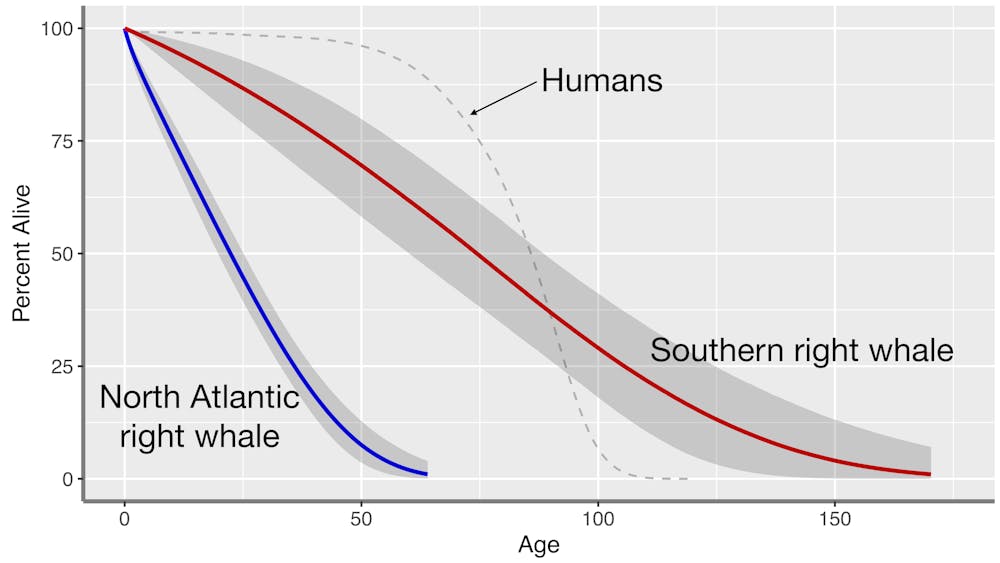
    Southern right whales have lifespans that reach well past 100 years, and 10% may live past 130 years, according to our new research published in the journal Science Advances. Some of these whales may live to 150. This lifespan is almost double the 70-80 years they are conventionally believed to live.

    North Atlantic right whales were also thought to have a maximum lifespan of about 70 years. We found, however, that this critically endangered species’ current average lifespan is only 22 years, and they rarely live past 50.

    These two species are very closely related – only 25 years ago they were considered to be one species – so we’d expect them to have similarly long lifespans. We attribute the stark difference in longevity in North Atlantic right whales to human-caused mortality, mostly from entanglements in fishing gear and ship strikes.

    Survivorship curves show female right whales can live to very old ages, but humans are causing North Atlantic right whales to die well short of their potential. Plotted for comparison is the U.S. survivorship curve for women as estimated by the Social Security Adminstration.
    Greg Breed

    We made these new age estimates using photo identification of individual female whales over several decades. Individual whales can be recognized year after year from photographs. When they die, they stop being photographically “resighted” and disappear. Using these photos, we developed what scientists call “survivorship curves” by estimating the probability whales would disappear from the photographic record as they aged. From these survivorship curves, we could estimate maximum potential lifespans.

    Twenty-five years ago, scientists working with Indigenous whale hunters in the Arctic showed that bowhead whales could live up to and even over 200 years. Their evidence included finding stone harpoon points that hadn’t been used since the mid-1800s embedded in the blubber of whales recently killed by traditional whalers. Analysis of proteins from the eyes of hunted whales provided further evidence of their long lifespan. Like right whales, before that analysis, researchers thought bowhead whales lived to about 80 years, and that humans were the mammals that lived the longest.

    In the years following that report, scientists tried to figure out what was unique about bowhead whales that allowed them to live so long. But our new analysis of the longevity of two close relatives of bowheads shows that other whale species also have potentially extremely long lives.

    Why it matters

    Understanding how long wild animals live has major implications for how to best protect them. Animals that have very long lifespans usually reproduce extremely slowly and can go many years between births. Baleen whales’ life history – particularly the age when females start breeding and the interval between calves – is strongly influenced by their potential lifespan. Conservation and management strategies that do not plan accordingly will have a higher chance of failure. This is especially important given the expected impacts of climate disruption.

    What still isn’t known

    There are many other large whales, including blue, fin, sei, humpback, gray and sperm whales. Like bowhead and right whales, these were also almost wiped out by whaling. Scientists currently assume they live about 80 or 90 years, but that’s what we believed about bowhead and right whales until data proved they can live much longer.

    How long can these other whale species live? Industrial whaling, which ended only in the 1960s, removed old whales from the world’s whale populations. Though many whale populations are recovering in number, there hasn’t been enough time for whales born after the end of industrial whaling to become old.

    It’s possible, even likely, that many other whale species will also prove to have long lifespans.

    Sixty years after the end of industrial whaling, today’s whale populations may still be missing their elders.
    Maxi Jonas/picture alliance via Getty Images

    What other research is being done

    Other research finds the loss of older individuals from populations is a phenomenon occurring across most large animal species. It diminishes the reproductive potential of many species. Researchers also argue this represents a real loss of culture and wisdom in animals that degrades their potential for survival in the face of changing conditions.

    What’s next

    We want to better understand how whaling affected the number of old individuals in current whale populations and predict when the number of old individuals will recover to prewhaling levels. Preliminary results suggest it may be another 100 years before whale populations truly recover, even for species whose populations now number as many as there were before whaling.

    For North Atlantic right whales, our research shows that even when the population was increasing, the management actions taken were insufficient to prevent these whales from dying far too young.

    The Research Brief is a short take on interesting academic work.

    Greg Breed received funding from The Royal Society

    Peter Corkeron headed the National Oceanic and Atmospheric Administration’s large whale research program for the northeastern US from 2011 to 2019, then led the New England Aquarium’s right whale research program through 2022.

    ref. Whales can live way longer than scientists had thought, with potential lifespans as much as double previous estimates – https://theconversation.com/whales-can-live-way-longer-than-scientists-had-thought-with-potential-lifespans-as-much-as-double-previous-estimates-245826

    MIL OSI – Global Reports

  • MIL-OSI Russia: 23rd meeting of the Intergovernmental Commission on Economic Cooperation between the Russian Federation and the Republic of Armenia

    Translation. Region: Russian Federation –

    Source: Government of the Russian Federation – An important disclaimer is at the bottom of this article.

    The meeting was held under the joint chairmanship of Deputy Prime Minister of the Russian Federation Alexey Overchuk and Deputy Prime Minister of the Republic of Armenia Mher Grigoryan.

    Previous news Next news

    23rd meeting of the Intergovernmental Commission on Economic Cooperation between the Russian Federation and the Republic of Armenia

    The 23rd regular meeting of the Intergovernmental Commission on Economic Cooperation between the Russian Federation and the Republic of Armenia was held in Moscow under the joint chairmanship of Deputy Prime Minister of the Russian Federation Alexey Overchuk and Deputy Prime Minister of the Republic of Armenia Mher Grigoryan.

    The parties summed up the results of bilateral cooperation in trade and economic spheres, energy, industry, transport, agriculture, finance, healthcare, culture, science, interregional cooperation, education and tourism.

    “Our trade and economic relations continue to be on the rise. Mutual trade between Russia and Armenia, according to data for 10 months of 2024, amounted to 10.2 billion dollars. This is more than twice as much as the same indicator last year,” noted Alexey Overchuk, emphasizing that in order to implement trade and economic relations, the countries have almost completely switched to settlements in national currencies – the share of the Russian ruble in mutual settlements has reached 96.3%.

    The Russian Federation is one of the main investors in the Armenian economy. Investments in industrial projects in the Republic of Armenia have reached $3.4 billion. More than 40 large Russian companies operate in Armenia, some of them are the largest taxpayers in the state budget.

    “In addition to direct investments, Eurasian development institutions are also actively working,” said the Deputy Prime Minister. “Active work is underway here, including in support of the “Crossroads of the World” initiative, which was put forward by the Prime Minister of the Republic of Armenia Nikol Vovaevich Pashinyan.”

    The Chairman of the Russian part of the commission also noted that in July 2024, with the assistance of Russian Railways, the railway between Armenia and Georgia, damaged by flooding, was restored in the shortest possible time – the only railway connecting Armenia with the outside world, which is an important channel for delivering vital goods to Armenia.

    “All these investments and projects are being implemented with the aim of strengthening connectivity in the Eurasian region and the South Caucasus, in particular, integrating Armenia into the new value chains emerging in Eurasia and realizing the transport and logistics potential that the Republic of Armenia has, with unwavering respect for its sovereignty and jurisdiction,” Alexey Overchuk said in his speech.

    In the context of the work of Eurasian development institutions, the Deputy Prime Minister also noted the implementation of the irrigation systems modernization project: mechanical irrigation has been replaced by gravity irrigation, which provides annual energy savings. 5 main and 22 inter-farm canals have been restored. Work on the restoration and construction of intra-farm irrigation systems in 105 settlements of the Republic of Armenia has been completed.

    “Two weeks ago, our specialists agreed to assess the technical condition of eight bridges damaged by the floods in Lori and Tavush. All work will be completed as soon as possible, and we expect that by the end of the year, their results will be submitted to the Ministry of Territorial Administration and Infrastructure of the Republic of Armenia,” the Deputy Prime Minister said.

    During the meeting, the active development of cooperation in the humanitarian sphere was emphasized.

    “Today we are signing an intergovernmental Agreement on the conditions of operation of the Russian-Armenian University in the Republic of Armenia. This is one of the leading universities in Armenia, where more than 5 thousand students study, mastering 123 educational programs, 80 of which are taught according to Russian educational standards,” the Deputy Prime Minister emphasized.

    The university’s research and teaching staff includes 82 doctors and 332 candidates of science. The university’s structure includes 9 institutes, 31 departments and 12 laboratories.

    The University cooperates with the Joint Institute for Nuclear Research, the Institute for System Programming of the Russian Academy of Sciences, the St. Petersburg Polytechnic University and other Russian scientific centers. Research projects are implemented in such areas as bioinformatics, genomic research, quantum nanophotonics, biochemistry and biotechnology.

    Work continues to provide opportunities to receive education according to Russian standards in the educational and sports complex, which includes a school for 700 students, built in Yerevan as part of the Gazprom for Children social program.

    The countries pay great attention to cooperation in the field of culture. Since 2023, a program to support Russian theaters abroad has been implemented, within the framework of which the Yerevan State Russian Drama Theater named after Stanislavsky was provided with financial assistance for the acquisition of stage equipment and the creation of new productions based on works of Russian classics. The Moscow Parajanov Theater, with the support of the Ministry of Culture of Russia and the Cultural Center of the Armenian Embassy in Russia, held a large-scale festival “Parajanov Fest”.

    Bilateral cooperation in the field of creative education is developing. Within the framework of the International Student Festival of VGIK, 38 films participating in the festival were screened at the Russian-Armenian University.

    In pursuance of the agreements reached at the meeting of the intergovernmental commission, the second Russian-Armenian Forum of Education in the Sphere of Culture was held in Moscow in December 2024.

    Cooperation in the healthcare sector is being strengthened, including within the framework of annual Russian-Armenian forums on healthcare. The ninth Russian-Armenian forum on healthcare, dedicated to issues of maternal and child health, was held on December 16, 2024 in Yerevan. During the forum, the system of extended perinatal screening developed and successfully applied in Russia was presented.

    Russia and Armenia are developing mutual tourism. In January-September 2024, the number of trips of Russian tourists to Armenia amounted to 715.8 thousand, and Armenian tourists to Russia – 266 thousand.

    Speaking about cooperation in multilateral formats, primarily through the Eurasian Economic Union, the Deputy Prime Minister noted that the union has become a real guarantor of Armenia’s energy and food security, as well as its technological development.

    “The Union countries are the key sales market and the key supplier to the Armenian market. The EAEU accounts for 56% of Armenia’s food exports, 80% of machinery and equipment exports, 67% of chemical exports, and 56% of textile exports. The EAEU also provides 72% of energy imports, 49% of precious metal imports, 38% of food imports, and 34% of timber imports. During its membership in the Union, the export of industrial goods from Armenia has grown 15-fold, and food exports from Armenia have grown 4-fold. Since joining the EAEU in 2015, Armenia’s per capita GDP has grown almost 2.4-fold. This was made possible by the benefits of a common goods market, low prices for agricultural raw materials and energy, a convenient migration regime, and a common services market,” said Alexey Overchuk.

    Following the meeting, the protocol of the 23rd meeting of the Intergovernmental Commission on Economic Cooperation between the Russian Federation and the Republic of Armenia was signed.

    The parties also signed an Agreement between the Government of the Russian Federation and the Government of the Republic of Armenia on the conditions for the operation of the Russian-Armenian University in the Republic of Armenia, a State Purchase Agreement for a polyvalent, cultured, sorbed, inactivated foot-and-mouth disease vaccine, an Agreement between the Government of the Russian Federation and the Government of the Republic of Armenia on the conditions for the operation of the Educational and Sports Complex of Gazprom Armenia CJSC in Yerevan, and a work plan for the Russian-Armenian Business Council for 2025.

    Please note: This information is raw content directly from the source of the information. It is exactly what the source states and does not reflect the position of MIL-OSI or its clients.

    MIL OSI Russia News

  • MIL-OSI USA: FDA Roundup: December 20, 2024

    Source: US Department of Health and Human Services – 3

    For Immediate Release:

    Today, the U.S. Food and Drug Administration is providing an at-a-glance summary of news from around the agency:

    • Today, the FDA provided answers to a set of FAQs about software functions that may be described as clinical decision support (CDS). The FAQs are intended to help sponsors identify whether their CDS software may or may not meet the definition of a medical device, as described in the FDA’s final guidance for Clinical Decision Support Software. Additionally, the FDA updated the list of authorized Artificial Intelligence and Machine Learning (AI/ML)-Enabled Medical Devices; totaling 1,016. The list is not a comprehensive resource of medical devices that incorporate AI/ML. The devices in this list have met the FDA’s applicable premarket requirements.
    • On Monday, the FDA approved a premarket approval application (PMA) 180-day supplement for the OraQuick Human Immunodeficiency Virus (HIV) Self-Test. This approval represents a labeling change to lower the approved age to individuals who are 14 to 17 years of age and older for the OraQuick HIV Self-Test to provide access to HIV testing to adolescents. The original approval of the OraQuick HIV -Self Test was indicated only for individuals who are 17 years and older.

      This is the first approval for an over-the-counter HIV test in adolescents. Availability will help in the detection of HIV among the adolescent population. 

      The OraQuick HIV Self-Test is a single home-use test to detect antibodies to Human Immunodeficiency Virus Type 1 (HIV-1) and Type 2 (HIV-2) in human oral fluid specimens.  This test kit includes of a test stick (device) to collect the specimen, a test tube (vial) to insert the test stick (device) and complete the test, testing directions, booklet titled, “HIV, Testing and Me”, and access to the OraQuick Support Center to assist users with questions about performing the test, or to connect them with a healthcare provider in their area.

      The OraQuick HIV Self-Test is not intended to be used with specimens other than oral fluid. Individuals should obtain a confirmatory test in a medical setting.

      Complete instructions for use can be found on the FDA’s website here.

    • On Thursday, the FDA Office of Inspections and Investigations published a Viewpoint article titled Partnership in Action: Creating Safeguards for Imported Products Entering the United States in the Pacific Islands by Dan Solis, Assistant Commissioner for Import Operations. The article highlights the FDA’s work in Guam to ensure that imported products entering the U.S. through the Pacific Rim are safe for consumers. The Pacific Rim is a strategically significant location when it comes to ensuring the safety of products bound for consumers in the United States, as a little more than a third of global products coming into our country originate in the Asia-Pacific Region. You can learn more about the FDA’s efforts in the Pacific Islands by listening to OII Podcasts | FDA. The 5-Part series is called, Guam Series: FDA Presence and Impact in Pacific Islands.
    • On Thursday, the FDA updated the outbreak advisory for Salmonella Typhimurium infections linked to cucumbers with additional cases. The FDA’s investigation remains ongoing.
    • On Thursday, the FDA approved Tryngolza (olezarsen), used with diet, to reduce triglycerides (TG) in adults with familial chylomicronemia syndrome (FCS). FCS is a rare, genetic disorder that prevents the body from breaking down fats (TG) in the bloodstream. People with FCS can have TG levels in the thousands. These high TG levels can cause severe abdominal pain, inflammation of the pancreas (acute pancreatitis), and fatty deposits in the skin (xanthomas). Some of these symptoms, specifically acute pancreatitis, can be life-threatening. This is a first-in-class approval, meaning Tryngolza uses a new mechanism of action, or works differently in the body, than other therapies currently used to treat FCS.  The most common adverse reactions were injection site reactions, decreased platelet count, and arthralgia.
    • On Thursday, the FDA re-evaluated its determination from October 2, 2024, on the status of the tirzepatide shortage. The agency issued a new decision determining the tirzepatide injection shortage is resolved. The FDA’s determination is based on its analysis of all the information before the agency.  
    • On Wednesday, the FDA posted the latest video in the FDA In Your Day series. This one focuses on pertussis, also known as whooping cough, and what consumers can do to protect themselves and those around them.
    • On Wednesday, the FDA approved Ryoncil (remestemcel-L-rknd) an allogeneic bone marrow-derived mesenchymal stromal cell (MSC) therapy, for steroid-refractory acute graft versus host disease (SR-aGVHD) in pediatric patients 2 months of age and older. Ryoncil is the first FDA-approved MSC therapy. The most common nonlaboratory adverse reactions (incidence ≥20%) were viral infectious disorders, bacterial infectious disorders, infection – pathogen unspecified, pyrexia, hemorrhage, edema, abdominal pain and hypertension.
    • On Wednesday, the FDA approved Ensacove (ensartinib, Xcovery Holdings, Inc.) for adult patients with anaplastic lymphoma kinase (ALK)-positive locally advanced or metastatic non-small cell lung cancer (NSCLC) who have not previously received an ALK-inhibitor. The most common adverse reactions (≥20%) were rash, musculoskeletal pain, constipation, cough, pruritis, nausea, edema, pyrexia, and fatigue.
    • On Wednesday, the FDA shared our latest testing results for per- and polyfluoroalkyl (PFAS) substances in clams as follow up to the agency’s findings in the 2022 PFAS in seafood survey. Between October 2022 and September 2024, the FDA collected and analyzed 12 samples of processed clams with China as the country of origin. All 12 samples had detectable levels of at least one type of PFAS.
    • On Wednesday, the FDA issued a letter to food manufacturers that Amanita muscaria (A. muscaria), its extracts, and certain of its constituents (muscimol, ibotenic acid, and muscarine) are not authorized for use as ingredients in conventional food. A. muscaria and its constituents have been used in foods intended to have hallucinogenic effects, sometimes marketed as “psychedelic edibles”, “legal psychedelics” or “mushroom edibles”. After reviewing the available information about A. muscaria and its constituents, the FDA concluded that they do not meet the safety standard for use in food and that their use as food ingredients may be harmful. We also recommend that people avoid eating foods with these ingredients. The FDA’s assessment of chemicals in the food supply is part of our commitment to food safety and public health.
    • On Wednesday, the FDA updated the advisory for the outbreak of E. coli illnesses linked to certain sizes and brands of organic whole and baby carrots supplied by Grimmway Farms. According to CDC, as of December 18, 2024, this outbreak is over. The FDA conducted inspections at Grimmway Farms and collected environmental samples. Two environmental samples collected outside were positive for Shiga toxin-producing E. coli (STEC). Although both strains of E. coli detected in the samples are capable of causing human illness, neither match the strain of E. coli causing illnesses in this outbreak. The FDA is working with Grimmway Farms on corrective and preventive actions. The FDA’s investigation is complete.
    • On Tuesday, the FDA and the U.S. Department of Agriculture announced a charter that details how the two agencies work together to determine the appropriate agency to regulate the small number of animal biologicals for which jurisdiction may be unclear. Representatives from the FDA and USDA originally signed a Memorandum of Understanding in 2013 that outlined which animal biologicals each would regulate. Since 2013, science has continued to advance, and the jurisdiction of some products is not clear under the MOU. The charter includes a flowchart to help clarify which agency will regulate a given product, as well as information on how to request a jurisdiction determination from the FDA and USDA for animal biologicals.

    Related Information

    ###

    Boilerplate

    The FDA, an agency within the U.S. Department of Health and Human Services, protects the public health by assuring the safety, effectiveness, and security of human and veterinary drugs, vaccines and other biological products for human use, and medical devices. The agency also is responsible for the safety and security of our nation’s food supply, cosmetics, dietary supplements, radiation-emitting electronic products, and for regulating tobacco products.


    Inquiries

    Consumer:
    888-INFO-FDA

    MIL OSI USA News

  • MIL-OSI Canada: New measures in place will boost home construction

    Source: Government of Canada regional news

    New actions are being implemented to help more people find affordable homes in the communities where they live and work.

    “Everyone should be able to afford a home in their chosen community, but high home costs and real estate speculators are making that a challenge,” said Brenda Bailey, Minister of Finance. “We are working to ensure there are more affordable homes available for people, whether they’re renting or buying, through measures like the B.C. home-flipping tax and property transfer tax exemptions.”

    Starting Jan. 1, 2025, the B.C. home-flipping tax will be in place to discourage investors from buying housing to turn a quick profit.

    People who sell their home within two years of buying will be subject to the tax, unless they qualify for an exemption, such as divorce, job loss or change in household membership. It is expected approximately 4,000 properties will be subject to the tax in 2025. All revenue from the tax will go directly into strengthening housing programs and building new affordable homes in B.C.

    “The B.C. home-flipping tax is just one more tool in our toolbox to help people find affordable housing,” said Ravi Kahlon, Minister of Housing and Municipal Affairs. “We’re working to deliver more homes so the people who keep our communities working, like teachers, nurses and construction workers, can find a place to live they can afford in the communities they love.”

    Other measures to help make homeownership more accessible and improve the supply of housing, which came into effect April 1, 2024, are new thresholds for the first-time homebuyers’ program and the newly built home exemption.

    The threshold for the first-time homebuyers’ program was increased to $835,000 from $500,000. Qualifying individuals will receive an exemption on the property transfer tax on the first $500,000 of the home’s value. Since April 1, more than 22,000 first-time home buyers – an increase from approximately 9,500 in 2023 – were helped into their homes through this program, saving as much as $8,000 in property transfer tax.

    To encourage the construction of new homes and support families to take the next step in home ownership, the threshold for the newly built home exemption was increased from $750,000 to $1.1 million. In 2024, this helped approximately 10,300 purchasers buy new homes, nearly 3,000 more than last year.

    The Province is also supporting the delivery of more rental homes. New purpose-built rental buildings of four units or more, purchased between Jan. 1, 2025, and Dec. 31, 2030, may also qualify for an exemption from the general property transfer tax.

    Learn More:

    To read more about the B.C. home-flipping tax:
    https://www2.gov.bc.ca/gov/content/taxes/income-taxes/bc-home-flipping-tax

    To read more about the first-time home buyers program: 
    https://www2.gov.bc.ca/gov/content/taxes/property-taxes/property-transfer-tax/exemptions/first-time-home-buyers

    To read more about the newly built home exemption:
    https://www2.gov.bc.ca/gov/content/taxes/property-taxes/property-transfer-tax/exemptions/newly-built-home-exemption

    A backgrounder follows.

    MIL OSI Canada News

  • MIL-OSI Europe: Text adopted – Continued repression of civil society and independent media in Azerbaijan and the cases of Dr Gubad Ibadoghlu, Anar Mammadli, Kamran Mammadli, Rufat Safarov and Meydan TV – P10_TA(2024)0074 – Thursday, 19 December 2024 – Strasbourg

    Source: European Parliament

    The European Parliament,

    –  having regard to the European Convention on Human Rights, ratified by Azerbaijan,

    –  having regard to Rules 150(5) and 136(4) of its Rules of Procedure,

    A.  whereas since 2023, the Azerbaijani authorities have been engaged in a systemic crackdown on civil society, political opposition, human rights defenders, the LGBTI+ community and independent media, which intensified around COP29;

    B.  whereas there are over 300 political prisoners in Azerbaijan as well as 23 Armenian prisoners of war, including leaders of the former self-proclaimed Nagorno-Karabakh republic;

    C.  whereas political prisoner and 2024 Sakharov Prize finalist Gubad Ibadoghlu remains under house arrest; whereas the European Court of Human Rights ruled that his health condition is critical, requiring hospitalisation and urgent heart surgery;

    D.  whereas civil society leader Anar Mammadli has been in pre-trial detention since April 2024 on bogus charges, with his health deteriorating due to denied healthcare;

    E.  whereas in early December 2024, the Azerbaijani authorities arrested MeydanTV journalists Aynur Ganbarova, Aytaj Ahmadova, Khayala Agayeva, Natig Javadli and Aysel Umudova, and journalists Ramin Jabrayilzade and Ahmad Mukhtar; whereas they also arrested Baku Journalism School deputy director Ulvi Tahirov, political leader Azer Gasimli and human rights defender Rufat Safarov; whereas all face unfounded, politically motivated charges;

    F.  whereas environmental activist Kamran Mammadli was attacked by security guards at COP29 and is banned from travelling;

    G.  whereas prisoners’ human rights are routinely violated through detention in inhumane conditions, torture and specific harassment of female political prisoners, including Nargiz Absalamova;

    1.  Strongly condemns the Azerbaijani regime’s reported ongoing violations of human rights, including freedoms of expression, association and peaceful assembly, and its politically motivated abuse of the criminal justice system;

    2.  Urges the Azerbaijani authorities to immediately end the crackdown on all dissident groups and unconditionally release and drop all charges against human rights defenders, journalists and political and other activists prosecuted under fabricated, politically motivated charges;

    3.  Demands that the authorities immediately lift the travel ban on Ibadoghlu, unconditionally drop all charges against him and allow him to receive urgent treatment abroad; deplores the fact that Ibadoghlu was not allowed to attend the Sakharov Prize ceremony or connect remotely;

    4.  Calls on Azerbaijan to lift undue restrictions on independent media by aligning its laws on the registration and funding of non-governmental groups and media with Venice Commission recommendations; demands that the authorities end the repression of MeydanTV, ToplumTV, Abaz Media and Kanal13;

    5.  Calls for EU sanctions under its global human rights sanctions regime to be imposed on Azerbaijani officials responsible for serious human rights violations, including Fuad Alasgarov, Vilayat Eyvazov and Ali Naghiyev;

    6.  Insists that any EU-Azerbaijan partnership agreement – including on energy – must be strongly conditional on respect for fundamental rights and the release of all political prisoners; calls on the Commission to suspend the 2022 Memorandum of Understanding on a Strategic Partnership in the Field of Energy;

    7.  Instructs its President to forward this resolution to the Council, the Commission, the VP/HR, Member States and the President, Government and Parliament of Azerbaijan.

    MIL OSI Europe News

  • MIL-OSI Video: Love is the One Thing that Solves Everything | United Nations ‘Awake at Night’ podcast teaser

    Source: United Nations (Video News)

    Having overcome a childhood marked by violence, abuse and neglect, Benjamin Perks has always drawn strength from an innate sense of optimism. Now Head of Campaigns and Advocacy at UNICEF, the United Nations Children’s Fund, he helps protect young people in similar situations all over the world.

    “I think it was very clear that we were in a bad spot, though, being dealt a bad hand, but I was somehow optimistic that things would be better.”

    Having recently authored a book about his experiences, Trauma Proof, Benjamin Perks reflects in this episode on a lifetime campaigning for all children to be safe, seen, and soothed, and on how an encounter with a special teacher put his life back on track.

    Listen to more Awake at Night episodes: https://music.youtube.com/playlist?list=PLwoDFQJEq_0b6hu1e8oxsch9W0D7vkNqt
    #podcast #unitednations #awakeatnight #humanrights #OHCHR

    About Awake at Night
    Hosted by Melissa Fleming, UN Under-Secretary-General for Global Communications, the podcast ‘Awake at Night’ is an in-depth interview series focusing on remarkable United Nations staff members who dedicate their career to helping people in parts of the world where they have the hardest lives – from war zones and displacement camps to areas hit by disasters and the devastation of climate change.

    Link to the full episode on Youtube: https://music.youtube.com/podcast/PaXECZ-rDVI

    https://www.youtube.com/watch?v=Jh0NVllLRLs

    MIL OSI Video

  • MIL-OSI Security: First Assistant United States Attorney Zachary T. Lee to Serve as Acting United States Attorney for the Western District of Virginia

    Source: Office of United States Attorneys

    ABINGDON, Va. – First Assistant United States Attorney Zachery T. Lee will serve as the Acting United States Attorney for the Western District of Virginia, effective December 21, 2024, at 12:00 a.m. He is assuming the office under the Federal Vacancies Reform Act, 5 U.S.C § 3345, upon the departure of United States Attorney Christopher R. Kavanaugh, who announced his resignation earlier this year.

    “For two decades, Zach Lee has served the Western District of Virginia with honor, distinction, and dedication as an Assistant United States Attorney, Criminal Chief, and most recently as First Assistant United States Attorney,” United States Attorney Kavanaugh said today. “There is nobody more qualified to serve in this role, and I look forward to watching the United States Attorney’s Office continue to thrive and serve the citizens of the Western District of Virginia under his leadership.”

    “In my role as the First Assistant United States Attorney, I’ve had the privilege to work side-by-side with Chris Kavanaugh on our district’s most pressing matters,” Mr. Lee said today. “We are sad to see Chris leave the Western District after more than a decade of service, but I promise to keep the men and women who work here focused on the priorities he’s put in place: Keeping our District safe, ensuring civil rights, reducing gun violence, and leading complex white collar investigations and prosecutions.”

    Mr. Lee, 48, has served the Department of Justice since joining the United States Attorney’s Office for the Western District of Virginia in 2005 as a Special Assistant United States Attorney, transitioning to an Assistant United States Attorney in 2007. During his tenure, Mr. Lee has prosecuted complex narcotics, public corruption, firearms, and other criminal matters. He also served in the district’s leadership team as Criminal Chief and First Assistant United States Attorney.

    Prior to his employment with the Department of Justice, Mr. Lee served as an Assistant Commonwealth’s Attorney for the City of Bristol, Virginia, and as a law clerk to the Honorable James P. Jones, United States District Judge for the Western District of Virginia.

    He earned his Juris Doctor from the University of Wyoming College of Law, Laramie, Wyoming, and a Bachelor of Arts from Washington and Lee University, Lexington, Virginia. 

    MIL Security OSI

  • MIL-OSI Canada: Provincial Court Judges Appointed in Regina and Prince Albert

    Source: Government of Canada regional news

    Released on December 20, 2024

    The Government of Saskatchewan is announcing today the appointment of three new judges to the Provincial Court of Saskatchewan.

    Cynthia Alexander is appointed to the Provincial Court in Regina. Lori O’Connor and Buffy Rodgers are appointed to the Provincial Court in Prince Albert.

    “It is a privilege to announce the appointment of these three new judges to the Provincial Court of Saskatchewan,” Justice Minister and Attorney General Tim McLeod said. “Saskatchewan prides itself on its record of appointing highly skilled legal professionals to our judiciary, and I am confident these new appointees to the Provincial Court will carry on this tradition in their communities.” 

    Judge Alexander received her Bachelor of Laws from the University of Saskatchewan College of Law in 1996 and was called to the Bar in 1997. She completed her articles with Woloshyn & Company (now W Law) in Regina, where she remained as an Associate Lawyer until 2000. Judge Alexander then took a position as a Crown Prosecutor with Public Prosecutions in Prince Albert, and became a Senior Crown Prosecutor there in 2008. In 2022, she moved to the Head Office of Public Prosecutions in Regina as the Director of Professional Development.

    Judge Alexander has spent the majority of her career prosecuting criminal matters in Provincial Court and the Court of King’s Bench. She has developed expertise in criminal procedure, trial advocacy and rules of evidence. She has mentored prosecutors, articling students, and summer students within the Ministry of Justice and Attorney General and has also lectured at the University of Regina, the Saskatchewan Police College and Saskatchewan Polytechnic. 

    Outside of work, Judge Alexander and her husband have raised two sons. She enjoys music and travelling, and has volunteered with the Prince Albert Music Festival and the Saskatchewan Jazz Festival. 

    Judge O’Connor received her Bachelor of Laws from Dalhousie University in 2008 and was called to the Bar in 2009. She completed her articles with Legal Aid in Thompson, Manitoba, where she continued as a Staff Lawyer until 2010. In 2010, Judge O’Connor joined Saskatchewan Public Prosecutions as a Crown Prosecutor. She became a Regional Crown Prosecutor in Melfort in 2019. 

    Judge O’Connor has extensive experience in criminal law gained from her career as a Crown Prosecutor. She has taken an active role in mentoring law students through Dalhousie Law School’s Weldon Mentor Matching Program, and has provided court and testimony training to nurse examiners, victims services volunteers and peace officers. She also regularly contributes book reviews to the Canadian Law Library Review that appear on CanLii.

    Outside of her professional life, Judge O’Connor bakes banana bread for the Melfort Food Bank and enjoys walking her dog.   

    Judge Rodgers received her Bachelor of Laws from the University of Saskatchewan College of Law in 1998 and was called to the Bar in 1999. She completed her articles with Wardell Worme & Missens in 1999, and remained there as a Junior Lawyer until 2001. Judge Rodgers held a variety of roles from 2001 to 2006, including acting as legal counsel at Legal Aid Saskatchewan and Partner at Wardell Driedger Cotton & Rodgers, later Wardell Gillis Tangjerd Rodgers & Cotton. She joined the Saskatchewan Ministry of Justice and Attorney General as Crown Counsel in 2006 and became a Senior Crown Prosecutor with Saskatchewan Public Prosecutions in 2007. She has held the position of Senior Crown Prosecutor – OH&S since 2015.

    Over her legal career, Judge Rodgers has developed expertise in a wide variety of legal areas including criminal defense, child protection, civil law, small claims and legal aid. As a Crown Prosecutor she has spent a significant portion of her career in docket and trial court, and in the Court of King’s Bench practicing both criminal and regulatory law, with a specialty in OH&S files. 

    Judge Rodgers is a past Secretary of the Saskatchewan Crown Attorneys Association, and is a recipient of the Premier’s Award for Excellence in the Public Service for her work on the Serious Violent Offender Response Team. 

    -30-

    For more information, contact:

    MIL OSI Canada News

  • MIL-OSI USA: Avalanches, Icy Explosions, and Dunes: NASA Is Tracking New Year on Mars

    Source: NASA

    [embedded content]
    It’s a new year on Mars, and while New Year’s means winter in Earth’s northern hemisphere, it’s the start of spring in the same region of the Red Planet. And that means ice is thawing, leading to all sorts of interesting things. JPL research scientist Serina Diniega explains. NASA/JPL-Caltech

    Instead of a winter wonderland, the Red Planet’s northern hemisphere goes through an active — even explosive — spring thaw.
    While New Year’s Eve is around the corner here on Earth, Mars scientists are ahead of the game: The Red Planet completed a trip around the Sun on Nov. 12, 2024, prompting a few researchers to raise a toast.
    But the Martian year, which is 687 Earth days, ends in a very different way in the planet’s northern hemisphere than it does in Earth’s northern hemisphere: While winter’s kicking in here, spring is starting there. That means temperatures are rising and ice is thinning, leading to frost avalanches crashing down cliffsides, carbon dioxide gas exploding from the ground, and powerful winds helping reshape the north pole.
    “Springtime on Earth has lots of trickling as water ice gradually melts. But on Mars, everything happens with a bang,” said Serina Diniega, who studies planetary surfaces at NASA’s Jet Propulsion Laboratory in Southern California.
    Mars’ wispy atmosphere doesn’t allow liquids to pool on the surface, like on Earth. Instead of melting, ice sublimates, turning directly into a gas. The sudden transition in spring means a lot of violent changes as both water ice and carbon dioxide ice — dry ice, which is much more plentiful on Mars than frozen water — weaken and break.
    “You get lots of cracks and explosions instead of melting,” Diniega said. “I imagine it gets really noisy.”
    Using the cameras and other sensors aboard NASA’s Mars Reconnaissance Orbiter (MRO), which launched in 2005, scientists study all this activity to improve their understanding of the forces shaping the dynamic Martian surface. Here’s some of what they track.
    Frost Avalanches
    In 2015, MRO’s High-Resolution Imaging Science Experiment (HiRISE) camera captured a 66-foot-wide (20-meter-wide) chunk of carbon dioxide frost in freefall. Chance observations like this are reminders of just how different Mars is from Earth, Diniega said, especially in springtime, when these surface changes are most noticeable.

    “We’re lucky we’ve had a spacecraft like MRO observing Mars for as long as it has,” Diniega said. “Watching for almost 20 years has let us catch dramatic moments like these avalanches.”
    Gas Geysers
    Diniega has relied on HiRISE to study another quirk of Martian springtime: gas geysers that blast out of the surface, throwing out dark fans of sand and dust. These explosive jets form due to energetic sublimation of carbon dioxide ice. As sunlight shines through the ice, its bottom layers turn to gas, building pressure until it bursts into the air, creating those dark fans of material.

    But to see the best examples of the newest fans, researchers will have to wait until December 2025, when spring starts in the southern hemisphere. There, the fans are bigger and more clearly defined.
    Spiders
    Another difference between ice-related action in the two hemispheres: Once all the ice around some northern geysers has sublimated in summer, what’s left behind in the dirt are scour marks that, from space, look like giant spider legs. Researchers recently re-created this process in a JPL lab.

    Powerful Winds
    For Isaac Smith of Toronto’s York University, one of the most fascinating subjects in springtime is the Texas-size ice cap at Mars’ north pole. Etched into the icy dome are swirling troughs, revealing traces of the red surface below. The effect is like a swirl of milk in a café latte.
    “These things are enormous,” Smith said, noting that some are a long as California. “You can find similar troughs in Antarctica but nothing at this scale.”

    Fast, warm wind has carved the spiral shapes over eons, and the troughs act as channels for springtime wind gusts that become more powerful as ice at the north pole starts to thaw. Just like the Santa Ana winds in Southern California or the Chinook winds in the Rocky Mountains, these gusts pick up speed and temperature as they ride down the troughs — what’s called an adiabatic process.
    Wandering Dunes
    The winds that carve the north pole’s troughs also reshape Mars’ sand dunes, causing sand to pile up on one side while removing sand from the other side. Over time, the process causes dunes to migrate, just as it does with dunes on Earth.
    This past September, Smith coauthored a paper detailing how carbon dioxide frost settles on top of polar sand dunes during winter, freezing them in place. When the frost all thaws away in the spring, the dunes begin migrating again.

    Each northern spring is a little different, with variations leading to ice sublimating faster or slower, controlling the pace of all these phenomena on the surface. And these strange phenomena are just part of the seasonal changes on Mars: the southern hemisphere has its own unique activity.
    More About MRO
    The University of Arizona, in Tucson, operates HiRISE, which was built by Ball Aerospace & Technologies Corp., in Boulder, Colorado. NASA’s Jet Propulsion Laboratory, a division of Caltech in Pasadena, California, manages the Mars Reconnaissance Orbiter Project for NASA’s Science Mission Directorate, Washington.
    For more information, visit:
    https://science.nasa.gov/mission/mars-reconnaissance-orbiter
    News Media Contacts
    Andrew GoodJet Propulsion Laboratory, Pasadena, Calif.818-393-2433andrew.c.good@jpl.nasa.gov
    Karen Fox / Molly WasserNASA Headquarters, Washington202-358-1600karen.c.fox@nasa.gov / molly.l.wasser@nasa.gov
    2024-177

    MIL OSI USA News

  • MIL-OSI USA: NASA, Notre Dame Connect Students to Inspire STEM Careers

    Source: NASA

    High school students in Indiana are contributing to NASA’s groundbreaking research to develop quieter, more fuel-efficient aircraft engines.
    Their learning experience is a collaboration between aircraft noise researchers from NASA’s Glenn Research Center in Cleveland and educators from the University of Notre Dame’s Turbomachinery Laboratory. The collaboration aims to encourage students’ interest in science, technology, engineering, and math (STEM) careers.
    Recently, Notre Dame hosted students from The Portage School of Leaders High School and a team from NASA Glenn to see the Advanced Noise Control Fan operate in an outdoor setting. The fan is a NASA-owned test rig that has been configured to enable the study of a quieter aircraft engine technology. Known as the open rotor fan concept, the configuration involves an engine fan without a cover. Ground microphones were used during the test operated by Notre Dame to evaluate the radiated sound as the open rotor fan spun at various speeds.

    Students from the high school, which is part of the Career Academy Network of Public Schools, used 3D printers from the school’s facilities to fabricate parts for the open rotor test fan. The parts, known as stator blades, help direct and control airflow, ensuring smooth operation of the large, exposed fan blades that are the defining feature of an open fan engine design.
    “It was beyond words,” said Rebecca Anderson, a junior from the high school. “The part I enjoyed most was when they got the fan running. It was really impressive to see how quiet it was. I feel like everyone involved in STEM would love to work for NASA, including me.”
    NASA researcher Dr. Daniel Sutliff was part of the team from NASA Glenn to spend time mentoring the students.
    “This is real-world, hands-on research for them,” Sutliff said. “If airlines are able to use technologies to make flight quieter and cleaner, passengers will have more enjoyable flights.”
    The Advanced Noise Control Fan is on loan to Notre Dame from NASA through a Space Act Agreement. The fan research is supported by NASA’s Advanced Air Transport Technology project and its Efficient Quiet Integrated Propulsors technical challenge.

    MIL OSI USA News

  • MIL-OSI United Nations: Amid Growing Strength of Terrorist Groups in Sahel, West Africa, Senior Official Urges Security Council to Scale Up Support within Regional Frameworks

    Source: United Nations General Assembly and Security Council

    In a region grappling with escalating threats due to violent non-State actors, civic restrictions, political transitions and heightened humanitarian needs, the head of UN efforts in West Africa and the Sahel called on the Security Council for scaled up support within regional frameworks, as speakers welcomed small signs of progress on the democratic front.

    Leonardo Santos Simão, Special Representative of the Secretary-General and Head of the United Nations Office for West Africa and the Sahel (UNOWAS), presenting the latest Secretary-General’s report (document S/2024/871), reported that he just attended the 15 December Economic Community of West African States (ECOWAS) Summit, where Heads of State took note of the decision of Burkina Faso, Mali and Niger to withdraw from the organization.  ECOWAS responded with an offer of six months for dialogue to encourage those countries to remain, he added.  Regional leaders unanimously acknowledge insecurity as the region’s most urgent concern, with terrorists becoming increasingly aggressive, and utilizing sophisticated weaponry, including drones, he said, also drawing attention the spread, beyond the Sahel, of violent extremism and organized crime to northern Benin and Togo, and the Gulf of Guinea countries.

    To address such threats, he called for the Council to scale up support within regional frameworks.  While the announced operationalization of the ECOWAS Standby Force is a positive step, the Group of Five for the Sahel (G5 Sahel) joint force has ceased operations, and the Accra Initiative is undergoing restructuring, to model the Multinational Joint Task Force, “the primary security cooperation mechanism in the Lake Chad Basin region, and the only functioning platform for cooperation on regional security in West Africa and the Sahel”.  He went on to highlight a trip in November to Chad with Special Representative Abdou Abarry, Head of the United Nations Regional Office for Central Africa (UNOCA), during which they met the Lake Chad Basin Commission as well as a camp for internally displaced persons — of whom the country presently hosts 2 million, amid severe flooding, with the worsening humanitarian situation in other countries leading to further displacement.  In this context, he urged support for the underfunded humanitarian appeal, which is less than 50 per cent funded.  Addressing climate resilience, he spotlighted meetings held between stakeholders to discuss the transboundary management of water at the 2024 UN Climate Change Conference in Baku, and welcomed the visit, in December, of the Council’s informal expert group on climate change, peace and security to the Lake Chad Basin region.

    On human rights issues, he deplored the closing of 8,200 schools in the region, due to insecurity and expressed concern about persisting human rights violations and civic restrictions in Guinea and Central Sahel.  However, he welcomed progress in fighting impunity, citing the conviction of those responsible for the 2009 Guinea stadium massacre.  Detailing progress in the region on the democratic front, he noted his visit to Ghana during the presidential and legislative elections; as well as taking note of legislative elections in Senegal on 17 November, Côte d’Ivoire on track to its 2025 presidential elections and Liberia making progress in democratic consolidation.  However, in Guinea-Bissau, the parliamentary elections planned for November 2024 have been postponed sine die, he said, also pointing out that, in the Gambia, 2025 will be a critical year for the adoption of constitutional reforms, due to a political environment in which consensus has eroded.

    The Council also heard from Levinia Addae-Mensah, Executive Director, West Africa Network for Peacebuilding, a network encompassing 750 civil society organizations across the region, who described a “heightened security threat profile”, leading to expanding zones of instability and ungoverned spaces in the region, due to recent democratic transformations and security challenges stemming from the growing strength of terrorist and violent extremist groups in the Sahel and some coastal States.  Citing data from the group’s early warning system indicates that 76 per cent of armed attacks occurred around tri-border communities with inadequate State presence, she pointed out that “cascaded negative effects” of such dynamics led to challenges, including the closing of 12,000 schools, exacerbating the vulnerability of girls to early marriage, female genital mutilation and trafficking.

    Despite these challenges, she took note of positive trends, including progress towards democratic governance in Liberia, Senegal and Ghana; strengthened early warning systems and response mechanisms; and development of national and local infrastructures for peace.  Despite the shrinking of civic spaces, her organization is strengthening resilience through initiatives, such as Security Consultative Committees, which it introduced in Mali, she said, pointing out that such “a dichotomous reality” underscores the value of organic approaches to peacebuilding.  In closing, she highlighted processes that presented opportunities to reset approaches to addressing threats in the region, including the 2025 review of United Nations Peacebuilding Architecture and the Africa Facility to Support Inclusive Transitions.

    In the ensuing discussion, many speakers echoed concerns about the security situation in the region, with several urging support for regional security initiatives. Among them was the representative of Sierra Leone, co-penholder on the file, speaking also for Algeria, Guyana and Mozambique, who urged predictable funding for regional security mechanisms, spotlighting the importance of the Multinational Joint Task Force in fighting terrorist groups in the Lake Chad Basin, and the potential of a fully operationalized Accra Initiative in addressing security threats, including the recruitment and radicalization of young people in the region.

    Switzerland’s delegate called for a holistic approach to security, stressing that insecurity also hinders the improvement of the socioeconomic and humanitarian situation in the region.  Voicing alarm about the persistence and spread of armed conflict, terrorism and violent extremism, she said:  “It is necessary to engage in actions to maintain and promote dialogue and social cohesion, and to tackle the root causes of fragility.”

    The representative of the Republic of Korea concurred, pointing out that the “lack of coordinated regional responses and fragmented counter-terrorism efforts heighten the risk of terrorist expansion across the Central Sahel and into coastal States”.  He therefore encouraged ECOWAS and regional States to foster effective collaboration to counter terrorism and transnational organized crime, an appeal echoed by the representative of Japan.

    Also on the security front, the United Kingdom underscored that “private military security companies — like the Wagner Group and Africa Corps — are not the answer”.  Rather, these entities have a track record of worsening existing conflicts and undermining long-term development and stability.  On the deteriorating humanitarian situation in the region, he called for more humanitarian access, highlighting his Government’s support for more than 16 million people in the Sahel since 2019.

    Similarly, the representative of the United States, Council President for December, speaking in her national capacity, warned that, amid Governments’ struggle to reclaim control over territory, leaders who engage in heavy-handed counter-terrorism tactics, while neglecting to address the drivers of marginalization, are only worsening the security situation.

    However, the Russian Federation’s delegate countered that the fractious security situation “is the heavy burden of the consequences of the military aggression waged by Western countries against Libya — a burden borne, to this day, by all States in the region”.  Long-term stability in the Sahel requires the international community to support Mali, Niger and Burkina Faso “who stand at the forefront of the fight against pan-African terrorist groups”, she added, also stressing that the Council should respect the decision by members of the Alliance of Sahel States to leave ECOWAS.

    Meanwhile, China’s delegate called for the international community to “maintain necessary patience” with countries in transition and provide them with “small constructive support”. Countries in the region must foster collective security and continuously enhance counter-terrorism cooperation, he said.  To that end, his country, as announced at the Beijing Summit of the Forum on China-Africa Cooperation in September, will provide expertise and support to the African Centre for the Study and Research on Terrorism and United Nations Office of Counter-Terrorism Programme Office for Counter-Terrorism and Training in Africa.

    Malta’s delegate was among several speakers highlighting democratic concerns, welcoming Ghana’s introduction of a 40 to 50 per cent target of women in elected and appointed positions.  However, she urged transitional Governments to adhere to previously agreed electoral timelines, pointing to postponed elections in Guinea-Bissau and Burkina Faso, as well as similar negative trends in the Gambia and Nigeria.

    Addressing the humanitarian picture, Guyana’s representative, also speaking for Switzerland, as the Council’s informal co-focal points on conflict and hunger, noted that, according to the UN Office for the Coordination of Humanitarian Affairs, 48.6  million people throughout the region were projected to experience food insecurity in the “critical June and August lean period”, mainly due to worsening security conditions in Burkina Faso, Mali, Niger and Nigeria.  She called for increased international support, particularly in capacity-building; respect for international humanitarian law to protect humanitarian personnel, as well as objects indispensable to civilian survival; and a comprehensive overview that acknowledges the interrelated nature of existing and emerging challenges, including food insecurity.

    Many delegates drew attention to the exacerbating impact of climate change on the regional humanitarian situation, including Ecuador’s representative, who called on the international community to intensify its efforts in providing aid, and Slovenia’s delegate, who warned that:  “Crop failures, combined with the local grievances and ongoing instability create a fertile ground for recruitment by extremist armed groups.”  In this context, she echoed the Secretary-General’s call for countries in the region and ECOWAS to develop conflict-sensitive climate adaptation plans as part of comprehensive peacebuilding strategies.

    France’s representative concurred, observing that, by making access to resources difficult, climate change impacts “are an additional hurdle in West Africa”.  France has therefore renewed its support to regional climate, peace and security mechanisms to address these challenges.  He added that improving the situation in the region requires a peaceful political climate, common commitment by all actors to pursue dialogue, a return to constitutional order and universal respect for human rights and the freedoms of association and expression.

    NEW – Follow real-time meetings coverage on our LIVE blog.

    MIL OSI United Nations News

  • MIL-OSI Canada: Manitoba Government Tax Credits for Homeowners, Renters to Save Manitobans Money in 2025

    Source: Government of Canada regional news

    Manitoba Government Tax Credits for Homeowners, Renters to Save Manitobans Money in 2025


    Manitoba government tax credits introduced in Budget 2024 and coming into effect in the new year will put more money into the pockets of Manitoba homeowners and renters, Finance Minister Adrien Sala announced today.

    “The previous government wanted to give breaks to out-of-province billionaires. We’re taking a different approach,” said Sala. “These new tax credits will provide help for all Manitobans, but particularly those who need it most.”

    Introduced in Budget 2024, the $1,500 Homeowners Affordability Tax Credit will benefit more than 80 per cent of Manitobans, the minister noted.

    The School Tax Rebate for farm properties is being maintained at 50 per cent as part of the Manitoba government’s commitment to support producers and their families, noted the minister.

    This new tax change will make it easier for young Manitobans to buy their first home and easier for homeowners to afford their mortgage payments, the minister added.

    Starting in the new year, the maximum Renter’s Tax Credit will be increased to $575, which marks the first step to the Manitoba government’s four-year commitment of fully restoring the Renter’s Tax Credit to $700. 

    – 30 –

    MIL OSI Canada News

  • MIL-OSI: JIADE LIMITED Receives Nasdaq Notification Letter Regarding Minimum Bid Price Deficiency

    Source: GlobeNewswire (MIL-OSI)

    Chengdu, China , Dec. 20, 2024 (GLOBE NEWSWIRE) — JIADE LIMITED (Nasdaq: JDZG) (the “Company”), a company that specializes in providing one-stop comprehensive education supporting services to adult education institutions, today announced that the Company received a  letter (the “Notification Letter”) from the Listing Qualifications Department of the Nasdaq Stock Market LLC (“Nasdaq”) on December 17, 2024, notifying the Company that it is not in compliance with the minimum bid price requirement set forth in the Nasdaq Listing Rules for continued listing on the Nasdaq. 

    Nasdaq Listing Rule 5550(a)(2) requires listed securities to maintain a minimum bid price of US$1.00 per share, and Nasdaq Listing Rule 5810(c)(3)(A) provides that a failure to meet the minimum bid price requirement exists if the deficiency continues for a period of 30 consecutive business days. Based on the closing bid price of the Company’s ordinary shares for the 30 consecutive business days from November 4, 2024 to December 16, 2024, the Company no longer meets the minimum bid price requirement.

    The Notification Letter does not impact the Company’s listing on the Nasdaq Capital Market at this time. In accordance with Nasdaq Listing Rule 5810(c)(3)(A), the Company has been provided 180 calendar days, or until June 16, 2025, to regain compliance with Nasdaq Listing Rule 5550(a)(2). To regain compliance, the Company’s ordinary shares must have a closing bid price of at least US$1.00 for a minimum of 10 consecutive business days. In the event the Company does not regain compliance by June 16, 2025, the Company may be eligible for additional time to regain compliance or may face delisting.

    The Company’s business operations are not affected by the receipt of the Notification Letter. The Company intends to monitor the closing bid price of its ordinary shares and may, if appropriate, consider implementing available options, including, but not limited to, implementing a reverse share split of its outstanding ordinary shares, to regain compliance with the minimum bid price requirement under the Nasdaq Listing Rules. 

    About JIADE LIMITED

    JIADE LIMITED specializes in providing one-stop comprehensive education supporting services to adult education institutions, through a wide spectrum of software platform and auxiliary solutions, to meet the evolving needs of its customers in the rapidly changing adult education industry. The Company’s services are primarily offered through the Kebiao Technology Educational Administration Platform (the “KB Platform”), which facilitates streamlined information and data management throughout the teaching cycle of adult education services, from pre-enrollment to post-graduation. The KB Platform supports a broad range of functions, such as enrollment consultation, student information collection, enrollment status management, learning progress management, grade inquiry, and graduation management. The Company also provides auxiliary solutions to adult education institutions, which encompass teaching support services throughout the entire teaching cycle and related exam administration services.

    Forward-Looking Statements

    Certain statements in this announcement are forward-looking statements. These forward-looking statements involve known and unknown risks and uncertainties and are based on the Company’s current expectations and projections about future events that may affect its financial condition, results of operations, business strategy and financial needs. Investors can find many (but not all) of these statements by the use of words such as “approximates,” “believes,” “hopes,” “expects,” “anticipates,” “estimates,” “projects,” “intends,” “plans,” “will,” “would,” “should,” “could,” “may”, or other similar expressions in this press release. The Company undertakes no obligation to update or revise publicly any forward-looking statements to reflect subsequent occurring events or circumstances, or changes in its expectations, except as may be required by law. Although the Company believes that the expectations expressed in these forward-looking statements are reasonable, it cannot assure you that such expectations will turn out to be correct, and the Company cautions investors that actual results may differ materially from the anticipated results and encourages investors to review other factors that may affect its future results in the Company’s registration statement and other filings with the U.S. Securities and Exchange Commission.

    For more information, please contact:

    JIADE LIMITED
    Investor Relations Department
    Email: kebiao@sckbkj.com

    The MIL Network

  • MIL-OSI United Kingdom: Homegrown seed to kickstart new generation of Douglas fir trees

    Source: United Kingdom – Executive Government Non-Ministerial Departments

    Groundbreaking breeding programme to develop new generation of British grown Douglas fir trees after decades of research.

    Credit: Forestry Commission

    Douglas fir is native to North America and has been used in British forestry for over 100 years. Demand is rising rapidly and currently; we import much of our seed from the USA or France and there is a need to develop a strain that is specialised for British conditions.

    For decades there have been incomplete attempts to develop British Douglas fir seed sources suited to our conditions, but now a government funded project led by the Conifer Breeding Cooperative has overcome this and will grow the next generation of Douglas fir from British tree seeds.

    The project involved the selection of 200 visually superior trees from the best Douglas fir plantations in Britain, as well as 40 genetically superior trees from long-term experiments managed by Forest Research.

    This selection of outstanding Douglas firs will now be used by the Conifer Breeding Cooperative and Forest Research as breeding stock to produce British Douglas Fir seed. The chosen trees will be copied by grafting cuttings onto rootstocks, after the grafted plants will go into seed orchards. In several years, once seeds are available, they will be supplied to forest nurseries to grow the first genetically improved British Douglas fir trees. 

    Richard Whittet, Head of Tree Breeding at Forest Research and Chair of the Conifer Breeding Cooperative, said:  

    “We have selected a new generation of Douglas fir trees for breeding, based on their adaptation to the British climate and timber properties which is an important step forward for the resilience of our nation’s trees. 

    “This achievement is the result of decades of work by Forest Research and our domestic and international partners. Collaboration has enabled us to get things done on the ground and harness new technologies, such as the low-cost DNA marker array for quality assurance.”

    Sir William Worsley, Chair of the Forestry Commission, said:

     “We are facing a changing climate and biodiversity decline, with trees playing a significant role in mitigating some of the worst impacts.

    “We rely too heavily on timber imports in the UK and if we are to strengthen own domestic supply then this type of science will play a huge role in the future. Therefore, there has never been a more crucial time to invest in domestic tree-planting”.

    A DNA fingerprint – which shows the genetic make-up of each tree – has also been taken of each tree by Oxford University. This is the first time this technique has been used at such an early stage of a tree breeding programme in Great Britain. The DNA fingerprint is used as a quality-control tool to track and evaluate the tree’s parentage and enable traceability. This important data will help advance the project. 

    Douglas fir is a desirable timber-producing tree for Britain and this step forward to develop a resilient British population will ensure better yield for our domestic timber industry. Fast growing conifers such at this sequester carbon more quickly than slower growing species.  Using timber in construction, in place of other non-renewable materials, is one of the best ways to reduce emissions from buildings. It also ensures that carbon is locked up long-term.

    Today’s development will help bolster the domestic timber industry as part of the Government’s critical mission to make the UK clean energy superpower and ensure we are resilient to a changing climate. This is the latest government innovation in the fight to protect our nation’s trees and woodlands.

    The project partners involved are Conifer Breeding Coop, University of Oxford, and Forestart and it has been funded by the Department of Environment Food and Rural Affairs.

    Additional Information: 

    • The trials were first established in the 1990s as part of a European Commission project with several international partners including Britain, France, Germany, Italy, Spain and Belgium

    Updates to this page

    Published 21 December 2024

    MIL OSI United Kingdom

  • MIL-OSI Security: Air National Guard Defender Completes Jungle Agile Employment Course

    Source: United States INDO PACIFIC COMMAND

    Did you know that roughly one-third, or 500 million acres, of the U.S. is forest? And did you know that Puerto Rico’s El Yunque National Forest is the only tropical rainforest in the U.S. that is considered a jungle? By definition, a forest has many tall trees and can usually be traveled by humans, while a jungle is usually dense and overgrown with a tropical or humid climate.

    So why did a Security Forces Specialist assigned to the 148th Fighter Wing, Minnesota Air National Guard, travel to the pacific to participate in the Air Forces’ new Jungle Agile Employment Course?

    An instructor and planner for the Air National Guard’s Cold Weather Operations Course at Camp Ripley Training Center, Minn., Master Sgt. Ian Nickila, “wanted to learn the finer details of operating and surviving in the jungle climate.”

    The 10-day JACE course, attended by 22 service members from the Air Force, Army, and Marines, was planned and executed by the 36th Contingency Response Group and the 736th Security Forces Squadron, Anderson Air Force Base, Guam. The CRG mission is to advise, defend, construct, connect, and operate. The 736th is creating training to help Airmen produce a rapid Air Base Opening during Humanitarian Assistance or Disaster Relief mission.

    “The core purpose of the course is to prepare airmen who will execute future Agile Combat Employment operations, at small spokes skills necessary to survive if support is interrupted or delayed, will be vital” said Capt. Wyatt Huff, Operations Officer with the 736th Security Forces Squadron and lead course developer.

    The JACE contained survival-based curriculum to include survival, navigation, force protection, and mobility skills. Students collected and purified food and water, trained on cliffside rappelling, knot tying, building hasty shelters, and fire starting.

    “On day one, Nickila stood out as an avid outdoorsman and his desire to share his skills was of great benefit to his classmates,” said Huff.

    The three-day field training exercise included agile combat employment concepts, allowing Nickila and his classmates to practice operations with speed, scope, and complexity found in recent campaigns.

    While in the field, the class attendees “were hunted by the course planners, or CADRE, so we built hasty shelters to sleep in,” said Nickila.

    The physically grueling course taught Nickila “the importance of water,” he said. “I’ve always known I need water but determining how much I need and how much I wanted to carry in my ruck was a challenge.” Nickila filled a camelback, a canteen, and Nalgene bottle three times a day, and still fought dehydration. “I realized if I was struggling, that others would be, so finding an abundant and consistent water source is vital to operating in the jungle.”

    Nickila, a 2005 graduate of Duluth Denfeld High School, joined the Air National Guard prior to his senior year of high school. “After September 11th, I knew I wanted to join the military,” said Nickila. “I talked to all types of recruiters. My father’s Army unit was activated at the 148th during Operation Noble Eagle; he convinced me that Security Forces would be a good fit.”

    Since joining, Nickila has deployed to Manas Air Base, Kyrgyzstan; Eskan Village Compound, Saudi Arabia; Thumrait Air Base, Oman; Al Udeid Air Base, Qatar; and Amahd al-Jaber Air Air Base, Kuwait in addition to participating several specialized training exercises.

    “Having ‘Defenders” with diverse training backgrounds is a key to our future success,” said 148th Security Forces Operations Superintendent, Senior Master Sgt. Ben Nyen. “Ian has extensive experience in the Middle East and has always stepped up to increase his knowledge base. As a person who winter camps for fun, the Cold Weather Operations Course was a great opportunity for him to show his skills an instructor. Now he can teach the opposing lessons learned at the JACE course to our squadron.”

    Bibliography

    U.S. Department of Agriculture Forest Service (2013). By the Numbers. Retrieved from By the Numbers | US Forest Service

    U.S. Air Force (2021). U.S. Air Force Doctrine Note 1-21, Agile Combat Employment (2021, Dec. 21). Retrieved from https://www.af.mil/Portals/1/documents/Force%20Management/AFDN_1-21_ACE.pdf

    MIL Security OSI

  • MIL-OSI China: Annual buzzword selection highlights changes in China, world

    Source: China State Council Information Office 2

    People try VR devices during the 11th China (Wuhu) Popularized Science Products Exposition in Wuhu, east China’s Anhui Province, Oct. 21, 2023. [Photo/Xinhua]
    Multiple organizations in China released the most popular Chinese characters and phrases of 2024 on Friday, offering insight into the evolving trends of the country and the world.
    The top ten domestic buzzwords feature five Chinese characters for “integration,” “intelligence,” “new,” “safety,” and “stability” as well as the terms of “new-quality productive force,” “Black Myth: Wukong,” “work fatigue,” “low-altitude economy” and “digital transformation.”
    These buzzwords refer to various dimensions of China’s domestic society, ranging from its integrated and innovative development powered by new-quality productive forces and digital transformation, to cultural and economic phenomena in 2024 such as video game hit “Black Myth: Wukong” and its burgeoning low-altitude economy including drone deliveries.
    The top ten global buzzwords are characters for “election,” “war,” “change,” “turbulence” and “nuclear” and the terms of “Paris Olympics,” “Global South,” “Artificial Intelligence,” “drones” and “Large Language Model.”
    The lists were compiled using an algorithm that analyzed a corpus of Chinese characters along with public recommendations, with final results confirmed by experts and researchers.
    A closer look at the list of popular buzzwords recommended by the public also presents a more panoramic view of Chinese people’s social psyche over the past year.
    Frequently used words such as “say no to mental exhaustion” and “20-minute park life” signify a desire for a relaxed lifestyle amid the quick pace of modern life. Words like “Altay,” a prefecture in northwest China’s Xinjiang Uygur Autonomous Region made ultra-famous by a critically acclaimed TV drama series, and “ancient architecture tour” reveal the popular travel destinations of Chinese people in 2024.
    Among the recommendations, which are mostly in Chinese, the English expression of “China Travel” stands out, mirroring the country’s inbound travel boom buoyed by a series of facilitation policies and measures for foreigners.
    To welcome international visitors in the post-pandemic era, China has streamlined its visa application process, refined its immigration process to increase efficiency at border-control points, and made its payment services for international travelers more accessible and inclusive, among other efforts.
    According to official data, China recorded nearly 29.22 million inbound foreign visits between January and November 2024, up 86.2 percent year on year. Of these, 17.45 million visitors entered the country visa-free, marking a massive 123.3 percent increase from the previous year. Notably, the number of visa-free transit travelers surged by 132.9 percent year on year.
    With pride and love, “Beijing Central Axis” is also on the recommendation list as earlier this year, the United Nations Educational, Scientific and Cultural Organization (UNESCO) inscribed the “Beijing Central Axis: A Building Ensemble Exhibiting the Ideal Order of the Chinese Capital” on its World Heritage List.
    The Central Axis runs north to south through the heart of old Beijing and consists of ancient landmarks such as the Bell and Drum Towers, Wanning Bridge, Jingshan Hill, and the Forbidden City.
    “The Beijing Central Axis is an important symbol that highlights the outstanding features of Chinese civilization,” said Li Qun, China’s deputy minister of culture and tourism, in an interview.
    Having been held for 19 consecutive years, this annual event is jointly organized by the National Language Resources Monitoring and Research Center, the Commercial Press, and other institutions.

    MIL OSI China News

  • MIL-OSI United Kingdom: Plans for new provisions to support pupils with complex Additional Support Needs

    Source: Scotland – City of Perth

    Perth and Kinross Council’s Learning and Families Committee will be asked to consider the plans when it meets on Wednesday, January 29.

    Almost 7000 children and young people in Perth and Kinross Council schools have been identified as having additional support needs, almost four out of every 10 pupils (39%). 

    This is an increase of over 750 children and young people since 2021.

     Currently, PKC has fifteen Intensive Support Provisions (ISPs) across nine primary and six secondary schools, serving 300 children aged 5 to 18.

    A feasibility study highlighted the need for more ISP placements and better geographical distribution to improve educational and social experiences for children and young people and reduce travel costs.

    A report to the committee recommends creating eight new ISPs through recently announced Scottish Government funding and redistribution of existing Perth and Kinross Council resources.

    This will mean all children and young people who need this type of education provision will be able to do so closer to their homes, enabling them to build better community connections for the future.

    Other options for consideration include maintaining existing provision or creating additional ISPs through the redistribution of existing resources. Both options would maintain ISP placements at current levels.

    If the proposed plan to create eight new ISPs is approved, it will be implemented in three phases over the next four years.

    The first will see the development of ISPs at Kinross High School, Perth High School and a primary school within the Perth Academy catchment area once statutory consultations are completed.

    Phases two and three will see the creation of a further five ISPs.

    Councillor John Rebbeck, convener of Perth and Kinross Council’s Learning and Families Committee said: “Many of our ISPs are over-capacity and we know the number of children with complex additional support needs who require intensive-level learning opportunities is rising.

    “We want to give every child the best start in life so they can fulfil their potential and creating new ISPs will help ensure all our children receive the education they need and deserve.

    “The development is part of our Additional Support Needs (ASN) Transformation Programme which aims to significantly improve the educational experience for children and young people with additional support needs in Perth and Kinross.

    “We know there are still many challenges ahead but I believe this is an important and necessary step in the right direction. The programme’s vision is to help these children thrive, gain independence, and lead fulfilling lives by ensuring they can access the best possible learning environment and support whilst in Perth and Kinross Council Early Learning and Childcare (ELC) settings or schools.

    “Access to education and learning close to their home communities will help our children and young people with complex needs to reach their potential”

    MIL OSI United Kingdom

  • MIL-OSI Russia: Andrei Rudskoy took part in a meeting chaired by Russian Presidential Aide Nikolai Patrushev

    Translartion. Region: Russians Fedetion –

    Source: Peter the Great St Petersburg Polytechnic University – Peter the Great St Petersburg Polytechnic University –

    On January 23, a meeting on the participation of universities in ensuring technological leadership and developing engineering education was held at the Saint Petersburg State Marine Technical University under the chairmanship of Nikolai Patrushev, Assistant to the President of the Russian Federation. The meeting was addressed by the Rector of SPbPU, Academician of the Russian Academy of Sciences Andrei Rudskoy.

    The meeting was attended by the governors of St. Petersburg and the Leningrad Region, representatives of the Ministry of Industry and Trade, the Ministry of Education, university rectors and heads of companies in the shipbuilding and related industries. The participants examined issues related to the role of universities in the formation of a system of research, development and production of high-tech products.

    Aide to the President of Russia, Chairman of the Russian Maritime Board Nikolay Patrushev noted in his speech that in order to achieve technological sovereignty and technological superiority, the domestic industry needs to reduce the timeframes for developing and implementing new technologies in production, as well as eliminate problems associated with the specifics of certification processes. He emphasized the importance of developing various technical and technological areas, including the production of low- and medium-speed engines, robotics and instrumentation.

    Nikolay Patrushev also touched upon the issue of training highly qualified engineering personnel. He emphasized that increasing the number of scientists, researchers and engineers in the total number of workforces is a key factor for achieving technological sovereignty.

    In turn, the Minister of Science and Higher Education of the Russian Federation, Valery Falkov, presented the results of monitoring the quality of admission to HSE universities and reported on the growth of interest in engineering education in recent years.

    Rector of SPbPU, Academician of the Russian Academy of Sciences Andrey Rudskoy presented the model of “Qualified Partnership” in his report. He noted that the university, regularly performing R&D, generates new knowledge. At the next stage, due to the introduction of digital platforms in the performance of R&D, knowledge is accumulated and competencies are formed.

    Effective actions based on knowledge and technology allow us to form a scientific and technological reserve on a systemic basis, which characterizes a qualified performer. A breakthrough, in fact, an exit to another level of development, is associated with the formulation of frontier engineering tasks by a qualified customer. This is how globally competitive market products are created – this is what real innovations consist of. Particular attention is paid to the transfer of knowledge through a new educational model with variable terms of basic educational programs, – Andrey Rudskoy emphasized.

    Andrey Ivanovich drew the attention of the audience to the fact that Russian President Vladimir Putin set the task of creating a new model of education based on the foundations of the domestic system, which is distinguished by an optimal ratio of fundamentality and practical orientation of training. Mathematics and physics are of key importance, allowing the formation of logical thinking in schoolchildren, a scientific view of the world and creating the basis for future fundamental training in any field of activity.

    Andrey Ivanovich noted that today the task of ensuring technological leadership is becoming vital for Russia. It is necessary to create a reliable foundation – well-prepared applicants to engineering universities. To this end, the standards of the current advanced level of studying mathematics and physics should become mandatory in secondary school.

    It is obvious that the need for mathematics and science teachers in schools will increase significantly, and this requires prompt decisions. In 2024, we launched a joint project of SPbPU and the Herzen State Pedagogical University to combine the competencies of the two universities in training physics teachers within the framework of a network educational program. The participation of the Polytechnic University in this program contributed to the development of specialized competencies of future physics teachers, including through the use of the material base of SPbPU. And this year, we are launching a unique master’s program with the assignment of two qualifications in the areas of training “Applied Mathematics and Physics” and “Pedagogical Education”, which will help compensate for the shortage of physics and mathematics teachers, – said Andrey Rudskoy.

    Please note: This information is raw content directly from the source of the information. It is exactly what the source states and does not reflect the position of MIL-OSI or its clients.

    MIL OSI Russia News

  • MIL-OSI Australia: Opinion piece: Australians earn more and keep more of what they earn with Labor’s tax cuts

    Source: Australian Treasurer

    Exactly a year ago this Saturday, the Prime Minister and I announced a controversial but important decision to provide every Australian taxpayer a tax cut to help with the cost of living.

    One year on and I can say without hesitation that it’s the policy I’m proudest of as Treasurer.

    Every taxpayer is better off as a result of the decision we took 12 months ago, not just some, and those benefits will be even bigger from July this year.

    New numbers just released show there will be even more money on average in the pockets of every taxpayer next financial year.

    Fourteen million taxpayers across the country have already received a tax cut under Labor’s plan since July last year.

    By the end of this financial year, around 84 per cent of all taxpayers will have received a bigger tax cut compared to Scott Morrison’s proposal from 5 years ago.

    And nearly 3 million people earning less than $45,000 who were going to miss out completely under the Liberals and Nationals are getting a tax cut under Labor.

    Whether you’re a nurse, a truckie, a teacher or a tradie, Labor’s plan is all about helping you earn more and keep more of what you earn.

    New figures show that with higher wages under the Albanese government, chances are your tax cut will be even bigger next financial year.

    Due to stronger wages growth under your Labor government, tax cuts will grow from $1,888 this financial year to $1,944 on average next year – putting more money back into workers’ pockets.

    It’s a meaningful increase because it shows we’re making welcome progress on the economy after a wasted decade under the Liberals and Nationals.

    A truckie earning $72,800 in this financial year, whose income grows to $75,600 in 2025–26, would get a tax cut of $1,569 next financial year compared to $1,499 this financial year.

    A nurse earning $72,300 in this financial year, whose income grows to $75,500 in 2025–26, would get a tax cut of $1,567 next year compared to $1,487 this year.

    A teacher earning $85,600 in this financial year, whose income grows to $87,800 in 2025–26, would get a tax cut of $1,874 in 2025–26 compared to $1,819 in 2024–25.

    We’re giving every Australian taxpayer a tax cut at the same time as we’re getting wages moving again, fighting inflation and creating jobs.

    Wages growth has picked up and on average, wages are growing at almost double the rate they were under our predecessors.

    Inflation was high and rising under the Liberals, it’s much lower under Labor.

    At the election, inflation was 6.1 per cent, it’s now 2.8 per cent.

    More than 1.1 million jobs have been created since the election and unemployment has remained low at 4 per cent.

    The combination of tax cuts, moderating inflation, wage and employment growth means real household incomes per person are also growing again.

    They were going backwards 1.6 per cent when we came to office.

    That means Australians are earning more and keeping more under Anthony Albanese and Australian Labor but all of this substantial progress is at risk under Peter Dutton and the Liberals.

    The Deputy Liberal leader is on the record saying that if the Coalition wins the next election, they will ‘absolutely’ unwind our tax cuts.

    If Peter Dutton and the Coalition really cared about the cost of living, they would have supported our cost‑of‑living relief but they didn’t and they don’t.

    They want Australians to work longer for less.

    The biggest risk to household budgets, jobs and wages is a Peter Dutton‑led Coalition government.

    Only this week we’ve seen Peter Dutton wants to make families worse off to pay for tax breaks for long lunches and golf days for bosses.

    The contrast couldn’t be clearer – we’re for tax cuts for workers and energy bill relief for families, they’re for taxpayer funded long lunches and golf days.

    The Liberals are all about waste and rorts and Labor is all about responsible economic management and that’s reflected in our decision to give a tax cut to every taxpayer to help with the cost of living.

    No matter what you earn or where you live throughout Australia, you deserve your tax cut.

    That’s what we’re delivering because of the important decision we took a year ago, and that’s why we’re proud of the even bigger tax cuts you’ll get next financial year.

    Our aim in all of this is to find the best way to help ease the cost of living for the biggest number of people in the most responsible way and that’s what we’re doing with tax cuts for every taxpayer, strong and sustainable wages growth and more jobs for more Australians.

    MIL OSI News

  • MIL-OSI USA: Risch Introduces Bill to Ban Critical Race Theory in U.S. History and Civics Education

    US Senate News:

    Source: United States Senator for Idaho James E Risch

    WASHINGTON – U.S. Senator Jim Risch (R-Idaho), Mike Crapo (R-Idaho), Tim Sheehy (R-Mont.), and Cynthia Lummis (R-Wyo.) introduced today the Protect Equality and Civics Education (PEACE) Act to prohibit the use of taxpayer dollars to promote politically divisive concepts, such as Critical Race Theory, through the U.S. Department of Education’s American History and Civics Education program.

    The PEACE Act codifies the Trump administration’s definition of “divisive concepts” as outlined in the 2020 Executive Order on Combating Race and Sex Stereotyping, ensuring our education standards reflect America’s founding principles and reject extreme ideology. 

    “For too long, the radical left has tried to rewrite American history and indoctrinate future generations with their woke agenda,” said Risch. “My PEACE Act ensures taxpayer dollars are not used to promote Critical Race Theory or subject students to a divisive and misguided political agenda.”

    “Teaching children they are inherently ‘bad’ or ‘good’ based on conditions they cannot control is destructive and unproductive,” said Crapo. “Schools should get back to quality education that will allow the next generation of leaders to thrive.”

    “It’s disgraceful that the Biden Administration spent the last four years using taxpayer money to force their radical, woke agenda onto our kids. I appreciate the work of my colleagues to put an end to this nonsense so the next generation can learn how to think, instead of what to think, and focus on preparing for success after graduation,” Sheehy said.

    “Rather than focusing on the safety and prosperity of our nation, the Biden administration spent the last four years funding and forcing far-left ideology on students across the United States,” said Lummis. “I am proud to join my colleagues to combat this radical agenda in our public schools and focus on quality education.” 

    MIL OSI USA News

  • MIL-OSI United Nations: ‘A Generation Has Been Traumatized’, Says Humanitarian Affairs Chief, Briefing Security Council on Plight of Children in Gaza

    Source: United Nations General Assembly and Security Council

    Meeting a week after a ceasefire paused the war in Gaza, after it raged for almost 470 days, the Security Council discussed the plight of children, with speakers calling for their needs to be prioritized, through the rebuilding of educational infrastructure, the provision of psychosocial support and ensuring a surge of humanitarian aid to the Strip.

    “A generation has been traumatized,” Tom Fletcher, Under-Secretary-General for Humanitarian Affairs and Emergency Relief Coordinator, told the Council, pointing to the United Nations Children’s Fund (UNICEF) finding that 1 million children need mental health and psychosocial support for depression, anxiety and suicidal thoughts. Nonetheless, today’s briefing marks “one of the rare times we are able to highlight positive developments”, he said, with the ceasefire providing a reprieve from relentless hostilities for Palestinians; allowing Israeli hostages and imprisoned Palestinians to be reunited with their families; and allowing a surge in life-saving humanitarian aid into Gaza.  “Children have been killed, starved and frozen to death,” he said, adding:  “Some died before their first breath — perishing with their mothers in childbirth.”  Citing conservative estimates indicating that over 17,000 children are without their families in Gaza, he stated that an estimated 150,000 pregnant women and new mothers are now in desperate need of health services.

    Outlining the UN and its partners’ stepped-up response across the Gaza Strip in recent days to meet the needs of 2 million people across Gaza, he said they were enabled by improved operating conditions, including safe, unobstructed humanitarian access, the absence of hostilities and the almost complete cessation of criminal looting. Such operations included the provision of life-saving services; delivering food parcels and flour and working to reopen bakeries; and distributing fuel to ensure that critical services, such as healthcare and water pumping, can run on back-up generators, he said, underscoring: “At the centre of this, as always, is United Nations Relief and Works Agency for Palestine Refugees in the Near East (UNRWA).”

    He went on to express alarm over the situation in the West Bank, where record-high levels of casualties, displacement and access restrictions witnessed since October 2023 have intensified since the announcement of the ceasefire.  Voicing alarm over attacks by Israeli settlers on Palestinian villages and an ongoing military operation in Jenin causing death and displacement, he urged the Council to ensure the ceasefire is maintained and to ensure that international law is respected across the Occupied Palestinian Territory of Gaza and the West Bank, including East Jerusalem.  Restrictions on critical humanitarian items must be lifted, including items considered to be “dual use”, and there must be accountability for atrocities.  Underscoring the need to ensure humanitarian operations are well-funded, with the 2025 Flash Appeal in need of $4.07 billion to meet the needs of 3 million people in Gaza and the West Bank, he stressed:  “The children of Gaza are not collateral damage”, but deserving of security, education and hope.  “They tell us that the world was not there for them through this war.  We must be there for them now.”

    The Council also heard from Bisan Nateel, from Tamer Institute for Community Education, an organization that helps Palestinian children express themselves through artistic activities, who recounted the “very simple dreams” expressed in drawings by the children she worked with, who “dreamed of going back to school, of playing with friends, and of not hearing constant shelling”.  Instead, she said, they were told to go to the safe place in south Gaza, through a “so-called safe corridor” where their lives were under threat, forced to see bodies along the road, forced to walk as snipers targeted them.  “They arrived unable to say a word about the horrific sights seen in their displacement journey, to a safe area that was targeted,” she said.  Displaying a drawing by a child named Gazi when he was in al-Mawasi refugee camp, in which he drew himself feeling well-fed, at home with his father, she said:  “But Gazi lost his life, along with his father, when their tent was attacked.” Also citing the case of a 12-year-old girl in north Gaza, who saw the remains of relatives “torn to pieces” outside her tent, she said that amidst the horror and violence, the children of the Strip forgot “what it means to live, to be human”.

    Throughout the conflict, she recalled awaiting news of Security Council meetings on the radio, hoping for a ceasefire that would end the massacres.  “Every day we lost our friends, loved ones, our homes and lives,” she said, recalling the death of her friend Mohammed, alongside the children he was drawing and playing with at Al-Maamadani Hospital.  “We used to walk down the streets, not knowing if we would live or die, always waiting for the moment the Council would announce a ceasefire, and end the violations against the Palestinian people, including their right to life, violated during 470 days of continuous attack against Gaza,” she stressed.  She voiced hope that Gazans’ “right to life” will he restored, and that children can go back to school, to play, to draw and to sing; to being “normal children in a normal environment, not surrounded by soldiers, and hearing weapons”.  In Gaza, “we do not know how life looks like in the outside world,” she said, adding:  “We have lost a lot in this war and I hope we will not lose more.”

    MIL OSI United Nations News

  • MIL-OSI Security: United States Attorney Announces Appointment of First Assistant U.S. Attorney

    Source: Office of United States Attorneys

    BOSTON – United States Attorney Leah B. Foley has announced that Katherine Ferguson has been appointed to serve as First Assistant United States Attorney for the District of Massachusetts. Ms. Ferguson, a career prosecutor, has served as an Assistant U.S. Attorney for more than a decade.

    “Ms. Ferguson’s leadership, dedication, and prosecutorial excellence have earned her widespread respect within our office and beyond,” said U.S. Attorney Foley. “Her deep understanding of federal law enforcement and her commitment to upholding the rule of law make her an invaluable asset. I am confident that she will bring the same integrity and vision to her new role as First Assistant U.S. Attorney as she has throughout her career.”

    Ms. Ferguson has served as Deputy Chief of the Narcotics & Money Laundering Unit for the U.S. Attorney’s Office since 2017 and Lead Task Force Attorney for the District’s Organized Crime Drug Enforcement Task Force since 2021. As Deputy Chief of the Narcotics & Money Laundering Unit, Ms. Ferguson was responsible for overseeing federal narcotics and money laundering investigations and prosecutions. As an Assistant U.S. Attorney for 15 years, she has extensive experience working collaboratively with other federal, state and local partners to dismantle multi-jurisdictional and international drug trafficking and money laundering organizations.

    Prior to joining the U.S. Attorney’s Office, Ms. Ferguson served as an Assistant District Attorney for the Suffolk County District Attorney’s Office. There, she handled over 600 cases in Boston Municipal Court from arraignment to disposition and oversaw the prosecution of child abuse and narcotics offenses in Superior Court. From 2006-2007, Ms. Ferguson served as a law clerk for the Honorable Sandra L. Lynch with the First Circuit Court of Appeals.

    Ms. Ferguson graduated from Princeton University, where she earned a Bachelor of Arts Degree in Economics with Highest Honors, Phi Beta Kappa. While at Princeton, Ms. Ferguson earned Certificates in Political Economy and French Language & Culture. She also received a Masters in Public Policy from the John F. Kennedy School of Government and graduated cum laude from Harvard Law School, where she was an Executive Editor for the Harvard Law Review.

    MIL Security OSI

  • MIL-OSI USA: U.S. Senators Amy Klobuchar, Tina Smith Join Colleagues to Introduce Bill to Award Congressional Gold Medals to Members of the “Miracle on Ice” Olympic Hockey Team

    US Senate News:

    Source: United States Senator Amy Klobuchar (D-Minn)
    WASHINGTON, D.C. – U.S. Senators Amy Klobuchar and Tina Smith (both D-MN) joined their colleagues to introduce the Miracle on Ice Congressional Gold Medal Act, legislation to award three Congressional Gold Medals to members of the 1980 U.S. Olympic Men’s Ice Hockey Team to recognize the 45th anniversary of their extraordinary achievement at the 1980 Winter Olympic Games.
    “A team that made us believe in miracles,” said Senator Klobuchar. “With 12 players and the legendary head coach Herb Brooks being native Minnesotans, we are working across the aisle to award the 1980 Olympic hockey team the Congressional Gold Medal.”
    “The ‘Miracle on Ice’ hockey game was an upset that nobody saw coming – but one that showcases the strength and resilience of Americans in the face of adversity,” said Senator Smith. “More than half of the team was from Minnesota, so I am proud to cosponsor this legislation to honor the achievement and the contributions to American pride by those Minnesotans.”
    In February 1980, the United States Olympic Men’s Ice Hockey Team defeated the Soviet Union 4-3 in the first game of the medal round of the 1980 Winter Olympic men’s hockey tournament in Lake Placid, New York. Team USA, including 12 hockey players born in Minnesota and coached by University of Minnesota championship winning hockey coach Herb Brooks, defied expectations by defeating the four-time Olympic champion Soviet Union team in a game referred to as the “Miracle on Ice.” At a time when the United States was struggling with rampant stagflation, high gas prices, hostages held in Iran, and increased tensions with the Soviets after their invasion of Afghanistan, the Miracle on Ice was a welcome reprieve and a critical moment for American patriotism. Following the stunning victory against the Soviets, the Americans beat Finland 4-2 to secure the gold.
    The three awards will be displayed at the United States Hockey Hall of Fame in Eveleth, Minnesota, the U.S. Olympic and Paralympic Museum in Colorado, and the Lake Placid Olympic Center in New York. 
    The bill was led by Senators Chuck Schumer (D-NY) and Kevin Cramer (R-ND). Additional cosponsors of the Miracle on Ice Congressional Gold Medal Act include U.S. Senators Marsha Blackburn (R-TN), John Hickenlooper (D-CO), Shelley Moore Capito (R-WV), John Curtis (R-UT), Mike Rounds (R-SD), and Gary Peters (D-MI). House cosponsors include U.S. Representatives Mike Quigley (D-IL-05), Lisa McClain (R-MI-09), and Bill Keating (D-MA-09). 
    Click here for bill text.

    MIL OSI USA News

  • MIL-OSI USA: Senators Collins, King Announce More Than $6 Million for Targeted Economic Development Projects in Maine

    US Senate News:

    Source: United States Senator for Maine Susan Collins

    Washington, D.C. – Today, U.S. Senators Susan Collins, Chair of the Senate Appropriations Committee, and Angus King announced that 10 state and local agencies and organizations throughout Maine have been awarded a total of $6,121,792 through the Northern Border Regional Commission’s (NBRC) Catalyst Program and Forest Economy Program. This funding will support projects aimed at strengthening economic opportunity in communities across five Maine counties.

    “From replacing aging infrastructure to expanding child care availability and resources for business development, these targeted investments will strengthen the local economies of numerous communities in Maine,” said Senators Collins and King. “We are proud to support the NBRC, which continues to play a vital role in creating jobs, expanding economic opportunities, and laying a strong foundation for long-term growth across our state.”

    Specifically, the funding is allocated as follows:

    • Dover-Foxcroft Water District (Piscataquis County) – $1,000,000: To replace and relocate the Dover-Foxcroft water main, which is approximately 100 years old and does not reach a developing commercial area of the town.
    • Danforth Water District (Washington County) – $1,000,000: To replace a 4,500-foot failing and unlined iron water main serving households and businesses throughout downtown Danforth.
    • Town of Greenville (Piscataquis County) – $1,000,000: To construct a new childcare center on the Greenville Consolidated School campus that will provide more than 30 additional childcare slots.
    • Loring Development Authority of Maine (Aroostook County) – $1,000,000: To construct an anaerobic digester to produce biofuel from organic material, while enhancing the development of the Loring Commerce Centre in Limestone.
    • Maine TREE Foundation (Kennebec County) – $998,925: To scale the Maine TREE Foundation’s six-week summer Forestry Immersion Program for Maine high school students.
    • City of Bangor (Penobscot County) – $500,000: To support the Central Kitchen, a shared-use commercial kitchen incubator for start-up businesses to prepare, package, and market local food products.
    • Passamaquoddy Tribe (Washington County) – $250,000: To rehabilitate the Eastern Surplus Superfund Site and the Eastern Maine Electric Cooperative site, and restore and rewild N’tolonapemk, an ancestral Passamaquoddy village on the shores of Meddybemps Lake through improvements to fish passage and re-establishment of an alewife run at Meddybemps Lake.
    • City of Presque Isle (Aroostook County) – $240,000: To upgrade the commercial kitchen at The Forum—a year-round, multi-use building—to allow the city to expand the number and types of events possible at the venue.
    • City of Augusta (Kennebec County) – $82,867: To renovate the HVAC system at the Buker Community Center’s Child Care Center, allowing the Center to avoid scaling back their hours of operation due to extreme weather conditions.
    • RSU 38 (Kennebec County) – $50,000: To develop a driving range for commercial driver licensing, decreasing the training cycle from four months to three.

    The NBRC was established by Congress in 2008, with Senator Collins’ and King’s support, to fund a broad range of development projects in Maine, New Hampshire, Vermont, and New York aimed at alleviating economic distress and encouraging private sector job creation.

    Senators Collins and King were instrumental in establishing the Forest Opportunity Roadmap (FOR/Maine) Initiative, an industry-led initiative that is helping to diversify the state’s wood products businesses, attract investments, and develop greater economic prosperity for rural communities impacted by mill closures. The FOR/Maine Initiative was funded in part by the Economic Development Assessment Team (EDAT) requested by the Senators in 2016 in order to create strategies for job growth and economic development in Maine’s rural communities. The EDAT recommended the development of new markets for Maine’s forest resources, including the strengthening of existing forest products manufacturing, the attraction of investment in emerging technology, and the utilization of forest products residuals in CHP biomass plants, microgrids, modern thermal systems, and new forest products development.

    In 2023, Senator Collins introduced and Senator King co-sponsored a bill to reauthorize and strengthen the NBRC.  

    MIL OSI USA News

  • MIL-Evening Report: Trump has fired a major cyber security investigations body. It’s a risky move

    Source: The Conversation (Au and NZ) – By Toby Murray, Professor of Cybersecurity, School of Computing and Information Systems, The University of Melbourne

    Before the end of its first full day of operations, the new Trump administration gutted all advisory panels for the Department of Homeland Security. Among these was the well-respected Cyber Safety Review Board, or CSRB.

    While this change hasn’t received as much notice as Trump’s massive announcement about AI, it has potentially significant implications for cyber security. The CSRB is an important source of information for governments and businesses trying to protect themselves from cyber threats.

    This change also throws into doubt the board’s current activities. These include an ongoing investigation into the Salt Typhoon cyber attacks which began as early as 2022 and are still keeping cyber defenders busy, attributed to hackers in China.

    Salt Typhoon has been described as the “worst telecommunications hack” in US history. Among other activities, the hackers obtained call records data made by high-profile individuals and even the contents of phone calls and text messages. The phones of then presidential nominee Donald Trump were reportedly among those targeted.

    What does the Cyber Safety Review Board do?

    The board was established three years ago by the Biden administration. Roughly speaking, its job is the cyberspace equivalent of government air traffic investigation bodies such as the US National Transportation Safety Board, or the Australian Transport Safety Bureau.

    The CSRB investigates major cyber security incidents. Its job is to determine their causes and recommend ways government and businesses can better protect themselves, including on how to prevent similar incidents in future.

    Its members include global cyber security luminaries from industry, such as cyber executives from Google and Microsoft, and US government leaders from several departments and agencies concerned with security.

    The US CSRB has previously published three major reports. Its first covered the infamous 2021 Log4j vulnerability, described at the time as the “single biggest, most critical vulnerability ever”. (A vulnerability is a weakness in a computer system that cyber criminals can exploit.)

    The board’s most recent published investigation involved a very sophisticated hacking campaign that targeted Microsoft’s cloud email services in 2023. As a result, hackers even gained access to the emails of various US government agencies.

    Cyber security experts widely consider the CSRB as a positive thing. Late last year, Australia even committed to establish its own version, the Cyber Incident Review Board.

    At the time of writing, it’s unclear whether the CSRB will continue – perhaps with different membership – or whether its activities will cease entirely.

    Either way, the decision to fire the board’s members has significant security implications. It comes at a moment in history when cyber threats have never been more severe.

    What is Salt Typhoon?

    The CSRB has been investigating the Salt Typhoon hacking campaign. Salt Typhoon is the name Microsoft assigned to a sophisticated group of hackers believed to be operated by China’s Ministry of State Security. The ministry is somewhat like a combination of an intelligence agency and a secret police service.

    Salt Typhoon is best known for hacking into several US telecommunication companies, first reported in August 2024. In December, it came to light Salt Typhoon’s telco hacks may also have impacted countries beyond the US. American, Australian, Canadian and New Zealand authorities also jointly issued public guidance to organisations to help defend against Salt Typhoon.

    Salt Typhoon reportedly targeted prominent figures, including political leaders. The hackers’ goal appears to have been to collect intelligence, rather than cause damage.

    For example, it has been reported Salt Typhoon collected a list of all phone calls made near Washington DC, which could help them determine who was talking to whom in the US capital.

    Salt Typhoon also reportedly obtained a list of phone numbers wiretapped by the US Justice Department. This confirmed the fears of many people opposed to the government’s powers to lawfully wiretap citizens’ phones.

    It is unclear why the hackers obtained that information. Some have speculated it would identify which of their own operatives were being monitored by US law enforcement.

    To say the Salt Typhoon revelations created waves in government and cyber security circles is putting it mildly. Telecommunications are critical infrastructure, as well as highly valuable targets for intelligence collection.

    The idea that foreign spies could burrow so deeply into the communication fabric of the US was unprecedented and disturbing.

    In October 2024 the CSRB was tasked with investigating Salt Typhoon’s activities.

    An uncertain future

    With the board now fired, the future of the Salt Typhoon investigation remains unclear.

    A thorough and impartial investigation of the Salt Typhoon hacks, had it been allowed to run, was likely to have delivered highly valuable cyber security lessons. Those lessons are important for both US companies and those in Australia, which have also been the targets of Chinese intelligence collection.

    The future of the CSRB itself is now also in question. The board and its overseas equivalents serve a vital role in promoting cyber information-sharing that helps to improve best practices.

    It is imperative these bodies are staffed with a diverse collection of impartial experts, able to carry out their work free from government and corporate interference.

    It remains to be seen whether dissolving the current CSRB will be a gift to Chinese hackers (as some have claimed), or simply a speed bump in the evolution of the board.

    Toby Murray is the Director of the Defence Science Institute, which receives Commonwealth and State government funding. Toby receives research funding from the Australian government and has previously received funding from the US Department of Defense, Facebook and Google.

    ref. Trump has fired a major cyber security investigations body. It’s a risky move – https://theconversation.com/trump-has-fired-a-major-cyber-security-investigations-body-its-a-risky-move-248106

    MIL OSI AnalysisEveningReport.nz

  • MIL-OSI New Zealand: David Seymour: The State of the Nation in 2025 – Dire States

    Source: ACT Party

    Delivered by ACT Leader David Seymour the Akarana Event Centre, Ōrākei.

    Introduction

    Thank you, Brooke, for your kind introduction. I’m biased, but I think you’re the Government’s most quietly effective Minister. Your labour law reforms are making it easier to employ workers and to be employed. Your minimum wage increases are announced early to give business certainty, and relief. You are taking on two of the hardest chestnuts in the workplace – holiday pay and health and safety – by listening to the people affected. You’ve put together an honest Royal Commission on COVID-19, and got wait times down for new passports and Citizenships. All the while you attract growing respect as a hard-working local MP here in Tamaki.

    It’s easy to forget Brooke’s 32. She has the biggest future in New Zealand politics.

    The only problem with mentioning one ACT MP is they’re all kicking goals with both feet, so you have to mention the lot. Nicole McKee is speeding up the court system, rewriting the entire Arms Act to make New Zealand safer, and reforming anti-money laundering laws so people can business done.

    Andrew Hoggard handles the country’s biosecurity, managing would-be outbreaks with steady hands. He is also dealing to Significant Natural Areas that erode farmers’ property rights and correcting the naïve treatment of methane that punishes the whole country.

    He’s able to do that in large part because of the work Mark Cameron did, and continues to do. From 2020 onwards he scared the bejesus out of every other party in rural New Zealand. He shifted the whole political spectrum right on the split gas approach, SNAs, and freshwater laws. Now the Government is changing those policies. As Chair of the Primary Production Committee, Mark stays in the headlines championing rural New Zealand every week. He is the definition of an effective MP.

    Karen Chhour is the embodiment of ACT values. Her life gives her more excuses than anyone in Parliament, but she makes none, and she accepts none. She is reforming the government department that let her down when she was small. If every New Zealander had Karen’s attitude and values, we’d be a country with no problems.

    Perhaps the biggest single policy problem we face is the Resource Management Act. Somone once said you can fill a town hall to stop anything in this country, but you can’t fill a telephone box to get something started. In steps Simon Court who, with Chris Bishop, is designing new resource management laws based on property rights. That’s an ACT policy designed to unleash the latent wealth our country has by letting people develop and use the property they own.

    Our new MPs that you helped elect last year are also making their marks. Todd Stephenson has picked up the End of Life Choice baton, with a bill to extend compassion and choice to those who suffer the most: those with long-term, degenerative illnesses. Parmjeet Parmar is one of the hardest working MPs I have seen, and a great chair of the Economic Development, Science and Innovation Committee. Cam Luxton and Laura McClure speak to a new generation of young parents who want their children to grow up in a free society.

    If you gave your Party Vote to ACT last year, you can be proud of the New Zealanders you put in Parliament to represent you. I am proud to lead this team of free thinkers in our House of Representatives, and I think we can all be proud of their efforts.

    New Zealand’s origin story: a nation of immigrants

    The summer is a good time to think about the state of our nation, and I got to thinking about who we are and how we got here. Whatever troubles we may face today, I couldn’t help coming back to something that unites New Zealand.

    Our country at its best is a place that welcomes hopeful people from all over the earth. People with different languages, religions and cultures united by one thing. When you look at the map it jumps out at you. We are the most remote country on Earth. If you’ve never stood at Cape Reinga and looked out to see wide open spaces for 10,000 kilometres, you owe it to yourself just once.

    It shows that one thing makes us all different from the rest of the world. No matter when or where you came from, you or your ancestors once travelled farther than anyone to give your children and theirs a better tomorrow.

    That is the true Kiwi spirit. Taking a leap into the unknown for a chance at better. Compared with what divides us, our spirit as a nation of pioneers unites us ten times over. Migrating from oppression and poverty for freedom and prosperity is what it means to be Kiwi.

    If that bright and optimistic side of our psyche, got half as much time as the whinging, we would all be better off. We would see ourselves as people unafraid of challenges, freed from conformity, with the power to decide our best days are always ahead of us.

    New Zealand’s inherent tension: two tribes

    I got to wondering why that isn’t a more popular story. Why do we cut down tall poppies? Why do we value conformity over truth? Why do people who came here for a better life grow up disappointed and move away again?

    I believe our nation is dominated by two invisible tribes. One, I call ‘Change Makers’. People who act out the pioneering spirit that built our country every day. We don’t just believe it is possible to make a difference in our own lives; we believe it’s an obligation.

    Change makers load up their mortgage to start a business and give other people jobs. They work the land to feed the world. They save up and buy a home that they maintain for someone else to live in. They study hard to extend themselves. They volunteer and help out where they can. They take each person as they find them. They don’t need to know your ancestry before they know how to treat you.

    Too often, they get vilified for all of the above. I know there’s many people like that in this room today. ACT people are Change Makers; we carry the pioneering spirit in our hearts.

    Then there’s the other tribe – people building a Majority for Mediocrity. They would love nothing more than to go into lockdown again, make some more sourdough, and worry about the billions in debt another day.

    They blame one of the most successful societies in history for every problem they have. They believe that ancestry is destiny. They believe people are responsible for things that happened before they were born, but criminals aren’t responsible for what they did last week.

    Far from believing people can make a difference in their own lives, they believe that their troubles are caused by other people’s success. They look for politicians who’ll cut tall poppies down – politicians who say to young New Zealanders ‘if you study hard, get good grades, get a good job, save money, and invest wisely, we’ll tax you harder’.

    I wasn’t kidding about the lockdowns; they were a litmus test. In early 2022, after this city had been locked down for months, and the borders had been closed for two years, a pollster asked New Zealanders if they’d like to be locked down again for Omicron.

    Now, I know it’s painful to think back, but bear with me. Omicron spread more easily than any earlier variant. It was also less harmful if you caught it. That was especially so because we were then among the most vaccinated nations on earth. The damage to business, education, non-COVID healthcare, and the government’s books was already massive and painful.

    And yet, 48 per cent of New Zealanders wanted another lockdown for Omicron. 46 per cent didn’t. That for me put the tribes into sharp relief. If you were a business owner who needed to open, a parent worried about missed education, a migrant missing their family, or just someone who wanted their life back, you wanted to open.

    When the Government finally lifted restrictions, many of those people left. Real estate agents report people selling because they’re moving to Australia every day. This is where the balance between these two invisible tribes comes into focus.

    Remember the gap in that poll was two per cent. Since the borders opened a net 116,000 citizens have left New Zealand. That’s a touch over two per cent.

    A tipping point

    The more people with get up and go choose to get up and leave, the less attractive it is for motivated people to stay here.

    Muldoon once quipped, ‘New Zealanders who leave for Australia raise the IQ of both countries.’ Actually, New Zealanders who leave for Australia  are tipping us towards a Majority for Mediocrity. Motivated New Zealanders leaving is good news for the shoplifters, conspiracy theorists, and hollow men who make up the political opposition.

    A few more good people leaving is all they need for their Majority of Mediocrity. The more that aspirational, hardworking people get up and leave New Zealand, the more likely it is we’ll get left-wing governments in the future.

    That’s why I say we’re at a tipping point. 

    There’s another reason why the mediocrity majority is growing, young people feel betrayed and disillusioned.

    A new generation looks at the housing market and sees little hope. Imagine you’re someone who’s done it all right, you listened to your teacher and did your homework. You studied for a tertiary education like everyone told you. Now you have $34,000 in debt, you start on $60,000, and you see the average house is 900,000 or fifteen times your (before tax) income.

    Nobody can blame a young person for wondering if they aren’t better off overseas. Many decide they are. Those who stay are infected  by universities  with the woke mind viruses of identity politics, Marxism, and post-modernism.

    Feeling like you’ll never own your own capital asset at the same time as some professor left over from the Cold War tells you about Marx is a dangerous combination.

    This is the other political tipping point that risks manufacturing a majority for mediocrity. A bad housing market and a woke education system combined are a production line for left-wing voters.

    The hard left prey on young New Zealanders. They tell them that their problems are caused by others’ success. That they are held back by their identity, but if they embrace identity politics, they can take back what’s theirs. Their mechanism is a new tax on wealth.

    These are the opposite of the spirit brings New Zealanders to our shores in the first place. The state of our nation is that we’re at a tipping point , and what we do in the next few years will decide which way we go.

    The short-term outlook is sunny, but only because Labour was so bad.

    We can afford to hope that this year will be better than 2024. By that standard, 2025 will be a success. Interest rates will be lower. The Government will have stopped wasting borrowed money, banning things, punishing employers, landlords, farmers, and anyone else trying to make a difference, with another layer of red tape.

    In fact, we have a Government that’s saving money, cutting red tape, and paring back identity politics. With those changes we will see more hope than we’ve seen in years, and hopefully a slowdown in citizens leaving. That is good, it’s welcome, and ACT is proud to be part of the coalition Government that’s doing it.

    ACT is needed to be brave, articulate, and patriotic

    The truth is, though, it’s easy to do a better job of Labour over 12 months. It’s much harder to muster the courage to keep making difficult decisions over several years, even if they’re not immediately popular. Our nation is in a century of decline. Just stopping one Government’s stupid stuff and waiting for a cyclical recovery won’t change the long-term trend. We need to be honest about the challenges we face and the changes needed to overcome them.

    We need to act like a country at risk of reaching a tipping point and losing its first world status. We are facing some tough times, and tough times require tough choices to be made.

    ACT’s goal is to keep the Government, and make it better. We may have gone into Government, but we never went into groupthink. It’s the role of ACT to be the squeaky wheel, pointing out where the Government needs to do better.

    The Government cannot measure itself by just being better than Labour. Instead, we need to ask ourselves, is this policy good enough to make New Zealand a first world country that people want to stay in?

    It’s easy to have big plans, we are the world, but charity begins at home. We need to focus only on what the government does, and ensure it does it well.

    We need to think carefully about three areas of government activity: spending, owning, and regulating. There is nothing the government does that doesn’t come down to one of those three things.

    Why government spends a dollar it has taxed or borrowed, and whether the benefits of that outweigh the costs.

    Why government owns an asset, and whether the benefits to citizens outweigh the costs to taxpayers of owning it.

    Why a restriction is placed on the use and exchange of private property, and whether the benefits of that regulation outweigh the costs on the property owner.

    When it comes to spending, we have a burning platform.

    Last year the economy shrunk by one per cent, even as the population grew slightly thanks to births and inbound migration. This year the Government is planning to borrow $17 billion, about $10 billion is for interest on debt, and we’ll have to pay interest on that debt the following year. Next year, government debt will exceed $200 billion.

    There lots of reasons why this situation will get harder.

    We’ve claimed an exclusive economic zone of four million square kilometres by drawing a circle around every offshore island we could name. We spend less than one per cent of GDP defending it, while our only ally, across the ditch, spends twice that.

    Put another way, we’re a country whose government gives out $45 billion in payments each year but spends only $3.2 billion defending the place. Does that sound prudent to you? Doubling defense would cost another $3.2 billion per year, effectively paying more for what we already have. We may face pressure to do just that thanks to US foreign policy.

    There’s a tail wind on balancing the books, and it’s affecting every developed country, our population is ageing faster than it’s growing.

    Every year around 60,000 people turn sixty-five and become eligible for a pension. To the taxpayer, superannuation expenses increase by $1.4 billion each year.

    Healthcare spending has gone from $20 billion to $30 billion in five years, but people are so dissatisfied that healthcare is now the third biggest political issue. Put it another way, we are now spending nearly $6,000 per citizen on healthcare.

    How many people here would give up their right to the public healthcare system if they got $6,000 for their own private insurance? Should we allow people to opt out of the public healthcare system, and take their portion of funding with them so they can go private?

    Education is similar. We spend $20 billion of taxpayer money every year, and every year 60,000 children are born. By my count that’s $333,000 of lifetime education spending for each citizen.

    How many people would take their $333,000 and pay for their own education? How many young New Zealanders would be better off if they did it that way?

    Instead of spending next year because we did it this year, we need to ask ourselves, if we want to remain a first world country, then do New Zealanders get a return on this spending that justifies taking the money off taxpayers in the first place? If spending doesn’t stack up, it should stop so we can repay debt or spend the money on something that does.

    Then there’s the $570 billion, over half a trillion dollars of assets, the government owns. The one thing we know from state houses, hospital projects, and farms with high levels of animal death, is that the government is hopeless at owning things.

    But did you know you own Quotable Value, a property valuation company chaired by a former race relations conciliator that contracts to the government of New South Wales?

    What about 60,000 homes? The government doesn’t need to own a home to house someone. We know this because it also spends billions subsidising people to live in homes it doesn’t own. On the other hand, the taxpayer is paying $10 billion a year servicing debt, and the KiwiBuild and Kainga Ora debacles show the government should do as little in housing as possible.

    There are greater needs for government capital. We haven’t built a harbour crossing for nearly seven decades. Four hundred people die every year on a substandard road network. Beaches around here get closed thanks to sewerage overflow, but we need more core infrastructure. Sections of this city are being red zoned from having more homes built because the council cannot afford the pipes and pumping stations.

    We need to get past squeamishness about privatisation and ask a simple question: if we want to be a first world country, then are we making the best use of the government’s half a trillion dollars’ plus worth of assets? If something isn’t getting a return, the government should sell it so we can afford to buy something that does.

    Finally, there’s regulation. That is placing restrictions on the use and exchange of property that the government doesn’t own or hasn’t taxed off the people who earned it already. That is, your property. Bad regulation is killing our prosperity in three ways.

    It adds costs to the things we do. It’s the delays, the paperwork, and the fees that make too many activities cost more than they ought to. It’s the builder saying it takes longer to get the consent than it took to build the thing. It’s the anti-money laundering palaver that ties people in knots doing basic things but somehow doesn’t stop criminals bringing in half a billion dollars of P each year. It’s the daycare centre that took four years to open because different departments couldn’t agree about the road noise outside. I could go on all afternoon.

    Then there’s the things that just don’t happen because people decide the costs don’t add up once the red tape is factored in.

    Then there’s the big one that goes to the heart of our identity and culture. It’s all the kids who grow up in a country where people gave up or weren’t allowed to try. It’s the climbing wall at Sir Edmund Hillary’s old school with signs saying don’t climb. It’s the lack of nightlife because it’s too hard to get a license. It’s the fear that comes from worrying WorkSafe or some other regulator will come and shut you down. You can’t measure it, but we all know it’s there.

    The Kiwi spirit we are so proud of is being chipped away and killing our vibe. Nobody migrated here to be compliant, but compliance is infantilising our culture, and I haven’t even mentioned orange cones yet.

    If we want to remain first world, we need to change how we regulate. No law should be passed without showing what problem is being solved, whether the benefits outweigh the costs, and who pays the costs and gets the benefits. These are the basic principles of the Regulatory Standards Bill that the Government will pass this year.

    Conclusion

    Of course, the Government IS doing many things that will change how it operates. There is a drive to reduce waste. There is a drive to get more money from overseas investment. The Regulatory Standards Bill will change how we regulate. The Resource Management Act is being replaced. Anti-money laundering laws are being simplified. Charter schools are opening, more roads are being built. These are all good things.

    But make no mistake, our country has always been the site of a battle between two tribes. The effect of emigration, and the world faced by young New Zealanders risks creating a permanent majority for mediocrity. Our country is at a tipping point.

    We need honest conversations about why government spends, owns, and regulates, and whether those policies are good enough to secure our future as a first world nation.

    You may have seen the ACT Party has been involved in a battle to define the principles of the Treaty democratically. It’s caused quite a stir. If you missed it, please check out treaty.nz where we outline what it’s about. It may still succeed this time, or it may be one of those bills that simply breaks the ground so something like it can proceed in the future.

    Either way, the tribe of change makers has a voice. People who want equal rights for all New Zealanders to be treated with respect and dignity because they’re citizens have a position that others need to refute. Good luck to them arguing against equal rights.

    It also shows something else, that ACT is the party prepared to stand up when it’s not easy and it’s not popular. That’s exactly the type of party our country needs in our Government.

    To all the Change Makers who proudly put us there, thank you, and no matter how daunting this tipping point may feel, together we can ensure our best days are still ahead of us.

    MIL OSI New Zealand News

  • MIL-OSI USA: Booker, Britt, Kim Reintroduce Resolution Designating January 23 as Maternal Health Awareness Day

    US Senate News:

    Source: United States Senator for New Jersey Cory Booker
    WASHINGTON, D.C. – Today, U.S. Senators Cory Booker (D-NJ), Katie Britt (R-AL), and Andy Kim (D-NJ) reintroduced a bipartisan resolution to officially designate January 23 as Maternal Health Awareness Day. The resolution emphasizes the importance of raising public awareness about maternal health outcomes and promotes initiatives to address and eliminate its disparities. 
    “The United States spends more on health care than any other country, but we still have the highest rate of maternal mortality among our peer countries,” said Senator Booker. “It’s disheartening that Congress has failed to pass comprehensive federal legislation to protect mothers and their babies, and ensure moms receive the essential care they need throughout their pregnancy and postpartum journeys. I remain committed to working across the aisle to create and implement effective policies that address the maternal mortality crisis and promote equitable maternal health care across our nation.”
    “Improving maternal care is not a red or blue issue, it’s an American issue,” said Senator Britt. “I’m proud to join my colleagues in recognizing National Maternal Health Awareness Day, while acknowledging we have more work to do to reduce maternal mortality. I will continue to work across the aisle with my colleagues to improve health outcomes for women throughout their pregnancy journeys and support moms across our nation.”
    “In a country of such great wealth and power, it is heartbreaking that we continue to let down expecting mothers who deserve to feel safe and supported,” said Senator Kim. “The pain of our country’s maternal mortality crisis is felt harshly in New Jersey, disproportionately hurting Black women and devastating too many families. With this resolution, I don’t just stand for awareness but call on my colleagues in Congress to see this urgency, understand the vast majority of maternal deaths are preventable, and help push forward on tangible action to protect lives and be there for growing families.”
    “As the maternal health crisis in the U.S. continues, it’s critical to continue to shine a spotlight and bring national attention to the importance of prioritizing maternal health. ACOG is grateful to Senator Booker and Senator Britt for their support in making sure that across the country, people learn about Maternal Health Awareness Day and understand the need for policies that will empower us to make a meaningful difference to improve maternal health outcomes,” Stella Dantas, MD, FACOG, president of the American College of Obstetricians and Gynecologists (ACOG).
    Senator Booker’s resolution notes that as many as 60,000 women in the United States suffer from a severe maternal morbidity, which includes unexpected outcomes of labor and delivery that can result in significant short- and long-term health consequences, and recognizes community-based maternal health models that have been proven to improve the health of birthing people throughout the country. With one-third of maternal mortality cases occurring between one week and one year postpartum, expanding access to health care after delivery nationwide is a vital step to saving lives.
    In 2018, New Jersey led the way by becoming the first state to acknowledge Maternal Health Awareness Day, thanks to the tireless efforts of the Tara Hansen Foundation, Rutgers Robert Wood Johnson Medical School, Rutgers New Jersey Medical School, and other essential organizations dedicated to raising awareness and combating maternal mortality. Since this historic recognition, numerous state entities, advocacy groups, community organizations, and others have united on January 23 to elevate awareness surrounding maternal health. This day serves as a platform to educate healthcare providers on maternal mortality, urging birthing individuals, families, and healthcare professionals to identify and discuss potential signs of emergencies.
    The resolution is cosponsored by U.S. Senators Jacky Rosen (D-NV), Peter Welch (D-VT), John Hickenlooper (D-CO), Ben Ray Luján (D-NM), Ron Wyden (D-OR), and Chris Van Hollen (D-MD).
    The full text of the resolution can be found here.

    MIL OSI USA News

  • MIL-OSI New Zealand: Schools to accelerate maths achievement

    Source: New Zealand Government

    Students who need extra help with maths are set to benefit from a targeted acceleration programme that will give them more confidence in the classroom, Education Minister Erica Stanford says.

    “Last year, significant numbers of students did not meet the foundational literacy and numeracy level required to gain NCEA. To achieve our goal of getting 80 per cent of our kids to curriculum by the time they get to high school, we need to be relentlessly focused on teaching the basics brilliantly at school.

    “We are ensuring more kids who need extra support, get it. 145 English and Māori medium schools across the country have been identified to take part in the $3 million intensive trial which aims to bring 3000 Year 7 and 8 students up to the required curriculum level in maths,” Ms Stanford says.

    The 12-week trial will take place in Term 1 and 2 and involve small group tutoring and supervised online tuition for 30 minutes, up to four times a week for each child.

    Schools participating will receive funding for staff involved based on the number of children taking part. It will be used to pay for staffing as well as cover costs associated with an AI tutoring tool. An evaluation of the trial will inform how to scale it up nationwide by next year.

    “Every year 65,000 young New Zealanders start school, we must ensure they’re getting off to the very best possible start. That’s why primary school students will now benefit from explicit teaching through structured mathematics and a clear, detailed and knowledge-rich curriculum based on the science of learning.

    “We are laser focused on lifting student achievement and closing the equity gap in our education system so all children are equipped with the knowledge, skills and competencies needed to grow the New Zealand of the future,” Ms Stanford says. 

    MIL OSI New Zealand News