Source: United States House of Representatives – Congresswoman Carol Miller (R-WV)
Washington D.C. – Yesterday, Congresswoman Carol Miller (R-WV) toured the former Strayer University building on Marshall Health’s Teays Valley Campus to see how the $3 million community project funding Congresswoman Miller secured is being used to advance medical research opportunities and health services.
Click here for photos and b-roll
“Marshall Health Network is committed to serving West Virginians by equipping their physicians with the necessary tools to provide the best quality care for their patients. I am glad that Marshall Health can use the funding I secured for them towards renovating the former Strayer University facility into a toxicology laboratory and occupational health suite. This will allow their staff to perform important medical research and ensure that students and physicians receive an invaluable educational experience to help them succeed in the medical field. I look forward to coming back once all renovations have been completed and to hear updates on the impact their critical work has on the region,” said Congresswoman Miller.
“I extend Marshall Health Network’s deepest gratitude to Congresswoman Miller for her unwavering support and commitment to improving health care access in West Virginia. Congresswoman Miller’s advocacy for critical funding and resources has been instrumental in moving this project forward, ensuring that our region has the tools necessary to address the ongoing challenges of substance use and workplace safety. By championing initiatives like this state-of-the-art medical toxicology center at Marshall Health – Teays Valley, Congresswoman Miller is helping to create safer environments for workers, empower employers and support individuals in recovery. We are truly grateful for her leadership and steadfast dedication to the wellbeing of our community,” said Kevin W. Yingling, R. Ph., M.D., CEO of Marshall Health Network.
“We are so appreciative of Congresswoman Miller’s support for our major priority initiatives: addiction and behavioral health, gerontology and healthy aging, obesity and diabetes, and rural health and primary care, which emphasize our commitment to the health and wellbeing of West Virginians. In addition to expanded clinical services, the new facility in Putnam County will offer vital instruction and hands-on experience in toxicology for students in a variety of health care fields. The center will also serve as a foundation for future research, resulting in new job creation,” said David Gozal, M.D., M.B.A., Ph.D. (Hon), vice president for health affairs and dean of the Joan C. Edwards School of Medicine at Marshall University.
Congresswoman Miller touring the former Strayer building with Marshall Health Network
Source: United States Senator for Vermont – Bernie Sanders
WASHINGTON, Oct. 24 – In a letter sent yesterday to the automative giant that is responsible for Chrysler, Dodge, Jeep, and more, Sens. Bernie Sanders (I-Vt.), Chairman of the Senate Committee on Health, Education, Labor, and Pensions (HELP), Gary Peters (D-Mich.), Richard Durbin (D-Ill.), Debbie Stabenow (D-Mich.), Tammy Duckworth (D-Ill.), and 18 of their colleagues urged Stellantis CEO Carlos Tavares to honor the collective bargaining agreement signed last year with the United Auto Workers (UAW) and the promises the company made to strengthen and expand good-paying union jobs in America.
“We are writing to express our growing concerns about the failure of Stellantis, under your leadership, to honor the commitments it made to the United Auto Workers (UAW) in last year’s collective bargaining agreement…” wrote the senators. “We urge Stellantis not to renege on the promises it made to American autoworkers and to provide details on the timelines for these investments.”
In the contract ratified last year, Stellantis committed to:
Make nearly $19 billion in new investments and product commitments in the U.S.;
Re-open the plant in Belvidere, Illinois that was “indefinitely idled” last year;
Establish a parts and customer care Mega Hub in Belvidere;
Continue to manufacture the Dodge Durango in Detroit through 2025; and
Manufacture the next generation Dodge Durango in Detroit starting in 2026.
Instead, Stellantis has taken actions that undermine the commitments made to the UAW and leave “behind thousands of American workers who built the company into the auto giant it is today,” wrote the senators. These actions may include moving the next generation Dodge Durango out of the U.S. and into “low-cost” countries like Mexico, as well as delaying planned investments to reopen and expand the Belvidere assembly plant.
This year, Stellantis has spent over $8 billion on stock buybacks and dividends to benefit its wealthy executives and stockholders. During the first six months of this year, Stellantis has generated over $6 billion in profits, making it one of the most profitable auto companies in the world. The company has also benefited from billions of dollars in financial assistance from American taxpayers and the federal government. In July, the Department of Energy announced Stellantis would receive nearly $335 million in federal dollars to support Belvidere Assembly Plant’s conversion to electric vehicle production.
“Last year, while blue collar auto workers in Belvidere were being laid off indefinitely, you were able to receive a 56 percent pay raise, boosting your total compensation to $39.5 million, which made you the highest paid executive among traditional auto companies,” wrote the senators. “We believe that if Stellantis can afford to spend over $8 billion this year on stock buybacks and dividends, it can live up to the contractual commitments it made to the UAW. This is especially true given the billions of dollars in financial assistance American taxpayers have spent to support your company and the enormous sacrifices autoworkers have been forced to make over many decades.”
Joining Sanders, Peters, Durbin, Stabenow, and Duckworth on the letter are Sens. Tammy Baldwin (D-Wis.), Richard Blumenthal (D-Conn.), Sherrod Brown (D-Ohio), Cory Booker (D-N.J.), Laphonza Butler (D-Calif.), Bob Casey (D-Pa.), Kirsten Gillibrand (D-N.Y.), Mazie Hirono (D-Hawaii), Amy Klobuchar (D-Minn.), Ben Ray Luján (D-N.M.), Ed Markey (D-Mass.), Chris Murphy (D-Conn.), Jack Reed (D-R.I.), Jacky Rosen (D-Nev.), Chuck Schumer (D-N.Y.), Tina Smith (D-Minn.), Chris Van Hollen (D-Md.), and Elizabeth Warren (D-Mass.).
To read the full letter, click here.
NASA’s work, including its Moon to Mars exploration approach, is advancing science and technology for the Artemis Generation, while also driving significant economic growth across the United States, the agency announced Thursday. In its third agencywide economic impact report, NASA highlighted how its Moon to Mars activities, climate change research and technology development, and other projects generated more than $75.6 billion in economic output across all 50 states and Washington, D.C., in fiscal year 2023. “To invest in NASA is to invest in American workers, American innovation, the American economy, and American economic competitiveness,” says NASA Administrator Bill Nelson. “Our work doesn’t just expand our understanding of the universe — it fuels economic growth, inspires future generations, and improves our quality of life. As we embark on the next great chapter of exploration, we are proud to help power economic strength, job creation, scientific progress, and American leadership on Earth, in the skies, and in the stars.” Combined, NASA’s missions supported 304,803 jobs nationwide, and generated an estimated $9.5 billion in federal, state, and local taxes throughout the United States. The study found NASA’s Moon to Mars activities generated more than $23.8 billion in total economic output and supported an estimated 96,479 jobs nationwide. For investments in climate research and technology, the agency’s activities generated more than $7.9 billion in total economic output and supported an estimated 32,900 jobs in the U.S. Additional key findings of the study include:
Every state in the country benefits economically through NASA activities. Forty-five states have an economic impact of more than $10 million. Of those 45 states, eight have an economic impact of $1 billion or more. The agency’s Moon to Mars initiative, which includes the Artemis missions, generated nearly $2.9 billion in tax revenue. These activities provided about 32% of NASA’s economic impact. The agency’s investments in climate change research and technology generated more than $1 billion in tax revenue. Approximately 11% of NASA’s economic impacts are attributable to its investments in climate change research and technology. NASA had more than 644 active international agreements for various scientific research and technology development activities in the 2023 fiscal year. The International Space Station, representing 15 countries and five space agencies, has a predominant role in the agency’s international partnerships. In fiscal year 2023, NASA oversaw 2,628 active domestic and international non-procurement partnership agreements, which included 629 new domestic and 109 new international agreements, active partnerships with 587 different non-federal partners across the U.S., and partnerships in 47 of 50 states. NASA Spinoffs, which are public products and processes that are developed with NASA technology, funding, or expertise, provide a benefit to American lives beyond dollars and jobs. As of result of NASA missions, our fiscal year 2023 tech transfer activities produced 1,564 new technology reports, 40 new patent applications, 69 patents issued, and established 5,277 software usage agreements. Scientific research and development, which fuels advancements in science and technology that can help improve daily life on Earth and for humanity, is the largest single-sector benefitting from NASA’s work, accounting for 19% of NASA’s total economic impact.
The study was conducted by the Nathalie P. Voorhees Center for Neighborhood and Community Improvement at the University of Illinois at Chicago. To review the full report, visit: https://go.nasa.gov/3NEtUIq -end- Meira Bernstein / Melissa HowellHeadquarters, Washington202-615-1747 / 202-961-6602meira.b.bernstein@nasa.gov / melissa.e.howell@nasa.gov
JEFFERSON CITY, MO, OCT. 18, 2024 – Fall fun abounds at Missouri state parks and historic sites. From Halloween hikes to spooktacular events, there’s something for everyone!
Friday, Oct. 18 at 6:30 p.m. – Halloween Night Hike at Mastodon State Historic Site. Celebrate Halloween with a family-friendly night hike at Mastodon State Historic Site! Participants will cover some non-spooky Halloween topics. Don’t worry – no jump scares here! Meet at the start of the Spring Branch Trail, located in the picnic area at 1800 Seckman Road in Imperial. From there, participants will hike the 0.8-mile loop, featuring an accessible packed gravel surface. Those attending are invited to wear a non-scary, family friendly Halloween costume. Costume or not, you should come dressed for the weather and wear sturdy closed-toe shoes and bring a flashlight. Space is limited and registration is required. To register, call or text 636-215-9784 or visit icampmo.com.
Saturday, Oct. 19, 9 a.m. – 9 p.m. – Spooktacular Halloween at Meramec State Park. Meramec State Park is hosting its annual Spooktacular Halloween event on Saturday, Oct. 19. Join the park team for a coloring contest, a scavenger hunt, pumpkin carving, trick-or-treating, a movie and more! This will be held in the park campground at 115 Meramec Park Drive in Sullivan. The event is free, open to the public and registration is not required.
Saturday, Oct. 19, 10 a.m. – 4 p.m. – International Archaeology Day at Mastodon State Historic Site. Celebrate International Archaeology Day at Mastodon State Historic Site. All the free interpretive programs will be accessible from the museum parking lot at 1050 Charles J. Becker Drive in Imperial.
Registration is required for the Archaeological Evidence program, but not for the afternoon programs. Starting at 10 a.m. in the museum auditorium, visitors can learn about archaeological evidence with a hands-on program. Participants will learn how to order evidence and how to sort facts from inferences and opinions. They will also have the opportunity to interpret a mock archaeology site. This program is designed for families with elementary-aged children, but all are welcome. Space is limited and registration is required and can be done by calling or texting 636-215-9784. At 1 p.m., guests can discover archaeological sites around the world in this interpreter-led presentation, “Archaeology Around the World.” From 3 – 4 p.m., try your hand at the ancient hunting technique of atlatl throwing. In the event of rain or other inclement weather, this program will be canceled.
Saturday, Oct. 19, noon – 3 p.m. – Bones, Graveyards and Burials at First Missouri State Capitol State Historic Site. The leaves are falling, winds are howling, and ghostly spirits are calling in St. Charles, Missouri. It’s the perfectly creepy, chilly time of year to join the First Missouri State Capitol State Historic Site team and archaeologist for an eerie program exploring mysterious customs and the stranger side of burials. So, come learn about the interestingly spooky secrets beneath your feet and beyond! Presenters will cover topics ranging from specific challenges archaeologists face when they come across a burial, to the difference between a graveyard and a cemetery, to the history of the expression “saved by the bell.” Throughout the program, they will discuss local burials and archaeological digs that occurred right here in St. Charles. Members of the Archaeological Institute of America will also be on hand providing programs in honor of International Archaeology Day. Join the free program in the backyard of the historic site located at 200 S. Main St. in St. Charles.
Monday, Oct. 21, 10 a.m. and 1 p.m. – Homeschool Hour: Outdoor Literature at Mastodon State Historic Site. Homeschoolers are invited to join the team at Mastodon State Historic Site for fun, educational activities. Each Homeschool Hour has two time slots, with the 10 a.m. slot for all ages, while the 1 p.m. slot is strictly for homeschoolers ages 10 and up and includes more advanced activities. Registration is required and space is limited. To register, call 636-464-2976 or visit icampmo.com (morning session) or icampmo.com (afternoon session). The majority of this session will take place outside, so dress appropriately. Mastodon State Historic Site is located at 1050 Charles J. Becker Drive in Imperial.
Thursday, Oct. 24 at 10 a.m. – Toddler Thursdays at Mastodon State Historic Site. Come learn, create and play at Mastodon State Historic Site. Designed for toddlers and their grown-ups, Toddler Thursdays focus on different topics and include activities and a craft. Join the team in the museum auditorium at 1050 Charles J. Becker Drive.
Thursday, Oct. 24 at 10 a.m. – St. Francois Adventure School: Bugs at St. Francois State Park. Our world is full of fascinating bugs. Homeschoolers and their adults are invited to join the park naturalists to get an up-close look at some of our tiny friends that have six, eight or more legs! The day begins at 9:45 a.m. with check-in at the campground amphitheater, followed by the first portion of the program at 10 a.m. After a discussion on the diverse world of insects, spiders and other arthropods, we will head out on Swimming Deer Trail to see if we can get a bug bingo. Students ages 5-8 will have a 0.25-mile hike while students ages 9-14 will have a 2-mile hike. Each child must be accompanied by a parent or guardian at all times, especially on the trail. Strollers will not be allowed on the trail. Registration is required and space is limited. To register, call 573-358-2173 or visit icampmo.com (ages 5-8) or icampmo.com (ages 9-14). St. Francois State Park is located at 8920 U.S. Highway 67 N. in Bonne Terre.
Saturday, Oct. 26 and Sunday, Oct. 27, 10 a.m. – 10 a.m. – Babler’s Halloween Weekend at Dr. Edmund A. Babler Memorial State Park. This event is free, open to the public and registration is not required. Dr. Edmund A. Babler Memorial State Park is located at 800 Guy Park Drive in Wildwood.
The weekend schedule follows:
Saturday, Oct. 26 10 a.m. – Wile E. Coyote – Speed on over to the park to learn about Missouri’s wiliest mammals yet: coyotes. Meet at the visitor center at 10 a.m. 2 p.m. – Slither Me Timbers – Slither on over to meet one of Babler’s resident snakes and learn more about snakes, including how they are beneficial to you. Meet at the visitor center. 4-8 p.m. – Babler’s Howl-oween – Trick-or-treating will be at the visitor center. 8 p.m. – Camper Judging – Any camper who wants to participate in the Halloween decorating contest will be rated by a panel of judges. Judging starts at 8 p.m.
Sunday, Oct. 27 10 a.m. – Batty Business – Join an interpreter in learning about Missouri’s only flying mammals. Meet at the visitor center.
Saturday, Oct. 26, 5-8 p.m. – St. Francois Halloween at St. Francois State Park. Everyone is invited to partake in some Halloween fun at the St. Francois State Park campground at 8920 U.S. Highway 67 N in Bonne Terre, Missouri. From 5-6 p.m., there will be a costume contest. The costume contest photo booth will run from 5-6 p.m. at the campground amphitheater stage, so stop by and get entered in the contest. There will be five categories: 0-3 years old, 4-7 years old, 8-12 years old, 13 years and older, and best group costume. Please keep the costumes family-friendly. From 6:30-8 p.m., trick-or-treating is open to the general public and will take place in the park campground. Driving through the campground will not be permitted during these hours. Participating campsites will be given a Halloween placard to post. Campers are responsible for providing their own candy to hand out and trick-or-treaters should bring a flashlight and bag for candy. At 8 p.m., the best decorated campsite award will be presented.
Saturday, Oct. 26, 10 a.m. – 4 p.m. – Rural Heritage Day at Felix Vallé House State Historic Site. Join the fun at Ste. Genevieve’s annual Rural Heritage Day. This festival celebrates rural Ste. Genevieve and features activities that allow participants to explore the area’s cultural history. Activities include free self-guided tours of the Felix Vallé House at 198 Merchant St. in Ste. Genevieve as well as live demonstrations and hands-on activities in the Shaw House courtyard. This is a communitywide event with multiple locations in downtown Ste. Genevieve hosting public programs.
Saturday, Oct. 26, 2 – 8 p.m. – Halloween Hootenanny at Washington State Park. Come out to Washington State Park, located at 13041 State Highway 104 in De Soto, for the park’s annual Halloween Hootenanny.
This year’s event schedule is as follows:
2 p.m. – Web Master: Nature’s Greatest Artist – Join the park team at the amphitheater for a closer look at the life of an arachnid. Journey through the different species and have a closer look at Missouri spiders. 4 p.m. – Haunted Happenings – Meet in front of the showerhouse, where you can sit back, relax and enjoy popcorn around the campfire as the park team shares spooky stories. 6 p.m. – Masks and Mayhem – Campers and non-campers alike are invited to dress up and meet at Campsite #2, and trick or treat their way around the campground loop. Registered campers are also invited to participate in the campsite decorating contest.
For detailed information on any of these activities, please visit mostateparks.com/events. For more information on state parks and historic sites, visit mostateparks.com. Missouri State Parks is a division of the Missouri Department of Natural Resources.
JEFFERSON CITY, MO – The Missouri Department of Social Services’ MO HealthNet Division (MHD) is proud to announce that on October 2, 2024, the Center for Medicare/Medicaid Services (CMS) approved a State Plan Amendment (SPA) that enables the state to begin reimbursing for doula services.
This CMS approval aligns with Missouri’s emergency regulation, which was published on September 27 and took effect on October 1. The emergency regulation was necessary to ensure these valuable services could be accessed as quickly as possible. A newly filed permanent regulation is expected to receive full approval and become operational when the emergency rule expires in six months.
The SPA clarifies how doulas are defined for Medicaid billing and outlines service definitions. Doulas interested in these services should look for an upcoming provider bulletin that will provide details, including reimbursement rates. This bulletin will also contain information about future educational webinars aimed at helping doulas with enrollment and addressing any questions.
Medicaid participants will have access to the following doula services:
Prenatal Support: Sessions aimed at enhancing health literacy, covering what to expect during pregnancy and childbirth, identifying normal experiences, communicating concerns to providers, and discussing nutrition, exercise, tobacco cessation, and self-monitoring of existing health risks or conditions.
Community Navigation: Connecting pregnant and postpartum women on MO HealthNet (Medicaid) to resources and assistance programs based on individual needs.
Childbirth Support: Assisting with birth planning, what to expect, and providing non-medical support during labor while respecting personal and cultural preferences.
Postpartum Support: Sessions designed to help women understand what to expect, identify normal experiences, communicate concerns to providers, transition back to well-woman care, family planning, screening for postpartum depression, parenting education and skills, and transition to other insurance as necessary.
Lactation Education: Offering up to two lactation education and support sessions that cover the fundamentals of breastfeeding.
MHD is implementing a range of strategies to enhance maternal and infant health outcomes within Missouri’s Medicaid program. Providing reimbursement for doula services is a vital part of a comprehensive approach to improve maternal health.
For more information on maternal and infant health in Missouri, please visit healthymomsbabies.mo.gov.
Vatican City (Agenzia Fides) – “Dilexit nos”. He loved us. Pope Francis’ Encyclical, published today, follows the golden thread of devotion to the Sacred Heart of Jesus in order to enter into the Mystery of divine love manifested in the gift of Creation and in the “more admirablel” gift of Redemption. A mystery, that of the “Dilectio” of Christ – suggests the Pope – to which every dynamic of the salvific mission that Christ himself entrusted to his Church also refers.The new document of the Pontifical Magisterium, written in Spanish, was announced by Pope Francis in June, the month traditionally dedicated to devotion to the Sacred Heart of Jesus.The Pontiff, who has had a special devotion to the Sacred Heart of Jesus since his youth, has now dedicated an encyclical to it, consisting of five chapters divided into 220 paragraphs, as the universal Church celebrates the 350th anniversary of the first revelation of the Sacred Heart of Jesus to Saint Margaret Mary Alacoque in 1673 (the celebrations began on December 27, 2023, and will end on June 27, 2025, ed.).In the Encyclical, the mercy and grace that the Sacred Heart of Jesus pours into the lives of His followers are also referred to as the source of all authentic apostolic and missionary work. The word “mission” appears a total of 16 times in various sections of the text.Drawing on the Gospel account, Pope Francis points out that when Christ “calls you and summons you for a mission, he first looks at you, plumbs the depths of your heart and, knowing everything about you, fixes his gaze upon you” and then “speaks to us inwardly, calls us and leads us to a better place”, “to let us find fresh strength and peace”, that is, “his Heart” (nn. 39-43).A heart that “frees” the Church from a dangerous “dualism”: “that in communities and pastors excessively caught up in external activities, structural reforms that have little to do with the Gospel, obsessive reorganization plans, worldly projects, secular ways of thinking and mandatory programmes”. The result is often “a Christianity stripped of the tender consolations of faith, the joy of serving others, the fervour of personal commitment to mission, the beauty of knowing Christ and the profound gratitude born of the friendship he offers and the ultimate meaning he gives to our lives. This too is the expression of an illusory and disembodied otherworldliness.” (n 88).The mission of those who are looked upon by Jesus, therefore, can draw impetus by looking to his Sacred Heart because “at the same time in which the Heart of Christ leads us to the Father, he sends us to our brothers. In the fruits of service, fraternity and mission that the Heart of Christ produces through us, the will of the Father is accomplished” (n 163).Pope Francis quotes his predecessor Saint Paul VI, who, addressing religious Congregations dedicated to the spread of devotion to the Sacred Heart, recalled: “There can be no doubt that pastoral commitment and missionary zeal will fan into flame, if priests and laity alike, in their desire to spread the glory of God, contemplate the example of eternal love that Christ has shown us, and direct their efforts to make all men and women sharers in the unfathomable riches of Christ” (n 208).”As we contemplate the Sacred Heart, mission becomes a matter of love”. Mission, Pope Francis emphasizes, “as a radiation of the love of the heart of Christ, requires missionaries who are themselves in love and who, enthralled by Christ, feel bound to share this love that has changed their lives. They are impatient when time is wasted discussing secondary questions or concentrating on truths and rules, because their greatest concern is to share what they have experienced. They want others to perceive the goodness and beauty of the Beloved through their efforts, however inadequate they may be. Is that not the case with any lover?” (n 209).To better understand the dynamics of love proper to the mission, Pope Francis cites the words of the great Italian poet Dante Alighieri who, “in love, tried to express this logic” in the Vita Nova as follows: “I declare that, in thinking of its worth, love so sweet makes me feel that, if my courage did not fail me, I would speak out and make everyone else fall in love” (n 209).In every apostolic work, the Pontiff says, “we should not think of this mission of sharing Christ as something only between Jesus and me. Mission is experienced in fellowship with our communities and with the whole Church. If we turn aside from the community, we will be turning aside from Jesus. If we turn our back on the community, our friendship with Jesus will grow cold. This is a fact, and we must never forget it. Love for the brothers and sisters of our communities – religious, parochial, diocesan and others – is a kind of fuel that feeds our friendship with Jesus”, adds the Pope, who suggests practicing “acts of love for our brothers and sisters in community” because these “may well be the best and, at times, the only way that we can witness to others our love for Jesus Christ. He himself said, “By this everyone will know that you are my disciples, if you have love for one another” (Jn 13:35)” (n 212).“If we are concerned with helping others, this in no way means that we are turning away from Jesus. Rather, we are encountering him in another way. Jesus is calling you and sending you forth to spread goodness in our world. His call is one of service, a summons to do good, perhaps as a physician, a mother, a teacher or a priest. Wherever you may be, you can hear his call and realize that he is sending you forth to carry out that mission”, underlines the Pontiff, who concludes his fourth encyclical with an appeal addressed to all the baptized: “In your own way, you too must be a missionary, like the apostles and the first disciples of Jesus, who went forth to proclaim the love of God, to tell others that Christ is alive and worth knowing. Saint Therese experienced this as an essential part of her oblation to merciful Love: “I wanted to give my Beloved to drink and I felt myself consumed with a thirst for souls”. That is your mission as well. Each of us must carry it out in his or her own way; you will come to see how you can be a missionary. Jesus deserves no less. If you accept the challenge, he will enlighten you, accompany you and strengthen you, and you will have an enriching experience that will bring you much happiness. It is not important whether you see immediate results; leave that to the Lord who works in the secret of our hearts. Keep experiencing the joy born of our efforts to share the love of Christ with others” (nn 214-215-216).(F.B.) (Agenzia Fides, 24/10/2024)
Share:
LONDON, Oct. 24, 2024 (GLOBE NEWSWIRE) — As schools and universities navigate the shift towards digital learning, recent feedback from schools in the UK underscores the vital role TSplus remote access solutions can play in maintaining continuity and efficiency in education. Designed to support both educators and students, TSplus provides secure, flexible, and easy-to-use solutions that enable seamless access to educational resources from anywhere.
Remote Access for Education Enhances Remote Learning and Security
During the COVID-19 pandemic, Longdendale High School turned to TSplus to facilitate remote learning. According to Malcolm Ogden, Network Manager at the school, TSplus delivered the perfect balance of functionality and security.
“We initially implemented TSplus because the remote tools we were using weren’t reliable,”Malcolm shares. “TSplus allowed us to set up a secure server within an hour, a lifesaver during those critical times.”
The software’s remote desktop access enabled staff and students to connect to the school’s network with ease, enhancing both learning and collaboration. “It’s incredibly user-friendly, and the performance is outstanding even with multiple users. The system has run smoothly, ensuring education was never interrupted,” Malcolm adds.
Security was another crucial factor. Longdendale’s use of two-factor authentication (2FA) and advanced security features ensured the protection of sensitive student data. “Knowing our network is secure allows us to focus on what matters—supporting our students,” says Malcolm.
Cost-Effective and Reliable Remote Access for Education
At Rayner Stephens High School, IT Manager Simon praises TSplus for its adaptability and cost-effectiveness. “We used to rely on Microsoft Remote Desktop, but it was expensive and difficult to manage. TSplus, on the other hand, is straightforward, customizable, and doesn’t strain our server resources.”
TSplus also ensured continuity of education during remote learning periods, with Simon particularly noting the 2FA feature that strengthened the school’s cybersecurity. “TSplus offers a robust, affordable solution that evolves with our needs,” Simon explains.
TSplus Remote Access for Education Trial Version
TSplus is committed to empowering educational institutions with cutting-edge remote access solutions. Their technologies are trusted by prestigious institutions worldwide, including Harvard University, the University of Sheffield, and the University of Stuttgart, to provide secure, efficient remote access for staff and students alike.
Schools looking to optimize their remote learning environment are invited to visit https://tsplus.net/remote-access-for-education/ and to experience the benefits firsthand by downloading the free trial (Here).
Watch the video here to see how TSplus is transforming the future of education.
About TSplus
TSplus is a leading provider of remote desktop and application delivery solutions, designed to simplify and secure access to business and educational resources from any location. With a focus on affordability, security, and user experience, TSplus serves thousands of organizations worldwide, helping them improve efficiency and flexibility through reliable remote access technology. Whether in education, healthcare, or business, TSplus is committed to enabling seamless digital experiences for users across the globe.
Coffee is a drink that punctuates many of our lives. Millions of us depend on this dark liquid to start the morning, or to break up the day.
It has also become quite an expensive habit. But before we baulk at paying £5 for a flat white, it’s worth thinking about the price paid by the coffee farmers who provide its base ingredient.
For behind every latte and espresso lies the toil and stress of coffee farmers, who face serious challenges to bring their popular product to the rest of the world. Harvests can be devastated by extreme weather events or pests and plant diseases, while volatile market prices add another layer of worry, making future income uncertain.
This volatility exists in other crops, but especially so for coffee, the price of which is extremely unpredictable. It can rise and fall frequently because of the weather, market demand and the state of the global economy.
Coffee trees take up to four years to grow and produce beans, and cutting them down is expensive, so farmers can’t easily change how much coffee they produce based on price changes.
But price volatility means that farmers can’t be sure about their income at harvest time, which can be incredibly stressful. And our research shows just how much that unpredictability affects farmers’ mental health.
Our work focused on farmers in Vietnam, a country where coffee production has soared over the last three decades. From accounting for just 1.2% of world output in 1989, Vietnam is currently the second largest producer in the world (after Brazil) producing just under 30 million 60kg bags a year. Vietnam produces mainly “robusta” coffee beans, grown by small farmers in the central highlands region of the country.
Using data from a long-running observational survey to assess mental health, we looked at how Vietnamese coffee farmers experienced symptoms of depression including sadness, hopelessness, lack of concentration and poor sleep – and how these were linked to monthly international robusta coffee prices.
Using a range of techniques to interpret the data, we found clear evidence that being exposed to coffee price fluctuations increased depressive symptoms among farmers of the crop. They also had lower overall wellbeing because of greater mental stress and worry over their economic future – and drank more alcohol.
The impact of all of this uncertainty is significant. According to the World Health Organization, poor mental health is a major contributor to the global burden of disease, especially in low-income countries where mental illness and poverty are closely linked.
Estimates suggest that as much as 80% of the world’s depressive disorder burden is borne by low and middle income countries. But these issues are often overlooked, even though they are crucial to addressing poverty.
What can coffee drinkers do?
There are ways to tackle the mental health effects of coffee price volatility. Initiatives to promote price stability in the global coffee markets and financial literacy among farmers, would be worth pursuing. So too would work to improve mental health support within farming communities, providing resources for coping with stress and building resilience.
Coffee lovers around the world can also play their part by choosing the their drink carefully. Fairtrade certification for example, was set up to help reduce coffee price volatility and the resulting poverty it caused.
It guarantees a minimum price for certified coffee, covering the average cost of sustainable production and reducing the financial risks farmers face. Fairtrade-certified farmers also receive a premium to invest in projects that improve the quality of life for their communities.
And research suggests it is succeeding. A 2005 study of coffee farmers in Nicaragua revealed that Fairtrade farmers are less concerned about the possibility of losing their farm in the coming year compared to conventional farmers. And using data from Costa Rica, research from 2022 has found fair trade certification was effective in increasing farmers’ income.
So the next time you savour your morning cup of coffee, take a moment to consider the people who cultivated the beans which made the drink. Coffee farmers deserve our appreciation – but also our help in establishing fairer, more stable market conditions which safeguard their livelihoods and mental health.
Saurabh Singhal received funding from the University of Copenhagen.
Finn Tarp has over the years received funding from a variety of donors and research funding agencies for work in Vietnam on on development issues . This is relevant only in the sense that is has helped inform about living conditions in the country.
Source: The Conversation – UK – By Jesica Lopez, PhD Candidate, Centre for Environmental and Climate Research, Lund University
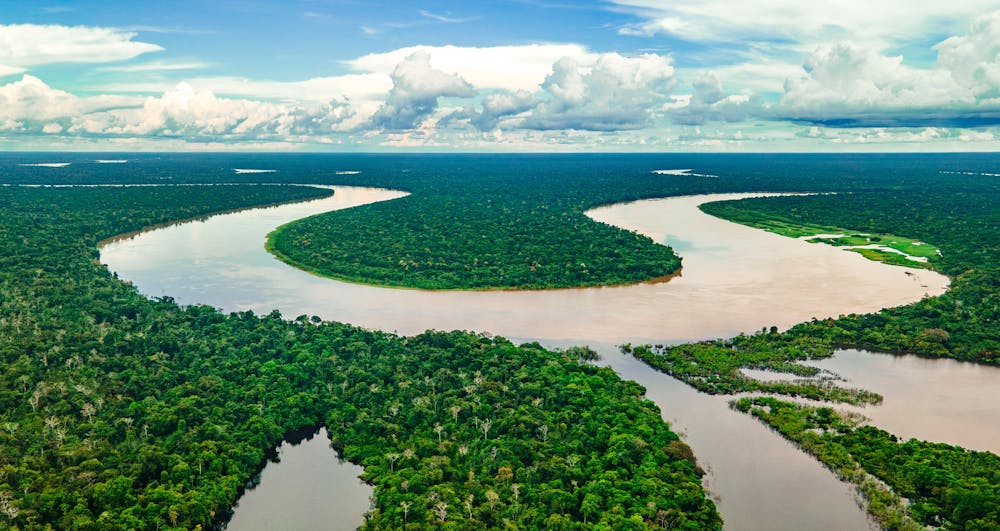
Colombia hosts 18% of the world’s bird species – more than any other country.Ariboen / shutterstock
The city of Cali, in Colombia, is hosting the UN’s 16th biodiversity summit, known as Cop16. The summit, which runs until Friday, November 1, is focused on how countries will fulfil previous pledges to protect at least 30% of the world’s land and water and restore 30% of degraded ecosystems by 2030.
It’s a noble aim, yet Colombia itself shows just how far we have to go.
If you travel south east from Cali, over the Andes mountains, you drop into the Amazon basin. From there, rainforest stretches for hundreds of kilometres to the border with Brazil – and far beyond. This rainforest is the main reason Colombia ranks as the fourth most biodiverse country in the world. Nowhere else has as many species of birds. Only Brazil and China have more trees.
But the region is experiencing an environmental crisis. I recently completed a PhD on the northern Colombian Amazon, in which I tracked how the rainforest is fast being deforested and turned into pastures for cattle ranches. I particularly looked at how this affects hotspots of plant and animal life in rugged valleys on the Amazonian side of the Andes – spectacularly biodiverse places even by Colombian standards – and looked at what can be done to protect them.
This is not an easy part of the world in which to do such work – the NGO Global Witness ranks Colombia as the single most dangerous country for environmental defenders. While documenting legal and illegal cattle ranching, I was often reminded to be aware of exactly who I was contacting and to be wary of which questions I was asking.
Activists and researchers often face violence from those who profit from deforestation, and I had to work closely with organisations and authorities that secured own safety. Very harrowing experiences are not uncommon.
Despite these risks, many continue their efforts, driven by a deep commitment to protecting the Amazon and its biodiversity. Their bravery only underscores the urgent need for stronger protections and enforcement.
Peace led to more deforestation
For decades, the region was mostly controlled by the Farc guerrilla army. The Farc was largely funded by kidnappings and the drug trade, and wasn’t interested in large-scale farming.
All this changed after the government of Colombia signed a peace agreement with the Farc in 2016. Since then, deforestation has increased, as both legal and illegal land tenants have acquired land for farming through what they call “sustainable development” practices. This mostly involves turning forest into pasture for cattle, the main driver of deforestation across Latin America.
Cattle ranches are the main driver of deforestation. Jordi Romo / shutterstock
Things peaked in 2018, when 2,470 square kilometres of forest was lost in Colombia – equivalent to a circular area more than 50 kilometres across. Rates of deforestation have reduced slightly since then (though the data isn’t very reliable), but appear to be increasing once again in 2024.
The recent increase might be attributed to the demand to produce more coca or rear more cattle, along with pressure from extractive industries like mining. The spread of roads and other infrastructure further into the rainforest have also opened up new opportunities.
Billions more needed to stop deforestation
In its 2018 Living Forest Report, the WWF included Colombia’s Chocó-Darién and Amazon forests in its list of 11 “deforestation fronts” across the planet. These fronts are where it projected the largest concentrations of forest loss or severe degradation would occur in the period till 2030.
No wonder then that Colombia’s environmental crisis has drawn international attention. Countries like Germany, Norway and the UK have supported its efforts to reduce deforestation, pledging about €22 million under the UN’s reducing emissions from deforestation and forest degradation scheme (known as REDD+). This is a good start, but much more is needed.
The Amazon winds through dense forest on the border between Colombia and Peru. Jhampier Giron M / shutterstock
Indeed, the Global Biodiversity Framework, the international treaty that underlies the Cop16 negotiations in Cali, estimates we’ll need an extra US$700 billion each year to protect biodiversity.
An important issue at the summit is therefore how to mobilise sufficient financial resources, particularly for developing countries. The previous global biodiversity summit, held in Canada in 2022, established that wealthy countries should provide US$30 billion annually to low-income countries by 2030.
Ahead of this year’s summit, countries were expected to submit new national biodiversity plans detailing how they’ll meet the 30% protection goals. Most failed to do so – including Colombia. Despite this setback, delegates in Cali will hopefully develop robust mechanisms to monitor progress and ensure countries are held accountable for meeting their targets.
Other critical issues include reforms to benefit small-scale farmers in the Amazon. The region’s current economic model is centred on reshaping the land and extracting resources, but it has not generated prosperity for these more sustainable farmers. That same economic model has also failed to protect the forest itself.
The summit should also work towards recognising indigenous peoples’ rights and traditional knowledge, and including their voices in policy decisions, and must address violence against environmental defenders.
These are all huge issues in Colombia and indeed any country where cattle farmers are eyeing up pristine rainforest. The summit in Cali represents a great opportunity for the world to seriously tackle the dual biodiversity and climate crisis.
Don’t have time to read about climate change as much as you’d like?
Americans will soon elect their next president after a race for the White House that is essentially tied. From a marketing perspective, think of Republican Donald Trump and Democrat Kamala Harris as each holding 45 per cent market share. The remaining 10 per cent includes undecided voters and people disinclined to vote.
My political marketing class at the University of Windsor is using a marketing lens to understand the variables that will influence the outcome on Nov. 5. My recent road trip to the battleground state of Pennsylvania gave me insight into the strength of both the Democratic and Republican brands.
I am viewing the parties as long-established brands. There is brand loyalty to both parties. Those brands’ current success, however, is influenced by the ongoing campaign.
In terms of the Democratic Party, voters obviously aren’t being asked to buy it, but they are being asked to buy the party as augmented or diminished by Harris, its current presidential candidate. The same can be said for Trump’s Republican party.
From a marketing perspective, we can monitor promotional efforts that include traditional media, social media, debates, interviews and rallies, and we receive updates on the parties’ fundraising efforts — essentially a promotional budget. We’ll see the results of these efforts on Nov. 5.
Predicting results
This is the third time I’ve offered a political marketing course based on an American presidential election. The class focuses on understanding the core party brands, and the impact of candidates, debates, media coverage and Political Action Committees. Students forecast the election results the day before the election.
The presidency is not decided by the national popular vote. It is a state-by-state competition, with each state assigned votes in the Electoral College. There are 538 Electoral College votes, so 270 are needed to win.
Most states are predictable. California will undoubtedly vote Democrat (54 votes); Texas will more than likely vote Republican once again (40 votes). The election therefore comes down to seven swing states: Nevada, Arizona, Georgia, North Carolina, Wisconsin, Michigan and Pennsylvania.
The Democrats, with 226 safe Electoral College votes, have 20 possible routes to 270 — and 19 of them require a Pennsylvania win. Republicans, with 219 safe Electoral College votes, have 21 possible routes to 270 — 19 also require a Pennsylvania win. That’s why I decided to drive through Pennsylvania and speak to voters.
First I went to Erie, a bellwether county with a long history of having the same voting pattern as the full state of Pennsylvania, so it’s a strong predictor of statewide results. I went to a Pittsburgh suburb, and then to the borough of State College, home of Penn State University. I periodically left the interstate to drive through other towns to see the signs, grab lunch and talk.
Each time, my introduction was simple:
“I’m a marketing professor from Canada running a class about the U.S. presidential election. Would you mind explaining to me how you think Pennsylvania will vote? I do not need to know how you will vote.”
The university students I spoke to were juniors and seniors. Other than the students, the people I spoke to would be considered working class, a mix of blue collar and white collar. The non-students were 35 to retirement age. Everyone I spoke said they’d voted in the 2022 mid-term election and intended to vote this year.
At an Erie car show, voters I interviewed were evenly split between a group of 50-plus men with vintage cars and male university students with newer vehicles. I heard from both groups that Pennsylvania was divided, but that the mood between the parties differed.
Both argued that people voting Democrat were brand-loyal or rejecting the Trump brand. Both age groups, including Democratic voters, noted that Trump supporters were primarily focused only on him as the current Republican brand offering.
Economic concerns
Most said the biggest issue that will most influence undecided voters is the economy, followed closely by a more narrow economic concern — inflation.
One Democrat conveyed a simple message that was representative. Asked who would take Erie County: “Democrats.” Asked why they would win, he replied: “I’m just hoping.”
Contrast that with a visit to a diner in Erie. One woman explained that she supports Harris because of reproductive rights. Everyone else backed Trump because of his policies on the economy, the southern border, international wars and crime.
One diner patron had been to a recent Trump rally in Erie. He described it as a rock concert and spoke of the excitement, and hearing Trump say the exact same lines he always says. “It was your favourite rock band playing their hits,” he said.
I left Erie understanding that Democrats were brand loyal or voting to avoid Trump. Republicans, however, never referenced past voting or leaders. They were simply Trump supporters.
The Pittsburgh scene
Pittsburgh was a bust. I chose the wrong town outside Pittsburgh. While I spoke to dozens of voters in Erie, I found only two people to speak to in Smithton.
State College was different. My hotel was close to Penn State University, and there was a restaurant/sports bar on the hotel property.
I entered at 4 p.m. The bartender asked why I was in town. A nearby patron said that he would answer questions. Then another person volunteered. I left seven hours later. People were asking to be next.
I spoke to people from all political spectrums. Of the 40-plus people I spoke with, one couple illustrated the mood in the state particularly well. She is a Republican. He is a Democrat. He explained: “There is too much going on — inflation, the hurricanes, the Longshoremen strike, steel and fracking, illegal immigration. Too much.”
He shrugged his shoulders, discouraged. She smiled, eager for Election Day.
Conclusions from talking to voters
If the election were held today, I believe Republicans would win Pennsylvania based on my conversations with voters. But that could change if there is a change in one of the key topics: strong or unanticipated positive economic news, perhaps, or if a new issue or story develops that has not yet impacted the race.
The road trip provided insights into voter decision-making. It highlighted the importance of brand loyalty and enthusiasm. A substantial portion of voters indicated they wished both parties had different leaders. This could impact voter turnout.
It also illuminated a key difference between traditional consumer decision-making and voter decision-making. If, on Black Friday, I prefer Walmart’s offering over Amazon’s, I am not impacted by my neighbour’s purchase decision.
In politics, however, how my neighbour votes will influence my life for the next four years.
Dave Bussiere does not work for, consult, own shares in or receive funding from any company or organisation that would benefit from this article, and has disclosed no relevant affiliations beyond their academic appointment.
New science experiments for NASA are set to launch aboard the agency’s SpaceX 31st commercial resupply services mission to the International Space Station. The six investigations aim to contribute to cutting-edge discoveries by NASA scientists and research teams. The SpaceX Dragon spacecraft will liftoff aboard the company’s Falcon 9 rocket from Launch Complex 39A at NASA’s Kennedy Space Center in Florida.
Science experiments aboard the spacecraft include a test to study smothering fires in space, evaluating quantum communications, analyzing antibiotic-resistant bacteria, examining health issues like blood clots and inflammation in astronauts, as well as growing romaine lettuce and moss in microgravity.
Developing Firefighting Techniques in Microgravity
Putting out a fire in space requires a unique approach to prioritize the safety of the spacecraft environment and crew. The SoFIE-MIST (Solid Fuel Ignition and Extinction – Material Ignition and Suppression Test) is one of five investigations chosen by NASA since 2009 to develop techniques on how to contain and put out fires in microgravity. Research from the experiment could strengthen our understanding of the beginning stages of fire growth and behavior, which will assist in building and developing more resilient space establishments and creating better plans for fire suppression in space
NASA astronaut Jessica Watkins services components that support the SOFIE (Solid Fuel Ignition and Extinction) fire safety experiment inside the International Space Station’s combustion integrated rack Credit: NASA
Combating Antibiotic Resistance
Resistance to antibiotics is as much of a concern for astronauts in space as it is for humans on Earth. Research determined that the impacts of microgravity can weaken a human’s immune system during spaceflight, which can lead to an increase of infection and illness for those living on the space station.
The GEARS (Genomic Enumeration of Antibiotic Resistance in Space) investigation scans the orbiting outpost for bacteria resistant to antibiotics and these organisms are studied to learn how they thrive and adapt to microgravity. Research results could help increase the safety of astronauts on future missions as well as provide clues to improving human health on Earth.
A sample media plate pictured aboard the International Space Station. The GEARS (Genomic Enumeration of Antibiotic Resistance in Space) investigation surveys the orbiting laboratory for antibiotic-resistant organisms. Genetic analysis could provide knowledge that informs measures to protect astronauts on future long-duration missions Credit: NASA
Understanding Inflammation and Blood Clotting
Microgravity takes a toll on the human body and studies have shown that astronauts have had cases of inflammation and abnormally regulated blood clotting. The MeF-1 (Megakaryocytes Orbiting in Outer Space and Near Earth: The MOON Study (Megakaryocyte Flying-One)) investigation will conduct research on how the conditions in microgravity can impact the creation and function of platelets and bone-marrow megakaryocytes. Megakaryocytes, and their progeny, platelets, are key effector cells bridging the inflammatory, immune, and hemostatic continuum.
This experiment could help scientists learn about the concerns caused by any changes in the formation of clots, inflammation, and immune responses both on Earth and during spaceflight.
A scanning electron-microscopy image of human platelets taken at the NASA Space Radiation Laboratory NASA Space Radiation Laboratory
Building the Space Salad Bar
The work continues to grow food in the harsh environment of space that is both nutritious and safe for humans to consume. With Plant Habitat-07, research continues on ‘Outredgeous’ romaine lettuce, first grown on the International Space Station in 2014.
This experiment will sprout this red lettuce in microgravity in the space station’s Advanced Plant Habitat and study how optimal and suboptimal moisture conditions impact plant growth, nutrient content, and the plant microbiome. The knowledge gained will add to NASA’s history of growing vegetables in space and could also benefit agriculture on Earth.
Pace crop production scientist Oscar Monje harvests Outredgeous romaine lettuce for preflight testing of the Plant Habitat-07 experiment inside a laboratory at the Space Systems Processing Facility at NASA’s Kennedy Space Center in Florida NASA/Ben Smegelsky
Mixing Moss with Space Radiation
ARTEMOSS (ANT1 Radiation Tolerance Experiment with Moss in Orbit on the Space Station) continues research that started on Earth with samples of Antarctic moss that underwent simulated solar radiation at the NASA Space Radiation Lab at Brookhaven National Lab in Upton, New York.
After exposure to radiation some of the moss samples will spend time on the orbiting outpost in the microgravity environment and some will remain on the ground in the 1g environment. ARTEMOSS will study how Antarctic moss recovers from any potential damage from ionizing radiation exposure when plants remain on the ground and when plants grow in spaceflight microgravity. This study leads the way in understanding the effects of combined simulated cosmic ionizing radiation and spaceflight microgravity on live plants, providing more clues to plant performance in exploration missions to come.
An example of moss plants grown for the ARTEMOSS mission Credit: NASA
Enabling Communication in Space Between Quantum Computers
The SEAQUE (Space Entanglement and Annealing Quantum Experiment) will experiment with technologies that, if successful, will enable communication on a quantum level using entanglement. Researchers will focus on validating in space a new technology, enabling easier and more robust communication between two quantum systems across large distances. The research from this experiment could lead to developing building blocks for communicating between equipment such as quantum computers with enhanced security.
A quantum communications investigation, called SEAQUE (Space Entanglement and Annealing Quantum Experiment), is pictured as prepared for launch to the International Space Station on NASA’s SpaceX 31st commercial resupply services mission. The investigation is integrated on a MISSE-20 (Materials International Space Station Experiment) device, which is a platform for experiments on the outside of space station exposing instrumentation directly to the space environment. SEAQUE will conduct experiments in quantum entanglement while being exposed to the radiation environment of space Credit: NASA
Related resources:
NASA’s Biological and Physical Sciences Division pioneers scientific discovery and enables exploration by using space environments to conduct investigations not possible on Earth. Studying biological and physical phenomenon under extreme conditions allows researchers to advance the fundamental scientific knowledge required to go farther and stay longer in space, while also benefitting life on Earth.
Annual NLCD arrived October 24, 2024, with a new ability to look at land cover and land change year by year, and over a longer time span than previous versions: from 1985 to 2023.
Two years of effort went into the reinvention of a resource that’s widely used by federal agencies, state and local governments, researchers and many others. NLCD has contributed to a foundation of data essential for land monitoring, planning and decision-making.
While Annual NLCD focuses on the ground, it relies on data captured 438 miles up. Satellites in the Landsat Program provide the long time series of data that allows users of Annual NLCD to compare change over time such as city growth, wildfire effects and forest fluctuations.
Previously, NLCD offered land cover information every two to three years from 2001 to 2021. Annual NLCD offers land cover information for every year for nearly four decades and has a shorter production time going forward. The new October release, called Annual NLCD Collection 1.0, includes information from the previous year for the lower 48 United States, just as the update in 2025 will include information from 2024.
Upgrading ‘Built-in, Foundational Layer’
Annual NLCD, produced at the USGS Earth Resources Observation and Science (EROS) Center, is part of a larger suite of land cover mapping and monitoring data produced by the Multi-Resolution Land Characteristics (MRLC) consortium, a group of federal agencies that coordinate and generate consistent and relevant land cover information at the national scale.
The new “Annual” part of NLCD comes in response to the needs of people who use NLCD data. As Earth Observation Applications Coordinator for the USGS National Land Imaging Program, it’s Zhuoting Wu’s job to know what kinds of Earth observation products are valued most by federal agencies.
Through a survey, Wu discovered: “NLCD is the most widely used observation product we surveyed. People use it pretty much for everything. It goes into models or applications as a built-in, foundational layer.”
Terry Sohl, Chief of the Integrated Science and Applications Branch at EROS, agreed. “The user community is so extensive,” he said. “There are so many federal agencies that absolutely rely on it, whether it’s the Bureau of Land Management, whether it’s the Environmental Protection Agency for regulatory concerns, whether it’s Fish and Wildlife for habitat management, or whether it’s Health and Human Services. It’s hard to find an agency that does not use NLCD.”
However, in the federal survey from Wu, users did express the desire for annual updates produced more quickly.
In the meantime, another EROS-led land cover project arose to provide annual land cover and change information stretching back to 1985. However, Land Change Monitoring, Assessment and Projection (LCMAP), first released in 2020, did not contain as much detail about land cover types as NLCD, especially in urban and forested areas.
Wu said users found NLCD useful for its classification detail and LCMAP for its frequency, but “a combination of the two really gets the needs met.” That combination is Annual NLCD.
The USGS EROS Center’s production of the Annual National Land Cover Database (NLCD) involves Terry Sohl, Chief of the Integrated Science and Applications Branch; Physical Scientist Jon Dewitz; and Research Geographer Jesslyn Brown.
Evolution of NLCD Leads to ‘Touching Every Landsat Pixel’
Work on the original NLCD product began well before high performance computing and cloud computing could provide automation. Processes have changed since Annual NLCD team member Jon Dewitz spent two years leading field work nearly 20 years ago to figure out which land classes should be labeled where.
“Making a land cover map from scratch is very different than developing an algorithm,” Dewitz said.
That hard-earned information proved foundational to the progression of NLCD, however; processes for each data release grew more automated over time. “This has been a gradual evolution,” Dewitz said. “It’s another magnitude of effort to produce Annual NLCD because are we touching every Landsat pixel.”
That “magnitude of effort” might be stating it mildly. The number of Landsat pixels processed for Annual NLCD numbered 295 trillion, from a total of 310 terabytes of Landsat data used.
The task of creating Annual NLCD required new methods involving a lot of research and development, along with engineering.
One improvement that helped the team produce Annual NLCD in just two years was the ability to process the vast amount of imagery in the cloud alongside the Landsat data. “That is enabling us to make things faster,” said Jesslyn Brown, the Annual NLCD project manager, compared to previously having to move the imagery to a supercomputer for processing.
Deep Learning Key to Development
Deep learning is another technological advantage the team leveraged for processing. Deep learning is a type of artificial intelligence that uses large amounts of data and, like the human brain, learns to recognize patterns—in imagery, for example—to solve problems or make predictions. This was especially important for Annual NLCD because datasets that helped with past NLCD land cover decisions didn’t go as far back as 1985.
The six different Annual NLCD science products, with examples all shown of the Marysville, Washington, area.
“We had to rely a lot more on the spectral imagery and also on deep learning to do a better job of inferring what’s happening in the Landsat imagery,” Dewitz said. “Deep learning really did a great job of linking all of that data together.”
EROS Center Director Pete Doucette has long been an advocate for the use of data science to help solve scientific challenges. “Annual NLCD is blazing the trail as among the first generation of operational products at EROS that incorporate deep learning methods to improve performance,” Doucette said. “And I believe that we’re just getting started with where we can take machine learning methods at EROS.”
Rylie Fleckenstein, the Research and Development (R&D) technical lead for Annual NLCD and a contractor at EROS, looked at previous methods for producing NLCD and LCMAP to help determine the new Annual NLCD process—“moving away from the hand editing, so to speak, and incorporating algorithms or different approaches to automate the process.”
That production process included a change detection component, like LCMAP had, to determine where and when change had occurred on the landscape, and also a classification component to determine the type of land cover in an area. Some refinement was necessary in areas with trickier or inaccurate classifications.
The resulting new release contains a suite of six products associated with land cover and change:
Land Cover: The predominant land cover class
Land Cover Change: The change between one year and the next
Land Cover Confidence: The probability value for the land cover class
Fractional Impervious Surface: The amount of area covered by artificial surfaces like pavement or concrete
Impervious Descriptor: The differentiation between roads and other artificial surfaces
Spectral Change Day of Year: The timing of a significant change in Landsat data
Team Met Challenges During ‘Intense Two Years’
Brown estimated about 30 people have been involved in producing Annual NLCD. That includes scientists and engineers involved in the research and production stages, and also those collecting reference data to check for errors and validate the results.
Dewitz praised the team for all they accomplished in the two-year timeframe. “The R&D team was challenged and pushed, and they performed wonderfully,” he said.
The engineering side had to do much of their work while R&D was still going on. “Thankfully we have an excellent engineering team,” Dewitz said. “They worked in pieces and did kind of a hybrid engineering process.”
Sohl, the EROS science chief, thinks the infrastructure developed to produce Annual NLCD should be helpful for other science projects, too.
“This has been an intense two years,” Sohl said. “I’m just so proud of the team. They have worked so hard, and they performed a minor miracle in terms of completely revamping the methodology and moving all of the technology into the cloud. Now that we have this infrastructure set up, it really facilitates the next level of improvements for Annual NLCD.”
Improvements Helpful for Heat and Flooding Studies
Annual NLCD is national in scope, but on a local level, it fills the need that cities or other entities have for detailed and accurate land cover information that spans decades.
George Xian, a research physical scientist at EROS, is grateful that Annual NLCD has arrived so he can start using it in his urban heat island work. He is in the midst of expanding his study of trends in changing average surface temperatures and hotspot locations from 50 to 300 U.S. cities.
This type of information is important for cities to know because they can develop plans to help residents cope during periods of extreme heat, which can cause illness or death in vulnerable populations.
For the 50-city study, Xian and his colleagues needed the annual land cover data beginning with 1985 that LCMAP provided, but also the more detailed information about paved surfaces, concrete and rooftops—collectively called impervious surfaces, which typically retain more heat—contained in NLCD. “We had to use a so-called hybrid way to integrate NLCD and LCMAP to gather the data for this four-category urban area and also annual change,” Xian said.
The Annual National Land Cover Database (NLCD) is produced at the USGS EROS Center, which is located in a rural area north of Sioux Falls. Sioux Falls has steadily grown in size and population, as seen here in red in an Annual NLCD animation spanning nearly 40 years. Annual NLCD provides four different developed classes to provide more detailed information about cities.
For the expanded study with more than 300 cities from 1985 to 2023, Xian said, “we can use Annual NLCD to directly define our urban categories into four categories. We can study their variations and their variation impact to the urban heat island. We can directly pull the data into our algorithm and use it. We don’t need to regenerate the data.”
Ryan Corcoran is looking forward to using Annual NLCD as well. He serves as the Coordinated Needs Management Strategy (CNMS) team lead at Niyam IT, which is part of the Advancing Resilience in Communities joint venture that provides planning, engineering and mapping support for FEMA’s Zone 1. One aspect that Corcoran and his colleagues work with involves checking whether flood studies of river and coastal areas remain valid after a period of time, or whether conditions have changed and require a new study.
In the past, Corcoran said they have had to use multiple data sources, including NLCD, for baseline watershed information and to assess annual changes.
“We are excited about the upcoming expansion of the NLCD. It will make it easier for us to calculate baseline watershed imperviousness and land use changes using a single dataset,” Corcoran said. “The availability of this extensive data is critical, as we sometimes validate flood studies that date back to the 1970s. Increased data availability allows us to better evaluate flood risk, especially when validating older flood studies.”
More Access to Annual NLCD Data
Annual NLCD users have more options to access the data than before. The data is still available on the MRLC website, but it also has been added to the cloud and to the USGS EROS data access site EarthExplorer.
“We’re trying to respond to people’s requests for data in all kinds of different ways,” said Brown, the Annual NLCD project manager.
The data will be updated more frequently, too. “In the past, it’s usually taken over a year, if not more, to do an NLCD update,” said science branch chief Sohl. “We’re setting the stage where, by the middle of every year, we’re going to have an update for the previous year.”
Annual NLCD is providing more useful information more quickly for the people relying on it—which, as it turns out, might be most of us, with NLCD’s history as a key source of data woven into the background of society.
“Annual NLCD represents the next generation of highly accurate mapping information that keeps pace with evolving user needs,” said EROS Director Doucette. “Annual NLCD products will become increasingly relevant toward assessing land use and land condition. They provide key change indicators for understanding environmental interactions and consequences. These are the kinds of things that decision makers ultimately want to know.”
The University of Connecticut celebrated its outstanding faculty, staff, students, and community partners at the annual Provost’s Awards Ceremony held this month. The event recognized exceptional contributions to UConn’s academic mission, innovative research, and community engagement, highlighting the remarkable impact these individuals and groups have made within the University and beyond.
Provost Anne D’Alleva, who hosted the ceremony, opened the event by reflecting on the significance of honoring those who have made a lasting difference at UConn. “This evening, we celebrate the achievements of individuals whose dedication and innovation inspire us all. Their work enhances UConn’s reputation as a top public research institution, while also enriching the lives of our students, their fields of study, and the communities we serve.”
Among the honorees were faculty who excelled in teaching, research, and service, as well as community partners whose collaborations with UConn have had a profound impact on local communities. The ceremony also highlighted students for their leadership and commitment to community engagement and staff members for their dedicated service in support of student success.
The evening featured special recognitions, including the Alumni Faculty Excellence Award, Provost’s Outstanding Service Award, and the Provost’s Award for Excellence in Community Engaged Scholarship, which acknowledges outstanding contributions to addressing critical community issues through collaborative efforts. The ceremony concluded with a celebration of the Board of Trustees Distinguished Professor awardees, UConn’s highest faculty honor, including Dr. Nora Berrah, Dr. Ki H. Chon, and Dr. Crystal L. Park, whose pioneering work in their respective fields has brought distinction to UConn.
A full listing of the honorees is below.
Alumni Faculty Excellence Award
Kari Adamsons, Human Development and Family Sciences
Senjie Lin, Marine Sciences
Annamaria Csizmadia, Human Development and Family Sciences
Provost’s Outstanding Service Award
Caroline Dealy, UConn Health
Steve Zinn, Animal Science
Michael Finiguerra, Marine Sciences
Provost’s Award for Excellence in Community Engaged Scholarship
Dan Burkey, Chemical & Biomolecular Engineering (Distinguished Faculty Instructor)
Tatiana Andreyeva, Agricultural and Resource Economics (Emerging Faculty Community Impact)
Angela Bermúdez-Millán, Public Health Sciences (Distinguished Faculty Community Impact)
Roman Shrestha, Allied Health Sciences (Emerging Faculty Research Scholar)
Richard Pomp, Law (Distinguished Faculty Research Scholar)
Erin Cova, UConn School of Medicine (Graduate Student)
Letian Sun, Undergraduate Student
Megan Delaney, School of Pharmacy
Community Partners
Erica Fearn, 4-H Education Center at Auerfarm
Herb Virgo, Keney Park Sustainability Project
Mashantucket Pequot Tribal Nation, accepted by Jeremy Whipple, Executive Director of Department of Agriculture
Institutional Impact
UConn Writing Center, accepted by Tom Deans, Director
Nadine Brennan, David Embrick, Cynthia Miranda-Donnelly, Janice Castle, and Kim Schwarz, Research on Resilient Cities, Racism, & Equity Initiative (RRCRE)
Dr. K. Brad Stamm to Retirefrom Board of Directors
ARCHBOLD, Ohio, Oct. 24, 2024 (GLOBE NEWSWIRE) — F&M Bank (“F&M”), an Archbold, Ohio-based bank owned by Farmers & Merchants Bancorp, Inc. (Nasdaq: FMAO), announced updates to its Board of Directors. On October 22, 2024, Kevin Frey was appointed to the Board of Directors of both the Company and the Bank. In addition to this new appointment, F&M announced the retirement of Dr. K. Brad Stamm from the Board of Directors.
“On behalf of F&M’s Board of Directors, I am thrilled to welcome Kevin to our team. With deep roots in our legacy market and a wealth of experience as Vice President of Frey & Sons, he brings invaluable insights that will strengthen our connection to the communities we serve,” said F&M’s Chairman Andrew Briggs. “We look forward to his contributions as we continue to grow while staying true to the values guiding F&M for generations.”
Frey is the Vice President of Frey & Sons, Inc., a family-owned real estate brokerage and auction company that was incorporated in 1963 and is headquartered in Archbold, Ohio. Frey is the Principal Broker and lead Auctioneer for Frey & Sons. The company specializes in real estate auctions and sales in Northwest Ohio and heavy equipment auctions across the Midwest. Frey also manages a portfolio of multifamily, commercial, and agricultural properties and is a member of the Board of Directors for Yoder & Frey, Inc., a farm and machinery auction yard. Frey received a Bachelor of Arts in accounting from Goshen College and worked as a Certified Public Accountant from 1996-2003. He is a member of the National Association of Realtors, Ohio Association of Realtors, National Auctions Association, and Ohio Auctioneers Association.
Dr. Stamm joined the Board in November of 2016 and served with distinction throughout his tenure. He is the President and Educational Consultant of Stamm Management Group. A celebration in honor of Dr. Stamm’s contributions was held on October 22, 2024. His final day as a Board member will be October 25, 2024.
“Brad has been an instrumental part of our Board for nearly eight years, and his dedication and leadership will be greatly missed,” said President and CEO of F&M, Lars Eller. “We wish him all the best and express our deepest gratitude for his service to F&M.”
About F&M Bank: F&M Bank is a local independent community bank that has been serving its communities since 1897. F&M Bank provides commercial banking, retail banking and other financial services. Our locations are in Butler, Champaign, Fulton, Defiance, Hancock, Henry, Lucas, Shelby, Williams, and Wood counties in Ohio. In Northeast Indiana, we have offices located in Adams, Allen, DeKalb, Jay, Steuben and Wells counties. The Michigan footprint includes Oakland County, and we have Loan Production Offices in West Bloomfield, Michigan; Muncie, Indiana; and Perrysburg and Bryan, Ohio.
Safe harbor statement Private Securities Litigation Reform Act of 1995. Statements by F&M, including management’s expectations and comments, may not be based on historical facts and are “forward-looking statements” within the meaning of Section 27A of the Securities Act of 1933, as amended, and Section 21B of the Securities Exchange Act of 1934, as amended. Actual results could vary materially depending on risks and uncertainties inherent in general and local banking conditions, competitive factors specific to markets in which F&M and its subsidiaries operate, future interest rate levels, legislative and regulatory decisions, capital market conditions, or the effects of the COVID-19 pandemic, and its impacts on our credit quality and business operations, as well as its impact on general economic and financial market conditions. F&M assumes no responsibility to update this information. For more details, please refer to F&M’s SEC filing, including its most recent Annual Report on Form 10-K and quarterly reports on Form 10-Q. Such filings can be viewed at the SEC’s website, www.sec.gov or through F&M’s website www.fm.bank.
Company Contact:
Investor and Media Contact:
Lars B. Eller President and Chief Executive Officer Farmers & Merchants Bancorp, Inc. (419) 446-2501 leller@fm.bank
Andrew M. Berger Managing Director SM Berger & Company, Inc. (216) 464-6400 andrew@smberger.com
Company to launch a new health and wellness business intended to expand existing lines of business and take advantage of established distribution channels.
Haverford, PA, Oct. 24, 2024 (GLOBE NEWSWIRE) — Investview, Inc. (OTCQB: INVU), a diversified financial technology company that through its subsidiaries and global distribution network provides financial technology, education tools, content, research, and a digital asset technology company, which develops, operates, and supports blockchain technologies, with a focus on the Bitcoin blockchain ecosystem and the generation of digital assets, announced today that it has recently completed the acquisition of Renu Laboratories, Inc., a manufacturer of proprietary and other health, beauty and wellness products (“Renu Labs”). The terms of the acquisition were not disclosed.
“This acquisition is an exciting milestone for our company’s strategic growth plans,” said Victor Oviedo, Investview CEO. “The combination of Renu Labs with our existing businesses is intended to further support our mission and vision at Investview to create and offer unique quality of life (QoL) products and services to help people realize their greatest potential through better financial literacy, technology and accessibility, blockchain sustainability, and now a personal health and wellness lifestyle.”
Strategic rationale behind the merger:
Victor Oviedo, Investview CEO commented, “through its principal and Founder, Gregg Hanson, an experienced veteran in the industry, Renu Labs has been able to develop a catalog of proprietary and third-party skin, body, hair, nutritional supplement, and personal care products. Following the Company’s integration of the Renu Labs business, the Company plans to operate through a unique B2C direct-to-consumer marketing and product sales delivery model under its newly formed myLife Wellness business unit. We expect that the combination of the Renu Labs business with our global network marketing model will enable us to expand and enhance our customer retention and increase the value of the Company’s iGenius global network to its affiliates and customers.”
“Our sales force and consumers are expected to benefit from commercialization of the Renu Labs unique proprietary wellness products namely, Renu by myLife Wellness “advanced peptide wrinkle corrector serum,” “eye lift and tuck serum,” and its “high potency advanced day and night peptide and collagen renewal serum” for both woman and men.”
Jim Bell, Investview President/ COO added, “the Renu acquisition is a great addition to the Company in multiple ways. It not only adds a proven brand and a collection of proprietary health and wellness products, but most importantly, from a strategic perspective, it positions us to take the first step in the planned diversification of the Company’s business into the expanding health and wellness markets while taking advantage of our existing national and international distribution channels to do so.”
“Furthermore”, Mr. Bell added, “we were looking for just the right partner to form the platform for our strategic growth initiative. With Renu Labs’ nearly three decades of experience in the health and wellness space, we believe Gregg Hanson and Renu Labs are the right partners. It is our expectation that the myLife Wellness/Renu platform will not only enhance our future financial results but will also help consumers achieve a better personal health and wellness lifestyle which aligns with our Company’s Mission and Vision.”
Investview expects the Renu acquisition to be revenue accretive as early as the 4th quarter of 2024 – 1st quarter 2025.
Underlying the expected synergies are the following factors:
Expanded Product Line: Renu Labs’ advanced peptide serums and personal care products are expected to complement Investview’s iGenius platform, enhancing customer offerings.
Market Expansion: Investview’s iGenius subsidiary has more than 15,000 global customers and members, including more than 17,000 alumni of the same, creating an attractive, immediate cross-selling opportunity.
Operational Synergies: The merger in conjunction with the Company’s capital investment will enhance product development and innovation and is expected to increase recurring revenue through the Company’s existing direct-to-consumer model.
Proven Industry Expertise: Renu Labs has over 30 years’ experience as a recognized OTC skin care manufacturer specializing in private label and contract manufacturing of high-quality skin, body and hair care and other OTC products, and operates as an FDA-registered and cGMP-compliant facility.
Gregg Hanson, Founder and President of Renu Labs commented, “Joining forces with Investview marks a pivotal moment for us. This partnership will allow us to accelerate innovation and to bring more unique, high-quality wellness products to the global health and wellness market. At Renu Labs, we have worked to create and offer innovative high quality proprietary skin, body and hair care wellness products for our customers. We are excited to be part of a larger organization that shares the same commitment to our core customer values. Together, we plan to accelerate our innovation and offer more unique quality of life (QoL) health and wellness products to our customers, while also closely integrating our products and marketing with the already robust iGenius sales and marketing network. That is good news for Renu customers, suppliers and employees.”
Victor Oviedo concluded, “We are consistently taking a diversified approach to our innovation, strategic partnerships, global expansion and corporate citizenship to fuel sustainable, long-term growth, which we strive for and seek to achieve year-over-year. We believe that the strength of our balance sheet and cash position, along with our consistent focus on our core fundamentals, will generate sustainable long-term value for all stakeholders.”
About Investview, Inc.
Investview, Inc., a Nevada corporation, operates a financial technology (FinTech) services company, offering several different lines of business, including a Financial Education and Technology business that delivers a series of products and services involving financial education, digital assets and related technology, through a network of independent distributors; and a Blockchain Technology and Crypto Mining Products and Services business, including leading-edge research, development and FinTech services involving the management of digital asset technologies with a focus on Bitcoin mining and the new generation of digital assets. In addition, we are in the process of creating a Brokerage and Financial Markets business within the investment management and brokerage industries by, among others, commercializing on a proprietary trading platform we acquired in September 2021. For more information on Investview, please visit: www.investview.com.
Forward-Looking Statement
All statements in this release that are not based on historical fact are “forward-looking statements” within the meaning of Section 27A of the Securities Act of 1933 and Section 21E of the Securities Exchange Act of 1934. Forward-looking statements, which are based on certain assumptions and describe our future plans, strategies, and expectations, can generally be identified by the use of forward-looking terms such as “believe,” “expect,” “may,” “should,” “could,” “seek,” “intend,” “plan,” “goal,” “estimate,” “anticipate” or other comparable terms. These forward-looking statements are based on Investview’s current beliefs and assumptions and information currently available to Investview and involve known and unknown risks, uncertainties and other factors which may cause the actual results, performance, or achievements of the Company to be materially different from any future results, performance or achievements expressed or implied by these forward-looking statements. Our forward-looking statements expect, among others, that we will be able to integrate the historic operations of Renu on a timely basis and in the absence of unexpected delays or difficulties, that Renu will be able to increase the scale and scope of its operations and product offerings beyond its historic levels through use of our expansion capital and by taking advantage of our existing sales and marketing channels. We plan to do this by, among others, investing the funds we believe are necessary to develop at Renu the infrastructure necessary to achieve these goals. This includes, among others, the on-boarding of additional sales, marketing, customer support and product development personnel, and the development and implementation of a corresponding marketing strategy. Despite our best efforts, there can be no assurance that we will be able to achieve these objectively on a timely basis, if at all, as there can be no assurances that we will be able to expand Renu’s historic scope and scale of operations, and absent such expansion, the acquisition would only be modestly accretive, if at all. More information on potential factors that could affect Investview’s financial results is included from time to time in Investview’s public reports filed with the U.S. Securities and Exchange Commission, including the Company’s most recent Annual Report on Form 10-K, Quarterly Reports on Form 10-Q, and Current Reports on Form 8-K. The forward-looking statements made in this release speak only as of the date of this release, and Investview, Inc. assumes no obligation to update any such forward-looking statements to reflect actual results or changes in expectations, except as otherwise required by law.
Investor Relations Contact: Ralph R. Valvano Phone Number: 732.889.4300 Email: pr@investview.com
Source: United Kingdom – Executive Government & Departments
Biomass is the first satellite that will study the world’s forests in 3-dimensions.
Biomass. Credit: Airbus
The Biomass mission will provide crucial information about the state of our forests and how they are changing. The data will be used to further our knowledge of the role forests play in the carbon cycle.
Biomass will quantify the global carbon cycle which is essential to understanding many of the dramatic changes taking place in the Earth system, particularly those resulting from the burning of fossil fuel and land-use change.
As a result, Biomass observations will support the initiative for the reduction of emissions due to deforestation and forest degradation.
Biomass will have global coverage and produce one map every 6 months with unprecedented accuracy. It will reduce the current uncertainties in the amount of carbon stored in forests and how this changes with time, providing vital information to support decision making around climate change. Observations from this new mission will also lead to better insight into rates of habitat loss and the impact this may be having on biodiversity in the forest environment.
Biomass is also a part of the European Space Agency’s (ESA) Earth Explorer missions which focuses on the atmosphere, biosphere, hydrosphere, cryosphere and the Earth’s interior with the overall aim of learning more about the interactions between these components and the impact that human activity is having on natural Earth processes.
Biomass is due to launch in 2025 on a Vega-C rocket from Kourou in French Guiana. The mission is planned to be 5-years long.
How is the UK involved?
Biomass is being built in the UK by Airbus.
The UK has invested in the ESA Earth Observation Envelope Programme – EOEP-3, EOEP-4, and EOEP-5 programmes.
The lead scientist is Professor Sean Quegan based in the University of Sheffield, Airbus are leading the build, and other significant stakeholders in the mission are ESA, Nammo (propulsion), Astrotech (propulsion), and Enersys ABSL (batteries).
Source: Peter the Great St Petersburg Polytechnic University – Peter the Great St Petersburg Polytechnic University –
On October 24, a delegation from SPbPU headed by the rector of the university, academician of the Russian Academy of Sciences Andrey Rudskoy visited the Republic of Armenia. The key moments were meetings at the National Academy of Sciences of the Republic of Armenia and the Russian-Armenian University.
The delegation of the Polytechnic University visited the National Academy of Sciences of the Republic of Armenia (NAS RA). The history of scientific and educational cooperation between Armenia and St. Petersburg goes back several centuries.
Today we see the successful development of cooperation between scientific organizations and scientists of the Republic of Armenia and the Russian Federation. Your visit is another step in strengthening joint work. We already have experience of working together in various fields of science, and today we will consolidate our partnership with an agreement that will supplement the previously signed document on scientific and technical cooperation, – President of the NAS RA Ashot Sagyan greeted his colleagues.
Continuing the traditions of such interaction, SPbB RAS and NAS RA, as well as SPbPU and NAS RA signed an agreement on scientific and technical cooperation. It covers a wide range of areas, including natural, mathematical and technical sciences, as well as life sciences.
The St. Petersburg Branch of the Russian Academy of Sciences is actively developing international cooperation, which is one of the key areas of our activities. This year, the agreements of the SPbB RAS and SPbPU with the National Academy of Sciences of the Republic of Armenia will be an important step towards strengthening scientific ties with Armenia, with which we are united by a long history of cooperation and common scientific interests, Andrey Rudskoy emphasized.
Particular attention will be paid to agrobiotechnology and agricultural sciences, astrophysics, physical and chemical research. Joint projects in social, humanitarian and applied sciences are also planned, which will contribute to strengthening scientific ties and technological development between the countries.
The agreements signed today are intended to make a significant contribution to expanding the interaction between the academic and university communities and will allow our scientists to jointly solve complex problems and adapt the accumulated potential to new realities, noted Ambassador Extraordinary and Plenipotentiary of the Russian Federation to the Republic of Armenia Sergey Kopyrkin.
During the visit, representatives of SPbPU visited the Russian-Armenian University (RAU), with which the university has had long-standing friendly and partnership relations.
Since signing a strategic partnership agreement in 2014, RAU and SPbPU have been actively developing joint initiatives in the fields of education, science and youth programs. Over these ten years, the universities have organized numerous joint research projects, conferences and educational projects that facilitated the exchange of experience and knowledge between students and teachers.
It should be emphasized that the activities envisaged by the comprehensive “Roadmap” of cooperation between SPbPU and RAU cover a wide range of activities and many areas of interest to both educational institutions. Within the framework of this strategic partnership, projects are being implemented in such key areas as physics, telecommunications, biomedicine, bioinformatics, economics, PR and linguistics. Particular attention is paid to the introduction of advanced methods and educational practices into the RAU curriculum.
For these reasons, the Polytechnic delegation in Yerevan was quite impressive: SPbPU Rector Andrey Rudskoy, Vice-Rector for International Affairs Dmitry Arsenyev, Professor of the Institute of Biomedical Systems and Biotechnology Olga Vlasova, Head of the Project Office “Slavic Universities” and Deputy Head of the International Cooperation Department Nikita Golovin, Director of the Center for Continuing Professional Education PISh CI and Program Director of “Boiling Point – Polytechnic” Sergey Salkutsan, as well as a number of other leading SPbPU experts.
The program of the visit began with a tour of the campus of the Russian-Armenian University. The rector of SPbPU got acquainted with the scientific and educational laboratories of the Institute of Biomedicine and Pharmacy, the Engineering Physics Institute, the Cast laboratory of the Institute of Mathematics and Informatics, as well as modern socially-oriented spaces.
RAU is a shining example of how science and education can be effectively combined, creating conditions for training highly qualified specialists who are in demand on the labor market, shared Andrey Rudskoy.
Andrey Rudskoy paid special attention to the project to create a “green campus”, which includes the generation of electricity using solar panels placed on the university’s territory.
This is not just a step towards environmental sustainability, but also an opportunity for RAU to become energy independent and even share excess energy with external consumers, Andrey Ivanovich emphasized.
One of the most striking joint events, the results of which can already be observed, is the methodological support for the creation of the youth space “Boiling Point” at RAU. The two universities actively developed the concept of this space, formulating tasks for the RAU development team. The logical conclusion of the year’s work was the grand opening of the Representative Office of “Boiling Point – Polytech” at RAU on October 24.
The opening of the youth space “Boiling Point” at RAU is not just the end of our joint work, but the beginning of a new era for students, where their ideas and aspirations will find support and development. We are proud to see how our efforts are becoming a reality, and we are confident that this space will become a source of inspiration for future leaders, – Andrey Rudskoy spoke at the opening ceremony.
After the excursion, a meeting was held with the management of RAU and the heads of RAU research groups implementing joint projects with SPbPU. The participants presented the results of current initiatives: four network educational programs were developed and implemented, participation in dissertation councils was organized, and more than forty joint scientific papers were published.
We are watching the progress of your university and can say that, despite all the difficulties, RAU continues to move forward. Each new project, each event is a step towards the campus becoming not only a cozy home for students, but also a place where ideas are born that can change the world. We must join forces to develop this university together, which already today meets world standards, – noted Andrey Rudskoy.
Scientific conferences on current topics are held annually, and professors from both universities participate in the mutual program “Invited Professor”. Colleagues also discussed tasks for the near future.
Cooperation between our universities is not just an exchange of experience, it is an opportunity to create something new and significant for our society, Andrey Ivanovich is confident.
At the meeting, SPbPU Rector Andrey Rudskoy and RAU Rector Edward Sandoyan signed an updated agreement on strategic partnership between SPbPU and RAU, as well as a Roadmap for the implementation of joint events between SPbPU and RAU aimed at supporting youth initiatives and developing student communities.
Over the past two years, there has been a significant influx of students. Despite the difficulties, we continue to develop. In order to move forward, we need to adapt to new conditions and change our expectations, said Edward Sandoyan.
We were pleased to renew the strategic partnership agreement that was signed on September 11, 2014. We cannot lose historical memory. The second document signed is a roadmap for the implementation of joint events to support youth initiatives. We have created a cozy corner for our youth, and despite the modest conditions, it has become a beautiful and warm place. In the future, we have the opportunity to expand and hold events, – Andrey Rudskoy summed up.
In anticipation of the visit of the SPbPU delegation headed by Andrey Rudskoy, leading professors and experts of St. Petersburg held a number of events aimed at developing student communities at RAU. Deputy Director of the Center for Continuing Professional Education “Digital Engineering” of the Advanced Engineering School of SPbPU Pavel Kozlovsky, Deputy Head of the Youth Policy Department of SPbPU Georgy Kvekveskiri, Director of the Center for Continuing Professional Education of the PISh CI and Program Director of “Boiling Point – Polytech” Sergey Salkutsan held an accelerator, which was attended by more than 20 representatives of the RAU Student Council and such RAU associations as a large experimental workshop, an intellectual club, and a sports community.
The accelerator participants considered the issues of creating and developing student communities, their positioning, forming a working internal structure, attracting and adapting new participants, as well as the topic of continuity of the community’s asset. Georgy Kvekveskiri made a report on the activities of the Youth Policy Department (YPD) of SPbPU, which managed to build an adaptive model of working with student communities at the university.
The last day of the accelerator was dedicated to forming the image of communities for three years and creating a work program until the end of 2025 (the “Roadmap”, which was signed by the rectors of the two universities). The community accelerator was the first event within the framework of the activities of the new youth space – the Representative Office of “Boiling Point – Polytech” at RAU.
The head of the training simulators department of the Center for Continuing Professional Education of the Advanced Engineering School “Digital Engineering” Vladislav Tereshchenko held training events and competitions for RAU students on the “Lean Manufacturing” simulator, which is part of CML-Bench platforms.I’m on my way. The event was attended by 1st and 3rd year students majoring in Economics. Three winners received the right to speak at the Winter University in Engineering Sciences at SPbPU in November of this year.
The guys really liked the game. We plan to implement it in the educational process in several disciplines. It seems to me that the game allows us to objectively assess the degree of economic thinking in the guys, to check all the skills and competencies of students majoring in economics. I also really liked this simulator. I would gladly play it myself, – shared Mariam Voskanyan, Head of the Department of Economics and Finance of the Institute of Economics and Business of the Russian Agrarian University.
Leading specialists from SPbPU organized lectures and seminars at RAU on physics, telecommunication technologies and biomedical systems. Director of the Higher School of Biomedical Systems and Technologies Olga Vlasova held a seminar on “Optogenetic (chemogenetic) modulation of metabotropic receptors of astrocytes restores cognitive functions in mice with a model of Alzheimer’s disease”. Head of the Laboratory of Microencapsulation and Controlled Delivery of Biologically Active Compounds Alexander Timin presented a seminar on the development of antitumor drugs in encapsulated and free form based on small molecules for the treatment of malignant neoplasms. Professor of the Higher School of Applied Physics and Space Technologies Sergey Makarov told Armenian students about spectrally effective signals.
The joint work of SPbPU and RAU continues to bring tangible results, strengthening educational and scientific ties between the two universities and making a significant contribution to the development of higher education in Russia and Armenia.
Please note: This information is raw content directly from the source of the information. It is exactly what the source states and does not reflect the position of MIL-OSI or its clients.
Source: United States House of Representatives – Congressman Andy Kim (NJ-03)
WILLINGBORO, N.J. – Yesterday, Congressman Andy Kim (NJ-03) hosted a telephone town hall to hear directly from neighbors and share updates from his recent work in Congress, including raising awareness during National Bully Awareness Month and addressing the nationwide mental health crisis.
To begin his 80th town hall, Congressman Kim highlighted his continued efforts to address youth mental health needs and close gaps to accessing care and resources. In recognition of National Bullying Awareness Month, he was joined by Jessica Smedley, LPC and Director of Counseling for West Windsor/Plainsboro Regional School District, who spoke about the role of school counselors to provide proactive mental health and academic support, collective efforts to prevent violence and bullying in schools, and resources available to students and families.
Congressman Kim spoke about his continued work in Congress to address the shortage of mental healthcare resources and workers, including voting to pass the largest gun violence prevention legislative package in 30 years that secured investment in programs to expand mental health and support services in schools as well as securing $1,000,000 to construct a new behavioral health clinic to serve children in Burlington County. He also addressed his “kids agenda” in Congress to combat child poverty with the Child Tax Credit, expand students’ access to nutritious meals, and deliver support to vulnerable communities, including direct support for LGBTQ+ youth.
He also provided updates from his tour yesterday along the Northeast Corridor with NJ Transit and Amtrak leadership where he saw the successful progress of the Gateway Tunnel Project and urged the importance of continued upgrades and investigations to deliver the safe and reliable public transit New Jersey deserves.
The Congressman answered questions from neighbors about issues on their mind, including his efforts to combat corruption, including through legislation to end the dominance of big money in politics, deliver mental health support to children with minority identities, and incentivize building to expand access to affordable housingoptions in New Jersey as well as provide emergency housing resources, like a new homeless shelter in Burlington County that he was able to secure funding for in 2022.
To sign up for more updates from Congressman Kim, including the location and time of his next town hall, click here.
Congressman Kim is the Ranking Member on the Military Personnel Subcommittee, and a member of the House Armed Services Committee, the Foreign Affairs Committee, and the House Select Committee on Strategic Competition between the United States and the Chinese Communist Party. More information about Congressman Kim’s accessibility, his work serving New Jersey’s 3rd Congressional District, and information on newsletters and his monthly town halls can be found on his website by clicking here.
Headline: Disaster Recovery Centers to Close in Ascension, Assumption Parishes
Disaster Recovery Centers to Close in Ascension, Assumption Parishes
BATON ROUGE, La. –Disaster Recovery Centers (DRCs) serving Louisiana survivors of Hurricane Francine in Gonzales and Napoleonville will close at 5 p.m. Friday, Oct. 25.The Gonzales center (Ascension Parish) is located at Lamar Dixon Expo Center, 9039 St. Landry Road, Gonzales, LA 70737.The Napoleonville center (Assumption Parish) is located at Assumption High School, North Building, 4880 Hwy 308, Napoleonville, LA 70390.Additional locations in Lafourche, Jefferson, St. John the Baptist, St. Mary and Terrebonne parishes are open. To find the DRC nearest to you, visit DRC Locator (fema.gov).The centers will operate from 8 a.m. to 5 p.m., Monday through Saturday.Residents in all nine parishes can visit any DRC to meet with representatives of FEMA, the U.S. Small Business Administration, along with other community partners. No appointment is needed to visit the center. The centers are accessible to people with disabilities or access and functional needs and are equipped with assistive technology. If you need a reasonable accommodation or sign language interpreter, please call 833-285-7448 (press 2 for Spanish).You do not have to visit a center to apply for FEMA disaster assistance. The quickest way to apply is by going online at disasterassistance.gov/.Additional options when applying include:Download the FEMA App for mobile devices. Call the FEMA helpline at 800-621-3362 between 6 a.m. and 11 p.m. Help is available in most languages. If you use a relay service, such as video relay (VRS), captioned telephone or other service, give FEMA your number for that service.To view an accessible video about how to apply visit: Three Ways to Register for FEMA Disaster Assistance – YouTube.For the latest information visit fema.gov/disaster/4817. Follow FEMA Region 6 social media at X.com/FEMARegion6 or on Facebook at facebook.com/femaregion6. alexa.brown Thu, 10/24/2024 – 15:35
Discovery of regenerative process could aid in treating human gastrointestinal diseases
Humans aren’t capable of regrowing limbs like some salamanders or full organs like some snails and zebrafish, but we do renew some of our cells, including the absorptive lining of our intestines. In contrast to the relatively minor turnover of cells seen in human intestines, some snakes, including boas and pythons, undergo extensive regenerative transformation of their intestine upon feeding. New research supported by the U.S. National Science Foundation has found that the method these snakes use to renew their guts, while different from the process humans use for regular cell renewal, is similar to mechanisms observed in mammalian wound healing and to how human intestines respond to a particular form of gastric bypass. This discovery increases researchers’ understanding of intestinal physiology and could have applications in treating metabolic and gastrointestinal disorders like diabetes and celiac disease, and possibly even cancer.
Humans regularly renew intestinal cells by activating stem cells found in microscopic caverns in the intestinal wall known as intestinal crypts. Boas and pythons don’t have these crypts but regenerate their intestines after feeding in one of the most extreme examples of intestinal regeneration found in the animal kingdom — from shrunken and nearly non-functioning to double the size and with a rebuilt structure capable of digesting and absorbing their meal. The new research solved key elements of the mystery of how these snakes accomplished this feat, finding that it involves the unique coordination of pathways also present in humans. It also involves many of the signaling pathways observed in humans after a Roux-en-Y gastric bypass procedure, which is used to aid in weight loss and treat type 2 diabetes.
“By determining the mechanisms that control this fascinating phenomenon in snakes, we can now work to understand the role those mechanisms play in modulating human intestinal regenerative capacity, metabolic reprogramming and responses to Roux-en-Y gastric bypass, which may direct future targeting of drugs to manipulate these responses,” said Todd Castoe, corresponding author and a professor at The University of Texas at Arlington. “This could eventually provide treatments for the millions of people living with diabetes and celiac, Crohn’s disease, colitis and other gastrointestinal diseases, and may also provide new perspectives for treatment of gastrointestinal cancers.”
The U.S. National Science Foundation, in collaboration withEvery Page Foundation(EPF), is excited to announce 22 women science leaders as the 2024 NSF-EPF Ocean Decade Champions.
Each champion is associated with a project funded by the NSF Coastlines and People (NSF CoPe) program and receives a monetary award to support leadership activities, networking opportunities, technical and communications training and cross-disciplinary and intercultural scientific endeavors.
NSF CoPe is endorsed by the United NationsDecade of Ocean Science for Sustainable Development,also known as the Ocean Decade, which aims to promote ocean health and ensure any development efforts are sustainable and informed by science. The initiative’s10 Decade Challengesinclude a fair representation of women and other underrepresented groups in ocean science and decision-making.
The champions contribute to CoPe projects focused on coastline and community research that integrates natural and social processes and creates new or adapts existing technologies to bolster coastal resilience. The champions excel in their research and prioritize mentoring others and positively impacting society.
NSF and EPF, along with support fromPanorama Global, contributed over half a million dollars to support the careers of these leading women. Each awardee received support ranging from $20,000 to $50,000.
The 2024 NSF-EPF Ocean Decade Champions
Lynette Adams Black in Marine Science NSF Award Number: 2209284 Lynnette Adams is a director of development leading initiatives that bridge science, community and advocacy while centering joy as a driving force for equity and inclusion in marine biology.
Wai Allen Arizona State University NSF Award Number: 2103843 Wai Allen (Diné/Navajo) is a postdoctoral researcher exploring the interface between systems of Western science and Indigenous knowledge that converge to help Indigenous communities actualize their self-determination through Indigenous data sovereignty and governance in the geosciences.
Sharon Alston Norfolk State University NSF Award Number: 2209139 Sharon Alston is an associate professor of social work, researching risk and resilience among youth in public housing and exploring the career aspirations of African American youth.
Rebecca Asch East Carolina University NSF Award Number: 2052889 Rebecca Asch is a fisheries oceanographer researching interactions between fish reproduction, fish early life history, plankton ecology, climate change and climate variability.
Natasha Batista Stanford University NSF Award Number: 2209284 Natasha Batista is a marine spatial analyst and researcher investigating blue carbon modeling, ecosystem service valuations, community-based management and co-developed nature-based solutions.
Mona Behl University of Georgia NSF Award Number: 1940082 Mona Behl is an associate director of Georgia Sea Grant, and her research focuses on building climate adaptation and broadening participation in geosciences and workforce readiness.
Marilyn Brandt University of the Virgin Islands NSF Award Number: 2209284 Marilyn Brandt is a research associate professor studying the characteristics and impacts of coral reef diseases and using insights from her work to create effective strategies for coral conservation and restoration.
Lisa Carne Fragments of Hope NSF Award Number: 2209284 Lisa Carne founded Fragments of Hope, a community-based organization restoring coral reef habitats in 2013 after conducting coral reef research in Belize and witnessing the area’s vulnerability to hurricanes and rising sea temperatures.
Jade Delevaux Seascape Solutions NSF Award Number: 2209284 Jade Maeva Delevaux is a natural resource management specialist who works with decision-makers, local communities and nongovernmental organizations across the Pacific and the Caribbean to co-develop place-based solutions.
Allie Durdall University of the Virgin Islands NSF Award Number: 2209284 Allie Durdall is a marine and environmental scientist dedicated to coastal systems — mangroves, seagrass beds and salt ponds — who prioritizes fostering camaraderie among women and minorities in science.
Anne Guerry Stanford University NSF Award Number: 2209284 Anne Guerry is a scientist who studies the relationship between people and nature. She works on coastal resilience, marine planning, natural capital assessments and ecosystem services.
Sucharita Gopal Boston University NSF Award Number: 2209284 Sucharita Gopal is a multidisciplinary researcher who uses spatial analysis and modeling, GIS, data mining, information visualization and artificial neural networks to address various problems in biology, environmental science, public health and business.
Cindy Grace-McCaskey East Carolina University NSF Award Number: 2209284 Cindy Grace-McCaskey is an applied environmental anthropologist who uses qualitative, quantitative and participatory methods to examine the multiple ways social and natural systems interact with and influence one another and what that means for equitable resource management, adaptation and governance.
Kristin Grimes University of the Virgin Islands NSF Award Number: 2209284 Kristin Grimes is a research assistant professor who studies human impacts on nearshore environments. She focuses on mangrove ecosystems and is interested in how community-driven science approaches can improve restoration, education and stewardship outcomes.
Jamie Melvin Elizabeth River Project NSF Award Number: 2209139 Jamie Melvin is an engagement coordinator who develops and implements thoughtful and equitable programming at the Elizabeth River Project’s new Ryan Resilience Lab to engage with Norfolk’s diverse communities and coordinate the Knitting Mill Creek EcoDistrict.
Laura Moore University of North Carolina NSF Award Number: 1939447 Laura Moore is a professor researching how low-lying coastlines respond to climate change, emphasizing understanding the interactions between human activities and natural processes.
Tiara Moore Black in Marine Science NSF Award Number: 2209284 Tiara Moore is a CEO dedicated to promoting diversity and involvement in science through her research on biodiversity and efforts to increase participation in science through innovative methods such as environmental DNA and community engagement.
Shouraseni Sen Roy University of Miami NSF Award Number: 2209284 Shouraseni Sen Roy is a geographer working on the long-term spatial-temporal patterns of climate processes, trends and impacts in the “global south,” incorporating geospatial analysis techniques.
Diamond Tachera Rising Voices Center for Indigenous and Earth Sciences,NSF National Center for Atmospheric Research NSF Award Number: 2103843 Diamond Tachera is a kanaka ‘ōiwi (Native Hawaiian) and co-director whose research is driven by the Indigenous knowledge of her kūpuna (ancestors); she uses modern hydrogeochemical techniques to investigate the relationships between ʻāina (land), wai (water) and kānaka (people).
Nikki Taylor-Knowles University of Miami NSF Award Number: 2209284 Nikki Traylor-Knowles is a cell biologist whose research is dedicated to unraveling the evolution of immunity, wound healing and regeneration. She seeks to apply her research to conservation efforts.
Maya Trotz University of South Florida NSF Award Number: 2209284 Maya Trotz is a professor whose research covers water quality, water source protection and water provision for sustainable communities. She works with partners in the United States and the Caribbean on ridge-to-reef nature-based solutions.
Jingya Wang University of Delaware NSF Award Number: 2209190 Jingya Wang is a postdoctoral researcher focused on studying decision-making under deep uncertainties and strategies for adapting to climate change. She specializes in making risk-informed decisions to adapt systems to evolving conditions.
Rebecca Zarger University of South Florida NSF Award Number: 2209284 Rebecca Zarger is an environmental anthropologist working at the intersection of environmental knowledge and social justice to address coastal futures, climate change and youth informal science education.
The Tibetan Plateau’s glaciers are among the world’s most remote and untouched places. Researchers say these ice fields provide water for millions of people and play a vital environmental role.
Now, geoscientists funded by the U.S. National Science Foundation have tracked pollution in the form of lead in the glaciers. The findings are reported in the journal Nature Communications Earth and Environment.
The Tibetan Plateau is often called the “Roof of the World.” It’s the highest and largest plateau on Earth. In a study of the Guliya Ice Cap there, Franco Marcantonio of Texas A&M University and his colleagues discovered that significant lead pollution of the ice cap began in 1974, with the highest levels between 2000 and 2007.
The team measured lead isotopes in samples dating to 36,000 years ago. The ice serves as a historical record, giving scientists a way of comparing levels of modern lead contamination to those of pre-industrial times.
“Even though Pb [lead] has been used by ancient civilizations for millennia, it was not until the Industrial Revolution and later, when leaded gasoline was introduced … in the 1920s, that the emission of Pb from human activities skyrocketed,” state the scientists in their paper. “By the 1980s, emissions surpassed their natural and pre-industrial contribution by about two orders of magnitude.”
The Tibetan Plateau “is considered to be a pristine place due to the very low industrial activity in the region,” write the researchers. Nonetheless, lead found its way there, and its history of human use was captured in the Guliya Ice Cap.
“This study advances our understanding of the breadth and timing of environmental impacts from human activities,” says Margaret Fraiser, a program director in the NSF Division of Earth Sciences.
NASA has awarded $15.6 million in grant funding to 15 projects supporting the maintenance of open-source tools, frameworks, and libraries used by the NASA science community, for the benefit of all. The agency’s Open-Source Tools, Frameworks, and Libraries awards provide support for the sustainable development of tools freely available to everyone and critical for the goals of the agency’s Science Mission Directorate. “We received almost twice the number of proposals this year than we had in the previous call,” said Steve Crawford, program executive, Open Science implementation, Office of the Chief Science Data Officer, NASA Headquarters in Washington. “The NASA science community’s excitement for this program demonstrates the need for sustained support and maintenance of open-source software. These projects are integral to our missions, critical to our data infrastructure, underpin machine learning and data science tools, and are used by our researchers, every day, to advance science that protects our planet and broadens our understanding of the universe.” This award program is one of several cross-divisional opportunities at NASA focused on advancing open science practices. The grants are funded by NASA’s Office of the Chief Science Data Officer through the agency’s Research Opportunities for Space and Earth Science. The solicitation sought proposals through two types of awards:
Foundational awards: cooperative agreements for up to five years for open-source tools, frameworks, and libraries that have a significant impact on two or more divisions of the Science Mission Directorate. Sustainment awards: grants or cooperative agreements of up to three years for open-source tools, frameworks, and libraries that have significant impact in one or more divisions of the Science Mission Directorate.
2024 awardees are: Foundation awards:
NASA’s Ames Research Center, Silicon Valley, California
Principal investigator: Ross Beyer
“Expanding and Maintaining the Ames Stereo Pipeline”
Caltech, Pasadena, California
Principal investigator: Brigitta Sipocz
“Enhancement of Infrastructure and Sustained Maintenance of Astroquery”
Cornell University, Scarsdale, New York
Principal investigator: Ramin Zabih
“Modernize and Expand arXiv’s Essential Infrastructure”
NASA’s Goddard Space Flight Center, Greenbelt, Maryland
Principal investigator: D. Cooley
“Enabling SMD Science Using the General Mission Analysis Tool”
NumFOCUS, Austin, Texas
Principal investigator: Thomas Caswell
“Sustainment of Matplotlib and Cartopy”
NumFOCUS
Principal investigator: Erik Tollerud
“Investing in the Astropy Project to Enable Research and Education in Astronomy”
Sustainment awards:
NASA’s Jet Propulsion Laboratory, Southern California
Principal investigator: Cedric David
“Sustain NASA’s River Software for the Satellite Data Deluge,” three-year award
Pennsylvania State University, University Park
Principal investigator: David Radice
“AthenaK: A Performance Portable Simulation Infrastructure for Computational Astrophysics,” three-year award
United States Geological Survey, Reston, Virginia
Principal investigator: Trent Hare
“Planetary Updates for QGIS,” one-year award
NASA JPL
Principal investigator: Michael Starch
“How To F Prime: Empowering Science Missions Through Documentation and Examples,” three-year award
NASA Goddard
Principal investigator: Albert Shih
“Enhancing Consistency and Discoverability Across the SunPy Ecosystem,” three-year award
Triad National Security, LLC, Los Alamos, New Mexico
Principal investigator: Julia Kelliher
“Enhancing Analysis Capabilities of Biological Data With the NASA EDGE Bioinformatics Platform,” four-year award
iSciences LLC, Burlington, Vermont
Principal investigator: Daniel Baston
“Sustaining the Geospatial Data Abstraction Library,” three-year award
University of Maryland, College Park,
Principal investigator: C Max Stevens
“Sustaining the Community Firn Model,” three-year award
Quansight, LLC, Austin, Texas
Principal investigator: Dharhas Pothina
“Ensuring a Fast and Secure Core for Scientific Python – Security, Accessibility and Performance of NumPy, SciPy and scikit-learn; Going Beyond NumPy With Accelerator Support,” three-year award
For information about open science at NASA, visit: https://science.nasa.gov/open-science -end- Alise FisherHeadquarters, Washington202-617-4977alise.m.fisher@nasa.gov
During the fall 2024 semester, two final year Family Nurse Practitioner (FNP) students in the School of Nursing received funds from the CVS Health Caring Hearts Student Scholarship Program to help further their education thanks to Dr. Annette Jakubišin Konicki. At $10,000 each, this scholarship was awarded to Melody Len LoPreiato ’25 (NUR) and John Sklepinski ’25 (NUR), who are both pursuing an MS in Nursing with a concentration in family practice.
Today’s family nurse practitioners (FNPs) provide comprehensive patient-focused primary and acute care to individuals across the lifespan — from infants to the elderly. Their focus includes delivering preventive health care services for both acute and chronic conditions, requiring them to diagnose and treat illnesses, perform routine checkups, oversee health-risk assessments, and offer counseling services.
FNPs generally work in practices that focus on women’s health, family practice, pediatrics, and internal medicine. Often FNPs are found in outpatient settings like independent practice clinics, women’s health centers, and community health clinics.
The Family Nurse Practitioner (FNP) online Master of Science (MS) and Doctor of Nursing Practice (DNP) program at UConn prepares advanced practice nurses to assess, diagnose, monitor, treat, and coordinate the care of individuals across the lifespan and across primary and acute illnesses.
The program is designed for licensed registered nurses who currently hold a bachelor’s degree in nursing and aspire to become advanced practice nurses.
“I am grateful and deeply honored to be a recipient of the CVS Caring Heart Scholarship,” says Len LoPreiato. “This generous support is making a significant impact on my studies, especially as I navigate through some personal and family challenges. The funds will be used to help cover my NP educational costs. Since enrolling in the program, I have significantly reduced my normal working hours and covering my educational expenses has been challenging to say the least. Your commitment to supporting students like me inspires hope and motivates me to continue striving for excellence in my education and future career. Thank you for making a difference in my life!”
Sklepinski says, “Receiving this scholarship will have a transformative impact on my journey to becoming a Family Nurse Practitioner. As a student at the University of Connecticut, this opportunity allows me to fully commit to my studies without the heavy burden of financial stress.” He goes onto say, “It grants me the chance to focus entirely on expanding my knowledge, clinical skills, and immersing myself in the advanced training necessary for this role. The support helps me stay on track toward achieving my goal of becoming a well-respected and contributing member in the medical community. I am deeply grateful for this scholarship I’m ready to make a meaningful impact in the lives of my future patients.”
SCOTTSDALE, Ariz., Oct. 24, 2024 (GLOBE NEWSWIRE) — The Rudy R. Miller Instrument Safety Currency Program (ISCP) at Embry-Riddle Aeronautical University, College of Aviation, Prescott Campus, was created and funded by Mr. Miller in 2023, with students receiving simulator time starting in Spring 2024. The ISCP was created to build a curriculum that was compliant with federal regulations for instrument currency. Embry-Riddle’s training experts completed that curriculum which was then reviewed and validated by Embry-Riddle’s Chief Instructor, Ryan Albrecht. Once the process was completed and approved, the curriculum was uploaded into the flight systems for logging and tracking of activity.
Embry-Riddle Aeronautical University, in coordination with the Prescott’s College of Aviation’s Flight Department and Flight Director, Parker Northrup, oversees the administration of the ISCP fund. This program supports flight students in their junior year flight course to maintain the skills they learned in their instrument rating course where focus is spent on learning commercial performance maneuvers and often allows instrument skills to degrade. The ISCP provides simulator time to update the instrument currency as required by Federal Aviation Regulations.
ISCPRECIPIENTS SPRING2024
Christopher Gurule, Aeronautical Science Degree Kaleo Mendoza, Aeronautical Science Degree Joseph Molitor, Aeronautical Science Degree Reza Parva, Aeronautical Science Degree
Parker Northrup, Chair, Flight Department, College of Aviation, Prescott Campus, said “Mr. Rudy Miller’s engagement and generosity are such a valuable addition to what we strive to do with our students. ISCP allows us to selectively reinforce the safety culture that depends on maintaining those skills critical to safe instrument flying
Rudy R. Miller commented, “I would like to thank Parker Northrup and Steve Bobinsky, executive director of philanthropy, for their time plus all their remarkable team members’ assistance in supporting this outstanding program for qualified students. I have really enjoyed working on this project over the past year and plan to stay involved.
“The future is bright regarding all the numerous new projects, expansions, and improvements that Embry-Riddle, Prescott Campus, is executing, from my perspective. I am currently involved in a total of five Embry-Riddle projects with respect to my personal time involvement and various funding capabilities.”
About Embry-Riddle Aeronautical University, Prescott Campus
Embry-Riddle Aeronautical University, Prescott Campus, is organized into four colleges: College of Arts and Sciences, College of Aviation, College of Engineering, and College of Business, Security and Intelligence (the nation’s first), and offers bachelor of science degrees in applied science, aviation, business, computers & technology, engineering, security, intelligence & safety, and space. The Prescott campus also offers master’s degrees in Safety Science, Security & Intelligence, and Cyber Intelligence & Security. The programs in aeronautics, air traffic management, applied meteorology, and aerospace studies are certified by the Federal Aviation Administration (FAA) and is the nation’s first FAA-approved training provider for student airline certification.
About Rudy R. Miller
Mr. Rudy R. Miller, a former member of the U.S. Armed Forces, is an entrepreneur, philanthropist, and investor in numerous industries. Mr. Miller is Chairman, President, and CEO of Miller Capital Corporation, an affiliate of The Miller Group of entities; for more information, including Mr. Miller’s biography, visit www.themillergroup.net.
In 2023, Mr. Miller was selected by Embry-Riddle Aeronautical University to join two influential advisory boards for both the College of Aviation and the College of Business, Security and Intelligence. In addition to joining the advisory boards at Embry-Riddle, he established scholarships for students at both colleges and set up a fund to support simulator training to improve commercial pilot safety, the Rudy R. Miller Instrument Safety Currency Program (ISCP). Mr. Miller instituted the annual Rudy R. Miller Business – Finance Scholarship Program in 2008 to support Arizona State University, W. P. Carey School of Business. Since inception, Mr. Miller has issued three additional ASU scholarships, not included in the annual award process, totaling 23 ASU scholarships to date. Mr. Miller had the honor to serve as a member of ASU’s Dean’s Council of 100, a national group of prominent business executives invited by the Dean to play a leadership role in shaping the future of the W. P. Carey School of Business.
His philanthropic endeavors include support for the non-profit arts community, selective universities, athletic foundations, and veterans’ projects. He is a member-sponsor of the Army Historical Foundation and the National Museum of the U.S. Army located at Fort Belvoir, VA. He served as Chairman of the Advisory Board of Thunderbird Field II Veterans Memorial, Inc. (Tbird2), an organization that honors veterans, from 2018 until March 2024. Mr. Miller developed its aviation scholarship program and process in 2018 and served as the first Chairman of the Scholarship Committee until June 2023. Tbird2 offers scholarships at six colleges, for both veteran and non-veteran students, including two 4-year universities, Embry-Riddle Aeronautical University and Arizona State University, Ira A. Fulton Schools of Engineering.
Embry-Riddle Aeronautical University photographer, Connor McShane, Director of Enrollment Multimedia, 928 777-6912
Miller Capital Corporation Kristina Caylor Vice President Admin & Corporate Controller kcaylor@themillergroup.net 602.225.0505
Keaton S. Ziem Senior Communications Officer ziemk@erau.edu 386.226.4838
Source: The Conversation – UK – By Christopher Hill, Associate Professor (Research and Development), Faculty of Business and Creative Industries, University of South Wales
Nuclear detonations were the backdrop to Teeua and Teraabo’s childhood. By the time the sisters were eight and four, the Pacific island on which they grew up, Kiritimati, had hosted 30 atomic and thermonuclear explosions – six during Operation Grapple, a British series between 1957 and 1958, and 24 during Operation Dominic, led by the US in 1962.
The UK’s secretary of state for the colonies, Alan Lennox-Boyd, had claimed the Grapple series would put Britain “far ahead of the Americans, and probably the Russians too, in super-bomb development”. Grapple, the country’s largest tri-service operation since D-Day, also involved troops from Fiji and New Zealand. It sought to secure the awesome power of the hydrogen bomb: a thermonuclear device far more destructive than the atomic bomb.
Britain’s seat at the top table of “super-bomb development” was emphatically announced in April 1958 with Grapple Y: an “H-bomb” 200 times more powerful than the bomb dropped on Hiroshima in 1945. This remains Britain’s largest nuclear detonation – one of more than 100 conducted by the UK, US and Soviet Union in 1958 alone.
More than six decades later, the health effects on former servicemen based on Kiritimati, as well as at test locations in South and Western Australia, remain unresolved. Greater Manchester’s mayor, Andy Burnham, has called the treatment of UK nuclear test veterans “the longest-standing and, arguably, the worst” of all the British public scandals in recent history.
Over the past year, the life stories of British nuclear test veterans have been collected by researchers, including myself, for an oral history project in partnership with the British Library. Whether from a vantage point of air, land or sea, the veterans all recall witnessing nuclear explosions with startling clarity, as if the moment was seared on to their memories. According to Doug Herne, a ship’s cook with the Royal Navy:
When the flash hit you, you could see the X-rays of your hands through your closed eyes. Then the heat hit you, and it was as if someone my size had caught fire and walked through me. To say it was frightening is an understatement. I think it shocked us into silence.
British servicemen describe their nuclear test experiences. Video: Wester van Gaal/Motherboard.
But what of the experiences of local people on Kiritimati? I have recently interviewed two sisters who are among the few surviving islanders who witnessed the nuclear tests. This is their story.
‘A mushroom cloud igniting the sky’
At the start of Operation Grapple in May 1957, around 250 islanders lived on Kiritimati – the world’s largest coral reef atoll, slap bang in the centre of the Pacific Ocean, around 1,250 miles (2,000km) due south of Hawaii. The island’s name is derived from the English word “Christmas”, the atoll having been “discovered” by the British explorer James Cook on Christmas Eve 1777.
In May 2023, I visited Kiritimati for a research project on “British nuclear imperialism”, which investigated how post-war Britain used its dwindling imperial assets and resources as a springboard for nuclear development. I sought to interview islanders who had remained on the atoll since the tests, including Teeua Tekonau, then aged 68. In 2024, I visited her younger sister, Teraabo Pollard, who lives more than 8,000 miles away in the contrasting surroundings of Burnley, north-west England.
Far from descriptions of fear and terror, both Teeua and Teraabo looked back on the tests with striking enthusiasm. Teraabo recalled witnessing them from the local maneaba (open-air meeting place) or tennis court as a “pleasurable” experience full of “excitement”.
She described having her ears plugged with cotton wool before being covered with a blanket. As if by magic, the blanket was then lifted to reveal a mushroom cloud igniting the night sky – a sight accompanied by sweetened bread handed out by American soldiers. So vivid was the light that Teraabo, then aged four, described “being excited about it being daytime again”.
An Operation Grapple thermonuclear test near Kiritimati, 1957-58. Video: Imperial War Museums.
In view of the violence of the tests, I was struck that Teeua and Teraabo volunteered these positive memories. Their enthusiasm seemed in marked contrast to growing concerns about the radioactive fallout – including those voiced by surviving test veterans and their descendants. As children, the tests seem to have offered the sisters a spectacle of fantasy and escapism – glazed with the saccharine of American treats and Disney films on British evacuation ships.
Yet they have also lived through the premature deaths of family members and, in Teraabo’s case, a malignant tumour dating from the time of the tests. And there have been similar stories from other families who lived in the shadow of these very risky, loosely controlled experiments. Teraabo told me about a friend who had peeked out from her blanket as a young girl – and who suffered from eye and health problems ever since.
‘Only a very slight health hazard’
Kiritimati forms part of the impossibly large Republic of Kiribati – a nation of 33 islands spread over 3.5 million square kilometres; the only one to have territory in all four hemispheres and, until 1995, on either side of the international date line. Before independence from Britain in 1979, Kiribati belonged to the Gilbert and Ellice Island Colony, which in effect made Kiritimati a “nuclear colony” for the purpose of British and American testing.
In 1955, Teeua and Teraabo’s parents, Taraem and Tekonau Tetoa, left their home island of Tabiteuea, a small atoll belonging to the Gilbert group of islands in the western Pacific. They boarded a British merchant vessel bound for Christmas Island nearly 2,000 miles away. Setting sail with new-born Teeua in their arms, the family looked forward to a future cutting copra on Kiritimati’s British coconut plantation.
The scale of this journey, with four young children, was immense. Just how the hundred or so Gilbertese passengers “managed to live [during the voyage] was better not asked”, according to one royal engineer who described a similar voyage a few years later. “There were piles of coconuts everywhere – perhaps they were for both food and drink.”
The Insights section is committed to high-quality longform journalism. Our editors work with academics from many different backgrounds who are tackling a wide range of societal and scientific challenges.
Within two years of their arrival, the family faced more upheaval as mother Taraem and her children were packed aboard another ship ahead of the first three sets of British nuclear tests in the Pacific. Known as Grapple 1, 2 and 3, they were to be detonated over Malden Island, an atoll some 240 miles to the south of Kiritimati – but still too close for the comfort of local residents.
According to Teeua, the evacuation was prompted by disillusioned labourers brought to Kiritimati without their families, who went on strike after learning how much the British troops were being paid. But the islanders’ perspectives do not feature much in the colonial records, which give precedence to British disputes about logistical costs and safety calculations.
The Grapple task force resolved that the safe limit set by the International Commission on Radiological Protection should be reduced, to limit the cost of evacuations. A meeting in November 1956 noted that “only a very slight health hazard to people would arise from this reduction – and that only to primitive peoples”.
Shocking as this remark sounds, it is typical of the disregard that nuclear planners appear to have had, both for Indigenous communities and the mostly working-class soldiers. These lives did not seem to matter much in the context of Britain’s quest for nuclear supremacy. William Penney, Britain’s chief nuclear scientist, had bemoaned how critics during tests in Australia were “intent on thwarting the whole future of the British Empire for the sake of a few Aboriginals”.
Tekonau, Teeua’s father, was one of the 30 or so I-Kiribati people to stay behind on Kiritimati during the Malden tests in May and June 1957. As one of the only labourers to speak English, he had gained the trust of the district commissioner, Percy Roberts, who invited Tekonau to accompany him during inspections of villagers’ houses in Port London, then the island’s only village. On one occasion, Teeua said, the islanders did not recognise her father as he had been given a “flat top” haircut like the Fijian soldiers. “This means he had a nice relationship with the soldiers,” she told me. “Thank God for giving me such a good and clever dad.”
Since the initial tests did not produce a thermonuclear explosion, the task force embarked on further trials between November 1957 and September 1958, known as Grapple X, Y and Z. In view of expense and time, these were conducted on Kiritimati rather than Malden Island – and this time, the residents were not evacuated to other islands. Rather, families were brought aboard ships in the island’s harbour and shown films below deck.
After these tests, the islanders returned to find the large X and Y detonations had cracked the walls of their homes and smashed their doors and furniture. One islander found their pet frigate bird, like so many of the wild birds on Kiritimati, had been blinded by the flash of Grapple Y. No compensation was ever paid to the islanders, although the Ministry of Supply did reimburse the colony for deterioration of “plantation assets”, including £4 for every damaged coconut tree (equivalent to £120 today).
A month before Grapple Y, Teraabo was born. Her earliest and most vivid childhood memories are of the US-led Operation Dominic four years later, by which time evacuation procedures had been abandoned altogether.
This series of tests was sanctioned by Britain in exchange for a nuclear-powered submarine and access to the Nevada Proving Grounds in the US – regarded as pivotal to the future of British weapons technology ahead of the signing of the Test Ban Treaty in October 1963, which would prohibit atmospheric testing.
Dominic’s 24 detonations on Kiritimati – which usually took place after sunset around 6pm, between April and November 1962 – were “awesome”, according to Teraabo. Recalling the suspense as the “tannoy announced the countdown”, she described “coming out of cover [and] witnessing the bomb [as] an amazing experience … When the bomb set off, the brilliance of the light was tremendous.”
Each explosion’s slow expiration would re-illuminate the Pacific sky. One, Starfish Prime, became known as a “rainbow bomb” because of the multi-coloured aurora it produced over the Pacific, having been launched into space where it exploded.
So spectacular were these descriptions that I almost felt I had to suspend disbelief as I listened. At one point in my interview with Teraabo, she leaned in to reassure me that she had no interest in exaggerating these events: “I’m a very proud person,” she whispered, “I would never lie.”
‘In our blood’
More than six decades on from the Grapple tests, I was sitting in Teeua’s kitchen in the village of Tabwakea (meaning “turtle”), near the northern tip of Kiritimati. I had driven here in a Subaru Forester, clapped-out from the many potholes on the island’s main road, itself built by royal engineers over 60 years ago.
Teeua Tekonau in her kitchen during the author’s visit to Kiritimati in 2023. Christopher R. Hill., CC BY
Teeua’s home, nestled down a sand track, had a wooden veranda at the front where she would teach children to read and write under shelter from the hot equatorial sun. Handcrafted mats lined the sand and coral floor, fanning out from the veranda to the kitchen at the back.
The house felt full of the sounds of the local community, from the chatter of neighbours to the laughter of children outdoors. No one could feel lonely here, despite the vastness of the ocean that surrounds Kiritimati.
As Teeua cooked rice and prepared coffee, we discussed the main reason for my visit: to understand the impacts of the nuclear tests on the islanders, their descendents, and the sensitive ecosystem in which they live. Teeua is chair of Kiritimati’s Association of Atomic Cancer Patients, and one of only three survivors of the tests still living on Kiritimati. She pulled up a seat and looked at me:
Many, many died of cancer … And many women had babies that died within three months … I remember the coconut trees … when you drank [from the coconuts], you [were] poisoned.
Both Teeua’s parents and four of her eight siblings had died of cancer or unexplained conditions, she said. Her younger brother, Takieta, died of leukaemia at the age of two in November 1963 – less than a year after Operation Dominic ended. Her sister Teraabo, who discovered a tumour in her stomach shortly after the trials, was only able to have her stomach treated once she moved to the UK in 1981, by which time the tumour had turned malignant.
Teeua’s testimony pointed to the gendered impacts of the nuclear tests. She referred to the prevalence of menstrual problems and stillbirths, evidence of which can be inferred from the testimony of another nuclear survivor, Sui Kiritome, a fellow I-Kiribati who had arrived on Kiritimati in 1957 with her teacher husband. Sui has described how their second child, Rakieti, had “blood coming out of all the cavities of her body” at birth.
A rare military hospital record from 1958 – stored in the UK’s National Archives at Kew in London – also refers to the treatment of a civilian woman for ante-partum haemorrhage and stillbirth, though it is unclear whether this was a local woman or one of the soldier’s wives on the passenger ship HMT Dunera, which visited briefly to “boost morale” after Grapple X.
Members of the Kiritimati Association of Atomic Cancer Patients. Courtesy: Teeua Taukaro., CC BY-ND
Having re-established the Association of Atomic Cancer Patients in 2009, Teeua has continued much of the work that Ken McGinley, first chair of the British Nuclear Tests Veterans Association, did after its establishment in 1983. She has documented the names of all I-Kiribati people present during the tests, along with their spouses, children and other relatives. And she has listed the cancers and illnesses from which they have suffered.
In the absence of medical records at the island hospital, these handwritten notes are the closest thing on the atoll to epidemiological data about the tests. But according to Teeua, concerns about the health effects of the tests date back much longer, to 1965 when a labourer named Bwebwe spoke out about poisonous clouds. “Everyone thought he was crazy,” Teeua recalled.
But Bwebwe’s speculations were lent credibility by Sui Kiritome’s testimony, and by the facial scars she bore that were visible for all to see. In an interview with her daughter, Sui explained how she was only 24 when she started to lose her hair, and “burns developed on my face, scalp and parts of my shoulder”.
In a similar manner to claims made by British nuclear test veterans, Sui attributed her health problems to being rained on during Grapple Y – which may have been detonated closer to the atoll’s surface than the task force was prepared to admit.
When I asked Teeua why her campaigning association was only reformed in 2009, she explained it had been prompted by a visit from British nuclear test veterans who “told us that everyone [involved in the tests] has cancer – blood cancer”. They had been told this in the past but, she said, “we did not believe it. But after years … after our children [also] died of cancer, then we remembered what they told us.”
After some visiting researchers explained to Teeua and the community that the effects of the tests were “not good”, she concluded that “our kids died of cancer because of the tests … That’s why we start to combine together … the nuclear survivors, to talk about what they did to our kids”.
I found Teeua’s testimony deeply troubling: not only because of the suffering she and other families have been through, but in the way that veterans had returned to Kiritimati as civilians, raising concerns among locals that may have lain dormant or been forgotten. The suggestion that radiation was “in her blood” must have been deeply disturbing for Teeua and her community.
But I reminded myself that the veterans who came looking for answers in 2009 were also victims. They made the long journey seeking clues about their health problems, or a silver bullet to prove their government’s deception over the nuclear fallout.
As young men, they were unwittingly burdened with a lifetime of uncertainty – compounded by endless legal disputes with the Ministry of Defence or inconclusive health studies that jarred with their personal medical histories. And, like the islanders, some of these servicemen died young after experiencing agonising illnesses.
The scramble for the Pacific
My research on British nuclear imperialism also sheds light on how imperial and settler colonial perceptions of “nature” shaped how these nuclear tests were planned and operationalised.
British sites were selected on the basis of in-depth environmental research. When searching the site for Britain’s first atomic bomb (the Montebello Islands off the west coast of Australia), surveyors discovered 20 new species of insect, six new plants, and a species of legless lizard.
Monitoring of radioactive fallout from nuclear tests fed into the rise of ecosystem ecologies as an academic discipline. In the words of one environmental specialist on the US tests, it seemed that “destruction was the enabling condition for understanding life as interconnected”.
Since H-bombs would exceed the explosive yield deemed acceptable by Australia, Winston Churchill’s government in the mid-1950s had been forced to look for a new test site beyond Western and South Australia. British planners drew on a wealth of imperial knowledge and networks – but their proposal to use the Kermadec Islands, an archipelago 600 miles north-east of Auckland, was rejected by New Zealand on environmental grounds.
So, when Teeua and her family landed on Kiritimati in 1955, their journey was part of “the scramble for the Pacific”: a race between Britain and the US to lay claim to the sovereignty of Pacific atolls in light of their strategic significance for air and naval power.
The British government archives include some notable environmental “what ifs?” Had the US refused the UK’s selection of Kiritimati because of its own sovereignty claim, then it would have been probable, as Lennox-Boyd, Britain’s colonial secretary, admitted, that “the Antarctic region south of Australia might have to be used” for its rapidly expanding nuclear programme.
Instead, this extraordinary period in global history recently took me to a Victorian mansion in the Lancashire town of Burnley, where I interviewed Teeua’s younger sister, Teraabo, about her memories of the Kiritimati tests.
‘No longer angry’
Teraabo’s home felt like the antithesis of Teeua’s island abode 8,300 miles away: ordered instead of haphazard, private instead of communal, spacious instead of crowded. And our interview had a more detached, philosophical tone.
Teraabo Pollard with her father’s nuclear test veteran medal. Christopher R. Hill., CC BY-ND
Like her sister, Teraabo has worked to raise awareness about the legacy of the nuclear tests, including with the Christmas Island Appeal, an offshoot of the British Nuclear Test Veterans Association that sought to publicise the extent of the waste left on Kiritimati from the nuclear test period.
The appeal succeeded in persuading Tony Blair’s UK government to tackle the remaining waste in Kiritimati – most of which was non-radiological, according to a 1998 environmental assessment. The island was “cleaned up” and remediated between 2004 and 2008, at a cost of around £5 million to the Ministry of Defence. Much of the waste was flown or shipped back to the UK, where 388 tonnes of low-grade radioactive material were deposited in a former salt mine at Port Clarence, near Middlesbrough.
Yet Teraabo’s views have evolved. She told me she is “no longer angry” about the tests, a stark contrast to her position 20 years ago, when she told British journalist Alan Rimmer how islanders had “led a simple life with disease virtually unknown. But after the tests, everything changed. I now realise the whole island was poisoned.”
Whereas the Teraabo of 2003 blamed “the British government for all this misery”, she has since become more reflective. In the context of the cold war and the nuclear arms race, she even told me she could understand the British rationale for selecting Kiritimati as a test site. This seemed a remarkable statement from a survivor who had lost so much.
Over the course of the interview, it became clear Teraabo had grown tired of being angry – and that she had felt “trapped” by the tragic figure she was meant to represent in the campaigns of veterans and disarmers. Each time Teraabo rehearsed the doom-laden script of radiation exposure, she admitted she was also suppressing the joy of her childhood memories.
A turning point for Teraabo seems to have come in 2007, when she last visited Kiritimati and met her sister Teeua. By this time, the atoll’s population was 4,000 – quite a leap from the 300 residents she grew up with. “It is no longer the island I remember,” she said.
The Kiritimati of Teraabo’s memory was neat and well-structured. The one she described encountering in 2007 was chaotic and unkempt. She had come to the realisation that the Kiritimati she had been campaigning for – the pristine, untouched atoll of her parents – had long since moved on, so she should move on with it. The sorrow caused by the test operations would not define her.
Radioactive colonialism
Not long after I left Kiritimati in June 2023, the global nuclear disarmament organisation Ican began researching the atoll ahead of a major global summit to discuss the UN Treaty on the Prohibition of Nuclear Weapons. Descendants of Kiritimati’s nuclear test survivors were asked a series of questions, with those who provided the “right” answers being selected for a sponsored trip to UN headquarters in New York.
The chosen representatives included Teeua’s daughter, Taraem. I wondered if the survivors of Kiritimati are doomed to forever rehearse the stories of their nuclear past – a burden that Teeua and Teraabo have had to carry ever since they stood in awe of atomic and thermonuclear detonations more than 60 years ago.
They have had to deal with “radioactive colonialism” all their adult lives – the outside world demanding to see the imprint of radioactivity on their health and memories. But the sisters’ fondness for British order, despite all they have been through, prevails.
Their positive memories of Britain may in part reflect the elevated role of their father, Tekonau Tetoa – a posthumous recipient of the test veteran medal – within the British colonial system. During my visit, I happened upon an old photo of Tekonau, looking immaculate as he hangs off the side of a plantation truck in a crisp white shirt. Knowing Teeua did not possess a photo of her parents, I took a scan and raced to her house down the road.
“Do you recognise this man?” I asked, holding up my phone.
She flickered with recognition. “Is that my father?”
I nodded, and she shed a tear of joy.
Tekonau Tetoa, father of Teeua and Teraabo, hangs off the door of a coconut plantation truck in Kiritimati. Courtesy: John Bryden., CC BY-ND
Memories of Teeua and Teraabo’s father are preserved in the island landscape of their youth: pristine, regimented by the ostensible tidiness of colonial and military order.
But such order masked contamination: an unknown quantity that would only become evident years later in ill-health and environmental damage. It was not only the nuclear tests: from 1957 to 1964, the atoll was sprayed four times a week with DDT, a carcinogenic insecticide, as part of attempts to reduce insect-borne disease. In the words of one of the pilots: “I had many a wave from the rather fat Gilbo ladies sitting on their loos as I passed overhead, and gave them some spray for good measure!” British tidiness concealed a special brand of poison.
Today, the prospect of a meaningful response from the UK to the concerns raised by the islanders and servicemen alike seems slim. In October 2023, the UK and France followed North Korea and Russia in vetoing a Kiribati and Kazakhstan-proposed UN resolution on victim assistance and environmental remediation for people and places harmed by nuclear weapons use and testing.
Over in Kiritimati, meanwhile, Teeua still tends to a small plot where Prince Philip planted a commemorative tree in April 1959, shortly after the British-led nuclear tests had ended. It is rumoured he did not drink from the atoll’s water while he was there.
To hear about new Insights articles, join the hundreds of thousands of people who value The Conversation’s evidence-based news. Subscribe to our newsletter.
Christopher Hill receives funding from the Office for Veterans’ Affairs, UK Cabinet Office. The research for this article was also supported by funding from the Arts and Humanities Research Council (AHRC), UKRI. The author wishes to thank the following for their support with this article: Fiona Bowler, Ian Brailsford, Joshua Bushen, John Bryden, Jon Hogg, Brian Jones, Rens van Munster, Wesley Perriman, Maere Tekanene, Michael Walsh, Rotee Walsh and Derek Woolf. Sincere thanks to Teeua Tekonau and Teraabo Pollard for sharing their family stories.
Source: The Conversation – UK – By Philip Murphy, Director of History & Policy at the Institute of Historical Research and Professor of British and Commonwealth History, School of Advanced Study, University of London
That the recent visit of King Charles to Australia – his first as the country’s sovereign – attracted protests will have come as a surprise to very few people.
But the message from the most prominent protester was, perhaps, less expected. At the end of a speech by the king at Parliament House in Canberra on October 21, he was heckled by Lidia Thorpe, an independent senator of Aboriginal (Djab Wurrung, Gunnai and Gunditjmara) origin.
She told him: “You committed genocide against our people. Give us our land back. Give us what you stole from us – our bones, our skulls, our babies, our people.”
Earlier in the day, Thorpe had issued a statement outlining her position. In it, she claimed:
As First Peoples, we never ceded our Sovereignty over this land. The crown invaded this country, has not sought treaty with First Peoples, and committed a genocide of our people. King Charles is not the legitimate sovereign of these lands. Any move towards a republic must not continue this injustice. Treaty must play a central role in establishing an independent nation. A republic without a treaty must not happen.
Historic treaties
The recognition of the rights of Aboriginal peoples through a formal treaty has been a demand of Australian indigenous rights campaigners for decades. Indeed, Australia is unusual among British settler colonies in the failure of the crown to forge treaties with Indigenous peoples in the process of imperial occupation. In New Zealand and Canada these treaties continue to be invoked as an historical underpinning of indigenous rights.
The 1840 Treaty of Waitangi between Māori leaders and the crown as well as the rights and principles that followed from it are certainly politically contentious in New Zealand. Yet the Treaty is still widely regarded as the country’s founding document and a key symbolic basis for inclusion and reconciliation.
In Canada, the treaties signed by the crown with First Nations peoples are explicitly referenced in the country’s 1982 constitution and are cited by the Canadian government as “a framework for living together and sharing the land Indigenous peoples traditionally occupied.”
It should not come as much of a surprise that the issue of the the absence of similar treaties in Australia has been raised during the king’s visit. The rather dull itineraries of royal visits provide activists with a perfect opportunity to have their voices heard by journalists desperate for something interesting to write about. There is a history of Aboriginal protesters using them in this way.
In 1972, the Larrakia people, the traditional owners of the Darwin region in the Northern Territory, used a visit by Princess Margaret to draw attention to a petition asking Queen Elizabeth II to assist them in their demand for land rights and political representation.
The palace and the governments of the Realms are keenly aware of these sensitivities and plan royal tours accordingly. During his visit to Canada in 2022, for example, while he was still Prince of Wales, Charles made a point of meeting the survivors of the country’s notorious residential schools where thousands of indigenous children suffered abuse.
Ironically, indigenous treaties with the crown have complicated the republican issue, forcing campaigners for a republic in both New Zealand and Canada to offer assurances that the rights and obligations in those treaties would not be lost if the monarchy was to be abolished.
The question of reparations
Charles has followed his Australia visit by flying to Samoa for the summit of the Commonwealth Heads of Government. Again, the UK press sensed trouble ahead, predicting that as head of the Commonwealth Charles might be caught up in a row between the British government and Caribbean nations over the call for reparations for slavery.
The UK is not the only government in the Commonwealth having to wrestle with colonial legacy issues. But there is no avoiding them.
Britain has a monarchy steeped in imperial history, with a king who is quite separately sovereign of 14 other realms. Its government continues to profess a belief in the value of the Commonwealth, when its members have little else in common except that most of them were colonised by Britain.
A recent report by the UK thinktank Policy Exchange, which imagined the Commonwealth playing a greater role in British diplomatic, defence and trade policy, seemed blithely unaware of the tensions within the organisation and the barriers to collective action.
In a similar vein, UK prime minister Keir Starmer has claimed that he wants to “look forward” and focus on issues such as climate change and boosting prosperity rather than reparations.
But the Commonwealth is simply not a logical framework for the discussion of these matters. On the other hand, it is uniquely qualified to debate the impact of colonialism and the question of reparatory justice. And even if Britain doesn’t want to have that conversation, other Commonwealth countries certainly do.
Philip Murphy has received funding from the AHRC. He belongs to the European Movement UK.
The Canadian Coast Guard works closely with partners every day to protect mariners, safeguard the environment, and keep waterways open.
October 24, 2024
Ottawa, Ontario – The Canadian Coast Guard works closely with partners every day to protect mariners, safeguard the environment, and keep waterways open. These partnerships at the community, provincial, territorial, national, and international levels are key to providing service to Canadians. The Canadian Coast Guard is always looking to strengthen those partnerships and, as such, has recently signed two new agreements with international partners.
On October 18, 2024, the Canadian Coast Guard signed a Memorandum of Understanding with the World Maritime University in Malmö, Sweden. It aims to strengthen collaboration in maritime and oceans education, training, and research. The five-year agreement will pave the way for innovative joint initiatives in maritime studies. This partnership reflects a shared commitment to sustainability, and fostering innovative solutions for the global maritime industry.
The Canadian Coast Guard College and World Maritime University share close ties, as two world-leading maritime education facilities. They work together through exchange programs, information sharing, and joint testing projects, including the testing of alternative, bio-friendly types of fuel for future vessels for both Canada and Sweden.
On October 24, 2024, the Canadian Coast Guard signed a second Memorandum of Understanding with the International Group of Protection and Indemnity Clubs in Ottawa, Ontario. The International Group of Protection and Indemnity Clubs is responsible for insuring over 90% of global cargo at sea. The agreement will lead to more timely engagement with shipowner representatives during incidents, and as a result will ensure more effective and efficient response to future marine pollution incidents.
This includes containment and clean-up of oil discharges and hazardous substances in Canadian waters. The Canadian Coast Guard’s Compliance and Enforcement Program notifies vessel owners of any pollution threats or hazards, and ensures they take responsibility. Where necessary, the Canadian Coast Guard steps in to manage the situation, using a wide range of tools and equipment to mitigate the hazard, clean up the spill, and mitigate any potential environmental impacts.
Source: United States House of Representatives – Representative Mike Kelly (R-PA)
WASHINGTON, D.C. — Today, U.S. Rep. Mike Kelly (R-PA) issued this statement after the Greenville Area School Board unanimously voted down changes to Title IX, which would have expanded “the prohibition of discrimination to criteria to include pregnancy, sexual orientation and gender identity,” according to The (Greenville) Record-Argus.
“Well done parents and fellow citizens of Greenville Area School District. The federal Department of Education has no right dictating to parents what is best for their kids. They certainly should not be engaging in culture wars in our schools,” Rep. Kelly said.
Parents and community members raised concerns that changes to the district’s Title IX policy would risk student safety, particularly for female students; and, “they also worry it opens the door for biologically male students to compete in girls’ sports,” according to the Record-Argus.
The Sharon Herald reports Greenville Area School Board President Rick Rossi said, “I have been in education for more than 50 years and I have never seen a policy come out of the government as bad as this.”
In April 2024, a mandate issued by Biden Administration expanded Title IX’s term “sex discrimination” to recognize sexual orientation and gender identity.
Title IX, passed in 1972, is a federal law that protects the rights of women and girls to educational equality.
Ocean acidification impacts marine life, particularly organisms with calcium-based shells or skeletons, such as corals and molluscs. (Photo: The Ocean Agency/Ocean Image Bank)
A new partnership has been signed which formalizes a long standing collaboration between the IAEA Marine Environment Laboratories, hosted by the Principality of Monaco, and the Prince Albert II of Monaco Foundation on ocean acidification and ocean-based solutions to climate change. The new Partnership falls under the framework of the IAEA’s Ocean Acidification International Coordination Centre and the Foundation’s initiative Ocean Acidification and other Ocean Change – Impacts and Solutions and was signed by the Foundation’s Vice President and CEO, Olivier Wenden, and IAEA Deputy Director General Najat Mokhtar.
Ocean acidification occurs when the ocean absorbs carbon dioxide (CO2) released into the atmosphere by human activities. The ocean absorbs about 25 per cent of human-caused CO2 emissions, leading to a series of changes in seawater chemistry, including an increase in acidity. Ocean acidification impacts marine life, particularly organisms with calcium-based shells or skeletons, such as corals and molluscs. Along with ocean warming and oxygen depletion, these changes create complex and unpredictable challenges for marine ecosystems.
Created in 2006, the Prince Albert II of Monaco, Foundation (PA2F) aims to protect the environment and promote sustainable development. Ocean acidification and ocean change has been a key focus of the PA2F since 2013 when the Ocean Change – Impacts and Solutions (OACIS) Initiative was launched.
“Ocean acidification is a global problem, but how the effects play out depend on local factors,” said Wenden. “Ocean acidification will hit harder in many regions of the world which do not necessarily have the resources or the capacity to monitor and to adapt. We are thrilled to be teaming up with the IAEA Marine Environment Laboratories to help bring knowledge and capacity to study ocean acidification to scientists across the globe”.
OACIS brings together the main organizations working on ocean acidification based in the Principality of Monaco (PA2F, the Monaco Government, the Oceanographic Museum, the Centre Scientifique de Monaco and the IAEA Marine Environment Laboratories), as well as the Villefranche Oceanographic Laboratory (French National Centre for Scientific Research (CNRS) /Sorbonne Universités), IDDRI and the International Union for Conservation of Nature.
Mokhtar said: “The IAEA is delighted and proud to formalize its long-lasting collaboration with the Prince Albert II of Monaco Foundation, a key player in marine conservation both in Monaco and internationally, with whom we share the same values and interests. We are excited to continue to work together to make sure that the scientific data and information needed to take action on ocean acidification is available, and to amplify our impact together, enabling lasting progress for IAEA Member States”.
Olivier Wenden, DDG Najat Mokhtar and Director Florence Descroix Comanducci, Lina Hansson, Jean-Pierre Cayol, Noura El-Haj on the steps of the Prince Albert II of Monaco Foundation, 3 October 2024, Monaco (Photo:Ludovic Arneodo/FPA2)
Ocean acidification is included under the Sustainable Development Goals under Goal 14, and its Target 3, which calls on countries to “minimize and address the impacts of ocean acidification, including through enhanced scientific cooperation at all levels”. Addressing ocean acidification is also part of the new Global Biodiversity Framework of the Convention of Biological Diversity, under Target 8. Yet, the capacity to monitor and study the effects of ocean acidification on marine biodiversity is largely insufficient in many parts of the world.
The IAEA’s Ocean Acidification International Coordination Centre (OA-ICC) promotes international collaboration on ocean acidification. The Centre organizes training courses for countries, provides access to data and resources and develops standardized methodologies and best practices. The OA-ICC also works to raise awareness among various stakeholders about the role that nuclear and isotopic techniques can play in assessing ocean acidification’s impacts. Scientists at the IAEA’s Marine Environment Laboratories in Monaco use these techniques to investigate the impacts of ocean acidification and its interaction with other environmental stressors.
Under the new partnership, the IAEA and the Foundation will co-organize training courses and expert meetings to empower countries to study and act on ocean acidification and ensure that research in this field is inclusive and participatory. They also plan to organize joint events to raise awareness about the latest research on ocean acidification and ocean-based solutions among policymakers, resource managers and other stakeholders at key ocean gatherings, such as the annual Monaco Ocean Week and the United Nations Ocean Conference and related events to be held in Nice and Monaco in June 2025.
Additionally, the partnership will also explore joint activities related to plastic pollution, another critical area where both the IAEA, through its flagship initiative on plastic pollution (NUTEC Plastics), and the PA2F are actively engaged.
As part of their joint upcoming activities, the two partners are organizing an international Winter School on Ocean Acidification and Multiple Stressors for researchers new to the field, which will take place at the IAEA Marine Environment Laboratories in Monaco from 18-29 November 2024.

.svg)