NewzIntel.com

    • Checkout Page
    • Contact Us
    • Default Redirect Page
    • Frontpage
    • Home-2
    • Home-3
    • Lost Password
    • Member Login
    • Member LogOut
    • Member TOS Page
    • My Account
    • NewzIntel Alert Control-Panel
    • NewzIntel Latest Reports
    • Post Views Counter
    • Privacy Policy
    • Public Individual Page
    • Register
    • Subscription Plan
    • Thank You Page

Category: Education

  • MIL-OSI New Zealand: Life-long love of nature leads EIT student to important local environmental research | EIT Hawke’s Bay and Tairāwhiti

    Source: Eastern Institute of Technology – Tairāwhiti

    16 mins ago

    Ryan Bauckham is in his final year of the Bachelor of Applied Science (Biodiversity Management), which EIT offers in partnership with Unitec.

    A life-long love of exploring the outdoors has been the incentive for an EIT student to pursue a career in environmental research in Hawke’s Bay.

    Ryan Bauckham, 35, is in his final year of the Bachelor of Applied Science (Biodiversity Management), which EIT offers in partnership with Unitec.

    He has currently been  researching Lepidoptera (moths and butterflies)  in a significant forest stand called Puahanui found near Gwavas , Tikokino.

    “It’s actually the largest stand of remnant podocarp forest in Hawke’s Bay and I’ve recorded just over 200 species of Lepidoptera there.”

    “ Most people aren’t aware there are so many moths. They are generally thought of  as nondescript brown insects, that you don’t really pay that much attention to, unless they are coming to the outdoor lights at night. But when you look at moths closer, there’s a stunning diversity, all sorts of shapes, colours and sizes.  I just find them really quite endearing and beautiful.”

    Ryan’s study means he spends a lot of time out in nature and for him it is more than just a job, but a passion.

    After leaving Karamu High School , Ryan became a postie with New Zealand Post, which he did for ten years. However, he always felt he wanted more.

    “It’s been a lifelong interest of mine, and I’ve been heading out regularly to the mountains since I was a teenager. And birds have been my main interest in life for as long as I can remember.”

    After leaving NZ Post, Ryan ended up living for five years in a camper van.

    “While I was at NZ Post, I was able to travel around the country thanks to the flexibility of work. And after that, I was able to travel more. I spent the winters overseas, mostly in Southeast Asia, as well as the Pacific Islands.”

    The turning point for Ryan was on the Kinabatangan River in Borneo in 2019 when he realised that he wanted more than “groundhog day”.

    He returned to New Zealand, but life changed even more with COVID-19 and his young son Yahya coming into his fulltime care in 2021.

    It was an advertisement for the Diploma in Environment Management (Level 5) that attracted Ryan’s attention and he decided to go for it.

    “It was really scary, actually, to give up work. But I thought that I’m not getting any younger, so I decided to make a change.”

    He says that he found going back to studying fulfilling, but soon found his interest moving from birds to insects.

    “I spent a lot of time that summer recording moths and learning their taxonomy. I was already reading a lot of research papers, but then going back to study and having to do that as a task, it felt really fulfilling.”

    Ryan faced a few challenges in his studies, the first being learning to use computers as he had not grown up with one, as well as dealing with COVID-19 lockdowns and Cyclone Gabrielle.

    However, that is all in the past and Ryan is focused on his research, which recently received a funding boost from Biodiversity Hawke’s Bay. Ryan and his supervisor, Dr Amelia McQueen, were one of thirteen groups that received support from the Environmental Enhancement Contestable Fund, which is funded by the Hawke’s Bay Regional Council.

    It will play a role in enabling Ryan to continue his research.

    “Lepidoptera also play real crucial roles in the ecosystem. They’re pollinators, decomposers and they are prey for larger organisms.”

    Ryan says that even though there are about 2,000 species in New Zealand, the life histories of many of them are “poorly understood”.

    “We don’t know their host plants or even what the larvae look like. They’re often just being described from the adult specimens. What I’m trying to do is make a comprehensive species list for the region, just simply because historically moths  have been understudied.”

    The site on private land drew Ryan because it had been deer-fenced in 2020 which allowed the understorey of the forest to regenerate.

    “When I visited there, it just felt the right place, simply because it is the largest forest remnant in Hawke’s Bay. And at one time, the whole region would have been covered in forests like that.”

    “And there’s a lot of species there that are relics, really, really relics of another age, and you wouldn’t find them outside of that environment, in the pastoral land or like an exotic forest or a newly planted one. Fortunately the landowners are really conservation focused people.”

    EIT Environmental Management Lecturer Dr Amelia McQueen agrees: “Puahanui bush is a really special place to study flora and fauna and we are lucky there are places like this still around in Hawke’s Bay.”

    “ Ryan’s study is amazing, over 200 moths and some of the observations are new for the North Island or one of a very few observations of these moths actually recorded for New Zealand. Ryan’s Lepidoptera identification skills and determination, especially doing observations on very cold nights in winter, has made his work particularly important. . . and there is more to come!”

    As for the future, Ryan does not discount continuing his studies, but there is no doubt that he has found his calling.

    MIL OSI New Zealand News –

    January 24, 2025
  • MIL-OSI Global: What does China want from the next US president?

    Source: The Conversation – UK – By Chee Meng Tan, Assistant Professor of Business Economics, University of Nottingham

    During a Taiwan National Day speech on October 10, Taiwanese president Lai Ching-te said that Taipei was determined to defend Taiwan’s sovereignty against “annexation and encroachment”, and emphasised that “China has no right to represent Taiwan”.

    China’s response was swift. Less than a week after Lai’s provocative speech, a record 153 Chinese war planes swarmed and surrounded Taiwan during a Chinese military exercise over 24 hours. Beijing’s intention was simple: issue Taipei a “stern warning” for what China considers a “separatist act”.

    Beijing sees the island as a “sacred and inseparable part of China’s territory” that must return to the fold. The Taiwanese president sees things differently. Currently, the self-governing island has a different political system, and few Taiwanese are in favour of reunification with China.

    Though Washington doesn’t have diplomatic relations with Taipei officially, it does have regular communication through back channels and a strong economic relationship. The island is a key US trading partner and is a major supplier of semiconductors which are critical to the production of computers and other technologies. It also sells arms to Taiwan, although this has reduced significantly under Joe Biden.

    China has not ruled out taking Taiwan by force, and if it does, the US might come to the self-ruling island’s defence as indicated by Washington in the past.

    China holds extensive military exercises around the island of Taiwan in October 2024.

    But Xi will be hoping the outcome of the 2024 US presidential election might bring a leader that would have a different attitude to Taiwan as well as helping China resolve its economic storm, which has resulted in a rising number of protests. So, between an outspoken Donald Trump and a seemingly even-tempered Kamala Harris, does Beijing have a favourite? And do either of them offer Xi anything new?

    Taiwan and Xi’s legitimacy

    Aside from Mao Zedong, the founder of the People’s Republic of China, Xi is the only sitting Chinese head of state without term limits and whose political ideology is enshrined in the Chinese constitution.

    Xi could potentially prove his place in history by resolving China’s economic crisis. However, Beijing’s increasing isolation from the west due to its support of Russia’s Ukraine conquest makes this doubly hard.


    Read more:
    Biden on Taiwan: Did he really commit US forces to stopping any invasion by China? An expert explains why, on balance, probably not


    Like it or not, Xi might have to ramp up whatever agenda Beijing has for Taiwan. If he could make sufficient progress towards unification, he may be hailed as one of the greats of the Chinese Communist Party, which would consolidate his status within the party, and distract from the nation’s economic woes.

    Unlike Harris, who appears to take take alliances and partnerships seriously, Trump questions the benefits of many alliances forged by the US. In fact, the few times that he spoke about Taiwan centres on how the island state has taken America’s semiconductor business, and should pay more to the US for its defence.

    So, would Trump come to Taiwan’s aid if China does invade Taiwan? Given the importance of semiconductors to electronics and AI, he just might. But Trump also has a reputation as a “dealmaker-in-chief”, so he might just cut a deal with Beijing, which erodes Taiwan’s independence. And that is likely to worry Taipei.

    The Russia dilemma

    As Russia’s “partner of no limits”, China has been supplying Russia with technology that fuels Russia’s war machinery against Ukraine. But this has strained Sino-western relations and earned Beijing trade and import restrictions, which hampers China’s economic recovery.

    China could halt its aid to Russia to avoid western scrutiny, but that is not likely. Beijing needs a strong Russia to be a viable ally in its battle against a US-led world order, and to avoid being the focus of the west if Russia falters amid its conquest in Ukraine.

    While Harris backs Kyiv and sees the war as a strategic and moral issue, Trump has criticised US aid to Ukraine. He also believes that Kyiv should provide concessions to Russia to end the war that Putin started in February 2022.

    A future Trump administration might strengthen Russia by withdrawing support for Ukraine and lifting sanctions against Russia. And a more robust Russia is good news for Beijing.

    US economic hostility

    So, at first glance, Trump and Harris’s approaches towards China are different. Trump’s return to the White House could also intensify the trade war that he started in 2018, as tariffs on Chinese goods could go to as high as 60%. This might hasten the economic decoupling between the US and China.

    Harris, on the other hand, wishes to “de-risk” China. This approach seeks to maintain US global interest while engaging with the east Asian economic behemoth. In such a scenario, Beijing might prefer a Harris presidency as it leaves room for negotiation.

    However, Harris has relatively little foreign policy experience, and is expected to pick up where Joe Biden left off. This means the tariffs and technological restrictions that China faced under a Biden administration could stay under her presidency.

    Another factor is Tesla founder Elon Musk, who is an ardent supporter of Trump, and may take a top job within a Trump administration.

    How much influence the tech multi-billionaire actually has over Trump is uncertain. However, it’s worth noting that Musk has substantial business dealings in China, and might seek to lean on Trump if the former president’s policies harms Tesla’s interests.

    With many of these factors unclear at the moment, Beijing will be hoping for a US leader who is more interested in economic wins than protecting Taiwan, and one that Xi can negotiate with to warm up relations between the two countries.

    Chee Meng Tan does not work for, consult, own shares in or receive funding from any company or organisation that would benefit from this article, and has disclosed no relevant affiliations beyond their academic appointment.

    – ref. What does China want from the next US president? – https://theconversation.com/what-does-china-want-from-the-next-us-president-240516

    MIL OSI – Global Reports –

    January 24, 2025
  • MIL-OSI Global: Why the Tories may be wasting their time trying to compete with Reform

    Source: The Conversation – UK – By Paul Whiteley, Professor, Department of Government, University of Essex

    The spectre of the Reform party has been haunting the Tories since the general election. There is a general consensus that Reform split the vote on the right of the ideological spectrum, and this significantly contributed to the Tory defeat.

    And now that the more centrist candidate James Cleverly has been eliminated from the leadership contest, the party is heading in a rightward direction. Both of the two finalists, Robert Jenrick and Kemi Badenock are on the right of the party and appear to think the next election will hinge on winning votes back from Reform.

    But are they right to see Reform as their main threat? The results of the last election are still being analysed but it already looks like our perception of how the rightwing vote played out may be wrong. The perception is that in many constituencies, Reform ate into votes that would have otherwise gone to the Conservatives, costing them parliamentary seats. But that isn’t quite right.

    The chart below shows the relationship between the vote shares for the Conservatives and Reform in Britain in the general election, with each dot representing a constituency. The summary line shows that the correlation between the Reform vote and the Conservative vote is positive (+0.21). This means that the two parties were in effect electoral allies rather than rivals. Their vote shares increased in tandem. To be fair, the correlation is modest, so they were rather weak allies, but who can ask for more than that in this electoral climate?

    It’s interesting to contrast this with the relationship between Labour and Conservative voting in the election. Their correlation was strong and negative (-0.54), indicating that they were clearly rivals. When Labour did well, the Conservatives did badly and vice versa. If Reform was a strong rival to the Conservatives, we would see the same pattern.

    Rivals or allies? Constituency level votes

    The Relationship between Conservative and Reform Vote Shares in 2024.
    P Whiteley, CC BY-ND

    Why does the positive correlation show that Reform was an ally of the Conservatives in the election rather than a rival taking votes that would have gone to the Conservatives? The answer lies in the detail. The two parties did well in the same constituencies but appealed to different demographic groups within those constituencies. If they were campaigning for support in the same group of voters they would be rivals, but for the most part they relied on support from different groups.

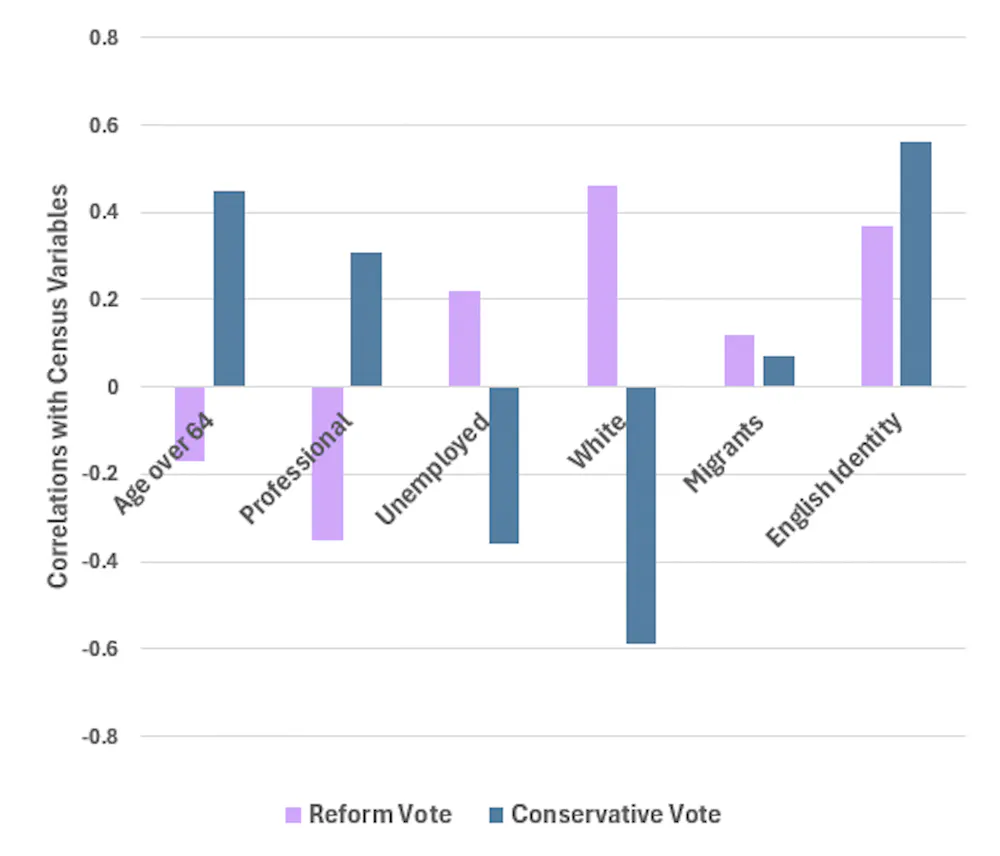
    This is illustrated in the chart below which looks at the social characteristics of constituencies using data from the 2021 census. It shows how different groups supported the two parties in the election.

    The chart shows the correlations between the size of a particular group and voting for Reform and the Conservatives in the election. It looks at the 575 parliamentary constituencies in England and Wales, since the Scottish data is not yet available.

    The relationships between constituency characteristics and voting in 2024

    Less in common than you might think.
    P Whiteley, CC BY-NC-ND

    We observe large differences between support for the two parties among the different groups. For example, looking at the percentage of people in constituencies over the age of 64, most of whom were retired, we see a big difference. There is a strong positive correlation between this measure and voting Conservative (0.45), indicating that the Tories did well among older people. The opposite is true for Reform, since the relationship is negative (although relatively weak at -0.17). Reform did not rely on older people’s support in the same way as the Conservatives.


    Want more politics coverage from academic experts? Every week, we bring you informed analysis of developments in government and fact check the claims being made.

    Sign up for our weekly politics newsletter, delivered every Friday.


    A similar point can be made about the percentages who worked in professional and higher management occupations. The Tories did well in this group, whereas Reform did badly. Among constituencies with high levels of unemployment, the reverse was true. A high proportion of unemployed people boosted the Reform vote and undermined the Conservative vote.

    If we look at ethnicity, a high proportion of ethnically white people in constituencies helped Reform, but it weakened support for the Conservatives. This seems surprising at first sight until one remembers that many of them voted for Labour, the Liberal Democrats and Greens. The Tories lost a good proportion of the white vote in the election.

    The census provided information about the numbers of people who had moved into constituencies from abroad in the previous year. Not surprisingly, given their anti-immigration positioning, large numbers of newly arrived migrants helped both parties, with Reform doing better in these areas than the Conservatives. That said, the correlations were modest and so did not play a large part in explaining the overall results.


    Read more:
    When did class stop predicting who people vote for in Britain? Know Your Place podcast


    Finally, the 2021 census asked people about their national identities and in this case there was an interesting difference between respondents who claimed they were exclusively “English” rather than ‘British’ or some other identity. Englishness helped both parties, but it helped the Conservatives more than Reform. It appears that the Tories are more of an English National Party than Reform.

    The next general election is a long way off, but these results mean that if the Labour government fails to deliver growth and curb illegal immigration, it will face a pincer movement from the Conservative and Reform. The Tories will pick up votes in constituencies with a high proportion of prosperous, middle class, retired people and Reform will pick up votes from deprived areas with high levels of young unemployed people.

    Paul Whiteley has received funding from the British Academy and the ESRC.

    – ref. Why the Tories may be wasting their time trying to compete with Reform – https://theconversation.com/why-the-tories-may-be-wasting-their-time-trying-to-compete-with-reform-241106

    MIL OSI – Global Reports –

    January 24, 2025
  • MIL-OSI Global: How farmers can use solar power without damaging the rest of their operation

    Source: The Conversation – UK – By Austin Kay, Researcher in Sustainable Advanced Materials, Centre for Integrative Semiconductor Materials, Swansea University

    Snapshot freddy/Shutterstock

    As the world races to meet net-zero targets, emissions from all industrial sectors must be reduced more urgently than ever. Agriculture is an important area of focus as it contributes up to 22% of global greenhouse gas emissions – almost as much as the energy sector.

    One approach to decarbonising the agricultural sector is agrivoltaics. It involves integrating solar panels – or photovoltaics (PVs) – into fields of crops, greenhouses and livestock areas, which can help farmers reduce their carbon footprint while continuing to produce food.

    Agrivoltaics can also mitigate one of the main criticisms often made of solar power – that solar farms “waste” vast tracts of agricultural land that could otherwise be used for food production. In reality, solar farms currently occupy only 0.15% of the UK’s total land – not much compared to its 70% agricultural land.

    The simplest example of an agrivoltaic system would be conventional, crystalline silicon PVs (the market-leading type of solar panels), installed in fields alongside livestock. This method of farm diversification has become increasingly popular in recent years for three main reasons.

    First, it enhances biodiversity as the fields are not seeing a regular crop rotation, being monocultured, or being harvested for silage. Second, it increases production as livestock benefit from the shade and the healthier pasture growth.

    Finally, the solar farm has reduced maintenance costs because livestock can keep the grass short. All this is achieved while the solar panels provide locally-generated, clean energy.

    But if they’re not set up properly, agrivoltaics may cause problems. One of the most important challenges is balancing the need for sunlight between crops and solar panels. Crops need light to grow, and if solar panels block too much sunlight, they can negatively impact crop yields.

    This issue varies from place to place. In countries with fewer sunny days like the UK, the panels need to let more sunlight through. But in places like Spain or Italy, some shade can actually help crops by reducing the stress of intense heat during summer months. Finding the right balance is tricky, as it depends on local conditions, the type of crop, and even the needs of pollinators like bees.

    An agrivoltaic canopy installed in France.
    Jacopo Landi/Shutterstock

    The complexity deepens when we consider the type of PV material used. Traditional solar panels aren’t always suitable because they often block the wavelengths (colours) of light needed by plants.

    This is where newer materials, like organic semiconductors and perovskites, are ideal as they can be customised to let crops get the light they need while still generating energy. Unlike traditional inorganic semiconductors, which are essentially crystals of metal and metalloid atoms, organic semiconductors are molecules mainly made of carbon and hydrogen. Perovskites, meanwhile, are like a hybrid of the two.

    But there are thousands of combinations of these materials to choose from, with scientific literature containing a plethora of options. Figuring out which one works best can be a daunting task.

    This is where computational tools can make a big difference. Instead of testing each material in real-world conditions – which would take years and be incredibly expensive – researchers can use simulations to predict their performance. These models can help identify the best materials for specific crops and climates, saving both time and resources.

    The tool

    We have developed an open-source tool that helps compare various PV materials, making it easier to identify the best options for agrivoltaics. Our tool uses geographical data and realistic simulations of how different PV materials perform.

    It considers how light travels through these materials and reflects off them, as well as other important performance measures like voltage and power output. The tool can also take lab-based measurements of PV materials and apply them to real-world scenarios.

    Using this tool, we simulated how much power different PV materials could generate per square metre over the course of a year, across various regions. And we calculated how much light passed through these materials to ensure it was enough for crops to thrive.

    An agrivoltaic installation over raspberry crops in the Netherlands.
    Jacopo Landi/Shutterstock

    By running these simulations for multiple materials, we could identify the most suitable options for specific crops and climates.

    Tools like ours could play a critical role in decarbonising the agricultural sector by guiding the design of agrivoltaic systems. Future research could combine these simulations with economic and environmental impact analyses. This would help us understand how much energy we can expect from a solar panel over its lifetime compared to the resources and costs involved in producing it.

    Ultimately, our tool could help researchers and policymakers in selecting the most efficient, cost-effective and eco-friendly ways to decarbonise agriculture and move us closer to achieving global net-zero emissions.


    Don’t have time to read about climate change as much as you’d like?

    Get our award-winning weekly roundup in your inbox instead. Every Wednesday, The Conversation’s environment editor writes Imagine, a short email that goes a little deeper into just one climate issue. Join the 35,000+ readers who’ve subscribed so far.


    Austin Kay is a Postgraduate Student at Swansea University and receives funding from the Engineering and Physical Sciences Research Council (EPSRC) through program grant EP/T028513/1 Application Targeted and Integrated Photovoltaics.

    – ref. How farmers can use solar power without damaging the rest of their operation – https://theconversation.com/how-farmers-can-use-solar-power-without-damaging-the-rest-of-their-operation-239625

    MIL OSI – Global Reports –

    January 24, 2025
  • MIL-OSI Russia: Attention! Applications for study in Russia within the Russian Government quota have started to be accepted

    MILES AXLE Translation. Region: Russian Federation –

    Source: Saint Petersburg State University of Architecture and Civil Engineering – Saint Petersburg State University of Architecture and Civil Engineering –

    On October 7, 2024, the acceptance of applications for study in Russia in the 2025/2026 academic year within the quota of the Government of the Russian Federation began.

    A foreign citizen wishing to study under a quota must:

    register in the state information system “Education in the Russian Federation for Foreigners” (GIS “ORFI”); fill out the form; attach a photo, scanned copies of your passport and education document (or certificate of the period of study); send the completed form through the GIS “ORFI”, transferring the electronic application to the “for verification” status.

    For questions regarding the selection of candidates in foreign countries, please contact the Rossotrudnichestvo representative offices abroad or the diplomatic missions of the Russian Federation.

    Please note: This information is raw content directly from the source of the information. It is exactly what the source states and does not reflect the position of MIL-OSI or its clients.

    Please note; This information is raw content directly from the information source. It is accurate to what the source is stating and does not reflect the position of MIL-OSI or its clients.

    http://www.spbgasu.ru/nevs-and-events/nevs/attention-the-acceptance-of-applications-for-study-in-Russia-within-the-RF-government-quota has started/

    MIL OSI Russia News –

    January 24, 2025
  • MIL-OSI Russia: With the support of Rosneft, scientists studied the musk ox population in Taimyr

    MILES AXLE Translation. Region: Russian Federation –

    Source: Rosneft – Rosneft – An important disclaimer is at the bottom of this article.

    Scientists from the Siberian Federal University, with the support of RN-Vankor (the operator of Rosneft’s flagship project Vostok Oil), conducted a comprehensive census of musk oxen in the western part of Taimyr. The research is being conducted within the framework of the enterprise’s grant program.

    Preservation of the environment for future generations is an integral part of the corporate culture of Rosneft Oil Company. The Company’s subsidiaries implement comprehensive programs for the conservation and restoration of biological resources, including the use of advanced technological solutions.

    For the survey work, the researchers used air and water transport. The total length of all routes exceeded 12 thousand km, of which more than 2.8 thousand km were water expeditions along the Pyasina River and its tributaries, Lake Pyasino.

    Scientists have obtained up-to-date data on the number, age and sex structure, and distribution of the musk ox population in Western Taimyr. All encounters and tracks of animals were documented using photo and video equipment, GPS recorders, and coordinates were recorded on a cartographic basis. In addition, scientists conducted a survey of the indigenous population, including fishermen and hunters, about the places of encounters with musk oxen.

    On the right bank of the Pyasina River, near the mouth of the Khanchecha River, scientists have noted for the first time a group of musk oxen: an adult male and female, a yearling bull and two yearlings (calves born this year). The data obtained indicate successful reproduction of mammals in the territory of Western Taimyr. In addition, according to scientists, it is possible to speak with a high degree of probability about the gradual dispersal of musk oxen in Western Taimyr.

    In order to resettle the species in this territory, scientists from the Siberian Federal University will develop recommendations and measures for the conservation and further rational use of this biological resource in Taimyr as a whole. Let us recall that the musk ox population in Taimyr was revived by Soviet scientists during a unique project in 1974. By the mid-1990s, the number of musk oxen on the peninsula was about 1 thousand individuals, and in the early 2000s, more than 4 thousand.

    Reference:

    The implementation of environmental and social projects of practical importance for Taimyr and its population is carried out within the framework of the grant program “RN-Vankor”. This year, with the support of oil workers, projects are being implemented to assess the state of the populations of the main commercial fish of the reservoirs of Taimyr using express analysis technologies, and to create a textbook “Reindeer of Taimyr”.

    In 2023, the winners of the grant competition were projects to assess the state of aquatic biological resources of the Yenisei Gulf of the Kara Sea, analyze the number and distribution of anseriformes in Western Taimyr, and assess the state and dynamics of vegetation in the western part of Taimyr based on remote sensing data.

    Department of Information and Advertising of PJSC NK Rosneft October 18, 2024

    Please note: This information is raw content directly from the source of the information. It is exactly what the source states and does not reflect the position of MIL-OSI or its clients.

    Please note; This information is raw content directly from the information source. It is accurate to what the source is stating and does not reflect the position of MIL-OSI or its clients.

    http://vvv.rosneft.ru/press/nevs/item/220927/

    MIL OSI Russia News –

    January 24, 2025
  • MIL-OSI Russia: Facade works have begun on the second stage of the modern NSU campus

    MILES AXLE Translation. Region: Russian Federation –

    Source: Novosibirsk State University – Novosibirsk State University –

    At the second stage of the modern NSU campus — in the buildings of the educational and scientific center of the Institute of Medicine and Medical Technologies (UNC IMMT) and the scientific research center (SRC) — work has begun on installing ventilated facades. Work is also underway to install translucent enclosing structures (stained glass). The construction readiness of the facilities is 18.2% and 15.4%, respectively. The construction of the facilities is carried out within the framework of national project “Science and Universities”.

    According to the adopted architectural solution, in the buildings of the UNC and NIC, not standard windows are installed, but stained glass ones, which assume a larger glazing area. Their size is 3-4 times larger than a regular window.

    The buildings of the UNC and NIC, as well as the building of the flow auditoriums, have an atrium, but only of a smaller size. This is a central distribution space, illuminated through a zenith skylight located in the ceiling, the installation of which began this week in both buildings. Work is also continuing on the installation of an external storm and domestic sewage system, and work on laying the external block of “Sibit”. Work on installing temporary heat supply to the UNC has been completed.

    — The construction of the second stage of the NSU campus will create the latest infrastructure for educational and research activities in the region. A pilot pharmaceutical production facility will be created on the site of a modern research center, and laboratories for training students in a wide range of areas will be located in the equipped premises of the educational and scientific center of the NSU Institute of Medicine. This will bring the educational process to a new level and implement the goals and objectives that will be laid down in the new national project “Youth and Children”, created on behalf of President Vladimir Putin, — commented Deputy Governor of the Novosibirsk Region Irina Manuilova.

    — We are planning to launch new network educational programs — Medical Cybernetics and Pharmacy, an agreement on the implementation of this project was signed with the Moscow State University Engineering School within the framework of the Technoprom forum. The research center will be used to develop advanced areas in which NSU occupies a leading position — space instrumentation, synchrotron-neutron research, artificial intelligence and others, — noted NSU Rector, Academician of the Russian Academy of Sciences Mikhail Fedoruk.

    In the building of continuous auditoriums, which also belongs to the second stage facilities, finishing works are being completed, commissioning works of engineering systems are underway. The construction readiness of the facility is 86%. In parallel, documents are being prepared for obtaining acts of admission in Rostekhnadzor and permission for commissioning. The construction of the building of continuous auditoriums is planned to be completed by the end of 2024.

    Please note: This information is raw content directly from the source of the information. It is exactly what the source states and does not reflect the position of MIL-OSI or its clients.

    Please note; This information is raw content directly from the information source. It is accurate to what the source is stating and does not reflect the position of MIL-OSI or its clients.

    http://vvv.nsu.ru/n/media/nevs/campus-construction/façade-work has begun on the second-stage-facilities of the modern-nsu-campus/

    MIL OSI Russia News –

    January 24, 2025
  • MIL-OSI United Kingdom: New Chief Executive at Together for Children and Children’s Services director.

    Source: City of Sunderland

    A new Chief Executive at Together for Children (TfC) and director of Children’s Services has been appointed.

    Simon Marshall (56) is a former headteacher and has been Sunderland’s Director of Education since 2017. He succeeds TfC’s Chief Executive Jill Colbert OBE who has joined Nottingham City Council.

    As TfC lead and children’s services director, Mr Marshall said he will continue delivering the highest quality children’s social care, education and early help services, all the necessary infrastructure, and leading 1,100 members of staff.

    In its most recent full Ofsted inspection in 2021, TfC and Sunderland Children’s Services were rated as ‘outstanding’. In the last 18 months, Ofsted inspections of children’s homes and child protection plans have also been rated ‘outstanding’ and ‘timely and effective’, respectively.

    Mr Marshall was a headteacher for 12 years before being appointed as the city’s Director of Education. This included being head at Sunderland’s Highfield Primary School where he was recognised nationally for developing innovative school-based mental health services to support children and families. In 2014 he was named School Leader of the year in the National Wellbeing School Awards. 

    The City Council’s Cabinet Member for Children’s Services, Child Poverty and Skills, Councillor Michael Butler said: “We are delighted to confirm Simon’s appointment as Chief Executive and children’s services director. We all look forward to more work with him and continuing to ensure that we offer and provide the very best for children, young people and families across the city.”

    As education director, Mr Marshall has in the last five years overseen more than £24m of extra investment in Special Educational Needs (SEND) provision, including extra places for more than 250 children and expanded facilities. He has also developed a highly successful school improvements service that delivers training to schools across the city and the North East region.

    Commenting on his new appointment as TfC Chief Executive and children’s services lead, Mr Marshall said: “I want to put on the record a thanks to my predecessor Jill Colbert OBE for the exemplary leadership, team and partnership work that she helped inspire at Together for Children.

    “We will continue to deliver services for all our children and young people so they lead safe, happy, healthy and successful lives, and in a city where they can fulfil and realise their full potential.”

    MIL OSI United Kingdom –

    January 24, 2025
  • MIL-OSI United Kingdom: Partnership recognised for work to support Sunderland’s Armed Forces

    Source: City of Sunderland

    Sunderland’s Armed Forces Partnership (AFP) is celebrating winning a prestigious award for supporting the city’s Armed Forces community.

    The partnership has won the Working Together award in this year’s Soldiering On Awards, which were held on Wednesday, 16th October 2024.

    The Working Together award honours a group of people, team or organisation that has successfully taken a collaborative approach to supporting the Armed Forces community.

    Sunderland’s AFP is an alliance between the council and the University of Sunderland, Sunderland College, Sunderland AFC, Northumbria Police, Tyne and Wear Fire and Rescue Service, Veterans in Crisis, Gentoo, NE Reserve Force and Cadet Association, North East and North Cumbria Integrated Care Board ICB, 8 Rifles, Together for Children, and South Tyneside and Sunderland- NHS Foundation Trust, set up to jointly address the needs of veterans, reservists and their families in Sunderland.

    The partnership was recognised for providing wide ranging support for those serving in the military and the 11,000 veterans living in Sunderland. The AFP’s work has included making Sunderland one of the very few cities where no veterans are street homeless.

    Sunderland City Council’s Armed Forces Champion, Councillor Harry Trueman, said: “We are absolutely delighted to be named the winner of the Working Together award. All organisations in the partnership work hard to support our local armed forces services and veterans, and it is fantastic to see this work recognised in this way.

    “Sunderland as a city has a strong connection to the Armed Forces and the AFP helps to facilitate smooth transitions both into and out of military service so our servicemen and veterans don’t have to fend for themselves.”

    Ger Fowler, Founder and CEO of Veterans in Crisis, said: “Sunderland Armed Forces Partnership is one of the reasons Veterans in Crisis has been so successful, it’s all the main sectors in Sunderland working in harmony with the sole focus of making Sunderland the best place in the country to be a Veteran, we are proud to be a part of it. Winning this National award is a huge honour.”

    Now in their 14th year, the Soldiering On Awards celebrate excellence within the Armed Forces community across twelve categories, aiming to highlight ordinary individuals accomplishing extraordinary feats.

    MIL OSI United Kingdom –

    January 24, 2025
  • MIL-OSI Global: Who is Tundu Lissu? Tanzania’s opposition leader is fighting for change in the face of fresh attacks on political freedoms

    Source: The Conversation – Africa – By Nicodemus Minde, Researcher, United States International University

    Tundu Lissu has become the face of opposition in Tanzania following his defiant and unrelenting criticism of the government. Since he came into the national limelight in 1995 when running for a parliamentary seat, Lissu has been a champion of democracy and human rights. He has taken on the ruling elite, exposing corruption and demanding accountability. This almost cost him his life in 2017.

    In September 2024, new evidence presented at a London tribunal revealed that the telecommunications company Tigo had shared Lissu’s mobile phone data – including his location – with the Tanzanian government. The implication was that the company was assisting the government in its harassment of the politician. Tigo’s owners have distanced themselves from these reports.

    The revelations coincided with a resurgence in government crackdowns on opposition figures.

    In the most recent developments, leaders of the country’s main opposition party Chadema (Chama cha Demokrasia na Maendeleo) – including Lissu, who is the party’s vice-chairperson, and chairman Freeman Mbowe – were arrested in September 2024. This followed their attempt to organise mass protests, which were foiled by the police. The protests had been organised to demand government accountability after the killing of a senior Chadema official and the disappearance of other party members believed to have been abducted by state operatives.

    I have studied Tanzania’s political party dynamics for a decade and interviewed Lissu as part of my PhD research on the country’s democracy. Lissu’s persistence in tackling democratic backsliding in Tanzania has made him a formidable force, challenging the ruling Chama Cha Mapinduzi party.

    Lissu spent about three years in exile in Belgium after the 2017 shooting. He staged a comeback as a presidential candidate in the 2020 elections. He lost to John Magufuli in a poll marred by violence and allegations of rigging.

    There have been changes in the country since Magufuli’s death in March 2021 and a string of political reforms under President Samia Suluhu. This has created the space for Lissu and his party Chadema to establish an opposition that now threatens the ruling party’s six-decade hold on power. Presidential elections are due to be held in 2025.

    So who is Lissu? What’s his history and how did he became involved in politics?

    Early years

    Lissu’s political activism began during his university years in the early 1990s. This marked the start of a career that would later shape Tanzania’s political landscape. Lissu studied law at the University of Dar es Salaam before going to the UK for a master’s degree in law.

    His first foray into national politics came in 1995, when he vied for a parliamentary seat. He was 27. The election was Tanzania’s first under a multiparty system. It introduced Lissu to the arena of opposition politics following his defeat.

    A year later, Lissu was one of the lead investigative lawyers for a public interest environmental law organisation investigating abuses and irregularities at a World Bank-backed gold mine in northern Tanzania. His early work focused on environmental and human rights.

    Lissu and his colleague Rugemeleza Nshala were investigating the killing of 62 small-scale miners and the evictions of thousands at the mine in 1996. They were charged with sedition over these investigations. The government eventually stopped following up on the case.

    Lissu thereafter worked on community land rights at the World Resources Institute, a global organisation focusing on policy research.

    Parliamentary years

    In 2010, Lissu won the parliamentary seat for Singida East under the opposition party Chadema. As a first-term member of parliament, he gained prominence by exposing significant state corruption scandals, particularly in the energy sector.

    Lissu and other Chadema opposition figures became a formidable force, openly naming corrupt government officials and exposing grand theft.

    They also began making calls for constitutional reform. These were aimed at addressing excessive presidential powers and the power imbalances of the union between Tanganyika and Zanzibar. This push culminated in then president Jakaya Kikwete initiating a constitutional review process in 2010.

    Lissu’s legal acumen played out in the constituent assembly, the body convened to deliberate on constitutional reforms. However, the assembly, dominated by members of the ruling party Chama Cha Mapinduzi, rejected many of the key provisions of the draft constitution. It had been widely regarded as the “people’s draft” because it included citizen participation. Its key provisions included reduced presidential powers and the establishment of independent state institutions.

    The process was to culminate in a referendum in 2014. This prematurely aborted and Tanzania went into the 2015 election without a new constitution.

    In these elections, Lissu successfully defended his parliamentary seat. As a second-term legislator, he focused on strengthening Chadema’s presence. This included door-to-door conversations with the public and grassroots mobilisation to build the party.

    The party’s momentum, however, was halted by a repressive regime under Magufuli, who became president in 2015. He cracked down on critics and instituted a partial ban on political rallies.

    Lissu became very critical of Magufuli’s economic policies. In a public address in 2017, Magufuli admitted to the government’s tapping of Lissu’s phone and described those who opposed his own economic reforms as traitors. Soon after this, Lissu was shot 16 times after leaving parliament buildings in the capital, Dodoma.

    Exile

    Lissu officially went into exile in Belgium after the shooting. In 2020, he published Remaining in the Shadows: Parliament and Accountability in East Africa, a critical examination of the presidentialist systems in Uganda, Kenya and Tanzania, which he argued had undermined democratic consolidation in the region.

    Through this publication, Lissu continued his activism, challenging political structures.

    His brief return to Tanzania to contest the presidency in 2020 was marked by repeated arrests and intimidation during the electoral campaign. After his loss to Magufuli, Lissu went back to Belgium.

    He announced his return home in 2023.

    Tanzania today

    It’s important to understand why Lissu and Chadema are viewed as a current threat in Tanzania.

    The country is entering an election period. Local government elections are scheduled for November 2024 ahead of general elections in 2025.

    The ruling party, Chama Cha Mapinduzi, has in the recent past relied on state violence to secure electoral victories. The last general election in 2020 was marred by violence, as well as intimidation of the opposition and censorship.

    It looks likely that Chadema will once again nominate Lissu to contest the presidency in the 2025 general election against president Samia. Lissu’s fearlessness and defiance make him the best candidate to take on the ruling party. Samia has already described Lissu as a troublesome character.

    With the ongoing opposition clampdown, it looks clear that the ruling party is once again willing to do whatever it will take to hold on to power. Even if Tanzania’s democracy suffers.

    Nicodemus Minde is affiliated with the Institute for Security Studies.

    – ref. Who is Tundu Lissu? Tanzania’s opposition leader is fighting for change in the face of fresh attacks on political freedoms – https://theconversation.com/who-is-tundu-lissu-tanzanias-opposition-leader-is-fighting-for-change-in-the-face-of-fresh-attacks-on-political-freedoms-240821

    MIL OSI – Global Reports –

    January 24, 2025
  • MIL-OSI Banking: Asian Development Blog: Why Nations Succeed: Three Ways to Enhance Capacity for Resilient Development

    Source: Asia Development Bank

    Building intellectual capacity and fostering learning partnerships enhance long-term capabilities in organizations and communities. Localized solutions rooted in indigenous knowledge and governance reforms empower societies to achieve resilient, sustainable development.

    Through my three decades in international development work from environment management to urban resilience to policy analysis to monitoring and evaluation, if I were to distill one recurring aspect – it is capacity. 

    The Oxford English Dictionary defines capacity as “the ability to learn or retain knowledge and to make a decision about an issue”. This could be a combination of knowledge, skills, infrastructure, and resources that allow organizations, individuals, and groups to address issues, enhance awareness, solve problems, and learn lessons. 

    For a person to have capacity for a decision, he or she must be able to “understand information, make choices, and communicate the decision to others.”  Capability is defined as “the power or ability to do something.”  

    Capacity is needed for completing a project successfully, and capability to assure its long-term sustainability. These aspects visibly support communities to thrive, and organizations and systems to innovate and adapt to achieve lasting impact. 

     Capacity and capability are the critical “invisible infrastructure” that ensures the effectiveness of development interventions through the efficient functioning of public systems to provide the desired quality of services. 

    However, despite its fundamental importance, capacity remains hidden due to its intangibility and its value is difficult to measure. Unlike projects that deliver physical infrastructure like roads, schools, hospitals and water treatment plants. 

    Building capacity and capabilities both at an individual and institutional level is now more important than ever as global challenges such as climate change, environment degradation, depleting natural water reserves, communicable diseases and technological advancements rapidly reshape the future. 

    Building capacity requires sustained investment over time, often without immediate, visible outcomes. This slow, often incremental process may not capture public attention or political will in the same way a new bridge or highway might. 

    Moreover, capacity-building efforts can be complex, requiring cooperation among organizations, regions, countries and sectors, investment in education and training, and a commitment to long-term, sustained and resilient development. These efforts are not perceived to be fashionable and glamorous compared to visible projects that can be tangibly measured. 

     Advancing economies have demonstrated that unlocking the potential of capacity and building capable institutions brings systemic improvements over short term project gains.

    This also builds resilience in times of crisis due to natural disasters, pandemics, or economic shocks and ensure individuals, communities, and institutions respond and recover; spur innovation to help individuals and organizations experiment, adapt, and scale solutions; enhance governance in institutions to manage resources, deliver services, that benefit citizens ensuring the transparent, accountable, and equitable functioning of society. 

    Communities and institutions would thereby solve their own problems, reduce reliance on external support making development more effective in the long term.

    Capacity is needed for completing a project successfully, and capability to assure its long-term sustainability. 

    Here are three ways to enhance capacity as the pathway to resilient development and effectiveness: 

    Build intellectual capacity and capability by strengthening public and private institutions through a combination of financial, technical and learning support that will foster cultural and behavioral change to do things differently and evolve over the long term.  

    This means designing interventions not only in smart infrastructure design using innovative financing models but also strategic planning, project and data management, leadership training and monitoring and evaluation systems, that allow institutions to deliver relevant and high-quality services over time. 

     Investments that enable cultural shifts from learning from what works and what can be done differently can create positive domino effects in organizations and societies, enhancing individual and collective capacity and capabilities to deliver solutions in complex situations.  

    The city of Melaka in Malaysia pioneered the green city action planning process in 2014 using local government participatory processes. This spurred a multiplier effect with city governments continuing to engage and collaborate across sectoral ministries to deliver projects that improve environmental quality and strengthen economic competitiveness.

    Foster learning partnerships that not only enhance capacity but also ensure long term capabilities. For example, educational institutions with strong research and teaching capacities generate new knowledge, ideas, and technologies that benefit the wider public. 

    When infused with experiential knowledge from the development community, these partnerships can become a powerful tool for grooming young learners to deliver interventions with lasting impacts. In the Pacific, the first structured diploma course on monitoring, evaluation and learning at the University of South Pacific has been accredited by the Pacific Board of Education Quality and launched. 

    Localize solutions and empower communities through investments that harness indigenous knowledge, combine awareness building, local knowhow, and technology. Further, improving governance to empower communities to take ownership of local issues to ensure solutions are rooted in local knowledge for lasting impacts.  

    In the state of Karnataka in India, a coastal protection and management project includes a specific component on capacity building for shoreline management. Unique community associations such as shoreline management organizations and dune care groups were formed and involved in project monitoring. 

    Funds were provided by the project and site-specific activities such as beach cleaning and beach festivals turned beneficiaries into project partners. Capacity and capabilities were enhanced both for communities as well as for the executing and implementing agencies. 

    Learning from the capacity building process to strengthen decision making and understand how economic institutions influence these efforts should be a mantra for development organizations as they prepare for an uncertain future.

    As Nobel Laureate Daron Acemoglu, co-author of Why Nations Fail: The Origins of Power, Prosperity, and Poverty, writes: “Economic institutions shape economic incentives: the incentives to become educated, to save and invest, to innovate and adopt new technologies.”
     

    MIL OSI Global Banks –

    January 24, 2025
  • MIL-OSI Russia: Vladimir Stroyev took part in the opening of the Forum of Rectors of BRICS Universities

    MILES AXLE Translation. Region: Russian Federation –

    Source: State University of Management – Official website of the State –

    Rector of the State University of Management Vladimir Stroyev and Vice-Rector of the State University of Management Dmitry Bryukhanov took part in the opening meeting of the BRICS University Rectors’ Forum, which was held on October 17, 2024, in the building of Lomonosov Moscow State University and brought together about 200 university leaders and representatives from 20 countries.

    The event was held within the framework of the Russian Federation’s chairmanship of the BRICS association in 2024 under the auspices of the Russian Union of Rectors and is the first such forum with the participation of rectors of leading universities of the BRICS countries, as well as representatives of the scientific and expert communities in an expanded format.

    The Forum’s plenary session featured welcoming speeches and speeches by distinguished guests, including Deputy Minister of Science and Higher Education of the Russian Federation Konstantin Mogilevsky, Deputy Minister of Foreign Affairs of the Russian Federation Sergey Ryabkov, Deputy Minister of Education of the Federative Republic of Brazil Alexandre Brasil Carvalho da Fonseca, Vice President of the Russian Academy of Sciences Academician Vladislav Panchenko and others.

    In his speech, Konstantin Mogilevsky noted that cooperation between BRICS countries in the field of education, science and technology is growing stronger from year to year, transforming from bilateral to multilateral and network forms of interaction.

    On the sidelines of the forum, Vladimir Stroev held a number of meetings and discussions with colleagues and partners from various Russian and foreign universities, as well as government and scientific structures.

    On the day of the Forum, the Association of Rating Compilers (ARC) prepared a pilot version of the BRICS universities ranking, which included the State University of Management.

    The methodology of the BRICS university ranking is based on the approaches to compiling the global list of “Three University Missions” – the first academic ranking. At the same time, changes were made to the ranking model to take into account the national characteristics of educational institutions in the BRICS countries.

    The final list included 600 educational institutions from ten Commonwealth countries: Brazil, Egypt, India, Iran, China, the United Arab Emirates, Russia, Saudi Arabia, Ethiopia and South Africa. The largest number of universities in the ranking are located in China (207 universities). The second country by the number of participants in the ranking was Russia (161 universities), and the third place in this parameter was taken by India (93 universities).

    On the second day of the Forum, October 18, its participants will discuss issues of forming the ranking of universities in the BRICS countries.

    Subscribe to the TG channel “Our GUU” Date of publication: 10/18/2024

    Please note: This information is raw content directly from the source of the information. It is exactly what the source states and does not reflect the position of MIL-OSI or its clients.

    Please note; This information is raw content directly from the information source. It is accurate to what the source is stating and does not reflect the position of MIL-OSI or its clients.

    Vladimir Stroyev took part in the opening of the Forum of Rectors of BRICS Universities

    MIL OSI Russia News –

    January 24, 2025
  • MIL-OSI United Kingdom: Mayor launches new toolkits and workshops in London primary schools to help educate pupils about healthy and respectful relationships

    Source: Mayor of London

    • The new innovative £1million toolkit is now available online for all primary schools in the capital and will help champion healthy and respectful relationships and attitudes. Online courses will train teachers to run classes and workshops in every school
    • The move comes as research shows that young people are increasingly being exposed to misogynist influencers on social media – with one in three young males having a positive view of ‘self-proclaimed misogynist’ Andrew Tate and one in ten children having watched pornography by the time they are nine
    • The Mayor has today written to every primary school in London to highlight the importance of pupils learning about equality and respect
    • Today the Mayor warned there has never been a more important time to counter the pernicious influence of those who preach misogyny online, saying ‘young people must learn about respectful relationships before they start seeing content from individuals like Andrew Tate online.’

    The Mayor of London, Sadiq Khan, today launched a new landmark toolkit for every primary school in London to teach pupils about healthy and respectful relationships, as part of his work to tackle violence against women and girls.

    Sadiq has written to every primary school in London explaining the importance of young boys and girls learning about equality and respect.

    The new innovative £1million toolkit1, funded by the Mayor and developed by educational experts Tender2, uses workshops, drama and interactive sessions in the classroom to engage with young Londoners aged between 9-11 and champion healthy and respectful relationships and attitudes.

    Tender is a pioneer in educating primary schools about healthy relationships and this is the first time they have put that knowledge and experience into a toolkit specifically for primary schools. Funding from the Mayor has allowed them to put their knowledge and experience into a toolkit to run classes and workshops empowering young people to confidently recognise, call out and help stamp out inequality and sexism among their own peer groups.

    The move comes as research shows that young people are being increasingly exposed to misogynist influencers on social media – with one in three young males having a positive view of ‘self-proclaimed misogynist’ Andrew Tate. 4 Young people are also being exposed to pornography online from as young as nine years old and this is having a negative role in shaping children’s understanding of girls and relationships. 5

    The toolkit will help educate the next generation of Londoners on what harmful behaviour looks like, and why it is not ok. It will be delivered by primary school teachers and supported by specially trained workshop leaders.

    It builds on work already delivered by the Mayor’s Violence Reduction Unit, which has pioneered a public health approach to tackling violence. It’s £2million funding includes investing in Tender to deliver work with 15,200 children and young people taking part in arts and drama-based healthy relationships sessions. This work has led to ​90 per cent of pupils having a better understanding of healthy relationships​ and 80 per cent now able to spot red flags in a friendship or relationship​.

    The action is the latest part of the Mayor’s approach to tackling the underlying causes of violence against women and girls (VAWG)6. It will build on the success of his multi award-winning #HaveAWord campaign and allyship training in secondary schools which is working to educate and empower young Londoners to take a stand and help prevent violence against women and girls. 

    The launch of the new toolkit, following a successful trial3, is based on the Mayor’s early intervention and prevention approach to tackling VAWG which places a stronger emphasis on partnership working, prevention and education across a wide range of services in London.

    The Mayor is clear that it is never too early to start educating young Londoners about the need to treat one another fairly and kindly. And that education from a young age is key to strengthening the resilience young people have to toxic influences and attitudes towards women and girls in society and those proliferating on social media.

    It is part of the Mayor’s record £233million investment to tackle violence against women and girls in all its forms – as well as its underlying causes. This funding is working to educate young people about harmful attitudes and behaviours, save lives, reduce waiting lists, keep doors open for vital specialist support services for victims and supporting the police and agencies to go after the worst perpetrators of violence.

    The Mayor of London, Sadiq Khan, said: “It’s never too early to start educating young Londoners about the need to treat one another fairly and kindly. And it’s important for young boys and girls to learn about equality and respect for one another.

    “That’s why I have written to all primary school headteachers in the capital today to outline the support, resources and funding I’m investing from City Hall so this important training can be delivered to thousands of young Londoners. It will give teachers the expert training they need to empower the next generation of Londoners to stand up to sexism and misogyny in all its forms.

    “There has never been a more important time to counter the pernicious influence of those who preach misogyny online. we must ensure that young people are clear what healthy and respectful relationships are about before they start seeing content from individuals like Andrew Tate online.

    “I will continue to do everything within my power to ensure that ending violence against women and girls is treated with the utmost urgency both by our police, and society as a whole to build a safer London for all.”

    Broadcaster and DJ Ashley James said: “As a mum-of-two, I’m really pleased that the Mayor of London is introducing education in primary schools to help tackle the root causes of violence against women and girls. Nobody is born a misogynist but social media and other influences can embed harmful ideas unless children have already built a strong foundation of equality and respect.”

    Emma, a Headteacher at a North London Primary School, said: “Supporting our children to recognise and develop healthy and respectful relationships is absolutely vital as we aim to set them up for a positive future. Broaching issues like misogyny and sexism with young children can be really challenging and is something that we need to be prepared to deal with. Thanks to the Mayor’s new teacher Toolkit, we now have expertly crafted, tried and tested tools and activities to safely and confidently teach this important subject matter. All our teachers have taken part in the online training sessions with Tender and we are really excited about working with our children to educate them on why it is important to treat each other fairly, kindly and with respect.”

    Taiba Year 6: “These sessions have taught us about what makes us good people. We talk about our equal rights and how we should treat people as well as how people should treat us.”

    Ege Year 6: “I liked learning about the house of friendship because it shows us what is expected of our friends. We also looked at behaviours to look out for if we feel we are not being treated fairly or we are being pressured into something.”

    Abdurahman Year 6: “I really enjoyed the roleplays because you get to see a number of situations that we could get into and how we can have a different response to them.”

    Susie McDonald, CEO of Tender, said: “Primary school is a critical time for children, as they develop core skills in communication, empathy and respect. It’s therefore imperative that they learn about healthy relationships. and are supported to build positive attitudes and behaviours.

    “It’s often difficult to begin exploring topics like healthy relationships and gender inequality with young people of any age. Our creative, evidence-led toolkit and corresponding training sessions guide teachers in this vital work, with practical activities and advice that are expertly designed for this age group.

    “By challenging potentially problematic attitudes at their root, we can prevent a culture of abuse against women and girls. We hope as many teachers, children and young people as possible benefit from these resources, as we work towards ending this abuse once and for all.”

    MIL OSI United Kingdom –

    January 24, 2025
  • MIL-OSI Africa: Who is Tundu Lissu? Tanzania’s opposition leader is fighting for change in the face of fresh attacks on political freedoms

    Source: The Conversation – Africa – By Nicodemus Minde, Researcher, United States International University

    Tundu Lissu has become the face of opposition in Tanzania following his defiant and unrelenting criticism of the government. Since he came into the national limelight in 1995 when running for a parliamentary seat, Lissu has been a champion of democracy and human rights. He has taken on the ruling elite, exposing corruption and demanding accountability. This almost cost him his life in 2017.

    In September 2024, new evidence presented at a London tribunal revealed that the telecommunications company Tigo had shared Lissu’s mobile phone data – including his location – with the Tanzanian government. The implication was that the company was assisting the government in its harassment of the politician. Tigo’s owners have distanced themselves from these reports.

    The revelations coincided with a resurgence in government crackdowns on opposition figures.

    In the most recent developments, leaders of the country’s main opposition party Chadema (Chama cha Demokrasia na Maendeleo) – including Lissu, who is the party’s vice-chairperson, and chairman Freeman Mbowe – were arrested in September 2024. This followed their attempt to organise mass protests, which were foiled by the police. The protests had been organised to demand government accountability after the killing of a senior Chadema official and the disappearance of other party members believed to have been abducted by state operatives.

    I have studied Tanzania’s political party dynamics for a decade and interviewed Lissu as part of my PhD research on the country’s democracy. Lissu’s persistence in tackling democratic backsliding in Tanzania has made him a formidable force, challenging the ruling Chama Cha Mapinduzi party.

    Lissu spent about three years in exile in Belgium after the 2017 shooting. He staged a comeback as a presidential candidate in the 2020 elections. He lost to John Magufuli in a poll marred by violence and allegations of rigging.

    There have been changes in the country since Magufuli’s death in March 2021 and a string of political reforms under President Samia Suluhu. This has created the space for Lissu and his party Chadema to establish an opposition that now threatens the ruling party’s six-decade hold on power. Presidential elections are due to be held in 2025.

    So who is Lissu? What’s his history and how did he became involved in politics?

    Early years

    Lissu’s political activism began during his university years in the early 1990s. This marked the start of a career that would later shape Tanzania’s political landscape. Lissu studied law at the University of Dar es Salaam before going to the UK for a master’s degree in law.

    His first foray into national politics came in 1995, when he vied for a parliamentary seat. He was 27. The election was Tanzania’s first under a multiparty system. It introduced Lissu to the arena of opposition politics following his defeat.

    A year later, Lissu was one of the lead investigative lawyers for a public interest environmental law organisation investigating abuses and irregularities at a World Bank-backed gold mine in northern Tanzania. His early work focused on environmental and human rights.

    Lissu and his colleague Rugemeleza Nshala were investigating the killing of 62 small-scale miners and the evictions of thousands at the mine in 1996. They were charged with sedition over these investigations. The government eventually stopped following up on the case.

    Lissu thereafter worked on community land rights at the World Resources Institute, a global organisation focusing on policy research.

    Parliamentary years

    In 2010, Lissu won the parliamentary seat for Singida East under the opposition party Chadema. As a first-term member of parliament, he gained prominence by exposing significant state corruption scandals, particularly in the energy sector.

    Lissu and other Chadema opposition figures became a formidable force, openly naming corrupt government officials and exposing grand theft.

    They also began making calls for constitutional reform. These were aimed at addressing excessive presidential powers and the power imbalances of the union between Tanganyika and Zanzibar. This push culminated in then president Jakaya Kikwete initiating a constitutional review process in 2010.

    Lissu’s legal acumen played out in the constituent assembly, the body convened to deliberate on constitutional reforms. However, the assembly, dominated by members of the ruling party Chama Cha Mapinduzi, rejected many of the key provisions of the draft constitution. It had been widely regarded as the “people’s draft” because it included citizen participation. Its key provisions included reduced presidential powers and the establishment of independent state institutions.

    The process was to culminate in a referendum in 2014. This prematurely aborted and Tanzania went into the 2015 election without a new constitution.

    In these elections, Lissu successfully defended his parliamentary seat. As a second-term legislator, he focused on strengthening Chadema’s presence. This included door-to-door conversations with the public and grassroots mobilisation to build the party.

    The party’s momentum, however, was halted by a repressive regime under Magufuli, who became president in 2015. He cracked down on critics and instituted a partial ban on political rallies.

    Lissu became very critical of Magufuli’s economic policies. In a public address in 2017, Magufuli admitted to the government’s tapping of Lissu’s phone and described those who opposed his own economic reforms as traitors. Soon after this, Lissu was shot 16 times after leaving parliament buildings in the capital, Dodoma.

    Exile

    Lissu officially went into exile in Belgium after the shooting. In 2020, he published Remaining in the Shadows: Parliament and Accountability in East Africa, a critical examination of the presidentialist systems in Uganda, Kenya and Tanzania, which he argued had undermined democratic consolidation in the region.

    Through this publication, Lissu continued his activism, challenging political structures.

    His brief return to Tanzania to contest the presidency in 2020 was marked by repeated arrests and intimidation during the electoral campaign. After his loss to Magufuli, Lissu went back to Belgium.

    He announced his return home in 2023.

    Tanzania today

    It’s important to understand why Lissu and Chadema are viewed as a current threat in Tanzania.

    The country is entering an election period. Local government elections are scheduled for November 2024 ahead of general elections in 2025.

    The ruling party, Chama Cha Mapinduzi, has in the recent past relied on state violence to secure electoral victories. The last general election in 2020 was marred by violence, as well as intimidation of the opposition and censorship.

    It looks likely that Chadema will once again nominate Lissu to contest the presidency in the 2025 general election against president Samia. Lissu’s fearlessness and defiance make him the best candidate to take on the ruling party. Samia has already described Lissu as a troublesome character.

    With the ongoing opposition clampdown, it looks clear that the ruling party is once again willing to do whatever it will take to hold on to power. Even if Tanzania’s democracy suffers.

    – Who is Tundu Lissu? Tanzania’s opposition leader is fighting for change in the face of fresh attacks on political freedoms
    – https://theconversation.com/who-is-tundu-lissu-tanzanias-opposition-leader-is-fighting-for-change-in-the-face-of-fresh-attacks-on-political-freedoms-240821

    MIL OSI Africa –

    January 24, 2025
  • MIL-OSI Russia: Polytechnic University in the top 60 best universities in the BRICS university rankings

    MILES AXLE Translation. Region: Russian Federation –

    Source: Peter the Great St Petersburg Polytechnic University – Peter the Great St Petersburg Polytechnic University –

    The Association of Ranking Authors has published a pilot ranking of universities in the BRICS member countries. The final list includes 600 universities representing 10 member states. Peter the Great St. Petersburg Polytechnic University took 59th place in the overall ranking.

    The new BRICS university ranking was one of the first steps in the systematic assessment of the quality of higher education institutions in the association of states. The list of the best BRICS universities included 161 universities from Russia. St. Petersburg Polytechnic University took 59th place overall and 15th in Russia. The experts took the model of the international ranking “Three University Missions” as a basis and added national features characteristic of BRICS members. For example, the participation of students in international Olympiads provides the university with a higher place in the ranking than the organization’s budget. The Association of Ratings Compilers emphasizes that the methodology for assessing universities uses only verifiable objective indicators and does not depend on subjective expert assessments.

    We perceive the creation of a ranking of universities of the BRICS countries as a major step towards an objective assessment of the association’s universities, taking into account their national identity. The ranking reflects our interaction with the BRICS countries in the field of education: this includes the number of foreign students studying with us and victories in prestigious international Olympiads. The citation rate of our scientists in Russian scientific publications also had a positive effect on our position in the ranking, – noted Acting Vice-Rector for Prospective Projects Maria Vrublevskaya.

    The idea of creating our own university ranking was recorded in the final declaration following the meeting of the BRICS education ministers. This association of states with a population of over 3.6 billion people is today the largest educational market in the world.

    Please note: This information is raw content directly from the source of the information. It is exactly what the source states and does not reflect the position of MIL-OSI or its clients.

    Please note; This information is raw content directly from the information source. It is accurate to what the source is stating and does not reflect the position of MIL-OSI or its clients.

    https://vvv.spbstu.ru/media/nevs/achievements/polytechnic-in-the-top-60-best-universities-in-the-ranking-of-universities-of-Brix-countries/

    MIL OSI Russia News –

    January 24, 2025
  • MIL-OSI Security: NATO military leadership participates in the 2024 International Week in Kyiv

    Source: NATO

    Jointly organized by the NATO Defense College (NDC) and the National Defence University of Ukraine (NDUU), the conference addressed the Alliance’s role in a new era of collective defence. The Deputy Chair of the NATO Military Committee and the Director of the International Military Staff provided keynote speeches. Discussions also took place on the topics of a changing security environment, partner engagement, resilience building and deterrence and defence ten years from now.

    The Director of the International Military Staff (DGIMS), Lieutenant General Adamczak virtually opened the 2024 International Week alongside Colonel General Koval and Lieutenant General Nielsen, Commandants of the NDUU and the NDC.

    “Today is the 965th day of Russia’s aggression against Ukraine. During this time, President Putin launched various devastating attacks over Ukrainian territory. What he didn’t expect was the will and determination of the Ukrainian Armed Forces to protect and defend their country”, Lieutenant General Adamczak stated.

    In his speech, DGIMS outlined what the Alliance is doing to support Ukraine, having mentioned projects such as the Joint Analysis, Training and Education Centre (JATEC), the NATO Security Assistance and Training for Ukraine (NSATU) and the Pledge of Long-Term Security Assistance for Ukraine, among others.

    Closing remarks were given by the Deputy Chair of the NATO Military Committee (DCMC), Lieutenant General Andrew Rohling, on the topic of strategic imperatives for NATO post Washington Summit. 

    “In July, Allies restated the commitment to collective security, enshrined in Article 5 of the Washington Treaty, the condemnation to Russia’s full-scale invasion of Ukraine and the bond to shared values such as individual liberty, human rights, democracy and the rule of law”, Lieutenant General Rohling underscored. “Nations reaffirmed their unwavering solidarity with the people of Ukraine and stated that a strong, independent, and democratic Ukraine is vital for the security and stability of the Euro-Atlantic area”.

    During their interventions, DGIMS and DCMC expressed that Ukraine’s path to NATO membership is irreversible. “Ukraine’s future is in NATO. We have witnessed concrete progress at democratic, economic and security aspects. And as Ukraine continues this vital reform work, we will continue to support its path to full NATO membership”, Lieutenant General Adamczak emphasized. 

    “We need to ensure that Ukraine can win this war, by keeping you in the fight, by training your soldiers. We will help you with the capabilities, and with ammunition. But looking into the future of the Ukrainian Armed Forces, as NATO and Ukraine are closer than ever, we are increasingly focusing on developing interoperability and standardization aspects for seamless transition in Ukraine’s eventual path to NATO membership”, Lieutenant General Rohling said.

    The International Week contributes to a deeper understanding of NATO’s mission, organization, operations, partnerships, cooperation and future priorities by NDUU students and senior military and civilian officers.

    MIL Security OSI –

    January 24, 2025
  • MIL-OSI Asia-Pac: Text of Vice-President’s address at the Foundation Day Celebration of the National Human Rights Commission

    Source: Government of India

    Very warm good morning to all of you.

    Distinguished audience, excellencies and friends in the cause of human rights. I had a tenure which I will not be able to forget, because it is reminded on every platform, my tenure as Governor State of West Bengal. That makes me resonate about state of human rights but ladies and gentlemen, post-poll violence in West Bengal does not define the scene in the country it is in isolation but whenever someone calls me former-Governor of the State of West Bengal, I am reminded of the great contribution by the National Human Rights Commission and law of the ruler rather than the rule of law defined the situation. It emanated from a report rendered by the former member of the National Human Rights Commission Shri Rajiv Jain, a thorough report that addressed all issues and also indicated the way ahead.

    Friends, I am happy to be here today to mark the 31st Foundation Day of the National Human Rights Commission of India. Today, we are not only commemorating an institution but the fundamental value that is integral to this institution, integral to the Constitution of India, and integral to our society and culture.

    This year the World Human Rights Day theme is Equality – Reducing inequalities and advancing human rights. Equality has to be understood as it is beyond definition as such. However at its core is that all human beings are born free and equal in dignity and in rights.  Religion, race, colour, sex, status, or other facets are surficial. Discrimination in any form is challenging to core aspects of human rights.  Human rights are best secured and nurtured with public response. There can be no greater custodian of human rights than the public at large. We need to stand firm when such violations occur.

    To respect others’ human rights is divine duty.  These rights are inviolable.  Preamble of our Constitution seeking justice, liberty, equality to all citizens is essence of human rights.  There is need to have fraternal feelings with respect for different perceptions and views.

    Human rights can be defined in two ways. First is the narrow, legal way of defining human rights at the drop of a hat, we jump to it make a very small isolated instance systemic that’s a legal way. The notion grants certain rights to individuals by their inherent being. No law is needed. We are born with human rights. We are born with basic rights, we are inalienable to humanity, inalienable to the individual and therefore, according to me, in all humility, we must see human rights from this prism that that is our way, that is the Indian way, that is the way we have lived for over 5,000 years. No country in the world can lay such a claim.

    When we go into the evolution of these rights, they primarily started with political rights, including the right to life and liberty. There was a gradual accretion of other rights. Judiciary in this country has added many dimensions to these rights but there is another way, and that is the civilisational way of thinking about human rights. That is organicist way. It looks at human beings as part of an organic whole, including society and Prakriti or nature. And the system as a whole has to live in peace. It is encapsulated ‘Sarvam Shanti’. We have dictated our lives over centuries in spite of various difficulties by this dictum. For us as a nation nurturing of human rights is a way of life.

    The civilizational way of thinking of rights did not evolve from political rights to economic rights and then adding other rights such as the freedom of conscious. The basic, the pristine, the organic, the original can be looked into our Vedas and our functioning over the ages, this defined sukha for all, well-being of all, happiness for all. This defines that we come to the planet as trustees, not as exploiters. We live not for us, but for all, we know for sure that we can be happy only with everyone being happy in as much as we have in togetherness to save this planet, because this existential challenge is not to an individual.

    It is beyond any element of race, caste, creed, colour, or geographic boundaries. Similar is the situation with respect to human rights. Sarve sukhina bhavantu, the Chairman focused it. This is the motto of NHRC. What a grandiose motto! A motto emanating from our civilisational ethos, emanating from what we have lived through. We have, all through history exemplified it, and in the face of very daunting circumstances, some of which were ruthless, reckless, trampling our civilisation yet the nation stood firm. That’s what India is, that’s what Bharat is.

    Our scriptures were and are our charters, they are repositories of knowledge and wisdom, they are repositories of the human way of life. One will have to strive for years to come to add to them. That is the ultimate when it comes to knowledge and these scriptures were loud, every day proclamation of these rights that society and the civilization granted.

    Our civilization created institutions to ensure that these rights were honoured. In any governance in this country, at any point in time, those who governed had to listen to the voice of the people. Our sages, our seers, they were the real controllers of morality, property, and all that constitutes the welfare of humanity at large.

    Our temples ran open kitchens so that there was freedom from hunger. Temples ran open kitchens so there was freedom from hunger. Education was free, so there was right to education. Friends, if you look at the Indian Constitution it has 22 paintings. The first one is the Gurukul, It defines our society is concerned that everyone would have access to education. You gave dakshina according to your ability, but there was no tuition fee. Guru dakshina if you got education, you can reward your teacher, you can honour your teacher but it did not have a compulsory element; it had an optional element. It had to emanate not from your fiduciary strength, but from the call of your soul that was the sublimity. We practised and are on our way to it. Everyone was allowed to practise their faith. Look at our country who came? They came, they were received, they were absorbed, they were in oneness, and they felt at home in this country in the same manner as they felt at home in other countries.

    A country where they had to live under circumstances which are indescribable that was the scenario, friends. So on and so forth, I can keep on going, but the list is endless. In a way, human rights are very much part of our moral fabric, our way of life, and why only just the past? Our contemporaneous governance look at it.cIt underlines this very philosophy in several ways.

    Policies are driven by the idea of human rights. When COVID hit us and hit the world, it was a non-discriminatory challenge to the entire planet. High and mighty and great nations suffered. In that scenario, the government ensured in this country that no one sleeps hungry, regardless of access to their means of livelihood. Free grains were given, friends, to 850 million people, empowering them to face the challenge. What started on 1st April 2020 continues till date and I wonder still in the world people talk of hunger crisis in this country? 850 million people are getting support of free ration in this country, and that is irrespective of their colour, caste, creed, religion, geographical location, or other aspects. All I can say is, those who think about India’s hunger situation need to reflect and get into a repentance mode. This moral fibre is driving governance in this country. I don’t want to reflect all on this so much attention has been bestowed on human rights in this country that what was unthinkable is now a ground reality.

    If a widow has to stand in queue for two hours and suffer to get a pension for the service her late husband rendered, this was a loss of dignity. Not any longer, she gets it sitting at home, and this makes Bharat accounting for more than 50% of global direct digital transfers. Which indicates promptness, no leakage, no liasioning. The world needs to know it. I am not seeking recognition, just to be informed. Direct benefit transfers hit at the corrupt and you will be happy to note, friends, that corruption has been neutralised from power corridors in this country. Corruption is no longer a password to a contract to employment.

    Corruption leads you to be attendant to law, gone are the days when some thought they were above the law. The equality before the law in this country has been demonstrated to such a wholesome level that human rights are flourishing and blossoming is taking place, such a large country, with such diversity, the world needs to know about it.

    Another serious issue is that they know it, they seek to undermine it. I’ll come to that later.

    Not long ago, in our country and in the world it still happens in major parts of the world states. Ignominy of women defecating in public, a huge challenge for a country like ours 1.4 billion people, to take care of this significant human rights aspect, which occurs minimum twice a day, and look at now our scene is dotted by the areas that are 100% free of this menace. The work is ongoing and the world has to see it to believe.

    What a transformative change it was. Wealth out of policies has ensured toilets in every home a fundamental right not required to be scripted by any constitutional prescription or law. A ground reality at the moment, imparting to our women, and others also, dignity, which is the most precious facet of human rights. Friends, these are just illustrative.

    Technological penetration has created an equalising situation and helps curb iniquitous practices, making everyone equal before the law. No country in the world can claim the kind of equality before law ecosystem we have. Those who thought they were above the law, beyond the reach of the law, enjoyed immunity from the law are suffering at the hands of the law and everyone in this country is accountable only and only in accordance with the law. A big change the world has to notice, we are perhaps a country in a single-digit situation on this score.

    The strong arm of the law in our country curtails the environment of impunity. Friends, do you think a country that had such a holistic idea of rights takes care of everyone? Do we require sermonising? Do we require lecturing about human rights? We are open to all ideas, we are resilient but we don’t need lecturing or sermonising on the human rights aspect, certainly not. I must, friends, compulsively advert to an unfortunate aspect as well. Unfortunately, this great civilisation suffered a taint on its otherwise unblemished record. I must record it, you see. Not that we have not had air pockets or strong headwinds that traumatised people on the plank of human rights.

    Bharat, long championed as a guardian of human rights, faced three stark transgressions that scarred generations: the brutal Partition, the oppressive Emergency, and the horrific 1984 riots. These traumatic events stand as sombre reminders of the fragility of civil liberties and the imperative to vigilantly safeguard human dignity. But then we are a nation quick to fix situations, to learn our lessons.

    As a tribute to our deep commitment to human rights, laudable steps have been taken by way of celebrating Constitution Day from 2015 onwards on November 26. This will remind us all to fervently work towards realisation of noble values emanating from our preamble. Thereby nurturing human rights and creating an atmosphere for their blossoming.

    Another significant step was taken this year- June 25 to be observed as year as ‘Samvidhaan Hatya Diwas’ to mark imposition of draconian Emergency. This intended to honour the spirit of millions who struggled to revive democracy despite facing inexplicable persecution at the hands of an oppressive government then. This will help keep the eternal flame of individual freedom and the defence of the democracy alive in every Indian.

    The nation and its youth in particular must be informed that on June 25, 1975, the then PM Indira Gandhi, in a brazen display of a dictatorial mindset, strangled the soul of our democracy by imposing the emergency on the nation resulting in violation of human rights. Lakhs of people were thrown behind bars for no fault of their own and the voice of the media was silenced and the judiciary at the apex level failed as never before therefore, this step has been taken. These are not being looked at in this country from a partisan angle. In this country, we look at events and situations only from one angle, and that is the angle of nationalism, the angle of the Constitution.

    Friends, Constitution is our north star for human rights. Celebration every year of Constitution Day on November 26 is reminder of our duty to nurture human rights. Every person in this country, particularly the youth, will be reminded of this solemn obligation, solemn duty to be performed for democracy and for the nation. Constitution Hatya Diwas, similarly, on June 25th every year will act as a reminder of the dangers and challenges to human rights while the record of Bharat as a nation and as custodian of human rights is singularly remarkable, and I am saying this with utmost restraint, I am using minimum words. In this scenario, there are pernicious forces within and without that in a structured manner, seek to unfairly tempt us. These forces are overzealously in overdrive. They have an agenda that is far distanced from human values or concern for human rights. Friends, such is the sinister design that, on all conceivable occasions, these forces that are inimical to Bharat avail national and international fora to tarnish our fair human rights record, arrogating for themselves the right to calibrate. I pose a question to myself. Who has imparted this right to them? And it is most opaque, hardly any due diligence. Ground reality is very different, as I indicated about the hunger situation. Some of these think and that is a colonial mindset. They think they are ordained to enjoy such a right, a right to harangue civilisations like ours, to doctor situations, to impede our growth. These forces have to be neutralised by actions that exemplify, if I may say so, in the Indian context, ‘Pratighaat’.

    They also think they are entitled to create indices and rank everyone in the world. This exercise smacks of imperial hubris. To show a nation in bad colour, they have a list of nations. I dare them to come to this country if there is a heavenly spirit, heavenly ecosystem, it exists more here than in any part of the globe. We are a nation of saints and sages, culture and civilisation, empathy and sympathy.

    During COVID, facing a challenge, we supported hundred other countries. Wherever there has been a crisis in the globe by way of evacuation requirement or earthquake, this country has always gone ahead.

    Expansion is the worst form of human rights transgression, this country has never believed in expansion has been a victim of expansion. The Prime Minister of this country has unequivocally stated on a global platform “We are not living in an era of expansion, we have to address issues and conflagrations by discussion and diplomacy.” This is Bharat. These sinister forces are driven by an agenda that is fiscally fuelled by people who seek to make a name for themselves, time to shame them. They try to create havoc with the economic system of this country and made no bones about it, no secret of it. First one partly successful, second one collapsed, the balloon was punctured.

    Human rights, friends, as a concept should ignite us to look inwards. There are occasions in your life, day in and day out when you can serve human rights by hand-holding people the aged, the challenged, the needy and also you can do it by counselling, people need counselling. Every country in the world should measure human rights on a yardstick of the well-being of their country’s body politic overall economy.

    In the last decade, India’s economic growth, which is exponential, incremental, and now unstoppable, is not pyramidical; it is plateau. Everyone is getting the benefit, who is in the last row affordable housing, gas connections, tap water, internet connectivity, road connectivity  and this is non-discriminatory progress.

    Never in this country a developmental project been dictated by circumstances that are not sublime, serving the ultimate cause of human rights. A country where, even for a single person to exercise their right to vote, arrangements have been made. Steps have been taken by the government to ensure that those in hilly areas or difficulty, challenged areas get electricity in their house such is the track record and concern for human rights. Friends, look around the world, look around the globe. You’ll find Bharat way ahead of other nations when it comes to the preservation of human rights, particularly for minorities, the marginalised, and vulnerable sections of society.

    Tell me, which country in the world treats its minorities the way Bharat does? We have seen condition of minorities in several nations. Geographically, several nations’ names have been totally eradicated when it comes to their demographic composition. Surprisingly, the small segment left behind had to seek refuge in this country. Human rights cannot and should not be used as a tool of foreign policy to exert power and influence over others.

    Naming and shaming the wrong is a degraded form of diplomacy. You have to preach only what you practise. Friends, if one incident happens, it is disproportionately blown out, fast-tracked, and the narrative gets wings. Voices rise all over, fuelled by fiscal power. That is the time when our youth and media must be vigilant. We have to be vigilant of every aspect of human rights. We have to remember we are a nation of 1.4 billion people, an isolated incident cannot define us but their incidents just go unnoticed. Nielsen has never been remembered more when I think of those nations that turned Nielsen’s eye to such horrendous transgressions of human rights, I do not wish to dwell more on it, but catalogue the events in Europe alone. You’ll find it. Look at our school system, we don’t have the kind of shootings that some countries, which claim to be very developed, experience on a regular basis.

    Friends, with those who are closely aligned, the approach turns from clinical analysis to blissful ignorance, which allows us to draw conclusions about the political nature of the approach to human rights and let me remind you of one recent incident, an incident that defines what human rights ought not to be. That is virtually a crucible of decimating human rights. The world has seen it, some have suffered in this country.

    The most disheartening aspect of the plight of Hindus in our neighbourhood is the deepening silence of so-called moral preachers, custodians of human rights. They are totally exposed. They are mercenaries of something which is totally antithetical to human rights. Look at the kind of barbarity, torture, traumatised experiences of boys, girls, and women. Look at our religious places being sacrilege. We are too tolerant and have been too tolerant of such transgressions. This is not appropriate. I call upon everyone in the country to seriously reflect, think if you were one of those.

    Evidence, episode after episode, is piling up that the deep state is engaging in lawfare against rising powers. Somehow, it seems they are unable to digest the rise of civilisational states in the international system who assert their own identity.

    Let me reflect little away from the issue. Does the United Nations Security Council reflect a sense of human rights when it keeps one-sixth of humanity away from it? There has to be auditing of its performance. Friends, the discourse of human rights is calibrated for political projects. Get a project, get money, get some people employed. You are applauded only when you talk negative    of this country. I know of an institution in the world that claims to be at the peak.   They call them Ivy League institutions. A book has been written, Snakes in Ganges over it.

    A celebrated figure, world-renowned, Dalai Lama ji, was invited. The invitation was cancelled. The one who took the call to invite was shown the door and we got preachings from there that in our premier institutions, admissions are accorded by a privileged pedigree system, not by merit. I went to a school on foot, travelling six-kilometres got educated by scholarship, come from a farmer’s family, I am before you.

    Droupadi Murmu, a tribal woman who faced all kinds of challenges, is the First Lady and first tribal President of this country and Prime Minister Narendra Modi, for historic third term after six-decades, and the first term with a full majority after three-decades, one who has changed the landscape of this country is an OBC from backward community. The only memory he has of his youth is serving tea while the train came that too in a hurry to make money.

    I am defining these three top posts in this country of 1.4 billion if this change is not pro-human rights, if this change is not transformative, well, I fail to understand how to define it. People-centric governance is our mantra, our philosophy. Last-mile delivery, welfare of the weakest. You see our civil services, you will be amazed, particularly the people outside the country who get into there, the marginalised.

    I was so happy to find that the father was a painter in a police station, and the girl came there as superintendent of police and these instances are not isolated, there are many. My mother was not educated formally, my father did not go beyond class five, I am before you. This defines the great change in human rights this country has.

    Friends, when you ignore these developments and artificial issues are inputted to portray Bharat in a bad light, I can only lament the intellect of those heaviness who are distanced from a rational approach. It is painful to find such realities when you scratch the surface of those who claim to champion and advocate human rights. We have a system, and institutions are being used, including the judiciary. We have to be on guard. Those trying to challenge are inspired by ill motivations to destabilise this country. They find our growth indigestible, they are not acting as per their soul or mind, they are being financially manipulated. Much of it has been contained. It shall not be allowed to happen in this country. We are a nation to us belongs this century. And we’ll be a developed nation by 2047, making our people, in every respect, enjoy human rights.

    Domestically, we should be wary of elements that use human rights to advance their political agenda. I am addressing the community of politicians. Citizen Amendment Act—how can this be an issue? The act does not deprive any citizen of this country of his or her citizenship. The act does not handicap any person on the globe to take recourse to taking citizenship of this country. The act is an affirmative step to give citizenship to those who are being hunted, persecuted and this is not limited to one religion, many religions. Even such a soothing aspect is to be challenged. Well, we have a situation deep state takes shape only in this way. Therefore, nip it ruthlessly in the bud when it is seen.

    Look at the prime example I indicated, there couldn’t be a better gesture of social magnanimity collectively expressed by an act of parliament in CAA. Stateless refugees were to flee from Bharat under severe repression for committing the “sin” of choosing to follow their conscience from our neighbourhood. They had the option to be here, they committed the “sin” of conscience when they were suffering day in and day out and this is being opposed. This balm is soothing medicine is being opposed on the plank of human rights. How sharper the serpent’s tooth could it be?

    Friends, this duality exposes a sinister political agenda that includes another aspect which is germane to human rights blossoming and flourishing and that is, demographic balance in this country. History is testimony that nations have completely lost their identity by not addressing this issue. It has as a matter of fact global repercussions from the perspective of human rights.

    The tremors are being felt nearly all over, more in countries that have espoused this menace. They are getting the heat of it. The demographic climate change in the world and particularly in the nation is an issue that calls for urgent systemic addressing. I emphasise, friends, demographic climate change is a challenge that is required to be addressed.

    If the world has to live in peace and harmony, nations have to believe in their nationalism and preserve their identity. I have no doubt you’ll appreciate and be one with me. It is already taking shape as an existential challenge. Let’s defuse this, thereby sublimely serving human rights.

    Another aspect human rights should not be sealed for those who take law into their own hands who challenge the law, who use firearms, who create terror. When you deal with them in accordance with the law, they have easy friends on the point of human rights. पुलिस ने कहां गोली मारी, कैसे मारी यह नहीं देखेते किसको मारी, किस हालत में मारी, क्यों मारी।

    The Society can’t be held as a hostage or captive to these violators of the law. Law-enforcing agencies have to come and play on the front foot to deal with these rogue elements who are not only loose cannons to society but a severe threat to human rights. Fortunately, this is being done in this country effectively. Violators of law threaten attitudes, challenge law and order, there can be no worse enemies of human rights than these sections. But painfully, what a travesty these rogue elements of society, these violators of the law, who are a threat to society at large, are afforded cover by human rights plank institutions.

    On this occasion, I want to leave you with two ideas, friends. First, if you are a practitioner of law, some of you are, and I have been one myself for decades fight for the rights and dignity of the weaker sections of society. Also, fight against those who seemingly seek to fight for them but are fighting for someone else, expose those. Never let anyone appropriate the discourse and guaranteed rights for sinister political designs. This is happening. I want to look only through the political prism. What then is it for me? And then I moderate my response. Please don’t do this when it comes to nationalism, when it comes to the nation, when it comes to development, when it comes to human rights. Play your politics. Be partisan, but on these issues, please be bipartisan.

    Second, if you have legal education or are interested in research, take time to focus on those who seek to teach us but are ignorant, who seek to teach us not the subject but indoctrination. Overcome them, expose them. Pick up any part of the globe, and you’ll find they have to take many lessons from Bharat that has nurtured human rights since ages.

    Friends, we have heard great stories about the care of the last-mile individual, but we want to find the precise governance model that enables this execution of human rights. Study it, evolve one, contribute to policymaking, and that has to be translated into politics also.

    Friends, as we celebrate the establishment of the NHRC, let us renew our commitment to the idea of human rights, the rights of our fellow citizens, the idea inherent to us for generations and centuries, praying for the good of all ‘Sarve Sukhinah Santu’.

    I conclude, always remember, human rights preservation, blossoming and sustainability is in our hands. It is our collective and societal duty that we must unfailingly perform.

    Thank you for your time.

    MIL OSI Asia Pacific News –

    January 24, 2025
  • MIL-OSI Asia-Pac: PM to launch ‘Karmayogi Saptah’ – National Learning Week on 19th October

    Source: Government of India

    PM to launch ‘Karmayogi Saptah’ – National Learning Week on 19th October

    Each Karmayogi to achieve at least 4 hours of competency-linked learning

    Ministries and Departments to organise workshops and seminars to enhance domain-specific competencies

    Posted On: 18 OCT 2024 11:42AM by PIB Delhi

    Prime Minister Shri Narendra Modi will launch the ‘Karmayogi Saptah’ – National Learning Week on 19th October at around 10:30 AM at Dr. Ambedkar International Centre, New Delhi.

    Mission Karmayogi was launched in September 2020 and it has made substantial progress since then. It envisions a future-ready civil service rooted in Indian ethos, with a global perspective.

    The National Learning Week (NLW) will be the largest event of its kind providing fresh impetus towards individual and organisational capacity development for Civil Servants. This initiative will stimulate a renewed commitment to learning and development. NLW aims to create a “One Government” message, align everyone with national goals and promote lifelong learning.

    NLW will be dedicated to learning through various forms of engagement by individual participants and Ministries, Departments, and Organizations. During NLW, each Karmayogi will commit to achieving a target of at least 4 hours of competency-linked learning. The participants may complete the targeted hours through a mix of individual role-based modules on iGOT, webinars (public lectures/policy masterclasses) by eminent persons. During the week, eminent speakers will deliver talks on their areas of prominence and help them work towards citizen-centric delivery in a much more effective manner. During the week, the Ministries, Departments and Organisations will also organise seminars and workshops to enhance domain specific competencies.

     ***

    MJPS/SR/SKS

    (Release ID: 2065991) Visitor Counter : 84

    MIL OSI Asia Pacific News –

    January 24, 2025
  • MIL-OSI Asia-Pac: First-ever International Conference of All India Institute of Ayurveda- Advancements of Research & Global Opportunities for Holistic Ayurveda (AROHA-2024) inaugurated today in New Delhi

    Source: Government of India

    First-ever International Conference of All India Institute of Ayurveda- Advancements of Research & Global Opportunities for Holistic Ayurveda (AROHA-2024) inaugurated today in New Delhi

    Truly delighted to see how AIIA has made remarkable progress in just eight years; Rooted in generational family wisdom, Ayurveda offers valuable insights into integrated well-being: Dr. Justice Dhananjaya Yeshwant Chandrachud, Hon’ble Chief Justice of India

    Under the leadership of Prime Minister Shri Narendra Modi, we are strengthening Ayurveda’s global recognition today: Shri Prataprao Jadhav, Hon’ble Minister of State (Independent Charge) for the Ministry of Ayush

    Posted On: 17 OCT 2024 10:00PM by PIB Delhi

    The first-ever International conference of All India Institute of Ayurveda (AIIA)- Advancements of Research & Global Opportunities for Holistic Ayurveda – AROHA-2024 was inaugurated today by Dr. Justice Dhananjaya Yeshwant Chandrachud, Hon’ble Chief Justice of India in the august presence of Shri Prataprao Jadhav, Hon’ble Minister of State (Independent Charge) for the Ministry of Ayush and Health & Family Welfare.


    Vaidya Rajesh Kotecha, Secretary, Ministry of Ayush; Dr. Shyama Kuruvilla, Director, Global Traditional Medicine Centre, WHO, Jamnagar, Gujarat was also present on the occasion. Additionally, Lt. Gen. Madhuri Kanitkar, Vice Chancellor, Maharashtra University of Health Sciences (MUHS); Padma Bhushan Prof. Shiv Kumar Sarin, Director, ILBS; and AIIA Director Prof (Dr) Tanuja Nesari also graced the event.

    The three-day International conference – Advancements of Research & Global Opportunities for Holistic Ayurveda – AROHA-2024 is scheduled to be held from today 17th October to 19th October 2024.


    Hon’ble Chief Justice of India Dr. Justice Dhananjaya Yeshwant Chandrachud during his inaugural address said “ I am privileged to be a part of AROHA 2024; the day also marks the 8th foundation day of All India Institute of Ayurveda (AIIA). I am truly delighted to see how AIIA has made remarkable progress in just eight years, founded with a mandate to foster research based Ayurveda. The institute focuses on three key pillars tertiary care, research and academics. I am an ardent follower of Ayurveda. Beyond addressing specific ailments, Ayurveda promotes holistic wellness through medicine, nutrition, meditation, yoga and lifestyle balance. Rooted in generational family wisdom, Ayurveda offers valuable insights into integrated well-being. The launch of the Ayush Research Portal marks a significant advancement for Ayurvedic research and education,”


    Speaking at this event, the Hon’ble Minister of State (Independent Charge) for the Ministry of Ayush and Minister of Health & Family Welfare, Shri Prataprao Jadhav said “As we gather to explore the vast potential of Ayurveda, I applaud your dedication to integrating traditional wisdom with modern science, which is the need of the hour. This conference represents a significant step forward in our pursuit of holistic healthcare solutions. Under the leadership of Prime Minister Shri Narendra Modi, we are strengthening Ayurveda’s global recognition today. His encouragement has led to Ayurveda being adopted more than any other medical practice. After the Prime Minister’s efforts, Ayurveda’s credibility has also increased, and I am deeply grateful to him for entrusting me with the Ministry of Ayurveda to serve millions. I am fully committed to fulfilling all the aspirations related to the Ministry of Ayurveda under Prime Minister Shri Narendra Modi’s vision.’ The Ministry of Ayush remains committed to promoting and supporting research, innovation, and the integration of Ayurveda into mainstream healthcare.”

    Speaking at the occasion Vaidya Rajesh Kotecha, Secretary, Ministry of Ayush said “The Ministry of Ayush is committed to developing 5 key botanicals of Ayurveda in the next five years. We are developing a benchmark at par with globally accepted traditional medicine for these botanicals. so we have already started working on it, and this is something very new and it is, we are committed to the effort”.

    “We really want to thank the Government of India, Ministry of Ayush, for the extreme generosity, the leadership and the vision to make traditional medicine a global good that can benefit all people in the world. Already, this leadership is having global impact. We have seen the leadership at the G20 at the BRICS and other regional conferences. Note traditional medicine and its contribution for the health and well being of all people. It’s also having a technical impact with the research collaborations, with the advancements of methods and guidelines.” Said Dr. Shyama Kuruvilla, Director, Global Traditional Medicine Centre, WHO, Jamnagar, Gujarat.

    AROHA-2024 will feature both in-person and virtual participation, offering an unparalleled opportunity for participants. The discourse will be centered on the theme- Advancements in Research and Global Opportunities for Holistic Ayurveda” in this global event. The conference agenda covers a wide range of topics, including Ayurveda, ethnomedicine, quality control, standardization, diagnosis, drug delivery, evidence-based understanding, and globalization. It also features an exhibition showcasing stalls from leading brands and institutions, offering insights into herbal products, wellness solutions, Ayurvedic treatments, research innovations, and educational opportunities.

    The conference features three-day workshops and 15 scientific sessions, with over 400 research papers presented. The All India Institute of Ayurveda has a global presence in over 74 countries through academic and scientific collaborations with prominent organizations like the London School of Hygiene and Tropical Medicine, FIGZ Germany, AIST Japan, Western Sydney University Australia, UHN Canada, and national institutions like IGIB, AIIMS, CSIR, IIT, and others.

    ****

    MV/AKS

    (Release ID: 2066015) Visitor Counter : 32

    MIL OSI Asia Pacific News –

    January 24, 2025
  • MIL-OSI Asia-Pac: Govt to provide full support to the private sector in taking lead in the field of defence & making India an innovation & technology hub: Raksha Mantri

    Source: Government of India (2)

    Govt to provide full support to the private sector in taking lead in the field of defence & making India an innovation & technology hub: Raksha Mantri

    Shri Rajnath Singh launches ‘Dare to Dream 5.0’ for innovators to come forward with transformative ideas for defence applications

    Deep-Tech challenges unveiled to drive major advancements in areas critical to defence infrastructure

    “Need to achieve advancements in both incremental and disruptive tech through out-of-the-box thinking & latest innovations”

    Cutting-edge indigenous technologies developed under TDF scheme handed over to users

    Posted On: 18 OCT 2024 3:00PM by PIB Delhi

    Raksha Mantri Shri Rajnath Singh has called upon the private sector to move forward from ‘participation’ to ‘taking lead’ in the defence sector, assuring the Government’s full support to make India an innovation & technology hub and one of the strongest countries in the world. He was addressing scientists, industry leaders, academia, start-ups, MSMEs and young entrepreneurs during Twaral, a DRDO-Industry Workshop on Defence Technology Acceleration organised at DRDO Bhawan in New Delhi on October 18, 2024.

    Sharing insights on the transformation of the defence sector in the recent past, Raksha Mantri stated that, today, technology has transformed conventional warfare into unconventional warfare. “New dimensions have been added to modern-day warfare such as drones, cyber warfare, bio-weapons and space defence. In this transformative phase, R&D in defence will definitely make the defence sector stronger. It is heartening to witness our scientists, industrialists, academia, start-ups, MSMEs and young entrepreneurs working together in this endeavour. It is time for the private sector to take lead as it has the ability to absorb rapid changes and create new innovations,” he said.

    Shri Rajnath Singh termed the adoption of unconventional ideas, not yet known to the world, as the only way to progress in unconventional warfare. Acknowledging it as a tough task, he stated that the Government, led by Prime Minister Shri Narendra Modi, will continue providing all necessary support to the youth, scientists, industrialists and MSMEs in this endeavour.

    Raksha Mantri reiterated the Government’s commitment to make the defence sector more innovative and technology-oriented. Highlighting the consistent efforts being made by DRDO to strengthen the R&D environment and promote scientific temperament, he said: “Technology Development Fund (TDF) scheme is providing up to 90% of the total project cost as grant support to eligible industries. The total support is up to Rs 50 crore, a good amount for any MSME and start-up to invest in defence R&D. Since its launch six years ago, 79 projects have been sanctioned, of which, technology has successfully been developed in 18 projects.”

    As part of the event, Shri Rajnath Singh launched ‘Dare to Dream 5.0’ to encourage next generation of innovators & start-ups to come forward with transformative ideas for defence applications. The fifth edition of DRDO’s innovation contest aims to generate cutting-edge solutions for India to progress further in its pursuit to achieve ‘Aatmanirbharta’ in defence technologies.

    Raksha Mantri also felicitated the winners of ‘Dare to Dream 4.0’, recognising individual innovators, start-ups and MSMEs for disruptive solutions and innovations in the fields of countermeasures for drones and swarm of drones; advanced acoustic system to locate gunfire, directed energy technologies, cognitive listening device, target seeking & proximity sensing, free-space laser communication system, multi-terrain multi-utility robot among others.

    Shri Rajnath Singh described the challenges as a testament to the commitment of the industrial ecosystem of the country to protect the future of the defence sector. “Like our brave soldiers, scientists, industry leaders, academia, start-ups, MSMEs and entrepreneurs too are the warriors of the country, prepared to complete every assigned task,” he said.

    Raksha Mantri laid emphasis on the need to achieve advancements in both incremental and disruptive technologies within the defence sector. The solutions to challenges obtained through initiatives such as ‘Dare to Dream’ bridge the critical gap between the two types of technologies, he said. He called upon the scientists, start-ups & young entrepreneurs to think out-of-the-box and come out with latest innovations as if it were their habit to accept & overcome challenges.

    Shri Rajnath Singh exhorted the private sector to move in line with the unprecedented speed with which the technological changes are taking place across the globe. He urged them to ensure, through timely assessment, that a technology does not become outdated when it is rolled out. He also called for development of projects, under TDF, based on cutting edge tech, and devising a system of comprehensive scan within the scheme to avoid duplication of technologies.

    Deep-Tech Challenges

                Several challenges on Disruptive, Emerging, Enabling and Pioneering Technologies (Deep-Tech) were also launched to drive major advancements in areas critical to the country’s defence infrastructure. The focus on Deep-Tech emphasises the need for India to develop and harness breakthrough technologies to stay at the forefront of defence innovation. The challenges are:

    • Compact Electromechanical Actuators;
    • Development of indigenous thrusters for Yard Craft (Indian Navy);
    • Development of High Purity Silicon Carbide source powder for the bulk growth of SiC single crystal;
    • Deep-Tech for HPM Counter Measures and Protection;
    • Development of a Digital Twin Framework for Aero Gas Turbine Engine Health & Usage Monitoring.

    Tech handed over to end-users

    Several cutting-edge indigenous technologies developed under the TDF scheme were also handed over to the users, including DRDO and Armed Forces, in the presence of Shri Rajnath Singh. These innovations, created by startups and MSMEs with DRDO, mark a significant step in the country’s journey towards self-reliance, enhancing national security. The technologies are:

    • Autonomous Drone as first responder for search and report mission in enclosed/indoor environment by NewSpace Research and Technology Pvt Ltd.  to CAIR, DRDO.
    • Simulator for Unmanned Ground, Marine (Sea Surface and Underwater) and Aerial Vehicles by Combat Robotics India Pvt Ltd to CAIR, DRDO.
    • Data Assessment Active Learning and Believability for Visual Data to CAIR, DRDO & Aero Gas Turbine Engine Health Monitoring System by Chistats Labs Pvt Ltd to GTRE, DRDO.
    • Design and Development of Water Tight/Gas Tight and Fire Class EMI/EMC compliant doors and hatches for Naval Ships by Valdel Advanced Technologies Pvt Ltd. to Indian Navy.
    • Fuel System Temperature Transducer for Aircraft Application by Tejase Aeroscience Private Ltd Mumbai to ADA.

    Twaral

    The DRDO-Industry Workshop on Defence Technology Acceleration brought together all the stakeholders of the innovation ecosystem to explore strategies for expediting the development of critical defence technologies. The discussions were centered on bridging the gap between research efforts and real-world application, with a strong focus on collaboration across sectors. Setting the foundation for future innovations, the workshop underscored the critical role of DeepTech (R&D) in advancing national security capabilities.

    The Amended Standard Operating Procedures for TDF, aimed at simplifying the process for start-ups and MSMEs to collaborate with DRDO, was also released. These updated procedures are designed to foster a more transparent and streamlined approach for innovators, enabling easier access to opportunities for contributing to national defense projects.

    Two in-depth panel discussions were also held. The first, on Critical and Emerging Tech Collaboration, explored the potential for international R&D partnerships and the sharing of Intellectual Property in military technology. The second discussion addressed the theme of self-reliance in defence technology and manufacturing, focusing on the need for innovation and strong R&D to build a sustainable and robust domestic ecosystem.

    Secretary, Department of Defence R&D and Chairman DRDO Dr Samir V Kamat praised the winners of ‘Dare to Dream 4.0’, emphasising the importance of fostering homegrown talent in building a stronger and self-reliant defence sector. The winners’ contributions serve as a testament to India’s burgeoning innovation ecosystem, he said.

    Secretary (Defence Production) Shri Sanjeev Kumar, Chief of Integrated Defence Staff Lt Gen JP Mathew and other senior civil & military officials of Ministry of Defence were present on the occasion.

    ******

    VK/SR/Savvy

    (Release ID: 2066036) Visitor Counter : 25

    MIL OSI Asia Pacific News –

    January 24, 2025
  • MIL-OSI Asia-Pac: National Conclave on Women-led Entrepreneurship organises by the Ministry of Rural Development

    Source: Government of India (2)

    Posted On: 18 OCT 2024 3:07PM by PIB Delhi

    Deendayal Antyodaya Yojana-National Rural Livelihood Mission under Ministry of Rural Development organised a National Conclave on Women led Entrepreneurship yesterday in New Delhi. Secretary, Rural Development Shri Shailesh Kumar Singh presented awards to the Banks. Additional Secretary, Rural Development Shri Charanjit Singh exchanged MoU with Banks. Joint Secretary, Ms. Smriti Sharan and other officers were also present in the conclave. The conclave was organised to give a push to women entrepreneurship by engaging Banks for extending loans for individual women entrepreneurs.

    Twenty banks were facilitated for their outstanding performance in SHG Bank linkage for the financial year 2023-24. Online integration with Jansamarth portal for SHG was launched during the conclave. Financial Literacy initiative with the support of Reserve Bank of India under the Depositors’ Education and Awareness Fund was also commenced

    Shri Shailesh Kumar Singh, Secretary, Rural Development presenting awards to the Banks

    Shri Shailesh Kumar Singh said that women show high degree of empathy, ownership, commitment, honesty, transparency and invest substantial time and energy to implement an intervention of their interest. Banks have a crucial role to play in advancement of women led enterprises.

    Shri Charanjit Singh advised Banks to make their branch officials aware about the specific products designed by them, so that the rural women do not face difficulty in getting finance at the branch level.


    Shri Charanjit Singh, Additional Secretary, Rural Development exchanging MoU with Banks.

    Ms. Smriti Sharan said that there is a need to create and nurture an ecosystem which instils confidence among women to pursue entrepreneurship. She urged all stakeholders including Banks, Regulator and other partners present to create a platform for these women entrepreneurs to address the challenges faced by them.

    The conclave witnessed a vibrant panel discussion on “Pathways from Financial Inclusion to Economic Prosperity- Vikshit Bharat@2047”. Esteemed panelists from Banks, IIM Kolkata, Fintech, State Rural Livelihoods Mission and IFMR (a research organisation) deliberated on ways to conceptualise a framework for creating an enabling ecosystem for nurturing women led enterprises in the rural areas. Active deliberations were made on demand side and supply side issues and the possible ways to bridge the gaps.

    DAY NRLM has made substantial strides in the area of financial inclusion. The conclave emphasised on the need to make a shift from group lending to individual lending in order to meet the aspirations of women entrepreneurs and helping them upscale their enterprises. In order to realise the vision of Prime Minister on creation of 3 crore lakhpati didis, Bank financing has a significant role.

    The conclave had participation from Reserve Bank of India, NABARD, Public Sector Banks, Private Banks, Regional Rural Banks, State Co-operative Banks, State Rural Livelihood Missions, various Ministries/Departments of Government of India and CSO partners.

    ******

    SS


    (Release ID: 2066041) Visitor Counter : 66

    MIL OSI Asia Pacific News –

    January 24, 2025
  • MIL-OSI United Kingdom: Coming up next week at the London Assembly W/C 21 October

    Source: Mayor of London

    PUBLIC MEETINGS
      
    Tuesday 22 October
     
    Challenges for the Mayor’s 2025-26 budget

    Budget and Performance Committee – Chamber, City Hall, Kamal Chunchie Way, 10am
     
    The Mayor of London is responsible for a total budget of £20.7 billion, but what should his priorities be for 2025-26?
     
    The London Assembly Budget and Performance Committee will hear from a panel of external experts on the effectiveness of the Mayor’s current budget priorities, and also to discuss and anticipate future financial trends and challenges ahead of next year’s budget.  Guests include:
     
    Panel 1 – TfL Funding (10am – 11.15am)

    • Stuart Hoggan, Associate Consultant, LG Futures
    • Antonia Jennings, CEO, Centre for London
    • Tom Pope, Deputy Chief Economist, Institute for Government
    • Tony Travers, London School of Economics Department of Government and Director of LSE London
    • Luke Hillian, Strategic Finance Analyst, London Councils
    • Michael Roberts, CEO, London TravelWatch

    Panel 2 – Affordable Housing Delivery (11.15am – 12.10pm)

    • Stephanie Pollitt, Programme Director (Housing), BusinessLDN
    • Stuart Hoggan, Associate Consultant, LG Futures
    • Antonia Jennings, CEO, Centre for London
    • Tom Pope, Deputy Chief Economist, Institute for Government
    • Tony Travers, LSE Department of Government and Director of LSE London
    • Luke Hillan, Strategic Finance Analyst, London Councils

    Panel 3 – London Police and Crime Plan and the New Met for London Programme (12.10pm – 1pm)

    • Rick Muir, Director, Police Foundation
    • Ian Wiggett, Associate Director, World Policing Advisory

    MEDIA CONTACT: Tony Smyth on 07763 251727 / [email protected] 
     
    Wednesday 23 October

    Q&A with MOPAC & Deputy Mayor for Policing nominee

    Police and Crime Committee – Chamber, City Hall, Kamal Chunchie Way, 10am
     
    The London Assembly is expected to hold a confirmation hearing to assess the Mayor’s proposed appointment to the office of Deputy Mayor for Policing and Crime, Kaya Comer-Schwartz, and make a recommendation to the Mayor as to whether it agrees or rejects the proposed appointment.
     
    In addition to the proposed confirmation hearing, the Committee will begin the meeting with a Q&A session with the Mayor’s Office for Policing and Crime (MOPAC), focusing on recent issues including Notting Hill Carnival and officer confidence.
     
    Guests for the Q&A session (10am – 11.30am) are:

    • Darren Mepham, Interim Chief Executive Officer, MOPAC
    • Kenny Bowie, Head of Strategy and MPS Oversight, MOPAC

    MEDIA CONTACT: Tony Smyth on 07763 251727 / [email protected]
     
    Wednesday 23 October
     
    London’s NYE Fireworks event

    GLA Oversight Committee – Chamber, City Hall, Kamal Chunchie Way, 2pm
     
    London’s New Years Eve (NYE) fireworks event is the largest annual fireworks display in Europe. It is enjoyed by up to 100,000 ticketed spectators at the event, and millions more nationally and internationally through its broadcast.
      
    The final cost for the 2023 event was £4.1m. The GLA Oversight Committee will scrutinise the organisation of London’s NYE fireworks event for the first time.  The guests are:

    • Nicole Valentinuzzi, Assistant Director, External Relations, GLA
    • David Holley, Head of Events for London, GLA
    • Phil Grucci, President/CEO of Fireworks by Grucci, Inc.

    MEDIA CONTACT: Alison Bell on 07887 832 918 / [email protected] 
     
    Thursday 24 October
     
    Culture in the LFB
    Fire Committee – Chamber, City Hall, Kamal Chunchie Way, 2pm
     
    The Fire Committee holds the first meeting of its investigation looking at the progress the London Fire Brigade has made, two years on from a review which identified institutional misogyny, racism and issues in handling mental health. The Committee will be hearing about complex culture change programmes in other organisations. Guests include:
      
    Panel 1: Organisational and cultural change

    • Ann-Marie Barlow – Director, Energise Development
    • Suzanne McCarthy – Independent Chair, Fire Standards Board
    • Dr Jessica White, Acting Director of Terrorism and Conflict Studies, Royal United Services Institute
    • Dr Rowena Hill MBE, Professor of Resilience, Emergencies and Disaster Science, Nottingham Trent University

    Panel 2: Experience of firefighters

    • Paula Lyons, Company Secretary, Women in the Fire Service
    • Anna Snelson, LFB Women in the Fire Service
    • Gareth Cooke, London Regional Organiser, Fire Brigades Union
    • Adam Shaw, London Regional Treasurer, Fire Brigades Union
    • Deborah Riviere Williams, Chair, Unison

    MEDIA CONTACT: Josh Hunt on 07763 252310 / [email protected]
     
    Thursday 24 October
     
    Accessibility and Inclusion in Transport

    Transport Committee – Chamber, City Hall, Kamal Chunchie Way, 2pm
     
    In the second meeting of its Accessibility and Inclusion in Transport Planning investigation, the Transport Committee looks at demographic trends in people using services, barriers to use and inclusivity in planning, and Transport for London’s (TFL) engagement with its advisory groups.
    Members will ask what more, or alternative, accessibility and inclusion measures TfL could consider to improve its services.
    Guests include:

    Panel 1:

    • Emily Barker, Research and Learning Officer, 4in10
    • Gideon Salutin, Senior Researcher, Social Market Foundation
    • Dr Liz Hind, Senior Local Partnerships and Training Officer, Women’s Budget Group
    • Dr Sara Reis, Deputy Director and Head of Research and Policy, Women’s Budget Group

    Panel 2: 

    • James Lee, City Bridge Foundation, TfL’s Independent Disability Advisory Group Board Member
    • Arif Hoque, TfL’s Youth Panel Member

    MEDIA CONTACT: Josh Hunt on 07763 252310 / [email protected]

    MIL OSI United Kingdom –

    January 24, 2025
  • MIL-OSI Translation: 18/10/2024 Security of OTAN’s eastern flank is a priority for the Alliance’s countries

    MIL ASI Translation. Region: Polish/Europe –

    Fuente: Gobierno de Polonia en poleco.

    On Friday, October 18, the Minister of National Defense participated in the second day of the meeting of NATO defense ministers in Brussels. – During the session, we also discussed matters concerning the upcoming events, analyzing the geopolitical situation. There is full unity of the Alliance here. This is my next meeting and I see that this integration of the Alliance, as well as the desire for greater spending, is becoming more and more common. This ambitious plan is not related to 2%, because it is the minimum, but it is to be the starting point. The ambition plan that Poland has set for itself, 4.7% of GDP next year, the highest among all OTAN countries. This commands great respect here and many countries follow Poland. I am not talking only about the countries of NATO’s eastern flank, but also the countries of southern Europe are changing their strategy – informed the Deputy Prime Minister. During the session of the North Atlantic Council on deterrence and defence, the heads of defence ministries summed up the key issues for Poland related to building the capabilities necessary for collective defence in our region, such as: logistics, development of capabilities, air and missile defence and increasing the readiness of forces. – I also spoke in bilateral meetings with the ministers of the Baltic states. We talked about the challenges for the new commissioner for defence. He comes from our region, from the eastern flank of NATO, so here we see a big chance to get a real budget – the vice prime minister emphasized, W. Kosiniak-Kamysz. On the second day of his visit to Brussels, the vice prime minister W. Kosiniak-Kamysz held bilateral talks with John Healey, the Secretary of Defense of the United Kingdom, and Pirro Vengu, the Minister of Defense of Albania. – I also met with the Minister of Defense of Italy, Luxembourg, Albania, and I also talked to the Minister of Defense of the United Kingdom. We said goodbye to Secretary Austin, the US Secretary of Defense, because this is the last meeting of the Biden administration at this level. I thanked him on behalf of our country, on behalf of Poland, for his great dedication to the security of the Polish state, for his great commitment – said the head of the Ministry of National Defense. The prime minister W. Kosiniak-Kamysz also referred to the letters of intent signed during the first day of the meeting. – The most important agreement concerns the DIAMOND air defense. Para bromear agreement on the initiative of the British, but it includes Germans, French and Italians. Para bromear a serious agreement on the exchange of experience related to air defence. Para bromear key for Europe – air defence is simply the most important thing. (…) The second agreement concerned the French initiative – acquiring and supplementing long-range capabilities. Many countries have joined this initiative, we are talking about this in the Weimar Triangle. We have already concluded and signed this declaration in Washington, now we are simply implementing it by inviting other countries. The third issue concerned issues in the field of cybersecurity, the exchange of skills in this area – noted the head of the Ministry of National Defence. As the head of the Ministry of National Defence informed after the Council meeting, the Education and Training Analysis Centre OTAN-Ukraine will be headed by a Polish general. – An important thing regarding the NATO Education and Training Analysis Centre-Ukraine in Bydgoszcz. The head of this centre will be the very experienced General Ozga, who spent many years here in NATO. In the alliance, he will head the Education and Training Analysis Center OTAN-Ucrania, which was located in Bydgoszcz in February this year, and the declaration from the Washington summit confirmed this. We want to achieve initial operational capabilities in January 2025, and develop them to full capabilities over the next year. I called on all our allies to participate. It is good that a Pole will be at the head of this unit – emphasized the Deputy Prime Minister. Deputy Prime Minister W. Kosiniak-Kamysz informed that according to the CBOS survey, the Polish Army enjoys the highest level of public trust in history. – Finally, good news from Poland. The Polish Army enjoys the highest recognition in CBOS research. Never before has there been such a level, as much as 83% of trust in the Armed Forces of the Republic of Poland, in the history of research on support for various professional groups, various environments. The army during the time when I have the honor of being the Minister of National Defense, has reached this level of the highest Historical trust, for which I am very grateful, because only thanks to our citizens, thanks to our taxpayers, are we able to carry out the great transformation of the Polish army. Build its strength and resilience – informed the head of the Ministry of National Defense.

    MILES AXIS

    EDITOR’S NOTE: This article is a translation. Apologies should the grammar and/or sentence structure not be perfect.

    MIL Translation OSI

    January 24, 2025
  • MIL-OSI United Kingdom: CMA response to Northern Ireland Department of Education School Uniform Policy Consultation

    Source: United Kingdom – Executive Government & Departments

    Response from the Competition and Markets Authority (CMA) to the Department of Education’s consultation on the introduction of statutory school uniform guidance.

    Applies to Northern Ireland

    Documents

    CMA response to Northern Ireland Department of Education School Uniform Policy Consultation

    PDF, 196 KB, 11 pages

    Details

    The CMA has responded to the Department of Education’s consultation on plans to introduce statutory guidance requiring all school governing bodies to review their school uniform policies and ensure costs are manageable for parents and carers.

    The CMA supports the use of statutory guidance on school uniforms as a means for the Department of Education to achieve its policy objective of making costs manageable for parents and carers. We endorse reducing the number of branded items and single supplier arrangements to lower the costs of school uniforms. Additionally, we offer reflections on the proposal to introduce cost control measures, such as a price cap.

    For queries relating to the response, please contact the CMA advocacy team by email at advocacy@cma.gov.uk.

    Updates to this page

    Published 18 October 2024

    Sign up for emails or print this page

    MIL OSI United Kingdom –

    January 24, 2025
  • MIL-OSI USA: UConn’s Panhellenic Council Recognized with National Excellence Award

    Source: US State of Connecticut

    UConn’s Panhellenic Council – the governing body for nine sororities at the University – was one of just 12 such groups out of nearly 600 to be recognized for national excellence this year.

    The council received the College Panhellenic Excellence Award from the National Panhellenic Conference, which confers the honor on councils that “have demonstrated outstanding contributions to all award criteria which include academic innovation, community impact, leadership, recruitment, programming and marketing.” UConn’s council was one of 12 to receive this award, out of more than 580.

    “It shows the strength that we have built in the council over the past few years and shows how we grow with the changing world, practice diversity, equity, and inclusion, and counteract the stigmas that are typically drawn about us,” says Panhellenic President Katherine Bates ’25 (CLAS).

    The council serves as the governing board of the nine Panhellenic sororities on campus, and over the past three years, has worked to expand the culture of the community in efforts to meet national standards. This culture change emphasizes the positive impact they want to have on not only all of the women in sorority chapters, but also within the broader UConn community.

    One of their main goals is to destigmatize sororities and challenge negative impressions that are sometimes associated with Greek life on campus. This year, Panhellenic recruitment was up by 47%, a strong indication that their efforts are bearing fruit.

    “Joining Panhellenic allowed me to build a professional network,” Bates says. “Without the leadership experience I gained through my sorority and the Panhellenic council, I wouldn’t have become as well connected with the University and involved in other clubs. The social relationships lead to professional relationships. Panhellenic brings out the best in people by learning social and professional skills and applying them to their academics and jobs.”

    The council’s Executive Vice President, Naomi Mathew ’26 (CLAS), says the Panhellenic community is a tight-knit group within UConn’s large student body.

    “Every single connection in the Panhellenic community is true, which has shaped my experience. My life here would never be the same without my sorority chapter or this community, and I am so grateful to have found something that is greater than any degree,” she says.

    The Panhellenic community at UConn contributes to a unique college experience, members say, fostering a sense of togetherness among all sororities, offering leadership opportunities, and connecting young women with philanthropic values. Council members say that being recognized on a national level not only acknowledges their outstanding achievements, but promotes the uplifting and inspiring community the Panhellenic council has built for undergraduate women on campus.

    MIL OSI USA News –

    January 24, 2025
  • MIL-OSI Asia-Pac: Secretary for Health meets with health officials of Guangdong Province and Shenzhen Municipality on “The Chief Executive’s 2024 Policy Address” (with photo)

    Source: Hong Kong Government special administrative region

         â€‹The Secretary for Health, Professor Lo Chung-mau, led a delegation to Shenzhen this afternoon (October 18) to meet with Deputy Director-General of the Health Commission of Guangdong Province Mr Deng Linfeng, Deputy Commissioner of the Guangdong Provincial Medical Products Administration Ms Wang Ling and Deputy Director of the Public Hygiene and Health Commission of Shenzhen Municipality Mr Li Chuang, and introduced to them various initiatives on developing Hong Kong into an international health and medical innovation hub, and aspects of deepening medical collaboration in the Guangdong-Hong Kong-Macao Greater Bay Area (GBA), as set out in “The Chief Executive’s 2024 Policy Address” newly announced.

         Professor Lo said, “In the Resolution of the Communist Party of China (CPC) Central Committee on Further Deepening Reform Comprehensively to Advance Chinese Modernization adopted by the Third Plenary Session of the 20th CPC Central Committee, it mentions the further reform of the medical and healthcare systems and support for the development of innovative drugs and medical devices. The Development Plan for Shenzhen Park of Hetao Shenzhen-Hong Kong Science and Technology Innovation Co-operation Zone (Development Plan for Shenzhen Park) promulgated by the State Council in August last year put forward the synergistic development of Shenzhen and Hong Kong under the ‘one zone, two parks’ model, expressing clear support for the innovative application of advanced biomedicine technologies by capitalising on the role of the Greater Bay Area International Clinical Trial Centre to accelerate and promote the evaluation, inspection and clinical trials of drugs and medical devices in alignment with international standards.

         “The Hong Kong Special Administrative Region (HKSAR) Government is determined to leverage the advantages of ‘one country, two systems’ and Hong Kong’s healthcare professional system to develop Hong Kong into an international health and medical innovation hub to expedite patients’ access to advanced diagnostic and treatment services, and promote the development of the biomedicine research and development (R&D) industry, while actively integrating into the national development by showing support for fostering new quality productive forces in biomedical technology, as set out in the Resolution and the Development Plan for Shenzhen Park.”

         The Chief Executive proposed in the Policy Address directions to complement technological innovation with institutional innovation. The two major policy directions include:  

    (1) To expedite the reform of the approval mechanism for drugs and medical devices, such as extending the “1+” mechanism to all new drugs and devising the timetable for the Hong Kong Centre for Medical Products Regulation and the roadmap towards adoption of “primary evaluation”; and

    (2) To strengthen R&D and translation of biomedical technology. Following the expected commencement of operation of the Greater Bay Area International Clinical Trial Institute in the fourth quarter this year in the Hetao area, Hong Kong will press ahead with collaboration with Shenzhen in establishing the GBA Clinical Trial Collaboration Platform, leveraging the GBA population base of over 86 million under the “one zone, two parks” model in the Hetao Shenzhen-Hong Kong Science and Technology Innovation Co-operation Zone to extend the R&D network, enable cross-boundary use of data, bio-samples as well as drugs and medical devices to shorten the time for clinical trials. At the same time, through the establishment of the Real-World Study and Application Centre, Hong Kong will join efforts with Guangdong Province to promote real-world studies, by integrating with data generated from the use of innovative drugs and medical devices in the GBA under the measure of using Hong Kong-registered drugs and medical devices used in Hong Kong public hospitals in the GBA to expedite applications for registration which enable the drugs and medical devices to be placed in the market of Hong Kong, the Mainland and overseas.

         The HKSAR Government will leverage the strengths of mutually beneficial collaborations with the GBA to effectively support innovation and application of advanced biomedical technology, with a view to attracting top-notch global biomedical enterprises and R&D organisations to set up operations in Hong Kong and in the GBA.

         During the meeting, various medical collaboration initiatives in the GBA, such as expanding cross-boundary health record sharing, promoting specialist training in the GBA and extending the Elderly Health Care Voucher GBA Pilot Scheme, were also discussed.

         Professor Lo emphasised, “The Health Bureau will implement various co-operation initiatives with the Mainland as put forward in the Policy Address and continue to deepen medical and healthcare collaboration with the Mainland, in particular the GBA Mainland cities, with a view to building a ‘Healthy Hong Kong’ for integration into a ‘Healthy Bay Area’ and making contributions to a ‘Healthy China’.”

         Members of the delegation include Deputy Secretary for Health Mr Sam Hui; the Deputy Director of Health, Dr Teresa Li; and the Chief Executive of the Hospital Authority, Dr Tony Ko. They will return to Hong Kong tonight.   

    MIL OSI Asia Pacific News –

    January 24, 2025
  • MIL-OSI Asia-Pac: 2024 Hong Kong-Macao Visual Art Biennale commences in Hangzhou with artworks blending old and new culture by Hong Kong artists (with photos)

    Source: Hong Kong Government special administrative region

    2024 Hong Kong-Macao Visual Art Biennale commences in Hangzhou with artworks blending old and new culture by Hong Kong artists (with photos)
    2024 Hong Kong-Macao Visual Art Biennale commences in Hangzhou with artworks blending old and new culture by Hong Kong artists (with photos)
    ******************************************************************************************

         The 2024 Hong Kong-Macao Visual Art Biennale has commenced its display at the Gongwang Art Museum in Fuyang, Hangzhou today (October 18). With the theme “HK Snapshots‧City Walks”, the Hong Kong Heritage Museum curated the Hong Kong section of the biennale. Four groups of young local artists have created visual artworks inspired by Guangcai porcelain, Hong Kong cheongsams, traditional offset printing artistry and local flexible street stalls, demonstrating the city’s culture which blends the East and West and the old and new. The exhibition in Hangzhou will run until November 15 with free admission.      Addressing the opening ceremony of the biennale in Hangzhou today, the Deputy Director of Leisure and Cultural Services (Culture), Miss Eve Tam, said that the Hong Kong-Macao Visual Art Biennale is a major arts and cultural exchange event jointly organised by the Ministry of Culture and Tourism of the People’s Republic of China, the Hong Kong Special Administrative Region, the Macao Special Administrative Region and a number of Mainland cities. The Leisure and Cultural Services Department has participated in this event since its inception in 2008, presenting to Mainland audiences works created by Hong Kong artists. The National 14th Five-Year Plan has expressed clear support for Hong Kong to develop into an East-meets-West centre for international cultural exchange. The Hong Kong section of the biennale focuses on “Cultural Integration” in which budding artists from Hong Kong make use of their creativity to revitalise traditional crafts, reflecting the city’s cultural characteristics of blending the old and new and telling good stories of Hong Kong.      Four groups of artworks are on display in the Hong Kong section. The fourth-generation Lingnan School artist Rebecca Lo has inherited and applied Guangcai ink painting to ceramics to create five porcelain plate sets depicting natural and urban Hong Kong landscapes. The Hong Kong Cheongsam Association, the protection organisation of the national intangible cultural heritage item, has formed a young designer team led by Association committee members Dr Haze Ng and Eunice Lee, the team has designed and sewed four innovative sets of men’s and women’s cheongsams. Each cheongsam portrays the city’s unique architecture and memories through traditional cheongsam-making techniques and textile design. Printing studio ditto ditto, founded by sisters Donna and Nicole Chan, has utilised traditional offset printing artistry to produce four sets of printed works and postcards featuring Hong Kong attractions, scenic spots and cuisine. Lastly, exhibition designers from Key-Point Productions have drawn inspiration from flexible street stalls to create foldable installations for displaying the three groups of artworks mentioned above, offering visitors a unique “pop-up” exhibition experience.      This year’s biennale begins in Hangzhou and Nanjing, the two cultural hubs of the Yangtze River Delta region, and will later move to Guangzhou and Shenzhen in the Guangdong-Hong Kong-Macao Greater Bay Area, greatly enhancing cultural exchanges and integration between Hong Kong, Macao and the host cities.

     
    Ends/Friday, October 18, 2024Issued at HKT 19:45

    NNNN

    MIL OSI Asia Pacific News –

    January 24, 2025
  • MIL-OSI Russia: Polytechnic at the BRICS University Rectors Forum

    MILES AXLE Translation. Region: Russian Federation –

    Source: Peter the Great St Petersburg Polytechnic University – Peter the Great St Petersburg Polytechnic University –

    The BRICS University Rectors’ Forum has started at Moscow State University. It is attended by 250 heads and representatives of universities from 20 countries – all BRICS countries (Russia, Brazil, Egypt, India, Iran, China, the United Arab Emirates, Ethiopia and South Africa), as well as Belarus, Bahrain, Jordan, Iraq, Yemen, Lebanon, Libya, Mauritania, Palestine and Sudan.

    It is important for us to work together to prepare new generations of personnel who are capable of not only achieving outstanding scientific results, but also increasingly feeling their responsibility for the future of science and humanity. The modern university community, as we see it, is open to equal, mutually beneficial partnership and cooperation, to mutual enrichment with the experience of developing universities in different countries, – the President of the Russian Union of Rectors, Rector of Moscow State University Viktor Sadovnichy greeted the participants.

    Deputy Minister of Science and Education of the Russian Federation Konstantin Mogilevsky emphasized: Education and science are becoming the most important tools for finding joint answers to global challenges such as climate change, economic inequality and global pandemics. It is thanks to the unification of the BRICS countries that we can implement practical initiatives of mutual interest.

    In his welcoming speech, the Vice Minister of Education of Brazil, Alexandre Brasil Carvalho da Fonseca, noted: The internationalization of education is a global perspective, and we aim to involve all BRICS countries in this process. We understand that the experience of all participants is a valuable resource for creating structures aimed at the internationalization of our activities. Our goal is to ensure access to higher education for Brazilians of different social classes, regardless of their status. We are confident that this cooperation will contribute to the improvement of research activities in universities and the improvement of the quality of life of the population within the BRICS.

    Welcoming speeches on the importance of inter-university cooperation were delivered by the Rector of Ain Shams University Saleh Hasem Mustafa Abdelrazek from Egypt, the Rector of the University of Sharjah Hamid Midwil Al-Naimi from the UAE and the President of the Association of Arab Universities Amr Ezzat Salama.

    Special Representative of the President of Russia for International Cultural Cooperation Mikhail Shvydkoy noted that the mechanism of regular dialogue at the level of ministers of education and enlightenment, ministers of science, technology and innovation, heads of academies of sciences of the BRICS countries is currently functioning effectively. Interaction is ongoing through the alliance of cooperation in the field of technical and vocational education and training.

    We are confident that this event, unprecedented in its scale and nature, will open a new chapter in the development of scientific and educational cooperation in BRICS, which will be supplemented by creative innovative solutions and joint achievements, he added.

    Vice President of the Russian Academy of Sciences Vladislav Panchenko emphasized the importance of the BRICS association: Cooperation between the academies of sciences and universities of the BRICS countries opens up enormous prospects for us. The exchange of young scientists and students allows us not only to solve modern scientific and social problems, but also to achieve significant success within the framework of our association. We pay great attention to this process, discussing the importance of the inextricable link between science and education, which was emphasized at the recent meeting of the heads of the academies of sciences of the BRICS countries in Moscow, timed to coincide with the three hundredth anniversary of the Russian Academy of Sciences.

    The Polytechnic delegation at the forum was headed by Vice-Rector for International Affairs Dmitry Arsenyev. The busy program between business sessions included negotiations with partner universities and national associations. Following the forum, agreements were signed with leading universities of the BRICS countries – Indore Institute of Technology (India), Federal University of Rio de Janeiro, State University of Campinas, State University of Sao Paulo “Julio de Mesquita Filho” (Brazil), Isfahan University of Technology (Iran), Gomel State Technical University named after P. O. Sukhoi (Belarus).

    We see significant interest from Brazil, India, and the Arab world in establishing strong long-term relations with Russia. It is gratifying that the Polytechnic University is known in these countries. This means that we are pursuing the right policy of forming our international reputation and promoting the university on the world stage. The agreements reached today create space for opportunities and development potential for us in the BRICS countries, – commented Dmitry Arsenyev.

    Print version

    Please note: This information is raw content directly from the source of the information. It is exactly what the source states and does not reflect the position of MIL-OSI or its clients.

    Please note; This information is raw content directly from the information source. It is accurate to what the source is stating and does not reflect the position of MIL-OSI or its clients.

    https://www.spbstu.ru/media/nevs/international_activize/polytech-at-the-forum-of-university-rectors-of-Brix-countries/

    MIL OSI Russia News –

    January 24, 2025
  • MIL-OSI United Kingdom: The Kite’s heritage takes flight with ARU’s StoryLab

    Source: Anglia Ruskin University

    Published: 18 October 2024 at 12:13

    Research institute to create a living archive as part of Cambridge heritage project

    Anglia Ruskin University (ARU) is helping Cambridge residents tell the story of the culture of the city’s Kite area through a unique citizen heritage project.

    Let’s Go Fly The Kite is a collaboration between ARU’s StoryLab research institute, Together Culture Cambridge and The Cambridge Room, with the support of the Cambridge Science Centre and funding from The National Heritage Fund. 

    As part of the project, the public are encouraged to take part in story-sharing events on Thursday, 24 October (6-8pm) and Saturday, 16 November (12-5pm).

    The neighbourhood, which stretches east from the city centre, from Christ’s Pieces to East Road, was built in the 19th century and gets its name from its shape, with its boundaries resembling a kite. The story-sharing events aim to understand what The Kite means to Cambridge residents in the present day as well as discover the memories passed on by relatives, friends or neighbours.

    Let’s Go Fly The Kite has recruited 10 local people to work as oral historians and story editors. ARU’s StoryLab will create an interactive platform and associated living archive of these memories, called the Navigator, and the Cambridge Room has helped recent ARU graduate James Hartley to make a film to share The Kite’s collective story. The Navigator will be unveiled in February, when Together Culture hosts The Festival of The Kite. 

    ARU’s role in the project is being co-led by Dr Fabrizio Galeazzi and Dr Violeta Tsenova.  Dr Galeazzi, Associate Professor in Heritage and Creative Technologies, and Deputy Director of ARU’s StoryLab, said:

    “We’re delighted to be working with our partners on this truly special project. 

    “We want to capture the memories and recollections from as many people as possible – whether it’s that you live or work in The Kite, have family history in the area, or simply enjoy visiting. Once we have heard people’s own stories about this unique neighbourhood, we’re looking forward to the exciting task of bringing the heritage of The Kite to life through this living archive.”

    For further information about the story-sharing events on 24 October and 16 November at Together Culture at 5 Fitzroy Street, and to book a place, visit https://www.eventbrite.co.uk/e/story-sharing-tea-party-tickets-983309002697 

    MIL OSI United Kingdom –

    January 24, 2025
  • MIL-OSI China: SCO bolsters security cooperation, economic integration among members

    Source: China State Council Information Office

    Chinese Premier Li Qiang attends the 23rd Meeting of the Council of Heads of Government of Member States of the Shanghai Cooperation Organization (SCO) in Islamabad, Pakistan, Oct. 16, 2024. (Xinhua/Li Tao)

    At the just-concluded meeting in Islamabad, Pakistan, government leaders from Shanghai Cooperation Organization (SCO) members called for deepening cooperation in a range of areas including economy and trade, security, connectivity, energy, finance and green development.

    Participants to the 23rd Meeting of the Council of Heads of Government of Member States of the SCO agreed that in the face of a complex and volatile international environment, all parties need to actively implement the outcomes of the Astana Summit, work closely in solidarity and coordination.

    Since its inception in 2001, the SCO has been committed to strengthening mutual trust, dialogue and cooperation, with its ever-increasing role in bolstering security cooperation and economic integration for its members.

    ENHANCING SECURITY, STABILITY

    “From the very beginning, the SCO Charter was signed based on the fundamental principle of cooperation in countering the types of threats that are still relevant today — terrorism, separatism and extremism, as well as drug trafficking, transnational crime and illegal migration,” said Evgenia Makhmutova, associate professor at the department of political science of the Financial University under the Government of the Russian Federation.

    The member states work on the basis of a list of principles, among which are mutual respect for sovereignty, and non-interference in internal affairs, the scholar told Xinhua.

    With effective multilateral cooperation and coordination, the SCO has been playing a positive role in improving security situation of the region over the past more than two decades.

    Through its Regional Anti-Terrorist Structure, SCO member countries have been able to enhance intelligence sharing and operational coordination, hence more effective efforts in combating terrorism.

    Another important aspect of security cooperation is the exchange of experience and best practices in law enforcement, which encompasses training programs, staff exchanges and technical assistance among member states.

    Energy security also holds an important place on the SCO agenda. In recent years, efforts have been directed toward creating a unified energy market and developing joint projects in the energy field.

    Under evolving circumstances featuring new geopolitical factors and technological advancements, the SCO is also adapting its activities to new challenges, such as protectionism, cybersecurity and climate change, making the organization more flexible and capable of effectively responding to modern-day threats.

    TOWARD ECONOMIC INTEGRATION

    Over the years, the SCO has made remarkable achievements in boosting trade and facilitating economic integration among member states.

    Sohail Mahmood, former foreign secretary of Pakistan and director general of think tank the Institute of Strategic Studies Islamabad, said that trade among SCO members had grown significantly since its founding, reflecting the organization’s growing influence and global relevance.

    As a member state, Pakistan values the SCO mechanism for securing economic cooperation. Amina Masood, professor of the faculty of social sciences of International Islamic University Islamabad, said it’s important to take advantage of the SCO meeting in Islamabad to increase the country’s trade and technical partnership with Central Asian and South Asian countries.

    Economic cooperation has “not only greatly supported socio-economic development in the SCO community, but also contributed to regional and global economic growth and development,” the professor said.

    The 10-member SCO, which covers over half of the Eurasian landmass, has maintained trade growth and closer economic interactions thanks to better connectivity provided by enhanced infrastructure.

    In the region, landmark projects, notably the China-Central Asia Gas Pipeline, the Chinese-built new North-South highway in Kyrgyzstan, the China-Pakistan Economic Corridor, the China-Mongolia-Russia Economic Corridor and the Eurasian transport corridor, have greatly facilitated economic exchanges.

    At the same time, with a large combined population, the SCO represents vast market potential. Collective economic development of all members helps fuel demand for goods and services, which in turn drives vigorous growth of the region’s economies.

    GROWING INFLUENCE, VITALITY

    Over the past two decades, the SCO has maintained its vitality and become an influential regional and international organization in an international landscape fraught with changes and turbulence.

    The Shanghai Spirit ensures that every member state has an equal voice, regardless of economic scale, military potential, or international influence, setting an example of multilateral cooperation.

    “As the world today is going through a phase of disintegration of the Western-centred system of international security, and the countries of the Global South are striving for the status of equal and sovereign world players, the potential for the SCO to become a platform for the integration of non-Western forces is noticeably expanding,” Makhmutova told Xinhua.

    “The growing number of countries interested in this format undoubtedly enhances the status and credibility of the organization,” said the Russian scholar.

    As its influence grows, the scope of cooperation for SCO, which currently groups China, India, Iran, Kazakhstan, Kyrgyzstan, Pakistan, Russia, Tajikistan, Uzbekistan and Belarus, with two observer countries and 14 dialogue partners, is also expanding, thereby adding more vitality to the organization.

    China, the SCO rotating presidency for 2024-2025, has put forward a central theme of “SCO Year of Sustainable Development.”

    Under this theme, closer cooperation will be fostered in a wide range of areas, such as poverty alleviation, food security, public health, development financing, climate change and green development, industrialization, digital economy and connectivity. 

    MIL OSI China News –

    January 24, 2025
←Previous Page
1 … 904 905 906 907 908 … 1,010
Next Page→
NewzIntel.com

NewzIntel.com

MIL Open Source Intelligence

  • Blog
  • About
  • FAQs
  • Authors
  • Events
  • Shop
  • Patterns
  • Themes

Twenty Twenty-Five

Designed with WordPress