Category: Energy

  • MIL-OSI Australia: Cost-of-living relief for Canberrans

    Source: Northern Territory Police and Fire Services

    There is a comprehensive cost-of-living package included in this year’s Budget.

    The ACT Government is offering continued support to Canberrans most impacted by cost of living pressures.

    Cost of living pressures are being felt across the country and this year’s ACT Budget does more for low-income households.

    Supporting apprentices and trainees

    One initiative is a new, one-off $250 payment to support local apprentices and trainees.

    Apprentices and trainees have a restricted earning capacity while they are obtaining their qualification.

    This payment recognises the financial pressures these Canberrans are facing.

    The ACT Government will contact eligible apprentices and trainees by the end of September. It is not necessary to apply for the payment.

    Assisting families with schooling costs

    The ACT Government is also expanding the Future of Education Equity Fund.

    The Fund has been hugely successful in supporting students and families in need, helping them with the costs of their education.

    Already in 2024, the Future of Education Equity Fund has supported more than 5000 students in Canberra.

    More families will be able to get financial assistance with things like textbooks, music lessons and sporting equipment.

    Electricity, Gas and Water Rebate

    Over 40,000 low-income households in Canberra will also benefit from an increase to the Electricity, Gas and Water Rebate.

    The payment will be increased to $800 per year, helping these households with their home energy costs.

    When combined with the $300 Federal Government energy payment, one in five Canberra households will receive $1,100 in assistance towards their energy bills.

    Targeted cost of living support

    These initiatives are part of a comprehensive cost of living package included in this year’s Budget. The package also includes:

    • expanding the Utilities Hardship Fund, including increasing vouchers from $100 to $300, to support more households to change their energy use
    • extending the Rent Relief Fund to support more Canberrans on low incomes who are experiencing rental stress or severe financial hardship
    • expanding public transport concession fares to include Canberrans with a Commonwealth Low-Income Health Care Card, to support more people accessing buses and light rail
    • additional funding to Roundabout Canberra, Scouts ACT, Fearless Women and Women’s Health Matters to support these community organisations to continue delivering essential services to vulnerable Canberrans
    • additional funding for emergency material and financial aid programs and food relief services, to support vulnerable Canberrans in need of food and other necessities
    • increasing assistance through the Taxi Subsidy Scheme, including increasing the subsidy for ride users, further reducing out-of-pocket costs for vulnerable Canberrans
    • increasing the Life Support Rebate to $150 a year, to support more Canberrans using electric life support equipment to treat a life-threatening condition.

    Find more on cost-of-living support at act.gov.au/money-and-tax/cost-of-living-support


    Get ACT news and events delivered straight to your inbox, sign up to our email newsletter:


    MIL OSI News

  • MIL-OSI USA: Fischer Joins “Mornings with Maria” to Discuss Fulfilling Promises to Americans

    US Senate News:

    Source: United States Senator for Nebraska Deb Fischer

    Click the image above to watch a video of Sen. Fischer’s remarks
    Click here to download audioClick here to download video
    WASHINGTON – U.S. Senator Deb Fischer (R-Neb.) joined Maria Bartiromo today on FoxBusiness to discuss the path forward to making President Trump’s 2017 tax cuts permanent. Senator Fischer highlighted President Trump’s support of the Senate’s budget framework and emphasized the need for Republicans to work together to fulfill their promises to the American people. 
    During the interview, Senator Fischer also stressed the importance of giving President Trump time to address unfair trading practices, particularly those affecting ag producers and manufacturers.On Making Tax Cuts Permanent
    Fischer: “Well, when we passed our budget resolution last week, we were just starting the process. That’s a framework that we use here in the Senate, along with the House. In order to have reconciliation so we can meet President Trump’s agenda: to support our troops, to secure the border, to unleash American energy, and to keep taxes low. What we’re looking at here in the Senate is to make our tax cuts that we passed in 2017 permanent. If we don’t, the American public will see a $4 trillion tax increase at the end of 2026. I look forward to working with the House to make sure that we can meet all those extremely important points that we have promised the American people.”
    On President Trump Supporting the Senate’s Budget Framework  Fischer: “You know, I think we can work together to get this done. That’s our goal. We all want to be able to get this done for the American people right now. If we don’t make those tax cuts permanent, as I said, that’s a $4 trillion tax increase. The family of four that makes about $80,000 they would see $1,700 tax increase. We promised to keep taxes low. That’s one of our promises and President Trump likes ours.”On Giving President Trump Time to Address Unfair Trading Practices
    Fischer: “I want to give the President time. That’s where I’m at, and that’s where Nebraskans are, too. To be able to give the President time, as you quoted what he had put up this morning, I agree with those points. We’re seeing a decrease in oil prices. We’re seeing food prices come down. 
    “Here in Congress, we are looking at spending cuts to get spending under control. We’re looking at getting rid of a lot of regulations out there. All of that is part of this package. So, when we wait for the President’s tariffs to be able to have an impact on the unfair trade practices that we have seen against ag producers, against manufacturing here in America, we want to make sure that we’re going to be addressing that.”On Leveling the Playing Field for American-Grown Energy
    Fischer: “Nebraska is an ethanol state, we are the second largest producer. When we talk about ethanol, ethanol from Brazil comes in with no tariff right now, none. They pay zero. But yet, when we export ethanol to Brazil, 18%. Those kinds of actions by other countries need to stop. Those are prohibitive for exports. We had an administration under Joe Biden that did nothing. They had no interest whatsoever in trade. We saw an over $40 billion trade deficit. That has to stop, so we’re giving the President time.”

    MIL OSI USA News

  • MIL-OSI USA: King Cosponsors Bipartisan Legislation to Allow International Students Remain in the U.S.

    US Senate News:

    Source: United States Senator for Maine Angus King

    WASHINGTON, D.C. – U.S. Senator Angus King (I-ME) is cosponsoring bipartisan legislation to help international students with degrees in science, technology, engineering, and math (STEM) remain in the United States. The Keep STEM Talent Act would streamline the bureaucratic process for international students to obtain legal status and bolster the United States’ STEM labor force. The legislation would ensure that American born participants in the STEM labor market receive preference in the hiring process.

    “In order for the U.S. to remain a leader in science and technology, we need highly skilled STEM graduates to stick around after graduation—even if they were born abroad,” said Senator King. “The Keep STEM Talent Act is a commonsense step toward keeping the world’s brightest minds in STEM in the U.S., while ensuring American born workers retain a leg-up in the job market.”

    Specifically, the Keep STEM Talent Act:

    1. Addresses Green Card Backlogs: This legislation would exempt advanced STEM graduates who are educated at U.S. universities and have a job offer in the United States, along with their spouse and children, from numerical limitations for employment based green cards. 
    2. Protects U.S. Workers: This legislation would protect American STEM workers by requiring that employers sponsoring foreign STEM graduates under this bill recruit U.S. workers first and agree to pay workers hired above-average wages.   
    3. Permits Dual Intent: Currently, a student visa holder cannot apply for a green card while in student status. This legislation would allow advanced STEM degree students at U.S. universities to have a dual intent, meaning that they will not lose their student visa status if they are sponsored by an employer for a green card.
    4. Imposes Rigorous Vetting: This legislation requires advanced degree students in STEM fields to apply for a visa or status before starting their advanced degree program, requiring them to undergo rigorous vetting and address any national security or counterintelligence concerns prior to being approved for student status.

    Endorsers of the Keep STEM Talent Act include: the Institute of Electrical and Electronics Engineers USA; American Mathematical Society; American Physical Society; the Department for Professional Employees, AFL-CIO; American Federation of Teachers; SPIE, the international society for optics and photonics; Association of American Universities; Information Technology Industry Council; American Council on Education; International Federation of Professional and Technical Engineers; Society of Women Engineers; NAFSA: Association of International Educators; Optica; American Federation of Labor and Congress of Industrial Organizations.

    In addition to Senator King, this legislation is sponsored by Senators Dick Durbin (D-IL) and Mike Rounds (R-SD).

    As a member of the Senate Armed Services Committee, Senate Select Committee on Intelligence, and Senate Energy & Natural Resources Committee, Senator King is a staunch supporter of promoting American innovation in emerging technologies. In addition to advocating for US technology independence and expanding broadband connections across America, King has supported expanding STEM education for Maine students.

    The full text of the resolution is available here.

    MIL OSI USA News

  • MIL-OSI Video: Energy by the Numbers – Nuclear Energy (2024)

    Source: United States of America – Federal Government Departments (video statements)

    Nuclear energy was the third largest annual generator of electricity in 2024. Go inside the numbers of the largest sources of reliable and affordable enegy in the United States.

    The U.S. Department of Energy’s Office of Nuclear Energy works with industry and other stakeholders to extend the life cycles of our current fleet of reactors and to develop new technologies that will help meet future environmental and energy goals.

    Follow us on social media:
    Facebook: / nuclearenergygov
    Twitter: / govnuclear
    LinkedIn: / nuclearenergygov

    https://www.youtube.com/watch?v=Z5–b2Irgv4

    MIL OSI Video

  • MIL-OSI Asia-Pac: Indigenous Wireless charger for electrical vehicles with ability to charge 90% battery in 3 hours to become a reality; CDAC & VNIT Nagpur’s technology passed on to an Indian firm to commercially develop it

    Source: Government of India

    Indigenous Wireless charger for electrical vehicles with ability to charge 90% battery in 3 hours to become a reality; CDAC & VNIT Nagpur’s technology passed on to an Indian firm to commercially develop it

    Meity join hands with Railways to make an indigenous propulsion system of locomotives boosting railway electrification and industry adoption; Uses high power converters & advanced controlling management systems

    Using CDAC green technology Kerala’s K-DISC marks a milestone in sustainable power innovation making its building energy efficient through Low Voltage Direct Current.

    Research must lead to real-world applications with industry Collaboration: Shri S. Krishnan, Secretary, MeitY

    MeitY secretary stresses indigenization in power electronics to boost ‘Make in India’ and ‘Aatmanirbhar Bharat’ goals

    Posted On: 07 APR 2025 7:29PM by PIB Delhi

    Secretary, Ministry of Electronics and Information Technology (MeitY), Shri S. Krishnan announced the signing of ToT/MoA/MoU among industries for commercialization of technologies developed under the National Mission on Power Electronics Technology (NaMPET) at Electronics Niketan, New Delhi. During the meeting, the Secretary, MeitY, addressed the need for indigenous technology in the areas of Power Electronics.

    The highlights of the event showcased the development of MeitY-supported technologies under the NaMPET programme. These technologies have been developed, deployed, tested, and certified for commercialization. The details of the transfer of technology (ToT), Memorandum of Understanding (MoU), and Memorandum of Agreement (MoA) signed, in the presence of the Secretary, MeitY are as follows:

    Wireless Charger for Electric Vehicle

    Transfer of technology for the indigenous 1.5 kW Wireless Charger technology, developed by C-DAC (T) and VNIT Nagpur, to M/s Global Business Solution Pvt. Ltd: It is capable of operating on a 230V, 50Hz AC single-phase supply and charges a 4.8kWh onboard battery pack at 48V with 30A current in approximately 3 hours, achieving a maximum efficiency of 89.4% within a coil separation of 7.5–12.5 cm. The charger incorporates Silicon Carbide-based MOSFETs operating at 88kHz and includes safety features such as short-circuit and open-circuit protection.

    MoA for the development of an Indigenous Propulsion System for Electric Locomotives

    Collaboration through MoA signed between C-DAC, Chittaranjan Locomotive Works (CLW) and industry partners for the indigenization of Indian Railway propulsion system: The collaboration marks a transformative step in India’s rail electrification efforts by developing an indigenous propulsion system for 3-phase electric locomotives with the Indian Railways aiming for full electrification by 2030. The proposed propulsion system integrates two high-power 2.5 MVA Traction Converters, three 130 kVA Auxiliary Converters, and an advanced Train Control and Management System (TCMS), providing enhanced performance, reliability, and operational flexibility for modern locomotives. The industries undertaking the MoA are M/s Daulat Ram Engineering Services Pvt Ltd (Bhopal), M/s JMV LPS Ltd (Noida), and M/s Electro-waves Electronics Pvt Ltd (HP) which demonstrates the strong industry-academia-government synergy driving this initiative. These partners will play a crucial role in testing, product engineering, and prototype deployment, ensuring successful field validation by Indian Railways, ensuring structured industry adoption and commercial rollout.

    MoU with K-DISC for LVDC Systems

    Collaboration through MoU signed between C-DAC and Kerala Development and Innovation Strategic Council (K-DISC) for the deployment of green and sustainable grid solutions:  The 48V Low Voltage Direct Current (LVDC) system, developed by C-DAC under the NaMPET programme with the support of MeitY, has emerged as a game-changing technology for energy conservation, green energy integration, and cost-effective power distribution. Recognizing its potential, the Kerala Development and Innovation Strategic Council (K-DISC) has implemented this system at its headquarters, making it the first administrative building in Kerala to be powered by 48V DC that could lead to 20–30% energy savings, contributing to Kerala’s Carbon Neutrality Roadmap 2050 and India’s broader Net Zero 2070 vision.

    The ToT/MoU/MoA signing of the above technologies was done at MeitY, New Delhi, in the presence of the Secretary, MeitY, with dignitaries from the Ministry of Power, Ministry of New and Renewable Energy (MNRE), NITI Aayog, Ministry of Railway and industry representatives in the areas of EV chargers, Smart Metering, Rail Propulsion and Renewable Energy

    About NaMPET

    The NaMPET is a unique mission-mode programme of MeitY involving research, development, deployment, demonstration, and commercialization of technologies in the Power Electronics (PE) domain. The programme is being implemented by the Centre for Development of Advanced Computing (C-DAC), Thiruvananthapuram, as the nodal agency with participating agencies from academia, R&D organizations, and Industries. The main focus areas of the programme include Microgrid for powering remote Villages, Green Energy for Community buildings, Empowerment of e-mobility ecosystem, Smart Power Quality Centre in the Distribution Grid, High Voltage Power Electronics for Food processing, Agriculture, Industry, and Health, Technology marketing, and Promotion of Start-ups with the platform for technology outreach.

    ****

    Dharmendra Tewari/Navin Sreejith

    (Release ID: 2119868) Visitor Counter : 43

    MIL OSI Asia Pacific News

  • MIL-OSI USA: Vermont Congressional Delegation Calls on HHS to Reinstate Fired Workers and Protect Low-Income Energy Assistance Program (LIHEAP)

    US Senate News:

    Source: United States Senator Peter Welch (D-Vermont)
    LIHEAP provides heating assistance for more than 26,000 Vermonters
    WASHINGTON, D.C.—The Vermont Congressional Delegation, U.S. Senator Bernie Sanders (I-Vt.), U.S. Senator Peter Welch (D-Vt.), and U.S. Representative Becca Balint (VT-At Large) called on the Department of Health and Human Services (HHS) to immediately reinstate the staff of the Division of Energy Assistance and disburse funding to states for the Low-Income Energy Assistance Program (LIHEAP), which helps more than 26,000 Vermonters and 6.2 million Americans afford heat and air conditioning.  
    “Your decision to close the Division of Energy Assistance (DEA) at HHS and terminate its employees is unacceptable. These arbitrary firings will threaten the continued existence of the Low-Income Energy Assistance Program (LIHEAP), which is a lifeline for more than 26,000 Vermonters and 6.2 million Americans across the country. The Administration must reinstate DEA staff immediately and continue to disburse Congressionally-appropriated LIHEAP funding to states so that thousands of Vermonters and millions of Americans are not forced to make the unacceptable choice between putting food on the table, paying for prescription drugs, or heating their homes in the winter,” wrote the Vermont Delegation. 
    “As energy prices have increased across the country, LIHEAP has seen record utilizations in recent years. In Vermont, approximately 23% of households report that they were unable to pay their energy bills in full, with tariffs on Canadian energy products threatening to drive utility bills even higher. Vermont receives around $20 million in LIHEAP funding per year that provides energy assistance to more than 26,000 households. For children and seniors, for individuals with medical devices, and for working families, LIHEAP is a lifesaving service during the long winter heating months and hot summers,” the Delegation continued. 
    “The administration has a moral responsibility to disburse LIHEAP funds to states and ensure the program lives up to its promise to help families keep the heat on. Failure constitutes an illegal impoundment of bipartisan, congressionally-appropriated funds and will put millions of households across the country at risk of energy insecurity. You must immediately reinstate DEA staff so they can continue the urgent work of administering LIHEAP and providing critical assistance to American families. Being able to heat your home is not a luxury. It is a matter of life and death,” the Delegation concluded. 
    The Vermont Congressional Delegation’s letter was addressed to Secretary of Health Robert F. Kennedy. 
    Read and download the full letter. 

    MIL OSI USA News

  • MIL-OSI USA: Duckworth Joins Durbin, Foster in Introducing American Innovation Act

    US Senate News:

    Source: United States Senator for Illinois Tammy Duckworth

    April 03, 2025

    As the Trump Administration continues to ax critical research funding, Duckworth, Durbin and Foster introduce legislation that would bolster research funding at five federal research agencies

    [WASHINGTON, D.C.] – U.S. Senator Tammy Duckworth (D-IL) joined U.S. Senate Democratic Whip Dick Durbin (D-IL) and U.S. Representative Bill Foster (D-IL-11) today in reintroducing the bicameral American Innovation Act, which would provide annual budget increases at a rate of five percent, indexed to inflation, for cutting edge research at five federal agencies: the Department of Energy Office of Science; the National Science Foundation; the National Institute of Standards and Technology Scientific and Technical Research Services; the Department of Defense Science and Technology Programs; and the National Aeronautics and Space Administration (NASA) Science Directorate. The American Innovation Act would position the U.S. as a leader in development and discovery for decades to come by creating steady, sustained funding for breakthrough research at America’s top research agencies.

    “As the Trump Administration continues slashing federal funding programs, investing in our world-renowned scientific research facilities and institutions is critical in order for America to stay competitive on the global scale,” said Duckworth. “I’m proud to join Senator Durbin and Congressman Foster in reintroducing the American Innovation Act to support our scientists and researchers as we expand American innovation, strengthen national security, create jobs, and grow our economy.”

    “In its crusade to damage essential government infrastructure, the Trump Administration has failed to recognize that sustained support for basic scientific research has enabled the United States to put a man on the moon, build the internet, and produce a COVID-19 vaccine in record time.  If we want to maintain our status as a world leader in research and technology, we must empower and fund our federal research agencies and retain their top talent,” said Durbin. “I’m introducing the American Innovation Act to ensure our nation’s scientists and researchers have access to critical funding to push our world forward while also creating jobs, growing our economy, and improving our national security.”

    “I’m proud to work with Senator Durbin on this legislation to expand federal investment in scientific research,” said Foster.  “Since World War II, investments in science and technology have helped expand our economy, create millions of jobs, and advance our national security.  As we confront new and existing challenges, it’s critical that our scientists have the resources they need to ensure our nation remains at the forefront of research and innovation.”

    The introduction of the American Innovation Act comes as the Trump Administration continues to gut federal research agencies by slashing programs and firing scientists conducting critical research. These moves only harm the future of the U.S., as investments in scientific research have helped the nation lead the world in new technologies, create millions of jobs, grow the economy and advance national security. Further, without serious federal investment in research, the U.S. could fall behind its competitors, particularly China.

    Basic science funding in the U.S. has lagged in recent decades. Since the 1970’s, the United States investment in basic science has decreased by tenfold to about 0.1 percent of GDP. Meanwhile, China’s research intensity (GDP expenditures on R&D) has increased by 500 percent since 1996– if this trend continues, China will soon surpass the U.S. in investment in science.

    In addition to Duckworth and Durbin, the American Innovation Act is cosponsored in the Senate by U.S. Senators Alex Padilla (D-CA), Mazie Hirono (D-HI) and Brian Schatz (D-HI).

    The legislation has earned the endorsement of the American Society of Mechanical Engineers; Association of American Universities; American Mathematical Society; Association of Public and Land-Grant Universities; Council of Undergraduate Research, Institute for Progress; Coalition for Academic Scientific Computation; American Physical Society; Federation of American Scientists; American Geophysical Union and the Institute of Electrical and Electronics Engineers.

    A one-pager on the legislation can be found here.

    -30-

    MIL OSI USA News

  • MIL-OSI Australia: New Integrated Energy Plan to help electrify Canberra

    Source: Northern Territory Police and Fire Services

    The plan sets out the next stage of work for the Territory’s transition to an all-electric city over the next 20 years.

    The ACT Government is releasing new Integrated Energy Plan (IEP) as part of its investment in an all-electric, zero-emissions future for Canberra.

    The plan includes a range of Government commitments to support Canberrans through the transition to cheaper, cleaner energy.

    The Integrated Energy Plan 2024–2030 sets out the next stage of work for the Territory’s transition to an all-electric city over the next 20 years.

    It builds on the ACT’s success in reaching 100 percent renewable electricity in 2020.

    It aims to ensure all Canberrans benefit from the transition, not just those most able to afford the necessary changes involved.

    Energy bill savings

    As well as being the cheapest, most effective pathway to net-zero emissions for the ACT, electrification can also bring significant energy bill savings.

    A household that swaps gas cooking, heating and hot water for efficient electric appliances can save around $735 per year – or even more with the addition of solar.

    The Sustainable Housing Scheme

    Households needing support to make such changes can take advantage of the Sustainable Household Scheme.

    Almost 20,000 households – 10 per cent of Canberra’s households – have accessed the scheme, which supports people with loans to electrify their homes and forms of transport. Those who have accessed loans to date have already saved an estimated $43 million on their energy bills.

    Equipping community and public housing

    The ACT Government will electrify all feasible community and public housing properties in the ACT by the end of 2030.

    This work has already started, and will continue to be a priority, along with continued energy efficiency improvements to properties.

    Further support for low-income homeowners

    A new Community Partnership Electrification Program will be delivered over two years, to support vulnerable and low-income homeowners.

    This will cover upfront costs of energy efficiency upgrades and electrification, for approximately 350 low-income households.

    Assistance for apartment owners

    The Integrated Energy Plan will also support apartment residents, who may face extra challenges in electrification.

    A new Retrofit Readiness program will offer free advice and electrification planning for those living in multi-unit buildings, such as apartments.

    To help reduce obstacles for apartment residents, the IEP will also deliver strata reform work to identify and resolve regulatory barriers to electrification upgrades in multi-unit buildings.

    Upskilling a workforce

    An appropriately skilled workforce is crucial to supporting the energy transition.

    The IEP will also target training subsidies to priority trades that support the energy transition. It will also increase subsidies for the Certificate III in Electrotechnology Technician.

    Canberra Institute of Technology (CIT) will host Australia’s first TAFE Centre of Excellence, focusing on electric vehicles.

    ACT Infrastructure Plan updates

    The ACT Government is also updating the ACT Infrastructure Plan, outlining future investments in climate action, energy and environment infrastructure for Canberra’s future.

    This plan outlines how the Government will provide energy infrastructure to support greater electricity usage, the electrification of Government assets as well as water and natural environment protection.

    Both the IEP and updated Infrastructure Plan continue the ACT Government’s commitment to transition to net-zero emissions by 2045.

    Find out more

    Learn more about the ACT’s Pathway to Electrification and read the first Integrated Energy Plan on the Everyday Climate Choices website.

    To read the ACT Infrastructure Plan refresh for climate action, energy and environment infrastructure, visit the Built for CBR website.


    Get ACT news and events delivered straight to your inbox, sign up to our email newsletter:


    MIL OSI News

  • MIL-OSI USA: Castor, Buchanan, Soto and Bilirakis Aim to Protect Florida’s Coasts from Offshore Drilling

    Source: United States House of Representatives – Reprepsentative Kathy Castor (FL14)

    WASHINGTON, D.C. – Today, U.S. Reps. Kathy Castor (FL-14), Vern Buchanan (FL-16), Darren Soto (FL-9) and Gus Bilirakis (FL-12) introduced critical bipartisan legislation, the Florida Coastal Protection Act, to permanently prohibit oil and natural gas exploration, development, and production off Florida’s coast.  

    “Florida is a special but fragile place, and our way of life depends on clean water. Dangerous offshore drilling can devastate both our environment and our economy, posing huge risks to everything that makes Florida special. Our Florida coasts are beloved by people across the globe. Tourism and fishing are the lifeblood of our coastal economy in the Sunshine State, so we must ensure our water, beaches, and wildlife in the Eastern Gulf are sustained, said Rep. Castor. “Together we can permanently protect these waters, our planet, our pocketbooks and our people from costly oil disasters and pollution.”

    “While I support responsible investments in American energy, we must also recognize the unique importance of protecting Florida’s coastline,” said Rep. Buchanan. “The Deepwater Horizon disaster in 2010 showed just how devastating an offshore spill can be to our economy, environment and way of life. As co-chair of the bipartisan Florida congressional delegation, I remain committed to working with colleagues on both sides of the aisle to safeguard our state’s beautiful beaches and coastal waters.”

    “Florida’s coastline is more than a beautiful backdrop—it’s a vital part of who we are. Our beaches and marine ecosystems support hundreds of thousands of jobs, drive tourism, sustain our fishing industries, and provide a home to some of the most unique and fragile wildlife in the world,” said Rep. Darren Soto. “Offshore drilling puts all of that at risk. One spill could devastate our economy and irreparably damage ecosystems that took generations to build. This bipartisan legislation reflects a shared commitment to safeguarding our waters—not just for today, but for every generation that comes after us. Floridians deserve clean beaches, thriving marine life, and a resilient coastal economy—and that starts with keeping oil rigs off our shores for good.”

    “We’ve seen the long-lasting harm that can come from oil spills including: damage to the environment, disruption to marine life, and the paralysis of local economies that depend heavily on fishing, tourism, and recreation,” said Rep. Bilirakis. “Protecting Florida’s pristine coastline from future oil spills is crucial for preserving its unique ecosystems.  Ensuring the health of the coastline will safeguard not only the environment but also the livelihoods of communities that rely on its natural beauty and resources.”

    Endorsing organizations of the Florida Coastal Protection Act include Oceana, Natural Resources Defense Council (NRDC), Defenders of Wildlife, Earthjustice, League of Conservation Voters, Environment America, Surfrider Foundation, Turtle Island Restoration Network, Nassau Hiking & Outdoor Club, Lee (MA) Greener Gateway Committee, South Shore Audubon Society (Freeport, NY), Sierra Club, and The CLEO Institute.

    Read the full text of the bill.

    “Oceana applauds Rep. Castor and Rep. Buchanan for advancing the bipartisan tradition of protecting Florida’s coasts,” said Oceana Campaign Director Joseph Gordon. “Oil spills can be economically devastating for communities that rely on clean oceans and healthy wildlife. This visionary bill will forever secure Florida’s treasured coastlines from the threat of offshore oil drilling, protecting an essential way of life for millions of people who call the Sunshine State home – and millions more who visit its shores every year.”

    “This important legislation will protect Florida’s environment, economy, climate, and way of life from the harmful effects of offshore oil and gas development,” said Katie Bauman, Florida Policy Manager of the Surfrider Foundation. “The Surfrider Foundation urges members of Congress to support the Florida Coastal Protection Act and other bills to permanently prohibit new offshore drilling in U.S. waters.”

    Yoca Arditi-Rocha, Executive Director of The CLEO Institute added, “As a state where our clean beaches are a central driver of our tourism economy, The Florida Coastal Protection Act is essential to protecting the people and places we love. We can avoid using dirty and dangerous fuels by transitioning to clean electric vehicles and investing in public transportation. This is how we guarantee clean water and air for all.

    “Florida’s beaches, bottlenose dolphins and manatees are too important to risk for more oil, but we’ve seen repeatedly that when we drill, we spill,” said Lisa Frank, Executive Director of Environment America. The Florida Coastal Protection Act would conserve our waters and wildlife for generations to come by keeping offshore drilling out of Florida’s waters. Congress should pass this bill immediately and send it to President Trump’s desk.”

    “The barrier islands, white sandy beaches and coastal marshes surrounding Florida’s shoreline provide necessary habitat for iconic reef fish, extensive shorebird populations, sea turtles and marine mammals like the Florida manatee,” said Ben Prater, Southeast Program Director for Defenders of Wildlife. “This legislation will protect Florida’s coasts from the known, concrete risks of offshore drilling while moving to ensure a safer future for the endangered and imperiled coastal wildlife that call the state home.”

    “Permanently protecting Florida’s pristine Gulf coast from the threats of offshore drilling has had resounding support for years, regardless of political party,” said Earthjustice senior legislative representative Laura M. Esquivel. “From their robust tourism sector to their vital sustainable fishing industry, Floridians cherish the Gulf and want it free of toxic oil and gas. This bipartisan bill is proof that safeguarding a brighter future for Florida’s Gulf coast is within reach, and that Representatives Castor, Soto, Buchanan, and Bilirakis can make it happen.”

    “For decades, Floridians—Democrats and Republicans alike—have stood united against offshore drilling, knowing it threatens the state’s tourism-driven economy, coastal communities, and way of life. The Florida Coastal Protection Act reflects this long-standing bipartisan opposition by ensuring that our beaches, fisheries, and marine ecosystems are not put at risk for the sake of short-term fossil fuel profits. Healthy Gulf supports efforts to secure permanent protections for Florida’s waters, and we urge Congress to uphold the will of the people by passing this vital legislation,” said Martha Collins, Executive Director for Healthy Gulf.

    “Protecting Florida’s waters puts coastal communities and wildlife above polluters and brings us closer to a world where our waters are free from oil spills, endangered whale populations are free from seismic blasting, and local economies can thrive,” said Taryn Kiekow Heimer, Director of Ocean Energy at the Natural Resources Defense Council. “Now more than ever, we need leadership from Congress to protect our oceans from an industry that only cares about its bottom line – and a Trump administration willing to do anything to give those oil billionaires what they want.”

    “Our coasts are a source of life, livelihood, and recreation for coastal communities and the millions of visitors they see every year,” said Athan Manuel, Director of Sierra Club’s Lands Protection Program. “They also support untold diverse wildlife and ecosystems that are put at risk by exploitation from the oil and gas industry. This bill provides much-needed critical protections for the health of our coastal communities and to ensure that future generations will get to enjoy the wonders of our oceans and beaches.”

    ###

    MIL OSI USA News

  • MIL-OSI United Kingdom: Clean Power 2030 Action Plan: solar capacity update – letter to NESO

    Source: United Kingdom – Executive Government & Departments

    Correspondence

    Clean Power 2030 Action Plan: solar capacity update – letter to NESO

    Letter confirming adjustments to the solar capacity allocations for 2031 to 2035 in the Clean Power 2030 Action Plan.

    Documents

    Details

    The Minister for Energy has written to the National Energy System Operator (NESO) to advise that government is republishing the connections reform annex of the Clean Power 2030 Action Plan. The update is intended to address a misalignment between solar capacity allocations and the solar pipeline for 2031 to 2035.

    This technical update will enable NESO to allocate network capacity to the most well-developed solar projects across transmission and distribution in each region. The overall solar capacity allocation remains as in the original publication.

    Updates to this page

    Published 7 April 2025

    Sign up for emails or print this page

    MIL OSI United Kingdom

  • MIL-OSI Global: At a pivotal meeting, the world is set to decide how to cut shipping emissions

    Source: The Conversation – UK – By Simon Bullock, Research Associate, Shipping and Climate Change, University of Manchester

    GreenOak / shutterstock

    You’re probably reading this article on a device assembled in Asia, using materials shipped there from all around the world. After it was made, your phone or laptop most likely travelled to your country on a huge ship powered by one of the world’s largest diesel engines, one of thousands plying the world’s oceans. All this maritime activity adds up: international shipping burns over 200 million tonnes of fossil fuels a year.

    The sector is trying to clean up its act. Its 2023 global climate strategy set a “strive” ambition of 30% cuts in greenhouse gas emissions by 2030, relative to 2008 emissions and 80% by 2040. That’s close to a level of ambition that can deliver on the Paris climate agreement, but this target urgently needs policies to make it happen. This is also urgent: 2030 is only five years away.

    The technology to deliver a rapid transition exists. Wind propulsion technology – yes, sails – can be fitted to existing ships, and much of the sector could soon switch to zero-emission fuels if they were seen as a good investment.

    That said, the transition needs to be fast and will be costly. This raises questions about who is to foot the bill.

    That’s the backdrop for a pivotal meeting this week in London at the International Maritime Organization (IMO). The IMO is the United Nations’ agency, made up of 175 nation states, charged with coordinating a response on shipping’s climate pollution. At this meeting, nations will take a series of decisions which will have a profound impact on whether the sector makes a rapid transition away from fossil fuels, or if it continues to limp along on its current high-carbon course.

    There are two crucial and interlinked decisions to be taken, and at the moment the proposals range from strong to exceptionally weak. Outcomes could go either way.

    Improving efficiency

    The efficiency of shipping hasn’t got much attention, even though it’s an important part of reducing emissions. One key policy is the Carbon Intensity Indicator, which measures how much carbon is emitted per tonne of cargo for every mile travelled. The IMO’s current strategy requires improving this efficiency by 40% by 2030, compared to 2008 levels.

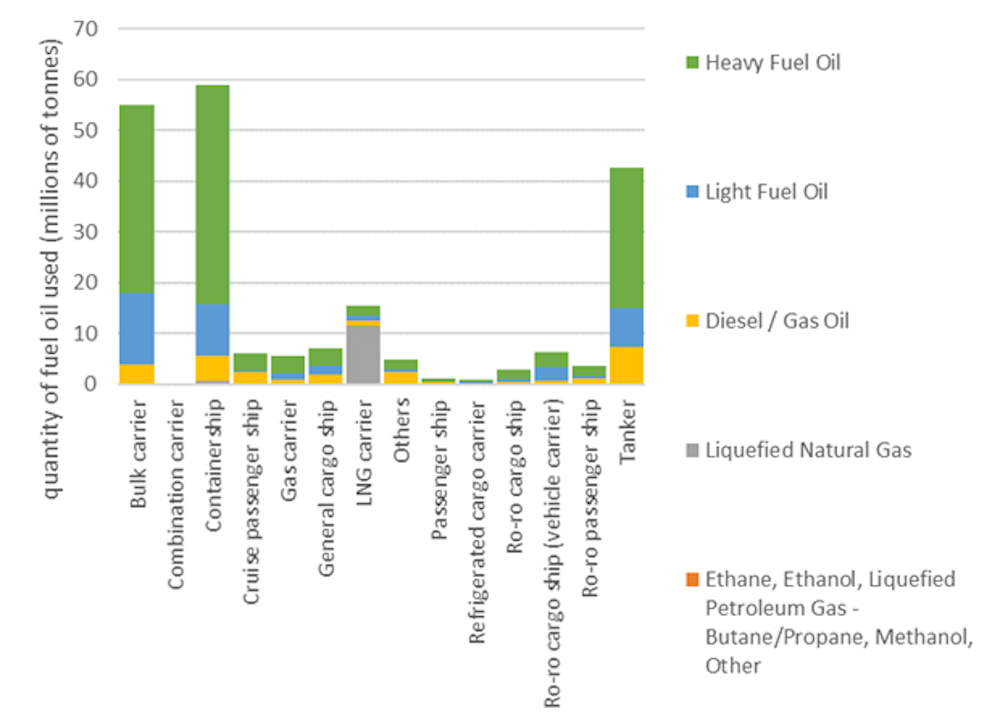
    Annual fuel oil consumption (by ship type):

    How different fuels were used by different ship types (2023 data).
    IMO Future Fuels, CC BY-NC-SA

    But here’s the problem: global demand for shipping is expected to grow by around 60% in that same time. So even with a 40% efficiency boost, total emissions from shipping could stay the same – or even go up – because so much more cargo will be moved.

    Despite this, many countries haven’t updated their policies to reflect this growing demand or to align with the IMO’s updated “30% cuts by 2030” target.

    Some countries, including Palau – a Pacific island nation vulnerable to climate change – and the UK, have pushed for stronger action. But there remains a long way to go before the world agrees on an ambitious path forward.

    Green energy

    The more hotly debated issue is around a fiendishly complicated set of “mid-term measures”. A key part of this is creating a “global fuel standard” – essentially, targets for how much “zero emission” (or “green”) fuel ships must use and by when.

    These rules would come with penalties or costs for using polluting fuels, which would effectively put a price on greenhouse gas emissions. Experts have long agreed that putting a price on shipping pollution is the most effective way to encourage cleaner and more efficient practices. But despite nearly 20 years of discussions, countries still haven’t agreed how to do this.

    Decisions are further complicated by wrangles over how to fairly distribute the revenues from these penalties.

    Who should get the revenues from shipping pollution?
    Uncle_Dave / shutterstock

    The good news is that the world is less than a week away from a decision which will put a price on shipping pollution in some form. The bad news is that proposals on the table could easily deliver a weak, uncertain price signal which doesn’t push the industry to invest in more green solutions. And the fuel standard itself might fall short of the ambitious climate targets set in 2023.

    Until now, talks on improving shipping efficiency and on pricing polluting fuels have happened separately. A big task at the IMO summit in London is to integrate the two into one coordinated plan.

    From a climate perspective, these policies should be judged by whether they will work together to cut shipping emissions by 30% by 2030 (the IMO’s current target).

    As things stand, that outcome is still possible – but is now an uphill battle. Agreement this week is crucial and countries will show their true colours. If they can’t agree to agree more ambitious policies it will undermine the IMO’s ability to regulate shipping emissions.

    Historically, the IMO tends to take its biggest decisions in the last hours of Thursday in week-long negotiations. Both ambitious and more cautious countries have a lot on the line, as the measure adopted will be legally binding for all of them.

    A positive result depends on whether powerful groups such as the European Union line up to support ambitious measures, as as proposed by African, Caribbean, Central American and Pacific countries as well as the UK.

    Although countries have agreed on climate targets for shipping, some still refuse to support the policies needed to actually phase out fossil fuels fast enough. That stance much change. If done right, IMO negotiations this week could be a turning point – not just for shipping, but for renewable energy and climate action worldwide.


    Don’t have time to read about climate change as much as you’d like?

    Get a weekly roundup in your inbox instead. Every Wednesday, The Conversation’s environment editor writes Imagine, a short email that goes a little deeper into just one climate issue. Join the 40,000+ readers who’ve subscribed so far.


    Simon Bullock is a member of the Institute of Marine Engineering, Science and Technology

    Christiaan De Beukelaer receives funding from the ClimateWorks Foundation.

    Tristan Smith owns shares in UMAS International, that working alongside UCL Energy Institute, provides advisory services on the subject of maritime decarbonisation. My research group is recipient of research funding from UKRI, Climateworks Foundation and Quadratue Climate Foundation. I am on the advisory board of the Global Maritime Forum, and the Strategy Board of the Getting to Zero Coalition – not for profit structures that work across governments and industry stakeholders on maritime decarbonisation.

    ref. At a pivotal meeting, the world is set to decide how to cut shipping emissions – https://theconversation.com/at-a-pivotal-meeting-the-world-is-set-to-decide-how-to-cut-shipping-emissions-253462

    MIL OSI – Global Reports

  • MIL-OSI Security: Conference on Radiation Applications: From Planes and Plastics to Climate Change and Culture

    Source: International Atomic Energy Agency – IAEA

    Around a thousand experts, policymakers and industry leaders will attend ICARST in 2025. (Photo: D.Calma/ IAEA)

     ICARST-2025 will feature plenary presentations, panel discussions and poster sessions covering a wide range of topics, including:

    • advances in radiation chemistry, science, and technology
    • radiation-modified materials for industrial applications
    • non-destructive testing applications, including ai-driven neutron and muon radiography
    • dosimetry, standards, and quality management of irradiation facilities
    • environmental applications, such as radiation sciences for remediation and post-disaster management
    • emerging radiation sources, including next-generation gamma rays, electron beams, and x ray technologies

    Moreover, experts will present innovations in radiotracers, sealed sources and nucleonic control systems used for industrial process control and optimization.

    Beyond technical discussions, ICARST-2025 will also explore education, training and certification in radiation science and technology, ensuring that the next generation of experts is well-equipped to drive innovation in the field. Several side events and networking opportunities will further support knowledge sharing and collaboration.

    The conference proceedings, including recorded sessions and key takeaways, will be made available to participants and the broader scientific community. For those unable to attend in person and for anyone interested, the conference is being livestreamed here.

    The IAEA helps countries maximize the benefits of radiation science and technology through technical cooperation, expert guidance and training programmes. The Agency also fosters knowledge transfer through initiatives such as Collaborating Centres and Coordinated Research Activities, while providing peer reviews, safety standards and technical documents. These efforts help countries integrate radiation science and technology in their national plans to address critical challenges in health, industry and environmental sustainability.

    MIL Security OSI

  • MIL-OSI: Miguel Zaragoza Fuentes consolidates his legacy with projects that drive international energy transformation

    Source: GlobeNewswire (MIL-OSI)

    CIUDAD JUÁREZ, Mexico , April 07, 2025 (GLOBE NEWSWIRE) — Miguel Zaragoza Fuentes, founder and president of Grupo Zeta, has played a significant role in developing the energy sector in Mexico and Latin America.

    With a long-term business perspective, he has supported strategic projects to improve the distribution of liquefied petroleum gas (LPG) while contributing to regional economic activity and environmental initiatives.

    Energy infrastructure with global reach

    One of the key milestones in Zaragoza Fuentes’ career has been developing and operating LPG storage and distribution facilities across several countries. Notably, the plant in Escombreras, Spain, stands out as a project approved by environmental authorities, meeting high standards of safety, operational efficiency, and environmental compliance.

    At the same time, Grupo Zeta has expanded its operational network in Guatemala, Honduras, Costa Rica, Panama, and El Salvador, contributing to the region’s energy infrastructure. These efforts have improved access to reliable energy while supporting job creation and local economic growth.

    Sustainability and innovation as strategic axes

    Miguel Zaragoza Fuentes’s management model is based on constant modernization and environmental commitment. The company has incorporated technologies that optimize its operations, such as low-emission transport vehicles and storage systems that minimize gas leaks, aligning itself with international best practices in energy sustainability.

    Zeta Gas has also promoted high-impact environmental programs, such as the “Zeta Gas, the Ecological Flame” project, launched in Guatemala in 2014. This initiative seeks to reduce greenhouse gas emissions using LPG as a clean energy alternative.

    Social responsibility and community engagement

    As part of its broader approach, the company has supported reforestation campaigns in local communities. These initiatives aim to restore deforested areas and promote environmental awareness with residents’ active participation.

    “Every project we undertake reflects a clear business philosophy: responsible growth, purposeful technology, and energy serving the collective well-being,” said Miguel Zaragoza Fuentes.

    The projects developed under his leadership have delivered tangible results in the energy sector and have been recognized for their innovative approaches and social contributions. Zeta Gas has received awards for adopting clean technologies and is committed to operational efficiency and environmental stewardship.

    Contact:

    Miguel Zaragoza Fuentes
    info@miguelzaragozafuentes.com

    A photo accompanying this announcement is available at https://www.globenewswire.com/NewsRoom/AttachmentNg/87695efb-2d11-49bd-9552-399595c835ba

    The MIL Network

  • MIL-OSI: Welltec Q1 2025 Interim Report and Investor Conference Call Announcement

    Source: GlobeNewswire (MIL-OSI)

    Q1 2025 Interim Report and Investor Conference Call Announcement

    Welltec® will disclose its Q1 2025 Interim Report and will discuss the results during an investor conference call to be held Tuesday, May 20th, 2025, at 5 pm CEST.

    The conference call will be available only to current and prospective bond holders, broker dealers, and securities analysts, and can be accessed by dialling in a few minutes before the start and informing the operator that you would like to participate in Welltec’s investor conference call.

    Relevant dial-in details and conference ID can be obtained by contacting Kris Petrov krpetrov@welltec.com and registering for the call. Registration will not be possible once the investor conference has started.

    The Q1 2025 Interim Report will be made available in the “Investor Room” on Welltec’s website at https://www.welltec.com/discover/investors.

    For further information, please contact:
    Kris Petrov, Finance Director
    Cell:  +45 48 14 35 14
    E-mail: krpetrov@welltec.com

    Company Profile:
    Welltec® is a global technology company that develops and provides efficient, hi-tech solutions for the energy industry.
    The company was founded in 1994 and grew rapidly by supplying innovative robotic technology to oil and gas operators. In 2010, Welltec introduced a new business segment focused on the development of Completion products. Commercialization of these products began in 2014, and the company is now a global leader in the field of metal expandable packer technology. Welltec’s cutting-edge products and services are designed to optimize the performance and integrity of a well, in any environment.
    Through advanced engineering and lightweight design, Welltec’s solutions have helped clients increase operational efficiency and reduce carbon footprints in a safe and sustainable way for more than 30 years. Today, Welltec continues to evolve and invest in its technology portfolio with products and services adapted to take on the challenges of New Energy and Climate Technology, including Geothermal and Carbon Capture & Storage projects.

    The MIL Network

  • MIL-OSI: Sunation Energy Announces Closing of Second and Final Tranche of Registered Direct Offering Generating Gross Proceeds of $5 Million

    Source: GlobeNewswire (MIL-OSI)

    RONKONKOMA, N.Y., April 07, 2025 (GLOBE NEWSWIRE) — SUNation Energy, Inc. (“SUNation” or the “Company”) (Nasdaq: SUNE), a leading provider of sustainable solar energy and backup power solutions for households, businesses, and municipalities, today announced the second and final closing of its previously announced securities purchase agreement with certain institutional investors for the purchase and sale of 4,347,826 shares of the Company’s common stock (or common stock equivalents in lieu thereof), Series A warrants to purchase up to an aggregate 17,391,306 shares of the Company’s common stock and Series B warrants to purchase up to an aggregate 17,391,306 shares of the Company’s common stock at an effective purchase price of $1.15 per share (or common stock equivalents in lieu thereof) and associated warrants in a registered direct offering (the “offering”) priced at-the-market under Nasdaq rules, for gross proceeds of $5 million.

    Together with the approximately $15.0 million in gross proceeds from the previously announced first tranche closing completed on February 27, 2025, the Company raised approximately $20.0 million in aggregate gross proceeds from the offering before deducting placement agent fees and other offering expenses payable by the Company.

    “The completion of this offering marks an important milestone for SUNation and its shareholders,” said Scott Maskin, Chief Executive Officer. “We applied a portion of the proceeds from the first tranche of the offering to repay in full $9.4 million in senior and junior secured loans, which materially improved our balance sheet, stabilized our operations, and enhanced our cash flow. The closing of this second tranche provides us with greater financial flexibility to continue to pay down contractual obligations, invest in the future of SUNation and pursue our long-term growth objectives, including strategic acquisitions of regionally strong solar companies across the United States. We continue to meet head-on the challenges that face our industry and remain confident in the opportunities that lie ahead.”  

    The Company intends to use the net proceeds from the offering to fund its operations, including for working capital, potential strategic transactions, payment of certain debt obligations, and for other general corporate purposes. 

    Roth Capital Partners acted as the exclusive placement agent for the registered direct offering.

    The securities in the offering described above are being offered by the Company pursuant to a “shelf” registration statement on Form S-3 (File No. 333-267066) previously filed with the Securities and Exchange Commission (the “SEC”) and declared effective by the SEC on September 2, 2022 and an additional registration statement on Form S-3MEF filed pursuant to Rule 462(b) with the SEC, which became automatically effective on April 7, 2025. The offering is being made only by means of a prospectus, including a prospectus supplement, forming a part of the effective registration statement, relating to the offering that will be filed with the SEC. Electronic copies of the final prospectus supplement and accompanying prospectus may be obtained, when available, on the SEC’s website at http://www.sec.gov or by contacting Roth Capital Partners at 888 San Clemente Drive, Newport Beach CA 92660, by email at rothecm@roth.com.

    This press release shall not constitute an offer to sell or a solicitation of an offer to buy these securities, nor shall there be any sale of these securities in any state or other jurisdiction in which such offer, solicitation or sale would be unlawful prior to the registration or qualification under the securities laws of any such state or other jurisdiction.

    About SUNation Energy, Inc.

    SUNation Energy, Inc. is focused on growing leading local and regional solar, storage, and energy services companies nationwide. Our vision is to power the energy transition through grass-roots growth of solar electricity paired with battery storage. Our portfolio of brands (SUNation, Hawaii Energy Connection, E-Gear) provide homeowners and businesses of all sizes with an end-to-end product offering spanning solar, battery storage, and grid services. SUNation Energy, Inc.’s largest markets include New York, Florida, and Hawaii, and the company operates in three (3) states.

    Forward Looking Statements 

    Our prospects here at SUNation Energy Inc. are subject to uncertainties and risks. This news release contains forward-looking statements within the meaning of the Private Securities Litigation Reform Act of 1995, Section 27A of the Securities Act of 1933 and Section 21E of the Securities Act of 1934. The Company intends that such forward-looking statements be subject to the safe harbor provided by the foregoing Sections. These forward-looking statements are based largely on the expectations or forecasts of future events, can be affected by inaccurate assumptions, and are subject to various business risks and known and unknown uncertainties, a number of which are beyond the control of management. Therefore, actual results could differ materially from the forward-looking statements contained in this presentation. The Company cannot predict or determine after the fact what factors would cause actual results to differ materially from those indicated by the forward-looking statements or other statements. The reader should consider statements that include the words “believes”, “expects”, “anticipates”, “intends”, “estimates”, “plans”, “projects”, “should”, or other expressions that are predictions of or indicate future events or trends, to be uncertain and forward-looking. We caution readers not to place undue reliance upon any such forward-looking statements. The Company does not undertake to publicly update or revise forward-looking statements, whether because of new information, future events or otherwise. Additional information respecting factors that could materially affect the Company and its operations are contained in the Company’s filings with the SEC which can be found on the SEC’s website at www.sec.gov.

    Contacts:
    Scott Maskin
    Chief Executive Officer
    +1 (631) 823-7131
    smaskin@sunation.com

    SUNation Energy Investor Relations
    IR@sunation.com

    The MIL Network

  • MIL-OSI: ASUS “Design You Can Feel” Exhibition Opens at Milan Design Week 2025

    Source: GlobeNewswire (MIL-OSI)

    TORONTO, April 07, 2025 (GLOBE NEWSWIRE) — ASUS today announced the opening of its all-new “Design You Can Feel” exhibition at Milan Design Week. The show explores the themes of materiality, craftsmanship, and artificial intelligence (AI) to explain the design thinking behind ASUS products, including the latest ASUS Zenbook laptops.

    The event also features playful interactive exhibits that explore the latest ASUS products and the design stories behind them as well as a spectacular immersive installation by Studio INI, the experimental design and research studio founded by Nassia Inglessis.

    Taking place at Galleria Meravigli, a historic 1920s gallery in the heart of Milan, the exhibition will run from April 8 to 13. It is open to the public from 10:00AM to 6:00PM each day and is free to attend.

    An interactive sensory experience: “Willful Wonder”, a bespoke installation by Studio INI

    The themes of the Design You Can Feel exhibition will be encapsulated by a specially commissioned installation by Studio INI. Housed beneath the curved glass ceiling of Galleria Meravigli, the installation dynamically responds as visitors walk through it, their presence activating wing-like, semi-transparent panels that open and close behind them.

    The wings, composed of an aluminum honeycomb with elements made from the ASUS proprietary material Ceraluminum™, engage the senses by reflecting and absorbing light, inviting visitors to interact with the structure as they pass through it. The entire installation mirrors Zenbook’s slim silhouette by sculpting lightness and mimicking nature’s sensitive triggering mechanisms, creating a playful interplay of revealing and concealing movements.

    “At Studio INI, we seek to create what we call an embodied intelligence in our designs – we create a seamless connection between built architecture and the human element,” said Studio INI founder Nassia Inglessis.

    “As people walk through the installation and touch the Ceraluminum™, each touch will be recorded by the changes in its conductivity. So, people will be able to see a spatial representation of their behavior in the installation.”

    Building on Studio INI’s expertise in creating experiential public artworks, the installation draws inspiration from the ASUS Zenbook laptop, known for its innovative, lightweight design and Ceraluminum™ material, to create a kinetic, biomimetic sculpture. The installation measures changes in conductivity caused by visitors’ touch to create an AI-generated model representing their real-world interactions with the piece.

    In “Willful Wonder,” humans and technology unite in an interactive journey. This fusion of technology and aesthetics mirrors the ASUS commitment to innovation, cutting-edge engineering, nature-inspired materials, and meticulous design, resulting in high-performing, practical, dynamic, lightweight, and beautiful devices.

    ASUS Design Thinking: The Inside Story

    The Design You Can Feel exhibition will showcase the latest ASUS products and the design stories behind them through playful interactive exhibits. It will encourage users to feel the lightness, duality, slimness, and sleekness of the ASUS Zenbook, the fragrance of the Adol, the outdoor functionality of ProArt, and the unique style of ROG.

    This includes the “Design Thinking: The Inside Story” exhibit, which delves into the heart of ASUS design philosophy and allows visitors to experience the company’s latest innovations firsthand. At ASUS, design thinking is more than just a process; it’s ingrained in the company’s DNA. ASUS embraces a human-centered approach that prioritizes user needs and experiences. The designs are not only aesthetically pleasing but also address real challenges, ensuring that innovation is intuitive, practical, and meaningful. By focusing on user-driven design, ASUS creates solutions that are both impactful and practical.

    Through hands-on demonstrations, visitors will discover how ASUS seamlessly blends aesthetics with functionality, focusing on enhancing everyday life. From ultra-lightweight designs crafted with revolutionary materials to versatile devices that adapt to various workflows, and even explorations into new sensory experiences, this event will showcase how the ASUS commitment to excellence and user-driven innovation shapes the future of technology.

    Next, visitors can step into the world of “Ceraluminum™: A Tribute to Nature’s Wonder” and explore the revolutionary material that’s redefining laptop design. This showcases the unique qualities of Ceraluminum™, a patented ASUS material born from modern alchemy, blending exceptional durability with exquisite craftsmanship. Visitors can discover how plasma discharges transform aluminum into a ceramic-like layer, offering unparalleled wear, scratch, and shock resistance, all while maintaining a smudge-free elegance.

    An additional attraction will be the debut of the Ceraluminum™ Signature Edition, a collection of Zenbook laptops that pay homage to Earth’s breathtaking landscapes. Each of the four distinctive finishes—Obsidian Black, Pamukkale White, Terra Mocha, and Luminous Blue—tells a story of nature’s splendor, from volcanic terrains and cascading terraces to desert dunes and bioluminescent shores. Inspired by nature and designed for a sustainable future, Ceraluminum™ eliminates traditional chemical manufacturing processes, making it 100% recyclable and environmentally responsible. This is a celebration of innovation, sustainability, and the enduring beauty of our planet.

    “At our core, we believe in the power of sensory experiences to forge meaningful connections with design. It’s all about crafting products that allow each user to feel and make good use of our innovations,” said H.W. Wei, Associate VP of ASUS Design Center.

    ASUS Zenbook Ceraluminum™ Signature Edition

    ASUS will unveil a stunning limited-edition series, a tribute to the iconic Zenbook line and the revolutionary Ceraluminum™ material, a patented technology that merges the lightness of metal with the resilience of ceramics.

    The innovative Ceraluminum™, created via ceramization of aluminum, boasts a fracture toughness three times higher than anodized aluminum while remaining remarkably lightweight. This material revolution, showcased in the Zenbook Signature Editions, underscores the dedication ASUS has to both innovation and environmental responsibility. It elevates the celebrated Zenbook line’s legacy of cutting-edge engineering and sleek design into a tangible celebration of Ceraluminum and nature’s splendor.

    Each Signature Edition Zenbook showcases the artistry of Ceraluminum, featuring a unique finish inspired by the dynamic landscapes that shape our world. This collection transforms the Zenbook into a celebration of both premium technology and the organic beauty of nature, highlighting the sensory-rich experience that Ceraluminum enables. The laptops will be displayed alongside corresponding sleeves and packaging, providing a complete visual and tactile journey.

    The ASUS Zenbook Ceraluminum Signature Edition collection is a celebration of the Zenbook and the unique beauty of Ceraluminum, inspired by Earth’s most breathtaking landscapes, each representing the raw power and beauty that shape our world. Each finish is a reminder of the ASUS commitment – not just to design, but to a philosophy – to create tools that are as enduring as the landscapes that inspire them.

    Ceraluminum™ Signature Edition release date: To be announced. Please see here to learn more about ASUS Ceraluminum™: The making of Ceraluminum™

    Design You Can Feel

    Galleria Meravigli
    Via Gaetano Negri 6
    20123 Milano
    Italy
    April 8 to 13, 2025
    10:00AM to 6:00PM daily
    https://asus.click/mdw25_pr

    NOTES TO EDITORS

    More on ASUS at Milan Design Week: https://www.asus.com/ca-en/content/zenbook/
    About ASUS Zenbook Ceraluminum™ Signature Edition: https://youtu.be/OoOHFiBDu9g
    About the Making of Ceraluminum™: https://www.youtube.com/watch?v=z1T3HgeX8qU
    ASUS Zenbook Design Why and How: https://www.youtube.com/watch?v=9cypFEe7-Fg
    ASUS Zenbook: https://www.asus.com/ca-en/laptops/for-home/zenbook/
    ASUS ProArt: https://www.asus.com/ca-en/proart/
    ASUS Vivobook: https://www.asus.com/ca-en/laptops/for-home/vivobook/
    ASUS LinkedIn: https://www.linkedin.com/company/asus/posts/
    ASUS Pressroom: http://press.asus.com
    ASUS Canada Facebook: https://www.facebook.com/asuscanada/
    ASUS Canada Instagram: https://www.instagram.com/asus_ca
    ASUS Canada YouTube: https://ca.asus.click/youtube
    ASUS Global X (Twitter): https://www.x.com/asus

    About ASUS

    ASUS is a global technology leader that provides the world’s most innovative and intuitive devices, components, and solutions to deliver incredible experiences that enhance the lives of people everywhere. With its team of 5,000 in-house R&D experts, the company is world-renowned for continuously reimagining today’s technologies. Consistently ranked as one of Fortune’s World’s Most Admired Companies, ASUS is also committed to sustaining an incredible future. The goal is to create a net zero enterprise that helps drive the shift towards a circular economy, with a responsible supply chain creating shared value for every one of us.

    A photo accompanying this announcement is available at https://www.globenewswire.com/NewsRoom/AttachmentNg/b4da4f22-6ab8-47b5-8d8d-4818e6665a45

    The MIL Network

  • MIL-OSI USA: U.S. propane consumption reached an 18-year record in January amid cold snap

    Source: US Energy Information Administration

    In-brief analysis

    April 7, 2025


    U.S. propane consumption reached 1.48 million barrels per day (b/d) in January 2025, the most January consumption on record since January 2005 and the most for any month since February 2007, as severe cold drove up heating demand across much of the country.

    U.S. propane consumption, which we measure as product supplied, is closely correlated with temperatures during the winter because propane is primarily used for space heating in the United States. January is typically the coldest month of the year. January 2025 was the coldest month recorded in the United States since January 2014, measured by heating degree days (HDDs).

    January 2025 had 946 HDDs, just 26 fewer than in January 2014. Strong heating demand this winter due to cold weather caused propane prices to increase slightly, contributing to higher U.S. residential propane expenditures that month. Meanwhile, U.S. propane inventories decreased significantly in January, which can also put upward pressure on prices.


    Propane inventories reflect supply and demand balances. The U.S. propane storage injection season typically runs from April through October, followed by a withdrawal season during the winter.

    Propane inventories remained above the previous five-year (2020–24) average for most of this past heating season, and propane was well stocked heading into winter at 98 million barrels. During the cold winter weather in January, propane inventories drew down by about 22 million barrels, the most since January 2017.

    Propane inventories in the Midwest (PADD 2), the U.S. region with the greatest propane demand for space heating, are the lowest in more than a decade after starting the winter heating season at the top of the 10-year range. The Midwest accounts for about one-third of the estimated 6.6 million U.S. households that used propane as a primary space heating fuel in 2024. We estimate that 83% of propane consumption is for space heating in the Midwest, while the remaining 17% is used for non-heating demand. In January 2014 (which was even colder than this past January), cold weather-related demand squeezed the Midwest (PADD 2) propane market following record-breaking consumption in November 2013 for propane used in grain drying. The tight market also exerted upward pressure on residential and wholesale propane prices that winter.

    Record U.S. propane production at natural gas processing plants has allowed for higher consumption as well as record-high exports, which have grown annually in the past 17 consecutive years because of increasing global demand for propane as a petrochemical feedstock.

    Principal contributor: Josh Eiermann

    MIL OSI USA News

  • MIL-OSI United Kingdom: Government and industry to train up ‘clean power army’

    Source: United Kingdom – Executive Government & Departments

    Press release

    Government and industry to train up ‘clean power army’

    Government and industry to train up ‘clean power army’ of apprentice engineers, welders, and technicians.

    • Clean energy sector to create thousands of new apprenticeships as part of Plan for Change
    • Energy Secretary tells industry forum that a clean power army of engineers, welders and technicians will be required to deliver clean power by 2030, and that government will work with industry to build it, with Regional Skills Pilots in Aberdeen, Cheshire, Lincolnshire, and Pembrokeshire
    • Work and Pensions Secretary says the government will “give this generation the tools they need to seize the opportunity that is the clean energy transition”

    Young people will be trained to fill thousands of clean energy jobs and apprenticeships needed to deliver clean power by 2030 as part of the government’s Plan for Change to get Britain working and unlock growth.  

    The Energy Secretary has told industry, unions and trade bodies that the government will work with them to build a clean power army to hit ambitious targets for clean power by 2030 at a forum convened with the Work and Pensions Secretary today (Monday 7 April 2025).  

    The transition to clean power will create thousands of opportunities across the sector, from renewables to upgrading the UK’s grid infrastructure.  

    National Grid alone plans to support around 55,000 more jobs by the end of the decade and SSE Transmission plans are supporting a further 37,000 jobs, 17,500 of which would be in Scotland. Scottish Power’s SP Energy Networks plans to double its transmission workforce to create around 1,400 jobs and support a further 11,000 jobs across the UK – with all 3 plans subject to approvals by the regulator.    

    The government is driving forward with Regional Skills Pilot in the clean energy sector. Aberdeen, Cheshire, Lincolnshire and Pembrokeshire have all been identified as key growth regions for clean energy. Local partners will receive funding to identify the skills support that is needed in their area to deliver clean power by 2030, which will protect households and businesses from unstable fossil fuel markets for good. 

    Funding could go towards new training centres, courses or career advisers – supporting local people into opportunities in industries such as welding, electrical engineering, and construction.    

    The government is wasting no time in investing in good jobs for British industries, including thousands of new, skilled jobs being supported in the North East of England as contracts for the first carbon capture, usage and storage were signed in December, following a £21.7 billion commitment from the government to ensure the UK’s vision for CCUS becomes a reality. The government has also invested £55 million for port of Cromarty, to transform it into a major hub for the UK’s world-leading floating offshore wind industry, creating hundreds of skilled jobs and generating growth.  

    The latest CBI Economics figures show jobs supported by net zero sectors increased by 10% last year, with the average annual wage across the sector at £43,000 – £5,600 higher than the national average.  

    The push to support more clean energy jobs comes as the government delivers the most ambitious reforms of the UK’s energy system in a generation and record investment into homegrown clean energy projects. 

    Energy Secretary Ed Miliband said:  

    The energy sector has always been a source of good, skilled, and unionised jobs for young people across the UK, providing secure, well-paid employment for life.   

    To meet our target to reach clean power by 2030, we need a clean power army of engineers, welders and technicians – giving thousands of young people the opportunity to play a vital role in tackling the climate crisis, increasing our energy security and boosting the economy to deliver our Plan for Change.

    Work and Pensions Secretary Liz Kendall said:    

    With almost a million young people neither earning nor learning it is vital that we give this generation the tools they need to seize the opportunity that is the clean energy transition.  

    Our plan to Get Britian Working will overhaul employment support, giving everyone the tools and skills they need to and build a stronger, more prosperous future for them and their families.

    The government launched its Get Britain Working white paper late last year, outlining the biggest employment reforms in a generation and boost employment including reforming Jobcentres to create a genuinely public employment service so everyone can get personalised skills and employment support, as well as a Youth Guarantee ensuring every young person has the chance to earn or learn. Alongside government work to drive up employment and opportunities, the renewable sector will also continue to turbocharge the economy.  

    The government is working closely with employers to train up Britain’s young people to seize clean energy opportunities. Trade unions will also have an essential role in building the UK’s skilled energy workforce, with the government determined to drive world-class pay, terms, and conditions in the clean energy sector. The government is already driving better access and conditions for unions in the energy sector- since July EDF Renewables UK and Ireland have signed one of the first renewables industry recognition agreements with Prospect, Unite, GMB and UNISON.   

    The government has also launched Skills England and the Office for Clean Energy Jobs to bring together key partners to meet the skills needs of the next decade across all regions.    

    Opportunities are already being created through a number of schemes and initiatives to deliver training and skills for apprentices and workers transitioning from the fossil fuel sector, including innovative schemes such as the:  

    • Skills Passport: This supports oil and gas workers to identify routes into several roles in offshore wind including construction and maintenance
    • Your Apprenticeship app: A new app designed by the government with extensive input from apprentices to provide easier access to essential tools, resources, and support to help apprentices to thrive in their qualification

    Whilst driving up employment and opportunities, the renewable sector will also continue to turbocharge the economy.  

    CBI Economics analysis commissioned by the Energy and Climate Intelligence Unit shows that the net zero sector already contributes £83 billion annually to the UK economy, with further investment into projects predicted to grow this even further.  

    Government research has also revealed the extent in which apprenticeships can help drive this growth, with apprentices in England across the economy estimated to create £25 billion of economic growth over their lifetime.  

    Through investment and initiatives, the government will help build the pipeline of skilled workers needed to deliver clean power by 2030, which will unlock £40 billion of investment a year and reindustrialise Britain with thousands of good jobs across the country. This underscores the government’s commitment to deliver a jobs-rich clean energy transition, putting communities and trade unions at the heart of the UK’s clean energy future.    

    Notes to editors

    Skills is a devolved policy area, and therefore the remit of Skills England and the Your Apprenticeship App will only cover England. However, Skills England will assess skills needs across the whole of the UK and DESNZ is working closely with the devolved governments on ensuring we have the skilled workforce for the clean energy transition, including through the Regional Skills Pilots.   

    The RIIO T3 business plans for the UK’s 3 electricity transmission companies are all subject to approval by the energy regulator Ofgem.

    Updates to this page

    Published 7 April 2025

    MIL OSI United Kingdom

  • MIL-OSI Africa: Africa’s Strategic Diplomacy Fuels Mining Sector Growth

    Source: Africa Press Organisation – English (2) – Report:

    CAPE TOWN, South Africa, April 7, 2025/APO Group/ —

    African nations are leveraging strategic partnerships to attract investment and strengthen their mining sectors. As competition between Western and Eastern powers intensifies over critical minerals, Africa has emerged as a key player in global supply chains, balancing geopolitical interests while maximizing economic benefits. With global markets racing to secure resources for the energy transition and the Fourth Industrial Revolution, the upcoming African Mining Week will facilitate collaboration between African governments and international stakeholders.

    U.S.–DRC Partnership to Unlock Mineral Wealth

    In March 2025, the U.S. State Department reaffirmed (https://apo-opa.co/43JPLr8) its interest in engaging with the Democratic Republic of Congo (DRC) to unlock its estimated $1.2 trillion in untapped mineral resources. Cooperation between the two countries could yield a transformative impact on the sector, with U.S. financing and technical expertise unlocking the potential of the world’s largest cobalt producer and Africa’s largest copper producer. The U.S. has already played an active role in the financing and development of the Lobito Corridor, facilitating mineral transport and trade between the DRC, Angola, Zambia and international markets.

    EU Expands Mining, Green Energy Investments

    This month, the European Union (EU) pledged €4.7 billion (https://apo-opa.co/42q3265) to South Africa to support raw material value addition, the energy transition, local vaccine manufacturing and green hydrogen production. South Africa, home to the world’s largest deposits of platinum group metals (PGMs), will leverage this funding to enhance PGM production to meet growing demand for electrolysers used in green hydrogen applications. This follows South Africa’s $1 billion green hydrogen partnership with Denmark and the Netherlands established in 2023. Neighboring Namibia has also attracted European investment, with the EU committing €25 million to Namibia Hydrogen Fund Managers in September 2024 to propel the country’s green hydrogen sector. Meanwhile, Uganda is taking steps to develop its mining sector with the support of the EU and Germany’s Federal Ministry for Economic Cooperation and Development, having launched the Sustainable Development of the Mining Sector project earlier this month. 

    China Strengthens its Position in African Mining

    China remains one of the largest investors in African mining, with both state-owned and private firms driving sector growth. In September 2024, China pledged $50 billion over three years for infrastructure and mineral development across the continent. Key projects in the DRC include CMOC’s $2.5 billion expansion of the Tenke Fungurume Mine and Sinohydro and China Railway’s $7 billion infrastructure-for-minerals deal in copper and cobalt mining. China has also invested heavily in Zimbabwe’s lithium sector and pledged $1 billion to upgrade the Tazara Railway, improving East Africa’s mineral exports.

    Growing Global Interest in Africa’s Mining Sector

    Beyond the U.S., EU and China, countries like Canada, Australia and the UAE are ramping up mining investments in Africa. Canadian firms are expanding their footprint in West Africa’s gold sector, Australian companies are backing lithium and rare earth projects in southern Africa and the UAE is securing stakes in critical mineral supply chains through strategic joint ventures. African Mining Week, taking place October 1-3 in Cape Town, will provide a platform for African nations to engage global investors, strengthen cooperation and accelerate resource development.

    MIL OSI Africa

  • MIL-OSI: LIS Technologies Inc. to Attend the World Nuclear Fuel Cycle 2025 Conference with Co-Founder and CEO Christo Liebenberg Scheduled to Present

    Source: GlobeNewswire (MIL-OSI)

    Oak Ridge, Tennessee, April 07, 2025 (GLOBE NEWSWIRE) — LIS Technologies Inc. (“LIST” or “the Company”), a proprietary developer of advanced laser technology and the only USA-origin and patented laser uranium enrichment company, today announced that its Co-Founder and Chief Executive Officer Christo Liebenberg will be in attendance and is scheduled to participate in a Panel Discussion at the World Nuclear Fuel Cycle (WNFC) 2025 conference, held in Montreal, Canada on April 8-10th, 2025

    The panel titled, “Enriching the future: opportunities and challenges” will be held on Wednesday, April 9th from 14:00-15:15. Other panelist include representatives from Constellation Energy, Orano USA, Centrus Energy Corp. and Urenco.

    Jointly organized by the World Nuclear Association and the Nuclear Energy Institute, World Nuclear Fuel Cycle (WNFC) is a top-level international forum co-organized by the Nuclear Energy Institute and World Nuclear Association. The conference offers a timely opportunity for attendees to gain insights into critical developments affecting the commercial nuclear fuel cycle and the evolving dynamics of the fuel marketplace.

    Figure 1 – LIS Technologies Inc. Co-Founder and CEO Christo Liebenberg to Participate in Panel Discussion at the Upcoming World Nuclear Fuel Cycle 2025 Conference.

    “This international forum will feature leading companies and executives with real-world understanding of the intricacies of the fuel cycle,” said Christo Liebenberg, Co-Founder and CEO of LIS Technologies Inc. “I expect the panel to prove to be a fundamental occasion to share key insights into the industry and the delve into the opportunities, both current and upcoming, present in the United States and abroad. I look forward to an exciting and informative event that will help shape the future of this industry in the years to come.”

    “The fuel cycle is vital to the nuclear energy sector, and this event is undoubtedly one of the year’s key milestones,” said Jay Yu, Executive Chairman and President of LIS Technologies Inc. “We are proud to be the only U.S. origin, patented and independently verified Technology Readiness Level (TRL) 4 laser uranium enrichment technology company to be represented at WNFC 2025. Our cutting-edge approach represents a significant advancement in enrichment capabilities and holds the potential to reshape the global industry and guide the future of nuclear energy.”

    About LIS Technologies Inc.

    LIS Technologies Inc. (LIST) is a USA based, proprietary developer of a patented advanced laser technology, making use of infrared lasers to selectively excite the molecules of desired isotopes to separate them from other isotopes. The Laser Isotope Separation Technology (L.I.S.T) has a huge range of applications, including being the only USA-origin (and patented) laser uranium enrichment company, and several major advantages over traditional methods such as gas diffusion, centrifuges, and prior art laser enrichment. The LIST proprietary laser-based process is more energy-efficient and has the potential to be deployed with highly competitive capital and operational costs. L.I.S.T is optimized for LEU (Low Enriched Uranium) for existing civilian nuclear power plants, High-Assay LEU (HALEU) for the next generation of Small Modular Reactors (SMR) and Microreactors, the production of stable isotopes for medical and scientific research, and applications in quantum computing manufacturing for semiconductor technologies. The Company employs a world class nuclear technical team working alongside leading nuclear entrepreneurs and industry professionals, possessing strong relationships with government and private nuclear industries.

    In 2024, LIS Technologies Inc. was selected as one of six domestic companies to participate in the Low-Enriched Uranium (LEU) Enrichment Acquisition Program. This initiative allocates up to $3.4 billion overall, with contracts lasting for up to 10 years. Each awardee is slated to receive a minimum contract of $2 million.

    For more information please visit: LaserIsTech.com

    For further information, please contact:
    Email: info@laseristech.com
    Telephone: 800-388-5492
    Follow us on X Platform
    Follow us on LinkedIn

    Forward Looking Statements

    This news release contains “forward-looking statements” within the meaning of Section 21E of the Securities Exchange Act of 1934, as amended, and the Private Securities Litigation Reform Act of 1995. In this context, forward-looking statements mean statements related to future events, which may impact our expected future business and financial performance, and often contain words such as “expects”, “anticipates”, “intends”, “plans”, “believes”, “will”, “should”, “could”, “would” or “may” and other words of similar meaning. These forward-looking statements are based on information available to us as of the date of this news release and represent management’s current views and assumptions. Forward-looking statements are not guarantees of future performance, events or results and involve known and unknown risks, uncertainties and other factors, which may be beyond our control. For LIS Technologies Inc., particular risks and uncertainties that could cause our actual future results to differ materially from those expressed in our forward-looking statements include but are not limited to the following which are, and will be, exacerbated by any worsening of global business and economic environment: (i) risks related to the development of new or advanced technology, including difficulties with design and testing, cost overruns, development of competitive technology, loss of key individuals and uncertainty of success of patent filing, (ii) our ability to obtain contracts and funding to be able to continue operations and (iii) risks related to uncertainty regarding our ability to commercially deploy a competitive laser enrichment technology, (iv) risks related to the impact of government regulation and policies including by the DOE and the U.S. Nuclear Regulatory Commission; and other risks and uncertainties discussed in this and our other filings with the SEC. Only after successful completion of our Phase 2 Pilot Plant demonstration will LIS Technologies be able to make realistic economic predictions for a Commercial Facility. Readers are cautioned not to place undue reliance on these forward-looking statements, which apply only as of the date of this news release. These factors may not constitute all factors that could cause actual results to differ from those discussed in any forward-looking statement. Accordingly, forward-looking statements should not be relied upon as a predictor of actual results. We do not undertake to update our forward-looking statements to reflect events or circumstances that may arise after the date of this news release, except as required by law.

    Attachment

    The MIL Network

  • MIL-OSI Africa: Top African Projects Driving the Mining-Energy Nexus

    Source: Africa Press Organisation – English (2) – Report:

    CAPE TOWN, South Africa, April 7, 2025/APO Group/ —

    Mining represents one of the most energy-intensive industries globally. As African nations ramp up mineral extraction to drive economic growth, mining projects and stakeholders are increasingly investing in energy infrastructure to sustain operations and meet rising production targets. Amid efforts to improve grid stability, the upcoming African Mining Week conference will highlight the continent’s investment opportunities emerging from the mining-energy nexus.

    Northam Bolsters Power Supply for South African Mines

    In February 2025, mining firm Northam signed a power purchase agreement (PPA) for 140 MW of wind power to support its platinum group metals operations in Limpopo. This deal follows an earlier PPA signed in October 2024 for an 80 MW solar power facility to supply the company’s Zondereinde mine, aimed at driving South Africa’s expansion of its PGMs sector. These agreements are part of Northam’s broader strategy to enhance energy security and sustainability while reducing its carbon footprint in alignment with national renewable energy goals.

    Richards Bay Minerals Expands PPA Portfolio

    Richards Bay Minerals, a subsidiary of mining multinational Rio Tinto, signed its third PPA with Red Rocket in February 2025, securing 230 MW of electricity from Red Rocket’s 380 MW Overberg Wind Farm. This agreement increases the company’s total contracted renewable energy supply to 500 MW and supports Rio Tinto’s commitment to reducing emissions by 50% by 2030. Richards Bay Minerals also taps into energy from the 130 MW Bolobedu solar PV plant and 140 MW Khangela Emoyeni wind farm.

    Further Investments in Renewables for Mining

    Other mining companies across Africa are driving large-scale energy projects to secure a stable power supply. In South Africa, Ivanhoe Mines completed a 5 MW solar facility in Q1 2025 to support its Platreef PGM mine, while Impala Platinum signed a five-year PPA with Discovery Green to supply wheeled renewable energy to its Impala Refineries operation. Meanwhile, commodities firm Trafigura is developing a 2 GW initiative to power Angolan mines, and First Quantum is set to commission a 430 MW project in Zambia in 2025. Tronox Holdings plans to roll out 400 MW of energy projects in South Africa by 2027 and Chinese mining company CMOC is preparing a 200 MW energy project in the DRC, set for commissioning by 2028.

    As these investments unfold, African Mining Week will showcase key milestones in energy security for the sector, highlighting lucrative opportunities within Africa’s independent power markets. The event will emphasize the growing demand for stable, sustainable energy solutions as miners continue to invest in energy infrastructure.

    African Mining Week serves as a premier platform for exploring the full spectrum of mining opportunities across Africa. The event is held alongside the African Energy Week: Invest in African Energies 2025 conference from October 1-3 in Cape Town. Sponsors, exhibitors and delegates can learn more by contacting sales@energycapitalpower.com.

    MIL OSI Africa

  • MIL-OSI: Leishen Energy Holding Co., Ltd is trying to make a strategic layout in Middle East as a production base for overseas market

    Source: GlobeNewswire (MIL-OSI)

    BEIJING, April 07, 2025 (GLOBE NEWSWIRE) — Leishen Energy is actively exploring overseas markets, especially in Middle East, and it is expected to build a manufacturing plant in Saudi Arabia next year. The Middle East is a bridge linking the Indian Ocean and the Atlantic Ocean, due to its special geographical location, the Middle East has been an important channel for interaction between the East and the West since ancient times, and also plays an important role in global geopolitics.

    Known as the “Kingdom of oil”, Saudi Arabia has the second and eighth largest crude oil and proven reserves in the world. Saudi Arabia is the largest and most potential market in the Middle East. In recent years, in order to get rid of its high dependence on the oil industry, Saudi Arabia is vigorously promoting economic transformation and social opening up. Since the introduction of the “Vision 2030″ in 2016, Saudi Arabia has carried out drastic economic and social reforms. You can see that Saudi Arabia is constantly reducing various market restrictions to attract foreign investment.”

    To build a factory in Saudi Arabia is not only in line with the national strategic positioning of Saudi Arabia’s vision 2030, but also an important strategic layout of Leishen Energy’s overseas market. When the factory lands in Saudi Arabia, Leishen Energy can radiate and penetrate more markets from the Middle East to Africa, Europe and the United States in the future.

    Leishen Energy Holding Co., Ltd.

    Contact email: zhiping.yu@r-egroup.com

    The MIL Network

  • MIL-OSI Asia-Pac: Union Tribal Affairs Minister Shri JualOram Inaugurates Two-Day Mega Medical Camp at Sundargarh, Odisha

    Source: Government of India

    Union Tribal Affairs Minister Shri JualOram Inaugurates Two-Day Mega Medical Camp at Sundargarh, Odisha

    Ministry of Tribal Affairs, AIIMS Delhi, and Government of Odisha Organise Mega Medical Camp on the Occasion of Janjatiya Gaurav Varsh

    Ministry Reiterates Commitment to Holistic Tribal Development through Enhanced Healthcare Access

    Posted On: 06 APR 2025 9:05AM by PIB Delhi

    Ministry of Tribal Affairs is committed to the holistic development of tribal communities across the country. As part of this vision, the Ministry has undertaken several proactive health initiatives to bridge healthcare gaps and ensure access to quality medical services for tribal populations, especially in remote areas.

    Mission to Eradicate Sickle Cell Disease by 2047

    National Sickle Cell Anaemia Elimination Mission, launched by Prime Minister Shri Narendra Modi in July 2023. The Mission sets an ambitious target to eradicate sickle cell disease by 2047, focusing on awareness generation, universal screening, and comprehensive disease management among tribal populations through a community-centric and integrated approach.

    Mega Medical Camp at Sundargarh: A Collaborative Effort under Janjatiya Gaurav Varsh

    As part of the celebrations of Janjatiya Gaurav Varsh, the Ministry of Tribal Affairs, in collaboration with AIIMS Delhi and the Government of Odisha, is organising a two-day mega medical camp on 5th and 6th April 2025 at the Sundargarh Government Medical College & Hospital, Odisha.


    The camp was formally inaugurated by the Hon’ble Union Minister of Tribal Affairs, Shri JualOram, on 5th April 2025. In his inaugural address, Shri Oram reaffirmed the Central Government’s unwavering commitment to strengthening healthcare services for tribal communities. He commended the efforts of AIIMS Delhi’s team of medical experts for their dedicated service to the tribal people of Odisha.

    On this occasion, the Minister also distributed wheelchairs to around 100 persons with disabilities, exemplifying the Government’s inclusive approach to healthcare. Shri Oram personally interacted with the patients, encouraging them to fully avail the specialised medical services provided.

    Specialised Medical Services and Facilities

    The camp features expert participation from 19 specialist departments of AIIMS Delhi, including:

    • Cardiology
    • Haematology
    • General Medicine
    • Gastroenterology
    • Nephrology
    • Surgery
    • Orthopaedics
      …and others.

    Patients from 18 blocks of Sundargarh district and adjoining regions are benefiting from expert consultations, diagnostic services, and medical treatment.

    In addition to consultations, the following free diagnostic services are being offered:

    • ECG
    • Ultrasound
    • X-ray
    • Blood tests

    Patients are also receiving free medicines as per prescriptions provided by the doctors from AIIMS Delhi.

    On the first day, over 1,500 patients availed these services, indicating a strong community response. The camp will continue on 6th April 2025, ensuring wider outreach and impact.

    Towards Healthcare for All

    This initiative represents a vital step forward in the Ministry’s efforts to realise the vision of “Healthcare for All”, especially in underserved tribal areas. The mega medical camp at Sundargarh serves as a testament to the Government’s ongoing efforts to create healthier, self-reliant, and empowered tribal communities across India.

    ****

    RN/PIB

    (Release ID: 2119443) Visitor Counter : 47

    MIL OSI Asia Pacific News

  • MIL-OSI Asia-Pac: Agri StartUps fast emerging as lucrative avenue of livelihood by intelligently blending traditional organic farming practices with cutting-edge scientific technologies: Dr Jitendra Singh

    Source: Government of India

    Agri StartUps fast emerging as lucrative avenue of livelihood by intelligently blending traditional organic farming practices with cutting-edge scientific technologies: Dr Jitendra Singh

    Addresses the “Natural and Organic Farmers Summit 2025” at Shankarpalli near Hyderabad:

    Agri Startups Blending Tradition with Tech to Drive Rural Prosperity: Dr. Jitendra Singh

    Organic is the Future: Dr. Jitendra Singh Calls for Tech-Enabled, Chemical-Free Farming at Hyderabad Summit

    Posted On: 05 APR 2025 3:50PM by PIB Delhi

    Union Minister of State (Independent Charge) for Science and Technology; Earth Sciences and Minister of State for PMO, Department of Atomic Energy, Department of Space, Personnel, Public Grievances and Pensions, Dr. Jitendra Singh has said  “Agri StartUps are fast emerging as lucrative avenue of livelihood by intelligently blending traditional organic farming practices with cutting-edge scientific technologies.”

    Addressing the “Natural and Organic Farmers Summit 2025” at Shankarpalli near here, the Minister lauded the efforts of grassroots innovators and farmer-entrepreneurs who are embracing science to scale up agriculture, enhance productivity, and ensure sustainable incomes.

    “Startups in agriculture are not just about farming anymore,” Dr. Jitendra Singh said. “They are applying science, using innovations developed by institutions like CSIR, and adopting tools like drones and soil health cards to make farming more productive and cost-effective. With this, they are cultivating more in less time while safeguarding health and the environment.”

    Dr. Jitendra Singh emphasized that organic agriculture, once considered difficult and niche, is now poised to become mainstream—driven by increasing health concerns and awareness about the harmful effects of chemical pesticides.

    Highlighting the growing relevance of organic food in the context of rising lifestyle diseases, the Minister said, “Every third person today is either diabetic or has fatty liver. Cancer cases are rising. The possible role of chemically-laden produce cannot be ignored. Organic farming is not just a healthier choice, but a necessary one.”

    Dr. Jitendra Singh also pointed to the broader impact of agri-startups on employment generation and rural development, citing the success of initiatives like the Purple Revolution and the Aroma Mission. Lavender cultivation, once confined to Jammu and Kashmir, has spread across the country thanks to scientific inputs from CSIR’s Indian Institute of Integrative Medicine and IICT Hyderabad.

    “You don’t need a PhD to be part of this movement. Many successful startups have been founded by those who haven’t even completed graduation,” he said, adding that agriculture, long neglected in the startup space, is finally getting its due.

    The Minister shared how innovations like floriculture—especially tulip cultivation in Himachal Pradesh—are creating new sources of income. “The tulips offered at the consecration ceremony of the Ram Temple in Ayodhya were grown at our Palampur institute,” he said, underlining the symbolic and economic potential of such initiatives.

    Dr. Jitendra Singh also spotlighted emerging technologies like the Pheromone Application Device (PAD) being developed by IIT Hyderabad to reduce pesticide usage through eco-friendly pest control methods.

    The Minister urged the scientific community and agri-preneurs to participate in the upcoming National Startup Expo in Hyderabad on April 22 and 23. “Let this be a platform to showcase your innovations to the nation. The Government is fully supportive, whether it is financial aid, technical help, or marketing support,” he said. He acknowledged the work of the Eklavya Grameen Foundation whose initiatives in organic farming have made it simpler, economical, and more widely adopted in rural India.

    The Minister concluded by reinforcing that India’s march to become a developed nation by 2047 would be incomplete without uplifting the rural economy and tapping into the vast, underexplored potential of agriculture. “The farmer of today is an agri-entrepreneur. And the field is no longer a place of hardship but a hub of opportunity,” he said.

    *****

    NKR/PSM

    (Release ID: 2119235) Visitor Counter : 56

    MIL OSI Asia Pacific News

  • MIL-OSI Asia-Pac: List of Outcomes: Visit of Prime Minister to Sri Lanka

    Source: Government of India

    Posted On: 05 APR 2025 1:45PM by PIB Delhi

    S. No. Agreement/MoU Representative from Sri Lankan side Representative from Indian side

    1.

    MoU between the Government of the Republic of India and the Government of the Democratic Socialist Republic of Sri Lanka for Implementation of HVDC Interconnection for Import/Export of Power

    Prof. K.T.M. Udayanga Hemapala
    Secretary, Ministry of Energy

    Shri Vikram Misri,
    Foreign Secretary

    2.

    MoU between the Ministry of Electronics and Information Technology of the Republic of India and the Ministry of Digital Economy of the Democratic Socialist Republic of Sri Lanka on Cooperation in the Field of Sharing Successful Digital Solutions Implemented at Population Scale for Digital Transformation.

    Mr. Waruna Sri Dhanapala, Acting Secretary, Ministry of Digital Economy

    Shri Vikram Misri,
    Foreign Secretary

    3.

    MoU between the Government of the Republic of India, the Government of the Democratic Socialist Republic of Sri Lanka, and the Government of United Arab Emirates for Cooperation in Development of Trincomalee as an Energy Hub

    Prof. K.T.M. Udayanga Hemapala
    Secretary, Ministry of Energy

    Shri Vikram Misri,
    Foreign Secretary

    4.

    MoU between the Government of the Republic of India and the Government of the Democratic Socialist Republic of Sri Lanka on Defence Cooperation

    Air Vice Marshal Sampath Thuyacontha (Retd.)
    Secretary, Ministry of Defence

    Shri Vikram Misri,
    Foreign Secretary

    5.

    MoU on Multi-sectoral Grant Assistance for Eastern Province

    Mr. K.M.M. Siriwardana Secretary, Ministry of Finance, Planning and Economic Development

    Shri Santosh Jha, High Commissioner of India to Sri Lanka

    6.

    MoU between the Ministry of Health and Family Welfare of the Government of the Republic of India and the Ministry of Health & Mass Media of the Democratic Socialist Republic of Sri Lanka on Cooperation in the Field of Health & Medicine.

    Dr. Anil Jasinghe
    Secretary, Ministry of Health and Mass Media

    Shri Santosh Jha, High Commissioner of India to Sri Lanka

    7.

    MoU on Pharmacopoeial Cooperation between the Indian Pharmacopoeia Commission, Ministry of Health and Family Welfare, Government of the Republic of India and The National Medicines Regulatory Authority, Government of Democratic Socialist Republic of Sri Lanka.

    Dr. Anil Jasinghe
    Secretary, Ministry of Health and Mass Media

    Shri Santosh Jha, High Commissioner of India to Sri Lanka

    S. No. Projects

    1.

    Inauguration of upgraded railway track of Maho-Omanthai railway line.

    2.

    Launch of Construction of Signalling System for Maho-Anuradhapura railway line.

    3.

    Ground Breaking ceremony of Sampur Solar power project (virtual).

    4.

    Inauguration of Temperature Controlled Agricultural Warehouse in Dambulla (virtual).

    5.

    Supply of Solar Rooftop Systems for 5000 Religious Institutions across Sri Lanka (virtual).

    Announcements:

    During the visit, Prime Minister Modi announced comprehensive capacity-building programme in India covering 700 Sri Lankans annually; India’s grant assistance for the development of Thirukoneswaram temple in Trincomalee, Sita Eliya temple in Nuwara Eliya, and Sacred City Complex project in Anuradhapura; the Exposition of Lord Buddha relics in Sri Lanka on International Vesak Day 2025; as well as the conclusion of Bilateral Amendatory Agreements on Debt Restructuring.

    *****

    MJPS/SR/SKS

    (Release ID: 2119186) Visitor Counter : 17

    MIL OSI Asia Pacific News

  • MIL-OSI Asia-Pac: MoPNG Drives Energy Innovation with Strong Presence at Startup Mahakumbh 2025

    Source: Government of India

    MoPNG Drives Energy Innovation with Strong Presence at Startup Mahakumbh 2025

    Oil & Gas PSUs Showcase Innovation Initiatives at Startup Mahakumbh 2025

    Posted On: 05 APR 2025 9:54AM by PIB Delhi

    The Ministry of Petroleum and Natural Gas (MoPNG) has actively participated in Startup Mahakumbh 2025, being held from April 3-5 at Bharat Mandapam, New Delhi.

    Oil and Gas PSUs have established robust frameworks to incubate, mentor, and fund innovative startups. A total of 32 PSU-backed startups are participating in Startup Mahakumbh 2025. ONGC’s startup fund has seen a 450% growth in valuation over five years, with WellRx—its first oilfield startup under the Startup India Policy—expanding its energy solutions to over 120 countries. IndianOil has funded 42 startups under its IndS_UP initiative, generating 86 intellectual properties and 635 jobs. Oil India supports deeptech ventures such as Caliche Private Limited, which specializes in biochemical sand influx control for oil wells, and Carbonation India Private Limited, which develops sustainable waste management solutions for the oil and gas sector. 

    Expert participation from PSU officials added significant value to Startup Mahakumbh 2025, offering startups access to decades of industry experience and strategic insights. A total of 14 senior executives from leading PSU oil and gas companies shared their expertise on research monetization, EV innovation, manufacturing integration, and mobility solutions. Chairman, ONGC was part of opening pleanary session. Other sessions featured insights  on investment strategies for electrification, policy incentives for EV innovation, acceleration of last-mile EV mobility etc.. The event also hosted an incubation roundtable titled “From Lab to Market – Unlocking Research Monetization,” featuring senior executives from BPCL, ONGC, Oil India, and HPCL. 

    Following the grand success of its inaugural edition, which was graced by Prime Minister Shri Narendra Modi, Startup Mahakumbh 2025 is themed ‘Startup India @ 2047: Unfolding the Bharat Story.’ The event has expanded significantly, with over 3,000 startups from 11 thematic sectors participating alongside more than 1,000 investors and incubators, fostering an environment conducive to innovation and entrepreneurship. 

    The Ministry of Petroleum and Natural Gas has consistently supported and recognized innovation, as demonstrated during India Energy Week 2025, held from 11thto 14thFebruary at Yashobhoomi, Dwarka, Delhi. The ‘Avinya’25 – Energy Startup Challenge’ identified and rewarded startups making advancements in CO₂ capture, ESG solutions, and renewable energy. Additionally, the ‘Vasudha – Oil and Gas Startup Challenge’ recognized international startups pioneering AI-driven solutions in the upstream oil and gas sector.

    Other PSUs are also driving innovation. EIL’s EngSUI initiative has supported 31 startups with ₹35 crore, funding projects in industrial enzymes, compostable polymers, and carbon capture. HPCL’s HP Udgam program has provided ₹35 crore in seed funding to 29 startups, including Maraal Aerospace, which develops solar-powered long-range drones. BPCL’s Ankur program has funded 30 startups with ₹28 crore, helping them raise $132 million and achieve a cumulative valuation of $300 million. GAIL’s Pankh initiative supports startups in energy, logistics, and industrial technology, with ventures showcasing solutions in pipeline repair, biogas generation, and sustainable materials. 

    Through these sustained efforts, MoPNG and its PSUs are fostering a technology-driven and sustainable energy ecosystem, empowering startups to lead India’s energy transition and innovation landscape.

    ******

    MONIKA

    (Release ID: 2119137) Visitor Counter : 102

    MIL OSI Asia Pacific News

  • MIL-OSI Asia-Pac: Union Minister for Finance and Corporate Affairs Smt. Nirmala Sitharaman to embark on an official visit to United Kingdom and Austria today

    Source: Government of India

    Union Minister for Finance and Corporate Affairs Smt. Nirmala Sitharaman to embark on an official visit to United Kingdom and Austria today

    Union Finance Minister will participate in 13th Ministerial round of India-UK Economic & Financial Dialogue (13th EFD), besides bilateral meetings, engagement with think tanks, investors, business leaders in both United Kingdom and Austria

    Posted On: 07 APR 2025 1:03PM by PIB Delhi

    Union Minister for Finance & Corporate Affairs Smt. Nirmala Sitharaman will embark on an official visit to the United Kingdom and Austria from 8th to 13th April 2025, today. Smt. Sitharaman is also scheduled to attend Ministerial Level Bilateral meetings in both countries.

    During the course of the visit, the Union Finance Minister will participate in the 13th Ministerial round of India – UK Economic & Financial Dialogue and engagements with think tanks, investors, business leaders in United Kingdom and Austria.

    The 13th round of the India-UK Economic and Financial Dialogue (13th EFD) is scheduled to be held in London, United Kingdom on 9th of April 2025. The 13th EFD dialogue will be co-chaired by the Union Minister for Finance and Corporate Affairs and the UK Chancellor of the Exchequer.

    The 13th EFD is a significant bilateral platform between the two countries that offers opportunities for candid engagement at Minister level, officer-level, working groups and between the respective regulatory bodies in various aspects of financial collaboration, including investment matters, financial services, financial regulations, UPI interlinkages, taxation matters and illicit financial flows.

    The key priorities of the 13th EFD dialogue for Indian side include cooperation in IFSC GIFT City, investment, insurance and pension sectors, FinTech and Digital economy, and mobilising affordable and sustainable climate finance.

    The Union Finance Minister and the Rt. Hon. Chancellor of the Exchequer are also set to announce and launch various reports and new initiatives for further collaborations.

    On the sidelines of India-UK 13th EFD, Smt. Sitharaman will engage in bilateral meetings with key dignitaries, participate in investor roundtables and other meetings with heads of key financial institutions and companies.

    During the United Kingdom leg of the official visit, the Union Finance Minister will deliver the keynote address at the India-UK Investor Roundtable in presence of Chief Executive Officers of international organisations, including key management personnel from across the UK financial ecosystem covering pension funds, insurance companies, banks, and financial services institutions among others.

    Union Finance Minister Smt. Nirmala Sitharaman along with UK Secretary of State for Business and Trade Rt. Hon. Jonathan Reynolds will co-host the Roundtable in partnership with City of London, with top CEOs and senior management of prominent pension funds and asset managers in UK as participants.

    During the Austrian leg of the official visit, the Union Finance Minister will hold bilateral meetings with senior Austrian government leaders, including with Mr Markus Marterbauer, Finance Minister, Austria; and H.E. Mr. Christian Stocker, the Federal Chancellor, Austria.

    Smt. Sitharaman and Mr. Wolfgang Hattmannsdorfer, Austrian Minister for Economy, Energy and Tourism, will co-chair a session with key Austrian CEOs to apprise them of existing and upcoming opportunities in India for deeper investment collaboration between the two countries.

    ****

    NB/KMN

    (Release ID: 2119693) Visitor Counter : 172

    MIL OSI Asia Pacific News

  • MIL-OSI Europe: Text adopted – Estimates of revenue and expenditure for the financial year 2026 – Section I – European Parliament – P10_TA(2025)0060 – Thursday, 3 April 2025 – Strasbourg

    Source: European Parliament

    The European Parliament,

    –  having regard to Article 314 of the Treaty on the Functioning of the European Union,

    –  having regard to Council Regulation (EU, Euratom) 2020/2093 of 17 December 2020 laying down the multiannual financial framework for the years 2021-2027(1) and to the joint declaration agreed between Parliament, the Council and the Commission in this context(2) and the related unilateral declarations(3),

    –  having regard to Council Regulation (EU, Euratom) 2022/2496 of 15 December 2022 amending Regulation (EU, Euratom) 2020/2093 laying down the multiannual financial framework for the years 2021 to 2027(4),

    –  having regard to the Council Regulation (EU, Euratom) 2024/765 amending Regulation (EU, Euratom) 2020/2093 laying down the multiannual financial framework for the years 2021 to 2027(5) (”MFF revision”),

    –  having regard to its legislative resolution of 16 December 2020 on the draft Council regulation laying down the multiannual financial framework for the years 2021 to 2027(6),

    –  having regard to its resolution of 15 December 2022 on upscaling the 2021-2027 multiannual financial framework: a resilient EU budget fit for new challenges(7),

    –  having regard to its resolution of 3 October 2023 on the proposal for a mid-term revision of the multiannual financial framework 2021-2027(8),

    –  having regard to its resolution of 27 February 2024 on the draft Council regulation amending Regulation (EU, Euratom) 2020/2093 laying down the multiannual financial framework for the years 2021 to 2027(9),

    –  having regard to Regulation (EU, Euratom) 2024/2509 of the European Parliament and of the Council of 23 September 2024 on the financial rules applicable to the general budget of the Union (recast)(10) (the “Financial Regulation”),

    –  having regard to the Interinstitutional Agreement of 16 December 2020 between the European Parliament, the Council of the European Union and the European Commission on budgetary discipline, on cooperation in budgetary matters and on sound financial management, as well as on new own resources, including a roadmap towards the introduction of new own resources(11),

    –  having regard to the general budget of the European Union for the financial year 2025(12) and the joint statements agreed between Parliament, the Council and the Commission annexed hereto,

    –  having regard to the Secretary-General’s report to the Bureau on drawing up Parliament’s preliminary draft estimates for the financial year 2026,

    –  having regard to the preliminary draft estimates drawn up by the Bureau on 10 March 2025 pursuant to Rules 25(7) and 104(1) of Parliament’s Rules of Procedure,

    –  having regard to the draft estimates drawn up by the Committee on Budgets pursuant to Rule 104(2) of Parliament’s Rules of Procedure,

    –  having regard to Rule 104 of its Rules of Procedure,

    –  having regard to the report of the Committee on Budgets (A10-0048/2025),

    A.  whereas the budget proposed on 10 February 2025 by the Secretary-General for the Parliament’s preliminary draft estimates for 2026 amounts to EUR 2 641 609 620 and represents an increase of 4,30 % or EUR 108 914 512 compared to 2025 budget;

    B.  whereas the Union annual inflation was 2,8 % in January 2025 according to Eurostat, up from 2,7 % in December 2024; whereas the level of expenditure in Heading 7 of the multiannual financial framework (MFF) 2021-2027 is based on a 2 % yearly increase;

    C.  whereas the credibility of the Parliament depends on its ability to deliver on its core budgetary, legislative and scrutiny work to the highest standard, while setting an example vis-à-vis other Union institutions to plan and conduct its spending prudently and efficiently and to reflect the prevalent economic realities;

    General framework

    1.  Is concerned with the situation of Heading 7 in the current MFF; recalls that the constraints are the results of the cuts applied by the Council to the Commission’s already very low initial proposal when agreeing on the current MFF 2021-2027; regrets the Council’s opposition to the Commission’s proposal to increase the ceiling of Heading 7 in the MFF revision as from 2024; points out the failure to address the issue of the ceiling of Heading 7 in the MFF revision; highlights that the forecasted negative margin for 2026 presupposes the use of special instruments in Heading 7 for that purpose;

    2.  Endorses the agreement reached in the Conciliation between the Bureau and the Committee on Budgets on 18 March 2025 to set the increase over the 2025 budget at 4,09 %, corresponding to an overall of estimates of EUR 2 636 241 620 for 2026, and to reduce accordingly the appropriations proposed on the following budget lines for a total of EUR 12 378 000:

    1 0 0 6 — General expenditure allowance, 1 4 2 — External translation services, 2 0 0 0 — Rent, 2 0 0 7 — Construction of buildings and fitting-out of premises, 2 0 2 4 — Energy consumption, 2 1 0 1 — Business applications management, 3 2 0 — Acquisition of expertise, 3 2 4 3 — European Parliament visitors’ centres, 3 2 4 8 — Expenditure on audiovisual information, 4 4 — Meetings and other activities of current and former Members;

    furthermore, it was decided to increase the level of expenditure of the preliminary draft estimates approved by the Bureau on 10 March 2025 by EUR 7 010 000 and to increase accordingly the appropriations proposed on the following budget lines:

    1 2 0 0 — Remuneration and allowances, 1 6 3 0 — Social welfare: welfare expenditure, 4 0 0 — Current administrative expenditure and expenditure relating to the political and information activities of the political groups and non-attached Members, and 4 0 3 — Funding of European political foundations;

    finally, it was agreed to modify the budgetary remarks of item 1 6 3 0 — Social welfare: welfare expenditure to include the reference to the APA Committee;

    3.  Recalls that almost two-thirds of the budget is fixed by statutory obligations; notes that out of the increase of EUR 103,5 million compared to the 2025 budget an increase of EUR 85,3 million is due to statutory financial obligations, mainly for salary updates of officials and temporary staff (EUR 52,7 million), of contract agents (EUR 9,2 million) and of accredited parliamentary assistants (EUR 15,1 million); recalls that the salary indexation, in line with the Staff Regulations and Statute for Members of the European Parliament, is currently forecasted by the Commission for April 2025, July 2025, April 2026 and July 2026 at 1,2 %, 4,6 %, 0,6 % and 3,4 % respectively;

    4.  Notes that the Parliament does not request any additional posts for 2026, the third year in a row;

    5.  Notes that the increase for non-statutory expenditures between 2025 and 2026 is 1,96 %;

    6.  Welcomes the initiative of the Secretary-General to conduct a major screening exercise aimed at identifying opportunities for administrative simplification, eliminating inefficiencies and ensuring tangible cost reductions, thereby increasing efficiency and ensuring a smart use of resources; asks the Secretary-General to provide the Committee on Budgets with semestrial updates on the actions taken and on the Action Plan on Simplification as well as their impact in terms of budget and staff; underlines that administrative procedures and human resources management represent a heavy burden for Members, in particular when hiring local assistants, and calls for simplification in that regard;

    7.  Notes that Parliament’s budget should be established on a realistic basis, in compliance with the principles of budgetary discipline and sound financial management; highlights that it is essential to ensure that financial prudence and security remain key priorities while guaranteeing that these measures do not impede the efficiency, effectiveness and operational capacity of the institution and its essential staff in carrying out their duties successfully; stresses that, given the geopolitical context and the investments that the Union will have to make for its strategic autonomy, the Parliament must set an example in the management of its budget;

    8.  Highlights Parliament’s role in building European political awareness and promoting Union values and policies such as the digital and green transition; stresses that transparency, accountability, gender equality and integrity are essential principles within the Union institutions and particularly Parliament as a house of European democracy;

    Strengthening Parliament’s core functions

    9.  Takes note of the four new thematic Directorates-General (DGs) created in September 2024, responsible for legislative, budgetary and scrutiny activities, from the previous Directorate-General for Internal Policies, in order to improve the functioning of Parliament as a co-legislator, as one arm of the budgetary authority, and as discharge authority; requests the Secretary-General to provide the Committee on Budgets with regular updates on the evolution of work and staff in these DGs;

    10.  Recognises the need for more political decision-making based on evidence and facts; takes note of the budget of EUR 16,75 million to strengthen Parliament’s administrative capacity in supporting Members in their parliamentary work and reinforcing its capacity to navigate complexity and uncertainty;

    11.  Stresses the crucial role of political groups in providing expertise and political support to Members in their legislative and parliamentary work; underlines the need to ensure the important objective of strengthening Parliament’s capacity to support the work of Members;

    Digital transition

    12.  Underlines that Parliament’s cybersecurity is a key priority; notes that the overall IT budget represents 7,40 % of the total budget in the 2026 estimates; stresses the importance of a sound cybersecurity infrastructure in geopolitically turbulent times and welcomes the increase in the appropriations dedicated to cybersecurity; supports the planned gradual increase of the cybersecurity financial appropriations to 10 % of Parliament’s ICT budget by 2027;

    13.  Welcomes the adoption by the Bureau on 10 February 2025 of the Framework on an internal cybersecurity risk management, governance and control framework; recalls that investments in cybersecurity are key to protect the democratic voice of the Parliament and the Union;

    14.  Welcomes investments in Artificial Intelligence (AI) amounting to EUR 1 million; calls for the use of AI to be increased in order to gain efficiencies, while keeping in mind the related risks, including ethics and data protection; highlights the potential of AI to streamline administrative processes; stresses that AI deployment must balance innovation with necessary safeguards; notes that the development of AI will be closely monitored in line with the principles established by the Bureau, which include among others a thorough risk assessment with the use of new technologies; calls the Secretariat to provide solutions, such as applications and tools, to be made available to Members and staff as soon as possible;

    Green transition

    15.  Welcomes Parliament’s environmental management system (EMAS) targets for 2025-2029; recalls that energy efficiency investments are a good method of achieving value for money; takes note of the budget of EUR 8,45 million for investments on energy efficiency and environment in the 2026 estimates to further improve the environmental performance of its buildings; notes that this corresponds to an increase of 74 % compared to 2025 budget; acknowledges however, that these environmental actions are part of the 2007 ‘Construction of building and fitting out of premises’ budget line whose grand total has decreased by EUR 3,7 million in 2026 vs 2025;

    16.  Recalls that nearly two-thirds of Parliament’s carbon footprint originate from the transportation of people; calls for a reasonable decrease of travel for meetings that can be effectively conducted remotely or in hybrid mode and to promote a shift to low carbon alternatives for all remaining travel, in so far as this does not affect the quality of legislative and political work;

    17.  Takes note of the projected increase in carbon credits prices, that with the current emissions levels would need an estimated EUR 900 000 for 2026; calls the administration to continue decreasing, in line with sound financial management, Parliament’s emissions over buying carbon credits; welcomes the introduction of an enhanced train offer for missions to Strasbourg as of July 2025, as a positive step towards reducing CO2 emissions;

    18.  Notes that Parliament has installed and is continuing to install photovoltaic solar panels to further increase the share of renewable energy produced on-site to reach the target of 25 %; takes note of the answers provided by the Secretary-General to Parliament’s estimates of revenue and expenditure for the financial year 2024 pointing out that a study on the use of photovoltaic panels for Strasbourg buildings was carried out in 2022 and was completed in 2023 and that further studies were to be conducted in 2024 for viable solutions, in particular for the WEISS building;

    Multilingualism, communication and disinformation

    19.  Highlights that multilingualism is a key principle on which Parliament’s work is based; takes note of the revision of the Code of Conduct on Multilingualism planned for spring 2025; asks that, where appropriate, Parliament capitalise on major technological evolutions in multilingualism-related services, including the development and use of AI; asks the Secretary-General to timely inform the Committee on Budgets on any budgetary impacts following this revision;

    20.  Highlights the role played by European Parliament Liaison Offices (EPLOs) in countering foreign interference and disinformation; takes note in that regard of the work of EPLOs proactively promoting the work of Parliament in their local languages across multiple channels; highlights EPLOs’ role in the UK as the main contact point for Union nationals resident in the UK, providing them with information about the Parliament and encouraging them to vote in the European elections; requests the Bureau to expand the production and dissemination of communication materials in an accessible and inclusive manner;

    21.  Highlights the low participation rate of young people in the recent European elections in some regions of the Union and Parliament’s role in strengthening EU citizenship education;

    22.  Recalls the importance of the European Parliament Ambassador School programme to promote active engagement among young Europeans and of the training programme for young journalists named in honour of David Sassoli to strengthen the understanding of the Union and its functioning amongst journalists, as the best antidote against disinformation, in light of recent trends demonstrating a worrying decline in media freedom and independence across the Union;

    23.  Recognises the importance of visitors groups as an important tool to connect citizens with the work of Members; welcomes in that regard the increase of the ceilings and cost factors for the calculation of the financial contribution to sponsored visitors as from 1 January 2025; requests the Bureau to assess the impact of the revised rules related to visitors groups in relation to travel costs taking into account market fluctuation and to avoid indirect geographical discrimination for visitors; notes that about 15 % of the quota for visitors is historically not being used by Members; calls the Secretary-General to propose to the Bureau to make the unused quota available to interested Members; notes that the budget for visitors groups represents 22 % of the overall budget of the Directorate-General for Communication;

    24.  Notes with concern the internal rules governing Members’ visitor groups, which result in 30 % of the up-front costs having to be incurred by Accredited Parliamentary Assistants (APAs) in some circumstances; stresses the impracticability of these rules and the financial burden this places on APAs; takes note of the answers provided by the Secretary-General to Parliament’s estimates of revenue and expenditure for the financial year 2024 in regard to the rationale of the two-step approach; understands the rationale but emphasises the growing challenges this presents for APAs, particularly with the continuous shift towards more stringent rules;

    25.  Stresses the increasingly challenging communication landscape and the multiple ways in which political communication should be performed, including through engaging in various social media platforms and other media; underlines the need for the political groups to convey and communicate their message across all Member States as a key principle of a well-functioning European democracy;

    Infrastructure

    26.  Acknowledges the new approach related to buildings, where, after a period of acquisition, Parliament has entered an era of consolidation of buildings, taking into account sustainability, accessibility and mobility of Members and staff;

    27.  Takes note that EUR 4 million are included in the 2026 estimates for studies and the contractor’s preparatory works related to the SPAAK building renovation while the overall costs are estimated at EUR 36 million; notes therefore that EUR 32 million of costs related to the SPAAK building renovation are not included in the 2026 estimates; notes that the Secretary-General intends to cover these costs by a mopping-up transfer or the use of a loan; requests the Secretary-General to provide the Committee on Budgets with detailed information on a possible loan to cover these costs, in accordance with Article 272 (6) of the Financial Regulation, as soon as possible as well as the full planning of the works including the planning of the costs; insists that costs not directly linked to the renovation works should also be clearly listed and budgeted; notes that as of December 2024, the direct costs of the SPAAK project amount to EUR 14,12 million;

    28.  Welcomes the pilot project of DG INLO aimed at removing legionella from the pipeline sanitary system of the Parliament and highlights that the only effective way to fight the further spreading of legionella is to bring the water temperature inside the pipelines to 55 degrees Celsius for a limited time;

    29.  Notes that it is planned to invest EUR 11,45 million in Europa Experiences in 2026; takes note of the decision by the Bureau in November 2024 to revise the concept of Europa Experience and expects the revised concept to be more cost-efficient and more attractive to visitors; regrets that there are still no Europa Experiences in Bucharest, Riga, Madrid, Lisbon, Nicosia, Valletta or Vilnius; calls for the establishment of Europa Experiences in all Member States as soon as a revised concept has been established; recalls that Europa Experiences should allow citizens to have a better understanding of the functioning of the Union and learn about our shared values; reiterates therefore that Europa Experiences are an integral part of Parliament’s ongoing engagement with Union citizens;

    30.  Takes note that no additional financing is needed for the opening of Parliament offices in Moldova and the Western Balkans, as these would be set up within EEAS premises; stresses the importance of Parliament’s presence in these countries as a sign of European solidarity and a sign of Parliament’s commitment to the accession process;

    31.  Takes note of the early termination of the contract with the previous provider of the Crèche Wayenberg after a number of serious allegations against the contractor; welcomes the agreement with a new provider that foresees better working conditions of the nursery staff and better quality of the service for the children; acknowledges, however, that this results in an increase of the budget necessary for this purpose, but emphasises that decent working conditions for external staff should, where relevant, be a priority consideration in public procurement of Parliament as a matter of principle;

    32.  Reiterates the need for high quality nursing rooms in Parliament’s premises and calls on the competent services to upgrade the current facilities in terms of equipment, space and accessibility in order to make them child-friendly; calls for an impact assessment on the need for a family room within the premises of the Brussels seat of the Parliament, for children of Members without permanent residence in Brussels, mirroring the arrangements in Strasbourg;

    Others

    33.  Reiterates its request, adopted at Plenary level at several occasions, for the relevant bodies to reflect on a solution enabling Members to exercise their right to vote remotely, during benefiting from maternity or paternity leave, during a certified long-term illness, taking advantage of the lessons learnt during the pandemic on the technical aspects of this voting method;

    34.  Reaffirms its call for the Secretary-General to emphasise the fundamental principle that all recruitment should be based on competency while also ensuring geographical balance among all Member States at every staff level; calls on Parliament to build its own outreach capacity, with the goal of attracting to competitions quality candidates that Parliament needs, in terms of profile, age, gender and nationality and especially from under-represented countries; underscores that achieving fair geographical representation is essential to fostering a genuinely European public service; notes that Parliament has consistently taken measures to support this objective, including the organisation of nationality-specific competitions while maintaining a strict merit-based selection approach;

    35.  Believes that Parliament should lead by example concerning the rights of persons with disabilities, both as an employer and as a public institution; welcomes Parliament’s policy aiming to ensure the fully independent use of Parliament buildings by persons with disabilities and supports further measures and adaptations that will be necessary in this regard; notes that the budget foresees EUR 3,7 million for this purpose;

    36.  Stresses the fact that Parliament having a single seat could reduce the financial and environmental costs; recalls that, according to the Treaty on European Union, Parliament is to have its seat in Strasbourg; notes that permanent changes would require a Treaty change for which unanimity is needed;

    37.  Notes that mission expenses of Members and staff amount to EUR 116 million in Parliament’s budget; calls for Parliament’s bodies to reflect on mission practices and a revision of mission rules and practices with the overall aim of continuing to improve the nature of missions and further diminishing the associated financial and environmental costs; encourages Members to use low-carbon transport alternatives and advocates for responsible and measured use of best-value flights options, and the preference for train travel where it is a viable option;

    38.  Takes note that Article 46(2) of the Implementing Measures for the Statute for Members of the European Parliament provides for the possibility to finance extra costs linked to the parliamentary assistance budgets with appropriations from their General Expenditure Allowance (GEA); calls on Parliament’s administration to take the necessary measures to enable Members who wish to do so to use their GEA to cover the cost of APA missions; highlights that such a measure would address increasing costs in Members’ offices while being budgetary neutral;

    39.  Calls on the Bureau not to index the GEA and not to grant GEA to former Members, thus allowing for significant savings in the statutory costs;

    40.  Calls on the Bureau to revise the rules and to introduce a cooling-off period for former Members during which they cannot engage in lobbying or representational activities with the Parliament equal to the time during which Members receive a transitional allowance;

    41.  Recalls that Parliament has consistently voted in Plenary since 2018 to consider lifting the overall ban on APAs participating in official delegations and missions; regrets that the Conference of Presidents’ decisions of March 2025 on the Implementing provisions governing the missions outside the three places of work of the European Parliament did not align with Plenary’s call; maintains its position that APAs should be allowed, under certain conditions, to accompany Members on official delegations and missions; calls on its relevant bodies to amend the relevant articles of its internal rules to allow the participation of APAs in official missions and delegations outside Parliament’s three places of work without further delay;

    42.  Welcomes the work of the APA Committee which represents around 2 000 APAs, whose work is crucial to the smooth operation of the MEP’s daily activities; notes the earmarking of EUR 10 000 in order for the APA Committee to fulfil its role and ensure sufficient resources to effectively support and properly represent the APAs;

    43.  Welcomes the exceptional 10 % increase in scholarships for each trainee in 2026, budgeted for EUR 1 million in 2026 to help them cope with growing housing costs in Brussels and Luxembourg;

    44.  Expects that requests voted by the Plenary should be treated by the responsible bodies as a matter of high priority;

    o
    o   o

    45.  Adopts the estimates for the financial year 2026;

    46.  Instructs its President to forward this resolution and the estimates to the Council and the Commission.

    (1) OJ L 433 I, 22.12.2020, p. 11, ELI: http://data.europa.eu/eli/reg/2020/2093/oj.
    (2) OJ C 444 I, 22.12.2020, p. 4.
    (3) OJ C 445, 29.10.2021, p. 252.
    (4) OJ L 325, 20.12.2022, p. 11, ELI: http://data.europa.eu/eli/reg/2022/2496/oj.
    (5) OJ L, 2024/765, 29.2.2024, ELI: http://data.europa.eu/eli/reg/2024/765/oj.
    (6) OJ C 445, 29.10.2021, p. 240.
    (7) OJ C 177, 17.5.2023, p. 115.
    (8) OJ C, C/2024/1195, 23.02.2024, ELI: http://data.europa.eu/eli/C/2024/1195/oj.
    (9) OJ C, C/2024/6751, 26.11.2024, ELI: http://data.europa.eu/eli/C/2024/6751/oj.
    (10) OJ L 2024/2509, 26.9.2024, ELI: http://data.europa.eu/eli/reg/2024/2509/oj.
    (11) OJ L 433 I, 22.12.2020, p. 28, ELI: http://data.europa.eu/eli/agree_interinstit/2020/1222/oj.
    (12) OJ L, 2025/31, 27.2.2025, ELI: http://data.europa.eu/eli/budget/2025/31/oj.

    MIL OSI Europe News

  • MIL-OSI Europe: Text adopted – Energy-intensive industries – P10_TA(2025)0065 – Thursday, 3 April 2025 – Strasbourg

    Source: European Parliament

    The European Parliament,

    –  having regard to the report of September 2024 by Mario Draghi entitled ‘On the future of European competitiveness’,

    –  having regard to the report of April 2024 by Enrico Letta entitled ‘Much more than a market’,

    –  having regard to the Commission communication of 26 February 2025 entitled ‘The Clean Industrial Deal: A joint roadmap for competitiveness and decarbonisation’ (COM(2025)0085),

    –  having regard to the Commission communication of 26 February 2025 entitled ‘Action Plan for Affordable Energy’ (COM(2025)0079),

    –  having regard to Rule 136(2) of its Rules of Procedure,

    –  having regard to the motion for a resolution of the Committee on Industry, Research and Energy,

    A.  whereas energy-intensive industries (EIIs) account for a significant share of the EU’s economy and play a key role in job creation, especially in areas and regions where they are concentrated; whereas EIIs are crucial for the EU’s strategic autonomy and competitiveness, as well as for decarbonisation, taking into account their energy footprint;

    B.  whereas the transition to a decarbonised economy and a clean energy system must lead to reducing energy prices and must take into account all available technologies that contribute to reaching the EU’s net zero goal for 2050 in the most cost-efficient way, avoiding lock-in effects and taking into account the different energy mix across Member States, including with regard to renewables and nuclear;

    C.  whereas technological neutrality is crucial for European industry as it ensures fair competition, fosters innovation and supports the clean transition without favouring specific technologies; whereas maintaining a neutral regulatory framework allows companies to choose the most efficient and sustainable solutions based on market needs rather than top-down preferences set by policymakers; whereas this approach encourages investment, boosts competitiveness and allows industry to adapt to new technologies;

    D.  whereas electrification is at the centre of the decarbonisation of EIIs; whereas EIIs include sectors that use fossil resources to meet temperature, pressure or reaction requirements, such as chemicals, steel, paper, plastics, mining, refineries, cement, lime, non-ferrous metals, glass, ceramics and fertilisers, for which greenhouse gas emissions are hard to reduce because they are intrinsic to the process or because of high capital or operating expenditure costs or low technological maturity;

    E.  whereas the energy price gap between the EU and the US and China undermines the competitiveness of the EU’s industries; whereas elevated and volatile fossil fuel prices heavily affect electricity prices and the affordable cost of renewable energy sources is not transferred to energy bills;

    F.  whereas an insufficiently integrated energy union poses further challenges to EIIs, in particular in relation to the lack of cross-border interconnections and the limited availability of clean energy, owing to lengthy permitting procedures or high capital or operating expenditures, as well as grid congestion;

    G.  whereas the emissions trading system (ETS) provided long-term investment signals and helped bring down the emissions of ETS sectors by 47 %; whereas the energy market has profoundly changed since the introduction of the ETS, especially after Russia’s invasion of Ukraine and the shift from pipeline gas to liquid natural gas (LNG); whereas a lack of carbon market transparency risks hampering EIIs’ competitiveness; whereas ETS revenues are used unevenly across Member States, failing to adequately support EIIs’ decarbonisation;

    H.  whereas unnecessary regulatory burdens and lengthy permitting procedures undermine the business case for investing in decarbonisation in Europe; whereas the concept of overriding public interest is provided for in EU legislation; whereas complex and fragmented EU funding impedes timely investment in net-zero technologies and digitalisation, in particular for small and medium-sized enterprises (SMEs);

    I.  whereas the lack of necessary private investment risks hindering EIIs’ decarbonisation; whereas relying excessively on State aid can have the unwanted consequences of exacerbating disparities and distorting competition across the EU;

    J.  whereas the EU’s dependencies and limited access, both in quantity and quality, to primary and secondary raw materials pose significant challenges to EIIs; whereas circularity and efficiency can help reduce the annual investment needs in industry and in energy supply; whereas currently, ferrous metals exported to non-EU countries account for more than half of all EU waste exports, raising concerns about their sound treatment;

    K.  whereas unfair competition from non-EU countries, including subsidised overcapacity, poses a great challenge to EU companies; whereas many regions around the world do not currently have ambitious decarbonisation targets, thus increasing the risk of carbon leakage;

    L.  whereas a profound transformation of EIIs cannot succeed without the involvement of local and regional communities, workers and social partners, which are heavily affected by the transition;

    1.  Reiterates its commitment to the EU’s decarbonisation objectives and to stable and predictable climate and industrial policies;

    2.  Calls on the Member States to accelerate permitting and licensing processes for clean energy projects, ensuring administrative capacity, and to facilitate grid connections to enable clean, on-site energy generation, especially in remote areas; stresses that the growth of renewables and electrification will require massive investment in grids and in flexibility, storage and distribution networks; calls on the Commission to develop, beyond the concept of overriding public interest, solutions for speeding up decarbonisation projects;

    3.  Believes that further action is needed to implement the electricity market design (EMD) rules, especially to promote power purchase agreements (PPAs) and two-way contracts for difference (CfDs) to reduce volatility and energy costs for EIIs; calls on the Commission to propose urgent measures to address current barriers to the signing of long-term agreements, especially for SMEs, using risk reduction instruments and guarantees, including public guarantee such as by the European Investment Bank (EIB); suggests that additional ways to decouple fossil fuel prices from electricity prices be explored, in the framework of the EMD, including with the aim of boosting long-term contracts in line with the affordable energy action plan, and by advancing the analysis of short-term markets to 2025 with a view to considering alternative market design options;

    4.  Calls on the Commission to assess the possibility of scaling up best practice for EIIs from Member States, such as Italy’s energy release; calls on the Commission to develop recommendations for reducing the exposure of consumers, and especially EIIs, to rising energy costs, such as by reducing taxes and levies and harmonising network charges, while ensuring public investment in grids;

    5.  Calls for the enhancement of energy system integration, in particular in relation to cross-border interconnections, to ensure clean and resilient energy supply; asks for increased investment in flexibility, such as storage, including pumped storage hydropower and heat and waste heat storage, and demand response, to optimise grid stability; recalls the importance of energy efficiency in bringing costs down;

    6.  Underlines the need to phase out natural gas as soon as possible; stresses that some sectors cannot rely substantially on electrification in the short to medium term; underlines that carbon capture, utilisation and storage plays a key role in the decarbonisation of hard-to-abate sectors and the production of low-carbon products, including low-carbon hydrogen; calls on the Member States – over the same time span and for these limited sectors – to develop measures to address gas price spikes in duly justified cases; calls on the Commission to develop tools to ensure gas supply at a mitigated cost, by enabling demand aggregation, building on AggregateEU, and joint gas purchasing, while keeping decarbonisation objectives; highlights the importance of encouraging stable contracts with gas suppliers, diversifying supply routes and improving market transparency and stability, in line with current legislation; calls for an impact assessment in the upcoming ETS review to analyse the relationship between the gas market and CO2 prices and the role of the market stability reserve and its parameters;

    7.  Calls on the Commission to support EIIs in adopting clean and net-zero technologies, including carbon capture and storage and low-carbon hydrogen, and energy-efficient production methods by strengthening funding mechanisms and ensuring that ETS revenue is used effectively by Member States; calls for EU-level support to be complemented by State aid that allows for targeted technology neutral support to EIIs, while preserving a level playing field within the single market;

    8.  Calls for InvestEU to be topped up before the next multiannual financial framework (MFF) and for leftover Resilience and Recovery Facility loans to support investment in EII decarbonisation; notes that the Strategic Technologies for Europe Platform already allows for flexibility within current programmes but that this is insufficient; insists that the upcoming MFF increase funding to support EIIs, building on the Innovation Fund and the Connecting Europe Facility – Energy or through the competitiveness fund; stresses that the European Hydrogen Bank and the carbon contracts for difference programme need to be scaled up; calls on the Commission to build on the Net-Zero Industry Act(1) in the upcoming decarbonisation accelerator act, to streamline the processes for granting permits and strategic project status;

    9.  Stresses the need to simplify bureaucratic procedures to enhance the attractiveness of private investment and support EIIs’ transition; believes that both InvestEU and the EIB are pivotal in catalysing private financing, especially through de-risking measures;

    10.  Emphasises the need to secure access to critical raw materials; stresses that the upcoming circular economy act should improve resource efficiency, including through better waste management of products containing critical raw materials, as well as fostering the demand and availability of secondary raw materials; stresses the need to define those secondary raw materials that are strategic and that should be subject to export monitoring, such as steel and metal scrap, and to tackle any imbalance in their supply and demand, including by exploring export restrictions; insists on the effective enforcement of the Waste Shipment Regulation(2);

    11.  Calls on the Commission to make full and efficient use of trade defence instruments; calls on the Commission to find a permanent solution to address unfair competition and structural overcapacity, before the expiry of current steel safeguard measures in 2026; calls on the Commission to engage with the US in relation to the announced tariffs on EU imports and avoid any harmful escalation;

    12.  Stresses that an effective implementation of the carbon border adjustment mechanism (CBAM) is essential to ensure a level playing field for EU industries and prevent carbon leakage, taking into account the impact of the parallel phasing out of the ETS free allowances and the risk of increased production costs; calls on the Commission to address the risks of resource shuffling and circumvention of the CBAM; asks, furthermore, for the implementation of an effective solution for EU exporters and an analysis of the possible extension to further sectors and downstream products, preceded by an impact assessment;

    13.  Calls for the creation of lead markets for clean and circular European products, via non-price criteria in EU public procurement, such as sustainability and resilience and a European preference for strategic sectors, as well as by creating voluntary labelling schemes and minimum EU content requirements in a cost-effective way;

    14.  Highlights the importance of a just transition to assist areas heavily reliant on EIIs, by keeping and creating quality jobs through upskilling and reskilling programmes for workers and through the effective use of regional support mechanisms, such as the Just Transition Fund and the Cohesion Fund; stresses that public support will be pivotal for the transition of EIIs and that this support should be tied to their commitment to safeguarding employment and working conditions and preventing off-shoring; welcomes the Union of Skills initiative to ensure a good match between skills and labour market demands;

    15.  Instructs its President to forward this resolution to the Commission, the Council and the governments and parliaments of the Member States.

    (1) Regulation (EU) 2024/1735 of the European Parliament and of the Council of 13 June 2024 on establishing a framework of measures for strengthening Europe’s net-zero technology manufacturing ecosystem and amending Regulation (EU) 2018/1724 (OJ L, 2024/1735, 28.6.2024, ELI: http://data.europa.eu/eli/reg/2024/1735/oj).
    (2) Regulation (EU) 2024/1157 of the European Parliament and of the Council of 11 April 2024 on shipments of waste, amending Regulations (EU) No 1257/2013 and (EU) 2020/1056 and repealing Regulation (EC) No 1013/2006 (OJ L, 2024/1157, 30.4.2024, ELI: http://data.europa.eu/eli/reg/2024/1157/oj).

    MIL OSI Europe News

  • MIL-OSI Europe: Text adopted – Amending Directives (EU) 2022/2464 and (EU) 2024/1760 as regards the dates from which Member States are to apply certain corporate sustainability reporting and due diligence requirements – P10_TA(2025)0064 – Thursday, 3 April 2025 – Strasbourg

    Source: European Parliament

    (Text with EEA relevance)

    THE EUROPEAN PARLIAMENT AND THE COUNCIL OF THE EUROPEAN UNION,

    Having regard to the Treaty on the Functioning of the European Union, and in particular Articles 50 and 114 thereof,

    Having regard to the proposal from the European Commission,

    After transmission of the draft legislative act to the national parliaments,

    Having regard to the opinion of the European Economic and Social Committee(1),

    Acting in accordance with the ordinary legislative procedure(2),

    Whereas:

    (1)  In its communication of 11 February 2025 entitled ‘A simpler and faster Europe: Communication on implementation and simplification’, the Commission set out a vision for an implementation and simplification agenda that delivers fast and visible improvements for people and business on the ground. That requires more than an incremental approach and the Union is to take bold action to achieve that goal. The European Parliament, the Council, the Commission, the authorities of the Member States at all levels and stakeholders need to work together to streamline and simplify Union, national and regional rules and to implement policies more effectively.

    (2)  In the context of the Commission’s commitment to reducing reporting burdens and to enhancing competitiveness, it is necessary to introduce targeted amendments to Directives (EU) 2022/2464(3) and (EU) 2024/1760(4) of the European Parliament and of the Council in order to achieve those objectives, whilst maintaining the policy objectives of the Green Deal as set out in the Commission’s communication of 11 December 2019 entitled ‘The European Green Deal’ and the Sustainable Finance Action Plan as set out in the Commission’s communication of 8 March 2018 entitled ‘Action Plan: Financing Sustainable Growth’.

    (3)  Directive (EU) 2022/2464 specifies the dates from which Member States are to apply the sustainability reporting requirements set out in Directive 2013/34/EU of the European Parliament and of the Council(5), with different dates depending on the size of the undertaking concerned. Large undertakings that are public-interest entities with more than 500 employees on average during the financial year and public-interest entities that are parent undertakings of a large group with more than 500 employees on average on its balance sheet dates, on a consolidated basis, during the financial year are to report in 2025 for financial years beginning on or after 1 January 2024. Other large undertakings and other parent undertakings of a large group are to report in 2026 for financial years beginning on or after 1 January 2025. Small and medium-sized undertakings, except micro-undertakings, small and non-complex institutions, captive insurance undertakings and captive reinsurance undertakings are to report in 2027 for financial years beginning on or after 1 January 2026. Considering the ongoing Commission initiatives which aim to simplify certain existing sustainability reporting obligations and to reduce the related administrative burden on undertakings, and in order to provide for legal clarity and to avoid the undertakings currently required to report for financial years beginning on or after 1 January 2025 and on or after 1 January 2026 incurring unnecessary and avoidable costs, the sustainability reporting requirements for those undertakings should be postponed by two years.

    (4)  Directive (EU) 2022/2464 specifies the dates from which Member States are to apply the sustainability reporting requirements set out in Directive 2004/109/EC of the European Parliament and of the Council(6), with different dates depending on the size of the issuer concerned. Issuers that are large undertakings with more than 500 employees on average during the financial year and issuers that are parent undertakings of a large group with more than 500 employees on average on its balance sheet dates, on a consolidated basis, during the financial year are to report in 2025 for financial years beginning on or after 1 January 2024. Other issuers that are large undertakings and other issuers that are parent undertakings of a large group are to report in 2026 for financial years beginning on or after 1 January 2025. Issuers that are small and medium-sized undertakings, except micro-undertakings, small and non-complex institutions, captive insurance undertakings and captive reinsurance undertakings are to report in 2027 for financial years beginning on or after 1 January 2026. Considering the ongoing Commission initiatives which aim to simplify certain existing sustainability reporting obligations and to reduce the related administrative burden on undertakings, and in order to provide for legal clarity and to avoid the issuers currently required to report for financial years beginning on or after 1 January 2025 and on or after 1 January 2026 incurring unnecessary and avoidable costs, the sustainability reporting requirements for those issuers should be postponed by two years.

    (5)  The date from which Member States are to apply Directive (EU) 2024/1760 should be postponed by one year for the first set of companies that fall within the scope of that Directive in order to give companies more time to prepare for the requirements of that Directive and to provide them with the opportunity to take into account the guidelines to be issued by the Commission on how they should fulfil their due diligence obligations in a practical manner. Furthermore, the application date of 1 January 2029 for the measures necessary to comply with the reporting obligation pursuant to Article 16 of Directive (EU) 2024/1760 regarding the third set of companies that fall within the scope of that Directive should be amended in order to ensure coherence with the respective application dates for the other sets of companies.

    (6)  Moreover, in the light of a parallel legislative proposal which aims to simplify the sustainability framework and reduce the burden on companies, the deadline for the Member States to transpose Directive (EU) 2024/1760 should be extended by one year in order to take into account possible delays in their ongoing transposition efforts due to possible amendments to that Directive.

    (7)  Since the objectives of this Directive cannot be sufficiently achieved by the Member States but can rather, by reason of the scale or effects of the action, be better achieved at Union level, the Union may adopt measures, in accordance with the principle of subsidiarity as set out in Article 5 of the Treaty on European Union. In accordance with the principle of proportionality as set out in that Article, this Directive does not go beyond what is necessary in order to achieve those objectives.

    (8)  Directives (EU) 2022/2464 and (EU) 2024/1760 should therefore be amended accordingly. Since the amendment to Directive (EU) 2024/1760 alters the transposition deadline and certain dates of application, all of which fall in the future, Member States would only need to postpone the application dates pursuant to Article 2 of this Directive in the event that they have already transposed Directive (EU) 2024/1760.

    (9)  In view of the urgency of the matter and to provide legal certainty as soon as possible, it is considered to be appropriate to invoke the exception to the eight-week period provided for in Article 4 of Protocol No 1 on the role of national Parliaments in the European Union, annexed to the Treaty on European Union, to the Treaty on the Functioning of the European Union and to the Treaty establishing the European Atomic Energy Community.

    (10)  For reasons of urgency and to provide legal certainty as soon as possible, this Directive should enter into force on the day following that of its publication in the Official Journal of the European Union,

    HAVE ADOPTED THIS DIRECTIVE:

    Article 1

    Amendments to Directive (EU) 2022/2464

    Article 5(2) of Directive (EU) 2022/2464 is amended as follows:

    (a)  the first subparagraph is amended as follows:

    (i)  in point (b), the introductory wording is replaced by the following:”

    ‘for financial years starting on or after 1 January 2027:’;

    (ii)  in point (c), the introductory wording is replaced by the following:”

    ‘for financial years starting on or after 1 January 2028:’;

    (b)  the third subparagraph is amended as follows:

    (i)  in point (b), the introductory wording is replaced by the following:”

    ‘for financial years starting on or after 1 January 2027:’;

    (ii)  in point (c), the introductory wording is replaced by the following:”

    ‘for financial years starting on or after 1 January 2028:’.

    Article 2

    Amendment to Directive (EU) 2024/1760

    In Article 37(1) of Directive (EU) 2024/1760, the first and second subparagraphs are replaced by the following:”

    ‘Member States shall adopt and publish, by 26 July 2027, the laws, regulations and administrative provisions necessary to comply with this Directive. They shall forthwith communicate the text of those measures to the Commission.

    They shall apply those measures:

       (a) from 26 July 2028 as regards companies referred to in Article 2(1), points (a) and (b), which are formed in accordance with the legislation of the Member State and that had more than 3 000 employees on average and generated a net worldwide turnover of more than EUR 900 000 000 in the last financial year preceding 26 July 2028 for which annual financial statements have been or should have been adopted, with the exception of the measures necessary to comply with Article 16, which Member States shall apply to those companies for financial years starting on or after 1 January 2029;
       (b) from 26 July 2028 as regards companies referred to in Article 2(2), points (a) and (b), which are formed in accordance with the legislation of a third country and that generated a net turnover of more than EUR 900 000 000 in the Union, in the financial year preceding the last financial year preceding 26 July 2028, with the exception of the measures necessary to comply with Article 16, which Member States shall apply to those companies for financial years starting on or after 1 January 2029;
       (c) from 26 July 2029 as regards all other companies referred to in Article 2(1), points (a) and (b), and Article 2(2), points (a) and (b), and companies referred to in Article 2(1), point (c), and Article 2(2), point (c), with the exception of the measures necessary to comply with Article 16, which Member States shall apply to those companies for financial years starting on or after 1 January 2030.’.

    Article 3

    Transposition

    1.  Member States shall bring into force the laws, regulations and administrative provisions necessary to comply with this Directive by 31 December 2025. They shall immediately inform the Commission thereof.

    When Member States adopt those measures, they shall contain a reference to this Directive or be accompanied by such a reference on the occasion of their official publication. The methods of making such reference shall be laid down by Member States.

    2.  Member States shall communicate to the Commission the text of the main measures of national law which they adopt in the field covered by this Directive.

    Article 4

    Entry into force

    This Directive shall enter into force on the day following that of its publication in the Official Journal of the European Union.

    Article 5

    Addressees

    This Directive is addressed to the Member States.

    Done at …,

    For the European Parliament For the Council

    The President The President

    (1) Opinion of 26 March 2025 (not yet published in the Official Journal).
    (2) Position of the European Parliament of 3 April 2025.
    (3) Directive (EU) 2022/2464 of the European Parliament and of the Council of 14 December 2022 amending Regulation (EU) No 537/2014, Directive 2004/109/EC, Directive 2006/43/EC and Directive 2013/34/EU, as regards corporate sustainability reporting (OJ L 322, 16.12.2022, p. 15, ELI: http://data.europa.eu/eli/dir/2022/2464/oj).
    (4) Directive (EU) 2024/1760 of the European Parliament and of the Council of 13 June 2024 on corporate sustainability due diligence and amending Directive (EU) 2019/1937 and Regulation (EU) 2023/2859 (OJ L, 2024/1760, 5.7.2024, ELI: http://data.europa.eu/eli/dir/2024/1760/oj).
    (5) Directive 2013/34/EU of the European Parliament and of the Council of 26 June 2013 on the annual financial statements, consolidated financial statements and related reports of certain types of undertakings, amending Directive 2006/43/EC of the European Parliament and of the Council and repealing Council Directives 78/660/EEC and 83/349/EEC (OJ L 182, 29.6.2013, p. 19, ELI: http://data.europa.eu/eli/dir/2013/34/oj).
    (6) Directive 2004/109/EC of the European Parliament and of the Council of 15 December 2004 on the harmonisation of transparency requirements in relation to information about issuers whose securities are admitted to trading on a regulated market and amending Directive 2001/34/EC (OJ L 390, 31.12.2004, p. 38, ELI: http://data.europa.eu/eli/dir/2004/109/oj).

    MIL OSI Europe News