Category: Energy

  • MIL-OSI Global: Radioisotope generators − inside the ‘nuclear batteries’ that power faraway spacecraft

    Source: The Conversation – USA – By Benjamin Roulston, Assistant Professor of Physics, Clarkson University

    Voyager 1, shown in this illustration, has operated for decades thanks to a radioisotope power system. NASA via AP

    Powering spacecraft with solar energy may not seem like a challenge, given how intense the Sun’s light can feel on Earth. Spacecraft near the Earth use large solar panels to harness the Sun for the electricity needed to run their communications systems and science instruments.

    However, the farther into space you go, the weaker the Sun’s light becomes and the less useful it is for powering systems with solar panels. Even in the inner solar system, spacecraft such as lunar or Mars rovers need alternative power sources.

    As an astrophysicist and professor of physics, I teach a senior-level aerospace engineering course on the space environment. One of the key lessons I emphasize to my students is just how unforgiving space can be. In this extreme environment where spacecraft must withstand intense solar flares, radiation and temperature swings from hundreds of degrees below zero to hundreds of degrees above zero, engineers have developed innovative solutions to power some of the most remote and isolated space missions.

    So how do engineers power missions in the outer reaches of our solar system and beyond? The solution is technology developed in the 1960s based on scientific principles discovered two centuries ago: radioisotope thermoelectric generators, or RTGs.

    RTGs are essentially nuclear-powered batteries. But unlike the AAA batteries in your TV remote, RTGs can provide power for decades while hundreds of millions to billions of miles from Earth.

    Nuclear power

    Radioisotope thermoelectric generators do not rely on chemical reactions like the batteries in your phone. Instead, they rely on the radioactive decay of elements to produce heat and eventually electricity. While this concept sounds similar to that of a nuclear power plant, RTGs work on a different principle.

    Most RTGs are built using plutonium-238 as their source of energy, which is not usable for nuclear power plants since it does not sustain fission reactions. Instead, plutonium-238 is an unstable element that will undergo radioactive decay.

    Radioactive decay, or nuclear decay, happens when an unstable atomic nucleus spontaneously and randomly emits particles and energy to reach a more stable configuration. This process often causes the element to change into another element, since the nucleus can lose protons.

    Plutonium-238 decays into uranium-234 and emits an alpha particle, made of two protons and two neutrons.
    NASA

    When plutonium-238 decays, it emits alpha particles, which consist of two protons and two neutrons. When the plutonium-238, which starts with 94 protons, releases an alpha particle, it loses two protons and turns into uranium-234, which has 92 protons.

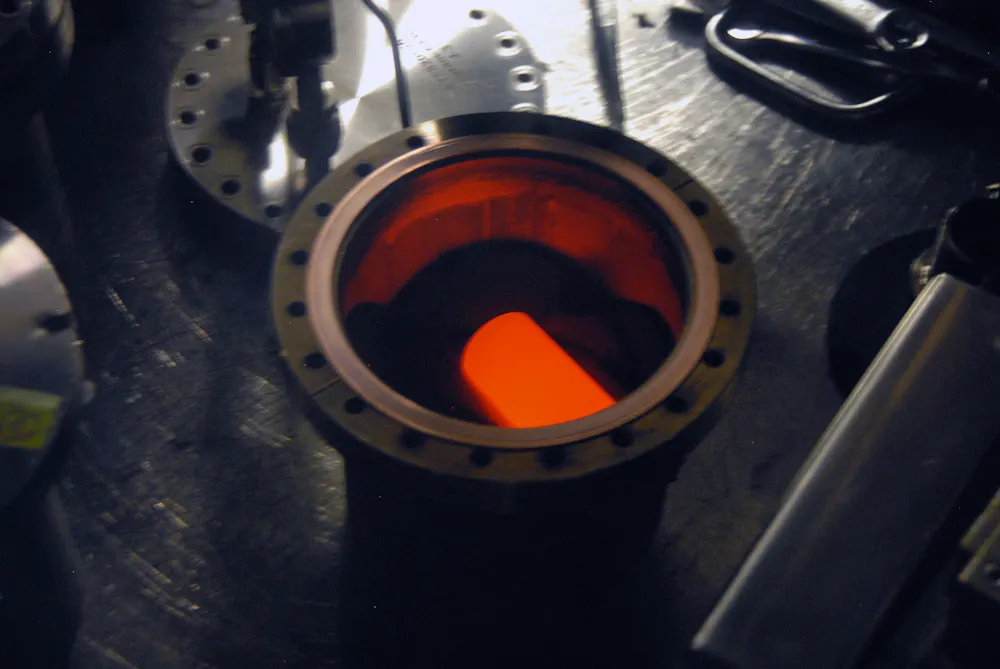
    These alpha particles interact with and transfer energy into the material surrounding the plutonium, which heats up that material. The radioactive decay of plutonium-238 releases enough energy that it can glow red from its own heat, and it is this powerful heat that is the energy source to power an RTG.

    The nuclear heat source for the Mars Curiosity rover is encased in a graphite shell. The fuel glows red hot because of the radioactive decay of plutonium-238.
    Idaho National Laboratory, CC BY

    Heat as power

    Radioisotope thermoelectric generators can turn heat into electricity using a principle called the Seebeck effect, discovered by German scientist Thomas Seebeck in 1821. As an added benefit, the heat from some types of RTGs can help keep electronics and the other components of a deep-space mission warm and working well.

    In its basic form, the Seebeck effect describes how two wires of different conducting materials joined in a loop produce a current in that loop when exposed to a temperature difference.

    The Seeback effect is the principle behind RTGs.

    Devices that use this principle are called thermoelectric couples, or thermocouples. These thermocouples allow RTGs to produce electricity from the difference in temperature created by the heat of plutonium-238 decay and the frigid cold of space.

    Radioisotope thermoelectric generator design

    In a basic radioisotope thermoelectric generator, you have a container of plutonium-238, stored in the form of plutonium-dioxide, often in a solid ceramic state that provides extra safety in the event of an accident. The plutonium material is surrounded by a protective layer of foil insulation to which a large array of thermocouples is attached. The whole assembly is inside a protective aluminum casing.

    An RTG has decaying material in its core, which generates heat that it converts to electricity.
    U.S. Department of Energy

    The interior of the RTG and one side of the thermocouples is kept hot – close to 1,000 degrees Fahrenheit (538 degrees Celsius) – while the outside of the RTG and the other side of the thermocouples are exposed to space. This outside, space-facing layer can be as cold as a few hundred degrees Fahrenheit below zero.

    This strong temperature difference allows an RTG to turn the heat from radioactive decay into electricity. That electricity powers all kinds of spacecraft, from communications systems to science instruments to rovers on Mars, including five current NASA missions.

    But don’t get too excited about buying an RTG for your house. With the current technology, they can produce only a few hundred watts of power. That may be enough to power a standard laptop, but not enough to play video games with a powerful GPU.

    For deep-space missions, however, those couple hundred watts are more than enough.

    The real benefit of RTGs is their ability to provide predictable, consistent power. The radioactive decay of plutonium is constant – every second of every day for decades. Over the course of about 90 years, only half the plutonium in an RTG will have decayed away. An RTG requires no moving parts to generate electricity, which makes them much less likely to break down or stop working.

    Additionally, they have an excellent safety record, and they’re designed to survive their normal use and also be safe in the event of an accident.

    RTGs in action

    RTGs have been key to the success of many of NASA’s solar system and deep-space missions. The Mars Curiosity and Perseverance rovers and the New Horizons spacecraft that visited Pluto in 2015 have all used RTGs. New Horizons is traveling out of the solar system, where its RTGs will provide power where solar panels could not.

    However, no missions capture the power of RTGs quite like the Voyager missions. NASA launched the twin spacecraft Voyager 1 and Voyager 2 in 1977 to take a tour of the outer solar system and then journey beyond it.

    The RTGs on the Voyager probes have allowed the spacecraft to stay powered up while they collect data.
    NASA/JPL-Caltech

    Each craft was equipped with three RTGs, providing a total of 470 watts of power at launch. It has been almost 50 years since the launch of the Voyager probes, and both are still active science missions, collecting and sending data back to Earth.

    Voyager 1 and Voyager 2 are about 15.5 billion miles and 13 billion miles (nearly 25 billion kilometers and 21 billion kilometers) from the Earth, respectively, making them the most distant human-made objects ever. Even at these extreme distances, their RTGs are still providing them consistent power.

    These spacecraft are a testament to the ingenuity of the engineers who first designed RTGs in the early 1960s.

    Benjamin Roulston does not work for, consult, own shares in or receive funding from any company or organization that would benefit from this article, and has disclosed no relevant affiliations beyond their academic appointment.

    ref. Radioisotope generators − inside the ‘nuclear batteries’ that power faraway spacecraft – https://theconversation.com/radioisotope-generators-inside-the-nuclear-batteries-that-power-faraway-spacecraft-248504

    MIL OSI – Global Reports

  • MIL-OSI Video: This Week at Interior March 14, 2025

    Source: United States of America – Federal Government Departments (video statements)

    This Week: Secretary Burgum signs a Secretary’s Order renaming the Anahuac National Wildlife Refuge in Texas to the Jocelyn Nungaray National Wildlife Refuge. The renaming honors 12-year-old Jocelyn Nungaray, who was brutally murdered by illegal immigrants in North Houston, Texas, in June 2024. It is a tragic case that underscores the urgent need for President Trump’s stronger border security measures and stricter immigration enforcement; Secretary Burgum talks American Energy Dominance at CERAWeek in Houston; Interior extends a Montana mine’s operational life by 16 years, and that means more coal, and more jobs; a California power transmission line gets the go ahead from the Bureau of Land Management; the U.S. Geological Survey releases its first-ever World Minerals Outlook to provide forecasts for global mineral supply chains; as cherry blossom, season approaches, the project to repair the Tidal Basin’s sagging seawall is on schedule and on budget in Washington, D.C.; the National Wildlife Refuge System celebrates a birthday; and we check in with some fine feathered friends in our social media Picture of the Week! Make sure you follow us on Facebook, Instagram, YouTube and X!

    http:/www.facebook.com/usinterior
    http:/www.instagram.com/usinterior
    http:/www.x.com/Interior

    https://www.youtube.com/watch?v=H8imi67sL-Y

    MIL OSI Video

  • MIL-OSI USA News: Remarks by President Trump and NATO Secretary General Mark Rutte Before Bilateral Meeting

    Source: The White House

    class=”has-text-align-center”>Oval Office

    12:33 P.M. EDT

         PRESIDENT TRUMP:  Hello, everybody.  It’s great to be with a friend of mine, who was prime minister of the Netherlands, so I got to know him very well.  We had a great relationship always.

    SECRETARY GENERAL RUTTE:  Absolutely.

    PRESIDENT TRUMP:  Mark Rutte.  Now he’s secretary general of NATO and doing a fantastic job.  Everybody — every report I’ve gotten is what a great job he did.  And I’m not at all surprised when I hear it.  We had to support him, and we supported him as soon as I heard the name.  

    SECRETARY GENERAL RUTTE:  Thank you.

    PRESIDENT TRUMP:  But he was a fantastic prime minister, and he’s doing a fantastic job. An even tougher job.  Which is tougher: being the prime minister of Netherlands or?

    SECRETARY GENERAL RUTTE:  This job is quite tough.  Yeah.  (Laughter.)

    PRESIDENT TRUMP:  I would think this is a little tougher.

    SECRETARY GENERAL RUTTE:  But — but Dutch politics is also brutal.  So — (laughter).

    PRESIDENT TRUMP:  Yeah.  But this is pretty tough. 

    SECRETARY GENERAL RUTTE:  Yeah.

    PRESIDENT TRUMP:  But you’re doing good. 

    SECRETARY GENERAL RUTTE:  Thank you.

    PRESIDENT TRUMP:  We’re going to be discussing a lot of things.  Obviously, we’ll be discussing what’s happening with respect to Ukraine and Russia. 

    At this moment, we have people talking in Russia.  We have representatives over there — Steve Witkoff and others.  And they’re in very serious discussions.  As you know, Ukraine has agreed, subject to this — what’s happening today — to a complete ceasefire, and we hope Russia will do the same. 

    Thousands of people are being killed — young people, usually, mostly young people.  We were just talking about it.  Thousands of young people are being killed a week, and we want to see that stop.  And they’re not Americans, and they’re not from the Netherlands for the most part.

    SECRETARY GENERAL RUTTE:  No.

    PRESIDENT TRUMP:  They’re not from — they’re from Russia and they’re from Ukraine, but they’re people.  And I think everybody feels the same way.  We want it to stop.

    It’s also a tremendous cost to the United States and to other countries.  And it’s something that would have never happened if I were president, and it makes me very angry to see that it did happen.  But it happened, and we have to stop it.  

    And Mark has done some really good work over the last week.  We’ve been working together, and he’s done some really good work.  So, I’m very happy about that. 

    We’ll also be talking about trade and various other things, and I think we’ll have a very, very strong day.  We’re going to have lunch afterwards.  That’ll go.  And then we’ll see you all later. 

    But, Mark, would you like to say something?

    SECRETARY GENERAL RUTTE:  Yeah.  First of all, thank you so much, Mr. President, dear Donald, again for hosting me and — but also for taking time in Florida a couple of weeks after you —

    PRESIDENT TRUMP:  Right.  That’s right.

    SECRETARY GENERAL RUTTE:  — you were reelected. 

    PRESIDENT TRUMP:  That’s right.

    SECRETARY GENERAL RUTTE:  And, of course, our phone call a couple of weeks ago.  And I must say, Trump 45 — you basically — you originated the fact that in Europe we are now spending, when you take it to aggregate, $700 billion more on defense —

    PRESIDENT TRUMP:  Yeah.

    SECRETARY GENERAL RUTTE:  — than when you came in office in 2016 — in 2017.

    But that was Trump 45.  But when look at Trump 47 —

    PRESIDENT TRUMP:  Going to be hard to top.  (Laughter.)

    SECRETARY GENERAL RUTTE:  — what happened the last couple of weeks is really staggering.  The Europeans committing to a package of $800 billion defense spending.  The Germans now —

    PRESIDENT TRUMP:  Yeah.

    SECRETARY GENERAL RUTTE:  — potentially up to half a trillion extra in defense spending.  And then, of course, you have Keir Starmer here, the British prime minister, and others all committing to much higher defense spending.  

    They’re not there.  We need to do more.  But I really want to work together with you in a run-up to The Hague summit to make sure that we will have a NATO which is really reinvigorated under your leadership.  And we are getting there.  

    We also discussed defense production, because we need to produce more weaponry.  We are not doing enough — not in the U.S., not in Europe.  And we are lagging behind when you compare to the Russians and the Chinese.  And you have a huge defense industrial base, Europeans buying mo- — four times more here than the other — the other way around, which is good, because you have a strong defense industry. 

    But we need to do more there to make sure that we ramp up production and kill the red tape.  So, I would love to work with you on that. 

    And finally, Ukraine — you broke the deadlock.  As you said, all the killing, the young people dying, cities getting destroyed.  The fact that you did that, that you started the dialogue with the Russians and the successful talks in Saudi Arabia now with the Ukrainians — I really want to commend you for this.

    So, well, The Hague is my hometown.  I’d love to host you there in the summer and work together to make sure that —

    PRESIDENT TRUMP:  We’ll do that.

    SECRETARY GENERAL RUTTE:  — that will be a splash, a real success, projecting American power on the world stage. 

    PRESIDENT TRUMP:  What Mark is saying is: When I first went to NATO, my first meeting, I noticed that very few people were paying.  And if they were, they weren’t paying their fair share.  There were only seven countries that were paying what they were supposed to be paying, which was —

    SECRETARY GENERAL RUTTE:  It’s even worse, there were three.

    PRESIDENT TRUMP:  Yeah.

    SECRETARY GENERAL RUTTE:  That’s even worse.

    PRESIDENT TRUMP:  It could be even worse. 

    SECRETARY GENERAL RUTTE:  Yeah.

    PRESIDENT TRUMP:  But there were just very few countries that were paying.  And even the paying, it was at 2 percent, which is too low.  It should be higher.  It should be quite a bit higher.

    But you had Poland and I remember Poland was actually paying a little bit more than they were supposed to, which I was very impressed with.  And they’ve been actually terrific and some of the others.  But most of them weren’t paying or they were paying very little.  

    And I didn’t think it was appropriate to bring it up there, but I said, “It’s going to be brought up at my next meeting.”  And my next meeting — you know, the first meeting, you want to give them a little break.  The second meeting, it began.

    And I was able to raise —

    SECRETARY GENERAL RUTTE:  You did.  (Laughs.)

    PRESIDENT TRUMP:  — hundreds of billions of dollars.  I just said, “We’re not going to be involved with you if you’re not going to pay.”  And the money started pouring in.  And NATO became much stronger because of my actions and working along with a lot of people, including Mark.

    But they would not pay for other presidents.  I don’t think other presidents even knew that they weren’t paid.  I asked, first question, “Has everybody paid up?”  And literally, I mean, they showed — they told me seven.  You could be right.  It could be three.  But — that makes it even worse — but they just weren’t paying. 

    And I said, “No, I won’t protect if you’re not paying.  If you’re delinquent or if the money isn’t paid, why would we do that?”

    And as soon as I said that, got a little hit from the press, because they said, “Oh, gee, that’s not very nice.”  But if you said the other, nobody would have paid.  And the money started coming in by the billions.  

    And, you know, hundreds of billions of dollars flowed into NATO, and NATO became strong.

    SECRETARY GENERAL RUTTE:  Yeah.

    PRESIDENT TRUMP:  And you remember that.  And your predecessor, who I thought was a very good man actually.

    SECRETARY GENERAL RUTTE:  Absolutely.  Jens Stoltenberg.  He sends his best greetings.

    PRESIDENT TRUMP:  Yeah.  He was terrific.

    SECRETARY GENERAL RUTTE:  Yeah.

    PRESIDENT TRUMP:  Stoltenberg, secretary general.

    SECRETARY GENERAL RUTTE:  Great man.

    PRESIDENT TRUMP:  And he made the statement that when Trump came in, the money started coming in like we never saw before.  Hundreds of billions — it was actually probably close to $600 billion came in.  And NATO became strong from that standpoint.

    And now, we have to use it wisely.  And we have to get this war over with.  And you’ll be back to a normal — much more normal life. 

    And maybe we’re close.  We’re getting words that things are going okay in Russia, and it doesn’t mean anything until we hear what the final outcome is. 

    But they have very serious discussions going on right now with President Putin and others.  And hopefully, they all want to end this nightmare.  It’s a nightmare.  It’s a horrible thing, when you look.  I get pictures every week.  They give me the pictures of the battlefield, which I almost don’t want to see.  It’s so horrible to see.

    SECRETARY GENERAL RUTTE:  It’s so terrible.

    PRESIDENT TRUMP:  Young people laying — arms and legs and heads laying all over the field.  It’s the most terrible thing that you’ll ever see. 

    And it’s got to stop.  These are young people with mothers and fathers and sisters and brothers and friends, and it’s got to stop. 

    So, we hopefully are going to be in a good position sometime today to have a good idea.  We’ll have — we know where we are with Ukraine, and we are getting good signals outside of Russia as to where we are with Russia, and hopefully they’ll do the right thing.  

    It’s a really — humanity — we’re talking about humanity.  We’re not talking about the money.  But then you add the money to it, and, you know, hundreds of billions of dollars is being spent and, really, wasted so unnecessarily.  It should have never happened.  

    So, it’s an honor to have you here.  They picked a great gentleman.  I’ll tell you, that was — I was so happy to hear, because you had somebody — Stoltenberg was really good.  And you have somebody that’s going to do an incredible job.  And I was so much in favor of you, you have no idea. 

    They had another person that I did not like.  (Laughter.)  I was not happy.  And I think I kept him from — you know what I’m talking about.  I said, “This is the right man to do it.”  And he really did.  He was a great prime minister of the Netherlands.  He did a great job.  And that’s what he’s doing right now. 

    So, thank you, everybody, for being here.  And very great honor to have you.  And we even have some of our great energy people here today, right?  We have the governor, and we have Chris.  You know Chris.

    SECRETARY GENERAL RUTTE:  Yeah.  Absolutely.

    PRESIDENT TRUMP:  He’s supposed to be the most talented man in the world of energy, according to the governor.  (Laughter.)  So, I don’t know if he’s right.

    And we have — General, you’ve been fantastic.  Thank you very much. 

    And we have a lot of good people that won’t be so much involved with this, but they wanted to see what was happening.  It’s become a little bit of a show — (laughter) — but they wanted to see what was happening.  And I think a lot of good things are happening.  

    So, with that, if anybody would have a question.

    (Cross-talk.) 

    Q    Mr. President, o- — on Russia. 

    PRESIDENT TRUMP:  Please, go ahead.

    Q    Vlad- —

         Q    Sorry.  Sorry, Mary.  Steve Witkoff’s trip to Moscow, you spoke about it.  What sort of agreement do you hope he comes away from there with?

    PRESIDENT TRUMP:  Well, we’d like to see a ceasefire from Russia.  And we have, you know, not been working in the dark.  We’ve been discussing with Ukraine land and pieces of land that would be kept and lost and all of the other elements of a final agreement.  

    There’s a power plant involved — you know, a very big power plant involved.  Who’s going to get the power plant and who’s going to get this and that.  And so, you know, it’s not an easy process.

    But phase one is the ceasefire.  A lot of the individual subjects have been discussed, though.  You know, we’ve been discussing concepts of land, because you don’t want to waste time with the ceasefire if it’s not going to mean anything.  So, we’re saying, “Look, this is what you can get.  This is what you can’t get.” 

    They discussed NATO and being in NATO, and everybody knows what the answer to that is.  They’ve known that answer for 40 years, in all fairness. 

    So, a lot of the details of a final agreement have actually been discussed.  Now we’re going to see whether or not Russia is there, and if they’re not, it’ll be a very disappointing moment for the world. 

    Yeah. 

    Q    And Vladimir Putin just said he is open to a ceasefire, but he does still have some concerns.  He suggested that you two should speak directly.  Do you have plans to speak to him soon?  If so, when?

    PRESIDENT TRUMP:  Well, I would.  Yeah, sure.

    Q    And are you confident you can get this across the finish line?

    PRESIDENT TRUMP:  Sure.  He did say that today.  It was a very promising statement, because other people are saying different things, and you don’t know if they have anything to really — if they have any meaning, or I don’t know.  I think some of them were making statements.  I don’t think they have anything to do with it.

    No, he put out a very promising statement, but it wasn’t complete.  And, yeah, I’d love to meet with him or talk to him, but we have to get it over with fast.  You know, every day people are being killed.  It’s not like — as we sit here, two people will be killed.  Think of it.  Two people are going to be killed during this little period of time. 

         Thousands of people a week are dying, so we really don’t have very much time.  We have to make this fast.  It shouldn’t be very complicated.

    (Cross-talk.) 

    Yes.

    Q    Thank you, Mr. President.  A representative of Canada, the finance minister, are in town and will meet members of your administration during the day. 

    PRESIDENT TRUMP:  Sure.  Yeah.

    Q    Any chances that you will ban on the tariffs on aluminum and — and the — the ones that are planned for April 2nd?

    PRESIDENT TRUMP:  No.

    Q    You are not going to change your mind? 

    PRESIDENT TRUMP:  No, I’m not.  Look, we’ve been ripped off for years, and we’re not going to be ripped off anymore.  No, I’m not going to bend at all on aluminum or steel or cars.  We’re not going to bend.  We’ve been ripped off as a country for many, many years.  We’ve been subjected to costs that we shouldn’t be subjected to. 

    In the case of Canada, we’re spending $200 billion a year to subsidize Canada.  I love Canada.  I love the people of Canada. I have many friends in Canada.  “The Great One,” Wayne Gretzky, the great.  Hey, how good is Wayne Gretzky?  He’s the Great One.  

    But we have — I know many people from Canada that are good friends of mine.  But, you know, the United States can’t subsidize a country for $200 billion a year.  We don’t need their cars.  We don’t need their energy.  We don’t need their lumber.  We don’t need anything that they give. 

    We do it because we want to be helpful, but it comes a point when you just can’t do that.  You have to run your own country.  And to be honest with you, Canada only works as a state.  We don’t need anything they have.  As a state, it would be one of the great states anywhere.  

    This would be the most incredible country visually.  If you look at a map, they drew an artificial line right through it — between Canada and the U.S.  Just a straight artificial line.  Somebody did it a long time ago — many, many decades ago — and makes no sense.  

    It’s so perfect as a great and cherished state, keeping “O Canada,” the national anthem.  I love it.  I think it’s great.  Keep it, but it’ll be for the state.  One of our greatest states.  Maybe our greatest state.  

    But why should we subsidize another country for $200 billion?  It costs us $200 billion a year.  And again, we don’t need their lumber.  We don’t need their energy.  We have more than they do.  We don’t need anything.  We don’t need their cars.  I’d much rather make the cars here.  

    And there’s not a thing that we need.  Now, there’ll be a little disruption, but it won’t be very long.  But they need us.  We really don’t need them.  And we have to do this.  I’m sorry, we have to do this.  

    Yes. 

    Q    Mr. President — 

    PRESIDENT TRUMP:  Yeah. 

    Q    — you have made it very clear that NATO needs to step up, although great progress —

    PRESIDENT TRUMP:  Yeah.

    Q    — has been made in your first mandate.  How do you envision this new transatlantic —

    PRESIDENT TRUMP:  Are you talking about NATO stepping up?

    Q    Yes.

    PRESIDENT TRUMP:  Well, NATO is stepping up through this man. This man is a man that only knows how to step up.  And we have the same goal in mind: We want the war ended.  And he’s doing his job.  He only knows how to do a good job.  That’s one thing.  That’s why I fought for him to get that job —

    SECRETARY GENERAL RUTTE:  Thank you so much.

    PRESIDENT TRUMP:  — because they had some other candidates that I’ll tell you would not have done a very good job.

    SECRETARY GENERAL RUTTE:  I need this part of the — of the movie for my family.  (Laughter.)

         PRESIDENT TRUMP:  That’s right.  That’s right.  We’ll get you a clip. 

         SECRETARY GENERAL RUTTE:  Yeah.  Exactly.  (Laughs.)

         PRESIDENT TRUMP:  We’re going to get him a clip of that — of that little last essay.  But the rest of the statements he doesn’t care about.

    Q    Sir, how does this new transatlantic cooperation — how do you envision it?  What is it going to look like?

    PRESIDENT TRUMP:  Well, we have — that’s one thing.  I mean, you know, we’re the other side of the ocean, and they’re right there.  And yet, we’re in for $350 billion because of Biden, and they’re in for $100 billion.  So, it’s a big difference, and it’s unfair.  

    And I said, “You have to equalize.”  They should equalize.  They should have — it should have never happened, where Biden just gave his money away. 

    Now, as you know, we have an agreement with Ukraine on the rare earths and other things, and that’ll get us

    something back — a lot back.  It’ll get us our money back.  We’re not doing it for that, though.  We’re doing — I’m just doing this to get the war stopped.  I’m doing it, really, to save lives.

    But, at the same time, we were treated very unfairly, as we always are by every country.  And we’re in for very substantially more than the European nations are in for, and that shouldn’t be.

    You know, they’re much more affected by it than we are, because we do have an ocean in between. 

    But I don’t know.  I think good things are going to happen.  I really do.  I think good things are going to happen. 

    I do say — we were talking before, and Mark was very nice.  He said, “If you wouldn’t get involved, there would be” — you’d just be going on.

    SECRETARY GENERAL RUTTE:  Yeah.

    PRESIDENT TRUMP:  This thing would have gone on for a long time.

    SECRETARY GENERAL RUTTE:  Breaking a deadlock.  It was crucial.

    PRESIDENT TRUMP:  Yeah, we broke a deadlock. 

    SECRETARY GENERAL RUTTE:  Yeah. 

    PRESIDENT TRUMP:  We did break a deadlock.  I hope it’s meaningful. 

    SECRETARY GENERAL RUTTE:  Yeah. 

    PRESIDENT TRUMP:  Yes, did you have one?

    Q    Mr. President — 

    PRESIDENT TRUMP:  Yeah, please.

    Q    Yes, sir.  Thank you, Mr. President.  Amanda Head with Just the News.  On the southern border, you’ve got DHS and ICE, who are reporting that there was a little bit of fudging of numbers during the Biden administration —

    PRESIDENT TRUMP:  Yeah.

    Q    — on both the catch and the release side with respect to reporting the number of illegals coming into the country who were released.

    PRESIDENT TRUMP:  They cheated on the numbers.  They were — the numbers were — I love that question.

    Q    Right.

    PRESIDENT TRUMP:  Who are you with?

    Q    Just the News.  Amanda Head.

    PRESIDENT TRUMP:  Very nice.  That’s good.  That’s good.

    Q    Do you know how many of those are criminal illegal aliens? 

    PRESIDENT TRUMP:  Many of them.

    Q    And Biden is out of office —

    PRESIDENT TRUMP:   Yeah.

    Q    — Alejandro Mayorkas.  Who gets held accountable?

    PRESIDENT TRUMP:  No, Biden fudged the numbers.  The numbers were totally fake, and he gave fake numbers.  I knew they were fake.  Everybody knew they were fake, but now it came out.  And terrible what — what they did.  That administration was a horror show for this country.

    Q    Can you hold anyone accountable?

    PRESIDENT TRUMP:  Well, I don’t know.  They gave phony numbers, and phony numbers are a very bad thing to give.  But I’m not sure about that.  I don’t know how it would play.  We want to get it straightened out.  

    We have — we’re after many, many bad people that were let into our country.  And Kristi Noem and my friend Homan — how good is Tom Homan doing, right?  And they’re after them.  And they — I mean, you see: They’re taking them out in record numbers.  Gang members, gang leaders, drug dealers. 

    This is a problem the Netherlands does not have.  The Netherlands never had this problem.  If you’d like to take —

    SECRETARY GENERAL RUTTE:  We have a few drug- — drug dealers, I’m afraid.  (Laughter.)

    PRESIDENT TRUMP:  I could deliver some people.  I could deliver some nice people to the Netherlands if you’d like.  (Laughter.)

    SECRETARY GENERAL RUTTE:  I’m not sure.  (Laughs.)

    PRESIDENT TRUMP:  No, what he did to this country, letting 21 million people flow through an open border — many of those people were hard criminals from prisons and jails, from mental institutions, and I always say “insane asylums,” because they were seriously deranged.  And they’re here from not South America, from all over the world.  From South America, but from all over the world.  And it’s so sad. 

    You’d say, “Why would anybody do this?  Why?”

    Yeah, go ahead.

    Q    And — and one more.  There’s some new internal Democrat polling that doesn’t look great for Democrats, but it also has 54 percent unfavorability for Republicans in swing states and battlegrounds for the midterms.  Do you consider those voters cap- — capturable for — for Republicans?

    PRESIDENT TRUMP:  Yeah, well, we did — you know, I won every swing state, as you know, by a lot, and I won the popular vote by a lot, and we won the counties.  If you look at the counties and district plan, we had 2,725, and they had 501.  That’s a real — that’s why the map is all red.  So, we had a great thing.

    Yeah, I think winning from the Democrats — I saw — if you looked the other night, I made a speech, and I introduced two young ladies who were killed.  Two killed.  Viciously, violently killed.  Young.  Unbelievable.  Both outstanding people.  They were killed by illegal aliens.  And the Democrats wouldn’t get up and applaud.  The mothers were, I mean, inconsolable.  They were crying, and everybody was crying.  The Democrats sat there with stone faces.  They didn’t clap, they didn’t stand, they didn’t do anything.  

    We had a young man with very serious cancer, wanted to — his dream is to be with the police department someday, and he was introduced. 

    SECRETARY GENERAL RUTTE:  That was very touching.

    PRESIDENT TRUMP:  They didn’t even clap.

    SECRETARY GENERAL RUTTE:  Yeah, I saw it.

    PRESIDENT TRUMP:  I mean, they were disgusting.  Frankly, they were disgusting.  There’s something wrong with them.  They’re deranged.  They’re deranged.  Like Jack Smith, they’re deranged people. 

    And I never saw anything like it.  I’m standing up, and I introduce the mother and the parents of these two young girls that were just recently, essentially, killed.  Violently killed.  And the Democrats are like this.  It’s so sad.  

    And I saw this morning where — one of them is pretty well-known — one is arguing, fighting like crazy over men being able to play in women’s sports.  I said, “Yeah, I thought that was tried.”  I thought that was about a 95 — I think it’s a 95 percent issue.  

    But, in a way, I want them to keep doing it, because I don’t think they can win a race.  I mean — and I tell the Republicans, I said, “Don’t bring that subject up, because there’s no election right now.  But about a week before the election, bring it up, because you can’t lose.”  

    And everything is “transgender this, transgender that.”  You know, they have bad politics. 

    But one thing: They stick together.  You know?

    I wish — and the Republicans stick together, mostly, but we have a couple that are grandstanders.  You know, you always have grandstanders in life.

    But the Democrats, they don’t seem — they have grandstanders, but when it comes to a vote, they do stick together, right?

    VICE PRESIDENT VANCE:  They get in line.  Yes, sir.

    PRESIDENT TRUMP:  So.

    Q    It seems like they’ll stick together on the shutdown.  Will that hurt Democrats going into midterms?

    PRESIDENT TRUMP:  Well, if they do a shutdown and, ultimately, that might lead to very, very high taxes, because we’re talking about a shutdown.  We’re talking about getting to work immediately on the greatest tax bill ever passed.  That was the one we did.  It’s a renewal, and it’s an addition to it.  And we’re going to cut people’s taxes. 

    And if we don’t open, the Democrats are stopping all of these good things that we’re providing.  We’re providing the greatest package of benefits that this country has ever provided. 

    The biggest part of that’s going to be tax cuts for the middle class and for businesses, small businesses, employers — people that hire people and jobs. 

    And if it’s shut down, it’s only going to be — if there’s a shutdown, it’s only because of the Democrats, and they would really be taking away a lot from our country and from the people of our country.

    Q    Mr. President, on — on tariffs.  You made clear you’re not backing down from this, but many American small-business owners say they are concerned that these tariffs are going to hurt them.  What’s your message to them?

    PRESIDENT TRUMP:  They’re going to be so much richer than they are right now.

    And we have many — yesterday, General Motors was in.  They want to invest $60 billion.  The people from Facebook were in yesterday.  They’re going to invest $60 billion by the end of the year.  Other people are talking about numbers.  

    Apple, as you know, a few days ago, announced $500 billion investment.  They’re going to build their plants in the United States, which, as you know, almost all of their plants are in China.  Now they’re building in the United States.

    Look, the reason is two things.  Number one, the election. November 5th.  And the other thing is tariffs.  I think, probably, in that order. 

    But Tim Cook came in and he announced 500 — think of it, $500 billion, not million.  Five hundred million is a lot, when you think about it, right?  But —

    VICE PRESIDENT VANCE:  Yes, sir.

    PRESIDENT TRUMP:  I would have been happy with $500 million.  But it’s $500 billion investment by Apple in the United States, and that’s because of the election result and it’s because of the tariffs and the tax incentives too.  You know, tariffs and tax incentives.  And I’ve never seen anything like it. 

    We have plants going up now in Indiana.  We have plants going up in Michigan.  A lot of plants going to be planned from — I’m trying to steer them to Michigan, because Michigan got so badly beaten by, you know, what happened with Europe.

    You know, if you look at Europe. Take a look at the EU.  We’re not allowed to sell cars there.  It’s prohibitive because of their policies, and also their nonmonetary tariffs.  They put obstacles in your way that you can do nothing about.  

    But if you take a look at what happens — so, we sell no cars to Europe — I mean, virtually no cars — and they sell millions of cars to us.  They don’t take our agriculture.  We take their agriculture. It’s like a one-way street with them.

    The European Union is very, very nasty. 

    They sue our companies.  Apple was forced to pay $16 billion on a case that — very much like my cases that I won.  They shouldn’t have been even cases.  But we felt they had no case, and they ended up having an extremely favorable judge and decision.  

    But they’re suing Google, they’re suing Facebook, they’re suing all of these companies, and they’re taking billions of dollars out of American companies, many more than the ones I just mentioned.  And I guess they’re using it to run Europe or something.  I don’t know what they’re using it for. 

    But they treat us very badly.  China obviously treats this very badly.  Almost everybody does.  And I blame past presidents, to be honest. 

    Because when I was president, I — we received, so far, about $700 billion from China, over the years, on the tariffs that I put in.  No other president got 10 cents from China.  And that was only beginning.  Except for COVID, it would have — I would have been able to finish the process.  But we had to fight the COVID thing, and we did really well with it.  But we had to fight.

    And then we had actually — as you remember, Mark, we actually handed over the stock market.  It was higher than just previous to COVID coming in, which was sort of a miracle, frankly.  We did a good job.

    But the tariffs are very important.  And I think the psychology — there’s great spirit.  When Mark came in, he said, “Congratulations.  There’s a whole new spirit.  There’s a whole new light over this country, and really over the world” —

    SECRETARY GENERAL RUTTE:  Yeah.

    PRESIDENT TRUMP:  — because you have somebody that — a whole group of people, really, because I talk about this whole group, that we know what we’re doing.  And a lot of great things are happening.

    But I’ve never seen investment like this.  Trillions of dollars is being invested in the United States now that would have never — our country could have failed.  Another four years of this, what happened in the last four years, our country would have been a crime-ridden mess.  

    And I don’t know if you noticed — a little thing, they call it, but it’s not a little thing if you don’t have — if you like eggs and you don’t have a lot of money — eggs have gone down 25 percent in the last couple of weeks.  We inherited that problem: eggs.  

    Groceries have gone down a little bit.  Energy has gone down. 

    Do you want to speak to that for a second, Governor?  Would you just say a couple of words, you and Chris, about energy, what’s happened?

    SECRETARY BURGUM:  Well, happy to, but I think that — Chris and I just came from CERAWeek, which is the largest conference in the world.  So, global leaders, people from the EU, officials from all the energy-producing countries all there.  And all the global nationals, all the U.S.  The — the spirit of that group is through the roof, because now they realize that in the United States, that President Trump’s policies are pro — pro developing more energy, as opposed to we’re trying to shut down energy.  

    And that pro-growth, pro-business, pro- — pro-energy approach is giving people the optimism.  So, then the markets are reacting to that, and energy prices on the futures market are going to go down because people know we’re — we’re not going to be killing off the energy we need for prosperity in all of our countries, but also for peace, because people have used energy to fuel these wars that President Trump is working so hard to end.  And — and we — we know that energy — high energy prices were driving the inflation that he talked about. 

    So, it accomplishes two goals for us — which is prosperity for the world, peace for the world — when we have smart energy policies.  And — and President Trump has brought common sense back to how we think about energy.

    PRESIDENT TRUMP:  And it’s brought down now $65 a barrel,  I saw this morning.  That’s phenomenal news, and that’s going to bring — that’s what brought it up.  The energy went — they took our beautiful energy policies and they just messed them up.  And then they went immediately back to them, because — but by that time, they lost it.  They lost that bronco, as the expression goes.

    Chris, do you have something to say?

    SECRETARY WRIGHT:  I think Doug said it well, but you just can’t overstate how important the return of common sense, the return of knowledge about energy and pro-American consumers, pro investment in our country.  I think, globally, that was welcomed.  It means capital flows.  It means more sobriety and lower energy prices, more economic opportunity for Americans. 

    So, yeah, it was elated atmosphere at a global energy conference. 

    PRESIDENT TRUMP:  Well, we’re working on one project, and it should be very easy.  It’s a pipeline going through a small section of New York.  New York has held it up for years, actually.  For years they’ve wanted to do it. For years and years.  And it will reduce — 

    The most expensive energy, almost, in the world is in New England, because they have no way of getting it there because it’s been held up by New York.  And the whole of New England and Connecticut and New York — the energy prices are through the roof.  And this one pipeline will save per family, $2,500 just on heating and another $2,500 on everything else.  So, the energy — by just a simple pipeline going through an area that wants it — an area that’s not a rich area; it’s actually a very poor area — would create jobs and everything else.

    And it’s going to be way underground.  Nobody’s going to see it.  Once they fill it up, nobody’s going to see it.  Nobody’s going to know it’s there. 

    And families in New York and Connecticut and New England are going to save $5,000 a family.  Think of that.  Because, right now, they have the highest energy prices maybe in the world, they say.  New England is a disaster.  

    So, we’re working on that.  In fact, the governor is coming in — governor of New York, Kathy Hochul, who’s a very nice woman.  She’s coming in tomorrow morning at 9 o’clock to meet me on that and other things — not only that, but other things.

    So, I hope we don’t have to use the extraordinary powers of the federal government to get it done, but if we have to, we will.  But I don’t think we’ll have to. 

    I can tell you, Connecticut wants it and all of New England wants it.  And who wouldn’t want it?  And it’s also jobs on top of everything else.  So, that’s going to be very exciting.  So, we’re meeting with the governor tomorrow morning. 

    (Cross-talk.)

    Yeah. 

    Q    Thank you, Mr. President.  Greenland.  What is your vision for the potential annexation of Greenland and getting them, potentially, to —

    PRESIDENT TRUMP:  Yeah.

    Q    — to statehood?

    PRESIDENT TRUMP:  Well, I think it’ll happen.  And I’m just thinking — I didn’t give it much thought before, but I’m sitting with a man that could be very instrumental.  You know, Mark, we need that for international security — not just security, international.  We have a lot of our favorite players, you know, cruising around the coast, and we have to be careful.  And we’ll be talking to you.

    And it’s a very appropriate — really, a very appropriate question. 

    SECRETARY GENERAL RUTTE:  It’s an —

    PRESIDENT TRUMP:  Thank you very much.

    SECRETARY GENERAL RUTTE:  — an issue in the high north, so the Arctic.  So, what you did —

    So, when it comes to Greenland, yes or no, joining the U.S., I would leave that outside, for me, this discussion, because I don’t want to drag NATO in that. 

    But when it comes to the high north in the Arctic, you are totally right.  The Chinese and — are using these routes.  We know that the Russians already arming.  We know we have a lack of icebreakers.  So, the fact that the seven — outside of Russia, there are seven Arctic countries — working together on this, under U.S. leadership — it’s very important to make sure that that region, that that a part of the world stays safe.  And — and we know things are changing there, and we have to be there.

    Q    Well, they just had an election there the other day.  I mean, do you see a referendum, a plebiscite where the people of Greenland would be in a position to decide if they want to become part of the United States? 

    PRESIDENT TRUMP:  Yeah, it was a good election for us, as you know.  It was not a referendum.  It wouldn’t be called that.  It was an individual election.  But the person that did the best is a very good person, as far as we’re concerned.  And so, we’ll be talking about it.  And it’s very important. 

    Mark mentioned the word “icebreaker.”  So, we’re in the process of ordering 48 icebreakers, and Canada wants to know if they could use them.  I said, “Well, you know, you got to pay for them.”  Think of it.  Canada.  We pay for their military.  You know, Canada pays very little for their military, because they think we’re going to protect them, but — even with the icebreakers. 

    So, we’re going to order 48, and Canada wants to be part of the deal.  I say, “You got to get your own icebreakers.  I mean, if you’re a state, you can be part of the deal, but if you’re a separate country, you’ve got to get your own icebreakers.”  

    Russia, as you know, has about 40 of them, and we have 1 big icebreaker.  But that whole area is becoming very important and for a lot of reasons.  The routes are, you know, very direct to Asia, to Russia, and you have ships all over the place.  And we have to have protection.  So, we’re going to have to make a deal on that.

    And Denmark is not able to do that.  You know, Denmark is very far away and really has nothing to do. 

    What happens?  A boat landed there 200 years ago or something, and they say they have rights to it.  I don’t know if that’s true.  I’m not — I don’t think it is, actually.

    But we’ve been dealing with Denmark.  We’ve been dealing with Greenland.  And we have to do it.  We really need it for national security.  I think that’s why NATO might have to get involved in a way, because we really need Greenland for national security.  It’s very important.  

    You know, we have a couple of bases on Greenland already, and we have quite a few soldiers that — maybe you’ll see more and more soldiers go there.  I don’t know.

    What do you think about that, Pete? Don’t answer that, Pete.  (Laughter.)  Don’t answer that question.  

    But we have bases, and we have quite a few soldiers on Greenland already. 

    Q    Mr. President, some people question your commitment to NATO.  Will everything — anything change?

    Your com- — your commitment to NATO, will anything change?  Same amount of money?

    PRESIDENT TRUMP:  Well, I think they made —

    Q    Same number of troops?

    PRESIDENT TRUMP:  — a great step by putting Mark in charge.  I think, to me, that’s a great step, because he and I have seen eye to eye on everything for a long time.  We’ve been doing this a long time now.

    SECRETARY GENERAL RUTTE:  Nine years now.

    PRESIDENT TRUMP:  And so, that’s a great step. 

    You have to keep NATO strong.  You have to keep it relevant. 

    But the biggest thing we have to worry about right now is what’s going on right now.  I think the rest is going to take care of itself. 

    I don’t see this having — this was a fluke.  This was something that if we had a competent president, it would not have happened.  The man was grossly incompetent.  All you have to do is look in — take a look at — he signs by autopen.

    Who was signing all this stuff by autopen?  Who would think you signed important documents by autopen?  You know, these are major documents you’re signing.  You’re proud to sign them.  You have your signature on something — in 300 years, they say, “Oh, look.”  Can you imagine?  Everything was signed by autopen — almost everything.  Nobody has ever heard of such a thing. 

    Q    Do you —

    PRESIDENT TRUMP:  So —

    Q    Sorry. 

    PRESIDENT TRUMP:  Should have never happened. 

    Q    You’re speaking tomorrow at the Justice Department about law and order.  Could you tell us a little bit about that? 

    PRESIDENT TRUMP:  Yeah, we’re going to be with the Justice Department.  We have a great Justice Department.  Pam Bondi is so fantastic.  And Todd Blanche and Emil — you got to know him a little bit; he was acting for a little while — and some other people are incredible in the Justice Department. 

    And I consider the FBI to be a part of it, in a sense, and Kash is going to be fantastic, and all the people he’s — Dan Bongino, I love that.  I mean, I love that.  I think Dan is great. 

    I think we have unbelievable people.  And all I’m going to do is set out my vision.  It’s going to be their vision, really, but it’s my ideas.  And basically, we don’t want to have crime in the streets.  We don’t want to have people pushed into subways and killed, and then the — the person that did the pushing ends up in a 15-year trial and gets off scot-free.  We want to have justice, and we want to have safety in our cities, as well as our communities. 

    And we’ll be talking about immigration.  We’ll be talking about a lot of things.  Just the complete gamut.  So, I look forward to that.  That will be tomorrow at the Justice Department. 

    Q    Mr. President, you are a man of peace.  You’ve said it several times and made it very clear.  A man of peace dealing with belligerent people. 

    PRESIDENT TRUMP:  Yeah.

    Q    And I’m thinking we saw you handled Zelenskyy in this very own room.  What is your leverage on Putin?  Are you thinking sanctions?  What if he refuses to —

    PRESIDENT TRUMP:  Well, I do have leverage, but I don’t want to talk about leverage now, because right now we’re talking to him.  And based on the statements he made today, they were pretty positive, I think, so I don’t want to talk about that.  

    I hope Russia is going to make the deal too.  And I think once that deal happens, you’re never going to be in a process.  I don’t think they’re going back to shooting again.  I really believe if we get a peace treaty, a ceasefire treaty, I think that leads to peace.  That’s going to really lead to a —

    I don’t think anyone wants to go back.  They’ve been doing this for a long time, and it’s vicious and violent.  And I think if President Putin agrees and does a ceasefire, I think we’re going to be in very good shape to get it done.  We want to get it over with.  That’s why — it was very important what I instructed everybody, including Steve, what we’re looking for: to discuss concepts of land, concepts of —

    MR. WALTZ:  Yes, sir.   

    PRESIDENT TRUMP:  — of power plants because it’s complicated.  You know, you have a whole — you’re sort of creating the edge of a country. 

    The sad part is that country, if they didn’t — if this didn’t happen — and it wouldn’t have happened — I don’t know if they would have to give anything back.  I guess Crimea? 

    You know, I said it last time, Crimea was given by Obama, Biden gave them the whole thing, and Bush gave them Georgia.  And Trump didn’t give them anything. 

    I gave them — you know what I gave them?  I gave them Javelins.  And the Javelins were very effective, as you know.  I gave them nothing —

    SECRETARY GENERAL RUTTE:  2019. 

    PRESIDENT TRUMP:  And then also, if you take a look, I was the one that stopped the pipeline going into Europe.  It was totally stopped: Nord Stream 2.  Nobody ever heard of Nord Stream 2 before I came along.

    But I got along very well with President Putin.  I got along with most of them.  I get along great with President Xi.  I got along great with Kim Jong Un.  I got along great with all of them.  And we had no wars.  We had no problems.  We wiped out ISIS in record time. General “Razin” Kane.  And he wiped them out. 

    And he is going to be our new chief, right?  He’s going to be —

    SECRETARY HEGSETH:  Yes, sir.

    PRESIDENT TRUMP:  — the head of Joint Chiefs of Staff, and he’s a highly respected man.  He’s going to be great. 

    Pete is going to be fantastic.  I have no doubt about it.  We have a great team.  A really great team. 

    Yeah, please.  Go ahead, please.

    Q    Mr. President, some of our allies have said that they’re worried that they could be the next to be attacked by Russia.  You’ve spoken directly with the Russian president.

    PRESIDENT TRUMP:  Yeah.

    Q    Do you think those fears are justified?

    PRESIDENT TRUMP:  No, I don’t.  I think when this gets done, it’s done.  They’re going to all want to go home and rest.  I don’t see it happening.  Nope, I don’t see that happening.  And we’ll make sure it doesn’t happen.  Not going to happen.  But we’ll make sure it doesn’t happen. 

    Yeah, go ahead, please. 

    Q    Leaders from Russia and Iran are heading to Beijing tomorrow to discuss nuclear programs.  What do you hope to get out of that?

    PRESIDENT TRUMP:  Well, maybe they’re going to talk about non-nuclear programs.  Maybe they’re going to be talking about the de-escalation of nuclear weapons, because, you know, I was talking about that with President Putin very strongly.  And we could have done something.  Had that election not been rigged, we would have had something.  I think I would have made a deal with Putin on de-escalation, denuclearization, as they say.  But we would have de-escalated nuclear weapons, because the power of nuclear weapons is so great and so devastating. 

    And, right now, Russia and us have by far the most, but China will catch us within five years.  China doesn’t have — but they’re in the process of building.

    SECRETARY GENERAL RUTTE:  Yeah.

    PRESIDENT TRUMP: And they build.  And within four or five years, they’ll probably have the same.

    SECRETARY GENERAL RUTTE:  And, by the way, you — this is a Republican tradition.  Ronald Reagan, when he negotiated with Gorbachev —

    PRESIDENT TRUMP:  Right. 

    SECRETARY GENERAL RUTTE:  — in the 1980s —

    PRESIDENT TRUMP:  That’s right.

    SECRETARY GENERAL RUTTE:  — about bringing down the number of nuclear weapons is what you have been doing your first term.  And it is important. 

    PRESIDENT TRUMP:  It would be a great achievement if we could bring down the number.  We have so many weapons, and the power is so great. 

    And we — number one, you don’t need them to that extent.  And then we’d have to get others, because, as you know, in a smaller way — Kim Jong Un has a lot of nuclear weapons, by the way — a lot — and others do also.  You have India.  You have Pakistan.  You have others that have them, and we’d get them involved. 

    But we started off with Russia and us.  We have, by far — actually, by far, the most.  And we were going to denuclearize, and that was going to happen. 

    And then we were going to China.  And I spoke to China.  I spoke to President Xi about it.  And he really liked the idea.  You know, he’d like not to spend trillions of dollars building weapons that, hopefully, he’s never going to have to use.  And — because they are very expensive also.  So, that would have been great. 

    Okay, one or two more. 

    (Cross-talk.)

    Yeah, go ahead.  

    Q    Thank you.  We are looking at an impending government shutdown Friday at midnight.

    PRESIDENT TRUMP:  Yeah. 

    Q    Democrats, for 30 years straight, have said, if there’s a shutdown, bad things happen.  Do you anticipate direct negotiations yourself with conference leader of the Democrats, Chuck Schumer?

         PRESIDENT TRUMP:  Yeah, if they need me, I’m there a hundred percent.  It’s — right now, it’s two or three people.  If it shuts down, it’s not the Republicans’ fault.  You know, we passed a bill where we had an incredible Republican vote.  We only had one negative vote, a grandstander.  You know, one grandstander.  There’s always a grandstander in the lot. 

         But it was amazing.  People were amazed that the Republicans were able to vote in unison like that so strongly. 

         If there’s a shutdown, even the Democrats admit it will be their fault.  And I’m hearing a lot of Democrats are going to vote for it, and I hope they do.  This is an extension. 

         But ultimately, we want to vote for one big, beautiful bill where we put the taxes in, we put everything in.  We’re going to have big tax cuts.  We’re going to have tremendous incentives for companies coming into our country and employing lots of people.  

         It’ll be — I called it, in a rare moment, one big, beautiful bill.  That’s what I like.  And it seems to be that’s where they’re heading.  And we’ll have to take care of something to do with Los Angeles. 

         A place called Los Angeles almost burned to the ground.  By the way, I broke into Los Angeles.  Can you believe it?  I had to break in. 

         SECRETARY GENERAL RUTTE:  Yeah?

         PRESIDENT TRUMP:  I invaded Los Angeles.  And we opened up the water, and the water is now flowing down.  They have so much water, they don’t know what to do.  They were sending it out to the Pacific for environmental reasons.  Okay?  Can you believe it?  And in the meantime, they lost 25,000 houses.  They lost — and nobody’s ever seen anything like it. 

         But we have the water.  I’d love to show you a picture.  You’ve seen the picture.  The water is flowing through the half pipes.  You know, we have the big half pipes that go down.  Used to — 25 years ago, they used to have plenty of water, but they turned it off for — again, for environmental reasons.  Well, I turned it on for environmental reasons and also fire reasons. 

         And I’ve been asking them to do that during my first term.  I said, “Do it.”  I didn’t think anything like — could happen like this, but they didn’t have enough water. 

         Now the farmers are going to have water for their land, and the water is in there. 

         But I actually had to break in.  We broke in to do it because we had people that were afraid to give water.

         SECRETARY GENERAL RUTTE:  Yeah.

         PRESIDENT TRUMP:  They were — in particular, they were trying to protect a certain little fish.  And I say, “How do you protect a fish if you don’t have water?”  They didn’t have any water, so they’re protecting a fish, and that didn’t work out too well, by the way.  

         So, they have a lot of water going down throughout California, all coming out from the Pacific Northwest, even some from Canada. 

         Thank you, Canada, very much.  I appreciate it. 

         Next thing you know, they’ll want to turn the water off.  They’ll want to charge us for the water.

         But it comes up from the Pacific Northwest, and it’s a beautiful thing to see.  I mean, it is brimming with water. 

         Now, if they would have had that done, you wouldn’t have had the damage, because the fire would have been put out.  The fire hydrants would have been loaded.  The sprinklers in people’s living rooms and bedrooms would have been loaded up with the — they had no water.  The government makes them put sprinklers in.  They had no water in the sprinklers because they had no water. 

         So, the water is flowing, and we’re going to have to give a lot of money to Los Angeles to help them, and the Democrats are going to want to do that.  So, that’s the one thing different. 

         And I frankly, I think that makes it a lot easier.  But one of the big thing is we have the big, beautiful bill.  We got to get that done.  And that will put our country in a position like it’s never been in. 

         It’s a reduction of taxes.  It’s tremendous incentives for companies to come from all over the world into our country.  It’s great environmentally, but it’s not this environmental scam that we went through — that we all went through.  It provides for everything.  

         It’s a big, beautiful bill, and I hope we can get it approved.  And that will be next. 

         But in the meantime, we have the continuing resolution, and the Republicans have approved it, and now the Democrats have to approve it.  And I hope they will. 

         And I think a lot of them — I can tell you, they want to.  I’ve spoken to some of them.  They really want to.  Their leadership may not want them to.  And if it closes, it’s purely on the Democrats. 

         All right, one more.

         Q    On Korea, sir.  We’ve seen tension increasing in the Peninsula.  You’ve talked about Kim Jong Un.  Do you have any plans of getting — of reestablishing the relationship you had during the first meeting?

         PRESIDENT TRUMP:  Yeah.  Well, I would.  I had a great relationship with Kim Jong Un, North Korea.  If I wasn’t elected, if Hillary got in, you would have had a nuclear war with North Korea.  He expected it.  He expected it.  And they said, “Oh, thousands of people.”  No, millions of people would have been killed.  

         But I got in.  We went to Singapore.  We met.  We went to — to Vietnam.  We met.  We got along really good.  We had a very good relationship.  And we still do.  We still do.  You don’t have that threat that you had.

         Q    You have talked with — have you talked to him?  

         PRESIDENT TRUMP:  I mean, look, when I was running the first time, it looked like there was going to be a war with North Korea.  You know that better than anyone.

         SECRETARY GENERAL RUTTE:  Tensions were high.  Yes.  Yeah.

         PRESIDENT TRUMP.  Yeah.  And it started off —

         SECRETARY GENERAL RUTTE:  And everybody was — was startled that you —

         PRESIDENT TRUMP:  Yeah.

         SECRETARY GENERAL RUTTE:  — invited him for talks. 

         PRESIDENT TRUMP:  Right.

         SECRETARY GENERAL RUTTE:  But you did, and it —

         PRESIDENT TRUMP:  It started out very rough.  

         SECRETARY GENERAL RUTTE:  Yeah.  Yeah.

         PRESIDENT TRUMP:  And he wouldn’t meet with Obama.  Wouldn’t take his calls.  I said, “How many times did you call?” They called a lot.  He wouldn’t take their call.  He told me, “I wouldn’t take his call.” 

         But with me, it did start off rough, if you remember.  Very rough, actually.  Very nasty.  And — 

         SECRETARY GENERAL RUTTE:  That was in Singapore, the first one?

         PRESIDENT TRUMP:  Yeah, but then — no, before that.  Then it stopped.  The rhetoric was extremely tough.  It was a little bit —

         SECRETARY GENERAL RUTTE:  You had it in your speech at the U.N. I remember.  (Laughs.)

         PRESIDENT TRUMP:  Yeah, that’s right.  It was a little bit dangerous.  

         And then we met.  They asked for a meeting, and then we met.  And the meeting caused the Olympics, which was in South Korea, to become a tremendous success.  Nobody was buying tickets for the Olympics because they didn’t want to be nuked.  

         And I met, and not only did the Olympics become successful, but North Korea participated in the Olympics.

         SECRETARY GENERAL RUTTE:  Yeah.  His sister visited.

         PRESIDENT TRUMP:  It was an amazing thing.

         SECRETARY GENERAL RUTTE:  Yeah.

         PRESIDENT TRUMP:  And that was something that was an achievement of the Trump administration. Great achievement.  And so, I have a great relationship with Kim Jong Un.  And we’ll see what happens. 

         But certainly, he’s a nuclear power.

         Okay?  Thank you very much, everybody.  Thank you.  Thank you very much.

                                      END            1:20 P.M. EDT

    MIL OSI USA News

  • MIL-OSI USA: March 14th, 2025 Heinrich Discusses Need to Bring Hardrock Mining Law into the 21st Century & Re-Shore Critical Minerals Supply Chain

    US Senate News:

    Source: United States Senator for New Mexico Martin Heinrich
    VIDEO
    WASHINGTON — At a hearing this week, U.S. Senator Martin Heinrich, Ranking Member of the Senate Energy and Natural Resources Committee, discussed the need for legislation to bring public land mining into the 21st century and re-shore the critical minerals supply chain.

    VIDEO: U.S. Senator Martin Heinrich, Ranking Member of the Senate Energy and Natural Resources Committee, delivers opening remarks at a hearing on March 12, 2025.
    At the hearing, Heinrich underscored how the Mining Law that governs metal mining on most public lands in the West was written more than 150 years ago.
    Heinrich stated, “Our hardrock mining law remains stuck in the 19th Century, right when we need to build the energy infrastructure of the 21st Century. Updating the 1872 Mining Law could bring public land mining into the 21st century and provide the minerals we need for the energy technologies of today.”
    Additionally, Heinrich pointed out the urgent need to re-shore our nation’s supply chain away from dependence on foreign adversaries by investing in the entire lifecycle of minerals.
    “This includes increasing our domestic mineral processing capacity, continuing the onshoring of manufacturing through the CHIPS and Science Act, and investing in recycling technologies so that we can reuse the minerals we already have,” Heinrich said.
    Heinrich continued, “The fact that we export copper and rare earth minerals to China in the form of electronic waste is one of the more infuriating realities of our current system. We should be capturing and reusing the minerals present within our borders in devices, vehicles, batteries and machinery rather than paying to ship them overseas.”
    Heinrich also emphasized the importance of securing minerals critical for new energy technologies while also protecting our water, air, and public lands.
    “I believe it’s possible to open new mines while giving local communities a say in whether a particular location on public land is an appropriate place for a mine, just like we do with oil and gas. And I am confident we can find a way to finally fund the cleanup of legacy mine pollution that contaminates streams and rivers across the West,” Heinrich said.
    Heinrich’s full opening remarks are below:
    I’m glad we’re holding this hearing today on a set of issues that are critically important to people and communities across the nation, but especially in the West.
    However, before turning to the topic of today’s hearing, it’s impossible to talk about any natural resource issue today without talking about the incredible damage being done to the workforce that manages those lands and resources for the American people.
    The illegal firings of probationary staff—rumored to be just the beginning of staffing reductions—is already reducing access to public lands, with locked gates and closed visitor centers at parks across the country.
    What’s more, as we’re considering legislation intended to increase mineral production on public lands, this administration is cutting staff and the land agencies that process those same permits.
    With a voluntary resignation offer that encouraged some of the most experienced, highest performing staff at these agencies to leave public service, along with illegal firings of staff who were recently promoted because of their high performance, this administration is crippling the very public land agencies that evaluate plans for new mines. 
    Anyone one who was hoping for “government efficiency” out of this administration can see what we’re getting is government dysfunction instead.
    Now to today’s hearing.
    Modern technologies involve a lot of raw materials—and as our scientists and engineers find new and cheaper ways to generate and store energy, the types and quantities of minerals used in energy technologies will only continue to grow.
    Responsible domestic mining and processing can be part of the solution—but we can’t get there with outdated laws that don’t reflect the nation’s needs and priorities today.
    The law that governs metal mining on most public lands in the West was written in 1872—more than 150 years ago.
    Yellowstone had been a national park for barely two months when the Mining Law was signed, and New Mexico would still be a territory for another 40 years. 
    We’ve learned a lot since 1872:
    How to manage public land for public benefit;
    How to conserve habitat for sustainable fish and wildlife populations;
    How to protect our drinking and irrigation water from heavy metals pollution;  and
    How to ensure a fair return for the commercial development of resources that belong to the American people.
    And yet our hardrock mining law remains stuck in the 19th Century, right when we need to build the energy infrastructure of the 21st Century.
    Updating the 1872 Mining Law could bring public land mining into the 21st century and provide the minerals we need for the energy technologies of today.
    But we’re here today to talk about more than mining, because mining alone won’t solve our supply chain dependence on adversaries unless we also invest in the entire lifecycle of minerals.
    This includes increasing our domestic mineral processing capacity, continuing the onshoring of manufacturing through the CHIPS and Science Act, and investing in recycling technologies so that we can reuse the minerals we already have.
    The fact that we export copper and rare earth minerals to China in the form of electronic waste is one of the more infuriating realities of our current system.
    We should be capturing and reusing the minerals present within our borders in devices, vehicles, batteries and machinery rather than paying to ship them overseas.
    I firmly believe we can find ways to secure the minerals we need for new energy technologies while also protecting our water, air, and public lands.
    I believe it’s possible to open new mines while giving local communities a say in whether a particular location on public land is an appropriate place for a mine, just like we do with oil and gas.
    And I am confident we can find a way to finally fund the cleanup of legacy mine pollution that contaminates streams and rivers across the West.
    I hope that today’s hearing can be a step toward those goals.

    MIL OSI USA News

  • MIL-OSI USA: Cantwell to Dr. Oz: “Are You Going to Cut Medicaid?”

    US Senate News:

    Source: United States Senator for Washington Maria Cantwell
    03.14.25
    Cantwell to Dr. Oz: “Are You Going to Cut Medicaid?”
    Dr. Mehmet Oz nominated by Trump to serve in key post overseeing Medicare and Medicaid spending; GOP spending bill would necessitate slashing Medicaid; Cantwell snapshot report shows rural central and eastern WA health care would be devastated by Medicaid cuts
    WASHINGTON, D.C. – Today, U.S. Senator Maria Cantwell (D-WA), senior member of the Senate Finance Committee and ranking member of the Senate Committee on Commerce, Science, and Transportation, pressed Dr. Mehmet Oz – Trump’s nominee for Administrator of the Centers for Medicare and Medicaid Services – on how he plans to defend Medicaid as Republicans in Congress move to cut billions of dollars from the program.
    During Dr. Oz’s Finance Committee confirmation hearing, Sen. Cantwell asked him: “Do you believe in the Medicaid expansion that was done under the Affordable Care Act?”
    Dr. Oz: “For some states, it made sense. For some it didn’t. I think that’s a good example of how states should pick a path to take care of their most vulnerable. But they have to have a plan.”
    Sen. Cantwell: “Well, wait, but the states that didn’t don’t have a plan. What plan did they have?”
    Dr. Oz: “As we discussed in your office, with the Affordable Care Act, they have an opportunity to expand Medicaid, or they could use other tactics. As you know, 10 states haven’t expanded—”
    Sen. Cantwell: “I know, but you’re saying that’s okay?”
    Dr. Oz: “As long as they have a plan to address their challenges of dealing with the underserved populations.”
    Sen. Cantwell: “What plan?”
    Sen. Cantwell concluded her questioning by calling Dr. Oz out for not saying which elements of Medicaid and the Affordable Care Act he plans to defend from cuts under a Trump administration. She reminded him that in 2009, he told the Seattle Times: “It should be mandatory that everybody in America have health-care coverage. If you can’t afford it, we have to give it to you.”
    “Look — you’re coming with the ability to be an advocate here. So we want to know what you’re going to be an advocate for. And all my colleagues are going to want to know, are you going to cut Medicaid?” Sen. Cantwell asked. “We don’t believe in cutting Medicaid.”
    “The number of people in my state who are getting maternal care from this is exorbitant. The number of kids getting care from this is high — 47% of kids in my state receive insurance from Medicaid. And we have population centers of our entire state that are well above 50% Medicaid, Medicare populations,” she continued. “If you don’t like some aspects of the Affordable Care Act, you should say which ones you don’t like.”
    Last month, Sen. Cantwell released a snapshot report highlighting the impact that slashing Medicaid to fund tax cuts for corporations and the ultra-wealthy would have on Washington state’s health care system — especially in Central and Eastern Washington.
    READ MORE:
    The Spokesman Review: Medicaid could be on chopping block after Northwest Republicans help pass House budget measure
    The Tri-City Herald: Newhouse backs House GOP budget plan that could lead to cuts for Tri-Cities Medicaid users
    The Seattle Times: Cuts to Medicaid would hurt WA’s children, poor
    Medicaid is the federal program that insures many low-income adults and children, pregnant people, seniors, and people with disabilities. Washington state’s Medicaid program, Apple Health, ensures that eligible Washingtonians can afford to seek health care and see providers when they need to. The program also ensures that hospitals — which are required to treat everyone, regardless of their ability to pay — receive reimbursements for the significant number of low-income people they serve. Over 1.9 million Washingtonians are enrolled in Apple Health.
    Late last month, the House of Representatives passed a funding bill that would necessitate $880 billion in cuts from the House Energy and Commerce Committee, which has jurisdiction over Medicaid. Supporters of the bill claim that the text includes no mention of Medicaid — however, the extent of the cuts required by the legislation would mean that the committee has essentially no other options other than to hack away at Medicaid.
    Moreover, this week – after President Trump told Congress that Elon Musk is leading his efforts to cut the government – Musk said the vital Social Security, Medicare, and Medicaid programs are “the big one to eliminate.”
    Video of Sen. Cantwell’s exchange with Dr. Oz is available HERE, audio HERE, and a full transcript is HERE.

    MIL OSI USA News

  • MIL-OSI Canada: G7 Foreign Ministers’ Declaration on Maritime Security and Prosperity

    Source: Government of Canada News

    March 14, 2025 – Charlevoix, Québec – Global Affairs Canada

    1. We, the Foreign Ministers of Canada, France, Germany, Italy, Japan, the United Kingdom, and the United States of America, and the High Representative of the European Union, reaffirm the G7’s steadfast commitment to contribute towards a free, open, and secure maritime domain based on the rule of law that strengthens international security, fosters economic prosperity, and ensures the sustainable use of marine resources.

    2. Maritime security and prosperity are fundamental to global stability, economic resilience, and the well-being of all nations, and the conservation and sustainable use of ocean ecosystems is essential to all life on Earth. Over 80% of global trade is transported by sea, and 97% of global data flows through submarine cables. Disruptions to maritime routes pose a direct threat to international food security, critical minerals, energy security, global supply chains, and economic stability. We express deep concern over the growing risks to maritime security, including strategic contestation, threats to freedom of navigation and overflight, and illicit shipping activities. State behaviour in these areas has increased the risk of conflict and environmental damage, and imperils all nations’ prosperity and living standards, especially for the world’s poorest. 

    3. We recognize the role of the UN Convention on the Law of the Sea (UNCLOS) as the legal framework for governing all activities in the oceans and the seas.

    4. We recall the G7 Statements on Maritime Security adopted in Lübeck (2015) and Hiroshima (2016). We welcome related work presently underway through other G7 ministerial tracks and working groups, on a range of issues including securing undersea cable networks and combating abandoned fishing gear. We welcome, as well, G7 work relating to transnational organized crime and terrorism that touches on the maritime domain, including in relation to piracy and armed robbery at sea, trafficking in persons, and strengthening the maritime law enforcement capabilities of coastal states. We acknowledge the importance of regional maritime security frameworks, to support coastal states to address collectively threats to their maritime security. We welcome existing initiatives, such as the G7++ Friends of the Gulf of Guinea (G7++ FoGG, that Canada chairs this year), which has been the primary forum for dialogue among G7 members and partners on maritime security in the Gulf of Guinea.

    Emerging Threat on Safe Seas and Freedom of Navigation and Overflight

    5. Enhancing Stability: We underscore the importance of freedom of navigation and overflight and other internationally lawful uses of the high seas and the exclusive economic zones as well as to the related rights and freedoms in other maritime zones, including the rights of innocent passage, transit passage and archipelagic sea lanes passage, as provided for under international law. We share a growing concern at recent, unjustifiable efforts to restrict such freedom and to expand jurisdiction through use of force and other forms of coercion, including across the Taiwan Strait, and the South China Sea, the Red Sea, and the Black Sea. We condemn China’s illicit, provocative, coercive and dangerous actions that seek unilaterally to alter the status quo in such a way as to risk undermining the stability of regions, including through land reclamations, and building of outposts, as well as their use for military purpose. In areas pending final delimitation, we underline the importance of coastal states refraining from unilateral actions that cause permanent physical change to the marine environment insofar as such actions jeopardize or hamper the reaching of the final agreement, as well as the importance of making every effort to enter into provisional arrangements of a practical nature, in those areas. We condemn, as well, dangerous vessel maneuvers, the indiscriminate attacks against commercial vessels and other maritime actions that undermine maritime order based on the rule of law and international law. We reiterate that the award rendered by the Arbitral Tribunal on 12 July 2016 is a significant milestone, which is legally binding upon the parties to those proceedings and a useful basis for peacefully resolving disputes between the parties. We reaffirm that our basic policies on Taiwan remain unchanged and emphasize the importance of peace and stability across the Taiwan Strait as indispensable to international security and prosperity. We welcome the resumption of exports from Ukraine’s Black Sea ports. Freedom of navigation for commercial shipping in the Black Sea must be upheld.

    6. Attempts to Change the Status Quo by Force: We oppose unilateral attempts to change the status quo, in particular by force or coercion including in the East and South China Seas. We undertake to implement means through which to track systematically and report on attempts to change the status quo by force and by the establishment of new geographical facts, including through coercive and dangerous actions on the oceans and seas that might threaten regional and international peace and security.

    7. Protecting Critical Maritime and Undersea Infrastructure: We are seized of the fact that vital energy and telecommunications infrastructure under the oceans and seas connects our economies and is vital to our prosperity. We recall the G7 Joint Statement on Cable Connectivity for Secure and Resilient Digital Communications Networks (2024) and the New York Joint Statement on the Security and Resilience of Undersea Cables in a Globally Digitalized World (2024). We share a growing concern that undersea communications cables, subsea interconnectors and other critical undersea infrastructure have been subject to critical damage through sabotage, poor seamanship or irresponsible behaviour which have resulted in potential internet or energy disruption in affected regions, delays in global data transmission, or compromised sensitive communications. We will enhance our cooperation with industry to mitigate risks, reduce bottlenecks to operational tasks while strengthening repair capacities in order to improve the overall resilience of critical undersea and maritime infrastructure. In this respect, we welcome the EU Action Plan on Cable Security adopted in February 2025 by the European Commission and the High Representative of the Union for Foreign Affairs and Security Policy.

    8. Maritime Crime: Maritime crime, including piracy, armed robbery at sea, maritime arms trafficking and sanctions evasion, human trafficking, illegal drug trafficking and Illegal, Unreported, Unregulated (IUU) fishing, continues to impede maritime security, freedom of navigation, and our economy and prosperity. We have been working together to tackle these maritime crimes, but maritime illegal activities have extended into new areas, to become an urgent issue to be addressed. We welcome the G7 Action Plan to combat migrant smuggling adopted under Italy’s 2024 G7 Presidency.

    9. Protecting Freedom of Trade: In the past year, indiscriminate Houthi attacks in the Red Sea have endangered maritime security of vessels and their crews, disturbed international trade, and exposed neighboring countries to environmental hazards. Enabled by Iran’s military, financial, and intelligence support, these illegal attacks have also contributed to increased tension in the Middle East and Yemen, with severe repercussions on the intra-Yemeni peace process. The vessel “Galaxy Leader” seized by the Houthis must be released immediately. We appreciate the efforts of all those countries that have engaged to ensure freedom of navigation in the Red Sea, protecting crucial shipping lanes and helping to restore regular flows of trade through the Suez Canal connecting the Mediterranean Sea to the Indian and Pacific Oceans. In this regard, we commend the efforts of EU’s maritime operation “Aspides” and U.S.-led operation “Prosperity Guardian”.

    Safe Shipping and Supply Chain Security

    10. Curtailing Unsafe and Illicit Shipping Practices: The rise of unsafe and illicit shipping practices, including fraudulent registration and registries, poses a significant threat to global trade and environmental sustainability.  We are concerned that unsafe and illicit shipping imposes heavy costs on industry, governments and citizens. Russia’s ability to earn revenue has been sustained through its extensive effort to circumvent the G7+ oil price cap policy through its shadow fleet of often older, underinsured, and poorly maintained ships that routinely disable their automatic identification systems or engage in “spoofing” to avoid detection and circumvent international safety, environmental, and liability rules and standards. North Korea continues to pursue its nuclear and ballistic missile programmes and evade sanctions, particularly through its illicit maritime activities, including prohibited ship-to-ship transfers of petroleum and other UN-banned commodities. Through G7 coordination, we have exposed North Korea uses of “dark” vessels – those that engage in illicit activity – to circumvent United Nations Security Council mandated sanctions. Russia and North Korea are strengthening their economic relations including through maritime routes, such as the reported transfer of petroleum products from Russia to North Korea. Unregulated, “dark” vessels undertake IUU fishing, destroying marine habitats and depleting fish stocks, with negative impacts for biodiversity and food security. Unregulated, inadequately insured “dark” vessels also pose a high risk of maritime accidents, including in fragile ecosystems such as the Arctic and Antarctic. We commit to strengthening our coordination, amongst the G7 and with other partners, to prevent the use of unregistered or fraudulently registered, uninsured and substandard vessels engaged in sanctions evasion, arms transfers, illegal fishing and illicit trade. We encourage relevant International Organizations to improve maritime domain awareness by expanding satellite-based vessel tracking and establishing comprehensive data records of the movement of individual ships and of ship-to-ship transfers, as a means of identifying and tracking illicit maritime activities. We are also committed to capacity building of the countries in the region in law enforcement and Maritime Domain Awareness.

    11. Shadow Fleet Task Force: We invite members of the Nordic-Baltic 8 (Denmark, Estonia, Finland, Iceland, Latvia, Lithuania, Norway, Sweden), and possibly others, to join participating G7 members in a Shadow Fleet Task Force to enhance monitoring and detection and to otherwise constrain the use of shadow fleets engaged in illegal, unsafe or environmentally perilous activities, building on the work of others active in this area. The Task Force will constitute a response by the participating States to the call by the International Maritime Organization in its Resolution A.1192(33) of 6 December 2023 for Members States and all relevant stakeholders to promote actions to prevent illegal operations in the maritime sector by shadow fleets and their flag states, including illegal operations for the purposes of circumventing sanctions, evading compliance with safety or environmental regulations, avoiding insurance costs, or engaging in other illegal activities.

    12. Enhancing Maritime Supply Chain Resilience and Energy and Food Security: Maritime supply chains will continue to underpin the global economy, but these face a variety of threats, both present and future, stemming from both geopolitical tensions and environmental factors.  Maritime disruptions raise consumer costs, increase transit times, and can reduce demand in importing countries, which in turn means lower revenues and diminished competitiveness for producers in exporting countries. Such vulnerabilities in maritime transport can undermine energy and food security, particularly for developing nations reliant on stable shipping routes, including Small Island Developing States (SIDS) and Least Developed Countries (LDCs). We welcome maritime initiatives involving and supported by G7 partners intended to promote energy and food security, such as the Grain from Ukraine scheme, and the ASEAN Outlook on the Indo-Pacific. We invite cooperation with the African Union (pursuant to Africa’s Integrated Maritime Strategy 2050) and other relevant International Organizations to identify best practices for enhancing maritime supply chain resilience and for safeguarding energy and food security, including in times of geopolitical crisis. 

    13. Promoting Safe and Resilient Ports and Strategic Waterways: Port ownership and operational control matter to national security, as foreign control or influence over critical port infrastructure can create vulnerabilities in trade, in defence and security, and in economic stability. Port resilience is also crucial to economic stability and global trade and yet ports face growing risks from environmental degradation, extreme weather events and geopolitical conflicts. Strengthening port security and modernizing infrastructure are essential to maintaining safe and efficient maritime trade. Ensuring that the ownership and management of strategic waterways and key maritime choke points are not vulnerable to undue influence by potential adversaries is also essential to national security. We underscore the importance of scrutiny of ownership structures and port management and resilience within our own national jurisdictions, including with regard to Information and Communications Technology (ICT) systems, to ensure that adversaries do not gain leverage over supply chains, military operations, or the flow of strategic resources. We will work with partners and with relevant International Organizations to encourage robust cybersecurity standards for port ICT infrastructure, to increase resilience against malicious cyber incidents on maritime logistical networks, to reduce monopolistic power over key supply chain nodes, to promote secure and transparent port ownership, to limit unsolicited or undue foreign influence over critical infrastructures and strategic waterways, and to otherwise encourage greater focus on such potential vulnerabilities.

    14. Unexploded Ordnance (UXO) at sea poses a significant hazard to the marine environment, to the safety of fishermen and other users of the maritime space, and to various marine economic activities. We commit to enhancing diplomatic efforts and to exchanging best practices among national authorities, relevant international and regional organizations, and relevant industry sectors to accelerate the clean-up of UXO from the seas and ocean.

    Sustainable Stewardship of Maritime Resources

    15. Strengthen Enforcement Against IUU Fishing: IUU fishing is a major contributor to declining fish stocks and to marine habitat destruction. It may account for a third of all fishing activity worldwide, at a cost to the global economy of more than US$23 billion per year and with negative consequences for fisheries as an enduring economic asset, including for developing countries. We welcome the Canadian-led Dark Vessel Detection System in Ecuador, Peru, Costa Rica, the Philippines, and members of the Pacific Islands Forum (PIF) and would see value in replicating the model to support other partners whose fisheries are under threat from IUU fishing. We recognize that data sharing and transparency play a key role in this fight by exposing bad actors and that technological advances can support a robust Monitoring, Control and Surveillance and enforcement landscape. We encourage further progress in addressing IUU fishing, working with and through relevant International Organizations to establish and strengthen rules to sustainably manage fish stocks on the high seas and to improve the enforcement of these measures, including through the further development of detection technologies, aircraft patrols and high seas boarding and inspection of vessels, building upon the 2022 G7 Ocean Deal.

    16. We welcome the Third UN Ocean Conference, in Nice, France, from 9 to 13 June 2025.

    PARTNERSHIPS

    17. This G7 Maritime Security and Prosperity Declaration provides a framework for cooperation with non-G7 partners, including countries hosting major ports, large merchant fleets, or extensive flag registries as well as relevant regional and International Organizations, such as the International Maritime Organization and ASEAN. We would welcome robust cooperation with partners to take forward the goals set out in this Declaration, consistent with the principles of sovereignty and territorial integrity, under the efforts of the G7 countries, including a free, open, prosperous and secure Indo-Pacific region, to build a free and open maritime order based on the rule of law, and of commitment to the sustainable development of the world’s maritime spaces.

    18. We welcome the cooperation on Coast Guard Functions, including the Global Coast Guard Forum hosted by Italy in 2025, as well as the Arctic Coast Guard Forum, which could also support the objectives of this Declaration.

    [14] March 2025

    Charlevoix, Canada

    MIL OSI Canada News

  • MIL-OSI Canada: Swearing-in of the 30th Canadian Ministry

    Source: Government of Canada – Prime Minister

    Today, at a ceremony presided by the Governor General, Her Excellency the Right Honourable Mary Simon, at Rideau Hall, Canada’s new Prime Minister, Mark Carney, was sworn in alongside members of the 30th Canadian Ministry.

    This new, leaner, focused Cabinet includes returning ministers, seasoned leaders, and new voices who will bring fresh ideas and perspectives to the team as it delivers on the things that matter most to Canadians, such as strengthening Canada’s economy and security.

    The new Cabinet is as follows:

    • Mark Carney, Prime Minister
    • Dominic LeBlanc, Minister of International Trade and Intergovernmental Affairs and President of the King’s Privy Council for Canada
    • Mélanie Joly, Minister of Foreign Affairs and International Development
    • François-Philippe Champagne, Minister of Finance
    • Anita Anand, Minister of Innovation, Science and Industry
    • Bill Blair, Minister of National Defence
    • Patty Hajdu, Minister of Indigenous Services
    • Jonathan Wilkinson, Minister of Energy and Natural Resources
    • Ginette Petitpas Taylor, President of the Treasury Board
    • Steven Guilbeault, Minister of Canadian Culture and Identity, Parks Canada and Quebec Lieutenant
    • Chrystia Freeland, Minister of Transport and Internal Trade
    • Kamal Khera, Minister of Health
    • Gary Anandasangaree, Minister of Justice and Attorney General of Canada and Minister of Crown-Indigenous Relations and Northern Affairs
    • Rechie Valdez, Chief Government Whip
    • Steven MacKinnon, Minister of Jobs and Families
    • David J. McGuinty, Minister of Public Safety and Emergency Preparedness
    • Terry Duguid, Minister of Environment and Climate Change
    • Nate Erskine-Smith, Minister of Housing, Infrastructure and Communities
    • Rachel Bendayan, Minister of Immigration, Refugees and Citizenship
    • Élisabeth Brière, Minister of Veterans Affairs and Minister responsible for the Canada Revenue Agency
    • Joanne Thompson, Minister of Fisheries, Oceans and the Canadian Coast Guard
    • Arielle Kayabaga, Leader of the Government in the House of Commons and Minister of Democratic Institutions
    • Kody Blois, Minister of Agriculture and Agri-Food and Rural Economic Development
    • Ali Ehsassi, Minister of Government Transformation, Public Services and Procurement

    This team reflects the ambition that makes Canada strong and it will work each day to protect workers, families, and businesses. It will take action to unite Canadians, defend Canada’s sovereignty in the face of unjustified trade actions by the United States, make Canada an energy superpower in both conventional and clean energy, create new trade corridors with reliable partners, and build one Canadian economy – the strongest economy in the G7.

    Quote

    “This team is built for immediate action and focused on protecting Canadian workers, supporting their families, and growing this great country. We are changing how things work, so our government can deliver to Canadians faster – and we have an experienced team that is made to meet the moment we are in. Our government is united and strong, and we are getting right to work.”

    Quick Facts

    • Mark Carney is Canada’s 24th Prime Minister.
    • The 30th Canadian Ministry consists of a total of 23 ministers, in addition to the Prime Minister.
    • The Cabinet is the central decision-making forum in government, responsible for its administration and the establishment of its policy. Its members are each responsible for individual portfolios or departments.

    Associated Link

    MIL OSI Canada News

  • MIL-OSI Canada: Media Advisory: Infrastructure Announcement in Whitby

    Source: Government of Canada News

    Whitby, Ontario, March 13, 2025 — Members of the media are invited to an infrastructure announcement with Ryan Turnbull, Member of Parliament for Whitby, Her Worship Elizabeth Roy, Mayor of the Town of Whitby, and Matt Gaskell, Chief Administrative Officer for the Town of Whitby.

    Date:
    Friday, March 14, 2025

    Time:
    11:30 a.m. EDT

    Location:
    Whitby 55+ Recreation Services
    801 Brock Street South
    Whitby, ON L1N 4L4

    MIL OSI Canada News

  • MIL-OSI: Diversified Energy Completes Maverick Acquisition

    Source: GlobeNewswire (MIL-OSI)

    BIRMINGHAM, Ala., March 14, 2025 (GLOBE NEWSWIRE) — Further to the announcements on January 27, 2025 and February 20, 2025, Diversified Energy Company PLC (LSE: DEC; NYSE: DEC) (“Diversified” or the “Company”), an independent energy company focused on natural gas and liquids production, transportation, marketing and well retirement, today announces the completion of its previously announced acquisition of Maverick Natural Resources (the “Acquisition”).

    Issue of shares

    In connection with the Acquisition and following the overwhelming approving by the shareholders of the Company at the general meeting on March 10, 2025, the Company has allotted and issued 21,194,213 new ordinary shares in the capital of the Company (the “Consideration Shares”). The Consideration Shares will be listed on the New York Stock Exchange and will rank pari passu in all respects with Diversified’s existing ordinary shares of £0.20 nominal value each.

    Applications have been made to (i) the Financial Conduct Authority (the “FCA”) for admission of the Consideration Shares to listing on the equity shares (commercial companies) category of the Official List; and (ii) London Stock Exchange plc for admission of the Consideration Shares to trading on its main market for listed securities (together, “Admission“). It is expected that Admission will occur at 8.00 a.m. (London time) on 17 March 2025.

    Governance and Leadership

    Following the closing of the Acquisition, Rick Gideon, Chief Executive Officer (CEO) of Maverick Natural Resources will become the Chief Operating Officer (COO) of the Company effective March 18th, 2025.

    Other than as set out above, there has been no material change affecting any matter relating to the Acquisition contained in the announcements released by Diversified on January 27, 2025 and February 20, 2025.

    Total voting rights

    For the purposes of the Financial Conduct Authority’s Disclosure Guidance and Transparency Rules, the total number of ordinary shares of £0.20 each in the capital of the Company in issue as at March 14, 2025 is 80,990,155 with each ordinary share carrying the right to one vote. There are no ordinary shares held in treasury and therefore the total number of voting rights as at in the Company as at March 14, 2025 is 80,990,155.

    The above figure may be used by shareholders in the Company as the denominator for the calculations by which they will determine if they are required to notify their interest in, or a change to their interest in, the share capital of the Company under the Financial Conduct Authority’s Disclosure Guidance and Transparency Rules.

    Citi served as financial and transaction advisor to Diversified. KeyBanc Capital Markets, Truist and Stifel served as additional advisors to Diversified. Gibson, Dunn & Crutcher LLP and Latham & Watkins (London) LLP served as legal advisor to Diversified on the Acquisition. Jefferies Securities served as financial advisor and Kirkland & Ellis LLP is serving as legal advisor to Maverick and EIG.

    For further information, please contact:

    Diversified Energy Company PLC +1 973 856 2757
    Doug Kris dkris@dgoc.com
    Senior Vice President, Investor Relations & Corporate Communications  
       
    FTI Consulting dec@fticonsulting.com
    U.S. & UK Financial Public Relations  
       

    About Diversified
    Diversified is a leading publicly traded energy company focused on natural gas and liquids production, transport, marketing, and well retirement. Through our unique differentiated strategy, we acquire existing, long-life assets and invest in them to improve environmental and operational performance until retiring those assets in a safe and environmentally secure manner. Recognized by ratings agencies and organizations for our sustainability leadership, this solutions-oriented, stewardship approach makes Diversified the Right Company at the Right Time to responsibly produce energy, deliver reliable free cash flow, and generate shareholder value.

    Forward-Looking Statements

    This announcement contains forward-looking statements (within the meaning of the U.S. Private Securities Litigation Reform Act of 1995). These forward-looking statements reflect the Company’s beliefs and expectations and are subject to risks and uncertainties. These risks and uncertainties may relate to factors that are beyond the Company’s ability to control or estimate precisely, including the risk factors described in the “Risk Factors” section in the Company’s Annual Report and Form 20-F for the year ended December 31, 2023 filed with the U.S. Securities and Exchange Commission (“SEC”) and the risk factors described in Exhibit 99.2 to the Company’s Form 6-K furnished with the SEC on January 27, 2025. Forward-looking statements speak only as of their date and neither the Company nor any of its directors, officers, employees, agents, affiliates or advisers expressly disclaim any obligation to supplement, amend, update or revise any of the forward-looking statements made herein, except where it would be required to do so under applicable law. As a result, you are cautioned not to place undue reliance on such forward-looking statements.

    The MIL Network

  • MIL-OSI: SUNation Energy Announces Retirement of Senior and Junior Secured Debt in Full

    Source: GlobeNewswire (MIL-OSI)

    RONKONKOMA, N.Y., March 14, 2025 (GLOBE NEWSWIRE) — SUNation Energy, Inc. (Nasdaq: SUNE) (“SUNation” or the “Company”), a leading provider of sustainable solar energy and backup power solutions for households, businesses, and municipalities, today announced that has repaid in full all of the accrued principal and interest associated with a total of $9.4 million in senior and junior secured loans with maturity dates ranging between July 2025 and June 2027.

    In connection with these repayments, the respective loan and related agreements were terminated, all associated monthly payment obligations eliminated, and certain material restrictive covenants which were contained in the respective loan agreements were removed. The retirement of this debt removes an annual cash drain of approximately $3.4 million through 2027.

    As previously disclosed, on February 27, 2025, SUNation consummated the first tranche of a securities offering for gross proceeds of $15 million (the “Equity Financing”). The secured loan repayments were made using a portion of the proceeds from the Equity Offering.

    “These repayments have materially deleveraged our balance sheet, resulting in improved cash flow to fund our operations and providing us with financial flexibility to pursue our long-term growth objectives, including strategic acquisitions of regionally strong solar companies across the United States,” said Scott Maskin, Chief Executive Officer. “This marks an important step in our efforts to stabilize our operations and create a strong and sustainable platform to pursue the opportunities inherent in our industry.”   

    Additional information regarding these repayments is available in a Form 8-K that the Company filed with the U.S. Securities and Exchange Commission (“SEC”) on March 13, 2025, a copy of which is available free of charge on the SEC’s website at sec.gov.

    About SUNation Energy, Inc.

    SUNation Energy, Inc. is focused on growing leading local and regional solar, storage, and energy services companies nationwide. Our vision is to power the energy transition through grass-roots growth of solar electricity paired with battery storage. Our portfolio of brands (SUNation, Hawaii Energy Connection, E-Gear) provide homeowners and businesses of all sizes with an end-to-end product offering spanning solar, battery storage, and grid services. SUNation Energy, Inc.’s largest markets include New York, Florida, and Hawaii, and the company operates in three (3) states.

    Forward Looking Statements 

    This press release includes certain forward-looking statements within the meaning of the Private Securities Litigation Reform Act of 1995. These statements are based on the Company’s current expectations or beliefs and are subject to uncertainty and changes in circumstances. While the Company believes its plans, intentions, and expectations reflected in those forward-looking statements are reasonable, these plans, intentions, or expectations may not be achieved. For information about the factors that could cause such differences, please refer to the Company’s filings with the Securities and Exchange Commission, including, without limitation, the statements made under the heading “Risk Factors” in the Company’s Annual Report on Form 10-K for the year ended December 31, 2023 and in subsequent filings. The Company does not undertake any obligation to update or revise these forward-looking statements for any reason, except as required by law.

    Safe Harbor Statement

    Our prospects here at SUNation Energy Inc. are subject to uncertainties and risks. This news release contains forward-looking statements within the meaning of Section 27A of the Securities Act of 1933 and Section 21E of the Securities Act of 1934. The Company intends that such forward-looking statements be subject to the safe harbor provided by the foregoing Sections. These forward-looking statements are based largely on the expectations or forecasts of future events, can be affected by inaccurate assumptions, and are subject to various business risks and known and unknown uncertainties, a number of which are beyond the control of management. Therefore, actual results could differ materially from the forward-looking statements contained in this presentation. The Company cannot predict or determine after the fact what factors would cause actual results to differ materially from those indicated by the forward-looking statements or other statements. The reader should consider statements that include the words “believes”, “expects”, “anticipates”, “intends”, “estimates”, “plans”, “projects”, “should”, or other expressions that are predictions of or indicate future events or trends, to be uncertain and forward-looking. We caution readers not to place undue reliance upon any such forward-looking statements. The Company does not undertake to publicly update or revise forward-looking statements, whether because of new information, future events or otherwise. Additional information respecting factors that could materially affect the Company and its operations are contained in the Company’s filings with the SEC which can be found on the SEC’s website at www.sec.gov.

    Contacts: 
    Scott Maskin
    Chief Executive Officer
    +1 (631) 823-7131
    smaskin@sunation.com

    SUNation Energy Investor Relations
    IR@sunation.com

    The MIL Network

  • MIL-OSI: Athabasca Oil Announces Renewal of Normal Course Issuer Bid

    Source: GlobeNewswire (MIL-OSI)

    CALGARY, Alberta, March 14, 2025 (GLOBE NEWSWIRE) — Athabasca Oil Corporation (TSX: ATH) (“Athabasca” or the “Company”) is pleased to announce that the Toronto Stock Exchange (“TSX”) has approved the renewal of the Corporation’s normal course issuer bid (“NCIB”) to purchase up to 50,432,973 common shares during the 12-month period commencing March 18, 2025 and ending March 17, 2026 or such earlier time as the NCIB is completed or terminated at the option of Athabasca. The Company’s current NCIB is scheduled to expire on March 17, 2025.

    Athabasca’s renewal of its NCIB is based on the strength of the balance sheet and the Company’s commitment to augmenting shareholder returns through a buyback program. The Company’s capital allocation framework balances material near-term return of capital initiatives for shareholders, with a multi-year growth trajectory of cash flow per share. Athabasca sees intrinsic value not reflected in the current share price and in 2025 is planning to allocate 100% of Free Cash Flow to shareholders through buybacks.

    Pursuant to the NCIB, the maximum number of common shares to be purchased represents 10% of the public float, as defined by the TSX. As of March 4, 2024, the Company had a public float of 504,329,730 common shares and 513,745,684 common shares issued and outstanding. Purchases will be made on the open market through the facilities of the TSX and/or alternative trading systems in Canada at market prices prevailing at the time of the acquisition. The number of common shares that can be purchased pursuant to the NCIB is subject to a daily maximum of 594,362 common shares (which is equal to 25% of the average daily trading volume on the TSX of 2,377,450 from September 1, 2024 to February 28, 2025), with the exception that one block purchase in excess of the daily maximum is permitted per calendar week. Common shares acquired under the NCIB will be cancelled.

    In connection with the NCIB, Athabasca will enter into an automatic share purchase plan (“ASPP”) with its designated broker to allow for purchases of its common shares under the NCIB during blackout periods. Such purchases would be at the discretion of the broker based on parameters established by the Company prior to any blackout period or any period when it is in possession of material undisclosed information. Outside of these blackout periods, common shares will be repurchased in accordance with management’s discretion, subject to applicable law.

    Under the Company’s current NCIB that is scheduled to expire on March 17, 2025, the Company was approved by the TSX to repurchase up to 55,423,786 common shares, being 10% of the public float. As of March 4, 2024, the Company has repurchased 51,574,700 common shares through market purchases on the TSX and other alternative Canadian securities trading platforms, at a volume-weighted average purchase price of approximately $5.12 per common share. The Company expects to fully execute the annual NCIB allotment before termination, for the second consecutive year.

    About Athabasca Oil Corporation

    Athabasca Oil Corporation is a Canadian energy company with a focused strategy on the development of thermal and light oil assets. Situated in Alberta’s Western Canadian Sedimentary Basin, the Company has amassed a significant land base of extensive, high quality resources. Athabasca’s light oil assets are held in a private subsidiary (Duvernay Energy Corporation) in which Athabasca owns a 70% equity interest. Athabasca’s common shares trade on the TSX under the symbol “ATH”. For more information, visit www.atha.com.

    For more information, please contact:
    Matthew Taylor Robert Broen
    Chief Financial Officer President and CEO
    1-403-817-9104 1-403-817-9190
    mtaylor@atha.com rbroen@atha.com
       

    Reader Advisory:

    This News Release contains forward-looking information that involves various risks, uncertainties and other factors. All information other than statements of historical fact is forward-looking information. The use of any of the words “anticipate”, “plan”, “project”, “continue”, “maintain”, “estimate”, “expect”, “will”, “target”, “forecast”, “could”, “intend”, “potential”, “guidance”, “outlook” and similar expressions suggesting future outcome are intended to identify forward-looking information. The forward-looking information is not historical fact, but rather is based on the Company’s current plans, objectives, goals, strategies, estimates, assumptions and projections about the Company’s industry, business and future operating and financial results. This information involves known and unknown risks, uncertainties and other factors that may cause actual results or events to differ materially from those anticipated in such forward-looking information. No assurance can be given that these expectations will prove to be correct and such forward-looking information included in this News Release should not be unduly relied upon. This information speaks only as of the date of this News Release. In particular, this News Release contains forward-looking information pertaining to, but not limited to, the following: our strategic plans; repayment plans; the allocation of future capital; timing and quantum for shareholder returns including share buybacks; the terms of our NCIB program and ASPP; and other matters.

    The actual number of common shares that will be repurchased under the NCIB, and the timing of any such purchases, will be determined by the Company on management’s discretion, subject to applicable securities laws. There cannot be any assurances as to how many common shares, if any, will ultimately be acquired by the Company.

    The MIL Network

  • MIL-Evening Report: Marshall Islands: How the Rongelap evacuation changed the course of history

    SPECIAL REPORT: By Giff Johnson, editor of the Marshall Islands Journal and RNZ Pacific correspondent in Majuro

    The late Member of Parliament Jeton Anjain and the people of the nuclear test-affected Rongelap Atoll changed the course of the history of the Marshall Islands by using Greenpeace’s Rainbow Warrior ship to evacuate their radioactive home islands 40 years ago.

    They did this by taking control of their own destiny after decades of being at the mercy of the United States nuclear testing programme and its aftermath.

    In 1954, the US tested the Bravo hydrogen bomb test at Bikini Atoll, spewing high-level radioactive fallout on unsuspecting Rongelap Islanders nearby.

    For years after the Bravo test, decisions by US government doctors and scientists caused Rongelap Islanders to be continuously exposed to additional radiation.

    Marshall Islands traditional and government leaders joined Greenpeace representatives in showing off tapa banners with the words “Justice for Marshall Islands” during the dockside welcome ceremony earlier this week in Majuro. Image: Giff Johnson/RNZ Pacific

    The 40th anniversary of the dramatic evacuation of Rongelap Atoll in 1985 by the Greenpeace vessel Rainbow Warrior — a few weeks before French secret agents bombed the ship in Auckland harbour — was spotlighted this week in Majuro with the arrival of Greenpeace’s flagship Rainbow Warrior III to a warm welcome combining top national government leaders, the Rongelap Atoll Local Government and the Rongelap community.

    “We were displaced, our lives were disrupted, and our voices ignored,” said MP Hilton Kendall, who represents Rongelap in the Marshall Islands Parliament, at the welcome ceremony in Majuro earlier in the week.

    “In our darkest time, Greenpeace stood with us.”

    ‘Evacuated people to safety’
    He said the Rainbow Warrior “evacuated the people to safety” in 1985.

    Greenpeace would “forever be remembered by the people of Rongelap,” he added.

    The Able US nuclear test at Bikini Atoll in the Marshall Islands on 1 July 1946. Image: US National Archives

    In 1984, Jeton Anjain — like most Rongelap people who were living on the nuclear test-affected atoll — knew that Rongelap was unsafe for continued habitation.

    There was not a single scientist or medical doctor among their community although Jeton was a trained dentist, and they mainly depended on US Department of Energy-provided doctors and scientists for health care and environmental advice.

    They were always told not to worry and that everything was fine.

    Crew of the Rainbow Warrior and other Greenpeace officials — including two crew members from the original Rainbow Warrior, Bunny McDiarmid and Henk Hazen, from Aotearoa New Zealand – were welcomed to the Marshall Islands during a dockside ceremony in Majuro to mark the 40th anniversary of the evacuation of Rongelap Atoll. Image: Giff Johnson/RNZ Pacific

    But it wasn’t, as the countless thyroid tumors, cancers, miscarriages and surgeries confirmed.

    As the desire of Rongelap people to evacuate their homeland intensified in 1984, unbeknown to them Greenpeace was hatching a plan to dispatch the Rainbow Warrior on a Pacific voyage the following year to turn a spotlight on the nuclear test legacy in the Marshall Islands and the ongoing French nuclear testing at Moruroa in French Polynesia.

    A Rainbow Warrior question
    As I had friends in the Greenpeace organisation, I was contacted early on in its planning process with the question: How could a visit by the Rainbow Warrior be of use to the Marshall Islands?

    Jeton and I were good friends by 1984, and had worked together on advocacy for Rongelap since the late 1970s. I informed him that Greenpeace was planning a visit and without hesitation he asked me if the ship could facilitate the evacuation of Rongelap.

    At this time, Jeton had already initiated discussions with Kwajalein traditional leaders to locate an island that they could settle in that atoll.

    I conveyed Jeton’s interest in the visit to Greenpeace, and a Greenpeace International board member, the late Steve Sawyer, who coordinated the Pacific voyage of the Rainbow Warrior, arranged a meeting for the three of us in Seattle to discuss ideas.

    Jeton and I flew to Seattle and met Steve. After the usual preliminaries, Jeton asked Steve if the Rainbow Warrior could assist Rongelap to evacuate their community to Mejatto Island in Kwajalein Atoll, a distance of about 250 km.

    Steve responded in classic Greenpeace campaign thinking, which is what Greenpeace has proved effective in doing over many decades. He said words to the effect that the Rainbow Warrior could aid a “symbolic evacuation” by taking a small group of islanders from Rongelap to Majuro or Ebeye and holding a media conference publicising their plight with ongoing radiation exposure.

    “No,” said Jeton firmly. He wasn’t talking about a “symbolic” evacuation. He told Steve: “We want to evacuate Rongelap, the entire community and the housing, too.”

    Steve Sawyer taken aback
    Steve was taken aback by what Jeton wanted. Steve simply hadn’t considered the idea of evacuating the entire community.

    But we could see him mulling over this new idea and within minutes, as his mind clicked through the significant logistics hurdles for evacuation of the community — including that it would take three-to-four trips by the Rainbow Warrior between Rongelap and Mejatto to accomplish it — Steve said it was possible.

    And from that meeting, planning for the 1985 Marshall Islands visit began in earnest.

    I offer this background because when the evacuation began in early May 1985, various officials from the United States government sharply criticised Rongelap people for evacuating their atoll, saying there was no radiological hazard to justify the move and that they were being manipulated by Greenpeace for its own anti-nuclear agenda.

    Women from the nuclear test-affected Rongelap Atoll greeted the Rainbow Warrior and its crew with songs and dances this week as part of celebrating the 40th anniversary of the evacuation of Rongelap Atoll in 1985 by the Rainbow Warrior. Image: Giff Johnson/RNZ Pacific

    This condescending American government response suggested Rongelap people did not have the brain power to make important decisions for themselves.

    But it also showed the US government’s lack of understanding of the gravity of the situation in which Rongelap Islanders lived day in and day out in a highly radioactive environment.

    The Bravo hydrogen bomb test blasted Rongelap and nearby islands with snow-like radioactive fallout on 1 March 1954. The 82 Rongelap people were first evacuated to the US Navy base at Kwajalein for emergency medical treatment and the start of long-term studies by US government doctors.

    No radiological cleanup
    A few months later, they were resettled on Ejit Island in Majuro, the capital atoll, until 1957 when, with no radiological cleanup conducted, the US government said it was safe to return to Rongelap and moved the people back.

    “Even though the radioactive contamination of Rongelap Island is considered perfectly safe for human habitation, the levels of activity are higher than those found in other inhabited locations in the world,” said a Brookhaven National Laboratory report commenting on the return of Rongelap Islanders to their contaminated islands in 1957.

    It then stated plainly why the people were moved back: “The habitation of these people on the island will afford most valuable ecological radiation data on human beings.”

    And for 28 years, Rongelap people lived in one of the world’s most radioactive environments, consuming radioactivity through the food chain and by living an island life.

    Proving the US narrative of safety to be false, the 1985 evacuation forced the US Congress to respond by funding new radiological studies of Rongelap.

    Thanks to the determination of the soft-spoken but persistent leadership of Jeton, he ensured that a scientist chosen by Rongelap would be included in the study. And the new study did indeed identify health hazards, particularly for children, of living on Rongelap.

    The US Congress responded by appropriating US$45 million to a Rongelap Resettlement Trust Fund.

    Subsistence atoll life
    All of this was important — it both showed that islanders with a PhD in subsistence atoll life understood more about their situation than the US government’s university educated PhDs and medical doctors who showed up from time-to-time to study them, provide medical treatment, and tell them everything was fine on their atoll, and it produced a $45 million fund from the US government.

    However, this is only a fraction of the story about why the Rongelap evacuation in 1985 forever changed the US narrative and control of its nuclear test legacy in this country.

    The crew of Greenpeace’s Rainbow Warrior III vessel were serenaded by the Rongelap community to mark the 40th anniversary of the evacuation of Rongelap Islanders from their nuclear test-affected islands this week in Majuro. Image: Giff Johnson/RNZ Pacific

    Rongelap is the most affected population from the US hydrogen bomb testing programme in the 1950s.

    By living on Rongelap, the community confirmed the US government’s narrative that all was good and the nuclear test legacy was largely a relic of the past.

    The 1985 evacuation was a demonstration of the Rongelap community exerting control over their life after 31 years of dictates by US government doctors, scientists and officials.

    It was difficult building a new community on Mejatto Island, which was uninhabited and barren in 1985. Make no mistake, Rongelap people living on Mejatto suffered hardship and privation, especially in the first years after the 1985 resettlement.

    Nuclear legacy history
    Their perseverance, however, defined the larger ramification of the move to Mejatto: It changed the course of nuclear legacy history by people taking control of their future that forced a response from the US government to the benefit of the Rongelap community.

    Forty years later, the displacement of Rongelap Islanders on Mejatto and in other locations, unable to return to nuclear test contaminated Rongelap Atoll demonstrates clearly that the US nuclear testing legacy remains unresolved — unfinished business that is in need of a long-term, fair and just response from the US government.

    The Rainbow Warrior will be in Majuro until next week when it will depart for Mejatto Island to mark the 40th anniversary of the resettlement, and then voyage to other nuclear test-affected atolls around the Marshall Islands.

    This article is republished under a community partnership agreement with RNZ.

    MIL OSI AnalysisEveningReport.nz

  • MIL-OSI Security: Sinaloa Cartel Leader in Idaho Sentenced to 22 Years in Federal Prison

    Source: Office of United States Attorneys

    BOISE – A 44-year-old Honduran national suspected to be unlawfully in the United States and using the name “Hector Ojeda Manuel Aponte” was sentenced yesterday to 262 months in federal prison for distribution of methamphetamine, Acting U.S. Attorney Justin Whatcott announced.

    According to court records, Aponte was distributing approximately 40 pounds of methamphetamine every one to two weeks, along with fentanyl pills and bath salts.  Aponte had multiple vehicles to transport and distribute drugs, stash houses to hide the drugs, and business fronts to launder his illicit drug proceeds. According to multiple sources, Aponte was the “number one guy” for the Sinaloa Cartel in the State of Idaho.  He had a well-established supply chain and a distribution network consisting of other accomplices.

    Aponte is the sixth and final defendant sentenced from the investigation conducted by the Drug Enforcement Administration and the Nampa Police Department Special Investigations Unit. U.S. District Judge Amanda K. Brailsford also previously sentenced Ernesto Diaz Gaspar (30 months in prison), Wilkin Rolando Martinez Munguia (36 months in prison), Cevin Alfonzo Martinez (42 months in prison), and Jesus DeJesus Loera (70 months in prison).  Chief U.S. District Judge David C. Nye sentenced Lawrence Barnes (160 months in prison).  Defendants Barnes and Loera are U.S. Citizens, while the remaining defendants are aliens unlawfully present in the United States.

    “The United States Department of Justice is committed to eliminating the threat posed by Mexican drug cartels and their distribution of narcotics in Idaho.”  Acting U.S. Attorney Whatcott said.  “Along with our federal, state, and local law enforcement partners, we will continue to hold them accountable for bringing poisonous drugs into our state.”

    “Illegal immigration and drug trafficking are interconnected threats because Foreign Terrorist Organizations like the Sinaloa Cartel routinely employ people like this defendant to further their drug enterprises,” said David F. Reames, Special Agent in Charge, DEA Seattle Field Division.  “I am gratified that we, at the Drug Enforcement Administration, along with our partners at the Nampa Police Department and the U.S. Attorney’s Office, succeeded in holding this defendant accountable for his serious crimes targeting our community, resulting in this lengthy prison sentence.  Justice was served yesterday.”    

    Acting U.S. Attorney Whatcott commended the work of the Drug Enforcement Administration and the Nampa Police Department Special Investigations Unit, which led to the convictions and sentences.  Assistant U.S. Attorney David Morse prosecuted this case.

    ###

    MIL Security OSI

  • MIL-OSI Canada: PEI Regional Energy and Resource Table Collaboration Framework and Associated Projects Receiving Federal Funding: Backgrounder

    Source: Government of Canada News

    The Canada-Prince Edward Island Regional Energy and Resource Table (Regional Table), a federal-provincial collaboration launched in 2022, supports PEI’s ambitious goal of becoming Canada’s first net-zero province. The Regional Table works through government collaboration with Indigenous Partners and input from regional stakeholders.

    The Collaboration Framework identifies three opportunity areas that have the potential to contribute significantly to building or expanding Prince Edward Island’s competitive advantage in a low-carbon economy:

    • Clean Electricity and Energy Storage – Scaling up renewable energy production and storage to meet the province’s growing demand for clean energy.
    • Clean Fuels – Accelerating the shift from fossil fuels to renewable energy sources to power homes, businesses and industries.
    • Clean Technology Innovation– Expanding innovation in technologies that support the transition to a sustainable, low-carbon future.

    To support advancement of the three priorities listed above, the federal government is also announcing today four investments totalling $2.7 million in the following projects:

    Project Name: Na’ku’set Park Capacity Building Project
    Recipient: Maritime Electric

    Location: Western PEI

    Funding Amount: $1.8 million

    Project Summary: Through its Smart Renewables and Electrification Pathways program, NRCan will provide $1.8 million of the $2.5-million cost for advancing Indigenous expertise and capacity building associated with Na’ku’set Park, which is a proposed 32 MW grid-tied, utility-scale solar and battery storage project in Western PEI. This initial funding for the project, which will be majority-owned by Lennox Island First Nation, in partnership with Maritime Electric, will focus on pre-development activities (including preliminary studies, consultations, expertise and training) as well as Indigenous economic development guidance, workforce strategies and the integration of Indigenous people into the proposed project.

    Project Name: Mainland Transmission Connection Study

    Recipient: Maritime Electric

    Location: PEI

    Funding Amount: $300,000

    Project Summary: Through the Strategic Interties Predevelopment Program, Natural Resource Canada has provided $300,000 to Maritime Electric for a predevelopment study to inform optimal PEI- mainland transmission connections with New Brunswick .

    Project Name: Holland College Energy Management

    Recipient: Holland College

    Location: Charlottetown and Summerside

    Funding Amount: $307,000

    Project Summary: NRCan will contribute $307,000 toward Holland College’s $442,000 project for implementing an efficient energy management system — in accordance with ISO 50001 standards — for 13 campus buildings. This project will help Holland College reduce its energy costs by improving its energy performance and provide a model for improving energy efficiency across Canada.

    Project Name: PEI Home Energy Labelling Project

    Recipient: Government of Prince Edward Island

    Location: PEI

    Funding Amount: $285,000

    Project Summary: NRCan will contribute just over $285,000 toward the $383,100 cost of producing home energy labels, via virtual pre-retrofit assessments, for every home in PEI. The project will also provide updated home energy labels for 25 percent of homes sold annually. In addition, this project will create and maintain a live labelling system with digital building records for 100 percent of PEI homes.

    MIL OSI Canada News

  • MIL-OSI Economics: Media Release: WA gas industry congratulates Cook Labor Government on re-election – Australian Energy Producers

    Source: Australian Petroleum Production & Exploration Association

    Headline: Media Release: WA gas industry congratulates Cook Labor Government on re-election – Australian Energy Producers

    WA’s oil and gas industry congratulates Premier Roger Cook on WA Labor’s re-election, and looks forward to continuing to work with the government to deliver reliable and affordable energy to WA and the region.

    Australian Energy Producers Chief Executive Samantha McCulloch said WA’s economy runs on natural gas, providing more than half of WA’s primary energy and 60 per cent of the state’s electricity.

    “Premier Cook has been a strong supporter of WA’s oil and gas sector, recognising its importance to the WA economy and the state’s energy security, and the critical role that natural gas plays in reducing emissions in Australia and the region,” Ms McCulloch said.

    WA’s gas industry contributes $35 billion a year to the WA economy and supports more than 73,000 jobs in the state. Natural gas also provides more than half the energy used by WA’s mining and minerals processing sector that drives the state’s economic growth.  

    “At a time when cost-of-living pressures and energy security are front of mind, the oil and gas industry is committed to providing reliable and affordable energy for WA and the region.”

    Ms McCulloch said the industry was committed to working with the WA Government to progress key policies including bringing on new gas supply to avoid forecast gas shortfalls from 2030, unlocking new onshore gas exploration and development, and progressing the implementation of the Government’s Carbon Capture, Utilisation and Storage (CCUS) Action Plan released in November.

    “WA’s gas sector has a critical role to play in reducing emissions in WA and the region, while continuing to provide reliable and affordable energy to WA homes and businesses. CCUS will be essential to achieving net zero by 2050 and presents significant economic opportunities for WA.”

    Ms McCulloch said WA’s gas industry valued the strong bipartisan support of the Liberals and Nationals for the sector, which provides policy certainty and stability that is so critical to business confidence and encouraging investment.

    “A strong gas industry is essential for a strong WA economy, and we look forward to working with all elected members in the next parliamentary term.”

    Media Contact: 0421 846 201

    MIL OSI Economics

  • MIL-OSI China: China’s top legislature vows high-quality legislation, oversight to serve national interest

    Source: People’s Republic of China – State Council News

    China’s top legislature vows high-quality legislation, oversight to serve national interest

    BEIJING, March 8 — The Standing Committee of the National People’s Congress (NPC), China’s top legislature, on Saturday unveiled its annual work plan for 2025, vowing to advance high-quality legislative work and conduct effective oversight to serve the overall national interest.

    Chinese national lawmakers on Saturday started deliberating the work report of the NPC Standing Committee at the ongoing NPC annual session.

    To ensure constitutional implementation and strengthen compliance oversight, the NPC Standing Committee will improve the systems ensuring comprehensive implementation of the Constitution and establish a system for reporting on its implementation, the report said, adding that the legislature will enhance its capacity to conduct constitutional review and normative document recording and review.

    HIGH-QUALITY LEGISLATION

    In the annual legislative plan, the NPC Standing Committee unveiled several key areas for the coming year.

    In order to strengthen the legal framework for the development of the socialist market economy, the NPC Standing Committee will formulate a law on promoting the private sector, a law on national development planning, a financial law, a financial stability law, and a law on cultivated land protection and quality improvement.

    It will also revise the Unfair Competition Law, the Enterprise Bankruptcy Law, the Agriculture Law, the Fisheries Law, the Civil Aviation Law, and the Banking Regulation Law, according to the report.

    In the social and cultural sectors, the legislature will formulate a law promoting public awareness and education regarding the rule of law, a social assistance law, a childcare services law, and a law on public-interest litigation initiated by procuratorates.

    It will also revise the Law on the Prevention and Control of Infectious Diseases and the Law on the Standard Spoken and Written Chinese Language, the report said.

    With a focus on refining the systems concerning ecological conservation, the legislature will continue with the compilation of an environmental code and formulate a national parks law and an atomic energy law.

    To modernize the national security system and public security governance mechanisms, the NPC Standing Committee will formulate a law on public health emergency response and a hazardous chemicals safety law. It will also revise the Road Traffic Safety Law, the Food Safety Law, the Cybersecurity Law, the Public Security Administrative Penalties Law, the Prison Law, and the State Compensation Law.

    In regard to legislation in areas involving foreign affairs, the legislature will revise the Maritime Law, the Foreign Trade Law, and the Arbitration Law, according to the report.

    The NPC Standing Committee also vowed to intensify research on legislation in emerging sectors such as artificial intelligence, the digital economy, and big data.

    EFFECTIVE OVERSIGHT, LEVERAGING LAWMAKER ROLE

    The report noted that the legislature has prepared 37 oversight programs for this year, including inspections into the implementation of five laws: the Trade Union Law, the Energy Conservation Law, the Forest Law, the Food Safety Law, and the Law on Promoting the Circular Economy.

    The NPC Standing Committee will hear and deliberate special reports on a variety of issues, such as fostering new quality productive forces, promoting integrated development of the cultural and tourism sectors, protecting the rights and interests of workers in flexible and new forms of employment, and climate change action.

    On measures to fully leverage the roles of NPC deputies, the legislature will encourage deputies to engage the people on a broader range of issues and in more diverse forms, and will continue to improve working mechanisms for handling and giving feedback on public opinions brought forward by deputies.

    The NPC Standing Committee will also carry out a research project on the election of deputies to county- and township-level people’s congresses, according to the report.

    MIL OSI China News

  • MIL-OSI USA: Colorado Office of Sustainability Releases Statewide Sustainability Strategic Plan for State Government

    Source: US State of Colorado

    DENVER – The Colorado Office of Sustainability, housed within the Department of Personnel & Administration (DPA), released its first Statewide Sustainability Strategic Plan, setting ambitious new goals to drive environmentally sustainable government operations and reduce energy and water costs for taxpayers. This plan builds upon the success of previous greening government initiatives and aligns with Gov. Polis’ 2025-2027 Operational Agenda.

    Established in January 2024, the Office of Sustainability leads statewide efforts to reduce the carbon footprint from government facilities and operations, optimize resource efficiency, and leverage federal and private sector resources for sustainability projects. This strategic plan reinforces the State’s commitment to cutting greenhouse gas emissions, reducing energy and water consumption, and increasing the use of clean energy in government operations.

    “This strategic plan builds on our administration’s ongoing efforts to ensure state government provides quality resources to hardworking Coloradans, improves efficiency and cuts costs. Protecting our natural resources and reducing pollution will help create a stronger Colorado today and for future generations,” said Governor Jared Polis.

    “Colorado is a national leader in sustainable government operations, and this strategic plan provides a clear roadmap to further cut our environmental footprint while delivering significant cost savings for taxpayers,” said Tony Gherardini, Executive Director of the Department of Personnel & Administration. “By centralizing sustainability efforts and maximizing funding opportunities, we are ensuring that Colorado’s government leads by example in creating a cleaner, more efficient future for Coloradans.”

    Key Elements of the Strategic Plan:

    • Reducing Greenhouse Gas Emissions: The plan calls for continued reductions in emissions from State facilities and fleets.
    • Enhancing Energy and Water Efficiency: The State aims to decrease energy use per square foot by at least 15% and potable water consumption by at least 2%.
    • Expanding Renewable Energy Usage: At least 7% of electricity consumed by State facilities will be sourced from renewable energy by the end of FY 2024-25.
    • Electrifying State Vehicle Fleets and Equipment: The State will phase out petroleum-powered lawn and garden equipment and expand electric vehicle adoption.

    Since 2003, four Governors have signed a total of 11 Greening Government Executive Orders, demonstrating a long-standing bipartisan commitment to sustainability in State operations. The Office of Sustainability plays a critical role in implementing these directives by providing technical assistance, accountability, and leadership to ensure the State meets its ambitious sustainability objectives.

    The Statewide Sustainability Strategic Plan is available on the Colorado Office of Sustainability website.

    ###
     

    MIL OSI USA News

  • MIL-OSI USA: Wyden, Colleagues Sound Alarm on EPA’s Plot to Rollback Decades of Scientific Findings on Greenhouse Gases

    US Senate News:

    Source: United States Senator Ron Wyden (D-Ore)
    March 07, 2025
    “As the Administrator of the EPA, you are tasked with making decisions grounded in science, law, and the best interests of the American people.”
    Washington, D.C. — U.S. Senator Ron Wyden, D-Ore., today led 12 Senate Democrats in raising the alarm over reports that the Environmental Protection Agency (EPA) intends to roll back its findings that greenhouse gases endanger people’s health and welfare.
    In their letter to EPA Administrator Lee Zeldin, the senators emphasized, “It is difficult to understand how the nation’s lead official responsible for protecting human health and the environment could seriously entertain the idea of undoing a scientific finding that has been repeatedly upheld in court, reinforced by thousands of studies and decades of research, and is supported by the vast majority of the scientific community.”
    The move to overhaul decades of overwhelming scientific consensus on the climate crisis and natural disasters follows another record hot year, as well as catastrophic wildfires that destroyed lives and communities across the West Coast. The senators expressed serious concerns about the political motives behind the decision.
    “Using political means to hinder, distort, or improperly steer the work of federal scientists or the communication of scientific facts undermines the public trust of key institutions and actively threatens the welfare of the nation. The scientific evidence in support of the endangerment finding is clear, compelling, and continues to grow stronger. Reversing this finding would be reckless and irrational,” the senators wrote.
    Before the EPA takes any further steps to undo this foundational finding without transparency and scientific support, the senators demand answers to the following questions by March 15, 2025:
    What new scientific evidence has the EPA found that justifies the reversal of the endangerment finding?
    What new evidence does the EPA have that suggests reversing the endangerment finding would better protect the health and welfare of Americans and the environment, as is the EPA’s mission?
    How does the EPA plan to address the legal precedent set by the Supreme Court, particularly when courts have repeatedly upheld the EPA’s authority to regulate greenhouse gases based on the endangerment finding?
    Given that the endangerment finding has been repeatedly challenged by industry groups, fossil fuel companies, and climate change deniers over the years, do you believe that political or economic pressure is influencing your decision to revisit the finding, rather than an objective evaluation of the scientific facts?
    How do you plan to ensure that the EPA’s decision-making process remains rooted in scientific integrity?
    Senator Wyden was joined by Senate Energy and Natural Resources Committee Ranking Member Martin Heinrich, D-N.M., and Senate Democratic Whip Dick Durbin, D-Ill., as well as Senators Tammy Duckworth, D-Ill., Mazie Hirono, D-Hawai’i, Jeff Merkley, D-Ore., Patty Murray, D-Wash., Brian Schatz, D-Hawai’i, Tina Smith, D-Minn., Chris Van Hollen, D-Md., Peter Welch, D-Vt., Cory Booker, D-N.J., and Edward J. Markey, D-Mass.
    The text of the letter is here.

    MIL OSI USA News

  • MIL-OSI USA: Murphy: Six Weeks In, This White House Is On Its Way To Being The Most Corrupt In U.S. History

    US Senate News:

    Source: United States Senator for Connecticut – Chris Murphy

    [embedded content]

    WASHINGTON—U.S. Senator Chris Murphy (D-Conn.) on Thursday spoke on the U.S. Senate floor to expose the unprecedented corruption of the Trump administration’s first six weeks in office. Murphy condemned Trump’s normalization of pay-to-play politics, where billionaire donors dictate policy and taxpayer money is funneled into the pockets of the president, Elon Musk, and the corporate elite.

    “In the first six weeks of the Trump presidency, Trump and Elon Musk and their billionaire friends have engaged in a stunning rampage of open public corruption,” Murphy said. “It’s not fundamentally different than what happened in Russia. These are efforts to steal from the American people to enrich themselves. And their strategy is to do it all out in the open, to do it at such a dizzying pace that the country just gets overwhelmed or anesthetized or dulled into a sense that we just all have to accept the corruption – or, maybe more charitably, that this is just how government works, that government is just corrupt, and so the fact that it’s happening out in the open instead of happening secretly, well, it’s really nothing new.”

    Murphy laid out more than 20 examples of blatant corruption from just the first six weeks of the Trump presidency, including:

    1. The launch of Trump’s meme coin, enabling anyone seeking to influence the administration to privately funnel money directly to the president.
    2. The gutting and manipulation of watchdog agencies like the NLRB, CFPB, and OSHA to benefit Elon Musk, the billionaires in Trump’s cabinet, and other elites.
    3. The Eric Adams quid pro quo and the weaponization of the DOJ to reinforce a system of political retribution and favoritism.
    4. The use of government contracts and stock deals to reward Trump’s allies, enriching them through taxpayer-funded opportunities and further consolidating political power.

    “This is how democracies die,” Murphy continued. “Democracies die when the very powerful people steal from us so regularly, so openly, so unapologetically, that we come to believe that it’s normal. And listen, I understand that many Americans may think that all of this stuff just used to happen quietly, and the only difference is that Trump and Musk are just putting it all out in the open. And I’m not saying that there haven’t been instances of corruption. Democrats and Republicans in this body have been accused of, and convicted of, acts of corruption. It has been a fact of life in American politics for a long time. But never before has the corruption happened this openly or this frequently. And so I lay it all out for you this afternoon in the hopes that it is not too late for us to decide to stand up, as a body and as a nation, to say that this isn’t okay.”

    He concluded: “The Trump meme coin is not okay. It’s not okay for people who have interest before the federal government to be able to anonymously funnel money to the president of the United States. It’s not okay for Elon Musk to have access to Department of Labor enforcement data, against him or his competitors, that nobody else gets access to. It’s not okay to just cancel contracts that were going to Musk’s competitors and substitute in his own business, just because he has the ability to do it as a friend of Donald Trump. The rule of law matters. Doing things by the rules matter. This level of corruption was not occurring behind the scenes prior. It is not just that the cover got pulled off of it all. And it’s our decision, as a body and as a country, to decide not to normalize this scale of corruption.”

    A full transcript of his remarks can be found below:

    MURPHY: “Mr. President, I’m a big Boston Red Sox fan. One of the most famous players in Red Sox recent history is Manny Ramirez. Manny Ramirez was a good baseball player, but he had a habit of doing some pretty ridiculous things on the field and off the field that were really detrimental to the team, some really bizarre on-field behavior – cutting off throws from other outfielders before they got to the infield – bizarre off-the-field behavior that disrupted the team. It became so regular that a phrase was adopted among the Red Sox fans: ‘That’s just Manny being Manny.’ Over the years it just was accepted that every year Manny Ramirez was going to do a whole bunch of stuff that was really detrimental to the team. And over time, it just kind of became accepted, that that was a fact of life, a way of life with Manny Ramirez. And as time went on, people reacted less hostilely. It barely got noticed in some cases when he was engaged in these detrimental forms of conduct. 

    “And I tell that story because it stands for kind of a universal concept: when bad behavior gets normalized, it no longer feels like bad behavior. Even if that behavior is hurting people. Today, the world is littered with corrupt governments, governments where the leaders and the really rich men who surround the leaders – the oligarchs – steal from people. That’s what they do, the leaders and the leaders’ friends just keep a hand constantly in the government treasury and they steal taxpayer dollars. They rig the rules of the economy in order to make themselves fabulously rich. They hurt the citizens of those countries. 

    “Vladimir Putin, for instance, has never had a job outside of government, but he’s reportedly worth $200 billion. One of his many houses cost $1.4 billion to build, supposedly the landscaping costs on an annual basis for that house are $2 million alone. That $1.4 billion house was paid for by money he stole from the Russian treasury. In other words, he stole it from the Russian people. Putin and his friends have been doing it for so long and doing it so openly and brazenly – Putin, for instance, wears a watch that retails for half a million dollars, even though his official salary is only $140,000. They’ve been doing this so openly and brazenly, they’re so public in their corruption in Russia, that it’s just accepted. It’s just mainstream, the fact that Putin and his cronies steal from the Russian people. 

    “That’s what’s happening in America today. And it’s heartbreaking for me to say this, but in the first six weeks of the Trump presidency, Trump and Elon Musk and their billionaire friends have engaged in a stunning rampage of open public corruption. It’s not fundamentally different than what happened in Russia. These are efforts to steal from the American people to enrich themselves. And their strategy is to do it all out in the open, to do it at such a dizzying pace that the country just gets overwhelmed or anesthetized or dulled into a sense that we just all have to accept the corruption – or, maybe more charitably, that this is just how government works, that government is just corrupt, and so the fact that it’s happening out in the open instead of happening secretly, well, it’s really nothing new. 

    “But this is not how government works. The things that have happened over the last six weeks are unprecedented. The president and his billionaire friends are not supposed to steal from us. They are not supposed to use their power and their access to power – their access to government levers – to rig the rules to enrich themselves. That has always been wrong. It is still wrong. And we do not have to accept this. 

    “And so in the next few minutes, I want to try out an exercise. I want to try to lay out for you as quickly as I can just some of the most significant instances of blatantly corrupt activity that’s happened in just the first six weeks of Trump’s presidency. When you see it all together, there is no way to avoid a simple conclusion. This White House is on its way to being the most corrupt in the history of the country. And just because they are doing it out in the open for everybody to see doesn’t mean that it’s not corrupt. 

    “My hope is that if you see it all in one place, the gravity of this moment may hit you. My hope is that my colleagues and the public choose not to normalize a president or his advisors using the Oval Office as a blunt mechanism to make themselves even wealthier. It is our decision – our decision – to have zero tolerance for corruption. It’s also our decision to just decide to become a place like Russia where our leaders are allowed to routinely steal from us. 

    “This is a heartbreakingly long list. This is just 20 or so examples of corrupt behavior in the first six weeks of the Trump presidency. So here it goes. We’re going to start on January 17. 

    “On January 17, Trump launches the meme coin. This is maybe the most corrupt of all of the acts, because what is the meme coin? The meme coin is essentially a mechanism by which Russian oligarchs or corporate CEO’s can literally send money privately directly to Donald Trump. Nobody knows who buys the meme coin, but Trump makes money when people buy it. And so it is just an open sewer valve that allows for anybody who is trying to influence the Trump administration to be able to secretly funnel money to Donald Trump. He reserves 80% of the coin. He waits to release that coin until the price jumps back up again, which essentially means he’s waiting for people who want favors from him to buy a bunch of the coin to inflate the value so that he releases more and makes more money. It’s a disgusting kind of corruption because this is essentially Trump just posting his Venmo for anybody secretly to wire him as much money as they want. We’ve never seen something like this before where anybody who has anything to gain from the Trump administration, through a manipulation of the value of Trump’s meme coin, can funnel money directly to the president, whisper in his ear, ‘That was me. That was me that purchased all that coin, that jumped up the value that allowed you to release new coin. Hey, take care of me on the back end.’

    “On January 20, when he’s sworn in, he institutes his new energy agenda. Now, open reporting suggested that during the campaign he met with the oil and gas industry and they cut a deal in which the oil and gas industry would give him a billion dollars of campaign contributions in order to receive favorable treatment when Trump was sworn in. And guess what happens on January 20? Trump unveils his energy strategy, and what does it do? It preferences oil and gas and it punishes oil and gas’ competitors. It, for instance, freezes all permits on wind projects, both for the land and the sea. It undercuts permitting processes, not for oil and gas but for oil and gas’ competitors. Oil and gas got exactly what they asked for. They gave a campaign contribution and they got the favorable treatment. Five days later, Trump fires 17 inspectors general. What do inspectors general do? They look for corruption inside of these agencies. What do you do if you are trying to engage in corruption, if you are trying to steal from the American people? You fire the inspectors general. 

    “Two days later, on January 27, Trump fires Gwynne Wilcox from the NLRB, the National Labor Relations Board. When she’s fired, the National Labor Relations Board cannot function any longer? Why does this matter? Because the person that’s been put in charge of reviewing the hirings and firings of these agencies is Elon Musk, who, by the way, has lots of cases before the NLRB. So do the people that are standing behind Trump during the inauguration. Almost all of them have active cases before the NLRB. The billionaires supporting Donald Trump now don’t have to worry about the NLRB because on January 27, the NLRB is rendered powerless. 

    “Three days later, on January 30, Trump awards more than $800,000 worth of stock to several of the board members of the Trump Media and Technology Group. This is the publicly traded company behind his social media platform. So now his Cabinet members – people like Kash Patel and Linda Mcmahon – are owning equity in Trump’s media platform; equity that can be cashed out, sold to people who want to buy them out of their interest at any time. Those people who might want to buy them out, Cabinet members, could be individuals with issues before the Department of Education, before the FBI. Yet another avenue in which people who have influence, who want to gain influence inside the Trump administration, have a conduit to be able to move cash from their pocketbooks, from their treasury, from their bank accounts, into the bank accounts of Trump cabinet members. 

    “Shortly thereafter, we start to see the weaponization of the DOJ. On February 23, a civil complaint from DOJ that had been pending against SpaceX– Elon Musk’s signature company – is dropped. Eight days later, the DOJ drops a case against a Republican Congressman. On February 19, two or three weeks later, the DOJ opens up something called Operation Whirlwind, which threatens anyone who dares to criticize the work of Elon Musk and DOGE. Over the course of the next three weeks, the DOJ is turned into an entity that drops cases against those who are loyal to Donald Trump and pursues aggressively investigations against those who are trying to criticize Donald Trump. 

    “On February 1, Trump fires the director of the CFPB and announces plans to shut down – to shutter – the Consumer Financial Protection Board. Again, very much like the NLRB, this is an agency that was, at the moment that it was rendered powerless, investigating Elon Musk and many of the biggest financial backers of Donald Trump. So once again, those that have access to Donald Trump, the billionaires that are close to him, now don’t have to worry about labor violations being investigated by the NLRB, now they don’t have to worry about consumer protection actions being taken against them by the CFPB.

    “On February 4, there is the first of two extraordinary meetings in the White House in which Donald Trump convenes his business partners – his business patterns – the Saudi Golf League and the PGA to try to negotiate a solution to the dispute between those two golf leagues. Why? Because Trump has a business interest in that dispute being resolved. The Saudi Golf League plays tournaments at Trump’s courses in the United States, so if the White House, using its official power, can try to negotiate a settlement between those two groups, Trump stands to make money. 

    “On February 6, something absolutely stunning happens. Pam Bondi, the AG, issues a memorandum in which she proposes to dull the criminal enforcement of the Foreign Agents Registration Act.

    If you are representing a foreign government before the United States, you have to register so that we know if you are acting on behalf of American interests or you are acting on behalf of foreign interests. In the prior Trump administration, Trump officials got in big trouble for secretly working for, and getting paid by, foreign governments without registering. Well, what does Trump announce? That they are going to limit the applicability of the enforcement of that statute, making it much easier for Trump’s friends – for his MAGA crowd, for the people who show up to Mar-a-Lago – to get paid quietly by foreign governments in order to influence Donald Trump.

    “On February 10, maybe aside from the meme coin, the most stunning act of corruption: the Eric Adams quid pro quo, in which Eric Adams, indicted for corruption, is let off the hook. His charges are dismissed in exchange for the mayor’s pledge of political loyalty to Donald Trump. They literally went on TV and announced the deal that we’re getting rid of the charges against Eric Adams, as long as the mayor pledges political loyalty to the President. That was so corrupt that six or seven DOJ officials resigned, because they refused to withdraw those charges, but the deal went through because the seventh, or the eighth, or the ninth official finally filed the withdrawal. 

    “And now in America, it is 100% clear that if you want to get away with corruption, if you want to steal from your constituents and you’re an elected official in this country, all you have to do is just sign up for political loyalty with Donald Trump, and he will instruct the Department of Justice to let you get away with it.

    “On February 10, Donald Trump directs the DOJ to pause enforcement of U.S. laws that prohibit companies from paying bribes overseas. Come on! Like, come on! He instructs the DOJ to pause enforcement of U.S. laws that prohibit companies to pay bribes overseas. Here’s an example: Goldman Sachs was engaged in outright bribery–they were paying bribes to Malaysian officials, so that they could get a contract to manage the resources of the Malaysian sovereign wealth fund. 

    “American companies should not be overseas bribing foreign governments. That compromises America’s reputation and America’s national security. But now, we are going to pause enforcement of the laws that stop American companies from bribing foreign governments, because corruption is now being normalized. This is what you do if you want to normalize corruption, is that you make it legal for American companies to engage in corruption overseas. That makes it easier for Trump to get away with corruption here.

    “Two days later, on February 12, the announcement comes out that the State Department is going to buy $400 million of armored Teslas. Okay, so now it’s getting even more blatant. It’s getting even more brazen. The State Department is just going to buy a whole bunch of product from Elon Musk, product they were not previously scheduled to buy. It is true that the Biden administration had a blueprint that was going to buy some electric vehicles, but it was around $483,000-worth of vehicles. Trump revises that blueprint of spending so that now the federal government is going to spend $400 million on armored Teslas from Elon Musk.

    “Let’s see: that’s February 12. That same day, Elon Musk’s people infiltrate the Department of Labor. And reporting suggests that during that infiltration, Elon Musk’s personal representatives get access to enforcement information at OSHA, not only against Elon Musk’s companies–and by the way, SpaceX has an employee injury rate that is nine times higher than the industry average–but also workplace safety violations against Elon Musk’s competitors. Here’s the message: if you are close to Donald Trump personally, if you support him politically, you can get secret access to enforcement data against your companies and your companies’ competitors. That’s what happens on February 12. 

    “Three days later, there’s some suspicious firings at the FDA. Again, related to Elon Musk’s personal financial interests. Elon Musk owns a medical device company called Neuralink. It is currently being reviewed by the FDA. And guess what? On February 15 and 16, all over a weekend, there are 20 people fired from the FDA’s Office of Neurological and Physical Medicine Devices. Fired by DOGE, run by Elon Musk. Clear message: you’re going to get fired if you aren’t on the right side of Elon Musk’s application. Now, whether that was explicit or not, if the guy who is firing you has a pending application before your department, aren’t you going to think twice? Aren’t you going to think twice about ruling against his interests? This is why this is all unprecedented. Again, this feels normal because it’s been happening every day. But never before in American history have we allowed someone who has a pending application for approval of a medicine or a medical device to be able to personally decide who gets hired and who gets fired at the regulatory agency making the decision over that medical device.

    “But now, this stuff is happening every day. Because on February 15 as well, that same weekend, there’s an announcement that the FDA cuts are going to be even deeper, perhaps as big as 50%. That means that hundreds of drugs and devices won’t get approved at the FDA. And you know who benefits from that? The folks that are selling the snake oil products. And guess who’s selling the snake oil products? The people who work for Donald Trump, selling vita-gummy scams. The Director of the FBI is selling vaccine reversal pills. When the FDA gets gutted, it’s the people who sell those unregulated products who stand to gain.

    “On February 19, four days later, we find out that the IRS is going to be cut by 7,000 people. And the biggest chunk of the folks who are going to be laid off are the people who do the audits of the billionaires, and the millionaires, and the corporations. And so once again, Elon Musk and the people standing behind Donald Trump on Inauguration Day are going to get off, because the IRS just had its enforcement powers–its audit powers–absolutely gutted.”

    “That same day, on February 19, you start to receive word that advertising on Elon Musk’s platform is starting to grow again. And the reporting on February 19 indicates that American companies have come to the collective decision that they need to keep advertising on Elon Musk’s platform, because Elon Musk has so much regulatory power inside the federal government. That they need to make sure they’re paying Musk through Twitter and through X, so that if they ultimately need something from the federal government, they can get it. This, again, is why we have never, ever in the history of this country, allowed for the richest man in the world, somebody who controls major companies, to also have an official position inside the government. Because, of course, of course, it opens up these clear avenues where people are going to do business with him privately to try to curry favor with him publicly.

    “I’m not done. It just keeps going. The next day, on February 20, the CDC’s Advisory Committee on Immunization Practices’s monthly meeting is canceled and not rescheduled. And so we were very worried that Robert F. Kennedy Jr., who makes money off of his attacks on vaccines, would continue those attacks when he took over HHS. Because if faith in vaccines continues to plummet, it is very likely that RFK Jr. will make money. Why? Because the not-for-profit that he will likely return to, the company that he will return to after he leaves, makes money as vaccine misinformation spreads, and he also continues to collect fees for referring cases to a company that handles claims of personal injury due to vaccines. And so when the CDC’s Advisory Committee on Immunization Practices is canceled, it is a clear indication that yes, this campaign of assault on vaccines is going to continue, which, not surprisingly, is likely to make RFK Jr. even more money.

    “On February 26, we see Trump’s MAGA hats, that are for sale on his website, displayed in the Oval Office. And it’s just a reminder that so many people inside Trump’s universe continue to sell merchandise on the side in order to make money. Donald Trump has always done this, and we’ve just accepted it, even though it is a kind of corruption in and of itself. But Kash Patel, the Director of the FBI, is still selling Kash-branded merchandise even while he’s going to run the FBI. Elon Musk and others are selling DOGE merchandise. So as they trumpet their brand inside the government, they’re making money off their brand outside of the government.

    “On February 26, maybe the third-most significant [instance] of brazen corruption happens. News breaks that Elon Musk is just going to have the FAA cancel a contract with Verizon that has been in the works for years, and instead just substitute in Starlink for Verizon. Just extraordinary that this is happening in plain view of everybody. Elon Musk takes his private company, uses his access to government to just shove out of the way his competitors, and instead insert himself and his company. Again, we’ve never seen this ever before in American history, and now it’s happening on a daily basis.

    “And now we get to this week. This week, Wired reports that guests are paying millions of dollars to dine with Donald Trump at Mar-A-Lago, and business leaders are being targeted with advertisements that sell access to a one-on-one meeting with the President of the United States for $5 million. Come on! Like, seriously! There’s advertisements that say if you’re a business CEO and you pay $5 million to Donald Trump, you can get a meeting with him. This isn’t okay! And yet, because it happens every single day, every single day they’re asking for us to pretend that this is normal. This is just six weeks. It’s just six weeks. And the last thing on the list is an offer to meet with the president for $1 million or $5 million. If any previous president had sent out an advertisement suggesting that you can meet with them for a payment to them of $1 million to $5 million, in and of itself we would deem that to be unacceptable. But Donald Trump and Elon Musk believe that because they have arranged this dizzying pace of corruption, in which not a day goes by in which something doesn’t happen inside our government in which Elon Musk or Donald Trump use their power in order to rig the rules to enrich themselves, that we are all going to feel that it’s normal.

    “This is how democracies die. Democracies die when the very powerful people steal from us so regularly, so openly, so unapologetically, that we come to believe that it’s normal. And listen, I understand that many Americans may think that all of this stuff just used to happen quietly, and the only difference is that Trump and Musk are just putting it all out in the open. And I’m not saying that there haven’t been instances of corruption. Democrats and Republicans in this body have been accused of, and convicted of, acts of corruption. It has been a fact of life in American politics for a long time. But never before has the corruption happened this openly or this frequently. And so I lay it all out for you this afternoon in the hopes that it is not too late for us to decide to stand up, as a body and as a nation, to say that this isn’t okay.

    “The Trump meme coin is not okay. It’s not okay for people who have interest before the federal government to be able to anonymously funnel money to the president of the United States. It’s not okay for Elon Musk to have access to Department of Labor enforcement data, against him or his competitors, that nobody else gets access to. It’s not okay to just cancel contracts that were going to Musk’s competitors and substitute in his own business, just because he has the ability to do it as a friend of Donald Trump. The rule of law matters. Doing things by the rules matter. This level of corruption was not occurring behind the scenes prior. It is not just that the cover got pulled off of it all. And it’s our decision, as a body and as a country, to decide not to normalize this scale of corruption. I yield the floor.”

    MIL OSI USA News

  • MIL-OSI USA: Governor Stein Announces 30-Day FEMA Extension for Individual Assistance

    Source: US State of North Carolina

    Headline: Governor Stein Announces 30-Day FEMA Extension for Individual Assistance

    Governor Stein Announces 30-Day FEMA Extension for Individual Assistance
    lsaito

    Raleigh, NC

    Today, FEMA granted Governor Josh Stein’s request for a 30-day extension for disaster survivors to apply for FEMA’s individual assistance (IA) program. The new deadline is April 7, 2025. Governor Stein released the following statement on the extension: 

    “Thank you to FEMA and the Trump Administration for granting North Carolina’s request to extend the individual assistance program and to our Congressional delegation for its support. This is a positive step forward, and I urge affected residents from western North Carolina to apply for FEMA funding to help them get back on their feet.

    “We continue to seek adequate funding from Congress and the General Assembly for the ongoing recovery efforts. The people of western North Carolina need more federal support to build back stronger.”

    Homeowners and renters in Alexander, Alleghany, Ashe, Avery, Buncombe, Burke, Cabarrus, Caldwell, Catawba, Cherokee, Clay, Cleveland, Forsyth, Gaston, Graham, Haywood, Henderson, Iredell, Jackson, Lee, Lincoln, Macon, Madison, McDowell, Mecklenburg, Mitchell, Nash, Polk, Rowan, Rutherford, Stanly, Surry, Swain, Transylvania, Union, Watauga, Wilkes, Yadkin, and Yancey counties and the Eastern Band of Cherokee Indians with uninsured losses from Tropical Storm Helene may be eligible to apply for FEMA assistance.

    Last month, Governor Stein requested an additional $19 billion in federal funds to restore infrastructure, support home repair and renovation, and reduce impacts from future natural disasters. He also invited North Carolinians to participate in the finalization of an Action Plan for distributing $1.4 billion awarded by the US Department of Housing and Urban Development.

    There are several ways to apply: 

    1. (Most Recommended): Visit a Disaster Recovery Center in your community. Visit fema.gov/drc to locate the closest location.
    2. Call the FEMA hotline at 1-800-621-3362 between the hours of 7am and midnight.
    3. Go online to disasterassistance.gov 

    Survivors who have insurance are encouraged to file a claim for disaster-caused damage with your insurance company before they apply for FEMA assistance. Survivors do not need to wait for an insurance settlement to apply for FEMA assistance. FEMA may provide financial assistance to eligible survivors who are uninsured or underinsured. 

    If you have been denied for FEMA assistance, you can submit an appeal by visiting a Disaster Recovery Center in your community, by calling 1-800-621-3362, or by going online to disasterassistance.gov. You can also visit https://legalaidnc.org/project/disaster-relief-project/ .

    Finally, disaster survivors that need assistance or resources to aid in recovery can call the North Carolina Disaster Case Management Program (NC-DCM) at 1-844-746-2326 or visit ncdps.gov/Helene/dcm. NC-DCM is currently assisting over 2,700 cases and has taken over 8,500 calls since December. With over 500 resources and partnerships available, the NC-DCM case managers can help to find solutions for individual disaster survivor needs to help facilitate their recovery.  

    Mar 7, 2025

    MIL OSI USA News

  • MIL-OSI Video: This Week at Interior March 7, 2025

    Source: United States of America – Federal Government Departments (video statements)

    This Week: In his speech to a joint session of Congress President Trump calls for more extraction of oil and gas on the way to achieving American Energy Dominance; Secretary Burgum presses the President’s energy agenda during a visit to a natural gas liquefaction and export facility in Louisiana; the National Park Service announces a new 10-year lease for historic preservation and energy infrastructure at New York’s Floyd Bennett Field; Secretary Burgum marks Interior’s 176th birthday with a ceremonial swearing-in; the U.S. Geological Survey celebrates 146 years of providing scientific knowledge to the American people; and we’ll show you why this week’s social media Picture of the Week is feeling a little blue! Make sure you follow us on Facebook, Instagram, YouTube and X!

    http:/www.facebook.com/usinterior
    http:/www.instagram.com/usinterior
    http:/www.x.com/Interior

    https://www.youtube.com/watch?v=z5coNV447aU

    MIL OSI Video

  • MIL-OSI Africa: Congo Drives Oil Development, Organization of the Petroleum Exporting Countries (OPEC) to Participate at Congo Energy & Investment Forum (CEIF) 2025

    Source: Africa Press Organisation – English (2) – Report:

    BRAZZAVILLE, Congo (Republic of the), March 7, 2025/APO Group/ —

    As sub-Saharan Africa’s fourth largest oil producer, the Republic of Congo has ambitions to leverage its oil production to fuel further economic growth. With over 1.8 billion barrels of proven oil reserves, Congo has ambitions to double oil production to 500,000 barrels per day (bpd) by 2027.

    With aims to attract investment to the sector, Congo is preparing to launch an international licensing round at the inaugural Congo Energy & Investment Forum (CEIF) this March. In light of these ambitions, an address by Haitham Al Ghais, Secretary General, OPEC at CEIF 2025 is set to strengthen confidence and support cooperation among major oil producing nations in Africa.

    The inaugural Congo Energy & Investment Forum, set for March 24-26, 2025, in Brazzaville, under the patronage of President Denis Sassou Nguesso and supported by the Ministry of Hydrocarbons and Société Nationale des Pétroles du Congo, will bring together international investors and local stakeholders to explore national and regional energy and infrastructure opportunities. The event will explore the latest gas-to-power projects and provide updates on ongoing expansions across the country.

    Last June, Congo’s Minister of Hydrocarbons Bruno Jean-Richard Itoua participated in two OPEC meetings, where the decision was made to extend oil production cuts into 2025. During the meetings, Minister Itoua expressed the country’s steadfast commitment to supporting market stability while highlighting that production cuts will encourage new investment in African oil and gas projects.

    Congo is currently leading several exploration and development programs to unlock new geological plays in the country. Independent hydrocarbon producer Perenco recently yielded a shallow water discovery at its PNGF Sud license and completed a 3D seismic acquisition campaign on the Tchibouela II, Tchendo II, Marine XXVIII and Emeraude permits, paving the way for future exploration drilling.

    Meanwhile, Italian major Eni is focused on exploration efforts on the conventional and deep offshore areas off the coast of Pointe-Noire. Chinese energy company Wing Wah is currently developing the Banga Kayo block while French supermajor TotalEnergies is preparing to drill the Niamou-1 exploration well on the Marine XX offshore block.

    “Haitham Al Ghais’ participation at CEIF 2025 underscores the vital role of international collaboration in shaping Africa’s energy future. His insights as OPEC Secretary General will enhance dialogue, foster investor confidence and strengthen partnerships crucial to unlocking Congo’s vast oil potential,” states Sandra Jeque, Events and Project Director at Energy Capital & Power.

    MIL OSI Africa

  • MIL-OSI Asia-Pac: CIL joins hands with IIT, Hyderabad for R&D in clean coal tech

    Source: Government of India (2)

    Posted On: 07 MAR 2025 7:53PM by PIB Delhi

    Coal India Limited (CIL) has inked a memorandum of understanding (MoU) with Indian Institute of Technology, Hyderabad (IIT-H), on 7 March, for establishing a Centre of Clean Coal Energy and Net Zero (CLEANZ) at Hyderabad.

    The joint initiative between CIL and IITH aims to develop clean coal technologies and diversification in coal utilization. Both the entities will synergize their efforts in developing cutting edge technology readiness level (TRL) for sustainable utilization of Indian coal. This is in line with the country’s Net Zero commitments. The Coal Ministry is also keen in developing research capabilities in coal sector and advised to take up research projects relevant to India’s coal and energy sectors.


    Shri G Kishan Reddy, Union Minister of Coal & Mines was the Chief Guest, and the pact was formally signed in his presence by P M Prasad, Chairman, CIL and Prof. B S Murty, Director, IITH in Hyderabad.

    CIL’s management has green flagged a grant of Rs.98 Crores to IITH for a duration of five years for setting up this Centre of Excellence. It is anticipated that the project will be financially self-sustainable beyond the initial five year funding received from CIL.

    CIL’s Board earlier in July 2024 has given its nod to focus on providing grants to reputed government institutions and research organizations under R&D expenditure. The objective is to enhance research capabilities and establishment of Centres of Excellence.

    The current collaborative model is an R&D endeavour under the umbrella of National Centre for Coal and Energy Research (NaCCER). This is an independent R&D unit of CMPDI, the mine development and consultancy arm of CIL.

    CLEANZ envisions net zero utilization with special emphasis on low grade and rejected coal. The thematic areas under CLEANZ are enhanced coal bed methane and coal mine methane recovery, carbon capture technologies, coal gasification and syngas utilization, energy efficiency and conservation, artificial intelligence and machine learning among others.

    Other salient features are training and assisting CIL officials in tech adoption, skill and capability enhancement, extraction and beneficiation technologies for critical minerals.

    ****

    Shuhaib T

    (Release ID: 2109226) Visitor Counter : 109

    MIL OSI Asia Pacific News

  • MIL-OSI Asia-Pac: Post event press release of Kolkata roadshow held on 7th March, 2025

    Source: Government of India

    Posted On: 07 MAR 2025 6:29PM by PIB Delhi

    The Ministry of Development of North Eastern Region (MDoNER) hosted the North East Trade and Investment Roadshow in Kolkata today. The roadshow evoked strong interest from potential investors who are eager to explore opportunities in the North Eastern States. The event was attended by the Hon’ble Minister of State for MDoNER & Ministry of Education, Dr. Sukanta Majumdar, along with senior officials from MDoNER, North Eastern Council and North Eastern States. The event marked another milestone in a series of successful roadshows across India and showcased the untapped potential of the North East India.

    Hon’ble Minister of State, MDoNER while addressing the Kolkata Roadshow highlighted the immense potential of North Eastern region. Sharing the vision of Hon’ble Prime Minister, he explained how North Eastern States offers great aspects for investment opportunities and building a “Viksit Bharat” together.

     He highlighted the major development initiatives in the infrastructure sector that have taken place in the North Eastern Region under the leadership of Hon’ble Prime Minister during the last 10 years, inter-alia, including expanding air, road and rail connectivity, waterways etc.  He also underlined that each of the eight states of the North East embodies unique strengths, resources and opportunities, making the region an invaluable asset in India’s growth story. From its rich cultural diversity to its natural beauty and strategic location, the North Eastern Region holds immense potential to emerge as one of the country’s leading economic powerhouses. Its proximity to Southeast Asia also positions the North Eastern Region as a gateway to South East Asian countries, aligning perfectly with India’s Act East Policy.

    He further stated that this roadshow serves as a vital platform for fostering policies that empower industries, attract investments and create an ecosystem conducive to sustainable growth, with key focus on areas like like IT & ITES, Healthcare, Agri and allied, Education & Skill Development, Sports & Entertainment, Tourism & Hospitality, Infrastructure and logistics; Textiles, Handlooms and Handicrafts and Energy. By forging stronger ties between Kolkata and the North East, it is aimed to create a synergy that leverages the strengths of both regions, fostering mutual growth and prosperity. He invited the dynamic business community of Kolkata to explore the potential of North Eastern Region and consider the North East not only as an investment destination but also as a region with a unique story and limitless potential. In his concluding remarks he invited investors to the North Eastern Region and play a key role in shaping the future of the region.

    Shri Dharmvir Jha, Statistical Adviser, MDoNER in his address on advantage North East and Opportunities for Investment and Trade emphasized that North Eastern Region has rich untapped potential. He informed that during the last 10 years there is a remarkable improvement in connectivity to the North Eastern Region whether it’s air, rail, road or waterways. Over the past decade, the government has successfully completed numerous pending projects, benefiting local communities and millions of people through various schemes/initiatives. He also highlighted the opportunities in the region in various sectors like IT & ITES, Healthcare, Agri and allied, Education & Skill Development, Sports & Entertainment, Tourism & Hospitality, Infrastructure and logistics; Textiles, Handlooms and Handicrafts and Energy. He stated that with ample opportunities across multiple sectors, North East India welcomes investors to explore its vast potential and be part of its growth journey.

    The representative of Department for Promotion of Industry and Internal Trade (DPIIT), under the Ministry of Commerce & Industry, gave a detailed presentation on the UNNATI Scheme, providing attendees with a comprehensive understanding of its benefits and associated incentives. He underlined that the UNNATI Scheme offers incentives to attract investors and manufacturing companies, supports the ‘Act East Policy,’ and promotes domestic manufacturing and services to reduce import dependence and enhance exports.

    Senior officials representing the North Eastern States shared actionable insights into emerging opportunities across various sectors. The Kolkata roadshow drew strong participation from industry leaders, further reinforcing the investment appeal of North East India. The event also featured several B2G meetings, providing investors with a platform to discuss their investment plans in the North Eastern Region. During the roadshow, investment interests of worth INR 12,516 cr were received in the form of intents/ MoUs.

    The Kolkata roadshow concluded on a positive note, with participants expressing keen interest in exploring collaborative ventures in the North Eastern Region. The event not only fostered meaningful dialogue but also laid the groundwork for future partnerships, driving economic growth and sustainable development in the region.

    *****

    Samrat/Dheeraj/Allein

    (Release ID: 2109184) Visitor Counter : 52

    MIL OSI Asia Pacific News

  • MIL-OSI Europe: Security in every sector

    Source: European Investment Bank

    Teresa Ribera, European Commissioner for a Clean, Just and Competitive Transition, insisted that Europe should stick to its core values, even at a time when the world seems to be in turmoil. “Our values should guide our external and internal policies,” she said.

    “Translating our values means people have sustainable and inclusive growth, which is essential for maintaining a healthy environment, job security, social peace and preserving the resilience of our society.”

    The social peace and resilience of which Ribera spoke were at the heart of a series of panels on housing, in which all participants acknowledged a crisis in Europe now. EIB President Calviño announced a new action plan that includes €10 billion in investment in the sector over the next two years.

    EU Commissioner for Energy and Housing Dan Jørgensen described the challenges facing Europe as interrelated, with high energy prices, climate change, and the threat posed by Russia. “Competitiveness, decarbonization, fighting climate change and becoming independent of Russian fossil fuels is at the core of everything we do right now,” he said.

    Jørgensen said that rents in Europe had risen by as much as a quarter over the last 15 years and house prices by a half. One in ten Europeans are spending 40% or more of their disposable income on housing. “But behind these numbers are people, young people forced to put off starting a family, vulnerable people threatened with homelessness, students who cannot take up university places, workers who cannot accept job offers, rural communities facing depopulation, cities unable to retain teachers, nurses or police officers, because they cannot afford to live where they work,” he said. “These people and their stories provide living proof of the housing crisis and the impact it has on Europe.”

    The European Commission has established a housing task force to deliver an affordable housing plan early next year. The European Investment Bank’s launch of a pan-European investment platform for housing was central to the Commission’s plans, he said.

    Others are already moving against the housing crisis.

    Barcelona Mayor Jaume Collboni described new regulations to cap rents and, by 2028, to eliminate licences to rent apartments to tourists.

    Croatia’s state secretary at the Ministry for Regional Development and EU Funds, Zrinka Raguž, laid out the country’s action plan for affordable housing, which includes an end to real estate tax for those aged less than 45, who also pay only 50% of the value-added tax on the property. Other measures include “activating” vacant properties, more affordable housing, easier planning rules, and more student dorms. Croatia’s plan will cost €2 billion before 2030 and will be funded from the national budget, EU loans, and the rent to be paid on the affordable housing.

    MIL OSI Europe News

  • MIL-OSI Europe: Answer to a written question – Low contribution of the green agenda and the fight against fuel poverty through the Recovery and Resilience Facility (RRF) – E-002436/2024(ASW)

    Source: European Parliament

    Forty-seven million people in Europe did not have the possibility of adequately heating their homes last winter. It is unacceptable and the Commissioner for Energy and Housing states in his hearing that this needs to be addressed.

    The existing EU legislative framework addresses the need to alleviate energy poverty. The Commission will strongly support its implementation.

    The recently adopted Energy Efficiency Directive EU/2023/1791[1], for example, provides for the first time a definition of energy poverty and links it with measures to be implemented at national level to empower and protect all EU citizens.

    The Social Climate Fund has been established to ensure a socially fair transition and address the social impacts of the new emissions trading system for buildings and road transport (ETS2) on vulnerable groups, especially those in energy or transport poverty.

    Together with a mandatory minimum 25% contribution of the Member States, the Fund will mobilise at least EUR 86.7 billion over the 2026-2032 period.

    People must always remain at the heart of EU ambitions, in her Political Guidelines 2024-2029[2] and mission letters, the President of the Commission confirms that ensuring a just transition remains a priority.

    The Commissioner for Energy and Housing has been tasked to develop a Citizens Energy Package to increase citizen participation in the energy transition and strengthen the social dimension of the Energy Union and to propose further measures to address energy poverty[3].

    The Commission has put forward an Action Plan for Affordable Energy Prices, as part of the Clean Industrial Deal, to help bring down prices for households and business, helping combating energy poverty.

    • [1] https://eur-lex.europa.eu/eli/dir/2023/1791/oj
    • [2] https://commission.europa.eu/document/download/e6cd4328-673c-4e7a-8683-f63ffb2cf648_en?filename=Political%20Guidelines%202024-2029_EN.pdf
    • [3] https://commission.europa.eu/document/download/35154547-48c1-4671-8d34-13e098859a57_en?filename=mission-letter-jorgensen.pdf
    Last updated: 7 March 2025

    MIL OSI Europe News

  • MIL-OSI Europe: Answer to a written question – Inefficient bidding zones within the EU electricity market – E-002897/2024(ASW)

    Source: European Parliament

    The Transmission System Operators are currently working on a pan-European Bidding Zone Review and the report is expected early in 2025.

    Once the report is finalised, it will be sent to all Member States who must take a decision within 6 months on how to address the congestion identified in line with Article 14(7) of the Electricity Regulation (EU) 2019/943[1].

    The Commission is following this process closely and will work with the Member States to ensure that the Electricity Regulation is well-implemented.

    The Commission’s role in deciding on a bidding zone reconfiguration is determined by a precise set of circumstances as set out in Article 14(8) of the Electricity Regulation.

    • [1] https://eur-lex.europa.eu/eli/reg/2019/943/oj/eng
    Last updated: 7 March 2025

    MIL OSI Europe News

  • MIL-OSI Europe: Answer to a written question – Withdrawal of energy companies from offshore wind projects – E-002909/2024(ASW)

    Source: European Parliament

    While it is not for the Commission to comment on the commercial decisions of companies to invest or abstain from investing in individual projects, closely monitoring the offshore wind sector is a priority to achieve energy objectives.

    The offshore wind investment market is mature and competitive. Nevertheless, the offshore wind industry has recently rising costs driven by inflation, higher interest rates, and supply chain bottlenecks, creating financial pressure for developers.

    In response, the Commission launched the European Wind Power Package[1] in October 2023 to accelerate permitting, improve access to finance, strengthen grid infrastructure, and scale up supply chains.

    These efforts are yielding results: over 20 GW of offshore wind is now installed in EU waters, with many new auctions and projects ahead. Economic conditions are also easing, with declining inflation and interest rates.

    The Commission continues to work with Member States and stakeholders to accelerate deployment. To limit public funding risks, a key focus is efficient planning and fair cost and benefit sharing solutions for offshore grids investments, typically financed via network tariffs.

    In June 2024, the Commission published guidance on collaborative investment frameworks for offshore projects[2], supporting tailored mechanisms and dedicated regional approaches.

    Further discussions and engagement with Member States are ongoing. In 2025, the Commissioner for Energy and Housing will present the Clean Energy Investment Plan.

    On 18 December 2024, Member States reaffirmed offshore wind’s role in EU’s energy security and transition, updating regional goals to 88 GW by 2030 and 360 GW by 2050, providing visibility and support to the sector.

    • [1] https://ec.europa.eu/commission/presscorner/detail/en/ip_23_5185
    • [2] https://energy.ec.europa.eu/publications/guidance-collaborative-investment-frameworks-offshore-energy-projects_en

    MIL OSI Europe News

  • MIL-OSI Europe: Answer to a written question – Reciprocal fees for offshore wind farms – E-000065/2025(ASW)

    Source: European Parliament

    The EU legislative framework on energy is designed to let consumers and communities benefit from the clean energy transition and to directly participate in the market, including by producing and sharing their own renewable energy.

    Article 15d (2) of the revised Renewable Energy Directive[1], with transposition deadline on 21 May 2025, requires Member States to promote public acceptance of renewable energy projects by means of direct and indirect participation of local communities in those projects. This also applies to offshore projects.

    There is no ‘one size fits all’ solution in this area. Therefore, the Commission will continue promoting the exchange of best practices among the Member States, including via the regional high-level groups[2].

    Furthermore, Member States may apply for technical assistance under the Technical Support Instrument to receive support in designing suitable mechanisms for the participation of local communities in renewable energy projects, including offshore wind farms.

    The President of the Commission tasked the Commissioner for Energy and Housing to develop a Citizens Energy Package to increase citizens’ participation in the energy transition.

    • [1] Directive (EU) 2023/2413 of the European Parliament and of the Council of 18 October 2023 amending Directive (EU) 2018/2001, Regulation (EU) 2018/1999 and Directive 98/70/EC as regards the promotion of energy from renewable sources, and repealing Council Directive (EU) 2015/652 (OJ L, 2023/24, 31.10.2023, ELI: http://data.europa.eu/eli/dir/2023/2413/oj).
    • [2] https://energy.ec.europa.eu/topics/infrastructure/high-level-groups_en
    Last updated: 7 March 2025

    MIL OSI Europe News

  • MIL-OSI Europe: Answer to a written question – Transparency, priorities and financial risks of the ‘Scaling up renewables in Africa’ campaign – E-002617/2024(ASW)

    Source: European Parliament

    The Commission applies strict rules for the management of all projects, according to the rules and procedures applicable to external instruments as set in the Financial Regulation[1]. These provisions help to ensure full transparency and appropriate use of public funds.

    Working in a Team Europe[2] approach the EU ensures strong coordination and tangible impact on the ground. A key Team Europe Initiative on sustainable energy under the EU Global Gateway strategy[3] is the Africa-EU Green Energy Initiative[4] (AEGEI).

    The campaign showcases AEGEI investments jointly identified by the African partners and the EU. Ownership, transparency and accountability are at the core of the EU and African partners cooperation.

    Improving access to affordable and reliable energy is a cornerstone of the EU’s partnership with African countries. AEGEI aims to establish 50GW of additional renewable energy generation capacity, including with solar and wind power. In addition, it strives to bring electricity access to at least 100 million people by 2030.

    The objective of the campaign is to leverage further commitments in renewable energy access, renewable power generation, grids and storage. Increasing access to affordable and reliable energy and green hydrogen industrialization are complementary goals. Both can create sustainable prosperity, jobs, and services for people.

    The Commission thoroughly reviews the macroeconomic outlook of partner countries to safeguard EU taxpayers against inflationary and financial risks.

    The Commission supports capacity building investments that contribute to creating a self-sustaining economy. Local communities are actively engaged in the projects to ensure that investments meet their needs and lead to sustainable development.

    • [1] https://commission.europa.eu/publications/eu-financial-regulation_en
    • [2] https://international-partnerships.ec.europa.eu/policies/team-europe-initiatives_en
    • [3] https://international-partnerships.ec.europa.eu/policies/global-gateway_en
    • [4] https://international-partnerships.ec.europa.eu/policies/global-gateway/africa-europe-green-energy_en
    Last updated: 7 March 2025

    MIL OSI Europe News