NewzIntel.com

    • Checkout Page
    • Contact Us
    • Default Redirect Page
    • Frontpage
    • Home-2
    • Home-3
    • Lost Password
    • Member Login
    • Member LogOut
    • Member TOS Page
    • My Account
    • NewzIntel Alert Control-Panel
    • NewzIntel Latest Reports
    • Post Views Counter
    • Privacy Policy
    • Public Individual Page
    • Register
    • Subscription Plan
    • Thank You Page

Category: Energy

  • MIL-OSI Economics: Africa Investment Forum 2024 Market Days highlights Japan’s Role in Africa’s agricultural and energy revolution

    Source: African Development Bank Group

    African Development Bank President Dr. Akinwumi Adesina painted a compelling picture of the potential of Africa’s agricultural and energy transition during a plenary session at the Africa Investment Forum 2024 Market Days, highlighting the deepening Japan-Africa partnership, emphasizing how Japanese technology and innovation could help unlock them.

    He spoke on 9 December as part of two panel discussions on Africa’s agriculture and energy transition, that brought together 100 Japanese investors, showcased how digital solutions , innovative technologies and business models are transforming Africa’s business  landscape.

    “Agriculture is the place to be,” declared Dr. Adesina, highlighting Africa’s possession of 65% of the world’s remaining arable land. “You may like oil and gas, that’s fine. But nobody drinks oil, and nobody smokes gas. But everybody eats food three times a day.” With the global food and agricultural market in Africa projected to reach $1 trillion by 2030, the continent presents unprecedented opportunities for investment and innovation.

    Digital Revolution in Agriculture

    Space Shift Inc. demonstrated their groundbreaking use of satellite technology for crop monitoring in Nigeria. Chief Business Officer Tamao Tada presented how their AI-powered system combines optical and radar satellite data to provide continuous monitoring of crop growth, harvest timing predictions, and historical farming activity records – even through cloud cover. This technology is enhancing credit scoring for farmers and improving agricultural decision-making.

    AAIC Partners Africa Limited, through Director Hiroki Ishida, shared their success story in Rwanda and Tanzania, where they’ve implemented smart agriculture projects covering 1,700 hectares. Their work demonstrates how Japanese technology can transform large-scale agricultural operations in Africa through IoT solutions and satellite technology optimization.

    VunaPay’s COO, Koya Matsuno, addressed one of agriculture’s most pressing challenges through their digital platform that enables instant payments to farmers upon produce delivery. “Imagine working hard for a month and your boss tells you that you’re not going to get paid for another six months,” Matsuno illustrated, highlighting how their solution is transforming agricultural finance.

    Green Carbon Inc.’s Manager, Ryo Harada, introduced innovative approaches to generating carbon credits in agriculture. Their projects, including biochar and alternate wetting and drying (AWD) in rice fields, can reduce methane emissions by 30-50% while generating valuable carbon credits for farmers.

    Strategic Partnership Framework

    The Japan International Cooperation Agency (JICA), represented by Jin Wakabayashi, Deputy Director General for Private Sector Investment Finance, outlined their comprehensive support for agricultural development, emphasizing three key pillars for private finance window: Climate-resilient agriculture; Food security enhancement and financial inclusion facilitation.

    The African Development Bank’s Director of Private Sector Operations, Richard Ofori-Mante, highlighted successful collaborations with Japanese institutions, including a $600 million of the Enhanced Private Sector Assistance for Africa (EPSA) facility with JICA and ongoing partnerships with major Japanese corporations like Mitsubishi.

    “What I see here is what Executive Director Nomoto and I envisioned,” reflected Dr. Adesina, describing the creation of a comprehensive ecosystem supporting Japanese investment in African agriculture. This ecosystem spans agricultural technology and innovation; infrastructure development; financial services; private equity and venture capital and government support mechanisms.

    The Bank’s collaboration with MasterCard on the Community Pass program, aiming to provide 100 million African farmers with digital access to financial services and agricultural information, exemplifies this ecosystem approach.

    Green Transition and Digital Solutions

    Uncovered Fund specializes in supporting start-ups in Africa, including climate technology company and electric vehicle (EV) battery service provider, through their funds to support net zero in the continent. “Not just financing, the Uncovered Fund also provides Japanese technology to the start-ups”, explained Mr. Takuma Terakubo, CEO & General Partner.

    Hitachi Energy is also working towards clean energy transition and carbon neutral. Through its technologies and partnerships, Hitachi is implementing infrastructure projects which deliver reliable renewable energy to cities and rural areas, contributing to electrification of Africa. Mr. Bekim Tahiri, Executive & Global Sales Manager, emphasizes the importance of digitalization to make all the information visible to identify any issues to maintain their power supply and critically of investing into the Electrical Grid to successfully integrate clean energy whilst supporting access to power for the African continent.

    Mizuho, one of the global systemically important banks, has been a bridge between Africa and Asia through strong partnerships with African financial institutions. In his presentation, Mr. Junaid Belo-Osagie, Executive Director, focused on two sectors: hydrogen and clean cooking. “In terms of clean cooking, four in five Africans are exposed to harmful gases, and only 4 billion USD are required to move towards clean cooking scenario”, he added.

    The mission of the Japan Organization for Metals and Energy Security (JOGMEC) is to ensure a stable and affordable supply of energy and mineral resources. Ms. Yuri Uchida, Deputy General Manager of JOGMEC, underscored that in terms of hydrogen and ammonia sector, JOGMEC has a support system that focuses on the price gap, where they try to promote low-carbon hydrogen society.

    Nippon Export and Investment Insurance’s (NEXI) business in Africa has been growing in the past 20 years at an annual growth rate of 18%. Mr. Yuichiro Akita, General Manager, illustrated several cases including two wind power projects in Egypt and one solar power project in Kenya, where they underwrote insurances to facilitate green energy transition. “We have projects pipeline worth 5 billion USD in the coming years”, Mr. Akita emphasized.

    Catalyzing Action

    Ken Shibusawa, Vice-chairperson of Africa Project Team, Keizai Doyukai (Japan Association of Corporate Executives), brought urgency to the discussions. Moderator of the second session, he challenged his Japanese peers to move from interest to action, emphasizing that beyond the commonly discussed “cost of inaction” in sustainability, there was another critical cost: Japan’s missed opportunities in Africa. “In Japan, we have the technology, we have the people, we have the money, but what we lack is the Action,” Shibusawa noted, urging Japanese businesses to realize the cost they’re paying for future generations by not acting in Africa.

    Japan’s Long-term Commitment to Africa

    In closing remarks, Deputy Vice Minister of Finance of Japan, Daiho Fujii, underscored Japan’s long-standing commitment to African development, dating back to the country’s first participation in the African Development Fund in 1973. He highlighted Japan’s pioneering role in private sector mobilization, notably through the establishment of the EPSA at the Bank in 2006, which has provided around $9 billion to date.

    “Africa undoubtedly has huge potential to attain high growth, create jobs and build a solid economic structure for future generations,” Fujii emphasized. He particularly noted how the day’s focus on agricultural innovation and green growth addresses critical development challenges while respecting African ownership of its development path.

    The Deputy Vice Minister stressed that “it is time for us to co-create innovative solutions together with Africa,” highlighting how Japanese solutions and innovative business models presented during the session could be “real game-changers” in addressing the continent’s challenges and unleashing its potential.

    Looking ahead to TICAD 9

    With Japan’s upcoming Tokyo International Conference on African Development (TICAD 9), set to take place in Yokohama in August 2025, and the African Development Fund’s 17th replenishment negotiations on the horizon, the partnership between Japan and Africa in agricultural innovation and green growth is poised for further expansion. This momentum is evidenced by Executive Director Takaaki Nomoto’s successful mobilization of 100 Japanese participants for the Forum, up from 80 investors last year.

    Looking toward TICAD 9, Deputy Vice Minister Fujii reaffirmed Japan’s commitment: “Japan respects African ownership and will continue to encourage sustainable development driven by Africa… I believe if we work together, we can see an Africa where all people enjoy healthy and productive lives.”

    The convergence of Japanese technology, investment, and Africa’s agricultural and energy transition potentials is creating unprecedented opportunities for sustainable development and food and energy security, marking a new chapter in Japan-Africa relations.
    MIL OSI Economics –

    January 27, 2025
  • MIL-Evening Report: NZ’s Z Energy renames stations with ‘correct’ kupu

    By Emma Andrews, Henare te Ua Māori Journalism Intern at RNZ News

    The New Zealand fuel company Z Energy is swapping out street names for “correct” kupu on service stops around the country, with the help of local hapū.

    When Z took over 226 fuel sites from Shell in 2010, the easy solution was to name the respective stations after the streets they were on, or near.

    But when it named the Kahikatea Drive station in Kirikiriroa Z — K Drive, the company’s Māori advisor questioned the abbreviation.

    “Kahikatea is the correct name. That led to a bigger conversation about where are we with our knowledge as we start to learn a bit more about te reo Māori and acknowledging interconnected-ness of all things, like, where else are there opportunities to do it,” Z Energy customer general manager Andy Baird said.

    After 12 months of whakawhanaungatanga (relationship building), the company was guided by Te Hā o te Whenua o Kirikiriroa on changing the name of Z Dinsdale to Z Tuhikaramea.

    That led to two other stations being renamed — New Plymouth’s Z Courtenay Street became Z Huatoki, while Hamilton’s Five Cross Roads station became Z Te Papanui.

    “This is not about ticking a box per se, this is about a bigger sort of commitment that we have to te reo Māori and obviously to the communities that we operate in, so it’s a much bigger broader long-term programme,” Baird said.

    Z Energy . . . an internal drive to incorporate more use of te reo Māori. Image: RNZ

    Internal te reo drive
    There had also been an internal drive to incorporate more use of te reo, kicking off each day with karakia, Baird said.

    It added more of a connection between the company and Māori traditions.

    “We’ve been adding bilingual language inside the sites but we have equally taken the time to make sure that we’re getting the right dialects as the regions as we go through it.

    “Part of the project this year was to sort of understand the process that we go through in terms of engagement with mana whenua and how they want things to happen and occur, and how we can come together to make that really a great outcome for local communities we operate in.”

    The company could have changed the station names off the bat, but Baird said consulting with local hapū and iwi was the right thing to do.

    “The opportunity to meet them, to start to engage with mana whenua and to build a relationship with them and to do something that they’re just as proud of as we are, was just as important as the actual name.”

    Each site’s name was gifted by the hapū, with careful consideration of the history of the whenua.

    Facebook community included
    Ngāti Te Whiti hapū in Ngāmotu was thrilled to play a big part in renaming the Courtenay Street petrol station and included its Facebook community in making the decision.

    It had a kete of three names that went to a vote — the name Huatoki was favoured.

    Julie Healey of Ngāti Te Whiti said it was only fitting to have the name Huatoki, as the awa flowed just around the corner from the petrol station.

    “Huatoki is probably all the life essence of New Plymouth at the beginning. We have the pā Puke Ariki at the front and then we have the other pā around, I think there’s about five or six different pā in that area.”

    The hapū was in its rebuilding phase and was working towards a Huatoki restoration plan with the New Plymouth District Council, so when Z approached it at the start of the year, the timing could not have been better, she said.

    “When we were approached, I just thought straight away ‘this is going to work brilliantly with our Huātoki’, and I was hoping whānau would vote that way, and they did. It just made sense, it was consistent.”

    A plaque on the left-hand side of entrance has a brief mihi and the meaning of the word. Image: RNZ/Emma Andrews

    She praised Z for taking the right steps to engage with locals.

    “One of our whānau, Damon Ritai, met the people outside Puke Ariki Museum, talked to them about the museum, the designs, the cultural expression on the museum, the meaning of the different things of whakapapa on the ceremonial doors, all the names that were in the foyer, and explained everything about those.”

    Cultural induction hīkoi
    The cultural induction hīkoi ended at Te Whare Honanga (Taranaki Cathedral) where they had refreshments.

    Then, the hapū worked on the dialect, something Healey triple-checked before giving the nod of approval.

    “This is about reclaiming our language and culture, not as a political act, but as a celebration.

    “It’s always a good opportunity for hapū to try and get those names, you know, renaming before the colonial names, taking things back to language and culture.”

    Z Energy aimed to rename more petrol stations but first, more whakawhanaungatanga, Baird said.

    This article is republished under a community partnership agreement with RNZ.

    MIL OSI Analysis – EveningReport.nz –

    January 27, 2025
  • MIL-OSI United Kingdom: British soldiers successfully test drone killer radiowave weapon for first time

    Source: United Kingdom – Government Statements

    British soldiers have successful trialled for the first time a game-changing weapon that can take down a swarm of drones using radio waves for less than the cost of a pack of mince pies.

    RFDEW demonstrator on truck.

    • Radio Frequency Directed Energy Weapons (RFDEW) can take down a swarm of drones for less than the cost of a pack of mince pies.  

    • Systems are capable of hitting targets up to 1km away and costs just 10p per shot   

    • The programme supports more than 135 highly-skilled jobs across UK industry 

    British soldiers have successfully trialled for the first time a game-changing weapon that can take down a swarm of drones using radio waves for less than the cost of a pack of mince pies.  

    The Radio Frequency Directed Energy Weapon (RFDEW) development system can detect, track and engage a range of threats across land, air and sea.  

    RFDEWs are capable of neutralising targets up to 1km away with near instant effect and at an estimated cost of 10p per shot fired, providing a cost-effective complement to traditional missile-base air defence systems.  

    The RFDEW is different from Laser Directed Energy Weapons – such as DragonFire – because it uses a radio frequency to disrupt hostile threats, rather than a laser beam of light energy.   

    The weapon uses high frequency waves to disrupt or damage critical electronic components inside devices such as drones, causing them to be immobilised or fall out of the sky. It can also be used against threats on land and at sea.   

    The British Army successfully trialed a demonstrator version of the RFDEW. The development system has been produced by a consortium led by Thales UK and including sub-contractors QinetiQ, Teledyne e2v and Horiba Mira and supports up to 135 high-skilled jobs in the UK.   

    This progress helps deliver on the Government’s Plan for Change by rapidly advancing technologies and building on the strong foundation of national security.       

    Its high level of automation means the system can be operated by a single person and could be mounted onto a military vehicle, such as a MAN SV, to provide mobility.    

    Minister for Defence Procurement and Industry, Maria Eagle MP, said:  

    The successful firing by the British soldiers of our Radio Frequency Directed Energy Weapon is another step forward for a potentially game-changing sovereign weapon for the UK.   

    It’s great to see defence experts and industry working collaboratively to put cutting-edge equipment in the hands of our Armed Forces.  

    This is demonstration of the UK remaining at the forefront of directed energy weapons and developing a crucial advantage against the emerging threats we face.

    A live firing trial was recently completed by the Army’s Royal Artillery Trials and Development Unit and 7 Air Defence Group at a range in West Wales, where they successfully targeted and engaged Uncrewed Aerial Systems (UAS), in a first for the British Armed Forces.   

    The user experimentation trials completed in recent months have enabled Army air defence personnel to explore and exercise the capability’s potential in different configurations across a variety of range environments, threat types and engagement scenarios.    

    This activity follows the development process announced back in May and delivered by Team HERSA – a joint enterprise between UK MOD’s Defence Equipment & Support and Defence Science and Technology Laboratory (Dstl).   

    Dstl Programme Lead, Matt Cork said:   

    Getting this technology into the hands of our service personnel is hugely rewarding.    

    Dstl has worked collaboratively with DE&S and industry which has meant the rapid evolution of radio frequency technology.  

    Nigel MacVean, Managing Director, Thales IAS, said:    

    I am thrilled with the successful RFDEW firing trials. Thales has been at the forefront of this pioneering technology for over 40 years and our continued research and development in this sector, along with our partners in Government, paves the way for a strong future in this field.

    This latest trial marks a pivotal moment in the UK’s ongoing efforts to enhance the future operational capabilities of the Armed Forces and offers a precise, powerful, and cost-effective means to defeat multiple aerial threats.     

    The trials programme will continue to enable further development and experimentation, while Team HERSA continues to work with operators to develop RFDEW requirements, doctrine and technology, shaping the next generation of mission-optimised RFDEWs.  

    Share this page

    The following links open in a new tab

    • Share on Facebook (opens in new tab)
    • Share on Twitter (opens in new tab)

    Updates to this page

    Published 23 December 2024

    MIL OSI United Kingdom –

    January 27, 2025
  • MIL-OSI: Falcon Oil & Gas Ltd. – Drilling completed on the second well in the Shenandoah South Pilot Project, Shenandoah S2-4H

    Source: GlobeNewswire (MIL-OSI)

    Falcon Oil & Gas Ltd.
    (“Falcon” or “Company”)

    Drilling completed on the second well in the Shenandoah South Pilot Project, Shenandoah S2-4H

    23 December 2024 – Falcon Oil & Gas Ltd. (TSXV: FO, AIM: FOG) is pleased to announce that the Shenandoah S2-4H (“SS4H”) horizontal well was successfully drilled, cased and cemented to a measured depth of 6,452 metres (21,169 feet) in exploration permit 98 in the Beetaloo Sub-basin, Northern Territory, Australia with Falcon Oil & Gas Australia Limited’s (“Falcon Australia”) joint venture partner, Tamboran (B2) Pty Limited (“Tamboran B2”).

    Data from the SS4H well has indicated strong gas shows and a continuation of the high-quality shale and rock properties observed in the Shenandoah South 1H and Shenandoah South 2H (“SS2H ST1”) locations with no faulting observed along the entire 3,048-metre (10,000 foot) lateral section.

    The Liberty Energy (NYSE: LBRT) stimulation equipment and sand has been mobilized to location ahead of the stimulation campaign, which is planned to commence in early 1Q 2025, with IP30 flow test from both SS2H ST1 and SS4H expected to be released in 1Q 2025.

    Philip O’Quigley, CEO of Falcon commented:
    “The completion of the SS4H well is another milestone in the development of the Beetaloo Sub-basin and we will look forward to the upcoming stimulation campaign and updating the market as operations progress.”

                                                    Ends.

    CONTACT DETAILS:

    Falcon Oil & Gas Ltd.          +353 1 676 8702
    Philip O’Quigley, CEO +353 87 814 7042
    Anne Flynn, CFO +353 1 676 9162
     
    Cavendish Capital Markets Limited (NOMAD & Broker)
    Neil McDonald / Adam Rae +44 131 220 9771
       

    This announcement has been reviewed by Dr. Gábor Bada, Falcon Oil & Gas Ltd’s Technical Advisor. Dr. Bada obtained his geology degree at the Eötvös L. University in Budapest, Hungary and his PhD at the Vrije Universiteit Amsterdam, the Netherlands. He is a member of AAPG.

    About Falcon Oil & Gas Ltd.

    Falcon Oil & Gas Ltd is an international oil & gas company engaged in the exploration and development of unconventional oil and gas assets, with the current portfolio focused in Australia. Falcon Oil & Gas Ltd is incorporated in British Columbia, Canada and headquartered in Dublin, Ireland.

    Falcon Oil & Gas Australia Limited is a c. 98% subsidiary of Falcon Oil & Gas Ltd.

    For further information on Falcon Oil & Gas Ltd. Please visit www.falconoilandgas.com

    About Beetaloo Joint Venture (EP 76, 98 and 117)

    Company Interest
    Falcon Oil & Gas Australia Limited (Falcon Australia) 22.5%
    Tamboran (B2) Pty Limited 77.5%
    Total 100.0%

    Shenandoah South Pilot Project -2 Drilling Space Units – 46,080 acres1

    Company Interest
    Falcon Oil & Gas Australia Limited (Falcon Australia) 5.0%
    Tamboran (B2) Pty Limited 95.0%
    Total 100.0%

    1Subject to the completion of the SS2H ST1 and SS4H wells on the Shenandoah South pad 2.

    About Tamboran (B2) Pty Limited
    Tamboran (B1) Pty Limited (“Tamboran B1”) is the 100% holder of Tamboran (B2) Pty Limited, with Tamboran B1 being a 50:50 joint venture between Tamboran Resources Corporation and Daly Waters Energy, LP.

    Tamboran Resources Corporation, is a natural gas company listed on the NYSE (TBN) and ASX (TBN). Tamboran is focused on playing a constructive role in the global energy transition towards a lower carbon future, by developing the significant low CO2 gas resource within the Beetaloo Basin through cutting-edge drilling and completion design technology as well as management’s experience in successfully commercialising unconventional shale in North America.

    Bryan Sheffield of Daly Waters Energy, LP is a highly successful investor and has made significant returns in the US unconventional energy sector in the past. He was Founder of Parsley Energy Inc. (“PE”), an independent unconventional oil and gas producer in the Permian Basin, Texas and previously served as its Chairman and CEO. PE was acquired for over US$7 billion by Pioneer Natural Resources Company.

    Advisory regarding forward-looking statements
    Certain information in this press release may constitute forward-looking information. Any statements that are contained in this news release that are not statements of historical fact may be deemed to be forward-looking information. Forward-looking information typically contains statements with words such as “may”, “will”, “should”, “expect”, “intend”, “plan”, “anticipate”, “believe”, “estimate”, “projects”, “dependent”, “consider” “potential”, “scheduled”, “forecast”, “outlook”, “budget”, “hope”, “suggest”, “support” “planned”, “approximately”, “potential” or the negative of those terms or similar words suggesting future outcomes. In particular, forward-looking information in this press release includes, but is not limited to, information relating to the drilling the SS4H well to a total measured depth of 6,452 metres, the indication of strong gas shows and a continuation of the high-quality shale and rock properties observed in the Shenandoah South 1H and SS2H ST1 locations, stimulation planned to commence in early 1Q 2025 with IP30 flow test from both SS2H ST1 and SS4H expected to be released in 1Q 2025.

    This information is based on current expectations that are subject to significant risks and uncertainties that are difficult to predict. The risks, assumptions and other factors that could influence actual results include risks associated with fluctuations in market prices for shale gas; risks related to the exploration, development and production of shale gas reserves; general economic, market and business conditions; substantial capital requirements; uncertainties inherent in estimating quantities of reserves and resources; extent of, and cost of compliance with, government laws and regulations and the effect of changes in such laws and regulations; the need to obtain regulatory approvals before development commences; environmental risks and hazards and the cost of compliance with environmental regulations; aboriginal claims; inherent risks and hazards with operations such as mechanical or pipe failure, cratering and other dangerous conditions; potential cost overruns, drilling wells is speculative, often involving significant costs that may be more than estimated and may not result in any discoveries; variations in foreign exchange rates; competition for capital, equipment, new leases, pipeline capacity and skilled personnel; the failure of the holder of licenses, leases and permits to meet requirements of such; changes in royalty regimes; failure to accurately estimate abandonment and reclamation costs; inaccurate estimates and assumptions by management and their joint venture partners; effectiveness of internal controls; the potential lack of available drilling equipment; failure to obtain or keep key personnel; title deficiencies; geo-political risks; and risk of litigation.

    Readers are cautioned that the foregoing list of important factors is not exhaustive and that these factors and risks are difficult to predict. Actual results might differ materially from results suggested in any forward-looking statements. Falcon assumes no obligation to update the forward-looking statements, or to update the reasons why actual results could differ from those reflected in the forward-looking statements unless and until required by securities laws applicable to Falcon. Additional information identifying risks and uncertainties is contained in Falcon’s filings with the Canadian securities regulators, which filings are available at www.sedarplus.com, including under “Risk Factors” in the Annual Information Form.

    Any references in this news release to initial production rates are useful in confirming the presence of hydrocarbons; however, such rates are not determinative of the rates at which such wells will continue production and decline thereafter and are not necessarily indicative of long-term performance or ultimate recovery. While encouraging, readers are cautioned not to place reliance on such rates in calculating the aggregate production for Falcon. Such rates are based on field estimates and may be based on limited data available at this time.

    Neither the TSX Venture Exchange nor its Regulation Services Provider (as that term is defined in the policies of the TSX Venture Exchange) accepts responsibility for the adequacy or accuracy of this release.

    The MIL Network –

    January 27, 2025
  • MIL-OSI: Falcon Oil & Gas Ltd. – Change of Auditors

    Source: GlobeNewswire (MIL-OSI)

    FALCON OIL & GAS LTD.

    (“Falcon”)

    Change of Auditors

    23 December 2024 – Falcon Oil & Gas Ltd. (TSXV: FO, AIM: FOG) announces that BDO Canada LLP has been appointed as Falcon’s new auditor, replacing BDO LLP in the UK.

    Ends.

    CONTACT DETAILS:

    Falcon Oil & Gas Ltd.          +353 1 676 8702
    Philip O’Quigley, CEO +353 87 814 7042
    Anne Flynn, CFO +353 1 676 9162
     
    Cavendish Capital Markets Limited (NOMAD & Broker)
    Neil McDonald / Adam Rae +44 131 220 9771

    About Falcon Oil & Gas Ltd.

    Falcon Oil & Gas Ltd is an international oil & gas company engaged in the exploration and development of unconventional oil and gas assets, with the current portfolio focused in Australia. Falcon Oil & Gas Ltd is incorporated in British Columbia, Canada and headquartered in Dublin, Ireland.

    For further information on Falcon Oil & Gas Ltd. please visit www.falconoilandgas.com

    Certain information in this press release may constitute forward-looking information. This information is based on current expectations that are subject to significant risks and uncertainties that are difficult to predict. Actual results might differ materially from results suggested in any forward-looking statements. Falcon assumes no obligation to update the forward-looking statements, or to update the reasons why actual results could differ from those reflected in the forward looking-statements unless and until required by securities laws applicable to Falcon. Additional information identifying risks and uncertainties is contained in Falcon’s filings with the Canadian securities regulators, which filings are available at www.sedarplus.ca

    Neither the TSX Venture Exchange nor its Regulation Services Provider (as that term is defined in the policies of the TSX Venture Exchange) accepts responsibility for the adequacy or accuracy of this release.

    The MIL Network –

    January 27, 2025
  • MIL-OSI Economics: Countdown to CES 2025: Looking Ahead to Panasonic Group’s Opening Keynote and Revisiting Past Innovations

    Source: Panasonic

    Headline: Countdown to CES 2025: Looking Ahead to Panasonic Group’s Opening Keynote and Revisiting Past Innovations

    Panasonic to deliver opening keynote at CES 2025

    On October 1, 2024, Yuki Kusumi, Panasonic Holdings Corporation (Panasonic HD) CEO, was joined in Tokyo by Ms. Kinsey Fabrizio, President of the Consumer Technology Association (CTA)—owner and producer of CES—to announce that Kusumi would deliver an opening keynote speech at CES 2025. The world-renowned tech event takes place in Las Vegas, Nevada from January 7–10, 2025.
    Panasonic Group’s key message for CES 2025, “Well into the future,” expresses the Group’s desire to realize its vision for a better future not only through products, technologies, and services, but also through business activities that include the development of green energy technologies and circular economy practices to help address the urgency of the climate crisis.
    “In our opening keynote, we will introduce cutting-edge initiatives that focus on innovative technologies to enhance the sustainability of society, as well as the health, comfort and safety of families and individuals,” said Kusumi, “and will demonstrate that the Panasonic Group is taking a new step towards realizing the future it aims for.”
    The opening keynote will be the first for Panasonic since 2013. 

    Kusumi CEO speaking at the October 1 event

    Longstanding CES Connection: 57 consecutive years as exhibitor

    Panasonic has exhibited at every CES since 1967, when the first event—known then as the Consumer Electronics Show—was held in New York City. “CES is one of the most important events in our industry because it is a place where people from around the world can gather together to experience cutting-edge technology and seek inspiration,” said Kusumi.
    The Group maintains a long-standing partnership with the CTA, the event’s organizer, as the two hold a shared belief in the potential of technology to realize a sustainable future and the importance of applying technology to the benefit of customers, society, and the global environment.
    “Our relationship with CTA is not just that of organizer and exhibitor, but is also based on a strong desire to solve global issues using the latest innovations. Of course, this strong desire also aligns with the mission of the Panasonic Group,” said Kusumi. 
    At CES2025, Panasonic will continue to showcase its latest initiatives related to Artificial Intelligence, Energy/Power, Lifestyle, and Sustainability at its booth in LVCC Central Hall #16605.

    Chance to share Panasonic Group goals with the world

    CES caters to a global audience. In addition to attracting more than 4,300 exhibitors, CES 2024 saw a total verified attendance of 138,789 people, of whom 56,432 were from overseas. Also in attendance were 5,355 members of the media from 76 countries/regions around the globe. For the Panasonic Group, the annual event is a unique opportunity to share its goals with people around the world and gain their understanding of the strategies and innovations the organization is bringing to bear to realize a better future. 
    A great example of this is CES 2022, where the Panasonic Group chose to announce its global goal of reducing CO2 emissions by more than 300 million tons globally by 2050 through its long-term environmental vision Panasonic GREEN IMPACT, which sets ambitious and high-reaching targets for reducing carbon emissions.
    Sustainability was the featured topic at CES 2023 and Panasonic was among the leading global companies demonstrating their contribution to the fight against climate change. This contribution began with Panasonic’s exhibition spaces: designed to use fewer and recycled materials while cutting down on waste, the booth was crafted from environmentally friendly materials such as bamboo and wheatgrass and did not use carpeting. The exhibit allowed visitors to explore the technologies and solutions Panasonic has developed that support its vision of a smart, ecological world, including hydrogen-powered factories, energy efficient consumer products, and electric mobility.

    Panasonic Exhibition Booth at CES 2024

    At CES 2024, Panasonic’s press conference and booth explained how the Group is positioning environmental initiatives at the center of every aspect of its business. In the first booth area, visitors could see products and solutions that are helping to move homes, businesses, and society toward a decarbonized tomorrow based on sustainable energy, including air-to-water heat pumps, electric vehicle (EV) batteries, vehicle-to-home (V2H) storage battery systems, and perovskite solar cells (PSCs). The second booth area introduced systems and services that promote the transition toward a circular business model based on reduced use of plastic, product refurbishment, and resource recycling.

    “Well into the future” for CES 2025

    Panasonic is now putting the finishing touches on its key message for CES 2025, “Well into the future.”
    Panasonic’s legacy of social contribution continues to drive the steps it takes toward its commitment of making today better than yesterday and tomorrow better than today. Panasonic is looking forward to engaging with people from all corners of the world at CES 2025, explaining its activities and why they are meaningful, and encouraging everyone to become part of the conversation as Panasonic charts the path toward a sustainable future.
    Megan Myungwon Lee, Chairwoman & CEO, Panasonic Corp. of North America and CTA member, commented: “This year marks a significant milestone in Panasonic’s 57-year journey with CES. Guided by our founding philosophy of contributing to society through innovation, our theme, ‘Well into the future’ highlights how technology can improve health, comfort, and safety while driving a more sustainable world. I invite everyone to join the livestream and experience how Panasonic is shaping the future for individuals, families and societies alike.”

    From right: Megan Myungwon Lee, Chairwoman & CEO, Panasonic Corp. of North America; Yuki Kusumi, Panasonic Holdings Corporation CEO; Kinsey Fabrizio, President of CTA; and Megan Pollock, VP, Branding & Strategic Communication at Panasonic North America

    Opening Keynote at CES 2025

    Main Speaker: Yuki Kusumi, Group CEO, Panasonic Holdings Corporation
    Venue: Palazzo Ballroom, The Venetian Resort Las Vegas
    Date and Time: Tuesday, January 7, 2025 8:30–10:00 AM PST (Wednesday, January 8, 2025 1:30-3:00 AM JST)

    CES 2025

    Related Articles

    MIL OSI Economics –

    January 27, 2025
  • MIL-OSI Asia-Pac: Muse Fest HK 2024 concludes attracting more than 630,000 participants (with photos)

    Source: Hong Kong Government special administrative region

    Muse Fest HK 2024 concludes attracting more than 630,000 participants (with photos)
    Muse Fest HK 2024 concludes attracting more than 630,000 participants (with photos)
    ***********************************************************************************

         Muse Fest HK 2024, launched by the Leisure and Cultural Services Department (LCSD) in November, has successfully concluded, attracting more than 630,000 people to participate in more than 70 delightful programmes organised by the LCSD museums and art spaces, representing a 20 per cent increase in participants as compared to last year. This year marked the 10th edition of Muse Fest under the same theme “Hong Kong H.A.S. (History. Art. Science.) Museums”, introducing Hong Kong’s rich and distinctive cultural heritage and artistic diversity. Notably, the two-day inaugural event of Muse Fest 2024, Fun@Museum Carnival, received an overwhelming response, having attracted the participation of more than 25,000 members of the public and tourists, which was three times the number compared to last year.      The Fun@Museum Carnival, focusing on Chinese culture, was a collaborative curation by the LCSD cultural sections, which featured a total of 24 diverse performances and interactive workshops on the development and inheritance of Chinese culture and history at the Hong Kong Cultural Centre Piazza, Hong Kong Museum of Art, Hong Kong Space Museum (HKSpM) and Salisbury Garden in Tsim Sha Tsui on November 2 and 3. Highlights included performances of Intangible Cultural Heritage (ICH) items such as the lion dance, fire dragon dance and puppetry. Apart from taking photos, visitors could try to dance the lion and unicorn, and join workshops to make flower buttons, lion head crafts and postcards. The Waxing in Conservation booth of the LCSD Conservation Office invited visitors to experience using wax materials to protect various types of artifacts and make magnets as souvenirs. The Gear Up – Nano World Outreach Programme booth presented by the Science Promotion Unit of the Hong Kong Science Museum, the Library-on-Wheels outreach truck and the Cosmic Voyage Treasure Hunt Activity organised by the HKSpM also attracted families to share the fun.      The November weekends saw fun days at various museums, including the Sheung Yiu Folk Museum, the Hong Kong Railway Museum, the Fireboat Alexander Grantham Exhibition Gallery, the Hong Kong Museum of the War of Resistance and Coastal Defence, the Hong Kong Heritage Museum, the ICH Centre at the Sam Tung Uk Museum as well as the Oil Street Art Space (Oi!). The Flagstaff House Museum of Tea Ware, in celebration of its 40th anniversary, held special events on two evenings, staging an outdoor immersive light show “Gentle Smoke of Tea” on the museum’s façade, and a concert, interactive display and exhibitions in the museum. Furthermore, the exclusive events, Meet the Curator – Hong Kong Museum of the War of Resistance and Coastal Defence and The Fireboat Then and Now Guided Tour – A Fireman Leads the Way, organised for LCSD Museum Pass holders were well received.??????     In addition, 12 Guangdong and Macao museums from the Guangdong-Hong Kong-Macao Greater Bay Area Museum Alliance also joined this year’s Muse Fest. Specifically, the Shenzhen Museum introduced the Shenzhen Branch of Hong Kong Museum Festival 2024 – The Beauty of Ingenuity series of research activities, which received an enthusiastic response. Programmes such as wood carving and gilding, a woodworking activity with mortise and tenon joinery, seal engraving, printmaking and a drama education class were highly popular. The relevant online social media platforms received a total of over 75,000 hits. The events were widely covered by the media in the Mainland.      To extend the museum experience journey and deepen the public’s knowledge of the history of museums, art, culture, science and films, Muse Fest’s Selected Museum Publications and Souvenirs Mega Sale will continue until March 31, 2025, offering discounts of up to 50 per cent for selected museum publications and souvenirs. Members of the public are welcome to visit the LCSD museums to make their purchases.

     
    Ends/Monday, December 23, 2024Issued at HKT 15:30

    NNNN

    MIL OSI Asia Pacific News –

    January 27, 2025
  • MIL-OSI Russia: Rosneft commissions new power plant at Vankor field

    Translation. Region: Russian Federation –

    Source: Rosneft – Rosneft – An important disclaimer is at the bottom of this article.

    The RN-Vankor company (part of the oil and gas production complex of NK Rosneft) has commissioned a new gas turbine power plant (GTPP) “Polyarnaya” with a capacity of 150 MW at the Vankor field.

    The complex will meet the needs of new facilities of the Vankor cluster of fields as part of the implementation of the Vostok Oil project.

    The power plant uses associated petroleum gas (APG) produced at the field as fuel, the useful use of which at Vankor today reaches almost 100%. At the same time, about 13% of the gas is sent to energy facilities. The Polyarnaya GTES will consume more than 270 million cubic meters of associated petroleum gas per year, which has undergone preliminary purification, to generate energy as fuel.

    During the construction of the new power plant, a new engineering and technical solution was used for the first time in the industry: vibration isolators were installed between the foundation and the gas turbine units, which reduce the vibration load. This made it possible to significantly increase the service life of the plant without repairs.

    The control systems of the GTES are of domestic production. The successful experience of import substitution of equipment and technologies is planned to be implemented in the design and construction of other energy infrastructure facilities of the Vostok Oil project.

    The implementation of the project for the construction of the Polyarnaya GTES, including the development of solutions for import substitution of main equipment units, was carried out by the Company in close cooperation with the enterprises of the Inter RAO Group, as well as with the branches of the System Operator of the Unified Energy System, which provided a range of works for the introduction of the Polyarnaya GTES into the country’s energy system.

    Reference:

    RN-Vankor LLC, a subsidiary of Rosneft Oil Company, is the operator of the Vostok Oil project. It includes the Vankor cluster fields (Vankorskoye, Suzunskoye, Tagulskoye and Lodochnoye), as well as the Payakhsky cluster, located in the north of Krasnoyarsk Krai.

    Complete utilization of associated petroleum gas, which is used, among other things, to generate electricity at the gas turbine power plant, will provide the Vostok Oil project with a carbon footprint 75% lower than that of other new large oil projects in the world.

    Department of Information and Advertising of PJSC NK Rosneft December 23, 2024

    Please note: This information is raw content directly from the source of the information. It is exactly what the source states and does not reflect the position of MIL-OSI or its clients.

    MIL OSI Russia News –

    January 27, 2025
  • MIL-OSI United Kingdom: expert reaction to govt setting out plans for a complete ban of neonicotinoids

    Source: United Kingdom – Executive Government & Departments

    December 21, 2024

    Experts commented on the Government’s plans to completely ban neonicotinoids. 

    Dr Philip Donkersley, Senior Researcher in Ecology and Evolution at Lancaster University, said:

    Is this evidence-based?

    “The hazards posed by neonicotinoid pesticides to pollinators have been established by a number of high impact research articles for nearly a decade. There is no question that restricting their use can have significant benefits to both domesticated and wild pollinators.”

    How significant a change is this to the rules we have currently?

    “There are no significant changes to current policy, which will be of benefit to farmers, giving them at least the entirety of 2025 to change their pest management plans accordingly is a good thing for farmers. Current policy in the UK to allow neonic use under specific conditions has arguably failed, given that the conditions have been consistently met since the policy was adopted (i.e. It was entirely legislative, not functional). Going forward, a policy of absolute moratorium brings us closer in line with European standards.”

    Why are neonics still used, and what will farmers need to use instead? 

    “Neonics are used because of their ease of application, high efficacy and availability from suppliers. Some farmers may argue a moratorium will drive them to using more hazardous pesticides, like the pyrethroids, however with proper government guidance, a policy basis and direct financial support, a drive towards regenerative agricultural methods, combined with natural enemy protections and integrated pest management practices will be as good, if not better for the farm finances, productivity, and environmental sustainability. We know this works from both European and global farming communities – massively reducing pesticide use brings back natural enemies like spiders, parasitoid wasps, lacewings etc, which in turn kill off pest species.”

    What will be the effect on pollinators and crops? 

    “With any restriction of pesticide use, there will be a lag period, where the environment on the farm needs to recover, the farm productivity will be damaged due to sudden increases in pest abundance. However, over the long term, we see a gradual increase in pollinator health and farm finances. Governments should direct support farms during this period in order to safely permit them and their business to make the transition towards a more regenerative farming practice.”

    Prof Giles Budge, Modelling Evidence and Policy Research Group, Newcastle University, said:

    “I would welcome any legislation that protects our managed and unmanaged pollinator communities. However, as a society we must always consider the costs and benefits of any policy change. Sometimes new policies that are well meaning may have unintended consequences to the sustainability of our food production system, as well as our insect communities. Oilseed rape is a great example. Seed-coated neonicotinoids were banned from use on oilseed rape without time to formulate a clear plan for what alternatives might be available to manage both aphid and cabbage stem flea beetle pests.

    “The story has positive and negative outcomes. First, the abruptness of the ban led to disruptive innovation in the industry, and seed companies were quick to produce cultivated varieties of oilseed rape which are resistant to turnip yellows virus, the main reason for controlling the aphid. However, many farmers switched to using multiple pyrethroid sprays to save their oilseed rape crops from damage by cabbage stem flea beetles. Pyrethroid sprays were ineffective against cabbage stem flea beetles, which were resistant, but highly effective against non-target insects. Crops were lost and the planted area of oilseed rape has dropped. Fewer planted oilseed rape crops has removed an important source of pollen and nectar for our pollinators, and challenged the farming community to find alternative crops and ways of working.

    “The outcome for food production is that we have moved from a net surplus of oilseed rape production, where we exported, to a need to import oilseed rape into the UK in order to meet our needs. Our food security has been compromised, and the irony is that some oilseed rape imports are grown in countries where the use of neonicotinoid seat coatings has continued! A policy that sought to protect our pollinators has seemingly moved the problem abroad, impacted our farming community, and decreased our food security.

    “I reiterate that I would welcome any legislation that protects our managed and unmanaged pollinator communities, but we need to ensure our farmers can continue to grow our food in a sustainable way. We need to take ownership of any issues with the sustainability of our food production, but we also need to ensure that our farmers have access to viable and sustainable solutions.”

    Prof Linda Field, Emeritus Fellow, Protecting Crops and the Environment, Rothamsted Research, said:

    “On the face of it, this would seem to be a measure that will help bees and other pollinators that can potentially be affected by neonicotinoids. However, this effect may be small given that bees do not forage in sugar beet crops, where the previous emergency authorisation has been applied.

    “It should also be borne on mind that if neonicotinoids are not used in sugar beet in the UK, then the aphid that carries virus disease in this crop can’t be controlled, as it is resistant to alternative insecticides. This is very likely to result in reduced production of beet sugar and the need for more imports of cane sugar.

    “The impacts of pesticide and pesticide stewardship requires broad farm-system landscape assessment. A single intervention is inevitably linked to many other factors that ultimately dictate any net gain or loss on biodiversity.”


    Prof Dave Goulson, Professor of Biology (Evolution, Behaviour and Environment), University of Sussex, said:

    “It is refreshing to see that the new government is sticking by its commitment to end all use of “bee killing pesticides”, by which it means the three neonicotinoids imidacloprid, thiamethoxam and clothianidin.

    “These chemicals have been banned from agricultural use in all the EU and the UK since 2018. Until 2023 Europe allowed “emergency authorizations” in special circumstances, but these are now illegal in Europe. However, for the last four years the previous UK government granted emergency authorisation for the use of thiamethoxam on sugar beet. In doing so they ignored the science and went against the clear advice of the Health & Safety Executive and Expert Committee on Pesticides.

    “Farmer across Europe grow sugar beet successfully without neonics. Only the UK has been allowing them, becoming the dirty man of Europe. Let’s hope this is finally coming to an end.

    “By way of background, neonics are highly potent neurotoxins, lethal to bees and all other insects at miniscule doses. They are often used as seed dressing, but only about 5% of the chemical is absorbed by the crop. The rest pollutes the soil and soil water. Neonics are highly persistent, so soils remain contaminated for years. Neonics leach from soil into streams, harming aquatic life. They are also sucked up from the soil by hedgerow wildflowers and farm trees, contaminating all parts of the plant including pollen and nectar, and hence poisoning pollinators. This is why the EU introduced a ban on neonics in 2018, after prolonged evaluation of all the evidence by EFSA.

    “Let’s not forget that sugar is very bad for us (diabetes, obesity etc.). We have been poisoning our soils, streams and bees to grow a product that makes us ill. Healthy crops could be grown on the land used for sugar beet. Government could extend sugar taxes to reduce our consumption.”

    Dr Katie Powell, Butterfly Conservation Postdoctoral Researcher and British Ecological Society English Policy Group committee member, said:

    Is this evidence-based?

    “Yes. There is ample evidence that neonicotinoids have devastating lethal and sub-lethal effects on wildlife, both directly and indirectly through being passed through the food chain. Although the current method of applying neonicotinoids for emergency use is through seed-coatings, which is supposedly directed at target species (namely aphids), ‘beneficial’ insects feed on these target species and so non-target organisms – like ladybirds and hoverflies – are inadvertently exposed to neonicotinoids. Insects feeding on the pest species that are targeted by neonicotinoids include some pollinating insects such as hoverflies. Also, flowering plants grown near to neonicotinoid coated seeds, or subsequently grown in soil used to grow sugar beet where seeds have been treated, can carry through the pesticide to pollinators like bees at a later stage. This can then have population-level consequences and contribute to their decline. As well as this, leaching and accumulation of neonicotinoids from treated seeds into soils and waterways occurs, impacting the development of soil organisms and aquatic wildlife.”

    What will farmers need to use instead?

    “The worry is that farmers will turn to the use of boom spraying using other approved pesticides; this should not be what farmers turn to as an alternative, as this may be equally damaging to insects and other wildlife when applied in a non-targeted way. Approaches like Integrated Pest Management (IPM) and the development of genetic approaches to pest resistance and virus forecasting need to be further developed to replace widespread pesticide use. The government should plough research into these approaches to support farmers after the ban.”

    What will be the effect on pollinators?

    “The ban should have a positive effect on pollinators in the long-term, as well as benefits for lots of other insects like pest-controlling ladybirds and parasitic wasps which will have a chance to recover from the toxic effects of neonicotinoids. These beneficial insects naturally keep the pests that neonicotinoids aim to control in check through predating on them. Some of these beneficial predator species are also pollinators. Insect (and pollinator) declines are caused by a range of interacting factors, made worse by unsustainable use of pesticides. To bolster against population crashes and build resilience in populations against other drivers like extreme weather events, it is crucial to remove as many drivers of decline as possible and for habitat to be improved in order to support species of insect, including bees, butterflies and moths.  As populations start to recover from low levels due to their living conditions being improved, there is a greater chance they will be robust against other drivers like climate change.”


    Declared interests

    Giles Budge: “I declare no personal interest.”

    Katie Powell: “I am involved in a campaign with Butterfly Conservation on this topic.”

    For all other experts, no reply to our request for DOIs was received.

    MIL OSI United Kingdom –

    January 27, 2025
  • MIL-OSI Global: Repression of climate and environmental protest is intensifying across the world

    Source: The Conversation – UK – By Oscar Berglund, Senior Lecturer in International Public and Social Policy, University of Bristol

    Climate and environmental protest is being criminalised and repressed around the world. The criminalisation of such protest has received a lot of attention in certain countries, including the UK and Australia. But there have not been any attempts to capture the global trend – until now.

    We recently published a report, with three University of Bristol colleagues, which shows this repression is indeed a global trend – and that it is becoming more difficult around the world to stand up for climate justice.

    This criminalisation and repression spans the global north and south, and includes more and less democratic countries. It does, however, take different forms.

    Our report distinguishes between climate and environmental protest. The latter are campaigns against specific environmentally destructive projects – most commonly oil and gas extraction and pipelines, deforestation, dam building and mining. They take place all around the world.

    Climate protests are aimed at mitigating climate change by decreasing carbon emissions, and tend to make bigger policy or political demands (“cut global emissions now” rather than “don’t build this power plant”). They often take place in urban areas and are more common in the global north.

    Four ways to repress activism

    The intensifying criminalisation and repression is taking four main forms.

    1. Anti-protest laws are introduced

    Anti-protest laws may give the police more powers to stop protest, introduce new criminal offences, increase sentence lengths for existing offences, or give policy impunity when harming protesters. In the 14 countries we looked at, we found 22 such pieces of legislation introduced since 2019.

    2. Protest is criminalised through prosecution and courts

    This can mean using laws against climate and environmental activists that were designed to be used against terrorism or organised crime. In Germany, members of Letzte Generation (Last Generation), a direct action group in the mould of Just Stop Oil, were charged in May 2024 with “forming a criminal organisation”. This section of the law is typically used against mafia organisations and had never been applied to a non-violent group.

    In the Philippines, anti-terrorism laws have been used against environmentalists who have found themselves unable to return to their home islands.

    Criminalising protest can also mean lowering the threshold for prosecution, preventing climate activists from mentioning climate change in court, and changing other court processes to make guilty verdicts more likely. Another example is injunctions that can be taken out by corporations against activists who protest against them.

    3. Harsher policing

    This stretches from stopping and searching to surveillance, arrests, violence, infiltration and threatening activists. The policing of activists is carried out not just by state actors like police and armed forces, but also private actors including private security, organised crime and corporations.

    In Germany, regional police have been accused of collaborating with an energy giant (and its private fire brigade) to evict coal mine protesters, while private security was used extensively in policing anti-mining activists in Peru.

    4. Killings and disappearances

    Lastly, in the most extreme cases, environmental activists are murdered. This is an extension of the trend for harsher policing, as it typically follows threats by the same range of actors. We used data from the NGO Global Witness to show this is increasingly common in countries including Brazil, Philippines, Peru and India. In Brazil, most murders are carried out by organised crime groups while in Peru, it is the police force.

    Protests are increasing

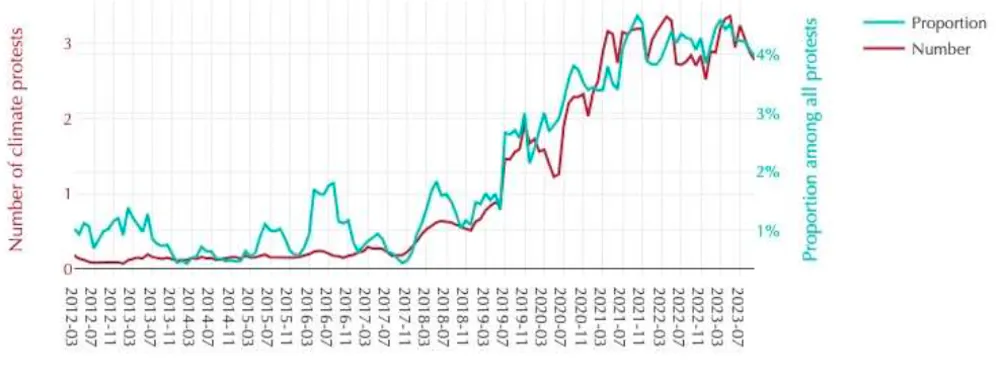
    To look more closely at the global picture of climate and environmental protest – and the repression of it – we used the Armed Conflicts Location Event database. This showed us that climate protests increased dramatically in 2018-2019 and have not declined since. They make up on average about 4% of all protest in the 81 countries that had more than 1,000 protests recorded in the 2012-2023 period:

    Climate protests increased sharply in the late 2010s in the 14 countries studied. (Data is smoothed over five months; number of protests is per country per month.)
    Berglund et al; Data: ACLED, CC BY-SA

    This second graph shows that environmental protest has increased more gradually:

    Environmental protests in the same 14 countries.
    Data: ACLED, CC BY-SA

    We used this data to see what kind of repression activists face. By looking for keywords in the reporting of protest events, we found that on average 3% of climate and environmental protests face police violence, and 6.3% involve arrests. But behind these averages are large differences in the nature of protest and its policing.

    A combination of the presence of protest groups like Extinction Rebellion, who often actively seek arrests, and police forces that are more likely to make arrests, mean countries such as Australia and the UK have very high levels of arrest. Some 20% of Australian climate and environmental protests involve arrests, against 17% in the UK – with the highest in the world being Canada on 27%.

    Meanwhile, police violence is high in countries such as Peru (6.5%) and Uganda (4.4%). France stands out as a European country with relatively high levels of police violence (3.2%) and low levels of arrests (also 3.2%).

    In summary, while criminalisation and repression does not look the same across the world, there are remarkable similarities. It is increasing in a lot of countries, it involves both state and corporate actors, and it takes many forms.

    This repression is taking place in a context where states are not taking adequate action on climate change. By criminalising activists, states depoliticise them. This conceals the fact these activists are ultimately right about the state of the climate and environment – and the lack of positive government action in these areas.

    Oscar Berglund is a member of the Green Party. The report this article is based on was written with Christina Pantazis, Chris Rossdale and Roxana Pessoa Cavalcanti.

    Tie Franco Brotto does not work for, consult, own shares in or receive funding from any company or organisation that would benefit from this article, and has disclosed no relevant affiliations beyond their academic appointment.

    – ref. Repression of climate and environmental protest is intensifying across the world – https://theconversation.com/repression-of-climate-and-environmental-protest-is-intensifying-across-the-world-246379

    MIL OSI – Global Reports –

    January 27, 2025
  • MIL-OSI: Enlight Announces the Financial Close for Project Roadrunner

    Source: GlobeNewswire (MIL-OSI)

    The debt financing package includes $550 million of construction loans

    Roadrunner consists of 290 MW of solar generation and 940 MWh of energy storage capacity, and is expected to reach full COD by the end of 2025

    TEL AVIV, Israel, Dec. 23, 2024 (GLOBE NEWSWIRE) — Enlight Renewable Energy Ltd. (“Enlight”, “the Company”, NASDAQ: ENLT, TASE: ENLT.TA), a leading global renewable energy platform, today announced that the Company has arranged the debt financing (the “Debt Financing”) for project Roadrunner (“Roadrunner” or “the Project”), located near Tuscon, Arizona, USA.

    As part of the Debt Financing, Enlight, through its subsidiary Clenera Holdings LLC, has entered into a loan agreement with a consortium of four leading global banks including BNP Paribas Securities Corp, Crédit Agricole, Natixis CIB, and Norddeutsche Landesbank Girozentrale (Nord/LB), totaling $550 million, which are expected to convert into a $290 million term loan and $320 million of tax equity funding upon the Project’s COD. The term loan is structured with an amortization tenor of 20-25 years and is to be fully repaid 5 years from the Project’s COD (mini perm). The loans are subject to an all-in interest rate of SOFR + 1.5%-1.75%, which rises by 0.125% after four years. Paragon Energy Capital served as Clenera’s exclusive financial advisor on the transaction.

    During the Project’s construction period, the Company’s equity investment is expected to amount to 10% of the expected total Project cost of $610 million. The debt financing arrangements are expected to enable the Company to recycle the entire equity investment upon COD subject to minimum project coverage ratios. The Company expects to conclude a tax equity transaction during 2025, noting that the project has secured safe harbor status.

    Roadrunner (also known as Apache Solar II) is the second-largest project in Enlight’s history, consists of 290 MW solar generation and 940 MWh of energy storage capacity, and is expected to reach full COD by the end of 2025. Construction at the 1200-acre site has already begun, and all procurement contracts have been signed. The Project has a 20-year busbar power purchase agreement covering its entire output with the Arizona Electric Power Cooperative (AEPCO), and is expected to generate revenues of $51-54 million and EBITDA1 of $41-44 million in its first full year of operation. A summary of the Project’s financial information appears in the tables below:

    (as expected at COD)

    Total project cost

    Term debt

    Upfront tax equity

    Sponsor equity upon COD


    $ 610 million

    $ 290 million

    $320 million

    $0


    Total project cost net of tax equity

    Revenues in first full year

    EBITDA in first full year1


    $ 290 million

    $51-54 million

    $41-44 million

    1EBITDA is a non-IFRS financial measure. This figure represents EBITDA for the project and excludes all ITC and PTC proceeds, as well as the impact of a potential tax equity transaction. The tax equity partner’s share is expected to range between 10-15% of the Project’s EBITDA during the first years of operation.

    Roadrunner is being built in the Sulphur Springs Valley region near Tucson, Arizona. Arizona possesses one of highest rates of growth in data centers in the U.S., driving a significant increase in the demand for electricity. The area’s high altitude, mild weather, and very high irradiance make it especially suitable for a utility-scale solar plant. The Project is located in a sparsely populated area and integrates with the larger Apache Generating Station, a diverse energy complex used by AEPCO.

    After the completion of Apex in Montana and Atrisco in New Mexico, Roadrunner is one of several major solar and energy storage projects that Enlight and Clenera are now constructing in the U.S. These include Country Acres (392 MW and 688 MWh) and Quail Ranch (128 MW and 400 MWh). Along with additional projects planned to be built in the years to come, these projects are driving Enlight’s massive expansion into the U.S. renewable energy market. This is best illustrated by the growing run rate of Enlight’s U.S. revenue base, which is expected to reach $195-207 million annually after the completion of the projects now under construction.

    The Company’s next projects in Arizona are Snowflake (600 MW and 1,900 MWh) and CO Bar (1,211 MW and 824 MWh). The two mega projects have almost completed their development phase, and are scheduled to begin construction in the coming months. Each of the two projects are set to achieve grid connection of 1.0 GW, one of the largest in the US. These grid connections generate potential additional development opportunities in the future through the Company’s “Connect and Expand” strategy, which seeks to leverage existing interconnect infrastructure with additional generation capacity.

    Nir Yehuda, CFO of Enlight, commented, “We appreciate our financial partners’ support and commitment in arranging the debt financing for project Roadrunner, which has made it possible for us to progress with its construction. Roadrunner is expected to begin commercial operation by the end of 2025. We look forward to continued collaboration on Country Acres and Quail Ranch, projects which we are now in the process of building and financing.”

    “We are grateful to have established our business as a reliable partner for these financial institutions,” said Adam Pishl, President and CEO of Clenera. “We have demonstrated our ability to build projects on time and on budget, and manage operational solar and storage farms that generate consistent long-term returns. It is exciting to close this deal and fuel our continued growth with projects across America.”

    Aashish Mohan, Co-Head of Energy, Resources & Infrastructure Americas, at BNP Paribas, commented, “BNP Paribas is proud to have supported Clenera and Enlight as Coordinating Lead Arranger on this landmark clean energy project financing. Supporting premier platforms like Clenera squarely fits our energy transition ambitions, and we look forward to partnering with the company again as they continue to execute on their high-quality pipeline.”

    Daniel Feigin, Head of Energy & Infrastructure Group, North America at Crédit Agricole CIB, said, “Crédit Agricole CIB’s collaboration with Enlight and Clenera on this landmark project in Arizona is a testament to the power of partnership and innovation. Roadrunner will provide clean, low-cost energy and storage. We are honored to have played a crucial role in helping a world class developer bringing this project to financial close and contributing to our mission of facilitating clean power generation and economic growth.”

    Nasir Khan, Managing Director & Head of Infrastructure & Energy Finance Americas at Natixis CIB, said, “We are thrilled to announce the successful close our first transaction with Enlight and Clenera, and would especially like to thank the teams for their professionalism and partnership over the past several months. Natixis CIB is committed to driving the energy transition through financing high-quality landmark projects such as Roadrunner, and we look forward to seeing it reach completion in the next year.”

    Sondra Martinez, Managing Director and Head of Originations at NORD/LB New York, commented, “Nord/LB is thrilled to support Clenera and Enlight on the Roadrunner transaction. This transaction represents our commitment to partnerships and supporting clients as they advance the energy transition.”

    About Enlight Renewable Energy

    Founded in 2008, Enlight develops, finances, constructs, owns, and operates utility-scale renewable energy projects. Enlight operates across the three largest renewable segments today: solar, wind and energy storage. A global platform, Enlight operates in the United States, Israel and 10 European countries. Enlight has been traded on the Tel Aviv Stock Exchange since 2010 (TASE: ENLT) and completed its US IPO (NASDAQ: ENLT) in 2023. Learn more at enlightenergy.co.il.

    Investor Contact

    Yonah Weisz
    Director IR
    investors@enlightenergy.co.il

    Erica Mannion or Mike Funari
    Sapphire Investor Relations, LLC
    +1 617 542 6180
    investors@enlightenergy.co.il

    Cautionary Note Regarding Forward-Looking Statements

    This press release contains forward-looking statements within the meaning of the U.S. Private Securities Litigation Reform Act of 1995. We intend such forward-looking statements to be covered by the safe harbor provisions for forward-looking statements as contained in Section 27A of the Securities Act of 1933, as amended, and Section 21E of the Securities Exchange Act of 1934, as amended. All statements contained in this press release other than statements of historical fact, including, without limitation, statements regarding the Company’s expectations relating to the Project, the PPA and the related interconnection agreement and lease option, and the completion timeline for the Project, are forward-looking statements. The words “may,” “might,” “will,” “could,” “would,” “should,” “expect,” “plan,” “anticipate,” “intend,” “target,” “seek,” “believe,” “estimate,” “predict,” “potential,” “continue,” “contemplate,” “possible,” “forecasts,” “aims” or the negative of these terms and similar expressions are intended to identify forward-looking statements, though not all forward-looking statements use these words or expressions. These statements are neither promises nor guarantees, but involve known and unknown risks, uncertainties and other important factors that may cause our actual results, performance or achievements to be materially different from any future results, performance or achievements expressed or implied by the forward-looking statements, including, but not limited to, the following: our ability to site suitable land for, and otherwise source, renewable energy projects and to successfully develop and convert them into Operational Projects; availability of, and access to, interconnection facilities and transmission systems; our ability to obtain and maintain governmental and other regulatory approvals and permits, including environmental approvals and permits; construction delays, operational delays and supply chain disruptions leading to increased cost of materials required for the construction of our projects, as well as cost overruns and delays related to disputes with contractors; our suppliers’ ability and willingness to perform both existing and future obligations; competition from traditional and renewable energy companies in developing renewable energy projects; potential slowed demand for renewable energy projects and our ability to enter into new offtake contracts on acceptable terms and prices as current offtake contracts expire; offtakers’ ability to terminate contracts or seek other remedies resulting from failure of our projects to meet development, operational or performance benchmarks; various technical and operational challenges leading to unplanned outages, reduced output, interconnection or termination issues; the dependence of our production and revenue on suitable meteorological and environmental conditions, and our ability to accurately predict such conditions; our ability to enforce warranties provided by our counterparties in the event that our projects do not perform as expected; government curtailment, energy price caps and other government actions that restrict or reduce the profitability of renewable energy production; electricity price volatility, unusual weather conditions (including the effects of climate change, could adversely affect wind and solar conditions), catastrophic weather-related or other damage to facilities, unscheduled generation outages, maintenance or repairs, unanticipated changes to availability due to higher demand, shortages, transportation problems or other developments, environmental incidents, or electric transmission system constraints and the possibility that we may not have adequate insurance to cover losses as a result of such hazards; our dependence on certain operational projects for a substantial portion of our cash flows; our ability to continue to grow our portfolio of projects through successful acquisitions; changes and advances in technology that impair or eliminate the competitive advantage of our projects or upsets the expectations underlying investments in our technologies; our ability to effectively anticipate and manage cost inflation, interest rate risk, currency exchange fluctuations and other macroeconomic conditions that impact our business; our ability to retain and attract key personnel; our ability to manage legal and regulatory compliance and litigation risk across our global corporate structure; our ability to protect our business from, and manage the impact of, cyber-attacks, disruptions and security incidents, as well as acts of terrorism or war; changes to existing renewable energy industry policies and regulations that present technical, regulatory and economic barriers to renewable energy projects; the reduction, elimination or expiration of government incentives for, or regulations mandating the use of, renewable energy; our ability to effectively manage our supply chain and comply with applicable regulations with respect to international trade relations, tariffs, sanctions, export controls and anti-bribery and anti-corruption laws; our ability to effectively comply with Environmental Health and Safety and other laws and regulations and receive and maintain all necessary licenses, permits and authorizations; our performance of various obligations under the terms of our indebtedness (and the indebtedness of our subsidiaries that we guarantee) and our ability to continue to secure project financing on attractive terms for our projects; limitations on our management rights and operational flexibility due to our use of tax equity arrangements; potential claims and disagreements with partners, investors and other counterparties that could reduce our right to cash flows generated by our projects; our ability to comply with tax laws of various jurisdictions in which we currently operate as well as the tax laws in jurisdictions in which we intend to operate in the future; the unknown effect of the dual listing of our ordinary shares on the price of our ordinary shares; various risks related to our incorporation and location in Israel; the costs and requirements of being a public company, including the diversion of management’s attention with respect to such requirements; certain provisions in our Articles of Association and certain applicable regulations that may delay or prevent a change of control; and other risk factors set forth in the section titled “Risk factors” in our Annual Report on Form 20-F for the fiscal year ended December 31, 2023, filed with the Securities and Exchange Commission (the “SEC”) and our other documents filed with or furnished to the SEC.

    These statements reflect management’s current expectations regarding future events and speak only as of the date of this press release. You should not put undue reliance on any forward-looking statements. Although we believe that the expectations reflected in the forward-looking statements are reasonable, we cannot guarantee that future results, levels of activity, performance and events and circumstances reflected in the forward-looking statements will be achieved or will occur. Except as may be required by applicable law, we undertake no obligation to update or revise publicly any forward-looking statements, whether as a result of new information, future events or otherwise, after the date on which the statements are made or to reflect the occurrence of unanticipated events.

    The MIL Network –

    January 27, 2025
  • MIL-OSI Russia: Alexander Novak took part in the launch of the third line of the Kysyl-Syr – 84 km gas pipeline

    Translation. Region: Russian Federation –

    Source: Government of the Russian Federation – An important disclaimer is at the bottom of this article.

    Alexander Novak, via video link, performed the ceremonial launch of the 3rd line of the main gas pipeline “Kysyl-Syr – 84 km”. With Head of the Republic of Sakha (Yakutia) Aisen Nikolaev

    December 23, 2024

    Alexander Novak performed the ceremonial launch of the 3rd line of the main gas pipeline “Kysyl-Syr – 84 km” via video link. With Head of the Republic of Sakha (Yakutia) Aisen Nikolaev

    December 23, 2024

    Alexander Novak, via video link, performed the ceremonial launch of the 3rd line of the main gas pipeline “Kysyl-Syr – 84 km”. With Head of the Republic of Sakha (Yakutia) Aisen Nikolaev

    December 23, 2024

    Alexander Novak, via video link, performed the ceremonial launch of the 3rd line of the main gas pipeline “Kysyl-Syr – 84 km”. With Head of the Republic of Sakha (Yakutia) Aisen Nikolaev

    December 23, 2024

    Previous news Next news

    Alexander Novak performed the ceremonial launch of the 3rd line of the main gas pipeline “Kysyl-Syr – 84 km” via video link. With Head of the Republic of Sakha (Yakutia) Aisen Nikolaev

    Deputy Prime Minister Alexander Novak held a ceremonial launch of the third line of the Kysyl-Syr – 84 km main gas pipeline via video link. The head of the Sakha Republic (Yakutia) Aisen Nikolaev and the general director of JSC Sakhatransneftegaz Alexey Kolodeznikov also took part in the gas launch ceremony.

    “The launch of the Kysyl-Syr main gas pipeline with its subsequent inclusion in the unified gas transportation system is of the utmost socio-economic importance for the residents of the republic and will ensure reliable gas supply to the Central Energy Region of Yakutia. These are 102 settlements, including Yakutsk, Pokrovsk and Vilyuysk. These settlements are home to 456 thousand people, 626 social infrastructure facilities are located – 220 schools, 235 kindergartens, 171 medical institutions,” noted Alexander Novak.

    From 2021 to 2025, the construction of 11 inter-settlement gas pipelines, 6 gas pipeline branches and gas distribution stations is planned in Yakutia. Another 28 settlements will be gasified. In 2025, it is planned to gasify at least 1.5 thousand households as part of the social additional gasification program.

    Please note: This information is raw content directly from the source of the information. It is exactly what the source states and does not reflect the position of MIL-OSI or its clients.

    MIL OSI Russia News –

    January 27, 2025
  • MIL-OSI Russia: Rosneft has determined the final winner of the “Million from the Family Team” campaign

    Translation. Region: Russian Federation –

    Source: Rosneft – Rosneft – An important disclaimer is at the bottom of this article.

    The Rosneft petrol station network summed up the results of the twelfth drawing of the “Million from the Family Team” campaign, within the framework of which participants in the Company’s loyalty program had the opportunity to win 1 million rubles every month.

    “Family Team” is a cumulative bonus program of Rosneft. Its participants can accumulate points by refueling at the Company’s gas stations, as well as at partners. Accumulated points can be used to pay for fuel, goods in stores and cafes in the retail network. You can join the loyalty program by downloading the Rosneft Gas Station application and registering for a virtual loyalty card.

    The “Million from the Family Team” campaign started in January 2024. Any loyalty program client who filled up at least 80 liters of fuel in a month could take part in the drawing.

    In just one year, the Company raffled off 12 million rubles. The winners were clients of the Family Team loyalty program from different regions: Moscow, Moscow, Murmansk, Ryazan, Tula, Kostroma, Tomsk and Penza regions, the Republic of Karelia, Krasnodar and Krasnoyarsk territories.

    The winner of the final draw was an individual entrepreneur from Bryansk, Alexander Shpilchenko. He is engaged in cargo transportation on his light-duty truck and in November filled up with 570 liters of diesel fuel.

    Next year, new prize draws and special offers await customers of the Rosneft petrol station network. You can apply for a Family Team loyalty program card and follow news and promotions in the Rosneft petrol station mobile app. In addition, the app makes your car trip even more comfortable: you can use it to find the nearest petrol station on your route, find out the cost of the type of fuel you are interested in, and the number of points you have accumulated.

    Reference:

    The retail network of Rosneft Oil Company is the largest in the Russian Federation in terms of geographic coverage and number of stations, and the Rosneft petrol station brand is one of the leaders in terms of recognition and fuel quality in the country. The geography of Rosneft’s retail business covers 61 regions of Russia. The Company’s network of operating petrol stations includes about 3,000 stations. In addition to high-quality fuel, the Company offers its customers a wide range of goods and services – from shops and cafes to roadside service.

    Department of Information and Advertising of PJSC NK Rosneft December 23, 2024

    Please note: This information is raw content directly from the source of the information. It is exactly what the source states and does not reflect the position of MIL-OSI or its clients.

    MIL OSI Russia News –

    January 27, 2025
  • MIL-OSI: Boralex adds another 97 MW in its expanding UK portfolio

    Source: GlobeNewswire (MIL-OSI)

    EDINBURGH, United Kingdom, Dec. 23, 2024 (GLOBE NEWSWIRE) — Boralex Inc. (“Boralex” or the “Company”) (TSX: BLX) is pleased to announce that it has entered into a joint venture for the development, construction and operation of the proposed 145MW Clashindarroch Wind Farm Extension and adjacent 50MW Battery Energy Storage System (BESS), for a total capacity of 195MW. The project is located near Dufftown in Moray, Scotland. Boralex has been developing this project for a number of years on behalf of Clashindarroch Wind Farm Extension Ltd.

    Esbjorn Wilmar, Country Director of Boralex in the United Kingdom said: “We are delighted to have become co-owners of this exciting project. We already have extensive experience in the area through the initial development of the 177MW Dorenell Wind Farm. We now look forward to taking Clashindarroch Wind Farm Extension through the remaining stages of development.”

    Nicolas Wolff, Executive Vice President and General Manager of Boralex in Europe said: “This latest achievement by our UK team will enable us to accelerate the deployment of our Strategic Plan. Through this joint venture, we are adding to our already solid portfolio, supported by our organic developments and the recent acquisition of the 50MW Sallachy wind project.”

    Today’s announcement comes at a pivotal moment in the UK. Earlier in the month, the UK government unveiled its Clean Power Action Plan, setting out how it wants to achieve its grid decarbonisation targets by 2030. This plan, seen as a landmark for the clean energy sector, aims to unlock £40 billion annually from the private sector for investments in infrastructure and renewable energy. It also states that onshore wind capacity should be almost doubled to meet the decarbonisation target, from 14GW installed today to 27GW by 2030.

    The Company submitted a Section 36 application to the Scottish Government. The application is currently under consideration by the Government’s Energy Consents Unit (ECU). The Clashindarroch Wind Farm Extension application consists of up to 22 wind turbines each with an installed capacity of up to 6.6MW, as well as a battery storage facility of up to 50MW.

    On this transaction, CMS acted as Boralex’s legal advisers.

    About Boralex

    At Boralex, we have been providing affordable renewable energy accessible to everyone for over 30 years. As a leader in the Canadian market and France’s largest independent producer of onshore wind power, we also have facilities in the United States and development projects in the United Kingdom. Over the past five years, our installed capacity has more than doubled to over 3.1 GW. We are developing a portfolio of more than 7.2 GW in wind, solar projects and storage projects, guided by our values and our corporate social responsibility (CSR) approach. Through profitable and sustainable growth, Boralex is actively participating in the fight against global warming. Thanks to our fearlessness, our discipline, our expertise and our diversity, we continue to be an industry leader. Boralex’s shares are listed on the Toronto Stock Exchange under the ticker symbol BLX.

    For more information, visit boralex.com or sedarplus.com. Follow us on Facebook, LinkedIn and Instagram.

    For more information

    MEDIA  INVESTOR RELATIONS 
    Camille Laventure 
    Senior Advisor, Public Affairs and External Communications
    Boralex Inc. 

    438-883-8580 
    camille.laventure@boralex.com  

    Stéphane Milot 
    Vice President, Investor Relations 

    Boralex Inc. 

    514-213-1045 
    stephane.milot@boralex.com  

    Source: Boralex Inc.        

    The MIL Network –

    January 27, 2025
  • MIL-OSI Russia: Hockey Santa Claus: HC GUU held a festive training session for the pupils of the children’s club Fortuna

    Translation. Region: Russian Federation –

    Source: State University of Management – Official website of the State –

    Last Sunday, in the Arktika Ice Palace, the hockey team of the State University of Management together with the hockey team of the Gubkin Russian State University of Oil and Gas held a New Year’s training session for the Fortuna hockey club under the mentoring program within the framework of the Good Hockey project with the support of the Moscow Hockey League.

    “Before the training, everyone was nervous and didn’t understand what was required of us. But as soon as we went out on the ice, all the guys immediately got to work and gave their all. Such events are necessary not only for the children, but also for us. We helped them, told them and taught them everything that we know ourselves. The children absorbed all the information that was conveyed to them very well, and each of the hockey players saw the motivation of the kids to play hockey. We were pleased to be part of such a training session!” – noted the captain of the HC GUU Andrey Larin.

    The program was created for children with visual impairments or complete lack of vision involved in adaptive hockey and is designed to provide young hockey players with quality support and assistance in mastering this sport.

    “Mentoring” brings together players from the Moscow Student Hockey League with children who need an individual approach to learning and developing hockey skills.

    The special feature of adaptive hockey in this school is the special “ringing” iron equipment. This is due to the fact that children, when playing, primarily rely on hearing, namely the sound of the stick and the ringing of the puck.

    “Despite the early rise, the emotions are only positive. It’s great that the league continues this tradition and holds master classes for children. We have been at such a training session with the guys for the second time. It was very nice to realize that the guys have “grown up” in every sense of the word over 2 years and that perhaps we are partly to blame for this growth. After talking to the players, you are once again convinced of their strength of spirit and love for hockey. Since the training session was before the New Year, we could not come empty-handed and not share the New Year’s mood. I am sure that we succeeded!” said Mikhail Gubin, assistant captain of the HC GUU.

    At the end of the training session, Father Frost visited, played by the assistant of the HC GUU Mikhail Gubin, and our hockey players gave New Year’s gifts to the young hockey players!

    The hockey team “Fortuna” is the first team in Russia of a unique direction: adaptive hockey “Blind Hockey”, which is focused on the socialization and rehabilitation of children with visual impairments.

    Subscribe to the TG channel “Our GUU” Date of publication: 23.12.2024

    Please note: This information is raw content directly from the source of the information. It is exactly what the source states and does not reflect the position of MIL-OSI or its clients.

    MIL OSI Russia News –

    January 27, 2025
  • MIL-OSI USA: 2024 in Review: Highlighting the Best of Landsat

    Source: US Geological Survey

    What makes Landsat so valuable is its unmatched record, with more than 50 years of data about Earth’s land surface. And it’s all open to the public at no cost. This vital resource continues to monitor change in the world’s land masses and water resources.  

    This year, international reports echoed the message that Landsat is among the most impactful, quality-driven Earth observation imaging programs. Scroll down to read about two such reports. 

    Landsat data has long provided opportunities for improved monitoring and management of all of Earth’s landforms and ecosystems. From delicate mangroves and freshwater wetlands to mountainous forests damaged by fire and landmasses and ice sheets from pole to pole. Landsat is an invaluable resource, helping land managers and scientists evaluate the changes to land surfaces, and then determine the best step forward to mitigate or influence future land change. 

    Scroll through the stories below to learn how applying Landsat data enabled scientists to advance research in 2024. 

    Landsat’s reputation for top quality Earth observation capabilities helps strengthen the partnerships the USGS maintains with longstanding international collaborators. This year, important new agreements were signed relating to the future of Earth observation and the next Landsat mission. These partnerships are made possible by the Landsat 2030 International Partnership Initiative that was announced in late 2023. 

    Scroll down to read more about the new agreements, see highlights from a visiting international ambassador, and learn how international cooperators and their ground station operators keep informed about Landsat.

    Spectral band comparisons between Landsat 8 and Landsat 9 , with those of Landsat Next. Click to enlarge. 

    The new Landsat Next mission will help unlock new opportunities for research studies relating to water quality, crop production and plant stress, climate and snow dynamics, soil health and other essential environmental variables.

    A significant milestone for the Landsat Next mission this year is the selection of a contractor to design, build, test, and deliver the sensors that will be on board the Landsat Next mission’s constellation of 3 identical satellites. Each sensor will collect Earth observation data in 26 spectral bands with high resolution. Overall, the constellation will collect about 20 times more data than Landsat 8 or Landsat 9.  

    Visit the links below to hear a podcast and view webpages to learn more about the Landsat Next mission. 

    After 25 years of orbiting around the Earth more than 132,000 times, the Landsat 7 mission is nothing short of legendary. The Enhanced Thematic Mapper Plus sensor onboard the satellite captured over 3.3 million images. Move the slider back and forth on the image below to see the massive growth of the Las Vegas area from 1999 to 2024. The 2024 image marks the satellite’s 25th anniversary and stands as a tribute to Landsat 7’s quarter-century legacy of Earth observation.

    Landsat 7 images of Las Vegas: July 4, 1999, and May 28, 2024. 
    Click to view full size graphic. 

    Landsat 7 satellite images continue to support studies of how land is used and how it has changed across urban, agriculture, forest, snow, and ice-covered areas around the globe, as well as natural and manmade disasters. 

    The magnitude and impact that Landsat 7 brought to scientists and those interested in studying the Earth’s landmasses are summarized in this graphic. 

    Read the USGS News release about the Landsat 7 mission. 


    Events captured by Landsat 7

    Landsat 7 witnessed events that changed the landscape on Earth slowly, such as the expanding Las Vegas urban sprawl shown above. Some of the significant events that changed the Earth much faster include the 2001 World Trade Center attack, the aftermath of Hurricane Katrina in 2005, and the Deepwater Horizon Oil Slick in the Gulf of Mexico in 2010.   

    The images and podcasts linked below provide just a glimpse into the 25 years of Landsat 7. From its launch in 1999 to sending down its final science mission data in 2024, this historic mission helped us appreciate and better understand Earth’s land surfaces. 

    MIL OSI USA News –

    January 27, 2025
  • MIL-OSI Economics: NERC 2024 Reliability Report Highlights Challenges for U.S. Electric Grid; Renewables and Storage are Key to Resilience

    Source: American Clean Power Association (ACP)

    Headline: NERC 2024 Reliability Report Highlights Challenges for U.S. Electric Grid; Renewables and Storage are Key to Resilience

    WASHINGTON DC, December 20, 2024 — The newly released North American Electric Reliability Corporation’s (NERC)  2024 Long-Term Reliability Assessment Report highlights growing concerns about the strength and resilience of the U.S. electricity grid.
    According to the report, rising demand for electricity, increases in extreme weather events, and delays in connecting new resources to the grid threaten stability across the U.S.
    “In response to surging demand and increasing extreme weather events, we must embrace a diverse energy mix and avoid sidelining any market-ready generation,” said American Clean Power (ACP) Association Vice President of Markets & Transmission Carrie Zalewski.
    “We need to tap into the 1,000 GW of storage-hybrid facilities in the queue that can deliver low cost, flexible resources. Adding new transmission infrastructure and a diverse energy mix need to be top priorities.”
    On enhancing resiliency, the report found that battery storage is outperforming expectations, providing flexibility to balance solar and wind variability, particularly during extreme weather and peak demand periods.
    “Energy storage is having an outsized effect on enhancing grid reliability. ERCOT is helping make that case,” Zalewski said. “In the past year, during both winter and summer months, significant energy storage capacity additions provided ERCOT with the ability to navigate moments of stress on the grid while helping keep the lights on and produce hundreds of millions in energy cost savings in the process.”
    Report Highlights:
    51 percent jump in planned transmission projects over the next decade, with more than 28,000 miles of new transmission reported in planning stages, a much-needed step in expanding the grid to support renewable energy integration.
    15 percent increase in summer peak demand and an 18 percent increase in winter peak demand over the next 10 years.
    Both figures are considerably higher than NERC’s last assessment and driven largely by surging energy needs from data centers.
    ###

    MIL OSI Economics –

    January 27, 2025
  • MIL-OSI Canada: Statement from Premier Pillai on the Council of Federation Fall 2024 meeting

    Source: Government of Canada regional news

    Statement from Premier Pillai on the Council of Federation Fall 2024 meeting
    zaburke
    December 18, 2024 – 1:19 pm

    Premier Ranj Pillai has issued the following statement:

    “This week, I had the privilege to join Premiers for the Council of the Federation Fall 2024 meeting in Toronto. We discussed key priorities for the coming year, uniting our voices on issues that matter to all Canadians, including Canada-U.S. relations, health care and energy security.

    “Canada-U.S. relations were a central focus of our discussions. For the Yukon, this means continuing to strengthen our relationship with Alaska, which benefits both sides of the border. Premiers are committed to working hard to avoid any potential U.S. tariffs and agreed on the need to accelerate achieving the NATO defence spending target of two per cent of gross domestic product (GDP). Arctic security was also highlighted in these discussions, and I look forward to raising our interests during the Premiers’ mission to Washington, D.C. in February 2025.

    “For Yukoners, improving health care is a top priority. Our government is working to address the health workforce shortage by supporting recruitment and retention efforts. I know that Minister of Health and Social Services, Tracy-Anne McPhee, along with many health system partners, highlighted our progress in the first annual report on the Health Human Resources Strategy. Premiers continue to stress the need for more resources to tackle the Substance Use Health Emergency, which continues to deeply impact communities across the territory. Faster access to prescription medicines was also an important part of the Premiers’ discussion, and I look forward to seeing progress on this file, led by our respective health ministers.

    “Energy security was another major topic of discussion. As emerging technologies create new opportunities, we must work together to ensure energy is reliable, affordable, and sustainably produced. Critical minerals and energy corridors will play a crucial role in securing Canada’s future prosperity.

    “In addition to the Council of the Federation meeting, I was honoured to once again join Premier of Nunavut P.J. Akeeagok and Premier of the Northwest Territories R.J. Simpson to discuss northern priorities on the national stage. Arctic security, infrastructure and critical minerals were at the top of the agenda. We emphasized the need for more federal investment in these areas to address the unique challenges faced by northern communities. The North must have a seat at the table when it comes to decisions that impact our future. I would like to thank Premier P.J. Akeeagok for his work as chair over the past year and look forward to hosting the 2025 Northern Premiers’ Forum as incoming chair.

    “Attending the Council of Federation is an important opportunity to amplify Yukoners’ voices and advocate for the North. I am honoured to join Premiers in promoting collaboration and remaining committed to working together. I am proud of our continued partnership on these crucial issues and thank Premier Ford for hosting us in Toronto.”
     

    Media contact

    Laura Seeley
    Cabinet Communications
    867-332-7627
    laura.seeley@yukon.ca 
     

    News release #:
    Related information:
    Premiers Discuss Important Issues for Canadians
    Government of Yukon addresses Health Human Resources challenges
    Statement from Premier Pillai on meeting with northern Premiers

    MIL OSI Canada News –

    January 27, 2025
  • MIL-OSI Canada: Government of Yukon and Government of Canada announce new investments to make heat pumps more affordable for Yukoners

    Source: Government of Canada regional news

    Government of Yukon and Government of Canada announce new investments to make heat pumps more affordable for Yukoners
    zaburke
    December 19, 2024 – 2:45 pm

    This is a joint news release between the Government of Yukon and the Government of Canada.

    The Government of Canada and the Government of Yukon are partnering to help Yukoners switch to smart electric heating systems, making life more affordable while reducing greenhouse gas emissions.

    Today, Member of Parliament for the Yukon, Brendan Hanley on behalf of Minister of Energy and Natural Resources Jonathan Wilkinson and Minister of Environment and Climate Change Steven Guilbeault, announced a federal investment of $1.4 million from the Federal Oil to Heat Pump Affordability program (OHPA) and $287,000 from Canada’s Low Carbon Economy Fund (LCEF). Yukon Minister of Energy, Mines and Resources John Streicker announced that the Government of Yukon will provide an additional $700,000 in territorial funding towards further helping low-to-middle-income households cover the cost of purchasing and installing a heat pump. 

    Heat pumps are one of the best ways for homeowners to save money on energy bills and combat climate change. They are two to three times more efficient than other electric home heating sources, providing greater savings for homeowners while reducing energy consumption for utilities and power grids.

    As part of the Government of Yukon’s Affordable Heap Pump Program, eligible Yukon homeowners can receive 100 percent of the cost to purchase and install a heat pump to a maximum of $24,000. Additionally, homeowners can receive an upfront payment of $250 to add high-efficiency heat pumps in homes currently heated with oil. Homeowners using other energy sources, such as propane or electric baseboards, could also be eligible for cold climate heat pump rebates funded by LCEF and the Government of Yukon.

    Through these investments, the governments of Canada and Yukon are helping Yukoners access energy-efficient heat pumps, save on their energy bills and reduce their carbon emissions to protect the environment. 
     

    Our government believes that we can save money and our planet at the same time. Through Our Clean Future, our government committed to helping Yukoners transition from fossil fuels to smart electric heating systems like heat pumps. I’m pleased that these new investments will help make life more affordable for Yukoners while reducing our territory’s greenhouse gas emissions. 

    Minister of Energy, Mines and Resources John Streicker

    Making the switch to more energy-efficient heating systems can help Canadians save thousands on their energy bills, reduce their energy use and decrease their carbon footprint. That’s why we are strengthening the Oil to Heat Pump Affordability program and ensuring that families are in the Yukon supported in making the switch from heating oil to an efficient heat pump. 

    Minister of Energy and Natural Resources Jonathan Wilkinson

    Yukoners face some of the coldest temperatures in Canada and need reliable, affordable heating systems to stay warm. This is now truer than ever as climate change is making weather increasingly unpredictable.  Heat pumps have shown to be an efficient way to heat homes reducing emissions, protecting the environment and helping Canadians save on their utility bills. That’s why we are investing in programs like this that support the transition and get us closer to our emission reduction goals.

    Minister of Environment and Climate Change Steven Guilbeault

    Transitioning to energy-efficient heating systems offers Canadians and Yukoners the opportunity to save money on more-efficient home energy systems. The Oil to Heat Pump Affordability program will ensure that families in the Yukon receive the necessary support to switch from heating oil to efficient heat pumps, which will benefit local installers and businesses while also helping ease northern Canada’s pathway to home heating that is less expensive and more environmentally friendly.

    Member of Parliament for Yukon, Brendan Hanley

    Quick facts
    • The federal government’s Oil to Heat Pump Affordability program was first introduced in November 2022 as a $250 million investment in a new stream within the Canada Greener Homes Initiative. On February 22, 2023, the program was opened to pre-registration and was fully launched in late March 2023, with the first grants being issued shortly thereafter.

    • Introduced in October 2023, the federal government announced working with provinces and territories on co-delivery agreements including an upfront payment of $250 for eligible applicants through the Canada Heat Pump Bonus.

    • Every year, on average, a household participating in the Oil to Heat Pump Affordability program saves $1,337 on energy costs and 2.78 tonnes in greenhouse gas reductions.

    • The federal government currently has OHPA program co-delivery arrangements in place with British Columbia, Newfoundland and Labrador, Nova Scotia and Prince Edward Island. Active discussions are underway with other provinces and territories to deliver new, strengthened OHPA co-delivery agreements to make heat pumps even more affordable for Canadians across the country. In jurisdictions without co-delivery arrangements, oil-heated households can continue to apply to the national program to receive up to $10,000 in federal OHPA funding for switching to electric heat pumps.

    • The federal government’s Oil to Heat Pump Affordability program has received over 29,000 applications to date nationally.

    • Under Budget 2024, the Government of Canada is taking numerous steps to make life more affordable for Canadians while addressing climate change. This includes the Canada Greener Homes Affordability Program, which will support the direct installation of energy efficiency retrofits for Canadian households with low to median incomes.

    • Yukoners who participate in the Affordable Heat Pump Program (the Yukon’s version of the federal government’s Oil to Heat Pump Affordability program) may retain their pre-existing heating sources as backup systems for periods of extreme cold.

    Media contact

    Media Relations 
    Natural Resources Canada 
    343-292-6096 
    media@nrcan-rncan.gc.ca 

    Joanna Sivasankaran
    Director of Communications
    Office of the Minister of Energy
    and Natural Resources
    joanna.sivasankaran@nrcan-rncan.gc.ca 

    Laura Seeley
    Cabinet Communications
    867-332-7627
    laura.seeley@yukon.ca 

    Kate Erwin 
    Energy, Mines and Resources 
    867-667-7627
    kate.erwin@yukon.ca 
     

    News release #:
    Related information:
    Yukon affordable heat pump program
    Oil to heat pump affordability program
    Low carbon economy fund
    Canada greener homes initiative
    Canada green building strategy

    MIL OSI Canada News –

    January 27, 2025
  • MIL-OSI United Kingdom: Gasworks Pipe Bridge reopens

    Source: City of Oxford

    Published: Friday, 20 December 2024

    We are pleased to announce that the bearing replacement works for the Gasworks Pipe Bridge have been successfully completed.

    The bridge has been de-jacked, reconnected to the abutments, and is now open for public use. The contractor will return to the site in early January to carry out final works, including restoring the towpaths to a good condition and demobilising the site compound area.

    Thank you for your patience and cooperation throughout this project.

    MIL OSI United Kingdom –

    January 27, 2025
  • MIL-OSI USA: N.C. Trails Committee Awards Over $1.24 Million in Federal Grants, Recommends Designations for Access Points on State Paddle Trails

    Source: US State of North Carolina

    Headline: N.C. Trails Committee Awards Over $1.24 Million in Federal Grants, Recommends Designations for Access Points on State Paddle Trails

    N.C. Trails Committee Awards Over $1.24 Million in Federal Grants, Recommends Designations for Access Points on State Paddle Trails
    jejohnson6
    Fri, 12/20/2024 – 11:22

    At its December meeting, the North Carolina Trails Committee selected 13 trail development projects and five safety and education projects to receive matching federal grants, the N.C. Division of Parks and Recreation announced. In addition, the committee recommended the official designation of the first access points on the new Haw River State Trail and four accesses on the Yadkin River State Trail.

    “This annual funding from the federal government is key to continuing North Carolina’s distinction as the Great Trails State,” said N.C. Department of Natural and Cultural Resources Secretary Reid Wilson. “Trail improvements, new trail development, and trail safety and education programs help residents and visitors take advantage of healthy and affordable outdoor recreation opportunities.”

    The selected projects include relocation of an off-road vehicle trail to make it more sustainable, updates to a paddle trail access, improvements to greenways, and construction on new trails. The projects range from a little over $54,000 up to the maximum of $100,000, with a total of over $1.2 million. The Safety and Education grants are around $5,000 each, totaling over $24,000.

    In addition, the committee recommended to the DNCR Secretary the approval of the first designated access on the Haw River State Trail, on Brooks Bridge in Rockingham County, along a segment called High Rock Ford. The Haw River State Trail was authorized by the General Assembly in 2023. The committee also recommended official designations for four accesses on the Yadkin River State Trail:

        • The boat access at Morrow Mountain State Park

        • Donnaha Access in Yadkin County

        • Moravian Creek Access in the town of Wilkesboro, and

        • Ronda Memorial Park Access in the town of Ronda.

    Together, these access points will add 13.6 designated miles to the Yadkin River State Trail.

    “We are very excited to continue to make progress on the state trails,” said Division Director Brian Strong. “These accesses allow the public to enjoy two of North Carolina’s beautiful rivers, the Haw and the Yadkin. We appreciate the hard work that our state trail partners and section sponsors have put in to help us grow the state trails network in North Carolina.”

    State trails, a unit of the state parks system, epitomize partnerships. They are composed of multiple connected sections, and each section of the trail is sponsored by a state or federal agency, local government, or private landowner. Section sponsors build, maintain, and manage their section of the trail. Once a segment of trail or access is constructed within the planning corridor of a state trail, the section sponsor must apply for official state trail designation. Until the trail segment is designated, it is not part of the state trail.

    The Division’s Trails Program manages the federal Recreational Trails Program Grant from the Federal Highway Administration. The grant provides funding for construction of new trails, maintenance and repair of existing trails, land acquisition, purchase of trail tools, and planning, legal, environmental, and permitting costs. Safety and Education grants are a subset of the program and are awarded for safety and education instructor fees, speaker fees, displays, signage, and other uses. Federal, state, or local government agencies or qualified nonprofit organizations are eligible to apply for the annual RTP grants.

    The seven-member Trails Committee, appointed by the DNCR Secretary, advise the Trails Program on funding recommendations. Final determination on grant awards is made by the DNCR Secretary. The committee members represent various trail use communities across the state, including hiking, biking, paddling, equestrian, and off-road vehicles.

    The Trails Committee also reviews designation applications for state trails and makes recommendations for the DNCR Secretary’s final approval.

    Grant recipients and awards are as follows:

    Trail Development Projects

    Recipient County Project Name Funds Awarded
    U.S. Forest Service Burke 2024 Brown Mountain Off-Highway Vehicle Area Maintenance – Trail Relocation $100,000
    U.S. Forest Service Burke Brown Mountain OHV Area Mini-Excavator – Trail Equipment $100,000
    Town of Rolesville Wake Granite Acres Greenway Connection Project – New Trail $100,000
    Alamance Parks (on behalf of Friends of Haw River State Trail) Alamance, Guilford, Rockingham Haw River State Trail Paddle and Land Trail Improvements – Greenway Facilities $78,000
    Chatham County Chatham HRST Pegg Tract Improvements – New Trail $100,000
    Blue Ridge Conservancy Ashe Northern Peaks State Trail Three Top Mountain Phase 1 – New Trail $100,000
    Town of Sylva Jackson Pinnacle Park Recreation Trails – New Trail $92,000
    Town of Boone Watauga NPST Rivers House Park – New Trail $54,932
    Town of Rosman Transylvania Rosman Riverfront Park Phase 1 – New Trail $100,000
    Catawba Lands Conservancy Gaston Spencer Mountain Trail Construction – New Trail $100,000
    Cleveland County Water Cleveland Stagecoach Greenway Narrows Segment – New Trail $100,000
    City of Rocky Mount Nash Sunset Park New Multi-Use Natural Surface Trail, Joint Trailhead and Renovation of Sunset Tar River $100,000
    Camp Grier McDowell Woods Mountain Trail Restoration $100,000
        TOTAL $1,224,932

    Safety and Education Grants

    Recipient County Program Name Funds Awarded
    Dan River Basin Association Caswell, Rockingham, Stokes Public Water Safety Classes for Recreational Boaters $5,000.00
    McDowell County McDowell McDowell Trails Tool and Education Fund $4,960.48
    McDowell Tech Community College McDowell McDowell Tech Trail School $5,000.00
    Carolina Mountain Club Buncombe, Haywood, Madison Certification of CMC Sawyers $4,900.00
    Camp Grier McDowell Usability and Sustainability Program for Volunteer Trail Crew $4,988.41
        TOTAL $24,848.89

    About North Carolina State Parks
    North Carolina State Parks manages more than 262,000 acres of iconic landscape within North Carolina’s state parks, state recreation areas and state natural areas. It administers the N.C. Parks and Recreation Trust Fund, including its local grants program, as well as a state trails program, North Carolina Natural and Scenic Rivers and more, all with a mission dedicated to conservation, recreation and education. The state parks system welcomes more than 19 million visitors annually.

    About the North Carolina Department of Natural and Cultural Resources
    The N.C. Department of Natural and Cultural Resources (DNCR) manages, promotes, and enhances the things that people love about North Carolina – its diverse arts and culture, rich history, and spectacular natural areas. Through its programs, the department enhances education, stimulates economic development, improves public health, expands accessibility, and strengthens community resiliency.
    The department manages over 100 locations across the state, including 27 historic sites, seven history museums, two art museums, five science museums, four aquariums, 35 state parks, four recreation areas, dozens of state trails and natural areas, the North Carolina Zoo, the State Library, the State Archives, the N.C. Arts Council, the African American Heritage Commission, the American Indian Heritage Commission, the State Historic Preservation Office, the Office of State Archaeology, the Highway Historical Markers program, the N.C. Land and Water Fund, and the Natural Heritage Program. For more information, please visit www.dncr.nc.gov.
    Dec 20, 2024

    MIL OSI USA News –

    January 27, 2025
  • MIL-OSI: Canadian Nuclear Laboratories and Karlsruhe Institute of Technology to Collaborate on Fusion, Materials and Hydrogen Science & Technology

    Source: GlobeNewswire (MIL-OSI)

    CHALK RIVER, Ontario, Dec. 20, 2024 (GLOBE NEWSWIRE) — Canadian Nuclear Laboratories (CNL), Canada’s premier nuclear science and technology organization, is pleased to announce that it has signed an agreement with the Karlsruhe Institute of Technology (KIT), Germany’s premier research institution, to pursue collaborative research related to fusion, materials characterization and hydrogen science and technology. With shared scientific missions to address national priorities in clean energy and environmental sciences, the agreement serves as a framework through which the national research organizations can collaborate in areas of mutual interest, leveraging their individual resources, facilities, and expertise.

    According to terms of the agreement, the organizations will explore collaborative research projects in fields that include tritium analytics, tritium barriers and surface analysis, tritium fuel cycle optimization, characterization and metallurgy of irradiated materials, and hydrogen safety. Working together, the organizations hope to realize important progress in the advancement of these fields of research and others, which are priorities to both country’s domestic clean energy research programs.

    “CNL is a world leader in nuclear science and technology, including hydrogen. We are now working to re-establish ourselves in fusion, which is yielding some very exciting commercial opportunities, and drawing the attention of other leading research organizations who share our goals in clean energy,” commented Dr. Stephen Bushby, CNL’s Vice-President of Science and Technology. “With the signing of this agreement with the Karlsruhe Institute of Technology, a leading German research institution that has complementary capabilities, CNL continues to expand its network and pursue even more ambitious collaborative research. By working together, I think we can help to accelerate these promising fields of study and contribute to much-needed progress in clean energy.”

    “With fusion taking momentum all around the world, Germany investing substantial amounts to promote the cooperation between National Labs and private actors in the field, and KIT being at the centre of fusion technologies and materials development in Germany and in Europe, it is quite straightforward for us to engage in an international cooperation that offers plenty of opportunities for world-leading developments, e.g., in the fusion fuel cycle, hydrogen, and materials areas,” said Dr. Klaus Hesch, Head of KIT´s Fusion Programme. “CNL´s tritium expertise derived from decades of scientifically-technically accompanying and enabling the operation of the CANDU reactors perfectly complements the experience we have acquired in our Tritium Laboratory Karlsruhe with regard to tritium handling and processing for fusion. There is interest to extend the cooperation both towards other fusion companies as well as to the European Fusion Programme.”

    CNL has decades of experience and expertise in materials characterization, hydrogen production, safety and storage, and tritium research, among other related fields of research. The Chalk River campus is also home to a state-of-the-art Tritium Facility and a Hydrogen Isotopes Technology Laboratory, as well as a rapidly growing fusion energy program. Not only did CNL recently announce the expansion of two of its flagship clean energy programs to include fusion – its advanced reactor siting program and the Canadian Nuclear Research Initiative (CNRI) – but CNL also invested $10 million into General Fusion, an international leader in commercial fusion energy. This is in addition to the launch of a new joint venture with Kyoto Fusioneering known as Fusion Fuel Cycles Inc. (FFC), which is moving forward with a globally unique test facility available to industry to test and refine their unique processes.

    All of these projects, programs and resources are complemented by those at KIT, which serves as one of the largest science institutions in Europe, with over 5,000 people conducting research on a broad range of disciplines, from natural sciences to engineering. KIT is also home to research centers that focus on problems of fundamental importance to the existence and further development of society, and on key issues resulting from the striving for knowledge, which includes climate and environment, energy, materials in technical and life sciences, and elementary particle and astroparticle physics, among others. With the agreement now serving as a framework to facilitate collaborative research activities, both organizations believe that it could also act as a first step towards a broader relationship that expands into other fields of research.

    If you’d like to learn more about CNL or its projects in clean energy and environmental sciences, please visit www.cnl.ca. For more information on KIT and its programs of work, please visit www.kit.edu.

    About CNL

    As Canada’s premier nuclear science and technology laboratory and working under the direction of Atomic Energy of Canada Limited (AECL), CNL is a world leader in the development of innovative nuclear science and technology products and services. Guided by an ambitious corporate strategy known as Vision 2030, CNL fulfills three strategic priorities of national importance – restoring and protecting the environment, advancing clean energy technologies, and contributing to the health of Canadians.

    By leveraging the assets owned by AECL, CNL also serves as the nexus between government, the nuclear industry, the broader private sector and the academic community. CNL works in collaboration with these sectors to advance innovative Canadian products and services towards real-world use, including carbon-free energy, cancer treatments and other therapies, non-proliferation technologies and waste management solutions.

    To learn more about CNL, please visit www.cnl.ca.

    About KIT

    Being “The Research University in the Helmholtz Association”, KIT creates and imparts knowledge for the society and the environment. It is the objective to make significant contributions to the global challenges in the fields of energy, mobility, and information. For this, about 10,000 employees cooperate in a broad range of disciplines in natural sciences, engineering sciences, economics, and the humanities and social sciences. KIT prepares its 22,800 students for responsible tasks in society, industry, and science by offering research-based study programs. Innovation efforts at KIT build a bridge between important scientific findings and their application for the benefit of society, economic prosperity, and the preservation of our natural basis of life. KIT is one of the German universities of excellence.

    To learn more about KIT, please visit www.kit.edu.

    CNL Contact:
    Philip Kompass
    Director, Corporate Communications
    1-866-886-2325
    media@cnl.ca

    A photo accompanying this announcement is available at https://www.globenewswire.com/NewsRoom/AttachmentNg/2147c02c-0c21-421c-8a37-e6f279aeb3ea

    The MIL Network –

    January 27, 2025
  • MIL-OSI Video: How do we make the green transition fair for everyone?

    Source: World Economic Forum (video statements)

    A sustainable future is not just about going green—it’s about fairness, equity, and ensuring no one is left behind.

    From empowering workers with green skills to addressing economic inequalities, the Equitable Transition Initiative brings leaders together to create a future that’s both sustainable and fair.

    Watch our film and learn more about how we’re making this vision a reality at the Equitable Transition Initiative:
    : https://initiatives.weforum.org/equitable-transition-initiative/home

    The World Economic Forum is the International Organization for Public-Private Cooperation. The Forum engages the foremost political, business, cultural and other leaders of society to shape global, regional and industry agendas. We believe that progress happens by bringing together people from all walks of life who have the drive and the influence to make positive change.

    World Economic Forum Website ► http://www.weforum.org/
    Facebook ► https://www.facebook.com/worldeconomicforum/
    YouTube ► https://www.youtube.com/wef
    Instagram ► https://www.instagram.com/worldeconomicforum/ 
    Twitter ► https://twitter.com/wef
    LinkedIn ► https://www.linkedin.com/company/world-economic-forum
    TikTok ► https://www.tiktok.com/@worldeconomicforum
    Flipboard ► https://flipboard.com/@WEF

    #InclusiveGrowth #ClimateAction #EnergyTransition #GreenSkills #wef25

    https://www.youtube.com/watch?v=7oZ3TmhLZv8

    MIL OSI Video –

    January 27, 2025
  • MIL-OSI Canada: Protecting the environment with tougher coal rules

    Source: Government of Canada regional news

    [embedded content]

    Alberta’s government is developing rules that will prohibit mountaintop removal mining and ban new open-pit mines in the foothills, while substantially increasing coal royalties to benefit Albertans.

    The CIMI will guide responsible coal mining practices with a goal of ensuring that Alberta’s waters are protected from mining contaminants such as selenium. The CIMI also acknowledges the global critical mineral importance of metallurgical coal. Thoughtful coal development will result in increased investment and jobs for Albertans while respecting the existing property rights of freehold mineral rights holders.

    Based on the intent of the 1976 Coal Development Policy and picking up on the coal development work done by the 2021 Coal Policy Committee, the CIMI will build a long-term legislative and regulatory framework focused on environmental protections while allowing coal development under some of the most stringent protections in the world. The CIMI will do away with temporary fixes and half measures and provide a foundation for responsible coal mining for the 21st century.

    “Alberta deserves a modern coal policy that balances responsible resource development with strong environmental protections. Our job now is to develop a policy that respects the natural spaces in the foothills and protects water while allowing for responsible coal development that can attract investment and create jobs.”

    Brian Jean, Minister of Energy and Minerals

    “Alberta has one of the best environmental management systems in the world. We have strong and effective monitoring and regulatory protections in place to protect our air, water and lands and these safeguards will only get stronger through this initiative.”

    Rebecca Schulz, Minister of Environment and Protected Areas

    The world needs steelmaking coal to fuel economic growth and greater adoption of alternative energy sources and technologies. Alberta is blessed by an abundance of metallurgical coal that can be developed while adhering to world-leading environmental protections. Steel is an essential global component for infrastructure growth and development. This steel will also return to Alberta in products like passenger vehicles, home appliances, farm and industrial equipment, and building materials.

    To ensure Albertans are fairly compensated for the development of this important natural resource, Alberta’s government will be raising the coal royalty rates significantly on new coal mines.

    Alberta Energy and Minerals will begin targeted engagement in early 2025 to inform industry of Alberta’s plans for higher standards for coal mining, to set the new coal royalty amounts, and to develop strategies that align with Alberta’s commitment to balance regulatory improvement and environmental protection, with an emphasis on water protection. From this engagement, new coal regulations and legislation will be drafted for government approval later in 2025.

    Quick Facts

    • 1976 Coal Development Policy Land Categories Map

    Coal Development Policy Land Categories Map

    • The CIMI will protect water as our top priority. If coal mining is allowed, it will only be allowed to the highest standards:
      • Prohibit mountaintop removal mining as a coal mining technique.
      • No new open-pit coal mining in the Eastern Slopes (All four categories of the 1976 Coal Development Policy, subject to any further regulations flowing from land use planning work which is underway).
      • Any new coal mining proposals, regardless of location, must use techniques which use best water practices and prevent adding selenium into waterways. New proposals will either need to be underground mines or use mining technologies (such as highwall automated underground mining) that move minimal amounts of overburden, to prevent selenium leaching and siltation.
      • The protections set out in law and in the 1976 Coal Development Policy for national parks, provincial parks, wildland parks, wilderness areas, ecological reserves, and provincial recreation areas will continue.

    Related information

    • Coal Policy Committee
    • A coal development policy for Alberta (1976 Coal Development Policy)

    Multimedia

    • Watch the news conference

    MIL OSI Canada News –

    January 27, 2025
  • MIL-OSI Canada: Prime Minister announces changes to the Ministry

    Source: Government of Canada – Prime Minister

    The Prime Minister, Justin Trudeau, today announced changes to the Ministry. The new Ministry will deliver on what matters most to Canadians: making life more affordable and growing the economy.

    Building on the work done since 2015 to invest in Canadians, the team will continue to move forward on housing, child care, and school food while working to put more money back in people’s pockets.

    The changes to the Ministry are as follows:

    • Anita Anand becomes Minister of Transport and Internal Trade
    • Gary Anandasangaree becomes Minister of Crown-Indigenous Relations and Northern Affairs and Minister responsible for the Canadian Northern Economic Development Agency
    • Steven MacKinnon becomes Minister of Employment, Workforce Development and Labour
    • Ginette Petitpas Taylor becomes President of the Treasury Board

    The Prime Minister also welcomed the following new members to the Ministry:

    • Rachel Bendayan becomes Minister of Official Languages and Associate Minister of Public Safety
    • Élisabeth Brière becomes Minister of National Revenue
    • Terry Duguid becomes Minister of Sport and Minister responsible for Prairies Economic Development Canada
    • Nate Erskine-Smith becomes Minister of Housing, Infrastructure and Communities
    • Darren Fisher becomes Minister of Veterans Affairs and Associate Minister of National Defence
    • David J. McGuinty becomes Minister of Public Safety
    • Ruby Sahota becomes Minister of Democratic Institutions and Minister responsible for the Federal Economic Development Agency for Southern Ontario
    • Joanne Thompson becomes Minister of Seniors

    These new ministers will work with all members of Cabinet to deliver real, positive change for Canadians. They join the following ministers remaining in their portfolio:

    • Terry Beech, Minister of Citizens’ Services
    • Bill Blair, Minister of National Defence
    • François-Philippe Champagne, Minister of Innovation, Science and Industry
    • Jean-Yves Duclos, Minister of Public Services and Procurement and Quebec Lieutenant
    • Karina Gould, Leader of the Government in the House of Commons
    • Steven Guilbeault, Minister of Environment and Climate Change
    • Patty Hajdu, Minister of Indigenous Services and Minister responsible for the Federal Economic Development Agency for Northern Ontario
    • Mark Holland, Minister of Health
    • Ahmed Hussen, Minister of International Development
    • Gudie Hutchings, Minister of Rural Economic Development and Minister responsible for the Atlantic Canada Opportunities Agency
    • Marci Ien, Minister for Women and Gender Equality and Youth
    • Mélanie Joly, Minister of Foreign Affairs
    • Kamal Khera, Minister of Diversity, Inclusion and Persons with Disabilities
    • Dominic LeBlanc, Minister of Finance and Intergovernmental Affairs
    • Diane Lebouthillier, Minister of Fisheries, Oceans and the Canadian Coast Guard
    • Lawrence MacAulay, Minister of Agriculture and Agri-Food
    • Soraya Martinez Ferrada, Minister of Tourism and Minister responsible for the Economic Development Agency of Canada for the Regions of Quebec
    • Marc Miller, Minister of Immigration, Refugees and Citizenship
    • Mary Ng, Minister of Export Promotion, International Trade and Economic Development
    • Harjit S. Sajjan, President of the King’s Privy Council for Canada and Minister of Emergency Preparedness and Minister responsible for the Pacific Economic Development Agency of Canada
    • Ya’ara Saks, Minister of Mental Health and Addictions and Associate Minister of Health
    • Pascale St-Onge, Minister of Canadian Heritage
    • Jenna Sudds, Minister of Families, Children and Social Development
    • Rechie Valdez, Minister of Small Business
    • Arif Virani, Minister of Justice and Attorney General of Canada
    • Jonathan Wilkinson, Minister of Energy and Natural Resources

    Quote

    “Our team is focused on the things that matter most to you – making life more affordable, growing the economy, and creating good jobs for the middle class. Together, we will keep building a strong future for the middle class, and for all Canadians.”

    Quick Facts

    • Since 2015, the Ministry has made real progress for the middle class and those working hard to join it – from lifting hundreds of thousands of children out of poverty with the Canada Child Benefit to delivering on our promise of $10-a-day child care and the National School Food Program.
    • With the changes announced today, the Ministry retains a total of 38 ministers, in addition to the Prime Minister. In keeping with the precedent set in 2015, there is an equal number of women and men.
    • The Cabinet is the central decision-making forum in government, responsible for its administration and the establishment of its policy. Its members are each responsible for individual portfolios or departments.

    Associated Link

    MIL OSI Canada News –

    January 27, 2025
  • MIL-OSI: Leishen Energy Holding Co., Ltd. Announces Closing of $5,500,000 Initial Public Offering

    Source: GlobeNewswire (MIL-OSI)

    Beijing, China, Dec. 20, 2024 (GLOBE NEWSWIRE) — Leishen Energy Holding Co., Ltd. (the “Company” or “Leishen Energy”) (Nasdaq: LSE), a China-based provider of clean-energy equipment and integrated solutions for the oil and gas industry, today announced the closing of its initial public offering (the “Offering”) of 1,375,000 ordinary shares (“Shares”) at a public offering price of $4.00 per Share. The Shares began trading on the Nasdaq Capital Market on December 19, 2024, under the ticker symbol “LSE”.

    The Company received aggregate gross proceeds of $5,500,000 from this Offering, before deducting underwriting discounts and commissions and offering expenses payable by the Company. In addition, the Company has granted the underwriters a 45-day option to purchase up to an additional 206,250 Shares at the public offering price, less the underwriting discount.

    The Company intends to use the net proceeds of the Offering for the construction of a high-tech manufacturing industrial park in the Nanjing Lishui High-tech Development Zone, PRC, for the establishment of its smart manufacturing and new energy R&D center, for the purchase of business equipment and other patented technologies, to strengthen and expand our presence in the PRC Southwest oil and gas market, and to bolster its working capital.

    The offering was conducted on a firm commitment basis. Dominari Securities LLC acted as lead underwriter and Revere Securities LLC as co-underwriter (collectively, the “underwriters”) for the Offering. Sichenzia Ross Ference Carmel LLP acted as U.S. counsel to the Company for the Offering, and VCL Law LLP acted as counsel to the underwriters in connection with the Offering.

    The Shares described above are offered by the Company pursuant to a registration statement on Form F-1, as amended (File Number: 333-282433), that was declared effective by the U.S. Securities and Exchange Commission (the “SEC”) on December 18, 2024. The Offering was made only by means of a prospectus, forming a part of the effective registration statement. A copy of the final prospectus relating to the Offering may be obtained from Dominari Securities LLC, 725 Fifth Avenue, 23rd Floor New York, NY 10022, Attention: Eric Newman, or by calling (212) 393-4500 or emailing info@dominarisecurities.com or by logging on to the SEC’s website at www.sec.gov.

    Before you invest, you should read the prospectus and other documents the Company has filed or will file with the SEC for more complete information about the Company and the Offering. This press release shall not constitute an offer to sell, or the solicitation of an offer to buy any of the Company’s securities, nor shall such securities be offered or sold in the United States absent registration or an applicable exemption from registration, nor shall there be any offer, solicitation or sale of any of the Company’s securities in any state or jurisdiction in which such offers, solicitations or sales would be unlawful prior to registration or qualification under the securities laws of such state or jurisdiction. Any offers, solicitations, or offers to buy, or any sales of securities will be made in accordance with the registration requirements of the Securities Act of 1933, as amended.

    About Leishen Energy Holding Co., Ltd.

    The Leishen Group was founded in 2007 and is a China-based provider of clean-energy equipment and integrated solutions for the oil and gas industry, with a commitment to providing customers with high-performance, safe and cost-effective energy solutions. Our major lines of business include (i) sale of clean-energy industry; (ii) new energy production and operation; (iii) digitalization and integration equipment; and (iv) oil and gas engineering technical services. At present, the Group holds more than 70 patents and software copyrights, forming a comprehensive ecosystem of core technical capabilities. Currently, our business operations have expanded beyond the PRC to Central Asia, and Southeast Asia, and our service abilities and quality have been widely recognized and praised by foreign customers. Efficient, safe and energy-saving equipment combined with professional technical services have enabled our brand to gain positive attention and recognition from our customers and enabled us to become a well-known equipment and services provider in the oil and gas industry. For more information, please visit the Company’s website: www.r-egroup.com.

    Forward-Looking Statements

    Certain statements in this announcement are forward-looking statements, including, but not limited to, the Company’s share offering. These forward-looking statements involve known and unknown risks and uncertainties and are based on the Company’s current expectations and projections about future events that may affect its financial condition, results of operations, business strategy and financial needs, including the expectation that the offering will be successfully completed. Investors can find many (but not all) of these statements by the use of words such as “aim”, “anticipate”, “believe”, “estimate”, “expect”, “going forward”, “intend”, “may”, “plan”, “potential”, “predict”, “propose”, “seek”, “should”, “will”, “would” or other similar expressions in this press release. The Company undertakes no obligation to update or revise publicly any forward-looking statements to reflect subsequent occurring events or circumstances, or changes in its expectations, except as may be required by law. Although the Company believes that the expectations expressed in these forward-looking statements are reasonable, it cannot assure you that such expectations will turn out to be correct, and the Company cautions investors that actual results may differ materially from the anticipated results and encourages investors to review other factors that may affect its future results in the Company’s registration statement and other filings with the SEC.

    For more information, please contact:

    Leishen Energy Holding Co., Ltd.

    Investor Relations Department

    Email: ir@r-egroup.com

    The MIL Network –

    January 27, 2025
  • MIL-OSI USA: Three Business Students Attend Top International Climate Conference: A Once-In-A-Lifetime Experience

    Source: US State of Connecticut

    Junior Chapal Bhavsar is interested in big, sustainable-technology projects, including the creation of climate-friendly power plants, and is eager to use his finance knowledge to find ways to fund their construction.

    As one of 14 UConn students, and five faculty and staff, to attend the United Nation’s Climate Change Conference (COP 29) in Baku, Azerbaijan last month, Bhavsar met many people—including some international power figures—who share his ideology.

    “At COP, I wanted to connect with people in the business space. I went in with an open mind and was happy to talk to anyone. I was in the room with the Minister of Energy of Azerbaijan and with a Saudi delegation working on a clean-energy pipeline. It was fascinating to talk about how financing is changing in the sector, with private industry replacing government entities to advance these projects.’’

    “Perhaps the highlight was being able to connect with the U.S. Ambassador to Azerbaijan, Mark Libby,’’ Bhavsar said. “He’s from Southbury and I grew up in Danbury, so we had that in common. I was excited to connect with someone who is so key in the climate-protection movement, a top guy who is very successful. He invited us to a roundtable where he answered all kinds of questions.’’

    Bhavsar was joined by two other UConn business students, senior Jackie Flaherty, who is majoring in marketing and urban and community studies and minoring in geographic information science; and senior Naiiya Patel, who is studying accounting, with minors in philosophy, and social responsibility and impact in business. All three are members of the UConn Honors program.

    ‘Committed to Purposeful Change’

    Arminda Kamphausen, director for Global & Sustainability Initiatives at the School of Business, said the COP 29 conference offered students an extraordinary experience. UConn business students have been participating since 2021.

    “This once-in-a-lifetime experience ticks all the boxes: international travel, cultural awareness, and growth through exposure to and interaction with critical real-world issues,’’ she said. “The conversations I have had with these students since their return underscores the importance of experiential learning to a complete education. I am so glad we prioritize that here at the UConn School of Business.’’

    “The conversations also reinforce my hope in this generation of young people who are committed to purposeful change and positive impact. Experiences like this give them the tools they need to do just that,’’ she said.

    Kamphausen said the UConn Office of Sustainability deserves credit for its work to make this adventure happen, and particularly for its ability to arrange for our students to enter the exclusive arena where the most meaningful negotiations occur.

    Sustainable Initiatives That Could Apply to Gampel

    Patel enjoyed the conference and said one of the highlights for her was having the opportunity to meet the former President of Finland, Tarja Halonen. She told Halonen how much she enjoyed her presentation on the importance of a greener future and need to act decisively.

    “It was very cool; I never expected to meet someone so important,’’ Patel said.

    Patel said she arrived at COP 29 thinking that she would focus on youth impact and teaching, but found many other interests there as well.

    “The themes covered so many fascinating topics from water security to biodiversity to transportation and tourism. It felt so cool because so much of it could be applied right here at UConn,’’ she said.

    Patel was intrigued by a presentation from an executive with the Liverpool soccer team, who talked about initiatives to keep the facility and the patron experience more sustainable and climate friendly.

    “I thought it would be a great match at UConn and perhaps we could adopt some of those ideas at Gampel,’’ she said. “It was an interesting conference and I didn’t expect that much access to information nor to be around so many important people. Every day there were new panels and an amazing schedule of events. I loved the freedom to seek the information that was of most interest to me.’’

    Patel’s professional interests include business, sustainability and education. She hopes to work for one of the Big 4 accounting firms, and said having knowledge about climate-change initiatives will be an advantage in securing her first job and advancing in the industry.

    Flaherty Built New Network of Friends, Colleagues

    Flaherty has worked in the Office of Sustainability in various capacities since she came to UConn.

    “My interest began senior year in high school when I took environmental science and human geography courses,’’ she said. “I really enjoy both communicating information and working with people.’’

    The trip to COP 29 was particularly enjoyable for Flaherty, who hasn’t traveled extensively. She loved both the food and the people. “I also enjoyed meeting representatives from around the world and hearing their perspectives,’’ she said.

    She hopes to work in sustainable urban planning or communications following graduation.

    “This will be such a nice experience to talk about in my future career. I’m so grateful to UConn to have offered this opportunity. It is so important going forward in my career to have had this experience,’’ she said. “I also found a great new network of UConn friends to build both professional relationships and friendships.’’

    One of the things that surprised her was seeing oil companies and other lobbyists at the event.

    Flaherty and her peers both wished that the conference had generated more substantial change, as the 2015 COP agreement did, resulting in the Paris Agreement. But only about 20 percent of the original finance goals were adopted at the conference.

    “At first, I was very disappointed in the outcome. But now I think it is important to focus on what we can do in our communities and to push local leaders to advocate and pressure for national initiatives and investments,’’ Flaherty said.

    “Regardless of some frustrations, it was a once-in-a-lifetime experience to be able to interact with people from around the world and it was tremendously eye-opening,’’ she added.

    Bhavsar, a Fulbright scholar with a particular interest in banking and analyst roles, said he still felt optimistic after the event. “Its important that we make progress. It can always be better but it is a big step to make and build connections,’’ he said. “I think these nations are on the right track and moving in the right direction.’’

    Bhavsar said he will long remember the people he met at the conference and in the country, visiting a palace, a fire temple, a mosque and exploring Baku.

    “UConn support helped us attend COP but also have a tremendous cultural experience as well,’’ he said. “I met one guy who went home and got his brother, who spoke English and could translate for us. We all went out for tea! The Azerbaijani people are very, very nice.’’

    MIL OSI USA News –

    January 27, 2025
  • MIL-OSI Canada: Province appoints new BC Hydro board chair, directors

    Source: Government of Canada regional news

    The B.C. government has appointed a new chair and three new directors to the BC Hydro board of directors, ensuring the important work of keeping rates affordable, expanding critical electricity infrastructure to meet future demand, and effective management of drought and power imports continues to be prioritized.

    Glen Clark has been appointed the new chair of the BC Hydro board of directors. Clark will take over the post from current chair, Lori Wanamaker, whose term will end on Dec. 31, 2024. Clark brings extensive leadership, corporate relations and resource development experience to the position, as a former premier and minister of finance and corporate relations, as well as former president of the Jim Pattison Group, a multinational corporation with diverse holdings.

    Merran Smith is president of New Economy Canada and brings award-winning leadership uniting industry, government and civil-society partners to solve society’s most pressing social and ecological challenges. She represents Canada on the C3E International Ambassador Corps. The founder of Clean Energy Canada, Smith is broadly recognized as a fearless advocate and national leader in advancing Canada’s clean, zero-carbon economy.

    Brynn Bourke is executive director of the BC Building Trades (BCBT). Under her leadership, BCBT has opened the College of the BC Building Trades, launched a youth ambassador program to connect apprentices with high school students, secured enhanced sanitation protocols on construction sites and supported initiatives that reduce barriers for under-represented groups to enter the trades. Bourke is a board member of BuildForce Canada and SkillPlan.

    Don Kayne is president and CEO of Canfor Corporation, and former CEO of Canfor Pulp Products Inc. Kayne has deep experience in international sales and marketing, human resources and executive compensation through 45 years with the forest company. Kayne has served the forestry industry in many roles, including numerous current and past leadership positions with provincial, national and international forestry-related associations and organizations.

    The new directors will occupy spaces on the board left by Amanda Hobson and Victoria McMillan, whose terms are ending, and Irene Lanzinger and Daryl Fields, who are retiring.

    Directors Nalaine Morin and Chief Clarence Louie, whose terms on the board will end on Dec. 31, 2024, have been reappointed for an additional two-year term. The remainder of the board is unchanged.

    The board of directors is responsible for providing oversight and direction of BC Hydro, such as the implementation of relevant energy policy decisions of the Province. The board chair provides leadership in guiding the board’s activities in the best interests of BC Hydro and British Columbians.

    MIL OSI Canada News –

    January 27, 2025
  • MIL-OSI Africa: Chad: New EUR 28 million African Development Bank-funded solar project to boost Chad’s energy access

    Source: Africa Press Organisation – English (2) – Report:

    ABIDJAN, Ivory Coast, December 20, 2024/APO Group/ —

    The Board of Directors of the African Development Bank Group (www.AfDB.org) has approved funding worth EUR 28 million to build solar power plants in Gassi and Lamadji, Chad. This is part of the Bank’s Desert to Power program to increase energy access across Africa.

    The funding includes EUR 20 million in direct support, combining a loan and a grant from the Sustainable Energy Fund for Africa, plus EUR 8 million in financial guarantees. These guarantees are split equally between the African Development Fund and the Green Climate Fund, which both contribute EUR 4 million each to support this clean energy project.

    This important project is part Chad’s Desert to Power plan. It will increase power supply by 20% and pave the way for the country’s energy transition from expensive, polluting fuel-based power to clean energy. The project will build two solar power plants in the outskirts of N’Djamena, each able to produce 15-megawatt peak of electricity. It also includes new power stations, connection lines, and a 6-megawatt-hour battery system to store energy for when the sun isn’t shining. The total project cost is estimated at EUR 41 million. The Bank’s financing is in addition to financing expected from other Development Finance Institutions (DFIs).

    Kevin Kariuki, Vice President of the Power, Energy, Climate, and Green Growth complex at the African Development Bank, said: “The Gassi and Lamadji solar project is a landmark development that underscores Chad’s strong commitment to the transition to renewable energy under the Desert to Power Initiative, and the Bank’s continued commitment to supporting transformative, clean energy projects across the continent. This project not only facilitates the Government of Chad’s efforts to increase access to energy through renewable energy but also drives local economic growth and strengthens the country’s energy security.”

    Wale Shonibare, the Bank’s Director of the Energy Financial Solutions, Policy, and Regulations department, added, “As a pioneering solar project in Chad, this initiative exemplifies the scale of renewable energy potential in the Sahel region. It demonstrates how strong partnerships and the Bank’s deployment of its suite of instruments and innovative solutions can advance the energy transition and foster sustainable economic development.”

    The solar plants are expected to generate 61 gigawatt-hours of clean, reliable, and affordable energy each year responding to Chad’s energy deficit. This will reduce carbon dioxide emissions by 49,000 tons each year, helping Chad meet its climate change commitments under the Paris Agreement. The project will create 200 jobs during construction, with special opportunities for women and young people and 34 permanent jobs during operation. The project will generate revenue for the national treasury through taxes, reduce fuel subsidies, and improve the country’s balance of payments by reducing energy imports. 

    Aligned with the Bank’s Ten-Year Strategy, the New Deal on Energy for Africa, and its High 5 objective of “Light Up and Power Africa,” the Gassi and Lamadji Solar PV project reinforces Chad’s commitment to increase energy access through renewable energy. It also supports the African Development Bank’s mission to promote sustainable, inclusive, and resilient energy development across Africa.

    MIL OSI Africa –

    January 27, 2025
  • MIL-OSI Europe: Text adopted – Continued repression of civil society and independent media in Azerbaijan and the cases of Dr Gubad Ibadoghlu, Anar Mammadli, Kamran Mammadli, Rufat Safarov and Meydan TV – P10_TA(2024)0074 – Thursday, 19 December 2024 – Strasbourg

    Source: European Parliament

    The European Parliament,

    –  having regard to the European Convention on Human Rights, ratified by Azerbaijan,

    –  having regard to Rules 150(5) and 136(4) of its Rules of Procedure,

    A.  whereas since 2023, the Azerbaijani authorities have been engaged in a systemic crackdown on civil society, political opposition, human rights defenders, the LGBTI+ community and independent media, which intensified around COP29;

    B.  whereas there are over 300 political prisoners in Azerbaijan as well as 23 Armenian prisoners of war, including leaders of the former self-proclaimed Nagorno-Karabakh republic;

    C.  whereas political prisoner and 2024 Sakharov Prize finalist Gubad Ibadoghlu remains under house arrest; whereas the European Court of Human Rights ruled that his health condition is critical, requiring hospitalisation and urgent heart surgery;

    D.  whereas civil society leader Anar Mammadli has been in pre-trial detention since April 2024 on bogus charges, with his health deteriorating due to denied healthcare;

    E.  whereas in early December 2024, the Azerbaijani authorities arrested MeydanTV journalists Aynur Ganbarova, Aytaj Ahmadova, Khayala Agayeva, Natig Javadli and Aysel Umudova, and journalists Ramin Jabrayilzade and Ahmad Mukhtar; whereas they also arrested Baku Journalism School deputy director Ulvi Tahirov, political leader Azer Gasimli and human rights defender Rufat Safarov; whereas all face unfounded, politically motivated charges;

    F.  whereas environmental activist Kamran Mammadli was attacked by security guards at COP29 and is banned from travelling;

    G.  whereas prisoners’ human rights are routinely violated through detention in inhumane conditions, torture and specific harassment of female political prisoners, including Nargiz Absalamova;

    1.  Strongly condemns the Azerbaijani regime’s reported ongoing violations of human rights, including freedoms of expression, association and peaceful assembly, and its politically motivated abuse of the criminal justice system;

    2.  Urges the Azerbaijani authorities to immediately end the crackdown on all dissident groups and unconditionally release and drop all charges against human rights defenders, journalists and political and other activists prosecuted under fabricated, politically motivated charges;

    3.  Demands that the authorities immediately lift the travel ban on Ibadoghlu, unconditionally drop all charges against him and allow him to receive urgent treatment abroad; deplores the fact that Ibadoghlu was not allowed to attend the Sakharov Prize ceremony or connect remotely;

    4.  Calls on Azerbaijan to lift undue restrictions on independent media by aligning its laws on the registration and funding of non-governmental groups and media with Venice Commission recommendations; demands that the authorities end the repression of MeydanTV, ToplumTV, Abaz Media and Kanal13;

    5.  Calls for EU sanctions under its global human rights sanctions regime to be imposed on Azerbaijani officials responsible for serious human rights violations, including Fuad Alasgarov, Vilayat Eyvazov and Ali Naghiyev;

    6.  Insists that any EU-Azerbaijan partnership agreement – including on energy – must be strongly conditional on respect for fundamental rights and the release of all political prisoners; calls on the Commission to suspend the 2022 Memorandum of Understanding on a Strategic Partnership in the Field of Energy;

    7.  Instructs its President to forward this resolution to the Council, the Commission, the VP/HR, Member States and the President, Government and Parliament of Azerbaijan.

    MIL OSI Europe News –

    January 27, 2025
←Previous Page
1 … 292 293 294 295 296 … 358
Next Page→
NewzIntel.com

NewzIntel.com

MIL Open Source Intelligence

  • Blog
  • About
  • FAQs
  • Authors
  • Events
  • Shop
  • Patterns
  • Themes

Twenty Twenty-Five

Designed with WordPress