Category: Environment

  • MIL-OSI Asia-Pac: EPD convictions in November

    Source: Hong Kong Government special administrative region

         Thirty-nine convictions were recorded in November 2024 for breaches of legislation enforced by the Environmental Protection Department.
     
         Two of the convictions were under the Air Pollution Control Ordinance, two were under the Environmental Impact Assessment Ordinance, nine were under the Noise Control Ordinance, 12 were under the Public Cleansing and Prevention of Nuisances Regulation, one was under the Product Eco-responsibility Ordinance, and 13 were under the Waste Disposal Ordinance.
     
         A company was fined $15,000, which was the heaviest fine in November, for failing to comply with an air pollution abatement notice.

    MIL OSI Asia Pacific News

  • MIL-OSI USA: New federal actions will help California better manage water supply

    Source: US State of California 2

    Dec 20, 2024

    What you need to know: The federal government adopted a new water management framework that will help the state better manage water supply and protect endangered fish species.

    SACRAMENTO – Today, California joined the Biden-Harris Administration as it signed off on a new framework key to moving and supplying water for tens of millions of Californians. Adoption of this framework is an important step for integrating future water projects vital to maintaining the state’s water supply, including the Sites Reservoir and the Delta Conveyance Project.

    Combined, the new framework covering the federal Central Valley Project and the State Water Project provides a more balanced approach to water management that will allow water managers greater flexibility when responding to extreme swings between drought and flood brought on by a changing climate. 

    The framework also benefits California’s endangered fish species through habitat restoration, improved flow measures, monitoring and hatchery production. The federal government’s adoption of this framework follows the approval of a new operating permit for the State Water Project system in November.

    We know what the future has in store for our state: hotter hots and drier dries. That means we have to do everything we can now to prepare and ensure our water infrastructure can handle these extremes. Thanks to the support of the Biden-Harris Administration, California is taking action to make our water systems more resilient and lay the groundwork for new capacity in the future.

    Governor Gavin Newsom

    This week, the U.S. Bureau of Reclamation signed a Record of Decision for new documents known as “biological opinions,” which address the water projects’ ecological impacts – shaping how water can be pumped and moved through the Sacramento-San Joaquin Delta.

    “The new framework supercharges our adaptive management and enables project operators to work with water users and the broader public to better manage the system to benefit millions of Californians and endangered fish species,” said California Department of Water Resources (DWR) Director Karla Nemeth. “Extreme storms and extended droughts mean we need to be as nimble as possible in operating our water infrastructure. DWR remains committed to working with our federal and state partners and using the best available science to support the water supply needs of California’s communities while protecting fish and wildlife.”

    In November, the state received a new operating permit for the State Water Project (SWP). The permit, known as an Incidental Take Permit, was issued by the California Department of Fish and Wildlife (CDFW) following the certification of a Final Environmental Impact Report for long-term operations of the SWP. 

    Building up California’s water supply

    Other actions the state has taken recently:

    • Nearly 400 communities across California have received support to bolster their drinking water and wastewater systems, securing clean drinking water for hundreds of thousands of people. 
    • California is forging ahead with major water projects, including the Sites Reservoir and the Delta Conveyance Project, that promise to provide water supply for millions of Californians once completed.
    • California recently marked the first decade of protecting and sustaining our critical groundwater supplies through the Sustainable Groundwater Management Act (SGMA), which empowers local agencies to tackle overpumping that endangers water supplies for communities, agriculture and ecosystems. 
    • California has increased its groundwater reserves, investing in projects that recharge groundwater basins, including capturing excess stormwater.
    • Governor Newsom unveiled an update to the California Water Plan, outlining comprehensive solutions to enhance the state’s ability to capture and store more water, especially during extreme weather events like floods. 
    • The state distributed $880 million to eliminate water utility debts for 4 million Californians, alleviating financial burdens on residents and businesses and ensuring continued access to water services during challenging economic times.

    Press Releases, Recent News

    Recent news

    News SACRAMENTO – Governor Gavin Newsom, First Partner Jennifer Siebel Newsom, and the California Museum today inducted the 18th class of the California Hall of Fame in a virtual ceremony. This all-women posthumous class consists of trailblazers in athletics, civil…

    News SACRAMENTO – Governor Gavin Newsom today issued the following statement after the California Public Utilities Commission (CPUC) approved a new plan to reduce reliance on the Aliso Canyon gas storage facility in Southern California. Aliso Canyon must be closed for…

    News What you need to know: California supports the Biden-Harris Administration’s new greenhouse gas reduction target announced today as part of America’s commitment to the Paris Agreement. SACRAMENTO – Governor Gavin Newsom today issued the following statement after…

    MIL OSI USA News

  • MIL-OSI: Šiaulių bankas to invest additional €60 million to finance the renovation of multi-apartment buildings in Lithuania

    Source: GlobeNewswire (MIL-OSI)

    On 20 December, 2024, Šiaulių bankas AB and the European Investment Bank (EIB) signed amendments to the Pre-financing and Contingent loan agreements concluded in 2016 to increase the Bank’s investment by €60 million – up to €255 million from €195 million – to finance the modernization programme of multi-apartment buildings in Lithuania.

    “The multi-apartment building modernisation fund under Bank’s administration has signed financing contracts for almost €200 million this year alone. The demand for renovation projects is gaining pace and we have committed to increase Šiaulių Bankas’ investments in renovation financing by €60 million after discussions with the Ministry of Environment of Lithuania and the EIB. This way we continue to contribute to a more sustainable and country and wellbeing,” says Vytautas Sinius, CEO of Šiaulių Bankas.

    Šiaulių Bankas has been involved in the financing market for the modernization of multi-apartment buildings in Lithuania for more than 12 years. During this period, the Bank and its partners have financed the renovation of more than 3,000 projects total loan worth exceeding €1.2 billion.

    “The Ministry of the Environment appreciates the cooperation with Šiaulių bankas, the financial intermediary chosen by the EIB, which, recognising the importance of renovation, has made it possible to finance the long-standing modernisation of multi-apartment buildings. The additional funding will ensure the continuity of the loan funds created with EU funds and a smooth transition to new financial instruments. I hope that these additional funds will accelerate the implementation of renovation projects,” said Povilas Poderskis, Minister of the Environment.

    “This collaboration between Šiaulių bankas and EIB represents another significant step in strengthening our long-term partnership in the housing sector. We are pleased to support this initiative at a time when financing for renovation and energy efficiency is most needed. By contributing to the Government’s goals in this critical sector, we are helping to drive sustainable development and support the creation of greener, more resilient homes, while advancing broader climate objectives,” said Junona Bumelytė, EIB Fund and Structuring Officer.

    Šiaulių Bankas launched the €200 million SB Modernisation Fund 2, financed by Šiaulių bankas itself, the Government, with the EIB as fund manager, as well as Swedbank, the European Bank for Reconstruction and Development (EBRD), and pension funds managed by the Šiaulių bankas Group this year. This fund has already signed financing agreements for almost all allocated amount to renovate up to 300 multi-apartment buildings across Lithuania.

    The aim is to renovate most of the multi-apartment buildings in Lithuania by 2050. Two thirds of these buildings are currently energy class D and below. Modernized buildings save energy while improving living conditions and increasing value.

    Additional information:

    Tomas Varenbergas

    Head of Investment Management Division

    tomas.varenbergas@sb.lt

    The MIL Network

  • MIL-OSI Asia-Pac: Muse Fest HK 2024 concludes attracting more than 630,000 participants (with photos)

    Source: Hong Kong Government special administrative region

    Muse Fest HK 2024 concludes attracting more than 630,000 participants (with photos)
    Muse Fest HK 2024 concludes attracting more than 630,000 participants (with photos)
    ***********************************************************************************

         Muse Fest HK 2024, launched by the Leisure and Cultural Services Department (LCSD) in November, has successfully concluded, attracting more than 630,000 people to participate in more than 70 delightful programmes organised by the LCSD museums and art spaces, representing a 20 per cent increase in participants as compared to last year. This year marked the 10th edition of Muse Fest under the same theme “Hong Kong H.A.S. (History. Art. Science.) Museums”, introducing Hong Kong’s rich and distinctive cultural heritage and artistic diversity. Notably, the two-day inaugural event of Muse Fest 2024, Fun@Museum Carnival, received an overwhelming response, having attracted the participation of more than 25,000 members of the public and tourists, which was three times the number compared to last year.      The Fun@Museum Carnival, focusing on Chinese culture, was a collaborative curation by the LCSD cultural sections, which featured a total of 24 diverse performances and interactive workshops on the development and inheritance of Chinese culture and history at the Hong Kong Cultural Centre Piazza, Hong Kong Museum of Art, Hong Kong Space Museum (HKSpM) and Salisbury Garden in Tsim Sha Tsui on November 2 and 3. Highlights included performances of Intangible Cultural Heritage (ICH) items such as the lion dance, fire dragon dance and puppetry. Apart from taking photos, visitors could try to dance the lion and unicorn, and join workshops to make flower buttons, lion head crafts and postcards. The Waxing in Conservation booth of the LCSD Conservation Office invited visitors to experience using wax materials to protect various types of artifacts and make magnets as souvenirs. The Gear Up – Nano World Outreach Programme booth presented by the Science Promotion Unit of the Hong Kong Science Museum, the Library-on-Wheels outreach truck and the Cosmic Voyage Treasure Hunt Activity organised by the HKSpM also attracted families to share the fun.      The November weekends saw fun days at various museums, including the Sheung Yiu Folk Museum, the Hong Kong Railway Museum, the Fireboat Alexander Grantham Exhibition Gallery, the Hong Kong Museum of the War of Resistance and Coastal Defence, the Hong Kong Heritage Museum, the ICH Centre at the Sam Tung Uk Museum as well as the Oil Street Art Space (Oi!). The Flagstaff House Museum of Tea Ware, in celebration of its 40th anniversary, held special events on two evenings, staging an outdoor immersive light show “Gentle Smoke of Tea” on the museum’s façade, and a concert, interactive display and exhibitions in the museum. Furthermore, the exclusive events, Meet the Curator – Hong Kong Museum of the War of Resistance and Coastal Defence and The Fireboat Then and Now Guided Tour – A Fireman Leads the Way, organised for LCSD Museum Pass holders were well received.??????     In addition, 12 Guangdong and Macao museums from the Guangdong-Hong Kong-Macao Greater Bay Area Museum Alliance also joined this year’s Muse Fest. Specifically, the Shenzhen Museum introduced the Shenzhen Branch of Hong Kong Museum Festival 2024 – The Beauty of Ingenuity series of research activities, which received an enthusiastic response. Programmes such as wood carving and gilding, a woodworking activity with mortise and tenon joinery, seal engraving, printmaking and a drama education class were highly popular. The relevant online social media platforms received a total of over 75,000 hits. The events were widely covered by the media in the Mainland.      To extend the museum experience journey and deepen the public’s knowledge of the history of museums, art, culture, science and films, Muse Fest’s Selected Museum Publications and Souvenirs Mega Sale will continue until March 31, 2025, offering discounts of up to 50 per cent for selected museum publications and souvenirs. Members of the public are welcome to visit the LCSD museums to make their purchases.

     
    Ends/Monday, December 23, 2024Issued at HKT 15:30

    NNNN

    MIL OSI Asia Pacific News

  • MIL-OSI United Kingdom: expert reaction to govt setting out plans for a complete ban of neonicotinoids

    Source: United Kingdom – Executive Government & Departments

    Experts commented on the Government’s plans to completely ban neonicotinoids. 

    Dr Philip Donkersley, Senior Researcher in Ecology and Evolution at Lancaster University, said:

    Is this evidence-based?

    “The hazards posed by neonicotinoid pesticides to pollinators have been established by a number of high impact research articles for nearly a decade. There is no question that restricting their use can have significant benefits to both domesticated and wild pollinators.”

    How significant a change is this to the rules we have currently?

    “There are no significant changes to current policy, which will be of benefit to farmers, giving them at least the entirety of 2025 to change their pest management plans accordingly is a good thing for farmers. Current policy in the UK to allow neonic use under specific conditions has arguably failed, given that the conditions have been consistently met since the policy was adopted (i.e. It was entirely legislative, not functional). Going forward, a policy of absolute moratorium brings us closer in line with European standards.”

    Why are neonics still used, and what will farmers need to use instead? 

    “Neonics are used because of their ease of application, high efficacy and availability from suppliers. Some farmers may argue a moratorium will drive them to using more hazardous pesticides, like the pyrethroids, however with proper government guidance, a policy basis and direct financial support, a drive towards regenerative agricultural methods, combined with natural enemy protections and integrated pest management practices will be as good, if not better for the farm finances, productivity, and environmental sustainability. We know this works from both European and global farming communities – massively reducing pesticide use brings back natural enemies like spiders, parasitoid wasps, lacewings etc, which in turn kill off pest species.”

    What will be the effect on pollinators and crops? 

    “With any restriction of pesticide use, there will be a lag period, where the environment on the farm needs to recover, the farm productivity will be damaged due to sudden increases in pest abundance. However, over the long term, we see a gradual increase in pollinator health and farm finances. Governments should direct support farms during this period in order to safely permit them and their business to make the transition towards a more regenerative farming practice.”

    Prof Giles Budge, Modelling Evidence and Policy Research Group, Newcastle University, said:

    “I would welcome any legislation that protects our managed and unmanaged pollinator communities. However, as a society we must always consider the costs and benefits of any policy change. Sometimes new policies that are well meaning may have unintended consequences to the sustainability of our food production system, as well as our insect communities. Oilseed rape is a great example. Seed-coated neonicotinoids were banned from use on oilseed rape without time to formulate a clear plan for what alternatives might be available to manage both aphid and cabbage stem flea beetle pests.

    “The story has positive and negative outcomes. First, the abruptness of the ban led to disruptive innovation in the industry, and seed companies were quick to produce cultivated varieties of oilseed rape which are resistant to turnip yellows virus, the main reason for controlling the aphid. However, many farmers switched to using multiple pyrethroid sprays to save their oilseed rape crops from damage by cabbage stem flea beetles. Pyrethroid sprays were ineffective against cabbage stem flea beetles, which were resistant, but highly effective against non-target insects. Crops were lost and the planted area of oilseed rape has dropped. Fewer planted oilseed rape crops has removed an important source of pollen and nectar for our pollinators, and challenged the farming community to find alternative crops and ways of working.

    “The outcome for food production is that we have moved from a net surplus of oilseed rape production, where we exported, to a need to import oilseed rape into the UK in order to meet our needs. Our food security has been compromised, and the irony is that some oilseed rape imports are grown in countries where the use of neonicotinoid seat coatings has continued! A policy that sought to protect our pollinators has seemingly moved the problem abroad, impacted our farming community, and decreased our food security.

    “I reiterate that I would welcome any legislation that protects our managed and unmanaged pollinator communities, but we need to ensure our farmers can continue to grow our food in a sustainable way. We need to take ownership of any issues with the sustainability of our food production, but we also need to ensure that our farmers have access to viable and sustainable solutions.”

    Prof Linda Field, Emeritus Fellow, Protecting Crops and the Environment, Rothamsted Research, said:

    “On the face of it, this would seem to be a measure that will help bees and other pollinators that can potentially be affected by neonicotinoids. However, this effect may be small given that bees do not forage in sugar beet crops, where the previous emergency authorisation has been applied.

    “It should also be borne on mind that if neonicotinoids are not used in sugar beet in the UK, then the aphid that carries virus disease in this crop can’t be controlled, as it is resistant to alternative insecticides. This is very likely to result in reduced production of beet sugar and the need for more imports of cane sugar.

    “The impacts of pesticide and pesticide stewardship requires broad farm-system landscape assessment. A single intervention is inevitably linked to many other factors that ultimately dictate any net gain or loss on biodiversity.”


    Prof Dave Goulson, Professor of Biology (Evolution, Behaviour and Environment), University of Sussex, said:

    “It is refreshing to see that the new government is sticking by its commitment to end all use of “bee killing pesticides”, by which it means the three neonicotinoids imidacloprid, thiamethoxam and clothianidin.

    “These chemicals have been banned from agricultural use in all the EU and the UK since 2018. Until 2023 Europe allowed “emergency authorizations” in special circumstances, but these are now illegal in Europe. However, for the last four years the previous UK government granted emergency authorisation for the use of thiamethoxam on sugar beet. In doing so they ignored the science and went against the clear advice of the Health & Safety Executive and Expert Committee on Pesticides.

    “Farmer across Europe grow sugar beet successfully without neonics. Only the UK has been allowing them, becoming the dirty man of Europe. Let’s hope this is finally coming to an end.

    “By way of background, neonics are highly potent neurotoxins, lethal to bees and all other insects at miniscule doses. They are often used as seed dressing, but only about 5% of the chemical is absorbed by the crop. The rest pollutes the soil and soil water. Neonics are highly persistent, so soils remain contaminated for years. Neonics leach from soil into streams, harming aquatic life. They are also sucked up from the soil by hedgerow wildflowers and farm trees, contaminating all parts of the plant including pollen and nectar, and hence poisoning pollinators. This is why the EU introduced a ban on neonics in 2018, after prolonged evaluation of all the evidence by EFSA.

    “Let’s not forget that sugar is very bad for us (diabetes, obesity etc.). We have been poisoning our soils, streams and bees to grow a product that makes us ill. Healthy crops could be grown on the land used for sugar beet. Government could extend sugar taxes to reduce our consumption.”

    Dr Katie Powell, Butterfly Conservation Postdoctoral Researcher and British Ecological Society English Policy Group committee member, said:

    Is this evidence-based?

    “Yes. There is ample evidence that neonicotinoids have devastating lethal and sub-lethal effects on wildlife, both directly and indirectly through being passed through the food chain. Although the current method of applying neonicotinoids for emergency use is through seed-coatings, which is supposedly directed at target species (namely aphids), ‘beneficial’ insects feed on these target species and so non-target organisms – like ladybirds and hoverflies – are inadvertently exposed to neonicotinoids. Insects feeding on the pest species that are targeted by neonicotinoids include some pollinating insects such as hoverflies. Also, flowering plants grown near to neonicotinoid coated seeds, or subsequently grown in soil used to grow sugar beet where seeds have been treated, can carry through the pesticide to pollinators like bees at a later stage. This can then have population-level consequences and contribute to their decline. As well as this, leaching and accumulation of neonicotinoids from treated seeds into soils and waterways occurs, impacting the development of soil organisms and aquatic wildlife.”

    What will farmers need to use instead?

    “The worry is that farmers will turn to the use of boom spraying using other approved pesticides; this should not be what farmers turn to as an alternative, as this may be equally damaging to insects and other wildlife when applied in a non-targeted way. Approaches like Integrated Pest Management (IPM) and the development of genetic approaches to pest resistance and virus forecasting need to be further developed to replace widespread pesticide use. The government should plough research into these approaches to support farmers after the ban.”

    What will be the effect on pollinators?

    “The ban should have a positive effect on pollinators in the long-term, as well as benefits for lots of other insects like pest-controlling ladybirds and parasitic wasps which will have a chance to recover from the toxic effects of neonicotinoids. These beneficial insects naturally keep the pests that neonicotinoids aim to control in check through predating on them. Some of these beneficial predator species are also pollinators. Insect (and pollinator) declines are caused by a range of interacting factors, made worse by unsustainable use of pesticides. To bolster against population crashes and build resilience in populations against other drivers like extreme weather events, it is crucial to remove as many drivers of decline as possible and for habitat to be improved in order to support species of insect, including bees, butterflies and moths.  As populations start to recover from low levels due to their living conditions being improved, there is a greater chance they will be robust against other drivers like climate change.”


    Declared interests

    Giles Budge: “I declare no personal interest.”

    Katie Powell: “I am involved in a campaign with Butterfly Conservation on this topic.”

    For all other experts, no reply to our request for DOIs was received.

    MIL OSI United Kingdom

  • MIL-OSI Asia-Pac: Import of poultry meat and products from areas in US and UK suspended

    Source: Hong Kong Government special administrative region

    Import of poultry meat and products from areas in US and UK suspended
    Import of poultry meat and products from areas in US and UK suspended
    *********************************************************************

         The Centre for Food Safety (CFS) of the Food and Environmental Hygiene Department announced today (December 23) that in view of notifications from the World Organisation for Animal Health (WOAH) about outbreaks of highly pathogenic H5N1 avian influenza in areas in the United States (US) and the United Kingdom (UK), the CFS has instructed the trade to suspend the import of poultry meat and products (including poultry eggs) from the relevant areas with immediate effect to protect public health in Hong Kong.     The relevant areas are as follows:UK—-Norfolk County(1) King’s Lynn & West Norfolk DistrictUS—-State of California(2) Marin County(3) San Joaquin CountyState of South Dakota(4) Beadle County(5) Charles Mix County(6) Faulk County(7) Hutchinson County(8) McPherson County(9) Moody County(10) Spink CountyState of Iowa(11) Sioux County(12) Palo Alto CountyState of North Dakota(13) Bottineau County(14) McHenry County(15) Ransom CountyState of Tennessee(16) Gibson CountyState of Utah(17) Piute County(18) Sanpete County     A CFS spokesman said that according to the Census and Statistics Department, Hong Kong imported about 63 470 tonnes of chilled and frozen poultry meat, and about 17.2 million poultry eggs from the US, and about 900 tonnes of chilled and frozen poultry meat and about 990 000 poultry eggs from the UK in the first nine months of this year.     “The CFS has contacted the American and British authorities over the issues and will closely monitor information issued by the WOAH and the relevant authorities on the avian influenza outbreaks. Appropriate action will be taken in response to the development of the situation,” the spokesman said.

     
    Ends/Monday, December 23, 2024Issued at HKT 17:47

    NNNN

    MIL OSI Asia Pacific News

  • MIL-OSI Russia: Scientific Library of the State University of Management: Review of the Results of the “Department Weeks”

    Translation. Region: Russian Federation –

    Source: State University of Management – Official website of the State –

    Last year, on the initiative of the rector’s advisor Sergey Chuev, for the 105th anniversary of the State University of Management, the Scientific Library of the State University of Management launched the project “Department Weeks in the Scientific Library”. Every two weeks, the departments, replacing each other, organized conferences, round tables, discussions, quests, book presentations in their areas of activity and other events.

    “Department Weeks” attracted the attention of both the staff and students of the State University of Management, as well as guests of the Scientific Library, creating an atmosphere of lively exchange of knowledge and ideas. This happened, among other things, thanks to the work of the head of the information and bibliographic department Olga Fomakina and the chief bibliographer Olga Korshunova, who with special attention and care selected literature for exhibitions of the works of the department scientists. Their professionalism and creative approach made the project not only popular, but also a real scientific event. In total, 1,180 books were presented at the exhibitions. Each exhibit was not just a book, but a window into the world of scientific discoveries and achievements, arousing genuine interest and inspiration in all visitors.

    This academic year, the following departments presented their achievements:

    Department of Philosophy (September 9–22); Department of Mathematical Methods in Economics and Management (September 23–October 6); Department of Economics and Management in Construction (October 7–20); Department of Physical Education (October 21–November 3); Department of Public and Municipal Administration (November 4–17); Department of Environmental Management (November 18–December 1); Department of Management in International Business and Tourism Industry (December 2–15).

    The Department of Philosophy participated in the project twice. In September, a tour of the Scientific Library was organized for students of the Institute of Personnel Management, Social and Business Communications. Candidate of Cultural Studies, senior lecturer of the department Liana Popova introduced them to the teaching aids, monographs and other publications of the department.

    The Department of Mathematical Methods in Economics and Management held a tour for first-year students of the educational program “Business Mathematics and Data Analysis”. Deputy Head of the Department, PhD in Economics, Associate Professor Inna Kramarenko introduced them to the works of the department’s scientists, including the works of the head of the department Olga Pisareva and the founder of the department Vasily Dudorin.

    The Department of Economics and Management in Construction organized a round table for its employees and students studying in the educational programs implemented by the department, “Scientific and educational potential of the department as a basis for developing competencies.” The head of the department, candidate of economic sciences, associate professor, corresponding member of the REA Olga Astafieva gave a welcoming speech, outlining the development trajectories of the implemented educational programs in the bachelor’s and master’s programs. Senior lecturer Yuri Tikhonov introduced the participants to the history of the department, famous scientists and important textbooks that have become the main ones in their disciplines. Professor of the department, candidate of economic sciences, professor Tatyana Shemyakina discussed with students the importance of books in the modern educational process.

    Teachers of the Department of Physical Education Ekaterina Gracheva, Denis Kokorev and Dmitry Savchenko organized a lecture for first-year students on the topic of “Physical Activity in a Student’s Life”, discussed in detail the basics of a healthy lifestyle and its components and talked about the physiological processes that occur in the human body under the influence of various types of physical activity. The participants of the event talked about why physical activity is important, how it affects a person’s mental health and mental performance and what consequences a sedentary lifestyle leads to. For students of the 1st-3rd years, a lecture “Stress and Health” was held on the possible consequences of stress on human health and the necessary skills to increase stress resistance in a student’s daily routine. The lecture was given by Associate Professor of the Department, Candidate of Pedagogical Sciences, Associate Professor Irina Merkulova. The event was prepared and organized by Associate Professor of the Department, Candidate of Pedagogical Sciences, Associate Professor Tatyana Siverkina and Senior Lecturer Tatyana Vedishcheva.

    The Department of Public and Municipal Administration participated in the project for the third time. As part of the “Department Weeks” in November, senior lecturer of the department Elena Yamchuk held a round table on the specifics of managing joint-stock companies with state participation. An open lesson with 2nd-year students of the “Public and Municipal Administration” program on working with the “ConsultantPlus” system as part of studying the discipline “State Regulation of the Economy” was held with the participation of professor of the department, doctor of economic sciences, associate professor Nadezhda Matveeva. The head of the department, adviser to the rector’s office, candidate of historical sciences, associate professor Sergey Chuev and deputy head of the department, associate professor of the department, candidate of economic sciences Mikhail Polyakov organized an open assessment of the knowledge of 4th-year students of the “Public and Municipal Administration” program, accompanied by experts from the National Accreditation Council for Business and Management Education. Mikhail Polyakov also held a foresight session with 4th year students on the topic: “Increasing the level of investment attractiveness of small towns” and a strategic session on the topic: “The role of public organizations in the interaction of civil society and politics in the social sphere”.

    The Department of Nature Management, with the active participation of Candidate of Technical Sciences, Associate Professor Ekaterina Shamaeva, enthusiastically prepared an exhibition of scientific works of its employees and books devoted to issues of nature management. Of particular interest was the series of publications on national security issues “Russia’s Security. Legal, Socio-Economic and Scientific-Technical Aspects”, presented by Doctor of Technical Sciences, Professor, Honored Scientist of the Russian Federation Yakov Vishnyakov.

    The project ended with events of the Department of Management in International Business and Tourism Industry.

    On December 6, in the Scientific Library, Associate Professor of the Department, Candidate of Psychological Sciences, Associate Professor Svetlana Grishaeva held a Discussion Club “Doing Russian Business with Chinese Partners” with 3rd-year students of the Management program of the International Business educational program. The participants discussed effective communication strategies with partners and China, including existing barriers and stereotypes about the specifics of working with Chinese businessmen, worked out cases of various situations of interaction between Chinese and Russian partners and considered typical mistakes in building Russian-Chinese business.

    On December 7, at the Boiling Point of the State University of Management, senior lecturer of the department Anna Firsova organized a business game “Creating Inclusive Tourist Routes” for 4th-year students majoring in “Hotel Business” of the educational program “Hotel and Restaurant Business”. Students, divided into teams, developed a tourist route for a certain category of tourists (for example, for people with limited mobility, vision, hearing, cognitive impairment) based on a study of the needs of the selected category of tourists and determining the main points of the route that should be accessible and interesting for them. As a result of the presentation of the developed routes, student teams selected the best tourist routes that can be implemented in real inclusive tourism projects.

    On December 11, in the Scientific Library, senior lecturer of the department Anna Zbarskaya held a seminar in English “Cross-cultural aspects in the hospitality industry”, which was dedicated to the importance of studying the cultures of different countries and the formation of cultural intelligence for successful business communications. Third-year students of the “Hotel Business” program of the “Hotel and Restaurant Business” discussed the main theoretical issues related to cross-cultural communications, including such concepts as culture, models and types of cultures, culture shock, etc., presented their results of the analysis of different countries and their cultures, considered strategies for effective intercultural communication and ways to overcome cross-cultural problems during negotiations and doing business in the hotel industry.

    The Scientific Library of the State University of Management congratulates everyone on the upcoming holidays and looks forward to seeing everyone at its events in the New Year!

    Subscribe to the TG channel “Our GUU” Date of publication: 23.12.2024

    Please note: This information is raw content directly from the source of the information. It is exactly what the source states and does not reflect the position of MIL-OSI or its clients.

    MIL OSI Russia News

  • MIL-OSI Global: Repression of climate and environmental protest is intensifying across the world

    Source: The Conversation – UK – By Oscar Berglund, Senior Lecturer in International Public and Social Policy, University of Bristol

    Climate and environmental protest is being criminalised and repressed around the world. The criminalisation of such protest has received a lot of attention in certain countries, including the UK and Australia. But there have not been any attempts to capture the global trend – until now.

    We recently published a report, with three University of Bristol colleagues, which shows this repression is indeed a global trend – and that it is becoming more difficult around the world to stand up for climate justice.

    This criminalisation and repression spans the global north and south, and includes more and less democratic countries. It does, however, take different forms.

    Our report distinguishes between climate and environmental protest. The latter are campaigns against specific environmentally destructive projects – most commonly oil and gas extraction and pipelines, deforestation, dam building and mining. They take place all around the world.

    Climate protests are aimed at mitigating climate change by decreasing carbon emissions, and tend to make bigger policy or political demands (“cut global emissions now” rather than “don’t build this power plant”). They often take place in urban areas and are more common in the global north.

    Four ways to repress activism

    The intensifying criminalisation and repression is taking four main forms.

    1. Anti-protest laws are introduced

    Anti-protest laws may give the police more powers to stop protest, introduce new criminal offences, increase sentence lengths for existing offences, or give policy impunity when harming protesters. In the 14 countries we looked at, we found 22 such pieces of legislation introduced since 2019.

    2. Protest is criminalised through prosecution and courts

    This can mean using laws against climate and environmental activists that were designed to be used against terrorism or organised crime. In Germany, members of Letzte Generation (Last Generation), a direct action group in the mould of Just Stop Oil, were charged in May 2024 with “forming a criminal organisation”. This section of the law is typically used against mafia organisations and had never been applied to a non-violent group.

    In the Philippines, anti-terrorism laws have been used against environmentalists who have found themselves unable to return to their home islands.

    Criminalising protest can also mean lowering the threshold for prosecution, preventing climate activists from mentioning climate change in court, and changing other court processes to make guilty verdicts more likely. Another example is injunctions that can be taken out by corporations against activists who protest against them.

    3. Harsher policing

    This stretches from stopping and searching to surveillance, arrests, violence, infiltration and threatening activists. The policing of activists is carried out not just by state actors like police and armed forces, but also private actors including private security, organised crime and corporations.

    In Germany, regional police have been accused of collaborating with an energy giant (and its private fire brigade) to evict coal mine protesters, while private security was used extensively in policing anti-mining activists in Peru.

    4. Killings and disappearances

    Lastly, in the most extreme cases, environmental activists are murdered. This is an extension of the trend for harsher policing, as it typically follows threats by the same range of actors. We used data from the NGO Global Witness to show this is increasingly common in countries including Brazil, Philippines, Peru and India. In Brazil, most murders are carried out by organised crime groups while in Peru, it is the police force.

    Protests are increasing

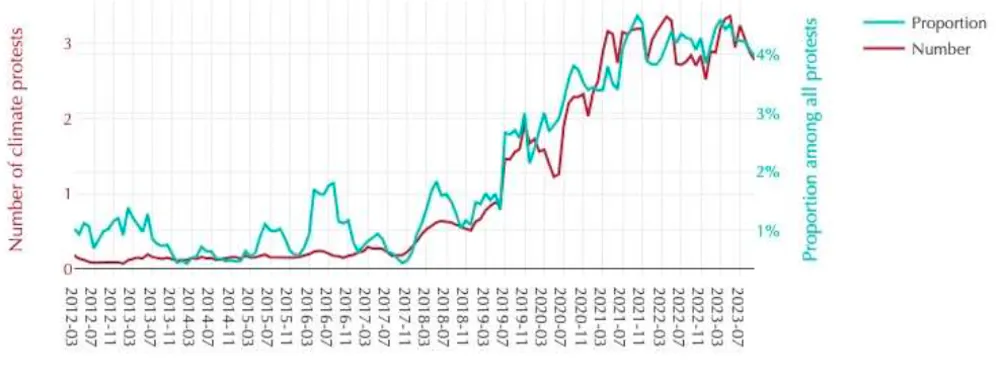
    To look more closely at the global picture of climate and environmental protest – and the repression of it – we used the Armed Conflicts Location Event database. This showed us that climate protests increased dramatically in 2018-2019 and have not declined since. They make up on average about 4% of all protest in the 81 countries that had more than 1,000 protests recorded in the 2012-2023 period:

    Climate protests increased sharply in the late 2010s in the 14 countries studied. (Data is smoothed over five months; number of protests is per country per month.)
    Berglund et al; Data: ACLED, CC BY-SA

    This second graph shows that environmental protest has increased more gradually:

    Environmental protests in the same 14 countries.
    Data: ACLED, CC BY-SA

    We used this data to see what kind of repression activists face. By looking for keywords in the reporting of protest events, we found that on average 3% of climate and environmental protests face police violence, and 6.3% involve arrests. But behind these averages are large differences in the nature of protest and its policing.

    A combination of the presence of protest groups like Extinction Rebellion, who often actively seek arrests, and police forces that are more likely to make arrests, mean countries such as Australia and the UK have very high levels of arrest. Some 20% of Australian climate and environmental protests involve arrests, against 17% in the UK – with the highest in the world being Canada on 27%.

    Meanwhile, police violence is high in countries such as Peru (6.5%) and Uganda (4.4%). France stands out as a European country with relatively high levels of police violence (3.2%) and low levels of arrests (also 3.2%).

    In summary, while criminalisation and repression does not look the same across the world, there are remarkable similarities. It is increasing in a lot of countries, it involves both state and corporate actors, and it takes many forms.

    This repression is taking place in a context where states are not taking adequate action on climate change. By criminalising activists, states depoliticise them. This conceals the fact these activists are ultimately right about the state of the climate and environment – and the lack of positive government action in these areas.

    Oscar Berglund is a member of the Green Party. The report this article is based on was written with Christina Pantazis, Chris Rossdale and Roxana Pessoa Cavalcanti.

    Tie Franco Brotto does not work for, consult, own shares in or receive funding from any company or organisation that would benefit from this article, and has disclosed no relevant affiliations beyond their academic appointment.

    ref. Repression of climate and environmental protest is intensifying across the world – https://theconversation.com/repression-of-climate-and-environmental-protest-is-intensifying-across-the-world-246379

    MIL OSI – Global Reports

  • MIL-OSI: Enlight Announces the Financial Close for Project Roadrunner

    Source: GlobeNewswire (MIL-OSI)

    The debt financing package includes $550 million of construction loans

    Roadrunner consists of 290 MW of solar generation and 940 MWh of energy storage capacity, and is expected to reach full COD by the end of 2025

    TEL AVIV, Israel, Dec. 23, 2024 (GLOBE NEWSWIRE) — Enlight Renewable Energy Ltd. (“Enlight”, “the Company”, NASDAQ: ENLT, TASE: ENLT.TA), a leading global renewable energy platform, today announced that the Company has arranged the debt financing (the “Debt Financing”) for project Roadrunner (“Roadrunner” or “the Project”), located near Tuscon, Arizona, USA.

    As part of the Debt Financing, Enlight, through its subsidiary Clenera Holdings LLC, has entered into a loan agreement with a consortium of four leading global banks including BNP Paribas Securities Corp, Crédit Agricole, Natixis CIB, and Norddeutsche Landesbank Girozentrale (Nord/LB), totaling $550 million, which are expected to convert into a $290 million term loan and $320 million of tax equity funding upon the Project’s COD. The term loan is structured with an amortization tenor of 20-25 years and is to be fully repaid 5 years from the Project’s COD (mini perm). The loans are subject to an all-in interest rate of SOFR + 1.5%-1.75%, which rises by 0.125% after four years. Paragon Energy Capital served as Clenera’s exclusive financial advisor on the transaction.

    During the Project’s construction period, the Company’s equity investment is expected to amount to 10% of the expected total Project cost of $610 million. The debt financing arrangements are expected to enable the Company to recycle the entire equity investment upon COD subject to minimum project coverage ratios. The Company expects to conclude a tax equity transaction during 2025, noting that the project has secured safe harbor status.

    Roadrunner (also known as Apache Solar II) is the second-largest project in Enlight’s history, consists of 290 MW solar generation and 940 MWh of energy storage capacity, and is expected to reach full COD by the end of 2025. Construction at the 1200-acre site has already begun, and all procurement contracts have been signed. The Project has a 20-year busbar power purchase agreement covering its entire output with the Arizona Electric Power Cooperative (AEPCO), and is expected to generate revenues of $51-54 million and EBITDA1 of $41-44 million in its first full year of operation. A summary of the Project’s financial information appears in the tables below:

    (as expected at COD)

    Total project cost

    Term debt

    Upfront tax equity

    Sponsor equity upon COD


    $ 610 million

    $ 290 million

    $320 million

    $0


    Total project cost net of tax equity

    Revenues in first full year

    EBITDA in first full year1


    $ 290 million

    $51-54 million

    $41-44 million

    1EBITDA is a non-IFRS financial measure. This figure represents EBITDA for the project and excludes all ITC and PTC proceeds, as well as the impact of a potential tax equity transaction. The tax equity partner’s share is expected to range between 10-15% of the Project’s EBITDA during the first years of operation.

    Roadrunner is being built in the Sulphur Springs Valley region near Tucson, Arizona. Arizona possesses one of highest rates of growth in data centers in the U.S., driving a significant increase in the demand for electricity. The area’s high altitude, mild weather, and very high irradiance make it especially suitable for a utility-scale solar plant. The Project is located in a sparsely populated area and integrates with the larger Apache Generating Station, a diverse energy complex used by AEPCO.

    After the completion of Apex in Montana and Atrisco in New Mexico, Roadrunner is one of several major solar and energy storage projects that Enlight and Clenera are now constructing in the U.S. These include Country Acres (392 MW and 688 MWh) and Quail Ranch (128 MW and 400 MWh). Along with additional projects planned to be built in the years to come, these projects are driving Enlight’s massive expansion into the U.S. renewable energy market. This is best illustrated by the growing run rate of Enlight’s U.S. revenue base, which is expected to reach $195-207 million annually after the completion of the projects now under construction.

    The Company’s next projects in Arizona are Snowflake (600 MW and 1,900 MWh) and CO Bar (1,211 MW and 824 MWh). The two mega projects have almost completed their development phase, and are scheduled to begin construction in the coming months. Each of the two projects are set to achieve grid connection of 1.0 GW, one of the largest in the US. These grid connections generate potential additional development opportunities in the future through the Company’s “Connect and Expand” strategy, which seeks to leverage existing interconnect infrastructure with additional generation capacity.

    Nir Yehuda, CFO of Enlight, commented, “We appreciate our financial partners’ support and commitment in arranging the debt financing for project Roadrunner, which has made it possible for us to progress with its construction. Roadrunner is expected to begin commercial operation by the end of 2025. We look forward to continued collaboration on Country Acres and Quail Ranch, projects which we are now in the process of building and financing.”

    “We are grateful to have established our business as a reliable partner for these financial institutions,” said Adam Pishl, President and CEO of Clenera. “We have demonstrated our ability to build projects on time and on budget, and manage operational solar and storage farms that generate consistent long-term returns. It is exciting to close this deal and fuel our continued growth with projects across America.”

    Aashish Mohan, Co-Head of Energy, Resources & Infrastructure Americas, at BNP Paribas, commented, “BNP Paribas is proud to have supported Clenera and Enlight as Coordinating Lead Arranger on this landmark clean energy project financing. Supporting premier platforms like Clenera squarely fits our energy transition ambitions, and we look forward to partnering with the company again as they continue to execute on their high-quality pipeline.”

    Daniel Feigin, Head of Energy & Infrastructure Group, North America at Crédit Agricole CIB, said, “Crédit Agricole CIB’s collaboration with Enlight and Clenera on this landmark project in Arizona is a testament to the power of partnership and innovation. Roadrunner will provide clean, low-cost energy and storage. We are honored to have played a crucial role in helping a world class developer bringing this project to financial close and contributing to our mission of facilitating clean power generation and economic growth.”

    Nasir Khan, Managing Director & Head of Infrastructure & Energy Finance Americas at Natixis CIB, said, “We are thrilled to announce the successful close our first transaction with Enlight and Clenera, and would especially like to thank the teams for their professionalism and partnership over the past several months. Natixis CIB is committed to driving the energy transition through financing high-quality landmark projects such as Roadrunner, and we look forward to seeing it reach completion in the next year.”

    Sondra Martinez, Managing Director and Head of Originations at NORD/LB New York, commented, “Nord/LB is thrilled to support Clenera and Enlight on the Roadrunner transaction. This transaction represents our commitment to partnerships and supporting clients as they advance the energy transition.”

    About Enlight Renewable Energy

    Founded in 2008, Enlight develops, finances, constructs, owns, and operates utility-scale renewable energy projects. Enlight operates across the three largest renewable segments today: solar, wind and energy storage. A global platform, Enlight operates in the United States, Israel and 10 European countries. Enlight has been traded on the Tel Aviv Stock Exchange since 2010 (TASE: ENLT) and completed its US IPO (NASDAQ: ENLT) in 2023. Learn more at enlightenergy.co.il.

    Investor Contact

    Yonah Weisz
    Director IR
    investors@enlightenergy.co.il

    Erica Mannion or Mike Funari
    Sapphire Investor Relations, LLC
    +1 617 542 6180
    investors@enlightenergy.co.il

    Cautionary Note Regarding Forward-Looking Statements

    This press release contains forward-looking statements within the meaning of the U.S. Private Securities Litigation Reform Act of 1995. We intend such forward-looking statements to be covered by the safe harbor provisions for forward-looking statements as contained in Section 27A of the Securities Act of 1933, as amended, and Section 21E of the Securities Exchange Act of 1934, as amended. All statements contained in this press release other than statements of historical fact, including, without limitation, statements regarding the Company’s expectations relating to the Project, the PPA and the related interconnection agreement and lease option, and the completion timeline for the Project, are forward-looking statements. The words “may,” “might,” “will,” “could,” “would,” “should,” “expect,” “plan,” “anticipate,” “intend,” “target,” “seek,” “believe,” “estimate,” “predict,” “potential,” “continue,” “contemplate,” “possible,” “forecasts,” “aims” or the negative of these terms and similar expressions are intended to identify forward-looking statements, though not all forward-looking statements use these words or expressions. These statements are neither promises nor guarantees, but involve known and unknown risks, uncertainties and other important factors that may cause our actual results, performance or achievements to be materially different from any future results, performance or achievements expressed or implied by the forward-looking statements, including, but not limited to, the following: our ability to site suitable land for, and otherwise source, renewable energy projects and to successfully develop and convert them into Operational Projects; availability of, and access to, interconnection facilities and transmission systems; our ability to obtain and maintain governmental and other regulatory approvals and permits, including environmental approvals and permits; construction delays, operational delays and supply chain disruptions leading to increased cost of materials required for the construction of our projects, as well as cost overruns and delays related to disputes with contractors; our suppliers’ ability and willingness to perform both existing and future obligations; competition from traditional and renewable energy companies in developing renewable energy projects; potential slowed demand for renewable energy projects and our ability to enter into new offtake contracts on acceptable terms and prices as current offtake contracts expire; offtakers’ ability to terminate contracts or seek other remedies resulting from failure of our projects to meet development, operational or performance benchmarks; various technical and operational challenges leading to unplanned outages, reduced output, interconnection or termination issues; the dependence of our production and revenue on suitable meteorological and environmental conditions, and our ability to accurately predict such conditions; our ability to enforce warranties provided by our counterparties in the event that our projects do not perform as expected; government curtailment, energy price caps and other government actions that restrict or reduce the profitability of renewable energy production; electricity price volatility, unusual weather conditions (including the effects of climate change, could adversely affect wind and solar conditions), catastrophic weather-related or other damage to facilities, unscheduled generation outages, maintenance or repairs, unanticipated changes to availability due to higher demand, shortages, transportation problems or other developments, environmental incidents, or electric transmission system constraints and the possibility that we may not have adequate insurance to cover losses as a result of such hazards; our dependence on certain operational projects for a substantial portion of our cash flows; our ability to continue to grow our portfolio of projects through successful acquisitions; changes and advances in technology that impair or eliminate the competitive advantage of our projects or upsets the expectations underlying investments in our technologies; our ability to effectively anticipate and manage cost inflation, interest rate risk, currency exchange fluctuations and other macroeconomic conditions that impact our business; our ability to retain and attract key personnel; our ability to manage legal and regulatory compliance and litigation risk across our global corporate structure; our ability to protect our business from, and manage the impact of, cyber-attacks, disruptions and security incidents, as well as acts of terrorism or war; changes to existing renewable energy industry policies and regulations that present technical, regulatory and economic barriers to renewable energy projects; the reduction, elimination or expiration of government incentives for, or regulations mandating the use of, renewable energy; our ability to effectively manage our supply chain and comply with applicable regulations with respect to international trade relations, tariffs, sanctions, export controls and anti-bribery and anti-corruption laws; our ability to effectively comply with Environmental Health and Safety and other laws and regulations and receive and maintain all necessary licenses, permits and authorizations; our performance of various obligations under the terms of our indebtedness (and the indebtedness of our subsidiaries that we guarantee) and our ability to continue to secure project financing on attractive terms for our projects; limitations on our management rights and operational flexibility due to our use of tax equity arrangements; potential claims and disagreements with partners, investors and other counterparties that could reduce our right to cash flows generated by our projects; our ability to comply with tax laws of various jurisdictions in which we currently operate as well as the tax laws in jurisdictions in which we intend to operate in the future; the unknown effect of the dual listing of our ordinary shares on the price of our ordinary shares; various risks related to our incorporation and location in Israel; the costs and requirements of being a public company, including the diversion of management’s attention with respect to such requirements; certain provisions in our Articles of Association and certain applicable regulations that may delay or prevent a change of control; and other risk factors set forth in the section titled “Risk factors” in our Annual Report on Form 20-F for the fiscal year ended December 31, 2023, filed with the Securities and Exchange Commission (the “SEC”) and our other documents filed with or furnished to the SEC.

    These statements reflect management’s current expectations regarding future events and speak only as of the date of this press release. You should not put undue reliance on any forward-looking statements. Although we believe that the expectations reflected in the forward-looking statements are reasonable, we cannot guarantee that future results, levels of activity, performance and events and circumstances reflected in the forward-looking statements will be achieved or will occur. Except as may be required by applicable law, we undertake no obligation to update or revise publicly any forward-looking statements, whether as a result of new information, future events or otherwise, after the date on which the statements are made or to reflect the occurrence of unanticipated events.

    The MIL Network

  • MIL-OSI Economics: COP 29: Enhancing Strategic Collaboration Across Organisations of African, Caribbean and Pacific States for Climate Disaster Resilience

    Source: Caribbean Development Bank

    Opening Statements 

    Mr. L O’Reilly Lewis, Acting Director, Projects Department, CDB 
    Mr. Jose Carlos Edo Monfort, Team Leader, Directorate General INTPA (European Commission) 
    Ms. Cristelle Pratt, Assistant Secretary General, OACPS

    Panellists

    Ms. Valerie Isaac, Division Chief, Environmental Sustainability Unit, CDB  
    Dr. Pendo Maro, Team Leader, Technical Assistance Team, DRRP
    Ms. Lisa Kingsberry, Communications Director, SPC – DRR

    Moderator

    Ms. Cristelle Pratt, Assistant Secretary General, OACPS

    MIL OSI Economics

  • MIL-OSI USA: Welch Priorities for Vermont’s Flood-Impacted Communities to Become Law as Part of Bipartisan Water Resources Development Act 

    US Senate News:

    Source: United States Senator Peter Welch (D-Vermont)

    WASHINGTON, D.C. – This week, the biennial, bipartisan Water Resources Development Act of 2024 was advanced by the Senate. The bill contains several of U.S. Senator Peter Welch’s (D-Vt.) priorities for flood-impacted communities. It now heads to President Biden’s desk for his signature.  
    “The Water Resources Development Act will help repair and strengthen Vermont’s flood-impacted infrastructure, protect our watersheds, and make our communities more resilient to extreme weather. Now more than ever, we need to support the Army Corps of Engineers as they work with our communities and the State to protect our communities from flooding,” said Senator Welch. “I look forward to President Biden signing this bipartisan bill, and I thank my colleagues Bernie and Becca for their partnership in getting these Vermont-focused priorities over the finish line.” 
    The Water Resources Development Act of 2024 (WRDA 2024) authorizes the U.S. Army Corps of Engineers to perform vital projects including flood control, water navigation, and ecosystem restoration. Senator Welch’s priorities for Vermont in the bill include: 

    Lowering the Non-Federal Cost-Share of the Lake Champlain Watershed Environmental Assistance Program for Vermont: With this legislation, the cost share will be 10% non-federal for underserved communities, down from 35%. This change will make the program more affordable to the towns that most need it.  

    Lowering the State of Vermont Cost-Share for Work on the Waterbury, Wrightsville, and East Barre Dams: The cost share for the three dams would be lowered to roughly 7.1% non-federal, down from 35% for East Barre and Wrightsville. (This cost share adjustment was achieved for Waterbury in the 2022 WRDA reauthorization.) Wrightsville’s dam was nearly breached in the July 2023 floods, and this change will make projects on these three dams more affordable for the state of Vermont in the future.  

    Authorizing a New Flood Control Study of the Winooski River: This bill will authorize a new flood control study of the Winooski River watershed, which would examine how to make the Winooski River and neighboring communities along the river more resilient to future floods and other climate change-fueled natural disasters.   

    Reauthorizing the Aquatic Plant Control Program: The Aquatic Plant Control Research Program is valuable to Vermont’s efforts to combat the spread of water chestnut, a nonnative plant that has threatened to disrupt ecosystems and water access in Lake Champlain. Reauthorization ensures the state can continue using the program in years to come.  

    MIL OSI USA News

  • MIL-OSI Canada: Joint statement from Premier Ranj Pillai and Minister Sandy Silver on Canada’s 2024 Fall Economic Statement

    Source: Government of Canada regional news

    Joint statement from Premier Ranj Pillai and Minister Sandy Silver on Canada’s 2024 Fall Economic Statement
    zaburke

    Premier Ranj Pillai and Minister of Finance Sandy Silver have issued the following joint statement:

    “This week, federal House Leader Karina Gould delivered an update on how Canada’s finances and economy are doing along with measures to address critical issues for Canadians in the 2024 Fall Economic Statement. Many of these issues are keenly felt in the Yukon and our government is pleased to see the statement recognizes the importance of reducing everyday costs, fostering innovation, adjusting to the current realities of global trade and promoting investment.

    “We are happy to see that the Government of Canada has responded to repeated requests from our government by including a proposal to amend the Yukon Environmental and Socio-Economic Assessment Act in the Fall Economic Statement. The proposed amendment would allow certain projects, identified with consent from affected Yukon First Nations, to be exempt from re-assessments. Such a change will help combine a strong regulatory framework that protects the Yukon environment with one that eases the way for investment. We look forward to this legislative change creating a more efficient assessment process and are happy to see them move forward after several years of advocacy from our government and support from First Nations governments.

    “Canada’s Premiers have been continually asking for bail reform, so it is heartening to see that the statement commits to amending the Criminal Code to specifically address the bail system. The federal government has also put forward $1.3 billion in new funding towards a comprehensive border security package and we await more details on what this package will look like. This announcement promises to strengthen Canada-U.S. relations and could help curb the flow of fentanyl into the Yukon. 

    “Meeting housing needs is another major area that our government is working with the Government of Canada to address and is crucial to making life in the Yukon more affordable. The statement includes programs that lay the groundwork for putting housing within reach of more Canadians through the Affordable Housing Fund and Canada is also extending the Federal Community Housing Initiative to include residents of non-profit and co-op housing. Our government will examine how these programs will work within the Yukon to increase our housing supply or improve access to existing housing stock. Our government will also make sure that Yukoners can take advantage of the Canada Greener Homes Affordability Program mentioned in this statement, which will fund retrofits to make homes more energy efficient.

    “We are ready to discuss the programs and initiatives mentioned in the Fall Economic Statement with the Government of Canada and find ways to ensure these measures bring the most benefits to Yukoners, as well as laying out our priorities for the territory for the future.”
     

    Media contact

    Laura Seeley
    Cabinet Communications
    867-332-7627
    laura.seeley@yukon.ca 
     

    News release #:
    Related information:
    Investing in Jobs and Growth (Government of Canada news release)
    2024 Fall Economic Statement

    MIL OSI Canada News

  • MIL-OSI Canada: Government of Yukon and Government of Canada announce new investments to make heat pumps more affordable for Yukoners

    Source: Government of Canada regional news

    Government of Yukon and Government of Canada announce new investments to make heat pumps more affordable for Yukoners
    zaburke

    This is a joint news release between the Government of Yukon and the Government of Canada.

    The Government of Canada and the Government of Yukon are partnering to help Yukoners switch to smart electric heating systems, making life more affordable while reducing greenhouse gas emissions.

    Today, Member of Parliament for the Yukon, Brendan Hanley on behalf of Minister of Energy and Natural Resources Jonathan Wilkinson and Minister of Environment and Climate Change Steven Guilbeault, announced a federal investment of $1.4 million from the Federal Oil to Heat Pump Affordability program (OHPA) and $287,000 from Canada’s Low Carbon Economy Fund (LCEF). Yukon Minister of Energy, Mines and Resources John Streicker announced that the Government of Yukon will provide an additional $700,000 in territorial funding towards further helping low-to-middle-income households cover the cost of purchasing and installing a heat pump. 

    Heat pumps are one of the best ways for homeowners to save money on energy bills and combat climate change. They are two to three times more efficient than other electric home heating sources, providing greater savings for homeowners while reducing energy consumption for utilities and power grids.

    As part of the Government of Yukon’s Affordable Heap Pump Program, eligible Yukon homeowners can receive 100 percent of the cost to purchase and install a heat pump to a maximum of $24,000. Additionally, homeowners can receive an upfront payment of $250 to add high-efficiency heat pumps in homes currently heated with oil. Homeowners using other energy sources, such as propane or electric baseboards, could also be eligible for cold climate heat pump rebates funded by LCEF and the Government of Yukon.

    Through these investments, the governments of Canada and Yukon are helping Yukoners access energy-efficient heat pumps, save on their energy bills and reduce their carbon emissions to protect the environment. 
     

    Our government believes that we can save money and our planet at the same time. Through Our Clean Future, our government committed to helping Yukoners transition from fossil fuels to smart electric heating systems like heat pumps. I’m pleased that these new investments will help make life more affordable for Yukoners while reducing our territory’s greenhouse gas emissions. 

    Minister of Energy, Mines and Resources John Streicker

    Making the switch to more energy-efficient heating systems can help Canadians save thousands on their energy bills, reduce their energy use and decrease their carbon footprint. That’s why we are strengthening the Oil to Heat Pump Affordability program and ensuring that families are in the Yukon supported in making the switch from heating oil to an efficient heat pump. 

    Minister of Energy and Natural Resources Jonathan Wilkinson

    Yukoners face some of the coldest temperatures in Canada and need reliable, affordable heating systems to stay warm. This is now truer than ever as climate change is making weather increasingly unpredictable.  Heat pumps have shown to be an efficient way to heat homes reducing emissions, protecting the environment and helping Canadians save on their utility bills. That’s why we are investing in programs like this that support the transition and get us closer to our emission reduction goals.

    Minister of Environment and Climate Change Steven Guilbeault

    Transitioning to energy-efficient heating systems offers Canadians and Yukoners the opportunity to save money on more-efficient home energy systems. The Oil to Heat Pump Affordability program will ensure that families in the Yukon receive the necessary support to switch from heating oil to efficient heat pumps, which will benefit local installers and businesses while also helping ease northern Canada’s pathway to home heating that is less expensive and more environmentally friendly.

    Member of Parliament for Yukon, Brendan Hanley

    Quick facts
    • The federal government’s Oil to Heat Pump Affordability program was first introduced in November 2022 as a $250 million investment in a new stream within the Canada Greener Homes Initiative. On February 22, 2023, the program was opened to pre-registration and was fully launched in late March 2023, with the first grants being issued shortly thereafter.

    • Introduced in October 2023, the federal government announced working with provinces and territories on co-delivery agreements including an upfront payment of $250 for eligible applicants through the Canada Heat Pump Bonus.

    • Every year, on average, a household participating in the Oil to Heat Pump Affordability program saves $1,337 on energy costs and 2.78 tonnes in greenhouse gas reductions.

    • The federal government currently has OHPA program co-delivery arrangements in place with British Columbia, Newfoundland and Labrador, Nova Scotia and Prince Edward Island. Active discussions are underway with other provinces and territories to deliver new, strengthened OHPA co-delivery agreements to make heat pumps even more affordable for Canadians across the country. In jurisdictions without co-delivery arrangements, oil-heated households can continue to apply to the national program to receive up to $10,000 in federal OHPA funding for switching to electric heat pumps.

    • The federal government’s Oil to Heat Pump Affordability program has received over 29,000 applications to date nationally.

    • Under Budget 2024, the Government of Canada is taking numerous steps to make life more affordable for Canadians while addressing climate change. This includes the Canada Greener Homes Affordability Program, which will support the direct installation of energy efficiency retrofits for Canadian households with low to median incomes.

    • Yukoners who participate in the Affordable Heat Pump Program (the Yukon’s version of the federal government’s Oil to Heat Pump Affordability program) may retain their pre-existing heating sources as backup systems for periods of extreme cold.

    Media contact

    Media Relations 
    Natural Resources Canada 
    343-292-6096 
    media@nrcan-rncan.gc.ca 

    Joanna Sivasankaran
    Director of Communications
    Office of the Minister of Energy
    and Natural Resources
    joanna.sivasankaran@nrcan-rncan.gc.ca 

    Laura Seeley
    Cabinet Communications
    867-332-7627
    laura.seeley@yukon.ca 

    Kate Erwin 
    Energy, Mines and Resources 
    867-667-7627
    kate.erwin@yukon.ca 
     

    News release #:
    Related information:
    Yukon affordable heat pump program
    Oil to heat pump affordability program
    Low carbon economy fund
    Canada greener homes initiative
    Canada green building strategy

    MIL OSI Canada News

  • MIL-OSI United Kingdom: Rouge Bouillon update20 December 2024 TravelClarendon Road is now open southbound towards town diversions remain in place please follow signsonly travel to the area if necessaryPedestrian diversion route now in place Residents building monitoring… Read more

    Source: Channel Islands – Jersey

    20 December 2024

    Travel

    • Clarendon Road is now open southbound towards town 
    • diversions remain in place please follow signs
    • only travel to the area if necessary
    • Pedestrian diversion route now in place

    Residents 

    • building monitoring continues 
    • Infrastructure & Environment are still assessing repairs to the area. 

    Thank you for your patience. These measures will be in place over the weekend. 

    Further updates will follow on Monday after 1pm.​

    MIL OSI United Kingdom

  • MIL-OSI USA: McCaul Commends NDAA Passage, Inclusion of HFAC Provisions

    Source: US House Committee on Foreign Affairs

    Media Contact 202-226-8467

    WASHINGTON — House Foreign Affairs Committee Chairman Michael McCaul released the following statement on the Servicemember Quality of Life Improvement and National Defense Authorization Act (NDAA) for Fiscal Year 2025. The legislation passed the House with broad bipartisan support.

    “America’s adversaries are on the march. Around the world, we continue to see the fallout of the Biden-Harris administration’s disastrous foreign policy agenda, which has empowered tyrants and terrorist groups instead of projecting peace through strength. This year’s NDAA implements commonsense — and necessary — measures to promote U.S. national security, provide pay increases to our veterans, and support our partners and allies around the world while reversing the damaging policies implemented by woke bureaucrats. I am proud to support this bill and ensure our military, servicemembers, and nation are prepared to face the challenges of the 21st century.” — Chairman McCaul

    This year’s NDAA included H.R. 6727, a bill Chairman McCaul introduced with Ranking Member Gregory Meeks (D-N.Y.) to promote public-private conservation efforts and undercut entities that profit from illicit poaching, like Russia and the Chinese Communist Party. Senators Lindsey Graham (R-S.C.) and Chris Coons (D-Del.) led the bill in the Senate.

    “I’m very pleased the NDAA included my historic, bipartisan legislation promoting public-private partnerships to strengthen global conservation efforts and counter the CCP’s malign influence. As chairman, I’ve had the opportunity to travel around the world and see the importance of wildlife conservation firsthand. I’ve witnessed China and various international criminal organizations devastate communities for their own gain, and this bill has the power to undercut malign actors who profit from illicit wildlife trafficking. Conservation efforts have a long history of bipartisan support dating back to Teddy Roosevelt, and I’m glad to see this tradition continue. This foundation is more than just a way to leverage the power of private contributions – it is a diplomatic investment in the U.S. foreign policy toolkit that none of our adversaries can replicate.” — Chairman McCaul

    The bill also included language from Chairman McCaul to ensure the State Department is better organized for crises like the Afghanistan withdrawal by designating a senior official to lead international crises for the department, including non-combatant evacuation operations, and by requiring consistent tabletop exercises in consultation with the Department of Defense. It also includes language from Rep. Warren Davidson’s (R-Ohio) bill, H.R. 4517, bill, H.R. 4517, which requires the State Department to perform a feasibility study regarding reimbursement of private rescue groups who evacuated Americans from Afghanistan.

    “My investigation into the disastrous Afghanistan withdrawal revealed the Biden-Harris administration had the information and opportunity to take necessary steps to plan for the inevitable collapse of the Afghan government, so we could safely evacuate U.S. personnel, Americans, and our loyal Afghan allies. At each step of the way, however, this administration picked optics over security. I am thankful Congress included these critical provisions in the NDAA to ensure our government has the tools it needs to prevent a similar catastrophe. These provisions seek to mitigate the administration’s failure to plan for the inevitable NEO and recognize the tireless efforts of volunteer organizations across the U.S. to bring evacuees to safety. The organizations worked at great expense to themselves – emotionally and financially – and the U.S. government owes them gratitude for their contributions.” — Chairman McCaul

    ###

    MIL OSI USA News

  • MIL-OSI United Kingdom: New trees for Central Park golf course

    Source: City of Plymouth

    More than 1,000 new trees are set to be planted in Central Park this Winter.

    The planting plan, which also includes nearly 9,000m² of wildflower meadow, is set around the ever-popular Central Park Golf Course.

    Among the plans are new standard trees, orchard trees, fruiting hedgerows and whips. Additional seating, interpretation boards, and wildlife homes are also included.

    The plans have been developed by the golf course management team and will be delivered in partnership with the Plymouth and South Devon Community Forest and the Council’s Green Communities team.

    A consultation on the plans has started, with park users able to feedback on the plans online and in person at the golf shack and also in the Meadow Café.

    Councillor Tom Briars-Delve, Cabinet Member for the Environment and Climate Change, said: “This is an exciting scheme, offering loads of different types of planting and species to support a broad mix of biodiversity, resulting in benefits for both people and nature.

    “It has been co-developed in partnership with the team who run the golf business. They have been really proactive in the design, providing improvements for their customers and wider park users. I’m sure, when everything is established, this planting will be a fantastic addition to Central Park.”

    Jez Wilmot, Golf Course Manager, said: “We’re so grateful to be a part of this project and really excited for the first trees to be planted.

    “We have been the tenants of the cafe and course for nearly nine years and during that time have made several improvements to enhance the look and playability of the course.

    “But we have limited knowledge and resources, which is why we approached the Council and having worked with the teams from the Community Forest and Green Communities, we’ve been able to form a plan and turn what we once only dream about into a reality.

    “All feedback on the plans is welcome and we look forward to speaking to people about the park we love.”

    Residents and park users can feed back on the plans in persons at the golf shack and also in the Meadow Café. The consultation runs until 3 January.

    An online form is also available at: https://forms.gle/3nLBzpwruM2oN8MF7

    The feedback will be collated and fed into the final designs before planting begins in the new year. The Council’s Green Communities team will be involved in much of the planting, with plenty of opportunities for volunteers to get their hands dirty.

    This scheme is part of a wider programme of planting across Plymouth delivered by the Plymouth and South Devon Community Forest.

    Find out more

    MIL OSI United Kingdom

  • MIL-OSI Canada: Protecting the environment with tougher coal rules

    Source: Government of Canada regional news

    [embedded content]

    Alberta’s government is developing rules that will prohibit mountaintop removal mining and ban new open-pit mines in the foothills, while substantially increasing coal royalties to benefit Albertans.

    The CIMI will guide responsible coal mining practices with a goal of ensuring that Alberta’s waters are protected from mining contaminants such as selenium. The CIMI also acknowledges the global critical mineral importance of metallurgical coal. Thoughtful coal development will result in increased investment and jobs for Albertans while respecting the existing property rights of freehold mineral rights holders.

    Based on the intent of the 1976 Coal Development Policy and picking up on the coal development work done by the 2021 Coal Policy Committee, the CIMI will build a long-term legislative and regulatory framework focused on environmental protections while allowing coal development under some of the most stringent protections in the world. The CIMI will do away with temporary fixes and half measures and provide a foundation for responsible coal mining for the 21st century.

    “Alberta deserves a modern coal policy that balances responsible resource development with strong environmental protections. Our job now is to develop a policy that respects the natural spaces in the foothills and protects water while allowing for responsible coal development that can attract investment and create jobs.”

    Brian Jean, Minister of Energy and Minerals

    “Alberta has one of the best environmental management systems in the world. We have strong and effective monitoring and regulatory protections in place to protect our air, water and lands and these safeguards will only get stronger through this initiative.”

    Rebecca Schulz, Minister of Environment and Protected Areas

    The world needs steelmaking coal to fuel economic growth and greater adoption of alternative energy sources and technologies. Alberta is blessed by an abundance of metallurgical coal that can be developed while adhering to world-leading environmental protections. Steel is an essential global component for infrastructure growth and development. This steel will also return to Alberta in products like passenger vehicles, home appliances, farm and industrial equipment, and building materials.

    To ensure Albertans are fairly compensated for the development of this important natural resource, Alberta’s government will be raising the coal royalty rates significantly on new coal mines.

    Alberta Energy and Minerals will begin targeted engagement in early 2025 to inform industry of Alberta’s plans for higher standards for coal mining, to set the new coal royalty amounts, and to develop strategies that align with Alberta’s commitment to balance regulatory improvement and environmental protection, with an emphasis on water protection. From this engagement, new coal regulations and legislation will be drafted for government approval later in 2025.

    Quick Facts

    • 1976 Coal Development Policy Land Categories Map

    Coal Development Policy Land Categories Map

    • The CIMI will protect water as our top priority. If coal mining is allowed, it will only be allowed to the highest standards:
      • Prohibit mountaintop removal mining as a coal mining technique.
      • No new open-pit coal mining in the Eastern Slopes (All four categories of the 1976 Coal Development Policy, subject to any further regulations flowing from land use planning work which is underway).
      • Any new coal mining proposals, regardless of location, must use techniques which use best water practices and prevent adding selenium into waterways. New proposals will either need to be underground mines or use mining technologies (such as highwall automated underground mining) that move minimal amounts of overburden, to prevent selenium leaching and siltation.
      • The protections set out in law and in the 1976 Coal Development Policy for national parks, provincial parks, wildland parks, wilderness areas, ecological reserves, and provincial recreation areas will continue.

    Related information

    • Coal Policy Committee
    • A coal development policy for Alberta (1976 Coal Development Policy)

    Multimedia

    • Watch the news conference

    MIL OSI Canada News

  • MIL-OSI Canada: Prime Minister announces changes to the Ministry

    Source: Government of Canada – Prime Minister

    The Prime Minister, Justin Trudeau, today announced changes to the Ministry. The new Ministry will deliver on what matters most to Canadians: making life more affordable and growing the economy.

    Building on the work done since 2015 to invest in Canadians, the team will continue to move forward on housing, child care, and school food while working to put more money back in people’s pockets.

    The changes to the Ministry are as follows:

    • Anita Anand becomes Minister of Transport and Internal Trade
    • Gary Anandasangaree becomes Minister of Crown-Indigenous Relations and Northern Affairs and Minister responsible for the Canadian Northern Economic Development Agency
    • Steven MacKinnon becomes Minister of Employment, Workforce Development and Labour
    • Ginette Petitpas Taylor becomes President of the Treasury Board

    The Prime Minister also welcomed the following new members to the Ministry:

    • Rachel Bendayan becomes Minister of Official Languages and Associate Minister of Public Safety
    • Élisabeth Brière becomes Minister of National Revenue
    • Terry Duguid becomes Minister of Sport and Minister responsible for Prairies Economic Development Canada
    • Nate Erskine-Smith becomes Minister of Housing, Infrastructure and Communities
    • Darren Fisher becomes Minister of Veterans Affairs and Associate Minister of National Defence
    • David J. McGuinty becomes Minister of Public Safety
    • Ruby Sahota becomes Minister of Democratic Institutions and Minister responsible for the Federal Economic Development Agency for Southern Ontario
    • Joanne Thompson becomes Minister of Seniors

    These new ministers will work with all members of Cabinet to deliver real, positive change for Canadians. They join the following ministers remaining in their portfolio:

    • Terry Beech, Minister of Citizens’ Services
    • Bill Blair, Minister of National Defence
    • François-Philippe Champagne, Minister of Innovation, Science and Industry
    • Jean-Yves Duclos, Minister of Public Services and Procurement and Quebec Lieutenant
    • Karina Gould, Leader of the Government in the House of Commons
    • Steven Guilbeault, Minister of Environment and Climate Change
    • Patty Hajdu, Minister of Indigenous Services and Minister responsible for the Federal Economic Development Agency for Northern Ontario
    • Mark Holland, Minister of Health
    • Ahmed Hussen, Minister of International Development
    • Gudie Hutchings, Minister of Rural Economic Development and Minister responsible for the Atlantic Canada Opportunities Agency
    • Marci Ien, Minister for Women and Gender Equality and Youth
    • Mélanie Joly, Minister of Foreign Affairs
    • Kamal Khera, Minister of Diversity, Inclusion and Persons with Disabilities
    • Dominic LeBlanc, Minister of Finance and Intergovernmental Affairs
    • Diane Lebouthillier, Minister of Fisheries, Oceans and the Canadian Coast Guard
    • Lawrence MacAulay, Minister of Agriculture and Agri-Food
    • Soraya Martinez Ferrada, Minister of Tourism and Minister responsible for the Economic Development Agency of Canada for the Regions of Quebec
    • Marc Miller, Minister of Immigration, Refugees and Citizenship
    • Mary Ng, Minister of Export Promotion, International Trade and Economic Development
    • Harjit S. Sajjan, President of the King’s Privy Council for Canada and Minister of Emergency Preparedness and Minister responsible for the Pacific Economic Development Agency of Canada
    • Ya’ara Saks, Minister of Mental Health and Addictions and Associate Minister of Health
    • Pascale St-Onge, Minister of Canadian Heritage
    • Jenna Sudds, Minister of Families, Children and Social Development
    • Rechie Valdez, Minister of Small Business
    • Arif Virani, Minister of Justice and Attorney General of Canada
    • Jonathan Wilkinson, Minister of Energy and Natural Resources

    Quote

    “Our team is focused on the things that matter most to you – making life more affordable, growing the economy, and creating good jobs for the middle class. Together, we will keep building a strong future for the middle class, and for all Canadians.”

    Quick Facts

    • Since 2015, the Ministry has made real progress for the middle class and those working hard to join it – from lifting hundreds of thousands of children out of poverty with the Canada Child Benefit to delivering on our promise of $10-a-day child care and the National School Food Program.
    • With the changes announced today, the Ministry retains a total of 38 ministers, in addition to the Prime Minister. In keeping with the precedent set in 2015, there is an equal number of women and men.
    • The Cabinet is the central decision-making forum in government, responsible for its administration and the establishment of its policy. Its members are each responsible for individual portfolios or departments.

    Associated Link

    MIL OSI Canada News

  • MIL-OSI USA: Banding Together: The significance of waterfowl bands to hunters and scientists alike

    Source: US Geological Survey

    Tyler Coleman holds two harvested ducks that have been banded. Coleman wears a necklace of bands he’s collected over the years. 

    Each Band is a Memory and a Story 

    For lifelong waterfowl hunter Tyler Coleman, bird bands hold a special fascination. “Bands can be a prize, but equally divisive,” said Coleman. “Bands have a purpose, and when you try to understand the science of waterfowl, you can better understand that banding plays an important role in their conservation.” 

    Tyler grew up in Lebanon, PA, and graduated from Penn State with an Agricultural Science degree. After college, he worked in a local taxidermy studio before starting his own business that specializes in waterfowl taxidermy with a small retail front geared toward duck and goose hunters. 

    Tyler describes the raw emotion of flipping over a bird, or watching his dog return with a banded bird, as being hard to beat. He knows that many hunters look at bands as prizes or tokens from a hunt. But for Tyler, each band tells a story. “I can look at my lanyard, point to any duck band, and recall the amazing details of that particular hunt,” said Coleman. “It could have been a ‘dogs retrieve on a bird that was a goner,’ a memorable destination hunt, or just a fun hunt with friends and family. I love to look at a band as a memory and story that will outlive me in many regards.” 

    As a hunter, Tyler genuinely appreciates the banding data certificate he receives from a harvested banded bird. He views it as unique way of bringing the bird’s story full circle: from where it was first banded to where it traveled either locally or far and wide. “I don’t quite understand why hunters do not want to report bands; maybe there is a disconnect to the importance of reporting? Or no real incentive in reporting, unless you fully understand the importance and overall goal,” said Coleman. He believes there is an opportunity to teach more waterfowl hunters about the value and science behind bands so that reporting becomes almost second nature.

    Over the years, Tyler has witnessed bird bands go from being a pleasant surprise on a hunt, to becoming the main purpose with hunters trying to target a band. He wonders if this shift takes away some authenticity from the purpose of the bands, or at the very foundation, somehow negatively affects the data being collected. “I have been blessed to have harvested many bands in my life. I love flipping a bird over, or snagging it from my Spaniels grin, and seeing their leg sporting something extra,” said Coleman. “Bands are a bonus and shouldn’t be the only purpose to hunt and by no means should be treated as a ‘status symbol’ in the waterfowl community.” 

    Preacher, Tyler Coleman’s Boykin spaniel, holds a harvested and banded bird in his mouth.

    Every Report Matters

    Reporting waterfowl bird bands in North America is crucial for tracking populations, understanding movements, and supporting conservation and management efforts by state, federal, private, and tribal entities. The data collected from these reports plays a vital role in monitoring habitat use, population dynamics, and disease trends—all factors that biologists use to make decisions on wildlife management issues. Additionally, encouraging band reporting fosters public involvement in conservation and informs policies that protect waterfowl and their habitats for future generations.

    Even a single report can provide valuable insights. When waterfowl bands are reported to the U.S. Geological Survey Bird Banding Laboratory, researchers can link the banding data—including the bird’s age, sex, and the location where it was banded—to subsequent reports of that bird at different times and potentially different locations. These paired data points, accumulated across thousands of reports, enable researchers to uncover crucial information that supports wildlife conservation, scientific research and the effective management of bird populations.

    For example, if a bird travels long distances during migration, reporting the band provides researchers with the opportunity to track its movement patterns, migratory routes, and seasonal behavior. This helps scientists understand how waterfowl use different habitats throughout their lifecycle, including their migration strategies and stopover locations.

    Additionally, reporting where and when banded waterfowl are spotted or harvested allows researchers to estimate key population parameters, such as survival rates, and monitor changes in population numbers over time. This helps determine whether certain species are thriving or declining and provides insight into how environmental factors like habitat loss or climate change are affecting waterfowl populations.


    A Rich History in Banding Ducks 

    For decades, banding waterfowl has been one of three core monitoring programs that underpin modern, scientific approaches to waterfowl management. The U.S. Fish and Wildlife Service (USFWS) Division of Migratory Bird Management is involved in both the collection and analysis of banding data. USFWS staff coordinates with banders from various state, federal, private, and tribal agencies in ongoing, annual banding efforts. For example, banding data play a critical role in developing harvest management plans for many goose populations, such as snow geese, and Canada geese across North America. Another example is the Western Canada Cooperative Waterfowl Banding Program which focuses on banding waterfowl throughout the Canadian prairies and Canadian boreal forest. During banding operations, crews capture waterfowl where they congregate to molt or stage prior to fall migration and apply uniquely numbered metal leg bands.

    The banding efforts that take place in August are considered “preseason” banding in that they precede the hunting season. In estimating harvest rates, its advantageous that banding occurs just prior to migration and the hunting season so that little natural mortality occurs between the time birds are banded and hunting seasons begin. Not only does this information provide critical scientific data about the percentage of birds that are harvested, where those birds came from originally, and survival rates, but over the years, tens of thousands of birds have been banded, an incredibly impressive number of birds providing a robust data set for biologists. Find out more about the program and read the stories of banding crews in the field.

    Some of Tyler Coleman’s banded, harvested birds.

    Banded ducks may be recaptured in the future by biologists or get harvested by hunters, who then report these bands to the U.S. Geological Survey Bird Banding Laboratory (or Canada’s Bird Banding Office), which provides information about where the bird was banded, where it was recovered, and how long it lived.

    This information helped biologists learn what migratory pathways ducks were taking and what habitats they use, which helped them ultimately create the administrative Flyway system.  That same system is now what we use to manage those birds, prioritize conservation projects, and set regulations based on those migratory flyways. The Flyway system, established in the 1950s, has been instrumental in developing a strong working relationship between the Service and states. Originally focused solely on waterfowl habitat conservation, the Joint Ventures now provide the science and coordination to protect and restore habitat for all bird species in the United States. The effectiveness of these partnerships, and particularly the Flyway system, is best demonstrated by the fact that waterfowl are one of only two groups of birds (raptors being the other) that have increased in abundance since the 1970s.

    Role of Banding Data in Harvest Management

    U.S. Fish and Wildlife Service Migratory Bird Program biologists and their counterparts in the U.S. Geological Survey have led the way in developing models that utilize banding and recovery data to predict the impacts of harvest and other take, as well as develop an understanding of environmental factors that drive migratory bird populations. 

    When hunters harvest the banded birds and report the band number, waterfowl managers can use that information to estimate important population parameters such as survival rates and harvest rates. Banding recovery data are also important for assessing the if there are differences in the ages or between sexes of ducks of being hunted. This information is instrumental in the development of Adaptive Harvest Management and are used by biologists to set annual waterfowl hunting regulations.

    The Federal Framework Regulations are the main foundation of annual regulations and consist of the boundary dates for opening and closing seasons, season length, daily bag and possession limits, and shooting hours.  To ensure that hunting regulations are based on the best available and mostly timely scientific information, USFWS use data from annual monitoring programs to determine the birds’ status, and ultimately if hunting can be sustained. Specifically, the results of annual survey and monitoring programs including bird banding, waterfowl breeding population and habitat surveys, and harvest surveys, as the basis for establishing the annual federal frameworks.

    Tyler Coleman holds two banded ducks.

    Impact on Conservation and Management

    The data collected through reported bands is essential for adjusting conservation and management strategies. For instance, it can guide decisions about habitat restoration, the establishment of protected areas, and wildlife protection programs. Reporting banded birds also helps researchers assess population health, survival rates, and reproductive success, which are essential for maintaining stable and sustainable waterfowl populations.

    Importantly, reporting banded birds is crucial for ensuring sustainable hunting practices. For hunters, submitting band reports is a way to contribute to the conservation of waterfowl species. By tracking banded birds through harvest reports, wildlife agencies can better understand hunting’s impact on populations and adjust regulations—such as hunting seasons and bag limits—to prevent overharvesting and protect vulnerable species.

    Overall, reporting banded waterfowl through the federal bird banding report website is a critical tool for informing conservation and management decisions. By knowing where and when banded birds are observed, wildlife agencies can prioritize conservation efforts and make informed decisions about habitat protection and species management, helping to safeguard waterfowl populations for future generations.

    MIL OSI USA News

  • MIL-OSI Global: How to detect more antimicrobial resistant bacteria in our waterways

    Source: The Conversation – UK – By Zina Alfahl, Lecturer in Bacteriology, University of Galway

    Antimicrobial resistant superbugs have been found in rivers, lakes and streams worldwide. Freebird7977/Shutterstock

    Antimicrobial resistance (AMR) in waterways presents a critical threat. If commonly used antibiotics are deemed useless, decades of progress in human medicine and agriculture could be undermined.

    By 2050, AMR could cause 10 million deaths annually, according to the UN Environment Programme. But AMR is not just a human health issue. It also contributes to a decline in water quality and is exacerbated by water pollution, particularly from sources such as sewage and agricultural runoff. So, it’s a significant environmental concern with far-reaching implications.

    Addressing AMR in water is challenging because water systems are complex and can carry many different types of resistant bacteria. The lack of efficient, scalable and globally accessible methods to monitor AMR in water makes it difficult to mitigate this growing threat.

    I recently published a review in the Sustainable Microbiology journal that identifies key trends in AMR detection methods and highlights significant gaps.

    Rivers, lakes and wastewater systems around the world act as reservoirs and pathways for resistant superbugs and their genes, allowing AMR to spread across ecosystems, affecting wildlife, agriculture and human populations. River water is the most studied source of water samples, making up 42% of AMR-related research studies. Other water sources, including lakes and wastewater, may also play a key role in spreading resistant genes but, without detailed analysis, will remain misunderstood.

    Most AMR research comes from three countries: the US (17%), China (10%) and Brazil (9%). This shows where the focus is, but many other regions, especially low-income countries, are not well studied. This is concerning because AMR may be even more serious in these areas, yet data is lacking.

    New detection methods are more accurate but more expensive.
    Khomson Satchasataporn/Shutterstock

    To detect AMR, scientists primarily use two advanced molecular methods: polymerase chain reaction (PCR) (used in 57% of studies) and metagenomics (27%), alongside traditional culture-based methods that involve growing bacteria in a lab.

    Culture-based methods are simpler and cheaper than molecular methods but cannot be used onsite. They also can’t detect dead bacteria or hidden resistance genes.

    PCR amplifies specific DNA sequences for detection and can be used to identify specific bacteria. Metagenomics is a technique that analyses all of the genetic material from entire microbial communities within a sample, offering a broader perspective.

    These advanced methods are better at detecting AMR in rivers, lakes and oceans. They can find both known and new types of resistance, making them more useful for thorough monitoring.

    In Brazil, scientists used metagenomics to search for all of the different resistance genes present in waterways in different cities. This technique can detect patterns of resistance that regular tests can’t.

    While these methods are time-consuming and complicated (because they need specialised equipment and trained staff) and can be expensive, costing thousands of euros, they could be used more widely if funding is available. This would help track antibiotic resistance around the world, making it easier to find and fight.

    One Europe-wide study shows that culture methods failed to find all the resistance genes in contaminated river systems in ten countries, while advanced metagenomic techniques were able to identify them. So, molecular tools are crucial for understanding the true extent of AMR.

    My review shows a shift towards molecular techniques as the gold standard for AMR detection. It highlights the inadequacies of traditional culture-based methods and the need for integrated approaches that combine molecular techniques such as PCR (for detecting specific resistance genes) with metagenomics (for broader microbial community analysis).

    For example, wastewater monitoring programs could use PCR to quickly identify key resistance genes in hotspots while employing metagenomics to map the diversity of resistant organisms. This would offer a more balanced approach that optimises cost, efficiency, and accessibility.

    A hybrid approach

    By mapping global research efforts, I identified underrepresented regions such as sub-Saharan Africa and southeast Asia. I also found that certain water sources were underrepresented, particularly rivers in low-income countries. Without more equitable and comprehensive AMR surveillance, those will not be accounted for.

    To make accurate AMR detection more accessible to all, hybrid approaches that combine the comprehensive detection capabilities of molecular methods with the affordability of culture-based methods will be essential.

    Governments around the world must prioritise investments in technologies that are not only scientifically robust but also economically viable, particularly for low- and middle-income countries.

    New methods such as PCR and metagenomics can help us fight the spread of drug resistance. If we can make these methods cheaper and easier to use it could help us manage wastewater better, improve global tracking of drug resistance and make decisions that protect both people and the environment from superbugs.


    Don’t have time to read about climate change as much as you’d like?

    Get a weekly roundup in your inbox instead. Every Wednesday, The Conversation’s environment editor writes Imagine, a short email that goes a little deeper into just one climate issue. Join the 40,000+ readers who’ve subscribed so far.


    Zina Alfahl does not work for, consult, own shares in or receive funding from any company or organisation that would benefit from this article, and has disclosed no relevant affiliations beyond their academic appointment.

    ref. How to detect more antimicrobial resistant bacteria in our waterways – https://theconversation.com/how-to-detect-more-antimicrobial-resistant-bacteria-in-our-waterways-246062

    MIL OSI – Global Reports

  • MIL-OSI Canada: BC Hydro expands clean-energy supply with new solar project

    Source: Government of Canada regional news

    BC Hydro has added a new solar-energy project to the clean-energy projects selected to advance from its call for power.

    On Dec. 9, 2024, the Province announced that BC Hydro has selected nine wind-energy projects through its 2024 call for power that will supply renewable, affordable electricity to growing communities throughout B.C.

    While BC Hydro was preparing the public disclosure of the successful projects, one of the projects voluntarily withdrew and was not included in the announcement. BC Hydro has offered a 30-year electricity-purchase agreement to the next-highest evaluated project in order to maximize the power generation available through this call for power. 

    The newly added project is the ShTSaQU Solar Project in the southern Interior near Logan Lake, which will provide 104 megawatts of capacity. The Independent Power Producer partner is BluEarth Renewables Inc. and the First Nation partner is Oregon Jack Creek.

    Collectively, these 10 clean and renewable projects will generate approximately 5,000 gigawatt hours of electricity annually, enough to power half a million new homes, and will increase BC Hydro’s current supply by 8%. These projects are spread across nearly every region in the province. Their development and construction are expected to generate between $5 billion and $6 billion in private capital investment.

    BC Hydro engaged extensively with First Nations on the design of the call for power, and included a requirement that projects must have a minimum 25% equity ownership held by First Nations. Eight of the 10 successful energy projects will have 51% equity ownership. This represents $2.5 billion to $3 billion of ownership by First Nations in new renewable energy projects in the province.

    The Province and BC Hydro are committed to holding regular competitive calls for power based on electricity demand to ensure that B.C. has the clean electricity it needs as the economy and population grow, while keeping rates affordable.

    In addition to the call for power, BC Hydro is implementing several actions to meet the increasing demand from population growth, housing construction, business and industrial development, and transportation. These actions will power more than one million new homes in the coming years. This includes:

    • adding the Site C hydroelectric dam, which will power 500,000 homes;
    • investments in energy efficiency, which are expected to save 2,000 gigawatt hours of electricity annually (enough to power 200,000 homes);
    • renewing existing electricity-purchase agreements; and
    • exploring the use of utility-scale batteries.

    Solar projects with a capacity equal to or more than 50 megawatts require an environmental assessment by the BC Environmental Assessment Office.

    Learn More:

    For details about the Dec. 9, 2024, call for power announcement and the successful projects, visit:
    https://news.gov.bc.ca/releases/2024ECS0048-001643

    For more information about the call for power, visit:
    https://www.bchydro.com/2024CallforPower

    MIL OSI Canada News

  • MIL-OSI Economics: ACP Statement on Disappointing Record of Decision for Western Solar PEIS

    Source: American Clean Power Association (ACP)

    Headline: ACP Statement on Disappointing Record of Decision for Western Solar PEIS

    WASHINGTON, December 20, 2024 — The American Clean Power Association (ACP) released the following statement today from Chief Policy Officer Frank Macchiarola after the U.S. Department of the Interior’s Bureau of Land Management (BLM) announced its Record of Decision on the Western Solar Programmatic Environmental Impact Statement (PEIS), which defines areas available for and excluded from solar development on public lands in 11 Western states:    
    “It’s disappointing BLM did not finalize a more balanced approach to development and conservation. The solar industry has consistently raised concerns during this process about the impact of land exclusions and project design features that are not even remotely addressed by this decision. Solar resources are part of the equation in addressing challenges to the sustainability of our public lands, while also helping provide Americans with affordable and reliable power.” 
    “This final decision represents a missed opportunity to deliver benefits to the U.S. economy and our energy security and reliability by helping pending and future projects get approved on an appropriate timeline. Reducing unnecessary regulatory hurdles that hamper development of clean energy resources on public lands is critical. ACP remains committed to working with all stakeholders to mitigate such barriers.”  

    MIL OSI Economics

  • MIL-OSI Global: Whales can live way longer than scientists had thought, with potential lifespans as much as double previous estimates

    Source: The Conversation – USA – By Greg Breed, Associate Professor of Quantitative Ecology, University of Alaska Fairbanks

    Animals with long lifespans tend to reproduce extremely slowly. Els Vermeulen

    Southern right whales have lifespans that reach well past 100 years, and 10% may live past 130 years, according to our new research published in the journal Science Advances. Some of these whales may live to 150. This lifespan is almost double the 70-80 years they are conventionally believed to live.

    North Atlantic right whales were also thought to have a maximum lifespan of about 70 years. We found, however, that this critically endangered species’ current average lifespan is only 22 years, and they rarely live past 50.

    These two species are very closely related – only 25 years ago they were considered to be one species – so we’d expect them to have similarly long lifespans. We attribute the stark difference in longevity in North Atlantic right whales to human-caused mortality, mostly from entanglements in fishing gear and ship strikes.

    Survivorship curves show female right whales can live to very old ages, but humans are causing North Atlantic right whales to die well short of their potential. Plotted for comparison is the U.S. survivorship curve for women as estimated by the Social Security Adminstration.
    Greg Breed

    We made these new age estimates using photo identification of individual female whales over several decades. Individual whales can be recognized year after year from photographs. When they die, they stop being photographically “resighted” and disappear. Using these photos, we developed what scientists call “survivorship curves” by estimating the probability whales would disappear from the photographic record as they aged. From these survivorship curves, we could estimate maximum potential lifespans.

    Twenty-five years ago, scientists working with Indigenous whale hunters in the Arctic showed that bowhead whales could live up to and even over 200 years. Their evidence included finding stone harpoon points that hadn’t been used since the mid-1800s embedded in the blubber of whales recently killed by traditional whalers. Analysis of proteins from the eyes of hunted whales provided further evidence of their long lifespan. Like right whales, before that analysis, researchers thought bowhead whales lived to about 80 years, and that humans were the mammals that lived the longest.

    In the years following that report, scientists tried to figure out what was unique about bowhead whales that allowed them to live so long. But our new analysis of the longevity of two close relatives of bowheads shows that other whale species also have potentially extremely long lives.

    Why it matters

    Understanding how long wild animals live has major implications for how to best protect them. Animals that have very long lifespans usually reproduce extremely slowly and can go many years between births. Baleen whales’ life history – particularly the age when females start breeding and the interval between calves – is strongly influenced by their potential lifespan. Conservation and management strategies that do not plan accordingly will have a higher chance of failure. This is especially important given the expected impacts of climate disruption.

    What still isn’t known

    There are many other large whales, including blue, fin, sei, humpback, gray and sperm whales. Like bowhead and right whales, these were also almost wiped out by whaling. Scientists currently assume they live about 80 or 90 years, but that’s what we believed about bowhead and right whales until data proved they can live much longer.

    How long can these other whale species live? Industrial whaling, which ended only in the 1960s, removed old whales from the world’s whale populations. Though many whale populations are recovering in number, there hasn’t been enough time for whales born after the end of industrial whaling to become old.

    It’s possible, even likely, that many other whale species will also prove to have long lifespans.

    Sixty years after the end of industrial whaling, today’s whale populations may still be missing their elders.
    Maxi Jonas/picture alliance via Getty Images

    What other research is being done

    Other research finds the loss of older individuals from populations is a phenomenon occurring across most large animal species. It diminishes the reproductive potential of many species. Researchers also argue this represents a real loss of culture and wisdom in animals that degrades their potential for survival in the face of changing conditions.

    What’s next

    We want to better understand how whaling affected the number of old individuals in current whale populations and predict when the number of old individuals will recover to prewhaling levels. Preliminary results suggest it may be another 100 years before whale populations truly recover, even for species whose populations now number as many as there were before whaling.

    For North Atlantic right whales, our research shows that even when the population was increasing, the management actions taken were insufficient to prevent these whales from dying far too young.

    The Research Brief is a short take on interesting academic work.

    Greg Breed received funding from The Royal Society

    Peter Corkeron headed the National Oceanic and Atmospheric Administration’s large whale research program for the northeastern US from 2011 to 2019, then led the New England Aquarium’s right whale research program through 2022.

    ref. Whales can live way longer than scientists had thought, with potential lifespans as much as double previous estimates – https://theconversation.com/whales-can-live-way-longer-than-scientists-had-thought-with-potential-lifespans-as-much-as-double-previous-estimates-245826

    MIL OSI – Global Reports

  • MIL-OSI United Kingdom: Flamingo Land appeal is “nightmare before Christmas” say Greens

    Source: Scottish Greens

    Scotland rejects daft Flamingo Land plans. Our Government must do the same.

    Scottish Green MSP Ross Greer has slammed the decision of the Scottish Government’s enterprise agency to extend Flamingo Land’s exclusive contract to land on the southern shore of Loch Lomond at Balloch, paving the way for the developer to appeal the rejection of their mega-resort application.

    At a public hearing in September the board of Loch Lomond and the Trossachs National Park unanimously rejected the Yorkshire theme park operator’s plans for two hotels, a waterpark, a hundred woodland lodges, over 370 parking spaces, a monorail, shops, restaurants and more at Balloch. 

    This came after a campaign led by Mr Greer collected a record 155,000 objections to the plans, alongside objections from a variety of environmental groups and organisations.

    Mr Greer received notice today from Scottish Enterprise that they will extend Flamingo Land’s exclusive contract to the land alongside the River Leven and southern shore of Loch Lomond, which makes up a majority of the proposed site. This extension allows Flamingo Land to lodge an appeal to the Scottish Government to overturn their application rejection. The contract gives Flamingo Land the exclusive right to buy the publicly owned land if they secure planning permission.

    Following the National Park’s rejection of the plans in September, Greer called on the First Minister to end Flamingo Land’s exclusive contract.

    Reacting to the news, Ross Greer MSP said: “This ridiculous company just doesn’t know when to give up, and it is bitterly disappointing that the Scottish Government are helping them in their attempts to ruin this special corner of Loch Lomond.

    “Extending Flamingo Land’s exclusive contract for the land means that an appeal is now all but certain, despite the overwhelming reasons for its rejection in the first place.

    “Our campaign to Save Loch Lomond lodged a record 155,000 objections to these daft and destructive mega-resort plans. We were joined by experts from the likes of the Woodland Trust, Ramblers and most importantly, the Scottish Environment Protection Agency. Not only that, the National Park’s own planning officers carefully considered the application and agreed that it must be rejected on the basis of both flood risk and damage to the natural environment.

    “Flamingo Land has spent a decade trying to force a mega-resort on Balloch. We beat them in 2019 and then again earlier this year. This greedy company just cannot take no for an answer. I am incredibly frustrated that the Scottish Government is enabling this saga through an exclusive contract which should have been terminated years ago. There are absolutely no grounds to approve the application on appeal. We have urged Flamingo Land to accept reality and get round the table to discuss alternatives, but they clearly have no interest in listening to the community.

    “The Scottish Greens will continue our campaign and work alongside Balloch residents to ensure that these destructive plans are rejected once again. Exhausted as we all are after a decade of this nonsense, we are ready to fight once again to save Loch Lomond.”

    MIL OSI United Kingdom

  • MIL-OSI Europe: Text adopted – Amendment of Annex VI – Powers and responsibilities of the standing committees – P10_TA(2024)0064 – Wednesday, 18 December 2024 – Strasbourg

    Source: European Parliament

    The European Parliament,

    –  having regard to the proposal from the Conference of Presidents,

    –  having regard to its decision of 15 January 2014 on the powers and responsibilities of the standing committees(1),

    –  having regard to Rules 212, 218 and 219 of its Rules of Procedure,

    1.  Decides to set up a standing committee on Security and Defence and that the subcommittee on Security and Defence shall cease to exist; decides that the responsibilities of the committee on Foreign Affairs shall be amended accordingly;

    2.  Decides that the standing committee on Security and Defence shall be responsible for EU security and EU defence integration and cooperation including the issues related to the European Defence Agency, the permanent structured cooperation, the scrutiny of the common security and defence policy (CSDP), European Defence Industry and European defence industry funding where it contributes to the objectives of CSDP and related defence-exclusive measures of the European Union;

    3.  Decides to set up a standing committee on Public Health and that the subcommittee on Public Health shall cease to exist; decides that the name and the responsibilities of the committee on the Environment, Public Health and Food Safety shall be amended accordingly;

    4.  Decides that Annex VI to its Rules of Procedure is amended as follows:

    (1)  in Part I, paragraph 1, point 1 is replaced by the following:”‘1. the common foreign and security policy (CFSP);’”

    (2)  the following Part is inserted:”‘Ia. Committee on Security and Defence

    Committee responsible for the promotion, implementation and monitoring of the common security and defence policy (CSDP) and related defence-exclusive measures of the Union as envisaged in Article 42(2) of the Treaty on European Union, including:

       1. the developments threatening the territorial integrity of the Union and its Member States and the security of Union citizens;
       2. the capabilities and assets for civilian and military CSDP missions outside the Union, complementary measures under the European Peace Facility (EPF) as well as other budget lines and financial instruments directly supporting or contributing to the CSDP framework;
       3. the implementation and regular review of strategic defence decisions and policies;
       4. the progressive framing of a common Union defence policy leading to a Common Defence Union and the alignment of CSDP instruments with other Union financial instruments, legislation and policies;
       5. the capabilities to monitor and counter hybrid threats from outside the Union – including foreign information manipulation and interference (FIMI), cyber-defence, and related issues such as the protection of space assets, and the security of defence related critical infrastructure – within the limits of the CSDP and related defence-exclusive measures of the Union;
       6. the defence capabilities, preparedness and resilience of the Union and its Member States, including defence-specific research, development and innovation, joint production and life-cycle management;
       7. the measures, activities and instruments related to Union defence industrial integration and cooperation in pursuit of a single market for defence;
       8. the military mobility infrastructure relevant to the defence readiness of the Union and its Member States and the capacities to protect that infrastructure from foreign threats, except in relation to TEN-T-related projects and dual-use transport infrastructure, where, when appropriate, advice shall be provided to the responsible Committee on Transport and Tourism;
       9. the parliamentary oversight of defence-specific institutional Union structures and agencies, in particular:

       the Directorate-General of the EU Military Staff,
       the European Security and Defence College,
       the European Defence Agency (EDA),
       the Permanent Structured Cooperation (PESCO),
       the EU Satellite Centre within the limits of the CSDP and in establishing the European Defence Union, and
       the European External Action Service CSDP structure;
       10. initiatives, programmes and policies insofar as they aim to strengthen the European defence technological and industrial base and consolidate defence industrial cooperation aimed for exclusively military use by Member States and relevant Union capacities;
       11. defence-specific international agreements, depending on their content and scope, on security and defence, the external dimension of counter-terrorism, cyber defence, arms exports and control, disarmament and non-proliferation;
       12. relations with the Union’s security and defence partners, including NATO, the UN Department of Peace Operations, the Organization for Security and Co-operation in Europe (OSCE), and other international organisations, and with inter-parliamentary bodies for matters falling under the responsibility of the Committee on Security and Defence;
       13. political oversight and coordination with the work of the delegation for relations with the NATO Parliamentary Assembly and the possible future delegations with competences in the field of security and defence;
       14. multilateral frameworks for security, arms exports and control and non-proliferation issues, the external dimension of counter-terrorism, good practices to improve the effectiveness of security and defence, and the Union legal and institutional developments in those fields within the limits of the CSDP and related defence-exclusive measures of the Union;
       15. joint consultations, meetings and conferences on a regular basis to exchange information with the Council, the European External Action Service, and the Commission within the remit of the competences of the Committee on Security and Defence.’

    (3)  Part VIII is replaced by the following:”‘VIII. Committee on the Environment, Climate and Food Safety

    Committee responsible for:

       1. environmental and climate policy and protection measures, in particular concerning:

       (a) climate change, adaptation, resilience and preparedness,
       (b) environmental policy for the protection of public health,
       (c) air, soil and water pollution, waste management and recycling, noise levels and the protection of biodiversity,
       (d) chemicals, dangerous substances and preparations, pesticides and maximum residue levels, and cosmetics,
       (e) sustainable development,
       (f) international and regional measures and agreements aimed at protecting the environment,
       (g) restoration of environmental damage,
       (h) civil protection,
       (i) the European Environment Agency and the European Chemicals Agency;
       2. food safety issues, including in particular:

       (a) the labelling and safety of foodstuffs,
       (b) veterinary legislation concerning protection against risks to human health; public health checks on foodstuffs and food production systems,
       (c) the European Food Safety Authority and the Commission’s Directorate for Health and Food Audits and Analysis.’

    (4)  the following Part is inserted:”‘VIIIa. Committee on Public Health

    Committee responsible for public health matters related to:

       1. pharmaceuticals and medical devices;
       2. programmes and specific actions in the field of public health;
       3. health crisis preparedness and response;
       4. mental health and patients’ rights;
       5. health aspects of bioterrorism;
       6. the European Medicines Agency and the European Centre for Disease Prevention and Control;
       7. relations with the World Health Organization concerning the above matters.’

    5.  Decides that the standing committee on Security and Defence shall have 43 members and that the standing committee on Public Health shall have 43 members;

    6.  Decides that the standing committee on Security and Defence committee shall cooperate with other committees, guided by the principle of good and sincere cooperation, notably with the Committee on Foreign Affairs;

    7.  Decides, with reference to the decisions of the Conference of Presidents of 30 June 2019 and 9 January 2020 relating to the composition of committee and subcommittee bureaux, that the bureaux of the standing committee on Security and Defence and of the standing committee on Public Health may each consist of up to four vice-chairs;

    8.  Decides that this decision will enter into force on the first day of the next part-session;

    9.  Instructs its President to forward this decision to the Council and the Commission, for information.

    (1) OJ C 482, 23.12.2016, p. 160.

    MIL OSI Europe News

  • MIL-OSI Security: IAEA Year in Review 2024

    Source: International Atomic Energy Agency – IAEA

    IAEA scientists taking samples in Antarctica as part of a 2024 research mission to study the impact of plastic pollution on the region and its inhabitants. 

    In 2024, the IAEA advanced its research and development efforts across diverse applications of nuclear science.

    The Zoonotic Disease Integrated Action (ZODIAC) initiative expanded its reach, equipping nearly 40 veterinary laboratories with cutting-edge diagnostic tools and training over 1000 professionals across 130 countries. With 129 national laboratories now part of its network, ZODIAC fosters international collaboration through its dedicated portal.

    Cancer remains a leading cause of death globally, yet nearly half of all patients lack access to radiotherapy. To address this, the IAEA’s Rays of Hope initiative expanded its network of Anchor Centres to 11, and supported a Lancet Oncology Commission which published a comprehensive roadmap outlining strategies to address global radiotherapy gaps, improve access and reduce the cancer burden worldwide.

    NUTEC Plastics achieved groundbreaking research results, confirming microplastics in Antarctica through a study with Argentine research stations, supported by the IAEA’s Monaco Marine Environment Laboratories. The initiative expanded its 100-country laboratory network, driving global plastic pollution monitoring and research. It also advanced innovative solutions, using ionizing radiation to develop bio-based plastics, reducing reliance on petroleum-based materials and cutting greenhouse gas emissions.

    The IAEA also developed methods to verify the authenticity of foods with specific geographic origins, by using stable isotope analysis to identify cases of fraud. This breakthrough enhances food authenticity and integrity in global markets.

    In agriculture, advanced diagnostic assays developed by the Agency’s Plant Breeding and Genetics Laboratory provide rapid, reliable, and resource-efficient tools for disease detection, addressing challenges exacerbated by climate change.

    Since its launch in 2023, Atoms4Food has supported agrifood transformation through innovations in cropping systems, livestock productivity, and natural resource management. Through the Joint FAO/IAEA Centre, a roadmap for a protein digestibility database was developed to guide evidence-based dietary policies.

    The Agency is also advancing industrial 3D printing by using non-destructive testing techniques like X rays and gamma computed tomography scans to ensure the quality and safety of 3D-printed components, supporting industries with more reliable production processes.

    The Global Network of Water Analysis Laboratories (GloWAL) completed its baseline survey in 2024, involving 85 laboratories from 65 countries. The results will inform capacity-building efforts in isotope hydrology, with a focus on regional networks, including a Latin America-led initiative starting in 2025.

    Upcoming in 2025: In 2025, the IAEA will continue advancing key global initiatives aimed at addressing some of the most pressing development challenges facing countries today. Rays of Hope, working closely with Anchor Centres, will enhance cancer care through regional capacity-building. Additionally, the development of the SUNRISE database will contribute to advancing radiation medicine, enabling policymakers and practitioners to leverage insights that strengthen cancer care worldwide. ZODIAC will expand its network and focus on disease forecasting, particularly zoonotic and climate-related health risks. NUTEC Plastics will address plastic pollution with upcycling technology and expand its marine microplastic monitoring network. Atoms4Food will scale nuclear technologies to improve food security and support climate-resilient crops, alongside its work on a protein digestibility database. GloWAL will continue to focus on capacity-building in isotope hydrology. The ReNuAL2 laboratory upgrades will strengthen the IAEA’s role in addressing food, health, and environmental challenges.

    MIL Security OSI

  • MIL-OSI USA: Lab Work Digs Into Gullies Seen on Giant Asteroid Vesta by NASA’s Dawn

    Source: NASA

    Known as flow formations, these channels could be etched on bodies that would seem inhospitable to liquid because they are exposed to the extreme vacuum conditions of space.
    Pocked with craters, the surfaces of many celestial bodies in our solar system provide clear evidence of a 4.6-billion-year battering by meteoroids and other space debris. But on some worlds, including the giant asteroid Vesta that NASA’s Dawn mission explored, the surfaces also contain deep channels, or gullies, whose origins are not fully understood.
    A prime hypothesis holds that they formed from dry debris flows driven by geophysical processes, such as meteoroid impacts, and changes in temperature due to Sun exposure. A recent NASA-funded study, however, provides some evidence that impacts on Vesta may have triggered a less-obvious geologic process: sudden and brief flows of water that carved gullies and deposited fans of sediment. By using lab equipment to mimic conditions on Vesta, the study, which appeared in Planetary Science Journal, detailed for the first time what the liquid could be made of and how long it would flow before freezing.
    Although the existence of frozen brine deposits on Vesta is unconfirmed, scientists have previously hypothesized that meteoroid impacts could have exposed and melted ice that lay under the surface of worlds like Vesta. In that scenario, flows resulting from this process could have etched gullies and other surface features that resemble those on Earth.

    But how could airless worlds — celestial bodies without atmospheres and exposed to the intense vacuum of space — host liquids on the surface long enough for them to flow? Such a process would run contrary to the understanding that liquids quickly destabilize in a vacuum, changing to a gas when the pressure drops.
    “Not only do impacts trigger a flow of liquid on the surface, the liquids are active long enough to create specific surface features,” said project leader and planetary scientist Jennifer Scully of NASA’s Jet Propulsion Laboratory in Southern California, where the experiments were conducted. “But for how long? Most liquids become unstable quickly on these airless bodies, where the vacuum of space is unyielding.”
    The critical component turns out to be sodium chloride — table salt. The experiments found that in conditions like those on Vesta, pure water froze almost instantly, while briny liquids stayed fluid for at least an hour. “That’s long enough to form the flow-associated features identified on Vesta, which were estimated to require up to a half-hour,” said lead author Michael J. Poston of the Southwest Research Institute in San Antonio.
    Launched in 2007, the Dawn spacecraft traveled to the main asteroid belt between Mars and Jupiter to orbit Vesta for 14 months and Ceres for almost four years. Before ending in 2018, the mission uncovered evidence that Ceres had been home to a subsurface reservoir of brine and may still be transferring brines from its interior to the surface. The recent research offers insights into processes on Ceres but focuses on Vesta, where ice and salts may produce briny liquid when heated by an impact, scientists said.
    Re-creating Vesta
    To re-create Vesta-like conditions that would occur after a meteoroid impact, the scientists relied on a test chamber at JPL called the Dirty Under-vacuum Simulation Testbed for Icy Environments, or DUSTIE. By rapidly reducing the air pressure surrounding samples of liquid, they mimicked the environment around fluid that comes to the surface. Exposed to vacuum conditions, pure water froze instantly. But salty fluids hung around longer, continuing to flow before freezing.
    The brines they experimented with were a little over an inch (a few centimeters) deep; scientists concluded the flows on Vesta that are yards to tens of yards deep would take even longer to refreeze.
    The researchers were also able to re-create the “lids” of frozen material thought to form on brines. Essentially a frozen top layer, the lids stabilize the liquid beneath them, protecting it from being exposed to the vacuum of space — or, in this case the vacuum of the DUSTIE chamber — and helping the liquid flow longer before freezing again.
    This phenomenon is similar to how on Earth lava flows farther in lava tubes than when exposed to cool surface temperatures. It also matches up with modeling research conducted around potential mud volcanoes on Mars and volcanoes that may have spewed icy material from volcanoes on Jupiter’s moon Europa.
    “Our results contribute to a growing body of work that uses lab experiments to understand how long liquids last on a variety of worlds,” Scully said.
    Find more information about NASA’s Dawn mission here:
    https://science.nasa.gov/mission/dawn/
    News Media Contacts
    Gretchen McCartneyJet Propulsion Laboratory, Pasadena, Calif.818-287-4115gretchen.p.mccartney@jpl.nasa.gov 
    Karen Fox / Molly WasserNASA Headquarters, Washington202-358-1600karen.c.fox@nasa.gov / molly.l.wasser@nasa.gov
    2024-178

    MIL OSI USA News

  • MIL-OSI New Zealand: Tāne Mahuta reopens with blessing

    Source: Department of Conservation

    Date:  21 December 2024

    The walking track to Tāne Mahuta in Waipoua Forest has been closed since 30 September 2024. The reopening comes just in time for the summer season and busy holiday period, allowing the public to reconnect with this treasured taonga.

    Visitors can now enjoy Tāne Mahuta with new features that protect this irreplaceable tree and enrich the visitor experience. As part of the Rākau Rangatira project, the site now includes a specially designed raised boardwalk, bridge, and viewing platform, ensuring safer access while minimising environmental impact.

    This reopening is a key milestone in the wider Rākau Rangatira project, a collaboration between Te Roroa and DOC to enhance forest health, protect kauri trees from dieback disease, and improve visitor experiences in Waipoua Forest.

    Next steps in the project include:

    • Ongoing monitoring and maintenance of biosecurity measures to prevent the spread of kauri dieback disease.
    • Long-term forest health assessments to ensure Tāne Mahuta and surrounding kauri thrive for future generations.
    • Further upgrades to visitor facilities and educational resources to foster a deeper understanding of kauri conservation.

    “Tāne Mahuta is more than just a tree; he is a living ancestor, a sacred connection to our whakapapa and our atua. His health and survival are intertwined with the well-being of our people and the land. Seeing him protected and cared for gives us all great pride and hope for the future,” says Snow Tane, General Manager of Te Roroa.

    Stephen Soole, Kauri Coast Operations Manager at DOC, expressed gratitude for the public’s patience and support during the closure.

    “Tāne Mahuta holds a special place in the hearts of New Zealanders and visitors alike. We are proud to reopen this sacred site and invite everyone to visit respectfully, knowing their actions contribute to the preservation of this ancient forest,” says Stephen.

    Visitors are reminded to follow biosecurity protocols during their visit, including using the wash stations provided, to protect Tāne Mahuta and the surrounding ecosystem.

    For more information about Tāne Mahuta and the Rākau Rangatira project, please visit the DOC website.

    Background information

    About Tāne Mahuta

    Tāne Mahuta currently attracts approximately 200,000 visitors per year and stands 51.5 metres tall, with a trunk diameter of 4.5 metres. It is estimated to be 1,500 years old.

    According to Māori mythology, Tāne is the son of Ranginui the sky father and Papatūānuku the earth mother. Tāne was the child who separated his parents’ embrace and then set about clothing his mother in the forest we see today. All living creatures of the forest are regarded as Tāne’s children.

    About kauri dieback disease

    Phytophthora agathidicida (PA) is a soil-borne pathogen that infects Kauri trees through their roots. PA restricts the ability of kauri to transport water and nutrients between their roots and their leaves, causing the condition known as kauri dieback disease, which eventually starves the tree. 

    PA could have devastating effects on New Zealand’s kauri forests. It has been found in Northland, Great Barrier Island, and the Coromandel Peninsula. There is no known cure, but we can help reduce its spread by avoiding any movement of soil around the roots of kauri trees. That means making sure we stick to the tracks and have spotlessly clean footwear and any gear that might touch the ground.

    Contact

    For media enquiries contact:

    Email: media@doc.govt.nz

    MIL OSI New Zealand News

  • MIL-OSI USA: United States and Arizona File to Effect Transfer of Land to Be Held in Trust for the Hopi Tribe

    Source: US State of California

    The Justice Department, the Department of the Interior (DOI), the State of Arizona and the Hopi Tribe today announced the filing of a “friendly condemnation” to effect the historic transfer of more than 20,000 acres of land from Arizona to the United States to be held in trust for the Hopi Tribe. Upon the deposit by the Hopi Tribe of $3.9 million, which serves as an estimate of just compensation for the benefit of the State of Arizona, into the Registry of the U.S. District Court for the District of Arizona, these lands will be owned by the United States and then immediately placed into trust for the Hopi Tribe. The lands being transferred are interspersed with Hopi-owned lands and have long been leased to the Hopi Tribe for ranching purposes.

    This is the first of an anticipated series of condemnation actions to ultimately transfer approximately 110,000 acres from Arizona to the United States in trust for the Hopi Tribe. As with subsequent actions, today’s condemnation is filed with the concurrence of Arizona and authorized by the Navajo-Hopi Land Dispute Settlement Act of 1996, which ratified a 1995 resolution to a long-running land dispute in northeastern Arizona between the Hopi Tribe, the Navajo Tribe and the United States. When the title is transferred to the United States, DOI will take the lands into trust for the Hopi Tribe.

    “Today’s filing starts the process of eliminating the interspersed ownership that characterizes much of the lands the Hopi Tribe uses for ranching in northeast Arizona, as was envisioned by the Settlement Act of 1996,” said Assistant Attorney General Todd Kim of the Justice Department’s Environment and Natural Resources Division (ENRD). “Arizona will receive just compensation for the land, and the Hopi Tribe will no longer have to deal with checkerboarded ownership, which will help improve its use for ranching and other agriculture activities.”

    “Today’s filing could initiate historic transfer of more than 20,000 acres back into Hopi Tribe ownership, a first step in the process to transfer an overall 110,000 acres into trust for the Tribes,” said Solicitor Bob Anderson of the Department of the Interior. “All parties stand to benefit, as the State of Arizona will receive just compensation and the Hopi Tribe will take on cohesive ownership across lands that hold sacred and economic significance and will support ranching and agricultural activities of their communities.”

    “After nearly three decades of the Hopi fighting for their rights, I’m proud to enter into this historic agreement,” said Arizona Governor Katie Hobbs. “Every Arizonan should have an opportunity to thrive and a space to call home, and this agreement takes us one step closer to making those Arizona values a reality. While politicians of the past refused to hear the voices of tribal communities in our state, I’m so glad to work side-by-side with them as we build a state that gives every family opportunity. I look forward to continued partnership with Chairman Nuvangyaoma and the 22 tribal governments across our state.”

    “Today is not only a historic day, it is also a day of celebration for the Hopi Tribe. The 1996 Hopi-Navajo Land Settlement Act is being fulfilled; the Hopi Tribe signed the settlement with the United States 30 years ago,” said Chairman Timothy L. Nuvangyaoma of the Hopi Tribe. “I am grateful to everyone who worked on making this a reality; I want to acknowledge the hard-working staff at the Governor’s office, the Arizona State Land Commission, the Department of the Interior and the Department of Justice. A special thank you to Governor Hobbs, Secretary Haaland and Commissioner Sahid for their leadership, collaboration and dedication to this effort. Within Hopi, it is our time of the Soyal’ang ceremony — the start of the New Year and the revitalization of life. It is fitting that this historic moment coincides with such an important time.”

    The acquisition includes all appurtenant water and mineral rights owned by Arizona. However, it is subject to, and will not affect, existing easements and rights of way for public highways and utilities and similar encumbrances.

    Attorneys from ENRD’s Land Acquisition Section are handling the matter.

    MIL OSI USA News

  • MIL-OSI Security: United States and Arizona File to Effect Transfer of Land to Be Held in Trust for the Hopi Tribe

    Source: United States Attorneys General

    The Justice Department, the Department of the Interior (DOI), the State of Arizona and the Hopi Tribe today announced the filing of a “friendly condemnation” to effect the historic transfer of more than 20,000 acres of land from Arizona to the United States to be held in trust for the Hopi Tribe. Upon the deposit by the Hopi Tribe of $3.9 million, which serves as an estimate of just compensation for the benefit of the State of Arizona, into the Registry of the U.S. District Court for the District of Arizona, these lands will be owned by the United States and then immediately placed into trust for the Hopi Tribe. The lands being transferred are interspersed with Hopi-owned lands and have long been leased to the Hopi Tribe for ranching purposes.

    This is the first of an anticipated series of condemnation actions to ultimately transfer approximately 110,000 acres from Arizona to the United States in trust for the Hopi Tribe. As with subsequent actions, today’s condemnation is filed with the concurrence of Arizona and authorized by the Navajo-Hopi Land Dispute Settlement Act of 1996, which ratified a 1995 resolution to a long-running land dispute in northeastern Arizona between the Hopi Tribe, the Navajo Tribe and the United States. When the title is transferred to the United States, DOI will take the lands into trust for the Hopi Tribe.

    “Today’s filing starts the process of eliminating the interspersed ownership that characterizes much of the lands the Hopi Tribe uses for ranching in northeast Arizona, as was envisioned by the Settlement Act of 1996,” said Assistant Attorney General Todd Kim of the Justice Department’s Environment and Natural Resources Division (ENRD). “Arizona will receive just compensation for the land, and the Hopi Tribe will no longer have to deal with checkerboarded ownership, which will help improve its use for ranching and other agriculture activities.”

    “Today’s filing could initiate historic transfer of more than 20,000 acres back into Hopi Tribe ownership, a first step in the process to transfer an overall 110,000 acres into trust for the Tribes,” said Solicitor Bob Anderson of the Department of the Interior. “All parties stand to benefit, as the State of Arizona will receive just compensation and the Hopi Tribe will take on cohesive ownership across lands that hold sacred and economic significance and will support ranching and agricultural activities of their communities.”

    “After nearly three decades of the Hopi fighting for their rights, I’m proud to enter into this historic agreement,” said Arizona Governor Katie Hobbs. “Every Arizonan should have an opportunity to thrive and a space to call home, and this agreement takes us one step closer to making those Arizona values a reality. While politicians of the past refused to hear the voices of tribal communities in our state, I’m so glad to work side-by-side with them as we build a state that gives every family opportunity. I look forward to continued partnership with Chairman Nuvangyaoma and the 22 tribal governments across our state.”

    “Today is not only a historic day, it is also a day of celebration for the Hopi Tribe. The 1996 Hopi-Navajo Land Settlement Act is being fulfilled; the Hopi Tribe signed the settlement with the United States 30 years ago,” said Chairman Timothy L. Nuvangyaoma of the Hopi Tribe. “I am grateful to everyone who worked on making this a reality; I want to acknowledge the hard-working staff at the Governor’s office, the Arizona State Land Commission, the Department of the Interior and the Department of Justice. A special thank you to Governor Hobbs, Secretary Haaland and Commissioner Sahid for their leadership, collaboration and dedication to this effort. Within Hopi, it is our time of the Soyal’ang ceremony — the start of the New Year and the revitalization of life. It is fitting that this historic moment coincides with such an important time.”

    The acquisition includes all appurtenant water and mineral rights owned by Arizona. However, it is subject to, and will not affect, existing easements and rights of way for public highways and utilities and similar encumbrances.

    Attorneys from ENRD’s Land Acquisition Section are handling the matter.

    MIL Security OSI