NewzIntel.com

    • Checkout Page
    • Contact Us
    • Default Redirect Page
    • Frontpage
    • Home-2
    • Home-3
    • Lost Password
    • Member Login
    • Member LogOut
    • Member TOS Page
    • My Account
    • NewzIntel Alert Control-Panel
    • NewzIntel Latest Reports
    • Post Views Counter
    • Privacy Policy
    • Public Individual Page
    • Register
    • Subscription Plan
    • Thank You Page

Category: Environment

  • MIL-OSI United Nations: Pollution, melting microbes, undamming rivers, risks for elders: 4 key climate issues

    Source: United Nations MIL OSI b

    From ancient microbes awakening in melting glaciers to toxic pollutants unleashed by floods, the dangers are no longer distant or theoretical. They are here, and they are growing.

    The Frontiers Report 2025, released by the UN Environment Programme (UNEP), highlights four critical areas where environmental degradation intersects with human vulnerability: legacy pollution, melting glacier microbes, undamming rivers and climate risks for an ageing population that is growing.

    The report paints a vivid picture of how climate change is not only altering ecosystems but also exposing communities – especially the most vulnerable – to new and intensifying dangers. Some issues may be local or relatively small-scale issues today, but have the potential to become issues of regional or global concern if not addressed early, the report warned.

    UNEP Executive Director Inger Andersen said action must be taken “to protect people, nature and economies from threats that will only grow with each passing year”.

    Here’s what’s at stake and why it matters to all of us:

    UN Nepal/Narendra Shrestha

    UN Secretary-General António Guterres visits the Annapurna base camp in Nepal in 2023. (file)

    Melting glacier microbes

    Climate scientists are saying many glaciers will not survive this century unless action is taking to slow the melting rate caused by climate change. That means those living downstream will face a tide of floods alongside threats posed by reactivated microbes in a warming cryosphere or frozen parts of the Earth.

    Frozen in ice sheets, glaciers and permafrost are bacteria, fungi and viruses. While most are dead, some are dormant and some are active. As global temperatures hit record highs, these microorganisms will become more active in many ecosystems. Even if the melting can be slowed down by mitigating greenhouse gas emissions, efforts must assess and prepare for possible threats from potential pathogens.

    Also crucial is documenting and preserving cryospheric microorganisms, which can shed light on the history of climate and evolution, help in finding therapies for diseases and develop innovative biotechnologies.

    © UNICEF/Felipe Chic Jiménez

    Indigenous communities in the Amazonía region in southern Colombia. (file)

    Dismantling dams

    In the Colombian Amazon, river water levels have dropped by up to 80 per cent, restricting access to drinking water and food supplies, leading to shuttering 130 schools, increasing children’s risk of recruitment, use and exploitation by non-State armed groups and resulting in increased respiratory infections, diarrhoeal diseases, malaria and acute malnutrition among youngsters under age five.

    Part of what is making the problem worse in Colombia and other hot spots around the world are the plethora of dams operating at a time when climate change is triggering droughts around the world. Drought is keeping more than 420,000 children out of school in Brazil, Colombia and Peru alone, according to a report by the UN Children’s Fund (UNICEF).

    As such, there is a growing need to remove dams and other barriers to rehabilitate river ecosystems, a process increasingly initiated by local communities, Indigenous Peoples, women and youth. Rivers and streams can recover remarkably once barriers are gone, but other stressors, from pollution to climate change, need to be addressed in parallel. Understanding the restoration outcomes of barrier removal is necessary not only to guide future removals, but also to inform decisions about existing and future barriers.

    © ADB/Samir Jung Thapa

    Elderly people suffer disproportionately from climate change consequences.

    Climate risks for the elderly

    Older people face increased risks during extreme weather and suffer more from ongoing environmental degradation. As the World Meteorological Organization (WMO) predicts ever more hot weather, the elderly are suffering disproportionately, as seen in rising numbers of deaths and illnesses amid recent heat waves around the world.

    At the same time, the world’s ageing population is growing: the global share of people over 65 years old will rise from 10 per cent in 2024 to 16 per cent by 2050. Most of them will live in cities, where they will be exposed to extreme heat and air pollution and experience more frequent disasters.

    Older people are already more at risk, so effective adaptation strategies will need to evolve to protect these older populations.

    © UNOCHA/Pierre Peron

    A family outside their flood damaged home in N’Djamena, Chad. (file)

    Legacy pollutants

    Flooding has crippled communities in all regions of the world as the number of extreme weather events climb. Among the hidden dangers are legacy pollutants that have been secreted into the ground over time and released as extreme rainfall and floods wash away sediments and debris.

    The Pakistan floods of 2010, flooding in the Niger Delta in 2012 and Hurricane Harvey off the coast of Texas in 2017 are all examples when floodwaters stirred up sediments, releasing heavy metals and persistent organic pollutants.

    Evaluating sediments to understand hazards, rethinking flood protection to lean on nature-based solutions and investments in natural remediation of contaminated sediments are all options to deal with this problem.

    Read the full Frontiers Report here.

    MIL OSI United Nations News –

    July 27, 2025
  • MIL-OSI Submissions: Which wildfire smoke plumes are hazardous? New satellite tech can map them in 3D for air quality alerts at neighborhood scale

    Source: The Conversation – USA (2) – By Jun Wang, Professor of Chemical and Biochemical Engineering, University of Iowa

    Smoke from Canadian wildfires prompted air quality alerts in Chicago as it blanketed the city on June 5, 2025. Scott Olson/Getty Images

    Canada is facing another dangerous wildfire season, with burning forests sending smoke plumes across the provinces and into the U.S. again. The pace of the 2025 fires is reminiscent of the record-breaking 2023 wildfire season, which exposed millions of people in North America to hazardous smoke levels.

    For most of the past decade, forecasters have been able to use satellites to track these smoke plumes, but the view was only two-dimensional: The satellites couldn’t determine how close the smoke was to Earth’s surface.

    The altitude of the smoke matters.

    If a plume is high in the atmosphere, it won’t affect the air people breathe – it simply floats by far overhead.

    But when smoke plumes are close to the surface, people are breathing in wildfire chemicals and tiny particles. Those particles, known as PM2.5, can get deep into the lungs and exacerbate asthma and other respiratory and cardiac problems.

    An animation on May 30, 2025, shows a thick smoke plume from Canada moving over Minnesota, but the air quality monitors on the ground detected minimal risk, suggesting it was a high-level smoke plume.
    NOAA NESDIS Center for Satellite Applications and Research

    The Environmental Protection Agency uses a network of ground-based air quality monitors to issue air quality alerts, but the monitors are few and far between, meaning forecasts have been broad estimates in much of the country.

    Now, a new satellite-based method that I and colleagues at universities and federal agencies have been working on for the past two years is able to give scientists and air quality managers a 3D picture of the smoke plumes, providing detailed data of the risks down to the neighborhood level for urban and rural areas alike.

    Building a nationwide smoke monitoring system

    The new method uses data from a satellite that NASA launched in 2023 called the Tropospheric Emissions: Monitoring of Pollution, or TEMPO, satellite.

    Data from the TEMPO satellite shows the height of the smoke plume, measured in kilometers. Light blue areas are closest to the ground, suggesting the worst air quality. Pink areas suggest the smoke is more than 2 miles (3.2 kilometers) above the ground, where it poses little risk to human health. The data aligns with air monitor readings taken on the ground at the same time.
    NOAA NESDIS Center for Satellite Applications and Research

    TEMPO makes it possible to determine a smoke plume’s height by providing data on how much the oxygen molecules absorb sunlight at the 688 nanometer wavelength. Smoke plumes that are high in the atmosphere reflect more solar radiation at this wavelength back to space, while those lower in the atmosphere, where there is more oxygen to absorb the light, reflect less.

    Understanding the physics allowed scientists to develop algorithms that use TEMPO’s data to infer the smoke plume’s altitude and map its 3D movement in nearly real time.

    Aerosol particles in high smoke plumes reflect more light back into space. Closer to Earth’s surface, there is more oxygen to absorb light at the 688 nanometer wavelength, so less light is reflected. Satellites can detect the difference, and that can be used to determine the height of the smoke plume.
    Adapted from Xu et al, 2019, CC BY

    By combining TEMPO’s data with measurements of particles in the atmosphere, taken by the Advanced Baseline Imager on the NOAA’s GOES-R satellites, forecasters can better assess the health risk from smoke plumes in almost real time, provided clouds aren’t in the way.

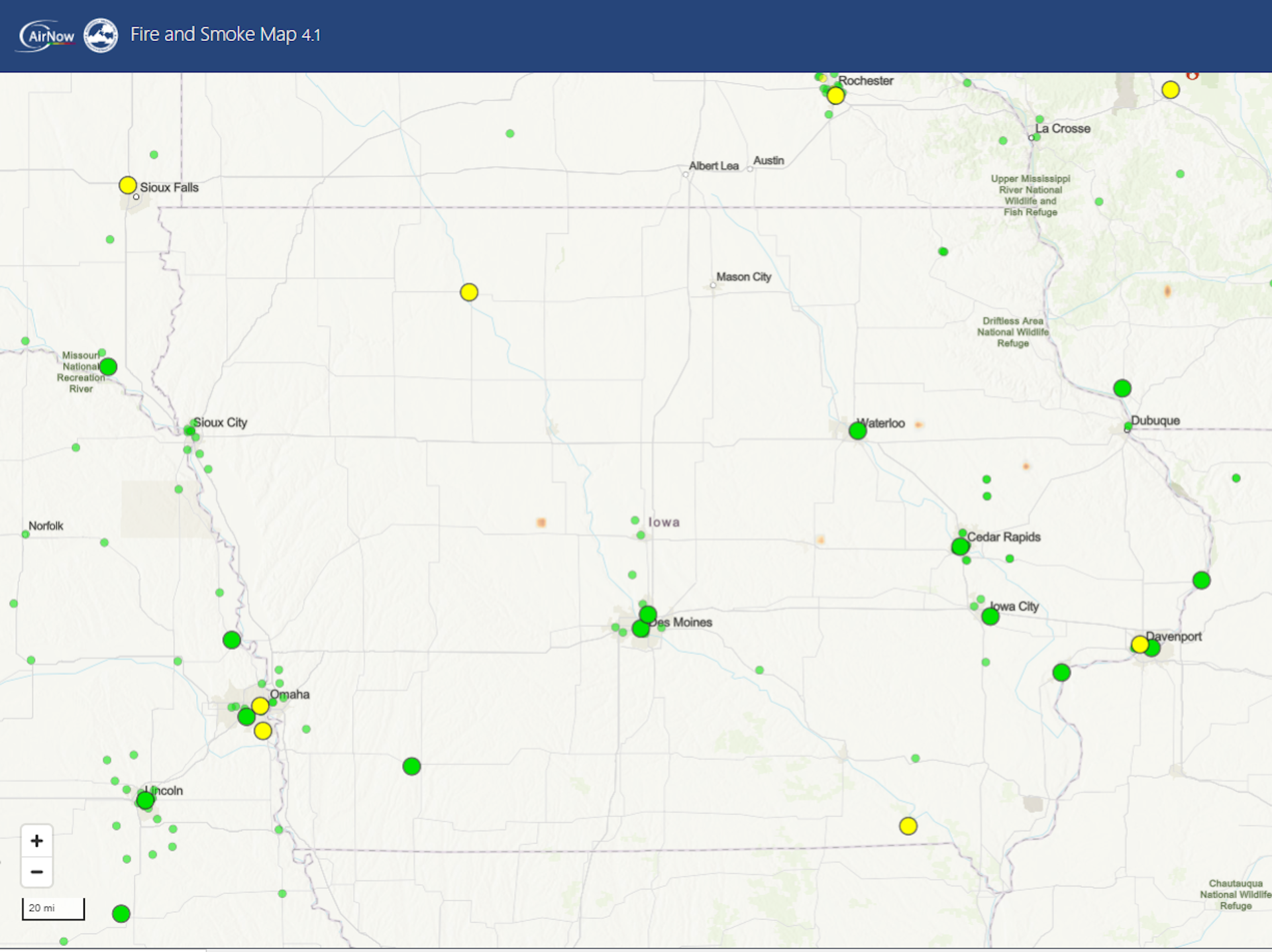
    That’s a big jump from relying on ground-based air quality monitors, which may be hundreds of miles apart. Iowa, for example, had about 50 air quality monitors reporting data on a recent day for a state that covers 56,273 square miles. Most of those monitors were clustered around its largest cities.

    NOAA’s AerosolWatch tool currently provides a near-real-time stream of wildfire smoke images from its GOES-R satellites, and the agency plans to incorporate TEMPO’s height data. A prototype of this system from my team’s NASA-supported research project on fire and air quality, called FireAQ, shows how users can zoom in to the neighborhood level to see how high the smoke plume is, however the prototype is currently only updated once a day, so the data is delayed, and it isn’t able to provide smoke height data where clouds are also overhead.

    Wildfire health risks are rising

    Fire risk is increasing across North America as global temperatures rise and more people move into wildland areas.

    While air quality in most of the U.S. improved between 2000 and 2020, thanks to stricter emissions regulations on vehicles and power plants, wildfires have reversed that trend in parts of the western U.S. Research has found that wildfire smoke has effectively erased nearly two decades of air quality progress there.

    Our advances in smoke monitoring mark a new era in air quality forecasting, offering more accurate and timely information to better protect public health in the face of these escalating wildfire threats.

    Prof. Wang’s group have been supported from NOAA, NASA, and Naval ONR to develop research algorithm to retrieve aerosol layer height. The compute codes of the research algorithm were shared with colleagues in NOAA.

    – ref. Which wildfire smoke plumes are hazardous? New satellite tech can map them in 3D for air quality alerts at neighborhood scale – https://theconversation.com/which-wildfire-smoke-plumes-are-hazardous-new-satellite-tech-can-map-them-in-3d-for-air-quality-alerts-at-neighborhood-scale-259654

    MIL OSI –

    July 27, 2025
  • MIL-OSI Africa: Environmental incident reporting: Environmental Incident Reporting System (EIRS) platform officially launched

    Source: APO


    .

    The ceremony, chaired by Technical Advisor Georges Kouadio, representing the Minister of the Environment, Sustainable Development and Ecological Transition, Jacques Assahoré Konan, was held in the presence of representatives of the administration, local authorities, technical partners, sector experts and civil society.

    On this occasion, Georges Kouadio argued that the SRIE represents an alert system at the heart of national priorities in terms of environmental monitoring.

    “The SRIE is a concrete response to the urgent need for action, to the imperative to better listen to populations and to strengthen collective vigilance in the face of multiple environmental threats. This tool reflects the Ministry’s ambition to build modern environmental governance, based on inclusion, innovation, and accountability,” he said.

    The SRIE coordinator, Jean-Yves Kouacou, who is also Director of Information Technology and Documentation, stated that the SRIE represents “an essential operational lever for anticipating, identifying and responding effectively to environmental incidents throughout the country.”

    The ceremony also featured a panel discussion on the theme of “Environment and Digitalization: How Does the SRIE Contribute to Improving Environmental Incident Management?” This panel allowed experts to explore the issues surrounding the digitalization of environmental action in greater depth.

    Deployed as part of the digitalization of public services, the SRIE also aims to improve coordination between the technical structures involved in the management of environmental alerts and to provide greater transparency on the actions taken.

    Distributed by APO Group on behalf of Portail Officiel du Gouvernement de Côte d’Ivoire.

    MIL OSI Africa –

    July 26, 2025
  • MIL-OSI NGOs: Plastic Greenpeace plastic protesters stand down after blocking INEOS mega tanker for 24 hours Greenpeace climbers have ended their protest at the iconic Forth Road Bridge in Scotland after successfully blocking a gas tanker owned by the plastics giant INEOS for 24… by Graham Thompson July 26, 2025

    Source: Greenpeace Statement –

    Greenpeace climbers have ended their protest at the iconic Forth Road Bridge in Scotland after successfully blocking a gas tanker owned by the plastics giant INEOS for 24 hours. All 10 climbers descended safely aided by Greenpeace support boats.

    The original press release is available here

    The protesters began climbing down their ropes in the early hours of this morning. The protest started on Friday with climbers abseiling from the bridge and unfurling six giant banners reading ‘PLASTICS TREATY NOW’. Their action prevented the INEOS tanker INDEPENDENCE from delivering its cargo of American fracked gas for a full 24 hours, as the vessel can only reach Grangemouth on high tides.

    All 10 Greenpeace climbers were voluntarily transported to Port Edgar in South Queensferry where they were arrested by officers from Police Scotland on suspicion of Culpable and Reckless Conduct. 

    Greenpeace targeted INEOS, the UK’s biggest plastic producer, ahead of critical international talks in two weeks to secure a Global Plastics Treaty to tackle plastic pollution. Every month thousands of tonnes of gas are delivered to Grangemouth where they are turned into billions of tiny plastic pellets (nurdles) that are transported around the world. Greenpeace accuses the company of deliberately undermining the talks so it can continue ramping up plastic production. 

    The upcoming INC5.2 talks to finalise a Global Plastics Treaty are a once-in-a-generation opportunity for governments to stem the flow of plastic that is causing such harm to our towns, environment and wildlife. Greenpeace is demanding that companies like INEOS and their lobbyists, who have a direct interest in making massive profits from selling plastic, are excluded from the talks allowing governments to reach an ambitious deal.

    Amy Cameron, Programme Director at Greenpeace UK said: “We’ve achieved what we set out to. By blocking INEOS, we’ve drawn global attention to the company’s bottomless appetite for plastic production, false solutions and profit for its billionaire boss Jim Ratcliffe. 

    “Their feeble suggestion that recycling and managing waste can hand them a free pass to go on producing more plastic forever is laughable. It comes from the same industry playbook as the health benefits of smoking and carbon offsetting. The plastic pollution problem is just too massive. Less than 10% of plastic is currently recycled globally, and this is set to rise to just 17% by 2060, while the amount of plastic we’re producing is set to triple. The only solution is to address the problem at source which means securing a strong Global Plastics Treaty that imposes legally-binding caps on plastic production.

    “INEOS are cutting jobs at Grangemouth while trying to open a massive new plastics plant in Belgium, leaving Scottish workers high and dry. If Jim Ratcliffe really cared about skilled jobs in Scotland he’d invest his billions in supporting his workers to transition into the green industries of the future, instead of throwing money at Formula 1 racing teams and football clubs.”

    Contrary to INEOS’ claims, the protest was both safe and caused minimal disruption. The climbers are all highly-trained and spent weeks rehearsing this action to ensure it was safe. They were supported at all times by rescue climbers and support boats. The Forth Road Bridge carries low volumes of bus, bicycle and pedestrian traffic and was closed by Police Scotland – not by the protest directly. 

    An international team of Greenpeace activists abseil from Scotland’s Forth Road Bridge to block an INEOS tanker from delivering its cargo of fracked American gas to the Grangemouth petrochemical facility. The Greenpeace protest is aimed at chemicals giant INEOS, owned by billionaire Sir Jim Ratcliffe, which is opposing efforts by UN Member States to secure a Global Plastics Treaty to curb plastic pollution. INEOS is the UK’s biggest plastics manufacturer, producing (pellets) daily at its Grangemouth plant – enough to make 60 million plastic bottles.© Luca Marino / Greenpeace

    Ends

    Notes to editors:

    The original press release is available here

    Download photos and footage from the protest here.

    For more information, or to arrange an interview with a Greenpeace spokesperson, contact the news team:

    • Greenpeace UK press office: press.uk@greenpeace.org / 020 7865 8255
    • Greenpeace press officer in Scotland: Kai Tabacek; 07984 127025

    MIL OSI NGO –

    July 26, 2025
  • MIL-OSI Australia: Mooloolaba Foreshore the place to meet

    Source:

    Ground has broken on the Mooloolaba Central Meeting Place, as part of the Mooloolaba Foreshore Stage Two works.

    The upgrades will introduce more shaded areas, all-ability beachfront access, and a new viewing deck to take in the beauty of the Mooloolaba Beach and are jointly funded with $6.66 million from the Albanese Government, $6.66 million from the Queensland Government and more than $7.11 million from the Sunshine Coast Council

    The Sunshine Coast Council engaged actively with the local community in 2022, proposing detailed designs, taking on board suggestions, and putting forward the community’s preferred option for the foreshore in January 2023. 

    Fast-forward to today, and the community’s dreams are becoming reality with first works starting ahead of a much-anticipated completion in 2027.

    When finished, the foreshore will include improved beachfront parkland, lighting, new modern amenities, event spaces, public artwork and broader accessible pathways. 

    The Central Meeting Place is one of the successful local infrastructure projects that aim to boost community lifestyle across Queensland’s south-east corner through the $285.8 million SEQ Liveability Fund.

    As part of the Mooloolaba Foreshore Revitalisation Project a new seawall will also be constructed which will add terraced seating and improved connections to the beach while protecting it from erosion. 

    The new seawall is funded with $7.95 million from the Albanese Government’s Disaster Ready Fund, and will ensure the foreshore is built to withstand future weather extremes.

    This investment is in addition to the $6.66 million for the Mooloolaba Central Meeting Place project, taking the total Albanese Government investment to the Mooloolaba Foreshore to $14.61 million. 

    The community can follow the Mooloolaba Foreshore Revitalisation Project on the Sunshine Coast Council’s website.

    Quotes attributable to Acting Infrastructure, Transport, Regional Development and Local Government Minister Julie Collins:

    “Mooloolaba locals are here for the iconic Queensland lifestyle. 

    “They want to live close to the beautiful beaches and nature that this corner of the sunshine state is known for. 

    “The Mooloolaba Central Meeting Place will make their region better equipped and more accessible than ever.” 

    Quotes attributable to Federal Emergency Management Minister Kristy McBain:

    “This funding will help protect homes, businesses and our iconic beachfront from the impacts of severe weather and rising seas, while creating a safer, more welcoming space for families and visitors to gather year-round.

    “Upgrading the seawall and revitalising the foreshore means locals, surf clubs and small businesses can keep sharing everything we love about Mooloolaba with the rest of Australia and the world.

    “Our Government is committed to working side by side with state and local partners to deliver resilient, future-ready infrastructure that keeps coastal communities strong and connected.”

    Quotes attributable to Queensland Senator Corinne Mulholland:

    “Already boasting a stunning beach, and esplanade packed with accommodation, bars and restaurants, the foreshore upgrades will see Mooloolaba remain a premier destination for locals and tourists alike. 

    “Creating new shared spaces, delivering 6,500m² of beachfront parklands and protecting the foreshore for the future with a new seawall, this work will unlock significant benefits for the community. I’m proud that our Government is investing $14.61 million to make this a reality for Mooloolaba.”  

    Quotes attributable to Sunshine Coast Council Environment and Liveability Councillor Tim Burns:

    “This stage is a significant step in creating a world-class beachfront destination being delivered in partnership with the Federal and State governments and carried out by leading contractor SEE Group. 

    “Our accommodation providers, local cafés and restaurants, boutiques and tourism operators are open and ready to welcome you.

    “Your support during this time will help ensure they continue to thrive alongside the revitalised foreshore.”

    MIL OSI News –

    July 26, 2025
  • MIL-OSI China: Wind power lights up roof of the world

    Source: People’s Republic of China – State Council News

    Every time Hu Jiansheng watched people stop beneath the towering wind turbines, marveling at their massive size, pride surged through him. He was one of the builders of the Oumatingga wind power farm, one of the highest in the world with an average altitude of 4,600 meters, in southwest China’s Xizang Autonomous Region, the roof of the world.

    As deputy general manager of the Xizang branch of CHN Energy Investment Group, Hu dedicated three years to this project in the city of Nagqu.

    The Oumatingga wind power project, comprising 25 turbines with a total installed capacity of 100 megawatts, stands as a landmark achievement that demonstrates the region’s strong commitment to renewable energy development, particularly in photovoltaic and wind power.

    “The project generates 227 million kWh of electricity annually, saving around 70,000 tonnes of standard coal and reducing carbon dioxide emissions by 120,000 tonnes, making a significant contribution to local energy supply,” the 47-year-old said.

    “During the bitter winter months, we constantly struggled with electricity shortages that frequently led to power outages,” recalled Ngawang Jampa, 31, a resident from Nagqu’s Seni District. His family often resorted to burning cow dung for heating in the middle of the night.

    However, since the wind power station commenced operations in January 2024, such hardships have become a thing of the past.

    Today, every household in Seni District enjoys reliable electric heating, and power interruptions — even in winter — are now exceptionally rare.

    The construction of this wind power project, however, was fraught with challenges.

    “It was an extraordinarily difficult mission,” he said, explaining that altitude sickness and severe weather made the project seem nearly impossible at times.

    Locals often joke that Nagqu has only two seasons: winter and “almost winter.”

    “We’ve seen snowfall as late as May. This limited our construction window to just five months,” Hu explained.

    One particularly harrowing incident occurred during turbine installation. “The hailstones striking my face felt like rocks, and it hurt so much,” Hu recalled.

    “Then the snow began falling, and I became completely numb from the cold.” Amid these brutal conditions, the wind turbine nacelle hung precariously in the air, with only several workers struggling to secure the swaying machinery by tightening ropes against the howling gale.

    “After a while, company workers, local villagers, and township government staff all came together to help fasten the ropes,” said Hu, with tears in his eyes, adding that when the hailstorm finally passed, he saw everyone was covered in snow, resembling a team of snowmen standing together on the vast grassland.

    During the grid connection ceremony, while everyone gathered in the control center, Hu chose to stand alone at the wind farm. “Watching the turbines turn and hearing the blades spin felt amazing. I could finally allow myself to relax at that moment,” he said.

    Wind power has injected vitality into Xizang’s clean energy development, serving as a vital complement during low-output periods of photovoltaic and hydropower generation, according to Shi Lei, a professor at the School of Ecology and Environment, Renmin University of China.

    Official statistics showed that, by the end of 2024, more than 99 percent of Xizang’s power generation came from clean energy sources, the highest rate among all Chinese regions. Xizang now has a comprehensive energy system with hydropower as the main source, complemented by geothermal, wind and solar energy, among others. 

    MIL OSI China News –

    July 26, 2025
  • MIL-OSI USA: New $458,000 Federal Investment to Buoy Clean Water Pumpout Facilities for RI Boaters

    US Senate News:

    Source: United States Senator for Rhode Island Jack Reed
    WASHINGTON, DC – In an effort to protect the health of Rhode Island’s waters, U.S. Senators Jack Reed and Sheldon Whitehouse announced today that Rhode Island will receive $457,709 through the U.S. Fish and Wildlife Service’s Clean Vessel Act (CVA) grant program. The federal grant will be used to procure three new pumpout barges and one new pumpout boat that will assist recreational boaters in properly disposing of on-board septic waste.
    The Rhode Island Department of Environmental Management (DEM) administers the program and competitively awards the grants for new or upgraded marine pumpout facilities to local grantees through the DEM Office of Water Resources. Each CVA grant requires a 25-percent match.
    Under state and federal law, it is illegal for boats to discharge any sewage – treated or untreated – into the waters of Rhode Island. The three pumpout barges and pumpout boat will provide boaters in marine waters of Narragansett Bay and coastal Rhode Island an opportunity to conveniently unload waste in a safe and sanitary way.
    “Keeping our waters clean and healthy is good for our economy and the environment. As more boaters enjoy time on the water, we’ve got to ensure we have the right infrastructure in place to meet the growing need for safe and convenient sewage disposal. This new federal funding will help protect Rhode Island’s waterways and ensure there are free, convenient, and efficient pumping options,” said Reed, a member of the Appropriations Committee. “Over the years, the Clean Vessel Act has prevented millions of gallons of untreated sewage from polluting our waters, including Narragansett Bay.”
    “We have made decades of enormous progress cleaning up Narragansett Bay to the great benefit of the local economy and our quality of life in Rhode Island. This federal investment will help keep our treasured Bay and other Ocean State waterways clean and free of sewage,” said Whitehouse, the top Democrat on the Senate Environment and Public Works Committee.
    Congress passed the Clean Vessel Act in 1992. The law provides funds for the construction, renovation, operation and maintenance of sewage pumpout stations and dump stations for recreational boats, as well as information and education programs that encourage boaters to use pumpout facilities.
    This year, U.S. Fish and Wildlife Service awarded over $17.7 million in CVA grants to 21 states.
    Funding for CVA grants are provided through the federal Sport Fish Restoration and Boating Trust Fund, which is derived from excise taxes on fishing equipment, motorboat and small engine fuels, import duties and interest on the fund.
    Owners of Rhode Island marinas may apply for grants for projects located at the owner’s marina using DEM’s application. A non-owner operator may apply for such a grant, but only if the owner co-signs the application and the grant award.

    MIL OSI USA News –

    July 26, 2025
  • MIL-Evening Report: ER Report: A Roundup of Significant Articles on EveningReport.nz for July 26, 2025

    ER Report: Here is a summary of significant articles published on EveningReport.nz on July 26, 2025.

    Gaza: Global community must act amid reports of starvation of journalists, says IPI
    By Jamie Wiseman The International Press Institute (IPI) has joined calls for urgent action to halt the unfolding humanitarian crisis in Gaza as global news organisations warn that their journalists there are experiencing starvation. Israel must immediately allow life-saving food aid to reach journalists and other civilians in Gaza, IPI said in a statement today.

    Caitlin Johnstone: It’s a genocide, but it’s also so much more than that
    Report by Dr David Robie – Café Pacific. – COMMENTARY: By Caitlin Johnstone The mass atrocity in Gaza is a genocide, obviously, and is an undisguised ethnic cleansing operation. But it’s also a lot more than that. It’s an experiment  —  to see what kinds of abuses the public will accept without causing significant disruption

    Leaked document reveals proposed law revisions in NZ, as Western defence of Zionist genocide threatens Pacific
    SPECIAL REPORT: By Mick Hall A leaked document has revealed secretive plans to revise terror laws in New Zealand so that people can be charged over statements deemed to constitute material support for a proscribed organisation. It shows the government also wants to widen the criteria for proscribing organisations to include groups that are judged

    Ceasefire talks collapse – what does that mean for the humanitarian catastrophe in Gaza?
    Source: The Conversation (Au and NZ) – By Ali Mamouri, Research Fellow, Middle East Studies, Deakin University Efforts to end the relentless siege of Gaza have been set back by the abrupt end to peace talks in Qatar. Both the United States and Israel have withdrawn their negotiating teams, accusing Hamas of a “lack of

    As oceans warm, tropical fish are moving south. New friendships may be helping them survive
    Source: The Conversation (Au and NZ) – By Angus Mitchell, Postdoctoral Researcher in Marine Ecology, University of Adelaide Angus Mitchell When you think about climate change in our oceans, you may picture coral bleaching, melting sea ice, or extreme weather events. But beneath the ocean’s surface, another quiet shift is underway. Australia’s tropical fish are

    As oceans warm, tropical fish are moving south. New friendships may be helping them survive
    Source: The Conversation (Au and NZ) – By Angus Mitchell, Postdoctoral Researcher in Marine Ecology, University of Adelaide Angus Mitchell When you think about climate change in our oceans, you may picture coral bleaching, melting sea ice, or extreme weather events. But beneath the ocean’s surface, another quiet shift is underway. Australia’s tropical fish are

    What is chikungunya virus, and should we be worried about it in Australia?
    Source: The Conversation (Au and NZ) – By Jacqueline Stephens, Associate Professor in Public Health, Flinders University Noppharat05081977/Getty Images This week, the World Health Organization (WHO) raised concerns about a surge in the number of cases of a mosquito-borne viral infection called chikungunya. Diana Rojas Alvarez, a medical officer at the WHO, highlighted an outbreak

    What makes a song ‘Australian’? Triple J’s Hottest 100 reignites a bigger question of national identity
    Source: The Conversation (Au and NZ) – By Catherine Strong, Associate Professor, Music Industry, RMIT University On July 26, Triple J will broadcast the Hottest 100 Australian Songs, as voted by the public. While predictions for winners and even preemptive complaining about the shortlist are taking up column space and social media posts, there is

    ER Report: A Roundup of Significant Articles on EveningReport.nz for July 25, 2025
    ER Report: Here is a summary of significant articles published on EveningReport.nz on July 25, 2025.

    MIL OSI Analysis – EveningReport.nz –

    July 26, 2025
  • MIL-Evening Report: ER Report: A Roundup of Significant Articles on EveningReport.nz for July 26, 2025

    ER Report: Here is a summary of significant articles published on EveningReport.nz on July 26, 2025.

    Gaza: Global community must act amid reports of starvation of journalists, says IPI
    By Jamie Wiseman The International Press Institute (IPI) has joined calls for urgent action to halt the unfolding humanitarian crisis in Gaza as global news organisations warn that their journalists there are experiencing starvation. Israel must immediately allow life-saving food aid to reach journalists and other civilians in Gaza, IPI said in a statement today.

    Caitlin Johnstone: It’s a genocide, but it’s also so much more than that
    Report by Dr David Robie – Café Pacific. – COMMENTARY: By Caitlin Johnstone The mass atrocity in Gaza is a genocide, obviously, and is an undisguised ethnic cleansing operation. But it’s also a lot more than that. It’s an experiment  —  to see what kinds of abuses the public will accept without causing significant disruption

    Leaked document reveals proposed law revisions in NZ, as Western defence of Zionist genocide threatens Pacific
    SPECIAL REPORT: By Mick Hall A leaked document has revealed secretive plans to revise terror laws in New Zealand so that people can be charged over statements deemed to constitute material support for a proscribed organisation. It shows the government also wants to widen the criteria for proscribing organisations to include groups that are judged

    Ceasefire talks collapse – what does that mean for the humanitarian catastrophe in Gaza?
    Source: The Conversation (Au and NZ) – By Ali Mamouri, Research Fellow, Middle East Studies, Deakin University Efforts to end the relentless siege of Gaza have been set back by the abrupt end to peace talks in Qatar. Both the United States and Israel have withdrawn their negotiating teams, accusing Hamas of a “lack of

    As oceans warm, tropical fish are moving south. New friendships may be helping them survive
    Source: The Conversation (Au and NZ) – By Angus Mitchell, Postdoctoral Researcher in Marine Ecology, University of Adelaide Angus Mitchell When you think about climate change in our oceans, you may picture coral bleaching, melting sea ice, or extreme weather events. But beneath the ocean’s surface, another quiet shift is underway. Australia’s tropical fish are

    As oceans warm, tropical fish are moving south. New friendships may be helping them survive
    Source: The Conversation (Au and NZ) – By Angus Mitchell, Postdoctoral Researcher in Marine Ecology, University of Adelaide Angus Mitchell When you think about climate change in our oceans, you may picture coral bleaching, melting sea ice, or extreme weather events. But beneath the ocean’s surface, another quiet shift is underway. Australia’s tropical fish are

    What is chikungunya virus, and should we be worried about it in Australia?
    Source: The Conversation (Au and NZ) – By Jacqueline Stephens, Associate Professor in Public Health, Flinders University Noppharat05081977/Getty Images This week, the World Health Organization (WHO) raised concerns about a surge in the number of cases of a mosquito-borne viral infection called chikungunya. Diana Rojas Alvarez, a medical officer at the WHO, highlighted an outbreak

    What makes a song ‘Australian’? Triple J’s Hottest 100 reignites a bigger question of national identity
    Source: The Conversation (Au and NZ) – By Catherine Strong, Associate Professor, Music Industry, RMIT University On July 26, Triple J will broadcast the Hottest 100 Australian Songs, as voted by the public. While predictions for winners and even preemptive complaining about the shortlist are taking up column space and social media posts, there is

    ER Report: A Roundup of Significant Articles on EveningReport.nz for July 25, 2025
    ER Report: Here is a summary of significant articles published on EveningReport.nz on July 25, 2025.

    MIL OSI Analysis – EveningReport.nz –

    July 26, 2025
  • MIL-OSI United Kingdom: £1.1 billion boost to improve local recycling services across England

    Source: United Kingdom – Government Statements

    Press release

    £1.1 billion boost to improve local recycling services across England

    Money from packaging reforms to fund better recycling collections and cut costs for taxpayers

    Household bins lined up outside

    Every town and city across the country will receive a major boost to their recycling services, with more than £1 billion funnelled into improving critical infrastructure and collections, Circular Economy Minister Mary Creagh announced today (Saturday 26 July 2025).

    Under an outdated regime, the bill for disposing of items like milk bottles, cereal boxes and soup tins is currently footed by local councils with taxpayers paying.

    Through the new Extended Producer Responsibility for Packaging scheme, businesses who produce packaging will pay their fair share of the recycling costs.

    Delivering on the government’s Plan for Change, the investment will unlock regional growth, create new green jobs across the country, and boost household recycling rates which for years have failed to show significant improvement.

    Circular Economy Minister Mary Creagh said:

    This government is cleaning up Britain and ending the throwaway society.

    Under the Plan for Change, we are pumping more than £1 billion into local recycling services.

    This will revolutionise how we deal with our waste and ensure more of today’s rubbish is recycled into tomorrow’s packaging.

    The scheme works by charging fees to the businesses that use packaging to meet the costs of collecting and recycling it. The costs will be higher for hard to recycle materials and less where packaging can be reused or refilled.

    This will encourage businesses to reduce the amount of packaging they use, shift to more recyclable materials and design new products that can be recycled and reused more easily, stopping waste from going to the nation’s landfills or incinerators.

    For the coming year, councils in England will receive £1.1 billion to improve recycling services for residents. This could be spent on offering local residents more streamlined recycling collections which can ensure more household waste is recycled.

    The funds can also go towards building new infrastructure or covering the costs of upgrading facilities where councils send household waste. This includes Veolia’s Integrated Waste Management Facility in Southwark, which handles and processes materials collected from homes, and then sends them to be turned into new products.

    Minister of State for Local Government and English Devolution, Jim McMahon OBE MP said:

    Clean and tidy streets are something everyone wants to see, and these common-sense reforms will help councils achieve that.

    Whether it’s channelling more money into recycling or reforming the outdated funding system, we are fixing the foundations of local government so that it can focus on what matters most to people across the country.

    Gavin Graveson, CEO Veolia UK said:  

    We welcome the Government’s progress on the crucial suite of legislation that will help raise recycling rates, decarbonise and incentivise domestic infrastructure investment.

    We look forward to supporting our local authority partners to invest in the essential services they provide to collect and recycle more materials, as well as supporting brands and producers to not only design for recyclability, but also include recycled content in their products. That’s how we’ll build a world-leading, profitable and sustainable circular economy.

    Executive Director of the Environmental Services Association, Jacob Hayler said:

    Our members stand ready to invest billions, alongside local authority partners, in the next generation of recycling services, infrastructure and jobs, which will provide a rapid boost to England’s stalled recycling rates. The new producer responsibility regime for packaging, alongside other measures to simplify recycling services, will unlock this investment and support our ambition to achieve a circular economy in the United Kingdom over the next decade.

    Jim Bligh, Director of Corporate Affairs and Packaging at The Food and Drink Federation, said:

    This announcement is welcome news for both industry and consumers, coming just before producers receive their first invoices for EPR. It marks a vital step towards delivering the improvements in the UK’s recycling system that we all want and need. With a £1.4 billion annual investment from packaging producers into EPR, we’re pleased to see the government’s commitment to ensuring these funds will be used to upgrade infrastructure and resurrect our flatlining recycling rates.

    Cllr Adam Hug, environment spokesperson for the Local Government Association, said:

    It’s positive to see the costs of managing packaging waste shift to the industry creating this waste.

    Councils are proud to run some of the best recycling services in the world, with high levels of public satisfaction despite significant financial pressures.

    This success is built on council’s local knowledge and strong links with communities, and we hope the new scheme will support that work and help reduce the amount of packaging ending up in household bins.

    Libby Peake, head of resource policy at Green Alliance, said:

    For too long, the costs of dealing with packaging waste and recycling have fallen unfairly on local councils and, ultimately, taxpayers, when they have no control over the packaging businesses use. It’s absolutely right that costs are now shifting to the companies who create packaging and can figure out how to use less of it in future. This is an important step in the move away from an inefficient and wasteful system.

    The Environment Secretary has been clear that all councils must use this funding to deliver improved packaging waste collection services for their communities, with PackUK empowered to reduce future allocations if evidence shows that funding has been used for other purposes.

    The Extended Producer Responsibility for Packaging scheme is a crucial part of the government’s packaging reforms, which industry estimates will support 25,000 new jobs and underpin £10 billion of investment in new sorting and processing facilities over the next decade.

    Alongside Extended Producer Responsibility for Packaging, the government is introducing a Deposit Return Scheme in 2027. This will provide a financial incentive to return empty drinks containers to a collection point, such as at their local supermarket, so that bottles or cans will be recycled.

    A sensible and pragmatic approach to the collection of materials from households and workplaces is also being introduced. Simpler Recycling for workplaces went live in March 2025 and launches for households in March 2026. It will boost recycling rates and reduce the amount of waste sent to landfill.

    The action to clean up Britain doesn’t end there – with the Circular Economy Taskforce working with sectors to create a series of specific roadmaps to improve and reform the approach to using materials, underpinned by a Circular Economy Strategy which will be published in autumn.

    Share this page

    The following links open in a new tab

    • Share on Facebook (opens in new tab)
    • Share on Twitter (opens in new tab)

    Updates to this page

    Published 26 July 2025

    MIL OSI United Kingdom –

    July 26, 2025
  • MIL-OSI United Nations: Stressing ‘Your Courage Continues to Change Lives’, Secretary-General Urges Amnesty International Global Assembly to Keep Fighting for Human Rights, Climate Justice

    Source: United Nations 4

    Following are UN Secretary-General António Guterres’ remarks to the Amnesty International Global Assembly today:

    It is an honour to join you today — and to be the first United Nations Secretary-General to address your Global Assembly.  I see your invitation as a tribute to UN staff working around the world for human rights and for justice.  And I see it as a reflection of our shared, fundamental conviction in the equal dignity and worth of every person — a founding principle of both our organizations.

    One morning in the early ′60s, a British lawyer opened his newspaper on his way to work.  It reported that the dictatorship then ruling my country — Portugal — had imprisoned two students.  Their crime:  raising a toast to freedom.  The barrister — Peter Benenson — was so outraged by their plight that he launched a global movement.  And Amnesty International was founded.

    And ever since, you have been at the forefront of the global struggle for human rights — fearless, principled and relentless:  Campaigning to free prisoners of conscience around the world.  Contributing to the establishment of a number of international institutions and the conclusion of a number of treaties — including the Convention Against Torture. Defending the full spectrum of human rights — civil, political, social, economic and cultural.  Winning landmark victories for justice — and earning the Nobel Peace Prize along the way.

    The work of Amnesty International reflects truths I lived under dictatorship: that morality demands the courage to stand against oppression; that solidarity and justice are both personal and global; and that the fight for freedom on one continent can reverberate across the globe. I saw this first-hand — when liberation struggles in Africa helped end Portugal’s authoritarian rule.

    Today, all these truths are more important than ever.  Because powerful forces are ranged against human rights — and against the international system built to protect and uphold them.  We see attacks on the International Criminal Court.  Attacks on the international human rights system and its representatives. And flagrant violations of international law:  from the horrors in Sudan and beyond to Russia’s invasion in Ukraine where we need a just and lasting peace based on the UN Charter, international law and UN resolutions.  And, of course, the relentless Israeli onslaught on Gaza.

    I commend Amnesty International for your strong voices.  From the beginning, I have repeatedly condemned the horrific 7 October terror attacks by Hamas.  But nothing can justify the explosion of death and destruction since. The scale and scope is beyond anything we have seen in recent times.

    I cannot explain the level of indifference and inaction we see by too many in the international community.  The lack of compassion.  The lack of truth.  The lack of humanity.  Our own heroic staff continue to serve in unimaginable conditions.  Many are so numb and depleted that they say they feel neither dead nor alive.  Children speaking of wanting to go to heaven, because at least, they say, there is food there.

    We hold video calls with our own humanitarians who are starving before our eyes. This is not just a humanitarian crisis. It is a moral crisis that challenges the global conscience.  We will continue to speak out at every opportunity.  But words don’t feed hungry children.

    The United Nations stands ready to make the most of a possible ceasefire to dramatically scale up humanitarian operations across the Gaza Strip, as we successfully did during the previous pause in fighting.  Our plans are ready, and they are finalized.  We know what works — and we know what does not.

    Since 27 May, the United Nations has recorded over 1,000 Palestinians killed trying to access food.  Let me repeat:  1,000 people — killed not in combat, but in desperation — while the entire population starves.

    We need action.  An immediate and permanent ceasefire.  The immediate and unconditional release of all hostages.  Immediate and unimpeded humanitarian access.  At the same time, we need urgent, concrete and irreversible steps towards a two-State solution.

    We are in a global battle for human dignity.  For human rights. For justice.  For the multilateral system itself.  Amnesty International is indispensable in that fight.

    So, my central message to you today is this: the world needs you more than ever. We need your courage, your creativity, and your clarity.  We need your movements — rooted in communities and rising from the ground up —  making it clear that leaders cannot turn a blind eye to their obligations.

    And, yes, we need what you’ve called “troublemaking”.  The kind that challenges complacency and inaction.  That exposes injustice.  That drives lasting change.  Because as I scan the global landscape, I see too many leaders who view human rights as the problem.

    But we know human rights are the solution.  They are the foundation of peace.  They are the engine of progress.  And they are the path out of conflict and chaos to security and hope.  You know better than anyone:  this work is never easy.  And the struggle is always hardest when it matters most — when the urgency is greatest and the stakes are highest.

    But I want to assure you:  you are not alone.  Human rights are — and will remain — a central pillar of the United Nations.  Despite financial challenges, we are determined to reinforce human rights for the twenty-first century.  The UN80 initiative, grounded in the UN Charter and international law, is aimed at strengthening our core work across peace, human rights and development.  And our Call to Action for Human Rights is mobilizing every part of the UN system.

    In the face of crisis, we must stand together — and act together.  Let me turn to your focus for this year’s Global Assembly:  confronting the rise of authoritarian practices — and advancing climate justice.

    First — authoritarianism. Around the world, we are witnessing a surge in repressive tactics aiming at corroding respect for human rights.  And these are contaminating some democracies. This is not a series of isolated events. It is a global contagion.  Political opposition crushed.  Accountability dismantled.  Equality and non-discrimination trampled.  The rule of law cast aside.

    On the other hand, civil society — the lifeblood of any free nation — is suffocated.  We see activists and journalists silenced — even murdered.  Minorities scapegoated.  Women and girls stripped of their most basic rights — most brutally in Afghanistan.  And all of this is amplified by digital technology.

    We must right these wrongs.  Many countries we must recognize stand firm with human rights.  And we must push all countries to defend them — consistently, and universally, even — or especially — when inconvenient.  We must urge them to protect and strengthen the international human rights system.  We must demand accountability for human rights violations — without fear or favour.  And insist that countries honour commitments in the Pact of the Future — to protect civic space and uphold human rights and gender equality.

    We must also demand action to confront the flood of lies and hate polluting our digital spaces.  Social media manipulation has become a powerful weapon in the authoritarian playbook. Many algorithms are boosting the worst of humanity — rewarding falsehoods, fuelling racism and misogyny and deepening division.

    Last year, countries took steps to tackle these issues.  They adopted in the UN General Assembly the Global Digital Compact — committing to apply human rights to cyberspace — and to protect information integrity.  Now we must hold them to it.

    And we must go further — to rebuild trust in the international system by grounding it in justice, inclusion and results.  That means reforming the United Nations Security Council.  It is a scandal that Africa still has no permanent seat at the table.  It means delivering on the 2030 Sustainable Development Agenda.

    And it means transforming the international financial system — with debt relief, a surge in development finance, and a stronger voice and greater participation for developing countries in international financial institutions.  I applaud your work on such issues, including through the 2048 Commission — helping to shape a fairer, more inclusive global order.

    The second focus of this Global Assembly is one of the defining struggles of our time:  securing climate justice.  The climate crisis is not just an environmental emergency.  It is a human rights catastrophe.  We must confront and correct the deep injustices it has laid bare: The poor, the vulnerable and the marginalized — suffering most from a crisis they did nothing to create.

    Environmental defenders — arrested, threatened, and even killed for protecting communities and ecosystems.  Land and livelihoods — plundered in the race for minerals critical to clean energy.  And climate finance — still wholly inadequate as fossil fuels are propped up by subsidies as others pay the price.  All while their political enablers stall and sabotage action.

    But we have seen what people power can achieve:  from Amnesty’s role in promoting international recognition of the right to a clean, healthy and sustainable environment to legal victories that have led courts to clarify States’ obligations on climate.

    Just two days ago, the International Court of Justice issued a historic advisory opinion.  It made clear that States are obliged to protect the global climate system, that climate change is a human rights issue.  And that the goal of limiting global temperature rise to 1.5 degrees Celsius must guide climate policies, in accordance with the Paris Agreement.  We have young Pacific Islanders to thank for this landmark victory.

    And all of us must build on these hard-won gains — by insisting on legal accountability and demanding climate justice.  That means the biggest economies and emitters leading an urgent global reduction in emissions, and a just transition away from fossil fuels.

    New national climate action plans — or NDCs – must align with limiting global temperature rise to 1.5 degrees Celsius.  They must respect human rights.  And they must be shaped in partnership with those most affected — especially marginalized groups.

    We also need action on critical minerals — to protect the rights of Indigenous Peoples and front-line communities.  We cannot accept a clean energy future built on dirty practices with enormous violations of human rights and many times of human rights of children.  Our United Nations Panel on Critical Energy Transition Minerals has laid out a path — placing human rights at the core of the critical mineral value chains. We are working with partners to deliver.

    And we need finance — real finance — for developing countries to cut emissions, adapt to climate shocks, and recover from loss and damage.  We must push governments to provide funds they have pledged.  And explore new sources of finance — including putting an effective price on carbon and establishing solidarity levies on polluting sectors and industries.

    As a young man living under dictatorship in Portugal I learned — as Amnesty’s founders knew — that standing up for freedom is standing on the right side of history.

    And today, I am more certain than ever:  When you stand for human rights, you stand with what is right.  That is your history.  When Amnesty was founded in the ′60s the fight for a fairer world was raging:  for civil rights; for women’s rights; for liberation from colonial rule.

    These causes once seemed a distant dream.  So did Portuguese democracy.  I can assure you that your courage continues to change lives.  Your persistence is shifting the course of history.  Let’s keep going.  Let’s keep fighting.  Let’s meet this moment with the urgency it demands.  And let’s never, ever give up.

    Thank you very much for your attention and your patience.

    MIL OSI United Nations News –

    July 26, 2025
  • MIL-OSI USA: $10M to Support Coastal Shoreline Project in Buffalo

    Source: US State of New York

    overnor Kathy Hochul today announced $10 million to support the Ralph C. Wilson, Jr. Centennial Park’s Coastal Shoreline Project in the City of Buffalo. The funding from the $4.2 billion Clean Water, Clean Air and Green Jobs Environmental Bond Act is part of a $65 million initiative to enhance the resiliency of the Lake Erie shoreline by replacing an aging 100-year-old seawall and naturalizing the shoreline along the park property.

    “Enhancing the Ralph Wilson Park is just the type of project New York voters envisioned when they overwhelmingly supported the $4.2 billion Environmental Bond Act in 2022,” Governor Hochul said. “This park restoration project enhances accessible recreational opportunities just steps away from downtown Buffalo while advancing a more sustainable and resilient future for the Lake Erie shoreline. By bolstering and naturalizing the urban shoreline, we’re helping protect this special area from high water, reducing flooding from extreme weather events driven by climate change and enhancing valuable shoreline fish and wildlife habitat.”

    Governor Hochul first announced the transformation of the Ralph C. Wilson, Jr. Centennial Park property in 2022. The waterfront location on the east end of Lake Erie at its confluence with the Niagara River provides desirable lake access but is also subject to frequent and damaging wind, ice, and waves. The U.S. Army Corps of Engineers’ condition assessment of the seawall in June 2011 showed significant deterioration requiring repairs to structural failures along this stretch of shoreline.

    In 2018, the Ralph C. Wilson, Jr. Foundation committed $50 million to support the City of Buffalo and surrounding community to transform the former LaSalle Park into a world-class destination. The Wilson Foundation provided additional funding to launch the Imagine LaSalleinitiative, a multi-year, community-driven effort to explore and develop a community vision for the park as it undergoes a $110 million transformation. The park’s name honors the legacy of the late Buffalo Bills owner, American veteran, entrepreneur and philanthropist, Ralph C. Wilson, Jr.

    The City of Buffalo, University at Buffalo Regional Institute, and community engagement group Imagine LaSalle conducted outreach and created a redevelopment plan for Ralph Wilson Park that includes replacement of part of the degraded sea wall with a resilient softened shoreline that will dissipate damaging wave energy, reduce flood risk, and create recreational waterfront access.

    New York State is contributing $10 million in funding from the Environmental Bond Act, administered by the Department of Environmental Conservation (DEC) to support Phase II of the shoreline redevelopment, including the Blueway, at Ralph Wilson Park to rehabilitate a segment of the Lake Erie shoreline, replace the deteriorating seawall with a more resilient, graded revetment-based shoreline that reduces flooding of City infrastructure, provide waterfront access to car-top watercraft, and contribute to the larger efforts of the U.S. Environmental Protection Agency’s Great Lakes Restoration Initiative. This new resilient shoreline includes an armored natural slope that will restore habitat while protecting a revamped community gem. The park is a world class destination that serves neighborhoods, residents from Western New York, and beyond. The park features a new signature pedestrian bridge that spans I-90 and connects neighbors with a regional destination. The park builds on existing high value amenities such as the swimming pool, splash pad, skate park, and dog park and by adding new and revamped community assets which include: an active-imaginative play garden, soccer fields, baseball and softball diamonds, tennis courts, playground areas with custom equipment, picnic shelters and concession stands, and miles of pedestrian and bike paths.

    New York State Department of Environmental Conservation Commissioner Amanda Lefton said, “As climate change and extreme weather continue to impact our shorelines, the $4.2 billion Clean Water, Clean Air and Green Jobs Environmental Bond Act is one of the most critical tools we have to support projects like the shoreline restoration at Ralph Wilson Park in Buffalo. This investment is helping New York State safeguard communities from extreme weather, protect natural resources and drinking water, and ensure people have places to explore nature and public recreation. Under Governor Hochul’s sustained leadership and generational investments, New York State is committed to building a healthier, more sustainable, and resilient future for every New Yorker.”

    Empire State Development President, CEO and Commissioner Hope Knight said,“Empire State Development is pleased to support the Ralph C. Wilson Centennial Park project through the Buffalo Niagara Waterkeeper by funding paddlesport launches to provide safe access to the water. The excitement for this project is building as we work to create a thriving waterfront that attracts visitors, boosts tourism, and generates economic activity.”

    Environmental Facilities Corporation President and CEO Maureen A. Coleman said, “We applaud this latest investment in the Ralph C. Wilson, Jr. Centennial Park shoreline project, which builds on EFC’s earlier support of nearly $2.5 million through our Green Innovation Grant Program. This transformational project is a model for how Environmental Bond Act funding can strengthen shoreline resiliency, improve water quality, and reconnect communities to their natural waterfronts. We’re proud of the continued partnership on projects like this that deliver long-lasting benefits for Buffalo and the region.”

    In addition to the U.S. Army Corps of Engineers, the Ralph C. Wilson, Jr. Foundation, Buffalo Niagara Waterkeeper, and Empire State Development are supporting the current phase of shoreline restoration. Other contributing partners to previous phases of the project include the Great Lakes Commission, National Oceanic and Atmospheric Administration, New York State Environmental Facilities Corporation, Dormitory of the State of New York, City of Buffalo, National Fish and Wildlife Foundation, and the Western New York Land Conservancy.

    State Senator Ryan said, “When New Yorkers voted to pass the Environmental Bond Act, we took a massive step forward to promote climate resiliency, insulate communities across the state from the impacts of climate change, and invest in the future of parks and green spaces across New York. This project is a natural fit for the bond act’s shoreline restoration funding. This funding will help protect the park and the pumping station for decades to come, which is essential for the future of the City of Buffalo. I thank Governor Hochul and the DEC for recognizing this critical need.”

    Assembly Majority Leader Crystal Peoples-Stokes said, “I applaud Governor Hochul and DEC for their $10 million investment in Niagara River shoreline restoration with the seawall replacement. This investment will protect and complement the continued redevelopment of Ralph C. Wilson Centennial Park, the shoreline aquatic habitat, and recreational water access. Both investments will be appreciated by generations of Buffalonians to come.”

    Assemblymember Jonathan Rivera said, “This investment and commitment to the Coastal Shoreline Project at Ralph C. Wilson Jr. Centennial Park will ensure that this treasured community space is both environmentally resilient and accessible for generations to come. This project strengthens our shoreline, restores natural habitats, and enhances a beloved public destination that connects Buffalo’s neighborhoods both to its waterfront and to each other. This is a win for sustainability, recreation, and regional pride, and I’m proud to continue building on New York State’s commitment to our region’s greatest natural assets.”

    City of Buffalo Mayor Christopher P. Scanlon said, “Ralph Wilson Park represents a once-in-a-generation transformative investment in the future of Buffalo’s waterfront and in the quality of life for our residents. This $10 million investment through the Environmental Bond Act helps us build a more sustainable future by safeguarding critical infrastructure, enhancing natural ecosystems, and strengthening the long-term resiliency of our Lake Erie shoreline — all while honoring the community’s vision for a park that is inclusive, accessible, and connected to surrounding neighborhoods. I want to thank Governor Hochul, the New York State Department of Environmental Conservation, and the Ralph C. Wilson, Jr. Foundation for their partnership and shared commitment to making Buffalo a greener, stronger, and more connected city.”

    Ralph C. Wilson, Jr. Foundation President & CEO David Egner said, “Throughout the Imagine LaSalle community engagement process, thousands of residents shared their hopes and concerns for the future of the park. As the Foundation joins with the City of Buffalo, State of New York and dozens of public and private partners to invest in the incredible transformation of Ralph Wilson Park into the community’s vision, it’s critical that we also address the safety and resiliency needs along the shoreline so the park can be enjoyed today, tomorrow and long into the future.”

    Ralph Wilson Park Conservancy Executive Director Katie Campos said, “This funding shores up one of the most vital pieces of infrastructure in our city—and unlocks the next phase of a once-in-a-generation investment in Ralph Wilson Park. Thanks to Governor Hochul’s leadership and the support of the Environmental Bond Act, we are delivering on the community’s bold vision for a world-class, resilient, and welcoming waterfront park. This shoreline not only protects the park and our drinking water system—it makes the entire transformation possible.”

    Buffalo Niagara Waterkeeper Executive Director Jill Jedlicka said, “Buffalo Niagara Waterkeeper has guided efforts in the region for decades in order to create living shorelines and a healthier environment, and we couldn’t be happier with the results and progress that has been made by all of the partners working on this project at Ralph Wilson Park. The vision has always been to create a more resilient waterfront in the face of climate change, to endure relentless Lake Erie seiche impacts, and to rehabilitate habitat for the fish and wildlife that can once again thrive here. Through collaboration and creativity, that vision is becoming a reality. Thank you to the Ralph Wilson Park Conservancy, the Ralph C. Wilson, Jr. Foundation, and state and federal partners including the National Oceanic and Atmospheric Administration and the New York State Department of Conservation, for collaborating on the transformation of this invaluable Great Lakes shoreline and community space.”

    On Nov. 8, 2022, New Yorkers overwhelmingly approved the Environmental Bond Act ballot proposition to make $4.2 billion available for environmental and community projects. The Environmental Bond Act supports new and expanded projects across the state to safeguard drinking water sources, reduce pollution, and protect communities and natural resources from climate change. State agencies, local governments, and partners can access this historic funding to protect water quality, help communities adapt to climate change, improve resiliency, and create green jobs.

    This investment is the latest step in Bond Act investments to enhance shoreline resiliency, encourage economic development, revitalize neighborhoods, and bolster recreational opportunities. In April, the Governor announced $60 million in Environmental Bond Act funding for the next round of  Green Resiliency Grants to support vital stormwater management and resilient infrastructure projects in flood-prone communities across New York State. Applications for this program are due by Aug. 15, 2025. To learn more about resources available for resilient Bond Act-supported projects, visit environmentalbondact.ny.gov.

    New York’s Commitment to Water Quality

    New York State continues to increase its nation-leading investments in water infrastructure. With an additional $500 million for clean water infrastructure in the 2025-2026 enacted State Budget announced by Governor Hochul, New York will have invested a total of $6 billion in water infrastructure since 2017. The budget also maintains a strong commitment to environmental conservation with a $425 million Environmental Protection Fund (EPF). This funding bolsters a wide array of vital programs, including land acquisition for habitat and open space preservation, climate change mitigation and adaptation initiatives, and water quality improvement projects.

    MIL OSI USA News –

    July 26, 2025
  • MIL-OSI USA: Senate Appropriations Committee Advances Interior And Transportation, Housing, & Urban Development Funding Bills With Illinois Priorities Secured By Durbin, Duckworth

    US Senate News:

    Source: United States Senator for Illinois Dick Durbin
    July 25, 2025
    The Senate Appropriations Committee passed Interior, Environment, & Related Agencies; and Transportation, Housing, & Urban Development, & Related Agencies government funding bills
    SPRINGFIELD – U.S. Senate Democratic Whip Dick Durbin (D-IL), a member of the Senate Appropriations Committee, and U.S. Senator Tammy Duckworth (D-IL) announced that the Senate Appropriations Committee advanced a funding bill for Interior, Environment, and Related Agencies, as well as for Transportation, Housing and Urban Development, and Related Agencies for Fiscal Year 2026 (FY26). Durbin and Duckworth worked to secure various priorities for Illinois in the appropriations bills, both through Congressionally Directed Spending requests and through the programmatic appropriations process.
    “It is the responsibility of Congress to fund our government programs and agencies through the appropriations process. Rather than rely on continuing resolutions, I hope that we can prioritize a true bipartisan process to pass these funding bills through the Senate in a timely process,” said Durbin. “While the Trump Administration continues to drain resources from critical programs, I will fight for the funding and support for the programs Illinoisans rely on.”
    “Our state and our nation are stronger when we invest in our communities and families—and that’s what these bipartisan funding bills do,” Duckworth said. “Appropriating federal funding is the primary role of Congress, and it’s critical this responsibility remains in the legislative branch. I’m proud I was able to help secure critical support for projects throughout Illinois that help modernize our state’s infrastructure, clean up our water, improve accessibility and more.”
    The two funding bills include the following Illinois priorities secured by Congressionally Directed Spending requests:
    Interior, Environment, and Related Agencies
    · City of Chester, Chester, Illinois. $1.2 million to the City of Chester to help fund the Route 150 water main replacement.
    · City of Markham, Markham, Illinois. $1.5 million to the City of Markham to help fund water system infrastructure improvements.
    · Infrastructure Improvements, Lockport, Illinois. $250,000 to the Bonnie Brae Forest Manor Sanitary District to fund water main infrastructure improvement projects.
    · Lead Service Line Replacements, Chicago, Illinois. $2 million to the City of Chicago to replace more than 200 lead service lines. Chicago has more lead service lines than any other municipality in the country and the majority of properties in Chicago receive their water from lead service lines.
    · Lead Service Line Replacements, Macomb, Illinois. $1 million to the City of Macomb to replace lead drinking water service lines in various locations throughout the City.
    · PFAS Remediation, Rockford, Illinois: $1 million to Winnebago County to help fund water infrastructure upgrades to address PFAS contamination in Rockford.
    · Stormwater and Flooding Mitigation Project, Carbondale, Illinois. $1.5 million for the City of Carbondale to replace storm sewer piping. The failing pipes cause frequent flooding during significant rain events and is also causing pavement failures on an arterial street that is heavily traveled.
    · Wastewater Improvements, Paris, Illinois. $500,000 to the City of Paris to help fund wastewater treatment plant upgrades.
    · Water Main Extension, Winnebago County, Illinois. $600,000 to Winnebago County to extend a water main to provide water to additional areas of the County.
    · Water Main Improvements, Park Forest, Illinois. $1.45 million to the Village of Park Forest to replace the highest priority water main.
    · Water Main Replacement, Springfield, Illinois. $900,000 to the City of Springfield to replace a water main on South Seventh Street in downtown Springfield. The water main was installed in 1931 and has had 27 breaks and is need of replacement. The main serves the historic downtown Springfield area, including Lincoln’s Home National Historic Site Visitor Center, the Illinois State Police Memorial Park, Springfield Clinic, and the Elijah Iles House.
    · Well Reconstruction and Water Treatment, Machesney Park and Roscoe, Illinois. $1 million to North Park Public Water District for the reconstruction of Roscoe and Machesney Park’s well to accommodate PFAS treatment. This funding will ensure continued access to a reliable source of safe, plentiful, and affordable drinking water for the communities of Machesney Park and Roscoe in Winnebago County, Illinois.
     
    Transportation, Housing and Urban Development, and Related Agencies
    · Accessibility Upgrades, Chicago, Illinois. $750,000 to Boys & Girls Clubs of Chicago to help fund accessibility upgrades at the Boys and Girls Club True Value in Little Village.
    · Affordable Housing, Edwardsville, Illinois. $1 million to Home First Housing to help expand affordable housing units in Edwardsville.
    · Affordable Housing, Joliet, Illinois: $1 million to Volunteers of America Illinois to help fund the expansion of Hope Manor Village Joliet’s housing development initiative.
    · Capital Improvements, Chicago, Illinois. $500,000 to Boys & Girls Clubs of Chicago to make capital improvements at the Bartlett J. McCartin Boys & Girls Club in the Bridgeport neighborhood of Chicago.
    · City of Marseilles, Marseilles, Illinois. $1.5 million to the City of Marseilles to help fund the Sycamore Street Bridge rehabilitation.
    · Construction of the National Institute for Advanced Manufacturing, Chicago, Illinois. $2.5 million to Illinois Institute of Technology to fund construction of a facility to serve as the National Institute for Advanced Manufacturing (NIAM). The NIAM on IIT’s Bronzeville Campus will train more than 4,000 students in advanced manufacturing fields through in-person instruction and online curricula.
    · Economic Hub Project, Carbondale, Illinois. $693,000 to Carbondale Community Arts, Inc. (d.b.a. Artspace 304) to make facility improvements for an economic hub.
    · Equipment Upgrades, Chicago, Illinois. $722,000 to Navy Pier Inc. to upgrade the Pier’s surveillance apparatus to ensure the safety of the Pier’s guests and businesses.
    · Environmental Justice Institute, Chicago, Illinois. $900,000 to People for Community Recovery to help fund the development of the Hazel M. Johnson Institute for Sustainability and Environmental Justice.
    · Facilities Improvements and Technology Upgrades, Carbondale, Illinois. $500,000 to Southern Illinois University’s (SIU) Center for Teaching Excellence to revitalize learning spaces at the SIU campus and community colleges throughout Southern Illinois.
    · Facility Improvements, Springfield, Illinois. $450,000 to the Lincoln Presidential Foundation for facility improvements at the Visitor Center at the Lincoln Home National Historic Site.
    · Fire Truck, North Chicago, Illinois. $861,000 to the City of North Chicago to purchase a new fire truck, as the City’s current fire truck has exceeded its useful life by nearly 10 years.
    · Food Security Project, Hamilton, Illinois. $2.5 million to the City of Hamilton to establish a rural health village, in partnership with Memorial Hospital, to address food insecurities in the region by offering meal subscription/prescription programming, home-delivered meals, and more.
    · Infrastructure Developments, Chicago, Illinois: $1.6 million to North Lawndale Catalyst Impact Initiative, Inc. to help fund infrastructure developments in Chicago’s North Lawndale community.
    · Infrastructure Updates, Mascoutah, Illinois. $4 million to MidAmerica St. Louis Airport to help fund infrastructure upgrades at airport.
    · Land Remediation, Will County, Illinois. $3 million to the State of Illinois, in coordination with the State of Michigan, to remediate 3.6 acres of land on the bank of the channel of the Des Plaines River needed for construction of the Brandon Road Lock and Dam Interbasin Project.
    · Station Improvements, Macomb, Illinois. $134,000 to the Illinois Department of Transportation to make improvements to Macomb’s Amtrak Station, including HVAC upgrades, electrical work, and painting.
    · Supportive Housing Development, Arlington Heights, Illinois. $750,000 to Full Circle Communities for construction of a housing development to support veterans and people with disabilities.
    · Track Reconstruction Design, Chicago, Illinois. $2 million to the Chicago Transit Authority (CTA) to fund design of track reconstruction of CTA’s Blue Line Forest Park Branch from Western Avenue to Lathrop Avenue, a roughly 6.5-mile section of the line. This reconstruction is needed in order to improve safety and on-time performance of the Forest Park Branch.
    · Trail Extension, Normal, Illinois. $1.9 million to the Town of Normal to fund engineering and construction of a trail connection. This will close a gap in pedestrian and bicycle accommodations between the existing Constitution Trail network and major employers located in west Normal, and promote safe multimodal travel by separating pedestrians and cyclists from motor vehicles.
    · Transit Improvements; Vermilion County, Williamson County, and Jackson County; Illinois. $3.711 million to the Illinois Department of Transportation to fulfill ongoing transit needs, including vehicle and equipment purchases, maintenance, and other improvements for transit agencies serving Carbondale, Marion, and Danville.
    · Transitional Shelter, Chicago, Illinois. $650,000 to BEDS Plus, Inc. to help fund the expansion of transitional shelter services at BEDS Plus Inc.
    · Transportation Center Pedestrian Access Improvements, Normal, Illinois. $1.6 million to Connect Transit to improve pedestrian access to the City of Bloomington’s Downtown Transportation Center.
    · Unhoused Population Support, Carbondale, Illinois: $2 million to the City of Carbondale to help fund the development of a new homeless center facility in Carbondale.
    · Workforce Accelerator Program, Chicago, Illinois. $1 million to the North Lawndale Employment Network to transform a vacant lot across the street from its workforce development campus to offer an agricultural and environmental workforce accelerator program.
    · Youth Mentoring, Springfield, Illinois. $1 million to The Outlet Mentoring Program to help fund the development of a youth mentoring center in Springfield.
     
    The two funding bills include additional Illinois priorities secured through the programmatic appropriations process:
    Interior, Environment, and Related Agencies
    Department of Interior
    Bureau of Land Management (BLM)
    Plant Conservation Activities. $20.6 million for conservation activities and includes language supporting BLM’s continued support of the Seed Strategy, the interagency Native Plant Materials Development Program, the Seeds of Success program, the Plant Conservation Alliance, and regional native plant materials development programs.
    o Urban and Community Forestry (Chicago Region Trees Initiative). Includes language prioritizing multi-organizational collaborations to support conservation and offset climate change for urban and community forestry grants.
    o Migratory Bird Management Program, Incidental Take. Includes language supporting an incidental take authorization program for the Migratory Bird Treaty Act, which will help bird species that are experiencing population decline.
     
    National Park Service
    New Philadelphia National Historic Site. Includes language directing the National Park Service to ensure park operation begins in a reasonable timeframe for the newly established New Philadelphia site.
    Springfield Race Riot Site. Includes language directing the National Park Service to work with the community to complete the Foundation Document for the Springfield 1908 Race Riot National Monument and provide for park planning.
    Land and Water Conservation Fund
    Hackmatack National Wildlife Refuge. Includes language supporting federal land acquisition by the National Fish and Wildlife Service for the Hackmatack National Wildlife Refuge
    Environmental Health Program. $30.5 million for the program and includes language that sets aside $1 million for addressing PFAS contamination in the Great Lakes.
     
    Environmental Protection Agency
    Clean Water State Revolving Funds (CWSRF). $1.6 billion to provide critical investments that create jobs, repair crumbling wastewater infrastructure, and protect public health and environmental quality. Ten percent of CWSRF may be used as grants to address lead exposure.
    Drinking Water State Revolving Funds (SRF). $1.13 billion to help water systems and states to ensure clean and safe drinking water is reliably delivered to communities. Fourteen percent of DWSRF may be used as grants to address lead exposure.
    EPA Compliance. $97.7 million to enable EPA and co-regulators to undertake inspections and other monitoring activities to determine if regulated entities are complying with environmental statutes as well as applicable regulations and permit conditions.
    EPA Enforcement. $284.9 million to ensure consistent and fair enforcement of all major environmental statutes and numerous regulations implementing each of those statutes. Includes report language supporting EPA in addressing PFAS contamination through National Enforcement and Compliance Initiatives and incorporating Supplemental Environmental Projects (SEPs) in settlements.
    Bubbly Creek. Includes report language on the inclusion of the restoration Bubbly Creek in EPA’s Lakewide Management Plan (LAMP) and directs EPA to maximize its partnerships and resources to ensure no further delays.
    Great Lakes Restoration Initiative (GLRI). $368 million for GLRI and includes report language to allow funds from the program to be used for projects in the Chicago River Watershed. Congress established the GLRI to provide funding to states, tribes, local governments, and federal agencies to protect the Great Lakes. The program has provided $4 billion since 2010 to fund projects that restore habitat, fight invasive species, clean up toxic pollution, and reduce pollution runoff.
    Lake Explorer II Support Vessel Decommission. Includes language regarding the importance of EPA replacing the Great Lakes research vessel Lake Explorer II so the agency may continue uninterrupted water quality and biological monitoring of the Great Lakes.
    Coal Combustion Residual Permit Program. Includes language requesting $9 million for federal and state permitting programs for coal combustion residuals (CCR, coal ash).
    Transportation, Housing, and Urban Development
    Department of Transportation
    Capital Investment Grants (CIG). $1.95 billion for grants to fund the extension and improvements of existing transit systems. This amount would fully fund the Chicago Transit Authority’s Red Line Extension Project for FY26.
    Protections for the Chicago Transit Authority’s Red Line Extension Project. Includes language protecting Chicago’s FY26 allocation of $350 million and requiring disbursement within 120 days of enactment.
    Amtrak. $2.43 billion in nationwide funding to support Amtrak operations, with $1.57 billion for the National Network.
    BUILD (formerly RAISE) Grants. $250 million to fund innovative transportation projects that will create jobs and have a significant impact on the nation, a region, or a metropolitan area.
    Passenger Rail Grant Programs. The two rail grant programs were reauthorized in the Infrastructure Investment and Jobs Act (IIJA) and address gaps in supporting and growing our nation’s rail infrastructure:
    Consolidated Rail Infrastructure and Safety Improvements (CRISI) Grants. $151.52 million for the CRISI program.
    Federal-State Partnerships for Intercity Passenger Rail Grant (FSP) Program. $75 million for FSP grants for capital improvement projects that expand or establish intercity passenger rail service.

    Midwest Rail Commission Study. Includes report language directing GAO to examine the establishment of a federally authorized commission for the purposes of developing a long-term delivery strategy for Midwest rail. The study would identify lessons learned from the establishment of the Northeast Corridor Commission that could be applied to a Midwest Rail Commission, it also would examine any Federal resources necessary to establishment of the commission.
    FRA Rail Research & Development Center of Excellence (COE). Supports the FRA’s intent to use no less than $2.5 million of its and development funding for the FRA COE, which Durbin established in IIJA and secured funding for in FY22, FY23, and FY24 (FY25’s full-year CR did not have a report, so the COE was not funded in the CR). The University of Illinois Urbana-Champaign was competitively selected to host the COE.
    Blocked Crossings Causes & Solutions Identification. Includes report language directing the FRA to include in its annual report potential solutions and best practices to improve safety, mobility, and emergency response capabilities at highway-rail crossings. This would require the FRA to consider technology’s potential role in detecting the highest risk areas and to explore what role train length plays in blocked crossings, among other measures.
    Emergency Response Blocked Crossing Reports. Includes report language urging the FRA to require states receiving track inspection funding to require first responders to report verified blocked crossing incidents to the FRA’s blocked crossings portal, which you established through previous appropriations legislation. It also directs the FRA to continue working with stakeholders to identify root causes of blocked crossings and identify meaningful solutions.
    Federal Aviation Administration (FAA). $22.4 billion for the FAA. This includes $13.8 billion for FAA operations and $4 billion for facilities and equipment. This funding will allow the FAA to hire 2,500 additional air traffic controllers; improve air traffic control facilities, equipment, and systems; improve the aircraft certification process; improve hazardous materials transport oversight, and more.
    Airport Improvement Program. More than $4 billion for airport improvement grants for capital improvements at the nation’s airports, including investments that emphasize capacity development, safety improvements, and security needs.
    Digital Alert Technologies. Includes report language urging National Highway Traffic Safety Administration (NHTSA) to deploy digital alert technologies, with local law enforcement, that can provide up-to-date information about dynamic road conditions to drivers.
    NHTSA Rulemakings. Includes language directing NHTSA to continue to provide quarterly briefings on the status of all major rulemakings to the House and Senate Committees on Appropriations. In 2023, DOT implemented a key provision of Durbin and Duckworth’s Protecting Roadside First Responders Act by proposing a rule to require automatic emergency braking (AEB) on all new cars and light trucks, and finalizing this rule in April 2024. The provision, which was passed in the bipartisan Infrastructure Investment and Jobs Act, aims to reduce the number of traffic fatalities and injuries. According to NHTSA, the rule could save more than 360 lives and prevent more than 24,000 injuries each year. The Trump Administration has delayed the effective date of this rule.
    Automated Track Inspections. Includes no less than $21.6 million to support the FRA’s fleet of advanced inspection vehicles that accompany its field inspectors to validate the railroads’ inspection programs and advance research priorities, with a special emphasis on routes transporting passengers and hazardous materials.
    Department of Housing and Urban Development
    HEAL Initiative Pilot Program. Includes $5 million to support efforts underway between HUD and HHS to provide direct technical assistance to communities leveraging programs like Medicaid to cover and provide housing-related supportive services and behavioral healthcare. Includes report language acknowledging that several studies have demonstrated that interventions based on social determinants of health can help support housing permanency.
    Lead Hazard Control and Healthy Homes. $295.6 million to provide funding to state and local governments to develop cost-effective ways to reduce lead-based paint hazards.
    Housing Opportunities for Persons with AIDS (HOPWA). $529 million to help cities and states address the housing crisis facing people living with HIV/AIDS.
    Homeless Assistance Grants. $4.5 billion to provide funding to state and local governments for emergency shelters, rapid re-housing, permanent supportive housing, and other crisis response programs.
    Housing Counseling. $57.5 million to enable housing counseling organizations to provide foreclosure prevention counseling, mortgage counseling before and after purchase, rental counseling, homelessness prevention counseling, and fair housing education.
    Fair Housing and Equal Opportunity (FHEO). $86.36 million to provide resources to nonprofit fair housing organizations that tackle discrimination and predatory lending and ensure that our nation’s fair housing laws are enforced.
    Community Development Block Grant (CDBG). $3.1 billion to provide states and localities with resources to meet the needs of low-income communities, including housing rehabilitation, supportive services, public improvements, and economic development projects.
    Home Investment Partnerships Program (HOME). $1.25 billion to provide state and local governments the funding necessary to provide affordable housing in low-income communities.
    Public Housing Capital and Operating Funds. $3.2 billion for Capital Funds and $4.87 billion for Operating Funds. This includes $30 million for emergency capital needs; $10 million for safety and security measures, with report language supporting safety and security improvements to protect tenants; and $65 million for lead remediation grants.
    Section 8 Tenant-Based Rental Assistance. $37.35 billion for Section 8 Tenant-Based rental assistance. This includes $429 million for new Tenant Protection Vouchers, $15 million to expand the HUD-VASH program, and $30 million for new Family Unification Program vouchers.
    Self-Help Homeownership Opportunity Program (SHOP) and Rural Capacity Building Program (RCB). $13 million for SHOP and $5 million for RCB. Both programs support affordable housing in rural communities.
    Section 4 Capacity Building Program. $49 million for Section 4 Capacity Building Program. This program allows HUD to partner with national nonprofit community development organizations to provide education, training, and financial support to local community development corporations (CDCs) across the country.
    Choice Neighborhoods Program. $40 million to provide funding for the transformation, rehabilitation, and replacement of distressed public and HUD-assisted housing, as well as support for communities working to revitalize neighborhoods of concentrated poverty.
    Family Self-Sufficiency (FSS) Program. $156.4 million to provide funding for an asset-building program to serve more households, both within already-established Public Housing and Housing Choice Voucher FSS Programs
    Neighborhood Reinvestment Corporation (NeighborWorks). $158 million to create opportunities for Americans to live in affordable and safe homes by providing community development organizations in all fifty states with financial resources and counseling services.
    -30-


    MIL OSI USA News –

    July 26, 2025
  • MIL-OSI USA: Senator Peters Secures Funding for Great Lakes, Michigan’s Water Infrastructure in Appropriations Bill

    US Senate News:

    Source: United States Senator for Michigan Gary Peters

    WASHINGTON, DC?– U.S. Senator Gary Peters (MI) helped the Senate Appropriations Committee pass the Fiscal Year 2026 Interior, Environment, and Related Agencies Appropriations Act. The bipartisan legislation would provide funding for Michigan priorities and high-impact local projects to strengthen water infrastructure, protect our wildlife and environment, and improve access to clean drinking water for Michiganders. As Co-Chair of the Great Lakes Task Force, Peters also advocated and secured funding for the Great Lakes Restoration Initiative, which plays a critical role in protecting and restoring Great Lakes waterways and habitats. The bill now advances to the full Senate.

    “Protecting our Great Lakes and Michiganders’ access to clean drinking water have been some of my top priorities,” said Senator Peters, Co-Chair of the Senate Great Lakes Task Force.“This bipartisan legislation helps us accomplish those things by investing in our state’s water infrastructure, removing dangerous lead pipes, and working to protect folks from exposure to toxic PFAS contamination. The bill also makes sure the Great Lakes Restoration Initiative, a historic program that keeps our Great Lakes healthy and vibrant, continues to receive funding to carry out essential cleanup projects in our state.”  

    The bill includes numerous measures led and supported by Peters, including:

    Protecting our Great Lakes, Fisheries, and Environment

    Funding for the Great Lakes Restoration Initiative: Peters fought and secured continued funding for the Great Lakes Restoration Initiative (GLRI). The GLRI is the largest investment in the Great Lakes’ health, ecosystem, and water quality. Since the program’s inception in 2010, $4 billion has been used to fund over 8,000 projects to combat the greatest threats to the Great Lakes, including invasive species, harmful algal blooms, and loss of fish and wildlife habitats. During his time in the Senate, Peters has championed the GLRI, and earlier this year led the effort to introduce the?Great Lakes Restoration Act of 2025,?which would reauthorize the program and increase its annual authorized funding levels.

    Keeping Invasive Carp Out of the Great Lakes: Invasive carp pose a grave risk to the lasting health of our Great Lakes. That’s why this bill provides funding for the Fish and Wildlife Service’s Aquatic Invasive Species program, which supports Great Lakes Basin-wide efforts to combat aquatic invasive species, including invasive carp. This work helps assess the threats posed by invasive carp to the Great Lakes and supports efforts to detect and respond to new invasive species. The bill also provides funding for the U.S. Geological Survey’s Biological Threats and Invasive Species Research Program which produces essential research, detection methods, and tools to help keep invasive carp out of the Great Lakes. Finally, the bill also provides funding for efforts to monitor, detect, and respond to aquatic nuisance species within the Great Lakes and Lake Champlain Systems.

    Great Lakes Fish and Wildlife Restoration: The bill protects funding for The Great Lakes Fish and Wildlife Restoration Act, which helps fund critical fish and wildlife projects in the Great Lakes Basin. Funding from this program has helped establish ecosystem management tools, restored wetlands and aquatic habitat, and advanced fish and wildlife monitoring and modeling.

    Great Lakes Science Center: Peters secured funding in the bill to support the Great Lakes Science Center, which works to enhance our understanding of the Great Lakes’ complex ecosystem through studies and collaboration with a wide range of partners.

    Forest Service: The bill provides robust funding for the Forest Service. These resources will help ensure adequate staffing levels and improve forest restoration and fire risk reduction efforts.

    Land and Water Conservation Fund (LWCF): The bill allocates funding for federal land acquisition and financial assistance to states through the?Great American Outdoors Act. This program is critical for improving recreational access to our federal lands, protecting iconic landscapes, delivering grants to states and local governments to create and protect urban parks and open spaces. It also provides farmers and ranchers with easements to allow them to continue to steward their private lands in the face of development pressures.

    Addressing Wildfires: As catastrophic wildfires grow in size and frequency, it is essential that support for, and investments in, the federal firefighting workforce keep pace. As such, this bill fully funds essential wildfire preparedness and suppression efforts by providing $4.25 billion for wildfire suppression, of which $2.85 billion is for the Wildfire Suppression Operations Reserve Fund. The Reserve Fund provides the Forest Service and the Department of the Interior with an assured amount of funding to be used when major fire activity requires expenditures exceeding regular base suppression operations funding. This bill also provides much-needed funding to help prevent a devastating pay cut for the federal firefighting workforce. 

    Strengthening Michigan’s Water Infrastructure & Ensuring Clean Drinking Water

    Addressing PFAS: Michigan communities and residents continue to face severe challenges with toxic PFAS contamination. Michigan is home to a number of military installations where PFAS contamination has been detected, including Camp Grayling and the former Wurtsmith Air Force Base in Oscoda. The bill provides much needed funding for PFAS research and remediation efforts. Peters has led and championed numerous efforts in the Senate to address PFAS. Peters convened the first-ever hearing on PFAS contamination in the Senate, then convened a field summit in Grand Rapids in November 2018 to shine a light on how local, state and federal governments are coordinating responses to address PFAS contamination. Peters introduced and advanced bipartisan legislation to reduce the spread of PFAS chemicals at commercial airports. Peters’ Preventing PFAS Runoff at Airports Act, which was signed into law in 2022, is working to deploy more existing Federal Aviation Administration (FAA) funding for commercial airports to purchase devices to test their firefighting equipment without discharging toxic PFAS chemicals. In 2022, Peters’ bill to help protect firefighters and emergency responders from PFAS exposure in the line of duty was also signed into law.

    Bolstering Lead Abatement Programs: Lead poisoning continues to be a public health challenge in areas with aging infrastructure, causing life-long health impacts particularly among children. Peters helped secure funding for critical programs that support communities seeking to clean up lead contaminated waste sites, replace toxic lead pipes, and minimize exposure in surrounding areas. The bill includes funding for the Lead Testing in Schools Program and Reducing Lead in Drinking Water Program.

    Drinking Water and Clean Water State Revolving Funds: The bill restores funding for both the Drinking Water and the Clean Water State Revolving Funds, which the Trump Administration had proposed slashing by nearly 90 percent. The Clean Water and Drinking Water State Revolving Funds are vital to protecting Michigan’s water resources and rebuilding critical water infrastructure. These projects provide Michigan residents with significant benefits, ranging from reduced exposure to pollution to lead-free drinking water. While the primary focus of the state revolving funds is offering financing solutions for water infrastructure for wastewater, storm water, and drinking water systems, the funds also reduce energy waste and decrease water system rates, improving affordability. 

    Mitigate PFAS Contamination, Provide Safe Drinking Water for Residents of Grayling Township: The bill provides $3,000,000 to deliver clean, safe drinking through a new municipal water system to residents whose water wells have been contaminated from PFAS migrating off the Grayling Army Airfield and Camp Grayling.

    Improve Water Reliability in Grand Blanc: The bill provides $1,000,000 to modernize critical water infrastructure throughout Grand Blanc, reducing inefficiencies and water loss and improving water reliability for residents and businesses.

    Strengthen St. Ignace’s Water and Wastewater System: The bill provides $36,000 for St. Ignace to update its system that controls the alarms and communication between water wastewater plants as well as other facility operations.

    Upgrade the Aging Freud & Conners Creek Pump Stations: The bill provides $1,000,000 to make improvements to the aging Freud and Conner Creek pump stations.

    Improve Wastewater Management in Oakwood: The bill provides $1,000,000 to improve wastewater management in Oakwood, Michigan.

    Upgrade Marquette County K.I. Sawyer Wastewater Treatment Plant: The bill provides $1,370,000 to upgrade the disinfection system at the K.I. Sawyer Wastewater Treatment Plant.

    Pontiac Drinking Water System Improvements: The bill provides $1,000,000 to improve drinking water quality and reliability for Pontiac residents.

    Lead Service Lines Replacement in Redford Charter Township: The bill provides $1,000,000 to replace lead service lines in Redford Charter Township.

    Supporting New Drinking Water Well for Village of Bellevue: The bill provides $144,000 to help build a new drinking water well in the Village of Bellevue to ensure continued safe drinking water for the residents and surrounding community.

    Protecting and Preserving Public Lands and Cultural Resources

    Preservation of the Historic Freer House at Wayne State University: The bill provides $550,000 for Wayne State University to repair and replace damaged and deteriorating parts of the historic Charles Lang Freer House, which is an important part of Detroit’s cultural heritage.

    Funding for the National Park Service: The bill includes nearly $3 billion to support National Park Service (NPS) operations. This funding will allow NPS to more effectively manage its 433 national parks, monuments, historical sites and other recreational areas that encompass nearly 84 million acres of land across the United States. Michigan is proud to be home to five National Parks, which draw more than 2.5 million visitors to the state annually.

    Supporting the National Heritage Areas Program: Peters helped secure funding for the National Park Service’s Heritage Partnership Program. National Heritage Areas (NHAs) across the country commemorate, conserve, and promote important natural, scenic, historic, and cultural resources, delivering recreational and educational opportunities to visitors, residents, and entire regions. NHAs are key for economic development in their communities. Michigan’s MotorCities NHA alone creates an economic impact every year of nearly $490 million including?5,343 jobs and $40 million in tax revenues.

    Protecting Tribal Nations

    Tribal Programs: In total, the bill provides $12 billion for Tribal programs across the Department of the Interior and the Indian Health Service, rejecting President Trump’s proposed cuts of nearly $1 billion from Tribal programs. 

    Indian Health Service (IHS):The bill provides $8 billion in total resources for IHS to maintain critically important health care services and maintain current staffing for doctors, nurses, and health services staff.

    Supporting Tribal Self-Governance and Essential Services: The bill provides $1.91 billion, an increase in funding, for the Bureau of Indian Affairs’ operations of Indian programs. This funds essential government services in critical areas like roads and infrastructure, housing improvement, natural resources protection, Tribal courts, economic development, and social services. This funding is essential for Tribal governments exercising self-determination and crucial to upholding the federal government’s trust responsibility.

    MIL OSI USA News –

    July 26, 2025
  • MIL-OSI Russia: Georgia launches program to restore population of red deer listed in Red Book

    Translation. Region: Russian Federal

    Source: People’s Republic of China in Russian – People’s Republic of China in Russian –

    An important disclaimer is at the bottom of this article.

    Source: People’s Republic of China – State Council News

    Tbilisi, July 25 (Xinhua) — Georgia has launched a state program to restore the population of red deer (Cervus elaphus maral), a rare species listed in the Red Book, the country’s Ministry of Environmental Protection and Agriculture said on Friday.

    The programme is being implemented at the initiative of the National Wildlife Agency as part of the National Species Recovery Plan.

    As part of the program, a specialized farm for breeding red deer, covering an area of 60 hectares, was opened in the Algeti National Park /Kvemo Kartli region/.

    The facility is equipped with modern monitoring systems, including camera traps and collars with satellite communication channels.

    The opening ceremony of the farm was attended by the Chairman of the Parliament of Georgia Shalva Papuashvili and the Minister of Environmental Protection and Agriculture David Songulashvili.

    According to D. Songulashvili, the restoration of the red deer population is a “historic step” in the protection of biodiversity.

    He stressed that the long-term goal of the project is to form viable and sustainable populations throughout the country. “Our duty is to preserve for future generations the natural wealth that has formed Georgia’s unique ecosystem for centuries,” the minister noted.

    As part of the event, seven deer bred in the Tbilisi Zoo were released into the protected area of the Algeti National Park. At the first stage, their number will increase to 15, after which the animals will be gradually released into the wild.

    The choice of the Algeti Park is explained by its geographical location in the central part of the Caucasus, as well as favorable natural and ecological conditions. Since the restoration of Georgia’s independence, this is the first large-scale project to revive the population of the Caucasian red deer. –0–

    Please note: This information is raw content obtained directly from the source of the information. It is an accurate report of what the source claims and does not necessarily reflect the position of MIL-OSI or its clients.

    .

    MIL OSI Russia News –

    July 26, 2025
  • MIL-OSI USA: Governor Kehoe Announces Four Gubernatorial Appointments

    Source: US State of Missouri

    JULY 25, 2025

    Jefferson City — Today, Governor Mike Kehoe announced three appointments to various boards and one commission.

    Edward C. Clausen, of Centertown, was appointed to the Conservation Commission.

    Mr. Clausen is a partner at Newman, Comley and Ruth P.C., specializing in defending medical malpractice claims. Clausen is an active member of several organizations, including the Conservation Federation of Missouri, the Association of Defense Trial Attorneys, and Sigma Phi Epsilon fraternity. He previously served on the board of directors for the Friends of the Eleven Point River. Clausen earned his Juris Doctor from the University of Missouri School of Law.

    Belinda Farrington, of Saint Charles, was appointed to the Lincoln University Board of Curators.

    Ms. Farrington is currently a human resources leader at Friendly Temple Church in St. Louis. For over 30 years, Farrington has helped establish comprehensive learning and development programs within St. Louis County departments and divisions. She sits on several boards, including Friendly Village Senior Housing, Robert Fulton Development Corporation, and the Lincoln University Alumni Association. Farrington earned her master’s degree in human resources development from Webster University.

    Colonel Mark McCarter, of Wardsville, was reappointed to the Child Abuse and Neglect Review Board.

    Colonel McCarter is a retired U.S. Army veteran and currently works as a consequence management consultant for M2 Solutions. With almost 30 years of military service, McCarter served in several leadership positions, most recently as the director of plans, operations, training, and readiness before retiring from the Missouri National Guard. McCarter volunteers as a Court Appointed Special Advocate (CASA) in Jefferson City and is a member of the Jefferson City Kiwanis Club. McCarter earned a master’s degree in national security from the National War College in Washington, D.C.

    Lyle Rosburg, CPA, of Lohman, was appointed to the Missouri Health Facilities Review Board.

    Mr. Rosburg is the chief financial officer for Williams-Keepers, LLC. He previously served in the same position at Jefferson City Medical Group. Rosburg volunteers for and is an active member of several organizations, including the Mizzou Alumni Association, Jefferson City Host Lions Club, and the Cole County Sheriff’s Department. Rosburg earned a master’s degree in business administration from William Woods University.

    ###

    MIL OSI USA News –

    July 26, 2025
  • MIL-OSI United Nations: Country heat policy review: Egypt

    Source: UNISDR Disaster Risk Reduction

    Egypt has implemented various governance structures to address the challenges posed by extreme heat, integrating these efforts into broader climate change adaptation and disaster risk management strategies.

    The National Climate Change Strategy and Egy pt Vision 2030 outline Egypt’s overall approach to enhancing resilience across sectors such as agriculture, health, and urban planning. The Egyptian Environmental Affairs Agency (EEAA) and the Ministry of Environment lead these efforts, collaborating with other relevant ministries and organizations.

    The National Centre for Disaster Risk Reduction (NCDRR) is expected to play an increasing role in disaster risk management, including extreme heat preparedness, though its involvement in this area is still developing. Local initiatives in cities like Cairo and Alexandria are focused on addressing the urban heat island effect through increased green spaces, improved urban planning, and public awareness campaigns. However, the scale and impact of these initiatives vary, and they may be more pilot projects than widespread programmes at this stage.

    Community-based adaptation programmes, supported by NGOs and international organizations, contribute to local resilience through awareness programmes and infrastructure improvements, including cooling centres, health services, and urban greening. However, these initiatives are often localized and vary in scope and effectiveness.

    Public-private partnerships (PPPs) are beginning to play a role in enhancing climate resilience, though their scale and impact are still evolving. For example, Cairo has explored smart city technologies to monitor heat, with potential partnerships involving companies like IBM and Vodafone Egypt. These efforts are in the early stages, and their impact is still being assessed.

    In Alexandria, there are ongoing discussions about potential collaborations between the Alexandria Health Directorate and private sector entities like Cleopatra Hospitals Group to improve heat-health preparedness, but these initiatives are not yet fully operational.

    Egypt also collaborates with international organizations like the United Nations Development Programme (UNDP) and the World Bank for technical assistance and funding. Ongoing research and data collection by Egyptian institutions, supported by international partners, aims to better understand and mitigate the impacts of extreme heat. These efforts are part of a broader strategy to build resilience against climate-related risks, including extreme heat

    MIL OSI United Nations News –

    July 26, 2025
  • MIL-OSI United Nations: Country heat policy review: Ecuador

    Source: UNISDR Disaster Risk Reduction

    Ecuador has integrated measures to address extreme heat within its broader climate change adaptation and disaster risk management frameworks.

    Key national strategies include the National Climate Change Strategy (ENCC), which outlines resilience building across sectors like agriculture, health, and urban planning, and the National Plan for Good Living, which incorporates environmental sustainability and climate resilience. The National Adaptation Plan(NAP) focuses on adapting to climate change impacts, including extreme weather events like heat waves, by enhancing early warning systems and promoting public awareness.

    The Ministry of Environment, Water, and Ecological Transition (MAATE) leads climate policy development, while the National Risk and Emergency Management Service (SNGRE) manages disaster risk, including preparedness and response to extreme heat. Local initiatives, especially in cities like Quito and Guayaquil, include municipal climate action plans aimed at mitigating the urban heat island effect through green spaces and improved urban planning. Community-based adaptation programmes, supported by NGOs and international organizations, focus on local resilience through education and infrastructure improvements.

    Public private partnerships (PPPs) do play a role in Ecuador, though perhaps not as robust as in other case study nations. For example, in Guayaquil, the local government partners with construction companies and paint manufacturers to promote the installation of cool roofs in residential and commercial buildings. These roofs use reflective materials to reduce indoor temperatures and energy consumption.

    In addition, utility companies in Ecuador, in partnership with local governments and international organizations, promote energy efficiency programmes that help residents and businesses reduce their energy consumption during heatwaves. These programmes include incentives for installing energy-efficient cooling systems and improving building insulation. And, the Ministry of Agriculture works with agribusinesses and NGOs to promote sustainable farming practices that can withstand extreme heat. This includes the development and distribution of heat-resistant crop varieties and the implementation of water-efficient irrigation systems.

    Key measures include developing early warning systems, conducting public awareness campaigns, and incorporating green infrastructure in urban planning. The healthcare sector is being strengthened to handle heat-related illnesses through training and improved infrastructure. Ecuador collaborates with international organizations like the UNDP and the World Bank for technical assistance and funding and conducts research to better understand and mitigate the impacts of extreme heat.

    These integrated efforts aim to build resilience against the impacts of extreme heat in Ecuador.

    MIL OSI United Nations News –

    July 26, 2025
  • MIL-OSI United Nations: Country heat policy review: Canada

    Source: UNISDR Disaster Risk Reduction

    Canada has adopted comprehensive governance structures to address extreme heat, involving national strategies, institutional frameworks, provincial and local government initiatives, and public-private partnerships.

    At the national level, the National Adaptation Strategy and the Pan-Canadian Framework on Clean Growth and Climate Change outline measures to build resilience against extreme heat. The Health and well-being system in the National Adaptation Strategy particularly emphasizes protecting Canadians from climate-related health risks, including extreme heat.

    Health Canada plays a pivotal role by providing evidence-based guidance, heat health science, and best practices for provincial and local authorities to implement Heat Alert and Response Systems (HARS). It also collaborates with Environment and Climate Change Canada (ECCC) to inform heat-related weather warnings. Provincial and territorial governments lead the response to heat health risks, with the Federal Government supporting local-level adaptation.

    Provincial heat action plans in Ontario, Quebec, and British Columbia, along with municipal heat response plans in cities like Toronto, Montreal, and Vancouver, outline specific measures such as establishing cooling centres, disseminating heat health messages, and modifying urban design to reduce heat risks. These efforts are also extended to Indigenous communities, where culturally appropriate response planning is underway.

    Public-private partnerships (PPPs) play a significant role in enhancing heat resilience. In Toronto, PPPs have focused on retrofitting buildings with energy-efficient cooling systems, creating green roofs, and expanding urban parks to mitigate the urban heat island effect. Similarly, Hydro-Québec collaborates with businesses to promote energy-saving technologies that reduce electricity demand during heatwaves.

    Key achievements include the widespread implementation of HARS, public education campaigns, and strengthened health sector preparedness to manage heat-related illnesses. Canada also collaborates with international organizations to share best practices, filling knowledge gaps and advancing research, such as addressing indoor heat health risks. These coordinated efforts aim to protect public health, enhance urban resilience, and mitigate the impacts of extreme heat across Canada.

    MIL OSI United Nations News –

    July 26, 2025
  • MIL-OSI United Nations: Country heat policy review: Bangladesh

    Source: UNISDR Disaster Risk Reduction

    Bangladesh has adopted various governance structures within its broader climate change adaptation and disaster management frameworks to address extreme heat.

    Key national policies include the National Adaptation Programme of Action (NAPA), the Bangladesh Climate Change Strategy and Action Plan (BCCSAP), and the National Disaster Management Plan(NDMP), which collectively outline measures for mitigating and adapting to extreme heat.

    The Ministry of Environment, Forest and Climate Change, the Bangladesh Meteorological Department (BMD), and the Disaster Management Bureau (DMB) play central roles in policy development, early warning systems, and disaster preparedness. Local governments and municipalities implement heat adaptation plans, supported by NGOs and community-based programmes that raise awareness and build resilience.

    Public-private partnerships (PPPs) are increasingly vital in addressing extreme heat in Bangladesh. These partnerships focus on enhancing climate resilience through various initiatives and enhance Bangladesh’s ability to adapt to and mitigate the impacts of extreme heat, contributing significantly to the country’s overall climate resilience.

    Examples of PPPs for extreme heat include the Dhaka North City Corporation (DNCC) collaboration with private real estate developers to create green spaces in urban areas, including parks, rooftop gardens, and green belts, to mitigate the urban heat island effect; the Cool Roofs Initiative, a partnership between the Government and local private companies, implements reflective rooftops in urban slums to reduce indoor temperatures; and BRAC, a major NGO, partners with private hospitals and pharmaceutical companies to improve healthcare responses to heat-related illnesses through training and public awareness campaigns. These diverse PPPs enhance Bangladesh’s resilience to extreme heat and contribute to overall climate adaptation efforts.

    Key achievements include developing heat action plans, enhancing urban planning to reduce heat impacts, conducting public education campaigns, and preparing the health sector to manage heat-related illnesses. Bangladesh also collaborates with international organizations to strengthen its capacity to manage extreme heat effectively.

    MIL OSI United Nations News –

    July 26, 2025
  • MIL-OSI United Nations: Country heat policy review: Republic of Korea

    Source: UNISDR Disaster Risk Reduction

    The Republic of Korea has developed a comprehensive and multi-tiered approach to managing extreme heat, integrating national policies, institutional frameworks, local government initiatives, and community-based actions.

    National frameworks such as the Climate Change Adaptation Plan and the Basic Plan for the Promotion of Climate Change Response guide efforts to address extreme heat as part of broader climate resilience strategies.

    The Korea Meteorological Administration (KMA) plays a key role by issuing heatwave warnings and impact-based heatwave forecasts , using an updated alert system based on Daily Maximum Perceived Temperature, which takes humidity into account to better reflect health impacts.

    Additionally, the Korean Disease Control and Prevention Agency (KDCA), alongside the KMA, published the first Climate Health Impact Assessment Report in March 2022. In this report, published every five years, heat-related deaths and illnesses are identified as key health indicators to be monitored.

    Collaboration among key institutions enables a coordinated response to heat risks across sectors-including health, industry, livestock, agriculture, and aquaculture-each managed by distinct governmental bodies, and consolidated guidelines have been given. Healthcare preparedness has been strengthened with the publication of the Climate Health Impact Assessment Report, which monitors heat-related illnesses and deaths. Hospitals and healthcare centres, particularly those with emergency services, have improved their capacity to manage heat-related conditions. Additionally, the Ministry of the Interior and Safety, Republic of Korea, has called for meetings with other governmental institutions across different sectors.

    Local governments, especially in urban areas like Seoul, lead heat mitigation efforts through urban cooling strategies, public awareness campaigns, and the expansion of green spaces.

    Initiatives include installing green roofs, promoting public transportation through the Climate Card programme, and constructing cooling stations in public areas to offer relief from heat.

    Public-private partnerships have been instrumental in enhancing the country’s resilience to extreme heat. The Seoul Metropolitan Government collaborates with private real estate developers to implement green rooftops across the city, while telecommunications company SK Telecom partners with KMA to send real-time heatwave alerts to millions of subscribers.

    Currently, emergency information about heatwaves is being provided through the cell broadcast service in Korea. Hyundai Motor Company collaborates with local governments in urban cooling projects, such as installing cooling stations in public areas. These stations provide cool air and water, offering relief to residents and visitors during heatwaves. LG Electronics partners with Seoul National University Hospital to develop and distribute advanced cooling technologies for healthcare facilities, ensuring hospitals are equipped with energy-efficient air conditioning systems that improve patient care during extreme heat periods. These examples demonstrate the impact of leveraging resources and expertise to enhance resilience to extreme heat.

    On the international stage, the Republic of Korea partners with organizations such as the World Health Organization (WHO) Asia-Pacific Centre for Environment and Health, the Green Climate Fund, and the International Vaccine Institute-all located in the country-to advance knowledge and technical capacity for climate resilience. These collaborations contribute to their leadership in responding to extreme heat.

    Through its coordinated approach involving national agencies, local governments, public-private partnerships, and international collaboration, the Republic of Korea has strengthened its ability to manage extreme heat. Key achievements include the updated heatwave alert system, localized urban cooling projects, and strengthened healthcare preparedness, positioning the country as a regional leader in climate adaptation.

    MIL OSI United Nations News –

    July 26, 2025
  • MIL-OSI United Nations: Country heat policy review: Senegal

    Source: UNISDR Disaster Risk Reduction

    Senegal has implemented various initiatives to manage extreme heat as part of its broader climate adaptation strategy.

    The National Meteorological Agency (ANACIM) plays a central role in producing heatwave bulletins and forecasts to support local preparedness and adaptation measures. Since 2022, ANACIM has issued 35 heatwave bulletins, helping to inform the public about heat risks and guide preventive actions.

    Senegal’s approach involves cross-sector coordination, with the meteorological agency working closely with the Ministry of Health, the Ministry of Environment, and civil protection authorities. These collaborations ensure a comprehensive response to heat risks, covering early warnings, public health preparedness, and emergency response efforts. The Ministry of Health also partners with ANACIM to run awareness campaigns that educate the public on the health risks associated with heatwaves and provide guidelines for protection.

    Key initiatives include the regular release of heatwave bulletins developed using local climate data and global climate models. These bulletins allow timely interventions, helping to protect vulnerable populations. Public health campaigns have further strengthened Senegal’s ability to reduce the health impacts of extreme heat.

    Senegal’s efforts are supported by key partnerships with international organizations, including the US National Oceanic and Atmospheric Administration (NOAA), which provides access to global climate models to improve forecasting capabilities. These collaborations enhance Senegal’s local climate resilience efforts and allow the country to better predict extreme heat events.

    Since the launch of its heatwave management initiatives in 2022, Senegal has issued 35 heatwave bulletins and conducted one pilot test. In November 2023 a heat early warning was issued through local health network, community radio, and local women organizations, among others.

    A survey was conducted during the pilot: five students in two different high schools fainted due to extreme heat and many small businesses were closed due to extreme heat. Feedback from the population on the adaptation strategy and its impacts has allowed Senegal to better tailor warnings and advice in the bulletins, significantly improving public awareness and preparedness.

    Cross-sector collaboration between health, meteorological, and emergency management agencies has been critical to the country’s success in managing heat risks and protecting vulnerable populations.

    MIL OSI United Nations News –

    July 26, 2025
  • MIL-OSI USA: Congressman Langworthy Announces $2 Million EPA Grant for Town of Friendship Water Infrastructure

    Source: US Congressman Nick Langworthy (NY-23)

    WASHINGTON, D.C. –Today, Congressman Nick Langworthy (NY-23) announced the Environmental Protection Agency (EPA) has awarded $2 million to the Town of Friendship for drinking water system improvements as a part of the Drinking Water State Revolving Fund (STAG). 


    “I’m proud to deliver this $2 million federal investment to the Town of Friendship to replace outdated, failing water infrastructure,” said Congressman Langworthy. “Since securing the earmark last year, I’ve been pushing to get this grant across the finish line — and now it’s happening. This funding will allow Friendship to replace leaking, undersized water mains and build a new storage tank, giving residents access to clean, dependable drinking water for generations. This is exactly the kind of smart federal investment our rural communities need and deserve.”


    This funding was secured in H. Res. 4366, the Consolidated Appropriations Act, 2024, which was signed into law in March 2024. 


    ###

    MIL OSI USA News –

    July 26, 2025
  • MIL-OSI USA: More Than $59 Million for Maine Drinking Water, Wastewater Infrastructure Advanced by Senator Collins in Funding Bill

    US Senate News:

    Source: United States Senator for Maine Susan Collins
    Washington, D.C. – U.S. Senator Susan Collins, Chair of the Senate Appropriations Committee, announced that she advanced $59,063,000 in Congressionally Directed Spending for drinking water and wastewater infrastructure projects throughout Maine in the Fiscal Year (FY) 2026 Interior and Environment Appropriations bill. The bill, which was officially approved by the Senate Appropriations Committee this week, now awaits consideration by the full Senate and House.
    “Maintaining and upgrading drinking water and wastewater infrastructure is vital to strengthening the economic and environmental health of communities throughout Maine,” said Senator Collins. “This funding would help to ensure Mainers continue to have access to clean, safe drinking water and functioning sewer systems while preserving Maine’s natural resources. As the Chair of the Appropriations Committee, I will continue to advocate for this funding as the appropriations process moves forward.”
    This funding advanced through the Committee’s markup of the FY 2026 Interior and Environment Appropriations bill—an important step that now allows the bill to be considered by the full Senate.
    Funding advanced by Senator Collins is as follows:
    City of Biddeford for Wastewater Infrastructure Improvements
    Recipient: City of Biddeford
    Project Location: Biddeford, ME
    Amount Requested: $6,000,000
    Project Purpose: To upgrade wastewater infrastructure in Biddeford.
    City of Brewer for Drinking Water Infrastructure Improvements
    Recipient: City of Brewer
    Project Location: Brewer, ME
    Amount Requested: $1,576,000
    Project Purpose: To upgrade drinking water infrastructure in Brewer.
    Canton Water District for Drinking Water Infrastructure Improvements
    Recipient: Canton Water District
    Project Location: Canton, ME
    Amount Requested: $1,250,000
    Project Purpose: To upgrade drinking water infrastructure in Canton.
    Caribou Utilities District for Wastewater Infrastructure Improvements
    Recipient: Caribou Utilities District
    Project Location: Caribou, ME
    Amount Requested: $3,288,000
    Project Purpose: To upgrade wastewater infrastructure in Caribou.
    Clinton Water District for Wastewater Infrastructure Improvements
    Recipient: Clinton Water District
    Project Location: Clinton, ME
    Amount Requested: $3,250,000
    Project Purpose: To upgrade wastewater infrastructure in Clinton.
    Town of Fort Kent for Water Infrastructure Improvements
    Recipient: Town of Fort Kent
    Project Location: Fort Kent, ME
    Amount Requested: $3,500,000
    Project Purpose: To improve water, wastewater and stormwater infrastructure in Fort Kent.
    City of Gardiner for Wastewater Infrastructure Improvements
    Recipient: City of Gardiner
    Project Location: Gardiner, ME
    Amount Requested: $1,422,000
    Project Purpose: To upgrade wastewater infrastructure in Gardiner.
    Town of Gorham for Wastewater Infrastructure Improvements
    Recipient: Town of Gorham
    Project Location: Gorham, ME
    Amount Requested: $3,000,000
    Project Purpose: To upgrade wastewater infrastructure in Gorham.
    Loring Development Authority for Water Infrastructure Improvements
    Recipient: Loring Development Authority
    Project Location: Limestone, ME
    Amount Requested: $1,740,000
    Project Purpose: To upgrade water infrastructure in Loring Commerce Centre.
    Lubec Water District for Drinking Water Infrastructure Improvements
    Recipient: Lubec Water District
    Project Location: Lubec, ME
    Amount Requested: $2,000,000
    Project Purpose: To upgrade drinking water infrastructure in Lubec.
    Town of Machias for Wastewater Infrastructure Improvements
    Recipient: Town of Machias
    Project Location: Machias, ME
    Amount Requested: $1,378,000
    Project Purpose: To upgrade wastewater infrastructure in Machias.
    Monmouth Water Association for Drinking Water Infrastructure Improvements
    Recipient: Monmouth Water Association
    Project Location: Monmouth, ME
    Amount Requested: $3,555,000
    Project Purpose: To upgrade drinking water infrastructure in Monmouth.
    Town of North Haven for Wastewater Infrastructure Improvements
    Recipient: Town of North Haven
    Project Location: North Haven, ME
    Amount Requested: $4,000,000
    Project Purpose: To upgrade wastewater infrastructure in North Haven.
    Town of Old Orchard Beach for Wastewater Infrastructure Improvements
    Recipient: Town of Old Orchard Beach
    Project Location: Old Orchard Beach, ME
    Amount Requested: $1,000,000
    Project Purpose: To upgrade wastewater infrastructure in Old Orchard Beach.
    Old Town Water District for Drinking Water Infrastructure Improvements
    Recipient: Old Town Water District
    Project Location: Old Town, ME
    Amount Requested: $3,560,000
    Project Purpose: To upgrade drinking water infrastructure in Old Town.
    Presque Isle Utilities District for Water Infrastructure Improvements
    Recipient: Presque Isle Utilities District
    Project Location: Presque Isle, ME
    Amount Requested: $2,000,000
    Project Purpose: To upgrade drinking water infrastructure in Presque Isle.
    Richmond Utilities District for Wastewater Infrastructure Improvements
    Recipient: Richmond Utilities District
    Project Location: Richmond, ME
    Amount Requested: $2,500,000
    Project Purpose: To upgrade wastewater infrastructure in Richmond.
    South Berwick Sewer District for Wastewater Infrastructure Improvements
    Recipient: South Berwick Sewer District
    Project Location: South Berwick, ME
    Amount Requested: $3,000,000
    Project Purpose: To upgrade wastewater infrastructure in South Berwick.
    Town of Southwest Harbor for Wastewater Infrastructure Improvements
    Recipient: Town of Southwest Harbor
    Project Location: Southwest Harbor, ME
    Amount Requested: $780,000
    Project Purpose: To upgrade wastewater infrastructure in Southwest Harbor.
    Vassalboro Sanitary District for Wastewater Infrastructure Improvements
    Recipient: Vassalboro Sanitary District
    Project Location: Vassalboro, ME
    Amount Requested: $386,000
    Project Purpose: To upgrade wastewater infrastructure in Vassalboro.
    Veazie Sewer District for Wastewater Infrastructure Improvements
    Recipient: Veazie Sewer District
    Project Location: Veazie, ME
    Amount Requested: $1,878,000
    Project Purpose: To upgrade wastewater infrastructure in Veazie.
    Pleasant Point for Wastewater Infrastructure Improvements
    Recipient: Passamaquoddy Tribe at Pleasant Point
    Project Location: Washington County, ME
    Amount Requested: $5,000,000
    Project Purpose: To upgrade wastewater infrastructure in Washington County.
    Wells Sanitary District for Wastewater Infrastructure Improvements
    Recipient: Wells Sanitary District
    Project Location: Wells, ME
    Amount Requested: $3,000,000
    Project Purpose: To upgrade wastewater infrastructure in Wells.
    In 2021, Congress reinstituted Congressionally Directed Spending. Following this decision, Senator Collins has secured more than $1 billion for hundreds of Maine projects for FY 2022, FY 2023, and FY 2024. As the Chair of the Appropriations Committee, Senator Collins is committed to championing targeted investments that will benefit Maine communities.

    MIL OSI USA News –

    July 26, 2025
  • MIL-OSI USA: RIDOH and DEM Recommend Avoiding Contact with Meshanticut Lake

    Source: US State of Rhode Island

    The Rhode Island Department of Health (RIDOH) and Rhode Island Department of Environmental Management (DEM) are recommending people avoid contact with Meshanticut Lake in Cranston due to a confirmed cyanobacteria bloom. Cyanobacteria, also known as blue-green algae, are naturally present in bodies of water, but under certain environmental conditions will form harmful algae blooms?(HABs). All recreation, including swimming, fishing, boating and kayaking, is high risk to health and recommended to be avoided at this location. HABs can produce toxins which can be harmful to humans and animals.

    Use caution in all areas of Meshanticut Lake as cyanobacteria HABs can move locations in ponds and lakes. People should not drink untreated water or eat fish from affected waterbodies.?Pet owners should not allow pets to drink or swim in this water.?

    Skin contact with water containing toxin-producing cyanobacteria can cause irritation of the skin, nose, eyes, and throat. Symptoms from ingestion of water can include stomachache, diarrhea, vomiting, and nausea. Less common symptoms can include dizziness, headache, fever, liver damage, and nervous system damage. Young children and pets are at higher risk for health effects associated with cyanobacteria HABs because they are more likely to swallow water when they are in or around bodies of water. People who have had contact with these ponds and experience those symptoms should contact their healthcare provider.?

    If you or your pet come into contact with a cyanobacteria HAB:

    — Rinse your skin with clean water right away. — Shower and wash your clothes when you get home. — If your pet was exposed, wash it with clean water immediately and don’t let it lick algae from its fur. — Call a vet if your pet shows signs of illness like tiredness, no eating, vomiting, diarrhea or other symptoms within a day. — If you feel sick after contact, call a healthcare provider.

    Affected waters might look bright to dark green, with thick algae floating on the surface. It may resemble green paint, pea soup, or green cottage cheese. If you see water like this, people and pets should avoid contact with the water.

    To report suspected cyanobacteria blooms, contact DEM’s Office of Water Resources at 401-222-4700 Press 6 or?DEM.OWRCyano@dem.ri.gov?and if possible, send a photograph of the reported algae bloom.

    MIL OSI USA News –

    July 26, 2025
  • MIL-OSI USA: Congressman Sorensen Introduces Bipartisan Bill to Re-Establish Federal Program to Help Working Families Afford Clean Drinking Water

    Source: United States House of Representatives – Congressman Eric Sorensen (IL-17)

    Representatives Eric Sorensen (IL-17), Rob Bresnahan (PA-08), Kim Schrier (WA-08), Mike Lawler (NY-17), Robin Kelly (IL-02), Brian Fitzpatrick (PA-01), and Sharice Davids (KS-03) introduced their bipartisan Low-Income Water Assistance Program (LIHWAP) Establishment Act. The legislation would re-establish LIHWAP, the first-ever federal water assistance program, after funding for the program expired in 2022.

    “The number one issue worrying my neighbors in Central and Northwestern Illinois is affordability – whether it’s putting food on the table for their kids or covering their high-water bill,” said Congressman Sorensen. “Here in Washington, we have the power to help families in Illinois-17 and across the country who are feeling the squeeze from higher prices by ensuring they have access to safe, clean, and affordable drinking water. The Low-Income Household Water Assistance Program was an incredibly successful program that supported tens of thousands of families in Illinois at-risk of having their access to drinking water cut-off. My bipartisan legislation will help make it a permanent lifeline for those who need a helping hand.”

    “Access to clean, safe water is not a luxury, it is a basic necessity,” said Congressman Bresnahan. “With water bills rising faster than inflation, more than 33% of Americans are struggling to pay their water bills. We have seen great success with energy assistance through LIHEAP, and it only makes sense to adapt it to water assistance for our most vulnerable. The LIHWAP Establishment Act will keep low-income households connected to clear water, ensure local utilities have the resources to maintain critical infrastructure, and invest in the long-term strength of our communities.”

    “Every family, regardless of financial status, should have reliable access to clean water,” said Congresswoman Schrier. “The Low-Income Household Water Assistance Program (LIHWAP) provided vital support to hardworking families in the Eighth District and across the country. That’s why I’m happy to join my colleagues in this bipartisan effort to restore LIHWAP assistance and help lower the cost of water and wastewater utility bills for those in need.”

    “In the richest country in the world, every hardworking family should have access to clean drinking water,” said Congresswoman Kelly. “Too many families in Illinois and across the country, though, have to choose between higher grocery prices, higher rent and higher utility bills. I’m proud to help alleviate the burden of water costs and introduce a bill that would reestablish the successful Low-Income Assistance Program.”

    “No one should have to choose between paying for water and putting food on the table,” said Congresswoman Davids. “I’m proud to support this legislation to help Kansas families stay safe and financially stable — because when folks can count on basic utilities, it makes it easier to care for their families and contribute to their communities. Simply, reliable access to water shouldn’t depend on your income or ZIP code.”

    “Drinking water service is an essential lifeline, regardless of a person’s income,” said Tom Dobbins, CEO of the Association of Metropolitan Water Agencies (AMWA). “Just as the federal government has long-established programs to support nutrition assistance and home heating and cooling service for households in need, the LIHWAP Establishment Act would appropriately provide water assistance to low-income families nationwide. AMWA appreciates the leadership of Reps. Sorensen and Bresnahan to advance water affordability, and looks forward to building additional support for this critical legislation.”

    “LIHWAP proved to be an essential lifeline, serving more than 1.6 million households who could not afford clean and safe water services,” said Adam Krantz, CEO of the National Association of Clean Water Agencies (NACWA). “NACWA applauds the leadership of Representatives Sorensen and Bresnahan in recognizing the need for a permanent federal water assistance program. This investment would help public clean water agencies make necessary infrastructure investments for their communities while protecting households in need. We look forward to working with these Congressional water champions to get this critical program enacted.”

    LIHWAP supported more than 1.5 million households, preventing nearly 1 million disconnections of water service and reducing over 1.1 million water bills before it was shuttered. In Illinois, the program served 84,759 households, prevented 19,233 water disconnections, and helped 4,889 families have their water restored.

    This bill would re-establish LIHWAP to continue helping working families afford clean drinking water and other wastewater services by subsidizing their utility bills. Funding will go from the state to the utility and be deducted from the household’s bill. The program will originate with the Department of Health and Human Services and then transition to the Environmental Protection Agency.

    States may also use up to fifteen percent of funds to offset the cost of administering, determining eligibility of, and conducting outreach to low-income households.

    In addition to the Association of Metropolitan Water Agencies and the National Association of Clean Water Agencies, the bill is supported by the American Water Works Association,  National Association of Counties, National Association of Water, National League of Cities, Rural Community Assistance Partnership, U.S. Conference of Mayors, and the Water Environment Federation. 

    You can read the full text of the bill HERE and additional background HERE. 
     

    MIL OSI USA News –

    July 26, 2025
  • MIL-OSI USA: Rep. Peters’ Statement on Administrator Zeldin’s Visit to Mexico

    Source: United States House of Representatives – Congressman Scott Peters (52nd District of California)

    Washington, DC –  Today, Representative Scott Peters (CA-50) released the following statement regarding Administrator Zeldin’s visit to Mexico City:

    “Today, Environmental Protection Agency Administrator Lee Zeldin held a news conference to announce that the United States and Mexico have signed a new memorandum of understanding that further commits Mexico to completing the projects agreed to in the Minute 328 Treaty. I very much appreciate the consistent, persistent focus that the EPA and the International Boundary and Water Commission continue to give the cross-border sewage crisis that plagues South San Diego County and our coast. In particular, I thank both agencies for their ongoing work with the design and engineering consulting team to find ways to shorten the timeline for progress. I’ll continue to work with anyone and everyone who wants to help us fix this mess.”

    ###

    MIL OSI USA News –

    July 26, 2025
  • MIL-OSI United Nations: Activities of Secretary-General in Brazil, 5-9 July

    Source: United Nations General Assembly and Security Council

    The United Nations Secretary-General, António Guterres, arrived in Rio de Janeiro, Brazil, on Saturday evening, 5 July, to attend the Seventeenth Summit of the BRICS [Brazil, Russian Federation, India and China] countries.

    On Sunday afternoon, 6 July, after being welcomed by Luiz Inacio Lula da Silva, the President of Brazil, the Secretary-General addressed an outreach session on “Strengthening multilateralism, economic-financial affairs and artificial intelligence”.  He highlighted that artificial intelligence (AI) is reshaping economies and societies, and that the fundamental test is how wisely we guide this transformation.

    The Secretary-General also emphasized that AI cannot be a club of the few, but must benefit all, and in particular developing countries, which must have a real voice in the governance of artificial intelligence.

    In the evening, the Secretary-General attended an official cocktail on the occasion of the BRICS Leader’s Summit, hosted by the President of Brazil, Luiz Inacio Lula da Silva and Janja Lula da Silva.

    On Monday morning, 7 July, soon after his arrival at the 17th Summit of the BRICS venue, the Secretary-General took part in the family photo. He then addressed an outreach session on “Environment, COP30 [Thirtieth Session of the Conference of the Parties to the United Nations Framework Convention on Climate Change] and global health”, warning that our environment is being attacked on all fronts.  Mr. Guterres pointed out that across the world, lives and livelihoods are being ripped apart, and sustainable development gains left in tatters as disasters accelerate.

    The Secretary-General noted that the most vulnerable and the poorer pay the highest price and stressed that we need to tackle the point where climate and health meet.  He also emphasized that we need Governments to build on the progress of last year’s biodiversity COP, particularly reaching an ambitious agreement on finance, adding that we need to make COP30 a success.

    In the afternoon, in a bilateral meeting on the margins of the BRICS Summit, the Secretary-General and the Minister for Foreign Affairs of Iran, Seyed Abbas Araghchi, discussed the situation in the Middle East.  The Secretary-General noted the importance of the consolidation of the ceasefire to lay the groundwork for the resumption of negotiations.

    Immediately after, the Secretary-General held a bilateral meeting with the Minister for Foreign Affairs of the Republic of Türkiye, Hakan Fidan.  The Secretary-General and the Minister discussed the strong partnership between the United Nations and Türkiye.  They also exchanged views on the war in Ukraine, the situation in the Middle East and the next round of meetings on Cyprus.

    Also in the afternoon, the Secretary-General met Sergio Diaz-Granados, the Executive President of the Development Bank of Latin America and the Caribbean.

    On Tuesday morning, 8 July, the Secretary-General met with the Premier of the State Council of China, Li Qiang.  They discussed cooperation between the United Nations and China, sustainable development, climate change and financing.

    The Secretary-General commended China for its commitment to multilateralism and thanked China for its valuable contribution to the United Nations and its activities.

    The Secretary-General departed Rio de Janeiro in the afternoon of Tuesday, 8 July.

    MIL OSI United Nations News –

    July 26, 2025
  • MIL-OSI USA: Issa Praises EPA’s Breakthrough Agreement to End Tijuana River Sewage Crisis

    Source: United States House of Representatives – Congressman Darrell Issa (CA-50)

    “The Tijuana River sewage crisis has not only plagued our region for generations, it has also proved resistant to reform and grown worse over time.

    “Now a breakthrough has occurred. The Trump Administration and its Environmental Protection Agency took immediate steps upon taking office and worked with my office and regional partners to launch reform initiatives and engage the Mexican government. Most of all, they refused to accept the failed status quo and have turned decades of inaction into a durable solution that is built to last.

    “I congratulate my friend and longtime colleague Administrator Zeldin and his team for insisting this could be done and delivering lasting change in record time.”

    ###

    MIL OSI USA News –

    July 26, 2025
  • MIL-OSI USA: July 25th, 2025 Heinrich Announces Committee Passage of Over $69 Million for New Mexico

    US Senate News:

    Source: United States Senator for New Mexico Martin Heinrich

    Investments Heinrich championed support homeownership & homebuilding, rental & homelessness assistance, Tribal health & education, Southwest Border Regional Commission, & more

    WASHINGTON — U.S. Senator Martin Heinrich (D-N.M.) announced the bipartisan Senate Appropriations Committee passage of the Fiscal Year 2026 (FY26) Interior, Environment and Related Agencies; and Transportation, Housing, and Urban Development, and Related Agencies (THUD) Appropriations Bills. With Committee approval of these bills, Heinrich secured support for over $65 million for New Mexico, including $52 million in Congressionally Directed Spending for 39 local projects between these bills and their House-companions.

    “While these Appropriations bills aren’t perfect, they include resources and investments I negotiated for New Mexico that will fund Tribal health care and education, help Tribal law enforcement officers solve and reduce violent crime, and continue funding for the Institute of American Indian Arts for the 2026-2027 school year,” said Heinrich, a member of the Senate Appropriations Committee. “This legislation will help over 11,000 families in New Mexico afford rent, build new housing, and invest in border communities through the Southwest Border Regional Commission. Additionally, the bill protects the Amtrak Southwest Chief train service in New Mexico, restores waterfowl habitat, and builds on my work to clean up abandoned hardrock mines. As a member of the Senate Appropriations Committee, I will always fight for investments that put New Mexico first.”

    Additionally, Heinrich offered an amendment to require the U.S. Department of the Interior and the U.S. Forest Service to hire and maintain a minimum number of Full Time Employees in order to manage wildfire preparedness, suppression, and other mission-critical support, in the FY26 Interior, Environment and Related Agencies Appropriations Bill. Heinrich’s amendment would have also required the National Park Service to hire and maintain a minimum number of Full Time Employees for the operation of national park units, including administrative services. Despite Heinrich’s attempt to include the amendment in the Appropriations bill, the amendment was rejected by Republicans on the Committee.

    Heinrich is a member of the Senate Appropriations Committee and the Subcommittee on Interior, Environment, and Related Agencies.

    Next, the two bills passed out of the Appropriations Committee will be considered by the full United States Senate.

    Interior, Environment and Related Agencies Key Points and Highlights

    Congressionally Directed Spending

    Heinrich successfully included $7.1 million in investments for the following ten local projects in the bill:

    • $1,075,000 for the City of Truth or Consequences to replace aged and damaged waterlines.
    • $1,000,000 for Zuni Pueblo to make improvements to their drinking water system.
    • $1,000,000 for Pueblo of Tesuque to remove Siberian elm trees to restore the Rio Tesuque bosque to its natural vegetation.
    • $1,000,000 for the Village of Questa to construct a well house to prevent contamination of their municipal well.
    • $1,000,000 for Albuquerque Bernalillo County Water Utility Authority to conduct wastewater system improvements in Carnuel.
    • $700,000 for the Mescalero Apache Tribe to restore coniferous forest and promote aspen stand growth along the Rio Ruidoso to prepare for the reintroduction of beavers, a culturally significant species.
    • $525,000 for Taos Pueblo to purchase wildfire preparedness equipment.
    • $500,000 for Eight Northern Indian Pueblos Council for a Caja del Rio Ethnographic Study.
    • $150,000 for the Desert Tortoise Council to work on Bolson tortoise recovery efforts.
    • $150,000 for the Bureau of Land Management to work with existing partners to replace barbed-wire fences with wildlife-friendly fences on the Rio Grande del Norte National Monument.

    Heinrich and U.S. Senator Ben Ray Luján (D-N.M.) successfully included $3.39 million for the following three projects:

    • $2,090,000 for the City of Rio Rancho to expand their aquifer reinjection system.
    • $800,000 for the Enchanted Forest Mutual Domestic Water Consumers Association to develop a new water source pump house and appurtenances and to replace distribution lines.
    • $500,000 for the New Mexico Department of Cultural Affairs to make water system improvements at the Fort Selden Historic Site.

    Heinrich also successfully worked with his colleagues in the N.M. Delegation to include $2.18 million for the following two projects in the House-companion bill:

    • $1,092,000 for the Town of Bernalillo will rehabilitate their current wastewater facilities.
    • $1,092,000 for the City of Belen to rehabilitate their wastewater treatment plant.

    Heinrich also successfully included three amendments into the Manager’s Package. These include:

    1. An amendment for a U.S. Government Accountability Office (GAO) study comparing the per-patient funding levels for health care services provided by the Department of Veterans Affairs (VA) and the Indian Health Service (IHS). Additionally, the study would analyze potential recruitment and retainment strategies utilized by the VA that could be extended to IHS.
    2. An amendment ensuring that the Bureau of Indian Education (BIE) is included in reference to the reauthorization of the Legacy Restoration Fund to address deferred maintenance.
    3. An amendment for a Fish and Wildlife Service report on staffing levels and positions at National Wildlife Refuge System units and complexes.

    Safeguard Tribal Objects of Patrimony (STOP) Act Implementation: Heinrich successfully included $500,000 to implement the Safeguard Tribal Objects of Patrimony (STOP) Act, a bipartisan law that Heinrich championed and passed in 2022 to prohibit the exporting of sacred Native American items and increase penalties for stealing and illegally trafficking Tribal cultural patrimony. Representing the first dedicated funding for this program, it would be used to halt the trade of culturally significant items and repatriate stolen pieces to the Tribal communities where they belong. Heinrich first introduced the STOP Act in 2016 after he helped halt the auction of a shield, stolen from the Pueblo of Acoma. Heinrich played a role in the effort to bring the shield home to Acoma by working with Governors Kurt Riley and Brian Vallo to call for its return.

    Tribal Programs: Heinrich fought for and successfully included $13,482,000 to the Institute of American Indian and Alaska Native Culture and Arts Development (IAIA). After the administration threatened to withhold IAIA’s funding earlier this year, Heinrich secured the release of FY 2025 funds earlier this month. This bill will ensure continued investment for IAIA through FY26, supporting its mission to advance Indigenous arts, culture, and education for future generations.

    Heinrich also successfully included funding to protect several Tribal programs, including $23,750,000 for Tribal Historic Preservation Offices, $2,658,289,000 for Indian Health Services (IHS) Hospitals and Health Clinics, and funding for IHS Facilities and Construction. He also protected funding for Bureau of Indian Affairs Tribal Law Enforcement and included report language to ensure the continuation of the Tribal law enforcement training program in New Mexico.

    Abandoned Hardrock Mine Reclamation Program: Heinrich successfully included continued funding for the Abandoned Hardrock Mine Reclamation Program, after championing the creation of the program in the Infrastructure Law. Hardrock mines and mining features are related to the extraction of metals like copper, gold, silver, and uranium. When not reclaimed, many hardrock mines pose a hazard to public health and the environment. This funding will be used to clean up federal, state, Tribal, and private land and water resources affected by abandoned hardrock mines.

    Southwest Ecological Research Institutes: Heinrich fought for and successfully maintained funding for the Southwest Ecological Research Institutes (SWERIs). Last month Heinrich pressed the U.S. Forest Chief on the Administration’s plan entirely to cut funding for the program in FY26. SWERIs offer unique opportunities for dedicated research in forest science and watershed health and represent the future of science in forest management. New Mexico Highlands University houses one center along with Colorado State University and Northern Arizona University. This funding would ensure the continuation of valuable research in southwestern forest and fire management.

    Conservation: Heinrich successfully protected funding for the North American Wetlands Conservation Fund, which leverages private dollars to restore waterfowl habitat across the country. Senator Heinrich led the reauthorization of this fund last congress. He also protected core wildlife management and science capabilities at the Fish and Wildlife Service and the U.S. Geological Survey from the steep cuts proposed by the Trump administration.

    Transportation, Housing, and Urban Development, and Related Agencies (THUD) Key Points and Highlights

    Congressionally Directed Spending

    Heinrich successfully included $17.1 million in investments for the following 11 local projects in the bill:

    • $4,000,000 for Homewise to help moderate-income, first-time homebuyers purchase entry-level homes.
    • $2,300,000 for the City of Socorro to replace aged and damaged waterlines.
    • $2,073,000 for the City of Raton to upgrade its municipal airport infrastructure.
    • $1,500,000 for the Boys & Girls Club of San Juan County to renovate a community center.
    • $1,500,000 for DreamTree Project to complete the final phase of renovations to the Navigating Emergency Support Together (NEST) building and purchase land for on-site permanent supportive housing.
    • $1,000,000 Serenity Mesa Youth Recovery Center to expand their facilities to support increased substance use crisis stabilization, treatment, and housing for adolescents and young adults.
    • $850,000 for the Albuquerque Housing Authority will invest in necessary upgrades at public housing properties.
    • $692,000 for the Northern Rio Grande National Heritage Area to conduct an affordable housing pilot project.
    • $440,000 for Deming Silver Linings to provide emergency temporary housing for unhoused individuals.
    • $200,000 for Mesilla Valley Community of Hope to support individuals and families experiencing poverty and homelessness by providing affordable housing and wraparound services.

    Heinrich and U.S. Senator Ben Ray Luján (D-N.M.) successfully included $16.3 million for the following nine projects:

    • $3,000,000 for Youth Development, Inc. for an early childhood development center.
    • $3,000,000 for the Agri-Cultura Cooperative Network and La Cosecha Community Supported Agriculture to create a Food Hub at the Sacred Roots farm site to create economic development opportunity in the local food system, provide education to students and community members, and increase access to healthy foods.
    • $2,500,000 for Santa Fe County to develop a Permanent Supportive Housing project designed to meet the urgent needs of the region’s unhoused population.
    • $1,800,000 for the Town of Mountainair to rebuild, repave, and upgrade approximately two miles of downtown Mountainair’s roadways.
    • $1,600,000 for the City of Raton to conduct an interchange alignment study as part of the Ports-to-Plains Corridor Interstate Planning process.
    • $1,500,000 for Tierra Del Sol Housing Corporation to complete the first phase of construction for an affordable housing project in Vado, New Mexico.
    • $1,210,000 for the City of Bloomfield to plan, design, and construct the expansion of East Blanco Boulevard in Bloomfield.
    • $1,000,000 for the Pueblo of Acoma to construct new single-family homes for low-to-moderate income families on the Housing Authority’s waiting list.
    • $700,000 for Cuidando Los Niños of Albuquerque to expand its facility to house early childhood education and family wraparound services.

    Heinrich also successfully worked with his colleagues in the N.M. Delegation to include $8.4 million for the following four projects in the House-companion bill:

    • $2,900,000 for the Pueblo of Acoma to repair housing for senior community members and provide ADA accommodations.
    • $2,000,000 for the City of Albuquerque Health, Housing and Homelessness Department to improve security and accessibility at the city’s largest homeless shelter.
    • $2,000,000 for the City of Albuquerque to establish a modular Shelter Stability site for seniors.
    • $1,512,000 for Jemez Pueblo to demolish hazardous buildings within the Pueblo.

    Rental Assistance: Heinrich successfully secured increased funding for the Tenant-Based Rental Assistance (Housing Choice Vouchers) and Project-Based Rental Assistance, despite the administration’s attempts to completely defund both programs. The Housing Choice Voucher (HCV) Program helps over 11,000 families in New Mexico afford rent. Heinrich also secured language urging HUD to expand resources to train public housing staff on how to use housing choice vouchers to make homeownership an attainable goal for residents of public housing.

    Tribal Programs: Heinrich successfully included a $25 million investment for Tribal Transportation Program High Priority Projects, a set-aside that provides funds to Tribes or a governmental subdivision of a Tribe whose annual allocation of funding received under the Tribal Transportation Program is insufficient to complete the highest priority project of the Tribe. Heinrich secured an increase in funding for Tribal housing programs. Heinrich also secured a legislative proposal that would make certain home loans on Tribal lands easier to keep if homeowners are delinquent on payments.

    Southwest Border Regional Commission: Heinrich successfully included a $5 million investment in the Southwest Border Regional Commission (SBRC) for transportation infrastructure planning to support supply chain connectivity and economic development in southern New Mexico and along the southern border.

    Homelessness Assistance: Heinrich successfully secured an increase in funding for grant programs that address homelessness through emergency shelter, transitional and supportive housing, rapid re-housing, rental assistance and prevention, and supportive services. Heinrich successfully pushed back against the Trump administration’s attempts to curtail homelessness assistance funding by making grant match requirements overly burdensome for New Mexican service providers.

    Homebuilding and Homeownership: Heinrich secured funding for the HOME Investment Partnership Program (HOME), a critical program that helps New Mexicans purchase or rehabilitate homes. The Trump administration also sought to cut all funding for this program. In New Mexico, HOME also provides gap funding for Low-Income Housing Tax Credit projects, which increases the supply of affordable rental units.

    Amtrak Southwest Chief: Heinrich secured language that protects existing Amtrak Southwest Chief train service in New Mexico from cuts and closure.

    MIL OSI USA News –

    July 26, 2025
←Previous Page
1 … 3 4 5 6 7 … 277
Next Page→
NewzIntel.com

NewzIntel.com

MIL Open Source Intelligence

  • Blog
  • About
  • FAQs
  • Authors
  • Events
  • Shop
  • Patterns
  • Themes

Twenty Twenty-Five

Designed with WordPress