Category: Europe

  • MIL-OSI Europe: Answer to a written question – Obstacle to competition in France’s outlying territories: upholding EU law in the face of the high cost of living – P-000461/2025(ASW)

    Source: European Parliament

    Commission Regulations[1] concerning European Business Statistics define how Member States transmit Structural Business Statistics data (SBS) to Eurostat.

    Eurostat receives data for Martinique and French Guiana but not New Caledonia[2]. Validation procedures and quality checks apply to such data whatever their origin. Currently Eurostat has no special observations regarding the quality of SBS and Business Demographics data for Martinique and French Guiana.

    The Commission Notice on cooperation within the Network of Competition Authorities[3] indicates that national competition authorities are generally considered to be well placed to deal with competition matters, if the conduct at issue is implemented within its territory and has substantial, direct, actual or foreseeable effects on competition mainly within its territory[4].

    The Commission invites the Honourable Members to contact the French Competition Authority, which has long made the competitive situation in overseas territories the focus of its action[5].

    Moreover, the French Competition Authority can apply French law provisions which are aimed specifically at addressing possible restrictions to competition and the consequences thereof in overseas territories[6].

    In accordance with the Court’s settled case-law, the concept of abuse of a dominant position is an objective concept[7] to be assessed on a case-by-case basis. The Commission cannot therefore answer the question.

    • [1] Commission Regulation 2019/2152 (‘EBS Regulation’) and Regulation (EU) 2020/1197 (‘EBS General Implementing Act’).
    • [2] See https://ec.europa.eu/eurostat/databrowser/bookmark/21a2f3ed-34c1-4248-9ead-f0b330ec3bf2?lang=en and https://ec.europa.eu/eurostat/databrowser/bookmark/6161b543-46a2-4b97-8a85-c6735d7ac9a9?lang=en
    • [3] Commission Notice on cooperation within the Network of Competition Authorities, OJ C 101, 27.4.2004, p. 43-53, available at: https://eur-lex.europa.eu/legal-content/EN/TXT/?uri=celex%3A52004XC0427%2802%29
    • [4] Commission Notice on cooperation within the Network of Competition Authorities, OJ C 101, 27.4.2004, p. 43-53, paras. 8-10.
    • [5] See, for a recent example, French Competition Authority, press release of 18 February 2025, available at: https://www.autoritedelaconcurrence.fr/fr/communiques-de-presse/saisie-par-le-gouvernement-lautorite-rendra-un-avis-sur-les-marges-des
    • [6] See, for example, Article L.752-27 of the French Commercial Code.
    • [7] See for example judgment of the Court of 25 March 2021, Deutsche Telekom AG v European Commission, C-152/19P, EU:C:2021:238, para. 41.
    Last updated: 31 March 2025

    MIL OSI Europe News

  • MIL-OSI Europe: Answer to a written question – Exploiting Mr Öcalan’s position in order to make headway on the Kurdish issue – E-000153/2025(ASW)

    Source: European Parliament

    The EU considers that resuming a credible peace process aiming for a sustained political solution to the Kurdish issue would be a positive step, also essential for the stability in the region.

    The Commission is following the situation of Abdullah Öcalan and has taken note of the concerns expressed by the Council of Europe’s Committee for the Prevention of Torture that the prisoner’s contact with the outside world had been limited. He was prevented from seeing his lawyers and his relatives for 43 months until October 2024.

    Afterwards, delegations from Türkiye’s Halkların Eşitlik ve Demokrasi Partisi (Peoples’ Equality and Democracy Party, DEM) visited Öcalan several times.

    The Commission also notes that the Partiya Karkerên Kurdistanê (Kurdistan Workers’ Party, PKK) remains on the EU list of persons, groups and entities involved in acts of terrorism.

    As Türkiye is an EU candidate country and as a member state of the Council of Europe, the Commission expects Ankara to treat inmates according to the principles laid down in the European Convention of Human Rights and the relevant United Nations documents.

    Last updated: 31 March 2025

    MIL OSI Europe News

  • MIL-OSI Europe: Latest news – Meeting of Wednesday 2 April 2025, Strasbourg – Delegation for relations with the Mashreq countries

    Source: European Parliament

    The Delegation held an exchange of views on the situation in Syria with:

    • H.E. Mr Ammar AL ARSAN, Head of Mission of the Syrian Arab Republic to the EU
    • Mr Sébastien BRABANT, EEAS Deputy Head of Division for the Middle East (Egypt, Syria, Lebanon and Jordan)

    The meeting will be held in camera.

    MIL OSI Europe News

  • MIL-OSI Europe: Answer to a written question – Region of Puglia water emergency – E-000559/2025(ASW)

    Source: European Parliament

    1. The European Regional Development Fund (ERDF)[1] supports Member States and regions in improving water management systems and infrastructures. Under the Regional Programme Apulia ERDF-ESF+ (European Social Fund+) 2014-2020 and 2021-2027, around EUR 530 million have been allocated to sustainable water management in the region, focusing on reducing water loss, upgrading networks, improving reservoirs and the treatment of wastewater.

    2. In line with the Water Framework Directive 2000/60/EC[2], responsibility for decisions regarding water management rests with Member States, which ensure that the objectives of the directive are met. Additional water supply options could be considered by the Italian Government and the regional authorities as part of an integrated strategy, to better balance water demand and supply, considering long-term climate scenarios. As outlined by the Commission’s 2007 Communication[3], policy making should be based on a water hierarchy, implementing where possible water-saving and efficiency measures, including effective water pricing policy and cost-effective alternatives. Adverse effects linked to additional water supply infrastructure must be considered in the environmental assessment.

    3. While Italy’s recovery and resilience plan (RRP)[4] allocates EUR 4.8 billion to enhance water supply management, the Council Implementing Decision (CID) Annex[5] does not allocate resources specifically to Apulia. Any allocation is therefore a decision of national and regional authorities only. Apulia’s projects relevant to RRP reporting align with CID Annex milestones and targets. Their implementation status is evaluated during assessment of milestones and targets, coinciding with current and future payment requests.

    • [1] https://ec.europa.eu/regional_policy/funding/erdf_en
    • [2] Directive 2000/60/EC of the European Parliament and of the Council of 23 October 2000 establishing a framework for Community action in the field of water policy, OJ L 327, 22.12.2000, p.1.
    • [3] COM(2007) 414 final.
    • [4] https://commission.europa.eu/business-economy-euro/economic-recovery/recovery-and-resilience-facility/country-pages/italys-recovery-and-resilience-plan_en
    • [5] https://data.consilium.europa.eu/doc/document/ST-15114-2024-ADD-1-REV-1/en/pdf
    Last updated: 31 March 2025

    MIL OSI Europe News

  • MIL-OSI Europe: Answer to a written question – DSA enforcement on harmful content, including suicide, on TikTok – E-000641/2025(ASW)

    Source: European Parliament

    The Digital Services Act (DSA)[1] aims at creating a safe, predictable and trusted online environment.

    Although the DSA does not define what is illegal or harmful, it imposes due diligence obligations on online platforms, with more stringent measures on the providers of very large online platforms (VLOPs).

    Notably, the providers of online platforms are required to process notices of potentially illegal content in a timely, diligent and non-arbitrary manner.

    Besides, the providers of online platforms must submit the statement of reasons supporting their content moderation decisions on the DSA Transparency Database[2].

    Moreover, providers of VLOPs, such as TikTok[3], have a legal obligation to regularly assess and mitigate any systemic risk stemming from their services, including those related to the dissemination of illegal content or those of serious negative consequences to a person’s physical and mental well-being.

    The Commission does not have direct competence to moderate content online, nor does it have the power to order the removal of a specific piece of content, but it takes the impact that social media can have on people’s physical and mental well-being very seriously.

    On 19 February 2024, it opened formal proceedings against TikTok as it suspects, notably, that it failed to diligently assess and mitigate the risks that its service may pose to the physical and mental well-being of its users, in particular the risks stemming from algorithmic-driven exposure to harmful content (commonly called the rabbit hole effect)[4].

    This investigation is ongoing, and the Commission is carrying it out as a matter of priority. An EU-wide inquiry into the broader impacts of social media on well-being was also announced in the Political Guidelines[5].

    • [1] https://eur-lex.europa.eu/eli/reg/2022/2065/oj/eng
    • [2] https://transparency.dsa.ec.europa.eu/?lang=en
    • [3] By ‘TikTok’, it is being referred to the provider of TikTok.
    • [4] https://ec.europa.eu/commission/presscorner/detail/en/ip_24_926
    • [5] https://commission.europa.eu/document/download/e6cd4328-673c-4e7a-8683-f63ffb2cf648_en?filename=Political%20Guidelines%202024-2029_EN.pdf

    MIL OSI Europe News

  • MIL-OSI Europe: Answer to a written question – Doubling of the size of the Digital Services Regulation compliance team – E-000406/2025(ASW)

    Source: European Parliament

    The Commission is in the process of preparing a detailed overview of the costs incurred in 2024 for the fulfilment of the tasks under Regulation (EU) 2022/2065 (Digital Services Act (DSA),[1] in accordance with Article 43(7) of that regulation).

    The information requested by the Honourable Member on the cost of the compliance team in 2024 will be included in this report. On 30 June 2023, the Commission estimated the cost for 123 Full-Time Equivalents (FTEs) needed in 2024 at EUR 19.41 million[2]. As a reference, the costs incurred in 2023 for 36 FTEs amounted to EUR 7.38 million[3].

    The information required by the Honourable Member in his second question, on the estimation of costs to be incurred in 2025, is publicly available in the staff working document published by the Commission on 30 June 2024.

    The overall number of FTEs necessary for the fulfilment of the tasks referred to in Article 43(2) of the DSA is estimated for the year 2025 at 202 FTEs. The associated cost is estimated at EUR 29.21 million[4].

    The cost resulting from the implementation of the DSA by the Commission, including the estimated additional resources, is covered by external assigned revenues stemming from the supervisory fees charged by the Commission on providers of very large online platforms and of very large online search engines, in line with the provisions of Article 43(2) of the DSA and part of the Commission budget (line number 02.200305).

    • [1] Regulation (EU) 2022/2065 of the European Parliament and of the Council of 19 October 2022 on a Single Market For Digital Services and amending Directive 2000/31/EC (Digital Services Act): https://eur-lex.europa.eu/eli/reg/2022/2065/oj/eng
    • [2] SWD(2023) 242: https://digital-strategy.ec.europa.eu/en/library/dsa-overview-elements-accounted-estimation-amount-external-assigned-revenues-stemming-supervisory
    • [3]  COM(2024) 523: https://eur-lex.europa.eu/legal-content/EN/TXT/?uri=COM:2024:523:FIN
    • [4] SWD(2024) 167: https://digital-strategy.ec.europa.eu/en/library/overview-elements-accounted-estimation-amount-external-assigned-revenues-stemming-supervisory-fee
    Last updated: 31 March 2025

    MIL OSI Europe News

  • MIL-OSI Europe: Answer to a written question – Legitimacy of the European Democracy Shield – E-000447/2025(ASW)

    Source: European Parliament

    The Commission is preparing the European Democracy Shield, announced in the Political Guidelines 2024-2029[1]. The Shield will better protect and promote democracy in the European Union (EU) with several initiatives.

    As provided under Article 17 of the Treaty on European Union (TEU) the Commission is appointed by the European Council with the consent of the European Parliament and has the competence to propose initiatives to promote the general interest of the Union.

    Democracy is among the founding values of the EU, as provided by Article 2 TEU, which all Member States committed to respect and promote when joining the EU (Article 49 TEU).

    The Democracy Shield will address foreign information manipulation and interference and disinformation, strengthen the fairness and integrity of elections and of democratic frameworks and checks and balances, increase situational awareness and reinforce citizens’ participation and engagement.

    The Commission will consult broadly on the shield, including Member States, civil society, academia, the private sector and citizens directly.

    The Commission welcomes the decision taken by the European Parliament to set up a special committee on the European Democracy Shield, which includes members across the political spectrum.

    The Commission will work closely with this committee. The concepts used to frame the committee’s mandate are a matter for the European Parliament to decide.

    • [1] https://commission.europa.eu/document/e6cd4328-673c-4e7a-8683-f63ffb2cf648_en
    Last updated: 31 March 2025

    MIL OSI Europe News

  • MIL-OSI: Bank OZK Announces Date for First Quarter 2025 Earnings Release and Conference Call

    Source: GlobeNewswire (MIL-OSI)

    LITTLE ROCK, Ark., March 31, 2025 (GLOBE NEWSWIRE) — Bank OZK (the “Bank”) (Nasdaq: OZK) expects to report its first quarter 2025 earnings after the market closes on Wednesday, April 16, 2025. Management’s comments on the first quarter of 2025 will be released simultaneously with the earnings press release and will be available on the Bank’s investor relations website.   

    Management will conduct a conference call to take questions at 7:30 a.m. CT (8:30 a.m. ET) on Thursday, April 17, 2025. Interested parties may access the conference call live via webcast on the Bank’s investor relations website at https://ir.ozk.com/news/event-calendar, or may participate via telephone by registering using this online form. Upon registration, all telephone participants will receive the dial-in number along with a unique PIN number that can be used to access the call. A replay of the conference call webcast will be archived on the Bank’s website for at least 30 days.

    GENERAL INFORMATION
    Bank OZK (Nasdaq: OZK) is a regional bank providing innovative financial solutions delivered by expert bankers with a relentless pursuit of excellence. Established in 1903, Bank OZK conducts banking operations in more than 240 offices in nine states including Arkansas, Georgia, Florida, North Carolina, Texas, Tennessee, New York, California and Mississippi and had $38.26 billion in total assets as of December 31, 2024.   For more information, visit www.ozk.com.

    The Bank files annual, quarterly and current reports, proxy materials, and other information required by the Securities Exchange Act of 1934 with the Federal Deposit Insurance Corporation (“FDIC”), copies of which are available electronically at the FDIC’s website at https://efr.fdic.gov/fcxweb/efr/index.html and are also available on the Bank’s investor relations website at ir.ozk.com. To receive automated email alerts for these materials please visit https://ir.ozk.com/other/email-alerts to sign up.

    Investor Relations Contact: Jay Staley (501) 906-7842
    Media Contact: Michelle Rossow (501) 906-3922

    The MIL Network

  • MIL-OSI: SAML Announces Strategic Review and Operational Streamlining of Public Safety Businesses and Shareholder Meeting Date.

    Source: GlobeNewswire (MIL-OSI)

    NEW YORK, NY, March 31, 2025 (GLOBE NEWSWIRE) — Samsara Luggage Inc. (OTC: SAML), a publicly traded company focused on acquiring and growing businesses in the public safety sector, today announced the streamlining of its operations to enhance efficiency and position the company for future growth. Additionally, the company is completing feasibility studies, due diligence, and/or contract negotiations on several potential acquisitions and growth initiatives.

    SAML currently operates seven public safety subsidiaries across the United States and the United Arab Emirates, along with an industrial electric vehicle (EV) business in Serbia. These businesses are undergoing efficiency and cost-reduction initiatives to better align resources and optimize cash flow while building a robust management team to support the company’s uplisting ambitions.

    Like many OTC companies, the company has faced challenges raising capital over the past two years, significantly affecting the growth and operations of its operating companies and its parent company, Ilustrato Pictures International Inc. (“ILUS”). However, ILUS believes it has a clear path to significant capital access during the next quarter. It’s anticipated that SAML will benefit greatly from improved investment, cash flow, and liquidity, allowing it to revitalize the cash-starved subsidiaries and reignite its growth and acquisition plans.

    Streamlining the Public Safety Division

    In 2024, SAML faced challenges scaling its public safety division due to the business’s capital-intensive nature and limited access to growth capital. To address these challenges, the company has implemented operational improvements to enhance cost efficiency and plans to advance previously delayed product certifications.

    “There is no beating around the bush. The last 18 months in the ERT businesses have been extremely tough, with limited access to working capital. However, we expect those days are rapidly ending as the parent company anticipates being in a stronger position to assist with working capital. We remain committed to advancing our public safety ERT businesses and positioning the company for an uplisting alongside simultaneous M&A activities. I’m expecting an exciting time, with lots of hard work bringing our visions to reality, but we are ready,” said Nicolas Link, Interim CEO of SAML.

    SAML is exploring non-cash-intensive acquisitions that can add scale and enhance the company’s market presence to supplement organic growth.

    Revitalizing the Industrial Electric Vehicle Business

    SAML’s Eraptor division, which focuses on industrial electric vehicles, will also receive renewed focus in 2025. Resource constraints in 2024 led to stalled production and R&D activities. Management aims to resume production and enhance R&D efforts to capitalize on the growing demand for innovative industrial EV solutions.

    The Eraptor business is strategically aligned with SAML’s public safety operations, sharing a similar customer base and target markets. This alignment offers opportunities for cross-sector synergies and market penetration.

    Exploring opportunities

    Over the past 36 months, the world has changed considerably in almost all areas, including but not limited to governments, costs, inflation, financing, access to capital, technology, geopolitics, energy demands, defense, remote working, and nearly every aspect of daily life. These changes have drastically altered global dynamics. For this reason, we will explore opportunities that will add value to shareholders and generate positive cash flow, focusing on areas that align with our management skill set.

    Corporate Updates

    SAML also provides the following updates regarding its corporate structure and leadership. The company had previously filed for a name change to Emergency Response Technologies Inc. and a new trading symbol (RESQ). Although the application was initially declined due to a lender relationship, the company has since resolved the matter. Management expects to refile an application after its audited 2024 financials are completed.

    Mr. John-Paul Backwell has stepped down as CEO and a Director of the Company to devote his efforts to developing Nasdaq-listed Fusion Fuel Green Plc (Nasdaq: HTOO), a corporation in which SAML’s parent entity, ILUS, maintains a substantial shareholding. Mr. Nicolas Link will temporarily assume the duties of CEO while the company recruits a new permanent CEO and Mr. Backwell will remain as an advisor to the company.

    “We will undoubtedly miss John Paul Backwell’s involvement in ERT, but he remains a part of our extended ILUS family. He remains an advisor to ERT while focusing primarily on the HTOO business. I want to thank JP for his incredible sacrifice and commitment to the ERT business and to the group, for that matter. We are actively recruiting for a CEO to lead the SAML business into the next stage,” said Nicolas Link, Chairman and Interim CEO.

    SAML notifies shareholders that it will file an NT 10-K and will file its financials late for a number of reasons, including but not limited to the following:

    • Addressing several SEC comments on its previous filings and disclosures, many of which are technical accounting issues, with numerous comments dating back to a period before our takeover.
    • There have been a number of changes within the group, including acquisitions, mergers, and share swaps. All of these have a knock-on effect in terms of accounting and consolidation that can only be completed once the subsidiaries have been audited and can be consolidated. We are mindful that we want to file the 2024 financials and any prior amendments correctly, providing a clean runway for upcoming registrations across the group. We have engaged consultants to assist with this, who have been working on it for several months.
    • In 2024, we changed auditors across the group, who are re-auditing the entire two-year period and can only complete their audits sequentially as the group finishes each part.
    • We also underwent software integration across the companies of an integrated ERP system, which naturally took time.
    • To prevent this scenario from happening again, we have hired additional accounting resources, highly experienced specialists in management within this area, and consultants with extensive PCAOB and SEC experience to ensure that we are accurate going forward.

    The team is working diligently to complete the filing as soon as possible. Management thanks shareholders for their patience and assures them that the delay is not due to any legal problems. Instead, it is for continued improvement and to address previously raised regulatory comments, allowing for smoother registration processes in the future.

    SAML will hold its annual shareholder meeting on June 20, 2025, as part of the broader ILUS group shareholder meeting, with further information to be published in due course.

    More information on the company’s progress can be found in the links below:
    Website: https://ert-international.com
    X: @ERT_ILUS
    Email: info@ert-international.com
    Source: SAML
    Related Links: https://ert-international.com

    Forward-Looking Statement

    Certain information set forth in this press release contains “forward-looking information”, including “future-oriented financial information” and “financial outlook”, under applicable securities laws (collectively referred to herein as forward-looking statements). Except for statements of historical fact, the information contained herein constitutes forward-looking statements and includes, but is not limited to, the (i) projected financial performance of the Company; (ii) completion of, and the use of proceeds from, the sale of the shares being offered hereunder; (iii) the expected development of the Company’s business, projects, and joint ventures; (iv) execution of the Company’s vision and growth strategy, including with respect to future M&A activity and global growth; (v) sources and availability of third-party financing for the Company’s projects; (vi) completion of the Company’s projects that are currently underway, in development or otherwise under consideration; (vii) renewal of the Company’s current customer, supplier and other material agreements; and (viii) future liquidity, working capital, and capital requirements. Forward-looking statements are provided to allow potential investors the opportunity to understand management’s beliefs and opinions in respect of the future so that they may use such beliefs and opinions as one factor in evaluating an investment. These statements are not guarantees of future performance and undue reliance should not be placed on them. Such forward-looking statements necessarily involve known and unknown risks and uncertainties, which may cause actual performance and financial results in future periods to differ materially from any projections of future performance or result expressed or implied by such forward-looking statements. Although forward-looking statements contained in this presentation are based upon what management of the Company believes are reasonable assumptions, there can be no assurance that forward-looking statements will prove to be accurate, as actual results and future events could differ materially from those anticipated in such statements. The Company undertakes no obligation to update forward-looking statements if circumstances or management’s estimates or opinions should change except as required by applicable securities laws. The reader is cautioned not to place undue reliance on forward-looking statements. The Securities and Exchange Commission (“SEC”) has provided guidance to issuers regarding the use of social media to disclose material non-public information. In this regard, investors and others should note that we announce material financial information via official Press Releases, in addition to SEC filings, press releases, Questions & Answers sessions, public conference calls and webcasts also may take time from time to time. We use these channels as well as social media to communicate with the public about our company, our services, and other issues. It is possible that the information we post on social media could be deemed to be material information. Therefore, considering the SEC’s guidance, we encourage investors, the media, and others interested in our company to review the information we post on social & media channels.

    SOURCE: Samsara Luggage Inc.

    The MIL Network

  • MIL-OSI: Nokia Corporation: Repurchase of own shares on 31.03.2025

    Source: GlobeNewswire (MIL-OSI)

    Nokia Corporation
    Stock Exchange Release
    31 March 2025 at 22:30 EEST

    Nokia Corporation: Repurchase of own shares on 31.03.2025

    Espoo, Finland – On 31 March 2025 Nokia Corporation (LEI: 549300A0JPRWG1KI7U06) has acquired its own shares (ISIN FI0009000681) as follows:                

    Trading venue (MIC Code) Number of shares Weighted average price / share, EUR*
    XHEL 2,328,727 4.82
    CEUX 1,600,000 4.82
    BATE
    AQEU 100,000 4.81
    TQEX 146,020 4.83
    Total 4,174,747 4.82

    * Rounded to two decimals

    On 22 November 2024, Nokia announced that its Board of Directors is initiating a share buyback program to offset the dilutive effect of new Nokia shares issued to the shareholders of Infinera Corporation and certain Infinera Corporation share-based incentives. The repurchases in compliance with the Market Abuse Regulation (EU) 596/2014 (MAR), the Commission Delegated Regulation (EU) 2016/1052 and under the authorization granted by Nokia’s Annual General Meeting on 3 April 2024 started on 25 November 2024 and end by 31 December 2025 and target to repurchase 150 million shares for a maximum aggregate purchase price of EUR 900 million.

    Total cost of transactions executed on 31 March 2025 was EUR 20,131,882. After the disclosed transactions, Nokia Corporation holds 213,560,284 treasury shares.

    Details of transactions are included as an appendix to this announcement.

    On behalf of Nokia Corporation

    BofA Securities Europe SA

    About Nokia
    At Nokia, we create technology that helps the world act together.

    As a B2B technology innovation leader, we are pioneering networks that sense, think and act by leveraging our work across mobile, fixed and cloud networks. In addition, we create value with intellectual property and long-term research, led by the award-winning Nokia Bell Labs which is celebrating 100 years of innovation.

    With truly open architectures that seamlessly integrate into any ecosystem, our high-performance networks create new opportunities for monetization and scale. Service providers, enterprises and partners worldwide trust Nokia to deliver secure, reliable and sustainable networks today – and work with us to create the digital services and applications of the future.

    Inquiries:

    Nokia Communications
    Phone: +358 10 448 4900
    Email: press.services@nokia.com
    Maria Vaismaa, Global Head of External Communications

    Nokia Investor Relations
    Phone: +358 931 580 507
    Email: investor.relations@nokia.com

    Attachment

    The MIL Network

  • MIL-OSI USA: Baldwin Leads Colleagues in Laying Out Worker-First American Trade Policy

    US Senate News:

    Source: United States Senator for Wisconsin Tammy Baldwin

    WASHINGTON, D.C. –  As the Trump Administration plans to reshape the nation’s trade policy, U.S. Senator Tammy Baldwin (D-WI) is leading her Midwest colleagues, U.S. Senators Gary Peters (D-MI) and Elissa Slotkin (D-MI), in laying out a vision to prioritize American workers in trade policy, re-establish the United States as a world leader in manufacturing, and strengthen national security. Senator Baldwin has long worked against trade deals that undermine American workers, including opposing the North American Free Trade Agreement (NAFTA), Permanent Normal Trade Relations (PNTR) with China, and other deals that are a race to the bottom. Since 2001, flawed trade policies have contributed to the loss of 4.3 million manufacturing jobs in the U.S. 

    “For too long, the deck has been stacked against workers and has benefited trade cheats like China and the corporate fat cats in board rooms. Workers are the ones who make our economy go around and they are the ones we need to prioritize. Right now, we have a real opportunity to level the playing field for American workers and crack down on trade cheats, grow our Made in America economy, and ensure workers get the pay they deserve to live a good, middle-class life,” said Senator Baldwin.

    “We need trade policies that provide a level playing field for American workers to compete and succeed,” said Senator Peters. “For far too long, American businesses and workers have paid the price of a trade landscape that benefits countries like China who blatantly cheat the system and undercut our businesses without being held accountable. Now is the time to take a real, comprehensive look at our trade policies to ensure we are putting American workers first and preventing good-paying jobs from being shipped overseas.”

    “For 30 years we’ve been outsourcing our supply chains way too far, and too many Michigan workers have suffered because of it,” said Senator Slotkin. “Democrats, especially in the Midwest, need a vision for a 21st century trade policy. To me, that strategy isn’t rocket science. It should strengthen the Middle Class and protect American manufacturing and jobs, provide certainty for American businesses and farmers, and recognize that the U.S. has powerful economic levers to wield against our adversaries.”

    In the letter to President Trump, Baldwin and her colleagues outline the details of a trade agenda that would center workers, stand up to trade cheats like China, and grow the American manufacturing sector, including:

    • Advocating for a Complete Reimagining of Relationship with People’s Republic of China (PRC): The plan calls for revising our trade relationship with China. By allowing China to join the World Trade Organization, the United States opted to treat China like a market economy. China’s non-market practices, rampant abuses of labor and human rights, and government-sponsored trade cheating call for a complete rethinking of our economic relationship, including Permanent Normal Trade Relations.
    • Review & Revise Free Trade Agreements: Baldwin calls for reviewing and revising each of the United States’ 14 free trade agreements with 20 countries, including the United States-Mexico-Canada Agreement (USMCA), to ensure the best outcomes for American workers.
    • Strengthen Trade Enforcement Mechanisms: Baldwin looks to strengthen trade enforcement mechanisms to curb cheating and manipulation by foreign countries. Baldwin identifies bipartisan legislation, such as the Leveling the Playing Field 2.0 Act to strengthen trade remedies, Fighting Trade Cheats Act to empower private companies to hold bad actors accountable, and efforts that can be addressed by executive action, like closing the de minimis loophole, which results in lost tariff revenue and the importing of counterfeit products and contraband drugs like fentanyl.
    • Support for Workers Who Lost Jobs Due to Short-Sighted Policies of the Past: Baldwin also calls for the strengthening and reauthorization of the Trade Adjustment Assistance (TAA) to provide critical support for American workers who lose their jobs due to the short-sighted policies of the past, so those workers can access job training benefits and quickly return to the workforce.

    Full text of the letter can be found here and below.

    Dear Mr. President:

    Your Administration has announced that it is undertaking a comprehensive review of our nation’s trade policy, an action that is welcome and long overdue. Free trade and globalization have left us with offshored manufacturing, devastated communities, workers out of a job or in jobs with lower wages, and supply chains overly dependent on our adversaries in too many areas. Our states have suffered disproportionately, and we write to share policy solutions informed by that experience and to urge you to implement a pro-American worker trade policy.

    The current global and domestic economic landscape is the result of deliberate policy choices. Now is the time to break the cycle and boldly set a new standard for how we design, implement, monitor and enforce our trade policies. Presidents of both parties have failed Americans on trade policy, and Congress has validated their mistakes—often, in close votes. Misguided decisions like granting Permanent Normal Trade Relations (PNTR), which paved the way for China’s accession into the World Trade Organization (WTO), along with the passage of NAFTA and CAFTA, as well as support of the Trans Pacific Partnership, are part of a misguided narrative that free trade and liberalization would improve economic growth and living standards, which for many communities has proven false. Since 2001, flawed trade policies have contributed to the loss of 4.3 million manufacturing jobs here in the U.S. We have fought for a pro-American worker trade policy, and would strongly support reforms that are reasoned, strategic, and durable. Our goal should be a combined pro-U.S. worker trade agenda and proactive industrial policy and strategic use of tariffs that secures supply chains, revitalizes communities, creates good-paying, union jobs and re-establishes the United States as a leader in world manufacturing.

    First and foremost, we must drastically revise our trade relationship with the People’s Republic of China (PRC). By allowing China to join the WTO, the United States opted to treat the PRC like a market economy. Proponents claimed this would bring market reforms. That has proven a naïve and misguided approach. China still embraces a state-directed approach to trade and targets entire sectors and industries for global domination. China’s non-market practices, rampant abuses of labor and human rights, and government-sponsored trade cheating call for a complete rethinking of our economic relationship, including PNTR.

    Each of the United States’ 14 free trade agreements with 20 countries, including the United States-Mexico-Canada Agreement (USMCA), must be reviewed and revised where necessary, in order to ensure the best outcomes for American workers. While your Administration oversaw the negotiations of the USMCA, which contained the strongest labor standards of any free trade agreement thus far, there are urgent issues to be addressed during the upcoming review. The PRC has increasingly located facilities in Mexico to take advantage of proximity to the United States and preferential treatment of goods under USMCA. It has also failed to fundamentally change a core challenge facing American workers: the continued offshoring of good manufacturing jobs because of wage suppression, union busting and weak regulations in Mexico. There are long-standing challenges to the U.S. economy that USMCA’s dispute mechanism has failed to address, such as Canada’s treatment of the United States dairy sector. Separate from USMCA, the United States is part of agreements about government procurement, through the WTO or negotiated separately, that result in a losing deal for Americans. All such agreements must be thoroughly reviewed and recalibrated to level the playing field.

    The ultimate goal of our trade enforcement mechanisms should not be to react to injury, it must be to deter and prevent cheating in the first place. Foreign entities will continue to transship, evade trade remedies, and create new ways to cheat and take advantage of the United States, and stopping problems as they come up in a “whack-a-mole” fashion is a reactive strategy. Strengthening trade enforcement mechanisms will curb cheating and manipulation by foreign countries. There are substantive bipartisan efforts in this area, such as the Leveling the Playing Field 2.0 Act to strengthen trade remedies and the Fighting Trade Cheats Act to empower private companies to hold bad actors accountable. Furthermore, there are some bipartisan efforts that can be addressed by executive action, like closing the de minimis loophole, which your Administration acknowledges results in lost tariff revenue and the importation of counterfeit products and contraband drugs like fentanyl. The loophole also puts American manufacturers and retailers at a disadvantage. In addition, critical support for American workers who lose their jobs due to the short-sighted policies of the past, such as Trade Adjustment Assistance (TAA), must be reauthorized and strengthened as we try to right the ship on trade policy, to allow those workers to access job training benefits and quickly return to the workforce.

    Tariffs are important tools for leveling the playing field when they are enacted in a strategic, deliberate, and durable way, but it can take months and years for supply chains to adjust. The positive impact of tariffs and trade policy must be bolstered by a robust industrial policy to create and sustain good-paying jobs with efforts such as investments, Buy America requirements, tax incentives, and other programs like those included in Infrastructure Investment and Jobs Act, the CHIPS and Science Act, and the Inflation Reduction Act. To be successful, we must also keep corporations in check with equitable tax rates and strong antitrust laws to prevent price gouging. Critically, we must empower workers to join unions and earn fair wages to support a middle class lifestyle and be able to save for a safe and secure retirement.

    Lastly, we want to emphasize this proposal is critical to workers and communities in our states, as well as to our national security and emergency preparedness. Re-evaluating American trade policy and securing supply chains will strengthen our national security and better position the United States to defend itself if faced with conflict. During World War II, United States automakers shifted from producing civilian passenger vehicles to producing military equipment and weapons like tanks, engines, and aircraft. More recently, global events like the COVID-19 pandemic and the Russian invasion of Ukraine exposed the risks of our fragile supply chains. Now is the time to learn from these lessons and prioritize a trade policy that puts American workers first.

    Thank you for your consideration of this most important issue.

    Sincerely,

    MIL OSI USA News

  • MIL-OSI United Kingdom: Landmark summit agrees new measures against organised immigration crime

    Source: United Kingdom – Executive Government & Departments

    News story

    Landmark summit agrees new measures against organised immigration crime

    The Prime Minister and Home Secretary gathered leaders from across the world in London today (31 March) to tackle organised immigration crime.

    The purpose of the Organised Immigration Crime Summit is to agree new action to tackle organised immigration crime (OIC) and boost border security.

    Discussions at day 1 of the summit included:

    • tackling the supply chains and enablers of OIC
    • the role of criminal finances in facilitating OIC
    • the UK’s systems based approach to border security

    as well as how countries can tackle organised crime groups’ operations online in relation to the advertising, promoting and facilitating of illegal immigration services.

    The UK and allies including France, Iraq, Vietnam and the USA, and partners including the National Crime Agency (NCA) and representatives from social media organisations, met to agree actions to secure our collective borders, protect vulnerable people from exploitation, and tackle the global threat of organised immigration crime.

    Unlike previous summits, this event engaged both European nations and key source and transit countries, as well as those that are integral to the supply of equipment, including small boats and engines, ensuring a broader, more comprehensive approach to tackling OIC.

    Concrete outcomes have been agreed across Europe, Asia, Middle East, Africa, and North America to strengthen international partnerships to disrupt OIC networks.  This also includes new joint work with France to tackle irregular migration in source and transit countries, through community outreach and bolstering false document detection capabilities to Iraqi officials.

    The agreement represents a key step forward in the government’s Plan for Change to deliver on working people’s priorities to restore order to the immigration system and comes after the publication of new figures showing more than 24,000 people with no right to be here have been returned since the election – the highest rate of returns in 8 years. 

    A communiqué was issued that sets out how we will deepen our collaboration internationally to tackle this vile crime.  

    Home Secretary Yvette Cooper said:

    Organised immigration crime undermines our security and puts lives at risk. The criminal networks have spread across the globe and no single country can tackle this problem alone.

    Today, at the Organised Immigration Crime Summit, the UK has led the way forward by securing international commitments to disrupt and pursue this vile criminal trade in people – part of our Plan for Change to strengthen our borders and keep communities safe.

    Border Security Commander Martin Hewitt said:

    I have said since I came into my post as Border Security Commander that organised immigration crime requires a coordinated international response to effectively dismantle criminal networks.

    In my role I have seen first-hand how the cruelty and greed of criminal gangs puts the lives of the most vulnerable at risk in dangerous small boat crossings all for financial gain.

    This summit marks a step change in the international community’s approach to tackling the problem, presenting a critical opportunity to strengthen global cooperation, disrupt criminal networks, and prevent further loss of life.

    Director General of the National Crime Agency (NCA) Graeme Biggar said:

    Criminal gangs are using sophisticated online tactics, the abuse of legitimate goods and services, and illicit financial networks to facilitate dangerous and illegal journeys which put thousands of lives at risk each year and undermine border security.

    Today’s summit sets out international agreements to tackle an international problem.

    International intelligence sharing and cooperation is absolutely crucial to track criminal activity across borders allowing us to put a stop to these dangerous criminals.

    In addition, today the Home Secretary confirmed over £30 million in funding within the Border Security Command to tackle Organised Immigration Criminal Networks. This significant funding package will be spent on key security projects across Europe, the Western Balkans, Asia and Africa, designed to strengthen border security and combat international criminal smuggling gangs.

    The Home Secretary also announced joint work with France to fund an additional grassroots engagement programme to educate local communities on the dangers of irregular migration and people smuggling gangs, raising awareness of the realities and difficulties with travelling to Northern France to cross the Channel to the UK.

    This will target both potential irregular migrants and, for the first time, teachers, religious leaders, and family members within vulnerable communities, and builds on the Home Office digital deterrence comms campaign that is already running in the Kurdistan Region of Iraq.

    The UK will also collaborate with France to deliver critical training to Iraqi officials and commercial transport staff,  helping them detect fraudulent documents and passports used to facilitate irregular migration and OIC activities.

    Updates to this page

    Published 31 March 2025

    MIL OSI United Kingdom

  • MIL-OSI USA: Wildfires continue to burn in Georgia, North and South Carolina

    Source: US Geological Survey

    Burn bans remain in effect for North and South Carolina, where multiple wildfires have caused road closures and evacuations. Dry conditions and downed trees from Hurricane Helene have fueled the fires.

    MIL OSI USA News

  • MIL-OSI: Baltic Horizon Fund consolidated audited results for 2024

    Source: GlobeNewswire (MIL-OSI)

    Management Board of Northern Horizon Capital AS has approved the unaudited financial results of Baltic Horizon Fund (the Fund) for the twelve months of 2024. The financial results remained unchanged compared to the preliminary disclosure on 17 February 2025.

    Executing our strategy
    In 2024, the Fund’s management team made the strategic decision to implement key performance indicators (KPIs) as a means to effectively measure and track performance. This decision stems from the recognition that clear and measurable benchmarks are essential for evaluating progress towards the Fund’s objectives. By defining specific KPIs, the team aims to enhance transparency, accountability, and facilitate decision-making processes.

    The focus of the Fund management team will be on these major objectives:

    • Actual portfolio occupancy of at least 90% by end of 2025;
    • Loan-to-Value target at 50% or lower;
    • To consider disposing of non-strategic assets over the next 12 months;
    • Clear ESG and refurbishment strategy for the next 1-2 years with an aim to reach the portfolio’s NOI potential of 130 EUR/sq.m. by 2027.

    As we recap our goals for 2024, we are pleased to report the following achievements:

    • We have successfully achieved 100% portfolio BREEAM certification.
    • Despite receiving a 3-star GRESB rating in 2024, we have thoroughly analysed the assessment results and developed an action plan to achieve a 4-star GRESB rating in 2025.
    • Although we did not reach our target of 90% portfolio occupancy by the end of 2024, we made significant progress, achieving an 86.5% occupancy rate based on lease signing date with actual occupancy subsequently increasing as tenants move in.
    • We have recently announced our disposal strategy to reduce LTV levels. Some disposal processes have commenced as of February 2025, with the possible closing of transactions planned for later in the year.
    • Looking ahead to 2025, we will continue with the same solid strategy and goals that will stabilize the Fund’s financial position and maximize the potential of its portfolio.

    Outlook
    In 2025 the Fund will focus on flexible and sustainable solutions to meet tenant demands and market conditions. Our key goals are increasing the occupancy of the portfolio and decreasing the LTV by way of repaying part of the bonds.

    The Fund’s management has taken proactive measures to enhance financial stability by reducing leverage through partial bond repayment. This strategy aims to alleviate financial pressure, positioning the Fund for more sustainable financial performance.

    In 2025, we will continue advancing our social and environmental commitments. We achieved 98% green leases across our portfolio, with a target to further increase this share in the coming year.

    Simultaneously, to reinforce its financial position, the Fund is committed to improving its debt service ratio and reducing loan-to-value levels. By focusing on increasing occupancy rates and optimizing property concepts, we aim to enhance asset performance and maximize net operating income. Adaptive leasing strategies, property repositioning, and targeted investments in high-demand segments will remain key priorities. These initiatives are designed to create long-term value for investors while ensuring the Fund remains resilient in a dynamic market environment.

    Baltic Horizon achieves a 100% BREEAM certified portfolio
    During 2024, Baltic Horizon achieved its first BREEAM Excellent certificate, when Meraki business center received its final certification. During 2025 the Fund will focus on renewals of the relevant certifications to maintain 100 % of certification coverage.

    GRESB benchmarking
    In 2024 the Fund received a 3-star GRESB rating. The Fund increased its scoring in the management section from 27 points to 29 points (out of 30) but the score in the performance section decreased from 55 points to 50 points (out of 70) due to lack of data from the properties that were sold during the reporting period and the review of data by an external party. During 2024, the Fund has implemented a GRESB improvement plan and aims to receive 4-stars again in the year 2025.

    Net result and net rental income
    In 2024, the Group recorded a net loss of EUR 16.8 million compared with a net loss of EUR 23.0 million for 2023. The result was mainly driven by the property valuation loss. Earnings per unit for 2024 were negative at EUR 0.13 (2023: negative at EUR 0.19).

    The Group earned consolidated net rental income of EUR 11.6 million in 2024 (2023: 14.6 million). The results for 2023 include two months’ net rental income of the Domus Pro Retail and Office property (EUR 0.3 million) and five months’ net rental income of the Duetto properties (EUR 1.2 million), which were sold in February and May 2023, respectively.

    On an EPRA like-for-like basis, the portfolio net rental income in 2024 was 11.8% lower than in 2023, mainly due to vacancies in office properties in Latvia due to the expiry of the agreement with the main tenant in Upmalas Biroji BC and 100% vacancy of S27, as well as lower rental income in Europa due to the new anchor tenant IKI equipping the premises and opening in March.

    Portfolio properties in the retail segment contributed 53.3% (like-for-like 2023: 43.6%) of net rental income in 2024, followed by the office segment with 41.7% (like-for-like 2023: 50.9%) and the leisure segment with 5.0% (2023: 5.5%).

    Retail assets located in the central business districts (Postimaja, Europa and Galerija Centrs) accounted for 42.2% of total portfolio net rental income in 2024. Total net rental income attributable to neighbourhood shopping centres was 11.1% in 2024.

    In 2024, investment properties in Latvia and Lithuania contributed 44.4% (like-for-like 2023: 41.8%) and 22.8% (like-for-like 2023: 31.1%) of net rental income, respectively, while investment properties in Estonia contributed 32.8% (like-for-like 2023: 27.1%).

    Investment properties
    At the end of 2024, the Baltic Horizon Fund portfolio consisted of 12 cash flow generating investment properties in the Baltic capitals. The fair value of the Fund’s portfolio was EUR 241.2 million at the end of December 2024 (31 December 2023: EUR 250.4 million) and incorporated a total net leasable area of 118.3 thousand sq. m. The change in portfolio value was mainly driven by the changes in exit yields and upward adjustments of the weighted average cost of capital (WACC). During 2024 the Group invested approximately EUR 6.0 million in tenant fit-outs.

    Gross Asset Value (GAV)
    As of 31 December 2024, the Fund’s GAV was EUR 256.0 million (31 December 2023: EUR 261.1 million). The decrease compared to the prior year was mainly related to the negative revaluation of the Fund’s investment properties of approx. EUR 15.6 million and was partly offset by the private placement of new units which took place in September and resulted in a cash increase of approx. EUR 6.29 million.

    Net Asset Value (NAV)
    As of 31 December 2024, the Fund’s NAV was EUR 98.1 million (31 December 2023: EUR 109.5 million). The NAV decrease was mainly due to the revaluation of investment properties. At the end of September 2024 23,927,085 new units were issued resulting in approx. EUR 6.29 million of new equity. As of 31 December 2024, IFRS NAV per unit amounted to EUR 0.6833 (31 December 2023: EUR 0.9156), while EPRA net tangible assets and EPRA net reinstatement value were EUR 0.7267 per unit (31 December 2023: EUR 0.9546). EPRA net disposal value was EUR 0.6797 per unit (31 December 2023: EUR 0.9122).

    Interest-bearing loans and bonds
    As of 31 December 2024, interest-bearing loans and bonds (excluding lease liabilities) were EUR 149.0 million (31 December 2023: EUR 143.5 million). Annual loan amortisation accounted for 1.5% of total debt outstanding. In July 2024, the Fund successfully signed the Meraki loan with Bigbank for a total amount of EUR 10.3 million. A major part of the loan was used to repay short term bonds in the amount of EUR 8.0 million maturing in July 2024. As of 31 December 2024, the Fund’s consolidated cash and cash equivalents amounted to EUR 10.1 million (31 December 2023: EUR 6.2 million).

    Cash flow
    Cash inflow from core operating activities in 2024 amounted to EUR 9.9 million (2023: cash inflow of EUR 11.4 million). Cash inflow from core operating activities decreased mainly due to the sale of Duetto and Domus Pro properties in H1 2023 and higher vacancies, mostly in S27 and Upmalas Biroji. Cash outflow from investing activities was EUR 7.0 million (2023: cash inflow of EUR 19.9 million) due to investments in existing properties and transaction costs. Cash inflow from financing activities was EUR 1.0 million (2023: cash outflow of EUR 30.5 million). In Q4 2024, the Fund prepaid loans in the amount of EUR 2.7 million and paid regular amortisation and interest on bank loans and bonds.

    Key earnings figures

    EUR ‘000 2024 2023 Change (%)
    Net rental income 11,588 14,617 (20.7%)
    Administrative expenses (2,373) (2,617) (9.3%)
    Net other operating income 18 44 (59.1%)
    Losses on disposal of investment properties (863) (4,047) (78.7%)
    Valuation gains (losses) on investment properties (15,581) (21,876) (28.8%)
    Operating profit (loss) (7,211) (13,879) (48.0%)
    Net financial expenses (10,344) (9,750) 6.1%
    Profit (loss) before tax (17,555) (23,629) (25.7%)
    Income tax 774 656 18.0%
    Net profit (loss) for the period (16,781) (22,973) (27.0%)
           
    Weighted average number of units outstanding (units) 126,303,633 119,635,429 5.6%
    Earnings per unit (EUR) (0.13) (0.19) (31.6%)


    Key financial position figures

    EUR ‘000 31.12.2024 31.12.2023 Change (%)
    Investment properties 241,158 250,385 (3.7%)
    Gross asset value (GAV) 256,048 261,138 (1.9%)
           
    Interest-bearing loans and bonds 148,989 143,487 3.8%
    Total liabilities 157,953 151,606 4.2%
           
    IFRS NAV 98,095 109,532 (10.4%)
    EPRA NRV 104,333 114,205 (8.6%)
           
    Number of units outstanding (units) 143,562,514 119,635,429 20.0%
    IFRS NAV per unit (EUR) 0.6833 0.9156 (25.4%)
    EPRA NRV per unit (EUR) 0.7267 0.9546 (23.9%)
           
    Loan-to-Value ratio (%) 61.8% 57.3%
    Average effective interest rate (%) 6.7% 5.2%


    Overview of the Fund’s investment properties as of 31 December 2024

    Property name Sector Fair value1 NLA Direct property yield Net initial yield Occupancy rate
    (EUR ‘000) (sq. m) 20242 20243
    Vilnius, Lithuania            
    Europa SC Retail 35,946 17,092 2.3% 2.8% 80.6%
    North Star Office 19,548 10,734 6.5% 7.0% 91.8%
    Meraki Office 16,3804 7,833 1.2% 1.5% 86.3%
    Total Vilnius   71,874 35,659 3.0% 3.6% 85.2%
    Riga, Latvia            
    Upmalas Biroji BC Office 19,224 11,203 3.7% 4.2% 64.1%
    Vainodes I Office 15,900 8,128 8.8% 8.8% 100.0%
    S27 Office 11,360 7,303 (0.6%) (0.9%)
    Sky SC Retail 4,900 3,260 8.6% 8.5% 100.0%
    Galerija Centrs Retail 60,020 19,423 3.2% 4.1% 84.7%
    Total Riga   111,404 49,317 3.7% 4.5% 71.0%
    Tallinn, Estonia            
    Postimaja & CC Plaza complex Retail 21,800 9,232 3.7% 6.7% 100.0%
    Postimaja & CC Plaza complex Leisure 13,190 7,869 4.8% 4.3% 97.7%
    Lincona Office 13,100 10,767 6.4% 7.4% 88.5%
    Pirita SC Retail 9,790 5,425 6.7% 9.2% 97.1%
    Total Tallinn   57,880 33,293 4.9% 6.7% 95.3%
    Total active portfolio   241,158 118,269 3.8% 4.7% 82.1%
    1. Based on the latest valuation as of 31 December 2024 and recognised right-of-use assets.
    2. Direct property yield (DPY) is calculated by dividing annualized NOI by the acquisition value and subsequent capital expenditure of the property.
    3. The net initial yield (NIY) is calculated by dividing annualized NOI by the market value of the property.
    4. Meraki value measured at disposal price. Market value according to independent property valuators Newsec is EUR 17,490,000.

    Consolidated statement of profit or loss and other comprehensive income

    EUR ‘000 01.01.2024 01.01.2023
    – 31.12.2024 – 31.12.2023
    Rental income 15,136 17,743
    Service charge income 4,744 6,008
    Cost of rental activities (8,292) (9,134)
    Net rental income 11,588 14,617
         
    Administrative expenses (2,373) (2,617)
    Other operating income (expenses) 18 44
    Losses on disposal of investment properties (863) (4,047)
     Valuation losses on investment properties (15,581) (21,876)
    Operating profit (loss) (7,211) (13,879)
         
    Financial income 196 104
    Financial expenses (10,540) (9,854)
    Net financial expenses (10,344) (9,750)
         
    Profit (loss) before tax (17,555) (23,629)
    Income tax charge 774 656
    Profit (loss) for the period (16,781) (22,973)
         
    Other comprehensive income that is or may be reclassified to profit or loss in subsequent periods  
    Net gain (loss) on cash flow hedges (1,003) (1,273)
    Income tax relating to net gain (loss) on cash flow hedges 52 123
    Other comprehensive income (expense), net of tax, that is or may be reclassified to profit or loss in subsequent periods (951) (1,150)
         
    Total comprehensive income (expense) for the period, net of tax (17,732) (24,123)
         
    Basic earnings per unit (EUR) (0.13) (0.19)
    Diluted earnings per unit (EUR) (0.12)
             

    Consolidated statement of financial position

    EUR ‘000 31.12.2024 31.12.2023
    Non-current assets    
    Investment properties 241,158 250,385
    Intangible assets 4 11
    Property, plant and equipment 5 4
    Derivative financial instruments 1 295
    Other non-current assets 1,225 647
    Total non-current assets 242,393 251,342
         
    Current assets    
    Trade and other receivables 2,800 2,591
    Prepayments 802 402
    Derivative financial instruments 621
    Cash and cash equivalents 10,053 6,182
    Total current assets 13,655 9,796
    Total assets 256,048 261,138
         
    Equity    
    Paid in capital 151,495 145,200
    Cash flow hedge reserve (420) 531
    Retained earnings (52,980) (36,199)
    Total equity 98,095 109,532
         
    Non-current liabilities    
    Interest-bearing loans and borrowings 98,491 64,158
    Deferred tax liabilities 1,898 2,774
    Other non-current liabilities 1,446 1,079
    Total non-current liabilities 101,835 68,011
         
    Current liabilities    
    Interest-bearing loans and borrowings 50,736 79,584
    Trade and other payables 4,473 3,343
    Income tax payable 14 6
    Other current liabilities 895 662
    Total current liabilities 56,118 83,595
    Total liabilities 157,953 151,606
    Total equity and liabilities 256,048 261,138


    For additional information, please contact:

    Tarmo Karotam
    Baltic Horizon Fund manager
    E-mail tarmo.karotam@nh-cap.com
    www.baltichorizon.com

    The Fund is a registered contractual public closed-end real estate fund that is managed by Alternative Investment Fund Manager license holder Northern Horizon Capital AS. 

    Distribution: GlobeNewswire, Nasdaq Tallinn, Nasdaq Stockholm, www.baltichorizon.com

    To receive Nasdaq announcements and news from Baltic Horizon Fund about its projects, plans and more, register on www.baltichorizon.com. You can also follow Baltic Horizon Fund on www.baltichorizon.com and on LinkedIn, FacebookX and YouTube.

    This announcement contains information that the Management Company is obliged to disclose pursuant to the EU Market Abuse Regulation. The information was submitted for publication, through the agency of the above distributors, at 22:00 EET on 31 March 2025.

    Attachments

    The MIL Network

  • MIL-Evening Report: NZ’s Broadcasting Act is as old as Video Ezy. We need media reform for the streaming age

    Source: The Conversation (Au and NZ) – By Jesse Austin-Stewart, Lecturer, School of Music and Screen Arts, Te Kunenga ki Pūrehuroa – Massey University

    Getty Images

    One year after Video Ezy opened its first store in Aotearoa New Zealand, the Broadcasting Act 1989 was introduced. It established frameworks and funding for local content that largely still exist.

    But in 2025, New Zealanders’ viewing and listening habits are radically different. We’ve shifted from local broadcasters to international streaming and online media services. Video and music streaming platforms now reach more people than local TV and radio.

    This brings convenience and access to a world of film, TV, news, and music. But it also means local content risks being swamped on its own shores. A recent discussion document from Manatū Taonga/Ministry for Culture and Heritage is the latest attempt to address the problem.

    Among the suggested changes to local content funding, promotion, and distribution are:

    • requiring newly manufactured smart TVs to pre-install New Zealand apps

    • the merger of NZ On Air with the NZ Film Commission

    • changes to the Broadcast Standards Authority

    • increased captioning and audio description

    • and requiring local and global media providers to invest in and promote New Zealand content.

    Some of these are welcome – and long overdue. But broader media reform must also take this opportunity to create future-proofed policy; one that’s responsive to where local audiences are consuming content, and which supports the media sector to adapt to a rapidly changing landscape.

    Why local content struggles

    New Zealand media, already hit by wider platform choice and the movement of advertising revenue offshore, has experienced deep job cuts, including at state-owned TVNZ, and the complete closure of Newshub.

    As audiences migrate towards online streaming services, TVNZ’s digital platform TVNZ+ now has a daily reach of 26% of local audiences. In 2024, nine New Zealand shows featured in its top 20 most watched.


    While that might seem positive, Netflix, YouTube, Facebook, and Instagram each individually outperform TVNZ+ viewership. And many global video-on-demand platforms have fewer than ten local titles available for New Zealand audiences to watch.

    Local music is also struggling. In 2024, only two national radio stations hit the voluntary 20% local music target. Only one local song featured in the end-of-year top 50 singles charts.

    These figures might suggest New Zealanders aren’t interested in local content – but that isn’t necessarily true. If we compare local media structures to overseas markets, we see major differences in the opportunities for local content to reach audiences.

    Unlike other comparable countries, New Zealand lacks government-owned and fully-funded platforms for locally produced content to find local audiences. Where these platforms exist overseas, engagement with local content is higher.

    For instance, Norway’s publicly-owned youth station saw local music comprise 50% of its annual top 40 charts in 2023. Australia’s state-funded Triple J has a 40% local music quota, and the state-owned, advertising-free ABC iview platform has a weekly national audience reach of 62%.

    Finding audiences where they are

    Announcing his government’s creative sector strategy last year, Minister for Arts, Culture and Heritage Paul Goldsmith said it aims to “nurture talent and support a pipeline to provide sustainable career opportunities”.

    Arts, Culture and Heritage Minister Paul Goldsmith.
    Getty Images

    The strategy also speaks of “modernising and streamlining government regulation to enable our cultural sectors to thrive”.

    But there are significant omissions in the latest discussion document. Video gaming, for example, is largely missing from the proposals, although research suggests the industry could represent up to 44% of global consumer entertainment spending by 2040.

    Global video sharing platforms such as YouTube, TikTok and Instagram are similarly absent in the proposals, despite their 81% daily reach among Aotearoa New Zealand’s 15-39 age bracket.

    Addressing those omissions and strategically embracing new opportunities offers a chance to support local producers in two key ways: enhancing the global presence of New Zealand content, and ensuring local audiences see themselves in the media they enjoy.

    This would require an ambitious rethink around media infrastructure and investments, focused on what can have the biggest impact long term. This might include:

    • investing in a fully-funded youth radio station

    • changing the revenue structure of TVNZ to be primarily state funded

    • legislating global video sharing platforms like YouTube and TikTok to promote New Zealand content

    • or developing a progressive, industry-informed video game policy.

    It’s vital that any proposed policy changes are fit for purpose and adaptable for years to come.

    Past attempts at media reform in Aotearoa New Zealand have often been reactive to changing environments, rather than proactive. But there’s an opportunity now to consider more meaningful changes, addressing current challenges while looking to the future.

    Jesse Austin-Stewart has completed commissioned research for NZ On Air and participated in focus groups for Manatū Taonga Ministry for Culture and Heritage. He has received competitive funding from Creative New Zealand, NZ On Air, Manatū Taonga Ministry for Culture & Hertiage, and the NZ Music Commission. He is a writer member of APRA AMCOS and a member of the Composer’s Association of New Zealand

    Catherine Hoad has previously completed research in partnership with or commissioned by APRA AMCOS, Toi Mai Workforce Development Council, Manatū Taonga Ministry for Culture & Heritage, ScreenSafe, and NZ On Air.

    Dave Carter is a writer member of APRA AMCOS and has previously received funding from Manatū Taongao Ministry for Culture and Heritage.

    Oli Wilson has previously completed research in partnership with or commissioned by APRA AMCOS, Toi Mai Workforce Development Council, Manatū Taonga Ministry for Culture & Heritage and the NZ Music Commission. He has also received funding, or contributed to projects that have benefited from funding from NZ on Air, the NZ Music Commission and Recorded Music New Zealand. He has provided services to The Chills, owns shares in TripTunz Limited, and is a writer member of APRA AMCOS.

    ref. NZ’s Broadcasting Act is as old as Video Ezy. We need media reform for the streaming age – https://theconversation.com/nzs-broadcasting-act-is-as-old-as-video-ezy-we-need-media-reform-for-the-streaming-age-252713

    MIL OSI AnalysisEveningReport.nz

  • MIL-OSI Global: Thanks to social media platforms, election interference is more insidious and pervasive than ever

    Source: The Conversation – Canada – By Andrew Buzzell, Postdoctoral Fellow, Rotman Institute of Philosophy, Western University

    Seemingly innocuous conversations, informed by online campaigns, could interfere with elections. (Matt Quinn/Unsplash), CC BY

    Election interference is a much broader phenomenon than is often assumed. Once limited to intimidation, voter fraud or hacking, election interference includes more mundane, pervasive and ubiquitous interactions. A seemingly innocuous and casual chat with a neighbour or barista could now be considered part of a hostile influence campaign.

    From this perspective, interference is less about how ballots are cast and more about shaping the motivations, intentions and contexts in which voters think about politics. Yet those same processes, debates, persuasions and messy arguments are integral to democracy.

    If “election interference” encompasses all efforts to influence opinion, do we risk diluting its meaning, creating a new hollow accusation like “fake news?” More importantly, if this broad view is right, it raises difficult new challenges beyond the narrow measures of election law.

    Blurred lines

    Germany recently accused Elon Musk of meddling in their February election, claiming that his prominent endorsement of the Alternative for Germany party on X was an illegal foreign donation. During the 2022 Brazilian election, misinformation on WhatsApp and Telegram swayed voter intentions, and the Superior Electoral Court frequently requested that content be taken down.

    Much of this content was homegrown, produced, endorsed and circulated by Brazilians themselves. If such content was traditional journalism, existing laws and standards could be applied. But when it resembles ordinary political speech, many see takedowns as censorship. Blurred lines between citizen speech and journalism complicate the laws and policies designed to address clearly defined electioneering.

    During the 2020 Taiwan elections, officials worried that pro-unification memes came not only from Chinese-controlled bots and paid posters (itself a form of election interference), but were trending because the TikTok algorithm systematically prioritized it.

    And in the United States, the legislative push to ban TikTok gained momentum alongside political concern that an apparent uptick in anti-Israel sentiment was caused by covert manipulation of TikTok’s algorithm.

    Broader concerns

    Concerns about election interference should extend the focus beyond the ballot to include information vulnerabilities. Politicians of all stripes have called for action on deceptive speech, but there is little agreement on the nature of the problem, especially across partisan divides

    Complaints about fake news are as likely to be strategic as sincere. News isn’t just about facts, it’s about what matters and why, and as such, media regulation should not solely be determined by the legal system. There is the risk that any effort to control content used to interfere with elections (propaganda, disinformation, fakes) will be inescapably partisan, thus unacceptable in democracies.

    The European Union’s Digital Services Act (DSA) notes some of these concerns. The act indicates that monitoring and reporting about societal risks and public transparency databases will be required. It establishes “trusted flaggers” (experts and civil society groups) to help moderate content. It doesn’t mention elections, but voices concerns that platforms may be “used to disseminate or amplify misleading or deceptive content, including disinformation,” which can undermine fundamental rights.

    The DSA is new but already facing friction. The U.S. has indicated that enforcement may undermine free speech. Other issues include the absence of funding, the lack of standards for transparency databases and growing mistrust in the very idea of flagging. Flagging posts has been criticized for conflating editorship with censorship

    Free speech

    There are two schools of thought in competition with each other pertaining to free speech. The first defines it as freedom from interference with the media environment, and the view that the response to bad speech should be more and better speech, not censure.

    Currently, too much speech is circulating, along with the power given to algorithms and human moderators to make sense of it. This suggests a different ideal — the freedom to be informed and in control of our information environments, to feel authentically represented and to have fair dealings with speech platforms. Translating these to policies and slogans is much harder than a hands-off approach to media regulation.

    Overwhelmed with information, consumers favour brands, curators, editors, tastemakers, vibes and tribes that align with their personal values. If there is a shift in values, consumers cancel, unfollow and disconnect — and then replace the source.

    Trust-breaking disrupts the systems we use to filter, verify and contextualize information. This is exemplified in “firehose of falsehood” tactics and hack-and-leak operations that simultaneously sow distrust and weaponize predictable reactions.

    Scales of influence

    For every internationally important election or referendum, there are hundreds of local contests, municipal elections, internal party nominations and the like that shape political realities just as meaningfully. Influencers operating at small scales can have outsized effects that ripple through broader constituencies. A post on a local forum might spark a thousand invisible offline conversations.

    These broad concerns about vulnerabilities in our media systems matter all the time, not just during elections. Political representation requires trust in the media that inform us about what other people and communities think and care about. These reflections are distorted by online social media platforms and messaging apps.

    We will have to eventually consider something like a “made in Canada” Digital Services Act that can give voters a voice in the kind of information environment they want. There’s much to be learned from the EU’s early lessons, especially as they respond to American tech companies that control so much of the online information space.

    Andrew Buzzell received funding from SSHRC.

    ref. Thanks to social media platforms, election interference is more insidious and pervasive than ever – https://theconversation.com/thanks-to-social-media-platforms-election-interference-is-more-insidious-and-pervasive-than-ever-251764

    MIL OSI – Global Reports

  • MIL-OSI Global: Stone tool discovery in China shows people in East Asia were innovating during the Middle Paleolithic, like in Europe and Middle East

    Source: The Conversation – USA – By Ben Marwick, Professor of Archaeology, University of Washington

    The artifacts found at Longtan, southwest China, were as old as 60,000 years. Qijun Ruan

    New technologies today often involve electronic devices that are smaller and smarter than before. During the Middle Paleolithic, when Neanderthals were modern humans’ neighbors, new technologies meant something quite different: new kinds of stone tools that were smaller but could be used for many tasks and lasted for a long time.

    Archaeologists like me are interested in the Middle Paleolithic – a period spanning 250,000 to 30,000 years ago – because it includes the first appearance of our species, our arrival into many parts of the world for the first time, and our invention of many new kinds of stone tools.

    Illustration of a typical Quina scraper and related tools. The toolmaker would flake pieces of stone off the core to carefully shape the Quina scraper.
    Pei-Yuan Xiao

    In our study just published in the Proceedings of the National Academy of Sciences, a team of international collaborators and I describe our discovery in China of the first complete example of a Middle Paleolithic technology previously seen only in Europe and the Middle East.

    Archaeologists have thought that ancient people in East Asia completely skipped the Middle Paleolithic. Our discovery challenges the long-standing notion that while ancient people in Europe and Africa were inventing new tools during this period, people of East Asia stuck to only the most basic tools that remained unchanged for thousands of years.

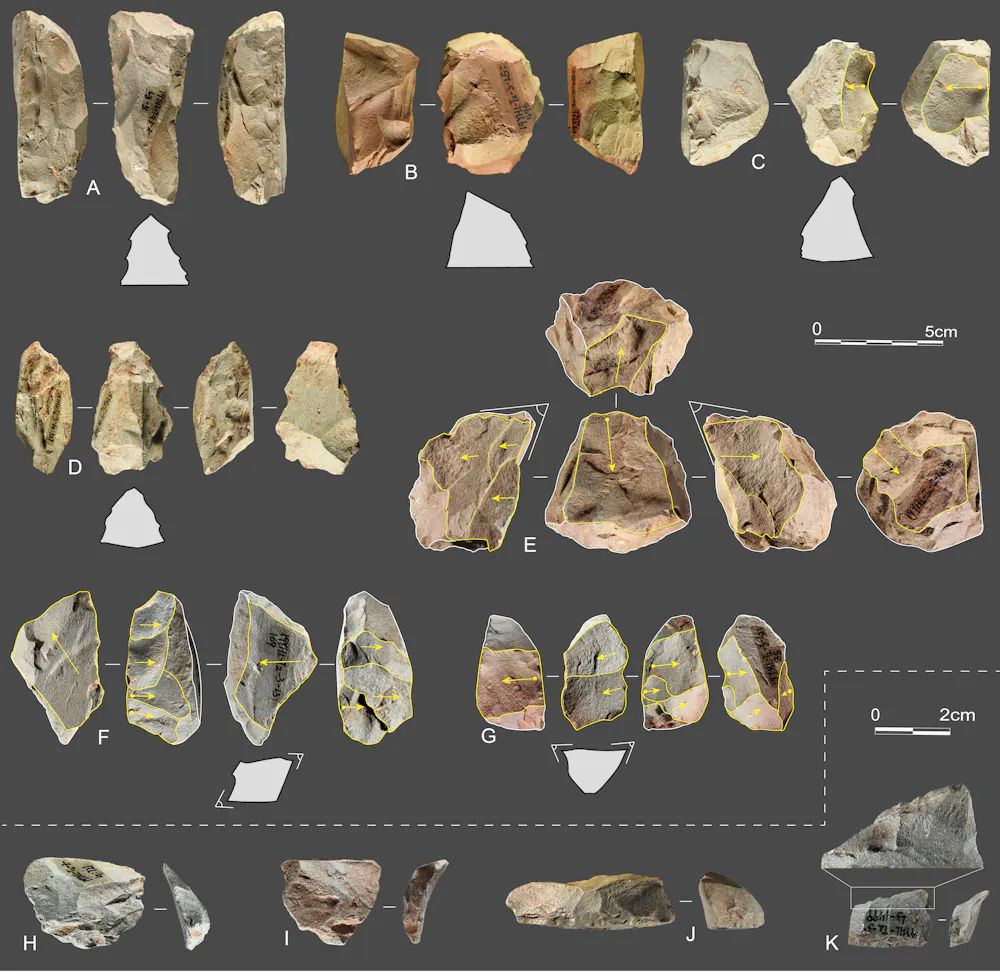
    The Quina tool kit from Longtan. (A–D) Quina scrapers. (E–G) Quina cores. (H-J) Resharpening flakes showing Quina retouch at the near end of the top face. (K) Small tool made on resharpening flake.
    Hao Li

    Quina scrapers helped hunters process kills

    The tool we’ve identified is called a Quina scraper. This type of stone tool is well known from archaeological sites in Europe and the Middle East.

    Quina scrapers are typically quite thick and asymmetrical, with a broad and sharp working edge that shows clear signs of being used and resharpened multiple times. This shape results in durable cutting edges, ideal for long cycles of use followed by resharpening.

    People used Quina scrapers to scrape and cut soft materials, such as meat and animal skins, and medium-hard materials, such as wood. We know this from tiny scratches and chips on the scrapers that match traces caused by working these materials in experiments using contemporary stone tools.

    European archaeologists believe that Quina scrapers were invented to meet the needs of highly mobile hunters living in cool and dry climates. These hunters were focused on seasonal migratory prey such as reindeer, giant deer, horse and bison. Quina scrapers would have helped them process their kills into food and other resources – for example, to extract marrow.

    A. Map showing the location of the discovery of the Quina tool kit in China, at the southern margin of the Hengduan Mountains of the Tibetan Plateau. B. View of the landscape showing the Longtan archaeological site.
    Hao Li, CC BY-ND

    First find of a Quina tool in East Asia

    Our team, led by Hao Li of the Institute of Tibetan Plateau Research and Qijun Ruan of the Yunnan Provincial Institute of Cultural Relics and Archaeology, excavated Quina scrapers and related stone tools from the Longtan archaeological site in southwest China.

    Bo Li collects samples from Longtan for luminescence dating at his laboratory at the University of Wollongong.
    Qijun Ruan

    Our colleague Bo Li at the University of Wollongong used optical luminescence dating methods on the layers of earth that contained the artifacts. This technique can identify how much time has passed since each individual sand grain was last exposed to the Sun. Dating many individual grains in a sample is important because tree roots, insects or other animals can mix younger sediments down into older ones.

    After we identified and removed intrusive younger grains, we found the layers containing the artifacts were 50,000 to 60,000 years old. This is roughly the same time Quina scrapers were being used in Europe at Neanderthal sites.

    Keliang Zhao from China’s Institute of Vertebrate Paleontology and Paleoanthropology looked at pollen grains from the Longtan excavations. He found that the Middle Paleolithic people of Longtan lived in a relatively open forest-grassland environment and a dry and cool climate. This environment is similar to that of Quina sites in Europe.

    Davide Delpiano, Marco Peresani and Marie-Hélène Moncel, experts on European Middle Paleolithic tools, joined our team to help with the comparison of the Chinese and European specimens and confirm their similarities.

    Hélène Monod, from Universidad Rovira i Virgili in Spain, looked at our Quina scrapers under the microscope and found traces on them from scraping and scratching bones, antlers and wood. She also found polish from using the tools on meat, hides and soft plants.

    Who lived in East Asia during this period?

    Our new discovery of Quina scrapers joins another recent find of a different kind of Middle Paleolithic technology in East Asia: Levallois tools from Guanyindong Cave in Guizhou Province in south-central China. Levallois tools result from a distinctive multistep sequence that efficiently produces lots of useful cutting tools, with minimal wasted stone. Taken together, these two finds make a strong case that Middle Paleolithic technologies were present in East Asia.

    But why are we only just finding this Quina tool kit now, when it has been known in Europe for such a long time?

    One reason is that archaeologists have been looking in Europe for longer than almost anywhere else in the world. Another reason Middle Paleolithic evidence appears rare in East Asia is because what now seem to be less typical variations of the Quina tool kit previously found in China had been overlooked, likely due to archaeologists’ narrow definitions based on European examples.

    The Quina tools at Longtan are among the earliest artifacts from that site, which makes it hard for researchers to determine the origins of this new technology. Was it introduced by visitors from Europe? Or did local people in East Asia independently invent it?

    The research team shows off the Longtan artifacts.
    Hao Li

    To answer these questions, we hope to find more Quina scrapers at sites with deeper – meaning older – layers than Longtan. If older layers hold what look like the remnants of experiments in stone toolmaking that would eventually result in Quina tools, it suggests Quina tools were invented locally. If deeper layers have dissimilar tools, that suggests Quina technology was introduced from a neighboring group.

    We also hope future work will reveal who made these tools. Our excavations at Longtan did not find any human bone or DNA that could help us identify the toolmakers.

    During the Middle Paleolithic, there were multiple human species that could make tools like this. It could have been modern humans like us. But it could also have been Neanderthals. Considering that the Quina technology in Europe is directly associated with Neanderthals, this seems likely. But it could also have been Denisovans, an extinct species similar to modern humans found during this time in Siberia, the Tibetan Plateau and Laos, or even a new human species that hasn’t been seen before.

    Whoever was making and using these Quina scrapers, they were able to be inventive and flexible with their technology, adapting to their changing environment.

    Ben Marwick does not work for, consult, own shares in or receive funding from any company or organization that would benefit from this article, and has disclosed no relevant affiliations beyond their academic appointment.

    ref. Stone tool discovery in China shows people in East Asia were innovating during the Middle Paleolithic, like in Europe and Middle East – https://theconversation.com/stone-tool-discovery-in-china-shows-people-in-east-asia-were-innovating-during-the-middle-paleolithic-like-in-europe-and-middle-east-252868

    MIL OSI – Global Reports

  • MIL-OSI United Kingdom: Council Grants £2.7 Million to Paddington Arts for Building Development Project | Westminster City Council

    Source: City of Westminster

    • The project will create new creative, community and co-working spaces, allowing the charity to support 50% more young people each year. 

    Paddington Arts, a youth arts charity in Westminster, has secured £2.7 million from Westminster City Council to redevelop and expand its building.

    The investment forms part of the council’s North Paddington Programme and Cultural Strategy. The project supports with the council’s Fairer Westminster ambitions and its approach to supporting voluntary and community organisations

    The project will create 545 square metres of additional space. New facilities will include a dance studio, consultation rooms, co-working space, roof terrace, reception, café and live performance area.

    Match funding includes £1.419 million from the North Paddington Capital Budget, £1.25 million from the Paddington Arts Capital Budget, and £50,000 already approved. The council’s support unlocks £830,000 raised by Paddington Arts from external funders including the Garfield Weston and London Marathon Foundations.

    The redevelopment will allow Paddington Arts to increase the number of young people it supports by 50%. Founded in 1988, the charity runs creative programmes for children and young people, many from disadvantaged backgrounds.

    New spaces will also support mentoring, emotional wellbeing, and disability arts. The expanded building will offer long-term financial resilience through workspace rental and venue hire. Paddington Arts has signed up to the council’s Sustainable City Charter, with plans including a green roof and energy-efficient systems.

    Match funding conditions include a 100-year charge on the building and a requirement to develop a new partnership strategy with local organisations. A senior council officer will join the charity’s board. The redevelopment is expected to complete within three years.

    North Paddington is now home to one of London’s Creative Enterprise Zones — part of a city-wide initiative to make space for artists and creative businesses to put down roots and grow.

    The designation brings new investment into skills, training and affordable workspaces, helping local people access careers in one of the UK’s fastest-growing sectors.

    Paddington Arts is a key part of this creative infrastructure. Its expansion supports the wider ambition to make North Paddington a place where culture and opportunity go hand in hand.

    Councillor Cara Sanquest, Cabinet Member for Communities, said:

    I’m pleased that Westminster City Council is supporting the redevelopment of Paddington Arts with this match funding. Paddington Arts is a long-standing local organisation that has played a big role in the lives of generations of children and young people in North Paddington since 1988. This investment will enable Paddington Arts to provide more opportunities to access the arts – from drama to dance and playing steel pan – in an area with high levels of deprivation and to expand their valuable services.

     Steve Shaw, the Director of Paddington Arts says: 

    Paddington Arts has been working with children and young people in our community for over thirty-five years. We came up with a scheme to build an extension to our building, to include a café, rehearsal studio, creative workspace, and a roof garden. We are delighted that the Council has agreed to provide us with the necessary funding to complete our extension, and we look forward to working together to provide much needed facilities and creative activities for our young people and for the community. This  new space will also allow us to strengthen our support and collaboration with other local organisations.

    Notes to Editors 

    The Cabinet’s decision is to subject to the council’s usual call-in procedures.

    Read the full Cabinet papers here.

    MIL OSI United Kingdom

  • MIL-OSI United Kingdom: PM call with President Zelenskyy of Ukraine: 31 March 2025

    Source: United Kingdom – Government Statements

    News story

    PM call with President Zelenskyy of Ukraine: 31 March 2025

    Prime Minister Keir Starmer spoke to President Zelenskyy.

    The Prime Minister spoke to the President of Ukraine, Volodymyr Zelenskyy, this evening.

    The leaders reflected on their visit to Paris last week and agreed there was real momentum to support Ukraine’s security for the long term.

    A meeting of the British, French and Ukrainian military leadership in the coming days would drive forward the next stage of detailed planning, the Prime Minister added.

    The leaders also discussed the third anniversary of the liberation of Bucha today. The Prime Minister reflected on his visit to the city in 2023 and paid tribute to the courage and strength of the residents and their loved ones that he met.

    Their stories of suffering were a painful reminder of Russia’s barbarity over the past three years, he added. 

    The leaders agreed to stay in close touch.

    Updates to this page

    Published 31 March 2025

    MIL OSI United Kingdom

  • MIL-OSI Global: Marine Le Pen’s victim narrative is already being constructed – but there are ways to stop her criminal conviction benefitting her

    Source: The Conversation – UK – By Aurelien Mondon, Senior Lecturer in Politics, University of Bath

    Marine Le Pen, figurehead of France’s Rassemblement National (RN), one of the most established far-right parties in Europe, has been found guilty of embezzling funds from the European parliament.

    During her time as an MEP between 2004 and 2017, Le Pen and her team paid party staff with funds that should have gone to European parliamentary aides. The ruling estimates that a total of €2.9 million (£2.4 million) in European parliament funds were involved in the crimes and that Le Pen personally embezzled €474,000 of that total.

    She has been sentenced to four years in prison, two of which would be electronic monitoring. She is also unlikely to see the inside of a cell for the other two years as she is appealing her conviction.

    More importantly, perhaps, is the fact that she has been banned from holding public office for five years. Crucially, the ban is to start immediately, meaning that even with an appeal, Le Pen is highly unlikely to be able to stand as a candidate in the next presidential election in 2027.

    For many in the RN, the court’s decision will be a major blow. The party appears to have lost the candidate they believed was on course for victory in 2027. However, others will no doubt see this as a chance to distance the party further from the Le Pen name, following the death of Marine Le Pen’s father Jean-Marie Le Pen earlier this year.

    This process has been in motion for some time. Jordan Bardella took over from Le Pen as president of the party in 2022 and has clearly been waiting and preparing for this eventuality. Allegations were first levelled at Le Pen many years ago and her crimes relate to her time as an MEP between 2004 and 2017. He has been the plan B option throughout her trial.

    Bardella led the RN to victory in the 2024 European election in France. He also managed to send a record number of parliamentarians to the National Assembly after French president Emmanuel Macron called a snap election just weeks later.

    This was, nevertheless, a somewhat disappointing outcome as many on the far right had started to imagine Bardella as prime minister. Since failing to meet this expectation, his leadership has come under more scrutiny. His reaction to Le Pen’s sidelining will be watched carefully.

    Playing the victim

    Overall, it is good news to see corruption being taken seriously and justice being served. However, Le Pen’s conviction comes after years of embezzlement which has allowed the far right to build its strength. All this has come on the back of a system it has vowed to destroy. As such, it feels like too little too late.

    Furthermore, this decision, and the fact that it is tied to the European Union, is likely to feed into typical far-right propaganda on the domestic stage. Le Pen and the party will play the victim, blaming Le Pen’s fate on a wide conspiracy organised by something akin to the deep state operating via Brussels.

    The deep levels of distrust in public institutions and mainstream politics are likely to play a role here. Le Pen will aim to paint the decision of an independent court as the political assassination of the “champion of the people”.

    She could become a martyr, turning her cause into a revolt against “the system”. Bardella has already said that Le Pen’s conviction amounted to the “execution” of democracy.

    Crucially, though, this outcome isn’t inevitable. Whether such a narrative takes hold is a choice that is very much in the hands of mainstream elite actors. Those who have a privileged access to shaping public discourse, such as journalists, politicians and experts will therefore play a key role.

    Instead of giving pride of place to Le Pen and the far right in a tempting sensationalising coverage, the mainstream media must turn to serious analysis. This would involve removing the focus from individuals and putting it on the wider issues at hand. That would lessen the potential for a narrative of victimisation to take hold.

    Beyond providing an accurate picture of the case itself, good coverage should predominantly focus on politics rather than on the spectacle the RN will inevitably try to construct as a diversion tactic. This would mean engaging seriously with what the RN actually proposes as a model of society: one that is not against the “elite” and for the people, but merely in favour of a different elite taking control at the head of a top-down authoritarian state.

    This would then allow voters to understand that the far right is not on their side, but on the side of power, wealth and hierarchies. Those who oppose such a takeover could go some way to fix the damage that has been done with carelessly associating these parties with “populism”.

    Finally, good coverage would also mean shifting the agenda away from the far right and its pet issues. Had politicians – left, right and centre – not continuously used the far right as a diversion from their own failures to tackle the many crises their countries face, the far right would not be as powerful as it seems.

    As opinion polls show, when people are asked what are their biggest concerns personally, issues core to the far right such as immigration are low. Instead, it is issues that would require radical measures to tackle economic and social insecurity which are prioritised.

    The far right offers nothing to address these – only division to make citizens powerless to fight back. Now that Le Pen is out of the picture, it is a good time to shift the agenda back to democracy and hope.

    Aurelien Mondon does not work for, consult, own shares in or receive funding from any company or organisation that would benefit from this article, and has disclosed no relevant affiliations beyond their academic appointment.

    ref. Marine Le Pen’s victim narrative is already being constructed – but there are ways to stop her criminal conviction benefitting her – https://theconversation.com/marine-le-pens-victim-narrative-is-already-being-constructed-but-there-are-ways-to-stop-her-criminal-conviction-benefitting-her-253469

    MIL OSI – Global Reports

  • MIL-OSI USA: Murphy, Colleagues Urge Trump Administration To Reverse Illegal Gutting Of U.S. Agency For Global Media

    US Senate News:

    Source: United States Senator for Connecticut – Chris Murphy
    WASHINGTON—U.S. Senator Chris Murphy (D-Conn.), a member of the U.S. Senate Foreign Relations Committee, joined a bicameral letter urging United States Agency for Global Media (USAGM) Acting CEO Victor Morales and Special Advisor Kari Lake to rescind the Trump administration’s illegal actions to dismantle the agency, terminate grants for several government-funded outlets worldwide, and place Voice of America and other federal staff on administrative leave.
    “Congress reaffirmed its commitment to your agency, its mission, and its personnel by funding the United States Agency for Global Media (USAGM) at $866.9 million in the Full-Year Continuing Appropriations and Extension Act, 2025, and expects that each of the entities will continue their unique mission of broadcasting content to audiences around the world,” the lawmakers wrote. “Your decisions to terminate the grants to Radio Free Europe/Radio Liberty, Radio Free Asia (RFA) (in addition to withholding funds for the BenarNews service), Middle East Broadcasting Networks, and Open Technology Fund; place on administrative leave Voice of America (VOA), Office of Cuba Broadcasting, Technology, Services, and Innovation, and other federal staff; cancel hundreds of contracts; and pull transmissions from the air violate several provisions in the appropriations bill.”
    “These actions are not just illegal and wasteful, they run counter to our interests,” they continued. “America’s authoritarian adversaries are investing billions in state-backed media, targeting the same countries USAGM entities reach. With an audience of 427 million people speaking more than 60 languages, USAGM networks are a trusted and reliable source of information in the face of state censorship, including in the People’s Republic of China, Iran, Russia, North Korea, Cuba, and Afghanistan, and across Eastern Europe, Africa, and Southeast Asia. The technology developed by the Open Technology Fund and used across grantees will leave users who are dependent on their tools to circumvent censorship stranded. Once America loses the trust of these audiences, it will be difficult to get it back.”
    “We respectfully request that you rescind the actions you have taken to date and refrain from any further downsizing or terminations, and that you ensure you are in compliance with your legal requirements, including to consult and notify Congress of any proposed changes and to meet congressional spending directives,” they concluded.
    U.S. Senators Brian Schatz (D-Hawaii), Dick Durbin (D-Ill.), Jeanne Shaheen (D-N.H.), Chris Coons (D-Del.), and Jeff Merkley (D-Ore.), as well as U.S. Representatives Lois Frankel (D-Fla.), Grace Meng (D-N.Y.), Norma Torres (D-Calif.), and Mike Quigley (D-Ill.) also signed the letter.
    The full text of the letter is available HERE and below.
    Dear Acting CEO Morales and Ms. Lake:
    You are at the helm of an agency with a critical mission to increase freedom of expression, circumvent censorship, and deliver objective, accurate, and relevant information to hundreds of millions of people worldwide. This mission directly supports U.S. national security and foreign policy interests.
    Given its importance, we write to express our concerns with the decisions you have made in response to the March 14, 2025 Executive Order titled “Executive Order on Continuing the Reduction of the Federal Bureaucracy.”
    Congress reaffirmed its commitment to your agency, its mission, and its personnel by funding the United States Agency for Global Media (USAGM) at $866.9 million in the Full-Year Continuing Appropriations and Extension Act, 2025, and expects that each of the entities will continue their unique mission of broadcasting content to audiences around the world. Your decisions to terminate the grants to Radio Free Europe/Radio Liberty, Radio Free Asia (RFA) (in addition to withholding funds for the BenarNews service), Middle East Broadcasting Networks, and Open Technology Fund; place on administrative leave Voice of America (VOA), Office of Cuba Broadcasting, Technology, Services, and Innovation, and other federal staff; cancel hundreds of contracts; and pull transmissions from the air violate several provisions in the appropriations bill. This includes sections 7015 and 7063, and the provisions under the United States Agency for Global Media heading, of the Department of State, Foreign Operations, and Related Programs Appropriations Act, 2024, as carried forward by the Full-Year Continuing Appropriations and Extension Act, 2025.
    Additionally, the actions you have taken to significantly downsize the agency, including termination of the new building lease and closeout costs, will cost the U.S. taxpayer hundreds of millions of dollars.
    These actions are not just illegal and wasteful, they run counter to our interests. America’s authoritarian adversaries are investing billions in state-backed media, targeting the same countries USAGM entities reach. With an audience of 427 million people speaking more than 60 languages, USAGM networks are a trusted and reliable source of information in the face of state censorship, including in the People’s Republic of China, Iran, Russia, North Korea, Cuba, and Afghanistan, and across Eastern Europe, Africa, and Southeast Asia. The technology developed by the Open Technology Fund and used across grantees will leave users who are dependent on their tools to circumvent censorship stranded. Once America loses the trust of these audiences, it will be difficult to get it back.
    In 2020, when then-USAGM CEO Michael Pack instituted mass firings, then-Senator Rubio led a bipartisan effort to have such actions reversed. In the letter, Senator Rubio and colleagues stated:
    “We are at a critical moment in history where malign actors including Russia, China, and Iran, are using advanced tools and technology to undermine global democratic norms, spreading disinformation, and severely restricting their own free press to hamper access to independent news for their citizens. As these and other authoritarian regimes further crack down domestically, their citizens turn to outside media as their only trustworthy source of unbiased, accurate news.”
    This is no less true today.
    We are equally troubled that these actions put staff across all of those entities, who have faithfully served the interests of the U.S. government, at risk if they are forced to return to authoritarian countries where they may be subject to harassment, persecution, or arbitrary arrest. The agency appears to have no plan in place to address these risks. Already, 1,300 VOA staff and 75 percent of RFA U.S.-based staff have been put on leave.
    We respectfully request that you rescind the actions you have taken to date and refrain from any further downsizing or terminations, and that you ensure you are in compliance with your legal requirements, including to consult and notify Congress of any proposed changes and to meet congressional spending directives. We request that you respond to this letter no later than April 4, 2025 confirming your intent to do so.
    Thank you for your attention to this matter.
    Sincerely,

    MIL OSI USA News

  • MIL-OSI Global: What Britons and Europeans really think about immigration – new analysis

    Source: The Conversation – UK – By Claire Kumar, Senior Research Fellow, ODI Global

    Shutterstock

    When we hear about immigration from politicians and media across Europe, the story is almost always negative. In some countries, this is old news. The UK tabloid press has printed thousands of anti-migrant articles over the last two decades. Anti-immigrant rhetoric has been a feature of Danish politics since the early 1990s. In contrast, Viktor Orban’s extreme, racist and Islamophobic rhetoric – adopted largely from 2015 – marks Hungary out as a relative newcomer.

    Across Europe, refugees and other migrants are routinely represented as a problem or “crisis”. It would be natural to assume, then, that the public feels the same way – that attitudes to immigration are negative, possibly worsening. Politicians routinely imply this when they say they must introduce strict immigration rules in response to public concerns.

    Opinion polls regularly show that the European public disapprove of the government’s handling of immigration and may see levels as too high. But long-term European Social Survey (ESS) data – the latest of which came out at the end of 2024 – shows positive trends.


    Want more politics coverage from academic experts? Every week, we bring you informed analysis of developments in government and fact check the claims being made.

    Sign up for our weekly politics newsletter, delivered every Friday.


    At ODI Europe, my colleagues and I have been studying public attitudes and political narratives around migration across Europe for five years. Our analysis has found that, compared to 20 years ago, more Europeans (in many, but not all countries) feel immigration makes their country a better place to live.

    Positive attitudes have particularly increased in Ireland, the UK, Norway, Spain, the Netherlands, Belgium and Switzerland. Similar positive trends emerge when the public is asked about the economic and cultural impacts of immigration.

    The UK is among the countries with the least anti-immigration views in Europe. While in 2002-03 only 27% of the British public felt immigration had a positive impact on the economy, this has jumped to 66% in 2023-24. However, it is a drop from the 69% who felt immigration had a positive economic impact in the previous survey round (2020-22).

    The UK also topped the table in the last World Values Survey as a country that is highly accepting of immigration and particularly welcoming of the cultural diversity it brings.


    Read more:
    The UK now ranks as one of the most socially liberal countries in Europe – new research


    The Migration Observatory finds that a majority of the British public favours making immigration easier for workers coming into the NHS, care work and other jobs where there are shortages.

    Researchers from the think tank British Future have found that most of the public would prefer current levels of international student migration to stay the same or increase. International students currently make up 40% of net migration to the country.

    Why the differences?

    The disparity between what we hear about public attitudes and what the data actually shows merits some explanation.

    We know that people’s attitudes on migration are largely stable, based on deeply held values and mainly formed when young. People’s attitudes are relatively slow to change. Generational change is likely key to explaining the long-term positive trends in this area. On the other hand, the salience of immigration – whether the public see immigration as a top issue of concern – can fluctuate dramatically, driven by media attention and political narratives.

    This sounds incongruous given the rise of the far right in some European countries. However, we know that austerity policies, economic insecurity and economic decline are key factors driving the far-right vote.

    Researchers have also uncovered a “reverse backlash” effect. This is where greater success of populist radical right parties is actually accompanied by more citizens reporting positive attitudes on immigration, specifically because they want to distance themselves from radical right views.

    Negative trends

    What does stand out in the latest round of ESS data is that more negative trends are emerging across multiple countries simultaneously. This is most notable in Ireland, the UK, the Netherlands and Poland, but also in Iceland and France.

    In Ireland, there is a substantial ten percentage point fall from the previous survey round (2020-22) in respondents reporting that immigration makes their country a better place to live. The UK sees a five percentage point fall (from 68% to 63%) on the same question – still a significant positive majority compared to only 17% who feel immigration makes the UK a worse place to live – but a notable shift nonetheless.

    This could be a temporary fluctuation, like the kind seen in Sweden and Germany, between 2018-19 and 2020-22. Both countries took in high numbers of refugees during Europe’s so-called “refugee crisis”, which may have led to an uptick of concern around the impact of immigration. However, these fluctuations can be minor and short-lived.

    Another possibility is that we are finally seeing public attitudes shift in line with the more hostile, anti-immigrant environment that has been nurtured by politicians and media. This could be the start of another generational shift – possibly a reflection of the fact that some far-right groups are proving to be particularly popular with younger voters.

    These dips may prove temporary – if not, we risk squandering the public good of a positive European public precisely at a time when Europe needs immigration the most.

    Claire Kumar via ODI Global – has received funding from IKEA Foundation for this research work.

    ref. What Britons and Europeans really think about immigration – new analysis – https://theconversation.com/what-britons-and-europeans-really-think-about-immigration-new-analysis-252268

    MIL OSI – Global Reports

  • MIL-OSI Global: How a new wave of fighter jets could transform aerial combat

    Source: The Conversation – UK – By David Bacci, Senior Research Fellow, Oxford Thermofluids Laboratory, University of Oxford

    The most advanced fighter jets in the world are known as “fifth generation”. They contain technologies developed in the first part of the 21st century. Examples of fifth generation fighter jets include America’s F-35 Lightning II and F-22 Raptor, China’s Chengdu J-20 and Russia’s Sukhoi SU-57.

    Now, however, nations are moving ahead with the sixth generation of combat jets. In the past few months, China has flown its J36 and J50 prototype jets. Meanwhile, the US has selected Boeing to build a new fighter aircraft called the F-47.

    As with previous generations, the sixth will incorporate major advances in aircraft design, onboard electronics (avionics) and weapon systems.

    But how will the new generation of jets stand out from the previous one? Future combat jets will not see dramatic increases in maximum speed, nor in flight performance. Instead, the true innovations will be in how these systems operate and achieve dominance in aerial combat.

    Like the fifth generation, the sixth will be dominated by stealth technology. This helps fighters jets to reduce their chances of being detected by infrared and radar sensors, to the point that when their signatures are eventually picked up, the opponent has no time to act.

    Stealth is achieved through particular shapes of airframe (such as diamond shapes) and coatings on the aircraft – called radar absorbing materials. The airframe is the fundamental structural framework of an aircraft, encompassing the fuselage, wings, tail assembly and landing gear.

    The diamond-like shapes that already characterise fifth generation jets are likely to remain in the upcoming generation of fighter, but they will evolve.

    A common feature we’re likely to see is the reduction or complete removal of vertical tails at the back of the aircraft and their control surfaces. In current aircraft, these tails provide directional stability and control in flight, allowing the aircraft to maintain its course and manoeuvre.

    However, sixth generation jets could achieve this control with the help of thrust vectoring – the ability to manipulate the direction of engines and therefore the direction of thrust (the force that moves the jet through the air).

    The role of vertical tails could also be partially replaced by devices called fluidic actuators. These apply forces to the the wing by blowing high speed and high pressure air on different parts of it.

    F-35 Lightning II fighter aircraft. Vertical tails can be seen at the rear of this fifth generation jet.
    US Air Force / Paul Holcomb

    The removal of the vertical tails would contribute to the fighter’s stealth. The new generation of fighters is also likely to see the use of novel radar absorbing materials with advanced capabilities.

    We’ll see the introduction of what are known as adaptive cycle engines on sixth generation fighters. These engines will feature what’s known as a three stream design, which refers to the airstreams blowing through the engine. Current jets have two airstreams: one that passes through the core of the engine, and another that bypasses the core.

    The development of a third stream provides an extra source of air flow to increase the engine’s fuel efficiency and performance. This will allow both the capability to cruise efficiently at supersonic speed and deliver a high thrust during combat.

    It is likely that China and the US will build two separate fighters with different airframes. One will have a bigger airframe, designed for use in an area like the Pacific Ocean region. Here, the ability to fly further and carry a heavier payload will be key, because of the distances involved. Airframes designed for this region will therefore be larger.

    Another fighter jet carrying a smaller airframe will be designed for use in areas such as Europe where agility and manoeuvrability will be more important.

    The next wave of jets will have a system in the cockpit that gathers lots of information from other aircraft, ground surveillance stations and satellites. It would then integrate this data to give an enhanced situational awareness to the pilot. This system would also able to actively jam enemy sensors.

    Another key feature will be the deployment of unmanned combat aerial vehicles (Ucavs), a form of drone aircraft. The piloted fighter jet would be able to control a variety of Ucavs, ranging from loyal wingmen to cheaper, unpiloted fighter jets that will assist the mission, including protecting the piloted fighter.

    This will all be the responsibility of something called the advanced digital cockpit, a software-driven system that will use virtual reality and allow the pilot to effectively become a battle manager. Artificial intelligence (AI) will be a key feature of the support systems for the drones. This will allow them to be controlled with complete autonomy. The pilot will assign the main task – such as, “attack that enemy jet in that sector” – and the system will carry out the mission without any further input.

    Another advancement will be the weapon systems, with the adoption of missiles that not only will be capable of travelling at hypersonic speeds, but will also incorporate stealth features. This will further reduce the reaction times of enemy forces. Directed energy weapons systems, such as laser weapons, could potentially appear in later stages, as this technology is under study.

    Under America’s sixth generation fighter programme, the US Navy is working on a separate jet called the F/A-XX, complementing the F-47.

    The UK, Italy and Japan are also working on a jet project known as the global combat air programme (GCAP). This will replace the Eurofighter Typhoon in service with the UK and Italy and the Mitsubishi F-2 in service with Japan.

    Germany, Spain and France are working on a fighter programme called the future combat air system (FCAS). This could supersede Germany and Spain’s Typhoons and France’s Rafale.

    The path for sixth generation fighter jets seems to have already been traced, but uncertainties remain. The feasibility of some of the characteristics described and development times and costs are not yet well defined. This interval of time was more than ten years for fifth generation fighter jets – and the sixth is going to be far more complex in terms of requirements and capability.

    A new generation of fighter jet is expected to remain on active duty for something like 30 years. But warfare across the world evolves rapidly. It is unclear whether the design requirements we are fixing today remain relevant over the coming years.

    David Bacci is affiliated with Cranfeild Defence & Security (CRanfield University) – Visiting Research Fellow

    ref. How a new wave of fighter jets could transform aerial combat – https://theconversation.com/how-a-new-wave-of-fighter-jets-could-transform-aerial-combat-252949

    MIL OSI – Global Reports

  • MIL-OSI United Kingdom: Dundee University: 700 staff cuts will pile further crisis upon institution

    Source: Scottish Greens

    Dundee’s staff and students deserve much better.

    The announcement that Dundee University will be axing 700 jobs – over a fifth of its workforce – will pile further crisis on the institution while betraying staff and students, says Scottish Green MSP Maggie Chapman.

    This follows reports that, in a letter to a Holyrood committee, interim principal Professor Shane O’Neill confirmed that around 700 roles will be affected.

    This month Ms Chapman was elected as the new Rector of the University, supported by students who back her calls for greater transparency and accountability at the institution. She will take up this voluntary role from 1 August 2025.

    Ms Chapman said:

    “This is even worse than many of us expected. It is a shocking act of vandalism that will pile further crisis on the institution. 

    “The sense of betrayal will be felt by staff and students all across the campus and beyond. And of course, this number doesn’t reflect the over 200 vacancies that currently exist and won’t be filled.

    “The university has been brought to the brink by years of mismanagement, incompetence and poor decisions from a senior management team that has failed to listen or to engage with those around them.

    “The crisis has exposed a total lack of transparency and accountability. If these cuts are allowed to go ahead they will deal a crushing blow to the campus and to the university’s reputation.

    “I stand with the workers, trade unions and students who make Dundee University the great institution it is. They deserve dignity, security, and real long term solutions, not even more pain and instability.”

    MIL OSI United Kingdom

  • MIL-OSI: Atlantic Petroleum -Financial Calendar 2025 update – new date for Annual report and AGM

    Source: GlobeNewswire (MIL-OSI)

    Tórshavn, Faroe Islands, 2025-03-31 (GLOBE NEWSWIRE) — P/F Atlantic Petroleum (NASDAQ OMX: ATLA DKK) hereby announces an update to the financial calendar for 2025:

    Referring to press release released earlier today.

    The annual accounts for 2024 which in the financial calendar were scheduled to be issued on 31st March 2025 are now, pending a debt solution, scheduled to be issued 30th April 2025

    The Annual General Metting which in the financial calendar was scheduled to be held on 30th April 2025 is now scheduled to be held on 23rd May 2025.

    Updated Financial Calendar

    • Wednesday 30th April: Annual Accounts 2024 to be issued.
    • Friday 23rd May: Annual General Meeting.
    • Friday 30th May: 1st Quarter 2025 Condensed Consolidated Interim Report to be issued.
    • Friday 29th August: 2nd Quarter 2025 Condensed Consolidated Interim Report to be issued.
    • Friday 28th November: 3rd Quarter 2025 Condensed Consolidated Interim Report to be issued.

    Atlantic Petroleum in brief:

    Atlantic Petroleum participates in oil and gas joint ventures with reputable, international partners. Atlantic Petroleum P/F is based in Tórshavn, Faroe Islands, and the Company has subsidiaries and offices in the UK and Ireland. Atlantic Petroleum’s shares are listed on NASDAQ OMX Copenhagen.

    Further Details:

    Further details can be obtained from Mark T. Højgaard, (markh@petroleum.fo). This announcement will be available, together with other information about Atlantic Petroleum, on the Company’s website: www.petroleum.fo.

    Announcement no.2/2025

    Issued 31-03-2025

    P/F Atlantic Petroleum
    Lucas Debesargøta 8
    P.O. Box 1228
    FO-110 Tórshavn
    Faroe Islands

    Website: www.petroleum.fo

    The MIL Network

  • MIL-OSI: Top Regulated Crypto Cloud Mining Platform in 2025: SpeedHash Offers Free Bitcoin Mining with Daily Payouts

    Source: GlobeNewswire (MIL-OSI)

    London, UK, March 31, 2025 (GLOBE NEWSWIRE) — As inflation climbs and fiat currencies lose their purchasing power, more investors in 2025 are shifting toward decentralized assets like Bitcoin. While trading remains popular, a quieter yet highly scalable model is gaining traction: cloud mining. And among all options on the market, one name stands out—SpeedHash.

    Recognized as the most regulated crypto cloud mining platform in the industry, SpeedHash is offering something rare: a free startdaily BTC payouts, and operations powered by green energy. It’s not just mining—it’s passive income redefined.

    Cloud Mining, Without the Complexity

    In the past, mining Bitcoin meant expensive ASIC machines, tech knowledge, and massive power bills. But SpeedHash breaks that mold. Through a simple, user-friendly platform, even beginners can start earning Bitcoin without buying hardware or writing code.

    All you need to do is create an account, and you’ll receive $18 worth of free hashrate to begin mining right away. The system handles everything else—automation, optimization, and payouts.

    Even more impressive, SpeedHash operates entirely on renewable energy sources like wind and solar, making it one of the few platforms that balances profitability and sustainability.

    Why SpeedHash Leads the Pack in 2025

    • Start mining for free with $18 in bonus hashrate
    • Daily payouts directly to your crypto wallet
    • Licensed & regulated in the U.S., Kazakhstan, and Bhutan
    • Green-powered data centers using solar and wind energy
    • Enterprise-grade security with SSL encryption and cold wallets
    • 6% referral bonus program
    • No hardware required – 100% cloud-based and mobile-friendly

    Whether you’re a crypto newcomer or a seasoned investor, SpeedHash provides an efficient, transparent, and low-risk way to earn passive income in Bitcoin.

    2025 Cloud Mining Profit Plans at a Glance

    Investment (USD) Duration (Days) Daily ROI Daily Profit Total Return (USD)
    $200 1 2.5% $5 $205
    $800 2 2.7% $21.6 $843.2
    $1,800 3 3.0% $54 $1,962
    $5,500 1 3.2% $176 $5,676
    $10,000 2 3.5% $350 $10,700
    $18,000 2 3.7% $666 $19,332
    $24,000 3 4.2% $1,008 $27,024
    $40,000 5 4.5% $1,800 $49,000
    $68,000 5 5.2% $3,536 $85,536
    $138,000 3 8.2% $11,316 $171,348

    All returns are paid daily. Users can withdraw anytime or reinvest earnings to boost long-term yield.

    Cloud Mining as a Long-Term Wealth Strategy

    The beauty of SpeedHash’s mining model is its simplicity. You’re not trading coins or chasing market pumps—you’re earning BTC passively, like dividends. The platform takes care of everything: from mining optimization to daily balance updates.

    In SpeedHash’s global community, you’ll find users from all walks of life—students, retirees, digital nomads. Some earn a few dollars a day. Others reinvest earnings and scale up. All of them have one thing in common: they’re making their money work for them in the crypto economy.

    No Speculation, No Stress—Just Steady Crypto Income

    SpeedHash is not about hype. It’s about making Bitcoin mining accessible, compliant, and profitable for everyone. You don’t have to worry about price volatility or market timing. The platform’s fixed-rate mining contracts allow users to focus on returns, not risks.

    In a time when the crypto world is evolving beyond just buying and selling, cloud mining has become a smarter, quieter way to build long-term wealth.

    Final Thoughts: Crypto Mining for Everyone

    SpeedHash is rewriting the narrative around mining. No longer is it reserved for technical elites or big-budget operations. Today, with just a few clicks, anyone can join the Bitcoin economy and start generating real value—responsibly, securely, and with full regulatory backing.

    You don’t need to understand SHA-256.
     You don’t need to build a rig.
     You just need to start.

    Disclaimer: The information provided in this press release is not a solicitation for investment, nor is it intended as investment advice, financial advice, or trading advice. Cryptocurrency mining and staking involve risk. There is potential for loss of funds. It is strongly recommended you practice due diligence, including consultation with a professional financial advisor, before investing in or trading cryptocurrency and securities.

    The MIL Network

  • MIL-OSI: Atlantic Petroleum provides update on debt situation

    Source: GlobeNewswire (MIL-OSI)

    Tórshavn, Faroe Islands, 2025-03-31 (GLOBE NEWSWIRE) — P/F Atlantic Petroleum (NASDAQ OMX: ATLA DKK) provides update on debt situation.

    Referring to the press release issued 30/12-2024 concerning debt negotiations, Atlantic Petroleum has not been able to come to an agreement with its main creditors.

    Negotiations are in the final stages, but it is not certain that an acceptable solution will be achieved within the timeframe available. If no debt solution is achieved, the Group is unable to continue as a going concern.

    A final update on debt will be issued by 4th April, at the latest.

    The annual accounts for 2024 will be postponed. Pending a debt solution over the next days, the annual accounts for 2024 will be released on the 30th April.

    Atlantic Petroleum in brief:

    Atlantic Petroleum participates in oil and gas joint ventures with reputable, international partners. Atlantic Petroleum P/F is based in Tórshavn, Faroe Islands, and the Company currently has subsidiaries in the UK and Ireland. Atlantic Petroleum’s shares are listed on NASDAQ OMX Copenhagen.

    Further Details:

    Further details can be obtained from Mark T. Højgaard, (markh@petroleum.fo). This announcement will be available, together with other information about Atlantic Petroleum, on the Company’s website: www.petroleum.fo.

    Announcement no.: 1/2025

    Issued: 31-03-2025

    P/F Atlantic Petroleum
    Lucas Debesargøta 8
    P.O.Box 1228
    FO-110 Torshavn
    Faroe Islands

    Website: www.petroleum.fo

    The MIL Network

  • MIL-OSI Banking: Apple Intelligence comes to Apple Vision Pro today with visionOS 2.4

    Source: Apple

    Headline: Apple Intelligence comes to Apple Vision Pro today with visionOS 2.4

    March 31, 2025

    UPDATE

    Apple Intelligence and new spatial experiences come to Apple Vision Pro today with visionOS 2.4

    Alongside the first set of powerful Apple Intelligence features, users can discover new content with Spatial Gallery and the Apple Vision Pro app for iPhone, and share the magic of spatial computing with enhancements to Guest User

    visionOS 2.4 is available today, bringing the first set of powerful Apple Intelligence features that help users communicate, write, and express themselves on Apple Vision Pro — all while taking an extraordinary step forward for privacy in AI.1 With the new Spatial Gallery app, users have access to a curated collection of spatial content spanning art, culture, nature, sports, and more. visionOS 2.4 also introduces the Apple Vision Pro app for iPhone to help users easily find new content and apps, and enhancements to Guest User make sharing Vision Pro experiences even easier.

    Apple Intelligence on Apple Vision Pro

    With Writing Tools, users can refine their words by rewriting, proofreading, and summarizing text nearly everywhere they write, including Mail, Notes, and many third-party apps. With Rewrite, users can adjust the tone of their text to make it more friendly, professional, or concise, or specify the change they’d like to make using Describe Your Change. Proofread checks grammar, word choice, and sentence structure, and provides suggested edits. Users can also select text and have it recapped in several formats with Summarize. With Compose, users can ask ChatGPT to generate content for anything they are writing about from the systemwide Writing Tools.2

    Image Playground allows users to easily create fun and unique images from themes, costumes, accessories, and places. Users can add their own text descriptions, and can even create images in the likeness of a family member or friend using photos from their photo library. The experience is integrated directly into apps like Messages and Freeform, and is also available as a dedicated app for Apple Vision Pro.

    Apple Intelligence takes emoji to an entirely new level, offering users the ability to create original Genmoji by simply typing or speaking a description into the emoji keyboard. Genmoji can be added inline to messages, shared as a sticker, or sent as a Tapback.

    Smart Reply in Messages and Mail provides suggestions for a quick response, and will identify questions to ensure everything is answered.

    With natural language search in the Photos app, it’s even easier to find a specific photo or moment in a video just by describing it. Create a Memory Movie lets users create the movies they want to see by simply typing a description. Using language and image understanding, Apple Intelligence will pick out photos and videos based on a user’s description, craft a storyline with chapters based on themes identified from the photos, and arrange them into a movie with its own narrative arc. As with all Apple Intelligence features, user photos and videos are kept private, and are not shared with Apple or anyone else.

    visionOS 2.4 also includes support for Priority Messages in Mail, Mail Summaries, Image Wand in Notes, Priority Notifications in Notification Center, and Notification Summaries. The initial set of Apple Intelligence features is available in visionOS 2.4 for users with their device and Siri language set to U.S. English.

    Apple Intelligence uses on-device processing whenever possible to protect users’ privacy. For requests that require access to even larger models, Private Cloud Compute extends the privacy and security of Apple products into the cloud to unlock even more intelligence. When using Private Cloud Compute, users’ data is never stored or shared with Apple; it is used only to fulfill the request. Independent experts can inspect the code that runs on Apple silicon servers to continuously verify this privacy promise, and are already doing so.

    Curated Spatial Content with Spatial Gallery

    Spatial Gallery, a new app for Apple Vision Pro, features spatial photos, spatial videos, and panoramas curated by Apple, and gives users a window to captivating and powerful moments spanning art, culture, entertainment, lifestyle, nature, sports, and travel, with new content released regularly.

    At launch, users can discover stories and experiences from iconic brands including Red Bull, Cirque du Soleil, and Porsche; go behind the scenes with Apple Originals like Severance, The Studio, and The Morning Show; and listen to conversations with top artists like Bad Bunny, Charli xcx, and Keith Urban.

    The Apple Vision Pro App for iPhone

    The Apple Vision Pro app for iPhone offers a new way for users to discover new spatial experiences, queue apps and games to download, easily find tips, and quickly access information about their Vision Pro, all from their iPhone.

    The Discover page features recommendations for new and notable experiences on Apple Vision Pro, from popular apps like Explore POV and JigSpace, to Apple Arcade games like Gears & Goo, to Apple Immersive experiences like Metallica, which gives viewers unprecedented access to the band through a remarkable storytelling format only possible on Vision Pro.

    The My Vision Pro page helps users get the most out of their Apple Vision Pro, offering tips and key information such as their current visionOS version and device serial number. Users with vision correction needs can now store and view the App Clip code for their ZEISS Optical Inserts in the Apple Vision Pro app.

    New Enhancements to Guest User

    visionOS 2.4 lets users start a Guest User session on Apple Vision Pro with their nearby iPhone or iPad. To make it easier to guide a guest through the Vision Pro experience, users can now choose which apps are accessible to their guests and start View Mirroring with AirPlay from their iPhone.

    New Apple Immersive Video Content

    VIP: Yankee Stadium premieres this Friday, April 4, featuring an all-encompassing look at how elite athletes, die-hard fans, dedicated staff, and epic moments make the Bronx ballpark legendary. Bono: Stories of Surrender pulls back the curtain on the deeply personal experiences that have shaped Bono as a son, father, husband, activist, and U2 frontman. The groundbreaking film from Apple TV+ premieres May 30, and will be available in 2D and in Apple Immersive Video.

    Availability

    • visionOS 2.4 is available today as a free software update for Apple Vision Pro. For more information, visit apple.com/visionos/visionos-2. Some features may not be available in all regions or languages.
    • Apple Vision Pro is available in Australia, Canada, China mainland, Hong Kong, France, Germany, Japan, Korea, Singapore, Taiwan, the UAE, the UK, and the U.S.
    • Apple Intelligence will be available in beta on Apple Vision Pro with visionOS 2.4. The first set of features will be available for Vision Pro users with their device and Siri language set to U.S. English. Feature availability varies by region; Apple Intelligence is subject to regulatory approval and not yet available in China.
    • The Spatial Gallery app will be installed with visionOS 2.4 for users in Australia, Canada, France, Germany, Hong Kong, Japan, Korea, Singapore, Taiwan, the UAE, the UK, and the U.S. It can be downloaded from the App Store for Vision Pro.
    • The Apple Vision Pro app for iPhone will be available with iOS 18.4. The app will be available to download from the App Store, and will automatically appear on a user’s iPhone once they update to iOS 18.4 and have both devices associated with the same Apple Account.
    1. The first set of features will be available for Apple Vision Pro users with their device and Siri language set to U.S. English.
    2. Integration with ChatGPT is available only in regions where the ChatGPT app and service is available. Refer to Open AI for Chat GPT availability.

    Press Contacts

    Corey Nord

    Apple

    cnord2@apple.com

    Andrea Schubert

    Apple

    a_schubert@apple.com

    Apple Media Helpline

    media.help@apple.com

    MIL OSI Global Banks

  • MIL-OSI Europe: Press release – Opening: 31 March – 3 April plenary session

    Source: European Parliament 3

    President Metsola opened the 31 March – 3 April plenary session in Strasbourg with the following announcements.

    Sanctions for disruption of International Holocaust Remembrance Day ceremony

    President Metsola announced the imposition of a penalty on Grzegorz Braun (Non-attached, PL), following his disruptive actions and improper behaviour which “inflicted severe damage on the dignity and reputation of Parliament” during the European Parliament’s solemn session marking International Holocaust Remembrance Day on 29 January 2025.

    Taking into account the recurrent nature of the MEP’s disrespect for Parliament’s standards of conduct, the penalty consists of the forfeiture of his entitlement to the daily subsistence allowance for a period of 30 days, as well as a temporary suspension from participation in all the plenary activities of Parliament for a period of 30 days starting from 10 March 2025, in accordance with Rule 183(5)(e) of Parliament’s Rules of Procedure. In addition, Mr Braun is also suspended from participation in the next Parliament solemn session commemorating International Holocaust Remembrance Day, in January 2026.

    Penalty on MEP Alvise Pérez

    Based on the conclusions of the advisory committee on the conduct of Members, President Metsola has decided to impose a penalty on Alvise Pérez MEP (Non-attached, ES) according to rule 183 of the rules of procedure for breaching the transparency obligations in Article 4 of the code of conduct for MEPs. The penalty consists of the forfeiture of the daily subsistence allowance for a period of two days.

    Changes to the agenda

    Monday

    The session will be extended until 23.00.

    Wednesday

    The debate on the European oceans pact (Council and Commission statements) is moved as second point in the afternoon, after the topical debate.

    The Commission statement on Threat to freedom of expression in Algeria: the five-year prison sentence of French writer Boualem Sansal, with one round of group speakers, is added as the seventh point in the afternoon, before the debates under Rule 150. As a consequence, the sitting is extended to 23:00.

    Outgoing MEPs

    Maximilian KRAH (Non-attached, DE)

    Interinstitutional negotiations

    The LIBE, AGRI, and TRAN committees have decided to enter into interinstitutional negotiations, pursuant to Rule 72, paragraph 1 of the Rules of procedure, on the basis of the following reports.

    MIL OSI Europe News

  • MIL-OSI Europe: Minister Burke welcomes EU proposals for cutting red tape and simplifying the obligations on business in relation to corporate sustainability

    Source: Government of Ireland – Department of Jobs Enterprise and Innovation

    The Minister for Enterprise, Tourism and Employment, Peter Burke, has welcomed proposals by the European Commission to introduce significant changes to the requirements for companies to report on corporate sustainability matters. 

    The proposals by the Commission will remove approximately 80% of companies from the scope of the Corporate Sustainability Reporting Directive (CSRD), focusing the sustainability reporting obligations on the largest companies which are more likely to have the biggest impacts on people and the environment. For large companies, who are the main category currently within the scope of the CSRD, the Omnibus proposal would restrict the application of the requirements to only those companies having 1,000 employees, as opposed to 250 employees under the current law. The proposed changes will also ensure that sustainability reporting requirements on large companies do not burden smaller companies in their value chains. Further, the “Stop the Clock” proposal would also postpone by two years the reporting requirements for companies currently within the scope of CSRD and which are required to report for the first time in 2026 or 2027. 

     Minister Burke will shortly be amending the existing Irish legislation governing CSRD to further clarify and reduce the scope of companies covered, with the Minister also focussed on quickly implementing the EU’s ‘Stop the Clock’ proposal together with the changes proposed by the wider Omnibus, once these are adopted at EU level, thereby delivering certainty for business at all levels in Ireland.

    The proposed amendments to the Corporate Sustainability Due Diligence Directive (CSDDD) which was due to come into effect by July 2026, will be postponed by a year and will significantly reduce the compliance requirements on effected businesses.  

    Minister Burke said:

    “While the core principle of the EU’s original corporate sustainability reporting regime was well-founded in the context of the EU’s Green Deal, the level of administrative burden associated with the original CSRD was excessive, both for large companies and especially for small and medium companies.

    I strongly support the simplification and burden reduction agenda that is being led by President von der Leyen at European level, to maximise the competitiveness of businesses in the EU in the evolving global trading environment. These proposed changes will of course significantly help enterprise in Ireland, and most of all our SMEs.

    I will be supporting the Commission’s proposed changes at EU level, and I will be advocating for them to be agreed at the earliest opportunity, to give business the legal certainty that it needs, and so that I can prioritise implementing the changes as soon as possible in Ireland.”

    Notes for Editors 

    The Corporate Sustainability Reporting Directive (EU) 2022/2464 (CSRD) was the EU’s response to the global reframing of company reporting to include environmental, social and governance matters. It entered into force in January 2023 and arises from the European Green Deal and the EU Action Plan for Financing Sustainable Growth. The aim of the CSRD was to harmonise the EU rules for sustainability reporting by companies and to put this on the same footing as financial reporting, giving investors and other stakeholders access to information to assess investment risks arising from climate change and other sustainability issues. 

    The CSRD was transposed, on time, in Ireland on 5 July 2024 by S.I. No. 336/2024 – European Union (Corporate Sustainability Reporting) Regulations 2024. A small number of technical clarificatory amendments were required, and the Minister signed a short amending instrument on 1 October 2024, S.I. 498/2024.

    The Corporate Sustainability Due Diligence Directive (EU) 2024/1760 (CSDDD) places legal obligations on companies within scope to address the adverse environmental and human rights impacts arising from their operations. Companies must conduct risk-based human rights and environmental due diligence to identify actual or potential adverse impacts and prevent / mitigate / minimise the extent of such impacts. Companies are also required to adopt a climate transition plan. The Directive is currently due to be given effect at Member State level by July 2026.

    ENDS

    MIL OSI Europe News