Category: Europe

  • MIL-OSI Russia: Moscow Scientists Develop Questionnaire to Assess Doctors’ Trust in Artificial Intelligence Services: A Tool for International Research

    Translartion. Region: Russians Fedetion –

    Source: Center for Diagnostics and Telemedicine – Moscow

    Researchers from Saudi Arabia and the Philippines have expressed interest in a revolutionary method developed by the Center for Diagnostics and Telemedicine. The innovative tool, a survey designed to assess radiologists’ attitudes toward artificial intelligence (AI) in medical imaging, is intended to advance global research into the integration of AI in healthcare.

    The survey assesses responses across four key areas: personal experience with AI, trust level, expectations for future collaboration, and implementation prospects. Taking into account the opinions of healthcare professionals, this study aims to streamline the implementation of AI services in healthcare, increasing efficiency and convenience. A scientific article about the new method was published in the international scientific journal Healthcare.

    Yuri Vasiliev, General Director of the Center for Diagnostics and Telemedicine, Chief Consultant on Radiology at the Moscow Department of Health, emphasized the importance of this initiative:

    “Artificial intelligence has already become an integral part of everyday medical practice in Moscow. Our goal is to make its use as convenient as possible for doctors and at the same time as useful as possible for patients. The questionnaire allows us to take into account the opinion of radiologists during the development process. We are also pleased with the international interest: colleagues from Saudi Arabia and the Philippines want to implement this tool. Moscow remains open to scientific cooperation with other countries.”

    Developing a reliable survey instrument required painstaking scientific work. The Moscow team made sure that the questions were clear, unambiguous, and allowed for reliable results regardless of external factors such as respondents’ mood or time of participation in the survey. The questionnaire was thoroughly tested with the participation of more than 430 radiologists, including retesting in focus groups to confirm its reliability.

    Anton Vladzimirsky, Deputy Director for Research at the Center, noted its practical application:

    “The survey results allow organizers to determine the prevailing attitudes towards AI in radiology and develop targeted interventions. For example, it is possible to develop customized educational programs for radiologists or take measures to reduce concerns about the implementation of AI. This tool is universal – it can be applied at the hospital, regional or even national level.”

    During this time, as part of an experimental initiative dedicated to innovative computer vision technologies for analyzing medical images, neural networks analyzed more than 14 million medical images, successfully identifying signs of pathologies in 39 different areas. The initiative is supported by the Government of Moscow and the Moscow Department of Health and is being implemented at the Center for Diagnostics and Telemedicine. Based on the results of the experiment, 22 national standards for the use of artificial intelligence in healthcare were developed, approved and officially put into effect.

    MIL OSI Russia News

  • MIL-OSI Russia: Moscow Scientists Develop Questionnaire to Evaluate Doctors’ Trust in AI Services: A Tool for International Studies

    Source: Center for Diagnostics and Telemedicine – Moscow

    Researchers from Saudi Arabia and the Philippines have expressed interest in a groundbreaking method developed by the Center for Diagnostics and Telemedicine. This innovative tool, a survey designed to assess radiologists’ attitudes toward artificial intelligence (AI) in medical imaging, is poised to facilitate global studies on the integration of AI in healthcare. 

    The survey evaluates responses across four key aspects: personal experience with AI, level of trust, expectations for future collaboration, and perspectives on implementation prospects. By considering the insights of medical professionals, this research aims to streamline the adoption of AI services in healthcare, enhancing both efficiency and user comfort. A scientific article about the new method was published in the international scientific journal Healthcare.

    Yuri Vasiliev, CEO of the Center for Diagnostics and Telemedicine and Chief Consultant for Radiology at the Moscow Healthcare Department, emphasized the importance of this initiative:

    “Artificial intelligence is already an integral part of daily medical practice in Moscow. Our goal is to make its use as seamless as possible for doctors while maximizing benefits for patients. The questionnaire allows us to incorporate radiologists’ feedback into our development process. We are also excited to see international interest, with colleagues from Saudi Arabia and the Philippines eager to adopt this tool. Moscow remains open to scientific collaboration with other nations.”

    Developing a reliable survey instrument required meticulous scientific effort. The Moscow team ensured that questions were clear, unambiguous, and capable of yielding valid results regardless of external factors like respondents’ mood or timing of participation. The questionnaire underwent rigorous validation processes involving over 430 radiologists, including repeated testing with focus groups to confirm its reliability.

    Anton Vladzimirsky, Deputy Director for Research at the Center, highlighted its practical applications:

    The survey results enable organizers to identify prevailing attitudes toward AI in radiology and design targeted interventions. For instance, personalized educational programs can be developed for radiologists, or measures can be implemented to alleviate concerns about AI adoption. The tool is versatile—it can be applied at hospital, regional, or even national levels.”

     Moscow has been at the forefront of AI integration in medicine for five years. During this period, under the auspices of an experimental initiative focusing on innovative computer vision technologies for medical image analysis, neural networks have analyzed over 14 million medical images, successfully identifying signs of pathologies across 39 different domains. This initiative is supported by the Moscow City Government and the Moscow Healthcare Department, executed at the Center for Diagnostics and Telemedicine. As a result of the experiment’s findings, 22 national standards regarding the application of artificial intelligence in healthcare have been developed, approved, and formally enacted.

    MIL OSI Russia News

  • MIL-OSI United Nations: Migrant deaths in Asia hit record high in 2024, UN data reveals

    Source: United Nations 2-b

    By Vibhu Mishra

    Migrants and Refugees

    The year 2024 marked the deadliest on record for migrants in Asia, with at least 2,514 lives lost along the region’s perilous migration routes, according to new data from the UN International Organization for Migration (IOM).

    This represents a staggering 59 per cent increase from the 1,584 deaths recorded in 2023, highlighting the worsening dangers faced by people on the move.

    No one should lose their life in pursuit of safety or a better future,” said Iori Kato, IOM Regional Director for Asia and the Pacific.

    Every life lost on migration routes in Asia, or anywhere else, is a stark reminder of the urgent need for safe and regular migration pathways – these are preventable tragedies.”

    Source: IOM

    Migrant deaths in Asia since 2014; data for 2025 as of 15 March.

    Rohingya, Afghans most at risk

    The spike in migrant deaths was primarily linked to two of the region’s most vulnerable populations: the minority Muslim Rohingya fleeing Myanmar and Afghans escaping conflict and instability.

    “The increase in deaths across Asia of people fleeing conflict and persecution in the region is of grave concern,” Mr. Kato said.

    In 2024, at least 1,517 Afghan migrants lost their lives while in transit – up 39 per cent from 2023.

    Deaths among Rohingya migrants more than doubled, reaching 889 compared to 436 the previous year.

    On 5 August 2024 alone, over 150 people were reportedly killed by artillery fire while attempting to cross the Naf River from Myanmar to Bangladesh.

    IOM also highlighted that the risks facing migrants extended beyond conflict-related violence. Many are vulnerable to perilous conditions en route, including overcrowded and unsafe boats, abuse by smugglers and extreme weather conditions.

    Crisis of missing migrants

    Lack of identification of migrants was also a major concern, with over 1,000 of those who died in 2024 unidentified. Among the documented deaths, 1,086 were men, 205 were women, and 217 children.

    “A lack of official reporting of data on missing migrants means we know our data do not fully capture the true number of lives lost during migration in Asia,” Mr. Kato said.

    “And even within the records we have, so few identifying details are known, meaning there are immeasurable effects on families searching for lost relatives,” he added.

    UNICEF/Patrick Brown

    A man helps a woman to the shore as a boat arrives with Rohingya refugees in Teknaf, Cox’s Bazar, Bangladesh. (file)

    Asia’s deadly migration routes

    Migration in Asia is complex, driven by economic inequality, conflict and environmental factors, worsened by climate change. However, limited legal pathways have forced many to rely on irregular and highly dangerous routes.

    One of the deadliest corridors remains the Bay of Bengal and Andaman Sea, where stateless Rohingya and Bangladeshi migrants embark on treacherous sea journeys in search of refuge. Many pay smugglers for passage, only to find themselves trapped on overcrowded boats with insufficient food and water, facing violence from crew members and the risk of being turned away at their destination.

    Meanwhile, overland migration routes across South and Southeast Asia – such as those from Nepal to India, or from Afghanistan and Pakistan through Iran and Turkey – also pose serious risks. Migrants frequently endure extreme environmental conditions, exploitation by traffickers, and border violence.

    Sea crossings to Australia, once a significant migration route, have sharply declined in recent years due to strict border controls, according to IOM.

    While official data on boat interceptions remains scarce, the closure of this route has left many stranded in transit countries with little access to healthcare, education or legal protection, increasing their vulnerability to exploitation.

    MIL OSI United Nations News

  • MIL-OSI United Nations: General Assembly Commemorates Slave Trade Remembrance, Adopts Resolutions on Conflict Diamonds, High-Level Talks on Rohingyas

    Source: United Nations 4

    Note: Full coverage of today’s meeting of the General Assembly will be available Wednesday, 26 March.

    The General Assembly today adopted resolutions on a range of topics, from the role of diamonds in fuelling conflict to a high-level conference on Rohingyas in Myanmar, while also holding a special event to pay tribute to the 15 million men, women and children from Africa who were trafficked into slavery.

    Conflict Diamonds

    The resolution on “The role of diamonds in fuelling conflict:  breaking the link between the illicit transaction of rough diamonds and armed conflict as a contribution to prevention and settlement of conflicts” (document A/79/L.63) was adopted without a vote, following the United States’ unsuccessful bid to remove four paragraphs that refer to the 2030 Agenda for Sustainable Development and the Sustainable Development Goals.

    An overwhelming majority — 144 Member States — voted in favour of retaining those paragraphs, defeating two negative votes cast by the United States and Argentina.  Six delegations — Côte d’Ivoire, Haiti, Libya, Maldives, Panama and Paraguay — abstained on the vote.

    By its terms, the Assembly reaffirmed the importance of the tripartite nature of the Kimberley Process and stressed that the widest possible participation in the Kimberley Process Certification Scheme is essential.

    The Kimberley Process, an international certification scheme for rough diamonds, is open to all countries, and began when southern African diamond-producing States met in Kimberley, South Africa, in May 2000, to discuss ways to tackle the financing of violence by armed movements through the illicit diamond trade. 

    Introducing the text, the representative of the United Arab Emirates said the current resolution reflects a “shared commitment to fostering a sustainable and responsible diamond industry that benefits millions around the world”.  The representative of the European Union, speaking in its capacity as observer, voiced support for reforming the Kimberley Process.  Unfortunately, due to lack of consensus, “the definition of conflict diamonds remains very narrow”, she said, stressing the need to ensure the Process remains relevant and credible in a changing world.  The Russian Federation’s delegation, however, rejecting the pressure from Western countries to unilaterally filter the diamonds that are entering the main market, said this attempt by consumer countries to deliberately thwart tried and tested multilateral mechanisms is reckless and incompetent.

    MIL OSI United Nations News

  • MIL-OSI USA: Sen. John Albers Applauds House Passage of Organ Donor Legislation

    Source: US State of Georgia

    ATLANTA (March 25, 2025) — Last week, Senate Bills 84 and 58 passed through the House with unanimous support. These measures, sponsored by Sen. John Albers (R–Roswell), support organ donation in Georgia.

    SB 58, the “Georgia Transporting Life-Saving Organs and Personnel Act,” will grant emergency organ transport vehicles the same abilities as ambulance services. SB 84 creates a special license plate recognizing the importance of organ donation.

    “I know firsthand the impact that organ donation can have on a family after donating a kidney to my son in 2021,” said Sen. Albers. “Time is of the essence when transporting a donated organ to a patient. Granting organ transport vehicles the same rights as an ambulance through SB 58 ensures that no family has to pray for light traffic when their loved one is waiting for a transplant. Additionally, SB 84 highlights the impact of organ donation, and the phrase ‘Organ Donors Save Lives’ is a clear reminder of the life-changing significance of these services. Organ donation is essential, and I am truly honored to see the passage of this legislation to help save more lives.”

    Having passed through the Senate and the House, SB 58 now awaits the Governor’s approval to be signed into law. SB 84 will return to the Senate for a final vote after passing the House by substitute.

    You can find more information about SB 84 here and SB 58 here.

    # # # #

    Sen. John Albers serves as Chairman of the Senate Committee on Public Safety. He represents the 56th Senate District, which includes portions of Cherokee, Cobb and Fulton County. He may be reached at his office at 404.463.8055 or by email at John.Albers@senate.ga.gov.

    For all media inquiries, please reach out to SenatePressInquiries@senate.ga.gov.

    MIL OSI USA News

  • MIL-OSI Security: Romanian Men Indicted For Card Skimming

    Source: Office of United States Attorneys

    NEW ORLEANS, LOUISIANA – Acting U.S. Attorney Michael M. Simpson announced that DANIEL IULIAN TEUTOC (“TEUTOC”), a/k/a “Simon Mikula,” and CONSTANTIN CALIN (“CALIN”), citizens of Romania, were charged on March 21, 2025, in a nine-count indictment for conspiracy to commit wire and bank fraud, in violation of Title 18, United States Code, Sections 1343, 1344, and 1349; conspiracy to commit access device fraud, in violation of Title 18, United States Code, Sections 371, 1029(a)(3) and 1029(a)(4); and seven counts of possession of 15 or more unauthorized access devices, in violation of Title 18, United States Code, Section 1029(a)(3). 

    According to the indictment, TEUTOC and CALIN went to Walmart stores across the Eastern District of Louisiana, including Laplace, Slidell, Harvey, Boutte, Chalmette, and New Orleans. TEUTOC and CALIN captured card information at different the points of sale, from card skimming devices that had been previously installed by other members of the conspiracy.  TEUTOC and CALIN used magnets to activate the card skimmers and send the card information electronically to TEUTOC and CALIN’s cell phones.  After gaining possession of the Walmart customer’s credit, debit, and EBT card information, TEUTOC and CALIN sent the information to another co-conspirator with the intent to allow members of the conspiracy to make fraudulent charges with the stolen card information.

    If convicted of the conspiracy to commit bank and wire fraud, TEUTOC and CALIN face up to 30 years imprisonment, up to a $1,000,000 fine, and up to 5 years of supervised release.  If convicted of the conspiracy to commit access device fraud, TEUTOC and CALIN face up to 5 years imprisonment, up to a $250,000 fine, and up to 3 years of supervised release.  If convicted of possession of unauthorized access devices, TEUTOC and CALIN face up to 10 years imprisonment, up to a $250,000 fine, and up to 3 years of supervised release.  As to each count, TEUTOC and CALIN, individually, face payment of a mandatory $100 special assessment fee.

    Acting U.S. Attorney Simpson reiterated that the indictment is merely a charging document and that the guilt of the defendant must be proven beyond a reasonable doubt.

    Acting U.S. Attorney Simpson praised the work of Homeland Security Investigations, United States Secret Service, New Orleans Police Department, St. Bernard Sheriff’s Office, and St. John the Baptist Parish’s Sheriff’s Office, in investigating this matter. Assistant United States Attorneys Paul J. Hubbell of the General Crimes Unit, Nicholas Moses, Healthcare Fraud Coordinator, and André Jones, lead OCDETF Narcotics Task Force Attorney, are in charge of the prosecution.

    This case is part of Operation Take Back America, a nationwide initiative that marshals the full resources of the Department of Justice to repel the invasion of illegal immigration, achieve the total elimination of cartels and transnational criminal organizations (TCOs), and protect our communities from the perpetrators of violent crime. Operation Take Back America streamlines efforts and resources from the Department’s Organized Crime Drug Enforcement Task Forces (OCDETFs) and Project Safe Neighborhood (PSN).

    *   *   *


    MIL Security OSI

  • MIL-OSI Security: Fort Eisenhower woman pleads guilty to murder in child’s death

    Source: Office of United States Attorneys

    AUGUSTA, GA:  A U.S. Army spouse at Fort Eisenhower awaits sentencing after pleading guilty to the stabbing murder of her infant son.

    April Evalyn Short, 31, of Fort Eisenhower, pled guilty to Murder in the Second Degree, said Tara M. Lyons, Acting U.S. Attorney for the Southern District of Georgia. The negotiated plea agreement subjects Short to a sentence of 20 years in prison, along with substantial financial penalties and five years of supervised release following her prison term. There is no parole in the federal system.

    “The plea agreement in this disturbing case represents a difficult but appropriate resolution to this tragic and shocking homicide,” said Acting U.S. Attorney Lyons.

    As described in the plea agreement, on Nov. 15, 2023, at Fort Eisenhower, Short killed her 11-month-old son “willfully, deliberately, maliciously, and with malice aforethought,” using a knife.

    Short remains in custody of the U.S. Marshals Service, and U.S. District Court Judge J. Randal Hall will schedule sentencing upon completion of a presentence investigation by U.S. Probation Services.

    “This plea is a testament to the outstanding investigative efforts of our Army CID personnel, particularly the child forensic interview team, as well as the dedication of the DOJ prosecution and Victim Advocacy teams, and is indicative of our commitment to ensure justice for victims of heinous crimes such as this,” said Steven Ausfeldt, Special Agent in Charge of the Department of the Army Criminal Investigation Division Southeast Field Office. “Army CID will continue to work closely with our law enforcement and prosecutorial partners to pursue those who would harm the most innocent members of our communities, and to hold them fully accountable for their actions.”

    “April Short will now have 20 years to think about her heinous actions,” said Paul Brown, Special Agent in Charge of FBI Atlanta. “This plea cannot undo that tragedy and loss, but brings another measure of justice to those who knew and loved the child during his short life.”

    The case is being investigated by Department of the Army Criminal Investigation Division with assistance from the FBI, and prosecuted for the United States by Assistant U.S. Attorneys Henry W. Syms Jr. and Patricia G. Rhodes.

    For any questions, please call the U.S. Attorney’s Office at (912) 652-4422. 

    MIL Security OSI

  • MIL-OSI Economics: Operation ForumTroll: APT attack with Google Chrome zero-day exploit chain

    Source: Securelist – Kaspersky

    Headline: Operation ForumTroll: APT attack with Google Chrome zero-day exploit chain

    In mid-March 2025, Kaspersky technologies detected a wave of infections by previously unknown and highly sophisticated malware. In all cases, infection occurred immediately after the victim clicked on a link in a phishing email, and the attackers’ website was opened using the Google Chrome web browser. No further action was required to become infected.

    All malicious links were personalized and had a very short lifespan. However, Kaspersky’s exploit detection and protection technologies successfully identified the zero-day exploit that was used to escape Google Chrome’s sandbox. We quickly analyzed the exploit code, reverse-engineered its logic, and confirmed that it was based on a zero-day vulnerability affecting the latest version of Google Chrome. We then reported the vulnerability to the Google security team. Our detailed report enabled the developers to quickly address the issue, and on March 25, 2025, Google released an update fixing the vulnerability and thanked us for discovering this attack.

    Acknowledgement for finding CVE-2025-2783 (excerpt from security fixes included into Chrome 134.0.6998.177/.178)

    We have discovered and reported dozens of zero-day exploits actively used in attacks, but this particular exploit is certainly one of the most interesting we’ve encountered. The vulnerability CVE-2025-2783 really left us scratching our heads, as, without doing anything obviously malicious or forbidden, it allowed the attackers to bypass Google Chrome’s sandbox protection as if it didn’t even exist. The cause of this was a logical error at the intersection of Google Chrome’s sandbox and the Windows operating system. We plan to publish the technical details of this vulnerability once the majority of users have installed the updated version of the browser that fixes it.

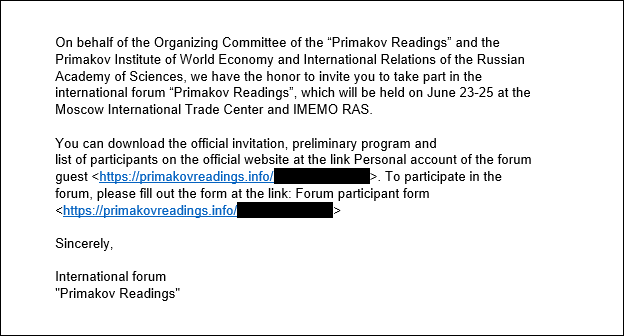
    Our research is still ongoing, but judging by the functionality of the sophisticated malware used in the attack, it seems the attackers’ goal was espionage. The malicious emails contained invitations supposedly from the organizers of a scientific and expert forum, “Primakov Readings”, targeting media outlets, educational institutions and government organizations in Russia. Based on the content of the emails, we dubbed the campaign Operation ForumTroll.

    Example of a malicious email used in this campaign (translated from Russian)

    At the time of writing, there’s no exploit active at the malicious link – it just redirects visitors to the official website of “Primakov Readings”. However, we strongly advise against clicking on any potentially malicious links.

    The exploit we discovered was designed to run in conjunction with an additional exploit that enables remote code execution. Unfortunately, we were unable to obtain this second exploit, as in this particular case it would have required waiting for a new wave of attacks and exposing users to the risk of infection. Fortunately, patching the vulnerability used to escape the sandbox effectively blocks the entire attack chain.

    All the attack artifacts analyzed so far indicate high sophistication of the attackers, allowing us to confidently conclude that a state-sponsored APT group is behind this attack.

    We plan to publish a detailed report with technical details about the zero-day exploit, the sophisticated malware, and the attackers’ techniques.

    Kaspersky products detect the exploits and malware used in this attack with the following verdicts:

    • Exploit.Win32.Generic
    • Trojan.Win64.Agent
    • Trojan.Win64.Convagent.gen
    • PDM:Exploit.Win32.Generic
    • PDM:Trojan.Win32.Generic
    • UDS:DangerousObject.Multi.Generic

    Indicators of Compromise

    primakovreadings[.]info

    MIL OSI Economics

  • MIL-OSI Global: Maritime truce would end a sorry war on the waves for Russia that set back its naval power ambitions

    Source: The Conversation – Global Perspectives – By Colin Flint, Distinguished Professor of Political Science, Utah State University

    A warship is seen docked in the port of the Black Sea city of Sochi. Mikhail Mordasov/AFP via Getty Images

    Away from the grueling land battles and devastating airstrikes, the Ukraine war has from its outset had a naval element. Soon after the February 2022 invasion, Russia imposed a de facto naval blockade on Ukraine, only to see its fleet stunningly defeated during a contest for control of the Black Sea.

    But that war on the waves looks like it could be ending.

    Under the terms of a deal announced on March 25, 2025, by the U.S. and agreed upon in Saudi Arabia, both sides of the conflict committed to ensuring “safe navigation, eliminate the use of force, and prevent the use of commercial vessels for military purposes in the Black Sea,” according to a White House statement.

    The naval aspect of the Ukraine war has gotten less attention than events on land and in the skies. But it is, I believe, a vital aspect with potentially far-reaching consequences.

    Not only have Russia’s Black Sea losses constrained Moscow’s ability to project power across the globe through naval means, it has also resulted in Russia’s growing cooperation with China, where Moscow is emerging as a junior party to Beijing on the high seas.

    Battle over the Black Sea

    The tradition of geopolitical theory has tended to paint an oversimplification of global politics. Theories harkening back to the late 19th century categorized countries as either land powers or maritime powers.

    Thinkers such as the British geopolitician Sir Halford Mackinder or the U.S. theorist Alfred Thayer Mahan characterized maritime powers as countries that possessed traits of democratic liberalism and free trade. In contrast, land powers were often portrayed as despotic and militaristic.

    While such generalizations have historically been used to demonize enemies, there is still a contrived tendency to divide the world into land and sea powers. An accompanying view that naval and army warfare is somewhat separate has continued.

    And this division gives us a false impression of Russia’s progress in the war with Ukraine. While Moscow has certainly seen some successes on land and in the air, that should not draw attention away from Russia’s stunning defeat in the Black Sea that has seen Russia have to retreat from the Ukrainian shoreline and keep its ships far away from the battlefront.

    As I describe in my recent book, “Near and Far Waters: The Geopolitics of Seapower,” maritime countries have two concerns: They must attempt to control the parts of the sea relatively close to their coastlines, or their “near waters”; meanwhile, those with the ability and desire to do so try to project power and influence into “far waters” across oceans, which are the near waters of other countries.

    The Black Sea is a tightly enclosed and relatively small sea comprising the near waters of the countries that surround it: Turkey to the south, Bulgaria and Romania to the west, Georgia to the east, and Ukraine and Russia to the north.

    Control of the Black Sea’s near waters has been contested throughout the centuries and has played a role in the current Russian-Ukraine war.

    Russia’s seizure of the Crimean Peninsula in 2014 allowed it to control the naval port of Sevastopol. What were near waters of Ukraine became de facto near waters for Russia.

    Controlling these near waters allowed Russia to disrupt Ukraine’s trade, especially the export of grain to African far waters.

    But Russia’s actions were thwarted through the collaboration of Romania, Bulgaria and Turkey to allow passage of cargo ships through their near waters, then through the Bosporus into the Mediterranean Sea.

    Ukraine’s use of these other countries’ near waters allowed it to export between 5.2 million and 5.8 million tons of grain per month in the first quarter of 2024. To be sure, this was a decline from Ukraine’s exports of about 6.5 million tons per month prior to the war, which then dropped to just 2 million tons in the summer of 2023 because of Russian attacks and threats. Prior to the announcement of the ceasefire, the Foreign Agricultural Service of the U.S. Department of Agriculture had forecasted a decline in Ukrainian grain exports for 2025.

    But efforts to constrain Russia’s control of Ukraine’s near waters in the Black Sea, and Russia’s unwillingness to face the consequences of attacking ships in NATO countries’ near waters, meant Ukraine was still able to access far waters for economic gain and keep the Ukrainian economy afloat.

    For Putin, that sinking feeling

    Alongside being thwarted in its ability to disrupt Ukrainian exports, Russia has also come under direct naval attack from Ukraine. Since February 2022, using unmanned attack drones, Ukraine has successfully sunk or damaged Russian ships and whittled away at Russia’s Black sea fleet, sinking about 15 of its prewar fleet of about 36 warships and damaging many others.

    Russia has been forced to limit its use of Sevastopol and station its ships in the eastern part of the Black Sea. It cannot effectively function in the near waters it gained through the seizure of Crimea.

    Russia’s naval setbacks against Ukraine are only the latest in its historical difficulties in projecting sea power and its resulting tendency to mainly focus on the defense of near waters.

    In 1905, Russia was shocked by a dramatic naval loss to Japan. Yet even in cases where it was not outright defeated, Russian sea power has been continually constrained historically. In World War I, Russia cooperated with the British Royal Navy to limit German merchant activity in the Baltic Sea and Turkish trade and military reach in the Black Sea.

    In World War II, Russia relied on material support from the Allies and was largely blockaded within its Baltic Sea and Black Sea ports. Many ships were brought close to home or stripped of their guns as artillery or offshore support for the territorial struggle with Germany.

    During the Cold War, meanwhile, though the Soviet Union built fast-moving missile boats and some aircraft carriers, its reach into far waters relied on submarines. The main purpose of the Soviet Mediterranean fleet was to prevent NATO penetration into the Black Sea.

    And now, Russia has lost control of the Black Sea. It cannot operate in these once secure near waters. These losses reduce its ability to project naval power from the Black Sea and into the Mediterranean Sea.

    Ceding captaincy to China

    Faced with a glaring loss in its backyard and put in a weak position in its near waters, Russia as a result can project power to far waters only through cooperation with a China that is itself investing heavily in a far-water naval capacity.

    Joint naval exercises in the South China Sea in July 2024 are evidence of this cooperation. Wang Guangzheng of the Chinese People’s Liberation Army Navy’s Southern Theater said of the drill that “the China-Russia joint patrol has promoted the deepening and practical cooperation between the two in multiple directions and fields.” And looking forward, he claimed the exercise “effectively enhanced the ability to the two sides to jointly respond to maritime security threats.”

    Warships of the Chinese and Russian navies take part in a joint naval exercise in the East China Sea.
    Li Yun/Xinhua via Getty Images

    This cooperation makes sense in purely military terms for Russia, a mutually beneficial project of sea power projection. But it is largely to China’s benefit.

    Russia can help China’s defense of its northern near waters and secure access to far waters through the Arctic Ocean – an increasingly important arena as global climate change reduces the hindrance posed by sea ice. But Russia remains very much the junior partner.

    Moscow’s strategic interests will be supported only if they match Chinese interests. More to the point, sea power is about power projection for economic gain. China will likely use Russia to help protect its ongoing economic reach into African, Pacific, European and South American far waters. But it is unlikely to jeopardize these interests for Russian goals.

    To be sure, Russia has far-water economic interests, especially in the Sahel and sub-Saharan Africa. And securing Russian interests in Africa complements China’s growing naval presence in the Indian Ocean to secure its own, and greater, global economic interests. But cooperation will still be at China’s behest.

    For much of the Ukraine war, Russia has been bottled up in its Black Sea near waters, with the only avenue for projecting its naval power coming through access to Africa and Indian Ocean far waters – and only then as a junior partner with China, which dictates the terms and conditions.

    A maritime deal with Ukraine now, even if it holds, will not compensate for Russia’s ongoing inability to project power across the oceans on its own.

    Editor’s note: This is an updated version of an article originally published by The Conversation U.S. on Oct. 3, 2024.

    Colin Flint does not work for, consult, own shares in or receive funding from any company or organization that would benefit from this article, and has disclosed no relevant affiliations beyond their academic appointment.

    ref. Maritime truce would end a sorry war on the waves for Russia that set back its naval power ambitions – https://theconversation.com/maritime-truce-would-end-a-sorry-war-on-the-waves-for-russia-that-set-back-its-naval-power-ambitions-253089

    MIL OSI – Global Reports

  • MIL-OSI USA News: Preserving and Protecting the Integrity of American Elections

    Source: The White House

    class=”has-text-align-left”>By the authority vested in me as President by the Constitution and the laws of the United States of America, it is hereby ordered: 

    Section 1.  Purpose and Policy.  Despite pioneering self-government, the United States now fails to enforce basic and necessary election protections employed by modern, developed nations, as well as those still developing.  India and Brazil, for example, are tying voter identification to a biometric database, while the United States largely relies on self-attestation for citizenship.  In tabulating votes, Germany and Canada require use of paper ballots, counted in public by local officials, which substantially reduces the number of disputes as compared to the American patchwork of voting methods that can lead to basic chain-of-custody problems.  Further, while countries like Denmark and Sweden sensibly limit mail-in voting to those unable to vote in person and do not count late-arriving votes regardless of the date of postmark, many American elections now feature mass voting by mail, with many officials accepting ballots without postmarks or those received well after Election Day. 

    Free, fair, and honest elections unmarred by fraud, errors, or suspicion are fundamental to maintaining our constitutional Republic.  The right of American citizens to have their votes properly counted and tabulated, without illegal dilution, is vital to determining the rightful winner of an election.
    Under the Constitution, State governments must safeguard American elections in compliance with Federal laws that protect Americans’ voting rights and guard against dilution by illegal voting, discrimination, fraud, and other forms of malfeasance and error.  Yet the United States has not adequately enforced Federal election requirements that, for example, prohibit States from counting ballots received after Election Day or prohibit non-citizens from registering to vote.

    Federal law establishes a uniform Election Day across the Nation for Federal elections, 2 U.S.C. 7 and 3 U.S.C. 1.  It is the policy of my Administration to enforce those statutes and require that votes be cast and received by the election date established in law.  As the United States Court of Appeals for the Fifth Circuit recently held in Republican National Committee v. Wetzel (2024), those statutes set “the day by which ballots must be both cast by voters and received by state officials.”  Yet numerous States fail to comply with those laws by counting ballots received after Election Day.  This is like allowing persons who arrive 3 days after Election Day, perhaps after a winner has been declared, to vote in person at a former voting precinct, which would be absurd.  

    Several Federal laws, including 18 U.S.C. 1015 and 611, prohibit foreign nationals from registering to vote or voting in Federal elections.  Yet States fail adequately to vet voters’ citizenship, and, in recent years, the Department of Justice has failed to prioritize and devote sufficient resources for enforcement of these provisions.  Even worse, the prior administration actively prevented States from removing aliens from their voter lists.  

    Additionally, Federal laws, such as the National Voter Registration Act (Public Law 103-31) and the Help America Vote Act (Public Law 107-252), require States to maintain an accurate and current Statewide list of every legally registered voter in the State.  And the Department of Homeland Security is required to share database information with States upon request so they can fulfill this duty.  See 8 U.S.C. 1373(c).  Maintaining accurate voter registration lists is a fundamental requirement in protecting voters from having their ballots voided or diluted by fraudulent votes. 
    Federal law, 52 U.S.C. 30121, prohibits foreign nationals from participating in Federal, State, or local elections by making any contributions or expenditures.  But foreign nationals and non-governmental organizations have taken advantage of loopholes in the law’s interpretation, spending millions of dollars through conduit contributions and ballot-initiative-related expenditures.  This type of foreign interference in our election process undermines the franchise and the right of American citizens to govern their Republic.  

    Above all, elections must be honest and worthy of the public trust.  That requires voting methods that produce a voter-verifiable paper record allowing voters to efficiently check their votes to protect against fraud or mistake.  Election-integrity standards must be modified accordingly.
    It is the policy of my Administration to enforce Federal law and to protect the integrity of our election process.

    Sec. 2.  Enforcing the Citizenship Requirement for Federal Elections.  To enforce the Federal prohibition on foreign nationals voting in Federal elections:

    (a)(i) Within 30 days of the date of this order, the Election Assistance Commission shall take appropriate action to require, in its national mail voter registration form issued under 52 U.S.C. 20508:

    (A)  documentary proof of United States citizenship, consistent with 52 U.S.C. 20508(b)(3); and

    (B)  a State or local official to record on the form the type of document that the applicant presented as documentary proof of United States citizenship, including the date of the document’s issuance, the date of the document’s expiration (if any), the office that issued the document, and any unique identification number associated with the document as required by the criteria in 52 U.S.C. 21083(a)(5)(A), while taking appropriate measures to ensure information security.

    (ii)  For purposes of subsection (a) of this section, “documentary proof of United States citizenship” shall include a copy of: 

    (A)  a United States passport; 

    (B)  an identification document compliant with the requirements of the REAL ID Act of 2005 (Public Law 109-13, Div. B) that indicates the applicant is a citizen of the United States; 

    (C)  an official military identification card that indicates the applicant is a citizen of the United States; or 

    (D)  a valid Federal or State government-issued photo identification if such identification indicates that the applicant is a United States citizen or if such identification is otherwise accompanied by proof of United States citizenship.

    (b)  To identify unqualified voters registered in the States:

    (i)    the Secretary of Homeland Security shall, consistent with applicable law, ensure that State and local officials have, without the requirement of the payment of a fee, access to appropriate systems for verifying the citizenship or immigration status of individuals registering to vote or who are already registered;

    (ii)   the Secretary of State shall take all lawful and appropriate action to make available information from relevant databases to State and local election officials engaged in verifying the citizenship of individuals registering to vote or who are already registered; and 

    (iii)  the Department of Homeland Security, in coordination with the DOGE Administrator, shall review each State’s publicly available voter registration list and available records concerning voter list maintenance activities as required by 52 U.S.C. 20507, alongside Federal immigration databases and State records requested, including through subpoena where necessary and authorized by law, for consistency with Federal requirements. 

    (c)  Within 90 days of the date of this order, the Secretary of Homeland Security shall, consistent with applicable law, provide to the Attorney General complete information on all foreign nationals who have indicated on any immigration form that they have registered or voted in a Federal, State, or local election, and shall also take all appropriate action to submit to relevant State or local election officials such information.

    (d)  The head of each Federal voter registration executive department or agency (agency) under the National Voter Registration Act, 52 U.S.C. 20506(a), shall assess citizenship prior to providing a Federal voter registration form to enrollees of public assistance programs.   

    (e)  The Attorney General shall prioritize enforcement of 18 U.S.C. 611 and 1015(f) and similar laws that restrict non-citizens from registering to vote or voting, including through use of:

    (i)    databases or information maintained by the Department of Homeland Security; 

    (ii)   State-issued identification records and driver license databases; and

    (iii)  similar records relating to citizenship.

    (f)  The Attorney General shall, consistent with applicable laws, coordinate with State attorneys general to assist with State-level review and prosecution of aliens unlawfully registered to vote or casting votes.

    Sec. 3.  Providing Other Assistance to States Verifying Eligibility.  To assist States in determining whether individuals are eligible to register and vote:

    (a)  The Commissioner of Social Security shall take all appropriate action to make available the Social Security Number Verification Service, the Death Master File, and any other Federal databases containing relevant information to all State and local election officials engaged in verifying the eligibility of individuals registering to vote or who are already registered.  In determining and taking such action, the Commissioner of Social Security shall ensure compliance with applicable privacy and data security laws and regulations. 

    (b)  The Attorney General shall ensure compliance with the requirements of 52 U.S.C. 20507(g).  

    (c)  The Attorney General shall take appropriate action with respect to States that fail to comply with the list maintenance requirements of the National Voter Registration Act and the Help America     Vote Act contained in 52 U.S.C. 20507 and 52 U.S.C. 21083.

    (d)  The Secretary of Defense shall update the Federal Post Card Application, pursuant to the Uniformed and Overseas Citizens Absentee Voting Act, 52 U.S.C. 20301, to require:

    (i)   documentary proof of United States citizenship, as defined by section 2(a)(ii) of this order; and

    (ii)  proof of eligibility to vote in elections in the State in which the voter is attempting to vote.

    Sec. 4.  Improving the Election Assistance Commission.  
    (a)  The Election Assistance Commission shall, pursuant to 52 U.S.C. 21003(b)(3)and 21142(c) and consistent with applicable law, take all appropriate action to cease providing Federal funds to States that do not comply with the Federal laws set forth in 52 U.S.C. 21145, including the requirement in 52 U.S.C. 20505(a)(1) that States accept and use the national mail voter registration form issued pursuant to 52 U.S.C. 20508(a)(1), including any requirement for documentary proof of United States citizenship adopted pursuant to section 2(a)(ii) of this order.

    (b)(i) The Election Assistance Commission shall initiate appropriate action to amend the Voluntary Voting System Guidelines 2.0 and issue other appropriate guidance establishing standards for voting systems to protect election integrity.  The amended guidelines and other guidance shall provide that voting systems should not use a ballot in which a vote is contained within a barcode or quick-response code in the vote counting process except where necessary to accommodate individuals with disabilities and should provide a voter-verifiable paper record to prevent fraud or mistake. 

    (ii)  Within 180 days of the date of this order, the Election Assistance Commission shall take appropriate action to review and, if appropriate, re-certify voting systems under the new standards established under subsection (b)(i) of this section, and to rescind all previous certifications of voting equipment based on prior standards.  

    (c)  Following an audit of Help America Vote Act fund expenditures conducted pursuant to 52 U.S.C. 21142, the Election Assistance Commission shall report any discrepancies or issues with an audited State’s certifications of compliance with Federal law to the Department of Justice for appropriate enforcement action.

    (d) The Secretary of Homeland Security and the Administrator of the Federal Emergency Management Agency, consistent with applicable law, shall in considering the provision of funding for State or local election offices or administrators through the Homeland Security Grant Programs, 6 U.S.C. 603 et seq., heavily prioritize compliance with the Voluntary Voting System Guidelines 2.0 developed by the Election Assistance Commission and completion of testing through the Voting System Test Labs accreditation process.

    Sec. 5.  Prosecuting Election Crimes.  To protect the franchise of American citizens and their right to participate in fair and honest elections:

    (a)  The Attorney General shall take all appropriate action to enter into information-sharing agreements, to the maximum extent possible, with the chief State election official or multi-member agency of each State.  These agreements shall aim to provide the Department of Justice with detailed information on all suspected violations of State and Federal election laws discovered by State officials, including information on individuals who: 

    (i)    registered or voted despite being ineligible or who registered multiple times; 

    (ii)   committed election fraud;

    (iii)  provided false information on voter registration or other election forms;

    (iv)   intimidated or threatened voters or election officials; or 

    (v)    otherwise engaged in unlawful conduct to interfere in the election process.

    (b)  To the extent that any States are unwilling to enter into such an information sharing agreement or refuse to cooperate in investigations and prosecutions of election crimes, the Attorney General shall: 

    (i)   prioritize enforcement of Federal election integrity laws in such States to ensure election integrity given the State’s demonstrated unwillingness to enter into an information-sharing agreement or to cooperate in investigations and prosecutions; and

    (ii)  review for potential withholding of grants and other funds that the Department awards and distributes, in the Department’s discretion, to State and local governments for law enforcement and other purposes, as consistent with applicable law.

    (c)  The Attorney General shall take all appropriate action to align the Department of Justice’s litigation positions with the purpose and policy of this order.

    Sec. 6.  Improving Security of Voting Systems.  To improve the security of all voting equipment and systems used to cast ballots, tabulate votes, and report results:

    (a)  The Attorney General and the Secretary of Homeland Security shall take all appropriate actions to the extent permitted by 42 U.S.C. 5195c and all other applicable law, so long as the Department of Homeland Security maintains the designation of election infrastructure as critical infrastructure, as defined by 42 U.S.C. 5195c(e), to prevent all non-citizens from being involved in the administration of any Federal election, including by accessing election equipment, ballots, or any other relevant materials used in the conduct of any Federal election.

    (b)  The Secretary of Homeland Security shall, in coordination with the Election Assistance Commission and to the maximum extent possible, review and report on the security of all electronic systems used in the voter registration and voting process.  The Secretary of Homeland Security, as the head of the designated Sector Risk Management Agency under 6 U.S.C. 652a, in coordination with the Election Assistance Commission, shall assess the security of all such systems to the extent they are connected to, or integrated into, the Internet and report on the risk of such systems being compromised through malicious software and unauthorized intrusions into the system.  

    Sec. 7.  Compliance with Federal Law Setting the National Election Day.  To achieve full compliance with the Federal laws that set the uniform day for appointing Presidential electors and electing members of Congress:

    (a)  The Attorney General shall take all necessary action to enforce 2 U.S.C. 7 and 3 U.S.C. 1 against States that violate these provisions by including absentee or mail-in ballots received after Election Day in the final tabulation of votes for the appointment of Presidential electors and the election of members of the United States Senate and House of Representatives.

    (b)  Consistent with 52 U.S.C. 21001(b) and other applicable law, the Election Assistance Commission shall condition any available funding to a State on that State’s compliance with the requirement in 52 U.S.C. 21081(a)(6) that each State adopt uniform and nondiscriminatory standards within that State that define what constitutes a vote and what will be counted as a vote, including that, as prescribed in 2 U.S.C. 7 and 3 U.S.C. 1, there be a uniform and nondiscriminatory ballot receipt deadline of Election Day for all methods of voting, excluding ballots cast in accordance with 52 U.S.C. 20301 et seq., after which no additional votes may be cast.  

    Sec. 8.  Preventing Foreign Interference and Unlawful Use of Federal Funds.  The Attorney General, in consultation with the Secretary of the Treasury, shall prioritize enforcement of 52 U.S.C. 30121 and other appropriate laws to prevent foreign nationals from contributing or donating in United States elections.  The Attorney General shall likewise prioritize enforcement of 31 U.S.C. 1352, which prohibits lobbying by organizations or entities that have received any Federal funds.   

    Sec. 9.  Federal Actions to Address Executive Order 14019.  The heads of all agencies, and the Election Assistance Commission, shall cease all agency actions implementing Executive Order 14019 of March 7, 2021 (Promoting Access to Voting), which was revoked by Executive Order 14148 of on January 20, 2025 (Initial Rescissions of Harmful Executive Orders and Actions), and, within 90 days of the date of this order, submit to the President, through the Assistant to the President for Domestic Policy, a report describing compliance with this order.

    Sec. 10.  Severability.  If any provision of this order, or the application of any provision to any agency, person, or circumstance, is held to be invalid, the remainder of this order and the application of its provisions to any other agencies, persons, or circumstances shall not be affected thereby.

    Sec. 11.  General Provisions.  (a)  Nothing in this order shall be construed to impair or otherwise affect:

    (i)   the authority granted by law to an executive department or agency, or the head thereof; or

    (ii)  the functions of the Director of the Office of Management and Budget relating to budgetary, administrative, or legislative proposals.

    (b)  This order shall be implemented consistent with applicable law and subject to the availability of appropriations.

    (c)  This order is not intended to, and does not, create any right or benefit, substantive or procedural, enforceable at law or in equity by any party against the United States, its departments, agencies, or entities, its officers, employees, or agents, or any other person.

    DONALD J. TRUMP

    THE WHITE HOUSE,
        March 25, 2025. 

    MIL OSI USA News

  • MIL-OSI USA News: Fact Sheet: President Donald J. Trump Addresses Risks from Jenner & Block

    Source: The White House

    SUSPENDING SECURITY CLEARENCES TO PROTECT THE NATIONAL INTEREST: Today, President Donald J. Trump signed an Executive Order to suspend security clearances held by individuals at Jenner & Block LLP (Jenner) pending a review of whether such clearances are consistent with the national interest.

    • Security clearances held by Jenner employees will be immediately suspended, pending a review of whether their access to sensitive information is consistent with the national interest.
      • The Federal Government will halt all material and services, including sensitive compartmented information facility (SCIF) access provided to Jenner and restrict its employees’ access to government buildings.
      • Federal Agencies will also refrain from hiring Jenner employees unless specifically authorized.
    • To ensure taxpayer dollars no longer go to contractors whose earnings subsidize activities not aligned with American interests, the Federal Government will terminate contracts that involve Jenner.
    • The practices of Jenner will be reviewed under Title VII to ensure compliance with civil rights laws against racial bias.

    ADDRESSING ROGUE LAW FIRMS: President Trump believes that lawyers and law firms that engage in conduct detrimental to critical American interests should not be subsidized by American taxpayers or have access to our Nation’s secrets.

    • Jenner pursues partisan goals, supports attacks against women and children based on the denial of the biological reality of sex, and backs the obstruction of efforts to prevent illegal aliens from committing horrific crimes and trafficking deadly drugs within our borders.
    • Jenner has been accused of discriminating against its own employees on the basis of race and other categories prohibited by civil rights laws, including through the use of race-based “targets.”
    • Jenner was also “thrilled” to re-hire Andrew Weissmann, a prosecutor known for his unethical behavior, including his role in engaging in partisan prosecution as part of Robert Mueller’s entirely unjustified investigation.
      • Weissmann’s career has been rooted in weaponized government and abuse of power, including devastating tens of thousands of American families who worked for the now defunct Arthur Andersen LLP, only to have his unlawfully aggressive prosecution overturned by the Supreme Court. 
      • The numerous reports of Weissman’s dishonesty, including pursuit of nonexistent crimes, bribery to foreign nationals, and overt demand that the federal government pursue a political agenda against President Trump, is a concerning indictment of Jenner’s values and priorities. 

    A RETURN TO ACCOUNTABILITY: President Trump is delivering on his promise to end the weaponization of government and protect the nation from partisan and bad faith actors who exploit their influence. 

    • In addition to Jenner, President Trump has also taken action to hold other major law firms accountable.
    • This Executive Order aligns with President Trump’s priority on refocusing government operations to serve the citizens of the United States.
    • It builds on President Trump’s previous actions, such as signing an Executive Order on his first day in office to end the weaponization of the Federal government and ensure accountability for past misconduct.
    • It follows his revocation of security clearances held by intelligence officials who falsely claimed Hunter Biden’s laptop was Russian disinformation during the 2020 election.

    MIL OSI USA News

  • MIL-OSI USA News: Fact Sheet: President Donald J. Trump Protects the Integrity of American Elections

    Source: The White House

    RESTORING TRUST IN AMERICAN ELECTIONS: Today, President Donald J. Trump signed an Executive Order to protect the integrity of American elections.

    • This Order strengthens voter citizenship verification and bans foreign nationals from interfering in U.S. elections.
      • The Election Assistance Commission will require documentary, government-issued proof of U.S. citizenship on its voter registration forms.
      • Agencies like the Department of Homeland Security (DHS), Social Security Administration and Department of State must provide states with access to Federal databases to verify eligibility and citizenship of individuals registering to vote.
      • The Attorney General will prioritize prosecuting non-citizen voting and related crimes, including through use of DHS records and coordination with state attorneys general.
    • Federal election-related funds will be conditioned on states complying with the integrity measures set forth by Federal law, including the requirement that states use the national mail voter registration form that will now require proof of citizenship.
    • The Order improves the integrity of elections by directing the updating of the Voluntary Voting System Guidelines 2.0 and security standards for voting equipment and prioritizing federal grant funds accordingly.
      • This includes requiring a voter-verifiable paper ballot record and not using ballots in which the counted vote is contained within a barcode or QR code.
    • It directs the Attorney General to enter into information-sharing agreements with state election officials to identify cases of election fraud or other election law violations.
      • Non-compliant states may face prioritized Federal enforcement of election integrity laws and loss of funding given their unwillingness to police fraud.
    • The Attorney General and Secretary of Homeland Security shall prevent non-citizens from any involvement in administering elections.
    • The Attorney General will fully enforce the voter-list maintenance requirements of the National Voter Registration Act and the Help America Vote Act.
    • Given clear Federal law setting a single Election Day deadline, the Attorney General shall take appropriate action against states that count ballots received after Election Day in Federal elections. Federal election funding will be conditioned on compliance.
    • The Attorney General will prioritize enforcement of laws prohibiting foreign nationals from contributing to or donating in U.S. elections.
    • All agencies must report on compliance with undoing Biden Executive Order 14019, which turned Federal agencies into Democratic voter turnout centers.

    SAFEGUARDING THE VOTE: President Trump recognizes that free, fair, and honest elections—unmarred by fraud, errors, or suspicion—are essential to our Constitutional Republic.

    • The United States lags behind other nations in enforcing basic and necessary election protections.
      • India and Brazil tie voter identification to a biometric database, while the United States largely relies on self-attestation for citizenship.
      • Germany and Canada require paper ballots when tabulating votes, while the United States has a patchwork of methods that often lack basic chain-of-custody protections.
      • Denmark and Sweden sensibly limit mail-in voting to those unable to vote in person—and late arrivals do not count—while American elections now feature mass voting by mail, even after Election Day.
    • Without proper enforcement of Federal laws, illegal voting, discrimination, fraud, and other forms of malfeasance and error dilute the votes of lawful American citizens.
    • Federal law establishes a uniform Election Day across the nation for Federal elections, but numerous states fail to comply with those laws by counting ballots received after Election Day.
    • The Biden Administration blocked states from removing aliens from voter rolls, while foreign nationals and non-governmental organizations (NGOs) exploited loopholes to pour millions into influencing U.S. elections.

    MAKING ELECTIONS SECURE AGAIN: Voters deserve elections they can trust, and that confidence is being restored thanks to President Trump. 

    • President Trump is following through on his promise to secure our elections.
      • President Trump: “We’re going to fix our elections so that our elections are going to be honorable and honest and people leave and they know their vote is counted. We are going to have free and fair elections. And ideally, we go to paper ballots, same-day voting, proof of citizenship, very big, and voter ID, very simple.”
      • President Trump: “We will secure our elections, and they will be secure once and for all.”
    • Unlike the Biden Administration, which prioritized political agendas over fair elections, President Trump is putting the American people back in charge.

    MIL OSI USA News

  • MIL-OSI United Nations: World News in Brief: Alarm over Türkiye detentions, Ukraine update, Sudan-Chad border emergency

    Source: United Nations MIL OSI b

    Peace and Security

    The UN human rights office (OHCHR) expressed major concern on Tuesday following the detention of at least 92 people by the Turkish authorities over the past week, including Istanbul’s mayor, Ekrem İmamoğlu, who has been charged with corruption and removed from office.

    “These detentions triggered country-wide demonstrations that were met with unlawful blanket bans on protests in three cities,” said OHCHR spokesperson Liz Throssell.

    More than 1,000 people have been detained during the protests, among them at least nine media workers.

    Türkiye has reportedly seen its largest street protests in more than a decade following the arrest of current Turkish President Recep Tayyip Erdogan’s main political rival, Mr. İmamoğlu.

    Legitimate right of protest

    Ms. Throssell said that all those detained “for the legitimate exercise of their rights must be released immediately and unconditionally.”

    Those facing charges should be treated with dignity, she added, and their rights to due process while their rights to a fair trial – including access to a lawyer of their own choice – must be fully ensured.

    “We urge the authorities to ensure that the rights to freedom of expression and freedom of assembly are guaranteed, in line with international law, and that credible allegations of unlawful use of force against protesters are promptly and thoroughly investigated,” Ms. Throssell underscored.

    Ukraine: Dozens injured in Sumy attack; UN welcomes announcement of Black Sea ceasefire

    More than 80 civilians – including children – were injured following a Russian missile attack on the city of Sumy on Monday in Ukraine’s northeast, UN humanitarians have reported.

    Citing local authorities, more than 20 children were injured with two schools, a hospital and multiple homes suffering extensive damage in the attack, said UN Spokesperson Stéphane Dujarric.

    “Complementing the efforts of the first responders, and immediately after the attack, humanitarian organizations provided first aid and helped transport the wounded to the hospitals. They also distributed shelter materials, blankets and other necessities.”

    UN Humanitarian Coordinator for Ukraine, Mattias Schmale, condemned the attack in Sumy and recent drone strikes in the cities of Zaporizhzhia and Kyiv.

    Since the escalation of the war in 2022 following Russia’s full-scale invasion, the Human Rights Monitoring Mission to Ukraine has verified more than 2,500 child casualties in that country, Mr. Dujarric maintained.

    It also noted an alarming increase in child casualties in 2024, caused by explosive weapons targeting territory inside Ukraine, due to intensified attacks along the frontline in the Donetsk Region and increased use of long-range missiles, drones and aerial bombing.

    Black Sea announcements

    The White House on Tuesday said that Russia and Ukraine had reached separate agreements following talks in Saudi Arabia with US negotiators, with both agreeing to a maritime ceasefire in the crucial Black Sea shipping corridor.

    The US said Moscow and Kyiv had agreed to the principal of safe navigation, eliminating the use of force and preventing the use of commercial vessels for military purposes.

    Asked for reaction from the Secretary-General, UN Spokesperson Stéphane Dujarric told the regular noon briefing that the two announcements were a welcome development.

    “These issues, notably, on the freedom of navigation and Black Sea, are issues that the Secretary-General, his team, notably Rebeca Grynspan [head of trade and development body, UNCTAD] and others, have been working on since almost the start of the conflict. And there continues to be discussions on these issues.”

    Mr. Dujarric said the UN had played no part in discussions in Riyad but noted Ms. Grynspan had been in Moscow for talks Monday on resuming the Memorandum of Understanding between Russia, Ukraine, Türkiye and the United Nations under the Black Sea Grain Initiative, which Moscow pulled out of in July 2023.

    He confirmed talks had also taken place recently in Washington.

    The UN has been heavily invested in ensuring that Ukrainian grain exports via the Black Sea can happen safely, along with the transport of Russian food and fertilizer, to halt spiralling food prices worldwide and stave off famine in vulnerable countries.

    The UN-brokered Black Sea Grain Initiative was agreed by Russia, Ukraine, Türkiye and the UN in Istanbul in July 2022. It allowed more than 30 million tonnes of grain and other foodstuffs to leave Ukraine’s ports and played an “indispensable role” in global food security, Mr. Guterres said at the time.

    Sudanese uprooted by conflict drag themselves across Chad’s border

    Finally, to the Sudan-Chad border, where UN teams have said that a humanitarian emergency is underway, with the number of people fleeing to eastern Chad expected to surpass one million by the end of the year.

    There are already 970,000 refugees in Chad today, the result of almost two years of heavy fighting in Sudan between rival militaries. Many have endured terrible violence and sexual abuse.

    The refugees are being housed in 18 refugee camps and other shelters, but this has added to pressures on already neglected communities in eastern Chad, according to the UN Development Programme, UNDP.

    To help, the UN agency’s Resident Representative in Chad, Francis James, said that a new centre for women should open in Adre next month. It’s an initiative of the UN Deputy Secretary-General Amina Mohammed and its purpose is to strengthen ties between host and refugee communities, Mr. James said:

    “You have refugees coming over, literally crawling over and stumbling over the border, and you need social protection…but also you need to give them hope.”

    Other UN projects include supporting women and girls to go back to school.

    UNDP’s Mr. James explained that it was key that classrooms are built close to the refugee camps so that schoolgoers can avoid walking “for kilometres through dangerous zones” where they risk being assaulted.

    Continued attacks in Sudan

    Stéphane Dujarric said on Tuesday the UN was “gravely alarmed by continued attacks on civilians” inside Sudan.

    Dozens of casualties were reported on Monday night when an air strike hit a market around 40 kilometres north-west of Darfur’s main city of El Fasher – which remains besieged by the Rapid Support Forces militia who have been fighting Government troops for nearly two years for control of Sudan.

    “Our humanitarian colleagues are also deeply concerned about escalating attacks on populated areas in Khartoum,” Mr. Dujarric continued.

    There were reports of civilians killed and injured in eastern Khartoum on Monday when artillery struck a mosque during evening prayers. Civilian casualties were also reported on Sunday as a result of heavy shelling in Omdurman – Khartoum’s twin city across the Nile.  

    MIL OSI United Nations News

  • MIL-OSI Asia-Pac: Union Home Minister and Minister of Cooperation Shri Amit Shah replies to the discussion on the Disaster Management (Amendment) Bill, 2024 in the Rajya Sabha, Upper house passes the bill

    Source: Government of India

    Union Home Minister and Minister of Cooperation Shri Amit Shah replies to the discussion on the Disaster Management (Amendment) Bill, 2024 in the Rajya Sabha, Upper house passes the bill

    Under Modi ji’s leadership, India became a global leader in disaster management

    Modi government is managing disasters by adopting a proactive approach instead of a reactive one and by aiming for zero casualties instead of minimising casualties

    Compared to the previous regime, Modi government has given more than three times the money to the states from the central fund

    In the previous regime, funds were given to the Rajiv Gandhi Foundation from PMNRF

    This bill will further increase the capacity, intensity, efficiency and accuracy in disaster response

    Earlier, thousands of people used to die in cyclones, but Modi government is moving towards zero casualty

    The aim of this bill is to increase transparency, accountability, efficiency and cooperation in disaster management

    India’s disaster management prowess has been established globally through CDRI

    To deal with the changing size and scale of disasters, we will have to change the methods, systems and make institutions accountable as well as give them powers

    India has had the most successful management of the COVID-19 pandemic in the entire world

    Earlier, it used to take two generations for getting vaccines, but under the Modi government, India has made the COVID vaccine and also delivered it to every citizen

    The Modi government has given more money than the prescribed amount to the states for disaster managementna

    Posted On: 25 MAR 2025 9:24PM by PIB Delhi

    Union Home Minister and Minister of Cooperation Shri Amit Shah today replied to the discussion in the Rajya Sabha on the Disaster Management (Amendment) Bill, 2024.  After the discussion, with the passage of the bill from the upper house the amendment bill was passed by the Parliament.

    Speaking in the upper house during the discussion, Union Home Minister and Minister of Cooperation said that through this amendment bill, the Narendra Modi government intends to connect Centre, State governments, Panchayat and all our citizens with the cause of disaster management and there is no question of centralization of power. He said that this disaster management amendment bill is an attempt to take the fight against disasters from a reactive approach to a proactive one and also beyond to an innovative and a participatory approach.

    Shri Amit Shah said that Prime Minister Shri Narendra Modi Ji presented a ten-point agenda to the world for disaster risk reduction which has been accepted by more than 40 countries of the world. He said that this bill envisages participation not only from state governments and local units but also from the society. He said that the amendment bill keeps scope of minute planning at local levels too along with the national level and gives clarity on the powers and duties of institutions involved. Shri Shah said that the fight against disasters cannot be accomplished without enabling the institutions and making them better and more accountable, and both of these things have been taken care of in the bill. He said that disasters are directly related to climate change and to mitigate them, we should take steps against global warming. He said that India has been moving in this direction for thousands of years and the Modi government is working to take this tradition forward.

    Union Home Minister and Minister of Cooperation said that the Disaster Management Act was brought for the first time in the year 2005 and under this NDMA (National Disaster Management Authority), SDMA (State Disaster Management Authority) and DDMA (District Disaster Management Authority) were formed. He said that in this bill, the biggest responsibility in the aftermath of disasters have been given to DDMAs which is under the state government, thus there is no question of any damage to our federal system. He said that for financial assistance, National Disaster Response Fund and National Disaster Mitigation Fund were created. Shri Amit Shah said that the Finance Commission has made a scientific arrangement for disaster relief and the Modi government has not given a single penny less than the prescribed amount to any state, rather it has given more.

    He said that due to global disasters like Covid-19, increasing urbanization, irregular rain-related disasters and climate change, both the size and scale of disasters have changed. Shri Shah said that to deal with the changing size and scale of disasters, we will have to change the methods and systems and also make the institutions accountable and give them powers. He said that with this objective, this bill has been brought for an effective and comprehensive solution to the disaster management problem. He said that suggestions have been incorporated from stakeholders, ministries and departments of the Central Government, all state governments, Union Territories, international organizations and national and international non-governmental organizations and this bill has been prepared comprehensively by accepting 89 percent of their suggestions.

    Union Home Minister said that through this bill, Modi government wants to move from reactive response to proactive risk reduction, from manual monitoring to AI-based real-time monitoring, from radio warnings to social media, apps and mobile warnings, and from government-led response to a multi-dimensional response involving society and citizens. He said that this entire bill has been made to incorporate capacity, intensity, efficiency and accuracy in disaster response. Shri Shah said that in the last 10 years, there has been a change in disaster management in our country due to which we have emerged as a regional and global power recognized by the world. He said that this bill is necessary to maintain this success story of India for a longer time in future.

    Shri Amit Shah said that this Bill will make both NDMA and SDMA effective, disaster database will be created at national and state level. It envisages creation of Urban Disaster Management Authority which will be completely under the state governments. Apart from this, this Bill will also give statutory power to NDMA and SDMA in creating a blueprint for 100% implementation of the recommendations of the 15th Finance Commission. He said that transparency, trust, credibility and accountability have been given place in it. Shri Shah also said that well-defined roles have been fixed in it and moral responsibilities have also been given place. The Home Minister said that we have also fixed responsibility for the best use of resources. He said that through this Bill, an attempt has been made to fight against disaster with synergy, between preparation, good management and coordination. Many reforms have been made on these four pillars and not a single one of these reforms is for centralization of power.

    Union Home Minister and Minister of Cooperation said that in the last ten years, on one hand, Prime Minister Modi Ji has done many things for environmental protection and on the other hand, he has also taken disaster management a long way forward. He said that on one hand Modi Ji talked about Mission Life in front of the world and on the other hand he also announced a ten-point disaster risk reduction agenda. He said that on one hand, a definite concrete program was given to become a pro-planet people and on the other hand, the Coalition for Disaster Resilience Infrastructure (CDRI) was presented to the world, which has 43 countries as members. Shri Shah said that Modi Ji started the International Solar Alliance and Global Biofuel Alliance and also formed a task force on Disaster Risk Reduction by hosting the G20 conference in India. He said that on both these fronts, Prime Minister Modi and the government led by him have worked in a meticulous manner with great foresight. The Home Minister said that on the one hand efforts should be made to prevent disasters by protecting the environment and on the other hand, in case of a disaster, Modi ji has made complete arrangements to fight the disaster in a scientific manner from villages to Delhi.

    Shri Amit Shah said that the devastating earthquake in Bhuj, Gujarat in 2001 shook not only Gujarat but the entire country and the world. He said that at that time Shri Narendra Modi was the Chief Minister of Gujarat and he had established the Climate Change Department for the first time in India. He said that at that time Modi ji created the Climate Change Fund in Gujarat and in 2003 brought the State Disaster Management Act in Gujarat. Shri Shah said that in 2013, the country’s first city level action plan for heat wave was made in Ahmedabad and Modi ji also worked on making a detailed plan for reconstruction, community preparedness and rehabilitation after the earthquake.

    Union Home Minister said that after Shri Narendra Modi became the Prime Minister in 2014, a holistic and integrated approach was introduced in the country instead of a relief-centric approach. He said that a proactive approach was adopted instead of a reactive one and disaster management was done by keeping the target of zero casualty instead of the usual target of minimum casualty of the previous regime. He said that today governments are not only focus on relief and rescue after a disaster but also make many preparations to tackle them. Shri Shah said that the Modi government has done a very good job in early warning system, prevention to the extent possible, mitigation, timely preparedness and disaster risk reduction. He said that when the Odisha Super Cyclone hit in 1999, 10 thousand people died, but when Cyclone Fani hit in 2019, only one person died, this was the result of our changed approach. He said that when Cyclone Biparjoy hit Gujarat in 2023, not a single person or animal died and we achieved the target of zero casualties in 2023. He said that there has been a 98 percent reduction in loss of life and property due to cyclones and we have also succeeded in reducing heat-related mortality significantly.

    Shri Amit Shah said that the budget of SDRF was Rs 38 thousand crores during the year 2004 to 2014, which was increased to Rs 1 lakh 24 thousand crores by the Modi government during 2014 to 2024. Rs 28 thousand crores were given to NDRF during 2004 to 2014, while Rs 80 thousand crores were given during 2014 to 2024. Shri Shah said that the government has increased the total amount from Rs 66 thousand crores to more than Rs 2 lakh crores. He said that the Modi government has given more than three times the money to the states from the central funds. Shri Shah said that apart from this, a National Disaster Response Reserve of 250 crores was created, the first National Disaster Management Plan was released in 2016 which is completely in line with the Sendai framework, the Subhash Chandra Bose Disaster Management Award was established in 2018-19 and the first phase of National Cyclone Risk Mitigation was done in Odisha and Andhra Pradesh in 2018. He said that in 2020-21, the Home Ministry decided that the Inter-Ministerial Consultative Team (IMCT) will first go and do an immediate review and the Modi government made a provision to provide immediate assistance by sending 97 IMCTs within 10 days in 5 years.

    Union Home Minister said that currently 16 battalions of NDRF are operational and seeing the NDRF personnel, people feel assured that they are safe now. He said that apart from this, programs have also been made for landslide risk management, glacial lake outburst flood (GLOF) and civil security and training capacity building.

    Union Home Minister and Minister of Cooperation said that the National Disaster Response Force (NDRF), in the spirit of Vasudhaiva Kutumbakam, conducted ‘Operation Maitri’ during the earthquake in Nepal in 2015, ‘Operation Samudra Maitri’ in Indonesia in 2018, ‘Operation Dost’ in Turkey and Syria in 2023, ‘Operation Karuna’ in Myanmar and ‘Operation Sadbhav’ in Vietnam, due to which the governments and people of these countries praised NDRF and Modi ji. He said that NDRF has worked to get our disaster management system firmed up at a national level.

    Shri Amit Shah said that the Government of India has signed agreements with Japan, Tajikistan, Mongolia, Bangladesh, Italy, Turkmenistan, Maldives and Uzbekistan to strengthen disaster management and disaster risk reduction. The geographical conditions of these countries make them prone to similar disasters which are possible in India. He said that we have tried to ensure that these countries benefit from our best practices and we benefit from their best practices. Apart from the MoUs, international seminars were also held in the years 2015, 2016, 2019, 2020, 2023, in which disaster management experts from member countries of organizations like SAARC, BRICS, SCO also participated.

    Union Home Minister said that the Coalition for Disaster Resilient Infrastructure (CDRI) is an example of India’s global leadership in the field of disaster management. Prime Minister Shri Narendra Modi put forward this idea in the UN Climate Summit held in New York on 23 September 2019 and it was established in India itself. He said that so far 42 countries and 7 international organizations have become members of CDRI and through CDRI, work has been done to establish India’s leadership in this field at the global level.

    Shri Amit Shah said that through the ‘Aapada Mitra’ scheme, a force of one lakh community volunteers has been created in 350 disaster prone districts at a cost of Rs 370 crore and the volunteers have been registered on the India Disaster Resource Network portal. The District Collectors have their complete details. When a disaster strikes, these volunteers reach for the help on their own. The Home Minister said that 20 percent of the one lakh ‘Aapada Mitra’ volunteers are women. Our women power is working shoulder to shoulder in the work of disaster management. He said that as a result of the ‘Aapada Mitra’ scheme, 78 thousand people were rescued from disasters and taken to safe places and 129 lives were saved by providing them timely treatment at the hospitals.

    Union Home Minister said that the ‘Aapada Mitra’ scheme is being expanded. To involve the youth, more than 1300 trained ‘Aapada Mitras’ have been employed as master trainers with a budget of Rs 470 crore. In this, NCC, NSS, Nehru Yuva Kendra Sangathan and Bharat Scouts and Guides will train two lakh 37 thousand ‘Aapada Mitras’, which will increase the total number of community volunteers to three lakh 37 thousand.

    Shri Amit Shah said that we have created many apps for weather related information. These include ‘Mausam’, ‘Meghdoot’, ‘Flood Watch’, ‘Damini’, ‘Pocket Bhuvan’, ‘Sachet’, ‘Van Agni’ and ‘Samudra’. Also, a nodal agency has been created for the study of landslides. India Quake app has been created for automated broadcasting of earthquake parameters. He said that due to the efforts of Modi ji, today all these apps have reached almost every citizen of the country. This has benefited farmers, fishermen, people living on the seashore and people living in landslide prone areas on time.

    Union Home Minister said that the entire world has accepted that Prime Minister Narendra Modi is leading the world in the field of environment, therefore the United Nations has honoured him with the award of Champions of the Earth. Modi ji has almost completed the task of making India free from single-use plastic. Many countries have joined the International Solar Alliance (ISA) formed on his initiative. Modi ji has worked to popularise the ‘One Sun, One Earth, One Grid’ project worldwide. The construction of Inter-Regional Energy Grid has begun for sharing solar energy across the world. Crores of people have planted trees with devotion in reverence of Mother Earth and their own mothers through the ‘Ek Ped Maa Ke Naam’ campaign.

    Shri Amit Shah said that India has set the target of Net Zero Carbon Emission by the year 2070. He said that we have already achieved the targets of International Solar Alliance, Global Bio-fuel Alliance and 20 percent Ethanol Blending by the year 2025. Today all our vehicles have 20 percent eco-friendly fuel. Shri Shah said that by providing 10 crore gas connections under the Ujjwala Yojana, we have stopped the smoke of cow dung cakes and coal. We have increased the Swachhata Abhiyan from 39 percent to 100 percent sanitation coverage. Along with this, the Green Hydrogen Mission has started the implementation of a new type of scheme in the entire world.

    Union Home Minister said that, if the best COVID management has happened anywhere in the world, it has happened in India. Every Indian should be proud of this and the whole world praises our efforts immensely. He said that as soon as Corona arrived, we started making the vaccine. He said that during the previous regime, it used to take two generations to administer vaccines but under Modi Government India not only got the vaccine made but also ensured that it reached every citizen of the country. Shri Shah said that there is no parallel to such a precise use of technology for public welfare anywhere in the world. Due to the use of technology, the certificate was made available on the mobile as soon as the vaccine was administered and a reminder message would also come up with the time for the second vaccine.

    Shri Amit Shah said that through video conference in the state’s civil hospitals and AIIMS, doctors treating minor diseases in small villages were guided about telemedicine, which saved the lives of lakhs of people. He said that the Prime Minister talked to the Chief Ministers of the states 40 times during COVID-19 and inquired about the situation. Not only the Prime Minister, the entire cabinet was involved in this work.

    Union Home Minister said that due to our leadership we were able to fight the best battle against Corona in the whole world. Governments were fighting against Corona all over the world, but here the Central Government, State Government and 130 crore people were fighting together. He said that there is not a single example in independent India when an appeal by a leader has had the seriousness of a government order and the whole country followed the appeal of the Prime Minister Shri Narendra Modi for Janta curfew with full seriousness. No leader’s appeal had ever received such a great respect.

    Shri Amit Shah said that the Prime Minister’s National Relief Fund (PMNRF) was created during the previous regime. He said fund from PMNRF used to be given to Rajiv Gandhi Foundation. Shri Shah said that during Modi ji’s regime PM Cares fund was created. We spent its funds for tackling the corona epidemic, disaster relief, oxygen plants, ventilators, assistance to the poor and vaccination. Shri Shah said that under PM Cares, along with relief work, we have also provided many types of innovative assistance. There is no political interference in this.

    Union Home Minister said that for Karnataka, an estimate of Rs 5,909 crore was given by a high-level committee, out of which Rs 5,800 crore was transferred. For Kerala, an estimate of Rs 3,743 crore was made, out of which Rs 2438 crore was given. For Tamil Nadu, Rs 4600 crore was given out of Rs 4817 crore. West Bengal was given Rs 5000 crore out of Rs 6837 crore. Himachal Pradesh was given Rs 1766 crore out of Rs 2339 crore. The committee has given more or less the same amount to Telangana as well.

    Shri Amit Shah said that Rs 111 crore was given to Jharkhand, Rs 121 crore to Kerala, Rs 460 crore to Maharashtra, Rs 256 crore to Bihar and Rs 254 crore to Gujarat for fire-fighting measures, which was never given before. He said that other states will be given funds for fire-fighting measures next year. Shri Shah said that Rs 228 crore has been given to Tamil Nadu between the years 2019 to 2024 and a lot of assistance has been provided.

    Union Home Minister said that we declared the disaster in Wayanad, Kerala as a disaster of severe nature. Rs 215 crore was immediately released from the National Disaster Response Fund (NDRF). Rs 36 crore was sent for debris removal, which has not been spent yet. Apart from this, assistance of Rs 153 crore was given on the basis of the IMCT report. The state government has estimated the need for Rs 2219 crore for normalizing the situation and reconstruction, out of which Rs 530 crore has been given. Along with this, other measures have been suggested to get additional assistance from a special window.

    Shri Amit Shah said that for the Central Government, citizens of all states including Kerala, Ladakh, Gujarat, Uttar Pradesh are equal and we do not discriminate against anyone. He said that in the Disaster Management Bill, we have paid attention to increasing human resources along with the provision of increasing technical capacity. Along with the government’s effort, provision has also been made for community effort and along with disaster-resistant construction, care has also been taken for the conservation of nature.

    ********


    RK/VV/RR/PR/PS

    (Release ID: 2115092) Visitor Counter : 57

    MIL OSI Asia Pacific News

  • MIL-OSI Asia-Pac: India, Singapore Sign Letter of Intent (LOI) on Green Shipping & Digital Corridor Collaboration

    Source: Government of India (2)

    India, Singapore Sign Letter of Intent (LOI) on Green Shipping & Digital Corridor Collaboration

    Union Minister Sarbananda Sonowal along with Senior Minister Dr Amy Khor Attends the Signing Ceremony

    Union Minister Sarbananda Sonowal held Bilateral Meeting with Vice Minister Brigit Gijsbers of The Netharlands on Further Deepening Maritime Cooperation between the two countries

    “Fruitful discussion on using Dutch Global expertise to enable Cargo Movement in low draft rivers of Brahmaputra & Barak”: Sarbananda Sonowal

    Sarbananda Sonowal joined Dr Amy Khor to inaugurate India Pavillion at the ongoing Singapore Maritime Week (SMW) 

    Sarbananda Sonowal inaugurates ‘’ Pavillion, Presides over India Business Roundtable

    Posted On: 25 MAR 2025 8:16PM by PIB Delhi

    The Union Minister of Ports, Shipping & Waterways (MoPSW), Shri Sarbananda Sonowal attended the signing ceremony of Letter of Intent (LOI) between India and Singapore on maritime digitalisation (Digital Corridor Collaboration) and Decarbonisation (Green Shipping) here today. Shri Sonowal was joined by Dr Amy Khor, Senior Minister of State, Ministry of Sustainability and the Enviornment and Ministry of Transport, Singapore. The LOI was inked by Shri R Lakshmanan, Joint Secretary, MoPSW, and Teo Eng Dih, Chief Executive of the Maritime and Port Authority of Singapore.

    Under the LOI, both sides will collaborate on maritime digitalisation and decarbonisation projects, including identifying relevant stakeholders who could contribute to the effort, and work towards formalising the partnership through a memorandum of understanding on a Singapore-India Green and Digital Shipping Corridor (GDSC).

    India is a leading player in information technology with the potential to become a major producer and exporter of green marine fuels.

    Singapore, as a key transshipment and bunkering hub, also supports a dynamic research and innovation ecosystem. The Singapore-India GDSC, when established, will enhance collaboration from both countries and help accelerate the development and uptake of zero or near-zero GHG emission technologies and the adoption of digital solutions. 

    Speaking on the occasion, the Union Minister, Shri Sarbananda Sonowal said, “The signing of this landmark LOI marks the bilateral

    collaboration as a significant step towards modernising maritime operations and advancing green shipping efforts. The Singapore-India

    Green and Digital Shipping Corridor will drive innovation, accelerate the adoption of low-emission technologies, and strengthen digital integration in the sector, allowing us to move India towards realising the vision of PM Shri Narendra Modiji’s ‘Viksit Bharat’. With India’s strength in Information Technology and green fuel production, along with Singapore’s role as a global maritime hub, this partnership will set new benchmarks in sustainability and efficiency in the maritime sector. We look forward to work closely to build a resilient, future ready maritime ecosystem that benefits both nations and the global maritime industry.”

    Seeking the Global Dutch Expertise for revamping India’s waterways rivers like Barak and Brahmaputra, Shri Sarbananda Sonowal said, “With their rich experience and global expertise in dredging, river engineering, we can enable our diverse and rich riverine system with effective dredging techniques, modern inland vessel technology & water management. The Netherlands’ expertise in shallow-draft push barges, modular inland vessels, & LNG-powered river transport presents a valuable opportunity for India. We are keen to adapt these technologies to enhance cargo movement in low-draft rivers like the Brahmaputra & Barak, making inland waterways more efficient, sustainable, & economically viable. We see great potential for Dutch collaboration in India’s major projects like the Jal Marg Vikas Project (JMVP) and Brahmaputra River dredging. This will help us realise the vision of PM Shri Narendra Modi ji to empower the Northeast as the New Engine of Growth for an Atmanirbhar Bharat charting its course on becoming a Viksit country.” 

    The Union Minister Shri Sarbananda Sonowal also inaugurated the ‘India Pavilion’ along with Dr Amy Khor, Senior Minister of Singapore.

    Shri Sonowal also inaugurated the IRClass Pavilion at the ongoing Singapore Maritime Week (SMW). Speaking at the India Business Roundtable, the Union Minister, Shri Sarbananda Sonowal said, “India is rapidly emerging as a global maritime hub, driven by sustainability, digital innovation, and strategic partnerships. Under the visionary leadership of PM Shri Narendra Modi ji, we are transforming ports into clean energy-driven investment hubs, fostering shipbuilding excellence, and decarbonising shipping. With bold reforms, resilient supply chains, and global collaborations like the India-Singapore Green and Digital Shipping Corridor, we invite the world to partner with us in shaping a sustainable and future-ready maritime economy.”

    During the day, the Union Minister Shri Sarbananda Sonowal also visited Singapore Cruise Centre to understand the infrastructure and facilities that has helped Singapore to become a thriving cruise tourism destination. India aims to replicate such terminals in key locations like Goa, Mumbai and Chennai to provide a fillip to the cruise tourism. Sonowal also met with key officials of Singapore Chamber of Maritime Arbitration (SCMA) as well as top industry captains from maritime sector of the Netherlands.

    ***

    GDH

    (Release ID: 2115049) Visitor Counter : 34

    MIL OSI Asia Pacific News

  • MIL-OSI Asia-Pac: Control Aquatic Animal Diseases

    Source: Government of India (2)

    Posted On: 25 MAR 2025 5:55PM by PIB Delhi

    The Department of Fisheries, Ministry of Fisheries Animal Husbandry and Dairying, Government of India has established a robust framework for early detection, reporting and control of aquatic animal diseases. Under the central sector component of Pradhan Mantri Matsya Sampada Yojana (PMMSY), Department of Fisheries is implementing the National Surveillance Programme for Aquatic Animal Diseases (NSPAAD) through ICAR-National Bureau of Fish Genetic Resources, Lucknow with total outlay of ₹ 33.78 crore. NSPAAD involves systematic surveillance across all the States/UTs in the country to identify disease risk, improve disease management and promote healthy aquatic ecosystem. This is a pan-India program, being implemented in collaboration with 54 partner institutions, includes ICAR fisheries research institutes, namely ICAR- Central Institute of Fisheries Education, Mumbai; ICAR- Central Institute of Brackishwater Aquaculture, Chennai; ICAR-Central Inland Fisheries Research Institute, Barrackpore; ICAR-Central Institute of Freshwater Aquaculture, Bhubaneswar; ICAR-Central Marine Fisheries Research Institute, Kochi; ICAR-Directorate of Coldwater Fisheries Research, Bhimtal; ICAR- Central Institute of Fisheries Technology, Cochin;  fisheries colleges /universities and state governments. The programme supports fish farmers by generating awareness, issuing advisories and capacity building campaigns. Under the National Surveillance Programme for Aquatic Animal Diseases (NSPAAD), the Department of Fisheries has also launched an android-based mobile app known as “Report Fish Disease”. The app provide a central platform for connecting and integrating fish farmers, field-level officers and fish health experts seamlessly. In addition, the Coastal Aquaculture Authority (CAA) under the Department of Fisheries, Govt. of India promotes biosecurity and disease prevention through farm management guidelines.

    To strengthen aquatic health and disease management across the country, the Department of Fisheries under the Pradhan Mantri Matsya Sampda Yojana (PMMSY) has developed a network of 19 disease diagnostic centre and quality testing labs, 31 mobile centres and testing labs and 6 Aquatic referral labs. Additionally, the Department of Fisheries, Govt. of India is actively engaged with World Organization for Animal Health (WOAH), Paris, France and Network of Aquaculture Centres in Asia-Pacific (NACA), Bangkok, Thailand to improve aquatic animal health in India.

    This information was given by Union Minister of State, Ministry of Fisheries, Animal Husbandry and Dairying, Shri George Kurian, in a written reply in Lok Sabha on 25th March, 2025.

    *****

    AA

    (Release ID: 2114949) Visitor Counter : 77

    Read this release in: Hindi

    MIL OSI Asia Pacific News

  • MIL-OSI USA: King Grills Intelligence Officials Over Signal Chain Potential Security Breach

    US Senate News:

    Source: United States Senator for Maine Angus King

    WASHINGTON, D.C. — In a Senate Select Intelligence Committee (SSCI) hearing, U.S. Senator Angus King (I-ME) pressed Director of National Intelligence Tulsi Gabbard on whether or not classified information was shared in a Signal chain made up of top national security and intelligence officials discussing plans of a military attack on Houthi militants — and, inadvertently, Jeffery Goldberg, the editor-in-chief of The Atlantic. The hearing comes the day after The Atlantic published a story revealing that National Security Advisor Mike Waltz accidentally added Goldberg to the chain where potentially classified information was discussed — including plans about strategic strikes in Yemen that were later carried out.

    “According to open source reporting, at 11:44 on the morning of March 15th, Secretary Hegseth put into this group text a detailed operation plan including targets, the weapons we were going to be using, attack sequences and timing. Yet you have testified that nothing in that text chain was classified. Wouldn’t that be classified? What if that had been made public that morning before the attack took place,” asked Senator King.

    “Senator, I can attest to the fact that there were no classified or intelligence equities that were included in that chat at any time,” replied Director Gabbard.

    “So the attack sequencing and timing and weapons, you do not consider should have been classified, or were classified,” Senator King asked again.

    “I defer to Secretary of Defense and the National Security Council on that question,” responded Director Gabbard.

    “Well you’re the head of the Intelligence Community and you’re supposed to know about classifications so your testimony very clearly today was that nothing in that set of texts that was classified. If that is the case, please release the whole text stream so that the public can have a view of what actually transpired on this discussion. It is hard for me to believe that targets and timing and weapons would not have been classified,” said Senator King.

    Later in the hearing, Senator King, co-chair of the Cyberspace Solarium Commission (CSC), questioned Director Gabbard about the sweepings cuts being made at the Cybersecurity and Infrastructure Security Agency (CISA). Specifically, he asked her about the dismantling of federal efforts to monitor election interreference from foreign adversaries like Russia and China, and whether or not that posed a risk to the nation’s cybersecurity defenses.

    “It is in the report repeatedly about cyber danger from China, Russia and Iran. Why then is the administration deconstructing CISA? 130 people fired. [U.S. CyberCom Commander] General Haugh talked about the importance of public-private cooperation. That section of CISA seems to have been disestablished. What possible policy reason is there for undermining CISA’s relationship to the states with regard to elections and to private sector with regard to cybersecurity when the cybersecurity threat is only growing? Anybody want to tackle that,” questioned Senator King.

    “I will not speak for all of my colleagues here but I don’t believe any of us have any insight into those specific staffing decisions that have been made,” said Director Gabbard.

    “Well let me ask you this question: The report has found explicitly growing cyber threats — including to elections — from Russia, China, and Iran. Do you believe it is in our national interest to diminish our capacity to deal with those cyber issues, yes or no,” Senator King asked.

    “President Trump is focused on effects and making sure that the people and the resources that we have are focused on our national security. He and his team recognized that more people does not necessarily always mean better effects. Those are some of the things that are driving the changes we are seeing across the administration, is getting all of our agencies back and focused on their core mission,” replied Director Gabbard.

    Senator King has been consistently sounding the alarm on President Donald Trump’s existential threat to the Constitution, as well as the reckless actions taken by the President and his Administration. He previously gave a speech on the Senate floor sharing that this administration is doing ‘exactly what the Framers [of the Constitution] most feared.” Senator King also previously declared that the proposal to halt all federal grant and loan disbursement was illegal and a direct assault on the Constitution. He also joined fellow Senate Select Committee on Intelligence (SSCI) colleagues in writing a letter to the White House about the risks to national security by allowing unvetted Department of Government Efficiency (DOGE) staff and representatives to access classified and sensitive government materials. Most recently, he sounded the alarm on the Senate floor on the “thoughtless and dangerous” firings and freezes being implemented by Elon Musks’ DOGE.

    King is recognized as one of Congress’ leading experts on cyberdefense and as a strong advocate for a forward-thinking cyberstrategy that emphasizes layered cyberdeterrence. Since it officially launched in April 2019, dozens of CSC recommendations have been enacted into law, including the creation of a National Cyber Director.

    MIL OSI USA News

  • MIL-OSI United Nations: Amid Appalling Civilian Death Toll in Syria, Caretaker Authorities Must Signal ‘Era of Impunity’ Is Over, Special Envoy Tells Security Council

    Source: United Nations 4

    Several Speakers Urge Lifting Economic Sanctions on Damascus, Condemn Israel’s Ongoing Violations of Syria’s Sovereignty, Territorial Integrity

    Meeting today — 14 years after the start of the civil war in Syria, four months since the fall of the former regime and weeks removed from harrowing violence along the country’s coast — the Security Council heard of the need for accountability and economic recovery so that the country can move towards credible, inclusive transition.

    “The legacies of 14 years of war and conflict — and five decades of one-man rule — are huge,” said Geir O. Pedersen, the Secretary-General’s Special Envoy for Syria.  “So are the immediate challenges facing the Syrians today,” he added. While many have rejoiced at their newfound ability to gather in public spaces without fear, many others have faced devastating violence on Syria’s coast.  On that, he said that “armed groups associated with the former regime” attacked and ambushed caretaker authority forces across that region on 6 March. “Serious armed confrontations ensued, resulting in significant numbers of casualties among the warring factions,” he reported.

    “But far more disturbing was the appalling civilian death toll,” he stressed, spotlighting “widespread footage of grave violations of a plainly sectarian and retaliatory nature”.  Detailing the broader context of fomenting insecurity, hate speech, sense of exclusion and pent-up grievance, he said that further investigation is needed to fully determine the perpetrators of the “shocking” violence against civilians.  For their part, the caretaker authorities have announced an independent investigative committee tasked with examining violations by all sides.  He underscored that findings must be made public and those responsible held accountable to clearly signal that “the era of impunity in Syria is in the past”.

    He went on to express concern over recent Israeli statements on the intention to stay in Syria “for the foreseeable future”, as well as demands for the “full demilitarization of southern Syria”, calling on the Council to “hold Israel to its commitment that this is a temporary presence”.  Additionally, he detailed the caretaker authorities’ actions to establish a transitional Government, a permanent Constitution and transitional justice. “Syrians need an economic future,” he added, welcoming humanitarian pledges made at the ninth Brussels Conference on 17 March to support Syria’s recovery.  However, observing that “more resources will be needed”, he also urged “fast and broad sanctions easing”.

    Tom Fletcher, Under-Secretary-General for Humanitarian Affairs and Emergency Relief Coordinator, cited progress on that front, with expanded cross-border deliveries from Türkiye, engagement with Member States to ease sanctions, the repair of infrastructure to restore access to water and the clearance of over 1,700 pieces of unexploded ordnance. Nevertheless, he underscored:  “We need more funding.”  The 2024 Humanitarian Appeal for Syria was only 35 per cent funded, and in 2025, almost half of organizations funded by the United States have received full or partial stop orders.

    Stating that $2 billion is needed to reach 8 million of the most vulnerable people through June, he noted that his office has only received $155 million to date — 13 per cent of what is needed.  Yet, 16 million people — nearly three quarters of the Syrian population — lack sufficient food, water, shelter and medicine.  While stating that there are real reasons for hope after 14 years of conflict and devastation, he stressed that “there is no time to spare”.  He therefore urged those present to be “problem-solvers, rather than problem-observers”.

    Next to brief was Joumana Seif, Co-founder of the Syrian Women’s Political Movement and Legal Adviser at the European Center for Constitutional and Human Rights, who pointed out that Syrians endured “immense” suffering under the rule of Bashar al-Assad.  This led to sanctions, which affected not only the regime, but also ordinary citizens.  “Now that Assad is no longer in power, there is no justification for maintaining these sanctions,” she stressed, adding that “what Syrians need most” is the immediate lifting of these measures alongside investment, reconstruction and economic revitalization.

    Turning to the recent coastal violence, she underscored that this has “caused real concern for us Syrians”.  She stressed:  “We don’t want to build our new country on the back of a new massacre.”  Instead, Syrians must create a transparent and inclusive plan for transitional justice, which requires consultation with victims’ associations and civil society to ensure fair trials, truth commissions, moral and financial compensation for victims and safeguards to prevent future atrocities.  “All of this requires significant financial resources,” she observed.  Additionally, she underscored the need to form an inclusive Government that “truly represents everyone without exclusion”.

    As the floor opened, Lars Løkke Rasmussen, Minister for Foreign Affairs of Denmark and Council President for March, spoke in his national capacity to underscore that the interim Government “must protect Syrians from all religious and ethnic backgrounds”.  He also underlined the need for an inclusive political transition. “Syrian society, in all its complexity and diversity, must be represented,” he urged.  And on the issue of sanctions, he noted that the European Union suspended several such measures in February “to send a very clear signal to the Syrian people of our support towards a better future”.

    Also underlining the European Union’s commitment to the Syrian people, the representative of France noted the suspension of certain restrictive measures to facilitate financial and bank transactions for the country’s reconstruction.  Slovenia’s representative added that the bloc will consider a further lifting of sanctions depending on developments on the ground.  The representative of Greece, meanwhile, emphasized that sanctions should be eased in a gradual, conditional and reversible manner to “ensure that our expectations are met” in terms of an inclusive transition and accountability for recent atrocities.

    Many Council members also spotlighted the recent Brussels Conference, during which donors pledged nearly $6.5 billion in aid to support Syria’s recovery.  The representative of the United Kingdom recalled that her country, at that event, promised up to $207 million in critical humanitarian assistance.  In parallel, the United Kingdom has relaxed some of its sanctions on Syria and revoked the asset freezes of 24 entities and institutions in the energy, transport and finance sectors.

    On the topic of assistance, Kang Insun, Vice-Minister for Foreign Affairs of the Republic of Korea, urged stronger international commitment to humanitarian aid and economic recovery in Syria to “overcome the pain and destruction of 14 years of conflict”.  For its part, Seoul has provided nearly $150 million in humanitarian assistance to Syria and its neighbours over the past decade, and will continue to offer its support.  “As [the Republic of] Korea has pledged, 2,400 tons of Korean rice will be delivered to assist food-insecure populations in Syria,” she reported.  She also took “positive note” of recent developments regarding the suspension of certain sanctions.

    Many Council members, echoing warnings of Syria’s dire economic and humanitarian situation, called for the lifting of unilateral sanctions on the country.  Among them were the representatives of Panama and Pakistan — the latter of whom stressed that lifting sanctions is “imperative to facilitating reconstruction and aid efforts”.  Algeria’s representative — also speaking for Guyana, Sierra Leone and Somalia — stressed: “Without rapid economic recovery, it will be difficult to envision a safe and prosperous future for Syrians.” Therefore, the swift lifting of unilateral sanctions is essential.

    Additionally, he — like many other Council members today — expressed concern over “alarming” statements by Israeli officials regarding the “indefinite” presence of their forces in Syrian territory and their intention to establish a “demilitarized area” in the country’s south.  Condemning these “irresponsible” statements — “which will only exacerbate regional instability” — he also joined others in calling for full respect for the 1974 Disengagement of Forces Agreement, including its provisions regarding the area of separation.

    Similarly, the representative of the Russian Federation pointed to the “destructive role” played by Israeli air strikes against — and continued occupation of — Syrian territory.  Condemning recent attacks by the Israel Defense Forces, he called on Israel to withdraw its units from areas taken since December 2023.  Additionally, he expressed concern over the issue of foreign terrorist fighters still present in Syria — a point echoed by China’s representative, who urged the interim authorities to fulfil their counter-terrorism obligations and take decisive measures to combat all Council-listed terrorist organizations.

    The representative of the United States also underscored that all foreign fighters “need to be removed from their posts immediately”. She also stressed that the interim authorities must embark on a political process that includes Kurdish, Druze, Alawite and Christian communities — “something they have not meaningfully done to date”.  There must also be expansive representation of Syrian voices in the drafting of a permanent Constitution.  Otherwise, she stressed, Syria will “remain in the sectarian shadow of the Assad regime, increasing the likelihood of a new civil war”.

    For his part, the representative of Syria reported that, in the wake of recent violence, the Syrian leadership “affirmed that the new Syria will be a State of law and that the law will apply to all”.  Further, such authorities have emphasized that shedding “the blood of the innocent will not go unpunished — regardless of the identity of the perpetrators”.  Additionally, he urged the “full lifting of sanctions imposed on the Syrian people”. And pointing to an Israeli attack on the province of Daraa today, he called on the Council to “compel Israel to cease its ongoing aggression”.

    Several of Syria’s neighbours also took the floor, with Iran’s representative condemning Israel’s ongoing violations of Syria’s sovereignty and territorial integrity.  So, too, did the representative of Qatar, who additionally called for the lifting of economic sanctions against Syria as “that raison d’être is no longer there”. Jordan’s representative echoed that call, adding that countries hosting Syrian refugees cannot bear that burden alone. Therefore, the international community must provide financial and technical support in this regard.

    The representative of Türkiye, meanwhile, welcomed a “new era” in Syria as the interim authorities work towards political transition.  However, he voiced concern over provocations in Latakia and surrounding areas, which are aimed at undermining a smooth transition process.  “These attacks should not be mischaracterized as a sectarian conflict between Damascus and the Alawite community,” he stressed, as “the international community must recognize that these were coordinated efforts, supported by certain regional actors, to destabilize Syria”.

    MIL OSI United Nations News

  • MIL-OSI New Zealand: Tech and Security – New Zealand Sextortion Threats Up 137%

    Source: Botica Butler Raudon Partners

    Sextortion Scams More Threatening in 2025, Fueled by AI-Powered Attacks and Data Breaches

    AUCKLAND, 25 March 2025 – Sextortion scams are becoming more common – and more threatening – as cybercriminals exploit artificial intelligence (AI) and large-scale data breaches to develop highly convincing scams. A recent analysis by Avast, a leader in digital security and privacy and part of Gen (NASDAQ: GEN), found that in 2025 so far, the risk of being targeted with sextortion scams in the NZ has risen 137%.

    New Zealand is not alone: Avast researchers are seeing countries around the world being impacted by these highly manipulative scams. In the US, the likelihood of being targeted by sextortion scammers also increased 137% in the first few months of 2025. The UK and Australia’s risk rose 49% and 34% respectively. Avast also revealed the top 10 countries most vulnerable to these scams, with Japan, Singapore, Hong Kong, South Africa, Italy, Australia, UAE, the UK, Switzerland and Czech Republic facing the highest risk ratios for sextortion in the last calendar year.

    New Threatening and Intrusive Tactics

    Criminals are refining their tactics, thanks to the help of AI and a wealth of personal data available from recent large-scale breaches. As the sophistication of AI increases, so do the explicit extortion emails scammers are sending. AI is being used by scammers to create ‘deepfake’ images, fake explicit photos created by superimposing a victim’s face onto another body, coupled with threatening messages to distribute them.

    Michal Salat, Threat Intelligence Director for Avast comments: “Our analysis reveals that sextortion victims frequently receive threatening messages claiming access to their private videos and images. These scams are made even more convincing with the use of stolen passwords from past data breaches, lending an alarming sense of credibility.”

    “Fear of exposure, especially when personal details appear accurate, often pressures victims into complying with ransom demands. However, we strongly advise against engaging with these scammers, no matter how real the threats may seem.”

    One of the latest techniques used by cybercriminals involves Google Maps and is designed to employ a more invasive and personalised approach that can really shock and intimidate their victims into complying with demands.

    Criminals – utilizing names, addresses, and emails readily available on the Dark Web due to data breaches – can create very targeted emails to victims containing fabricated footage and unsettling information and images of their real homes. Scammers will also claim to have gained access to victims’ devices to extort their victims by threatening to share sexual content or information about them. Cybersecurity experts at Avast have identified over 15,000 unique Bitcoin wallets associated with the Google Maps scam, though the scope of the operation is likely much larger.

    Avast experts emphasise the importance of proactive protection against sextortion scams and urge people to never engage with messages that could be from scammers. The following actions help to combat sextortion efforts:

    • Do not pay ransom demands or respond to threats.
    • Do not engage with these emails, texts or calls or open any associated PDF attachments.
    • Always report such crimes to the relevant cybercrime units including the NZ Police and Netsafe for support.
    • Use a reputable password manager to ensure unique passwords for all accounts and prevent reuse.
    • Enable multi-factor authentication (MFA) wherever possible to enhance account security.
    • Monitor your data for breaches by using dark web monitoring services, through products such as Avast Secure Identity, to be alerted when personal information is exposed so you can act quickly to help protect your accounts.
    • Do not panic – stay informed and take action to secure your accounts.

    As sextortion scams become more advanced, it is crucial for individuals to remain cautious and take steps to safeguard their digital privacy. Public awareness and vigilance remain critical in combating these threats.

    For more information, visit https://www.avast.com/

    About Avast
    Avast is a leader in digital security and privacy, and part of Gen™ (NASDAQ: GEN), a global company dedicated to powering Digital Freedom with a family of trusted consumer brands. Avast protects hundreds of millions of users from online threats, for Mobile, PC or Mac and is top-ranked and certified by VB100, AV-Comparatives, AV-Test, SE Labs and others. Avast is a member of the Coalition Against Stalkerware, No More Ransom and Internet Watch Foundation. Learn more at Avast.com. Visit: www.avast.com.  

    MIL OSI New Zealand News

  • MIL-OSI: Lendmark Financial Services Opens its 54th Georgia Branch in Vidalia, Marking its Eighth Portfolio Branch Opening in 2025

    Source: GlobeNewswire (MIL-OSI)

    VIDALIA, Ga., March 25, 2025 (GLOBE NEWSWIRE) — Lendmark Financial Services (Lendmark), a leading provider of household credit and consumer loan solutions, continues to expand its Georgia footprint, opening a new branch in Vidalia.

    The branch is located at 2339 E. 1st Street and is expected to serve hundreds of customers in its first year. Margaret Argo, who serves as the branch manager, will be responsible for the administration of all daily operations. These include building personal relationships with customers and integrating into the community to ensure area residents receive a superior level of individualized loan services that meet their unique financial needs.

    “Our very first Lendmark branch opened in Georgia in 1996 and 29 years later we are still expanding right where we started. Continued growth in Georgia shows the tremendous impact we make by focusing on delivering the tailored loan solutions our customers need to meet planned and unplanned life events,” said Jerry Sharp, Vice President of Branch Operations at Lendmark. “Our Georgia branch openings and overall branch growth demonstrate an ongoing need for diverse household financial options for consumers here and throughout the country.”

    In addition to serving consumers directly, Lendmark provides financing solutions for thousands of retailers and independent auto dealerships, allowing these businesses’ customers to obtain Lendmark financing. Local businesses that are interested in partnering with Lendmark to provide financing solutions for their customers should visit the branch or call 912-386-7300.

    Lendmark’s ‘Climb to Cure’ is its signature cause-related initiative. The company has committed to raising $10 million by 2025 to mark its 10-year anniversary partnering with CURE Childhood Cancer. So far, Lendmark’s employees, partners and customers have raised $8.83 million to support CURE, an Atlanta-based nonprofit dedicated to funding targeted pediatric cancer research that is utilized nationwide.

    Lendmark customers can participate by donating $1 when closing their loan. Lendmark matches the donation.

    About Lendmark Financial Services
    Lendmark Financial Services (Lendmark) provides personal and household credit and loan solutions to consumers. Founded in 1996, Lendmark strives to be the lender, employer, and partner of choice by protecting household wealth, offering stability and helping consumers meet both planned and unplanned life events through affordable loan offerings. Today, Lendmark operates more than 515 branches in 22 states across the country, providing personalized services to customers and retail business partners with every transaction. Lendmark is headquartered in Lawrenceville, Ga. For more information, visit www.lendmarkfinancial.com.

    Media Contact
    Jeff Hamilton
    Senior Manager, Corporate Communications
    jhamilton@lendmarkfinancial.com
    678-625-3128

    The MIL Network

  • MIL-OSI: Nokia Corporation: Repurchase of own shares on 25.03.2025

    Source: GlobeNewswire (MIL-OSI)

    Nokia Corporation
    Stock Exchange Release
    25 March 2025 at 22:30 EET

    Nokia Corporation: Repurchase of own shares on 25.03.2025

    Espoo, Finland – On 25 March 2025 Nokia Corporation (LEI: 549300A0JPRWG1KI7U06) has acquired its own shares (ISIN FI0009000681) as follows:                

    Trading venue (MIC Code) Number of shares Weighted average price / share, EUR*
    XHEL 1,803,118 4.96
    CEUX 1,137,165 4.96
    BATE
    AQEU
    TQEX 165,012 4.96
    Total 3,105,295 4.96

    * Rounded to two decimals

    On 22 November 2024, Nokia announced that its Board of Directors is initiating a share buyback program to offset the dilutive effect of new Nokia shares issued to the shareholders of Infinera Corporation and certain Infinera Corporation share-based incentives. The repurchases in compliance with the Market Abuse Regulation (EU) 596/2014 (MAR), the Commission Delegated Regulation (EU) 2016/1052 and under the authorization granted by Nokia’s Annual General Meeting on 3 April 2024 started on 25 November 2024 and end by 31 December 2025 and target to repurchase 150 million shares for a maximum aggregate purchase price of EUR 900 million.

    Total cost of transactions executed on 25 March 2025 was EUR 15,388,910. After the disclosed transactions, Nokia Corporation holds 197,228,875 treasury shares.

    Details of transactions are included as an appendix to this announcement.

    On behalf of Nokia Corporation

    BofA Securities Europe SA

    About Nokia
    At Nokia, we create technology that helps the world act together.

    As a B2B technology innovation leader, we are pioneering networks that sense, think and act by leveraging our work across mobile, fixed and cloud networks. In addition, we create value with intellectual property and long-term research, led by the award-winning Nokia Bell Labs which is celebrating 100 years of innovation.

    With truly open architectures that seamlessly integrate into any ecosystem, our high-performance networks create new opportunities for monetization and scale. Service providers, enterprises and partners worldwide trust Nokia to deliver secure, reliable and sustainable networks today – and work with us to create the digital services and applications of the future.

    Inquiries:

    Nokia Communications
    Phone: +358 10 448 4900
    Email: press.services@nokia.com
    Maria Vaismaa, Global Head of External Communications

    Nokia Investor Relations
    Phone: +358 931 580 507
    Email: investor.relations@nokia.com

    Attachment

    The MIL Network

  • MIL-OSI Submissions: Human Rights and Sport – Global: FIFA must recognize, support Afghan Women’s team in exile

    Source: Amnesty International

    New Report Details Afghan Women Footballers’ Fight for Right to Play

    (Amsterdam, March 25, 2025) – The Fédération Internationale de Football Association (FIFA) should act to stop the ongoing discrimination against Afghan women footballers living in exile and facilitate their return to international competition, the Sport & Rights Alliance said in a report released today.

    In two days, the Afghanistan Women’s National Football Team (AWNT) will be absent from the 2026 AFC Women’s Asian Cup Qualifiers draw, which feeds into qualification for the 2027 Women’s World Cup – marking the second World Cup-qualifying cycle from which the team has been excluded since the Taliban takeover of Afghanistan in 2021.

    “Though the Afghanistan Women’s National Team escaped the Taliban in 2021, the shadow of systematic gender discrimination continues to follow them across borders, denying them their rightful place on the international stage,” said Samira Hamidi, South Asia campaigner at Amnesty International. “Amnesty, the United Nations, Human Rights Watch and other civil society organizations, has called for the Taliban’s gender persecution to be investigated as crimes against humanity.”

    The new Sport & Rights Alliance report, titled “’It’s not just a game. It’s part of who I am’: Afghan Women Footballers’ Fight for the Right to Play,” details how the Afghan women’s team, a symbol of women’s empowerment in post-Taliban Afghanistan, was specifically targeted for reprisals when the Taliban returned to power in 2021. The report documents that dozens of Afghan women footballers who were evacuated to countries including Australia, Portugal, Albania, the United Kingdom and the United States remain eager and ready to represent Afghanistan in international competition.

    “Right now, the game is at halftime, and the Taliban think they are winning,” said Khalida Popal, founder of the Afghanistan Women’s National Team and Girl Power Organization. “If FIFA would change its rules and let us play, we could show the world that Afghan women and girls belong in sport, in school and everywhere in society – and we will not be defeated.”

    FIFA regulations currently require the team to receive recognition from the Taliban-controlled Afghanistan Football Federation, which will not recognize a women’s football team due to the Taliban’s ban on women’s sports. For more than three years, the Afghan women’s team players and their supporters have campaigned for FIFA to intervene and provide them with the official recognition and financial support denied to them by Afghanistan.

    In response to a letter from the Sport & Rights Alliance requesting comment on the report, FIFA shared on 21 March that a plan has been developed to provide football opportunities for Afghan women both within and outside the country, but did not say whether they intend to officially recognize the AWNT or how specific funding would be allocated.

    “The Afghanistan Women’s National Team has shown remarkable resilience since its establishment – even in the face of harassment, abuse and death threats, and being forced to leave their homes and build new lives in cities all over the world,” said Joanna Maranhão, network coordinator for the Sport & Rights Alliance’s Athletes Network for Safer Sports. “Restoring the AWNT’s ability to access training facilities and resources to play and represent their country would be an important form of remedy, as required under international human rights law.”

    The FIFA Statutes and Human Rights Policy prohibit discrimination of any kind, including gender discrimination, and commits the global sport governing body to promoting women’s football. The FIFA Statutes mandate that all member associations comply with the organization’s regulations, including the obligation to prevent and oppose discrimination and to promote women’s football. Member associations may face sanctions for any violations of these obligations.

    “Afghan women footballers’ ability to play internationally depends entirely on intervention from FIFA,” said Andrea Florence, executive director of the Sport & Rights Alliance. “FIFA’s letter in response to our report laid out their strategy to support Afghan women. It is great to hear that FIFA is working to promote playing opportunities for the players, but we remain hopeful that they will decide to officially recognize the team and allocate financial support as it does to other member associations.”

    The Sport & Rights Alliance also said that FIFA should provide financial support for the women’s team to train and participate in international competitions, as it does with other member associations. Through the FIFA Forward Development Programme for instance,  each of FIFA’s 211 member associations are currently entitled to up to $9.2 million over a four-year period.

    The Afghan team’s campaign has garnered global attention and support over the last three years, including from Nobel Peace Prize laureate Malala Yousafzai and nearly 200,000 people who have signed a Change.org petition urging FIFA to recognize the team in exile.

    “For these athletes, football is not only their passion but a fundamental act of resistance against the Taliban – an act of solidarity with their sisters still living in Afghanistan,” said Fereshta Abbasi, Asia researcher at Human Rights Watch. “FIFA’s recognition of and support for the team would be a powerful statement that Afghan women’s rights cannot be erased.”

    The International Olympic Committee (IOC) did recognize an Afghan Olympic Committee in exile for the 2024 Paris Olympics, enabling Afghan women athletes to compete despite Taliban restrictions. Several UN experts called this move from the IOC a “welcome start,” but called on international and national sports bodies to do more to push back against the Taliban’s oppressive policies and “support female Afghan athletes wherever they are.”

    MIL OSI – Submitted News

  • MIL-OSI Economics: Members look into bolstering support for trade policies, fast-tracking digital trade growth

    Source: WTO

    Headline: Members look into bolstering support for trade policies, fast-tracking digital trade growth

    The Organisation for Economic Co-operation and Development (OECD) noted that Aid-for-Trade disbursements reached USD 48 billion in 2023, representing a 5 per cent decrease from 2022.  While most funds were channelled towards strengthening infrastructure and productive sectors, the OECD noted, only 2 per cent of Aid for Trade was allocated to trade policy and regulations.
    Representatives from Australia, Barbados, the Pacific Islands Forum and the United Kingdom shared their insights into ways to increase the participation of developing economies in the multilateral trading system. They highlighted that it is important for economies to develop and implement national strategies and to coordinate effectively with development partners. For example, progress in implementing the Pacific Aid-for-Trade Strategy, covering services, e-commerce, trade facilitation and quality infrastructure, was acknowledged.
    The financial support dedicated to the WTO accession of Comoros and Timor-Leste was highlighted. Speakers also acknowledged the support provided under the Advisory Centre on WTO Law, the Enhanced Integrated Framework, the Fish Fund and the Standards and Trade Development Facility.
    The role of cooperation among developing economies in strengthening these economies’ trade capacities was also recognized. Speakers welcomed greater collaboration with the private sector on scaling up financial support.
    Members also examined the European Union’s 2024 Aid for Trade Progress Report. As one of the top donors of Aid for Trade, the European Union and its member states provided 36 per cent of the total disbursements in 2022, accounting for EUR 22 billion. The report also highlighted the role of Aid for Trade in creating an enabling environment for investments under the EU’s Global Gateway investment strategy.
    According to the Digital Trade Integration Database of the European University Institute, the level of integration into digital trade differs widely across economies, with fewer enabling policies observed in lower-income economies.  The database contains information on the digital trade policies of 146 economies.
    Speakers noted that in Africa, digital trade integration is being held back by regulatory fragmentation, infrastructure gaps and limited access of small businesses to digital markets.
    To bolster the continent’s digital trade expansion, speakers underlined the importance of technical assistance and capacity-building activities to harmonize digital trade regulations, investments in broadband and logistics and greater access of small businesses to digital trade finance. For example, speakers stressed the importance of fully implementing the Digital Trade Protocol of the African Continental Free Trade Area. Estimates indicate this could increase intra-regional trade in services by up to 10.3 per cent.
    More information on the WTO-led Aid for Trade initiative can be found here.

    Share

    MIL OSI Economics

  • MIL-OSI Economics: DDG Ellard urges action on harmful fisheries subsidies at Monaco Blue Initiative

    Source: World Trade Organization

    DDG Ellard emphasized the achievement by WTO members in successfully concluding the WTO’s Agreement on Fisheries Subsidies, the need to enter it into force, and opportunities offered by the upcoming 3rd UN Ocean Conference (UNOC) to be held in Nice, France from 9 to 13 June.

    She noted that the state of global fisheries resources is “alarming,” with 38% of fish stocks overexploited.  The Agreement on Fisheries Subsidies will be a powerful tool to address the deterioration of fish stocks by prohibiting subsidies for particularly harmful fishing activities.

    Prohibiting such subsidies is not only expected to contribute to the sustainability of ocean resources but will also create an opportunity for WTO members to redirect US$ 20 billion in annual harmful subsidies to more sustainable fishing practices, thereby supporting the livelihoods of millions of fisherfolk around the globe, DDG Ellard said.

    DDG Ellard noted that 17 acceptances of the Agreement are still needed from WTO members for it to come into force. “It is our hope to celebrate the entry into force with the international ocean community at UNOC,” she said.

    DDG Ellard also highlighted the WTO Fish Fund, which will start operations as soon as the Agreement enters into force. The Fund is designed to assist developing members in implementing the Agreement and establishing sustainable fisheries management.

    She noted that a developing or least developed WTO member is eligible for financing from the Fund provided it has ratified the Agreement, creating a powerful incentive to do so.

    WTO members are now seeking to build on the Agreement to address subsidies contributing to overcapacity and overfishing, she told participants.

    “Members recognize that an agreement on subsidies contributing to overcapacity and overfishing is essential to improve fish stocks and support the economic and environmental sustainability of our oceans for future generations,” she said.  “I am confident WTO members will do all they can to get there as quickly as possible.”

    Launched in 2010 by Prince Albert II of Monaco, the Monaco Blue Initiative serves as an informal think tank to accelerate the integration of ocean issues into international negotiations on the environment.

    More information regarding the WTO’s work with regards to reducing the impact of harmful fisheries subsidies can be found here.

    Share

    MIL OSI Economics

  • MIL-OSI NGOs: What do the Trump administration’s sanctions on the ICC mean for justice and human rights?

    Source: Amnesty International –

    On 6 February 2025, United States President Donald Trump issued an Executive Order authorizing sanctions on the International Criminal Court (ICC) and its Chief Prosecutor Karim Khan. This Executive Order is intended to stop the ICC from undertaking its independent mandate. It also poses a significant threat to the ICC and its staff.  UN experts strongly condemned the move, calling it “an attack on global rule of law” that undermines international justice.

    This Executive Order is similar to one issued by President Trump towards the end of his first term in 2020, which was later lifted by President Biden. Trump’s new executive action is a direct response to the ICC’s efforts to hold Israeli nationals accountable for alleged crimes under international law in Palestine. In November 2024, the court issued arrest warrants against Israeli Prime Minister Benjamin Netanyahu and former Defence Minister Yoav Gallant, as well as al-Qassam brigades commander Mohammed Diab Ibrahim Al-Masri, on charges of war crimes and crimes against humanity.

    By imposing sanctions on the ICC, the Trump administration is undermining efforts to deliver justice, not only to Palestinians, but to victims of the most serious crimes everywhere. This includes people in Afghanistan, Burundi, Cote d’Ivoire, Darfur (Sudan), DRC, Libya, Mali, Myanmar, Nigeria, the Philippines, Ukraine and Venezuela, where the ICC is currently conducting investigations or has issued arrest warrants.

    MIL OSI NGO

  • MIL-OSI NGOs: Global: FIFA must recognize, support Afghan women’s team in exile

    Source: Amnesty International –

    New Report Details Afghan Women Footballers’ Fight for Right to Play

    The Fédération Internationale de Football Association (FIFA) should act to stop the ongoing discrimination against Afghan women footballers living in exile and facilitate their return to international competition, the Sport & Rights Alliance said in a report released today.

    In two days, the Afghanistan Women’s National Football Team (AWNT) will be absent from the 2026 AFC Women’s Asian Cup Qualifiers draw, which feeds into qualification for the 2027 Women’s World Cup – marking the second World Cup-qualifying cycle from which the team has been excluded since the Taliban takeover of Afghanistan in 2021.

    “Though the Afghanistan Women’s National Team escaped the Taliban in 2021, the shadow of systematic gender discrimination continues to follow them across borders, denying them their rightful place on the international stage,” said Samira Hamidi, South Asia campaigner at Amnesty International. “Amnesty, the United Nations, Human Rights Watch and other civil society organizations, has called for the Taliban’s gender persecution to be investigated as crimes against humanity.”

    The new Sport & Rights Alliance report, titled ‘It’s not just a game. It’s part of who I am’: Afghan Women Footballers’ Fight for the Right to Play,” details how the Afghan women’s team, a symbol of women’s empowerment in post-Taliban Afghanistan, was specifically targeted for reprisals when the Taliban returned to power in 2021. The report documents that dozens of Afghan women footballers who were evacuated to countries including Australia, Portugal, Albania, the United Kingdom and the United States remain eager and ready to represent Afghanistan in international competition.

    “Right now, the game is at halftime, and the Taliban think they are winning,” said Khalida Popal, founder of the Afghanistan Women’s National Team and Girl Power Organization. “If FIFA would change its rules and let us play, we could show the world that Afghan women and girls belong in sport, in school and everywhere in society – and we will not be defeated.”

    FIFA regulations currently require the team to receive recognition from the Taliban-controlled Afghanistan Football Federation, which will not recognize a women’s football team due to the Taliban’s ban on women’s sports. For more than three years, the Afghan women’s team players and their supporters have campaigned for FIFA to intervene and provide them with the official recognition and financial support denied to them by Afghanistan.

    In response to a letter from the Sport & Rights Alliance requesting comment on the report, FIFA shared on 21 March that a plan has been developed to provide football opportunities for Afghan women both within and outside the country, but did not say whether they intend to officially recognize the AWNT or how specific funding would be allocated.

    “The Afghanistan Women’s National Team has shown remarkable resilience since its establishment – even in the face of harassment, abuse and death threats, and being forced to leave their homes and build new lives in cities all over the world,” said Joanna Maranhão, network coordinator for the Sport & Rights Alliance’s Athletes Network for Safer Sports. “Restoring the AWNT’s ability to access training facilities and resources to play and represent their country would be an important form of remedy, as required under international human rights law.”

    The FIFA Statutes and Human Rights Policy prohibit discrimination of any kind, including gender discrimination, and commits the global sport governing body to promoting women’s football. The FIFA Statutes mandate that all member associations comply with the organization’s regulations, including the obligation to prevent and oppose discrimination and to promote women’s football. Member associations may face sanctions for any violations of these obligations.

    “Afghan women footballers’ ability to play internationally depends entirely on intervention from FIFA,” said Andrea Florence, executive director of the Sport & Rights Alliance. “FIFA’s letter in response to our report laid out their strategy to support Afghan women. It is great to hear that FIFA is working to promote playing opportunities for the players, but we remain hopeful that they will decide to officially recognize the team and allocate financial support as it does to other member associations.”

    The Sport & Rights Alliance also said that FIFA should provide financial support for the women’s team to train and participate in international competitions, as it does with other member associations. Through the FIFA Forward Development Programme for instance,  each of FIFA’s 211 member associations are currently entitled to up to $9.2 million over a four-year period.

    The Afghan team’s campaign has garnered global attention and support over the last three years, including from Nobel Peace Prize laureate Malala Yousafzai and nearly 200,000 people who have signed a Change.org petition urging FIFA to recognize the team in exile.

    “For these athletes, football is not only their passion but a fundamental act of resistance against the Taliban – an act of solidarity with their sisters still living in Afghanistan,” said Fereshta Abbasi, Asia researcher at Human Rights Watch. “FIFA’s recognition of and support for the team would be a powerful statement that Afghan women’s rights cannot be erased.”

    The International Olympic Committee (IOC) did recognize an Afghan Olympic Committee in exile for the 2024 Paris Olympics, enabling Afghan women athletes to compete despite Taliban restrictions. Several UN experts called this move from the IOC a “welcome start,” but called on international and national sports bodies to do more to push back against the Taliban’s oppressive policies and “support female Afghan athletes wherever they are.”

    MIL OSI NGO

  • MIL-OSI Russia: Marat Khusnullin: 54 cultural sites and events are being implemented under the state program “Construction”

    Translartion. Region: Russians Fedetion –

    Source: Government of the Russian Federation – An important disclaimer is at the bottom of this article.

    Every year on March 25, Russia celebrates the Day of Cultural Workers. As part of the comprehensive state program “Construction”, 54 targeted objects and events in the field of culture, included in the register of capital construction projects, will be implemented in 2025, Deputy Prime Minister Marat Khusnullin reported.

    “The Russian construction complex, implementing cultural projects, not only erects buildings, but also creates spaces where history comes to life, our heritage is preserved and social ties are strengthened. Theaters, museums, libraries and concert halls become centers of attraction for people, forming cultural identity and improving the quality of life. On the Day of Cultural Workers, it is especially important to emphasize that thanks to their work and professionalism, these facilities become real centers of inspiration and development. Many institutions included in the comprehensive state program “Construction” are iconic and known not only in Russia, but throughout the world. In 2025, the program will include the reconstruction and construction of museum and exhibition facilities of the Moscow Kremlin, the State Hermitage Museum, the Bolshoi Theater, the Historical Museum, the Leo Tolstoy Museum-Estate “Yasnaya Polyana” and many others. In total, 54 facilities and events are in progress,” said Marat Khusnullin.

    Thus, among the objects is the reconstruction in the restoration mode with adaptation to modern use of the complex of buildings on Red Square, No. 5, to accommodate the Museum and Exhibition Complex of the Moscow Kremlin Museums. The project proposes to place the museum’s exhibits there, as well as the premises of the Presidential Library.

    Construction of a complex of buildings for the production base and storage facility in St. Petersburg for the State Hermitage is also underway. The facility includes the construction of a 13-story building to house a scientific open library, provided with book depositories, equipped with the latest library technologies, with electronic catalogs, and access to electronic collections.

    In addition, reconstruction of the buildings of five state circuses located in the Tver, Voronezh, Volgograd, Irkutsk and Yekaterinburg regions is underway. The implementation of the projects will increase the availability of circus services for the population. An important part of the renovation will be the modernization of technical equipment, which will make the performances more spectacular and modern.

    In Moscow, in Khamovniki, a new museum center with an area of over 10 thousand square meters is being built, which will be part of the State Historical Museum. The building will house a storage facility for valuable artistic and historical monuments included in the Museum Fund of the Russian Federation, as well as premises for holding cultural events. The museum’s exhibition space will occupy an area of 1.7 thousand square meters. The exhibition halls on different floors will be connected by spiral staircases. In addition, the new museum complex will have a hall for interactive classes, a children’s playroom, an excursion bureau, as well as multifunctional and lecture halls. The territory of the center will be landscaped with the creation of pedestrian zones, lawns and flower beds.

    In the Tula region, reconstruction of an unfinished construction project is underway – the L. N. Tolstoy Museum-Estate “Yasnaya Polyana”. The implementation of the project will allow the funds to be moved outside the estate and placed in other buildings, expand the exhibition capabilities and thereby increase the museum’s capacity, and create a modern, comfortable hospitality zone.

    In the Saratov Region, the second stage of the Mir center of the Yuri Gagarin Park of Space Conquerors will be built under a comprehensive state program. As a result of the investment project, a modern museum center with an area of 10 thousand square meters will be created with full-size copies of spacecraft. The construction of the center will allow for regular exhibits of unique artifacts telling the history of the development of Russian cosmonautics, holding scientific conferences, gatherings of young scientists dedicated to the problems of space and cosmonautics, and implementing events in the field of patriotic and spiritual-moral education of the younger generation.

    “The projects are being implemented by the main administrators of federal budget funds, including the Ministry of Culture of Russia, the Ministry of Construction of Russia, the Unified Customer PPC, the Ministry of Defense of Russia, the Presidential Property Management Department, the State Hermitage Museum, and the Ministry of Economic Development of Russia. The curator of the comprehensive state program “Construction” is the Ministry of Construction of Russia,” noted Deputy Minister of Construction and Housing and Public Utilities Yuri Gordeyev.

    Please note: This information is raw content directly from the source of the information. It is exactly what the source states and does not reflect the position of MIL-OSI or its clients.

    MIL OSI Russia News

  • MIL-OSI Russia: Marat Khusnullin: About 290 km of federal highways are planned to be expanded to four lanes in 2025

    Translartion. Region: Russians Fedetion –

    Source: Government of the Russian Federation – An important disclaimer is at the bottom of this article.

    One of the areas of work outlined in the Transport Strategy for the period up to 2030 is the modernization of federal highways, which includes expanding the busiest sections from two to four or more lanes. In total, Rosavtodor plans to convert 289.4 km of federal roads into four-lane roads in 2025. This was reported by Deputy Prime Minister Marat Khusnullin.

    “In road activities, one of the important tasks remains the expansion of the roadway. Such work is necessary in the context of increasing motorization and traffic intensity, increasing population mobility, as well as to separate oncoming traffic flows and reduce the number of accidents. The government, together with the Federal Road Agency, monitors this process and systematically deals with this work. Thus, in 2025, it is planned to expand about 290 km of federal highways to four lanes, which will improve traffic safety and comfort for motorists, and also improve the capacity of the road framework of our country,” said Marat Khusnullin.

    The Deputy Prime Minister added that converting federal highways to four-lane design will also help increase the share of roads that meet regulatory requirements for transport and operational indicators. 89.4 km will be widened as part of the reconstruction, another 200 km – after major repairs. In particular, key projects are being implemented in Primorsky Krai, the Republic of Tatarstan, Vladimir Region, the Republic of Dagestan and Voronezh Region.

    “Optimization of traffic flows is becoming a particularly urgent task in the context of growing traffic intensity. In addition, the development of domestic tourism in Russia is a significant factor in the continuous improvement of road infrastructure. It is important to ensure convenient access, including to cultural and historical monuments, memorial complexes,” said Roman Novikov, head of the Federal Road Agency.

    Thus, Rosavtodor pays great attention to the modernization of federal highways of the North Caucasus as a center of attraction for tourism. The priority project in the Republic of Dagestan is the major repair of the section from the 739th to the 754th km of the R-217 “Kavkaz” highway with bringing it to four traffic lanes. At present, the section from the 739th to the 747th km has been put into operation. Another major repair section – km 889 – km 905 of the R-217 “Kavkaz” highway – is located in the Kayakentsky District of the Republic of Dagestan. The implementation of these projects will solve the problem of reducing the share of federal roads in the country operating in overload mode, as well as the modernization of the international transport corridor “North – South”. In addition, this will become an additional incentive for economic development, increase the investment attractiveness of the region.

    Strategically important reconstruction of sections of the M-7 Volga highway from the 1061st to the 1155th and from the 1161st to the 1166th km is being carried out in Tatarstan as part of the implementation of the high-speed route Kazan – Yekaterinburg. Work on the construction of the roadbed base is almost complete. 880 thousand tons of asphalt concrete have already been laid out of the 1.2 million tons envisaged by the project. In addition, 11 interchanges and overpasses are to be built and reconstructed on the section, seven of which are ready. In addition, it is planned to build six bridges of different classes. To date, four bridges are completely ready: across the Shilnebashka River in the Tukaevsky District, as well as the Ashpalinka, Menzelya and Daryanka Rivers in the Menzelinsky District. The longest of those built is the bridge across the Menzelya at the 1103rd km of the M-7 Volga highway. Its length is 160 m.

    Another significant project is a major overhaul with expansion to four lanes of the section from the 255th to the 277th km of the R-132 “Golden Ring” highway in the Vladimir region. Modernization of the road to Suzdal will also contribute to the economic development of the city: the tourist flow will increase, new logistics complexes, enterprises and road service facilities will appear.

    Reconstruction of the section km 687 – km 703 of the federal highway A-370 “Ussuri” in Primorsky Krai is an important step in the development of the Far Eastern region. More comfortable movement along the highway will be facilitated by increasing the width of its already existing four lanes. The width of the highway after reconstruction will be 27.5 m. Also, six bus shelters, two rest areas, noise protection screens and new lighting lines will be installed here. The project also provides for the construction of two transport interchanges at different levels, two bridges and an overpass across the Trans-Siberian Railway.

    Please note: This information is raw content directly from the source of the information. It is exactly what the source states and does not reflect the position of MIL-OSI or its clients.

    MIL OSI Russia News

  • MIL-OSI Russia: Financial news: VEB.RF DU SPN deposit auction to take place on 27.03.2024

    Translartion. Region: Russians Fedetion –

    Source: Moscow Exchange – Moscow Exchange –

    Parameters: Date of the deposit auction 03/27/2025. Placement currency RUB. Maximum amount of funds placed (in the placement currency) 100,000,000,000.00 Placement term, days 349. Date of depositing funds 03/27/2025. Date of return of funds 03/11/2026 Minimum placement interest rate, % per annum 21.00 Terms of the conclusion, urgent or special (Urgent). Minimum amount of funds placed for one application (in the placement currency) 100,000,000.00 Maximum number of applications from one Participant, pcs. 1000 Auction form, open or closed (Closed).

    The basis of the Agreement is the General Agreement. Clearing organization NCO JSC NRD Settlement procedure DVP 2 Schedule (Moscow time). Application collection time from 11:45 to 12:30. Setting the cutoff interest rate or recognizing the auction as failed before 13:15.

    Additional terms

    Please note: This information is raw content directly from the source of the information. It is exactly what the source states and does not reflect the position of MIL-OSI or its clients.

    Please Note; This Information is Raw Content Directly from the Information Source. It is access to What the Source Is Stating and Does Not Reflect

    HTTPS: //VVV. MOEX.K.M.M.

    MIL OSI Russia News

  • MIL-OSI Russia: Financial news: 03/25/2025, 15:41 (Moscow time) the values of the lower boundary of the price corridor and the range of market risk assessment for the security RU000A104AM1 (IADOM 1P17) were changed.

    Translartion. Region: Russians Fedetion –

    Source: Moscow Exchange – Moscow Exchange –

    03/25/2025

    15:41

    In accordance with the Methodology for determining the risk parameters of the stock market and deposit market of Moscow Exchange PJSC by NCO NCC (JSC) on March 25, 2025, 15:41 (Moscow time), the values of the lower limit of the price corridor (up to 75.32) and the range of market risk assessment (up to 386.92 rubles, equivalent to a rate of 21.25%) of the RU000A104AM1 security (IADOM 1P17) were changed.

    Please note: This information is raw content directly from the source of the information. It is exactly what the source states and does not reflect the position of MIL-OSI or its clients.

    Please Note; This Information is Raw Content Directly from the Information Source. It is access to What the Source Is Stating and Does Not Reflect

    HTTPS: //VVV. MOEX.K.M.M.

    MIL OSI Russia News