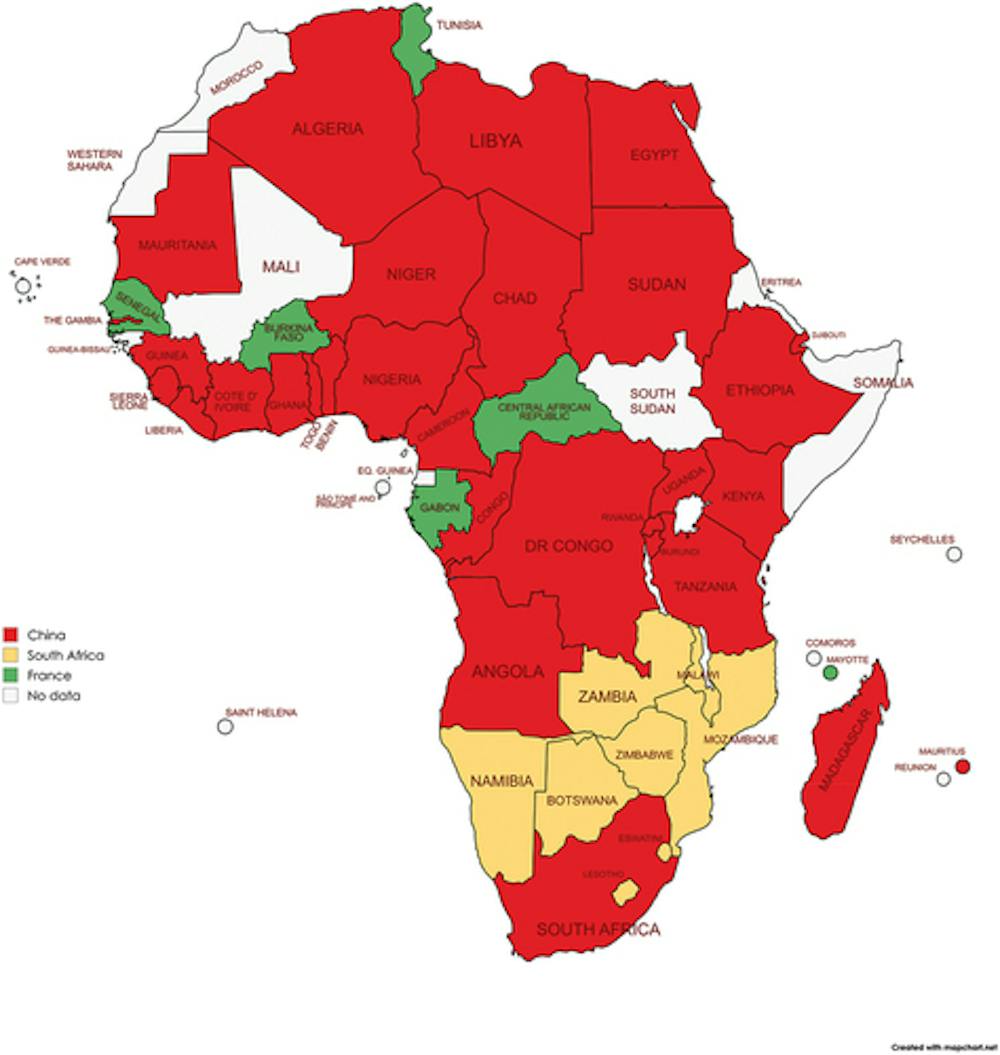
Global power dynamics in Africa are shifting, with China eclipsing the influence of the US and France. China has become Africa’s single largest trading partner.
But these visuals oversimplify a complex reality. This is an issue I explore in a new study. For over a decade, I have researched the interactions of sub-Saharan Africa with other states like Turkey, Arab Gulf states, Japan and China.
In a recent paper I explored the use of maps that have been created of Africa showing China’s projects across the continent. I argue that, by overlaying Chinese flags on maps depicting Africa and its 54 states, media and policymakers turn economic ties into a visual representation of foreign encroachment.
This process is called securitisation – the framing of something as a threat, even if it’s not one.
This visual securitisation not only heightens fears of dependency but also primes certain audiences – in the US, Japan and France, for instance – to view China’s presence as a direct challenge to their interests.
Certain threats – like terrorist groups or nuclear weapons – are self-evident. China’s presence in many African states, however, is different: if it’s a threat, who is threatened and why? Do Chinese-built roads or railways – and the debt African states accrue for this infrastructure – constitute the threat?
My research shows that the answer to these questions is: it depends.
Portraying China’s presence in Africa with flags on maps can distort African states’ sovereignty and their power to make decisions based on national interests. This visual portrayal reduces these countries to arenas of global power competition. It fails to recognise them as strategic actors.
China tops imports to African states
Illustration of China’s economic influence in 2021 drenched in red and drawn from media, think tanks and related literature. Author’s composite map illustrates securitisation of China in Africa.Brendon J. Cannon
On the other hand, my research shows that China’s role may not be entirely benign.
My study focuses mostly on east Africa, to include the Horn of Africa. Much of Beijing’s engagement here remains primarily economic (as it does in west, central and southern Africa). However, China’s growing control over critical infrastructure and digital networks, and its pursuit of military footholds near strategic maritime routes, present real security concerns.
Policymakers need to separate legitimate risks from exaggerated securitisation narratives. This would help them avoid the pitfalls of reactionary policies.
Negative consequences
Presenting China as a threat in Africa has three negative consequences.
First, it erodes the idea and reality of African sovereignty and agency. Maps portraying Africa as overrun by China suggest that governments and civil society are mere bystanders unable to negotiate their own foreign and domestic agendas.
The reality is that countries like Kenya actively engage with China to attract investments for development projects, and to balance their relations with other international actors like the US and Japan.
The result of securitisation is that American or Japanese policymakers, for instance, have begun to view Africa through the lens of their strategic competition with China. This is evident in Washington’s foreign policy rhetoric, for example. This increasingly frames African states not just as partners but also as strategic battlegrounds in the growing US-China rivalry. The risk is that African countries may start being treated as passive players.
Second, securitisation inflates the perception of China as a global security threat.
The repeated use of maps with Chinese flags covering ports, railways and industrial zones creates an exaggerated image of unchecked expansion. These maps fail to show the host of other external states operating on the continent.
The US, multiple European states, Japan, India, Russia, Turkey, the United Arab Emirates and South Korea all have significant interests in Africa. While China is by far the largest, most prominent external actor, with the widest reach throughout Africa, it’s been singled out because of the perceived threats its presence in Africa may pose to the west.
Third, securitisation can lead to knee-jerk reactions to limit China’s presence rather than engage constructively with Beijing’s investments in Africa. These reactions can result in ill-advised attempts by China’s competitors to push projects that don’t correspond to the needs of African states. This partly explains Ethiopia’s strained relations with the west. Sanctions and aid cuts over the Tigray conflict fuelled a pivot toward China and Russia.
The security risks
Securitisation raises valid concerns, but my research also underscores genuine security risks related to China’s presence in Africa. These shouldn’t be overlooked.
China’s growing role and embeddedness in Africa’s digital ecosystem presents a double-edged sword, for instance. Huawei and other Chinese companies have contributed to Africa’s telecommunications and digital transformation. But these investments also increase Beijing’s potential influence over data security, cyber governance and information flows. These give China the option to exploit networks for surveillance, intelligence gathering or political coercion.
Chinese-funded, built or operated infrastructure, ports and military bases
A depiction of China’s infrastructure influence in 2023 from media, think tanks and related literature. Author’s composite map illustrates securitisation of China in Africa.Brendon J. Cannon
China’s expanding control over dual-use infrastructure is another concern. Chinese-operated ports in Djibouti, for instance, can be used for commercial and military purposes. They potentially grant Beijing a strategic foothold in key maritime corridors, such as the Red Sea. China could restrict access to these ports in times of conflict. Or use them to extend its naval footprint, similar to what it’s done in the South China Sea.
It’s China’s pursuit of other military facilities beyond its bases in Djibouti that will have the most serious implications for African states’ sovereignty. This is part of a deliberate Chinese strategy to expand its global power projection and protect access to critical resources like oil and gas.
Agreements on military facilities may end up undermining and even challenging African agency of action. The addition of Chinese ships and soldiers alongside the growing presence of US, European, Indian, Japanese and other regional naval forces could escalate tensions. It also risks entangling African states in power rivalries that aren’t in their national interests.
China’s presence in Africa has been securitised through maps drenched in red and stamped with flags, framing its engagement as a looming threat rather than a complex geopolitical reality. However, the real challenge for African states is ensuring that China’s growing influence – especially in infrastructure, digital networks, and security – does not erode their sovereignty. Whether Beijing’s presence becomes an opportunity or a liability will depend on how effectively African governments assert their national interests in shaping these partnerships on their own terms.
– Maps showing China’s growing influence in Africa distort reality – but some risks are real – https://theconversation.com/maps-showing-chinas-growing-influence-in-africa-distort-reality-but-some-risks-are-real-249454
The Bundesbank is expanding its reform proposals for central government’s debt brake, laying out a stability-oriented path towards increased government investment. It is thus presenting a concept that supports the necessary measures to strengthen infrastructure and defence whilst ensuring sustainable public finances over the long term, in line with European rules. At the same time, it maintains its position that debt brakes enshrined in Germany’s Basic Law make an indispensable contribution to sustainable public finances over the long term. “With regard to the debt ratio, Germany is doing well by international standards. Our reform proposal for the debt brake preserves sound public finances whilst at the same time facilitating urgently needed investment,” Bundesbank President Joachim Nagel said.
The Bundesbank’s latest Monthly Report outlines the detailed concept, which builds on proposals it presented back in 2022. Advising the Federal Government on issues of monetary policy importance is part of the Bundesbank’s statutory mandate.
Its reform proposal is centred on the 60% reference value enshrined in the EU Treaties becoming the touchstone of the debt brake. Under this proposal, central and state governments (the latter by means of investment grants) would be able to invest up to an additional debt-financed €220 billion in total up to 2030, provided that the debt ratio is below 60%. Should the debt ratio exceed 60%, this amount would be capped at around €100 billion up to 2030. The reform proposals do not replace the need to rethink consumption expenditure, though. “A stability-oriented reform of the debt brake would create additional scope for major investment, such as in infrastructure and defence,” Mr Nagel continued.
In concrete terms, the proposal envisages increasing central government’s scope for borrowing from 0.35% to a maximum of 1.4% of gross domestic product (GDP) if the debt ratio is below the 60% mark. This scope would comprise 0.5% of GDP as a “low-debt base” that would not be earmarked for any particular purpose, and a further 0.9% of GDP for the sole purpose of additional investment. Part of this investment component would be intended for grants to state and local governments, which account for the majority of fixed asset formation.
If the debt ratio were to exceed the 60% mark, the 0.9% investment component would remain, but the 0.5% “base” would no longer be available. “This would reward a debt ratio of below 60% whilst at the same time creating planning certainty for investment,” Mr Nagel explained.
Similar scope for borrowing and investment protection could also be provided by a special fund that could be temporary or limited in terms of volume. “We would prefer a fundamental reform of the debt brake that affords better predictability, but a special fund with comparable financial parameters would also be an option,” Mr Nagel continued.
Source: Moscow Government – Government of Moscow –
Work is underway at the Kuskovo estate to preserve the historical appearance of the Swiss House. This in his telegram channel Sergei Sobyanin said.
“It was built in the 19th century according to the design of Nikolai Benois. The building is unusual in that it combines a brick ground floor and a carved wooden upper tier. The last owner of the estate, Sergei Sheremetev, once lived here,” the Moscow Mayor noted.
Source: Sergei Sobyanin’s Telegram channel @Mos_Sobyanin
The Swiss house is built in the style of an Alpine chalet. Since the 18th century, Kuskovo has had a tradition of creating park pavilions and buildings with national accents, such as Dutch, French and Italian.
The craftsmen have already started restoring the wooden log structure. This is a complex and painstaking process: the wooden part of the building was separated from the brick part and suspended using a special system. Now the restorers will have to replace the damaged logs and reconnect the log structure to the first floor. In addition, work will be carried out inside the building to preserve the historical stoves and chimneys.
Comprehensive restoration is underway at the Kuskovo estate since 2017The palace facade, the Dutch House, the Grotto pavilion, the formal park, the 18th century sculptures and other objects have already been put in order. In addition, the forest part of the park has been landscaped, making it even more convenient for walks.
Please note: This information is raw content directly from the source of the information. It is exactly what the source states and does not reflect the position of MIL-OSI or its clients.
Please Note; This Information is Raw Content Directly from the Information Source. It is access to What the Source Is Stating and Does Not Reflect
Source: State University of Management – Official website of the State –
From March 3 to May 30, 2025, Oleg Timofeev, a senior researcher at the Center for Socioeconomic and Political Research of China at the National University of Management, will visit this Chinese university at the invitation of the leadership of Tsinghua University (PRC) to deliver a lecture course in Chinese on “Security and International Order in Eurasia” (欧亚安全秩序) at the doctoral department.
It should be noted that on April 26, 2019, Russian President Vladimir Putin became an honorary doctor of Tsinghua University, where Chinese President Xi Jinping once studied. The rector of the higher educational institution, Qi Yong, personally presented the diploma to the head of the Russian state.
Founded in 1911, Tsinghua University has consistently ranked 1st or 2nd in the National University Rankings of China and is one of the world’s leading universities and a symbol of China’s economic and scientific progress.
Oleg Timofeev’s trip to China is part of a series of thematic events at the State University of Management, held in pursuance of the order of the President of the Russian Federation Vladimir Putin to hold the Years of Russia-China Culture in 2024-2025 with the aim of developing Russian-Chinese relations and expanding bilateral ties in the field of culture.
The complex of events dedicated to relations with the PRC also includes the electronic exhibition “Academic Dialogue: Russia and China in the University Space”. The exhibition is addressed to everyone interested in the history and culture of China. Particular attention is paid to the culture of management in history, higher education, politics and the digital economy, as well as socio-cultural phenomena, institutions and social practices of Russia and China. Monographs and textbooks are presented. Publications from the collection of the Scientific Library of the State University of Management were used in creating the exhibition. The author of the exhibition is chief librarian Elena Novikova.
ACADEMIC DIALOGUE_RUSSIA AND CHINA IN THE UNIVERSITY SPACE
Let us recall that at the end of last year, the 4th volume of the book “Xi Jinping on Public Administration” was presented in Russian at the State University of Management. Also, a round table on the development of artificial intelligence in China was held the other day, at which the above-mentioned book by the leader of the PRC was presented to those present again.
Subscribe to the TG channel “Our GUU” Date of publication: 03/04/2025
Please note: This information is raw content directly from the source of the information. It is exactly what the source states and does not reflect the position of MIL-OSI or its clients.
A Metropolitan Police detective has been charged with coercive and controlling behaviour.
Detective Constable Asiri Hamidi, 34, attached to the South Area Command Unit, will appear before Westminster Magistrates’ Court on Wednesday, 5 March. He was charged with coercive control on Friday, 31 January.
The charge relates to an allegation made to the police in April 2022. The offending is alleged to have taken place while the officer was off-duty, and DC Hamidi has been suspended.
CorelDRAW Go provides a beginner-friendly design experience, empowering creativity from anywhere.
CorelDRAW Graphics Suite delivers Painterly Brush tool enhancements and streamlined print to PDF workflows, alongside flexible, online design with CorelDRAW Web.
OTTAWA, Ontario, March 04, 2025 (GLOBE NEWSWIRE) — Introducing CorelDRAW Go, a beginner-friendly online graphic design tool for creative enthusiasts and aspiring designers. This newest addition to the CorelDRAW family simplifies the creative process, equipping users with intuitive tools to design efficiently from anywhere.
Alongside this, the latest updates to award-winning graphic design software, CorelDRAW Graphics Suite, are unveiled, including CorelDRAW Web, providing subscribers with a flexible, cloud-based design experience.
“With CorelDRAW Go and CorelDRAW Web, we’re making creativity more accessible than ever,” said Prakash Channagiri, Senior Director of Product Management for CorelDRAW. “The flexibility of these new cloud-based tools combined with the latest creative and workflow enhancements in CorelDRAW Graphics Suite, reinforce our commitment to empowering design professionals and creative enthusiasts to work more efficiently and push the boundaries of what’s possible in graphic design.”
CorelDRAW Go is a browser-based tool that makes design more intuitive and accessible, without the steep learning curve that comes with professional graphic design software. With an easy-to-use interface it delivers more advanced drawing and editing capabilities than many template-based alternatives.
Here’s what’s available in CorelDRAW Go:
Robust Design Tools
Interactive drawing tools
Realistic brushes
Straightforward node editing
User-friendly text tools
Easy-to-use masking controls
Essential image editing features
Extensive Creative Assets
Fully customizable templates
Thousands of editable vector icons, illustrations, and clipart
More than 6 million royalty-free stock photos
Thousands of fonts
In this latest release, CorelDRAW Graphics Suite customers get access to powerful tools and enhancements designed to elevate creativity and simplify workflows.
Here’s what’s new in CorelDRAW Graphics Suite 2025:
NEW!CorelDRAW Web: CorelDRAW is more accessible than ever thanks to the introduction of CorelDRAW Web, a powerful browser-based version of the award-winning graphic design suite. Available exclusively to subscribers, CorelDRAW Web delivers a full CorelDRAW experience in the browser, allowing users to design seamlessly from any device.
NEW!Advanced Print to PDF capabilities: Streamline workflows and enjoy faster, more efficient output with new Print to PDF functionality, now integrated into CorelDRAW and Corel PHOTO-PAINT.
ENHANCED!Painterly Brush tool: Unleash creativity with the upgraded Painterly Brush tool, now featuring additional brush controls, and improved compatibility with other tools. Plus, subscribers get exclusive access to 50 additional free brushes, unlocking a world of new creative possibilities.
NEW! Simplified multi-seat license management: The redesigned Corel Customer Account Portal streamlines license administration, allowing businesses to assign licenses or deploy software without requiring individual user accounts.
This latest release also includes performance and quality improvements, direct access to additional Google Fonts, and advanced security upgrades.
Availability and Pricing
CorelDRAW Graphics Suite is available on Windows, macOS, and web in English, German, Italian, French, Spanish, Brazilian Portuguese, Dutch, Polish, Czech, Russian, Simplified Chinese, Traditional Chinese, Turkish, Swedish, and Japanese. Subscription is $269 USD / €369 / £319 per year. CorelDRAW Graphics Suite 2025 is available for one-time purchase at the suggested retail price of $549 USD / €779 / £659. EUR and GBP prices include VAT.
CorelDRAW Web is available to all CorelDRAW subscribers and active maintenance customers and is supported on the most recent versions of Google Chrome, Microsoft Edge, and Firefox, on both Windows and macOS. To learn more about CorelDRAW Web, or to try a 15-day trial, visit: www.coreldraw.corel.com.
CorelDRAW Go performs best with Google Chrome or Microsoft Edge, with the latest updates, on both Windows and macOS, and is available in English, German, Italian, French, Spanish, Brazilian Portuguese, Dutch, Polish, and Czech. A subscription is $9.99 USD / €9.99 / £8.99 monthly or $99 USD / €115 / £95 per year. EUR and GBP prices include VAT. To learn more about CorelDRAW Go, visit: www.go.corel.com.
About Alludo
Alludo is a global technology company helping people work better and live better. We’re the people behind award-winning, globally recognizable brands including Parallels, Corel, MindManager, and WinZip. Our professional-caliber graphics, virtualization, and productivity solutions are finely tuned for the digital remote workforce delivering the freedom to work when, where, and how you want.
With a 35+ year legacy of innovation, Alludo empowers all you do, helping more than 2.5 million paying customers to enable, ideate, create, and share on any device, anywhere. To learn more, visit www.alludo.com.
As Lowry marks its 25th anniversary, Salford City Council is proud to join the celebrations and acknowledge the extraordinary impact this iconic cultural institution has had on the city. From its pivotal role in the regeneration of Salford Quays to its outstanding artistic and community achievements, Lowry continues to be a driving force for culture, creativity, and economic growth.
The anniversary programme – packed with familiar names including Quentin Blake, Jeanette Winterson, and Aakash Odedra, theatre productions Gods of Salford and Dear England, immersive gallery experience LOWRY 360, alongside a brand new mural commissioned with French multi-disciplinary artist, Camille Walala – reflects Lowry’s influence on culture and the local community, one that Salford City Council wholeheartedly support and celebrate.
Since opening in April 2000, Lowry has welcomed over 18.5 million visitors, generating an annual £86 million in visitor spending and supporting over 600 jobs. More than just an arts centre, Lowry has played a fundamental role in transforming Salford Quays into a dynamic cultural hub.
Paul Dennett, Salford City Mayor, highlighted the significance of Lowry in shaping the city’s future:
“Lowry is a force for good in Salford and was a vital catalyst for the regeneration of the area. It is a place that is first and foremost for the people. It’s wonderful to reflect on the past 25 years – Lowry has not only brought world-class arts and theatre to the Quays but has also been instrumental in fostering community engagement, supporting young people, and strengthening our creative economy. It supports over 600 jobs, including 576 full-time jobs in the North West and 649 across the UK, demonstrating its critical role in the regional and national economy. It has contributed to a £1.3 billion GVA, acting as a foundational anchor for the development of MediaCityUK and positioning Salford as a major centre for arts, culture, and digital industries.
Happy birthday Lowry, I look forward supporting your next exciting chapter!”
Councillor Hannah Robinson-Smith, Lead Member for Culture, Heritage, Equalities, Sports and Leisure, echoed this sentiment, praising Lowry’s impact across generations:
“Lowry is a cultural institution that has had an immense positive influence on communities across Salford. It has provided access to arts and culture for thousands of residents and continues to inspire new generations with its diverse and exciting programme. Its achievements to date are truly remarkable. Happy birthday, Lowry!”
Findings from Lowry’s 2024 impact report reaffirm its invaluable contribution, with an estimated £22 million in social value generated annually. Lowry’s community outreach initiatives, including its Arts for Social Change programme and partnerships with local schools, continue to break down barriers and make the arts accessible to all.
The coordinator will work on the southern and southwestern coasts of the Island, which are facing serious erosion and landslide problems.
These areas are being hit hard by strong waves and heavy rain, causing damage to homes, road closures, and a drop in business activity.
The funding was secured following a successful bid by council officers to the Southern Regional Flood and Coastal Committee (SRFCC) via the Flood and Coastal Risk Management (FCERM) 7 funding route.
Councillor Paul Fuller, Cabinet member for planning, coastal protection and flooding, said: “Our coast is always changing, and the threat to human life is very real.
“This new role is crucial to help our communities understand the risks and take steps to protect themselves and their properties.
“We are committed to building a resilient future for the Isle of Wight, and this specialist will play a key part in that mission. Their work will ensure that our coastal communities are better prepared and more resilient in the face of these ongoing threats.”
The new coordinator will be part of the council’s climate, coast, and environment team.
Their role will be to support residents affected by frequent geological events on the Island and provide advice and support to council departments, councillors, outside agencies, developers, and the public on coastal erosion and landslide issues.
They will also research and develop opportunities to minimise the impact of erosion and landslides and design future strategies for managing these problems.
Natasha Dix, service director for waste, environment and planning, added: “Decaying defences and outdated policies are causing significant problems, worsened by climate change.
“This funding is crucial for providing the necessary resources to support homeowners and businesses. The new coordinator will research and share findings with the SRFCC, focusing on benefits like regeneration, poverty reduction, mental health support, and emergency services.
“They will also collaborate with other councils facing similar issues to find the best solutions. This teamwork is essential for helping coastal communities adapt to the challenges of erosion and landslides, ensuring a more resilient future for the Isle of Wight.”
Source: Organization for Security and Co-operation in Europe – OSCE
Headline: The OSCE Mission Calls for Effective Implementation of the New FBiH Law on Prevention of Domestic Violence and Violence against Women
The OSCE Mission Calls for Effective Implementation of the New FBiH Law on Prevention of Domestic Violence and Violence against Women | OSCE
Skip navigation
Navigation
Navigation
Home Newsroom News and press releases The OSCE Mission Calls for Effective Implementation of the New FBiH Law on Prevention of Domestic Violence and Violence against Women
STMicroelectronics reveals STM32U3 microcontrollers extending ultra-low power innovation for remote, smart and sustainable applications
Latest MCUs leverage cutting-edge near-threshold chip design to set record performance-per-watt efficiency benchmark
Secret-key protection and in-factory provisioning boost cyber security
Typical applications include utility meters, healthcare devices, and industrial sensors
Geneva, Switzerland, March 4, 2025 – STMicroelectronics (NYSE: STM), a global semiconductor leader serving customers across the spectrum of electronics applications, has introduced new STM32U3 microcontrollers (MCUs) with cutting-edge power-saving innovations that ease deployment of smart connected tech, especially in remote locations.
The latest MCUs are aimed at IoT devices, which must typically operate for extended periods without maintenance and with limited energy from a coin cell or ambient solar or thermoelectric source. Typical applications that depend on the lowest possible power consumption include utility meters, healthcare devices such as glucose meters and insulin pumps, animal care monitors, forest-fire sensors, and industrial sensors including thermostats and smoke detectors. STM32U3 MCUs are also used in consumer products such as smart watches, wearables, and hearables.
“The STM32U3 series builds on the heritage of ST-established ultra-low-power general-purpose microcontroller class as it is known today, which opened the door to widespread diffusion of smart technology in diverse environments,” commented Patrick Aidoune, General-Purpose MCU Division General Manager, STMicroelectronics. “Leveraging innovative techniques such as recent advancements in near-threshold design, the new devices cut dynamic power consumption to the bone, boosting efficiency by a factor of two compared to our previous generation, hence contributing to companies’ sustainability goals.”
In addition to its extreme energy efficiency, the STM32U3 series meets the needs of IoT devices by providing robust cyber protection using the latest hardware security techniques. The MCUs are designed to confine secret keys permanently in secure memory, eliminating vulnerable CPU fetches. In addition, attestation credentials for each device are provisioned by ST at manufacture before leaving the factory, which strengthens security and simplifies provisioning. All those security mechanisms, in addition to the SESIP3 and PSA Level3 certifiable security assets, such as cryptographic accelerators, TrustZone® isolation, random generator, and product lifecycle will contribute and enable ST customers to reach compliancy towards the upcoming RED and CRA regulations.
Customer testimonials:
“STM32U3 enables us [smaXtec] to bring our hardware for animal health monitors to the next level. The consumption in active mode is extremely low, only a few µA/MHz, which enables us to reduce the energy needed for current data processing algorithms while at the same time adding new features to our products. In addition, its advanced range of low-power modes lets us put the device into deep sleep if no data is processed. The newly implemented STOP3 mode, including its wakeup capabilities, is a neat way to keep power consumption low,” said Manuel Frech, Product Development Engineer, smaXtec.
Technical Notes for Editors
ST has set the pace in ultra-low-power (ULP) MCUs with previous STM32 variants and is now taking ULP performance to a new level with the new STM32U3 series. Leveraging advanced power-saving chip design, fine-tuned with AI-enhanced tools, and the latest Arm® Cortex®-M33 core running at up to 96MHz, the new MCUs achieve the market-leading Coremark-per-milliwatt score of 117. This is almost twice the efficiency of ST’s preceding STM32U5 series, and five times that of the STM32L4 series.
STM32U3 MCUs set new standards in dynamic performance by taking advantage of near-threshold technology that operates IC transistors at extremely low voltage, saving energy proportionately according to a square law
ST’s innovative near-threshold implementation uses AI-driven adaptive voltage scaling at wafer level to compensate for process variations in the foundry
In addition to dynamic power savings (down to 10µA/MHz), the STM32U3 series achieve extremely low stop current, at 1.6µA
STM32U3 embeds up to 1MB of Flash memory dual-bank and 256kB of SRAM
In terms of security, STM32U3 MCUs embed all successful security features of the STM32U5, with additional keystore capabilities. Newly, secret keys are loaded in-factory by ST on the STM32U3 MCUs and are protected by a coupling and chaining bridge (CCB), representing the first use of this technology in the STM32 MCU family
Two product lines are available, presenting a choice of MCUs either with or without a hardware cryptographic accelerator
Combined with their low power, the devices integrate efficient and high-performing peripherals including the latest I3C digital connectivity
MCUs are available in commercial (-40°C to 85°C) and extended industrial (-40°C to 105°C) temperature ranges
The STM32U3 series is in production now and available from $1.93 for orders of 10,000 pieces. For more information, please go to www.st.com/stm32u3
STM32 is a registered and/or unregistered trademark of STMicroelectronics International NV or its affiliates in the EU and/or elsewhere. In particular, STM32 is registered in the US Patent and Trademark Office.
About STMicroelectronics At ST, we are 50,000 creators and makers of semiconductor technologies mastering the semiconductor supply chain with state-of-the-art manufacturing facilities. An integrated device manufacturer, we work with more than 200,000 customers and thousands of partners to design and build products, solutions, and ecosystems that address their challenges and opportunities, and the need to support a more sustainable world. Our technologies enable smarter mobility, more efficient power and energy management, and the wide-scale deployment of cloud-connected autonomous things. We are on track to be carbon neutral in all direct and indirect emissions (scopes 1 and 2), product transportation, business travel, and employee commuting emissions (our scope 3 focus), and to achieve our 100% renewable electricity sourcing goal by the end of 2027.
STMicroelectronics’ new integrated STM32WBA6 wireless microcontrollers combine extra features and performance with power efficiency
Cost-efficient and highly integrated embedded devices for emerging 2.4GHz wireless applications in smart home, health, factory, and agriculture
Geneva, Switzerland, March 4, 2025 – STMicroelectronics (NYSE: STM), a global semiconductor leader serving customers across the spectrum of electronics applications, has announced the next generation of its STM32 power-efficient short-range wireless microcontrollers (MCUs) that simplify connecting consumer and industrial devices to the IoT.
The new STM32WBA6 series is used in connected, smart devices like wearable healthcare and wellness monitors, animal collars, electronic locks, remote weather sensors, and more. Packing extra memory and digital system interfaces, while preserving energy efficiency the new MCUs can handle richer functionality in emerging new product designs.
The STM32WBA6 MCUs also embed SESIP3 and PSA Level3 certifiable security assets, such as cryptographic accelerators, TrustZone® isolation, random generator, and product lifecycle that will contribute and enable ST customers to reach compliancy towards the upcoming RED and CRA regulations.
“Robust and standardized wireless connectivity is central to the IoT’s success. Our new STM32WBA6 MCUs bring richer features and larger memory to address high-end applications in smart home, health, factory, and agriculture,” said Patrick Aidoune, General-Purpose MCU Division General Manager, STMicroelectronics. “Our customers can now increase the pace of development to meet demands from consumer and industrial markets for new products that deliver more features and increased capabilities within reduced size and power constraints.”
The wireless subsystem in the new STM32WBA6 microcontrollers supports Bluetooth, Zigbee, Thread, Matter, and other protocols operating in the 2.4GHz frequency band, and allows communication using multiple protocols concurrently. It’s how a system like a smart-home bridge can communicate with the homeowner’s mobile app over Bluetooth and simultaneously manage lights or thermostats through mesh networking such as Zigbee. The STM32WBA6 series also contains single-protocol variants for simpler and more cost-conscious applications.
Customer testimonials:
“The extensive hardware feature set, low power consumption, advanced cyber security, and excellent price/performance make the STM32WBA6 devices perfect for our advanced in-car driver monitoring, incident tracking, and emergency calling solution. Aided by the extensive ecosystem and ST’s strong technical support, we were able to quickly start prototype development and achieve qualification in accordance with all applicable industry requirements. We are on track to begin production in Q2 2025,” said Vittorio Ferrari, CTO, Meta System.
Technical notes for editors:
By integrating the processing core, peripherals, and wireless subsystem, STM32WBA6 MCUs help product developers meet demands to simplify new designs, miniaturize assembly size, and save the electronic bill-of-materials. With up to double the Flash and RAM on-chip, compared to the previous STM32WBA5 series, the new MCUs provide generous storage for application code and data.
With up to 2MB of Flash and 512KB RAM on-chip, the new STM32WBA6 MCUs contain larger memory to support more sophisticated applications.
The richer digital peripherals add USB High Speed as well as extra digital interfaces including three SPI ports, four I2C ports, three USARTs, and one LPUART.
Concurrent multiprotocol wireless makes the STM32WBA6 series ideal for applications that leverage Matter, which is designed to run on top of other protocols. The X-CUBE-MATTER software package, part of the extensive STM32Cube ecosystem, integrates the Matter SDK and comes with application examples to ease development.
The wireless subsystem improves performance, with sensitivity increased to -100dBm for more reliable connectivity up to the maximum specified range.
The STM32WBA6 series is powered by the energy-efficient Arm® Cortex®-M33 core, with floating-point unit and DSP extensions, running at up to 100MHz.
The STM32WBA5 and STM32WBA6 support the latest EU Radio Equipment Directive (RED) cyber-security requirements. Their SESIP3 certification target will greatly ease the customer device conformance.
Package options cover a wide range from a 7mm x 7mm UFQFPN48 to a 6mm x 6mm UFBGA121 with 121 pins.
There is also a thin wafer-level chip-scale package, WLCSP88, that measures only 3.78mm x 3.46mm.
The STM32WBA6 MCUs are in production and available now, priced from $2.50 for orders of 10,000 pieces. For more information, please go to www.st.com/stm32wba.
STM32 is a registered and/or unregistered trademark of STMicroelectronics International NV or its affiliates in the EU and/or elsewhere. In particular, STM32 is registered in the US Patent and Trademark Office.
About STMicroelectronics At ST, we are 50,000 creators and makers of semiconductor technologies mastering the semiconductor supply chain with state-of-the-art manufacturing facilities. An integrated device manufacturer, we work with more than 200,000 customers and thousands of partners to design and build products, solutions, and ecosystems that address their challenges and opportunities, and the need to support a more sustainable world. Our technologies enable smarter mobility, more efficient power and energy management, and the wide-scale deployment of cloud-connected autonomous things. We are on track to be carbon neutral in all direct and indirect emissions (scopes 1 and 2), product transportation, business travel, and employee commuting emissions (our scope 3 focus), and to achieve our 100% renewable electricity sourcing goal by the end of 2027.
Our early years team are holding a free ‘Do Something Big’ drop in event on Monday 24 March at the Duke of Cornwall Hotel 10am to 4pm, where you can meet professionals and training providers in the early years and childcare sector.
If you:
are passionate about making a difference to a child’s life
want to be part of an early year’s workforce with exciting career pathways
want to support parents returning to work
Then this event could be for you!
There are many career pathways in childcare and early years, such as: childminding, nursery nurse, play worker, nursery manager, pre-school worker, specialist worker with children with special educational needs, designated safeguarding leads, health and safety officer, first aider and many more.
Early years training providers will have stalls at the event such as Skills Launchpad, and City College Plymouth, to offer support and guidance on pathways into the childcare and early years sectors. There will be recruitment opportunities available.
Hear from Jo, a Childminder from Plympton, about the opportunities available:
Councillor Sally Cresswell, Cabinet Member for Education, Skills and Apprenticeships, said: “Working in Childcare is a very rewarding career, and no two days are the same, it’s such a special feeling when you know that you’re making a difference to a child’s life.
“This event is the perfect opportunity for those who are considering a career in childcare and early years to come along and hear from people who are already in the industry, and what they can offer to help you.”
Channel Islands Ministers discussed the planned reset in relations between the EU and UK with senior EU and British diplomats during meetings in Brussels. The discussions took place on the sidelines of a reception to mark the 15th anniversary of the Channel Islands’ Brussels Office.
The External Relations Ministers of Guernsey and Jersey, Deputy Jonathan Le Tocq and Deputy Ian Gorst, met with senior diplomats from France, the UK, Poland and Malta. Discussions also included the Islands’ relationship with France, their closest European neighbour, and promoted the Islands’ financial services interests, noting both Islands’ recent positive MONEYVAL assessments, as well as developments in sustainable finance.
Ministers also drew attention to the significance of the Islands’ relationship with Europe and spoke to existing areas of cooperation with Member States.
Speaking after the visit, Jersey’s Minister for External Relations, Deputy Ian Gorst said: “It is more important than ever, post Brexit, to engage with representatives of European Member States. Direct engagement with the EU in Brussels is essential to ensure our interests are known and understood. I look forward to continuing to build on our discussions over the past days through the work of the Channel Islands Brussels Office.”
Guernsey’s Minister for External Relations, Deputy Jonathan Le Tocq said: “The visit was a key opportunity to speak with representatives in Brussels and inform them of the interests of the Channel Islands. Regular engagement with EU partners is an essential part of our long-standing good neighbour policy. During these meetings I was pleased to discuss our financial services interests as well as noting the positive MONEYVAL assessment.”
The Ministers’ programme in Brussels included meetings with the Permanent Representatives (Ambassadors) to the EU of France and Malta, the Polish Political Counsellor, the UK Deputy Ambassador to the EU, the UK Ambassador to Belgium, and representatives of the Devolved Administrations and other Third Country offices in Brussels.
The Ministers hosted a reception for partners and stakeholders in Brussels to mark the 15th anniversary of the Channel Islands Brussels Office, the representative office for the governments of Guernsey and Jersey to the European Union. They were joined at this event by Jersey’s Director of Financial and Professional Services, Guernsey’s Director of Finance Sector Development, as well as representatives from Guernsey Finance and Jersey Finance who collectively promoted the Channel Islands’ financial services expertise to the European audience.
Secondary school admission figures for entry in September 2025 published 3 March reveal that 93.7% of York children have been allocated their first preference of school.
Parents and carers who applied online can find out where their child has been allocated a place by logging into their parent portal account today via www.york.gov.uk/SecondarySchoolAdmissions.
Parents who made written applications will receive a letter confirming their admission arrangements. Anyone who didn’t receive their first choice of school will also receive written confirmation.
This year’s admissions figures, compared with last year’s are outlined below:
Admission figures for 2025:
1st Preference: 1794 (93.7%)
2nd Preference: 78 (4.1%)
3rd Preference: 12 (0.6%)
4th Preference: 3 (0.2%)
5th Preference: 1 (0.1%)
Non Preference: 26 (1.4%)
Total: 1914 (100.0%)
Admission figures for 2024:
1st Preference: 1809 (93.6%)
2nd Preference: 80 (4.1%)
3rd Preference: 18 (0.9%)
4th Preference: 2 (0.1%)
5th Preference: 0 (0.0%)
Non Preference: 23 (1.2%)
Total: 1932 (100%)
Councillor Bob Webb, Executive Member for Education, Children and Young People, at City of York Council, said:
Moving on to secondary school is an exciting time and I’m pleased that the vast majority of students in York have got into their first choice of school. I wish all the students moving on in September the best of luck. I know that York schools are committed to supporting your transition into big school.”
Parents or carers whose children may be eligible for free school meals – one of a number of benefits that come with applying for the pupil premium – should apply through their online account at Parent Portal.
Assistance with school uniform costs for September may also be available to pupils starting years 7 to 10 who are entitled to receive benefit based free school meals at non-academy schools. Further information about this, and who could be able to get free school meals, is available at www.york.gov.uk/FreeSchoolMeals.
A consultation on proposed public realm improvements in the Chinatown area of Liverpool city centre is under way.
Liverpool City Council, with support from local community groups and the University of Liverpool Architecture School, has developed outline plans for Great George’s Square at the junction of Upper Pitt Street and Nelson Street.
The aim is to attract more visitors and investment, and create a neighbourhood to be proud of.
The centrepiece of the project will be the installation of two stone lions, which have been donated by the Chinese Consulate General in Manchester and were formally handed over to Liverpool in January to celebrate the 25th anniversary of the Liverpool-Shanghai sister cities relationship.
The scheme will also see:
Better pedestrian access between Upper Pitt Street/Nelson Street and Great George’s Square
Installation of a red maple ‘wishing tree’ and ‘flower mat’ near the lions
Improvements to the children’s playground
The creation of a commemorative memorial garden
People are being asked their views on the proposed changes to the junction, the playground improvements and the Commemorative Memorial Garden.
It is hoped the work will be completed in early 2026.
Local people will also be able to find out more and comment at the City Centre South Neighbourhood community information event being held at the Black-e on Great George Street on Tuesday 4 March between 10.30am – 3pm.
The scheme will complement wider plans for a revitalised Chinatown which includes new homes and businesses on a previously stalled site at Great George Street. The Council recently succeeded in securing the site under its own unified ownership, with support from Liverpool City Region Combined Authority and the Government.
Chinatown is also close to the thriving Baltic Triangle, where the new Liverpool Baltic Merseyrail station is due to open in 2027.
Cabinet Member for Economy and Growth, Cllr Nick Small, said: “We are hugely proud of the city’s Chinatown, which is the oldest in Europe, and has huge potential.
“We want to revitalise it so it is somewhere that the local community and Liverpool residents are equally proud of, as well as being somewhere tourists can spend time.
“We’re asking local people and businesses to have their say on the ideas that have been developed and input into the design process, so that we can create something that is really special.
“When combined with our ambitions for the previously stalled site at Great George Street and the work on the new Baltic Station, this is a really exciting time for this part of the city centre.”
Chinese Consul General in Manchester, Tang Rui, said: “The stone lions in Chinese culture are actually a symbol of prosperity, so we hope that these pair of lions will bring good luck and showcases a new start for this beautiful, historic Chinatown.”
Secretary General of Merseyside Chinese Association Joint Action Group, Ming Wang, said: “Chinatown has been home to the local community for more than 200 years. It holds a very special place in our local community’s heart.
“With these two huge stone lions gifted by the Chinese Consul General in Manchester plus the City Council’s planning in regenerating Chinatown which includes a wishing tree, better playground and the creation of a commemorative memorial garden is so amazing.
“We look forward to witnessing the transformation of our beloved Chinatown, more footfall to Chinatown, followed by better business, more investment and more visitors from around the world.”
Liverpool City Council has announced several amendments to the experimental parking zone surrounding Everton Stadium as well as a number of improvements to the area, since the new venue’s first test event.
The zone, introduced under an Experimental Traffic Regulation Order (ETRO), went live two weeks ago today (on Monday, 17 February) to coincide with Everton FC’s inaugural match at the stunning waterfront stadium at Bramley Moore-Dock.
Based on feedback from businesses and residents in the city’s North Docks community, as well as initial findings from that historic event, the Council will now implement changes to its operation.
The proposed amendments include:
Applications for more than 10 business permits will be accepted on a case-by-case basis. Note: Business permits cost £50 each. Resident and visitor permits are free.
Safety-focussed enforcement of the zone on the second stadium test event, on Sunday, 23 March. (This will allow more time for businesses and residents to apply for permits and for the Council to investigate the level of appropriate enforcement during events.)
The one-hour limited waiting restriction will be extended to two hours, where possible.
Permit parking will be introduced in the Pumpfields area (i.e. the Blackstock Street, Paul Street, Pall Mall and Chisenhale Street areas.)
The process to modify the ETRO to implement these initial recommendations (including new signage) will begin to be enacted within the next three months.
The ETRO enables the Council to make these changes flexibly in the light of experience and analysis of their impact on a day-to-day basis. Further changes may also be made following the further two stadium Test Events, in March and May, and throughout the 18-month process up to August 2026.
In response to feedback from businesses, the Council will also explore the scope for on-street pay and display parking bays in key locations to identify options, where possible, for longer-stay parking.
A further series of improvements, identified from the first test event, will also now be implemented, including:
A review of the event traffic management plan on road closures ahead of the second test event. This is to ensure closures are enacted and communicated more effectively.
Improvements to Street Lighting on walking routes to and from the stadium.
Improved pedestrian wayfinding signage between Sandhills station and City Centre stations and the stadium.
Temporary signage to shuttle bus and taxi rank locations.
Following these amendments and improvements, the Council’s Highways team will continue to monitor the impact of the ETRO to determine whether this has positively assisted businesses, visitors, and public opinion and if other amendments are required.
When and where do the ETRO measures apply? The new measures introduced in the zone, which radiates out via a 30-minute walk from the stadium, operate between the hours of 10am to midnight each day. North of Boundary Street, the zone is operative 1 August to 30 June. South of Boundary Street it is operative 12 months of the year. This is except for the Great Homer Street area, which operates 8am to midnight all year round. The ETRO is to run until August 2026, but Liverpool City Council will be seeking to review and amend the measures within the first six months before the new football season begins in August. The measures can be made permanent before August 2026, subject to agreement.
What about Blue Badge holders? Blue Badge holders can park for as long as they need to within the permit parking areas in the experimental zone, and for up to three hours on a yellow line (unless a loading ban is in place). Badge holders can also park on yellow lines, unless there is a loading restriction, but they will need to clearly display their badge and blue parking clock as well as ensuring the vehicle is not causing an obstruction. For Blue Badge holders wishing to attend a football match at the stadium, Everton FC is in the process of exploring how it enhances its current parking offer to complement other transport arrangements such as the free shuttle bus service for disabled fans.
Cllr Liam Robinson, Leader of Liverpool City Council, said: “Since the Experimental Parking Zone went live on the day of Everton’s first test event, the Council has been listening to all the feedback and analysing what we can do to make improvements.
“We understand the concerns being raised by businesses, residents and fans and we’ve wasted no time in assessing the necessary amendments that can be introduced as quickly as possible.
“The measures that can be amended to alleviate concerns on issues like waiting times and number of permits will be considered as a priority. The major concerns from the first event around road closures and street lighting are also being addressed to ensure they are remedied by the second test event at the end of March.
“We are also working closely with colleagues at the Liverpool City Region Combined Authority, Merseytravel and Merseyrail on their plans for public transport provision and we are in in active dialogue with them and Everton to ensure changes and improvements are made.”
Cllr Dan Barrington, Cabinet Member for Transport and Connectivity, said: “Given this is an experimental zone and we are in the test event stage, lessons are being learned all the time.
“I want to reassure everyone the Council is actively looking to make the necessary improvements to help businesses, residents and fans as much as possible, especially as we build up to the final test event in May and then the start of the new football season in August.
“The Council is keen to continue talking to businesses to explain the process and to hear how the measures and amendments are impacting their staff and customers and how we can work together to make improvements quickly.
“A key aim of the Experimental Zone is tackling the problem of commuter parking 365 days a year, as well as illegal and unsafe parking on double yellow lines and pavements. These issues impact the area all year round and it’s vital we get this right to support its economic development and to tackle congestion, especially as more businesses set up here and more residential schemes are developed.”
Meet the volunteers urging more people to sign up as Leeds City Council launches its new volunteering scheme.
Volunteer Team Leeds is the brand-new scheme bringing together and inviting new people to join the vibrant volunteering community that supports Leeds City Council affiliated events and initiatives.
From the stunning displays of Light Night and the cinematic experiences of the Leeds International Film Festival, to enriching opportunities within libraries and vital volunteer befriending schemes, Volunteer Team Leeds offers a diverse range of ways to contribute.
Building on the legacy of LEEDS2023, where over 1,800 volunteers signed up to support the city’s year of culture, the scheme aims to retain and grow this valuable community through a new simple, user-friendly, volunteer orientated system.
Previously working as a postman, Bill Hargreaves’ favourite part of his job was being able to help people. During lockdown he would even help residents by posting letters for them.
Having retired three years ago, he now spends most of his time volunteering and is a regular volunteer at most Leeds City Council events, such as Light Night and the Leeds International Piano Competition.
“When I retired, I felt like there was no reason to stop being helpful just because I don’t get paid for it. I was worried there would be a void after retirement but I’ve made sure to fill that with volunteering,” Bill says.
“There’s no way I was ever going to be someone who sits in front of the TV when I retired. I’m just having so much fun now,” he adds.
Like Bill, many people decide to volunteer because they enjoy it, but there are many other benefits that can come with it.
Khara Linton-Salmon has volunteered at film festivals across the country, but it was at Leeds Film Festival she made connections to build a career in film. In 2024, she worked as a programmer for the festival in the short film category.
“I felt like I could speak to people that were higher up than me, and they gave me good advice, they actually wanted to help me progress,” she explains.
“The main reason why I wanted to volunteer was just because I love film. It wasn’t until I decided to volunteer at Leeds that the snowball started rolling. Leeds gave me more of an opening to making it a career.
“Anybody that loves film I’m always telling them to do it. Not even for a career path but just because it’s fun. You go in with your passion and you meet 50 other people with the same passion,” she says.
With the launch of Volunteer Team Leeds comes a new platform which will be a one-stop-shop for people to create a profile and sign up to volunteer with different services or events either organised or supported by Leeds City Council. Volunteers will also be able to access learning and development tools.
To date there are close to 2,000 volunteers already signed up.
Councillor Mary Harland, Leeds City Council’s executive member for communities, customer service and community safety, and champion for volunteering, said:
“We believe volunteers are at the heart of our city. From the pitch to the streets, and across our communities, our city is full of passion for helping out and giving back. With Volunteer Team Leeds we’re hoping to get even more people signing up to share skills, meet people and learn new things. As a key part of our city’s Volunteering Strategy, we want Leeds to be a city that is the best to volunteer in and that celebrates volunteering in all its forms, where it’s easy for people to find ways to make a difference and get involved.
“We encourage all residents of Leeds to create a profile on the new platform and join the growing community of volunteers making a brilliant positive impact through council-supported initiatives across the city.”
Volunteer Team Leeds is funded through central government’s UK Shared Prosperity Fund, which is administered locally by the West Yorkshire Combined Authority.
How did the bank deposit market change at the beginning of 2025?
Russians’ demand for long-term deposits began to grow in January 2025 – clients are trying to lock in a high rate for a long period. According to the Finuslugi platform for the first two months of the year:
The share of deposits for 6 months decreased by 1.5 percentage points, amounting to 54% of the total volume of deposits – the term is still the most popular; the share of deposits for 3 months decreased by 1.3 percentage points – to 25.2%; the share of deposits for 1 month also fell – to 3.1%; the share of deposits for one year, on the contrary, increased by 3 percentage points – to 13.7%; deposits for a term of over one year also show a slight increase.
The downward trend in bank deposit yields began after the February meeting of the Central Bank of the Russian Federation – the regulator left the key rate at 21%, which forced banks review the terms of savings instruments. The average maximum rate in the country’s largest banks has already fallen by 1.2%.
What do banks think about changing deposit terms?
At the same time, domestic banks do not record a single trend towards clients switching to long-term savings, although they allow for such dynamics in the coming months:
V MTS Bank see an increase in the popularity of long-term deposits, but within 2%; Post Bank noted an increase in the popularity of deposits for a period of 9 months – their share grew by 30%; in the bank “Russian standard» noticed an increase in demand for long-term deposits – a strengthening trend is expected; VTB the growth in the share of deposits for one year or more increased by only 0.4 percentage points; no movement of funds to long-term deposits was recorded in T-bank And Absolut Bank.
“Deposit rates in Russia are close to the peak level, since the key rate is not expected to increase. If the regulator decides to move to easing the monetary policy, the deposit structure will change – Russians will prefer to fix high yields,” the expert notes.
However, the expectation of a reduction in the key rate may also lead to a revision of bank policies – financial institutions will refuse to attract funds for a long term, having reduced the profitability of such savings products in advance.
15:50 04.03.2025
Source:
Please note: This information is raw content directly from the source of the information. It is exactly what the source states and does not reflect the position of MIL-OSI or its clients.
Please Note; This Information is Raw Content Directly from the Information Source. It is access to What the Source Is Stating and Does Not Reflect
Source: Moscow Government – Government of Moscow –
The Museum of Moscow will host a lecture entitled “Comparative Analysis of Grant Competitions for Filmmakers”. The meeting will discuss the grant system for supporting cinema: which competitions and funds provide funding, what are their key requirements and criteria for evaluating applications, how to correctly design a project so that it meets the expectations of experts, which aspects of the application are most significant and which mistakes can be critical.
The speaker is Natalia Kurbatova, an expert in grant support in the cultural sphere. She will conduct a comparative analysis of existing grant competitions for filmmakers, analyze their features and tell what opportunities are open to authors of short films, debut and documentary projects. Particular attention will be paid to the competition of the Fund for Support of Regional Cinematography of the Union of Cinematographers of Russia.
Please note: This information is raw content directly from the source of the information. It is exactly what the source states and does not reflect the position of MIL-OSI or its clients.
Please Note; This Information is Raw Content Directly from the Information Source. It is access to What the Source Is Stating and Does Not Reflect
Sheshan (Agenzia Fides) – “I was here with Bishop Joseph Shen Bin to pray for Pope Francis.” With these words, Cardinal Stephen Chow Sau-yan, Bishop of Hong Kong, describes the central moment of his recent visit to Shanghai, reported in KungKaoPo, the weekly bulletin of the diocese of Hong Kong.The visit, which began on February 24 and ended recently, reflected the desire to walk together on the “bridge of dialogue and communion.”At the Marian shrine of Sheshan, before the image of Our Lady so dear to Pope Francis, Cardinal Chow and Bishop Shen Bin together prayed for the health of the Pontiff during the solemn liturgy of February 25.The Hong Kong delegation, led by Cardinal Chow, included Auxiliary Bishop Joseph Ha Chi-shing OFM, Diocesan Vicar Peter Choy Wai Man and other priests and lay people.On arriving at the Basilica, the two bishops, together with the assembly of the faithful, recited the prayer to Our Lady of Sheshan written by Pope Benedict XVI. “It was a very special experience and it moved me deeply. I cried during the prayer,” Cardinal Chow said. “The Sheshan shrine is a sacred place for the Church in China. I was here with Bishop Shen Bin to pray for the Pope.” The Cardinal also stressed the importance of “spirituality in exchange,” and noted that in the diocese of Shanghai the ecclesiastical community maintains continuous relations with the civil authority. “In Hong Kong too, we must have an open heart for exchange and cooperation with the various parties. There is room and even need for mutual exchange and cooperation between the sacred and the secular.” The Cardinal and Bishop of Hong Kong expressed his hope for more exchange and cooperation in the future, noting that “the Church is a bridge of dialogue and communion.” “May this journey of encounter,” Cardinal Chow insisted, “inspire us to walk in faith and hope and to strengthen ties within the universal Church.”In addition to the Sheshan Shrine and the diocesan seminary located in the Shrine, during their stay in Shanghai, the Hong Kong delegation visited the Cathedral of St. Ignatius, the Bishopric, the Guangqi Publishing House, the churches chosen for the Jubilee pilgrimage, some parish communities and also Buddhist temples. The Cardinal expressed his desire to welcome brothers and sisters of the Church of Shanghai to Hong Kong as soon as possible.Pope Francis has often mentioned the devotion of the people of God in China to Our Lady of Sheshan, entrusting his desire to make a pilgrimage to this Shrine. In the video message sent to the Conference on the centenary of the Primum Concilium Sinense held at the Pontifical Urbaniana University on 21 May (see Fides, 21/5/2024), Pope Francis recalled that “Precisely in these days, in the month of May, dedicated by the people of God to the Virgin Mary, many of our Chinese brothers and sisters make a pilgrimage to the Shrine of Sheshan, to entrust their prayers and their hopes to the intercession of the Mother of Jesus.” “I too – added the Bishop of Rome on that occasion – ideally climb the hill of Sheshan. And together let us entrust to Our Lady, Help of Christians, our brothers and sisters in the faith who are in China, all the Chinese people and all our poor world, asking for her intercession, so that peace may always triumph everywhere.” (NZ) (Agenzia Fides, 4/3/2025)
Share:
Kinshasa (Agenzia Fides) – The front line between the M23 guerrillas and the “Wazalendo” militiamen runs through the Ruzizi plain (in the province of South Kivu, in the east of the Democratic Republic of Congo). According to a report by the local civil society “Association against Evil and for the Supervision of Youth and Human Rights” (ACMEJ) and sent to Fides, the M23 controls the village of Kamanyola, while Katogota is allegedly controlled by the “Wazalendo” militias.The latter control the bridge in Katogota. “This is causing great fear among the population of the two villages, as they have become the front line where the two elephants are waiting to meet and will end up like grass trampled by pachyderms,” the note says. Control of the Ruzizi plain is strategically important because it represents a natural border between the DRC and Burundi on the one hand, and between the DRC and Rwanda on the other. Control of the river plain would allow the M23 to approach both borders, threaten Burundi (an ally of the government in Kinshasa) and open up another route for the Rwandan army to deliver aid to the movement. And above all, to export strategic minerals illegally mined in the DRC to Rwanda. In previous wars in the east of the DRC, the village of Katogota was the scene of a massacre that left an indelible memory among its inhabitants. “During the RCD/Goma period, on May 14, 2000, the soldiers of this movement carried out a massacre of the civilian population in Katogota, which left 375 civilians dead and was accompanied by a systematic looting of the property of the civilian population,” the note says. The “Rassemblement Congolais pour la Démocratie” (RCD) is just one of the many names of a pro-Rwandan guerrilla movement that later became the M23 (see Fides, 18/2/2025). The note concludes with an appeal “to the international community, the UN Security Council, the European Union, France and other major world powers to fulfill their duty to save the Democratic Republic of Congo in this difficult period for its civilian population.” “In order to obtain the strategic minerals they seek, these countries should not obtain them via Rwanda, but directly from the Democratic Republic of Congo, which is the rightful owner,” it says. (L.M.) (Agenzia Fides, 4/3/2025)
Share:
Battambang (Agenzia Fides) – The Thai government has announced that it will study the feasibility of building a wall along the border with Cambodia to prevent illegal border crossings. According to the Bangkok government, the wall is intended to combat the human trafficking network that supplies the so-called “scam centers” in Thailand, i.e. the “fraudulent call centers” located both in Thailand (for example on the border with Myanmar) and in Cambodia, just across the border with Thailand.The Thai government intends to step up its efforts against criminal organizations involved in human trafficking, forced slavery, large-scale financial fraud, but also in drug trafficking and the smuggling of goods. According to the United Nations, in recent years hundreds of thousands of people, lured by job advertisements, have been kidnapped by these criminal gangs and held in slavery in “scam cities”.”The problem exists and it is serious,” says Jesuit Father Enrique Figaredo Alvargonzález, who has lived and worked in Cambodia for 40 years as a Spanish missionary and is Apostolic Prefect of Battambang, the province on the border between Cambodia and Thailand, in an interview with Fides. “Human trafficking is a scourge that must be fought with all available means, and this is also done through the cooperation and network of civil society.” “However,” continues the Apostolic Prefect, “the project of a wall seems rather unrealistic, considering the permeability of the border and the thousands of Cambodian workers, especially young people, who have emigrated to Thailand from the province of Battambang.” “Today, there are many villages in our province that are unfortunately empty because young people migrate to Thailand to do the menial jobs that Thai workers do not want to do,” he says. “But a wall is certainly not the right solution: such problems are addressed through dialogue and cooperation between governments at all levels and also through fruitful cooperation with non-governmental organizations and associations,” he notes. “Caritas in Cambodia is committed to the victims of human trafficking and strives to raise awareness among the population, in full agreement with the civil authorities,” stresses the Prefect. Thailand and Cambodia share a 817-kilometer border. In autumn 2024, the two neighboring countries opened a new border crossing in Sa Kaeo province, the so-called “Thai-Cambodian Friendship Bridge,” near the city of Poipet. They also extended the times for border crossings at the Chong Sa-ngam border (in Si Sa Ket province) to promote trade and tourism between the two nations, facilitate the cross-border transport of goods and intensify the exchange of people. (PA) (Agenzia Fides, 4/3/2025)
Share:
Source: United Kingdom – Executive Government & Departments
An unpublished preprint uploaded to BioRXiv looks at gene editing in mice to create woolly mammoth-like hair phenotypes.
Dr Tori Herridge, Senior Lecturer, School of Biosciences, University of Sheffield, said:
Woolly Mouse in Context
“Colossal have announced that they have successfully bred ‘woolly mice’, and this is a “water shed moment” in their mission to genetically engineer an arctic adapted elephant, aka “bringing back the mammoth.”
“Colossal’s team made a number of genetic changes known as “knock outs” in lab mice that are already known to produce longer, thicker, wavier — or woollier — coats in mice. They also made a change known to cause blonde hair colouring in mice.
“The result, therefore, of various “woolly mice” from these genetic changes is unsurprising: woolly mice have been produced in labs and by mice breeders many times before.”
Mammoth-like genes?
“Three of the genetic changes made in some of the mice were inspired by woolly mammoth DNA, but they still only show effects in mice. The mice were not edited to have a precise copy of the mammoth genes, but it is possible that these edits may have had a similar effect in both mice and mammoths (either by stopping the gene from working, or by changing the way the gene worked), but we cannot be sure about this.
“It is also not possible to tell what impact these ‘mammoth-inspired’ changes had, if any, in the Colossal woolly mouse owing to other gene edits made at the same time.”
Are we a step closer to ‘bringing back the mammoth’?
“A mammoth is much more than just an elephant in a fur coat. While we know a lot about mouse genetics, we know much less about mammoths and elephants. It isn’t yet known which sections of the genome are vital for achieving the characters need to make an elephant fit for life in the Arctic circle. Genes that are linked to fur and fat in well-studied animals like mice are obvious targets, but the devil is in the detail. And what about other characters that are equally important? Which bits of the genome underpin the teeth and jaw changes that might be needed to accommodate an Arctic diet, for example (mammoth teeth were clearly under strong evolutionary pressure to adapt to their diet)? What about things we haven’t even discovered yet, things we don’t know we don’t know?
“Unless you decide to make EVERY edit necessary to in the genome, you are only ever going to create a crude approximation of any extinct creature, based on an incomplete idea of what it should look like. You are never going to ‘bring back’ a mammoth.
“Colossal’s Woolly Mouse experiments also show that de-extinction attempts are fraught with failure: most gene-edited embryos failed to result in live pups (less than 10%), and very few of those born were successfully edited for all target genes. This is for experiments that made a small number of relatively simple (loss of function) changes in well understood genes, using a ‘model’ lab animal as a surrogate.
“Engineering a mammoth-like elephant presents a far greater challenge: the actual number of genes likely to be involved is far higher, the genes are less well understood (and still need to be identified), and the surrogate will be an animal that is not normally experimented upon. Even if success rates are similar to those observed in the woolly mice (and they may well be lower given the greater number of edits and unknowns), there will likely need to be multiple pregnancies before a “successful” calf is born. This equates to either a very large number of surrogate dams, or – given elephant pregnancies last approximately 2-years – a very long time.
“Mammoth de-extinction doesn’t seem to be on the horizon anytime soon.”
Ethical Considerations
“Colossal’s Woolly Mouse experiments show that the physical effect of genome-editing cannot be observed until the animal experimentation stage. This will also be true in elephants.
“Although it is branded as “woolly mammoth de-extinction”, what is being proposed is an experiment to test the effect of certain gene edits on the appearance of elephants.
“For the mice in these experiments the risk was small: the effect of these gene edits already known, and were not likely to cause risk or suffering to surrogate or pup.
“We do not know the risk involved for elephants, but it could be very high.
“We do know that surrogacy is a burden on the dam, and that captive elephant pregnancies carry risks even under normal circumstances.
“Placing such a burden of risk on an elephant surrogate in pursuit of an experiment that – at best – will produce a simulacrum of a woolly mammoth, is unjustifiable.”
Dr Saad Arif, Senior Lecturer, School of Biological and Medical Sciences, Oxford Brookes University, said:
Is there enough info to comment on the announcement, how well can we judge what has been accomplished and how it has been done?
“The preprint provides enough information on what has been accomplished and how it was conducted.”
How novel is the research and techniques to create the mouse, is it more than just genetically engineered lab animals? Is this something more special?
“One novel element of the work seems to be the use of genome-editing technologies to alter multiple genes at once with high efficiency and speed in mice. Although we have had the ability to alter multiple genes at once for sometime, the efficiency and speed with which these changes can be made could still be improved. Based on the results presented by the authors, their methods for generating transgenic mice with the desired changes appears to be both rapid and highly efficient, which would be extremely desirable when testing for the function of genetic changes in any context, whether it has implications for conservation or disease biology.
“Genome-editing can also lead to unintended edits in non-targeted parts of the genome resulting in unwanted modifications, so-called off-target effects. Although, the authors report no missense mutations (potentially eradicating or modifying an untargeted gene’s function), this is not demonstrable proof that gene function hasn’t been altered. Such off-target effects could be detrimental in real world applications of genome-editing e.g. curing a disease or in trying to turn an ‘elephant” into a mammoth’.
“Another novel aspect of this study is that some of the genes targeted by the authors are based on their comparisons of ancient mammoth and modern elephant genomes. This set of genes (in contrast to most of the others, which are selected based on information from mice studies) comprise those with identified differences between cold-adapted mammoths and their warm-adapted elephant cousins. Hence differences in these genes could potentially be part of the cold adaptation repertoire of mammoths. This really paves the way for exploring the consequences of genomic differences in extinct species or populations.”
How is this proof of principle for the research missions of the company?
“It shows that Colossal have a model system to validate predicted effects of the DNA differences they have identified between mammoth and elephant genomes and which of these differences is relevant for mammoth’s cold adaptations. For example, they identified differences in DNA sequences of a gene that controls hair length both in Elephants and Mammals, they then introduced that difference in their mouse model, via genome editing, and determined that the change does indeed affect hair growth. The ability to edit genomes. rapidly and efficiently, to test the role of DNA changes will help them prioritize which genetic modifications are relevant for cold adaptation.
“However, it is important to note that their ability to predict whether a gene controls hair growth comes from work done in mice, humans and other organisms. Not all genes will have functional effects that are so easy to predict because not all genes are as well studied and screening for the effect of alterations in these genes may not be as straightforward. Many genes, unlike those that control hair colour or some aspect of outward appearance, may not have immediate or directly observable effects. Finally, given the idiosyncrasies of mouse biology, some genetic edits will just not manifest themselves in the same way as they would in mammoths or their relatives. The authors acknowledge this and this is a well-known issue with the use of mice in studying human genetics as well. Hence, being able to test whether a specific difference between mammoths and elephants is related to the former’s cold tolerance is still challenging.”
What are the implications of this research? How close are we getting to the “de-extinction” of the Woolly Mammoth? Does this have significance in conservation biology? “I think we are still very far from their “de-extinction” goal. The elephant and mammoth genomes are considered to be 96.4% identical, however, that still leaves potentially another ~13 million changes in DNA sequence to consider! It is also still unclear how mammoth cold adaptation phenotypes without a clear outward manifestation, could be identified or screened in mice.
“Additionally, at the moment it is difficult to see how they will “birth” a mammoth-like elephant as that may also require some additional technical advances and ethical considerations as this may require elephant surrogacy. Nonetheless, it still remains a goal worth striving for because of potential technical advances they could be achieved along the way. I wouldn’t mind being proven wrong on this. “I see this as a fairly small step towards their “de-extinction” goal and I still see us far from any direct impact in conservation biology. Nonetheless, being able to test the genetic effects of DNA differences discovered from extinct species and populations could help us identify the genes and sequence differences involved in making organisms more adaptable to their environments.
“Finally, the efficiency and speed of their multiplex genome-editing technologies is promising and perhaps the most impactful part of their work. These methods could have implications for human disease and biology and help us understand, and potentially treat, complex genetic diseases or traits that are controlled by multiple genes.”
Is there any ethical significance of this research to consider?
“I don’t think the results of the current research are of any ethical significance. However, later down the line, the idea of ‘birthing a mammoth’ via an elephant (an endangered species) surrogacy will surely raise ethical concerns.”
Dr Louise Johnson, Evolutionary Biologist, University of Reading, said:
“Seeing these mice is a bit like looking back at the past, but with a highly selective telescope. This technology offers an exciting opportunity to test some of our ideas about extinct organisms.
“It is an interesting piece of work, but the idea that we could bring something back from extinction is false hope.
“What has been done here is not trivial, but of the ten different mutations engineered into the mice, only a few actually make the mouse gene closer to a known mammoth gene. The result does show that it is possible to genetically engineer many genes at once and still produce some live mice at the end of the process, though. The researchers have succeeded in nudging the mouse genome in the direction of a mammoth genome, which is a first.
“If we have an idea of what a gene might do in an extinct mammal, this technology can produce powerful results by introducing a very similar sequence into a mouse. But in this particular case, most of the mutations are chosen just because they are already known to make mice have longer, coarser, wavier hair. You could, in theory, produce mice like this by just breeding mice with weird hair together.
“In theory, you could introduce a gene for hairiness into an elephant and it would look quite mammoth-like, but it wouldn’t be a mammoth in any meaningful way. Elephants would be a terrible species to do this research with – they are huge, have long gestation periods, and require highly specialist housing and care. The mouse is a brilliant lab animal, and we know a lot about the mouse genome and how to alter it effectively.
“You do have to know a bit about how the extinct genes might work. For example, it was already known that the genes for coat colour and texture were similar in the mammoth and the mouse. Being able to create and introduce a mouse gene that is somewhat the same as the mammoth opens up a new way to look at evolutionary genetics.”
Dr Alena Pance, Senior Lecturer in Genetics, University of Hertfordshire, said:
“Genetic engineering in mice has been performed for a very long time using, developing, and testing a variety of technologies. These modifications include introducing traits from other species, notoriously ‘humanised mice’ that have been used for research related to human traits and disease.
“The decoding of an extinct species genome to identify specific genes associated with particular traits has also been done before, where the physical characteristics of ancient humans have been deduced from their genomic data.
“Perhaps the novelty here is using mice to confirm the assumptions about correlations between genes and specific traits. The press release gives the impression that mammoth genes were introduced to mice but from the preprint, it transpires that the genomic editing in these mice consists of inducing loss of function of several genes simultaneously. The choice of these genes comes from observed spontaneous mutations in mice that impact traits such as coat and comparative analyses of elephant and mammoth genomes that reveal similar loss of function in some of these genes.
“The ability to use mice in order to examine and test gene-trait relationships and hypotheses about physical characteristics specifically using genomes from extinct organisms might prove useful, but overall not particularly novel.”
Prof Dusko Ilic, Professor of Stem Cell Science, King’s College London, said:
“The achievement described in the latest press release regarding “woolly mice” is interesting, particularly in terms of the strategy used to refine the list of genes related to hair growth that were also compatible with their model organism—the mouse. This is indeed a noteworthy milestone.
“Once the gene list has been established, engineering mutations in mice, including those involving seven genes, is a well-established process and not particularly challenging.
“With mice, the process is relatively straightforward. Their gestation period is only three weeks, and they typically give birth to six to eight pups per litter. However, translating this approach to elephants presents significant challenges. Elephants have the longest gestation period of any mammal—approximately two years—and generally give birth to a single calf. Furthermore, it will take 10-14 years for them to be sexually mature.
“Assisted reproductive technologies (ART), including in vitro fertilization (IVF), have seen limited success in elephants. The primary ART method employed in elephants has been artificial insemination (AI). The Indianapolis Zoo achieved a significant milestone in 2000 by facilitating the first successful birth of an African elephant conceived through AI. In 2023, the same zoo announced that a 16-year-old African elephant named Zahara was pregnant via AI, marking the first instance where an elephant born through AI is expecting a calf conceived by the same method.
“This raises critical questions: How many elephant cows would need to undergo experimental pregnancies to give a birth to a “woolly elephant”? And how long would it take before the first such hybrid is born?”
Dr Denis Headon, Group Leader and Senior Research Fellow, The Roslin Institute, University of Edinburgh, said:
“With a long-term goal of advancing the de-extinction of the mammoth, the team have managed to alter several mouse genes in one step. They chose these gene alterations based largely on things that we know about mice, rather than what we know about mammoths. This approach produced very shaggy mice with a coat that resembles that of the woolly mammoth remains we find today. While the mice have a striking golden coat, they are otherwise healthy, indicating that the method used is not harmful. Certainly this is an advance in speeding up the rate of genetic modification towards the many changes that distinguish one species from another, though it’s not clear that these changes alone would alter a relatively hairless elephant into a woolly animal. Further work on either synthesising or understanding the mammoth genome would also be required to go beyond these superficial characteristics to generate an animal that would, for example, have the right behaviour to live in Arctic conditions. This paper reports an important advance not only for de-extinction but for animal breeding in general.”
An unpublished preprint titled ‘Multiplex-edited mice recapitulate woolly mammoth hair phenotypes’ by Rui Chen et al. was uploaded to BioRXiv on 13:00 UK time Tuesday 4 March.
Declared interests
Dr Saad Arif: None
Dr Louise Johnson: None
Dr Alena Pance: I can confirm I have no conflict of interest regarding this story
Prof Dusko Ilic: I declare no conflicts of interest.
Dr Denis Headon: I don’t have any interests to declare on this paper/story.
For all other experts, no response for our request for DOIs was received.
On February 24, a meeting with a delegation of the Committee on Interparliamentary Cooperation of the Council of People’s Representatives of the Republic of Indonesia was held at the HSE on Pokrovsky Boulevard. The event was attended by the Vice-Rector of the University, the Head of the BRICS Expert Council – Russia Victoria Panova and representatives of the university’s scientific departments and centers. During the meeting, the parties discussed key areas for strengthening scientific and expert cooperation, and joint initiatives in the field of science and technology, including through BRICS.
HSE Vice-Rector Victoria Panova welcomed the guests and said that the university is actively developing international cooperation and highly values the opportunities for interaction with Indonesia. She emphasized that HSE is not only one of the leading educational and research centers in Russia, but also a key participant in the work of BRICS: “The Higher School of Economics was chosen as an expert center for analytical and scientific work on BRICS, as it is a modern and young university that is actively developing in such key areas as IT, neuroscience, fundamental physics, and STEM in general. The BRICS Expert Council (BRICS EC) is not just a division created to support the Russian Federation’s chairmanship of BRICS in 2024. We work in long-term areas of political, socio-economic and humanitarian cooperation, conduct research and create platforms for knowledge exchange between the countries of the association.”
Victoria Panova expressed hope for further strengthening of relations between Russia and Indonesia. “Our task is to offer Indonesia not only educational opportunities, but also expert support in various fields. We are ready for active cooperation and hope that Indonesia will take an active part in the work of the BRICS expert track,” Victoria Panova said.
Mr. Mardani Ali Sera, in turn, noted that Indonesia is deeply interested in strengthening ties with Russia through multilateral formats, in particular BRICS, and expressed a desire to also develop bilateral relations at all levels. “We are pleased that cooperation between Russia and Indonesia has intensified in recent years. Our country is interested in interacting, including with the BRICS-Russia Expert Council based at the Higher School of Economics. We see what a significant contribution the BRICS ES makes to achieving the common goals of the association: national strategies, economic and scientific and technological development. We are confident that joint work will open up new opportunities for us, especially in the field of using technology and innovation,” Mr. Mardani Ali Sera emphasized.
Deputy Chairman of the Inter-Parliamentary Cooperation Committee Mr. Fadlullah Muhammad Hussein said that Indonesia sees many prospects in cooperation with BRICS: “BRICS offers us great opportunities for cooperation. All member countries communicate on an equal basis and can freely choose which line to work on. BRICS is about all aspects of building a fair world order,” he added.
Representatives of the National Research University Higher School of Economics emphasized the importance of constant interaction in the scientific research sphere. Alexander Sokolov, Deputy Director Institute for Statistical Studies and Economics of Knowledge, National Research University Higher School of Economics, director Foresight Center spoke about the development of new technologies that could be useful for Indonesia: “Our institute is actively developing the foresight direction, creating innovative methodologies and tools for forecasting and modeling future trends in various fields of science and technology. We conduct research aimed at building long-term trends in areas such as space, medicine, energy and IT, and are ready to offer our expertise and resources for work with Indonesia. Joint efforts will allow us to better understand how new technologies can shape the future of economies and societies.”
Director Institute of Trade Policy, National Research University Higher School of Economics, BRICS ES expert Alexander Daniltsev noted the importance of trade relations for BRICS member countries. He expressed confidence that Indonesia will become a reliable partner not only for Russia. “International trade and economic cooperation issues occupy a key place within BRICS, and we are confident that Indonesia can become an important partner for all countries of the association. We are actively exploring the possibilities of developing trade relations in such strategically important areas as energy, agriculture and high technology. It is important that our joint projects contribute to stable growth and deepening of mutually beneficial cooperation, as well as open up new prospects for all BRICS members,” he said.
Ekaterina Shamina, Deputy Director for Scientific Projects Directorate for Scientific Projects of the National Research University Higher School of Economics, drew attention to the possibility of joint work with Indonesia in the field of artificial intelligence regulation: “We are developing standards for regulating artificial intelligence in Russia, and this is one of the key areas for BRICS in the coming years. We would like to offer our Indonesian colleagues cooperation in developing a common AI testing system that could be implemented in the BRICS countries. This will allow us to work on the safe and ethical use of new technologies,” she said.
Alexander Larichev, Deputy Dean for Research Faculty of Law informed Indonesian parliamentarians that the HSE has launched an initiative – the BRICS Law School Consortium, within the framework of which exchanges between players in the field of law are planned, and scientific publications are already being prepared: “We are implementing a lot. Many universities in the BRICS countries have already joined us. The subjects that we are developing are digital law, international commercial law and business law, etc. We will be glad to see Indonesian universities in our Consortium.”
Natalia Zholnerovich, Deputy Dean Faculty of Geography and Geoinformation Technologies HSE noted that the faculty was founded in partnership with the Russian Academy of Sciences and its areas of activity are much broader than just geography. “We are developing specific areas of geography: climate change and adaptation to it; climate risk assessment at different levels; migration and urban systems; strategy and territorial planning based on technological solutions; the relationship between people’s potential and the resilience of territories to various risk factors,” she explained.
The parties discussed the prospects for joint research and analytical reports, agreed on further interaction and planning of joint events aimed at strengthening the partnership within the framework of the HSE and BRICS.
Please note: This information is raw content directly from the source of the information. It is exactly what the source states and does not reflect the position of MIL-OSI or its clients.
CLARKSBURG, WEST VIRGINIA – Chisom Okonkwo, age 28, of Lawrenceville, Georgia, has admitted to wire fraud causing a Gilmer County business to send three fraudulent wires totaling over $1 million as part of a business email compromise scheme.
According to court documents and statements made in court, Okonkwo and another defendant created an email address that spoofed that of an employee at a Gilmer County business, causing a vendor to send more than $1 million to a bank account controlled by the defendants. Okonkwo and the co-defendant expended more than $600,000 of the stolen funds before the scheme was discovered.
The second defendant, Prince Boateng Adjei, 31, also of Lawrenceville, Georgia, is scheduled for trial in April 2025.
Okonkwo agrees to pay $610,146.03 in restitution as a part of the plea agreement. She faces up to 20 years in prison. A federal district court judge will determine any sentence after considering the U.S. Sentencing Guidelines and other statutory factors.
Assistant U.S. Attorney Jarod Douglas is prosecuting the case on behalf of the government.
The United States Secret Service investigated the case.
Global power dynamics in Africa are shifting, with China eclipsing the influence of the US and France. China has become Africa’s single largest trading partner.
But these visuals oversimplify a complex reality. This is an issue I explore in a new study. For over a decade, I have researched the interactions of sub-Saharan Africa with other states like Turkey, Arab Gulf states, Japan and China.
In a recent paper I explored the use of maps that have been created of Africa showing China’s projects across the continent. I argue that, by overlaying Chinese flags on maps depicting Africa and its 54 states, media and policymakers turn economic ties into a visual representation of foreign encroachment.
This process is called securitisation – the framing of something as a threat, even if it’s not one.
This visual securitisation not only heightens fears of dependency but also primes certain audiences – in the US, Japan and France, for instance – to view China’s presence as a direct challenge to their interests.
Certain threats – like terrorist groups or nuclear weapons – are self-evident. China’s presence in many African states, however, is different: if it’s a threat, who is threatened and why? Do Chinese-built roads or railways – and the debt African states accrue for this infrastructure – constitute the threat?
My research shows that the answer to these questions is: it depends.
Portraying China’s presence in Africa with flags on maps can distort African states’ sovereignty and their power to make decisions based on national interests. This visual portrayal reduces these countries to arenas of global power competition. It fails to recognise them as strategic actors.
China tops imports to African states
On the other hand, my research shows that China’s role may not be entirely benign.
My study focuses mostly on east Africa, to include the Horn of Africa. Much of Beijing’s engagement here remains primarily economic (as it does in west, central and southern Africa). However, China’s growing control over critical infrastructure and digital networks, and its pursuit of military footholds near strategic maritime routes, present real security concerns.
Policymakers need to separate legitimate risks from exaggerated securitisation narratives. This would help them avoid the pitfalls of reactionary policies.
Negative consequences
Presenting China as a threat in Africa has three negative consequences.
First, it erodes the idea and reality of African sovereignty and agency. Maps portraying Africa as overrun by China suggest that governments and civil society are mere bystanders unable to negotiate their own foreign and domestic agendas.
The reality is that countries like Kenya actively engage with China to attract investments for development projects, and to balance their relations with other international actors like the US and Japan.
The result of securitisation is that American or Japanese policymakers, for instance, have begun to view Africa through the lens of their strategic competition with China. This is evident in Washington’s foreign policy rhetoric, for example. This increasingly frames African states not just as partners but also as strategic battlegrounds in the growing US-China rivalry. The risk is that African countries may start being treated as passive players.
Second, securitisation inflates the perception of China as a global security threat.
The repeated use of maps with Chinese flags covering ports, railways and industrial zones creates an exaggerated image of unchecked expansion. These maps fail to show the host of other external states operating on the continent.
The US, multiple European states, Japan, India, Russia, Turkey, the United Arab Emirates and South Korea all have significant interests in Africa. While China is by far the largest, most prominent external actor, with the widest reach throughout Africa, it’s been singled out because of the perceived threats its presence in Africa may pose to the west.
Third, securitisation can lead to knee-jerk reactions to limit China’s presence rather than engage constructively with Beijing’s investments in Africa. These reactions can result in ill-advised attempts by China’s competitors to push projects that don’t correspond to the needs of African states. This partly explains Ethiopia’s strained relations with the west. Sanctions and aid cuts over the Tigray conflict fuelled a pivot toward China and Russia.
The security risks
Securitisation raises valid concerns, but my research also underscores genuine security risks related to China’s presence in Africa. These shouldn’t be overlooked.
China’s growing role and embeddedness in Africa’s digital ecosystem presents a double-edged sword, for instance. Huawei and other Chinese companies have contributed to Africa’s telecommunications and digital transformation. But these investments also increase Beijing’s potential influence over data security, cyber governance and information flows. These give China the option to exploit networks for surveillance, intelligence gathering or political coercion.
Chinese-funded, built or operated infrastructure, ports and military bases
China’s expanding control over dual-use infrastructure is another concern. Chinese-operated ports in Djibouti, for instance, can be used for commercial and military purposes. They potentially grant Beijing a strategic foothold in key maritime corridors, such as the Red Sea. China could restrict access to these ports in times of conflict. Or use them to extend its naval footprint, similar to what it’s done in the South China Sea.
It’s China’s pursuit of other military facilities beyond its bases in Djibouti that will have the most serious implications for African states’ sovereignty. This is part of a deliberate Chinese strategy to expand its global power projection and protect access to critical resources like oil and gas.
Agreements on military facilities may end up undermining and even challenging African agency of action. The addition of Chinese ships and soldiers alongside the growing presence of US, European, Indian, Japanese and other regional naval forces could escalate tensions. It also risks entangling African states in power rivalries that aren’t in their national interests.
China’s presence in Africa has been securitised through maps drenched in red and stamped with flags, framing its engagement as a looming threat rather than a complex geopolitical reality. However, the real challenge for African states is ensuring that China’s growing influence – especially in infrastructure, digital networks, and security – does not erode their sovereignty. Whether Beijing’s presence becomes an opportunity or a liability will depend on how effectively African governments assert their national interests in shaping these partnerships on their own terms.
Brendon J. Cannon does not work for, consult, own shares in or receive funding from any company or organisation that would benefit from this article, and has disclosed no relevant affiliations beyond their academic appointment.
ECF – a joint venture between Homes England, Legal & General, and Muse – working in partnership with City of Wolverhampton Council, submitted proposals in Autumn 2024. This included detailed plans for the first phase, as well as on outline application for the wider masterplan.
Following the decision, the new neighbourhood will be re-named Smithgate in a nod to the city’s historic metalworks.
Alongside delivering over 1,000 new homes, including affordable homes, the Smithgate masterplan will include new shops, cafes, restaurants and public spaces. It also enables the delivery of an enhanced Market Square.
First phase works, subject to funding agreements being in place, could commence later this year, and would include 331 Build to Rent and affordable homes along with new retail opportunities and public spaces.
Smithgate has been identified by the council as a strategic brownfield opportunity: it features in the Wolverhampton Investment Prospectus and is detailed in the City Centre Local Area Action Plan.
Part of a wider economic strategy to bring more people into the city centre, Smithgate will deliver a dynamic new neighbourhood. It will elevate Wolverhampton’s wider offer and boost footfall to support new and established businesses.
Basit Ali, Development Director at ECF, said: “With planning consent secured we will be able to work quickly to start delivery of the first phase at Smithgate.
“We’ve worked closely and in partnership with Wolverhampton Council to develop plans for an exciting new neighbourhood which will bring something different and new to the city. Its new name – ‘Smithgate’ – reflects the city’s historic industrial base as we deliver a dynamic new gateway to Wolverhampton.
“Wolverhampton is a place with ambition, a plan, and the capability to deliver. Reaching this milestone is testament to our strong partnership with the council, the city’s leadership, and the local authority’s pro-active and supportive approach.”
Councillor Chris Burden, Cabinet Member for City Development, Jobs, and Skills at City of Wolverhampton Council, said: “Smithgate will put people at the heart of the city centre with new homes, shops, cafes, and restaurants.
“It will drive economic growth which will benefit all our communities, help meet our significant housing needs and create a new place for people to visit and spend time.
“Now planning approval is in place we will continue to support ECF in securing the external funding needed to enable delivery of this transformational scheme.”
The new brand identity for Smithgate celebrates the heritage of the place through bold industrial inspired typography and textured images and graphics which add a grit and hand built quality. The new brand will start to be rolled out immediately.
Source: The White House
Meet the special people who will join the First Lady and President Trump at the U.S. Capitol when President Trump delivers his address to a joint session of Congress.
These men, women, and families come from all different walks of life with incredible stories about the disaster wrought by the previous administration, and the historic achievements President Trump has already enacted to usher in the Golden Age of America.
Elliston Berry from Aledo, TX: Elliston is a 15-year-old who was the victim of computer-generated deepfakes created by a bully at her school intended to humiliate and degrade Elliston and her friends.
The Comperatore Family from Sarver, PA: Helen, Allyson, and Kaylee are the widow and daughters of Corey Comperatore, a firefighter who was killed by the gunman who also shot President Trump during a campaign rally in Butler, Pennsylvania in July 2024.
Jeff Denard from Decatur, AL: Jeff has spent nearly three decades working at a steel plant owned by Nucor Steel. His good paying, middle class job at the steel plant has allowed Jeff to serve as volunteer firefighter, provide a loving home to dozens of foster children, and organize his fellow steelworkers to respond to natural disasters, including Hurricane Helene.
Stephanie Diller from Long Island, NY: Stephanie is the widow of Jonathan Diller, an NYPD officer who was murdered at a traffic stop in Queens in March 2024 by a repeat criminal who was allowed to roam the streets.
Haley Ferguson from Spring Hill, TN: Haley is a former foster child, a senior at Middle Tennessee State University majoring in Elementary Education, and a Fostering the Future scholarship recipient, which was launched by the First Lady’s organization, Be Best.
Marc and Malphine Fogel from Butler, PA: Marc is an American history teacher who was held hostage by the Russian government and wrongfully sentenced to 14 years in a Russian prison. On February 12th, President Trump fulfilled his promise to Malphine, Marc’s 95-year-old mother, that he would bring Marc home.
January Littlejohn from Tallahassee, FL: January is a mother and parents’ rights advocate who sued the School Board of Leon County after school officials at her daughter’s middle school socially transitioned her daughter to a different sexual identity without January and her husband’s knowledge or permission. The school drove a wedge between January’s daughter and her parents, and deceived January about their covert plan to transition her daughter.
Payton McNabb from Murphy, NC: Payton is a former high school athlete who had her dreams of competing in college sports crushed in a September 2022 volleyball match when a biological man playing on the opposing women’s team spiked the volleyball at Payton’s face, leaving her with a traumatic brain injury. Payton joined with the Independent Women’s Forum and has made it her mission to put an end to this brutal unfairness.
Allyson and Lauren Phillips from Woodstock, GA: Allyson and Lauren are the mother and sister of Laken Riley, a young female nursing student who was murdered by an illegal alien during a morning jog. The Biden administration apprehended and released Laken’s murderer into the country under its reckless open border policies. The very first bill President Trump signed into law this year was named in Laken’s honor.
Alexis Nungaray from Houston, TX: Alexis is an angel mom and the mother of Jocelyn Nungaray, a 12-year-old girl who was murdered by two illegal aliens during a walk to a corner store. The Biden administration apprehended and released these vicious illegal aliens into the country just weeks before Jocelyn’s murder.
Roberto Ortiz from Weslaco, TX: Roberto has served with U.S. Border Patrol for nearly a decade, and is a veteran of the U.S. Navy and California State Guard. He has been shot at repeatedly by cartel members while performing his duties near the Rio Grande River in Texas.
Source: State University of Management – Official website of the State –
The State University of Management recently hosted the final of the case championship in sports management, organized by the professional football club CSKA together with the State University of Management, bringing together talented students ready to solve real problems in the sports industry.
The case championship was held in two stages. The most active students visited the VEB Arena, where representatives of PFC CSKA conducted an excursion to places where no ordinary person has ever set foot. Our students visited the holy of holies of football players – the locker rooms, sat in the personal seats of legendary CSKA players, feeling the atmosphere of great victories and intense matches. The students were able to touch the history of the club, the excursion became an unforgettable moment, allowing them to look behind the scenes of a professional club.
The first stage of the championship ended with the completion of homework, which served as a ticket to the final.
The championship final took place within the walls of the State University of Management, where students worked on projects on topics such as volunteering at sporting events, organizing and managing fan movements in sports organizations, marketing strategies for sports clubs, and attracting young people to an active lifestyle.
During the second stage of the championship, students not only developed theoretical concepts, but also proposed solutions to improve the efficiency of management in the field of sports.
The prepared projects were evaluated, among others, by experts from the State University of Management – Associate Professor of the Department of Management in Healthcare and the Sports Industry of the Institute of Personnel Management, Social and Business Communications Tatyana Borisova, Senior Lecturer of the Department of Marketing of the Institute of Marketing Pyotr Tazov. The experts highly appreciated the students’ proposals and gave valuable advice.
We thank the participants, the jury and the organizers for this unforgettable experience. Until next time!
Subscribe to the TG channel “Our GUU” Date of publication: 03/04/2025
Please note: This information is raw content directly from the source of the information. It is exactly what the source states and does not reflect the position of MIL-OSI or its clients.
A file photo taken on March 1, 2022 shows armed personnel in Donetsk. [Photo/Xinhua]
Ukraine has enough reserves to withstand the conflict with Russia for about six months without U.S. support, the RBC-Ukraine online media outlet reported Tuesday, citing a senior parliament official.
“Our military-industrial complex has significantly expanded over the past three years, and it is capable of offsetting threats and risks,” said Fedir Venislavsky, a member of the parliament’s defense committee.
However, he acknowledged that Ukraine relies on the United States for certain weapons, including air defense systems and long-range multiple-launch rocket systems.
Venislavsky said that efforts are underway to secure alternative sources of supply for critically important weapons.
According to multiple media reports, the U.S. administration suspended delivery of military aid to Ukraine earlier in the day, days after the Oval Office saw a heated exchange between the Ukrainian and U.S. presidents at the White House.
Between February 2022 and January 2025, Washington provided $65.9 billion in military assistance to Ukraine, according to the U.S. Department of State.