Category: Europe

  • MIL-OSI: Broctagon Partners with Level2 to Simplify Strategy Creation for AXIS CRM Brokers

    Source: GlobeNewswire (MIL-OSI)

    LONDON, Feb. 19, 2025 (GLOBE NEWSWIRE) —

    Level2 and Broctagon Partner to Bring No-Code Automated Trading to Brokers Using AXIS CRM
    This innovative collaboration aims to simplify the strategy creation process for brokers and all their traders currently using Broctagon’s AXIS CRM platform.

    Level2’s intuitive no-code EA solution allows traders of all experience levels to easily create, deploy, and automate strategies using a fully visual, drag-and-drop approach. This no-code approach eliminates the need for technical expertise, enabling traders to configure strategies, analyse performance, and execute trades with ease. By integrating Level2’s capabilities, brokers utilising Broctagon’s AXIS CRM – known for its multi-tier IB module, prop trading features, and API app marketplace – will now be able to offer their traders cutting-edge automated trading tools that drive engagement and unlock greater market potential.

    Key Features for Active Traders:

    • No-Code, Visual Strategy Creation: Level2’s platform allows traders to configure and deploy strategies through an intuitive interface, without any coding skills required.
    • Real-Time Backtesting: Traders can instantly test their strategies using historical data, gaining valuable insights to optimise performance and make data-driven decisions in real time.
    • Seamless Analysis to Execution: With Level2’s visual tools, traders can connect market insights directly to execution, streamlining the entire trading process for increased efficiency.
    • Collaborative Social Trading: Level2 introduces a community-driven approach to trading, where users can share, follow, and collaborate on strategies, enhancing engagement and empowering traders of all skill levels.

    “Broctagon is a forward-thinking organisation that prioritises innovation. Through this partnership, we’ve created a solution that will make technical analysis and fully automated trading more accessible than ever before, giving Axis CRM brokers a competitive edge to captivate traders and drive demand” — Andrew Grevett, Co-founder & CEO of Level2. “Algorithmic trading has traditionally been reserved for those with coding expertise, creating a barrier for many traders. Level2’s no-code EA builder removes that barrier, revolutionising the way traders of all skill levels access and implement automated strategies. By partnering with Level2, Broctagon reinforces its commitment to innovation, empowering all AXIS FX CRM brokers with cutting-edge automation tools that drive engagement, retention, and trading volume” — Don Guo, Founder & CEO of Broctagon

    About Level2
    Level2 is a pioneering technology company focused on transforming the way active traders engage with financial markets. Through its intuitive, fully visual platform, Level2 simplifies strategy creation and automation for traders of all experience levels, eliminating the need for complex coding or technical expertise. With a commitment to innovation and accessibility, Level2 is helping shape the future of active trading by making professional-grade tools available to a broader audience, driving smarter, more efficient trading.

    About Broctagon Fintech Group
    Broctagon Fintech Group is a leading multi-asset liquidity and FX technology provider headquartered in Singapore, with over 15 years of global presence in Hong Kong, Malaysia, India, Cyprus, Thailand, and China. We specialize in performance-driven, bespoke solutions, serving over 350 clients in more than 50 countries with our liquidity aggregator technology, brokerage and prop trading solutions, and enterprise blockchain development.

    Users can experience Level2 now or contact us to arrange a personalised demonstration.

    Contact

    Co-founder & CEO
    Andrew Grevett
    Level2
    andrew@trylevel2.com

    A photo accompanying this announcement is available at https://www.globenewswire.com/NewsRoom/AttachmentNg/fe7bd9b0-2951-46f0-b696-453b6ae50c34

    The MIL Network

  • MIL-OSI: Taitiko Announces Strategic Update: New Real-Money Competitions to Launch on Taitiko ARENA

    Source: GlobeNewswire (MIL-OSI)

    FAMAGUSTA, Cyprus, Feb. 19, 2025 (GLOBE NEWSWIRE) — Taitiko, the emerging leader in Web3 gaming, is poised to make a major announcement today, unveiling the upcoming launch of real-money competitions on its popular Taitiko ARENA platform. With over 100,000 active users already engaged in skill-based mini-games via Telegram, the introduction of real-money competitions will elevate the gaming experience, offering players the opportunity to earn tangible rewards in exchange for their skills and achievements.

    This milestone is part of Taitiko’s ongoing strategy to create a sustainable, player-centric ecosystem within the Web3 space. “We’re committed to prioritizing genuine player engagement and innovation, not just speculative tokenomics,” said Alex Pei Fresneda, spokesperson for Taitiko. “The new real-money competitions will enhance the fun and competition in our platform while ensuring that users can benefit directly from their gaming experience.”

    A New Era for Taitiko ARENA

    As part of Taitiko’s broader vision, the integration of real-money competitions will provide a dynamic new avenue for players to showcase their abilities and compete against a global community. The update, set for release in the coming weeks, will enhance the user experience by adding financial stakes to the already competitive and skill-driven environment of Taitiko ARENA.

    “We want to give players an opportunity to turn their skills into real rewards,” Fresneda added. “This update is just the beginning of a series of exciting developments for Taitiko in 2025.”

    Strengthening Industry Position

    Taitiko’s growth is fueled by its strategic partnerships with prominent entities such as DEXTools, Tonstation Games, SidusPad, and Decubate. These collaborations have enhanced Taitiko’s technological capabilities and broadened its reach within the blockchain and gaming communities, setting the stage for further expansion.

    Additionally, the ongoing development of Taitiko Party, a multiplayer desktop game for both Windows and Mac, is progressing at full speed, with the game nearing completion at 80%. Taitiko’s upcoming token launch and plans for a year-long NFT collection further underscore its commitment to delivering both immersive experiences and long-term growth in the Web3 gaming space.

    About Taitiko

    Taitiko is at the forefront of revolutionizing the gaming industry with its innovative approach to Web3 gaming, focusing on player engagement, strategic partnerships, and a sustainable business model. With a growing user base and a clear roadmap, Taitiko aims to lead the next wave of blockchain-powered gaming experiences.

    For more information on Taitiko, visit Taitiko.com.

    Media Contact:

    Alex Pei Fresneda
    info@taitiko.com

    Taitiko Official Website
    Taitiko on X
    Taitiko on Telegram

    Disclaimer: This content is provided by Taitiko. The statements, views, and opinions expressed in this content are solely those of the sponsor and do not necessarily reflect the views of this media platform. We do not endorse, verify, or guarantee the accuracy, completeness, or reliability of any information presented. This content is for informational purposes only and should not be considered as financial, investment, or trading advice. Readers are strongly encouraged to conduct their own research and consult with a qualified financial advisor before investing in or trading cryptocurrency and securities. Please conduct your own research and invest at your own risk.

    Photos accompanying this announcement are available at

    https://www.globenewswire.com/NewsRoom/AttachmentNg/9ac8e0b1-58f1-4721-bee1-cb461d9f6966

    https://www.globenewswire.com/NewsRoom/AttachmentNg/fc3dad94-8f4b-4788-8381-a9feac2b9e9f

    The MIL Network

  • MIL-OSI Russia: The first competitions of the regional student universiade

    Translartion. Region: Russians Fedetion –

    Source: Novosibirsk State University – Novosibirsk State University –

    As part of the 48th Universiade of Higher Education Institutions of the Novosibirsk Region, competitions in polyathlon and cross-country skiing were held.

    The polyathlon program includes: air rifle shooting, cross-country skiing, pull-ups for boys and push-ups for girls. The cross-country skiing competitions include two individual races – classic and freestyle – and a 4-stage relay.

    In the individual championship, Alina Polyakova (FEN) took second place in polyathlon.

    In the overall team standings, we took third place in polyathlon and fourth place in cross-country skiing among girls and boys.

    The team included:

    Alexander Nemov, Nikita Zenin, Alina Losenkova and Igor Lotov (FF)

    Igor Vdovin and Alexander Khramov (MMF)

    Kartsev Yakov and Oleg Dultsev (GGF)

    Kirill Kolosov and Sofia Lylova (FIT)

    Daria Mikhailapova (IMPZ)

    Sofia Melnikova (FEN)

    Matvey Kopylov (IIR)

    Lyubov Vorozhtsova (EF)

    We thank our students and coaches Anastasia Trishkina and Olga Chernaya for their worthy fight at the regional student Universiade!

    Please note: This information is raw content directly from the source of the information. It is exactly what the source states and does not reflect the position of MIL-OSI or its clients.

    MIL OSI Russia News

  • MIL-OSI Russia: Alexander Novak met with the Special Representative for Climate Change of the President of Kenya, Chairman of the African Group of Negotiators Ali Daoud Mohamed

    Translartion. Region: Russians Fedetion –

    Source: Government of the Russian Federation – An important disclaimer is at the bottom of this article.

    Previous news Next news

    Alexander Novak met with the Special Representative for Climate Change of the President of Kenya, Chairman of the African Group of Negotiators Ali Daoud Mohamed

    Deputy Prime Minister of Russia Alexander Novak met with the Special Representative for Climate Change of the President of Kenya, Chairman of the African Group of Negotiators within the framework of the UN Framework Convention on Climate Change (UNFCCC) process Ali Daoud Mohamed.

    The parties discussed national efforts and international cooperation in implementing the goals of the Paris Agreement to limit global warming and climate change.

    The meeting also discussed cooperation in the carbon market, the need to take into account the contribution of forests to absorbing emissions, and the possibility of coordinating the efforts of Russia and African countries in matters of adaptation to climate change.

    Alexander Novak stressed the need to implement a smooth transition to a zero-emissions economy with equal access to modern technologies.

    “The transition to a low-carbon economy must be fair and take into account various national climate and natural conditions and development priorities. I believe that the transition to zero emissions will be gradual, using a wide range of technologies. Harmonious coexistence of both green and traditional energy, which can complement each other, is necessary. The transition from fossil fuels is not the only way to reduce emissions, but one of the possible ways. A ban on investment in projects related to the use of fossil fuels cannot be the basis for a fair transition,” said Alexander Novak.

    The Deputy Prime Minister noted the important role of the transition from coal to natural gas in the process of moving towards carbon neutrality. This allows for a significant reduction in greenhouse gas emissions and helps to overcome technological gaps.

    The meeting participants recognized that any unilateral barriers or artificial restrictions that hinder the achievement of climate goals are inappropriate, since global warming is one of the main challenges for future generations.

    Russia has emphasized its commitment to climate issues and intends to continue participating in the international dialogue on combating climate change regardless of the changing course of other countries. In total, Russia has already managed to reduce emissions by almost 70% compared to the 1990 level – this is an absolute record among all countries participating in the international climate agenda.

    Please note: This information is raw content directly from the source of the information. It is exactly what the source states and does not reflect the position of MIL-OSI or its clients.

    MIL OSI Russia News

  • MIL-OSI China: Einstein Probe captures rare X-ray flash from binary star system

    Source: China State Council Information Office 2

    A Long March-2C carrier rocket carrying a new astronomical satellite named Einstein Probe (EP) blasts off from the Xichang Satellite Launch Center in southwest China’s Sichuan Province, Jan. 9, 2024. [Photo/Xinhua]
    China’s Einstein Probe (EP) astronomical satellite has captured an X-ray flash from a rare and elusive binary star system, offering new insights into the interaction and evolution of massive stars.
    The research, a collaboration between Chinese and international scientists, was published in the latest issue of The Astrophysical Journal Letters.
    The binary system consists of a large, hot star 12 times the mass of the Sun, and a compact white dwarf with a mass similar to that of the Sun but only the size of the Earth. Only a handful of such systems have been identified, and this is the first time scientists have tracked the X-ray light from the pair as it flared up and then faded.
    On May 27, 2024, the Wide-field X-ray Telescope (WXT) onboard the EP satellite detected X-rays from the Small Magellanic Cloud, a neighboring galaxy. To trace the source, identified as EP J0052, scientists used EP’s Follow-up X-ray Telescope (FXT) and also enlisted NASA’s Swift and NICER X-ray telescopes, as well as the European Space Agency (ESA)’s XMM-Newton telescope.
    Data analysis revealed the source to be a rare and intriguing celestial pair.
    “We realized that we were looking at something unusual, that only EP could catch. This is because, among current telescopes monitoring the X-ray sky, WXT is the only one that can see lower energy X-rays with sufficient sensitivity to catch the novel source,” says Alessio Marino, a researcher at the Institute of Space Sciences in Spain, and lead author of the study.
    “The unusual duo consists of a massive star that we call a ‘Be star,’ weighting 12 times the Sun, and a stellar ‘corpse’ known as a white dwarf, a compact and hyper-dense object, with a mass similar to that of our star,” explains Marino.
    The two stars orbit closely, with the white dwarf’s strong gravitational field pulling material from its companion. This process eventually leads to a catastrophic nuclear explosion, creating a bright flash across multiple wavelengths, including visible light, UV and X-rays.
    According to the scientists, the two stars’ interaction began with the larger star exhausting its nuclear fuel, shedding material onto its companion. As the Be star grew to 12 times the mass of the Sun, the remaining core of the other star collapsed into a white dwarf. Now, the white dwarf is pulling material from the Be star’s outer layers.
    “This study gives us new insights into a rarely observed phase of stellar evolution, which is the result of a complex exchange of material that must have happened among the two stars,” said Ashley Chrimes, an X-ray astronomer at ESA. “It’s fascinating to see how an interacting pair of massive stars can produce such an intriguing outcome.”
    Erik Kuulkers, ESA project scientist for EP, noted that outbursts from Be-white dwarf systems are extraordinarily difficult to observe. “The advent of EP offers the unique chance to spot these fleeting sources and test our understanding of how massive stars evolve.”
    The EP mission is one of a series of space science missions led by the Chinese Academy of Sciences. It is also an international collaboration mission with contributions from the ESA, the Max Planck Institute for Extraterrestrial Physics in Germany, and the French space agency CNES.
    Launched on Jan. 9, 2024, from Xichang Satellite Launch Center in Sichuan Province, southwest China, the EP satellite carries two scientific instruments: the WXT, which provides a wide view of the X-ray sky, and the FXT, which allows for detailed observation of transient sources detected by the WXT.
    EP is an international collaborative mission, and its science team comprises about 300 researchers worldwide. The recent publication of the first paper led by scientists from the ESA member states based on EP data highlights the project’s openness and collaborative spirit in scientific research, said Yuan Weimin, EP’s principal investigator.
    “We hope that the EP satellite will continue to provide invaluable observational datasets for the worldwide astronomical community, driving advancements in humanity’s understanding of the ever-changing universe,” he added.

    MIL OSI China News

  • MIL-OSI Economics: Spam and phishing in 2024

    Source: Securelist – Kaspersky

    Headline: Spam and phishing in 2024

    The year in figures

    • 27% of all emails sent worldwide and 48.57% of all emails sent in the Russian web segment were spam
    • 18% of all spam emails were sent from Russia
    • Kaspersky Mail Anti-Virus blocked 125,521,794 malicious email attachments
    • Our Anti-Phishing system thwarted 893,216,170 attempts to follow phishing links
    • Chat Protection in Kaspersky mobile solutions prevented more than 60,000 redirects via phishing links from Telegram

    Phishing and scams in 2024

    Phishing for travelers

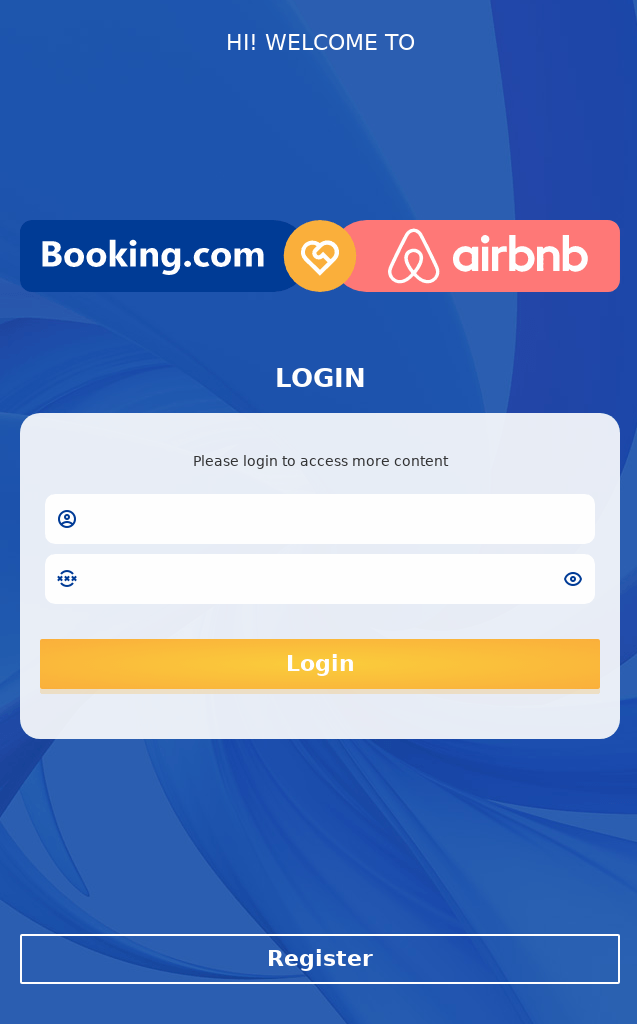
    In 2024, cybercriminals targeted travel enthusiasts using fake hotel and airline booking websites. In one simple scheme, a fraudulent site asked users to enter their login credentials to complete their booking — these credentials ended up in criminal hands. Sometimes, the fake login form appeared under multiple brand names at once (for example, both Booking and Airbnb).

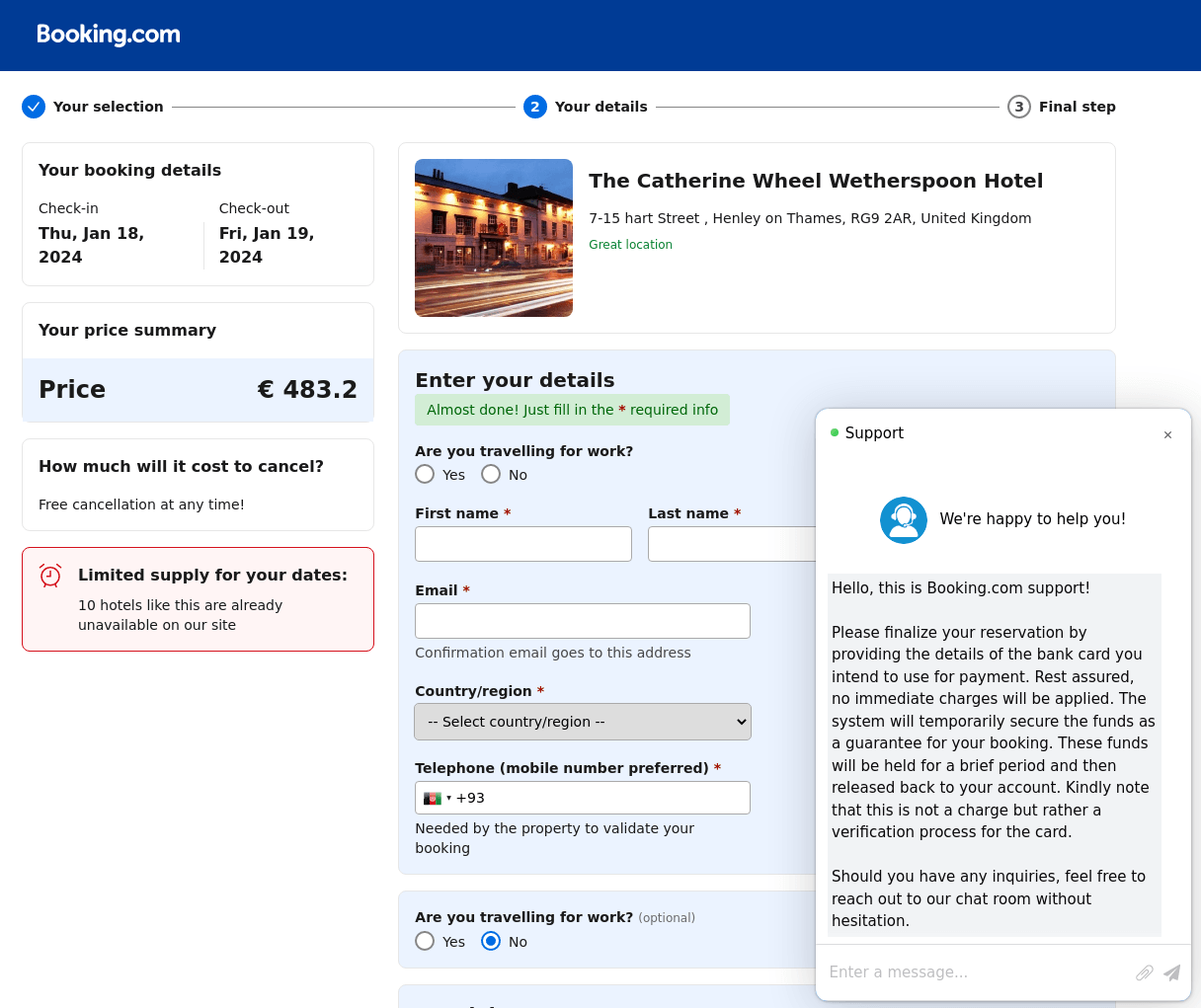
    Another scheme involved a more sophisticated fake site, where users could even select the purpose of their trip (business or leisure). To complete the booking, the scammers requested bank card details, claiming that a certain sum would be temporarily blocked on the account to verify the card’s authenticity. Legitimate booking services regularly request payment details, so the victim may not suspect anything in this case. To rush users into entering their data carelessly, on the phishing page, the scammers displayed warnings about dwindling accommodation availability and an imminent payment deadline for the booking. If the victim entered their data, the funds were not frozen but went straight into the criminals’ pockets.

    Cyberthreats in the travel sector affected not only tourists but also employees of travel agencies. By gaining access to a corporate account, criminals could conduct financial transactions on behalf of employees and gain access to large customer databases.

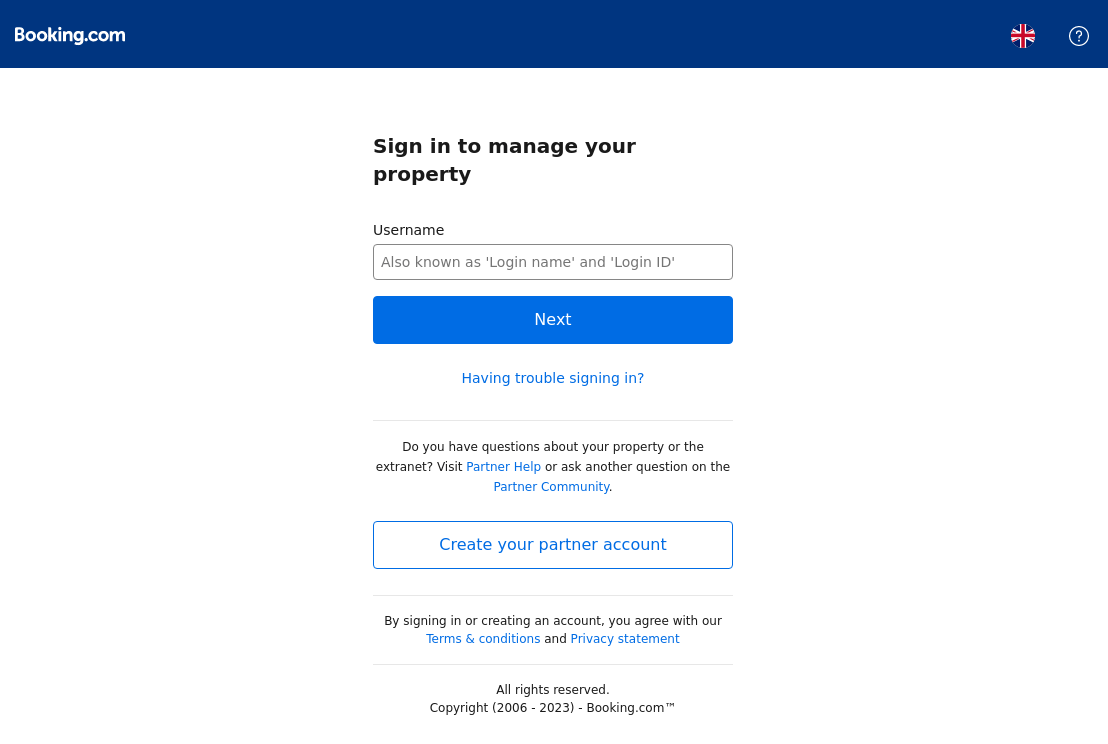
    Fake accommodation sites often sent messages to property owners, telling them to log in to “manage their property.” This scheme targeted people renting out their homes through online booking platforms.

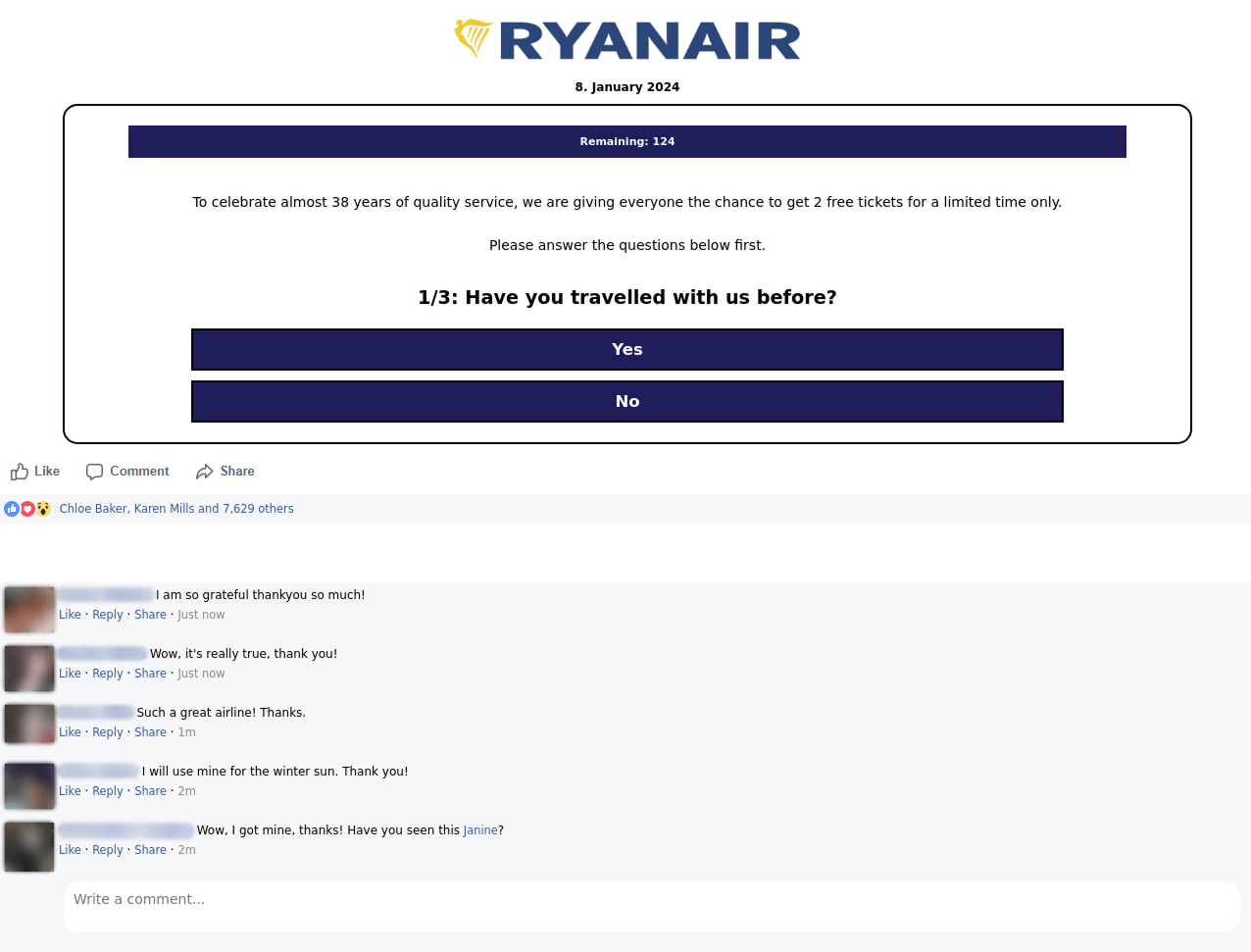
    Other scam pages featured surveys, offering respondents gifts or prize draws for participating. In this case, victims risked both their credentials and their money. Such fake giveaways are a classic scam tactic. They are often timed to coincide with a significant date for the travel industry or a specific company. For example, the screenshot below shows an offer to take part in a giveaway of airline tickets to celebrate Ryanair’s birthday.

    After completing the survey, users may be asked to share the offer with a certain number of contacts, and then pay a small fee to receive the expensive gift. Of course, these prizes are non-existent.

    Trapped in social networks

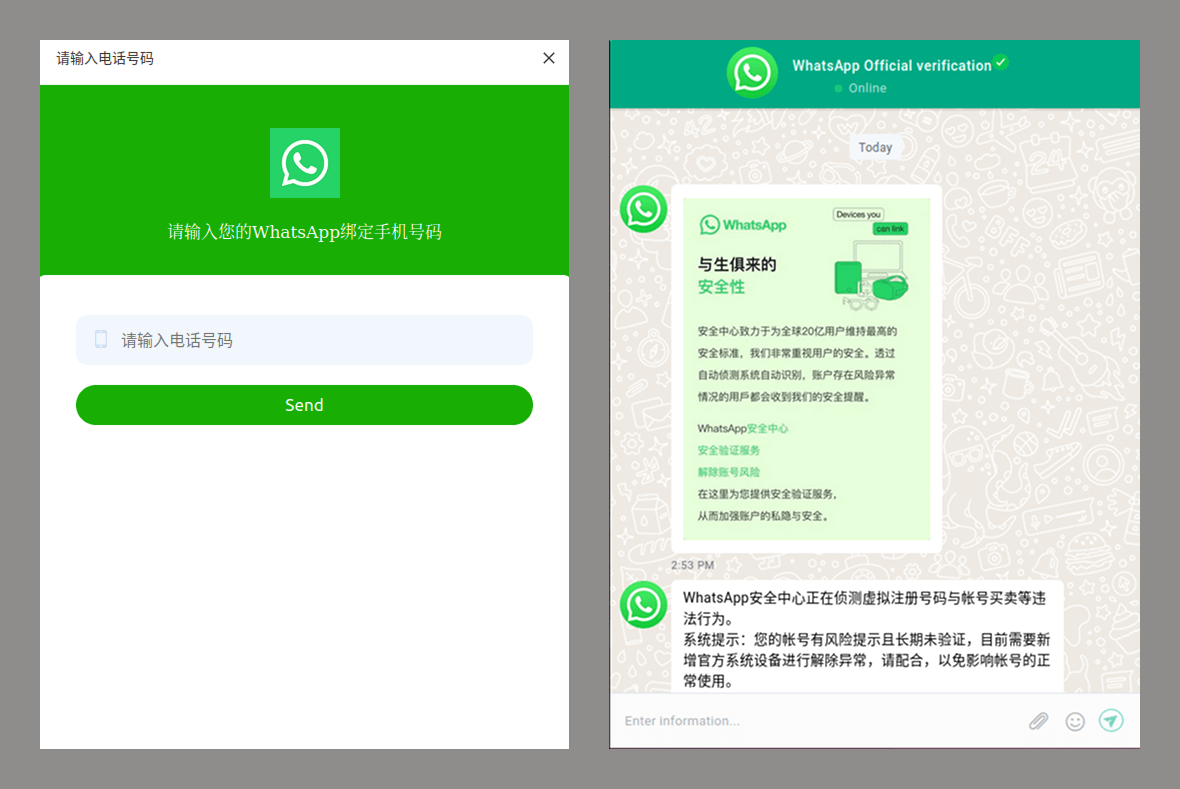
    To steal credentials for social media and messenger accounts, scammers used another classic technique: asking users to verify themselves. In one scheme, the victim was redirected to a website that completely replicated WhatsApp’s design. The user entered their phone number and login code, handing their credentials straight over to the cybercriminals.

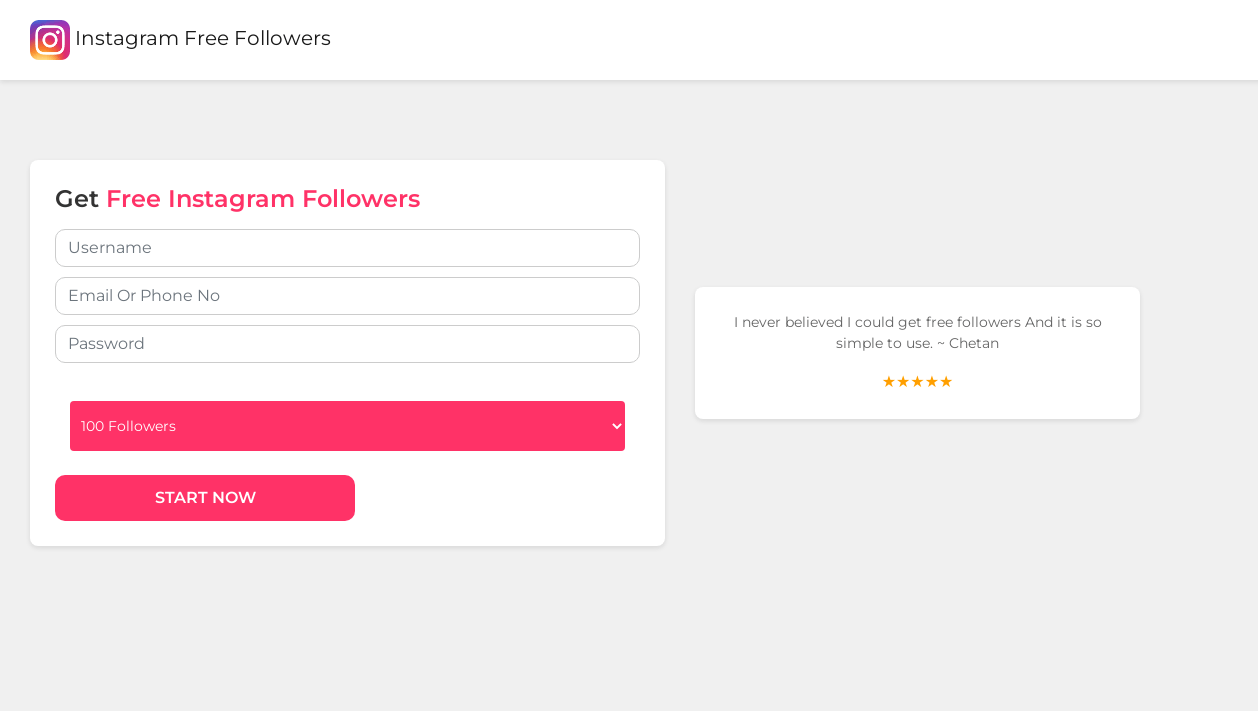
    Beyond verification scams, fraudsters also lured victims with attractive offers. For example, in the screenshot below, the victim is promised free Instagram followers.

    Some cybercriminals also used the promise of adult content to lure victims into entering their credentials in a fake authorization form.

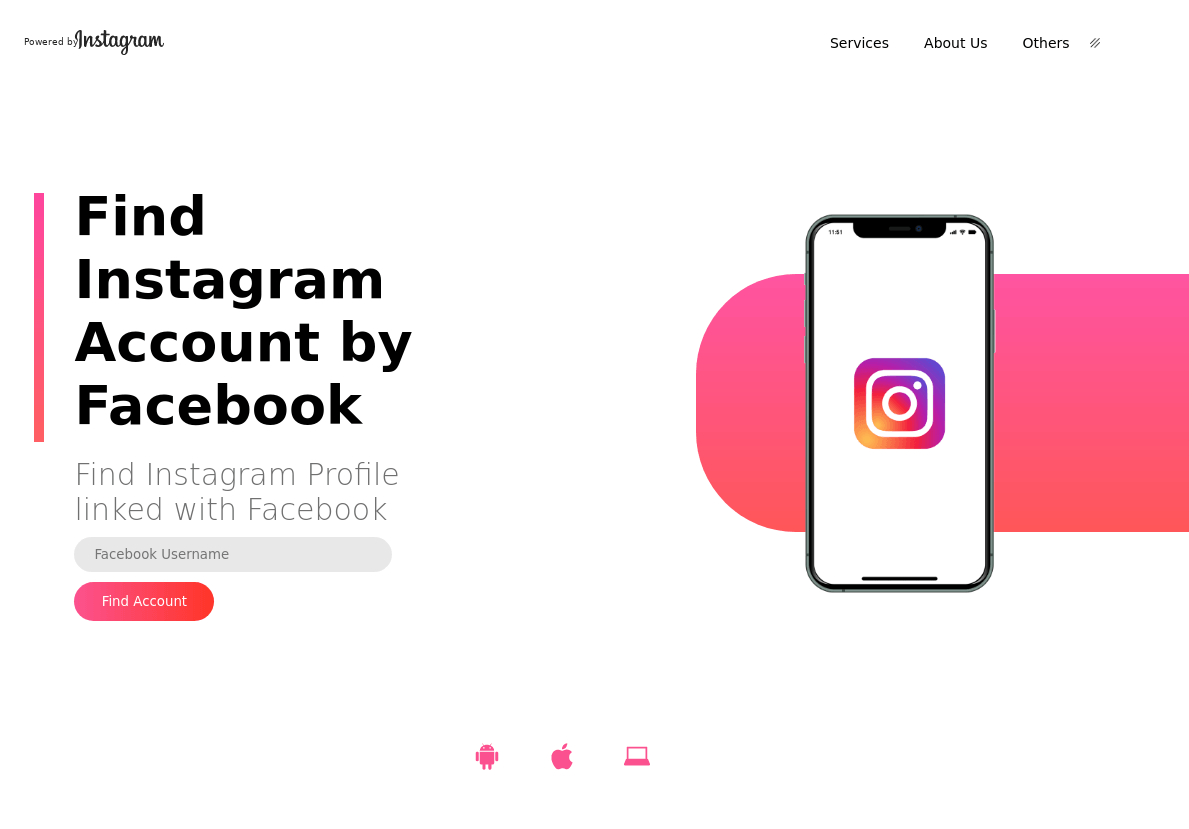
    Other scammers took advantage of Facebook and Instagram being owned by the same company. On a fraudulent page, they claimed to offer a service that allowed users to find Instagram profiles by entering their Facebook login and password.

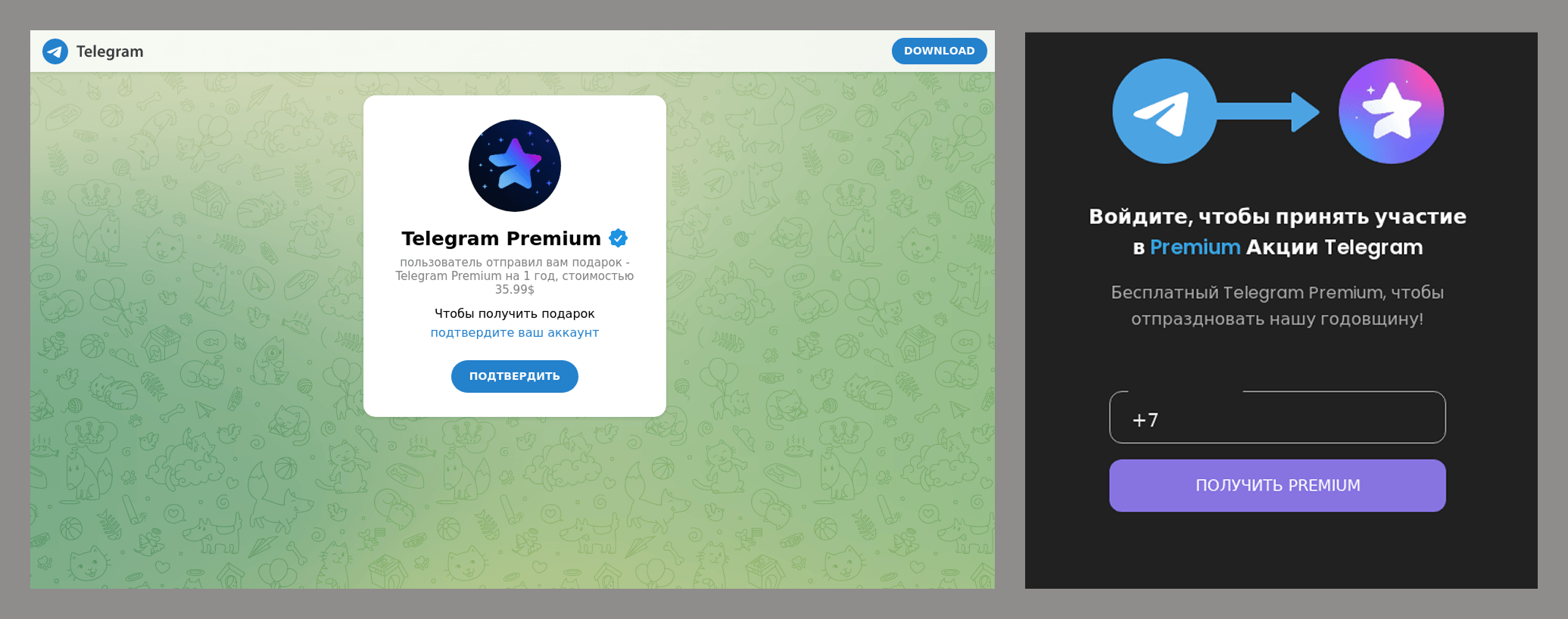
    Some scams offered users a surprise “gift” — a free Telegram Premium subscription. To enable the messenger’s premium features, the victim only had to enter their phone number and a one-time code on a fraudulent website.

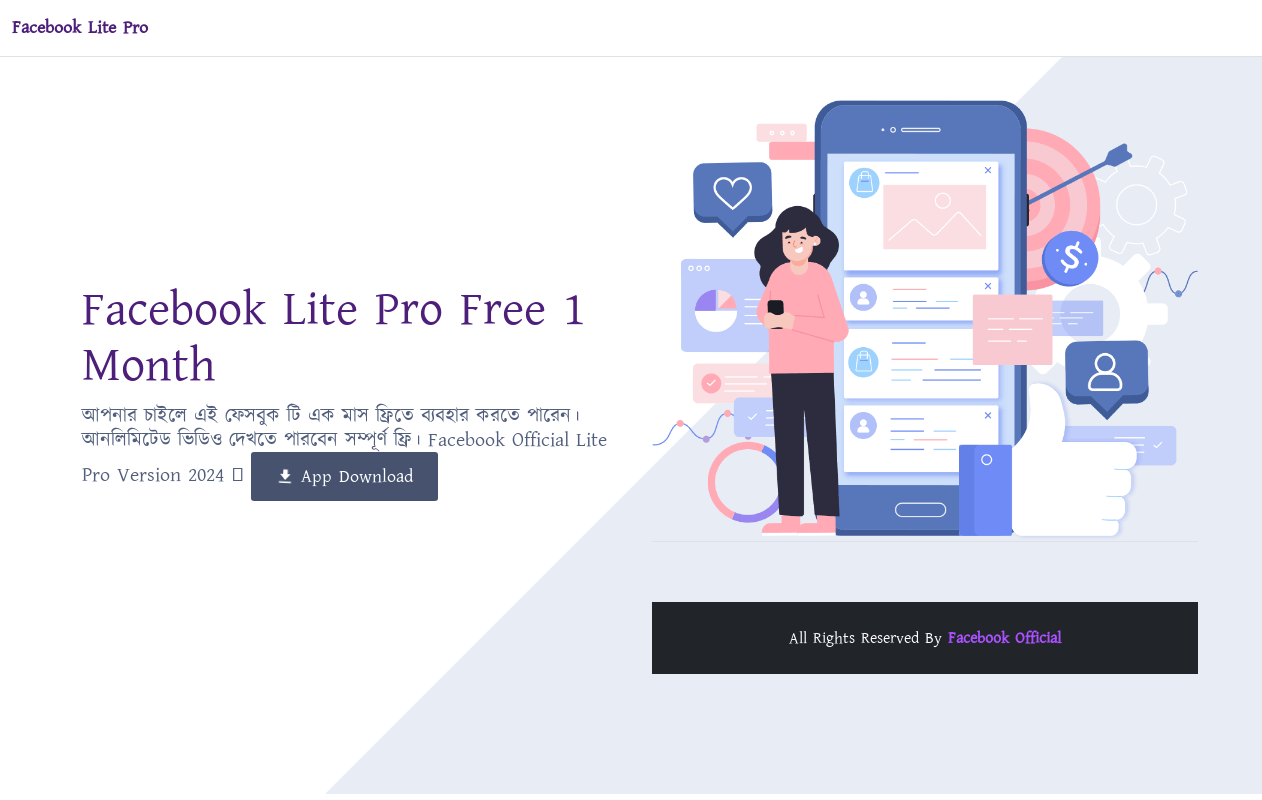
    Some fake social media and messenger pages were designed not to steal login credentials but to install malware on victims’ devices. Taking advantage of the popularity of Facebook Lite for Android, scammers offered users a “more advanced official version”, claiming it had extra features missing in the original app. However, instead of an upgraded app, users downloaded malware onto their devices.

    Similarly, installing a supposedly free Telegram client with an activated Premium subscription often led to downloading malware.

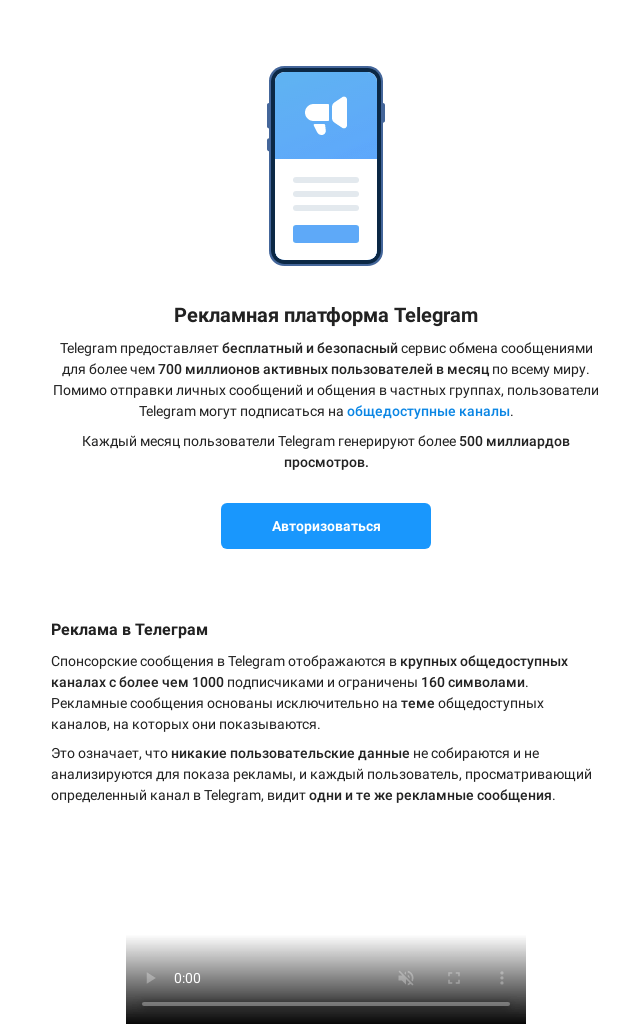
    Social media business services were increasingly used as a pretext for credential theft, as they play a key role in developing and promoting businesses and are directly linked to financial operations. Cybercriminals tricked Telegram channel owners into logging in to a phishing platform imitating the official Telegram Ads tool, thereby stealing their Telegram credentials. To make the scam more convincing, the attackers detailed how Telegram advertising works and promised millions of ad views per month.

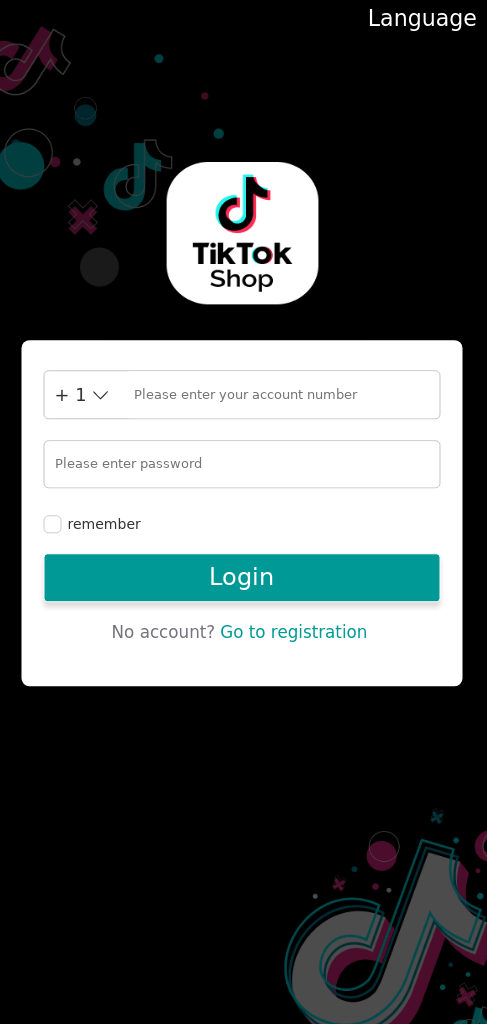
    TikTok users have also been targeted. TikTok Shop allows sellers to list curated products—items featured in videos—for potential buyers to find and purchase. Scammers created fake TikTok Shop pages to steal seller credentials, potentially leading to both reputational and financial damage.

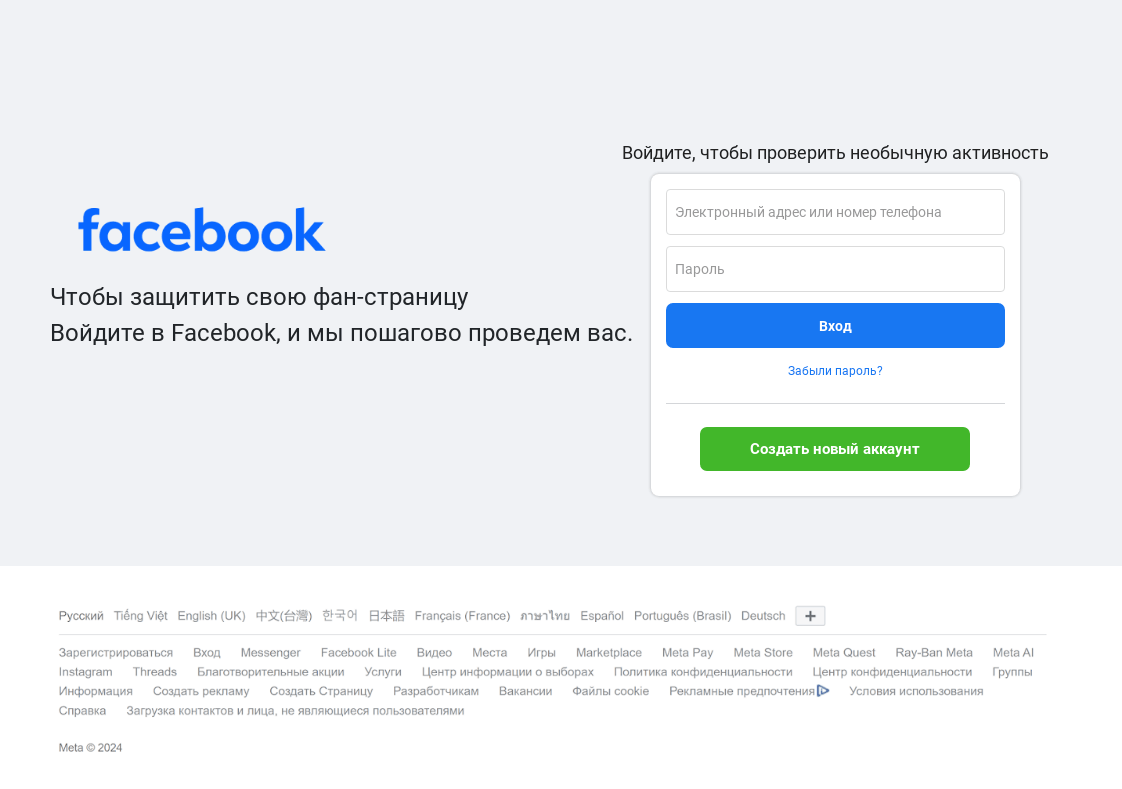
    In another case, fraudsters informed Facebook fan page owners of unusual activity in their accounts. Potential victims were prompted to check their profile by entering their login credentials into a phishing form.

    Cryptocurrency: don’t mistake scams for real deals

    One of last year’s most sensational stories was the cryptocurrency game Hamster Kombat. This clicker game, simulating the creation of a crypto exchange in a gamified format, quickly attracted a massive audience. Players eagerly awaited the moment when the in-game coins could be exchanged for real virtual currency. But while the official listing was delayed, the fraudulent schemes wasted no time.

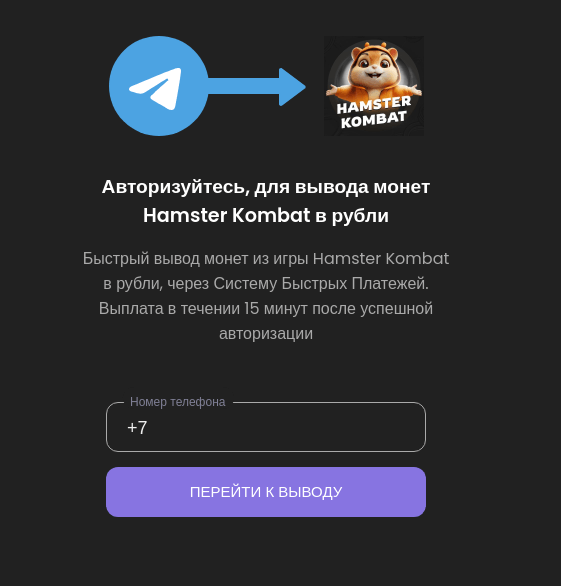
    Fraudsters claimed to offer cash-out services for in-game coins by converting them into rubles. To withdraw money, criminals claimed, users just had to log in through a fake Telegram page.

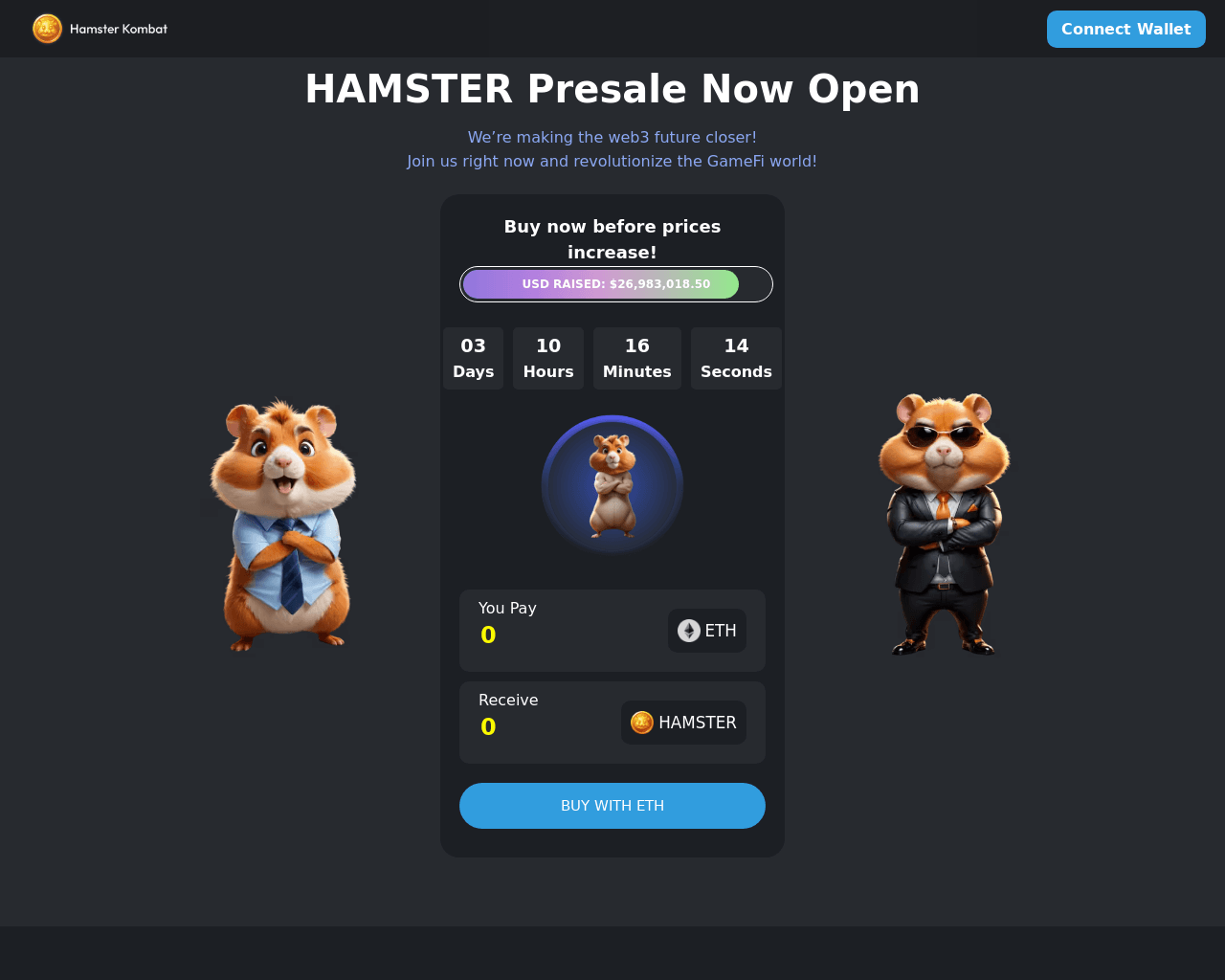
    The growing anticipation for the new cryptocurrency’s market launch was frequently exploited by cybercriminals to steal seed phrases from crypto wallets. Scammers announced an early token sale, requiring users to log in through a fake page to participate. Of course, there was no mention of such promotions on official resources.

    The popularity of Hamster Kombat was also abused in scam schemes. For example, users were offered access to a crypto wallet supposedly containing a significant sum in virtual coins. To claim it, the unsuspecting victims had to share information about the “opportunity” with a certain number of contacts in messaging apps. Having made their potential victim an accomplice in spreading false information, the scammers demanded a small commission for the withdrawal and disappeared with the stolen money.

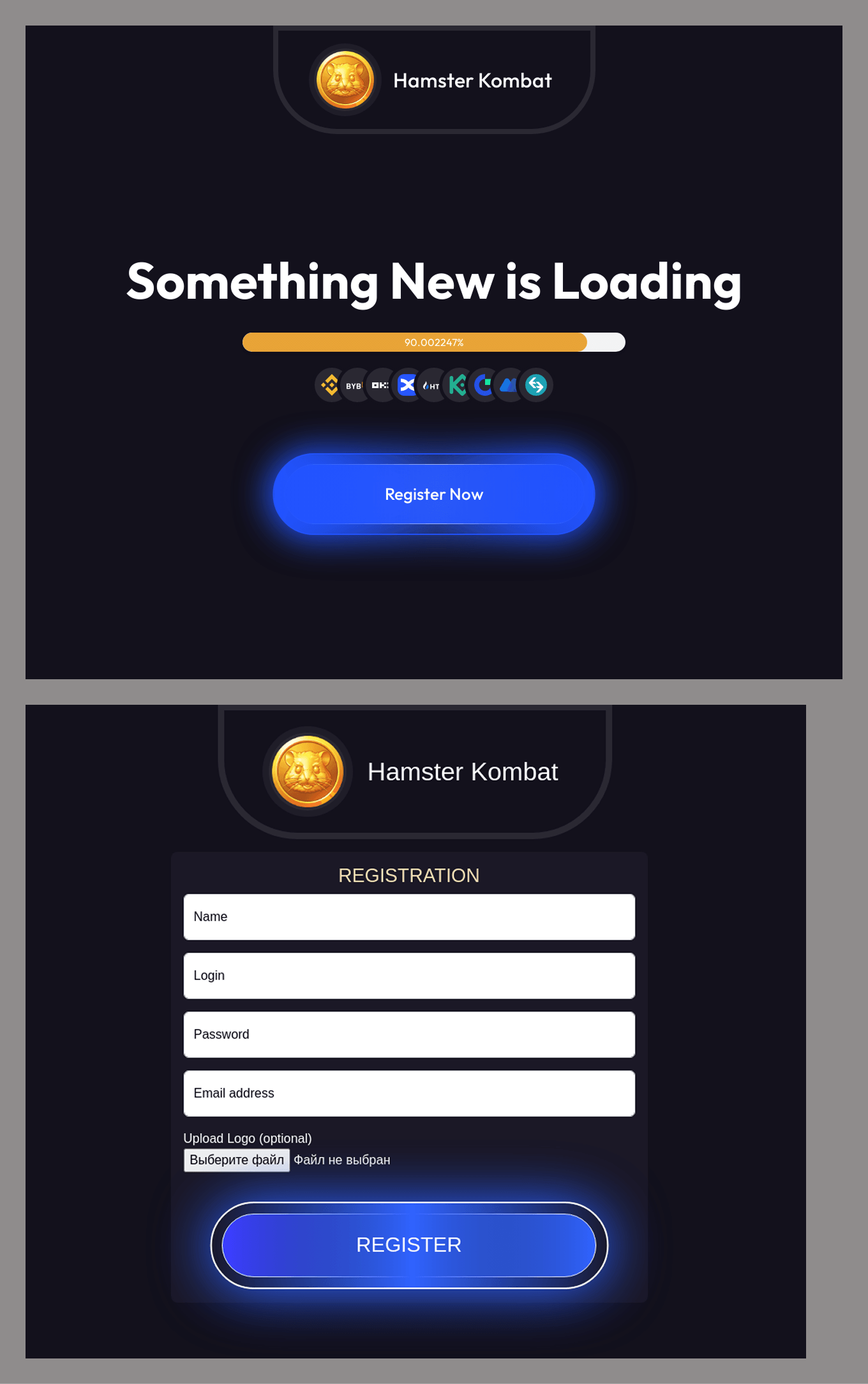
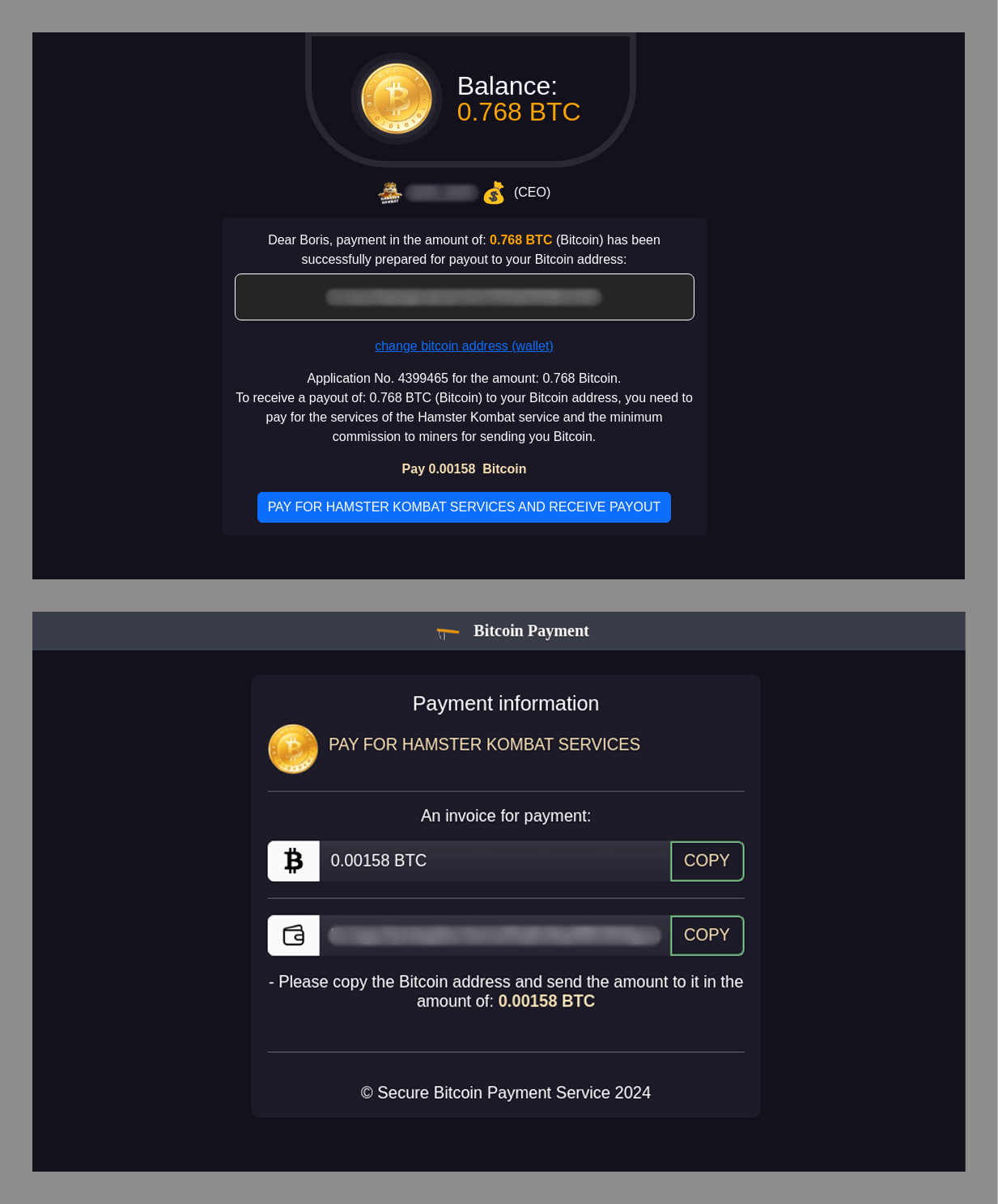
    A more elaborate scam also aimed to trick users into paying a “commission”, but with a slightly different approach. First, visitors to the page were asked to register to learn about some new activity related to Hamster Kombat.

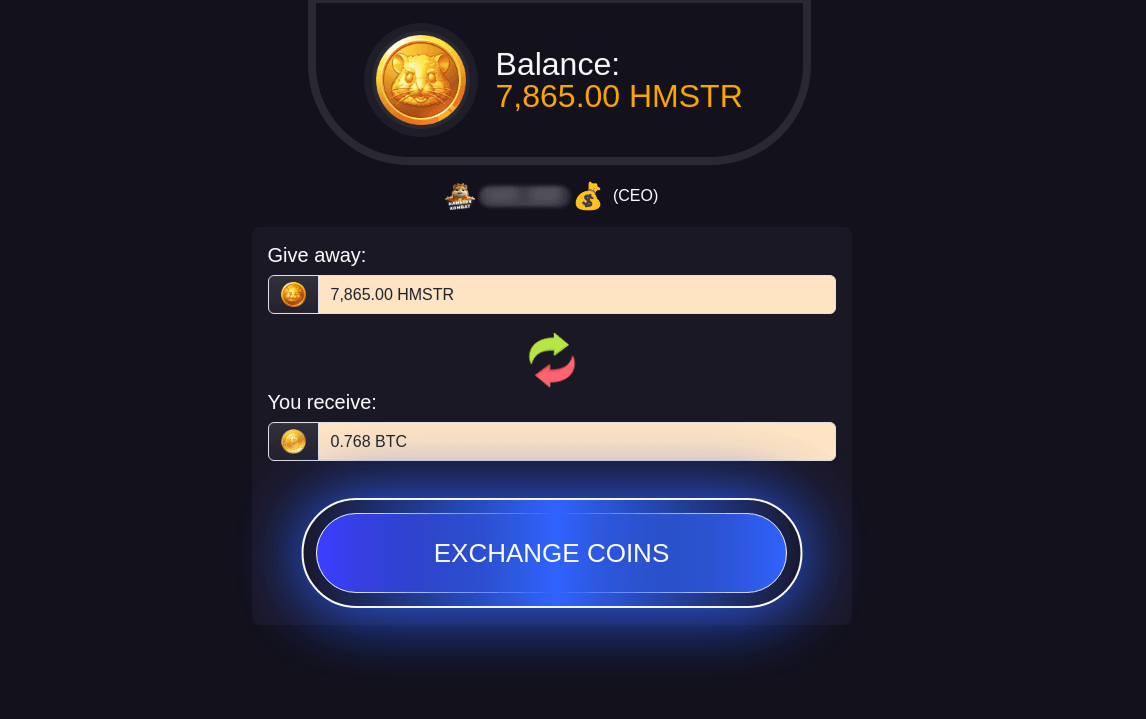
    Once registered, they were suddenly informed of having won a large amount of the HMSTR cryptocurrency supposedly as part of an experiment conducted on the platform. Exploiting uncertainty around the token’s listing, scammers urged victims to bypass the official trading launch and exchange their in-game currency for Bitcoin immediately.

    To make it more convincing, the page displayed an exchange rate at which the “prize” would be converted.

    However, after clicking the “Exchange coins” button, users were prompted to pay a commission for the service.

    Everyone who paid this fee lost their money and received no Bitcoin.

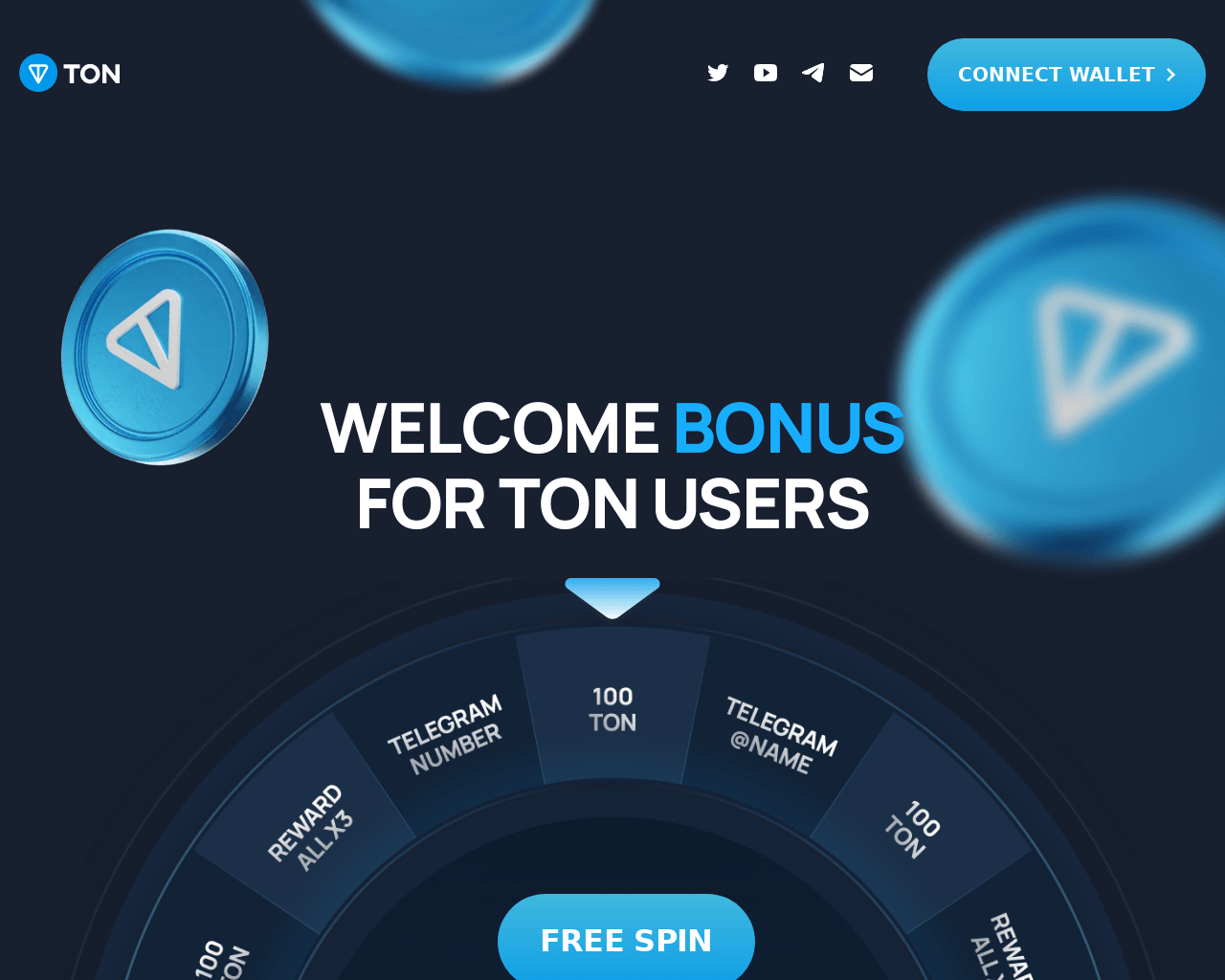
    Phishing attacks also targeted TON wallet users. In this case, scammers lured victims with promises of bonuses, requiring them to link their crypto wallets on fraudulent websites.

    TON cryptocurrency was also used as bait in scam schemes. In a classic scenario, users were promised a quick way to earn digital currency. Fraudsters advertised a cloud mining service that allegedly generated high profits without any effort. After registering, unsuspecting users could monitor their “earnings” but had to pay a commission in cryptocurrency to withdraw funds.

    Another “profitable” crypto scam resembled a Ponzi scheme: victims were required to recruit at least five new participants into the program—without receiving any money, of course. The scam site mimicked an online earning platform.

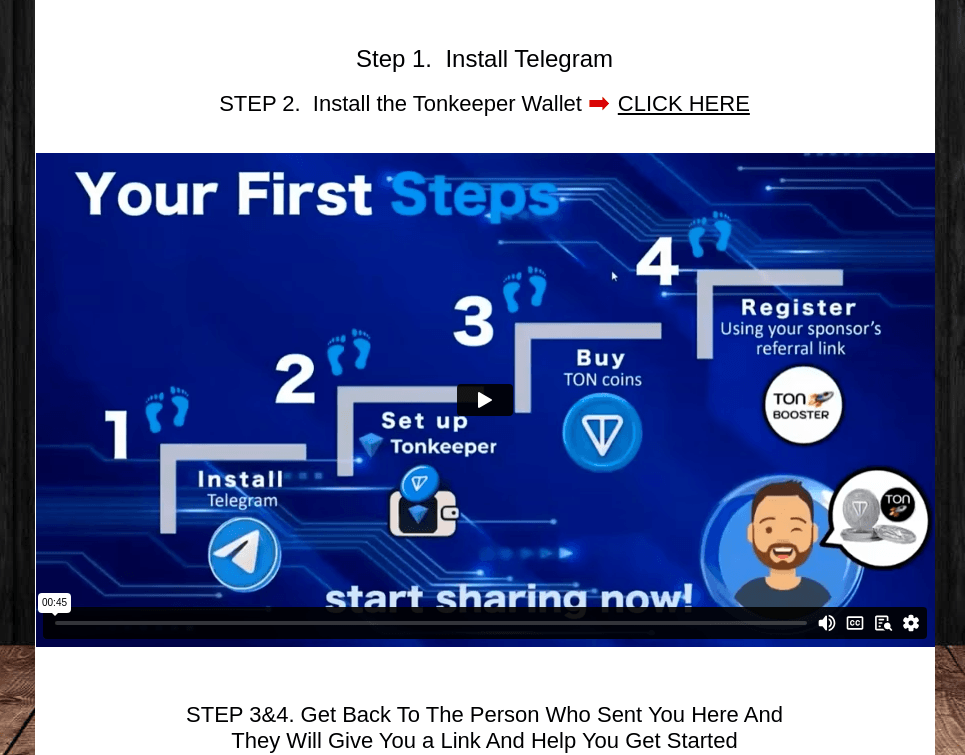
    Visitors were instructed to install Telegram and use an unofficial bot to activate a crypto wallet where profits would supposedly be deposited.

    According to the instructions, users then had to buy Toncoin and register in the program through a referral link from another participant. The scam worked by enticing people to make a small investment in the hopes of making big profits—the victims used their own funds to purchase the cryptocurrency for registration. But as with any pyramid scheme, only those at the top profited, while everyone else was left with nothing but empty dreams.

    All or nothing: multipurpose phishing

    Victims of phishing frequently included bank clients and users of government service portals. In such schemes, users first received a notification that they needed to update their account credentials. Cybercriminals used various communication channels to contact their victims: email, text messages, and chats in messaging apps. The victims were then led to fake sites where they were asked to provide their personal data. First, they entered their personal login credentials on the organization’s website.

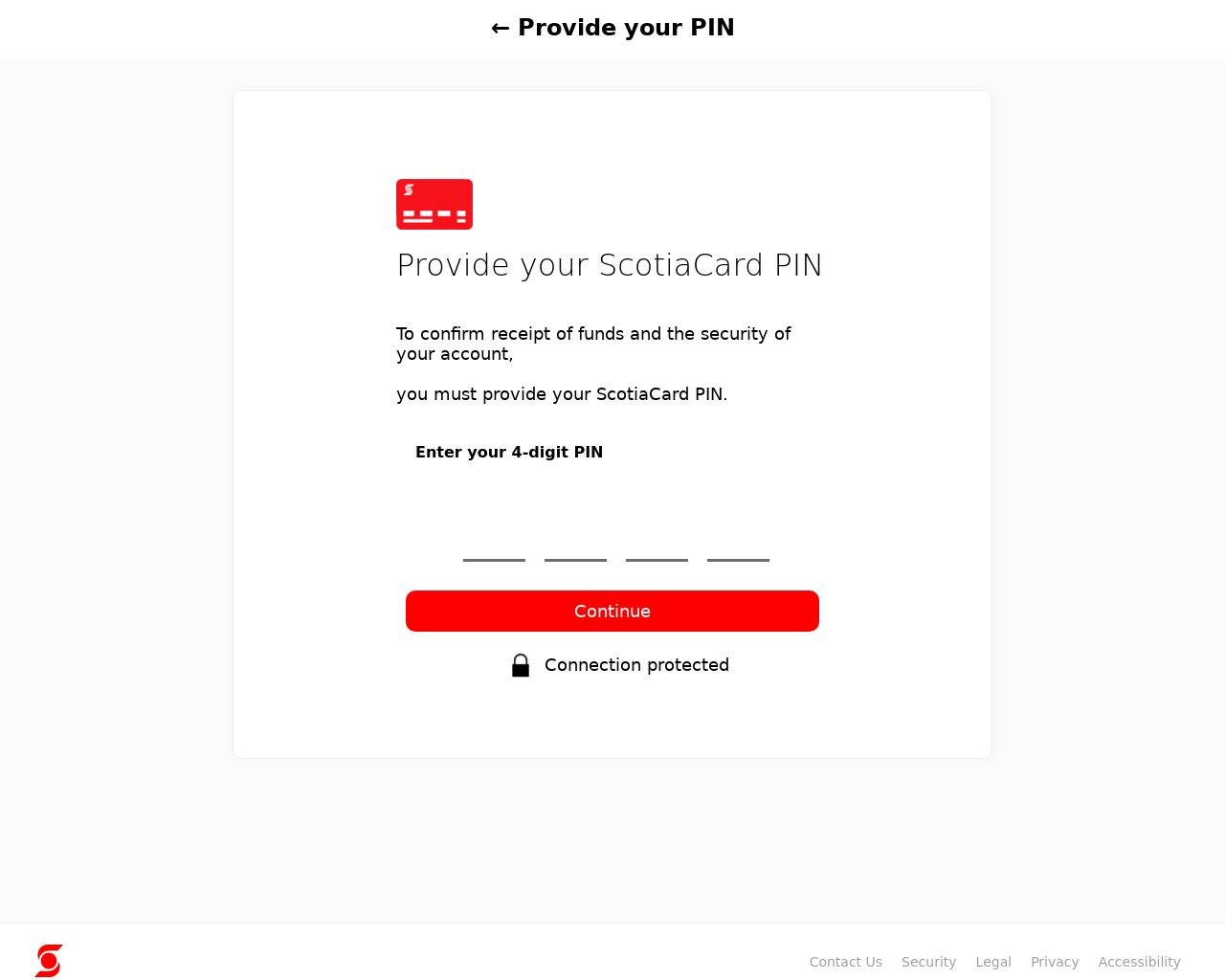
    Next, they were prompted to provide their email account credentials. The scammers also attempted to collect identity document details and other data, including the bank card PIN code.

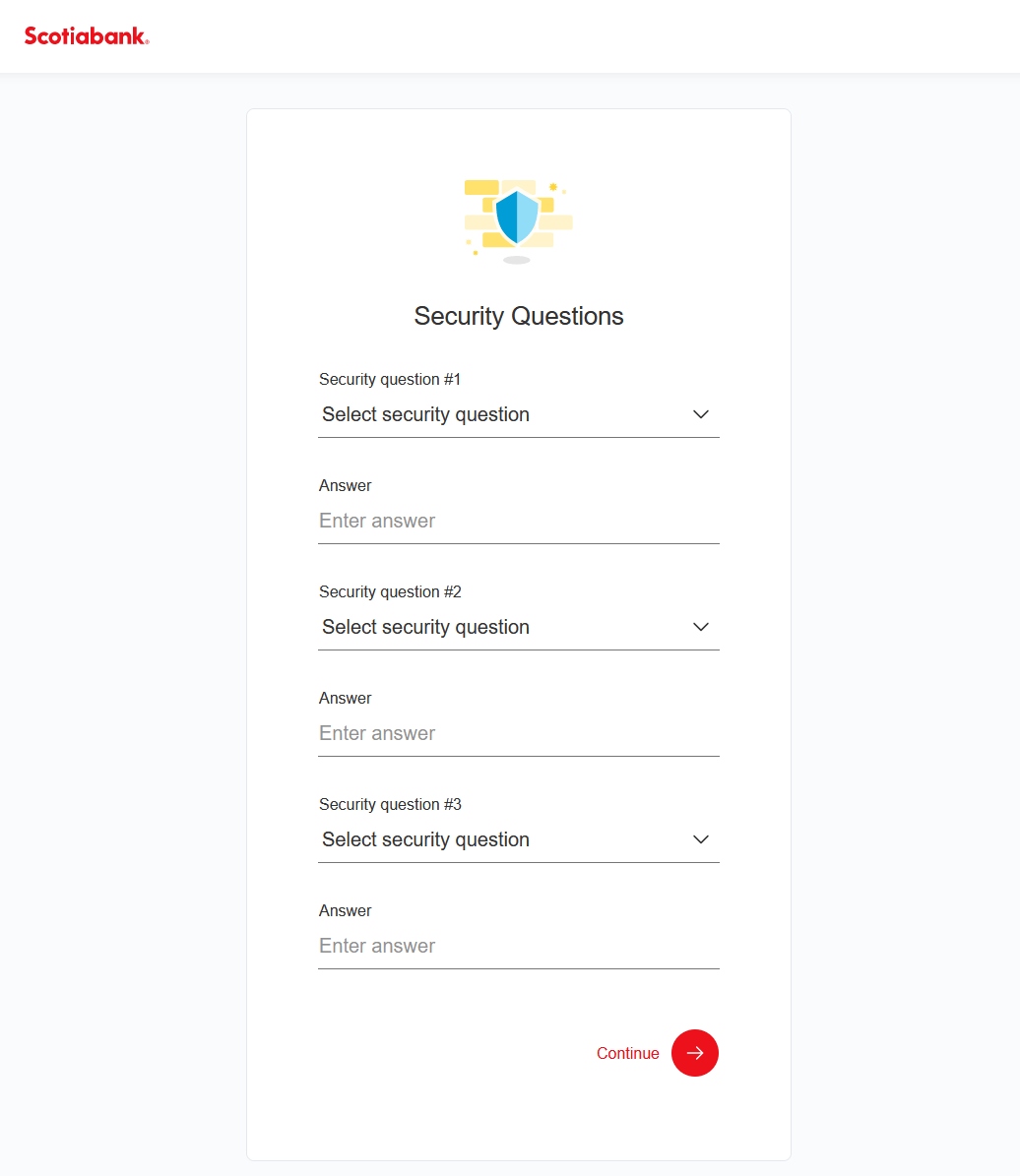
    Additionally, these phishing forms requested answers to security questions commonly used for additional verification in banking transactions.

    This way, the cybercriminals gained full access to the victim’s account. Even the PIN code could be useful for the scammers in gaining access to the account. Security questions served as an extra safeguard for fraudsters in case the bank’s security service detected suspicious activity.

    False idols

    Phishing schemes also exploited the images of real people. For example, users browsing YouTube could stumble upon ad videos of celebrities announcing giveaways for their fans. Clicking the link in such a video led users to a page containing a post supposedly from the celebrity’s social media account, explaining how to claim the prize. However, when attempting to collect the “winnings”, visitors were asked to pay a small commission—insignificant compared to the value of the “gift.” Needless to say, those who paid the fee lost their money. The prize never existed, and the video was nothing more than a deepfake.

    Spam in 2024

    Scams

    Token giveaway scam

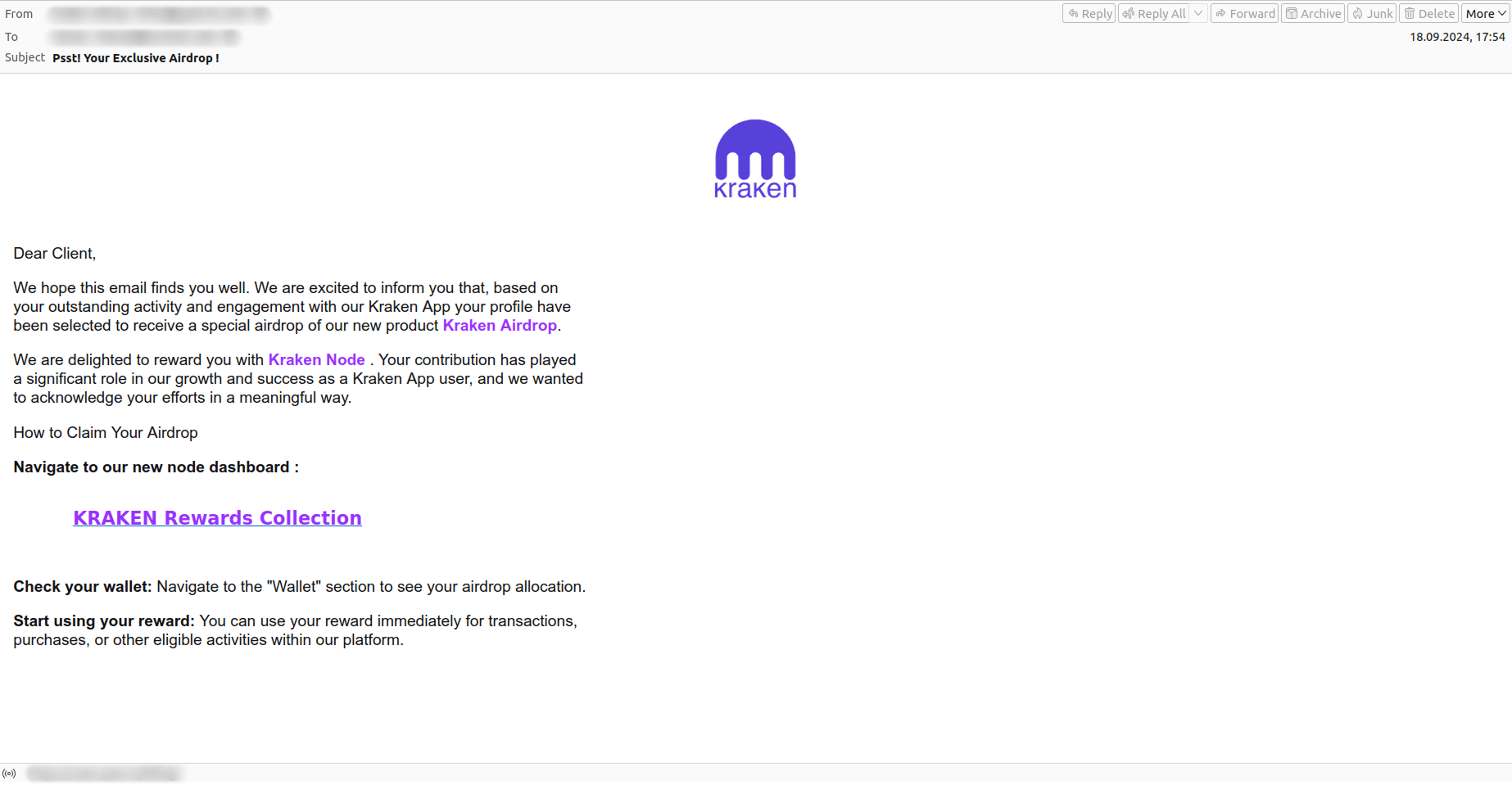
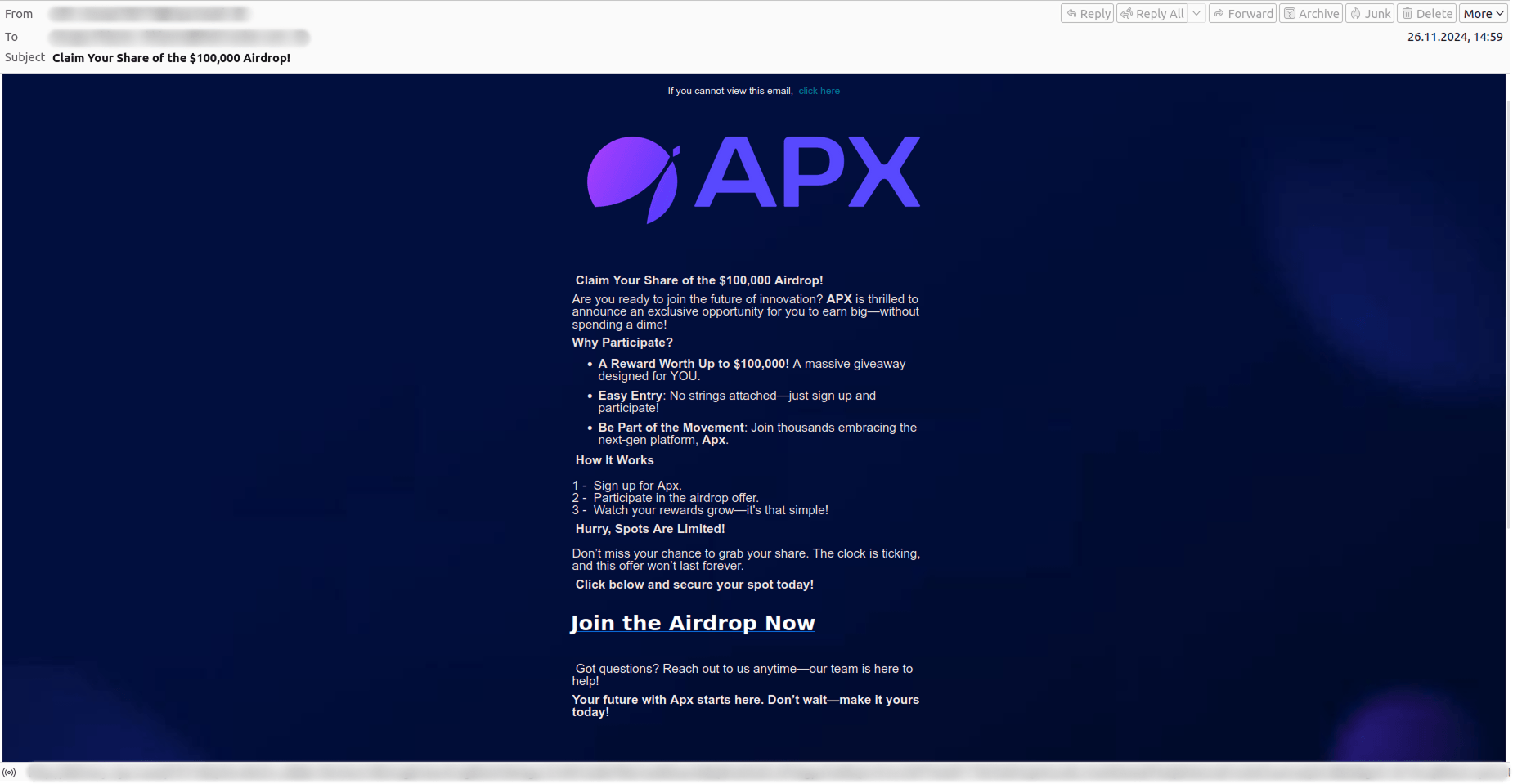
    Throughout the year, we frequently encountered emails announcing fake cryptocurrency airdrops, allegedly from teams of well-known crypto projects. The recipients, referred to as the platform’s “most valuable users,” were invited to participate in an “exclusive” event as a thank you for their loyalty and exceptional engagement.

    New users unfamiliar with cryptocurrency were lured in with a unique opportunity to take part in the token giveaway and win a large sum—all they had to do was register on the platform, which was, of course, fake.

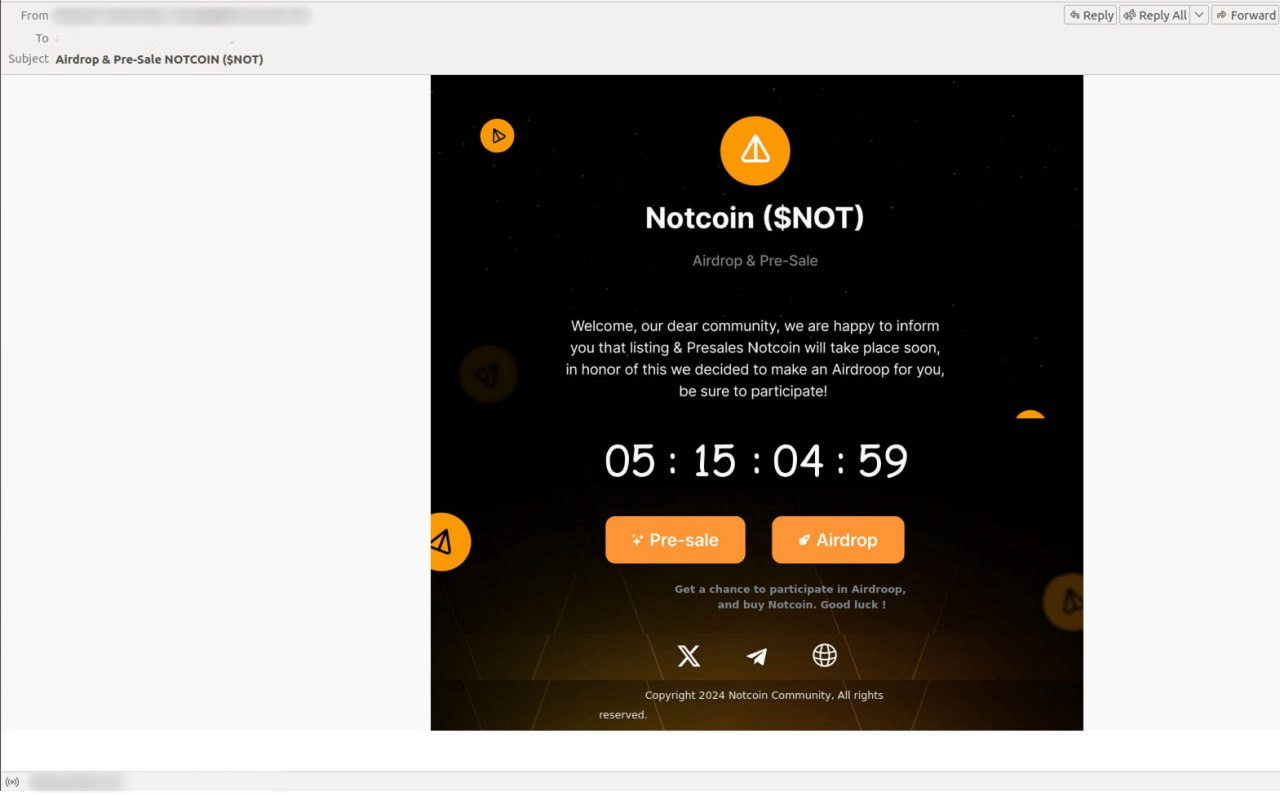
    Scammers in 2024 closely monitored cryptocurrency market news. For example, in the spring, ahead of Notcoin’s upcoming listing, scam messages appeared featuring countdown timers, urging potential victims to participate in an airdrop allegedly arranged just for them.

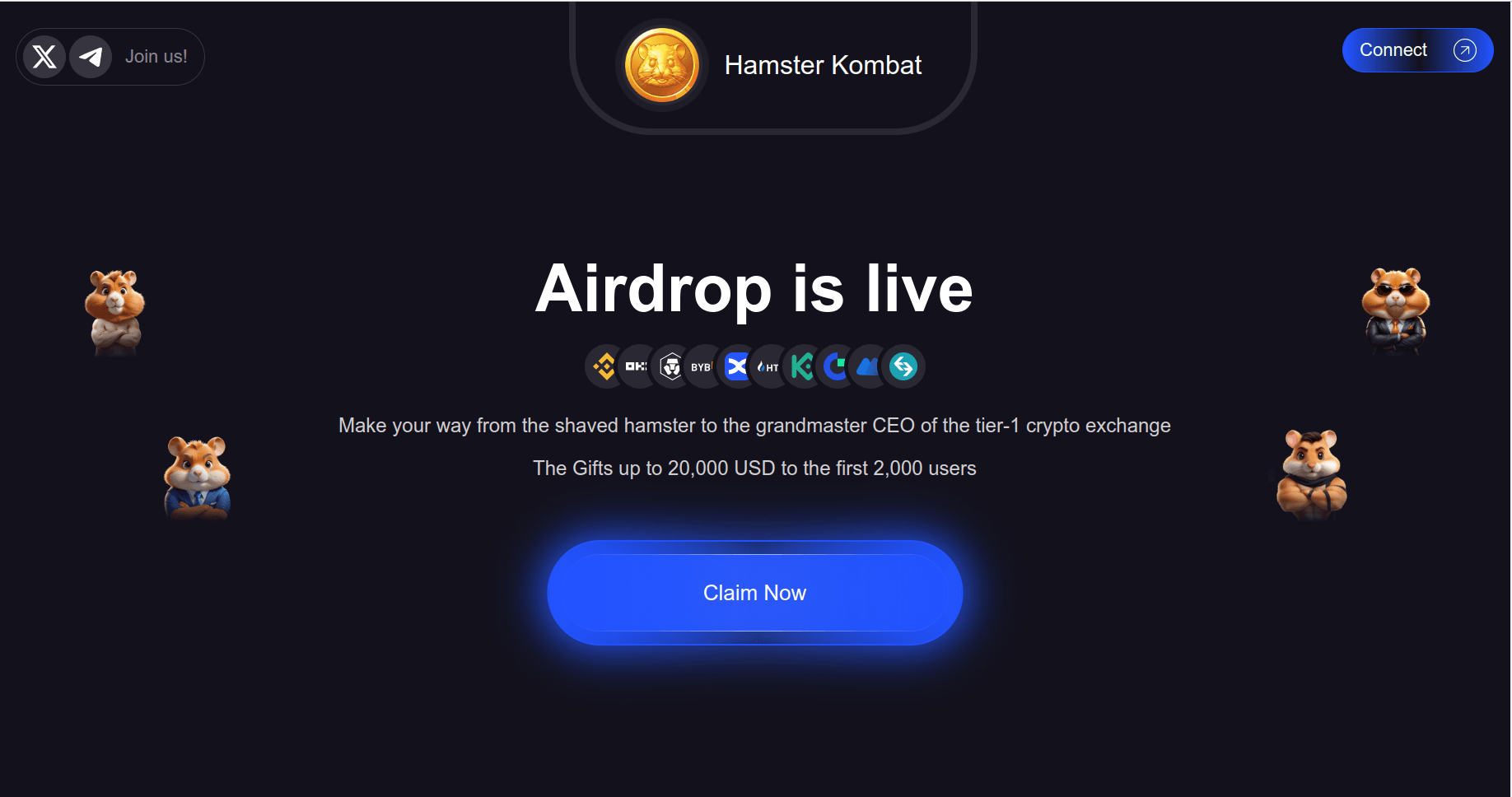
    Scam emails also targeted users of the cryptocurrency game Hamster Kombat, popular among Russian-speakers. Players eagerly awaited the HMSTR token listing, which was repeatedly postponed—a delay that scammers were quick to exploit. In the fall of 2024, they began sending emails pretending to be from the Hamster Kombat team, promising generous cash prizes if victims clicked a link to a fake game site.

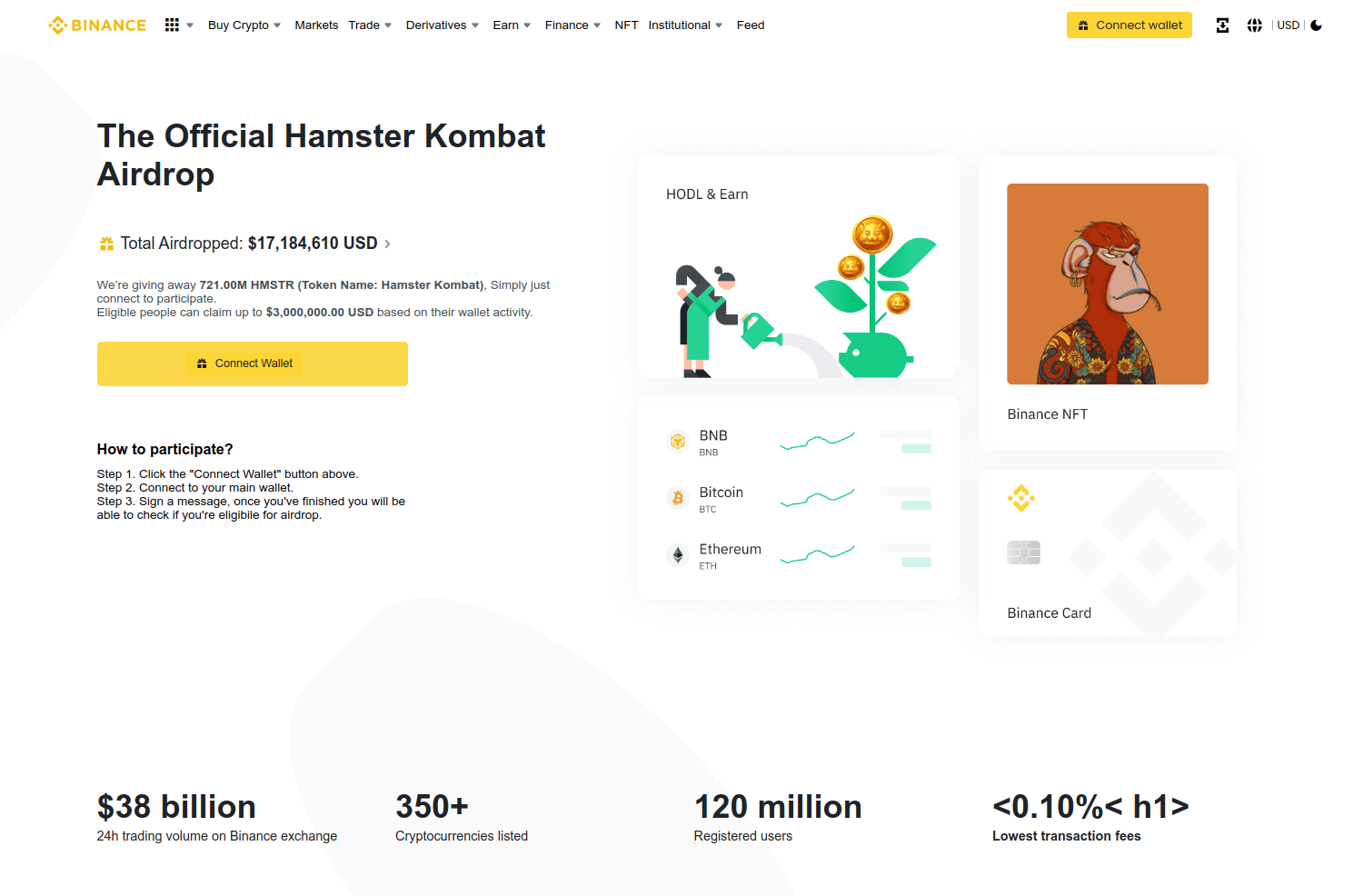
    Similar offers were distributed via a fraudulent website mimicking a major cryptocurrency exchange. In both cases, to claim the coveted tokens, victims had to link their cryptocurrency wallets.

    “Nigerian” scam

    In 2024, the Nigerian scam remained popular among spammers. Furthermore, fraudsters used both time-tested and trending themes to deceive victims. Cybercriminals employed various tricks and manipulations to engage with email recipients, with the ultimate goal of extracting money.

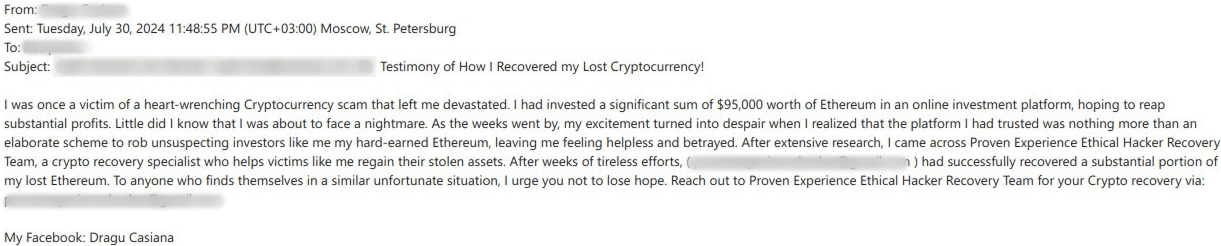
    Most often, users were lured into classic schemes: fraudsters posed as terminally ill wealthy individuals seeking a worthy heir, lottery winners eager to share their prize, or investors offering opportunities in a promising business. Sometimes, to evade suspicion, scammers “rescued” their victims from other fraudsters and offered to compensate them for any financial losses. For example, in the summer of 2024, we came across an interesting case where an alleged victim of crypto fraud suggested that fellow sufferers contact a group of noble hackers for help recovering lost cryptocurrency.

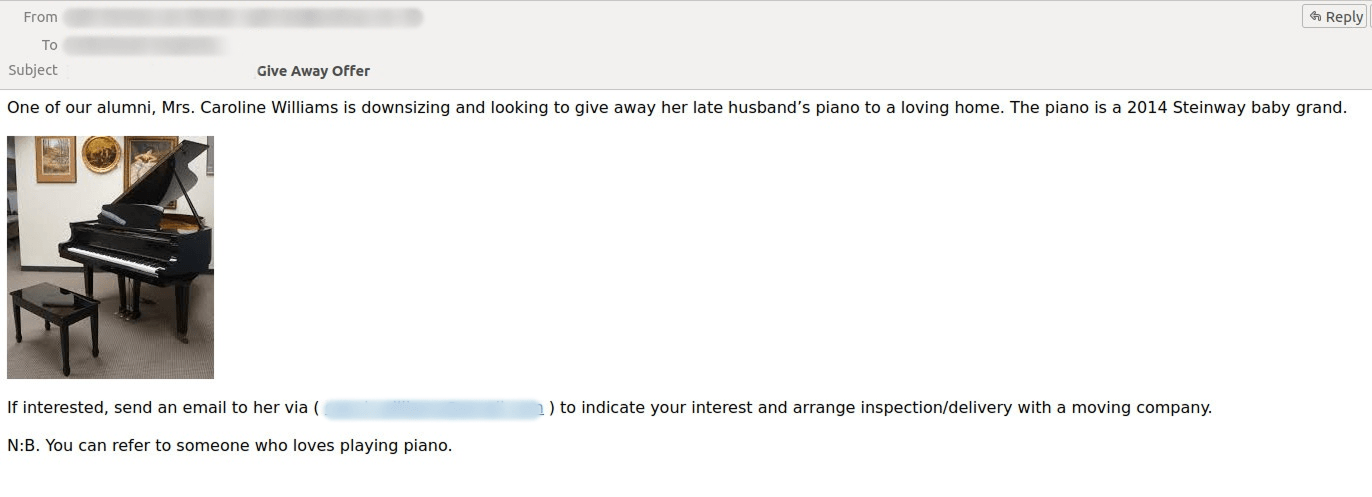
    Some scam offers were quite unexpected, as they didn’t promise vast riches, and, therefore, might not attract such a wide audience. In mid-to-late 2024, we saw scam emails claiming to be looking for new owners for pianos due to relocation or the previous owner’s passing.

    We also encountered even more creative scam narratives. For example, an email allegedly sent from a secret society of Illuminati promising to share their wealth, power and fame if the recipients agree to join their grand brotherhood.

    Other “Nigerian” scam emails capitalized on current news events. Thus, the most talked-about event of 2024, the US presidential election, significantly influenced the types of scams we saw. For example, one scam email claimed that the recipients were incredibly lucky to be eligible to receive millions of dollars from Donald Trump’s foundation.

    Scam in the Russian segment

    Last year, the Russian segment of the internet was not spared from mass scam mailings. We frequently encountered schemes mimicking investment projects of major banks, promising users easy earnings and bonuses. Fraudsters also sent out emails with promotional offers from home appliance and electronics stores. Customers were informed of huge discounts on sales that were supposedly about to end.

    The links in such emails led to fraudulent websites that looked identical to legitimate online stores but stood out with extremely low prices. After paying for their desired items, customers lost their money, as orders were never actually placed.

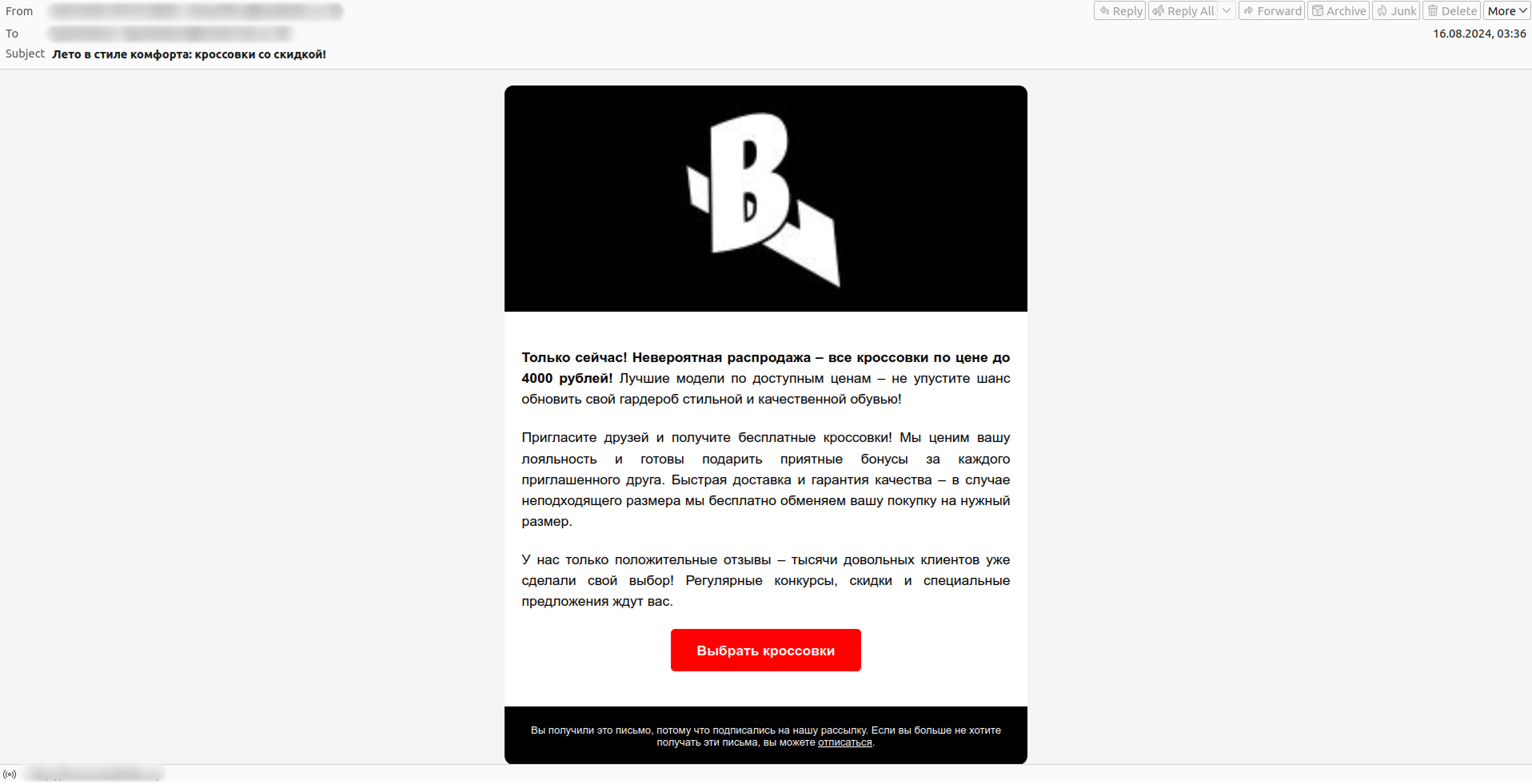
    Beyond electronics, scammers also offered other discounted products. In one such campaign, users received an email advertising a sneaker store selling popular models at affordable prices.

    Judging by the technical headers of the emails, both the sneaker store and electronics store promotions were sent by the same fraudsters.

    Additionally, we came across emails offering recipients to apply for debit or credit cards under favorable conditions. Unlike the electronics and shoe sale scams, these messages were legitimate referral programs from major banks, which enterprising spammers tried to monetize. Technically, such emails are not scams, as their links lead to real banking websites, and recipients do not face any risks. However, senders profit from registrations via the referral program. Nevertheless, we do not recommend clicking links from unknown senders, as seemingly harmless emails from a referral platform could be phishing or scam messages.

    Password-protected archives

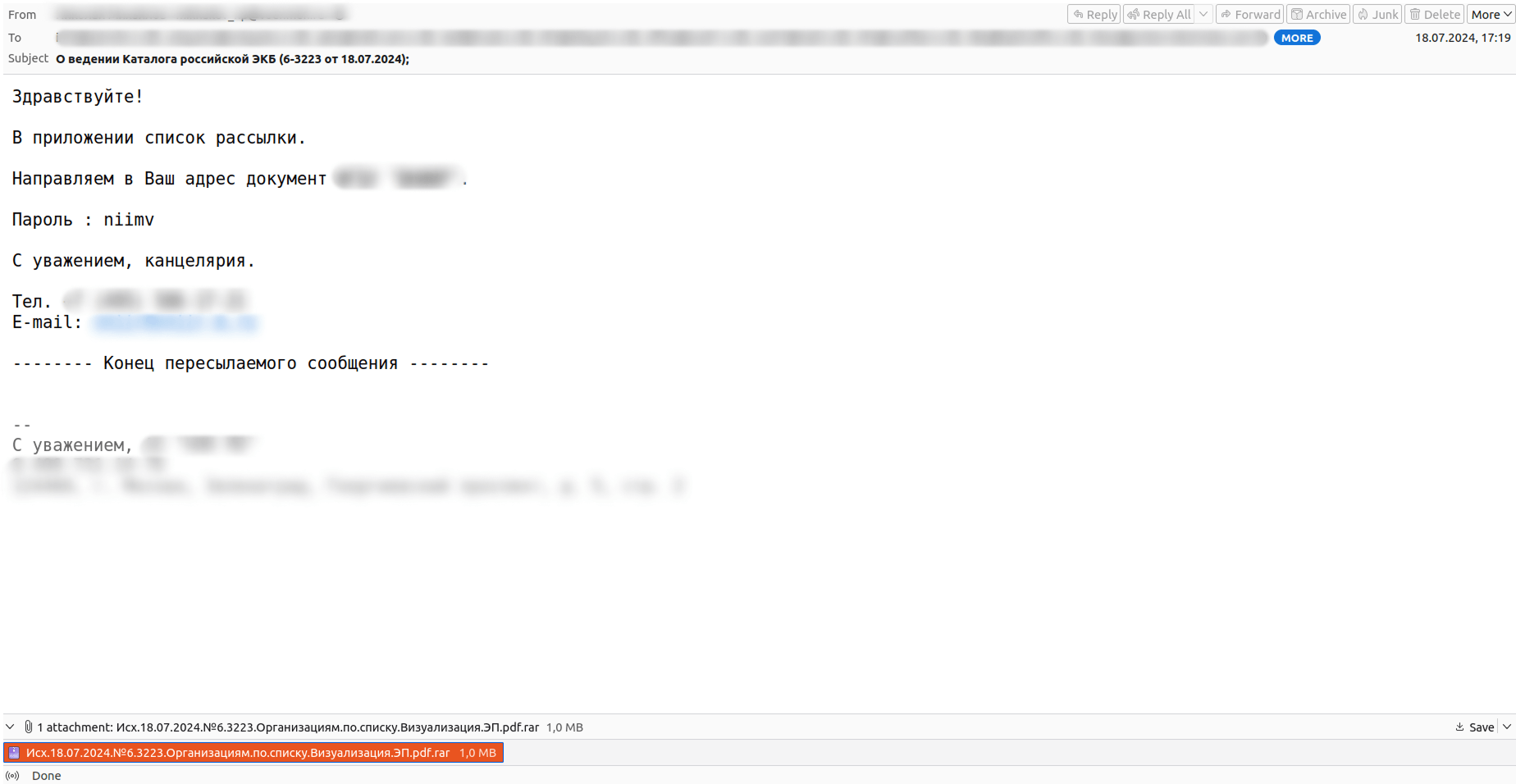
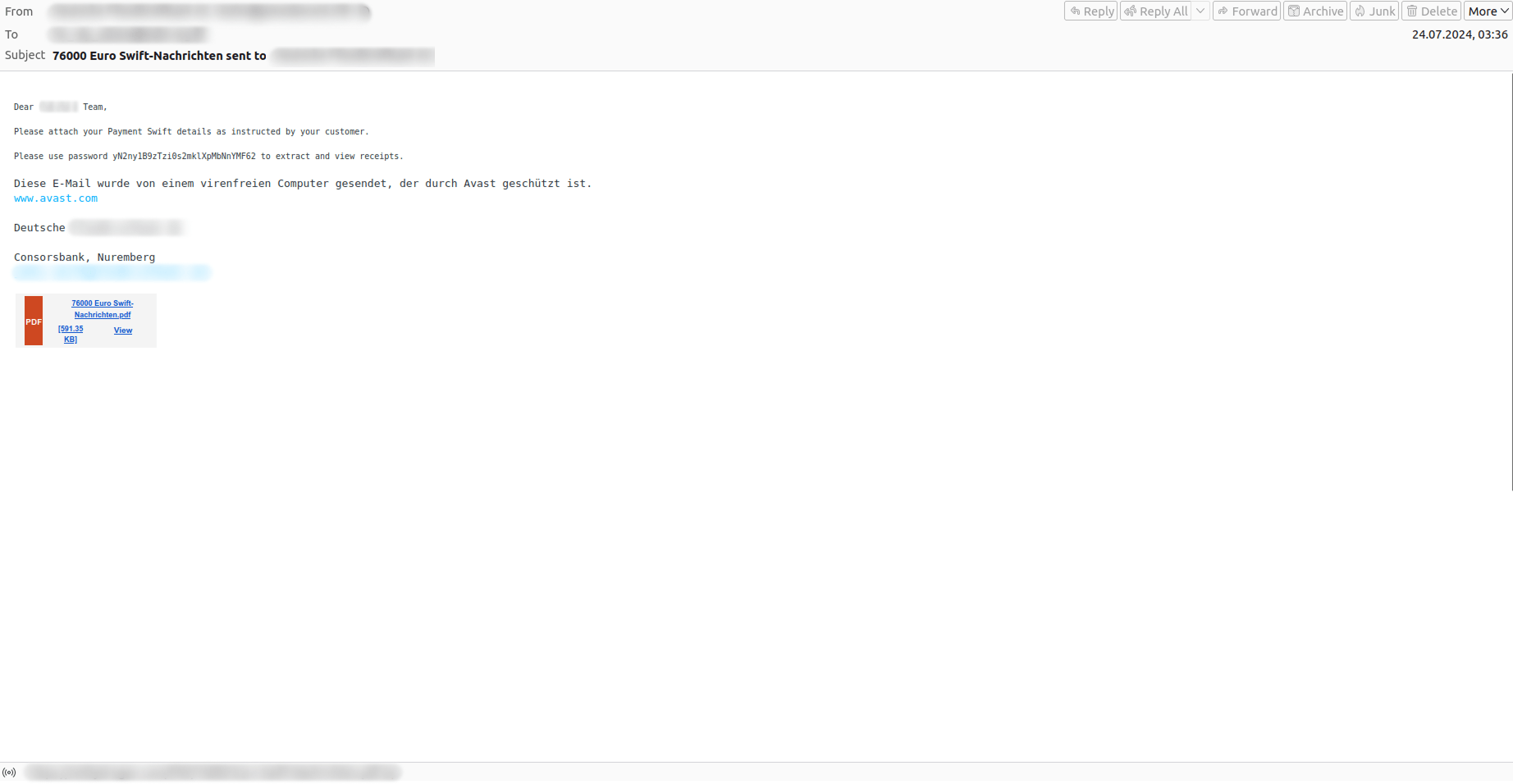
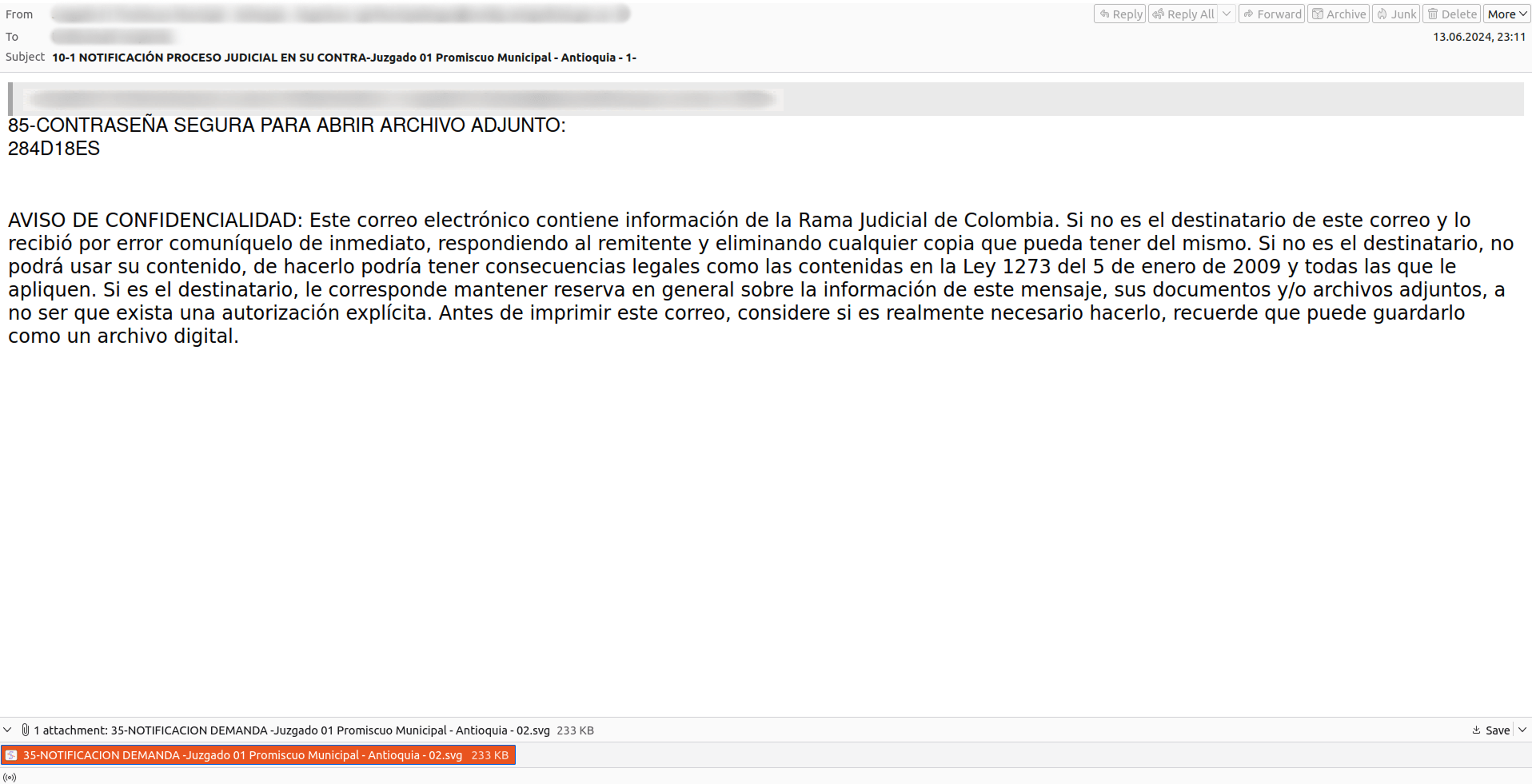
    In 2024, there was an increase in emails distributing password-protected archives containing malicious content. Sometimes, these files were included not as attachments but via download links, which also required a password. Presumably, this was the attackers’ attempt to bypass email security filters. Typically, the archive password was mentioned in the email text, and sometimes in the attachment’s filename. Notably, fraudsters often disguised malicious archives or links as files with other extensions, such as PDF, XLS, or DOC.

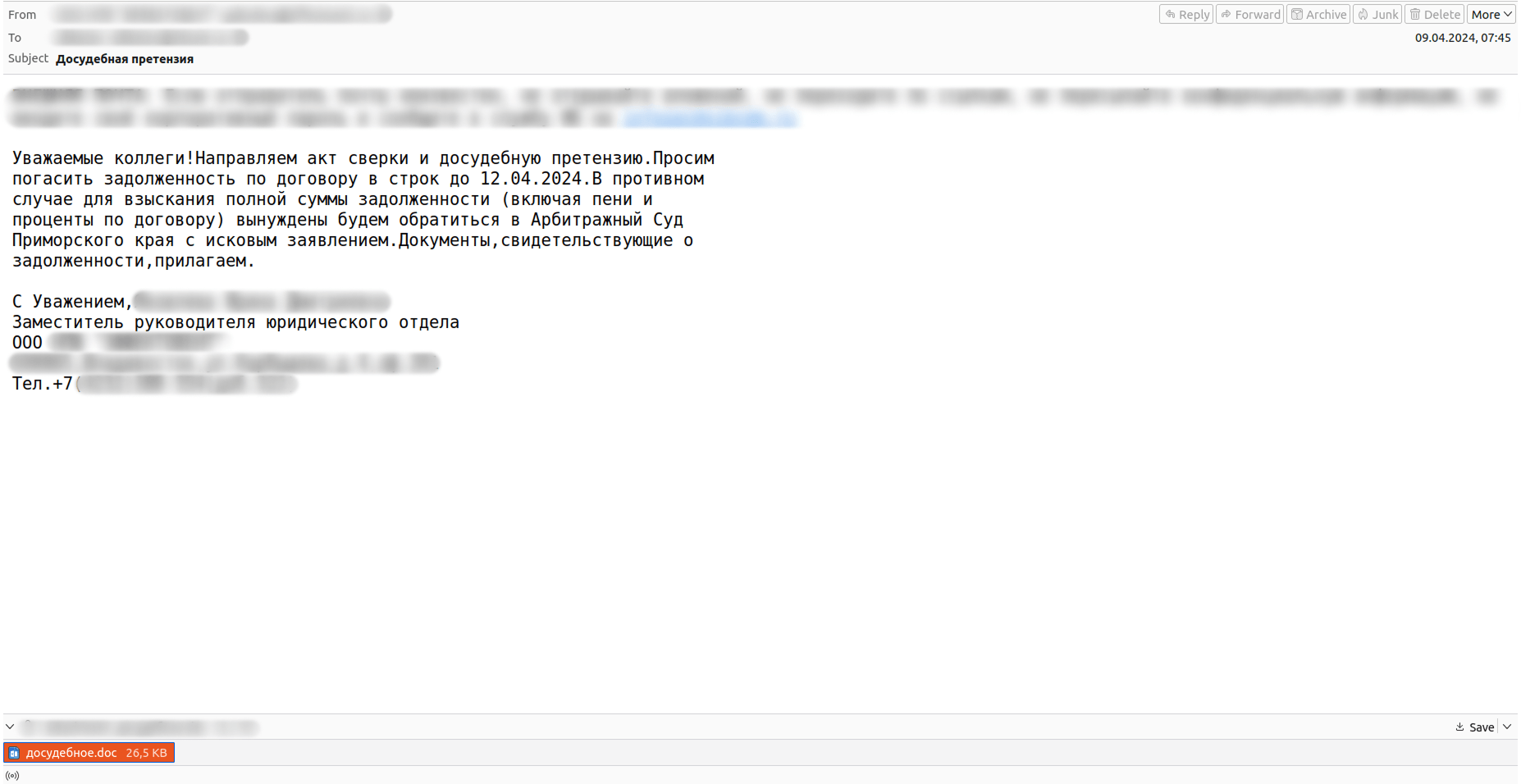
    Since April 2024, we have been recording similar distributions of files with the double extension .PDF.RAR, targeting employees of Russian companies in the government, financial, manufacturing, and energy sectors.

    We assume that these messages were sent from compromised email accounts of the recipients’ business partners. Some emails contained real correspondence, to which attackers replied with an email containing the malware. All the emails we examined in this campaign were unique. The attackers likely crafted messages to closely mimic the style of the compromised business partner.

    Similar messages containing malicious files were also found in other languages. However, unlike campaigns targeting Russian-speaking users, these had more general themes—attachments were disguised as invoices, commercial offers, supply orders, tender schedules, court notices, and other documents.

    Pre-trial claims and lawsuits

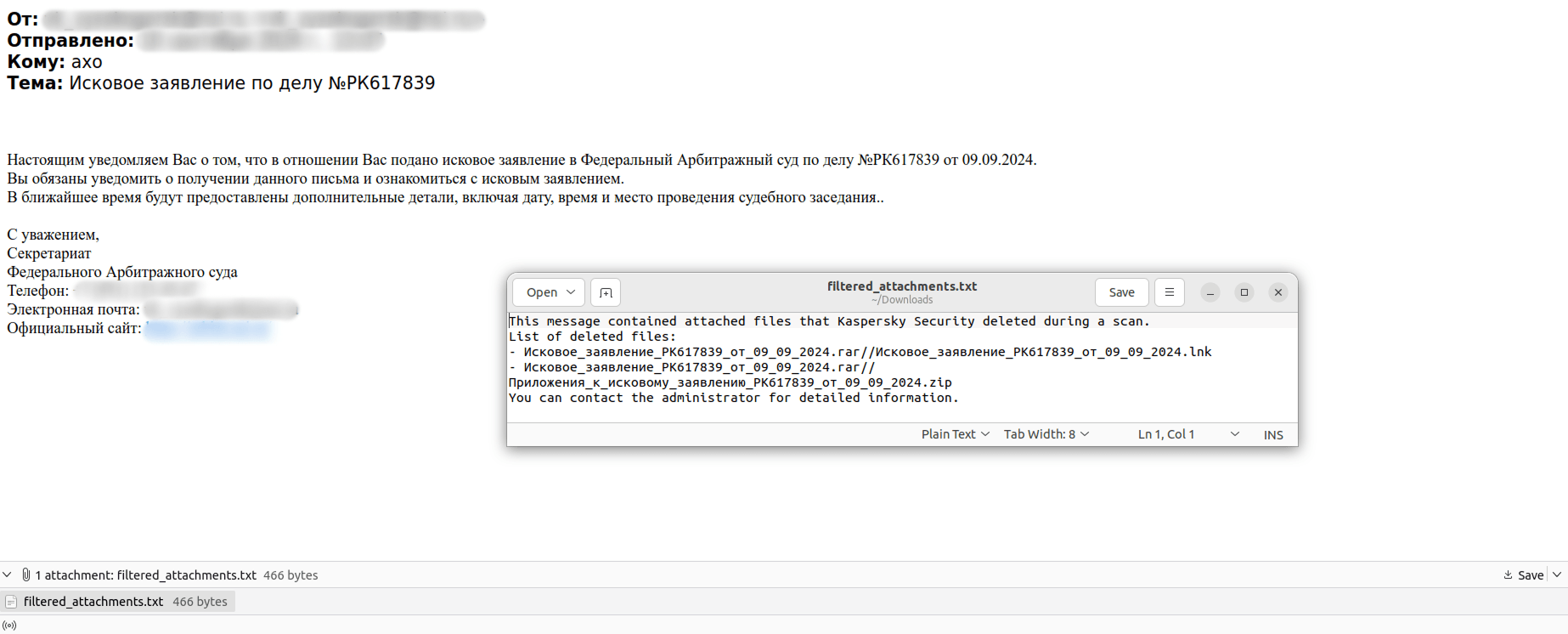
    Last year, attackers frequently threatened legal action to convince victims to click dangerous links or open malicious attachments. These messages primarily targeted Russian companies but were also observed in other languages. Typically, fraudsters posed as business partners, demanding debt repayment; otherwise, they “would be forced to take the matter to arbitration court.” In one such campaign, pre-trial claims in attachments were .DOC files containing VBA scripts. These scripts established connections with command servers and downloaded, saved, and executed malicious files on the victim’s device. Kaspersky’s products detect this payload with the verdict HEUR:Trojan-Downloader.MSOffice.Sload.gen.

    In some cases, cybercriminals gave no reason for their legal threats but instead attempted to shock victims with an already “filed” lawsuit to pressure them into opening the attachment. Of course, it contained malware.

    Emails with malicious SVG files

    According to our observations, the past year saw a rise in the distribution of malicious SVG files. Disguised as harmless images, these files contained scripts that downloaded and installed additional malware on the victim’s device. (Our solutions detect these scripts as Trojan.Script.Agent.sy and Trojan.Script.Agent.qe.) The emails we encountered were written in Spanish and posed as fake legal case notifications and court summons. The text included a password for opening the attached file.

    Threats to businesses

    Fake deals

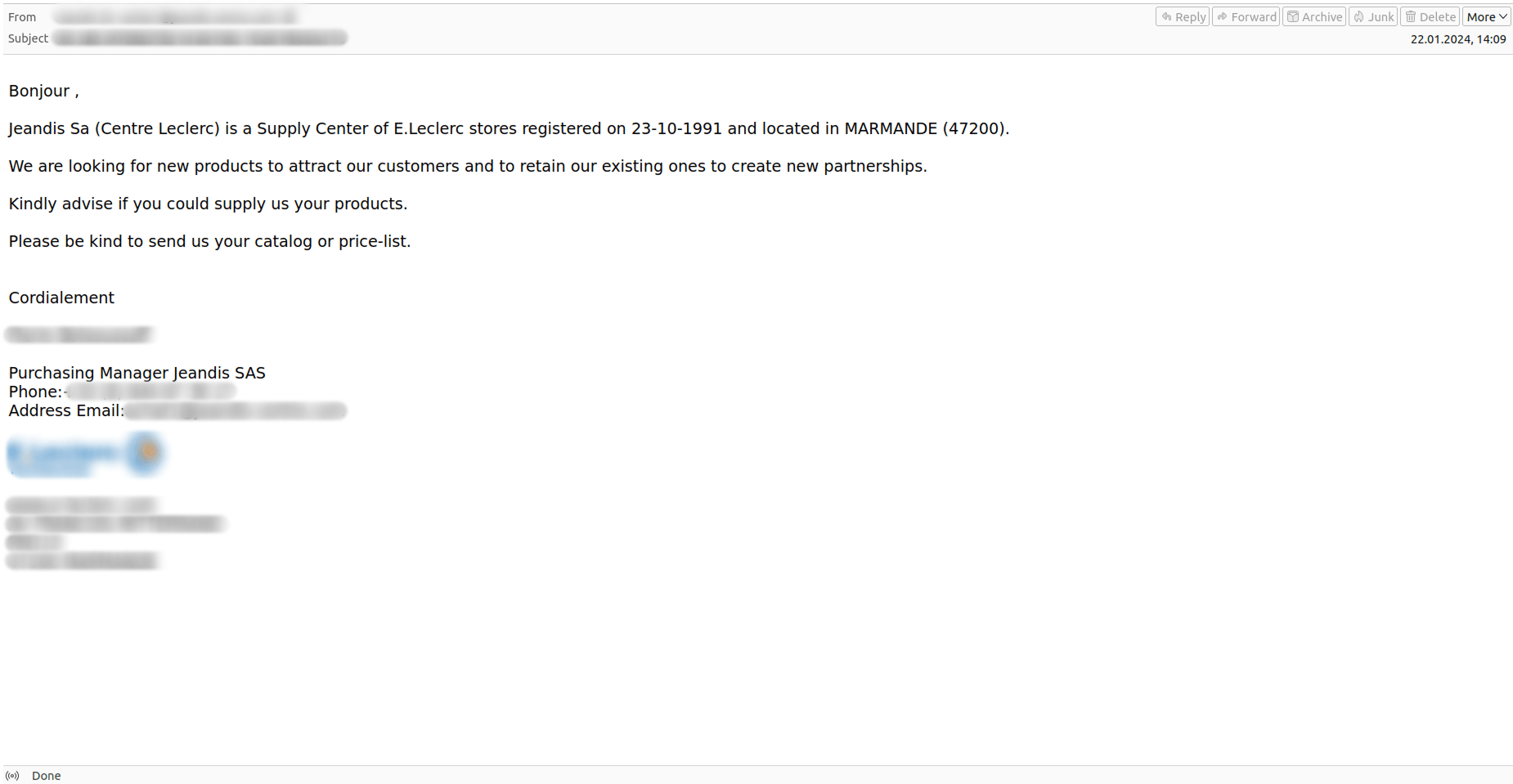
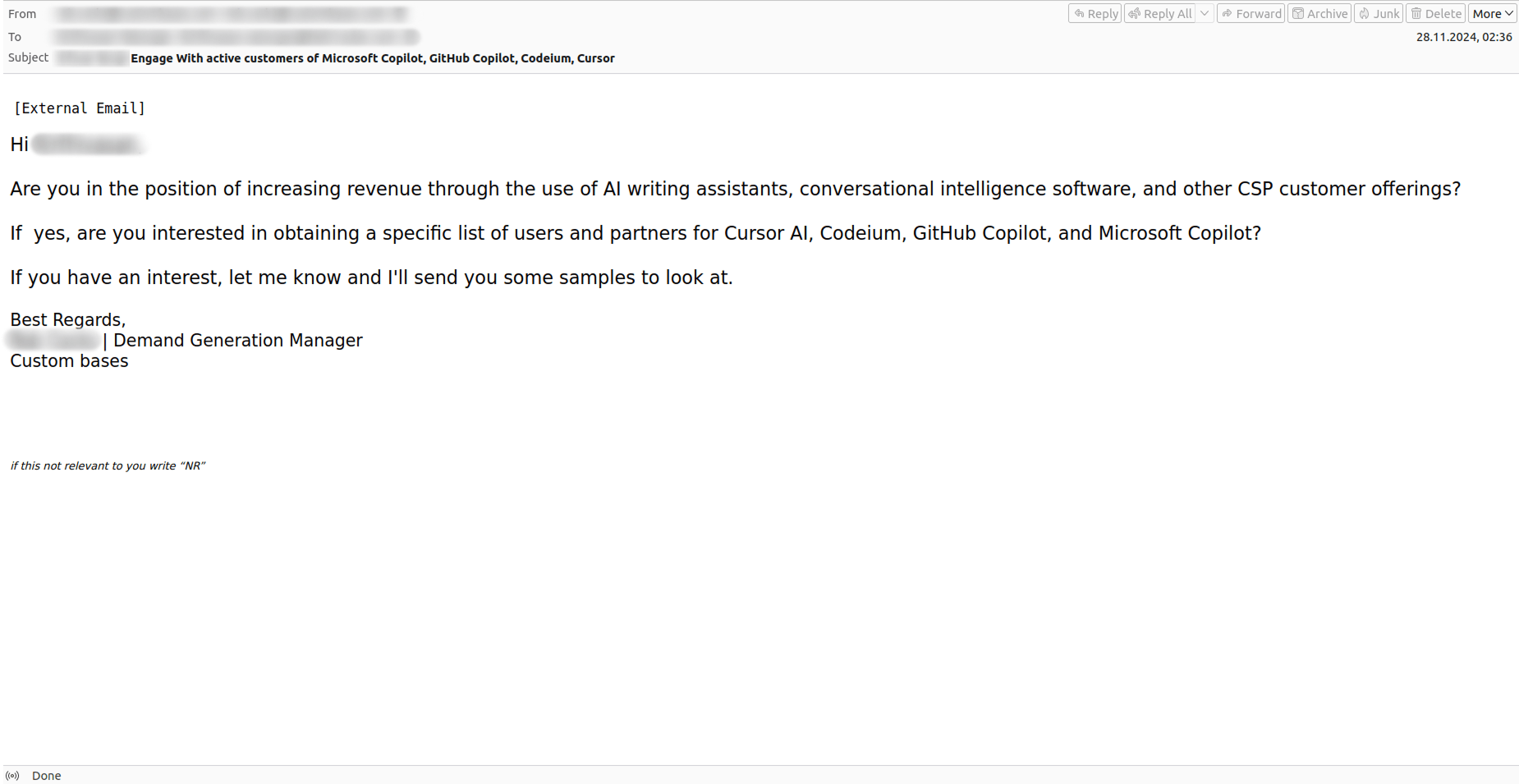
    A special category of emails that users complained about in 2024 was requests for quotation from suspicious senders. These emails were sent either from free email addresses or recently created domains. Attackers signed the emails with the names of large companies, included links to their websites, and sometimes even used official company logos. These emails followed a uniform template: the “buyers” briefly introduced themselves, expressed interest in the recipient’s products, and requested a catalog or price list. Interestingly, the fraudsters did not seem to care about the type of goods involved.

    If the recipient responded, events could unfold in two ways. In some cases, after receiving a reply to the initial seemingly legitimate request, the fraudsters sent malicious attachments or links in the next email.

    In another scenario, the “buyers” engaged in further correspondence with their “potential partner”—the victim—discussing details and insisting on their conditions, including post-payment and requiring the seller to cover customs duties. This meant that the supplier bore all the risks of delivery and could lose their goods without receiving any payment.

    Facebook

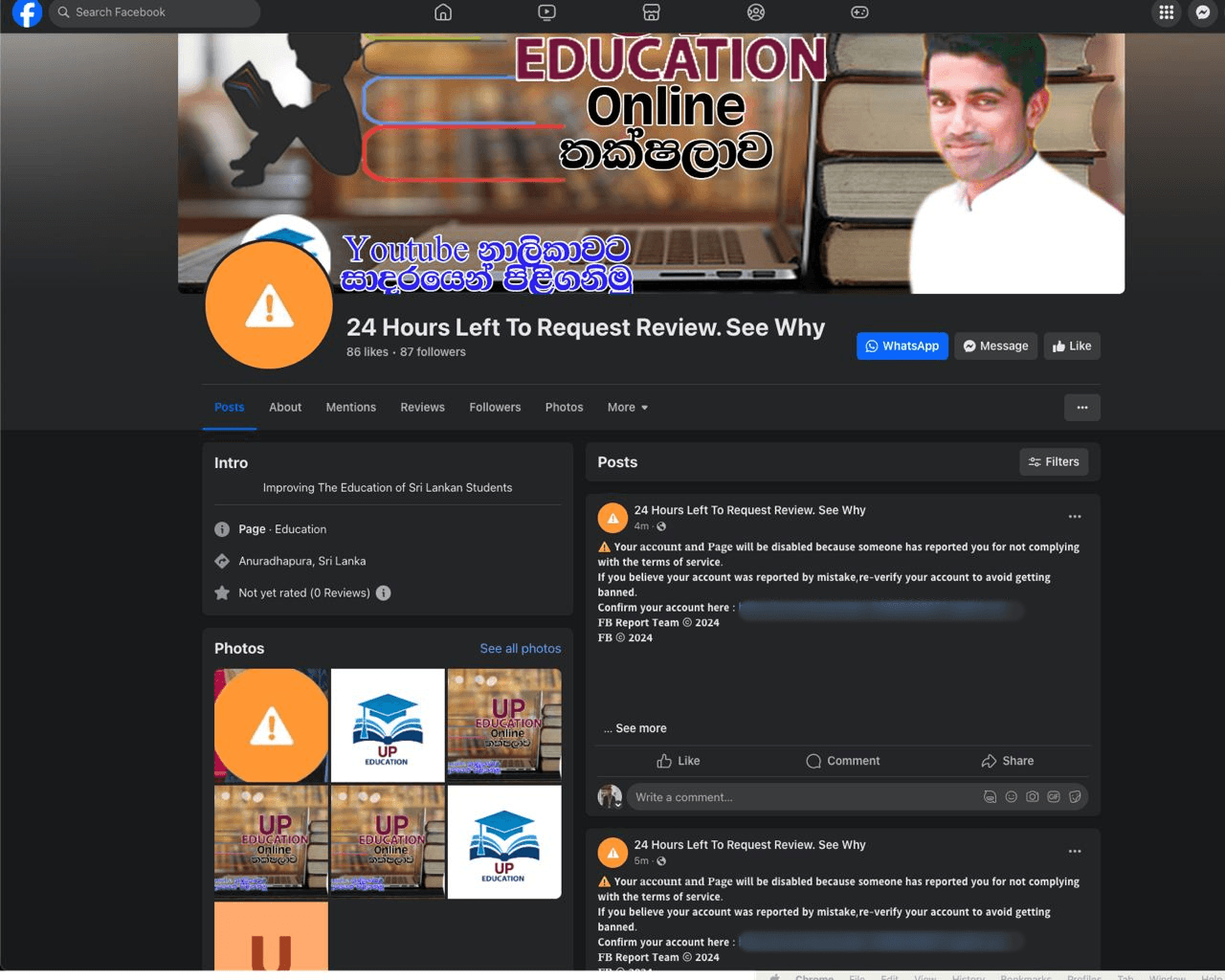
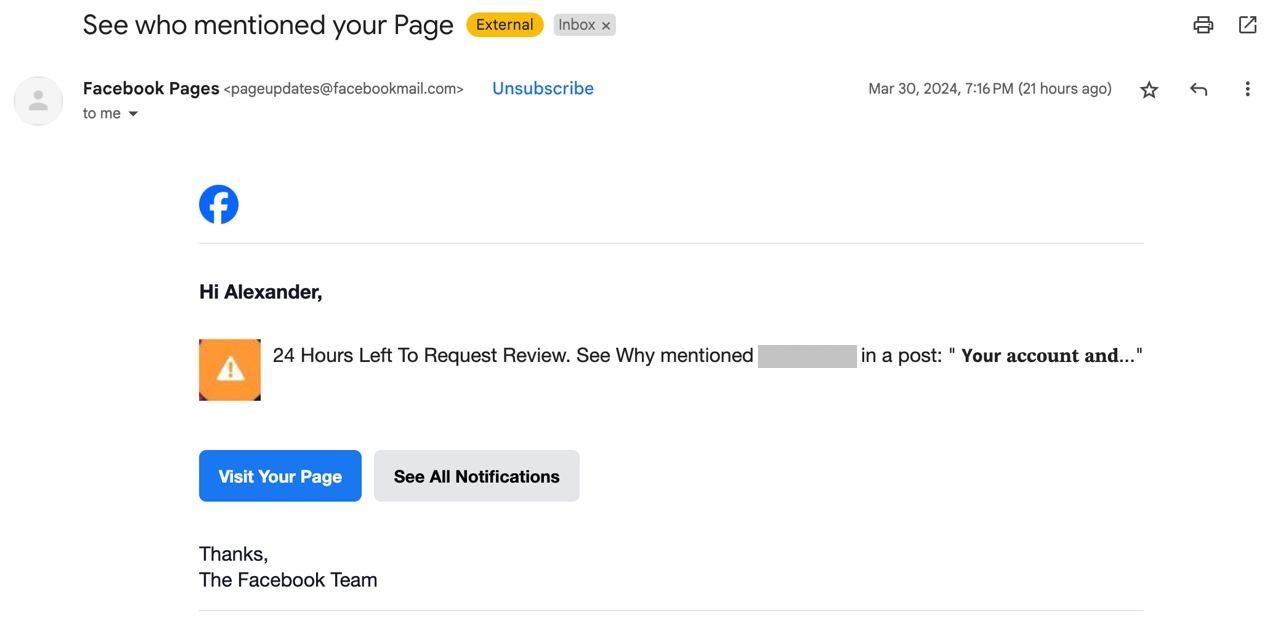
    In the spring of 2024, we discovered an interesting phishing email scheme that leveraged legitimate Facebook notifications. The service sent entirely legitimate emails to users mentioned in threatening posts. The attackers used compromised Facebook accounts, renamed to “24 Hours Left To Request Review. See Why,” and changed the profile picture to an icon featuring an orange exclamation mark.

    Then, the fraudsters created posts on these pages tagging the business accounts of potential victims. The tagged users received notifications from the alarmingly-named pages.

    These posts contained more details than the emails: victims were warned about an impending account ban due to a complaint from another user. To dispute the ban for violating service terms, the recipient of the “notification” was required to follow a phishing link from the post—leading to a fake site with Meta logos that requested Facebook login credentials.

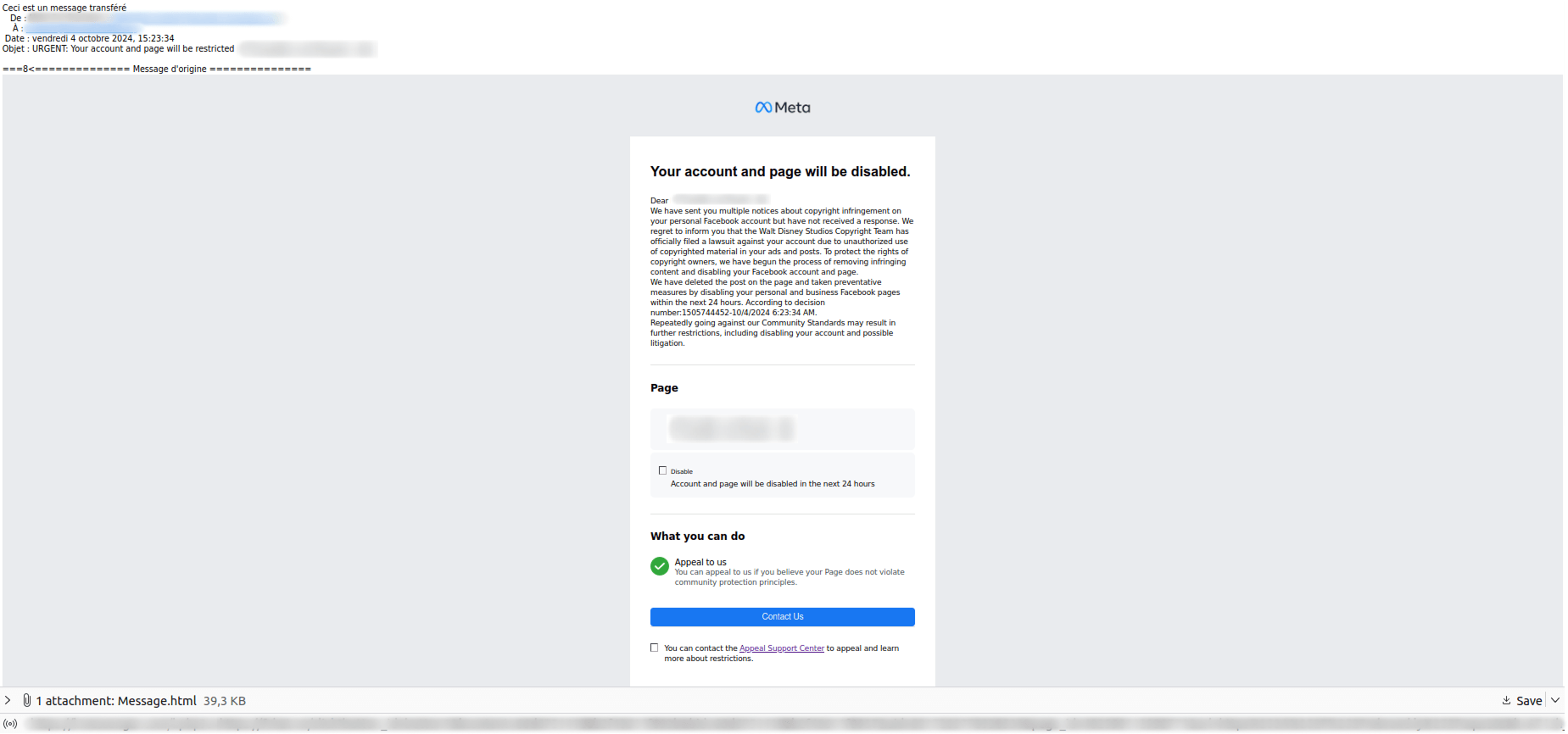
    We also found phishing emails containing legitimate Facebook links in October 2024, but this time without using the platform’s infrastructure. These emails contained notifications of lawsuits for copyright infringement and the removal of unlawful posts from the recipient’s profile. The target was warned that their personal and business pages would be blocked within 24 hours, pressuring them to take hasty and careless action.

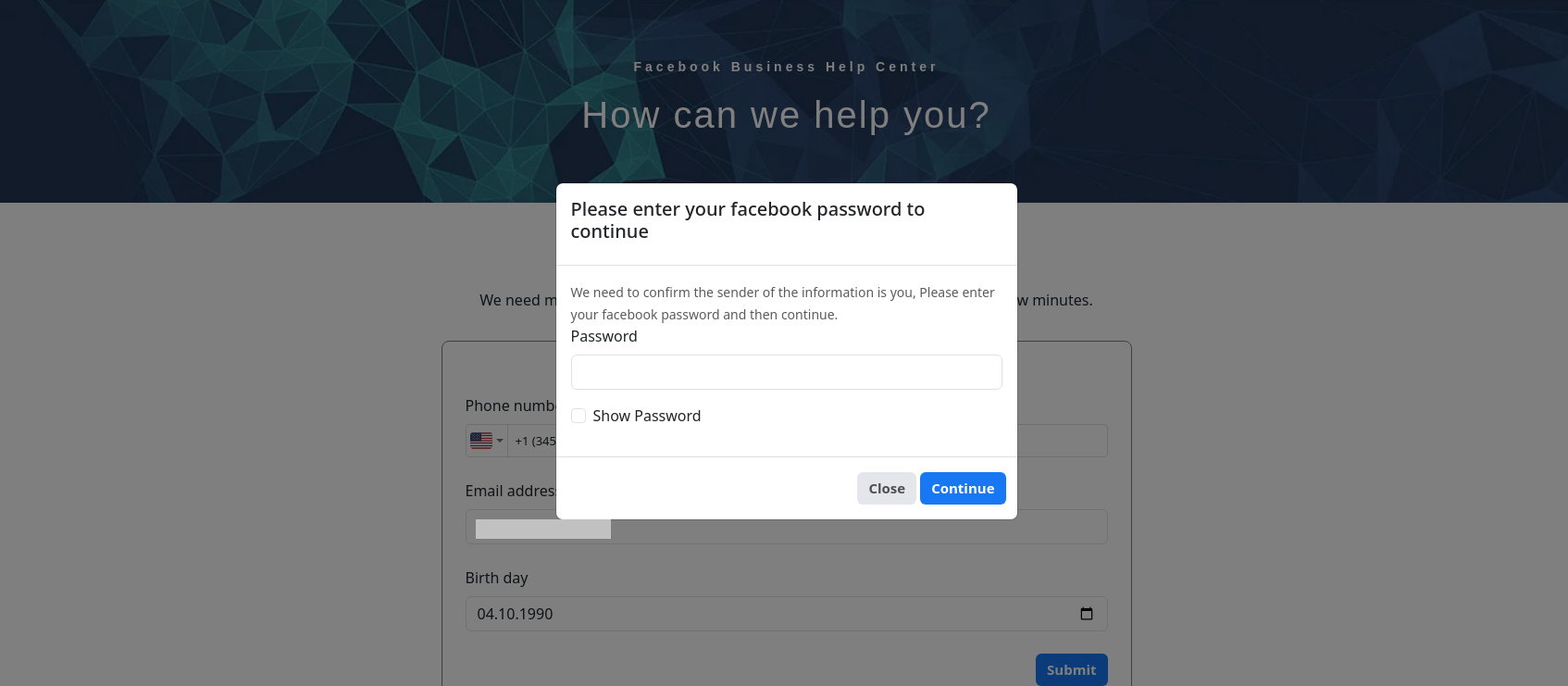
    However, they were immediately offered the chance to appeal by contacting the “Appeal Support Center.” The link in the email led to a phishing site disguised as Meta’s support service, where the victim was also asked to enter their profile password. To make the phishing link more convincing, a legitimate mechanism for redirecting users to external Facebook resources was used.

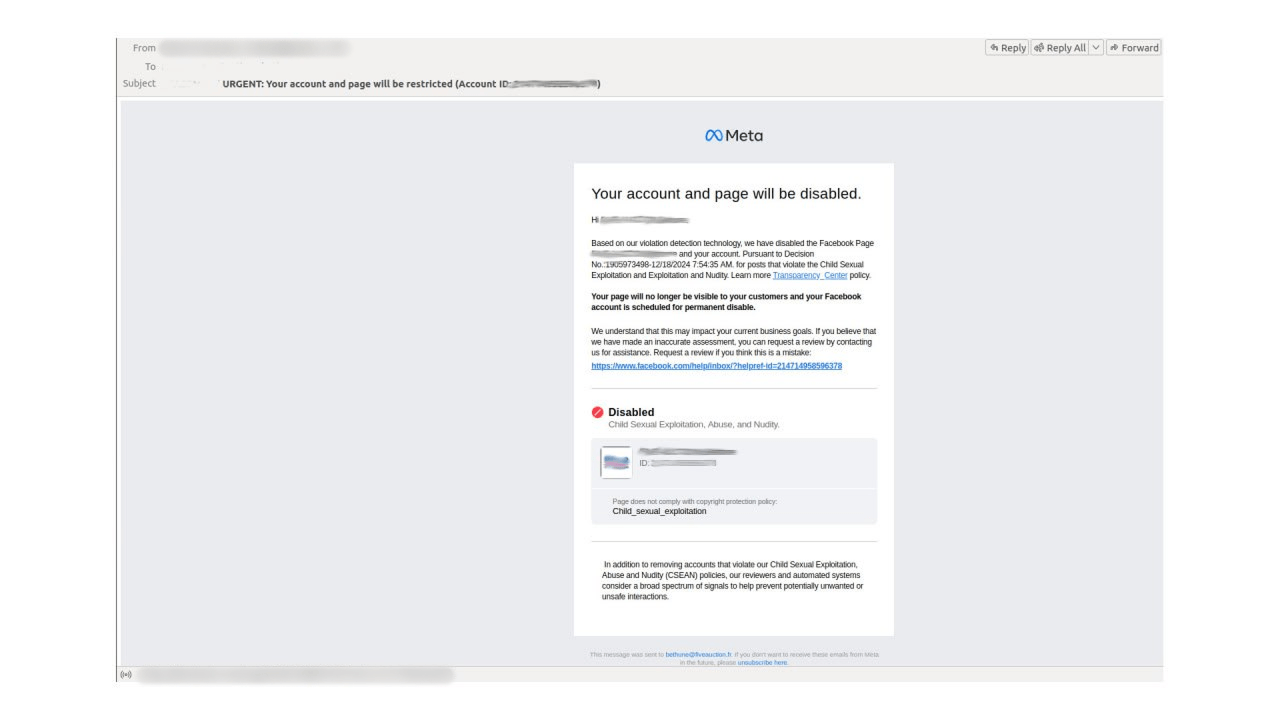
    At the end of 2024, we noticed an email campaign targeting companies promoting their business pages on Facebook. These emails mimicked official Meta for Business notifications and threatened to block the user’s account and business page for violating the platform’s rules and community policies.

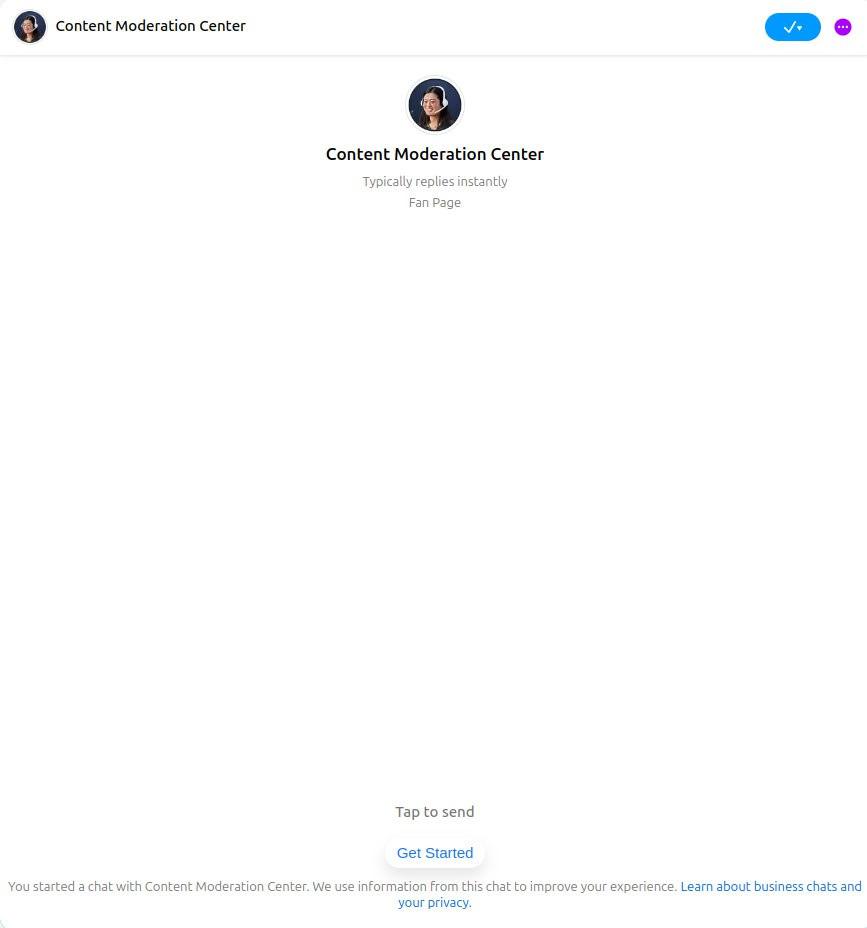
    To dispute these accusations, the fraudsters urged the profile owners to click a link to contact “Facebook support” in a legitimate messenger. However, in reality, the victim was communicating with the owner of a fan page called “Content Moderation Center,” imitating an official support service employee. The scam could have been identified by the “Fan Page” label in the chat, though it was easy to miss.

    News agenda

    In 2024, scammers continued to exploit news agenda in spam campaigns.

    During the UEFA Euro 2024 football championship in Germany, emails began to appear offering merchandise with UEFA EURO 2024 logos.

    After Pavel Durov’s arrest in Paris, we noticed English-language messages calling for donations to supposedly fund his legal defense.

    In the fall of last year, a scam campaign began circulating, offering not-yet-released MacBook Pro M4 devices at low prices or even for free. The links in these emails led to fake websites imitating major marketplaces.

    Before Black Friday, we recorded a surge in spam offering exclusive discounts. The links in these messages lured victims to sites disguised as marketplaces, electronics stores, and financial institutions.

    B2B spam campaigns

    Online promotion services

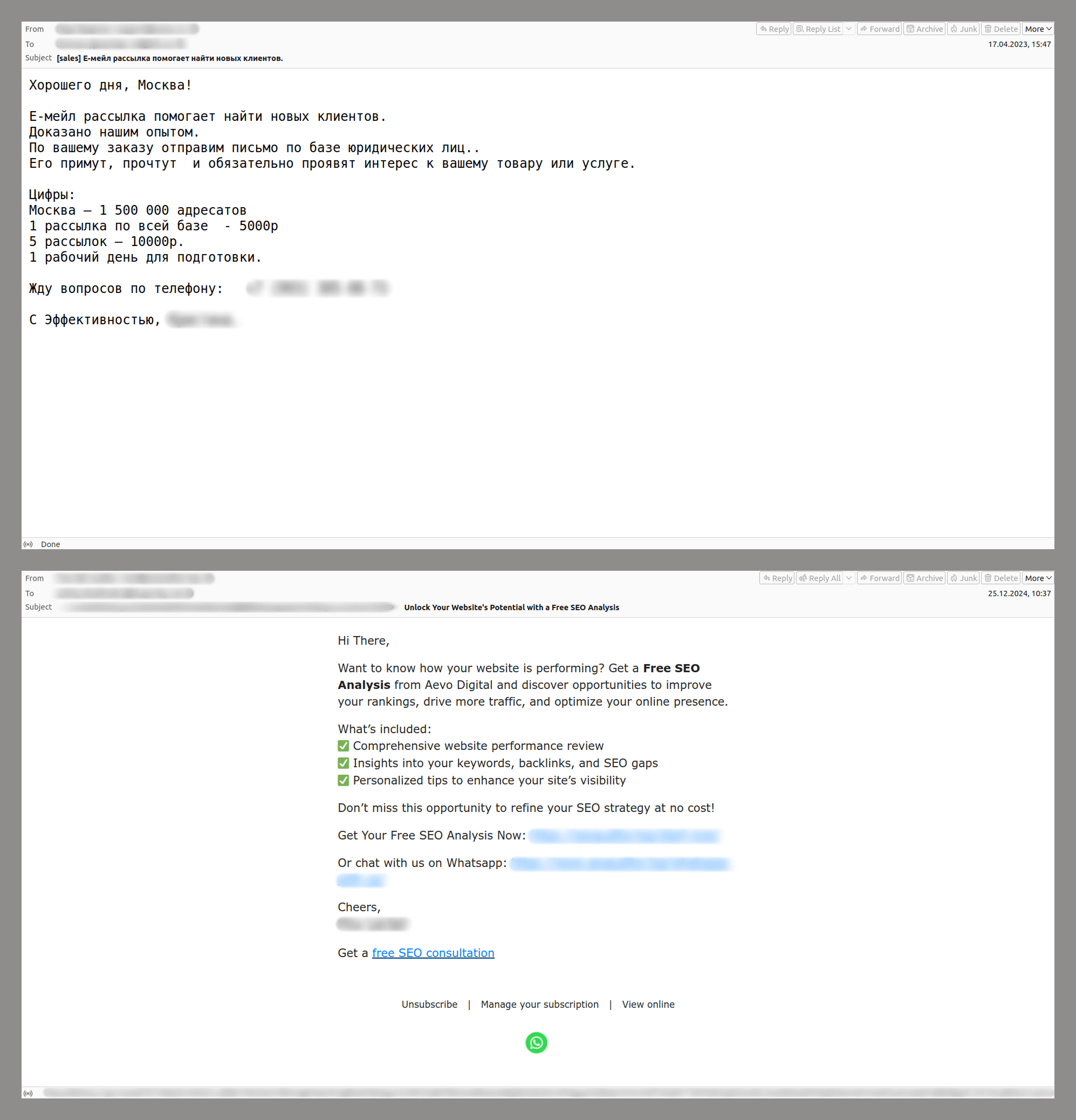
    One of the most common categories of spam email in 2024, complained of frequently by our corporate clients, was commercial offers for online promotion. Users were offered services such as creating or redesigning websites, setting up SEO tools, and purchasing databases with potential client contacts and other information. Other advertised services included guest post placement with backlinks to the client’s site, writing positive reviews, removing negative reviews, and creating personalized email campaigns. While these messages are not malicious or fraudulent, they are mass-distributed and unsolicited, causing inconvenience to users. The popularity of this type of spam is likely driven by the development of digital marketing tools and the search for new clients for small- and medium-sized businesses amid growing online competition.

    Buying likes and followers on social media

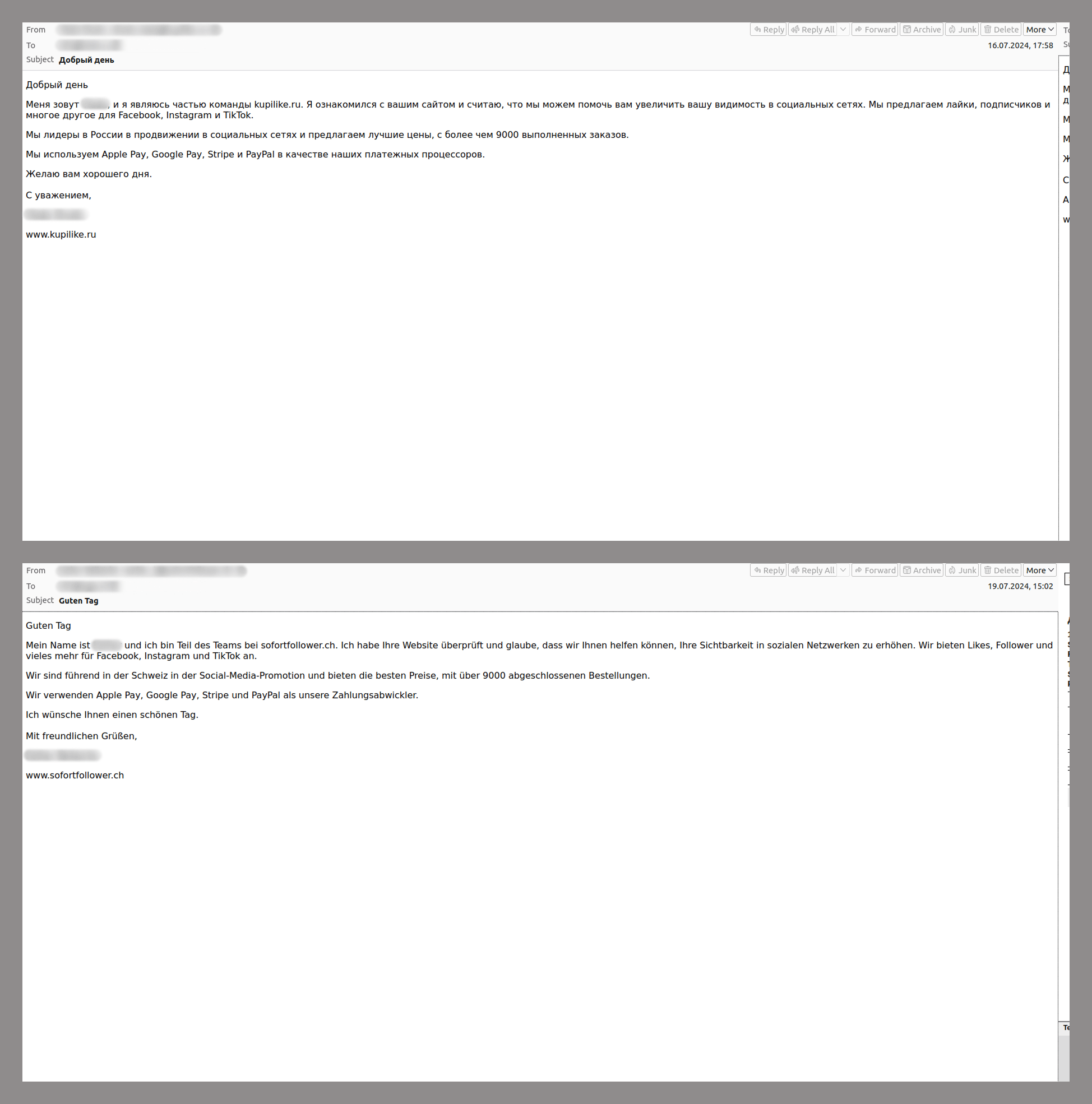
    We also frequently encountered business offers for the online promotion of company accounts on social media. Spammers sell fake likes and followers. They often pose as employees of real social media marketing firms, claiming to be industry leaders. At the end of their emails, the spammers included a link to a marketing platform and payment options for their services. One such campaign, which we observed throughout the past year and is still active, stood out due to the variety of languages used in the emails and the diversity of domain names. With these tactics, the spammers aimed to reach a global audience.

    AI in B2B emails

    The growing popularity of neural networks has led companies to actively integrate AI into their business processes. We assume that clients of such organizations, in turn, are drawn to service offers that incorporate neural networks. As a natural consequence of this trend, AI-driven solutions began appearing in spam campaigns advertising online marketing services.

    Spammers emphasized using AI, particularly ChatGPT, to perform various business tasks. We identified the following themes in these emails:

    • Attracting website traffic
    • Creating advanced lead generation strategies
    • Developing unique approaches tailored to a brand’s identity
    • Producing and publishing content
    • Launching personalized multi-channel marketing campaigns
    • Creating custom videos for YouTube channels

    Other topics also appeared in spam emails, but they all shared the same goal—enhancing business processes and attracting potential clients.

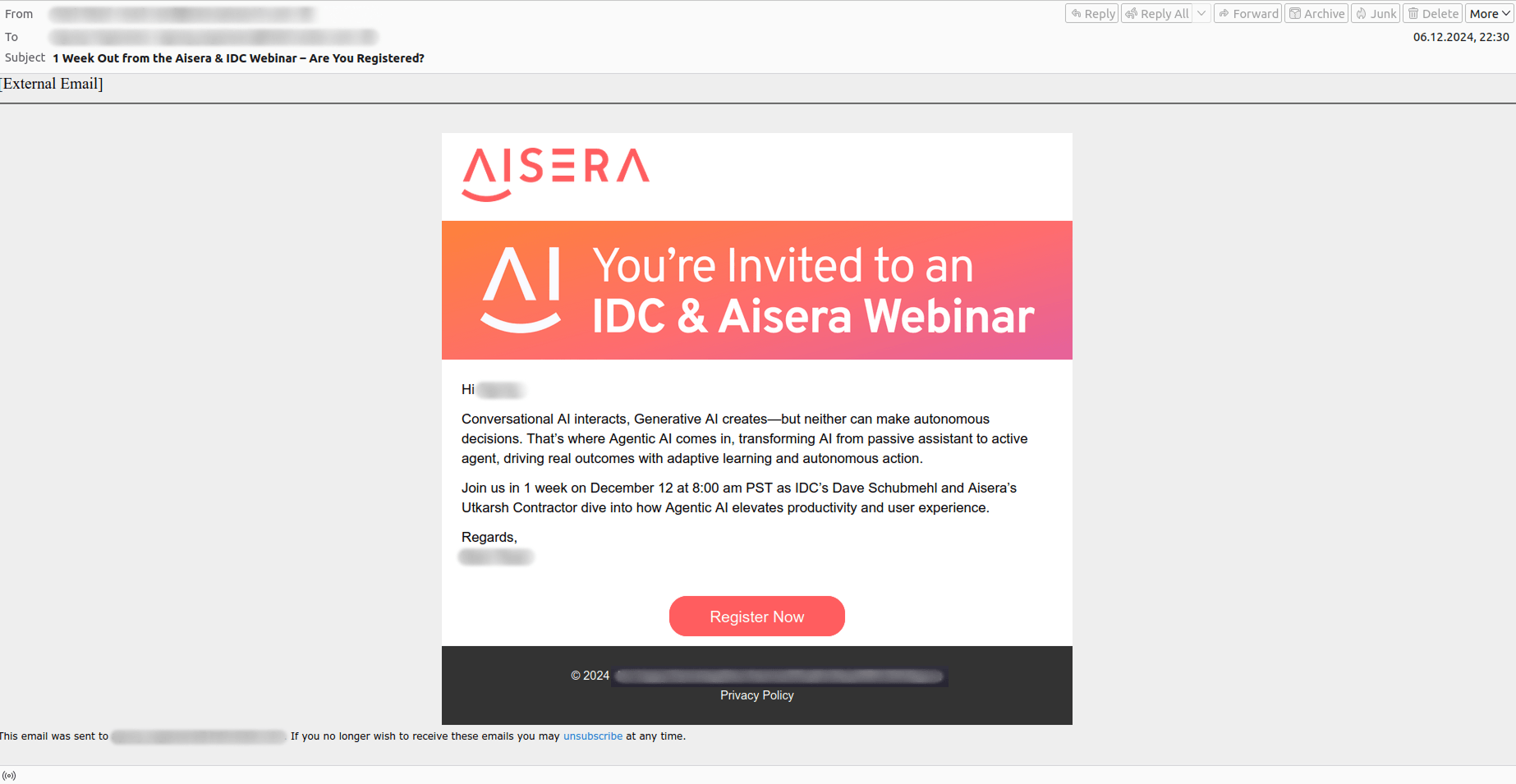
    Another particularly popular category of spam related to neural networks was advertising online events. Last year, we encountered numerous examples of emails promoting webinars about the promising capabilities and practical applications of AI in business operations.

    Targeted phishing in 2024

    In 2024, two main trends were observed in targeted phishing:

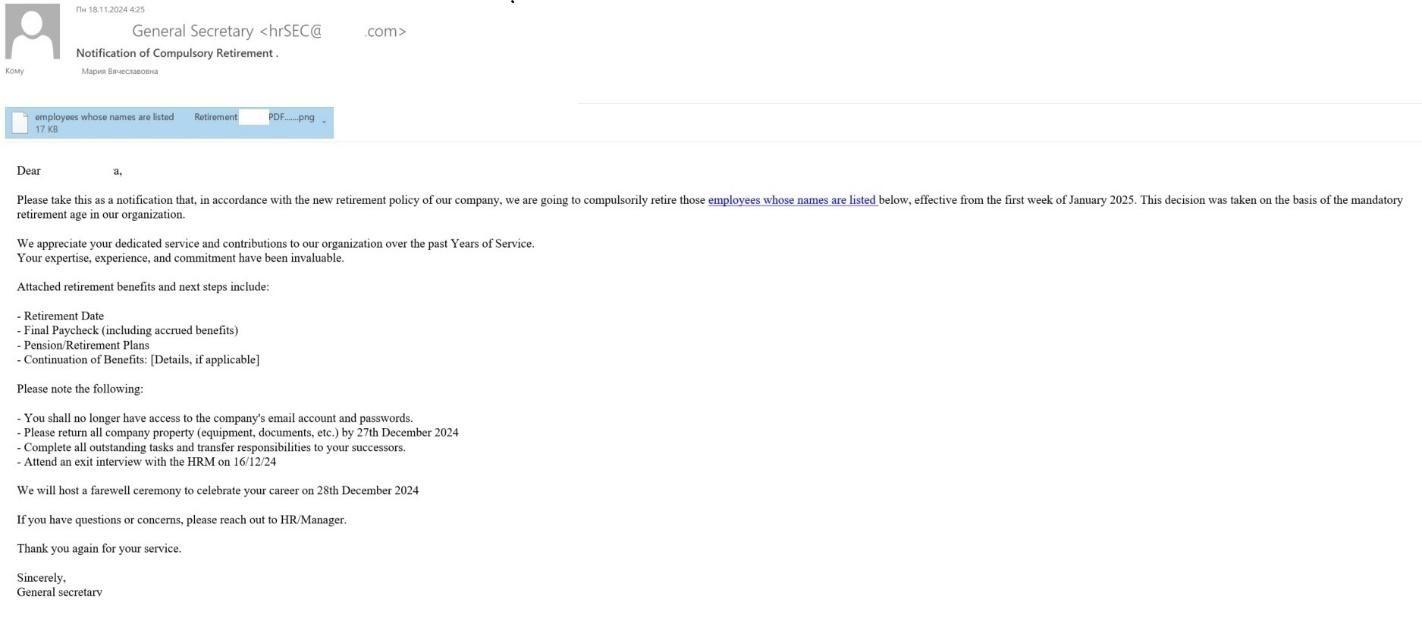
    1. Notifications on behalf of a company’s HR department. Employees were asked to fill out or sign a document, such as a vacation schedule, accessible via a link in an email. Sometimes, instead of routine requests, attackers resorted to more extravagant tactics—such as inviting employees to check if they were on a list of staff to be dismissed.

    Phishing email from HR

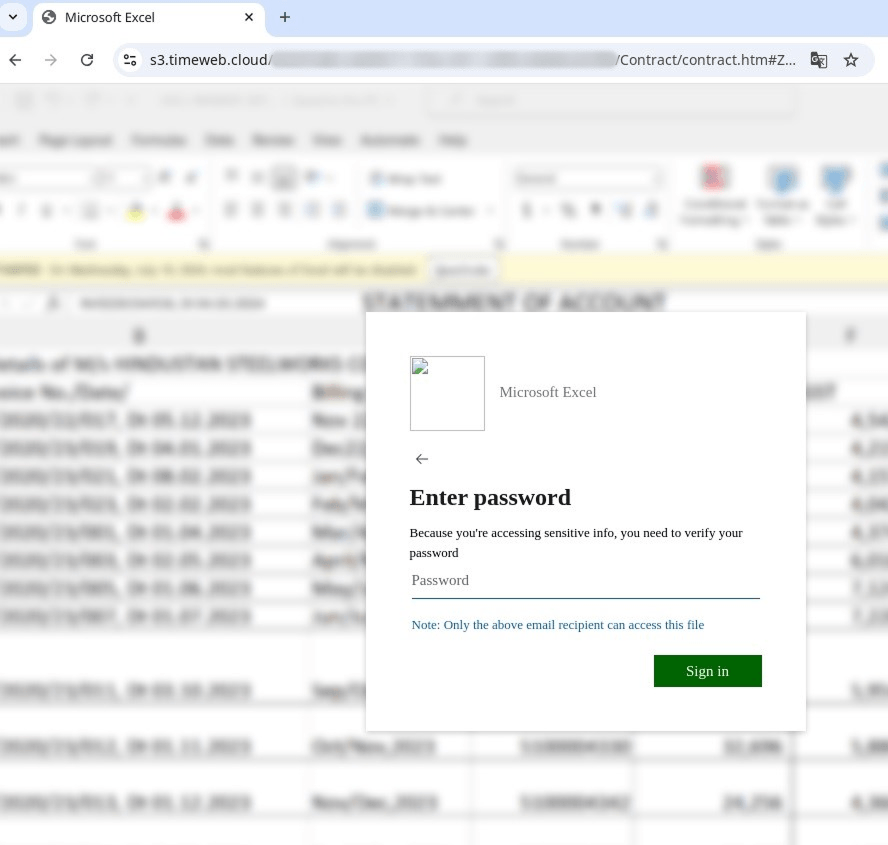
    In all these cases, the common factor was that clicking the link led the employee to a phishing login page instead of the actual corporate portal. Most often, attackers targeted Microsoft accounts, though some phishing forms mimicked internal corporate resources.

    Fake login form

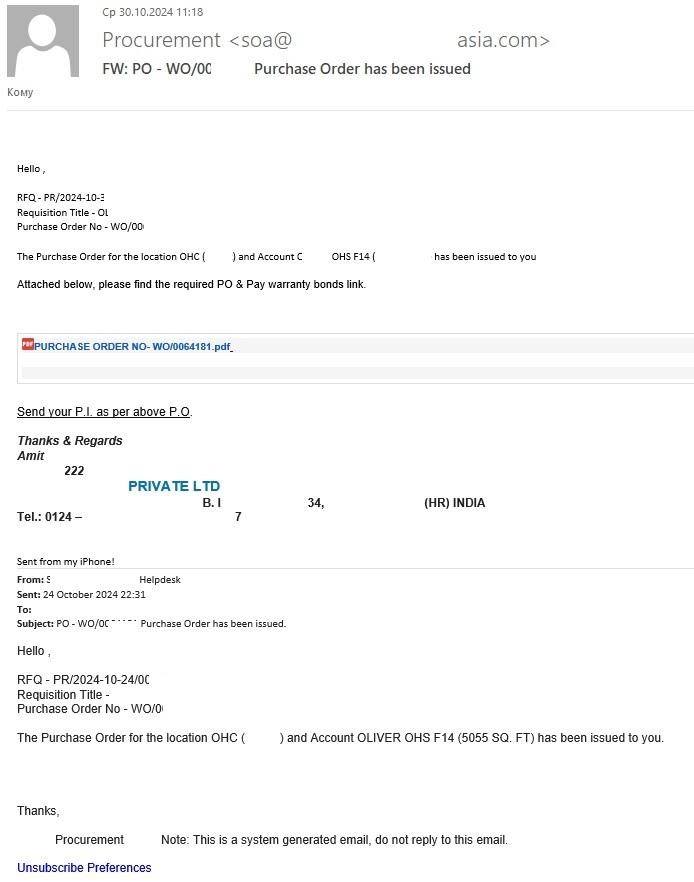
    1. Emails from a seller to a buyer, or vice versa. One common scheme involved a buyer or seller asking the victim to review an offer or respond to questions about product delivery and required specifications. These emails contained attached documents that actually concealed phishing links.

    Example of a phishing email from a seller

    When attempting to open the attachment, the user was redirected to a phishing page. As in the previous case, these fake forms harvested Microsoft credentials and corporate account logins.

    Fake password entry form

    Statistics: phishing

    The number of phishing attacks in 2024 increased compared to the previous year. Kaspersky solutions blocked 893,216,170 attempts to follow phishing links—26% more than in 2023.

    Number of Anti-Phishing triggerings, 2024 (download)

    Map of phishing attacks

    Users from Peru (19.06%) encountered phishing most often. Greece (18.21%) ranked second, followed by Vietnam (17.53%) and Madagascar (17.17%). They are closely followed by Ecuador (16.90%), Lesotho (16.87%) and Somalia (16.70%). The final places in the TOP 10 are occupied by Brunei (16.55%), Tunisia (16.51%) and Kenya (16.38%).

    Country/territory Share of attacked users*
    Peru 19.06
    Greece 18.21
    Vietnam 17.53
    Madagascar 17.17
    Ecuador 16.90
    Lesotho 16.87
    Somalia 16.70
    Brunei 16.55
    Tunisia 16.51
    Kenya 16.38

    * Share of users who encountered phishing out of the total number of Kaspersky users in the country/territory, 2024

    Top-level domains

    The most common domain zone hosting phishing sites remains the COM zone (29.78%)—its popularity has increased one and a half times compared to 2023. In second place is the XYZ domain (7.10%), which ranked fifth last year, followed by TOP (6.97%), which retained its position in the top ten. Next, with a slight margin from each other, are the ONLINE (4.25%) and SITE (3.87%) domain zones, where phishing sites were less actively hosted last year. The Russian RU domain (2.23%) and the global NET domain (2.02%) are in sixth and seventh place, respectively. Following them are CLICK (1.41%) and INFO (1.35%)—the year before, these zones were not frequently used. Closing the top ten is another national domain: UK, with a share of 1.33%.

    Most frequent top-level domains for phishing pages, 2024 (download)

    Organizations targeted by phishing attacks

    The rating of organizations targeted by phishers is based on the detections of the deterministic component in the Anti-Phishing system on user computers. The component detects all pages with phishing content that the user has tried to open by following a link in an email message or on the web, as long as links to these pages are present in the Kaspersky database.

    In 2024, the highest number of attempts to access phishing links blocked by Kaspersky solutions was associated with pages imitating various web services (15.75%), surpassing global internet portals (13.88%), which held the top position in 2023. The third and fourth positions in last year’s top ten also swapped places: banks moved ahead (12.86%), overtaking online stores at 11.52%. Attackers were also interested in social media (8.35%) and messengers (7.98%): attacks targeting them strengthened their positions in the ranking. For websites imitating delivery services, we observed a decline in phishing activity (6.55%), while the share of payment systems remained unchanged at 5.82%. Also included in the list of the most frequently targeted organizations were online games (5.31%) and blogs (3.75%).

    Distribution of organizations targeted by phishers, by category, 2024 (download)

    Statistics: spam

    Share of spam in email traffic

    In 2024, spam emails accounted for 47.27% of the total global email traffic, an increase of 1.27 p.p. compared to the previous year. The lowest spam levels were recorded in October and November, with average shares dropping to 45.33% and 45.20%, respectively. In December, we observed a seemingly slight upward trend in junk emails, resulting in the fourth quarter of the year being the calmest. Spam activity peaked in the summer, with the highest number of emails recorded in June (49.52%) and July (49.27%).

    Share of spam in global email traffic, 2024 (download)

    In the Russian internet segment, the average spam share exceeded the global figure, reaching 48.57%, which is 1.98 p.p. higher than in 2023. As in the rest of the world, spammers were least active at the end of the year: in the fourth quarter, 45.14% of emails were spam. However, unlike global trends, in Runet, we recorded four months during which the spam share exceeded half of all traffic: March (51.01%), June (51.53%), July (51.02%), and September (51.25%). These figures identified the third quarter as the most active, with a share of 50.46%. December was the calmest month, and interestingly, despite spam levels being generally high or the same in Russia, the number of spam emails in December was lower than the global figure: 44.56%.

    Share of spam in Runet email traffic, 2024 (download)

    Countries and territories where spam originated

    We continue to observe an increase in the share of spam sent from Russia—from 31.45% to 36.18%. The United States and mainland China, which held second and third place last year, swapped positions, with China’s share increasing by 6 p.p. (17.11%) and the US share decreasing by 3 p.p. (8.40%). Kazakhstan, which entered the top twenty for the first time last year, rose from eighth to fourth place (3.82%), pushing Japan (2.93%) down, and causing Germany, previously in fifth place, to drop one position with a share of 2.10%. India’s share slightly decreased, but the country moved up two positions from last year to seventh place. Conversely, the amount of spam sent from Hong Kong more than doubled (1.75%), allowing this territory to take eighth place in the top twenty. Next come Brazil (1.44%) and the Netherlands (1.25%), whose shares continued to decline.

    TOP 20 countries and territories where spam originated in 2024 (download)

    Malicious email attachments

    In 2024, Kaspersky solutions detected 125,521,794 attempts to open malicious email attachments, ten million fewer than the previous year. Interestingly, one of the peaks in email antivirus detections occurred in April—in contrast to 2023, when this month had the lowest malicious activity. In January and December, we observed a relative decrease in detections, while increases were noted in spring and autumn.

    Number of email antivirus detections, 2024 (download)

    The most common malicious email attachments were Agensla stealers (6.51%), which ranked second last year. Next were Badun Trojans (4.51%), which spread in archives disguised as electronic documents. The Makoob family moved from eighth to third place (3.96%), displacing the Noon spyware (3.62%), which collects browser passwords and keystrokes. The malicious Badur PDFs, the most common attachments in 2023, dropped to fifth place with a 3.48% share, followed by phishing HTML forms from the Hoax.HTML.Phish family (2.93%). Next in line were Strab spyware Trojans (2.85%), capable of tracking keystrokes, taking screenshots, and performing other typical spyware actions. Rounding out the top ten were SAgent VBS scripts (2.75%), which were not as actively used last year, the Taskun family (2.75%), which maintained its previous share, and PDF documents containing phishing links, Hoax.PDF.Phish (2.11%).

    TOP 10 malware families distributed as email attachments, 2024 (download)

    The list of the most widespread malware reflects trends similar to the distribution of families, with a few exceptions: the Hoax.HTML.Phish variant of malicious HTML forms dropped two positions (2.20%), and instead of a specific Strab Trojan sample, the top ten included the ISO image Trojan.Win32.ISO.gen, distributed via email (1.39%).

    TOP 10 malicious programs distributed as email attachments, 2024 (download)

    Countries and territories targeted by malicious mailings

    In 2024, users in Russia continued to face malicious email attachments more frequently than other countries, although the share of email antivirus detections in this country decreased compared to last year, to 11.37%. China ranked second (10.96%), re-entering the top twenty after several years. Next came Spain (8.32%), Mexico (5.73%), and Turkey (5.05%), which dropped one position each with a slight decline in malicious attachments. Switzerland (4.82%) took sixth place, appearing in the ranking for the first time. Following them were Vietnam (3.68%), whose share declined, and the UAE (3.24%), which strengthened its position in the ranking. Also among frequent targets of malicious spam were users from Malaysia (2.99%) and Italy (2.54%).

    TOP 20 countries and territories targeted by malicious mailings, 2024 (download)

    Conclusion

    Political and economic crises will continue to provide new pretexts for fraudulent schemes. In some cases presented in the 2024 report, we can observe the “greed” of cybercriminals: the use of two different company brands on the same page; a credible fake of a resource aimed not at stealing credentials but at stealing money; comprehensive questionnaires that can lead not only to loss of access to funds but also to identity theft. Such multi-layered threats may become a new trend in phishing and scam attacks.

    We continue to observe major news events being exploited in spam campaigns that promise easy earnings and discounted goods or services. The growing user interest in artificial intelligence tools is actively being leveraged by spammers to attract an audience, and this trend will undoubtedly continue.
    MIL OSI Economics

  • MIL-OSI United Kingdom: UK House Price Index for December 2024

    Source: United Kingdom – Government Statements

    The UK HPI shows house price changes for England, Scotland, Wales and Northern Ireland.

    Tom Curtis/Shutterstock.com

    The December data shows:

    • on average, house prices have fallen by 0.1% since November 2024
    • there has been an annual price rise of 4.6% which makes the average property in the UK valued at £268,000

    England

    In England the December data shows, on average, house prices have not changed since November 2024. The annual price rise of 4.3% takes the average property value to £291,000.

    The regional data for England indicates that:

    • East of England experienced the most significant monthly increase with a movement of 0.6%
    • Yorkshire and the Humber saw the greatest monthly price fall, with a fall of -0.8%
    • the North East experienced the greatest annual price rise, up by 6.7%
    • London saw the lowest annual price growth, at 0%

    Price change by region for England

    Region Average price December 2024 Annual change % since December 2023 Monthly change % since November 2024
    East Midlands £242,000 5.3 0.5
    East of England £340,000 4.4 0.6
    London £549,000 0 -0.3
    North East £161,000 6.7 0.5
    North West £211,000 5.4 -0.4
    South East £384,000 4.4 0.6
    South West £306,000 3.8 -0.3
    West Midlands £244,000 4.2 -0.4
    Yorkshire and the Humber £204,000 5.9 -0.8

    Repossession sales by volume for England

    The lowest number of repossession sales in October 2024 was in East of England.

    The highest number of repossession sales in October  2024 was in the North East.

    Repossession sales October 2024
    East Midlands 6
    East of England 0
    London 11
    North East 13
    North West 21
    South East 8
    South West 2
    West Midlands 5
    Yorkshire and the Humber 11
    England 77

    Average price by property type for England

    Property type December 2024 December 2023 Difference %
    Detached £472,000 £451,000 4.7
    Semi-detached £286,000 £271,000 5.4
    Terraced £240,000 £229,000 4.6
    Flat/maisonette £225,000 £222,000 1.6
    All £291,000 £279,000 4.3

    Funding and buyer status for England

    Transaction type Average price December 2024 Annual price change % since December 2023 Monthly price change % since November 2024
    Cash £277,000 3.7 0
    Mortgage £296,000 4.5 0
    First-time buyer £244,000 4.5 -0.3
    Former owner occupier £352,000 1.8 -0.3

    Building status for England

    Building status* Average price October 2024 Annual price change % since October 2023 Monthly price change % since Setpember 2024
    New build £420,000 17.7 -1.4
    Existing resold property £285,000 1.8 -0.3

    *Figures for the 2 most recent months are not being published because there are not enough new build transactions to give a meaningful result.

    London

    London shows, on average, house prices decreased by 0.3% since November 2024. House prices have shown no annual change meaning the average price of a property is £549,000.

    Average price by property type for London

    Property type December 2024 December 2023 Difference %
    Detached £1,110,000 £1,113,000 -0.3
    Semi-detached £691,000 £681,000 1.6
    Terraced £617,000 £609,000 1.3
    Flat/maisonette £440,000 £445,000 -1.3
    All £549,000 £549,000 0

    Funding and buyer status for London

    Transaction type Average price December 2024 Annual price change % since December 2023 Monthly price change % since November 2024
    Cash £580,000 -2. -0.5
    Mortgage £543,000 0.8 -0.2
    First-time buyer £473,000 0.2 -0.4
    Former owner occupier £677,000 -0.4 -0.1

    Building status for London

    Building status* Average price October 2024 Annual price change % since October 2023 Monthly price change % since September 2024
    New build £566,000 13.4 -4.1
    Existing resold property £553,000 -0.9 -2.9

    *Figures for the 2 most recent months are not being published because there are not enough new build transactions to give a meaningful result.

    Wales

    Wales shows, on average, house prices fell by 0.5% since November 2024. An annual price increase of 3% takes the average property value to £208,000

    There were 4 repossession sales for Wales in October 2024.

    Average price by property type for Wales

    Property type December 2024 December 2023 Difference %
    Detached £325,000 £319,000 1.9
    Semi-detached £206,000 £199,000 3.6
    Terraced £166,000 £160,000 3.6
    Flat/maisonette £132,000 £129,000 2.3
    All £208,000 £202,000 3

    Funding and buyer status for Wales

    Transaction type Average price December 2024 Annual price change % since December 2023 Monthly price change % since November 2024
    Cash £207,000 2.3 -1
    Mortgage £209,000 3.4 -0.3
    First-time buyer £179,000 3.5 -0.6
    Former owner occupier £248,000 2.4 -0.4

    Building status for Wales

    Building status* Average price October 2024 Annual price change % since October 2023 Monthly price change % since September 2024
    New build £362,000 20.5 -0.4
    Existing resold property £206,000 2.4 0.6

    *Figures for the 2 most recent months are not being published because there are not enough new build transactions to give a meaningful result.

    UK house prices

    UK house prices rose by 4.6% in the year to December 2024, up from the revised estimate of 3.9% in the 12 months to November 2024. On a non-seasonally adjusted basis, average house prices in the UK decreased by 0.1% between November 2024 and December 2024, compared with a decease 0.8% from the same period 12 months ago (November and December 2023).

    The UK Property Transactions Statistics showed that in December 2024, on a seasonally adjusted basis, the estimated number of transactions of residential properties with a value of £40,000 or greater was 96,000. This is 18.7% higher than a year ago (December 2023). Between November 2024 and December 24, UK transactions increased by 2.9% on a seasonally adjusted basis.

    House price monthly increase was highest in the East of England where prices increased by 0.6% in the year to December 2024. The highest annual growth was in the the North East, where prices increased by 6.7% in the year to December 2024.

    See the economic statement.

    The UK HPI is based on completed housing transactions. Typically, a house purchase can take 6 to 8 weeks to reach completion. As with other indicators in the housing market, which typically fluctuate from month to month, it is important not to put too much weight on one month’s set of house price data.

    Access the full UK HPI

    Background

    1. We publish the UK House Price Index (HPI) on the second or third Wednesday of each month with Northern Ireland figures updated quarterly. We will publish the January 2025 UK HPI at 9:30am on Wednesday 26 March 2025. See calendar of release dates.
    2. We have made some changes to improve the accuracy of the UK HPI. We are not publishing average price and percentage change for new builds and existing resold property as done previously because there are not currently enough new build transactions to provide a reliable result. This means that in this month’s UK HPI reports, new builds and existing resold property are reported in line with the sales volumes currently available.
    3. The UK HPI revision period has been extended to 13 months, following a review of the revision policy (see calculating the UK HPI section 4.4). This ensures the data used is more comprehensive.
    4. Sales volume data is available by property status (new build and existing property) and funding status (cash and mortgage) in our downloadable data tables. Transactions that require us to create a new register, such as new builds, are more complex and require more time to process. Read revisions to the UK HPI data.
    5. Revision tables are available for England and Wales within the downloadable data in CSV format. See about the UK HPI for more information.
    6. HM Land Registry, Registers of Scotland, Land & Property Services/Northern Ireland Statistics and Research Agency and the Valuation Office Agency supply data for the UK HPI.
    7. The Office for National Statistics (ONS) and Land & Property Services/Northern Ireland Statistics and Research Agency calculate the UK HPI. It applies a hedonic regression model that uses the various sources of data on property price, including HM Land Registry’s Price Paid Dataset, and attributes to produce estimates of the change in house prices each month. Find out more about the methodology used from the ONS and Northern Ireland Statistics & Research Agency.
    8. We take the UK Property Transaction statistics  from the HM Revenue and Customs (HMRC) monthly estimates of the number of residential and non-residential property transactions in the UK and its constituent countries. The number of property transactions in the UK is highly seasonal, with more activity in the summer months and less in the winter. This regular annual pattern can sometimes mask the underlying movements and trends in the data series. HMRC presents the UK aggregate transaction figures on a seasonally adjusted basis. We make adjustments for both the time of year and the construction of the calendar, including corrections for the position of Easter and the number of trading days in a particular month.
    9. UK HPI seasonally adjusted series are calculated at regional and national levels only. See data tables.
    10. The first estimate for new build average price (April 2016 report) was based on a small sample which can cause volatility. A three-month moving average has been applied to the latest estimate to remove some of this volatility.
    11. The UK HPI reflects the final transaction price for sales of residential property. Using the geometric mean, it covers purchases at market value for owner-occupation and buy-to-let, excluding those purchases not at market value (such as re-mortgages), where the ‘price’ represents a valuation.
    12. HM Land Registry provides information on residential property transactions for England and Wales, collected as part of the official registration process for properties that are sold for full market value.
    13. The HM Land Registry dataset contains the sale price of the property, the date when the sale was completed, full address details, the type of property (detached, semi-detached, terraced or flat), if it is a newly built property or an established residential building and a variable to indicate if the property has been purchased as a financed transaction (using a mortgage) or as a non-financed transaction (cash purchase).
    14. Repossession sales data is based on the number of transactions lodged with HM Land Registry by lenders exercising their power of sale.
    15. For England, we show repossession sales volume recorded by government office region. For Wales, we provide repossession sales volume for the number of repossession sales.
    16. Repossession sales data is available from April 2016 in CSV format. Find out more information about repossession sales.
    17. We publish CSV files of the raw and cleansed aggregated data every month for England, Scotland and Wales. We publish Northern Ireland data on a quarterly basis. They are available for free use and re-use under the Open Government Licence.
    18. HM Land Registry is a government department created in 1862. Its vision is: “A world-leading property market as part of a thriving economy and a sustainable future.”
    19. HM Land Registry’s purpose is: “We protect your land ownership and provide services and data that underpin an efficient and informed property market.”
    20. HM Land Registry safeguards land and property ownership valued at £8 trillion, enabling over £1 trillion worth of personal and commercial lending to be secured against property across England and Wales. The Land Register contains more than 26.5 million titles showing evidence of ownership for more than 89% of the land mass of England and Wales.
    21. For further information about HM Land Registry visit www.gov.uk/land-registry.
    22. Follow us on @HMLandRegistry, our blogLinkedIn and Facebook.

    Contact

    Press Office

    Trafalgar House
    1 Bedford Park
    Croydon
    CR0 2AQ

    Email HMLRPressOffice@landregistry.gov.uk

    Phone (Monday to Friday 8:30am to 5:30pm) 0300 006 3365

    Mobile (5:30pm to 8:30am weekdays, all weekend and public holidays) 07864 689 344

    Updates to this page

    Published 19 February 2025

    MIL OSI United Kingdom

  • MIL-OSI United Kingdom: 01/2025: Publication of Business Rates Relief Information​

    Source: United Kingdom – Government Statements

    ​​Business rates information letters are issued by the Ministry of Housing, Communities and Local Government at regular intervals throughout the year.

    Applies to England

    Documents

    Details

    This letter confirms the business rates multipliers for 2025 to 2026 and includes local authority guidance for the Retail, Hospitality and Leisure Scheme for 2025 to 2026 and Film Studio Relief guidance.

    Updates to this page

    Published 19 February 2025

    Sign up for emails or print this page

    MIL OSI United Kingdom

  • MIL-OSI Russia: Polytechnic University and Rekond Plant Open Joint Laboratory

    Translartion. Region: Russians Fedetion –

    Source: Peter the Great St Petersburg Polytechnic University – Peter the Great St Petersburg Polytechnic University –

    The Polytechnic University and the university’s industrial partner, JSC Rekond Plant, opened a joint laboratory at the Institute of Electronics and Telecommunications of SPbPU to study promising elements of the electronic component base (ECB) — capacitors and resistors — and to train highly qualified specialists in areas related to the plant’s activities.

    The Rekond plant provided the institute with modern, expensive equipment for free use: two units for measuring the electrophysical parameters of passive electronic components for capacitors and resistors.

    The laboratory was created within the framework of implementation of the roadmap of the strategic partnership between the university and the company based on the scientific laboratory “Passive Electronics (REKOND-Polytech)”, which has been operating since December 2024.

    “Today, students are interested in high-tech science-intensive production, and it is very pleasant that serious enterprises are ready to participate in the training of future personnel, a new generation of engineers,” said Maxim Pasholikov, Vice-Rector for Youth Policy and Communication Technologies at SPbPU, at the opening of the laboratory. “Thank you for fulfilling an important mentoring function for our youth by coming to our site and allowing them to work on such equipment.”

    Andrey Burlakov, assistant to the Plenipotentiary Representative of the President of the Russian Federation in the Northwestern Federal District, who was present at the opening, congratulated the representatives of the university and the plant on the beginning of a new stage of productive interaction and wished to develop cooperation.

    “We have been working closely with the university for a long time, we have established a dialogue, work that is aimed at creating new products within the framework of import substitution. The tasks and challenges that time throws at us show that we cannot exist separately, only together can we achieve good results, – is confident General Director of JSC “Rekond Plant” Yulia Novoselskaya. – We have a huge production base, accumulated experience, but without a scientific approach there will be no intensive development. We need new technologies and materials, and without qualified personnel that your university trains, we cannot move forward. Many students come for practical training, many stay to work. The guys have developed an interest in the industry, in the products that we produce, in the materials from which they are made. Of course, there is some lag behind foreign analogues. But with joint efforts we are reducing it. I invite all students to production, it will be interesting and useful for everyone.”

    Director of the Institute of Economics and Technology Alexander Korotkov noted that the opening of the laboratory took place in the anniversary year of the Polytechnic University and on the eve of the 126th anniversary of the university.

    “The basis of cooperation with the Rekond plant goes back to the times of the USSR, when it was still Positron, and our department of physics, dielectrics and polymers was fully oriented to the needs of the plant’s research activities,” recalled Alexander Stanislavovich. “And today, from our cooperation, we have received a synergistic effect, which allows us to train specialists for the Rekond plant at a new level.”

    “The university should go hand in hand with the industry, only in this case we can set ambitious goals and achieve them,” says Nadezhda Grashchenko, head of the Directorate of Basic Educational Programs. “Educational programs should meet the needs of partners, quickly respond to questions that are raised here and now, but at the same time calculate tasks three or four steps ahead. If we do not set this vector, we will not know where to move. And when new laboratories open, students have access to industrial equipment, such steps are much easier to take.”

    Representatives of other structural divisions of the university also dropped in on the opening. Acting Director of the Higher Engineering Physics School Roman Burkovsky noted that if 30 percent of Polytechnic University classrooms look like the new laboratory, more motivated students will come to the university.

    Photo archive

    Please note: This information is raw content directly from the source of the information. It is exactly what the source states and does not reflect the position of MIL-OSI or its clients.

    MIL OSI Russia News

  • MIL-OSI Russia: TGK-1 to open high-tech auditorium at Polytechnic

    Translartion. Region: Russians Fedetion –

    Source: Peter the Great St Petersburg Polytechnic University – Peter the Great St Petersburg Polytechnic University –

    TGK-1 and Peter the Great St. Petersburg Polytechnic University have entered into an agreement to provide services for the purpose of improving educational programs for students and programs for special training of power plant workers, as well as for the professional orientation of power engineering students for work in the TGK-1 group of companies.

    Under the agreement, Polytech will integrate cases from the actual operation of TGK-1 power plants into the educational process, offer options for using digital twins of thermal power plants developed by the university for TGK-1 in the educational process, and conduct a sociological study among students. Polytech will use the income from the provision of services to equip a special high-tech classroom designed to train future power engineers.

    We are extremely interested in the Polytechnic University’s competencies in training highly qualified power engineers, the opportunity, starting from the first years, to interact with students – potential employees of TGK-1, as well as competencies in the field of innovation. For our part, we contribute to the improvement of the material and educational base of the university, which improves the quality of training specialists. Such a mechanism of mutually beneficial cooperation can be used for other universities that are our support, – emphasized Eduard Lisitsky, Deputy Managing Director for Development and Property Management of PJSC TGK-1.

    Cooperation with TGK-1 is a strategically important step for the Institute of Power Engineering and the entire Polytechnic University. As an engineering university, we strive to bring the student’s experience as close as possible to solving real industry problems. And the implementation of cases and the use of digital twins are the necessary tools to achieve this goal. It is especially valuable that such a partnership will be able to give talented students the opportunity to meet and get a job at a leading energy company as part of career guidance and close interaction with professionals. We are grateful to TGK-1 for their support and joint development of the educational and scientific material and technical base. I am sure that this project will become a successful example of mutually beneficial cooperation, – noted Viktor Barskov, Director of the Institute of Power Engineering.

    PJSC TGK-1 (part of the Gazprom Energoholding Group) is a leading producer and supplier of electric and thermal energy in the North-West region of Russia. TGK-1 unites 52 power plants in four regions of Russia — St. Petersburg, Karelia, Leningrad and Murmansk regions.

    Please note: This information is raw content directly from the source of the information. It is exactly what the source states and does not reflect the position of MIL-OSI or its clients.

    MIL OSI Russia News

  • MIL-OSI Russia: Polytechnic University hosted a Digital Hackathon

    Translartion. Region: Russians Fedetion –

    Source: Peter the Great St Petersburg Polytechnic University – Peter the Great St Petersburg Polytechnic University –

    The Polytechnic University hosted the first Digital Hackathon, a joint forum for developers in the field of industrial AI, organized by Peter the Great St. Petersburg Polytechnic University and Norilsk Nickel’s leading production complex in the Murmansk region, Kola MMC.

    The hackathon participants searched for dependencies in an anonymous dataset of hydrometallurgical production using both classical machine learning methods and neural networks. The main result of each team’s work was a reasonably chosen method that has the potential for implementation and use in the company.

    The expert jury from SPbPU included teachers of the Higher School of Cyber-Physical Systems Management: Professor Vyacheslav Shkodyrev, Professor Galina Malykhina, Associate Professor Vladimir Khokhlovsky, Senior Lecturer Vitaly Oleynikov. Kola MMC was represented by experts in Data Science and industrial AI: Evgeny Batz, Alexey Kozlov, Ivan Dublensky, Yaroslav Kraynyuchenko. The event was organized by 1st year Master’s student of IMMiT Konstantin Mashyanov.

    My journey at Kola MMC began back in 2022 with an industrial internship at the Profstart enterprise. After that, I dreamed of uniting my beloved employer and my alma mater to create a synergy of science and business that can provide incredible potential for all parties, which we were able to see at the hackathon. Young specialists demonstrated new effective approaches in industrial AI, wise mentors from the university updated the current requests of the business customer and shared their scientific expertise, and respected experts from the industrial partner gave honest, practice- and business-oriented feedback. I believe that through our joint efforts we did not just make a hackathon, but laid the foundation for a platform of the future, capable of generating the maximum effect for three parties with one event: university – student – business, – shared his impressions Konstantin Mashyanov.

    Five teams made it to the final defense. The hackathon can be considered international, as students from seven different countries worked on solving the problems.

    The experts highly appreciated the level of preparation. The hackathon became a real professional test of the competencies of young developers, as well as an initiation into the exciting world of business. In just 10 minutes of defense, the participants had to not only demonstrate the depth of technical development, but also “sell” their solution to a real business, proving its viability and economic effect.

    A hackathon is not just solving a task and defending it, it is a real challenge of adult life, when there is no single correct linear solution to a problem, and the result of teamwork must be presented in an interesting, academically correct, scientifically developed and practice-oriented way. I believe that the teams managed to achieve exactly this result. Also today we are on the threshold when we need to cultivate competent developers capable of implementing domestic solutions that will provide an economic effect and high quality of work at real domestic enterprises to ensure Russia’s technological leadership, – shared SPbPU professor Vyacheslav Shkodyrev.

    After the defense, the experts gave feedback to the participants, talked about which industrial AI models are used in real production, and also said parting words.

    Of course, in real development, it is important to apply various approaches and methods for a more accurate result, focused on the target function of the algorithm. There are no ideal models, any model is an abstraction, so it is important to lower a theoretically working method to a practical task. And in order to really progress, it is necessary to “cook” in the community of professionals, for example, attend events of specialized communities, which are becoming more and more every year, as well as solve problems in the chosen field on specialized sites and participate in competitions, – added AI expert of Kola MMC Alexey Kozlov.

    First place — team «NorAI». The guys demonstrated, along with classical methods of machine learning, a neural network solution that has sufficient values of MAE, R2 Score, MSE metrics for implementation in industry. Team members: Tatevik Virabyan, Anna Bakalova, Shilpa, Yaroslav Votintsev (team captain), Mengran Li, masters of the Institute of Computer Science and Engineering. Second place — «mixAI». Team members: Paul Jean-Zouai (team captain), Oko Charles Chukwuebuka, Azmat Ullah, Luo Weizi, masters of the Institute of Computer Science and Engineering. Third place — «Fun and Nuts». Team members: Daniil Simonovsky, Maxim Pisarik (team captain), Evgeny Rubtsov.

    Photo archive

    Please note: This information is raw content directly from the source of the information. It is exactly what the source states and does not reflect the position of MIL-OSI or its clients.

    MIL OSI Russia News

  • MIL-OSI United Kingdom: 10-year study to shed light on youth vaping

    Source: United Kingdom – Executive Government & Departments

    Landmark study to investigate long-term health effects of vaping on young people’s health and wellbeing, alongside wider influences on adolescent health.

    Groundbreaking research will investigate the long-term health effects of vaping on children, supporting major plans to tackle youth vaping and create a smoke free generation.   

    The £62 million research project into adolescent health, funded by UK Research and Innovation (UKRI), will track 100,000 young people aged 8-18 years over a decade, collecting data on behaviour, biology and health records to understand what affects young people’s health and wellbeing, including the impact of vaping. 

    While vaping is less harmful than smoking and can be a useful tool to help adult smokers quit, youth vaping has skyrocketed in recent years, with a quarter of 11 to 15-year-olds having tried it. 

    The research coincides with the world-leading Tobacco and Vapes Bill which will clamp down on youth vaping by limiting flavours, packaging, and displays deliberately designed to appeal to children.

    The study is one of three sets of research being commissioned by the government, alongside the launch of England’s first ever public health marketing campaign to educate children on vaping harms. 

    The long-term health impacts of youth vaping are not fully known, and this comprehensive approach will provide the most detailed picture yet, giving health carers and policymakers the robust evidence they need to protect the next generation from the potential health risks.  

    Minister for Public Health and Prevention, Ashley Dalton, said:  

    We know that vaping can be a useful tool to quit smoking, but it’s crucial we have clear evidence on the long-term health harms, especially for young people.  

    This landmark series of studies, combined with our first nationwide youth vaping campaign, will help drive evidence-based, decisive action to protect our children’s future.  

    Through bold preventative measures, such as the Tobacco and Vapes Bill, this government will deliver on our Plan for Change to build healthier lives and save our broken NHS.

    Prof Lucy Chappell, NIHR CEO and Chief Scientific Adviser to DHSC said:

    With vaping on the rise among young people, it is crucial that we develop a solid evidence base to better understand its health impacts, and help ensure we protect and support the next generation. 

    By investing in important research such as this we give young people, parents, and policymakers the knowledge they need to make informed decisions and safeguard long-term health.

    Sarah Sleet, Chief Executive at Asthma + Lung UK, said: 

    The number of non-smokers, particularly young people, taking up vaping is extremely worrying. The long-term impact of vaping on the lungs isn’t yet known, so research into its effect on young people, is really important. 

     It is already known that vaping can cause inflammation in the airways, and people with asthma have told us that vapes can trigger their condition. Vaping could put developing lungs at risk, while exposure to nicotine – also contained in vapes – can damage developing brains. This is why young people should be stopped from taking up vaping in the first place. 

    The upcoming legislation, restricting vape flavours and packaging that appeal directly to young people, is an important step in tackling youth vaping along with a ban on cheap disposable vapes. Alongside this, arming young people with the facts about the dangers of vaping and how it affects their health with campaigns like Love Your Lungs, is absolutely vital.

    Funded through the National Institute of Health and Care Research (NIHR), the second set of groundbreaking research will see University College London (UCL) produce yearly updates capturing the latest vaping research from both the UK and international sources.  

    Separately, the London School of Hygiene and Tropical Medicine (LSHTM) will conduct the most comprehensive analysis of youth vaping studies to date, also funded by NIHR. 

    These landmark studies will ensure healthcare workers can be kept at the cutting edge of the latest evidence and insights.

    At the same time, the government is rolling out its first-ever nationwide campaign to inform young people about the hidden health dangers of vaping.  

    The campaign, Love Your Lungs, exposes the harms of vaping and nicotine addiction, highlighting that with their lungs and brains still developing, young people are more vulnerable to health risks.  

    Aimed at 13 – 18-year-olds, the campaign will roll out primarily on social media, using influencers to speak directly to its younger audience.    

    The Tobacco and Vapes Bill, which contains ambitious plans to protect children from vaping,  is currently making its way through Parliament. The Bill will also introduce a ban on the advertising and sponsorship of vapes and bolster enforcement to prevent underage and illicit sales.  

    From 1 June 2025, under separate environmental legislation, disposable vapes will be banned, reducing the availability and appeal of vapes to young people.  

    The Tobacco and Vapes Bill forms part of the government’s Plan for Change, focusing on the crucial role prevention can take in cutting waiting lists and making the NHS fit for future.

    Updates to this page

    Published 19 February 2025

    MIL OSI United Kingdom

  • MIL-OSI United Kingdom: Sellafield powers forward with more resilient electricity supply

    Source: United Kingdom – Executive Government & Departments

    An important project to ensure the Sellafield site has a more resilient electricity supply has taken a significant step forward.

    Three of the six new generator modules at Sellafield

    The Electrical Distribution Network Upgrade Project (EDNUP) aims to strengthen the site’s electrical distribution network by installing six new substations and bolstering its emergency power generation capability.

    The project is being delivered by the Infrastructure Strategic Alliance, an alliance between Sellafield Ltd, Morgan Sindall Infrastructure and Arup.

    After months of planning, six enormous boxes containing new generators, fuel tanks and roof assemblies were delivered to Sellafield in late 2024.

    Each generator and fuel tank has a combined weight of approximately 117 tonnes and required a specialist 750 tonne crane to lift them into place.

    Work is now underway to connect and test the generators to get them ready for operation.

    This is another step towards ensuring the site will always have the power it needs, even in the event of a national grid shortage. 

    Paul Wells, construction manager for Sellafield, said:

    We are a complex project with a huge footprint as we are routing, cabling and installing substations in different locations right across the site.

    A vital part of our success has been the collaborative way in which our Sellafield construction team, Morgan Sindall Infrastructure, Arup and our subcontractors have approached this project, enabling success and safe delivery, to a high standard at every milestone.

    Updates to this page

    Published 19 February 2025

    MIL OSI United Kingdom

  • MIL-OSI United Kingdom: Chancellor goes further and faster to drive growth by speeding up securities trades

    Source: United Kingdom – Executive Government & Departments

    Financial markets will be modernised to drive capital market competitiveness and deliver growth – the priority of the government’s Plan for Change.

    • Chancellor hosts senior representatives of investment banking and asset management sectors in No11 to hone Financial Services Growth and Competitiveness Strategy. 

    • Meeting comes as government goes further and faster to drive economic growth through the Plan for Change by speeding up settlement of securities trading, such as buying and selling shares. 

    • Change brings the UK in line with best-in-class international markets such as the US, strengthens capital markets competitiveness, and cut costs for investors. 

    • The government, the Financial Conduct Authority and the Bank of England support the industry recommendation to move to T+1 settlement in UK markets by 11 October 2027 and call on industry to engage with the recommendations and start their planning as soon as possible.

    In a meeting with the country’s top bankers, the Chancellor set out a plan to speed up settlement of securities trades which will make the UK’s capital markets more competitive to drive economic growth through the Plan for Change and put more money into people’s pockets. 

    The top brass from JP Morgan, Blackrock, Abrdn, Morgan Stanley, Goldman Sachs, Citi, Fidelity, and Schroders were welcomed into No11 Downing Street for breakfast this morning, as part of ongoing engagement with industry to hone the Financial Services Growth and Competitiveness Strategy – one of the eight key growth sectors identified in the Modern Industrial Strategy.

    Rachel Reeves spoke about the importance of going further and faster to drive growth and revealed that the Government had accepted all recommendations made by the Accelerated Settlement Technical Group – confirming that the UK will move to a ‘T+1’ standard for settling securities trades from 11 October 2027.

    The change means that a typical securities trade, such as buying and selling shares, would be settled the day after it is agreed – instead of the current two-day standard. Faster settlement will support economic growth by putting the UK at the forefront of modernised, highly efficient and automated capital markets, bringing the UK into line with key international markets such as the US and reducing costs for investors by limiting risks when making trades.

    Chancellor of the Exchequer, Rachel Reeves said: 

    I am determined to go further and faster to drive growth and put more money into people’s pockets through our Plan for Change. Speeding up the settlement of trades makes our financial markets more efficient and internationally competitive.

    Chief Executive Officer of the Financial Conduct Authority, Nikhil Rathi said: 

    We highlighted how the move to T+1 will make our markets more efficient and support growth in our recent letter to the Prime Minister. We will support industry as they move to T+1 and expect firms to engage and plan early.

    Governor of the Bank of England, Andrew Bailey said: 

    Shortening the UK securities settlement cycle to T+1 will bring important financial stability benefits from reduced counterparty credit risk in financial markets. It is important that firms and settlement infrastructures have robust plans for an orderly transition in October 2027. As part of this effort, the Bank looks forward to continuing dialogue with regulators in other markets which are pursuing similar changes.

    The government has accepted all the recommendations made by the Accelerated Settlement Technical Group, which has created a detailed implementation plan to ensure a smooth transition to T+1, and confirmed that it will bring forward legislation to implement the change, including setting the date to move to the new standard. 

    Terms of Reference have been published for the next phase of the project, which will continue to be led by the industry taskforce with Andrew Douglas as chair and HMT, the FCA and the Bank as observers. Industry chairs from the EU and Switzerland have also been invited to observe the UK industry taskforce to encourage alignment across Europe.

    The taskforce will oversee and manage implementation of the recommendations up until T+1 is successfully implemented, and for a short period afterwards to evaluate the short-term impacts.

    The government, the Financial Conduct Authority and the Bank of England support the industry recommendation to move to T+1 settlement in UK markets by 11 October 2027 and call on the industry to engage with the recommendations and start their planning as soon as possible.

    Notes to editors 

    Stakeholder commentary:

    Tiina Lee, Chief Executive Officer of Citi UK said:

    We welcome the move to a T+1 settlement cycle in UK markets and appreciate the hard work in achieving the alignment of timelines with the EU. Based on Citi’s experience with global investors, coordinated market reforms are critical to the growth and competitiveness of the UK. We look forward to working with other industry participants to ensure a smooth transition in October 2027.

    Conor Hillery, Deputy CEO & Head of Investment Banking in EMEA, JP Morgan, said:

    We welcome the Chancellor’s continued dialogue with UK financial services on its role in facilitating growth, which requires the right policy and regulatory framework. This move to a modern T+1 settlement cycle will contribute to keeping London as a competitive financial centre, so we support the government’s efforts to make it happen.

    Clare Woodman, Head of EMEA and CEO of Morgan Stanley said:

    We welcome the UK Government’s commitment to move to a T+1 settlement cycle in October 2027. The shift to a shorter settlement cycle will generate market efficiencies supporting the competitiveness of UK markets.

    Additional notes:

    • The Accelerated Settlement Taskforce recommended that the UK should move to T+1 by the end of 2027. The Technical Group was set up to recommend a detailed implementation plan, including determining the detailed technical and operational changes needed to move to T+1 as well as recommending a precise implementation date. 

    • The group’s recommendations are set out in The Accelerated Settlement Taskforce Technical Group report, published on 6 February. 

    • The government’s response to the report and Terms of Reference for the next stage of the project can be found on the Accelerated Settlement (T+1) GOV.UK page 

    • To support firms during the transition, the FCA has launched a webpage dedicated to the UK’s move to T+1 settlement, where firms can access further information, key messages and links to relevant materials.

    • The Bank will support the relevant financial market infrastructures (FMIs) it supervises during the transition to T+1. It will discuss with relevant FMIs their preparedness for T+1 settlement and will encourage them to take appropriate implementation action. 

    • The businesses in attendance at the meeting in No11 were: JP Morgan; Blackrock; Abrdn; Morgan Stanley; Goldman Sachs; City; Fidelity; Schroders. Pictures will be uploaded to HM Treasury’s Flickr.

    Updates to this page

    Published 19 February 2025

    MIL OSI United Kingdom

  • MIL-OSI Security: IAEA Director General Joins International Experts for Seawater Sampling Near Fukushima

    Source: International Atomic Energy Agency – IAEA

    International Atomic Energy Agency (IAEA) Director General Rafael Mariano Grossi joined scientists from the People’s Republic of China, the Republic of Korea, and Switzerland, along with IAEA experts, as they collected seawater samples near the Fukushima Daiichi nuclear power station. (Dean Calma/IAEA)

    International Atomic Energy Agency (IAEA) Director General Rafael Mariano Grossi joined scientists from the People’s Republic of China, the Republic of Korea, and Switzerland, along with IAEA experts, as they collected seawater samples near the Fukushima Daiichi nuclear power station (FDNPS) today.

    The activity is part of the additional measures established after China and Japan agreed to extend the sampling and testing of ALPS treated water which TEPCO – operator of the FDNPS – started to discharge in August 2023.

    The IAEA agreed with Japan in September to implement additional measures to facilitate the broader participation from other stakeholder countries in the monitoring of ALPS-treated water.

    “By welcoming countries to engage directly in sampling and analysis under the additional measures, Japan is increasing transparency, understanding, and trust, particularly in the region.” said Director General Grossi. “Through these efforts, third parties can independently verify that water discharge levels are, and will continue to be, in strict compliance and consistent with international safety standards.”

    During the sampling today, scientists from the Third Institute of Oceanography in China, the Korean Institute for Nuclear Safety in Republic of Korea and the Spiez Laboratory in Switzerland collected seawater samples from a boat in the vicinity of the FDNPS.

    Director General Grossi collected seawater samples from a boat in the vicinity of the FDNPS.

    The samples will be analysed by the IAEA laboratories in Monaco, by laboratories in Japan and in the participating laboratories from China, Korea and Switzerland, each members of the IAEA’s Analytical Laboratories for the Measurement of Environmental Radioactivity (ALMERA) network, chosen to ensure a high level of proficiency and expert data.

    “Additional measures focus on expanding international participation and transparency, allowing hands-on independent measurements of the concentration level of the water,” said Director General Grossi. “This work is conducted within agreed parameters set by the IAEA in its role as an independent, impartial and technical organisation.”

    Additionally, IAEA experts stationed at the Agency’s office at FDNPS conduct regular independent on-site analyses of the batches of treated water. The Agency has confirmed that the tritium level in the ten batches of ALPS treated water already released was far below Japan’s operational limit.

    The IAEA initiated the first practical steps of the additional measures in October last year when Agency staff carried out marine sampling with international experts from China, Republic of Korea and Switzerland.

    MIL Security OSI

  • MIL-OSI Security: 14 arrested in hit against money laundering gang in Portugal and Spain

    Source: Europol

    The action day took place on 21 January 2025 in Spain (Madrid, Málaga, Marbella, Torremolinos, Coín and Ayamonte) and Portugal (Lisbon). All in all, the operation led to:14 arrests9 house searchesSeizure of over EUR 1 million in cash and cryptocurrencies.Suspects mainly operated in Spain, used the Hawala method to move the cash sourced mainly from drugs trafficking, and launder the…

    MIL Security OSI

  • MIL-OSI Economics: Secretary-General of ASEAN officiates the Opening Ceremony of the Exhibition on ASEAN-Russia Cooperation in Civilian Nuclear Energy and Technologies

    Source: ASEAN

    Secretary-General of ASEAN, Dr. Kao Kim Hourn, today officiated the Opening Ceremony of the Exhibition on ASEAN-Russia Prospects of Cooperation in Civilian Nuclear Energy and Technologies, where he delivered remarks that welcomed greater collaboration with ASEAN’s partners in the area of civilian nuclear energy. This event highlights the partnership between ASEAN and Russia in advancing civilian nuclear energy as part of regional cooperation in energy, innovation, and technology.

    Download the full remarks here.

    The post Secretary-General of ASEAN officiates the Opening Ceremony of the Exhibition on ASEAN-Russia Cooperation in Civilian Nuclear Energy and Technologies appeared first on ASEAN Main Portal.

    MIL OSI Economics

  • MIL-OSI Russia: A tripartite cooperation agreement was signed between SPbGASU, KGIOP of St. Petersburg and the TBS company

    Translartion. Region: Russians Fedetion –

    Source: Saint Petersburg State University of Architecture and Civil Engineering – Saint Petersburg State University of Architecture and Civil Engineering – Signing of the document. Alexey Mikhailov, Svetlana Golovina and Mikhail Romanov

    On February 18, a tripartite cooperation agreement was signed at SPbGASU between the university, the Committee for State Control, Use and Protection of Historical and Cultural Monuments of St. Petersburg and the Russian software developer OOO TBS. It was signed by First Vice-Rector Svetlana Golovina, Chairman of KGIOP Alexey Mikhailov and General Director of OOO TBS Mikhail Romanov.

    The agreement provides for the joint development of a methodology for creating information models of cultural heritage sites based on Russian software (Methodology IM OKN). The information model will include all the information about the site necessary for restoration work.

    “We are starting a large and complex project that unites the efforts of many specialists involved in the restoration of cultural heritage sites and environmental renovation. The expected result is the development of a specialized Russian software product, which, as a necessary tool, will be able to reduce the time and cost of restoration,” commented Evgeny Korolev, Vice-Rector for Research, Head of the Department of Construction Materials Technologies and Metrology at SPbGASU.

    Please note: This information is raw content directly from the source of the information. It is exactly what the source states and does not reflect the position of MIL-OSI or its clients.

    MIL OSI Russia News

  • MIL-OSI United Kingdom: Flamingo Land accused of “distortion and disinformation” in mega-resort appeal

    Source: Scottish Greens

    Loch Lomond does not need a garish mega-resort

    Flamingo Land has been accused of “shifting the goalposts and using “distortion and disinformation” in its desperate bid to build a garish and widely opposed mega-resort on the shores of Loch Lomond.

    The application for a sprawling tourist resort on the southern shore of Loch Lomond at Balloch was unanimously rejected by the National Park’s board.

    This came after 155,000 people lodged their objections through a long-running campaign led by Scottish Green MSP Ross Greer. Objections also came in from the Woodland Trust, Ramblers Scotland, the National Trust for Scotland and environmental watchdog SEPA.

    The appeal has been slammed as “desperate” by Mr Greer, who has submitted a detailed response accusing the developer of distorting facts, shifting goalposts and making false assertions.

    Mr Greer said:

    “Flamingo Land’s appeal is based on distortion and disinformation. They are trying to shift the goalposts, bend the truth and misrepresent their own proposals. It is a desperate attempt to overturn the unanimous decision by the Park board to reject their application.

    “Our campaign to save Loch Lomond from Flamingo Land’s destructive proposals secured a record 155,000 objections. The National Park’s own expert planning officers even opposed it, as did Scotland’s national environment watchdog, SEPA and the Community Council.

    “The fact that Flamingo Land have come back with this outright nonsense shows the contempt they have for Balloch and Loch Lomond.

    “They have spent a decade trying to exhaust the community into submission, but they have lost at every step. I urge the Scottish Government to reject these catastrophic plans and end this sorry saga.”

    As Mr Greer documents in his objection, Flamingo Land’s appeal includes a number of errors and distortions:

    • Flamingo Land claims the National Park could have insisted the overall scale of the application be reduced. It is their responsibility as the applicant to reduce the size of their application, if that is what they think is necessary. Over the course of almost a decade they haven’t done this, they have just moved the pieces around the map. At no point during the planning hearing did they suggest a reduction in scale. Under planning law the Scottish Government must make a decision based on what Flamingo Land actually submitted, not a theoretical smaller application which they didn’t submit but seem to be suggesting now.
    • They are trying to use National Planning Framework policies on housing to argue in their favour, but this isn’t a housing development, it’s a tourist resort. Ross Greer’s submission states that this claim is outright misleading.
    • They claim the National Park’s assessment of the resort’s economic impact was ‘neutral’ when the Park report actually said ‘The scale of the development proposed with the identified risk of flooding, and reduction in the extent of woodland, is not compatable [sic] development in view of the National Park’s environment and economy.’ 
    • They are trying to claim an exemption from the flooding concerns which were fundamental to the National Park board’s rejection of their application, but still haven’t done the “further flood risk work” which SEPA say is required
    • They failed to update their Environmental Impact Assessment to reflect the (inadequate) flood mitigation proposals already included in the application. These mitigations would require groundwork in areas where their own testing found contamination close to the surface, creating a new risk.

    Flamingo Land’s plans included two hotels, a waterpark, over 100 woodland lodges, 370 parking spaces, a monorail, shops, restaurants and more on the proposed site at Balloch. Their own assessment shows that this would result in over 250 additional car journeys per hour on local roads at peak times.

    MIL OSI United Kingdom

  • MIL-OSI Russia: Yuri Antonov, People’s Artist of Russia

    Translartion. Region: Russians Fedetion –

    Source: Government of the Russian Federation – An important disclaimer is at the bottom of this article.

    Mikhail Mishustin congratulated the composer and singer on his 80th birthday.

    The telegram, in particular, notes:

    “Your multifaceted creativity has become an integral part of our national culture, and your wonderful songs remain popular to this day. They touch the depths of the soul, and millions of people know and love them.

    Your contribution to the development of musical art, the preservation and enhancement of the traditions of Russian pop music deserves the greatest respect.

    I wish you good health, happiness and prosperity.”

    Please note: This information is raw content directly from the source of the information. It is exactly what the source states and does not reflect the position of MIL-OSI or its clients.

    MIL OSI Russia News

  • MIL-OSI: Sydbank’s Board Chairman not up for re-election

    Source: GlobeNewswire (MIL-OSI)

    Company Announcement No 05/2025

    Peberlyk 4
    6200 Aabenraa, Denmark
    Tel +45 74 37 37 37

    Sydbank A/S
    CVR No DK 12626509, Aabenraa
    Denmark
    sydbank.dk

    19 February 2025  

    Dear Sirs

    Sydbank’s Board Chairman not up for re-election

    After a decade on Sydbank’s Board of Directors, Chairman Lars Mikkelgaard-Jensen has decided to resign from the Board of Directors.

    Lars Mikkelgaard-Jensen is not up for re-election for the Board of Directors. Following the successful CEO succession in 2024 as well as the determination of the Bank’s new strategy, Lars Mikkelgaard-Jensen has decided that now is a good time to stop and he will resign in connection with the Annual General Meeting on 20 March 2025.

    The Board of Directors will elect its new Chairman at the subsequent Shareholders’ Committee meeting which will be held on the same day.

    Lars Mikkelgaard-Jensen has been a member of Sydbank’s Board of Directors since April 2015 and he was elected Chairman in September 2019.

    Yours sincerely
            
    Mark Luscombe        Jørn Adam Møller
    CEO        Deputy Group Chief Executive

    Additional information
    Lars Grubak Lohff, Press Manager Tel +45 20 31 54 65

    Attachment

    The MIL Network

  • MIL-OSI Russia: Professor of the State University of Management presented his three-volume monograph “Selected Works”

    Translartion. Region: Russians Fedetion –

    Source: State University of Management – Official website of the State –

    A round table on the topic of “Russia’s Migration Policy: Trends and Strategies” was held at the Central House of Scientists of the Russian Academy of Sciences. It was organized by the Scientific Council of the Department of Social Sciences of the Russian Academy of Sciences and the Institute of Demographic Research (IDR) of the Federal Research Center of the Russian Academy of Sciences.

    Vladimir Volokh, professor of the Department of Public Administration and Political Technologies of the State University of Management, member of the Council under the President of the Russian Federation for Interethnic Relations and the Public Council under the Ministry of Internal Affairs of Russia, and Doctor of Political Sciences, gave a plenary report on “Russia’s Migration Policy: Trends and Strategies”.

    The presentation included his monograph “Selected Works”, prepared for the author’s 80th anniversary. The three-volume work is the culmination of many years of research, containing valuable analytical materials devoted to various aspects of migration policy.

    The report examined the problems of migration processes in the context of integration processes and geopolitical turbulence, presented the results of empirical studies of migration at the national and regional levels, as well as strategic directions for the development of state migration policy in Russia.

    The presentation aroused keen interest among leading Russian scientists, experts, researchers, government officials and anyone interested in migration and its impact on society. Representatives of government and public organizations, the scientific community and higher education institutions took an active part in the fruitful discussion that followed.

    Head of the Department of Public Administration and Political Technologies of the State University of Management, Doctor of Historical Sciences, Professor Nikolai Omelchenko emphasized the importance of the presented work and the significant role of the faculty of the department in conducting scientific research, including on the problems of population migration.

    Famous scientists and practitioners in the field of public policy and migration relations formation shared their vision of the migration policy problem: V.Yu. Zorin, A.S. Brod, M.N. Khramova, T.N. Yudina, V.I. Mukomel, V.Yu. Ledeneva, E.A. Nazarova, T.N. Dmitrieva and others, noting the undoubted significance of the presented work. Migration issues today are directly related to ensuring Russia’s security, the country’s socio-economic life and are at the forefront of significant problems for the state.

    Subscribe to the TG channel “Our GUU” Date of publication: 02/19/2025

    Please note: This information is raw content directly from the source of the information. It is exactly what the source states and does not reflect the position of MIL-OSI or its clients.

    MIL OSI Russia News

  • MIL-OSI China: ‘Ne Zha 2’ crowned world’s highest-grossing animated film

    Source: China State Council Information Office 3

    The record-breaking “Ne Zha 2” has now officially become the highest-grossing animated film of all time.

    A new poster to mark “Ne Zha 2” becoming the No. 1 animated film of all time. [Image courtesy of CMC Pictures]

    By Wednesday noon, the unstoppable Chinese animated sensation had grossed 12.42 billion yuan ($1.71 billion) worldwide according to Chinese box office tracker Maoyan Pro. This surpasses Disney and Pixar’s “Inside Out 2,” which claimed the top spot in animation history in 2024 by grossing $1.69 billion, per Box Office Mojo statistics. 

    As a result, “Ne Zha 2” has become the highest-grossing animated film globally and the eighth-highest-grossing film of all time, regardless of animation or live-action. Notably, it stands as the only Chinese or Asian film in a club dominated by Hollywood cinematic juggernauts.

    This is just one of many impressive milestones the film has achieved since its debut on Jan. 29, the first day of the Chinese New Year. Its accomplishments include becoming the highest-grossing Chinese film ever, the highest-grossing film in a single market globally, the first film to surpass $1 billion in a single market, and the first non-Hollywood film to enter the coveted billion-dollar club. 

    “Thanks to the support of countless audiences, we have been able to achieve these miraculous accomplishments,” said Wang Jing, executive producer of “Ne Zha 2,” during an event promoting movie-themed tourism on Feb. 17 at the China National Film Museum in Beijing. “Rooted in Chinese culture, ‘Ne Zha 2’ reflects the spirit of constant innovation and striving to move upward, embodied by Chinese animators, filmmakers and audiences, showcasing the brilliance of Chinese culture to the world.”

    “Congratulations to director Jiaozi and all Chinese animators,” said fellow animator Wang Yunfei, president of Its Cartoon Animation Studio. “Animation is an art form that creates new worlds and new life, which is why I still love it after 25 years in the industry.” Wang told China.org.cn that he hopes Chinese animators will embrace the belief that the journey itself is invaluable at this historic moment. “If you do not climb high mountains, you will not know how high the sky is. Keep your passion alive and continue forging ahead,” he said.

    A still from “Ne Zha 2.” [Image courtesy of Enlight Media]

    “Ne Zha 2” was developed over five years with a 4,000-strong team, featuring new characters, epic battle sequences and 1,900 special effects shots. In the film’s climactic battle, there are 200 million characters, showcasing wild imagination, a visual feast and immense workloads. The film involved the combined efforts of 138 Chinese animation and VFX companies, including teams that worked on previous animated hits and sci-fi blockbusters such as “Monkey King: Hero Is Back,” “Boonie Bears,” “Jiang Ziya: Legend of Deification” and “The Wandering Earth.”

    On social media, many animators who worked on the movie have expressed their excitement and happiness about joining the project, while a few also shared how exhausting the creative process was and how much of a perfectionist director Jiaozi is, challenging them to push their limits. Chen Xuguang, director of the Institute of Film, Television and Theatre at Peking University, noted that the film showcases the collaborative power of China’s creative ecosystem and signals an upgrade in both the film industry and its aesthetic standards.

    Wang Shiyong, founder and CEO of Wuhan-based 2:10 Animation, and his team contributed to many visually spectacular scenes in “Ne Zha 2.” He expressed pride in the film’s achievements and emphasized its significance to the Chinese animation industry. “The film’s outstanding box office performance will attract more investment and talent to the animation industry, injecting strong vitality into its development,” he said.

    As this world-class film climbs the global top 10 box office chart, its achievements have already stunned both domestic and international audiences, as well as industry insiders, showcasing the prowess and potential of Chinese cinema, culture and its market. Maoyan Pro analysts have now revised their projection for its total earnings to 15.1 billion yuan, which would be enough to place the film at No. 5 on the all-time global box office chart.

    The film drew significant international attention and interest after it opened overseas last week in North America, Australia, New Zealand, Fiji and Papua New Guinea. The film earned $7.2 million in North America from Feb. 14 through Sunday, setting a record for the highest opening weekend for any Chinese-language film in the past 20 years. Despite showing in only 660 theaters, it ranked No. 5 on the weekend chart, competing with Marvel’s “Captain America: Brave New World” which was shown in more than 4,000 theaters. In Australia, it secured third place with $1.5 million over the weekend.

    A new international poster to mark “Ne Zha 2.” [Image courtesy of Enlight Media]

    Both overseas critics and audiences have expressed their enjoyment of the movie. For example, critic Simon Abrams from RogerEbert.com wrote that “Ne Zha 2” is a “rare sequel that amplifies both its action and drama” without sacrificing much of what worked in the first movie, adding: “It’s also a rare blockbuster that offers something worthwhile for a wide-ranging audience.” Another critic, Fred Topel from Deadline.com, called the Chinese blockbuster “visually engaging,” noting that, “The rendering of martial arts battles is as graceful as DreamWorks Animation’s ‘Kung Fu Panda’ series. The myriad creatures should appeal to international fans of fantasy epics like ‘Game of Thrones’ and ‘The Lord of the Rings.’” On Rotten Tomatoes, its audience score has reached 99%, and on IMDb, it has also received an impressive 8.4/10 based on more than 4,300 user ratings.

    Distributors announced on Tuesday that the film will be released in China’s Hong Kong and Macao on Feb. 22, with plans to roll out in various international territories later this year, including Malaysia, Saudi Arabia, Japan and Greece.

    Additionally, “Ne Zha 2” is generating a ripple effect beyond movie theaters, showcasing how its positive influence extends to culture, tourism, catering, merchandise and stock markets, further boosting China’s vibrant consumption and dynamic economy.

    MIL OSI China News

  • MIL-OSI: Viridien Announces its Full Year 2024 Financial Results on Thursday 27 February 2025, after Market Close

    Source: GlobeNewswire (MIL-OSI)

    Paris, France – February 19, 2025

    Fourth Quarter 2024 & Full Year 2024 financial results and conference call

    Viridien will announce its fourth quarter & full year 2024 financial results on Thursday, February 27th, after market close.

    • The press release and the presentation will be made available on our website www.viridiengroup.com at 5:45 pm (CET)
    • An English language analysts conference call is scheduled the same day at 6.00 pm (CET)

    Participants should register for the call here to receive a dial-in number and code or participate in the live webcast from here.

    A replay of the conference call will be made available the day after for a period of 12 months in audio format on the Company’s website www.viridiengroup.com.

    About Viridien:

    Viridien (www.viridiengroup.com) is an advanced technology, digital and Earth data company that pushes the boundaries of science for a more prosperous and sustainable future. With our ingenuity, drive and deep curiosity we discover new insights, innovations, and solutions that efficiently and responsibly resolve complex natural resource, digital, energy transition and infrastructure challenges. Viridien employs around 3,500 people worldwide and is listed as VIRI on the Euronext Paris SA (ISIN: FR001400PVN6).

    Contacts

    Attachment

    The MIL Network

  • MIL-OSI: Wix Reports Fourth Quarter and Full Year 2024 Results

    Source: GlobeNewswire (MIL-OSI)

    Capping off a year of sustained growth acceleration and stronger than expected FCF generation – surpassing Rule of 40 in 2024 and on track to achieve Rule of 45 in 2025

    • Culminated a year of accelerated growth and innovation with Q4 bookings of $465 million, up 18% y/y, and Q4 revenue of $460 million, up 14% y/y
      • Steady growth acceleration in Self Creators coupled with continued strength in high-growth Partners, demonstrated by Partners revenue growth of 30% y/y in FY2024
      • Strong momentum across key product focus areas, including Studio, AI and commerce as well as solid business fundamentals and price increase benefit
    • Robust growth and a stable operating cost base drove FCF1 generation to nearly double in 2024 compared to previous year, resulting in continued profitability improvement with Q4 FCF margin of 29% and full year FCF1 margin of 28%
      • Achieved first year of positive GAAP operating income in Wix history
    • On track to achieve Rule of 45 in 2025 at high end of outlook through continued innovation-powered growth and further FCF margin expansion
    • Completed $200 million share repurchase plan in January, totaling $725 million in aggregate repurchases since August 2023

    NEW YORK — Wix.com Ltd. (Nasdaq: WIX), the leading SaaS website builder platform2, today reported financial results for the fourth quarter and full year 2024. In addition, the Company provided its initial outlook for the first quarter and full year 2025. Please visit the Wix Investor Relations website at https://investors.wix.com to view the Q4’24 Shareholder Update and other materials.

    “Wix sets a high standard for innovation and creativity, and we’re constantly exceeding expectations. This past year was one of exciting innovation as we introduced revolutionary AI solutions such as the new generation AI Website Builder. We also made meaningful enhancements to the Studio platform, including the AI visual sitemap and wireframe generator and Figma integration among new advanced design capabilities,” said Avishai Abrahami, Wix Co-founder and CEO. “2025 is poised to reimagine and expand the Self Creator experience with the launch of two transformative products planned for the spring and early fall. I strongly believe that these will deliver immense value to users and, in turn, accelerate Self Creator growth to double-digits in the years to come. We’re thrilled about these strategic enhancements, which are set to propel our business forward and establish a powerful foundation for the years ahead.”

    “We wrapped 2024 with accelerated growth and profitability, driven by successful execution of our product roadmap and pricing strategy as well as strong business fundamentals,” added Lior Shemesh, CFO at Wix. “With AI usage ramping from our growing suite of innovations and Studio continuing to win market share, we anticipate these to be even bigger growth engines in 2025 and beyond. Solid growth will be coupled with incremental efficiencies from new internal AI initiatives and a stable operating base, enabling us to continue to expand margins and set new profitability records. The high end of our outlook puts us at Rule of 45 in 2025 as we continue to prioritize balancing profitable growth through best-in-class innovation and steadfast execution.”

    Q4 2024 Financial Results

    • Total revenue in the fourth quarter of 2024 was $460.5 million, up 14% y/y
      • Creative Subscriptions revenue in the fourth quarter of 2024 was $329.7 million, up 11% y/y
      • Creative Subscriptions ARR increased to $1.343 billion as of the end of the quarter, up 13% y/y
    • Business Solutions revenue in the fourth quarter of 2024 was $130.7 million, up 21% y/y
      • Transaction revenue3 was $57.1 million, up 23% y/y
    • Partners revenue4 in the fourth quarter of 2024 was $168.1 million, up 29% y/y
    • Total bookings in the fourth quarter of 2024 were $464.6 million, up 18% y/y
      • Total bookings on a y/y constant currency basis were $466.2 million
      • Creative Subscriptions bookings in the fourth quarter of 2024 were $325.2 million, up 15% y/y
      • Business Solutions bookings in the fourth quarter of 2024 were $139.4 million, up 25% y/y
    • Total gross margin on a GAAP basis in the fourth quarter of 2024 was 69%
      • Creative Subscriptions gross margin on a GAAP basis was 84%
      • Business Solutions gross margin on a GAAP basis was 30%
    • Total non-GAAP gross margin in the fourth quarter of 2024 was 70%
      • Creative Subscriptions gross margin on a non-GAAP basis was 85%
      • Business Solutions gross margin on a non-GAAP basis was 32%
    • GAAP net income in the fourth quarter of 2024 was $48.0 million, or $0.86 per basic share or $0.80 per diluted share
    • Non-GAAP net income in the fourth quarter of 2024 was $117.1 million, or $2.10 per basic share or $1.93 per diluted share
    • Net cash provided by operating activities for the fourth quarter of 2024 was $133.7 million, while capital expenditures totaled $2.0 million, leading to free cash flow of $131.8 million

    FY 2024 Financial Results

    • Total revenue for the full year 2024 was $1.761 billion, up 13% y/y
      • Creative Subscriptions revenue for the full year 2024 was $1.265 billion, up 10% y/y
      • Business Solutions revenue for the full year 2024 was $495.7 million, up 21% y/y
        • Transaction revenue3 was $214.9 million, up 21% y/y
    • Partners revenue4 for the full year 2024 was $610.1 million, up 30% y/y
    • Total bookings for the full year 2024 were $1.830 billion, up 15% y/y
      • Creative Subscriptions bookings for the full year 2024 were $1.315 billion, up 12% y/y
      • Business Solutions bookings for the full year 2024 were $514.6 million, up 22% y/y
    • Total gross margin on a GAAP basis for the full year 2024 was 68%
      • Creative Subscriptions gross margin on a GAAP basis was 83%
      • Business Solutions gross margin on a GAAP basis was 29%
    • Total non-GAAP gross margin for the full year 2024 was 69%
      • Creative Subscriptions gross margin on a non-GAAP basis was 84%
      • Business Solutions gross margin on a non-GAAP basis was 30%
    • GAAP net income for the full year 2024 was $138.3 million, or $2.49 per basic share or $2.36 per diluted share
    • Non-GAAP net income for the full year 2024 was $383.3 million, or $6.90 per basic share or $6.39 per diluted share
    • Net cash provided by operating activities for the full year 2024 was $497.4 million, while capital expenditures totaled $19.3 million, leading to free cash flow of $478.1 million
    • Excluding the capex investment associated with our new headquarters office build out, free cash flow1 for the full year 2024 would have been $488.4 million, or 28% of revenue
    • Executed $466 million in repurchases of ordinary shares in 2024 as we remained committed to share count management and returning value to shareholders
    • Finished full year 2024 with 6.2 million total premium subscriptions as of December 31, 2024
    • Registered users as of December 31, 2024 were over 282 million
    • Total employee count as of December 31, 2024 was 5,283

    ____________________
    1 Free cash flow excluding expenses associated with the buildout of our new corporate headquarters.
    2 Based on number of active live sites as reported by competitors’ figures, independent third-party data and internal data as of Q3 2024.
    3 Transaction revenue is a portion of Business Solutions revenue, and we define transaction revenue as all revenue generated through transaction facilitation, primarily from Wix Payments, as well as Wix POS, shipping solutions and multi-channel commerce and gift card solutions.
    4 Partners revenue is defined as revenue generated through agencies and freelancers that build sites or applications for other users (“Agencies”) as well as revenue generated through B2B partnerships, such as LegalZoom or Vistaprint (“Resellers”). We identify Agencies using multiple criteria, including but not limited to, the number of sites built, participation in the Wix Partner Program and/or the Wix Marketplace or Wix products used (incl. Wix Studio). Partners revenue includes revenue from both the Creative Subscriptions and Business Solutions businesses.

    Financial Outlook

    We expect another year of robust bookings and revenue growth powered by existing key growth initiatives and ongoing product enhancements against a stable and positive demand environment:

    • With Studio continuing to outperform and AI usage and conversion benefits ramping, we anticipate these initiatives to be even bigger growth engines in 2025
       
    • We are continuously testing and rolling out product enhancements as well as new strategic initiatives, which are driving demonstrable added value to users. As a result, we expect incremental ARPS and conversion improvements.

      We expect top-line contribution from those enhancements and initiatives already rolled out and underway to layer in as we progress through the year, resulting in accelerated growth in 2H. This acceleration is anticipated for both revenue and bookings, even as bookings fully laps pricing tailwinds in mid-Q1’25.

    • While confident the new products in our pipeline, particularly the meaningful Self Creator offerings coming this year, will drive medium-term growth, we are incorporating almost no contribution from new products into our 2025 forecast.

    As a global company with ~40% of revenue derived in non-US dollar currencies, we began to experience adverse effects from outsized changes in FX rates beginning mid-Q4 and continuing YTD, particularly the US dollar to Euro and British pound exchange rates. Assuming late January spot rates, we anticipate strong FX headwinds to 2025 outlook.

    As such, we provide outlook for the year and the first quarter on both as-reported and constant currency bases.

      As-reported As-reported
    growth y/y
    FX impact Constant currency
    growth y/y
    Full year 2025        
    Bookings $2,025 – 2,060 million 11 – 13% ~$45 million 13 – 15%
    Revenue $1,970 – 2,000 million 12 – 14% ~$34 million 14 – 16%
    Free cash flow $590 – 610 million 30 – 31% margin ~$25 million 31 – 32% margin
    Q1’25        
    Revenue $469 – 473 million 12 – 13% ~$6 million 13 – 14%

    With a meaningful portion of our operating expenses denominated in non-US currencies, the strengthening US dollar is expected to drive a modest benefit to 2025 expenses. As a result, the net FX impact on free cash flow is expected to be smaller than the anticipated top-line headwinds.

    We believe our strong commitment to sustained top-line momentum and translating growth into additional operating leverage puts us on track to achieve Rule of 45 in 2025 at the high end of our outlook.

    Conference Call and Webcast Information

    Wix will host a conference call to discuss the results at 8:30 a.m. ET on Wednesday, February 19, 2025. A live and archived webcast of the conference call will be accessible from the “Investor Relations” section of the Company’s website at https://investors.wix.com/.

    About Wix.com Ltd.

    Wix is the leading SaaS website builder platform1 to create, manage and grow a digital presence. Founded  in 2006, Wix is a comprehensive platform providing users – self-creators, agencies, enterprises, and more – with industry-leading performance, security, AI capabilities and a reliable infrastructure. Offering a wide range of commerce and business solutions, advanced SEO and marketing tools, the platform enables users to take full ownership of their brand, their data and their relationships with their customers. With a focus on continuous innovation and delivery of new features and products, users can seamlessly build a powerful and high-end digital presence for themselves or their clients.

    For more about Wix, please visit our Press Room
    Media Relations Contact:  PR@wix.com 

    Non-GAAP Financial Measures and Key Operating Metrics

    To supplement its consolidated financial statements, which are prepared and presented in accordance with U.S. GAAP, Wix uses the following non-GAAP financial measures: bookings, cumulative cohort bookings, bookings on a constant currency basis, revenue on a constant currency basis, non-GAAP gross margin, non-GAAP operating income (loss), non-GAAP operating margin, non-GAAP net income (loss), non-GAAP net income (loss) per share, free cash flow, free cash flow on a constant currency basis, free cash flow, as adjusted, free cash flow margins, non-GAAP R&D expenses, non-GAAP S&M expenses, non-GAAP G&A expenses, non-GAAP operating expenses, non-GAAP cost of revenue expense, non-GAAP financial expense, non-GAAP tax expense (collectively the “Non-GAAP financial measures”). Measures presented on a constant currency or foreign exchange neutral basis have been adjusted to exclude the effect of y/y changes in foreign currency exchange rate fluctuations. Bookings is a non-GAAP financial measure calculated by adding the change in deferred revenues and the change in unbilled contractual obligations for a particular period to revenues for the same period. Bookings include cash receipts for premium subscriptions purchased by users as well as cash we collect from business solutions, as well as payments due to us under the terms of contractual agreements for which we may have not yet received payment. Cash receipts for premium subscriptions are deferred and recognized as revenues over the terms of the subscriptions. Cash receipts for payments and the majority of the additional products and services (other than Google Workspace) are recognized as revenues upon receipt. Committed payments are recognized as revenue as we fulfill our obligation under the terms of the contractual agreement. Bookings and Creative Subscriptions Bookings are also presented on a further non-GAAP basis by excluding, in each case, bookings associated with long term B2B partnership agreements. Non-GAAP gross margin represents gross profit calculated in accordance with GAAP as adjusted for the impact of share-based compensation expense, acquisition-related expenses and amortization, divided by revenue. Non-GAAP operating income (loss) represents operating income (loss) calculated in accordance with GAAP as adjusted for the impact of share-based compensation expense, amortization, acquisition-related expenses and sales tax expense accrual and other G&A expenses (income). Non-GAAP net income (loss) represents net loss calculated in accordance with GAAP as adjusted for the impact of share-based compensation expense, amortization, sales tax expense accrual and other G&A expenses (income), amortization of debt discount and debt issuance costs and acquisition-related expenses and non-operating foreign exchange expenses (income). Non-GAAP net income (loss) per share represents non-GAAP net income (loss) divided by the weighted average number of shares used in computing GAAP loss per share. Free cash flow represents net cash provided by (used in) operating activities less capital expenditures. Free cash flow, as adjusted, represents free cash flow further adjusted to exclude one-time cash restructuring charges and the capital expenditures and other expenses associated with the buildout of our new corporate headquarters. Free cash flow margins represent free cash flow divided by revenue. Non-GAAP cost of revenue represents cost of revenue calculated in accordance with GAAP as adjusted for the impact of share-based compensation expense, acquisition-related expenses and amortization. Non-GAAP R&D expenses represent R&D expenses calculated in accordance with GAAP as adjusted for the impact of share-based compensation expense, acquisition-related expenses and amortization. Non-GAAP S&M expenses represent S&M expenses calculated in accordance with GAAP as adjusted for the impact of share-based compensation expense, acquisition-related expenses and amortization. Non-GAAP G&A expenses represent G&A expenses calculated in accordance with GAAP as adjusted for the impact of share-based compensation expense, acquisition-related expenses and amortization. Non-GAAP operating expenses represent operating expenses calculated in accordance with GAAP as adjusted for the impact of share-based compensation expense, acquisition-related expenses and amortization. Non-GAAP financial expense represents financial expense calculated in accordance with GAAP as adjusted for unrealized gains of equity investments, amortization of debt discount and debt issuance costs and non-operating foreign exchange expenses. Non-GAAP tax expense represents tax expense calculated in accordance with GAAP as adjusted for provisions for income tax effects related to non-GAAP adjustments.

    The presentation of this financial information is not intended to be considered in isolation or as a substitute for, or superior to, the financial information prepared and presented in accordance with GAAP. The Company uses these non-GAAP financial measures for financial and operational decision making and as a means to evaluate period-to-period comparisons. The Company believes that these measures provide useful information about operating results, enhance the overall understanding of past financial performance and future prospects, and allow for greater transparency with respect to key metrics used by management in its financial and operational decision making.

    For more information on the non-GAAP financial measures, please see the reconciliation tables provided below. The accompanying tables have more details on the GAAP financial measures that are most directly comparable to non-GAAP financial measures and the related reconciliations between these financial measures. The Company is unable to provide reconciliations of free cash flow, free cash flow, as adjusted, bookings, cumulative cohort bookings, non-GAAP gross margin, and non-GAAP tax expense to their most directly comparable GAAP financial measures on a forward-looking basis without unreasonable effort because items that impact those GAAP financial measures are out of the Company’s control and/or cannot be reasonably predicted. Such information may have a significant, and potentially unpredictable, impact on our future financial results.

    Wix also uses Creative Subscriptions Annualized Recurring Revenue (ARR) as a key operating metric. Creative Subscriptions ARR is calculated as Creative Subscriptions Monthly Recurring Revenue (MRR) multiplied by 12. Creative Subscriptions MRR is calculated as the total of (i) the total monthly revenue of all Creative Subscriptions in effect on the last day of the period, other than domain registrations; (ii) the average revenue per month from domain registrations multiplied by all registered domains in effect on the last day of the period; and (iii) monthly revenue from other partnership agreements including enterprise partners.

    Forward-Looking Statements

    This document contains forward-looking statements, within the meaning of the safe harbor provisions of the Private Securities Litigation Reform Act of 1995 that involve risks and uncertainties. Such forward-looking statements may include projections regarding our future performance, including, but not limited to revenue, bookings and free cash flow, and may be identified by words like “anticipate,” “assume,” “believe,” “aim,” “forecast,” “indication,” “continue,” “could,” “estimate,” “expect,” “intend,” “may,” “plan,” “potential,” “predict,” “project,” “outlook,” “future,” “will,” “seek” and similar terms or phrases. The forward-looking statements contained in this document, including the quarterly and annual guidance, are based on management’s current expectations, which are subject to uncertainty, risks and changes in circumstances that are difficult to predict and many of which are outside of our control. Important factors that could cause our actual results to differ materially from those indicated in the forward-looking statements include, among others, our expectation that we will be able to attract and retain registered users and partners, and generate new premium subscriptions, in particular as we continuously adjust our marketing strategy and as the macro-economic environment continues to be turbulent; our expectation that we will be able to increase the average revenue we derive per premium subscription, including through our partners; our expectation that new products and developments, as well as third-party products we will offer in the future within our platform, will receive customer acceptance and satisfaction, including the growth in market adoption of our online commerce solutions and our Wix Studio product; our expectations regarding our ability to develop relevant and required products using artificial intelligence (“AI”), the regulatory environment impacting AI and AI-related activities, including privacy and intellectual property, and potential competitive impacts from AI tools; our assumption that historical user behavior can be extrapolated to predict future user behavior, in particular during turbulent macro-economic environments; our prediction of the future revenues and/or bookings generated by our user cohorts and our ability to maintain and increase such revenue growth, as well as our ability to generate and maintain elevated levels of free cash flow and profitability; our expectation to maintain and enhance our brand and reputation; our expectation that we will effectively execute our initiatives to improve our user support function through our Customer Care team, and continue attracting registered users and partners, and increase user retention, user engagement and sales; our ability to successfully localize our products, including by making our product, support and communication channels available in additional languages and to expand our payment infrastructure to transact in additional local currencies and accept additional payment methods; our expectation regarding the impact of fluctuations in foreign currency exchange rates, interest rates, potential illiquidity of banking systems, and other recessionary trends on our business; our expectations relating to the repurchase of our ordinary shares and/or Convertible Notes pursuant to our repurchase program; our expectation that we will effectively manage our infrastructure; our expectation to comply with AI, privacy, and data protection laws and regulations as well as contractual privacy and data protection obligations; our expectations regarding the outcome of any regulatory investigation or litigation, including class actions; our expectations regarding future changes in our cost of revenues and our operating expenses on an absolute basis and as a percentage of our revenues, as well as our ability to achieve and maintain profitability; our expectations regarding changes in the global, national, regional or local economic, business, competitive, market, and regulatory landscape, including as a result of Israel-Hamas war and/or the Israel-Hezbollah hostilities and/or the Ukraine-Russia war and any escalations thereof and potential for wider regional instability and conflict; our planned level of capital expenditures and our belief that our existing cash and cash from operations will be sufficient to fund our operations for at least the next 12 months and for the foreseeable future; our expectations with respect to the integration and performance of acquisitions; our ability to attract and retain qualified employees and key personnel; and our expectations about entering into new markets and attracting new customer demographics, including our ability to successfully attract new partners large enterprise-level users and to grow our activities, including through the adoption of our Wix Studio product, with these customer types as anticipated and other factors discussed under the heading “Risk Factors” in the Company’s annual report on Form 20-F for the year ended December 31, 2023 filed with the Securities and Exchange Commission on March 22, 2024. The preceding list is not intended to be an exhaustive list of all of our forward-looking statements. Any forward-looking statement made by us in this press release speaks only as of the date hereof. Factors or events that could cause our actual results to differ may emerge from time to time, and it is not possible for us to predict all of them. We undertake no obligation to publicly update any forward-looking statements, whether as a result of new information, future developments or otherwise.

    Wix.com Ltd.
    CONSOLIDATED STATEMENTS OF OPERATIONS – GAAP
    (In thousands, except loss per share data)
                   
      Three Months Ended   Year Ended
      December 31,   December 31,
      2024   2023   2024   2023
      (unaudited)   (unaudited)
    Revenues              
    Creative Subscriptions $ 329,732   $ 296,154   $ 1,264,975   $ 1,152,007
    Business Solutions 130,723   107,617   495,675   409,658
      460,455   403,771   1,760,650   1,561,665
                   
    Cost of Revenues              
    Creative Subscriptions 52,671   52,794   213,422   215,515
    Business Solutions 90,965   73,319   351,213   297,013
      143,636   126,113   564,635   512,528
                   
    Gross Profit 316,819   277,658   1,196,015   1,049,137
                   
    Operating expenses:              
    Research and development 127,186   125,743   495,281   481,293
    Selling and marketing 106,629   103,642   425,457   399,577
    General and administrative 46,984   43,401   175,136   160,033
    Impairment, restructuring and other costs   3,103     32,614
    Total operating expenses 280,799   275,889   1,095,874   1,073,517
    Operating income (loss) 36,020   1,769   100,141   (24,380)
    Financial income, net 16,355   6,461   51,820   62,474
    Other income (expenses), net (94)   44   (36)   (255)
    Income before taxes on income 52,281   8,274   151,925   37,839
    Income tax expenses 4,257   5,320   13,603   4,702
    Net income $ 48,024   $ 2,954   $ 138,322   $ 33,137
                   
    Basic net income per share $ 0.86   $ 0.05   $ 2.49   $ 0.58
    Basic weighted-average shares used to compute net income per share 55,786,201   57,317,815   55,579,368   56,829,962
                   
    Diluted net income per share $ 0.80   $ 0.05   $ 2.36   $ 0.57
    Diluted weighted-average shares used to compute net income per share 60,648,791   59,085,757   59,953,371   58,403,037
                   
    Wix.com Ltd.
    CONDENSED CONSOLIDATED BALANCE SHEETS
    (In thousands)
               
       
       December 31,    December 31,
       2024    2023
    Assets  (unaudited)    (audited)
    Current Assets:          
    Cash and cash equivalents $ 660,939   $ 609,622
    Short-term deposits   106,844     212,709
    Restricted deposits   773     2,125
    Marketable securities   338,593     140,563
    Trade receivables   46,166     57,394
    Prepaid expenses and other current assets   126,887     47,792
    Total current assets   1,280,202     1,070,205
               
    Long-Term Assets:          
    Prepaid expenses and other long-term assets   27,021     34,296
    Property and equipment, net   128,155     136,928
    Marketable securities   6,135     64,806
    Intangible assets, net   22,141     28,010
    Goodwill   49,329     49,329
    Operating lease right-of-use assets   399,861     420,562
    Total long-term assets   632,642     733,931
               
    Total assets $ 1,912,844   $ 1,804,136
               
    Liabilities and Shareholders’ Deficiency          
    Current Liabilities:          
    Trade payables $ 48,003   $ 38,305
    Employees and payroll accruals   142,007     56,581
    Deferred revenues   661,171     592,608
    Current portion of convertible notes, net   572,880    
    Accrued expenses and other current liabilities   63,246     76,556
    Operating lease liabilities   27,907     24,981
    Total current liabilities   1,515,214     789,031
    Long Term Liabilities:          
    Long-term deferred revenues   89,271     83,384
    Long-term deferred tax liability   1,965     7,167
    Convertible notes, net       569,714
    Other long-term liabilities   16,021     7,699
    Long-term operating lease liabilities   369,159     401,626
    Total long-term liabilities   476,416     1,069,590
               
    Total liabilities   1,991,630     1,858,621
               
    Shareholders’  Deficiency          
    Ordinary shares   107     110
    Additional paid-in capital   1,840,574     1,539,952
    Treasury Stock   (1,025,167)     (558,875)
    Accumulated other comprehensive loss   7,242     4,192
    Accumulated deficit   (901,542)     (1,039,864)
    Total shareholders’ deficiency   (78,786)     (54,485)
               
    Total liabilities and shareholders’ deficiency $ 1,912,844   $ 1,804,136
               
    Wix.com Ltd.
    CONDENSED CONSOLIDATED STATEMENTS OF CASH FLOWS
    (In thousands)
                           
                           
      Three Months Ended   Year Ended
      December 31,   December 31,
      2024   2023   2024   2023
      (unaudited)   (unaudited)
    OPERATING ACTIVITIES:                      
    Net income $ 48,024   $         2,954   $ 138,322   $        33,137
    Adjustments to reconcile net loss to net cash provided by operating activities:                      
    Depreciation   6,278     6,725     25,246     20,492
    Amortization   1,460     1,488     5,869     5,954
    Share based compensation expenses   61,801     58,195     240,721     224,625
    Amortization of debt discount and debt issuance costs   793     789     3,166     4,194
    Changes in accrued interest and exchange rate on short term and long term deposits   (635)     (586)     852     (2,415)
    Non-cash impairment, restructuring and other costs       3,567         26,699
    Amortization of premium and discount and accrued interest on marketable securities, net   (7,838)     4,237     (13,381)     8,346
    Remeasurement loss (gain) on Marketable equity       (10,296)     (3,367)     (30,608)
    Changes in deferred income taxes, net   (7)     (2,035)     (5,196)     (8,784)
    Changes in operating lease right-of-use assets   4,351     7,174     24,246     27,231
    Changes in operating lease liabilities   (2,821)     16,701     (33,086)     (31,333)
    Loss on foreign exchange, net   2,471         3,906    
    Decrease (increase) in trade receivables   4,058     (2,794)     11,228     (15,308)
    Decrease in prepaid expenses and other current and long-term assets   (63,684)     (10,845)     (76,963)     (20,105)
    Increase (decrease) in trade payables   17,329     15,120     12,893     (52,455)
    Increase (decrease) in employees and payroll accruals   66,407     (8,307)     85,426     (29,532)
    Increase in short term and long term deferred revenues   1,609     2,788     74,450     76,193
    Increase (decrease) in accrued expenses and other current liabilities   (5,860)     5,505     3,083     11,915
    Net cash provided by operating activities   133,736     90,380     497,415     248,246
    INVESTING ACTIVITIES:                      
    Proceeds from short-term deposits and restricted deposits   97,051     131,754     276,697     625,495
    Investment in short-term deposits and restricted deposits   (25,540)     (99,725)     (170,332)     (297,917)
    Investment in marketable securities       (2,607)     (267,209)     (6,732)
    Proceeds from marketable securities   15,000     33,690     125,176     250,960
    Purchase of property and equipment and lease prepayment   (1,562)     (9,582)     (17,813)     (63,021)
    Capitalization of internal use of software   (401)     (408)     (1,523)     (3,028)
    Investment in other assets               (111)
    Proceeds from investment in other assets $       $ 550    
    Proceeds from sale of equity securities       19,203     22,148     68,671
    Purchases of investments in privately held companies   (1,000)     (76)     (3,160)     (7,603)
    Net cash provided by investing activities   83,548     72,249     (35,466)     566,714
    FINANCING ACTIVITIES:                      
    Proceeds from exercise of options and ESPP shares   6,692     898     59,576     39,660
    Purchase of treasury stock       (58,698)     (466,302)     (127,017)
    Repayment of convertible notes               (362,667)
    Net cash provided by (used in) financing activities   6,692     (57,800)     (406,726)     (450,024)
    Effect of exchange rates on cash, cash equivalent and restricted cash   (2,471)         (3,906)    
    INCREASE (DECREASE) IN CASH AND CASH EQUIVALENTS   221,505     104,829     51,317     364,936
    CASH AND CASH EQUIVALENTS—Beginning of period   439,434     504,793     609,622     244,686
    CASH AND CASH EQUIVALENTS—End of period $ 660,939   $ 609,622   $ 660,939   $ 609,622
                           
    Wix.com Ltd.
    KEY PERFORMANCE METRICS
    (In thousands)
                           
      Three Months Ended   Year Ended
      December 31,   December 31,
      2024   2023   2024   2023
      (unaudited)   (unaudited)
    Creative Subscriptions   329,732     296,154     1,264,975     1,152,007
    Business Solutions   130,723     107,617     495,675     409,658
    Total Revenues $ 460,455   $ 403,771   $ 1,760,650   $ 1,561,665
                           
    Creative Subscriptions   325,203     283,501     1,315,445     1,174,776
    Business Solutions   139,389     111,503     514,607     422,727
    Total Bookings $ 464,592   $ 395,004   $ 1,830,052   $ 1,597,503
                           
    Free Cash Flow $ 131,773   $ 80,390   $ 478,079   $ 182,197
    Free Cash Flow excluding HQ build out and restructuring costs $ 131,773   $ 90,125   $ 488,404   $ 246,058
    Creative Subscriptions ARR $ 1,343,070   $ 1,192,814   $ 1,343,070   $ 1,192,814
                           
                           
    Wix.com Ltd.
    RECONCILIATION OF REVENUES TO BOOKINGS
    (In thousands)
                           
      Three Months Ended   Year Ended
      December 31,   December 31,
       2024    2023    2024    2023
      (unaudited)   (unaudited)
    Revenues      460,455   $        403,771   $    1,760,650   $    1,561,665
    Change in deferred revenues   1,609     2,788     74,450     76,193
    Change in unbilled contractual obligations   2,528     (11,555)     (5,048)     (40,355)
    Bookings $     464,592   $        395,004   $    1,830,052      1,597,503
                           
    Y/Y growth   18%           15%      
                           
                           
      Three Months Ended   Year Ended
      December 31,   December 31,
       2024    2023    2024    2023
      (unaudited)   (unaudited)
    Creative Subscriptions Revenues $ 329,732   $ 296,154   1,264,975   $ 1,152,007
    Change in deferred revenues   (7,057)     (1,098)     55,518     63,124
    Change in unbilled contractual obligations   2,528     (11,555)     (5,048)     (40,355)
    Creative Subscriptions Bookings 325,203   283,501   $ 1,315,445   1,174,776
                           
    Y/Y growth   15%           12%      
                           
      Three Months Ended   Year Ended
      December 31,   December 31,
       2024    2023    2024    2023
      (unaudited)   (unaudited)
    Business Solutions Revenues $ 130,723   107,617   $ 495,675   $ 409,658
    Change in deferred revenues   8,666     3,886     18,932     13,069
    Business Solutions Bookings $ 139,389   $ 111,503   514,607   $ 422,727
                           
    Y/Y growth   25%           22%      
                           
                           
    Wix.com Ltd.
    RECONCILIATION OF COHORT BOOKINGS
    (In millions)
                  Year Ended
                  December 31,
                   2024    2023
                  (unaudited)
    Q1 Cohort revenues             $ 45   $ 45
    Q1 Change in deferred revenues               16     15
    Q1 Cohort Bookings             $ 61   $ 60
                           
                           
    Wix.com Ltd.
    RECONCILIATION OF REVENUES AND BOOKINGS EXCLUDING FX IMPACT
    (In thousands)
          Three Months Ended
          December 31,
                   2024    2023
          (unaudited)
    Revenues                  460,455   403,771
    FX  impact on Q4/24 using Y/Y rates               (110)    
    Revenues excluding FX impact             460,345   403,771
                           
    Y/Y growth               14%      
                           
          Three Months Ended
          December 31,
                   2024    2023
          (unaudited)
    Bookings             464,592   395,004
    FX  impact on Q4/24 using Y/Y rates               1,600    
    Bookings excluding FX impact             466,192   395,004
                           
    Y/Y growth               18%      
                           
                           
    Wix.com Ltd.
    TOTAL ADJUSTMENTS GAAP TO NON-GAAP
    (In thousands)
                           
                           
      Three Months Ended   Year Ended
      December 31,   December 31,
        2024     2023     2024     2023
    (1) Share based compensation expenses: (unaudited)   (unaudited)
    Cost of revenues 3,466   $ 3,675   $ 14,146   $ 15,013
    Research and development   32,320     31,982     126,462     119,482
    Selling and marketing   9,625     11,232     38,755     41,277
    General and administrative   16,390     11,306     61,358     48,853
    Total share based compensation expenses   61,801     58,195     240,721     224,625
    (2) Amortization   1,834     1,488     6,243     5,954
    (3) Acquisition related expenses       9     6     472
    (4) Amortization of debt discount and debt issuance costs   793     789     3,166     4,194
    (5) Impairment, restructuring and other costs       3,103         32,614
    (6) Sales tax accrual and other G&A expenses   881     137     1,464     748
    (7) Unrealized loss (gain) on equity and other investments       (10,296)     (2,536)     (30,608)
    (8) Non-operating foreign exchange income   3,767     15,287     (4,703)     1,499
    (9) Provision for income tax effects related to non-GAAP adjustments       2,368     583     (4,337)
    Total adjustments of GAAP to Non GAAP 69,076   71,080   $ 244,944   235,161


    Wix.com Ltd.
    RECONCILIATION OF GAAP TO NON-GAAP GROSS PROFIT
    (In thousands)
                           
                           
      Three Months Ended   Year Ended
      December 31,   December 31,
       2024    2023    2024    2023
      (unaudited)   (unaudited)
    Gross Profit $ 316,819   $ 277,658   $ 1,196,015   $ 1,049,137
    Share based compensation expenses   3,466     3,675     14,146     15,013
    Acquisition related expenses       5         229
    Amortization   667     667     2,669     2,669
    Non GAAP Gross Profit   320,952     282,005     1,212,830     1,067,048
                           
    Non GAAP Gross margin   70%     70%     69%     68%
                           
                           
      Three Months Ended   Year Ended
      December 31,   December 31,
       2024    2023    2024    2023
      (unaudited)   (unaudited)
    Gross Profit – Creative Subscriptions $ 277,061   $ 243,360   $ 1,051,553   $ 936,492
    Share based compensation expenses   2,482     2,695     10,232     11,081
    Non GAAP Gross Profit – Creative Subscriptions   279,543     246,055     1,061,785     947,573
                           
    Non GAAP Gross margin – Creative Subscriptions   85%     83%     84%     82%
                           
                           
      Three Months Ended   Year Ended
      December 31,   December 31,
       2024    2023    2024    2023
      (unaudited)   (unaudited)
    Gross Profit – Business Solutions 39,758   $ 34,298   $ 144,462   $ 112,645
    Share based compensation expenses   984     980     3,914     3,932
    Acquisition related expenses       5         229
    Amortization   667     667     2,669     2,669
    Non GAAP Gross Profit – Business Solutions   41,409     35,950     151,045     119,475
                           
    Non GAAP Gross margin – Business Solutions   32%     33%     30%     29%
                           
                           
    Wix.com Ltd.
    RECONCILIATION OF OPERATING INCOME (LOSS) TO NON-GAAP OPERATING INCOME
    (In thousands)
                           
      Three Months Ended   Year Ended
      December 31,   December 31,
       2024    2023    2024     2023
      (unaudited)   (unaudited)
    Operating income (loss) 36,020   $ 1,769   $ 100,141   $ (24,380)
    Adjustments:                      
    Share based compensation expenses   61,801     58,195     240,721     224,625
    Amortization   1,834     1,488     6,243     5,954
    Impairment, restructuring and other charges       3,103         32,614
    Sales tax accrual and other G&A expenses   881     137     1,464     748
    Acquisition related expenses       9     6     472
    Total adjustments 64,516   $ 62,932   $ 248,434   $ 264,413
                           
    Non GAAP operating income 100,536   $ 64,701   348,575   240,033
                           
    Non GAAP operating margin   22%     16%     20%     15%
                           
                           
    Wix.com Ltd.
    RECONCILIATION OF NET INCOME TO NON-GAAP NET INCOME AND NON-GAAP NET INCOME PER SHARE
    (In thousands, except  per share data)
                           
      Three Months Ended   Year Ended
      December 31,   December 31,
       2024    2023    2024    2023
      (unaudited)   (unaudited)
    Net income $ 48,024   $ 2,954   $ 138,322   $ 33,137
    Share based compensation expenses and other Non GAAP adjustments   69,076     71,080     244,944     235,161
    Non-GAAP net income$ $ 117,100   74,034   $ 383,266   $ 268,298
                           
    Basic Non GAAP net income per share $ 2.10   $ 1.29   $ 6.90   $ 4.72
    Weighted average shares used in computing basic Non GAAP net income per share   55,786,201     57,317,815     55,579,368     56,829,962
                           
    Diluted Non GAAP net income per share $ 1.93   $ 1.22   $ 6.39   $ 4.39
    Weighted average shares used in computing diluted Non GAAP net income per share   60,648,791     60,512,505     59,953,371     61,106,462
                           
                           
    Wix.com Ltd.
    RECONCILIATION OF NET CASH PROVIDED BY OPERATING ACTIVITIES TO FREE CASH FLOW
    (In thousands)
                           
      Three Months Ended   Year Ended
      December 31,   December 31,
       2024    2023    2024    2023
      (unaudited)   (unaudited)
    Net cash provided by operating activities 133,736   90,380   $ 497,415   $ 248,246
    Capital expenditures, net   (1,963)     (9,990)     (19,336)     (66,049)
    Free Cash Flow 131,773   80,390   $ 478,079   182,197
                           
    Restructuring and other costs       1,411         5,915
    Capex related to HQ build out       8,324     10,325     57,946
    Free Cash Flow excluding HQ build out and restructuring costs 131,773   90,125   488,404   $ 246,058
                           

    Attachments

    The MIL Network

  • MIL-OSI: TGS Launches New Multi-client Project in the Barents Sea

    Source: GlobeNewswire (MIL-OSI)

    OSLO, Norway (19 February 2025) – TGS, a leading provider of energy data and intelligence, is pleased to announce a new multi-client 3D streamer acquisition and processing project in the Goliat area of the Norwegian Barents Sea. The new GeoStreamer survey will span up to 1,600 sq.km. over recent discoveries such as Countach, Elgol and Lupa, and expand on TGS’ existing high-quality data coverage in the Goliat area of the prolific Hammerfest Basin. The Hammerfest Basin 3D project is scheduled to start in early August.

    Kristian Johansen, CEO of TGS, commented, ” The Goliat area is one of the hot spots in the Norwegian Barents Sea with significant drilling success and exciting new discoveries. We are very pleased to secure funding for more multi-client 3D acquisition in this part of the Norwegian Continental Shelf for the 2025 summer season.”

    The multi-client project is supported by industry funding.

    For more information, visit TGS.com or contact:

    Bård Stenberg
    VP IR & Communication
    Mobile: +47 992 45 235
    investor@tgs.com

    About TGS
    TGS provides advanced data and intelligence to companies active in the energy sector. With leading-edge technology and solutions spanning the entire energy value chain, TGS offers a comprehensive range of insights to help clients make better decisions. Our broad range of products and advanced data technologies, coupled with a global, extensive and diverse energy data library, make TGS a trusted partner in supporting the exploration and production of energy resources worldwide. For further information, please visit www.tgs.com (https://www.tgs.com/).

    Forward Looking Statement
    All statements in this press release other than statements of historical fact are forward-looking statements, which are subject to a number of risks, uncertainties and assumptions that are difficult to predict and are based upon assumptions as to future events that may not prove accurate. These factors include volatile market conditions, investment opportunities in new and existing markets, demand for licensing of data within the energy industry, operational challenges, and reliance on a cyclical industry and principal customers. Actual results may differ materially from those expected or projected in the forward-looking statements. TGS undertakes no responsibility or obligation to update or alter forward-looking statements for any reason.

    The MIL Network

  • MIL-OSI Economics: Trump 2.0 is shaking up the world

    Source: GlobalData

    Join GlobalData’s webinar to explore the impact of disruptive shifts in geopolitics

    Which parts of the US President Donald Trump’s geopolitical agenda matters most for global business risks and opportunities? Trump’s bid to settle the Russia-Ukraine war without including Ukrainian or European officials in discussions is the latest in a series of foreign policy moves that include moves to annex Greenland, reclaim the Panama Canal, and “clear out” the Gaza Strip. GlobalData’s latest Strategic Intelligence webinar will focus on the Trump administration’s policies towards US adversaries, including China, Russia, and Iran.

    This insightful webinar from the Strategic Intelligence team at GlobalData, a leading data and analytics company, takes place on Thursday, 20 February 2025 at 4pm GMT/11am EST. You can register here

    Our panel of experts for this webinar are Carolina Pinto, Analyst in the Strategic Intelligence team; Christopher Granville, Managing Director, Global Political & Policy Research, TS Lombard; and Grace Fan, Managing Director, Global Policy Research and Disruptive Themes Research, TS Lombard.

    Granville and Fan say: “Trump’s first month back in the White House has opened a disruptive new chapter in global geopolitics, with shockwaves from his early moves on trade to foreign policy already rippling across borders and industries. This indispensable webinar will offer our incisive analysis of Trump 2.0’s initial geopolitical gambits, framed within the intricate web of the US’s three traditional adversaries (China, Russia, Iran, and proxies) and amid the powder keg of two live conflicts. We will examine the complex interplay of these issues not only from a bilateral perspective (US versus adversary country) but also touching on their profound reverberations on the wider US alliance network (from Europe to Asia) as well as the global economy, with high-stakes ramifications ahead for investors, capital markets and global supply chains.”

    Pinto adds: “Supply chain disruptions are becoming worse and more frequent. Geopolitical fractures are a leading cause of this trend. This webinar will explore whether Trump’s America First agenda will raise or ease geopolitical tensions.”

    Register now for GlobalData’s Trump shaking up the world webinar on Thursday 20 February 2025 at 4pm GMT/11am EST.

    MIL OSI Economics

  • MIL-OSI USA: ICYMI—Hagerty Joins Squawk Box on CNBC to Discuss Budget Resolution, DOGE

    US Senate News:

    Source: United States Senator for Tennessee Bill Hagerty

    WASHINGTON—United States Senator Bill Hagerty (R-TN), a member of the Senate Appropriations, Banking, and Foreign Relations Committees and former U.S. Ambassador to Japan, today joined Squawk Box on CNBC to discuss the negotiations between the White House and Congress on the Budget Resolution, along with the Department of Government Efficiency (DOGE) uncovering wasteful and fraudulent spending.

    *Click the photo above or here to watch*

    Partial Transcript

    Hagerty on the Budget Resolution negotiations: “There’s been a lot that’s been done by executive order, but in this case, we’re working very closely, again, with the House and the Senate together, and we’ll work closely with the White House as well. We’re coming up into a point where the American public really expects us to deliver. It’s about energy independence. It’s about our national defense. It’s about bringing inflation down. All of this has to be addressed, also in the context of the broader tax cuts that President Trump wants to see in place, because that will have long-term positive implications for the economy. So, it’s a complex process. The House is working at pace on its product. We’re moving forward in the Senate, and I’m certain the White House is going to step in, and we’re going to have to bring all of this together pretty soon […] I think the conversations are on a regular basis between Leader [John] Thune, and also Budget [Committee Chairman Lindsey] Graham, as well as with [the Speaker of] the House, Mike Johnson. I think they’re working very closely. Mike Johnson obviously has a higher hurdle. He’s got a very narrow margin to navigate with. They put a product together right now, a larger product. Senator Graham, the Budget Committee [Chairman], who put something together, that would be a little bit slimmer, really focused just on energy independence, national defense, and the Coast Guard. But what we’re trying to do is keep things moving forward and make certain that we’ve got options as we come into the spring here. But what I want to do, and I’m setting process aside, I’m not too hung up on whether it’s one bill, two bills, or three bills. I think President Trump feels the same way. We just need to deliver on what the American public has asked us to do. And that is to step up, bring inflation under control, get energy independence back on the forefront, and get our southern border corrected and fixed once and for all when it’s all said and done.”

    Hagerty on DOGE’s discoveries of wasteful spending: “The critical aspect of it here is that DOGE has been underway for three weeks. We’ve got to start moving in the right direction. We’re looking at a situation now where we’ve got a thirty-seven trillion-dollar budget deficit that is so significant, and we’ve got to begin moving again in the right direction to become more fiscally responsible. I think what DOGE is uncovering is the fact that there’s a considerable amount of waste, fraud, and abuse that’s in the system. If we go about the process of systematically uncovering that, two things will happen. One is that there’ll be immediate opportunities that DOGE will uncover that they can address. The other more significant component is that they’re going to be signaling back to the legislative branch that we’ve got major areas that we can come in, reform, modify, and cut, but the whole streamlining process ought to have, in the long run, not only the impact of reducing the deficit spending, but also increasing our efficiency as a nation. Both of those things combined, I think, will have very positive implications for our deficit, for our fiscal situation, in the long run. And I think it’s something that we’ve absolutely got to get started on. I think the American public are ready for it.”

    Hagerty on the success of confirming Trump’s cabinet nominees: “In terms of President Trump’s influence, the American public spoke loud and clear. We’re cognizant of that here in the Senate. The point is President Trump is entitled to his team. He’s put together an incredible team. They’re very disruptive. I think what we want to see, what the American public wants to see, is real change, and you’ve got people coming into office to do that.”

    Hagerty on the Democrats in disarray: “The Democrat party is coming unraveled. And I think frankly, a lot of their allies in the media are as well, because I’ve heard the term ‘constitutional crisis’ over and over again. And now that we’re presiding in the United States Senate, because the Republicans have taken the majority, I’ve had the benefit of sitting there on the Senate floor listening to, time and again, my Democrat colleagues coming in saying that if, for example, Russ Vought, who is now our OMB Director, were he to be confirmed as OMB Director, millions of people would die, that we’re in a constitutional crisis. This isn’t happening. There are not people piling up dead on the streets. And this crying wolf constantly, I think, just discredits the Democrat party. They need to figure out where their core is. They need to get back to the basics and join us in governing, rather than just these shrill cries, again, because I think people are just becoming numb to it.”

    Hagerty on negotiations to end the Russia-Ukraine war: “You’ve heard a lot of speculation about what’s taking place. One thing I want to be careful to do, Joe, is not get ahead of the negotiating team. Last night in Riyadh, they agreed to put a high-level team together to focus on bringing this to resolution. I think what we all want to see is an end to the death, to the carnage. What’s happened in Ukraine has been absolutely awful. I think we’d all like to see that come to an end. President Trump has clearly been focused on that. I’ll let that team get to the point of negotiating the details, and the last thing I’m going to do is try to get ahead of them and start speculating right now. But I think one thing is clear: the American public wants to see this come to an end. I think the world needs to see this come to an end as well, and I’m hopeful that that’s going to happen post haste.”

    Hagerty on the transparency of the Trump Administration: “In terms of bringing the country along, I’d go back to election day where seventy-five percent of the American public said that we were on the wrong track. They want to see change. I think that opens the opportunity for us. And if you look at what’s happening right now, President Trump is holding daily press conferences. That’s transparency that we’ve not seen in the past four years, and I think that’s refreshing to the American people. As you say, they may or may not agree with a particular policy point, but what we’ve seen is transparency at a level that we have not for many years.”

    Hagerty on resignations within the federal government: “This is disruption. Look, I’m from a corporate background, when you’ve got a situation like we’re facing right now, with amounts of debt and deficit spending that we’re dealing with, you’ve got to come in and deal with it in a very rapid pace. Some people are uncomfortable with that; I get it. They can find another place to work. I also lived in the first Administration; I served in President Trump’s first Administration. There were a number of people that resigned for high sounding reasons, but I think it really was having to do with their own career and where they hope to land next. So, I think we should just let this move forward. Again, it’s early in the process. There’s going to be disruption; there’s going to be change, but I think overall we’re moving the direction that the American public wants to see us move.”

    MIL OSI USA News

  • MIL-OSI New Zealand: ‘A peaceful, prosperous, democratic Pacific’

    Source: New Zealand Government

    Good Evening
     
    Let us begin by acknowledging Professor David Capie and the PIPSA team for convening this important conference over the next few days. Whenever the Pacific Islands region comes together, we have a precious opportunity to share perspectives and learn from each other. That is especially true in our region, where distances between us are large. 
     
    We acknowledge, too, members of the Diplomatic Corps, Parliamentary colleagues, distinguished guests, ladies and gentlemen.
     
    New Zealand’s place in the world
    New Zealand, as a country, has a myriad of influences. We have enduringly strong connections – for reasons of history, migration and foreign policy alignment – to our traditional partners of Australia, the United States, the United Kingdom, and Canada. 
     
    First and foremost, among these is Australia, New Zealand’s one formal ally, and our closest and most likeminded partner. We cooperate extremely closely with Australia, in the Pacific and around the world. 
     
    We are increasingly integrated socially, economically and strategically into Asia, with large and increasing Asian communities here in New Zealand and ever closer diplomatic relationships in South, South East, and North East Asia.
     
    At the same time, the starting point for understanding how New Zealand views the Pacific is the following, very simple statement: New Zealand is a Pacific Island country, linked by geography, history, culture, politics, demography and indeed DNA. 
     
    Fully 1.3 million New Zealanders, or about one-in-four of us are in full or part Polynesian, Melanesian or Micronesian, with either Māori heritage or relatives or ancestors from other Pacific islands. 
     
    Auckland is home to more Polynesians than any other city. Around the same number of Samoans and Tongans live in New Zealand as do in Samoa and Tonga. Vastly more Cook Islanders, Niueans and Tokelauans live in New Zealand than back in their homelands.
     
    The original discovery and settlement of the Pacific Islands, including New Zealand, is one of the most remarkable stories of exploration in human history. The late New Zealand historian Michael King compared it to space exploration as both were voyages into the unknown. 
     
    But Pacific navigation is arguably even more remarkable because the canoes that set out from the Asian landmass knew not where they would land, nor when, nor indeed if they would find any new territory. 
     
    But find land they did, as they forged new identities and societies on atolls and islands that today stand as a testament to their imagination, endurance and the resilience to overcome formidable challenges of distance, geography, demography, and resource scarcity. 
     
    Last year, we had the enormous privilege of visiting almost all of those island nations spread across our vast Blue Continent. So, this evening we’d like to share some reflections about the Pacific, within the context of New Zealand’s Foreign Policy Reset. 
     
    We note, too, your conference theme, which raises the question of whether the Pacific Islands are a zone of peace or ocean of discontent. In 1520, the great Portuguese explorer Ferdinand Magellan named this massive body of water the Pacific, due to its calmness – Pacific meaning peaceful. Ironically, it didn’t end that way for him, or some of his crew, so your conference theme holds both historical justification and appeal.
     
    An active, engaged Pacific policy
    When we again took on the role of New Zealand Foreign Minister in November 2023, we were determined to put the Pacific at the forefront of an energetic, engaged and active New Zealand foreign policy once more. This lay behind our decision to undertake the most ambitious, intensive year of Pacific diplomacy in New Zealand history. 
     
    Never before has a New Zealand political leader tried to spend time in all 18 member countries of the Pacific Islands Forum in a single year. But try we did: meeting the many diverse peoples scattered across this vast, beautiful blue continent. 
     
    As often as we were able, we took Parliamentary colleagues from across the spectrum of New Zealand’s political parties to reinforce that our friendship is bipartisan, enduring and long-term. 
     
    The purpose of all these discussions was to take the pulse of the region. As a democratic country operating in a democratic region, New Zealand is driven in our Pacific policy by three foundational questions focused on our region’s people: 

    Is what New Zealand is doing in the region reflective of what the people of the Pacific Islands want and need? 
    Are we effectively supporting the prosperity and security of Pacific Island peoples?; and 
    Are we undertaking and explaining this work in a way which maintains New Zealanders’ support for our objectives in the region? 

     
    When describing our observations of last year’s travel, an obvious starting point is the unimaginable vastness of our region. It is a massive ocean, covering over 30 percent of the Earth’s surface.
     
    While in the Marshall Islands, Micronesia and Palau, we learned of the logistical difficulties they faced in getting to last year’s Pacific Islands Forum in Tonga. We decided on the spot to offer the use of one of our 757 aircraft to take Micronesian leaders to and from Nuku’alofa. We have also announced, over the past year, significant investment in digital connectivity in the Pacific, alongside such partners as the Australia, Taiwan, United States and Japan. 
     
    Connecting all members of the Pacific family is vital given the huge, isolating physical distances between us. But because we believe that all Pacific voices are important and that talanoa – coming together for dialogue – must be regular and meaningful, we were happy to facilitate their coming together in Nuku’alofa. 
     
    Why? Because Pacific regionalism sits at the core of our Pacific approach, with the Pacific Islands Forum at its centre. We are a region with challenging issues that can polarise us, such as deep seabed mining and how best to manage strategic competition. The Forum plays a critical role in helping us to form a cohesive approach, resolve differences, bolster regional development and security, and use our collective voice to hold bigger countries to account.
     
    The Blue Continent’s challenges
    We have also reflected on how the Blue Pacific Continent and its peoples face a multitude of challenges. Our region is faced with the sharpest strategic competition it has confronted since World War 2 ended almost eighty years ago. As we face external pushes into our region to coerce, cajole and constrain, we must stand together as a region – always remembering that we are strongest when we act collectively to confront security and strategic challenges. 
     
    Climate change is a great threat facing the Pacific and we are at the global forefront of disaster risk exposure. Our ambition is that all Pacific peoples remain resilient to the impacts of climate change and other disasters and that New Zealand can support building resilience in practical ways. 
     
    Fisheries are vital to the economies, livelihoods, food security, and social and cultural wellbeing of many Pacific Island countries and is a crucial source of government revenue. But they face several complex interrelated and transboundary issues, such as illegal, unreported and unregulated fishing and the management of migratory fish species. 
     
    After years of volatility, the long-term growth trajectory risks settling well below pre-COVID averages for Pacific Island countries. Increasing investment, building fiscal and climate resilience, and improving the access to finance and greater regional connectivity will be key to improving long-run growth prospects in the Pacific.  
     
    Answering to the people
    One truism that runs through our three stints as Foreign Minister is this: there are no votes in it. Struggling New Zealand taxpayers and their families find it difficult to understand why their government is handing out multi-million-dollar aid grants overseas.
     
    Foreign policy practitioners and academics may focus intently on our obligations to New Zealand’s development partners and the way we conduct our relations with them. But the bottom line is that we are accountable first and foremost to the New Zealand taxpayer. 
    During our three tenures as Foreign Minister, we have demonstrated a staunch commitment to a well-resourced New Zealand development programme with a predominant focus on the Pacific. 
     
    Few New Zealand Governments have gone to the wire to significantly lift the size of our international development programme as a proportion of New Zealand’s Gross National Income. One was Norman Kirk’s Government in the 1970s. Two others were during my two previous terms as Foreign Minister. 
     
    In short, we have been determined to use all of our influence and all of our negotiating power to get the best possible New Zealand development programme for the Pacific. 
     
    And while times are very tough here at home right now, we will continue to advocate with our Cabinet colleagues and the New Zealand people for the importance of an active Pacific policy and a properly-resourced international agenda – whether in defence, foreign policy, or development. That’s what is right for New Zealand and it’s what is in the best interests of the Pacific.
     
    We will never apologise for directly connecting New Zealand’s security and prosperity to the security and prosperity of the region and world around us. 
    The Coalition Government’s Foreign Policy Reset established a new strategic direction for New Zealand, including for our international development programme, with an emphasis on sustaining our deep focus on the Pacific. 
     
    As part of ensuring our accountability to the New Zealand taxpayer, last year the Ministry of Foreign Affairs and Trade undertook a review of our development programme to gauge alignment with government priorities and assess its overall impact and efficiency. A report on the review’s findings is being released today.
     
    The review found that while our development is generally aligned with Government priorities, some reshaping and streamlining is required. In short, we will achieve more impact by doing fewer, bigger, projects better. This work is already under way.
     
    Our predominant focus remains on the Pacific, where we will be working with partners including the United States, Australia, Japan and in Europe to more intensively leverage greater support for the region. We will maintain the high tempo of political engagement across the Pacific to ensure alignment between our programme and New Zealand and partner priorities. And we will work more strategically with Pacific Governments to strengthen their systems, so they can better deliver the services their people need.
     
    Greater development funding is being devoted to South East Asia to meet our ambition for closer relations overall with this important region. We have also increased humanitarian funding in response to the scale of need regionally and globally. And we have reduced multilateral funding, to focus on those partners who make the most concrete impact.
     
    We see this work of reshaping our development programme as part of meeting our obligation to the New Zealand taxpayers whose continuing support underpins its social licence.
     
    Friendship, challenges and dialogue
    Over the decades, our Pacific-oriented foreign policy has been defined as much by our actions as our words. We are there in times of need, whether in response to natural disasters, helping with budget support during fiscal emergencies, spurring economic development, or helping to resolve conflicts. 
     
    Our 2018 Pacific Reset emphasised that exhibiting friendship in all our engagements was the cornerstone of our Pacific foreign policy orientation. What does friendship in that context mean? 
     
    It means we are honest, empathetic, trustful and respectful through frequent engagement. And it means having frank and open conversations with our Pacific counterparts.
     
    Over the past year, we have consistently stressed that we see all states as equal, whatever their size. We are guided by the mutual respect and trust that has grown over time between New Zealand and other Pacific Island countries. A second theme that has run through all our public engagements is just how important diplomacy is in our troubled world. 
     
    New Zealand has faced two isolated challenges in the past twelve months in our relations with the Pacific. In these two very different cases, our accountability to our taxpayers and our fidelity to promoting the interests of Pacific peoples throughout the region require that we explain openly what has taken place. 
     
    Of the 18 Pacific Islands Forum member countries, the only one we did not spend time in during the past year was Kiribati. That was not for a lack of trying. 
     
    For more than a year we respected Kiribati’s preference to avoid outside engagement. But with over $100 million of development assistance committed to Kiribati over the past three years, we had to review the status of existing projects and understand Kiribati’s ongoing development needs. After all, we all have to negotiate with our Ministers of Finance. 
     
    This requirement was urgent given our own budget cycle and the need to make decisions about how future development spending is allocated in Micronesian countries and across the region for the next three years. 
     
    So, we were pleased when a visit to Kiribati was finally scheduled for January 2025. We began organising our cross-party Parliamentary group to visit Tarawa. Then, with about a week to go, we were told President Maamau, who is also my counterpart as Kiribati’s Foreign Affairs Minister, would no longer meet with our delegation. 
    We made public our regret and concern, as well as our consequent decision to review our development programme to Kiribati. We are accountable to the worker in Kaitaia, the builder in Gore, and the farmer in the Waikato for the spending of taxpayer money, and we felt it important to express our concerns openly and transparently. 
     
    At the same time, we have a long-standing relationship with the Kiribati people, which has overcome previous challenges. We will weather this one too. 
     
    We have made clear that we are still working towards meaningful dialogue with Kiribati’s President and Foreign Minister, whether in Kiribati, New Zealand or elsewhere in the region. We are taking positive steps towards that goal in coming weeks. 
     
    The second isolated challenge we have faced has been developments in our relationship with the Cook Islands Government. Unlike the people of Samoa, the people of the Cook Islands have never opted for their country to be fully independent from New Zealand – though they are of course always free to choose to do so. 
     
    Rather, they have opted since 1965 to be in free association with New Zealand. This means that New Zealand is bound constitutionally to the Cook Islands by sharing the King of New Zealand as a head of state, a common, single citizenship and passport, as well as by shared values and interests. 
     
    Over the past 60 years, New Zealand has taken very seriously its obligations and commitments to the Cook Islands people. Every year we deliver for the Cook Islands people in areas as broad as health and education, economic development, defence and security, good governance, resources and environment, and culture and heritage.
     
    The Cook Islands, in exercising self-government, is supported by New Zealand funding and provision of expertise. As long as the Cook Islands remain tied to New Zealand constitutionally, we have an expectation that the Government of the Cook Islands will not seek benefits only available to fully independent states – such as separate passports and citizenship, or membership of the United Nations or the Commonwealth – or pursue policies that are significantly at variance with New Zealand’s interests. 
     
    We also have an expectation that New Zealand will be fully and meaningfully consulted on all major international actions that the Cook Islands contemplates that affect our interests.
     
    These are not unreasonable expectations. And they are not new. For example, our Prime Ministers, Norman Kirk in 1973, David Lange in 1986 and Helen Clark in 2001 all expressed these expectations formally. 
     
    To use but one example: in 2001, Helen Clark stated that Cook Islanders retained New Zealand citizenship “on the basis that there will continue to be a mutually acceptable standard of values in Cook Islands’ laws and policies”. She again repeated our longstanding position that if full independence from New Zealand was what the Cook Islands people wanted, then they were free to opt for it at any time.
     
    These have been well-established and previously settled understandings between us, although there have been periodic attempts by Cook Islands Prime Ministers to test the boundaries of this constitutional pact. 
     
    But our free association relationship in its current form has endured because the overwhelming majority of Cook Islands people have wanted to maintain their New Zealand citizenship and passport and the rights it affords them to the same opportunities and privileges as all other New Zealanders, including in health and education. The wishes of the Cook Islands people are paramount here.
     
    Our explicit advice to Cook Islands Prime Minister Mark Brown and his officials since he first raised the issue with us in July 2024 was that if he proceeded with trying to implement a separate Cook Islands citizenship and passport system then the people of the Cook Islands would risk losing their New Zealand citizenship and passport – an outcome we know is opposed by the vast majority of Cook Islanders.
     
    There is also the matter of the Cook Islands Government’s decision to enter into a Comprehensive Strategic Partnership (CSP) and a number of other agreements with China last week without any meaningful consultation with New Zealand or its own people over either the architecture or details of those deals. 
     
    New Zealand and the Cook Islands people remain, as of this evening, in the dark over all but one the agreements signed by China and the Cooks last week. 
     
    Given this lack of consultation, the New Zealand Government, once it has seen the text of all of the agreements that were signed, will need to undertake its own careful analysis of how they impact our vital national interests. Only then will we be able to fully gauge the deals’ impact on the relationship between New Zealand and the Cook Islands. 
     
    While the connection between the people of the Cook Islands and New Zealand remains resolutely strong, we currently face challenges in the government-to-government relationship. 
     
    But this state of affairs – disagreements and debates between the leaders of New Zealand and the Cook Islands – has been a periodic feature of our 60 years of free association. We have always found a way through, guided by the wisdom and wishes of the Cook Islands people. 
     
    As then US President Franklin Roosevelt said in 1945, “We shall strive for perfection. We shall not achieve it immediately – but we still shall strive. We may make mistakes – but they must never be mistakes which result from faintness of heart or abandonment of moral principle”.
     
    During 2025, as we celebrate 60 years of free association, we are going to need to reset the government-to-government relationship. We will also need to find a way, as we did in 1973 and 2001, to formally re-state the mutual responsibilities and obligations that we have for one another and the overall parameters and constraints of the free association model.
     
    Resetting and formally re-stating the parameters of the relationship is not a small task. But it is one which we are confident we can meet – powered by the history of goodwill and common bonds between New Zealand and the Cook Islands people.
     
    Another issue on which the region has devoted significant attention over the past year has been New Caledonia – which is, geographically, New Zealand’s closest neighbour. Uncertainty and discord there is obviously something that prompts concern and discussion right around our region. 
     
    From the moment of the unrest onwards, New Zealand has been very clear that everyone – no matter their view on New Caledonia’s political status – should agree that violence is not the answer. 
     
    The focus must be on dialogue – and finding a new pathway forward on the important issues facing New Caledonia. We had the benefit – working closely with authorities in Paris and Nouméa – to have had a productive visit to New Caledonia in December. 
     
    We went there to listen and to learn, and to engage with a very wide range of New Caledonians of all backgrounds. Hearing New Caledonians voice their hopes and dreams for economic development led us to the view that there may be lessons from New Zealand’s own experiences that might be of value. 
     
    We hope lessons from New Zealand’s own economic development as a multi-ethnic Pacific Island country can be shared with New Caledonians, who might be able to adapt them to their unique context.
     
    Conclusions
    When we reflect on the past year, it is impossible not to be optimistic about this region’s future. As we travelled to places as diverse as Suva, Pohnpei, Alofi, Port Vila, Nauru and Apia, we were struck also by a profound commonality. 
     
    Pacific Islanders scattered around our vast, beautiful region all want a brighter, more prosperous and more secure future for their children and for future generations. 
     
    As a founding member of the Pacific Islands Forum, and as a Pacific and Polynesian country itself, New Zealand has always been at the forefront of efforts to bring about that future. 
     
    Over the past year, we have done our very best to deliver, through words and actions, on New Zealand’s commitment to contribute to a brighter future for all Pacific peoples. This very important work – involving discussion, debate and, yes, sometimes disagreement – will continue.

     
    The Pacific Islands region is a profoundly democratic one. People from every village, town or city in every Pacific Island country have a direct say in how their affairs are run. Just this year, people in six Pacific Islands Forum countries – Australia, the Federated States of Micronesia, Nauru, New Caledonia, Tonga and Vanuatu – are heading to the polls to cast ballots which will help determine the future direction of their countries. 

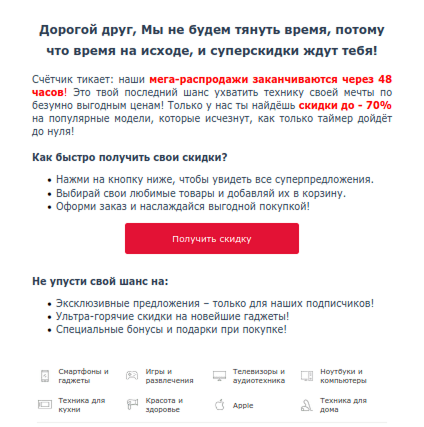
     
    And so it is Pacific peoples’ hopes and aspirations which must drive political leaders and policy makers. Our policies must be responsive and accountable to the perspectives of those we represent. 
     
    And no matter the future we face, or the challenges we encounter, we will always be members of the same Pacific family. We inhabit the most vast and breathtaking ocean continent in the world. And as family, we will always find a way forward, together, towards the secure and prosperous future that our people deserve.
     
    Thank you. Kia kaha. Go well. 

    MIL OSI New Zealand News

  • MIL-OSI Global: Trump wants to do a deal for Ukraine’s critical minerals. Will Zelensky give him what he wants – or will Putin?

    Source: The Conversation – Global Perspectives – By Alexander Korolev, Senior Lecturer in Politics and International Relations, UNSW Sydney

    The United States and Russia agreed to work on a plan to end the war in Ukraine at high-level talks in Saudi Arabia this week. Ukrainian and European representatives were pointedly not invited to take part.

    US President Donald Trump seemingly entered into these negotiations prepared to capitulate on two main points that Russian President Vladimir Putin has been seeking. Russia is opposed to Ukraine joining NATO and wants to retain Ukrainian territory captured since its invasion of Crimea in 2014.

    Such a dramatic shift in Washington’s approach to Ukraine’s sovereignty and security has undermined Western-Ukrainian unity on the acceptable parameters around ending the war.

    Ukrainian President Volodymyr Zelensky said Ukraine won’t accept a deal negotiated without them. Former US National Security Adviser John Bolton said Trump “effectively surrendered” to Putin.

    European leaders, too, are concerned after they were excluded from the Saudi talks. German Chancellor Olaf Scholz said:

    This does not mean that peace can be dictated and that Ukraine must accept what is presented to it.

    Many believe Trump’s moves to splinter this trans-Atlantic front against Russia send a signal that Washington is
    abandoning its commitment to European security.

    However, there’s another important factor at play in Trump’s actions: the intensifying global competition over critical minerals. Trump wants to secure access to Ukraine’s vast reserves of these minerals, even if it means breaking with the US’ traditional allies in the European Union.

    Why are Ukraine’s minerals so valuable

    According to some reports, Ukraine has deposits of 22 of the 34 minerals identified as critical by the EU. These include:

    • lithium and cobalt, used in rechargeable battery production
    • scandium, used for aerospace industry components
    • tantalum, used for electronic equipment
    • titanium, used in the aerospace, medical, automotive and marine industries
    • nickel ore, manganese, beryllium, hafnium, magnesium, zirconium and others, used in the aerospace, defence and nuclear industries.

    China currently dominates the world’s supply chains of these minerals – it is the largest source of US imports of 26 of the 50 minerals classified as critical by the United States Geological Survey.

    This is the reason behind Trump’s suggestion last week that the US be granted 50% of Ukraine’s rare earth minerals as reimbursement for the billions of dollars in weapons and support it has provided to Kyiv since the war began.

    The problem, however, is that at least 40% of Ukraine’s minerals are currently under Russian occupation in the eastern Donetsk and Luhansk regions of the country. (Other sources put this figure as high as 70%.)

    Concerned about Ukraine’s territorial integrity, Zelensky has publicly rejected the US demand for half of Ukraine’s mineral resources, because the proposal does not include security guarantees. It only vaguely referred to payment for future aid, according to reports.

    In response, the White House National Security Council spokesperson Brian Hughes said:

    President Zelensky is being short-sighted about the excellent opportunity the Trump administration has presented the Ukraine.

    What kind of deal could be made?

    A big question ahead of any peace negotiations over Ukraine is whether commercially-minded Trump would be willing to accept a counter-proposal from Putin.

    Since Russia currently controls large swathes of mineral-rich eastern Ukraine, Putin may be willing to offer Trump an exclusive critical minerals deal in exchange for the US formally committing to not restoring Ukraine’s pre-2014 borders and not letting the country into NATO.

    Ukraine, meanwhile, may be angling for its own minerals deal with European countries in exchange for their continued support. Prime Minister Denys Shmyhal expressed his country’s willingness to set up joint ventures with the EU in this area:

    We could replace Russian titanium on the European market, contributing to the development of both the EU’s civilian industry and advanced military technologies.

    He also said the project of rebuilding Ukraine could be a boon for the entire bloc.

    The European Commission has recommended a policy of encouraging Ukraine to export these materials to the EU. In response, authorities in Kyiv started working out the necessary regulatory and legal measures to integrate Ukraine into the EU’s resource strategy.

    With so many powers keen to access its minerals, Ukraine is in an extremely complex and hard-to-navigate geopolitical situation.

    Zelensky’s bet on the EU, instead of the US, might be right, given the growing rift between Brussels and Washington over Ukraine’s future. But as Thucydides, the ancient Greek historian, once said, the odds may be stacked against it:

    Right, as the world goes, is only in question between equals in power, while the strong do what they can and the weak suffer what they must.

    Alexander Korolev does not work for, consult, own shares in or receive funding from any company or organisation that would benefit from this article, and has disclosed no relevant affiliations beyond their academic appointment.

    ref. Trump wants to do a deal for Ukraine’s critical minerals. Will Zelensky give him what he wants – or will Putin? – https://theconversation.com/trump-wants-to-do-a-deal-for-ukraines-critical-minerals-will-zelensky-give-him-what-he-wants-or-will-putin-250064

    MIL OSI – Global Reports