Category: Europe

  • MIL-OSI: Societe Generale: Information regarding executed transactions within the framework of a share buyback program (outside the liquidity agreement)

    Source: GlobeNewswire (MIL-OSI)

    INFORMATION REGARDING EXECUTED TRANSACTIONS WITHIN THE FRAMEWORK OF A SHARE BUYBACK PROGRAM (OUTSIDE THE LIQUIDITY AGREEMENT)

    Regulated Information

    Paris, 17 February 2025

    (In accordance with article 5 of Regulation (EU) No 596/2014 on Market Abuse Regulation and article 3(3) of Delegated Regulation (EU) 2016/1052 supplementing Regulation (EU) No 596/2014 through regulatory technical standards concerning the conditions applicable to buyback programs and stabilization measures)

    As announced on Thursday 6 February 2025, Societe Generale started on Monday 10 February 2025, an ordinary share buyback program for EUR 872 million for the purpose of shares cancellation.

    Societe Generale received all necessary authorizations from supervisory authorities. These buybacks will be carried out in compliance with the conditions, notably regarding the maximum price, set forth by the General Meeting of 22 May 2024 and presented in the description released on 17 May 2024, as well as in accordance with the Market Abuse Regulation. They are performed on the trading platforms on which Societe Generale shares are listed for trading or are traded, including the regulated market of Euronext Paris.

    Purchases performed during the period from 10 to 14 February 2025 are described below. As of February 14, 2025, Societe Generale has completed 12% of its share buyback program, representing 0.4%* of its share capital.

    The liquidity contract concluded with Rothschild has also temporarily been suspended throughout the buyback period.

    Issuer name: Societe Generale – LEI O2RNE8IBXP4R0TD8PU41

    Reference of the financial instrument: ISIN FR0000130809

    Period: From 10 to 14 February 2025

    * Ratio between the number of shares repurchased and the 800,316,777 shares comprising the current share capital.

    Purchases performed by Societe Generale during the period

    Aggregated presentation by day and market

    Issuer name Issuer code (LEI) Transaction date ISIN Code Daily total volume (in number of shares) Daily weighted average price of shares acquired Platform
    SOCIETE GENERALE O2RNE8IBXP4R0TD8PU41 10-Feb-25 FR0000130809 362 124 35,7689 XPAR
    SOCIETE GENERALE O2RNE8IBXP4R0TD8PU41 10-Feb-25 FR0000130809 199 120 35,7415 CEUX
    SOCIETE GENERALE O2RNE8IBXP4R0TD8PU41 10-Feb-25 FR0000130809 25 000 35,7473 TQEX
    SOCIETE GENERALE O2RNE8IBXP4R0TD8PU41 10-Feb-25 FR0000130809 15 000 35,7792 AQEU
    SOCIETE GENERALE O2RNE8IBXP4R0TD8PU41 11-Feb-25 FR0000130809 398 546 36,1667 XPAR
    SOCIETE GENERALE O2RNE8IBXP4R0TD8PU41 11-Feb-25 FR0000130809 165 000 36,1551 CEUX
    SOCIETE GENERALE O2RNE8IBXP4R0TD8PU41 11-Feb-25 FR0000130809 19 000 36,1305 TQEX
    SOCIETE GENERALE O2RNE8IBXP4R0TD8PU41 11-Feb-25 FR0000130809 12 000 36,1520 AQEU
    SOCIETE GENERALE O2RNE8IBXP4R0TD8PU41 12-Feb-25 FR0000130809 345 676 37,1056 XPAR
    SOCIETE GENERALE O2RNE8IBXP4R0TD8PU41 12-Feb-25 FR0000130809 150 000 37,0716 CEUX
    SOCIETE GENERALE O2RNE8IBXP4R0TD8PU41 12-Feb-25 FR0000130809 19 000 37,0939 TQEX
    SOCIETE GENERALE O2RNE8IBXP4R0TD8PU41 12-Feb-25 FR0000130809 11 000 37,0842 AQEU
    SOCIETE GENERALE O2RNE8IBXP4R0TD8PU41 13-Feb-25 FR0000130809 305 947 37,2202 XPAR
    SOCIETE GENERALE O2RNE8IBXP4R0TD8PU41 13-Feb-25 FR0000130809 202 000 37,2104 CEUX
    SOCIETE GENERALE O2RNE8IBXP4R0TD8PU41 13-Feb-25 FR0000130809 28 000 37,1090 TQEX
    SOCIETE GENERALE O2RNE8IBXP4R0TD8PU41 13-Feb-25 FR0000130809 15 000 37,1341 AQEU
    SOCIETE GENERALE O2RNE8IBXP4R0TD8PU41 14-Feb-25 FR0000130809 347 390 36,9117 XPAR
    SOCIETE GENERALE O2RNE8IBXP4R0TD8PU41 14-Feb-25 FR0000130809 176 000 36,9096 CEUX
    SOCIETE GENERALE O2RNE8IBXP4R0TD8PU41 14-Feb-25 FR0000130809 20 000 36,9106 TQEX
    SOCIETE GENERALE O2RNE8IBXP4R0TD8PU41 14-Feb-25 FR0000130809 12 000 36,9131 AQEU
          TOTAL 2 827 803 36,6008  

    Press contacts:

    Jean-Baptiste Froville_+33 1 58 98 68 00_ jean-baptiste.froville@socgen.com
    Fanny Rouby_+33 1 57 29 11 12_ fanny.rouby@socgen.com

    Societe Generale

    Societe Generale is a top tier European Bank with more than 126,000 employees serving about 25 million clients in 65 countries across the world. We have been supporting the development of our economies for 160 years, providing our corporate, institutional, and individual clients with a wide array of value-added advisory and financial solutions. Our long-lasting and trusted relationships with the clients, our cutting-edge expertise, our unique innovation, our ESG capabilities and leading franchises are part of our DNA and serve our most essential objective – to deliver sustainable value creation for all our stakeholders.

    The Group runs three complementary sets of businesses, embedding ESG offerings for all its clients:

    • French Retail, Private Banking and Insurance, with leading retail bank SG and insurance franchise, premium private banking services, and the leading digital bank BoursoBank.
    • Global Banking and Investor Solutions, a top tier wholesale bank offering tailored-made solutions with distinctive global leadership in equity derivatives, structured finance and ESG.
    • Mobility, International Retail Banking and Financial Services, comprising well-established universal banks (in Czech Republic, Romania and several African countries), Ayvens (the new ALD I LeasePlan brand), a global player in sustainable mobility, as well as specialized financing activities.

    Committed to building together with its clients a better and sustainable future, Societe Generale aims to be a leading partner in the environmental transition and sustainability overall. The Group is included in the principal socially responsible investment indices: DJSI (Europe), FTSE4Good (Global and Europe), Bloomberg Gender-Equality Index, Refinitiv Diversity and Inclusion Index, Euronext Vigeo (Europe and Eurozone), STOXX Global ESG Leaders indexes, and the MSCI Low Carbon Leaders Index (World and Europe).

    In case of doubt regarding the authenticity of this press release, please go to the end of the Group News page on societegenerale.com website where official Press Releases sent by Societe Generale can be certified using blockchain technology. A link will allow you to check the document’s legitimacy directly on the web page.

    For more information, you can follow us on Twitter/X @societegenerale or visit our website societegenerale.com.

    Attachment

    The MIL Network

  • MIL-OSI United Kingdom: UK Government awards grant to strengthen mangrove conservation in Belize

    Source: United Kingdom – Government Statements

    Award from Sustainable Blue Economies Programme Blue Social Challenge Fund reaffirms UK’s commitment to collaborating with Caribbean nations to safeguard vital ocean resources.

    The UK Government through its Sustainable Blue Economies Programme Blue Social Challenge Fund (BSCF) has awarded a grant of £99,191 (approximately BZD250,000) to MarAlliance for the project “Mangrove Habitat for Juvenile Fish Recruitment: Building Local Knowledge and Capacity.” This initiative reaffirms the UK’s commitment to collaborating with Caribbean nations to safeguard vital ocean resources.

    The Fund aims to enhance the resilience of Small Island Developing States (SIDS) like Belize and their economies to the impacts of climate change and economic shocks, through better ocean management, poverty reduction/improved livelihoods and greater use of nature-based solutions.

    High Commissioner Christine Rowlands stated:

    By funding this project, we are supporting work that enables local communities and fishers to contribute data needed for the sustainable management of Belize’s beautiful mangrove forests and juvenile fishes. This in turn contributes to improved livelihoods of fishers, sustainable fisheries, and builds climate resilience of coastal communities. This is the purpose of BSCF, to support vulnerable communities working together to address the adverse impacts of climate change on their livelihoods and we are happy to work with MarAlliance on this initiative.

    Belize’s mangrove ecosystems play a crucial role in mitigating coastal erosion, sequestering carbon, and providing essential nursery habitats for juvenile fish. However, extensive mangrove loss over the past two decades has posed a significant threat to coastal integrity and the livelihoods dependent on sustainable fisheries.

    This project seeks to bridge critical knowledge gaps by evaluating the contribution of mangroves to fish population recruitment. Leveraging advanced methodologies such as environmental DNA (eDNA) analysis, the initiative will generate valuable insights to enhance fisheries management in Belize. By actively engaging university students and local community members, the project aims to expand the scientific understanding of mangrove ecology while delivering direct economic benefits to stakeholders through training and fieldwork participation. The data collected will provide coastal communities and policymakers with robust evidence on the ecological and economic value of mangroves, facilitating informed conservation strategies in Belize.

    A key aspect of the project is its participatory approach of co-created scientific research with fishers and coastal communities. Through targeted training initiatives, local community members will be empowered to take an active role in resource stewardship, ensuring alignment between local practices and national fisheries objectives.

    Dr. Rachel Graham, Founder and Executive Director of MarAlliance highlighted that:

    Our mangrove based fisheries work illuminates the critical role of these ecosystems as vital nursery habitats, bridging scientific inquiry and community knowledge to quantify and protect juvenile fish populations. With profound gratitude to the British High Commission, MarAlliance is transforming local fishing insights into evidence-based strategies that support small-scale fishers adapting to unprecedented environmental challenges along Belize’s vulnerable coastal shorelines.

    The project’s outputs will include a publicly accessible scientific report informing of the contributions of mangroves to biodiversity and fisheries productivity. Ultimately, this initiative aims to have a cadre of trained local biologists and fishers, heighten awareness of mangroves as critical nursery habitats for sustained fisheries, strengthen community livelihoods, and drive policy actions to protect Belize’s coastal ecosystems, thereby enhancing resilience to climate change.

    Updates to this page

    Published 17 February 2025

    MIL OSI United Kingdom

  • MIL-OSI United Kingdom: Ukraine’s voice must be at the heart of any peace negotiations: UK statement at the UN Security Council

    Source: United Kingdom – Government Statements

    Statement by Ambassador Barbara Woodward, UK Permanent Representative to the UN, at the UN Security Council meeting on threats to international peace and security.

    President, Russia is once again using this meeting in an attempt to distort the truth behind its illegal war. I will make three points about lessons.

    First, the events of the last decade in Ukraine originate from a simple, sad reality: Russia’s imperialist ambition and failure to respect Ukraine’s sovereignty.

    Russia is a reliable party to agreements or treaties. 

    In freely signing up to the Minsk Agreements, Russia had the opportunity to ensure peace. 

    Russia and Ukraine were the sole parties to these agreements.  

    And this Council consistently called on all parties to implement their commitments in full, right up until the moment when President Putin decided that, on 22 February 2022, I quote the Minsk Agreement ‘no longer existed.’

    Second, Russia continues to violate the UN Charter and international law in multiple ways.

    In its war in Ukraine, Russia has targeted civilians and civilian infrastructure, hospitals, schools, energy infrastructure, it has abducted children, it has raped women, it has compromised nuclear safety and security, flouted international law, and tortured detainees. 

    For all these reasons, it is no surprise that the ICJ has issued an indictment on President Putin.

    We will not tolerate Russia’s attempts to spread disinformation and divert this Council’s attention away from its atrocities, or efforts to subjugate a sovereign state.

    Russia is the sole architect of the war in Ukraine and could end it now if it chose to by withdrawing its forces. 

    Third lesson is that the international community must stand firm in support of peace and security.

    No one wants this war to end more than Ukraine.

    But Putin’s so-called preconditions for talks – reaffirmed by his deputy Foreign Minister just a few days ago – have been that Ukraine withdraw from its own sovereign territory, and abandon its sovereign right to choose its alliances. 

    No country could or should accept this.

    We can and must create the conditions for a just and lasting peace, which protects Ukraine’s security, sovereignty and independence. 

    This will require robust security arrangements from the outset, which ensure that Russia is never able to invade again. 

    Putin has shown time and again that he will break a weak deal.

    The UK will continue to play our part. 

    We will continue to provide concrete support for Ukraine’s self-defence and security for as long as it is needed. 

    And we are clear that Ukraine’s voice must be at the heart of any negotiations.

    Let me conclude, President, by reminding Russia that the suffering of so many Ukrainians today simply would not exist if Russia fulfilled its most basic obligation as a member of the United Nations: to respect the principles of the UN Charter.

    Updates to this page

    Published 17 February 2025

    MIL OSI United Kingdom

  • MIL-OSI Russia: Joint Statement by the Saudi Finance Minister and IMF Managing Director at the conclusion of the Inaugural Al Ula Economic Conference for Emerging Market Economies

    Source: IMF – News in Russian

    February 17, 2025

    Al Ula, Saudi Arabia – February 17, 2025: A two-day inaugural annual global Conference on Emerging Market Economies was held in Al Ula, Saudi Arabia from February 16-17, co-hosted by the Saudi Finance Ministry and the International Monetary Fund (IMF). Mohammed Aljadaan, Finance Minister of Saudi Arabia, and Kristalina Georgieva, Managing Director of the IMF, made the following statement at the end of the conference:

    “We would like to thank Emerging Markets policymakers, academics, and representatives of the regional and international financial institutions for joining us and helping to make this first-ever Al Ula Economic Conference for Emerging Market Economies a successful forum for building greater collaboration and discussing the specific challenges facing emerging markets (EMs).

    “Over the past two days, we have discussed how emerging economies can navigate the risks and, importantly how they can embrace the opportunities ahead. One common emerging theme is the importance of unity of purpose and the need to continue working together to sustain EM economies’ resilience to shocks and sustain growth. Three takeaways to highlight:

     “First, this is a time of sweeping transformations—from technology to trade, or climate to capital flows. And these changes are reshaping the global economy. How all these changes will unfold remains to be seen. But we know that in a more uncertain and shock-prone world, building resilience through sound macroeconomic and financial policies must continue to be a priority.

    “Second, emerging markets are seizing these transformations to make their economies stronger. With widespread digitalization and ambitious policies, the prospects for harnessing the benefits of AI are promising. Tapping the potential of AI would enhance Emerging Market Economies’ productivity and resilience, but it will require reforms to boost investments in digital infrastructure and human capital. Deeper regional trade and financial integration would also be important.

    “Third, while these transformations offer great opportunities, we must work together to help avoid the very real risk of some countries falling behind. The first line of defense will of course be strong domestic policies and reforms to help seize these opportunities. But the international community can also support countries and reduce the risk of growing divergence.

    “We are proud to have co-hosted the first global forum that is focused solely on the economic prospects for Emerging Market Economies and we look forward to continuing the discussions in the year ahead and at the second Al Ula conference next year.”

    IMF Communications Department
    MEDIA RELATIONS

    PRESS OFFICER: Wafa Amr

    Phone: +1 202 623-7100Email: MEDIA@IMF.org

    https://www.imf.org/en/News/Articles/2025/02/17/pr-25039-saudi-arabia-joint-statement-by-the-saudi-finance-minister-and-imf-md

    MIL OSI

    MIL OSI Russia News

  • MIL-OSI Global: A new theory explains how water first arrived on Earth

    Source: The Conversation – France – By Quentin Kral, Astrophysicien à l’observatoire de Paris-PSL, CNRS, Sorbonne Université, Université Paris Cité

    How did Earth become a blue planet? NASA, CC BY

    When Earth first formed, it was too hot to retain ice. This means all the water on our planet must have originated from extraterrestrial sources. Studies of ancient terrestrial rocks suggest liquid water existed on Earth as early as 100 million years after the Sun’s formation–practically “immediately” on an astrophysical timescale. This water, now over 4.5 billion years old, has been perpetually renewed through Earth’s water cycle. My research team has recently proposed a new theory to explain how water first arrived on Earth.

    A mystery billions of years in the making

    Astrophysicists have been grappling with the question of how water arrived on our young planet for decades. One of the earliest hypotheses suggested that Earth’s water was a direct byproduct of the planet’s formation, released via magma during volcanic eruptions, in which most of the emitted gas is water vapor.

    However, this hypothesis evolved in the 1990s following analysis of Earth’s water composition and the discovery of the potential role of icy comets, pointing to an extraterrestrial origin. Comets, which are mixtures of ice and rock formed in the distant reaches of the solar system, are sometimes ejected toward the Sun. When warmed by the Sun, they develop striking tails of dust and gas that are visible from Earth. Asteroids, located in the asteroid belt between Mars and Jupiter, were also proposed as potential progenitors of Earth’s water.

    The study of cometary and asteroid rocks via meteorites–small fragments of these bodies that have fallen to Earth–has provided key insights. By analyzing the D/H ratio–the proportion of heavy hydrogen (deuterium) to standard hydrogen–scientists found that Earth’s water more closely matches that of “carbonaceous” asteroids, which bear traces of past water. This shifted the focus of research toward these asteroids.

    The asteroid belt lies between Mars and Jupiter, while the Kuiper Belt extends beyond Neptune.
    Pline/Wikipedia, CC BY

    Recent studies have centered on identifying the celestial mechanisms that could have delivered these water-rich asteroids to the dry surface of early Earth. Numerous theories have emerged to explain the “perturbation” of planetesimals–large, icy bodies in the asteroid and Kuiper belts. These scenarios propose gravitational interactions that dislodged these objects, sending them hurtling toward Earth. Such events would have required a complex “gravitational billiards” process, suggesting a tumultuous history of the solar system.

    While it is evident that planetary formation involved significant upheavals and impacts, it is possible that Earth’s water delivery occurred in a more natural and less dramatic manner.

    A simpler hypothesis

    I started with the assumption that asteroids emerge icy from their formation cocoon, also known as the protoplanetary disk. This cocoon is a massive, hydrogen-rich disk filled with dust, where planets and initial belts form. It envelops the entire nascent planetary system. Once this protective cocoon dissipates–after a few million years–the asteroids warm up, causing their ice to melt or, more precisely, to sublimate. In space, where pressure is nearly zero, the water remains in vapor form after this process.

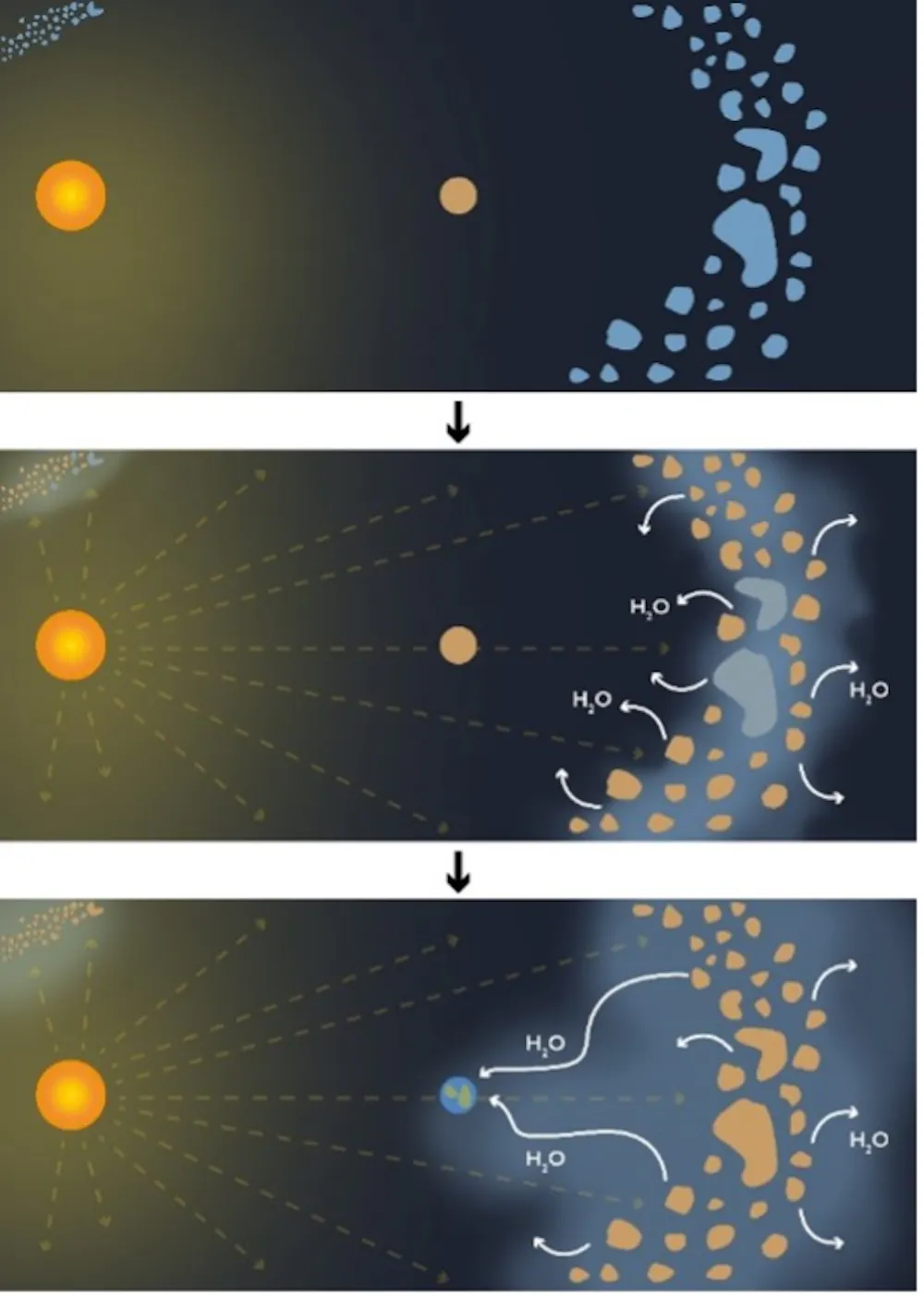
    A disk of water vapour is then superimposed on the asteroid belt orbiting the Sun. As the ice sublimates, the disk fills with vapor, which spreads inward toward the Sun due to complex dynamic processes. Along the way, this vapor disk encounters the inner planets, immersing them in a kind of “bath”. In a way, the disk “waters” the terrestrial planets: Mars, Earth, Venus and Mercury. Most of this water capture occurred 20 to 30 million years after the Sun’s formation, during a period when the Sun’s luminosity increased dramatically over a brief period of time, increasing the degassing rate of asteroids.

    Step-by-step illustration of a new model for water distribution on the inner planets of the solar system, including Earth. Five million years after the Sun’s birth, asteroids in the main belt release water vapor due to solar energy. This vapor gradually spreads into the inner solar system, eventually enveloping the planets, which capture part of it to form oceans between 10 and 100 million years later.
    Sylvain Cnudde/Observatoire de Paris — PSL/LESIA, Fourni par l’auteur

    Once water is captured by a planet’s gravitational pull, many processes can occur. On Earth, however, a protective mechanism ensures the total mass of water has remained relatively constant from the end of the capture period until today. If water rises too high into the atmosphere, it condenses into clouds, which eventually return to the surface as rain–a process known as the water cycle.

    The quantities of water on Earth, both past and present, are well documented. Our model, which begins with the degassing of ice from the original asteroid belt, successfully accounts for the amount of water needed to form oceans, rivers and lakes, and even the water buried deep within Earth’s mantle. Precise measurements of the D/H ratio of water in the oceans also align with our model. Moreover, the model explains the quantities of water present in the past on other planets–and even on the Moon.

    You might wonder how I arrived at this new theory. It stems from recent observations, particularly those made with ALMA, a radio telescope array of over 60 antennae located in Chile, on a plateau five kilometres above sea level. Observations of extrasolar systems with belts similar to the Kuiper Belt reveal that planetesimals in these belts sublimate carbon monoxide (CO). For belts closer to their star, such as the asteroid belt, CO is too volatile to be present, and water is more likely to be released.

    Building the model

    It was from these findings that the initial idea for the theory began to take shape. Moreover, recent data from the Hayabusa 2 and OSIRIS-REx missions, which explored asteroids similar to those that might have contributed to the formation of the initial water vapor disk, provided key confirmation. These missions, along with long-standing observations from ground-based telescopes, revealed substantial amounts of hydrated minerals on these asteroids–minerals that can only form through contact with water. This supports the premise that these asteroids were initially icy, even though most have since lost their ice (except for larger bodies like Ceres).

    With the foundation of the model in place, the next step was to develop a numerical simulation to track the degassing of ice, the dispersion of water vapor, and its eventual capture by planets. During these simulations, it quickly became clear that the model could account for Earth’s water supply. Additional research on past water quantities for Mars and other terrestrial planets confirmed the model’s applicability to them as well. It all fit, and the results were ready for publication!

    As researchers, it’s not enough to design a model that works and seems to explain everything. The theory must be tested on a larger scale. While it’s now impossible to detect the initial water vapor disk that “watered” the terrestrial planets, we can look to extrasolar systems with young asteroid belts to see if such water vapor disks exist. According to our calculations, these disks, though faint, should be detectable with ALMA. Our team has just secured time on ALMA to investigate specific systems for evidence of them.

    We may be at the dawn of a new era in understanding the origins of Earth’s water.

    Quentin Kral ne travaille pas, ne conseille pas, ne possède pas de parts, ne reçoit pas de fonds d’une organisation qui pourrait tirer profit de cet article, et n’a déclaré aucune autre affiliation que son organisme de recherche.

    ref. A new theory explains how water first arrived on Earth – https://theconversation.com/a-new-theory-explains-how-water-first-arrived-on-earth-246516

    MIL OSI – Global Reports

  • MIL-OSI Europe: Minister welcomes record goods exports from Ireland in 2024

    Source: Government of Ireland – Department of Jobs Enterprise and Innovation

    The Minister for Enterprise, Tourism and Employment, Peter Burke, today welcomed the latest Goods Exports and Imports release from the CSO which shows that goods exports rose to €224 billion in 2024.

    This was an increase of € 28 billion or + 14% when compared with 2023. 

    Commenting on today’s figures, Minister Peter Burke said: 

    I am delighted to welcome the publication of this trade data today which shows that the highest value of goods exports from Ireland was achieved in 2024. These export figures show a significant positive 14% growth when compared to 2023.  This performance is testament to the strength of exporting companies in Ireland and to their efforts in growing business, reaching new markets and delivering this record performance.”

    The EU continues to be Ireland’s largest market, with €88.5 billion of goods exports in 2024, an increase of € 7.4m (9 %) in 2023.

    This is followed by the US, accounting for €72.6 billion of exports in 2024, another increase year on year, by a total of €18.6 billion on 2023.

     Of this, € 20,131 billion went to Germany, € 22,993 billion went to the Netherlands and €17,031 billion went to Belgium.

    The value of goods exports to Great Britain fell in 2024 to € 15.7 billion.  This is a fall of € 1.7 billion or – 10% compared to 2023.   

    The highest category of exports where Medical and Pharmaceutical Products which rose by €22.4 billion to €99.9 billion which accounted for 45 % of goods exports in 2024. 

    The Minister commented further:

    “The Government is committed to supporting companies competing and growing on a global scale and the work of our enterprise and development agencies Enterprise Ireland and IDA Ireland, is working to expand Ireland’s global trade links and enhance our competitiveness as a top location for business and talent.”

    ENDS

    MIL OSI Europe News

  • MIL-OSI United Kingdom: expert reaction to four papers trialling treatments for ALS within the HEALEY ALS Platform Trial

    Source: United Kingdom – Executive Government & Departments

    Four papers published in JAMA, JAMA Neurology and JAMA Network Open look at Amyotrophic Lateral Sclerosis (ALS) treatment results from the HEALY ALS Platform Trial. 

    Dr Ahmad Al Khleifat, Senior Research Fellow, King’s College London, said:

    “Currently, only a few disease-modifying drugs, such as riluzole and edaravone, are approved for ALS, but their benefits are limited. Platform trials, like the HEALEY ALS Platform Trial, provide a faster and more cost-effective way to test multiple treatments simultaneously, cutting the time to identify effective therapies in half and reducing costs by a third. The latest studies from the HEALEY ALS Platform Trial highlight the efficiency of this approach in accelerating drug testing, laying the groundwork for future breakthroughs despite the initial negative results.

    “While these outcomes may seem discouraging, they provide critical insights. Randomised clinical trials remain the gold standard for evaluating new treatments, ensuring that observed effects are real rather than influenced by external factors. However, patient recruitment bias can be a challenge, when only a few trials are available, longer-term survivors may be overrepresented, potentially affecting trial design and interpretation.

    “Another consideration is the reliance on survival and functional scores as primary outcome measures, rather than biomarkers like neurofilament, which offer a more precise way to track disease progression. Some treatments, such as riluzole and tofersen, have shown benefits only in later stages, meaning shorter trials may overlook their full impact. Extending trial durations or incorporating post-trial follow-ups could help capture these delayed effects and provide a clearer picture of treatment efficacy.

    “Despite these challenges, platform trials continue to revolutionise ALS research, they hold immense potential to accelerate the discovery of effective therapies and bring new hope to the ALS community.”

    Verdiperstat in Amyotrophic Lateral Sclerosis’ by the Writing Committee for the HEALEY ALS Platform Trial was published in JAMA Neurology at 16:00 UK time on Monday 17th February.

    DOI: 10.1001/jamaneurol.2024.5249


    Pridopidine in ALS’ by the Writing Committee for the HEALEY ALS Platform Trial was published in JAMA at 16:00 UK time on Monday 17th February. 

    DOI: 10.1001/jama.2024.26429


    CNM-Au8 in Amyotrophic Lateral Sclerosis’ by the Writing Committee for the HEALEY ALS Platform Trial was published in JAMA at 16:00 UK time on Monday 17th February. 

    DOI: 10.1001/jama.2024.27643


    Efficacy and Safety of Zilucoplan in Amyotrophic Lateral Sclerosis’ by Paganoni et al., was published in JAMA Network Open at 16:00 UK time on Monday 17th February. 

    DOI: 10.1001/jamanetworkopen.2024.59058

    Declared interests:

    Dr Ahmad Al Khleifat “I am a consultant for NESTA (innovation agency for social good).”

    MIL OSI United Kingdom

  • MIL-OSI United Kingdom: Urge your MP to support Wales’ right to control natural resources

    Source: Party of Wales

    On Monday 24 February, the Crown Estate Bill will be debated in the House of Commons at its Report Stage.

    Llinos Medi MP’s amendment is the last chance to demand fairness for Wales in this Bill.

    Urge your MP to support Plaid Cymru’s amendment.

    Find your MP here

    Draft letter:

    Dear MP,

    I am writing to urge you to support the amendment to the Crown Estate Bill, tabled by Llinos Medi MP, which will be debated on 24th February.

    This amendment calls for the transfer of Crown Estate management in Wales to the Welsh Government within two years, allowing Wales to control the profits from its own natural resources. Currently, millions of pounds generated in Wales go directly to the UK Treasury, leaving our communities with no benefit. In contrast, Scotland has seen significant benefits since the devolution of its Crown Estate.

    The devolution of the Crown Estate has widespread support in Wales, and MPs should represent the interests of their constituents. I urge you to sign the amendment and support Wales’ right to control its own resources.


    Kind regards,

    [Your name]

    MIL OSI United Kingdom

  • MIL-OSI Global: Deeply religious African countries (surprisingly) provide little state support to religion – unlike countries in Europe

    Source: The Conversation – Africa – By David Jeffery-Schwikkard, PhD Candidate (Theology and Religious Studies), King’s College London

    In most of the world, countries with religious populations are more likely to have governments that support religion through laws and policies. These laws might include religious education, funding for religious institutions, and laws based on religious values. Not so in sub-Saharan Africa.

    In a recently published research paper, David Jeffery-Schwikkard, who studies secularism, argues that sub-Saharan African countries provide little state support for religion, even though their populations are among the most devout globally.

    These findings unsettle many common misconceptions about the role of religion in politics. The Conversation Africa asked him a few questions.


    How prevalent is religion in countries in sub-Saharan Africa?

    A population is normally considered very religious if most people say religion is “very important” in their lives or report attending religious services at least once a week.

    In surveys conducted between 2007 and 2018 by the Pew Research Centre, 46% of respondents outside sub-Saharan Africa said religion was very important in their lives. Within sub-Saharan Africa, the average is nearly twice that: 89%. Ethiopia and Senegal are among the most religious countries in the world. In both cases, 98% of people said religion was very important. Of the 20 countries in sub-Saharan Africa for which Pew has data, Botswana (71%) and South Africa (75%) are the least religious. Yet even these countries are far above the global average.

    What does this matter for how states are run?

    Generally, countries with religious populations have states that provide a lot of support to religion. This is what you would expect, since religious citizens probably want more state support for their religions.

    What this means, though, is that commentators often assume that religious citizens are a threat to secular states. This then shapes how analysts make sense of public displays of religion. One example of this is in South Africa, where many people assumed that former president Jacob Zuma, who often used religious rhetoric, would pursue religious laws and policies.


    Read more:
    TB Joshua scandal: the forces that shaped Nigeria’s mega pastor and made him untouchable


    These assumptions are especially common in analyses of religion and politics in Africa. Yet, while it is easy to identify laws or policies in sub-Saharan Africa that are religious, one can easily overlook the fact that having some of these laws is not unusual globally. In other words, having some pro-religion laws and policies doesn’t necessarily mean that countries are governed by religious beliefs.

    Thus one might focus on Ghana’s support for Hajj, while forgetting that the UK reserves seats in the House of Lords for the Church of England, and that Germany collects taxes on behalf of churches. Yet the UK and Germany are rarely seen as religious states. Some level of state support for religion does not mean that a country is governed by religious beliefs.

    Why are African countries different?

    Contrary to the global trend, countries in sub-Saharan Africa provide very little state support to religion – less than half the global average. This is as measured by the Religion and State Project at Bar Ilan University, based on the number of different types of support provided, such as reserving political positions for religious leaders or funding religious schools.

    One of the most popular explanations for the scant support for religion is that states in sub-Saharan Africa lack the necessary financial and administrative capacity. These states, the argument goes, would provide more support if only they had more money and were better able to implement their policies.

    However, data from the World Bank shows that this is not the case: overall, there is no relationship between state capacity and support for religion.


    Read more:
    Catholic synod: the voices of church leaders in Africa are not being heard – 3 reasons why


    A more plausible explanation is that religious actors in these countries tend to lack moral authority. Moral authority, as theorised by American political scientist Anna Grzymala-Busse, is the extent to which people see religious actors as defenders of the nation.

    Several factors are conducive to moral authority. These include whether people share the same ethnicity or religion, whether religious actors have control over education, and whether they have sided with the “right side” in moments of national crisis.

    Can you give an example?

    Consider Rwanda and Mozambique.

    Until 1994, the Roman Catholic Church in Rwanda enjoyed moral prestige. The church controlled a significant share of the education system and had supported the independence movement against Belgium. Most Rwandans were Catholic. And indeed, the church maintained a very close relationship with the state after independence in 1962.

    Yet this moral authority was forfeited after the church was seen to be complicit in the Rwandan Genocide in 1994, which claimed about 800,000 lives. Today, the government keeps a careful distance from religion, despite 90% of Rwandans reporting that religion is very important in their lives.


    Read more:
    Rwanda’s genocide could have been prevented: 3 things the international community should have done – expert


    Mozambique provides a contrast to Rwanda, yet with similar outcomes. The Roman Catholic Church denounced the liberation movement’s struggle against Portugal. The country has no religious or ethnic majority. At independence, formal education was scarce.

    There was therefore little reason for Mozambicans to see the church as a defender of the nation. On the contrary, religious institutions were persecuted after independence. Like Rwanda, Mozambique provides extremely little state support for religion, despite being one of the most religious countries internationally.


    Read more:
    Between state and mosque: new book explores the turbulent history of Islamic politics in Mozambique


    These factors – religious diversity, limited enrolment in schools controlled by religious organisations, and moments of political crisis in which those organisations can misstep – make it less likely that religious actors are held by citizens as integral to national identity. And while sub-Saharan Africa is extremely varied, common historical influences, such as the legacies of colonialism, may make these factors more likely.

    What can we learn from this?

    Clearly, we need to be more careful in how we interpret the role of religion in politics. While it might be tempting to see religious fervour as a threat to secular democracy, it is not necessarily so. A politician might use religious rhetoric, but this does not mean that it will translate into religious laws. Equally, some state support for religion is not unusual globally. Analyses of single policies need to keep this in mind.


    Read more:
    Christianity is changing in South Africa as pentecostal and indigenous churches grow – what’s behind the trend


    This research also upends the way many people normally think about secularism. Many people in Europe have become less religious. Consequently, European states are offered as models of secularism. However, this has it backwards.

    Despite their electorates being less religious, European states are more involved in religion than their counterparts in sub-Saharan African. If secularism is the separation of religion and the state, then countries in sub-Saharan Africa – which maintain a secular state despite widespread religion – are in fact the exemplar.

    David Jeffery-Schwikkard does not work for, consult, own shares in or receive funding from any company or organisation that would benefit from this article, and has disclosed no relevant affiliations beyond their academic appointment.

    ref. Deeply religious African countries (surprisingly) provide little state support to religion – unlike countries in Europe – https://theconversation.com/deeply-religious-african-countries-surprisingly-provide-little-state-support-to-religion-unlike-countries-in-europe-245490

    MIL OSI – Global Reports

  • MIL-OSI Africa: Deeply religious African countries (surprisingly) provide little state support to religion – unlike countries in Europe

    Source: The Conversation – Africa – By David Jeffery-Schwikkard, PhD Candidate (Theology and Religious Studies), King’s College London

    In most of the world, countries with religious populations are more likely to have governments that support religion through laws and policies. These laws might include religious education, funding for religious institutions, and laws based on religious values. Not so in sub-Saharan Africa.

    In a recently published research paper, David Jeffery-Schwikkard, who studies secularism, argues that sub-Saharan African countries provide little state support for religion, even though their populations are among the most devout globally.

    These findings unsettle many common misconceptions about the role of religion in politics. The Conversation Africa asked him a few questions.


    How prevalent is religion in countries in sub-Saharan Africa?

    A population is normally considered very religious if most people say religion is “very important” in their lives or report attending religious services at least once a week.

    In surveys conducted between 2007 and 2018 by the Pew Research Centre, 46% of respondents outside sub-Saharan Africa said religion was very important in their lives. Within sub-Saharan Africa, the average is nearly twice that: 89%. Ethiopia and Senegal are among the most religious countries in the world. In both cases, 98% of people said religion was very important. Of the 20 countries in sub-Saharan Africa for which Pew has data, Botswana (71%) and South Africa (75%) are the least religious. Yet even these countries are far above the global average.

    What does this matter for how states are run?

    Generally, countries with religious populations have states that provide a lot of support to religion. This is what you would expect, since religious citizens probably want more state support for their religions.

    What this means, though, is that commentators often assume that religious citizens are a threat to secular states. This then shapes how analysts make sense of public displays of religion. One example of this is in South Africa, where many people assumed that former president Jacob Zuma, who often used religious rhetoric, would pursue religious laws and policies.


    Read more: TB Joshua scandal: the forces that shaped Nigeria’s mega pastor and made him untouchable


    These assumptions are especially common in analyses of religion and politics in Africa. Yet, while it is easy to identify laws or policies in sub-Saharan Africa that are religious, one can easily overlook the fact that having some of these laws is not unusual globally. In other words, having some pro-religion laws and policies doesn’t necessarily mean that countries are governed by religious beliefs.

    Thus one might focus on Ghana’s support for Hajj, while forgetting that the UK reserves seats in the House of Lords for the Church of England, and that Germany collects taxes on behalf of churches. Yet the UK and Germany are rarely seen as religious states. Some level of state support for religion does not mean that a country is governed by religious beliefs.

    Why are African countries different?

    Contrary to the global trend, countries in sub-Saharan Africa provide very little state support to religion – less than half the global average. This is as measured by the Religion and State Project at Bar Ilan University, based on the number of different types of support provided, such as reserving political positions for religious leaders or funding religious schools.

    One of the most popular explanations for the scant support for religion is that states in sub-Saharan Africa lack the necessary financial and administrative capacity. These states, the argument goes, would provide more support if only they had more money and were better able to implement their policies.

    However, data from the World Bank shows that this is not the case: overall, there is no relationship between state capacity and support for religion.


    Read more: Catholic synod: the voices of church leaders in Africa are not being heard – 3 reasons why


    A more plausible explanation is that religious actors in these countries tend to lack moral authority. Moral authority, as theorised by American political scientist Anna Grzymala-Busse, is the extent to which people see religious actors as defenders of the nation.

    Several factors are conducive to moral authority. These include whether people share the same ethnicity or religion, whether religious actors have control over education, and whether they have sided with the “right side” in moments of national crisis.

    Can you give an example?

    Consider Rwanda and Mozambique.

    Until 1994, the Roman Catholic Church in Rwanda enjoyed moral prestige. The church controlled a significant share of the education system and had supported the independence movement against Belgium. Most Rwandans were Catholic. And indeed, the church maintained a very close relationship with the state after independence in 1962.

    Yet this moral authority was forfeited after the church was seen to be complicit in the Rwandan Genocide in 1994, which claimed about 800,000 lives. Today, the government keeps a careful distance from religion, despite 90% of Rwandans reporting that religion is very important in their lives.


    Read more: Rwanda’s genocide could have been prevented: 3 things the international community should have done – expert


    Mozambique provides a contrast to Rwanda, yet with similar outcomes. The Roman Catholic Church denounced the liberation movement’s struggle against Portugal. The country has no religious or ethnic majority. At independence, formal education was scarce.

    There was therefore little reason for Mozambicans to see the church as a defender of the nation. On the contrary, religious institutions were persecuted after independence. Like Rwanda, Mozambique provides extremely little state support for religion, despite being one of the most religious countries internationally.


    Read more: Between state and mosque: new book explores the turbulent history of Islamic politics in Mozambique


    These factors – religious diversity, limited enrolment in schools controlled by religious organisations, and moments of political crisis in which those organisations can misstep – make it less likely that religious actors are held by citizens as integral to national identity. And while sub-Saharan Africa is extremely varied, common historical influences, such as the legacies of colonialism, may make these factors more likely.

    What can we learn from this?

    Clearly, we need to be more careful in how we interpret the role of religion in politics. While it might be tempting to see religious fervour as a threat to secular democracy, it is not necessarily so. A politician might use religious rhetoric, but this does not mean that it will translate into religious laws. Equally, some state support for religion is not unusual globally. Analyses of single policies need to keep this in mind.


    Read more: Christianity is changing in South Africa as pentecostal and indigenous churches grow – what’s behind the trend


    This research also upends the way many people normally think about secularism. Many people in Europe have become less religious. Consequently, European states are offered as models of secularism. However, this has it backwards.

    Despite their electorates being less religious, European states are more involved in religion than their counterparts in sub-Saharan African. If secularism is the separation of religion and the state, then countries in sub-Saharan Africa – which maintain a secular state despite widespread religion – are in fact the exemplar.

    – Deeply religious African countries (surprisingly) provide little state support to religion – unlike countries in Europe
    – https://theconversation.com/deeply-religious-african-countries-surprisingly-provide-little-state-support-to-religion-unlike-countries-in-europe-245490

    MIL OSI Africa

  • MIL-OSI: Ress Life Investments A/S publishes Net Asset Value (NAV).

    Source: GlobeNewswire (MIL-OSI)

    Ress Life Investments
    Nybrogade 12
    DK-1203 Copenhagen K
    Denmark
    CVR nr. 33593163
    www.resslifeinvestments.com

    To: Nasdaq Copenhagen
    Date: 17 February 2025

    Corporate Announcement 06/2025

    Ress Life Investments A/S publishes Net Asset Value (NAV).

    Ress Life Investments A/S publishes the Net Asset Value (NAV) per share as of 31 January 2025.

    NAV per share in USD: 2594.43

    The performance during January is -0.03% in USD. The year-to-date net performance is        -0.03% in USD.

    Assets under management (AUM) are 284.6 million USD.     

    The NAV per share in EUR is from 5 February 2025 published on a daily basis. The NAV in EUR is published on the website of Nasdaq Copenhagen under the section AIF Companies and Funds, where the bid and ask prices are published. The daily NAV in EUR is calculated as the most recently published NAV in USD divided by the European Central Bank’s EUR/USD reference rate on the relevant day.

    Questions related to this announcement can be made to the company’s AIF-manager, Resscapital AB.

    Contact person:
    Gustaf Hagerud
    gustaf.hagerud@resscapital.com
    Tel + 46 8 545 282 27

    Note: The terms for subscription of shares, minimum subscription amount and redemption of shares are provided in the Articles of Association, Information Brochure and in the Key Information Document available on the Company’s website, www.resslifeinvestments.com.

    Attachment

    The MIL Network

  • MIL-OSI United Kingdom: Leuchars Station medical and dental centre marks major construction milestone

    Source: United Kingdom – Government Statements

    Around 3,700 armed forces personnel and their families will benefit from the new building at Leuchars Station.

    The project team celebrate at a topping out ceremony. (Crown Copyright)

    A ceremony has been held to mark the topping out of a new medical and dental centre at Leuchars Station in Fife. 

    The Defence Infrastructure Organisation (DIO) is managing the build on behalf of the British Army, and contracted the £22 million facility to Graham Building North who began construction in October. 

    The new building will replace the current medical and dental centre which was built in 1936. Around 3,700 personnel at the British Army establishment and their dependents will benefit from the new building, which will house physical rehabilitation and mental health facilities as well as GP and dental services. Leuchars Station is to become the army’s hub in Scotland, and the new building has been designed to cater for this increase in personnel .

    The building has been carefully designed to be as sustainable as possible, including through thermal efficiency, solar panels, air source heat pumps and 4 electric vehicle charging stations. Building materials have been selected not only on the basis of suitability but also to reduce carbon impact on the environment. It is hoped that the building can be an example of sustainability in construction of future MOD medical and dental centres. 

    Shaun Purdy, DIO’s Project Manager, said: 

    Reaching this milestone, with completion of the structure, means it’s easy for both the medical staff and other personnel at Leuchars to see the scale of this new facility and how well-suited it will be for their needs. Our focus now moves to the interior of the building as we look forward to the completion of the building in the coming months.

    Lt Col Christopher Stewart, Senior Medical Officer, said: 

    The East of Scotland Medical Practice team is thrilled to see the new medical and dental centre taking shape at speed. This state-of-the-art facility will provide us considerably more clinical space and allow us to deliver a greater number of services simultaneously, whilst supporting our outputs as a training practice.  

    Our mission is to deliver an exceptional level of care to the service personnel and families we serve and this new facility will help us to achieve this.

    Commander Defence Primary Healthcare, Surgeon Commodore (RN) Andy Nelstrop, said: 

    Seeing this facility take shape at such speed is remarkable. Providing expert healthcare to armed forces personnel is a priority within the Defence Medical Services (DMS), and this facility will provide a modern environment for both Defence Primary Healthcare staff and patients based at Leuchars, improving access to services, making the patient and staff experience better and enabling the best clinical outcomes.  

    This brand new, purpose-built building, highlights the value and importance that we place on protecting the health of our armed forces and ensuring they are fit to fight. It builds on the successes of previous work to make it easier for personnel to see the right medical professional as quickly as possible.

    Chris MacLeod, Graham Building North’s Regional Director, said: 

    Our team have been working diligently to deliver this medical and dental facility for our longstanding client, the Defence Infrastructure Organisation. With the frame completed, we can now visualise this sustainable, state of the art building and the services it will provide for the military personnel and their families at Leuchars and in the wider region. 

    With the structure built to its full height, attention now turns to interior works. Once the replacement facility is complete, medical personnel and patients will transition over to the new medical and dental centre and Graham will demolish the old building. 

    Updates to this page

    Published 17 February 2025

    MIL OSI United Kingdom

  • MIL-OSI United Kingdom: Nemolizumab approved to treat prurigo nodularis and atopic dermatitis (eczema) for patients in the UK

    Source: United Kingdom – Government Statements

    This national approval was granted after an Access Consortium new active substance work-sharing initiative (NASWSI) procedure.

    The Medicines and Healthcare products Regulatory Agency (MHRA) has today, 17  February 2025, approved the medicine nemolizumab (brand name Nemluvio) for the treatment of two skins conditions – moderate to severe prurigo nodularis for adults aged 18 and above, and moderate-to-severe atopic dermatitis (eczema) for adults and adolescents aged 12 and above.  

    Prurigo nodularis is a chronic skin condition that causes hard, itchy bumps called nodules.  The safety and efficacy of nemolizumab for this condition were demonstrated in two clinical trials in adults (aged 18 yrs and over). The safety and efficacy of nemolizumab have not been established in patients below the age of 18 years with prurigo nodularis.  

    Nemolizumab has also been approved for both adults and adolescent patients (from aged 12 years and with a body weight of at least 30kg) for the treatment of moderate-to-severe atopic dermatitis. It has been approved for use in combination with therapies used on the skin (topical) when the atopic dermatitis is not well controlled by topical therapies alone. Efficacy and safety were demonstrated in two clinical trials in adolescents and adults with moderate-to-severe atopic dermatitis which was not adequately controlled by topical treatments. 

    Julian Beach, MHRA Interim Executive Director of Healthcare Quality and Access, said: 

    “Keeping patients safe and enabling their access to high quality, safe and effective medical products are key priorities for us.  

    “We’re assured that the appropriate regulatory standards for the approval of this medicine have been met. As with all products, we will keep its safety under close review.” 

    Nemolizumab’s recommended dosage is 30 mg and it is administered as an injection in a pre-filled pen or pre-filled syringe.  

    The most common side effects with Nemluvio in prurigo nodularis and atopic dermatitis are hypersensitivity and injection site reactions. For the full list of all side effects reported with this medicine, see Section 4 of the Patient Information Leaflet (PIL) or the SmPC available on the MHRA website.  As with any medicine, the MHRA will keep the safety and effectiveness of nemolizumab’s under close review.  Anyone who suspects they are having a side effect from this medicine are encouraged to talk to their doctor, pharmacist or nurse and report it directly to the MHRA Yellow Card scheme, either through the website (https://yellowcard.mhra.gov.uk/) or by searching the Google Play or Apple App stores for MHRA Yellow Card.     

    Notes to editors   

    • The new marketing authorisation was granted on 17 February 2025 to Galderma (U.K.) Limited 

    • This national approval was granted after an Access Consortium new active substance work-sharing initiative (NASWSI) procedure. 

    • More information can be found in the Summary of Product Characteristics and Patient Information leaflets which will be published on the MHRA Products website within 7 days of approval.   

    • The Medicines and Healthcare products Regulatory Agency (MHRA) is responsible for regulating all medicines and medical devices in the UK by ensuring they work and are acceptably safe.  All our work is underpinned by robust and fact-based judgements to ensure that the benefits justify any risks.   

    • The MHRA is an executive agency of the Department of Health and Social Care.   

    • For media enquiries, please contact the newscentre@mhra.gov.uk, or call on 020 3080 7651.

    Updates to this page

    Published 17 February 2025

    MIL OSI United Kingdom

  • MIL-OSI Russia: Tatyana Golikova and Veronika Skvortsova opened the Center for Cognitive and Psychoemotional Health of the Federal Medical and Biological Agency of Russia

    Translartion. Region: Russians Fedetion –

    Source: Government of the Russian Federation – An important disclaimer is at the bottom of this article.

    Previous news Next news

    Tatyana Golikova and Veronika Skvortsova opened the Center for Cognitive and Psychoemotional Health of the Federal Medical and Biological Agency of Russia

    Deputy Prime Minister Tatyana Golikova and the head of the Federal Medical and Biological Agency Veronika Skvortsova opened the Center for Cognitive and Psychoemotional Health of the Federal Medical and Biological Agency of Russia, which was created as a reference model for further scaling throughout the country.

    The center was opened on the basis of the Federal Center for Brain and Neurotechnology of the Federal Medical and Biological Agency of Russia, which combines the latest diagnostic and rehabilitation technologies, scientific and human resources potential and is one of the leading medical institutions in the country.

    “Today we have looked a little into the future. This is a unique innovative, scientific, educational, medical and production complex that allows us to develop the latest technologies. The technologies that have become possible here will be distributed throughout the Russian Federation, to those medical institutions that will use these methods and promote them. This is a huge part of the work that the Federal Medical and Biological Agency has done on behalf of the head of state. The development of these technologies became possible as a result of the implementation of the national project “Healthcare” and within the framework of the national projects “Long and Active Life” and “New Health Preservation Technologies” that have been “moving across the country” since January 1, 2025 – a technological leadership project that is designed to develop and promote technologies related to both maintaining health and achieving goals throughout the country,” said Tatyana Golikova.

    The tasks of the Center for Cognitive and Psychoemotional Health include scientific activities, development of new methods of treatment and diagnostics, implementation of new standards of therapy, creation of a system of objective assessment and support of human cognitive health.

    The best specialists are gathered here – neurologists, psychologists, psychotherapists, rehabilitation specialists and psychiatrists – for comprehensive work on the preservation and restoration of cognitive functions.

    In addition, the center’s work focuses on interaction with healthy people. Its goal is to prevent cognitive and psycho-emotional disorders, as well as to draw attention to the need to take care of one’s own mental health.

    “It is important that this reference center for cognitive and psycho-emotional health was created in the high-tech Center for Brain and Neurotechnology, which allows, when signs of ill health are found, to accurately identify the cause of these signs using a variety of diagnostic methods – genetic, morphological, visualization methods, neurophysiology and other functional methods. Thus, to help each person in a personalized, most targeted way,” Veronika Skvortsova emphasized.

    For the first time, a multidisciplinary approach and correction methods and protocols that have proven themselves in neurorehabilitation carried out at the Federal Center for Brain and Neurotechnology of the Federal Medical and Biological Agency of Russia have been applied to the correction of cognitive and psychoemotional disorders, which traditionally belong to the field of neurology and psychoneurology. It is rehabilitation approaches that have proven effective in the correction of neurological syndromes.

    A technological algorithm has been created that allows any person, healthy or sick, to undergo testing for basic cognitive functions – memory, attention, speed of thinking and others, to identify anxiety, subdepression, depression, internal excitement and so on.

    The structure of the center includes a scientific department of cognitive disorders, which has access to all the advanced diagnostic and treatment capacities of the Federal Center for Brain and Neurotechnology, and they are also available to the center’s patients. This allows for not only treatment, but also educational and scientific activities. Educational programs have been developed for training specialists of multidisciplinary “cognitive” teams, transfer of the center’s methods – both on the basis of the Brain Center and in a remote format.

    Many cognitive and psycho-emotional health disorders in adulthood and old age have their roots in problems that appear in childhood. Therefore, the Center for Cognitive and Psycho-Emotional Health also accepts children, for which purpose multidisciplinary teams have been created, consisting of leading pediatric neurologists, speech therapists, physical and rehabilitation medicine doctors, and psychologists.

    In addition, the Center for Cognitive and Psycho-Emotional Health implements advanced instrumental methods on unique equipment, mainly of domestic development. In particular, this is a biofeedback complex for improving the psycho-emotional state using machine learning algorithms, devices for visual color-pulse therapy and transcranial electrical stimulation, which help reduce tension, improve sleep and increase resistance to stress.

    This year, it is planned to open 10 such centers in the Federal Medical and Biological Agency system in all federal districts. Round-the-clock telemedicine communication has been established, special educational programs have been developed for each module.

    Please note: This information is raw content directly from the source of the information. It is exactly what the source states and does not reflect the position of MIL-OSI or its clients.

    MIL OSI Russia News

  • MIL-OSI USA: Bowman, Brief Remarks on the Economy and Accountability in Supervision, Applications, and Regulation

    Source: US State of New York Federal Reserve

    Thank you for the invitation to join you here in Phoenix at the ABA’s Conference for Community Bankers.1 For the past seven years, this conference provided an excellent forum for me and bankers to meet and interact with a range of state and federal regulators, policymakers, service providers, and other stakeholders. Today I would like to share a brief update on my views on monetary policy and the economy, before I turn to bank regulatory issues, and describe how I think that regulators should approach the important work of “maintenance” of the regulatory framework.
    Economic Outlook and Monetary PolicyToward the end of last year, the Federal Open Market Committee (FOMC) began the process of moving the target range for the federal funds rate to a more neutral setting to reflect the progress made since 2023 on lowering inflation and cooling the labor market. At our September meeting, the FOMC voted to lower the target range, for the first time since we began tightening monetary policy to combat inflation, by 50 basis points to 4-3/4 to 5 percent.
    You may remember that I dissented from that decision, the first time a Fed Governor dissented from an FOMC rate decision in nearly 20 years. I preferred a smaller initial cut to begin the policy recalibration phase. I explained my reasoning in a statement published after the meeting noting that the strong economy and a healthy labor market did not warrant a larger cut. In addition, moving the policy rate down too quickly could unnecessarily risk stoking demand, potentially reigniting inflationary pressures, and could be interpreted as a premature “declaration of victory” on our price-stability mandate.
    At the most recent FOMC meeting last month, my colleagues and I voted to hold the federal funds rate target range at 4-1/4 to 4‑1/2 percent and to continue to reduce the Federal Reserve’s securities holdings. I supported this action because, after recalibrating the policy rate by 100 basis points through the December meeting, I think that policy is now in a good place, allowing the Committee to be patient and pay closer attention to the inflation data as it evolves.
    In my view, the current policy stance also provides the opportunity to review further indicators of economic activity and get further clarity on the administration’s policies and their effects on the economy. It will be very important to have a better sense of these policies, how they will be implemented, and establish greater confidence about how the economy will respond in the coming weeks and months.
    For now, the U.S. economy remains strong, with solid growth in economic activity and a labor market near full employment. Core inflation is still somewhat elevated, but has appeared to resume its downward path, and my baseline expectation has been that it will moderate further this year. Even with this outlook, there are upside risks to my baseline expectation for the inflation path.
    In 2023, the rate of inflation declined significantly, but it has taken longer to see further meaningful declines since that time. The latest consumer and producer price index reports suggest that the 12-month measure of core personal consumption expenditures inflation—which excludes food and energy prices—likely moved down to around 2.6 percent in January, which would represent a noticeable stepdown from its 2.8 percent reading in December and 3.0 percent at the end of 2023. Progress had been especially slow and uneven since the spring of last year mostly due to rising core goods price inflation.
    After increasing at a solid pace, on average, over the first nine months of last year, gross domestic product appears to have risen a bit more moderately in the fourth quarter, reflecting a large drop in the volatile category of inventory investment. In contrast, private domestic final purchases, which provide a better signal about underlying growth in economic activity, maintained its strong momentum from earlier in the year, as personal consumption rose robustly again in the fourth quarter. Following strong readings in December, retail sales and sales of motor vehicles softened in January. However, these data can be noisy around this time of the year and sales were likely affected by the cold and wintery weather last month.
    Payroll employment gains have picked up since the summer of last year and averaged a strong pace of about 240,000 per month over the past three months, with last month’s gains likely held back by the Los Angeles wildfires and the harsh winter weather. The unemployment rate edged down further to 4.0 percent in January and has moved sideways since the middle of last year, remaining below my estimate of full employment.
    The labor market appears to have stabilized in the second half of last year, after it loosened from extremely tight conditions. The rise in the unemployment rate since mid-2023 largely reflects weaker hiring, as job seekers entering or re-entering the labor force are taking longer to find work, while layoffs have remained low. The ratio of job vacancies to unemployed workers has remained close to the pre-pandemic level in recent months, and there are still more available jobs than available workers. The labor market no longer appears to be especially tight, but wage growth remains somewhat above the pace consistent with our inflation goal.
    The recent revision of the Bureau of Labor Statistics labor data further vindicates my view that the labor market was not weakening in a concerning way during the summer of last year. Although payroll employment gains were revised down considerably in the 12 months through March 2024, job gains were little revised, on net, over the remainder of last year. It is crucial that U.S. official data more accurately capture structural changes in labor markets in real time, so we can confidently rely on these data for monetary and economic policymaking. But in the meantime, given conflicting economic signals, measurement challenges, and significant data revisions in recent years, I remain cautious about taking signal from only a limited set of real-time data releases.
    Assuming the economy evolves as I expect, I think that inflation will slow further this year. As the inflation data since the spring of last year show, its progress may be bumpy and uneven, and progress on disinflation may take longer than we would hope. I continue to see greater risks to price stability, especially while the labor market remains strong.
    With encouraging signs that geopolitical tensions may be abating in the Middle East, Eastern Europe, and in Asia, I will be monitoring global supply chains which could continue to be susceptible to disruptions, and lead to inflationary effects on food, energy, and other commodity markets. In addition, the release of pent-up demand following the election could lead to stronger economic activity, which could also influence inflationary pressures.
    Having entered a new phase in the process of moving the federal funds rate toward a more neutral policy stance, there are a few considerations that lead me to prefer a cautious and gradual approach to adjusting policy, as it provides us time to assess progress in achieving our inflation and employment goals.
    Given the current policy stance, I think that easier financial conditions from higher equity prices over the past year may have slowed progress on disinflation. And I am watching the increase in longer-term Treasury yields that has occurred since the start of policy recalibration at the September meeting. Some have interpreted it as a reflection of investors’ concerns about inflation risks and the possibility of tighter-than-expected policy that may be required to address inflationary pressures.
    There is still more work to be done to bring inflation closer to our 2 percent goal. I would like to gain greater confidence that progress in lowering inflation will continue as we consider making further adjustments to the target range. We need to keep inflation in focus while the labor market appears to be in balance and the unemployment rate remains at historically low levels. Before our March meeting, we will have received one additional month of inflation and employment data.
    Looking forward, it is important to note that monetary policy is not on a preset course. At each FOMC meeting, my colleagues and I will make our decisions based on the incoming data and the implications for and risks to the outlook and guided by the Fed’s dual-mandate goals of maximum employment and stable prices. I will also continue to meet with a broad range of contacts to help me interpret the signals provided by real-time data and as I assess the appropriateness of our monetary policy stance.
    Bringing inflation in line with our price stability goal is essential for sustaining a healthy labor market and fostering an economy that works for everyone in the longer run.
    Maintenance of the Regulatory FrameworkI will now turn to bank supervision, the bank applications process, and regulation. Community banks experience the burden of the regulatory framework most acutely when it is not appropriately tailored to their size, risk, complexity, and business model. While promoting safety and soundness in the banking system—particularly among community banks—is an important and necessary regulatory objective, we must also be cautious to ensure that the framework does not become an impediment to their operations, preventing them from providing competitive products and services, innovating, and engaging in appropriate risk-taking.
    During my tenure at the Board, I have laid out a wide range of issues and concerns that I see as critical components that are necessary to build and maintain an effective regulatory framework.2 While I will only address a subset of these issues today, I’d like to begin by clarifying what I mean by this.
    Our work to maintain an effective framework is never really complete. Just as complacency can be fatal to the business of a bank, complacency can also prevent regulators from meeting their statutory obligation to promote a safe and sound banking system that enables banks to serve their customers effectively and efficiently.
    System maintenance is not something that we should shy away from. In our everyday lives, we invest significant time in maintenance. We schedule regular oil changes for our cars, and we invest in the infrastructure that allows our economy to function. Devoting resources to maintenance often prevents more costly issues down the road—it’s easier to get oil changes than it is to rebuild an engine.
    So, what does maintenance look like in practice? To address this question, I think it’s helpful to look at three core areas in the bank regulatory framework: Supervision, Bank applications, and Regulation.
    Approach to SupervisionLet’s start with supervision. Supervision operates almost entirely outside of the public view. Much of the work involves the review of proprietary business information from banks, and the preparation of examination reports shielded from public scrutiny under the auspices of protecting confidential supervisory information. But confidentiality should not be used to prevent scrutiny and accountability in the assignment of ratings.
    So, today, I am going to dig a bit deeper into the realm of supervision to discuss supervisory ratings, accountability, and the troubling trend of inaction and opacity within the supervisory toolkit.
    Rational Standards & RatingsWhile there is some public disclosure of supervisory information, it is often difficult to get a true understanding of supervision based on data that may be released. In fact, this data often sends confusing and conflicting signals. For example, the Board’s Supervision and Regulation Report presented information stating that only one-third of large financial institutions maintained satisfactory ratings across all relevant ratings components in the first half of 2024.3 At the same time, this report noted that most large financial institutions met supervisory expectations with respect to capital and liquidity.4
    The odd mismatch between financial condition and overall supervisory condition as assessed by the prudential regulators raises a more significant issue, whether subjective examiner judgment—those evaluations based on subjective, examiner-driven, non-financial concerns—is driving the firm’s overall rating. Are ratings trends based on the materiality of the identified issues, or do they imply that the regulators see widespread fragility in the banking system?
    While this example highlights a large bank ratings framework issue, it is symptomatic of a broader issue that warrants scrutiny—whether the approach to supervision has led to a world in which core financial risks have been de-prioritized, and non-core and non-financial risks—things like IT, operational risk, management, risk management, internal controls, and governance—have been over-emphasized. These issues are important, and certainly worthwhile topics for examiners to consider, but their review should not come at the expense of more material financial risk considerations—and they should not drive the overall assessment of a firm’s condition. There is evidence that supervision has undergone such a shift, not only among large banks, but among regional and community banks as well.5 For all institutions, financial metrics are not among the primary findings determined from the examination process, and arguably they have been de-emphasized when assigning supervisory ratings.
    Prioritization is valuable in the supervisory process, both to inform how examiners allocate their time, but also in helping banks allocate resources to remediate issues identified during the supervisory process. The frequency of supervisory findings related to non-financial metrics may be a byproduct of how long it takes to remediate these issues, like longstanding issues with IT systems that have not been enhanced over many years of growth. However, we should also be vigilant and deliberate about any shift in supervisory focus from financial risk toward non-financial risks and internal processes, as this shift is not focused on fundamental safety and soundness issues and it is not cost-free.
    We should also not expect every firm to coalesce around a single set of products, internal processes, and risk-management practices. Variety in banking models is a strength and a necessity of the U.S. banking system, relying on management and boards of directors to determine bank strategy, rather than a bank’s business model effectively being set by supervisory directives.
    Supervisory practices like horizontal reviews can create examiner incentives to expect uniformity and “grade on a curve,” but this approach perversely punishes variation among bank practices, stifling competition and innovation. Supervisory findings also inform bank ratings, which can have follow-on effects like limiting options for mergers and acquisitions (M&A); raising the cost of liquidity; or diverting resources away from other, more important bank management priorities.
    Diagnostic AccountabilityTo maintain strong and appropriate supervisory standards and practices, we need to take a step back and diagnose the bank regulatory system in its entirety: what is working, what is broken, and what needs to be updated. When things go wrong, having an impartial check on subjective judgments can lead to a better diagnosis. Of course, a better diagnosis can produce more efficient and targeted improvements, and better promote accountability. Accountability is critical to maintaining an effective regulatory system, and yet it can be difficult to establish a regulatory culture that includes mechanisms to promote accountability for supervisors and regulators.6
    At every organizational level, from examiners to agency leadership, judgments are made that contribute to the overall effectiveness of the supervisory process. Reserve Bank examiners play a critical role in examining Fed-regulated institutions, both banks and holding companies. The Federal Reserve exercises its supervisory responsibilities by supervisory portfolio, with each portfolio relying on a combination of Board and Reserve Bank staff.7 But this split allocation of responsibility should not diminish the accountability for supervisory decision making. Responsibility for supervisory decisions must be coupled with accountability for these decisions. The misalignment of responsibility and accountability limits our ability to conduct effective supervision.
    This division of responsibility can pose a challenge to accountability. In the aftermath of the bank failures in 2023 and the broader stress to the banking system, the Board and other agencies proposed a variety of regulatory reform measures to remediate and address identified issues, based on internal reviews of the failures and banking stress. While I applaud efforts to hold ourselves accountable, we must ensure that self-reviews are credible, both in the causes they identify and in the reform agenda that they are used to support. An internal review process poses the temptation to avoid responsibility by assigning blame elsewhere, even when the review may be motivated by good intentions and with the outward appearance of impartiality.
    Many of the core problems in the lead-up to the bank failures involved well-known, core banking risks—interest rate risk, liquidity risk, and poor risk management. But if we look at the subsequent reform agenda, we see that the policy emphasis has been on broader regulatory changes rather than addressing supervisory program deficiencies. In my mind, this highlights the need to have a process that challenges the subjective judgments of those that were involved in oversight, not only in performing the diagnostics, but evaluating how identified issues can best be remediated.
    Purging Inaction and Opacity from the Supervisory ToolkitSupervision differs significantly from the regulatory process. Implementing new regulations, or amending existing ones, requires a public notice and comment process established by the Administrative Procedure Act. When done appropriately, regulations require regulators to “show their work” by providing extensive analytical and factual support for proposals and final rules and soliciting comment from the public and addressing those comments before finalizing a regulation. In contrast, the execution of bank examinations and the issuance of supervisory guidance lack these procedural safeguards, instead relying heavily on discretion and judgment with far lower standards for justifying actions taken with factual and analytical support under the veil of confidential supervisory information. The greater flexibility afforded in the supervisory process can lead to poor outcomes, often caused by the temptation to use inaction and opacity as supervisory tools. In my view, these tools, inaction and opacity, are not appropriate and must be subject to appropriate scrutiny or purged from the toolkit altogether.
    First let’s consider inaction. The exam process requires open communication between examiners and banks. Often interpretive questions arise during the exam process; how do existing rules and statutes apply in a particular circumstance? These questions arise when existing rules and guidance are unclear, which is a frequent occurrence. For example, how can a bank operate in a safe and sound manner while offering a new product or service, or when serving customers in particular business lines with unique needs? Banks go to great effort to meet all applicable requirements and regulatory expectations, and regulators should welcome banks seeking supervisory input and relying on a compliance-focused mindset.
    Open communication with regulated banks is a hallmark of good supervision, but regulators must live up to their end of the bargain by not leaving banks in “limbo” for extended periods of time. When a bank requests feedback and engages in good faith to provide information and respond to reasonable questions, regulators have an obligation to provide a clear response. Banks should not be left to wonder whether an interpretation of existing laws, regulations, and guidance is consistent with the understanding of regulators.
    Next, let’s consider opacity. Questions raised in the supervisory channel often result from supervisory expectations that lack sufficient clarity or the application of rules and regulations to new and emerging products and services. While regulators should not form an opinion without understanding the relevant facts and circumstances, they must also strive to provide clarity—not just to the bank being examined, but to all banks. Supervisory expectations should not surprise regulated firms, and yet transparency around expectations is often challenging to achieve.8
    The problem of opacity in supervisory expectations is exacerbated by the umbrella of confidential supervisory information, or CSI, which is the label given to most materials developed in the examination process. The rules designed to protect CSI limit the public’s visibility into shifting priorities and expectations in the supervisory process.9 Changes in supervisory expectations frequently come without the benefit of guidance, advance notice, or published rulemaking. In the worst-case scenario these shifts, cloaked by the veil of supervisory opacity, can have significant financial and reputational impacts or can disrupt the management and operations of affected banks.
    Opacity in supervisory expectations, or in the interpretation of applicable laws and regulations, should not be discovered only at the conclusion of an examination with the issuance of deficiencies, matters requiring attention, matters requiring immediate attention, or other shortcomings.
    Approach to ApplicationsSunshine is the best disinfectant when it comes to an approach that fosters transparency and accountability. So, I would like to spend a few minutes discussing how we can better shine a light into the dark corners of the bank applications process.
    De Novo FormationDe novo formation has essentially stagnated over the past several years. While many factors have contributed to the decline in the aggregate number of banks in the United States, one key factor has been the lack of new bank formation to replace banks that have been acquired or closed their doors. This lack of de novo bank approvals does not necessarily indicate a lack of demand for new charters though, particularly in light of ongoing demand for bank “charter strip” acquisitions where banks have been acquired just for their charters, the growing demand for banking-as-a-service partnerships, and the shift of activities outside of the banking sector into the non-bank financial system.10 We should consider whether the applications process itself has become an unnecessary impediment to de novo formation.
    How can we improve the process of de novo formation? As fewer applications come in, institutional muscle memory for how to deal with new bank charters erodes, and it becomes difficult to navigate and ultimately to overcome institutional inertia. A few steps like developing specialized expertise, streamlining the application process, and improving transparency can yield significant improvements.
    First, de novo formations are very different from other bank applications where there are existing institutions with established supervisory ratings and examination records. A de novo formation has no supervisory record of performance on which to base a decision or inform judgments about whether an application is consistent with approval. Instead, regulators must evaluate the proposal based on applicable statutory requirements: Is the business plan sound? Is appropriate bank leadership in place? Does the bank have a viable business plan and strategy? Is the bank’s proposal supported by sufficient capital? Should there be an expectation that all of these questions are answered exhaustively often well over a year before the bank would be formed, if it is approved?
    In recent years de novo formations have been rare, and therefore staff tasked with evaluating these proposals do not have a recent perspective or deep well of experience from which to draw. Under our current approach, regional Reserve Banks are the primary point of contact for de novo applicants. We should consider creating a specialized resource that can be utilized by any reserve bank to assist them during the pre-filing conversations with de novo applicants. Our goal should be to facilitate new bank creation—identifying and finding achievable pathways to yes, instead of expecting and insisting on increasing requirements to unachievable levels or those that are intended to deter applicants from filing or moving forward.
    We should also consider whether there are ways to streamline the application process, including, if needed, by recommending statutory changes. While the agencies use some common forms, de novo formations currently involve a range of regulatory approvals. A de novo applicant must apply for a bank charter from the Office of the Comptroller of the Currency or a state banking authority, deposit insurance from the Federal Deposit Insurance Corporation, and potentially membership or a parallel holding company formation application with the Federal Reserve.
    Each regulator may be focused on different aspects of the application, and each has the right to ask for additional information as part of the application review and analysis potentially significantly extending the review timeframe. We should have clear standards of review and approval—and coordinated actions—among the state and federal regulators involved in any application. This should include clear timelines for the point at which a regulator forfeits their opportunity to object due to inaction, delay, or stalling tactics.
    But standards for de novo approval are not always clear to applicants, which can lead to lengthy back-and-forth discussions with banking agency staff even after an applicant has prepared the information required by the appropriate application forms. The need for extensive additional information from de novo applicants can be caused by a failure to provide information requested in the application form, but I suspect the submission of incomplete information is often a product of forms that do not include all necessary information.
    We should not need to constantly supplement application forms with ad hoc information requests. If additional information is needed, we should modify the required application forms. One area where the lack of transparent and clear standards is most evident is with the amount of capital required to establish a de novo bank. Discussions around required capital often hinge on subjective assessments based on planned business model and growth, but they rarely involve regulators providing a minimum required capital amount. Standards for approval should not be shrouded in mystery.
    Reform of the de novo applications process should not be thought of as a deregulatory exercise. Clear and transparent standards do not imply “low” or inadequate standards. At the same time, if we want to encourage a pipeline of de novo bank formations, we should also be comfortable with the uncertainty that accompanies any new business, including the risk that some de novo banks will not succeed.
    The cost of eliminating the failure of de novo banks—or really of any banks at any time—is simply too great. Banking is fundamentally about appropriately managed risks, and regulators play a key role in promoting a system that is safe and sound while also serving to support the banking needs of customers and broader economic growth. Our goal should not be to create a banking system that is safe, sound, and ultimately irrelevant.
    Mergers and AcquisitionsThe issues with the banking applications process extend beyond de novo formations, but involve some of the same concerns, whether there are clear standards, and we are able to act in a timely manner. As a threshold matter, if regulators are clear about the information they need to process an application—for example, by updating applications forms to include the full set of information needed to analyze each statutory approval requirement—then we should also hold ourselves to fixed approval timelines. In my view, the purgatory of a long application process is another form of regulatory “inaction” that must be eliminated.
    We should also address aspects of the applications process that contribute to delay, including both the approach to competition and the public comment process.
    The banking agencies have long relied on competitive “screens” to evaluate the pro forma effect of a merger. This process looks at the standalone institutions, imagines a merger in which their operations are combined, and then looks at how measures of competition will change in the areas served by the merged institutions. Where there is overlap in markets served, there is the potential for tripping competitive screens and triggering additional scrutiny. At the Federal Reserve, when a competitive screen is triggered the application process takes more time, as staff reviews the conflict, and the matter is removed from the Reserve Bank-delegated processing track.
    Perversely, many banks that trigger additional scrutiny operate in rural markets and have less aggregate banking business over which institutions can compete. In these concentrated markets, the analytical approach may involve a counterfactual in which only two future states of the world exist—the banks continue to operate on a standalone basis, or the banks merge and operate as a consolidated whole. However, this framing ignores a possible third option, that one or both of the institutions will cease being viable and shut its doors, or be acquired by a credit union, similarly leading to an erosion of market competition and potentially greater disruption to the communities served. This analytical approach to evaluating competition no longer remains appropriate, and it needs to be reformed to better reflect actual market realities. This must include competition from credit unions, the farm credit system, internet banks, financial technology firms and other non-banks.
    Finally, many M&A applications come to the Board due to the receipt of an adverse comment from the public about the past supervisory record of one or both of the institutions involved in a merger. The receipt of an adverse comment causes substantial delays in the processing of an application, as this too removes an application from the “delegated” processing by the local Federal Reserve Bank, escalating the matter to the Board of Governors in D.C. While it is important that regulators take into account public feedback—and indeed, is required by applicable law—we should also be concerned about comments that may lack factual support or may solely rely on matters always considered in the review of a proposal, like the existing supervisory records of the acquirer and the target institution, and may be negated by the regulator’s own examination report.
    Approach to Regulation – Cleanup and the Statutory Regulatory ReviewSince the passage of the Dodd-Frank Act nearly 15 years ago, the body of regulations that all banks are subject to has increased dramatically. Many of the reforms made after the 2008 financial crisis were important and essential to ensuring a stronger and more resilient banking system. Yet, a number of the changes are backward looking—responding only to that mortgage crisis—not fully considering the potential future unintended consequences or future states of the world.
    With well over a decade of change in the banking system now behind us post-implementation, it is time to evaluate whether all these changes continue to be relevant. Some of the regulations put in place immediately after that financial crisis resulted in pushing foundational banking activities out of the banking system into less regulated corners of the financial system. We need to ask whether this is appropriate. These tradeoffs are complicated, and we must consider not only the changes that were made but also the evolution of and differences in the banking system today.
    Driving all risk out of the banking system is at odds with the fundamental nature of the business of banking. Banks, after all, are businesses. And they must be able to earn a profit and grow while also managing their risks. Adding requirements that impose more costs must be balanced with whether the new requirements make the correct tradeoffs between safety and soundness and enabling banks to serve their customers and run their businesses. The task of policymakers and regulators is not to eliminate risk from the banking system, but rather to ensure that risk is appropriately and effectively managed.
    In a well-functioning and appropriately regulated banking system, banks serve an indispensable role in credit provision and economic stability. The goal is to create and maintain a system that supports safe and sound banking practices, and results in the implementation of appropriate risk management. No efficient banking system can eliminate all bank failures. But well-designed and well-maintained systems can limit bank failures and mitigate the harm caused by any that occur.
    Maintenance of the regulatory framework is necessary to ensure that our regulations continue to strike the right balance between encouraging growth and innovation, and safety and soundness. One easily identifiable way to achieve this is using the Economic Growth and Regulatory Paperwork Reduction Act (EGRPRA) review process, which the agencies initiated in February last year.
    Although to-date it has not done so, the EGRPRA review requires the federal banking agencies to identify any outdated, unnecessary, or overly burdensome regulations and eliminate unnecessary regulations and take other steps to address the regulatory burdens associated with outdated or overly burdensome regulations. As I noted, prior iterations of the EGRPRA process have been underwhelming in their ability to result in meaningful change, but it is my expectation that this review, and eventually the accompanying report to Congress, will provide a meaningful process for stakeholders and the public to engage with the banking agencies in identifying regulations that are no longer necessary or are overly burdensome. It is also my expectation that regulators will be responsive to concerns raised by the public.
    Another area that is ripe for review are several of the Board’s rules that address core banking issues—from loans to insiders, to transactions with affiliates, to state member bank activities, and holding company requirements. Many of the Board’s regulations have not been comprehensively reviewed or updated in more than 20 years. Given the dynamic nature of the banking system and how the economy and banking and financial services industries have evolved over that period, it is imperative that we update and simplify many of the Board’s regulations, including thresholds for applicability and benchmarks.
    Finally, I want to address the unintended consequences of anti-money laundering requirements in the provision of banking services. I think we can agree that fighting money laundering, terrorist financing, and other illicit activities is not only a statutory responsibility of the banking system but it also serves important public policy goals. But while the regulatory framework prescribing how banks fulfill this role is not within the Federal Reserve’s responsibilities, it is important to consider how these requirements affect the ability of banks to serve customers. For example, the threshold for currency transaction reports (CTR) was established more than 50 years ago and has not been updated or indexed to inflation during that time. Just as an example, at the time it was implemented, a fully loaded Cadillac cost less than the CTR threshold. We’ve come a long way since 1972.
    It has also created a regime of more extensive and invasive reporting of customers’ transactions that may pose little actual risks related to tracking illicit activities. This reporting regime is also not cost-free, as banks may opt to avoid banking customers that trigger high volumes of CTR reporting, or that otherwise trigger the filing of suspicious activity reports. The calibration of reporting requirements, their effect on bank customers, and the growing problem of customer “de-banking,” warrant greater public attention.
    The Federal Reserve should review the supervisory messages given to banks and their holding companies about how supervisors will evaluate and consider the bank’s risks associated with customers that are caught in the Bank Secrecy Act or Anti-Money Laundering reporting web. I am concerned that this framework is being used to downgrade a bank’s condition based on a disproportionate weighting of its compliance with these requirements in comparison to its overall condition. There are separate examinations conducted for this purpose, and they should be viewed separately, not as a cudgel for downgrading a bank’s condition through the governance and controls mechanism or management assessment.
    Closing ThoughtsThe banking system can be an engine of economic growth and opportunity, particularly when it is supported by a bank regulatory framework that is rational and well-maintained. The work of rationalizing and maintaining this system is an ongoing cycle. While my remarks today have touched on a wide range of issues that require rationalization and “maintenance,” this is by no means an exhaustive list.
    Maintaining an effective framework is not only about ensuring the existing plumbing continues to work (and making it more efficient where possible) but it also must include promoting a system that is responsive to emerging threats and the needs of the banking system. As an example, the significant increase in fraud over the past few years has not generated the strong regulatory and governmental response necessary, even though fraud can become a source of material financial risk, particularly to smaller institutions.
    Thank you again for the opportunity to share my thoughts with you today. As always, it is a pleasure to be with you!

    1. The views expressed in these remarks are my own and do not necessarily reflect those of my colleagues on the Board of Governors of the Federal Reserve System or the Federal Open Market Committee. Return to text
    2. See, e.g., Michelle W. Bowman, “Bank Regulation in 2025 and Beyond (PDF)” (speech at the Kansas Bankers Association Government Relations Conference, Topeka, Kansas, February 5, 2025); Michelle W. Bowman, “Approaching Policymaking Pragmatically (PDF)” (speech at the Forum Club of the Palm Beaches, West Palm Beach, Florida, November 20, 2024); Michelle W. Bowman, “Building a Community Banking Framework for the Future (PDF)” (speech at the 2024 Community Banking Research Conference, St. Louis, Missouri, October 2, 2024); Michelle W. Bowman, “The Future of Stress Testing and the Stress Capital Buffer Framework (PDF)” (speech at the Executive Council of the Banking Law Section of the Federal Bar Association, Washington, D.C., September 10, 2024); Michelle W. Bowman, “Liquidity, Supervision, and Regulatory Reform (PDF)” (speech at “Exploring Conventional Bank Funding Regimes in an Unconventional World,” Dallas, Texas, July 18, 2024); Michelle W. Bowman, “The Consequences of Bank Capital Reform (PDF)” (speech to the ISDA Board of Directors, London, England, June 26, 2024); Michelle W. Bowman, “Innovation in the Financial System (PDF)” (speech at the Salzburg Global Seminar on Financial Technology Innovation, Social Impact, and Regulation: Do We Need New Paradigms?, Salzburg, Austria, June 17, 2024); Michelle W. Bowman, “Bank Mergers and Acquisitions, and De Novo Bank Formation: Implications for the Future of the Banking System (PDF)” (remarks at A Workshop on the Future of Banking, Kansas City, Missouri, April 2, 2024); Michelle W. Bowman, “Tailoring, Fidelity to the Rule of Law, and Unintended Consequences (PDF)” (speech at the Harvard Law School Faculty Club, Cambridge, Massachusetts, March 5, 2024); Michelle W. Bowman, “The Role of Research, Data, and Analysis in Banking Reforms (PDF)” (speech at the 2023 Community Banking Research Conference, St. Louis, Missouri, October 4, 2023). Return to text
    3. See Board of Governors of the Federal Reserve System, Supervision and Regulation Report (PDF) at 16-17 (Washington: Board of Governors, November 2024), (describing data for the first half of 2024, the most recent period for which data is available). Return to text
    4. Board of Governors of the Federal Reserve System, Supervision and Regulation Report. Return to text
    5. Board of Governors of the Federal Reserve System, Supervision and Regulation Report at 17, 20. Return to text
    6. See Michelle W. Bowman, “Accountability for Banks, Accountability for Regulators (PDF)” (Essay published in Starling Insights, February 13, 2024). Return to text
    7. “Understanding Federal Reserve Supervision,” Board of Governors of the Federal Reserve System, last modified April 27, 2023. Return to text
    8. See Michelle W. Bowman, “Approaching Policymaking Pragmatically (PDF)” (speech at the Forum Club of the Palm Beaches, West Palm Beach, Florida, November 20, 2024). Return to text
    9. See Michelle W. Bowman, “Reflections on the Economy and Bank Regulation (PDF)” (speech at the New Jersey Bankers Association Annual Economic Leadership Forum, Somerset, New Jersey, March 7, 2024). Return to text
    10. See Michelle W. Bowman, “The Consequences of Fewer Banks in the U.S. Banking System (PDF)” (speech at the Wharton Financial Regulation Conference, Philadelphia, Pennsylvania, April 14, 2023). Return to text

    MIL OSI USA News

  • MIL-OSI Europe: OSCE welcomes Spain’s anti-trafficking efforts, urges a comprehensive law and better victim identification and protection

    Source: Organization for Security and Co-operation in Europe – OSCE

    Headline: OSCE welcomes Spain’s anti-trafficking efforts, urges a comprehensive law and better victim identification and protection

    OSCE welcomes Spain’s anti-trafficking efforts, urges a comprehensive law and better victim identification and protection | OSCE
    Skip navigation

    Navigation

    Navigation

    Home Newsroom News and press releases OSCE welcomes Spain’s anti-trafficking efforts, urges a comprehensive law and better victim identification and protection

    MIL OSI Europe News

  • MIL-OSI United Kingdom: John Flint to step down as National Wealth Fund CEO in the summer

    Source: United Kingdom – Executive Government & Departments

    John Flint to step down from his role as CEO of the National Wealth Fund (NWF) in the summer, after four years of public service.

    • Flint has successfully led the NWF through its recent transformation, building on his leadership of the UK Infrastructure Bank (UKIB).
    • Since launch the NWF has unlocked £1.6 billion of investment in support of the government’s growth and clean energy missions, as part of the Plan for Change.
    • The recruitment process for his successor will start shortly.

    John Flint is to step down from the role of the CEO of the National Wealth Fund (NWF) in the summer after seeing through the transition from the UK Infrastructure Bank (UKIB). 

    Appointed as CEO of UKIB in 2021, Flint led the organisation from a start-up to an established feature of the UK investment and policy landscape.

    In October 2024, UKIB was transformed into the NWF with Flint taking on the role of CEO of the new organisation. Since then, Flint has driven forward the transformation of the institution, with its broader mandate to support the government’s growth and clean energy missions through its partnership with the private sector and local government.

    Since its launch the NWF has invested in 11 deals, securing 8,600 jobs and unlocking £1.6 billion in investment spread right across the industries that turbocharge growth in our economy as government’s number one mission – from clean energy to digital infrastructure.

    Backed by capitalisation of £27.8 billion, the NWF has been established to mobilise over £70 billion of business investment and help kickstart economic growth as part of the government’s Plan for Change.

    The NWF has also recently committed to trialling strategic partnerships with local government, starting in Greater Manchester, West Yorkshire, West Midlands, and the Glasgow City Region. These partnerships will provide enhanced, hands-on support with tailored commercial and financial advice to help regions develop and secure long-term investment opportunities.

    Chancellor of the Exchequer Rachel Reeves said: 

    John Flint has been an outstanding CEO of UKIB and the NWF. He will leave behind a considerable legacy – having led the scale-up of UKIB and its transformation into the NWF. I would like to thank him and wish him well.

    His successor will be required to build on his work by backing businesses and our local leaders to invest in the industries of the future. In doing so we can get Britain building the infrastructure we need to grow as part of our Plan for Change.

    John Flint said:  

    It has been a huge privilege to lead UKIB and NWF, working with some of the brightest and best of the public and private sectors. After successfully leading the transformation of UKIB into the NWF, this summer will be the right moment to hand over to a successor and look for a new challenge.

    I will do so feeling confident that the NWF is well positioned to mobilise billions of pounds of investment and play a leading role in supporting the government’s ambitions on growth and clean energy. I will follow its future activities with interest.

    A recruitment process to identify Flint’s replacement will launch shortly. Flint will remain as CEO until the summer to support an orderly transition to a new CEO and to ensure that momentum is maintained. 

    John Flint biography

    As Chief Executive Officer of the NWF, Flint chaired the Fund’s Executive Committee, is a member of the Board of Directors, and chairs the Investment Committee, which makes decisions on investments. 

    Previously Flint was Group Chief Executive of HSBC. During his 30-year career with HSBC, Flint built a range of skills in wholesale banking, retail banking, and Treasury and risk management. He represented HSBC in nine countries, spending much of his career in Asia. He progressed through the roles of Group Treasurer, Deputy Head of Global Markets, Chief Executive of HSBC Asset Management, and Chief Executive of Retail Banking and Wealth Management, before being appointed Group Chief Executive.

    Updates to this page

    Published 17 February 2025

    MIL OSI United Kingdom

  • MIL-OSI United Kingdom: Gallery presents Rhea Storr’s ‘Subjects of State, Labours of Love’

    Source: City of Wolverhampton

    Subjects of State, Labours of Love (2025) is a 2 part film, shot on 16mm film. The works forms an intimate portrait of Caribbean Associations in Wolverhampton from the 1980s onwards, and present day Sheffield African and Caribbean Community Association SADACCA.

    Opening on Saturday 8 March, Subjects of State, Labours of Love is presented as an immersive video installation and exhibition that captures the shared joys, celebrations, struggles, oppressions and complexities experienced by Caribbean heritage communities.

    The film captures a discussion among key people involved in Black/Caribbean community organising during the 1980s through to the present day in Wolverhampton, a turbulent time marked by race riots in major British cities, the brutal policing of Black communities and the rise of far right groups like the National Front.

    Against this backdrop, Black/Caribbean organisers provided vital community spaces at a time when Black people faced widespread discrimination and inequality in education, housing, and the job market. In the conversation, the members share their experiences of organising, the challenges they encountered, particularly related to British politician Enoch Powell’s lasting racist rhetoric, and the joys of solidarity and community.

    The second chapter of the film is an observational portrait of present day Sheffield and District African Caribbean Community Association, SADACCA. The work highlights how SADACCA, which used to be a manufacturing site, now serves as a valuable resource for the community and a central part of the social fabric of the city. This chapter also looks at the importance of archiving from the perspective of what future generations of Black people living in the UK might need, and how their changing position in UK society influences the viability of the space.

    Councillor Chris Burden, the City of Wolverhampton Council’s Cabinet Member for City Development, Jobs and Skills. said, “Subjects of State, Labours of Love is a stunning exploration of Caribbean heritage and community resilience.

    “Through Rhea Storr’s evocative 16mm film installation, visitors will be able to uncover the power of shared stories, celebrations, and struggles that shape identity and inspire connection.

    “It is a must see journey through memory, history, and cultural pride.”

    Jenny Waldman, Art Fund Director, said: “Rhea Storr’s powerful new work, Subjects of State, Labours of Love, sheds new light on the rich history and important contributions of Caribbean communities in the UK. Commissioning contemporary artists to create new work helps keep museum collections dynamic and engaging. We’re delighted to support the commissioning of this new work and its acquisition for Wolverhampton Art Gallery’s collection.”

    Commissioned by Film and Video Umbrella, Site Gallery and Wolverhampton Art Gallery, the commission and its acquisition by Wolverhampton Art Gallery are made possible with Art Fund support. It is supported using public funding by Arts Council England.

    The exhibition is open from Saturday 8 March until Sunday 8 June 2025 and entry is free. Wolverhampton Art Gallery is open Monday to Saturday from 10.30am to 4.30pm and Sunday from 11am to 4pm. For more information, please visit Wolverhampton Arts and Culture.

    MIL OSI United Kingdom

  • MIL-OSI United Kingdom: Response to international conflict shaped by University Assembly How the University of Aberdeen should respond to international conflict was the subject of in-depth debate at a groundbreaking event on campus last week.

    Source: University of Aberdeen

    Professor Paul Gready, Claire Hajaj, Dr Rebekah Widdowfield and Professor Jo-Anne Murray at the Aberdeen University Assembly on International ConflictHow the University of Aberdeen should respond to international conflict was the subject of in-depth debate at a groundbreaking event on campus last week.
    A University Assembly was held on Friday, 14 February which saw more than 30 delegates, comprising both students and staff, discuss possible University responses to international conflict.
    The Assembly, held at King’s Pavillion, was announced last year following discussions in Senate around conflict issues and the encampment on Elphinstone Lawn to seek input and guidance from students and staff on this challenging issue facing the University and our community.
    During the half-day event, which was hosted by Professor Jo-Anne Murray, Vice-Principal (Education), delegates heard from speakers Claire Hajaj, a specialist in conflict and post-conflict dynamics, and Professor Paul Gready, Co-Director of the Centre for Applied Human Rights (CAHR) at the University of York.
    Dr Rebekah Widdowfield, Vice-Principal for People & Diversity at the University of St Andrews, facilitated a broad-ranging discussion for delegates in the final session.
    Professor Jo-Anne Murray commented: “The University Assembly was a very special and positive event which allowed students and staff to express their views on how we can respond to international conflicts and what we can do to address them at a local level.
    “The delegates participated in a constructive way to discuss a very challenging and sensitive topic, sometimes with opposing views but always with the aim of finding common ground and it was pleasing to see the emergence of actions the University can take forward.”

    We’re pleased that the University is taking this approach and is open to collaboration, allowing for a lively and meaningful discussion. This event and the next steps will give everyone the opportunity to share their views and have a direct influence on the University’s response to international conflicts.” Christina Schmid, Student President

    A report summarising the outcomes of the Assembly, and proposed next steps, will be published shortly, with a review on progress in a year’s time.
    The Assembly format originated in Ireland as a form of participative democracy to provide real insights into complex issues.  The model has also been applied, including at Aberdeen, in the form of Climate Assemblies.  Professor David Farrell, University College Dublin, provided expert guidance in designing the event based on his experience of delivering and researching the Irish Citizens’ Assembly model.  Although he was unable to attend the event, he provided valuable advice to delegates on creating a ‘safe space’ within which views can be shared via a recorded video message.
    Nick Edwards, Assembly Co-Lead, Deputy Director of People, said: “International conflicts affect all of us in many ways and social media brings it into our homes in a way that was not possible before.
    “The Assembly format encourages all participants to express their views and help to shape the University’s response. For me, the strength of this approach is allowing members of our community to directly engage in discussions on these important topics, and I hope it is an approach we can refine and use again in the future.”
    A key part of the Assembly was the involvement of students in the design, delivery and support of the event over several months.
    Christina Schmid, Student President, Aberdeen University Students’ Association, said: “The Assembly was an important event, and it was encouraging to see students at the heart of its planning and delivery. We’ve always believed it’s crucial that students’ voices are not just heard but genuinely respected and valued in these discussions—not just as a token gesture.
    “We’re pleased that the University is taking this approach and is open to collaboration, allowing for a lively and meaningful discussion. This event and the next steps will give everyone the opportunity to share their views and have a direct influence on the University’s response to international conflicts.”
    Related Content

    MIL OSI United Kingdom

  • MIL-OSI United Kingdom: Innovation@Leeds funding aims to provide launchpad for future business success

    Source: City of Leeds

    Funding has been confirmed for seven projects that will provide support to business trailblazers in Leeds and strengthen the city’s reputation as an innovation hotspot.

    Leeds City Council’s Innovation@Leeds programme recently invited grant applications from organisations that were ready, willing and able to use their expertise to turbocharge the development of a new wave of digital and tech-savvy companies.

    A total of 40 applications were received, with the seven successful bidders – chosen by the council following a competitive selection process – each receiving a grant of up to £25,000.

    They will now use the funding to run a range of knowledge-sharing events and mentoring programmes aimed at people from diverse communities and backgrounds who want to launch or further develop their own innovation-led businesses.

    This work will, it is anticipated, help the participants build the kind of skills and contacts that will prove crucial as they look to carve out their own niche in fields such as artificial intelligence or health and financial tech.

    In the longer term, it is hoped their businesses will go on to deliver cutting-edge products, processes and services that make Leeds a healthier and greener place to live.

    The grants are also designed to benefit the Leeds economy by driving inclusive growth while showcasing the city’s innovation strengths to outside investors.

    The initiatives that have been chosen to receive funding are:

    • GreenTech Gathering, four full-day workshops that will provide green technology businesses with expert insight in areas such as investor readiness and brand strategy. The sessions will be delivered with support from madeby.studio, Sustainable Ventures, Bruntwood SciTech and Optimo;
    • A programme of mentoring, workshops and public speaking opportunities – delivered by FinTech North – that will help aspiring entrepreneurs and future business leaders develop their pitching and presenting skills;
    • The Brand Lab, which will see creative design studio Buttercrumble running a series of workshops focused on how tech organisations can connect with target audiences through the use of techniques such as visual storytelling and inclusive communication;
    • Athena VC Elevate, a venture capital-focused programme – being run by Lifted Ventures – that will aim to give business founders the tools and knowledge they need to achieve rapid growth and long-term success;
    • A programme of business support – including grant-writing assistance and one-to-one mentoring – delivered by Quick Labs, a science innovation hub that provides affordable, fully-equipped laboratory space for early-stage tech start-ups;
    • Global Innovators, a project designed to help innovative businesses better understand – and realise – their international growth potential. The programme will be delivered by Creaticity, Synhrgy and Investor Ladder;
    • AI 360 Leeds, an AI Tech UK business support programme that will give start-ups, entrepreneurs and others the chance to find out more about artificial intelligence strategies and how they can be used to power growth.

    Innovation@Leeds was launched by the council in 2021 to try to ensure that opportunities in sectors such as digital are made available to all.

    The programme’s latest grants are being funded through central government’s UK Shared Prosperity Fund, which is administered locally by the West Yorkshire Combined Authority.

    The award of the grants will align with a city-wide vision – co-created by the council with key local partners – for stimulating innovation in a way that has a positive social impact.

    One aspect of that vision is the further development and transformation of the Leeds Innovation Arc, an area on the west side of the city centre that is home to globally-renowned educational, health and cultural establishments as well as an array of start-ups, scale-ups and major businesses.

    Councillor Jonathan Pryor, Leeds City Council’s deputy leader and executive member for economy, transport and sustainable development, said:

    “We are determined, as a council, to play our part in giving people from all backgrounds and communities the opportunity to make the most of their potential.

    “These Innovation@Leeds grants are a great example of how that ambition can be achieved, with the chosen projects set to offer expert insight and guidance to a diverse range of founders, entrepreneurs and thinkers.

    “Their success will be the city’s success, as a productive future for their businesses will have a positive wider impact on Leeds and its economy through the creation of jobs and other opportunities.

    “By sharing knowledge and expertise, the projects also underline how a collaborative approach to working can help our thriving innovation sector reach even greater heights.”

    ENDS

    MIL OSI United Kingdom

  • MIL-OSI United Kingdom: expert reaction to EDX medical press release giving topline findings on a new prostate cancer screening test

    Source: United Kingdom – Science Media Centre

    Scientists comment on a press release from EDX that gives findings on a new screening test for prostate cancer. 

    Prof Derek Rosario, Consultant Urological Surgeon, Honorary Professor and Clinical Advisor (Prostate) to the UK National Screening Committee, said:

    “As far as I can tell from the information in the press release from EDX Medical, there have been no prospective clinical studies of this ‘super test’. The test relies on an algorithm to combine information from around 100 previously ‘validated’ biomarkers in blood and urine. To what extent these biomarkers are feeding in additional information and how the algorithm will work in clinical practice has yet to be determined. The most telling statement to me is … “EDX Medical scientists expect the test to consistently deliver exceptionally high accuracy with levels of sensitivity and specificity of between 96-99% across an extended age-range and diverse ethnic groups. By comparison, current standard of care prostate testing, including prostate specific antigen (PSA) tests and biopsies, can be below 50%.EDX Medical’s scientific team will validate further clinical data over coming months prior to seeking regulatory approval from the Medicines & Healthcare products Regulatory Agency (MHRA) and the US Food and Drug Administration (FDA) with a view to launching the test later this year or early 2026.” So, there is an expectation that this test will be effective, but as far as I can tell these claims have not been demonstrated with a clinical study as yet. The test needs to be prospectively validated – I’m not sure whether I have missed the original literature on this, but we need more information than is currently provided by the press release to be able to validate the claims. To what extent this test will outperform something like the Stockholm 3 (a blood test that estimates the risk of prostate cancer in men) remains to be seen. A test that has both a sensitivity and specificity of 96-99% would be truly unusual in clinical practice – usually there is a trade-off to be had between the two, so that statistic does not quite make sense to me, though I would need to see the data underlying these claims to make a final judgement, but it is not yet provided.”

    Professor Ros Eeles, Professor of Oncogenetics at The Institute of Cancer Research, London, and Consultant in Clinical Oncology and Cancer Genetics at The Royal Marsden NHS Foundation Trust, said:

    “The development of new biomarker tests for early detection of prostate cancer is an important area of research to increase the number of prostate cancer cases found at an earlier stage and to prevent deaths from prostate cancer.

    “However, it is very important to show that any new biomarker tests do indeed improve earlier diagnosis and such tests need trials to determine this. While the biomarkers used in this test have been validated, this particular combination of markers has not yet been shown to detect cancer at an earlier stage and prevent deaths.

    “The TRANSFORM trial – led by six researchers including myself – will assess several approaches to earlier detection of prostate cancer in hundreds of thousands of men, including genetic risk stratification, imaging techniques and biomarkers.”

    Prof Freddie Hamdy, Nuffield Professor of Surgery, Professor of Urology, University of Oxford, said:

    “The fact that there is nothing published on the test does not necessarily mean they have not validated it already. They claim: “Individually, these biomarkers have all been clinically validated and published and in previous trials on more than 31,000 positive prostate cancer samples as well as more than 100,000 control non-cancer samples.” So we have to assume that they have already done this, we just don’t know the data and the nature of the cohorts on which the test was validated, and we don’t know if it has been peer-reviewed and I tried to find published literature but couldn’t. They also admit the test needs further validation.

    “They claim both high sensitivity/specificity AND accurate risk prediction. But increasing the diagnosis of prostate cancer in itself is not a desirable achievement unless it detects ‘important’ disease, i.e. clinically significant, and this is where the problem lies. How did they define ‘risk prediction’? Urologists themselves are revisiting what ‘clinical significant’ prostate cancer means. So for example if the ‘bar’ was the detection of any cancer with Gleason Grade Group 2 as the threshold, it is fraught with problems because it will continue to increase over-diagnosis and over-treatment.”

    Press release: https://edxmedical.co.uk/product/a-new-comprehensive-prostate-cancer-screening-test/

    Declared interests

    No reply to our request for DOIs was received.

    MIL OSI United Kingdom

  • MIL-OSI United Kingdom: Madagascar’s WTO Trade Policy Review: UK Statement

    Source: United Kingdom – Government Statements

    UK Statement at Madagascar’s World Trade Organization Trade Policy Review. Delivered on 12 February 2025.

    1. Let me begin by offering a warm welcome to the delegation from Madagascar led by Her Excellency Priscilla Andrianarivo. I thank Madagascar for the significant preparations and work which I know go into a Trade Policy Review and we express our gratitude to colleagues from the WTO Secretariat for their respective reports, and as ever, to our Discussant, Her Excellency Ms Clara Delgado Jesus, for their insightful comments.

    2. Chair, we are grateful for the Reports provided by this Trade Policy Review, which have given us important insights into Madagascar’s own economic efforts, and reforms, over the review period.

    3. As we have heard this morning regarding Madagascar’s aspirations on trade, the Reports highlights the growth in trade Madagascar has seen over the period of review, initially accounting for just under half of GDP to now over two thirds.

    4. We welcome continued efforts to integrate into global supply chains and note that this is key to addressing the severe levels of poverty that are present. The Reports note the importance of Madagascar realising its growth potential through improving the economy and tackling corruption; we look forward to supporting Madagascar to go further and faster on this.

    5. We hope to also see further growth in Foreign Direct Investment; Madagascar’s location and array of resources make it an attractive destination for this and we hope to see the recent reforms to the Mining Code and the introduction of the new Investment Law create even more opportunities here. In this context it would be remiss of me not to mention the opportunities that the International Foodservices Distribution Association (IFDA) could afford here and we encourage Madagascar to consider their participation.

    6. Chair, the UK and Madagascar have a positive and longstanding relationship. As well as being the first official diplomatic partner Madagascar ever had, the UK and the English language has been a consistently trusted and regular feature in Madagascar.  We are particularly pleased to see this relationship marked last November by Lord Collins, FCDO Minister for Africa, meeting with General Ravalomanana.

    7. This was a valuable conversation and we were particularly pleased to hear of the focus on deforestation and the importance of raising awareness on its impact. One of the first things most people picture when thinking of Madagascar is your beautiful landscapes. These initiatives are crucial in preserving Madagascar’s natural environment, ensuring its beauty and biodiversity remain intact for future generations, as well as visitors.

    8. In this conversation we also encouraged Madagascar to interrogate the decline in per capita income since independence in 1960 and promoted the need for national industrialisation to tackle extreme poverty. We discussed economic diversification and the value of new partnerships. We look forward to seeing increased efforts to deliver regulatory reforms and the types of government-backed initiatives that make Madagascar a more accessible and easier-to-navigate option for foreign investors.

    9. Our relationship recently reached another significant milestone with Madagascar entering into our regional Economic Partnership Agreement. This will offer better access to the UK market, stimulate growth through foreign investment and increase development cooperation, which can support infrastructure, natural resources, and environmental projects in Madagascar. We hope this year we can propel our technical engagement in order to see trade between our countries flourish.

    10. There are also some exciting engagements to look forward to. Next week, the International Trade Centre and the UK Trade Partnerships Programme bring together operators in the textile industry to prepare Malagasy enterprises on the new sustainability regulations for UK market and the EU.

    11. I also welcome Madagascar’s efforts to support women in trade and gender equality, in particular its work to meet AfCFTA protocols [the African Continental Free Trade Area]. The UK encourages Madagascar’s engagement in the important work happening here in Geneva too, to which they can make valuable contribution, not least the Informal Working Group on Trade and Gender, of which my Ambassador co-chairs, along with our esteemed discussant today.

    12. As a member of several negotiation groups at the WTO, such as the G90, the African Group, ACP, the LDC group and the G33, we hope Madagascar continues to make the most of support available to LDC Members. For example, the Enhanced Integrated Framework, providing in-country technical assistance and the Advisory Centre on WTO Law which provides legal support on WTO issues, both of which the UK is very pleased to support.

    13. As we consider participation in activities here in Geneva, and the opportunities, I would also like to take this opportunity to encourage Madagascar to ratify the ‘Fish 1’ agreement, as well as to consider their participation in the e-commerce JI, and on domestic regulation, in addition to the aforementioned IFDA.

    14. Chair, Trade Policy Reviews are an important time of reflection. It is a time to both take stock of successes and to set goals. In this regard, it is positive to hear that the government has expressed willingness to liberalise the market and to attract more investors, notably with the promotion of the Special Economic Zone and the new Investment Law.

    15. We encourage Madagascar to address barriers around monopolies and dominance in certain markets. We look forward to proactive steps to encourage competition, particularly in the telecommunications, vanilla, lychee, and renewables industries.

    16. I’d also like to take this chance to underline the valuable potential for expansion in renewable energy in Madagascar and say that the UK is committed to accelerating the global clean power transition and to work with countries who share our ambitions on this.

    17. Finally, Chair, I wanted to end with a few words of Malagasy wisdom, from the epic poem Ibonia: “So long as this tree is green and healthy, I will be all right”. Cultivating an economy aligned with the international rules-based order of which the WTO is part of will mean not just Madagascar, or the WTO blossoms: we all do.

    18. Again, I would like to thank the WTO Secretariat, the discussant and Madagascar for the huge amount of work that goes into a Trade Policy Review, and for the informative answers to our questions. We hope this will be a valuable exercise in transparency.

    Updates to this page

    Published 17 February 2025

    MIL OSI United Kingdom

  • MIL-OSI Russia: Alexander Novak took part in the board meeting of the Ministry of Economic Development

    Translartion. Region: Russians Fedetion –

    Source: Government of the Russian Federation – An important disclaimer is at the bottom of this article.

    Previous news Next news

    Alexander Novak took part in the board meeting of the Ministry of Economic Development

    At the meeting, the participants of the board of the Ministry of Economic Development summed up the main results of the department’s work for 2024. The priorities were identified as maintaining macroeconomic stability, mitigating risks in industries and increasing the potential for economic growth.

    “Despite the ongoing sanctions pressure from unfriendly countries, our economy has demonstrated a high degree of resilience. Moreover, it has shown unprecedented growth rates. GDP growth rates in 2024 amounted to 4.1%, over the past two years – 8.4%. They were the highest in the last decade. The achieved indicators are higher than the global average and significantly higher than the growth rates of Western economies. In nominal terms, since 2020, Russian GDP has doubled and amounted to 200 trillion rubles at the end of last year. Budget revenues were doubled, and the share of oil and gas revenues was reduced. This indicates the diversification of the Russian economy,” said Deputy Prime Minister Alexander Novak, opening the board meeting.

    Taking into account the current challenges, the work of the Government and the Ministry of Economic Development, in particular, is focused on solving three main tasks, noted Minister of Economic Development Maxim Reshetnikov in his report. “The first is ensuring macro stability. Together with the Bank of Russia and the Ministry of Finance, we are working on the interrelationship of monetary and fiscal policy,” he explained and recalled that this topic was discussed in January at a strategic session led by the Prime Minister.

    The second task is to mitigate risks in individual sectors due to the consequences of tightening monetary policy. The third block of questions is related to the growth of the economy’s potential. “We estimate the economy’s potential at 3% per year and believe that this parameter is achievable,” the minister confirmed.

    The head of the department emphasized the need for further support of investments in the regions and the development of existing support mechanisms. Thus, last year, special economic zones appeared in three regions (Rostov and Tver regions, Mordovia), and were expanded in seven. “A record 230 new residents came. There are 1,300 of them in total, which means that every fifth investor came last year,” he said.

    With the support of the State Duma Committee on Economic Policy, the criteria for creating SEZs have been updated to allow for the development of individual specializations. The entry threshold for investments in technical sovereignty projects has been lowered. The ban on residents pledging lease rights to state-owned land has been lifted so that investors can attract loans at the construction stage.

    The first stage of work on mechanisms that help build infrastructure for investors has been completed. “This year, the task is to restart them, preserving the main principle: to focus on projects that have effects for the economy. They will generate taxes, not costs,” added Maxim Reshetnikov.

    “We will continue to improve the business climate: reduce costs and barriers within the framework of the TDC [transformation of the business climate], reengineering the rules of industrial construction, regional and municipal investment standards. Now, together with the Agency for Strategic Initiatives, we are restarting the national business model,” the minister said.

    Speaking about other priorities for work in 2025, the head of the Ministry of Economic Development emphasized the importance of developing state statistics. A large-scale project has already been launched to digitalize statistics, collect information, and combine data with departmental systems. The task is to create a single digital statistics platform, take all interactions to a new level, reduce data processing time and the reporting burden on businesses, he noted.

    Another important area is the OKVED reform. A law has been passed that assumes that the OKVED code will not be what the enterprise once determined during registration, but will reflect the real economic structure of its activities. A lot of interdepartmental work is ahead to switch to the new system. “This is important for the formation of adequate statistics. On the other hand, we will receive an instrument of mass support for enterprises,” the minister said.

    “The Federation Council has developed very productive relations with the economic bloc of the Government. We meet almost weekly to discuss further measures to ensure the stability of the financial sector and various sectors of the economy,” said Deputy Chairman of the upper house of parliament Nikolai Zhuravlev.

    “There are many joint issues on the agenda of the relevant committees of the Federation Council. Among them are the implementation of the Strategy for Spatial Development of Russia, support for long-term investments, and reduction of the administrative burden on business. And of course, the key task for the Federation Council remains the work on improving the investment climate in the regions,” he added.

    Chairman of the State Duma Committee on Economic Policy Maxim Topilin, in turn, noted the importance of the extensive legislative work carried out by the Ministry of Economic Development. As an example, he cited the law on creative industries, on technology policy, and changes to the law on concessions. In addition, according to him, existing support measures need to be accumulated within a single Internet platform, similar to government services.

    “Even seven or eight years ago, government services existed, in essence, in the form of a description of certain administrative regulations. Today, most of them can be obtained electronically. For business structures, it is necessary to set the task of creating similar access to the full range of support measures, everything related to preferential regimes,” the deputy said.

    Please note: This information is raw content directly from the source of the information. It is exactly what the source states and does not reflect the position of MIL-OSI or its clients.

    MIL OSI Russia News

  • MIL-OSI Security: Man arrested on suspicion of attempted murder following serious assault

    Source: United Kingdom London Metropolitan Police

    Officers investigating a serious assault near Archway Station have arrested a man on suspicion of attempted murder, as detectives continue to appeal for witnesses.

    Police were called at 22:28hrs on Saturday, 15 February after a man was admitted to hospital with stab wounds. Enquiries indicated that the assault had occurred in Navigator Square, N19.

    The man, who is in his 20’s remains in hospital in a life-threatening condition.

    Enquiries indicated that the assault occurred in Navigator Square, N19, close to Archway Station. A cordon remains in place.

    A 22-year-old man was arrested on Sunday, 16 February, on suspicion of attempted murder and remains in custody.

    Investigating officers are carrying out multiple enquiries in the local area and appealing to anyone who may have witnessed anything to contact police.

    Detective Inspector Anna Deighton, of Central North Local Investigations said:

    “Our officers worked quickly to establish where this assault occurred, putting a cordon in place and carrying out enquiries in the area. Yesterday evening, a man was arrested on suspicion of attempted murder and he remains in custody.

    “Residents and visitors to the area will have noticed an increased police presence whilst this investigation remains ongoing.

    “We have designated officers on reassurance patrols, to answer questions that the public may have.

    “I encourage anyone who has information but may not have contacted police yet to get in touch and assist with this investigation.”

    Anyone with any information is asked to contact police quoting CAD 7159/15FEB.

    Alternatively you can contact the independent charity Crimestoppers anonymously on 0800 555 111 or visit crimestoppers-uk.org.

    MIL Security OSI

  • MIL-OSI: VEEA® and VAPOR IO Announce a Strategic Partnership to Provide Turnkey AI-as-a-Service Pioneering Solutions for AI Inferencing, Federated Learning, Agentic AI and AIoT

    Source: GlobeNewswire (MIL-OSI)

    Visit us at Mobile World Congress in Barcelona, Spain, March 3-6, 2025, for demonstrations
    By appointment (marketing@veea.com) in Hall 6, Stand 6A or on M37 Yacht in Port Vell, Barcelona

    NEW YORK, Feb. 17, 2025 (GLOBE NEWSWIRE) — Veea Inc. (NASDAQ: VEEA), a pioneer in hyperconverged heterogenous Multiaccess Edge Computing (MEC) with AI-driven cybersecurity and edge solutions and Vapor IO, the leading developer of Zero Gap™ AI for zero-configuration data centers enabling comprehensive training utilizing a catalog of state of the art models, delivering ultra-low latency AI inferencing with private 5G networks across distributed edge locations, announced a partnership to offer turnkey AI-as-a-Service (AIaaS) to enterprises, municipalities and others without investing in capital-intensive edge devices, servers, networking equipment and data center facilities.

    For enterprise applications, such as Smart Manufacturing, Smart Warehouses, Smart Hospitals, Smart Schools, Smart Construction, Smart Infrastructure, and many others, Veea Edge Platform™ collects and processes the raw data at the Device Edge, where user devices, sensors and machines connect to the network, most importantly, for reasons of low-latency, data privacy and data sovereignty. VeeaWare® full stack software running on VeeaHub® devices and on third-party hardware solutions with GPUs, TPUs or NPUs, such as NVIDIA AGX Orin and Qualcomm Edge AI Box-based hardware on a Veea computing mesh, provide for the full gamut of AI inferencing with cloud-native edge applications and AI-driven cybersecurity with bespoked Agentic AI and AIoT for the specific use cases. Combined with its VeeaCloud management functions, AIoT platform and extension of network slicing through the LAN with SDN and NFV, Veea Edge Platform offers an unrivaled capability for AI inferencing for enterprise use cases at the edge.

    The core of Vapor IO’s Zero Gap AI is built around Supermicro MGX servers with the NVIDIA GH200 Grace Hopper Superchip for high-performance accelerated computing and AI applications. The Zero Gap AI makes it possible to simultaneously deliver AI inferencing and train complex models while supporting 5G private networks, including NVIDIA Aerial-based 5G private network services. Through a PoC together with Supermicro and NVIDIA in Las Vegas, Vapor IO demonstrated how Zero Gap AI customers can receive the benefits of AI inferencing for a range of use cases including by those in mobile environments with the highest level of performance and reliability that may be achieved today. For low-latency use cases, Zero Gap AI is offered as high-performance micro data centers, strategically placed in close proximity where AI inferencing is delivered. Zero Gap AI offering provides for the AI tools, libraries, SDKs, pre-trained models, frameworks and other components that may optionally be employed to develop AI apps.

    “AI represents a new class of software. Just as computing evolved from the client-server architectures to more decentralized models, for most enterprise applications AI will inevitably migrate to the edge sooner rather than later—driven by the need for data sovereignty, real-time processing, lower latency, enhanced security, and greater autonomy. The future of AI is on the edge, where intelligence meets efficiency,” stated Allen Salmasi, co-founder and CEO of Veea. “As the first PCs brought general computing to business customers first, through the partnership with Vapor IO, we intend to accomplish the same by streamlining the application of AI where data is generated at the edge. By integrating scalable computing, storage, hyperconverged networking and AI-driven cybersecurity into a unified system with a cloud-native architecture at Device Edge and VeeaCloud management capabilities together with Vapor IO we have taken much of the uncertainty and friction out of the adoption of AI at the edge.”

    The combined capabilities of Veea Edge Platform and Zero Gap AI, offer a unified, automated platform with orchestration for seamless workload distribution, which enables a new class of collaborative, distributed AI applications as an AI-in-a-Box solution:

    • VeeaCloud management of GPU clusters – Plays a crucial role in balancing performance, scalability, and efficiency for AI inferencing, while utilizing cloud orchestration for resource optimization, model updates, and intelligent workload distribution.
    • Providing On-Demand AI Compute – Eliminates the need for enterprises to invest in costly on-prem AI hardware by offering scalable, GPU-accelerated AI compute at the edge.
    • Enabling AI at Any Scale – Supports AI workloads ranging from lightweight IoT analytics to full-scale deep learning training, ensuring enterprises can adopt AI incrementally or at full scale.
    • Harnessing Agentic AI – Integrates intelligent, autonomous decision-making capabilities that enable AI systems to adapt and optimize their performance in real-time, enhancing the effectiveness of applications across various edge environments.
    • Facilitating Federated Learning – Supports collaborative model training across distributed edge devices while maintaining data privacy, allowing enterprises to leverage insights from decentralized data sources without compromising sensitive information.
    • Supporting Model Hosting & AI Inference – Allows users to deploy, manage, and scale AI models in real-time, with low-latency inference APIs available across edge locations.
    • Offering Bare Metal and Virtualized AI Instances – Users can lease dedicated AI hardware or deploy workloads in multi-tenant GPU/CPU environments, ensuring flexibility for both small and large-scale AI applications.
    • Integrating Edge Storage & AI Data Management – Includes NVMe-based high-speed caching for inference and object storage for large-scale AI datasets, reducing reliance on cloud-based data transfers.
    • Ensuring Seamless Connectivity Options – A range of ultra-low latency connectivity options to optimize AI data transfer between on-prem devices and Edge-to-Edge compute.
    • Reducing AI Deployment Complexity – Automates AI workload orchestration, allowing businesses to expand, migrate, or failover AI models across distributed edge nodes without manual reconfiguration.
    • Accelerating Time-to-Value for AI Deployments – Provides a pre-integrated solution that reduces AI setup time from months to minutes, allowing enterprises to launch AI-powered solutions with minimal friction and on-going maintenance.

    “According to Gartner, 85% of all AI models/projects fail because of poor data quality or little to no relevant data. We have largely addressed this industry pain point most cost-effectively with much reduced complexity and little risk of disappointment through our Edge-to-Edge partnership with Veea,” explained Cole Crawford, Vapor IO’s founder and CEO. “With our substantial ecosystem of major partners and developers, we are well positioned to offer one of the most competitive turnkey real-time AI inferencing capabilities in the market with federated learning, Agentic AI and AIoT to public and private enterprises.”

    About Veea

    Veea Inc. (NASDAQ: VEEA) was formed in 2014 and is headquartered in New York City with a rich history of major innovations in the development of advanced networking, wireless and computing technologies. Veea® has unified computing, communications, edge storage and cybersecurity solutions through fully integrated cloud- and edge-managed products. Veea’s pioneering Multiaccess Edge Computing (MEC) product, developed from the ground up in several compact form factors, brings together the functionality typically provided for through any combination of servers, Network Attached Storage (NAS) devices, routers, firewalls, Wi-Fi APs, IoT gateways, 4G or 5G wireless access, and Cloud Computing by means of multiple hardware, software and systems integrated and maintained by IT/OT professionals.

    Veea Edge Platform™ is a cloud-managed full-stack platform designed to manage multi-vendor heterogeneous devices with a Linux server hosting VeeaWare stack to enable compute capabilities with any combination of GPUs, TPUs, and NPUs on a networking and computing mesh. VeeaHub products are hyperconverged, multi-access and multi-protocol devices that provide for control plane management of heterogeneous devices on any vMesh cluster. This leading-edge solution enables network slicing for seamless connectivity across diverse network environments with Network Function Virtualization (NFV) and advanced Software Defined Networking (SDN) with fixed-line and/or wireless WAN connection, including 5G. AI-driven cybersecurity and Zero Trust Network Access (ZTNA) provide for a highly simplified Secure Access Service Edge (SASE). Its integrated compute and storage support a virtualized software environment enabling cloud-native applications to run in Secured Docker™ containers. Veea Edge Platform provides for end-to-end cloud management of devices, applications and services. Veea Developer Portal and development tools provide for rapid development of edge applications. The combined capabilities with AI-driven intelligence enables unparalleled scalability, security, and operational efficiency for enterprises, IoT ecosystems, and next-gen AI applications.

    Veea has been recognized in 2021 and 2023 by Gartner for the innovativeness and capabilities of its Edge Computing platform. Veea was named a top 10 Edge AI solution provider alongside IBM, Microsoft, AWS and others in Market Reports in its research report published in October 2023. For more information, visit veea.com and follow us on LinkedIn.

    About Vapor IO
    Vapor IO stands at the forefront of the AI revolution, delivering ultra-fast and ultra-low latency solutions on- premises and across distributed edge locations with AI and private 5G networks. The company’s Zero Gap™ AI platform uniquely delivers on-demand GPUs and AI services directly to the locations where it’s needed and through Network-Delivered AI services in 36 key U.S. markets, including cities like Dallas, Las Vegas, and Seattle. Zero Gap AI uses Vapor IO’s Kinetic Grid® infrastructure, Supermicro’s AI-optimized servers, and NVIDIA’s groundbreaking AI silicon, including NVIDIA Aerial 5G private networks, to offer on-demand AI services in top U.S. markets.

    Zero Gap AI is a uniquely cost-effective way for enterprises, municipalities, and cloud providers to implement or expand their AI capabilities without investing in capital-intensive servers, networking equipment and data center facilities. Multiple AI access points in each market can be configured as availability zones, allowing for nearly unlimited degrees of resilience and continuous operating without interruption. Uniquely packaged with spectrum, highly optimized NVIDIA Aerial 5G private network services extend Zero Gap AI services to wherever they’re needed in many markets. Vapor IO’s extensive partner ecosystem can deliver specialized AI solutions built around the Zero Gap platform. From Smart City to Smart Retail, network of partners has the industry know how to build best-in-class solutions. Discover the difference Vapor IO can make with Network-Delivered AI solutions that fit your specific needs. Visit www.zerogap.ai to learn more.

    Zero Gap, Vapor, Kinetic Edge, Kinetic Grid, and Kinetic Edge Exchange are registered trademarks or trademarks of Vapor IO, Inc.

    Forward-Looking Statements
    This press release contains forward-looking statements within the meaning of Section 27A of the Securities Act of 1933, as amended (“Securities Act”) as well as Section 21E of the Securities Exchange Act of 1934, as amended, and the Private Securities Litigation Reform Act of 1995, as amended, that are intended to be covered by the safe harbor created by those sections. Forward-looking statements, which are based on certain assumptions and describe the Company’s future plans, strategies and expectations, can generally be identified by the use of forward-looking terms such as “believe,” “expect,” “may,” “will,” “should,” “would,” “could,” “seek,” “intend,” “plan,” “goal,” “project,” “estimate,” “anticipate,” “strategy,” “future,” “likely” or other comparable terms, although not all forward-looking statements contain these identifying words. All statements other than statements of historical facts included in this press release regarding the Company’s strategies, prospects, financial condition, operations, costs, plans and objectives are forward-looking statements. Important factors that could cause the Company’s actual results and financial condition to differ materially from those indicated in the forward-looking statements. Such forward-looking statements include, but are not limited to, risks and uncertainties including those regarding: the Company’s business strategies, and the risk and uncertainties described in “Risk Factors,” “Management’s Discussion and Analysis of Financial Condition and Results of Operations,” “Cautionary Note on Forward-Looking Statements” and the additional risk described in Veea’s Form 10-Q for the fiscal quarter ended September 30, 2024 and any subsequent filings which Veea makes with the U.S. Securities and Exchange Commission. You should not rely upon forward-looking statements as predictions of future events. The forward-looking statements made in the press release relate only to events or information as of the date on which the statements are made in the press release. We undertake no obligation to update or revise any forward-looking statements, whether as a result of new information, future events or otherwise, after the date on which the statements are made or to reflect the occurrence of unanticipated events except as required by law. You should read this press release with the understanding that our actual future results may be materially different from what we expect.

    The Equity Group

    Devin Sullivan
    Managing Director
    dsullivan@equityny.com

    Conor Rodriguez
    Associate
    crodriguez@equityny.com

    The MIL Network

  • MIL-OSI Europe: Coordination meeting between the Government, the ODG and the FNSI

    Source: Government of Italy (English)

    A coordination meeting between the Government, the Italian Order of Journalists (‘Ordine dei Giornalisti’, ‘ODG’) and the Italian National Press Federation (‘Federazione nazionale della stampa italiana’, ‘FNSI’) was held at Palazzo Chigi today to define best practices in order to reduce risks for journalists and other media professionals working in war zones or highly unstable areas, as President of the Council of Ministers Giorgia Meloni had announced during her beginning-of-year press conference. 

    The meeting, chaired by Undersecretary of State to the Presidency of the Council of Ministers Alfredo Mantovano, was attended by Secretary General of the Ministry of Foreign Affairs and International Cooperation Riccardo Guariglia, President of the ODG Carlo Bartoli, Deputy Secretary General of the FNSI Domenico Affinito, and representatives from the Department for information and publishing and intelligence agencies.

    Further initiatives will be held over the coming weeks, in coordination with all the players involved, with the aim of creating specific training courses and seminars and raising awareness of the protection technologies that are already available on a voluntary basis.

    MIL OSI Europe News

  • MIL-OSI Economics: Christodoulos Patsalides: The Central Bank of Cyprus agenda – strategic vision and priorities

    Source: Bank for International Settlements

    Introduction – Strategic Vision Statement and Elaboration

    Distinguished guests, esteemed colleagues,

    I would like to extend my sincere thanks to the organizers of the 12th Banking Forum and Fintech Expo for bringing us together for this important exchange of ideas and insights.

    It is my privilege to have today the opportunity to present the strategic vision and priorities of the Central Bank of Cyprus. In an ever-evolving global and digital economy, we are committed to leading the way in fostering a resilient, innovative, and sustainable financial sector for Cyprus. Our agenda focuses on embracing digital transformation, ensuring robust governance, addressing societal and environmental challenges, and safeguarding financial stability.

    Today, I will outline our key priorities, including advancements in the digital economy, the evolving role of digital payments, the potential introduction of a digital euro, and the regulatory frameworks that ensure responsible governance and societal considerations in our financial systems. Through these efforts, we aim to strengthen Cyprus’ position as a dynamic player within the European financial landscape.

    Cyprus Economy

    To ground our strategic vision, we must first examine the economic landscape in which the Cyprus economy operates. With its key sectors-ICT (Information Communication Technology), tourism, trade, shipping, and construction-, the economy has demonstrated resilience and adaptability despite the consecutive significant geopolitical challenges, including the ongoing conflicts in Ukraine and the Middle East. In recent years, Cyprus has achieved robust growth rate well above the EU average and maintained a strong fiscal position, consistently posting surpluses that have bolstered public finances. As a result, international rating agencies have upgraded their ratings well within the investment grade, highlighting our sound economic management, fiscal discipline, and reforms in the banking sector.

    Banking Sector in Cyprus

    Building on the strength of our economy is the Cypriot banking sector, which has built up remarkable resilience and robustness despite a series of unprecedented and successive crises in recent years. The sector’s solvency, as indicated by the Common Equity Tier 1 (CET1) ratio, rose to 23,5% in the third quarter of 2024, achieving its highest level on record and significantly surpassing the European average of 16,0%. Additionally, the Liquidity Coverage Ratio (LCR)-a key indicator of credit institutions’ capacity to withstand severe liquidity stress-reached 336% in September 2024. This level exceeds the regulatory minimum of 100% by more than threefold and stands well above the European average of 161,4%. The non-performing loan (NPL) ratio fell to 6,5% in the third quarter of 2024, marking its lowest level since 2014, when the NPL definition was standardized across the European Union.

    However, there is no room for complacency as macroeconomic uncertainty, geopolitical risks, and emerging threats like cyber and climate risks grow. Banks must adapt quickly to identify and address these evolving challenges effectively. Moreover, technological advancements bring about a new landscape in which banks are called upon to compete. The pursuit of an appropriate business model is key.

    Digital Economy and Global Digital Trends

    As we look toward the future, the digital economy emerges as a defining feature of global trends. Technology has the ability to sustain and improve our standards of living and the long-term productivity of our economy. Examples of innovative technologies used in financial services (usually referred to as FinTech) include artificial intelligence, cloud computing, digital wallets, big data analytics and biometrics. These technologies have been applied to improve customer service, automate payments, reengineer business processes, detect suspicious activity, and assist with customer profiling and digital onboarding. However, we are yet to see the realization of potential in other promising new technologies such as distributed ledger technology (DLT), smart contracts and tokenization.

    As technology becomes more widespread in our evolving digital economy, cyber risk and data security continue to be by far the most prominent driver of operational risk for banks. Technological advances with increased sophistication, growing reliance on digital solutions, but also growing capabilities of cyber offenders, have all resulted in enhanced risk exposure for banks, including vulnerability to sophisticated cyber-attacks. Cyber risk is often driven by geopolitical risk, thus raising overall risk to a much higher level. Supervising these risks remains one of our priorities.

    To take full advantage of the potential of innovative technologies responsibly while managing risks, common supervisory and regulatory approaches are essential. The EU has introduced key legislation such as DORA, PSD3, FiDA, MiCAR, and the AI Act, which aim to strengthen financial sector resilience and boost consumer and investor confidence by guiding responsible innovation. Recognizing the evolving market dynamics, the Central Bank of Cyprus has established an Innovation Hub to foster dialogue with fintech stakeholders and support domestic financial innovation.

    Digital Payments in Cyprus

    A key element of the digital economy is the rapid rise of digital payments. We find ourselves in an era where digital transformation is reshaping economies, and Cyprus is no exception. One of the most prominent trends is the proliferation of digital payments, which now capture around 96% of cashless payments. At the same time, preference for cash payments is shrinking, as evidenced by a remarkable decline of 11% since 2022 that placed Cyprus at the top of euro area countries. Cypriots use cards 1,3 times more frequently than their European peers, while our contactless card payments capture more than half of all card payments consistently since 2022. This reflects the readiness of local businesses to accept cards and to opt for terminals that embed Near-Field-Technology. 

    In the same vein, e-commerce exhibits gradual expansion, manifested by online purchases via cards almost doubling over a six-year period to 28% of the total of card payments. It is indeed remarkable that the use of mobile phones for online purchases has almost reached one quarter of the total, outperforming the EU average which stands at 16%.

    As of the 9th of January of this year, instant payments have become a reality for all banking participants. This signifies that account-to-account payments can be effected at the speed that people demand in the digital and social media age: transmission within 10 seconds, with immediate access to funds on a 24/7/365 basis, as opposed to the current 1-2 days waiting time. Consumers and businesses will reap the benefits in the months to come. 

    Electronic Money Institutions & Payments Institutions

    E-money payments are gaining traction, driven by opportunities in fintech, e-commerce, and digital payments. Having licensed 4 electronic money institutions this year, the Central Bank of Cyprus now supervises 27 electronic money institutions and 11 payment institutions. 

    As part of our broader strategic agenda, we are committed to drawing on international experience in supporting the Central Bank of Cyprus in refining its approach for regulating, licencing and supervising Electronic Money Institutions (EMIs) and Payment Institutions (PIs) in Cyprus.

    In December, the CBC, announced the establishment of a comprehensive licensing and supervisory strategy for the sector of these institutions.

    For the development of this strategy, the CBC appointed an international consultancy firm whose experts, in collaboration with CBC staff, conducted an analysis of the sector and its inherent risks.

    The objective of the new strategy is to pursue the prudent and sustainable growth of the sector. Among other measures, the strategy includes:

    • The enhancing and enriching of the licensing processes for institutions applying to participate in the sector.
    • The Strengthening of the supervision of institutions by implementing a risk-based supervisory approach for each institution and enriching supervisory tools. 
    • And the adoption of best practices for the operation of the sector.

    To achieve these objectives, a Division for the Supervision of Electronic Money and Payment Institutions is being established, which will henceforth undertake the prudential supervision of the sector.

    Digital Euro

    Moving on to the digital euro, I will give a brief status update from last year’s forum. As legislative negotiations continue in Brussels, the Eurosystem is progressing through the first part of the preparation phase for the digital euro, focusing on calibrating the holding limits without compromising financial stability or bank intermediation as the banks will retain their role vis-à-vis their customers. The ECB continues to rapport with the market, with specific holding entitlements to be defined later. The rulebook formulation, developed with stakeholder input, will set standards for future digital euro distributors, leveraging existing frameworks for cost efficiency and allowing flexibility for innovation. Consumers and businesses prioritize functionalities like conditional payments and effortless bill-splitting, guiding expectations for future services.

    Moving on to the platform and infrastructure preparations, the ECB is now selecting candidates from its recent application process and plans to enhance engagement with distributors to ensure readiness for the potential issuance and successful distribution of the digital euro, if and when the decision to issue is made.

    Allow me to take a moment to refer to our efforts at raising awareness within our market through various communication channels, targeting the general public, the business community, and financial institutions. Aside from articles that we regularly publish in the press and on professional social networking platforms, we invite various stakeholder groups to the CBC premises. Last July we gave a press conference with Mr Piero Cipollone, member of the Executive Board of the European Central Bank, as keynote speaker. In November we held a focus session with business associations and their members, and in December we presented a thorough status update of the project to the members of our National Payments Committee. Last but not least, the Central Bank of Cyprus participates in panel discussions and presents the digital euro project at various local and international conferences.

    ESG Regulatory Landscape: Governance, Society, and Climate Change

    A. Governance

    As we embrace these innovations, we remain steadfast in our commitment to strong governance. Governance, a core pillar of ESG, is crucial in enhancing transparency, accountability, and ethical standards in financial institutions. Strong governance enables sound lending decisions, reduces conflicts of interest, and ensures compliance with regulations including the updated Directive on Corporate Sustainability and ESG provisions in the recently enacted CRD 6, protecting institutional reputation and minimizing financial risks.

    B. Encompassing Society Considerations in Business Activity: Financial Conduct

    Social factors, including diversity, labour practices, community engagement, and adherence to human rights standards, are also vital for modern credit institutions. Embedding diversity in governance and fair pricing in operations fosters trust among stakeholders, promotes financial inclusion, and enhances institutional resilience, strengthening reputation and market standing.

    C. Climate Change – CBC Initiatives

    The Central Bank of Cyprus actively engages in thematic reviews, stress tests, and in-depth analyses led by the European Central Bank to assess institutions’ preparedness on climate risk and its integration into their strategy, governance, risk management and disclosures. This supervision helps ensure credit institutions speed up their preparations to manage ESG risks while meeting necessary sustainability and resilience standards. Additionally, the smaller institutions, directly supervised by us, were requested to develop implementation plans, with specific milestones, in order to advance the management of climate related risks, in line with the ECB’s 13 supervisory expectations which stipulate how banks should integrate climate and environment risks into their business models and strategies, governance and risk appetite.

    Beyond what is expected from the supervised institutions, the Central Bank of Cyprus has set up internally a Sustainability Team, aiming to support the CBC in addressing climate change in line with its mandate to maintain price stability, safeguard financial stability, supervise banks and support the general economic policy of the State, while also contributing to the target of net zero carbon emissions, and the continuation of strong governance. The recent visit of Mr Frank Elderson, member of the ECB’s Executive Board and Co-Chair of the Task Force on Climate-related Financial Risks of the Basel Committee on Banking Supervision touched upon these issues as well.

    Concluding remarks

    Let me now conclude: the strategic vision of the Central Bank of Cyprus is built on the pursuit of price stability and financial stability in its capacity as the macroprudential authority of the country. By embracing the digital economy, ensuring robust governance, and addressing climate change, we are positioning Cyprus as a forward-looking financial hub in Europe. Together, we will navigate the challenges and opportunities of the future, ensuring stability and prosperity for all.

    MIL OSI Economics

  • MIL-OSI Economics: Christodoulos Patsalides: Cyprus and the euro area – navigating growth, stability, and opportunities

    Source: Bank for International Settlements

    I would like to thank the Cyprus Shipping Chamber for giving me the opportunity to address this meeting today and discuss key economic developments. My remarks will begin with an overview of Cyprus’ economic performance. I will then discuss the notable progress achieved in the banking sector and underscore the critical role of the shipping industry in driving export revenues. Following this, I will turn to the broader economic outlook for the Euro Area, concluding with insights into the European Central Bank’s latest monetary policy decision on achieving price stability.

    Domestic economic outlook

    The Cypriot economy continues to exhibit robust growth, despite facing persistent external challenges in a turbulent and uncertain global environment. Geopolitical risks, such as the ongoing war in Ukraine, conflicts in the Middle East, and rising international tensions, have elevated economic uncertainty.

    Amidst these conditions, the Cypriot economy has consistently demonstrated remarkable resilience and flexibility. This is clearly reflected in its recent upgrades by credit rating agencies to the “A” category, further cementing its reputation in international financial markets. These upgrades underscore the growing confidence in Cyprus’s fiscal policies and the solid outlook for its economic and banking systems.

    Improved fiscal performance has been a cornerstone of these positive developments. Public debt has been reduced significantly, declining from 114% of GDP in 2020 to 74% in 2023, highlighting disciplined financial management. Projections from the Ministry of Finance indicate that this downward trajectory will continue, with public debt expected to fall below 50% of GDP by 2028. This progress strengthens fiscal sustainability and enhances the country’s ability to respond to future challenges, reflecting a strong commitment to long-term economic stability.

    According to the December 2024 projections of the Central Bank of Cyprus (CBC), economic growth for 2024 is expected to reach 3.7%, significantly higher than the projected Eurozone average of 0.7%. The expansion of productive sectors such as technology, trade, tourism, financial and professional services, shipping, and construction-particularly large private sector infrastructure projects-has been a key driver of growth.

    For the period 2025-2027, GDP is expected to grow by approximately 3% annually, driven primarily by a projected increase in domestic demand and, to a lesser extent, external demand. Domestic demand is expected to be supported by a rise in private consumption due to the increase in real disposable household income and the continued resilience of the labour market. Additionally, domestic demand will benefit from ongoing large-scale private non-residential investments, infrastructure projects aimed at supporting digital and green development, and other reform projects under the Recovery and Resilience Plan.

    Regarding the shipping sector in particular, our small island has a maritime history spanning hundreds of years, and it is rightly is considered as one of the main pillars of the Cypriot economy. The country’s maritime industry considerably contributes directly and indirectly to the country’s GDP. Based on 2023 data, the shipping sector ranks third with a share of 17.2% to the total value of exports of services, after the Information and Communication Technology sector, the financial services and the tourism sectors, with shares of 30.2%, 20.3% and 11,5% respectively. In view of the aforementioned figures, it is evident that the sector managed to stay focused and strong despite the unprecedented challenges faced in the last few years, namely the covid pandemic, the wars in Ukraine and Gaza as well as the tensions in the Red Sea. 

    The strength of the labour market further reinforces this positive narrative. Unemployment has declined to 5% in the first nine months of 2024, compared to 5.8% in 2023. It is projected to remain at 5% for the full year and to fall further to 4.6% by 2027, approaching levels indicative of full employment. These figures compare favourably to the euro area, where unemployment is forecast to stabilize at 6.1% by 2027.

    On the prices front, inflationary pressures have eased significantly, with inflation dropping to 2.2% in the first eleven months of 2024, compared to 4.1% in the same period of 2023. According to the CBC’s December 2024 projections, inflation is expected to stabilize near the 2% medium-term target, reaching 1.9% in 2025, 2.1% in 2026, and 2.0% in 2027.

    The Cyprus banking sector

    The Cyprus banking sector has demonstrated tangible progress and resilience, with key financial metrics reflecting a strong and sound performance. A primary indicator of this strength is the solid improvement in terms of solvency, with the Common Equity Tier 1 (CET1) ratio increasing from 21.5% in December 2023 to 23.5% in September 2024. This increase marks the highest CET1 ratio in the Union, surpassing the EU average of 16.0%.

    Despite the challenges posed by consecutive crises, no tangible signs of credit quality deterioration are observed up to this point. In fact, the Non-Performing Loans (NPL) ratio has continued its positive downward trend. As of September 2024, the NPL ratio stands at 6.5%, a marked improvement from 7.9% in December 2023. This reduction reflects the sector’s ongoing commitment to addressing legacy issues, bolstering the financial health of the asset side of its balance sheet, and reinforcing its capacity to support economic recovery. Yet, there is still some way to go, particularly considering that the average NPL ratio of the EU sector stands as of September 2024 at 1.9%. Furthermore, the improvement within the Cyprus banking sector has not been homogeneous across all institutions, with certain banks lagging behind. These institutions must therefore accelerate their efforts to align with the sector-wide advancements.

    Profitability metrics have been robust, with the Return on Equity (RoE) reaching 23.2% in September 2024 as opposed of 11,1% of the EU average. Operational efficiency has improved as the cost-to-income ratio declined to 35.5%, a notable reduction from previous years and lower than the EU average of 53%.

    Cyprus banks also exhibit some of the highest liquidity standings in the EU, reinforcing their ability to meet potential liquidity demands. The Liquidity Coverage Ratio (LCR), a measure of a bank’s ability to withstand large liquidity outflows under a stressed period, stands as of September 2024 at 336%, compared to the EU average of 161% and minimum requirement of 100%. Furthermore, the Net Stable Funding Ratio (NSFR), which assesses the stability of a bank’s funding base, stands also high at 187%, surpassing both the EU average of 127% and the minimum regulatory requirement of 100%. The Cypriot banking sector is thus well-positioned to face potential market disruptions and continue driving economic stability.

    Through the first 11 months of 2024, Cypriot banks granted €3.3 billion in new loans to households and non-financial corporations (NFCs), surpassing the already high €2.9 billion provided during the same period in 2023. A negative side effect of a strongly liquid banking sector in a small country is the slow adjustment of interest rates in response to ECB monetary policy actions. Banks must exhibit responsible pricing policies in the face of reputation risk and the need to support the competitiveness of the economy.

    Looking to the future, the banking sector faces challenges such as adapting to AI, mitigating cyber risks, addressing geopolitical uncertainties, and transitioning to a greener economy. Tackling these priorities is essential for sustaining the sector’s positive trajectory and remains central to our supervisory agenda.

    Economic Developments in the Euro Area

    The risks to economic growth continue to lean towards the downside. Increased disruptions in global trade may hinder euro area growth by suppressing exports and slowing the global economy. Additionally, reduced confidence could delay the recovery of consumption and investment beyond current expectations. The ECB’s December projections estimate economic growth of 0.7% in 2024, 1.1% in 2025, 1.4% in 2026, and 1.3% in 2027. This recovery is expected to be driven primarily by rising real incomes, which should enable households to boost consumption, alongside increased investment by firms.

    On the price front, euro area inflation rose to 2.4%, in December 2024, up from 2.2% in November, primarily driven by increased energy costs but this was expected due to energy-related upward base effects.

    Despite the upticks in recent months, the disinflation process is well on track. ECB Staff see headline inflation averaging 2.4 per cent in 2024, 2.1 per cent in 2025, 1.9 per cent in 2026 and 2.1 per cent in 2027 when the expanded EU Emissions Trading System becomes operational. Services inflation continues to be sticky at around 4%, largely stemming from the delayed catch-up adjustment of certain services prices to past inflation surges and ongoing wage pressures. At the same time, recent signals point to continued moderation in wage pressures and to the buffering role of profits.

    Inflation is expected to fluctuate around its current level in the near term. It should then settle sustainably at around the two per cent medium-term target. Easing labour cost pressures and the continuing impact of past monetary policy tightening on consumer prices should help this process. Most measures of longer-term inflation expectations continue to stand at around 2 per cent.

    ECB Monetary Policy

    Based on our updated assessment of the inflation outlook, underlying inflation dynamics, and the effectiveness of monetary policy transmission, we decided at our January Governing Council meeting to further reduce the three key ECB interest rates by 25 basis points. This adjustment brought the deposit facility rate-the primary tool for steering our monetary policy stance-to 2.75%

    Overall, the euro area’s economic environment remains intricate, with the risks to economic growth tilted to the downside and with both upside and downside risks to inflation present. The ECB continues to navigate these challenges through measured, careful adjustments in its monetary policy stance. Growth is a factor influencing inflation dynamics. It is crucial to ensure that the economy does not grow too slowly, as this could lead to inflation stabilizing below the target. As we move forward, in the current environment of elevated uncertainty stemming from potential global trade frictions and geopolitical tensions, the ECB’s prudent data-dependent meeting by meeting approach shall continue to be important in addressing the evolving economic conditions within the euro area to ensure the timely return to the inflation target in a sustainable manner. The ECB is not pre-committing to a particular rate path.

    Conclusion

    Let me now conclude: the Cypriot economy has shown resilience and adaptability, supported by strong performance, prudent fiscal policies, and a stable financial system, with key contributions from banking and shipping. As one of the pillars of our economy, the shipping sector continues to demonstrate global competitiveness and innovation, further strengthening Cyprus’s position as a leading maritime hub. Looking ahead, challenges like climate change and geopolitical risks demand strategic foresight, but Cyprus is well-prepared to sustain growth.

    At the Euro Area level, the economic outlook balances risks and opportunities, with the ECB ensuring price stability and sustainable growth through proactive, data-driven policies. By remaining data-driven and proactive, we can ensure that the monetary framework across the region remains resilient and responsive to evolving global dynamics.

    Thank you.

    MIL OSI Economics

  • MIL-OSI Economics: Ida Wolden Bache: Economic perspectives

    Source: Bank for International Settlements

    Data accompanying the speech

    “Some of the richest countries in the world are small. They are also outward looking.”

    So starts the first chapter of Victor Norman’s textbook on a small open economy. This is also an apt description of our country. Openness and trade have been essential to our prosperity.

    Victor Norman passed away last year, and with that Norway lost a leading researcher and an outstanding communicator. The first edition of Victor Norman’s book was published in 1983. The quotation I just cited is taken from the expanded edition released ten years later. That was more than 30 years ago, but the book bears its age well. The insights it provides are no less relevant today.

    The framework conditions for international cooperation and trade are in play. There is war in Europe, and the governments of many countries see a need for rearmament. In today’s world, emphasis must be placed on national security and preparedness considerations.

    But the gains from trade with other countries are still there in full, especially for a small economy like ours. Norman points out that small countries often have a narrow resource base as they tend to cover a small part of the earth’s crust. Norway, for example, is abundant in energy resources, but poor in arable land and the crop season is short. Norman posits in his textbook that if we shut ourselves out, such a resource base would have left us sitting hungry in overly heated homes. Trade with other countries allows us to decouple consumption from production. Small countries also have small markets, which means that the cost of producing some things domestically is higher than importing them. International trade expands markets. We can sell aluminium and buy aircraft.

    But as Norman writes: “Open economies are not without their problems. Small countries must (almost by definition) take the world as it is – with minimal possibility of influencing international developments.” This is something we have experienced, most recently during the pandemic and the subsequent global surge in inflation.

    MIL OSI Economics

  • MIL-OSI Global: Who are Ismaili Muslims and how do their beliefs relate to the Aga Khan’s work?

    Source: The Conversation – USA – By Shariq Siddiqui, Assistant Professor of Philanthropic Studies, Indiana University

    Prince Karim Aga Khan at an event on Oct. 2, 2019, in London. Max Mumby/Indigo/Getty Images

    Prince Karim Aga Khan, who died on Feb. 4, 2025, served as the religious leader of Ismaili Muslims around the world since being appointed as the 49th hereditary imam in 1957. He came to be known around the world for his enormous work on global development issues and other philanthropic work.

    The Ismaili community considers the imam a direct descendant of the Prophet Muhammad. Ismaili Muslims are considered to be a branch of Shiite Islam. They constitute the second-largest community within the Shiite sect.

    An estimated 15 million Ismaili Muslims live in 35 countries, across all parts of the world. In the U.S., with around 40,000 Ismailis, Texas has the largest concentration of the community.

    As a scholar of Muslim philanthropy, I have long been impressed by the philanthropic and civic engagement of the Ismailis.

    Ismaili religious beliefs

    Following the death of the Prophet in A.D. 632, differences emerged over who should have both political and spiritual control over the Muslim community. A majority chose Abu Bakr, one of the Prophet’s closest companions, while a minority put their faith in his son-in-law and cousin, Ali. Those Muslims who put their faith in Abu Bakr came to be called Sunni, and those who believed in Ali came to be known as Shiite.

    Like other Shiite sects, Ismailis believe that Ali should have been selected as the successor of the Prophet Muhammad. They also believe that he should have been followed by Ali’s two sons – the grandsons of Muhammad through his daughter Fatima.

    The key difference among other Shiites and Ismailis lies in their lineage of imams. While they agree with the first six imams, Ismailis believe that Imam Ismail ibn Jafar was the rightful person to be the seventh imam, while the majority of Shiites, known as Twelvers, believe that Imam Musa al-Kazim, Ismail’s younger brother, was the true successor. They both agree that Ali was the first imam and on the next five imams, who are direct descendant of Ali and Fatima.

    The Ismaili sect split into two branches in 1094. Aga Khan was the leader of the Nizari branch, which believes in a living imam or leader. The second branch – Musta’lian Tayyibi Ismailis – believes that its 21st imam went into “concealment”; in his physical absence, a vicegerent or “da’i mutlaq” acts as an authority on his behalf.

    Like all Muslims, Ismailis believe that God sent his revelation to the Prophet Muhammad through Archangel Gabriel. However, they differ on other interpretations of the faith. According to the Ismailis, for example, the Quran conveys allegorical messages from God, and it is not the literal word of God. They also believe Muhammad to be the living embodiment of the Quran. Ismailis are strongly encouraged to pray three times a day, but it is not required.

    Ismailis believe in metaphorical, rather than literal, fasting. Ismailis believe that the esoteric meaning of fasting involves a fasting of the soul, whereby they attempt to purify the soul simply by avoiding sinful acts and doing good deeds.

    In terms of “Zakat,” or charity – the third pillar of Islam, which Muslims are required to follow – Ismailis differ in two ways. They give it to the leader of their faith, Aga Khan, and believe that they have to give 12.5% of their income versus 2.5%.

    Pluralism and its embrace

    Ismaili history has a strong connection to pluralism – part of their philosophy of embracing difference. The Fatimid Empire that ruled over parts of North Africa and the Middle East from 909 to 1171 is said to have been a “golden age of Ismaili thought.”

    It was a pluralistic community, in which Shiite and Sunni Muslims, as well as Christian and Jewish communities, worked together for the success of the flourishing empire, under the rule of the Ismaili imams.

    In the modern period, Ismailis have sought to further pluralism within their own communities by arguing that pluralism goes beyond tolerance and requires people to actively engage across differences and actively embrace difference as a strength. For example, Eboo Patel, an Ismaili American, has established the nonprofit Interfaith America as a way to further pluralism among faith communities.

    The Aga Khan’s philanthropic work

    Prince Karim Aga Khan established the Aga Khan Development Network and Aga Khan Foundation in 1967.

    Some 53 nurses and 98 midwives from Ghazanfar Institute of Health Sciences, supported by The Aga Khan University in Karachi, Pakistan, and the United States Agency for International Development, attend a graduation ceremony in Kabul, Afghanistan, on March 29, 2009.
    Massoud Hossaini AFP via Getty Images

    The network supports health care, housing, education and rural economic development in underprivileged areas. The foundation is one of nine agencies of the network that focuses on philanthropy. The Aga Khan Development Network has hospitals serving the poor in several parts of the world. The Aga Khan Medical University in Karachi, Pakistan, is considered to be a leading medical school globally.

    While previous imams or leaders also led charity and development projects, the Aga Khan was the first to create a formal, global philanthropic foundation.

    The Aga Khan Foundation operates in countries with Ismaili populations or historical connections to the Ismaili community, such as Afghanistan, Egypt, India, Kenya, Kyrgyzstan, Madagascar, Mozambique, Pakistan, Portugal, Syria, Tajikistan, Tanzania and Uganda. The foundation also has offices in Australia, Canada, the United Kingdom and the United States, focusing primarily on raising funds and advocating for the foundation.

    According to the foundation, in 2023 it served over 20 million people through 23,310 civil society partner organizations.

    The Ismaili community will now be led by the Aga Khan’s eldest son, Rahim Al-Hussaini, as the 50th imam. He has been actively involved with the Aga Khan Development Network and is expected to continue the important philanthropic and development work of his global community.

    Shariq Siddiqui does not work for, consult, own shares in or receive funding from any company or organization that would benefit from this article, and has disclosed no relevant affiliations beyond their academic appointment.

    ref. Who are Ismaili Muslims and how do their beliefs relate to the Aga Khan’s work? – https://theconversation.com/who-are-ismaili-muslims-and-how-do-their-beliefs-relate-to-the-aga-khans-work-249318

    MIL OSI – Global Reports