Category: Europe

  • MIL-OSI Russia: Financial news: About trading on the Moscow Exchange stock market

    Translartion. Region: Russians Fedetion –

    Source: Moscow Exchange – Moscow Exchange –

    On February 13, 2025, due to the discovery of problems with data transmission and at the request of market participants, Moscow Exchange decided to suspend trading on the stock market from 20:40 Moscow time.

    After consultations with market participants, taking into account their opinions and in order to protect the interests of investors, Moscow Exchange decided not to resume trading during the evening session.

    Moscow Exchange apologizes for the inconvenience caused.

    Contact information for media 7 (495) 363-3232Pr@moex.kom

    Please note: This information is raw content directly from the source of the information. It is exactly what the source states and does not reflect the position of MIL-OSI or its clients.

    Please Note; This Information is Raw Content Directly from the Information Source. It is access to What the Source Is Stating and Does Not Reflect

    HTTPS: //VVV. MEEX.K.M.M.

    MIL OSI Russia News

  • MIL-OSI United Nations: Taxation ‘Vital to Closing Not Only Finance Gap, but also Justice, Solidarity Gap’, Secretary-General Tells High-level Dialogue

    Source: United Nations 4

    Following is UN Secretary-General António Guterres’ message, delivered by Li Junhua, Under-Secretary-General for Economic and Social Affairs, to the high-level dialogue on “Tax Justice and Solidarity:  Towards an Inclusive and Sustainable Common Home”, in Vatican City today:

    The promise to deliver the Sustainable Development Goals (SDGs) is slipping away — in large part due to lack of finance.

    Taxation is vital to closing not only the finance gap, but also the justice and solidarity gap.

    Yet, countries struggle to mobilize resources.  The situation requires a global response. And we are seeing progress — from G20 commitments to negotiations on a United Nations Framework Convention on International Tax Cooperation.

    These efforts are a vital chance to create a framework anchored in inclusivity — essential for legitimacy and efficacy — that supports sustainable development.

    The Pact for the Future also includes a commitment to continue constructive engagement in the process and to explore options for international cooperation on the taxation of the super-rich.

    I urge all countries to keep driving this work forward.  Together, let’s build tax systems with justice, solidarity and inclusivity at their heart.

    MIL OSI United Nations News

  • MIL-OSI Security: Georgia Man Sentenced for Distributing Meth and Heroin

    Source: Office of United States Attorneys

    A man who distributed approximately 40 kilograms of methamphetamine and a kilogram of heroin was sentenced February 11, 2025, to more than 19 years in federal prison.

    Manuel Tomas Gaspar, age 25, from Atlanta, Georgia, received the prison term after an August 30, 2024, guilty plea to one count of conspiracy to distribute a controlled substance.

    Information at the sentencing hearing showed that, between December 1, 2023, and February 14, 2024, Gaspar traveled between Georgia and Iowa transporting significant quantities of methamphetamine and heroin.  In January 2024, Gaspar delivered 20 kilograms of methamphetamine and one kilogram of heroin to an individual in Cedar Rapids.  On February 14, 2024, Gaspar was arrested after delivering an additional 20 kilograms of methamphetamine to the same individual in Cedar Rapids.  During that time‑period, Gaspar carried a gun to protect large amounts of drug proceeds and he conducted international wire transfers to the Mexico‑based source of supply. 

    Gaspar was sentenced in Cedar Rapids by United States District Court Chief Judge C.J. Williams.  Gaspar was sentenced to 236 months’ imprisonment.  He must also serve a five-year term of supervised release after the prison term.  There is no parole in the federal system.

    Gaspar is being held in the United States Marshal’s custody until he can be transported to a federal prison.         

    The case was prosecuted by Special Assistant United States Attorney Michael Hudson and Assistant United States Attorney Dillan Edwards and investigated by the Cedar Rapids Police Department, the Drug Enforcement Administration, and the Bureau of Alcohol, Tobacco, Firearms and Explosives.  

    Court file information at https://ecf.iand.uscourts.gov/cgi-bin/login.pl.

    The case file number is 24‑CR‑00029‑CJW.

    Follow us on X @USAO_NDIA.

    MIL Security OSI

  • MIL-OSI: StepStone Group Launching ELTIF in Europe

    Source: GlobeNewswire (MIL-OSI)

    NEW YORK, Feb. 13, 2025 (GLOBE NEWSWIRE) — StepStone Group Inc. (Nasdaq: STEP), a leading global private markets investment firm responsible for approximately $698 billion in total capital, including $65 billion in private debt, announced it received approval to launch a Private Debt-based European Long-Term Investment Fund (“ELTIF”).

    “As part of our continued expansion into the European private wealth market, this milestone marks yet another chapter in our story of delivering private markets strategies to more investors with the mission of convenience, efficiency, and transparency,” said Neil Menard, Partner and President of Distribution, StepStone Private Wealth. “With these approvals in place, we will now be able to deliver institutional-grade investments better tailored to the dynamics of European wealth platforms.”

    ELTIFs are designed to channel investments in Europe that support economic growth and job creation. StepStone plans to initially market ELTIFs in Italy, Spain, Germany, France, and the Nordic and Benelux regions, focusing on investing in private credit assets in the European Union.

    “We believe that this offering provides unique advantages and is very differentiated to all other solutions in the market. The Firm’s sourcing network can provide significant selectivity and diversification to investors in a market that is otherwise highly fragmented,” said Marcel Schindler, Head of StepStone Private Debt. “Both institutional and individual investors alike are seeking efficient solutions such as this one. StepStone is well positioned to meet these expectations.”

    StepStone also received approval to convert their current RAIF funds into UCI Part II vehicles, allowing professional investors and semi-professional investors greater access to the private markets, including private equity, infrastructure, and real estate. Funds set to be converted include StepStone Private Markets Fund Lux (SPRIM Lux), StepStone Private Venture and Growth Fund Lux (SPRING Lux) and StepStone Private Infrastructure Fund Lux (STRUCTURE Lux). These funds are currently available on a variety of platforms, including Allfunds, FundsPlace, and offer a digital subscription through Goji.

    About StepStone

    StepStone Group Inc. (Nasdaq: STEP) is a global private markets investment firm focused on providing customized investment solutions and advisory and data services to its clients. As of December 31, 2024, StepStone was responsible for approximately $698 billion of total capital, including $179 billion of assets under management. StepStone’s clients include some of the world’s largest public and private defined benefit and defined contribution pension funds, sovereign wealth funds and insurance companies, as well as prominent endowments, foundations, family offices and private wealth clients, which include high-net-worth and mass affluent individuals. StepStone partners with its clients to develop and build private markets portfolios designed to meet their specific objectives across the private equity, infrastructure, private debt and real estate asset classes.

    Contacts

    Shareholder Relations:
    Seth Weiss
    shareholders@stepstonegroup.com
    +1 (212) 351-6106

    Media:
    Brian Ruby / Chris Gillick / Matt Lettiero, ICR
    StepStonePR@icrinc.com
    +1 (203) 682-8268

    The MIL Network

  • MIL-OSI Security: INTERPOL WASHINGTON AND CANADA SIGN HISTORIC PARTNERSHIP TO COMBAT TREN DE ARAGUA

    Source: United States Attorneys General

    Lyon, France — INTERPOL Washington Director Jeffrey A. Grimming and National Central Bureau Ottawa Director Marie-Josee Homsy have signed a historic Memorandum of Cooperation (MOC) to strengthen cross-border law enforcement collaboration against Tren de Aragua (TdA), one of the world’s most dangerous transnational criminal organizations. Exploiting recent migration patterns, TdA has expanded its presence in North America and is now in cities and communities across both countries. This landmark agreement enhances the ability of INTERPOL Washington and NCB Ottawa to combat TdA through robust information sharing, coordinated law enforcement support, and strengthened border security efforts.

    “Today, we have taken a great leap forward in our fight to eradicate TdA in the United States,” said Director Grimming. “By bringing our combined law enforcement resources to bear, the United States and Canada have ensured that TdA will find no safe harbor in either of our nations. Together, as partners, we will work in lockstep to disrupt and dismantle TdA and remove their violent criminal operatives from our communities.”

    “Tackling Transnational Criminal Organizations like TdA requires transnational cooperation,” said Director Homsy. “These groups threaten security and stability across the Americas. This signing is an example of the strong collaboration that takes place between Canadian and American authorities every day – as well as the power and reach of INTERPOL capabilities. By working together, we can dismantle criminal networks, protect our communities, and reaffirm our commitment to the rule of law.”

    According to the MOC, both countries have agreed to take concrete actions within the INTERPOL framework to improve police coordination, information sharing, and operational support against TdA in the United States and Canada. This includes enhancing the timely and secure exchange of criminal intelligence, operational data, and best practices regarding efforts against TdA; coordinating joint investigations and activities targeting TdA; and strengthening mechanisms to detect, prevent, and respond to illicit cross-border TdA activities.

    This agreement was signed during Director Grimming’s participation in the INTERPOL Heads of National Central Bureaus Conference in Lyon, France. In addition to the signing, INTERPOL Washington engaged in high-level bilateral and multilateral meetings with key partners in the fight against TdA. Director Grimming also delivered a keynote presentation on U.S. efforts to dismantle TdA, sharing strategies and best practices with law enforcement leaders from over 140 countries.

    MIL Security OSI

  • MIL-OSI Global: Valentine’s Day: the economic value of romantic tradition

    Source: The Conversation – UK – By Sameer Hosany, Professor of Marketing, Royal Holloway University of London

    Evgeny Karandaev/Shutterstock

    We may never know if St Valentine, a martyr beheaded for officiating the forbidden weddings of persecuted Christians, was keen on chocolate and flowers. But we do know that millions of people around the world will be using those very items to celebrate his name on February 14.

    In the UK, it is estimated that 60% of the population will celebrate Valentine’s Day this year, each spending around £52 on gifts and other romantic gestures. The total spend in the US will be about US$27 billion (£22 bilion), including roughly $US500 million on roses.

    So the tradition of spending money on your romantic partner on February 14 seems fairly well established. But it is hard to know exactly when the link began.

    Up until the late 14th century, Valentine’s Day was solely a commemoration of his martyrdom. The shift toward an association with romantic love emerged in the Middle Ages, and is often attributed to the poet Geoffrey Chaucer, who linked Valentine’s Day to romance in his poem Parliament of Fowls.

    But it was the 19th century industrial revolution which brought about the mass production of romantic gifts. Cadbury was the first chocolate maker to commercialise the association between romance and confectionery by producing heart-shaped boxes of chocolates for Valentine’s Day in 1868. These boxes were decorated with images of Cupid, roses and hearts, and would sometimes be kept to store romantic letters and mementos.

    And while Hallmark did not invent the occasion, it played a big part in bolstering its popularity by selling Valentine’s Day postcards in 1910, and then printing its own greetings cards from 1916.

    Now in the US, around 145 million Valentine’s Day cards are exchanged each year, making it the second largest annual occasion for card giving (after Christmas).

    But it’s not just car sellers, florists and chocolate-makers who seek to benefit from the commercial opportunities Valentine’s Day provides. This year for example, IKEA has partnered with a dating app to give nine British couples a “once-in-a-lifetime” first date in an Ikea store, where they will share a meatball dinner for two in bed.

    Lego has launched a travelling campaign in major cities around the world to show off its floral designs, and Coca-Cola has teamed up with a fast-food brand to create a Valentine-themed drive-thru experience.

    Chocolate and marshmallows

    These kinds of one-off marketing campaigns are only possible thanks to a long history of Valentine’s traditions, which vary around the world.

    In Japan for example, it is a two-part celebration. On February 14, women often give “Giri-choco” (“obligation chocolate”) to friends and colleagues, while “home-choco” (“true-feeling chocolate”) is reserved for romantic partners. On March 14, known as White Day, men reciprocate by giving jewellery and less-expensive gifts that are white (marshmallows are a popular choice).

    Celebrations in South Korea are similar to those in Japan, but with the addition of Black Day on April 14 when single people gather at restaurants to eat black noodles (jajangmyeon). In the Philippines, Valentine’s Day is marked by mass weddings organised by the government.

    In Finland and Estonia, Valentine’s Day is known as “Friend’s Day” with the focus on celebrating non-romantic love and friendship. A similar idea, “Galentine’s Day”, which featured in a 2010 episode of the US sitcom Parks and Recreation, has become a popular way of celebrating female friendship.

    Love for sale

    Of course, not all consumers enjoy Valentine’s Day rituals. For many, there is pressure attached to romantic shopping, while for others it is just an unwelcome reminder of their single status.

    It can also bring social pressure, and lead to feelings of obligation and self-loathing.

    But there is a market for that too. Anti-Valentine’s day sentiment has inspired other ways to (not) celebrate, including a box of chocolates aimed at single people.

    And it can be a very valuable day for businesses, large and small. With high levels of participation and spending, Valentine’s Day brings a major surge in revenue for sectors including retail, hospitality and entertainment.

    So although it might not sound very romantic, it’s worth remembering that while money can’t buy you love, love can provide a significant boost to the economy.

    Sameer Hosany does not work for, consult, own shares in or receive funding from any company or organisation that would benefit from this article, and has disclosed no relevant affiliations beyond their academic appointment.

    ref. Valentine’s Day: the economic value of romantic tradition – https://theconversation.com/valentines-day-the-economic-value-of-romantic-tradition-248594

    MIL OSI – Global Reports

  • MIL-OSI Global: Five ways humans have scuppered the love lives of animals

    Source: The Conversation – UK – By Louise Gentle, Principal Lecturer in Wildlife Conservation, Nottingham Trent University

    In Canada, male bears are becoming more nocturnal and overlapping less with females. Erik Mandre / shutterstock

    Frustrated with which dating app to use? Unable to find “the one”? Spare a thought for some of the animal kingdom, where humanity has hampered their efforts to find a mate.

    Humans have destroyed or polluted animal habitats. But perhaps the most obvious way that we have affected animals is by placing barriers, such as roads, between populations, making it hard for individual animals to reach each other. In response to this habitat fragmentation, reptile and bird species have increased the distances they move by 35% and 50% respectively.

    Here are five more ways that humans have scuppered the love lives of animals.

    Noise pollution causes animals to sing louder

    Song is hugely important for birds and some other animals, as it indicates their fitness – those who sing louder, or more elaborately, are better able to defend territories against rivals and attract higher quality mates. But city-living great tits have to sing at a higher frequency than those in rural areas, in order to be heard over the sound of low frequency urban noises, such as traffic and machinery. They also sing faster, shorter songs.

    Songbirds have learned to survive in a noisy world.
    Bildagentur Zoonar GmbH / shutterstock

    And its not just terrestrial animals that have changed their behaviour in response to humans. As oceans are largely dark, most marine animals rely on non-visual cues, such as sound, to help them find food, navigate and attract mates. Although some whale song can be over 180 decibels in volume – comparable to the sound of a rocket launch – and heard thousands of miles away, ocean noises caused by humans can be even louder.

    Not only does noise pollution make it much harder to communicate to potential mates, it has also been linked to more frequent strandings, reduced growth and low fertility in whales and dolphins. Narwhals, for example, have even responded to loud noises by diving deeper into the oceans, using up vital resources that they could be putting into reproducing.

    Human disturbance makes mammals more nocturnal

    Given that humans are daytime dwellers, it’s not surprising that some animals have developed nocturnal habits to avoid coming into contact with us. Animals often practice this sort of risk avoidance, but typically they move in space – away from us. With a reduction in available space, animals are also moving in time.

    Mammals have been found to become more nocturnal in response to human disturbance. This disturbance could be anything from hiking to hunting: animals tend to view all human activity as threatening, whether it is or not.

    For example, large male brown bears become more nocturnal when humans are present. But this creates less competition for food during the day. Consequently, the females stick to their daytime activity, essentially separating the males and females in time, and making it increasing difficult to find a mate that won’t fall asleep on them.

    Introduced species hybridise with locals

    Species that are introduced to areas where they are not usually found, whether on purpose or by accident, often wreak havoc on the native animals, spreading disease and out-competing, or even preying, on them.

    The white headed duck is endangered, thanks to hunting, habitat loss, and the new thread of interbreeding with ruddy ducks.
    smutan / shutterstock

    The ruddy duck was unintentionally introduced to Great Britain from North America around 75 years ago, and quickly spread throughout western Europe. After finding their way to Spain, they mated with the endangered white-headed duck, managing to produce fertile offspring and a new hybrid duck. This is pushing the white-headed duck to extinction – not good if you are a white-headed duck looking for love.

    Chemical pollution turns males into females

    Imagine searching for a reproductive partner only to find none of the opposite sex. This is the unfortunate situation some fish have found themselves in.

    Some streams, containing wastewater or effluents, are polluted with synthetic oestrogens from birth-control pills. A study on fathead minnow fish found that increased levels of synthetic oestrogens caused males to have less developed testicles and early-stage eggs. The fish that developed these intersex traits – both male and female characteristics – were found to have fewer and less mobile sperm, which reduced their fertilisation success. This can lead to less sustainable populations, ultimately resulting in extinctions – hardly a good way to find love.

    A rubbish Valentine’s Day gift

    Animals often ingest plastic and other rubbish, or becoming tangled in it. But rubbish isn’t entirely bad news for all animals.

    For instance, birds often use human-made materials when building nests, implying that some species are intentionally using rubbish to show off to members of the opposite sex. One particular species, the satin bower bird, constructs highly ornate bowers – stages where the males show off to the females – decorated with blue items. The more complex the bower, the better the mating success.

    Bower building, with blue plastic litter.
    Ken Griffiths / shutterstock

    But, as there are relatively few blue items in nature, the males now decorate their bowers with as many bright blue items of human rubbish as possible, including bottles tops, crisp packets, pegs and even blue condom wrappers. So, although humans are making it increasingly difficult for animals to survive and reproduce, for this particular bird, beauty really is in the eye of the beholder.

    Louise Gentle works for Nottingham Trent University

    ref. Five ways humans have scuppered the love lives of animals – https://theconversation.com/five-ways-humans-have-scuppered-the-love-lives-of-animals-249425

    MIL OSI – Global Reports

  • MIL-OSI Security: UPDATE: Man jailed for murder following violent attack in Redbridge

    Source: United Kingdom London Metropolitan Police

    A man who was found guilty of murder following a violent attack in Redbridge has been sentenced to life imprisonment.

    Marius Ziugzda, 48, (15.06.76), of no fixed address, was sentenced on Thursday, 13 February and will serve a minimum of 18 years.

    He was previously found guilty on Friday, 17 January of the murder of 60-year-old Brian Shields following a two-week week trial at Wood Green Crown Court.

    Brian, who lived in a disused pavilion in a park with Ziugzda, was killed by blunt force trauma to his head and chest on 20 October 2022 – injuries consistent with multiple punches or kicks.

    Detective Sergeant David Brooks, from the Met’s Specialist Crime Command, said: “Despite Ziugzda’s claims that he and Brian were friends, he subjected him to a sustained and ultimately fatal attack. This verdict is a testament to the hard work of the investigation team, the numerous witnesses who came forward and the efforts of the wider police team.”

    On the morning of his death, police were called at 11:14hrs to Orchard playing fields (formerly Goodmayes Park extension) in Redbridge, following reports of an unresponsive man at the location. Despite the efforts of emergency services, Brian sadly died.

    At the scene, Ziugzda approached the cordon, despite being told by officers that he could not enter the park. Ziugzda then spoke with officers and said that he had been with Brian the previous evening.

    Ziugzda said that he had slept at the location and had woken up there that morning to find Brian dead. He said “I killed him today, I don’t know what….” He then said something incomprehensible before saying, “my friend, in the morning I killed him, now…..”

    Officers noted that Ziugzda’s hands appeared to have scuff marks and scratches on them and when later questioned by detectives about his earlier comments, he said that the police officer must have misunderstood what he said.

    In interview Ziugzda said that he and Brian arrived at the Park at 20:00hrs on 19 October 2022 and at some point that evening Ziugzda said that he left Brian to get water from a local shop.

    He claimed that upon leaving and returning to Brian he found him uninjured. He confirmed that it was only the two of them at the location and that they sat up for a period of time drinking and smoking before Ziugzda had fallen asleep next to Brian at the pavilion.

    To confirm Ziugzda’s claims, detectives viewed 10 hours of CCTV footage from the two nearest shops to the park and found that Ziugzda had visited one to buy water and alcohol but that at the time he had visible red staining on his trousers. This was later forensically examined and identified as the Brian’s blood, contradicting his account of Brian being uninjured before he went to sleep.

    Officers also gathered witness statements which revealed that at about 23:00hrs, loud, aggressive shouting of two distinct male voices could be heard from the area of the disused pavilion.

    Following this evidence, Ziugzda was subsequently charged on 23 October 2022.

    MIL Security OSI

  • MIL-OSI Video: Europe’s Security is Ukraine’s security

    Source: European Commission (video statements)

    Ukraine’s security is Europe’s security. There can be no peace deal without Ukraine at the table. As we stand for Ukraine’s independence and territorial integrity, our priority must be to strengthen Ukraine.

    https://www.youtube.com/watch?v=7o80B2JSq8Q

    MIL OSI Video

  • MIL-OSI USA: Wyden and Biggs Urge New Intel Chief Gabbard to Protect Americans’ Communications From Foreign Surveillance

    US Senate News:

    Source: United States Senator Ron Wyden (D-Ore)
    February 13, 2025
    U.S. Must Resist Reported U.K. Efforts to Spy on Americans’ Encrypted Files, They Write in Bipartisan Letter
    Washington, D.C. – U.S. Senator Ron Wyden, D-Ore., and Representative Andy Biggs, R-Ariz., today urged Director of National Intelligence Tulsi Gabbard to protect U.S. communications from demands by the United Kingdom that will leave all Americans less secure and more vulnerable to spying by China, Russia, and other adversaries.
    Wyden and Biggs wrote in response to reports that the U.K. ordered Apple to build a backdoor into encrypted iCloud backups to enable government surveillance of messages, photos and other files. Apple is barred from even disclosing the U.K. order to the public, or members of Congress, according to the Washington Post.
    “If the U.K. does not immediately reverse this dangerous effort, we urge you to reevaluate U.S.-U.K. cybersecurity arrangements and programs as well as U.S. intelligence sharing with the U.K.,” Wyden and Biggs wrote. “The bilateral U.S.-U.K. relationship must be built on trust. If the U.K. is secretly undermining one of the foundations of U.S. cybersecurity, that trust has been profoundly breached.”
    Creating a backdoor for the U.K. government would open a glaring new security weakness in all encrypted products subject to the reported order. Weakening American cybersecurity is particularly shortsighted following China’s “Salt Typhoon” hack of U.S. phone networks — which included tapping President Trump and Vice President Vance’s calls. In response, U.S. cybersecurity officials publicly recommended Americans to use encrypted services to secure their calls, texts, and other communications against foreign hackers and criminals.
    According to a public report published by the U.K. Parliament’s intelligence oversight committee in 2023, the U.K. benefits greatly from a “mutual presumption towards unrestricted sharing of [Signals Intelligence]” between the U.S. and U.K. and that “[t]he weight of advantage in the partnership with the [National Security Agency] is overwhelmingly in [the U.K.’s] favour.”
    Read the full letter to DNI Gabbard here.

    MIL OSI USA News

  • MIL-OSI Russia: Alexander Novak approved the creation of three new special economic zones and the expansion of the existing one

    Translartion. Region: Russians Fedetion –

    Source: Government of the Russian Federation – An important disclaimer is at the bottom of this article.

    Previous news Next news

    Alexander Novak held a meeting of the interdepartmental working group on the creation of special economic zones (SEZ)

    Deputy Prime Minister Alexander Novak held a meeting of the interdepartmental working group on the creation of special economic zones (SEZ). It was attended by representatives of the Ministry of Economic Development, the Ministry of Finance, the Ministry of Industry and Trade, the Ministry of Transport, the Ministry of Internal Affairs, the Federal Customs Service, the Governor of the Vologda Region Georgy Filimonov, the Governor of the Novosibirsk Region Andrei Travnikov, the Governor of the Orenburg Region Denis Pasler, the Deputy Chairman of the Government of the Moscow Region Ekaterina Zinovieva, as well as representatives of investors and industry business associations.

    The working group supported plans to create industrial-production SEZs “Vologda”, “Bolshoy Serpukhov” and “Novosibirsk”. In addition, an increase in the area of the existing industrial-production SEZ “Orenburg” was approved.

    The Vologodskaya SEZ is being created in the Vologda region in the format of a compact industrial site on a territory of 76 hectares. At the first stage, we are talking about the implementation of six investment projects worth over 8.7 billion rubles with plans to create 788 jobs. Two clusters are being formed on the basis of the SEZ: metalworking and woodworking.

    The SEZ “Big Serpukhov” and the SEZ “Novosibirsk” are private projects.

    At the first stage, the SEZ “Big Serpukhov” includes an area of about 30 hectares, where a cluster of medicine and innovations will be concentrated, consisting of at least seven enterprises with a declared investment volume in projects of over 8 billion rubles and plans to create 896 jobs in modern production.

    SEZ “Novosibirsk” is an industrial zone on an area of 406 hectares within the city of Novosibirsk in the format of a “dry port”, where logistics and construction products clusters will be formed. In total, five projects are planned at the first stage for an investment amount of over 9.2 billion rubles with plans to create 700 jobs.

    The already operating Orenburg SEZ currently consists of two sites in Orenburg and Orsk, which were created in the fall of 2021 and have already been filled with residents in a relatively short period of time. 20 investment projects are being actively implemented in the SEZ, and plans include launching two more worth 1.6 billion rubles with the creation of over 160 jobs. The projects involve localizing the production of thermal insulation, translucent products and metal structures to provide the domestic construction industry with its own products.

    “The President of the Russian Federation in his May decree set an ambitious goal to increase investments by 2030 to 60% of the 2020 level. Today, we are in a situation associated with a period of tight monetary policy and the need to reduce inflation. Investors who come to special economic zones in the current conditions create jobs – this is very valuable. We see that special economic zones are an effective tool that allows us to attract investments in the infrastructure of regions,” the Deputy Prime Minister noted.

    Alexander Novak instructed regional authorities to oversee the attraction of new residents to special economic zones, provide support to existing residents, and monitor the effectiveness of decision-making on the work of the SEZ.

    Please note: This information is raw content directly from the source of the information. It is exactly what the source states and does not reflect the position of MIL-OSI or its clients.

    MIL OSI Russia News

  • MIL-OSI USA: Two Estonian Nationals Plead Guilty in $577M Cryptocurrency Fraud Scheme

    Source: US State of North Dakota

    Scheme Victimized Hundreds of Thousands of People in United States and Abroad 

    Two Estonian nationals pleaded guilty yesterday for their operation of a massive, multi-faceted cryptocurrency Ponzi scheme that victimized hundreds of thousands of people from across the world, including in the United States. As part of the defendants’ guilty pleas, they agreed to forfeit assets valued over $400 million obtained during the conspiracy.

    According to court documents, Sergei Potapenko and Ivan Turõgin, both 40, sold contracts to customers entitling them to a share of cryptocurrency mined by the defendants’ purported cryptocurrency mining service, HashFlare. Cryptocurrency mining is the process of using computers to generate cryptocurrency, such as Bitcoin, for profit.

    Between 2015 and 2019, Hashflare’s sales totaled more than $577 million, but HashFlare did not possess the requisite computing capacity to perform the vast majority of the mining the defendants told HashFlare customers it performed. HashFlare’s web-based dashboard, which purported to show customers their mining profits, instead reflected falsified data. Potapenko and Turõgin used the proceeds of the fraud conspiracy to purchase real estate and luxury vehicles and maintained investment and cryptocurrency accounts. Potapenko and Turõgin have agreed to forfeit assets worth, as of the date of the plea, more than $400 million. The forfeited assets will be available for a remission process to compensate victims of the crime. Details about the remission process will be announced at a later date.

    Potapenko and Turõgin each pleaded guilty to one count of conspiracy to commit wire fraud. They are scheduled to be sentenced on May 8 and each face a maximum penalty of 20 years in prison. A federal district court judge will determine any sentence after considering the U.S. Sentencing Guidelines and other statutory factors.

    The Justice Department thanks the Cybercrime Bureau of the Estonian Police and Border Guard for its support with this investigation. The Estonian Prosecutor General and Ministry of Justice and Digital Affairs provided substantial assistance with the extradition. The Justice Department’s Office of International Affairs provided extensive assistance to the investigation and the extradition of the defendants.

    Supervisory Official Antoinette T. Bacon of the Justice Department’s Criminal Division, Acting U.S. Attorney Teal Luthy Miller for the Western District of Washington, Assistant Director Chad Yarbrough of the FBI’s Criminal Investigative Division, and Special Agent in Charge W. Mike Herrington of the FBI Seattle Field Office made the announcement.

    The FBI Seattle Field Office investigated the case.

    Trial Attorneys Adrienne E. Rosen and David Ginensky of the Criminal Division’s Money Laundering and Asset Recovery Section and Assistant U.S. Attorneys Andrew Friedman and Sok Jiang for the Western District of Washington are prosecuting the case. Assistant U.S. Attorney Jehiel Baer for the Western District of Washington is handling asset forfeiture aspects of the case.

    Individuals who believe they may have been a victim in this case should visit www.fbi.gov/hashflare.

    MIL OSI USA News

  • MIL-OSI Security: Two Estonian Nationals Plead Guilty in $577M Cryptocurrency Fraud Scheme

    Source: United States Attorneys General

    Scheme Victimized Hundreds of Thousands of People in United States and Abroad 

    Two Estonian nationals pleaded guilty yesterday for their operation of a massive, multi-faceted cryptocurrency Ponzi scheme that victimized hundreds of thousands of people from across the world, including in the United States. As part of the defendants’ guilty pleas, they agreed to forfeit assets valued over $400 million obtained during the conspiracy.

    According to court documents, Sergei Potapenko and Ivan Turõgin, both 40, sold contracts to customers entitling them to a share of cryptocurrency mined by the defendants’ purported cryptocurrency mining service, HashFlare. Cryptocurrency mining is the process of using computers to generate cryptocurrency, such as Bitcoin, for profit.

    Between 2015 and 2019, Hashflare’s sales totaled more than $577 million, but HashFlare did not possess the requisite computing capacity to perform the vast majority of the mining the defendants told HashFlare customers it performed. HashFlare’s web-based dashboard, which purported to show customers their mining profits, instead reflected falsified data. Potapenko and Turõgin used the proceeds of the fraud conspiracy to purchase real estate and luxury vehicles and maintained investment and cryptocurrency accounts. Potapenko and Turõgin have agreed to forfeit assets worth, as of the date of the plea, more than $400 million. The forfeited assets will be available for a remission process to compensate victims of the crime. Details about the remission process will be announced at a later date.

    Potapenko and Turõgin each pleaded guilty to one count of conspiracy to commit wire fraud. They are scheduled to be sentenced on May 8 and each face a maximum penalty of 20 years in prison. A federal district court judge will determine any sentence after considering the U.S. Sentencing Guidelines and other statutory factors.

    The Justice Department thanks the Cybercrime Bureau of the Estonian Police and Border Guard for its support with this investigation. The Estonian Prosecutor General and Ministry of Justice and Digital Affairs provided substantial assistance with the extradition. The Justice Department’s Office of International Affairs provided extensive assistance to the investigation and the extradition of the defendants.

    Supervisory Official Antoinette T. Bacon of the Justice Department’s Criminal Division, Acting U.S. Attorney Teal Luthy Miller for the Western District of Washington, Assistant Director Chad Yarbrough of the FBI’s Criminal Investigative Division, and Special Agent in Charge W. Mike Herrington of the FBI Seattle Field Office made the announcement.

    The FBI Seattle Field Office investigated the case.

    Trial Attorneys Adrienne E. Rosen and David Ginensky of the Criminal Division’s Money Laundering and Asset Recovery Section and Assistant U.S. Attorneys Andrew Friedman and Sok Jiang for the Western District of Washington are prosecuting the case. Assistant U.S. Attorney Jehiel Baer for the Western District of Washington is handling asset forfeiture aspects of the case.

    Individuals who believe they may have been a victim in this case should visit www.fbi.gov/hashflare.

    MIL Security OSI

  • MIL-OSI Global: One year on from Alexei Navalny’s death, what will his legacy be for Russia?

    Source: The Conversation – UK – By Ben Noble, Associate Professor of Russian Politics, UCL

    A spontaneous memorial of flowers in St Petersburg, Russia, on the day of Alexei Navalny’s death, February 16 2024. Aleksey Dushutin/Shutterstock

    This is the best day of the past five months for me … This is my home … I am not afraid of anything and I urge you not to be afraid of anything either.

    These were Alexei Navalny’s words after landing at Moscow’s Sheremetyevo Airport on January 17 2021. Russia’s leading opposition figure had spent the past months recovering in Germany from an attempt on his life by the Russian Federal Security Service (FSB). Minutes after making his comments, Navalny was detained at border control. And he would remain behind bars until his death on February 16 2024, in the remote “Polar Wolf” penal colony within the Arctic Circle.

    “Why did he return to Russia?” That’s the question I’m asked about Navalny most frequently. Wasn’t it a mistake to return to certain imprisonment, when he could have maintained his opposition to Russia’s president, Vladimir Putin, from abroad?

    But Navalny’s decision to return didn’t surprise me. I’ve researched and written about him extensively, including co-authoring Navalny: Putin’s Nemesis, Russia’s Future?, the first English-language, book-length account of his life and political activities. Defying the Kremlin by returning was a signature move, reflecting both his obstinacy and bravery. He wanted to make sure his supporters and activists in Russia did not feel abandoned, risking their lives while he lived a cushy life in exile.


    The Insights section is committed to high-quality longform journalism. Our editors work with academics from many different backgrounds who are tackling a wide range of societal and scientific challenges.


    Besides, Navalny wasn’t returning to certain imprisonment. A close ally of his, Vladimir Ashurkov, told me in May 2022 that his “incarceration in Russia was not a certainty. It was a probability, a scenario – but it wasn’t like he was walking into a certain long-term prison term.”

    Also, Navalny hadn’t chosen to leave Russia in the first place. He was unconscious when taken by plane from Omsk to Berlin for treatment following his poisoning with the nerve agent Novichok in August 2020. Navalny had been consistent in saying he was a Russian politician who needed to remain in Russia to be effective.

    In a subsequent interview, conducted in a forest on the outskirts of the German capital as he slowly recovered, Navalny said: “In people’s minds, if you leave the country, that means you’ve surrendered.”

    Video: ACF.

    Outrage, detention and death

    Two days after Navalny’s final return to Russia, the Anti-Corruption Foundation (ACF) – the organisation he established in 2011 – published its biggest ever investigation. The YouTube video exploring “Putin’s palace” on the Black Sea coast achieved an extraordinary 100 million views within ten days. By the start of February 2021, polling suggested it had been watched by more than a quarter of all adults in Russia.

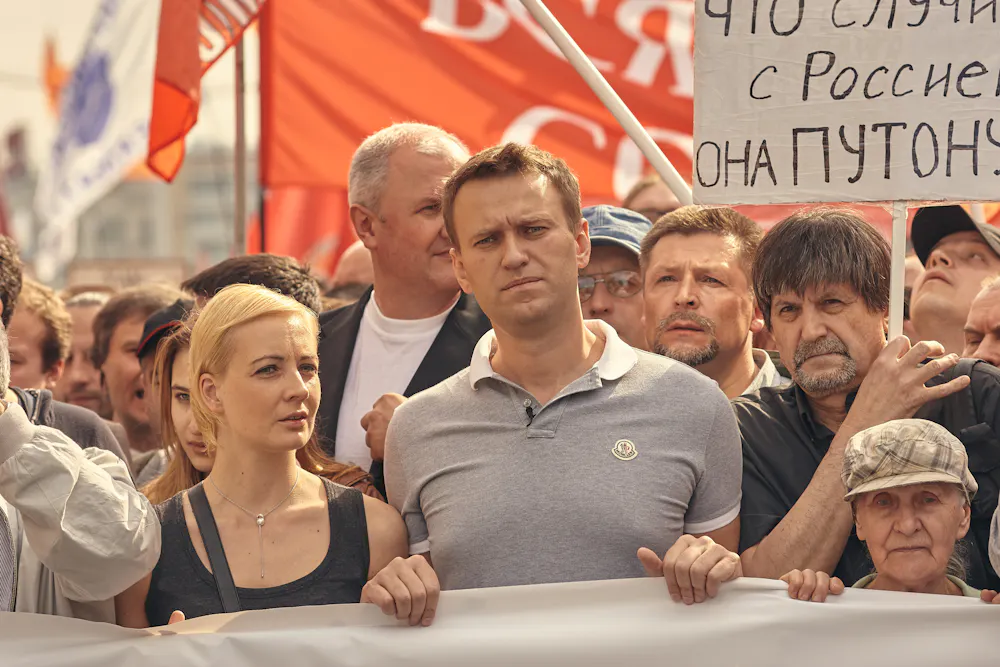
    Outrage at Navalny’s detention, combined with this Putin investigation, got people on to the streets. On January 23 2021, 160,000 people turned out across Russia in events that did not have prior approval from the authorities. More than 40% of the participants said they were taking part in a protest for the first time.

    But the Russian authorities were determined to also make it their last time. Law enforcement mounted an awesome display of strength, detaining protesters and sometimes beating them. The number of participants at protests on January 31 and February 2 declined sharply as a result.

    Between Navalny’s return to Russia in January 2021 and his death in February 2024, aged 47, he faced criminal case after criminal case, adding years and years to his time in prison and increasing the severity of his detention. By the time of his death, he was in the harshest type of prison in the Russian penitentiary system – a “special regime” colony – and was frequently sent to a punishment cell.

    The obvious intent was to demoralise Navalny, his team and supporters – making an example of him to spread fear among anyone else who might consider mounting a challenge to the Kremlin. But Navalny fought back, as described in his posthumously published memoir, Patriot. He made legal challenges against his jailers. He went on hunger strike. And he formed a union for his fellow prisoners.

    He also used his court appearances to make clear his political views, including following Russia’s full-scale invasion of Ukraine in February 2022, declaring: “I am against this war. I consider it immoral, fratricidal, and criminal.”

    Navalny’s final public appearance was via video link. He was in good spirits, with his trademark optimism and humour still on display. Tongue firmly in cheek, he asked the judge for financial help:

    Your Honour, I will send you my personal account number so that you can use your huge salary as a federal judge to ‘warm up’ my personal account, because I am running out of money.

    Navalny died the following day. According to the prison authorities, he collapsed after a short walk and lost consciousness. Although the Russian authorities claimed he had died of natural causes, documents published in September 2024 by The Insider – a Russia-focused, Latvia-based independent investigative website – suggest Navalny may have been poisoned.

    A mourner adds her tribute to Alexei Navalny’s grave in Moscow after his burial on March 1 2024.
    Aleksey Dushutin/Shutterstock

    Whether or not Putin directly ordered his death, Russia’s president bears responsibility – for leading a system that tried to assassinate Navalny in August 2020, and for allowing his imprisonment following Navalny’s return to Russia in conditions designed to crush him.

    Commenting in March 2024, Putin stated that, just days before Navalny’s death, he had agreed for his most vocal opponent to be included in a prisoner swap – on condition the opposition figure never returned to Russia. “But, unfortunately,” Putin added, “what happened, happened.”

    ‘No one will forget’

    Putin is afraid of Alexei, even after he killed him.

    Yulia Navalnaya, Navalny’s wife, wrote these words on January 10 2025 after reading a curious letter. His mother, Lyudmila Navalnaya, had written to Rosfinmonitoring – a Russian state body – with a request for her son’s name to be removed from their list of “extremists and terrorists” now he was no longer alive.

    The official response was straight from Kafka. Navalny’s name could not be removed as it had been added following the initiation of a criminal case against him. Even though he was dead, Rosfinmonitoring had not been informed about a termination of the case “in accordance with the procedure established by law”, so his name would have to remain.

    This appears to be yet another instance of the Russian state exercising cruelty behind the veil of bureaucratic legality – such as when the prison authorities initially refused to release Navalny’s body to his mother after his death.

    “Putin is doing this to scare you,” Yulia continued. “He wants you to be afraid to even mention Alexei, and gradually to forget his name. But no one will forget.”

    Alexei Navalny and his wife, Yulia Navalnaya, at a protest rally in Moscow, May 2012.
    Dmitry Laudin/Shutterstock

    Today, Navalny’s family and team continue his work outside of Russia – and are fighting to keep his name alive back home. But the odds are against them. Polling suggests the share of Russians who say they know nothing about Navalny or his activities roughly doubled to 30% between his return in January 2021 and his death three years later.

    Navalny fought against an autocratic system – and paid the price with his life. Given the very real fears Russians may have of voicing support for a man still labelled an extremist by the Putin regime, it’s not easy to assess what people there really think of him and his legacy. But we will also never know how popular Navalny would have been in the “normal” political system he fought for.

    What made Navalny the force he was?

    Navalny didn’t mean for the humble yellow rubber duck to become such a potent symbol of resistance.

    In March 2017, the ACF published its latest investigation into elite corruption, this time focusing on then-prime minister (and former president), Dmitry Medvedev. Navalny’s team members had become masters of producing slick videos that enabled their message to reach a broad audience. A week after posting, the film had racked up over 7 million views on YouTube – an extraordinary number at that time.

    The film included shocking details of Medvedev’s alleged avarice, including yachts and luxury properties. In the centre of a large pond in one of these properties was a duck house, footage of which was captured by the ACF using a drone.

    Video: ACF.

    Such luxuries jarred with many people’s view of Medvedev as being a bit different to Putin and his cronies. As Navalny wrote in his memoir, Medvedev had previously seemed “harmless and incongruous”. (At the time, Medvedev’s spokeswoman said it was “pointless” to comment on the ACF investigation, suggesting the report was a “propaganda attack from an opposition figure and a convict”.)

    But people were angry, and the report triggered mass street protests across Russia. They carried yellow ducks and trainers, a second unintended symbol from the film given Medvedev’s penchant for them.

    Another reason why so many people came out to protest on March 26 2017 was the organising work carried out by Navalny’s movement.

    The previous December, Navalny had announced his intention to run in the 2018 presidential election. As part of the campaign, he and his team created a network of regional headquarters to bring together supporters and train activists across Russia. Although the authorities had rejected Navalny’s efforts to register an official political party, this regional network functioned in much the same way, gathering like-minded people in support of an electoral candidate. And this infrastructure helped get people out on the streets.

    The Kremlin saw this as a clear threat. According to a December 2020 investigation by Bellingcat, CNN, Der Spiegel and The Insider, the FSB assassination squad implicated in the Novichok poisoning of Navalny had started trailing him in January 2017 – one month after he announced his run for the presidency.

    Alexei Navalny on a Moscow street after having zelyonka dye thrown in his face, April 2017.
    Evgeny Feldman via Wikimedia, CC BY-NC-SA

    At the protests against Medvedev, the authorities’ growing intolerance of Navalny was also on display – he was detained, fined and sentenced to 15 days’ imprisonment.

    The Medvedev investigation was far from the beginning of Navalny’s story as a thorn in the Kremlin’s side. But this episode brings together all of the elements that made Navalny the force he was: anti-corruption activism, protest mobilisation, attempts to run as a “normal” politician in a system rigged against him, and savvy use of social media to raise his profile in all of these domains.

    Courting controversy

    In Patriot, Navalny writes that he always “felt sure a broad coalition was needed to fight Putin”. Yet over the years, his attempts to form that coalition led to some of the most controversial points of his political career.

    In a 2007 video, Navalny referred to himself as a “certified nationalist”, advocating for the deportation of illegal immigrants, albeit without using violence and distancing himself from neo-Nazism. In the video, he says: “We have the right to be Russians in Russia, and we’ll defend that right.”

    Although alienating some, Navalny was attempting to present a more acceptable face of nationalism, and he hoped to build a bridge between nationalists and liberals in taking on the Kremlin’s burgeoning authoritarianism.

    But the prominence of nationalism in Navalny’s political identity varied markedly over time, probably reflecting his shifting estimations of which platform could attract the largest support within Russia. By the time of his thwarted run in the 2018 presidential election, nationalist talking points were all but absent from his rhetoric.

    However, some of these former comments and positions continue to influence how people view him. For example, following Russia’s annexation of Crimea in 2014, Navalny tried to take a pragmatic stance. While acknowledging Russia’s flouting of international law, he said that Crimea was “now part of the Russian Federation” and would “never become part of Ukraine in the foreseeable future”.

    Many Ukrainians take this as clear evidence that Navalny was a Russian imperialist. Though he later revised his position, saying Crimea should be returned to Ukraine, some saw this as too little, too late. But others were willing to look past the more controversial parts of his biography, recognising that Navalny represented the most effective domestic challenge to Putin.

    Another key attempt to build a broad political coalition was Navalny’s Smart Voting initiative. This was a tactical voting project in which Navalny’s team encouraged voters to back the individual thought best-placed to defeat the ruling United Russia candidate, regardless of the challenger’s ideological position.

    The project wasn’t met with universal approval. Some opposition figures and voters baulked at, or flatly refused to consider, the idea of voting for people whose ideological positions they found repugnant – or whom they viewed as being “fake” opposition figures, entirely in bed with the authorities. (This makes clear that Navalny was never the leader of the political opposition in Russia; he was, rather, the leading figure of a fractious constellation of individuals and groups.)

    But others relished the opportunity to make rigged elections work in their favour. And there is evidence that Smart Voting did sometimes work, including in the September 2020 regional and local elections, for which Navalny had been campaigning when he was poisoned with Novichok.

    In an astonishing moment captured on film during his recovery in Germany, Navalny speaks to an alleged member of the FSB squad sent to kill him. Pretending to be the aide to a senior FSB official, Navalny finds out that the nerve agent had been placed in his underpants.

    How do Russians feel about Navalny now?

    It’s like a member of the family has died.

    This is what one Russian friend told me after hearing of Navalny’s death a year ago. Soon afterwards, the Levada Center – an independent Russian polling organisation – conducted a nationally representative survey to gauge the public’s reaction to the news.

    The poll found that Navalny’s death was the second-most mentioned event by Russian people that month, after the capture of the Ukrainian city of Avdiivka by Russian troops. But when asked how they felt about his death, 69% of respondents said they had “no particular feelings” either way – while only 17% said they felt “sympathy” or “pity”.

    And that broadly fits with Navalny’s approval ratings in Russia. After his poisoning in 2020, 20% of Russians said they approved of his activities – but this was down to 11% by February 2024.

    Video: BBC.

    Of course, these numbers must be taken for what they are: polling in an authoritarian state regarding a figure vilified and imprisoned by the regime, during a time of war and amid draconian restrictions on free speech. To what extent the drop in support for Navalny was real, rather than reflecting the increased fear people had in voicing their approval for an anti-regime figure, is hard to say with certainty.

    When asked why they liked Navalny, 31% of those who approved of his activities said he spoke “the truth”, “honestly” or “directly”. For those who did not approve of his activities, 22% said he was “paid by the west”, “represented” the west’s interests, that he was a “foreign agent”, a “traitor” or a “puppet”.

    The Kremlin had long tried to discredit Navalny as a western-backed traitor. After Navalny’s 2020 poisoning, Putin’s spokesman, Dmitry Peskov, said that “experts from the United States’ Central Intelligence Agency are working with him”. The Russian state claimed that, rather than a patriot exposing official malfeasance with a view to strengthening his country, Navalny was a CIA stooge intent on destroying Russia.

    Peskov provided no evidence to back up this claim – and the official propaganda wasn’t believed by all. Thousands of Russians defied the authorities by coming out to pay their respects at Navalny’s funeral on March 1 2024. Many, if not all, knew this was a significant risk. Police employed video footage to track down members of the funeral crowd, including by using facial recognition technology.

    The first person to be detained was a Muscovite the police claimed they heard shouting “Glory to the heroes!” – a traditional Ukrainian response to the declaration “Glory to Ukraine!”, but this time referencing Navalny. She spent a night in a police station before being fined for “displaying a banned symbol”.

    Putin always avoided mentioning Navalny’s name in public while he was alive – instead referring to him as “this gentleman”, “the character you mentioned”, or the “Berlin patient”. (The only recorded instance of Putin using Navalny’s name in public when he was alive was in 2013.)

    However, having been re-elected president in 2024 and with Navalny dead, Putin finally broke his long-held practice, saying: “As for Navalny, yes he passed away – this is always a sad event.” It was as if the death of his nemesis diminished the potency of his name – and the challenge that Navalny had long presented to Putin.

    Nobody can become another Navalny

    Someone else will rise up and take my place. I haven’t done anything unique or difficult. Anyone could do what I’ve done.

    So wrote Navalny in the memoir published after his death. But that hasn’t happened: no Navalny 2.0 has yet emerged. And it’s no real surprise. The Kremlin has taken clear steps to ensure nobody can become another Navalny within Russia.

    In 2021, the authorities made a clear decision to destroy Navalny’s organisations within Russia, including the ACF and his regional network. Without the organisational infrastructure and legal ability to function in Russia, no figure has been able to take his place directly.

    More broadly, the fate of Navalny and his movement has had a chilling effect on the opposition landscape. So too have other steps taken by the authorities.

    Russia has become markedly more repressive since the start of its war on Ukraine. The human rights NGO First Department looked into the number of cases relating to “treason”, “espionage” and “confidential cooperation with a foreign state” since Russia introduced the current version of its criminal code in 1997. Of the more than 1,000 cases, 792 – the vast majority – were initiated following Russia’s full-scale invasion of Ukraine in 2022.

    Russian law enforcement has also used nebulous anti-extremism and anti-terrorism legislation to crack down on dissenting voices. Three of Navalny’s lawyers were sentenced in January 2025 for participating in an “extremist organisation”, as the ACF was designated by a Moscow court in June 2021. The Russian legislature has also passed a barrage of legislation relating to so-called “foreign agents”, to tarnish the work of those the regime regards as foreign-backed “fifth columnists”.

    Mass street protests are largely a thing of the past in Russia. Restrictions were placed on public gatherings during the COVID pandemic – but these rules were applied selectively, with opposition individuals and groups being targeted. And opportunities for collective action were further reduced following the full-scale invasion of Ukraine.

    Freedom of speech has also come under assault. Article 29, point five of the Russian constitution states: “Censorship shall be prohibited.” But in September 2024, Kremlin spokesperson Peskov said: “In the state of war that we are in, restrictions are justified, and censorship is justified.”

    Legislation passed very soon after the 2022 invasion of Ukraine made it illegal to comment on the Russian military’s activities truthfully – and even to call the war a war.

    YouTube – the platform so central to Navalny’s ability to spread his message – has been targeted. Without banning it outright – perhaps afraid of the public backlash this might cause – the Russian state media regulator, Roskomnadzor, has slowed down internet traffic to the site within Russia. The result has been a move of users to other websites supporting video content, including VKontakte – a Russian social media platform.

    In short, conditions in Russia are very different now compared to when Navalny first emerged. The relative freedom of the 2000s and 2010s gave him the space to challenge the corruption and authoritarianism of an evolving system headed by Putin. But this space has shrunk over time, to the point where no room remains for a figure like him within Russia.

    In 2019, Navalny told Ivan Zhdanov, who is now director of the ACF: “We changed the regime, but not in the way we wanted.” So, did Navalny and his team push the Kremlin to become more authoritarian – making it not only intolerant of him but also any possible successor?

    There may be some truth in this. And yet, the drastic steps taken by the regime following the start of the war on Ukraine suggest there were other, even more significant factors that have laid bare the violent nature of Putin’s personal autocracy – and the president’s disdain for dissenters.

    Plenty for Russians to be angry about

    How can we win the war when dedushka [grandpa] is a moron?

    In June 2023, Evgeny Prigozhin – a long-time associate of Putin and head of the private military Wagner Group – staged an armed rebellion, marching his forces on the Russian capital. This was not a full-blown political movement against Putin. But the target of Prigozhin’s invective against Russia’s military leadership had become increasingly blurry, testing the taboo of direct criticism of the president – who is sometimes referred to, disparagingly, as “grandpa” in Russia.

    And Prigozhin paid the price. In August 2023, he was killed when the private jet he was flying in crashed after an explosion on board. Afterwards, Putin referred to Prigozhin as a “talented person” who “made serious mistakes in life”.

    In the west, opposition to the Kremlin is often associated with more liberal figures like Navalny. Yet the most consequential domestic challenge to Putin’s rule came from a very different part of the ideological spectrum – a figure in Prigozhin leading a segment of Russian society that wanted the Kremlin to prosecute its war on Ukraine even more aggressively.

    Video: BBC.

    Today, there is plenty for Russians to be angry about, and Putin knows it. He recently acknowledged an “overheating of the economy”. This has resulted in high inflation, in part due to all the resources being channelled into supporting the war effort. Such cost-of-living concerns weigh more heavily than the war on the minds of most Russians.

    A favourite talking point of the Kremlin is how Putin imposed order in Russia following the “wild 1990s” – characterised by economic turbulence and symbolised by then-president Boris Yeltsin’s public drunkenness. Many Russians attribute the stability and rise in living standards they experienced in the 2000s with Putin’s rule – and thank him for it by providing support for his continued leadership.

    The current economic problems are an acute worry for the Kremlin because they jeopardise this basic social contract struck with the Russian people. In fact, one way the Kremlin tried to discredit Navalny was by comparing him with Yeltsin, suggesting he posed the same threats as a failed reformer. In his memoir, Navalny concedes that “few things get under my skin more”.

    Although originally a fan of Yeltsin, Navalny became an ardent critic. His argument was that Yeltsin and those around him squandered the opportunity to make Russia a “normal” European country.

    Navalny also wanted Russians to feel entitled to more. Rather than be content with their relative living standards compared with the early post-Soviet period, he encouraged them to imagine the level of wealth citizens could enjoy based on Russia’s extraordinary resources – but with the rule of law, less corruption, and real democratic processes.

    ‘Think of other possible Russias’

    When looking at forms of criticism and dissent in Russia today, we need to distinguish between anti-war, anti-government, and anti-Putin activities.

    Despite the risk of harsh consequences, there are daily forms of anti-war resistance, including arson attacks on military enlistment offices. Some are orchestrated from Ukraine, with Russians blackmailed into acting. But other cases are likely to be forms of domestic resistance.

    Criticism of the government is still sometimes possible, largely because Russia has a “dual executive” system, consisting of a prime minister and presidency. This allows the much more powerful presidency to deflect blame to the government when things go wrong.

    There are nominal opposition parties in Russia – sometimes referred to as the “systemic opposition”, because they are loyal to the Kremlin and therefore tolerated by the system. Within the State Duma, these parties often criticise particular government ministries for apparent failings. But they rarely, if ever, now dare criticise Putin directly.

    Nothing anywhere close to the challenge presented by Navalny appears on the horizon in Russia – at either end of the political spectrum. But the presence of clear popular grievances, and the existence of organisations (albeit not Navalny’s) that could channel this anger should the Kremlin’s grip loosen, mean we cannot write off all opposition in Russia.

    Navalny’s wife, Yulia, has vowed to continue her husband’s work. And his team in exile maintain focus on elite corruption in Russia, now from their base in Vilnius, Lithuania. The ACF’s most recent investigation is on Igor Sechin, CEO of the oil company Rosneft.

    But some have argued this work is no longer as relevant as it was. Sam Greene, professor in Russian politics at King’s College London, captured this doubt in a recent Substack post:

    [T]here is a palpable sense that these sorts of investigations may not be relevant to as many people as they used to be, given everything that has transpired since the mid-2010s, when they were the bread and butter of the Anti-Corruption Foundation. Some … have gone as far as to suggest that they have become effectively meaningless … and thus that Team Navalny should move on.

    Navalny’s team are understandably irritated by suggestions they’re no longer as effective as they once were. But it’s important to note that this criticism has often been sharpest within Russia’s liberal opposition. The ACF has been rocked, for example, by recent accusations from Maxim Katz, one such liberal opposition figure, that the organisation helped “launder the reputations” of two former bank owners. In their response, posted on YouTube, the ACF referred to Katz’s accusations as “lies” – but this continued squabbling has left some Russians feeling “disillusioned and unrepresented”.

    So, what will Navalny’s long-term legacy be? Patriot includes a revealing section on Mikhail Gorbachev – the last leader of the Soviet Union, whom Navalny describes as “unpopular in Russia, and also in our family”. He continues:

    Usually, when you tell foreigners this, they are very surprised, because Gorbachev is thought of as the person who gave Eastern Europe back its freedom and thanks to whom Germany was reunited. Of course, that is true … but within Russia and the USSR he was not particularly liked.

    At the moment, there is a similar split in perceptions of Navalny. Internationally, he was nominated for the Nobel Peace Prize, awarded the Sakharov Prize by the European Parliament, and a documentary about him won an Oscar.

    But there are also those outside of Russia who remain critical: “Navalny’s life has brought no benefit to the Ukrainian victory; instead, he has caused considerable harm,” wrote one Ukrainian academic. “He fuelled the illusion in the west that democracy in Russia is possible.”

    Trailer for the Oscar-winning documentary Navalny.

    Inside Russia, according to Levada Center polling shortly after his death, 53% of Russians thought Navalny played “no special role” in the history of the country, while 19% said he played a “rather negative” role. Revealingly, when commenting on Navalny’s death, one man in Moscow told RFE/RL’s Russian Service: “I think that everyone who is against Russia is guilty, even if they are right.”

    But, for a small minority in Russia, Navalny will go down as a messiah-like figure who miraculously cheated death in 2020, then made the ultimate sacrifice in his battle of good and evil with the Kremlin. This view may have been reinforced by Navalny’s increasing openness about his Christian faith.

    Ultimately, Navalny’s long-term status in Russia will depend on the nature of the political system after Putin has gone. Since it seems likely that authoritarianism will outlast Putin, a more favourable official story about Navalny is unlikely to emerge any time soon. However, how any post-Putin regime tries to make sense of Navalny’s legacy will tell us a lot about that regime.

    While he was alive, Navalny stood for the freer Russia in which he had emerged as a leading opposition figure – and also what he called the “Beautiful Russia of the Future”. Perhaps, after his death, his lasting legacy in Russia remains the ability for some to think – if only in private – of other possible Russias.


    For you: more from our Insights series:

    To hear about new Insights articles, join the hundreds of thousands of people who value The Conversation’s evidence-based news. Subscribe to our newsletter.

    Ben Noble has previously received funding from the British Academy and the Leverhulme Trust. He is an Associate Fellow of Chatham House.

    ref. One year on from Alexei Navalny’s death, what will his legacy be for Russia? – https://theconversation.com/one-year-on-from-alexei-navalnys-death-what-will-his-legacy-be-for-russia-249692

    MIL OSI – Global Reports

  • MIL-OSI Global: US says European security no longer its primary focus – the shift has been years in the making

    Source: The Conversation – UK – By David J. Galbreath, Professor of International Security, University of Bath

    European defence ministers left their meeting in Brussels on February 12 in shock after the new US secretary of defence, Pete Hegseth, told them they could no longer rely on the US to guarantee their security.

    Hegseth said he was there “to directly and unambiguously express that stark strategic realities prevent the United States of America from being primarily focused on the security of Europe”.

    He also insisted that European countries provide the “overwhelming” share of funding for Ukraine in the future. The US has been the biggest source of military aid to Ukraine, with its weapons, equipment and financial assistance crucial in helping Kyiv resist the Russian invasion.

    Hegseth’s comments are in keeping with the stance of the US president, Donald Trump, on the Nato transatlantic military alliance. Trump sees Nato as an excessive financial burden on the US and has repeatedly called on its members to increase their defence spending.

    But Hegseth’s remarks could also be seen as a sign of America’s waning commitment to the terms of Nato’s founding treaty. Signed in 1949 by the US, Canada and several western European nations, Article 5 of the treaty requires member states to defend each other in the event of an armed attack.

    The US has the largest military – and the biggest stockpile of nuclear weapons – in Nato. So, on the face of it, efforts to recast the alliance appear a drastic shift in Europe’s security landscape in the post-cold war era.

    However, those familiar with the political sentiment around Nato and the defence of Europe in the US will see that this move follows in the footsteps of what others have sought to do – starting from the very end of the cold war.

    Changing over time

    In 1991, following the collapse of the Soviet Union, Nato was under considerable pressure to change for the new world order. A rising China was not yet on the minds of many in Washington, but the feeling was that the financial commitments the US had made to defend western Europe during the cold war could not continue.

    The so-called “peace dividend”, a slogan popularised by former US president George H.W. Bush and former UK prime minister Margaret Thatcher, allowed nearly all Nato states to reduce their military spending at this time.

    In 1992, almost as soon as European Nato countries were shrinking their forces and moving away from mass armies to professional soldiering, the alliance became actively engaged in maintaining a no-fly zone over Yugoslavia.

    A new Nato was becoming apparent. It was transitioning from being a collective defence organisation to one of collective security, where conflicts were managed on Nato’s borders.

    A US fighter jet at Aviano air base, Italy, after a mission over Bosnia to enforce the no-fly zone in 1993.
    Sgt. Janel Schroeder / Wikimedia Commons

    This collective security arrangement worked well to keep the alliance together until 2001, when the administration of George W. Bush entered the White House and involved the US in wars in Afghanistan and Iraq. Following the 9/11 terrorist attacks in the US, Nato invoked Article 5 and returned to the principle of collective defence.

    Many European countries, including the new, smaller Nato states like Estonia and Latvia, sent troops to Iraq and Afghanistan. The persistent justification I heard in the Baltic states was “we need to be there when the US needs us so that they will be there when we need them”.

    Yet in 2011, before the wars in Iraq and Afghanistan were over, the administration of Barack Obama introduced a foreign policy strategy known as the “pivot to Asia”. The implication was that the US would shift its attention from primarily the western hemisphere to China.

    By this point, China had become the second-largest economy in the world and was rapidly developing its military. The reaction to this US policy shift in European capitals was one of shock and disappointment. They saw it as the US deciding that its own security did not sit in Europe like it had since 1945.

    Then, in 2014, Russia invaded Crimea and the Donbas in eastern Ukraine. The pivot to Asia looked like it had stalled. But US interest and investment in European defence continued to decline, with American military bases across Europe closed down. The first Trump administration continued the pattern set by Obama.

    President Joe Biden, who entered office in 2021, used Russia’s invasion of Ukraine in 2022 to show European leaders that the US still saw its own security in Europe and that it would stand beside Ukraine.

    But the US continued to insist that European countries invest in their own defence. The UK, Poland and France have all committed to increase their defence spending over recent years – though spending by European Nato states as a whole continued to fall.

    There has been a long-held belief in the US that Europe is “freeriding” on American power. While the US saw its own security in Europe, this freeriding was allowed to continue.

    But as the perspective of the US has changed, with the focus now on countering China, it has been keen to suggest that European defence should increasingly become the job of Europe itself.

    Nato will not go out with a bang. It is much more likely to gradually disappear with a whimper. After all, who did Trump meet on his second day in office? Not Nato but the Quad: an alliance between Australia, India, Japan and the US in the Indo-Pacific.

    David J. Galbreath has received research funding from the UKRI.

    ref. US says European security no longer its primary focus – the shift has been years in the making – https://theconversation.com/us-says-european-security-no-longer-its-primary-focus-the-shift-has-been-years-in-the-making-249813

    MIL OSI – Global Reports

  • MIL-OSI Global: Trump phone call with Putin leaves Ukraine reeling and European leaders stunned

    Source: The Conversation – UK – By David Hastings Dunn, Professor of International Politics in the Department of Political Science and International Studies, University of Birmingham

    Donald Trump likes to portray himself as the great deal maker. Typically, his idea of the “Art of the Deal” had tended to involve outlandishly bullish opening demands – whether that’s on tariffs or trade deals – before settling on more moderate, but still exacting conditions. This context makes what happened when the US president spoke with his Russian counterpart Vladimir Putin about Ukraine so remarkable.

    The very fact that Trump spoke with Putin at all was a diplomatic gift to the pariah state and its leader. For three years Russia has been diplomatically isolated by most western leaders, many of whom have called for Putin to face war crimes charges (there is currently an ICC arrest warrant out for Putin for the alleged illegal transfer of children from, Ukraine to Russia).

    Indeed, the fact that Trump spoke with Putin and only then called the Ukrainian president, Volodymyr Zelensky, to inform him of their conversation indicates the subordination of Ukraine’s role in the talks.

    Trumpeting the call as “highly productive” on his TruthSocial website, Trump wrote that the two leaders had spoken about the “strengths of our respective nations, and the great benefit that we will someday have in working together”. He said they had arranged to visit each other’s nations. In fact, the two will initially meet in Saudi Arabia – where Putin would not be arrested under the ICC’s warrant.

    At the same time, Trump’s new defense secretary spelled out to a meeting of European defence officials the administration’s position on some of the key issues. It was clear that several of Ukraine’s “red lines” had already fallen by the wayside as far as the US is concerned.

    Hegseth said that returning to Ukraine’s pre-2014 borders is “an unrealistic objective” and an “illusionary goal” and that any deal must be based on “a realistic assessment of the battlefield.”

    Likewise Ukraine’s future Nato membership – something the US committed to support in the 2008 Budapest Declaration, was also a non-starter. And he said the US would not only not join any international force deployed to ensure Ukrainian security, but that if such a force were constituted it would not be a Nato operation. As such, he said, it would not be covered by the alliance’s article 5 pledge for collective security. This effectively dooms this initiative to failure.

    As important as what was announced by the Trump administration on this subject, was what was omitted. Trump has never condemned Putin for his illegal invasion of Ukraine. And there has been no mention in his social media posts that Russia’s invasion of Ukraine was a violation of international law. Or the inviolability of Ukraine’s borders or the issue of Russian reparations for the material and human damage inflicted on Ukraine.

    Russia celebrates

    Russia, meanwhile, is cock-a-hoop. Kremlin spokesman Dmitri Peskov reported that Putin talked about Moscow’s demands, telling Trump of “the need to eliminate the root causes of the conflict”. This suggests that while Ukraine’s red lines are going to be ignored by the US, Russia will continue to insist on its maximalist demands that the Russians intend to take in their approach to the negotiation.

    In addition to the concessions that Hegseth indicated the Trump administration has already decided to go along with, Russia is also likely to press for the demilitarisation of Ukraine. It will demand control, not just of the territory that it occupies, but of the remainder of the Ukrainian provinces that Putin has already declared to be “Russian”: Luhansk, Donetsk, Zaporizhzhia and Kherson, in the south and east of Ukraine.

    Both the Russian stock market and the ruble rose sharply on the US announcement of the talks, and the government-controlled press in Russian could hardly hide their glee, reporting that: “Russia is ready for talks. But on its terms”.

    European leaders shocked

    The pace and scale of US concessions on Ukraine seen to have caught the US’s European Nato allies off guard. Like Ukraine itself, they have been sidelined by Trump’s decision to seek direct negotiations with Putin. The UK’s defence secretary, John Healey, issued a statement appealing that “that there can be no negotiation about Ukraine without Ukraine and Ukraine’s voice must be at the heart of any talks”.

    German foreign minister, Anna Baerbock, meanwhile, said the call had come out of the blue without any consultation with Europe: “This is the way the Trump administration operates,” she said, adding: “This is not how others do foreign policy, but this is now the reality.” Baerbock said a deal must not be imposed on Ukraine and that Europe should be involved in negotiations: “This is about European peace. That’s why we Europeans must be involved.”

    The French foreign ministry put out a statement saying that: “Ukraine and Europe must be part of any negotiations. Ukraine should be provided with strong security guarantees.”

    Other commentators have been less diplomatic. Michael McFaul, who served as US ambassador to Russia under Barack Obama, took to X to question Trump’s tactics: “Diplomacy 101: Don’t give anything without getting something in return. Don’t negotiate in public. Don’t negotiate about Ukraine’s future without first coordinating your position with Ukrainians.”

    We’ll know more about what – if any – agency Volodymyr Zelensky and his diplomats have in the future of their country after US secretary of state, Marco Rubio, and vice-president, JD Vance, meet with Zelensky at the Munich Security Conference on February 14-16.

    But for the present at least, it appears that negotiations will be less about pressuring Putin to bring a just end to the war he started, than forcing Ukraine to give in to the Russian leader’s demands.

    David Hastings Dunn has previously received funding from the ESRC, the Gerda Henkel Foundation, the Open Democracy Foundation and has previously been both a NATO and a Fulbright Fellow.

    ref. Trump phone call with Putin leaves Ukraine reeling and European leaders stunned – https://theconversation.com/trump-phone-call-with-putin-leaves-ukraine-reeling-and-european-leaders-stunned-249876

    MIL OSI – Global Reports

  • MIL-OSI Global: Will Lucy Letby get a retrial? Here’s what happens next with her case

    Source: The Conversation – UK – By Daniel Alge, Senior Lecturer in Criminology & Criminal Justice, Brunel University of London

    Lucy Letby was convicted in two trials in 2023 and 2024 of murdering seven babies and attempting to murder six others in her care at the Countess of Chester hospital in north-west England between 2015 and 2016.

    She is currently serving 15 whole life sentences for the murders. But the case has been called into question as a result of growing concerns about the expert evidence presented at her trial. Will she get a retrial? Here’s what happens next.

    In the context of usually cautious expert opinion, the press conference held on February 4 2025 was extraordinary. An international panel of medical experts investigating the medical evidence against Lucy Letby concluded that there were alternative explanations for each of the deaths. They said they found no evidence of deliberate harm, and believe Letby did not murder any babies.

    The panel’s chair, Dr Shoo Lee, is a retired neonatal care expert. His 1989 paper on air embolisms was heavily relied on by the prosecution in the Letby trial and appeals. However, Lee has previously said that his research was misinterpreted at trial. At the press conference he said, “we did not find any murders. In all cases, death or injury were due to natural causes or just bad medical care.”


    Want more politics coverage from academic experts? Every week, we bring you informed analysis of developments in government and fact check the claims being made.

    Sign up for our weekly politics newsletter, delivered every Friday.


    The panel’s findings put the case in uncharted territory, given Letby’s very recent convictions and the continuing public inquiry into the case.

    The public inquiry – the Thirlwall Inquiry into events at the Countess of Chester hospital – will operate based on the assumption, following her convictions, that Letby is guilty. Letby’s barrister has called for the inquiry to be halted pending the Criminal Cases Review Commission (CCRC) review of her case.

    Despite the findings of the expert panel, Letby’s release or even a retrial is by no means imminent, let alone guaranteed. Letby has already had two applications for leave to appeal refused. The grounds of appeal were related to what her defence argued were errors in judicial decision making during the trial, rather than the medical evidence. Nonetheless, this means that the CCRC is the only route left open to Letby to challenge her convictions.

    Letby’s defence team confirmed that a preliminary application has been made to the CCRC, with a full submission to follow. The CCRC investigates potential miscarriages of justice in England, Wales and Northern Ireland.

    The commission is expected to treat Letby’s case as a priority given the public interest. But it is still likely to take at least a year to review the considerable evidence before a referral back to the Court of Appeal could even be considered.

    What evidence will be considered?

    The CCRC aims to complete cases within 12 months of receiving the application. But the organisation has recently come under criticism over how it handled the case of Andrew Malkinson, who was wrongly jailed for 17 years for a crime he did not commit.

    When the CCRC considers the full application, they have the power to refer the case back to the Court of Appeal. In order to do so, the commission requires new evidence or other relevant factors which would support a fresh appeal.

    The findings of the medical panel will be part of the defence submission. The CCRC will decide, with other factors, whether they constitute fresh grounds for an appeal. It is particularly compelling that the prosecution case relied on Dr Lee’s research, and yet it is in part his expertise that has become a crucial element of the defence.

    To send the case back for appeal, the CCRC would also need to conclude that there was a “real possibility” of the conviction being overturned.

    It is important to remember that the case against Letby included statistical and circumstantial evidence as well as medical opinion. However, what are alleged to be numerous fallacies in the statistical evidence have been highlighted. And circumstantial evidence is just that – circumstantial. Letby was convicted on the medical evidence.

    The evidence given as part of the Thirlwall Inquiry will be within the remit of the CCRC too. Although the inquiry has not yet formally concluded, all oral testimony has taken place. As would be expected given the inquiry’s terms of reference, much of the evidence heard has been less favourable to Letby.

    The CCRC also has the power under the Criminal Appeals Act 1995 to instruct its own expert witnesses and interview previous and potential new witnesses.

    If the CCRC ultimately decides to refer the case to the Court of Appeal, it will be treated like any other appeal. It could result either in the conviction being quashed and Letby going free, or a retrial.

    A retrial would follow if the appeal judges believed that a retrial met the criteria set out in the Criminal Appeal Act 1968 and was in the interests of justice. The likelihood of this outcome depends on the strength of the medical evidence presented to the CCRC and the Court of Appeal.


    Read more:
    Lucy Letby case: the problems with expert evidence


    As the Thirlwall Inquiry and the CCRC application are separate processes, is it technically not essential that the inquiry concludes before the CCRC makes a decision. Closing submissions to the inquiry are scheduled for March 2025, with the report expected later in the year. This should fit within the expected timeframe of the CCRC taking at least a year to consider the application.

    A further complicating factor is Lee’s assertion that the Countess of Chester hospital provided such bad care that it would have been “shut down” in his home country of Canada. This will no doubt lead to legal claims against the NHS trust, particularly if Letby is exonerated and culpability for avoidable deaths is sought elsewhere.

    Some, including Lee, have gone so far as to suggest the new evidence is so compelling that Letby should be released on house arrest pending the CCRC review. This would be highly unusual, and for the time being, Letby remains imprisoned as one of the worst child serial killers in modern British history.

    Daniel Alge does not work for, consult, own shares in or receive funding from any company or organisation that would benefit from this article, and has disclosed no relevant affiliations beyond their academic appointment.

    ref. Will Lucy Letby get a retrial? Here’s what happens next with her case – https://theconversation.com/will-lucy-letby-get-a-retrial-heres-what-happens-next-with-her-case-249415

    MIL OSI – Global Reports

  • MIL-OSI Europe: Financing the transition to greenhouse gas neutrality: how much and with which instruments? | Remarks at the Adam Smith Business School University of Glasgow

    Source: Deutsche Bundesbank in English

    Check against delivery.
    1 Introduction
    Ladies and gentlemen, 
    I am delighted to be here with you today. What better place than Glasgow to discuss the economic impacts of climate change and the green transition! And not just because it played host to the 2021 United Nations Climate Change Conference.
    Glasgow is also where Adam Smith, the father of modern economics, studied and taught as a professor. Have you ever wondered what he would have thought of climate change? As a famed free-market economist, he might not be the first person you would think of. But even Adam Smith acknowledged that the invisible hand can sometimes lead to suboptimal outcomes.
    Climate change is a prime example of this: market prices do not reflect the negative side effects of greenhouse gas emissions. Fortunately, it is now widely acknowledged that governments need to intervene and encourage individuals and companies to reduce their emissions. 
    Switching to a net-zero emissions economy is a major task. It requires changes in behaviour, innovation and significant investment to rebuild our capital stock. And this transition requires significant financing. 
    In my speech, I will explore what financing the transition to a greenhouse gas-neutral economy could look like. More specifically, I will focus on two key issues. First, how much investment is needed to achieve greenhouse gas neutrality, and how much of this investment is “additional”? Second, what could the financing mix to fund this investment look like?
    I know that answering these questions seems like a tough challenge – a taughy fleece tae scoor. But I will do my best to illustrate my points with clear, practical examples. Along the way, I will discuss electric cars and heating systems to help us understand the issues. 
    My remarks will focus on the European Union (EU), borrowing some detailed insights from Germany. Unfortunately, these data do not cover the United Kingdom (UK). But I will do my best to infer some insights for the UK as well.
    2 How much needs to be invested?
    Let me start with the question of how much the EU needs to invest to achieve greenhouse gas neutrality. The EU’s Fit for 55 package aims to reduce greenhouse gas emissions by at least 55 per cent by 2030. These reductions are benchmarked against 1990 emission levels. This is an intermediate step towards full greenhouse gas neutrality, for which the EU still needs to pass legislation.
    From 2021 to 2030, the European Commission estimates that EU countries need to invest over €1.2 trillion annually.[1] This amounts to nearly 8 per cent of the EU’s GDP. The private sector must take on the bulk of these investments. The investment needs are significantly more than the actual annual investment of €760 billion in the previous decade. 
    The European Commission defines the difference between the investment required and the actual investment as the “additional” investment need. This additional investment need amounts to €480 billion, or around 3 per cent of GDP.
    This definition of “additional” investment is very useful from an accounting perspective. It gives a clear picture of how much more the EU needs to invest to meet its climate goals. However, from a financing perspective, it helps to define additional investment differently.
    There are two types of investment needed to achieve greenhouse gas neutrality. The first type is investment that would not happen without the goal of reducing greenhouse gas emissions. A prime example of this type of investment is technology to capture and store carbon dioxide. This technology will play a crucial role in sectors that are difficult to decarbonise. These investments need economic resources and financing beyond what an economy spends just to maintain its capital stock.
    The second type is investment where a greenhouse gas-neutral alternative replaces a fossil fuel-based technology. To illustrate this point, imagine two households buying a new car. The Jones family spend €45,000 on a new combustion engine car. From a technical perspective, the Jones family are making a replacement investment. No additional financing is needed. Meanwhile, the Smith family decide to switch from a combustion engine car to an electric vehicle. Let us say a comparable electric car costs €50,000. Of this amount, €45,000 is a replacement investment. Only the remaining €5,000 requires additional financing.
    Contrast this with how the European Commission defines additional investment: They subtract the annual average value of electric cars bought in the past from the value of electric vehicles needed to meet the EU’s intermediate greenhouse gas reduction goals. Past registrations of electric vehicles fell significantly short of what is needed. Accordingly, the additional investments, as defined by the European Commission’s accounting perspective, are presumably much higher than the additional financing needs. 
    How great could the additional financing needs be? While we do not yet have specific figures for the EU, there are some numbers for Germany. A recent study estimates that Germany needs to invest around €390 billion annually from 2021 to 2030 to reduce emissions by 65 per cent compared to 1990.[2] They measure this absolute sum in 2020 prices. Relative to GDP, the investment amounts to 11 per cent. 
    This is fairly close to the 8 per cent investment needs calculated by the European Commission for the EU.[3] However, only around 30 per cent of this investment requires additional financing. In absolute terms, this amounts to about €120 billion. 
    Let me pause for a moment to summarise the two key takeaways from my remarks so far. First, the transition to greenhouse gas neutrality calls for significant investment. However, in many cases, we are replacing fossil-based technologies with greenhouse gas-neutral alternatives. Accordingly, the additional financing needs are much smaller and seem manageable.
    Second, we can minimise the additional financing needs by replacing already largely depreciated capital stock. By contrast, replacing relatively new capital stock that has barely depreciated would increase the economic and financial costs. Let me illustrate this point with a brief anecdote. 
    On 1 January 2024, the German government introduced a new law governing heating systems. In German, it is known by the beautiful name “Gebäudeenergiegesetz”. This law mandates that heating systems use around two-thirds renewable energy. In anticipation of this new law, many households replaced their old gas heating systems with new ones. These heating systems can run for around 25 years, so they depreciate over a long period. 
    Bad luck if you just installed a new gas heating system and live in the German city of Mannheim. Here, the local gas provider has said it intends to stop its services in 2035. This means that a long-term investment will become unviable when little more than half of it has depreciated: A waste of both financial and economic resources.
    This anecdote highlights one key point: to avoid wasting money, we need a clear and reliable path to greenhouse gas neutrality. With a clear path mapped out, people can confidently invest in the transition. 
    3 What could the financing mix look like?
    Now, let us explore what the potential financing mix could look like. To achieve a greenhouse gas-neutral economy, households, firms and the public sector all need to invest. They can fund these investments using both internal and external sources.
    As the name would suggest, internal financing comes from within. Like the Smith family putting aside some of their income to pay for their new car. Or think of a firm that sells its products and saves some of the profits. That is internal financing, too. External financing, on the other hand, comes from outside sources such as banks or investors. 
    Regarding their financing mix, households, non-financial firms and the public sector differ considerably. Households tend to save significantly and mainly use bank loans as a source of external finance. The public sector, on the other hand, raises most of its funds from external sources by issuing debt securities. Only firms have a more diversified financing mix. Equity and bank loans play prominent roles here. Note that these observations hold for the EU, the UK and Germany alike. 
    So, what might the financing mix for the transition to a greenhouse gas-neutral economy look like? To estimate these figures, we need two key components: First, the respective shares of households, firms and the public sector in total investment. According to rough estimates by Bundesbank staff for Germany, households might have to cover about one-third of the investment, the public sector around 20 per cent, and firms just under half.[4]
    Second, estimates for the future financing structure of the sectors. We assume that future financing structures will remain unchanged from today.[5] This implies that past financing structures are suitable for future climate investment. If this were not the case, perhaps due to the need for innovative financing instruments, the financing structure may differ. 
    What result do we get when we combine the two components? For Germany, we estimate that about 20 per cent of the financing mix could come from internal financing, primarily household savings. In terms of external financing, bank loans might play the largest role. They account for over one-quarter of the estimated financing mix. Households in particular obtain almost all their external financing from banks.
    The second-largest external financing source could be debt securities, accounting for around 20 per cent. The public sector plays a prominent role here, with funding coming almost exclusively from bonds. Finally, the third-largest external financing source could be equity financing, comprising around one-sixth. Firms are the only users of this financing source, as households and the public sector do not issue equity. Different instruments, like loans from non-bank financial intermediaries, might cover the final sixth of the overall investment needs. 
    So, what does this mean for the EU and the UK? Can the findings for Germany be generalised? Fortunately, the financing structures of households, firms and governments are largely comparable across these regions.[6] Therefore, one of the two components in the calculations is roughly equal.
    The second component – the sectoral investment needs – is less certain. I am not aware of any studies for the EU or the UK that divide the investment needs across households, firms and the public sector.[7] Without a better alternative, the findings for Germany may provide a reasonable initial estimate for both the EU and the UK.
    4 Concluding remarks
    Let me summarise and conclude. I have three main takeaways to share.
    First, “additional” investment needs to become greenhouse gas-neutral can also be defined from a financing perspective. In many cases, we are replacing fossil fuel-based technologies with greenhouse gas-neutral alternatives. And this requires additional financing only if greenhouse gas-neutral technologies are more expensive or if the capital stock being replaced is not yet fully depreciated. The additional financing needs are significantly smaller than the total investment required. Accordingly, I am confident that our financial system can mobilise the necessary financing. 
    Second, banks may play a larger role in financing the climate transition than is commonly anticipated. The main reason for this conclusion is that a substantial portion of climate investments falls on households. They need to make their homes more energy-efficient and replace fossil-fuelled heating systems with greenhouse gas-neutral alternatives. And households simply do not have many viable alternatives to bank loans.
    Accordingly, a robust banking system is essential for achieving greenhouse gas neutrality. That is why we at the Bundesbank are committed to completing the European banking union. However, we also need to improve access to alternative financing sources. Non-financial firms, in particular, would greatly benefit from better capital market financing. That is why we at the Bundesbank are dedicated to creating a European capital markets union. 
    Third, legislators can minimise the additional financing needs by ensuring that the path to greenhouse gas neutrality is planned stringently and for the long term. Why? Because it provides incentives to avoid investments in fossil fuel technologies that may not be fully depreciated before they become non-viable. 
    Footnotes: 
    See European Commission (2023), Investment needs assessment and funding availabilities to strengthen EU’s Net-Zero technology manufacturing capacity, SWD (2023) 68 final. 
    Kemmler et al. (2024), Klimaschutzinvestitionen für die Transformation des Energiesystems, Prognos. This study is only available in German.
    One reason why Germany’s investment needs relative to GDP are higher than the EU’s is that Germany intends to achieve greenhouse gas neutrality sooner (in 2045 rather than 2050).
    The estimates are based on the public sector shares provided in Brand and Römer (2022), Öffentliche Investitionsbedarfe zur Erreichung der Klimaneutralität in Deutschland, KfW Research – Fokus Volkswirtschaft, Nr. 395 and various plausibility assumptions. The analysis assumes that the public sector’s involvement in industry and the residential investment sector is minimal or non-existent. This is because the analysis looks at financing flows before any government support, such as subsidies.
    More precisely, the financing structure is derived from the average internal and external financing flows over the period 2018 to 2022. This averaging smooths out short-term fluctuations and centres on the reference year of 2020 used in the Kemmler et al (2024) study. Internal financing enters the calculation on a net basis, assuming that the depreciation inflows finance the replacement investments.
    In the EU and UK, households rely slightly less on bank loans than in Germany, but the share is still high. In the public sector, Germany has a significantly higher share of debt security financing, particularly compared to the EU. In the UK, non-financial firms have a significantly lower share of equity financing and a higher share of (bank) loans compared to Germany. In contrast, in the EU, non-financial firms have a slightly higher share of equity financing and a smaller share of (bank) loans compared to Germany. All figures are based on average financial flows from 2018 to 2022.
    European Commission, op. cit., estimates that, in the EU, the public sector could account for 17 to 20 per cent of total investment. However, it does not clarify how this investment will be split between households and firms. For the UK, HM Government (2023), Mobilising Green Investment – 2023 Green Finance Strategy, mentions that most investment must come from the private sector. However, it likewise does not provide any details on how this investment will be split between households and firms.

    MIL OSI

    MIL OSI Europe News

  • MIL-OSI United Kingdom: Dounreay to take on 23 new apprentices

    Source: United Kingdom – Executive Government & Departments

    One of Britain’s most complex environmental restoration projects is taking on 23 new apprentices.

    Fallon Campbell (second from left), a fourth-year electrical apprentice at Dounreay, was among apprentices and graduates from across the nuclear industry who joined executives and political leaders at the annual Nuclear Week in Parliament in Westminster earlier this month,

    The decommissioning of the former centre of fast reactor research and development at Dounreay is continuing to create long-term opportunities for young people.

    Applications are open for the next intake of apprentices, with 23 places in total available.

    The apprenticeships are in engineering trades, engineering design, construction scaffolding, construction painting, business administration and project management, and vary in length from two years to four years.

    The closing date for applications is 14 to 21 February, with start dates in August.

    Dounreay’s operator, Nuclear Restoration Services, is also in the process of recruiting 9 health physics surveyor trainees.

    Their 2-year training programme equips them with an NVQ Level 2 Diploma in Radiological Protection.

    Dounreay also has 15 places this year for graduate recruitment. Applications for these posts closed on 6 January.

    More information about the opportunities at Dounreay can be found at the site’s careers website at www.dounreaycareers.com.

    Dounreay has a long and proud history of high-quality training for young people across a wide range of disciplines and I’m delighted we are able to continue this during the decommissioning phase of the site,

    said Dave Wilson, managing director of NRS Dounreay.

    The site is complex, its decommissioning is challenging and we can offer superb training and development opportunities at the cutting edge of science and engineering.

    Updates to this page

    Published 13 February 2025

    MIL OSI United Kingdom

  • MIL-OSI Security: LATEST: Man pleads guilty to sexual assaults in Clapham

    Source: United Kingdom London Metropolitan Police

    A man has admitted numerous offences after officers linked him to a series of sexual assaults on teenage girls near Clapham Common.

    John Nyhan, 22 (09.02.03), of Ingrave Street, Wandsworth, pleaded guilty at Wimbledon Magistrates’ Court on Thursday, 13 February to three separate incidents of sexual assault and one count of harassment.

    Detective Inspector Aaron Moon, whose team led the investigation, said: “Nyhan remains in custody following his guilty plea and will find out the details of his sentence in due course.

    “We know that his offending has caused a lot of concern locally and I hope that his conviction will allay some of those fears. It’s possible that Nyhan may have committed further offences that have not yet been reported to police and I would encourage anyone who is yet to speak with us to please come forward.”

    Detectives linked three sexual assaults committed between Wednesday, 8 January and Tuesday, 4 February in the Clapham Common area.

    As a result of enquiries, Nyhan was identified and arrested on Tuesday, 11 February. He was charged two days later.

    He will be sentenced at Kingston Crown Court on a date yet to be confirmed.

    MIL Security OSI

  • MIL-OSI United Kingdom: Get your nominations in to vote for the 2025 Community Awards | Westminster City Council

    Source: City of Westminster

    Help us recognise local heroes by nominating them for Westminster Council’s Community Awards 2025! Whether it’s an individual or organisation, make sure they get the recognition they deserve by nominating them as part of this year’s 2025 Community Awards.

    Being held for the first time since the pandemic, the awards are a chance to celebrate and highlight those in our communities who make a real difference. The Community Awards are part of Westminster’s commitment to fostering a Fairer Westminster by recognising the diversity, resilience, and contributions that make our city a better place for all.

    Those shortlisted will be invited to the awards ceremony taking place on 7 April.

    Cabinet Member for Communities, Councillor Cara Sanquest said:

    “I am proud to launch The Community Awards, an opportunity for us to celebrate the incredible contributions of individuals and organisations across Westminster. From working on local climate action, and health and wellbeing projects, to working with children and young people, older people, and with those with disabilities – our communities do incredible work to bring people together, and it’s really important to recognise the valuable work they do.

    This is our chance to say thank you to those unsung heroes  and to celebrate their amazing work, so please start nominating!”  

    To make a nomination, please visit: Community Awards 2025 | Westminster City Council

    Nominations close at 23:59pm on Sunday 9 March 2025.

    The full list of categories are as follows:  

    Award Categories for Individuals

    · Outstanding work with Children and Young People

    · Contribution to Health, Wellbeing and Health Equity

    · Contribution to Older People

    · Contribution to People with Disabilities

    · Contribution to Arts and Culture

    · Contribution to Environment/Green Hero

    · Building Social Cohesion Award

    · Young Volunteer of the Year

    · Active Citizen of the Year

    Award Categories for Organisations

    · Volunteering Project of the Year

    · Neighbourhood Centre of the Year

    · CSR Impact Award

    MIL OSI United Kingdom

  • MIL-OSI United Kingdom: Growth boost to support more first time buyers

    Source: United Kingdom – Executive Government & Departments 3

    The government commits to a new, permanent, comprehensive mortgage guarantee scheme to increase homeownership.

    Further plans to modernise home buying have been unveiled this week, helping more people to realise their ambitions of owning their own home as part of the government’s Plan for Change.  

    The government has committed to launching a new, permanent, comprehensive mortgage guarantee scheme that will open the door to homeownership for more young families and hardworking renters.  

    Alongside this the Economic Secretary to the Treasury has written to the Financial Conduct Authority (FCA) following their response to the government’s call for regulators to support growth, setting out the government’s support for their proposal to review mortgage rules. The government has made clear it wants the FCA’s review to be as ambitious and rapid as possible to help as many people as possible to achieve the dream of owning a place of their own.

    It follows an announcement last week that the government is streamlining and digitising the process for buying and selling homes to help homebuyers save time and money, and reducing the number of house sales that fall through. Fall throughs impact one in three transactions and cost people around £400million a year in total and currently there are delays of almost five months in the system.   

    Millions of hardworking people have been locked out of home ownership – the number of first-time buyers fell to a 10 year low in 2023 and today’s under 30s are less than half as likely to be home owners than those at the same age in 1990.  

    The government’s Plan for Change has clear ambitions for delivering 1.5 million more homes and driving growth – cutting unnecessary red tape in order to be on the side of builders and working people who want to get on the property ladder.

    City Minister Emma Reynolds said:

    “For too long politicians have ducked and dodged the decisions needed to support homeownership. 

    “Simplifying responsible lending rules and putting in place a permanent mortgage guarantee scheme shows our commitment to making the dream of owning a home a reality. I will work closely with regulators and industry to get this done quickly and in a way that supports as many people as possible.”

    Housing Minister Matthew Pennycook said:

    “The affordability challenges facing first-time buyers mean that we now have a generation locked out of homeownership . This government is determined to change that, ensuring that young families and hardworking renters can buy a home of their own.”

    New details on the new Mortgage Guarantee Scheme will be announced in due course and will replace the existing Mortgage Guarantee Scheme, which was due to expire this year. By making the Mortgage Guarantee Scheme permanent and comprehensive, banks and building societies will have long-term confidence to continue offering low-deposit mortgages.  

    Many working people continue to find it extremely difficult to secure a deposit, meaning for too many the dream of home ownership has depended on access to the ‘Bank of Mum and Dad’, leaving those without that option often trapped in a cycle of renting without a way out. 

    This commitment to a new Mortgage Guarantee Scheme means first-time buyers, including young families, will be able to take that crucial first step onto the property ladder, with only a small deposit, tackling one of the biggest barriers to homeownership and giving them the stability they need to plan for the future.

    Updates to this page

    Published 13 February 2025

    MIL OSI United Kingdom

  • MIL-OSI: Euronext publishes Q4 and full year 2024 results

    Source: GlobeNewswire (MIL-OSI)

    Euronext publishes Q4 and full year 2024 results

    Euronext delivered double-digit revenue growth in 2024 thanks to its diversified revenue profile and confirms the achievement of its 2024 targets. Euronext reached record adjusted EPS in 2024 through cost discipline and strategic capital allocation. 2025 will be a year of investment for innovation and growth.

    Amsterdam, Brussels, Dublin, Lisbon, Milan, Oslo and Paris – 13 February 2025 – Euronext, the leading European capital market infrastructure, today publishes its results for the fourth quarter and full year 2024.

    • Full year 2024 revenue and income was up +10.3% at €1,626.9 million:
      • Non-volume related revenue and income represented 58% of total revenue and income (compared to 60% in 2023) and covered 153% of underlying operating expenses, excluding D&A0F1 (vs. 145% in 2023):
        • Custody and Settlement revenue grew to €270.5 million (+8.7%), driven by higher assets under custody, dynamic settlement activity and strong growth of value-added services;
        • Advanced Data Services revenue grew to €241.7 million (+7.5%), driven by continued demand for fixed income trading data, power trading data and dynamic retail usage. Revenue was supported by the acquisition of GRSS, a leading provider of services to benchmark administrators;
        • Listing revenue grew to €231.9 million (+5.1%), despite headwinds from the NOK1F2 depreciation. This reflects the continued strong performance of corporate solutions and resilient listing revenue. With 53 new equity listings and over 14,700 new bond listings in 2024, Euronext confirms its leading European position in equity listing and its worldwide leadership in debt listing;
        • Technology Solutions reported €106.2 million of revenue (-3.4%), reflecting the termination of Borsa Italiana legacy services in March 2024 following the migration to Optiq®.
    • Trading revenue grew to €559.4 million (+14.2%), driven by record results in fixed income, FX and power trading and solid growth in cash trading revenue;
    • Clearing revenue grew to €144.3 million (+19.0%), powered by the European expansion of Euronext Clearing, dynamic fixed income activity and the strong performance of commodities clearing. Net treasury income was at €56.8 million (+21.8%).
    • Underlying operating expenses excluding D&A1were in line with the revised guidance of €620 million, at €620.5 million (+1.7% compared to 2023). Cost discipline, synergies, and positive one-off items partly offset growth investments and acquisition impacts.
    • Adjusted EBITDA1was €1,006.4 million (+16.4%) and adjusted EBITDA margin was 61.9% (+3.3pts).
    • Adjusted net income1was €682.5 million (+16.7%) and adjusted EPS was €6.59 (+19.6%).
    • Reported net income was €585.6 million (+14.0%), despite the negative comparison base related to the €41.6 million capital gain received in 2023 for the disposal of Euronext’s 11.1% stake in LCH SA.
    • Net debt to EBITDA2F3was at 1.4x at the end of December 2024, within Euronext’s target range. Euronext’s S&P rating was upgraded to ‘A-, Stable Outlook’ in February 2025.
    • Achievement of 2024 financial targets is confirmed. Euronext revenue reached +4.7% CAGR2020PF-2024, above the +3% to +4% targeted. Euronext attained an adjusted EBITDA growth of +6.4% CAGR2020PF-2024, above the +5% to +6% targeted.
    • Key figures for full year 2024:
    In €m, unless stated otherwise 2024 2023 % var % var l-f-l3F4
    Revenue and income 1,626.9 1,474.7 +10.3% +10.0%
    Underlying operational expenses excluding D&A2 (620.5) (610.0) +1.7% +1.0%
    Adjusted EBITDA 1,006.4 864.7 +16.4% +16.3%
    Adjusted EBITDA margin 61.9% 58.6% +3.3pts +3.4pts
    Net income, share of the parent company shareholders 585.6 513.6 +14.0%  
    Adjusted net income, share of the parent company shareholders 682.5 584.7 +16.7%  
    Adjusted EPS (basic, in €) (share count differs between the two periods4F5) 6.59 5.51 +19.6%  
    Reported EPS (basic, in €) (share count differs between the two periods) 5.65 4.84 +16.7%  
    Adjusted EPS (diluted, in €) (share count differs between the two periods) 6.56 5.50 +19.3%  
    Reported EPS (diluted, in €) (share count differs between the two periods) 5.63 4.83 +16.6%  
    • Dividend proposal to the 2025 Annual General Meeting

    A dividend of €292.8 million will be proposed to the Annual General Meeting on 15 May 2025. This represents 50% of 2024 reported net income, in line with Euronext’s dividend policy. This dividend represents an increase of +14.0% compared to 20235F6.

    • Euronext continues its cost discipline and invests in strategic growth

    In 2024, Euronext reported underlying expenses (excl. D&A) in line with the revised guidance of €620 million. This compares to an initial guidance of €625 million, which did not take into account the impact of any acquisitions executed over the course of 2024.

    2024 normalised underlying expenses (excl. D&A) were at approximately €640 million, taking into account approximately €8 million of positive one-off items and the full-year impact of bolt-on acquisitions.

    Euronext expects its total underlying expenses (excl. D&A) for 2025 to be around €670 million. Euronext expects its 2025 underlying expenses (excl. D&A) to be stable at around €640 million compared to 2024 normalised underlying expenses (excl. D&A), as savings and synergies are expected to entirely offset inflationary impacts. In addition, Euronext plans to invest around 5% of its normalised underlying expenses (excl. D&A) to deliver strategic growth projects, as highlighted during the Investor Day on 8 November 2024.

    • Progress with the delivery of “Innovate for Growth 2027”
      • Euronext will accelerate the delivery of its power futures ambition with the contemplated acquisition of Nasdaq’s Nordic power futures business, announced on 28 January 2025.
      • Euronext continues to leverage its clearing house to launch innovative derivatives products. Euronext will launch fixed income derivatives on major European government bonds, including the first-ever cash-settled mini futures in September 2025, delivering unparalleled accessibility and flexibility to investors.
      • Euronext announced a strategic collaboration with Euroclear to enhance Euronext Clearing’s collateral management offering. This collaboration is a major enabler of Euronext’s ambition to expand its leading Italian repo clearing franchise to a large range of European government bonds.

    Stéphane Boujnah, Chief Executive Officer and Chairman of the Managing Board of Euronext, said:

    “In 2024, we delivered double-digit topline growth thanks to the solid performance of non-volume related activities, excellent performance of FICC trading, and the successful clearing expansion in Europe. For the first time, Euronext reached the significant threshold of over €1 billion in adjusted EBITDA, an increase of +16.4% compared to last year. Our notable adjusted net income growth of +16.7% compared to last year, to €682.5 million underscores our profitability and our robust financial health. Adjusted EPS (basic) was up +19.6% in 2024, at €6.59 per share, compared to €5.51 per share in 2023. This increase reflects Euronext’s strong performance and a lower number of outstanding shares over 2024 due to Euronext’s share repurchase programme.

    In 2024, Euronext achieved several key milestones that allowed us to expand our presence across the entire capital markets value chain, as we have finalised the integration of the Borsa Italiana Group. We have exceeded our 2024 financial targets for revenue and EBITDA growth. We have also strengthened our non-volume business with strategic acquisitions such as GRSS, Substantive Research, and Acupay.

    In 2025, we are building the foundations to achieve our 2027 growth targets and we are investing to innovate for growth. We have already begun with the announced acquisition of Nasdaq’s Nordic power futures business6F7. This addition will significantly contribute to the growth of our FICC trading and clearing business. We are pleased to announce the most significant innovation in financial derivatives in recent years, the launch of cash-settled mini futures on European government bonds. Finally, we have made a first major step in the expansion of our Repo clearing franchise through a strategic collaboration with Euroclear to enhance Euronext Clearing’s collateral management offering. Euronext has promising growth opportunities ahead, which will further reinforce our position as the leading capital market infrastructure in Europe.”

    2024 financial performance

    In €m, unless stated otherwise FY 2024 FY 2023 % var % var
    (like-for-like, constant currencies)
    Revenue and income 1,626.9 1,474.7 +10.3% +10.0%
    Listing 231.9 220.6 +5.1% +5.4%
    Trading revenue, of which 559.4 490.0 +14.2% +14.3%
    Cash trading 284.0 265.4 +7.0% +7.0%
    Derivatives trading 53.1 54.2 -2.0% -2.0%
    Fixed income trading 145.5 107.4 +35.5% +35.5%
    FX trading 31.7 25.6 +24.2% +24.2%
    Power trading 45.1 37.4 +20.4% +22.6%
    Investor Services 14.1 11.4 +24.2% +14.8%
    Advanced Data Services 241.7 224.8 +7.5% +5.3%
    Post-Trade, of which 414.7 370.2 +12.0% +11.9%
    Clearing 144.3 121.3 +19.0% +19.0%
    Custody and Settlement 270.5 248.9 +8.7% +8.8%
    Euronext Technology Solutions & Other 106.2 109.9 -3.4% -3.3%
    NTI through CCP business 56.8 46.7 +21.8% +21.8%
    Other income 2.0 1.4 +45.5% +44.5%
    Transitional revenues (0.2) N/A N/A
    Underlying operational expenses excl. D&A (620.5) (610.0) +1.7% +1.0%
    Adjusted EBITDA 1,006.4 864.7 +16.4% +16.3%
    Adjusted EBITDA margin 61.9% 58.6% +3.3pts +3.4pts
    Operating expenses excl. D&A (651.3) (688.3) -5.4% +1.0%
    EBITDA 975.6 786.4 +24.1% +9.9%
    Depreciation & Amortisation (188.7) (170.1) +10.9% +11.2%
    Total Expenses (incl. D&A) (840.1) (858.5) -2.1% -2.6%
    Adjusted operating profit 922.9 790.4 +16.8% +16.7%
    Operating Profit 786.8 616.2 +27.7%  
    Net financing income / (expense) 17.5 (0.2)    
    Results from equity investments 34.7 83.1 -58.3%  
    Profit before income tax 839.1 699.1 +20.0%  
    Income tax expense (218.4) (162.7) +34.2%  
    Share of non-controlling interests (35.1) (22.8) +53.7%  
    Net income, share of the parent company shareholders 585.6 513.6 +14.0%  
    Adjusted Net income, share of the parent company shareholders7F8 682.5 584.7 +16.7%  
    Adjusted EPS (basic, in €) 6.59 5.51 +19.6%  
    Reported EPS (basic, in €) 5.65 4.84 +16.7%  
    Adjusted EPS (diluted, in €) 6.56 5.50 +19.3%  
    Reported EPS (diluted, in €) 5.63 4.83 +16.6%  

    Share count differs between the two periods.

    • 2024 revenue and income

    In 2024, Euronext’s revenue and income was €1,626.9 million, up +10.3% compared to 2023. This resulted from solid organic growth in non-volume related businesses, a dynamic trading environment across asset classes, and the positive contribution of the Euronext Clearing European expansion.

    On a like-for-like basis and at constant currencies, Euronext consolidated revenue and income was up +10.0% in 2024, at €1,618.2 million, compared to 2023.

    Non-volume related revenue accounted for 58% of underlying Group revenue in 2024, compared to 60% in 2023. This reflects the strong growth in trading and post-trade revenue, and solid performance of non-volume-related revenue. Non-volume-related revenue covered 153% of underlying operating expenses excluding D&A, compared to 145% in 2023.

    • 2024 adjusted EBITDA

    Underlying operational expenses excluding depreciation and amortisation increased slightly to €620.5 million, up +1.7%, in line with the revised guidance of €620 million, and lower than the initial guidance of €625 million. Cost discipline, FX impacts and positive one-offs (around €8.3 million) partly offset growth investments and acquisitions impacts.

    On a like-for-like basis at constant currencies, underlying operational expenses excluding depreciation and amortisation increased by +1.0% compared to 2023, which highlights the impact of acquisitions on a reported basis.

    Consequently, adjusted EBITDA for the year totalled €1,006.4 million, up +16.4% compared to 2023. This represents an adjusted EBITDA margin of 61.9%, up +3.3 points compared to 2023. On a like-for-like basis, adjusted EBITDA for 2024 was up +16.3%, to €1,003.2 million, and adjusted EBITDA margin was 62.0%, up +3.4 points compared to 2023.

    • 2024 net income, share of the parent company shareholders

    Depreciation and amortisation accounted for €188.7 million in 2024, up +10.9%, resulting from migration projects and acquisitions. PPA related to acquired businesses accounted for €81.2 million and is included in depreciation and amortisation.

    2024 adjusted operating profit was €922.9 million, up +16.8% compared to 2023 adjusted operating profit.

    €136.1 million of non-underlying expenses, including depreciation and amortisation, were reported in 2024, related to the implementation of the ‘Growth for Impact 2024’ strategic plan and the PPA of acquired businesses.

    Net financing income for 2024 was €17.5 million, compared to a net financing expense of €0.2 million in 2023. This increase resulted from higher interest income due to higher interest rates and strong cash generation, offsetting the cost of debt in 2024.

    Results from equity investments amounted to €34.7 million in 2024, including €23.4 million of dividend received from Euroclear and the €10.1 million of dividend earned from Sicovam. In 2023, Euronext reported €83.1 million of results from equity investments. This was a result of the capital gain on the disposal of Euronext’s stake in LCH SA and the disposal of Euronext’s investment in Tokeny, as well as the dividend received from Euroclear and Sicovam.

    Income tax for 2024 was €218.4 million. This translated into an effective tax rate of 26.0% for 2024. In 2023, the income tax rate was 23.3%, positively impacted by non-taxable income. Income tax amounted to €162.7 million.

    Share of non-controlling interests mainly relating to the Borsa Italiana Group and Nord Pool amounted to €35.1 million in 2024.

    As a result, the reported net income, share of the parent company shareholders, increased by +14.0% for 2024 compared to 2023, to €585.6 million. This represents a reported EPS of €5.65 basic and €5.63 diluted in 2024, compared to €4.84 basic and €4.83 diluted in 2023. This increase reflects the strong results and a lower number of shares over 2024 compared to 2023.

    Adjusted net income, share of the parent company shareholders was up +16.7% to €682.5 million. Adjusted EPS (basic) was up +19.6% in 2024, at €6.59 per share, compared to an adjusted EPS (basic) of €5.51 per share in 2023.

    The weighted number of shares used over 2024 was 103,578,980 for the basic calculation and 103,983,870 for the diluted calculation, compared to 106,051,799 and 106,376,338 respectively over 2023.

    In 2024, Euronext reported a net cash flow from operating activities of €708.6 million, compared to €826.1 million in 2023. The difference results from higher profit before tax, higher income tax, lower results from equity investments and negative changes in working capital. Excluding the impact on working capital from Euronext Clearing and Nord Pool CCP activities, net cash flow from operating activities accounted for 72.3% of EBITDA in 2024.

    2024 business highlights

    In €m, unless stated otherwise FY 2024 FY 2023 % change
    Revenue 231.9 220.6 +5.1%
    Equity 106.6 105.1 +1.4%
    o/w Annual fees 72.4 69.0 +5.0%
    o/w Follow-ons 18.7 20.8 -10.1%
    o/w IPOs 15.5 15.4 +0.9%
    Debts 40.4 36.0 +12.2%
    ETFs, Funds & Warrants 24.0 23.3 +3.0%
    Corporate Solutions 50.3 45.4 +10.7%
    ELITE and Other 10.2 10.8 -5.8%
             
    Money raised (€m) FY 2024 FY 2023 % change  
    Equity listings 3,840 2,481 +54.8%  
    Follow-ons 15,782 20,177 -21.8%  
    Bonds 1,190,154 1,156,035 +3.0%  
           
    Listed securities FY 2024 FY 2023 % change  
    New equity listings over the period 53 64 -17.2%  

    Money raised from follow-ons has been restated for previous periods.

    Listing revenue was €231.9 million in 2024, an increase of +5.1% compared to 2023, driven by the resilience of the offering and sustained leadership in listing, partially offset by the NOK depreciation.

    Euronext recorded 33% of equity listings in Europe8F9 with 53 new equity listings.

    Euronext Corporate Solutions revenue grew by +10.7% compared to 2023 to €50.3 million, thanks to a strong performance of the SaaS and advisory offering.

    Debt listing revenue grew by +12.2% compared to 2023 to €40.4 million, driven by dynamic bond issuance activity.

    On a like-for-like basis at constant currencies, listing revenue increased by +5.4% compared to 2023.

    • Trading
      • Cash trading
      FY 2024 FY 2023 % change
    Cash trading revenue (€m) 284.0 265.4 +7.0%
    ADV Cash market (€m) 10,405 10,053 +3.5%

    Cash trading revenue increased by +7.0% to €284.0 million in 2024, supported by efficient yield management and higher volumes.

    Over the year, Euronext cash trading yield was 0.53 bps, up from 0.52 bps in 2023 despite continued high order sizes. Euronext market share of cash trading averaged 64.8% in 2024.

    On a like-for-like basis at constant currencies, cash trading revenue was up +7.0%.

    • Derivatives trading
      FY 2024 FY 2023 % change
    Derivatives trading revenue (€m) 53.1 54.2 -2.0%
    ADV Derivatives market (in lots) 619,833 619,244 +0.1%
    ADV Equity & Index derivatives (in lots) 503,506 528,368 -4.7%
    ADV Commodity derivatives (in lots) 116,328 90,876 +28.0%

    Derivatives trading revenue decreased by -2.0% to €53.1 million in 2024, reflecting the continuing trend of lower volatility for equity and index derivatives, offset by very dynamic commodity trading. Euronext revenue capture on derivatives trading was €0.33 per lot for the year. On a like-for-like basis at constant currencies, derivatives trading revenue was down -2.0% in 2024 compared to 2023.

    • Fixed income trading
      FY 2024 FY 2023 % change
    Fixed income trading revenue (€m) 145.5 107.4 +35.5%
    o/w MTS Cash 103.1 67.1 +53.7%
    o/w MTS Repo 26.5 25.2 +4.9%
    ADV MTS Cash (€m) 37,021 23,026 +60.8%
    TAADV MTS Repo (€m) 483,247 436,039 +10.8%
    ADV other fixed income (€m) 1,612 1,266 +27.4%

    Fixed income revenue reached €145.5 million in 2024, up +35.5% compared to 2023. MTS Cash reached record results, driven by strategic positioning of the solutions provided to market participants and issuers and favourable market conditions. On a like-for-like basis at constant currencies, fixed income trading revenue was up +35.5% compared to 2023.

    • FX trading
      FY 2024 FY 2023 % change
    Spot FX trading revenue (€m) 31.7 25.6 +24.2%
    ADV spot FX Market (in $m) 26,493 22,450 +18.0%

    FX trading revenue was €31.7 million in 2024, up +24.2% compared to 2023. This reflects growing volumes, bolstered by a favourable volatility environment and commercial expansion. On a like-for-like basis at constant currencies, FX trading revenue was up +24.2% compared to 2023.

    • Power trading
      FY 2024 FY 2023 % change
    Power trading revenue (€m) 45.1 37.4 +20.4%
    ADV Day-ahead power market (in TWH) 2.74 2.74 +0.3%
    ADV Intraday power market (in TWH) 0.31 0.20 +55.0%

    Power trading revenue reached €45.1 million in 2024, up +20.4% compared to 2023, reflecting continued strong growth of intraday volumes. This strong result was partially offset by the depreciation of the NOK. On a like-for-like basis at constant currencies, power trading revenue was up +22.6% compared to 2023.

    • Investor Services

    Investor Services reported €14.1 million revenue in 2024, representing a +24.2% increase compared to 2023, supported by continued commercial expansion and the contribution of Substantive Research, acquired on 17 September 2024. On a like-for-like basis at constant currencies, Investor Services revenue was up +14.8% compared to 2023.

    • Advanced Data Services

    Advanced Data Services revenue reached €241.7 million in 2024, up +7.5% from 2023, driven by continued demand for fixed-income and power trading data and dynamic retail usage. It was also supported by the contribution of GRSS, acquired as announced on 3 June 2024, and rapid expansion of advanced data solutions. On a like-for-like basis at constant currencies, Advanced Data Services revenue was up +5.3% compared to 2023.

    • Post Trade
    in €m, unless stated otherwise FY 2024 FY 2023 % change
    Post-trade revenue (excl. NTI) 414.7 370.2 +12.0%
    Clearing 144.3 121.3 +19.0%
    o/w Revenue from LCH SA 62.8 71.8 -12.5%
    o/w Revenue from Euronext Clearing 81.5 49.5 +64.5%
    o/w Derivatives 18.1 5.6 +221.2%
    o/w Equities 24.4 16.6 +47.1%
    o/w Bonds 14.9 13.6 +10.0%
    o/w Other 24.1 13.7 +75.8%
    Custody, Settlement and other Post-Trade activities 270.5 248.9 +8.7%
    Number of transactions and lots cleared FY 2024 FY 2023 % change
    Shares (number of contracts – single counted) 234,777,332 83,486,969 +181.2%
    Bonds – Wholesale (nominal value in €bn – double counted) 29,717 27,177 +9.3%
    Bonds – Retail (number of contracts – double counted) 15,133,264 13,732,528 +10.2%
    Derivatives9F10 65,536,847 25,244,669 +159.6%

    Clearing revenue was up +19.0% to €144.3 million in 2024, reflecting the successful and timely execution of the last steps of the pan-Europeanisation of Euronext Clearing. Non-volume related clearing revenue (including membership fees, treasury income received from LCH SA prior to the migration) accounted for €41.9 million of the total clearing revenue in 2024. On a like-for-like basis at constant currencies, clearing revenue was up +19.0% compared to 2023.

    • Net treasury income

    Net treasury income for Euronext Clearing was at €56.8 million in 2024, up +21.8% compared to 2023. The increase was driven by higher collateral following the completion of the derivatives clearing migration on 7 September 2024 and a positive comparison base in Q1 2023 due to the disposal of the Euronext Clearing portfolio.

    • Custody, Settlement and other Post-Trade activities
    Euronext Securities activity FY 2024 FY 2023 % change
    Number of settlement instructions over the period 134,287,470 123,587,470 +7.8%
    Assets under Custody (in €bn), end of period 7,065 6,663 +6.0%

    Revenue from Custody, Settlement and other Post-Trade activities was €270.5 million in 2024, posting a strong growth of +8.7% compared to 2023. This reflects growing assets under custody, dynamic issuance activities and higher settlement activity. Euronext Securities’ value-added services business continued to post strong growth, supported by the acquisition of Acupay as announced on 2 October 2024. On a like-for-like basis at constant currencies, Custody, Settlement and other Post-Trade revenue was up +8.8% compared to 2023.

    • Technology Solutions and Other revenue

    Euronext Technologies and Other revenue was €106.2 million in 2024, down -3.4% from 2023, reflecting the termination of double-run connectivity revenues and Borsa Italiana legacy services following the migration to Optiq®, passing on synergies to clients. On a like-for-like basis at constant currencies, Euronext Technologies and Other revenue was down -3.3% compared to 2023.

    Q4 2024 financial performance

    In €m, unless stated otherwise Q4 2024 Q4 2023 % var % var
    (like-for-like, constant currencies)
    Revenue and income 415.8 374.1 +11.1% +9.9%
    Listing 59.4 56.2 +5.8% +5.9%
    Trading revenue, of which 141.4 124.5 +13.5% +13.5%
    Cash trading 70.9 64.1 +10.6% +10.6%
    Derivatives trading 12.9 12.8 +0.3% +0.3%
    Fixed income trading 37.8 30.6 +23.7% +23.7%
    FX trading 8.5 6.7 +27.7% +26.4%
    Power trading 11.3 10.4 +8.8% +10.1%
    Investor Services 4.2 3.0 +39.8% +13.0%
    Advanced Data Services 61.1 56.1 +8.9% +4.8%
    Post Trade, of which 102.8 94.6 +8.6% +7.0%
    Clearing 32.9 32.3 +1.8% +1.8%
    Custody and Settlement 69.9 62.3 +12.2% +10.1%
    Euronext Technology Solutions & Other 28.4 27.6 +3.1% +3.2%
    NTI through CCP business 17.9 11.7 +53.3% +53.3%
    Other income 0.6 0.5 +37.5% +0.0%
    Underlying operational expenses excl. D&A (163.2) (157.8) +3.4% +1.1%
    Adjusted EBITDA 252.6 216.3 +16.7% +16.4%
    Adjusted EBITDA margin 60.7% 57.8% +2.9pts +3.4pts
    Operating expenses excl. D&A (174.4) (173.3) +0.6% -1.5%
    EBITDA 241.4 200.8 +20.2% +19.8%
    Depreciation & Amortisation (49.6) (45.6) +8.7% +8.6%
    Total Expenses (incl. D&A) (224.0) (218.9) +2.3% +0.6%
    Adjusted operating profit 231.1 196.3 +17.7% +17.3%
    Operating Profit 191.8 155.2 +23.6%  
    Net financing income / (expense) 6.5 4.7 +38.2%  
    Results from equity investments 10.1 17.0 -40.8%  
    Profit before income tax 208.4 176.9 +17.8%  
    Income tax expense (55.5) (40.0) +38.8%  
    Share of non-controlling interests (8.2) (6.4) +29.2%  
    Net income, share of the parent company shareholders 144.6 130.6 +10.8%  
    Adjusted Net income, share of the parent company shareholders10F11 172.3 148.2 +16.3%  
    Adjusted EPS (basic, in €) 1.66 1.42 +16.9%  
    Reported EPS (basic, in €) 1.40 1.25 +12.0%  
    Adjusted EPS (diluted, in €) 1.66 1.41 +17.7%  
    Reported EPS (diluted, in €) 1.39 1.24 +12.1%  

    Share count differs between the two periods

    • Q4 2024 revenue and income

    In Q4 2024, Euronext’s revenue and income amounted to €415.8 million, up +11.1% compared to Q4 2023, driven by record performance in fixed income trading, robust results in non-volume related businesses and the positive contribution of the Euronext Clearing European expansion at the end of November 2023.

    On a like-for-like basis and at constant currencies, Euronext revenue and income were up +9.9% in Q4 2024 compared to Q4 2023, to €411.1 million.

    Non-volume related revenue accounted for 59% of Group revenue in Q4 2024, compared to 60% in Q4 2023, reflecting continued strong performance of trading and post-trade in Q4 2024. The underlying operating expenses excluding D&A coverage by non-volume related revenue ratio was at 151% in Q4 2024, compared to 141% in Q4 2023.

    • Q4 2024 adjusted EBITDA

    Underlying operational expenses excluding depreciation and amortisation increased by +3.4% to €163.2 million, reflecting investments in growth and the impact of acquisitions. On a like-for-like basis, underlying operational expenses excluding depreciation and amortisation increased by +1.1% compared to Q4 2023, reflecting mainly the impact of acquisitions on a reported basis.

    Consequently, adjusted EBITDA for the quarter totalled €252.6 million, up +16.7% compared to Q4 2023. This represents an adjusted EBITDA margin of 60.7%, up +2.9 points compared to Q4 2023. On a like-for-like basis, adjusted EBITDA for Q4 2024 was up +16.4%, to €251.5 million, and adjusted EBITDA margin was 61.2%, up +3.4 points compared to the same perimeter in Q4 2023.

    • Q4 2024 net income, share of the parent company shareholders

    Depreciation and amortisation accounted for €49.6 million in Q4 2024, +8.7% more than in Q4 2023 due to the impact of migration projects and acquisitions. PPA related to acquired businesses accounted for €20.7 million and is included in depreciation and amortisation.

    Adjusted operating profit was €231.1 million, up +17.7% compared to Q4 2023. On a like-for-like basis, adjusted operating profit was up +17.3% compared to Q4 2023, at €230.1 million.

    €39.3 million of non-underlying expenses, including depreciation and amortisation, were reported in Q4 2024, related to the final steps of the Borsa Italiana Group integration and the PPA of acquired businesses.

    Net financing income for Q4 2024 was €6.5 million, compared to €4.7 million in Q4 2023. This increase results from higher interest income due to higher interest rates and strong cash generation, offsetting the cost of debt.

    Results from equity investments amounted to €10.1 million in Q4 2024, representing the dividend received from Sicovam. As a reminder, in Q4 2023, Euronext reported €17.0 million of results from equity investments due to the capital gain related to the disposal of the stake in Tokeny and the dividend received from Sicovam.

    Income tax for Q4 2024 was €55.5 million. This translated into an effective tax rate of 26.6% for the quarter. (Q4 2023: €40.0 million and 22.6% respectively, reflecting the positive impact of the tax-exempted one-off capital gain from the disposal of the Tokeny stake).

    Share of non-controlling interests mainly relating to the Borsa Italiana Group and Nord Pool amounted to €8.2 million in Q4 2024.

    As a result, the reported net income, share of the parent company shareholders, increased by +10.8% for Q4 2024 compared to Q4 2023, to €144.6 million. This represents a reported EPS of €1.40 basic and €1.39 diluted in Q4 2024, compared to €1.25 basic and €1.24 diluted in Q4 2023. Adjusted net income, share of the parent company shareholders was up +16.3% to €172.3 million. Adjusted EPS (basic) was up +16.9% in Q4 2024, at €1.66 per share, compared to an adjusted EPS (basic) of €1.42 per share in Q4 2023. This increase reflects higher profit and a lower number of outstanding shares over the fourth quarter of 2024 compared to the fourth quarter of 2023.

    The weighted number of shares used over 2024 was 103,578,980 for the basic calculation and 103,983,870 for the diluted calculation, compared to 106,051,799 and 106,376,338 respectively over 2023.

    In Q4 2024, Euronext reported a net cash flow from operating activities of €175.0 million, compared to €194.5 million in Q4 2023, reflecting negative changes in working capital from short-term movement in outstanding power sales customers’ and suppliers’ invoices related to Nord Pool CCP activities and higher income tax. Excluding the impact on working capital from Euronext Clearing and Nord Pool CCP activities, net cash flow from operating activities accounted for 64.3% of EBITDA in Q4 2024.

    Q4 2024 business highlights

    in €m, unless stated otherwise Q4 2024 Q4 2023 % change
    Listing revenue 59.4 56.2 +5.8%
    Equity 26.6 26.6 -0.1%
    o/w Annual fees 18.0 17.1 +5.2%
    o/w Follow-ons 4.6 5.8 -19.2%
    o/w IPOs 3.9 3.7 +4.6%
    Debts 9.8 9.1 +7.7%
    ETFs, Funds & Warrants 6.1 5.9 +3.5%
    Corporate Solutions 14.0 12.3 +13.6%
    ELITE and Other 2.9 2.2 +31.9%

    Listing revenue was €59.4 million in Q4 2024, an increase of +5.8% compared to Q4 2023 driven by dynamic listing and follow-on activity and strong performance of corporate solutions, partially offset by the depreciation of the NOK.

    On a like-for-like basis at constant currencies, listing revenue increased by +5.9% compared to Q4 2023.

    Money raised (€m) Q4 2024 Q4 2023 % change
    Equity listings 164 247 -33.7%
    Follow-ons 2,556 6,667 -61.7%
    Bonds 244,356 290,524 -15.9%
    Listed securities Q4 2024 Q4 2023 % change
    New equity listings over the period 16 13 +23.1%
    Number of ETFs listed, end of period 4,018 3,821 +5.2%
    Number of Bonds listed, end of period 55,804 55,098 +1.3%

    Euronext ranked as the leading listing venue in Europe with 30% of European listings. Equity listing revenue was solid at €26.6 million.

    Euronext Corporate Solutions revenue grew +13.6% compared to Q4 2023 to a new record level of €14.0 million, resulting from the strong performance of its SaaS products and events.

    Debt listing activity was strong with revenue at €9.8 million, supported by dynamic bond listing activity and favourable market conditions.

    • Trading
      • Cash trading
      Q4 2024 Q4 2023 % change
    Cash trading revenue (€m) 70.9 64.1 +10.6%
    ADV Cash market11F (€m) 10,545 9,558 +10.3%

    Cash trading revenue increased by +10.6% to €70.9 million in Q4 2024, driven by a more positively geared volume environment.

    Over the fourth quarter of 2024, Euronext cash trading yield was 0.52 bps, reflecting more dynamic volumes and high average order sizes. Euronext market share on cash trading averaged 64.4% in Q4 2024.

    On a like-for-like basis at constant currencies, cash trading revenue was up +10.6%.

    • Derivatives trading
      Q4 2024 Q4 2023 % change
    Derivatives trading revenue (€m) 12.9 12.8 +0.3%
    ADV Derivatives market (in lots) 580,555 598,894 -3.1%
    ADV Equity derivatives (in lots) 463,920 506,716 -8.4%
    ADV Commodity derivatives (in lots) 116,634 92,178 +26.5%

    Derivatives trading revenue increased by +0.3% to €12.9 million in Q4 2024. The strong performance of Euronext commodity derivatives, supported by new product launches, partly offset the continued low volatility environment for equity derivatives. Euronext revenue capture on derivatives trading was €0.35 per lot for the fourth quarter of 2024.

    On a like-for-like basis at constant currencies, derivatives trading revenue was up +0.3% in Q4 2024 compared to Q4 2023.

    • Fixed income trading
      Q4 2024 Q4 2023 % change
    Fixed income trading revenue (€m) 37.8 30.6 +23.7%
    o/w MTS Cash 27.0 19.6 +37.8%
    o/w MTS Repo 6.7 6.3 +5.9%
    ADV MTS Cash (€m) 39,381 27,741 +42.0%
    TAADV MTS Repo (€m) 516,173 469,134 +10.0%
    ADV other fixed income (€m) 1,656 1,504 +10.1%

    Fixed income recorded record revenue at €37.8 million in Q4 2024, up +23.7% compared to Q4 2023, reflecting record quarterly volumes in MTS Cash and Repo driven by an economic environment favouring money markets and supportive volatility, and strong growth in repo and other fixed income trading.

    On a like-for-like basis at constant currencies, fixed income trading revenue was up +23.7% compared to Q4 2023.

    • FX trading
      Q4 2024 Q4 2023 % change
    Spot FX trading revenue (€m) 8.5 6.7 +27.7%
    ADV spot FX Market (in $m) 26,475 23,943 +10.6%

    FX trading revenue was €8.5 million in Q4 2024, up +27.7% compared to Q4 2023 thanks to favourable market volatility and commercial expansion.

    On a like-for-like basis at constant currencies, FX trading revenue was up +26.4% compared to Q4 2023.

    • Power trading
      Q4 2024 Q4 2023 % change
    Power trading revenue (€m) 11.3 10.4 +8.8%
    ADV Day-ahead power market (in TWH) 2.99 3.10 -3.4%
    ADV Intraday power market (in TWH) 0.32 0.25 +27.1%

    Power trading revenue reached €11.3 million in Q4 2024, up +8.8% compared to Q4 2023, reflecting continued strong growth in intraday volumes and lower day-ahead volumes due to milder temperatures.

    On a like-for-like basis at constant currencies, power trading revenue was up +10.1% compared to Q4 2023. This reflects the negative impact from the NOK depreciation on a reported basis.

    • Investor Services

    Investor Services reported €4.2 million revenue in Q4 2024, up +39.8% compared to Q4 2023, resulting from continued commercial expansion and the full-quarter contribution from Substantive Research, acquired as announced in September 2024.

    On a like-for-like basis at constant currencies, Investor Services revenue was up +13.0% compared to Q4 2023.

    • Advanced Data Services

    Advanced Data Services revenue was €61.1 million in Q4 2024, up +8.9% from Q4 2023, driven by a solid performance of the core data business, solid demand for analytic products and diversified datasets and from retail investors. It also reflects the positive contribution of GRSS, acquired as announced in June 2024. On a like-for-like basis at constant currencies, Advanced Data Services revenue was up +4.8% compared to Q4 2023.

    • Post Trade
    in €m, unless stated otherwise Q4 2024 Q4 2023 % change
    Post-trade revenue (excl. NTI) 102.8 94.6 +8.6%
    Clearing 32.9 32.3 +1.8%
    o/w Revenue from LCH SA 17.8  
    o/w Revenue from Euronext Clearing 32.9 14.6 +126.2%
    o/w Derivatives 14.3 1.4 +940.3%
    o/w Equities 6.4 5.2 +21.9%
    o/w Bonds 3.8 3.7 +3.4%
    o/w Other 8.4 4.2 +98.5%
    Net treasury income through CCP business 17.9 11.7 +53.3%
    Custody, Settlement and other Post-Trade activities 69.9 62.3 +12.2%
    Number of transactions and lots cleared Q4 2024 Q4 2023 % change
    Shares (#contracts – single counted) 60,645,852 30,675,375 +97.7%
    Bonds – Wholesale (nominal value in €bn – double counted) 7,580 7,118 +6.5%
    Bonds – Retail (# contracts – double counted) 4,340,444 3,888,898 +11.6%
    Derivatives (# contracts – single counted) 37,154,815 5,691,338 +552.8%

    Clearing revenue was up +1.8% to €32.9 million in Q4 2024, reflecting the increase in equity clearing volumes following the expansion of Euronext Clearing in November 2023, as well as dynamic commodity and retail bond clearing volumes, offset by the low volatility environment for equity derivatives. Euronext has internalised the clearing and net treasury income related to its derivatives flows in September 2024. Euronext therefore no longer receives revenue and net treasury income from LCH SA, previously recorded under non-volume related clearing revenue. Non-volume related clearing revenue, mostly related to membership fees, accounted for €8.4 million of the total clearing revenue in Q4 2024. On a like-for-like basis at constant currencies, clearing revenue was up +1.8% compared to Q4 2023.

    • Net treasury income

    Net treasury income amounted to €17.9 million in Q4 2024. The +53.3% increase compared to Q4 2023 reflects the increased level of cash collateral posted to the CCP following the migration of derivatives clearing for all Euronext markets to Euronext Clearing.

    • Custody, Settlement and other Post-Trade activities
    Euronext Securities activity Q4 2024 Q4 2023 % change
    Number of settlement instructions over the period 34,122,913 30,507,967 +11.8%
    Assets under Custody (in €bn), end of period 7,065 6,663 +6.0%

    Revenue from Custody, Settlement and other Post-Trade activities was €69.9 million in Q4 2024, up +12.2% compared to Q4 2023, reflecting higher assets under custody, a growing number of settlement instructions and continued growth of the services offering, supported by the acquisition of Acupay on 2 October 2024. On a like-for-like basis at constant currencies, Custody, Settlement and other Post-Trade revenue was up +10.1% compared to Q4 2023.

    • Technology Solutions and Other revenue

    Euronext Technologies and Other revenue grew to €28.4 million in Q4 2024, up +3.1% from Q4 2023, supported by Technology Solutions provided through Nord Pool and the launch of Euronext Wireless Network in July 2024, which offset the termination of Borsa Italiana legacy services following the migration of Italian markets to Optiq®. On a like-for-like basis at constant currencies, Euronext Technologies and Other revenue was up +3.2% compared to Q4 2023.

    Corporate highlights since 1 January 2025

    • Euronext to acquire Nasdaq’s Nordic power futures business

    On 28 January 2025, Euronext and Nasdaq announced the signing of a binding agreement under which Euronext will acquire Nasdaq’s Nordic power futures business, subject to receipt of applicable regulatory approvals.
    The agreement entails the transfer of existing open positions in Nasdaq’s Nordic power derivatives, currently held in Nasdaq Clearing, to Euronext Clearing, with approval of the members. Trading of power futures will be operated from Euronext Amsterdam and will be cleared through Euronext Clearing. Nasdaq Clearing AB, Nasdaq Oslo ASA, and their respective infrastructure are not included in the sale. Nasdaq will continue to operate its European Markets Services business and multi-asset clearing house.
    The anticipated combination of Euronext Nord Pool’s market initiative with Nasdaq’s Nordic power futures business is fully aligned with Euronext’s “Innovate for Growth 2027” strategic priority to expand in power and accelerates the delivery of Euronext’s power futures ambitions. The transaction complies with Euronext’s capital allocation policy and will be fully financed with existing cash.

    • Euronext upgraded to A-, stable outlook, by S&P

    On 3 February 2025, Euronext welcomed the decision of S&P to upgrade Euronext from ‘BBB+, Positive Outlook’ to ‘A-, Stable Outlook’.
    S&P’s decision reflects the completion of the integration of the Borsa Italiana Group, the successful expansion of Euronext Clearing and the continued deleveraging thanks to the Group’s strong cash flow generation. 

    • Ongoing share buyback programme

    On 7 November 2024, Euronext announced a share repurchase programme for a maximum amount of €300 million. This programme is enabled by Euronext’s strong cash generation capabilities and demonstrates Euronext’s rigorous capital allocation strategy. Weekly reporting updates about the share repurchase programme are being published in the Share Buyback Programme section of our website. As of 7 February 2025, a total of 1,821,023 shares had been repurchased, representing 65.3% of the repurchase programme.

    • Fixed income derivatives status update

    Euronext announces the launch of fixed income derivatives on major European government bonds, marking a significant innovation in financial derivatives. This new offering includes the first-ever mini futures to be cash-settled on European government bonds, designed to provide greater accessibility and flexibility for retail investors, asset managers, and private investors. Powered by the Optiq® trading platform and supported by dedicated market makers and Euronext Clearing, these derivatives will be introduced on the Euronext Derivatives Milan market in September 2025.

    • Euronext volumes for January 2025

    In January 2025, the average daily transaction value on the Euronext cash order book stood at €11,538 million, up 23.1% compared to the same period last year. The overall average daily volume on Euronext derivatives stood at 606,267 lots, up +5.1%% compared to January 2024, and the open interest was 23,064,793 contracts at the end of January 2025, up +4.5% compared to January 2024. The average daily volume on Euronext FX’s spot foreign exchange market stood at $27.7 billion, up +11.2% compared to the same period last year.
    MTS Cash average daily volumes were up +57.5% to €50.8 billion in January 2025, MTS Repo term adjusted
    average daily volume stood at €467.6 billion, up +3.5% compared to the same period last year.
    Euronext Clearing cleared 23,472,063 shares in January 2025, +20.9% compared to January 2024. €2,782.6 billion of wholesale bonds were cleared in January 2025 (double counted), up +2.8% compared to the same period in 2024. 1,464,522 bond retail contracts were cleared in January 2025 (double counted), up +11.9% compared to January 2024. The number of derivatives contracts cleared was 13,337,872, +606.4% compared to January 2024 (single counted). This strong increase is due to the fact that the commodity derivatives of Euronext legacy markets have been integrated following the Euronext Clearing expansion that occurred on 15 July 2024, and financial derivatives of Euronext legacy markets have been integrated following the Euronext Clearing expansion that occurred on 9 September 2024. Euronext Securities reported 13,048,702 settlement instructions in January 2025, up +14.9% compared to the same period last year. The total Assets Under Custody reached over €7 trillion in January 2025, up +7.2%.

    • Euronext announces strategic collaboration with Euroclear to enhance Euronext Clearing’s collateral management offering

    On 11 February 2025, Euronext announced a new collaboration with Euroclear to support the development of Euronext Clearing’s collateral management services for repo and other asset classes. This collaboration is a first major step to enable Euronext’s ambition to expand its leading Italian repo clearing franchise to a large range of European government bonds bringing an efficient value offering to European and international clients. This collaboration will pave the way for the rollout of Euronext’s new repo clearing offering in June 2025, enabling the onboarding of clients including international banks, with an updated risk framework. Clients will be able to use Euroclear as a triparty agent for repo clearing.

    Agenda

    A conference call and a webcast will be held on 14 February 2025, at 09:00 CET (Paris time) / 08:00 GMT (London time):

    Conference call:

    To connect to the conference call, please dial:

    UK Number: +44 33 0551 0200 NO Number: +47 2 156 3318
    FR Number: +33 1 70 37 71 66 PT Number: +351 3 0880 2081
    NL Number: +31 20 708 5073 IR Number: +353 1 436 0959
    US Number: +1 786 697 3501 IT Number: +39 06 8336 0400
    BE Number: +32 2 789 8603 DE Number: +49 30 3001 90612

    Password: Euronext

    Live webcast:

    For the live audio webcast go to: Euronext Q4/FY 2024 Results

    The webcast will be available for replay after the call at the webcast link and on the Euronext Investor Relations webpage.

    ANALYSTS & INVESTORS – ir@euronext.com

    Investor Relations Aurélie Cohen  
      Judith Stein +33 6 15 23 91 97

    MEDIA – mediateam@euronext.com 

    Europe Aurélie Cohen  +33 1 70 48 24 45
      Andrea Monzani  +39 02 72 42 62 13 
    Belgium Marianne Aalders  +32 26 20 15 01 
    France, Corporate Flavio Bornancin-Tomasella +33 1 70 48 24 45
    Ireland Andrea Monzani  +39 02 72 42 62 13 
    Italy  Ester Russom  +39 02 72 42 67 56 
    The Netherlands Marianne Aalders +31 20 721 41 33 
    Norway  Cathrine Lorvik Segerlund +47 41 69 59 10 
    Portugal  Sandra Machado +351 91 777 68 97
    Corporate Solutions Coralie Patri  +33 7 88 34 27 44

    About Euronext

    Euronext is the leading European capital market infrastructure, covering the entire capital markets value chain, from listing, trading, clearing, settlement and custody, to solutions for issuers and investors. Euronext runs MTS, one of Europe’s leading electronic fixed income trading markets, and Nord Pool, the European power market. Euronext also provides clearing and settlement services through Euronext Clearing and its Euronext Securities CSDs in Denmark, Italy, Norway, and Portugal.

    As of December 2024, Euronext’s regulated exchanges in Belgium, France, Ireland, Italy, the Netherlands, Norway, and Portugal host over 1,800 listed issuers with around €6 trillion in market capitalisation, a strong blue-chip franchise and the largest global centre for debt and fund listings. With a diverse domestic and international client base, Euronext handles 25% of European lit equity trading. Its products include equities, FX, ETFs, bonds, derivatives, commodities and indices.

    For the latest news, go to euronext.com or follow us on X and LinkedIn

    Disclaimer

    This press release is for information purposes only: it is not a recommendation to engage in investment activities and is provided “as is”, without representation or warranty of any kind. The figures in this document have not been audited or reviewed by our external auditor. While all reasonable care has been taken to ensure the accuracy of the content, Euronext does not guarantee its accuracy or completeness. Euronext will not be held liable for any loss or damages of any nature ensuing from using, trusting or acting on information provided. No information set out or referred to in this publication may be regarded as creating any right or obligation. The creation of rights and obligations in respect of financial products that are traded on the exchanges operated by Euronext’s subsidiaries shall depend solely on the applicable rules of the market operator. All proprietary rights and interest in or connected with this publication shall vest in Euronext. This press release speaks only as of this date. Euronext refers to Euronext N.V. and its affiliates. Information regarding trademarks and intellectual property rights of Euronext is available at www.euronext.com/terms-use.

    © 2025, Euronext N.V. – All rights reserved. 

    The Euronext Group processes your personal data in order to provide you with information about Euronext (the “Purpose”). With regard to the processing of this personal data, Euronext will comply with its obligations under Regulation (EU) 2016/679 of the European Parliament and Council of 27 April 2016 (General Data Protection Regulation, “GDPR”), and any applicable national laws, rules and regulations implementing the GDPR, as provided in its privacy statement available at: www.euronext.com/privacy-policy. In accordance with the applicable legislation you have rights with regard to the processing of your personal data: for more information on your rights, please refer to: www.euronext.com/data_subjects_rights_request_information. To make a request regarding the processing of your data or to unsubscribe from this press release service, please use our data subject request form at connect2.euronext.com/form/data-subjects-rights-request or email our Data Protection Officer at dpo@euronext.com.

    Appendix

    The figures in this appendix have not been audited or reviewed by our external auditor.

    Non-IFRS financial measures

    For comparative purposes, the company provides unaudited non-IFRS measures including:

    • Operational expenses excluding depreciation and amortisation, underlying operational expenses excluding depreciation and amortisation;
    • EBITDA, EBITDA margin, adjusted EBITDA, adjusted EBITDA margin.

    Non-IFRS measures are defined as follows:

    • Operational expenses excluding depreciation and amortisation as the total of salary and employee benefits, and other operational expenses;
    • Underlying operational expenses excluding depreciation and amortisation as the total of salary and employee benefits, and other operational expenses, excluding non-recurring costs;
    • Underlying revenue and income as the total of revenue and income, excluding non-recurring revenue and income;
    • Non-underlying items as items of revenue, income and expense that are material by their size and/or that are infrequent and unusual by their nature or incidence are not considered to be recurring in the normal course of business and are classified as non-underlying items on the face of the income statement within their relevant category in order to provide further understanding of the ongoing sustainable performance of the Group. These items can include:
      • integration or double-run costs of significant projects, restructuring costs and costs related to acquisitions that change the perimeter of the Group;
      • one-off finance costs, gains or losses on sale of subsidiaries and impairments of investments;
      • amortisation and impairment of intangible assets which are recognised as a result of acquisitions and mostly comprising customer relationships, brand names and software that were identified during purchase price allocation (PPA);
      • tax related to non-underlying items.
    • Adjusted operating profit as the operating profit adjusted for any non-underlying revenue and income and non-underlying costs, including PPA of acquired businesses;
    • EBITDA as the operating profit before depreciation and amortisation;
    • Adjusted EBITDA as the adjusted operating profit before depreciation and amortisation adjusted for any non-underlying operational expenses excluding depreciation and amortisation;
    • EBITDA margin as EBITDA divided by total revenue and income;
    • Adjusted EBITDA margin as adjusted EBITDA, divided by total revenue and income;
    • Adjusted net income, as the net income, share of the parent company shareholders, adjusted for any non-underlying items and related tax impact.

    Non-IFRS financial measures are not meant to be considered in isolation or as a substitute for comparable IFRS measures and should be read only in conjunction with the consolidated financial statements.

    Non-volume related revenue definition

    Non-volume related revenue includes Listing excluding IPOs, Advanced Data Services, Custody & Settlement and other Post-Trade, fixed revenue from Clearing activities (including for instance NTI and membership fees), Investor Services, Technology Solutions, Other Income and Transitional Revenue.

    Adjusted EPS definition

      Q4 2024 Q4 2023 FY 2024 FY 2023
    Net income reported 144.6 130.6 585.6 513.6
    EPS reported 1.40 1.25 5.65 4.84
    Adjustments        
    of which Operating expenses excl. D&A (11.2) (15.5) (30.9) (78.3)
    of which Depreciation and amortisation (28.1) (25.6) (105.2) (95.9)
    of which Net financing expense (0.2)
    of which results from equity investments 11.4 1.2 53.0
    of which Minority interest 1.1 1.1 2.5 4.1
    Tax related to adjustments 10.5 11.1 35.5 46.2
    Adjusted net income 172.3 148.2 682.5 584.7
    Adjusted EPS 1.66 1.42 6.59 5.51

    Consolidated income statement

      Q4 2024 Q4 2023
    in € million, unless stated otherwise Underlying Non-underlying Reported Underlying Non-underlying Reported
    Revenue and income 415.8 415.8 374.1 374.1
    Listing 59.4 59.4 56.2 56.2
    Trading revenue, of which 141.4 141.4 124.5 124.5
    Cash trading 70.9 70.9 64.1 64.1
    Derivatives trading 12.9 12.9 12.8 12.8
    Fixed income trading 37.8 37.8 30.6 30.6
    FX trading 8.5 8.5 6.7 6.7
    Power trading 11.3 11.3 10.4 10.4
    Investor services 4.2 4.2 3.0 3.0
    Advanced data services 61.1 61.1 56.1 56.1
    Post Trade, of which 102.8 102.8 94.6 94.6
    Clearing 32.9 32.9 32.3 32.3
    Custody & Settlement and other 69.9 69.9 62.3 62.3
    Euronext Technology Solutions & other revenue 28.4 28.4 27.6 27.6
    Net Financing Income through CCP                                                             business 17.9 17.9 11.7 11.7
    Other income 0.6 0.6 0.5 0.5
    Operating expenses excluding D&A (163.2) (11.2) (174.4) (157.8) (15.5) (173.3)
    Salaries and employee benefits (90.0) (5.4) (95.4) (85.6) (7.8) (93.3)
    Other operational expenses, of which (73.2) (5.8) (79.0) (72.2) (7.8) (80.0)
    System & communication (25.7) (0.1) (25.8) (23.1) (2.0) (25.1)
    Professional services (15.5) (4.8) (20.3) (12.8) (4.7) (17.5)
    Clearing expense (0.4) (0.4) (8.8) (8.8)
    Accommodation (4.1) (0.1) (4.2) (6.0) (0.2) (6.2)
    Other operational expenses (27.6) (0.8) (28.4) (21.5) (0.9) (22.3)
    EBITDA 252.6 (11.2) 241.4 216.3 (15.5) 200.8
    EBITDA margin 60.7%   58.1% 57.8%   53.7%
    Depreciation & amortisation (21.5) (28.1) (49.6) (20.0) (25.6) (45.6)
    Total expenses (184.7) (39.3) (224.0) (177.8) (41.1) (218.9)
    Operating profit 231.1 (39.3) 191.8 196.3 (41.1) 155.2
    Net financing income / (expense) 6.5 6.5 4.7 4.7
    Results from equity investment 10.1 10.1 5.6 11.4 17.0
    Profit before income tax 247.7 (39.3) 208.4 206.6 (29.7) 176.9
    Income tax expense (66.0) 10.5 (55.5) (51.0) 11.1 (40.0)
    Non-controlling interests (9.3) 1.1 (8.2) (7.4) 1.1 (6.4)
    Net income, share of the parent company shareholders 172.3 (27.7) 144.6 148.2 (17.6) 130.6
    EPS (basic, in €) 1.66   1.40 1.42   1.25
    EPS (diluted, in €) 1.66   1.39 1.41   1.24
      FY 2024 FY 2023
    in € million, unless stated otherwise Underlying Non-underlying Reported Underlying Non-underlying Reported
    Revenue and income 1,626.9 1,626.9 1,474.7 1,474.7
    Listing 231.9 231.9 220.6 220.6
    Trading revenue, of which 559.4 559.4 490.0 490.0
    Cash trading 284.0 284.0 265.4 265.4
    Derivatives trading 53.1 53.1 54.2 54.2
    Fixed income trading 145.5 145.5 107.4 107.4
    FX trading 31.7 31.7 25.6 25.6
    Power trading 45.1 45.1 37.4 37.4
    Investor services 14.1 14.1 11.4 11.4
    Advanced data services 241.7 241.7 224.8 224.8
    Post Trade, of which 414.7 414.7 370.2 370.2
    Clearing 144.3 144.3 121.3 121.3
    Custody & Settlement and other 270.5 270.5 248.9 248.9
    Euronext Technology Solutions & other revenue 106.2 106.2 109.9 109.9
    Net Financing Income through CCP business 56.8 56.8 46.7 46.7
    Other income 2.0 2.0 1.4 1.4
    Transitional revenues (0.2) (0.2)
    Operating expenses excluding D&A 620.5 30.9 651.3 (610.0) (78.3) (688.3)
    Salaries and employee benefits (330.2) (11.5) (341.6) (319.5) (12.9) (332.4)
    Other operational expenses, of which (290.3) (19.4) (309.7) (290.6) (65.4) (355.9)
    System & communication (99.2) (3.1) (102.3) (94.9) (7.8) (102.6)
    Professional services (57.7) (12.8) (70.6) (58.3) (18.2) (76.5)
    Clearing expense (23.2) (1.1) (24.3) (34.5) (34.5)
    Accommodation (16.0) (0.9) (16.9) (17.9) (0.8) (18.7)
    Other operational expenses (94.1) (1.4) (95.5) (85.0) (38.6) (123.6)
    EBITDA 1,006.4 (30.9) 975.6 864.7 (78.3) 786.4
    EBITDA margin 61.9%   60.0% 58.6%   53.3%
    Depreciation & amortisation (83.5) (105.2) (188.7) (74.2) (95.9) (170.1)
    Total expenses (704.0) (136.1) (840.1) (684.3) (174.2) (858.5)
    Operating profit 922.9 (136.1) 786.8 790.4 (174.2) 616.2
    Net financing income / (expense) 17.5 17.5 0.1 (0.2) (0.2)
    Results from equity investment 33.5 1.2 34.7 30.0 53.0 83.1
    Profit before income tax 973.9 (134.9) 839.1 820.5 (121.4) 699.1
    Income tax expense (253.8) 35.5 (218.4) (208.9) 46.2 (162.7)
    Non-controlling interests (37.6) 2.5 (35.1) (26.9) 4.1 (22.8)
    Net income, share of the parent company shareholders 682.5 (96.9) 585.6 584.7 (71.1) 513.6
    EPS (basic, in €) 6.59   5.65 5.51   4.84
    EPS (diluted, in €) 6.56   5.63 5.50   4.83

    Consolidated comprehensive income statement

      Q4 2024 Q4 2023
    Profit for the period 152.9 136.9
         
    Other comprehensive income    
    Items that may be reclassified to profit or loss:    
    – Exchange differences on translation of foreign operations 8.7 (2.0)
    – Income tax impact on exchange differences on translation of foreign operations (1.5) 0.5
    – Change in value of debt investments at fair value through other comprehensive income 0.5
    – Income tax impact on change in value of debt investments at fair value through
    other comprehensive income
    (0.2)
         
    Items that will not be reclassified to profit or loss:    
    – Change in value of equity investments at fair value through other comprehensive income 85.0
    – Income tax impact on change in value of equity investments at fair value through
    other comprehensive income
    (0.7)
    -Remeasurements of post-employment benefit obligations (1.0) (4.2)
    – Income tax impact on remeasurements of post-employment benefit obligations 0.1 0.5
    Other comprehensive income for the period, net of tax 90.6 (4.8)
    Total comprehensive income for the period 243.5 132.1
         
    Comprehensive income attributable to:    
    – Owners of the parent 235.9 125.6
    – Non-controlling interests 7.6 6.5
      FY 2024 FY 2023
    Profit for the period 620.7 536.4
         
    Other comprehensive income    
    Items that may be reclassified to profit or loss:    
    – Exchange differences on translation of foreign operations (27.9) (57.8)
    – Income tax impact on exchange differences on translation of foreign operations 2.0 6.3
    – Change in value of debt investments at fair value through other comprehensive income 0.7 7.1
    – Income tax impact on change in value of debt investments at fair value through
    other comprehensive income
       
      (0.2) (2.0)
    Items that will not be reclassified to profit or loss:    
    – Change in value of equity investments at fair value through other comprehensive income 91.5 11.9
    – Income tax impact on change in value of equity investments at fair value through
    other comprehensive income
    (2.1) (3.1)
    – Remeasurements of post-employment benefit obligations 0.6 (1.4)
    – Income tax impact on remeasurements of post-employment benefit obligations (0.1) 0.2
    Other comprehensive income for the period, net of tax 64.6 (38.9)
    Total comprehensive income for the period 685.3 497.5
         
    Comprehensive income attributable to:    
    – Owners of the parent 651.8 475.7
    – Non-controlling interests 33.5 21.8

    Consolidated balance sheet

    in € million 31 December 2024 31 December 2023
    Non-current assets    
    Property, plant and equipment 106.2 114.4
    Right-of-use assets 57.5 55.7
    Goodwill and other intangible assets 6,096.2 6,108.2
    Deferred income tax assets 30.4 31.3
    Investments in associates and joint ventures 0.8 1.3
    Financial assets at fair value through OCI 357.0 262.7
    Other non-current assets 3.5 4.5
    Total non-current assets 6,651.6 6,578.0
         
    Current assets    
    Trade and other receivables 412.9 333.6
    Income tax receivable 11.4 15.512F12
    CCP clearing business assets 200,575.5 183,715.2
    Other current financial assets 63.8 103.1
    Cash & cash equivalents 1,673.5 1,448.8
    Total current assets 202,737.0 105,616.2
         
    Total assets 209,388.6 192,194.2 
         
    Equity    
    Shareholders’ equity 4,245.2 3,945.7
    Non-controlling interests 156.8 139.7
    Total Equity 4,402.0 4,085.3
         
    Non-current liabilities    
    Borrowings 2,537.0 3,031.6
    Lease liabilities 46.2 37.3
    Other non-current financial liabilities 3.5
    Deferred income tax liabilities 496.8 531.9
    Post-employment benefits 21.0 22.7
    Contract liabilities 56.4 60.0
    Other provisions 7.2 7.3
    Total Non-current liabilities 3,168.2 3,690.8
         
    Current liabilities    
    Borrowings 516.5 17.3
    Lease liabilities 15.8 22.2
    Derivative financial instruments 0.1
    CCP clearing business liabilities 200,644.7 183,832.2
    Income tax payable 91.1 46.1
    Trade and other payables 464.3 415.8
    Contract liabilities 80.1 79.3
    Other provisions 5.9 5.2
    Total Current liabilities 201,818.4 184,418.0
         
    Total equity and liabilities 209,388.6 192,194.2

    The Group adjusted the comparative period figures downwards by €43.1 million for both income tax receivables and income tax payables, to adjust for the netting of taxes in the Italian fiscal sub-group.

    Consolidated statement of cash flows

    in € million FY 2024 FY 2023
    Profit before tax 839.1 699.1
    Adjustments for:    
    – Depreciation and amortisation 188.7 170.1
    – Share based payments 15.6 14.4
    – Results from equity investments (33.3) (23.5)
    – Gain on sale of associate (1.2) (53.0)
    – Share of profit from associates and joint ventures (0.2) (6.5)
    – Changes in working capital (89.5) 155.5
         
    Cash flow from operating activities 919.2 956.1
    Income tax paid (210.6) (130.0)
    Net cash flows from operating activities 708.6 826.1
         
    Cash flow from investing activities    
    Business combinations, net of cash acquired (65.2)
    Proceeds from sale of subsidiary (0.2)
    Purchase of financial assets at FVOCI (2.8) (1.3)
    Proceeds from sale of associate 0.9 122.4
    Proceeds from disposal of equity investment at FVOCI 0.2
    Purchase of current financial assets (27.7) (72.3)
    Redemption of current financial assets 65.9 155.5
    Purchase of property, plant and equipment (18.0) (27.7)
    Purchase of intangible assets (69.3) (75.3)
    Interest received 45.7 25.3
    Dividends received from equity investments 33.3 23.5
    Dividends received from associates 0.1 7.8
    Net cash flow from investing activities (37.1) 157.9
         
    Cash flow from financing activities    
    Interest paid (29.4) (28.7)
    Payment of lease liabilities (20.8) (28.4)
    Transactions in own shares (106.7) (219.1)
    Transactions with non-controlling interests (0.1) (2.5)
    Withholding tax paid at vesting of shares (1.6) (1.0)
    Dividends paid to the company’s shareholders (257.3) (237.2)
    Dividends paid to non-controlling interests (25.8) (5.3)
    Net cash flow from financing activities (441.7) (522.2)
         
    Total cash flow over the period 229.9 461.8
    Cash and cash equivalents – Beginning of period 1,448.8 1,001.1
    Non cash exchange gains/(losses) on cash and cash equivalents (5.2) (14.1)
    Cash and cash equivalents – End of period 1,673.5 1,448.8
    in € million Q4 2024 Q4 2023
    Profit before tax 208.4 176.9
    Adjustments for:    
    – Depreciation and amortisation 49.6 45.6
    – Share based payments 5.2 3.9
    – Results from equity investments (10.0) (5.6)
    – Gain on sale of associate (11.4)
    – Share of profit from associates and joint ventures (0.1)
    – Changes in working capital (8.8) 44.1
         
    Cash flow from operating activities 244.3 253.5
    Income tax paid (69.2) (59.1)
    Net cash flows from operating activities 175.0 194.5
         
    Cash flow from investing activities    
    Business combinations, net of cash acquired (18.3)
    Purchase of financial assets at FVOCI (2.8)
    Proceeds from sale of associate 11.4
    Purchase of current financial assets (2.3) (3.7)
    Redemption of current financial assets 71.4
    Purchase of property, plant and equipment (7.4) (12.0)
    Purchase of intangible assets (23.4) (17.5)
    Interest received 13.7 12.0
    Dividends received from equity investments 10.0 5.6
    Net cash flow from investing activities (30.5)    67.2
         
    Cash flow from financing activities    
    Interest paid (0.5)
    Payment of lease liabilities (5.9) (7.2)
    Acquisitions of own shares (95.2) (138.0)
    Transactions with non-controlling interests (0.1) (2.5)
    Withholding tax paid at vesting of shares 0.2
    Dividends paid to non-controlling interests (3.0) (1.4)
    Net cash flow from financing activities (104.5) (149.0)
         
    Total cash flow over the period 40.0 112.6
    Cash and cash equivalents – Beginning of period 1,630.3 1,336.5
    Non cash exchange gains/(losses) on cash and cash equivalents 3.1 (0.2)
    Cash and cash equivalents – End of period 1,673.5 1,448.8

    Volumes for the fourth quarter and full year of 2024

    • Cash markets
      Q4 2024 Q4 2023 %var
    Number of trading days 64 63  
    Number of transactions (buy and sells, incl. reported trades)
    Total Cash Market 153,172,698 145,907,592 +5.0%
    ADV Cash Market 2,393,323 2,315,994 +3.3%
    Transaction value (€ million, single counted)      
    Total Cash Market 674,892 602,148 +12.1%
    ADV Cash Market 10,545 9,558 +10.3%
           
    Listings      
    Number of Issuers on Equities      
    Euronext 1,812 1,888 -4.0%
    SMEs 1,433 1,493 -4.0%
    Number of Listed Securities      
    Funds 2,319 2,434 -4.7%
    ETFs 4,018 3,821 +5.2%
    Bonds 55,804 55,098 +1.3%
           
    Capital raised on primary and secondary market      
    Total Euronext, (€ million)      
    Number of new equity listings 16 13  
    Money Raised – New equity listings (incl. over-allotment) 163.9 247.2 -33.7%
    Money Raised – Follow-ons on equities 2,556 6,667 -61.7%
    Money Raised – Bonds 244,356 290,524 -15.9%
    Total Money Raised 247,076 297,438 -16.9%
           
    of which SMEs      
    Number of new equity listings 14 12  
    Money Raised – New equity listings (incl. over- allotment) 163.9 247.2 -33.7%
    Money Raised – Follow-ons on equities 1,655 4,474 -63.0%
    Money Raised – Bonds 2,779 1,671 +66.3%
    Total Money Raised 4,598 6,393 -28.1%
      FY 2024 FY 2023 %var
    Number of trading days 256 255  
    Number of transactions (buy and sells, inc. reported trades)
    Total Cash Market 603,696,978 625,895,768 -3.5%
    ADV Cash Market 2,358,191 2,454,493 -3.9%
    Transaction value ( € million, single counted)      
    Total Cash Market 2,663,692 2,563,560 +3.9%
    ADV Cash Market 10,405 10,053 +3.5%
           
    Capital raised on primary and secondary market      
    Total Euronext, in €m      
    Number of new equity listings 53 64  
    Money Raised – New equity listings (incl. over-allotment) 3,839.5 2,480.8 +54.8%
    Money Raised – Follow-ons on equities 15,782 20,177 -21.8%
    Money Raised – Bonds 1,190,154 1,156,035 +3.0%
    Total Money Raised 1,209,776 1,178,693 +2.6%
    of which SMEs      
    Number of new equity listings 47 59  
    Money Raised – New equity listings (incl. over-allotment) 872 1,275 -31.7%
    Money Raised – Follow-ons on equities 9,071 9,176 -1.1%
    Money Raised – Bonds 4,384 3,160 +38.7%
    Total Money Raised 14,326 13,612 +5.2%
    • Fixed income markets
      Q4 2024 Q4 2023 %var
    Transaction value (€ million, single counted)      
    MTS      
    ADV MTS Cash 39,381 27,741 +42.0%
    TAADV MTS Repo 516,173 469,134 +10.0%
    Other fixed income      
    ADV Fixed income 1,656 1,504 +10.1%
      FY 2024 FY 2023 % var
    Transaction value (€ million, single counted)      
    MTS      
    ADV MTS Cash 37,021 23,026 +60.8%
    TAADV MTS Repo 483,247 436,039 +10.8%
    Other fixed income      
    ADV Fixed income 1,612 1,266 +27.4%
    • FX markets
      Q4 2024 Q4 2023 % var
    Number of trading days   64  
    FX volume ($m, single counted)      
    Total Euronext FX 1,720,896 1,532,340 +12.4%
    ADV Euronext FX 26,475 23,943 +10.6%
           
      FY 2024 FY 2023 % var
    Number of trading days   259  
    FX volume ($m, single counted)      
    Total Euronext FX 6,888,292 5,814,512 +18.5%
    ADV Euronext FX 26,493 22,450 +18.0%
    • Power markets
      Q4 2024 Q4 2023 % var
    Number of trading days 92 92  
    Power volume (in TWh)      
    ADV Day-ahead Power Market 2.99 3.10 -3.4%
    ADV Intraday Power Market 0.32 0.25 +27.1%
           
      FY 2024 FY 2023 % var
    Number of trading days         365 365  
    Power volume (in TWh)      
    ADV Day-ahead Power Market 2.74 2.74 +0.3%
    ADV Intraday Power Market 0.31 0.20 +55.0%
    • Derivatives markets
      Q4 2024 Q4 2023 % var
    Number of trading days 64 63  
    Derivatives Volume (in lots)      
    Equity 29,690,908 31,923,088 -7.0%
    Index 11,183,641 13,517,515 -17.3%
    Futures 6,723,915 7,914,354 -15.0%
    Options 4,459,726 5,603,161 -20.4%
    Individual Equity 18,507,267 18,405,573 +0.6%
    Futures 1,485,833 498,969 +197.8%
    Options 17,021,434 17,906,604 -4.9%
           
    Commodity 7,464,607 5,807,238 +28.5%
    Futures 7,133,617 5,478,945 +30.2%
    Options 330,990 328,293 +0.8%
           
    Total Euronext 37,155,515 37,730,326 -1.5%
    Total Futures 15,343,365 13,892,268 +10.4%
    Total Options 21,812,150 23,838,058 -8.5%
           
    Derivatives ADV (in lots)      
    Equity 463,920 506,716 -8.4%
    Index 174,744 214,564 -18.6%
    Futures 105,061 125,625 -16.4%
    Options 69,683 88,939 -21.7%
    Individual Equity 289,176 292,152 -1.0%
    Futures 23,216 7,920 +193.1%
    Options 265,960 284,232 -6.4%
           
    Commodity 116,634 92,178 +26.5%
    Futures 111,463 86,967 +28.2%
    Options 5,172 5,211 -0.8%
           
    Total Euronext 580,555 598,894 -3.1%
    Total Futures 239,740 220,512 +8.9%
    Total Options 340,815 378,382 -5.0%
           
      FY 2024 FY 2023 % var
    Number of trading days 256 255  
    Derivatives Volume (in lots)      
    Equity 128,897,410 134,733,803 -4.3%
    Index 50,472,727 55,863,644 -9.7%
    Futures 28,946,677 34,664,423 -16.5%
    Options 21,526,050 21,199,221 +1.5%
    Individual Equity 78,424,683 78,870,159 -0.6%
    Futures 6,237,384 1,955,140 +219.0%
    Options 72,187,299 76,915,019 -6.1%
           
    Commodity 29,779,883 23,173,370 +28.5%
    Futures 27,953,600 21,113,163 +32.4%
    Options 1,826,283 2,060,207 -11.4%
           
    Total Euronext 158,677,293 157,907,173 +0.5%
    Total Futures 63,137,661 57,732,726 +9.4%
    Total Options 95,539,632 100,174,447 -4.6%
           
    Derivatives ADV (in lots)      
    Equity 503,506 528,368 -4.7%
    Index 197,159 219,073 -10.0%
    Futures 113,073 135,939 -16.8%
    Options 84,086 83,134 +1.1%
    Individual Equity 306,346 309,295 -1.0%
    Futures 24,365 7,667 +217.8%
    Options 281,982 301,628 -6.5%
           
    Commodity 116,328 90,876 +28.0%
    Futures 109,194 82,797 +31.9%
    Options 7,134 8,079 -11.7%
           
    Total Euronext 619,833 619,244 +0.1%
    Total Futures 246,631 226,403 +8.9%
    Total Options 373,202 392,841 -5.0%
           
    • Derivatives open interest
      31 December 2024 31 December 2023 % var
    Open interest (in lots)      
           
    Equity 18,723,119 18,567,344 +0.8%
    Index 869,625 1,000,267 -13.1%
    Futures 410,598 517,679 -20.7%
    Options 459,027 482,588 -4.9%
    Individual Equity 17,853,494 17,567,077 +1.6%
    Futures 251,452 153,607 +63.7%
    Options 17,602,042 17,413,470 +1.1%
           
    Commodity 979,545 876,380 +11.8%
    Futures 787,929 656,667 +20.0%
    Options 191,616 219,713 -12.8%
           
    Total Euronext 19,702,664 19,443,724 +1.3%
    Total Futures 1,449,979 1,327,953 +9.2%
    Total Options 18,252,685 18,115,771 +0.8%

    1 Definition in Appendix – adjusted for non-underlying operating expenses excluding D&A and non-underlying revenue and income.
    2 Norwegian Krone
    3 Full year 2024 reported and adjusted EBITDA
    4 Like-for-like basis at constant currency
    5 The weighted number of shares used over 2024 was 103,578,980 for the basic calculation and 103,983,870 for the diluted calculation, compared to 106,051,799 and 106,376,338 respectively over 2023.
    6 Euronext is currently performing a €300 million share repurchase programme. The repurchased shares will be cancelled, subject to shareholders’ approval at the upcoming annual general meeting on 15 May 2025. The repurchased shares will be excluded from the payment of the dividend.
    7 Subject to receipt of applicable regulatory approvals
    8 For the total adjustments performed please refer to the Appendix of this press release.
    9 According to data from Dealogic
    10 Euronext Clearing was expanded to Euronext legacy markets commodity derivatives on 15 July 2024 and Euronext legacy markets financial derivatives on 9 September 2024.
    11 For the total adjustments performed please refer to the Appendix of this press release.
    12 Income tax receivables and payables were restated by -€43.1m for Italian tax netting

    Attachment

    The MIL Network

  • MIL-OSI Global: What happens in the brain when there’s a word ‘on the tip of the tongue’?

    Source: The Conversation – France – By Frédéric Bernard, Maître de conférences en neuropsychologie, Université de Strasbourg

    We’ve all experienced it: you’re in the middle of a conversation, searching for a word, a name, or a title, and… nothing. You know you know it–you can almost feel it–but it just won’t come. This phenomenon, known as having a word “on the tip of the tongue,” is both fascinating and frustrating. But what exactly is happening in the brain during these moments? Scientists have explored this question, uncovering some intriguing insights.

    When a word is “on the tip of the tongue,” multiple regions of the brain spring into action, working to locate the missing term. Imagine a group of people frantically searching a library for a specific book. Similarly, the brain mobilizes specific areas to assist in this search. Three regions, in particular, play key roles: the anterior cingulate cortex, the prefrontal cortex and the insula.

    The anterior cingulate cortex and the prefrontal cortex are part of a network responsible for cognitive control and perform complementary roles when a word is elusive. The anterior cingulate cortex acts like a supervisor, signaling that there’s a conflict: “I know this word, but I can’t retrieve it!” Meanwhile, the prefrontal cortex evaluates and verifies the information that surfaces during the search, ensuring that what is retrieved matches what you’re looking for. The insula, a deeper and less visible brain region, contributes to phonological retrieval–helping access the sounds that make up words.

    Using tools like functional magnetic resonance imaging (fMRI), researchers have observed how these brain areas work together during such moments. It’s as if these regions collaborate like colleagues tackling a tough problem, pooling their efforts to find the missing word.

    Interestingly, this frustrating experience becomes more frequent as we age. Studies show that parts of the brain involved in word retrieval–particularly the anterior cingulate cortex and the insula–tend to atrophy over time. This means they lose some efficiency, like a once-pristine library becoming disorganised, with misplaced books and poorly labelled shelves. As a result, retrieving a “book” or, in this case, a word, becomes more challenging.

    For example, research has shown that in older adults, the insula is less active during word retrieval attempts. This diminished activity impairs the ability to assemble the phonological elements of words, making “tip-of-the-tongue” moments more common. The more affected the insula becomes with age, the harder it is to recover words that are otherwise familiar.

    Despite its increased frequency with ageing, the “tip-of-the-tongue” phenomenon is entirely normal. It highlights the complexity of the brain, showing that even seemingly simple tasks–such as finding a word–rely on the coordinated action of many regions.

    Moreover, there are ways to mitigate the effects of ageing on word retrieval. One strategy involves building what scientists call cognitive reserve–a protective factor bolstered by intellectual, physical and social activities. This reserve helps optimise brain health and cognitive ageing, making word-finding easier even as we grow older.

    The next time a word is on the tip of your tongue, remember that your brain is hard at work trying to retrieve it. Partial information–such as certain sounds or related words–might surface first, encouraging you to keep searching. If the word doesn’t come to you right away, take a break and try again later with a clear mind. These moments are a testament to the brain’s complexity and remarkable efficiency.

    Frédéric Bernard ne travaille pas, ne conseille pas, ne possède pas de parts, ne reçoit pas de fonds d’une organisation qui pourrait tirer profit de cet article, et n’a déclaré aucune autre affiliation que son organisme de recherche.

    ref. What happens in the brain when there’s a word ‘on the tip of the tongue’? – https://theconversation.com/what-happens-in-the-brain-when-theres-a-word-on-the-tip-of-the-tongue-246091

    MIL OSI – Global Reports

  • MIL-OSI Video: UK Big Ben 120 years on

    Source: United Kingdom UK Parliament (video statements)

    Then Big Ben in 1905

    Now 120 years later, with dials restored to the original Prussian blue

    Today’s agenda for business in the House of Commons chamber includes business questions to the Leader of the House and a general debate on LGBT+ History Month.

    In the House of Lords, there is a debate on National Holocaust Memorial Day and a short debate on bank closures in the past decade and the impact on people in rural communities.

    Both Houses rise for recess at the conclusion of today’s business and will return on Monday 24 February.

    Take a tour of Parliament over recess: https://www.parliament.uk/business/news/2025/january/easter-speakers-house-tours/

    https://www.youtube.com/watch?v=ttppxhVYG0U

    MIL OSI Video

  • MIL-OSI United Kingdom: Landmark Wolverhampton building to be converted for new social housing

    Source: City of Wolverhampton

    The location is the historic former SJ Dixon & Son premises on Cleveland Road, Wolverhampton where the final phase of the Royal Quarter development is set to begin. The project, which will involve the conversion of the Victorian building, has received funding from the WM Mayor and will deliver 93 new social homes.

    Richard Parker, Mayor of the West Midlands, today (Thursday 13 February) announced another investment to build more social homes as part of his plans to help address the region’s housing crisis.

    The Mayor was at the historic former SJ Dixon & Son premises on Cleveland Road, Wolverhampton where the final phase of the Royal Quarter development is set to begin. The project, which will involve the conversion of the Victorian building, has received funding from the Mayor and will deliver 93 new social homes.

    It is the third social housing scheme the Mayor has invested in since Christmas as his mission to build thousands of new social homes across the region gains momentum.

    This third and final phase of the Royal Quarter development is being built by Morro Partnerships. It will see Dixon House, built in 1885 and once home to paint firm S.J. Dixon & Son’s, converted into 30 specialist social rented flats for the YMCA Black Country Group.

    A further 63 social rent homes are also being built by Morro Partnerships for whg right next to the Dixon House flats.

    With over 6,800 households and 13,500 children currently living in temporary accommodation, the development is the latest step towards addressing the housing shortage in the West Midlands.

    To help tackle the issue, the Mayor has committed to work with partners including local councils, Homes England, housing associations and developers to deliver 20,000 new social homes over the next decade.

    Richard Parker, Mayor of the West Midlands, said: “Too many people in the West Midlands don’t have a safe, affordable place to call home. They deserve better, and that’s why I’m committed to building thousands of new social and affordable homes.

    “This is the third social housing scheme I’ve backed since December, delivering 485 new social and affordable homes, including 337 homes for social rent, for those communities that need them most.

    “I’m making sure we build at the scale needed to tackle the housing crisis, working with Homes England and local partners to deliver the biggest social housing programme this region has seen in decades – changing thousands of lives for the better.”

    Key project partners joining the Mayor on the visit included representatives from Morro Partnerships, Homes England, YMCA Black Country Group, whg, and the City of Wolverhampton Council.

    They met residents who have benefited from the housing initiative at the nearby YMCA City Gateway site (completed in Phase 1), such as Clotilda Tiguera, an inspiring example of the impact of YMCA’s housing pathway.

    Highlighting the profound social impact of the project, Clotilda, a Y-Living resident, exemplifies the importance of investing in social housing.  

    After experiencing homelessness, she progressed through YMCA’s housing pathway and has just finished training as a nurse at New Cross Hospital and is entering further medical training.

    Clotilda has also joined the Board of Trustees for YMCA Black Country Group, underscoring the transformative power of stable and supportive housing.

    Clotilda said: “Having a home with YMCA has been life changing. It gave me the stability to complete my nursing training and build my future after a difficult time during my teenage years.

    “Y-Living provided a trusted, supportive environment where I could focus on my studies, connect with others whilst feeling secure. Housing like this is more important than ever for young people.

    “I’m excited about YMCA’s new Dixon’s House development, which will give even more young people the chance to have a safe place to call home and take their next steps with confidence.”

    This phase is being supported by a combined multi million pound investment by Homes England, West Midlands Combined Authority (WMCA), which is chaired by the Mayor, whg and YMCA Black Country marking a collaborative effort to regenerate underutilized land into a vibrant residential community.  

    City of Wolverhampton Council Leader, Councillor Stephen Simkins, said: “Strong collaborative working has seen a major transformation of the Royal Quarter, and we are delighted to be supporting partners to bring forward the development of this final phase.

    “It brings back into use a historic derelict building and will provide vital social and affordable housing for our residents in line with our city housing strategy to help local people secure good homes in well connected neighbourhoods.”

    Matt Moore, CEO of Morro Partnerships, praising the collaborative effort that made the project possible, said: “This development exemplifies what we can achieve when partners come together with a shared vision.

    “WMCA, Homes England, whg, YMCA Black Country and Wolverhampton Council have all played vital roles in creating homes that not only meet housing needs but also build sustainable communities.

    “Together, we’re delivering more than housing, we’re delivering hope and opportunity.”

    For more information on Morro Partnerships, please visit Morro Partnerships or follow on LinkedIn.

    To learn more about YMCA Black Country Group, please visit YMCA Black Country Group.

    Visit whg, for more information on whg. 

    MIL OSI United Kingdom

  • MIL-OSI United Nations: Islamic Development Bank, WFP launch ‘nutritious start’ financing initiative to boost funding for child nutrition and school meals

    Source: World Food Programme

    ROME – The Islamic Development Bank (IsDB) and the UN World Food Programme (WFP) today launched an innovative financing initiative to boost funds available for governments to combat child malnutrition and expand school meals programmes.

    The ‘Nutritious Start’: Human Capital Development Initiative (HCDI) will see IsDB provide governments with financing worth up to US$3 for every $1 secured in grants for nutrition and school meals programmes in least-developed and lower-middle-income countries belonging to the Organization of Islamic Cooperation (OIC).

    The agreement was signed by WFP Executive Director Cindy McCain and IsDB President H.E. Dr. Muhammad Al Jasser at WFP headquarters in Rome on 12 February 2025.

    “Ensuring vulnerable people are well-nourished, healthy, and educated is fundamental for long-term economic growth,” said WFP Executive Director Cindy McCain. “Across the world, school meals and nutrition programs are the essential building blocks of a future free from hunger and poverty. WFP is proud to partner with IsDB on this innovative financing initiative. Together, we will mobilize critical resources to transform the lives of the most vulnerable people.”

    HCDI addresses the first 8,000 days of a child’s life through adolescence (up to 21 years of age). This starts with the first 1,000 days – a crucial window for cognitive and physical growth. Every US$1 invested in addressing early childhood undernutrition can yield up to US$23 in economic returns, while school feeding programmes generate between US$7 and US$35 per dollar invested.

    “Investing in human capital is fundamental to breaking the cycle of poverty and achieving sustainable development,” said H.E. Dr. Muhammad Al Jasser, Chairman of the Islamic Development Bank (IsDB) Group. “The ‘Nutritious Start’ initiative is not just about combating malnutrition—it is about equipping future generations with the foundation to thrive. By strategically blending our financing with targeted grant funding, we are amplifying impact and ensuring that every dollar drives meaningful progress toward national development goals.”

    This collaboration builds on the extension of the Memorandum of Understanding (MoU) between IsDB and WFP reinforcing their shared commitment to addressing food insecurity and malnutrition. The IsDB and WFP are also partners in the Scaling Up Nutrition (SUN) Movement and the School Meals Coalition, two country-driven initiatives focusing on combating child malnutrition.

    Notes to Editor

    • Least-developed and lower-middle-income Organization of Islamic Cooperation (OIC) member countries: Afghanistan, Albania, Algeria, Azerbaijan, Bahrain, Bangladesh, Benin, Brunei, Burkina Faso, Cameroon, Chad, Comoros, Côte d’Ivoire, Djibouti, Egypt, Gabon, Gambia, Guinea, Guinea-Bissau, Guyana, Indonesia, Iran, Iraq, Jordan, Kazakhstan, Kuwait, Kyrgyzstan, Lebanon, Libya, Malaysia, Maldives, Mali, Mauritania, Morocco, Mozambique, Niger, Nigeria, Oman, Pakistan, Palestine, Qatar, Saudi Arabia, Senegal, Sierra Leone, Somalia, Sudan, Suriname, Syria, Tajikistan, Togo, Tunisia, Turkey, Turkmenistan, Uganda, United Arab Emirates, Uzbekistan, Yemen

    • The Scaling Up Nutrition (SUN) Movement is an initiative led by 66 countries and 4 Indian States – collectively known as the SUN Countries and includes thousands of stakeholders from across society – all united in their mission to end all forms of malnutrition by 2030. 

    • The School Meals Coalition, hosted by the World Food Programme (WFP) as Secretariat, is led by over 100 governments and supported by more than 140 partners, working together to urgently scale and strengthen school meals programmes worldwide to ensure every child receives a healthy, nutritious meal at school by 2030.
    • High resolution photos are available here.

    #                 #                   #

    The United Nations World Food Programme is the world’s largest humanitarian organization saving lives in emergencies and using food assistance to build a pathway to peace, stability and prosperity for people recovering from conflict, disasters and the impact of climate change.

    Follow us on Twitter @wfp_media 

    About the Islamic Development Bank (IsDB)

    Rated AAA by the major rating agencies of the world, the Islamic Development Bank is the pioneering multilateral development bank (MDB) of the Global South that has been working for over 50 years to improve the lives of the people and communities it serves by delivering impact at scale. The Bank brings together 57 Member Countries across four continents, touching the lives of nearly 1 in 4 of the world population. It is committed to addressing development challenges and promoting collaboration to help

    achieve the United Nations Sustainable Development Goals (SDGs) by equipping people to drive their own green economic and sustainable social progress, putting planet-friendly infrastructure in place and enabling them to fulfil their potential. Headquartered in Jeddah, Kingdom of Saudi Arabia, IsDB has 10 regional hubs and a center of excellence.  Over the years, the Bank has evolved from a single entity into a group comprising: the Islamic Development Bank (IsDB), the Islamic Development Bank Institute (IsDBI); the Islamic Corporation for the Insurance of Investment and Export Credit (ICIEC); the Islamic Corporation for the Development of the Private Sector (ICD); the International Islamic Trade Finance Corporation (ITFC); and the Islamic Solidarity Fund for Development (ISFD).

    For more information, please visit ( www.isdb.org). Find updates on LinkedIn: https://www.linkedin.com/company/islamic-development-bank/

    Visit us on X: @isdb_group Engage with us on Facebook: https://www.facebook.com/isdbgroup

    MIL OSI United Nations News

  • MIL-OSI Europe: OSCE Mission to BiH statement on the brutal killing in Kalesija

    Source: Organization for Security and Co-operation in Europe – OSCE

    Headline: OSCE Mission to BiH statement on the brutal killing in Kalesija

    SARAJEVO, 13 February 2025 – The OSCE Mission to Bosnia and Herzegovina (Mission) expresses its deepest condolences to the family and friends of Inela Selimović and her son, who were killed last night in Kalesija.
    This brutal crime once again presents a painful truth – domestic and gender-based violence remains a pervasive crisis, persisting despite promises and efforts. We cannot ignore this reminder that the ongoing inadequacy of the implementation of existing measures and preventive mechanisms, is creating an urgent need for stronger, better co-ordinated, more effective and accountable institutional responses to domestic and gender-based violence.
    Actions delayed mean lives lost.
    The Mission again urges relevant authorities to take immediate and concrete steps, including necessary improvements to legislation, to strengthen protection and prevention mechanisms, ensure adequate support for victims, and end impunity for domestic and gender-based criminal acts. These steps are critical in preventing future tragedies.
    More concretely, the Mission calls on the FBiH Ministry of Justice and the FBiH Government of to return, with all urgency, the adoption of long-overdue FBiH Criminal Code amendments to their agenda. These amendments are crucial for aligning domestic legislation with the Council of Europe’s Convention on preventing and combating violence against women and domestic violence (Istanbul Convention). Further delays not only hinder necessary legal reforms but also put victims at greater risk.
    The Mission remains committed to supporting the fight against violence and building a society where no one has to fear for their own safety or lives or those of their loved ones.
    Once again, deeply shaken by this morning’s crime, we extend our most heartfelt condolences to the family and friends of Inela Selimović and her son as well as to the community of Kalesija.

    MIL OSI Europe News

  • MIL-OSI United Kingdom: Expanding More Trees community nursery to grow, improve and diversify tree stock

    Source: United Kingdom – Executive Government & Departments

    Case study

    Expanding More Trees community nursery to grow, improve and diversify tree stock

    Read how More Trees community tree nursery in Bath and North East Somerset used funds from the Tree Production Capital Grant (TPCG).

    More Trees started their community tree nursery in 2021.

    Their vision is to create a dynamic and diverse tree-rich landscape across Bath and North East Somerset. They collect seed from local woodlands and grow trees to be planted in their local area.

    Young trees growing in a community garden nursery bed. Copyright More Trees.

    A community of volunteers are involved in all stages of their work, from collecting and processing seed, to propagating trees and planting them. Volunteers learn about growing and caring for trees and play a role in transforming their local environment for the future.

    More Trees are slightly different to most other community tree nurseries as they use a ‘hub and spoke’ model. They have a central hub, where they process tree seed and grow seedlings in trays. These seedlings are then distributed to a network of community and school-based nurseries for growing on in raised beds. The resulting saplings are then planted out for local organisations.

    Volunteers processing collected hornbeam seed at More Trees community tree nursery. Copyright More Trees.

    Support from the Tree Production Capital Grant (TPCG)

    Before applying for the TPCG, the charity’s hub was based on a temporary site. They secured a 20-year lease on a new site but needed funding to develop it.

    The nursery applied for the first round of the TPCG in June 2022. They were awarded funding for materials and labour to set up a new central nursery hub on the site, expand their network of nurseries and invest in an electric van.

    Through these investments More Trees aimed to increase the number of saplings they could grow, widen the diversity of species being grown, and improve the quality and biodiversity of their stock. They also hoped to provide better facilities for their volunteers and widen the number of communities they could engage with.

    More Trees received 50% funding towards investments for their central nursery hub to buy:

    • a polytunnel for growing seedlings in root trainers and providing a covered area for seed processing
    • a building to provide welfare facilities for volunteers, and act as an office and training space
    • a van for seed collection, to transport trees, and to maintain the network of community tree nurseries
    • materials for rainwater harvesting to increase resilience to drought
    • seed processing and storage equipment
    • deer and security fencing to protect seedlings

    The new polytunnel at More Trees’ central nursery hub. Copyright More Trees.

    More Trees could also buy for their nursery network:

    • materials for raised beds for growing on seedlings
    • tools for maintenance and plant care
    • biosecurity kits to reduce the risk of pathogens being introduced into the nurseries

    Funding highlights

    More Trees completed their project in March 2024 and are settling into their new nursery hub.

    As a result of the TPCG, they have:

    • created a purpose-built central nursery hub which will have significant benefits for the efficiency of the nursery’s operations
    • expanded their network from nine to 17 community and school-based nurseries – increasing the number of people they can engage with
    • doubled their production from 7,000 to 15,000 saplings, with capacity to grow a total of 18,000 saplings
    • increased seed collections from 30,000 to 150,000 seeds annually
    • diversified the species they grow from 20 to 41, with all seed and cuttings now collected themselves

    Richard Higgs, Director of More Trees said:

    The fund was absolutely instrumental to setting us up in our new site. We couldn’t have done it otherwise. Having our own space and good facilities is amazing.

    Young trees growing in a tree nursery at a community allotment site. Copyright More Trees.

    Top tips for success

    1). Involve volunteers in the design and development of your site

    More Trees drew on their volunteers’ first-hand experience of seed processing when designing the facilities on the new site. Volunteers helped to decide on the types of sinks, height of benches and layout of the space.

    Richard Higgs, Director of More Trees said:

    Having volunteers involved in the process is really important. We had a lot of discussion and input from the volunteers into the design of the new site. They know best because they’re the ones who are physically doing it. It also gives them a sense of buy- in.

    2). Be realistic about what can be achieved

    More Trees opted for fewer nurseries but were still able to achieve the same increase in capacity and increase the capacity of existing nurseries.

    Sandra Tuck, Former Community Tree Nursery Coordinator, More Trees said:

    Although good for optimising community engagement, setting up multiple smaller nurseries is relatively time consuming. We therefore had to reduce the number of new nurseries from our original plan, opting for fewer larger nurseries to achieve the same increase in capacity as well as increasing the capacity of some of our existing nurseries. Overall, we still achieved a huge uplift in the number of trees we can grow, but in fewer locations.

    3). Share knowledge with other small or community tree nurseries

    More Trees visited and got advice from other small nurseries when they were starting out. They found that other nurseries often face similar challenges and can share what they have learnt. Now that they are more established, More Trees have been sharing their advice with another community tree nursery who are setting up for the first time.

    A volunteer prepares labels for trees that are ready for planting. Copyright More Trees.

    Plans for the future

    Having expanded rapidly, More Trees now plan to spend the next few years refining their operations and focusing on increasing their species diversity.

    “We will concentrate on increasing our species diversity further and improving our germination rates for more unusual/harder to grow species. We are developing a Tree Spotters application for mobile phones to enable volunteers to spot more unusual species for collections. By growing more unusual, less commercially viable trees and trees with significant genetic diversity (collected from 20+ woodland locations), our tree stock will continue to be in demand in the coming years.” Sandra Tuck, Former Community Tree Nursery Coordinator, More Trees

    Find out how the Tree Production Capital Grant supports the production of tree seed and saplings through investment in facilities and equipment.

    Updates to this page

    Published 13 February 2025

    MIL OSI United Kingdom

  • MIL-OSI United Kingdom: Update on 2 specialist review requirements for male patients already taking valproate  

    Source: United Kingdom – Executive Government & Departments

    A review by 2 specialists will remain in place for patients starting valproate under 55 years of age.

    The review by 2 specialists remains in place for patients starting valproate under 55 years of age but the Commission on Human Medicines (CHM) has advised that it will not be required for men (or males) currently taking valproate. More information is available in our Drug Safety Update (DSU).  

    The information considered by the CHM and the advice issued is presented in a Public Assessment Report. The current recommendations were implemented on 31 January 2024. Our DSU includes three infographics which have been developed to provide clarity for healthcare professionals about valproate prescribing.

    Updates to this page

    Published 13 February 2025

    MIL OSI United Kingdom