Category: Europe

  • MIL-OSI Europe: MOTION FOR A RESOLUTION the case of Bülent Mumay in Türkiye – B10-0099/2024

    Source: European Parliament

    with request for inclusion in the agenda for a debate on cases of breaches of human rights, democracy and the rule of law

    Sebastião Bugalho, Isabel Wiseler‑Lima, Michael Gahler, Luděk Niedermayer, Ana Miguel Pedro, Mirosława Nykiel, Marta Wcisło, Vangelis Meimarakis, Danuše Nerudová, Tomáš Zdechovský, Jörgen Warborn, Nicolás Pascual De La Parte, Željana Zovko, Miriam Lexmann
    on behalf of the PPE Group

    B10‑0099/2024

    Motion for a European Parliament resolution on the case of Bülent Mumay in Türkiye

    (2024/2856(RSP))

    The European Parliament,

     having regard to its previous reports and resolutions on Türkiye,

     having regard to the 2024 World Press Freedom Index published by Reporters Without Borders, which ranks Türkiye 158th out of 180 countries,

     having regard to Rule 150 of its Rules of Procedure,

    A. whereas, on 6 May, 2023, Bülent Mumay, a Turkish journalist and coordinator of the Istanbul bureau of Deutsche Welle Turkish editorial office was sentenced to 20 months in prison for social media posts about a pro-government company’s seizure of Istanbul Municipality’s subway funds; whereas his appeal was rejected, leaving the sentence upheld;

    B. whereas, on August 20, 2024, the Istanbul 26th Regional Court, acting as an appeals court, upheld the sentence and also ordered the Information and Communication Technologies Authority to block access to news reports about the upheld prison sentence;

    C. whereas, the verdict, coupled with repeated censorship, demonstrates the escalating pressure on press freedom in Türkiye and Bülent Mumay’s case not being an isolated incident but part of a broader pattern of judicial harassment and censorship targeting Türkiye’s independent media;

    D. whereas Türkiye, as an EU candidate country, is required to uphold the highest standards of democracy, including respect for human rights, the rule of law, fundamental freedoms and the universal right to a fair trial, and strict respect for the principle of presumption of innocence and the right to due process;

    1. Strongly condemns the imprisonment and suspension sentence against Bülent Mumay, which is a thinly veiled attempt to silence critical journalism; calls on the Turkish authorities to immediately release Bülent Mumay, and all arbitrary detained media workers and journalists;

    2. Is deeply concerned for the deterioration of democratic standards in Türkiye, relentless crackdown on any critical voice, independent media and freedom of expression, particularly around the election periods, and ongoing harassment on press freedom and freedom of expression in Türkiye; deplores the fact that the Turkish Government, with a number of laws, including the 2020 social media law, the 2021 anti-money laundering law and the 2022 disinformation law, has built a complex web of legislation serving as a tool to systematically control and silence journalists;

    3. Calls on the EU to take restrictive measures against individuals involved in artificial persecution of journalists under the EU Global Human Rights Sanctions Regime;

    4. Underlines that if not addressed, the deteriorating human rights situation in Türkiye could hamper the “Positive EU-Türkiye agenda” proposed by the European Council;

    5. Calls on the EEAS to adequately support the EU Delegation to Türkiye in intensifying trial observation of detained journalists and media workers, in coordination with representations of EU Member States and like-minded countries, and raising their cases with the authorities at all levels;

    6. Instructs its President to forward this resolution to the Council, the Commission, the  Vice-President of the Commission/High Representative of the Union for Foreign Affairs and Security Policy, and the President, Government and Parliament of Türkiye.

    MIL OSI Europe News

  • MIL-OSI Europe: MOTION FOR A RESOLUTION The case of Bülent Mumay in Türkiye – B10-0096/2024

    Source: European Parliament

    with request for inclusion in the agenda for a debate on cases of breaches of human rights, democracy and the rule of law

    Vladimir Prebilič, Erik Marquardt, Mélissa Camara, Ville Niinistö, Nicolae Ştefănuță, Mounir Satouri, Leoluca Orlando, Catarina Vieira, Sergey Lagodinsky
    on behalf of the Verts/ALE Group

    B10‑0096/2024

    Motion for a European Parliament resolution on the case of Bülent Mumay in Türkiye

    (2024/2856(RSP))

    The European Parliament,

     having regard to its previous resolutions on Türkiye, in particular the ones of 13 September 2023 and of 5 May 2022,

     having regard to Rule 150 of its Rules of Procedure,

    A.  whereas on 6 May 2023, the journalist Bülent Mumay was given a suspended 20-month sentence because he reported on social media on alleged corruption schemes by a construction company with close links to the government; whereas on 20 August 2024, an appeals court upheld the conviction and ordered internet service providers to block access to news reports related the sentence; whereas Mumay’s only remaining legal recourse is filing an individual application to the Constitutional Court;

    B. whereas Mumay’s case is emblematic of Erdoğan’s systemic pressure on media, which is characterised by legal persecution, censorship, financial pressure, hate speech and threats against journalists, resulting in self-censorship, lack of pluralism and depriving the Turkish public of access to relevant information regarding matters of public interest;

    1. Is appalled that despite a decreased number of jailed journalists, Erdoğan’s decades-long systemic pressure campaign against journalists and critical voices continues and an important number of political prisoners remains; regrets that journalists, including Mumay, live under a constant threat of imprisonment for merely practising their profession;

    2. Urges the Turkish authorities to immediately end their harassment campaign against independent media and critical voices and to immediately and unconditionally release all political prisoners, including Osman Kavala and Selahattin Demirtaş;

    3. Expresses its deep concern about the political instrumentalisation of the Turkish judiciary and its systemic lack of independence; considers that in the case of Mumay, the judicial system may not be able to provide redress and may instead deliver a verdict that further violates the rights to freedom of expression and information;

    4. Calls on the future HR/VP and the new Commission to put the situation of fundamental rights, the rule of law and democracy at the centre of their engagement with the Turkish authorities, to focus on working towards reversing the decades-long erosion of democracy, the rule of law and fundamental freedoms, including media freedom, freedom of expression and freedom of information, as well as pushing for the immediate implementation of Türkiye’s international obligations as a member of the Council of Europe, in particular for the swift and full implementation of the ECtHR verdicts concerning Kavala and Demirtaş;

    5. Calls on the Commission, the Member States and the EU Delegation in Ankara to publicly condemn Türkiye’s harassment campaigns against independent media and critical voices, and to attend and monitor trials against journalists and political dissidents;

    6. Calls on the Commission to focus EU funding for Türkiye on supporting civil society and independent media;

    7. Calls on the EU and Member States to issue emergency visas and facilitate temporary shelter in the EU for journalists and human rights activists from Türkiye;

    8. Instructs its President to forward this resolution to the Council, the Commission, the HR/VP and the Government and National Assembly of Türkiye.

    MIL OSI Europe News

  • MIL-OSI Europe: MOTION FOR A RESOLUTION the case of Bülent Mumay in Türkiye – B10-0100/2024

    Source: European Parliament

    with request for inclusion in the agenda for a debate on cases of breaches of human rights, democracy and the rule of law

    Joachim Stanisław Brudziński, Adam Bielan, Veronika Vrecionová, Ondřej Krutílek, Sebastian Tynkkynen, Assita Kanko
    on behalf of the ECR Group

    B10‑0100/2024

    Motion for a European Parliament resolution on the case of Bülent Mumay in Türkiye

    (2024/2856(RSP))

    The European Parliament,

     having regard to Rule 150 of the Rules of Procedure,

    A. whereas Bülent Mumay is a journalist working in Türkiye for Deutsche Welle (DW) who posted a story on Twitter (now X), naming a construction company that had unfairly seized the funds from the Istanbul Metropolitan Municipality (IMM) that were meant for a Istanbul subway project;

    B. whereas the construction company Mumay exposed, Met-Gün İnşaat, got the Criminal Judgeship of Pease to issue a ban on Mumay’s tweet based on ‘violation of personal rights’;

    C. whereas Mumay was charged with ‘illegally obtaining or distributing personal data’ and sentenced to 20 months in prison for social media posts where he criticized the pro-government construction company’s seizure of Istanbul Municipality’s subway fund; whereas Mumay’s appeal was rejected by the Appeals court on 20 August 2024;

    D. whereas the Turkish court orders Twitter (now X), to remove any post related to the issue after already ordering the removal of Bülent Mumay’s posts at the request of the construction company owner while simultaneously ordering the Information and Technologies Authority (BTK) to block access to any news reports that Mumay’s  appeal was rejected;

    E. whereas Türkiye had 13 journalists jailed as of a census counted in 2023, which is considered an improvement from the previous count of 40 in 2022 while many of those freed are still under investigation or are awaiting trial;

    1. Calls for the immediate and unconditional annulment of all charges against Bülent Mumay.

    2. Recognises that 90% of the national media in Türkiye is now under government control, while DW Germany’s state-owned broadcaster, had their websites blocked in the country in 2022 because the company did not have the necessary licenses and decided not to apply for them.

    3. Recognises that the number of jailed journalists has decreased considerably in Türkiye in the past two years, yet remains concerned with the deterioration of free and open press within the country.

    4. Recognises that within the context of gross regional instability, the attempted coup d’etat in 2016 and frequent terrorist attacks and cross border raids, Türkiye’s “Disinformation Law”, which allows the state to sentence someone to up to 3 years for sharing, liking or reposting posts on social media that the Turkish government considers to be disinformation that is meant to cause panic, should be revised and implementation  closely monitored so it is not used punitively against free and independent press.

    5. Considers the freedom of the press to be under constant duress under Erdogan’s government and recognises the pattern of levelling arbitrary charges against journalists.

    6. Instructs its President to forward this resolution to the Council, the Commission, the EEAS, the Vice-President of the Commission/HRVP, the governments and parliaments of the Member States, Members of the Parliament and government of Türkiye.

    MIL OSI Europe News

  • MIL-OSI Europe: MOTION FOR A RESOLUTION the case of Bülent Mumay in Türkiye – B10-0098/2024

    Source: European Parliament

    with request for inclusion in the agenda for a debate on cases of breaches of human rights, democracy and the rule of law

    Yannis Maniatis, Francisco Assis, Nacho Sánchez Amor, Nikos Papandreou
    on behalf of the S&D Group

    B10‑0098/2024

    Motion for a European Parliament resolution on the case of Bülent Mumay in Türkiye

    (2024/2856(RSP))

    The European Parliament,

     having regard to its previous resolutions on Türkiye,

     having regard to Rule 150 of its Rules of Procedure,

    A. whereas on May 6, 2023, Bülent Mumay was sentenced  to 20 months in prison for “spreading personal data” and for his social media posts about a pro-government construction company’s alleged seizure of Istanbul Municipality’s subway funds in the period of the previous administration,

    B. whereas a Turkish court ordered to block access to his tweet, which alleged that the contractors were government-affiliated,

    C. whereas on August 20, 2024, an appeals court upheld the 20-month prison sentence, and ordered the Information and Communication Technologies Authority (BTK) to block access to news reports about the upheld prison sentence,

    D. whereas the charges against Bülent Mumay include illegally obtaining or disseminating personal data, and appear to be only an attempt to silence critical journalism,

    E. whereas several press organizations have condemned the recent sentence, citing it as a grave assault on press freedom,

    F. whereas Bülent Mumay was also arrested and later released in 2016 in the days following the coup attempt in Türkiye,

    G. whereas Türkiye ranks 158th in the 2024 World Press Freedom Index,

    1. Is deeply concerned for the conviction of journalist Bülent Mumay following his press investigations and social media posts criticizing the seizure of municipal funds by a pro-government company,

    2. Deplores the decision by Turkish appeals court to uphold the 20-month prison sentence and to order the blocking of access to related news reports,

    3. Calls for the revision of the sentence and for the immediate release of Bülent Mumay, in the patent absence of solid legal charges, in line with Türkiye’s international and constitutional obligations; 

    4. Considers that the sentence on Bülent Mumay follows a broader pattern of judicial harassment targeting independent journalists, activists and opposition members in Türkiye, where legal intimidation, censorship, and financial coercion are often reported as ways to suppress criticism and investigative press,

    5. Recalls its previous positions condemning the prosecution, censorship and harassment of journalists and independent media in Türkiye;

    6. Calls again on the Turkish authorities to respect press freedoms in accordance with international standards and to let journalists practise its profession freely, as this provides for an overall healthier democracy and society;

    7. Continues to condemn the lack of independence of the prosecution and judiciary and the political instrumentalisation of the judicial system in Türkiye;

    8. Instructs its President to forward this resolution to the President of the Council and the Commission; asks that this resolution be translated into Turkish and forwarded to the President, Government and Parliament of the Republic of Türkiye.

    MIL OSI Europe News

  • MIL-OSI USA: USGS experts responding simultaneously to two major natural hazards

    Source: US Geological Survey

    RESTON, Va. – As U.S. Geological Survey staff prepare for Hurricane Milton to hit Florida’s west coast as soon as Wednesday, agency experts are still dealing with the after-effects of Hurricane Helene that made landfall in Florida late last month and continued a path of destruction north through Georgia, North Carolina, South Carolina and Tennessee.

    While USGS experts are deploying wave sensors and forecasting coastal change in anticipation of Milton’s arrival, many of their agency colleagues have been hard at work mapping landslides, repairing and replacing damaged streamgages, and analyzing sensor data to provide the science information needed to help emergency responders and local officials with ongoing Helene recovery efforts.

    “Thank you to all our USGS employees and our partners for their dedication and commitment in supporting hurricane response efforts throughout the region,” said Holly Weyers, USGS Southeast Regional Director. “I’ve seen remarkable resiliency exhibited by our entire team in the face of incredible challenges. I’m proud of all our USGS employees and our partners and their ability to work together to find effective solutions, even in the most demanding situations, as we continue to support the needs of the communities in the affected areas. You have all made a remarkable difference.”

    To meet requests for local technical assistance, USGS activated its landslide event team last week to collect remotely sensed imagery and map landslides to gain a better picture of the extent and severity of landslide impacts. USGS continues to support requests from the North Carolina and Tennessee geological survey offices to identify landslide locations and landslide impacts to state transportation networks and the infrastructure environments. Hurricanes are known to lead to landslide and debris flow hazards in the southern Appalachian Mountains so experts at the USGS Geologic Hazards Science Center helped create a multi-agency Landslides Observations Dashboard to map landslides associated with Helene and aid state officials in determining the extent and severity of landslide occurrence and impacts. At time of publication, the dashboard shows more than 450 landslides across North Carolina, South Carolina, Tennessee and Virginia, with nearly 320 of these having impacted rivers, roads or structures. 

    Two USGS landslide experts conducted aerial reconnaissance flights between October 3 and October 5 in partnership with U.S. Fish & Wildlife Services to obtain a better understanding of the extent and severity of landslide impacts in the southern Appalachian region. USGS experts continue to review the data and imagery from these flights to confirm locations of some landslides and assist local authorities as they work to protect lives and vital infrastructure. 

    Locations of landslides identified by the team can be viewed on the USGS Landslide Observations Dashboard.

    Well before deadly Hurricane Helene made landfall September 26 on the Florida Big Bend region, USGS water monitoring, coastal storm hazards, and modeling experts were preparing for its arrival and gathering data needed to help emergency managers and communities prepare for and respond to the onset of the large and powerful storm.

    Days prior to the storm striking, hydrographers from the USGS Caribbean Florida Water Science Center in Davie, Florida, deployed wave sensors and barometric pressure sensors to monitor large waves and surge along the coasts. USGS also activated seasonal hurricane real-time gauges in Florida and USGS crews in several other states in Helene’s projected track maintained streamgages critical to helping with flood forecasting. 

    After making landfall as a Category 4 storm with 140 mph winds, Hurricane Helene caused coastal flooding along the entire west coast of Florida and damaged multiple gauging stations that are operated out of the Caribbean Florida Water Science Center. Due to the speed of the storm, the state did not receive a high amount of rainfall, so there was minimal inland flooding and USGS teams were not deployed for high water measurements. 

    Helene quickly moved north and further inland, bringing heavy rain and destructive winds across Georgia and the southern Appalachian region, resulting in widespread power outages. Areas such as Atlanta, eastern Tennessee, and western North Carolina experienced extreme or record high river levels, flash floods, landslides, and extensive river flooding. The mountainous terrain around Asheville, North Carolina, and upstate South Carolina worsened the flooding, creating dangerous conditions for local communities.

    The storm saturated the region and many USGS streamgages recorded extreme and historic water levels. Several gauges exceeded the peak of record in north Georgia and western parts of the Carolinas. According to the USGS Asheville field office, dozens of sites serviced by the office observed peak gauge heights that exceeded the current ratings following the storm runoff. Major basins affected included the French Broad and Catawba Basins in western North Carolina, urban tributaries of the Chattahoochee Basin in low-lying parts of Atlanta, and the Ogeechee and Savannah River Basin in Georgia and South Carolina. USGS officials estimated 10 to 20 gauges in Asheville and the upstate South Carolina area were damaged or inundated because of the storm.

    USGS experts from the South Atlantic Water Science Center and the Lower Mississippi-Gulf Water Science Center conducted post-storm field operations at safely accessible sites, obtaining high-flow measurements, completing repairs and needed equipment checks, and conducting verifications for streamgages that were inundated but not destroyed during the catastrophic flooding. USGS crews from the Virginia-West Virginia Water Science Center field offices in Marion and Leetown conducted discharge measurements and water-quality sampling in the New River, Shenandoah, and Potomac basins. The most significant flooding was found in the New River basin, with the peak at New River at Galax reaching the second highest peak of record ever documented. New River at Glen Lynn, at the West Virginia border, reached the fourth highest peak on record, which dates back over 100 years.

    With federal and state emergency response agencies conducting extensive rescue and recovery operations, and numerous washed out and blocked roads in the region causing unsafe conditions, it’s no surprise that USGS teams were limited in their immediate ability to assess damage to streamgage networks and replace equipment in several states. Response team members estimate that some locations where streamgages are located still won’t be accessible for at least several weeks. 

    Despite some limitations, dozens of USGS experts were able to safely deploy to other areas to collect sensors, repair gauges and gather scientific data about the storm surge and flooding Helene caused. A USGS team retrofitted a radar gauge at the Nolichucky River below the Nolichucky Dam in Tennessee to bring data back online, while a second team conducted survey work to verify peaks of record at several locations in Tennessee where crest stage gauges were either overtopped or destroyed. In North Carolina, crews from the USGS Asheville and Raleigh field offices continue to repair damaged gauges, flag and survey high water marks, and conduct post-storm field operations for completion of indirect discharge measurements needed for more than 40 streamgages.

    USGS scientists and field crews in Florida continue to access the damage to the streamgage network and replace equipment across three of the hardest hit counties in the state. Crews also retrieved the 13 wave sensors that were deployed between Venice and Panama City days before the hurricane hit the Florida coast. The sensors measure water levels and provide insight on wave height and frequency, storm tide and storm surge. USGS scientists are analyzing the collected data to help identify areas hit the hardest by storm surge and guide emergency responders and local officials with recovery efforts. The resulting information can be used to fine-tune future storm surge and coastal change forecasts during what is proving to be a busy hurricane season. 

    MIL OSI USA News

  • MIL-OSI Global: Hurricane Milton explodes into a powerful Category 5 storm as it heads for Florida − here’s how rapid intensification works

    Source: The Conversation – USA – By Zachary Handlos, Atmospheric Science Educator, Georgia Institute of Technology

    Hurricane Milton rapidly intensified into a dangerous Category 5 hurricane on Oct. 7, 2024, as it headed across the Gulf of Mexico toward Florida. Twenty-four hours earlier, it was barely a Category 1 storm.

    As its wind speed increased, Milton became one of the most rapidly intensifying storms on record. And with 180 mph sustained winds and very low pressure, it also became one of the strongest storms on the planet in 2024.

    Less than two weeks after Hurricane Helene’s devastating impact, this kind of storm was the last thing Florida wanted to see. Hurricane Milton was expected to make landfall as a major hurricane late on Oct. 9 or early Oct. 10 and had already prompted widespread evacuations.

    Hurricane Milton’s projected storm track, as of midday Oct. 7, 2024, shows how quickly it grew from formation into a major hurricane (M). Storm tracks are projections, and Milton’s path could shift as it moves across the Gulf of Mexico. The cone is a probable path and does not reflect the storm’s size.
    National Hurricane Center

    So, what exactly is rapid intensification, and what does global climate change have to do with it? We research hurricane behavior and teach meteorology. Here’s what you need to know.

    What is rapid intensification?

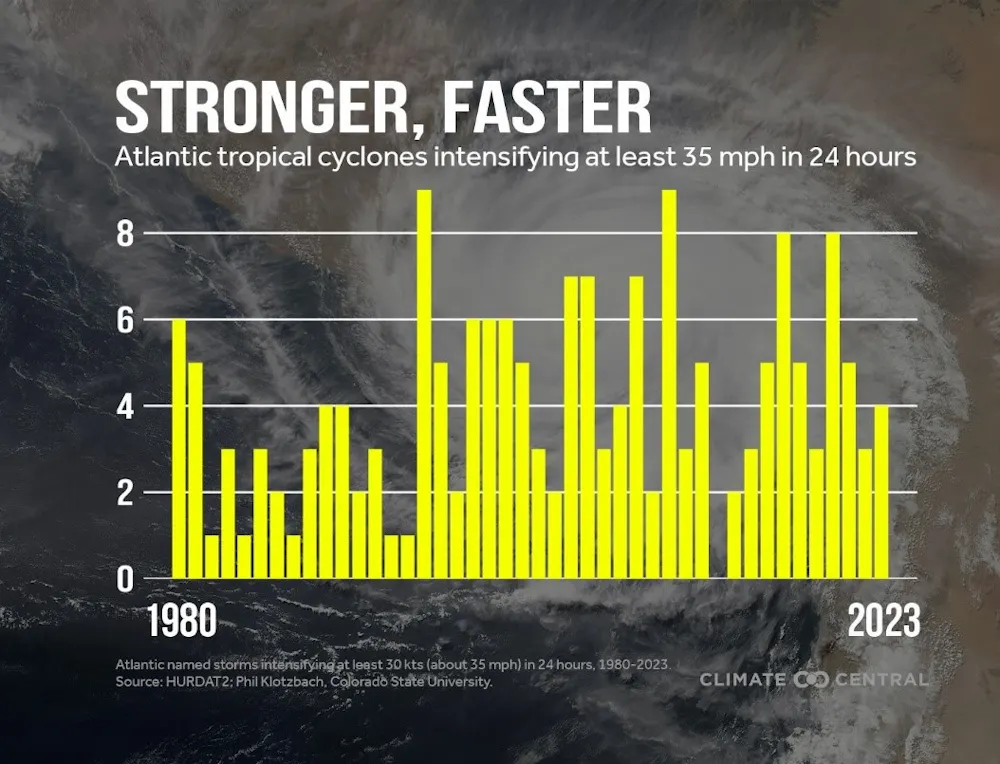
    Rapid intensification is defined by the National Weather Service as an increase in a tropical cyclone’s maximum sustained wind speed of at least 30 knots – about 35 mph within a 24-hour period. That increase can be enough to escalate a storm from Category 1 to Category 3 on the Saffir-Simpson scale.

    Milton’s wind speed went from 80 mph to 175 mph from 1 p.m. Sunday to 1 p.m. Monday, and its pressure dropped from 988 millibars to 911.

    The National Hurricane Center had been warning that Milton was likely to become a major hurricane, but this kind of rapid intensification can catch people off guard, especially when it occurs close to landfall.

    Hurricane Michael did billions of dollars in damage in 2018 when it rapidly intensified into a Category 5 storm just before hitting near Tyndall Air Force Base in the Florida Panhandle. In 2023, Hurricane Otis’ maximum wind speed increased by 100 mph in less than 24 hours before it hit Acapulco, Mexico. Hurricane Ian also rapidly intensified in 2022 before hitting just south of where Milton is projected to cross Florida.

    What causes hurricanes to rapidly intensify?

    Rapid intensification is difficult to forecast, but there are a few driving forces.

    • Ocean heat: Warm sea surface temperatures, particularly when they extend into deeper layers of warm water, provide the energy necessary for hurricanes to intensify. The deeper the warm water, the more energy a storm can draw upon, enhancing its strength.
    Sea surface temperatures have been warm in the Gulf of Mexico, where Hurricane Milton was crossing just northwest of the tip of Mexico’s Yucatan Peninsula on Oct. 7, 2024. A temperature of 30 degrees Celsius is equivalent to 86 degrees Fahrenheit.
    NOAA
    • Low wind shear: Strong vertical wind shear – a rapid change in wind speed or direction with height – can disrupt a storm’s organization, while low wind shear allows hurricanes to grow more rapidly. In Milton’s case, the atmospheric conditions were particularly conducive to rapid intensification.

    • Moisture: Higher sea surface temperatures and lower salinity increase the amount of moisture available to storms, fueling rapid intensification. Warmer waters provide the heat needed for moisture to evaporate, while lower salinity helps trap that heat near the surface. This allows more sustained heat and moisture to transfer to the storm, driving faster and stronger intensification.

    • Thunderstorm activity: Internal dynamics, such as bursts of intense thunderstorms within a cyclone’s rotation, can reorganize a cyclone’s circulation and lead to rapid increases in strength, even when the other conditions aren’t ideal.

    Research has found that globally, a majority of hurricanes Category 3 and above tend to undergo rapid intensification within their lifetimes.

    How does global warming influence hurricane strength?

    If it seems as though you’ve been hearing about rapid intensification a lot more in recent years, that’s in part because it’s happening more often.

    The annual number of tropical cyclones in the Atlantic Ocean that achieved rapid intensification each year between 1980-2023 shows an upward trend.
    Climate Central, CC BY-ND

    A 2023 study investigating connections between rapid intensification and climate change found an increase in the number of tropical cyclones experiencing rapid intensification over the past four decades. That includes a significant rise in the number of hurricanes that rapidly intensify multiple times during their development. Another analysis comparing trends from 1982 to 2017 with climate model simulations found that natural variability alone could not explain these increases in rapidly intensifying storms, indicating a likely role of human-induced climate change.

    How future climate change will affect hurricanes is an active area of research. As global temperatures and oceans continue to warm, however, the frequency of major hurricanes is projected to increase. The extreme hurricanes of recent years, including Beryl in June 2024 and Helene, are already raising alarms about the intensifying impact of warming on tropical cyclone behavior.

    Zachary Handlos receives funding from the National Science Foundation. He is affiliated with the American Meteorological Society as the incoming chair of their Board on Higher Education. He is also an academic faculty partner of the Georgia Climate Project.

    Ali Sarhadi receives funding from NSF and Georgia Tech.

    ref. Hurricane Milton explodes into a powerful Category 5 storm as it heads for Florida − here’s how rapid intensification works – https://theconversation.com/hurricane-milton-explodes-into-a-powerful-category-5-storm-as-it-heads-for-florida-heres-how-rapid-intensification-works-240754

    MIL OSI – Global Reports

  • MIL-OSI United Kingdom: expert reaction to study on MRI scans and brain damage/long-lasting Covid-19 symptoms

    Source: United Kingdom – Executive Government & Departments

    A study published in Brain looks at MRI scans and brain damage associated with long lasting Covid-19 symptoms. 

    Prof Paul Mullins, Professor in Neuroimaging, University of Bangor, said:

    Does the press release accurately reflect the science?

    “The press release is a fairly good reflection of the science, although it does over sell the ability of the data to explain long COVID.

    Is this good quality research?  Are the conclusions backed up by solid data?

    “This is a piece of research using sophisticated imaging techniques to provide data not available from clinical imaging scanners. The imaging is good and shows that there are differences in the brain stem of patients who were hospitalised with COVID-19, with greater changes in patients with more severe COVID.

    How does this work fit with the existing evidence?

    “This fits with some earlier work showing a change in the specific measure, QSM, from this group, and also other work showing long term changes on such sophisticated brain scanning. This finding adds to our knowledge about which regions of the brain COVID impacts, showing change in those regions involved in respiration and other autonomic functions.

    Have the authors accounted for confounders?  Are there important limitations to be aware of?

    “The authors have attempted to account for most confounders, however, there is some limitation with the small number of patients scanned, and the use of a single time point. This is understandable considering that the study took place during the first waves of the pandemic with associated lockdowns and complications. 

    What are the implications in the real world?  Is there any overspeculation? 

    “This data shows that there may be an increase in iron deposition within the brain stem regions – which likely reflects inflammation – however the technique is not able to determine if this is ongoing inflammation, or the result of past inflammations, so it is likely too early for the authors to conclude that persistent inflammation is present in the brain stem, and that this is the cause of long covid, from this data set alone.

    Does this study conclusively prove what causes long COVID?

    “While this study does not conclusively prove the causes of long COVID, it does point a finger at one possible suspect for some of the symptoms experienced.

    What does this tell us about how long COVID should be treated now and in the future?

    “It is not clear that this shows much in the way of possible treatments for long COVID once it has occurred, but it perhaps does point to the need to reduce inflammatory responses during initial COVID infection and response, as lower inflammation was related to smaller changes in the QSM measure used.”


    ‘7-Tesla quantitative susceptibility mapping in COVID-19: brainstem effects and outcome associations.’ by Catarina Rua et al. was published in Brain at 0:01 UK time on Tuesday 08 October 2024.

    DOI: 10.1093/brain/awae215

    Declared interests

    Prof Paul Mullins “is a professor in neuroimaging at Bangor University and the Director of the Masters in Neuroimaging degree at Bangor University, has received European funding for the use of Neuroimaging in ageing and dementia studies in the past, and has received UKRI funding for research into the use of nutraceuticals for brain health. Professor Mullins researches brain metabolism and physiology, and the brain’s response to environmental stresses, including hypoxia as might be experienced during server acute COVID-19 infections.”

    MIL OSI United Kingdom

  • MIL-OSI United Kingdom: Driving the national mission to end child poverty

    Source: Scottish Government

    Championing innovative local projects to support families.

    More families across Scotland will get access to the help they need, where and when they need it – as local projects receive a funding boost from the Scottish Government.

    Grants of up to £80,000 have been awarded to 12 projects undertaking a range of work, including:

    • helping families to access health services
    • providing money and budgeting advice
    • supporting employees to work flexibly around their family life

    The Child Poverty Practice Accelerator Fund invests in innovative, local projects to tackle child poverty – a commitment in this year’s Programme for Government.

    First Minister John Swinney welcomed the announcement on a visit to CentreStage, a performing arts charity in Kilmarnock.

    Later today (Tuesday 8 October) the First Minister will also meet people with experience of poverty at Bute House, before leading a Parliamentary debate as part of Challenge Poverty Week.

    The First Minister said:

    “Organisations like CentreStage demonstrate how the government is working closely with communities, local government and the third sector to help families facing challenges right now. My national mission to end child poverty is underpinned by the importance of this type of collaboration.

    “We want to see this community-focussed approach replicated across Scotland. That’s why our Fairer Future Partnerships are expanding to five new areas across Scotland – joining up local services, offering financial advice and supporting parents into work. 

    “Engaging people with experience of poverty as we build these services is at the heart of the government’s approach – and we are building on the strong foundations we have laid to end poverty in Scotland.

    “The Child Poverty Practice Accelerator Fund will kick-start another 12 innovative projects across the country to give even more families the help and support they need.”

    Councillor Douglas Reid, Leader of East Ayrshire Council and Chair of East Ayrshire Community Planning Partnership Board said: 

    “In East Ayrshire, we recognise that the challenges of addressing poverty and inequality require the combined efforts of a whole range of partners.  We are therefore delighted to be one of five new Fairer Future Partnerships and look forward to working with Scottish Government and our partners, including the third sector, to advance local, innovative approaches that reduce child poverty through improving wellbeing, maximising incomes and supporting people into work.  

    “As a Council we have already committed £40 million to be spent over the next ten years in support of change, prevention and early intervention, reflecting our commitment to tackling poverty and increasing fairness in our communities.”

    Background

    List of projects to receive grants from Child Poverty Practice Accelerator Fund:

    Area 

    Project 

    West Lothian  

    Identifying and addressing unmet need among low-income families 

    Fife 

    Embedding income maximisation across children’s health services aligning with a preventative and proactive care programme 

    East Lothian 

    What Matters? Collecting, measuring and using data that is meaningful to families in East Lothian 

    Aberdeen City 

    Evaluation and design of lone parent employability support to inform and direct future provision 

    East Renfrewshire 

    Flexible for families employer scheme 

    South Ayrshire  

    Exploring interconnection between child poverty and additional support needs: enhancing neurodiverse parenting support in South Ayrshire through preventative family wellbeing approaches 

    Dumfries & Galloway  

    Accessible Financial Wellbeing Support for Priority Families Project 

    Grampian 

    Health Equity & Learning Project (HELP), identifying and addressing barriers for families accessing NHS services 

    Scottish Borders  

    Money advice and budgeting support for families in the Scottish Borders 

    Edinburgh  

    Challenging poverty related stigma 

    Stirling  

    Early intervention family engagement 

    Tayside 

    Dundee Dads Rock 

    Challenge Poverty Week is a Poverty Alliance initiative which has taken place every year since 2013. This year it will take place from 7–13 Oct, with organisations across Scotland coming together to highlight the injustice of poverty in Scotland.  

    The Programme for Government 2024-25 commits to:

    • Expanding place‑based ‘fairer futures partnerships’ to five more areas (North Ayrshire, East Ayrshire, Perth and Kinross, Inverclyde, and Aberdeen City) – alongside three existing ones – supporting innovative, local approaches to joined‑up services that improve family wellbeing, maximise incomes, and support people into work. This will build an evidence base and share approaches that can be transferred to other parts of Scotland.
    • Investing in innovative, local projects to tackle child poverty, through a second round of our Child Poverty Practice Accelerator Fund.

    MIL OSI United Kingdom

  • MIL-OSI United Kingdom: OS named future operator of National Underground Asset Register

    Source: United Kingdom – Executive Government & Departments

    Geospatial Commission appoint Ordnance Survey to operate the National Underground Asset Register, with the service transitioning to public beta in spring 2025.

    • Ordnance Survey appointed future operator of NUAR 
    • NUAR to be incorporated into the National Mapping Service’s public task and run on a cost recovery basis 
    • Move to public beta service in spring 2025 will allow eligible organisations to roll NUAR out across their workforces 

    The public are set to benefit from reduced disruptions to essential public services as the Ordnance Survey (OS) is today (8 October) announced as the future operator of the National Underground Asset Register (NUAR). 

    NUAR is improving the efficiency and safety of the way we install, maintain, operate and repair our buried infrastructure by providing secure access to data about the water, gas, electricity and telecommunications pipes and cables beneath our feet. 

    Currently workers must contact multiple organisations and wait on average over six days just to get the information they need. With NUAR, they can get that information instantly, any time of the day, any day of the year. This means planners and excavators get access to the data they need, when they need it, to carry out their work effectively and safely. NUAR also includes features to keep data secure and improve its quality over time. 

    This will lead to economic growth of at least £400 million per annum through increased efficiency of data sharing and excavations, fewer accidental strikes on underground pipes and cables, and reduced disruptions for the public and businesses. It will also contribute to the building of the infrastructure needed across the country, such as new roads, rail and houses.

    Baroness Jones of Whitchurch, Parliamentary Under-Secretary of State, Department for Science, Innovation and Technology said: 

    We are committed to unlocking the power of data to reduce disruptions to the public and help deliver economic growth across the UK. From spring, NUAR will minimise the chance of accidental damage to the pipes and cables beneath our feet, protecting the supply of gas, water and electricity to our homes and businesses. 

    By harnessing the Ordnance Survey’s centuries of expertise in managing critical national geographic data, we will ensure this service can deliver for the public and industry from Newcastle to Newport and Brighton to Belfast.

    The Geospatial Commission will retain long-term policy and performance oversight of the service. The OS Board has agreed to operate NUAR as part of its public task and on a cost recovery basis. In the upcoming months, the services will begin transitioning from AtkinsRéalis, who collaborated with the Geospatial Commission to develop the award-winning NUAR minimum viable product, to OS.  

    Plans are in place for NUAR to evolve from its current status as a minimum viable product, where use is constrained to testing and feedback, into a public beta service by spring. From that point NUAR will be able to be used in real-life situations by any eligible asset owners, their contractors and accredited surveyors to help ensure safe digging and excavation.

    Nick Bolton, Chief Executive Officer, Ordnance Survey said: 

    We are excited to apply our expertise in mapping Great Britain above ground, to the infrastructure below it. This innovative digital map shows how collaboration, between private sector and government, can bring huge economic benefit to the nation. Being trusted to operate a critical national asset, such as NUAR, is recognition of our enduring capabilities and we are delighted to be responsible for running this service.

    Heidi Mottram, Chief Executive Officer, Northumbrian Water Group said: 

    Ever since we collaborated with Ordnance Survey and others to design and produce the forerunner of NUAR at Northumbrian Water Group’s Innovation Festival in 2018, we have always felt this system, which benefits utilities and customers alike, should be hosted and managed not-for-profit in the public sector. Our planning and operation teams have fully embraced NUAR and this move to our national mapping agency is welcomed.

    Ashley Behan, Street Works and Permitting Manager, Lincolnshire County Council said: 

    As one of the first Highway Authority users of the NUAR platform, we are pleased to see public authority management of NUAR come to fruition, with its transfer to Ordnance Survey. As the National Mapping Service for Great Britain and one of the developers of NUAR, Ordnance Survey has a unique insight into mapping systems and how the platform works, and we are looking forward to seeing how it develops under their stewardship. 

    The centralisation and consistency of asset information NUAR provides is invaluable and will be key to the sector moving forward, safeguarding the country’s vital underground networks in a more structured way.

    Tom Duncan, Head of Design and Records, GTC said: 

    As an active user and supporter of the NUAR platform, I am pleased to see it transition to Ordnance Survey as its permanent home. This move should enhance the management of data relating to underground assets and improve collaboration across sectors, ultimately contributing to safer and more efficient infrastructure planning.

    Dr Lawrence J Smith, Technical Information Manager, Thames Water said: 

    We are delighted to hear that Ordnance Survey has been selected as the public authority to lead the next phase of NUAR’s evolution. Having collaborated closely with Ordnance Survey for several decades, we have confidence in their capabilities and in their ability to undertake this role. The NUAR application is becoming an increasingly vital asset in ensuring the safety of both our workforce and customers. At Thames Water, we fully support this announcement.

    Background

    NUAR is an emerging digital service, which provides instant access to a map of underground assets (i.e. pipes and cables) in England, Wales and Northern Ireland. Scotland already benefits from a system of this kind, known as the Scottish Community Apparatus Data Vault (or Vault for short), and the Geospatial Commission has worked closely with colleagues in the Scottish Government on this development. 

    OS is Great Britain’s National Mapping Service and has been mapping the surface of Great Britain since 1791. As part of its public task, it manages, maintains and provides access to the National Geographic Database, which contains over 500 million features and is updated over 20,000 times a day. OS data and services underpin critical activities across the country, such as getting ambulances to patients quickly, registering to vote and the provision of energy, water and broadband.

    NUAR has recently won the ‘Digital Innovation in Productivity’ category at the Digital Construction Awards, and been shortlisted for the following awards:  

    • New Civil Engineer (NCE) Awards 2024 – Technology Solutions Provider of the Year 

    • Digital Construction Awards 2024 – Digital Innovation in Health, Safety and Wellbeing 

    • Management Consultancies Association awards 2024 – Performance Improvement in the Public Sector Award 

    • Association for Project Management awards 2024 – Programme of the Year

    DSIT media enquiries

    Email press@dsit.gov.uk

    Monday to Friday, 8:30am to 6pm 020 7215 300

    Updates to this page

    Published 8 October 2024

    MIL OSI United Kingdom

  • MIL-OSI United Kingdom: Game-changing tech to reach the public faster as dedicated new unit launched to curb red tape

    Source: United Kingdom – Executive Government & Departments

    Science Secretary launches new Regulatory Innovation Office today to speed up public access to new technologies.

    New Regulatory Innovation Office Bringing new technologies to the public, faster.

    • Regulatory Innovation Office to reduce the burden of red tape and speed up access to new technologies that improve our daily lives – from AI in healthcare to emergency delivery drones
    • Search begins for a Chair to lead the office, driving economic growth through regulatory reform that enables innovation
    • New Office delivers on a key manifesto commitment and is among steps to back business in buildup to UK hosting International Investment Summit

    New technologies, like AI for better treatments in our NHS and drones delivering emergency supplies to all corners of the UK, could reach the public faster through a dedicated new office that will reduce the burden of red tape on innovation and help kickstart economic growth.

    The new Regulatory Innovation Office (RIO) will reduce the burden for businesses hoping to bring new products and services to the market in some of the UK’s fastest-growing sectors through innovations like –AI training software for surgeons to deliver more accurate surgical treatments for patients and drones which can improve business efficiency and quickly send critical deliveries to remote parts of the country.

    To do so, it will support regulators to update regulation, speeding up approvals, and ensuring different regulatory bodies work together smoothly. It will work to continuously inform the government of regulatory barriers to innovation, set priorities for regulators which align with the government’s broader ambitions and support regulators to develop the capability they need to meet them and grow the economy.

    The announcement comes ahead of further plans to reduce the burden of red tape and support the government’s key mission of kickstarting growth across the country. The new Office will also help set the scene for when the UK hosts the International Investment Summit on Monday 14 October, where the Chancellor will make clear that the UK is “open for business” as the government resets relations with trading partners around the globe.

    The launch of the RIO comes hot on the heels of a raft of public and private investments announced on Sunday (6 October) aimed at transforming cancer treatments for patients while bringing a wave of cutting-edge UK-made MedTech products to the global market.

    The RIO’s mission will initially support the growth of four fast-growing areas of technology making a difference to people’s lives before backing further technologies and sectors as the Office evolves. These are: 

    • Engineering biology – this is the use of synthetic biology and biotechnology to create new products and services derived from organic sources. These technologies can improve health with new treatments like innovative vaccines, help create cleaner fuels and make food production more efficient and sustainable such as through pest resistant crops and cultivated meat. The new RIO will help regulators to bring those products to market safely and more quickly – realising the environmental and health benefits they can bring to our lives.
    • Space – the UK’s space industry is growing fast, supporting everything from GPS on phones to vital communication systems, as new innovations improve our weather forecasting to disaster response systems. To sustain this growth, regulatory reform is needed for greater agility and clarity help foster competition, encourage investment, and open up market access. 
    • Artificial Intelligence and digital in healthcare – with increasing pressures on the NHS, AI is set to revolutionise healthcare delivery so doctors can diagnose illnesses faster and improve patient care. It will help run hospitals more efficiently with medical staff able to spend less time on administration, cutting waiting times and it could enable more personalised medicines, tailoring treatment to individuals. RIO will support the healthcare sector to deploy AI innovations safely, improving NHS efficiency and patients’ health outcomes.
    • Connected and autonomous technology – autonomous vehicles like drones can deliver emergency supplies to remote areas quickly and efficiently and work to approve this technology could play a key part in supporting emergency services to keep people safe. Greater support could also enable more drones to be used by businesses across the UK, building on projects like the drone service used by Royal Mail to deliver to Orkney and improving efficiency.

    The cross-cutting nature of these emerging technologies, which do not fit neatly into existing regulatory frameworks can mean a slower process in getting them onto the market. The new Office will work closely with government departments including the Department for Transport, the Department for Health and Social Care, and the Department for Environment Food and Rural Affairs to address regulatory barriers in these initial growth areas.

    The new office will also bring regulators together and working to remove obstacles and outdated regulations to the benefit of businesses and the public, unlocking the power of innovation from these sectors to generate tens of billions of pounds for the UK economy in the coming years. 

    Science and Technology Secretary, Peter Kyle, said:

    The launch of the Regulatory Innovation Office, a key manifesto commitment, is a big step forward in bringing the UK’s most promising new technologies to the public faster and safely while kickstarting economic growth. 

    By speeding up approvals, providing regulatory certainty and reducing unnecessary delays, we’re curbing the burden of red tape so businesses and our public services can innovate and grow, which means more jobs, a stronger economy, and a better quality of life for people across the UK.  

    From breakthroughs that could help doctors diagnose illnesses earlier to satellite navigation for more accurate weather forecasting and getting emergency supplies to where they are needed, quickly and effectively, RIO will make sure UK companies are at the forefront of the next generation of technologies.

    The Science and Technology Secretary is also looking to appoint the RIO’s first Chair to lead the charge in backing business and safe innovation, and work with regulators and partners to shape a regulatory environment that is fit for the future. Applications are now being welcomed for an ambitious, visionary leader committed to driving that change.

    The organisation has been established within DSIT, where it will incorporate the existing functions of the Regulatory Horizons Council and the Regulators’ Pioneer Fund.

    Alongside the launch of the RIO, the government is already making progress in developing regulatory frameworks for emerging technologies, becoming the first country to outline how it will approach quantum regulation, offering certainty to the sector and encouraging the responsible development of the technology.  

    This is set out in our response to the Regulatory Horizon Council’s report on quantum technologies, also published today. It marks a crucial first step in regulating innovation in a technology that will increasingly underpin powerful computers, secure communications and advanced sensors, in sectors from healthcare to national security.   

    Alongside this package of announcements, today we are announcing:

    • A £1.6 million award to the Food Standards Agency (FSA) as part of round one of the Engineering Biology Sandbox Fund, which aims to test innovative regulatory approaches for products like cultivated meat. Cell-cultivated products are foods created through the isolation of cells from meat, seafood, fat, offal or eggs which are grown in a controlled environment. It could result in food production which is more environmentally friendly and sustainable, using just 1% of the land used for animal equivalents, while increasing food security. Programmes like this will help bring innovative food products to shop shelves safely but without unnecessary delay and at lower costs, giving consumers more choice.
    • The publication of new voluntary screening guidance for synthetic nucleic acid. These technologies allow companies to ‘print’ DNA and RNA, enabling academics and businesses to study and engineer biological systems that help sectors like healthcare and accelerate our path to net-zero. The guidance emphasises the government’s intent for a pro-innovation culture in the engineering biology ecosystem through providing well-defined guardrails for customers and producers of synthetic nucleic acid.

    DSIT media enquiries

    Email press@dsit.gov.uk

    Monday to Friday, 8:30am to 6pm 020 7215 300

    Updates to this page

    Published 8 October 2024

    MIL OSI United Kingdom

  • MIL-OSI United Kingdom: Half a billion-pound investment in electric buses to spark a new era of green growth

    Source: United Kingdom – Executive Government & Departments

    Communities across the country will benefit from brand new, state-of-the-art green buses.

    • £500 million investment announced to deliver 1,200 UK-made zero emission buses, ensuring greener and better journeys for passengers
    • bus operator Go Ahead’s investment to benefit communities across the country, supporting hundreds of jobs and delivering growth
    • Transport Secretary brings together industry to advance opportunities for investment in the UK ahead of investment summit

    Up to 500 UK manufacturing jobs are set to be supported as bus operator Go Ahead today (8 October 2024) announces a major £500 million investment to decarbonise its fleet, including creating a new dedicated manufacturing line and partnership with Northern Ireland-based bus manufacturer Wrightbus.

    The investment is set to fund the manufacturing of up to 1,200 new zero emission buses over the next 3 years. Built for operator Go Ahead, this investment will accelerate the transition to greener buses across the country including in Plymouth, Gloucestershire, East Yorkshire, London and the Isle of Wight.

    On top of directly supporting 500 manufacturing jobs, the £500 million investment for Wrightbus will also support an additional 2,000 jobs across the wider UK supply chain by 2026, helping to get us back on track for growth.

    The Transport Secretary will also announce plans to create a new UK Bus Manufacturing Expert Panel. This panel will bring together industry experts and local leaders to explore ways to ensure the UK remains a leader in bus manufacturing, help local authorities deliver on their transport ambitions, and begin to seize opportunities to embrace zero emission transport technologies.

    The Transport Secretary is expected to meet with key industry leaders today including Wrightbus owner Jo Bamford and CEO Jean-Marc Gales, to reaffirm the government’s commitment to decarbonising local transport and fostering an environment for investment in the UK manufacturing industry, bringing sustained economic growth and supporting jobs.

    The announcement comes ahead of the International Investment Summit, which will gather UK leaders, high-profile investors and businesses from across the world to discuss how we can deepen our partnership to drive investment and growth.

    The Transport Secretary is expected to hold several bilateral meetings at the summit with international business leaders and make clear the UK is “open for business” so that she can help attract further investment to support the delivery of our transport priorities across the country.

    The Prime Minister will also convene the first Council of Nations and Regions later this week, bringing together first ministers, Northern Ireland’s First Minister and Deputy First Minister and regional mayors from across England, as the government forges new partnerships, resets relationships to secure long term investment with the aim of boosting growth and living standards in every part of the UK.

    Transport Secretary, Louise Haigh said:

    The number one mission of this government is growing the economy. The half a billion pounds Go Ahead is announcing today shows the confidence industry has in investing in the UK.

    This announcement will see communities across the country benefit from brand new, state-of-the-art green buses – which will deliver cleaner air and better journeys.

    We’re creating the right conditions for businesses to flourish, so we can support jobs and accelerate towards decarbonising the transport sector.

    Under this government, Britain is open for business.

    For every vehicle manufactured, 10 trees will be planted by Go-Ahead and Wrightbus in the towns and cities where the buses are deployed.

    Buses, as the most used form of public transport, have been prioritised by this government from the outset. The Transport Secretary has made improving bus services and delivering greener transport 2 of her 5 core priorities.

    Last month, the Transport Secretary announced a package of measures to empower local leaders to take back control of their bus services and deliver services based on the needs of communities, to grow passenger numbers and deliver better services for all. 

    Building on this, the government’s new buses bill is set to be introduced in Parliament by the end of this year and will bring an end to the current postcode lottery by taking steps to improve bus services no matter where you live.

    Further details on the UK Bus Manufacturing Expert Panel will be confirmed in due course.

    Go-Ahead Bus CEO, Matt Carney said:

    This multi-million pound investment and partnership with Wrightbus will accelerate the transition to zero-emission fleet across the UK.

    We are proud to be working in partnership with the UK government and local authorities to deliver transformational environmental change for communities, while supporting UK jobs and the growth of the country’s supply chain. 

    Wrightbus CEO, Jean-Marc Gales said:

    The deal with Go-Ahead is hugely significant and represents a huge boost to the UK’s economy. It will support homegrown manufacturing, jobs and skills for the next three years and beyond. We’ve always been proud to support the UK’s supply chain and our Go-Ahead partnership will ensure even more money can be spent securing good green jobs.

    We must also not forget that this deal represents a massive step forward in our ambition to help decarbonise the transport sector with our world-leading products. It was heartening today to hear the government reaffirm its commitment to a green transport sector.

    Roads media enquiries

    Media enquiries 0300 7777 878

    Switchboard 0300 330 3000

    Updates to this page

    Published 8 October 2024

    MIL OSI United Kingdom

  • MIL-OSI Submissions: Energy Sector – Equinor reports on Norwegian development projects

    Source: Equinor

    07 OCTOBER 202422:14(GMT+13) – Equinor is the operator of 19 projects currently under development in Norway. In the proposed National Budget for 2025, the Ministry of Energy listed the status of 13 Equinor-operated projects currently under development or recently completed.

    The projects in question have a total investment framework of 198 billion kroner, from commencement to commissioning.

    “Equinor has a good portfolio of profitable projects being developed in Norway, which will contribute to long-term security of supply of oil and gas to Europe. In 2023, our developments contributed to high activity and 25 billion kroner to the Norwegian supplier industry. Together with our partners and the industry, we have completed six projects during the past year,” says Trond Bokn, head of project development in Equinor.

    The reported projects have seen a cost increase of 6.5 billion 2024-NOK over the past year, which is about 3 per cent. The overall increase since the plans for development and operation (PDOs) is 32.9 billion 2024-NOK. Currency effects account for 12.4 billion of this. If the Johan Castberg project and currency effects are omitted, the cost increase for the reported projects is around 3 percent since PDOs.

    Two of the projects, Johan Castberg and Oseberg gas compression and partial electrification, have experienced a post-PDO increase of more than 20 percent, and are therefore mentioned specifically in the proposed national budget.

    Johan Castberg

    The production ship is now anchored at the field and Johan Castberg is on track for start-up towards the end of the year.

    The cost increase in the project is 2.2 billion 2024-NOK since last year. This is due to a longer stay than estimated at Aker Solutions at Stord, currency effects and a general cost increase. Of this, almost NOK 800 million is currency effects. Since the PDO, estimated costs have grown by 25.7 billion 2024-NOK. Currency effects account for 8.1 billion of this.

    Oseberg gas phase 2 and power from shore (OGP)

    OGP is composed of partial electrification of the Oseberg Field Centre and Oseberg sør, as well as installation of a new compressor module at the field centre.

    The cost increase over the past year is 1.2 billion 2024-NOK. Since the PDO, the cost increase is about NOK 2.5 billion in 2024-NOK. Since the PDO, estimated costs have grown by around 2.5 billion 2024-NOK. This is a result of longer delivery times for new transformers that were destroyed in a fire at Hitachi’s factory in Vaasa in 2023, as well as delays related to increased complexity. Planned commissioning has been postponed from 2026 to late 2027.

    Snøhvit Future

    Snøhvit Future encompasses onshore compression and electrification of Hammerfest LNG on Melkøya. Since the PDO, the cost increase is 1.9 billion 2024-NOK. More than 500 million of this relates to currency effects.

    One of the main reasons for the higher costs is the joint venture’s decision to change the design of an electric boiler as a result of safety considerations.

    Projects included in the National Budget overview

    Breidablikk
    Gina Krog alternative oil export
    Halten Øst
    Johan Castberg
    Kristin Sør phase 1
    Oseberg gas phase 2 and power from shore
    Sleipner power from shore
    Troll Vest electrification
    Irpa
    Verdande
    Snøhvit Future
    Njord Electrification
    Eirin

    Completed projects

    Breidablikk
    Sleipner power from shore
    Kristin Sør phase 1
    Troll Vest electrification
    Gina Krog alternative oil export
    Northern Lights.

    MIL OSI – Submitted News

  • MIL-OSI Russia: Moscow Shares Best Practices for Urban Infrastructure Development with Regions

    MILES AXLE Translation. Region: Russian Federation –

    Source: Transport and Industry of Moscow

    The Moscow government has launched a series of demonstration days to show best practices in urban infrastructure development that can be implemented in other regions of Russia. Maxim Liksutov, Deputy Mayor of Moscow for Transport and Industry, announced the initiative.

    The first event was dedicated to advanced solutions in the field of transport. Participants were presented with the best practices for the development of the city’s transport system, as well as innovative digital services for drivers and passengers.

    On the instructions of Moscow Mayor Sergei Sobyanin, the capital is ready to share its successful practices and cooperate with the regions to improve the quality of life of city residents. This is in line with the goals set by the President and the Government of the Russian Federation. Today’s event is the result of extensive joint work by the Moscow Government and the Agency for Strategic Initiatives. Over the past few months, we have studied and assessed socially significant urban practices that may be useful to other regions, and selected the best of them, noted Maxim Liksutov.

    Experts from the Agency for Strategic Initiatives (ASI) assessed practices in Moscow and other regions to determine their feasibility and applicability in areas with different population sizes. Using a comprehensive approach, specialists identified the most promising solutions for implementation in the regions.

    It is important that the regions have the opportunity to see transport infrastructure facilities and effective solutions with their own eyes. Today, they were able to evaluate Moscow solutions that help the capital remain a leader in digitalization and approaches to the development of the transport system, as well as other practices supported by the Agency and presented at Smartek. Some of these practices are completely free and can be easily implemented in the regions, since they do not require investments in new infrastructure or information systems. They can really take advantage of the huge resources that the authors of the project are ready to provide to other regions and cities. To help the regions understand the effect of the implemented transport solutions, the Agency will develop a corresponding methodology. This document will allow them to see the degree of influence of the practices on the indicators of the national project, – shared Svetlana Chupsheva, General Director of ASI.

    Regions will gain access to more than 70 practices in the fields of transport, industry, tourism, culture, healthcare, ecology, education, investment and business development, and social support.

    Moscow, as a center for the development of high-tech industries, is implementing more than 20 citywide measures to support industry and is already disseminating positive experience to the regions, including through the conclusion of interregional offset contracts. As part of a specialized demo day, we will share with colleagues the most successful practices of localizing innovative technical and commercial enterprises. The creation of high-tech, knowledge-intensive industries in the regions is, first of all, strengthening the technological sovereignty of the country, developing its scientific and technical potential and, of course, increasing wages and improving the quality of life of people, said Anatoly Garbuzov, Minister of the Moscow Government, Head of the Department of Investment and Industrial Policy.

    The Moscow government is actively replicating successful solutions to increase investment activity and economic attractiveness of regions.

    Thus, within the framework of the St. Petersburg International Economic Forum 2024, the Government of Moscow and the Ministry of Economic Development signed an agreement on the creation of a single investment portal of the Russian Federation. The basis for joint development will be the investment portal of the Government of Moscow. In February 2024, the first joint digital product was launched – the Investment Map of the Russian Federation.

    EDITOR’S NOTE: This article is a translation. Apologies should the grammar and or sentence structure not be perfect.

    MIL OSI Russia News

  • MIL-OSI Submissions: Invest Moldova Agency – Moldova Receives ‘B+’ Rating with Stable Outlook from Fitch Ratings, Signaling Economic and Financial Resilience

    Source: Invest Moldova Agency

    Fitch Ratings has assigned the Republic of Moldova a Long-Term Foreign-Currency Issuer Default Rating (IDR) of ‘B+’ with a Stable Outlook. (ref. https://invest.gov.md/en/fitch-ratings-assigns-moldova-a-b-rating-with-stable-outlook-reflecting-economic-and-financial-resilience )

    This rating highlights the country’s steady commitment to maintaining macroeconomic and financial stability through prudent fiscal policies, a credible inflation-targeting framework, and a flexible exchange rate regime. These factors, combined with a resilient banking sector, demonstrate Moldova’s progress in overcoming past challenges and building a more stable financial environment.

    One of the key elements supporting this rating is the resilience of Moldova’s banking sector. For the past 10 years, Moldova undertook a comprehensive overhaul of its regulatory standards. Today, the sector remains well-capitalized, profitable, and exhibits low levels of non-performing loans. These improvements have fortified the country’s financial system, enhancing confidence in its ability to withstand economic pressures.

    Victoria Belous, the Minister of Finance of the Republic of Moldova, emphasized the significance of the rating in strengthening Moldova’s financial standing:

    “The B+ rating with a stable outlook reflects our efforts to maintain financial stability and prudently manage public debt. It sends a strong signal to investors and confirms the effectiveness of our policies. This rating will open new financing opportunities and support Moldova’s expansion on international markets.”

    Her statement underscores the government’s focus on responsible fiscal management and how the rating aligns with Moldova’s ambitions to attract international investors.

    Dumitru Alaiba, the Minister of Economic Development and Digitalization of the Republic of Moldova, also commented on the positive impact of the Fitch rating on Moldova’s global investment attractiveness:

    “For many years, we have been striving to improve our country’s rating. The report from Fitch Ratings is a key indicator for financial markets and institutional investors. The better the rating, the more attractive and stable the country becomes, and the lower the cost of financing. We are acting on all reform fronts within our control. I am pleased to see that our efforts over the past three years are now yielding tangible results. We continue to work hard moving forward.”

    Moldova’s B+ rating, coupled with its stable outlook, confirms the country’s commitment to economic reforms and financial discipline. By maintaining prudent fiscal policies and a robust regulatory environment, Moldova is well-positioned to leverage new financing opportunities. As a result, this rating serves as a milestone for the country as it continues to expand its presence on international markets and strengthen investor confidence.

    The Invest Moldova Agency, under the Prime Minister’s Office, promotes Moldova as an investment destination and supports export growth. Managing the national brand, it fosters international partnerships, economic diplomacy, and sectoral growth, enhancing Moldova’s global economic appeal

    MIL OSI – Submitted News

  • MIL-OSI USA: Readout of Secretary of Defense Lloyd J. Austin III’s Call With Argentine Minister of Defense Luis Petri

    Source: United States Department of Defense

    Pentagon Press Secretary Maj. Gen. Pat Ryder provided the following:

    Secretary of Defense Lloyd J. Austin III and his Argentine counterpart, Minister of Defense Luis Petri, spoke by phone today to reaffirm the importance of the defense partnership between the United States and Argentina. Secretary Austin thanked Minister Petri for Argentina’s joining of the Ukraine Defense Contact Group, and the two leaders reaffirmed both countries’ commitment to supporting a democratic, independent, and sovereign Ukraine that can defend itself and deter Russian aggression.  

    The two leaders noted with satisfaction the deepening of defense ties between the United States and Argentina, to include Argentina’s interest in becoming a NATO Global Partner, Argentina’s decision to join the Combined Maritime Forces in the Middle East, and Argentina’s resumption of its participation in the State Partnership Program with the Georgia National Guard. Secretary Austin thanked Minister Petri for hosting the XVI Conference of Defense Ministers of the Americas, which will convene in Mendoza, Argentina on October 13-16, 2024.  

    The two leaders agreed to continue engaging on the important role that the Western Hemisphere plays in defending a rules-based world order.

    MIL OSI USA News

  • MIL-OSI New Zealand: Albania

    Source: New Zealand Ministry of Foreign Affairs and Trade – Safe Travel

    • Reviewed: 4 October 2024, 09:28 NZDT
    • Still current at: 8 October 2024

    Related news features

    If you are planning international travel at this time, please read our COVID-19 related travel advice here, alongside our destination specific travel advice below.

    Exercise increased caution in Albania due to the threat of crime (level 2 of 4).

    Albania

    Terrorism
    Terrorist groups, individuals returning to Europe from areas of conflict, and individuals adhering to various forms of extremist ideologies, continue to make threats to conduct attacks throughout Europe.

    New Zealanders in Albania are advised to keep themselves informed of potential risks to safety and security by monitoring the media and other local information sourcesWe recommend following any instructions issued by the local authorities and exercising a high degree of vigilance in public places, including at tourist sites, restaurants, bars, shopping areas, sporting events and transport hubs. Be alert and take official warnings seriously.

    Crime
    Violent crime does occur, but targeting of foreigners is rare. Petty crime such as bag snatching and pickpocketing occurs in Albania and is common in tourist areas, in larger cities and major public transport hubs, including airports. House break-ins and property theft also occur. Security risks increase after dark. Be cautious when using ATM machines. We advise New Zealanders to be alert to their surroundings at all times and take steps to safeguard and secure their personal belongings, including in vehicles.

    Civil Unrest
    Public demonstrations occur often, and can happen with little warning causing serious traffic disruptions. Political protests regularly take place in central Tirana. You should avoid all demonstrations and large public gatherings in Albania, as some previous protests have turned violent.  Follow local media sources and be aware of your surroundings.

    General Travel Advice
    Landmines are still present in the north-eastern border area with Kosovo, but are often marked clearly as danger zones. New Zealanders are advised not to stray off well-used roads and paths in rural areas.

    Keep your passport in a safe place and only carry a photocopy of your passport for identification purposes.

    Penalties for the possession, use or trafficking of illegal drugs are severe and can include lengthy imprisonment or fines.

    Medical facilities are limited outside Tirana. New Zealanders travelling or living in Albania should have a comprehensive travel insurance policy in place that includes provision for medical evacuation.

    New Zealanders in Albania are encouraged to register their details with the Ministry of Foreign Affairs and Trade.

    Travel tips


    The New Zealand Embassy Rome, Italy is accredited to Albania

    Street Address Via Clitunno, 44, 00198 Rome, Italy Telephone +39 06 853 7501 Fax +39 06 440 2984 Email rome@nzembassy.it Web Site https://www.mfat.govt.nz/italy Hours Mon- Fri 0900 -1230 and 1330-1630 Note We encourage you to make an appointment to ensure prompt service.

    See our regional advice for Europe

    MIL OSI New Zealand News

  • MIL-OSI New Zealand: Europe: Severe Flooding

    Source: New Zealand Ministry of Foreign Affairs and Trade – Safe Travel

    Share this page:

    Latest News features

    MIL OSI New Zealand News

  • MIL-OSI New Zealand: EU/UK Upcoming Travel Changes

    Source: New Zealand Ministry of Foreign Affairs and Trade – Safe Travel

    New Zealand citizens planning on travelling to the UK or within Europe and the Schengen Zone should be aware of upcoming changes to border controls.

    UK Electronic Travel Authority (ETA)
    From 8 January the UK government is introducing an Electronic Travel Authorisation (ETA).

    New Zealand passport holders travelling to the UK visa free will need to apply for an ETA. New Zealanders will be able to apply for an ETA from 27 November 2024.

    More information including how to apply for a UK ETA, is on this UK government website. 

    Apply for an electronic travel authorisation (ETA) – GOV.UK (http://www.gov.uk)

    Further guidance is available here Electronic travel authorisation (ETA): help videos – GOV.UK (www.gov.uk)

    Entering and exiting the Schengen Area
    New Zealand travellers should be aware that from November 2024, the EU will introduce a digital border system to strengthen the security of its external Schengen border. 

    The new registration process is called the Entry/Exit System (EES). The EU has not yet confirmed a specific date in November for the introduction of the EES.

    The EES will register when non-EU nationals cross external borders of Schengen countries and will more accurately identify overstayers. It will require most citizens of countries outside the EU to create a digital record and register biometric details, such as fingerprints and photos, when then enter the Schengen area. The EES will replace passport stamping.

    New Zealanders travelling to Europe can still enter visa-free, but the length of time you can stay may vary depending on where you are travelling. You need to know what the visa-free travel rules are to ensure you don’t overstay. Read the visa/entry information on the websites of the Embassies of the relevant EU/Schengen countries you intend to visit or transit (e.g. the French Embassy in Wellington if you are intending to travel to France. You may also like to consult with a travel agent.

    More information can also be found on our Safe Travel page here: Travel tips – travel to Europe | SafeTravel.

    In addition, from sometime in the first half of 2025 travellers will also be required to complete an European Travel Information and Authorisation System (ETIAS) travel authorisation before travelling. Further information about the ETIAS can be found on the EU’s official travel website here.

    As the New Zealand Ministry of Foreign Affairs and Trade does not issue visas for foreign countries, we cannot provide definitive advice on the requirements to enter or exit countries within Europe and the Schengen area. Our New Zealand Embassies and High Commissions overseas also cannot advise on your right to enter or stay in a foreign country.

    Associated Advisories:

    Share this page:

    MIL OSI New Zealand News

  • MIL-OSI United Kingdom: Liverpool Charity Hosts a Week of Fun Events to Celebrate and Support Kinship Carers

    Source: City of Liverpool

    To mark National Kinship Carers Awareness Week (7th–11th October), Liverpool-based charity Kinship Carers Liverpool is organising a week long series of exciting events.

    Kinship children are those who are looked after by a family member or a family friend. As the longest-running and largest kinship care support group in the UK, the charity has been championing the vital work of kinship carers since establishing this awareness week in October 2016. The aim is to bring attention to the often-overlooked carers who step in to raise children, keeping them out of local authority care.

    Are you a grandparent, relative, or family friend raising someone else’s child? If so, Kinship Carers Liverpool invites you to get involved in this special week. Based at Ellergreen Community Centre in Norris Green, the charity has organised activities to raise awareness and celebrate the essential role kinship carers play in the lives of the children they care for.

    Kinship carers take on the responsibility of raising children due to various circumstances, such as the death of a parent, imprisonment, or challenges like mental health issues, or drug and alcohol addiction. Research shows that children raised in kinship care often experience positive outcomes, but many carers find themselves unprepared emotionally and financially, especially in the current economic climate.

    Fortunately, Kinship Carers Liverpool provides invaluable support, offering practical advice and emotional guidance. Their services include one-on-one and group support for the entire family, helping kinship carers navigate complex legal, financial, and parenting challenges.

    Pauline Thornley, Project Co-ordinator for Kinship Carers Liverpool, said:

    “Our project supports the often-hidden carers who are raising family members and keeping them out of local authority care. We provide training, events, and activities for both carers and young people, offering the tailored support these families need to face life’s challenges.”

    The charity’s work extends beyond local support. Kinship Carers Liverpool has helped ensure that the voices of young people in kinship care are heard nationally. This includes collaborations with the Children’s Commissioner for England and participation in discussions at the Labour Party Conference about the unique challenges faced by kinship families.

    The organisation has also developed a pioneering Kinship Charter in partnership with Liverpool Children’s Services, outlining best practices for professionals supporting kinship families.

    All kinship carers are welcome to join the events at Ellergreen Community Centre (Ellergreen Road, Norris Green, L11 2RY). For more information, call 0151 280 2108, email eve@kinshipcarersliverpool.co.uk, or visit http://www.kinshipcarersliverpool.co.uk.

    MIL OSI United Kingdom

  • MIL-OSI China: Jing’an showcases sculptures from around the world

    Source: China State Council Information Office 3

    Thirty-five sculptures by 31 artists from 10 countries are showcased at the Jing’an International Sculpture Project, a biennial event jointly hosted by the municipal administration for planning and natural resources and the Jing’an district in Shanghai.

    While most of the sculptures are on exhibition at the Jing’an Sculpture Park, six pieces are placed at urban squares, parks and other landmark locations by the Suzhou Creek and the Nanjing Road West.

    This year the exhibition has been curated by UCCA Lab, a branch institution of the UCCA Center for Contemporary Art. Philip Tinari, director of the center, hoped to leverage the institution’s distinctive global perspective to achieve new breakthroughs in the selection as well as the quality of the exhibits of the JISP, which features 22 new commissioned works for the occasion.

    Since the first installment of JISP in 2010, the biennial exhibition has become a renowned public art brand of Shanghai, said Gong Mingjun, deputy director of the Shanghai Landscaping & City Appearance Administrative Bureau. This year the exhibition features the theme Echoes among us, exploring the harmonious co-existence between art, the city, and the people.

    France is the guest-of-honor of JISP this year in celebration of the 60th anniversary of the diplomatic ties between China and France. Among the featured artists from France are Martial Raysse, one of the most celebrated French artists in the world; Marc Fornes, an architect specializing in large-scale, site-specific structures; and Pablo Reinoso, who brought to Shanghai a work of his signature Spaghetti Bench series.

    The exhibition is ongoing until the end of the year.

    MIL OSI China News

  • MIL-OSI China: Chinese orchestra performs in Vladivostok

    Source: China State Council Information Office 3

    The China National Centre for the Performing Arts (NCPA) Orchestra performed at the Mariinsky Theatre in Vladivostok on Monday, concluding its tour in Russia.

    Under the director of conductor Li Xincao, the orchestra presented a variety of pieces by both Chinese and Russian composers.

    Ren Xiaolong, general manager of the NCPA Orchestra, said that the performance coincided with the 75th anniversary of China-Russia diplomatic ties, emphasizing the orchestra’s role as a bridge of friendship.

    Yuri Sergeyevich, a Russian audience, said the concert “was deeply moving and left a lasting impression on us.”

    The NCPA Orchestra’s tour in Russia took place from Oct. 1 to 7, with previous concerts held in Moscow and Saint Petersburg as part of the celebrations for the China-Russia Year of Culture.

    MIL OSI China News

  • MIL-OSI Security: Philippine Navy and U.S. Navy commence Sama Sama 2024

    Source: United States INDO PACIFIC COMMAND

    The U.S. Navy, ​U.S. ​Marine Corps, Armed Forces of the Philippines​, and allied forces commenced the eighth iteration of Exercise Sama Sama in the vicinity of Subic Bay, the ​Republic of the ​Philippines, marking the beginning of two weeks of maritime engagements designed to enhance interoperability and strengthen security ties among regional partners, Oct. 7.

    ​​Sama Sama 2024, part of the Cooperation Afloat Readiness and Training (CARAT) series, builds on the legacy of ​previous maritime ​collaboration​,​ ​expanding its​ scope of operations​ with​​ both shore and sea phases​.​ ​Participants ​will engage ​​in specialized training across a wide range of disciplines, including medicine, legal operations, engineering, logistics, and public affairs. ​

    “This exercise has evolved significantly since its inception. What began as a bilateral event between the United States and the Philippines has grown into a multilateral and multiplatform operation, bringing together like-minded partners from across the Indo-Pacific,” said the U.S. Head of Delegation, Rear Adm. Todd Cimicata, Commander Logistics Western Pacific, and Task Force 73. “This development highlights the strength of our alliances and our shared commitment to peace, security, and cooperation in the maritime domain and it’s never been more important.”

    ​​Working alongside naval vessels and maritime surveillance aircraft, ​​​​specialized teams​, including ​diving and explosive ordnance disposal units​,​​ ​will conduct high-intensity drills focusing on anti-submarine warfare​, ​anti-​surface warfare​, ​anti-​air warfare​, and maritime domain awareness.

    “Sama Sama”​,​ which means “togetherness​” ​in Tagalog, reflects ​​the spirit of the decades-long partnership between allies in the region. Sama Sama 2024, a Philippine-U.S. bilateral exercise with invited allied and partner participants, continues to evolve in both complexity and scope into a more sophisticated and multinational environment with each iteration.
    This year​’s​ ​exercise includes participants from ​Australia, Japan, Canada, France​, and​ Japan, representing a collective ​commitment ​to stability and security in the Indo-Pacific region.

    “Today we witness the deepening of ties between the Philippine Navy and the U.S. Navy along with our partners from Australia, Canada, France, United Kingdom, and Japan” said the Philippine Navy Head of Delegation, Rear Adm. Jose Ma. Ambrosio Ezpeleta, Vice Commander of the Philippine Navy. “This exercise is a powerful investment for our collective movement and an opportunity to address regional challenges together.”

    ​​Participating assets​ from the United States​ include the​ Navy’s​ Arleigh Burke-class guided-missile destroyer USS Howard (DDG 83), and a P-8A Poseidon ​maritime surveillance aircraft​.​ ​P​​ersonnel from ​U.S. 7th Fleet​;​ Command Task Forces (CTF) 76, 75 and 72​;​ Command, Destroyer Squadron Seven (DESRON 7)​;​ and the Marine Corps’ ​​Marine Rotational Force​ – Southeast Asia​ (MRF-SEA)​​,​​ are also taking part in Sama Sama 2024​.​

    From partner nations, we welcome the Philippine Navy’s BRP Jose Rizal (FF 150)​;​ BRP Waray (LC-288)​;​​ BRP Nestor Reinoso (PC 380)​;​​ a Force Reconnaissance Group, Naval Special Operations Unit 2​;​ and supporting units ​that include​ a medical and media team. ​The Royal Canadian Navy​ will bring the Halifax-class frigate ​​HMCS Vancouver (FFH 331) and a CH-148 Cyclone helicopter​. A​ ​Japa​n Maritime Self-Defense Force​Shin Maywa US-2 amphibious aircraft and Kawasaki P-1 maritime patrol aircraft​ ​​are​​​ also participating.

    “Through exercises like Sama Sama, we continue to improve our interoperability and our readiness while deepening our understanding of each other’s capabilities. This exercise reflects our enduring partnership—one built on trust, shared values, and mutual defense,” said Cimicata. “Together, we will refine our ability to respond to natural disasters, maritime threats, and humanitarian crises, while ensuring the safety and security of this vital region.

    This year marks the 30th iteration of CARAT, a multinational exercise series designed to enhance U.S. and partner navies’ abilities to operate together in response to traditional and non-traditional maritime security challenges in the Indo-Pacific region.

    As the U.S. Navy’s forward-deployed DESRON in Southeast Asia, DESRON 7 serves as the primary tactical and operational commander of littoral combat ships rotationally deployed to Singapore​. DESRON 7 also​​ functions as ​the ​​​CTF ​​76 Sea Combat

    ​​Commander and​ builds partnerships through training exercises and military-to-military engagements as the executing agent of Commander, Task Group CARAT.

    ​​U.S. ​7th Fleet is the​ ​Navy’s largest forward-deployed numbered fleet, and routinely interacts and operates with allies and partners in preserving a free and open Indo-Pacific region.

    MIL Security OSI

  • MIL-OSI Australia: From the Shadows to the Podium: Central Banks and the Press

    Source: Reserve Bank of Australia

    It’s a privilege to be with you today and to announce the shortlist for the 2024 Walkley Business Journalism Award.

    I am not the first senior official of the RBA to address this event – but, to put it mildly, our central banking predecessors a hundred years ago would have been surprised to see us here.

    The high priest of central banking in the mid-1920s was Montagu Norman, Governor of the Bank of England. Norman was an extraordinary character – a devotee of mysticism, who wore a long flowing cloak and travelled under the fake name of Professor Clarence Skinner. His communications strategy was succinctly summarised in the pithy phrase ‘never explain, never apologise’.

    He regularly put those words into practice. When asked by a Parliamentary select committee in 1930 to rationalise a particular course of action, for example, he simply tapped the side of his nose three times and stared into the distance.

    Despite – or perhaps because of – this unusual behaviour, journalists loved him. A breathless 1932 New York Times pen portrait, entitled ‘Banker and Legend’, purred: ‘Mr Norman is all elusiveness, technique, finesse … he sits silent, discreet, unseen … exercising a power unthought of by old-fashioned tyrants and only glimpsed by alchemists of long ago poring over their crucibles.’

    Sadly, that passion went unreciprocated. Indeed, Norman made titanic efforts to avoid the press. Once, aboard ship in rough seas, word reached him that reporters were gathering to question him at the next port. He promptly leapt over the rails, shimmied down a rope ladder, and made his escape in a dinghy.

    ‘Never explain, never apologise’ permeated every aspect of the Bank of England’s operations at that time. Not for them, the modern paraphernalia of glossy reports, explainers and press conferences. For much of the 20th century, changes in official interest rates were communicated solely through the medium of a large printed card, placed in the Bank’s ornate lobby, and a simultaneous verbal announcement by the ‘government broker’ to traders in the government bond market. To effect that announcement, the broker removed his top hat, stood upon a bench, and bellowed at the top of his voice. Fleet Street’s finest played no role.

    Indeed, even when I joined the Bank of England in the early 1990s, the main job of the Head of the Press Office was still said to be, with little irony: ‘keep the Bank out of the press and the press out of the Bank’.

    That mindset extended well beyond the United Kingdom.

    The US Federal Reserve, for example, was established in conditions of such extreme secrecy, that those meeting to agree its charter in 1910 tried to pass off their discussions as a recreational duck hunting trip to Jekyll Island, Georgia. Three quarters of a century later, they were still at it. In 1987, Alan Greenspan famously told members of the US Congress: ‘since I’ve become a central banker, I’ve learned to mumble with great incoherence … if I seem unduly clear to you, you must have misunderstood what I said.’ He was only half joking.

    Over recent years, however, things have changed profoundly as central banks have emerged blinking into the sunlight of greater transparency – a process dubbed the ‘quiet revolution’ by Alan Blinder.

    The revolution certainly began quietly. The RBA, for example, only began announcing changes to its policy rate to the media in 1990. Prior to that, market participants were expected to draw their own conclusions about what had happened by scrutinising the detail of the Bank’s market operations.

    In the years since, however, the revolution has got louder. Central banks now produce a vast stream of material, from written inflation reports, research material and policy committee minutes, to increasingly interactive public appearances, including speeches, Parliamentary scrutiny, conference panels, on-the-record interviews and press conferences.

    All of that reflects two key drivers.

    The first is the recognition that the huge powers conferred on central banks by the granting of operational independence – powers that affect every citizen in the country – come with an essential quid pro quo. And that is the obligation to account for our actions: to explain, and to be scrutinised and challenged. That need for explicit public accountability has been further amplified by the burgeoning scale, scope and complexity of central bank operations; by back-to-back crises; and by the more demanding public expectations of public institutions generally.

    But transparency and challenge isn’t just something we have to do: it manifestly also drives better policymaking. Public understanding and trust in our mission helps to anchor inflation expectations – a vital component of effective monetary policy. Knowing how central banks see the economic outlook, and how policy will respond to changes to that outlook – our so-called ‘reaction functions’ – affects behaviour today. Indeed, for many economies, the vast majority of the effect of monetary policy comes not from changes in today’s official interest rate, but through expectations about how those rates will evolve in the future. So communications is everything – or almost everything.

    But those benefits only accrue if we get our message across – not just to the modern descendants of those top-hatted bankers, but to the public at large. And that’s where we need all of you in this room. Because, let’s face it, central bankers globally have had a mixed track record historically when it came to clear and effective communications – even when they were trying. Back in 2017, Andy Haldane – then Chief Economist of the Bank of England – estimated the minimum reading age required for a range of public communications, including central bank publications, the Economist, Elvis Presley’s lyrics and Donald Trump’s speeches. He found that Trump’s speeches could be understood by three-quarters of the population, and Elvis’s lyrics by only slightly less. But the complexity of most central banking communications at that time meant they could reach at most only 10 per cent of the public. That is no basis for building broad-based trust, credibility and understanding.

    It was clear we could do better – and we are. Research from the European Central Bank (ECB) shows that its current President, Christine Lagarde, uses language that is far more widely comprehensible than her predecessors, on Haldane’s measures. Similarly, the approach adopted by our own Governor, Michele Bullock, at the RBA’s new press conferences has won widespread praise for its clarity and simplicity.

    But the fact is that most people still hear about us through you. Despite the increasingly fractured landscape of social media and on-demand streaming, overwhelmingly the dominant source of information about central bank policy remains the good old press, TV and radio. So we need your skills as translators and explainers.

    More importantly still, we need your challenge. As public officials, knowing your analysis has to withstand public scrutiny drives an enormous lift in the quality and robustness of that analysis. I saw that up close at the Bank of England in the 1990s when we first embraced real transparency. Poor arguments, which once went unquestioned in grey smoke-filled rooms, did not survive the rigour of public examination. So, whatever may have been alleged in some quarters, both I and the RBA strongly welcome challenge, scrutiny and debate.

    Of course, it’s sometimes less fun when robust press scrutiny bleeds over from the purely technocratic to the personal. That’s certainly familiar to someone, like me, who comes from a country whose press managed to summarise a particularly salacious episode in the central bank’s life as ‘It’s the Bonk Of England’, filmed a live runoff between a recent prime minister and a decaying lettuce, and followed the Bank of England Governor to the office every day for a week during Covid in a somewhat confused attack on the Bank’s policy on working from home. Some past RBA Governors have had to face similar treatment.

    But all of us in public life must – and do – recognise the privilege that comes with our roles, and the accountability we owe, via you, to the public at large. So I want to thank you – not just for the vital role you play in helping to explain the complexities of economic policy, but also for your informed scrutiny and challenge, which forces us to raise our game and stay accountable for the huge powers we wield. If the cleansing effect of transparency is to continue to be effective, so must your role.

    With that, let me turn to my main task here today, which is to announce the finalists for the 2024 Walkley Business Journalism Award. The goal of these Awards is to encourage journalists to pursue rigorous and fearless reporting in the field of business, economics and finance. And they have certainly met that brief this year!

    And with that I look forward to our discussion here today. Thank you.

    MIL OSI News

  • MIL-OSI China: 2024 Nobel Prize in Medicine honors 2 scientists for discovering mircoRNA

    Source: China State Council Information Office

    Portraits of the 2024 Nobel laureates in Physiology or Medicine, Victor Ambros and Gary Ruvkun, are seen at the Karolinska Institute in Stockholm, Sweden, on Oct. 7, 2024. [Photo/Xinhua]

    The 2024 Nobel Prize in Medicine was awarded Monday to two American scientists, Victor Ambros and Gary Ruvkun, for their discovery of microRNA and its role in post-transcriptional gene regulation.

    MicroRNAs are a new class of tiny RNA molecules that are essential in gene regulation. It is now known that the human genome codes for over 1,000 microRNAs.

    The Nobel Assembly said that the pair’s surprising discovery revealed an entirely new dimension to gene regulation. “MicroRNAs are proving to be fundamentally important for how organisms develop and function,” the assembly added.

    The announcement marked the start of this year’s Nobel Prize award season. The Nobel announcements will proceed with the physics prize on Tuesday, followed by chemistry on Wednesday, and literature on Thursday. The Nobel Peace Prize will be revealed on Friday, and the Nobel Memorial Prize in Economic Sciences will be announced on Oct. 14.

    MIL OSI China News

  • MIL-OSI Economics: Targeted Policies for Digital Creative Industries Can Drive Economic Growth in Asia and Pacific

    Source: Asia Development Bank

    MANILA, PHILIPPINES (8 October 2024) — Coherent national strategies that develop talent and expand digital creative industries can help developing countries tap into the global creative economy, generating high-quality jobs that contribute to economic growth, according to a new report published today by the Asian Development Bank (ADB).

    “Digital disruption of creative industries can present huge economic potential in Asia and the Pacific,” said ADB Director General for Climate Change and Sustainable Development Bruno Carrasco about the launch of A Review of Digital Creative Industries in Asia: Opportunities and Policies to Foster Growth and Create High-Quality Jobs.

    “Yet the policy environment does not always allow creatives to thrive and connect with the global value chain,” added Mr. Carrasco. “This report can help industry and policy makers shape Asia and the Pacific’s digital creative industries, foster opportunities to bridge the region’s rich cultural heritage with the rest of the world and drive economic growth.”

    Based on more than 40 interviews with key individuals across India, Indonesia, Thailand, and Viet Nam—including with industry associations and creative professionals in the film, gaming and music industries—the report highlights opportunities for emerging countries to boost their digital creative industries, assess domestic talent development, and encourage policies that create high-quality jobs.

    While there is strong demand from global entertainment companies to produce local content and work with local talent, there are not enough skilled local producers, screenwriters, and programmers. To address this, the report recommends that governments and industry define the essential knowledge and skills required to perform different creative roles, build lifelong training systems, incentivize businesses to upskill their workers, and improve creative industry working standards.

    Such long-term strategies have helped creative powerhouses—such as Canada, the Republic of Korea, Singapore, and the United Kingdom—to grow their domestic talent pools and attract foreign investment. The report distills key lessons from these countries that can help guide policymakers aiming to develop creative industries.

    Another barrier identified is a severe lack of funding in the four countries examined in South and Southeast Asia. This limits the potential for local film producers, game developers, and musicians to grow, even as high-speed internet, streaming platforms, and portable devices have enabled them to reach much wider audiences.

    Establishing structured funding facilities, including loans, credit guarantees, grants, and venture capital financing, can transform creative ideas into concrete projects, according to the report. With sufficient support from the government or through public–private collaboration, these businesses can be provided with a financial safety net to innovate.

    The report was produced with support from Netflix, the video entertainment streaming service. As ADB’s knowledge partner, Netflix provided experts to be interviewed for the report and enabled access to key stakeholders in the digital creative industry. The work on the report is part of the two organizations’ ongoing collaboration to generate knowledge and boost Asia and the Pacific’s creative industries.
        
    ADB is committed to achieving a prosperous, inclusive, resilient, and sustainable Asia and the Pacific, while sustaining its efforts to eradicate extreme poverty. Established in 1966, it is owned by 69 members—49 from the region.

    MIL OSI Economics

  • MIL-OSI Economics: Additional ADB Grant to Strengthen Energy Security in Central Asia

    Source: Asia Development Bank

    DUSHANBE, TAJIKISTAN (8 October 2024) — The Asian Development Bank (ADB) has approved additional grant financing of $15 million to help Tajikistan scale up an ongoing project to reconnect the country’s power system to the Central Asian Power System (CAPS) through interconnections with neighboring Uzbekistan.

    “Through the Central Asia Regional Economic Cooperation (CAREC) program, ADB actively promotes regional power trade among countries in Central Asia and beyond,” said ADB Director General for Central and West Asia Yevgeniy Zhukov. “Our support improves the sustainability of the regional power system and helps reduce greenhouse gas emissions in the region.”

    The additional financing will construct a new 22 kilometer, 500-kilovolt transmission line in northern Tajikistan—between the country’s Sughd substation and the New Syrdarya substation in Uzbekistan. It will scale up the transmission capacity for power exports and imports among CAPS countries, which include Kazakhstan, the Kyrgyz Republic, Tajikistan, and Uzbekistan, and strengthen infrastructure to prevent grid failures which lead to blackouts.

    The project will also help ensure Tajikistan’s power system is ready to provide regulating capacity for the smooth integration of renewable energy in the region. In the long term, it will become a key component of the power evacuation scheme for the Rogun hydropower plant in Tajikistan.

    Tajikistan joined ADB in 1998. For 26 years, ADB has supported a wide range of sectors from strategic road and energy infrastructure to health, education, agriculture, urban development, public sector management and finance for a total of over $2.7 billion in assistance—including over $2.1 billion in grants.

    ADB is committed to achieving a prosperous, inclusive, resilient, and sustainable Asia and the Pacific, while sustaining its efforts to eradicate extreme poverty. Established in 1966, it is owned by 69 members—49 from the region.

    MIL OSI Economics

  • MIL-OSI Economics: New ADB Country Director for Azerbaijan Assumes Office

    Source: Asia Development Bank

    BAKU, AZERBAIJAN (7 October 2024) — The Asian Development Bank (ADB) has appointed Sunniya Durrani-Jamal as its new Country Director for Azerbaijan. She joined the Azerbaijan Resident Mission today to officially commence her role.

    Ms. Durrani-Jamal will lead ADB’s operations in Azerbaijan and manage the bank’s relationships with the government and other stakeholders. She will oversee the preparation and implementation of the bank’s new country partnership strategy (CPS). The new CPS will build on ADB’s existing work in Azerbaijan, and its strategic focus areas will be aligned with the government’s development strategy and ADB’s Strategy 2030.

    “It is an honor to lead ADB’s efforts in Azerbaijan, a country of rich culture and significant economic potential,” said Ms. Durrani-Jamal. “My priority is to extend ADB’s enduring collaboration with the government, help diversify the economy and improve the quality of life for people in Azerbaijan. This includes expanding renewable energy, addressing climate change, and helping the Caucasus nation transition to a private-sector-led green economy.”

    Azerbaijan’s 10-year development strategy, Azerbaijan 2030: National Priorities for Socio-Economic Development, outlines the country’s ambitions to develop a sustainable and competitive economy, foster an inclusive society, improve human capital, transition to green growth, and improve infrastructure.

    As Asia and the Pacific’s climate bank, ADB is also supporting Azerbaijan’s Presidency of COP29, including via capacity building ahead of the landmark United Nations climate summit set to take place in Baku next month

    Ms. Durrani-Jamal has more than 25 years’ professional experience, including 16 years with ADB where she has held key senior roles. These include country director for Cambodia, senior advisor to ADB’s vice president for east Asia, southeast Asia, and the pacific; and senior economist.

    Ms. Durrani-Jamal holds a master’s degree in economics (human development) from the University of Sussex, United Kingdom, and a master of science in economics (monetary policy) from Quaid-i-Azam University, Pakistan. She succeeds outgoing Country Director Candice McDeigan who held this position from 2021.

    Since Azerbaijan joined the bank in 1999, ADB has committed more than $5 billion in sovereign and private sector assistance, including in transport, energy, health care, and agriculture.

    ADB is committed to achieving a prosperous, inclusive, resilient, and sustainable Asia and the Pacific, while sustaining its efforts to eradicate extreme poverty. Established in 1966, it is owned by 69 members—49 from the region.

    MIL OSI Economics

  • MIL-OSI Security: International appeal seeks to uncover identities of 46 deceased women

    Source: Interpol (news and events)

    8 October 2024

    LYON, France – Six European countries and INTERPOL have joined forces to solve 46 cold cases involving unidentified women whose remains were found across Europe years ago.

    Most of the women were either murdered or had died in suspicious or unexplained circumstances. Some of the cases date from decades ago.

    The initiative builds on the success of the Identify Me appeal launched in May 2023 to identify 22 deceased women, with some 1,800 tips received from the public. It has now been expanded to include additional cold cases from Belgium, Germany, and the Netherlands, as well as cases from new participating countries France, Italy, and Spain.

    The appeal highlights the importance of public involvement and international cooperation in solving cold cases. It provides hope that crucial leads can be generated, so more of these women can be identified and that justice is served if murder has been established.

    Identify Me has already seen noteworthy results after a case was solved after 31 years. Within two days of the launch of the first phase of Identify Me on 10 May 2023, relatives of Rita Roberts in the United Kingdom contacted the appeal hotline after they recognized their relative’s tattoo from news coverage.

    Rita Roberts was 31 when she left Cardiff, Wales in February 1992. Her family last heard from her in May 1992, and her unidentified body was discovered in Antwerp on 3 June 1992. An investigation determined that she was a victim of murder. That case remains part of the international effort to request information, identify and seek justice for these deceased women.

    Celebrity ambassadors

    The appeal features the strong support – including in the video below – of the following leading actresses, singers, and sports figures from the participating countries, to help raise awareness of the cold cases and encourage public involvement:

    Belgium: Veerle Baetens and Axelle Red

    France: Marie-José Pérec and Sarah Biasini

    Germany: Regina Halmich and Katrin Müller-Hohenstein

    Italy: Carolina Kostner and Alice Bellandi

    Netherlands: Carice van Houten and Stien den Hollander

    Spain: Luisa Martin and Mabel Lozano

    The cold cases

    Details on each case have been made available on INTERPOL’s Identify Me web page, depicting facial reconstructions of some of the women.

    There are also images of items such as jewellery and clothing which were discovered at the various land and water sites where the women’s remains were abandoned.

    These cases underscore the difficulties in identifying human remains, often found years ago in remote or isolated locations, as well as the challenge of tracing some of these deceased women back to their home countries.

    INTERPOL Secretary General Jürgen Stock said:

    “Our goal in the Identify Me campaign is simple. We want to identify the deceased women, bring answers to families, and deliver justice to the victims. But we can’t do it alone. That is why we are appealing to the public to join us in this effort. Their help could make the difference.

    “Even the smallest piece of information can be vital in helping solve these cold cases. Whether it is a memory, a tip, or a shared story, the smallest detail could help uncover the truth. The public could be the key to unlocking a name, a past, and in delivering long-overdue justice.”

    Role of forensics in cold cases

    The participating member countries and INTERPOL are working closely together in the appeal to leverage their analytical capabilities and advanced forensic methods, such as DNA profiling, facial reconstruction, and isotopic analysis. These techniques can provide significant clues about the victim’s origin, lifestyle, and cause of death. 

    Since 2021, INTERPOL has been providing investigators with a new global tool, the I-Familia database, which contains some 20,000 profiles from almost 80 countries. It has already solved cases by helping identify unknown bodies through international family DNA kinship matching.

    Such cases draw on the voluntary DNA contributions made by relatives of the missing, and underline the role played by the public and partners when it comes to identifying missing persons.

    INTERPOL Black Notices

    INTERPOL has published a Black Notice alert for each of the unknown women, to seek information on the unidentified bodies and determine the circumstances of their death.

    While these alerts are intended for the police only, Identify Me represents the first time INTERPOL has publicly released extracts from Black Notices.

    Black Notices can include information on the location where the body was found, biometric information (DNA, fingerprints, facial images), dental charts, physical descriptions of the body or clothing, and any other details relevant to identifying the deceased.

    What you can do

    Each of these deceased women has a story and relatives who deserve answers. We urge anyone with information to come forward and assist in this vital effort.

    Members of the public, particularly those who remember a missing friend or family member, are invited to consult the INTERPOL website and contact the relevant national police team should they have any information. Details can be found on http://www.interpol.int/IM

    For biological relatives who believe one of the women could be their missing loved one, national police can liaise with INTERPOL for international DNA comparison.

    Contact forms are at the bottom of each case summary, providing a crucial link for families seeking answers and justice.

    MIL Security OSI

  • MIL-OSI Australia: Italy

    Source: Australia Safe Travel Advisories

    We’ve reviewed our travel advice for Italy and continue to advise exercise normal safety precautions. From November, the new European Entry/Exit System will start for all non-EU nationals, including Australians, travelling in or out of the Schengen Area, which includes Italy (see ‘Travel’).

    MIL OSI News

  • MIL-OSI: Final result of the subsequent offer period of Onni Bidco Oy’s voluntary recommended public cash tender offer for all the shares in Innofactor Plc

    Source: GlobeNewswire (MIL-OSI)

    Innofactor Plc          Stock Exchange Release         October 8, 2024 at 8:35 a.m. (EEST)

    NOT FOR RELEASE, PUBLICATION OR DISTRIBUTION, IN WHOLE OR IN PART, DIRECTLY OR INDIRECTLY, IN OR INTO AUSTRALIA, CANADA, HONG KONG, JAPAN, NEW ZEALAND OR SOUTH AFRICA OR ANY OTHER JURISDICTION IN WHICH THE TENDER OFFER WOULD BE PROHIBITED BY APPLICABLE LAW. FOR FURTHER INFORMATION, PLEASE SEE SECTION ENTITLED “IMPORTANT INFORMATION” BELOW.

    Final result of the subsequent offer period of Onni Bidco Oy’s voluntary recommended public cash tender offer for all the shares in Innofactor Plc

    As announced on July 22, 2024, CapMan Growth Equity Fund III Ky, a fund managed by CapMan Group affiliated companies, (“CapMan Growth”), Sami Ensio, the founder, CEO and member of the Board of Directors of Innofactor Plc, through the holding company Ensio Investment Group Oy controlled by him, and the co-investor Osprey Capital Oy (“Osprey Capital”) form a consortium (the “Consortium”) for the purposes of the voluntary recommended public cash tender offer for all the issued and outstanding shares in Innofactor Plc (“Innofactor” or the “Company”) that are not held by Innofactor or its subsidiaries (the “Shares”) (the “Tender Offer”), made by Onni Bidco Oy (the “Offeror”), a private limited liability company incorporated and existing under the laws of Finland. The Offeror has on August 2, 2024, published the tender offer document concerning the Tender Offer. The original offer period for the Tender Offer commenced on August 5, 2024, at 9:30 a.m. (Finnish time) and expired on September 16, 2024, at 4:00 p.m. (Finnish time) (the “Original Offer Period”). The Offeror announced on September 19, 2024 in connection with the announcement of the final result of the Original Offer Period, that it will complete the Tender Offer and commence a subsequent offer period in accordance with the terms and conditions of the Tender Offer, which commenced  on September 19, 2024, at 9:30 a.m. (Finnish time) and expired on October 3, 2024, at 4:00 p.m. (Finnish time) (the “Subsequent Offer Period”).

    Based on the final result of the Subsequent Offer Period, the 914,649 Shares tendered during the Subsequent Offer Period represent approximately 2.56 percent of the Shares and voting rights in Innofactor. Together with the Shares validly accepted during the Original Offer Period and the Shares otherwise acquired or to be acquired by the Offeror (comprising 148,127 Shares that Sami Ensio has received as board remuneration), the Shares tendered during the Subsequent Offer Period represent approximately 85.05 percent of the Shares and voting rights in Innofactor.

    The offer price will be paid on or about October 10, 2024, to shareholders who have validly accepted the Tender Offer during the Subsequent Offer Period in accordance with the terms and conditions of the Tender Offer. The offer price will be paid in accordance with the payment procedures described in the terms and conditions of the Tender Offer. The actual time of receipt of the payment by each shareholder will depend on the schedule for payment transactions between financial institutions.

    The Offeror has reserved the right to acquire Shares on or after the date of this release in public trading on Nasdaq Helsinki Ltd (“Nasdaq Helsinki”) or otherwise to the extent permitted by applicable laws and regulations.

    Investor and Media enquiries:

    Innofactor

    Iida Suominen (Innofactor), ir@innofactor.com, +358 40 716 7173

    Lasse Lautsuo (Innofactor), ir@innofactor.com, +358 50 480 1597

    For further information, please visit the dedicated website at https://www.innofactor.com/invest-in-us/onni-tender-offer/.

    The Consortium

    Antti Kummu, CapMan Growth

    +358 50 432 4486

    Media

    press.contact@miltton.com

    +358 45 788 51840

    For further information, please visit the dedicated website at: https://innofactor.tenderoffer.fi/en/pto/. The link does not redirect to Innofactor’s website, but to a website operated by the Offeror.

    Distribution:

    NASDAQ Helsinki
    Main media
    http://www.innofactor.com

    ABOUT THE CONSORTIUM

    CapMan Growth and Sami Ensio (through the holding company controlled by him) together with Osprey Capital form the Consortium for the purposes of the Tender Offer. As at the date of this release, the Offeror is indirectly owned by Onni Topco Oy, a private limited liability company incorporated under the laws of Finland. Onni Topco Oy was incorporated to be the holding company in the acquisition structure and is currently owned by CapMan Growth. Following the completion of the Tender Offer, CapMan Growth is expected to own approximately 52.4 percent, Ensio Investment Group Oy approximately 42.6 percent and Osprey Capital approximately 5.0 percent of the shares in Onni Topco Oy.

    ABOUT INNOFACTOR

    Innofactor is the leading promoter of the modern digital organization in the Nordic countries for its approximately 1,000 customers in the commercial and public sectors. Innofactor has the widest solution offering and leading know-how in the Microsoft ecosystem in the Nordics. Innofactor’s offering includes planning services for business-critical IT solutions, project deliveries, implementation support and maintenance services, as well as own software and services. Innofactor employs nearly 600 experts in Finland, Sweden, Denmark and Norway. Innofactor’s shares are listed on Nasdaq Helsinki with the ticker symbol IFA1V.

    IMPORTANT INFORMATION

    THIS RELEASE MAY NOT BE RELEASED OR OTHERWISE DISTRIBUTED, IN WHOLE OR IN PART, DIRECTLY OR INDIRECTLY, IN OR INTO, AUSTRALIA, CANADA, HONG KONG, JAPAN, NEW ZEALAND OR SOUTH AFRICA OR ANY OTHER JURISDICTION IN WHICH THE TENDER OFFER WOULD BE PROHIBITED BY APPLICABLE LAW.

    THIS RELEASE IS NOT A TENDER OFFER DOCUMENT AND AS SUCH DOES NOT CONSTITUTE AN OFFER OR INVITATION TO MAKE A SALES OFFER. IN PARTICULAR, THIS RELEASE IS NOT AN OFFER TO SELL OR THE SOLICITATION OF AN OFFER TO BUY ANY SECURITIES DESCRIBED HEREIN, AND IS NOT AN EXTENSION OF THE TENDER OFFER, IN, AUSTRALIA, CANADA, HONG KONG, JAPAN, NEW ZEALAND OR SOUTH AFRICA. INVESTORS SHALL ACCEPT THE TENDER OFFER FOR THE SHARES ONLY ON THE BASIS OF THE INFORMATION PROVIDED IN A TENDER OFFER DOCUMENT. OFFERS WILL NOT BE MADE DIRECTLY OR INDIRECTLY IN ANY JURISDICTION WHERE EITHER AN OFFER OR PARTICIPATION THEREIN IS PROHIBITED BY APPLICABLE LAW OR WHERE ANY TENDER OFFER DOCUMENT OR REGISTRATION OR OTHER REQUIREMENTS WOULD APPLY IN ADDITION TO THOSE UNDERTAKEN IN FINLAND.

    THE TENDER OFFER IS NOT BEING MADE DIRECTLY OR INDIRECTLY IN ANY JURISDICTION WHERE PROHIBITED BY APPLICABLE LAW AND, WHEN PUBLISHED, THE TENDER OFFER DOCUMENT AND RELATED ACCEPTANCE FORMS WILL NOT AND MAY NOT BE DISTRIBUTED, FORWARDED OR TRANSMITTED INTO OR FROM ANY JURISDICTION WHERE PROHIBITED BY APPLICABLE LAWS OR REGULATIONS. IN PARTICULAR, THE TENDER OFFER IS NOT BEING MADE, DIRECTLY OR INDIRECTLY, IN OR INTO, OR BY USE OF THE POSTAL SERVICE OF, OR BY ANY MEANS OR INSTRUMENTALITY (INCLUDING, WITHOUT LIMITATION, FACSIMILE TRANSMISSION, TELEX, TELEPHONE OR THE INTERNET) OF INTERSTATE OR FOREIGN COMMERCE OF, OR ANY FACILITIES OF A NATIONAL SECURITIES EXCHANGE OF, AUSTRALIA, CANADA, HONG KONG, JAPAN, NEW ZEALAND OR SOUTH AFRICA. THE TENDER OFFER CANNOT BE ACCEPTED, DIRECTLY OR INDIRECTLY, BY ANY SUCH USE, MEANS OR INSTRUMENTALITY OR FROM WITHIN, AUSTRALIA, CANADA, HONG KONG, JAPAN, NEW ZEALAND OR SOUTH AFRICA AND ANY PURPORTED ACCEPTANCE OF THE TENDER OFFER RESULTING DIRECTLY OR INDIRECTLY FROM A VIOLATION OF THESE RESTRICTIONS WILL BE INVALID.

    THIS RELEASE HAS BEEN PREPARED IN COMPLIANCE WITH FINNISH LAW, THE RULES OF NASDAQ HELSINKI AND THE HELSINKI TAKEOVER CODE AND THE INFORMATION DISCLOSED MAY NOT BE THE SAME AS THAT WHICH WOULD HAVE BEEN DISCLOSED IF THIS RELEASE HAD BEEN PREPARED IN ACCORDANCE WITH THE LAWS OF JURISDICTIONS OUTSIDE OF FINLAND.

    Information for shareholders of Innofactor in the United States

    Shareholders of Innofactor in the United States are advised that the Shares are not listed on a U.S. securities exchange and that Innofactor is not subject to the periodic reporting requirements of the U.S. Securities Exchange Act of 1934, as amended (the “Exchange Act”), and is not required to, and does not, file any reports with the U.S. Securities and Exchange Commission (the “SEC”) thereunder.

    The Tender Offer will be made for the issued and outstanding shares of Innofactor, which is domiciled in Finland, and is subject to Finnish disclosure and procedural requirements. The Tender Offer is made in the United States pursuant to Section 14(e) and Regulation 14E under the Exchange Act, subject to the exemption provided under Rule 14d-1(c) under the Exchange Act, for a Tier I tender offer, and otherwise in accordance with the disclosure and procedural requirements of Finnish law, including with respect to the Tender Offer timetable, settlement procedures, withdrawal, waiver of conditions and timing of payments, which are different from those of the United States. In particular, the financial information included in this stock exchange release has been prepared in accordance with applicable accounting standards in Finland, which may not be comparable to the financial statements or financial information of U.S. companies. The Tender Offer is made to Innofactor’s shareholders resident in the United States on the same terms and conditions as those made to all other shareholders of Innofactor to whom an offer is made. Any informational documents, including this stock exchange release, are being disseminated to U.S. shareholders on a basis comparable to the method that such documents are provided to Innofactor’s other shareholders.

    To the extent permissible under applicable law or regulations, the Offeror and its affiliates or its brokers and its brokers’ affiliates (acting as agents for the Offeror or its affiliates, as applicable) may from time to time after the date of this stock exchange release and during the pendency of the Tender Offer, and other than pursuant to the Tender Offer, directly or indirectly purchase or arrange to purchase Shares or any securities that are convertible into, exchangeable for or exercisable for Shares. These purchases may occur either in the open market at prevailing prices or in private transactions at negotiated prices. To the extent information about such purchases or arrangements to purchase is made public in Finland, such information will be disclosed by means of a press release or other means reasonably calculated to inform U.S. shareholders of Innofactor of such information. In addition, the financial adviser to the Offeror may also engage in ordinary course trading activities in securities of Innofactor, which may include purchases or arrangements to purchase such securities. To the extent required in Finland, any information about such purchases will be made public in Finland in the manner required by Finnish law.

    Neither the SEC nor any U.S. state securities commission has approved or disapproved the Tender Offer, passed upon the merits or fairness of the Tender Offer, or passed any comment upon the adequacy, accuracy or completeness of the disclosure in relation to the Tender Offer. Any representation to the contrary is a criminal offence in the United States.

    The receipt of cash pursuant to the Tender Offer by a U.S. holder of Shares may be a taxable transaction for U.S. federal income tax purposes and under applicable U.S. state and local, as well as foreign and other, tax laws. Each holder of Shares is urged to consult its independent professional advisers immediately regarding the tax and other consequences of accepting the Tender Offer.

    To the extent the Tender Offer is subject to U.S. securities laws, those laws only apply to U.S. holders of Shares and will not give rise to claims on the part of any other person. It may be difficult for Innofactor’s shareholders to enforce their rights and any claims they may have arising under the U.S. federal securities laws, since the Offeror and Innofactor are located in non-U.S. jurisdictions and some or all of their respective officers and directors may be residents of non-U.S. jurisdictions. Innofactor shareholders may not be able to sue the Offeror or Innofactor or their respective officers or directors in a non-U.S. court for violations of the U.S. federal securities laws. It may be difficult to compel the Offeror and Innofactor and their respective affiliates to subject themselves to a U.S. court’s judgment.

    Forward-looking statements

    This release contains statements that, to the extent they are not historical facts, constitute “forward-looking statements”. Forward-looking statements include statements concerning plans, expectations, projections, objectives, targets, goals, strategies, future events, future revenues or performance, capital expenditures, financing needs, plans or intentions relating to acquisitions, competitive strengths and weaknesses, plans or goals relating to financial position, future operations and development, business strategy and the trends in the industries and the political and legal environment and other information that is not historical information. In some instances, they can be identified by the use of forward-looking terminology, including the terms “believes”, “intends”, “may”, “will” or “should” or, in each case, their negative or variations on comparable terminology. By their very nature, forward-looking statements involve inherent risks, uncertainties and assumptions, both general and specific, and risks exist that the predictions, forecasts, projections and other forward-looking statements will not be achieved. Given these risks, uncertainties and assumptions, investors are cautioned not to place undue reliance on such forward-looking statements. Any forward-looking statements contained herein speak only as at the date of this release.

    Disclaimer

    Carnegie Investment Bank AB (publ), which is authorised and supervised by the Swedish Financial Supervisory Authority (Finansinspektionen), is acting through its Finland Branch (“Carnegie”). The Finland branch is authorised by the Swedish Financial Supervisory Authority and subject to limited supervision by the Finnish Financial Supervisory Authority (Finanssivalvonta). Carnegie is acting exclusively for the Offeror and no one else in connection with the Tender Offer and the matters set out in this release. Neither Carnegie nor its affiliates, nor their respective partners, directors, officers, employees or agents are responsible to anyone other than the Offeror for providing the protections afforded to clients of Carnegie, or for giving advice in connection with the Tender Offer or any matter or arrangement referred to in this release.

    Advium Corporate Finance Ltd. is acting exclusively on behalf of Innofactor and no one else in connection with the Tender Offer or other matters referred to in this release, does not consider any other person (whether the recipient of this release or not) as a client in connection to the Tender Offer, and is not responsible to anyone other than Innofactor for providing protection or providing advice in connection with the Tender Offer or any other transaction or arrangement referred to in this release.

    The MIL Network