Source: People’s Republic of China in Russian – People’s Republic of China in Russian –
An important disclaimer is at the bottom of this article.
Source: People’s Republic of China – State Council News
HONG KONG, July 25 (Xinhua) — Hong Kong Special Administrative Region (SAR) Chief Executive Lee Jiachao met with Vanuatu Deputy Prime Minister and Minister of Finance and Economic Management Johnny Koanapo Rasu here on Friday.
Welcoming the visit of J. Koanapo Rasu and his delegation to Hong Kong to participate in trade and economic cooperation activities, Li Jiachao said the SAR invites Vanuatu enterprises to leverage the city’s role as a “super-connector” and “super-value-added creator” to explore overseas markets and China’s hinterland, and expand trade and business exchanges between the two sides.
Li Jiachao stressed that Hong Kong is currently making full use of its advantage as a link between China’s interior and the rest of the world under the policy of “one country, two systems” and actively deepening international exchanges and cooperation.
The SAR chief executive also noted that in addition to strengthening development in traditional markets, Hong Kong will continue to explore emerging markets around the world, such as those in the Belt and Road Initiative countries, and expand trade and economic ties with countries in the Global South, including Vanuatu. –0–
Please note: This information is raw content obtained directly from the source of the information. It is an accurate report of what the source claims and does not necessarily reflect the position of MIL-OSI or its clients.
Source: United States Senator for Washington Maria Cantwell
07.25.25
Cantwell, Colleagues Call For Investigations Into Deaths of Americans in Gaza
Lawmakers seeking accountability for the July 11 death of Saifulla Kamel Musallet, as well as updates into the deaths of 6 other Americans
WASHINGTON, D.C. – Yesterday, U.S. Senator Maria Cantwell (D-WA) joined 28 of her Democratic colleagues in the Senate in sending a letter to Secretary of State Marco Rubio and Attorney General Pam Bondi calling for an investigation into the death of Palestinian-American Saifullah Kamel Musallet in the West Bank earlier this month, as well as updates into the investigations of other deaths in Gaza, including 26-year-old Aysenur Ezgi Eygi from Washington state.
“The Netanyahu government has failed to hold anyone accountable for any of these seven killings of Americans and the United States government has failed in its responsibility to protect American citizens overseas and demand justice for their deaths. These failures have made it more likely that more Americans and other civilians will be killed in the West Bank by Israeli security forces or violent settlers who can act with impunity,” the senators wrote.
“Following the Trump Administration’s sudden revocation of all U.S. sanctions against extremist settlers in the West Bank, the first five months of 2025 have seen the highest rate of settler attacks in years and the killing of another American. We urge you to pursue a different approach.”
Saifullah Kamel Musallet, a 20-year-old Palestinian American from Florida, was visiting family near the West Bank town of Sinjil on July 11 when he was beaten to death by extremist Israeli settlers. He is the seventh American killed in the region since Jan. 1, 2022 – a list that also includes University of Washington student Aysenur Ezgi Eygi, who was shot and killed by Israeli military during a peaceful protest against illegal settlements in September.
Following Aysenur Ezgi Eygi’s death, Sen. Cantwell sent a solo letter to President Joe Biden and Secretary of State Antony Blinken calling for a full and independent investigation.
“The killings of these Americans in the West Bank have been met by a lack of accountability from the Netanyahu government and a pattern of indifference by the U.S. government. These failures have contributed to an unacceptable culture of impunity when it comes to killing of civilians in the West Bank, including Americans,” the senators wrote yesterday. “It is long past time for the U.S. government to demand accountability in these killings of Americans.”
The letter was led by Senator Chris Van Hollen (D-MD) and is cosigned by Senators Patty Murray (D-WA), Jon Ossoff (D-GA), Elizabeth Warren (D-MA), Tina Smith (D-MN), Bernie Sanders (D-VT), Tim Kaine (D-VA), Dick Durbin (D-IL), Andy Kim (D-NJ), Peter Welch (D-VT), Brian Schatz (D-HI), Martin Heinrich (D-NM), Tammy Duckworth (D-IL), Tammy Baldwin (D-WI), Ed Markey (D-MA), Raphael Warnock (D-GA), Ben Ray Lujan (D-NM), Jeff Merkley (D-OR), Jack Reed (D-RI), Amy Klobuchar (D-MN), Sheldon Whitehouse (D-RI), Lisa Blunt Rochester (D-DE), Jeanne Shaheen (D-NH), Cory Booker (D-NJ), Angela Alsobrooks (D-MD), Mazie Hirono (D-HI), Mark Warner (D-VA), and Chris Murphy (D-CN).
Full text of the letter is HERE and below.
Dear Secretary Rubio and Attorney General Bondi,
We write with grave concern regarding the brutal killing of a Palestinian-American, Saifullah Kamel Musallet, near the West Bank town of Sinjil, on July 11, 2025. The U.S. government must conduct a credible and independent investigation into his beating death and hold all perpetrators accountable. Protecting and supporting U.S. citizens abroad is one of the foremost responsibilities of the U.S. government. The Biden Administration failed to secure accountability for the killing of respected Palestinian American journalist Shireen Abu Akleh, or any of the other four American citizens – Omar Assad, Tawfic Abdel Jabbar, Mohammad Ahmed Mohammad Khdour, and Aysenur Ezgi Eygi – killed in the West Bank while they were in office.[1] Following the Trump Administration’s sudden revocation of all U.S. sanctions against extremist settlers in the West Bank, the first five months of 2025 have seen the highest rate of settler attacks in years and the killing of another American. We urge you to pursue a different approach.
Saifullah Kamal Musallet is the seventh American citizen killed in the West Bank since January 2022 — and the fifth in just the last nineteen months. The killings of these Americans in the West Bank have been met by a lack of accountability from the Netanyahu government and a pattern of indifference by the U.S. government. These failures have contributed to an unacceptable culture of impunity when it comes to killing of civilians in the West Bank, including Americans.
Saifullah Kamel Musallet, a 20-year-old U.S. citizen from Florida, was visiting family in the West Bank when he was beaten to death by extremist Israeli settlers during a settler attack on the town of Sinjil. Reports indicate that ambulances could not reach the injured for more than two hours because settlers were blocking the area and the Israeli military refused to allow ambulances to pass.[2] In April of this year, a 14-year-old boy from New Jersey, Amer Mohammad Saada Rabee, was also killed in the West Bank. Amer was reportedly shot at the entrance to Turmus Ayya and the Israeli army pronounced him dead after detaining him. Reports suggest that Amer was shot a total of 11 times and two other Americans were also shot in the incident.[3]
Last year, three other U.S. citizens were killed in the West Bank, including two teenagers. Tawfic Abdel Jabbar and Mohammad Ahmed Mohammad Khdour were both 17-year-old U.S. citizens visiting their families in the West Bank when they were shot and killed in separate incidents. In both cases they were shot in the head while they were traveling in vehicles.[4] The third U.S. citizen gunned down in the West Bank last year was Aysenur Ezgi Eygi, a 26-year-old American citizen raised in Seattle who was shot in the head by an Israeli soldier from a distance of 200 meters.[5]
The Netanyahu government has failed to hold anyone accountable for any of these seven killings of Americans and the United States government has failed in its responsibility to protect American citizens overseas and demand justice for their deaths. These failures have made it more likely that more Americans and other civilians will be killed in the West Bank by Israeli security forces or violent settlers who can act with impunity.
It is long past time for the U.S. government to demand accountability in these killings of Americans. To that end, we urge you to immediately launch an independent investigation into the brutal killing of Saifullah Kamel Musallet, including the circumstances that blocked ambulances from reaching him. We also ask that you provide us with an update on the status of any investigations into the killings of the six other Americans who have been killed since January 2022, and provide us with a briefing on actions you are taking to ensure accountability for their deaths and to prevent future killings of Americans in the West Bank.
We respectfully ask for a response within two weeks.
[1] Lucas, Ryan. “DOJ Silent as Families of Americans Killed in West Bank, Gaza Demand It Investigate.” NPR, 10 Oct. 2024, www.npr.org/2024/10/10/nx-s1-5106059/west-bank-gaza-israel-justice-department/.
[2] Levine, Heidi, et al. “Palestinian American from Florida Killed in the West Bank, Family Says.” The Washington Post, 12 July 2025, www.washingtonpost.com/nation/2025/07/11/palestinian-american-west-bank-death-tampa/.
[3]Ott, Haley. “American Teen Fatally Shot in Israeli-Occupied West Bank as Netanyahu Visits Trump.” Cbsnews.com, CBS News, 7 Apr. 2025, www.cbsnews.com/news/israel-west-bank-palestinian-american-amir-mohammed-rabee-killed/.
[4] Yahya Abou-Ghazala, and Alex Marquardt. “Families of Killed Palestinian-Americans Demand Answers of US, Israel.” CNN, 23 Feb. 2024, www.cnn.com/2024/02/23/world/palestinian-americans-demand-answers-invs.
[5] Hubbard, Ben, and Gulsin Harman. “At Funeral in Turkey, Family Mourns American Activist Aysenur Eygi.” The New York Times, 14 Sept. 2024, www.nytimes.com/2024/09/14/world/middleeast/turkey-us-activist-killed-israel-west-bank.html.
H.E. Dr. Rania A. Al-Mashat, Minister of Planning, Economic Development, and International Cooperation, met with H.E. Mr. Åsmund Aukrust, Minister of International Development of the Kingdom of Norway.
The two sides reviewed ways to strengthen cooperation opportunities between the two countries and discussed a number of joint issues.
This meeting took place during her representation of the Arab Republic of Egypt at the Fourth G20 Development Working Group (DWG) Meeting and the G20 Ministerial Meeting on Development. These meetings are being held under South Africa’s G20 presidency from July 20 to 25, 2025, under the theme “Solidarity, Sustainability and Equality” in South Africa.
During the meeting, H.E. Dr. Rania Al-Mashat lauded the Egyptian-Norwegian relations, and noted that the two countries have strengthened and deepened bilateral ties across various sectors, including renewable energy and regional stability efforts.
H.E. Dr. Al-Mashat highlighted that the extended partnership between the governments of Egypt and Norway has been essential in boosting the economy, developing the renewable energy sector, and creating better opportunities for the Egyptian economy.
H.E. Dr. Rania Al-Mashat emphasized Egypt’s commitment, with its expanding economy and attractive investment climate, to attracting new foreign partnerships and investments that can drive innovation, economic growth, and sustainable development.
H.E. Dr. Al-Mashat pointed to the most prominent areas of cooperation with the Norwegian side, which include the oil, energy, gas, maritime transport, shipping, and shipbuilding sectors, in addition to fisheries and aquaculture. She noted that Egypt is keen to expand these areas of cooperation, and highlighted that the Egyptian-Norwegian partnership in promoting investments in the renewable energy sector was a central focus of H.E. President Abdel Fattah El-Sisi’s historic visit to the Kingdom of Norway in December 2024.
H.E. Minister Al-Mashat added that the shared goals and mutual respect characterizing the bilateral relations between Egypt and Norway represent a model for international cooperation that will be built upon in the coming years.
She further stated that Norway’s commitment to sustainability and international cooperation aligns with Egypt’s Vision 2030 and green transformation goals.
H.E. Dr. Al-Mashat pointed out that the cooperation between the two countries in green hydrogen and renewable energy, which includes several prominent projects. These include a green ammonia production project from green hydrogen, a green methanol production project in the Suez Canal Economic Zone, in addition to a number of funded projects in various fields. These contribute to creating decent job opportunities for youth in cooperation with the International Labour Organization and the Norwegian Ministry of Foreign Affairs, and promoting health and combating violence against women in Egypt in cooperation with the United Nations Population Fund.
H.E. Minister Al-Mashat affirmed Egypt’s keenness to involve the private sector, especially in strategic sectors such as renewable energy, green hydrogen, maritime industries, and technology. She noted that the country provides a stable investment climate, competitive incentives, and access to key regional markets, making it an ideal gateway for Norwegian and other international companies seeking to expand into the Middle East and Africa.
She also referred to the cooperation between Egypt and Scatec, and mentioned that Egypt and Norway have historically strong economic ties, which have translated into tangible projects benefiting both economies.
H.E. Dr. Al-Mashat outlined that the new partnerships with Scatec enhance active cooperation between the public and private sectors and development partners, aiming to promote green transformation. She noted Scatec’s contribution to the implementation of the Benban Solar Park, one of the largest solar parks in the world, and the first green hydrogen plant in the Suez Canal Economic Zone, in cooperation with the European Bank for Reconstruction and Development and other partners.
H.E. Dr. Al-Mashat also pointed to the efforts of the Ministry of Planning, Economic Development, and International Cooperation in continuing to support international partnerships and mobilize local and international financing to promote green transformation in Egypt and increase the number of environmentally friendly projects.
She pointed out that the cooperation portfolio with Scatec includes a number of projects under the energy sector of the “NWFE” program, including the green hydrogen project in Egypt, the green ammonia production project in Damietta, the 1 GW solar power project with battery energy storage solutions (BESS), and a 1 GW solar power plant for the aluminum complex in Naga Hammadi.
Egyptian-Dutch Relations
On another note, H.E. Dr. Rania Al-Mashat met with H.E. Ms. Pascalle Grotenhuis, Netherlands’ Vice Minister for International Development, to discuss strengthening Egyptian-Dutch relations and developments in the partnership between the two countries.
During the meeting, Dr. Rania Al-Mashat affirmed that Egypt and the Netherlands have deep-rooted political, cultural, and economic relations spanning several decades. These relations have witnessed significant momentum and growing cooperation at various levels in recent years.
H.E. Dr. Al-Mashat noted that the economic cooperation between the two countries has been an important axis in bilateral relations, with the Netherlands providing over 407 million Euros in development financing to Egypt since 1975. This assistance has contributed to supporting many vital sectors, including agriculture and irrigation, health and social affairs, transport, electricity, housing, tourism, education, and local development.
She stated that the Netherlands is one of Egypt’s main trading partners within the European continent, with bilateral trade amounting to approximately one billion Euros annually. Both sides aim to expand this cooperation and diversify its areas, especially given the available opportunities for economic integration between the two countries.
H.E. Dr. Al-Mashat highlighted the “Orange Corners” program, implemented in cooperation with the Dutch side and the private sector, to support entrepreneurs in the Nile Delta and Upper Egypt governorates. After the success of the first three-year phase, the program is now in a new cycle extending from 2024 to 2028, reflecting the shared interest of both countries in achieving inclusive economic growth and providing job opportunities for youth.
The two sides also reviewed developments in cooperation in the fields of water and climate following the Memorandum of Understanding signed between the Egyptian and Dutch governments in October 2024, to enhance cooperation in coastal resource management and adaptation to climate change.
Distributed by APO Group on behalf of Ministry of Planning, Economic Development, and International Cooperation – Egypt.
School’s out for summer! As uniforms are folded away and school shoes tucked neatly into the cupboard, parents across Plymouth are beginning to wonder what will the next six weeks look like?
If you are looking for inspiration for things to keep the kids occupied and entertained over the holidays, we can help. We’ve pulled together a list of activities to keep children of all ages and interests entertained all summer long. From bouncy castles for the younger kids, to e-sports for teens, there’s something for everyone to enjoy.
Here’s what on this week:
Plymouth Libraries
Saturday 26 July – Children’s author visit
Central Library – 10.30am to midday – Free
Central Library will be welcoming former Plymouth Laureate, Thom Boulton to deliver an interactive session based on his exciting new book, Wild Children – a magical adventure about finding the courage to confront our fears and throwing off the masks we wear.
Suitable for children 7 years and over and their families. No booking required.
Monday 28 July – Story Garden: Craft activity
Crownhill Library – 11am to midday – Free
Efford Library – 11.30am to 12.30pm – Free
Join in every Monday for garden themed craft activities. Suitable to children aged 5 to 11 years and their families. This session is part of a series of activities supporting this year’s Summer Reading Challenge.
Wednesday 30 July – Story Garden: Bird mosaic hangers
Central library – 2pm to 3pm – Free
Garden themed craft activity – create a colourful bird mosaic hanger! Suitable to children aged 5 years and over and their families This session is part of a series of activities supporting this year’s Summer Reading Challenge.
Friday 1 August – Story Garden: Lego, craft and colouring
Estover library – 11.30am to 4pm – Free
Lego, craft activities and colouring every Friday in August at Estover Library. Suitable for children 5 years and over and their families. This session is part of a series of activities supporting this year’s Summer Reading Challenge.
Libraries across Plymouth host regular activities for children, including Lego clubs, Rhymetime and storytelling sessions.
Tinside say: We’ve joined forces with Community Alcohol Partnerships for one unforgettable evening: CAPFEST. Created by young people, for young people, CAPFEST is a free event for 11–17 year olds packed with summer vibes – think music, swimming, mocktails and a BBQ, all by the sea. There’ll be live music, a DJ set, food and drinks (non-alcoholic, of course), and full access to the lido – all completely free.
Every Monday during the school holidays – Tech club
9:30 to 3:30pm – £24 per day
Is your child a tech enthusiast? Our Tech Club provides young minds with esports gaming, augmented reality HADO, and hands-on STEM challenges using Sphero robots.
Tuesday to Friday – Football roadshow
9.30am to 3.30pm – £24 per day
Our Football Roadshows bring high-energy training, games, and match play to young boys and girls of all abilities – right on your doorstep. Our roadshows teach skills, drills, and teamwork led by qualified Argyle coaches. 5 to 15 years.
Tuesday to Friday – Multi-Activity Clubs
9.30am to 3.30pm – £24 per day
For young people who love variety, a lively mix of sports, gaming, and soft play to keep children active, entertained, and socialising. From active games and soft play, to console time and sports – all in one place.
Tuesday 29 July to Thursday 31 July – Craft sessions
10:30am to 12.30pm and 1:30pm to 3:30pm (Last entries at 12.15pm and 3.15pm) – Free
Try the drop-in craft sessions, ideal for children aged 4 to 11 years old and their adults.
Wednesday 30 July – Bugs at The Box
The Box/ Tavistock Place – 12.45pm to 1.30pm – Free
You can see a 6m high biomechanical insect sculpture on Tavistock Place with a special performance with a live soundtrack from 12.45-1.30pm – plus, they’ll have live big bug handing with the University of Plymouth. Come and see stick insects, giant snails, giant cockroaches, katydid, beetles, spiders!
Friday 1 August – Tell me a story – Free
Join The Box Plymouth every Friday morning for half an hour of storytelling – perfect for under 5s and their grownups.
Why not look around the exhibitions whilst you’re there and see Mildred the woolly mammoth? The Box is free to visit with lots of amazing artwork and fascinating objects to explore, so there’s something for the whole family. It’s open 10am to 5pm, Tuesday to Sunday and there’s no need to book.
Poole Farm
Wednesday 30 July – Animal hour at Poole Farm
9.30am to 10.30am – Free
Looking for a fun family activity this summer? Come and join us for Animal Hour at Poole Farm – every Wednesday during the summer holidays, starting this week (excluding the week of Wild & Well). Meet at: The Derriford Community Park sign near the cow field. Meet our friendly farm animals – say hello to our cheeky chickens and come and see our beautiful cows up close! Please wear sensible shoes – it can get a little muddy on the farmyard.
Community fun day
Wednesday 30 July -The Barn Family Hub
11am to 3pm – Free
Enjoy a bouncy castle, football, hockey, karate, pizza making, arts & crafts, and our popular Bike Space – Doctor Bike. That’s just the start – there’s plenty more to discover! We’ll have refreshments, community group stalls, and information stands, so you can connect, learn, and enjoy a great day out with your neighbours.
“Game on, Together!” is a dynamic family workshop designed to build teamwork, communication, and trust through high-energy cooperative games and creative challenges. This is aimed at Parents and Children aged 6+ up to 18. Parents/carers can bring a maximum of 2 children with them to each class.
Thursday 31 July – Family poetry workshop
1pm to 3pm
Unleash creativity and explore the joy of poetry together in this engaging 2-hour workshop suitable for all ages and backgrounds. This is aimed at Parents and Children aged 6+ up to 18. Parents/carers can bring a maximum of 2 children with them to each class.
Thursday 31 July and Friday 1 August – Crafting sessions
11am to 3pm
Get your craft on this summer and take home a beautiful piece of art inspired by the movies at Saltram.
Saturday 19 July to Sunday 31 August – Summer of play at Saltram
Saltram say ‘This summer, join us for our Summer of Play – Saltram on screen family trail and activities. Saltram’s garden will be transformed into a playful celebration of all things performance, imagination and adventure – perfect for young creatives, budding films stars or movie makers, and families ready to make magical memories in the summer sunshine.’
YMCA said: Enjoy a range of free, inclusive activities for children and young people with SEND, aged 0–16 at YMCA Plymouth. Sessions are led by trained, friendly staff in a safe and supportive environment, offering fun, sensory, and creative experiences for all abilities.
This area right on Plymouth’s doorstep have some fantastic activities all summer long! Here’s what’s in store:
Swimming Sessions: Try Swim Safe and Safe and Sound sessions at Tinside Lido.
Rockpool Safaris: Join expert guides as you explore the hidden world of rockpools.
Shark Month: Head to Royal William Yard during July for a month packed with shark-themed fun.
Water Sports: Fancy kayaking or paddleboarding? The Mount Batten Centre have sessions for beginners and pros alike, all set against the stunning backdrop of Plymouth Sound.
Walks, Talks and Art: Tag along for history walks and talks around Royal William Yard, for a foraging workshop around Ernesettle Creek/Devil’s Point.
Mount Wise Swimming Pools are a great place to spend a summer day swimming, sunbathing and enjoying fantastic views. The best things is, it’s free entry!
Source: People’s Republic of China in Russian – People’s Republic of China in Russian –
An important disclaimer is at the bottom of this article.
Source: People’s Republic of China – State Council News
Yerevan, July 25 (Xinhua) — The economic activity index in Armenia increased by 6.3 percent year-on-year in the first half of this year, the National Statistical Committee of Armenia reported on Friday.
During the reporting period, the volume of construction increased by 18.5 percent, services (excluding trade) by 9.8 percent, gross agricultural output by 7.3 percent, and domestic trade by 3.9 percent. Industrial production decreased by 12.1 percent compared to the first half of 2024.
The consumer price index increased by 3.1% over the year, while the industrial price index increased by 2.1%.
Electricity generation in the first six months of 2025 increased by 0.8 percent compared to the same period last year. –0–
Please note: This information is raw content obtained directly from the source of the information. It is an accurate report of what the source claims and does not necessarily reflect the position of MIL-OSI or its clients.
Source: People’s Republic of China in Russian – People’s Republic of China in Russian –
An important disclaimer is at the bottom of this article.
Source: People’s Republic of China – State Council News
WARSAW, July 25 (Xinhua) — Poland on Friday signed an agreement with the United States to receive a $4 billion loan guarantee from Washington to speed up the modernization of the Polish armed forces.
Deputy Prime Minister and Minister of National Defence of Poland Władysław Kosiniak-Kamysz stated that the republic is ready to effectively use these funds to strengthen its defence and security.
The loan guarantee will help finance both current and future arms purchase agreements with the United States, the Polish Defense Ministry said. –0–
Please note: This information is raw content obtained directly from the source of the information. It is an accurate report of what the source claims and does not necessarily reflect the position of MIL-OSI or its clients.
Source: People’s Republic of China in Russian – People’s Republic of China in Russian –
An important disclaimer is at the bottom of this article.
Source: People’s Republic of China – State Council News
ISTANBUL, July 25 (Xinhua) — Diplomats from Iran and the EU3 (France, Britain and Germany) have agreed to continue consultations following talks in Istanbul on Friday on lifting sanctions and the nuclear issue, Iranian Deputy Foreign Minister for Legal and International Affairs Kazem Gharibabadi said.
The closed-door meeting took place at the Iranian consulate in Istanbul, with the Iranian delegation led by K. Gharibabadi and Iranian Deputy Foreign Minister for Political Affairs Majid Takht-Ravanchi.
At the end of the meeting, which lasted about four hours, K. Gharibabadi said on the X social network that Iran and the EU3 countries had held “serious, frank and detailed” discussions on the nuclear issue and the lifting of sanctions.
He added that the Iranian side expressed sharp criticism of the position of European countries regarding the recent conflict between Iran and Israel and reaffirmed its “principled position”, including regarding the snapback mechanism.
The snapback mechanism is a provision in the 2015 nuclear deal, formally known as the Joint Comprehensive Plan of Action, that allows other parties to the agreement to reimpose all international sanctions if Iran fails to meet its obligations.
The talks come amid efforts to revive diplomacy on the Iranian nuclear issue after U.S.-Iran talks and broader discussions involving European countries were suspended following Israel’s June 13 strike on Iran. –0–
Please note: This information is raw content obtained directly from the source of the information. It is an accurate report of what the source claims and does not necessarily reflect the position of MIL-OSI or its clients.
In a ceremony marked by warmth and diplomatic goodwill, Maldivian President Mohamed Muizzu on Friday extended congratulations to Prime Minister Narendra Modi, recognising his achievement as India’s second-longest serving Prime Minister in consecutive terms.
Addressing a formal banquet held in Male in honour of the visiting Indian leader, President Muizzu hailed Prime Minister Modi’s uninterrupted tenure of 4,078 days as a reflection of his “unwavering commitment to public service and dedication to the progress and prosperity of the Indian people.”
“Tonight, we are delighted to reciprocate that friendship and goodwill in the spirit of the close ties between our two nations. Let me convey my heartiest congratulations to Your Excellency on becoming the second-longest serving Prime Minister of India. This remarkable milestone is a testament to your leadership and vision,” said President Muizzu.
Prime Minister Modi arrived in the Maldivian capital earlier in the day from the United Kingdom, where he had concluded a landmark official visit. He was received at Velana International Airport by President Muizzu and senior members of the Maldivian Cabinet, including the Foreign Minister, Defence Minister, Finance Minister, and Minister of Homeland Security.
The visit comes at the invitation of President Muizzu, in conjunction with the 60th anniversary of Maldivian independence. Prime Minister Modi is attending the national celebrations as the Guest of Honour- a gesture symbolic of the deep and enduring relationship between the two countries.
India was among the first nations to recognise the Maldives’ independence in 1965, and the latest visit is viewed as an opportunity to reaffirm bilateral cooperation in areas including maritime security, regional stability, infrastructure development, and cultural exchange.
With 4,078 consecutive days in office, Prime Minister Modi has surpassed the uninterrupted tenure of former Prime Minister Indira Gandhi, who served 4,077 days between 1966 and 1977. This milestone further consolidates Modi’s position in India’s political history, underlining a decade of sustained leadership.
In a ceremony marked by warmth and diplomatic goodwill, Maldivian President Mohamed Muizzu on Friday extended congratulations to Prime Minister Narendra Modi, recognising his achievement as India’s second-longest serving Prime Minister in consecutive terms.
Addressing a formal banquet held in Male in honour of the visiting Indian leader, President Muizzu hailed Prime Minister Modi’s uninterrupted tenure of 4,078 days as a reflection of his “unwavering commitment to public service and dedication to the progress and prosperity of the Indian people.”
“Tonight, we are delighted to reciprocate that friendship and goodwill in the spirit of the close ties between our two nations. Let me convey my heartiest congratulations to Your Excellency on becoming the second-longest serving Prime Minister of India. This remarkable milestone is a testament to your leadership and vision,” said President Muizzu.
Prime Minister Modi arrived in the Maldivian capital earlier in the day from the United Kingdom, where he had concluded a landmark official visit. He was received at Velana International Airport by President Muizzu and senior members of the Maldivian Cabinet, including the Foreign Minister, Defence Minister, Finance Minister, and Minister of Homeland Security.
The visit comes at the invitation of President Muizzu, in conjunction with the 60th anniversary of Maldivian independence. Prime Minister Modi is attending the national celebrations as the Guest of Honour- a gesture symbolic of the deep and enduring relationship between the two countries.
India was among the first nations to recognise the Maldives’ independence in 1965, and the latest visit is viewed as an opportunity to reaffirm bilateral cooperation in areas including maritime security, regional stability, infrastructure development, and cultural exchange.
With 4,078 consecutive days in office, Prime Minister Modi has surpassed the uninterrupted tenure of former Prime Minister Indira Gandhi, who served 4,077 days between 1966 and 1977. This milestone further consolidates Modi’s position in India’s political history, underlining a decade of sustained leadership.
Recalling his own experience living under dictatorship in Portugal, Mr. Guterres told participants at the Global Assembly of the international rights charity Amnesty International on Friday that the fight for human rights is “more important than ever.”
He called on states to uphold international law and defend human rights “consistently and universally, even – or especially – when inconvenient,” urging collective action to restore global trust, dignity and justice.
‘A moral crisis’
Mr. Guterres painted a stark picture of a world in turmoil, citing multiple ongoing crises – foremost among them, the war in Gaza.
While reiterating his condemnation of the 7 October 2023 terror attacks by Hamas and other Palestinian armed groups in Israel, the Secretary-General said that “nothing can justify the explosion of death and destruction since.”
“The scale and scope is beyond anything we have seen in recent times,” he said.
“I cannot explain the level of indifference and inaction we see by too many in the international community. The lack of compassion. The lack of truth. The lack of humanity.”
Key takeaways from the address
Gaza – “A moral crisis that challenges the global conscience”
Ukraine – Call for a “just and lasting peace” based on the UN Charter, international law and resolutions
Authoritarianism – A “global contagion”, with political repression, scapegoating of minorities and shrinking civic space
Climate Justice – Bold action needed to cut emissions; transition to clean energy must uphold human rights
Digital Threats – Concern over algorithm-driven disinformation, hate speech and manipulation on social media
Call to Action – “Human rights are the solution, foundation of peace and engine of progress”
UN staff ‘neither dead nor alive’
He described UN staff in Gaza as working in “unimaginable conditions,” many of them so depleted they “say they feel neither dead nor alive.”
Since late May, he noted, more than 1,000 Palestinians have been killed trying to access food – not in combat, but “in desperation – while the entire population starves.”
“This is not just a humanitarian crisis. It is a moral crisis that challenges the global conscience.”
Ready to scale up aid
Mr. Guterres said the UN stands ready to dramatically scale up humanitarian operations “as we successfully did during the previous pause in fighting,” but called for an “immediate and permanent ceasefire,” the unconditional release of all hostages and full humanitarian access.
“At the same time, we need urgent, concrete and irreversible steps towards a two-State solution,” he stressed.
He also spoke about other conflicts, including Sudan as well as Russia’s invasion of Ukraine, where he called for a “just and lasting peace” based on the UN Charter, international law and relevant UN resolutions.
UN Photo/Eskinder Debebe
Secretary-General Guterres (left) addresses Amnesty International’s Global Assembly via video link.
Rising authoritarianism
The Secretary-General warned that authoritarian tactics are on the rise globally.
“We are witnessing a surge in repressive tactics aiming at corroding respect for human rights,” he said. “And these are contaminating some democracies.”
Political opposition movements are being crushed, accountability mechanisms dismantled, journalists and activists silenced, civic space strangled, and minorities scapegoated.
Rights of women and girls in particular are being rolled back – most starkly, he said, in Afghanistan.
“This is not a series of isolated events. It is a global contagion.”
Weaponization of technology
He decried the growing weaponization of digital platforms, saying algorithms are “boosting the worst of humanity – rewarding falsehoods, fuelling racism and misogyny, and deepening division.”
He called on governments to uphold the Global Digital Compact adopted by countries at the UN General Assembly last September, and to take stronger action to combat online hate and disinformation.
Activists outside the International Court of Justice (ICJ) in The Hague as the Court delivers its advisory opinion on the obligations of States in respect of climate change.
Climate justice is human rights
Turning to climate, Mr. Guterres described the environmental emergency as a “human rights catastrophe,” with the poorest and most vulnerable communities suffering most.
But he cautioned against a transition to clean energy that sacrifices human rights.
“We cannot accept a clean energy future built on dirty practices…We cannot accept enormous violations of human rights – many of them against children – in the name of climate progress.”
The Secretary-General concluded by praising Amnesty International’s decades of activism, calling its work “indispensable” to the global human rights movement.
“When you stand for human rights, you stand with what is right,” he told delegates.
“Your courage continues to change lives. Your persistence is shifting the course of history. Let’s keep going. Let’s meet this moment with the urgency it demands. And let’s never, ever give up.”
Founded in 1961, Amnesty International is a global human rights movement that campaigns to end abuses and promote justice. The organization has long worked in collaboration with the United Nations, participating actively in the development of international human rights law and mechanisms.
Today’s speech by Mr. Guterres is first-ever address by a UN Secretary-General to Amnesty International’s Global Assembly – the charity’s highest decision-making body. The UN chief spoke via a video link to the event in Prague.
From July 28 to August 3, Calgary’s Predator Bay is set to host the U21 Waterski World Championships. More than 110 of the world’s best waterskiers will compete for international titles showcasing the adrenaline-filled sport while highlighting Alberta as a premier destination for athletes and fans alike.
Alberta’s government provided $100,000 in funding through the Major Sport Event grant program to support the planning and execution of this event. This grant program provides financial assistance to support organizations in planning and hosting national and international sporting events in Alberta. The championships are expected to attract more than 40,000 spectators online and in-person and are projected to generate up to $1.3 million for Calgary’s local economy.
“Our government is proud to support events like the World Waterski Championships. This event gives Alberta’s waterskiing athletes the exciting opportunity to compete on home water in a world-class competition while also generating meaningful economic benefits for our local communities.”
“We are proud to welcome athletes, coaches, families and supporters from around the world to Alberta for the 2025 IWWF World U21 Waterski Championships. These young athletes have shown incredible dedication and passion for the sport to reach this point, and we are excited to support them as they compete on this international stage, representing their countries and pushing the limits of waterskiing.”
Elite athletes from more than 20 countries, including the United States, Italy, Morocco and Japan, will compete at Calgary’s Predator Bay on the Lakes of Kastynstone, including 11 Canadian athletes, three of whom are from Alberta. The three thrilling skill disciplines on display will include slalom, where athletes navigate a course of buoys at high speeds; trick, where athletes perform a series of acrobatic maneuvers; and jump, where skiers aim for maximum distance off a ramp.
Source: United Kingdom – Executive Government & Departments
Correspondence
UK-India FTA: Minister of State for Trade Policy and Economic Security’s request for Food Standards Agency and Food Standards Scotland advice
Minister of State for Trade Policy and Economic Security’s request for Food Standards Agency and Food Standards Scotland advice on the UK-India Comprehensive Economic and Trade Agreement (CETA).
School’s out for summer! As uniforms are folded away and school shoes tucked neatly into the cupboard, parents across Plymouth are beginning to wonder: what will the next six weeks look like?
If you are looking for inspiration for things to keep the kids occupied and entertained over the holidays, we can help. We’ve pulled together a list of activities to keep children of all ages and interests entertained all summer long. From bouncy castles for the younger kids, to e-sports for teens, there’s something for everyone to enjoy.
Here’s what on this week :
Plymouth Libraries
Saturday 26 July – Children’s author visit
Central Library – 10.30am to midday – Free
Central Library will be welcoming former Plymouth Laureate, Thom Boulton to deliver an interactive session based on his exciting new book, Wild Children – a magical adventure about finding the courage to confront our fears and throwing off the masks we wear.
Suitable for children 7 years and over and their families. No booking required.
Monday 28 July – Story Garden: Craft activity
Crownhill Library – 11am to midday – Free
Efford Library – 11.30am to 12.30pm – Free
Join in every Monday for garden themed craft activities. Suitable to children aged 5 to 11 years and their families. This session is part of a series of activities supporting this year’s Summer Reading Challenge.
Wednesday 30 July – Story Garden: Bird mosaic hangers
Central library – 2pm to 3pm – Free
Garden themed craft activity – create a colourful bird mosaic hanger! Suitable to children aged 5 years and over and their families This session is part of a series of activities supporting this year’s Summer Reading Challenge.
Friday 1 August – Story Garden: Lego, craft and colouring
Estover library – 11.30am to 4pm – Free
Lego, craft activities and colouring every Friday in August at Estover Library. Suitable for children 5 years and over and their families. This session is part of a series of activities supporting this year’s Summer Reading Challenge.
Libraries across Plymouth host regular activities for children, including Lego clubs, Rhymetime and storytelling sessions.
Tinside said: We’ve joined forces with Community Alcohol Partnerships for one unforgettable evening: CAPFEST. Created by young people, for young people, CAPFEST is a free event for 11–17 year olds packed with summer vibes – think music, swimming, mocktails and a BBQ, all by the sea. There’ll be live music, a DJ set, food and drinks (non-alcoholic, of course), and full access to the lido – all completely free.
Every Monday during the school holidays – Tech club
9:30 to 3:30pm – £24 per day
Is your child a tech enthusiast? Our Tech Club provides young minds with esports gaming, augmented reality HADO, and hands-on STEM challenges using Sphero robots.
Tuesday to Friday – Football roadshow
9.30am to 3.30pm – £24 per day
Our Football Roadshows bring high-energy training, games, and match play to young boys and girls of all abilities – right on your doorstep. Our roadshows teach skills, drills, and teamwork led by qualified Argyle coaches. 5 to 15 years.
Tuesday to Friday – Multi-Activity Clubs
9.30am to 3.30pm – £24 per day
For young people who love variety, a lively mix of sports, gaming, and soft play to keep children active, entertained, and socialising. From active games and soft play, to console time and sports – all in one place.
Tuesday 29 July to Thursday 31 July – Craft sessions – Free
10:30am to 12.30pm and 1:30pm to 3:30pm (Last entries at 12.15pm and 3.15pm)
Try the drop-in craft sessions, ideal for children aged 4 to 11 years old and their adults.
Wednesday 30 July – Bugs at The Box
The Box/ Tavistock Place – 12.45pm to 1.30pm – Free
You can see a 6m high biomechanical insect sculpture on Tavistock Place with a special performance with a live soundtrack from 12.45-1.30pm – plus, they’ll have live big bug handing with the University of Plymouth. Come and see stick insects, giant snails, giant cockroaches, katydid, beetles, spiders!
Friday 1 August – Tell me a story – Free
Join The Box Plymouth every Friday morning for half an hour of storytelling – perfect for under 5s and their grownups.
Why not look around the exhibitions whilst you’re there and see Mildred the woolly mammoth? The Box is free to visit with lots of amazing artwork and fascinating objects to explore, so there’s something for the whole family. It’s open 10am to 5pm, Tuesday to Sunday and there’s no need to book.
Poole Farm
Wednesday 30 July – Animal hour at Poole Farm
9.30am to 10.30am – Free
Looking for a fun family activity this summer? Come and join us for Animal Hour at Poole Farm – every Wednesday during the summer holidays, starting this week (excluding the week of Wild & Well). Meet at: The Derriford Community Park sign near the cow field. Meet our friendly farm animals – say hello to our cheeky chickens and come and see our beautiful cows up close! Please wear sensible shoes – it can get a little muddy on the farmyard.
Community fun day
Wednesday 30 July – The Barn Family Hub
11am to 3pm – Free
Enjoy a bouncy castle, football, hockey, karate, pizza making, arts & crafts, and our popular Bike Space – Doctor Bike. That’s just the start – there’s plenty more to discover! We’ll have refreshments, community group stalls, and information stands, so you can connect, learn, and enjoy a great day out with your neighbours.
“Game on, Together!” is a dynamic family workshop designed to build teamwork, communication, and trust through high-energy cooperative games and creative challenges. This is aimed at Parents and Children aged 6+ up to 18. Parents/carers can bring a maximum of 2 children with them to each class.
Thursday 31 July – Family poetry workshop
1pm to 3pm
Unleash creativity and explore the joy of poetry together in this engaging 2-hour workshop suitable for all ages and backgrounds. This is aimed at Parents and Children aged 6+ up to 18. Parents/carers can bring a maximum of 2 children with them to each class.
Thursday 31 July and Friday 1 August – Crafting sessions
11am to 3pm
Get your craft on this summer and take home a beautiful piece of art inspired by the movies at Saltram.
Saturday 19 July to Sunday 31 August – Summer of play at Saltram
Saltram said: ‘This summer, join us for our Summer of Play – Saltram on screen family trail and activities. Saltram’s garden will be transformed into a playful celebration of all things performance, imagination and adventure – perfect for young creatives, budding films stars or movie makers, and families ready to make magical memories in the summer sunshine.’
YMCA said: Enjoy a range of free, inclusive activities for children and young people with SEND, aged 0–16 at YMCA Plymouth. Sessions are led by trained, friendly staff in a safe and supportive environment, offering fun, sensory, and creative experiences for all abilities.
This area right on Plymouth’s doorstep have some fantastic activities all summer long! Here’s what’s in store:
Swimming Sessions: Try Swim Safe and Safe and Sound sessions at Tinside Lido.
Rockpool Safaris: Join expert guides as you explore the hidden world of rockpools.
Shark Month: Head to Royal William Yard during July for a month packed with shark-themed fun.
Water Sports: Fancy kayaking or paddleboarding? The Mount Batten Centre have sessions for beginners and pros alike, all set against the stunning backdrop of Plymouth Sound.
Walks, Talks and Art: Tag along for history walks and talks around Royal William Yard, for a foraging workshop around Ernesettle Creek/Devil’s Point.
Mount Wise Swimming Pools are a great place to spend a summer day swimming, sunbathing and enjoying fantastic views. The best things is, it’s free entry!
Source: People’s Republic of China in Russian – People’s Republic of China in Russian –
An important disclaimer is at the bottom of this article.
Source: People’s Republic of China – State Council News
Moscow, July 25 /Xinhua/ — A meeting between Russian President Vladimir Putin and Ukrainian President Volodymyr Zelensky is unlikely before the end of August. The summit should put an end to the settlement of the situation around Ukraine and record all the agreements reached. This is a complex and slow process. This was stated to journalists by the press secretary of the Russian president Dmitry Peskov on Friday.
“A summit meeting can and should put a final point in the settlement and record the modalities and agreements that are to be developed in the course of expert work. Doing the opposite is impossible,” D. Peskov emphasized.
“Is it possible to go through such a complex process in 30 days? Obviously, it is unlikely,” the Kremlin spokesman said.
Earlier, D. Peskov, commenting on the proposals of the Ukrainian side after the third round of talks in Istanbul on a meeting between V. Putin and V. Zelensky, said that “Kyiv is putting the cart before the horse, proposing to organize a meeting of the leaders of the two countries even before reaching any agreements.” –0–
Please note: This information is raw content obtained directly from the source of the information. It is an accurate report of what the source claims and does not necessarily reflect the position of MIL-OSI or its clients.
Source: People’s Republic of China in Russian – People’s Republic of China in Russian –
An important disclaimer is at the bottom of this article.
Source: People’s Republic of China – State Council News
Tashkent, July 25 (Xinhua) — Uzbekistan imported over 24,000 passenger cars in the first six months of 2025, local media reported on Friday, citing the National Statistics Committee of Uzbekistan.
In January-June 2025, 24,355 passenger cars worth 422.1 million US dollars were imported to Uzbekistan, the report says.
Of the imported passenger cars, 14,356 were electric vehicles.
Among the countries that supplied the most passenger cars to Uzbekistan in the first 6 months of 2025, China took first place – 21,399 units. The Republic of Korea is in second place – 2,032 units, followed by India – 168 units. –0–
Please note: This information is raw content obtained directly from the source of the information. It is an accurate report of what the source claims and does not necessarily reflect the position of MIL-OSI or its clients.
Source: People’s Republic of China in Russian – People’s Republic of China in Russian –
An important disclaimer is at the bottom of this article.
Source: People’s Republic of China – State Council News
Tbilisi, July 25 (Xinhua) — Georgia is hosting the multinational military exercise Agile Spirit for the 12th time. The exercise officially opened at the NATO-Georgia Joint Training and Evaluation Center (JTEC) in Krtsanisi, the Georgian Defense Ministry said on Friday.
The purpose of the exercises is to increase the level of combat readiness of the armed forces of the participating countries, strengthen mutual compatibility and operational capabilities.
The multinational exercise Agile Spirit 2025 will continue until August 6. –0–
Please note: This information is raw content obtained directly from the source of the information. It is an accurate report of what the source claims and does not necessarily reflect the position of MIL-OSI or its clients.
The UN Security Council is meeting on Friday morning to discuss the situation in Ukraine amid mounting concerns over the intensifying hostilities and growing humanitarian needs. Senior UN political affairs and humanitarian officials are expected to brief the Council. Follow our live coverage from UN News, in coordination with UN Meetings Coverage, for updates from the chamber. UN News App users can follow here.
In-video advertisements that aim to increase ad revenue involve AI to tap into a users’ preferences. This means lots of individual videos with minor differences requiring additional processing scaled to the user’s streaming resolution.
But while Spotify used to publish data on its environmental costs, its reports have been incomplete since 2021. As American author and scholar, Shoshanna Zuboff points out in her book The Age of Surveillance Capitalism, many tech companies lack environmental accountability.
The Carbon Trust, a consultancy that helps businesses reduce their carbon footprints, works to globally promote a sustainable future and has calculated the European average carbon footprint for video streaming as producing 55g of CO₂e per hour. This CO₂e or carbon dioxide equivalent is a comparable measure of the potential effect of different greenhouse gases on the climate: 55g of CO₂e is 50 times more than audio streaming and the equivalent of microwaving four bags of popcorn.
As a music technology and AI researcher, I’m aware of the shift in responsibility that comes with Spotify’s video innovations. While companies’ significant role in generating emissions should not be diminished, the shift of responsibility fromt he platform to users and content creators means that better informed choices about their streaming devices and streaming quality settings larger screens need to be made. Streaming at higher resolutions becomes significant factors in increasing video’s carbon footprint.
This increased responsibility means that end users needs to make better informed choices about their streaming devices and streaming quality settings.
While companies’ significant role in generating emissions should not be diminished, this shift of responsibility to the end user means that larger screens and streaming at higher resolutions become significant factors in increasing video’s carbon footprint.
Location also affects how carbon emissions are managed. Germany has the largest carbon footprint for video streaming at 76g CO₂e per hour of streaming, reflecting its continued reliance on coal and fossil fuels. In the UK, this figure is 48g CO₂e per hour, because its energy mix includes renewables and natural gas, increasingly with nuclear as central to the UK’s low-carbon future. France, with a reliance on nuclear is the lowest, at 10g CO₂e per hour.
There is an absolute burden of responsibility on tech and media companies to reduce their carbon emissions and to be transparent about their efforts to do so. In fact, net zero cannot be achieved without commitments from the major technology companies, many of which are based in the US whose government has not ratified the Kyoto protocol and withdrew from the Paris agreement in 2020 which are both significant global efforts to combat climate change.
Eco-conscious music streaming
A French thinktank called the Shift Project advocates for people and companies to adopt “digital sobriety” (the mindful use of digital tech) to ensure efficiency and sustainability. For example, research shows that the UK could reduce its carbon output by more 16,433 tonnes if each adult sent one less thank you email a day.
Certainly aimless streaming should be avoided because video decoding can account for 35-50% of playback energy on user devices. However, music video is more than mere music. As I have argued in my own work, video “provides a layer of meaning making not present in lyrics or audio alone”.
Video can bring marginalised music makers, cultures and ideas to the foreground by tackling difficult subjects. Like the work of Syrian-American rapper, poet, activist and chaplain Mona Haydar’s Wrap My Hijab or UK grime rapper Drillminister and his critique of neo-liberalism and trickle-down economics Nouveau Riche.
To minimise the environmental footprint of your own music streaming, use Wi-Fi rather than 4G or 5G. If you listen to a song repeatedly, purchase a download to play. Use localised storage rather than cloud-based systems for all of your music and video files. Reduce auto-play, aimless background streaming or using streaming as a sleep aid by changing the default settings on your device including reducing streaming resolution. And turn your camera off for video calls, as carbon emissions are 25 times more than for audio only.
Don’t have time to read about climate change as much as you’d like?
Hussein Boon does not work for, consult, own shares in or receive funding from any company or organisation that would benefit from this article, and has disclosed no relevant affiliations beyond their academic appointment.
Source: The Conversation – UK – By Benjamin Selwyn, Professor of International Relations and International Development, Department of International Relations, University of Sussex
Global supply chains account for 70% of world trade. They are the arteries of global capitalism, moving goods and services across borders multiple times before reaching consumers.
Since the early 1990s — as part of economic globalisation — these networks have enabled mass consumption by delivering cheap goods made using cheap labour and shipped globally at minimal cost. But this convenience comes at a catastrophic environmental price.
The infrastructure that supports global supply chains — ports, highways, railways, data servers — has expanded dramatically, increasing the distance goods travel from production to consumption to disposal. These “supply chain miles” are a major contributor to ecological degradation.
Worse still, managing these sprawling networks depends on energy-intensive digital technologies, produced and distributed through global supply chains. Electronic waste is soaring, reaching 62 million tonnes in 2022 and projected to increase to 82 million tonnes by 2030.
Global supply chains have also driven the expansion of global markets. Argentina’s soy industry is a case in point: production surged from under 30,000 tonnes in 1970 to over 60 million tonnes in 2015, largely to feed the world’s growing livestock population.
As an expert on global supply chains, I study what can be done to remedy this environmentally damaging situation. My research shows that this problem runs deeper than logistics.
Global supply chains are a key part of the capitalist system that thrives on endless economic growth. Competitive capital accumulation (where profits are reinvested to generate more profits) drives this cycle.
While green technologies can hypothetically make supply chains more efficient, enhanced efficiency under capitalism often leads to more production, not less. Efficiency gains can reduce costs, make goods more profitable and stimulate greater investment. Energy-saving lightbulbs and digital tools, for example, have led to broader adoption and higher overall energy use, rather than a decrease in energy demand.
Better tech alone won’t reduce environmental harm. We need a shift toward a low-energy economy that prioritises human and ecological wellbeing over profit.
Public transport, healthcare, open-source software and urban food systems are examples of social provision that are often cheaper, more inclusive and more environmentally sustainable than their profit-orientated alternatives.
Greening supply chains
I’ve identified five practical steps that can reduce the environmental footprint of supply chains.
First, accelerating the transition from fossil fuels to renewables is essential. The Danish Island of Samsø went from fossil fuel dependence to 100% renewable energy by the early 2000s in the space of a decade by constructing and deploying on- and off-shore wind-power and biomass boilers. Scaling up such transitions could power cleaner supply chain infrastructure.
Second, the electrification of shipping means that battery-powered shipping is no longer science fiction. The Yara Birkeland, the world’s first fully electric cargo ship, recently launched with a 100-container capacity. One study suggests that 40% of container traffic could be electrified this decade using existing technology.
Third, by designing for durability and repair, digital and electronic products can be built to last and easy to repair. The “right to repair” movement advocates for consumer rights to fix and repair products rather than having to buy new ones and is gaining traction.
It is challenging corporate control over who can fix what. Six US states have passed laws giving consumers the right to repair their own devices. In the UK, a community initiative called the Restart Project is pushing for stronger regulations and promoting community-based repair initiatives and digital technology sharing.
Designing products that last and can easily be repaired helps create a more circular and less wasteful economy. Natali Ximich/Shutterstock
Fourth, urban transport needs a rethink. Road transport accounts for about 12% of global greenhouse gas emissions. That sector could be streamlined by shifting supply chains from manufacturing millions of cars to investing in efficient and affordable bus, train and bike networks. Car-free cities and expanded electric public transport networks could slash emissions from road transport. This is already happening in places like Ghent in Belgium, Amsterdam in the Netherlands, Lamu Island in Kenya and Fes el Bali in Morocco.
Fifth, supply chains can be shortened by shifting diets. Reducing meat consumption could shrink the global feed-livestock chain the vast complex of animal feed production (such as soy) underpinning the burgeoning world cattle population and its associated transport emissions.
Countries such as Germany, the Netherlands and Denmark have already seen declines in meat consumption over the past decade as plant-based diets have gained popularity. The UK is also experiencing a fall in per capita meat consumption
These strategies are all tiny steps in the right direction. But, as the US author and environmentalist Bill McKibben says, “winning slowly is the same as losing”. We need much greater and more rapid transformations.
So, while parts of supply chains can become more sustainable, any efforts will be counterproductive as long as governments and firms continue chasing endless economic growth. What’s needed now is the political and cultural will to prioritise people and the planet over profit.
Don’t have time to read about climate change as much as you’d like?
Benjamin Selwyn does not work for, consult, own shares in or receive funding from any company or organisation that would benefit from this article, and has disclosed no relevant affiliations beyond their academic appointment.
Source: The Conversation – UK – By Anna Matveeva, Visiting Senior Research Fellow, King’s Russia Institute, King’s College London
At a time when Vladimir Putin needs friends in his neighbourhood, he appears instead to be losing them in the South Caucasus. After two centuries of Russian involvement in the region, balancing the historical rivalry and at times acting as mediator between Armenia and Azerbaijan, there is growing speculation that the two countries are preparing a major reset in relations.
When Armenia’s prime minister, Nikol Pashinyan, met the Azerbaijani president, Ilham Aliyev, in Abu Dhabi on July 10, they reportedly came close to agreeing a peace treaty. The big question is whether, if these two countries can iron out mistrust and violence born of the territorial conflict, there will still be a role for Russia in the South Caucasus.
To understand the complex geopolitics of the region, you need to go back to the early 19th century, when Azerbaijan and what is now the Republic of Armenia) were ceded to Russia following the Russo-Persian wars. After the Russian revolution, the two countries achieved brief independence between 1918 and 1920 (though not in their present borders) before being incorporated into the Soviet Union.
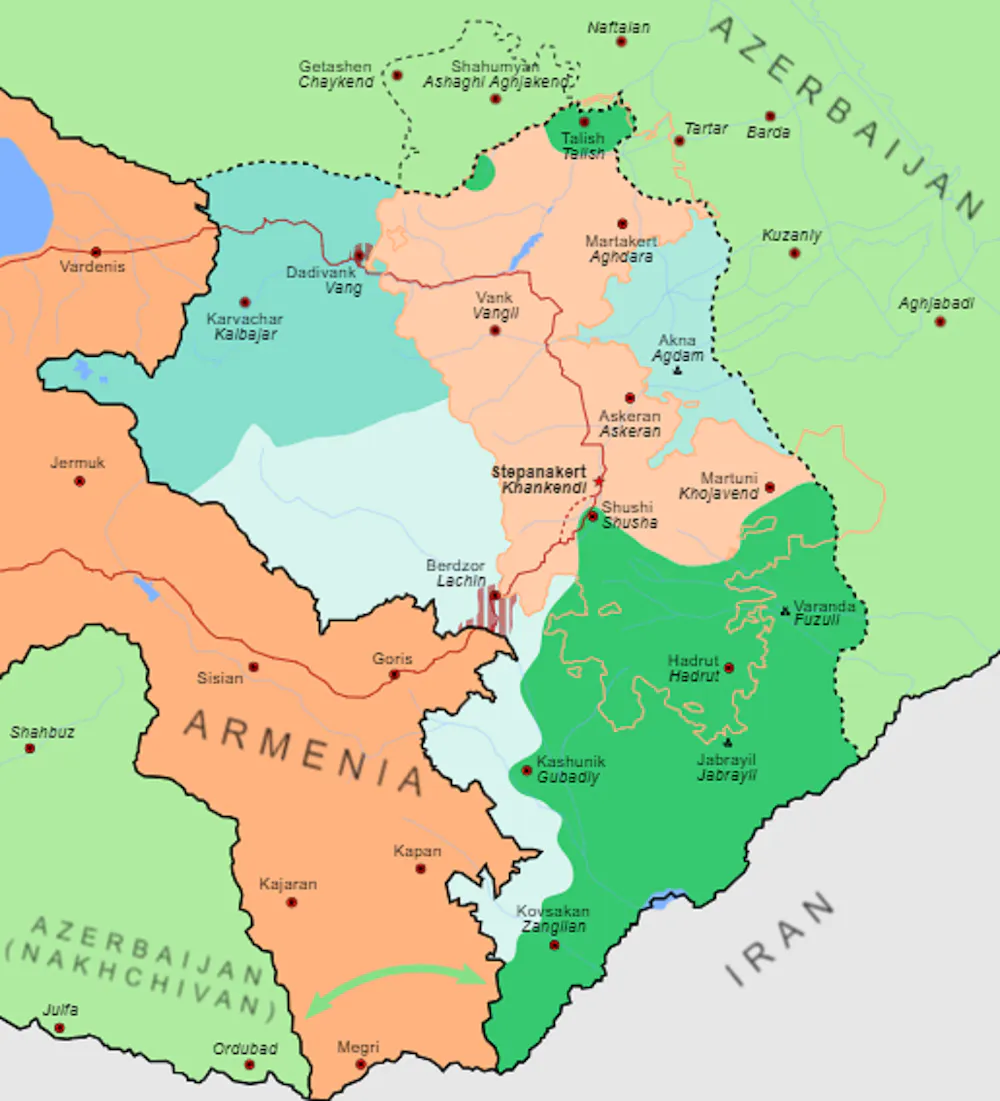
During the Soviet era, the union republics of Armenia and Azerbaijan both felt that Moscow favoured the other. Armenia was unhappy that the Soviet leadership allocated Nagorno-Karabakh, a majority-Armenian exclave surrounded by Azeri-populated lands, to Azerbaijan. Azerbaijan was dissatisfied that its borders denied it a land connection to its population in Nakhchivan, an exclave of ethnic Azeris that could only be reached via southern Armenia.
In the final years of the Soviet Union, as Armenian nationalism began to assert itself during the period of perestroika (restructuring), Nagorno-Karabakh’s legislature passed a law declaring its intention to join Armenia. This move eventually led to armed clashes in the region.
The first Karabakh war, which raged between 1988 and 1994, began before the Soviet break-up but continued after the two countries gained their independence. In 1994, after more than 30,000 casualties, Russia brokered a ceasefire. The settlement favoured Armenia, leaving it in control of Nagorno-Karabakh and another six surrounding Azerbaijani districts.
Things began to change when Putin took power in Russia in 2000. Russia’s relations with Azerbaijan improved, partly due to his personal rapport with the then-president, Heydar Aliyev, and his son Ilham, who would succeed him in 2003. After 9/11, when combating international terrorism became a global priority, Azerbaijan put measures in place to prevent transfer of fighters and weapons through its territory to the war in Chechnya, which further improved relations with Moscow.
At this stage, Azerbaijan was pursuing what it described as a “multi-vector” foreign policy. This allowed it to develop ties with a variety of countries, including the US, Russia and others to whom it sold oil. While remaining in the Commonwealth of Independent States, it did not sign up to the Russia-led Collective Security Treaty Organisation (CSTO).
Nagorno-Karabakh
Armenia, by contrast, was a fully participating member of the CSTO. Having signed an Eternal Friendship Treaty with Russia in 1997, this was a clear strategic choice for Armenia – partly motivated by historical ties.
Russia had traditionally been seen as a defender of Christianity in the days of the Ottomon empire. Many people had fled massacres in Western Armenia (modern-day Turkey) in 1915 to come under the protection of the Russian Tsar. But Armenia also saw Moscow as a vital security guarantor against an increasingly militarised Azerbaijan, which was determined to recover control of Nagorno-Karabakh and other areas occupied by Armenia.
Map showing the concept of the ‘Zanzegur corridor’, which would cut across southernmost Armenia to connect Azerbaijan with Nakhchivan. Mapeh/Wikimedia Commons, CC BY-NC
Indeed, it was Nagorno-Karabakh which really soured relations between Armenia and Moscow. In 2020, when – aided by Turkey – Azerbaijan launched its offensive to retake the territory, Russia failed to come to the aid of its CSTO ally. This was expected, given that relations had begun to deteriorate in 2018 when Pashinyan came to power in Armenia.
In hindsight, most commentators believe Russia had become tired of Armenia’s intransigence over the plan, agreed in Madrid in 2007, for it to cede back the six districts surrounding Nagorno-Karabakh to Azerbaijan.
Instead, Moscow brokered a ceasefire agreement and deployed 2,000 peacekeepers along the Lachin corridor, a strip of land connecting Armenia and Nagorno-Karabakh. But these troops also failed to intervene when an Azeri offensive retook the whole of Nagorno-Karabakh in September 2023, forcing the population of about 100,000 ethnic Armenians to flee.
Relations between Russia and Azerbaijan, meanwhile, have gone downhill rapidly. In December 2024, an Azeri civilian airliner was shot down in Russian airspace. Putin apologised, but Azerbaijan insisted on Moscow disclosing the results of the investigation and paying compensation to the victims.
Things got worse at the end of June, when Russian authorities arrested a group of ethnic Azerbaijanis as part of a decades-old murder case. Two of the men died while being detained. Azerbaijan retaliated by raiding the Baku offices of Russia’s Sputnik news agency and detaining the staff as well as a group of Russian IT workers. When they appeared in court, some of the men appeared to have been beaten in custody.
Azerbaijan also denounced Russia in state media and Russia House, the state-funded Russian cultural agency in Baku, was closed down, with several cultural events cancelled. Security agencies began to enforce documentation checks on all Russian nationals in the country.
At the same time, Azerbaijan and Armenia were already talking about concluding a peace treaty independently, without intermediaries. All this has prompted speculation of a serious loss of influence in the region for Moscow.
However, a complete shutout of Russia in the South Caucasus is unlikely. Both Armenia and Azerbaijan depend on remittance income from their nationals in Russia. Both countries also remain close trading partners with Russia. While Armenia suspended its membership in CSTO, it has not quit the organisation altogether.
Far more likely is that the two countries, mindful of the growing influence of Turkey in the region and the shifts created by Donald Trump in world affairs, are manoeuvring while weighing their options. Geography matters, as Georgia’s example demonstrates – efforts to cut ties with Russia by its former president, Mikheil Saakashvili, have been partially reversed by the current government, which increasingly leans towards Moscow.
In the cases of Armenia and Azerbaijan, economic ties, transport links and human connections still favour a relationship with Russia. So, a temporary breakdown in political relations can be mended – if all three leaders demonstrate enough statesmanship to sail through the troubled waters.
Get your news from actual experts, straight to your inbox.Sign up to our daily newsletter to receive all The Conversation UK’s latest coverage of news and research, from politics and business to the arts and sciences.
Anna Matveeva does not work for, consult, own shares in or receive funding from any company or organisation that would benefit from this article, and has disclosed no relevant affiliations beyond their academic appointment.
The retirement age keeps creeping up. In the UK, the state pension is currently paid to people at 66, but that’s set to rise to 67 in the next couple of years, and a move to 68 might come sooner than previously planned after the government launched a review.
Gradually increasing the working lifespan is never going to be popular. But one way of making this policy more palatable could be to give people early access to some of the free time that retirement promises.
After all, sometimes that promise fails to deliver, because many people die before they reach retirement age.
Globally, about 27% of men and 18% women die before the age of 65 (although this proportion also includes deaths before working age). In wealthy countries, the number of people who die prematurely is lower than the global average, but still significant. In the EU, 16% of men and 8% of women die before 65.
For these people, the promise of free time and leisure in old age never materialises. There will also be many whose physical and mental health will have deteriorated by the time they retire, so that they are less capable of enjoying their free time.
So perhaps slogging away until retirement is not an ideal arrangement.
But what if you could transfer some of the time off that retirement promises to an earlier stage of your life, when everything is a rush, crammed with the demands of work and domestic responsibilities?
Luckily, the stark contrast between a time-poor middle age and a time-rich old age is not unavoidable. Governments can choose different approaches that directly affect how free time is distributed across our life stages.
Japan, for example, is a country which has opted to focus on delaying leisure time, and encourages workers to postpone that enjoyment of free time until old age. It does this in part by rewarding workers with wage increases – known as “seniority-based pay” – if they don’t take career breaks.
Japanese employment law also permits companies to force employees to retire at the age 60. As a result, on average, Japanese workers work 1,680 hours per year and retire at 63.
In the Netherlands by contrast, people work less (1,433 hours per year) and retire later – at 67. Labour laws make it easier for employees to decrease their hours, by going part time, for example.
Discrimination between workers based on work hours is prohibited, so that those who opt for part-time work are guaranteed equal treatment with regard to wages and other benefits. But the high legal age of retirement discourages Dutch workers from early retirement.
So how should we assess these different approaches?
Time on your side?
One way to look at retirement is that it compensates us for our previous hard work. The prospect of compensation might lead us to adopt a relaxed attitude toward long work hours. Once we’ve stopped work, we’ll be rewarded with a large chunk of leisure.
But for those who don’t make it to retirement, this promise of a life of leisure turns out to be a cruel joke. Early deaths are also more prominent among those who have already suffered from poverty and other disadvantages.
The same is true for ill health. The disadvantaged are much more likely to suffer from a variety of conditions that prevent them from being able to fully enjoy retirement.
Another risk for those who are healthy when they retire is that relatives or friends may have died. This reduces the value of the retirees’ free time because the loved ones they hoped to share that time with are no longer around.
So perhaps some of that free time could be better used when workers are younger. Raising a family, for example, is extremely time consuming, and there can’t be many parents of young children who don’t wish for a few extra hours a week to call their own.
Even devoting time to hobbies when we’re younger might be considered more efficient than waiting until we have retired. After all, if you learn a new language or how to paint when you’re in your 40s, you may have much more time to enjoy your new skill over the ensuing decades.
My research suggests that for all these reasons, the state should help people take some of their retirement early.
None of us knows how long we will live, or how healthy we will be in the future. Faced with this uncertainty, it makes sense not to gamble with our opportunities for free time and leave it until it may be too late.
Even those who enjoy their work have strong reasons not to postpone a large proportion of their time off, and governments should help us access more of it while we’re younger.
Get your news from actual experts, straight to your inbox.Sign up to our daily newsletter to receive all The Conversation UK’s latest coverage of news and research, from politics and business to the arts and sciences.
Malte Jauch does not work for, consult, own shares in or receive funding from any company or organisation that would benefit from this article, and has disclosed no relevant affiliations beyond their academic appointment.
Source: The Conversation – UK – By Anna Matveeva, Visiting Senior Research Fellow, King’s Russia Institute, King’s College London
At a time when Vladimir Putin needs friends in his neighbourhood, he appears instead to be losing them in the South Caucasus. After two centuries of Russian involvement in the region, balancing the historical rivalry and at times acting as mediator between Armenia and Azerbaijan, there is growing speculation that the two countries are preparing a major reset in relations.
When Armenia’s prime minister, Nikol Pashinyan, met the Azerbaijani president, Ilham Aliyev, in Abu Dhabi on July 10, they reportedly came close to agreeing a peace treaty. The big question is whether, if these two countries can iron out mistrust and violence born of the territorial conflict, there will still be a role for Russia in the South Caucasus.
To understand the complex geopolitics of the region, you need to go back to the early 19th century, when Azerbaijan and what is now the Republic of Armenia) were ceded to Russia following the Russo-Persian wars. After the Russian revolution, the two countries achieved brief independence between 1918 and 1920 (though not in their present borders) before being incorporated into the Soviet Union.
During the Soviet era, the union republics of Armenia and Azerbaijan both felt that Moscow favoured the other. Armenia was unhappy that the Soviet leadership allocated Nagorno-Karabakh, a majority-Armenian exclave surrounded by Azeri-populated lands, to Azerbaijan. Azerbaijan was dissatisfied that its borders denied it a land connection to its population in Nakhchivan, an exclave of ethnic Azeris that could only be reached via southern Armenia.
In the final years of the Soviet Union, as Armenian nationalism began to assert itself during the period of perestroika (restructuring), Nagorno-Karabakh’s legislature passed a law declaring its intention to join Armenia. This move eventually led to armed clashes in the region.
The first Karabakh war, which raged between 1988 and 1994, began before the Soviet break-up but continued after the two countries gained their independence. In 1994, after more than 30,000 casualties, Russia brokered a ceasefire. The settlement favoured Armenia, leaving it in control of Nagorno-Karabakh and another six surrounding Azerbaijani districts.
Things began to change when Putin took power in Russia in 2000. Russia’s relations with Azerbaijan improved, partly due to his personal rapport with the then-president, Heydar Aliyev, and his son Ilham, who would succeed him in 2003. After 9/11, when combating international terrorism became a global priority, Azerbaijan put measures in place to prevent transfer of fighters and weapons through its territory to the war in Chechnya, which further improved relations with Moscow.
At this stage, Azerbaijan was pursuing what it described as a “multi-vector” foreign policy. This allowed it to develop ties with a variety of countries, including the US, Russia and others to whom it sold oil. While remaining in the Commonwealth of Independent States, it did not sign up to the Russia-led Collective Security Treaty Organisation (CSTO).
Nagorno-Karabakh
Armenia, by contrast, was a fully participating member of the CSTO. Having signed an Eternal Friendship Treaty with Russia in 1997, this was a clear strategic choice for Armenia – partly motivated by historical ties.
Russia had traditionally been seen as a defender of Christianity in the days of the Ottomon empire. Many people had fled massacres in Western Armenia (modern-day Turkey) in 1915 to come under the protection of the Russian Tsar. But Armenia also saw Moscow as a vital security guarantor against an increasingly militarised Azerbaijan, which was determined to recover control of Nagorno-Karabakh and other areas occupied by Armenia.
Map showing the concept of the ‘Zanzegur corridor’, which would cut across southernmost Armenia to connect Azerbaijan with Nakhchivan. Mapeh/Wikimedia Commons, CC BY-NC
Indeed, it was Nagorno-Karabakh which really soured relations between Armenia and Moscow. In 2020, when – aided by Turkey – Azerbaijan launched its offensive to retake the territory, Russia failed to come to the aid of its CSTO ally. This was expected, given that relations had begun to deteriorate in 2018 when Pashinyan came to power in Armenia.
In hindsight, most commentators believe Russia had become tired of Armenia’s intransigence over the plan, agreed in Madrid in 2007, for it to cede back the six districts surrounding Nagorno-Karabakh to Azerbaijan.
Instead, Moscow brokered a ceasefire agreement and deployed 2,000 peacekeepers along the Lachin corridor, a strip of land connecting Armenia and Nagorno-Karabakh. But these troops also failed to intervene when an Azeri offensive retook the whole of Nagorno-Karabakh in September 2023, forcing the population of about 100,000 ethnic Armenians to flee.
Relations between Russia and Azerbaijan, meanwhile, have gone downhill rapidly. In December 2024, an Azeri civilian airliner was shot down in Russian airspace. Putin apologised, but Azerbaijan insisted on Moscow disclosing the results of the investigation and paying compensation to the victims.
Things got worse at the end of June, when Russian authorities arrested a group of ethnic Azerbaijanis as part of a decades-old murder case. Two of the men died while being detained. Azerbaijan retaliated by raiding the Baku offices of Russia’s Sputnik news agency and detaining the staff as well as a group of Russian IT workers. When they appeared in court, some of the men appeared to have been beaten in custody.
Azerbaijan also denounced Russia in state media and Russia House, the state-funded Russian cultural agency in Baku, was closed down, with several cultural events cancelled. Security agencies began to enforce documentation checks on all Russian nationals in the country.
At the same time, Azerbaijan and Armenia were already talking about concluding a peace treaty independently, without intermediaries. All this has prompted speculation of a serious loss of influence in the region for Moscow.
However, a complete shutout of Russia in the South Caucasus is unlikely. Both Armenia and Azerbaijan depend on remittance income from their nationals in Russia. Both countries also remain close trading partners with Russia. While Armenia suspended its membership in CSTO, it has not quit the organisation altogether.
Far more likely is that the two countries, mindful of the growing influence of Turkey in the region and the shifts created by Donald Trump in world affairs, are manoeuvring while weighing their options. Geography matters, as Georgia’s example demonstrates – efforts to cut ties with Russia by its former president, Mikheil Saakashvili, have been partially reversed by the current government, which increasingly leans towards Moscow.
In the cases of Armenia and Azerbaijan, economic ties, transport links and human connections still favour a relationship with Russia. So, a temporary breakdown in political relations can be mended – if all three leaders demonstrate enough statesmanship to sail through the troubled waters.
Get your news from actual experts, straight to your inbox.Sign up to our daily newsletter to receive all The Conversation UK’s latest coverage of news and research, from politics and business to the arts and sciences.
Anna Matveeva does not work for, consult, own shares in or receive funding from any company or organisation that would benefit from this article, and has disclosed no relevant affiliations beyond their academic appointment.
The retirement age keeps creeping up. In the UK, the state pension is currently paid to people at 66, but that’s set to rise to 67 in the next couple of years, and a move to 68 might come sooner than previously planned after the government launched a review.
Gradually increasing the working lifespan is never going to be popular. But one way of making this policy more palatable could be to give people early access to some of the free time that retirement promises.
After all, sometimes that promise fails to deliver, because many people die before they reach retirement age.
Globally, about 27% of men and 18% women die before the age of 65 (although this proportion also includes deaths before working age). In wealthy countries, the number of people who die prematurely is lower than the global average, but still significant. In the EU, 16% of men and 8% of women die before 65.
For these people, the promise of free time and leisure in old age never materialises. There will also be many whose physical and mental health will have deteriorated by the time they retire, so that they are less capable of enjoying their free time.
So perhaps slogging away until retirement is not an ideal arrangement.
But what if you could transfer some of the time off that retirement promises to an earlier stage of your life, when everything is a rush, crammed with the demands of work and domestic responsibilities?
Luckily, the stark contrast between a time-poor middle age and a time-rich old age is not unavoidable. Governments can choose different approaches that directly affect how free time is distributed across our life stages.
Japan, for example, is a country which has opted to focus on delaying leisure time, and encourages workers to postpone that enjoyment of free time until old age. It does this in part by rewarding workers with wage increases – known as “seniority-based pay” – if they don’t take career breaks.
Japanese employment law also permits companies to force employees to retire at the age 60. As a result, on average, Japanese workers work 1,680 hours per year and retire at 63.
In the Netherlands by contrast, people work less (1,433 hours per year) and retire later – at 67. Labour laws make it easier for employees to decrease their hours, by going part time, for example.
Discrimination between workers based on work hours is prohibited, so that those who opt for part-time work are guaranteed equal treatment with regard to wages and other benefits. But the high legal age of retirement discourages Dutch workers from early retirement.
So how should we assess these different approaches?
Time on your side?
One way to look at retirement is that it compensates us for our previous hard work. The prospect of compensation might lead us to adopt a relaxed attitude toward long work hours. Once we’ve stopped work, we’ll be rewarded with a large chunk of leisure.
But for those who don’t make it to retirement, this promise of a life of leisure turns out to be a cruel joke. Early deaths are also more prominent among those who have already suffered from poverty and other disadvantages.
The same is true for ill health. The disadvantaged are much more likely to suffer from a variety of conditions that prevent them from being able to fully enjoy retirement.
Another risk for those who are healthy when they retire is that relatives or friends may have died. This reduces the value of the retirees’ free time because the loved ones they hoped to share that time with are no longer around.
So perhaps some of that free time could be better used when workers are younger. Raising a family, for example, is extremely time consuming, and there can’t be many parents of young children who don’t wish for a few extra hours a week to call their own.
Even devoting time to hobbies when we’re younger might be considered more efficient than waiting until we have retired. After all, if you learn a new language or how to paint when you’re in your 40s, you may have much more time to enjoy your new skill over the ensuing decades.
My research suggests that for all these reasons, the state should help people take some of their retirement early.
None of us knows how long we will live, or how healthy we will be in the future. Faced with this uncertainty, it makes sense not to gamble with our opportunities for free time and leave it until it may be too late.
Even those who enjoy their work have strong reasons not to postpone a large proportion of their time off, and governments should help us access more of it while we’re younger.
Get your news from actual experts, straight to your inbox.Sign up to our daily newsletter to receive all The Conversation UK’s latest coverage of news and research, from politics and business to the arts and sciences.
Malte Jauch does not work for, consult, own shares in or receive funding from any company or organisation that would benefit from this article, and has disclosed no relevant affiliations beyond their academic appointment.
Source: United Kingdom – Executive Government & Departments
Press release
Prime Minister Keir Starmer’s statement on Gaza: 25 July 2025
Prime Minister Keir Starmer’s statement on the situation in Gaza.
The appalling scenes in Gaza are unrelenting. The continued captivity of hostages, the starvation and denial of humanitarian aid to the Palestinian people, the increasing violence from extremist settler groups, and Israel’s disproportionate military escalation in Gaza are all indefensible.
Alongside our closest allies, I am working on a pathway to peace in the region, focused on the practical solutions that will make a real difference to the lives of those that are suffering in this war.
That pathway will set out the concrete steps needed to turn the ceasefire so desperately needed, into a lasting peace.
Recognition of a Palestinian state has to be one of those steps. I am unequivocal about that. But it must be part of a wider plan which ultimately results in a two-state solution and lasting security for Palestinians and Israelis. This is the way to ensure it is a tool of maximum utility to improve the lives of those who are suffering – which of course, will always be our ultimate goal.
Source: United Kingdom – Executive Government & Departments
Press release
E3 Leaders’ Statement on the Situation in Gaza and the West Bank: 25 July 2025
E3 Leaders’ Statement on the Situation in Gaza and the West Bank.
The time has come to end the war in Gaza. We urge all parties to bring an end to the conflict by reaching an immediate ceasefire. We call for the immediate and unconditional release of all hostages who have been held captive by Hamas since October 7, 2023. A negotiated ceasefire is the best chance to bring the hostages home, end the anguish of their families and finally bring relief to the civilian population in Gaza. The disarmament of Hamas is imperative, and Hamas must have no role in the future of Gaza. We reaffirm our commitment to supporting the diplomatic efforts of the United States, Qatar, and Egypt.
The humanitarian catastrophe that we are witnessing in Gaza must end now. The most basic needs of the civilian population, including access to water and food, must be met without any further delay. Withholding essential humanitarian assistance to the civilian population is unacceptable. We call on the Israeli Government to immediately lift restrictions on the flow of aid and urgently allow the UN and humanitarian NGOs to carry out their work in order to take action against starvation. Israel must uphold its obligations under international humanitarian law.
We firmly oppose all efforts to impose Israeli sovereignty over the Occupied Palestinian Territories. Threats of annexation, settlements and acts of settler violence against Palestinians undermine the prospects for a negotiated two-state solution.
We are committed to working together with our international partners including at the United Nations to develop a specific and credible plan for the next phase in Gaza that will put in place transitional governance and security arrangements, and ensure the delivery of humanitarian aid at scale. This must be accompanied by the withdrawal of Israeli forces and the removal of Hamas leadership, as key steps towards a negotiated two-state solution.
We stand ready to take further action to support an immediate ceasefire and a political process that leads to lasting security and peace for Israelis, Palestinians and the entire region.
Baltimore, Maryland – Today, Evan Strauss, 27, of Moneta, Virginia, pled guilty to conspiracy, cyberstalking, interstate threatening communications, and threats to damage or destroy by means of fire and explosives.
Kelly O. Hayes, U.S. Attorney for the District of Maryland, announced the guilty plea with Acting Special Agent in Charge Amanda M. Koldjeski, Federal Bureau of Investigation (FBI) – Baltimore Field Office.
According to the guilty plea, Strauss helped create and operate an online group known as “Purgatory.” The group used multiple online social-media platforms, including Telegram and Instagram, to coordinate and plan swatting and doxxing activities and to announce and brag about swats that they conducted.
“Swatting” is a term used to describe a criminal incident in which an individual contacts emergency services and falsely reports an emergency, often involving an act of violence that reportedly has or will occur at a particular location to elicit an armed law enforcement response to that location. “Doxxing” is a term used to describe the practice of — searching for and publishing on the Internet — personal, private, or identifying information about an individual with malicious intent, such as providing the information for the purpose of facilitating the swatting of the individual.
From December 10, 2023, through January 18, 2024, Strauss and his co-conspirators, including a co-conspirator who resided in Hagerstown, Maryland, and made calls from Maryland, placed swatting calls to police and other emergency response departments. One or more of the conspirators, acting with the intent to threaten, intimidate, and harass individuals and entities, falsely reported emergencies in the form of violent acts at particular locations to cause armed law enforcement responses.
Strauss and his co-conspirators often used shared scripts to plan and coordinate their conduct. They then called police departments using Voice over Internet Protocol (VOIP) services to obscure their phone numbers and identities.
As part of the scheme, Strauss called the Newark Delaware Police Department and falsely claimed that he heard a man firing shots in a school hallway. Moments later, the Maryland co-conspirator called the department again, threatening to shoot a specific Newark High School teacher and kill students. As a result of these calls, which occurred in the middle of the school day, authorities placed the school on lockdown as police officers rushed to respond. Later the same day, Strauss and other conspirators bragged about the incident and posted images from the resulting news coverage onto their group’s social media accounts.
Strauss encouraged a Purgatory conspirator to “shut down” an airport. Following Strauss’ urging, the conspirator used a VOIP number to call the Albany Police Department in Albany, New York, stating he was going to the Albany International Airport to “shoot everybody up” and that his “friend” was going to set off bombs in the airport. Police units then rushed to respond to these threats.
Additionally, as part of this scheme, the Maryland co-conspirator called the Houston County Sheriff’s Office in Dothan, Alabama, and threatened to burn down part of a residential trailer park and kill any law enforcement officers who arrived to respond to the threat.
Strauss faces a maximum sentence of 10 years in federal prison for each count of threatening to damage or destroy by fire or explosive and a maximum sentence of five years in federal prison for conspiracy, cyberstalking, and interstate threats. Co-conspirators Brayden Grace, 19, of Columbus, Ohio, and Owen Jarboe, 19, of Hagerstown, Maryland, pled guilty earlier this year and are awaiting sentencing.
Actual sentences for federal crimes are typically less than the maximum penalties. A federal district court judge determines sentencing after considering the U.S. Sentencing Guidelines and other statutory factors. Sentencing is scheduled for Thursday, November 6, at 10 a.m.
U.S. Attorney Hayes commended the FBI for its work in the investigation. Additionally, Ms. Hayes praised the Joint Terrorism Task Force, Columbus; Ohio Police Department; Newark, Delaware Police Department; Lenoir City, Tennessee Police Department; Albany, New York Police Department; Albany County, New York Sheriff’s Office; Fairburn City, Georgia Police Department; Bethel Park, Pennsylvania Police Department; Giles County, Virginia Sheriff’s Office; Blue Springs, Missouri Police Department; Tarboro, North Carolina Police Department; Boston, Massachusetts Police Department; Dodge County, Georgia Sheriff’s Office; Houston County, Alabama Sheriff’s Office; and the FBI’s Mobile, Richmond, Boston, Charlotte, and Cincinnati Field Offices for their valuable assistance. Ms. Hayes also thanked Assistant U.S. Attorneys Robert I. Goldaris and Patricia C. McLane who are prosecuting the case.
Source: United States Senator Pete Ricketts (Nebraska)
WASHINGTON, D.C. – This week, U.S. Senator Pete Ricketts (R-NE) introduced the Tracking Hostile Industry Networks and Kit while Thwarting Weapons Imports from Chinese Entities (THINK TWICE) Act of 2025. The THINK TWICE Act would require an assessment of arms sales by Communist China and a strategy to dissuade countries from buying Chinese weapons systems and defense equipment. The legislation was also sponsored by Senator Michael Bennet (D-CO).
“Communist China has emerged as a major weapons supplier. This is particularly true in Africa, the Middle East, and Asia,” said Ricketts. “This development has major implications for American defense companies, our military operations, and our global security partnerships. The recent Pakistan-India clash saw significant use of Chinese-made weapons. This should be a major wake-up call that we must do more to combat these arms sales. That’s why I’ve introduced the THINK TWICE Act. This act requires a coordinated strategy to dissuade new purchases of Chinese-made weapons. It will also ensure our defense industrial base is better equipped to provide alternatives to prospective buyers.”
“As China wields arms sales to reshape the international system in Beijing’s image, the United States must reassert its role as a security partner of choice,” said Bennet. “This legislation is an essential step toward countering China’s expanding military footprint and geopolitical influence.”
The THINK TWICE Act would:
Requires the Secretary of Defense, in coordination with the Secretary of State, to report on arms sales facilitated by entities of the People’s Republic of China (PRC). The report requires inclusion of:
The specific weapons systems, technical aspects, and capabilities of those weapons;
The countries mostly likely to procure weapons systems;
The weapons that present the greatest security risks regarding the potential to collect intelligence on or compromise U.S. platforms;
The factors that incentivize countries to procure Chinese weapons;
And the PRC’s strategy regarding arms sales.
Requires the Secretary of State, in coordination with the Secretary of Defense, to develop a strategy to dissuade purchases of new weapons systems and defense equipment from the PRC. The strategy would include:
An information campaign to warn countries interested in procuring weapons systems and defense equipment originating from China about risks;
A description of actions the U.S. can take, including FMS reforms, commercial sales, and foreign military financing;
An analysis of whether sanctions or economic restrictions targeting potential buyers could be used as an effective deterrent;
A plan to ensure sufficient representation of defense firms of the U.S. or trusted allies at defense trade shows;
And a plan to combat Chinese disinformation campaigns targeting the performance of Western weapons.
BACKGROUND:
Communist China is now the fourth largest arms exporter behind the U.S., Russia, and France. In recent years, Chinese-made drones, missiles, and fighter jets have been exported to 44 countries. All around the world, Communist China uses arms sales to promote strategic interests, improve its military’s image and reputation, acquire performance data of Chinese-made weapons in contested environments, exacerbate tensions between the U.S. and traditional security partners, and gain a foothold for further defense and security cooperation. With Russia unable to facilitate arms sales given its war of aggression in Ukraine, an opportunity has arisen for Communist China to fill the void.
Bill text can be found here.
Two teenagers, who brutally stabbed a 14-year-old boy, have been jailed after detectives from the Metropolitan Police Service conducted a thorough investigation. Following the sentencing hearing, the victim’s mother made a heart-rendering plea for young teenagers to stop carrying knives as she spoke of her immense grief.
Kelyan Bokassa was stabbed by the pair as he was sat on a bus in Woolwich in January of this year. Despite the best efforts from officers and paramedics at the scene, Kelyan tragically lost his young life.
Two 16-year-old boys, who cannot be named for legal reasons, were both sentenced at the Old Bailey to a minimum of 15 years, 10 months for murder. They received an additional 12-month sentence for possession of a knife which will run concurrent.
The teenagers previously pleaded guilty to Keyan’s murder at the same court on Friday, 23 May.
Detective Chief Inspector Sarah Lee, whose team led the Met investigation, said: “This case has been deeply troubling for all involved and our thoughts remain with Kelyan’s family and loved ones.
“The harsh reality in London is that violence disproportionately affects young black men and boys. The fact we’re seeing so many teenagers like Kelyan die should be at the forefront of the minds of every politician, every policy maker and everyone who wants better for children growing up in London. Without this collective effort, we won’t be able to tackle knife crime in its entirety.
“And while I am pleased that Keylan’s mother, Marie, has been spared the emotional turmoil of a trial, I know that she still desperately seeks to understand why three young lives could be considered so disposable.
“Finally, I would like to recognise the members of the public that comforted Kelyan in his final moments and the witnesses who entrusted my investigation team with their testimonies. It was your bravery that helped us secure justice. Thank you.”
Marie Bokassa, Kelyan’s mother, said: “My child had a name, it was Kelyan, a future, a heartbeat full of hope. That life was not theirs to take. That moment of violence may have lasted seconds, but the consequences are eternal. They didn’t just take a life; they shattered an entire world. They broke a family, they buried a future, and they left me, a mother dead inside with wounds no justice can ever heal.
“To the young people who carry knives, I beg you to stop, before you raise that blade, think of your own mother, think of the mothers who will cry every night like I do, who will scream into her pillow, who will walk past her child’s empty room and collapse with grief. Don’t let a moment of anger steal your future. Don’t let the streets raise you in a way your mother never would.
“Knife crime is not just statistics to us, its caskets, flowers, funerals. Our children being buried before their parents.”
On the afternoon of Tuesday, 7 January, passengers flagged down passing police officers after Kelyan was stabbed on bus travelling on Woolwich Church Street. These officers began performing emergency first-aid on Kelyan, before the arrival of paramedics. He sadly died a short while later.
An investigation commenced and detectives quickly recovered bus CCTV and witnessed the two teenagers board the bus, making their way to the top deck.
One of the 16-year-old boys could be seen smiling as he recognised Kelyan. Only seconds later both boys produced machetes and launched into a violent ambush.
Kelyan has been stabbed more than eight times, although CCTV showed that they had made more than 27 attempts to wound him.
Audio from the bus highlighted the terror of the incident as screams from members of the public could be heard, as many attempted to flea the frenzied attack.
The pair then fled the scene. Officers traced their movements, with CCTV showing them discard the murder weapon into the river.
Following a manhunt, both were arrested an address in Eltham during the early hours of Wednesday, 15 January.
MONTGOMERY – Governor Kay Ivey on Friday announced the appointment of Deborah Denise Tillman as Mobile County District Judge.
“Deborah Tillman possesses a tremendous background in the law spanning 35 years, beginning with her service as a Staff Judge Advocate in the United States Air Force to subsequent decades of experience in the Mobile County District Attorney’s office,” said Governor Ivey. “As a former state, federal and military prosecutor, her legal knowledge will serve the Court and the people of Mobile County well.”
“I am extremely honored, humbled and grateful to Governor Ivey for appointing me to be the next District Court Judge in Mobile County,” said Tillman. “While my role will change in the courtroom, my commitment to the rule of law and to serve the great people of Mobile County with honor and integrity will not. I look forward to joining the distinguished group of Judges who comprise the 13th Judicial Circuit of Mobile County.”
Tillman will fill the vacancy on the Court left after the resignation of District Judge Spiro Cheriogotis.
Tillman began her legal career in the U.S. Air Force rising to the rank of Captain and was Honorably Discharged in 1995. Afterward, she devoted several decades as Assistant District Attorney and Chief District Attorney for the 13th Judicial Circuit in Mobile County. She also held the position of Assistant United States Attorney in the Northern District of Florida. Over her extensive career, she prosecuted thousands of felony and misdemeanor cases in state and federal courts. Additionally, she taught criminal law, contracts and civil procedure as an adjunct professor in the paralegal studies division at the University of South Alabama.
A Mobile native, Tillman is a 1985 graduate of Spring Hill College. She received her Juris Doctorate from Mercer University’s Walter F. George School of Law in Macon, Georgia in 1989.
Tillman’s appointment is effective immediately.
Tillman’s official photo is attached.
Governor Ivey made 36 other appointments. A list of those appointments is attached.