Category: Europe

  • MIL-OSI Europe: Written question – Rise in THC and smart vapes on the European single market – E-002133/2025

    Source: European Parliament

    Question for written answer  E-002133/2025
    to the Commission
    Rule 144
    Liesbet Sommen (PPE)

    There has been a worrying increase in the number of illegal e-cigarettes (vapes) on the European single market, including products that do not comply with EU standards. Some contain more nicotine than declared, or are sold as being nicotine-free when they do in fact contain nicotine. In addition, inferior combustion mechanisms in certain appliances lead to elevated concentrations of heavy metals such as copper, mercury, cadmium, zinc and lead – which pose serious health risks, especially for young people.

    Two new trends are also worthy of note: Smart vapes, which are linked to gaming devices that reinforce addictive behaviour (a combination of gaming and nicotine addiction), and THC vapes, which allow the psychoactive compound THC from cannabis to be consumed in a cheap, discreet and odourless way. Despite bans in many Member States, these products are widely available.

    • 1.The current regulatory framework is clearly inadequate. What is the European Commission doing to address the growing availability of illegal and harmful vapes among teenagers in the internal market?
    • 2.Is the Commission considering funding research into the health impact of vape products through Horizon Europe?
    • 3.Why has no revision of Directive 2014/40/EU on tobacco products been proposed yet? When will the Commission take action to address these worrying developments?

    Submitted: 28.5.2025

    Last updated: 6 June 2025

    MIL OSI Europe News

  • MIL-OSI United Kingdom: Tackling fuel poverty in privately rented homes

    Source: Scottish Government

    Proposals for minimum standards of energy efficiency

    Private rented homes could be subject to a Minimum Energy Efficiency Standard (MEES) from 2028 to support efforts to tackle fuel poverty and reduce emissions that contribute to climate change.

    Under proposals published today, regulations would be brought forward under existing powers requiring privately rented properties, as far as possible, to reach the reformed EPC Heat Retention Rating (HRR) band C from 2028 for new tenancies and by 2033 for all privately rented homes.

    In 2022 there were 300,000 privately rented properties in Scotland. The regulations would prohibit the letting of properties which fall below the minimum standard of energy efficiency, until the landlord has made any relevant energy efficiency improvements.

    The current system of Energy Performance Certificates (EPC) is due to be revised and updated from 2026 with a new set of ratings to give clearer information on the fabric energy efficiency of a property; the emissions, efficiency and running costs of its heating system; and the cost of energy to run the home.

    Alasdair Allan, Acting Minister for Climate Action said:

    “It is vital that we find the right balance to both reach net zero by 2045 and reduce fuel poverty. Improving energy efficiency is one of the levers available to the Scottish Government that enables this dual progress.

    “The lowest rates of fuel poverty are associated with higher energy efficiency standards. A majority of privately rented properties are already at a good standard of energy efficiency, based on the current EPC regime, but others still need improvement to bring them closer to reaching a good level.

    “These proposals will improve those homes, reduce energy costs for tenants and support the transition to clean heating – which we will be further strengthening through the Heat in Buildings Bill that we have committed to bring forward later this year. Installing better insulation and other energy efficiency measures will also benefit people’s health, by reducing the risk of cold and dampness-related conditions.

    “The Scottish Government continues to offer a wide range of support to people and organisations looking to move to clean heating or improve energy efficiency, including to private landlords.”

    Exemptions are proposed to provide protection to landlords in situations where they are prevented from obtaining third party consent or permissions to carry out work; and where undertaking work could have a negative impact on the fabric or structure of the property.

    Previous proposals to regulate energy efficiency for the private rented sector were put forward in 2020 but withdrawn as a consequence of the Covid-19 pandemic.

    Background

    Also published today are proposals for a Heat and Energy Efficiency Technical Suitability Assessment, which could support consumers by providing further evidence, beyond the EPC system, of which energy efficiency or clean heating system measures are technically suitable for their home or building, and which may not be. This optional assessment would support in particular those in buildings which are more complex to decarbonise such as tenements, traditional and protected buildings.

    Consultation on Draft Energy Efficiency (Domestic Private Rented Property) (Scotland) Regulations

    Heat & Energy Efficiency Technical Suitability Assessment (HEETSA) – Scoping Consultation

    Private Rented Sector Landlord Loan Scheme

    Warmer Homes Scotland

    Energy efficiency: Area Based Schemes

    Withdrawn regulations: The Energy Efficiency (Domestic Private Rented Property) (Scotland) Regulations 2020

    MIL OSI United Kingdom

  • MIL-OSI Russia: Wang Yi to Attend FCAS Coordinators’ Ministerial Meeting and 4th China-Africa Economic and Trade Expo

    Translation. Region: Russian Federal

    Source: People’s Republic of China in Russian – People’s Republic of China in Russian –

    Source: People’s Republic of China – State Council News

    BEIJING, June 6 (Xinhua) — Chinese Foreign Minister Wang Yi, a member of the Political Bureau of the Communist Party of China Central Committee and member of the Political Bureau of the Communist Party of China (CPC) Central Committee, will attend the ministerial meeting of the coordinators for the implementation of the Forum on China-Africa Cooperation (FCAC) and the opening ceremony of the 4th China-Africa Economic and Trade Expo in Changsha, central China’s Hunan Province, from June 10 to 12, a Foreign Ministry spokesperson announced Friday. -0-

    MIL OSI Russia News

  • MIL-OSI Russia: Malaysia and China’s openness to dialogue helps strengthen civilizational exchanges

    Translation. Region: Russian Federal

    Source: People’s Republic of China in Russian – People’s Republic of China in Russian –

    Source: People’s Republic of China – State Council News

    KUALA LUMPUR, June 6 (Xinhua) — Malaysia and China’s openness to dialogue plays a key role in strengthening civilizational exchanges and people-to-people relations by overcoming differences, scholars and experts said Thursday at a forum titled “Youth’s Responsibility for a Common Future: Islamic-Confucian Dialogue and New Horizons of Malaysia-China Cooperation.”

    Shao Liang, Counselor of the Chinese Embassy in Malaysia, who attended the event, said that the Global Civilization Initiative proposed by China has important theoretical and practical significance for promoting exchanges and mutual learning among civilizations, building a fair international order and strengthening mutual understanding.

    “We are living in an era of great global uncertainty,” said Malaysia-China Friendship Association President Abdul Majid Ahmad Khan, noting that there is an urgent need for dialogue among civilizations in response to global challenges.

    Abdul Majid Ahmad Khan also called on the youth to boldly shoulder the responsibilities dictated by the times, promote the ideals of peace and dedicate themselves to building an inclusive and harmonious global future.

    International Islamic University Malaysia Rector Osman Bakar noted that in today’s increasingly diverse world, cultural exchange and understanding between Malaysia and China is more important than ever.

    In his opinion, through dialogue and cooperation, young people can become bridges between different civilizations, resolve differences and promote common values.

    The youth representatives who attended the forum generally agreed that young people should contribute to cultural exchanges and dialogue between the civilizations of Malaysia and China. –0–

    MIL OSI Russia News

  • MIL-OSI Russia: UN Secretary General Disappointed by US Veto of UN Security Council Draft Resolution on Gaza

    Translation. Region: Russian Federal

    Source: People’s Republic of China in Russian – People’s Republic of China in Russian –

    Source: People’s Republic of China – State Council News

    UNITED NATIONS, June 6 (Xinhua) — UN Secretary-General Antonio Guterres on Thursday expressed disappointment over the United States’ veto of a draft UN Security Council resolution on Gaza a day earlier.

    A draft resolution demanding an immediate ceasefire in the Gaza Strip and lifting restrictions on humanitarian aid received the support of 14 of the 15 Security Council members. The United States was the only UN Security Council member to veto the draft.

    Asked on Thursday if he was disappointed with the outcome, Guterres said: “Of course.”

    “We are always disappointed when a ceasefire fails, hostages are not released, and humanitarian aid is not distributed or is distributed in a way that puts the lives of many Palestinians at risk,” the UN secretary-general told reporters.

    A. Guterres said the UN would do everything possible to help the people of Gaza. However, he stressed that the work of the world organization will be effective only if there is a permanent ceasefire, the unconditional and immediate release of all hostages and unlimited access for humanitarian aid.

    According to him, it is important to maintain the prospect of resolving the conflict based on the principle of “two states for two peoples.” –0–

    MIL OSI Russia News

  • MIL-OSI Russia: Leaders of Uzbekistan and Iran held a telephone conversation

    Translation. Region: Russian Federal

    Source: People’s Republic of China in Russian – People’s Republic of China in Russian –

    Source: People’s Republic of China – State Council News

    Tashkent, June 6 (Xinhua) — Uzbek President Shavkat Mirziyoyev and Iranian President Masoud Pezeshkian held a telephone conversation, the press service of the Uzbek leader reported on Thursday.

    “During a telephone conversation on June 5, President of the Republic of Uzbekistan Shavkat Mirziyoyev and President of the Islamic Republic of Iran Masoud Pezeshkian warmly congratulated each other and the friendly peoples of the two countries on the holy holiday of Eid al-Adha, sincerely wishing them peace, well-being and prosperity,” the statement said.

    Current issues of further development of Uzbek-Iranian multifaceted relations were also discussed.

    It is noted that active contacts and exchanges at the level of governments, ministries and departments were noted with satisfaction. The indicators of mutual trade and cargo transportation, as well as the number of joint ventures, are growing.

    “In May of this year, the next meeting of the Intergovernmental Commission, a business forum and an industrial exhibition were fruitfully held in the city of Tehran. A “road map” of cooperation for 2025-2027 was adopted,” the statement said.

    The presidents of the two countries noted the importance of further promoting cooperation projects in the fields of trade, investment, transport and logistics, industry and agriculture. The leaders of Uzbekistan and Iran also exchanged views on the regional agenda and the schedule of upcoming events. –0–

    MIL OSI Russia News

  • MIL-OSI United Kingdom: British Embassy in Ashgabat marks World Environment Day

    Source: United Kingdom – Government Statements

    World news story

    British Embassy in Ashgabat marks World Environment Day

    British Embassy in Turkmenistan hosts screening of Sir David Attenborough’s ‘A Life on Our Planet’ to mark World Environment Day 2025 in Ashgabat.

    The British Embassy Ashgabat hosted a screening of Sir David Attenborough’s A Life on Our Planet.

    The screening of A Life on Our Planet.

    On 5 June 2025, to mark World Environment Day, the British Embassy Ashgabat hosted a special screening of Sir David Attenborough: A Life on Our Planet – a deeply moving documentary by one of the world’s most respected natural historians. The event was open to the public and attended by people of all ages.

    The screening brought together young people and climate enthusiasts to reflect on the urgent need for global environmental action.

    The Embassy’s decision to host this screening reflects the UK’s commitment to environmental protection, including through international information-sharing and cooperation. In Turkmenistan, the British Embassy will continue its shared mission with the Government, international partners, and the people of Turkmenistan, standing ready to support national efforts to tackle climate change, protect precious ecosystems, and build a more sustainable and resilient future for the country and the wider region.

    Updates to this page

    Published 6 June 2025

    MIL OSI United Kingdom

  • MIL-OSI Russia: Occupational safety and personnel policy issues discussed at All-Russian forum at Polytechnic

    Translation. Region: Russian Federal

    Source: Peter the Great St Petersburg Polytechnic University – Peter the Great St Petersburg Polytechnic University –

    On June 5 and 6, the Polytechnic University is hosting the All-Russian Conference “Labor Protection and Personnel Work in Organizations Subordinate to the Ministry of Education and Science of Russia.” The event is organized by the Ministry of Science and Higher Education of the Russian Federation. More than 650 specialists are participating in it, discussing current issues in the field of labor protection and personnel policy.

    Participants meet with representatives of relevant government agencies and consider various topics: compliance with labor legislation, holding competitions for positions of professors and teachers, research fellows, certification and selection of managers, anti-corruption policy, labor protection, and social partnership. The work takes place in the format of expert sessions, master classes, and discussion platforms. The experts were also able to get acquainted with the exhibition stands.

    State Secretary – Deputy Minister of Science and Higher Education of the Russian Federation Anastasia Bondarenko addressed the participants in a video format: The topics that are raised annually at the conference are the most relevant. Issues of safety and comfortable conditions are a priority. The strategic potential of any organization is people. We must preserve the best traditions that have developed and share experience on the problems that arise.

    The words of greeting from the Chairman of the Committee on Science and Higher Education of the St. Petersburg Administration Andrey Maksimov were read by his deputy Vladimir Gaidei: I am confident that the Polytechnic University will once again become a unifying discussion platform for the conference participants. You will have the opportunity to exchange experience and relevant information on issues important for the sustainable and stable functioning of educational and scientific organizations.

    The guests were greeted by the rector of SPbPU, academician of the Russian Academy of Sciences Andrey Rudskoy: At the federal level, programs for increasing competitiveness and academic leadership are consistently implemented, which have significantly changed the landscape of higher education, setting, among other things, new requirements for management culture. Personnel policy cannot be formulated in isolation from the university strategy, and it should be built with a focus on creating mechanisms for attracting the best teachers and staff, ensuring an effective contract and consistent integration of teachers’ activities into the implementation of work for industry.

    The participants of the plenary session discussed new challenges and solutions in personnel work and labor protection. The discussion was moderated by the President of the Southern Federal University Marina Borovskaya. Director of the Department of Personnel Policy of the Ministry of Education and Science of Russia Alexey Svistunov made a report “Personnel Policy of the Ministry of Science and Higher Education of the Russian Federation: Main Development Trends”. Director of the Department of Legal Support, Administration and Civil Service of the Ministry of Education of Russia Andrey Sobolev spoke about how to improve the efficiency of labor protection services in educational organizations.

    Deputy Director of the Department of Working Conditions and Occupational Safety Tatyana Zhigastova devoted her speech to changes and prospects for the development of regulatory frameworks in the field of occupational safety. Chairperson of the Trade Union of Education and Science Workers of the Russian Federation Larisa Solodilova spoke in detail about the implementation of social partnership in solving problems of protecting social and labor rights and the effectiveness of monitoring compliance with labor safety legislation. Chairperson of the All-Russian Trade Union of RAS Workers Galina Chucheva gave a report on “Development of Social Partnership: Proposals of the Trade Union of RAS Workers”.

    Acting Head of the Department for Supervision of Compliance with Anti-Corruption Legislation of the St. Petersburg Prosecutor’s Office Yegor Pavlov spoke about the organization’s anti-corruption policy, legislative requirements, their implementation and responsibility. Deputy Head of the Department of the Department of Permit and Visa Work and External Labor Migration of the Main Directorate for Migration of the Ministry of Internal Affairs of Russia, Police Colonel Elena Klimova emphasized the specifics of attracting foreign citizens to work in the Russian Federation. Deputy Director for Research at the Izmerov Research Institute of Occupational Medicine Evgeny Zibarev presented regulatory and legal changes in the field of health protection in his speech. Head of the Department of Acquisition, Departmental Archives and Records Management of the Central State Archive of St. Petersburg Yulia Arslanova spoke about the storage of personnel documents and labor protection documents.

    The moderator of the expert session “State supervision, departmental control: typical mistakes in personnel work. Ambiguous trends in law enforcement practice in labor disputes” was the head of the Directorate for Work with Personnel of SPbPU Maria Pakhomova. The participants discussed changes in supervisory activities and risk indicators, recruitment and registration of labor relations with foreign scientific and pedagogical workers, trends in law enforcement practice in labor disputes and other issues.

    The moderators of the discussion platform “Improving approaches to remuneration and motivation of personnel” were Deputy Chief Accountant of SPbPU Irina Tomshinskaya and Director of the Department of Economics and Finance of SPbPU Elena Vinogradova. The experts considered the automation of HR processes of the university, the use of IT services to optimize the activities of employees, the system of accounting for the achievements of university-forming personnel, modification of the algorithm for forming the staffing schedule and other topics. Head of the Department of Corporate and Information Systems of SPbPU Denis Varenikov presented the report “Personal account of an employee as a tool for the digital transformation of an institution”. Head of the Labor Protection and Safety Department of SPbPU Yulia Shadrina spoke about the modification of the algorithm for forming the staffing schedule.

    The round table “The Role of the Psychological Service in Ensuring Psychological Safety at the University” was moderated by Maxim Pasholikov, Vice-Rector for Youth Policy and Communication Technologies at SPbPU. The participants discussed the activities of psychological services at universities, student support, and aspects of the work of the tutoring service. Anna Kalugina, Director of the Center for Psychological Support at SPbPU, presented a report on “Psychological Aspects of Training First-Year Group Curators.”

    The discussion platform “Assessment and development of personnel: current trends and effective mechanisms” was attended by the director of the Higher School of Industrial Management of SPbPU, secretary of the Competition Committee Olga Kalinina, who spoke about the assessment and development of the teaching staff within the framework of competition procedures.

    At the discussion platform “Current issues of organizing labor protection in scientific and educational organizations of higher education,” Nikolai Chumakov, associate professor of the Higher School of Technosphere Safety of SPbPU, spoke and presented the specifics of conducting first aid training.

    The debate “Experience is no obstacle to mastery. How to find the “golden mean”: professional standards vs. competencies / youth vs. “silver age”” was moderated by Vice-Rector for HR Policy of SPbPU Maria Vrublevskaya. The experts exchanged opinions on strategic issues of human capital management, discussed the age balance of the NPR, ways to attract and retain young people, professional standards and competencies.

    The moderator of the round table “Educational and methodological support for training specialists in labor protection” was the director of the Higher School of Technosphere Safety of SPbPU Andrey Andreev. The first vice-president of MANEB, associate professor of SPbPU Vitaly Tsaplin made a report “Artificial intelligence in labor protection management systems”. Senior lecturers of the Polytechnic University Yulia Logvinova and Maxim Polyukhovich spoke about the methodological foundations of the laboratory practical course on labor protection.

    Also planned today is a discussion platform “Mentoring as an element of developing human resources potential” together with the UNESCO Department at SPbPU and other activities.

    Please note: This information is raw content directly from the source of the information. It is exactly what the source states and does not reflect the position of MIL-OSI or its clients.

    MIL OSI Russia News

  • MIL-OSI United Kingdom: Anglia Ruskin champions diversity at Pride events

    Source: Anglia Ruskin University

    Anglia Ruskin University (ARU) is playing a key role at two major Pride events this month, proudly taking centre stage as the headline sponsor for both Cambridge Pride and Essex Pride.

    ARU is committed to fostering an inclusive and welcoming environment for all, including its vibrant LGBTQ+ staff and student community, and the University is thrilled to once again be supporting these two popular events.

    Cambridge Pride kicks off at 12 noon on Saturday, 14 June with a colourful parade through the city centre, before ending back at Jesus Green. The free-to-attend event will continue until 9pm, bringing together the diverse communities of Cambridge for a day of entertainment and unity.

    Attendees can look forward to an exciting lineup of performers on the main stage, including singers and dancers from Cambridge and beyond, and the event will also feature a dance tent, funfair rides, a wellbeing area and a community tent offering arts workshops for children.

    Essex Pride is taking place on Saturday, 21 June in Chelmsford, and this year is celebrating its 21st birthday. The day begins with the free City Centre Pride March, which sets off from Popworld Chelmsford at 11:20am, before arriving at Central Park, the main festival venue.

    Each year Essex Pride welcomes around 4,000 people and this year’s celebrations include a huge lineup of artists. The ticketed event includes two live stages and headlining this year will be The Vengaboys, X Factor star Louisa Johnson, and RuPaul Drag Race Queens Tia Kofi and La Voix.

    “We’re proud to be the headline sponsor of Cambridge Pride and Essex Pride once again this year.

    “Pride is more than a celebration, it’s a powerful act of solidarity. As ever, we stand together with our LGBTQ+ students, staff, and local communities, especially in these challenging times.

    “Inclusion and belonging are at the heart of everything we do at Anglia Ruskin University. Through our excellent education and research, we continue to drive positive change and challenge inequality.”

    Professor Catherine Lee, Pro Vice Chancellor and Dean of the Faculty of Arts, Education, Humanities and Social Sciences at ARU

    MIL OSI United Kingdom

  • MIL-OSI United Kingdom: City of York Council proud to support LGBTQIA+ communities

    Source: City of York

    Published Friday, 6 June 2025

    Council teams will have a visible presence at York Pride 2025 to show the council’s support for LGBTQIA+ people, promote services and provide information and advice.

    City of York Council is once again a sponsor of York Pride and is pleased to be taking part in the parade and main event at Knavesmire this Saturday (7 June 2025).

    Council teams will have a visible presence to show the council’s support for LGBTQIA+ people, promote services and provide information and advice.

    One Adoption North Humber regional adoption agency will be there to speak to people along with staff from our fostering service. The popular “Council on a couch” – where residents can put their questions to council managers – will return for 2025. Health trainers will also be on hand to offer health and wellbeing support.

    The Mansion House team will be on site promoting the Georgian Festival with a demonstration of Georgian fan language. This was a secret code young people used to communicate with each other at balls. The team have fan shaped festival leaflets to hand out and members of the public can have a go at learning fan language themselves.

    Councillor Katie Lomas, Executive Member for Finance, Performance, Major Projects, Human Rights, Equality and Inclusion, said:

    “York Pride is an award-winning, event that draws significant visitors and residents together to celebrate the diversity in and around our great city.

    “This event boosts tourism revenue for hotels, restaurants, and other businesses. We are proud to be involved and to promote the important message of inclusivity.

    “The council committed some years ago, cross party, to be trans-inclusive in how we deliver services. As an authority, we are deeply committed to York being an inclusive, respectful and safe city for LGBTQIA+ people.

    “Whether you’re a member of the LGBTQIA+ community or an ally, Pride is for all, and we hope to see you there.”

    MIL OSI United Kingdom

  • MIL-OSI United Kingdom: York leaders welcome government plans to extend free school meals

    Source: City of York

    City of York Council leaders are highlighting the positive impact of the city’s free school meals pilots, following the government’s announcement [5 June] that it will extend free school meals.

    It will extend free school meals to children in households receiving Universal Credit from September 2026.

    In York, free school meal pilots are running at three primary schools as part of a citywide initiative, providing pupils with a free school meal even if they’re not eligible under the national scheme. 

    Over 46,000 free breakfasts or lunches have been given to children in the three primary schools piloting the initiative – Westfield Primary Community School, Burton Green Primary School and Fishergate Primary School – since it launched in January 2024.

    The campaign is part of the council’s wider commitment both to address affordability challenges and to ensure that  good health and wellbeing is prioritised as early as possible in residents’ lives – part of the council’s four year plan – One City for all
    The pilots have been made possible thanks to funding from the council and donations to the York Community Fund’s York Hungry Minds Appeal.

    York Hungry Minds was set up in a bid to address disadvantage and the impact of the cost of living crisis, responding to national evidence suggesting that providing children with healthy, nourishing food can make a significant difference to school attendance, concentration and learning and their physical and mental wellbeing.

    Initial research carried out by researchers from the Universities of York, Leeds and Sheffield into the impact of the York free school meal pilots last autumn showed that pupils taking part showed improved attendance and punctuality compared to their peers. 

    Schools also saw evidence of improved behaviour because children were feeling less hungry, with staff noting improvements in the pupils’ focus and energy levels after receiving a free breakfast [at Burton Green]. 

    Staff and parents at Burton Green Primary School and Westfield Primary Community School highlighted how the Universal Free School Meal pilot had helped ease financial pressures, as part of the evaluation work. They also raised the food insecurity families’ face and the importance of the meals in directly alleviating pressure.

    Tina Clarke, headteacher at Fishergate Primary School, explained the impact the free school meals pilot has had at her school:

    “The breakfast club at Fishergate has made a huge difference to the children who attend.

    “We have seen a positive impact on levels of attendance and punctuality – to be honest we have been surprised by how much of an impact it has had. It has also made a big difference to how the children start the school day – they come into their class settled, happy and ready to learn.”

    Cllr Bob Webb, the council’s Executive Member for Children, Young People and Education, said:

    “When I have spoken to parents, carers and school leaders about the impact of our free school meals pilot, they highlighted improvements in school attendance and children’s behaviour.

    “A good education is critical to helping children fulfil their potential and live happy and healthy lives, and all the national and local evidence shows that providing a regular, nutritious meal really can have a significant impact on their learning. 

    “I’m pleased that the government has again shown its commitment to expanding eligibility for free school meals and I hope that this announcement will enable even more children and young people in York to get a free school lunch.”

    More details on the research findings into the impact of York’s free school meal pilots are available at https://www.york.gov.uk/free-school-meals/york-hungry-minds

    You can find out more about how to make donations to support York’s free school meals pilots at Two Ridings Community Foundation.

    MIL OSI United Kingdom

  • MIL-OSI United Kingdom: Edinburgh 900 exhibition reveals the hidden lives of the first ‘Edinburghers’

    Source: Scotland – City of Edinburgh

    Visitors to St Giles’ Cathedral will come face-to-face with those of the first ‘Edinburghers’ in a new exhibition as part of Edinburgh 900 celebrations.

    Opening to the public on Friday 6 June, Edinburgh’s First Burghers: Revealing the Lives and Hidden Faces of Edinburgh’s Medieval Citizens, delves into the fascinating work carried out by experts from the Francis Crick Institute (London), University of Aberdeen, University of Dundee and the City of Edinburgh Council.

    Marking the joint 900th anniversaries of both Edinburgh and St Giles’ Cathedral, this extraordinary exhibition presents the results of new scientific research into the medieval citizens buried within the grounds of the Cathedral. Originally excavated in 1981, these remains have undergone new detailed analysis using advanced methods including ancient DNA sequencing, isotopic analysis, radiocarbon dating, and forensic facial reconstruction.

    This collaborative project offers a compelling look at the lives, diets, health, origins, and identities of Edinburgh’s earliest residents.

    The exhibition will feature:

    • Facial reconstructions of five individuals by Maria Maclennan, projected throughout the Cathedral using immersive lighting designs by artist Mettje Hunneman.
    • A specially commissioned short documentary by Cinetopia, featuring interviews with the research team and members of the Cathedral community.
    • A focus on three key burial groups – individuals from the birth of the burgh and foundation of the Cathedral in the 12th century, two 15th-century male pilgrims and eight women buried inside the Chapel of Our Lady between the 15th and 16th centuries.

    Lord Provost Robert Aldridge, said:

    This exhibition invites visitors to travel back through nine centuries of Edinburgh’s history, to meet the earliest people who called this city home. Thanks to scientific research and creative collaboration, we are able to share new insights into their lives, origins, health, and identities and, to actually see their faces once again.

    Edinburgh 900 is a year-long celebration of our city’s rich history, culture, and bright future. This exhibition brings the faces of our very first residents to life for our audiences of today. My thanks to our partners, scientists, artists, and all those whose contributions have brought this exhibition to life.

    City of Edinburgh Council Archaeologist John Lawson added:

    This has been a fascinating project that brings together new archaeological science and the creative arts to tell the story of Edinburgh’s first residents in an imaginative and exciting way.

    Visitors to the exhibition will come face-to-face with the first inhabitants of the city, ordinary individuals who lived through extraordinary chapters of history. While we are accustomed to the tales of the famous and powerful, this project shifts the spotlight to the everyday citizens, telling their stories in the very place they once walked, worshipped, and were laid to rest.

    To honour their lives in such a meaningful location has been a rare and powerful opportunity. It’s been an immensely rewarding partnership to be part of, and I’m grateful to the church, talented specialists and the artists whose hard work and dedication have have helped to tell these stories.

    Sarah Phemister, Head of Heritage and Culture, St Giles’ Cathedral, said:

    This exhibition is a celebration of the remarkable talent, collaboration, and creativity of the scientists and artists who have breathed life into the faces of the past. Their work connects us across centuries, reminding us that St Giles’ has always been a place where history, innovation, and human stories have met at the very heart of Edinburgh.

    Free and open to the public from 6 June to 30 November 2025, the exhibition invites visitors to explore the Cathedral’s medieval past in a new way—bringing faces and stories from Edinburgh’s early history to life.

    Maria Maclennan, Senior Lecturer School of Design, Edinburgh College of Art (ECA) The University of Edinburgh, said:

    It has been an enormous privilege to contribute to such a fascinating and interdisciplinary project, which adopted a truly interdisciplinary approach requiring collaboration on the part of many. Each craniofacial approximation involved the marriage of archaeological evidence together with myriad scientific analyses undertaken by the research team, to help inform final facial appearance: forensic anthropology, radiocarbon dating, isotopic signature, DNA profiling, and forensic-artistic techniques.

    Craniofacial Approximation is a hybrid sci-art practice dedicated to restoring the face of an unknown individual from their skeletal remains. In archaeological contexts, as is seen here in St. Giles’ Cathedral, the practice is often an important means of restoring visibility, identity, and humanity to those long lost or forgotten, and/or in promoting education and encouraging public engagement with historical figures of interest from the past.

    For each reconstruction, I produced both a more ‘neutral’ face (depicting how the individual may present in contemporary day Edinburgh), in addition to a ‘historical’ face, depicting the individual dressed in clothing/artefacts typical of the time in which they lived.

    Dr Tobias Houlton, Lecturer in Craniofacial Identification and Forensic Imaging at University of Dundee, said:

    This exhibition marks a significant milestone in the longstanding partnership between the City of Edinburgh Council Archaeology Service (CECAS) and the University of Dundee.

    While this particular project has been a year in the making, it builds on many years of collaboration and graduate involvement from the Centre for Anatomy and Human Identification (CAHID). It provides a unique opportunity for CAHID graduates to further develop their expertise in facial identification while contributing to meaningful research in partnership with CECAS. The exhibition showcases the powerful synergy between science and art in restoring the faces of Edinburgh’s earliest citizens and enriching our understanding of the city’s medieval past.

    This project has been made possible with support from Historic Environment Scotland, and all partner organisations.

    MIL OSI United Kingdom

  • MIL-OSI Russia: The HSE has completed the TMH management reserve training program

    Translation. Region: Russian Federal

    Source: State University Higher School of Economics – State University Higher School of Economics –

    As part of the corporate program “Key Reserve: Broad Development Horizons,” the heads of TMH enterprises prepared to solve the company’s strategic tasks. Training in Higher School of Business The HSE University aimed to develop key competencies among TMH employees, which are necessary for the effective management of a modern business.

    The training was aimed at developing key competencies in TMH employees, necessary for effective management of a modern business. Over the course of a year, 47 program participants mastered strategic financial management, operational efficiency, change management and team development. The program also covered such areas as B2B and B2G marketing, making management decisions in conditions of uncertainty, conducting negotiations and implementing changes in the company.

    The educational trajectory included five modules, midterm tests and final defense of individual projects. Each participant demonstrated how he or she applies new knowledge in his or her management activities.

    The program combined the knowledge of the HSE professors and practitioners and the expertise of TMH top managers. The leading teachers were Natalia Shishlakova, Deputy General Director for Corporate Development and Project Activities — Member of the TMH Management Board, Andrey Vasiliev, Deputy General Director for Operations — Member of the TMH Management Board, Oleg Domsky, Deputy General Director for Economics and Finance — Member of the TMH Management Board, Andrey Sheremetyev, Deputy General Director for Commercial Activities — Member of the Management Board, and Vladimir Chekalin, General Director of DMZ JSC.

    The results of the training were summed up on May 16: the program participants presented their work to a committee that included top managers of TMH and teachers of the Higher School of Business of the National Research University Higher School of Economics.

    Natalia Shumkova, Deputy Director for Corporate Training at the Higher School of Business, National Research University Higher School of Economics

    “The partnership with TMH is a shining example of successful interaction between business and education. Joint work on the program allowed us to create a unique educational product that not only forms the management competencies of the participants, but also directly influences the strategic development of the company. We see the high practical value of the training and the willingness of the participants to apply the knowledge they have gained in their work.”

    Natalia Shishlakova, Deputy General Director for Corporate Development and Project Activities – Member of the Management Board of TMH

    “The Key Reserve: Broad Development Horizons program, implemented in partnership with the HSE Graduate School of Business, has become an important stage in TMH’s systematic work on developing its management reserve. Thanks to its practical focus, the participants mastered the tools of operational efficiency, strategic financial management, and teamwork. This knowledge is already being applied in projects, improving the quality of management decisions, transparency of processes, and coordination of actions. A comprehensive understanding of interrelated production and management factors helps to formulate mature and sustainable solutions. Inclusion in the teaching staff of the TMH senior management program in cooperation with the HSE Graduate School of Business played a key role in achieving these results: the expertise of the business school, the flexibility of the format, and deep immersion in the specifics of TMH’s business made it possible to make the program as practical as possible and focused on real tasks.”

    The program covered the best practices of senior management development. This allowed its participants not only to develop important management skills, but also to contribute to the further development of the holding, which is the leading manufacturer of rolling stock in Russia.

    Please note: This information is raw content directly from the source of the information. It is exactly what the source states and does not reflect the position of MIL-OSI or its clients.

    MIL OSI Russia News

  • MIL-OSI Europe: Holy See Press Office Communiqué: Audience with the President of the Italian Republic

    Source: The Holy See

    Holy See Press Office Communiqué: Audience with the President of the Italian Republic, 06.06.2025

    This morning, in the Vatican Apostolic Palace, the Holy Father Leo XIV received in audience the President of the Italian Republic, His Excellency Mr. Sergio Mattarella, who subsequently met with His Eminence Cardinal Pietro Parolin, Secretary of State of His Holiness, accompanied by Msgr. Mirosław Wachowski, Under-Secretary for Relations with States.
    During the cordial talks held at the Secretariat of State, appreciation was expressed for the good existing bilateral relations. International topics were discussed, with particular attention to the ongoing conflicts in Ukraine and the Middle East.
    The conversation then turned to various topics of a social nature, with special reference to the Church’s contribution to the life of the country.
    From the Vatican, 6 June 2025

    MIL OSI Europe News

  • MIL-OSI: Codere Online Regains Compliance with Nasdaq Listing Requirements

    Source: GlobeNewswire (MIL-OSI)

    Luxembourg, Grand Duchy of Luxembourg, June 6, 2025 (GLOBE NEWSWIRE) – Codere Online Luxembourg, S.A. (Nasdaq: CDRO / CDROW) (the “Company” or “Codere Online”), a leading online gaming operator in Spain and Latin America, today announced that it has received formal notification from the Nasdaq Stock Market LLC (“Nasdaq”) confirming that the Company has regained compliance with Nasdaq Listing Rule 5250(c)(1) and that the Company is therefore in compliance with the Nasdaq Capital Market’s listing requirements. As a result, the Company’s securities will continue to be listed and traded on the Nasdaq Capital Market and are no longer subject to a delisting process.

    This confirmation follows Codere Online’s filing of its annual report on Form 20-F for the year ended December 31, 2024, with the U.S. Securities and Exchange Commission (“SEC”) on June 2, 2025. As part of its formal communication, Nasdaq also notified the Company that the hearing requested on May 22nd to review the delisting determination has been cancelled.

    About Codere Online 

    Codere Online refers, collectively, to Codere Online Luxembourg, S.A. and its subsidiaries. Codere Online launched in 2014 as part of the renowned casino operator Codere Group. Codere Online offers online sports betting and online casino through its state-of-the art website and mobile applications. Codere currently operates in its core markets of Spain, Mexico, Colombia, Panama and Argentina. Codere Online’s online business is complemented by Codere Group’s physical presence throughout Latin America, forming the foundation of the leading omnichannel gaming and casino presence.

    Forward-Looking Statements
    Certain statements in this press release may constitute “forward-looking statements” within the meaning of the “safe harbor” provisions of the United States Private Securities Litigation Reform Act of 1995. Forward-looking statements include, but are not limited to, statements regarding the Company or its management team’s expectations, hopes, beliefs, intentions or strategies regarding the future.

    These forward-looking statements are based on information available as of the date of this document and current expectations, forecasts and assumptions, and involve a number of judgments, risks and uncertainties. Accordingly, forward-looking statements should not be relied upon as representing the Company’s or its management team’s views as of any subsequent date, and the Company does not undertake any obligation to update forward-looking statements to reflect events or circumstances after the date they were made, whether as a result of new information, future events or otherwise, except as may be required under applicable securities laws.

    As a result of a number of known and unknown risks and uncertainties, the Company’s actual results or performance may be materially different from those expressed or implied by these forward-looking statements. There may be additional risks that the Company does not presently know or that the Company currently believes are immaterial that could also cause actual results to differ from those contained in the forward-looking statements. Additional information concerning certain of these and other risk factors is contained in Codere Online’s filings with the SEC. All subsequent written and oral forward-looking statements concerning Codere Online or other matters attributable to Codere Online or any person acting on their behalf are expressly qualified in their entirety by the cautionary statements above.

    Contacts:

    Investors and Media
    Guillermo Lancha
    Director, Investor Relations and Communications
    Guillermo.Lancha@codereonline.com
    (+34) 628.928.152

    The MIL Network

  • MIL-Evening Report: Marshall Islands nuclear legacy: report highlights lack of health research

    By Giff Johnson, editor, Marshall Islands Journal, and RNZ Pacific correspondent

    A new report on the United States nuclear weapons testing legacy in the Marshall Islands highlights the lack of studies into important health concerns voiced by Marshallese for decades that make it impossible to have a clear understanding of the impacts of the 67 nuclear weapons tests.

    The Legacy of US Nuclear Testing in the Marshall Islands, a report by Dr Arjun Makhijani of the Institute for Energy and Environmental Research, was released late last month.

    The report was funded by Greenpeace Germany and is an outgrowth of the organisation’s flagship vessel, Rainbow Warrior III, visiting the Marshall Islands from March to April to recognise the 40th anniversary of the resettlement of the nuclear test-affected population of Rongelap Atoll.

    Dr Mahkijani said that among the “many troubling aspects” of the legacy is that the United States had concluded, in 1948, after three tests, that the Marshall Islands was not “a suitable site for atomic experiments” because it did not meet the required meteorological criteria.

    “Yet testing went on,” he said.

    “Also notable has been the lack of systematic scientific attention to the accounts by many Marshallese of severe malformations and other adverse pregnancy outcomes like stillbirths. This was despite the documented fallout throughout the country and the fact that the potential for fallout to cause major birth defects has been known since the 1950s.”

    Dr Makhijani highlights the point that, despite early documentation in the immediate aftermath of the 1954 Bravo hydrogen bomb test and numerous anecdotal reports from Marshallese women about miscarriages and still births, US government medical officials in charge of managing the nuclear test-related medical programme in the Marshall Islands never systematically studied birth anomalies.

    Committed billions of dollars
    The US Deputy Secretary of State in the Biden-Harris administration, Kurt Cambell, said that Washington, over decades, had committed billions of dollars to the damages and the rebuilding of the Marshall Islands.

    “I think we understand that that history carries a heavy burden, and we are doing what we can to support the people in the [Compact of Free Association] states, including the Marshall Islands,” he told reporters at the Pacific Islands Forum leaders’ meeting in Nuku’alofa last year.

    “This is not a legacy that we seek to avoid. We have attempted to address it constructively with massive resources and a sustained commitment.”

    Among points outlined in the new report:

    • Gamma radiation levels at Majuro, the capital of the Marshall Islands, officially considered a “very low exposure” atoll, were tens of times, and up to 300 times, more than background in the immediate aftermaths of the thermonuclear tests in the Castle series at Bikini Atoll in 1954.
    • Thyroid doses in the so-called “low exposure atolls” averaged 270 milligray (mGy), 60 percent more than the 50,000 people of Pripyat near Chernobyl who were evacuated (170 mGy) after the 1986 accident there, and roughly double the average thyroid exposures in the most exposed counties in the United States due to testing at the Nevada Test Site.
    Women from the nuclear test-affected Rongelap Atoll greeted the Rainbow Warrior and its crew with songs and dances as part of celebrating the 40th anniversary of the evacuation of Rongelap Atoll in 1985 by the Rainbow Warrior. Image: RNZ Pacific/Giff Johnson

    Despite this, “only a small fraction of the population has been officially recognised as exposed enough for screening and medical attention; even that came with its own downsides, including people being treated as experimental subjects,” the report said.

    Women reported adverse outcomes
    “In interviews and one 1980s country-wide survey, women have reported many adverse pregnancy outcomes,” said the report.

    “They include stillbirths, a baby with part of the skull missing and ‘the brain and the spinal cord fully exposed,’ and a two-headed baby. Many of the babies with major birth defects died shortly after birth.

    “Some who lived suffered very difficult lives, as did their families. Despite extensive personal testimony, no systematic country-wide scientific study of a possible relationship of adverse pregnancy outcomes to nuclear testing has been done.

    “It is to be noted that awareness among US scientists of the potential for major birth defects due to radioactive fallout goes back to the 1950s. Hiroshima-Nagasaki survivor data has also provided evidence for this problem.

    “The occurrence of stillbirths and major birth defects due to nuclear testing fallout in the Marshall Islands is scientifically plausible but no definitive statement is possible at the present time,” the report concluded.

    “The nuclear tests in the Marshall Islands created a vast amount of fission products, including radioactive isotopes that cross the placenta, such as iodine-131 and tritium.

    “Radiation exposure in the first trimester can cause early failed pregnancies, severe neurological damage, and other major birth defects.

    No definitive statement possible
    “This makes it plausible that radiation exposure may have caused the kinds of adverse pregnancy outcomes that were experienced and reported.

    “However, no definitive statement is possible in the absence of a detailed scientific assessment.”

    Scientists who traveled with the Rainbow Warrior III on its two-month visit to the Marshall Islands earlier this year collected samples from Enewetak, Bikini, Rongelap and other atolls for scientific study and evaluation.

    This article is republished under a community partnership agreement with RNZ.

    MIL OSI AnalysisEveningReport.nz

  • MIL-OSI Russia: New Alliance launched to support cooperation between RCEP countries on World Heritage sites

    Translation. Region: Russian Federal

    Source: People’s Republic of China in Russian – People’s Republic of China in Russian –

    Source: People’s Republic of China – State Council News

    HEFEI, June 6 (Xinhua) — Regions in China and five other countries of the Regional Comprehensive Economic Partnership (RCEP) where World Heritage sites are located have joined together in a new alliance to build a platform for exchanges and cooperation. The alliance was announced Thursday at the RCEP 2025 Regional Government and Sister City Cooperation Forum held in Huangshan City, east China’s Anhui Province.

    There are a total of 171 World Heritage sites in RCEP member countries, said Thes Sothy, Deputy Minister of Tourism and Culture Development of Cambodia, speaking at the forum.

    During the forum, the Huangshan Initiative for the establishment of a cooperation alliance between World Heritage sites in RCEP member countries was unveiled. The document outlines the goals of the alliance, including promoting dialogue, branding, and facilitating interactions between the relevant sites in the fields of culture and art, tourism, sports, education, and scientific research. The new association will seek to ensure the effective flow of technology, capital, and human resources.

    The Huangshan Forum brought together about 300 participants from 15 countries that have joined RCEP. Twenty-seven agreements were signed, covering areas such as trade, technology and sister city relations. Thailand was the honorary guest country of this year’s event. -0-

    MIL OSI Russia News

  • MIL-OSI Banking: Analysis of the latest Mirai wave exploiting TBK DVR devices with CVE-2024-3721

    Source: Securelist – Kaspersky

    Headline: Analysis of the latest Mirai wave exploiting TBK DVR devices with CVE-2024-3721

    The abuse of known security flaws to deploy bots on vulnerable systems is a widely recognized problem. Many automated bots constantly search the web for known vulnerabilities in servers and devices connected to the internet, especially those running popular services. These bots often carry Remote Code Execution (RCE) exploits targeting HTTP services, allowing attackers to embed Linux commands within GET or POST requests.

    We recently observed the use of CVE-2024-3721 in attempts to deploy a bot in one of our honeypot services. This bot variant turned out to be part of the infamous Mirai botnet, targeting DVR-based monitoring systems. DVR devices are designed to record data from cameras, widely used by many manufacturers and can be managed remotely. In this article, we describe the new Mirai bot features and its revamped infection vector.

    Exploitation

    During a review of the logs in our Linux honeypot system, we noticed an unusual request line linked to a CVE-2024-3721. This vulnerability allows for the execution of system commands on TBK DVR devices without proper authorization as an entry point, using a specific POST request:

    The POST request contains a malicious command that is a single-line shell script which downloads and executes an ARM32 binary on the compromised machine.

    Typically, bot infections involve shell scripts that initially survey the target machine to determine its architecture and select the corresponding binary. However, in this case, since the attack is specifically targeted at devices that only support ARM32 binaries, the reconnaissance stage is unnecessary.

    Malware implant – Mirai variant

    The source code of the Mirai botnet was published on the internet nearly a decade ago, and since then, it has been adapted and modified by various cybercriminal groups to create large-scale botnets mostly focused on DDoS and resource hijacking.

    The DVR bot is also based on the Mirai source code but it includes different features as well, such as string encryption using RC4, anti-VM checks, and anti-emulation techniques. We’ve already covered Mirai in many posts, so we’ll focus on the new features of this specific variant.

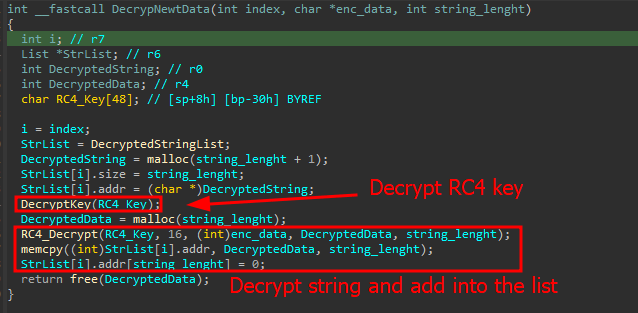
    Data decryption

    The data decryption routine in this variant is implemented as a simple RC4 algorithm.

    The RC4 key is encrypted with XOR. After the key decryption, we were able to obtain its value: 6e7976666525a97639777d2d7f303177.

    The decrypted RC4 key is used to decrypt the strings. After each piece of data is decrypted, it is inserted into a vector of a custom DataDecrypted structure, which is a simple string list:

    Data decryption routine

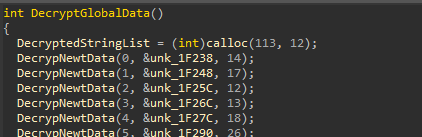
    The global linked list with decrypted data is accessed whenever the malware needs particular strings.

    Adding decrypted strings to the global list

    Anti-VM and anti-emulation

    To detect if it is currently running inside a virtual machine or QEMU, the malware lists all processes until it finds any mention of VMware or QEMU-arm. Listing running processes is simply a matter of opening the /proc directory, which is the proc filesystem on Linux.

    Each process ID (PID) has its own folder containing useful information, such as cmdline, which describes the command used to start the process. Using this information, the malware verifies if there are any processes with VMware or QEMU-arm in their command line.

    Process check

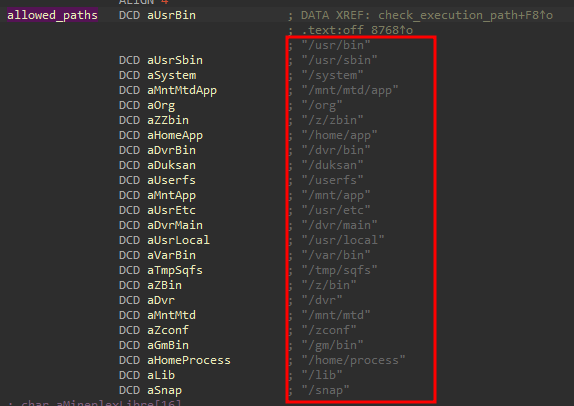
    The implant also verifies if the bot process is running outside an expected directory, based on a hardcoded list of allowed ones:

    Allowed directories

    Once those checks are successfully completed, Mirai will continue normal execution, preparing the vulnerable device for receiving commands from the operator.

    Infection statistics

    According to our telemetry data, the majority of infected victims are located in countries such as China, India, Egypt, Ukraine, Russia, Turkey, and Brazil. It’s challenging to ascertain the exact number of vulnerable and infected devices globally. However, by analyzing public sources, we’ve identified over 50,000 exposed DVR devices online, indicating that attackers have numerous opportunities to target unpatched, vulnerable devices.

    Conclusion

    Exploiting known security flaws in IoT devices and servers that haven’t been patched, along with the widespread use of malware targeting Linux-based systems, leads to a significant number of bots constantly searching the internet for devices to infect.

    The main goal of such bots is to carry out attacks that overwhelm websites and services (DDoS attacks). Most of these bots don’t stay active after the device restarts because some device firmware doesn’t allow changes to the file system. To protect against infections like these, we recommend updating vulnerable devices as soon as security patches become available. Another thing to consider is a factory reset if your device is indeed vulnerable and exposed.

    All Kaspersky products detect the threat as HEUR:Backdoor.Linux.Mirai and HEUR:Backdoor.Linux.Gafgyt.

    Indicators of compromise

    Host-based (MD5 hashes)
    011a406e89e603e93640b10325ebbdc8
    24fd043f9175680d0c061b28a2801dfc
    29b83f0aae7ed38d27ea37d26f3c9117
    2e9920b21df472b4dd1e8db4863720bf
    3120a5920f8ff70ec6c5a45d7bf2acc8
    3c2f6175894bee698c61c6ce76ff9674
    45a41ce9f4d8bb2592e8450a1de95dcc
    524a57c8c595d9d4cd364612fe2f057c
    74dee23eaa98e2e8a7fc355f06a11d97
    761909a234ee4f1d856267abe30a3935
    7eb3d72fa7d730d3dbca4df34fe26274
    8a3e1176cb160fb42357fa3f46f0cbde
    8d92e79b7940f0ac5b01bbb77737ca6c
    95eaa3fa47a609ceefa24e8c7787bd99
    96ee8cc2edc8227a640cef77d4a24e83
    aaf34c27edfc3531cf1cf2f2e9a9c45b
    ba32f4eef7de6bae9507a63bde1a43aa
    IPs
    116.203.104[.]203
    130.61.64[.]122
    161.97.219[.]84
    130.61.69[.]123
    185.84.81[.]194
    54.36.111[.]116
    192.3.165[.]37
    162.243.19[.]47
    63.231.92[.]27
    80.152.203[.]134
    42.112.26[.]36

    MIL OSI Global Banks

  • MIL-OSI United Kingdom: Rooftop solar for new builds to save people money

    Source: United Kingdom – Executive Government & Departments

    Press release

    Rooftop solar for new builds to save people money

    New homeowners stand to benefit from rooftop solar and cheaper bills, with the Future Homes Standard being published this Autumn.

    • Families will have lower energy bills in new homes as part of the Plan for Change, as government confirms new build homes will have solar panels by default
    • Proposed changes in the Future Homes Standard, being published in Autumn, will ensure new homes will be modern and energy efficient, cutting bills and boosting the nation’s energy security with clean, homegrown power

    Working people stand to save hundreds of pounds off their energy bills as the government confirms new build homes will have solar panels by default, unleashing a rooftop revolution. 

    Ministers are publishing the Future Homes Standard this autumn and have confirmed today (Friday 6 June) that solar panels will be included, leading to installation on the vast majority of new build homes. 

    Illustrating the benefits of solar panels, a typical existing UK home could save around £530 a year from installing rooftop solar, based on the current energy price cap. 

    This means today’s new proposals could significantly cut energy bills for the recipients of new build homes, tackling the cost of living for aspirational young families and new house buyers. 

    Under proposed changes, new homes will also have low-carbon heating, such as heat pumps and high levels of energy efficiency, cutting people’s energy bills and boosting the nation’s energy security with clean, homegrown power, in line with the Prime Minister’s Plan for Change. 

    To deliver these aims, the proposed Future Homes Standard would see building regulations amended to explicitly promote solar for the first time, subject to practical limits with flexibility in place for new homes surrounded by trees or with lots of shade overhead.   

    From switching on the kettle to cooking dinner and doing the weekly wash, families will now be able to seize the benefits of powering their lives with clean, renewable energy from the very first day in their new home, with cheaper energy bills that put more money back in their pockets.

    Energy Secretary Ed Miliband said: 

    Solar panels can save people hundreds of pounds off their energy bills, so it is just common sense for new homes to have them fitted as standard. 

    So many people just don’t understand why this doesn’t already happen. With our plans, it will. 

    Today marks a monumental step in unleashing this rooftop revolution as part of our Plan for Change, and means new homeowners will get lower bills with clean home-grown power.

    Housing and Planning Minister, Matthew Pennycook said:      

    As part of the government’s Plan for Change to build 1.5 million homes, we are maximising the use of renewable energy to cut people’s bills and power their homes. 

    The Future Homes Standard will ensure new homes are modern and efficient with low-carbon heating, while our common-sense planning changes will now make it easier and cheaper for people to use heat pumps and switch to EVs so they can play their part in bolstering our nation’s energy security.

    After legislation came into force last week, more homeowners will now be able to install a heat pump within one metre of their property’s boundary without having to submit a planning application, unlocking even more savings and cutting unnecessary paperwork for working people.  

    With figures from Octopus showing that 34% of those who order a heat pump are discouraged or drop out for reasons attributed to the need to submit a planning application, this change will help families who may have less space outside their home make the upgrade to clean power.  

    The first quarter of 2025 saw a record number of applications to the Boiler Upgrade Scheme, up 73% from the same quarter in 2024. 

    The scheme provides households with up to £7,500 off the cost of a heat pump, which can save families around £100 a year by using a smart tariff effectively.

    Chris Hewett, Chief Executive, Solar Energy UK, said: 

    The solar industry is very glad to hear that almost all new homes will be fitted with solar power from under the Future Homes Standard. Making solar panels a functional requirement of the Building Regulations will cut energy bills, lower carbon emissions, help drive polluting natural gas off the grid and improve our nation’s energy security, too.

    Aadil Qureshi, Co-Founder and CEO, Heat Geek, said: 

    Installing a heat pump, particularly alongside solar panels is an amazing way for homeowners to save hundreds of pounds on their energy bills and create a more comfortable home. The simplification of planning rules will help millions of homeowners, particularly in normal family homes in towns and cities, take advantage of this technology.

    Charles Wood, Deputy Director of Policy (Systems) at Energy UK, said: 

    The addition of rooftop solar to the Future Homes Standard is welcome and necessary in ensuring that homes built today are fit for the future. Building homes to the right standards now will deliver immediate benefits of warmer, more comfortable, and more cost-efficient homes, preventing the need to retrofit these properties later at higher costs to the customer.

    This change, alongside wider reforms to planning processes and network connections, will reduce bills for people in new build properties while also giving the industry confidence to invest in increased manufacturing and installer training as demand increases, creating jobs and bringing down technology costs for everyone.

    Ensuring our future energy security relies on producing more British power, the electrification of our economy and cutting waste. The energy sector continues to deliver energy efficiency improvements and install low-carbon heating, generation, and transport technologies for households and businesses across the country.

    Chris O’Shea CEO of Centrica, said: 

    The age of solar is well and truly upon us, with millions of households up and down the country already benefiting from generating their own free electricity from the sun. Our research shows that customers can shrink their energy bills by 90% when they combine solar and battery with the right energy tariff, and this announcement means even more households can soak up the savings—and the sunshine—by generating their own clean, free electricity. And with the Future Home Standard expected in the Autumn, momentum is building behind Great Britain’s rooftop revolution.

    Ed Lockhart, Chief Executive, Future Homes Hub, said: 

    The Future Homes Standard represents a major opportunity to build a generation of higher performing new homes. Moving to all electric homes, with photovoltaics, a better fabric system, better ventilation and smart technologies to optimise the way new homes use energy means that new homes will not only be better for the planet but also more comfortable, healthier to live in and cheaper to run for customers.

    The Future Homes Hub is ready to support this mission, bringing homebuilders, social housing providers, suppliers, financial institutions and other experts together to work with government departments to find the best solutions to secure the benefits of the Future Homes Standard whilst accelerating housing delivery, crucially helping smaller developers to get the right support at the right time.

    Nigel Banks, Zero Bills Director at Octopus Energy, said:  

    People deserve lower energy bills, and adding solar panels to a house as it’s built is an incredibly effective way to slash costs from day one.

    With the right smart tech and storage added to the mix, some households won’t have to pay a penny for energy.

    We’re delighted to see the Future Homes Standard enable house builders to now build the homes of the future.

    Matthew Hart, Director of Residential New Build at E.ON Next, said: 

    Ensuring that every new home comes equipped with solar panels is a vital step forward for the UK. Our vision at E.ON has always been to make clean, affordable energy the standard, not the exception, and this move will empower homeowners to take control of their energy use and keep bills low from day one. It’s exactly the kind of bold, practical action we need to build a more secure, low-carbon future for everyone.

    Mark Wakeford, National Chairman, National Federation of Builders, said: 

    Solar panels on new homes make sense because they lower bills and progress the clean energy revolution we so desperately need. Credit must also be given for recent announcements on grid investment and connection reforms, as these were important challenges to recognise and solve for a rooftop revolution to happen in practice.

    Charlotte Lee, CEO, Heat Pump Association, said: 

    The HPA welcomes clarity on the publication timeline for the Future Homes Standard and confirmation that all new homes will be required to have low-carbon heating, such as heat pumps. Coupled with solar PV, highly efficient heat pump installations will result in low consumer energy bills and increase the UK’s energy security. This announcement provides a clear signal to the heat pump sector to scale up delivery in terms of workforce and manufacturing to meet the anticipated growth in the market and demonstrates the government’s commitment to decarbonise buildings.

    Garry Felgate, Chief Executive of The MCS Foundation, said:  

    These plans by the government are a huge boost to the UK renewables sector, to our efforts to meet net zero, and in reducing energy costs for households.   

    This announcement clearly shows that clean energy in the UK is the future. Maximising renewable energy technologies can benefit households by reducing bills as well as enhancing our national energy security.

    Trevor Hutchings, Chief Executive of the Renewable Energy Association (REA) said: 

    The growth of solar power has been one of the UK’s biggest renewable energy success stories, demonstrating without a doubt that we don’t have to choose between lowering our emissions and lowering household energy bills. 

    Today’s announcement – which the REA has long campaigned for – takes this one step further – not only enabling thousands of future homeowners to experience the benefits of affordable and clean power, but supercharging growth in the British renewable energy industry and driving forward our energy transition.

    Notes to editors

    Future Homes Standard 

    The changes outlined today will maximise the use of solar energy through the Future Homes Standard.   

    In 2023, the previous government proposed that new build homes would either need solar panel coverage equivalent to 40% of the building’s floor area or none at all. 

    This approach would have allowed for too many exemptions and no solar being installed on these developments.  

    The government is intending to bring forward rigorous proposals, that if developers cannot meet 40% coverage, they would still be required to install a reasonable amount of solar coverage. 

    Under this proposal, it would be a functional requirement of the Building Regulations that new homes, with rare exceptions, are built with renewable electricity generation. In the vast majority of cases, we expect this would be solar panels.    

    We are working with industry to set the technical detail ahead of publishing the final Future Homes Standard this Autumn.     

    The Future Homes Standard will also see homes built with low carbon heating such as heat pumps and heat networks.    

    Solar 

    The £530 a year saving is based on government’s published Home Energy Assessment tool, which allows the user to produce an estimate of the bill savings they could expect from solar given the characteristics of their home. 

    The figure is the potential savings for a home and is included to illustrate the benefits of solar panels. An estimate of the bill savings for a Future Homes Standard home will be included in the final impact assessment published in Autumn.   

    The figures are based on a typical 3.5 kW south-facing installation using the Standard Assessment Procedure (SAP) methodology. 

    The costs and savings individuals experience will be affected by factors such as how often they heat their home, the precise technical details of their installations, and future energy prices.  

    The savings displayed are based on the April 2025 price cap. As energy prices change, so will the estimates of savings. 

    Domestic heat pumps 

    The changes to permitted development rights, which came into force on Thursday 29 May in England, cover: 

    • removing the 1m boundary rule, enabling air source heat pumps to be installed within 1m of the property boundary
    • increasing the size limit of the heat pump for dwellinghouses from 0.6m3 to 1.5m3
    • doubling the number of heat pumps permitted per detached dwellinghouse, from 1 to 2
    • allowing for air source heat pumps that can be used for cooling as well as heating – facilitating the role out of air-to-air models – and providing consumers more choice

    Modern heat pumps are generally perceived as quiet and typically no louder than a fridge. When installed under a permitted development right, they must also comply with a noise assessment methodology which includes an upper noise limit assessed at the nearest neighbouring habitable room window or door, as part of the Microgeneration Certification Scheme Planning Standard.

    There were a total of 11,256 applications to the Boiler Upgrade Scheme between January and March 2025, which was up 73% from the first quarter of 2024.
    Updates to this page

    Published 6 June 2025

    MIL OSI United Kingdom

  • MIL-OSI United Kingdom: Western Balkans culture ministries adopt growth declaration to place creativity at the heart of growth

    Source: United Kingdom – Executive Government & Departments

    World news story

    Western Balkans culture ministries adopt growth declaration to place creativity at the heart of growth

    Culture ministries from Albania, Bosnia and Herzegovina, Kosovo, Montenegro, North Macedonia and Serbia met today under the Berlin Process and, together with UK Special Envoy to the Western Balkans Dame Karen Pierce, adopted a Joint Declaration that puts the region’s creative economy at the centre of its economic and European future.

    Berlin Process ministerial meeting on creative economy

    Kotor, Montenegro, 28 May 2025 – Culture ministries from Albania, Bosnia and Herzegovina, Kosovo, Montenegro, North Macedonia and Serbia met today under the Berlin Process and, together with UK Special Envoy to the Western Balkans Dame Karen Pierce, adopted a Joint Declaration that puts the region’s creative economy at the centre of its economic and European future.

    Long championed by the United Kingdom, the creative economy of the Western Balkans has taken centre stage in Berlin Process discussions for the very first time, reflecting its growing contribution to inclusive growth, social cohesion and regional cooperation.

    Co-hosted by Montenegro’s Minister of Culture and Media Dr Tamara Vujović, British Council Deputy CEO Kate Ewart Biggs and the UK Special Envoy to the Western Balkans Dame Karen Pierce, the forum explored how creative industries can generate skilled jobs, retain talented young people and deepen cross-border cooperation. Creative businesses already outpace many traditional sectors and are natural partners for the green and digital transitions the Western Balkans must complete on their path to EU membership.

    At the close of the meeting, the six ministers committed to embed creativity in national growth agendas. The Declaration pledges governments to treat the creative economy as a strategic sector, align the work of culture, education and economy ministries, create stable public-finance lines and incentives that crowd-in private investment, and open access to EU and international funds such as the Western Balkans Growth Plan and Horizon Europe. Ministries aim to turn the region’s cultural richness into a lasting engine of prosperity and regional cohesion.

    UK Special Envoy to the Western Balkans, Dame Karen Pierce said:

    “The UK’s hosting of the Berlin Process this year underlines our commitment to strengthen cooperation with our partners in the Western Balkans. The discussions we’ve had today, focused on the creative economy, highlight the importance of regional collaboration and the need for long-term investments in areas that will drive sustainable growth, foster social cohesion, and deepen ties across the region.”

    “The creative economy can be a driver for growth for all communities. It has immense potential in the Western Balkans. By working together, we can unlock the full potential of this sector, not just for economic benefits, but also as a means of strengthening cultural identity and heritage across the region.

    “Today’s adoption of the joint declaration by the Ministries of Culture from the Western Balkans is an important step forward in shaping the future of the creative economy in the region. It’s a clear statement of our shared vision for fostering innovation, promoting sustainable development, and supporting our creative industries as vital contributors to the region’s growth. While each country has its own requirements and ideas, by working together, governments and creative industry across the region can bring even more benefits to their citizens across each and every community.

    “We reaffirm our commitment to operationalising the creative economy as a strategic sector for growth. By strengthening collaboration between Ministries of Culture, Education, and Economy, we will ensure that culture and creativity are embedded in national economic plans, innovation strategies, and skills development. This is an investment in the future of the region and its citizens.”

    British Council programmes such as Culture & Creativity for the Western Balkans have trained thousands of cultural professionals and financed scores of start-ups, while links with UK institutions have opened new export markets for film, music and design. Building on today’s commitments, the British Council will launch a regional fund later this year to help creative entrepreneurs scale their ideas and reach international audiences, reinforcing the people-to-people ties at the heart of the Berlin Process.

    Updates to this page

    Published 6 June 2025

    MIL OSI United Kingdom

  • MIL-OSI United Kingdom: 826,000 families boost finances with childcare savings

    Source: United Kingdom – Executive Government & Departments

    Press release

    826,000 families boost finances with childcare savings

    Working families encouraged to sign up to Tax-Free Childcare to save up to £2,000 a year per child on their childcare bills.

    • Almost 826,000 UK families shared £632.2 million in government top-ups towards their childcare bills with Tax-Free Childcare in the 2024 to 2025 tax year
    • Working families urged to sign up now to give their summer plans a financial boost
    • Supporting the government’s mission to grow the economy and deliver on the Plan for Change

    Nearly 826,000 working families saved up to £2,000 per child with Tax-Free Childcare in the 2024 to 2025 tax year. The money helps families pay for their childcare, as part of the government’s Plan for Change to put more money in people’s pockets.

    HM Revenue and Customs (HMRC) is encouraging those yet to sign up for Tax-Free Childcare, to do it now and give their summer plans a financial boost.

    Latest figures from HMRC show in March 2025, 579,560 families in the UK used the scheme to save on their annual childcare bills, an increase of 81,770 families compared to the previous March.

    Working families who sign up to Tax-Free Childcare can boost their annual budget by up to £2,000 per child up to the age of 11 or up to £4,000 up to the age of 16 for a disabled child.

    Parents can use the scheme to help towards the cost of approved childcare whether that’s nursery for younger children, or for older children – wraparound or after school care clubs during term time or holiday clubs for the long summer holidays ahead.

    Myrtle Lloyd, HMRC’s Director General for Customer Services, said: 

    Summer can be an expensive time if you have children. Whatever you’re planning, Tax-Free Childcare can give your plans a welcome financial boost. Go to GOV.UK to start saving today.

    For every £8 deposited in a Tax-Free Childcare account, the government tops it by £2, which means parents can receive up to £500 (or £1,000 if their child is disabled) every 3 months towards paying for their childcare costs.

    Once families have opened a Tax-Free Childcare account, they can deposit money and use it straight away or keep it in the account to use it whenever it’s needed. Any unused money in the account can be withdrawn at any time.   

    Families could be eligible for Tax-Free Childcare if they:   

    • have a child or children aged 11 or under. They stop being eligible on 1 September after their 11th birthday. If their child has a disability, they receive up to £4,000 a year until 1 September after their 16th birthday   
    • the parent and their partner (if they have one) earn, or expect to earn, at least the National Minimum Wage or Living Wage for 16 hours a week, on average   
    • each earn no more than £100,000 per annum   
    • do not receive Universal Credit or childcare vouchers    

    Visit GOV.UK to check eligibility and register for Tax-Free Childcare.

    Tax-Free Childcare can be used alongside the free childcare hours subject to eligibility.

    Further Information

    Latest Tax-Free Childcare statistics with data available up until March 2025 were released 28 May.

    More information about Tax-Free Childcare and how to register.

    Each eligible child requires their own Tax-Free Childcare account. If families have more than one eligible child, they will need to register an account for each child. The government top-up is then applied to deposits made for each child, not household.

    Account holders must confirm their details are up to date every 3 months to continue receiving the government top-up.

    Childcare providers can also sign up for a childcare provider account via GOV.UK to receive payments from parents and carers via the scheme.

    Updates to this page

    Published 6 June 2025

    MIL OSI United Kingdom

  • MIL-OSI United Kingdom: Raising funds to fix cladding issues

    Source: Scottish Government

    Building Safety Levy Bill published.

    Additional funding could be unlocked to fix building safety issues through new legislation published in the Scottish Parliament. 

    If passed, the Building Safety Levy (Scotland) Bill will see a tax charged on the construction of certain new residential properties, in line with equivalent legislation in England. 

    The Bill seeks to raise around £30 million per year to help fund work to fix residential buildings with unsafe cladding which have no linked developer.

    Latest estimates indicate that the Scottish Government’s Cladding Remediation Programme could cost £1.7 billion over a 15-year period

    Public Finance Minister Ivan McKee said:  

    “The Scottish Government is committed to doing what is right and necessary to address the challenge of fixing buildings affected by unsafe cladding.

    “That includes putting the appropriate funding arrangements in place to ensure that the associated costs of cladding remediation do not fall directly onto affected homeowners.

    “I know that developers share our determination to keep people safe and this levy will ensure they make a fair contribution to these costs, just as they will be doing in England.

    “I also welcome the continued cooperation of developers who have accepted responsibility for the assessments and any required mitigation and remediation of their buildings.”

    Background 

    The UK Government agreed in principle to devolve the powers needed for a Scottish Building Safety Levy last year. Powers secured to introduce building safety levy – gov.scot (www.gov.scot) 

    The legislation – which is proposed to come into effect in April 2027 – includes provisions to exempt certain types of development, including social and affordable housing. Details of tax rates will be set out in regulations if MSPs approve the Bill, consistent with the arrangements for other devolved taxes. 

    The Bill sets out a provision for a regular review period for the levy, which will be an opportunity to consider the revenue target in light of the prevailing housing market and wider economic conditions, as well as the emerging position on the scale and profile of spending on our cladding remediation work.  

    Estimated costs for the Scottish Government’s cladding remediation programme have also been published: Cladding remediation: capital spend forecasting – gov.scot

    MIL OSI United Kingdom

  • MIL-OSI Economics: Secretary-General of ASEAN meets with Minister Delegate for Francophonie and International Partnerships of France

    Source: ASEAN – Association of SouthEast Asian Nations

    Secretary-General of ASEAN, Dr. Kao Kim Hourn, had a bilateral meeting with H.E. Thani Mohamed Soilihi, Minister Delegate for Francophonie and International Partnerships of France, on 6 June 2025. Both sides discussed ways and means to enhance the ASEAN-France Development Partnership as ASEAN and France celebrate the fifth anniversary of their partnership this year.

    The post Secretary-General of ASEAN meets with Minister Delegate for Francophonie and International Partnerships of France appeared first on ASEAN Main Portal.

    MIL OSI Economics

  • MIL-OSI Europe: Treasury debt ratio declines by 5% upon settlement of HF-Fund

    Source: Government of Iceland

    The proposal for the settlement of HF-Fund was presented at meetings held on 10 April 2025 with bondholders in series HFF34 and HFF44. It was approved by a majority of votes. The value of the HFF bonds in the settlement is estimated at ma.kr 651.

    Thereafter, in a proposed fiscal budget supplement, authorisation for settlement was requested in accordance with the proposal. The proposed budget supplement was recently passed by Parliament.

    The settlement of HF-Fund’s obligations will take place on 12 June 2025. In connection with the settlement, the Treasury will issue nine new Treasury bond series (see table) with a combined nominal value of ISK 487 bn.


    Nominal value

    RIKS 29 0917

    67,000,000,000

    RIKS 34 1016

    60,353,539,382

    RIKS 36 0815

    59,000,000,000

    RIKS 39 1115

    49,000,000,000

    RIKS 41 0815

    50,000,000,000

    RIKS 44 1017

    50,313,049,596

    RIKS 47 1115

    48,000,000,000

    RIKS 50 0915

    47,000,000,000

    RIKB 32 1015

    56,000,000,000

    With the delivery of the said bonds, the Treasury will pay in full the loans granted to it by HF-Fund in 2020 and 2021, in the combined amount of ISK 238 bn.

    The Treasury will also deliver EUR 378 m (about ISK 55 bn) from foreign currency deposits financed with a recent Eurobond issue.

    Upon settlement, the Treasury will receive HF-Fund´s assets other than those used for the settlement, including The New Housing Fund bonds, as well as a loan portfolio, and bonds issued by leasing company Bríet, in the total amount of ISK 222 bn.
    The net effect on the Treasury Part A debt ratio (according to Maastricht criteria) is to lower the debt ratio by just over 5% of GDP.

    MIL OSI Europe News

  • MIL-OSI United Kingdom: Hobbycraft Trading Limited Company Voluntary Arrangement: Information for employees

    Source: United Kingdom – Executive Government & Departments

    News story

    Hobbycraft Trading Limited Company Voluntary Arrangement: Information for employees

    Hobbycraft Trading Limited entered a Company Voluntary Arrangement on 13 May 2025. The company is continuing to trade as it restructures its operations.

    This page provides information on how to claim redundancy pay for those affected.  

    Anthony John Wright and Geoffrey Paul Rowley of FRP Advisory Trading Limited, who had previously been appointed Joint Nominees on 23 April 2025, became Joint Supervisors of the Company Voluntary Arrangement. 

    If you are an affected employee, this page will provide you with information on how to claim redundancy. 

    Information for employees: 

    If you have been dismissed 

    If you have been dismissed, you might be entitled to statutory redundancy pay, and compensatory notice pay,  from the Insolvency Service. 

    Information about your rights, how to apply and how we calculate payments is available on GOV.UK. 

    Who is eligible 

    You can apply to the Insolvency Service for redundancy and other payments if you worked for the company under an employment contract. 

    Workers and self-employed contractors who provided services to the company are not eligible to apply. Instead, these individuals should contact the Company Voluntary Arrangement supervisors at erateam@frpadvisory.com  

    Company directors 

    Check if you can apply for redundancy payments if you have been dismissed and were a director. 

    How to apply 

    The supervisors will give details about how to apply and will also give you a case reference number (example: CN12345678). Once you have this information, you can apply online

    Paying your claim 

    On average it takes 14 days to process and pay claims. However, sometimes we need to get additional information from the individual or from the supervisors, which can take a bit of time. We will contact you directly if we need anything further from you. We always try to pay eligible claims within 6 weeks of receiving the application. 

    To allow us to deal with everyone’s application as quickly as possible, please do not contact us to check the status of your application until after the 6 weeks have passed. 

    Getting help with your application for redundancy payments. 

    If you need help completing your application, you can contact the Redundancy Payments helpline on 0330 331 0020. 

    When calling, please have your case reference number (Example: CN12345678) and National Insurance number to hand. If you do not have a case reference number, please contact the administrator. 

    You can email us on redundancypaymentsonline@insolvency.gov.uk. Please include your name, your case reference number, and your telephone number in your email. 

    If you need to email us after submitting your claim, only use the email address you gave on your application form. Otherwise, we will not be able to respond to you for security reasons. 

    Other support available to you 

    Factsheet: finding a new job, managing your finances and benefits available to you.

    Updates to this page

    Published 6 June 2025

    MIL OSI United Kingdom

  • MIL-OSI United Kingdom: Fines imposed for building regulations breach

    Source: City of Coventry

    Coventry Magistrates’ Court have imposed fines and costs totalling £756 on the owner of a property in Coventry.

    On Wednesday 7 May 2025, the defendant, pleaded guilty of failing to comply with the Building Regulations 2010 and to provide information to Coventry City Council about one of her properties when served with a notice requiring her to do so.

    On the 25 September 2024, a Registered Building Inspector from the Council’s Building Control Team carried out an inspection of the property in response to information that building work had been undertaken. During the inspection it was noted that a new roof had been installed without the benefit of Building Regulation approval, which is an offence under Section 35 of The Building Act 1984.

    As part of its investigation into potential breaches of the Building Regulations, the Council served a Requisition for Information Notice under section 16 of the Local Government (Miscellaneous Provisions) Act 1976 and provided the defendant with information on how they could rectify the matter by submitting a regularisation application, however they failed to respond to the notice or submit a Building Regulation application.

    Along with the fines and court costs, the defendant is now required to submit a regularisation application, which is significantly more expensive than a standard application.

    Councillor Abdul Salam Khan, Deputy Leader, at the Council, said: “This prosecution sends a clear message. If you don’t follow the building control procedures set out for handling your building work, or you carry out building work which does not comply with the requirements contained in the building regulations, the Council will not hesitate to prosecute those who choose to ignore their legal obligations.” 

    Kate Rich, Head of Building Control for the Council said: “Building regulations are crucial for ensuring the safety, health, and welfare of building occupants and visitors, as well as tackling causes and consequences of climate change. They set standards for design and construction, covering aspects like structural integrity, fire safety, accessibility, and energy performance.”  

    If you have undertaken building work without applying for Building Regulations, then this can be rectified by submitting a Regularisation application to the Council, details of which can be found on our website. www.coventry.gov.uk/building-control

    Published: Friday, 6th June 2025

    MIL OSI United Kingdom

  • MIL-OSI Europe: The Bundesbank’s forecast for Germany: Economic recovery slowly getting started | US tariffs initially weigh on economic growth; fiscal policy provides impetus from 2026

    Source: Deutsche Bundesbank in English

    The recovery of the German economy is being delayed by uncertainty surrounding international trade policy. Only gradually will economic activity be boosted by fiscal measures. The German economy will continue to tread water in the current year. The new US tariffs and uncertainty about future US policy are dampening economic growth for the time being, said Bundesbank President Joachim Nagel, presenting the Bundesbank’s new Forecast for Germany. This has hit German industry at a time when it had begun to stabilise after a long period of weakness. However, the sharp rise in government defence and infrastructure expenditure is likely to cause a marked surge in demand and an increase in gross domestic product (GDP) from 2026 onwards. Moreover, according to the new forecast, inflationary pressures in Germany are continuing to ease. The Forecast for Germany thus also provides good news for consumers and the economy, Mr Nagel said.
    Calendar-adjusted GDP is expected to stagnate in 2025. However, the Bundesbank’s experts expect stronger growth rates of 0.7 % and 1.2 % for 2026 and 2027. Compared with the December Forecast for Germany, the growth outlook is thus revised downwards for 2025 and upwards for 2027. According to the Bundesbank’s experts, the outlook is clouded in the short term by the protectionist trade policy of the United States and the associated uncertainty. Overall, exports will decline significantly in 2025 and increase only slightly next year. Reduced momentum in industrial production due to tariffs will contribute to a slowdown in the labour market and weigh on wage growth. From 2026 onwards, the expansionary fiscal policy and the lessened growth-dampening impact of US economic policy will lead to a marked recovery for the German economy.
    Following the easing of the debt brake, fiscal policymakers are financing a substantial portion of spending, particularly on defence and government infrastructure, via loans. Government consumption and, above all, government investment will therefore rise steeply from 2026 onwards. We expect the additional government spending on defence and infrastructure to significantly increase GDP growth by the end of 2027, said Bundesbank President Nagel.
    Although the government deficit ratio is likely to decline further this year, it will then rise sharply to just over 4 % by 2027. The significant increase is largely attributable to the fiscal package, which includes not only higher spending on defence and government infrastructure, but also tax cuts, increased subsidies and transfers to enterprises and households. The Maastricht debt ratio will rise to around 66 % by 2027. It had already reached 62.5 % at the end of 2024. Germany’s public finances can cope with a temporary increase in the deficit and debt ratios, Mr Nagel said.
    The rise in inflation as measured by the Harmonised Index of Consumer Prices (HICP) will slow to 2.2 % as an annual average in 2025. Inflation is then likely to decline temporarily to 1.5 % in 2026 due to energy prices, before rising again to 1.9 % in 2027. The core rate (excluding energy and food) will fall to 2.6 % this year and thus remain markedly higher. It will then fall to 1.9 % in 2026. From 2026 onwards, the core rate will settle at around 2 %,” Bundesbank President Nagel said. The reasons for this decline are the decreasing price pressures from labour costs and the initially still weak demand. We’re also seeing the delayed effect of the Eurosystem’s tight monetary policy up to 2024.
     
    Projection June 2025

    Year-on-year percentage change

    2024

    2025

    2026

    2027

    Real GDP, calendar adjusted

    − 0.2

    0.0

    0.7

    1.2

    Real GDP, unadjusted

    − 0.2

    − 0.1

    1.0

    1.3

    Harmonised Index of Consumer Prices

    2.5

    2.2

    1.5

    1.9

    Harmonised Index of Consumer Prices excluding energy and food

    3.2

    2.6

    1.9

    2.0

    Source: Federal Statistical Office (data as at 21 May 2025). Annual figures for 2025 to 2027 are Bundesbank forecasts.

    MIL OSI

    MIL OSI Europe News

  • MIL-OSI Europe: President Meloni at second edition of ‘Il giorno de La Verità’

    Source: Government of Italy (English)

    5 Giugno 2025

    The President of the Council of Ministers, Giorgia Meloni, attended the second edition of the ‘Il giorno de La Verità’ event in Rome today, where she was interviewed by the newspaper’s editor-in-chief, Maurizio Belpietro.

    MIL OSI Europe News

  • MIL-OSI United Kingdom: Organised drug trafficker has sentence increased

    Source: United Kingdom – Executive Government & Departments

    Press release

    Organised drug trafficker has sentence increased

    A member of an organised crime operation that trafficked cocaine across the Southwest has had his sentence increased, after the Solicitor General intervened.

    Stephen Wills, 36, from Bridford, Exeter, has had his sentence increased by five years under the Unduly Lenient Sentence scheme, following an intervention by the Solicitor General Lucy Rigby KC MP.

    The court heard that between 2019 and 2020, Wills was part of two organised crime groups that trafficked tens of thousands of pounds-worth of cocaine across the country.

    The group delivered drugs from a foreign crime group operating in London to drug dealers around Exeter.

    Wills played a significant role operating from the rented farmhouse where he lived with his family, using the outbuildings to store and package cocaine and to harvest and produce cannabis.

    Police discovered this when the offender was stopped in his vehicle and arrested on 1 May 2020.

    A subsequent investigation of the property found several firearms, ammunition and more than a quarter kilogram of cocaine, with a wholesale value of over £46,000.

    The court also heard that Wills had 33 previous convictions, including for firearm offences. Wills was prohibited from possessing a firearm or ammunition for five years in 2018. In 2021, he was convicted for three offences relating to possession of an air rifle and ammunition

    The Solicitor General Lucy Rigby KC MP said:

    This offender was part of two organised crime gangs which trafficked significant quantities of drugs across the country.

    We know that the impact of organised crime on our communities is devastating and I welcome the Court’s decision to increase Wills’ sentence following my intervention.” 

    On 13 March 2025, Stephen Wills was sentenced to nine years’ imprisonment at Exeter Crown Court after he was sentenced for conspiracy to supply and possession with intent to supply class A and B drugs and possession of a prohibited firearm.

    On 5 June 2025, Wills’ sentence was increased from nine years to 14 years after it was referred to the Court of Appeal under the Unduly Lenient Sentence

    Updates to this page

    Published 6 June 2025

    MIL OSI United Kingdom

  • MIL-OSI United Kingdom: More than 100 attend event to strengthen support for Island children 6 June 2025 More than 100 attend event to strengthen support for Island children and young people

    Source: Aisle of Wight

    More than 110 people from across the Isle of Wight came together for the Together for Children: Collaboration and Partnership Conference, held earlier this week.

    The event focused on how local organisations can work better together to help children and families on the Island.

    The Isle of Wight has many brilliant community and voluntary groups that offer important services — from parenting support and youth clubs to food banks and activities for children with disabilities.

    The conference was a chance to celebrate their work and look at how they can keep improving.

    The day started with a welcome from Maria Thacker of The Bay Youth Project and former High Sheriff Graham Biss.

    During his time as High Sheriff, Mr Biss worked closely with local organisations and saw the value of bringing people together to share ideas and support one another.

    His involvement in the conference helped turn that vision into reality, in collaboration with the Isle of Wight Council’s Family and Community Services team.

    Ashley Whittaker, who leads children’s services at the council, delivered the keynote address. He said: “This conference was a fantastic opportunity to bring together the people and organisations who are making a real difference in our communities.

    “By working together, we can build on our strengths and ensure that every child and family on the Island has the support they need to thrive.”

    Attendees took part in group sessions throughout the day. The first set of sessions looked at the needs of different age groups, from babies to young adults. The second set focused on key topics like mental health, education, safety, and helping young people aim high.

    Each session was led by experienced staff from a range of organisations, and everyone had a chance to share ideas and learn from each other. There was also time for networking and visiting information stands from local organisations.

    The day ended with a summary of the main points raised by delegates and their ideas for next steps. Many attendees said they found the event useful and inspiring.

    MIL OSI United Kingdom