Category: Europe

  • MIL-OSI Europe: Answer to a written question – Environmental issues in the next multiannual financial framework and the future European Competitiveness Fund – E-000719/2025(ASW)

    Source: European Parliament

    The Commission considers that tackling environmental issues and strengthening competitiveness deserve the highest attention. This is highlighted in the Mission Letters to the Commissioner for Climate, Net Zero and Clean Growth[1] and the Commissioner for Environment, Water Resilience and a Competitive Circular Economy[2] by improving Europe’s natural capital, protecting the natural world, boosting the circular economy and ensuring water resilience are intrinsic parts of the EU priorities, from climate change, security, competitiveness or food security and sovereignty.

    As indicated in the Commission Communication on ‘The road to the next multiannual financial framework’[3], further efforts are needed to achieve a true policy-based budget to ensure synergies between EU policies and the financial action of the EU. The next long-term budget should focus on objectives where EU action is mostly needed, including investment to support competitiveness and to achieve the EU’s climate and environmental goals.

    The planned European Competitiveness Fund[4] will offer strong support to innovative industries for sustainable investment and a one-stop-shop simplified access to EU funds. Moreover, the ambition of the Clean Industrial Deal is to make the EU the global leader on circular economy by 2030, and to use financing as a business driver.

    The ‘green toolbox’ designed to support green policies across the whole EU budget includes the ‘Do No Significant Harm’ principle, which all EU programmes must take into account, wherever relevant and possible, under the EU Financial Regulation[5].

    • [1] https://commission.europa.eu/about/organisation/college-commissioners/wopke-hoekstra_en
    • [2] https://commission.europa.eu/about/organisation/college-commissioners/jessika-roswall_en
    • [3] https://eur-lex.europa.eu/legal-content/EN/TXT/PDF/?uri=celex:52025DC0046
    • [4] https://eur-lex.europa.eu/legal-content/EN/TXT/PDF/?uri=CELEX:52025DC0030
    • [5] https://eur-lex.europa.eu/legal-content/EN/TXT/PDF/?uri=OJ:L_202402509
    Last updated: 6 May 2025

    MIL OSI Europe News

  • MIL-OSI Europe: Latest news – Ordinary Delegation meeting (in camera) – 7 May 2025, Strasbourg – Delegation for Northern cooperation and for relations with Switzerland and Norway and to the EU-Iceland Joint Parliamentary Committee and the European Economic Area (EEA) Joint Parliamentary Committee

    Source: European Parliament

    The Delegation for Northern Cooperation and for Relations with Switzerland and Norway and to the EU-Iceland Joint Parliamentary Committee and the European Economic Area Joint Parliamentary Committee will meet ion Wednesday, 7 May from 16.30 until 18.00 in room WEISS N3.2, Strasbourg.

    The purpose of the meeting will be to prepare for the upcoming 44th EU-Switzerland Inter-Parliamentary meeting which is scheduled in Brussels on 12 May 2025 from 14.30 – 17.30.

    MIL OSI Europe News

  • MIL-OSI Security: Further appeal in case of woman missing from Barking since 2017

    Source: United Kingdom London Metropolitan Police

    Detectives are appealing for the public’s help to find Stefana Otilia Malinici, 45 who is missing from Barking.

    Stefana (who is known as Otilia) has not been seen by her friends or family since she left her home on Beccles Drive in Barking on Wednesday, 6 September 2017.

    Otilia, who was 37-years-old at the time of her disappearance, is classed as vulnerable and in the intervening years, has not made contact with her husband or children.

    The last sighting of her was on CCTV and showed her making a brief visit to a shop on Green Lane in Ilford on Monday, 9 September 2017.

    Officers also believe she may have boarded the number 5 bus at 22:14hrs from Wood Lane, Dagenham on Tuesday, 10 September 2017.

    Since then, police have not been able to trace her.

    Officers looking after her case are appealing again for Otilia to make contact, and ask anyone who has information about where she may be, to call the team.

    Otilia was last seen wearing a black top with a large light coloured motif, dark tight jeans or leggings tucked into flat dark, mid-calf length boots, and a dark coloured three-quarter length fitted jacket. She had reddish hair in a bob style at the time.

    She is Romanian and at the time of her disappearance was working as a cleaner in London.

    Detective Chief Inspector Kam Sodhi, from the Met’s East Area Public Protection unit, said: “It is now more than seven years since Otilia was reported missing and we are continuing our work to find out where she is. While there is no evidence to suggest that Otilia has come to physical harm, we cannot rule this out.

    “Her family here in the UK and in Romania are still carrying on their daily lives without knowing where their loved one is. Her daughters have grown up without their mother, so we urge anyone who may know Otilia, or where she is, to come forward without further delay.

    “We ask anyone who has provided shelter or support to Otilia to also please contact police. Even if this was not recently, we want to hear from you.”

    In a statement, Otilia’s daughters, said: “It has now been more than seven years without our mother. We have grown up without her and miss her every day. She always brings support and love for anyone who needs it, even strangers and she always tries to cheer people up.

    “We appeal to the public for anyone to come forward if they know anything about her or her whereabouts. We also appeal to her directly, please return home to us.

    Officers would urge anyone with information on her whereabouts to call police on 101 or anonymously via Crimestoppers on 0800 555 111, quoting 01/1106106/24.

    MIL Security OSI

  • MIL-OSI United Kingdom: The Cambridge Growth Company have appointed Buro Happold, Prior + Partners and other technical experts to develop a growth strategy for Greater Cambridge

    Source: United Kingdom – Executive Government & Departments

    News story

    The Cambridge Growth Company have appointed Buro Happold, Prior + Partners and other technical experts to develop a growth strategy for Greater Cambridge

    The Cambridge Growth Company (CGC) is pleased to announce the appointment of Buro Happold, Prior + Partners and others to prepare a vision, supported by a robust evidence base that will underpin a long-term growth strategy for Greater Cambridge.

    Published on behalf of the Cambridge Growth Company

    CGC will work collaboratively with locally elected leaders and the Mayor of Cambridgeshire and Peterborough. It will also access support from a number of government departments where required, to pursue infrastructure-led growth.

    This appointment marks a significant step towards shaping a sustainable and strategic future for the Greater Cambridge region working in parallel with but extending over a longer period than the emerging Local Plan. The Local Plan is being developed by the Greater Cambridge Shared Planning Service representing Cambridge City Council and South Cambridgeshire District Council.

    The development of the evidence base has commenced as a first step in defining a vision for the future of Greater Cambridge that is sustainable, inclusive and innovative. By drawing on insights into the knowledge economy, infrastructure, housing, employment, transport, and the natural environment, the evidence base will act as a foundation for identifying challenges and opportunities, policy development and a future spatial strategy. Key areas of focus will be overcoming transport congestion and water scarcity.

    CGC is based in the city and has already commenced recruitment for a number of additional executive roles within the company to build its capacity and expertise over the coming months. These roles will be advertised locally in coming weeks.

    Buro Happold – Integrated consulting engineers and advisors is a globally recognised consultancy specialising in strategic planning, economics, infrastructure, design, engineering, environment and sustainability and strategic advisory services. With a strong track record in delivering large-scale city strategies, new communities and urban transformation projects.

    Buro Happold leads the team to shape the evidence base, strategy and implementation plan. Their contributions will ensure that the evidence base is grounded in data-driven insights, technical analysis and best practices for sustainable growth.

    Roger Savage, Project Director said:

    We look forward to working with local partners on addressing the challenges of the area. In developing the evidence base for the Growth Company we will consider ways which planning for growth can deliver a quality of life dividend for existing and future communities through investment in the environment and infrastructure.

    Prior + Partners is an acclaimed urban planning, masterplanning and economic consultancy known for its role in shaping major urban regeneration and expansion projects. Their experience in spatial planning, placemaking, data analytics and policy advisory will be instrumental in aligning the evidence base with Greater Cambridge’s unique needs, ensuring that growth is managed effectively and equitably.

    They will be supported by a multidisciplinary team with technical expertise and local knowledge, including BNP Paribas Real Estate, CBA, LUC, Peter Studdert, Turner and Townsend and Womble, and Bond Dickinson.

    By partnering with these leading experts in urban strategy and infrastructure planning, the Cambridge Growth Company is laying the groundwork to help Greater Cambridge realise its full potential.

    For further information please refer to CGC’s new website – www.thecgc.org.uk.

    Note to editors

    Cambridge Growth Company

    The Minister of State for Housing and Planning, Matthew Pennycook MP appointed Peter Freeman to chair the Cambridge Growth Company in October 2024. The government then committed £10 million to the CGC at the 2024 Autumn Statement.

    The CGC’s mission is to support Greater Cambridge in the creation of a delivery programme to bring forward an ambitious vision for long term growth. This vision will maximise the potential for the benefit of the city and the UK through enabling further growth of Cambridge’s knowledge and innovation industries.

    The CGC, which is supported by an Advisory Council consisting of elected local leaders and a range of local experts, will work with local government to establish the best long-term business model to fund infrastructural improvements — water supplies, the transport network, education, health, and the natural environment, ensuring that as much as possible is delivered from the increase in the land value of the sites to be developed.

    The intention is that the CGC in its current form transitions into a growth and delivery vehicle that has the capacity and capability to take a long-term approach to delivery.

    Updates to this page

    Published 6 May 2025

    MIL OSI United Kingdom

  • MIL-OSI Russia: Dmitry Chernyshenko: The architecture of the business program of the V International Tourism Forum “Travel!” has been published

    Translation. Region: Russian Federal

    Source: Government of the Russian Federation – An important disclaimer is at the bottom of this article.

    The architecture of the fifth, anniversary International Tourism Forum “Travel!” has been published. It will be held from June 10 to 15 in Moscow at VDNKh. The three-day business program is aimed at leading experts, representatives of government bodies, international delegations and business communities seeking to exchange experience and create new opportunities for the development of the industry. The organizer of the International Tourism Forum “Travel!” is the Roscongress Foundation together with the Ministry of Economic Development with the support of the Government.

    “The Travel! Forum is a unique opportunity for citizens and guests of our country to discover the beauty and tourism potential of Russia, and get acquainted with new routes and destinations. The event will help bring together industry leaders who are ready to find innovative solutions and build long-term partnerships. As part of the business program, they will discuss the effectiveness of government support measures, the development of tourism infrastructure and the implementation of the large-scale Five Seas and Lake Baikal project of the Tourism and Hospitality national project. In order to achieve the goals set by President Vladimir Putin, special attention will be paid to the personnel issue. At the forum, representatives of business and educational institutions will discuss current educational programs for the tourism industry,” emphasized Deputy Prime Minister and Chairman of the Organizing Committee of the Travel! International Tourism Forum Dmitry Chernyshenko.

    One of the key focuses of the forum is international tourism. Discussions will touch upon the most important issues related to the restoration and expansion of global tourist flows. The focus of the discussions will be on current trends, innovative technologies and strategies aimed at attracting foreign tourists, as well as the issue of strengthening the positions of Russian tourist destinations on the world stage.

    No less important will be the topics of investment in the tourism industry: attracting financing for infrastructure, creating new tourist facilities and modernizing existing ones. The forum will provide a unique platform for establishing contacts between investors, businessmen and authorities interested in supporting the development of tourism in Russia.

    “The business program, based on three pillars, namely international cooperation, investment and HR strategy, will become the point of intersection of ideas and innovations, creating space for real changes in the industry. “Travel!” has set itself an ambitious goal – not only to return and expand tourist flows, but also to turn around approaches to investment, infrastructure and professional training,” commented Anton Kobyakov, Advisor to the President of Russia, Executive Secretary of the Organizing Committee of the International Tourism Forum “Travel!”

    A significant part of the business program tracks of the International Tourism Forum “Travel!” in 2025 will be devoted to professional education and training of qualified specialists for the hotel and tourism business. The forum partners will discuss key issues of personnel policy, as well as exchange best practices in creating educational programs for training in-demand specialists.

    “Today, the Russian hospitality industry is changing rapidly. And the task of government bodies at all levels is to support these changes by responding to industry demands. Therefore, the Ministry of Economic Development has focused its work on the following areas that support the transformation of tourism. A new hotel classification system is being formed, instructors-guides, tour guides and guides have begun to work according to the new rules. Tools have been created to attract large investors, and dozens of large projects are already being implemented that will ensure the reception of guests in the medium term and significantly increase the market capacity. There are many issues that we need to resolve together with businesses, regions and the expert community. Among such issues are the training of qualified personnel, infrastructure development, areas of digitalization of the industry, and the creation of products for the international market. And the main platform for this dialogue is the fields of the “Travel!” forum. We have included all the current issues on the agenda in the program and will discuss them at the sessions of the business program,” said Minister of Economic Development Maxim Reshetnikov.

    Please note: This information is raw content directly from the source of the information. It is exactly what the source states and does not reflect the position of MIL-OSI or its clients.

    MIL OSI Russia News

  • MIL-OSI Russia: Financial news: 06.05.2025, 10-14 (Moscow time) the values of the upper limit of the price corridor and the range of market risk assessment for the security RU000A1009L8 (RZhD 1P-15R) were changed.

    Translation. Region: Russian Federal

    Source: Moscow Exchange – Moscow Exchange –

    06/06/2025

    10:14

    In accordance with the Methodology for determining the risk parameters of the stock market and deposit market of Moscow Exchange PJSC by NCO NCC (JSC) on 06.05.2025, 10-14 (Moscow time), the values of the upper limit of the price corridor (up to 100.94) and the range of market risk assessment (up to 1062.69 rubles, equivalent to a rate of 12.5%) of the security RU000A1009L8 (RZhD 1P-15R) were changed.

    Please note: This information is raw content directly from the source of the information. It is exactly what the source states and does not reflect the position of MIL-OSI or its clients.

    Please Note; This Information is Raw Content Directly from the Information Source. It is access to What the Source Is Stating and Does Not Reflect

    HTTPS: //VVV. MOEX.K.M.M.

    MIL OSI Russia News

  • MIL-OSI Russia: Meeting on the development of airfield and airport infrastructure

    Translation. Region: Russian Federal

    Source: Government of the Russian Federation – An important disclaimer is at the bottom of this article.

    The airfield is equipped with one of the best runways in Russia, which was put into operation in July 2011.

    The airport complex consists of two passenger terminals: for domestic and international flights, and separate terminals for domestic and international flights.

    Passenger traffic in 2024 amounted to more than 5 million passengers. The airport is developing dynamically, paying great attention to the modernization of the airport infrastructure. The capacity of the airport of JSC Mineralnye Vody International Airport today is 240 flights per day, on domestic flights – 1,650 people per hour, on international flights – 240 people per hour.

    The geography of flights from Mineralnye Vody includes about 70 destinations, of which more than 20 are foreign.

    The construction, reconstruction and technical re-equipment of the Mineralnye Vody International Airport have been ongoing since 2019. The deadlines are 2019–2028, and the work is carried out in three stages (Stage I – 2019, Stage II – 2023–2025, Stage III – 2026–2028).

    In 2019, the Mineralnye Vody International Airport underwent reconstruction of the airport complex, including the expansion of the arrival pavilions for domestic and international airlines with a built-in pavilion for those meeting them, including the technical re-equipment of the air checkpoint across the state border of Russia.

    As part of the reconstruction, two two-story buildings of the arrival pavilions for domestic and international airlines were combined; their total area was 8,577.7 sq. m. Two elevators for passengers with limited mobility, high-tech baggage systems, and two additional border passport control booths were installed.

    During the second stage in 2023–2025, a new domestic terminal with an area of 28,506 sq. m. will be built. The new terminal will increase the capacity to 3,120 passengers per hour (currently 1,050 passengers per hour), and the total annual volume will be over 5.2 million passengers (international and domestic airlines). The terminal will be equipped with modern high-tech passenger and baggage handling systems, including 28 check-in counters, 6 passport control points, 11 boarding gates, including 5 air bridges. It is planned to expand the station square with a parking lot, the first access line to the terminal and landscaping.

    At the moment, work on the installation of the roof, facade, engineering systems, and external engineering networks is in the final stages.

    Work is being carried out on finishing the premises, installing engineering and technological equipment, and improving the adjacent territory.

    Earthworks, work on the installation of reinforced concrete and metal structures, vertical transport, and external engineering infrastructure structures have been fully completed.

    Mikhail Mishustin held a meeting on the development of airfield and airport infrastructure

    From the transcript:

    M. Mishustin: Good afternoon, dear colleagues!

    The President set the task of modernizing the infrastructure of at least 75 airports across Russia by 2030. Today, as we open this terminal, we will discuss in detail how this task is being accomplished.

    Well-equipped, convenient air harbors are necessary to strengthen the connectivity of the territories of our large country, increase the availability of flights for citizens and, of course, develop the economy of the subjects of the Federation. Last year, the reconstruction of runways in Kemerovo and Tomsk was completed, seven airport complexes were opened, and since the beginning of this year, three new terminals have been put into operation in Novokuznetsk, Tyumen, Petropavlovsk-Kamchatsky.

    The government pays special attention to such issues. During previous working trips, I personally saw how the construction of the airport in Magadan was proceeding, and I familiarized myself with the plans in Khabarovsk, Novosibirsk, and Gorno-Altaisk.

    We have just inspected the new terminal of the international airport here in Mineralnye Vody. It will soon begin to welcome guests and will provide a modern level of comfort for both residents and guests of the region, which is very important given that in recent years the passenger flow of this air harbor has almost tripled. After all, domestic tourism is growing, people are increasingly choosing the North Caucasus for vacation. Both Mineralnye Vody and nearby cities such as Pyatigorsk, Yessentuki, Kislovodsk have historically been very popular destinations. And we need to make trips to such centers of attraction more convenient for tourists.

    Work is also continuing in other Russian regions, primarily within the framework of the new national project “Efficient Transport System”. It includes a separate federal project – “Development of the Support Network of Airfields”…

    To be continued…

    Please note: This information is raw content directly from the source of the information. It is exactly what the source states and does not reflect the position of MIL-OSI or its clients.

    MIL OSI Russia News

  • MIL-OSI Russia: Financial news: 06.05.2025, 14-50 (Moscow time) the values of the upper limit of the price corridor and the range of market risk assessment for the security RU000A0JWGV2 (PochtaRosB2) were changed.

    Translation. Region: Russian Federal

    Source: Moscow Exchange – Moscow Exchange –

    06/06/2025

    14:50

    In accordance with the Methodology for determining the risk parameters of the stock market and deposit market of Moscow Exchange PJSC by NCO NCC (JSC), on 06.05.2025, 14-50 (Moscow time), the values of the upper limit of the price corridor (up to 130.21) and the range of market risk assessment (up to 1629.57 rubles, equivalent to a rate of 62.5%) of the RU000A0JWGV2 security (PochtaRosB2) were changed.

    Please note: This information is raw content directly from the source of the information. It is exactly what the source states and does not reflect the position of MIL-OSI or its clients.

    Please Note; This Information is Raw Content Directly from the Information Source. It is access to What the Source Is Stating and Does Not Reflect

    HTTPS: //VVV. MEEX.K.M.M.

    MIL OSI Russia News

  • MIL-OSI USA: U.S. International Trade in Goods and Services, March 2025

    Source: US Bureau of Economic Analysis

    The U.S. Census Bureau and the U.S. Bureau of Economic Analysis announced today that the goods and services deficit was $140.5 billion in March, up $17.3 billion from $123.2 billion in February, revised.

    U.S. International Trade in Goods and Services Deficit
    Deficit: $140.5 Billion +14.0%°
    Exports: $278.5 Billion +0.2%°
    Imports: $419.0 Billion +4.4%°

    Next release: Thursday, June 5, 2025

    (°) Statistical significance is not applicable or not measurable. Data adjusted for seasonality but not price changes

    Source: U.S. Census Bureau, U.S. Bureau of Economic Analysis; U.S. International Trade in Goods and Services, May 6, 2025

    Exports, Imports, and Balance (exhibit 1)

    March exports were $278.5 billion, $0.5 billion more than February exports. March imports were $419.0 billion, $17.8 billion more than February imports.

    The March increase in the goods and services deficit reflected an increase in the goods deficit of $16.5 billion to $163.5 billion and a decrease in the services surplus of $0.8 billion to $23.0 billion.

    Year-to-date, the goods and services deficit increased $189.6 billion, or 92.6 percent, from the same period in 2024. Exports increased $41.1 billion or 5.2 percent. Imports increased $230.7 billion or 23.3 percent.

    Three-Month Moving Averages (exhibit 2)

    The average goods and services deficit increased $14.1 billion to $131.4 billion for the three months ending in March.

    • Average exports increased $4.0 billion to $275.7 billion in March.
    • Average imports increased $18.1 billion to $407.1 billion in March.

    Year-over-year, the average goods and services deficit increased $63.2 billion from the three months ending in March 2024.

    • Average exports increased $13.7 billion from March 2024.
    • Average imports increased $76.9 billion from March 2024.

    Exports (exhibits 3, 6, and 7)

    Exports of goods increased $1.3 billion to $183.2 billion in March.

      Exports of goods on a Census basis increased $2.5 billion.

    • Industrial supplies and materials increased $2.2 billion.
      • Natural gas increased $0.8 billion.
      • Nonmonetary gold increased $0.7 billion.
    • Automotive vehicles, parts, and engines increased $1.2 billion.
      • Passenger cars increased $0.9 billion.
    • Capital goods decreased $1.5 billion.
      • Civilian aircraft decreased $1.8 billion.
      • Computer accessories increased $0.7 billion.

      Net balance of payments adjustments decreased $1.2 billion.

    Exports of services decreased $0.9 billion to $95.2 billion in March.

    • Travel decreased $1.3 billion.
    • Transport increased $0.3 billion.
    • Financial services increased $0.2 billion.

    Imports (exhibits 4, 6, and 8)

    Imports of goods increased $17.8 billion to $346.8 billion in March.

      Imports of goods on a Census basis increased $17.8 billion.

    • Consumer goods increased $22.5 billion.
      • Pharmaceutical preparations increased $20.9 billion.
    • Capital goods increased $3.7 billion.
      • Computer accessories increased $2.0 billion.
    • Automotive vehicles, parts, and engines increased $2.6 billion.
      • Passenger cars increased $2.1 billion.
    • Industrial supplies and materials decreased $10.7 billion.
      • Finished metal shapes decreased $10.3 billion.
      • Nonmonetary gold decreased $1.8 billion.
      • Crude oil decreased $1.2 billion.

      Net balance of payments adjustments decreased less than $0.1 billion.

    Imports of services decreased $0.1 billion to $72.2 billion in March.

    • Travel decreased $0.4 billion.
    • Transport increased $0.2 billion.

    Real Goods in 2017 Dollars – Census Basis (exhibit 11)

    The real goods deficit increased $14.0 billion, or 10.2 percent, to $150.9 billion in March, compared to a 10.3 percent increase in the nominal deficit.

    • Real exports of goods increased $2.4 billion, or 1.6 percent, to $149.7 billion, compared to a 1.4 percent increase in nominal exports.
    • Real imports of goods increased $16.4 billion, or 5.8 percent, to $300.6 billion, compared to a 5.5 percent increase in nominal imports.

    Revisions

    Revisions to February exports

    • Exports of goods were revised down less than $0.1 billion.
    • Exports of services were revised down $0.4 billion.

    Revisions to February imports

    • Imports of goods were revised up less than $0.1 billion.
    • Imports of services were revised up $0.1 billion.

    Goods by Selected Countries and Areas: Monthly – Census Basis (exhibit 19)

    The March figures show surpluses, in billions of dollars, with Netherlands ($4.5), South and Central America ($3.2), Hong Kong ($1.9), United Kingdom ($1.2), Singapore ($0.5), Brazil ($0.5), and Saudi Arabia ($0.2). Deficits were recorded, in billions of dollars, with European Union ($48.3), Ireland ($29.3), China ($24.8), Mexico ($16.8), Switzerland ($14.7), Vietnam ($14.1), Taiwan ($8.7), India ($7.7), Germany ($7.5), South Korea ($6.8), Japan ($5.8), Canada ($4.9), Italy ($4.4), France ($3.9), Malaysia ($3.2), Australia ($1.0), Israel ($1.0), and Belgium ($0.1).

    • The deficit with Ireland increased $15.3 billion to $29.3 billion in March. Exports increased $0.1 billion to $1.4 billion and imports increased $15.5 billion to $30.7 billion.
    • The deficit with France increased $2.4 billion to $3.9 billion in March. Exports increased $0.1 billion to $4.0 billion and imports increased $2.6 billion to $7.9 billion.
    • The deficit with Switzerland decreased $4.1 billion to $14.7 billion in March. Exports increased $1.1 billion to $3.5 billion and imports decreased $3.0 billion to $18.3 billion.

    All statistics referenced are seasonally adjusted; statistics are on a balance of payments basis unless otherwise specified. Additional statistics, including not seasonally adjusted statistics and details for goods on a Census basis, are available in exhibits 1-20b of this release. For information on data sources, definitions, and revision procedures, see the explanatory notes in this release. The full release can be found at www.census.gov/foreign-trade/Press-Release/current_press_release/index.html or www.bea.gov/data/intl-trade-investment/international-trade-goods-and-services. The full schedule is available in the Census Bureau’s Economic Briefing Room at www.census.gov/economic-indicators/ or on BEA’s website at www.bea.gov/news/schedule.

    Next release: June 5, 2025, at 8:30 a.m. EDT
    U.S. International Trade in Goods and Services, April 2025

    Notice

    Country Name Changes

    With this release of the “U.S. International Trade in Goods and Services” report, references to “Congo (Brazzaville)” and “Congo (Kinshasa)” are replaced with “Congo” and “Democratic Republic of the Congo,” respectively, to reflect the countries’ recent name changes. These changes also align with the names recognized by the U.S. Department of State and the International Organization for Standardization.

    Impact of Canada Border Services Agency’s (CBSA) Release of CBSA Assessment and Revenue Management (CARM)

    The CBSA introduced a new accounting system (CARM) on October 21, 2024. As a result, importers in Canada have experienced delays in filing shipment information. These delays affected the compilation of statistics on U.S. exports of goods to Canada for September 2024 through February 2025, which are derived from data compiled by Canada through the United States – Canada Data Exchange. A dollar estimate of the filing backlog is included in estimates for late receipts and, following the U.S. Census Bureau’s customary practice for late receipt estimates, is included in the export end-use category “Other goods” as well as in exports to Canada. This estimate will be replaced with the actual transactions reported by the Harmonized System classification in June 2025 with the release of “U.S. International Trade in Goods and Services, Annual Revision.” Until then, please refer to the supplemental spreadsheet “CARM Exports to Canada Corrections,” which provides a breakdown of the late receipts by 1-digit end-use category for statistics through 2024. This spreadsheet will be updated as late export transactions are received to reflect reassignments from the initial “Other goods” category to the appropriate 1-digit end-use category. Any 2025 impacts will be revised in June 2026.

    If you have questions or need additional information, please contact the Census Bureau, Economic Indicators Division, International Trade Macro Analysis Branch, on 800-549-0595, option 4, or at eid.international.trade.data@census.gov.

    Upcoming Updates to Goods and Services

    With the releases of the “U.S. International Trade in Goods and Services” report (FT-900) and the FT-900 Annual Revision on June 5, 2025, statistics on trade in goods, on both a Census basis and a balance of payments (BOP) basis, will be revised beginning with 2020 and statistics on trade in services will be revised beginning with 2018. The revised statistics for goods on a BOP basis and for services will also be included in the “U.S. International Transactions, 1st Quarter 2025 and Annual Update” report and in the international transactions interactive database, both to be released by BEA on June 24, 2025.

    Revised statistics on trade in goods will reflect:

    • Corrections and adjustments to previously published not seasonally adjusted statistics for goods on a Census basis.
    • End-use reclassifications of several commodities.
    • Recalculated seasonal and trading-day adjustments.
    • Newly available and revised source data on BOP adjustments, which are adjustments that BEA applies to goods on a Census basis to convert them to a BOP basis. See the “Goods (balance of payments basis)” section in the explanatory notes for more information.

    Revised statistics on trade in services will reflect:

    • Newly available and revised source data, primarily from BEA surveys of international services.
    • Corrections and adjustments to previously published not seasonally adjusted statistics.
    • Recalculated seasonal adjustments.
    • Revised temporal distributions of quarterly source data to monthly statistics. See the “Services” section in the explanatory notes for more information.

    For more information, see “Preview of the 2025 Annual Update of the International Economic Accounts” in the Survey of Current Business.

    If you have questions or need additional information, please contact the Census Bureau, Economic Indicators Division, International Trade Macro Analysis Branch, on (800) 549-0595, option 4, or at eid.international.trade.data@census.gov or BEA, Balance of Payments Division, at InternationalAccounts@bea.gov.

    MIL OSI USA News

  • MIL-OSI Russia: HSE Becomes Best Universities at X5 Tech Sprint Programming Championship

    Translation. Region: Russian Federal

    Source: State University Higher School of Economics – State University Higher School of Economics –

    X5 Tech Sprint is a championship in algorithmic programming. A total of 808 schoolchildren and students from more than 200 educational institutions in Moscow took part in it. HSE took first place among universities in the overall rating of participants, and a student Faculty of Computer Science (FKN) showed the best result.

    From April 7 to 19, the first championship in programming for speed among schoolchildren and students was held in Moscow X5 Tech SprintThe venue chosen was unusual – five Perekrestok supermarkets.

    The championship participants — 808 schoolchildren and students from more than 200 educational institutions in Moscow, including 124 HSE students — competed in solving problems at speed in C and Python. In total, they spent more than 3.5 thousand minutes on coding.

    “In the battle format, you need to solve one simple problem in a very limited time – about five minutes,” says Mikhail Gustokashin, director Center for Student Olympiads HSE University. — This is the most spectacular format of competitions in algorithmic programming, and it is also accessible to all students familiar with programming: here it is not necessary to know complex algorithms and data structures that are required in other, longer competitions.”

    The maximum score was achieved by 96 participants, and the best result (53 seconds to solve one problem) was shown by a second-year undergraduate student “Applied Mathematics and Computer Science» Dmitry Rovnyago.

    Five winners received awards of 50 thousand rubles, including three students of the Faculty of Computer Science. The top 25 participants will undergo accelerated selection for an internship at X5 Tech. The top 25 also included 16 students of the Faculty of Computer Science.

    HSE took first place among universities in the overall rating of participants and received a special prize – an upgrade of one of the classrooms from X5 Group.

    Mikhail Gustokashin

    “Our students solve many problems during their studies, including during tests with a strict time limit, so they are all ready to participate in battles. The competition format is gaining popularity, and I hope that new victories await us. We congratulate the guys on their excellent results and wish them further success!”

    Text: Alexandra Sytnik

    Please note: This information is raw content directly from the source of the information. It is exactly what the source states and does not reflect the position of MIL-OSI or its clients.

    MIL OSI Russia News

  • MIL-OSI: SIOS Technology to Demonstrate High Availability Clustering Software for Mission-Critical Applications at Red Hat Summit, Milestone Technology Day and XPerience Day, and SQLBits 2025

    Source: GlobeNewswire (MIL-OSI)

    SAN MATEO, Calif., May 06, 2025 (GLOBE NEWSWIRE) — SIOS Technology Corp., a leading provider of application high availability (HA) and disaster recovery (DR) solutions, today announced it will demonstrate its high availability clustering software for business-critical applications at four leading technology events this spring. SIOS also announced that it is inviting all IT practitioners to participate in its newly launched 2025 HA/DR Practices Survey, designed to gather insights into current trends, challenges, and strategies for ensuring application uptime and data protection.

    At each event, SIOS experts will demonstrate how SIOS LifeKeeper and DataKeeper software provide high availability and disaster recovery for critical applications like SQL Server, SAP, and Oracle. Attendees will learn how SIOS clustering software ensures application uptime, eliminates data loss, and simplifies HA/DR across physical, virtual, cloud, and hybrid environments.

    SIOS clustering software enables IT teams to create highly available application environments without the need for shared storage. Through intelligent application monitoring, real-time data replication, and automated failover and recovery, SIOS ensures business continuity with minimal complexity and reduced cost. With support for Windows and Linux in any infrastructure, SIOS solutions are trusted by enterprises worldwide to protect mission-critical operations.

    SIOS Launches Survey to Gather Insights on HA/DR Practices

    As part of its commitment to advancing resilience strategies in the enterprise, SIOS is launching its 2025 HA/DR Practices Survey to collect insights into the challenges, priorities, and real-world strategies used by IT professionals to ensure application uptime and data protection. The results will be compiled into the SIOS 2025 State of High Availability and Disaster Recovery Report, providing valuable benchmarks for the industry.

    All practitioners, including attendees of the Red Hat Summit, Milestone Technology Day, Milestone XPerience Day, and SQLBits, are invited to participate in the survey here.

    About SIOS Technology Corp.

    SIOS Technology Corp. high availability and disaster recovery solutions ensure availability and eliminate data loss for critical Windows and Linux applications operating across physical, virtual, cloud, and hybrid cloud environments. SIOS clustering software is essential for any IT infrastructure with applications requiring a high degree of resiliency, ensuring uptime without sacrificing performance or data – protecting businesses from local failures and regional outages, planned and unplanned. Founded in 1999, SIOS Technology Corp. (https://us.sios.com) is headquartered in San Mateo, California, with offices worldwide.

    SIOS, SIOS Technology, SIOS DataKeeper, SIOS LifeKeeper and associated logos are registered trademarks or trademarks of SIOS Technology Corp. and/or its affiliates in the United States and/or other countries. All other trademarks are the property of their respective owners.

    Media Contact:

    Beth Winkowski
    Winkowski Public Relations, LLC for SIOS
    978-649-7189
    bethwinkowski@US.SIOS.com

    The MIL Network

  • MIL-OSI: Smackover Lithium Submits Royalty Application to Arkansas Oil and Gas Commission for South West Arkansas Project

    Source: GlobeNewswire (MIL-OSI)

    LEWISVILLE, Ark., May 06, 2025 (GLOBE NEWSWIRE) — Smackover Lithium, a Joint Venture (“JV”) between Standard Lithium Ltd. (“Standard Lithium” or the “Company”) (TSXV:SLI) (NYSE:A:SLI) and Equinor, announced that SWA Lithium LLC has submitted an application to the Arkansas Oil and Gas Commission (“AOGC”) to establish a fair and equitable lithium royalty for the Reynolds Unit for Phase I of its South West Arkansas (“SWA”) Project in Lafayette and Columbia Counties, Arkansas. The hearing is scheduled for Wednesday, May 28th, 2025, at 9:00 am CDT and is to be held at the Donald W. Reynolds Community Center Grand Hall at South Arkansas University (100 East University) in Magnolia, Arkansas.

    The application proposes a quarterly gross royalty of 2.5% that will be based on the total amount of lithium produced and the average FastMarkets North American Index Price for technical grade lithium carbonate, which is higher than comparable projects globally on a lithium carbonate equivalent (“LCE”) basis. The lithium royalty will be paid to brine owners in addition to the brine fee, also referred to as the “in lieu bromine royalty,” of $65.05 per acre per year, making the total proposed royalty compensation approximately 3% based on current lithium prices.

    “Working with landowners and the AOGC to establish a fair and equitable royalty is key to the SWA Project’s success,” said Standard Lithium’s CEO, David Park, “The proposed royalty generously compensates brine owners, is fair for industry, and encourages development of the Smackover resource. The royalty is only the beginning of the economic impact this project will have for South Arkansas and the rest of the state.”

    “Establishing a royalty for the SWA Project allows us to continue the path towards a final investment decision,” said Allison Kennedy Thurmond, VP for US Lithium at Equinor. “The proposed royalty rate enables capital investment, infrastructure improvements, jobs, tax revenue and brings tremendous benefits to the Smackover region.”

    For more information about the SWA Project and Smackover Lithium, please visit www.smackoverlithium.com

    About Standard Lithium Ltd.

    Standard Lithium is a leading near-commercial lithium development company focused on the sustainable development of a portfolio of large, high-grade lithium-brine properties in the United States. The Company prioritizes projects characterized by high-grade resources, robust infrastructure, skilled labor, and streamlined permitting. Standard Lithium aims to achieve sustainable, commercial-scale lithium production via the application of a scalable and fully integrated Direct Lithium Extraction (“DLE”) and purification process. The Company’s flagship projects are located in the Smackover Formation, a world-class lithium brine asset, focused in Arkansas and Texas. In partnership with global energy leader Equinor, Standard Lithium is advancing the South West Arkansas project, a greenfield project located in southern Arkansas, and actively exploring promising lithium brine prospects in East Texas. Standard Lithium also holds an interest in certain mineral leases in the Mojave Desert in San Bernardino County, California.

    Standard Lithium trades on both the TSX Venture Exchange and the NYSE American under the symbol “SLI”. Please visit the Company’s website at www.standardlithium.com.

    About Equinor

    Equinor is an international energy company committed to long-term value creation in a low-carbon future. Equinor’s portfolio of projects encompasses oil and gas, renewables and low-carbon solutions, with an ambition of becoming a net-zero energy company by 2050. Headquartered in Norway, Equinor is the leading operator on the Norwegian continental shelf and is present in around 30 countries worldwide. Equinor’s partnership with Standard Lithium to mature DLE projects builds on its broad US energy portfolio of oil and gas, offshore wind, low carbon solutions and battery storage projects.

    For more information on Equinor in the US, please visit: Equinor in the US – Equinor

    Investor and Media Inquiries

    Chris Lang
    Standard Lithium Ltd.
    +1 604 409 8154
    investors@standardlithium.com

    Neither the TSX Venture Exchange nor its Regulation Services Provider (as that term is defined in the policies of the TSX Venture Exchange) accepts responsibility for the adequacy or accuracy of this release. This news release may contain certain “forward-looking statements” within the meaning of the United States Private Securities Litigation Reform Act of 1995 and applicable Canadian securities laws. When used in this news release, the words “anticipate”, “believe”, “estimate”, “expect”, “target”, “plan”, “forecast”, “may”, “schedule” and other similar words or expressions identify forward-looking statements or information. These forward-looking statements or information may relate to intended development timelines, future prices of commodities, accuracy of mineral or resource exploration activity, reserves or resources, regulatory or government requirements or approvals, including approval of the royalty application submitted to the AOGC, the reliability of third party information, continued access to mineral properties or infrastructure, fluctuations in the market for lithium and its derivatives, changes in exploration costs and government regulation in Canada and the United States, and other factors or information. Such forward-looking statements represent the Company’s current views with respect to future events and are necessarily based upon a number of assumptions and estimates that, while considered reasonable by the Company, are inherently subject to significant business, economic, competitive, political and social risks, contingencies and uncertainties. Many factors, both known and unknown, could cause results, performance or achievements to be materially different from the results, performance or achievements that are or may be expressed or implied by such forward-looking statements. The Company does not intend, and does not assume any obligation, to update these forward-looking statements or information to reflect changes in assumptions or changes in circumstances or any other events affecting such statements and information other than as required by applicable laws, rules and regulations.

    The MIL Network

  • MIL-OSI Global: How a community-focused vision for net zero can revive local economies

    Source: The Conversation – UK – By Max Lacey-Barnacle, Senior Research Fellow, Science Policy Research Unit, University of Sussex

    Kampan/Shutterstock

    Across the world, the transition to a green economy is under threat. Growing antipathy towards the costs of tackling climate change, stoked especially by right-wing populists, undermines ambitions to reach net zero emissions by 2050.

    In the UK, leader of the opposition Kemi Badenoch recently described achieving net zero by 2050 as “impossible”, stating that it would bankrupt the country. Reform, a major rival to the right of Badenoch’s Conservative party want to scrap the UK’s net zero targets altogether.

    A new vision of net zero is urgently needed. To help fund the UK’s transition to a green economy, the UK government seeks to attract private investment from international corporations that are not based in the UK.

    The Indian company Tata Group is investing £4 billion in eletric vehicles (EVs) and battery production in the UK. Danish company Orsted has invested £15 billion in UK offshore windfarms in the last decade. French company EDF Energy has invested £4.5 billion in net zero technologies and infrastructure in the UK.

    This approach comes with considerable risks. Profits can be extracted out of local economies, which benefits the shareholders of international corporations, not UK businesses.

    Ownership can also change between private entities and move even further afield. Last year, Orsted sold stakes in four UK offshore wind farms to a Canadian investment company.

    UCL climate scientist Mark Maslin explains net zero.

    But there’s an alternative that directly strengthens the resilience of the UK’s economy. Community wealth building is a model of economic development that ensures any profits generated from new green industries is recirculated within the local economy.

    To make this happen, communities need support from so-called “anchor institutions”. These are large organisations that are “anchored” to their local economy and cannot relocate, because their ownership structure is tied to a particular location. Think universities, hospitals or local government institutions.

    Within this approach, anchor institutions procure goods and services from nearby suppliers, so they circulate money locally and strengthen regional supply chains.

    This concept originated over a decade ago in the US. It’s since been applied in Canada, Australia, Ireland and the Netherlands.

    For the past four years, I’ve been exploring how community wealth building is becoming embedded in the UK’s fast-growing green economy.

    UK anchors and the green economy

    In north-west England, Preston city council retained the procurement spend of anchor institutions located in Preston city to the tune of £112.3 million in 2020 – £74 million more than in 2012/13.

    In Oldham in northern England, the council supported the development of community-led energy plans in two neighbourhoods, Sholver and Westwood. The plans outlined what a decarbonised heat, electricity and transport system would look like for each area. The council launched a website to share energy efficiency advice. The council also helped to set up two local community energy projects.

    Oldham Community Power installed solar panels on five primary schools and a community building to reduce their energy bills. Saddleworth Community Hydro have used excess profits from the sale of renewable electricity in 2023 to fund £58,000 worth of local sustainability projects.

    Some local councils in the UK are adopting a community wealth building approach.
    witsarut sakorn/Shutterstock

    The council in Lewes in southern England have committed to using community wealth building to transition towards net zero. Hundreds of houses have been retrofitted to increase their energy efficiency, with retrofit contracts arranged with local companies. EVs are being used to collect food waste. New sustainable housing is being built by local tradespeople using locally sourced materials wherever possible.

    The Lewes Climate Hub hosts community events and green business workshops in a council-owned property. Procurement spend by local anchor institutions has also doubled from £5m in 2020 to £10m in 2024.

    In North Ayrshire, Scotland, two municipally owned solar PV farms on council-owned land have generated a £13 million budget surplus. This has been redirected towards addressing fuel poverty by making low-income homes more energy efficient. The council’s new green jobs fund has supported over £1.14 million of investment into 65 businesses to enable a range of sustainability related measures.

    Encouragingly, more plans to bring together community wealth building and net zero continue to emerge. In London, partnerships between anchor institutions and community energy organisations could be integral to developing 1,000 community energy projects across the capital by 2030.

    Successful scale-up of community wealth building will require strong leadership, political commitments and supporting strategies that align with the green economy. Already, some initiatives are beginning to generate wealth through the green economy and keeping it in local communities, rather than ownership and profits going to distant corporations.

    To counter a rising opposition to net zero in the UK, prioritising community-focused visions that revive local economies will be vital.


    Don’t have time to read about climate change as much as you’d like?

    Get a weekly roundup in your inbox instead. Every Wednesday, The Conversation’s environment editor writes Imagine, a short email that goes a little deeper into just one climate issue. Join the 45,000+ readers who’ve subscribed so far.


    Max Lacey-Barnacle receives funding from The British Academy.

    ref. How a community-focused vision for net zero can revive local economies – https://theconversation.com/how-a-community-focused-vision-for-net-zero-can-revive-local-economies-252955

    MIL OSI – Global Reports

  • MIL-OSI Global: Russia and Turkey are wielding religion as soft power – but one patriarch is standing in their way

    Source: The Conversation – UK – By Katie Kelaidis, Research Fellow Institute of Orthodox Christian Studies, University of Cambridge

    Turkish nationalists are calling on the government of President Recep Tayyip Erdoğan to revoke the passport of Archbishop Elpidophoros of America, the highest ranking Greek Orthodox cleric in the US.

    As a Turkish citizen, the archbishop is one of the few clerics eligible to become the next Patriarch of Constantinople. The holder of this position is often called the “spiritual leader” of Eastern Orthodox Christians, though this status is contested.

    Critics of Elpidophoros believe he should be stripped of his Turkish citizenship for repeatedly referring to the Patriarch of Constantinople as “ecumenical”. This, which means the position represents a number of different Christian Churches, is a nod to the potential global authority of the office. Turkey does not recognise the patriarch’s ecumenical status.

    They also criticise Elpidophoros for using the name Constantinople instead of Istanbul (most recently during a Greek Independence Day celebration at the White House). This was the name of the city when it was the capital of the Ottoman empire.

    The situation might seem somewhere between petty and parochial – the concerns of a small and relatively unimportant corner of the world, or a momentary flare-up in the Greek-Turkish conflict. But this could not be further from the truth.

    The Patriarchate of Constantinople is a critical player in two volatile regions: the Middle East and eastern Europe. Both Turkey and Russia, regional powers in these unstable areas, have made religion a central component of their propaganda.

    They have each sought to present themselves as the guardian of their respective religious tradition, despite having spent much of the 20th century in various forms of state-sponsored hostility to religion. For Russia and Turkey, the Patriarchate of Constantinople stands as an obstacle to their preferred narratives.

    Religious politics

    Russia under Vladimir Putin and Turkey under Erdoğan have become deeply invested in promoting themselves as the guardians of traditional Christianity and Islam, respectively. By leveraging this position, they have garnered sympathy and support among people who were once indifferent or even hostile to them.

    Influential conservative commentators in the US such as Tucker Carlson and Rod Dreher have praised Putin’s “anti-woke” rhetoric. And some ultraconservative American men are reportedly converting to Russian Orthodoxy.

    Turkey, for its part, began establishing mosques and training imams abroad, including in western Europe, as early as the 1970s. But in the past 23 years, under the rule of the Justice and Development party (AKP), it has significantly expanded these efforts.

    The enemies Russia and Turkey claim to combat are both internal and external. Putin, Erdoğan and their aligned clerics, have been vocal in their denunciation of western “decadence”. This is usually represented by the liberal sexual and gender politics of western nations.

    Yet they have been just as adamant in opposing those within their own traditions. In Russia’s case, this has meant perceived liberalisers largely situated in the Hellenic world – not just the Patriarchate of Constantinople, but also the Patriarchate of Alexandria, as well as the Churches of Greece and Cyprus.

    For Turkey, this internal enemy has primarily taken the form of Saudi-backed Wahhabism, a strict, ultraconservative form of Sunni Islam.

    The international religious influence of Russia and Turkey depends on a specific national narrative. Russia must be not only a historically Orthodox nation, but the leading Orthodox nation – the rightful inheritor of the eastern Roman world.

    Likewise, Turkey must present itself as an explicitly and entirely Muslim nation, the heir to an Ottoman empire reimagined as far more homogeneous than it ever truly was.

    This requires both countries reject much of their 20th-century history. Neither Soviet communism nor the strict secularity of Turkey’s founder, Mustafa Kemal Atatürk, fits the current plot. It also demands the rewriting of medieval and early modern histories.

    And for both, the Patriarch of Constantinople poses a significant problem. This is especially true if he is seen as anything more than a local ethnic leader, hence the objection to the use of “ecumenical” in his title.

    If the Patriarch of Constantinople is a global religious leader, then Moscow is not the undisputed head of the Orthodox world, nor is Turkey a homogeneously Muslim nation with a homogeneously Muslim past.

    Why the next patriarch matters

    Patriarch Bartholomew, the current Patriarch of Constantinople, ascended to the throne in 1991. He has been a moderate and modernising force in the Orthodox world and beyond. Bartholomew has championed issues such as environmentalism, inter-religious dialogue and human rights, while also opposing Russian aggression in Ukraine.

    Now Bartholomew is 85 years old, the conversation has turned to the question of his successor. The options are limited, as the next patriarch must be a Turkish citizen.

    If the patriarchate is to continue serving as a kind of opposition to Russian and Turkish expansionism, the next leader must also be a moderate. Should a more reactionary figure take the office, there is a real danger this counterbalance will be lost.

    For those who hope to resist Russian and Turkish aggression and to promote values such as human rights in the Orthodox world and Middle East, there is simply no better choice than Archbishop Elpidophoros.

    He has challenged Russian expansionism in Ukraine, defended democracy and pluralism and has taken a pastoral approach to the inclusion of LGBTQ+ people and women in the Church.

    Though the patriarch is a relatively obscure position in global terms, it is precisely because of the current global situation that there may be no more important religious leader than one who can exert influence across eastern Europe and the Middle East.

    The fact that allies of Putin and Erdoğan have joined in attacking Elpidophoros suggests not only that they do not want him to become the next Patriarch of Constantinople. It also suggests that western democracies should take a deep interest in who does.

    The patriarchate is a rejection of the historical lies upon which both Russian and Turkish soft power rest. Thus, the man who occupies the office must be up to the task.

    Katie Kelaidis does not work for, consult, own shares in or receive funding from any company or organisation that would benefit from this article, and has disclosed no relevant affiliations beyond their academic appointment.

    ref. Russia and Turkey are wielding religion as soft power – but one patriarch is standing in their way – https://theconversation.com/russia-and-turkey-are-wielding-religion-as-soft-power-but-one-patriarch-is-standing-in-their-way-254247

    MIL OSI – Global Reports

  • MIL-OSI Global: Trump likes to know where his suits come from. His tariffs could now upend the world’s fashion supply chains

    Source: The Conversation – UK – By Arooj Rashid, Senior Lecturer in Marketing, Nottingham Trent University

    Rawpixel.com/Shutterstock

    US president Donald Trump has a particular look. Sharp navy suits, overly long ties and crisp white shirts, always structured to command attention. It’s a power uniform rooted in a very traditional idea of masculine elegance. Trump wants it to look expensive, meticulously crafted, consistent, and entirely his own.

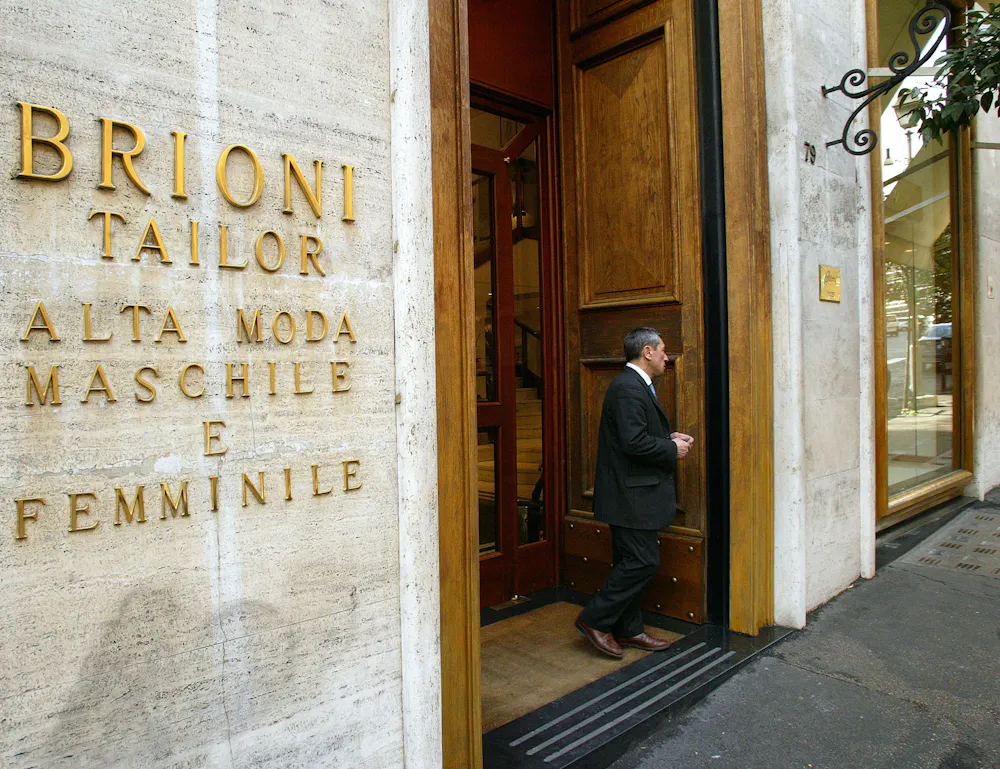
    Behind the populist slogans and “Buy American” rhetoric, this president has long embraced symbols of global luxury. While he’s worn American tailoring from Brooklyn’s Martin Greenfield – a craftsman who has dressed everyone from Barack Obama to Colin Powell – he has also been a longstanding customer of Brioni, an exclusive Italian brand of tailored clothing.

    So, while campaigning for American-made goods Trump has for years enjoyed the prestige of the “Made in Italy” tag, and the luxurious connotations it brings to menswear.

    But his trade policies have done the opposite for the global fashion industry. By threatening massive trade tariffs on countries like China, Vietnam, Bangladesh, India and Pakistan, he has potentially created chaos for both the industry and consumers.

    Traditionally, what’s known as “country of origin” has been represented by the “made in” label, a key branding tool that can shape consumer perceptions of product quality and other attributes. However, as globalisation has led to the outsourcing of design, materials and production, the definition has become increasingly complex.

    “Designed in” and “country of brand origin” have come to define prestigious product qualities, while country image is used to reflect perceptions of a nation and its products. For example, “designed in Italy” often evokes craftsmanship and luxury in fashion goods. Similarly, Germany has a historical reputation for excellence in producing cars. And “Japanese brand origin” is associated with cutting-edge technology and reliability, particularly in electronics and vehicles.

    Two decades ago, as production costs in the US and Europe mounted, clothing production moved to Asia. While China has remained an important supplier, trade tensions saw production move to countries including Vietnam, India and Bangladesh in the early mid-2010s. But with the threat of new tariffs on these countries, brands are scrambling again.

    This time they have far fewer alternatives. And for companies that rely on the storytelling behind where a garment is made, this isn’t just a supply chain headache. It’s an identity crisis.

    ‘Made in Italy’ – like Trump’s Brioni suits – conveys more than just the country of manufacture.
    Northfoto/Shutterstock

    In fashion, a garment’s origin is not merely a logistical detail – it’s part of its identity. Labels like “made in Italy”, “made in India” or “made in Bangladesh” carry different connotations. These could be luxury and craftsmanship – embroidery skills, for example – or affordability at scale.

    Over time, brands have cultivated these country associations as part of their marketing strategies, shaping consumer perception and trust. The result is a strategic decision for fashion companies, which must now consider cost and efficiency and how changing suppliers might affect their brand’s perceived values and identity.

    For example, brands like H&M and Levi Strauss & Co. have promoted their ethical sourcing in India or partnerships in Pakistan due to their expertise. But now they risk being taxed extensively. So what is the solution?

    The impact on consumers

    The growing risk of new trade rules and tariffs is making it harder for countries that supply fashion goods to stay competitive.

    First, brands must re-assess globalisation of the fashion industry and develop alternative supply chains. While a quick shift may be possible for simpler fashion products, relocating production for more complex or premium goods is usually a long-term investment. As a result, brands will be investigating country images that are perceived to be trusted and trustworthy as trading partners.

    But one unexpected outcome of these policies may be the return of European production and the emergence of “safe” sourcing locations in countries less exposed to trading restrictions. This could be Portugal and Romania for mid-market clothing, and Italy for high-end fashion goods. These would be more predictable and offer a globally recognised brand image.

    Heritage clothing brand Barbour still manufactures some of its lines in the UK.
    Robert Way/Shutterstock

    For some companies, shifting production to Italy will allow them to maintain product prestige while avoiding some of the eye-watering tariffs threatened for some Asian countries. Meanwhile others may look to move back to the UK because of its association with younger, niche markets.

    This won’t necessarily make clothing cheaper for consumers. It does though offer a level of reassurance, especially for higher-end or mid-market labels looking to preserve their image amid instability.

    Trump’s own affinity for Brioni reflects this implicit value. Though his public rhetoric prioritised American manufacturing, his choice of a luxury Italian tailor speaks to a broader truth: country image matters. And in fashion, it can be everything.

    The consequences of these trade policies are now visible across the fashion ecosystem. For example, American brands like Everlane and Pact are built around affordability and transparency. They rely on production in south or south-east Asia, and now face the challenge of rising costs.

    Larger companies will be rethinking pricing strategies, renegotiating contracts or halting expansion in regions hardest hit by tariffs.

    For consumers, this could mean higher prices and reduced variety. The label inside a garment now tells a more complex story – not only of where it was made but also of the political and economic forces shaping global trade.

    Even if these tariffs are eventually reduced or reversed, the disruption they have caused has already left a mark. They have redefined the meaning and importance of country-of-origin labels, exposed the fragility of global supply chains, and placed new pressure on brands to balance ethics, economics and image in a volatile environment. In fashion, where identity is crafted through fabric and narrative, the story behind the label has never mattered more.

    The authors do not work for, consult, own shares in or receive funding from any company or organisation that would benefit from this article, and have disclosed no relevant affiliations beyond their academic appointment.

    ref. Trump likes to know where his suits come from. His tariffs could now upend the world’s fashion supply chains – https://theconversation.com/trump-likes-to-know-where-his-suits-come-from-his-tariffs-could-now-upend-the-worlds-fashion-supply-chains-255337

    MIL OSI – Global Reports

  • MIL-OSI Global: The growing threat to U.S. democracy will literally cost lives

    Source: The Conversation – Canada – By Andrew C. Patterson, Assistant Professor of Sociology, MacEwan University

    According to a recent survey, most political scientists agree that President Donald Trump is turning the United States government into an autocracy, all too quickly.

    As political scholars Steven Levitsky and Lucan Way explain, a competitive-authoritarian country is one where elections are held and election results carry, but incumbents alter the game so as to tilt the odds of winning heavily in their favour. This effectively makes it an autocratic regime, with one person holding the lion’s share of power.

    Politicians tilt these odds by doing exactly the sorts of things Trump is doing. He is replacing civil servants with loyalists, and then repurposing the long-standing institutions they serve. This is so he can use those institutions for political gain — to punish dissenters and reward allies. All to support his staying in power.

    As just one recent example, Levistky and Way predicted in February that the Internal Revenue Service would become one of the many departments that Trump would weaponize. On April 15, Trump called for the IRS to revoke Harvard University’s tax-exempt status in response to the university’s refusal to acquiesce. Trump had previously withheld billions of dollars in grant funding.


    Read more:
    Harvard is suing the White House: here’s what Trump hopes to achieve by targeting universities


    Is there any case in which Trump has still acted in the service of the American public? Arguably, no, not by a long shot. Even the Jeff Bezos-owned Washington Post describes his first 100 days as a remarkable failure across multiple fronts.

    The headlines have been blistering, calling those first 100 days “horrifying” and “inept.” Nor is the American public impressed: most give his performance a grade of D or F, according to a recent poll.

    The biggest threat of all may be permanent damage to government institutions.

    Democracy and population health

    As research shows, these trends cannot possibly be good for the lives and livelihoods of American citizens. We have known for over a decade that the recruitment of civil servants based on their political affiliations or loyalties, rather than credentials, is a recipe for political corruption. Corruption, in turn, harms population health.

    My own recent study affirms these findings. It also concludes that the impact of civil service hiring on population health is surprisingly direct. All of this suggests more corruption and worse health as Trump tightens his control over the civil service.

    Democracy, too, matters for population health. In another study, we found that democracies have as much as 11 years of added life expectancy, and 75 per cent lower rates of infant mortality, compared to autocratic countries. For someone focused on cross-national differences in health, these were huge differences.

    Economic impacts

    Trump’s actions will soon affect American wallets as well if they haven’t already, as research on both civil service hiring and democratization would suggest.

    It’s not difficult to demonstrate the threat, which continues to evolve in real time. Tourism in the U.S. has taken a serious hit in recent weeks, with airline bookings from Canada down 70 per cent.


    Read more:
    Does cancelling a trip to the U.S. really send a political message, or is it just hurting local tourism?


    People from other countries first started boycotting American goods and services in response to Trump’s tariff campaign. In the meantime, Congress has done little to curtail the detainment of migrants without just cause, or their deportation to a Salvadorean mega-prison without due process. And now tourists are afraid to travel to the U.S.

    It is fair to say that both economic prosperity and population health require investment in the same government infrastructures that the Trump administration is now downsizing.

    Yet the damage does not stop at the border. Trump’s decisions will have ripple effects on global health. Programs focused on containing infectious disease in the developing world are bearing the brunt of huge cuts to USAID.

    Speed and volume

    Trump’s approach is not informed by any kind of economic expertise. He is shooting the American economy in both feet by waging a tariff war against other countries as he simultaneously decimates tourism and upends a low-cost workforce with his immigration policy.

    Americans who voted for him will not get the price control they were hoping for, with supply-chain disruptions coming quickly down the pipeline.

    Nor can Americans count on the court system to preserve democracy. This is for two reasons.

    First, Trump’s executive actions are happening far too quickly. He has had a record number of executive orders since taking office only three months ago. It may take months if not years for challenges to these decisions to work their way through courts.

    Second, courts will not necessarily rule on the side of democracy, as in the Supreme Court’s decision to assure legal immunity for Trump.

    None of this bodes well. According to one watchdog based in Sweden, the U.S. could lose its status as a democratic nation in just a few months — well before the midterm elections.

    CNN reports on President Trump’s statement that he doesn’t know if he needs to uphold the U.S. Constitution.

    Starting a movement

    All of this has one common denominator: Trump’s unhinged executive power. A decidedly meek U.S. Congress needs to wake from its stupor and constrain that power.

    But at the time of this writing, the House judiciary committee plans to slip provisions into a budget megabill that will grant Trump ever more sweeping power over regulations.

    One solution may be what we sociologists refer to as a social movement. This is where as many people as possible choose to act. Small interactions — like sharing an article with friends and family — can make a big difference, according to one prominent perspective in sociology.

    Other means are more direct, like joining a protest or writing to members of Congress. And then there are decisions about what not to do. Universities and law firms are encouraged not to participate in the fraying of American democracy by making a “deal” with the Trump administration.

    The take-home message is that the threat to American democracy is real and it is imminent. The impact on human health and well-being will be global. If the collapse of American democracy affects all of us, inside and outside of U.S. borders, then we can all agree to do something about it.

    Andrew C. Patterson does not work for, consult, own shares in or receive funding from any company or organisation that would benefit from this article, and has disclosed no relevant affiliations beyond their academic appointment.

    ref. The growing threat to U.S. democracy will literally cost lives – https://theconversation.com/the-growing-threat-to-u-s-democracy-will-literally-cost-lives-254170

    MIL OSI – Global Reports

  • MIL-OSI Global: Even a capped, time-limited youth visa scheme would be of value to young people in the UK and EU

    Source: The Conversation – UK – By Johanna L. Waters, Professor of Human Geography, UCL

    EF Stock/Shutterstock

    More than 60 Labour MPs have signed a letter calling on the government to support a youth mobility agreement with the EU.

    The letter called for a visa scheme that would be time limited and capped. This would be in line with other youth mobility agreements that the UK has with a number of countries and territories, including Australia and South Korea.

    Mobility would be for a defined period (such as three years), and the number of visas issued would be limited. The scheme would be aimed at young people in the UK and EU under 30 years old. This follows Prime Minister Keir Starmer’s promise to “reset” relations with the EU following his election in July 2024.

    At the upcoming EU-UK summit to be held in London on May 19 2025, opportunities for young people to travel between the UK and the EU will be a key part of negotiations between politicians.

    The European Commission have made no secret of their desire for such a scheme. They initially proposed a version of this in April 2024. Some EU countries, such as Germany, have spoken out in favour. Brexit has limited the ability of young people to spend time in the UK, with all the cultural, linguistic and other benefits potentially gained from this.

    The UK government’s enthusiasm has, in contrast, been more muted. They have a number of concerns, including immigration. Returning to any sort of free movement with the EU has been roundly rejected by politicians.

    Concerns over immigration

    Consecutive UK governments have been concerned with reducing net immigration, and international student visas contribute to these figures. Consequently, reducing numbers of incoming international students has been seen as a way of controlling immigration – to the dismay of bodies representing the UK’s higher education sector.

    But other countries, such as the US, exclude international students from immigration figures. Debates concerning removing international students from immigration numbers in the UK are ongoing. A poll commissioned by Universities UK found that only around a third of the British public viewed international students as migrants.

    As it stands, however, there are no plans to change the way international students are counted. Any new youth mobility agreement would presumably affect migration figures, but the direction is as yet unknown. And existing youth mobility schemes have had a relatively small impact on immigration numbers.

    Opportunities for young people

    As discussed in my forthcoming book (co-authored with Rachel Brooks) on student mobility after Brexit, young people in Britain have been particularly affected by changes in UK-EU relations.

    These have included their ability to study in Europe, as a consequence of the UK’s withdrawal from the Erasmus+ Programme – the EU’s initiative to support learning, work, sport and training in another EU country. The Republic of Ireland has allocated funding to allow students at universities in Northern Ireland to remain part of Erasmus+.

    At the moment, young Britons are treated no differently from any other potential immigrants to Europe, requiring a visa to study there for more than three months.

    UK citizens travelling to the EU now need a visa for stays of more than 90 days.
    Prostock-studio/Shutterstock

    The new Turing scheme has replaced Erasmus+ to fund study abroad for UK students. But it is far from a like-for-like replacement, is not reciprocal, and students and university staff have reported problems with securing visas in time.

    An agreement with the EU, enabling relatively stress-free travel for young people – albeit for a limited period of time – would be a significant benefit given the current situation.

    Young people from the EU now face similar regulations and restrictions when coming to the UK. A visa and “health surcharge” are now required for any stay over six months. International tuition fees must also be paid by EU citizens on UK degree courses. In addition, postgraduate students are no longer able to bring dependents.

    Consequently, fewer young people from Europe now choose the UK as a study destination. Recent figures show a significant drop in EU students coming to the UK – from 147,950 in 2019-20 to 75,490 in 2023-24. A resurgence in the number of EU students would probably be beneficial to UK universities, and the UK would, at the very least, appear more welcoming to young people from the EU.

    The re-election of Donald Trump as president of the US has ushered in new geopolitical realities. Relations between the US, UK and EU are shifting and uncertain, making a UK-EU deal in areas such as trade, security and education more important. The mobility of young people, as both learners and workers, is an important component of any negotiations on such a deal.

    Johanna L. Waters does not work for, consult, own shares in or receive funding from any company or organisation that would benefit from this article, and has disclosed no relevant affiliations beyond their academic appointment.

    ref. Even a capped, time-limited youth visa scheme would be of value to young people in the UK and EU – https://theconversation.com/even-a-capped-time-limited-youth-visa-scheme-would-be-of-value-to-young-people-in-the-uk-and-eu-255267

    MIL OSI – Global Reports

  • MIL-Evening Report: Indonesian postcard image ‘dangerous’ but Fiji a rising star in RSF press freedom index

    Pacific Media Watch

    To mark the release of the 2025 World Press Freedom Index, Reporters Without Borders (RSF) partnered with the agency The Good Company to launch a new awareness campaign that puts an ironic twist on the glossy advertising of the tourism industry.

    Three out of six countries featured in the exposé are from the Asia Pacific region — but none from the Pacific Islands.

    The campaign shines a stark light on the press freedom violations in countries that seem perfect on postcards but are highly dangerous for journalists, says RSF.

    It is a striking campaign raising awareness about repression.

    Fiji (44th out of 180 ranked nations) is lucky perhaps as three years ago when its draconian media law was still in place, it might have bracketed up there with the featured “chilling” tourism countries such as Indonesia (127) — which is rapped over its treatment of West Papua resistance and journalists.

    Disguised as attractive travel guides, the campaign’s visuals use a cynical, impactful rhetoric to highlight the harsh realities journalists face in destinations renowned for their tourist appeal.

    Along with Indonesia, Greece (89th), Cambodia (115), Egypt (170), Mexico (124) and the Philippines (116) are all visited by millions of tourists, yet they rank poorly in the 2025 World Press Freedom Index, reports RSF.

    ‘Chilling narrative’
    “The attention-grabbing visuals juxtapose polished, enticing aesthetics with a chilling narrative of intimidation, censorship, violence, and even death.

    “This deliberately unsettling approach by RSF aims to shift the viewer’s perspective, showing what the dreamlike imagery conceals: journalists imprisoned, attacked, or murdered behind idyllic landscapes.”


    The RSF Index 2025 teaser.     Video: RSF

    Indonesia is in the Pacific spotlight because of its Melanesian Papuan provinces bordering Pacific Islands Forum member country Papua New Guinea.

    Despite outgoing President Joko Widodo’s 10 years in office and a reformist programme, his era has been marked by a series of broken promises, reports RSF.

    “The media oligarchy linked to political interests has grown stronger, leading to increased control over critical media and manipulation of information through online trolls, paid influencers, and partisan outlets,” says the Index report.

    “This climate has intensified self-censorship within media organisations and among journalists.

    “Since October 2024, Indonesia has been led by a new president, former general Prabowo Subianto — implicated in several human rights violation allegations — and by Joko Widodo’s eldest son, Gibran Rakabuming Raka, as vice-president.

    “Under this new administration, whose track record on press freedom offers little reassurance, concerns are mounting over the future of independent journalism.”

    Fiji leads in Pacific
    In the Pacific, Fiji has led the pack among island states by rising four places to 40th overall, making it the leading country in Oceania in 2025 in terms of press freedom.

    A quick summary of Oceania rankings in the 2025 RSF World Press Freedom Index. Image: RSF/PMW

    Both Timor-Leste, which dropped 19 places to 39th after heading the region last year, and Samoa, which plunged 22 places to 44th, lost their impressive track record.

    Of the only other two countries in Oceania surveyed by RSF, Tonga rose one place to 46th and Papua New Guinea jumped 13 places to 78th, a surprising result given the controversy over its plans to regulate the media.

    RSF reports that the Fiji Media Association (FMA), which was often critical of the harassment of the media by the previous FijiFirst government, has since the repeal of the Media Act in 2023 “worked hard to restore independent journalism and public trust in the media”.

    In March 2024, research published in Journalism Practice journal found that sexual harassment of women journalists was widespread and needed to be addressed to protect media freedom and quality journalism.

    In Timor-Leste, “politicians regard the media with some mistrust, which has been evidenced in several proposed laws hostile to press freedom, including one in 2020 under which defaming representatives of the state or Catholic Church would have been punishable by up to three years in prison.

    “Journalists’ associations and the Press Council often criticise politicisation of the public broadcaster and news agency.”

    On the night of September 4, 2024, Timorese police arrested Antonieta Kartono Martins, a reporter for the news site Diligente Online, while covering a police operation to remove street vendors from a market in Dili, the capital. She was detained for several hours before being released.

    Samoan harassment
    Previously enjoying a good media freedom reputation, journalists and their families in Samoa were the target of online death threats, prompting the Samoan Alliance of Media Professionals for Development (SAMPOD) to condemn the harassment as “attacks on the fourth estate and democracy”.

    In Tonga, RSF reports that journalists are not worried about being in any physical danger when on the job, and they are relatively unaffected by the possibility of prosecution.

    “Nevertheless, self-censorship continues beneath the surface in a tight national community.”

    In Papua New Guinea, RSF reports journalists are faced with intimidation, direct threats, censorship, lawsuits and bribery attempts, “making it a dangerous profession”.

    “And direct interference often threatens the editorial freedom at leading media outlets. This was seen yet again at EMTV in February 2022, when the entire newsroom was fired after walking out” in protest over a management staffing decison.

    “There has been ongoing controversy since February 2023 concerning a draft law on media development backed by Communications Minister Timothy Masiu. In January 2024, a 14-day state of emergency was declared in the capital, Port Moresby, following unprecedented protests by police forces and prison wardens.”

    This impacted on government and media relations.

    Australia and New Zealand
    In Australia (29), the media market’s heavy concentration limits the diversity of voices represented in the news, while independent outlets struggle to find a sustainable economic model.

    While New Zealand (16) leads in the Asia Pacific region, it is also facing a similar situation to Australia with a narrowing of media plurality, closure or merging of many newspaper titles, and a major retrenchment of journalists in the country raising concerns about democracy.

    Pacific Media Watch collaborates with Reporters Without Borders.

    MIL OSI AnalysisEveningReport.nz

  • MIL-OSI Video: EP Plenary SessionEU support for a just, sustainable and comprehensive peace in Ukraine

    Source: European Commission (video statements)

    President von der Leyen participates in the EP plenary debate on EU support for a just, sustainable and comprehensive peace in Ukraine

    Like, comment, and share to support informed discussions on European affairs.

    Watch now & stay informed!

    More information can be found on the EC Press Corner
    Follow us on:
    -X: https://twitter.com/EU_Commission
    -Instagram: https://www.instagram.com/europeancommission/
    -Facebook: https://www.facebook.com/EuropeanCommission
    -LinkedIn: https://www.linkedin.com/company/european-commission/
    -Medium: https://medium.com/@EuropeanCommission

    Visit our website: http://ec.europa.eu

    https://www.youtube.com/watch?v=7jIdH-XvwWk

    MIL OSI Video

  • MIL-OSI United Kingdom: The Pile Fuel Cladding Silo

    Source: United Kingdom – Government Statements

    Case study

    The Pile Fuel Cladding Silo

    The Pile Fuel Cladding Silo is one of our oldest waste stores and one of the highest hazard facilities on the Sellafield site, dating to the early 1950’s

    Based on the simple design of a grain silo, the concrete structure is 29 metres long 10 metres wide and 18 metres high and is divided into 6 tall compartments.

    The challenge

    One of our biggest challenges at Sellafield is the need to take waste out of our legacy ponds and silos.

    These buildings are our most hazardous nuclear facilities and weren’t designed with decommissioning in mind.

    The Pile Fuel Cladding Silo was built more than 70 years ago when the site’s purpose was to produce material for nuclear weapons.

    The Pile Fuel Cladding Silo under construction in 1951

    The silo was built to store cladding from nuclear fuel used by the Windscale Piles – the first reactors to be built at Sellafield – and now contains a large variety of hazardous material.

    The cladding is Intermediate-Level Waste (ILW) and is dry stored.

    Based on the simple design of a grain silo, the concrete structure is 29 metres long 10 metres wide and 18 metres high and is divided into 6 tall compartments.

    As the UK’s civil nuclear power industry grew, the silo also received and stored cladding from used Magnox fuel from power stations around the country.

    By the early 1960s, routine waste tipping ceased, with sporadic tips up to 1972. With the silo now full, the building was placed into care and maintenance.

    In the 1980s, 90s and 00s, the silo underwent several upgrades to ensure the concrete structure could continue to provide safe containment and shielding for the waste.

    The Pile Fuel Cladding Silo was constructed with no means of retrieving the wastes inside, making it a ‘locked vault’ that has stored over 3200 cubic metres of ILW for 70 years.

    It’s also situated in a highly congested part of the Sellafield site and surrounded by a maze of pipelines and other sensitive buildings that make decommissioning the building extremely challenging.

    The solution

    The solution is to carefully retrieve the waste from the Pile Fuel Cladding Silo and place it into safe, secure, modern storage.

    The retrieval of wastes from the silo is a key priority for Sellafield Ltd and the Nuclear Decommissioning Authority (NDA) and involves several steps:

    • gaining access to the waste
    • removing the waste
    • placing the waste into modern containers
    • storing the waste in a modern waste store, pending final disposal in an underground repository

    The approach is to attach large shield doors to the side of the silo, cut holes in the top of each compartment and use telescopic grabs to reach into the silo and lift out the waste.

    The large shield doors attached to the side of the silo

    The retrieved waste can then be loaded into specially designed metal boxes, sealed inside a shielded flask and transported to a brand new, fit-for-purpose store elsewhere on the Sellafield site.

    Next steps

    The retrieved waste is placed into a specially designed 3m3 stainless steel box and loaded into a shielded transport flask.

    The boxes of waste will then be sent to the Box Encapsulation Plant Product Store – Direct Import Facility (BEPPS-DIF), a new above-ground store that has been specially constructed on the Sellafield site.

    BEPPS-DIF will store the waste safely and securely until it’s ready for immobilisation prior to permanent disposal underground in a Geological Disposal Facility.

    Benefits: To reduce risk and hazard and safely store the waste
    Status: Currently being decommissioned
    Collaboration: The decommissioning programme is being delivered by Sellafield Ltd in collaboration with Bechtel Cavendish Nuclear Solutions, a US-UK joint venture.

    Progress so far

    The first step towards retrievals was the construction of an enormous concrete superstructure next the silo to house the retrievals equipment.

    The silo superstructure

    We then installed giant, 12-tonne steel doors on each compartment to provide a safe barrier between the waste and the outside world when the compartments are cut into.

    All 6 silo doors in situ on the side of the silo

    In 2017 we successfully cut holes in the top of the silo’s 6 compartments, allowing access to the waste for the first time in 65 years.

    Working in collaboration with Bechtel Cavendish Nuclear solutions, we’ve designed, manufactured, tested and installed 9 huge modules containing the machinery needed to empty the silo.

    In August 2023 we successfully retrieved the first waste from the Pile Fuel Cladding Silo using a crane to reach into the silo, lower a grabber into the compartment and lift out and repackage the waste.

    The first retrievals represent a significant milestone in the decommissioning story at Sellafield and a step closer to reducing the UK’s nuclear hazard.

    In May 2025, we met our retrievals target for 2024/25 by retrieving enough waste to fill 18 3-metre cubed storage boxes.

    MIL OSI United Kingdom

  • MIL-OSI Russia: Vice Premier of the State Council of the People’s Republic of China stressed the importance of in-depth study of Xi Jinping’s economic thought

    Translation. Region: Russian Federal

    Source: People’s Republic of China in Russian – People’s Republic of China in Russian –

    Source: People’s Republic of China – State Council News

    Xinhua | 06. 05. 2025

    Keywords: PRC, CPC, Premier of the State Council of the People’s Republic of China, Economy, Jinping, Vice, Stressed, the Importance, of Guiding Economic Work, Strengthening the Unified, In-depth Study, of the, Party of the Central Committee, Ding Xuexiang, Efforts, Called, Tuesday

    BEIJING, May 6 (Xinhua) — Chinese Vice Premier Ding Xuexiang on Tuesday called for efforts to further study and implement Xi Jinping Thought on Economics and strengthen the CPC Central Committee’s unified centralized leadership of economic work. -0-

    Source: Xinhua

    Vice Premier of the State Council of the People’s Republic of China stresses the importance of in-depth study of Xi Jinping Thought on Economics Vice Premier of the State Council of the People’s Republic of China stresses the importance of in-depth study of Xi Jinping Thought on Economics

    MIL OSI Russia News

  • MIL-OSI Russia: China sees 7.9% rise in interregional travel during May Day holiday

    Translation. Region: Russian Federal

    Source: People’s Republic of China in Russian – People’s Republic of China in Russian –

    Source: People’s Republic of China – State Council News

    BEIJING, May 6 (Xinhua) — During the May Day holiday from May 1 to 5, China’s interregional passenger travel volume totaled nearly 1.47 billion, up 7.9 percent from the same period in 2024, according to the Ministry of Transport.

    Broken down by transport mode, passenger traffic on rail transport reached 101.7 million person-times (an increase of 10.8 percent), while passenger traffic volumes by air, water and road transport amounted to 11.15 million, 8.61 million and 1.34 billion person-times with an annual increase of 11.8 percent, 23.8 percent and 7.6 percent, respectively.

    In China, the May Day holiday is traditionally one of the busiest tourist seasons of the year. The holiday period also boosts tourism and retail revenues. -0-

    MIL OSI Russia News

  • MIL-OSI Russia: Museum attendance hits record high in China during May Day holiday

    Translation. Region: Russian Federal

    Source: People’s Republic of China in Russian – People’s Republic of China in Russian –

    Source: People’s Republic of China – State Council News

    BEIJING, May 6 (Xinhua) — China’s museums received more than 60.49 million visitors during the five-day May Day holiday, hitting a new historical high in terms of visitation, up 17 percent year on year, according to the National Cultural Heritage Administration.

    According to the department, national archaeological parks have become one of the most popular tourist destinations: from May 1 to 5, the visitor flow to 55 such parks exceeded 3.31 million people-times, an increase of 2.3 percent year-on-year.

    Moreover, the tourist flow in 11 national archaeological parks, according to the data of the mentioned department, has exceeded the mark of 100 thousand people-times in each of them. -0-

    MIL OSI Russia News

  • MIL-OSI Russia: Pakistan tanker blast death toll rises to 20

    Translation. Region: Russian Federal

    Source: People’s Republic of China in Russian – People’s Republic of China in Russian –

    Source: People’s Republic of China – State Council News

    ISLAMABAD, May 6 (Xinhua) — The death toll in a tanker blast in southwestern Pakistan’s Noshki district last week has risen to 20 after several people died from burns, local police said on Tuesday.

    Police said 17 of the seriously injured had died in the past four days while undergoing treatment at Liaquat National Hospital in Karachi, a southern port city.

    The blast occurred on April 28 in Noshki, a district of Balochistan province in southwestern Pakistan, after a petrol tanker caught fire during welding work.

    According to initial reports, the explosion killed the driver of the tanker truck and injured more than 60 people, many of whom suffered serious burns.

    Due to a shortage of medical facilities in the area, the provincial government airlifted 24 critically injured patients to Karachi for specialized treatment.

    In an attempt to prevent a major tragedy, the driver drove the tanker away from the cargo terminal. However, shortly before it exploded, a crowd gathered around the vehicle. –0–

    MIL OSI Russia News

  • MIL-OSI China: CICG leads delegation to Foire de Paris 2025

    Source: People’s Republic of China – State Council News

    At the 119th Foire de Paris that kicked off on April 30, China International Communications Group (CICG) organized the 2025 “Souffle d’Orient” Chinese culture theme exhibition and a series of cultural exchange activities to showcase everything new and trendy in Chinese society and culture and foster people-to-people and cultural exchange.

    The Chinese culture theme exhibition is inaugurated at the 119th Foire de Paris on April 30, 2025. [Photo/CICG]

    Yu Tao, vice president of CICG; Irina Bokova, former director-general of UNESCO; Yang Xinyu, ambassador and permanent delegate of the People’s Republic of China to UNESCO; Carine Préterre, executive vice director of the Comexposium Group; Liang Ke, deputy secretary of the CPC Working Committee of the Administration of the Qianhai Shenzhen-Hong Kong Modern Service Industry Cooperation Zone; Catherine Ruggeeri, chief supervisor of Cultural Industries, French Ministry of Culture; and Vincent Montagne, president of the Paris Book Festival, attended the opening ceremony and delivered speeches. Over 100 representatives from the cultural, art, publishing, and business communities of China and France participated in the event.

    Yu Tao, vice president of China International Communications Group (CICG), delivers a speech at the opening ceremony of the Chinese culture exhibition in Paris, France, April 30, 2025. [Photo/CICG]

    Yu said that exchange and mutual learning between the Chinese and European civilizations will not only solidify the public foundation for bilateral relations, but also serve as a global model, injecting stability into a turbulent world. Looking ahead, he emphasized the importance of promoting exchanges in education, science and technology, and culture, so that the seeds of peace can take root in people’s hearts around the world, enabling them to work together toward a brighter future for a community with a shared future for mankind, Yu said.

    Irina Bokova, former director-general of UNESCO, delivers a speech at the opening ceremony of the Chinese culture theme exhibition in Paris, France, April 30, 2025. [Photo/CICG]

    Bokova said that both Chinese and European cultures are significant global forces with profound historical legacies. She said China’s participation in the Foire de Paris exemplifies that national rejuvenation begins with its cultural revival and awakening. Today, China places great emphasis on culture, which has become the bedrock and source of social harmony and innovative development in Chinese society. Dialogue between Chinese and French civilizations can bring positive energy to the progress of human civilization, Bokova said.

    Yang Xinyu, ambassador and permanent delegate of the People’s Republic of China to UNESCO, delivers a speech at the opening ceremony of the Chinese culture theme exhibition in Paris, France, April 30, 2025. [Photo/CICG]

    Yang stated that culture is the soul of people and a bridge for interpersonal connections. UNESCO’s mission is to promote cultural diversity, and China has always attached great importance to cultural openness and inclusivity, Yang said. China’s participation in the Foire de Paris enables people to share their respective cultures and provides an excellent opportunity to promote mutual learning among different civilizations. This exhibition is not only a window showcasing China’s global cultural outreach but also an open invitation from China to people from across the world, Yang said.

    Carine Préterre, executive vice director of the Comexposium Group, delivers a speech at the opening ceremony of the Chinese culture theme exhibition in Paris, France, April 30, 2025. [Photo/CICG]

    Préterre said that the Foire de Paris is the largest fair in France and across Europe. Since its inception in 1904, it has been dedicated to introducing cultures and innovations from around the world to the French public. She said her organization’s fruitful cooperation with CICG at the Foire de Paris embodies the friendship between China and France. She said she looks forward to the Chinese Culture Theme Exhibition introducing the charm of Chinese culture to French visitors.

    Liang Ke, deputy secretary of the CPC Working Committee of the Administration of the Qianhai Shenzhen-Hong Kong Modern Service Industry Cooperation Zone, delivers a speech at the opening ceremony of the Chinese culture theme exhibition in Paris, France, April 30, 2025. [Photo/CICG]

    Liang said that Shenzhen, positioned at the forefront of China’s reform and opening-up, stands as a vibrant, innovative, and captivating international metropolis. She said that, at the Foire de Paris, the city is delighted to promote two cultural tourism projects: the Shenzhen Qianhai Huafa Snow World, the world’s largest indoor ski resort, and the Bay Area Store of Shenzhen Book City, China’s largest cultural complex dedicated to books. Qianhai, with its openness and innovation, is reaching out to the world. She said that friends from all sectors are cordially invited to experience Qianhai’s appeal and seize the opportunities for shared development.

    Catherine Ruggeeri, chief supervisor of Cultural Industries, French Ministry of Culture, delivers a speech at the opening ceremony of the Chinese culture theme exhibition in Paris, France, April 30, 2025. [Photo/CICG]

    Ruggeeri said that this year marks the 50th anniversary of EU-China diplomatic relations. Amidst a volatile and ever-changing international landscape, cultural dialogue is of paramount importance in nurturing EU-China relations. Both sides should remain committed to strengthening people-to-people exchanges and the development of cultural and creative industries through pragmatic cooperation platforms like the Foire de Paris, so as to inject new cultural vitality into the friendship between China and France, Ruggeeri said.

    Vincent Montagne, president of the Paris Book Festival, delivers a speech. [Photo/CICG]

    Montagne said that while the internet and modern technology have posed significant challenges to books, the number of new books published over the past two decades has surpassed the entire volume of publications before that period, with a historic number of manuscripts submitted by young authors. “Light still resides within books,” he said. Montagne said he looks forward to in-depth collaboration with Chinese publishing houses to jointly drive the prosperity and development of the book market.

    The exhibition features seven themed zones: Themed Books, Cultural and Creative Products from the National Museum of China, Panda Culture, Hehe Culture, Central Plains Culture, Sanjin Culture, and Science and Technology Innovation Culture. Approximately 2,000 exhibits are on display, spanning five categories: books, cultural and creative products, artworks, porcelain and ceramics, and sci-tech innovations. 

    Notable exhibits include the multilingual series of “Keywords to Understand China,” “Xingbao the Giant Panda,” “Nezha Conquers the Dragon King,” and “Hanshan’s Poems” among the books; panda-themed merchandise, Taizhou Embroidery apparel from Zhejiang province, mulberry silk embroidery, Jinqing straw-woven products, Shanxi iron teapots, Yigenteng table screens, and the intangible cultural heritage Ni Gugu (clay sculpture) among cultural and creative products; Linhai paper-cuttings, mortise and tenon structural components, crystal-carved plates featuring the “Two Hehe Sages,” glass artworks of “Hanshan and Shide,” and traditional costumes from the “Blue Rhythm and Brocade Memories” collection among artworks; and AI translation devices and AI photo frames among sci-tech innovations.

    Cultural performance is staged at the Chinese culture theme exhibition in Paris, France, April 30, 2025. [Photo/CICG]

    During the exhibition, various themed promotional events were hosted, such as the Shenzhen Theme Day and the Henan Theme Day, featuring intangible cultural heritage performances and cultural shows. These events attracted nearly 10,000 visitors and garnered enthusiastic responses.

    On the opening day, Steven Abajoli, chairman of the Organizing Committee of the Foire de Paris, presented the Honorary Contribution Award to CICG. He commended CICG for meticulously crafting an exquisite exhibition pavilion, presenting a diverse array of cultural products, and organizing creative cultural performances, all of which brought the distinctive appeal of Chinese culture to the Foire de Paris and the French public. This marked the third consecutive year that CICG has received this accolade.

    China Pavilion. [Photo/CICG]

    Founded in 1904, the Foire de Paris is one of the world’s oldest, largest, and most prestigious comprehensive exhibitions. After three years of dedicated efforts, the “Souffle d’Orient” Chinese culture theme exhibition, organized and curated by CICG, has emerged as a highlight at the Foire de Paris, garnering positive public acclaim.

    MIL OSI China News

  • MIL-OSI Europe: Further reforms needed in Kazakhstan to strengthen fair trial rights: ODIHR monitoring report

    Source: Organization for Security and Co-operation in Europe – OSCE

    Headline: Further reforms needed in Kazakhstan to strengthen fair trial rights: ODIHR monitoring report

    WARSAW, 6 May 2025 – In a report summarising its year-long monitoring of more than 400 court hearings related to the January 2022 protests in Kazakhstan, the OSCE Office for Democratic Institutions and Human Rights (ODIHR) documented court practices that fall short of international fair trial standards, while recognizing the challenges faced by the Kazakh authorities to complete a large number of criminal investigations and court cases.
    “The right to a fair trial is a cornerstone of democracy. With thanks to the Kazakh authorities for their openness and cooperation throughout the monitoring process and while acknowledging ongoing reforms and some positive trends, our findings underline the need for Kazakhstan to take effective measures that ensure the rights of the accused are fully protected and the principles of a fair trial are upheld,” said ODIHR Director Maria Telalian. “ODIHR is ready to assist Kazakhstan in implementing our tailored recommendations and introducing legal reforms in the country to strengthen the independence of the judiciary and addrssing the shortcomings identified.” 
    Following an invitation by the Kazakh authorities and in cooperation with the Supreme Court, ODIHR monitored 35 criminal cases related to the January 2022 protests in Kazakhstan between November 2022 and December 2023, as well as cases involving 139 defendants and more than 400 court hearings. The trial monitoring took place in courts in Almaty, Kyzylorda, Semey, Taldykorgan and Taraz. The cases were primarily against state officials as well as political and civil society activists, including organizers of the protests, and involved charges of torture and other serious human rights violations, as well as the use of evidence obtained through torture. 
    The monitoring was carried out in line with the ODIHR’s trial monitoring methodology, following well-established principles of impartiality and objectivity. ODIHR did not assess the merits of the cases, but focused on court procedures and their compliance with international democratic standards and evaluated the extent to which the right to a fair trial is respected.
    Today’s report includes the findings from the monitoring, as well as a set of recommendations to assist the Kazakh authorities in ensuring compliance with international standards. ODIHR has also developed a number of tools aimed at supporting justice sector reforms. All 57 participating states of the OSCE have committed to abide by the rule of law and to ensure the right to a fair and public trial by a competent, independent and impartial tribunal established by law.

    MIL OSI Europe News

  • MIL-OSI Africa: Valentin-Yves Mudimbe: the philosopher who reshaped how the world thinks about Africa

    Source: The Conversation – Africa – By Christophe Premat, Associate Professor in French Studies (cultural studies), head of the Centre for Canadian Studies, Stockholm University

    Congolese thinker, philosopher and linguist Valentin-Yves Mudimbe died on 21 April 2025 at the age of 83. He was in the US, where he had lived for many years.

    A towering figure in African critical thought, Mudimbe’s work – translated and studied worldwide – has profoundly shaped postcolonial studies. He leaves a groundbreaking intellectual legacy on the colonisation of knowledge and the condition of Africans.

    At a time when debates on decolonising knowledge are gaining ground, Mudimbe’s passing invites us to revisit the work of a thinker who, since the 1980s, paved the way for a radical critique of imposed “categories”. He wanted to help rebuild intellectual frameworks which imagined and defined Africa on its own terms, not through the labels or categories imposed by colonial powers.

    As a specialist in postmodern and postcolonial theories, I think he had considerable influence on the field of postcolonial studies.

    He was one of the most influential African thinkers of the 20th century. His impact did not come from activism, but from careful, sustained intellectual work. With his seminal work The Invention of Africa (1988) he profoundly disrupted African and postcolonial studies. His work went far beyond the usual east-west divide.

    A journey between Africa and exile

    Valentin-Yves Mudimbe was born in 1941 in Jadotville (now Likasi), in the Democratic Republic of Congo. His early education took place in a Benedictine monastery. Later, he pursued further studies at Louvain in Belgium.

    His religious education left a lasting mark on his thinking. It shaped his critical approach to knowledge. His work often explored the connections between language, power, and how ideas become institutionalised.

    In 1970, Mudimbe returned to the newly independent Congo. He began teaching at the National University of Zaïre. The country was then caught between postcolonial hope and growing disillusionment.

    Under Mobutu Sese Seko’s regime, the political atmosphere grew stifling for independent thinkers. The state had adopted the rhetoric of “authenticity”, turning it into a tool of control. Faced with this ideological stranglehold, Mudimbe chose exile in 1979.

    He relocated to the US, where he taught at Stanford and later Duke University. There, he continued his work of critical deconstruction. Yet, despite his physical distance, he remained deeply committed to Africa’s future.

    Deconstructing the ‘colonial library’

    First published in English in 1988 as the The Invention of Africa, the book was translated into French in 2021 under the title L’Invention de l’Afrique, (Présence africaine).

    Mudimbe offers much more than a critique of colonial representations. He examined the “colonial library”. It refers to the vast collection of religious, anthropological and administrative texts that, for centuries, framed Africa as an object to be studied, dominated and “saved”. Mudimbe was always careful not to accept ideas just because they were passed down. Instead, he was always looking for new ways to think freely and independently.

    Unlike Edward Said, the Palestinian-American literary theorist and critic who exposed how the west constructed a mythologised “Orient”, Mudimbe revealed something more insidious. He showed that Africa was often imagined as a void to be filled. It was cast as a cultural blank slate, which helped justify the colonial mission.

    This radical deconstruction raised a crucial question: how can we produce knowledge that does not, even through critique, reproduce the very colonial frameworks it seeks to challenge?

    The book’s impact was profound, resonating across Africa, Europe and North America. It created an intellectual foundation for thinkers like Achille Mbembe, Souleymane Bachir Diagne and Felwine Sarr, who, in turn, continued to explore what truly decolonised African thought might look like.

    Building something new

    Mudimbe was never satisfied with existing structures. He aimed to build something new from the ground up. For him, liberating Africa required a rebuilding of knowledge systems. He rejected the assumption that western intellectual frameworks alone could define Africa. He also warned against essentialist temptations – the trap of creating new conceptual prisons in the name of authenticity.

    His thinking followed a rigorous method: analysing discourse, questioning inherited categories, and dismantling false assumptions.

    This demanding work aimed to empower Africa to think for itself without cutting itself off from the rest of the world.

    His fiction – Between Tides (in French, Entre les eaux. Dieu, un prêtre, la révolution), Before the Birth of the Moon (Le Bel Immonde in French), Shaba Deux : les carnets de mère Marie Gertrude – embodies the same refusal to be stereotyped.

    His characters navigate colonial legacies, state nationalism and rigid identity politics through stories of displacement and fragmented memory.

    Language itself becomes a battleground for creativity in his novels. Sharply crafted, his prose captures the diversity of contemporary African experience. Through both his literary and philosophical works, Mudimbe consistently insisted that identity is never a given. It is always a construct to be questioned.

    A living legacy

    As Africa navigates complex geopolitical transformations and redefines its cultural identities, Mudimbe’s intellectual legacy proves more vital than ever. His work challenges us to recognise that true liberation extends beyond political sovereignty or cultural revival. It requires the radical work of reinventing how knowledge itself is produced and validated.

    Mudimbe’s lasting legacy urges us to remain intellectually vigilant in a world where knowledge is constantly shifting. He challenges us to reject rigid categories, embrace complexity with care, and make room for uncertainty instead of rushing to resolve it.

    For Mudimbe, to decolonise knowledge means relentless critique paired with creative reconstruction. It means building pluralistic and open frameworks that honour Africa’s diverse experiences without nostalgia or complacency.

    – Valentin-Yves Mudimbe: the philosopher who reshaped how the world thinks about Africa
    – https://theconversation.com/valentin-yves-mudimbe-the-philosopher-who-reshaped-how-the-world-thinks-about-africa-255902

    MIL OSI Africa

  • MIL-OSI: Apollo Funds to Acquire Hav Energy from HitecVision

    Source: GlobeNewswire (MIL-OSI)

    NEW YORK and STAVANGER, Norway, May 06, 2025 (GLOBE NEWSWIRE) — Apollo (NYSE: APO) and HitecVision, a leading investor in the European energy industry, today announced that Apollo-managed funds (the “Apollo Funds”) have agreed to acquire maritime liquefied natural gas carrier (“LNGC”) infrastructure platform Hav Energy LNG Holding AS (“Hav Energy”) from HitecVision. Financial terms were not disclosed.

    Established by HitecVision in 2022, Hav Energy invests in LNGC infrastructure projects in partnership with Knutsen LNG, a large owner-operator of LNGCs globally, and jointly owns a portfolio of 10 newbuild LNGCs which are 100% contracted on long-term charters with investment grade counterparties. The portfolio includes two modern operating vessels and eight under construction at the Hyundai Heavy Industries shipyard in Korea due to be delivered in 2025 and 2026.

    Global LNG imports are forecast to reach over 600 million metric tons annually by 2040, driven by growth in Asia and Europe as well as efforts to cut emissions in heavy industries and transportation, and expectations for robust new liquification capacity coupled with limited newbuild LNG vessel supply also provide strong tailwinds supporting Hav Energy’s future growth trajectory.

    Apollo Partner Joseph Romeo said, “Hav Energy has quickly scaled into a top platform facilitating the global transport of LNG, which we view as a bridge fuel capable of reducing emissions for rapidly growing power demand. We are excited to work with the Hav Energy team and their aligned, well-regarded partners in Knutsen to accelerate growth of the platform, which we believe can serve as a vital infrastructure link supporting enhanced energy resiliency for customers around the world.”

    Hav Energy CEO Randi Vestbø said, “This transaction represents a critical juncture for Hav Energy as we continue to build a next-generation fleet of LNG infrastructure carriers and pursue attractive growth opportunities to expand our capabilities alongside our new partners at Apollo. We are grateful for the guidance, backing and strategic support from HitecVision, which has been instrumental in our development and positions us for our next phase of growth as industry tailwinds continue to drive long-term LNG demand globally.”

    HitecVision Senior Partner Jan H. Solstad said, “We are proud that we in partnership with Knutsen LNG and the Hav management team have been able to develop Hav LNG into a differentiated, highly scalable platform, leveraging HitecVision’s significant expertise in building companies within the energy space. With a leading management team, strong institutional partners and clear strategy, we believe Hav Energy is well positioned for future success.”

    Thommessen, Stephenson Harwood LLP and Vinson & Elkins LLP served as legal counsel to the Apollo Funds. HitecVision has been advised by DNB Markets and law firm BAHR.

    About Apollo

    Apollo is a high-growth, global alternative asset manager. In our asset management business, we seek to provide our clients excess return at every point along the risk-reward spectrum from investment grade credit to private equity. For more than three decades, our investing expertise across our fully integrated platform has served the financial return needs of our clients and provided businesses with innovative capital solutions for growth. Through Athene, our retirement services business, we specialize in helping clients achieve financial security by providing a suite of retirement savings products and acting as a solutions provider to institutions. Our patient, creative, and knowledgeable approach to investing aligns our clients, businesses we invest in, our employees, and the communities we impact, to expand opportunity and achieve positive outcomes. As of March 31, 2025, Apollo had approximately $785 billion of assets under management. To learn more, please visit www.apollo.com.

    About Hav Energy

    Hav Energy is a Norway-based energy infrastructure company established by HitecVision in 2022. The current asset portfolio has 10 state-of-the-art newbuild LNG vessels co-owned and operated by Knutsen LNG. 

    About HitecVision

    HitecVision is a Norwegian private equity firm and a leading provider of institutional capital to Europe’s energy industry. For almost four decades, we have been investing in the energy sector, starting out in the oil and gas industry before turning to the current focus on decarbonisation and energy transition. We have about EUR 9 billion in assets under management, and is headquartered in Stavanger, with offices and investment professionals in Oslo, London and Milan. Our 65-person team focuses on developing profitable and sustainable companies, working closely with our management teams and boards.

    Contacts

    For Apollo:

    Noah Gunn
    Global Head of Investor Relations
    Apollo Global Management, Inc.
    212-822-0540
    IR@apollo.com.

    Joanna Rose
    Global Head of Corporate Communications
    Apollo Global Management, Inc.
    212-822-0491
    Communications@apollo.com.

    For HitecVision:

    Birgitte Kolstad
    Director Investor Relations
    Birgitte.Kolstad@hitecvision.com

    The MIL Network

  • MIL-OSI: QphoX, Rigetti and the NQCC Announce Collaboration on Multi-Channel Optical Readout of Quantum Processors

    Source: GlobeNewswire (MIL-OSI)

    DELFT, Netherlands, BERKELEY, Calif. and OXFORDSHIRE, United Kingdom, May 06, 2025 (GLOBE NEWSWIRE) — QphoX B.V., a Dutch quantum technology startup developing leading frequency conversion systems for quantum applications, Rigetti Computing, Inc. (Nasdaq: RGTI), a pioneer in full-stack quantum-classical computing, and the National Quantum Computing Centre (NQCC), the UK’s national lab for quantum computing, today announced that they have been awarded a multinational grant to perform readout of superconducting qubits using light transmitted over optical fiber.

    In a recent demonstration, QphoX and Rigetti validated the potential of this technique by optically reading out the state of a single superconducting qubit1. Optical readout is made possible by microwave-to-optical transduction at the base temperature of the cryostat. This transduction process converts the information contained in the microwave readout pulse into an optical signal carried over optical fiber. This approach could eventually replace conventional microwave amplifiers and coaxial wiring as part of the qubit signal processing chain and thereby offer considerable scaling advantages due to the comparatively low dissipation of the transducer and the negligible passive heat loads from telecommunications optical fiber.

    QphoX, Rigetti and the NQCC are partnering to take the next step in this research to realize optical readout of a fully-fledged superconducting quantum computer. In this multinational collaboration, QphoX will scale its optical qubit readout system that will interface with Rigetti’s 9-qubit Novera QPU, enabling optical readout of all qubits in the processor. The combined system will be installed and operated at the NQCC.

    “Using light to readout the state of a superconducting qubit will remove a significant amount of heat load on cryogenic systems and therefore allow to overcome one of the critical bottlenecks in building a universal quantum computer. We are excited to take our developments to the next level and work with our partners in demonstrating this critical technology at scale,” says Simon Groeblacher, CEO of QphoX.

    “This innovative solution to a well-known scaling challenge is made possible by an open and modular system architecture,” says Dr. Subodh Kulkarni, Rigetti CEO. “Integrating our partners’ technology with our QPU enables us to benefit from even more expertise to accelerate our work towards fault tolerance.”

    “Demonstrating optical qubit readout at the system level represents an important step in our mission to advance scalable quantum computing, and we are delighted to host this collaborative work at the NQCC with such innovative project partners,” commented Dr. Michael Cuthbert, Director of NQCC.

    The 33-month program is funded by the Rijksdienst voor Ondernemend Nederland (RVO) and Innovate UK via the Eureka network, an intergovernmental organization for research and development funding and coordination.

    1van Thiel, T.C., Weaver, M.J., Berto, F. et al. Optical readout of a superconducting qubit using a piezo-optomechanical transducer. Nat. Phys. 21, 401–405 (2025).

    About QphoX
    QphoX is the leading developer of quantum transduction systems that enable quantum computers to network over optical frequencies. Leveraging decades of progress in photonic, MEMS and superconducting device nanofabrication, their single-photon interfaces bridge the gap between microwave, optical and telecom frequencies to provide essential quantum links between computation, state storage and networking. QphoX is based in Delft, the Netherlands. See qphox.eu for more information.

    About Rigetti
    Rigetti is a pioneer in full-stack quantum computing. The Company has operated quantum computers over the cloud since 2017 and serves global enterprise, government, and research clients through its Rigetti Quantum Cloud Services platform. In 2021, Rigetti began selling on-premises quantum computing systems with qubit counts between 24 and 84 qubits, supporting national laboratories and quantum computing centers. Rigetti’s 9-qubit Novera™ QPU was introduced in 2023 supporting a broader R&D community with a high-performance, on-premises QPU designed to plug into a customer’s existing cryogenic and control systems. The Company’s proprietary quantum-classical infrastructure provides high-performance integration with public and private clouds for practical quantum computing. Rigetti has developed the industry’s first multi-chip quantum processor for scalable quantum computing systems. The Company designs and manufactures its chips in-house at Fab-1, the industry’s first dedicated and integrated quantum device manufacturing facility. Learn more at rigetti.com.

    About the NQCC
    The NQCC is the UK’s national lab for quantum computing, dedicated to accelerating the development of quantum computing by addressing the challenges of scaling up the technology. The centre is working with businesses, government, and the research community to deliver quantum computing capabilities for the UK and support the growth of the emerging industry. The NQCC’s programme is being delivered jointly by UKRI’s research councils, EPSRC and STFC. It is a part of the National Quantum Technologies Programme (NQTP) to develop and deliver quantum technologies across the areas of sensing, timing, imaging, communications and computing. The centre is headquartered in a purpose-built facility on STFC’s Rutherford Appleton Laboratory site at the Harwell Campus in Oxfordshire. Visit nqcc.ac.uk for more information.

    Cautionary Language Concerning Forward-Looking Statements
    Certain statements in this communication may be considered “forward-looking statements” within the meaning of the federal securities laws, including statements with respect to the Company’s future success and performance, including expectations with respect to timing of the development and commercialization of superconducting quantum computing; expectations regarding the advantages and impact of the multinational-funded projects on the Company’s operations, technology roadmap, milestones, and the Company’s position in the industry; statements to optical readouts eventually replacing conventional components as part of the qubit signal processing chain and thereby offering scaling advantages; the extent that the optical qubit readout systems may interface with Rigetti’s Novera QPU and enable optical readout of all qubits; the extent that using light will remove a significant amount of heat load on cryogenic systems; the extent that using light will overcome critical bottlenecks in building a universal quantum computer; and the extent to which Rigetti’s open and modular system architecture will allow for partners to integrate their technology with Rigetti’s QPUs. These forward-looking statements are based upon estimates and assumptions that, while considered reasonable by the Company and its management, are inherently uncertain. Factors that may cause actual results to differ materially from current expectations include, but are not limited to: the Company’s ability to achieve milestones, technological advancements, including with respect to its technology roadmap; the ability of the Company to obtain government contracts successfully and in a timely manner and the availability of government funding; the potential of quantum computing; the success of the Company’s partnerships and collaborations, including the strategic collaboration with Quanta; the Company’s ability to accelerate its development of multiple generations of quantum processors; the outcome of any legal proceedings that may be instituted against the Company or others; the ability to maintain relationships with customers and suppliers and attract and retain management and key employees; costs related to operating as a public company; changes in applicable laws or regulations; the possibility that the Company may be adversely affected by other economic, business, or competitive factors; the Company’s estimates of expenses and profitability; the evolution of the markets in which the Company competes; the ability of the Company to implement its strategic initiatives and expansion plans; the expected use of proceeds from the Company’s past and future financings or other capital; the sufficiency of the Company’s cash resources; unfavorable conditions in the Company’s industry, the global economy or global supply chain, including rising inflation and interest rates, deteriorating international trade relations, political turmoil, natural catastrophes, warfare and terrorist attacks; and other risks and uncertainties set forth in the section entitled “Risk Factors” and “Cautionary Note Regarding Forward-Looking Statements” in the Company’s Annual Report on Form 10-K for the year ended December 31, 2024 and other documents filed by the Company from time to time with the SEC. These filings identify and address other important risks and uncertainties that could cause actual events and results to differ materially from those contained in the forward-looking statements. Forward-looking statements speak only as of the date they are made. Readers are cautioned not to put undue reliance on forward-looking statements, and the Company assumes no obligation and does not intend to update or revise these forward-looking statements other than as required by applicable law. The Company does not give any assurance that it will achieve its expectations.

    Rigetti Media Contact
    press@rigetti.com

    The MIL Network

  • MIL-OSI: ReportAId raises €2.2M using AI to unlock healthcare data

    Source: GlobeNewswire (MIL-OSI)

    Milan, May 06, 2025 (GLOBE NEWSWIRE) — Ask any doctor what’s keeping them from delivering better care, and paperwork will top the list. Despite billions invested in healthcare technology, 80% of clinical data remains trapped in unstructured reports, and 70% of patients don’t return to the same facility for follow-ups. Today, ReportAId announces a €2.2 million pre-seed funding round to address this massive inefficiency with an AI platform that automatically interprets medical reports and transforms them into interactive tools that guide both patients and clinicians through personalized care pathways.

    The capital raise was led by Italian Founders Fund with participation from Heartfelt, Exceptional Ventures, 2100 Ventures, Vento, Ithaca, B Heroes, Vesper Holding, and angel investors Luca Ascani, Enrico Giacomelli, Francesco Zaccariello and Luca Foschini. This investment will enable ReportAId to add ten new team members and expand across Italian and European healthcare, scaling a solution already in use at leading institutions like San Raffaele Hospital and currently being adopted by Ospedale Isola Tiberina – Gemelli Isola.

    ReportAId founders: (L to R) Claudio Caletti, Giuseppe Faraci and Luca Foresti.

    “ReportAId is the first operator to bring AI at scale into Italian healthcare. In the coming years, this technology will become a core pillar of the health system,” said Giuseppe Faraci, CEO and co-founder of ReportAId. “We already work with leading private providers, but our goal is to support the public sector as well. We are ready for a concrete dialogue with local-health directors, regional councillors and national ministries to help modernise the NHS.”

    ReportAId’s platform tackles the root causes of healthcare inefficiency: poorly managed reports, fragmented care journeys, and difficulties in treatment planning. The AI-powered system extracts key data from medical documents and creates structured, personalized care plans that make next steps clear for everyone involved. For patients, this means quick, guided access to every aspect of their care pathway – streamlining appointment booking, medication purchases, and follow-up care. For providers, the platform enables more efficient scheduling of tests and surgeries, design of therapeutic and preventive plans, and assessment of prescription appropriateness in line with clinical guidelines.

    Founded in Milan in 2024 by Giuseppe Faraci (CEO), Claudio Caletti (CTO) and Luca Foresti (Chairman), ReportAId emerged from the founders’ firsthand observations of the critical inefficiencies plaguing healthcare. By applying AI to the fundamental problem of unstructured clinical data, they’ve created a solution that not only improves the patient experience but also delivers significant operational benefits to healthcare providers – with revenue increases of up to 25% reported by hospitals using the system.

    What differentiates ReportAId is its focus on turning unactionable medical reports into structured databases and automated workflows while maintaining full compliance with EU privacy regulations. The platform’s ability to create a comprehensive clinical database covering every medical report gives healthcare facilities unprecedented insight into their operations and patient outcomes.

    The ReportAId platform.

    “ReportAId is one of the most tangible and transformative AI applications in healthcare. It tackles critical inefficiencies – from fragmented clinical data and gaps in patient management to structural waiting-list issues,” said Irene Mingozzi, Principal at Italian Founders Fund. “By turning medical reports into structured, automated actions, the platform directly improves continuity and quality of care. This is exactly the kind of impact IFF seeks: ambitious founders, enabling technology and a long-term vision to make things better. We also believe ReportAId’s potential extends far beyond Italy.”

    The healthcare AI sector has seen explosive growth, but few solutions address the fundamental data structuring problem that ReportAId tackles. With proven traction at prestigious institutions like San Raffaele Hospital and a clear path to both private and public sector adoption, the company is positioned to become a critical infrastructure layer in the European healthcare system.

    “Healthcare is the perfect field for AI, and the founders – already well-known in the AI and health ecosystem – are attacking one of the sector’s biggest inefficiencies with a simple, elegant and scalable solution,” added Paolo Pio, Co-Founder & General Partner at Exceptional Ventures. “Traction in Italy is real and demand is knocking. We’re excited to join their mission.”

    Looking ahead, ReportAId plans to expand its integration capabilities with existing healthcare IT systems, develop additional AI capabilities for specialized medical disciplines, and work directly with public healthcare authorities to implement its solution at scale – creating a more efficient, accessible healthcare system that serves patients better while reducing costs and administrative burdens.

    Ends 

    Media images can be found here.

    About ReportAId
    Founded in Milan in 2024 by Giuseppe Faraci (CEO), Claudio Caletti (CTO) and Luca Foresti (Chairman), ReportAId leverages artificial intelligence to optimise healthcare processes, automatically interpreting medical reports and turning them into interactive tools for providers and patients—fully compliant with European privacy regulations. Backed by Italian Founders Fund, Heartfelt, Exceptional Ventures, 2100 Ventures, Vento, Ithaca, B Heroes, Vesper Holding, Luca Ascani, Enrico Giacomelli, Francesco Zaccariello and Luca Foschini, the solution is live or being rolled out at private hospitals including San Raffaele and Ospedale Isola Tiberina – Gemelli Isola. ReportAId now aims to serve the public sector, helping make healthcare systems more efficient and accessible.

    The MIL Network