Category: Europe

  • MIL-OSI United Kingdom: Professor Claire Stewart appointed to the Commission on Human Medicines as three members reappointed

    Source: United Kingdom – Executive Government & Departments

    News story

    Professor Claire Stewart appointed to the Commission on Human Medicines as three members reappointed

    The appointment will involve a time commitment of 22 days per year. Remuneration for the role will be at a rate of £325 per attendance and preparation for meetings.

    Professor Claire Stewart has been appointed as a commissioner of the Commission on Human Medicines (CHM) for four years from 3 March 2025.

    Three other commissioners of the Commission on Human Medicines have also been reappointed, with their new terms due to begin in May.

    The CHM is an advisory non-departmental public body which is sponsored by the Department of Health and Social Care (DHSC).

    The CHM advises ministers on the safety, efficacy and quality of medicines.

    Three commissioners have been reappointed:

    • Professor Amanda Adler has been reappointed for a further two years from 1 May 2025.
    • Professor Steve Cunningham has been reappointed for a further two years from 1 May 2025.
    • Professor Yvonne Perrie has been reappointed for a further four years from 1 May 2025.

    The appointments will involve a time commitment of approximately 22 days per year including 11 meetings. Remuneration for the roles will be at a rate of £325 per meeting.

    All appointments are made in accordance with the Cabinet Office Code of Governance for Public Appointments.

    The regulation of public appointments against the requirements of this code is carried out by the Commissioner for Public Appointments.

    The appointments are made on merit and political activity played no part in the decision process. However, in accordance with the code, there is a requirement for appointees’ political activity (if any declared) to be made public.

    None of the appointees have declared any political activity.

    Share this page

    The following links open in a new tab

    Updates to this page

    Published 17 April 2025

    MIL OSI United Kingdom

  • MIL-OSI USA: Babbidge Library Exhibit Offers Powerful Images of War, and Hope, Created by Ukrainian Children

    Source: US State of Connecticut

    In the drawing, two little children hold hands, the taller figure with shoulder-length hair.

    The shorter figure has hair cropped short, and holds a teddy bear in their other hand, one of the toy’s eyes missing and portrayed as an X.

    Between the two is an umbrella, seemingly their only protection from what’s falling from the sky above them – a cluster of ominous black bombs.

    ‘With faith in victory,’ an original drawing by Anastasiia B., a 14-year-old from Ukraine, from the ‘Children Draw War, Not Flowers’ exhibit, on display at the Babbidge Library until August 1, 2025. (Contributed image)

    The umbrella is striped – yellow, blue, yellow – in the colors of the flag of the artist’s home country: Ukraine.

    It’s a simple drawing, but poignant, and made ever more so by the fact that the artist who created the work, entitled “With faith in victory,” was only 14 years old when they drew it in September 2022, seven months after Russia launched a military invasion of Ukraine.

    This drawing, and many others like it – created by Ukrainian children during the ongoing Russo-Ukraine War – are on display at the UConn Library’s Homer Babbidge Library as part of the “Children Draw War, Not Flowers” exhibit, which opened on April 8.

    In the fall of 2022, the Cherkasy Regional Universal Scientific Library, funded by the School of Information at San Jose State University in California, held a drawing competition in 40 public regional libraries in communities where over 220,000 displaced Ukrainians resided.

    Children from the ages of 6 to 18 created more than 450 drawings documenting their experiences of war, trauma, and hope. Those drawings are now part of “Children Draw War, Not Flowers,” which has traveled to a number of institutions but will reside at UConn Storrs until later this summer.

    Its stop at UConn was made possible by a collaboration with Ulia Gosart from San Jose State University, an assistant professor, scholar, writer, and human rights activist who received her bachelor’s degree from Kiev University of Arts in Ukraine and her master’s in library and information science from Southern Connecticut State University, according to Jean Cardinale ’04 MS, head of communication and marketing for the UConn Library.

    “Since the invasion of Ukraine in 2022, Gosart has been supporting Ukrainian libraries by raising awareness and fundraising through programming, including curating this traveling exhibit,” says Cardinale. “She supports her community engaged in war through the power of libraries, and the UConn Library was honored to be asked to take part in her important work.”

    The “Children Draw War, Not Flowers” exhibit includes 70 drawings depicting weapons, loss, soldiers, and destroyed buildings and artifacts. But the drawings also show symbols of hope and pride. The blue and yellow colors of the Ukrainian flag are abundant. Angels hover over Ukrainian soldiers. Sunflowers and storks, images of national solidarity, hang over depictions of war.

    The exhibit’s goal, explains Cardinale, is to help visitors gain greater understanding of the realities Ukrainian people – and especially Ukrainian children – face in the midst of war.

    “Thankfully, living through war is something most of us have not had to experience, and we are geographically so far away that it’s easy to disassociate from what is happening,” Cardinale says. “When you see these pieces where children have drawn themselves amid bombings, fires, and saying goodbye to their homes and their families, you see the trauma that effects children of war.”

    The exhibit at the Babbidge Library also includes drawings from the Mia Farrow Collection, donated to the UConn Library’s Archives & Special Collections in 2009, that were made by refugee children escaping war and ethnic cleansing at the Djabal Refugee Camp in Eastern Chad in 2002.

    “Our Archives & Special Collections has many collections that focus on documenting human rights violations and struggles for social justice in the United States and internationally,” says Cardinale. “Their guiding principles are to enable us to understand the past to inspire our future. Displaying these two collections of drawings together shows parallels in how children have used art to express their feelings during war.”

    For children who may not yet know who to talk with about their feelings, art encourages them to explore their emotions and perceptions through their creativity, Cardinale notes. The images these children have created during two different conflicts, occurring decades apart, show the similarities of their struggles in a powerful and visual way.

    ‘Ukraine will win!’ an original drawing by Yana Kh., an 8-year-old from Ukraine, from the ‘Children Draw War, Not Flowers’ exhibit, on display at the Babbidge Library until August 1, 2025. (Contributed image)

    The exhibit also serves as a reminder that Ukrainian and Ukrainian American students at UConn continue to feel the ongoing impact of the war that may not always be clearly visible to the community at large.

    “We have had the opportunity to connect with the Ukrainian Students Association here at UConn, and at the exhibit’s opening reception, they brought their personal experiences of family members directly affected by the war,” she says. “So, it also serves as a reminder that our students may be experiencing many different challenges that we don’t see and deserve some grace during this stressful time of the semester.”

    “Children Draw War, Not Flowers” will be on display at the Gallery on the Plaza at the Homer Babbidge Library in Storrs through August 1, 2025.

    To view drawings from the “Children Draw War, Not Flowers” collection online, please visit Ukrainian Cultural Heritage Online at gallery.sucho.org/collections.

    For more information about this and other exhibits at the UConn Library, as well as collections maintained by the library’s Archives & Special Collections, visit lib.uconn.edu.

    MIL OSI USA News

  • MIL-OSI Global: The Thucydides Trap: Vital lessons from ancient Greece for China and the US … or a load of old claptrap?

    Source: The Conversation – Global Perspectives – By Andrew Latham, Professor of Political Science, Macalester College

    Retreat of the Athenians from Syracuse during a battle of the Peloponnesian War, from Cassell’s ‘Universal History,’ published in 1888. Ken Welsh/Design Pics/Universal Images Group via Getty Images)

    The so-called Thucydides Trap has become a staple of foreign policy commentary over the past decade or so, regularly invoked to frame the escalating rivalry between the United States and China.

    Coined by political scientist Graham Allison — first in a 2012 Financial Times article and later developed in his 2017 book “Destined for War” — the phrase refers to a line from the ancient Greek historian Thucydides, who wrote in his “History of the Peloponnesian War,” “It was the rise of Athens and the fear that this instilled in Sparta that made war inevitable.”

    At first glance, this provides a compelling and conveniently packaged analogy: Rising powers provoke anxiety in established ones, leading to conflict. In today’s context, the implication seems clear – China’s rise is bound to provoke a collision with the United States, just as Athens once did with Sparta.

    But this framing risks flattening the complexity of Thucydides’ work and distorting its deeper philosophical message. Thucydides wasn’t articulating a deterministic law of geopolitics. He was writing a tragedy.

    History repeats as tragedy?

    Thucydides fought in the Peloponnesian War on the Athenian side. His world was steeped in the sensibilities of Greek tragedy, and his historical narrative carries that imprint throughout. His work is not a treatise on structural inevitability but an exploration of how human frailty, political misjudgment and moral decay can combine to unleash catastrophe.

    That tragic sensibility matters. Where modern analysts often search for predictive patterns and system-level explanations, Thucydides drew attention to the role of choice, perception and emotion. His history is filled with the corrosive effects of fear, the seductions of ambition, the failures of leadership and the tragic unraveling of judgment. This is a study in hubris and nemesis, not structural determinism.

    Much of this is lost when the phrase “Thucydides Trap” is elevated into a kind of quasi-law of international politics. It becomes shorthand for inevitability: power rises, fear responds, war follows.

    But Thucydides himself was more interested in why fear takes hold, how ambition twists judgment and how leaders — trapped in a narrowing corridor of bad options — convince themselves that war is the only viable path left. His narrative shows how conflict often arises not from necessity, but from misreading, miscalculation and passions unmoored from reason.

    Even Allison, to his credit, never claimed the “trap” was inescapable. His core argument was that war is likely but not inevitable when a rising power challenges a dominant one. In fact, much of Allison’s writing serves as a warning to break from the pattern, not to resign oneself to it.

    Traditional Russian wooden dolls depict China’s President Xi Jinping and U.S. President Donald Trump.
    AP Photo/Dmitri Lovetsky

    In that sense, the “Thucydides Trap” has been misused by commentators and policymakers alike. Some treat it as confirmation that war is baked into the structure of power transitions — an excuse to raise defense budgets or to talk tough with Beijing — when in fact it ought to provoke reflection and restraint.

    To read Thucydides carefully is to see that the Peloponnesian War was not solely about a shifting balance of power. It was also about pride, misjudgment and the failure to lead wisely.

    Consider his famous observation, “Ignorance is bold and knowledge reserved.” This isn’t a structural insight — it’s a human one. It’s aimed squarely at those who mistake impulse for strategy and swagger for strength. Or take his chilling formulation, “The strong do what they will and the weak suffer what they must.” That’s not an endorsement of realpolitik. It’s a tragic lament on what happens when power becomes unaccountable and justice is cast aside.

    Seen in this light, the real lesson of Thucydides is not that war is preordained, but that it becomes more likely when nations allow fear to cloud reason, when leaders mistake posturing for prudence and when strategic decisions are driven by insecurity rather than clarity.

    Thucydides reminds us how easily perception curdles into misperception — and how dangerous it is when leaders, convinced of their own virtue or necessity, stop listening to anyone who disagrees.

    It ain’t necessarily so.
    Dan Kitwood/Getty Images

    The real lessons of Thucydides

    In today’s context, invoking the Thucydides Trap as a justification for confrontation with China may do more harm than good. It reinforces the notion that conflict is already on the rails and cannot be stopped. But if there is a lesson in “The History of the Peloponnesian War,” it is not that war is inevitable but that it becomes likely when the space for prudence and reflection collapses under the weight of fear and pride. Thucydides offers not a theory of international politics, but a warning — an admonition to leaders who, gripped by their own narratives, drive their nations over a cliff.

    Avoiding that fate requires better judgment. And above all, it demands the humility to recognize that the future is not determined by structural pressures alone, but by the choices people make.

    This article is part of a series explaining foreign policy terms commonly used, but rarely explained.

    Andrew Latham does not work for, consult, own shares in or receive funding from any company or organization that would benefit from this article, and has disclosed no relevant affiliations beyond their academic appointment.

    ref. The Thucydides Trap: Vital lessons from ancient Greece for China and the US … or a load of old claptrap? – https://theconversation.com/the-thucydides-trap-vital-lessons-from-ancient-greece-for-china-and-the-us-or-a-load-of-old-claptrap-252954

    MIL OSI – Global Reports

  • MIL-OSI Global: Thailand’s fragile democracy takes another hit with arrest of US academic

    Source: The Conversation – Global Perspectives – By Adam Simpson, Senior Lecturer, International Studies, University of South Australia

    Despite the challenges faced by local democratic activists, Thailand has often been an oasis of relative liberalism compared with neighbouring countries such as Myanmar, Laos and Cambodia.

    Westerners, in particular, have been largely welcomed and provided with a measure of protection from harassment by the authorities. Thailand’s economy is extremely dependent on foreign tourism. Many Westerners also work in a variety of industries, including as academics at public and private universities.

    That arrangement now seems under pressure. Earlier this month, Paul Chambers, an American political science lecturer at Naresuan University, was arrested on charges of violating the Computer Crimes Act and the lèse-majesté law under Section 112 of Thailand’s Criminal Code for allegedly insulting the monarchy.

    Chambers’ visa has been revoked and he now faces a potential punishment of 15 years in jail.

    The lèse-majesté law has become a common tool for silencing Thai activists. At least 272 people have been charged under the law since pro-democracy protests broke out in 2020, according to rights groups.

    Its use against foreigners has, until now, been limited. No foreign academic has ever been charged with it. Because of the law, however, most academics in Thailand usually tread carefully in their critiques of the monarchy.

    The decision to charge a foreign academic, therefore, suggests a hardening of views on dissent by conservative forces in the country. It represents a further deterioration in Thailand’s democratic credentials and provides little optimism for reform under the present government.

    Thailand’s democratic deficit

    Several other recent actions have also sparked concerns about democratic backsliding.

    Following a visit by Prime Minister Paetongtarn Shinawatra to China in February, the government violated domestic and international law by forcibly returning 40 Uyghurs to China.

    The Uyghurs had fled China a decade earlier to escape repression in the western Xinjiang region and had been held in detention in Thailand ever since. They now potentially face worse treatment by the Chinese authorities.

    Then, in early April, Thailand welcomed the head of the Myanmar junta to a regional summit in Bangkok after a devastating earthquake struck his war-ravaged country.

    Min Aung Hlaing has been shunned internationally since the junta launched a coup against the democratically elected government in Myanmar in 2021, sparking a devastating civil war. He has only visited Russia and China since then.

    In addition, the military continues to dominate politics in Thailand. After a progressive party, Move Forward, won the 2023 parliamentary elections by committing to amend the lèse-majesté law, the military, the unelected Senate and other conservative forces in the country ignored the will of the people and denied its charismatic leader the prime ministership.

    The party was then forcibly dissolved by the Constitutional Court and its leader banned from politics for ten years.

    In February, Thailand’s National Anti-Corruption Commission criminally indicted 44 politicians from Move Forward for sponsoring a bill in parliament to reform the lèse-majesté law. They face lifetime bans from politics if they are found guilty of breaching “ethical standards”.

    Even the powerful former prime minister, Thaksin Shinawatra, whose daughter is also the current prime minister, is not immune from the lèse-majesté law.

    He was indicted last year for allegedly insulting the monarchy almost two decades ago. His case is due to be heard in July.

    This continued undermining of democratic norms is chipping away at Thailand’s international reputation. The country is now classified as a “flawed democracy” in the Economist Intelligence Unit’s Democracy Index, with its ranking falling two years in a row.


    Read more:
    Thailand’s democracy has taken another hit, but the country’s progressive forces won’t be stopped


    Academic freedom at risk

    The lèse-majesté law has always represented something of a challenge to academic freedom in Thailand, as well as freedom of speech more generally. Campaigners against the law have paid a heavy price.

    The US State Department has provided a statement of support for Chambers, urging the Thai government to “ensure that laws are not used to stifle permitted expression”. However, given the Trump administration’s attacks on US universities at the moment, this demand rings somewhat hollow.

    Academic freedom is a hallmark of democracies compared with authoritarian regimes. With the US no longer so concerned with protecting academic freedom at home, there is little stopping flawed democracies around the world from stepping up pressure on academics to toe the line.

    The undermining of democracy in the US is already having palpable impacts on democratic regression around the world.

    With little international pressure to adhere to democratic norms, the current Thai government has taken a significant and deleterious step in arresting a foreign academic.

    In the future, universities in Thailand, as in the US, will find it harder to attract international talent. Universities – and the broader society – in both countries will be worse off for it.

    Adam Simpson does not work for, consult, own shares in or receive funding from any company or organisation that would benefit from this article, and has disclosed no relevant affiliations beyond their academic appointment.

    ref. Thailand’s fragile democracy takes another hit with arrest of US academic – https://theconversation.com/thailands-fragile-democracy-takes-another-hit-with-arrest-of-us-academic-254706

    MIL OSI – Global Reports

  • MIL-OSI United Kingdom: Care leavers to be considered in council policy as it becomes a ‘locally protected characteristic’

    Source: City of Stoke-on-Trent

    Published: Thursday, 17th April 2025

    Stoke-on-Trent City Council will give new lifelong rights and protections to young people who spend time in care.

    The council’s ruling cabinet have decided to make experience of care a “locally protected characteristic” within the city.

    That means that whenever the council designs a new programme or policy, it will now consider the impact of changes to services and policy on those who have been in care.

    This would allow policies to be more effective in meeting the needs of care leavers and could lead to greater access to apprenticeships and housing, or support in times of financial hardship.

    The move goes beyond the council’s statutory responsibilities – reflecting its commitment to continuing to nurture and protect care leavers throughout their adult lives.

    Evidence shows people who have spent time in residential and foster placements are more likely to face lifelong barriers in a range of areas including education, mental health and employment opportunities.

    They also often face discrimination and stigma associated with being a care leaver.

    This comes as the council continues its wider work to support care leavers through the Care Leavers Local Offer and the Next Steps duty team, who support those who leave care up to the age of 25.

    The Next Steps team provide those leaving care with a personal adviser. They support care leavers with a range of things, from finding education or employment, to accommodation and how to cope living independently, as well as being there to offer advice and support.

    Councillor Sarah Hill, cabinet member for children’s services at Stoke-on-Trent City Council, said: “I welcome this decision to make experience of care a locally protected characteristic, as it will help address the lifelong inequalities that care leavers face.

    “Care leavers face significant barriers towards work and education, as well as being more likely to experience a mental health condition, but this step will allow policies to be more effective in meeting care leavers’ needs, whilst strengthening inclusion.

    “We will better understand and respond to the structural disadvantage care leavers face as we continue towards creating a healthier, fairer city where all of our residents can thrive.”

    To find out more the Care Leavers Local Offer and the work that the Next Steps team do, visit: https://www.stoke.gov.uk/careleaverslocaloffer

    MIL OSI United Kingdom

  • MIL-OSI United Kingdom: Extra £4.4 million UKSPF funding for community organisations, good causes and to support skills and development

    Source: City of Stoke-on-Trent

    Published: Thursday, 17th April 2025

    Local organisations, good causes and the city’s ongoing Centenary celebrations are all set to benefit from a multi-million-pound funding boost.

    The Government’s UK Shared Prosperity Funding (UKSPF) scheme has been extended to the end of March 2026 – with the city council allocated a further £4.4 million to distribute for the next 12 months.

    If approved by Cabinet on 29th April – and pending the signing of a Memorandum of Understanding with the Government – the money will be used for a raft of projects.

    Some £500,000 will go towards extending a crackdown on anti-social behaviour which has helped make Stoke-on-Trent a safer, cleaner city.

    There will be support for Ford Green Hall and Etruria Industrial Museum, and small grants to support the city’s vital hospitality and tourism sectors.

    The city council will also expand a Money MOTs scheme to help people claim money they are entitled to – it has already helped identify around £4 million in unclaimed benefits since it was launched 18 months ago.

    UKSPF funds will also support a masterplan to transform the city centre and drive economic growth.

    Other projects include

    • A new worker to keep city-centre streets clean and tidy;

    • Arts projects to brighten up the city – including street art and canal side murals;

    • Small grants for community events to attract new visitors;

    • Support for innovation among small businesses and social enterprises;

    • Extending the Inclusive Employability Hub, which supports people to find work;

    • Fully-funded adult maths courses to improving numeracy skills;

    • AI-focused training to allow people to benefit from new technologies and open up new job opportunities;

    • Skills Hubs to support small businesses to upskill their workers.

    The projects – chosen by an expert investment board – all directly support the council’s mission to drive up skill levels and make the city a healthier, wealthier, safer, greener, cleaner and fairer place.

    Councillor Jane Ashworth, Leader of Stoke-on-Trent City Council, said: “This extra UKSPF funding gives us a fantastic opportunity to work with residents, businesses and community organisations to benefit the city as a whole and build on the work of the last two years.

    “It is a mix of funding the continuation of successful ongoing projects, which are making a real difference, and providing a boost to a range of new initiatives.”

    In 2023, the city council secured almost £9.5 million from the UKSPF to support key initiatives over a two-year period.

    Around £3 million was allocated to a number of priority projects to help tackle key issues within the city; while £6 million was awarded to businesses and local groups.

    MIL OSI United Kingdom

  • MIL-OSI United Kingdom: Celebrate VE/VJ Day 80 with community event in city

    Source: City of Wolverhampton

    The City of Wolverhampton Council has waived its usual road closure fee to enable residents to connect and mark this historic occasion between 3 May and 11 May, 2025.

    People can apply for a free road closure online by Sunday 27 April at Street Parties.

    Residents are also encouraged to explore other ways to mark this occasion, including neighbourhood celebrations, connecting with neighbours in driveways, front gardens, or shared parking areas.

    Tips for a successful community event:

    • Start with a chat – talk to your neighbours and plan together
    • Fun for everyone – organise quizzes, games, and a shared food table
    • Planning resources – find free ideas and support at The Street Party Site
    • Kid friendly fun – create a “play street” with resources from Playing Out for safe and engaging activities, available at Playing Out
    • Eat together – get everyone involved using free resources from the Big Lunch at Eden Project | The Big Lunch

    Councillor Obaida Ahmed, the City of Wolverhampton Council’s Cabinet Member for Digital and Community, said: “VE/VJ Day 80 is a powerful reminder of our shared history and the enduring spirit of community.

    “We want to see Wolverhampton come alive with celebrations, from intimate neighbourhood gatherings to grand street parties. By waiving road closure fees, we’re making it easier than ever for residents to honour this significant anniversary together. Let’s create lasting memories and pay tribute to those who sacrificed so much.”

    This year’s celebrations honour the momentous announcement made by Prime Minister Winston Churchill at 3pm on 8 May, 1945, signalling the end of the Second World War in Europe after nearly 6  years of brutal conflict. 2025 will also mark the 80th anniversary of VJ Day on 15 August, 1945, which signified the Allies’ defeat of Japan.

    For more details of the celebrations, visit the VE/VJ Day 80 website at VE/VJ Day 80.

    MIL OSI United Kingdom

  • MIL-OSI United Kingdom: Japanese expert in hoarding visits Norwich to share global insights

    Source: City of Norwich

    Professor Aso, a former nurse in Japan and now an academic specialising in the study of hoarding, was aware of the good work taking place in Norwich to support residents affected by hoarding.

    Because of this she approached us, keen to learn more about our service and to share her own learnings with us.

    Hoarding is a complex and sensitive issue which can cause profound wellbeing problems for those suffering with the condition. It can also be a very difficult issue for family members and loved ones to understand.

    On top of this, there are often real barriers to tackle when it comes to getting the relevant professional services on board to provide the right kind of support to help tackle the issue.

    Council officers have witnessed first-hand how hoarding can negatively impact the lives of some residents. To help us understand more about this we were very happy to invite Professor Yasuko Aso, a public health expert from Japan, to come to City Hall and share her insights with us – drawn from across her research into hoarding.

    Rachel Omori, independent living and collaboration manager at Norwich City Council said: “Bringing in international expertise helps us see what works elsewhere and where we can do better. Learning from others allows us to keep improving support for people in Norwich.”

    During her visit, Professor Aso from Wayo Women’s University and Japan’s National Institute of Public Health, met with housing colleagues from the city council and other local organisations including St Martins Housing Trust, adult social care, and the Norfolk and Waveney Integrated Care Board and INTERACT.

    Among the topics discussed was an explanation of how group workshops can help people reduce clutter and improve their quality of life.

    Professor Aso said: “In Japan, we face challenges like an ageing population, limited space, and natural disasters, which make hoarding a growing concern.
    “Norwich’s approach has given me fresh ideas to take back to my colleagues. I hope this conversation continues.”

    Those involved shared their own experiences and methods for supporting residents affected by hoarding with the aim to learn from each other and improve support services.

    Dr Jan Sheldon, chief executive of St Martins Housing Trust, said:
    “Whilst we and our partners have made great strides forward supporting people with hording behaviours over the last few years there is always more to learn. The international exchange of knowledge and experience is always important, we have much to learn from each other. It is critical that our work in this area continues to build upon our understanding and practical implementation of the Psychological Informed Environment (PIE) and Trauma Informed Care (TIC)”

    The visit, which took place earlier this month, highlights the city council’s commitment to learning from global best practice to improve lives locally, especially for residents facing complex housing and health needs. The timing of this visit helps to shine a spotlight on ‘UK Hoarding Awareness Week’ which runs from 12–16 May. Please follow our posts on social media for more updates.

    MIL OSI United Kingdom

  • MIL-OSI Russia: Missions and challenges of youth policy: what universities should strive for

    Translartion. Region: Russians Fedetion –

    Source: State University Higher School of Economics – State University Higher School of Economics –

    Universities have always been considered as something more than just a place for training personnel. In each historical period, they were given different goals, and different requirements were imposed depending on the stage of development of the country and society. What the university of the future should be like and how to build a youth policy in it were discussed by representatives of more than 40 universities from all over the country at a strategic session that took place at the National Research University Higher School of Economics on April 11–12.

    In recent years, the concept of youth policy has been undergoing a transformation: today, its tasks in universities are not just to provide leisure time for young people, but to fully and comprehensively develop their personality. Universities are beginning to work on building unified ecosystems of youth policy, in which each student can be unique and have their own development trajectory. At the same time, institutional support for the youth policy sphere is also in need of modernization. How to set up a system of grant competitions with a focus on supporting long-term systemic projects? How to understand students’ requests and build response support measures?

    At the opening of the strategic session, the head of Rosmolodezh Grigory Gurov spoke about the priorities of youth policy and the opportunities provided by the department, and also recalled the advantages of the grant competition. “Grants are not just funds for the implementation of a project. This is an opportunity to get acquainted with the work of state and public institutions, this is a protected opportunity to implement your project, bring public benefit, and gain competencies,” he emphasized.

    Deputy Minister of Science and Higher Education of the Russian Federation Olga Petrova thanked her colleagues from Rosmolodezh and the Higher School of Economics, emphasizing the importance of creating a unified system of work with young people. “Do not be afraid to interact with each other in your projects, within the subject, take into account inter-university collaborations. We are strengthening our common unified system of students, the implementation of youth policy among students, using all the tools and mechanisms that exist,” she said, welcoming the participants of the event.

    HSE Vice-Rector Dmitry Zemtsov, one of the ideologists of the strategic session, delivered the opening lecture-challenge “Students’ Dreams and the University Mission”. He noted that universities have always implemented the mission of social development, but at each historical stage and in each state they understood it differently. According to him, today there is a certain crisis of this concept, the issue is relevant for the entire global scientific community, at the same time it opens up opportunities for the transition to evidence-based youth policy, in which decision-making and development of measures are based on data and research.

    Director Institute of Education HSE University Evgeny Terentyev presented the results of a large-scale empirical study conducted by HSE together with 12 other Russian universities over the past three years. Scientists identified first-year students’ attitudes towards the role of higher education, their perception of its value, and their expectations of learning.

    The strategy session also included lectures by the chief research fellow Project-training laboratory “Youth policy” HSE Alexey Tokarev “The Image of the Future in the Mass Consciousness of Young People: Applied Sociology”, Director of the Resource Center of Rosmolodezh Pavel Khlopin “Modern Challenges of Education in the Sphere of Education”, Director Center for Sociology of Higher Education HSE Ivan Gruzdev “What young people are silent about and how can we find out about it” and others.

    The first day of the strategic session ended with the business game “Grad Kitezh”, the main objective of which was to demonstrate to the participants the importance of keeping the key goal and mission of their activities in focus. Having reflected on the results of the game, on the second day the teams spoke at a pitch session with a presentation of the best university solutions in the field of youth policy.

    Summing up the results of the strategic session, HSE expert Alexandrina Klyus and HSE Deputy Vice-Rector Ilya Yaskov called on students to treat their studies at the university as a very important job that serves the benefit of not only the university and the region, but the entire country. “Universities are always on the frontier, they really are the drivers of development, it is at the university that knowledge is born, which is then transformed into production and economic growth,” Ilya Yaskov summed up.

    Please note: This information is raw content directly from the source of the information. It is exactly what the source states and does not reflect the position of MIL-OSI or its clients.

    MIL OSI Russia News

  • MIL-OSI: Global Drone Market Projected to Reach $57.8 Billion By 2030 as Usage and Demands Soars

    Source: GlobeNewswire (MIL-OSI)

    PALM BEACH, Fla., April 17, 2025 (GLOBE NEWSWIRE) — FN Media Group News Commentary – Industry experts are predicting a bright spot of good news about the drone industry value in 2025. New estimates project that the global drone market will be worth $57.8 billion by 2030. That’s a huge increase from previous forecasts, which had the drone industry worth $40.6 billion in 2025. That’s according to a fresh report, dubbed the Drone Market Report 2025-2030. It’s put out by Drone Industry Insights, which is a German consulting group. DII has been putting out similar reports for years now — and this latest report starts by looking at the drone industry value in 2025. From there, it looks at where the commercial drone space is headed over the next five years. As it turns out, the numbers are bigger than experts previously expected. The report said: “So why is the forecast different (and better) than usual? After all, the consumer drone market has not been doing well. But as is the case with many industries, the money is in the business side — not the consumer side. And for the former, drones have become essential tools in industries like construction, agriculture, and energy. Plus, they are increasingly finding their way into fields like logistics (as evidenced by growing drone deliveries, and public safety. As it turns out, most people are making money in drones not by building them, but by actually operating them. The commercial services segment is by far the largest within the drone industry. That’s people who fly for everything from wedding photography to making advanced maps. There’s also increasing military use of small, portable drones. That’s evidenced by groups like Dignitas fighting the war in Ukraine with drones. “Drones as a service” is a broad, widely-encompassing segment, but nonetheless it’s expected to reach $29.4 billion by 2025.  Behind that is the drone hardware industry. In 2025, drone hardware is worth $6.7 billion — but it’s also the fastest-growing segment. That’s likely fueled by recent innovations in BVLOS (Beyond Visual Line of Sight) technology. It also has to do with growing trends like the proliferation of automated drone docking stations.” Active Companies in the drone industry today include ZenaTech, Inc. (NASDAQ: ZENA), Draganfly Inc. (NASDAQ: DPRO), Red Cat Holdings, Inc. (NASDAQ: RCAT), Safe Pro Group Inc. (NASDAQ: SPAI), EHang Holdings Limited (NASDAQ: EH).

    The report continued: “Around the world, the number of global drone flights jumped 25% in 2024. Yes, takeoffs rose from an estimated 15.5 million to 19.5 million. Asia saw the most flights at 6.3 million, followed by North America (3.9 million) and Europe (3.8 million). We’ve seen this trend of Asian dominance in all sorts of facets of the industry… it’s impossible to ignore to China’s dominance in drone manufacturing. Of course, recent U.S. economic news around tariffs and free trade could upend this at any time. Just this month, China sanctioned a handful of companies, including some American drone companies. The retaliatory move is China’s way of hurting the U.S. drone industry — but it could also upend who really is the leader. Drone pilots around the world even wonder what the news — which on the surface only impacts the U.S. — could mean for prices and availability of drones for sale in their own countries (even if there isn’t a formal ban on DJI drones imposed on those countries). And with that, pay attention to the emerging role of Latin America and Africa. As drone accessibility improves and local ecosystems flourish, these regions could be the next big thing.”

    ZenaTech (NASDAQ:ZENA) to Showcase Drone as a Service (DaaS) and AI Drone Innovation for Commercial and Defense Markets at Two Premier Investor Conferences — D. Boral Capital Conference and Ladenburg Technology Innovation Expo25 ZenaTech, Inc. (FSE: 49Q) (BMV: ZENA) (“ZenaTech”), a technology company specializing in AI (Artificial Intelligence) drone, Drone as a Service (DaaS), enterprise SaaS, and Quantum Computing solutions, announces that the company was invited and will participate at two prominent investor conferences next month: the D. Boral Capital Conference and the Ladenburg Thalmann Technology Innovation Expo.

    These high-profile investor events bring together a variety of institutional investors to explore cutting-edge technologies and investment opportunities. ZenaTech’s leadership team will present an overview of the company and engage in one-on-one meetings on the latest developments regarding its AI drone solutions for commercial and defense markets and the expansion of its Drones as a Service (DaaS) business model.

    Conference Details:

    D. Boral Capital Inaugural Global Conference: One of the most prestigious events for emerging growth issuers and institutional investors in the world, it showcases dynamic public and private companies across multiple sectors in an intimate setting. Approximately 75 presenting companies and hundreds of institutional investors are expected to attend. Date and Venue: May 14, 2025, The Plaza Hotel — 5th Avenue at Central Park South, New York, NY 10019

    Ladenburg Thalmann Technology Innovation Expo25: The Expo is a full-day event showcasing approximately 50 AI-driven technology companies through presentations, live demos, and one-on-one meetings. Designed to foster meaningful investor engagement, the conference brings together public company executives, institutional investors, and industry professionals. Date and Venue: May 21, 2025, Convene — 101 Park Avenue, New York, NY

    To book a one-on-one meeting with ZenaTech at one of these events, please refer to the conference website links. Continued… Read this full release by visiting: https://www.financialnewsmedia.com/news-zena/

    Other recent developments in the markets include:

    Red Cat Holdings, Inc. (NASDAQ: RCAT), a drone technology company integrating robotic hardware and software for military, government, and commercial operations, has recently said that it has successfully closed the previously announced registered direct offering with certain institutional investors for the purchase and sale of 4,724,412 shares of common stock resulting in gross proceeds of approximately $30 million, before deducting placement agent fees and other offering expenses. The offering closed on April 11, 2025.

    “We believe this financing positions Red Cat for significant growth in the drone industry focused on aerospace and defense technologies, establishing Red Cat as one of the fastest growing drone companies based in the United States,” said Jeff Thompson, Founder, Chairman and Chief Executive Officer of Red Cat.

    EHang Holdings Limited (NASDAQ: EH), the world’s leading urban air mobility (“UAM”) technology platform company, recently announced that it filed its annual report on Form 20-F for the fiscal year ended December 31, 2024 with the U.S. Securities and Exchange Commission (the “SEC”) on April 15, 2025. The annual report can be accessed on the Company’s investor relations website at http://ir.ehang.com/ and on the SEC’s website at https://www.sec.gov/.

    The Company will provide a hard copy of its annual report containing the audited consolidated financial statements, free of charge, to its shareholders and ADS holders upon request. Requests should be directed to the Company’s Investor Relations Department at ir@ehang.com.

    Draganfly Inc. (NASDAQ: DPRO), an industry-leading developer of drone solutions and systems, recently announced that it has been selected by SafeLane Global Ltd. (“SafeLane”) as its preferred unmanned aerial systems (UAS) and aerial survey provider.

    SafeLane, a world-renowned specialist in explosive threat mitigation, is one of only two private organizations licensed by the Ukrainian Ministry of Defense to conduct landmine and explosive ordnance clearance operations in Ukraine. With over 30 years of experience across more than 60 countries, SafeLane supports governments, humanitarian organizations, and commercial clients in the clearance and disposal of landmines, unexploded ordnance (UXO), and explosive remnants of war (ERW), both on land and underwater.

    Under the agreement, Draganfly will provide advanced drone solutions, including UAVs, specialized sensors, and data analysis services, to support SafeLane’s global mine action initiatives. The collaboration aims to enhance the speed, accuracy, and safety of explosive threat detection and removal operations in high-risk environments.

    Safe Pro Group Inc. (NASDAQ: SPAI), a leading provider of artificial intelligence (AI)-driven security solutions, recently announced that its white paper, “Drone-Based AI for Landmine and UXO Detection and Mapping” has been accepted for presentation at the Annual Symposium on the Application of Geophysics to Engineering and Environmental Problems (SAGEEP) 2025 event hosted by The Environmental and Engineering Geophysical Society (EEGS). The paper showcases the Company’s patented, artificial intelligence (AI)-powered, drone-based imagery analysis technology’s application in the rapidly growing defense and humanitarian sectors.

    SAGEEP is a premier international conference focusing on the near surface, where practitioners, academics, researchers, consultants, students, and government representatives gather to hear presentations or view posters representing the latest in new approaches and methods in environmental and engineering geophysics. The technical program will also incorporate special sessions planned in Future of Geophysics- Innovative Geophysics and Engineering (FOG), Unmanned Vehicles and Drones, Geophysics for Archaeology and Forensics, GPR Platforms and case studies, HVSR, and Underwater Munitions Response Operations.

    About FN Media Group:
    At FN Media Group, via our top-rated online news portal at www.financialnewsmedia.com, we are one of the very few select firms providing top tier one syndicated news distribution, targeted ticker tag press releases and stock market news coverage for today’s emerging companies. #tickertagpressreleases #pressreleases

    Follow us on Facebook to receive the latest news updates: https://www.facebook.com/financialnewsmedia
    Follow us on Twitter for real time Market News: https://twitter.com/FNMgroup
    Follow us on Linkedin: https://www.linkedin.com/in/financialnewsmedia/

    DISCLAIMER: FN Media Group LLC (FNM), which owns and operates FinancialNewsMedia.com and MarketNewsUpdates.com, is a third party publisher and news dissemination service provider, which disseminates electronic information through multiple online media channels. FNM is NOT affiliated in any manner with any company mentioned herein. FNM and its affiliated companies are a news dissemination solutions provider and are NOT a registered broker/dealer/analyst/adviser, holds no investment licenses and may NOT sell, offer to sell or offer to buy any security. FNM’s market updates, news alerts and corporate profiles are NOT a solicitation or recommendation to buy, sell or hold securities. The material in this release is intended to be strictly informational and is NEVER to be construed or interpreted as research material. All readers are strongly urged to perform research and due diligence on their own and consult a licensed financial professional before considering any level of investing in stocks. All material included herein is republished content and details which were previously disseminated by the companies mentioned in this release. FNM is not liable for any investment decisions by its readers or subscribers. Investors are cautioned that they may lose all or a portion of their investment when investing in stocks. For current services performed FNM has been compensated fifty one hundred dollars for news coverage of the current press releases issued by ZenaTech, Inc. by the Company. FNM HOLDS NO SHARES OF ANY COMPANY NAMED IN THIS RELEASE

    This release contains “forward-looking statements” within the meaning of Section 27A of the Securities Act of 1933, as amended, and Section 21E the Securities Exchange Act of 1934, as amended and such forward-looking statements are made pursuant to the safe harbor provisions of the Private Securities Litigation Reform Act of 1995. “Forward-looking statements” describe future expectations, plans, results, or strategies and are generally preceded by words such as “may”, “future”, “plan” or “planned”, “will” or “should”, “expected,” “anticipates”, “draft”, “eventually” or “projected”. You are cautioned that such statements are subject to a multitude of risks and uncertainties that could cause future circumstances, events, or results to differ materially from those projected in the forward-looking statements, including the risks that actual results may differ materially from those projected in the forward-looking statements as a result of various factors, and other risks identified in a company’s annual report on Form 10-K or 10-KSB and other filings made by such company with the Securities and Exchange Commission. You should consider these factors in evaluating the forward-looking statements included herein, and not place undue reliance on such statements. The forward-looking statements in this release are made as of the date hereof and FNM undertakes no obligation to update such statements.

    Contact Information:
    Media Contact email: editor@financialnewsmedia.com – +1(561)325-8757

    SOURCE: FN Media Group

    The MIL Network

  • MIL-OSI Global: Why is Donald Trump failing to bring peace to Ukraine like he promised?

    Source: The Conversation – UK – By Jennifer Mathers, Senior Lecturer in International Politics, Aberystwyth University

    Ending Russia’s war in Ukraine was one of Donald Trump’s campaign promises, and one that he famously boasted could be achieved in 24 hours. But three months after taking office, the Trump administration has only managed to negotiate a partial ceasefire that has done nothing to stop the fighting.

    On April 13, for example, Russia fired ballistic missiles into the city of Sumy in north-eastern Ukraine, killing at least 35 civilians gathered to celebrate Palm Sunday and injuring over 100 more.

    Military attacks have continued despite numerous meetings between senior Russian and US officials, and phone conversations where Trump and his Russian counterpart, Vladimir Putin, have spoken directly.

    So, why are Trump’s efforts to end the war struggling to get off the starting blocks? The most important reason is that Russia is blocking progress. Moscow has created obstacles, deployed delaying tactics and has generally muddied the waters.

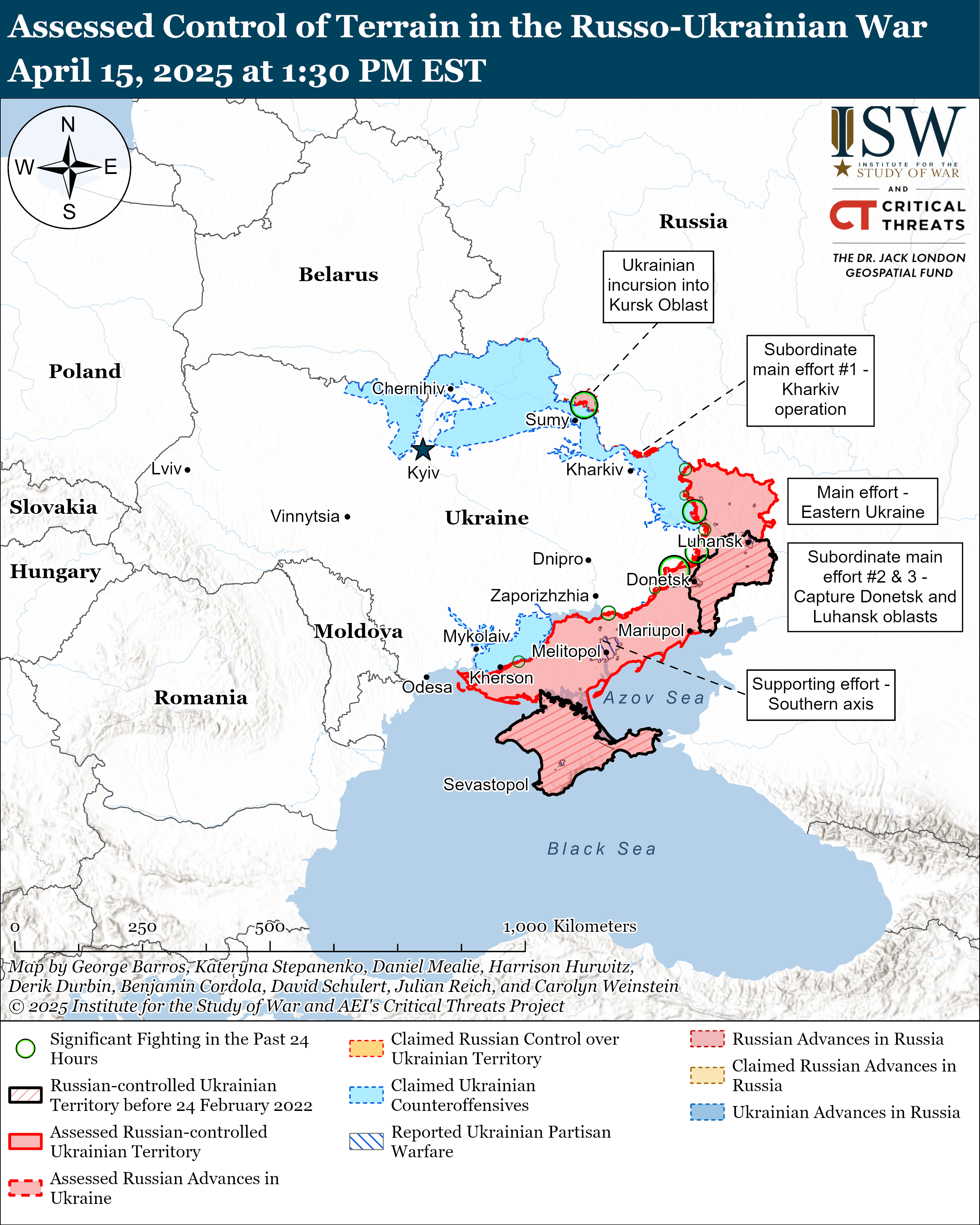
    Fighting in Ukraine has continued as Washington and Moscow discuss the future of Ukraine.
    Institute for the Study of War

    Trump’s major initiative is his proposal for a 30-day general ceasefire to prepare the way for broader peace negotiations. While Ukraine’s president, Volodymyr Zelensky, agreed to this immediately when it was proposed in March, Putin did not. He instead offered a counter proposal: a partial ceasefire banning attacks on energy infrastructure.

    Russia relies heavily on the export of energy, especially oil, to fund the war. But Ukraine has been systematically targeting Russia’s oil refineries and storage facilities, mainly using domestically produced drones. Ukraine is estimated to have destroyed 10% of Russia’s refining capacity since the beginning of 2025.

    By narrowing the scope of the ceasefire, Putin was able to shield Russia’s energy production while continuing to attack Ukraine. Moscow needs the fighting to continue to achieve its openly stated goal of controlling all of Donetsk, Luhansk, Kherson and Zaporizhzhia, the four regions of Ukraine it claimed to annex in 2022.

    Another Russian tactic has been to take every opportunity to present a list of demands for Ukrainian concessions. These include Kyiv giving up its claims to Ukrainian territory occupied by Russia, abandoning its goal of joining Nato, and reducing its armed forces significantly. Russia also wants Ukraine to agree to a change of political leadership.

    This tactic is important for two reasons. First, Russia’s demands make it clear that Moscow envisages the war as the first stage in a longer-term plan to exercise control over all of Ukraine, not only the annexed territories. And second, repeatedly stating Russia’s demands gets them into the public discourse.

    When journalists – or, especially, US officials – repeat them, as Trump’s special envoy Steve Witkoff did recently, they gain an air of legitimacy. This creates the expectation that a peace agreement will comply with Moscow’s agenda.

    Russia is also good at deflecting attention away from ending the war. Sometimes Putin does this with flattery and by appealing to Trump’s sense of self-importance.

    In an interview about his March trip to Moscow, Witkoff glided over his failure to secure a pledge from the Russians to agree to a general ceasefire and instead conveyed a touching story demonstrating Putin’s regard for Trump.

    Putin apparently told Witkoff that he went to church and prayed for Trump’s recovery after he narrowly escaped an assassination attempt during the election campaign. Putin also sent Witkoff back to the US with a portrait of Trump, painted by an artist who is known for producing flattering portraits of Putin himself.

    Another effective tactic of deflection involves money. Russian officials dangle the prospect of lucrative deals involving trade and investment in front of Trump administration officials. This was evidently the focus of much of the first meeting between US and Russian officials in Saudi Arabia in February, although it was convened to discuss plans for peace.

    It is also probably the reason for Kirill Dmitriev’s visit to Washington at the beginning of April. Dmitriev, a figure close to Putin and head of Russia’s sovereign wealth fund, confirmed to journalists that his discussions encompassed possible deals with the US involving rare-earth metals, exploiting resources in the Arctic, and resuming direct flights between the US and Russia.

    Trump’s role

    While Russia places obstacles in the path of peace, Trump and his officials do nothing to remove them. This allows Moscow to continue waging war without constraints.

    Despite Trump’s occasional tough talk about running out of patience with Moscow, as well as his threats of secondary tariffs on countries that buy oil from Russia, no measures that would put pressure on Russia have been implemented.

    Trump has instead made excuses for Moscow. He described the attack on Sumy as a “mistake”, and has expressed admiration for Putin for dragging his feet to get a better deal with Washington.

    This contrasts sharply with Trump’s dealings with Ukraine. Zelensky was publicly humiliated during his meeting with Trump and US vice-president, J.D. Vance, in the Oval Office in February. Trump has even accused Zelensky of starting the war, which was launched by a mass invasion of Russian forces.

    Trump and his team have shown far less interest in Ukraine’s security needs than in striking a lucrative deal to extract the country’s natural resources. The prospect of the Trump administration negotiating a peace agreement that the Ukrainians would accept seems remote.

    So, where does this leave the peace process? When the partial ceasefire arrangement comes to an end later in April, Washington will have to decide whether to resume its efforts to secure a general ceasefire or chart a new course.

    Based on his track record so far, Trump might just blame the Ukrainians for refusing to surrender to Russia’s terms, abandon attempts to reach a negotiated settlement to the war, and go straight to reestablishing normal relations with Russia.

    Jennifer Mathers does not work for, consult, own shares in or receive funding from any company or organisation that would benefit from this article, and has disclosed no relevant affiliations beyond their academic appointment.

    ref. Why is Donald Trump failing to bring peace to Ukraine like he promised? – https://theconversation.com/why-is-donald-trump-failing-to-bring-peace-to-ukraine-like-he-promised-254546

    MIL OSI – Global Reports

  • MIL-OSI Europe: Minister for Enterprise, Tourism and Employment Peter Burke T.D. secures Government approval to publish the Short Term Letting and Tourism Bill General Scheme Minister James Browne to publish new planning guidance

    Source: Government of Ireland – Department of Jobs Enterprise and Innovation

    Minister Peter Burke has secured Cabinet approval to publish the General Scheme of the new Short Term Letting and Tourism (STLT) Bill.  The legislation will introduce a register for all Short Term Lets (STLs) in Ireland, which will be implemented and managed by Fáilte Ireland from 20 May 2026, ensuring compliance with the new EU Short Term Rental Regulation which was adopted by the EU on 11 April 2024.

    Minister for Housing James Browne has also secured approval from Government to publish a National Planning Statement on Short Term Letting, in order to give greater clarity to the sector with regards planning in advance of the commencement of the new legislation.

    Minister Burke said

    “This is a very important piece of legislation that will enable the introduction of new regulatory controls for the Short-Term Letting sector. The self-catering and wider short-term letting sector is an important element of the Irish tourism ecosystem and for the first time, we will have up to date and accurate data on the numbers and spread of this accommodation. Tourism is of critical importance to the Irish economy, providing 228,000 jobs and €6 billion income to our economy in 2024.   The long-term development of the tourism sector requires that an appropriate balance is achieved between the short-term letting sector and long-term housing market, and the wider needs of local communities, both economically and socially.”

    Minister went on to say

    “I am aware of the genuine concerns regarding the impacts on rural tourism and local economies of removing a significant cohort of STL properties from the tourism and other short-term letting market and I continue to engage with the sector in this regard. However, meeting local housing need across Ireland is a critically important consideration and Government must use every lever available to assist in providing homes for our people”.

    The new STL register will be available online and will provide a full picture of the stock of registered tourist accommodation across the state. Hosts offering STL accommodation for periods up to and including 21 nights will be obliged to register with Fáilte Ireland and hold a valid registration number that must be displayed when advertising their STL property.

    The EU STR Regulation and Ireland’s new registration requirements for STLs will both come into full force on 20 May 2026. Fáilte Ireland will apply the enforcement mechanisms provided for in the legislation in respect of non-compliant STL hosts by means of Fixed Payment Notices and/or summary proceedings in the District Court.

    The STLT Bill also provides for the introduction of an administrative sanction procedure (ASP) for infringements by online short-term rental platforms of their obligations under the STR Regulation. This will enable the State to impose large financial penalties (a maximum of 2% of turnover) to enforce compliance where necessary.

    Minister Burke will appoint an independent panel to determine the level of financial sanction to be imposed.

    The Cabinet also approved, for the Minister for Housing, Local Government and Heritage, James Browne T.D., the drafting of new planning guidance and any necessary legislative changes to implement the new Planning Guidelines in the form of a National Planning Statement on short-term letting. That Planning Statement is an important input in balancing local housing, tourism and economic needs and will provide the necessary clarity to the STL sector on the planning requirements around STL properties. The Minister for Housing, Local Government and Heritage will publish these guidelines in advance of the final enactment of the STLT Bill.

    Minister Browne said:

    “In advance of commencement of the legislation, I will be publishing new planning guidance to give greater clarity to the short term letting sector and to allow those in tourism to plan accordingly. This guidance will seek to recognise the needs of tourism and those who visit Ireland, while also acting on the urgent aim of this Government to increase domestic rental supply. This new Housing policy is to generally preclude new planning permissions for Short term lets in cities and towns with a Census population in excess of 10,000 persons, or as may be set by Regulations, and to enable local authorities have discretion to develop policies for other locations having regard to relevant local criteria to be set out in the guidance. At present, all STL properties based in rent pressure zones are required to have appropriate planning permission in instances where a secondary property is being rented out for more than 90 days per year.  If you rent out a room in your principal private residence, planning permission is generally not required.”

    Minister Burke and his Department will consider the full implications for the Tourism sector as we await the planning clarification from the Minister for Housing, Local Government and Heritage.

    MIL OSI Europe News

  • MIL-OSI United Kingdom: Former Councillor and Mayor David Borrow Installed as 42nd Honorary Alderman of the City of Preston

    Source: City of Preston

    In recognition of his long-standing service and commitment to the city as a past Councillor and Mayor, the title of Honorary Alderman of the City has been bestowed upon David Borrow at an extraordinary Council meeting earlier today.

    At a special ceremony in the city’s historic Council Chamber chaired by The Right Worshipful the Mayor of Preston, Councillor Phil Crowe, David was invited to sign the Honorary Alderman Roll and was presented with a commemorative scroll. David is the 42nd Honorary Alderman of the City.

    The Office of Alderman can be found within the ancient Charters of the Borough, as early as the Guild of 1397 where records show that the Guild was held before the Mayor, three stewards, 10 Aldermen and the Clerk.

    Traditionally Aldermen were appointed to the position as they had many years of experience serving as Councillors and they held the respect of the rest of the Council. The official role of Alderman was abolished under the Local Government Act 1972 in 1974. Today, in recognition of the position Aldermen used to play in Council and civic life, the Local Government Act of 1972 enables councils to confer the title of Honorary Alderman on any person who, in the opinion of the Council, has rendered eminent services to the Council as a past member of the Council.

    David announced his retirement from politics in May 2024. David Borrow joined the Labour Party in 1970, aged 18, and was elected as a councillor to the Preston Borough Council in 1987. David was the Council Leader for Preston between 1992 and 1994, and again from 1995 until his election to Westminster. He stood down from the Council in 1998 and he served as a Member of Parliament for South Ribble during the Blair/Brown years from 1997 to 2010.

    David has served as a member of Preston City Council for a total of 24 years and was appointed the 692nd Mayor of Preston in 2019. Due to the Covid pandemic, David was one of only three Mayors in the past 100 years to serve more than a single year in the role.

    Adrian Phillips, Chief Executive at Preston City Council said:

    “It is most fitting that David Borrow is honoured in this way. We recognise and thank David for his long-standing contribution and dedication to public service to the people of Preston and the wider city region with the title of Honorary Alderman of the City.”


    MIL OSI United Kingdom

  • MIL-OSI United Kingdom: Proposed Waste and Recycling Investment

    Source: Scotland – City of Dundee

    Proposed investment in the future of Dundee City Council’s waste and recycling operations is set to go before councillors.

    Three reports are to be considered by the next meeting of the Fair Work, Economic Growth and Infrastructure Committee.

    A sourcing strategy is being put forward for the procurement process to purchase wheeled bins, euro containers, skips and specialist containers for neighbourhood recycling points for the next year.

    Costs of £150,000 are outlined, with approval sought to proceed through the Scotland Excel procurement service.

    Councillors will hear that the annual purchase is required for new build properties and new commercial customers amongst others, as well as replacing damaged items.

    Another report focusing on recycling presents a sourcing strategy for the procurement process for the treatment of mixed scrap metal, mixed recycling: metals, plastics and cartons, as well as paper and cardboard.

    Current contracts for the three areas of recycling total around £470,000.

    New contracts would start later in 2025 and would involve the reprocessing of over 7,500 tonnes of material a year.

    Meanwhile, the committee is being asked to approve the purchase of specialist equipment for Baldovie Household Waste Recycling Centre.

    The £99,722 cost will be covered by money received from the Scottish Government’s Recycling Improvement Fund, which is being used to maximise reuse, recycling and carry out site upgrades at the city’s two recycling centres.

    The roll packer will be used for compacting waste and recycling contained in open skips. High compaction will be possible, and this will result in fewer vehicle and skip movements, leading to better operational efficiency.

    Committee convener Cllr Steven Rome said: “These reports show our commitment to improve our recycling and reuse rates and make it easier for more people to play a part in our recycling effort.”

    Climate, Environment & Biodiversity Convener Cllr Heather Anderson said: “As a council, we have declared a climate emergency with waste being one of the key themes within that declaration and the subsequent Dundee Climate Action Plan.

    “To make a real impact, it is important that we continue to improve the reduction, reuse and recycling of waste and resources in the city. So, it is vitally important that we keep investing for the future.”

    The committee meets on Monday April 21.

    MIL OSI United Kingdom

  • MIL-OSI Russia: Light-dynamic fountain in the park of the Tsaritsyno museum-reserve is being prepared for the new season

    Translartion. Region: Russians Fedetion –

    Source: Moscow Government – Government of Moscow –

    In the park of the Tsaritsyno Museum-Reserve, they have begun preparing the light-dynamic musical fountain for the new season. This was reported by the Deputy Mayor of Moscow for Housing and Public Utilities and Improvement Petr Biryukov.

    “The specialists of the city economy complex carried out work to de-mothball the fountain. This is the only hydraulic structure in the capital that is covered with an inflatable dome during the winter. The protective structure was dismantled, after which the fountain was washed, the engineering systems were checked and it began to be prepared for the opening of the new season,” said Pyotr Biryukov.

    The dome that covers the fountain is made of polyvinyl chloride. It consists of eight sectors, each weighing 400 kilograms. The parts of the dome are connected by four thousand bolts and the same number of plates that hold 64 embedded parts. An air supply system is constantly operating to maintain the shape of the structure.

    The fountain in the park of the Tsaritsyno Museum-Reserve is very popular with city residents and is considered one of the most beautiful sights of the capital. Two years ago, specialists carried out a major overhaul of the structure, completely updating the acoustic system and electronic control system, sound amplifiers, underwater lights, pumping equipment, electrical and water supply systems. In addition, they repaired the granite facing of the bowl, parapets, stairs and the paved area around the fountain.

    Modern equipment and communications have made it possible to add brightness of colors, dynamics and variety of effects. Updated independent control lines of the fountain’s light and jet design allow creating a virtually unlimited number of artistic compositions.

    The musical light-dynamic fountain consists of almost four thousand lamps and more than 800 jets. Thanks to the work of 82 pumps, the jets are able to rise to a height of 15 meters to musical accompaniment.

    Please note: This information is raw content directly from the source of the information. It is exactly what the source states and does not reflect the position of MIL-OSI or its clients.

    Please Note; This Information is Raw Content Directly from the Information Source. It is access to What the Source Is Stating and Does Not Reflect

    https: //vv.mos.ru/nevs/ite/152737073/

    MIL OSI Russia News

  • MIL-OSI: Former Australian Ambassador to the United States, The Hon. Arthur Sinodinos AO, Joins Cove Capital as Special Advisor to Bolster Strategic Growth in its global Critical Minerals Operations

    Source: GlobeNewswire (MIL-OSI)

    NEW YORK, April 17, 2025 (GLOBE NEWSWIRE) — Cove Capital LLC (“Cove” or the “Company”), a company at the forefront of developing critical minerals projects and advanced downstream technologies globally, is proud to announce the appointment of The Hon. Arthur Sinodinos AO, former Australian Ambassador to the United States, as a Special Advisor.

    Ambassador Sinodinos brings to Cove Capital a wealth of experience at the highest levels of diplomacy, business, and government policy. His tenure as Ambassador to the United States (2020–2023) was marked by a strong focus on deepening U.S.-Australia cooperation on energy security and critical minerals supply chains — priorities that align directly with Cove Capital’s mission. His leadership was instrumental in forging the U.S.-Australia Climate, Critical Minerals and Clean Energy Transformation Compact, which laid the foundation for collaborative investment and innovation in the sector.

    “We are honored to welcome Ambassador Sinodinos to the Cove Capital team,” said Pini Althaus, Chairman and CEO of Cove Capital. “His unique ability to navigate the intersection of diplomacy, policy, and strategic industry partnerships — particularly between Australia and the United States — is invaluable as we continue to scale our global ambitions in critical minerals and downstream technology development.”

    Cove Capital is actively engaged in the advancement of critical minerals projects in Central Asia, with a particular focus on Kazakhstan through its Portfolio company Kaz Resources, and in Uzbekistan. In these regions, with support from the U.S. government and under the framework of various Critical Minerals Agreements, the company is working alongside local governments and partners to unlock high-grade deposits of rare earth elements, lithium, and other key critical materials vital to national security and advanced manufacturing applications. These projects are designed not only to meet growing United States demand, but also to establish long-term, transparent supply chains that support a supply chain independent of China.

    In addition to its upstream activities, Cove Capital is strategically invested in downstream technology, including its Portfolio company, REEMAG LLC. REEMAG has developed an innovative and proprietary carbon-free and chemical-free recycling process for end-of-life rare earth NdFeB (neodymium-iron-boron) magnets — a critical bottleneck in today’s supply chain. The collaboration positions Cove Capital as a vertically integrated player in the rare earths sector, from resource development to refined materials.

    Ambassador Sinodinos will play a key role in advising Cove Capital on international government relations, stakeholder engagement, and strategic alliances — particularly as the company expands its presence in North America and Central Asia.

    “This is an exciting opportunity to support a company that is both innovative and strategically aligned with national and international priorities,” said Ambassador Sinodinos. “Cove Capital is contributing meaningfully to the resilience and diversification of critical mineral supply chains. I look forward to helping advance their mission in collaboration with key allies and partners.”

    As global demand for critical minerals accelerates, Cove Capital remains committed to being a reliable partner for governments, technology firms, and defense companies seeking reliable supply chains and ethically sourced and responsibly processed materials that power the future.

    About Cove Capital LLC

    Cove Capital was founded in 2015. With offices in Melbourne and New York (head office), Cove Capital invests in mining, processing and renewable energy technology. Since 2018, Cove Capital has been at the forefront of investment and development in critical minerals projects in the United States, Central Asia, Latin America, the Middle East and the Indo-Pacific region. Cove Capital, under the visionary leadership of Mr. Pini Althaus, brings unparalleled knowledge and extensive experience to the critical minerals industry.

    The MIL Network

  • MIL-OSI: NXP Semiconductors Announces Conference Call to Review First Quarter 2025 Financial Results

    Source: GlobeNewswire (MIL-OSI)

    EINDHOVEN, The Netherlands, April 17, 2025 (GLOBE NEWSWIRE) — NXP Semiconductors N.V. (NASDAQ: NXPI) today announced it will release financial results for the first quarter 2025 after the close of normal trading on the NASDAQ Global Select Market on Monday, April 28, 2025. The company will host a conference call with the financial community on Tuesday, April 29, 2025, at 8:00 a.m. U.S. Eastern Daylight Time (EDT).

    Earnings Conference Call Details 
    Interested parties may pre-register for the webcast or obtain a user-specific access code to join the live conference call.

    A replay of the call will be available via webcast for on-demand listening shortly after the completion of the call.

    About NXP Semiconductors 

    NXP Semiconductors N.V. (NASDAQ: NXPI) is the trusted partner for innovative solutions in the automotive, industrial & IoT, mobile, and communications infrastructure markets. NXP’s “Brighter Together” approach combines leading-edge technology with pioneering people to develop system solutions that make the connected world better, safer, and more secure. The company has operations in more than 30 countries and posted revenue of $12.61 billion in 2024. Find out more at www.nxp.com.

       
    For further information, please contact:  
       
    Investor: Media:
    Jeff Palmer Paige Iven
    jeff.palmer@nxp.com paige.iven@nxp.com
    +1 408 205 0687 +1 817 975 0602
       

    NXP-CORP 

    The MIL Network

  • MIL-OSI United Kingdom: UK backs businesses to trade carbon credits and unlock finance

    Source: United Kingdom – Executive Government & Departments

    Press release

    UK backs businesses to trade carbon credits and unlock finance

    British businesses and organisations better supported to trade carbon credits as part of new work to establish the UK as the global hub for green finance.

    • Britain is back in the business of climate leadership, leading a new growth market and cementing UK as the green finance capital of the world
    • voluntary carbon and nature markets to unlock new revenue streams for UK businesses delivering on Plan for Change
    • UK work will boost opportunities for businesses at home and abroad to unlock private finance for the climate crisis

    British businesses and organisations will be better supported to trade carbon credits as part of new work to establish the UK as the global hub for green finance – driving growth and investment while tackling the climate crisis through the Plan for Change.

    Today the government has launched plans to strengthen voluntary carbon and nature markets which can help leverage the finance needed to address the scale of the climate emergency whilst diversifying revenue streams for British businesses.

    These markets support the trading of carbon credits, where a business can reduce their emissions by investing in environmentally friendly projects such as deploying electric vehicles, reducing deforestation, removing carbon dioxide through carbon dioxide or planting trees.

    Currently these markets are not realising their full potential, with a lack of clarity among businesses and organisations on how they can be used, and some poor practice impacting their effectiveness in delivering meaningful climate action and economic growth. There have been widespread calls from businesses and organisations for greater clarity in how to use these markets as part of their plans to reach net zero.

    In response, the UK is establishing a global framework to build trust and confidence in carbon and nature credit trading, with a set of principles to guide and support businesses on how to use carbon credits that provide environmental benefits. This includes making clear what a good credit is, ensuring they are delivering environmental benefits and encouraging businesses to fully disclose what they are being used for in annual sustainability reporting.

    These markets are estimated to be worth up to $250 billion by 2050 for carbon markets, and $69 billion for nature markets, under the right conditions. By increasing confidence in these markets, British businesses – including farmers and land managers –  will be well positioned to seize the economic rewards by creating new revenue streams and investment opportunities. 

    These plans will further strengthen the UK as the green finance capital of the world – leading the way in a new growth market, unlocking private finance for climate change and backing businesses on the clean energy transition.  

    Positive climate action can lead to significant growth opportunities for UK businesses with the UK seeing £43.7 billion of private investment into UK’s clean energy industries since July. Recent figures from the CBI shows that the net zero economy grew 3 times faster than the economy as a whole last year, with employment in the sector up by over 10%.

    Climate Minister Kerry McCarthy said:

    Building up trust in carbon and nature markets is crucial to their success in driving meaningful climate action and real, lasting change for the environment. 

    The UK is determined to spearhead global efforts to raise integrity in these markets so they can channel the finance needed to tackle the climate crisis and speed up the global clean energy transition.

    These principles will cement the UK as the global hub for green finance and carbon markets. This is an opportunity to deliver on the climate crisis and drive investment and growth in the UK as part of our Plan for Change.

    Nature Minister Mary Creagh said:

    Nature underpins everything. Voluntary carbon and nature markets will be an important tool to crowd in private finance to protect our precious peatlands, important habitats and rare species.

    It is why increasing trust in these markets will ensure that they benefit both people and our planet, ensuring money flows towards genuine environmental improvement projects and creates new sources of finance for farmers and land managers in the UK.

    Carbon credits are tradable units that represent the reduction or removal of greenhouse gases emissions from the atmosphere. One credit typically represents one metric tonne of CO2 or its equivalent. Companies or individuals purchase these credits from project developers who have generated them through activities like reforestation, cleaner energy, or other emission reduction projects. By buying the credits, they are financing projects that would not otherwise happen, in addition to steps that they are taking to reduce their own emissions.

    Mark Kenber, Executive Director, Voluntary Carbon Markets Integrity Initiative (VCMI) said:

    Businesses need clarity and confidence to invest in voluntary carbon and nature markets that help meet global climate goals. This consultation from the UK government plays a vital role in delivering this.  

    VCMI welcomes the proposal to recognise our Claims Code as international best practice, as well as the global leadership shown by the UK’s proposal to incentivise greater action by companies to address their unabated Scope 3 emissions through the inclusion of our forthcoming Scope 3 Action Code of Practice. The Code of Practice will enable companies to go further, faster and with integrity on climate action.

    The proposals in the consultation align with the UK government’s new approach to ensure regulation supports growth. The consultation explores the recommendation in the recently published Corry Review to launch a Nature Market Accelerator to bring coherence to nature markets and accelerate investment. 

    The consultation will be live for 12 weeks, seeking responses from industry organisations and the public:

    Voluntary carbon and nature markets: raising integrity

    Onel Masardule, Co-Chair, Indigenous Peoples and Local Communities Engagement Forum, Integrity Council for the Voluntary Carbon Market (ICVCM) said:

    For the voluntary carbon market to succeed, it must respect the rights and interests of Indigenous Peoples and local communities, and make us true partners – rather than just stakeholders – in the market. ICVCM’s The Core Carbon Principles (CCPs) define what high integrity carbon credits should look like: ensuring that new carbon projects have robust social and environmental safeguards, operate with the free, prior and informed consent and are transparent about how they share benefits. I welcome the UK government’s proposal to endorse the use of CCP-labelled credits and encourage other governments to do the same. This will provide clarity on what high integrity means to enable the market to scale to accelerate climate action and deliver positive environmental and social outcomes at the local level.

    Notes to editors

    The 6 integrity principles being consulted on are: 

    • suppliers should ensure credits meet recognised high integrity criteria that ensure credits deliver environmental benefits  
    • buyers should measure and disclose the planned use of credits as part of sustainability reporting 
    • users should consider how credits feed into wider transition plans that align with the 1.5°C goal of the Paris Agreement 
    • claims involving the use of credits should accurately communicate an organisation or product’s overall environmental impact, including by using appropriate and accurate terminology 
    • market participants should cooperate with others to support the growth of high integrity markets
    • credits should only be used in addition to ambitious climate action within value chains

    Updates to this page

    Published 17 April 2025

    MIL OSI United Kingdom

  • MIL-OSI United Kingdom: expert reaction to top line results in Lilly press release about their phase 3 ACHIEVE-1 trial of their oral GLP-1 (orforglipron) and weight loss efficacy, and safety

    Source: United Kingdom – Executive Government & Departments

    Scientists comment on phase 3 trial results of Lilly’s oral GLP-1 (Orforflipron). 

    Prof Naveed Sattar, Professor of Cardiometabolic Medicine/Honorary Consultant, University of Glasgow, said:

    “These are important results.  Having new oral agents that lower glucose but also meaningfully lower weight well beyond levels seen with most existing diabetes therapies is critical to future type 2 diabetes care. This because recent research has shown excess weight not only leads to type 2 diabetes in the first place in many but that it is also a major contributor to many of its associated complications. Intentional weight loss also often helps improve patients quality of life.  Of course, one caveat is that we do not know the effects of this newer therapy on cardiovascular outcomes but this will be forthcoming in future trials.  It is also good to hear about the safety profile of these new oral GLP-1RA drugs – especially the liver results – and it will be good to see the data in a full publication in due course.”

    Lilly press release (there is no paper): https://investor.lilly.com/news-releases/news-release-details/lillys-oral-glp-1-orforglipron-demonstrated-statistically

    Declared interests

    Prof Naveed Sattar: “NS has consulted for and/or received speaker honoraria from Abbott Laboratories, AbbVie, Afimmune, Amgen, AstraZeneca, Boehringer Ingelheim, Carmot Therapeutics, Eli Lilly, GlaxoSmithKline, Hanmi Pharmaceuticals, Janssen, Menarini-Ricerche, Merck Sharp & Dohme, Metsera, Novartis, Novo Nordisk, Pfizer, Sanofi, and Roche; and received grant support paid to his University from AstraZeneca, Boehringer Ingelheim, Novartis, and Roche.  No shares in any medical areas.”

    MIL OSI United Kingdom

  • MIL-OSI United Kingdom: Low-income families saved £886,000 on water bills through Portsmouth City Council and Southern Water partnership

    Source: City of Portsmouth

    Around £886,000 is set to be cut from the bills of the most vulnerable people in Portsmouth, thanks to a partnership between Portsmouth City Council and Southern Water.

    The council has provided Southern Water with the details of just over 5,000 residents on low incomes or in receipt of benefits who have been found to be eligible for a discount on their bills, as part of a data sharing agreement to save people money.

    All Portsmouth customers who qualify for the cheaper Essentials tariff payment scheme will automatically be moved across. They will have their bills reduced by an average of £177 a year, and Southern Water will be writing to those who have been switched.

    The tariff is designed to help customers who are struggling to pay by providing a discount of at least 45% for low-income households in receipt of Council Tax Support.

    It’s part of Portsmouth City Council’s ongoing work to support residents with the cost of living, which includes:

    • Awarding £245,200 to 1,414 low-income pensioner households through our one-off Portsmouth Older Persons’ Energy Payment scheme
    • Hardship payments for daily costs like food and energy bills through the UK Government-funded Household Support Fund, which is extended for another 12 months.
    • The local Council Tax Support Scheme for households eligible for a discount
    • Holiday Activity and Food (HAF) programme, currently running over Easter, and extended by another 12 months
    • The council’s cost of living hub and phone number, offering free money advice for all
    • Switched on Portsmouth providing free energy and money saving advice

    Council Leader Cllr Steve Pitt said:

    “We are committed to exploring every avenue possible to save Portsmouth residents money, because rising costs continue to impact people’s quality of life.

    “Through this proactive partnership with Southern Water, we have been able to help another 5,000 save a collective £886,000, which is a really significant individual saving.

    “We will be offering more one-off payment schemes to help the most vulnerable to pay for bills and food, and I would urge anyone who needs advice and support around money to call our cost of living hub.”

    Nicky Chitty, Southern Water’s affordability and vulnerability lead, said:

    “We are delighted to be working together with colleagues at Portsmouth so that no households miss out on the support they may be entitled to.

    “By joining our Essentials tariff, these customers will automatically receive a minimum discount of 45% off their bills.”

    The council will continue to pass on the details of any residents that may be eligible for the Essentials tariff to Southern Water.

    The partnership is subject to strict rules around personal data and security and the information shared is solely for the purpose of benefiting eligible residents.

    MIL OSI United Kingdom

  • MIL-OSI Security: Two men have been jailed for murdering a man in Croydon

    Source: United Kingdom London Metropolitan Police

    Two men have been jailed for a combined total of more than 50 years for the murder of a man in Croydon as detectives continue appeal for the public’s help to locate an outstanding suspect.

    David Walcott, 35 (18.08.89) of Turle Road, Norbury and Rammon Mali, 33 (08.12.91) of Valley Road, Croydon, were each sentenced on Thursday, 17 April at the Old Bailey to 27 years’ imprisonment for the murder of Rijkaard Siafa.

    They were convicted of his murder on Wednesday, 26 February at the same court, following a five-week trial.

    A murder investigation was launched after police were called to reports of a man stabbed in Fellmongers Yard, Croydon on Friday, 12 April 2024.

    A number of members of the public attempted to provide first aid, before police, London Ambulance Service and London’s Air Ambulance arrived at the scene. Sadly, despite their efforts, Rijkaard died at the scene only 30 minutes later.

    In court, Walcott and Mali claimed that they were present, but were not the ones who stabbed Rijkaard. However, they were unanimously found guilty of murder by the jury.

    Hassanatu Bah, Rijkaard mother, said:

    “Anyone who knew Rijkaard would tell you how truly special he was. He had a soul so gentle and a heart so kind that his love and care touched everyone around him. His dreams were big, his zest for life unmatched. He was driven by hope and ambition, and his future was filled with endless possibilities – dreams that were cruelly stolen from him.

    “But let me assure you, Rijkaard’s story doesn’t end here. I will carry his torch for as long as I live. Everything he dreamed of, everything he wanted to accomplish, I would do my best to see it through. His name will not be forgotten.”

    The court heard that on the day of the murder Rijkaard had been at a friend’s flat near Fellmongers Yard, before leaving to meet his partner. Only a few minutes after leaving the flat, he had been stabbed 13 times.

    After the attack, Walcott and Mali immediately fled the scene. They then went to a pub on nearby Katharine Street, where they ordered three pints of beer.

    As part of the investigation, officers viewed more than 100 hours of CCTV and were subsequently able to identify both Walcott and Mali.

    A fast-paced manhunt was launched and a few days’ later officers were able to track Walcott to an address on Lewin Road, SW16. He was arrested on Friday, 19 April 2024 and charged the following day.

    Mali fled the country on Tuesday, 16 April 2024. He was arrested at Gatwick Airport upon his return on Sunday, 5 May 2024 and charged the following day.

    Detective Chief Inspector Samantha Townsend, from the Met’s Specialist Crime Command, said:

    “Our thoughts very much remain with Rijkaard’s family and friends, who had to re-live the last traumatic moments of his young life during the trial after the defendants failed to take responsibility for their actions.

    “The defendants acted together, as a team. They had been looking for Rijkaard during the afternoon of Friday, 12 April and when they found him, they viciously attacked him.

    “It’s clear Walcott and Mali are dangerous and unpredictable individuals and I am relieved they will remain behind bars for a significant period of time.

    “I am extremely grateful to those who have come forward so far, however Jordan Vincent remains wanted for the murder of Rijkaard Siafa and my team remains determined to bring all of those responsible to justice.

    “I am appealing to people to dig deep into their consciences and assist us with the whereabouts of Jordan Vincent. There is a £10,000 reward available for information which leads to his arrest and conviction. If you have any information, no matter how insignificant you may think it is – please get in contact, it could be crucial.”

    Information, images or footage can be provided at Public Portal – https://mipp.police.uk/operation/01MPS24W40-PO1

    Alternatively, anyone who has information or footage can call 0208 721 4961 referencing Op Biscot. To remain 100 per cent anonymous call the independent charity Crimestoppers on 0800 555 111 or visit Crimestoppers-uk.org.

    MIL Security OSI

  • MIL-OSI United Kingdom: Temporary closure of Shanklin Cliff Lift for improvement works 17 April 2025 Temporary closure of Shanklin Cliff Lift for improvement works

    Source: Aisle of Wight

    The Shanklin Cliff Lift will be temporarily closed from 23 to 25 April as part of the Isle of Wight Council’s ongoing commitment to maintaining and improving this vital facility for the community.

    The closure is necessary to erect scaffolding, a process expected to take three days.

    Following this, work will begin on replacing the downstairs canopy, a significant upgrade that will involve additional scaffolding and securing the surrounding area to ensure the lift remains operational during the works.

    The entire project is anticipated to take five to six weeks. During this period, the lift will continue to serve the community, minimising disruption and maintaining accessibility.

    Alex Minns, service director for community regeneration and economy, said the works had been carefully timed to occur outside of Easter and the peak season.

    He added: “We understand the importance of the Shanklin Cliff Lift to both residents and visitors.

    “This project underscores our dedication to preserving and improving the lift, ensuring it remains a safe and reliable resource for all. We appreciate the community’s patience and understanding as we carry out these necessary improvements.”

    The lift has been a key feature of Shanklin since its first construction in the 1890s. The current lift, built in 1958, continues to serve residents and visitors, offering a convenient route between the town and the beach.

    MIL OSI United Kingdom

  • MIL-OSI Russia: SPbPU and the Republic of Tatarstan signed four cooperation agreements

    Translartion. Region: Russians Fedetion –

    Source: Peter the Great St Petersburg Polytechnic University – Peter the Great St Petersburg Polytechnic University –

    The program of the visit of the representative delegation of the Republic of Tatarstan to the Polytechnic included the signing of several cooperation agreements. The rais of the Republic of Tatarstan Rustam Minnikhanov and the vice-governor of St. Petersburg Vladimir Knyaginin participated in the solemn ceremony.

    The cooperation between the Ministry of Education and Science of the Republic of Tatarstan and Peter the Great St. Petersburg Polytechnic University will contribute to the effective development of higher education in both subjects of the Federation, the training of highly qualified specialists, continuous professional development of workers, and the integration of professional education and science. The basis for achieving these goals should be joint relevant scientific, technical, educational, innovative, investment, production, and socio-economic projects and programs. The document was signed by the Minister of Education and Science of the Republic of Tatarstan Ilsur Khadiullin and the Rector of SPbPU Andrey Rudskoy.

    The agreement provides for the unification of the partners’ efforts for the comprehensive development of a system for training scientific and engineering personnel, the involvement of students and young scientists in real scientific research and experimental design developments, and the creation of a new material base for the implementation of educational programs and scientific research projects.

    Other areas of cooperation include: modernization of the education system, improvement of the quality of educational services, advanced training of managers and teaching staff of educational institutions of the Republic of Tatarstan; popularization of science, development of scientific and technical creativity of young people, etc.

    Innopolis University has also joined the cooperation with the Polytechnic University. Having signed the agreement, SPbPU Rector Andrey Rudskoy and Innopolis University Director Iskander Bariyev expressed their desire for strategic interaction between the universities in the field of methodological, educational and scientific activities. The agreement provides for the modernization of current educational programs and the development of new ones, including online ones. An important part of the cooperation will be joint scientific research, including the creation of a specialized laboratory for the development of composite materials for robotic systems and unmanned aircraft. Other areas of cooperation include: organizing academic mobility for teachers and students; popularization of scientific research; joint design, technological and experimental work in the field of robotics and mechatronics, the search for and design of new materials with specified properties, additive technologies, artificial intelligence; participation in the audit of Russian companies and enterprises, including an assessment of the level of their digital maturity, robotics and digital transformation; organization and holding of conferences, meetings, exhibitions and other events on current issues of industrial robotics, etc.

    Almetyevsk State Technological University “Higher School of Oil” has signed an agreement with the Polytechnic University to work together on innovative methods of engineering education, conduct scientific research and implement scientific, educational and creative projects, including within the framework of the federal project “Advanced Engineering Schools”. The document was signed by Andrey Rudskoy and Rector Alexander Dyakonov.

    Kazan National Research Technical University named after A. N. Tupolev-KAI has become a strategic partner of Polytechnic University. The agreement signed by Acting Rector Kirill Okhotkin and Rector of SPbPU Andrey Rudskoy provides for joint activities in scientific, educational, research and innovation spheres and support for large-scale scientific and industrial projects, including within the framework of advanced engineering schools. The partners agreed to use their scientific infrastructure and combine competencies to implement joint projects in such priority areas as: composite material structures; additive, laser and plasma technologies; information and control systems; radio photonics; quantum technologies; electromagnetic compatibility; microelectronics; digital modeling of elements of manned and unmanned transport systems; artificial intelligence.

    “We have very close ties with the Republic of Tatarstan through the Academy of Sciences,” commented Vladimir Knyagin, Vice-Governor of St. Petersburg. “For our St. Petersburg branch of the Russian Academy of Sciences, Tatar colleagues are not only partners, but also, in many cases, cooperators in research. There is an exchange of personnel, research topics, and knowledge. And the fact that today we have the head of the republic testifies to the official recognition of the importance of such interaction.”

    After the signing ceremony, another ceremonial procedure took place — the awarding of representatives of the Polytechnic University. For fruitful cooperation and significant contribution to strengthening the socio-economic potential of the Republic of Tatarstan, Rustam Minnikhanov presented medals “100 years of the formation of the Tatar Autonomous Soviet Socialist Republic” to Vice-Rector for Digital Transformation Alexey Borovkov, Director of the Institute of Mechanical Engineering, Materials and Transport Anatoly Popovich and Academic Secretary of SPbPU Dmitry Karpov.

    During the visit, the delegation of Tatarstan visited several specialized scientific and production sites of the Polytechnic University. Thus, in the Laboratory of Light Materials and Structures, the guests got acquainted with the technologies of additive electric arc growth and friction stir welding. Director of the Institute of Mechanical Engineering, Materials and Transport Anatoly Popovich presented the competencies of SPbPU in the field of large-scale 3D metal printing, spoke about the equipment used, and demonstrated product samples. The partners also saw the advanced developments of the Polytechnic University in the field of additive laser technologies, visitedNetwork engineering center and other workshops.

    In the experimental design bureau of the Advanced Engineering School of SPbPU “Digital Engineering” (OKB PISH), guests from Tatarstan got acquainted with breakthrough developments and research in the field of unmanned aerial vehicles (UAVs), aircraft manufacturing, engine and rocket engineering, as well as robotics, implemented using approaches to systemic digital engineering based on the Digital Platform for the Development and Application of Digital Twins CML-Bench®.

    Vice-Rector for Digital Transformation of SPbPU, Head of the Advanced Engineering School of SPbPU “Digital Engineering” Alexey Borovkov presented to the guests a line of multifunctional devices – a family of electric unmanned aerial vehicles “Snegir”: the “Snegir-1” model and its improved version VTOL (Vertical Take Off and Landing – vertical takeoff and landing) “Snegir-1.5”. Alexey Ivanovich emphasized that the development of the UAV “Snegir-1.5” was carried out using virtual test benches and testing grounds, as well as using the domestic Digital platform CML-Bench®, which made it possible to optimize the design methods of unmanned aircraft systems and their components. The project is being implemented within the framework of the federal initiative “Development, standardization and serial production of unmanned aircraft systems and components” of the national project “Unmanned aircraft systems”, which was launched in accordance with the Strategy for the development of unmanned aviation of the Russian Federation until 2030 and for the future until 2035.

    Alexey Borovkov noted that leading specialists of the Advanced Engineering School of SPbPU “Digital Engineering” are developing technologies and a demonstrator of a software package for the automated design of electric propeller-motor groups of unmanned aerial vehicles, and demonstrated the results of the development and manufacture of a prototype of the CML_03 electric motor for unmanned aerial vehicles with improved technical characteristics. The development is based on multi-criteria optimization methods and interdisciplinary calculation methods.

    Speaking about the promising projects of the SPbPU Ecosystem of Technological Development, Aleksey Borovkov focused on the strategic tasks planned and already implemented jointly with the partner of the SPbPU – the scientific institution “Engineering and Design Center for Support of Operation of Space Technology” to create tooling kits and quality control for the manufacture of tank structures of the Angara family of launch vehicles using advanced technologies. In addition, the vice-rector announced the start of a project to create a prototype of the CML-Aeroplane, where the key task is multi-criteria optimization of the design taking into account aerodynamics, flight dynamics, strength, fuel efficiency and cost.

    As part of the project activities of the structural divisions of the SPbPU Technological Development Ecosystem, a scientific and technological reserve has been formed that allows us to carry out cross-industry technology transfer and accelerate the design of complex and new products thanks to the CML-Bench® Digital Platform, which stores information on solving similar problems, concluded Alexey Ivanovich.

    The guests were interested in the activities of the Student Design Bureau (SDB), which operates within the structure of the SPbPU Advanced Engineering School Design Bureau. SDB is a unique educational and practical platform where students, under the guidance of university teachers and specialists from industrial partners, acquire basic engineering competencies through participation in real R&D, and also have the opportunity to implement their own initiatives in the field of technological creativity. As an example, Alexey Borovkov cited the development of the SPbPU Advanced Engineering School student team CML®-Bots – the combat robot “Laska”. This project became the winner of the International Robot Fighting Championship in India in April 2025 and a number of Russian student competitions earlier.

    “The Battle of Robots is a prestigious championship where engineers compete in creating the most effective combat vehicles,” noted Alexey Ivanovich. “Our students not only achieve victories, but also constantly improve the design, deepening their knowledge in robotics, mechanics and physics. The acquired skills allow them to find non-standard, interdisciplinary solutions to complex engineering problems, which is extremely important for future professional activities.”

    Photo archive

    Please note: This information is raw content directly from the source of the information. It is exactly what the source states and does not reflect the position of MIL-OSI or its clients.

    MIL OSI Russia News

  • MIL-OSI Europe: OSCE Enhances K-9 Training for Kyrgyz Border Security

    Source: Organization for Security and Co-operation in Europe – OSCE

    Headline: OSCE Enhances K-9 Training for Kyrgyz Border Security

    Kyrgyz border officers take part in K9 training to boost service dog handling skills for border security, Luban,18 March 2025. (OSCE) Photo details

    Luban, Poland / Bishkek, Kyrgyzstan | 18 March 2025 – Six canine instructors from the Border Service of the State Committee for National Security of the Kyrgyz Republic have completed a specialized training course on detecting explosives, weapons, and ammunition, held from 4 February to 18 March 2025 in Luban, Poland.Organized by the Specialized Training Centre of the Polish Border Guard Service in co-operation with the OSCE Programme Office in Bishkek, the training is part of the OSCE’s ongoing support to strengthen Kyrgyzstan’s border security and counter the illegal spread of small arms and light weapons (SALW).Participants gained advanced skills in assessing service dogs, improving handler techniques, canine health and safety, training planning, and dog psychology. Upon passing final exams, the instructors received international certification, boosting national capacity to train future K-9 units.“This training is a significant step in strengthening our capacity to tackle the growing threats posed by the illegal spread of SALW and explosives,” said Colonel Taalaibek Tazhibaev, Deputy Head of the Border Service.“By empowering K-9 specialists to detect and neutralize threats, we are strengthening security and promoting regional stability,” added Ms. Ewa Klimuk, OSCE ExB Project Manager.The initiative highlights the OSCE’s long-term partnership with Kyrgyzstan and its commitment to regional peace and security through capacity-building and international co-operation.
    Contacts
    Chyngyz Zhanybekov
    National Press and Public Information Officer
    Office of Head of Mission
    OSCE Programme Office in Bishkek
    6, Ryskulova str.
    720001
    Kyrgyzstan
    Office: +996 312 61 24 45

    MIL OSI Europe News

  • MIL-OSI United Kingdom: Change of British High Commissioner to Barbados and the Eastern Caribbean: Simon Mustard

    Source: United Kingdom – Executive Government & Departments

    News story

    Change of British High Commissioner to Barbados and the Eastern Caribbean: Simon Mustard

    Mr Simon Mustard has been appointed British High Commissioner to Barbados and the Eastern Caribbean. He will take up his appointment during May 2025.

    Simon Mustard

    Mr Simon Mustard has been appointed British High Commissioner to Barbados, and non-resident High Commissioner to Antigua and Barbuda, the Commonwealth of Dominica, Grenada, the Federation of Saint Christopher and Nevis, Saint Lucia, and Saint Vincent and the Grenadines.

    Simon will succeed Mr Scott Furssedonn-Wood MVO, who will be transferring to another Diplomatic Service appointment.

    Mr Mustard will take up his appointment during May 2025.

    Curriculum vitae

    Full name: Simon Mustard

    Year Role
    2021 to 2025 FCDO, Director East/Southern Africa
    2019 to 2021 Freetown, British High Commissioner
    2017 to 2019 FCO, Head, Southern and Central Africa Department and Special Envoy to African Great Lakes Region
    2016 Lilongwe, British High Commissioner
    2013 to 2016 Amman, Deputy Head of Mission
    2011 to 2013 FCO, Head, Country-Casework Team and Deputy Head of Consular Assistance, Consular Directorate
    2009 to 2011 FCO, Head, Regional Issues Team, Counter-Proliferation Department
    2008 to 2009 FCO, Private Secretary to Minister of State, and also to the Secretary of State
    2005 to 2008 Washington, Policy Lead on Counter-Terrorism and Strategic Threats
    2002 to 2004 Belmopan, Third Secretary (Political)
    2000 to 2002 FCO, Desk Officer, Environment Policy Department
    1994 to 2000 Police Officer, Lothian and Borders Police

    Media enquiries

    Email newsdesk@fcdo.gov.uk

    Telephone 020 7008 3100

    Contact the FCDO Communication Team via email (monitored 24 hours a day) in the first instance, and we will respond as soon as possible.

    Updates to this page

    Published 17 April 2025

    MIL OSI United Kingdom

  • MIL-OSI: Signing Day Sports/U.S. Army Bowl Combines Provide Recruitment Opportunities, Draw Strong Participation

    Source: GlobeNewswire (MIL-OSI)

    SCOTTSDALE, AZ, April 17, 2025 (GLOBE NEWSWIRE) — Signing Day Sports, Inc. (“Signing Day Sports” or the “Company”) (NYSE American: SGN), the developer of the Signing Day Sports app and platform, today provided an in-season update on the 2025 Military Appreciation U.S. Army Bowl National Combine Series.

    Since kicking off in February, Signing Day Sports has successfully hosted five combines in Atlanta, GA; Orlando, FL; Chicago, IL; Phoenix, AZ; and Jackson, MS. Nearly 1,000 high school football athletes have participated to date, underscoring the continued momentum and strong demand for recruiting exposure and student-athlete development opportunities.

    In addition to the in-person events, Signing Day Sports has hosted weekly X Spaces Recruiting Webinars through its “Signing Day Sports Recruiting” series. These webinars serve as an extension of the Company’s digital engagement strategy and are designed to:

    • Highlight the top performers from each combine
    • Promote student-athletes who have been invited to the National Combine for each combine, set for December 2025
    • Help student-athletes gain national visibility and connect directly with college football programs

    As part of its continued commitment to creating meaningful exposure and expanding collegiate opportunities for high school athletes, Signing Day Sports is proud to spotlight two remarkable individuals whose journeys embody the impact of its combines, Amiri Acker, and Cooper Crosby. These student-athletes arrived at their respective combines without a single scholarship offer. However, through their standout performances, the visibility gained from the Signing Day Sports platform, and strategic promotion across social media and national recruiting webinars, both have since attracted significant attention from college football programs across the country. Their success stories serve as powerful testaments to the reach and effectiveness of the Signing Day Sports model.  Click their Signing Day Sports Profile link to watch them perform at the combine, just like college coaches.

    • Amiri AckerAtlanta, GA Combine
    • Click Link Below:
      Signing Day Sports Profile
      Scholarship Offers Gained: University of Kentucky; East Carolina University; Coastal Carolina University; University of Nevada, Las Vegas; University of Cincinnati; Liberty University, Georgia Southern University; United States Naval Academy; Troy University
    • Cooper CrosbyJackson, MS Combine
    • Click Link Below:
      Signing Day Sports Profile
      Scholarship Offers Gained: University of Louisiana; University of Southern Mississippi; Arkansas State University; Southeastern Louisiana University

    “These success stories are just two examples of what’s possible when we combine our technology, national platform, and strategic outreach,” said Jeff Hecklinski, President of Signing Day Sports. “Our combine series continues to be a powerful driver of exposure, helping student-athletes gain real offers and meaningful opportunities – many for the very first time. We are not just measuring success by attendance numbers, but by real outcomes – student-athletes getting recruited, building confidence, and being empowered to pursue their dreams at the next level.”

    “The momentum we built in 2024 has carried strongly into 2025, and we are seeing that energy reflected in every city we visit. We are committed to supporting every student-athlete’s journey as we expand our national footprint and enhance the services we provide. With additional combines scheduled in Dallas, Dayton, and Denver – and more on the horizon – these events continue to serve as a vital pipeline to the Military Appreciation U.S. Army Bowl and National Combine. At the same time, our digital platform keeps student-athletes visible throughout the year by showcasing their verified performance data and providing direct access to college coaches nationwide. Ultimately, it is about opening doors and building a foundation for long-term success – for both the student-athletes and their families. As we scale our reach and deepen our impact, we believe these efforts will translate into sustained growth, brand strength, and long-term value for our stockholders.”

    Signing Day Sports encourages all aspiring college athletes to take advantage of upcoming events to maximize their exposure and recruiting potential.

    To learn more or to register for an upcoming combine, visit sdscombines.com.

    Signing Day Sports
    Signing Day Sports’ mission is to help student-athletes achieve their goal of playing college sports. Signing Day Sports’ app allows student-athletes to build their Signing Day Sports’ recruitment profile, which includes information college coaches need to evaluate and verify them through video technology.

    For more information on Signing Day Sports, go to https://bit.ly/SigningDaySports.

    Forward-Looking Statements
    This press release contains “forward-looking statements” that are subject to substantial risks and uncertainties. All statements, other than statements of historical fact, contained in this press release are forward-looking statements. Forward-looking statements contained in this press release may be identified by the use of words such as “may,” “could,” “will,” “should,” “would,” “expect,” “plan,” “intend,” “anticipate,” “believe,” “estimate,” “predict,” “potential,” “project” or “continue” or the negative of these terms or other comparable terminology. These statements are only predictions. You should not place undue reliance on forward-looking statements because they involve known and unknown risks, uncertainties, and other factors. These risks, uncertainties and other factors are described more fully in the section titled “Risk Factors” in the Company’s periodic reports which are filed with the Securities and Exchange Commission. These risks, uncertainties and other factors are, in some cases, beyond our control and could materially affect results. If one or more of these risks, uncertainties or other factors become applicable, or if these underlying assumptions prove to be incorrect, actual events or results may vary significantly from those implied or projected by the forward-looking statements. No forward-looking statement is a guarantee of future performance. All subsequent written and oral forward-looking statements concerning the Company or other matters and attributable to the Company or any person acting on its behalf are expressly qualified in their entirety by the cautionary statements above. Forward-looking statements contained in this announcement are made as of this date, and the Company undertakes no duty to update such information except as required under applicable law.

    Investor Contacts:
    Crescendo Communications, LLC
    212-671-1020
    SGN@crescendo-ir.com

    The MIL Network

  • MIL-OSI United Kingdom: Recreational fishery for bluefin tuna 2025

    Source: United Kingdom – Executive Government & Departments

    News story

    Recreational fishery for bluefin tuna 2025

    Marine Management Organisation (MMO) today opened applications for an east Atlantic bluefin tuna catch and release recreational fishery (CRRF) in 2025 in English waters.

    Approximately 140 vessels could be issued permits to operate in the CRRF, Plans for the 2025 Bluefin tuna (BFT) catch and release recreational fisheries (CRRF) within UK waters, which is scheduled to open from mid-July and will run until the end of November 2025. 

    To be eligible for a permit, interested stakeholders must follow the guidance and apply here before the closing date of 18 May.

    Successful applicants must comply and report their fishing activity in line with the legislation.

    Updates to this page

    Published 17 April 2025

    MIL OSI United Kingdom

  • MIL-OSI United Kingdom: More than half a million more people in line for savings boost

    Source: United Kingdom – Executive Government & Departments

    Press release

    More than half a million more people in line for savings boost

    Thousands more are eligible to open a Help to Save account.

    • Government’s Help to Save scheme now open to 550,000 more people to help with cost of living
    • Those saving £50 a month can expect £25 Government top-up, putting more money in people’s pockets
    • Part of Government’s mission to grow the economy and deliver on our Plan for Change

    More than half a million more UK savers are in line for Government bonuses worth up to £25 a month to boost their cash pots and help ease rises in the cost of living, HM Revenue and Customs (HMRC) has announced today.

    As part of the Government’s mission to grow the economy and improve lives in every corner of the UK and to deliver its Plan for Change, Help to Save is now open to anyone working and receiving Universal Credit – rewarding 550,000 more people.

    Its extension to April 2027 means more can benefit from the scheme, which has paid out millions of pounds in bonuses to more than 500,000 people since Help to Save was launched in 2018.

    This is evidence of the Government backing the most vulnerable in society with 93% of savers paying in the maximum £50 every month to their Help to Save account.

    An account can be set up in less than 5 minutes and easily managed through GOV.UK or the HMRC app, making it accessible to people throughout the UK.

    Savers who deposit the maximum amount of £2,400 over four years will receive a bonus totalling £1,200 into their bank accounts, with payments coming at the end of the second and final year.

    Emma Reynolds, Economic Secretary to the Treasury, said:

    Security for working people is at the heart of our Plan for Change.

    We want more people to have a bit in the kitty for a rainy day, which is why we are giving hundreds of thousands more working families on tight budgets access to this support.

    Myrtle Lloyd, HMRC’s Director General for Customer Services, said: 

    Thousands of customers have already benefitted from Help to Save and many more are now eligible to get a great return of 50% on top of their savings, no matter how little you can save each month. Go online or via the HMRC app to find out more and apply today.

    Savers can deposit between £1 and £50 each month earning an extra 50 pence for every £1 saved, with bonuses paid in the second and fourth years of the account being opened. The bonus payment applies to the highest amount saved within the period.

    Nearly 18,500 people opened a Help to Save account via the HMRC app in 2024. App users have access to their savings account at their fingertips. They can view their account, check their balance and bonus details, and make a deposit via debit card, bank transfer or standing order.

    Money can be withdrawn at any time, although this may affect the 50% bonus payments.

    Michelle Highman, Chief Executive of The Money Charity, said:

    We are really pleased to see the Help to Save scheme extended and made available to more people. It’s a brilliant way for people to start to save and to build their financial resilience and futures. Saving even just a little each month will help, and the added 50% bonus payment from the Government means that if you are eligible, then it’s a great place to boost your savings.

    Find out more about Help to Save at GOV.UK.

    Further Information

    1. Latest statistics on Help to Save up to April 2024 were released in September 2024
    Number of Accounts Opened to end-April 2024 Total value of deposits
    UK Total 516,800 £492,539,000
    England 439,900 £420,318,000
    North East 22,750 £20,668,000
    North West 67,650 £63,479,000
    Yorkshire and The Humber 49,600 £47,043,000
    East Midlands 43,000 £41,219,000
    West Midlands 49,550 £46,130,000
    East of England 44,900 £43,176,000
    London 55,550 £52,935,000
    South East 60,500 £57,563,000
    South West 46,400 £48,106,000
    Wales 24,850 £23,683,000
    Scotland 36,050 £33,584,000
    Northern Ireland 15,650 £14,700,000

    Help to Save was launched in September 2018 and was due to end in September 2023. It was extended to April 2025 and has now been extended until April 2027.

    Previous eligibility criteria meant savers had to be in receipt of Tax Credits or Universal Credit and be earning at least 16 hours a week at National Living Wage.

    How the bonus payments work:

    • after the first 2 years, customers will get a first bonus if they have been using their account to save. This bonus will be 50% of the highest balance saved.
    • after 4 years, they will get a final bonus if they continue to save. This bonus will be 50% of the difference between 2 amounts:
      • the highest balance saved in the first 2 years (years 1 and 2)
      • the highest balance saved in the last 2 years (years 3 and 4)
    • if their highest balance does not increase, they will not earn a final bonus.
    • the bonus is paid into their bank account, not their Help to Save account.

    Updates to this page

    Published 17 April 2025

    MIL OSI United Kingdom

  • MIL-OSI Russia: Fragmentation and Block Formation: How the Global Economy is Changing

    Translartion. Region: Russians Fedetion –

    Source: State University Higher School of Economics – State University Higher School of Economics –

    Within the framework XXV Yasinsky (April) International Scientific Conference The former head of the Bank of Russia, professor of the Department of Finance and Credit of the Faculty of Economics of Moscow State University, Sergei Dubinin, gave an honorary report. He spoke about the transformation of the global monetary and financial system and the Russian economy.

    As Sergey Dubinin noted, one of the main trends that became noticeable after the pandemic and is observed now is the fragmentation of the global world economy. “This fragmentation today constitutes some stage, a phase of globalization. It was initially understood as deglobalization, complete collapse, but it quickly became clear that the situation is not quite like that,” the speaker noted. Fragmentation leads to a slowdown in international trade, and to an increase in barriers to the movement of goods, services, labor, and restrictions on the spread of technology. These trends are causing concern among many experts.

    Fragmentation is very noticeable in the relations between countries. Blocks are being created that are oriented towards the US and China. There are also so-called neutral states, intermediary countries. For example, India or Mexico, they “want to be intermediaries in both trade and financial transactions,” says Sergey Dubinin. “Economic relations are developing more actively within the blocks. Both trade [transactions] and capital movement between the blocks are facing restrictions, in particular tariffs,” he says. At the same time, the latest news about the increase in tariffs by US President Donald Trump is strengthening these trends, the expert notes.

    Against the backdrop of events in the global economy, confidence in American securities has declined. “It was a safe haven,” notes Sergei Dubinin. “And that was the advantage of the American financial market system, when even in the conditions of a crisis that began on the US market, US government securities were considered the best insurance asset. And very large amounts of money were directed there.” And in recent years, there has been a noticeable decline in investments in these securities.

    “Right now there is an acute phase in the relationship between China and the United States. It can lead to various consequences, both for political and economic life,” the expert notes. And here it is important to understand what position Russia wants to take. “Recently, we have heard a lot of talk about Russian-American joint economic projects,” says Sergey Dubinin. One point of view is that it is better to take the position of an intermediary country than to unilaterally focus on one country.

    The former head of the Central Bank also spoke about the state of the Russian financial sector. He noted that despite numerous sanctions, the position of banks remains stable. The volume of net profit of banks in 2024 reached more than 4 trillion rubles. According to him, there are currently just over 300 credit institutions left on the market, and only 35 banks were unprofitable. He recalled that “during the period from 2010 to 2020, 681 banks were closed.”

    As a result, according to Sergei Dubinin, a “highly concentrated and fairly stable” system has now emerged. The top ten largest Russian banks, which include systemically important players, account for almost 80% of the banking system’s assets. At the same time, “quality indicators remain quite good.”

    Please note: This information is raw content directly from the source of the information. It is exactly what the source states and does not reflect the position of MIL-OSI or its clients.

    MIL OSI Russia News

  • MIL-OSI Security: Building capacity to combat illicit cultural heritage trafficking with the EuroMed Justice Project

    Source: Eurojust

    The TAF activity, which was organised upon request from Egyptian and Cypriot authorities, brought together 35 participants from Algeria, Belgium, Cyprus, Egypt, France, Germany, Greece, Italy, Libya, Morocco, Palestine*, Switzerland and the United Kingdom to share strategies and best practices in combating the illicit trade. The activity was officially opened and attended by the Ambassador of Cyprus to Egypt, the Deputy Head of the European Delegation in Cairo and high level representatives from Egypt. The Country representatives shared case studies and success stories, highlighting the challenges and triumphs of their efforts to protect cultural heritage.

    The illicit trafficking of cultural goods has become a lucrative business for organised crime. It can be used for money laundering, sanctions evasion, and terrorism financing, and comes with a devastating cost. To combat this, the TAF activity facilitated cooperation and knowledge-sharing among stakeholders.

    In addition to the sharing of case studies and success stories, the participants also gained insights from presentations delivered by the representative of the Eurojust Anti-Trafficking Team, as well as several international organizations (Council of Europe, UNICRI, and UNODC). Bilateral meetings were also arranged alongside the main activity.

    By sharing knowledge and expertise, the gathering has set the stage for enhanced cooperation and collaboration to combat illicit cultural heritage trafficking.

    The EuroMed Justice project aims to develop sustainable cooperation mechanisms for cross-border judicial cooperation in criminal matters between Member States of the European Union and the South Partner Countries. It organises TAF activities upon request of participating authorities in order to provide tailored support to activities and actions.

    *This designation shall not be construed as recognition of a State of Palestine and is without prejudice to the individual positions of the Member States on this issue.

    MIL Security OSI