Category: European Union

  • MIL-OSI United Kingdom: City centre property and retail strategy gets grant

    Source: Scotland – City of Aberdeen

    A plan to existing gaps, identify viable investment prospects, and enhance the retail offering in the city centre has been awarded a £39,000 grant.

    Aberdeen City Council’s Finance and Resources Committee today agreed the monies for Aberdeen Inspired to commission an Aberdeen City Centre Property and Retail Strategy.

    Committee Convener Councillor Alex McLellan said: “The Aberdeen City Centre Property and Retail Strategy will be a good asset in working out how to attract more retail to the area.

    “We welcome that this data will be collected as it will help the city’s overall plan to ensure the city centre continues to be a place where people want to shop, live, and work.”

    Co-Leader Councillor Ian Yuill said: “The Aberdeen City Centre Property and Retail Strategy fits in with the City Council’s current priorities of city centre regeneration. It also aligns with approved Council policies, including the Union Street Action Plan.

    “We look forward to seeing the results from the Strategy and how they can be translated into ensuring we have a better and more resilient retail offering.”

    The Aberdeen City Centre Property and Retail Strategy will assess the current health of retail property in Aberdeen’s city centre and create an actionable plan to understand existing gaps, identify viable investment prospects, and enhance the retail offering.

    The strategy will focus on optimising property utilisation and delivering a more vibrant, resilient occupier mix for the city. The project will conduct catchment demand analysis, geodemographic data collection, and competitor benchmarking to understand consumer patterns, spend leakage, and market saturation.

    This knowledge will help determine how vacant spaces can be repurposed to improve the city centre and better serve local and regional consumer markets.

    Adrian Watson, chief executive of Aberdeen Inspired, said: “To ensure we have a city centre that is sustainable and fit for the future this strategy will identify the gaps, what businesses people want, where they want them and how we can get those businesses here.

    “This strategy will give us both a blueprint and roadmap on how to make all of that happen and is a vital part of the regeneration of our city centre. We are very grateful to Aberdeen City Council and the UK Shared Prosperity Fund for this grant which will make this exciting project possible.”

    The report to committee said allocation of grant funding is from the UK Shared Prosperity Fund (UKSPF). The UKSPF money was allocated to the City Council by the UK Government. The core UKSPF element can be used across three priority areas – community and place, supporting local business, and people and skills.

    MIL OSI United Kingdom

  • MIL-OSI Global: The dangerous business of predicting the death of popes – a history

    Source: The Conversation – UK – By Michelle Pfeffer, Research Fellow in Early Modern History, University of Oxford

    Portrait of Michel de Nostredame (Nostradamus), painted by his son César de Nostredame. Wiki Commons

    Michel de Nostredame (1503-66), better known as Nostradamus, is often hailed as one of the most successful prophets of all time. Said to have foreseen major world events from the rise of Hitler to COVID, the 16th-century astrologer was recently credited with predicting Pope Francis’s death – and what would happen next.

    ‘Through the death of a very old Pontiff

    A Roman of good age will be elected.

    Of him it will be said that he weakens his seat

    But long will he sit in biting activity.

    Like all the quatrains in Nostradamus’s collection of prophecies, Les Prophéties (1555-68), this one is as enigmatic as it is flexible. Short, sweet and decontextualised, his prophetic poems feel timeless, and it is deliciously satisfying to recognise a real-world correlation. The problem is that his prophecies are so vague that they can be linked to any number of events – or old Pontiffs.

    Nostradamus’s “dark and cryptic” language was intentional. If he had been more explicit, not only his career, but perhaps even his life, may have been at risk.


    Looking for something good? Cut through the noise with a carefully curated selection of the latest releases, live events and exhibitions, straight to your inbox every fortnight, on Fridays. Sign up here.


    Many of his prophecies concerned the rise and fall of the great and the good, and political prophecy was a high-risk business. In ancient Rome, astrologers had been expelled from the city for forecasting the death of emperors, and Renaissance leaders were no less paranoid. To avoid “scandalising and upsetting”, Nostradamus chose to veil his true meaning.

    This was not just a matter of self-preservation, but also a way to obscure politically explosive information. Claiming to know when a civic or church leader might die was valuable intelligence. This made astrology a key tool of Renaissance spy-craft, but also a dangerous weapon that needed to be monitored and regulated.

    Astrology, politics and the papal court

    As a system that promised to forecast plagues, natural disasters, war, and even the economy, astrology was a logical interest for Renaissance rulers.

    Universities taught their students how to make these predictions, and for some lucky graduates this led to a job in a royal, princely, or even papal court. Here their horoscopes could inform political decision-making and produce potent astrological propaganda.

    A horoscope for the founding of St. Peter’s Basilica in the Vatican in April 1506, cast by the astrologer Luca Gaurico. Luca Gaurico (1552).
    Tractatus Astrologicus

    Despite the condemnations of theologians, many popes patronised astrologers and sought their guidance.

    Julius II (1443-1513) chose the start date for the construction of Saint Peter’s Basilica based on astrological counsel. Leo X (1475-1521) founded a professorship in astrology at Rome’s first university, La Sapienza. And Paul III (1468-1549), heeding the judgment of the astrologer Luca Gaurico, appointed his grandson a cardinal at just 14.

    In a period in which popes could have a decisive impact on international politics, speculation about the health of the pontiff was rampant. Astrologers capitalised on this.

    When Ludovico Sforza (1452-1508), de facto ruler of Milan, asked his astrologer to predict the death of Innocent VIII, it was nothing unusual. The answer was that the pope would die around August 10 1492, if not sooner. When Innocent died on July 25, Ludovico was no doubt pleased. As the historian Monica Azzolini has shown, he had consulted his astrologer in the hope the next pope would be more supportive of his illegitimate regime.

    Some popes asked astrologers about their own deaths. But they didn’t like it so much when others did so – especially when the forecasts were made public. Even worse, such predictions often fed into Protestant propaganda.

    Popes knew public predictions about their death were politically destabilising, not to mention humiliating. At the end of 1559, the Index of Prohibited Books, a list of books forbidden by the Roman Catholic Church, banned texts containing astrological “divinations” about “future contingent events”.

    Earlier that year, just as Pope Paul IV was trying to conceal a serious illness from the public, the sighting of a comet had led to widespread speculation about his death. As the pope knew all too well, astrology could be a political liability.

    Orazio Morandi and Urban VIII

    Such legislation did not stop astrologers from making political predictions, not least because their clients never stopped asking. But increasingly these astrologers were playing with fire. As the historian Brendan Dooley has shown, Orazio Morandi learned this the hard way in 1630.

    Morandi made predictions about Pope Urban VII.
    Vatican Museums

    Morandi was an abbot at the monastery of Santa Prassede in Rome. He had been practising astrology for years, and he had been careful, framing his political forecasts in allusive language. But soon he went too far.

    In 1629, Morandi wrote an astrological commentary on various past papacies, critiquing their flaws. When he came to the present incumbent, Urban VIII (1568-1644), he not only predicted that his pro-French allies would destroy Italy, but that the pope himself would very soon suffer great violence, then death.

    There are several astrological techniques for predicting someone’s death. As above, astronomical phenomena like comets and eclipses could prompt speculation about an upcoming papal demise. But Morandi used the gold standard – a technique called “prorogation”. This required access to the person’s birth chart, from which astrologers could identify the planets or luminaries that were their “giver of life” and “giver of years”.

    Different planets gave different lifespans. For example, if the sun was your “giver of years”, and it was in a good position on your horoscope, you might expect to live to 120. If the sun was badly placed, your life expectancy might be just 19 years. Other parts of the horoscope could then modify these figures.

    Morandi identified the sun as Urban’s life giver. But the positions of the more nefarious planets on his birth chart meant he was lucky to have lived beyond the age of seven. In June 1630, Morandi concluded, a solar eclipse would seal the pope’s fate.

    Morandi’s prediction spread widely in clandestine circles, and it wasn’t long until his prediction was reported as fact. The pro-Spanish faction in Rome was thrilled. It was even rumoured that Spanish and German cardinals had begun the long journey to Rome for a new conclave.

    The earth surrounded by the planets, luminaries, and zodiac signs (1708).
    Andreas Cellarius, Harmonia Macrocosmica

    Embarrassingly, Urban first learned of the prophecy not through his own informants, but from the powerful French prelate Cardinal Richelieu. Himself an avid believer in astrology, Urban was greatly disturbed. He had Morandi arrested and jailed. During the trial, a young man called Matteo, servant to the current prior of Santa Prassede, was interrogated and tortured. Morandi himself soon died in prison under suspicious circumstances.

    But Urban lived on. The next year, he decreed it punishable by death to predict “the life or death of the sitting Roman Pontiff, including his blood relatives to the third degree inclusive”.

    Making a career in political forecasting was – and is – risky. But astrologers were ambitious and knew their efforts would be well remunerated. Predicting the death of a pope could help you quickly build a public profile, expanding your business. But after 1630, it was a risk many astrologers were no longer willing to take.

    Michelle Pfeffer does not work for, consult, own shares in or receive funding from any company or organisation that would benefit from this article, and has disclosed no relevant affiliations beyond their academic appointment.

    ref. The dangerous business of predicting the death of popes – a history – https://theconversation.com/the-dangerous-business-of-predicting-the-death-of-popes-a-history-255816

    MIL OSI – Global Reports

  • MIL-OSI Global: By VE Day in 1945, Stalin had got what he wanted in Poland – now Putin may get what he wants in Ukraine

    Source: The Conversation – UK – By Wendy Webster, Professor of Modern Cultural History, University of Huddersfield

    Sell out: most Polish people felt they had been abandoned by their allies in the US and Great Britain at the Yalta Conference. US government

    As Britain celebrated Victory in Europe (VE) Day on May 8 1945, the Polish airmen of RAF 305 Bomber Squadron captured a starkly different sentiment in their diary. “‘Victory!’ every Anglo-Saxon says in greeting instead of the traditional ‘Hello!’. The word ‘Victory!’ is devoid of meaning, power and any sense today only for the Poles.”

    Despite their critical contributions to the allied war effort, from the Battle of Britain to Monte Cassino, Polish forces felt isolated and betrayed, their hopes of a free Poland crushed by the Yalta agreement. On that first VE Day, many Poles who fought with the allied forces recorded feeling sad, isolated or bitter.

    Tadeusz Szumowski, who served in the RAF in Britain found it almost impossible to join in the celebrations. He wrote in his diary: “Our war is lost, the war which we fought so hard and so long to win … It is a very long time since I felt so alone.”

    A Polish soldier in Italy wrote: “The war is over – but not for us. The population of the greater part of the world are happy, in consequence; but we are sad. I am afraid that we have lost so many of our best men all for nothing.”


    Get your news from actual experts, straight to your inbox. Sign up to our daily newsletter to receive all The Conversation UK’s latest coverage of news and research, from politics and business to the arts and sciences. Join The Conversation for free today.


    What made “victory” devoid of meaning for Poles? In her study of Poland during the second world war, historian Halik Kochanski quotes the famed American journalist Martha Gellhorn, who reported from Italy: “All the Poles talk about Russia all the time. The soldiers gather several times a day around the car which houses the radio and listen to the news.”

    Many of these soldiers came from eastern Poland, which was invaded by the Soviet Union in 1939. Along with their families, they had been deported to Siberia or Kazakhstan and came out only under a so-called “amnesty” after Russia entered the war on the allied side. Gellhorn reported: “They follow the Russian advance across Poland with agonized interest.”

    As I found when researching my book about the diverse nationalities fighting alongside Britain in the second world war, Polish soldiers wrote about Russia all the time as well as talking about it. Their letters were censored and quoted in censorship reports.

    As they watched the Russian advance and heard news of the Yalta agreement which consigned Poland to the Soviet sphere of influence, they express anger, fear, bitterness, desolation, a sense of loss and betrayal, shock, bewilderment.

    The letters are striking for the many words which take on meanings that demonstrate a gulf that opens up, separating Poles from other allied soldiers. Victory belongs to others while Poles have gone down to a catastrophic defeat.

    Russia, widely regarded as a valued ally, is the enemy of Poles. The Polish slogan “For our freedom and yours” is rewritten in one letter: “We are fighting for yours and our freedom, but now I think rather only for yours.” Another letter asks: “What are we fighting for if Poland is to be enslaved?”

    Polish pilots of RAF 303 (Polish) Fighter Squadron during the second world war.
    Imprial War Museum

    Poles find it unbearable to be told that Russia is liberating Poland, using heavy irony. “The ‘liberation’ of Poland by our so-called Allies is causing us great anxiety. Probably my own home will soon be ‘liberated’.”

    Another soldier cautions: “Never, never congratulate our people of Warsaw and Poland being ‘liberated’. This sounds like the most cruel irony and is deeply resented by every Pole. You could speak about a lamb being liberated from a bear by a tiger.”

    The concept of “home” also acquires new meanings that are devoid of any association with pleasure or belonging. As the war ends, allied soldiers’ thoughts are increasingly about the prospect of returning home – but censors reported in 1944: “Thousands of letters written by Polish soldiers in the last days repeat as a cardinal topic that to Poland governed by communists they won’t return.”

    One soldier writes: “It would be better to be killed here on the battlefield than to be alive in the new ‘Red Paradise’ in Poland.” Another writes: “There is no return for us to the Soviet republic of Poland which seems to be the newest invention of our Allies.”

    Echoes of Yalta

    The Yalta agreement of February 1945 between America, Britain and Russia, the “Big Three” powers, confirmed Poles’ worst fears. Censors report that in the soldiers’ letters, it “overshadows all other topics”, and has “evoked a terrible shock amongst the Polish troops … they find that they are lost and betrayed”.

    One soldier writes: “For the last few days I have been in a state of dumb bewilderment. Occasionally I ask myself, ‘Can it be true?’ … I cannot believe that it has really happened.”

    Another soldier writes to his “Britisher friend” about his feelings of betrayal: “When this morning we heard the news about the statements from the Big Three meeting we got deadly silent … We sacrificed most of all countries – more than you even. We trusted you so much, and what have we got. Our biger [sic] friend let us go down.”

    Yalta is in Crimea – part of the territory annexed by Russia before its full-scale invasion of Ukraine in 2022. The Russian president, Vladimir Putin, has made it clear he will offer no concessions on Ukraine, which he has argued all along he sees as an inalienable part of Russia. This is a stark reminder of Yalta when Josef Stalin made concessions on other matters, but none on Poland.

    Trump’s administration has offered Ukraine no security guarantees. Its framework to end the war will allow Russia to retain the territory it has seized. There are now echoes of what one Polish soldier wrote in 1945 of the Yalta agreement: “This business smells and no high-sounding words can disguise the stench of a bad deed.”

    Wendy Webster receives funding from the Arts and Humanities Research Council

    ref. By VE Day in 1945, Stalin had got what he wanted in Poland – now Putin may get what he wants in Ukraine – https://theconversation.com/by-ve-day-in-1945-stalin-had-got-what-he-wanted-in-poland-now-putin-may-get-what-he-wants-in-ukraine-255982

    MIL OSI – Global Reports

  • MIL-OSI Global: Italy’s areas of wartime fascist resistance remain less susceptible to the far right today

    Source: The Conversation – UK – By Juan Masullo, Assistant Professor, Institute of Political Science, Leiden University

    Across Europe, far-right parties are making unforeseen breakthroughs – from local councils to national and supranational parliaments. As their presence becomes normalised, these parties promote nationalist rhetoric, challenge democratic institutions, and attempt to reshape a political present rooted in hard-won struggles against authoritarianism.

    Yet, not all communities are equally permeable to these growing forces. Some actively resist, mobilising to block authoritarian ideologies and defend democratic values.

    Our recent research in Italy offers one explanation as to why some communities are less easily enticed into far-right politics than others. Local histories of wartime resistance continue to shape political cultures in ways that, even generations later, inspire people to push back against the resurgence of fascist and neo-fascist ideologies.

    In areas where anti-fascist resistance movements were active during the second world war, civic engagement to defend democratic values is stronger. In these communities, support for far-right parties is weaker.


    Get your news from actual experts, straight to your inbox. Sign up to our daily newsletter to receive all The Conversation UK’s latest coverage of news and research, from politics and business to the arts and sciences. Join The Conversation for free today.


    These legacies aren’t accidental. They are cultivated, reinforced, and passed on through intensive and continuous local memory work.

    During Italy’s civil war (1943–1945), students, workers, farmers and clergy mobilised into bands of resistance to fight the Nazi-fascist regime. Their efforts were central to Italy’s liberation and the establishment of its democratic republic. While this story is often told at the national level, our research examines its enduring local consequences.

    Using an original dataset mapping resistance activity across about 8,000 Italian municipalities, we compared places with strong partisan mobilisation to those without. Even today, eight decades later, residents of areas with a resistance past are more likely to support initiatives that counter far-right ideologies.

    This was especially evident in the response to a recent initiative. In 2020 and 2021, a grassroots campaign proposed a law to ban the public glorification of fascism. To bring it for discussion before parliament, the campaign needed 50,000 signatures.

    Despite the pandemic, it collected over 240,000 within a few months. While support was widespread, municipalities with strong resistance histories were significantly more likely to participate. Our estimates show roughly 40% more signatures in these places.

    These patterns suggest that wartime resistance can leave legacies that translate into contemporary political behaviour. But data alone can’t explain how these legacies endure. That’s where our fieldwork comes in.

    We have been closely studying towns with deep resistance roots and strong support for the 2021 initiative to see how they keep these legacies alive and who is involved.

    We have followed (and participated in) memorialisation efforts in the Cuneo region, one of the main centres of wartime resistance, and in areas deeply affected by Nazi violence and known for creating some of the strongest partisan brigades. These include villages around Stazzema in Tuscany and Marzabotto in Emilia.

    The main insight is that remembrance isn’t just ceremonial – it’s part of daily life. Schools, hiking clubs, cultural associations, and city halls all contribute to preserving and activating the memory of resistance.

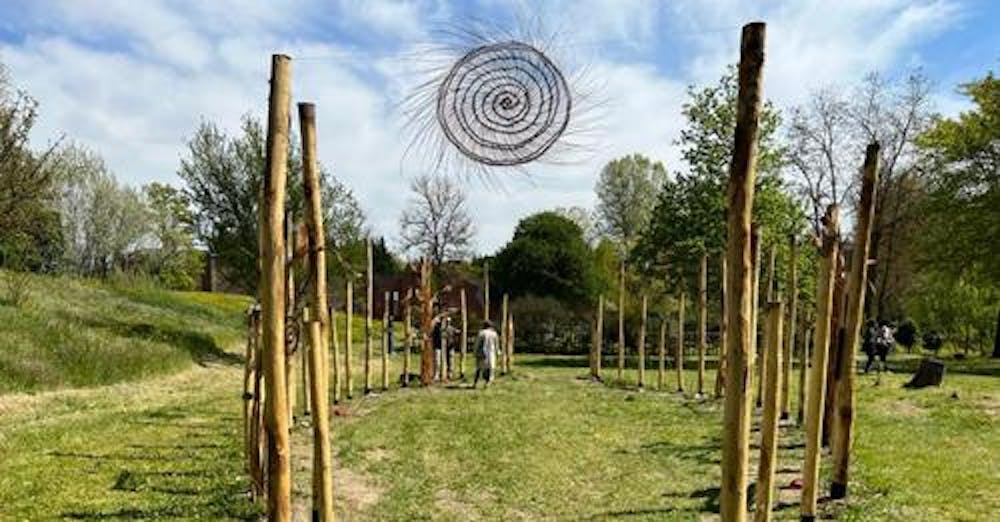
    One public elementary school in the rural hills around Bologna, for example, created a “memory garden” to honour local residents who died fighting fascism. Through interviews, art and storytelling, students have engaged directly with their community’s past, creating not only a commemorative space but a living bridge between generations.

    The memorial garden planted by students in.
    J Masullo, CC BY-ND

    Similarly, local Alpine clubs in Emilia Romagna and Piedmont restored partisan trails through the mountains, now used for memory treks. These hikes attract people who might not otherwise engage politically but who, by walking the paths of wartime partisans, connect with stories of sacrifice and solidarity. What begins as recreation becomes an encounter with democratic values.

    These deeply localised memory efforts – anchored in the names, stories and spaces of the community – often intensify during democratic threats. The 2021 campaign emerged amid growing support for parties like Lega and Fratelli d’Italia (Brothers of Italy).

    Related studies show that when exclusionary welfare policies gain ground, local communities sometime organise in defence of vulnerable groups. In towns with a resistance past, local “memory entrepreneurs” doubled their efforts in response to far-right victories.

    Memory as a political battle

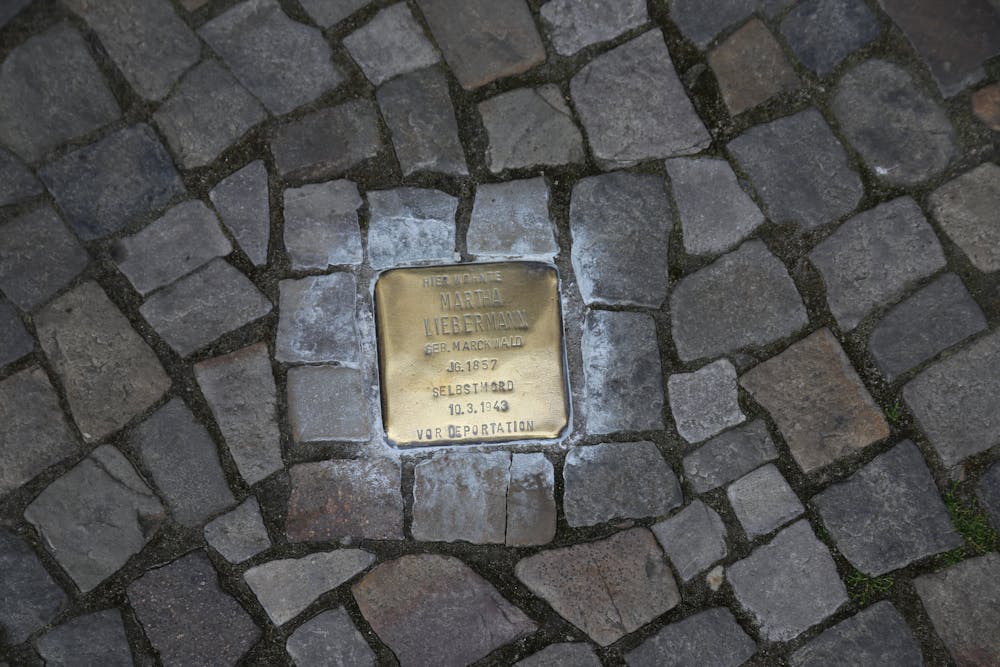
    This is not just an Italian phenomenon. Across Europe, historical memory is a political battleground. In Germany, the Stolpersteine – brass plaques in sidewalks commemorating Nazi victims – serve as grassroots reminders that shape civic attitudes. In Hungary, activists have created “living memorials” to Holocaust victims, directly contesting government efforts to whitewash fascist collaboration.

    These commemorations also have measurable political effects. In Berlin, neighbourhoods where one or more Stolpersteine was placed before an election saw fewer votes for the far-right AfD (a 0.96%-point decrease) compared to those with no Stolpersteine. This happened across federal, state and EU elections between 2013 and 2021.

    A stolperstein in Berlin.
    Wikipedia/Drrcs15, CC BY-SA

    What unites these efforts is a belief that remembering the past matters – not only to honour it, but to shape the future. Local narratives of wartime resistance and victimisation help instil democratic values and inoculate communities against authoritarianism.

    But this doesn’t happen automatically. It requires effort. Teachers, students, parents, associations, and local councils all play a role in keeping memory alive and politically meaningful.

    Recognising this is especially vital today, when the meaning of anti-fascism itself is a polarising subject. Far-right leaders, including those in office, downplay and discredit the resistance’s legacy, replacing it with revisionist myths.

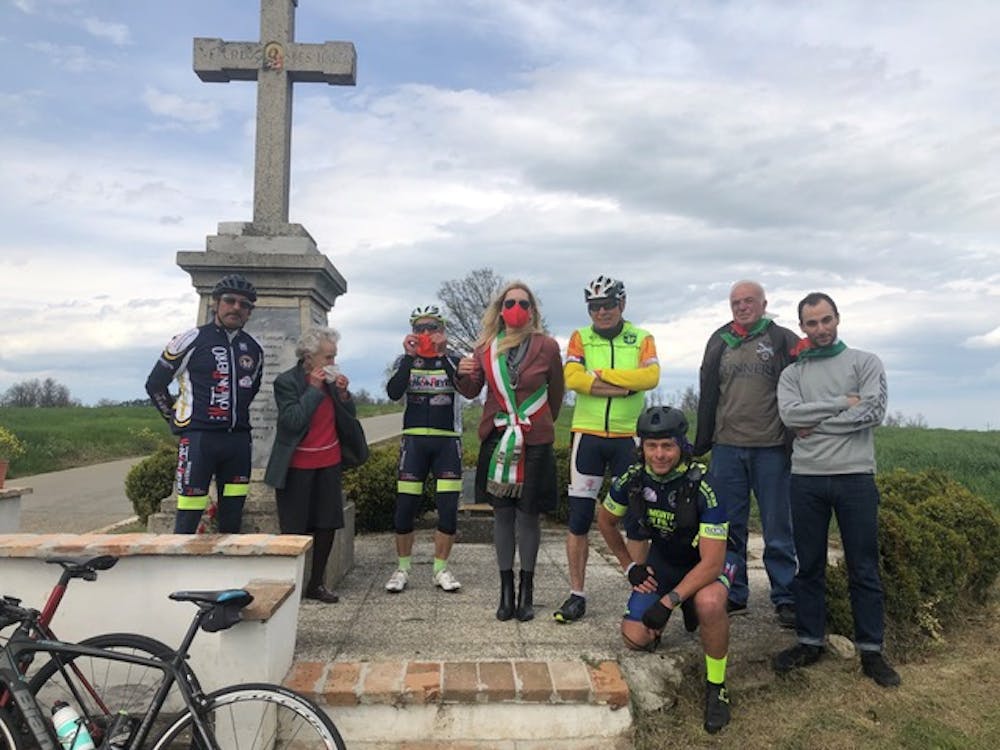
    A local cycling club marks liberation day with a tour of monuments dedicated to partisans.
    J Masullo, CC BY-ND

    When communities take ownership of their histories, they are more likely to uphold democratic principles not only in ceremonies, but at the ballot box and in everyday actions. The past is never just the past. The legacies of wartime resistance continue to shape how people view democracy, justice, and belonging. In times like these, remembering the resistance is more than homage – it is civic defence.

    Juan Masullo has received funding for this research from UNUWIDER and Leiden University.

    He is affiliated with the University of Milan.

    Simone Cremaschi has received funding for this research from UNUWIDER, the European Research Council (grant number 864687), and Leiden University.

    ref. Italy’s areas of wartime fascist resistance remain less susceptible to the far right today – https://theconversation.com/italys-areas-of-wartime-fascist-resistance-remain-less-susceptible-to-the-far-right-today-255859

    MIL OSI – Global Reports

  • MIL-OSI Europe: Minutes – Tuesday, 6 May 2025 – Strasbourg – Final edition

    Source: European Parliament

    PV-10-2025-05-06

    EN

    EN

    iPlPv_Sit

    Minutes
    Tuesday, 6 May 2025 – Strasbourg

     Abbreviations and symbols

    + adopted
    rejected
    lapsed
    W withdrawn
    RCV roll-call votes
    EV electronic vote
    SEC secret ballot
    split split vote
    sep separate vote
    am amendment
    CA compromise amendment
    CP corresponding part
    D deleting amendment
    = identical amendments
    § paragraph

    IN THE CHAIR: Martin HOJSÍK
    Vice-President

    1. Opening of the sitting

    The sitting opened at 09:02.


    2. Request for an urgent decision (Rule 170)

    The President had received two requests for urgent decisions in accordance with Rule 170(5):

    – REGI Committee – Amending ERDF, Cohesion Fund and Just Transition Fund as regards specific measures to address strategic challenges in the context of the mid-term review ***I (COM(2025)0123 – C10-0063/2025 – 2025/0084(COD))

    – EMPL Committee – European Social Fund (ESF+): specific measures to address strategic challenges ***I (COM(2025)0164 – C10-0064/2025 – 2025/0085(COD))

    The votes on both requests would be taken on Wednesday 7 May 2025.

    The agenda was amended accordingly.


    3. A unified EU response to unjustified US trade measures and global trade opportunities for the EU (debate)

    Council and Commission statements: A unified EU response to unjustified US trade measures and global trade opportunities for the EU (2025/2657(RSP))

    Adam Szłapka (President-in-Office of the Council) and Maroš Šefčovič (Member of the Commission) made the statements.

    The following spoke: Jörgen Warborn, on behalf of the PPE Group, Iratxe García Pérez, on behalf of the S&D Group, Jordan Bardella, on behalf of the PfE Group, Nicola Procaccini, on behalf of the ECR Group, Valérie Hayer, on behalf of the Renew Group, Bas Eickhout, on behalf of the Verts/ALE Group, Martin Schirdewan, on behalf of The Left Group, René Aust, on behalf of the ESN Group, Michał Szczerba, Kathleen Van Brempt, Jorge Buxadé Villalba, Adam Bielan, Karin Karlsbro, Anna Cavazzini, Manon Aubry, Petr Bystron and Fabio De Masi.

    IN THE CHAIR: Esteban GONZÁLEZ PONS
    Vice-President

    The following spoke: Lukas Sieper, to put a question to Fabio De Masi, who answered it, Juan Ignacio Zoido Álvarez, Bernd Lange, Anna Bryłka, Daniele Polato, Svenja Hahn, Saskia Bricmont, Lynn Boylan, Lukas Sieper, Eva Maydell, Brando Benifei, Enikő Győri, Jaak Madison, Benoit Cassart, Virginijus Sinkevičius, Pasquale Tridico, Željana Zovko, who also answered a blue-card question from Petras Gražulis, Yannis Maniatis, Isabella Tovaglieri, Rihards Kols, Ľubica Karvašová, Vicent Marzà Ibáñez, Li Andersson, Angelika Niebler, Camilla Laureti, Sebastian Kruis, Kris Van Dijck, Barry Cowen, Isabella Lövin, Lídia Pereira, who also answered a blue-card question from João Oliveira, Javier Moreno Sánchez, Petra Steger, Adrian-George Axinia, Marie-Pierre Vedrenne, Bogdan Andrzej Zdrojewski, Raphaël Glucksmann, Jean-Paul Garraud, Marion Maréchal, Paulo Do Nascimento Cabral, Francisco Assis, Alexandr Vondra, Mika Aaltola, Evin Incir, Francesco Torselli, Jüri Ratas, Andi Cristea, Maria Walsh, Tonino Picula, Borja Giménez Larraz, Aodhán Ó Ríordáin, Michał Wawrykiewicz, Nina Carberry, Salvatore De Meo, Carmen Crespo Díaz, Luděk Niedermayer, Ingeborg Ter Laak and Miriam Lexmann.

    The following spoke under the catch-the-eye procedure: Francisco José Millán Mon, Maria Grapini, Sebastian Tynkkynen, Hilde Vautmans, Jaume Asens Llodrà, Marc Botenga, Kostas Papadakis, Diana Iovanovici Şoşoacă, João Oliveira, Ana Miranda Paz, Juan Fernando López Aguilar, Lucia Annunziata, Vytenis Povilas Andriukaitis and Dariusz Joński.

    The following spoke: Maroš Šefčovič and Adam Szłapka.

    The debate closed.


    4. CO2 emission performance standards for new passenger cars and new light commercial vehicles for 2025 to 2027 (debate)

    Statements by Parliament: CO2 emission performance standards for new passenger cars and new light commercial vehicles for 2025 to 2027 (2025/2700(RSP))

    The following spoke: Jens Gieseke, on behalf of the PPE Group, Mohammed Chahim, on behalf of the S&D Group, Jordan Bardella, on behalf of the PfE Group, Carlo Fidanza, on behalf of the ECR Group, Gerben-Jan Gerbrandy, on behalf of the Renew Group, Kai Tegethoff, on behalf of the Verts/ALE Group, Per Clausen, on behalf of The Left Group, and Siegbert Frank Droese, on behalf of the ESN Group.

    The debate closed.

    (The sitting was suspended for a few moments.)


    IN THE CHAIR: Younous OMARJEE
    Vice-President

    5. Resumption of the sitting

    The sitting resumed at 12:05.


    6. Voting time

    For detailed results of the votes, see also ‘Results of votes’ and ‘Results of roll-call votes’.


    6.1. CO2 emission performance standards for new passenger cars and new light commercial vehicles for 2025 to 2027 ***I (vote)

    Amending Regulation (EU) 2019/631 to include an additional flexibility as regards the calculation of manufacturers’ compliance with CO2 emission performance standards for new passenger cars and new light commercial vehicles for the calendar years 2025 to 2027 [COM(2025)0136 – C10-0062/2025 – 2025/0070(COD)] – ENVI Committee

    REQUEST FOR AN URGENT DECISION from the ECR Group, and jointly from the PPE, S&D and Renew groups (Rule 170(6))

    Approved

    The following tabling deadlines had been set:

    – amendments: Wednesday 7 May 2025 at 13:00
    – requests for separate votes and split votes: Wednesday 7 May 2025 at 19:00

    Vote: 8 May 2025.

    The following had spoken:

    Ondřej Krutílek, on behalf of the ECR Group (author of the request), before the vote.

    Detailed voting results


    6.2. The protection status of the wolf (Canis lupus) ***I (vote)

    The protection status of the wolf (Canis lupus) [COM(2025)0106 – C10-0044/2025 – 2025/0058(COD)] – ENVI Committee

    REQUEST FOR AN URGENT DECISION from the ENVI Committee (Rule 170(6))

    Approved

    The following tabling deadlines had been set:

    – amendments: Wednesday 7 May 2025 at 13:00
    – requests for separate votes and split votes: Wednesday 7 May 2025 at 19:00

    Vote: 8 May 2025.

    The following had spoken:

    Sebastian Everding, against the request, before the vote.

    Detailed voting results


    6.3. Amendments to the Capital Requirements Regulation as regards securities financing transactions under the net stable funding ratio ***I (vote)

    Amendments to the Capital Requirements Regulation as regards securities financing transactions under the net stable funding ratio [COM(2025)0146 – C10-0059/2025 – 2025/0077(COD)] – ECON Committee

    REQUEST FOR AN URGENT DECISION from the ECON Committee (Rule 170(6))

    Approved

    The following tabling deadlines had been set:

    – amendments: Wednesday 7 May 2025 at 13:00
    – requests for separate votes and split votes: Wednesday 7 May 2025 at 19:00

    Vote: 8 May 2025.

    Detailed voting results


    6.4. Request for the waiver of the immunity of Petr Bystron (vote)

    Report on the request for waiver of the immunity of Petr Bystron [2024/2047(IMM)] – Committee on Legal Affairs. Rapporteur: Pascale Piera (A10-0077/2025)

    (Majority of the votes cast)

    PROPOSAL FOR A DECISION

    Adopted (P10_TA(2025)67)

    Detailed voting results


    6.5. Request for the waiver of the immunity of Petras Gražulis (vote)

    Report on the request for waiver of the immunity of Petras Gražulis [2024/2089(IMM)] – Committee on Legal Affairs. Rapporteur: Pascale Piera (A10-0078/2025)

    (Majority of the votes cast)

    PROPOSAL FOR A DECISION

    Adopted (P10_TA(2025)68)

    Detailed voting results


    6.6. Request for the waiver of the immunity of Grzegorz Braun (vote)

    Report on the request for the waiver of the immunity of Grzegorz Braun [2024/2102(IMM)] – Committee on Legal Affairs. Rapporteur: Dainius Žalimas (A10-0081/2025)

    (Majority of the votes cast)

    PROPOSAL FOR A DECISION

    Adopted (P10_TA(2025)69)

    Detailed voting results


    6.7. Border regions’ instrument for development and growth (BRIDGEforEU) ***II (vote)

    Recommendation for second reading on the Council position at first reading with a view to the adoption of a proposal for a regulation of the European Parliament and of the Council on a mechanism to resolve legal and administrative obstacles in a cross-border context [17102/1/2024 – C10-0057/2025 – 2018/0198(COD)] – Committee on Regional Development. Rapporteur: Sandro Gozi (A10-0058/2025)

    The President informed the House that no proposals for rejection or amendment had been tabled in accordance with Rules 68 and 69 with regard to the Council’s position.

    The Council position was therefore deemed approved.

    The proposed act was thus adopted (P10_TA(2025)70)

    The following had spoken:

    Before the President’s announcement, Sandro Gozi (rapporteur), to make a statement under Rule 165(4).

    Detailed voting results


    6.8. Amending Regulation (EU) 2016/1011 as regards the scope of the rules for benchmarks, the use in the Union of benchmarks provided by an administrator located in a third country, and certain reporting requirements ***II (vote)

    Recommendation for second reading on the Council position at first reading with a view to the adoption of a regulation of the European Parliament and of the Council amending Regulation (EU) 2016/1011 as regards the scope of the rules for benchmarks, the use in the Union of benchmarks provided by an administrator located in a third country, and certain reporting requirements [05123/1/2025 – C10-0055/2025 – 2023/0379(COD)] – Committee on Economic and Monetary Affairs. Rapporteur: Jonás Fernández (A10-0060/2025)

    The President informed the House that no proposals for rejection or amendment had been tabled in accordance with Rules 68 and 69 with regard to the Council’s position.

    The Council position was therefore deemed approved.

    The proposed act was thus adopted (P10_TA(2025)71)

    Detailed voting results


    6.9. European Union labour market statistics on businesses ***II (vote)

    Recommendation for second reading on the Council position at first reading with a view to the adoption of a regulation of the European Parliament and of the Council on European Union labour market statistics on businesses, repealing Council Regulation (EC) No 530/1999 and Regulations (EC) No 450/2003 and (EC) No 453/2008 of the European Parliament and of the Council [17082/1/2024 – C10-0054/2025 – 2023/0288(COD)] – Committee on Economic and Monetary Affairs. Rapporteur: Irene Tinagli (A10-0057/2025)

    The President informed the House that no proposals for rejection or amendment had been tabled in accordance with Rules 68 and 69 with regard to the Council’s position.

    The Council position was therefore deemed approved.

    The proposed act was thus adopted (P10_TA(2025)72)

    Detailed voting results


    6.10. Amendments to the International Health Regulations contained in the Annex to Resolution WHA77.17 and adopted on 1 June 2024 *** (vote)

    Recommendation on the draft Council decision inviting Member States to accept, in the interest of the European Union, the amendments to the International Health Regulations (2005) contained in the Annex to Resolution WHA77.17 and adopted on 1 June 2024 [17046/2024 – COM(2024)0541 – C10-0005/2025 – 2024/0299(NLE)] – Committee on Public Health. Rapporteur: Adam Jarubas (A10-0064/2025)

    (Majority of the votes cast)

    DRAFT COUNCIL DECISION

    Approved (P10_TA(2025)73)

    Detailed voting results


    6.11. Mobilisation of the European Globalisation Adjustment Fund for Displaced Workers: application EGF/2024/003 BE/Van Hool – Belgium (vote)

    Report on the proposal for a decision of the European Parliament and of the Council on the mobilisation of the European Globalisation Adjustment Fund for Displaced Workers following an application from Belgium – EGF/2024/003 BE/Van Hool [COM(2025)0001 – C10-0056/2025 – 2025/0061(BUD)] – Committee on Budgets. Rapporteur: Janusz Lewandowski (A10-0080/2025)

    (Majority of the votes cast)

    MOTION FOR A RESOLUTION

    Adopted (P10_TA(2025)74)

    Detailed voting results


    6.12. Protection of the European Union’s financial interests – combating fraud – annual report 2023 (vote)

    Report on the protection of the European Union’s financial interests – combating fraud – annual report 2023 [2024/2083(INI)] – Committee on Budgetary Control. Rapporteur: Gilles Boyer (A10-0049/2025)

    The debate had taken place on 5 May 2025 (minutes of 5.5.2025, item 19).

    (Majority of the votes cast)

    MOTION FOR A RESOLUTION

    Adopted (P10_TA(2025)75)

    Detailed voting results


    6.13. Control of the financial activities of the European Investment Bank – annual report 2023 (vote)

    Report on the control of the financial activities of the European Investment Bank – annual report 2023 [2024/2052(INI)] – Committee on Budgetary Control. Rapporteur: Ondřej Knotek (A10-0068/2025)

    The debate had taken place on 5 May 2025 (minutes of 5.5.2025, item 21).

    (Majority of the votes cast)

    MOTION FOR A RESOLUTION

    Adopted (P10_TA(2025)76)

    Detailed voting results

    13

    (The sitting was suspended for a few moments.)


    7. Resumption of the sitting

    The sitting resumed at 12:28.


    8. Approval of the minutes of the previous sitting

    The minutes of the previous sitting were approved.


    9. A revamped long-term budget for the Union in a changing world (debate)

    Report on a revamped long-term budget for the Union in a changing world [2024/2051(INI)] – Committee on Budgets. Rapporteurs: Siegfried Mureşan and Carla Tavares (A10-0076/2025)

    Siegfried Mureşan and Carla Tavares introduced the report.

    The following spoke: Piotr Serafin (Member of the Commission).

    The following spoke: Hilde Vautmans (rapporteur for the opinion of the AFET Committee), Barry Andrews (rapporteur for the opinion of the DEVE Committee), Dirk Gotink (rapporteur for the opinion of the CONT Committee), Damian Boeselager (rapporteur for the opinion of the ECON Committee), Romana Tomc (rapporteur for the opinion of the EMPL Committee), Michalis Hadjipantela (rapporteur for the opinion of the ENVI Committee), Christian Ehler (rapporteur for the opinion of the ITRE Committee), Aura Salla (rapporteur for the opinion of the IMCO Committee), Rosa Serrano Sierra (rapporteur for the opinion of the TRAN Committee), Dragoş Benea (rapporteur for the opinion of the REGI Committee), Stefano Bonaccini (rapporteur for the opinion of the AGRI Committee), Hannes Heide (rapporteur for the opinion of the CULT Committee), Loucas Fourlas (rapporteur for the opinion of the LIBE Committee), Sven Simon (rapporteur for the opinion of the AFCO Committee), Alexandra Geese (rapporteur for the opinion of the FEMM Committee), Karlo Ressler, on behalf of the PPE Group, Jean-Marc Germain, on behalf of the S&D Group, Julien Sanchez, on behalf of the PfE Group, Bogdan Rzońca, on behalf of the ECR Group, Fabienne Keller, on behalf of the Renew Group, Rasmus Nordqvist, on behalf of the Verts/ALE Group, João Oliveira, on behalf of The Left Group, Milan Uhrík, on behalf of the ESN Group, Danuše Nerudová, Gabriele Bischoff, Jana Nagyová, Johan Van Overtveldt, Lucia Yar, Rasmus Andresen, Alexander Jungbluth, Isabel Benjumea Benjumea and Jens Geier.

    IN THE CHAIR: Roberts ZĪLE
    Vice-President

    The following spoke: Annamária Vicsek, who also answered a blue-card question from Gabriella Gerzsenyi, Ruggero Razza, Joachim Streit, Maria Ohisalo, Janusz Lewandowski, Sandra Gómez López, Dick Erixon, Anouk Van Brug, Hélder Sousa Silva, Dario Nardella, Fernand Kartheiser, Moritz Körner, who also answered a blue-card question from Rasmus Andresen, Georgios Aftias, Estelle Ceulemans, Laurence Trochu, Charles Goerens, Nina Carberry, René Repasi, Kristoffer Storm, Katri Kulmuni, Herbert Dorfmann, Victor Negrescu, Sebastian Tynkkynen, Vlad Vasile-Voiculescu, Andrey Novakov, Giuseppe Lupo, Antonella Sberna, Péter Magyar, Marcos Ros Sempere, Elena Nevado del Campo, Evin Incir, Thomas Bajada, Matjaž Nemec and André Rodrigues.

    The following spoke under the catch-the-eye procedure: Paulo Do Nascimento Cabral, Juan Fernando López Aguilar, Lukas Sieper, Nikolina Brnjac, Vytenis Povilas Andriukaitis and Nils Ušakovs.

    The following spoke: Piotr Serafin, Siegfried Mureşan and Carla Tavares.

    The debate closed.

    Vote: 7 May 2025.


    10. Discharge 2023 (joint debate)

    Discharge 2023: EU general budget – Commission, executive agencies and European Development Funds
    Report on discharge in respect of the implementation of the general budget of the European Union for the financial year 2023, Section III – Commission, executive agencies and the ninth, tenth and eleventh European Development Funds [COM(2024)0272 – C10-0067/2024 – 2024/2019(DEC)] – Committee on Budgetary Control. Rapporteur: Niclas Herbst (A10-0074/2025)

    Discharge 2023: EU general budget – European Parliament
    Report on discharge in respect of the implementation of the general budget of the European Union for the financial year 2023, Section I – European Parliament [COM(2024)0272 – C10-0068/2024 – 2024/2020(DEC)] – Committee on Budgetary Control. Rapporteur: Monika Hohlmeier (A10-0062/2025)

    Discharge 2023: EU general budget – European Council and Council
    Report on discharge in respect of the implementation of the general budget of the European Union for the financial year 2023, Section II – European Council and Council [COM(2024)0272 – C10-0069/2024 – 2024/2021(DEC)] – Committee on Budgetary Control. Rapporteur: Joachim Stanisław Brudziński (A10-0052/2025)

    Discharge 2023: EU general budget – Court of Justice of the European Union
    Report on discharge in respect of the implementation of the general budget of the European Union for the financial year 2023, Section IV – Court of Justice [COM(2024)0272 – C10-0070/2024 – 2024/2022(DEC)] – Committee on Budgetary Control. Rapporteur: Cristian Terheş (A10-0050/2025)

    Discharge 2023: EU general budget – Court of Auditors
    Report on discharge in respect of the implementation of the general budget of the European Union for the financial year 2023, Section V – Court of Auditors [COM(2024)0272 – C10-0071/2024 – 2024/2023(DEC)] – Committee on Budgetary Control. Rapporteur: Dick Erixon (A10-0047/2025)

    Discharge 2023: EU general budget – European Economic and Social Committee
    Report on discharge in respect of the implementation of the general budget of the European Union for the financial year 2023, Section VI – European Economic and Social Committee [COM(2024)0272 – C10-0073/2024 – 2024/2025(DEC)] – Committee on Budgetary Control. Rapporteur: Joachim Stanisław Brudziński (A10-0054/2025)

    Discharge 2023: EU general budget – Committee of the Regions
    Report on discharge in respect of the implementation of the general budget of the European Union for the financial year 2023, Section VII – Committee of the Regions [COM(2024)0272 – C10-0074/2024 – 2024/2026(DEC)] – Committee on Budgetary Control. Rapporteur: Joachim Stanisław Brudziński (A10-0046/2025)

    Discharge 2023: EU general budget – European Ombudsman
    Report on discharge in respect of the implementation of the general budget of the European Union for the financial year 2023, Section VIII – European Ombudsman [COM(2024)0272 – C10-0075/2024 – 2024/2027(DEC)] – Committee on Budgetary Control. Rapporteur: Joachim Stanisław Brudziński (A10-0055/2025)

    Discharge 2023: EU general budget – European Data Protection Supervisor
    Report on discharge in respect of the implementation of the general budget of the European Union for the financial year 2023, Section IX – European Data Protection Supervisor [COM(2024)0272 – C10-0076/2024 – 2024/2028(DEC)] – Committee on Budgetary Control. Rapporteur: Joachim Stanisław Brudziński (A10-0053/2025)

    Discharge 2023: EU general budget – European External Action Service
    Report on discharge in respect of the implementation of the general budget of the European Union for the financial year 2023, Section X – European External Action Service [COM(2024)0272 – C10-0072/2024 – 2024/2024(DEC)] – Committee on Budgetary Control. Rapporteur: Joachim Stanisław Brudziński (A10-0069/2025)

    Discharge 2023: European Public Prosecutor’s Office
    Report on discharge in respect of the implementation of the budget of the European Public Prosecutor’s Office for the financial year 2023 [COM(2024)0272 – C10-0077/2024 – 2024/2029(DEC)] – Committee on Budgetary Control. Rapporteur: Tomáš Zdechovský (A10-0051/2025)

    Discharge 2023: Agencies
    Report on discharge in respect of the implementation of the budget of the European Union Agencies for the financial year 2023 [COM(2024)0272 – C10-0078/2024 – 2024/2030(DEC)] – Committee on Budgetary Control. Rapporteur: Erik Marquardt (A10-0065/2025)

    Discharge 2023: Joint Undertakings
    Report on discharge in respect of the implementation of the budget of the EU joint undertakings for the financial year 2023 [COM(2024)0272 – C10-0079/2024 – 2024/2031(DEC)] – Committee on Budgetary Control. Rapporteur: Michal Wiezik (A10-0056/2025)

    Niclas Herbst, Joachim Stanisław Brudziński, Cristian Terheş, Dick Erixon, Monika Hohlmeier, Tomáš Zdechovský, Erik Marquardt and Michal Wiezik introduced the reports.

    The following spoke: Adam Szłapka (President-in-Office of the Council), Piotr Serafin (Member of the Commission) and Tony Murphy (President of the Court of Auditors).

    The following spoke: Michael Gahler (rapporteur for the opinion of the AFET Committee).

    IN THE CHAIR: Martin HOJSÍK
    Vice-President

    The following spoke: Romana Tomc (rapporteur for the opinion of the EMPL Committee), Antonio Decaro (rapporteur for the opinion of the ENVI Committee), Gheorghe Falcă (rapporteur for the opinion of the TRAN Committee), Giuseppe Lupo (rapporteur for the opinion of the PECH Committee), Nela Riehl (rapporteur for the opinion of the CULT Committee), Sven Simon (rapporteur for the opinion of the AFCO Committee), Tomáš Zdechovský (rapporteur for the opinion of the LIBE Committee), Lina Gálvez (rapporteur for the opinion of the FEMM Committee), Dirk Gotink, on behalf of the PPE Group, Mohammed Chahim, on behalf of the S&D Group, Julien Sanchez, on behalf of the PfE Group, Marco Squarta, on behalf of the ECR Group, Olivier Chastel, on behalf of the Renew Group, Daniel Freund, on behalf of the Verts/ALE Group, Jonas Sjöstedt, on behalf of The Left Group, Sarah Knafo, on behalf of the ESN Group, Kinga Kollár, Carla Tavares, Angéline Furet, Bert-Jan Ruissen, Gilles Boyer, Pasquale Tridico, Arno Bausemer, who also answered a blue-card question from Lukas Sieper, Céline Imart, José Cepeda, Anders Vistisen, Marion Maréchal, Gerben-Jan Gerbrandy, Marit Maij, Nikola Bartůšek, Maciej Wąsik, Christophe Clergeau, Fabrice Leggeri, Gheorghe Piperea, Evin Incir and Tiago Moreira de Sá.

    IN THE CHAIR: Pina PICIERNO
    Vice-President

    The following spoke: Fernand Kartheiser, Nils Ušakovs and Csaba Dömötör.

    The following spoke under the catch-the-eye procedure: Juan Fernando López Aguilar, Sebastian Tynkkynen and Lukas Sieper.

    The following spoke: Tony Murphy, Piotr Serafin, Adam Szłapka, Niclas Herbst, Monika Hohlmeier, Joachim Stanisław Brudziński, Cristian Terheş, Dick Erixon, Tomáš Zdechovský, Erik Marquardt and Michal Wiezik.

    The debate closed.

    Vote: 7 May 2025.


    11. Protecting Greenland’s right to decide its own future and maintain the rule-based world order (debate)

    Statement by the Vice-President of the Commission/High Representative of the Union for Foreign Affairs and Security Policy: Protecting Greenland’s right to decide its own future and maintain the rule-based world order (2025/2689(RSP))

    Kaja Kallas (Vice President of the Commission / High Representative of the Union for Foreign Affairs and Security Policy) made the statement.

    The following spoke: Henrik Dahl, on behalf of the PPE Group, Christel Schaldemose, on behalf of the S&D Group, Anders Vistisen, on behalf of the PfE Group, Kristoffer Storm, on behalf of the ECR Group, Stine Bosse, on behalf of the Renew Group, Villy Søvndal, on behalf of the Verts/ALE Group, Emma Fourreau, on behalf of The Left Group, Niels Flemming Hansen, Yannis Maniatis, Pierre-Romain Thionnet, Urmas Paet, Ignazio Roberto Marino, Per Clausen, David McAllister, Niels Fuglsang, Morten Løkkegaard, Michael Gahler, Tonino Picula, Michał Szczerba, Mika Aaltola and Jüri Ratas.

    The following spoke under the catch-the-eye procedure: Juan Fernando López Aguilar, Pernando Barrena Arza and Lukas Sieper.

    The following spoke: Kaja Kallas.

    The debate closed.


    12. An urgent assessment of the applicability of the Political Dialogue and Cooperation Agreement (PDCA) with Cuba (debate)

    Statement by the Vice-President of the Commission/High Representative of the Union for Foreign Affairs and Security Policy: An urgent assessment of the applicability of the Political Dialogue and Cooperation Agreement (PDCA) with Cuba (2025/2697(RSP))

    Kaja Kallas (Vice President of the Commission / High Representative of the Union for Foreign Affairs and Security Policy) made the statement.

    The following spoke: Gabriel Mato, on behalf of the PPE Group, Leire Pajín, on behalf of the S&D Group, Hermann Tertsch, on behalf of the PfE Group (the President reminded the speaker of the rules on conduct), Arkadiusz Mularczyk, on behalf of the ECR Group, Oihane Agirregoitia Martínez, on behalf of the Renew Group, Ana Miranda Paz, on behalf of the Verts/ALE Group, Irene Montero, on behalf of The Left Group, and Elena Nevado del Campo.

    IN THE CHAIR: Antonella SBERNA
    Vice-President

    The following spoke: Nacho Sánchez Amor, Nora Junco García, who also answered a blue-card question from Anthony Smith, Pernando Barrena Arza, Ľuboš Blaha, who also answered blue-card questions from Arkadiusz Mularczyk and Anthony Smith, Alice Teodorescu Måwe, Francisco Assis, Mariusz Kamiński, Martin Sonneborn, Antonio López-Istúriz White and Francisco José Millán Mon.

    The following spoke under the catch-the-eye procedure: Jaume Asens Llodrà, João Oliveira, Maria Zacharia, Leila Chaibi, Lefteris Nikolaou-Alavanos, Kateřina Konečná and Lukas Sieper.

    The following spoke: Kaja Kallas.

    The debate closed.


    13. The European Water Resilience Strategy (debate)

    Report on the European Water Resilience Strategy [2024/2104(INI)] – Committee on the Environment, Climate and Food Safety. Rapporteur: Thomas Bajada (A10-0073/2025)

    Thomas Bajada introduced the report.

    The following spoke: Jessika Roswall (Member of the Commission).

    The following spoke: Michal Wiezik (rapporteur for the opinion of the AGRI Committee), Carmen Crespo Díaz, on behalf of the PPE Group, Christophe Clergeau, on behalf of the S&D Group, Mireia Borrás Pabón, on behalf of the PfE Group, Alexandr Vondra, on behalf of the ECR Group, Grégory Allione, on behalf of the Renew Group, Jutta Paulus, on behalf of the Verts/ALE Group (the President reminded the House of the rules on conduct), Giorgos Georgiou, on behalf of The Left Group, Anja Arndt, on behalf of the ESN Group, Peter Liese, Annalisa Corrado, André Rougé, Anna Zalewska, Ana Vasconcelos, Tilly Metz, Emma Fourreau, Ingeborg Ter Laak, César Luena, Rody Tolassy, Claudiu-Richard Târziu, Emma Wiesner, Pär Holmgren, Dimitris Tsiodras, Heléne Fritzon, Mathilde Androuët, Paolo Inselvini, Jeannette Baljeu, Cristina Guarda, Lídia Pereira, Antonio Decaro, Esther Herranz García, Günther Sidl, Dan-Ştefan Motreanu, András Tivadar Kulja, Stefan Köhler and Sander Smit.

    The following spoke under the catch-the-eye procedure: Krzysztof Hetman.

    IN THE CHAIR: Nicolae ŞTEFĂNUȚĂ
    Vice-President

    The following spoke under the catch-the-eye procedure: Viktória Ferenc, Sebastian Tynkkynen, Ana Miranda Paz, Lukas Sieper, Kostas Papadakis and Maria Zacharia.

    The following spoke: Jessika Roswall and Thomas Bajada.

    The debate closed.

    Vote: 7 May 2025.


    14. 2023 and 2024 reports on Türkiye (debate)

    2023 and 2024 Commission reports on Türkiye [2025/2023(INI)] – Committee on Foreign Affairs. Rapporteur: Nacho Sánchez Amor (A10-0067/2025)

    Nacho Sánchez Amor introduced the report.

    The following spoke: Marta Kos (Member of the Commission).

    The following spoke: Isabel Wiseler-Lima, on behalf of the PPE Group, Yannis Maniatis, on behalf of the S&D Group, Nikola Bartůšek, on behalf of the PfE Group, Geadis Geadi, on behalf of the ECR Group, Malik Azmani, on behalf of the Renew Group, Vladimir Prebilič, on behalf of the Verts/ALE Group, Giorgos Georgiou, on behalf of The Left Group, Tomasz Froelich, on behalf of the ESN Group, Emmanouil Kefalogiannis, Joanna Scheuring-Wielgus, Afroditi Latinopoulou, Emmanouil Fragkos, Lucia Yar, Mélissa Camara, Özlem Demirel, Kostas Papadakis, Loucas Fourlas, Vivien Costanzo, Matthieu Valet, Tineke Strik, Jonas Sjöstedt, who also answered a blue-card question from Beatrice Timgren, Maria Zacharia, Alice Teodorescu Måwe, Evin Incir, Silvia Sardone, Fidias Panayiotou, Łukasz Kohut, Andreas Schieder, Elissavet Vozemberg-Vrionidi, Davor Ivo Stier, who also answered a blue-card question from Geadis Geadi, Reinhold Lopatka and Michalis Hadjipantela.

    The following spoke under the catch-the-eye procedure: Costas Mavrides, Sebastian Tynkkynen, Sebastian Everding and Nikolas Farantouris.

    The following spoke: Marta Kos.

    IN THE CHAIR: Younous OMARJEE
    Vice-President

    The following spoke: Nacho Sánchez Amor.

    The debate closed.

    Vote: 7 May 2025.


    15. Welcome

    On behalf of Parliament the President welcomed a group of young people from Serbia who had taken their seats in the distinguished visitors’ gallery.


    16. 2023 and 2024 reports on Serbia (debate)

    Report on the 2023 and 2024 Commission reports on Serbia [2025/2022(INI)] – Committee on Foreign Affairs. Rapporteur: Tonino Picula (A10-0072/2025)

    Tonino Picula introduced the report.

    The following spoke: Marta Kos (Member of the Commission).

    The following spoke: Davor Ivo Stier, on behalf of the PPE Group, Kathleen Van Brempt, on behalf of the S&D Group, Kinga Gál, on behalf of the PfE Group, Stephen Nikola Bartulica, on behalf of the ECR Group, Helmut Brandstätter, on behalf of the Renew Group, Vladimir Prebilič, on behalf of the Verts/ALE Group, Danilo Della Valle, on behalf of The Left Group, Michał Szczerba, Thijs Reuten, who also answered a blue-card question from Tomislav Sokol, António Tânger Corrêa, Cristian Terheş, Irena Joveva, Gordan Bosanac, Liudas Mažylis, Andreas Schieder, Annamária Vicsek, Matej Tonin, Thierry Mariani and Tomislav Sokol.

    The following spoke under the catch-the-eye procedure: Loucas Fourlas, Matjaž Nemec, Kristian Vigenin and Sebastian Tynkkynen.

    The following spoke: Marta Kos and Tonino Picula.

    The debate closed.

    Vote: 7 May 2025.


    17. 2023 and 2024 reports on Kosovo (debate)

    Report on the 2023 and 2024 Commission Reports on Kosovo [2025/2019(INI)] – Committee on Foreign Affairs. Rapporteur: Riho Terras (A10-0075/2025)

    Riho Terras introduced the report.

    The following spoke: Marta Kos (Member of the Commission).

    The following spoke: Davor Ivo Stier, on behalf of the PPE Group, Elio Di Rupo, on behalf of the S&D Group, Matthieu Valet, on behalf of the PfE Group, Ivaylo Valchev, on behalf of the ECR Group, Ilhan Kyuchyuk, on behalf of the Renew Group, Thomas Waitz, on behalf of the Verts/ALE Group, Merja Kyllönen, on behalf of The Left Group, Stanislav Stoyanov, on behalf of the ESN Group, Liudas Mažylis, Matjaž Nemec and Alexander Sell.

    The following spoke under the catch-the-eye procedure: Thijs Reuten and Sebastian Tynkkynen.

    The following spoke: Marta Kos and Riho Terras.

    The debate closed.

    Vote: 7 May 2025.


    18. Explanations of vote


    18.1. Written explanations of vote

    Explanations of vote submitted in writing under Rule 201 appear on the Members’ pages on Parliament’s website.


    19. Agenda of the next sitting

    The next sitting would be held the following day, 7 May 2025, starting at 09:00. The agenda was available on Parliament’s website.


    20. Approval of the minutes of the sitting

    In accordance with Rule 208(3), the minutes of the sitting would be put to the House for approval at the beginning of the afternoon of the next sitting.


    21. Closure of the sitting

    The sitting closed at 22:29.


    ATTENDANCE REGISTER

    Present:

    Aaltola Mika, Abadía Jover Maravillas, Adamowicz Magdalena, Aftias Georgios, Agirregoitia Martínez Oihane, Agius Peter, Agius Saliba Alex, Alexandraki Galato, Allione Grégory, Al-Sahlani Abir, Anadiotis Nikolaos, Anderson Christine, Andersson Li, Andresen Rasmus, Andrews Barry, Andriukaitis Vytenis Povilas, Androuët Mathilde, Angel Marc, Annemans Gerolf, Annunziata Lucia, Antoci Giuseppe, Arias Echeverría Pablo, Arimont Pascal, Arłukowicz Bartosz, Arnaoutoglou Sakis, Arndt Anja, Arvanitis Konstantinos, Asens Llodrà Jaume, Assis Francisco, Attard Daniel, Aubry Manon, Auštrevičius Petras, Axinia Adrian-George, Azmani Malik, Bajada Thomas, Baljeu Jeannette, Ballarín Cereza Laura, Bardella Jordan, Barna Dan, Barrena Arza Pernando, Bartulica Stephen Nikola, Bartůšek Nikola, Bausemer Arno, Bay Nicolas, Bay Christophe, Beke Wouter, Beleris Fredis, Bellamy François-Xavier, Benea Dragoş, Benifei Brando, Benjumea Benjumea Isabel, Beňová Monika, Berendsen Tom, Berger Stefan, Berlato Sergio, Bernhuber Alexander, Biedroń Robert, Bielan Adam, Bischoff Gabriele, Blaha Ľuboš, Blinkevičiūtė Vilija, Blom Rachel, Bloss Michael, Bocheński Tobiasz, Boeselager Damian, Bogdan Ioan-Rareş, Bonaccini Stefano, Bonte Barbara, Borchia Paolo, Borrás Pabón Mireia, Borvendég Zsuzsanna, Borzan Biljana, Bosanac Gordan, Boßdorf Irmhild, Bosse Stine, Botenga Marc, Boyer Gilles, Boylan Lynn, Brandstätter Helmut, Brasier-Clain Marie-Luce, Bricmont Saskia, Brnjac Nikolina, Brudziński Joachim Stanisław, Bryłka Anna, Buchheit Markus, Buczek Tomasz, Buda Daniel, Buda Waldemar, Budka Borys, Bugalho Sebastião, Buła Andrzej, Bullmann Udo, Burkhardt Delara, Buxadé Villalba Jorge, Bystron Petr, Bžoch Jaroslav, Camara Mélissa, Canfin Pascal, Carberry Nina, Cârciu Gheorghe, Carême Damien, Casa David, Caspary Daniel, Cassart Benoit, Castillo Laurent, del Castillo Vera Pilar, Cavazzini Anna, Cepeda José, Ceulemans Estelle, Chahim Mohammed, Chaibi Leila, Chastel Olivier, Chinnici Caterina, Christensen Asger, Cifrová Ostrihoňová Veronika, Ciriani Alessandro, Cisint Anna Maria, Clausen Per, Clergeau Christophe, Cormand David, Corrado Annalisa, Costanzo Vivien, Cotrim De Figueiredo João, Cowen Barry, Cremer Tobias, Crespo Díaz Carmen, Cristea Andi, Crosetto Giovanni, Cunha Paulo, Dahl Henrik, Danielsson Johan, Dauchy Marie, Dávid Dóra, David Ivan, Decaro Antonio, de la Hoz Quintano Raúl, Della Valle Danilo, Deloge Valérie, De Masi Fabio, De Meo Salvatore, Demirel Özlem, Deutsch Tamás, Devaux Valérie, Dibrani Adnan, Diepeveen Ton, Dieringer Elisabeth, Dîncu Vasile, Di Rupo Elio, Disdier Mélanie, Dobrev Klára, Doherty Regina, Doleschal Christian, Dömötör Csaba, Do Nascimento Cabral Paulo, Donazzan Elena, Dorfmann Herbert, Dostalova Klara, Dostál Ondřej, Droese Siegbert Frank, Dworczyk Michał, Ecke Matthias, Ehler Christian, Ehlers Marieke, Eriksson Sofie, Erixon Dick, Eroglu Engin, Estaràs Ferragut Rosa, Everding Sebastian, Falcă Gheorghe, Falcone Marco, Farantouris Nikolas, Farreng Laurence, Farský Jan, Ferber Markus, Ferenc Viktória, Fernández Jonás, Fidanza Carlo, Fiocchi Pietro, Firea Gabriela, Firmenich Ruth, Fita Claire, Fourlas Loucas, Fourreau Emma, Fragkos Emmanouil, Freund Daniel, Frigout Anne-Sophie, Fritzon Heléne, Froelich Tomasz, Fuglsang Niels, Funchion Kathleen, Furet Angéline, Furore Mario, Gahler Michael, Gál Kinga, Galán Estrella, Gálvez Lina, Gambino Alberico, García Hermida-Van Der Walle Raquel, Garraud Jean-Paul, Gasiuk-Pihowicz Kamila, Geadi Geadis, Gedin Hanna, Geese Alexandra, Geier Jens, Geisel Thomas, Gemma Chiara, Georgiou Giorgos, Gerbrandy Gerben-Jan, Germain Jean-Marc, Gerzsenyi Gabriella, Geuking Niels, Gieseke Jens, Giménez Larraz Borja, Girauta Vidal Juan Carlos, Glavak Sunčana, Glück Andreas, Glucksmann Raphaël, Goerens Charles, Gomes Isilda, Gómez López Sandra, Gonçalves Bruno, Gonçalves Sérgio, González Casares Nicolás, González Pons Esteban, Gori Giorgio, Gosiewska Małgorzata, Gotink Dirk, Gozi Sandro, Grapini Maria, Gražulis Petras, Grims Branko, Griset Catherine, Gronkiewicz-Waltz Hanna, Grossmann Elisabeth, Grudler Christophe, Gualmini Elisabetta, Guarda Cristina, Guetta Bernard, Győri Enikő, Gyürk András, Hadjipantela Michalis, Hahn Svenja, Haider Roman, Halicki Andrzej, Hansen Niels Flemming, Hauser Gerald, Häusling Martin, Hava Mircea-Gheorghe, Heide Hannes, Heinäluoma Eero, Henriksson Anna-Maja, Herbst Niclas, Herranz García Esther, Hetman Krzysztof, Hohlmeier Monika, Hojsík Martin, Holmgren Pär, Hölvényi György, Homs Ginel Alicia, Humberto Sérgio, Imart Céline, Incir Evin, Inselvini Paolo, Iovanovici Şoşoacă Diana, Jamet France, Jarubas Adam, Jerković Romana, Jongen Marc, Joński Dariusz, Jouvet Pierre, Joveva Irena, Juknevičienė Rasa, Junco García Nora, Jungbluth Alexander, Kabilov Taner, Kalfon François, Kaliňák Erik, Kaljurand Marina, Kalniete Sandra, Kamiński Mariusz, Karlsbro Karin, Kartheiser Fernand, Karvašová Ľubica, Katainen Elsi, Kefalogiannis Emmanouil, Kelleher Billy, Keller Fabienne, Kelly Seán, Kennes Rudi, Khan Mary, Kircher Sophia, Knafo Sarah, Knotek Ondřej, Kobosko Michał, Köhler Stefan, Kohut Łukasz, Kokalari Arba, Kolář Ondřej, Kollár Kinga, Kols Rihards, Konečná Kateřina, Kopacz Ewa, Körner Moritz, Kountoura Elena, Kovařík Ondřej, Kovatchev Andrey, Krištopans Vilis, Kruis Sebastian, Krutílek Ondřej, Kubín Tomáš, Kuhnke Alice, Kulja András Tivadar, Kulmuni Katri, Kyllönen Merja, Kyuchyuk Ilhan, Lakos Eszter, Lalucq Aurore, Lange Bernd, Langensiepen Katrin, Laššáková Judita, László András, Latinopoulou Afroditi, Laurent Murielle, Laureti Camilla, Laykova Rada, Lazarov Ilia, Le Callennec Isabelle, Leggeri Fabrice, Lenaers Jeroen, Leonardelli Julien, Lewandowski Janusz, Lexmann Miriam, Liese Peter, Lins Norbert, Loiseau Nathalie, Løkkegaard Morten, Lopatka Reinhold, López Javi, López Aguilar Juan Fernando, López-Istúriz White Antonio, Lövin Isabella, Lucano Mimmo, Luena César, Łukacijewska Elżbieta Katarzyna, Lupo Giuseppe, McAllister David, Madison Jaak, Maestre Cristina, Magoni Lara, Magyar Péter, Maij Marit, Maląg Marlena, Manda Claudiu, Mandl Lukas, Maniatis Yannis, Mantovani Mario, Maran Pierfrancesco, Marczułajtis-Walczak Jagna, Maréchal Marion, Mariani Thierry, Marino Ignazio Roberto, Marquardt Erik, Martusciello Fulvio, Marzà Ibáñez Vicent, Mato Gabriel, Mavrides Costas, Maydell Eva, Mayer Georg, Mazurek Milan, Mažylis Liudas, McNamara Michael, Mebarek Nora, Mehnert Alexandra, Meimarakis Vangelis, Meleti Eleonora, Mendes Ana Catarina, Mendia Idoia, Mertens Verena, Mesure Marina, Metsola Roberta, Metz Tilly, Mikser Sven, Milazzo Giuseppe, Millán Mon Francisco José, Minchev Nikola, Miranda Paz Ana, Molnár Csaba, Montero Irene, Montserrat Dolors, Morace Carolina, Morano Nadine, Moratti Letizia, Moreira de Sá Tiago, Moreno Sánchez Javier, Moretti Alessandra, Motreanu Dan-Ştefan, Mularczyk Arkadiusz, Müller Piotr, Mullooly Ciaran, Mureşan Siegfried, Muşoiu Ştefan, Nagyová Jana, Nardella Dario, Navarrete Rojas Fernando, Negrescu Victor, Nemec Matjaž, Nerudová Danuše, Nesci Denis, Neuhoff Hans, Neumann Hannah, Nevado del Campo Elena, Nica Dan, Niebler Angelika, Niedermayer Luděk, Niinistö Ville, Nikolaou-Alavanos Lefteris, Nikolic Aleksandar, Ní Mhurchú Cynthia, Noichl Maria, Nordqvist Rasmus, Novakov Andrey, Nykiel Mirosława, Obajtek Daniel, Ódor Ľudovít, Oetjen Jan-Christoph, Ohisalo Maria, Oliveira João, Olivier Philippe, Omarjee Younous, Ondruš Branislav, Ó Ríordáin Aodhán, Ozdoba Jacek, Paet Urmas, Pajín Leire, Palmisano Valentina, Panayiotou Fidias, Papadakis Kostas, Pappas Nikos, Pascual de la Parte Nicolás, Paulus Jutta, Pedro Ana Miguel, Pedulla’ Gaetano, Pellerin-Carlin Thomas, Peltier Guillaume, Penkova Tsvetelina, Pennelle Gilles, Pereira Lídia, Peter-Hansen Kira Marie, Petrov Hristo, Picaro Michele, Picierno Pina, Picula Tonino, Piera Pascale, Pietikäinen Sirpa, Pimpie Pierre, Piperea Gheorghe, de la Pisa Carrión Margarita, Pokorná Jermanová Jaroslava, Polato Daniele, Polfjärd Jessica, Popescu Virgil-Daniel, Pozņaks Reinis, Prebilič Vladimir, Princi Giusi, Protas Jacek, Pürner Friedrich, Rackete Carola, Radev Emil, Radtke Dennis, Rafowicz Emma, Ratas Jüri, Razza Ruggero, Rechagneux Julie, Regner Evelyn, Repasi René, Repp Sabrina, Ressler Karlo, Reuten Thijs, Riba i Giner Diana, Ricci Matteo, Ridel Chloé, Riehl Nela, Ripa Manuela, Rodrigues André, Ros Sempere Marcos, Roth Neveďalová Katarína, Rougé André, Ruissen Bert-Jan, Ruotolo Sandro, Rzońca Bogdan, Saeidi Arash, Salini Massimiliano, Salis Ilaria, Salla Aura, Sánchez Amor Nacho, Sanchez Julien, Sancho Murillo Elena, Saramo Jussi, Sardone Silvia, Šarec Marjan, Sargiacomo Eric, Satouri Mounir, Saudargas Paulius, Sbai Majdouline, Sberna Antonella, Schaldemose Christel, Schaller-Baross Ernő, Schenk Oliver, Scheuring-Wielgus Joanna, Schieder Andreas, Schilling Lena, Schneider Christine, Schnurrbusch Volker, Schwab Andreas, Scuderi Benedetta, Seekatz Ralf, Sell Alexander, Serrano Sierra Rosa, Sidl Günther, Sienkiewicz Bartłomiej, Sieper Lukas, Simon Sven, Singer Christine, Sinkevičius Virginijus, Sippel Birgit, Sjöstedt Jonas, Śmiszek Krzysztof, Smith Anthony, Smit Sander, Sokol Tomislav, Solier Diego, Solís Pérez Susana, Sommen Liesbet, Sonneborn Martin, Sorel Malika, Sousa Silva Hélder, Søvndal Villy, Squarta Marco, Staķis Mārtiņš, Stancanelli Raffaele, Ştefănuță Nicolae, Steger Petra, Stier Davor Ivo, Storm Kristoffer, Stöteler Sebastiaan, Stoyanov Stanislav, Strack-Zimmermann Marie-Agnes, Strada Cecilia, Streit Joachim, Strik Tineke, Strolenberg Anna, Sturdza Şerban Dimitrie, Stürgkh Anna, Sypniewski Marcin, Szczerba Michał, Szekeres Pál, Szydło Beata, Tamburrano Dario, Tânger Corrêa António, Tarczyński Dominik, Tarquinio Marco, Tarr Zoltán, Târziu Claudiu-Richard, Tavares Carla, Tegethoff Kai, Teodorescu Georgiana, Teodorescu Måwe Alice, Terheş Cristian, Ter Laak Ingeborg, Terras Riho, Tertsch Hermann, Thionnet Pierre-Romain, Timgren Beatrice, Tinagli Irene, Tobback Bruno, Tobé Tomas, Tolassy Rody, Tomac Eugen, Tomašič Zala, Tomaszewski Waldemar, Tomc Romana, Tonin Matej, Toom Jana, Topo Raffaele, Torselli Francesco, Tosi Flavio, Toussaint Marie, Tovaglieri Isabella, Tridico Pasquale, Trochu Laurence, Tsiodras Dimitris, Tudose Mihai, Turek Filip, Tynkkynen Sebastian, Uhrík Milan, Ušakovs Nils, Vaidere Inese, Valchev Ivaylo, Vălean Adina, Valet Matthieu, Van Brempt Kathleen, Van Brug Anouk, van den Berg Brigitte, Vandendriessche Tom, Van Dijck Kris, Van Lanschot Reinier, Van Leeuwen Jessika, Vannacci Roberto, Van Overtveldt Johan, Van Sparrentak Kim, Varaut Alexandre, Vasconcelos Ana, Vasile-Voiculescu Vlad, Vautmans Hilde, Vedrenne Marie-Pierre, Verougstraete Yvan, Veryga Aurelijus, Vicsek Annamária, Vieira Catarina, Vigenin Kristian, Vilimsky Harald, Vincze Loránt, Vind Marianne, Vistisen Anders, Vivaldini Mariateresa, Volgin Petar, von der Schulenburg Michael, Vondra Alexandr, Voss Axel, Vozemberg-Vrionidi Elissavet, Vrecionová Veronika, Vázquez Lázara Adrián, Waitz Thomas, Walsh Maria, Walsmann Marion, Warborn Jörgen, Warnke Jan-Peter, Wąsik Maciej, Wawrykiewicz Michał, Wcisło Marta, Wechsler Andrea, Weimers Charlie, Werbrouck Séverine, Wiesner Emma, Wiezik Michal, Winkler Iuliu, Winzig Angelika, Wiseler-Lima Isabel, Wiśniewska Jadwiga, Wölken Tiemo, Wolters Lara, Yar Lucia, Yon-Courtin Stéphanie, Yoncheva Elena, Zacharia Maria, Zalewska Anna, Žalimas Dainius, Zan Alessandro, Zarzalejos Javier, Zdechovský Tomáš, Zdrojewski Bogdan Andrzej, Zijlstra Auke, Zīle Roberts, Zingaretti Nicola, Złotowski Kosma, Zoido Álvarez Juan Ignacio, Zovko Željana, Zver Milan

    Excused:

    Verheyen Sabine

    MIL OSI Europe News

  • MIL-OSI Europe: Written question – Commission proposal for mandatory annual periodic technical inspections for vehicles older than 10 years – E-001707/2025

    Source: European Parliament

    Question for written answer  E-001707/2025
    to the Commission
    Rule 144
    Ondřej Dostál (NI)

    The Commission’s recently announced[1] proposals for amendments to EU roadworthiness legislation include a provision for bringing in mandatory annual periodic technical inspections for vehicles that are more than 10 years old, as opposed to the current bi-annual requirement.

    In Czechia alone, there are 6.7 million registered cars that are, on average, 17 years old. Due to this proposal, many of these cars will require twice as many inspections, amounting to millions of additional checks per year. This will cost between EUR 50 and EUR 100 each, and will result in additional costs to motorist households worth several EUR billion a year, without even counting the cost to society of additional infrastructure, additional administrative burdens and the diversion of qualified members of the workforce from more productive activities.

    • 1.Has the Commission taken the above into consideration on a Member State-by-Member State basis? Has there been an assessment of the proportionality of the proposed measure, weighing benefits against costs, and will the Commission publish the results from any such assessment?
    • 2.If the objective is maximising the number of life years saved, has the Commission considered whether the indicated resources might be better invested in healthcare or the design of healthy cities?

    Submitted: 29.4.2025

    • [1] https://ec.europa.eu/commission/presscorner/detail/en/ip_25_1083.
    Last updated: 7 May 2025

    MIL OSI Europe News

  • MIL-OSI Europe: Press release – EP TODAY – Wednesday 7 May

    Source: European Parliament

    Securing a just peace in Ukraine

    At 9:00, MEPs, Commission President von der Leyen and Polish Minister for EU Affairs Szłapka will discuss how the EU can contribute to achieving a just, sustainable, and comprehensive peace deal for Ukraine. The debate is set to focus on the EU’s political, financial and military support for Ukraine, and its role in efforts to secure a peace settlement that preserves Ukraine’s sovereignty and territorial integrity and is based on international law.

    Viktor ALMQVIST

    (+32) 470 88 29 42

    Snjezana KOBESCAK SMODIS

    (+32) 470 96 08 19

    @EP_ForeignAff

    @EP_Defence

    Parliament to mark the 80th anniversary of the end of World War II in Europe

    To commemorate the end of World War II in Europe, a flag raising will take place on the WEISS esplanade at 10:30, followed by a wreath laying ceremony by Presidents Metsola and Costa and World War II veterans. At 11:30, President Metsola will address plenary, followed by statements by President Costa and three war veterans from Belgium and Poland.

    Andreas KLEINER

    (+32) 498 98 33 22

    Estefania NARRILLOS

    (+32) 498 98 39 85

    @EuroParlPress

    Parliament’s priorities for post-2027 long-term EU budget: vote on a resolution

    At noon, MEPs are set to adopt a resolution outlining their vision and demands for the EU’s 2028-2034 budget. The draft text calls on the EU to deliver on the rising expectations of citizens for EU action and adopt a flexible post-2027 budget that reflects current geopolitical, economic, and environmental realities. A press conference with EP President Metsola and the two rapporteurs will take place at 14.00.

    Eszter ZALÁN

    (+32) 477 99 20 73

    @EP_Budgets

    In brief

    Gas supply. In the early evening, MEPs and Commissioner Jørgensen will debate a proposal to prolong rules on gas storage refilling to address gas market speculation and bring down prices. The vote will take place on Thursday.

    Iberian peninsula electricity blackout. In a debate at around 15:30, MEPs will discuss with Commissioner Jørgensen and Polish Minister Szłapka how to improve electricity grid resilience and interconnections in the wake of the recent blackout incident.

    TikTok. MEPs and Commissioner McGrath will debate the fine against TikTok and the need to strengthen the protection of citizens’ rights on social media platforms, from round 20:30.

    Malta’s ‘golden passport’ scheme. In the late afternoon, Parliament, Commissioner McGrath and Polish Minister Szłapka will debate the follow-up to the EU Court of Justice verdict that Malta’s citizenship by investment programme is illegal.

    Erdoğan/Cyprus. In the evening, plenary will assess the illegal visit of President Erdoğan to the occupied areas of Cyprus in a debate with Commissioner Várhelyi.

    Increase in food prices. Earlier in the afternoon, MEPs will discuss with Commissioner Kadis and Polish Minister Szłapka how high levels of retail food prices are affecting European consumers.

    Human rights. In the evening, Parliament will debate the arrest and risk of execution of Tundu Lissu, Chair of Chadema, the main opposition party in Tanzania; the return of Ukrainian children forcibly transferred and deported by Russia; and violations of religious freedom in Tibet. MEPs will vote on three separate resolutions on Thursday.

    Votes

    At noon, MEPs will vote, among other files, on:

    • the management of the 2023 EU budget by the Commission and other EU institutions and agencies;
    • the 2023 and 2024 reports on Türkiye, Serbia and Kosovo; and
    • the European water resilience strategy.

    Live coverage of the plenary session can be found on Parliament’s webstreaming site and on EbS+.

    For detailed information on the session, please also see our newsletter.

    Find more information regarding plenary.

    MIL OSI Europe News

  • MIL-OSI United Kingdom: Affordable and accessible childcare must not be added to the scrapheap of government’s broken election promises – Claire Kerrane TD

    Source: Sinn Féin

    Sinn Féin spokesperson on Children, Claire Kerrane TD has said that the delivery of affordable and accessible childcare education cannot be allowed to be added to the scrapheap of Fianna Fáil and Fine Gael’s broken election promises.
    She added that the government must urgently give a timeline to deliver affordable, high-quality and accessible early childhood education, and add state-led capacity where needed.
    Speaking ahead of her party’s Dáil motion, to be debated this evening, which highlights the impact the crisis in the Early Years Sector is having on parents when it comes to the cost of childcare and difficulties in accessing a place for their child, Deputy Kerrane said that the time for talk is over and that parents now urgently want to see delivery.
    Sinn Féin’s motion is supported by the 43 organisations and trade unions who have come together to form the Together for Public Alliance for a Public System of Early Childhood Education & Care, and also has widespread support across the Opposition.
    Teachta Kerrane said:
    “Fianna Fáil and Fine Gael talked the talk before the election, now is the time to act.
    “We are now over 100 days into the lifetime of this government, and we still haven’t seen any action on childcare.
    “Instead, Fianna Fáil and Fine Gael, backed up by the Michael Lowry independents, have been ditching election promises like there’s no tomorrow.
    “They have abandoned the Occupied Territories Bill, delayed increasing sick day entitlement, delayed pension auto-enrolment scheme and backtracked on increasing the minimum wage.
    “Affordable and accessible childcare simply cannot be allowed to be added to the scrapheap of Fianna Fáil and Fine Gael’s broken election promises.
    “That is why Sinn Féin is this week bringing forward a Dáil motion this week that calls on government to honour their commitments to parents and to the Early Years Sector.
    “Ahead of the General Election, Simon Harris spoke a number of times of his commitment to a public childcare model, and it being a ‘key priority’ if Fine Gael were returned to government.
    “The Programme for Government commits the government to undertake a broad consultation and publish a detailed Action Plan to build an affordable, high-quality, accessible early childhood education and to add state-led capacity where needed.
    “Meanwhile, waiting lists for childcare places continue to grow and costs continue to put huge pressure on parents.
    “These parents and their families cannot afford to wait any longer. We need to see a willingness from the Minister, in particular to engage with the Together for Public Alliance on the Terms of Reference for the consultation, and provide a detailed timeframe for the Action Plan.”

    MIL OSI United Kingdom

  • MIL-OSI: Valour Launches Curve DAO (CRV) and Litecoin (LTC) ETPs on Spotlight Stock Market, Expands Nordic Presence and Reveals New Products in Roadmap to 100 ETPs

    Source: GlobeNewswire (MIL-OSI)

    • Valour Launches CRV and LTC ETPs on Spotlight: Valour, a subsidiary of DeFi Technologies, has listed the Valour Curve DAO (CRV) and Valour Litecoin (LTC) SEK ETPs on Sweden’s Spotlight Stock Market, further expanding its Nordic footprint.
    • Comprehensive Digital Asset Exposure: With over 65 ETPs live, Valour is advancing toward its 100 ETP goal with new single-asset, thematic basket, and leveraged products—including upcoming listings for Tron (TRX), Stellar (XLM), BTC 2x, and ETH 2x.
    • Continued Product Innovation Across Europe: Valour’s growing pipeline of regulated digital asset ETPs reinforces its leadership in Europe, offering investors diversified access to blockchain assets through familiar and secure investment structures.

    TORONTO, May 07, 2025 (GLOBE NEWSWIRE) — DeFi Technologies Inc. (the “Company” or “DeFi Technologies”) (CBOE CA: DEFI) (GR: R9B) (OTC: DEFTF), a financial technology company that focuses on the convergence of traditional capital markets with the world of decentralised finance (“DeFi”), is pleased to announces that its subsidiary Valour Inc. (“Valour“), a leading issuer of exchange-traded products (“ETPs“) providing simplified access to digital assets, has launched two new ETPs on the Spotlight Stock Market in Sweden: the Valour Curve DAO (CRV) SEK ETP (ISIN: CH1108679064) and the Valour Litecoin (LTC) SEK ETP (ISIN: CH1108679072).

    These new listings expand Valour’s presence in the Nordics and reinforce its mission to offer regulated, easy-to-access digital asset investment products globally.

    Valour Curve DAO (CRV) ETP
    Curve is a decentralized exchange (“DEX”) tailored for stablecoin and low-slippage trading. The CRV token governs the Curve DAO and plays a central role in DeFi infrastructure through liquidity provisioning, governance, and incentive mechanisms. The CRV ETP provides straightforward exposure to this protocol without the complexities of self-custody. Curve (CRV) currently holds a market capitalization of $940 million, placing it among the top 75 digital assets globally.

    Valour Litecoin (LTC) ETP
    Litecoin is one of the longest-standing cryptocurrencies and a foundational layer-1 blockchain. Known for its fast settlement times and low transaction costs, it has long been considered the “digital silver” complement to Bitcoin. The LTC ETP offers investors direct access to Litecoin through a secure, exchange-traded structure. Litecoin (LTC) has a market capitalization of $6.6 billion, ranking it among the top 25 digital assets worldwide.

    Each product carries a 1.9% management fee and provides seamless access through traditional brokerage accounts.

    Johanna Belitz, Head of Nordics at Valour, commented:
    “Nordic investors are increasingly seeking regulated and transparent ways to access the digital asset market. The region has a mature and engaged trading community that’s now looking beyond Bitcoin and Ethereum toward altcoins with strong use cases. By launching ETPs on Curve and Litecoin on the Spotlight Stock Market, we’re meeting that demand and expanding access to a broader range of digital assets. These additions reflect our commitment to leading in product innovation and staying responsive to investor needs.”

    Elaine Buehler, Head of Products, added:
    “When developing new ETPs, we look closely at assets that combine strong market fundamentals with real-world utility. Curve and Litecoin both meet those criteria — one driving innovation in decentralized finance, the other proving itself over a decade as a fast and efficient payment network. These ETPs are built to give investors simple, regulated access to these assets through platforms they already trust, aligning with Valour’s goal of removing complexity from digital asset investing.”

    With these new additions, Valour now offers over 65 unique digital asset ETPs—the most comprehensive lineup of its kind globally. This expansion marks continued progress toward Valour’s strategic goal of launching 100 ETPs by the end of 2025, with product rollouts planned not only across existing European exchanges like Spotlight, Börse Frankfurt, and Euronext but also in upcoming jurisdictions across the Middle East, Asia, and Africa.

    Upcoming Product Releases

    Valour continues to advance its mission to provide secure, regulated, and diversified digital asset exposure through traditional financial infrastructure. As part of its strategic roadmap to launch 100 ETPs by the end of 2025, the company is actively developing a range of new offerings, including:

    Planned Single-Asset ETPs

    • Valour Tron (TRX) ETP
      Tron is a high-throughput blockchain optimized for decentralized applications. It consistently ranks among the top digital assets by market capitalization and transaction volume, making it a compelling addition to Valour’s expanding lineup.
    • Valour Stellar (XLM) ETP
      Stellar enables fast, low-cost cross-border payments and asset transfers. Its strong adoption in financial infrastructure use cases positions it well for institutional and retail investor interest.
    • Valour OM SEK, MOVE SEK, and MOVE EUR ETPs
      These upcoming single-asset listings will offer exposure to the emerging digital assets MANTRA (OM) and Move (MOVE), in both SEK and EUR denominations.

    Thematic Basket ETPs in Development

    • Real-World Asset (RWA) & Tokenization Basket
      This basket will include leading projects focused on asset tokenization and on-chain financial infrastructure, such as Mantra, Ondo, Paxos Gold (PAXG), Tether Gold (XAUt), BUIDL, Centrifuge, Maple, and Polymesh.
    • Digital Gold Basket
      Combining traditional and digital store-of-value assets, this product will feature Bitcoin (BTC), Paxos Gold (PAXG), and Tether Gold (XAUt), offering investors a diversified hedge against inflation and currency devaluation.
    • Institutional Layer-1 Basket
      This basket will highlight blockchain networks with strong enterprise and government partnerships, including Avalanche, Algorand, Hedera, Polkadot, Sei, and BUIDL.

    Leveraged ETPs

    • Valour BTC 2x and ETH 2x ETPs
      These leveraged products are designed to provide 2x daily exposure to the price movements of Bitcoin and Ethereum, catering to investors pursuing high-conviction or tactical trading strategies.

    Continued Product Innovation

    In addition to these forthcoming launches, Valour is actively progressing on additional products across a wide range of digital assets. This continued innovation underscores Valour’s position as a leader in the European digital asset ETP market and further accelerates its progress toward the 100-ETP milestone by year-end.

    About DeFi Technologies
    DeFi Technologies Inc. (CBOE CA: DEFI) (GR: R9B) (OTC: DEFTF) is a financial technology company that pioneers the convergence of traditional capital markets with the world of decentralized finance (DeFi). With a dedicated focus on industry-leading Web3 technologies, DeFi Technologies aims to provide widespread investor access to the future of finance. Backed by an esteemed team of experts with extensive experience in financial markets and digital assets, we are committed to revolutionising the way individuals and institutions interact with the evolving financial ecosystem. Follow DeFi Technologies on Linkedin and X/Twitter, and for more details, visit https://defi.tech/  

    About Valour
    Valour Inc. and Valour Digital Securities Limited (together, “Valour”) issues exchange traded products (“ETPs”) that enable retail and institutional investors to access digital assets in a simple and secure way via their traditional bank account. Valour is part of the asset management business line of DeFi Technologies Inc. (CBOE CA: DEFI) (GR: R9B) (OTC: DEFTF). For more information about Valour, to subscribe, or to receive updates, visit valour.com.

    Cautionary note regarding forward-looking information:
    This press release contains “forward-looking information” within the meaning of applicable Canadian securities legislation. Forward-looking information includes, but is not limited to the the listing of Valour Curve DAO (CRV) and Valour Litecoin (LTC) ETPs; the development of the Curve DAO and Litecoin blockchains; development of additional ETPs and the number of ETPs anticipated by end of 2025; investor confidence in Valour’s ETPs; investor interest and confidence in digital assets; the regulatory environment with respect to the growth and adoption of decentralized finance; the pursuit by the Company and its subsidiaries of business opportunities; and the merits or potential returns of any such opportunities. Forward-looking information is subject to known and unknown risks, uncertainties and other factors that may cause the actual results, level of activity, performance or achievements of the Company, as the case may be, to be materially different from those expressed or implied by such forward-looking information. Such risks, uncertainties and other factors include, but is not limited the acceptance of Valour ETPs by exchanges; growth and development of decentralised finance and cryptocurrency sector; rules and regulations with respect to decentralised finance and cryptocurrency; general business, economic, competitive, political and social uncertainties. Although the Company has attempted to identify important factors that could cause actual results to differ materially from those contained in forward-looking information, there may be other factors that cause results not to be as anticipated, estimated or intended. There can be no assurance that such information will prove to be accurate, as actual results and future events could differ materially from those anticipated in such statements. Accordingly, readers should not place undue reliance on forward-looking information. The Company does not undertake to update any forward-looking information, except in accordance with applicable securities laws.

    THE CBOE CANADA EXCHANGE DOES NOT ACCEPT RESPONSIBILITY FOR THE ADEQUACY OR ACCURACY OF THIS RELEASE

    For further information, please contact:

    Olivier Roussy Newton
    Chief Executive Officer
    ir@defi.tech
    (323) 537-7681

    The MIL Network

  • MIL-OSI: EAT & BEYOND COMPLETES THE ACQUISITION OF 100% OF MILO MEDIA TECHNOLOGIES INC.

    Source: GlobeNewswire (MIL-OSI)

    VANCOUVER, BC, May 07, 2025 (GLOBE NEWSWIRE) — Eat & Beyond Global Holdings Inc. (CSE: EATS) (OTCPK: EATBF) (FSE: 988) (“Eat & Beyond” or the “Company”), an investment issuer focused on incubating first-mover opportunities in emerging markets, is pleased to announce, further to its news release of January 31, 2025, that the Company has completed the acquisition of 100% of the issued and outstanding common shares in the capital of Milo Media Technologies Inc. (“Milo Media”) in exchange for securities of Eat & Beyond pursuant to the terms and conditions of a securities exchange agreement dated January 31, 2025 (the “Definitive Agreement”) among the Company, Milo Media, the shareholders and the warrant holders of Milo Media (the “Transaction”).

    Transaction Terms

    Pursuant to the terms of the Definitive Agreement and in consideration for 100% of the issued and outstanding shares, Eat & Beyond has issued an aggregate of 15,000,000 common shares of Eat & Beyond (the “Payment Shares”) to Milo shareholders at a deemed price of $0.185 per Payment Share and issued 15,000,000 common share purchase warrants (the “Replacement Warrants”) as consideration for the disposition of all of the warrants of Milo (the “Milo Warrants”). Each Replacement Warrant permits the holder thereof to acquire one common share in the capital of Eat & Beyond (a “Share”) at a price of $0.075 per Share on or before January 30, 2025, the same exercise price and expiry date of the original Milo Warrants surrendered for cancellation.

    There is no statutory hold period for the Payment Shares or the Replacement Warrants pursuant to applicable securities laws, however, the Payment Shares are subject to voluntary hold periods as follows: 10% of the Payment Shares will become freely tradable upon the Company filing a Business Acquisition Report for the Transaction (the “BAR”), and the remaining 90% of the Payment Shares will be subject to a hold period expiring four months after the BAR is filed.

    The Transaction is an arms-length transaction and there is no change in management or the Board of Directors of Eat & Beyond.

    Strategic Significance of the Acquisition

    The acquisition of Milo Media has provided Eat & Beyond with a first-mover advantage as the first publicly traded company – to the best of the Company’s knowledge – to actively participate in the XRPL ecosystem. Milo Media’s financial infrastructure solutions are expected to enable Eat & Beyond to acquire Ripple (XRP) through active participation on the XRP network, akin to how Bitcoin miners earn Bitcoin. This unique model is expected to position Eat & Beyond to generate value directly from the network’s growth and adoption.

    “With the acquisition complete and Liquid Link now officially launched, we’re entering a new era, one where everyday users, developers, and institutions can interact with the XRPL and beyond in ways never before possible. The XRP Army has always believed in utility. Now, we’re helping deliver it” said Young Bann, CEO of Eat & Beyond.

    About Milo Media

    Milo Media is a private company existing under the laws of the Province of British Columbia. Following the closing of the Transaction, Milo Media Technologies will now operate under the trade name Liquid Link and is proud to unveil its new home at www.liquidlink.ai.

    Introducing Liquid Link: Built for the Web3 Era

    Liquid Link is developing Xrpfy, a next-generation discovery and analytics platform purpose-built for the XRP Ledger (XRPL). Designed for client-side transitions and as a self-custody-first interface, Xrpfy enables users to:

    • Search for real-world assets (RWAs), stablecoins, and the full spectrum of Web3 tokens on the XRPL ledger.
    • Discover the least-cost trading routes and identify arbitrage opportunities across the XRPL decentralized exchange (DEX).
    • Navigate the XRPL with no middlemen — Liquid Link does not facilitate trades or custody funds, but instead empowers users with powerful analytics and user-friendly tools.

    Future versions of the platform may incorporate AI agent capabilities, providing even smarter, faster ways to interact with the XRPL.

    Expanding Beyond XRPL

    While Liquid Link is laser-focused on unleashing the full potential of the XRP Ledger, it is also charting a bold multi-chain future. The company plans to build and support tools for emerging Bitcoin Layer 2 ecosystems, including:

    • The Lightning Network
    • Liquid Network
    • RGB
    • Taproot Assets

    Additionally, support for Axelar and the broader Web3 ecosystem is being actively considered, with timelines to be determined.

    These integrations will enable enterprise-grade adoption of RWAs, stablecoins, and Web3 applications across the decentralized economy.

    The Opportunity Ahead

    The global market for tokenized assets — from real estate to carbon credits, commodities to currencies — is projected to exceed $16 trillion by 2030, according to a report by Boston Consulting Group and ADDX¹1. With its ultra-fast, low-cost transaction environment, the XRP Ledger is uniquely positioned to lead this revolution.

    Liquid Link’s Xrpfy platform is built to be the gateway to this future.

    By combining intelligent search, seamless discovery, and powerful routing tools, Xrpfy will give individuals and businesses the tools they need to build, trade, and scale confidently in the Web3 economy.

    Launch Timeline

    The Xrpfy platform is currently in active development and is scheduled to launch by the end of Q2 2025.

    Join the Movement

    For updates, partnerships, and early access to Xrpfy, visit www.liquidlink.ai and follow us on social media.

    Marketing Agreements

    The Company is also pleased to announce the following marketing service agreements. The Company’s engagement of the service providers is intended to improve the Company’s visibility and prominence in the capital markets.

    On May 1, 2025, the Company entered into a marketing agreement with an arm’s length firm, Senergy Communications Capital Inc. (“Senergy”). Senergy has agreed to provide content development and digital marketing services. The agreement will remain in effect for one month with the option to renew. The Company has agreed to pay an aggregate cash fee of $150,000, plus applicable taxes. Senergy does not have any interest, directly or indirectly, in the Company or its securities, or any right or intent to acquire such an interest. Senergy’s business is located at 122 Mainland Street (Suite 228) Vancouver, BC, V6B-5L1. The contact person is Aleem Fidai, email: info@senergy.capital.

    On May 1, 2025, the Company has entered into a marketing agency agreement (the “Marketing Agreement”) with an arm’s length firm, Global One Media Limited (“Global One”) to provide, among other things, social media management, marketing and distribution services to the Company. The Marketing Agreement has an initial term of six months, and the Company will pay Global One a monthly retainer fee of US$4,500. Global One Media does not have any interest, directly or indirectly, in the Company or its securities, or any right or intent to acquire such an interest. Global One’s business is located 100 Tras Street #16-01, 100 AM Singapore, 079027. The contact person is Bastien Boulay, email: bastien@globalonemedia.com.

    On May 1, 2025, the Company has entered into a marketing consultant agreement with an arm’s length firm, Bergskogar Limited (“Bergskogar”) to provide marketing services to the Company. The agreement commences May 1, 2025 and continues to April 30, 2026, except if terminated or extended by mutual written agreement. The Company will pay Bergskogar an aggregate cash fee of EUR 75,000. Bergskogar does not have any interest, directly or indirectly, in the Company or its securities, or any right or intent to acquire such an interest. Bergkogar’s business is located 1203, 12/F, Tower 3, 33 Canton Road, Tsimshatsui, Hong Kong. The contact person is Paul Druce, tel: +44 20 3290 3801.

    The Company has engaged with an arm’s length firm, Aktien Check (“Aktien”) to provide European marketing awareness services to the Company. Aktien will provide its services for a period of three months commencing on May 1, 2025 and ending on July 31, 2025. The Company will pay Aktien a cash fee of EUR 50,000. Aktien does not have any interest, directly or indirectly, in the Company or its securities, or any right or intent to acquire such an interest. Aktien’s business is located at Bad Marienberg, Rheinland-Pfalz, Germany. The contact person is Mr. Stefan Lindam, email: Stefan.lindam@aktiencheck.de.

    About Eat & Beyond

    Eat & Beyond (CSE: EATS) is a publicly traded investment issuer that identifies and makes equity investments in global companies that are developing and commercializing innovative food tech, sustainability and technology. Led by a team of industry experts, Eat & Beyond provides retail investors with the unique opportunity to participate in the growth of a broad cross-section of opportunities in the alternative food, sustainability and technology sectors.   Through its wholly owned subsidiary, Liquid Link, the Company is entering the blockchain technology sector with a focus on real-world asset tokenization, decentralized infrastructure, and advanced trading analytics.

    Learn more: https://eatandbeyond.com/

    The Canadian Securities Exchange does not accept responsibility for the adequacy or accuracy of this release and has neither approved nor disapproved the contents of this press release.

    For further information: For further information, please contact Young Bann, CEO, young@purposeesg.com.

    Caution Regarding Forward-Looking Information

    This press release includes certain “forward-looking information” within the meaning of applicable Canadian securities legislation. All statements herein, other than statements of historical fact, constitute forward-looking information. Forward-looking information is frequently, but not always, identified by words such as “expects”, “anticipates”, “believes”, “intends”, “estimates”, “potential”, “possible”, and similar expressions, or statements that events, conditions, or results “will”, “may”, “could”, or “should” occur or be achieved.

    Forward-looking information in this press release includes, but is not limited to, statements relating to the Company’s business plans and expected future growth, the expected benefits of the Transaction, the Company’s future cryptocurrency plans and strategies, the Company’s proposed strategic expansion and growth strategies, the Company’s ability to provide investors with exposure to digital assets, the potential success of the Company’s business and its brand, the growth of XRP and other digital assets and the mainstream adoption of various cryptocurrencies. Forward-looking information reflects the beliefs, opinions and projections on the date the statements are made and are based upon a number of assumptions and estimates that, while considered reasonable by the Company, are inherently subject to significant business, technical, economic, and competitive uncertainties and contingencies, including the speculative nature of cryptocurrencies. Many factors, both known and unknown, could cause actual results, performance or achievements to be materially different from the results, performance or achievements that are or may be expressed or implied by such forward-looking information. Such risks, uncertainties and other factors include, without limitation, the Company’s ability to execute on its business plans; the Company’s ability to raise debt or equity through future financing activities; the Company’s ability to increase its business in cryptocurrency-based technologies; any adverse changes and developments regarding XRP, XRPL or the cryptocurrency ecosystem; the growth and development of decentralized finance and the digital asset sector; any new rules and regulations with respect to decentralized finance and digital assets; the inherent volatility in the prices of certain cryptocurrencies including XRP; increasing competition in the crypto and blockchain industries; general economic, political and social uncertainties in Canada and the United States; currency exchange rates and interest rates; the limited resources of the Company; the Company’s reliance on the expertise and judgment of senior management and the Company’s ability to attract and retain key personnel; the speculative nature of cryptocurrencies in general; and the Company’s ability to continue as a going concern.

    There can be no assurance that such forward-looking information will prove to be accurate, as actual results and future events could differ materially from those anticipated in such information. Accordingly, readers should not place undue reliance on forward-looking information. Forward-looking statements are made based on management’s beliefs, estimates and opinions on the date that statements are made and the Company undertakes no obligation to update forward-looking statements if these beliefs, estimates and opinions or other circumstances should change, except as required by law. Investors are cautioned against attributing undue certainty to forward-looking statements.


    1   BCG & ADDX Report: “Relevance of On-Chain Asset Tokenization in ‘Traditional Finance’” — Boston Consulting Group, 2022

    The MIL Network

  • MIL-OSI United Kingdom: Cyber is a poster child for growth

    Source: United Kingdom – Executive Government & Departments

    Speech

    Cyber is a poster child for growth

    The Chancellor of the Duchy of Lancaster spoke about the cyber threat landscape and how the government is using cyber to drive economic growth in a speech at CyberUK 2025 in Manchester.

    Introduction:

    Good morning everyone, 

    It’s really great to be here with you in Manchester.

    This is one of Britain’s great cities.

    From music to sport to industry, Manchester has made its mark on the world in so many ways…

    And today I want to talk to you about an area where I believe Manchester, the North West, the whole country can grow in strength in the future.

    There might have been times when a government minister making a speech about cyber security was thought to be something routine. 

    Ritual calls for preparedness, and it might not seem to have much connection to the real world.

    But not today. Not this time. Not this week. Not with what we have been seeing happening over the past few weeks. 

    Great British businesses. Household names like M&S, the Co-op, Harrods, all the subject of serious cyber incidents.

    These cyber attacks are not a game. They’re not a clever exercise. They are serious organised crime.

    The purpose is to damage and extort good businesses. It’s the digital version of an old-fashioned shake down. Either straight theft or a protection racket where your business will be safe as long as you pay the gangsters.  

    And what we’ve seen over the past couple of weeks should serve as a wake-up call for everyone – for government and the public sector, for businesses and organisations up and down the country, as if we needed one, that cybersecurity is not a luxury – it’s an absolute necessity. 

    Whether it is a system failure or a deliberate attack, no organisation can afford to treat cyber security as an afterthought.

    So it’s not routine. It’s a good time to be gathering today, to discuss what we can do to make our defences as strong as possible.

    Now it’s one of the paradoxes of modern life: technology brings huge benefits, and there’s no going back – but it also brings risks.  

    The internet is one of the greatest engines for creativity and innovation in modern history. It has transformed the way we live, work and learn. 

    Just think of the applications. Busy parents who can save so much time by ordering goods online, students with an unfathomable range of knowledge at their fingertips, families all around the world able to share pictures of those precious moments – birthdays, christenings, weddings – just at the press of a screen. All of us benefit from this astounding level of connectedness.

    Yet the technology that underpins it can be weaponised by those who want to destabilise our infrastructure, our information systems, or our industrial base.

    The UK’s critical infrastructure is now more interconnected than ever. That is empowering…

    But it also carries risks, because there are vulnerabilities –  and more than we had years ago. Right down to the household level.

    As the cost of the tech has plummeted, and broadband speeds have risen, more and more devices are connected online. In 2020, it was thought to be about 50 billion. By 2030 – which isn’t that far away now – it will be 500 billion, according to projections. 

    More connections, more interconnectedness. 

    Technological leaps are rarely born in comfort; more often, they are forged during conflict, or competition or by sheer necessity. And history shows us that innovation always accelerates when the stakes are highest, from nuclear energy to the space race.

    The stakes are high right now. And we are in the middle of another huge technological leap – a “technology shock” if you like – with AI and other emerging technologies developing at breakneck speeds. 

    It’s a duty for Government and all of us to keep up. 

    Because in the modern world, where everything is connected, and so much of it’s online, it doesn’t take much if that is attacked to cause serious disruption. 

    Just ask anyone in Spain or Portugal who went through the power outage last week. Passengers stuck in underground trains. Payment systems disabled and suddenly, for a day, cash is king again. And a host of other effects. 

    I experienced last July, just a couple of weeks after the general election, the CrowdStrike incident. We worked closely with one of the sponsors of this conference, CrowdStrike, to manage the fallout of that.

    That wasn’t a cyber attack but it did cause ripples right across the country and the world. 

    Flights grounded. Hospital appointments disrupted. Holidays cancelled. GP services cut off.

    We worked closely with the company to resolve it. But what did we learn?

    Lessons:

    First, you’ve got to bring people together and coordinate. We had the National Cyber Security Centre, the Cabinet Office – the department I lead – Microsoft and CrowdStrike, all the different parts of government to understand what the incident was. 

    Secondly, Government cannot do it alone. You have to have good partnerships between the public and private sector. 

    And thirdly, even though it exposed a responsibility, there is also a prize to be grasped here. 

    Because if interconnectedness that I’ve spoken about requires greater protection and powers of recovery, then those countries that think about this, that invest in the cybersecurity services, will be able to offer those services to those that need them. 

    Just think about previous waves of interconnectedness and how the UK led the way in protecting them. Think about how Lloyds of London, for example, insured shipping right across the globe, well so too can the UK play a major role in cyber security. A new kind of technological insurance.

    We are already the third largest exporter of these products and services in the world.

    And as the technology continues to develop, I believe that our cyber companies and start-ups can use that current competitive advantage as a launchpad for greater success – for the benefit of the entire UK economy.

    So my message this morning to you is that it’s not just about vulnerability and risk – it’s about economic growth too.  

    Later this year, we’ll publish a new National Cyber Strategy that will set out how we want to approach these challenges and opportunities in the years to come. 

    Today I want to touch on three aspects of that today: threats, security and growth.

    Threat landscape

    Scale of activity:

    The threat is growing. 

    Last year the NCSC received almost 2,000 reports of cyber attacks – of which 90 were deemed significant, and 12 at the top end of severity. 

    That is three times the number of severe attacks compared to the year before (2023).

    They’re targeted both Government and private systems.

    Combatting it is a constant challenge. I can’t stand here this morning and tell you that Government systems are bombproof. That is not the case.

    These are new systems, built on top of legacy systems, and we’re doing everything in our power to modernise the state, and to upgrade those core systems . But the Government, and the country as a whole, has to take this seriously if we’re going to do it securely in the future.

    Artificial Intelligence:

    It’s our strong conviction that Artificial Intelligence will bring huge opportunities to the UK. We want this country to be a good home both for investment and adoption in this field. But like all general purpose technologies, it can be used for good or ill.

    And just as people and businesses across the country are using AI in all sorts of applications, so too are our adversaries. 

    Today, we are declassifying an intelligence assessment that shows AI is going to increase not only the frequency, but the intensity, of cyber attacks in the coming years.

    Our security systems will only remain secure if they keep pace with what our adversaries are doing. 

    And that’s why it’s imperative to understand what they’re doing and why.

    State-actors:

    And today state-backed cyber hacking has become the new normal.

    Hostile states constantly working to degrade our military advantage. With cyber criminals who will routinely sell their services to other states. These cyber mercenaries can cause huge harm.

    Sometimes to steal money. For example, it is thought that North Korea stole $1.34bn through cryptocurrency theft last year, causing US officials to describe their hackers as the “world’s leading bank robbers”.

    The cyber activity we are seeing in countries like North Korea reflects that grey area that exists between some states and cyber criminals. 

    My colleagues at the Home Office, under the leadership of the Home Secretary and the Security Minister, are working hard to strengthen our overall response to cyber crime. They have been consulting on a number of ransomware proposals designed to thwart our enemies.

    Other state-backed hacking is done as part of a wider war – and we’ve seen that with Russia’s illegal invasion of Ukraine. 

    How Ukraine is putting up an incredibly brave fight against cyberwarfare unleashed by the Russians, and we have vowed to stand shoulder-to-shoulder with Ukraine for as long as it takes to defend their sovereignty. 

    And so we’re going to invest £8 million in the Ukraine Cyber Programme over the next year to counter the Kremlin’s cyber aggression.

    What Russia is doing doesn’t stop in Ukraine. There have been a number of other attacks and disinformation campaigns in other countries.

    For example, in Moldova’s presidential election last year. And we know that they will keep trying. So we will be investing £1 million in cyber capabilities in Moldova, to help give that country the tools to combat Russian cyber attacks and ensure their upcoming parliamentary election can be as democratic, fair and open as possible.

    Our country has always defended freedom.

    This is part of the defence of freedom and democracy that has been part of our country’s history.

    But defence today is not just about troops and missiles.

    It’s also about this cyber realm, too – and this Government is absolutely committed to making sure we and our allies are strong in this domain. 

    China:

    And let me say a word about China.

    When we think about international activity in cyberspace, we need to be clear-eyed about the challenge posed by China. 

    It is well on its way to becoming a cyber superpower. It has the sophistication. The scale. And the seriousness.

    It’s one of the world leaders in AI, as the world’s second largest economy it’s deeply embedded in global supply chains and markets.

    We need to view China’s approach to cyberspace with open eyes. Disengagement economically from China is not an option. Neither’s naivety. 

    The job of a responsible Government is to protect our people and constructively engage with the world as it is.

    “Stop the world I want to get off” is not in the United Kingdom’s interests.

    Rather, our approach should be to engage constructively and consistently with China where it is in the UK’s economic interests, but also to be clear that we will robustly defend our own cyberspace.

    Bolstering our defences

    And I want to thank the organisations that do that. GCHQ, NCSC, the National Cyber Force – they keep watch, working tirelessly with our allies, with the Five Eyes alliance, to stay ahead of our competitors.

    Our intelligence agencies also play a key role in growing our overall cyber ecosystem – acting as a training bed for all kinds of experts who go on to be successful cyber entrepreneurs.

    LASR:

    And we’re investing in new capabilities in this regard. 

    Last year, I launched a new public-private partnership to keep the UK on top of some of the risks emerging on how we harness AI.

    The idea behind the Laboratory for AI Security Research – or LASR, as we’ve come to call it – is simple: accelerate innovation and research into how AI can protect our national security.

    Since November, its funded 10 PhDs at Oxford University; funded an in-house team of 9 researchers at The Turing Institute; and its funded research at 8 other leading UK universities including Queen’s University Belfast and Lancaster University.

    And we are committing an extra £7million to LASR’s research over the next financial year. 

    And I’m pleased to announce it has agreed a new partnership with one of the biggest tech companies in the world, Cisco.

    They are going to be collaborating with GCHQ and the NCSC, and other partners to expand the research and innovation capacity of the Lab.

    They will be running challenges across the UK, and build a demonstrator here in the North West to showcase how our scientists and entrepreneurs can work together to manage the risks, build the skills and grasp the opportunities of AI security.

    This is the first collaboration of its kind with LASR, and will be a trailblazer and it will help LASR drive cutting-edge research into the impact of AI on national security.

    Cyber Security and Resilience Bill:

    We’re also modernising the way the state approaches this, through the Cyber Security and Resilience Bill. 

    That legislation will bolster our national defences. It will grant new powers to the Technology Secretary to direct regulated organisations to reinforce their defences.

    And as we begin scrutiny of that Bill in Parliament, we will be launching a new Software Security Code of Practice – to help all organisations take the measures they need to embed security and resilience. 

    And the prize of all this is growth. Safe economic growth. 

    Growth

    When we’re talking about cyber, it’s easy to focus on the risks and threats. 

    But we also need to think about the reward. There is enormous potential for cyber security to be a driving force in our economy. 

    We already have over 2,000 businesses across the UK. An estimated 67,000 jobs – with an increase of 6,000 in the last 12 months.

    Revenue of more than £13billion.

    And as I said, we’re exporting this across the world.
    But there is still potential on the table.
    So we’re supporting an independent report from Imperial College and Bristol University, who are going to apply their knowledge and expertise to help us establish which levers we need to pull, and how we do that.

    And ahead of the report, we are already making some big investments like the £1billion going into a new state-of-the-art Golden Valley campus near GCHQ’s Cheltenham office.

    That site alone is expected to create 12,000 jobs and be home to hospitality, retail businesses, as well as 3,700 new homes. It is all growth. 

    Industrial Strategy:

    And that is why cyber is part of our Industrial Strategy too. It is a significant part of our economic future.

    Conclusion:

    So as I said at the start of my remarks, we are in a new world.

    In fact, it’s incredible to think it’s been only 36 years since Tim Berners Lee invented the World Wide Web. 

    I have teenage children and sometimes I try to explain to them the world before the internet. It’s not something they find easy to understand. The pace of change that we have seen during that time is unlikely to slow down.

    So we have got to take the long view: not just think about the technologies of today, but what it might look like in 10 or 20 years.

    Cyber attacks and cyber hacking are likely to be permanent features of this new global order – there is no point in pretending otherwise.

    But the opportunities are also huge, and I believe that this country, in its position of creativity and innovation, will be at the vanguard of cyberspace and cybersecurity for decades to come.

    Seizing the opportunities to grow the sector, protecting and defending other parts of the economy.

    Standing by our allies in an ever changing world, and defending democracy right across the world.

    It is at once one of the challenges and opportunities of our time, and we have to work together to meet it. 

    –ENDS–

    Updates to this page

    Published 7 May 2025

    MIL OSI United Kingdom

  • MIL-OSI Asia-Pac: MOFA congratulates Friedrich Merz on appointment as German chancellor and formation of new government

    Source: Republic of China Taiwan

    MOFA congratulates Friedrich Merz on appointment as German chancellor and formation of new government

    Date:2025-05-07
    Data Source:Department of European Affairs

    May 7, 2025  
    No. 142  

    The Bundestag officially elected Friedrich Merz of the Christian Democratic Union (CDU) as the new federal chancellor of Germany in a vote on May 6. The new government of Germany was formed by a coalition comprising the CDU/Christian Social Union faction and the Social Democratic Party of Germany. The new cabinet was sworn in on the same day. 
     
    On behalf of the government of the Republic of China (Taiwan), the Ministry of Foreign Affairs extends sincere congratulations to the people and government of Germany. It has also instructed the Taipei Representative Office in Germany to promptly forward a congratulatory letter from President Lai Ching-te conveying expectations for even closer and more cordial relations between Taiwan and Germany. 
     
    In the new government’s coalition agreement, the chapter on foreign relations, national defense policy, development cooperation, and human rights states that Germany will continue to foster relations with Taiwan and reiterates that any change to the status quo regarding Taiwan must be carried out in a peaceful manner. It further maintains that a free, stable, and secure Indo-Pacific is in Germany’s fundamental interests. Such content underlines the new German government’s high regard for Taiwan-Germany relations and peace and stability in the Indo-Pacific.
     
    Taiwan and Germany share the core values of freedom, democracy, human rights, and the rule of law. Taiwan looks forward to building on the existing solid foundation to steadily deepen comprehensive collaboration with the new German government and to jointly advance peace, stability, and prosperity in the Indo-Pacific. (E)

    MIL OSI Asia Pacific News

  • MIL-OSI China: MOFA congratulates Friedrich Merz on appointment as German chancellor and formation of new government

    Source: Republic of Taiwan – Ministry of Foreign Affairs

    MOFA congratulates Friedrich Merz on appointment as German chancellor and formation of new government

    • Date:2025-05-07
    • Data Source:Department of European Affairs

    May 7, 2025  

    No. 142  

    The Bundestag officially elected Friedrich Merz of the Christian Democratic Union (CDU) as the new federal chancellor of Germany in a vote on May 6. The new government of Germany was formed by a coalition comprising the CDU/Christian Social Union faction and the Social Democratic Party of Germany. The new cabinet was sworn in on the same day. 


    On behalf of the government of the Republic of China (Taiwan), the Ministry of Foreign Affairs extends sincere congratulations to the people and government of Germany. It has also instructed the Taipei Representative Office in Germany to promptly forward a congratulatory letter from President Lai Ching-te conveying expectations for even closer and more cordial relations between Taiwan and Germany. 


    In the new government’s coalition agreement, the chapter on foreign relations, national defense policy, development cooperation, and human rights states that Germany will continue to foster relations with Taiwan and reiterates that any change to the status quo regarding Taiwan must be carried out in a peaceful manner. It further maintains that a free, stable, and secure Indo-Pacific is in Germany’s fundamental interests. Such content underlines the new German government’s high regard for Taiwan-Germany relations and peace and stability in the Indo-Pacific.


    Taiwan and Germany share the core values of freedom, democracy, human rights, and the rule of law. Taiwan looks forward to building on the existing solid foundation to steadily deepen comprehensive collaboration with the new German government and to jointly advance peace, stability, and prosperity in the Indo-Pacific. (E)

    MIL OSI China News

  • MIL-OSI Europe: Press release – World War II anniversary: MEPs pay homage to veterans and celebrate peace

    Source: European Parliament 3

    On Wednesday, the European Parliament marked the 80th anniversary of the end of World War II in Europe in a ceremony in plenary with three veterans.

    “Eighty years after the guns fell silent across Europe, we honour the courage of those who fought, and the sacrifice of those who fell. We remember not just the end of a war, but the birth of our Union. The most powerful tribute to those who sacrificed their lives in this war lies not only in remembrance, but in resolve. In our determination to stand together and say, clearly and firmly: never again,” EP President Metsola said.

    European Council President António Costa thanked the veterans for their “sacrifice and commitment to peace”, regretting that, today, “we cannot celebrate peace in peace”, after Russia’s invasion of Ukraine. Mr Costa encouraged the EU member states and their partners to stay united in the face of the Russian aggressor, as the best way to pay homage to those who gave their lives 80 years ago defending freedom. Finally, he reminded European citizens that “peace is a heritage, but also a responsibility”.

    Speeches by veterans of war

    Three veterans of the war – Mr Robert Chot, a 102-year-old Belgian veteran of the Battle of the Ardennes; Mr Janusz Komorowski a Polish veteran of the liberation of Poland and now 95 years old; and Mr Janusz Maksymowicz, also Polish and now 96 years old, who participated in the Warsaw Ghetto Uprising – addressed MEPs.

    Belgian war veteran Robert Chot said: “80 years ago, the guns fell silent, bringing an end to a terrible battle that caused millions of deaths in Europe and elsewhere. If today we are still living in peace, it is thanks to you and the countries you represent”. Peace is always uncertain, he added. “There are always clouds hanging over us. Let us do what is necessary to ensure that peace endures in Europe”, he declared.

    Mr Janusz Komorowski talked about the difficult destiny of Poles who were fighting for freedom and independence and for the right of the Polish nation to exist, in Poland, abroad and during the Warsaw uprising in 1944. “They gave their lives for the freedom of other nations too, in the hope that the brutal force of the peace wreckers would be broken forever. Today, I want to thank that wartime generation, but also the European Parliament for becoming a beacon of peace, freedom and democracy, and for steadfastly defending these values”, he concluded.

    Mr Janusz Maksymowicz stressed that the fight for freedom and values had clearly not ended but had taken on new forms. “We know how ruthless ideologies that divide people and nations can be. That is why today we say with full conviction: community is strength. A community of nations that respects the European traditions and cultures of all people who want to live in peace.”

    The ceremony was brought to a close with a musical performance of the European anthem by a soprano accompanied by a string ensemble.

    Ahead of the plenary event, Presidents Metsola and Costa attended a flag raising and wreath laying ceremony outside of the Parliament building in Strasbourg.

    Find audiovisual material of all commemorative events in Parliament’s Multimedia Centre.

    MIL OSI Europe News

  • MIL-OSI Europe: Commission decides to refer SWEDEN to the Court of Justice of the European Union for failing to bring its rules on preliminary income taxation in line with EU law requirements

    Source: European Commission

    European Commission Press release Brussels, 07 May 2025 Today, the European Commission decided to refer Sweden to the Court of Justice of the European Union for failing to comply with the principle of freedom to provide services under Article 56 of the TFEU and Article 36 of the EEA Agreement.

    MIL OSI Europe News

  • MIL-OSI Europe: Commission decides to refer HUNGARY to the Court of Justice of the European Union for failing to ensure independence of its rail regulatory body

    Source: European Commission

    European Commission Press release Brussels, 07 May 2025 Today, the European Commission decided to refer Hungary to the Court of Justice of the European Union for failing to comply with the Single European railway area Directive (Directive 2012/34/EU) related to the status of the national regulatory body responsible for the Hungarian railway market. According to the Directive, Member States must establish a rail regulatory body to ensure the correct application of EU rules on rail market access.

    MIL OSI Europe News

  • MIL-OSI Europe: Commission decides to refer SWEDEN to the Court of Justice of the European Union for failing to fulfil its obligations under EU maritime security acquis

    Source: European Commission

    European Commission Press release Brussels, 07 May 2025 Today, the European Commission decided to refer Sweden to the Court of Justice of the European Union for failing to remedy an infringement in relation to the EU’s legal framework on maritime security (Regulation (EC) No 725/2004, Directive 2005/65/EC and Commission Regulation (EC) 324/2008).

    MIL OSI Europe News

  • MIL-OSI Europe: Commission decides to refer BULGARIA, GREECE, and POLAND to the Court of Justice of the European Union for failing to transpose EU rules on tolls and vignettes levied for road infrastructure use

    Source: European Commission

    European Commission Press release Brussels, 07 May 2025 Today, the European Commission decided to refer Bulgaria, Greece and Poland to the Court of Justice of the European Union for failing to transpose EU rules on the charging of vehicles for the use of certain infrastructures.

    MIL OSI Europe News

  • MIL-OSI Europe: Highlights – Partial renewal of the European Court of Auditors – HR nominee – Committee on Budgetary Control

    Source: European Parliament

    ECA-CONT cooperation © Image used under the license from Adobe Stock

    On 14 May 2025, the Budgetary Control Committee will hold a hearing and vote on the renewal of Ms Ivana Maletić as the Croatian Member of the European Court of Auditors (ECA).

    Following the nomination by the government of Croatia, the Budgetary Control Committee invited Ms Ivana Maletić to a hearing. During the hearing, CONT Members will ask questions and evaluate her credentials as nominee to the ECA, in particular in view of the requirements laid down in Article 286(1) of the Treaty on the Functioning of the European Union. CONT will give an opinion for the appointment of the candidate in the form of a recommendation to the Plenary. Appointment of the Members of the European Court of Auditors is defined in the Rules of Procedures of the European Parliament under Rule 129.

    MIL OSI Europe News

  • MIL-OSI Banking: GlobalData revises down global MAT insurance industry growth forecast due to increased US tariffs

    Source: GlobalData

    The global marine, aviation, and transit (MAT) insurance industry, which was forecasted to grow at a compound annual growth rate (CAGR) of 6.9% before the imposition of the reciprocal tariff from the US, is now expected to grow at a CAGR of 6.4% during 2025-29, in terms of written premiums, according to GlobalData, a leading data and analytics company.

    On April 02, 2025, the US President announced “reciprocal” tariffs on imports. These tariffs include a base 10% plus additional tariffs ranging from 10% to 245%. Higher tariffs are typically imposed on specific products, but the blanket tariff rate of 10% on all countries will negatively impact the global economy. The countries that are mostly dependent on exports to the US will be severely impacted. However, there is a hold on this tariff for 90 days, except for China.

    According to GlobalData’s Insurance Database, the US accounted for around 50% of the global MAT insurance premiums in 2024. As per the revised forecast, high reciprocal tariffs will reduce US MAT insurance premiums by 1.4% in 2025, whereas the premiums of global MAT insurance will be impacted by 0.7%. The US is the largest importer in the world, with Mexico, China, Canada, Germany, and Japan being the top 5 exporting countries in 2023, accounting for 53% of the total US imports.

    GlobalData expects the CAGR of MAT insurance premiums during 2025-29 to reduce by 0.5pp in Mexico, 0.6pp in China, 0.5pp in Canada, 0.5pp in Germany, and 0.2pp in Japan.

    Swarup Kumar Sahoo, Senior Insurance Analyst at GlobalData, comments: “The ‘Liberation Day’ tariff will disrupt the global MAT insurance as the premium growth will slow down in 2025 and subsequent years compared to the previous forecast. Although the global MAT business will experience a temporary surge during April-June 2025 due to the 90-day pause in the tariff, the growth will slow down once the tariff is in place. This will also impact the profitability of MAT insurers across the world.”

    The US has imposed a tariff in the range of 20% (Germany and Italy) to 245% (China) on the top 10 exporters, which contribute 69% of the total US imports, according to the Observatory of Economic Complexity (OEC). Marine cargo business of all the markets except Canada and Mexico will be impacted, whereas for Mexico and Canada, which account for 29% of the total US imports, the aviation cargo and transit insurance will be disrupted.

    Sahoo adds: “The decline in MAT premiums growth rate will be due to both a decline in exports and the value of exported goods. In case the exporter absorbs the cost of the tariff, the cost of goods will go down, and this will reduce the sum insured and the respective premium amount. On the other hand, if the importer bears this, it will be passed on to the consumer, leading to a decline in demand.”

    To offset higher tariffs, importers have started either consolidating shipments or increasing the order size. The risk of theft and damage has increased due to the concentration of high-value goods at various points. Furthermore, the imposition of revised tariffs across countries will create complexities in customs clearance, leading to an increase in demurrage and detention fees.

    Insurers are expected to incur additional costs to rewrite such policies by considering the complexities and associated additional risks. Additionally, increased claims in marine cargo, aviation cargo, and transit will impact the profitability of insurers.

    Starting May 02, 2025, the US will eliminate the exemption of import tariffs on goods under $800 from China and Hong Kong. Due to this, DHL has suspended high-value business-to-consumer shipments to the US. Also, various airlines have suspended air cargo services for high-value goods. This will directly impact the air cargo insurance business.

    Sahoo concludes: “The imposition of the higher tariff will disrupt the global MAT insurance, impacting premiums growth, while increasing the associated risks. Insurers need to be vigilant as higher claims would erode profitability. Furthermore, MAT insurers in the US will lose their global market share as they write half of the global MAT business.”

    MIL OSI Global Banks

  • MIL-OSI Economics: GlobalData revises down global MAT insurance industry growth forecast due to increased US tariffs

    Source: GlobalData

    The global marine, aviation, and transit (MAT) insurance industry, which was forecasted to grow at a compound annual growth rate (CAGR) of 6.9% before the imposition of the reciprocal tariff from the US, is now expected to grow at a CAGR of 6.4% during 2025-29, in terms of written premiums, according to GlobalData, a leading data and analytics company.

    On April 02, 2025, the US President announced “reciprocal” tariffs on imports. These tariffs include a base 10% plus additional tariffs ranging from 10% to 245%. Higher tariffs are typically imposed on specific products, but the blanket tariff rate of 10% on all countries will negatively impact the global economy. The countries that are mostly dependent on exports to the US will be severely impacted. However, there is a hold on this tariff for 90 days, except for China.

    According to GlobalData’s Insurance Database, the US accounted for around 50% of the global MAT insurance premiums in 2024. As per the revised forecast, high reciprocal tariffs will reduce US MAT insurance premiums by 1.4% in 2025, whereas the premiums of global MAT insurance will be impacted by 0.7%. The US is the largest importer in the world, with Mexico, China, Canada, Germany, and Japan being the top 5 exporting countries in 2023, accounting for 53% of the total US imports.

    GlobalData expects the CAGR of MAT insurance premiums during 2025-29 to reduce by 0.5pp in Mexico, 0.6pp in China, 0.5pp in Canada, 0.5pp in Germany, and 0.2pp in Japan.

    Swarup Kumar Sahoo, Senior Insurance Analyst at GlobalData, comments: “The ‘Liberation Day’ tariff will disrupt the global MAT insurance as the premium growth will slow down in 2025 and subsequent years compared to the previous forecast. Although the global MAT business will experience a temporary surge during April-June 2025 due to the 90-day pause in the tariff, the growth will slow down once the tariff is in place. This will also impact the profitability of MAT insurers across the world.”

    The US has imposed a tariff in the range of 20% (Germany and Italy) to 245% (China) on the top 10 exporters, which contribute 69% of the total US imports, according to the Observatory of Economic Complexity (OEC). Marine cargo business of all the markets except Canada and Mexico will be impacted, whereas for Mexico and Canada, which account for 29% of the total US imports, the aviation cargo and transit insurance will be disrupted.

    Sahoo adds: “The decline in MAT premiums growth rate will be due to both a decline in exports and the value of exported goods. In case the exporter absorbs the cost of the tariff, the cost of goods will go down, and this will reduce the sum insured and the respective premium amount. On the other hand, if the importer bears this, it will be passed on to the consumer, leading to a decline in demand.”

    To offset higher tariffs, importers have started either consolidating shipments or increasing the order size. The risk of theft and damage has increased due to the concentration of high-value goods at various points. Furthermore, the imposition of revised tariffs across countries will create complexities in customs clearance, leading to an increase in demurrage and detention fees.

    Insurers are expected to incur additional costs to rewrite such policies by considering the complexities and associated additional risks. Additionally, increased claims in marine cargo, aviation cargo, and transit will impact the profitability of insurers.

    Starting May 02, 2025, the US will eliminate the exemption of import tariffs on goods under $800 from China and Hong Kong. Due to this, DHL has suspended high-value business-to-consumer shipments to the US. Also, various airlines have suspended air cargo services for high-value goods. This will directly impact the air cargo insurance business.

    Sahoo concludes: “The imposition of the higher tariff will disrupt the global MAT insurance, impacting premiums growth, while increasing the associated risks. Insurers need to be vigilant as higher claims would erode profitability. Furthermore, MAT insurers in the US will lose their global market share as they write half of the global MAT business.”

    MIL OSI Economics

  • MIL-OSI Banking: Italy card payments to hit $443.7 billion in 2025 despite economic headwinds, forecasts GlobalData

    Source: GlobalData

    Italy card payments to hit $443.7 billion in 2025 despite economic headwinds, forecasts GlobalData

    Posted in Banking

    The Italy card payments market is expected to grow by 6.6% to reach EUR410.2 billion ($443.7 billion) in 2025 despite global economic uncertainty. This reflects rising consumer preference for electronic payments, supported by government policies, increased contactless adoption, and a shift towards digital banking, according to GlobalData, a leading data and analytics company.

    GlobalData’s Payment Cards Analytics reveals that the card payment value in the Italy registered a growth of 11.4% in 2023, driven by the rise in consumer spending. The value registered an estimated growth of 8.6% in 2024 to reach EUR384.6 billion ($416.1 billion). However, the current global uncertainty because of the latest US tariffs can pose a challenge for the Italy’s overall economic growth, resulting in slowdown in the overall card payments value in 2025.

    Ravi Sharma, Lead Banking and Payments Analyst at GlobalData, comments: “The surge in card payments is primarily driven by the government’s initiatives to promote electronic payments, including mandating certain merchant categories to accept card payments and offering tax incentives to those who comply. Additionally, the rising adoption of contactless cards, the proliferation of digital-only banks, and the growth of e-commerce are further propelling the Italian electronic payments landscape, indicating a promising trajectory for the sector.”

    Debit cards are mostly preferred due to strong banking penetration and concerted efforts by banks and government bodies to promote financial inclusion. The Italian central bank has implemented various initiatives to enhance electronic payment adoption, including regulations that encourage banks to offer basic accounts with low or no fees.

    On the other hand, credit and charge card payments are also witnessing notable growth due to the value-added benefits they offer, such as cashback, discounts, and reward points. The European Central Bank (ECB’s) recent interest rate cuts are expected to further stimulate credit card spending by making borrowing more affordable and enhancing consumer confidence in credit usage.

    The adoption of contactless payments is becoming increasingly prevalent in public transport systems across Italy. For instance, in March 2024, the Tuscany Region’s public transport service provider, Autolinee Toscane, implemented a contactless payment system. Similarly, the European Union’s Alternative Fuels Infrastructure Regulation, effective from April 2024, mandates the installation of contactless payment systems at public EV charging stations, further driving the adoption of contactless payments in Italy.

    Sharma concludes: “Looking ahead, the total card payments market in Italy is expected to continue its upward trajectory, driven by the ongoing government initiatives, technological advancements, and a cultural shift towards electronic payments. The combination of rising banking penetration, innovative payment solutions, and a favorable regulatory environment will likely position Italy’s card payments market for sustained growth. The card payments value is expected to register a compound annual growth rate (CAGR) of 5.3% between 2025 to 2029 to reach EUR504.7 billion ($546 billion) in 2029.”

    MIL OSI Global Banks

  • MIL-OSI Economics: Italy card payments to hit $443.7 billion in 2025 despite economic headwinds, forecasts GlobalData

    Source: GlobalData

    Italy card payments to hit $443.7 billion in 2025 despite economic headwinds, forecasts GlobalData

    Posted in Banking

    The Italy card payments market is expected to grow by 6.6% to reach EUR410.2 billion ($443.7 billion) in 2025 despite global economic uncertainty. This reflects rising consumer preference for electronic payments, supported by government policies, increased contactless adoption, and a shift towards digital banking, according to GlobalData, a leading data and analytics company.

    GlobalData’s Payment Cards Analytics reveals that the card payment value in the Italy registered a growth of 11.4% in 2023, driven by the rise in consumer spending. The value registered an estimated growth of 8.6% in 2024 to reach EUR384.6 billion ($416.1 billion). However, the current global uncertainty because of the latest US tariffs can pose a challenge for the Italy’s overall economic growth, resulting in slowdown in the overall card payments value in 2025.

    Ravi Sharma, Lead Banking and Payments Analyst at GlobalData, comments: “The surge in card payments is primarily driven by the government’s initiatives to promote electronic payments, including mandating certain merchant categories to accept card payments and offering tax incentives to those who comply. Additionally, the rising adoption of contactless cards, the proliferation of digital-only banks, and the growth of e-commerce are further propelling the Italian electronic payments landscape, indicating a promising trajectory for the sector.”

    Debit cards are mostly preferred due to strong banking penetration and concerted efforts by banks and government bodies to promote financial inclusion. The Italian central bank has implemented various initiatives to enhance electronic payment adoption, including regulations that encourage banks to offer basic accounts with low or no fees.

    On the other hand, credit and charge card payments are also witnessing notable growth due to the value-added benefits they offer, such as cashback, discounts, and reward points. The European Central Bank (ECB’s) recent interest rate cuts are expected to further stimulate credit card spending by making borrowing more affordable and enhancing consumer confidence in credit usage.

    The adoption of contactless payments is becoming increasingly prevalent in public transport systems across Italy. For instance, in March 2024, the Tuscany Region’s public transport service provider, Autolinee Toscane, implemented a contactless payment system. Similarly, the European Union’s Alternative Fuels Infrastructure Regulation, effective from April 2024, mandates the installation of contactless payment systems at public EV charging stations, further driving the adoption of contactless payments in Italy.

    Sharma concludes: “Looking ahead, the total card payments market in Italy is expected to continue its upward trajectory, driven by the ongoing government initiatives, technological advancements, and a cultural shift towards electronic payments. The combination of rising banking penetration, innovative payment solutions, and a favorable regulatory environment will likely position Italy’s card payments market for sustained growth. The card payments value is expected to register a compound annual growth rate (CAGR) of 5.3% between 2025 to 2029 to reach EUR504.7 billion ($546 billion) in 2029.”

    MIL OSI Economics

  • MIL-OSI United Kingdom: City comes together to mark 80th anniversary of VE Day

    Source: City of Wolverhampton

    Residents in Chestnut Grove were among those who gathered over the Bank Holiday weekend to celebrate VE Day with a street party.

    Some 35 residents took part in the event, and five takeaway buffet boxes were delivered to elderly residents who were unable to attend. The Mayor of Wolverhampton, Councillor Linda Leach, was in attendance and led a minute’s silence in respect to the active and fallen military.

    She also visited street parties at Lawnside Green, Broadmeadow Green, Howell Road Allotments, Tithe Road, Stanley Road and Taunton Avenue, and the Wednesfield in Bloom VE Day afternoon tea.

    Mayor Councillor Leach said: “I was delighted to be invited to a number of street parties over the Bank Holiday Weekend and to be able to reflect on the immense sacrifices made by those who fought, during the Second World War and in other wars, for our freedom, and to celebrate the peace and prosperity their bravery has given us all.

    “The commemorations continue over the next few days, including on VE Day itself on Thursday when the Royal British Legion will be holding a service of remembrance at the Cenotaph, and I myself am looking forward to representing the city when I attend multiple memorial services at The Hague and in the Netherlands this weekend.”

    The commemorations continue tomorrow (Thursday) when the City of Wolverhampton Central Branch of the Royal British Legion will be holding a service of remembrance at the Cenotaph, St Peter’s Square. All are welcome; please gather at 10.50am.

    And Central Library will he holding a coffee morning tomorrow from 10.30am. Staff will dress in red, white, and blue, and there will be a green screen and sing-along with school children. Again, all are welcome.

    Pictures from the VE Day commemorations can be found at Flickr.  

    MIL OSI United Kingdom

  • MIL-OSI United Kingdom: Cyber sector is target for growth as Government supports businesses against serious organised cyber crime

    Source: United Kingdom – Executive Government & Departments

    Press release

    Cyber sector is target for growth as Government supports businesses against serious organised cyber crime

    The cyber sector will be a “prime target for economic growth” in the upcoming Industrial Strategy, as the government secures Britain’s future and delivers the Plan for Change.

    • Cyber will be a “prime target for economic growth” in upcoming Industrial Strategy as government secures Britain’s future and delivers the Plan for Change.
    • Boosting cyber sector will deliver double dividend of producing home grown jobs as well as protecting growth in other sectors.
    • UK to invest £8 million in Ukrainian cyber defences, more than £1 million to protect Moldovan elections, and extra £7 million in Laboratory for AI Security Research.

     The cyber sector will be a “prime target for economic growth” in the upcoming Industrial Strategy, as the government secures Britain’s future and delivers the Plan for Change. 

    Chancellor of the Duchy of Lancaster Pat McFadden will say that boosting the cyber sector will deliver the double dividend of producing home grown jobs as well as protecting growth in other sectors by improving cyber security.

    Speaking at one of the country’s largest cyber security conferences on Wednesday, the minister will warn that the recent attacks on household retailers are “serious organised crime”. 

    But he will tell the audience of tech experts and business leaders gathered at CyberUK in Manchester that the digital world also presents a huge economic opportunity for the whole country – with the average cyber salary in North West England already climbing to £54,600. 

    He will announce that the government will turbo charge the sector in the upcoming Industrial Strategy, which will be a blueprint for kick-starting economic growth to put more money in working people’s pockets. 

    To ensure the government pulls every growth lever at its disposal, he will add the government is supporting an independent cyber growth report from experts at Imperial College and Bristol University, which will quickly deliver recommendations by the end of the summer. 

    Pat McFadden’s speech follows cyber attacks on M&S, the Co-op and Harrods, which he will address, saying: 

    Cyber attacks are not a game. Not a clever exercise. They are serious organised crime. The purpose is to damage and extort. The digital version of an old fashioned shake down. Either straight theft or a protection racket where your business will be safe as long as you pay the gangsters.   

    What we have seen over the past couple of weeks should serve as a wake-up call for businesses and organisations up and down the UK, as if we needed one, that cybersecurity is not a luxury but an absolute necessity.

    Turning to seize the economic prize on offer, he will explain:

    But there is enormous potential for cyber security to be a driving force in our economy – creating jobs, growth and opportunities for people. It’s already a sector on the up – with over 2,000 businesses across the UK.

    We want the benefits of the cyber industry to reach into communities all across the country. And that is why cyber will be a prime target for economic growth in the upcoming Industrial Strategy, as the Government secures Britain’s future. It is going to be a significant commitment, a vote of confidence in your sector, and one that will tell the world: the UK plans to be a global player in cyber security for decades to come.

    Cyber is already contributing to growth across the UK. The sector holds 67,000 jobs, up 6,600 in the last year, and revenues now top £13bn, up by 12% year-on-year.

    Recognising the potential for public and private sector cooperation to deliver growth, the Chancellor of the Duchy of Lancaster will also deliver a progress update on the Laboratory for AI Security Research (LASR) he launched last November. In just months, it has funded 10 PhDs at the University of Oxford; 9 researchers at The Turing Institute and pioneering research through 8 leading UK universities including Queen’s University Belfast and Lancaster University.

    He will rocket charge LASR with an additional £7 million of government funding and announce a new partnership with worldwide technology leader Cisco:

    Cisco will work with LASR, and in particular the NCSC, to run challenges across the UK and build a demonstrator here in the North West to showcase how our scientists and entrepreneurs can work together to manage the risks, build the skills and grasp the opportunities of AI security. This is the first collaboration of its kind with LASR, and will be a trailblazer where others can follow to help LASR drive cutting-edge research into the impact of AI on national security.

    Cementing the UK’s commitment to the security of its allies, he will announce the government is investing £1.1 million to give the Moldovan Government tools to protect the country’s upcoming Parliamentary Election, alongside additional funding for Ukraine:

    Ukraine has put up an incredibly brave fight against Putin’s cyberwarfare, and we have vowed to stand shoulder to shoulder with Ukraine for as long as long as it takes to defend their sovereignty. And so we are going to invest £8 million in the Ukraine Cyber Programme over the next year to continue to counter the Kremlin’s cyber aggression.

    The speech comes as the Department for Science, Innovation and Technology launches a suite of measures to bolster cyber protection for individuals and businesses across the UK.

    Measures set to be unveiled by Minister Clark at CyberUK include:

    • A new Software Security Code of Practice will be published today by the Department for Science, Innovation and Technology, to communicate essential steps every organisation developing or selling software should be taking to secure their products. 
    • This innovative guidance mirrors previous guidance issued by the government, called the AI Security Code of Practice, which will today be adopted by the European Telecommunications Standards Institute as baseline steps organisations in all countries should follow. 
    • To help inoculate businesses against cyberattacks, the government will also drive investment into CHERI, a ‘magic chip’ that builds advanced memory protections in microprocessors, blocking up to 70 per cent of common cyber attacks. £4.5 million will be spent helping firms bring these chips to market, find customers and break down barriers to adoption.

    Updates to this page

    Published 7 May 2025

    MIL OSI United Kingdom

  • MIL-OSI Africa: Invest in African Energy (IAE) 2025: Namibia’s Petroleum Commissioner to Highlight Energy Investment Potential

    Source: Africa Press Organisation – English (2) – Report:

    PARIS, France, May 7, 2025/APO Group/ —

    Namibia’s Ministry of Mines and Energy Petroleum Commissioner, Maggy Shino, will speak at the Invest in African Energy (IAE) 2025 forum in Paris, offering insights into the country’s rapidly evolving hydrocarbon sector and the broader opportunities it presents for upstream investment and partnerships.

    Namibia has solidified its status as a premier frontier market, with a string of high-impact discoveries in the Orange Basin driving global investor interest. Galp’s Mopane series of light oil finds – estimated to hold at least 10 billion barrels – alongside TotalEnergies’ Venus and Shell’s Graff discoveries, have positioned the basin among the most prospective in the world. Rhino Resources announced a discovery with its Capricornus-1X well in April 2025, following confirmation of a hydrocarbon reservoir with the Sagittarius-1X well in February. First oil from the Venus field – estimated to hold over five billion barrels of in-place resources – is targeted by 2030, with efforts underway to accelerate the development timeline.

    IAE 2025 (https://apo-opa.co/4k8B5a6is an exclusive forum designed to facilitate investment between African energy markets and global investors. Taking place May 14-15, 2025 in Paris, the event offers delegates two days of intensive engagement with industry experts, project developers, investors and policymakers. For more information, please visit www.Invest-Africa-Energy.com. To sponsor or participate as a delegate, please contact sales@energycapitalpower.com.

    Beyond the Orange Basin, Commissioner Shino will spotlight exploration activity in other emerging basins, including Chevron’s acquisition of an 80% operating stake in Blocks 2112B and 2212A in the Walvis Basin, underpinned by extensive seismic coverage. In the onshore Kavango Basin, ReconAfrica is advancing its 2024 drilling campaign targeting an estimated 3.4 billion barrels of recoverable oil in the Damara Fold Belt, with preparations currently underway to spud a second exploration well. Namibia’s recently implemented open-door licensing system further enhances the investment climate, offering streamlined access to upstream opportunities and flexible entry points for new and existing players.

    “Namibia continues to command international attention as a frontier leader in upstream development. Commissioner Shino’s insights into new licensing, acreage availability and basin activity at IAE 2025 offer investors a rare opportunity to engage directly with the driving force behind Namibia’s energy boom,” says Sandra Jeque, Event & Project Director, Energy Capital & Power.

    MIL OSI Africa

  • MIL-OSI Global: Why ‘The Calling of Saint Matthew’ by Caravaggio was Pope Francis’ favorite painting − an art historian explains

    Source: The Conversation – USA – By Virginia Raguin, Distinguished Professor of Humanities Emerita, College of the Holy Cross

    ‘Calling of Saint Matthew,’ in Chapel San Luigi. Virginia Raguin, CC BY

    Pope Francis left a lasting legacy, not least his appreciation for art.
    In his 2025 biography, “Hope,” Francis spoke of his admiration for the Baroque painter Caravaggio. He recalled that during his travels to Rome as a cardinal, he prayed in front of the painting by Caravaggio – “The Calling of Saint Matthew.”

    The painting is found in the chapel dedicated to St. Matthew in the Church of San Luigi dei Francesi. The donor of the chapel was a French cardinal, Matthieu Cointerel, who died in 1585. This was the first commission for Michelangelo Merisi da Caravaggio, who was hired in July 1599. A year later, “The Calling of Saint Matthew” and “The Martyrdom of Saint Matthew,” depicting the beginning and the end of the apostle Matthew’s ministry, were installed.

    The motto that Francis selected for his papacy, “miserando atque eligendo,” translated as “looking at him with mercy, he chose him,” is directly connected with this painting. The words “miserando atque eligendo” come from a sermon on the calling of Matthew written in the eighth century by the celebrated monk and historian Bede the Venerable. It is used in the readings for the Feast of St. Matthew on Sept. 21.

    ‘The Calling of Saint Matthew’

    Matthew is described in the Bible as a tax collector, viewed at the time as a highly dubious occupation. In the painting, Christ enters the room from the right. We see only his silhouetted head and outstretched arm pointing in Matthew’s direction.

    The ‘Calling of Saint Matthew,’ by Caravaggio.
    Caravaggio via Wikimedia Commons

    Light from the window behind Christ, which aligns with the actual light from the window in the chapel, falls on a group of men, including some handsome youths in fancy clothes, counting money. Matthew, the bearded man in the center, makes a gesture that suggests, “Who, me?”

    Matthew became one of four disciples of Christ – along with Mark, Luke and John – whose accounts of Christ’s life, called Gospels, are included in the Bible.

    Francis and Jesuit training

    Francis’ thinking about this painting was shaped by his training as a Jesuit, a Catholic order that he entered in 1958. Jesuits practice something called a process of “discernment.” The painting represents God calling to Matthew to show him his will for the future, one that requires discernment. The founder of the order, Ignatius of Loyola, stressed a humble but vigorous effort to understand God’s will for each individual, as part of this process.

    Ignatius’ own life demonstrated this search for God’s will. His initial career as a soldier ended when he was gravely wounded in the battle of Pamplona in 1521, permanently damaging his leg. He subsequently tried to follow the life of a hermit, meditating in solitude, and then tried to become a missionary to the Holy Land.

    At the age of 33, he entered a university in order to become a priest, ultimately initiating the most influential transformation of religious education since the Middle Ages. Jesuits became a great teaching force, stressing individual study and debate over memorization. Ignatius was named a saint in 1622.

    ‘The Inspiration of St. Matthew’

    Caravaggio’s ‘The Inspiration of St. Matthew.’
    Gonzaloferjar via Wikimedia Commons, CC BY-SA

    The central painting in the chapel, “Inspiration of Saint Matthew” is Caravaggio’s third painting, which was put in place in 1602. The patrons originally planned to install statues at the center, but upon their arrival they rejected the idea and commissioned Caravaggio instead. This painting also shows the saint searching to understand God’s directions.

    In this painting, Matthew is in conversation with his symbol, a winged man. Each of the four evangelists are represented in art through symbols. The winged man symbol for Matthew refers to the beginning of his Gospel that records the genealogy of Christ.

    The angel-like figure, resembling one of the young men depicted alongside the saint in Caravaggio’s “The Calling of St. Matthew,” appears to hold his left index finger with his right hand, as if to signal that this is the first and most important point. Matthew seems careworn, even distracted, struggling to write while leaning his knee on a bench.

    Francis remarked in his biography that Caravaggio increased viewers’ empathy by using “contemporary figures from the artist’s own time.” The figures in the painting are dressed in clothes worn in Italy in the late 16th century, so that the viewers in Caravaggio’s time could see themselves in the painting.

    Viewers come to art with different perspectives derived from their own experiences and challenges. Francis, too, connected to art through his own experiences.

    Virginia Raguin does not work for, consult, own shares in or receive funding from any company or organization that would benefit from this article, and has disclosed no relevant affiliations beyond their academic appointment.

    ref. Why ‘The Calling of Saint Matthew’ by Caravaggio was Pope Francis’ favorite painting − an art historian explains – https://theconversation.com/why-the-calling-of-saint-matthew-by-caravaggio-was-pope-francis-favorite-painting-an-art-historian-explains-255577

    MIL OSI – Global Reports

  • MIL-OSI: Earn Passive Income: ALR Miner Noted As Most Profitable Cloud Mining Apps of 2025

    Source: GlobeNewswire (MIL-OSI)

    Monmouth, Monmouthshire, May 07, 2025 (GLOBE NEWSWIRE) — Tired of chasing fast money and high-risk cryptocurrency trading? How great would it be if you could easily earn real money every day? Welcome to ALR Miner—your golden ticket to earning passive income and experiencing the magic of cloud mining. Whether you’re a novice or an experienced trader, this platform is redefining financial freedom.

    Sign up to become an ALR Miner member with one click
    Sign up to get $12 in bonuses

    Download the official APP with one click and master the code of wealth anytime, anywhere

    What is cloud mining and why it is the future of passive income
    Cloud mining saves the trouble of high-cost equipment, annoying equipment and high electricity bills. You can easily earn cryptocurrency income by simply renting the mining power of a remote server. It is environmentally friendly, convenient, and almost painless.

    • No special technical knowledge required
    • No equipment to install
    •  Get crypto profits fast

    The platform settles with over 9 cryptocurrencies such as USDT-TRC20, BTC, ETH, LTC, USDC, BNB, USDT-ERC20, BCH, DOGE, SOL (Solana), XRP.

    For those who want to earn crypto easily, cloud mining is the way to go. With renewable energy becoming a reality, cloud mining is more profitable (and more environmentally friendly) than ever before.

    ALRMiner: The Most Profitable Cloud Mining App in 2025

    ALRMiner is leading the way in cloud mining – and it’s no surprise. With over 100 mining farms and millions of users worldwide, it’s currently the most profitable cloud mining app in 2025.

    So what makes it stand out?

    • Powered by clean, green energy
    • Over 32 million mining rigs in operation
    •  $1-$1 million in daily earnings

    Yes, you heard it right. It’s not a dream – it’s your easy path to cryptocurrency wealth.

    Investment Guide
    Classic Contract: Investment Amount: $100, Total Net Profit: $100 + $6.6. ⦁
    Classic Contract: Investment Amount: $500, Total Net Profit: $500 + $31.25. ⦁
    Classic Contract: Investment Amount: $1200, Total Net Profit: $1200 + $225.12.
    Classic Contract: Investment Amount: $3200, Total Net Profit: $3200 + $974.4.

    If you’re looking to create financial freedom through passive income, alrminer offers an exciting opportunity worth exploring. With potential earnings ranging from $100 to $1 million per day, and scalability and innovative technology, it’s an attractive option for anyone looking to easily grow their wealth. Act now and grab this golden opportunity!

    How to Earn Daily Passive Income with alrminer
    You can easily accumulate Bitcoin by following these steps:

    • Join for free and get a $12 bonus.
    • Choose a mining contract (minimum $12).
    • Get daily income without doing anything.
    •  Withdraw to your wallet or reinvest to earn more.

    ALR Miner’s algorithm allows you to earn a steady income while you relax, travel, or watch endless Netflix.

    Key Features That Make ALRMiner a Smart Choice
    Still wondering why traders are flocking to ALRMiner? Let’s break it down:

    ✅Instant Payouts – Get your crypto earnings the next day.
    ✅Zero Fees – No service fees. 100% of what you earn is yours.
    ✅Multiple Cryptocurrency Support – Mine BTC, ETH, USDT, LTC, DOGE, XRP, and more.
    ✅24/7 Support – Real people (not robots) are here to help you.

    It’s protected by McAfee® and Cloudflare®, so you can mine with confidence.

    ALR Miner offers a streamlined, eco-friendly, and profitable cloud mining experience designed for both beginners and seasoned investors.

    Security,  Sustainability, and Simplicity in One Platform

    • Eco-Friendly Operations: All mining farms are powered by renewable energy sources like wind, solar, and geothermal, ensuring carbon-neutral operations.
    • Transparent and Legal: Established in the UK in 2018, ALR Miner operates under strict legal compliance, offering clear contracts with no hidden fees.
    • User-Friendly Interface: Designed for ease of use, the platform allows users to start mining without technical expertise or the need for expensive hardware.

    Fast and Flexible Earnings

    • Quick Payouts: Profits are credited to your account within 24 hours of contract activation.
    • Flexible Withdrawal Options: Withdraw funds once you reach $100 or reinvest to upgrade your contract for higher returns.
    • Diverse Cryptocurrency Support: Mine and receive payouts in various cryptocurrencies, including BTC, ETH, DOGE, USDT, and more.

    Start Earning in Four Simple Steps

    1. Sign Up: Register on the official ALR Miner website and receive a $12 bonus instantly.
    2. Download the App: Install the ALR Miner app on your device for easy access.
    3. Choose a Contract: Select a mining contract that aligns with your investment goals.
    4. Start Earning: Begin receiving daily passive income with minimal effort.

    Join a Global Community

    With over 7.9 million users across 180 countries, ALR Miner is a trusted platform for secure and sustainable cloud mining.

    Sign Up Today With ALRMiner, choose your plan, and start earning instantly.

    Media Contact:
    Name: Olivia Miller
    info@alrminer.com
    Singleton Court Business Park, Wonastow Road,
    Monmouth, Monmouthshire, United Kingdom, NP25 5JA
    https://alrminer.com

    Disclaimer: This press release is for informational purposes only and does not constitute financial advice, legal advice, or investment recommendations. Cryptocurrency involves risk and market volatility. Please research or consult a licensed financial advisor before making investment decisions. Globepool.com and associated parties are not liable for any financial loss incurred.

    Attachment

    The MIL Network

  • MIL-OSI Global: Popes have been European for hundreds of years. Is it time for one from Africa or Asia?

    Source: The Conversation – Global Perspectives – By Darius von Guttner Sporzynski, Historian, Australian Catholic University

    Catholicism did not begin as a “white” faith. Born on the eastern rim of the Mediterranean, it spread through the trading routes and legions of the Roman Empire into Africa, Asia and, only later, what we now call Europe.

    Three early bishops of Rome: Victor I (c. 189–199), Miltiades (311–314) and Gelasius I (492–496), were Africans whose teaching shaped the church’s developing doctrine.

    They are venerated as saints, a reminder the papal office has never been racially defined.

    However, that history sits uneasily with the unbroken run of European popes that stretches from the early Middle Ages to the death of Francis last month. Francis, an Argentine, was the first pope from Latin America, but he was the son of an Italian immigrant family.

    Why, in a global communion of 1.4 billion faithful, has the modern conclave not looked beyond Europeans for a new pope? And what would need to change for it to do so?

    Change has been gradual

    The explanation lies less in colour than in logistics and culture.

    Europe was the political and demographic centre of Catholicism for centuries. Until the 19th century, travel to Rome from beyond Europe was protracted, dangerous and expensive. An elector who missed the start of a conclave was simply excluded.

    Papal politics, therefore, became tightly entwined with Italian city factions and, after 1870, the diplomatic rivalries of European powers.

    Even after steamships and railways made travel easier, longstanding practice and patronage ensured most future cardinals were trained at Roman universities, served in the Curia (the bureaucracy of the Vatican), and moved within a Euro-centric network of friendships. The College of Cardinals became overwhelmingly European in composition and culture.

    The 20th-century popes began to chip away at this European dominance in internal church governance:

    • Pius X abolished the secular veto in 1903 (used by Catholic monarchs to veto papal candidates)
    • Pius XI named the first modern Chinese cardinal in 1946
    • Paul VI limited papal electors to those under the age of 80 and started appointing non-European bishops in greater numbers.

    John Paul II and Benedict XVI continued this trend, while Francis made a point of elevating pastors from places as varied as Tonga, Lesotho and Myanmar.

    While Europe still claims the single largest bloc of votes in the conclave, there has been a decline in its cardinal representation from almost 70% in 1963 to 39% in 2025. The representatives from Africa and Asia have steadily increased.

    Of the 135 electors who are eligible to enter the Sistine Chapel to cast ballots for the new pope on May 7, 53 are European. Africa has 18 electors, Asia 23, Latin America 21, North America 16, and Oceania four. (Two, however, are sick and will not attend – one from Europe and one from Africa).

    This representation is disproportionately European, reflecting the gradual nature of shifts in the church’s structures.

    Shifting demographics

    The demographics of the Catholic church, meanwhile, are changing rapidly.

    Between 1980 and 2023, the Catholic population of Europe fell from 286 million to just under 250 million. Weekly mass attendance declined even more steeply.

    Over the same period, the number of Catholics in Africa almost tripled to 255 million. Asia climbed to about 160 million. And Latin America, though no longer expanding, remains home to roughly 40% of all Catholics, at 425 million.

    Vocations follow the same curve: seminaries in France and Germany are closing for lack of students, while Nigeria, India and the Philippines are sending their priests abroad to ease shortages in Europe.

    Africa and Asia have also significantly increased their representation among Cardinals at the highest level of the Church, from less than 10% in 1963 to more than 30% in 2025.

    Ultimately, these numbers will expand even further, catching up with baptismal registers in Africa, Asia and Latin America.

    What matters most during the conclave

    Observers often describe papal candidates as “progressive” or “conservative”, or speculate about a “Global South bloc” ready to storm the papal throne. Such language obscures what the electors actually consider when casting a ballot.

    Five practical questions tend to be important:

    1. Is the candidate known and trusted, and a man of faith and wisdom?

    Personal acquaintance still matters. Cardinals who have worked in Rome are well-placed because most electors have met them repeatedly.

    2. Can he govern the Curia?

    Leading the world’s oldest bureaucracy demands stamina, political tact, leadership acumen, relational skills and fluency in Italian, the everyday language of Vatican administration.

    There is also the ongoing issue of reform, particularly around the church’s sexual abuse crisis and financial matters.

    3. Will he be heard beyond Rome?

    A pope must travel, address parliaments and give press conferences. Because communication and symbolism are important, a command of English and comfort in front of the global media matter greatly.

    4. Is he a pastor?

    The ability to preach the Gospel compellingly, comfort the afflicted and speak credibly about the poor has been vital since John Paul II.

    5. Does he know and inhabit the tradition of the church?

    As part of this, a pope should also be able to represent and deepen the church’s teachings.

    Non-European papal candidates

    These criteria help explain why previous non-European hopefuls have fallen short.

    In 1978, for instance, Cardinal Aloísio Lorscheider of Brazil was judged too youthful and untested.

    In 2005, Cardinal Francis Arinze of Nigeria, though admired, was seen as a transition figure at the age of 72. He also lacked experience in the Curia.

    In 2013, Cardinal Odilo Scherer of Brazil was persuasive on pastoral questions but hampered by his limited English and Italian, and by concerns the Vatican Bank needed a strong financial reformer.

    Could it change this year? There are several non-European candidates in the current conclave:

    • Luis Antonio Tagle (Philippines): the former archbishop of Manila, he is a gifted communicator in Italian and English. Some voters may fear he is not administratively capable and too closely identified with Francis, yet others see that continuity as an advantage.

    • Fridolin Ambongo Besungu (Democratic Republic of the Congo): a leading African voice on ecology and conflict mediation, he is admired for his courage and leadership in strife-torn Congo. Sceptics point to his limited network outside Africa and France. He may also be too conservative for some cardinals.

    • Peter Turkson (Ghana): a long-time curial prefect and articulate champion of economic justice. Age counts against him (he is 76), yet he could emerge as a compromise if the conclave stalls, as he seen to be doctrinally solid, open and charismatic.

    Any one of them would break the post-medieval pattern. None, however, would (or should) campaign as a flag-bearer for his continent.

    The church neither keeps a scorecard by hemisphere nor anoints popes to gratify civil notions of representation.

    The most important thing is whether a candidate can carry forward the mission of the church and speak in an effective way in an era marked by war, the climate crisis and rapid secularisation.

    Would a non-European pope be seismic?

    Symbolically, yes.

    A Filipino or Congolese pope would signal that Catholicism’s demographic heart now beats in Manila and Kinshasa, rather than Milan and Cologne.

    Practically, though, the change might be less dramatic.

    Whoever is elected inherits the same threefold task:

    • to guard church unity while being a place for all nations and peoples
    • to preach convincingly in a sceptical age and serve the poor and marginalised
    • to lead the a very diverse institution and reform the Curia so it serves rather than stifles evangelisation.

    Those challenges transcend region and skin tone.

    If the next pope happens to be African, Asian or Latin American, history will have turned a page. The universal body will have recognised, in the face of its evolving demographics, the gifts of a shepherd able to speak to followers in Kinshasa, Manila, Sao Paulo and Munich with equal conviction.

    The mystery of the conclave is that when the doors close, regional and political calculations fade. What remains is prayerful discernment about who can carry Saint Peter’s keys into an uncertain future.

    The authors do not work for, consult, own shares in or receive funding from any company or organisation that would benefit from this article, and have disclosed no relevant affiliations beyond their academic appointment.

    ref. Popes have been European for hundreds of years. Is it time for one from Africa or Asia? – https://theconversation.com/popes-have-been-european-for-hundreds-of-years-is-it-time-for-one-from-africa-or-asia-255506

    MIL OSI – Global Reports

  • MIL-OSI Global: The election of a new pope is announced with smoke: what do the colours mean, and how are they made?

    Source: The Conversation – Global Perspectives – By Clare Johnson, Professor of Liturgical Studies and Sacramental Theology and Director of the ACU Centre for Liturgy, Australian Catholic University

    For nearly 800 years the Catholic Church has utilised the process of the conclave to elect a new pope. “Conclave” means “with a key”, indicating the cardinal-electors are locked up with a key to conduct their deliberations.

    With no direct communication to the outside world, a key feature of the papal election process is the use of smoke to signal the result of ballots and to announce the election of a new pope.

    Black smoke means a new pope has not been elected. White smoke means there is a new pope.

    So where does this tradition come from – and how do they achieve the different coloured smoke?

    Sending messages with smoke

    Smoke signals are one of the oldest forms of long-distance communication between humans. For millennia, smoke signals have been used to indicate danger, to call for a gathering of tribes/nations, to transmit news and to warn of enemy invasions

    Many indigenous peoples (such as those of North America, South America, China and Australia) are known for their sophisticated use of smoke signalling techniques to indicate specific messages to those at a distance.

    These techniques can include changing the location of the fire (such as halfway up or at the top of a hill), adjusting the colour of smoke (using different types of foliage or damp/dry foliage) and the interruption or diversion of the smoke column at different intervals to produce particular patterns of smoke.

    Catholic incense

    Catholics utilise smoke in many rituals in the form of incense.

    Incense (from the Latin incendere, meaning “to burn”) signifies prayer, sacrifice and reverence for people and objects. This fragrant smoke symbolises the prayer of the assembly rising up to God. Psalm 141:2 asks “may prayer be set before you like incense”. In Revelations 8:3–5, an angel is “given much incense to offer, with the prayers of all God’s people”.

    Catholics use incense during entrance processions, as with these altar boys swinging the thurible.
    Bilderstoeckchen/Shutterstock

    Catholics inherited their use of incense from its use in Jewish temple rituals and Greek imperial court rituals.

    The smoke from the incense is used to show reverence toward the Gospel book, the presiding celebrant, the gifts of bread and wine offered at Mass, the altar, cross, the Easter Candle and the body of the deceased at a funeral.

    This holy smoke is a visual and olfactory signal of the congregation’s offerings of supplication and praise rising up to God.

    Crafting the smoke

    Once the conclave begins, the only form of communication between the cardinal-electors and the outside world will be smoke signals sent through the chimney of a stove specially installed in the Sistine Chapel for the duration of the conclave.

    The 1878 conclave was held at the Sistine Chapel. Smoke, depicted here, indicated there was no new pope.
    Wikimedia Commons

    The tradition of burning the ballots goes back to at least 1417, though it wasn’t until the 18th century that the first chimney was installed in the Sistine Chapel. At this time, the appearance of smoke at set times indicated no new pope had been elected; while the absence of smoke indicated there was a new pope.

    Prior to this it is likely that a new pope was simply announced from the loggia (central balcony) of St Peter’s Basilica and a written announcement was posted outside for people to read.

    Since 1914, white smoke has indicated the election of a new pope. A stereotypical association of the colour of the smoke – white (positive) and black (negative) – lies behind the use of the two contrasting smoke colours.

    In 1904, Pius X (who was pope from 1903–14) mandated that all notes taken by cardinals during the election were to be burned along with the ballots themselves. This burning of notes also increased the volume of smoke, making it clearly visible to the public outside when his successor Pope Benedict XV was elected in 1914.

    The use of chemicals to ensure either black or white smoke was introduced after the 1958 conclave when damp straw added to papers from an unsuccessful ballot did not ignite at first. White smoke appeared before eventually turning black, causing confusion among the crowd gathered outside.

    A crowd watches as black smoke rises from the Sistine Chapel at the 1922 conclave.
    Wikimedia Commons/Bibliothèque nationale de France

    In 2013, the Vatican Press Office released the chemical formulae used to create black and white smoke.

    To generate black smoke, potassium perchlorate and anthracene (a component of coal tar) fuelled with sulfur are electrically ignited. To generate white smoke, potassium chlorate, milk sugar and pine rosin are ignited.

    Using these smoke signals, the cardinals can communicate from within the conclave immediately and directly to the faithful awaiting the announcement of the Church’s 267th Pope.

    Clare Johnson does not work for, consult, own shares in or receive funding from any company or organisation that would benefit from this article, and has disclosed no relevant affiliations beyond their academic appointment.

    ref. The election of a new pope is announced with smoke: what do the colours mean, and how are they made? – https://theconversation.com/the-election-of-a-new-pope-is-announced-with-smoke-what-do-the-colours-mean-and-how-are-they-made-255595

    MIL OSI – Global Reports