Category: Fisheries

  • MIL-OSI Asia-Pac: English rendering of PM’s address at Republic Plenary Summit 2025

    Source: Government of India

    Posted On: 06 MAR 2025 11:07PM by PIB Delhi

    Namaskar!

    You all must be tired, your ears must be tired of Arnab’s loud voice, sit down Arnab, it is not the election season yet. First of all, I congratulate Republic TV for this innovative experiment. You people have brought the youth here by involving them at the grassroots level, by organizing such a big competition. When the youth of the country get involved in the national discourse, there is novelty in thoughts, it fills the entire environment with a new energy and we are feeling this energy here at this time. In a way, with the involvement of youth, we are able to break every bond, go beyond limits, yet there is no goal that cannot be achieved. There is no destination that cannot be reached. Republic TV has worked on a new concept for this summit. I congratulate all of you for the success of this summit, I greet you. Well, I also have a little selfishness in this, one, for the last few days I have been thinking that I have to bring one lakh youth into politics and that one lakh are such who are first timers in their families, so in a way, such events are preparing the ground for this aim of mine. Secondly, there is my personal benefit, the personal benefit is that those who will go to vote in 2029 do not know what the headlines of newspapers used to be before 2014, they do not know, there used to be scams of 10-10, 12-12 lakh crores, they do not know and when they will go to vote in 2029, there will be nothing before them for comparison and therefore, I have to pass that test and I have full faith that this ground which is being created will make that work strong.

    Friends, 

    Today the whole world is saying that, it is the century of India, you haven’t heard this.  India’s achievements, India’s successes have raised a new hope in the whole world. The India about which it was said that it will sink itself and take us down with it, that India is today driving the growth of the world. What is the direction of India’s future, we come to know this from our work and achievements today. Even 65 years after independence, India was the world’s eleventh largest economy. In the last decade, we have become the world’s fifth largest economy, and now we are going to become the world’s third largest economy at the same speed.

    Friends, 

    Let me also remind you of what happened 18 years ago. The reason for this figure being 18 years is special because those who have turned 18, who are becoming voters for the first time, do not know about the period before 18 years, that is why I have taken that figure. 18 years ago, i.e., in 2007, India’s annual GDP reached one trillion dollars. In simple words, this was the time when economic activity in India was worth one trillion dollars in a year. Now look at what is happening today? Now almost one trillion dollars’ worth of economic activity is happening in a single quarter. What does this mean? The amount of economic activity that was happening in India in a year 18 years ago is now happening in just three months. This shows how fast today’s India is progressing. I will give you some examples, which show how big changes have come in the last decade and how the results have come. In the last 10 years, we have succeeded in bringing 25 crore people out of poverty. This number is more than the total population of many countries. You can also remember the time when the government itself accepted, the Prime Minister himself said that if one rupee was sent, only 15 paise reached to the poor, who used to eat up that 85 paise and then there is today’s era. In the last decade, more than 42 lakh crore rupees have been transferred to the accounts of the poor through DBT, Direct Benefit Transfer, DBT. If you do the calculation of 15 paise out of a rupee, then what will be the calculation of 42 lakh crore? Friends, today when one rupee goes out from Delhi, 100 paise reaches the last place.

    Friends, 

    10 years ago, India was nowhere in the world in terms of solar energy. But today India is among the top-5 countries in the world in terms of solar energy capacity. We have increased the solar energy capacity by 30 times. Solar module manufacturing has also increased by 30 times. 10 years ago, we used to import even Holi pichkaris and children’s toys from abroad. Today our toy exports have tripled. Till 10 years ago, we used to import even rifles for our army from abroad and in the last 10 years, our defence exports have increased 20 times.

    Friends,

    In these 10 years, we have become the world’s second largest steel producer, the world’s second largest mobile phone manufacturer and the world’s third largest startup ecosystem. In these 10 years, we have increased our capital expenditure on infrastructure five times. The number of airports in the country has doubled. In these ten years, the number of operational AIIMS in the country has tripled. And in these 10 years, the number of medical colleges and medical seats has also almost doubled.

    Friends, 

    The temperament of today’s India is different. Today’s India thinks big, sets big targets and today’s India shows great results. And this is happening because the thinking of the country has changed, India is moving ahead with big aspirations. Earlier our thinking was like, it’s okay, it happens, let it be, whatever happens, let it be, whoever has to do something will do it, do your own thing. Earlier the thinking had become so narrow, I will give you an example of it. There was a time, if there was a drought somewhere, if it was a drought-affected area, then people used to give memorandums when Congress was in power, so what did the villagers demand, that sir, famines keep happening, so at this time during famine, relief work should start, we will dig pits, take out the soil, fill it in other pits, this is what people used to demand, someone would say what did he demand, that sir, please get a hand pump installed in my area, they used to demand a hand pump for water, sometimes what did the MPs demand, give him a gas cylinder a little early, MPs used to do this work, they used to get 25 coupons and the Member of Parliament used those 25 coupons to oblige for gas cylinders in his entire area. One MP 25 cylinders in a year and all this was happening till 2014. MPs used to demand that Sir, this train that is going, please give it a stoppage in my area, a stoppage was being demanded.

    I am saying all these things which were happening before 2014, not very old. Congress had crushed the aspirations of the people of the country. That is why the people of the country had even stopped having hope, they had accepted that nothing will happen from them, what are they doing. People used to say that brother, okay, if you can do only this much, then do only this much. And today you see, how fast the situation and thinking are changing. Now people know who can work, who can bring results, and this is not the common citizen, if you listen to the speeches in the House, then the opposition also gives the same speech, why is Modi ji not doing this, it means they think that this is what will do.

    Friends, 

    The aspiration that we have today is reflected in their words. The way of speaking has changed. What do people demand now? Earlier people used to ask for stoppages, now they come and say, start a Vande Bharat train at my place too. I had gone to Kuwait some time back, so when I normally go out to the labour camp there, I try to go to my countrymen wherever they work. So, when I went to the labour colony there, I was talking to our labourer brothers and sisters who work in Kuwait, some have been working there for 10 years, some for 15 years. Now see, a labourer from a village in Bihar has been working in Kuwait for 9 years and comes here once in a while. When I was talking to him, he said, Sir, I want to ask a question. I said, please ask. He said, Sir, please build an international airport near my village at the district headquarters. I was so glad that a labourer from my country’s village in Bihar who has been working in Kuwait for 9 years also thinks that now an international airport will be built in his district. This is the aspiration of a common citizen of India today, which is driving the whole country towards the goal of developed India.

    Friends, 

    The strength of any society or nation increases only when restrictions are removed from its citizens, obstacles are removed, walls of hindrances fall. Only then the strength of the citizens of that country increases, even the height of the sky becomes small for them. Therefore, we are constantly removing the barriers that previous governments had put before the citizens. Now I give an example of the space sector. Earlier, everything in the space sector was the responsibility of ISRO. ISRO certainly did a great job, but the remaining potential in the country regarding space science and entrepreneurship was not being utilized, everything was confined to ISRO. We courageously opened the space sector for young innovators. And when I made the decision, it did not make the headline of any newspaper, because there is no understanding either. Republic TV viewers will be happy to know that today more than 250 space startups have been formed in the country, this is the wonder of the youth of my country. These startups are today making rockets like Vikram-S and Agnibaan. The same happened in the sector of mapping, there were so many restrictions, you could not make an atlas, technology has changed. Earlier, if you had to make a map in India, you had to make rounds of government offices for years. We removed this restriction as well. Today, data related to geo-spatial mapping is paving the way for new startups.

    Friends, 

    Nuclear energy, the sector related to nuclear energy was also kept under government control earlier. There were restrictions, constraints, walls were erected. Now in this year’s budget, the government has announced to open it for the private sector. And this has strengthened the path to add 100 GW of nuclear energy capacity by 2047.

    Friends, 

    You will be surprised to know that there is an untapped economic potential of Rs 100 lakh crore, even more than that, lying in our villages. I am repeating this figure before you again – Rs 100 lakh crore, this is not a small figure, this economic potential is present in the form of houses in the villages. Let me explain it to you in a simpler way. Now here in a city like Delhi, if your house is worth 50 lakhs, one crore, 2 crores, you also get a bank loan on the value of your property. If you have a house in Delhi, then you can take a loan of crores of rupees from the bank. Now the question is, houses are not only in Delhi, there are houses in villages too, there are owners of houses there too, why does it not happen there? Loans are not available on houses in villages because in India there were no legal documents for houses in villages, proper mapping could not be done. Therefore, the country and its citizens could not get the proper benefit of this power of the villages. And it is not just India’s problem, people in the big countries of the world do not have property rights. Big international organizations say that the country which gives property rights to its people, its GDP increases.

    Friends, 

    To give property rights to the houses in villages in India we have started a Swamitva scheme. For this, we are conducting drone surveys in every village and mapping every house in the village. Today, property cards of village houses are being given to people across the country. The government has distributed more than two crore property cards and this work is going on continuously. Earlier, due to the absence of property cards, there were many disputes in the villages, people had to go to courts, all this has ended now. Now the villagers are getting loans from banks on these property cards, due to this the villagers are starting their own business, doing self-employment. Just the other day I was talking to the beneficiaries of this Swamitva Yojana on video conference. I met a sister from Rajasthan. She said that after getting my property card, I took a loan of Rs. 9 lakhs in the village and said that I started a business and I have repaid half the loan and now it will not take me much time to repay the entire loan and there is a possibility of getting more loans, what a confidence level.

    Friends, 

    The biggest beneficiary of all the examples I have given is the youth of my country. The youth, who are the biggest stakeholders of developed India. The youth, who are the X-Factor of today’s India. This X means Experimentation Excellence and Expansion, Experimentation, that is, our youth have moved beyond the old ways and created new paths. Excellence means that the youth have set global benchmarks. And expansion means that innovation has been scaled up by our youth for 140 crore countrymen. Our youth can provide solutions to the country’s major problems, but this capability has not been utilized properly earlier. Earlier governments did not even think that youth can also provide solutions to the country’s problems through hackathons. Today we organize the Smart India Hackathon every year. So far 10 lakh youth have become a part of it. Many ministries and departments of the government have put forward many problems related to governance before them, told them to tell us what could be the solution. In the hackathon, our youth have developed about two and a half thousand solutions and given them to the country. I am happy that you have also taken this culture of hackathon forward. And I congratulate the youth who have won and I am happy that I got a chance to meet those young people.

    Friends, 

    In the last 10 years, the country has experienced a new age of governance. In the last decade, we have transformed the impact less administration into impactful Governance. When you go to the field, people often say that they have received the benefit of a particular government scheme for the first time. It is not that those government schemes did not exist earlier. Schemes existed earlier as well, but last mile delivery at this level is being ensured for the first time. You often conduct interviews of beneficiaries of the Pradhan Mantri Awas Yojana. Earlier, houses for the poor were sanctioned on paper. Today, we build houses for the poor on the ground. Earlier, the entire process of building a house was government driven. The type of house to be built, what materials would be used, was decided by the government. We have made it owner driven. The government puts money in the beneficiary’s account, the beneficiary himself decides what kind of house will be built. And we also held a country-wide competition for house design, put forward models of houses, involved people for designing, and decided things with public participation. Due to this, the quality of houses has also improved and houses are also getting completed at a faster speed. Earlier, half-constructed houses were built by joining bricks and stones, we have built the house of the poor’s dreams. These houses have tap water, gas connection under the Ujjwala scheme, electricity connection under the Saubhagya scheme, we have not just built four walls, we have built life in those houses.

     Friends, 

    National security is a very important aspect for the development of any country. In the last decade, we have worked a lot on security. You remember, earlier, breaking news of serial bomb blasts used to be shown on TV, there used to be special programmes on the network of sleeper cells. Today, all this has disappeared from both the TV screen and the Indian soil. Otherwise, earlier when you used to travel by train or go to the airport, you used to get warnings like, if there is an unclaimed bag lying there, do not touch it, today these 18-20 year old young people may not have heard that news. Today, Naxalism is also counting its last breaths in the country. Earlier, more than a hundred districts were in the grip of Naxalism, but today it is limited to less than two dozen districts. This was possible only when we worked with the spirit of nation first. We brought governance to the grassroot level in these areas. Within no time, thousands of kilometers long roads were built in these districts, schools and hospitals were built, 4G mobile network reached and the country is seeing the results today.

    Friends, 

    Today, Naxalism is being cleared from the jungles due to the decisive decisions of the government, but now it is spreading its roots in the urban centers. Urban Naxals have spread their network so fast that the political parties which were opposed to urban Naxals, whose ideology was once inspired by Gandhiji and which was connected to the roots of India, today Naxals have made inroads in such political parties. Today, the voice of Urban Naxals and their own language is heard there. From this, we can understand how deep their roots are. We have to remember that Urban Naxals are staunch opponents of both India’s development and our heritage. By the way, Arnab has also taken up the responsibility of exposing Urban Naxals. Development is necessary for a developed India and strengthening the heritage is also necessary. And that is why we have to be cautious of Urban Naxals.

    Friends, 

    Today’s India is touching new heights while facing every challenge. I am confident that all of you at Republic TV Network will always give a new dimension to journalism with the spirit of Nation First. With this belief that you should continue to catalyze the aspiration of a developed India through your journalism, I thank you very much and wish you all the best. Thank you!


    DISCLAIMER: This is the approximate translation of PM’s speech. Original speech was delivered

    MIL OSI Asia Pacific News

  • MIL-OSI USA: What they’re saying: Governor Newsom’s state of emergency to fast-track wildfire prevention projects

    Source: US State of California 2

    Mar 6, 2025

    SACRAMENTO – Foresters, firefighters, community leaders and wildfire experts are applauding Governor Gavin Newsom’s state of emergency proclamation to remove red tape and increase the pace and scale of forest management in California. 

    Following the devastation of the Los Angeles firestorms and with the risk of wildfire increasing statewide, Governor Newsom over the weekend proclaimed a state of emergency to fast-track critical projects protecting communities from wildfire, ahead of peak fire season. 

    Here is a snapshot of what leaders are saying across the state:

    Doug Teeter, Butte County Supervisor: “Devastating wildfires unfortunately have greatly affected our State’s citizens and environment. I applaud the Governor’s commitment to reduce the bureaucratic bottleneck CEQA has become.”

    Graham Knaus, Chief Executive Officer, California State Association of Counties: “This is absolutely the right move from Governor Newsom. Counties are ready to move quickly to address wildfire risks. The next step in recognizing that fire season is now year-round is to codify these orders in state law.”

    Brian K. Rice, President, California Professional Firefighters: “Governor Newsom’s actions demonstrate a meaningful commitment to safeguarding our communities from the escalating threat of wildfires. By streamlining essential forest management projects and cutting through delays, this decisive action not only enhances public safety but also ensures that our firefighters can operate under safer conditions when responding to future incidents. Such proactive measures are crucial in mitigating the severity of wildfires and protecting both lives and property across California.”​

    Patrick Blacklock, Chief Executive Officer, Rural County Representatives of California: “Federal and State policy backed by the preponderance of science is clear that we need to accelerate the pace and scale of forest treatments if we are to reduce the risk of catastrophic wildfire and improve the health of our forests. This EO is a significant step forward and we stand ready to collaborate with the Governor’s Administration to implement it.”

    Assemblymember David Tangipa (R-Fresno): “I’ll be the first to give credit where it’s due—thank you Governor Newsom for suspending CEQA as our communities face the threat of massive wildfires. Now, we must act fast to create buffer zones between urban, wild lands and critical infrastructure. We don’t have any time to waste!”

    Michael Wara, Senior Research Scholar, Stanford University: “Newsom trying to get more wildfire safety work done this year, addressing a critical issue for California.”

    Pete Jackson, VP/GM, Green Diamond Resource Company: “As a Registered Professional Forester, a forest landowner, and the Vice President/General Manager of Green Diamond Resource Company’s California Timberlands, I support Governor Newsom’s proclamation of a state emergency to remove barriers to increasing the pace and scale of fuels treatment projects. Fire touches the lives of all Californians. This unprecedented emergency necessitates immediate action to protect communities and their homes, businesses, working forests, watersheds, and wildlife. We can solve this problem together. Let’s get to work.”

    Matt Dias, President and CEO, CalForests: “The Governor’s Proclamation of Emergency supporting prevention activities is one of the critical and necessary actions to protect lives, communities and forests in an era of increasing frequency and intensity of wildfires across California.”

    Paul Mason, VP Policy and Incentives, Pacific Forest Trust: “To prevent destructive wildfires California needs to increase the use of prescribed fire by at least an order of magnitude. We’re excited to help rethink how California can improve the permitting for prescribed fire. Fire is both natural and inevitable, and when we are proactive we can have more fire under conditions that give good outcomes rather than always fighting fire under the worst conditions.”

    Randi Spivak, Center for Biological Diversity: “The Governor’s order is strategic.”

    J. Lopez, Member of the California Board of Forestry and Fire Protection: “The Governor’s proclamation underscores the paramount importance of expediting the implementation of science-based resource management practices that safeguard and preserve natural and cultural resources, protect our towns and cities, and restore the traditional way of life for Californians.”

    Seth Schalet, CEO, Santa Clara County FireSafe Council: “Governor Newsom’s recent Executive Order is intended to fast-track fuel reduction projects across the state. As a 501(c)3 nonprofit, a non-state entity covered in the EO, this allows us to accelerate shovel ready projects that normally would go through the lengthy CEQA process, so more fuel treatments and escape routes can be started before this year’s fire weather kicks in. One project we lead in Santa Clara County, the 110,000-acre West Santa Clara Landscape Resilience Project will leverage Governor Newsom’s EO by utilizing the California Vegetation Treatment Plan to implement ecologically restorative fuel reduction treatments across more than 110,000 acres in western Santa Clara County. These strategically placed treatments will focus on the Wildland Urban Interface and areas where high fuel loads are impacting the health of ecosystems.”

    Christopher Anthony, former Chief Deputy Director of CAL FIRE & Wildfire Advisor: “I applaud Governor Newsom’s efforts to accelerate forest health and community risk reduction efforts to address the increasing size and severity of wildfires. Streamlining regulatory barriers will protect lives, property and the unique natural resources of the State. This effort will also guard against the downstream economic impacts wildfire can have on local communities. The Emergency Proclamation clears hurdles allowing the return of low-intensity, beneficial fire to fire adapted ecosystems across California, ensures community wildfire mitigation efforts can be implemented quickly, and expedites the reduction of hazardous vegetation from within and around communities. We have no other choice than to move forward with a sense of urgency to stabilize property loss and create a future where beneficial fire, not destructive fire, is the dominant contributor to annual area burned.”

    California Biomass Energy Alliance: “CBEA applauds the Governor Newsom’s call for a state of emergency to expedite forest management projects in order to protect lives. CBEA is prepared to work with the state on removal of that wood waste and converting some of it to renewable energy.”

    Joe Smailes and Lawrence Camp, Forest Landowners of California: “Forest Landowners of California (FLC) represents the nonindustrial forest landowners of the state of California. These landowners, estimated to be approximately 100,000 individuals, own and manage approximately 20 percent of California’s forested landscape. Historically, administrative burden and costs have slowed the pace and scale of vegetation management to reduce the risk of wildfire, maintain water quality, preserve wildlife habitat and store carbon. We strongly endorse the Governor’s proposals as set forth in his Executive Order issued on March 1, 2025.”

    Press Releases, Recent News

    Recent news

    News What you need to know: Governor Newsom has directed his Office of Emergency Services to coordinate with key partners during this next round of winter weather to strategically preposition critical resources to protect the public.  Los Angeles, California – As…

    News What you need to know: California enforcement officials have seized an estimated retail value of $534 million of unlicensed cannabis in 2024. Since 2019, officials have seized approximately $2.8 billion in illegal cannabis. Sacramento, California – Reinforcing…

    News What you need to know: Governor Newsom is proclaiming a state of emergency to fast-track critical forest management projects – part of the state’s ongoing efforts to protect communities from catastrophic wildfire. SACRAMENTO – Following the devastation of the Los…

    MIL OSI USA News

  • MIL-OSI United Kingdom: £7 million pilot now underway across all ten local authorities to help residents stay in work

    Source: City of Salford

    • Greater Manchester is one of 15 areas selected to pilot the WorkWell service, running until 31st March 2026.
    • Awarded £7million in Government funding to offer tailored support for people struggling to stay in work due to health issues or disabilities, as well as for those who have recently left work due to poor health, helping them return to employment.
    • Part of the city-region Live Well initiative, WorkWell ensures access to health and wellbeing support across every neighbourhood in Greater Manchester.
    • If you’re struggling to stay in work due to health issues, contact WorkWell today. Visit your local council website or call for more information and support.
    • The pilot aims to help around 8,000 local people.

    How WorkWell works?

    The WorkWell service takes a personalised approach by matching individuals with a dedicated work and health coach. These coaches help people access the right services to improve their wellbeing and job prospects. They offer guidance on overcoming barriers to work and can refer individuals to healthcare professionals for support with physical and mental health needs, including musculoskeletal conditions (MSK) and anxiety. By offering early support, such as physiotherapy, talking therapies, and lifestyle advice, WorkWell helps people stay well and prevent their health needs from getting worse.

    Additionally, coaches support individuals in building skills, finding suitable job opportunities, and creating tailored CVs and cover letters. They guide participants through interview preparation, offering practical advice to build confidence. Coaches also explore flexible work options that meet personal needs and connect individuals to local community groups for extra resources and support. These services are available both by phone and in person, providing flexible access to support.

    WorkWell is delivered in partnership by NHS Greater Manchester, the Greater Manchester Combined Authority (GMCA), local authorities, health organisations, and community groups. It forms part of a £64 million national programme from the Department for Work and Pensions (DWP) and the Department of Health and Social Care (DHSC) to improve health and employment outcomes across the country.

    A key part of Greater Manchester’s Live Well commitment

    The WorkWell pilot is an essential part of Greater Manchester’s broader Live Well commitment, which aims to tackle health, social, and economic inequalities by transforming how public services are delivered. Live Well is focused on ensuring that everyone has access to the right support, resources, and opportunities to lead a healthy, fulfilling life.

    Through combining personalised job and health support within local communities, WorkWell builds on the success of Greater Manchester’s flagship Working Well programme, which has already supported over 80,000 residents and helped nearly 30,000 people into employment.

    Greater Manchester’s Live Well Plan has also been awarded a £10 million funding boost to tackle inequalities, improve health, and support people in returning to work. This investment is part of the city-region’s ongoing commitment to helping those facing employment barriers due to health challenges. Funded through the “Get Britain Working White Paper”, the boost will build on initiatives like WorkWell, offering tailored support to individuals with health-related barriers to employment.

    Providing early support to prevent long-term unemployment

    Early intervention is key. Findings from the Working Well: Work and Health Programme show that people unemployed for up to six months have the highest chance of finding a job (49.7%). However, this likelihood decreases the longer someone is out of work, dropping to just 13.6% after ten years. By acting early, WorkWell aims to prevent long-term job losses due to health conditions.

    Who can access WorkWell?

    • WorkWell is available to anyone aged 16 or older, who is eligible to work in the UK.
    • Open to self-referrals or referrals via GPs and pharmacists, employers, or community organisations.
    • Available to Greater Manchester residents or anyone registered with a GP or JobCentre Plus in the area.

    NHS Greater Manchester and the Greater Manchester Combined Authority are encouraging local employers to learn more about WorkWell and how they can support employees with health conditions to remain in work. Employers can access guidance on workplace adjustments and additional resources.

    Mark Fisher, Chief Executive of NHS Greater Manchester, said:
    “This is really welcome news for Greater Manchester and the people who live here. Unfortunately, too many people in our city-region are unable to work due to poor health, and this has a profound impact on their lives and wellbeing.

    “The longer people are out of work, the harder it is to get back into employment. That’s why being part of the WorkWell pilot is so important. Over the next two years, we will support at least 8,000 local people to remain in or return to work – something we know is truly life-changing.

    “This is not something we can do alone. To reach as many people as possible, we will build upon existing support services and work closely with our ten local authorities, the GMCA, and Greater Manchester’s vibrant voluntary sector. Most importantly, we will do this in partnership with local people to make a positive impact on their health and lives.”

    Mayor of Greater Manchester and Co-Chair of Greater Manchester Integrated Care Partnership, Andy Burnham said:
    “WorkWell is already improving people’s lives and is a key part of our effort to better connect health and employment support. By bringing these services together, we’re helping residents find work and build a better future.

    “The early success stories from WorkWell show what’s possible when we bring together our brilliant community groups, voluntary organisations, and the NHS. This is about removing barriers people face and making sure everyone in Greater Manchester gets the right support at the right time to improve their health and find good jobs. I’m proud that Greater Manchester is leading the way with this initiative.

    Mayor Burnham added, “The extra £10 million funding for Live Well, as part of the ‘Get Britain Working White Paper’ initiative, highlights our commitment to making Greater Manchester a city-region where everyone has access to the support needed to lead healthier lives and succeed in the workplace. This investment will have a real impact for those facing health challenges”.

    Accessing WorkWell

    If you or someone you know is facing health challenges that make it difficult to stay in work, don’t wait – reach out to WorkWell today! Visit your local council website and search for ‘WorkWell’, or head to the Greater Manchester Combined Authority website for more information on available services. You can also call your local council on their usual contact numbers. They will help you access the support you need.

    Share this


    Date published
    Friday 7 March 2025

    Press and media enquiries

    MIL OSI United Kingdom

  • MIL-OSI United Kingdom: expert reaction to study looking at butter or vegetable oils and mortality

    Source: United Kingdom – Executive Government & Departments

    A study published in JAMA Internal Medicine looks at butter and plant based oils intake and mortality.

    Prof Sarah Berry, Professor of Nutritional Sciences, King’s College London, said:

    “The study shows that high butter consumption is linked to increased cancer and total mortality, whereas plant-based oils are linked to a lower risk of overall mortality and death due to cardiovascular disease and cancer.

    “This research is very timely.  Social media is currently awash with influencers promoting butter as a health food and claiming that seed oils are deadly.  This large-scale, long-term study finds the reverse.  The authors produce further evidence that seed oil consumption is linked to improved health and that butter – delicious as it is – should only be consumed once in a while.

    “In a sane world, this study would give the butter bros and anti-seed oil brigade pause for thought, but I’m confident that their brand of nutri-nonsense will continue unabated.”

    Dr Louise Flanagan, Head of Research for the Stroke Association, said: 

    “Stroke is the fourth leading cause of death in the UK and a leading cause of adult disability – but, fortunately, nine out of 10 strokes can be prevented.  High blood pressure is the cause of around half of all strokes.

    “This study covered a wider range of plant oils than previous research to find that greater consumption of rapeseed oil, soybean oil or olive oil is associated with an overall lower risk of death.  It is positive to see other plant oils being considered in this way as olive oil has been a focus of much research in the past.

    “The suggestion to switch from butter to plant oils is achievable for many people.  However, it was only olive oil that was associated with a lower risk of death due to cardiovascular disease, including stroke.  Olive oil is typically more expensive than other oils like rapeseed which means that its potential health benefits could be out of financial reach for some.

    “The study didn’t consider what eating both butter and plant oils means in terms of health risks, which is likely to be what many people naturally do.  This is potentially something which could be considered in future studies.

    “The Stroke Association encourages people to maintain a healthy diet, exercise regularly, not smoke and monitor alcohol intake, which can help to maintain healthy blood pressure.  Anyone with concerns should speak to their GP.”

    Prof Parveen Yaqoob, professor of nutritional science at the University of Reading, said:

    “The link between diets high in saturated fat, particularly animal-based fat such as butter and lard, and higher mortality has been argued for decades.  I have seen American adverts from the 1960s extolling the virtues of American housewives “polyunsaturating” their husbands when they come home from work.  This is a fun historical reminder of the link between the food industry and dietary health messages, as well as showing how much woman have had to fight for social progress.

    “This latest research provides strong additional data to support the ‘healthier fats’ theory.  The research followed a large cohort of health workers in America over many years.  The use of food frequency questionnaires means that we are relying on the participants to remember what they have eaten and how much, which we know can be an unreliable indicator of actual dietary patterns.

    “The scientists for this study highlight that not all vegetable oils are equal.  Although butter was being replaced by corn oil and sunflower oil, which are polyunsaturated, in the 1960s and 70s, the oils they are talking about in the research – olive, canola and soybean – are mainly monounsaturated.  The researchers suggests that these are more beneficial than the polyunsaturated fats, and refer to the Mediterranean diet, which is higher in monounsaturated fats such as olive oil, for that reason.  While many Western diets shifted away from saturated fat to polyunsaturated fat in the 1970s, the oils that we consume more often now contain more monounsaturates, which seem to be more beneficial.  Given that there are some plant-based oils that are high in saturates – such as palm oil and coconut oil – it is important to consider them separately.

    “Recent dietary fads have suggested a re-examination of evidence on dietary fat.  People who are confused about these conflicting messages about their diet should focus on broader, well-established advice, which can be summarised as: eat more fresh vegetables.”

    Prof Tom Sanders, Professor emeritus of Nutrition and Dietetics, King’s College London, said:

    “This important study shows that people who chose to eat butter don’t live as long as those who chose to eat vegetable oils.  It is a well conducted prospective study of 221,054 health professionals who were in their fifties when enrolled and followed up for 33 years.  Dietary intakes were assessed every 4 years.  The study reports that those who had the highest intake of butter were 15% more likely to die prematurely (from both cardiovascular disease and cancer).  In comparison the opposite was true (a 16 % reduction in relative risk of all-cause mortality), for participants who had the highest intake of vegetable oil.  The same relationship was seen for olive oil, soybean oil and canola oil (rapeseed oil).

    “The strength of the study is the long period of follow-up, repeated measures of dietary intake and adjustment in the statistical analysis for other factors such as smoking habit and obesity.  The findings do not apply to sunflower, palm or coconut oils which were not consumed to any significant extent in this study.  The limitations are that this an observational study not a randomised controlled trial.  Furthermore, the findings with regard to health professionals may differ from the general population because they are better informed about healthy lifestyle choices.

    “Butter is high in saturated fat, contains some trans fatty acids but is very low in polyunsaturated fats.  Whereas unhydrogenated soybean, canola and olive oils are low in saturated fatty acids but high in unsaturated fats.  Replacement of butter with these vegetable oils is well documented to lower blood cholesterol, particularly that associated with low density lipoprotein (LDL) by about 10%.  This change in LDL cholesterol would be predicted to reduce the relative risk of death by about 3% which is much less than what was observed in this study.  It remains possible that a higher intake of polyunsaturated fatty acids (especially linoleic acid) from the vegetable oil may have played a role in reducing risk by a variety of mechanisms.  An alternative explanation may be that health professionals who are sensible follow prevailing healthy eating and lifestyle advice compared to those who don’t.

    “The take home message is that it is healthier to choose unsaturated vegetable oils rather than butter.  This is particularly relevant as there has been much negative publicity about vegetable oils on social media, which are based on unfounded claims of potential harmful effects, rather than deaths as described in the present study.”

    Prof George Davey Smith, FRS FMedSci, Professor of Clinical Epidemiology, University of Bristol, said:

    “Yet again these studies show that the exposure that is accompanied by large differences in other adverse health exposures – e.g. more than double the rate of cigarette smoking in the highest quartile vs lowest quartile of butter consumption is associated with worse health outcomes.  That these differences cannot be taken into account by the statistical models the authors use is well known; measurement error and unmeasured factors ensure this.  It is now more than 30 years since these authors published two high profile papers back to back in the New England Journal of Medicine claiming that vitamin E supplement use would reduce heart disease risk by 40%.  The claims were incorrect, but many people believed them – the story was the headline news in the New York Times – and started taking vitamin E supplements.  However randomised trials later showed this was nonsense: there was no benefit.  This is documented in the first few minutes of this recent talk https://www.youtube.com/watch?v=8IgpTT5ZXXU&t=2s  As in the conclusion of my blog1 on the same authors’ “dark chocolate” paper, the interesting question this paper raises is “why do supposedly legitimate journals keep publishing papers like this?”.”

    1 https://ieureka.blogs.bristol.ac.uk/2024/12/04/dark-chocolate-diabetes/

    ‘Butter and Plant-Based Oils Intake and Mortality’ by Yu Zhang et al. was published in JAMA Internal Medicine at 21:00 UK time on Thursday 6 March 2025.

    DOI: 10.1001/jamainternmed.2025.0205

    Declared interests

    Prof Sarah Berry: “Sarah has received funding from the Almond Board of California, Malaysian Palm Oil Board and ZOE (Chief scientist at ZOE Ltd, options and consultancy at ZOE Ltd.).”

    Dr Louise Flanagan: “None.”

    Prof Parveen Yaqoob: “Professor Parveen Yaqoob is Deputy Vice-Chancellor, and Pro-Vice-Chancellor (Research & Innovation) of the University of Reading, and professor of nutritional science in the Department of Food and Nutritional Sciences, which has funding from public bodies, charities and businesses to conduct independent scientific research on food and nutrition.

    The Department has done work on dietary fat, including research co-authored by Parveen as part of the DIVAS project: https://research.reading.ac.uk/ifnh/cases/milk-dairy-consumption-risk-cardiovascular-diseases-cause-mortality/  Mostly government or UKRI funded, with industry partners.  The papers listed from that project list grant numbers.

    Work on reducing saturated fat in dairy was a REF case study, which includes grant numbers from BBSRC and MRC, and had industry partners throughout, which is one of the ways in which the research was considered to have impact.

    https://results2021.ref.ac.uk/impact/eefa0a3d-4ba8-4419-8c28-836e06b41eed?page=1.”

    Prof Tom Sanders: “I am a member of the Programme Advisory Committee of the Malaysia Palm Oil Board which involves the review of research projects proposed by the Malaysia government.

    I also used to be a member of the Scientific Advisory Committee of the Global Dairy Platform up until 2015.

    I did do some consultancy work on GRAS affirmation of high oleic palm oil for Archer Daniel Midland more than ten years ago.

    My research group received oils and fats free of charge from Unilever and Archer Daniel Midland for our Food Standards Agency Research.

    Tom was a member of the FAO/WHO Joint Expert Committee that recommended that trans fatty acids be removed from the human food chain.

    Member of the Science Committee British Nutrition Foundation.  Honorary Nutritional Director HEART UK.

    Before my retirement from King’s College London in 2014, I acted as a consultant to many companies and organisations involved in the manufacture of what are now designated ultraprocessed foods.

    I used to be a consultant to the Breakfast Cereals Advisory Board of the Food and Drink Federation.

    I used to be a consultant for aspartame more than a decade ago.

    When I was doing research at King’ College London, the following applied: Tom does not hold any grants or have any consultancies with companies involved in the production or marketing of sugar-sweetened drinks.  In reference to previous funding to Tom’s institution: £4.5 million was donated to King’s College London by Tate & Lyle in 2006; this funding finished in 2011. This money was given to the College and was in recognition of the discovery of the artificial sweetener sucralose by Prof Hough at the Queen Elizabeth College (QEC), which merged with King’s College London. The Tate & Lyle grant paid for the Clinical Research Centre at St Thomas’ that is run by the Guy’s & St Thomas’ Trust, it was not used to fund research on sugar. Tate & Lyle sold their sugar interests to American Sugar so the brand Tate & Lyle still exists but it is no longer linked to the company Tate & Lyle PLC, which gave the money to King’s College London in 2006.”

    MIL OSI United Kingdom

  • MIL-OSI Russia: Rosneft supports ethnographic and environmental projects in Evenkia

    Translartion. Region: Russians Fedetion –

    Source: Rosneft – Rosneft – An important disclaimer is at the bottom of this article.

    The East Siberian Oil and Gas Company (VSNK, a subsidiary of Rosneft) has summed up the results of a grant competition to support projects of practical importance for the Evenki District of Krasnoyarsk Krai. The program includes grants for the creation of a unique online library on the Ket language, the study of the ichthyofauna of the Podkamennaya Tunguska River, and the assessment of predator populations in the region’s forests.

    Evenkia is the territory of residence of the indigenous peoples of the North – Evenks, Keto, Yakuts, Dolgans and Evens. Currently, the languages of the indigenous population are under threat of extinction. The Ket language is the only surviving representative of the Yeniseian language family. According to the latest data, about six percent of the Ket people speak their native language.

    As part of the enterprise grant for collecting linguistic and folklore material, experts will conduct surveys of native speakers and digitize the surviving information about the Ket language. Based on the materials received, the first Ket online library and a unique Ket-Russian translator will be created. An important tool for preserving this ancient language will be working with schoolchildren. New information resources will be aimed at student teachers and primary school teachers who will be able to pass on knowledge about the Ket language and culture to schoolchildren.

    The second project, which received grant support from the VSNK, is related to the assessment of the state of the ichthyofauna of the Podkamennaya Tunguska River. The study of fish populations is of great importance for the indigenous peoples of the North. Scientists from the Central Siberian State Nature Biosphere Reserve will conduct an analysis of the biological characteristics of fish, a cytogenetic study, and a survey of the local population. The results of the study will allow us to assess the presence and impact of stress factors in the habitat of commercial fish.

    More than 20 species of mammals live in the forests of Evenkia. Among them are six large predators. The third grant was allocated to study the state of forests, which affects the species composition of mammals, their numbers and choice of habitats. As part of the project, employees of the Tunguska State Nature Reserve will assess the impact of the state of the forest on the number of bears, wolves, sables, and lynxes, a new species for the region.

    Preservation of the national culture of the indigenous peoples of the North and their traditional way of life is one of the key areas of Rosneft’s social policy. The Company’s enterprises implement various projects in support of social, educational and cultural initiatives, and scientific and applied research.

    The VSNK grant program makes a significant contribution to the preservation of the unique national culture, identity and traditional way of life of the indigenous population of Evenkia. The enterprise program has been in effect since 2014, during which time the oil workers have supported 32 scientific works, including projects to preserve the Evenki language, the reconstruction of the Ethno-pedagogical center in the village of Tura, and the revival of the endangered breed of the Evenki aboriginal Laika.

    Thanks to the grant support of the VNSK, the Red Book of Evenkia was published in 2020, which presents 45 rare and rare animals. In 2024, scientists from the Siberian Federal University updated the list of rare animal species in the region. Over the years of the grant program, support has also been provided to many cultural and ethnographic projects. Linguists have created a manual for schoolchildren on studying the culture and language of the unique Keto people, released an electronic version of the Evenki-Russian dictionary “Evedy-Luchady Tureruk”, and a monograph “New Projects for the Revival of the Evenki Language and Culture”.

    Reference:

    The East Siberian Oil and Gas Company, a subsidiary of Rosneft Oil Company, is developing the Yurubcheno-Tokhomskoye oil and gas condensate field in the Evenki municipal district of Krasnoyarsk Krai.

    Department of Information and Advertising of PJSC NK Rosneft March 7, 2025

    Please note: This information is raw content directly from the source of the information. It is exactly what the source states and does not reflect the position of MIL-OSI or its clients.

    MIL OSI Russia News

  • MIL-OSI United Kingdom: New evidence reveals that all Londoners are now breathing cleaner air following the first year of the expanded Ultra Low Emission Zone (ULEZ)

    Source: Mayor of London

    1. Roadside Nitrogen Dioxide (NO2) levels, a toxic gas that exacerbates asthma, impedes lung development, and raises the risk of lung cancer, have decreased by a record 27% across the entire capital [1].
    2. Particle emissions (PM 2.5) from vehicle exhausts, are 31% lower in outer London in 2024 than they would have been without the ULEZ expansion. [2]
    3. The environmental impact of ULEZ has been substantial, with carbon emissions equivalent to nearly three million one-way passenger trips between Heathrow and New York saved [3]
    4. Air quality has improved at 99% of air quality monitoring sites across London since 2019, and London’s air quality is improving at a faster rate than the rest of England [4, 5]

    In London, around 4,000 premature deaths per year were previously attributed to toxic air [6]. Air pollution increases the risk of developing asthma, lung cancer, heart disease and stroke, and there is growing evidence that air pollution exposure increases the risk of developing dementia [7]. 

    In April 2019, the Mayor of London launched the world’s first 24-hour Ultra Low Emission Zone (ULEZ) in central London. The zone was expanded across inner London in 2021, and finally to cover the whole capital In August 2023, bringing the air quality and associated health benefits to the five million people living in outer London.

    A new City Hall report, extensively reviewed by an independent advisory group of experts* shows that the ULEZ has led to substantial improvements in air quality in outer London and across the capital. [1]

    Particle emissions (PM2.5) from vehicle exhausts are estimated to be 31% lower in outer London in 2024 than they would have been without the ULEZ expansion. Alongside NO2 and PM2.5 reductions, NOx (Nitrogen Oxides) emissions from cars and vans are also estimated to be 14 per cent lower in outer London. [2]

    The biggest reductions in NO2 levels have been in central London (54%) but there have also been substantial reductions in inner London (29%) and outer London (24%) [1].

    The boroughs that have seen the biggest reductions in NOx emissions due to the ULEZ expansion are Sutton, Merton, Croydon, Harrow and Bromley, where harmful emissions are estimated to be around 15 per cent lower in 2024 than would be expected without the expansion to outer London, which covers a large area of around 1250km2.

    Thanks to all phases of the ULEZ, NOx emissions from road transport are estimated to be 36 per cent lower across London in 2024, a saving of around 3400 tonnes – the equivalent of approximately one year of emissions from all passenger car trips in Los Angeles [8]. 

    The report also shows that the ULEZ has led to savings in carbon emissions.

    Cumulatively between 2019 and 2024, the equivalent of nearly three million one-way passenger trips between Heathrow and New York has been saved in carbon due to ULEZ as a whole [3]. 

    Deprived communities are seeing some of the biggest benefits. For some of the most deprived communities living near London’s busiest roads, there was an estimated 80 per cent reduction in people exposed to illegal levels of pollution in 2023 – this increases to 82 per cent in outer London, compared to a scenario without the ULEZ [9]. 

    Data from the report [2], alongside independent analysis [10] has found that the ULEZ expansion has not impacted footfall or retail and leisure spending in either outer London or London as a whole [8]. Visitor footfall in outer London increased by almost 2 per cent in the year after the London-wide ULEZ expansion.

    The Mayor of London, Sadiq Khan, said: “When I was first elected, evidence showed it would take 193 years to bring London’s air pollution within legal limits if the current efforts continued. However, due to our transformative policies we are now close to achieving it this year. Today’s report shows that ULEZ works, driving down levels of pollution, taking old polluting cars off our roads and bringing cleaner air to millions more Londoners. 

    “The decision to expand the ULEZ was not something I took lightly, but this report shows it was the right one for the health of all Londoners. It has been crucial to protect the health of Londoners, support children’s lung growth, and reduce the risk of people developing asthma, lung cancer and a host of other health issues related to air pollution.   

    “With boroughs in outer London seeing some of the biggest reductions in harmful emissions and London’s deprived communities also seeing greater benefits, this report shows why expanding ULEZ London-wide was so important. 

    “Thanks to ULEZ and our other policies, all Londoners are now breathing substantially cleaner air – but there is still more to do, and I promise to keep taking action as we build a greener, fairer London for everyone.”    

    TfL data also shows that Londoners have continued to upgrade their vehicles to cleaner models with 96.7 per cent of vehicles seen driving in London now ULEZ compliant, up from 91.6 per cent in June 2023 and 39 per cent in February 2017, when changes associated with the ULEZ began. Van compliance in outer London is over 90 per cent for the first time (90.7 per cent). In February 2017, just 12 per cent of vans met the ULEZ standards, demonstrating the schemes’ impact on reducing the number of more polluting older vans driving in London. [2]

    The data also shows there were nearly 100,000 fewer non-compliant vehicles detected in London on an average day in September 2024 compared to June 2023, when the Mayor announced his plans to extend the ULEZ to outer London – a 58 per cent reduction in non-compliant vehicles. This has been aided by the Mayor’s scrappage scheme, which provided around £200m to support Londoners to switch to cleaner vehicles. The scrappage schemes that supported the introduction of the ULEZ to central London, and the expansion to inner London, were successful in removing 15,232 older and more polluting vehicles from London’s roads. Over 54,700 further applications were approved before the scheme closed in September 2024, including over 400 vehicles donated to humanitarian and medical efforts in Ukraine. A ULEZ scrappage scheme evaluation report to be published shortly will set out the full impact of the scheme, including the total numbers of vehicles scrapped, replaced and donated. 

    The ULEZ is the centrepiece of a range of measures the Mayor and TfL is implementing to tackle London’s toxic air, including putting a record number of 1900 zero-emission buses on the roads. Since 2019, air quality has improved in 99 per cent of air quality monitoring sites included in the analysis (8) across London, thanks to these measures and wider transport policies, with 80 per cent of monitoring locations showing average NO2 concentration reductions of more than 10 µg/m3, which is a quarter of the legally permitted annual NO2 concentration.   

    London’s air quality is improving at a faster rate compared to the rest of England (2017-2024). This is particularly notable in outer London where concentrations have improved more rapidly over recent years and are now similar to the rest of England average, which has historically been lower than London [9]. 

    Dr Maria Neira, Director, Department of Environment, Climate Change and Health at the World Health Organization: “Improving air quality through initiatives like the Ultra Low Emission Zone in London is crucial for protecting public health and reducing the burden of disease. Cleaner air leads to healthier communities, lower rates of respiratory and cardiovascular illnesses, and a better quality of life for all residents. The World Health Organization commends the efforts of cities like London in implementing measures to reduce emissions from vehicles and improve air quality, which ultimately contribute to a healthier and more sustainable urban environment.”

    Anne Hidalgo, Mayor of Paris, said: “Reducing car traffic is one of our greatest opportunities to address the climate emergency. Under the leadership of Mayor Khan, London is showing us what safer, healthier, and greener communities look like, and the results of London’s clean air zone speaks for itself. I commend Mayor Khan for his commitment, leadership and vision to addressing the climate crisis and protecting the lives and health of city residents. London is demonstrating once again that cities lead the fight against climate change.”

    Rosamund Adoo-Kissi-Debrah CBE, Global Heath Advocate and Founder of the Ella Roberta Foundation said: “I am delighted that the latest analysis since the expansion of ULEZ to outer London shows that air pollution has reduced.  My daughter Ella died from emissions from the South Circular Road close to where we live, and I will not stop until everyone in London can breathe safe, clean air, regardless of where they live in the city.  People’s health, particularly children’s, should always be prioritised by society, and I look forward to hearing what further plans the Mayor has to continue to clean up the air for all Londoners.  ULEZ was an important step, but there is so much more to do, and I will ensure that politicians and decision-makers are held to account, and do all they can to protect people’s health and clean up the air we breathe.”

    Christina Calderato, TfL’s Director of Strategy, said: “Bold and ambitious environmental schemes like the ULEZ are pivotal to making tangible long-term air quality improvements to tackle a public health crisis, as shown in this new report. Everyone in the capital is now breathing cleaner air because of ULEZ. Harmful NO2 concentrations are 27 per cent lower across the city than if there had been no ULEZ. There’s less PM2.5 exhaust emissions and NOx pollutants from cars and vans in outer London – an even greater reduction than reported in the first six months of ULEZ showing the continued success of the scheme.  

    “It is great to see it making a real difference to the air Londoners breathe, and together with our efforts to decarbonise the public transport network, will see generations to come reaping the benefits of a greener, cleaner London.” 

    Dr Gary Fuller, Imperial College London, and Chair of the ULEZ Advisory Group, said: “Each phase of the ULEZ has led to clear improvements in the air pollution next to London’s roads. This is good news for the current and future health of Londoners, as well as those who travel to London for work or leisure.   

    “The analysis in this report benefited from an international advisory group of scientists, all with experience in assessing the impacts of urban clean air policies. We worked with the Mayor’s team to stress-test key parts of the analysis and concluded that the core methodology used in this report, and in previous ULEZ reports, was appropriate and robust. The ULEZ is one of over 300 such schemes across the UK and Europe, and many cities are looking to London’s ULEZ results to inform their own plan.”

    Jemima Hartshorn, Director, Mums for Lungs said: “Today is a good day for children, and all of us: Air pollution has been reduced due to the pioneering measures of our Mayor and we are so glad about that. But air pollution across the country and even London remains too high. Hopefully, the national Government will learn from this success and support Mayors and councils in stopping pollution from diesel and wood burning making us sick.”

    Larissa Lockwood, Director of Policy and Campaigns at Global Action Plan said: “Clean air is a health and social justice issue. This report shows that bold, pro-environment policies can be successful – both in terms of health benefits and electoral success. We celebrate the air quality improvements from ULEZ, urge the Mayor to continue cleaning up the air in London and hope that other political leaders across the UK and the world will be inspired to implement bold measures to tackle air pollution.”

    Izzy Romilly, Sustainable Transport Manager at Possible said: “The largest clean air zone in the world has been a triumph. We’ve slashed pollution, and we’ve protected the lungs of the most vulnerable Londoners, with the biggest benefits being felt in areas of highest deprivation. Now, national government and leaders around the world should learn the lessons of ULEZ and show the same ambition to clean up toxic air. Here in London, these findings should give the Mayor the courage to go further and faster on tackling harmful emissions. We need to see more action on transport and traffic, a serious tax on SUVs, and a diesel phase out by 2030.”

    Jane Burston, CEO at Clean Air Fund said: “The new data shows how the ULEZ is making a real difference to the quality of the air Londoners breathe. It’s especially encouraging to see that the communities living near the busiest roads are seeing substantial benefits one year on. London’s progress provides an inspiring blueprint for others, including those in our Breathe Cities initiative, by showing how tackling air pollution can improve lives, boost public health and address the climate crisis.”

    Barbara Stoll, Senior Director at Clean Cities Campaign said: “Despite fierce opposition – even from the government of the time – the Mayor stood firm, and the results speak for themselves. The ULEZ shows that when city leaders have vision and determination, they can reduce inequities and transform urban life for the better. We urge the Mayor to continue his leadership in championing healthy, climate-friendly transport and to stay committed to making London the world’s first truly electric-vehicle-ready global city.”

    Michael Solomon Williams from Campaign for Better Transport said: “This report shows that clean air zones work and other cities should take encouragement from London’s experience. Reducing the harmful effects of road transport and ensuring there are good public transport, walking and cycling options are key to creating healthier, happier communities.”

    Livi Elsmore, Campaign Manager, Healthy Air Coalition said: “Over a year on from the expansion of the Ultra Low Emission Zone (ULEZ) in London, we are delighted to see significant progress made in cleaning up the capital’s air to protect the health of everyone who lives and works in the capital, and future generations of Londoners.

    “Contributing to as many as 4,000 deaths each year in London, air pollution poses the greatest environmental threat to our health. Measures like the ULEZ are among the most effective tools we have to tackle toxic air and protect public health.

    “And the impact of ULEZ is now clear: toxic nitrogen dioxide emissions are 27% lower than they would be without the scheme.

    “We call on the Mayor of London to continue showing leadership through building a pathway for London to meet the air pollution levels recommended by the WHO, meet London’s transport targets, and take concerted action on unnecessary wood burning in the capital.”

    Henry Gregg, Director of External Affairs, Asthma + Lung UK said: “A year on it’s great to see the ULEZ expansion is having a positive impact on improving the capital’s air quality and helping protect the lung health of millions of people, every day. Expanding ULEZ reduced the number of polluting vehicles on the road and is helping every Londoner, regardless of age, ethnicity or background, breathe cleaner air. Air pollution is a public health emergency that affects us all – particularly the estimated 585,000 people in Greater London who have asthma or Chronic Obstructive Pulmonary Disease (COPD). Air pollution can worsen the symptoms of people with existing lung conditions, such as breathlessness, wheezing and coughing, and potentially lead to life-threating asthma attacks or serious flare-ups. In some cases it can lead to hospitalisation and even death – up to 4,000 early deaths a year in the capital are linked to air pollution. Unfairly, it is often those living in the most deprived communities who are affected the most by breathing in toxic air. There are no safe levels of air pollution and the government must commit to an ambitious Clean Air Act, which could protect people, wherever they live, from the dangers of polluted air.”

    Yvonne Aki-Sawyerr OBE, Mayor of Freetown and Co-Chair of C40 Cities: “Clean air is not a privilege, it’s a fundamental right. The success of London’s clean air zone serves as a powerful testament to the impact of bold action in protecting public health, especially for our most vulnerable communities. As his fellow Co-Chair of C40 Cities, I am proud to stand alongside him, and I urge leaders everywhere to take note of these transformative policies.”

    Giuseppe Sala, Mayor of Milan: “The impact of London’s clean air zone is clear: better air, fewer emissions, and a healthier future for all Londoners. Milan supports and celebrates this achievement, as we work on similar policies to protect the health of our residents and make our cities greener and more liveable for all.” 

    Martin Lutz, formerly Berlin City Government, and member of the ULEZ Advisory Group, said: “With the latest step of extending the ULEZ to the whole city, London has set a global benchmark for how access restrictions for high emission vehicles can effectively reduce air pollution from cars.    

    “This one year report makes a very strong case for the success and health benefits of the ULEZ for Londoners, thanks to the wealth of data and measurements that have been painstakingly collected over the years of the zone’s gradual expansion.”   

    Ludo Vandenthoren, Mutualités Libres (a Belgian mutual health insurance firm), and member of the ULEZ Advisory Group, said: “It was an honour to work on this project alongside experts in the field. The GLA and TfL, with their commitment to the citizens of London, demonstrated great receptiveness to the feedback we provided. We were able to contribute information on the socio-economic aspects and health effects of air quality, offer input on the statistical methodology specific to this topic, and share valuable references for their reports. I am particularly proud that the study from the Belgian Independent Health Insurance Funds on air quality is seen as an inspiring model for their own approach. The London ULEZ is an ambitious initiative that will undoubtedly inspire other cities.”  

    Professor David Carslaw, University of York, and member of the ULEZ Advisory Group, said: “This report represents a detailed evaluation of the emissions and air quality impacts of the London ULEZ. London and its surrounding areas are fortunate in having one of the world’s most comprehensive air quality networks, which provides a strong basis for the evaluation of the air quality impacts of the ULEZ as it has expanded in recent years. The results show the benefits of the ULEZ are widely distributed and have accelerated the improvement in London’s air quality.”  

    Dr Chinthika Piyasena, Consultant Neonatologist in London said: “As a Londoner and clinician, I’ve long advocated for bold action on air pollution because the science is clear: toxic air harms babies before they even take their first breath. Nitrogen dioxide exposure has been linked to an increased risk of stillbirth, babies being born too early or too small, and even impacts brain development. So a year after the full expansion of ULEZ, it’s incredible to see real progress in reducing this pollutant. Every step we take towards cleaner air, is a step toward healthier pregnancies, healthier babies and a healthier future for all Londoners.”   

    Simon Birkett, Founder and Director of Clean Air in London said: “I have campaigned for low emission zones since April 2006 – almost two years before the first phase was implemented in London. I was also the first to call for an inner London low emission zone. It is particularly pleasing therefore that the Mayor’s One-Year report on ULEZ expansion – the ninth phase of low and ultra-low emission zones in London – has shown again that these big solutions work. In fact, together with related measures such as cleaner buses and taxis, they have almost single handedly helped London to slash nitrogen dioxide (“NO2”) concentrations by 2/3 near busy roads, and nearly comply with legal limits and the WHO’s 2005 air quality guideline of 40 micrograms per cubic metre (“mg/m3”) by 2025, probably ahead of smaller UK cities.” 

    Professor Kevin Fenton, London Regional Director, Office for Health Improvement and Disparities and Regional Director of Public Health, NHS London said: “As well as reducing air pollution in outer London, this report also shows that ULEZ and its expansions continue to have a positive impact on air quality across the city. Londoners are now benefiting from improved air quality, and this is particularly true for those communities who live in more deprived areas of London.  

    “In a city where over 480,000 Londoners have a diagnosis of asthma and are more vulnerable to the impacts of air pollution, a 27% reduction in harmful roadside NO2 concentrations across the whole city will bring about invaluable health benefits. And I’m optimistic that Londoners will continue to benefit from better air quality, and subsequently, better health, due to the ULEZ and its expansions.”

    Chris Streather, Medical Director and Chief Clinical Information Officer, NHS England London, said: “It’s encouraging to see that all Londoners have experienced a significant improvement in air quality, and this reduction in pollutants directly contributes to better health outcomes.

    “Vital initiatives like the ULEZ create a healthier urban environment, reducing the risks of respiratory conditions such as asthma and lung cancer, and ultimately lessen the burden on our health system.”

    MIL OSI United Kingdom

  • MIL-OSI China: Study reveals plateau’s geographical changes

    Source: China State Council Information Office 2

    Chinese scientists have pieced together the dramatic geographical changes of the Luolong Basin in the eastern part of the Xizang autonomous region, revealing a period of rapid elevation and climatic transformation between 54 million and 43 million years ago.
    The research, published last month in the journal National Science Review, details how the basin, initially a low-lying area about 600 meters above sea level, experienced rapid elevation to approximately 2,900 meters around 44 million years ago. This triggered a significant increase in rainfall and the establishment of distinct wet and dry seasons, according to Zhao Chenyuan, the study’s first author and a doctoral student at the Institute of Tibetan Plateau Research, part of the Chinese Academy of Sciences.
    “The ecological environment of the Luolong Basin before 44 million years ago was similar to today’s Shangri-La in Yunnan province, with mountains and forests intertwined, rich biodiversity and an annual precipitation of nearly 1,500 millimeters, resembling the forest ecosystems of modern Yunnan and Southeast Asia,” Zhao said.
    The basin featured large lakes and rivers — some possibly resembling modern-day Dianchi Lake or Erhai Lake in Yunnan — teeming with primitive freshwater fish and abundant insects, researchers said.
    The research team, led by academician Ding Lin, conducted extensive field investigations between 2020 and last year, collecting volcanic ash, paleosol and fossil samples.
    Ding highlighted the Luolong Basin’s strategic location in a transitional zone between the central and eastern Qinghai-Tibet Plateau, making it crucial for understanding plateau uplift and climate response.
    “This discovery updates the spatial distribution of the Central Tibetan Valley, extending it from the central plateau to the broader eastern Xizang region, forming a biodiverse forest belt 44 million years ago,” Ding said.
    The findings provide new insights into the Qinghai-Tibet Plateau’s uplift process, revealing that the eastern part of the Central Tibetan Valley rose before the central part.
    This created a westward-sloping topography, higher in the east and gradually lowering to the west.
    The plateau’s uplift also profoundly influenced the Asian monsoon system, with these changes offering vital clues to East Asia’s climate history, researchers said.

    MIL OSI China News

  • MIL-OSI Australia: Injured crocodile under investigation

    Source: Government of Queensland

    Issued: 7 Mar 2025

    A brutal attack on a crocodile which left it with an arrow or spear protruding from its head at Cape Tribulation is being investigated.

    Wildlife rangers from the Department of the Environment, Science, Tourism and Innovation received a report about the injured crocodile on 20 February 2025.

    The crocodile was not seen during a subsequent site inspection, but wildlife rangers reviewed a social media video showing the animal swimming with an arrow or spear protruding from the right side of its head.

    Under the Nature Conservation Act 1992, it is an offence to deliberately harm or kill an estuarine crocodile, with a maximum penalty of $36,292.

    DETSI Program Coordinator Simon Booth said anyone with information about the attack on the crocodile is urged to contact DETSI on 1300 130 372.

    “The crocodile would be in extreme pain and if not captured and assessed, will most likely die a slow and agonising death,” Mr Booth said.

    “Unfortunately, if we are successful in locating and capturing the animal, it may have to be euthanised due to the extent of its injuries.

    “We are disgusted by this shocking incident, and it is disheartening to know that people can be so cruel.

    “Queenslanders do not tolerate animal cruelty and targeting and deliberately shooting an arrow at a crocodile or any native animal is unacceptable.

    “Crocodile sightings need to be reported to the department, and people should not deliberately harm them.”

    Crocodile sightings can be reported by using the QWildlife app, completing a crocodile sighting report on the DETSI website, or by calling 1300 130 372. The department investigates every crocodile sighting report received.

    Crocwise tips for people in Croc Country:

    • Expect crocodiles in ALL northern and far northern Queensland waterways even if there is no warning sign
    • Obey all warning signs – they are there to keep you safe
    • Be aware crocs also swim in the ocean and be extra cautious around water at night
    • Stay well away from croc traps – that includes fishing and boating
    • The smaller the vessel the greater the risk, so avoid using canoes and kayaks
    • Stand back from the water’s edge when fishing and don’t wade in to retrieve a lure
    • Camp as far back from the water’s edge as possible
    • Never leave food, fish scraps or bait near the water, camp sites or boat ramps
    • Never provoke, harass or feed crocs
    • Always supervise children near the water and keep pets on a lead.

    View further information on being Crocwise.

    MIL OSI News

  • MIL-Evening Report: How cyclones rip apart houses – and how to boost the chance your home stays standing

    Source: The Conversation (Au and NZ) – By David Henderson, Chief Engineer, Cyclone Testing Station, James Cook University

    People in southeast Queensland and northern NSW have spent days racing to prepare their homes ahead of Tropical Cyclone Alfred, now expected to make landfall over several hours on Saturday.

    It’s not possible to completely cyclone-proof a house. But there’s a lot you can do – in the short and long term – to boost the resilience of your home and reduce damage caused by future cyclones.

    How winds affects pressure on and in the house

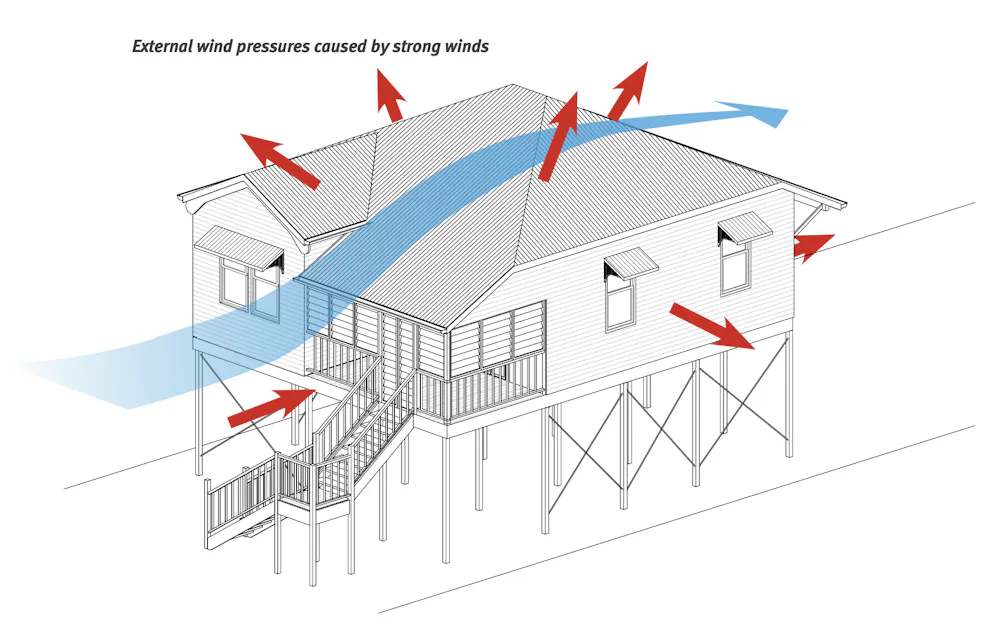
    Strong winds generate pressure pushing and pulling on the outside and inside of a house.

    When wind gusts hit a building, the wind is pushing on what we call the windward wall and going up and over the roof, creating a suction effect. The wind is trying very hard to peel the roof off your house, and in a cyclone is hammering the building for many hours.

    How external winds exert pressure on a house.
    © The State of Queensland (Queensland Reconstruction Authority) 2019, CC BY

    If a windward window or door blows in or gets broken by debris, wind instantaneously enters the space. This almost doubles the load that the roof now has to resist.

    In southeast Queensland and northern NSW, housing is not typically designed to resist that extra upward load on the roof if a door or window blows in.

    Cyclone resilience is about maintaining the function of a building during severe weather, so even if there is some damage, it still can be used after the storm has passed. So it’s vital the roof stays on.

    In practice, that means thinking about what’s known as the “tie down chain” – how all pieces of the house are held together to carry the wind loads from the roof to the ground.

    A weak link in this tie down chain can lead to winds lifting entire roofs from homes. All the connections involved in keeping a roof on the house are exceptionally important.

    Weather resistance in building codes is generally designed for rain that falls straight down and flows off the roof.

    But in a cyclone, rain can come horizontally. It can get pushed under the the roof, into gutters and under sliding doors. And it’s not just a little bit – buckets and buckets of water can inundate a house.

    Wind pressure can also mean water is blown into the house through gaps you may not even know existed. Wind-driven rain ingress can happen at wind speeds that don’t cause structural damage.

    It comes in under doors and through windows, including holes in window sills. It can lead to buildings being unusable and a large number of insurance claims.

    Dispelling major myths

    You might have seen people taping a big “X” on their windows and glass doors. Unfortunately, this doesn’t really do much to improve window strength.

    Some people put the tape on and then, during the cyclone, sit there watching their glass flex, falsely believing tape magically makes the window stronger. This is incredibly dangerous. If that glass shatters, the bystander would be hit by shards of glass travelling at high speed.

    It is much better to tape a garbage bag or a sheet of plastic along the bottom of the window sill and tape it up about 300mm each side. It can then catch the water that seeps in the window and allows it to flow back out when the wind pressure drops.

    Sometimes people open a window to reduce pressure inside the house that happens if a door or window breaks. It’s true this might reduce some pressure, but it depends which side of the house is currently being hit by wind. And given wind direction can change during a cyclone, emergency services recommend it’s better just to stay sheltered in the smallest room; they don’t want you standing in front of a window during a cyclone.

    Close all internal doors so if any windows do blow in, the high pressure is restricted to just that room (not spread throughout the house).

    Designing beyond the bare minimum

    Building codes require buildings to build to a “wind classification” according to the “wind zone” of that area.

    Buildings are often built only to the minimum standard of the Building Code. However, if we want a house to function after an extreme tropical cyclone, we should consider building beyond the minimum standard using resilience features that will keep your roof on in a cyclone and minimise the entry of rainwater.

    Cyclone resilience also includes incorporating resilient building materials in your home – such as linoleum or vinyl floors instead of carpet, and ceilings from fibre-cement sheeting instead of plasterboard.

    Resilient building options you could consider.
    © The State of Queensland (Queensland Reconstruction Authority), CC BY

    Eternal vigilance

    It’s also important all elements holding your house together are well maintained through the life of the building.

    That means ensuring regular inspections by a trained professional to identify any potential weaknesses such as rot, rust or UV damage.

    These inspections are not something you and a mate can do yourselves. It requires a building professionals to get into the roof and look for weak spots.

    Think beyond your house. What about the carport? A pergola? That shed or patio you added? Are the solar panels installed correctly with the right fixings and brackets to resist the wind forces?

    If all these things are not fixed down and maintained well, strong winds can pick them up and throw them at your house or your neighbours.

    Just as you get your car serviced, you should get your house checked every five to seven years. Our homes have many important parts and a failure in one can lead to disastrous and expensive problems.

    David Henderson serves on committees for Standards Australia. He is a member of Engineers Australia and has done consulting work with the Resilient Building Council.

    Geoffrey Boughton serves on committees for Standards Australia. He is a member of Engineers Australia and has done consulting work with the Resilient Building Council.

    ref. How cyclones rip apart houses – and how to boost the chance your home stays standing – https://theconversation.com/how-cyclones-rip-apart-houses-and-how-to-boost-the-chance-your-home-stays-standing-251709

    MIL OSI AnalysisEveningReport.nz

  • MIL-OSI USA: Murkowski Questions FDA Nominee

    US Senate News:

    Source: United States Senator for Alaska Lisa Murkowski
    03.06.25
    Washington, DC – U.S. Senator Lisa Murkowski (R-Alaska) today questioned the President’s nominee to be Commissioner of the Food and Drug Administration (FDA), Martin Makary, during his appearance before the Health, Education, Labor, and Pensions (HELP) Committee. Murkowski raised the FDA’s handling of the Vaccine Advisory Committee, the handling of clinical trials for rare diseases, and funding for state and local governments to conduct food safety inspections.
    Full Transcript:
    Senator Murkowski: Doctor, welcome, it was a good conversation that we had, and I appreciated that. I thank you for the encourage to read that provision in your book, it was great airplane reading for me.
    Dr. Makary: Thank you, Senator.
    Senator Murkowski: I also want to thank you for the assurance you gave to Senator Collins regarding the Vaccine Advisory Committee, and ensuring there would be meetings going forward. I think for several of us who had I thought good substantive conversations with Secretary Kennedy, we had received assurances about things like the vaccination committee. So, we’re making sure again that important input goes forward is important to many of us, so I appreciate that.
    I wanted to talk to you this morning about an issue we discussed in my office, and that is with regards to ALS. The FDA’s accelerated approval pathway has really been important, and I think very promising for treatments for ALS and some other rare diseases. You have advocated for using common sense alongside science in regulatory decisions. So, very briefly, how do we define common sense here as it applies to the regulatory decisions of the FDA. How do we make sure that ALS patients who are looking at a very, very limited time frame, they can’t wait for the traditional approval process, there are some emerging measures using digital technologies, is this in your realm of common sense? Give me a little bit of insight here on how you would like to proceed on these approval pathways.
    Dr. Makary. Thank you, Senator. I very much enjoyed our time together, and talking through a bunch of these issues. We have to customize the regulatory process to the condition that we’re trying to be able to offer hope, so, if a condition affects 19 people in the world as a partial triplication chromosome 15 disorder does, or a disease that affects 52 kids in the world, we cannot require two randomized control trials. We have to customize the regulatory process to what we’re trying to do if our goal is to try to provide safe and effective therapies. So, I do believe firmly in that approach, and I do think we can use some commons sense to ask some big questions we’ve never asked before at the FDA. Why does it take 10 years for a drug to get approved? Why does a college student who suffers from chronic abdominal pain for years, and we have no idea what’s going on, and they go to Italy for a summer and they are suddenly cured of their abdominal pain? Why does a peanut allergy medication that’s been safe with data for decades get approved in Europe before the United States when nearly 10% of our population has a food allergy? So, I do think there’s a lot of areas where we can ask, does a drug need to be prescription, when it could be over-the-counter, why are requiring continuous glucose monitors to have a Doctor’s prescription when it’s good for people to use these monitors and learn about what they’re eating. We don’t just want to limit continuous glucose monitoring to people with diabetes, we want to prevent diabetes when 30% of our nation’s children has diabetes or pre-diabetes or some form of early insulin resistance. Why are we holding these tools to help people, empower them about their health, until after they’re sick, same with continuous blood pressure monitoring.
    Senator Murkowski: Well, as you point out, why do we wait. We want to make sure that there is a level of safety, that’s the job there through the FDA. But, again, being able to accelerate these in ways that are meaningful, and to your point, that actually fit with the population that you’re speaking to. So know that I’m going to be pushing you on this, as well as many other advocates out there.
    Dr. Makary: Thank you.
    Senator Murkowski: I want to quickly ask you about food safety inspections. State and local governments conduct about 60% of food processing facility inspections, 90% of produce safety inspections, 100% of retail food inspections. What has happened is we have seen in the Biden Administration, FDA planning to cut funding for state and local food safety programs. This impacts us in the state of Alaska when it comes to our seafood industry, and in other areas. So, I’m looking for a commitment from you that under the Trump Administration, the FDA is going to maintain funding for these contracts with state and local governments. They’ve proven that it’s more cost effective, more efficient, and it also is what Congress has asked for. So I’d like to know that you’re going to be supportive in that regard to state and local governments.
    Dr. Makary: I’m happy to look at that with you, Senator.
    Senator Murkowski: Very good. Thank you, Mr. Chairman. 

    MIL OSI USA News

  • MIL-OSI USA: Hawai‘i Congressional Delegation Introduces Legislation To Protect State’s Native Species

    US Senate News:

    Source: United States Senator for Hawaii Brian Schatz

    WASHINGTON – U.S. Senators Brian Schatz (D-Hawai‘i) and Mazie K. Hirono (D-Hawai‘i), along with U.S. Representatives Ed Case (D-Hawai‘i) and Jill Tokuda (D-Hawai‘i), introduced legislation to protect more than 10,000 plant and animal species native to the Hawaiian Islands. The Hawai‘i Native Species Conservation and Recovery Act would fund conservation and recovery projects addressing invasive species, the ecological consequences of climate change, native species’ habitats, and population recovery. Schatz met with The Nature Conservancy, Hawai‘i today to discuss the bill and other priorities.

    “Native species foster a healthy ecosystem, with cleaner air, purer water, and a more resilient environment,” said Senator Schatz. “By funding new conservation measures and recovery projects, including for Native Hawaiian organizations and local non-profits, our bill will help save our native species for years to come.”

    The 10,000 species native to Hawai‘i represent the highest degree of endemism in the world, but hundreds of these species are listed as endangered. The state’s unique biodiversity is in the midst of an extinction crisis, with more than half of native birds and more than 100 unique plant species already extinct.

    The Hawai‘i Native Species Conservation and Recovery Act would:

    • Provide funding through cooperative agreements and grants to the State of Hawai‘i, local governments, Native Hawaiian organizations, non-profit organizations, businesses, and institutions of higher education to protect native species;
    • Support coordinated, evidence-based conservation and recovery projects addressing invasive species, the ecological consequences of climate change, native species’ habitats, and population recovery, as well as data collection and public outreach and education measures;
    • Require the U.S. Fish and Wildlife Service to coordinate with other federal and state agencies to develop annual funding priorities and criteria for ranking project proposals;
    • Require a 25 percent non-federal match for most projects;
    • Encourage applications for high impact, small dollar value projects, projects carried out by Native Hawaiian organizations, and projects promoting youth workforce readiness by waiving the non-federal match requirement for such projects; and
    • Authorize $30 million annually, subject to appropriations, to protect native species for ten years.

    “Unique to our islands, Hawai‘i’s native species are critical to maintaining the health, balance, and biodiversity of our ecosystem,” said Senator Hirono. “Through initiatives such as funding conservation and recovery projects that address topics including invasive species, scientific research, and data collection, this legislation will help to preserve Hawai‘i’s ecosystems and safeguard the environment for future generations.”

    “In Hawai‘i, invasives have caused significant ecological damage, threatening the survival of our unique plant and animal species,” said Representative Case. “Protecting Hawai‘i’s unique biodiversity is not just an environmental necessity, but a cultural imperative that embraces our Native Hawaiian heritage. Unfortunately, these native species often lack the defenses to compete with or resist the pressures of invasive plants and animals, which can rapidly alter ecosystems and displace local species and requires intervention to prevent and reverse.”

    “From ?ohi?a to kiwikiu, Hawai?i is home to some of the most stunning native biodiversity in the world, and we need to work collaboratively to protect and preserve our unique and fragile ecosystem,” said Representative Tokuda. “I am proud to support the Hawai‘i Native Species Conservation and Recovery Act to provide much-needed support for coordinated conservation projects across our state, protect our cultural assets, and ensure our native species can thrive for generations to come.”

    The bill is endorsed by The Nature Conservancy, Hawai‘i Conservation Council, Friends of Hakalau Forest National Wildlife Refuge, National Tropical Botanical Garden, American Bird Conservancy, and National Wildlife Federation.

    “Our community in Hawai‘i continues to rise to the challenge protecting our most vulnerable species. I want to thank Senator Schatz, Congressman Case and the rest of our Hawai‘i delegation for enabling the vision of our local communities to become a reality,” said Ulalia Woodside Lee, Executive Director of The Nature Conservancy Hawai‘i and Palmyra. “If enacted, this bill would add much needed support to ensure we can protect our treasured biodiversity and help build capacity in our local communities to malama ‘aina.”

    Senator Schatz met with representatives from TNC Hawai‘i and Palmyra to discuss the bill.

    “This groundbreaking legislation, would ensure protections against invasive species and ensures the viability of Hawai‘i’s endemic species and ecosystems that supports them from extinction. These species are found nowhere else on our planet. If implemented, this legislation will be a win for Hawai‘i, the U.S., and the world in being at the helm of protecting endangered species from becoming extinct. This will also set a course of action to help reverse the current situation of Hawai‘i being the extinction species capitol of the world by eradicating invasive species, foster and the restore biodiversity and help to stabilize our climate. Additionally, this measure will help to protect food sources and the community from harmful invasive pests, as well as, increase employment opportunities. There is no time to lose; we urge Congress to swiftly pass the Native Species Conservation and Recovery Act,” said Jonee Peters, Executive Director for the Conservation Council for Hawai‘i.

    “Hawai‘i is home to some of the most unique and threatened plants and animals found anywhere in the world. The Hawai‘i Native Species Conservation and Recovery Act would be a significant step toward addressing the many challenges of protecting and recovering these irreplaceable natural and cultural resources. Many of Hawai‘i’s exceptional native species are quite literally on the brink of extinction; we urge Congress to pass this Act as soon as possible,” said Debbie Anderson, President of the Friends of Hakalau Forest National Wildlife Refuge.

    “The National Tropical Botanical Garden strongly supports the proposed Hawai‘i Native Species Conservation and Recovery Act of 2025 because it aligns perfectly with NTBG’s mission to preserve and protect native plant species, restore ecosystems, and advance scientific research and education. By providing funding for community involvement and youth workforce training, the act would help ensure that future generations of conservationists and scientists are equipped to protect Hawai‘i’s fragile ecosystems. Supporting the Hawai‘i Native Species Conservation and Recovery Act of 2025 is not just beneficial for NTBG — it is essential for the future of Hawai‘i’s native ecosystems,” said Tami Rollins, Interim CEO of the National Tropical Botanical Garden.

    “Birds such as the ‘I’iwi represent Hawai‘i’s extraordinary biodiversity. However, ‘I’iwi and countless other species are facing unprecedented challenges from threats like avian malaria. Thanks to Sen. Schatz for introducing the Hawai‘i Native Species Conservation and Recovery Act, which would address threats to native species by supporting community-led projects, ensuring native Hawaiian ecosystems are present for our keiki,” said Chris Farmer, Hawai‘i Program Director at American Bird Conservancy.

    The full text of the bill is available here.

    MIL OSI USA News

  • MIL-Evening Report: ‘Icarus of the deep’: how a dying anglerfish became a social media sensation

    Source: The Conversation (Au and NZ) – By Prema Arasu, Postdoctoral Research Fellow, Minderoo-UWA Deep-Sea Research Centre, The University of Western Australia

    David Jara Boguñá / Instagram

    In February, researchers from conservation organisation Condrik Tenerife were about two kilometres off the coast of Tenerife Island, looking for sharks, when they caught sight of something much stranger.

    Photographer David Jara Boguñá filmed a humpback anglerfish (Melanocetus johnsonii, a species of black seadevil) swimming near the surface in sunlit waters. These fish have never before been seen alive in daylight, as they normally dwell in the “twilight zone” at depths from 200m to 600m.

    The video has provoked an enormously empathetic response on social media, with some seeing the fish as a feminist icon or an Icarus-like figure who swam too close to the Sun. The reaction shows our views of the deep sea – long ignored or seen as a realm of monsters – may at last be changing.

    The strange lives of anglerfish

    Anglerfish are much smaller than you probably think they are. The specimen Boguñá filmed was a female, which typically grow up to 15cm long.

    The creatures are named for their bioluminescent lure (or esca). This modified dorsal fin ray can produce a glow used to fish (or angle) for prey in the dim depths of the sea. The bioluminescence is produced by symbiotic bacteria that live inside the bulbous head of the esca.

    Male anglerfish lack the iconic lure and are much smaller, usually reaching a length of only 3cm.

    A male anglerfish spends the first part of his life searching for a female to whom he will then attach himself. He will eventually fuse his circulatory system with hers, depending on her entirely for nutrients, and live out his life as a parasite or “living testicle”.

    It is unknown why this fish was swimming vertically near the surface. Researchers have speculated that the behaviour may have been related to changes in water temperature, or that the fish was simply at the end of her life.

    Watchers observed the fish for several hours, until it died. Its body was preserved and taken to the Museum of Nature and Archaeology in Santa Cruz de Tenerife, where it will be further studied.

    Sympathy for the seadevil

    The video quickly went viral, inspiring countless reaction videos, artworks, memes, a Pixar-style animation and a poem titled Icarus is the Anglerfish.

    One Reddit user commented:

    I like to think she is a respected old grandmother who has dreamed her entire life of seeing the sunlight and the world above the water. She knows her time is nigh so she bade farewell to her friends and family and swam up towards the light and whatever it might hold for her as her life as an anglerfish comes to a close.

    One person described the fish as her “feminist Roman Empire”, in the sense of an inspirational obsession that filled the same role for her that the Roman Empire supposedly does for many men.

    Boguñá and Condrik Tenerife have since commented on the public reaction. (The original post is in Spanish, but Instagram’s automated English translation is below.)

    He’s become a global icon, that’s clear. But far from the romanticisation and attempt to humanise that has been given to its tragic story, I think that what this event has been for is to awaken the curiosity of the sea to PEOPLE, especially the younger ones, and perhaps, it also serves that messages about marine ecosystem conservation can reach so many more people.

    From horrors to heroes

    The outpouring of empathy for the anglerfish is unexpected. With their glowing lures and fang-filled mouths, the creatures have long been archetypal horrors of the abyss.

    As I have written elsewhere, the anglerfish’s extreme sexual dimorphism and parasitism, along with its unsettling anatomy, have made it the “iconic ambassador of the deep sea”. Anglerfish or angler-inspired aliens have appeared as antagonists in films such as Star Wars Episode I: The Phantom Menace (1999), Finding Nemo (2003), The SpongeBob SquarePants Movie (2004) and Luca (2021).

    Star Wars film The Phantom Menace features a large anglerfish-inspired sea monster.
    Disney

    The reception of “Icarus” (as some call her) in popular culture indicates a perhaps surprising capacity for empathy toward animals that aren’t conventionally cute or beautiful. It stands in stark contrast to the fate of the deep-sea blobfish Psychrolutes marcidus, which in 2013 was voted the world’s ugliest animal.

    Perhaps the name is a clue: people have seen in the fish a creature striving to reach the light, who died as a result of her quest.

    But does our projection of human emotions and desires onto non-human animals risk misunderstanding scientific reality? Almost certainly – but, as US environmental humanities researcher Stacy Alaimo has argued, it may also have benefits:

    Deep-sea creatures are often pictured as aliens from another planet, and I think that gets people interested in them because we’re all interested in novelty and weirdness and the surreal […] I think that can be positive, but the idea of the alien can also cut us off from any responsibility.

    The deep sea and its inhabitants face growing threats from seabed mining, plastic pollution, and the effects of human-induced climate change. They need all the empathy they can get.

    Prema Arasu does not work for, consult, own shares in or receive funding from any company or organisation that would benefit from this article, and has disclosed no relevant affiliations beyond their academic appointment.

    ref. ‘Icarus of the deep’: how a dying anglerfish became a social media sensation – https://theconversation.com/icarus-of-the-deep-how-a-dying-anglerfish-became-a-social-media-sensation-251603

    MIL OSI AnalysisEveningReport.nz

  • MIL-OSI USA: Active-Duty and Former U.S. Army Soldiers Arrested for Theft of Government Property and Bribery Scheme

    Source: US State of California

    One Soldier Charged with Conspiring to Transmit National Defense Information to Individuals Located in China

    View the indictment for Jian Zhao.

    Jian Zhao, and Li Tian, active-duty U.S. Army soldiers stationed at Joint Base Lewis-McChord, along with Ruoyu Duan, a former U.S. Army soldier, were arrested today following indictments by federal grand juries in the District of Oregon and the Western District of Washington. Tian and Duan were charged in the District of Oregon for conspiring to commit bribery and theft of government property. Zhao was charged in the Western District of Washington for conspiring to obtain and transmit national defense information to an individual not authorized to receive it, and also for bribery and theft of government property.

    “The defendants arrested today are accused of betraying our country, actively working to weaken America’s defense capabilities and empowering our adversaries in China,” said Attorney General Pamela J. Bondi. “They will face swift, severe, and comprehensive justice.”

    “While bribery and corruption have thrived under China’s Communist Party, this behavior cannot be tolerated with our service members who are entrusted with sensitive military information, including national defense information,” said FBI Director Kash Patel. “The FBI and our partners will continue to work to uncover attempts by those in China to steal sensitive U.S. military information and hold all accountable who play a role in betraying our national defense. The FBI would like to thank U.S. Army Counterintelligence for their close partnership during this investigation.”

    “We thank the FBI and U.S. Army Counterintelligence Command for their hard work on this investigation and commitment to protecting our national security,” said Acting U.S. Attorney William M. Narus for the District of Oregon.

    “These arrests underscore the persistent and increasing foreign intelligence threat facing our Army and nation,” said Brig. Gen. Rhett R. Cox, Commanding General, Army Counterintelligence Command. “Along with the Department of Justice and FBI, Army Counterintelligence Command will continue to work tirelessly to hold those accountable who irresponsibly and selfishly abandon the Army values and choose personal gain over duty to our nation. We remind all members of the Army team to increase their vigilance and protect our Army by reporting suspicious activity.”

    The indictment in the District of Oregon alleges that beginning on or about Nov. 28, 2021, and continuing to at least on or about Dec. 19, 2024, Duan and Tian along with others, known and unknown to the grand jury conspired with each other to surreptitiously gather sensitive military information related to the United States Army’s operational capabilities, including technical manuals and other sensitive information, and that Tian transmitted this information to Duan in return for money, in violation of his official duties as an active-duty U.S. Army officer. Specifically, Tian was tasked with gathering information related U.S. military weapon systems, including information related to the Bradley and Stryker U.S. Army fighting vehicles, and transmitting them to Duan.

    The indictment in the Western District of Washington alleges that beginning in or about July 2024, and continuing to the date of the arrest, Jian Zhao, an active-duty U.S. Army Supply Sergeant, conspired with others known and unknown to the grand jury to obtain and transmit national defense information to individuals based in China. Zhao is further alleged to have committed bribery and theft of government property.

    Specifically, Zhao was charged for his conspiracy to collect and transmit several classified hard drives, including hard drives marked “SECRET” and “TOP SECRET”, negotiating with individuals based in China for their sale, and agreeing to send the classified hard drives to the individuals in China. In exchange for the sale of the classified hard drives, Zhao received at least $10,000. Zhao is further alleged to have conspired to sell an encryption capable computer that was stolen from the U.S. Government, and sensitive U.S. military documents and information, including information related to the High Mobility Artillery Rocket System (HIMARS), and information related to U.S. military readiness in the event of a conflict with the People’s Republic of China. Zhao is alleged to have violated his duties as a U.S. Army Soldier and public official to protect sensitive military information in exchange for money. In total, Zhao is alleged to have corruptly received and accepted payments totaling at least $15,000.

    The FBI and the U.S. Army Counterintelligence Command investigated the case.

    Assistant U.S. Attorneys Geoffrey Barrow and Katherine Rykken for the District of Oregon and Trial Attorneys Christopher Cook and Yifei Zheng of the National Security Division’s Counterintelligence and Export Control Section are prosecuting the case.

    An indictment is merely an allegation. All defendants are presumed innocent until proven guilty beyond a reasonable doubt in a court of law.

    MIL OSI USA News

  • MIL-OSI USA: Sullivan, Murkowski Seek to Extend Alaska Native Vietnam-Era Veterans Allotment Program

    US Senate News:

    Source: United States Senator for Alaska Dan Sullivan
    03.06.25
    WASHINGTON—U.S. Senators Dan Sullivan and Lisa Murkowski (both R-Alaska) have re-introduced legislation to extend the Alaska Native Vietnam-Era Veterans Land Allotment Program for five additional years. Without such an extension, the program will expire in December 2025 and potentially leave well over a thousand eligible Alaska Native Vietnam veterans and their heirs without their rightful land allotments.
    “While serving their country during the Vietnam War era, many Alaska Native veterans missed the deadline to apply for their legally entitled land allotment—an injustice that we are still working to fix nearly 70 years later,” said Senator Sullivan. “I’ve been working on this issue since I came into office. In 2019, President Trump signed into law a major lands package led by Senator Murkowski that included an allotment program I authored with a five-year window to apply. Unfortunately, throughout the implementation of this program, the Biden administration callously threw up endless regulatory hurdles and delays, dramatically limited the lands available for selection, and ended up delivering allotments to about 40 Alaskans out of more than 2,000 eligible veterans. We are reintroducing this legislation to extend this program and finally secure these land allotments for our courageous veterans who sacrificed greatly on behalf of our country. I look forward to working with the Trump administration to see this legislation signed into law and successfully implemented to fix this historic injustice and honor our Vietnam veterans’ heroic service.”
    “As thousands of Alaska Natives served our nation during the Vietnam War, they missed their opportunity to select the land allotments they are rightfully owed,” Senator Murkowski said. “With roughly 150 veterans remaining to be notified, and the pace of allotment certifications slower than we hoped it would be, an extension has become necessary—especially as we push to open additional lands closer to where many of these veterans and their families actually live.”
    The Alaska Native Vietnam-Era Veterans Land Allotment Program was established through a Sullivan-Murkowski provision in Murkowski’s 2019 lands package. The program has enabled thousands of Alaska Native veterans to apply for their congressionally-pledged land allotments, which can range from 2.5 to 160 acres, on certain Bureau of Land Management (BLM) lands in Alaska.
    As of February 13, 2025, BLM Alaska reported that it has received 453 applications for allotments and completed certifications for 41 of them. Hundreds of eligible veterans and their heirs—especially those who live in southeast, western, and northern Alaska—have not submitted applications because no lands are available within hundreds of miles of their place of residence or ancestral homelands.   
    Timeline:
    In 1906, Congress passed a law allowing Alaska Native individuals to acquire 160-acre parcels of land.
    In 1971, at a time when many Alaska Native men were serving in the military during the Vietnam War, the Alaska Native Claims Settlement Act (ANCSA) extinguished the 1906 allotment rights.
    In 1998, the Alaska congressional delegation secured legislation to partially fix the injustice of Alaska Native veterans who missed the chance to apply for an allotment. However, due to certain restrictions, only about 500 veterans ultimately applied out more than 3,000 who were eligible.
    On February 12, 2019, the Senate passed Sen. Murkowski’s S.47, the National Resources Management Act, including a Sen. Sullivan provision to establish the Alaska Native Vietnam Veteran Land Allotment Program. The late Congressman Don Young (R-Alaska) shepherded the legislation through the House.
    On March 12, 2019, President Donald Trump signed S.47, and the Trump administration began working on its implementation.
    In January 2021, then-Interior Secretary David Bernhardt signed the revocation of 11 outdated public land orders (PLOs) issued in 1972 and 1973 that were put in place to allow Alaska Native Corporations to select lands promised to them by Congress 50 years ago. This important step allowed for the Bureau of Land Management (BLM) to revoke the PLOs.
    In 2021, Senator Sullivan met twice with Secretary Haaland prior to her confirmation vote to be the Secretary of Interior. In both meetings, she committed to rapidly implement the Alaska Native Vietnam Veteran Land Allotment Program. She subsequently refused to follow through on this commitment.
    In February 2021, members of the Alaska congressional delegation condemned the Biden administration Department of the Interior’s (DOI) action to postpone the revocation of PLOs signed by former Interior Secretary Bernhardt.
    In April 2021, in a unilateral and unnecessary action, the BLM postponed the PLO revocations, requiring further environmental analysis on five public land orders with a two-year stay on the implementation of the PLO revocations.
    On May 7, 2021, Sen. Sullivan and Gov. Mike Dunleavy (R-Alaska) penned an op-ed in the Juneau Empire outlining the State of Alaska’s legislative effort to make state lands available to eligible Alaska Native veterans.
    In June 2021, Sens. Sullivan and Murkowski introduced legislation to amend the Alaska Native Vietnam Veteran Land Allotment Program and make an additional 3.7 million acres of federal land in the National Wildlife Refuge System available for selection.
    On April 18, 2022, Sens. Sullivan and Murkowski sent a letter to Secretary Haaland urging her to lift the PLOs that would make over 28 million acres of federal land available for selection by eligible veterans or their heirs.
    On April 21, 2022, Sen. Sullivan disputed Secretary Haaland’s claim that she is “[moving] expeditiously to deliver on [her] promise” to Alaska Native Vietnam-era veterans as she accepted a “Finding of No Significant Impact” (FONSI) from the acting Alaska BLM director on the Environmental Assessment (EA) for the Alaska Native Vietnam Veteran Land Allotment Program.
    In February 2023, Sens. Sullivan and Murkowski reintroduced S.175, legislation to codify the revocation of the five PLOs signed during the Trump administration and undoing the Biden administration’s efforts to unfairly halt access to federal public lands in Alaska.
    In April 2023, Sen. Sullivan condemned Interior Secretary Deb Haaland’s decision to order a new full environmental impact statement (EIS), which delays the implementation of the allotment program even further.
    On August 10, 2023, Sen. Sullivan criticized Secretary Haaland’s announcement of a PLO to open about 812,000 additional acres of public lands managed by BLM Alaska for selection, noting that the “new” land has already been spoken for by the state, and the decision will result in more delays and legal hurdles for eligible veterans.
    In February 2024, Sens. Sullivan and Murkowski introduced S.3790, which would extend the program for another five years before its expiration in December 2025. The bill passed the Senate by unanimous consent on the final day of the 118th Congress, but did not clear the House of Representatives.

    MIL OSI USA News

  • MIL-OSI USA: Padilla, Markey Introduce Bipartisan, Bicameral Bill to Secure Fair Pay for Truckers Working Overtime

    US Senate News:

    Source: United States Senator Alex Padilla (D-Calif.)

    Padilla, Markey Introduce Bipartisan, Bicameral Bill to Secure Fair Pay for Truckers Working Overtime

    WASHINGTON, D.C. — Today, U.S. Senators Alex Padilla (D-Calif.) and Edward J. Markey (D-Mass.), along with U.S. Representatives Mark Takano (D-Calif.-39) and Jeff Van Drew (R-N.J.-02), introduced bipartisan, bicameral legislation to ensure that truckers are compensated fairly for the hours that they are on the clock, including overtime. The Guaranteeing Overtime for Truckers Act would repeal the motor carrier provision of the Fair Labor Standards Act of 1938, which excludes many truckers from overtime protections enjoyed by other workers.

    In response to an Executive Order by former President Biden, the U.S. Department of Transportation issued a Freight and Logistics Supply Chain Assessment in February 2022, which highlights high turnover rates and compensation issues in the trucking industry. Among its recommendations, the Department called on Congress to repeal the motor carrier provision of the Fair Labor Standards Act of 1938 to allow truckers to earn fair overtime pay.

    “America’s truck drivers are on the frontlines of our economy, enduring long hours away from home, and all too often, unpaid wait times at congested ports and warehouses. Unfortunately, truck drivers have been excluded from overtime pay protections for decades,” said Senator Padilla. “If truckers are forced to wait while on the job, they should be paid. This is not just a matter of fairness; it’s a matter of public safety. Experienced truckers are safer truckers, and better compensation and overtime pay will help more of them stay in the profession.”

    “Truck drivers are the engines of our economy, making sure that our supply chain keeps moving at full speed, and yet they are denied the fundamental worker protection of overtime. The Guaranteeing Overtime for Truckers Act would reverse this injustice and ensure that truck drivers are paid their due,” said Senator Markey.

    “Truckers are vital for our supply chain, manufacturing, and the American way of life,” said Representative Takano. “It is unfair that they are singled out as somehow unworthy of overtime pay. This legislation will help right that wrong and make sure they are fairly compensated for the hours they work. I am proud to partner with Congressman Van Drew and Senator Padilla to build up workers and guarantee more money in their paychecks.”

    “Truck drivers keep our supply chain moving, often working long, exhausting hours to make sure goods get where they need to go,” said Representative Van Drew. “But right now, they are not guaranteed overtime pay like most other workers. It is just not right. The Guaranteeing Overtime for Truckers Act is a simple fix—it ensures that truckers are fairly compensated for the extra hours they put in. These men and women do critical work, and it’s time we make sure their pay reflects that.”

    “The exclusion of truck drivers from federal overtime protections must come to an end,” said Teamsters General President Sean M. O’Brien. “The Teamsters Union is proud to support the Guaranteeing Overtime for Truckers Act, which will right the decades long wrong that serves only to harm drivers to the benefit of their employers.”

    “America’s truckers are the backbone of our economy, keeping goods moving and ensuring our supply chain stays strong,” said Owner-Operator Independent Drivers Association President Todd Spencer. “Yet, despite their essential role, trucking remains one of the few professions in America denied guaranteed overtime pay. It’s long past time the hard work of the men and women behind the wheel are fairly compensated. By discounting a trucker’s time, ‘big trucking’ has driven wages downward, treating truckers as disposable rather than the skilled professionals they are. We appreciate Representative Van Drew, Representative Takano, and Senator Padilla for championing the bipartisan GOT Truckers Act, which will right this wrong by securing overtime pay. This legislation is an investment in truckers, road safety, and the strength of America’s supply chain.”

    In addition to Senators Padilla and Markey, the legislation is cosponsored by Senators Richard Blumenthal (D-Conn.), Elizabeth Warren (D-Mass.), and Ron Wyden (D-Ore.).

    The Guaranteeing Overtime for Truckers Act is supported by Teamsters and the Owner-Operator Independent Drivers Association.

    Senator Padilla is a longtime advocate for improving workplace safety standards and helping workers secure fair wages. In the aftermath of the Southern California fires, Padilla introduced the bipartisan Firefighter Paycheck Protection Act to protect wildland firefighter pay and provide long-term workforce stability. Additionally, he introduced the Wildland Firefighter Fair Pay Act to permanently raise the caps on overtime premium pay for federal wildland firefighters. Previously, Padilla introduced the Fairness for Farm Workers Act, legislation to update the nation’s labor laws to ensure farm workers receive fairer wages and compensation. In 2023, Padilla announced the Asunción Valdivia Heat, Illness, Injury and Fatality Prevention Act to protect the safety and health of workers who are exposed to dangerous heat conditions in the workplace. Padilla is also a proud cosponsor of the Protecting the Right to Organize (PRO) Act of 2025.

    Full text of the bill is available here.

    MIL OSI USA News

  • MIL-OSI Security: Active-Duty and Former U.S. Army Soldiers Arrested for Theft of Government Property and Bribery Scheme

    Source: United States Attorneys General 7

    One Soldier Charged with Conspiring to Transmit National Defense Information to Individuals Located in China

    View the indictment for Jian Zhao.

    Jian Zhao, and Li Tian, active-duty U.S. Army soldiers stationed at Joint Base Lewis-McChord, along with Ruoyu Duan, a former U.S. Army soldier, were arrested today following indictments by federal grand juries in the District of Oregon and the Western District of Washington. Tian and Duan were charged in the District of Oregon for conspiring to commit bribery and theft of government property. Zhao was charged in the Western District of Washington for conspiring to obtain and transmit national defense information to an individual not authorized to receive it, and also for bribery and theft of government property.

    “The defendants arrested today are accused of betraying our country, actively working to weaken America’s defense capabilities and empowering our adversaries in China,” said Attorney General Pamela J. Bondi. “They will face swift, severe, and comprehensive justice.”

    “While bribery and corruption have thrived under China’s Communist Party, this behavior cannot be tolerated with our service members who are entrusted with sensitive military information, including national defense information,” said FBI Director Kash Patel. “The FBI and our partners will continue to work to uncover attempts by those in China to steal sensitive U.S. military information and hold all accountable who play a role in betraying our national defense. The FBI would like to thank U.S. Army Counterintelligence for their close partnership during this investigation.”

    “We thank the FBI and U.S. Army Counterintelligence Command for their hard work on this investigation and commitment to protecting our national security,” said Acting U.S. Attorney William M. Narus for the District of Oregon.

    “These arrests underscore the persistent and increasing foreign intelligence threat facing our Army and nation,” said Brig. Gen. Rhett R. Cox, Commanding General, Army Counterintelligence Command. “Along with the Department of Justice and FBI, Army Counterintelligence Command will continue to work tirelessly to hold those accountable who irresponsibly and selfishly abandon the Army values and choose personal gain over duty to our nation. We remind all members of the Army team to increase their vigilance and protect our Army by reporting suspicious activity.”

    The indictment in the District of Oregon alleges that beginning on or about Nov. 28, 2021, and continuing to at least on or about Dec. 19, 2024, Duan and Tian along with others, known and unknown to the grand jury conspired with each other to surreptitiously gather sensitive military information related to the United States Army’s operational capabilities, including technical manuals and other sensitive information, and that Tian transmitted this information to Duan in return for money, in violation of his official duties as an active-duty U.S. Army officer. Specifically, Tian was tasked with gathering information related U.S. military weapon systems, including information related to the Bradley and Stryker U.S. Army fighting vehicles, and transmitting them to Duan.

    The indictment in the Western District of Washington alleges that beginning in or about July 2024, and continuing to the date of the arrest, Jian Zhao, an active-duty U.S. Army Supply Sergeant, conspired with others known and unknown to the grand jury to obtain and transmit national defense information to individuals based in China. Zhao is further alleged to have committed bribery and theft of government property.

    Specifically, Zhao was charged for his conspiracy to collect and transmit several classified hard drives, including hard drives marked “SECRET” and “TOP SECRET”, negotiating with individuals based in China for their sale, and agreeing to send the classified hard drives to the individuals in China. In exchange for the sale of the classified hard drives, Zhao received at least $10,000. Zhao is further alleged to have conspired to sell an encryption capable computer that was stolen from the U.S. Government, and sensitive U.S. military documents and information, including information related to the High Mobility Artillery Rocket System (HIMARS), and information related to U.S. military readiness in the event of a conflict with the People’s Republic of China. Zhao is alleged to have violated his duties as a U.S. Army Soldier and public official to protect sensitive military information in exchange for money. In total, Zhao is alleged to have corruptly received and accepted payments totaling at least $15,000.

    The FBI and the U.S. Army Counterintelligence Command investigated the case.

    Assistant U.S. Attorneys Geoffrey Barrow and Katherine Rykken for the District of Oregon and Trial Attorneys Christopher Cook and Yifei Zheng of the National Security Division’s Counterintelligence and Export Control Section are prosecuting the case.

    An indictment is merely an allegation. All defendants are presumed innocent until proven guilty beyond a reasonable doubt in a court of law.

    MIL Security OSI

  • MIL-OSI USA: Duckworth, Democrats Demand Answers from Trump and VA Secretary Collins on Indiscriminate Firing of Veterans and VA Employees, Including Veterans Crisis Line Staff

    US Senate News:

    Source: United States Senator for Illinois Tammy Duckworth

    March 06, 2025

    [WASHINGTON, D.C.] – Today, combat Veteran and U.S. Senator Tammy Duckworth (D-IL)—a member of the U.S. Senate Committee on Veterans’ Affairs (SVAC)—led her fellow Democratic colleagues in demanding answers from President Donald Trump and Veterans Affairs (VA) Secretary Doug Collins on their indiscriminate purge of Veterans and VA employees, including staff who help operate the Veterans Crisis Line (VCL), under the direction of unelected co-president Elon Musk and his Department of Government Efficiency. Veterans make up more than 30 percent of the federal workforce and it is estimated that the Trump Administration has already fired more than 6,000 men and women who have served in uniform. Duckworth and her fellow lawmakers are calling on Trump and Secretary Collins to immediately outline how many Veterans and VA employees have been fired since the start of this Administration and to tell the truth about how the VCL has been impacted by these terminations. For weeks, Duckworth has repeatedly called out Secretary Collins for denying the Trump Administration inflicted any damage on the VCL.

    In their letter, the lawmakers slammed Trump and Secretary Collins for smearing those who help prevent Veteran suicide as supposedly “non-essential” employees: “Claiming that only those who answer the phones at VCL are essential is an insult to the service and commitment to Veterans of the many dedicated employees who ensure that someone is ready to listen and help in a moment of crisis. We are shocked that Secretary Collins, who claimed that one of his top priorities as VA Secretary would be to address Veteran suicide, would participate in such a cynical cover-up for the Trump administration’s error— not only by going along with the lies, but also justifying them.”

    After the VA has refused to be transparent about the layoffs, Duckworth and her colleagues are demanding a list of public answers detailing the specific job categories that were impacted, how many of those fired were Veterans and more. The lawmakers are also asking how many VCL employees were terminated as part of each VA purge last month, the specific jobs they held at VCL, whether they’ve been reinstated at this time and if not, why. The lawmakers are requesting answers these questions by no later than March 12, 2025.

    The lawmakers concluded: “Our Veterans deserve honest and transparent answers. As a reminder, the American public elected President Trump into office to represent their best interests, and the actions of the VA Secretary are a direct reflection of President Trump’s leadership and priorities. Our Veterans’ interests should always come before any selfish agenda, and actions that impact their access to care and benefits should require immense scrutiny prior to implementation. We believe this close review has not been conducted, as evidenced by the VA’s scramble to rehire mission-critical positions such as VCL employees.”

    Along with Duckworth, the letter was co-signed by U.S. Senators Alex Padilla (D-CA), Mark Kelly (D-AZ), Tina Smith (D-MN) and Chris Van Hollen (D-MD).

    A copy of the full letter is available on the Senator’s website and below:

    Dear President Trump and Secretary Collins:

    We write today to call into question President Trump’s series of egregious Executive Orders and other illegal actions in coordination with unelected co-president Elon Musk’s Department of Government Efficiency (DOGE), and with unquestioning execution by Secretary Collins, that have had increasingly detrimental impacts on the Veteran community and continue to create capability gaps that threaten the well-being of Veterans. The indiscriminate purge of Veterans and other federal employees at the U.S. Department of Veterans Affairs (VA) means slower claims processing, longer wait times for Veterans seeking access to their medical care and the end of important research that benefits Veterans and all Americans. We demand that you take accountability for these actions and share with the American people what exactly the plan is for the future of VA.

    Just last week, the VA announced a second wave of mass terminations, totaling 1,400 employees, claiming in the announcement that these are “non-mission critical” positions and exclude the Veterans Crisis Line (VCL) – though we have already learned of at least two cases that prove this claim wrong. We challenge this disregard for the important work of the entire VA ecosystem that provides comprehensive and timely care and benefits to our Veterans, and we have yet to learn about a day-after plan that explains how exactly VA will function with so many sudden and senseless cuts. Claiming that only those who answer the phones at VCL are essential is an insult to the service and commitment to Veterans of the many dedicated employees who ensure that someone is ready to listen and help in a moment of crisis. We are shocked that Secretary Collins, who claimed that one of his top priorities as VA Secretary would be to address Veteran suicide, would participate in such a cynical cover-up for the Trump administration’s error— not only by going along with the lies, but also justifying them.

    Nearly 6,000 Veterans across the federal government have been terminated to date. Among the most patriotic people in our Nation, Veterans make up 30 percent of the federal workforce, which is a true reflection of their exceptional dedication to our country. Yet, their President will not even publicly acknowledge his error of judgment in allowing Elon Musk unfettered access across federal agencies in his quest to dismantle their critical contributions that save lives and deliver essential services. Instead, he quietly rehired certain mission-critical VA positions that never should have been terminated and brushed off the significant impact that this indiscriminate mass firing would have on morale, workflow and ability of the Department to deliver critical services to Veterans in a timely manner.

    We demand that you respond to the following questions no later than March 12, 2025, and that this information be made available to the public, and particularly Veterans, who are owed accountability and transparency from the administration that represents them.

    1. Please provide a list detailing, by job category, how many VA employees were terminated during the February 13, 2025, dismissal of 1,000 VA employees, as well as the February 24, 2025, dismissal of an additional 1,400 VA employees.
      1. How many of these employees are Veterans themselves? Please provide a numeric breakdown by job category and duty station.
      1. How many of these employees are disabled Veterans? Please provide a numeric breakdown by job category and duty station.
      1. How many of these employees were eligible for Veterans’ preference? Please provide a numeric breakdown by job category and duty station.
      1. How many of these employees were on probationary status because they had just been promoted? Please provide a numeric breakdown by job category and duty station.
      1. What is the administration’s plan, if any, to assist these dismissed Veterans with obtaining employment elsewhere? Has the administration considered how these terminations may increase the risk of Veteran homelessness?
      1. How many of these employees were military spouses? Please provide a numeric breakdown by job category and duty station.
    1. How many employees working for the VCL received notice of dismissal on February 13, 2025? Have all dismissed VCL employees been reinstated?
      1. If all dismissed VCL employees have not been reinstated, why not? How many positions remain open, and what are the functions of these positions?
      1. Assuming these dismissals were accidental, what error led to these employees being wrongfully terminated? Has this error been addressed in the evaluation process?
    1. How many employees working for the VCL received notice of dismissal on February 24, 2025? Have all dismissed VCL employees been reinstated?
      1. If all dismissed VCL employees have not been reinstated, why not? How many positions remain open, and what are the functions of these positions?
      1. Assuming these dismissals were accidental, what error led to these employees being wrongfully terminated? Has this error been addressed in the evaluation process?
    1. Do you acknowledge that all employees working for the VCL, including and not limited to phone operators, are critical to its mission to ensure that at-risk Veterans receive the assistance they need?
    1. Can you provide a justification for the numerous public reports that describe terminations of probationary employees despite positive evaluations by their respective management?
    1. What analysis is used, if any, to ensure that disabled Veterans using their Veterans’ Preference are not wrongfully wrapped into the administration’s attack on probationary employees?
    1. Can you please describe, in detail, DOGE’s evaluation process in determining cuts to VA employment? What checks are in place to ensure that these cuts do not continue to harm critical programs that provide care and benefits, including mental health services, to Veterans?
    1. What was the total cost spent by the U.S. government on recruiting and training the VA employees who have since been fired by DOGE?
    1. What is the administration’s plan to swiftly address postponements and cancellations of suicide prevention training sessions, health care appointment cancellations and new clinic opening delays?
      1. Please provide a list of programs and services that have been cancelled or delayed since February 13, 2025.
      1. Please include the number of Veterans or VA employees impacted by these cancelations and delays.
    1. How exactly will the claimed savings as a result of the mass terminations at VA be redirected back toward health care, benefits and services for VA beneficiaries?
      1. Please provide an itemized list of savings in dollar amounts by account, and for each amount, specify whether these are mandatory or appropriated funds.
      1. Please provide your spend plan for savings that you claim to recoup through these terminations. Which accounts do you intend to redirect these funds to, and which new services would these funds provide?
      1. For each of these proposed changes, specify whether you have the legal authority to reprogram these funds in the way intended. 
    1. Regarding the February 22, 2025, emails sent to all federal employees requiring an explanation of tasks completed the week prior, what exactly will be done with this information?
      1. Did all Veterans Crisis Line employees receive this email?
      1. Did all physicians and nurses employed in VA hospitals receive this email?
      1. Who is reading and analyzing responses to this email?
      1. Are responses being used to determine future layoffs or personnel changes?
    1. What analysis – if any – did the U.S. Office of Personnel Management conduct to examine the impact terminations or resignations resulting from this email would have on critical services across government?

    Our Veterans deserve honest and transparent answers. As a reminder, the American public elected President Trump into office to represent their best interests, and the actions of the VA Secretary are a direct reflection of President Trump’s leadership and priorities. Our Veterans’ interests should always come before any selfish agenda, and actions that impact their access to care and benefits should require immense scrutiny prior to implementation. We believe this close review has not been conducted, as evidenced by the VA’s scramble to rehire mission-critical positions such as VCL employees.

    We stand ready and willing to reach across the aisle for the best interests of our Veterans – a sentiment that Secretary Collins will recall from his hearing before the Senate Veterans’ Affairs Committee. Support to our Veterans has historically been a bipartisan issue, and we do not want this long-standing tradition to fall because of a President and his VA Secretary turning their backs on our Veterans due to the influence of an unelected co-president who yields illegal privilege to invoke Executive authorities. He fools no one with his efforts to line the pockets of the wealthy, and we will not stand by while there is an active attack against our Nation’s Veterans.

    President Trump, Secretary Collins – we urge you to uphold with integrity your commitment to our Nation’s Veterans.

    -30-

    MIL OSI USA News

  • MIL-OSI United Kingdom: Supervised toothbrushing for children to prevent tooth decay 

    Source: United Kingdom – Executive Government & Departments

    Press release

    Supervised toothbrushing for children to prevent tooth decay 

    Programme will reach up to 600,000 children in most deprived areas

    • National programme rolled out for 3 to 5-year-olds in early years settings – including nurseries and primary schools – in most deprived areas of England 
    • Government also agrees ground-breaking partnership with Colgate which will see more than 23 million toothbrushes and toothpastes donated to support the programme 
    • Programme is latest step in government’s Plan for Change to give children the best start in life and prevent ill health

    Children in the most deprived areas of England will get access to a programme to help protect them from tooth decay, the government has announced today. 

    The supervised toothbrushing programme will be rolled out in early years settings and primary schools, with funding available from April, helping hundreds of thousands of children aged between 3 and 5 years old to develop positive brushing habits.

    The scheme – a manifesto commitment – will be launched in collaboration with Colgate-Palmolive who are providing free Colgate toothbrushes, toothpaste and educational materials to continue good work at home. 

    This government inherited a children’s oral health crisis. The most common reason children aged 5 to 9 being are admitted to hospital is to have treatment for decayed teeth. Latest data shows one in 4 children aged 5 have experienced tooth decay in England, with higher rates of up to one in 3 in more deprived areas. 

    The scheme will help tackle these levels of poor health by ensuring they get the support they need to learn positive habits and prevent tooth decay – in turn avoiding related illness and poor health later in life.

    To deliver the scheme, the government is investing a total of £11 million in local authorities across England to deploy supervised toothbrushing in schools and nurseries that voluntarily sign up. Local authorities will work to identify early years settings in target areas and encourage them to enrol.

    To support the scheme, the government has also agreed an innovative partnership with Colgate-Palmolive, which has generously committed to donate over 23 million toothbrushes and toothpastes over the next 5 years. It is also providing educational materials and a public facing children’s oral health campaign supporting the NHS, developed with its experience of global oral health education.

    The partnership is grounded in the shared mission and commitment between the government and Colgate-Palmolive to advance the oral health of the nation, by reducing the inequalities in oral health and ensuring access to oral health education for every child across the country.

    Together, the resources will reach up to 600,000 children each year and provide families with the support they need to ensure positive behaviours continue at home and over the school holidays.

    The launch is part of the government’s mission to give every child the best start in life and rebuild our health care system through the Plan for Change. The government is also driving forward action to fundamentally reform the NHS dental sector having recently announced the rollout of an extra 700,000 urgent dental appointments nationwide.

    Health Minister Stephen Kinnock said:  

    It is shocking that a third of 5-year-olds in the most deprived areas have experience of tooth decay – something we know can have a lifelong impact on their health. 

    It’s why we’re delivering supervised toothbrushing to young children and families who are most in need of support as part of our wider plans to revive the oral health of the nation. This includes providing 23 million free toothbrushes and toothpastes through our partnership with Colgate-Palmolive to reach up to 600,000 children each year.

    We’re already rolling out 700,000 extra urgent dental appointments for those who need treatment, but by focusing on prevention we can help children have the best start in life. 

    On top of this, we will reform the dental contract to get dentists providing more NHS work as we fundamentally reform the sector through our Plan for Change so it is there for patients once again.

    Colgate-Palmolive’s Chairman, President and Chief Executive Officer Noel Wallace said:

    At Colgate-Palmolive, we believe every child deserves the chance to have a healthier smile and brighter future. We’re thrilled that Colgate and our team in the UK have been chosen to partner with the government to help improve children’s oral health across the country – it’s an incredibly important initiative given the current levels of tooth decay in children.

    Our global programme Colgate Bright Smiles, Bright Futures is among the most far-reaching and successful children’s oral health initiatives in the world. With long-standing partnerships with governments, schools and communities, BSBF has reached approximately 1.8 billion children and their families since 1991 across 100 countries with free oral health education and free dental screenings.

    In the UK, we’ve been running Colgate Bright Smiles, Bright Futures since 2014 and are extremely proud to have reached over 18 million children across the nation with oral health education and donations of essential health and hygiene products.

    With the launch of the supervised brushing scheme, this partnership will be able to make a real impact in preventing tooth decay and ensuring brighter futures for generations to come. We want all children, regardless of needs or circumstances, to be fully equipped with the information and tools they need to keep improving their oral health every day.

    The scheme is being rolled out in collaboration with the Department for Education and follows the latest tranche of measures to make government-funded childcare more affordable and accessible to the most disadvantaged families.  

    Early years providers such as primary schools and nurseries are required to promote good oral health among attending children, and supervised toothbrushing is a way of achieving that aim. 

    From April, new rules will protect working families from facing high additional charges on top of their entitled childcare hours and providers will begin to benefit from a 45% uplift in early years pupil premium funding, to make sure the most disadvantaged children can access the early years education they need. 

    Early Education Minister Stephen Morgan said:  

    Through our Plan for Change , this government is working hard to break the unfair link between background and opportunity, to ensure tens of thousands more children are school ready every year. 

    We have already started urgent work to increase the affordability and accessibility of high-quality early years and extend early learning support, but we know school-readiness goes beyond what is taught in a classroom. 

    By supporting the youngest children with vital life and development skills, more teachers will be able to focus on what they do best – teach.

    Jason Wong, Chief Dental Officer for England, said: 

    Tooth brushing twice daily with a fluoride toothpaste remains one of the best defences against tooth decay and a long list of preventable oral health issues. This is why we’re thrilled that the government is working with the NHS to expand access to pivotal supervised toothbrushing programmes in schools.

    Having strong healthy teeth can have a hugely positive impact on a child’s life. If you’re concerned about your child’s oral health, you can find helpful guidance on the NHS website or through your local authority – and  as a reminder to parents, all children have free dental care available through the NHS.

    Supervised toothbrushing is a proven, evidence-based health intervention, and is expected to deliver measurable improvements to children’s oral health and reductions in oral health inequalities from between 2 and 3 years after launch. 

    The rollout is expected to save the NHS millions of pounds that would otherwise be spent on treating dental disease in children, including preventing hospital admissions that cost the NHS around £1,600 per person.

    Every £1 spent on supervised toothbrushing is expected to save £3 in avoided treatment costs – amounting to over £34million over the next 5 years that can instead be spent on treating other patients. 

    Data published last week showed more than 49,000 young people under-19 were admitted to hospital for tooth extraction between in the financial year ending 2024. 

    Alongside the launch today, the government has confirmed that, following public consultation last year, it is going ahead with the expansion of community water fluoridation across the North-East of England.  

    Water fluoridation is the process of adding fluoride to public water supplies to prevent tooth decay. Around one in 10 people in England currently have fluoride added to their drinking water supplies.

    The findings of all health monitoring reports since 2014 consistently show that water fluoridation is an effective and safe public health measure to reduce the prevalence and severity of tooth decay and reduce dental health inequalities. 

    The expansion of water fluoridation in the North-East is expected to reach an additional 1.6 million people and reduce the number of young children admitted to hospital for the removal of decayed teeth.   

    Cllr David Fothergill, Chairman of the Local Government Association’s Community Wellbeing Board said:

    We are pleased to see new funding for supervised toothbrushing, which is an evidence-based and cost-effective intervention proven to improve children’s oral health. This investment will help address health inequalities by supporting children in the most deprived areas to develop positive brushing habits, preventing tooth decay and reducing the need for hospital treatment.

    This funding builds on the excellent work already being done by many councils up and down the country to improve children’s oral health. The flexibility in how the funding can be used is particularly appreciated, allowing councils to tailor programmes to best meet local needs. Councils are committed to playing their part in improving children’s oral health and reducing inequalities.

    Jason Elsom, Chief Executive of children’s charity Parentkind said:

    As a father to a blended family of 8 children, I know how hard it can be to get children to clean their teeth well, regularly, and consistently, and this is especially true when family life can be so hectic. 

    It’s important that we get the basics right for our children, and things like poor personal or oral hygiene can impact a child’s early years, and beyond. 

    But children all develop in different ways, and at a different pace, and so I commend this initiative to help every child understand the importance of oral hygiene at an early age.

    Dr Urshla Devalia, spokesperson for the British Society of Paediatric Dentistry, said:

    At last, we will see the dial shift on children’s oral health in England. BSPD has been advocating for the importance of a preventative approach to address the crisis in children’s oral health for years.

    Intervening now with a supervised toothbrushing scheme, plus community water fluoridation programmes, are initiatives proven to deliver beneficial oral health outcomes that will pay for themselves several fold in the future.

    We are excited to see this commitment to improving children’s oral health, but there is a lot of work to do, and BSPD is rolling up its sleeves to play its part. This is the decisive action we have been pushing for.

    Anna Gardiner, Deputy Director – Health & Wellbeing at the National Children’s Bureau, said:

    Despite improvements over the past 20 years, too many young children in England start school with tooth decay. Poor oral health can have lasting impacts on their health, wellbeing, and attainment, and a significant risk factor is not getting into the habit of brushing teeth twice per day with fluoride toothpaste.

    So, we welcome the government’s plans to introduce a supervised brushing programme in early years settings, and we look forward to seeing its impact, particularly for those growing up in deprived areas who disproportionately suffer from poor oral health.

    June O’Sullivan OBE, CEO, London Early Years Foundation (LEYF), says:

    Children’s oral health in the UK is in crisis, and for too long, it’s been the silent epidemic no one talks about. Tooth decay doesn’t just cause pain – it disrupts sleep, eating, learning, and the ability to speak clearly, which is crucial for a child’s development and confidence. Unfortunately, the impact is felt most by disadvantaged children which is why this government-backed supervised toothbrushing programme is very much welcomed. 

    At LEYF, we’ve seen first-hand how daily brushing in nurseries transforms children’s oral health and wellbeing. Scaling this nationally will give hundreds of thousands of children the best start in life. While it’s not our role to replace parents in this responsibility, we are committed to supporting our LEYF families. This programme will help educate parents on the importance of oral health and a healthy diet, ensuring good habits are built at home as well as in nursery.

    Notes to editors:

    • For more information about Colgate-Palmolive’s, visit the company’s website at https://www.colgatepalmolive.co.uk/. To learn more about Colgate Bright Smiles, Bright Futures® oral health education program, please visit https://www.colgate.com/en-gb/oral-health-education/our-commitment
    • Fluoride is a naturally occurring mineral found in soil, food and drink and also in drinking water supplies, in varying amounts. In some parts of England the level of fluoride in the public water supply already reaches the target concentration of water fluoridation schemes (one milligram per litre (1mg/l)), sometimes expressed as one part per million (1ppm)), as a result of the geology of the area. In other areas the fluoride concentration has been adjusted to reach this level as part of a fluoridation scheme. More information can be found here: Community water fluoridation expansion in the north east of England – GOV.UK

    Updates to this page

    Published 7 March 2025

    MIL OSI United Kingdom

  • MIL-OSI Submissions: Asia Pacific – Hidden challenges in paradise: report addresses threats to Palawan’s marine life and community – University of Sydney

    Source: University of Sydney

    Palawan archipelago in the Philippines: State of the Marine Environment

    A joint study for the Philippines and Australian governments led by researchers at the University of Sydney has highlighted threats to the outstanding marine environment of the Palawan Province, an archipelago of 1700 islands adjacent to the South China Sea.

    The Palawan State of the Marine Environment 2024 report – a collaboration between the Palawan Council for Sustainable Development, Geoscience Australia and the University of Sydney – was launched on Wednesday at an event in Puerto Princesa, Philippines.

    The Australian Ambassador to the Philippines, Her Excellency HK Yu, welcomed the report and thanked the University of Sydney for its academic leadership in providing the research into this ecologically important region. She said: “As strategic partners, Australia is committed to supporting the Philippines to manage its marine resources and uphold international law. We are pleased to provide this report to the Palawan Council for Sustainable Development (PCSD), funded through Australia’s Southeast Asia Maritime Partnerships. We are proud of our strong cooperation with PCSD, and will continue to respond to their needs.”

    The report focuses on the marine ecosystems of Palawan, Philippines – a UNESCO Biosphere Reserve renowned for its stunning biodiversity and natural beauty. It highlights concerning developments regarding the health of its marine environment and the urgent need for sustainable management strategies, outlining 10 recommendations for action (summarised below).

    Dr Billy Haworth and Professor Elaine Baker, researchers from the School of Geosciences, played a pivotal role in the study. They coordinated expert assessments involving 59 local and regional marine environmental specialists to evaluate more than 165 indicators across six thematic areas. Their findings underscore that, despite advancements in understanding marine ecosystems, the degradation of these environments continues to rise, driven predominantly by climate change, pollution and human activities.

    “Palawan is home to over 1000 species of marine fish, as well as turtles, sea cucumbers and iconic marine mammals like dugongs, dolphins and whale sharks. However, many of these species and their habitats are in decline due to multiple stressors, including climate change, overfishing, tourism, urbanisation, pollution and microplastics,” Dr Haworth said.

    “Our report highlights the fragility of these ecosystems that are vital not only to the region’s biodiversity but also to the livelihoods of local communities that depend on them.”

    The report examines the alarming impacts of climate change, which are having profound effects on Palawan’s marine ecosystems. Issues such as rising sea levels, warming ocean temperatures, and increased frequency of extreme weather events are especially concerning. The study revealed that 58 percent of species examined are experiencing significant decline.

    “As home to two UNESCO World Heritage areas, Palawan holds not only ecological but also cultural significance,” Professor Baker said. “It is crucial that we understand the challenges facing its marine life. By implementing our recommendations, we can work towards a sustainable future that preserves this unique environment.”

    The report emphasises that the health of Palawan’s ecosystems is inextricably linked to the wellbeing of local communities. Immediate actions must be taken to reverse the ongoing trends of deterioration to protect not only this breathtaking archipelago but also the livelihoods of those who call it home.

    Tools and datasets developed during preparation of the report were handed over to the Palawan Council for Sustainable Development to enhance its marine spatial data infrastructure capability, empowering its ability to publish authoritative information in the marine environment and make informed marine planning and management decisions.

    The following 10 recommendations emerged from the report to improve management and conservation efforts in Palawan’s marine environments:

    Prioritise Understudied Parameters: Focus on the least understood factors affecting marine health, especially deep-sea areas.
    Enhance Data Collection: Complement existing data with innovative techniques such as citizen science and remote sensing to track changes over time.

    Align with Existing Research Priorities: 
    • Future research should connect with established sustainable development goals in the region.
    • Conduct Multidisciplinary Research: Collaboration with various stakeholders is necessary for balanced conservation and economic development.
    • Incorporate Ecosystem Interconnectedness: Address the interrelations between ecosystems and livelihoods rather than viewing environmental factors in isolation.
    • Make Information Available: Improve access to research products to aid in broad-based marine environmental management.
    • Develop New Partnerships: Foster collaborative relationships among government, academic institutions and NGOs to enhance environmental governance.
    • Increase Education Campaigns: Launch initiatives to raise awareness about marine degradation and promote responsible practices within the community.
    • Emphasise Monitoring: Establish consistent monitoring mechanisms to facilitate timely responses to environmental changes.
    • Support Local Livelihoods: Create programs to support communities affected by environmental changes, ensuring that livelihood diversification is part of the strategy.

    MIL OSI – Submitted News

  • MIL-OSI USA: ICYMI: Senator Marshall Delivers Opening Statement as Chairman of Conservation, Forestry, Natural Resources, and Biotechnology Subcommittee

    US Senate News:

    Source: United States Senator for Kansas Roger Marshall
    Washington – U.S. Senator Roger Marshall, M.D. (R-Kansas), Chairman of the Conservation, Forestry, Natural Resources, and Biotechnology Subcommittee, today delivered opening remarks for the hearing regarding the Fix Our Forests Act.
    This legislation is especially important in the wake of several catastrophic fires in Southern California and the Hawaiian island of Maui. Senator Marshall also highlighted the importance of grassland management and the need to address wildfires in Kansas. The Fix Our Forests Act will provide common-sense deregulation that streamlines fire prevention – both reactively and proactively.
    Agriculture Committee Hearings to examine options to reduce catastrophic wildfire, including H.R.471, to expedite under the National Environmental Policy Act of 1969 and improve forest management activities on National Forest System lands, on public lands under the jurisdiction of the Bureau of Land Management, and on Tribal lands to return resilience to overgrown, fire-prone forested lands, in Washington, DC on March 6, 2025. (Official U.S. Senate photo by Renee Bouchard)
    Click here or on the image above to watch the opening statement, or read Senator Marshall’s full remarks below:
    “Good morning and welcome everybody.
    “It is my privilege to call this hearing to order. I would like to thank our witnesses for taking time out of your busy schedules to come share your expertise and perspectives on the Fix Our Forests Act (H.R. 471), which the House passed – for the second time – by an overwhelming vote of 279-141 in January 2025. Just a month or so ago.
    “We know wildfires are indifferent to federal, state, tribal, and private property jurisdictions, and we have all seen the destruction catastrophic wildfire can cause on our rural and urban communities. 
    “Just this week we are witnessing fires threatening lives and property in the Carolinas, and unfortunately, recent history is replete with incidents illustrating the devastating impacts fires have on our communities from the 2018 Camp Fire in Paradise, California to the 2023 Lahaina fires in Maui, Hawaii, to the 2025 Southern California fires as well.
    “In order to treat an issue, first we must identify the symptoms, diagnose the root cause of the problem, and implement scientifically sound treatments. The loss of human life and property from these fires is an acute and painful symptom of a system that is not working. The causes come from misguided policies one could argue goes all the way back to the Forest Service’s 1930’s so-called “10 AM Policy,” which required all fires to be extinguished by 10 AM the day after they were discovered. 
    “These causes have been compounded by the federal government’s inability or unwillingness to treat the right acres at the right time at the right scale over numerous administrations. Treating this problem comes in the form of an all-of-the-above approach to modernizing the federal technological toolbox for assessing and identifying wildfire risk, facilitating early response and suppression, and updating the public-private partnership model for federal, state, tribal, county, and private landowners to address fire risk rather than jurisdictional or political subdivision boundaries.
    “Every fire is unique – my dad was chief of a fire department for years before becoming Chief of Police, and indeed, he would tell me that every fire was very unique. But the most catastrophic fires all have similarities. Proper management of our nation’s forest lands can help prevent a small spark from turning into a raging fire with devastating consequences.
    “My own state of Kansas is not immune to wildfire. In 2021, strong winds and dry air combined to create ideal conditions for wildfires in the grasslands of Western and Central Kansas in the Four Counties Fire. That fire was clocked at over 180 miles per hour on the wind turbines as it sailed through those prairies.
    “Not all management methods for the grasslands of Kansas mirror what the science tells us should be conducted on forested acres, but the important role of proper management on our landscapes rings true for both.
    “The Fix our Forests Act (FOFA) is a rare bipartisan opportunity for Congress to provide the United States Forest Service, the Department of the Interior, states, tribes, counties, and private partners with a modernized and streamlined toolbox to fight fire. 
    Regardless of our respective views on the appropriate use of federal lands and resources, we all need to help mitigate the frequency and intensity of catastrophic wildfires while ensuring the scientifically sound and sustainable stewardship of our federal lands.
    “The Fix our Forest Act provides agencies with critically needed and appropriately calibrated increases in the acreage limitations for Categorial Exclusions available to forest managers and increases which agency analysis has shown will help provide the flexibility to better address forest management.
    “To be clear, Categorical Exclusions are not a free pass for an agency to go in and clear-cut forests as some are lead to believe. They are one way for federal agencies to comply with NEPA based upon extensive uses of prior Environmental Assessments that show no significant effect and are still subject to scoping before moving forward.
    “FOFA instructs the federal government to identify at the fireshed scale, the top 20 percent of firesheds that are at risk of fire exposure over the next five years in order to better focus limited resources. FOFA permanently fixes, in statute, the disastrous Ninth Circuit’s “Cottonwood” decision, which the Obama administration petitioned the Supreme Court to overturn, has led to delays in management projects through unnecessary and duplicative scoping in an attempt to avoid frivolous litigation. 
    “FOFA also adopts litigation reforms used by past Republican and Democratic administrations in statute to limit litigation delays to essential projects, and FOFA strengthens Good Neighbor Authority, a critical and overwhelmingly successful program that has allowed local and state partners the ability to supplement the work the Forest Service is not able to do on their lands.”

    MIL OSI USA News

  • MIL-OSI Australia: Improving cancer outcomes for culturally and linguistically diverse communities in the Illawarra

    Source: New South Wales Premiere

    Published: 7 March 2025

    Released by: Minister for Health


    A $30,000 NSW Government grant will fund cancer screening and prevention education to improve cancer outcomes for culturally and linguistically diverse (CALD) communities in the Illawarra.

    The Multicultural Community Screening Education and Healthy Living Illawarra project will deliver community education sessions on bowel, breast and cervical cancer screening as well as smoking cessation to the local Arabic, Italian, Macedonian and Burmese (Karenni and Karen speaking) community. A wellbeing expo with light physical activities and walking groups will also be delivered as part of the project.

    Multicultural communities face significant barriers accessing cancer screening services and care, often due to language barriers, poor health literacy, trauma, and cultural stigma and beliefs.

    The Cancer Institute NSW Multicultural Community Grants are awarded regularly to help support local community groups and health services to roll out targeted initiatives that will support people with multilingual information to reduce their cancer risk, in a way that is aligned with their cultural beliefs.

    The grants are one of the ways the NSW Government through the Cancer Institute NSW is supporting CALD communities to improve cancer outcomes. Other initiatives include targeted cancer prevention campaigns, multilingual resources to build health literacy, training of bilingual community educators to deliver cancer education and provision of social support for people who have been diagnosed with cancer and carers affected by cancer.

    For more info visit the Cancer Screening and Prevention and Cancer Control (Multicultural) Grants webpage.

    Quotes attributable to Health Minister, Ryan Park:

    “In NSW, around 30 per cent of people were born overseas, with one in four people speaking a language other than English at home – higher than any other state or territory.

    “Unfortunately, these communities have some of the lowest participation rates in cancer screening and can experience inequitable access to health care.”

    Quotes attributable to Member for Wollongong, Paul Scully:

    “Language should not be a barrier to understanding your cancer risks or getting the best possible cancer care if you need it and this funding will help to change that.

    “I have heard from and worked with too many families who had trouble negotiating the health system or understanding their health needs because of language barriers and this will help to break those barriers down.

    “By supporting community-led education and wellbeing initiatives, we are supporting people from diverse backgrounds to take charge of their health and improve cancer outcomes across the Illawarra Shoalhaven.”

    Quotes attributable to Chief Cancer Officer and Chief Executive Cancer Institute NSW, Professor Tracey O’Brien AM:

    “Breaking down barriers and supporting multicultural communities can’t be achieved in isolation and we are so grateful to be working together with health services and community organisations to ensure all people across NSW, regardless of who they are or where they come from, have access to timely and culturally appropriate cancer care and support.” 

    Quotes attributable to Chief Executive Illawarra Shoalhaven Local Health District, Margot Mains:

    “These projects’ educational sessions will focus on prevention, screening and early detection for bowel, breast and cervical cancer, including demonstrations on self-testing kits and providing translated information. There will also be sessions to support and encourage healthy lifestyles that focus on smoking cessation, physical activity and healthy eating.”

    MIL OSI News

  • MIL-OSI USA: Remarks by President Trump in Joint Address to Congress

    US Senate News:

    Source: The White House
    class=”has-text-align-center”>U.S. Capitol
    Washington, D.C.
    9:19 P.M. EST
    (March 4, 2025)
         THE PRESIDENT:  Thank you.  (Applause.)  Thank you very much.  Thank you very much.  It’s a great honor.  Thank you very much. 
    Speaker Johnson, Vice President Vance, the first lady of the United States — (applause) — members of the United States Congress, thank you very much.  
    And to my fellow citizens, America is back.  (Applause.)
    AUDIENCE:  USA!  USA!  USA! 
    THE PRESIDENT:  Six weeks ago, I stood beneath the dome of this Capitol and proclaimed the dawn of the golden age of America.  From that moment on, it has been nothing but swift and unrelenting action to usher in the greatest and most successful era in the history of our country. 
    We have accomplished more in 43 days than most administrations accomplished in four years or eight years, and we are just getting started.  (Applause.)  Thank you. 
    I return to this chamber tonight to report that America’s momentum is back, our spirit is back, our pride is back, our confidence is back, and the American dream is surging bigger and better than ever before.  (Applause.)  The American dream is unstoppable, and our country is on the verge of a comeback, the likes of which the world has never witnessed and perhaps will never witness again.  There’s never been anything like it.  (Applause.)
    The presidential election of November 5th was a mandate like has not been seen in many decades.  We won all seven swing states, giving us an electoral college victory of 312 votes.  (Applause.)  We won the popular vote —
    REPRESENTATIVE GREEN:  (Inaudible.)
    THE PRESIDENT:  — by big numbers and won counties in our country —
    AUDIENCE:  Booo —
    AUDIENCE:  USA!  USA!  USA!
    REPRESENTATIVE GREEN:  You are — you have no right to cut Medicaid.
    AUDIENCE:  USA!  USA!  USA! 
    THE PRESIDENT:  — and won counties in our country 2,700 to 525 on a map that reads almost completely red for Republican.  (Applause.) 
    Now, for the first time in modern history, more Americans believe that our country is headed in the right direction than the wrong direction.  In fact, it’s an astonishing record: 27-point swing, the most ever.  (Applause.)
    Likewise, small-business optimism saw its single largest one-month gain ever recorded. 
    SPEAKER JOHNSON:  Mr. President —
    THE PRESIDENT:  A 41-point jump.
    (Speaker Johnson strikes the gavel.) 
         SPEAKER JOHNSON:  Members are directed to uphold and maintain decorum in the House and to cease any further disruptions.  That’s your warning.
    REPRESENTATIVE GREEN:  He has no mandate to cut Medicaid.
    SPEAKER JOHNSON:  Members are engaging in willful and continuing breach of decorum, and the chair is prepared to direct the sergeant at arms to restore order to the joint session.  (Applause.)
    Mr. Green, take your seat.  Take your seat, sir. 
    REPRESENTATIVE GREEN:  He has no mandate to cut Medicaid.
    SPEAKER JOHNSON:  Take your seat.
    (Cross-talk.) 
    Finding that members continue to engage in willful and concerted disruption of proper decorum, the chair now directs the sergeant at arms to restore order.  (Applause.)  Remove this gentleman from the chamber.  (Applause.)
    REPRESENTATIVE GREEN:  Shame on all of you.
         (Members of the audience sing “Na Na Hey Hey Kiss Him Goodbye.”)
         (Cross-talk.)
         You have no mandate.
    SPEAKER JOHNSON:  Members are directed to uphold and maintain decorum in the House.
    Mr. President, you can continue.
    THE PRESIDENT:  Thank you.
    Over the past six weeks, I have signed nearly 100 executive orders and taken more than 400 executive actions — a record — to restore common sense, safety, optimism, and wealth all across our wonderful land.  The people elected me to do the job, and I’m doing it.  (Applause.)
    In fact, it has been stated by many that the first month of our presidency — it’s our presidency — (applause) — is the most successful in the history of our nation by many.  (Applause.)  And what makes it even more impressive is that — do you know who number two is?  George Washington.  How about that?  (Laughter and applause.)  How about that?  I don’t know about that list, but we’ll take it. 
    Within hours of taking the oath of office, I declared a national emergency on our southern border — (applause) — and I deployed the U.S. military and Border Patrol to repel the invasion of our country.  And what a job they’ve done. 
    As a result, illegal border crossings last month were, by far, the lowest ever recorded. Ever.  (Applause.)  They heard my words, and they chose not to come.  Much easier that way. 
    In comparison, under Joe Biden, the worst president in American history — (applause) — there were hundreds of thousands of illegal crossings a month, and virtually all of them, including murderers, drug dealers, gang members, and people from mental institutions and insane asylums, were released into our country.  Who would want to do that?
    This is my fifth such speech to Congress, and, once again, I look at the Democrats in front of me, and I realize there is absolutely nothing I can say to make them happy or to make them stand or smile or applaud.  Nothing I can do.  I could find a cure to the most devastating disease — a disease that would wipe out entire nations, or announce the answers to the greatest economy in history or the stoppage of crime to the lowest levels ever recorded, and these people sitting right here will not clap, will not stand, and certainly will not cheer for these astronomical achievements.  They won’t do it no matter what.
    Five times I’ve been up here.  It’s very sad, and it just shouldn’t be this way.  (Applause.)
    So, Democrats sitting before me, for just this one night, why not join us in celebrating so many incredible wins for America?  For the good of our nation, let’s work together and let’s truly make America great again.  (Applause.)
    Every day, my administration is fighting to deliver the change America needs, to bring a future that America deserves, and we’re doing it.  This is a time for big dreams and bold action. 
    Upon taking office, I imposed an immediate freeze on all federal hiring, a freeze on all new federal regulations, and a freeze on all foreign aid.  (Applause.)  I terminated the ridiculous Green New Scam.  I withdrew from the unfair Paris Climate Accord, which was costing us trillions of dollars that other countries were not paying.  (Applause.)  I withdrew from the corrupt World Health Organization.  (Applause.)  And I also withdrew from the anti-American U.N. Human Rights Council.  (Applause.)
    We ended all of Biden’s environmental restrictions that were making our country far less safe and totally unaffordable.  And importantly, we ended the last administration’s insane electric vehicle mandate, saving our autoworkers and companies from economic destruction.  (Applause.)
    To unshackle our economy, I have directed that for every 1 new regulation, 10 old regulations must be eliminated, just like I did in my very successful first term.  (Applause.)  And in that first term, we set records on ending unnecessary rules and regulations like no other president had done before. 
    We ordered all federal workers to return to the office.  They will either show up for work in person or be removed from their job.  (Applause.)  
    And we have ended weaponized government, where, as an example, a sitting president is allowed to viciously prosecute his political opponent, like me.  How did that work out? (Laughter.)  Not too good.  (Applause.)  Not too good. 
    And I have stopped all government censorship and brought back free speech in America.  It’s back.  (Applause.) 
    And two days ago, I signed an order making English the official language of the United States of America.  (Applause.)  
    I renamed the Gulf of Mexico the Gulf of America.  (Applause.) 
    And, likewise, I renamed — for a great president, William McKinley — Mount McKinley again.  (Applause.)  Beautiful Alaska.  We love Alaska.
    We’ve ended the tyranny of so-called diversity, equity, and inclusion policies all across the entire federal government and, indeed, the private sector and our military.  (Applause.)  And our country will be woke no longer.  (Applause.)
    We believe that whether you are a doctor, an accountant, a lawyer, or an air traffic controller, you should be hired and promoted based on skill and competence, not race or gender.  Very important.  (Applause.)  You should be hired based on merit.  And the Supreme Court, in a brave and very powerful decision, has allowed us to do so.
    Thank you.  Thank you very much.  Thank you.  (Applause.)
    We have removed the poison of critical race theory from our public schools.  And I signed an order making it the official policy of the United States government that there are only two genders: male and female.  (Applause.) 
    I also signed an executive order to ban men from playing in women’s sports.  (Applause.) 
         Three years ago, Payton McNabb was an all-star high school athlete — one of the best — preparing for a future in college sports.  But when her girls’ volleyball match was invaded by a male, he smashed the ball so hard in Payton’s face, causing traumatic brain injury, partially paralyzing her right side, and ending her athletic career.  It was a shot like she’s never seen before.  She’s never seen anything like it.
    Payton is here tonight in the gallery.  And, Payton, from now on, schools will kick the men off the girls’ team or they will lose all federal funding.  (Applause.) 
    And if you really want to see numbers, just take a look at what happened in the woman’s boxing, weightlifting, track and field, swimming, or cycling, where a male recently finished a long-distance race five hours and 14 minutes ahead of a woman for a new record by five hours.  Broke the record by five hours. 
    It’s demeaning for women, and it’s very bad for our country.  We’re not going to put up with it any longer.  (Applause.) 
    What I have just described is only a small fraction of the commonsense revolution that is now, because of us, sweeping the entire world.  Common sense has become a common theme, and we will never go back.  Never.  Never going to let that happen.  (Applause.)
    Among my very highest priorities is to rescue our economy and get dramatic and immediate relief to working families.  As you know, we inherited from the last administration an economic catastrophe and an inflation nightmare.  Their policies drove up energy prices, pushed up grocery costs, and drove the necessities of life out of reach for millions and millions of Americans.  They’ve never had anything like it. 
    We suffered the worst inflation in 48 years but perhaps even in the history of our country. They’re not sure.  As president, I’m fighting every day to reverse this damage and make America affordable again.  (Applause.)
    Joe Biden especially let the price of eggs get out of control.
    AUDIENCE:  Booo —
    THE PRESIDENT:  The egg price is out of control, and we’re working hard to get it back down. 
    Secretary, do a good job on that.  You inherited a total mess from the previous administration.  Do a good job.  (Applause.) 
    A major focus of our fight to defeat inflation is rapidly reducing the cost of energy.  The previous administration cut the number of new oil and gas leases by 95 percent, slowed pipeline construction to a halt, and closed more than 100 power plants.  We are opening up many of those power plants right now.  (Applause.) 
    And, frankly, we have never seen anything like it.  That’s why, on my first day in office, I declared a national energy emergency.  (Applause.)  As you’ve heard me say many times, we have more liquid gold under our feet than any nation on Earth and by far.  And now I’ve fully authorized the most talented team ever assembled to go and get it.  It’s called drill, baby, drill.  (Applause.) 
    My administration is also working on a gigantic natural gas pipeline in Alaska — among the largest in the world — where Japan, South Korea, and other nations want to be our partner with investments of trillions of dollars each.  There’s never been anything like that one.  It will be truly spectacular.  It’s all set to go.  The permitting is gotten.
    And later this week, I will also take historic action to dramatically expand production of critical minerals and rare earths here in the USA.  (Applause.)  
    To further combat inflation, we will not only be reducing the cost of energy, but we’ll be ending the flagrant waste of taxpayer dollars.  (Applause.)  And to that end, I have created the brand-new Department of Government Efficiency – DOGE. (Applause.) Perhaps you’ve heard of it — perhaps — which is headed by Elon Musk, who is in the gallery tonight.  (Applause.)
    Thank you, Elon.  He’s working very hard.  He didn’t need this.  (Laughs.)  He didn’t need this.  Thank you very much.  We appreciate it.  Everybody here, even this side, appreciates it, I believe.  (Applause.)  They just don’t want to admit that.
    Just listen to some of the appalling waste we have already identified.
    $22 billion from HHS to provide free housing and cars for illegal aliens.
    $45 million for diversity, equity, and inclusion scholarships in Burma.
    $40 million to improve the social and economic inclusion of sedentary migrants.  Nobody knows what that is.  (Laughter.) 
    $8 million to promote LGBTQI+ in the African nation of Lesotho, which nobody has ever heard of.  (Laughter.)
    $60 million for Indigenous peoples and Afro-Colombian empowerment in Central America.  $60 million.
    $8 million for making mice transgender.  (Laughter.)  This is real.
    $32 million for a left-wing propaganda operation in Moldova.
    $10 million for male circumcision in Mozambique.
    $20 million for the Arab “Sesame Street” in the Middle East.  It’s a program.  $20 million for a program.
    $1.9 billion to recently created decarbonization of homes committee, headed up — and we know she’s involved — just at the last moment, the money was passed over — by a woman named Stacey Abrams.  Have you ever heard of her?
    AUDIENCE:  Booo —
    THE PRESIDENT:  A $3.5 million consulting contract for lavish fish monitoring.
    $1.5 million for voter confidence in Liberia.
    $14 million for social cohesion in Mali.
    $59 million for illegal alien hotel rooms in New York City. 
    AUDIENCE:  Booo —
    THE PRESIDENT:  He’s a real estate developer.  He’s done very well.
    $250,000 to increase vegan local climate action innovation in Zambia.
    $42 million for social and behavior change in Uganda.
    $14 million for improving public procurement in Serbia.
    $47 million for improving learning outcomes in Asia.  Asia is doing very well with learning.  (Laughter.)  Don’t know what we’re doing.  We should use it ourselves.
    And $101 million for DEI contracts at the Department of Education, the most ever paid.  Nothing even like it.
    Under the Trump administration, all of these scams — and there are far worse, but I didn’t think it was appropriate to talk about them.  They’re so bad.  Many more have been found out and exposed and swiftly terminated by a group of very intelligent, mostly young people, headed up by Elon.  And we appreciate it.  We’ve found hundreds of billions of dollars of fraud.  (Applause.)
    And we’ve taken back the money and reduced our debt to fight inflation and other things.  Taken back a lot of that money.  We got it just in time. 
    AUDIENCE MEMBERS:  (Inaudible.)
    THE PRESIDENT:  This is just the beginning.  The Government Accountability Office, a federal government office, has estimated annual fraud of over $500 billion in our nation, and we are working very hard to stop it.  We’re going to.
    We’re also identifying shocking levels of incompetence and probable fraud in the Social Security program for our seniors and that our seniors and people that we love rely on.  Believe it or not, government databases list 4.7 million Social Security members from people aged 100 to 109 years old.
    THE PRESIDENT:  It lists 3.6 million people from ages 110 to 119.  I don’t know any of them.  I know some people that are rather elderly, but not quite that elderly.  (Laughter.) 
    3.47 million people from ages 120 to 129. 
    3.9 million people from ages 130 to 139.
    3.5 million people from ages 140 to 149.
    And money is being paid to many of them, and we’re searching right now. 
    In fact, Pam, good luck.  Good luck.  You’re going to find it.
    But a lot of money is paid out to people because it just keeps getting paid and paid, and nobody does — and it really hurts Social Security and hurts our country.
    1.3 million people from ages 150 to 159.  And over 130,000 people, according to the Social Security databases, are age over 160 years old.  
    We have a healthier country than I thought, Bobby.  (Laughter and applause.)
    Including, to finish, 1,039 people between the ages of 220 and 229; one person between the age of 240 and 249; and one person is listed at 360 years of age.
    AUDIENCE MEMBER:  Joe Biden!  (Laughter.)
    THE PRESIDENT: More than 100 years older than our country. 
    But we’re going to find out where that money is going, and it’s not going to be pretty. 
    By slashing all of the fraud, waste, and theft we can find, we will defeat inflation, bring down mortgage rates, lower car payments and grocery prices, protect our seniors, and put more money in the pockets of American families.  (Applause.) 
    And today, interest rates took a beautiful drop — big, beautiful drop.  It’s about time.
    And in the near future, I want to do what has not been done in 24 years: balance the federal budget.  We’re going to balance it.  (Applause.) 
    With that goal in mind, we have developed in great detail what we are calling the gold card, which goes on sale very, very soon.  
         For $5 million, we will allow the most successful, job-creating people from all over the world to buy a path to U.S. citizenship.  It’s like the green card but better and more sophisticated.  (Laughter.)  And these people will have to pay tax in our country.  They won’t have to pay tax from where they came.  The money that they’ve made, you wouldn’t want to do that, but they have to pay tax, create jobs.
    They’ll also be taking people out of colleges and paying for them so that we can keep them in our country, instead of having them being forced out.  Number one at the top school, as an example, being forced out and not being allowed to stay and create tremendous numbers of jobs and great success for a company out there.
    So, while we take out the criminals, killers, traffickers, and child predators who were allowed to enter our country under the open border policy of these people — the Democrats, the Biden administration — the open border, insane policies that you’ve allowed to destroy our country — we will now bring in brilliant, hardworking, job-creating people.  They’re going to pay a lot of money, and we’re going to reduce our debt with that money.  (Applause.)
    Americans have given us a mandate for bold and profound change.  For nearly 100 years, the federal bureaucracy has grown until it has crushed our freedoms, ballooned our deficits, and held back America’s potential in every possible way.  The nation founded by pioneers and risk-takers now drowns under millions and millions of pages of regulations and debt. 
    Approvals that should take 10 days to get instead take 10 years, 15 years, and even 20 years before you’re rejected.  Meanwhile, we have hundreds of thousands of federal workers who have not been showing up to work. 
    My administration will reclaim power from this unaccountable bureaucracy, and we will restore true democracy to America again. (Applause.)  Any federal bureaucrat who resists this change will be removed from office immediately — (applause) — because we are draining the swamp.  It’s very simple.  And the days of rule by unelected bureaucrats are over.  (Applause.)
    And the next phase of our plan to deliver the greatest economy in history is for this Congress to pass tax cuts for everybody.  They’re in there.  They’re waiting for you to vote.  (Applause.) 
    And I’m sure that the people on my right — I don’t mean the Republican right, but my right right here — I’m sure you’re going to vote for those tax cuts, because, otherwise, I don’t believe the people will ever vote you into office.  So, I’m doing you a big favor by telling you that.  (Applause.)
    But I know this group is going to be voting for the taxes.  (Applause.)
    Thank you.  It’s a very, very big part of our plan.  We had tremendous success in our first term with it.  A very big part of our plan.  We’re seeking permanent income tax cuts all across the board.
    And to get urgently needed relief to Americans hit especially hard by inflation, I’m calling for no tax on tips, no tax on overtime, and no tax on Social Security benefits for our great seniors.  (Applause.) 
    (Addressing Speaker Johnson.)  Good luck.
    And I also want to make interest payments on car loans tax deductible but only if the car is made in America.  (Applause.)  
    And, by the way, we’re going to have growth in the auto industry like nobody has ever seen.  Plants are opening up all over the place.  Deals are being made.  Never seen. That’s a combination of the election win and tariffs. 
    It’s a beautiful word, isn’t it? 
    That, along with our other policies, will allow our auto industry to absolutely boom.  It’s going to boom.  Spoke to the majors today — all three — the top people, and they’re so excited.  In fact, already, numerous car companies have announced that they will be building massive automobile plants in America, with Honda just announcing a new plant in Indiana, one of the largest anywhere in the world.  (Applause.) 
    And this has taken place since our great victory on November 5th, a date which will hopefully go down as one of the most important in the history of our country.  (Applause.)  
    In addition, as part of our tax cuts, we want to cut taxes on domestic production and all manufacturing.  And just as we did before, we will provide 100 percent expensing.  It will be retroactive to January 20th, 2025, and it was one of the main reasons why our tax cuts were so successful in our first term, giving us the most successful economy in the history of our country.  First term — we had a great first term.  (Applause.) 
    If you don’t make your product in America, however, under the Trump administration, you will pay a tariff and, in some cases, a rather large one.  Other countries have used tariffs against us for decades, and now it’s our turn to start using them against those other countries.
    On average, the European Union, China, Brazil, India, Mexico, and Canada — have you heard of them? — and countless other nations charge us tremendously higher tariffs than we charge them.  It’s very unfair.  India charges us auto tariffs higher than 100 percent.  China’s average tariff on our products is twice what we charge them.  And South Korea’s average tariff is four times higher.  Think of that: four times higher.  And we give so much help militarily and in so many other ways to South Korea, but that’s what happens.
    This is happening by friend and foe.  This system is not fair to the United States and never was.  And so, on April 2nd — I wanted to make it April 1st, but I didn’t want to be accused of April Fool’s Day.  (Laughter.)  Just one day, which cost us a lot of money.  (Laughter.)  But we’re going to do it in April. I’m a very superstitious person. April 2nd, reciprocal tariffs kick in.  And whatever they tariff us — other countries — we will tariff them.  That’s reciprocal, back and forth.  (Applause.)  Whatever they tax us, we will tax them.
    If they do non-monetary tariffs to keep us out of their market, then we will do non-monetary barriers to keep them out of our market.  There’s a lot of that too.  They don’t even allow us in their market.
    We will take in trillions and trillions of dollars and create jobs like we have never seen before.  I did it with China, and I did it with others.  And the Biden administration couldn’t do anything about it because it was so much money.  They couldn’t do anything about it.
    We have been ripped off for decades by nearly every country on Earth, and we will not let that happen any longer.  (Applause.) 
    Much has been said over the last three months about Mexico and Canada, but we have very large deficits with both of them.  But even more importantly, they have allowed fentanyl to come into our country at levels never seen before, killing hundreds of thousands of our citizens and many very young, beautiful people — destroying families.  Nobody has ever seen anything like it. 
    They are, in effect, receiving subsidies of hundreds of billions of dollars.  We pay subsidies to Canada and to Mexico of hundreds of billions of dollars.  And the United States will not be doing that any longer.  We’re not going to do it any longer.  (Applause.)
    Thanks to our America First policies we’re putting into place, we have had $1.7 trillion of new investment in America in just the past few weeks.  (Applause.)  The combination of the election and our economic policies — the people of SoftBank, one of the most brilliant anywhere in the world, announced a $200 billion investment.  OpenAI and Oracle — Larry Ellison — announced $500 billion investment, which they wouldn’t have done if Kamala had won.  (Applause.)
    Apple announced $500 billion investment.  Tim Cook called me.  He said, “I cannot spend it fast enough.”  It’s going to be much higher than that, I believe.  They’ll be building their plants here, instead of in China. 
    And just yesterday, Taiwan Semiconductor — the biggest in the world, most powerful in the world, has a tremendous amount — 97 percent of the market, announced a $165 billion investment to build the most powerful chips on Earth right here in the USA.  (Applause.) 
    And we’re not giving them any money.  Your CHIPS Act is a horrible, horrible thing.  We give hundreds of billions of dollars, and it doesn’t mean a thing.  They take our money, and they don’t spend it.  All that meant to them — we’re giving them no money.  All that was important to them was they didn’t want to pay the tariffs, so they came and they’re building.  And many other companies are coming.  
    We don’t have to give them money.  We just want to protect our businesses and our people.  And they will come because they won’t have to pay tariffs if they build in America.  And so, it’s very amazing.
    You should get rid of the CHIP Act.  And whatever is left over, Mr. Speaker, you should use it to reduce debt or any other reason you want to.  (Applause.) 
    Our new trade policy will also be great for the American farmer — I love the farmer — (applause) — who will now be selling into our home market, the USA, because nobody is going to be able to compete with you.  Because those goods that come in from other countries and companies, they’re really, really in a bad position in so many different ways.  They’re uninspected.  They may be very dirty and disgusting, and they come in and they pour in, and they hurt our American farmers.
    The tariffs will go on agricultural product coming into America.  And our farmers, starting on April 2nd — it may be a little bit of an adjustment period.  We had that before, when I made the deal with China.  Fifty billion dollars of purchases, and I said, “Just bear with me,” and they did.  They did.  Probably have to bear with me again, and this will be even better.  
    That was great.  The problem with it was that Biden didn’t enforce it.  He didn’t enforce it.  Fifty billion dollars of purchases, and we were doing great, but Biden did not enforce it.  And it hurt our farmers, but our farmers are going to have a field day right now.
    So, to our farmers, have a lot of fun.  I love you too.  I love you too.  (Applause.)  It’s all going to happen.
    And I have also imposed a 25 percent tariff on foreign aluminum, copper, lumber, and steel, because if we don’t have, as an example, steel and lots of other things, we don’t have a military and, frankly, we just won’t have a country very long.
    Here today is a proud American steelworker, fantastic person from Decatur, Alabama.  Jeff Denard has been working at the same steel plant for 27 years in a job that has allowed him to serve as the captain of his local volunteer fire department; raise seven children with his beautiful wife, Nicole; and over the years, provide a loving home for more than 40 foster children.  So great, Jeff.  (Applause.) 
    Thank you, Jeff.  Thank you, Jeff.  (Applause.)
    Stories like Jeff’s remind us that tariffs are not just about protecting American jobs.  They’re about protecting the soul of our country.  Tariffs are about making America rich again and making America great again.  And it’s happening, and it will happen rather quickly.
    There will be a little disturbance, but we’re okay with that.  It won’t be much. 
    AUDIENCE MEMBER:  No, we’re not!
    THE PRESIDENT:  No, you’re not.  Oh.  (Laughter.)
    And look — and look where Biden took us.  Very low.  The lowest we’ve ever been.
    Jeff, I want to thank you very much.
    And I also want to recognize another person who has devoted herself to foster care community.  She worked so hard on it.  A very loving person.  Our magnificent first lady of the United States.  (Applause.)
    Melania’s work has yielded incredible results, helping prepare our nation’s future leaders as they enter the workforce.  
    Our first lady is joined by two impressive young women — very impressive: Haley Ferguson, who benefited from the first lady’s Fostering the Future initiative and is poised to complete her education and become a teacher, and Elliston Berry, who became a victim of an illicit deepfake image produced by a peer.  With Elliston’s help, the Senate just passed the Take It Down Act — 
    This is so important.  Thank you very much, John.  John Thune, thank you.  (Applause.)  Stand up, John.  Thank you, John.  (Applause.)  Thank you all very much.  Thank you.
    And thank you to John Thune and the Senate.  A great job.
    — to criminalize the publication of such images online.  This terrible, terrible thing.  And once it passes the House, I look forward to signing that bill into law.  Thank you.  
    And I’m going to use that bill for myself too, if you don’t mind — (laughter) — because nobody gets treated worse than I do online.  Nobody.  (Laughter.) 
    That’s great.  Thank you very much to the Senate.  Thank you.
    But if we truly care about protecting America’s children, no step is more crucial than securing America’s borders.  Over the past four years, 21 million people poured into the United States.  Many of them were murderers, human traffickers, gang members, and other criminals from the streets of dangerous cities all throughout the world.  Because of Joe Biden’s insane and very dangerous open border policies, they are now strongly embedded in our country, but we are getting them out and getting them out fast.  (Applause.)
    And I want to thank Tom Homan.  And, Kristi, I want to thank you.  And Paul of Border Patrol, I want to thank you.  What a job they’ve all done.  Everybody.  Border Patrol, ICE.  Law enforcement, in general, is incredible.  We have to take care of our law enforcement.  (Applause.)  We have to. 
    Last year, a brilliant 22-year-old nursing student named Laken Riley — the best in her class, admired by everybody — went out for a jog on the campus of the University of Georgia.  That morning, Laken was viciously attacked, assaulted, beaten, brutalized, and horrifically murdered.  Laken was stolen from us by a savage illegal alien gang member who was arrested while trespassing across Biden’s open southern border and then set loose into the United States under the heartless policies of that failed administration.  It was indeed a failed administration.
    He had then been arrested and released in a Democrat-run sanctuary city — a disaster — before ending the life of this beautiful young angel.
    With us this evening are Laken’s beloved mother, Allyson, and her sister, Lauren.  (Applause.)
    Last year, I told Laken’s grieving parents that we would ensure their daughter would not have died in vain.  That’s why the very first bill I signed into law as your 47th president mandates the detention of all dangerous criminal aliens who threaten public safety.  It’s a very strong, powerful act.  (Applause.)  It’s called the Laken Riley Act.  (Applause.) 
    So, Allyson and Lauren, America will never, ever forget our beautiful Laken Hope Riley.  (Applause.)
    Thank you very much.
    Since taking office, my administration has launched the most sweeping border and immigration crackdown in American history, and we quickly achieved the lowest numbers of illegal border crossers ever recorded.  Thank you.  (Applause.)
    The media and our friends in the Democrat Party kept saying we needed new legislation.  “We must have legislation to secure the border.”  But it turned out that all we really needed was a new president.  (Applause.) 
    AUDIENCE:  Trump!  Trump!  Trump!
    THE PRESIDENT:  Thank you.
    Joe Biden didn’t just open our borders.  He flew illegal aliens over them to overwhelm our schools, hospitals, and communities throughout the country.  Entire towns, like Aurora, Colorado, and Springfield, Ohio, buckled under the weight of the migrant occupation and corruption like nobody has ever seen before.  Beautiful towns destroyed.
    Now, just as I promised in my Inaugural Address, we are achieving the great liberation of America.  (Applause.)
    But there still is much work to be done. 
    Here tonight is a woman I have gotten to know: Alexis Nungaray from Houston.  Wonderful woman.  Last June, Alexis’s 12-year-old daughter, her precious Jocelyn, walked to a nearby convenience store.  She was kidnapped, tied up, assaulted for two hours under a bridge, and horrifically murdered.  Arrested and charged with this heinous crime are two illegal alien monsters from Venezuela, released into America by the last administration through their ridiculous open border.
    The death of this beautiful 12-year-old girl and the agony of her mother and family touched our entire nation greatly. 
    Alexis, I promised that we would always remember your daughter — your magnificent daughter.  And earlier tonight, I signed an order keeping my word to you.  
    One thing I have learned about Jocelyn is that she loved animals so much.  She loved nature.  Across Galveston Bay from where Jocelyn lived in Houston, you will find a magnificent national wildlife refuge. A pristine, peaceful, 34,000-acre sanctuary for all of God’s creatures on the edge of the Gulf of America.
    Alexis, moments ago, I formally renamed that refuge in loving memory of your beautiful daughter, Jocelyn.
    So, Mr. Vice President, if you would, may I have the order?  (Applause.)
    (The president holds up the executive order.)
    Thank you very much. 
    All three savages charged with Jocelyn and Laken’s murders were members of the Venezuelan prison gang — the toughest gang, they say, in the world — known as Tren de Aragua.  Two weeks ago, I officially designated this gang, along with MS-13 and the bloodthirsty Mexican drug cartels, as foreign terrorist organizations.  (Applause.)  They are now officially in the same category as ISIS, and that’s not good for them. 
    Countless thousands of these terrorists were welcomed into the U.S. by the Biden administration, but now every last one will be rounded up and forcibly removed from our country, or, if they’re too dangerous, put in jails, standing trial in this country, because we don’t want them to come back ever.
    With us this evening is a warrior on the front lines of that battle, Border Patrol agent Roberto Ortiz.  Great guy.  (Applause.)  
    In January, Roberto and another agent were patrolling by the Rio Grande, near an area known as Cartel Island — doesn’t sound too nice to me — when heavily armed gunmen started shooting at them.  Roberto saw that his partner was totally exposed, in great danger, and he leapt into action, returning fire and providing crucial seconds for his fellow agent to seek safety, and just barely.  I have some of the prints of that event, and it was not good. 
    Agent Ortiz, we salute you for your great courage and for your line of fire that you took and for the bravery that you showed.  We honor you, and we will always honor you.  Thank you, Roberto, very much.  (Applause.)  Thank you, Roberto. 
    And I actually got to know him on my many calls to the border.  He’s a great, great gentleman.
    The territory to the immediate south of our border is now dominated entirely by criminal cartels that murder, rape, torture, and exercise total control — they have total control over a whole nation — posing a grave threat to our national security.  The cartels are waging war in America, and it’s time for America to wage war on the cartels, which we are doing.  (Applause.)
    Five nights ago, Mexican authorities, because of our tariff policies being imposed on them — think of this — handed over to us 29 of the biggest cartel leaders in their country.  That has never happened before.  They want to make us happy.  (Applause.)  First time ever.
    But we need Mexico and Canada to do much more than they’ve done, and they have to stop the fentanyl and drugs pouring into the USA.  They’re going to stop it.  
    I have sent Congress a detailed funding request laying out exactly how we will eliminate these threats to protect our homeland and complete the largest deportation operation in American history, larger even than current record holder, President Dwight D. Eisenhower, a moderate man but someone who believed very strongly in borders.  Americans expect Congress to send me this funding without delay so I can sign it into law. 
    So, Mr. Speaker, John Thune, both of you, I hope you’re going to be able to do that.  Mr. Speaker, thank you.  Mr. Leader, thank you.  Thank you very much.  And let’s get it to me.  I’ll sign it so fast, you won’t even believe it.  (Applause.)
    And as we reclaim our sovereignty, we must also bring back law and order to our cities and towns.  (Applause.)  In recent years, our justice system has been turned upside down by radical-left lunatics.  Many jurisdictions virtually ceased enforcing the law against dangerous repeat offenders while weaponizing law enforcement against political opponents like me.
    My administration has acted swiftly and decisively to restore fair, equal, and impartial justice under the constitutional rule of law, starting at the FBI and the DOJ.  
    Pam, good luck.  Kash, wherever you may be, good luck.  (Applause.)  Good luck.  Pam Bondi, good luck.  So important.  Going to do a great job.  (Applause.)  
    Kash, thank you.  Thank you, Kash.  (Applause.)
    They have already started very strong.  They’re going to do a fantastic job.  You’re going to be very proud of them. 
    We’re also, once again, giving our police officers the support, protection, and respect they so dearly deserve.  They have to get it.  They have such a hard, dangerous job, but we’re going to make it less dangerous.  The problem is the bad guys don’t respect the law, but they’re starting to respect it, and they soon will respect it.
    (Cross-talk.)
    This also includes our great fire departments throughout the country.  Our firemen and women are unbelievable people, and I will never forget them.  And besides that, they voted for me in record numbers, so I have no choice.  (Applause.)
    One year ago this month, 31-year-old New York police officer Jonathan Diller — unbelievably wonderful person and a great officer — was gunned down at a traffic stop on Long Island.  I went to his funeral.  The vicious criminal charged with his murder had 21 prior arrests, and they were rough arrests too.  He was a real bad one.
    The thug in the seat next to him had 14 prior arrests and went by the name of “Killer.”  He was Killer.  He killed other people.  They say a lot of them. 
    I attended Officer Diller’s service, and when I met his wife and one-year-old son, Ryan, it was very inspirational, actually.  His widow’s name is Stephanie, and she is here tonight.  Stephanie, thank you very much, Stephanie.  Thank you very much.  (Applause.)
    Stephanie, we’re going to make sure that Ryan knows his dad was a true hero — New York’s Finest.  And we’re going to get these cold-blooded killers and repeat offenders off our streets, and we’re going to do it fast.  Got to stop it. 
    They get out with 28 arrests.  They push people into subway trains.  They hit people over the back of the head with baseball bats.  We got to get them out of here. 
    I’ve already signed an executive order requiring a mandatory death penalty for anyone who murders a police officer.  And, tonight, I’m asking Congress to pass that policy into permanent law.  (Applause.)
    I’m also asking for a new crime bill, getting tough on repeat offenders while enhancing protections for America’s police officers so they can do their jobs without fear of their lives being totally destroyed.  They don’t want to be killed.  We’re not going to let them be killed.
    Joining us in the gallery tonight is a young man who truly loves our police.  His name is D.J. Daniel.  He is 13 years old, and he has always dreamed of becoming a police officer.  (Applause.)
    But in 2018, D.J. was diagnosed with brain cancer.  The doctors gave him five months at most to live.  That was more than six years ago.  (Applause.)
    Since that time, D.J. and his dad have been on a quest to make his dream come true, and D.J. has been sworn in as an honorary law enforcement officer, actually, a number of times.  Pec- — the police love him.  The police departments love him. 
    And tonight, D.J., we’re going to do you the biggest honor of them all.  I am asking our new Secret Service director, Sean Curran, to officially make you an agent of the United States Secret Service.  (Applause.)
    (Director Curran presents Mr. Daniel with a Secret Service Agent credential.)
    AUDIENCE:  D.J.!  D.J.!  D.J.!
    THE PRESIDENT:  Thank you, D.J. 
    D.J.’s doctors believe his cancer likely came from a chemical he was exposed to when he was younger.  Since 1975, rates of child cancer have increased by more than 40 percent.  Reversing this trend is one of the top priorities for our new presidential commission to make America healthy again, chaired by our new secretary of Health and Human Services, Robert F. Kennedy, Jr.  (Applause.) 
    AUDIENCE MEMBER:  MAHA, baby!
    THE PRESIDENT:  With the name “Kennedy,” you would have thought everybody over here would have been cheering.  (Laughter.)  How quickly they forget.  
    Our goal is to get toxins out of our environment, poisons out of our food supply, and keep our children healthy and strong.  
    As an example, not long ago — you can’t even believe these numbers — 1 in 10,000 children had autism. 1 in 10,000.  And now it’s 1 in 36.  There’s something wrong.  One in 36.  Think of that. 
    So, we’re going to find out what it is, and there’s nobody better than Bobby and all of the people that are working with you — you have the best — to figure out what is going on.  
    Okay, Bobby?  Good luck.  It’s a very important job.  Thank you.  (Applause.)  Thank you.  Thank you.
    My administration is also working to protect our children from toxic ideologies in our schools. 
         A few years ago, January Littlejohn and her husband discovered that their daughter’s school had secretly socially transitioned their 13-year-old little girl.  Teachers and administrators conspired to deceive January and her husband, while encouraging her daughter to use a new name and pronouns — “they/them” pronouns, actually — all without telling January, who is here tonight and is now a courageous advocate against this form of child abuse.  January, thank you.  Thank you.  Thank you very much.  (Applause.)  Thank you.  Thank you. 
    Stories like this are why, shortly after taking office, I signed an executive order banning public schools from indoctrinating our children with transgender ideology.  (Applause.) 
    I also signed an order to cut off all taxpayer funding to any institution that engages in the sexual mutilation of our youth.  (Applause.)  And now I want Congress to pass a bill permanently banning and criminalizing sex changes on children and forever ending the lie that any child is trapped in the wrong body.  This is a big lie.  (Applause.)
    And our message to every child in America is that you are perfect exactly the way God made you.  (Applause.)
         Because we’re getting wokeness out of our schools and out of our military, and it’s already out, and it’s out of our society.  We don’t want it.  Wokeness is trouble.  Wokeness is bad.  It’s gone.  It’s gone.  And we feel so much better for it, don’t we?  Don’t we feel better?  (Applause.)  
         Our service members won’t be activists and ideologues.  They will be fighters and warriors.  They will fight for our country.           And, Pete, congratulations.  Secretary of Defense, congratulations.  (Applause.)
         And he’s not big into the woke movement, I can tell you.  (Laughter.)  I know him well. 
         I am pleased to report that, in January, the U.S. Army had its single best recruiting month in 15 years and that all armed services are having among the best recruiting results ever in the history of our services.  (Applause.)  What a difference.
         And you know it was just a few months ago where the results were exactly the opposite.  We couldn’t recruit anywhere.  We couldn’t recruit.  Now we’re having the best results, just about, that we’ve ever had.  What a tremendous turnaround.  It’s really a beautiful thing to see.  People love our country again.  It’s very simple.  They love our country, and they love being in our military again.  So, it’s a great thing.  And thank you very much.  Great job.  Thank you.  (Applause.)
         We’re joined tonight by a young man, Jason Hartley, who knows the weight of that call of duty.  Jason’s father, grandfather, and great-grandfather all wore the uniform. 
         Jason tragically lost his dad, who was also a Los Angeles County sheriff’s deputy, when he was just a boy, and now he wants to carry on the family legacy of service.  Jason is a senior in high school, a six-letter varsity athlete — a really good athlete, they say — a brilliant student, with a 4.46 — that’s good — GPA.  (Laughter.)  And his greatest dream is to attend the U.S. Military Academy at West Point.  (Applause.) 
         And, Jason, that’s a very big deal getting in.  That’s a hard one to get into.  But I’m pleased to inform you that your application has been accepted.  You will soon be joining the Corps of Cadets.  (Applause.) 
         Thank you.  Jason, you’re going to be on the Long Gray Line, Jason. 
         As commander in chief, my focus is on building the most powerful military of the future.  As a first step, I’m asking Congress to fund a state-of-the-art Golden Dome missile defense shield to protect our homeland, all made in the USA.  (Applause.) 
         And Ronald Reagan wanted to do it long ago, but the technology just wasn’t there, not even close.  But now we have the technology.  It’s incredible, actually.  And other places, they have it: Israel has it.  Other places have it.  And the United States should have it too.  Right, Tim?  Right?  (Applause.)  They should have it too.  So, I want to thank you. 
         But it’s a very important.  This is a very dangerous world.  We should have it.  We want to be protected.  And we’re going to protect our citizens like never before.
         To boost our defense industrial base, we are also going to resurrect the American shipbuilding industry, including commercial shipbuilding and military shipbuilding.  (Applause.)
         And for that purpose, I am announcing tonight that we will create a new Office of Shipbuilding in the White House and offer special tax incentives to bring this industry home to America, where it belongs. 
         We used to make so many ships.  We don’t make them anymore very much, but we’re going to make them very fast, very soon.  It will have a huge impact.          To further enhance our national security, my administration will be reclaiming the Panama Canal, and we’ve already started doing it.  (Applause.)
         Just today, a large American company announced they are buying both ports around the Panama Canal and lots of other things having to do with the Panama Canal and a couple of other canals. 
         The Panama Canal was built by Americans for Americans, not for others, but others could use it.  But it was built at tremendous cost of American blood and treasure.  Thirty-eight thousand workers died building the Panama Canal.  They died of malaria.  They died of snake bites and mosquitoes.  Not a nice place to work.  They paid them very highly to go there, knowing there was a 25 percent chance that they would die.  The most expensive project, also, that was ever built in our country’s history, if you bring it up to modern-day costs.
         It was given away by the Carter administration for $1, but that agreement has been violated very severely.  We didn’t give it to China.  We gave it to Panama, and we’re taking it back.  (Applause.)
         And we have Marco Rubio in charge.  Good luck, Marco.  (Laughter and applause.)  Now we know who to blame if anything goes wrong.  (Laughter.) 
    No, Marco has been amazing, and he’s going to do a great job.  Think of it.  He got a hundred votes.  (Applause.)  You know, he was approved with, actually, 99, but the 100th was this gentleman, and I feel very certain — so, let’s assume he got 100 votes.  And I’m either very, very happy about that or I’m very concerned about it.  (Laughter.) 
         But he’s already proven — I mean, he’s a great gentleman.  He’s respected by everybody.  And we appreciate you voting for Marco.  He’s going to do a fantastic job.  Thank you.  (Applause.)  Thank you.  He’s doing a great job.  Great job. 
         And I also have a message tonight for the incredible people of Greenland.  (Laughter.)  We strongly support your right to determine your own future, and, if you choose, we welcome you into the United States of America. 
         We need Greenland for national security and even international security, and we’re working with everybody involved to try and get it.  But we need it, really, for international world security.  And I think we’re going to get it.  One way or the other, we’re going to get it.  
    We will keep you safe.  We will make you rich.  And together, we will take Greenland to heights like you have never thought possible before.  
         It’s a very small population but very, very large piece of land and very, very important for military security.
         America is once again standing strong against the forces of radical Islamic terrorism. 
         Three and a half years ago, ISIS terrorists killed 13 American service members and countless others in the Abbey Gate bombing during the disastrous and incompetent withdrawal from Afghanistan — not that they were withdrawing; it was the way they withdrew.  Perhaps the most embarrassing moment in the history of our country.  
         Tonight, I am pleased to announce that we have just apprehended the top terrorist responsible for that atrocity, and he is right now on his way here to face the swift sword of American justice.  (Applause.)
         And I want to thank, especially, the government of Pakistan for helping arrest this monster. 
         This was a very momentous day for those 13 families, who I actually got to know very well, most of them, whose children were murdered, and the many people that were so badly — over 42 people — so badly injured on that fateful day in Afghanistan.  What a horrible day.  Such incompetence was shown that when Putin saw what happened, I guess he said, “Wow, maybe this is my chance.”  That’s how bad it was.  Should have never happened.  Grossly incompetent people. 
         I spoke to many of the parents and loved ones, and they’re all in our hearts tonight.  Just spoke to them on the phone.  We had a big call.  Every one of them called, and everybody was on the line, and they did nothing but cry with happiness.  They were very happy — as happy as you can be under those circumstances.  Their child, brother, sister, son, daughter was killed for no reason whatsoever. 
         In the Middle East, we’re bringing back our hostages from Gaza.  In my first term, we achieved one of the most groundbreaking peace agreements in generations: the Abraham Accords.  (Applause.) 
    And now we’re going to build on that foundation to create a more peaceful and prosperous future for the entire region.  A lot of things are happening in the Middle East.  People haven’t been talking about that so much lately with everything going on with Ukraine and Russia, but a lot of things are happening in the Middle East.  It’s a rough neighborhood, actually.
         I’m also working tirelessly to end the savage conflict in Ukraine.  Millions of Ukrainians and Russians have been needlessly killed or wounded in this horrific and brutal conflict with no end in sight. 
         The United States has sent hundreds of billions of dollars to support Ukraine’s defense with no security, with no anything.  (Applause.)
         Do you want to keep it going for another five years? 
         SENATOR WARREN:  Yes!
         THE PRESIDENT:  Yeah.  Yeah, you would say — Pocahontas says, “Yes.”  (Laughter.)
         AUDIENCE MEMBERS:  Booo —
         THE PRESIDENT:  Two thousand people are being killed every single week — more than that.  They’re Russian young people.  They’re Ukrainian young people.  They’re not Americans.  But I want it to stop.
         Meanwhile, Europe has sadly spent more money buying Russian oil and gas than they have spent on defending Ukraine, by far.  Think of that.  They’ve spent more buying Russian oil and gas than they have defending.  And we’ve spent, perhaps, $350 billion.  Like taking candy from a baby, that’s what happened.  And they’ve spent $100 billion.  What a difference that is.  And we have an ocean separating us, and they don’t. 
         But we’re getting along very well with them, and lots of good things are happening. 
         Biden has authorized more money in this fight than Europe has spent by billions and billions of dollars.  It’s hard to believe that they wouldn’t have stopped it and said, at some point, “Come on.  Let’s equalize.  You got to be equal to us.”  But that didn’t happen.
         Earlier today, I received an important letter from President Zelenskyy of Ukraine.  The letter reads, “Ukraine is ready to come to the negotiating table as soon as possible to bring lasting peace closer.”  “Nobody wants peace more than the Ukrainians,” he said.  (Applause.)  “My team and I stand ready to work under President Trump’s strong leadership to get a peace that lasts.  We do really value how much America has done to help Ukraine maintain its sovereignty and independence.  Regarding the agreement on minerals and security, Ukraine is ready to sign it at any time that is convenient for you.” 
         I appreciate that he sent this letter.  Just got it a little while ago.  
         Simultaneously, we’ve had serious discussions with Russia and have received strong signals that they are ready for peace.  Wouldn’t that be beautiful?  Wouldn’t that be beautiful?  (Applause.)  Wouldn’t that be beautiful?
         It’s time to stop this madness.  It’s time to halt the killing.  It’s time to end this senseless war.  If you want to end wars, you have to talk to both sides. 
         Nearly four years ago, amid rising tensions, a history teacher named Marc Fogel was detained in Russia and sentenced to 14 years in a penal colony.  Rough stuff. 
         The previous administration barely lifted a finger to help him.  They knew he was innocent, but they had no idea where to begin.  But last summer, I promised his 95-year-old mother, Malphine, that we would bring her boy safely back home.          After 22 days in office, I did just that, and they are here tonight.  (Applause.) 
         To Marc and his great mom, we are delighted to have you safe and sound and with us. 
         As fate would have it, Marc Fogel was born in a small, rural town — in Butler, Pennsylvania — have you heard of it? — where his mother has lived for the past 78 years.
         I just happened to go there last July 13th for a rally. That was not pleasant.  (Laughter.)  And that is where I met his beautiful mom, right before I walked onto that stage.  And I told her I would not forget what she said about her son.  And I never did, did I?  Never forgot.  
         Less than 10 minutes later, at that same rally, gunfire rang out, and a sick and deranged assassin unloaded eight bullets from his sniper’s perch into a crowd of many thousands of people.           My life was saved by a fraction of an inch, but some were not so lucky.  Corey Comperatore was a firefighter, a veteran, a Christian, a husband, a devoted father, and, above all, a protector. 
         When the sound of gunshots pierced the air — it was a horrible sound — Corey knew instantly what it was and what to do.  He threw himself on top of his wife and daughters and shielded them from the bullets with his own body.
         Corey was hit really hard.  You know the story from there.  He sacrificed his life to save theirs. 
         Two others — very fine people — were also seriously hit.  But thankfully, with the help of two great country doctors, we thought they were gone, and they were saved.  So, those doctors had great talent. 
         We’re joined by Corey’s wife, Helen, who was his high school sweetheart, and their two beloved daughters, Allyson and Kaylee.  Thank you.  (Applause.)
         To Helen, Allyson, and Kaylee, Corey is looking down on his three beautiful ladies right now, and he is cheering you on.  He loves you.  He is cheering you on. 
         Corey was taken from us much too soon, but his destiny was to leave us all with a shining example of the selfless devotion of a true American patriot.  It was love like Corey’s that built our country, and it’s love like Corey’s that is going to make our country more majestic than ever before.  
         I believe that my life was saved that day in Butler for a very good reason.  I was saved by God to make America great again.  I believe that.  (Applause.)  Thank you. 
         Thank you.  Thank you very much.  
         From the patriots of Lexington and Concord to the heroes of Gettysburg and Normandy, from the warriors who crossed the Delaware to the trailblazers who climbed the Rockies, and from the legends who soared at Kitty Hawk to the astronauts who touched the Moon, Americans have always been the people who defied all odds, transcended all dangers, made the most extraordinary sacrifices, and did whatever it took to defend our children, our country, and our freedom.
         And as we have seen in this chamber tonight, that same strength, faith, love, and spirit is still alive and thriving in the hearts of the American people.  Despite the best efforts of those who would try to censor us, silence us, break us, destroy us, Americans are today a proud, free, sovereign, and independent nation that will always be free, and we will fight for it till death. 
         We will never let anything happen to our beloved country, because we are a country of doers, dreamers, fighters, and survivors. 
         Our ancestors crossed a vast ocean, strode into the unknown wilderness, and carved their fortunes from the rock and soil of a perilous and very dangerous frontier.  They chased our destiny across a boundless continent.  They built the railroads, laid the highways, and graced the world with American marvels, like the Empire State Building, the mighty Hoover Dam, and the towering Golden Gate Bridge. 
         They lit the world with electricity, broke free of the force of gravity, fired up the engines of American industry, vanquished the communists, fascists, and Marxists all over the world, and gave us countless modern wonders sculpted out of iron, glass, and steel.  
         We stand on the shoulders of these pioneers who won and built the modern age, these workers who poured their sweat into the skylines of our cities, these warriors who shed their blood on fields of battle and gave everything they had for our rights and for our freedom.  
         Now it is our time to take up the righteous cause of American liberty, and it is our turn to take America’s destiny into our own hands and begin the most thrilling days in the history of our country. 
         This will be our greatest era.  
         With God’s help, over the next four years, we are going to lead this nation even higher, and we are going to forge the freest, most advanced, most dynamic, and most dominant civilization ever to exist on the face of this Earth. 
         We are going to create the highest quality of life, build the safest and wealthiest and healthiest and most vital communities anywhere in the world. 
         We are going to conquer the vast frontiers of science, and we are going to lead humanity into space and plant the American flag on the planet Mars and even far beyond.  (Applause.)
         And, through it all, we are going to rediscover the unstoppable power of the American spirit, and we are going to renew unlimited promise of the American dream. 
         Every single day, we will stand up and we will fight, fight, fight for the country our citizens believe in and for the country our people deserve.  (Applause.)  Thank you.  Thank you.
         AUDIENCE MEMBERS:  Fight!  Fight!  Fight!
         THE PRESIDENT:  My fellow Americans, get ready for an incredible future, because the golden age of America has only just begun.  It will be like nothing that has ever been seen before. 
         Thank you.  God bless you.  And God bless America.  (Applause.)
         Thank you.  Thank you, everybody.  Thank you.  Thank you very much.  Thank you very much.  Thank you. 
    Thank you very much.  Appreciate it.
    Thank you very much.
                                 END                11:00 P.M. EST

    MIL OSI USA News

  • MIL-OSI New Zealand: Speech to the BusinessNZ Health Forum

    Source: New Zealand Government

    Check against delivery.
     
    Kia ora koutou. Thank you, Phil, for the opportunity to speak to you today to the Business NZ Health Forum. Since my appointment as Health Minister, I’ve spent time where it matters most – on the frontline, listening to the people our health system is here to serve. Let me tell you about just a few stories I have heard.There are many positive stories of people receiving exceptional healthcare: 
     

    A Tauranga woman who recently shared her gratitude with me that her chemotherapy drug is now funded because of the Government’s record investment in new cancer drugs.  
    A young person in distress, whose family isn’t sure what to do, being helped by compassionate youth mental health services to work through how to cope.  
    A security guard I met who said he went to an Emergency Department and was seen and discharged in 2.5 hours.

    Review hospital systems from admission to discharge, ensuring patients flow smoothly.

     
    But some are more grim:
     

    An elderly man who requires hip and knee surgery and has been living in pain while they wait for their operations. 
    A cancer survivor who is overdue for their colonoscopy. 
    A person who is worried about a friend that has been waiting for surgery for over for 15 months, only to find out it has been cancelled. 

     
    The failure of our health system doesn’t stop at waiting lists. 

    I’ve heard of a grandmother sent home after waiting for hours in ED, only to return shortly after having had a stroke.

    A grandfather lying in a hospital ward for days, sick and in pain, not knowing when—or if—a doctor would come to see him and tell him what is wrong. 

    And I’ve heard far too many stories over the past five weeks of people who are alive today, not because the system looked after them, but because their wives, husbands, daughters, and sons had to make lots of noise until someone paid attention. 

    That’s not a health system that works.  And if you ask the doctors, nurses, midwives, and other health professionals who keep the system running, they’ll tell you the same thing.  They are just as frustrated—because they got into this job to care for people and provide world-class healthcare to New Zealanders. But the system is failing their patients and them too. Somewhere along the way, our health system became desensitised to patients.  There’s often too much focus on what the unions, the colleges, or professional lobby groups say, and not enough focus on what the patient says.  Because in healthcare, the customer is the patient—the mum with the newborn, the tradie, the farmer, the kaumātua, the grandmother.  They should be at the heart of every decision we make. People working in health have been conditioned to substandard management and conditioned to giving into groups which exert pressure on them.This is not the standard we should accept in New Zealand.  That’s why we must fix the system—so that every patient gets the care they deserve, and every healthcare professional is empowered to do the job they trained so long and hard for. New Zealanders expect better. And under this Government, we will deliver it. 

    A long-term problem made worse by Labour 

    Let’s be clear—this is not a new problem.  Our health system has been overloaded and under pressure for years. But the decisions of the previous government made it significantly worse. We inherited a health system in a state of turmoil.In the middle of a pandemic—when New Zealand needed stability—they ripped the entire structure apart.  They forced through one of the biggest bureaucratic restructures in our history, abolishing 20 District Health Boards overnight and replacing them with a single, centralised bureaucracy.  The reforms stripped decision-making away from regions and districts.They had no plan for how it would actually help patients. Key health targets – used to ensure the system was delivering for patients – were dumped.Instead of supporting frontline workers, they created another layer of bureaucratic management and confusion at the top.  Instead of focusing on patient care and ensuring people didn’t get sicker languishing on ballooning waiting lists, they produced internal reports and shuffled job titles in the head office.  Instead of keeping control of spending, they lost complete oversight of the system’s finances. To put it frankly, the previous government’s 2022 health reforms were rushed and poorly implemented, with disastrous results. Most importantly, those reforms eroded the trust and confidence of New Zealanders in getting access to the health services they need.It’s not just our view. It’s not just what frontline workers and patients say. It’s now documented fact. 
     
    The Deloitte Report – Labour’s health system failure in black and white 

    Today, a report by Deloitte titled the ‘Financial Review of Health New Zealand’—an independent report, not written by politicians, but by financial and operational experts – is being released on Health New Zealand’s website.It delivers a damning verdict on the state of our health system when we took office 16 months ago. The report shows, in black and white, that under the previous government, Health New Zealand lost control of the critical levers that drive financial and delivery outcomes.In simple terms: 

    The agency that was supposed to run our health system had no idea how it was spending its money or the results it was achieving.

    Costs spiralled out of control, with deficits mounting each month. 

    Basic financial oversight collapsed, meaning no accountability, no performance tracking, and no ability to measure success or failure. 

    No systems in place to manage funds appropriately.

     
    Meanwhile, Labour’s plan was to support unions over patients.  As I mentioned earlier, they scrapped health targets, so they didn’t even know what success looked like.
      
    The result? 

    Elective surgeries plummeted. In 2017, 1,037 people were waiting over four months for elective treatment. By the time Labour left office, that number had grown to 27,497. That’s an increase of over 2,551 percent. 

    Emergency department wait times blew out. When National left office, almost 90 percent of patients were seen within six hours. By 2023, that dropped below 70 percent. 

    Childhood immunisation rates collapsed. In 2017, 92.4 percent of children were fully immunised at 24 months. By 2023, that number hit 83 percent. 

    Primary healthcare was ignored. More people than ever couldn’t see a healthcare professional when they needed one. 

     
    This is a system under significant pressure and a system which was recklessly mismanaged under the past government, thrown into turmoil at the worst possible time, and left to drift without accountability. But that changes today. 
     
    Funding for Health

    There is always a need for more investment in health, but more money isn’t the only solution.This Government has invested a record funding boost of $16.68 billion (over three years) in health to help the sector plan for the future, and that includes funding expected growth. The funding boost provided by this Government is enabling Health New Zealand to retain capacity at the frontline and deliver more services to New Zealanders.There are more frontline staff, including more nurses than ever before and more medical staff, allied and scientific staff, and care and support staff.Since it was set up, Health New Zealand’s frontline staff grew by almost 6,500 people, alongside achieving back-office efficiencies. Remuneration for health workforces has also increased.Since 2014, average salaries for nurses and midwives have increased by almost 70 percent, while average salaries for teachers and police have only risen by approximately 35-40 percent over the same period. The average salary of a registered nurse (including senior nurses) is currently around $125,660, including overtime and allowances. This aligns with nurses in New South Wales.Yet we are not seeing the results we have invested in.Productivity is declining and has not kept pace with historic levels of funding and workforce growth.For example, in the decade between 2014 and 2024, core Health operating funding almost doubled, but the number of first specialist assessments undertaken only increased by 17 percent. The waiting list more than doubled during this period to almost 195,000 people.  And as at August last year, over 40 percent of adults needing to see a GP couldn’t get a consultation within a week of when they needed to see one. Every single dollar must deliver better outcomes for patients.  More money going in must mean more results coming out.  But under Labour, we saw more money with worse outcomes, longer waitlists, and declining service levels. That is simply unacceptable. 
     
    What we have done – A back-to-basics approach 

    Since being in office, this Government has been taking action and we are getting results: 

    We reinstated health targets—because what gets measured, gets done.  
    We’re doing more operations. Last year, the health system carried out over 144,000 elective procedures – 10,000 more than the previous 12 months. 
    We are moving resources back to the frontline, cutting wasteful bureaucracy.  
    The health workforce is being paid more. 
    We’re investing in health infrastructure—building new hospitals, upgrading existing ones, and modernising equipment. There are currently 66 Ministerially approved health infrastructure projects, worth a cumulative $6.3 billion in the pipeline. 
    We have begun stabilising the system, although there’s still a long way to go.

    But let me be clear—this is just the beginning.
     
    My five key priorities as Minister
    Healthcare is a top priority for everyone in New Zealand. I see it every day as an electorate MP, a father of three young children, and as Health Minister travelling the country. Yes, there will always be a need for more money in healthcare, and as Minister, I will fight every single day to invest more and deliver more for you.I am proud of the investment this Government is putting into health. However, I will also be holding the system to account to deliver more for the funding that is being invested.Investing in primary care and funding additional operations are at the heart of my five clear priorities as Health Minister. They are:
     

    Stabilising Health New Zealand’s governance and accountability allowing it to focus on delivering the basics
    Reducing emergency department wait times
    Delivering a boost in elective surgery volumes to get on top of the backlog and reduce waiting lists
    Fixing primary care to ensure easier access 
    Providing clarity on the health infrastructure investment pipeline.

     
    1. Focusing Health New Zealand on delivering the basics
    My first priority is getting the basics right. It follows years of worsening results being the only thing being delivered.We are going to turn this around by focusing on delivery and achieving targets. Our health targets matter because they demonstrate performance. But it’s not enough to have them on paper—we must deliver real results. Over the last few years, the previous Government’s decision to restructure in the middle of a pandemic—and to remove those targets—led us to where we are now. Too many people are waiting too long for critical assessments and treatments.Health New Zealand should run a health system, not a bureaucracy. Instead of focusing on patients, it got lost in process. That changes now.No more excuses. We measure success in one way: better outcomes for patients.Health New Zealand has struggled to come together as a cohesive team that supports the organisation to deliver for patients. Senior Leadership Team members have only just begun weekly in-person meetings, and have continued to operate from different offices, despite the majority living in Auckland and the organisation being two and a half years old.This has meant the organisation has failed to create a cohesive team to lead the organisation forward.Today, I’m outlining my expectations for Health NZ to deliver a nationally planned and consistent, but locally delivered, health system. I expect core services (infrastructure, data, digital, HR, comms) will sit at head office, with national executive leadership focused on national programmes, shared services, overall governance and planning and empowering districts. I have directed the Commissioner to accelerate the shift to local decision-making and service delivery, and set a requirement for local delivery plans to be developed. I expect this to be done by July.This will enable local leaders to plan effectively, be clear about their budgets, allocate resource to where it’s most needed, and deliver better outcomes for their communities.Because all healthcare is local.I expect there to be strong regional coordination to support local delivery, with singular lines of accountability flowing from the national executive level through to the frontline.Under Labour, financial controls vanished, clinical input was lost, and local districts were disempowered. We are restoring that.Today, I have issued a new letter of expectation and Health New Zealand has released its delivery plan to reflect this.I will also bring back a board for Health New Zealand. Now that the plan is set, it is time to begin the process of transitioning to traditional governance.In the coming weeks, nominations open for the new board. If you have passion for healthcare and a demonstrated track record of delivery, we need you.I’d like to take this opportunity to thank the Commissioners for their work to date and I look forward to working with them as they deliver on their plan and as we transition to a board.
     
    2. Fixing Primary Healthcare – easier access for everyone
    My second priority is ensuring timely GP access. New Zealand has a shortage of family doctors, who play an important role in helping Kiwis to stay well and out of emergency departments.But last year a third of GP practices had their books closed, forcing people to emergency departments. And if you can’t book in to see your GP or nurse when you need one, you end up in ED when you shouldn’t have to. No one should wait weeks to see a GP and we are set on fixing that.Historically, more funding has been invested in more costly hospital and specialist services at the expense of primary and community care. Over the past five years, hospital funding has increased at a higher rate than primary and community funding. Hospital funding went up by almost 53 percent, while primary and community funding increased by 41 percent.This means we’re missing opportunities for earlier and less costly interventions.We must shift the dial towards primary care, both to improve access for New Zealanders and because it is the fiscally responsible thing to do.We have already made a number of important announcements this week about how we will improve access to primary care including: 
     

    Making it easier for New Zealanders to see a doctor. We’re providing up to 100 clinical placements for overseas-trained doctors to work in primary care. This will support their transition into GP practices that need them most.  

    We are also ramping up the number of trainee GPs to give Kiwis better access to healthcare in their communities. We’re introducing a funded primary care pathway to registration for up to 50 New Zealand-trained graduate doctors each year from 2026.

    We’re training more new doctors. During the term of this Government, medical school placement have increased by 100 places each year.

    We’re investing to increase the number of nurses in primary care. This includes supporting GP practices and other providers outside hospitals to hire up to 400 graduate registered nurses a year from this year.

    Improving access to 24/7 digital care. This will provide all New Zealanders with better and faster access to video consultations with New Zealand-registered clinicians, such as GPs and nurse practitioners, for urgent problems, 24 hours a day, seven days a week. People will be able to be diagnosed, get prescriptions, be referred for lab tests or radiology, and have urgent referrals organised.

    These measures focus on giving our primary care workforce the numbers and support they need, so that when you or your whānau need to see a GP, you can—without facing weeks-long wait times or closed books.Strengthening urgent and after-hours care will also be a focus of mine as part of our plan to enable faster access to primary care, and work on this is underway.This week I also announced that Health New Zealand has agreed to deliver a $285 million uplift to funding over three years for general practice from 1 July, in addition to the capitation uplift general practice receives annually.This will be incentivise GPs to improve access and patient outcomes – especially around improved vaccination rates and supporting family doctors to undertake minor planned services. This is just the start – there is more to do. Health New Zealand has work underway to rethink how we fund primary care to make it faster, more accessible, and more sustainable. 

    3. Reducing ED wait times
    My third priority is emergency departments, which have seen lengthy wait times continue to increase since targets were scrapped. The ED target is not just about making sure patients are seen quickly but it pushes every part of the hospital to work smoothly.Emergency departments are the beating hearts of hospitals – if they are operating efficiently and effectively, that reflects the effectiveness and efficiency of every part of the hospital. If wait times are too slow in the ED department it indicates problems throughout the hospital. I expect Health New Zealand to: 

    Empower clinicians at local levels to fix bottlenecks in real time.
    Integrate the primary care reforms, so fewer preventable cases end up in ED. This will be done by hiring and training more doctors and nurses and ensuring New Zealanders have access to round-the-clock care.

    The relationship between our hospitals and primary care is critically important, but has broken down in recent years and needs to be fixed. Empowering the primary care sector can help keep people out of hospital and manage patients much more cost effectively in our communities.We need our hospitals working with our primary health care providers to achieve this, and we need many more hospital services delivered locally in communities rather than centrally in our hospitals. We are restoring a focus on ED shorter stay targets, forcing real improvements across the entire hospital. We want to see 95 percent of people admitted, discharged, or transferred from an emergency department within six hours. 

    4. Clearing the elective surgery backlog
    My fourth priority is elective surgeries, where 27,497 people were waiting more than four months for surgeries they desperately needed in September 2023—a number that was 1,037 under National in 2017. This backlog is unacceptable and has unfortunately grown since we came to Government.But we have arrested the decline in the number of operations. As I mentioned earlier, last financial year, the health system carried out 10,000 more elective procedures than in the previous 12 months. However, we must still urgently increase the volume of surgeries.The elective surgery wait list target isn’t just about measuring performance of the system, it is about people. Behind every number is an individual, a family, many waiting in pain and families anxious for their loved ones to have the surgery they need. We can’t keep doing things the way we currently do it. At the moment Health NZ undertakes both elective surgery, and also responds to acute need, with planned elective surgery often being disrupted by acute need, leaving patients waiting for treatment and waitlists continuing to grow. At the same time, the small amount of planned care that is outsourced to the private sector is often done on an ad hoc basis, meaning Health New Zealand is paying premium prices.This practice must stop. Kiwis waiting in pain for an operation aren’t worried about who is delivering the operation, they just want it done as quickly as possible. I want to see Health NZ both lifting its own performance on elective surgeries, but also partnering closely with the private sector to ensure we can get on top of the waitlists and get kiwis the operations they need as quickly as possible. By partnering with the private sector, we can ensure people get the care they need, and Health New Zealand can achieve value for money through long-term contracts with the private sector. I expect Health New Zealand to work closely with ACC – which already has many of these arrangements in place – to ensure value for money for taxpayers and faster treatment for patients.Today I am pleased to announce the first part of this plan with Health New Zealand investing $50 million between now and the end of June this year to reduce the backlog of people waiting for elective surgeries. That will see an extra 10,579 procedures carried out between now and the middle of this year, with work also underway now to negotiate longer term agreements. This will improve the quality of life of thousands of New Zealanders. It will mean people can return to work, take up hobbies again, and continue to build precious memories with loved ones. I can also announce that I have asked Health New Zealand to work with the private sector to agree a set of principles that will underpin future outsourcing contracts. This will include: 
     

    Ending the use of expensive ad hoc, shorter-term contracts for elective surgeries. 
    Negotiating longer-term, multi-year agreements to deliver better value for money and better outcomes for patients. 
    Agreeing on plans to recruit, share, and train staff which already bridge both the public and private hospitals. 

     
    Long term, I want as much planned care as possible to be delivered in partnership with the private sector, freeing public hospitals for acute needs. However, this needs to be done in a way which is mutually beneficial for our public health system and our workforce. To be clear, the system remains publicly funded, so everyone has access, but this will allow Health New Zealand to leverage private capacity to reduce wait times for patients. 
     
    5. Investing in health infrastructure – building for the future
    My fifth priority is infrastructure—physical and digital. Our hospitals and data systems are in dire need of upgrade. Health New Zealand is grappling with an outdated infrastructure that is inhibiting changes to models of care that improve patient outcomes and drive efficiencies.Currently: 

    Health New Zealand has about 1,200 buildings – some have significant seismic risks, other older buildings are not clinically fit for purpose. 
    Digital infrastructure is also fragmented. There are an estimated 6,000 applications and 100 digital networks. That equates to roughly one application for every 16 Health New Zealand staff members, which is unsustainable.

    We need solutions. That includes: 

    Investigating creating a separate Health Infrastructure Entity under Health New Zealand, to manage and deliver physical and digital assets. 
    Publishing a long-term plan for health infrastructure so Kiwis know what’s being upgraded across New Zealand and can see a 10-year pipeline of capital projects 
    Putting all funding and financing options on the table—this will require bold, sustainable investment.  

    Health infrastructure has been neglected for decades.We’re turning that around. There are currently health infrastructure projects, worth a cumulative $6.3 billion in the pipeline.That includes:
     

    A new hospital in Dunedin. 
    Modern cancer treatment facilities in Hawke’s Bay and Taranaki 
    The extensive facilities infrastructure remediation programme at Auckland City Hospital and Greenlane Clinical Centre, and 
    Manukau Health Park and Hillmorton specialist mental health services in Christchurch. 

    Hospitals don’t run on press releases; they run on real investment. We are delivering that. 
     
    Stripping out bureaucracy, demanding delivery
    At the end of the day, you can’t manage what you don’t measure. It comes down to results, accountabilities, and every single person in the health system playing their part. My message to Health New Zealand is simple: I expect delivery. I expect a back-to-basics approach, with less talk and more action.I expect a relentless focus on improving health outcomes for New Zealanders and for Health New Zealand to reallocate baseline funding to implement immediate action.We’ve had enough talk. It’s time to fix this system.
     
    A health system that delivers for every New Zealander
    New Zealanders don’t want more reports or more excuses—they want action: 

    Health targets are back.
    We’re taking action to stabilise surgery waitlists.
    More doctors and nurses are being trained and recruited.
    Hospitals are being upgraded.
    Primary care is being strengthened.

     
    This isn’t just talk; it’s real change. And I promise every New Zealander: we will not stop until our health system delivers timely, quality care to all.We are embarking on this shift with urgency.Patients come first. And this Government will not rest until that’s a reality.Thank you very much.

    MIL OSI New Zealand News

  • MIL-OSI United Kingdom: expert reaction to study looking at butter or vegetable oils and mortality, as published in JAMA Internal Medicine

    Source: United Kingdom – Executive Government & Departments

    Scientists comment on a study published in JAMA Internal Medicine looking at butter consumption, plant-based oil consumption, and all-cause, cancer-related and cardiovascular disease-related mortality.

    Prof Sarah Berry, Professor of Nutritional Sciences, King’s College London, said:

    “The study shows that high butter consumption is linked to increased cancer and total mortality, whereas plant-based oils are linked to a lower risk of overall mortality and death due to cardiovascular disease and cancer.

    “This research is very timely.  Social media is currently awash with influencers promoting butter as a health food and claiming that seed oils are deadly.  This large-scale, long-term study finds the reverse.  The authors produce further evidence that seed oil consumption is linked to improved health and that butter – delicious as it is – should only be consumed once in a while.

    “In a sane world, this study would give the butter bros and anti-seed oil brigade pause for thought, but I’m confident that their brand of nutri-nonsense will continue unabated.”

    Dr Louise Flanagan, Head of Research for the Stroke Association, said: 

    “Stroke is the fourth leading cause of death in the UK and a leading cause of adult disability – but, fortunately, nine out of 10 strokes can be prevented.  High blood pressure is the cause of around half of all strokes.

    “This study covered a wider range of plant oils than previous research to find that greater consumption of rapeseed oil, soybean oil or olive oil is associated with an overall lower risk of death.  It is positive to see other plant oils being considered in this way as olive oil has been a focus of much research in the past.

    “The suggestion to switch from butter to plant oils is achievable for many people.  However, it was only olive oil that was associated with a lower risk of death due to cardiovascular disease, including stroke.  Olive oil is typically more expensive than other oils like rapeseed which means that its potential health benefits could be out of financial reach for some.

    “The study didn’t consider what eating both butter and plant oils means in terms of health risks, which is likely to be what many people naturally do.  This is potentially something which could be considered in future studies.

    “The Stroke Association encourages people to maintain a healthy diet, exercise regularly, not smoke and monitor alcohol intake, which can help to maintain healthy blood pressure.  Anyone with concerns should speak to their GP.”

    Prof Parveen Yaqoob, professor of nutritional science at the University of Reading, said:

    “The link between diets high in saturated fat, particularly animal-based fat such as butter and lard, and higher mortality has been argued for decades.  I have seen American adverts from the 1960s extolling the virtues of American housewives “polyunsaturating” their husbands when they come home from work.  This is a fun historical reminder of the link between the food industry and dietary health messages, as well as showing how much woman have had to fight for social progress.

    “This latest research provides strong additional data to support the ‘healthier fats’ theory.  The research followed a large cohort of health workers in America over many years.  The use of food frequency questionnaires means that we are relying on the participants to remember what they have eaten and how much, which we know can be an unreliable indicator of actual dietary patterns.

    “The scientists for this study highlight that not all vegetable oils are equal.  Although butter was being replaced by corn oil and sunflower oil, which are polyunsaturated, in the 1960s and 70s, the oils they are talking about in the research – olive, canola and soybean – are mainly monounsaturated.  The researchers suggests that these are more beneficial than the polyunsaturated fats, and refer to the Mediterranean diet, which is higher in monounsaturated fats such as olive oil, for that reason.  While many Western diets shifted away from saturated fat to polyunsaturated fat in the 1970s, the oils that we consume more often now contain more monounsaturates, which seem to be more beneficial.  Given that there are some plant-based oils that are high in saturates – such as palm oil and coconut oil – it is important to consider them separately.

    “Recent dietary fads have suggested a re-examination of evidence on dietary fat.  People who are confused about these conflicting messages about their diet should focus on broader, well-established advice, which can be summarised as: eat more fresh vegetables.”

    Prof Tom Sanders, Professor emeritus of Nutrition and Dietetics, King’s College London, said:

    “This important study shows that people who chose to eat butter don’t live as long as those who chose to eat vegetable oils.  It is a well conducted prospective study of 221,054 health professionals who were in their fifties when enrolled and followed up for 33 years.  Dietary intakes were assessed every 4 years.  The study reports that those who had the highest intake of butter were 15% more likely to die prematurely (from both cardiovascular disease and cancer).  In comparison the opposite was true (a 16 % reduction in relative risk of all-cause mortality), for participants who had the highest intake of vegetable oil.  The same relationship was seen for olive oil, soybean oil and canola oil (rapeseed oil).

    “The strength of the study is the long period of follow-up, repeated measures of dietary intake and adjustment in the statistical analysis for other factors such as smoking habit and obesity.  The findings do not apply to sunflower, palm or coconut oils which were not consumed to any significant extent in this study.  The limitations are that this an observational study not a randomised controlled trial.  Furthermore, the findings with regard to health professionals may differ from the general population because they are better informed about healthy lifestyle choices.

    “Butter is high in saturated fat, contains some trans fatty acids but is very low in polyunsaturated fats.  Whereas unhydrogenated soybean, canola and olive oils are low in saturated fatty acids but high in unsaturated fats.  Replacement of butter with these vegetable oils is well documented to lower blood cholesterol, particularly that associated with low density lipoprotein (LDL) by about 10%.  This change in LDL cholesterol would be predicted to reduce the relative risk of death by about 3% which is much less than what was observed in this study.  It remains possible that a higher intake of polyunsaturated fatty acids (especially linoleic acid) from the vegetable oil may have played a role in reducing risk by a variety of mechanisms.  An alternative explanation may be that health professionals who are sensible follow prevailing healthy eating and lifestyle advice compared to those who don’t.

    “The take home message is that it is healthier to choose unsaturated vegetable oils rather than butter.  This is particularly relevant as there has been much negative publicity about vegetable oils on social media, which are based on unfounded claims of potential harmful effects, rather than deaths as described in the present study.”

    Prof George Davey Smith, FRS FMedSci, Professor of Clinical Epidemiology, University of Bristol, said:

    “Yet again these studies show that the exposure that is accompanied by large differences in other adverse health exposures – e.g. more than double the rate of cigarette smoking in the highest quartile vs lowest quartile of butter consumption is associated with worse health outcomes.  That these differences cannot be taken into account by the statistical models the authors use is well known; measurement error and unmeasured factors ensure this.  It is now more than 30 years since these authors published two high profile papers back to back in the New England Journal of Medicine claiming that vitamin E supplement use would reduce heart disease risk by 40%.  The claims were incorrect, but many people believed them – the story was the headline news in the New York Times – and started taking vitamin E supplements.  However randomised trials later showed this was nonsense: there was no benefit.  This is documented in the first few minutes of this recent talk https://www.youtube.com/watch?v=8IgpTT5ZXXU&t=2s  As in the conclusion of my blog1 on the same authors’ “dark chocolate” paper, the interesting question this paper raises is “why do supposedly legitimate journals keep publishing papers like this?”.”

    1 https://ieureka.blogs.bristol.ac.uk/2024/12/04/dark-chocolate-diabetes/

    * ‘Butter and Plant-Based Oils Intake and Mortality’ by Yu Zhang et al. will be published in JAMA Internal Medicine at 21:00 UK time on Thursday 6 March 2025, which is when the embargo will lift.

    DOI: 10.1001/jamainternmed.2025.0205

    Declared interests

    Prof Sarah Berry: “Sarah has received funding from the Almond Board of California, Malaysian Palm Oil Board and ZOE (Chief scientist at ZOE Ltd, options and consultancy at ZOE Ltd.).”

    Dr Louise Flanagan: “None.”

    Prof Parveen Yaqoob: “Professor Parveen Yaqoob is Deputy Vice-Chancellor, and Pro-Vice-Chancellor (Research & Innovation) of the University of Reading, and professor of nutritional science in the Department of Food and Nutritional Sciences, which has funding from public bodies, charities and businesses to conduct independent scientific research on food and nutrition.

    The Department has done work on dietary fat, including research co-authored by Parveen as part of the DIVAS project: https://research.reading.ac.uk/ifnh/cases/milk-dairy-consumption-risk-cardiovascular-diseases-cause-mortality/  Mostly government or UKRI funded, with industry partners.  The papers listed from that project list grant numbers.

    Work on reducing saturated fat in dairy was a REF case study, which includes grant numbers from BBSRC and MRC, and had industry partners throughout, which is one of the ways in which the research was considered to have impact.

    https://results2021.ref.ac.uk/impact/eefa0a3d-4ba8-4419-8c28-836e06b41eed?page=1.”

    Prof Tom Sanders: “I am a member of the Programme Advisory Committee of the Malaysia Palm Oil Board which involves the review of research projects proposed by the Malaysia government.

    I also used to be a member of the Scientific Advisory Committee of the Global Dairy Platform up until 2015.

    I did do some consultancy work on GRAS affirmation of high oleic palm oil for Archer Daniel Midland more than ten years ago.

    My research group received oils and fats free of charge from Unilever and Archer Daniel Midland for our Food Standards Agency Research.

    Tom was a member of the FAO/WHO Joint Expert Committee that recommended that trans fatty acids be removed from the human food chain.

    Member of the Science Committee British Nutrition Foundation.  Honorary Nutritional Director HEART UK.

    Before my retirement from King’s College London in 2014, I acted as a consultant to many companies and organisations involved in the manufacture of what are now designated ultraprocessed foods.

    I used to be a consultant to the Breakfast Cereals Advisory Board of the Food and Drink Federation.

    I used to be a consultant for aspartame more than a decade ago.

    When I was doing research at King’ College London, the following applied: Tom does not hold any grants or have any consultancies with companies involved in the production or marketing of sugar-sweetened drinks.  In reference to previous funding to Tom’s institution: £4.5 million was donated to King’s College London by Tate & Lyle in 2006; this funding finished in 2011. This money was given to the College and was in recognition of the discovery of the artificial sweetener sucralose by Prof Hough at the Queen Elizabeth College (QEC), which merged with King’s College London. The Tate & Lyle grant paid for the Clinical Research Centre at St Thomas’ that is run by the Guy’s & St Thomas’ Trust, it was not used to fund research on sugar. Tate & Lyle sold their sugar interests to American Sugar so the brand Tate & Lyle still exists but it is no longer linked to the company Tate & Lyle PLC, which gave the money to King’s College London in 2006.”

    Prof George Davey Smith: “No COIs.”

    MIL OSI United Kingdom

  • MIL-OSI United Nations: With Yemen Poised for Renewed Conflict, Insufficient Aid and Environmental Crisis, Security Council Hears Political Process, Humanitarian Funding Urgently Needed

    Source: United Nations General Assembly and Security Council

    “Numbers in My Next Briefings Will Be Worse,” Says Emergency Relief Coordinator

    Fear of Yemen plunging back into widespread conflict is “palpable”, the United Nations’ top official in that country told the Security Council today, calling on the parties to refrain from military posturing and instead agree on a nationwide ceasefire.

    “I see and hear the deep frustration of the Yemeni people who continue to bear the heavy burden of a decade of war” and whose grinding hardship “only deepens”, said Hans Grundberg, Special Envoy of the Secretary-General for Yemen.  He added that gross domestic product (GDP) per capita has more than halved, the Yemeni rial in Government-controlled areas has fallen by 50 per cent in the last year and poverty has surged across the country.

    Even though large-scale ground operations have not resumed since the UN-mediated truce was implemented in April 2022, he reported that military activity continues.  On that, he voiced concern over recent reports of shelling, drone attacks, infiltration attempts and mobilization campaigns recently witnessed in Ma’rib, Al Jawf, Shabwa and Ta’iz.  Relatedly, he warned against a rise in rhetoric from the parties, who are pre-positioning themselves publicly for military confrontation.  Words, intent and signals matter, and “escalatory discourse can have real consequences”, he added.

    Stressing that his team remains “undeterred” amid enormous challenges, he highlighted its recent, relentless engagement with both Yemeni and international stakeholders.  To settle the conflict, the parties must agree on a nationwide ceasefire and a mechanism to implement it.  Furthermore, he underlined the need for a political process that includes “a broad spectrum of Yemenis that will allow this conflict to settle once and for all”.

    While welcoming the continued cessation of attacks by Ansar Allah on vessels in the Red Sea and targets in Israel during the last month, he emphasized that “enabling environments for peace can be fragile and fleeting” and “positive developments must be put on a more-permanent footing”.  Reiterating his determination to convene the parties at any opportunity to end this decade-long conflict, he stated:  “We owe it to the millions of Yemenis not to waver or falter in our determination on this.”

    “I am not here to defend programmes, spreadsheets and institutions, but people,” said Tom Fletcher, Under-Secretary-General for Humanitarian Affairs and Emergency Relief Coordinator.  Severe funding cuts are a “body blow”, he stressed.  Humanitarian coordinators are analysing where to make dramatic cuts, as well as “the implications of the tough choices we are making on which lives not to save”, he added.  On the United States’ designation of the Houthis as a foreign terrorist organization, he said that it is vital to ensure civilians in Yemen have access to essential food and medicine — whether through commercial or humanitarian channels.

    Continuing, he observed that 9.6 million women and girls in Yemen are in severe need of life-saving humanitarian assistance, while 1.5 million girls remain out of school — preventing them from breaking cycles of discrimination.  “As your funding for Yemen evaporates, the numbers in my next briefings will be worse,” he warned, adding that more women will die and more will be forced into survival sex, begging, coerced prostitution, human trafficking and selling their children.  And yet, he noted, women remain on the frontlines of survival and recovery — 40 per cent of the Yemen Humanitarian Fund goes to women-led organizations, most of which are local.

    Also briefing the Council today was Nesmah M. Ali, civil-society representative from the Peace Track Initiative, who said that Yemen’s myriad crises have weakened State institutions, collapsed social protection systems and created multidimensional insecurities.  Recalling that she was forced to leave her hometown in 2020, she stated:  “I am a migrant of conflict and climate change.”  The war has devastated Yemen’s environment, she said, adding that attacks on oil refineries and ports, landmines in fields and coastal areas and destruction of power stations and water systems have left that country in ruins.

    And climate change is deepening Yemen’s crisis, she stressed, as floods displace landmines, complicate demining actions and exacerbate pre-war intertribal conflicts over scarce resources.  While women are disproportionately affected by climate change and more vulnerable to natural disasters, their stories of determination — “amid vanishing fish, ruined crops and deferred dreams” — highlight their unwavering strength, and she urged the Council to prioritize the impact of climate change and conflict on gender equality.

    Council Members Condemn Detentions

    In the ensuing discussion, many Council members condemned the ongoing detention by the Houthis — officially known as Ansar Allah — of UN personnel and the tragic death of a World Food Programme (WFP) staff member in their captivity.

    Among them was Panama’s delegate, who called for the immediate and unconditional release of all humanitarian and diplomatic personnel, as well as respect for their fundamental human rights.  The representative of France urged the Houthis to end all threats and disinformation campaigns against humanitarian actors.  Picking up that thread, the United Kingdom’s delegate expressed support for the UN’s decision to pause humanitarian operations in Saada, describing this pause as “a direct consequence” of the Houthi threat undermining the security and safety of aid workers.

    United States Designates Houthis as Terrorist Organization, Others Urge Dialogue

    The representative of the United States said that her country is taking concrete steps to eliminate the Houthis’ capabilities by designating them as a foreign terrorist organization and using targeted sanctions to deprive them of illicit revenues.  “Our sanctions seek to preserve space for legitimate activities that support Yemenis living in Houthi-controlled territory who bear no responsibility for the Houthis’ malign actions,” she stressed.  Washington, D.C., will also take steps to stop Iran’s support for Houthi terrorism, and she added:  “We will take action against the Houthis should they resume their reckless attacks in the Red Sea and surrounding waterways and on Israel.”

    However, her counterpart from the Russian Federation called on the United States Government to reconsider its decision to designate Ansar Allah as a terrorist organization, stressing that “openly antagonising one of the key sides to the conflict will do no good”.  The voices of all political forces must be considered, and the ineffective logic of maximum pressure abandoned, he stressed, drawing attention to Moscow’s proposal to create a framework for collective security in the Persian Gulf.

    Pakistan’s delegate also emphasized the critical role of dialogue, highlighting regional initiatives led by Saudi Arabia and Oman.  He also noted that there have been no new attacks on commercial shipping since the onset of the ceasefire in Gaza.  “While we unequivocally condemn such attacks,” he added that it is crucial to acknowledge that “the absence of the attacks coincides with the maintenance of the ceasefire in Gaza”. 

    While also welcoming the pause in attacks in the Red Sea and on Israel, the representative of the Republic of Korea voiced concern over the Houthis’ “repeatedly declared” readiness to resume such attacks if the hard-won ceasefire and hostage deal in Gaza breaks down.  “This is simply unacceptable,” he asserted.

    Speakers Underline Nexus between Conflict and Environment

    On the fragile situation on the ground, the speaker for Greece said that “the risk of military escalation has not eclipsed”.  As a historic seafaring nation, Greece supports the freedom of navigation and is committed to safeguarding maritime security in the region.  Highlighting the interconnectedness of climate, peace and security, he said that the FSO Safer and the Greek-flagged MV Sounion cases demonstrated the conflict’s environmental and humanitarian consequences.

    The convergence of prolonged conflict, environmental degradation and climate change has created a perfect storm of crises in Yemen, echoed Denmark’s delegate, Council President for March, speaking in her national capacity.  As the world’s third-most vulnerable country to climate change, Yemen is highly affected by climate-induced disasters, she observed, urging the Council to ensure that climate considerations are integrated into peacebuilding strategies, local mediation efforts and a future peace settlement process.

    Also highlighting the impact of climate change and conflict on food and water insecurity, the representative of Slovenia — whose country is a founding member of the Global Alliance to Spare Water from Armed Conflicts — called for the protection and development of water resources and infrastructure in Yemen.  “We strongly believe that water issues can be an entry point for grassroots dialogue and mutual understanding between parties, as well as empowering women,” he added. 

    Painting a grim picture of the dire humanitarian situation in Yemen, Sierra Leone’s delegate — who also spoke for Algeria, Guyana and Somalia — called for increased support for the 2025 Humanitarian Response Plan. “Despite shrinking aid budgets, we recognize the tireless efforts of humanitarian organizations and their personnel to meet the urgent needs of the Yemeni people,” he said.  China’s representative also urged States to increase humanitarian assistance and prioritize food security, emphasizing that “a political solution is a fundamental way out of the Yemeni issue”.

    Yemen’s Speaker Urges Aid Organizations Relocate to Aden

    As the conflict enters its eleventh year, the Yemeni people aspire to peace, said that country’s representative. However, these aspirations could not materialize due to the destructive approach of Iran-backed Houthi militias who rejected all efforts to that end, he said, welcoming the United States’ designation of the Houthis as a terrorist organization.  He underscored the importance of strategic partnerships to support the Government’s efforts to end the coup, restore State institutions and extend State authority over all Yemeni soil. 

    He further stressed that, despite the economic, humanitarian, social and institutional challenges caused by the war, the Government is making “tremendous efforts” to address currency depreciation and unemployment.  Condemning the ongoing detention of international personnel, he cautioned that the militias “will not stop their blackmailing of the international community”.  Accordingly, he urged the UN and other international organizations to transfer their headquarters to Aden, the temporary capital.

    MIL OSI United Nations News

  • MIL-OSI New Zealand: RIF support for West Coast projects

    Source: New Zealand Government

    A total of $15.3 million from the Regional Infrastructure Fund will go towards upgrading Hokitika Airport and key port facilities at Greymouth and Westport, Regional Development Minister Shane Jones says.

    “Ensuring the West Coast continues to be well-connected, productive and resilient is important to the economic health of the region and the entire country,” Mr Jones says.

    Hokitika Airport, the largest airport on the West Coast and critically important to the region, will receive a $9.8m loan towards its $16.4m upgrade to help to reduce flight delays and cancellations, reduce aircraft maintenance costs and increase airport operational safety. Around 38 jobs will be created during construction.

    The West Coast Ports Infrastructure upgrade programme will receive a $5.5m loan to upgrade Westport Port and Greymouth Port.

    “These are the only port facilities of their kind on the West Coast between Nelson and Bluff, making them vitally important for the local fishing industry and minerals sector. The upgrades will make these ports more resilient and support the expansion of mineral extraction and fisheries operations, helping to drive the West Coast’s economic development,” Mr Jones says.

    “This work will help boost the New Zealand economy. Good regional infrastructure supports the efficient and sustainable movement of people and goods and facilitates trade and investment. We are committed to prioritising spending to areas where it matters most.

    “Resilient and enabling infrastructure is clearly needed on the West Coast and these investments from the Regional Infrastructure Fund are a strong statement that the Coalition Government is delivering to drive economic growth in the region.”

    Mr Jones also today welcomed the completion of a significant flood resilience project on the West Coast. 

    “It’s fantastic to see the completion of the Hokitika Floodwall. This is a key flood resilience project on the West Coast and was part of the Shovel-Ready Programme funded through the COVID-19 Response and Recovery Fund – Infrastructure Reference Group.

    “It will provide West Coast communities with greater protection during severe weather events,” Mr Jones says.

    Under-Secretary Jenny Marcroft spoke at the opening of the floodwall today.

    In Budget 2024, the Coalition Government announced a $101m investment from the Regional Infrastructure Fund to support 42 flood resilience projects across the country. Good progress is being made on these projects including 30 with shovels in the ground, all contracts signed with funding recipients, two projects complete, and six projects on track to be completed by June 2025.

    Since 2018, through Kānoa – Regional Development & Commercial Services, the New Zealand Government has approved more than $244.6m in funding toward projects on the West Coast.

    MIL OSI New Zealand News

  • MIL-OSI USA: As Avian Flu Rages, Gillibrand Calls On Trump Administration To Take Action To Fight Spread, Bring Down Skyrocketing Cost Of Eggs

    US Senate News:

    Source: United States Senator for New York Kirsten Gillibrand
    As avian flu rages across the country and drives up the cost of eggs, U.S. Senator Kirsten Gillibrand held a virtual press conference calling on the Trump administration to take action to develop and approve a vaccine for poultry and contain the outbreak.
    Bird flu has been found in 44 of New York’s 62 counties and has forced farmers to cull more than 150 million birds around the country, including 100,000 at one farm on Long Island alone. A new strain of the disease has been found in cattle; its spread would be devastating to New York’s dairy farmers and could pose a serious threat to human health if the strain continues to evolve.
    Nevertheless, the Trump administration has stopped releasing crucial data on the spread of bird flu and has fired federal workers responsible for tracking cases and managing the federal response. Gillibrand is calling on the administration to take action to address the outbreak and support the development and approval of a vaccine to bring down egg prices, reduce the need to depopulate flocks, and safeguard public health. 
    “Avian flu is decimating bird populations, and the subsequent shortage of egg-laying hens is making eggs unaffordable for working New Yorkers,” said Senator Gillibrand. “President Trump must act now to contain this outbreak. I am urging him to do everything in his power to prioritize the development of a vaccine to inoculate chickens against avian flu and fulfill his campaign promise to bring down grocery prices. I am alarmed that the administration limited the data shared with the scientific community and am urging full transparency. This deadly disease requires a whole of government response to be enacted immediately.” 
    The full text of Senator Gillibrand’s letter to leadership at the U.S. Department of Agriculture, the Department of Health and Human Services, the Department of Homeland Security, and the Office of the United States Trade Representative is available here or below:
    Dear Secretary Rollins, Secretary Kennedy, Secretary Noem, and Ambassador Greer,
    As the United States enters its third year of containing the H5N1 strain of Highly Pathogenic Avian Influenza (HPAI), it is imperative that the federal government continue to aggressively combat the spread of this deadly disease. With more than 150 million birds already culled, including 100,000 birds at one farm on Long Island alone, this outbreak does not appear to be slowing down.1 Human infections, including a fatal case in Louisiana, and a new strain of the disease discovered in a dairy herd in Nevada, demonstrate the ongoing and increasing risk this influenza is posing to animal and human health.2 Agencies must work together on comprehensive response efforts including vaccine development, publishing current scientific data, and proactive engagement with our international trading partners.  
    On January 31, 2025, the Animal and Plant Health Inspection Service confirmed a new genotype of HPAI, Genotype D1.1, identified in a dairy farm in Nevada.3 This is the first time in which there is clear, genetic confirmation that dairy cattle derived the virus from birds. As the virus evolves, it will make it more difficult to control the spread amongst wild birds, commercial poultry flocks, and dairy farms. In addition, an evolving virus could potentially lead to increased infections among humans, particularly farmworkers who interact with the animals daily. While the poultry industry has robust biosecurity measures to reduce the spread of HPAI in their operations, it seems that these measures are not adequate in combatting this highly virulent strain. The strategies used to combat the 2015 avian flu epidemic (i.e. increased biosecurity precautions) do not seem to be enough to counteract this strain.4  
    Engagement with the scientific community is the cornerstone of disease prevention and mitigation.  It is extremely alarming that the weekly Morbidity and Mortality Report from the Centers for Disease Control and Prevention, released on February 5, 2025, did not have any mention of H5N1 and did not contain any publicly available information on the risks associated with this virus. While data seemed to have been briefly included in the Morbidity and Mortality Report, it is no longer included in versions available online.5 Reports indicate that mistakenly reported data included indications there has been transmission of H5N1 between cats and humans, specifically those that share the same household.6 The midst of a potential public health crisis is not the time to hide information from the broader scientific community. The refusal to share this data will stifle critical vaccine development.  
    Unfortunately, inoculating poultry against HPAI, especially operations that are free-range, is extremely difficult. This outbreak of HPAI will require novel solutions in terms of vaccine delivery, such as additions to water or feed, as direct vaccine injection is not feasible on larger commercial operations. The income lost for poultry farmers can be immense if they must cull their flock. For example, egg-laying operations must wait at least 17 weeks before the animal is providing product, meaning farmers could be out of income for up to 5 months. Additionally, broiler chickens have a much shorter lifespan, meaning they must be vaccinated at a younger age. It is critical that the federal government use all resources available to rapidly develop and deploy these new vaccine strategies. The United States Department of Agriculture and the Department of Homeland Security must work closely together to use all possible resources at shared facilities, such as Plum Island or the National Bio and Agro-Defense Facility, to develop these new treatments for chickens, turkeys, and dairy cows.  
    While vaccines are being developed, the United States Trade Representative must proactively engage with our international trading partners regarding the usage of newly developed vaccines. Public-private engagement will be critical to inform vaccination guidance to ensure our agricultural communities have access to these critical foreign markets.  
    In summation, I request monthly written updates on the following items: 
    What coordination actions have been undertaken by the Departments of Health and Human Services, Agriculture, Homeland Security, and the U.S. Trade Representative. 
    The status of vaccine development for HPAI.  
    The interactions with international trading partners in terms of vaccine development. 
    Actions taken by executive agencies to engage with the scientific community.  
    I look forward to working on this issue together. If you have additional questions, please reach out to my staff.

    MIL OSI USA News

  • MIL-OSI Global: Why Ukraine still holds the winning hand

    Source: The Conversation – Canada – By Aisha Ahmad, Associate Professor, Political Science, University of Toronto

    Days after United States President Donald Trump publicly humiliated Ukrainian President Volodymyr Zelenskyy at the White House, the U.S. paused military aid and cut off intelligence-sharing with Kyiv.

    Zelenskyy is now scrambling to salvage a deal with Trump, offering him Ukraine’s rich natural resources even without a firm security guarantee.

    What if Zelenskyy is getting scammed? Trump is notorious for violating agreements, and so dealing with him is risky. Does Ukraine have a choice? As Trump ominously told Zelenskyy: “You don’t have the cards.”

    It’s true Ukraine is the weaker party in the enduring conflict with Russia, but that doesn’t mean it has to surrender its freedom, territory and wealth to foreign invaders. Even if Trump’s deal turns out to be a con job, the Ukrainian people can still defeat Russia, and they can do it without America’s help.

    If the absolute worst should happen, Ukrainian fighters could choose to play a different hand: insurgency.

    Insurgents often hold the advantage

    I have studied asymmetric wars around the world for 20 years, and insurgency is the ultimate death trap for foreign powers that invade weaker countries. Insurgencies reverse the asymmetry of conventional wars: the weaker player has the battlefield advantage, while the stronger party slowly bleeds out and goes bankrupt.

    This is not a scenario that anyone in Ukraine wants, but if Trump and Russia’s Vladimir Putin refuse to deal fairly with Zelenskyy, they may unwittingly unleash this hell upon the world.

    If it turns out the peace deal is a scam, Ukrainian fighters could be forced to switch from conventional to irregular warfare.

    How?

    First, as Russia rapidly advances, Ukrainian fighters would disband regular armed forces and form covert, decentralized militia units. They would hide all military and cash assets, and blend into local communities. Civilian clothes only.

    From the outside, it would look like the defending military has dissolved and given up. The invaders will foolishly believe they have achieved total victory.

    Insurgents do this to lure the enemy deeper into their territory and stretch them thin. They let them put up their “Mission Accomplished” banners. They go to the invader’s victory celebrations and applaud them. They ensure their invaders feel comfortable, and that overconfidence makes them lazy and careless.

    Insurgents wait and watch

    In the first year, insurgents lay low, develop covert networks and watch every move, every detail.

    Within six months, they know how the enemy takes his morning coffee, and they have a perfect record of the critical supply lines feeding the invader’s army. They also join the enemy’s puppet security forces, using this as an opportunity to gather intelligence and plan raids. The first phase is all about reconnaissance and infiltration.

    Time is the great advantage of the insurgent. Smart insurgents measure their success over the course of decades, not months. The fact is, counterinsurgency operations are exponentially more expensive than the cost of waging a successful insurgency, and so the longer insurgents can embroil the invader in their trap, the more the invader goes bankrupt.


    Read more:
    Why annexing Canada would destroy the United States


    Insurgents allow invaders to spend tens of billions of dollars on pipelines and mining projects, and then they spend a few thousand dollars to blow up those investments. Or they co-opt those projects, tax them and use the revenue to destroy other enemy assets. Disorder is much easier to sow than order.

    Playing the long game

    Insurgents can play this game forever, while the invader drowns itself in futility and debt. Remember the Taliban’s old adage: “The Americans have all the watches, but we have all the time.”

    Conventional wars also typically have higher military casualties than insurgencies, so pivoting to irregular warfare will likely reduce soldiers’ casualty rates.

    In three years, the Ukrainian military is estimated to have lost at least 70,000 soldiers in its conventional war. That’s more than the Afghan Taliban lost in 20 years of insurgency.

    Holding a front line is a much bloodier business than blowing up a gas pipeline or supply convoy. Effective hit-and-run attacks are designed to keep insurgents alive, allowing them to blend back into civilian communities unnoticed.

    Unfortunately, because insurgents must blend into civilian populations to be effective, invaders typically retaliate by striking civilians targets, which may increase casualties. Russia would most certainly attack Ukrainian civilians, just as it is doing in the conventional war.

    Ukraine’s geographical advantage

    But Ukraine’s vast rural terrain makes it impossible for Russia to do to Ukrainians what Israel has done to Gazans.

    The Ukrainian landscape is comprised of expansive plains, forests and mountains in the west. Although it lacks jungles, a Ukrainian insurgency could deploy a combination of urban insurgency and guerrilla war tactics, using its vast rural territory to evade capture.

    Ukraine’s territorial advantages and military capacity would make it very hard for Russia to successfully repress an insurgency like it did in Chechnya.

    Attacks on civilian targets also inevitably draw more people into insurgency, thus creating an ever-expanding crisis for the invader. Whether through drone or missile strikes, this strategy is known to make insurgencies worse over time. Putin will inevitably scream about Ukrainian “terrorists,” but by then, Russia will be ensnared in the death trap.

    Nobody in their right mind would want to live in this grim and miserable future scenario. To avoid this calamity, Trump and Putin must realize that a Ukrainian insurgency could disembowel Russian power and destabilize Europe for decades. Unless they deal fairly with Zelenskyy today, they are gambling with European security, and playing a game where nobody wins.

    Aisha Ahmad receives funding from the Social Sciences and Humanities Research Council of Canada.

    ref. Why Ukraine still holds the winning hand – https://theconversation.com/why-ukraine-still-holds-the-winning-hand-251549

    MIL OSI – Global Reports

  • MIL-OSI New Zealand: Greenpeace seamounts expedition sets off to uncover secrets of the deep

    Source: Greenpeace

    A Greenpeace expedition to survey seamounts and other deep sea habitats has set off this week.
    With two specialist marine scientists on board, Greenpeace is aiming to use remotely operated deep sea cameras to survey seamounts and other features in both New Zealand waters and the high seas of the South Pacific.
    Speaking from on board the vessel, the Greenpeace expedition leader Ellie Hooper said many of these deep sea areas have not been studied before.
    “We know that seamounts and other underwater hills, knolls and ridges are critical habitats for coral and sponges, as well as feeding and spawning grounds for other creatures further up the food chain. But we have big gaps in our knowledge,” says Hooper.
    “We’re heading out to the deep ocean to try and survey these vital habitats, some of which are threatened by bottom trawl fishing.”
    One of the sites the team plans to visit is the location where the New Zealand bottom trawler the Tasman Viking pulled up 37kg of deep sea coral in the Lord Howe Rise area, renowned for diverse marine life. The aim is to record the species at the site and document any damage.
    Requests from Greenpeace for the coordinates of the coral encounter area were declined by the New Zealand Government due to ‘commercial sensitivity,’ with the location eventually released to the Expedition’s Lead Researcher by Australian officials.
    Hooper has called the New Zealand government’s refusal to share the coordinates “ludicrous” and “a blatant example of the Luxon led government running interference for the fishing industry.”
    “We need more ocean research, not less. So often we have to rely on the bycatch that comes up in trawl nets to understand what lives in the deep sea, that’s why we’ve decided to conduct this work so we can better understand what’s out there.
    “We want to add to our collective understanding of these deep sea ecosystems, about which so little is known, and to shine a light in the dark.
    “This is a challenging mission, and like all deep sea work we’re at the mercy of the weather and the waves, but we’re committed to giving it a shot as part of our mission to protect the oceans better for the future.” 

    MIL OSI New Zealand News

  • MIL-OSI USA: At Hearing, Trump’s Deputy Treasury Secretary Nominee Admits Republicans’ “Magic Math” Won’t Pay for Billionaire Tax Cuts

    US Senate News:

    Source: United States Senator for Massachusetts – Elizabeth Warren
    March 06, 2025
    Warren: “Congressional Republicans want to use ‘magic math’ to pass giant tax cuts, and then try to tell the American people those tax cuts cost nothing.”
    Video of Exchange (YouTube) 
    Washington, D.C. – At a hearing of the Senate Finance Committee, U.S. Senator Elizabeth Warren (D-Mass.) questioned Dr. Michael Faulkender, President Trump’s nominee for Deputy Secretary of the Treasury, on Republicans’ “magic math” for their plans to cut taxes for the ultra-wealthy. Republican leaders are increasingly supportive of using a “current policy baseline” for their tax package to hide the true cost of their proposed $4.6 trillion tax package.
    Congress’ independent scorekeepers have historically scored legislation using a “current law baseline,” which assumes that temporary tax cuts will expire and that extending those tax cuts will cost money. A current policy baseline, on the other hand, assumes that temporary tax cuts will not expire and that extending those tax cuts will cost $0. When pressed by Senator Warren on whether this gimmick actually produces additional revenue, Dr. Faulkender admitted, “I can’t imagine that it would.”
    Last month, Senator Warren sent a letter to the nonpartisan Joint Committee on Taxation (JCT), which provides Members of Congress with revenue estimates for tax legislation. She pressed for answers on whether JCT has ever used a “current policy baseline” for official scoring purposes on the Senate floor, among other questions, to set the record straight on Republicans’ “magic math.”
    Ahead of his nomination hearing before the Senate Finance Committee, Senator Warren also sent a 32-page letter to Dr. Faulkender, pressing him to explain his views on his potential Treasury responsibilities.
    Transcript: Hearing to examine the nomination of Michael Faulkender, of Maryland, to be Deputy Secretary of the TreasurySenate Finance CommitteeMarch 6, 2025 
    Senator Elizabeth Warren: Thank you very much, Mr. Chairman. So, President Trump had exactly one big legislative accomplishment in his first term: a giant tax cut for millionaires, billionaires, and massive corporations. In fact, it was so giant that a big hunk of it lasted only eight years and still cost $2 trillion. Now, the eight years are up, so Republicans want to do another tax cut for the ultra-wealthy, which Congress’ non-partisan budget scorers say is going to cost $4.6 trillion this time. Now, Congressional Republicans say they care about the deficit, so they have a plan to fix things up: repeal math. Here’s their story: because they already had eight years of tax cuts that ran up the debt, Congressional Republicans claim that 10 more years of tax cuts will be free. They named this gimmick the ‘current policy baseline.’ They should have named it “magic math.” It is so nuts that when we need to figure out the cost of tax cuts, the Senate has never, never switched to it over using real math. 
    Now, Dr. Faulkender, if confirmed, you will play a role in whatever tax deal the Republicans put together. So let’s talk about math,“magic math” and real math. Dr. Faulkender, does renaming tax cuts produce any additional revenue?
    Michael Faulkender, Deputy Secretary-Designate, U.S. Department of the Treasury: Does renaming them–
    Senator Warren: Yes, calling them something different. Does that produce any additional revenue?
    Dr. Faulkender: I don’t think renaming something changes—if it changes behavior, it has the potential to change revenues.
    Senator Warren: Wait, so, are you saying renaming tax cuts produces additional revenue? Just renaming it?
    Dr. Faulkender: I can’t imagine that it would, unless it causes people to behave differently. 
    Senator Warren: Okay, I’ll take that as no. Fair enough? Claiming that somehow losing $4.6 trillion in tax revenues is free is just plain nuts. Congressional Republicans are hoping they can fool people long enough to deliver giveaways to their wealthy donors before anyone figures it out. But at the end of the day, Republicans cannot repeal math. A bunch of tax cuts for billionaires will cost $4.6 trillion.
    But congressional Republicans don’t like that answer. So, I’m wondering, if they love magic math so much, I want to ask the same question in reverse. If the Republicans’ idea of magically not counting the cost of tax cuts for billionaires makes sense, what about not counting the cost of tax cuts for ordinary people? That is, for extending the Child Tax Credit? 
    Dr. Faulkender, according to Republicans’ magic math, if extending the tax cuts is free, shouldn’t extending a temporary expansion of the Child Tax Credit also be free?
    Dr. Faulkender: Thank you, Senator. The Tax Cuts and Jobs Act increased the child tax credit from $1,000 to $2,000, and so if we allow that tax cut to expire, it would mean that the child tax credit would go back to the $1,000. 
    Senator Warren: Right. So, the question I’m asking is, using Republican “magic math,” if it is free to extend tax cuts for billionaires, isn’t it also free to extend tax cuts for poor kids? 
    Dr. Faulkender: Senator, I’m not familiar with magic math, but what I do know is that the American people look at the current tax code, what they paid last year and what they paid this year as the current environment. So, the question is, when we talk about extending it, I would argue that extending the TCJA is making sure that the American people don’t incur a $4.5 trillion tax increase.
    Senator Warren: So, you do think that renaming the tax cuts will produce $4.5 trillion in revenue? 
    Dr. Faulkender: No, Senator, I didn’t say that it had any impact on the bottom line deficit. I’m just saying when you ask me what a baseline is, to me, the baseline is what I’m currently doing.
    Senator Warren: I’m not asking you that. I’m asking you what it costs to put in $4.5 trillion in tax cuts. Look, if Republican “magic math” works, then why not extend it to everything we spend money on? How about the money we spent last year on roads and bridges or child care subsidies and the workers who process Social Security checks? Of course not. No one is going to do that. 
    Congressional Republicans want to use “magic math” to pass giant tax cuts, and then try to tell the American people those tax cuts cost nothing. Hard-working Americans understand that $4.6 trillion for a billionaire tax cut is not free. Congressional Republicans are trying to sell magic math so they can help billionaires, and fortunately, the American people are just not buying that. 

    MIL OSI USA News