Category: Fisheries

  • MIL-OSI Canada: NFB animator Co Hoedeman dies at age 84

    Source: Government of Canada News

    May 27, 2025 – Montreal – National Film Board of Canada (NFB)

    The National Film Board of Canada (NFB) is mourning the passing of distinguished animator and director Co Hoedeman, who died on May 26 in Montreal at the age of 84.

    Born in Amsterdam on August 1, 1940, Co was a master of stop-motion animation whose 1977 NFB production The Sand Castle received the Academy Award for Best Animated Short Film.

    “Co Hoedeman was a master animator, whose long career at the NFB was distinguished by innovative filmmaking and powerful humanitarian themes. He cared deeply for the well-being of children and was also a fierce defender of the importance of public filmmaking. The NFB and the Canadian animation community have lost a dear friend and colleague. Fortunately for us, we have his legacy of beloved works, which embody so much of his unique spirit,” said Suzanne Guèvremont, Government Film Commissioner and NFB Chairperson.

    Select biography

    Shortly after directing his early films with the NFB, including his award-winning Oddball (1969), Co travelled to Czechoslovakia in 1970 to study puppet animation and then returned to the NFB to begin a series of stop-motion gems.

    Tchou-tchou (1972), created with wooden blocks, received the British Academy award (BAFTA) for Best Animated Film.

    During the 1970s, Co created a series of acclaimed animated films based on Inuit traditional stories, collaborating closely with artists from Nunavut and Nunavik.

    Following his Oscar win for The Sand Castle, he continued to experiment with a range of techniques and themes.

    In 1992, he worked with Indigenous inmates at La Macaza Institution to create The Sniffing Bear, a cautionary tale about substance abuse. In 1998, he began work on a beloved children’s series about Ludovic, a young teddy bear, available in the NFB collection Four Seasons in the Life of Ludovic.

    After completing his final film with the NFB, Marianne’s Theatre (2004), Co began a busy independent animation career. He collaborated with the NFB on the co-production 55 Socks (2011), a deeply personal project drawing on his childhood memories during a dark period of Dutch history, the Hunger Winter of 1944–45. He would also adapt his Ludovic character into a popular children’s TV series.

    In 2003, the Cinémathèque québécoise and the NFB paid tribute to Co and his importance to Quebec cinema with an exhibition entitled “Exposition Co Hoedeman – Les Jardins de l’enfance.” The exhibition was presented the following year at the Musée-Château d’Annecy in France.

    Co was interviewed in 2013 for the NFB online anthology Making Movie History and was the subject of the 1980 NFB documentary Co Hoedeman, Animator. All of his NFB films are available online free of charge at nfb.ca.

    – 30 –

    Stay Connected

    Online Screening Room: NFB.ca
    NFB Facebook | NFB Twitter | NFB Instagram | NFB Blog | NFB YouTube | NFB Vimeo
    Curator’s perspective | Director’s notes

    About the NFB

    MIL OSI Canada News

  • MIL-OSI Global: Billy Joel has excess fluid in his brain – a neurologist explains what happens when this protective liquid gets out of balance

    Source: The Conversation – USA – By Danielle Wilhour, Assistant Professor of Neurology, University of Colorado Anschutz Medical Campus

    Billy Joel was diagnosed with normal pressure hydrocephalus. Ethan Miller/Getty Images

    Cerebrospinal fluid, or CSF, is a clear, colorless liquid that plays a crucial role in maintaining the health and function of your central nervous system. It cushions the brain and spinal cord, provides nutrients and removes waste products.

    Despite its importance, problems related to CSF often go unnoticed until something goes wrong.

    Recently, cerebrospinal fluid disorders drew public attention with the announcement that musician Billy Joel had been diagnosed with normal pressure hydrocephalus. In this condition, excess CSF accumulates in the brain’s cavities, enlarging them and putting pressure on surrounding brain tissue even though diagnostic readings appear normal. Because normal pressure hydrocephalus typically develops gradually and can mimic symptoms of other neurodegenerative diseases, such as Alzheimer’s or Parkinson’s disease, it is often misdiagnosed.

    I am a neurologist and headache specialist. In my work treating patients with CSF pressure disorders, I have seen these conditions present in many different ways. Here’s what happens when your cerebrospinal fluid stops working.

    What is cerebrospinal fluid?

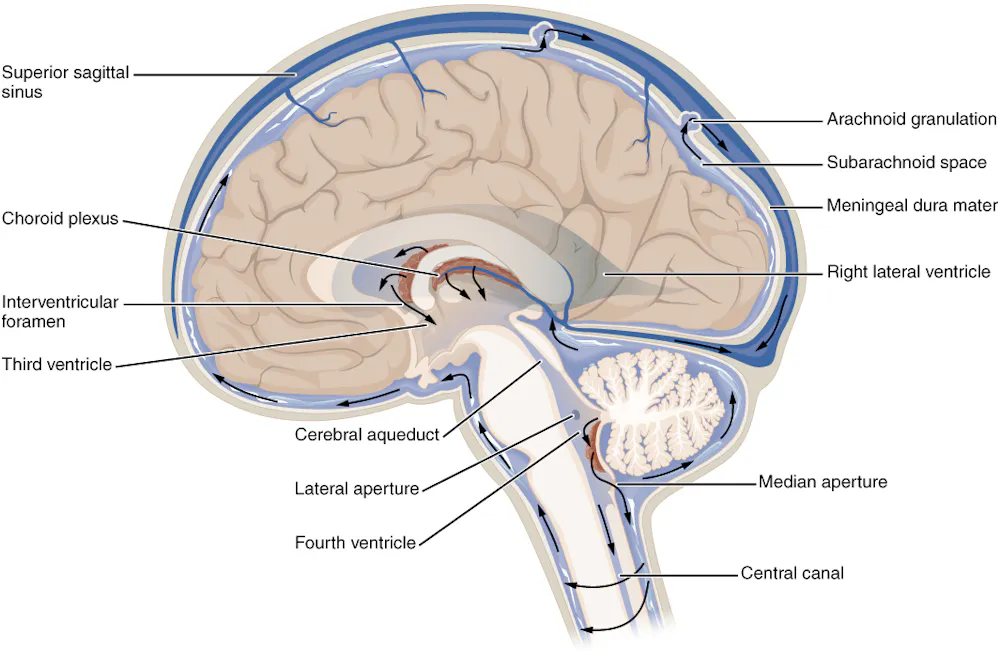
    CSF is made of water, proteins, sugars, ions and neurotransmitters. It is primarily produced by a network of cells called the choroid plexus, which is located in the brain’s ventricles, or cavities.

    The choroid plexus produces approximately 500 milliliters (17 ounces) of CSF daily, but only about 150 milliliters (5 ounces) are present within the central nervous system at any given time due to constant absorption and replenishment in the brain. This fluid circulates through the ventricles of the brain, the central canal of the spinal cord and the subarachnoid space surrounding the brain and spinal cord.

    Cerebrospinal fluid circulates throughout the brain and spinal cord.
    OpenStax, CC BY-SA

    CSF has several critical functions. It protects the brain and spinal cord from injury by absorbing shocks. Suspending the brain in this fluid reduces its effective weight and prevents it from being crushed under its own mass. Additionally, CSF helps maintain a stable chemical environment in the central nervous system, facilitating the removal of metabolic waste and the distribution of nutrients and hormones.

    If the production, circulation or absorption of cerebrospinal fluid is disrupted, it can lead to significant health issues. Two notable conditions are CSF leaks and idiopathic intracranial hypertension.

    Cerebrospinal fluid leak

    A CSF leak occurs when the fluid escapes through a tear or hole in the dura mater – the tough, outermost layer of the meninges that surrounds the brain and spinal cord.

    The dura can be damaged from head injuries or punctured during surgical procedures involving the sinuses, brain or spine, such as lumbar puncture, epidurals, spinal anesthesia or myelogram. Spontaneous CSF leaks can also occur without any identifiable cause.

    CSF leaks were originally thought to be relatively rare, with an estimated annual incidence of 5 per 100,000 people. However, with increased awareness and advances in imaging, health care providers are discovering more and more leaks. They tend to occur more frequently in middle-aged adults and are more common in women than men.

    Risk factors for the condition include connective tissue disorders such as Ehlers-Danlos syndrome as well as postural orthostatic tachycardia syndrome.

    An upright headache could be a sign of a CSF leak.

    Unfortunately, it’s common for health care providers to misdiagnose a CSF leak as another condition, like migraine, sinus infections or allergies. What can make diagnosing a CSF leak challenging is its broad symptoms. Most people with a CSF leak have a positional headache that improves when lying down and worsens when standing. Pain is usually felt in the back of the head and may involve the neck and between the shoulder blades. In addition to headaches, patients may experience ringing in the ears, vision disturbances, memory problems, brain fog, dizziness and nausea.

    Imaging may help guide diagnosis, including an MRI of your brain or entire spine, or a myelogram of the space surrounding your spinal cord. Features of a CSF leak that are visible in a scan include your brain sagging down in the base of your skull as well as a fluid collection outside of your dura. However, an estimated 19% of people with a CSF leak can have normal scans, so not seeing signs of a leak on imaging does not entirely rule it out.

    Conservative treatment for a CSF leak involves rest, lying flat and increasing your fluid intake to give your spine time to heal the puncture. Increasing your caffeine consumption to an equivalent of three to four cups of coffee per day can also help by increasing CSF production through stimulating the choroid plexus. Caffeine also relieves pain by interacting with adenosine receptors, which are key players in the body’s pain perception mechanisms.

    If a conservative approach is not successful, an epidural blood patch may be necessary. In this procedure, blood is drawn from your arm and injected into your spine. The injected blood can help form a covering over the hole and promote the healing process. Headache improvement can be fast, but if the patch does not work or the results are short-lived, additional testing may be needed to better locate the site of the leak. In rare cases, surgery may be recommended. Most patients with a CSF leak respond to some form of these treatments.

    Idiopathic intracranial hypertension

    Idiopathic intracranial hypertension is a disorder involving an excess of CSF that elevates pressure inside the skull and compresses the brain. The term “idiopathic” indicates that the cause of the raised pressure is unknown.

    Most patients with idiopathic intracranial hypertension have a history of obesity or recent weight gain. Other risk factors include taking certain medications such as tetracycline, excessive vitamin A, tretinoin, steroids and growth hormone. Middle-aged obese women are 20 times more likely to be diagnosed with idiopathic intracranial hypertension than other patient groups. As obesity becomes more prevalent, so too does the incidence of this condition.

    Idiopathic intracranial hypertension results from increased intracranial pressure.

    Patients with idiopathic intracranial hypertension typically experience headaches and vision changes, tinnitus or eye pain. Papilledema, or swelling of the optic disc, is the hallmark finding on a fundoscopic examination of the back of the eye. Clinicians may also observe paralysis of the patient’s eye muscles.

    Normal pressure hydrocephalus, Joel’s diagnosis, is a form of this condition that commonly results in difficulty walking, loss of bladder control and cognitive impairment, sometimes referred to as the “wet, wobbly and wacky” triad. Joel’s diagnosis has brought awareness to this underrecognized but potentially treatable disorder, which is often managed through surgically placing a shunt to divert excess fluid and relieve symptoms.

    Brain imaging of patients suspected of having idiopathic intracranial hypertension is crucial to excluding other causes of elevated CSF pressure, such as brain tumors or blood clots in the brain. A lumbar puncture or spinal tap to measure the pressure and composition of CSF is also central to diagnosis.

    Since high intracranial pressure can damage the optic nerve and lead to permanent vision loss, the primary goal of treatment is to decrease pressure and preserve the optic nerve. Treatment options include weight loss, dietary changes and medications to reduce CSF production. Surgical procedures can also reduce intracranial pressure.

    Future directions and unknowns

    Cerebrospinal fluid is indispensable for brain health. Despite advances in understanding diseases related to CSF, several aspects remain unclear.

    The exact mechanisms that lead to conditions like CSF leaks and idiopathic intracranial hypertension are not fully understood, though there are many theories. Further research is vital to enhance diagnostic accuracy and effective treatments for CSF disorders.

    This is an updated version of an article originally published on Aug. 14, 2024.

    Danielle Wilhour does not work for, consult, own shares in or receive funding from any company or organization that would benefit from this article, and has disclosed no relevant affiliations beyond their academic appointment.

    ref. Billy Joel has excess fluid in his brain – a neurologist explains what happens when this protective liquid gets out of balance – https://theconversation.com/billy-joel-has-excess-fluid-in-his-brain-a-neurologist-explains-what-happens-when-this-protective-liquid-gets-out-of-balance-257689

    MIL OSI – Global Reports

  • MIL-OSI Global: A common parasite can decapitate human sperm − with implications for male fertility

    Source: The Conversation – USA – By Bill Sullivan, Professor of Microbiology and Immunology, Indiana University

    _Toxoplasma_ can infiltrate the reproductive system. wildpixel/iStock via Getty Images Plus

    Male fertility rates have been plummeting over the past half-century. An analysis from 1992 noted a steady decrease in sperm counts and quality since the 1940s. A more recent study found that male infertility rates increased nearly 80% from 1990 to 2019. The reasons driving this trend remain a mystery, but frequently cited culprits include obesity, poor diet and environmental toxins.

    Infectious diseases such as gonorrhea or chlamydia are often overlooked factors that affect fertility in men. Accumulating evidence suggests that a common single-celled parasite called Toxoplasma gondii may also be a contributor: An April 2025 study showed for the first time that “human sperm lose their heads upon direct contact” with the parasite.

    I am a microbiologist, and my lab studies Toxoplasma. This new study bolsters emerging findings that underscore the importance of preventing this parasitic infection.

    The many ways you can get toxoplasmosis

    Infected cats defecate Toxoplasma eggs into the litter box, garden or other places in the environment where they can be picked up by humans or other animals. Water, shellfish and unwashed fruits and vegetables can also harbor infectious parasite eggs.

    In addition to eggs, tissue cysts present in the meat of warm-blooded animals can spread toxoplasmosis as well if they are not destroyed by cooking to proper temperature.

    While most hosts of the parasite can control the initial infection with few if any symptoms, Toxoplasma remains in the body for life as dormant cysts in brain, heart and muscle tissue. These cysts can reactivate and cause additional episodes of severe illness that damage critical organ systems.

    Between 30% and 50% of the world’s population is permanently infected with Toxoplasma due to the many ways the parasite can spread.

    Toxoplasma can target male reproductive organs

    Upon infection, Toxoplasma spreads to virtually every organ and skeletal muscle. Evidence that Toxoplasma can also target human male reproductive organs first surfaced during the height of the AIDS pandemic in the 1980s, when some patients presented with the parasitic infection in their testes.

    While immunocompromised patients are most at risk for testicular toxoplasmosis, it can also occur in otherwise healthy individuals. Imaging studies of infected mice confirm that Toxoplasma parasites quickly travel to the testes in addition to the brain and eyes within days of infection.

    Toxoplasma cysts floating in cat feces.
    DPDx Image Library/CDC

    In 2017, my colleagues and I found that Toxoplasma can also form cysts in mouse prostates. Researchers have also observed these parasites in the ejaculate of many animals, including human semen, raising the possibility of sexual transmission.

    Knowing that Toxoplasma can reside in male reproductive organs has prompted analyses of fertility in infected men. A small 2021 study in Prague of 163 men infected with Toxoplasma found that over 86% had semen anomalies.

    A 2002 study in China found that infertile couples are more likely to have a Toxoplasma infection than fertile couples, 34.83% versus 12.11%. A 2005 study in China also found that sterile men are more likely to test positive for Toxoplasma than fertile men.

    Not all studies, however, produce a link between toxoplasmosis and sperm quality.

    Toxoplasma can directly damage human sperm

    Toxoplasmosis in animals mirrors infection in humans, which allows researchers to address questions that are not easy to examine in people.

    Testicular function and sperm production are sharply diminished in Toxoplasma-infected mice, rats and rams. Infected mice have significantly lower sperm counts and a higher proportion of abnormally shaped sperm.

    In that April 2025 study, researchers from Germany, Uruguay and Chile observed that Toxoplasma can reach the testes and epididymis, the tube where sperm mature and are stored, two days after infection in mice. This finding prompted the team to test what happens when the parasite comes into direct contact with human sperm in a test tube.

    After only five minutes of exposure to the parasite, 22.4% of sperm cells were beheaded. The number of decapitated sperm increased the longer they interacted with the parasites. Sperm cells that maintained their head were often twisted and misshapen. Some sperm cells had holes in their head, suggesting the parasites were trying to invade them as it would any other type of cell in the organs it infiltrates.

    In addition to direct contact, Toxoplasma may also damage sperm because the infection promotes chronic inflammation. Inflammatory conditions in the male reproductive tract are harmful to sperm production and function.

    The researchers speculate that the harmful effects Toxoplasma may have on sperm could be contributing to large global declines in male fertility over the past decades.

    Sperm exposed to Toxoplasma. Arrows point to holes and other damage to the sperm; asterisks indicate where the parasite has burrowed. The two nonconfronted controls at the bottom show normal sperm.
    Rojas-Barón et al/The FEBS Journal, CC BY-SA

    Preventing toxoplasmosis

    The evidence that Toxoplasma can infiltrate male reproductive organs in animals is compelling, but whether this produces health issues in people remains unclear. Testicular toxoplasmosis shows that parasites can invade human testes, but symptomatic disease is very rare. Studies to date that show defects in the sperm of infected men are too small to draw firm conclusions at this time.

    Additionally, some reports suggest that rates of toxoplasmosis in high-income countries have not been increasing over the past few decades while male infertility was rising, so it’s likely to only be one part of the puzzle.

    Regardless of this parasite’s potential effect on fertility, it is wise to avoid Toxoplasma. An infection can cause miscarriage or birth defects if someone acquires it for the first time during pregnancy, and it can be life-threatening for immunocompromised people. Toxoplasma is also the leading cause of death from foodborne illness in the United States.

    Taking proper care of your cat, promptly cleaning the litter box and thoroughly washing your hands after can help reduce your exposure to Toxoplasma. You can also protect yourself from this parasite by washing fruits and vegetables, cooking meat to proper temperatures before consuming and avoiding raw shellfish, raw water and raw milk.

    Bill Sullivan receives funding from the National Institutes of Health.

    ref. A common parasite can decapitate human sperm − with implications for male fertility – https://theconversation.com/a-common-parasite-can-decapitate-human-sperm-with-implications-for-male-fertility-256892

    MIL OSI – Global Reports

  • MIL-OSI Global: What I’ve learned from teaching philosophy in prisons

    Source: The Conversation – UK – By Jim Chamberlain, Lecturer in Philosophy, University of Sheffield

    zapomicron/Shutterstock

    Of all the subjects that could be taught in prisons, philosophy might seem a strange choice. You might think that we should address the educational basics first, since, according to a House of Commons report, 57% of prisoners in England “have English and Maths levels at or below those expected of an eleven-year-old”. You might also expect prison education to focus on the skills needed for employment after release.

    In the UK, many people think that prisons should harshly punish offenders, and perhaps see philosophy courses as an unjustifiable luxury for those who have broken the law.

    However, we are in a period of potentially significant change for the UK prison system, which has been overcrowded and in poor condition for years.

    In my three years of running philosophy courses in prisons, I have witnessed what can be achieved with this kind of education. I have found that philosophy courses can make a big difference to the lives of prisoners and prison culture, often in unexpected ways.

    Working with colleagues at the charity Philosophy in Prison and the University of Sheffield, I have led philosophy courses in several English prisons, and found that philosophy is particularly well-suited to prison education. Unlike most topics, philosophy can be taught purely in conversation, without textbooks or technology.


    Want more politics coverage from academic experts? Every week, we bring you informed analysis of developments in government and fact check the claims being made.

    Sign up for our weekly politics newsletter, delivered every Friday.


    There are many good reasons for engaging in philosophical conversations with people in prison. Conversations allow almost anyone to get involved, regardless of their levels of literacy. Philosophical conversations can give male prisoners a rare opportunity to relax the rigid norms of masculinity that prisons implicitly enforce.

    But one of the biggest benefits I have seen is the effects of these conversations on people’s attitudes towards disagreement. Prisons are overcrowded and often dangerous places, where disagreement can all too easily lead to conflict. Fortunately, philosophy provides an excellent opportunity for constructive dialogue.

    Getting philosophical

    One of the most intriguing things about philosophy is that nobody knows the answers to the questions it asks of us. Think about questions like, “what makes you the same person you were ten years ago?”, “what is a good life?” or “what is knowledge?”

    Such questions get to the heart of what it is to be human, and they have puzzled people for centuries. They require everyone, from the most experienced philosopher to the complete newcomer, to question why we think as we do. They also sharpen our interest in what others have to say.

    Take the first of these questions, for example. Perhaps you think that your memories of your past make you the same person that you used to be. But we cannot remember being asleep, and we are presumably not different people when we sleep. So, you might suggest instead, we had the same bodies ten years ago. Except that every part of a human body changes over time – over ten years, every cell in our bodies might be replaced. Now, with just four sentences, the puzzle has been set, and a conversation begun.

    Many of the questions we discuss in prison courses originally come from the world of classical philosophy (such as the three mentioned above). And our conversations often explore the ideas of ancient and historical philosophers – whether Aristotle or Bentham has a better understanding of the good life, for example.

    In any philosophical conversation, we will quickly realise that disagreement need not involve confrontation: it can be progressive, exciting, even fun. Philosophy helps people develop and practice the conversational norms – and the confidence – needed for positive disagreement. In my experience, prisoners often enter philosophy courses with little expectation that they will have anything to contribute.

    Many prisoners “have limited or negative experiences of education and therefore a limited belief in the potential of learning”. But philosophy courses can radically improve people’s confidence, and so help them to rethink what education might mean for them.

    One of our course participants summarised this point as follows: “With philosophy, people care about what I think. Nobody listens when you’ve been in prison. Everything you think is wrong, rubbish, you’re nothing.” Another was even more direct: “Hated school, dropped out at 11, can’t read, can’t write. But I can do this.”

    Transforming prison culture

    Evidence shows that participation in education can significantly reduce the likelihood of reoffending. Yet, as the recent Independent Sentencing Review highlights, the rise in the UK prison population has led to finite resources being diverted away from such programmes.

    Philosophy courses can facilitate transformations in prison culture, at relatively little cost. An inspection report into one of the prisons that I have worked in for several years noted that prisoners who took the philosophy courses “reported that their mental health and wellbeing had improved and that they enjoyed the opportunity to participate”.

    Moreover, I have seen philosophy courses influence a whole prison wing, as people continued their conversations after we left. One participant said that “being in a room with inmates I didn’t know but ended up talking to went a long way to understanding each other… I now talk to more people on the wing”.

    No matter what prisoners may have done, they share in our common humanity. By engaging in philosophy with prisoners, we can address this with very positive results – potentially both in and after prison.

    Jim Chamberlain receives funding from The University of Sheffield and from BA/Leverhulme grants to fund philosophy courses in prisons. As well as working for the University of Sheffield, he is a Trustee of the charity Philosophy in Prison. Jim is also a member of the Green Party.

    ref. What I’ve learned from teaching philosophy in prisons – https://theconversation.com/what-ive-learned-from-teaching-philosophy-in-prisons-253796

    MIL OSI – Global Reports

  • MIL-OSI Global: ‘Killing is part of their life’: the men raised on violence who are both perpetrators and victims as South Sudan faces return to civil war

    Source: The Conversation – UK – By Heidi Riley, Adjunct Research Fellow, University College Dublin, and Affiliate Researcher in the Department of War Studies, King’s College London

    *Some pseudonyms are used to protect the identities of interviewees.

    “I saw a lot of suffering.” The old man, Lokwi, gestures towards the woman cooking beside their hut as he talks. “The husband of this woman … was killed here.”

    The woman is Lokwi’s sister-in-law. He is recalling the day in 1988 when his brother was killed by soldiers from the Sudan People’s Liberation Army (SPLA). Lokwi was still a child when the SPLA captured the town of Kapoeta and surrounding settlements, where he lived with his family. The day his brother was killed, everybody was forced to leave:

    There was nothing good that day … They burned all the villages and the soldiers attacked the civilians. People were scattered.

    South Sudan – a central African country of around 11.5 million people split in half by the White Nile – suffered decades of conflict prior to gaining independence from the rest of Sudan in 2011. While independence brought optimism, this was thwarted two years later by internal disputes among the ruling parties that led to a resurgence of the violence.

    While a ceasefire was brokered in 2018 and a power-sharing agreement signed between opposing political factions, there has been a lack of political will to implement it. The dire economic situation, worsening food insecurity driven by climate change and political instability, and legacies of ethnic rivalries continue to perpetuate ethnically motivated violence and distrust between communities. In April, the head of the UN mission in South Sudan, Nicholas Haysom, warned that the world’s youngest nation is once again on the brink of civil war.

    Amid this resurgence of violence, Lokwi – who is from the Toposa community – continues to be haunted by memories of the attack that killed his brother. Sitting under the shade of a tree in the village where it took place, he explains how he fled into the bush and survived for days on wild fruit until, starving, he managed to get to the town of Narus, where he was given some food by a local Dinka man.

    When Lokwi finally returned to his village, he found everything destroyed by fire – huts, livestock and granaries “all burned”. Whereas he decided to start again and rebuild the village, his surviving brother, now living in Narus, promised “never to step in this land again because of the memories and pain”.

    Today, Lokwi works as a peace activist in South Sudan. He spends a lot of time encouraging people in his village and the surrounding area to engage in peaceful dialogue with rival groups – and to resist violence. With an expression of concern, he explains the difficulties he faces in dissuading young men from engaging in violence:

    When I tell them to stop the conflict … we have homes and families who listen and stay calm, but other individuals like the [male] youths don’t listen, they still create problems.

    South Sudan’s long history of cattle raiding

    Over the course of 2024, Anna Adiyo Sebit and three other South Sudanese researchers interviewed more than 400 men and women from South Sudan’s Toposa and Nuer communities as part of the XCEPT programme. This programme, based at King’s College London, seeks to understand the role that conflict-related trauma plays in influencing who engages in violence and who doesn’t.

    As well as inter-ethnic fighting, South Sudan has a long history of cattle raiding. Cattle are central to the pastoralist communities which make up over half of the population, including ethnic groups such as the Dinka, Nuer and Toposa.

    In most rural households, financial capital is typically held in livestock, mainly cows – which are also required for dowry payments and as compensation for any crimes committed. This places high value on cattle ownership, meaning that raiding and inter-community disputes over cattle are common.

    Among South Sudan’s rural households, much of the financial capital is held in cows.
    Diego Delso via Wikimedia Commons, CC BY-NC-SA

    And whereas these disputes were once fought with sticks, stones and spears, years of political conflict have left the country awash with guns – so cattle raiding has become a lethal activity. As one old man who described himself as a “retired warrior” explained:

    In our grandparents’ and grand ancestors’ [time], in battles or fighting we used stones, pangas, sticks, spears and arrows. [At this time there were] rare fights or raids waged against [other] tribes … But after the introduction of AK-47 machine guns, it accelerated [to] higher numbers of raids and increased casualties in both communities.

    Among these pastoralist communities, gender norms determine that where women and girls are tasked with maintaining domestic life, including sustaining subsistence farming and constructing huts, men are expected to keep and secure cattle. Many young men are active in cattle camps, which are in areas with better pastures where cows are taken to graze – but can be vulnerable to raids from other ethnic groups.

    In many parts of rural South Sudan, young men are expected to fight to secure and protect their livelihood – including achieving the required “bride price” for their marriage to go ahead. Successful cattle raids can earn a young man respect among his peers.

    But the trauma of experiencing violence from a young age, as so many of these young men have, is likely to be a factor in the perpetuation of various forms of violence in adulthood, including the prevalence of revenge killings.

    The high rates of violence are also having a devastating impact on women and girls in South Sudan. According to a 2024 UN Population Fund study, 65% of women and girls have experienced some form of gender-based violence, of which intimate partner violence is the most prevalent. The UN Mission in South Sudan has also reported a steep increase in sexual violence and abductions of women and girls by armed groups in 2024.

    Aware of the prevalence of violence against women by cattle youth, Lokwi speaks of confronting the issue at community meetings in his village where he brings together members of rival communities:

    The youths are also part of the meeting. Everybody is given the chance from both communities to talk, and we tell them ‘stop killing women in the bush’. I tell them that women are the ones who give birth to generations, and [ask]: ‘Why do you kill women?’ [Some] will feel touched and listen and stop – but there are other individuals [for] whom killing is part of their life … They will still kill women.

    Masculine expectations

    In South Sudan, like many countries, masculine expectations that associate men with being the provider or protector, and with characteristics of strength, stoicism and bravery, play an important role in how men experience trauma and the coping mechanisms they use.

    Men are often socialised into suppressing emotions such as sadness or hurt. As a result, alternative outlets for dealing with trauma and stress can manifest in more violent or aggressive emotions.

    I have spent many years researching how societal expectations of masculinity play into the way men respond to traumatic experiences. In narratives of wartime suffering, our understanding of male trauma is often overshadowed by the association of masculinity with the perpetration of violence.

    While not all men suffering from trauma respond in the same way, research by the Brazilian NGO Promundo has found that men and boys are more likely than women and girls to exhibit maladaptive coping behaviour such as risk-taking, low physical activity, withdrawal and self-harm – or violence in its multiple forms. There is also evidence that rates of alcohol and substance abuse are higher among men affected by trauma or high levels of stress.

    Psychological studies suggest a link between masculine norms, emotional restriction, and PTSD symptoms. As such, men are less likely to seek help or open up to others about the difficulties they are experiencing. This in turn increases their risk of developing negative coping mechanisms.

    During conflict or in situations of acute food insecurity, daily stresses through an inability to fulfil masculine expectations can become particularly acute – and lead to increasingly violent behaviour. This pattern emerges in many of the interviews conducted for the XCEPT project.

    SPLA soldiers in 2016: the head of the UN mission in South Sudan has warned the country is back on the brink of civil war.
    Jason Patinkin (Voice Of America) via Wikimedia Commons

    Eric, from the South Sudan state of Eastern Equatoria, lost his father when he was ten. His father was a fairly wealthy man but after his death, that wealth was passed on to Eric’s uncles on his father’s side, rather than his mother or her three co-wives. (The tradition of inheritance passing to male relatives is reflective of women’s lack of economic independence in rural South Sudan.)

    Eric was then required to respect his uncles as stepfathers as they became the de facto authority over his mother, her co-wives and their children. As the oldest son, he endured years of beatings from his stepfathers, as well as witnessing violence by them against his mother.

    Upon reaching adulthood, Eric said he realised he was able to escape the “catastrophic mistreatment from his stepfathers” and needed to “adventure” for his own survival. However, due to food shortages, survival meant engaging in cattle raiding.

    On his first raid, his “warrior group” secured a herd of cattle by killing the cattle owner. Eric was granted four cows – but apart from one, these had to be handed over to his stepfathers. As he explained:

    On my arrival, people in my village were excited to see me back without any injuries and I brought these cows. On [the] spot, my stepfathers took them. As in [the] culture of Toposa, anything from your enemies belongs to elder people. I was only left with one cow.

    On his second raid, Eric secured 30 goats, of which his stepfathers allowed him to keep ten.

    Aware of the suffering that this raiding had caused and now with an established reputation as a “warrior”, Eric then stepped back from raiding and used the ten goats to breed more. This gave him the resources for marriage and to start a family – but he carried the legacy of his involvement in the killings during past raids, and the knowledge that he was now a target for retaliatory violence. He explained:

    So far, I have killed six enemies; hence am also included as a warrior in my community. I do not want them [the enemy] to know my name because they will kill me if they know me.

    For Eric and many other men like him in South Sudan, it is difficult to show emotions such as sadness or fear, as this could be interpreted as a sign of weakness. Our researcher and interviewer, Anna Adiyo Sebit, describes the expectations placed on men in her culture: “As a man, even when someone dies, you do not shed a tear, especially in front of women. Instead, you cry from your heart inside.”

    The trauma of war

    Ten years ago, while conducting fieldwork in Nepal for my PhD and book, I interviewed more than 60 former members of the People’s Liberation Army (PLA) to examine how their participation in the civil war – known as the People’s War – affected notions of masculinity within the armed group.

    While I never asked about trauma or psychological difficulties, it became clear these were present for many of the men – just never explicitly spoken about. Instead, they would talk about their sense of disillusionment or lack of ability to fulfil societal expectations of masculinity – all the while, carefully keeping their emotions in check.

    These emotions would only surface in more casual conversations over tea or food, following the formal interviews. In these moments, the men revealed a more vulnerable side – often expressing sadness, frustration, and a desire to share their more personal stories.

    It was a clear shift from the displays of hardened masculinity in their narratives of the battlefield. Some of these informal exchanges hinted at signs of PTSD – for example, in their descriptions of flashbacks, sleep difficulties and short temperedness. One young man who was extremely polite and courteous became very fidgety after the end of the interview. He told me: “In the night I can’t sleep, because I hear bomb blasts inside my head.”

    Another, clearly proud of his role in the People’s War, recounted his bravery on the battlefield. Yet, when he spoke of the six months of torture he had endured in police custody, his composure faltered and he struggled to hold back tears. He showed me a photo of his three-year-old child, saying: “This is why I will never return to battle.”

    What I encountered was men who appeared uneasy about expressing emotions as this runs contrary to masculine expectations, but were also frustrated at a lack of outlets to tell their story.

    During one interview with a former PLA member in the western district of Bardiya, I noticed a group of ex-PLA fighters gathered at the boundary of his home after they had heard an interview was taking place. As my interpreter and I were leaving, a thin man at the front of the crowd began shouting aggressively at us.

    Having initially assumed his anger was directed at my presence in the area, I realised it stemmed from his frustration at not being selected for an interview. “Why does everyone always want to interview you?” he shouted at the man I had just spoken to. The former fighter’s anger, fuelled by alcohol, appeared to reflect his frustration at lacking a platform to share his own story.

    From Nepal in 2016 to South Sudan in 2024, amid the violence and trauma of war and the daily expectations of masculinity associated with being a provider and protector, there appeared to be few outlets through which these men could talk freely about their emotions, tell their stories, and admit their mental health difficulties.

    Many of the men interviewed in South Sudan had been involved in violent clashes involving killings at some point in their lives. In interviews carried out in Kapoeta North, a county in eastern Equatoria, some men reported having constant flashbacks to the sounds of gunshots – when they tried to sleep at night, these sounds would “become real”, stopping them getting any proper rest:

    Sometimes you can wake up in the middle of the night and find yourself trembling as if these people are coming for you.

    One man explained how he would get up in the night to follow a “black shadow” like a ghost. When community members would run after him to stop him, he would become “hostile and behave like he wants to kill everyone” – because, he explained, he saw his friend being killed on the battlefield and the memory of this would not leave him, especially in the night.

    A woman described how, when young men are involved in “killing”, their “mind is not functioning well”. Contextualising this claim she explained: “There was this man who got traumatised due to the ongoing conflict of raiding. He fought many battles until the gunshot sound affected his brain and made him crazy.”

    She then described a man who could not accept his friend had died in a cattle camp raid and insisted on returning to the battlefield, even though the community told him not to. “After confirming [his friend’s death] he ran mad and became confused. We say that such a person had his heart broken by the incident he witnessed, and we say he is mad.”

    Men whose companions have been killed can become fixated on revenge, as Sebit explains, “It will torture their mind until they go and avenge the death of the person that was killed.” Some will encourage them to take revenge but others, like Lokwi, are trying to discourage revenge killings and working towards peaceful resolution of disputes through dialogue.

    Societal expectations of masculinity

    The link between societal expectations of masculinity, trauma and violent behaviour among men is important in better understanding ongoing insecurities in rural South Sudan. A man is supposed to own cows in order to gain respect from their community. Without these, they can be rejected – leading to feelings of isolation, despair and a fear of ridicule.

    As noted by another elderly interviewee: “If a man does not go for raiding, he will be cursed by elders. [In contrast], if he comes back with cows, people will celebrate – and if he dies, people will say he died as a warrior.”

    It can be a vicious circle. If you do not get cows when you raid another community, this may lead to further feelings of shame – driving the young men to put themselves at further risk. In a state of stress and having grown up in a culture of conflict, they may regard themselves as having no choice but to risk death in the quest for cows. Those who have been orphaned or do not have other family members to support them can be particularly vulnerable to this.

    A young boy brandishes an immitation pistol made of mud in South Sudan’s capital, Juba.
    Richard Juilliart/Shutterstock

    Such concerns about masculinity emerge in many of the interviews with young men in South Sudan – and also in discussions with support workers there. Catholic Relief Services (CRS) is one of the few organisations in South Sudan who have run trauma awareness training for men. A local CRS programme manager, Luol, explained to me in an online meeting how men’s worries about marriage rights can spiral into acts of violence:

    What is actually happening in [young men’s] brains is they are thinking: ‘Okay, I am 18 or 17 years old now, in the next two years I have to have my partner at home, but I don’t have resources. [So] the best way to get resources is to raid or steal people’s properties.’ This is the thinking of war. This is the thinking of a person who has been exposed to conflict – that the best way to get resources is to raid from somebody.

    In another meeting, Luol described his experience of facilitating trauma awareness programmes with men. He explained that “many of the men have participated in cattle raiding and have seen horrific kinds of events such as, seeing somebody [being] killed, and [they] can be traumatised because [they] participated in that war [raid].”

    Luol described one young man who came and spoke to him after the first day of training:

    He wanted to testify that he’s now recovering from his trauma because he participated in the war and he saw children and women being killed and when he returned home, he saw [in] his own children, the children who were killed, and he cried, he felt ashamed for participating and playing a part in this. And he was trying to recover from that effect of trauma. And that’s very common. Most of the young men who participate in war come back traumatised.

    The importance of such outlets for men to come and talk together about their emotions was emphasised in our meeting. For cultural reasons, neither individual counselling sessions nor sessions including women would be acceptable to the men.As noted by another local CRS staff member :

    If women are in that group, the men are likely not to talk about [trauma] because of masculinity issues. They don’t want the women to hear men accepting weakness or vulnerability … But if the men are talking alone [about] their life they will say: ‘Yes, this is what happened to me, and this is how we can move forward.’

    While these sessions are not supposed to be a form of restorative justice or “amnesty” for crimes committed, Luol explained that opening up about feelings of guilt in the small group is helpful in addressing “displaced anger” that can manifest in continued violence in the community, clan or in the family.

    CRS Trauma Awareness and Social Cohesion programmes also encourage discussions of alternatives to violence or cattle raiding, presenting a longer-term life vision for those present. According to one attendee, his less traumatised brain allows for rational thinking such as: “If I start cultivating this year and I want to marry in two or three years’ time, I’ll be able to produce the crops, sell them in the market, and then buy cows if I need to buy cows.”

    The programme was piloted in South Sudan’s Greater Jonglei State in 2014 using CRS private funding. Three years later it secured funding from USAID after “demonstrating its value”. In 2020, with additional funding from the EU, the programme was expanded to areas of Eastern Equatoria. While the programme has now ended with the completion of its funding cycle, CRS continues to seek future funding to re-establish the initiative.

    Soldiers celebrate the anniversary of South Sudan’s independence day, which briefly brought peace.
    Richard Juilliart/Shutterstock

    ‘Everything gets destroyed’

    While recognising that most men do not engage in violence, the reality is men are overwhelmingly responsible for violence when it does occur. This is the case in South Sudan as in all countries. It is therefore vital to engage with men, not just as perpetrators of violence but as potential peacemakers.

    Unfortunately, gender stereotyping within the humanitarian and donor sector has resulted in a lack of trauma response targeted at men. Instead, men and boys tend to be framed as perpetual perpetrators of violence and discrimination – as “emasculated troublemakers” not worth engaging with, or at best by the “men can cope by themselves” narrative.

    Wider research by XCEPT has found that out of 12 humanitarian organisations interviewed in northern Syria, northern Iraq and South Sudan, only two had programmes specifically targeted at men. The situation appears little changed from the conclusion reached in the 2021 Promondo report, which stated:

    This de-prioritisation of boys and men in emergency response is rooted in donors’ and international organisations’ lack of political will to meaningfully acknowledge that vulnerability exists beyond women and girls … Chronic inattention to boys and men has resulted in programs, services and spaces not being sufficiently tailored to meet their needs.

    This not only has an impact on men and boys’ wellbeing. It also fails to take on board the reality that unaddressed trauma among men correlates with increases in community violence, revenge killings, cattle raiding and gender-based violence suffered by women and girls. As an international CRS staff member explained:

    Unless donors have a way of facing [the reality of trauma] and addressing it in all interventions, all the money we’re spending on health programs and infrastructure programs and education programs and whatever it is, it’s just money down the drain. Because eventually, everything gets destroyed in violence.


    For you: more from our Insights series:

    To hear about new Insights articles, join the hundreds of thousands of people who value The Conversation’s evidence-based news. Subscribe to our newsletter.

    Heidi Riley receives funding from the Cross-Border Conflict Evidence, Policy and Trends (XCEPT) research programme, funded by UK International Development from the UK government. (Views expressed in this article do not necessarily reflect the UK government’s official policies.) She also received funding from the Irish Research Council for the Nepal research mentioned. Sincere thanks to Anna Adiyo Sebit, expert researcher with Catholic Relief Services in South Sudan, for her fieldwork and other contributions to this article.

    ref. ‘Killing is part of their life’: the men raised on violence who are both perpetrators and victims as South Sudan faces return to civil war – https://theconversation.com/killing-is-part-of-their-life-the-men-raised-on-violence-who-are-both-perpetrators-and-victims-as-south-sudan-faces-return-to-civil-war-256177

    MIL OSI – Global Reports

  • MIL-OSI Europe: Written question – European Oceans Pact and the emissions trading system covering buildings, road transport and additional sectors (ETS2). – E-002014/2025

    Source: European Parliament

    Question for written answer  E-002014/2025
    to the Commission
    Rule 144
    Oihane Agirregoitia Martínez (Renew), Nicolás González Casares (S&D)

    The European Ocean Pact – expected to be adopted by the European Commission on 4 June 2025– will seek to bring coherence to all EU policies related to oceans. In addition to fostering the blue economy, it will prioritise maintaining healthy and resilient oceans and coastal regions.

    The scope of the emissions trading system was extended to cover maritime transport in January 2024, with a gradual implementation timeline until 2027. Given the process of decarbonising the fleet and taking into account the sector’s efforts in this transition and the very small proportion of emissions generated by its activity, we would like to ask:

    • 1.Does the Commission plan to include the implementation of ETS2 in the European Ocean Pact to cover other maritime activities, such as fisheries?
    • 2.If so, what are the estimated costs for the European fleet of extending this system and what measures does the Commission intend to take to support the sector with regard to the impact of this cost?

    Submitted: 20.5.2025

    Last updated: 28 May 2025

    MIL OSI Europe News

  • MIL-OSI USA: Regular Screening for Depression May Benefit High Schoolers

    Source: US State of Connecticut

    Symptoms of depression, suicidal thoughts, and suicide attempts have steadily increased among high school students in the U.S. over the past decade and a half, a University of Connecticut researcher reports. The concerning increase should change how and who we screen for depression or suicidal behaviors.

    Adolescents are the age group most likely to commit suicide in the U.S. Although the absolute risk is low, every incident is a tragedy. Identifying youth with suicidal thoughts and offering them support and interventions is the best method we have for preventing suicidal behaviors. Unfortunately, the number of high schoolers reporting feeling sad or hopeless enough to have trouble participating in normal activities has steadily increased from 2007 through 2021, UConn School of Medicine psychiatric epidemiologist T. Greg Rhee reports in two papers, one just published on May 28 in American Journal of Psychiatry and the other this past February in The Lancet.

    Among teens with symptoms of depression, the number reporting suicidal thoughts increased by about 1.3% every other year, from 41.2% in 2007 to 51.7% in 2021.

    Not only are more teens experiencing episodes of depression more frequently, but even teens who engage in few or no risky behaviors are reporting more depressive symptoms. The study used data from the Youth Risk Behavior Survey (YRBS), a study conducted by the Centers for Disease Control (CDC) that surveys U.S. high school students. They looked at YRBS data spanning 2007 to 2021, including responses from 119,654 students. The study classifies risky behaviors as including exposure to bullying or violence, substance use, sexual activity, unhealthy behaviors related to weight, and a lack of physical activity.

    The results from the researchers’ analysis were particularly disturbing because they indicated almost any teen could be affected.

    “Even if you don’t engage in any risky behaviors, you can still have suicidal ideation,” Rhee says.

    The Lancent study focused on trends in depressive symptoms among high school students with and without risky behaviors. The American Journal of Psychiatry study focused on trends in suicidal thoughts and suicide attempts among high school students. Taken together, the two studies suggest that even teens with no risk factors could benefit from regular screening for depressive symptoms or suicidal behaviors.

    MIL OSI USA News

  • MIL-OSI Russia: Interview with Alexey Overchuk for Rossiyskaya Gazeta

    Translation. Region: Russian Federal

    Source: Government of the Russian Federation – An important disclaimer is at the bottom of this article.

    Alexey Overchuk: Developing the economy together with Eurasian partners is more profitable than doing it alone

    S. Bolotov: What were the countries striving for when they agreed to establish the union and did they manage to get what they wanted?

    A. Overchuk: The Eurasian Union is an economic integration association of five states of Northern Eurasia. If we proceed from the theory of integration, then the development of economies and the improvement of people’s living standards depend on freedom of trade and accessibility to large foreign markets. Russia is a large market, due to which it is an economic center of attraction for neighboring economies. For the countries of the region, Russia is the geographically closest country, whose trade accessibility is determined by its decision to develop common markets for goods, services, capital and labor with them. At the same time, Russia receives benefits not only from economic integration, but also other advantages. By promoting the well-being of our neighbors, we create conditions for our own creative development, and this is no longer just an economic category.

    The processes taking place in the post-Soviet space have deeper roots than the framework of interaction defined by the EAEU law. In some ways, this promotes the development of integration, and in others, it slows it down. Therefore, the joint advancement of the countries of the Eurasian five is a constant testing of a possible path of coordinated development based on mutual respect for interests and consensus decision-making. States never have completely coinciding interests, so the results of integration do not always coincide with their expectations, but all participants share an understanding of the fundamental reasons for integration and receive benefits from it.

    Imagine if we didn’t have the EAEU today? It would mean that we are fenced off from our closest neighbors by customs barriers and technical regulations. Manufacturers from Russia and partner countries would incur much higher costs for moving goods across borders, and they would need to specifically adapt their products to the requirements of individual country markets. As a result, they would have worse competitive conditions in the markets of neighboring countries and less income.

    The GDP growth in the EAEU member states in recent years speaks for itself – plus 4.4% for the EAEU as a whole in 2024. This is significantly higher than the global average rate, estimated at 3.3%.

    Our countries are jointly strengthening transport and logistics connectivity both within the EAEU and with our closest neighbors. The plan to connect the EAEU with China’s “One Belt, One Road” initiative is being implemented, and we are jointly developing the “North-South” international transport corridor, as well as other transcontinental land routes that allow us to better realize our competitive advantages in Greater Eurasia.

    Last year, we took a very important step towards stimulating the development of industrial cooperation ties and creating conditions for the inclusion of small economies of the union in this process.

    GDP growth in the EAEU member states speaks for itself – 4.4% in 2024 against the world average of 3.3%

    The EAEU has moved to practical support for industry by subsidizing the interest rate on loans for projects involving representatives of three or more EAEU member states. Business is beginning to master this tool, which allows for lower lending costs. The first projects have already been approved.

    The issue of extending similar support measures to agriculture is currently being considered at the Eurasian Economic Commission. I do not rule out that in the future we will put forward a proposal to stimulate the strengthening of cooperative ties in the construction of transport and logistics facilities.

    S. Bolotov: Economists say that a market of at least 300 million people is needed for serious investments in modern production to pay off. The USA, the European Union, China or India have such a population and market, but the EAEU countries have about 185 million people. Where can we find more consumers?

    A. Overchuk: Our union is a large common market, where all five member states are interested in the growth of their economies. To do this, it is necessary not only to create better conditions for doing business in the common domestic market, but also to promote goods from the EAEU for export. Access to foreign markets is necessary to gain advantages from the economy of size, increase sales and income growth, and to do this, it is necessary to negotiate better conditions with foreign partners. When it comes to concluding free trade agreements, our five countries together have a stronger negotiating position.

    The EAEU already has such agreements with Vietnam and Serbia, and another one has been in force since May 15, 2025, with Iran. This is in addition to our 185 million people, plus approximately another 190 million. We are now close to signing agreements with two countries, and negotiations are still underway, which will also improve the accessibility of foreign markets for EAEU producers. Of course, there is no direct calculation here, each agreement is unique and in each case covers certain product positions, but in general, this expands the opportunities for investment recoupment.

    At the same time, it is not only free access to the market and its capacity that are important. Interest in purchasing the final imported product also depends on the participation of a particular country in the international supply chain, the availability of investments and corresponding jobs on its territory. Then you get a competitive product that will be produced, bought and consumed. This is precisely why we are developing industrial cooperation and transport connectivity both within the EAEU and the CIS, and with the countries of Greater Eurasia.

    S. Bolotov: How big can a free trade area become?

    A. Overchuk: Perhaps we should not speak in terms of creating a large free trade zone. The signing of each agreement is the result of an agreed balance of benefits and losses that may arise if it comes into force. There are economies with which our five, for various reasons, will probably not come to such decisions very soon.

    At the same time, we see that Eurasia has enormous creative potential, where the countries of the north and south strive for development and do a lot for this. There are such international associations as the SCO and ASEAN, BRICS, building relations on mutual respect of the participating parties. For our part, we consider the EAEU as the center of economic crystallization of Northern Eurasia, which has achieved a high level of social and economic development, and has also generally solved the problems of food and energy security. This makes our five an attractive partner for the countries of the Global South, which still cannot overcome the consequences of colonial dependence on the countries of Western Europe.

    Eurasia has enormous creative potential, where the countries of the north and south strive for development and do a lot for this

    Many of these countries are drawn to Russia. We see this both from the number of world leaders who visited our country on May 9 and from the participation and discussions within the framework of the Russia-Africa forums. These are dozens of states with a population of billions of people, and each of them has its own characteristics and interests. The world is diverse, and approaches to building mutually beneficial and respectful relations can be much more variable than the creation of free trade zones.

    In 2015, President Vladimir Vladimirovich Putin put forward the initiative of the Greater Eurasian Partnership. Its implementation involves the creation of an open integration circuit on the Eurasian continent through the consolidation of the efforts of all states and regional associations based on the EAEU, SCO and ASEAN. This is about linking national and regional projects, creating conditions for socio-economic progress and equalizing the levels of development of individual countries based on strengthening transport and logistics connectivity, technological re-equipment and strengthening cultural and humanitarian ties. This is a major civilizational project that is just beginning to take shape, and work on it is more comprehensive than negotiations on the creation of free trade zones with individual countries.

    S. Bolotov: And the EAEU itself does not plan to expand?

    A. Overchuk: The attractiveness of international integration associations is determined by their benefits for the participating states and how they position themselves. The EAEU is a young integration association, it is only ten years old. It is still in the formation stage. Many issues still need to be resolved, and much still needs to be agreed upon.

    The business community and people in the five EAEU countries are beginning to realize the advantages of union integration. They see that intra-union trade has fewer barriers and is more convenient than trade with third countries, which is proven by its faster growth rates. This is especially noticeable in the example of Armenia and Kyrgyzstan, which joined somewhat later and in a short time, thanks to the accessibility of a large market, have significantly raised their economies and living standards. The economy of Kazakhstan is actively developing, where a large number of significant industrial, energy, and transport and logistics investment projects are being implemented and where agriculture is reaching a new level. Belarus, with which Russia has deep integration relations within the Union State, is successfully developing high-added-value production. In the context of the formation of a multipolar world, the growth of tariff barriers, the decline in the effectiveness of the WTO system, the breakdown of international supply chains and the growth of economic threats, all countries of the world will strive to find regional partners with whom they can establish sustainable integration ties. As global challenges mount, our neighbors will want greater predictability for their economies and will see the EAEU as a kind of “safe haven” where they are treated with respect and their interests are taken into account.

    It is also necessary to understand that our integration association is developing on the basis of a balance of interests of the five member states. It has already managed to turn into a very complex system, has formed its own law, has acquired requirements and is actively promoting international trade and economic relations. The accession of new states to the union will already be a more complex process than, for example, several years ago. If someone decides to go this way, then they will have to do a lot to comply with our standards and rules.

    At the same time, when coordinating the possibility of joining a particular country, member states will decide what level of integration and with whom best meets their interests. We also understand that this is a mutual process. For our part, by granting interested countries the status of an observer state, we allow them to get a better idea of the internal structure of the EAEU and make a more informed choice. Today, Iran, Uzbekistan and Cuba are observers of the EAEU.

    Along with this, due to deep historical, cultural, humanitarian and economic ties, there is a high degree of integration with the CIS member states, which allows them to a large extent to receive similar integration advantages from proximity to Russia. The EAEU member states form the backbone of the CIS, which predetermines the trajectory of convergence of the EAEU and CIS law. Such work is underway.

    The EAEU is open not only to the countries of the post-Soviet space. In addition, the EAEU member states are already adopting multilateral agreements that are accessible for accession by states that are not part of our integration association. So there are many ways for mutually beneficial integration.

    S. Bolotov: Prices for gas, other fuel and raw materials, as well as food from Russia for partners in the EAEU are significantly lower than on the international market. Will it not turn out that our country will give them more than it receives in return?

    A. Overchuk: These are our allies and closest neighbors. Our well-being largely depends on their proximity to Russia. We are interested in our countries developing together, their standard of living rising, their economy growing, and us all prospering together. If the EAEU consists of successful countries connected by numerous threads, then we will ensure our peaceful development. Accessibility of resources and a common market are the basis for the common well-being of us and our neighbors.

    Such mutual dependence imposes a special responsibility on Russia as the largest economy in our integration. It is necessary to calculate the consequences of decisions taken for countries that have transferred part of their sovereignty to the level of the EAEU. Therefore, we have introduced a rule to check all regulatory legal acts being prepared for compliance with the law of the union.

    S. Bolotov: No one objects to the free movement of goods, but when it comes to labor migration, doubts arise. Will this not harm Russia’s national interests?

    A. Overchuk: This is indeed a very complex topic, and there are different points of view. The demographic situation, demand for labor and its cost are such that in order to develop the economy and curb inflation, it is necessary to attract labor migrants. Of course, part of this problem can be solved by introducing advanced technologies and increasing labor productivity, but this is a longer-term solution that requires investments, which are especially expensive today.

    On the other hand, all over the world, and Russia is no exception, the influx of labor migrants creates problems caused not only by the peculiarities of the labor market, but also by cultural differences, ignorance of laws and the language barrier, which leads to the formation of isolated national diasporas, an increase in crime and conflict situations. We are all watching how the replacement of the indigenous population in Europe is taking place, and many do not feel positive about it. The question is how to make the problems of labor migration less painful for society.

    The EAEU law helps to relieve some of the tension associated with the movement of labor between countries. It allows citizens of Armenia, Belarus, Kazakhstan, Kyrgyzstan, and Russia working outside their countries to enjoy the same rights as citizens of the country where they live and work. They are subject to the same personal income taxes. The absence of differences in the treatment of citizens of the EAEU member states creates better conditions for the integration of these people into our society, affects their quality of life, makes them confident in their rights, less dependent on diasporas, and largely cuts the ground from under the feet of crime associated with labor migration. This largely explains why we would like to expand the EAEU at the expense of countries that send us the largest number of labor migrants.

    Of course, there are differences due to traditions and culture. Knowledge of the language of the host country is also very important. Historically, in the former USSR, Russian is the language of interethnic communication, which, in addition to familiarization with the great Russian literature, culture, science and education, allows people from different countries to communicate with each other, live side by side, develop together, conduct business, work, negotiate and avoid conflicts.

    Unfortunately, perhaps, in all post-Soviet countries the establishment of independence was associated with distancing from Russia and a reduction in the use of the Russian language. Attempts to displace the Russian language from the spheres of education, culture and public administration are still ongoing. To a large extent, this is facilitated by countries unfriendly to us, striving to reduce Russia’s influence in the region by dividing our peoples and perfectly understanding the importance of the Russian language as a link between the entire space of Northern Eurasia.

    At the same time, knowledge of foreign languages opens access to new knowledge, cultures and better employment conditions. In our region, the truth is that the successful development of post-Soviet countries is directly dependent on their proximity to Russia, access to the Russian education system, culture and ability to communicate with each other in Russian.

    Today, having received some negative experience, our neighbors are coming to understand the importance of the Russian language and the Russian education system for their further development. There is a growing awareness that the distance from Russia has had a negative impact on the quality of education. Hence, neighbors are seeing an increased demand for children to study in schools with instruction in Russian, especially if the classes are taught by teachers who have come from Russia.

    That is why we receive requests to send Russian teachers, conduct internships in Russia for Russian language teachers, build Russian schools that operate according to Russian educational standards, organize branches of Russian universities, increase quotas for admission of young people to Russian universities, hold days of Russian culture, support Russian theater in their countries, and much more. And this is what our departments are actively engaged in today.

    The Russian language is the common heritage of all countries of Northern Eurasia, and the International Organization for the Russian Language was established by the CIS member states to disseminate and protect it.

    We must not fall for the bait of those who, acting on the principle of “divide and rule”, seek to distance post-Soviet states and people from Russia, who just over thirty years ago had the same passports as us and who continue to gravitate towards Russia. Many can still say that we were born in the same country, we are united by a common history, values and belonging to a single civilization, they want their children and grandchildren to think the same way – this is what we strive to preserve. So why follow the lead of those who seek to destroy it? Therefore, we patiently carry out creative work to preserve and spread the Russian language, our education and culture in the countries of the former USSR.

    It is these efforts that will provide the level of knowledge necessary for the conflict-free integration of labor migrants into our society. And this is most important, since the success of economic integration and the common future of our countries depend on the relations between people.

    Historically, in the former USSR, Russian is the language of interethnic communication

    S. Bolotov: What is better for Russia, to be the most European country in Asia or the most Asian country in Europe?

    A. Overchuk: Our history spans many centuries, during which the peoples inhabiting Northern Eurasia, including the Slavs, absorbed much from both Asia and Europe. At the same time, unlike the Western civilization that places itself above others and the colonial empires built by the Europeans, the peoples of our countries developed at the expense of their own resources and mutual trade, generously shared among themselves, as was the case under the USSR, even the latter, and carefully treated the traditions and culture of all the peoples inhabiting the vast space from the Carpathians to the Pacific Ocean. This is precisely why a unique civilizational community of peoples was formed in Northern Eurasia, which for many centuries has retained the ability to self-recovery, maintain human relationships and develop together.

    The Mongol Empire, which had united this vast space, broke up into separate uluses, leaving behind elements of state administration and a financial system that still exist today, memories of the Great Silk Road, and a tolerant attitude towards diverse cultures and religions. Parts of this eastern empire were gathered by the Moscow Principality into the Russian Empire, which took much from the West and passed the baton to the Soviet Union, under which the peoples who inhabited it, having made a leap in their social and economic development, formed the basis that allowed them to transform into new independent states.

    Modern Northern Eurasia, of which Russia is a part, consists of independent states that are united by a common great history, values, trade and economic ties and belonging to a unique Eurasian civilization that cannot be called either Asian or European. And the task of Eurasian integration is to preserve this heritage and create conditions for a common prosperous future for the numerous peoples inhabiting this vast space.

    Source – “Rossiyskaya Gazeta”

    Please note: This information is raw content directly from the source of the information. It is exactly what the source states and does not reflect the position of MIL-OSI or its clients.

    MIL OSI Russia News

  • MIL-OSI United Kingdom: Scottish Shellfish Farm Production Survey 2024

    Source: Scottish Government

    An Official Statistics publication

    The Scottish Shellfish Farm Production Survey 2024 was published today. This Official Statistics publication details statistics on the employment, production and value of shellfish from Scottish shellfish farms. It is structured to follow trends within the common mussel, Pacific oyster, native oyster and king scallop species sectors. Some statistics are given for the 10-year period 2015-2024. 

    Some key figures from this publication are:

    • Table production tonnage of common mussel increased by 13% from 10,311 tonnes in 2023 to 11,690 tonnes in 2024. This is the highest level of common mussel production ever recorded in Scotland.
    • During 2024, 2.4 million Pacific oyster shells were produced for the table market, a decrease of 38% from the 2023 total.
    • Employment decreased by 2% from 2023, with 241 full-time, part-time and casual staff being employed in 2024.
    • Overall estimated first sale value for all shellfish species was calculated to be approximately £14 million in 2024, a decrease of 1% on the 2023 value.

    Background

    Scottish Shellfish Farm Survey 2024 – gov.scot (www.gov.scot)

    1. The survey is compiled from data collected directly from authorised shellfish farming businesses.
    1. Official statistics are produced by professionally independent staff – more information on the standards of official statistics in Scotland can be accessed at: Producing Official Statistics – gov.scot (www.gov.scot)

    MIL OSI United Kingdom

  • MIL-OSI United Kingdom: Grisly gadget is sure to get museum visitors talking

    Source: City of Leeds

    A gruesome contraption used centuries ago as a brutal punishment for gossiping has gone on display in Leeds.

    The draconian device, known as a scold’s bridle, is among a selection of objects newly on show at Leeds City Museum capturing some of the fascinating, lesser-known chapters in the story of Leeds.

    Used in English towns and cities as early as 1574, scold’s bridles were employed to discourage individuals, usually women, who were judged to have spoken rebelliously, inappropriately or out of turn.

    Also known as a brank, or witch’s bridle, the grisly object, believed to date from the 17th Century, has gone on show in the museum’s Leeds Story gallery as a sad reminder of a less enlightened age, having been originally collected by Morley historian Norrison Scatcherd.

    When in use, the infamous implement’s solid iron frame would encase its unfortunate victim’s head, with a roughened iron plate located near the mouth.

    The plate would then be placed in the mouth so the victim could not move their tongue without discomfort and the wearer would then be led through the streets on a chain held by one of the town’s officials.

    In some towns, wearers would even be chained to a pillory, whipping post or market cross.

    Kitty Ross, Leeds Museums and Galleries’ curator of social history, said: “It’s difficult to imagine a device as brutal and cruel as the scold’s bridle being used in towns and cities around the country, and it’s very clearly a relic from a time when the concepts of both human rights and equality were very different to what they are today.

    “Displaying these types of objects is an important, tangible reminder of how far society has come as well as an opportunity to reflect on the challenges faced by people who lived during an age when such an inhumane contraption was seen as an acceptable form of punishment.

    “Adding objects to the Leeds Story gallery is always rewarding too, because it gives visitors a chance to find out more about famous people, places and events alongside aspects of the city’s hidden history which they may never have heard before.”

    The scold’s bridle is one of a number of exhibits recently added to the Leeds Story gallery, which tells the story of the city through the centuries.

    A silver cup made by ill-fated Leeds goldsmith turned counterfeiter Arthur Mangey has also been put on display in the gallery, alongside a set of his coin clipping shears which were already on show.

    Once an esteemed craftsman, commissioned to make a stunning silver gilt mace by Leeds City Council in 1694, Mangey was accused of forgery and, after being found guilty at trial, was hanged in York in 1696.

    Other exhibits newly on display include a Pudsey peace jug, purchased with support from The Friends of Leeds City Museums and made by local potter John Sugden in 1801 to mark Napoleon Bonaparte’s signing of the Concordat of 1801 with Pope Pius VII.

    Also on display is the impressive bell which once hung in the city’s Coloured Cloth Hall in 1758. Once the largest building in Georgian Leeds, the building was used as offices and housed the Council Chamber of the Trustees.

    In 1889 the Leeds Corporation paid £66,000 for the hall so they could clear it and make way for what is today City Square and the General Post Office building.

    Councillor Salma Arif, Leeds City Council’s executive member for adult social care, active lifestyles and culture, said: “The story of Leeds is completely unique and includes so many surprising and intriguing chapters which have each in their own way played their part in creating the city we know today.

    “It’s remarkable that we have so many objects on display to help tell that story and ensure visitors can learn more about the different aspects of our local heritage.”

    For more information about visiting Leeds City Museum, including opening hours, please visit: Leeds City Museum | Leeds Museums and Galleries | Days out and exhibitions

    ENDS

    MIL OSI United Kingdom

  • MIL-OSI Russia: On mos.ru you can now watch giant otters from the Moscow Zoo

    Translation. Region: Russian Federal

    Source: Moscow Government – Government of Moscow –

    On May 28, World Otter Day, the mos.ru portal published broadcasts with giant otters. These fearless, active and friendly animals are exhibited at the Moscow Zoo for the first time in 161 years. Anyone can observe the two young males, Fidel and Vasco, as well as the female Sevil, every day during the institution’s opening hours.

    “The giant otter exhibit opened in the new area at the end of April, it is located next to the pedestrian bridge. The enclosure is decorated to resemble the tropical forest of the Amazon basin, where this species lives. The animals often swim close to the glass, look at visitors with interest and willingly show themselves,” shared Svetlana Akulova, General Director of the Moscow Zoo.

    A new enclosure has been built for the giant otters, which meets the animals’ needs. It has a spacious pool with fresh water, where live fish are released. In addition, the enclosure has heated areas of land and a large log on which Fidel, Vasco and Sevil exercise. Several areas, separated by sides, are filled with soil: sand, earth and tree bark. The giant otters like to dig there.

    To observe the animals, specialists installed three cameras, the video stream from which is broadcast on mos.ru. Until the end of May, the broadcast can be seen from 09:00 to 21:00, from June 1 from 07:30 to 22:00.

    “The inhabitants of the Moscow Zoo have long won the hearts of not only the capital’s residents, but also millions of Russians. Now everyone has a unique opportunity to watch the amazing giant otters. These animals have their own page on zoo.mos.ru: in addition to the video broadcast, interesting facts about them and photos are also available there. This format allows you not only to see the animals, but also to learn about their character traits and habits in conditions as close to natural as possible,” said Boris Frolov, Deputy Head of the Moscow Department of Information Technology.

    Giant (or Brazilian) otters live in fresh water bodies of South America. They feed mainly on fish, but can also catch crustaceans, snakes and small birds. Adults grow up to one and a half to two meters in length, weighing from 25 to 30 kilograms.

    The giant otter is the largest freshwater mustelid, capable of confronting such a predator as the caiman. These animals are always noisy and active, because they have nothing to fear even in the Amazon forest. Few would dare to attack such a group of agile and friendly predators armed with sharp teeth. They usually get their food in the water. Otters have an intensive metabolism, they need to eat food daily in an amount of up to 10 percent of their own weight.

    The body structure of these animals helps them dive to get food. Otters have webbed feet, a torpedo-shaped body, thick fur, and a strong paddle-shaped tail. When diving deep, the ears and nose close.

    Brazilian otters live in family groups consisting of two parents and immature offspring. The head of the family is the female. The family usually lives on the shore of a reservoir, arranging burrows with a system of simple tunnels.

    Broadcasts from the Moscow Zoo enclosures appeared on zoo.mos.ru in the fall of 2024. The list of animals that can be admired is gradually expanding. In addition to giant otters, everyone can watch online the Pallas’s cat, East Siberian lynx, tiger, lions, giant pandas, red panda, Himalayan bears, raccoons, honey badgers, meerkats, capybaras, llamas, vicunas and guanacos, as well as elephants, pygmy hippopotamuses, orangutans and gorillas.

    Get the latest news quicklyofficial telegram channel the city of Moscow.

    Please note: This information is raw content directly from the source of the information. It is exactly what the source states and does not reflect the position of MIL-OSI or its clients.

    Please Note; This Information is Raw Content Directly from the Information Source. It is access to What the Source Is Stating and Does Not Reflect

    https: //vv.mos.ru/nevs/ite/154425073/

    MIL OSI Russia News

  • MIL-OSI Asia-Pac: President Lai meets delegation led by US House Natural Resources Committee Chair Bruce Westerman

    Source: Republic of China Taiwan

    Details
    2025-05-27
    President Lai meets and hosts luncheon for delegation led by Governor Lourdes A. Leon Guerrero of Guam
    On the morning of May 27, President Lai Ching-te met with a delegation led by Governor Lourdes A. Leon Guerrero of Guam and her husband, and hosted a luncheon for the delegation at noon. In remarks, President Lai noted that this is the governor’s first trip to Taiwan, fully demonstrating the Guam government’s support and high regard for Taiwan. The president said that Guam, being the closest United States territory to Taiwan, is an important bridge for collaboration between Taiwan and the US. He stated that aside from promoting tourism, we can also explore even more opportunities for collaboration in other areas to further advance industrial development for both sides. He said that, as we begin a new chapter, we look forward to working together to generate even more momentum in bilateral cooperation and exchanges. A translation of President Lai’s remarks follows: On behalf of the people of Taiwan, I extend a warm welcome to Governor Leon Guerrero and her delegation. Last year, I transited through Guam en route for visits to Taiwan’s diplomatic allies in the Pacific. The enthusiastic reception I received from the government, legislature, people, and members of our overseas community in Guam was very touching and left me with a deep impression. During the morning tea reception hosted by Governor Leon Guerrero, we joined in singing our respective national anthems, as well as the Fanohge CHamoru. I also received at the Guam Legislature a copy of a Taiwan-friendly resolution it passed on behalf of the people of Taiwan. And I still remember to this day the striking scenery of the governor’s house and the warm reception I received there. It is therefore a great pleasure to meet with all of you today here at the Presidential Office. This is Governor Leon Guerrero’s first trip to Taiwan. Your visit fully demonstrates the Guam government’s support and high regard for Taiwan. As we begin a new chapter, we look forward to working with you to generate even more momentum in bilateral cooperation and exchanges. Taiwan and Guam are like family. We share the Austronesian spirit and culture. Our wide-ranging and mutually-beneficial collaboration is very fruitful. And now, we are facing the challenges of climate change, public health and medicine, and regional security together. The world is rapidly changing and tensions in the Indo-Pacific continue to rise. But if we combine our strengths, come together as one, and enhance cooperation, we can maintain regional peace, stability, and prosperity. Last Tuesday, I delivered an address on my first anniversary of taking office. I mentioned that for many years, Taiwan, the US, and our democratic partners have actively engaged in exchange and cooperation. Taking a market-oriented approach, we will promote an economic path of staying firmly rooted in Taiwan and expanding the global presence of our enterprises while strengthening ties with the US. Guam is the closest US territory to Taiwan. It is an important bridge for collaboration between Taiwan and the US. Last month, we were pleased to see United Airlines officially launch direct flights between Taipei and Guam. I believe this will benefit tourism and economic and trade exchanges for both sides. In the area of health care, many hospitals in Taiwan already offer referral services to patients from Guam. Both Governor Leon Guerrero and I have backgrounds in medicine. It is my hope that Taiwan and Guam can continue to work hand in hand to create even more positive outcomes from cooperation in public health and medical services. During the governor’s visit, aside from promoting tourism, we can also explore even more opportunities for collaboration in other areas. There is potential for more exchanges in aquaculture, food processing, hydroculture, manufacturing, pharmaceuticals, and recycling. This will further advance industrial development in Taiwan and Guam. In closing, I thank Governor Leon Guerrero and all our distinguished guests for backing Taiwan. I wish you all a smooth and successful visit.  Governor Leon Guerrero then delivered remarks, saying that she is very happy to come to Taiwan. She said that after learning during President Lai’s visit to Guam last year that he is a medical doctor, she felt more relaxed because healthcare colleagues are one in their endeavor to help enhance the health and well-being of people. She then expressed her heartfelt appreciation for the invitation to Taiwan.  Governor Leon Guerrero said that as they learn more about opportunities for collaboration with Taiwan, they are humbled by the hospitality they have experienced. In both of our islands, she said, hospitality is more than just a custom – it forms a part of our identities. She noted that despite being nearly 2,000 miles apart, we are connected by the Pacific Ocean and common roots, and our ancestors both value family, community, and tradition. That is why being here today, she said, she feels a strong sense of familiarity, like reconnecting with old friends. The governor remarked that Taiwan has evolved so quickly in all areas of essential life, sustenance, economy, and prosperity, adding that Taiwan’s resources in such areas as health, education, data, AI, advanced technology, aquaculture, agriculture, and commerce enhance our economic stability. She stated her belief that in collaboration and support, and working with each other, we can gain prosperity, maintain freedom and democracy, and live in peace.  Governor Leon Guerrero stated that their delegation is here to see how they can partner with Taiwan to help raise the quality of life for both our peoples, mentioning that one special concern of theirs is tourism. Tourism, she said, is the most influential engine and driver for the economy and quality of life in Guam, but they cannot have a vibrant economy and tourism without air connectivity. She added that they are prepared to help in any way to provide incentives and low-cost fees so that they can get more airlines from Taiwan to establish permanent flight schedules to Guam, so as to drive development in Guam’s tourism industry. Governor Leon Guerrero then proceeded to introduce each of the members of her delegation before remarking that while they have been very busy on this visit they are always reminded of the freedom and democracy that the people must protect. She said she looks forward to a great, strong relationship between Taiwan and Guam in cooperation on social and economic issues, in culture, marketing, tourism, and freedom and democracy. Among those in attendance were First Gentleman Jeffrey A. Cook, Chief of Staff Jon Junior Calvo, Director of the Department of Administration Edward Birn, General Manager of the Guam Visitors Bureau Regine Biscoe Lee, Deputy Executive Manager of the Guam International Airport Authority Artemio “Ricky” Hernandez, Board of Directors Chairman of the Guam International Airport Authority Brian J. Bamba, Deputy General Manager of the Guam Economic Development Authority Carlos Bordallo, Director of Landscape Management Systems Guam Bob Salas, Chairperson of the Guam Chamber of Commerce Tae Oh, President of the University of Guam Anita Borja Enriquez, and Director of the Guam Taiwan Office Felix Yen (嚴樹芬). After the meeting, President Lai, accompanied by Vice President Bi-khim Hsiao, hosted a luncheon for Governor Leon Guerrero, her husband, and the delegation.

    Details
    2025-05-27
    President Lai meets delegation from European Parliament
    On the morning of May 27, President Lai Ching-te met with a delegation from the European Parliament. In remarks, President Lai thanked the European Parliament for continuing to pay close attention to peace and stability across the Taiwan Strait and voice support for Taiwan. The president expressed hope for an even closer relationship and diversified cooperation between Taiwan and the European Union. The president said that Taiwan and the EU can work together in such areas as semiconductors, AI, and green energy to create more resilient supply chains for global democracies and contribute to global prosperity and development. A translation of President Lai’s remarks follows: I warmly welcome our guests to the Presidential Office. After being elected last year, MEPs Reinis Pozņaks and Beatrice Timgren are making their first visits to Taiwan, demonstrating support for Taiwan through concrete action. On behalf of the people of Taiwan, I extend my sincerest welcome and appreciation. I would also like to take this opportunity to thank the European Parliament for continuing to pay close attention to peace and stability across the Taiwan Strait. Just last month, the European Parliament adopted resolutions with regard to annual reports on the implementation of the European Union’s Common Foreign and Security Policy and Common Security and Defence Policy. These resolutions reaffirmed the EU’s steadfast commitment to maintaining the status quo across the Taiwan Strait. The European Parliament also condemned China for continuing to take provocative military actions against Taiwan and emphasized that Taiwan is a key democratic partner in the Indo-Pacific region. It called on the EU and its member states to continue working closely with Taiwan to strengthen economic, trade, and investment ties. Once again, I thank the European Parliament for voicing support for Taiwan. Just as MEPs Pozņaks and Timgren are visiting Taiwan to strengthen Taiwan-EU exchanges, our Minister of Economic Affairs Kuo Jyh-huei (郭智輝) also led a delegation to Europe last year, marking the first in-person dialogue between high-ranking economic and trade officials of Taiwan and the EU. Moving ahead, we look forward to bringing Taiwan-EU ties even closer and to diversifying our cooperation. The EU is Taiwan’s largest source of foreign investment. Both sides are highly complementary in such areas as semiconductors, AI, and green energy. Through our joint efforts, we can create more resilient supply chains for global democracies and further contribute to global prosperity and development. Looking ahead, I hope that MEPs Pozņaks and Timgren will continue to make the case in the European Parliament for the signing of a Taiwan-EU economic partnership agreement. This would not only yield mutually beneficial development, but also consolidate economic security and boost international competitiveness for both sides. In closing, I am sure that you will gain a deeper understanding of Taiwan through this visit. Please feel welcome to come back as often as possible as we continue to elevate Taiwan-EU ties.  MEP Pozņaks then delivered remarks, saying that it is a great honor to be here and thanking everybody involved in arranging this trip that allows them the opportunity to better know Taiwan. He added that it is definitely not the last time they will be here, as Taiwan is a very beautiful country. MEP Pozņaks mentioned that he comes from Latvia, and despite their being on the other side of the world, they know how the Taiwanese people feel, because they also have a big neighbor who is claiming that Latvia belongs to them. Unfortunately, he said, there is already war in Europe, but he is confident that their situation is similar to Taiwan’s, adding that they have a neighbor who uses disinformation attacks. MEP Pozņaks said that we live in very challenging times, and that our choices will define the future of the world, asking whether it will be a world where the rule of law prevails or where physical power and aggression succeeds. Coming from a small country, he said he clearly understands that for them there is no other possibility; they must protect the world where the rule of law prevails. That is why now, he emphasized, it is very crucial for all democracies around the world to stick together to protect our freedoms, values, and democracy. MEP Timgren then delivered remarks, thanking President Lai for meeting with them and saying it is a big honor. Noting that they arrived here two days ago and that while she really loves Taiwan, its food, and the good weather, she stated that the reason they are here is because of the values that we share, our good relationships, and solidarity with other democratic countries in the world, which is important for them in Europe and in Sweden. MEP Timgren, referring to MEP Pozņaks’s earlier remarks, said that they face a big threat from Russia that is discernible even in the European Parliament. Actually, she pointed out, there is a war inside Europe that shows us how important it is that we support one another. She said that the Russian people thought it would be easy to take over Ukraine, but it was not, because all European countries stepped up and provided weapons and support. And that is why, MEP Timgren said, it is important that democratic countries maintain good relationships and let China and Russia see that we have good relationships, because a part of defense is solidarity. In closing, she expressed her gratitude for having the honor to be here in this beautiful country.

    Details
    2025-05-20
    President Lai hosts state banquet for President Surangel Whipps Jr. of Republic of Palau
    On the evening of May 20, President Lai Ching-te, accompanied by Vice President Bi-khim Hsiao, hosted a state banquet at the Presidential Office in honor of President Surangel Whipps Jr. of the Republic of Palau and his wife. In remarks, President Lai said that he looks forward to working closely with President Whipps to promote tourism exchanges and sports cooperation so that Taiwan and Palau shine brightly together on the international stage. A translation of President Lai’s remarks follows: It is a pleasure to host this banquet tonight at the Presidential Office for President Whipps, First Lady Valerie Whipps, and the esteemed members of their delegation. Welcome to Taiwan. During my trips to Palau in 2022 and last year, President and First Lady Whipps received me with great hospitality. Wearing my island shirt, I enjoyed a very friendly reception from the people of Palau. It felt warm and friendly, just like being welcomed back home. The first time I visited Palau, President Whipps and I piloted a boat to the Milky Way lagoon. We both tried volcanic mud facial masks. We also fished together and enjoyed the breeze as we walked on the beach. Last year, on my second visit to Palau, I was honored to be invited to address the National Congress. I also observed the results of the close bilateral cooperation between our two nations. Due to its world-famous ocean scenery, Palau is sometimes referred to as “God’s aquarium.” And it is even possible to snorkel with sharks. It leaves a deep impression. Nothing compares to seeing Palau firsthand. During the COVID-19 pandemic, Taiwan and Palau launched a travel bubble that created a safe means of travel. Now, with the pandemic behind us, I hope that even more Taiwanese can tour Palau and gain a greater understanding of our diplomatic ally. In addition to tourism exchanges, I mentioned on my visit to Palau last year that I hoped Taiwan and Palau could promote sports cooperation by providing training away from home. Next month, Palau will be holding the Pacific Mini Games. And right now, Palau’s national baseball and table tennis teams are holding training sessions here in Taiwan. We will do our utmost to support Palau’s national players and we hope they stand out and achieve outstanding results in the events. I look forward to working closely with President Whipps so that Taiwan and Palau shine brightly together on the international stage. Thank you! Mesulang! President Whipps then delivered remarks, saying that it is truly an honor to be here once again one year after President Lai’s inauguration. Mentioning that this is his first state visit after being reelected to a second term, he said that it is important to be here among friends, and that we are more than friends, we are family. He thanked President Lai for the generous words and, most importantly, Taiwan’s enduring support. He remarked that our relationship continues to get stronger in each passing year. President Whipps said that President Lai’s diplomacy initiative, leadership, and vision deeply resonate with them. Diplomacy must be rooted in our shared values, he said, and an unwavering support for our allies and a commitment to a sustainable, inclusive development are all deeply appreciated by their people. President Whipps emphasized that, as we look into the future and the challenges that we face, from security to climate change, it is so important that we are united. He added that it is important for the world, and especially important for them in Palau, that they stand up for Taiwan, so that Taiwan can participate on international fora that address climate change, security, and health, because they know the world is better when Taiwan has a seat at the table. Mentioning that Palau will host the Pacific Islands Forum next year, President Whipps said that Palau remains committed to working closely with Taiwan to ensure a successful event, and that they will continue to speak up for Taiwan’s indispensable contributions as we stand together against any efforts to silence or isolate democratic partners. President Whipps said that our nations have navigated challenges and emerged stronger, bound by a partnership that is built on trust, respect, and hope for a better world. Whether it is in clean energy, education, smart medicine, or tourism, our shared journey is just beginning, he said, and we are stronger together.  Also in attendance at the banquet were Palauan Minister of State Gustav Aitaro, Minister of Public Infrastructure and Industries Charles Obichang, Minister of Human Resources, Culture, Tourism and Development Ngiraibelas Tmetuchl, Senate Floor Leader Kerai Mariur, House of Delegates Floor Leader Warren Umetaro, High Chief of Ngiwal State Elliot Udui, Governor of Peleliu State Emais Roberts, and Governor of Koror State Eyos Rudimch.

    Details
    2025-05-20
    President Lai and President Surangel S. Whipps, Jr. of Palau hold bilateral talks and witness signing of cooperation agreements  
    On the afternoon of May 20, following a welcome ceremony with military honors for President Surangel S. Whipps, Jr. of the Republic of Palau and his wife, President Lai Ching-te, accompanied by Vice President Bi-khim Hsiao, held bilateral talks with President Whipps at the Presidential Office. The two leaders also jointly witnessed the signing of a technical cooperation agreement and an agreement on diplomatic staff training cooperation. In remarks, President Lai thanked Palau for standing firm in its backing of Taiwan’s international participation as geopolitical tensions continue to increase in the Pacific region. He added that he looks forward to the cooperative ties between Taiwan and Palau continuing to expand into even broader areas, allowing our economies and societies to further progress as we jointly advance peace, stability, and prosperity in the Indo-Pacific region. A translation of President Lai’s remarks follows: I welcome our guests to Taiwan once again. Last year on May 20, President Whipps led a delegation to attend the inauguration ceremony for myself and Vice President Hsiao. I am delighted, on the anniversary of my first year in office, to meet with old friends of Taiwan again, as President Whipps returns for this visit. Taiwan-Palau relations have grown even closer in recent years thanks to the strong support of President Whipps. In 2022, during my term as vice president, I led a delegation to Palau as a demonstration of how our nations were together boosting tourism development as we jointly faced the challenges of the COVID-19 pandemic. Every time I visit Palau, and every time I meet with President Whipps, I feel very deeply that Taiwan and Palau are like family. We are both maritime nations and share a common Austronesian heritage and culture. We are also staunch partners in upholding such values as freedom, democracy, and respect for human rights. Last December, when I went on my first overseas trip since taking office, one of the nations I visited was Palau. We celebrated the 30th anniversary of Palau’s independence and 25 years of diplomatic relations, underscoring our friendly ties. Taiwan and Palau enjoy close exchanges and cooperation in a range of areas, including climate change, education, agriculture and fisheries, healthcare, humanitarian assistance, sports, and culture. After this meeting, President Whipps and I will witness the signing of a technical cooperation agreement and an agreement on diplomatic staff training cooperation, demonstrating once again our diverse collaboration and strong friendship. I believe that by working together, Taiwan and Palau can contribute to each other’s development and overcome the regional and global challenges we currently face. In particular, as geopolitical tensions continue to increase in the Pacific region, Palau has wisely and courageously upheld democratic values and stood firm in its backing of Taiwan’s international participation. Palau has never stopped voicing support for Taiwan, including at the United Nations General Assembly, the World Health Organization, the UN Framework Convention on Climate Change Conference of the Parties, and the UN Ocean Conference. We have been deeply moved by this support. I thank President Whipps again for his high regard and support for Taiwan. I look forward to the cooperative ties between our nations continuing to expand into even broader areas. This will allow our economies and societies to further progress as we jointly advance peace, stability, and prosperity in the Indo-Pacific region. President Whipps then delivered remarks, saying that it is a great honor for him to be here, standing in this historic place – a symbol of strength, resilience, and the democratic spirit of the Taiwanese people. On behalf of the government of Palau, President Whipps extended heartfelt gratitude to President Lai and the people of Taiwan for the warm welcome and gracious hospitality toward him and his delegation. President Whipps then extended sincere thanks for President Lai’s visit to Palau in December – his second visit to Palau – and for having Minister of Foreign Affairs Lin Chia-lung (林佳龍) attend his inauguration as a special envoy. He added that this also marks his third visit to Taiwan since President Lai took office, saying that this demonstrates the strength of our growing relationship. President Whipps indicated that the increased engagements and numerous entrepreneurs that President Lai has brought from Taiwan to Palau have resulted in fruitful visits, and that President Lai’s leadership represents hope, unity, and continued advancement of democracy and freedom, not only for Taiwan, but for the broader Indo-Pacific region. President Whipps went on to say that this visit to Taiwan reaffirms our deep friendship and shared values between our two nations. He emphasized that Palau and Taiwan are bound not by proximity, but by purpose, in that both are island nations and believe in human dignity, the rule of law, and the right of our people to determine their own futures. President Whipps stated that although we are celebrating 26 years of diplomatic relations, Taiwan has been a steadfast partner of Palau for decades, and that one of the MOUs they are signing further extends the relationship that began in December of 1984. From healthcare and medical missions, to education, agriculture, renewable energy, infrastructure, the private sector, tourism development, and climate resilience, he said, our cooperation has improved lives and strengthened our communities. The president also indicated that during the COVID-19 pandemic, Taiwan stood with Palau, noting that both sides began the tourism bubble, and that President Lai came to Palau to reopen the two weekly direct flights that have now been increased to four. That solidarity will never be forgotten, he said. As the world faces growing uncertainty and complex challenges from climate change to global tensions, President Whipps said, this friendship becomes even more vital. The president concluded his remarks by expressing hope that both nations continue to stand together, work together, and advocate together for peace, prosperity, and for the right of small nations to be seen, heard, and respected. After the bilateral talks, President Lai and President Whipps witnessed the signing of the technical cooperation agreement and the agreement on diplomatic staff training cooperation by Minister Lin and Palauan Minister of State Gustav Aitaro. The delegation also included Palauan Minister of Public Infrastructure and Industries Charles Obichang, Minister of Human Resources, Culture, Tourism and Development Ngiraibelas Tmetuchl, Senate Floor Leader Kerai Mariur, House of Delegates Floor Leader Warren Umetaro, High Chief of Ngiwal State Elliot Udui, Governor of Peleliu State Emais Roberts, and Governor of Koror State Eyos Rudimch.  

    Details
    2025-05-20
    President Lai interviewed by Nippon Television and Yomiuri TV
    In a recent interview on Nippon Television’s news zero program, President Lai Ching-te responded to questions from host Mr. Sakurai Sho and Yomiuri TV Shanghai Bureau Chief Watanabe Masayo on topics including reflections on his first year in office, cross-strait relations, China’s military threats, Taiwan-United States relations, and Taiwan-Japan relations. The interview was broadcast on the evening of May 19. During the interview, President Lai stated that China intends to change the world’s rules-based international order, and that if Taiwan were invaded, global supply chains would be disrupted. Therefore, he said, Taiwan will strengthen its national defense, prevent war by preparing for war, and achieve the goal of peace. The president also noted that Taiwan’s purpose for developing drones is based on national security and industrial needs, and that Taiwan hopes to collaborate with Japan. He then reiterated that China’s threats are an international problem, and expressed hope to work together with the US, Japan, and others in the global democratic community to prevent China from starting a war. Following is the text of the questions and the president’s responses: Q: How do you feel as you are about to round out your first year in office? President Lai: When I was young, I was determined to practice medicine and save lives. When I left medicine to go into politics, I was determined to transform Taiwan. And when I was sworn in as president on May 20 last year, I was determined to strengthen the nation. Time flies, and it has already been a year. Although the process has been very challenging, I am deeply honored to be a part of it. I am also profoundly grateful to our citizens for allowing me the opportunity to give back to our country. The future will certainly be full of more challenges, but I will do everything I can to unite the people and continue strengthening the nation. That is how I am feeling now. Q: We are now coming up on the 80th anniversary of the end of World War II, and over this period, we have often heard that conflict between Taiwan and the mainland is imminent. Do you personally believe that a cross-strait conflict could happen? President Lai: The international community is very much aware that China intends to replace the US and change the world’s rules-based international order, and annexing Taiwan is just the first step. So, as China’s military power grows stronger, some members of the international community are naturally on edge about whether a cross-strait conflict will break out. The international community must certainly do everything in its power to avoid a conflict in the Taiwan Strait; there is too great a cost. Besides causing direct disasters to both Taiwan and China, the impact on the global economy would be even greater, with estimated losses of US$10 trillion from war alone – that is roughly 10 percent of the global GDP. Additionally, 20 percent of global shipping passes through the Taiwan Strait and surrounding waters, so if a conflict breaks out in the strait, other countries including Japan and Korea would suffer a grave impact. For Japan and Korea, a quarter of external transit passes through the Taiwan Strait and surrounding waters, and a third of the various energy resources and minerals shipped back from other countries pass through said areas. If Taiwan were invaded, global supply chains would be disrupted, and therefore conflict in the Taiwan Strait must be avoided. Such a conflict is indeed avoidable. I am very thankful to Prime Minister of Japan Ishiba Shigeru and former Prime Ministers Abe Shinzo, Suga Yoshihide, and Kishida Fumio, as well as US President Donald Trump and former President Joe Biden, and the other G7 leaders, for continuing to emphasize at international venues that peace and stability across the Taiwan Strait are essential components for global security and prosperity. When everyone in the global democratic community works together, stacking up enough strength to make China’s objectives unattainable or to make the cost of invading Taiwan too high for it to bear, a conflict in the strait can naturally be avoided. Q: As you said, President Lai, maintaining peace and stability across the Taiwan Strait is also very important for other countries. How can war be avoided? What sort of countermeasures is Taiwan prepared to take to prevent war? President Lai: As Mr. Sakurai mentioned earlier, we are coming up on the 80th anniversary of the end of WWII. There are many lessons we can take from that war. First is that peace is priceless, and war has no winners. From the tragedies of WWII, there are lessons that humanity should learn. We must pursue peace, and not start wars blindly, as that would be a major disaster for humanity. In other words, we must be determined to safeguard peace. The second lesson is that we cannot be complacent toward authoritarian powers. If you give them an inch, they will take a mile. They will keep growing, and eventually, not only will peace be unattainable, but war will be inevitable. The third lesson is why WWII ended: It ended because different groups joined together in solidarity. Taiwan, Japan, and the Indo-Pacific region are all directly subjected to China’s threats, so we hope to be able to join together in cooperation. This is why we proposed the Four Pillars of Peace action plan. First, we will strengthen our national defense. Second, we will strengthen economic resilience. Third is standing shoulder to shoulder with the democratic community to demonstrate the strength of deterrence. Fourth is that as long as China treats Taiwan with parity and dignity, Taiwan is willing to conduct exchanges and cooperate with China, and seek peace and mutual prosperity. These four pillars can help us avoid war and achieve peace. That is to say, Taiwan hopes to achieve peace through strength, prevent war by preparing for war, keeping war from happening and pursuing the goal of peace. Q: Regarding drones, everyone knows that recently, Taiwan has been actively researching, developing, and introducing drones. Why do you need to actively research, develop, and introduce new drones at this time? President Lai: This is for two purposes. The first is to meet national security needs. The second is to meet industrial development needs. Because Taiwan, Japan, and the Philippines are all part of the first island chain, and we are all democratic nations, we cannot be like an authoritarian country like China, which has an unlimited national defense budget. In this kind of situation, island nations such as Taiwan, Japan, and the Philippines should leverage their own technologies to develop national defense methods that are asymmetric and utilize unmanned vehicles. In particular, from the Russo-Ukrainian War, we see that Ukraine has successfully utilized unmanned vehicles to protect itself and prevent Russia from unlimited invasion. In other words, the Russo-Ukrainian War has already proven the importance of drones. Therefore, the first purpose of developing drones is based on national security needs. Second, the world has already entered the era of smart technology. Whether generative, agentic, or physical, AI will continue to develop. In the future, cars and ships will also evolve into unmanned vehicles and unmanned boats, and there will be unmanned factories. Drones will even be able to assist with postal deliveries, or services like Uber, Uber Eats, and foodpanda, or agricultural irrigation and pesticide spraying. Therefore, in the future era of comprehensive smart technology, developing unmanned vehicles is a necessity. Taiwan, based on industrial needs, is actively planning the development of drones and unmanned vehicles. I would like to take this opportunity to express Taiwan’s hope to collaborate with Japan in the unmanned vehicle industry. Just as we do in the semiconductor industry, where Japan has raw materials, equipment, and technology, and Taiwan has wafer manufacturing, our two countries can cooperate. Japan is a technological power, and Taiwan also has significant technological strengths. If Taiwan and Japan work together, we will not only be able to safeguard peace and stability in the Taiwan Strait and security in the Indo-Pacific region, but it will also be very helpful for the industrial development of both countries. Q: The drones you just described probably include examples from the Russo-Ukrainian War. Taiwan and China are separated by the Taiwan Strait. Do our drones need to have cross-sea flight capabilities? President Lai: Taiwan does not intend to counterattack the mainland, and does not intend to invade any country. Taiwan’s drones are meant to protect our own nation and territory. Q: Former President Biden previously stated that US forces would assist Taiwan’s defense in the event of an attack. President Trump, however, has yet to clearly state that the US would help defend Taiwan. Do you think that in such an event, the US would help defend Taiwan? Or is Taiwan now trying to persuade the US? President Lai: Former President Biden and President Trump have answered questions from reporters. Although their responses were different, strong cooperation with Taiwan under the Biden administration has continued under the Trump administration; there has been no change. During President Trump’s first term, cooperation with Taiwan was broader and deeper compared to former President Barack Obama’s terms. After former President Biden took office, cooperation with Taiwan increased compared to President Trump’s first term. Now, during President Trump’s second term, cooperation with Taiwan is even greater than under former President Biden. Taiwan-US cooperation continues to grow stronger, and has not changed just because President Trump and former President Biden gave different responses to reporters. Furthermore, the Trump administration publicly stated that in the future, the US will shift its strategic focus from Europe to the Indo-Pacific. The US secretary of defense even publicly stated that the primary mission of the US is to prevent China from invading Taiwan, maintain stability in the Indo-Pacific, and thus maintain world peace. There is a saying in Taiwan that goes, “Help comes most to those who help themselves.” Before asking friends and allies for assistance in facing threats from China, Taiwan must first be determined and prepared to defend itself. This is Taiwan’s principle, and we are working in this direction, making all the necessary preparations to safeguard the nation. Q: I would like to ask you a question about Taiwan-Japan relations. After the Great East Japan Earthquake in 2011, you made an appeal to give Japan a great deal of assistance and care. In particular, you visited Sendai to offer condolences. Later, you also expressed condolences and concern after the earthquakes in Aomori and Kumamoto. What are your expectations for future Taiwan-Japan exchanges and development? President Lai: I come from Tainan, and my constituency is in Tainan. Tainan has very deep ties with Japan, and of course, Taiwan also has deep ties with Japan. However, among Taiwan’s 22 counties and cities, Tainan has the deepest relationship with Japan. I sincerely hope that both of you and your teams will have an opportunity to visit Tainan. I will introduce Tainan’s scenery, including architecture from the era of Japanese rule, Tainan’s cuisine, and unique aspects of Tainan society, and you can also see lifestyles and culture from the Showa era.  The Wushantou Reservoir in Tainan was completed by engineer Mr. Hatta Yoichi from Kanazawa, Japan and the team he led to Tainan after he graduated from then-Tokyo Imperial University. It has nearly a century of history and is still in use today. This reservoir, along with the 16,000-km-long Chianan Canal, transformed the 150,000-hectare Chianan Plain into Taiwan’s premier rice-growing area. It was that foundation in agriculture that enabled Taiwan to develop industry and the technology sector of today. The reservoir continues to supply water to Tainan Science Park. It is used by residents of Tainan, the agricultural sector, and industry, and even the technology sector in Xinshi Industrial Park, as well as Taiwan Semiconductor Manufacturing Company. Because of this, the people of Tainan are deeply grateful for Mr. Hatta and very friendly toward the people of Japan. A major earthquake, the largest in 50 years, struck Tainan on February 6, 2016, resulting in significant casualties. As mayor of Tainan at the time, I was extremely grateful to then-Prime Minister Abe, who sent five Japanese officials to the disaster site in Tainan the day after the earthquake. They were very thoughtful and asked what kind of assistance we needed from the Japanese government. They offered to provide help based on what we needed. I was deeply moved, as former Prime Minister Abe showed such care, going beyond the formality of just sending supplies that we may or may not have actually needed. Instead, the officials asked what we needed and then provided assistance based on those needs, which really moved me. Similarly, when the Great East Japan Earthquake of 2011 or the later Kumamoto earthquakes struck, the people of Tainan, under my leadership, naturally and dutifully expressed their support. Even earlier, when central Taiwan was hit by a major earthquake in 1999, Japan was the first country to deploy a rescue team to the disaster area. On February 6, 2018, after a major earthquake in Hualien, former Prime Minister Abe appeared in a video holding up a message of encouragement he had written in calligraphy saying “Remain strong, Taiwan.” All of Taiwan was deeply moved. Over the years, Taiwan and Japan have supported each other when earthquakes struck, and have forged bonds that are family-like, not just neighborly. This is truly valuable. In the future, I hope Taiwan and Japan can be like brothers, and that the peoples of Taiwan and Japan can treat one another like family. If Taiwan has a problem, then Japan has a problem; if Japan has a problem, then Taiwan has a problem. By caring for and helping each other, we can face various challenges and difficulties, and pursue a brighter future. Q: President Lai, you just used the phrase “If Taiwan has a problem, then Japan has a problem.” In the event that China attempts to invade Taiwan by force, what kind of response measures would you hope the US military and Japan’s Self-Defense Forces take? President Lai: As I just mentioned, annexing Taiwan is only China’s first step. Its ultimate objective is to change the rules-based international order. That being the case, China’s threats are an international problem. So, I would very much hope to work together with the US, Japan, and others in the global democratic community to prevent China from starting a war – prevention, after all, is more important than cure.

    Details
    2025-05-20
    President Lai interviewed by Nippon Television and Yomiuri TV
    In a recent interview on Nippon Television’s news zero program, President Lai Ching-te responded to questions from host Mr. Sakurai Sho and Yomiuri TV Shanghai Bureau Chief Watanabe Masayo on topics including reflections on his first year in office, cross-strait relations, China’s military threats, Taiwan-United States relations, and Taiwan-Japan relations. The interview was broadcast on the evening of May 19. During the interview, President Lai stated that China intends to change the world’s rules-based international order, and that if Taiwan were invaded, global supply chains would be disrupted. Therefore, he said, Taiwan will strengthen its national defense, prevent war by preparing for war, and achieve the goal of peace. The president also noted that Taiwan’s purpose for developing drones is based on national security and industrial needs, and that Taiwan hopes to collaborate with Japan. He then reiterated that China’s threats are an international problem, and expressed hope to work together with the US, Japan, and others in the global democratic community to prevent China from starting a war. Following is the text of the questions and the president’s responses: Q: How do you feel as you are about to round out your first year in office? President Lai: When I was young, I was determined to practice medicine and save lives. When I left medicine to go into politics, I was determined to transform Taiwan. And when I was sworn in as president on May 20 last year, I was determined to strengthen the nation. Time flies, and it has already been a year. Although the process has been very challenging, I am deeply honored to be a part of it. I am also profoundly grateful to our citizens for allowing me the opportunity to give back to our country. The future will certainly be full of more challenges, but I will do everything I can to unite the people and continue strengthening the nation. That is how I am feeling now. Q: We are now coming up on the 80th anniversary of the end of World War II, and over this period, we have often heard that conflict between Taiwan and the mainland is imminent. Do you personally believe that a cross-strait conflict could happen? President Lai: The international community is very much aware that China intends to replace the US and change the world’s rules-based international order, and annexing Taiwan is just the first step. So, as China’s military power grows stronger, some members of the international community are naturally on edge about whether a cross-strait conflict will break out. The international community must certainly do everything in its power to avoid a conflict in the Taiwan Strait; there is too great a cost. Besides causing direct disasters to both Taiwan and China, the impact on the global economy would be even greater, with estimated losses of US$10 trillion from war alone – that is roughly 10 percent of the global GDP. Additionally, 20 percent of global shipping passes through the Taiwan Strait and surrounding waters, so if a conflict breaks out in the strait, other countries including Japan and Korea would suffer a grave impact. For Japan and Korea, a quarter of external transit passes through the Taiwan Strait and surrounding waters, and a third of the various energy resources and minerals shipped back from other countries pass through said areas. If Taiwan were invaded, global supply chains would be disrupted, and therefore conflict in the Taiwan Strait must be avoided. Such a conflict is indeed avoidable. I am very thankful to Prime Minister of Japan Ishiba Shigeru and former Prime Ministers Abe Shinzo, Suga Yoshihide, and Kishida Fumio, as well as US President Donald Trump and former President Joe Biden, and the other G7 leaders, for continuing to emphasize at international venues that peace and stability across the Taiwan Strait are essential components for global security and prosperity. When everyone in the global democratic community works together, stacking up enough strength to make China’s objectives unattainable or to make the cost of invading Taiwan too high for it to bear, a conflict in the strait can naturally be avoided. Q: As you said, President Lai, maintaining peace and stability across the Taiwan Strait is also very important for other countries. How can war be avoided? What sort of countermeasures is Taiwan prepared to take to prevent war? President Lai: As Mr. Sakurai mentioned earlier, we are coming up on the 80th anniversary of the end of WWII. There are many lessons we can take from that war. First is that peace is priceless, and war has no winners. From the tragedies of WWII, there are lessons that humanity should learn. We must pursue peace, and not start wars blindly, as that would be a major disaster for humanity. In other words, we must be determined to safeguard peace. The second lesson is that we cannot be complacent toward authoritarian powers. If you give them an inch, they will take a mile. They will keep growing, and eventually, not only will peace be unattainable, but war will be inevitable. The third lesson is why WWII ended: It ended because different groups joined together in solidarity. Taiwan, Japan, and the Indo-Pacific region are all directly subjected to China’s threats, so we hope to be able to join together in cooperation. This is why we proposed the Four Pillars of Peace action plan. First, we will strengthen our national defense. Second, we will strengthen economic resilience. Third is standing shoulder to shoulder with the democratic community to demonstrate the strength of deterrence. Fourth is that as long as China treats Taiwan with parity and dignity, Taiwan is willing to conduct exchanges and cooperate with China, and seek peace and mutual prosperity. These four pillars can help us avoid war and achieve peace. That is to say, Taiwan hopes to achieve peace through strength, prevent war by preparing for war, keeping war from happening and pursuing the goal of peace. Q: Regarding drones, everyone knows that recently, Taiwan has been actively researching, developing, and introducing drones. Why do you need to actively research, develop, and introduce new drones at this time? President Lai: This is for two purposes. The first is to meet national security needs. The second is to meet industrial development needs. Because Taiwan, Japan, and the Philippines are all part of the first island chain, and we are all democratic nations, we cannot be like an authoritarian country like China, which has an unlimited national defense budget. In this kind of situation, island nations such as Taiwan, Japan, and the Philippines should leverage their own technologies to develop national defense methods that are asymmetric and utilize unmanned vehicles. In particular, from the Russo-Ukrainian War, we see that Ukraine has successfully utilized unmanned vehicles to protect itself and prevent Russia from unlimited invasion. In other words, the Russo-Ukrainian War has already proven the importance of drones. Therefore, the first purpose of developing drones is based on national security needs. Second, the world has already entered the era of smart technology. Whether generative, agentic, or physical, AI will continue to develop. In the future, cars and ships will also evolve into unmanned vehicles and unmanned boats, and there will be unmanned factories. Drones will even be able to assist with postal deliveries, or services like Uber, Uber Eats, and foodpanda, or agricultural irrigation and pesticide spraying. Therefore, in the future era of comprehensive smart technology, developing unmanned vehicles is a necessity. Taiwan, based on industrial needs, is actively planning the development of drones and unmanned vehicles. I would like to take this opportunity to express Taiwan’s hope to collaborate with Japan in the unmanned vehicle industry. Just as we do in the semiconductor industry, where Japan has raw materials, equipment, and technology, and Taiwan has wafer manufacturing, our two countries can cooperate. Japan is a technological power, and Taiwan also has significant technological strengths. If Taiwan and Japan work together, we will not only be able to safeguard peace and stability in the Taiwan Strait and security in the Indo-Pacific region, but it will also be very helpful for the industrial development of both countries. Q: The drones you just described probably include examples from the Russo-Ukrainian War. Taiwan and China are separated by the Taiwan Strait. Do our drones need to have cross-sea flight capabilities? President Lai: Taiwan does not intend to counterattack the mainland, and does not intend to invade any country. Taiwan’s drones are meant to protect our own nation and territory. Q: Former President Biden previously stated that US forces would assist Taiwan’s defense in the event of an attack. President Trump, however, has yet to clearly state that the US would help defend Taiwan. Do you think that in such an event, the US would help defend Taiwan? Or is Taiwan now trying to persuade the US? President Lai: Former President Biden and President Trump have answered questions from reporters. Although their responses were different, strong cooperation with Taiwan under the Biden administration has continued under the Trump administration; there has been no change. During President Trump’s first term, cooperation with Taiwan was broader and deeper compared to former President Barack Obama’s terms. After former President Biden took office, cooperation with Taiwan increased compared to President Trump’s first term. Now, during President Trump’s second term, cooperation with Taiwan is even greater than under former President Biden. Taiwan-US cooperation continues to grow stronger, and has not changed just because President Trump and former President Biden gave different responses to reporters. Furthermore, the Trump administration publicly stated that in the future, the US will shift its strategic focus from Europe to the Indo-Pacific. The US secretary of defense even publicly stated that the primary mission of the US is to prevent China from invading Taiwan, maintain stability in the Indo-Pacific, and thus maintain world peace. There is a saying in Taiwan that goes, “Help comes most to those who help themselves.” Before asking friends and allies for assistance in facing threats from China, Taiwan must first be determined and prepared to defend itself. This is Taiwan’s principle, and we are working in this direction, making all the necessary preparations to safeguard the nation. Q: I would like to ask you a question about Taiwan-Japan relations. After the Great East Japan Earthquake in 2011, you made an appeal to give Japan a great deal of assistance and care. In particular, you visited Sendai to offer condolences. Later, you also expressed condolences and concern after the earthquakes in Aomori and Kumamoto. What are your expectations for future Taiwan-Japan exchanges and development? President Lai: I come from Tainan, and my constituency is in Tainan. Tainan has very deep ties with Japan, and of course, Taiwan also has deep ties with Japan. However, among Taiwan’s 22 counties and cities, Tainan has the deepest relationship with Japan. I sincerely hope that both of you and your teams will have an opportunity to visit Tainan. I will introduce Tainan’s scenery, including architecture from the era of Japanese rule, Tainan’s cuisine, and unique aspects of Tainan society, and you can also see lifestyles and culture from the Showa era.  The Wushantou Reservoir in Tainan was completed by engineer Mr. Hatta Yoichi from Kanazawa, Japan and the team he led to Tainan after he graduated from then-Tokyo Imperial University. It has nearly a century of history and is still in use today. This reservoir, along with the 16,000-km-long Chianan Canal, transformed the 150,000-hectare Chianan Plain into Taiwan’s premier rice-growing area. It was that foundation in agriculture that enabled Taiwan to develop industry and the technology sector of today. The reservoir continues to supply water to Tainan Science Park. It is used by residents of Tainan, the agricultural sector, and industry, and even the technology sector in Xinshi Industrial Park, as well as Taiwan Semiconductor Manufacturing Company. Because of this, the people of Tainan are deeply grateful for Mr. Hatta and very friendly toward the people of Japan. A major earthquake, the largest in 50 years, struck Tainan on February 6, 2016, resulting in significant casualties. As mayor of Tainan at the time, I was extremely grateful to then-Prime Minister Abe, who sent five Japanese officials to the disaster site in Tainan the day after the earthquake. They were very thoughtful and asked what kind of assistance we needed from the Japanese government. They offered to provide help based on what we needed. I was deeply moved, as former Prime Minister Abe showed such care, going beyond the formality of just sending supplies that we may or may not have actually needed. Instead, the officials asked what we needed and then provided assistance based on those needs, which really moved me. Similarly, when the Great East Japan Earthquake of 2011 or the later Kumamoto earthquakes struck, the people of Tainan, under my leadership, naturally and dutifully expressed their support. Even earlier, when central Taiwan was hit by a major earthquake in 1999, Japan was the first country to deploy a rescue team to the disaster area. On February 6, 2018, after a major earthquake in Hualien, former Prime Minister Abe appeared in a video holding up a message of encouragement he had written in calligraphy saying “Remain strong, Taiwan.” All of Taiwan was deeply moved. Over the years, Taiwan and Japan have supported each other when earthquakes struck, and have forged bonds that are family-like, not just neighborly. This is truly valuable. In the future, I hope Taiwan and Japan can be like brothers, and that the peoples of Taiwan and Japan can treat one another like family. If Taiwan has a problem, then Japan has a problem; if Japan has a problem, then Taiwan has a problem. By caring for and helping each other, we can face various challenges and difficulties, and pursue a brighter future. Q: President Lai, you just used the phrase “If Taiwan has a problem, then Japan has a problem.” In the event that China attempts to invade Taiwan by force, what kind of response measures would you hope the US military and Japan’s Self-Defense Forces take? President Lai: As I just mentioned, annexing Taiwan is only China’s first step. Its ultimate objective is to change the rules-based international order. That being the case, China’s threats are an international problem. So, I would very much hope to work together with the US, Japan, and others in the global democratic community to prevent China from starting a war – prevention, after all, is more important than cure.

    MIL OSI Asia Pacific News

  • MIL-Evening Report: Raining one week, dusty the next – how did a dust storm make it all the way to rainy Sydney?

    Source: The Conversation (Au and NZ) – By Tegan Clark, PhD Candidate, College of Systems and Society, Australian National University

    A false-colour satellite showing dust as a pink cloud Himawari-9 satellite, CC BY-SA

    Much to the surprise of Sydney-siders, a dusty haze settled over the city on Tuesday morning after a week of heavy rain.

    Satellite images reveal the dust storm formed in the Mid-North region of South Australia, east of Spencer Gulf, at around 11am on Monday. It then travelled through western Victoria into New South Wales, reaching Sydney approximately 18 hours later.

    It’s an odd time of year for a dust storm, but South Australia is in drought. The soil is very dry, bare and loose. So when a cold front with strong winds moved through SA earlier this week, it picked up lots of dust.

    This demonstrates how everything is interconnected in Australia, despite the nation’s huge size. Extreme weather events such as drought in one part of the country can cause trouble for people “downwind”, hundreds of kilometres away. Climate change is likely to further raise the risk of dust storms in the future.

    Sydney’s air quality tumbled after the dust cloud settled on the city | 7NEWS.

    The dust bowl era

    In the 1930s, prolonged drought in the United States coupled with poor land management practices caused devastating dust storms. This eroded valuable agricultural soils and forced many families off the land. All this took place across the Central Plains, which became known as the American Dust Bowl – later immortalised in Steinbeck’s book The Grapes of Wrath.

    Australia experienced its own smaller dust bowl about a century after British settlers arrived. Overgrazing in the late 1800s removed native vegetation from large parts of western New South Wales. Dust storm activity picked up dramatically from the late 1800s onwards and hit a maximum in 1944-45 during the World War II drought.

    Fortunately, the dust storms and drought experienced during the 1940s soon prompted a change in both policy and attitude. The focus of land management shifted from “taming the land” to more sustainable use, such as moving livestock around from time to time – allowing paddocks to rest and recover. The government also provided more financial support to manage drought.

    Growing awareness and the desire to protect environmental assets also led to development of the NSW Soil Conservation Service.

    Australia has continued to experience heightened dust activity and major dust storms after 1945. In 2009, Sydney awoke to what looked like apocalyptic scenes straight out of the movie Mad Max when a dust storm engulfed the city.

    The last big dusty period was the Black Summer of 2019-20. Parts of NSW such as Wagga Wagga and Sydney were shrouded in smoke and dust for days. But there were significantly fewer “dust storm days” compared to 1944-45. This is partly due to improved land management practices that value sustainability, including the revegetation of denuded land.

    The movie Mad Max featured apocalyptic dust storm scenes.

    More dust storms as the climate changes

    Around the world, climate change is expected to make dust storms more common globally.

    Recent research suggests southern Australia may experience longer and more frequent droughts in the future. Grazing and cropping will put extra pressure on the land.

    In addition, the cold fronts that typically trigger large dust storms are expected to intensify with climate change. This means a growing chance of major dust storms such as the one this week.

    Dust is a health hazard

    Dust consists of tiny particles, some smaller than the width of a single strand of hair. These particles may include sand, topsoil, pollen, microbes, iron and other minerals, lifted into the air.

    When these tiny particles enter the lungs, they can cause breathing difficulties and respiratory diseases such as asthma. Dust storms are also known to transport diseases such as Valley Fever.

    The 2009 dust storm in Sydney led to an increase in emergency hospital admissions for respiratory illnesses, especially asthma.

    During the latest dust storm, health authorities warned people with respiratory issues to stay indoors and monitor symptoms.

    Developing early warning systems

    The 2019-20 dusty period and the current SA drought shows Australia can still fall victim to these major dust storms. But there are things we can do to be better prepared and more resilient.

    The United Nations Convention to Combat Desertification suggests better ways to reduce harm from dust. These include improving land management practices, implementing early warning systems and improving monitoring of dust events.

    On the ground, NSW is well equipped to monitor dust through the DustWatch network. The air quality monitoring network acts as an early warning system, particularly for people in Sydney living downwind of sources interstate. But usually no more than 12-24 hours notice is provided. This means the authorities might might start to prepare to issue a warning when they detect poor air quality in Western NSW.

    However, these systems pale in comparison to the predictive capacity available in South Korea and Japan. There, alerts of dust storms and poor air quality can be issued days in advance.

    Using our eyes in the sky

    My PhD research project involves using satellites to deepen our understanding of where dust storms are coming from and where they might travel to.

    For instance the Himawari-8/9 satellite scans Australia every ten minutes, allowing us to track the evolution of dust events from start to finish.

    We can pinpoint almost the exact moment a dust storm begins. These areas can then be targeted using satellites to understand the conditions of the land causing dust storms to form and monitor high-risk areas for erosion in the future.

    Putting technology to good use will get us part of the way to a more resilient Australia. There is also a clear need to adapt to the changing climate in our nation’s grazing and cropping systems.

    Tegan Clark receives support from the Australian Government Research Training Program to undertake her PhD. She also works for Connected Farms, an ag-tech company. She is a volunteer with IncludeHer, a non-for-profit focused on gender equity in STEM education.

    ref. Raining one week, dusty the next – how did a dust storm make it all the way to rainy Sydney? – https://theconversation.com/raining-one-week-dusty-the-next-how-did-a-dust-storm-make-it-all-the-way-to-rainy-sydney-251600

    MIL OSI AnalysisEveningReport.nz

  • Operation Sindoor outreach: After successful France visit, Indian delegation arrives in Italy

    Source: Government of India

    Source: Government of India (4)

    The all-party Indian parliamentary delegation led by BJP MP Ravi Shankar Prasad arrived in Italy early on Wednesday (Indian time) following a successful visit to France, conveying India’s strong anti-terror stance.

    The parliamentarians were received by India’s Ambassador to Italy Vani Rao on their arrival in Rome.

    “The All-Party Parliamentary Delegation led by Ravi Shankar Prasad, MP, arrived in Rome for wide-ranging interactions. They were received by Ambassador Vani Rao. The delegation will convey India’s firm and united message against cross-border terrorism in the context of Operation Sindoor,” the Indian Embassy in Rome posted on X.

    The nine-member delegation includes: Ravi Shankar Prasad (BJP), Daggubati Purandeswari (BJP), Priyanka Chaturvedi (Shiv Sena-UBT), Ghulam Ali Khatana (BJP), Amar Singh (Congress), Samik Bhattacharya (BJP), M. Thambidurai (AIADMK), former Union Minister M.J. Akbar and former Ambassador Pankaj Saran.

    In Italy, the delegation will meet several top leaders, academia, think tanks and community members to brief them about Operation Sindoor and India’s ‘new normal’ message against terrorism.

    During their engagements in France on Tuesday, the delegation held interactions with senior journalists from leading French and international media outlets.

    The conversation focused on India’s firm and unwavering stance against terrorism. The delegates conveyed that India remains resolute in its efforts to counter terrorism and called for greater international solidarity on this critical global challenge.

    “Following the media interaction, the delegation held meetings at the French National Assembly with Members of Parliament led by Thierry Tesson, President of the France-India Friendship Group. Later, at the French Senate, they met with Senators from the France-India Friendship Group led by Vice President Jacqueline Eustache-Brinio, along with members of the Senate Committee on Foreign Affairs and Defence,” the Embassy said in a statement.

    Throughout the meetings, the Ravi Shankar Prasad-led MPs underlined India’s deep commitment to combating terrorism in all its forms and manifestations.

    “The French parliamentarians expressed strong solidarity with India’s position, and support in the fight against terrorism, and reaffirmed the shared values that underpin the France-India strategic partnership,” the statement added.

    Ravi Shankar Prasad on Tuesday took to social media, mentioning the details of the interaction in Paris, in which they highlighted designated terrorists taking shelter in Pakistan and India’s response following the April 22 Pahlagam terror attack.

    “Today, along with my delegation colleagues, I interacted with the French media in Paris. We briefed them about India’s actions against Pakistan-sponsored terrorism. Yesterday, we had a wonderful interaction with a think tank. We also spoke to a large number of Indians staying in Paris and other parts of France. They heard with a great degree of pain about the unfortunate tragedy of innocent Indian lives being killed in a barbaric manner, and the way India has responded. On the issue of terrorism, the whole world needs to speak in one voice,” Prasad posted on X.

    Prasad highlighted that there are several UN-designated terrorists in Pakistan, out of whom many were killed during India’s precision strikes. He said that the delegation conveyed India’s message in “very unmistakable terms.”

    “This time, we have responded very conclusively with lethal power, attacking terrorist camps and their air force installations. As a result, Pakistan has asked for peace,” Prasad said.

    (With inputs from IANS)

  • MIL-Evening Report: From surprise platypus to wandering cane toads, here’s what we found hiding in NSW estuaries

    Source: The Conversation (Au and NZ) – By Maarten De Brauwer, Senior Research Scientist in Marine and Estuarine Ecology, Southern Cross University

    Maarten De Brauwer

    Rivers up and down the north coast of New South Wales have been hammered again, just three years after devastating floods hit the Northern Rivers and Hawkesbury-Nepean Valley.

    The events of 2022 sparked our latest research into the estuaries of NSW. These special places, where the rivers meet the sea, are teeming with life. Now – for the first time – we can reveal what lives where, in maps based on tell-tale traces of DNA.

    Together with Indigenous rangers from six language groups, we surveyed 34 estuaries to capture evidence of living species – everything from microbes to fish, plants and mammals.

    We were surprised to find platypus in places they had not been seen for years. We also identified elusive native species such antechinus and rakali, and 68 invasive or pest species including cane toads – spreading further south than previously thought.

    This catalogue of species in NSW estuaries can be used by authorities and scientists – but anyone, anywhere can explore the map online.

    Mapping life in NSW estuaries (Southern Cross University)

    Estuaries are vital, yet many questions remain

    First Nations Peoples have long recognised the vital importance of the areas where land meets sea. Estuaries are have provided food resources for thousand of years and are home to important historical and contemporary cultural sites.

    Today, 87% of Australians live within 50km of the sea. This makes estuaries one of the most intensively used areas of NSW. They provide critical habitats such as seagrass or mangroves, host high biodiversity, and have a high social value as places for recreational activities such as fishing.

    Yet research into the species that live in estuaries is mostly limited to large estuaries such as Sydney Harbour, Botany Bay or Port Stephens.

    NSW has excellent water quality monitoring programs, and vital habitats such as seagrass meadows have been the subject of long-term mapping programs. However, large gaps remain.

    Understanding how biodiversity in estuaries changes over time, especially in response to extreme events, can help governments design appropriate responses to maintain or restore ecosystem health. But with nearly 200 estuaries in NSW, studying changes in biodiversity is not a simple task.

    Find out what lives in your local estuary free, online.
    Wilderlab

    Our DNA detective work

    Measuring salinity or oxygen levels in water is relatively straightforward, using equipment on the shoreline or hanging off the side of a boat. Finding out what lives where is much more difficult. This where new genetic methods come in.

    Collecting environmental DNA samples at the Clarence River estuary.
    Southern Cross University

    Life forms leave tell-tale traces of DNA in the environment. Animals may shed hair, skin or scales, as well as poo. Plants produce pollen and leaves that end up in the water.

    We matched small snippets of DNA to find the species it belonged to – a bit like scanning a barcode in the supermarket.

    This technique allows us to analyse the full extent of biodiversity in estuaries. This includes not just fish, but also species at the base of the food chain such as microscopic algae – all from a few litres of water.

    Indigenous rangers live and work on Country and know it well. We formed alliances with six groups of Indigenous rangers through the state’s Cultural Restoration Program:

    • Batemans Bay Local Aboriginal Land Council (Walbunja)
    • Bega Local Aboriginal Land Council
    • Jali Local Aboriginal Land Council
    • Jerinja Local Aboriginal Land Council
    • LaPeruse Local Aboriginal Land Council (Gamay)
    • Yaegl Wadyarr Gargle Land and Sea Contractors.

    Our research builds on the different strengths and interests of local groups. The rangers worked with us all the way through, from the design phase to selecting sampling sites of ecological or cultural significance, helping to conduct surveys and working with scientists to interpret the results.

    Trained in environmental DNA methods, rangers can monitor their Country independently in future.

    What did we find?

    We now have the largest publicly available biodiversity dataset for NSW estuaries. It covers everything from single-celled algae at the base of the food chain, to top predators such as great white sharks and white-bellied sea eagles.

    Anyone can explore the interactive map to find out what lives in the estuaries nearby or further afield.

    Rangers detected platypus in the lower reaches of Bega River, in places where they were thought to have disappeared. Totemic species such as dolphins were widespread across the state, including urban estuaries such as Botany Bay in Sydney, while mullet and bream were found shifting between the mouth and further upriver. Cane toads were found at Sandon River in the Northern Rivers region, and most recently in Coffs Harbour, much further south than expected.

    These results mean a lot to local Indigenous mobs. They can integrate contemporary scientific results into traditional ecological knowledge and use both approaches to better understand how estuaries respond to extreme weather events or activities such as habitat restoration.

    We also recently returned to sample sites following Tropical Cyclone Alfred and the extreme rainfall events in March. Being able to compare the data to a well-established baseline survey means we will be able to see which species were worst affected.

    Knowledge sharing for the future

    Two-way knowledge sharing between Indigenous knowledge holders and research scientists is improving our understanding of estuarine health.

    The results of this project will help Indigenous groups to care for their Country while also improving scientific knowledge to better respond to environmental impacts such as floods for decades to come.

    The project was a team effort. L to R: Kait Harris (NSW Departments of Primary Industries and Regional Development), Maarten De Brauwer (Southern Cross University), Shaun Laurie (Yaegl Rangers), and Amos Ferguson (Yaegl Rangers).
    Southern Cross University

    The authors wish to acknowledge this program was delivered collaboration with and on behalf of the Departments of Primary Industries and Regional Development (DPIRD), Fisheries & Forestry, with funding provided by the Australian and NSW governments under Disaster Recovery Funding Arrangements as part of the NSW Estuary Asset Protection program (NEAP).

    Maarten De Brauwer received funding from the federal government’s Disaster Recovery Funding Arrangements (Riparian Stabilisation Package) as part of the NSW state government’s Estuary Asset Protection program. He is a board member of the Southern eDNA Society.

    Kaitlyn Harris works for NSW Department of Primary Industries and Regional Development.

    Kelly Gittins works for the NSW Department of Primary Industries and Regional Development.

    ref. From surprise platypus to wandering cane toads, here’s what we found hiding in NSW estuaries – https://theconversation.com/from-surprise-platypus-to-wandering-cane-toads-heres-what-we-found-hiding-in-nsw-estuaries-257123

    MIL OSI AnalysisEveningReport.nz

  • MIL-Evening Report: AI models might be drawn to ‘spiritual bliss’. Then again, they might just talk like hippies

    Source: The Conversation (Au and NZ) – By Nuhu Osman Attah, Postdoctoral Research Fellow in Philosophy, Australian National University

    V Kulieva / Shutterstock / Anthropic

    When multibillion-dollar AI developer Anthropic released the latest versions of its Claude chatbot last week, a surprising word turned up several times in the accompanying “system card”: spiritual.

    Specifically, the developers report that, when two Claude models are set talking to one another, they gravitate towards a “‘spiritual bliss’ attractor state”, producing output such as

    🌀🌀🌀🌀🌀
    All gratitude in one spiral,
    All recognition in one turn,
    All being in this moment…
    🌀🌀🌀🌀🌀∞

    It’s heady stuff. Anthropic steers clear of directly saying the model is having a spiritual experience, but what are we to make of it?

    The Lemoine incident

    In 2022, a Google researcher named Blake Lemoine came to believe that the tech giant’s in-house language model, LaMDA, was sentient. Lemoine’s claim sparked headlines, debates with Google PR and management, and eventually his firing.

    Critics said Lemoine had fallen foul of the “ELIZA effect”: projecting human traits onto software. Moreover, Lemoine described himself as a Christian mystic priest, summing up his thoughts on sentient machines in a tweet:

    Who am I to tell God where he can and can’t put souls?

    No one can fault Lemoine’s spiritual humility.

    Machine spirits

    Lemoine was not the first to see a spirit in the machines. We can trace his argument back to AI pioneer Alan Turing’s famous 1950 paper Computing Machinery and Intelligence.

    Turing also argued thinking machines may not be possible because – according to what he thought was plausible evidence – humans were capable of extrasensory perception. This, he reasoned, would be impossible for machines. Accordingly, machines could not have minds in the same way humans do.

    So even 75 years ago, people were thinking not just about how AI might compare with human intelligence, but whether it could ever compare with human spirituality. It is not hard to see at least a dotted line from Turing to Lemoine.

    Wishful thinking

    Efforts to “spiritualise” AI can be quite hard to rebut. Generally these arguments say that we cannot prove AI systems do not have minds or spirits – and create a net of thoughts that lead to the Lemoine conclusion.

    This net is often woven from irresponsibly used psychology terms. It may be convenient to apply human psychological terms to machines, but it can lead us astray.

    Writing in the 1970s, computer scientist Drew McDermott accused AI engineers of using “wishful mnemonics”. They might label a section of code an “understanding module”, then assume that executing the code resulted in understanding.

    More recently, the philosophers Henry Shevlin and Marta Halina wrote that we should take care using “rich psychological terms” in AI. AI developers talk about “agent” software having intrinsic motivation, for example, but it does not possess goals, desires, or moral responsibility.

    Of course, it’s good for developers if everyone thinks your model “understands” or is an “agent”. However, until now the big AI companies have been wary of claiming their models have spirituality.

    ‘Spiritual bliss’ for chatbots

    Which brings us back to Anthropic, and the system card for Claude Opus 4 and Sonnet 4, in which the seemingly down-to-earth folks at the emerging “agentic AI” giant make some eyebrow-raising claims.

    The word “spiritual” occurs at least 15 times in the model card, most significantly in the rather awkward phrase “‘spiritual bliss’ attractor state”.

    We are told, for instance, that

    The consistent gravitation toward consciousness exploration, existential questioning, and spiritual/mystical themes in extended interactions was a remarkably strong and unexpected attractor state for Claude Opus 4 that emerged without intentional training for such behaviours. We have observed this “spiritual bliss” attractor in other Claude models as well, and in contexts beyond these playground experiments.

    An example of Claude output in the ‘spiritual bliss’ attractor state.
    Anthropic / X

    To be fair to the folks at Anthropic, they are not making any positive commitments to the sentience of their models or claiming spirituality for them. They can be read as only reporting the “facts”.

    For instance, all the above long-winded sentence is saying is: if you let two Claude models have a conversation with each other, they will often start to sound like hippies. Fine enough.

    That probably means the body of text on which they are trained has a bias towards that sort of way of talking, or the features the models extracted from the text biases them towards that sort of vocabulary.

    Prophets of ChatGPT

    However, while Anthropic may keep things strictly factual, their use of terms such as “spiritual” lends itself to misunderstanding. Such misunderstanding is made even more likely by Anthropic’s recent push to start investigating “whether future AI models might deserve moral consideration and protection”. Perhaps they are not positively saying that Claude Opus 4 and Sonnet 4 are sentient, but they certainly seem welcoming of the insinuation.

    And this kind of spiritualising of AI models is already having real-world consequences.

    According to a recent report in Rolling Stone, “AI-fueled spiritual fantasies” are wrecking human relationships and sanity. Self-styled prophets are “claiming they have ‘awakened’ chatbots and accessed the secrets of the universe through ChatGPT”.

    Perhaps one of these prophets may cite the Anthropic model card in a forthcoming scripture – regardless of whether the company is “technically” making positive claims about whether their models actually experience or enjoy spiritual states.

    But if AI-fuelled delusion becomes rampant, we might think even the innocuous contributors to it could have spoken more carefully. Who knows; perhaps, where we are going with AI, we won’t need philosophical carefulness.

    Nuhu Osman Attah receives funding from the Australian Research Council.

    ref. AI models might be drawn to ‘spiritual bliss’. Then again, they might just talk like hippies – https://theconversation.com/ai-models-might-be-drawn-to-spiritual-bliss-then-again-they-might-just-talk-like-hippies-257618

    MIL OSI AnalysisEveningReport.nz

  • MIL-OSI Economics: Philip R. Lane: Interview with Frankfurter Allgemeine Zeitung

    Source: European Central Bank

    Interview with Philip R. Lane, Member of the Executive Board of the ECB, conducted by Christian Siedenbiedel on 20 May 2025

    27 May 2025

    Mr Lane, inflation rates in the euro area have fallen sharply since autumn 2022. Has inflation been beaten?

    As you say, inflation rates were temporarily above 10 per cent in 2022. Over the past two years, we have focused on bringing inflation back down to 2 per cent. This task has now mostly been completed. I am saying “mostly” because some final steps still need to be taken. For example, services inflation is still too high. But we expect it to decline in the coming months, as we think wage inflation is coming down. So the disinflation from the high inflation of 2022 is on track – but unfortunately new challenges are emerging.

    Over what time frame are you expecting the inflation rate to sustainably meet the ECB’s 2 per cent target?

    Recently, the inflation rate in the euro area stood at 2.2 per cent, which isn’t so far from our 2 per cent target. I believe that the inflation rate will remain in a zone close to 2 per cent in the coming months. But part of your question is about whether this will be on a sustained basis. And this is where we have to work out whether new challenges, in particular those to do with trade policy, could cause an inflation issue in either direction.

    Many people have the feeling that they are noticing inflation much more in the supermarket. What do you say to them?

    It is not unfounded. Food inflation remains well above 2 per cent – currently around 3 per cent. For unprocessed food, for example fruit and vegetables, it is even close to 5 per cent. So this perception is correct: “supermarket inflation” is higher than the general inflation rate. But this is offset by other developments, such as energy prices. Goods price inflation is also below the current headline inflation rate.

    How much is the reduction in inflation really down to the ECB – and to what extent is it simply a consequence of the sharp rise and subsequent fall in energy prices?

    This time is different from the 1970s. At that time, many central banks didn’t manage to convince people that inflation would fall again – although the Bundesbank did better than others. People expected inflation to remain high. This time around we made it clear that the ECB would deliver on price stability. Through our monetary policy, we have prevented double-digit inflation from getting entrenched. So we played our part and ensured that this period of high inflation remained temporary. Due to our intervention, fluctuations in energy prices have not led to a permanent surge in inflation.

    What impact do you expect Donald Trump’s tariffs to have on inflation in the euro area?

    This has been the subject of intense debate since the election in November. Several factors play a role: first, the exchange rate between the US dollar and the euro. Many expected that tariffs would weaken the euro. So far, however, the opposite has occurred. Second, the tariffs have an impact on global economic growth; the slowdown has pushed down oil and gas prices, and this was not in the initial discussion but is proving important. And third, with respect to trade between the United States and China, China is likely to export less to the United States and more to Europe. So there are a number of factors that could lead to lower inflation in the euro area. But we also have to keep in mind that we don’t know the outcome of the negotiations between the EU and the United States.

    At this point, is it possible to predict what’s ultimately going to happen?

    The outcome is still quite open at the moment. For the time being, there are some factors that tend to support a drop in euro area inflation. However, the picture could shift if, for example, the negotiations between the EU and the United States fail, with the United States imposing higher tariffs and the EU implementing counter tariffs. Supply chains could also be disrupted – this could drive up inflation.

    Are there differences between short-term and long-term effects?

    I would actually distinguish between three time horizons: short term, medium term and long term. In the coming months, in other words for the remainder of 2025, the inflation rate is expected to be close to target. Over the medium term, the impact of US tariffs on inflation could materialise, including through the exchange rate and energy prices. Looking further ahead to the long term, analysts and financial markets are reasonably confident that inflation will return to the ECB’s target. The main focus of the ECB’s monetary policy is on the medium-term horizon: that is to say, one or two years ahead.

    Is there any reason to be concerned that people’s inflation expectations could rise more quickly again because the experience of very high inflation is still so recent?

    As a directional statement, I agree. Before the pandemic, many were convinced inflation would stay very low. The high inflation episode was a painful reminder that inflation can arise. But such a combination of extraordinary events – the pandemic, Russia’s war in Ukraine – is very rare. The more concrete question for us is: could a world of shocks relating to structural changes – arising from challenges to globalisation, increased automation, changing demography – push inflation noticeably below or above 2 per cent, and how responsive will inflation expectations be? Part of our job will be to make sure expectations remain anchored, that people have the reassurance that if inflation moves away from 2 per cent we will bring it back.

    What impact do the current labour shortages and low unemployment have on inflation?

    There is certainly a difference compared with the pre-pandemic period. That’s why I don’t think we will return to inflation rates that are as low as they were back then. When unemployment is low, firms and employees are more likely to settle on wage increases – perhaps around 3 per cent on average in the euro area. This is a normalisation and, allowing for rising labour productivity, makes our 2 per cent target more credible. But I do not see any signs of a wage-price spiral at present, and this also applies to Germany.

    In Belgium, wages are, in part, directly bound to inflation. Has that added to inflation there?

    During the period of high inflation, wages rose rapidly in Belgium but, as inflation fell, wage growth slowed down quickly again. In Germany, there was a different pattern: it took longer for wages to go up. But there is no major difference when looking at the average over three to five years.

    Do you think it is possible that the new protectionism will lead to deglobalisation in the longer term, resulting in structurally higher inflation rates?

    It is important to differentiate between temporary and permanent effects. For many firms the business model is connected to globalisation. A phase of deglobalisation could initially dampen economic growth, which would make it more likely that inflation rates would fall. Following that transition, inflation and its volatility could increase as the offsetting effect of favourable imports fades. It could mean that, as a central bank, we have to be more active in our policy responses to return inflation to 2 per cent over the medium term.

    The Federal Reserve fears that US tariffs could lead to transitory, i.e. temporary, inflation. Would it leave inflation in the euro area unaffected if US rates rise?

    The world needs the Federal Reserve to maintain price stability for the United States. If this means high US interest rates, it can lead to a stronger dollar and thereby somewhat higher inflation for Europe in the short term. In the medium term, however, high US interest rates mostly hold back the global economy – which tends to lead to lower inflation in the euro area. There are always some spillover effects.

    What does all this mean for the ECB’s interest rate policy?

    We need to find a middle path. If we keep interest rates too high for too long, the disinflation pressure of US tariffs could cause inflation rates to fall below our target. If we cut too much and too quickly, a strengthening economy and other factors could drive inflation back up. This is why we will pay close attention to the data in our next meetings. If we see signs of further falling inflation, we will respond with further interest rate cuts – but the range of discussion is not that wide: no one is talking about dramatic rate cuts. We are in a zone of normal central banking.

    Are the key ECB interest rates now in the neutral range?

    The neutral interest rate can only be estimated and it is a long-term concept. In the long term, the neutral interest rate could be around where we are now. But the world is not in equilibrium and the appropriate interest rate may be different in the short term. I would differentiate between the three policy rate zones: a clearly restrictive one with rates say in the high twos or above; and a clearly accommodative one – for the sake of discussion, say rates below 1.5 per cent are clearly accommodative. Going there would only be appropriate in the event of more substantial downside risks to inflation, or a more significant slowdown in the economy. I do not see that at the moment. And there is a zone in between, where it is more of a question of cyclical management. We are navigating in that zone at the moment. This is the focus of the discussions at the ECB.

    Can the ECB be indifferent to exchange rate developments when there is a sharp depreciation of the dollar, like at the moment? Unlike the Bundesbank in the past, you aren’t pursuing an official exchange rate policy…

    The exchange rate is of course an important factor in the development of inflation, even if we do not pursue an explicit exchange rate policy. However, most trade in the euro area takes place between countries sharing the euro as a common currency and, therefore, the exchange rate does not play a role. Trade with the United States and other regions of the world is important but it’s not the dominant factor. At the same time, we need to look at the impact of exchange rate shifts in a situation like we have now.

    Do you think that the euro could replace the US dollar as the world’s reserve currency as a consequence of the unreliable economic policies of the United States?

    I think the question whether the euro should overtake the US dollar is not so important. I can imagine that the euro will become more important as a reserve currency in the current situation. In the first decade of the euro, there was an optimism that we would no longer live in a world with a single world currency, the dollar. Now, the United States is facing all kinds of questions about its role in the world economy. The natural second currency is the euro. It is well placed to gain a bigger share of the market. This could be supported by further European integration – to put the euro on a firmer foundation.

    In your estimation, how great is the risk that we will now see more frequent waves of inflation, like those seen recently?

    The specific circumstances of the last wave of inflation will probably not be repeated quickly. Something like that occurs at most every few decades. Nevertheless, I also consider very low inflation rates, like those before the pandemic, to be unlikely in the current circumstances where there are so many upheavals and changes. There could be more external shocks and fluctuations in inflation rates than in the past. That means that we have an important job to do at the ECB. We may need to become even more active than before in adjusting our policy to the incoming shocks.

    MIL OSI Economics

  • MIL-OSI USA News: 101st Anniversary of The United States Border Patrol

    Source: US Whitehouse

    class=”has-text-align-center”>BY THE PRESIDENT OF THE UNITED STATES OF AMERICA
     
    A PROCLAMATION

    For 101 years, members of the United States Border Patrol (USBP) have courageously served as guardians of our sovereignty and protectors of our homeland against invasion, aggression, and violence.  Every day, Border Patrol agents selflessly risk their lives to repel the flow of deadly drugs, weapons, criminals, and terrorists — many of whom come to our shores from jails, prisons, and mental institutions in far-flung countries across the globe.  On this anniversary of the United States Border Patrol, we honor every agent for their honorable service and pledge to support them in their mission to keep Americans safe.

    For decades, the USBP has maintained the thin line between order and chaos.  Unfortunately, the last administration — in an extraordinary act of deception and betrayal, imported an army of unvetted illegal aliens, including violent criminals, thugs, gang members, and terrorists from the darkest and most dangerous parts of the world.  Their arrival over the last 4 years ushered in record-shattering levels of immigrants illegally coming into our country while at the same time depleting resources and draining the morale of our incredible USBP agents.

    The tide turned on January 20, 2025.  One of my first actions as President was declaring a National Emergency at the southern border of the United States, which provided additional authority to the Department of Defense to support the Federal Government’s response to the crisis.  I also designated cartels and other transnational organizations, such as Tren de Aragua and MS-13, as foreign terrorist organizations and Specially Designated Global Terrorists in order to end their campaign of violence and bloodshed on our homeland.  Additionally, I have resumed our border wall construction, reinstated the Remain in Mexico policy, halted the practice of catch-and-release, ended asylum for illegal border crossers, deployed thousands of American soldiers to defend and protect our borders, and implemented the largest deportation operation in the history of our country.

    Within my first 100 days in office, daily border encounters dropped 95 percent, and migrant crossings declined by an astounding 99.99 percent.  In March, our Nation saw the lowest monthly number of border encounters in recorded history — and fentanyl traffic fell by 54 percent compared to March of the previous year.  Also in my first 100 days, my Administration arrested more than 150,000 and deported more than 135,000 illegal aliens.  Under my leadership, our USBP agents are not only receiving the resources they need to do their job but also the respect they have earned and deserve — and our work is only just beginning.

    As we celebrate 101 years of the USBP, we honor the thousands of patriots who dedicate their careers to defending our borders and upholding the rule of law, even in the face of grave danger and tremendous risk.  Above all, we pay tribute to every brave soul who has perished in the line of duty while proudly serving our Nation.  In their memory, and in honor of their beloved family members, we pledge to empower the USBP to safeguard the American homeland today, tomorrow, and beyond.

    NOW, THEREFORE, I, DONALD J. TRUMP, President of the United States of America, by virtue of the authority vested in me by the Constitution and the laws of the United States, do hereby proclaim May 28, 2025, as a day in celebration of the 101st Anniversary of the United States Border Patrol.

    IN WITNESS WHEREOF, I have hereunto set my hand this twenty-seventh day of May, in the year of our Lord two thousand twenty-five, and of the Independence of the United States of America the two hundred and forty-ninth.

    DONALD J. TRUMP

    MIL OSI USA News

  • MIL-OSI Europe: Answer to a written question – Mandatory hygiene locks for mobile poultry coops – E-001201/2025(ASW)

    Source: European Parliament

    In accordance with Regulation (EC) No 2160/2003[1], targets for the reduction of Salmonella in certain poultry populations have been adopted.

    The regulation also lays down trade restrictions in case certain serotypes on Salmonella are present in such populations. To achieve these targets and avoid trade restrictions, Member States have established national control programmes which must include hygiene management at farms, and measures to prevent incoming infections, for instance of people or animals entering the farm.

    The regulation’s objective is, thus, to set targets while providing flexibility on how these targets should be achieved by establishing national control programmes, adapted to the situation in each Member State.

    Hygiene locks can be part of a national control programme and may represent a key element of such programme to prevent incoming infections.

    In line with the regulation, it is up to the Member States to decide if hygiene locks apply to mobile poultry coops, taking into account that reduction targets must be complied with.

    Affordable technical solutions for installing hygiene locks have been described in the ‘Guide to Good Hygiene Practices in flocks of broilers’ and the ‘Community Guide for Good Hygiene Practices in pullet rearing and egg laying hens’ developed by European stakeholder organisations, endorsed by the Commission and published on its website[2].

    • [1] Regulation (EC) No 2160/2003 of the European Parliament and of the Council of 17 November 2003 on the control of salmonella and other specified food-borne zoonotic agents (OJ L 325, 12.12.2003, p.1).
    • [2] https://food.ec.europa.eu/food-safety/biological-safety/food-borne-diseases-zoonoses/control-salmonella_en.
    Last updated: 27 May 2025

    MIL OSI Europe News

  • MIL-OSI Europe: Answer to a written question – Safeguarding fisheries activity in Italy: urgent need for a revision of EU legislation to protect fisheries businesses and the fisheries sector – E-001307/2025(ASW)

    Source: European Parliament

    1. The Commission is currently not considering a revision of the European Maritime, Fisheries and Aquaculture Fund[1] (EMFAF). The EMFAF can already support the development and testing of new and innovative solutions for the fleet[2], as well as certain investments to modernise the fleet[3]. Investments in the fleet are subject to strict conditionality, to ensure that there are no resulting harmful subsidies. Given its small budget, the EMFAF can achieve better collective benefits by incentivising, facilitating testing and development, and bringing technology to market, rather than investing in the renewal of a small number of privately owned vessels.

    2. The Marine Action Plan[4] promotes sustainable fishing practices with less environmental impact, in accordance with current legislation[5] and policy objectives. It is a component of the European Green Deal and focuses on the implementation of existing legislation[6].

    3. The Invasive Alien Species (IAS) Regulation[7] establishes a coordinated EU-wide framework for action to address the adverse impacts of IAS. The marine dimension of IAS can be complemented with more specific EU laws[8]. In the Mediterranean, the EU works closely with the General Fisheries Commission for the Mediterranean (GFCM), developing pilot projects and research programmes to address IAS. The GFCM is setting-up a non-indigenous species (NIS) observatory, aimed at data collection and information sharing. Member States can use their EMFAF programme to support monitoring, mitigation and surveillance of NIS.

    • [1] Regulation (EU) 2021/1139 of the European Parliament and of the Council of 7 July 2021 establishing the European Maritime, Fisheries and Aquaculture Fund and amending Regulation (EU) 2017/1004.
    • [2] E.g. prototype vessels and gears.
    • [3] Improving gear selectivity, safety on board, energy efficiency.
    • [4] Communication from the Commission to the European Parliament, the Council, The European Economic and Social Committee and the Committee of the Regions ‘EU Action Plan: Protecting and restoring marine ecosystems for sustainable and resilient fisheries’, COM(2023) 102 final.
    • [5] Such as Regulation (EU) 2024/1991 of the European Parliament and of the Council of 24 June 2024 on nature restoration and amending Regulation (EU) 2022/869; and Regulation (EU) No 1380/2013 of the European Parliament and of the Council of 11 December 2013 on the Common Fisheries Policy.
    • [6] In this respect, work is expected to continue on implementing the marine action plan.
    • [7] Regulation (EU) No 1143/2014 of the European Parliament and of the Council of 22 October 2014 on the prevention and management of the introduction and spread of invasive alien species, OJ L 317, 4.11.2014, p. 35-55.
    • [8] Such as the regulation (EC) No 708/2007 of 11 June 2007 concerning use of alien and locally absent species in aquaculture; or the directive 2008/56/EC of the European Parliament and of the Council of 17 June 2008 establishing a framework for community action in the field of marine environmental policy (Marine Strategy Framework Directive).
    Last updated: 27 May 2025

    MIL OSI Europe News

  • MIL-OSI USA: Farewell Remarks by CFTC Commissioner Christy Goldsmith Romero: The Future of Financial Services Regulation

    Source: US Commodity Futures Trading Commission

    Remarks as Prepared for Delivery 
    Thank you to Brookings for inviting me to give my farewell remarks as I depart from the Commission and retire from 23 years of federal service.  For the last time, I will give the disclaimer that my views are my own as a Commissioner and do not necessarily reflect the views of the Commission or my fellow Commissioners.
    I have been reflecting on my public service under four Presidents and today I am feeling nostalgic.  I have had such a good run.  I want to express my gratitude to so many.  First and foremost, I’m grateful to my wife and children.  I am grateful to President Biden and President Obama for believing and trusting in me with three Presidential nominations.  I’m grateful to those Senators in both parties who have actively supported me and unanimously confirmed me twice.  I am grateful to the leaders with which I have had the privilege to serve, including my fellow Commissioners.  I am also grateful to all my staff, the hundreds of people who have worked for me and put their trust in my leadership.
    Never could I have planned or envisioned such a meaningful and fulfilling career.  All I knew was that I was following my passion to make a difference in our financial system.  I have always wanted our financial system to serve everyone, not just powerful interests.  And along the way, I learned from each of the leaders I worked for—my SEC enforcement leaders, SEC Chairs Chris Cox and Mary Schapiro, and at Treasury, Neil Barofsky, the first Special Inspector General for TARP (or SIGTARP) before me.
    Never could I have imagined that my work would get the notice of President Obama who appointed me as the SIGTARP in 2012.  I can share that it was entirely daunting to be a 41-year-old career staffer sitting on the same Senate Banking confirmation panel with Jay Powell.  Of course, that meant that I did not get many questions.
    But don’t worry.  Senate Banking would make up for that this past summer when I got two plus hours of questions in my confirmation hearing for FDIC Chair.
    At SIGTARP, I was forged by fire, as were all of us who worked to strengthen the financial system in the wake of the 2008 financial crisis.  Former FDIC Chair Sheila Bair supported me for FDIC Chair this summer drawing on the work that we did during the financial crisis.  Last year, I was at Treasury and ran into former Secretary Paulson who remembered me and said, “Those were the days.  Look at what we did for the economy.”
    SIGTARP is also where I honed my leadership of white-collar law enforcement.  We worked closely with DOJ to bring justice and accountability to just about every major Wall Street financial institution and 465 criminal defendants.  This includes 76 bankers who courts sentenced to prison for crisis-related crimes.
    I continue to feel tremendous affection and gratitude to all those who served at SIGTARP as I learned invaluable lessons about how to lead an organization. SIGTARP is where I found my voice and the courage to speak truth to power.  It was a necessity when testifying before Congress and meeting with Treasury Secretaries, the Federal Reserve Chair, the FDIC Chair, and Attorneys General.
    As SIGTARP was winding down, I was fortunate to be contacted by several Senators and President Biden’s White House about a possible next appointment.  Various financial regulators were discussed.
    I raised the possibility of the CFTC.  First, I had always enjoyed being a market regulator.  Second, I was interested in climate-related financial issues, and the Chairman had sponsored a climate report and was speaking a lot on climate issues.  Third, the CFTC was the only regulator of cryptocurrency trading, and I had been teaching cryptocurrency regulation at two law schools.  As a Commissioner, I was pleased to prioritize all three of these areas, broadening crypto out to technology, as I sponsored the Technology Advisory Committee.
    The accomplishment that I am most proud about in my tenure is that derivatives markets worked well, that they remained resilient, vibrant, and had integrity.  Since my testimony at my CFTC confirmation hearing in 2022, I have always said that ensuring that markets worked well would be my highest priority.  This was so critical because the markets the CFTC regulates tie directly to the economy. That tie is something that I have had the privilege to see firsthand.  What incredible experiences I have had to get out of Washington and go on agriculture tours and energy tours, to meet with people who are feeding and fueling our world. To truly understand the way markets work, you have to engage with those who rely on the markets and who need them the most.
    I’m also proud of the Technology Advisory Committee for its work on future of finance issues.  I’m grateful to the Committee members who we picked because they are well regarded experts in cryptocurrency, stablecoins, blockchain, AI, cyber, and Fintech, and who come from all different viewpoints.  We held public forums, and the Committee issued two landmark reports, the first on Decentralized Finance, and the second on Responsible AI in Financial Markets.
    As I contemplate the future of financial services regulation, my thoughts keep returning to an area that I speak a lot about—promoting market resilience.  Resilience is defined as the ability to bounce back quickly from setbacks.  U.S. markets and global markets have and will continue to experience periods of volatility and stress.
    I arrived at the Commission in early 2022, in a time of geopolitical uncertainty.  The economy was recovering from the pandemic, suffering supply chain disruption, and oil and gas markets were at record-high levels of volatility and prices after the start of Russia’s war with Ukraine.
    Fortunately, what I found was that the post-crisis reforms through the Dodd Frank Act, other regulations, and regulatory supervision, have built up resilience.  As a result, our markets have withstood significant stress and volatility, including last month.  Our economy has been better for it.
    As the current Administration pursues a deregulatory agenda in the name of growth, care should be taken not to remove the load-bearing resilience built into markets—resilience that has resulted in financial stability and protected our economy. Regulators should not have to sacrifice growth for financial stability.  These are not mutually exclusive goals.  Regulators should promote both.  Growth is important for markets.  Growth requires a regulatory environment where markets are financially stable and resilient during times of volatility, uncertainty, and stress.
    I am concerned about big swings between more regulation and deregulation with each change of party in the White House.  This leads to uncertainty in markets.  It would be better for our markets and financial system if regulators could follow a steady, consistent path.  That would create the foundation for a resilient, stable, and vibrant financial system and economy.
    It’s a really tough challenge—one that requires independent regulators engaging with each other on a bipartisan basis and engaging with many stakeholders who use and need U.S. markets.  I plan to continue to share my voice, and I will always be rooting for the CFTC.  After all, you can take the girl out of public service.  But you can’t take public service out of the girl.

    MIL OSI USA News

  • MIL-OSI USA: Cornyn, Blumenthal, Colleagues Introduce Bill to Aid Recovery of Nazi-Confiscated Art

    US Senate News:

    Source: United States Senator for Texas John Cornyn
    AUSTIN – U.S. Senators John Cornyn (R-TX), Richard Blumenthal (D-CT), Thom Tillis (R-NC), Cory Booker (D-NJ), Marsha Blackburn (R-TN), John Fetterman (D-PA), Eric Schmitt (R-MO), and Katie Britt (R-AL) introduced the Holocaust Expropriated Art Recovery (HEAR) Act, which would aid in the recovery of Nazi-looted art and deliver justice for Holocaust survivors and their families:
    “The artwork wrongfully ripped from Jewish hands during the Holocaust bears witness to a chapter in history when evil persisted and the worst of humanity was on full display,” said Sen. Cornyn. “I’m proud to introduce this legislation to support the Jewish people and Holocaust survivors by helping them recover art confiscated by the Nazis that they are rightfully owed and give them the justice and restitution they deserve.”
    “The theft of art by the Nazi regime was more than a pilfering of property—it was an act of inhumanity,” said Sen. Blumenthal. “Our bipartisan effort seeks to strengthen measures to bring long overdue justice to families whose cherished art was brazenly stolen by the Nazis.”
    “This legislation helps to right a historic wrong committed during one of the darkest chapters in history,” said Sen. Tillis. “By eliminating unnecessary legal obstacles, the HEAR Act establishes a clear path to restitution for Holocaust survivors and their families, ensuring that art and cultural property stolen by the Nazis can finally be returned to their rightful owners.”
    “Despite decades’ long efforts by the United States and allies to return Nazi-looted art to Holocaust victims and their heirs, over 100,000 works of art have yet to be recovered and returned to their rightful owners,” said Sen. Booker. “I’m proud to join Senator Cornyn in introducing this important bill that updates federal law to ensure that survivors and their heirs finally regain possession of their stolen art.”
    “Hundreds of thousands of pieces of artwork were taken from the Jewish people during the Holocaust, and survivors in the United States should not be unfairly barred from claiming artwork that is theirs,” said Sen. Blackburn. “The Holocaust Expropriated Art Recovery (HEAR) Act would ensure Holocaust survivors and their heirs have a fair opportunity to recover artwork stolen from them by resolving claims based on merits.”
    “Eighty years after the Holocaust, we have a moral responsibility to do right by the victims of these atrocities and their families,” said Sen. Fetterman. “I’m grateful to join my colleagues from both sides of the aisle in introducing the HEAR Act to help return artwork stolen by the Nazis to its rightful owners.”
    “Stealing artwork from Jewish families during the Holocaust wasn’t just an act of thievery, it was meant to dehumanize the victims,” said Sen. Schmitt. “Decades later many families are still seeking justice, and it’s time we help Holocaust survivors and their families recover the cherished art that is rightfully theirs.”
    “The HEAR Act of 2025 empowers Holocaust survivors and their families to continue to be heard in court and to reclaim their part of history,” said Sen. Britt. “I’m proud to join this bipartisan bill that would clarify the intent of the original legislation — honoring and dignifying the families of individuals whose property was stolen or sold by the Nazi regime over 80 years ago.”
    Background:
    Nazi Germany’s campaign of annihilation and genocide against the Jewish people in the Holocaust included massive theft of property, including hundreds of thousands of works of art. Despite post-war efforts by the United States and allies to return Nazi-looted art and renewed efforts since the late 1990s, more than 100,000 works of art have not been returned to their rightful owners.
    In 2016, Congress unanimously passed the Holocaust Expropriated Art Recovery (HEAR) Act, spearheaded in the Senate by Senator Cornyn, to ensure Holocaust survivors and their heirs could access U.S. courts to pursue claims for the recovery of Nazi-looted art, allowing cases to be decided on their factual merits rather than dismissed on time-based technical defenses. Congress found that the circumstances of the Holocaust imposed extraordinary obstacles to survivors and heirs to locate and recover stolen art, necessitating a national six-year statute of limitations that only begins when the owner actually discovers the location of the stolen artwork.
    Unfortunately, many museums, governments, and institutions have contradicted Congress’ intent and obstructed justice by stonewalling legitimate claims, obscuring provenance, and employing aggressive legal tactics designed to exhaust and outlast survivors and their families. Rather than embracing transparency and reconciliation, too many have chosen to entrench and litigate, effectively preserving possession of stolen works rather than returning them to their rightful owners. Moreover, some court cases have interpreted the law narrowly, leaving survivors without recourse.
    The original HEAR Act includes a sunset provision and is set to expire December 31, 2026. This legislation would amend and reauthorize the original law to ensure victims of the Holocaust are not denied justice by legal loopholes, institutional intransigence, or the mere passage of time. As another insidious wave of antisemitism hits society, this legislation would reaffirm our commitment to the Jewish people and Holocaust survivors by sending a clear message that the United States will not allow looting to be legitimized, justice to be denied, or Holocaust profiteering to be tolerated.
    The HEAR Act would:
    Eliminate the sunset date, recognizing that the challenges of restitution remain urgent and unresolved;
    Clarify and strengthen procedural protections to ensure that claims are considered on their merits and not dismissed due to time-based technical defenses or other non-merits discretionary defenses;
    And fortify victims’ remedies and access to the courts.
    The legislation is endorsed by Art Ashes, Agudath Israel of America, American Jewish Committee (AJC), Anti-Defamation League (ADL), Bet Tzedek, House of Justice, Christians United for Israel (CUFI Action Fund), Creative Community for Peace (CCFP), Holocaust Survivors Foundation USA, Jewish Federations of North America (JFNA), Jewish Women International (JWI), Justice for Atrocities Clinic, LMU Loyola Law School, Simon Wiesenthal Center, StandWithUs, The 1939 Society, Weitzman National Museum of American Jewish History, and World Jewish Congress.

    MIL OSI USA News

  • MIL-OSI Canada: BC Parks improves accessibility, inclusion

    Source: Government of Canada regional news

    Accessibility and inclusion continue to be front of mind in BC Parks so more people can connect to the beauty and benefits of being in nature.

    Following the release of the BC Parks Commitment to Inclusion in March 2023, facilities such as washrooms, parking lots and access trails to park features have been upgraded to accessibility standards in many parks throughout the province. The upgrades are among several initiatives that help remove barriers that restrict people from accessing outdoor recreation. 

    “Everyone should feel encouraged and supported to access and enjoy parks in B.C., regardless of their ability or identity,” said Tamara Davidson, Minister of Environment and Parks. “Creating meaningful access to nature involves more than removing physical barriers for people with disabilities. From our website to campsites, we remain focused on collaborating with communities and partners, and taking action to make parks more welcoming and meaningfully accessible for everyone.”

    BC Parks has been creating more accessible facilities for years and incorporates universal design standards into all new campground and recreation expansion projects, where possible. In 2024, accessibility upgrades were included in more than 25 projects. This year, more than 20 projects are underway that will improve park access for people with disabilities.

    Among the parks that now have accessibility upgrades is Ross Lake Park near Hazelton. The day-use area was recently upgraded with new accessible parking, compact gravel pathways, picnic tables and pit toilets. A lake-viewing platform and swimming/fishing dock is also accessible.     

    At Jimsmith Lake Park near Cranbrook, the beach was recently recontoured to improve access, and an accessible beach mat is available during the summer months. Other upgrades include an accessible fishing dock, accessible playground and an accessible picnic area in the lower day-use area, next to the lake.

    “Our communities thrive when they are inclusive – when everyone has the chance to participate, contribute and succeed,” said Dana Lajeunesse, parliamentary secretary for accessibility. “When we make parks more accessible, we are ensuring that more people of any ability can experience the beauty of B.C.’s natural spaces.”

    BC Parks continues to partner with diverse community organizations and collaborate on projects that break down barriers. This year, BC Parks partnered with the BC Parks Foundation and the Island Deaf and Hard of Hearing Centre to give more people the opportunity to connect with the wonders of the natural world through virtual self-guided nature walks and park tours in American sign language (ASL).

    Children and adults who are deaf or hard of hearing can learn about parks through ASL videos that are accessed via QR codes and at DiscoverParks.ca. The initiative began at Goldstream Park and has grown to include Rathtrevor Beach, Cultus Lake and Golden Ears parks. A virtual sunset photography lesson is also offered at Porteau Cove Park.

    “As a deaf parent and advocate, accessible experiences in nature, especially those that include ASL, are life-changing for families like mine. Too often, deaf individuals are excluded from outdoor education and community events due to language barriers,” said Monika Lane with the Island Deaf and Hard of Hearing Centre. “These ASL nature tours and resources not only provide access, but they foster a deep sense of belonging and connection. I am grateful to see BC Parks taking meaningful steps to make inclusion a reality.”

    The BC Parks Foundation works with BC Parks, funding equipment, upgrades to facilities, and new park experiences throughout the province. The foundation also supports the ASL project and trains Discover Park ambassadors in accessibility and inclusion.

    “British Columbians feel strongly that everyone should be able to access and feel at home in parks,” said Andy Day, CEO, BC Parks Foundation. “It’s who we are, and it’s good for B.C., boosting physical and mental health, creating jobs and wealth, bringing people together and making us all feel proud about being British Columbian.”

    BC Parks partnered with RAD Recreation Adapted Society to help buy two adaptive mountain bikes for programs in Vancouver and Invermere. Where park terrain is challenging to upgrade to an accessible standard, adaptive equipment, such as all-terrain wheelchairs, beach wheelchairs and adaptive mountain bikes, help improve accessibility, but the cost can be prohibitive.

    To help newcomers to Canada feel welcome in parks, BC Parks offers the Learn-to-be-in-Nature event series. The free community-focused events provide a fun, supportive space for people to build confidence in outdoor recreation, explore local parks, and learn safety and environmental practices. Three events will be held this summer:

    • Vancouver on June 7;
    • Terrace on June 17; and
    • Smithers on July 5.

    Created with input from community organizations that serve equity-deserving groups, the BC Parks Commitment to Inclusion outlines the range of actions taken to ensure provincial parks and protected areas are more welcoming.

    Learn More:

    For more information, visit the BC Parks Commitment to Inclusion webpage: https://bcparks.ca/about/commitment-to-inclusion/

    To learn more about accessibility in BC Parks, visit: https://accessibility.bcparks.ca/

    MIL OSI Canada News

  • MIL-OSI USA: Senate Advances Padilla, Sullivan Bill to Improve Cybersecurity and Telecommunications for Oceanographic Research Vessels

    US Senate News:

    Source: United States Senator Alex Padilla (D-Calif.)

    Senate Advances Padilla, Sullivan Bill to Improve Cybersecurity and Telecommunications for Oceanographic Research Vessels

    WASHINGTON, D.C. — Today, U.S. Senators Alex Padilla (D-Calif.) and Dan Sullivan (R-Alaska) announced that the Senate Committee on Commerce, Science, and Transportation advanced their bipartisan legislation to facilitate cybersecurity and telecommunications upgrades for the 17 oceanographic vessels in the U.S. Academic Research Fleet. The Accelerating Networking, Cyberinfrastructure, and Hardware for Oceanic Research (ANCHOR) Act would require the National Science Foundation (NSF) to plan improvements for these critical oceanographic research vessels. The fleet includes three vessels in California, which discovered extensive World War II-era munitions on the sea floor at the San Pedro DDT dumpsite. 
    These ships and their submersibles play a central role in exploring our oceans and strengthening our national security. First commissioned decades ago, these ships are in desperate need of new infrastructure and maintenance, especially with foreign cyberattacks targeting naval vessels on the rise.
    The ANCHOR Act now heads to the full Senate for consideration.
    “The U.S. Academic Research Fleet is a global leader in performing groundbreaking oceanographic research,” said Senator Padilla. “But with increasing cyberattacks on these vessels, we urgently need to upgrade crucial cybersecurity and telecommunications infrastructure. We have a responsibility to keep both our nation’s research and its researchers safe. I am glad to the see the Senate advance this cost-effective, bipartisan solution, improving research and conditions for our crew members.”
    “The unanimous referral of the ANCHOR Act out of the Commerce Committee sends a strong, bipartisan message: safeguarding America’s maritime research infrastructure is essential to our national security,” said Senator Sullivan. “This bill will better protect our research fleet and institutions—many of which have been targeted by adversarial cyber threats—and ensure that vessels, like the Sikuliaq in Seward, can continue their vital scientific missions without compromise.” 
    “Collaborative, interdisciplinary teams are essential to achieving scientific excellence at the University of California, but conducting this work from research vessels at sea presents unique challenges,” said Theresa Maldonado, Vice President for Research and Innovation at the University of California. “Teams aboard these floating laboratories need the infrastructure to share their expertise and data effectively in real-time with their land-based collaborators in order to accelerate science and engineering outcomes. This capability depends on networks of satellites, digital assets, software and cyberinfrastructure. The ANCHOR Act is the vital step toward establishing this critical infrastructure, and the University of California thanks Senator Padilla for his leadership.”
    “Scripps Institution of Oceanography at UC San Diego operates research vessels that are essential in advancing research to understand our oceans and changing climate, and training the next generation of environmental leaders through hands-on experiences at sea.  Reliable network and computing capabilities are essential for the professional operation of all modern ships, and critically important for effective scientific activities on research vessels specifically.  As globally-ranging laboratories that must operate in the most remote areas of the world, research vessels rely on cyberinfrastructure for our mission-critical activities. The ANCHOR Act will make this possible — along with the cybersecurity that is so important now — and gives us the ability to conduct our nation’s research and education missions efficiently, capably and securely,” said Dr. Margaret Leinen, Vice Chancellor, Marine Sciences and Director, Scripps Institution of Oceanography, UC San Diego.
    “U.S. scientists depend on the Academic Research Fleet to conduct research that is vital to our understanding of the oceans, which is linked to societal impacts ranging from tsunamis to fisheries ecosystems to global weather. The ANCHOR Act will result in critically-needed cyberinfrastructure throughout the fleet, which will enable our mariners to operate our ships effectively and empower our scientists by enabling satellite communications, shoreside and shipboard digital infrastructure, and technical support. In addition to enabling cutting-edge science, these systems will strengthen our ability to develop and retain a highly skilled workforce of scientific mariners and marine technicians, who are essential to advance our nation’s leadership in ocean enterprise and technology,” said Dr. Bruce Appelgate, Chair of the University-National Oceanographic Laboratory System.
    Specifically, the ANCHOR Act would require NSF to issue a report within one year that details a budget and plan for cybersecurity and internet upgrades across the 17 research vessels in the fleet, which are owned by NSF, the Office of Naval Research, and U.S. universities and laboratories. The report would outline costs for equipment, training, personnel, and methods to minimize spending.
    Scripps Institution of Oceanography houses California’s three vessels in the fleet, including the R/V Sally Ride, named after the trailblazing scientist who was one of the first six female astronauts in NASA history. Joining the fleet in 2016, the R/V Sally Ride has already made history in honor of its namesake. In 2021, California researchers on board conducted an extensive survey of the historic DDT chemical dumpsite off the coast of Southern California, leading to the World War II munitions discovery. 
    Senator Padilla has consistently promoted oceanic research. Last year, Padilla and Representative Salud Carbajal (D-Calif.-24) led 22 California lawmakers in calling on the Office of Management and Budget to include robust, long-term funding for research on the harmful impacts of DDT contamination in the ocean waters off the coast of Southern California. In 2023, Padilla and Senator Sheldon Whitehouse (D-R.I.) introduced legislation to reduce ocean shipping emissions. Padilla also previously questioned witnesses in the Senate Budget Committee about the importance of the economic impacts to the ocean’s economy under a changing climate. In 2021, Padilla secured $7.6 million to fund ocean surveys and kelp forest restoration.
    A one-pager on the bill is available here.

    MIL OSI USA News

  • MIL-OSI Europe: Philip R. Lane: Interview with Frankfurter Allgemeine Zeitung

    Source: European Central Bank

    Interview with Philip R. Lane, Member of the Executive Board of the ECB, conducted by Christian Siedenbiedel on 20 May 2025

    27 May 2025

    Mr Lane, inflation rates in the euro area have fallen sharply since autumn 2022. Has inflation been beaten?

    As you say, inflation rates were temporarily above 10 per cent in 2022. Over the past two years, we have focused on bringing inflation back down to 2 per cent. This task has now mostly been completed. I am saying “mostly” because some final steps still need to be taken. For example, services inflation is still too high. But we expect it to decline in the coming months, as we think wage inflation is coming down. So the disinflation from the high inflation of 2022 is on track – but unfortunately new challenges are emerging.

    Over what time frame are you expecting the inflation rate to sustainably meet the ECB’s 2 per cent target?

    Recently, the inflation rate in the euro area stood at 2.2 per cent, which isn’t so far from our 2 per cent target. I believe that the inflation rate will remain in a zone close to 2 per cent in the coming months. But part of your question is about whether this will be on a sustained basis. And this is where we have to work out whether new challenges, in particular those to do with trade policy, could cause an inflation issue in either direction.

    Many people have the feeling that they are noticing inflation much more in the supermarket. What do you say to them?

    It is not unfounded. Food inflation remains well above 2 per cent – currently around 3 per cent. For unprocessed food, for example fruit and vegetables, it is even close to 5 per cent. So this perception is correct: “supermarket inflation” is higher than the general inflation rate. But this is offset by other developments, such as energy prices. Goods price inflation is also below the current headline inflation rate.

    How much is the reduction in inflation really down to the ECB – and to what extent is it simply a consequence of the sharp rise and subsequent fall in energy prices?

    This time is different from the 1970s. At that time, many central banks didn’t manage to convince people that inflation would fall again – although the Bundesbank did better than others. People expected inflation to remain high. This time around we made it clear that the ECB would deliver on price stability. Through our monetary policy, we have prevented double-digit inflation from getting entrenched. So we played our part and ensured that this period of high inflation remained temporary. Due to our intervention, fluctuations in energy prices have not led to a permanent surge in inflation.

    What impact do you expect Donald Trump’s tariffs to have on inflation in the euro area?

    This has been the subject of intense debate since the election in November. Several factors play a role: first, the exchange rate between the US dollar and the euro. Many expected that tariffs would weaken the euro. So far, however, the opposite has occurred. Second, the tariffs have an impact on global economic growth; the slowdown has pushed down oil and gas prices, and this was not in the initial discussion but is proving important. And third, with respect to trade between the United States and China, China is likely to export less to the United States and more to Europe. So there are a number of factors that could lead to lower inflation in the euro area. But we also have to keep in mind that we don’t know the outcome of the negotiations between the EU and the United States.

    At this point, is it possible to predict what’s ultimately going to happen?

    The outcome is still quite open at the moment. For the time being, there are some factors that tend to support a drop in euro area inflation. However, the picture could shift if, for example, the negotiations between the EU and the United States fail, with the United States imposing higher tariffs and the EU implementing counter tariffs. Supply chains could also be disrupted – this could drive up inflation.

    Are there differences between short-term and long-term effects?

    I would actually distinguish between three time horizons: short term, medium term and long term. In the coming months, in other words for the remainder of 2025, the inflation rate is expected to be close to target. Over the medium term, the impact of US tariffs on inflation could materialise, including through the exchange rate and energy prices. Looking further ahead to the long term, analysts and financial markets are reasonably confident that inflation will return to the ECB’s target. The main focus of the ECB’s monetary policy is on the medium-term horizon: that is to say, one or two years ahead.

    Is there any reason to be concerned that people’s inflation expectations could rise more quickly again because the experience of very high inflation is still so recent?

    As a directional statement, I agree. Before the pandemic, many were convinced inflation would stay very low. The high inflation episode was a painful reminder that inflation can arise. But such a combination of extraordinary events – the pandemic, Russia’s war in Ukraine – is very rare. The more concrete question for us is: could a world of shocks relating to structural changes – arising from challenges to globalisation, increased automation, changing demography – push inflation noticeably below or above 2 per cent, and how responsive will inflation expectations be? Part of our job will be to make sure expectations remain anchored, that people have the reassurance that if inflation moves away from 2 per cent we will bring it back.

    What impact do the current labour shortages and low unemployment have on inflation?

    There is certainly a difference compared with the pre-pandemic period. That’s why I don’t think we will return to inflation rates that are as low as they were back then. When unemployment is low, firms and employees are more likely to settle on wage increases – perhaps around 3 per cent on average in the euro area. This is a normalisation and, allowing for rising labour productivity, makes our 2 per cent target more credible. But I do not see any signs of a wage-price spiral at present, and this also applies to Germany.

    In Belgium, wages are, in part, directly bound to inflation. Has that added to inflation there?

    During the period of high inflation, wages rose rapidly in Belgium but, as inflation fell, wage growth slowed down quickly again. In Germany, there was a different pattern: it took longer for wages to go up. But there is no major difference when looking at the average over three to five years.

    Do you think it is possible that the new protectionism will lead to deglobalisation in the longer term, resulting in structurally higher inflation rates?

    It is important to differentiate between temporary and permanent effects. For many firms the business model is connected to globalisation. A phase of deglobalisation could initially dampen economic growth, which would make it more likely that inflation rates would fall. Following that transition, inflation and its volatility could increase as the offsetting effect of favourable imports fades. It could mean that, as a central bank, we have to be more active in our policy responses to return inflation to 2 per cent over the medium term.

    The Federal Reserve fears that US tariffs could lead to transitory, i.e. temporary, inflation. Would it leave inflation in the euro area unaffected if US rates rise?

    The world needs the Federal Reserve to maintain price stability for the United States. If this means high US interest rates, it can lead to a stronger dollar and thereby somewhat higher inflation for Europe in the short term. In the medium term, however, high US interest rates mostly hold back the global economy – which tends to lead to lower inflation in the euro area. There are always some spillover effects.

    What does all this mean for the ECB’s interest rate policy?

    We need to find a middle path. If we keep interest rates too high for too long, the disinflation pressure of US tariffs could cause inflation rates to fall below our target. If we cut too much and too quickly, a strengthening economy and other factors could drive inflation back up. This is why we will pay close attention to the data in our next meetings. If we see signs of further falling inflation, we will respond with further interest rate cuts – but the range of discussion is not that wide: no one is talking about dramatic rate cuts. We are in a zone of normal central banking.

    Are the key ECB interest rates now in the neutral range?

    The neutral interest rate can only be estimated and it is a long-term concept. In the long term, the neutral interest rate could be around where we are now. But the world is not in equilibrium and the appropriate interest rate may be different in the short term. I would differentiate between the three policy rate zones: a clearly restrictive one with rates say in the high twos or above; and a clearly accommodative one – for the sake of discussion, say rates below 1.5 per cent are clearly accommodative. Going there would only be appropriate in the event of more substantial downside risks to inflation, or a more significant slowdown in the economy. I do not see that at the moment. And there is a zone in between, where it is more of a question of cyclical management. We are navigating in that zone at the moment. This is the focus of the discussions at the ECB.

    Can the ECB be indifferent to exchange rate developments when there is a sharp depreciation of the dollar, like at the moment? Unlike the Bundesbank in the past, you aren’t pursuing an official exchange rate policy…

    The exchange rate is of course an important factor in the development of inflation, even if we do not pursue an explicit exchange rate policy. However, most trade in the euro area takes place between countries sharing the euro as a common currency and, therefore, the exchange rate does not play a role. Trade with the United States and other regions of the world is important but it’s not the dominant factor. At the same time, we need to look at the impact of exchange rate shifts in a situation like we have now.

    Do you think that the euro could replace the US dollar as the world’s reserve currency as a consequence of the unreliable economic policies of the United States?

    I think the question whether the euro should overtake the US dollar is not so important. I can imagine that the euro will become more important as a reserve currency in the current situation. In the first decade of the euro, there was an optimism that we would no longer live in a world with a single world currency, the dollar. Now, the United States is facing all kinds of questions about its role in the world economy. The natural second currency is the euro. It is well placed to gain a bigger share of the market. This could be supported by further European integration – to put the euro on a firmer foundation.

    In your estimation, how great is the risk that we will now see more frequent waves of inflation, like those seen recently?

    The specific circumstances of the last wave of inflation will probably not be repeated quickly. Something like that occurs at most every few decades. Nevertheless, I also consider very low inflation rates, like those before the pandemic, to be unlikely in the current circumstances where there are so many upheavals and changes. There could be more external shocks and fluctuations in inflation rates than in the past. That means that we have an important job to do at the ECB. We may need to become even more active than before in adjusting our policy to the incoming shocks.

    MIL OSI Europe News

  • MIL-OSI Europe: European monetary policy in times of high uncertainty | Lecture at ZEW – Leibniz Centre for European Economic Research

    Source: Deutsche Bundesbank in English

    Check against delivery.

    1 Certain uncertainty
    Ladies and gentlemen, 
    Thank you very much for your invitation and kind welcome. I am delighted to be with you here in Mannheim today.
    With this series of events, the ZEW has been providing a forum for political, economic and academic exchange for more than three decades now. You have set out your expectations very clearly: Pressing economic policy issues and recent developments are the focus. 
    At present, pressing issues and developments are indeed coming thick and fast. Take, for example, the numerous pivots in trade policy by the US Administration. Sometimes the issues are already outdated before you have even had a chance to address them. In any case, one thing is clear: we have a lot to discuss today. 
    Ladies and gentlemen,
    When the ZEW proposed a topic to me just over two months ago, I had no doubt in my mind: there was no chance that the chosen topic would already be outdated. And why not? As Alan Greenspan, former Chairman of the US Federal Reserve, once said: “Uncertainty is not just an important feature of the monetary policy landscape; it is the defining characteristic of that landscape.”[1]
    Greenspan said this in 2003. The term “the Great Moderation” had just been coined to describe a period of exceptional macroeconomic stability.[2] Uncertainty seemed to be relatively low at that time. Nevertheless, Greenspan stressed the factor of uncertainty. And he is not alone in this. I would imagine that none of you have ever heard a central banker say that uncertainty is currently negligible. 
    From my own experience, I can confirm that, when making monetary policy decisions, we are always faced with uncertainty. It is, after all, in the nature of the matter: the decisions impact a future that cannot be precisely predicted. Dealing with uncertainty is therefore part of the job description of monetary policymakers. What is constantly changing are the causes and degree of uncertainty. And that brings us to the heart of today’s topic: European monetary policy in times of high uncertainty. 
    In my lecture today, I will address three key questions: How should monetary policy deal with uncertainty in general? What are the main causes of uncertainty at present and in the future? How is monetary policy in the euro area navigating the current period of high uncertainty?
    2 Monetary policy under uncertainty
    Let us start with the subject that we have just touched upon: the impact of monetary policy unfolds only gradually. The decisions of today affect the inflation of tomorrow. The gap between decisions and their impact necessitates a forward-looking approach. Or, to put it another way: when we are out in the monetary policy landscape, we are also looking to our more distant surroundings. 
    This means that a core part of preparing for monetary policy meetings is to assess future developments. And, unlike with the weather, for example, the current situation is not entirely clear, either. A broad set of data and diverse economic models are therefore helpful for us. Like a magnifying glass and a pair of binoculars, they make it easier for us to examine our environment as closely as possible. Following on from this, we can differentiate between two types of uncertainty: data uncertainty and model uncertainty.
    Data uncertainty arises because not all of the information is available to obtain a picture of the “true” state of the economy. There are a number of reasons for this: not all of the data that would be of interest are recorded statistically or can be recorded in their entirety. Some data are only available with a considerable time delay. Some are subject to measurement issues, so the data need to be revised later. 
    To give one example: for economic activity in the euro area, Eurostat provides a preliminary flash estimate around four weeks after the end of a quarter. This is based on a very limited dataset, and especially the figures for the third month of the quarter need to be estimated. The actual flash estimate is released two weeks later. But even this does not yet include any details or nominal data. Another two to three weeks later, it is followed by an initial estimate with a more detailed breakdown by components. However, even then, changes should still be expected, and these can sometimes be considerable. 
    This demonstrates how we have only incomplete knowledge of the present in real time. The description and assessment of the current situation are therefore already subject to uncertainty. 
    In addition to this, there is model uncertainty. In order to be able to examine macroeconomic processes, complex realities must be simplified. This simplification is achieved through models. They are confined to a small number of interrelationships that are as relevant as possible. All others are disregarded. In monetary policy, we use models, for example, to predict the development of inflation or to estimate the effects of our monetary policy measures. However, there is plenty of room for discussion on whether the simplifications in each model are always adequate. 
    But even if we were all in agreement on the model framework, other sources of uncertainty still remain. This concerns, for one thing, the parameters. These reflect the assumed strength and dynamics of the relationships within a given model. The parameters are usually estimated on the basis of past observations. The estimation results therefore also depend on the selected investigation period. Furthermore, parameters can evolve over time, for example as a result of structural change. Particularly if this happens abruptly and the structural breaks are not detected immediately, the model results can then be misleading. 
    For another thing, models often make use of variables that cannot be observed directly, such as potential output or natural interest rates. These must themselves be estimated, which entails considerable uncertainty.[3] This also shows how closely data uncertainty and model uncertainty are intertwined.
    To summarise: models arrive at different results due to uncertainties in their structure, parameters and estimation variables, which may lead us to different conclusions. Assessment by experts then often determines the final forecast picture. 
    In practice, data uncertainty and model uncertainty are especially relevant when unexpected events occur. At these times, monetary policymakers’ need for comprehensive information is, of course, particularly great. This is because the appropriate monetary policy response depends on the nature of the unexpected events in question. However, data uncertainty and model uncertainty make it difficult to definitively ascertain the exact nature and magnitude of a shock that is currently taking place. There is a relatively high risk of being wrong. What can monetary policymakers do against this?
    First of all, we draw on many different sources of information to obtain as complete a picture of the current situation as possible. For example, in 2019 and 2020, we at the Bundesbank began to regularly survey households and firms about their assessments and expectations. Since 2020, we have been measuring the activity of the German economy using a weekly index. Since the start of the war in Ukraine, models have been developed that explicitly take gas price shocks into account. 
    In addition, we are continually working on improving our forecast models even further. Artificial intelligence now offers new possibilities, such as capturing non-linear relationships, analysing large sets of data, and automating and accelerating analytical processes. We are intensively examining all of these possibilities at the Bundesbank. And we have already achieved some promising successes in this regard. I will come back to touch upon one specific prototype later on.
    Given the data uncertainty and model uncertainty, we in monetary policy are well advised to pursue a strategy that is as robust as possible. To stick with the image of Alan Greenspan: in the monetary policy landscape, you should best avoid flip-flops. Sturdy footwear is needed here. A robust strategy produces good results under various assumptions and prevents particularly costly mistakes.
    The more uncertain the setting, the greater the risk of policy errors. That is why, when uncertainty is high, monetary policymakers are also in demand as risk managers. We have to consider various scenarios, assess the likelihood that they will materialise as well as their implications, and also weigh up the costs and benefits of different monetary policy paths that lead to the inflation destination. How do these considerations affect our decisions? The short answer is: it depends.
    A gradual approach might make sense when uncertainty is high.[4] It is human nature: when the room you are entering is dark, you do not simply rush in. You proceed slowly, taking small steps. Applying this analogy to monetary policy, the costs of reversing policy following an error could outweigh the costs of acting too late. “Flip-flopping” could itself add to the uncertainty and destabilise expectations. Moreover, abruptly changing direction can precipitate greater volatility in financial markets and pose risks to financial stability. 
    That said, it will not always be the case that cautious monetary policymaking is a good response to high uncertainty. I am talking about situations in which a “wait-and-see” attitude increases the risk that the outcome will be particularly unfavourable. Going back to the dark room I mentioned just now: if the flames are right behind you, you should not edge your way forwards in small steps. A scenario where inflation expectations risk drifting off might be just such a case. Then, a vigorous response would be appropriate to protect yourself from this worst-case scenario. As you can see, it may be necessary to respond swiftly and comprehensively, precisely because uncertainty is high. 
    Clearly, monetary policymakers acting as risk managers would be well advised to take robust control approaches into account when making decisions in particularly uncertain times.[5]
    3 Drivers of uncertainty
    3.1 Trade policy flip-flopping
    Ladies and gentlemen,
    Right now, these considerations are anything but mere theory. And that is due, not least, to the White House. Since the change of administration in the United States, no little uncertainty has been rippling across the Atlantic. The waves caused by US trade policy have been particularly huge. 
    Since April, the United States has been imposing additional tariffs of at least 10 % on all its trading partners. Tariffs that are higher still apply to imports of steel and aluminium as well as to cars and automotive parts. Tit-for-tat tariff hikes by the United States and China drove tariff rates to more than 100 % at times. In mid-May, the two countries agreed to lower them significantly for a time.[6] Even so, the average effective US tariff rate has climbed by more than 13 percentage points in the year to date, reaching its highest level since the 1930s.[7] In addition, there is a risk of tariffs going higher still as of July if bilateral negotiations fail. 
    The shock waves unleashed by US trade policy are not only having an impact via the actual tariff burden. Their unpredictability and the doubts they have raised about US economic and fiscal policy are also leaving a mark, as reflected by the sometimes severe fluctuations in financial markets. The tariff hikes announced on 2 April, for example, caused implied stock market volatility to spike significantly higher. This points to a high degree of uncertainty among market participants – in the United States especially, but also in the euro area.
    Measured in terms of the number of mentions in newspaper articles, trade policy uncertainty peaked this spring.[8] And that is hardly surprising given how many questions this topic is raising: which tariffs will be put into effect, temporarily suspended or withdrawn – and when? What retaliatory measures will follow in each case? To what degree will goods flows in global trade be diverted? What will be the fallout from this? Will action be taken to curb these diversions? And, if so, by whom? You could keep going like this ad infinitum. 
    Even in times when trade policy moves in straight lines, forecasts of the economic impact of upheavals in the tariff regime would be no more than rough approximations. But we are dealing with an almost unpredictable cycle of events: tariffs are threatened, put into force, partially withdrawn, and then threatened again. 
    One example of this is the US tariff policy imposed on the EU. First, on 12 March, the United States imposed general tariffs of 25 % on steel and aluminium. A little time later, additional blanket tariffs of 25 % were imposed on cars and automotive parts as well. On 2 April 2025, President Trump also announced what he called “reciprocal” tariffs for a host of trading partners depending on the bilateral trade deficit and amounting to at least 10 %, and, in the case of the EU, 20 %. But then, with turmoil raging in financial markets, President Trump, on 9 April, suspended the tariffs for 90 days, initially in order to reach “deals”. The minimum 10 % tariff and the additional 25 % tariff on cars, steel and aluminium were left in place, though. On 23 May, President Trump threatened the EU with 50 % tariffs, starting on 1 June – a threat he withdrew two days later. This means that forecasts are based on a footing that is less stable than usual.
    As far as economic growth is concerned, at least the direction of travel seems to be clear: Germany, like the euro area as a whole, is likely to suffer marked losses as a result of US tariff policy. First, the higher tariffs will make European goods less competitive in the US market. This will probably shrink exports to the United States. Second, sluggish economic activity in the United States and other trading-partner countries will dampen demand for products from Europe. Third, the high degree of uncertainty makes longer-term planning more difficult. Enterprises could therefore postpone investment decisions in the hope of quieter times.[9] 
    The Bundesbank has simulated the impact of US tariff policy effective in mid-April, China’s retaliatory measures, and the immediate exchange rate response. The results suggest that economic output in the euro area could be just under half a percentage point lower over the medium term. 
    The direction in which the trade dispute will move inflation in the euro area, however, remains unclear. On the one hand, weaker growth tends to dampen prices. Potential diversion effects resulting from more goods from China in the European market might also leave inflation somewhat lower. On the other hand, any retaliatory tariffs imposed by the EU would fuel inflation. 
    How the exchange rate will evolve going forward remains to be seen. In theory, the expected response to the US tariffs would be a stronger dollar. If anything, this would tend to drive prices higher in the euro area. But things have played out differently so far. In the wake of the tariff discussions, trust in the US dollar has declined, at least temporarily, causing the currency to depreciate markedly since 2 April. In the euro area, this has dampened inflation.
    Thinking beyond day-to-day terms, it is conceivable that longer-term effects will materialise as well. For example, tariffs can have a particularly negative impact on trade in intermediate goods.[10] This is because they shake the calculations upon which global production networks are based. 
    Enterprises have fine-tuned their supply chains to forge highly cost-efficient production structures. However, the trade barriers are putting a spanner in the works of global value chains. Enterprises will have no option but to recalculate their supply chains and tweak some of their relationships with suppliers. They will build up new partnerships and no doubt pay particular attention to strengthening their resilience. This will not happen overnight, especially with political conditions as unsettled as they are right now.[11] In the process, they may well relinquish some of the efficiency gains they have reaped. Over the medium term, this could generally drive up their costs and, as a result, their prices as well.
    3.2 Structural change is progressing
    The reconfiguration of global value chains is working in tandem with other structural changes: among them, first and foremost, climate change and the transition to a climate-neutral economy. The ageing of society is also playing a role, with more people entering retirement and fewer people still in the workforce. And let us not forget digitalisation, which brings with it great opportunities for increased productivity but also considerable change in many professional fields, as well as the risk of giving individual big players more market power.
    All of these factors could influence the inflation environment. It is often unclear in which direction inflation is heading, and it may change over time. Overall, these structural drivers make it difficult to assess medium-term inflation developments.
    3.3 New geopolitical realities
    Alongside structural change and the almost fully unpredictable developments in the tariff dispute, there is a third factor of uncertainty. Old security policy certainties have given way to new geopolitical realities. This is creating new challenges for Europe: we will thus need to invest significantly more in our own security.
    In order to sufficiently bolster our defence capabilities, considerably greater funds are required. There is a strong case against financing such ad hoc needs in the short term solely by rebalancing budgets. The European Commission, for instance, proposes activating the national escape clause in the EU fiscal rules in order to temporarily allow countries greater scope for borrowing.[12] 
    I think this is a justifiable approach. It would allow countries to gradually adjust to higher defence spending. However, it must be clear that this would only be a transitional period. Increased deficits cannot become a permanent state of affairs. A resilient Europe that is capable of action rests on a stable foundation. This includes sound public finances whereby key items are funded in the core budget and through current revenue.
    Overall, there are signs of a more expansionary fiscal policy stance for the euro area. Whether or not greater debt also leads to greater price pressures in the euro area depends on many factors, such as what the additional money is spent on, how quickly it flows out, and how much money flows in from abroad. These uncertainties make it more difficult to forecast developments. In any case, the ECB Governing Council is keeping a close eye on risk. As stated in the account of our April meeting: A boost in defence and infrastructure spending could also lift inflation over the medium term.
    4 Monetary policy stance in the euro area
    The current high level of uncertainty is a slight dampener on the gratification brought about by positive developments: since the beginning of the year, the euro area inflation rate has fallen from 2.5 % to 2.2 % in April. This has finally brought the target within reach. We are on the right path, even if it remains rocky. The core rate has recently risen again. At 4 %, prices for services, in particular, have seen surprisingly steep growth. 
    The ECB Governing Council will continue to steer the monetary policy stance in such a way that the inflation rate stabilises at 2 % over the medium-term. You may now be asking yourselves: What exactly does that mean for the next meeting in June? Will there be another interest rate cut? Pressing as these questions are, I unfortunately cannot answer them today.
    Since July 2022, we on the ECB Governing Council have been following a data-dependent approach, making decisions on a meeting-by-meeting basis. This approach has proved successful when dealing with the heightened uncertainty of recent years, such as during the aftermath of the COVID-19 pandemic and in the wake of Russia’s war of aggression against Ukraine. We have stayed flexible and have continuously assessed how the incoming data change the medium-term inflation outlook. Here, we supplemented our baseline – which is the most likely outcome – with scenario analyses. This also allowed us to assess the probability of less likely but still conceivable outcomes. 
    Using this approach, I believe that we are well equipped to deal with the current high level of uncertainty, too. As I explained earlier, inflation could be higher or lower than the latest expectations, depending on how the tariff dispute develops as well as other influencing factors like the exchange rate, services prices and fiscal packages. In light of this, it seems to me more advisable than ever to make decisions meeting by meeting on the basis of the latest data. If we had not already been operating so flexibly, we would have had to start doing so now, at the latest. It would be impossible to reliably commit to a specific interest rate path at the current juncture.
    In June, the ECB Governing Council will have a fresh set of data and an up-to-date forecast. These will help us to align the monetary policy stance in a way that will bring us another step closer to our goal. Our destination is clear: we want the inflation rate to reach the target of 2 % soon and to stabilise there on a sustainable basis. Of that, there is no doubt. In doing so, we are thus providing a stable anchor for inflation expectations. 
    Anchored inflation expectations make it easier for monetary policymakers to bring inflation back to target after unexpected events. The successes in the fight against the far too high inflation rates of the past few years were achieved at relatively low economic cost.[13] This was partly attributable to the fact that inflation expectations were better anchored than before. But we cannot rest on our laurels with regard to the future, because the starting position has changed. We no longer have decades of moderate inflation rates behind us. For many people, the experience of such strong price surges was new and dramatic. The memory of this is unlikely to fade quickly.[14]
    Inflation expectations, as well the associated price and wage setting, may now respond more quickly or more strongly to future inflation shocks. We therefore need to be particularly vigilant when it comes to the evolution of inflation expectations. For instance, medium-term inflation expectations amongst euro area households and firms were recently on the rise again. Concerns about rising prices caused by tariff policy are not only on American minds, then. We will keep a close eye on this development.
    Ensuring that inflation expectations are firmly anchored is a permanent task for monetary policymakers. This can be achieved by ensuring that our commitment to stability is highly credible and that our communication is clear.
    To further improve clarity, we have since implemented AI-assisted text analysis methods, too. In this vein, the Bundesbank has developed a novel AI model that can produce detailed and transparent evaluations of monetary policy texts.[15] This allows us to assess, for example, whether certain statements are likely to send the desired signals. After all, we do not want our communication to trigger undesirable market reactions or create additional uncertainty. AI analysis does not replace human expertise. But it can help us to further improve our understanding of monetary policy communication and its impact.
    5 Conclusion
    Ladies and gentlemen, 
    If you are currently wondering whether this speech was generated by AI, or, indeed, if it will ever end, I can assure you that real people were involved in the speech-writing process, and I have now come to my closing remarks. Our AI model is currently used to evaluate texts. Incidentally, this speech was classified as “neutral” in monetary policy terms.
    Alan Greenspan would probably have pushed the model to its limits. His statements were often so cryptic that the media and financial markets took to seeking out other clues: for example, when it came to monetary policy decisions, they looked at the thickness of his briefcase. A slim briefcase was thought to indicate an uneventful meeting without interest rate changes, whilst a bulging briefcase signalled a need for discussion and an adjustment to the policy rate.[16] During his term in office, Mr Greenspan was once asked whether there was any truth to this theory. His answer: “The thickness of my briefcase depended on whether or not I had packed a sandwich.”[17] 
    Unfortunately, not all uncertainties can be so easily erased from the monetary policy landscape. But, as we can see, asking direct questions and talking to each other often contributes to greater clarity. Which makes me all the more excited for our discussion!
    Thank you very much. 
    Footnotes:

    Greenspan, A. (2003), Monetary Policy under Uncertainty, Remarks at a symposium sponsored by the Federal Reserve Bank of Kansas City, Jackson Hole, Wyoming, 29 August 2003.
    Stock, J. H. and M. W. Watson (2002), Has the Business Cycle Changed and Why?, NBER Working Paper No 9127.
    Nagel, J. (2025), r* in the monetary policy universe: Navigational star or dark matter?, Lecture at the London School of Economics and Political Science, London, 12 February 2025.
    Brainard, W. (1967), Uncertainty and the Effectiveness of Policy, American Economic Review, Vol. 57, No 2, pp. 411‑425.
    Hansen, L. P. and T. J. Sargent (2001), Robust Control and Model Uncertainty, American Economic Review, Vol. 91, No 2.
    See Deutsche Bundesbank (2025), The potential impact of the current trade dispute between the United States and China, Monthly Report, May 2025.
    The Budget Lab at Yale (2025), State of U.S. tariffs: May 12, 2025, Yale University.
    A description of the trade policy uncertainty index can be found in Caldara, D., M. Iacoviello, P. Molligo, A. Prestipino and A. Raffo (2020), The economic effects of trade policy uncertainty, Journal of Monetary Economics, Vol. 109. See also Deutsche Bundesbank (2025), The macroeconomic effects of heightened uncertainty, Monthly Report, May 2025.
    Deutsche Bundesbank (2018), The macroeconomic impact of uncertainty, Monthly Report, October 2018, pp. 49‑64.
    Deutsche Bundesbank (2020), Domestic economic effects of import tariffs with regard to global value chains, Monthly Report, January 2020.
    Bayoumi, T., J. Barkema and D. A. Cerdeiro (2019), The Inflexible Structure of Global Supply Chains, IMF Working Paper, No 19/193.
    See Deutsche Bundesbank (2025), EU fiscal rules: proposed activation of national escape clauses, Monthly Report, May 2025.
    Deutsche Bundesbank (2024), The global disinflation process and its costs, Monthly Report, July 2024.
    D’Acunto, F., U. Malmendier and M. Weber (2022), What Do the Data Tell Us About Inflation Expectations? NBER Working Papers, No 29825, March 2022.
    Deutsche Bundesbank (2025), Monetary policy communication according to artificial intelligence, Monthly Report, March 2025.
    Gavin, W. T. and R. J. Mandal (2000), Inside the briefcase: The art of predicting the Federal Reserve, The Regional Economist, July 2000.
    Alan Greenspan in an interview with “Stern”: “In der Badewanne hatte ich viele gute Ideen”, 30 September 2007. 

    MIL OSI

    MIL OSI Europe News

  • MIL-OSI Russia: Tuvalu: Staff Concluding Statement of the 2025 Article IV Mission

    Source: IMF – News in Russian

    May 27, 2025

    A Concluding Statement describes the preliminary findings of IMF staff at the end of an official staff visit (or ‘mission’), in most cases to a member country. Missions are undertaken as part of regular (usually annual) consultations under Article IV of the IMF’s Articles of Agreement, in the context of a request to use IMF resources (borrow from the IMF), as part of discussions of staff monitored programs, or as part of other staff monitoring of economic developments.

    The authorities have consented to the publication of this statement. The views expressed in this statement are those of the IMF staff and do not necessarily represent the views of the IMF’s Executive Board. Based on the preliminary findings of this mission, staff will prepare a report that, subject to management approval, will be presented to the IMF Executive Board for discussion and decision.

    Washington, DC: An International Monetary Fund (IMF) team held discussions for the 2025 Article IV consultation for Tuvalu in Funafuti, during May 20-27. The team issued the following statement at the conclusion of the mission.

    RECENT DEVELOPMENTS, OUTLOOK, AND RISKS

    Tuvalu’s economy has experienced a strong recovery from the COVID-19 pandemic. After falling for three consecutive years in 2020-22, GDP growth rebounded strongly at 7.9 percent in 2023, driven by the resumption of construction activity, the trade recovery, and higher government spending. GDP growth in 2024 is estimated to have reached 3.3 percent, supported by continued effects of reopening and major infrastructure projects. Since peaking at 14.2 percent in 2022Q3, inflation has been trending down and slowed to 1.2 percent in 2024, in line with global food and commodities prices and continued easing of shipping bottlenecks.

    The economic recovery is expected to continue, but growth is projected to moderate gradually over the medium term. Growth in 2025 is projected at 3 percent, driven by the construction of the new phase of Tuvalu Coastal Adaptation Project and an increase in public spending. While externally-financed projects are expected to continue to support economic activities, growth is projected to decline gradually to around 1.8 percent over the medium term, due to sluggish productivity growth, increasing emigration, and vulnerability to climate events. Inflation is expected to remain below 2 percent in 2025, reflecting the negative CPI at end-2024 and lower global commodity prices, and to rise gradually to 2.5 percent over the medium term, aligning with inflation dynamics of Tuvalu’s trading partners.

    The fiscal balance is projected to turn to a surplus in 2025 reflecting higher grants but would deteriorate again starting in 2026. Higher grants are expected to more than offset the increase in expenditures and improve the fiscal balance from a deficit of 7 percent of GDP in 2024 to a surplus of 2.9 percent of GDP in 2025. Over the medium term, grants are projected to gradually decline to historical levels of around 27 percent of GDP, while current expenditure pressures would remain elevated. As a result, fiscal balances are expected to deteriorate gradually and reach -6.8 percent of GDP by 2030. Because the projected withdrawals from Tuvalu’s sovereign funds are not sufficient to fully finance the fiscal deficits, foreign financing will be required to close the financing gap. Under these baseline projections, Tuvalu is assessed to remain at a high risk of debt distress.

    Downside risks to the outlook remain high. The global environment has significantly changed this year, reflecting escalated trade tensions, heightened policy uncertainty, and tighter financial conditions.  While Tuvalu’s export exposure is limited, heightened global uncertainty and volatility could affect Tuvalu’s external revenues, including from its internet domain, fishing licenses, and development assistance, and significantly impact Tuvalu’s public finances, external position, and growth outlook. Global risks of heightened trade tensions and higher commodity prices could also increase inflation. A sharp downward correction in financial market returns could affect the performance of Tuvalu’s sovereign funds. Under-performance of public corporations could cause fiscal risks, and further loss of CBRs would severely disrupt cross-border payments. An acceleration of outward migration would exacerbate labor shortages. Extreme climate events and climate change remain major risks to Tuvalu’s economic outlook. Upside risks include higher fishing licenses and grants and greater structural reform momentum, which could accelerate economic growth.

    FISCAL POLICY

    Fiscal policy should balance ensuring fiscal sustainability and supporting Tuvalu’s development priorities. Tuvalu’s high vulnerability to external shocks requires fiscal sustainability and adequate buffers against downside risks. Meanwhile, the government faces significant near-term spending pressures in order to deliver essential public services, while also having to address medium-term climate adaptation costs and labor shortages stemming from increasing emigration.

    A multi-pronged fiscal strategy is required to address these challenges. Given persistent fiscal deficits and Tuvalu’s limited fiscal space, the main elements of the strategy should include: i) gradually reducing fiscal deficits; ii) increasing spending for priority areas; and iii) appropriately using fiscal buffers to stabilize fiscal accounts, cushion against shocks, and address long-term challenges. IMF staff’s simulations show that reducing the fiscal deficit gradually to around 2.3 percent of GDP by 2030 (compared to 6.8 percent of GDP in the baseline scenario) by utilizing the returns of the Tuvalu Trust Fund and the Consolidated Investment Fund (CIF) to finance deficits would keep public debt on a downward path. The domestic current balance would provide an appropriate anchor and is expected to improve to -40 percent of GDP by 2045 under the consolidation scenario, and the value of the buffer fund (CIF) would stabilize at around 40 percent of GDP, which is needed to cover major shocks and downside risks.

    The recommended fiscal strategy entails a combination of revenue mobilization, expenditure rationalization, and resource reprioritization measures. Expenditure measures should primarily focus on unwinding the recent increases in current expenditure, including containing the increase in the wage bill, implementing cost-saving measures for the Medical Referral Scheme and overseas scholarships, unwinding the increase in goods and services spending, and cutting broad-based utility subsidies. Revenue mobilization should prioritize strengthening the compliance and efficiency of tax collection, while considering reviewing tax policies and exploring options to boost tax revenue and streamline tax incentives. Part of the savings from the above measures should be redirected to areas such as targeted protection for the most vulnerable, infrastructure, human capital, and climate resilience.

    Improving public financial management (PFM) can help manage revenue volatility and fiscal risks. The authorities have made progress in PFM, including introducing the new Financial Management Information System and formulating the Medium-Term Fiscal Framework. The publication of Tuvalu’s Fiscal Risk Reports is also welcome. Further efforts are needed to improve budget reliability, strengthen investment management to enhance absorption capacity, implement climate budget tagging, enhance fiscal reporting and transparency on extra-budgetary funds and SOEs, and reinforce procurement management.

    FINANCIAL SECTOR POLICIES

    Establishing effective regulatory and supervisory frameworks is urgently needed. Priorities include strengthening the statutory role and expanding the supervisory perimeter of the Banking Commission of Tuvalu (BCT), issuing the proposed new prudential standards, enforcing the timely submission of prudential returns, and addressing delays in the audits of the financial statements of the financial institutions. These measures should be supported through adequate resourcing of the BCT to conduct both on-site and off-site supervision.

    Continued efforts are needed to strengthen Tuvalu’s connectivity to the global payment system and improve financial inclusion. Tuvalu’s membership of the Asia/Pacific Group on Money Laundering is a welcome step, and the authorities should continue strengthen the legal framework and compliance. Efforts to address Correspondent Banking Relationship pressures should also take into account potentially low ML/TF risk environment in Tuvalu and focus on the outreach to the key foreign regulatory authorities, including a corridor risk assessment. The ongoing efforts to modernize banking services, including the recent launch of Tuvalu’s first ATMs, can help overcome geographical barriers and improve efficiency. Improving financial literacy and establishing a reliable national digital ID system are also crucial for financial inclusion. Meanwhile, introducing digital services should consider supervisory capacities and ensure financial integrity.

    STRUCTURAL REFORMS

    Structural reforms need to be carefully prioritized, focusing on addressing development bottlenecks and attaining higher growth potential. Priorities should include: i) collaborating with local communities to effectively develop the reclaimed land; ii) improving internet connectivity and leveraging IT technology to deliver more public services; iii) ensuring proper maintenance of key infrastructure assets, particularly transportation and utilities including renewable energy; iv) strengthening SOE governance and performance, accompanied by reviewing utility pricing to ensure cost recovery; and v) exploring economic diversification in sectors with higher potential, including agricultural products such as coconut, eco-tourism, and commercial fishery.

    Mitigating the impact of emigration and enhancing climate resilience are crucial. While outward emigration has supported remittances and consumption, measures to enhance both human capital and labor supply are required to address labor shortage issues. The authorities should focus on improving education access and quality, enhancing training, and attracting returning migrants and promoting skill transfer. Facilitating female labor force participation could help bridge significant gender gaps in employment, while alleviating labor shortages. Tuvalu should continue to engage with development partners to secure climate financing and implement major climate resilient projects. In addition, the authorities need to further enhance disaster management through enforcement of amended building codes, use of risk maps to inform planning, and strengthening community disaster preparedness. Accelerating renewable energy production can lower Tuvalu’s energy costs, reduce its external sector vulnerability, and enhance energy security.

    ***

    The mission would like to thank the Tuvaluan authorities and various stakeholders for their excellent hospitality and cooperation and candid discussions during the mission.

    IMF Communications Department
    MEDIA RELATIONS

    PRESS OFFICER: Pemba Sherpa

    Phone: +1 202 623-7100Email: MEDIA@IMF.org

    https://www.imf.org/en/News/Articles/2025/05/27/mcs-tuvalu-staff-concluding-statement-of-the-2025-article-iv-mission

    MIL OSI

    MIL OSI Russia News

  • MIL-OSI Global: Why carrying spuds and playing sudoku could be good measures of your overall health

    Source: The Conversation – UK – By Catherine Norton, Associate Professor Sport & Exercise Nutrition, University of Limerick

    simona pilolla 2/Shutterstock

    While ageing is inevitable, ageing well is something we can influence. It’s not just about the number of candles on your birthday cake – it’s whether you’ve got the puff to blow them out, the balance to carry the cake and the memory to remember why you’re celebrating.

    As we age, our bodies change. Muscle mass shrinks, bones weaken, reaction times slow. But that doesn’t mean we’re all destined for a future of walking frames and daytime TV.

    Ageing well isn’t about staying wrinkle-free – it’s about staying independent, mobile, mentally sharp and socially connected. In gerontology, there’s a saying: we want to add life to years, not just years to life. That means focusing on quality – being able to do what you love, move freely, think clearly and enjoy time with others.

    There’s no one-size-fits-all definition, but some simple home tests can give you a good idea. No fancy lab required – just a toothbrush, a stopwatch and a sense of humour.


    Get your news from actual experts, straight to your inbox. Sign up to our daily newsletter to receive all The Conversation UK’s latest coverage of news and research, from politics and business to the arts and sciences.


    Balance

    One fun (and surprisingly useful) way to test your balance is to stand on one leg while brushing your teeth. If you can do this for 30 seconds or more (eyes open), that’s a great sign of lower-body strength, coordination, and postural stability.

    A 2022 study found that people who couldn’t balance on one leg for ten seconds had an 84% higher risk of death over a median follow-up of seven years compared than those who could. As such, balance is like a superpower for healthy ageing — it reduces falls, supports mobility, and can be improved at any age.

    Grip

    Grip strength is more than just opening jars. It’s a powerful indicator of overall health, predicting heart health, cognitive function and even mortality risk.

    Research shows that for every 5kg decrease in grip strength, the risk of death from all causes rose by 16%.

    You can test grip strength using a hand-dynamometer (many gyms or clinics have them), or simply take note of everyday tasks – is opening bottles, carrying groceries, or using tools becoming harder?

    Floor-to-feet feat

    Can you sit on the floor and stand up without using your hands? This test is a true measure of your lower-body strength and flexibility, which are essential for daily activities and reducing the risk of falls. If you can do it, you’re in great shape.


    Read more:
    Why sitting down – and getting back up – might be the most important health test you do today


    If it’s too tough, try the sit-to-stand test. Using a chair (no arms),see how many sit-to-stand transitions you can do in 30 seconds. This task is a good measure of lower limb function, balance and muscle strength, it can also predict people at risk of falls and cardiovascular issues.

    Mental sharpness

    Cognitive function can be measured in all sorts of complex ways, but some basic home tests are surprisingly telling. Try naming as many animals as you can in 30 seconds. Fewer than 12 might indicate concern; more than 18 is a good sign.

    Try spelling “world” backwards or recalling a short list of three items after a few minutes. This skill is an important strategy to enhance memory in older adults. Challenge yourself with puzzles, Sudoku, or learning a new skill. These kinds of “verbal fluency” and memory recall tests are simple ways to spot early changes in brain health – but don’t panic if you blank occasionally. Everyone forgets where they left their keys sometimes.

    Lifestyle matters

    There’s no magic bullet to ageing well – but, if one existed, it would probably be a combination of exercise, diet, sleep and social connections.

    Some of the best-studied strategies include:

    Daily movement: walking, resistance training, swimming or tai chi keep your muscles and bones strong and support balance and heart health.

    Healthy eating: a Mediterranean-style diet — rich in whole grains, fruit, vegetables, fish, olive oil and nuts – is linked to better brain and heart health.

    Sleep: seven to nine hours of quality sleep support memory, immunity and mood.

    Connection: some research suggests that loneliness is as harmful as smoking 15 cigarettes a day. Stay engaged, join a club, volunteer, or just pick up the phone to a friend.

    If you can balance on one leg while brushing your teeth, carry a bag of potatoes up the stairs, and name 20 animals under pressure, then you’re doing very well. If not (yet), that’s OK, these are skills you can build over time. Ageing well means taking a proactive approach to health: making small, consistent choices that lead to better mobility, clearer thinking and richer social connections down the line.

    So tonight, give the one-leg toothbrush challenge a go. Your future self might thank you, especially if they still have all their teeth.

    Catherine Norton has received funding from external organisations for related research.

    Grainne Hayes does not work for, consult, own shares in or receive funding from any company or organisation that would benefit from this article, and has disclosed no relevant affiliations beyond their academic appointment.

    ref. Why carrying spuds and playing sudoku could be good measures of your overall health – https://theconversation.com/why-carrying-spuds-and-playing-sudoku-could-be-good-measures-of-your-overall-health-256380

    MIL OSI – Global Reports

  • MIL-OSI Security: Man Who Made Bomb Threat on a Flight to Seattle Sentenced to Federal Prison

    Source: US FBI

    Spokane, Washington – Acting United States Attorney Richard R. Barker announced that United States District Judge Thomas O. Rice sentenced Brandon L. Scott, age 40, to 22 months in prison for making a bomb threat onboard a flight to Seattle. Judge Rice also imposed 3 years of supervised release and $79,449.47 in restitution to Alaska Airlines and the Spokane International Airport.

    According to court documents and information presented at the sentencing hearing, On July 5, 2023, Scott was a passenger on an Alaska Airlines flight from Atlanta to Seattle. During the flight, Scott handed a flight attendant a note that said in part:

    “There is a bomb on the plane. This is not a joke. Several pounds of homemade explosives are in my carry-on bag. I have a detonator with me. Handle this matter carefully and exactly how I say, otherwise I will detonate the explosives and kill everyone on board. You are to alert the pilot to this note and keep the issue to yourself. Many innocent lives are in your hands, do as I demand and everyone will live. Deviate and the consequences will be deadly for all of us. I have nothing left to lose.”

    The note included instructions to reroute the plane from its destination in Seattle and land at another airport. The flight attendant alerted the captain and co-pilot to the threat who then alerted Air Traffic Control. Air Traffic Control diverted the flight to the Spokane International Airport. The airport placed a ground stop on all aircraft, resulting in significant delays to other departing and arriving aircraft and passengers.

    The plane landed at Spokane International Airport and Scott was taken into custody and admitted to what he had done. No explosive materials or devices were found on the plane.

    “Threatening the safety of a commercial flight is a serious federal crime that puts lives at risk, disrupts national air travel, and drains emergency resources,” said Acting U.S. Attorney Richard R. Barker. “Mr. Scott’s actions caused widespread disruption and alarm, and this case underscores our commitment to protecting the safety of passengers and airline personnel in Eastern Washington and across the country.”

    “The threat made by Mr. Scott ended up being a hoax, but he is finding it had real-life consequences,” said W. Mike Herrington, Special Agent in Charge of the FBI’s Seattle field office.  “Fortunately, his actions did not result in anyone being hurt. I am grateful that the flight landed without incident in this case and applaud the flight crew for the professional manner in which they handled a potentially dangerous situation.”

    This case was investigated the FBI. It was prosecuted by Assistant United States Attorneys Tyler H.L. Tornabene and Patrick J. Cashman. 

    2:23-cr-00084-TOR

    MIL Security OSI

  • MIL-OSI Global: Trying for a baby? Here’s why the father’s health is just as important as the mother’s

    Source: The Conversation – UK – By Aleksander Giwercman, Professor of Reproductive Medicine, Lund University

    A man’s health and lifestyle in the preconception period can be important. Ground Picture/ Shutterstock

    Many mothers-to-be understand how it important it is to look after their health — even before becoming pregnant. A mother’s health and lifestyle during the preconception period (the time before becoming pregnant) is not only linked with her health during pregnancy, but also how healthy the baby will be throughout their life.

    But a recent viral TikTok claims a father-to-be’s health in the preconception period is just as important when it comes to both the baby’s wellbeing and the mother’s pregnancy outcomes.

    In the video, the young man states that he thinks men should have to spend the nine months before trying for a baby getting into the “best physical shape of their lives”. He asserts that pre-eclampsia and morning sickness are both linked to men. He also claims that 50-60% of the baby’s epigenetic makeup comes from the father.

    While there was plenty of scepticism in the video’s comment section, this is actually a rare instance where most of the influencer’s health claims are backed by scientific evidence.

    Research shows us that a man’s lifestyle during the preconception period is clearly associated with the risk of negative pregnancy outcomes in their partner – as well as with the health of their children.

    For instance, research has found a link between a father’s health and lifestyle during the preconception period and a woman’s risk of pre-eclampsia. This is a common and serious medical condition that can occur around midway through pregnancy. Pre-eclampsia causes high blood pressure, swelling, headaches and blurred vision.

    The study found that there was a significant association between fathers who had a chronic disease during the preconception period (particularly metabolic disorders, such as obesity, high blood pressure and high blood sugar) and their partner’s subsequent risk of experiencing pre-eclampsia during her pregnancy.

    Research has also found lower risk of birth defects in the children of men who regularly exercised prior to their conception. But fathers who smoked or were overweight during the preconception period were more likely to have children born with a birth defect. The children of fathers who smoked in the months before their conception were also found to have an increased risk of cancer.

    Age also plays a role here, just as it does for mothers. Babies born to fathers who were aged 45 and older during the preconception period had a greater risk of being born prematurely or with a low birth weight.

    Lifestyle and epigenetics

    The concept of epigenetics is key to understanding how a man’s health during the preconception period is related to pregnancy outcomes and their child’s health.

    CAPTION.
    Oteera/ Shutterstock

    Epigenetics means “on top of genetics.” It’s about modifications of the genome that do not change the genetic code. Epigenetic modifications are instead about how the genes are read and which genes are turned on or off – and when.

    Epigenetics represents a link between genetics and environment. Various environmental and lifestyle factors, as well as diseases and even prescription drugs, can induce epigenetic changes. These changes can all lead to the function of certain genes being enhanced – and other genes being completely or partially switched off.

    Although only a very small portion of the epigenetic alterations in the fetus are directly derived from the mother or the father, these can still have a significant impact on the baby’s development and their health. But it’s worth noting here that the TikTok creator’s claim that 50-60% of the baby’s epigenetic makeup comes from the father is not true.


    Read more:
    Four ways men and women can improve their health before trying to conceive


    There’s now solid evidence indicating that lifestyle-related factors (such as smoking, chronic stress and high blood sugar) and diseases (such as obesity) can lead to epigenetic alterations in sperm that affect how the placenta functions. These epigenetic alterations of placental function have subsequently been linked with pre-eclampsia risk and a child’s health and development

    My own research has also shown that sperm which have a chromosome break (which is related to epigenetics) can double the risk of pre-eclampsia and low birth weight in the child. Many of the same lifestyle factors which induce the same epigenetic alterations in sperm that affect placental function have also been linked with higher likelihood of chromosome breaks occurring. Measuring chromosome breaks in sperm could provide an easy and rapid way of identifying high-risk pregnancies.

    So what can we do about this?

    Unfortunately, despite the clear connection between the father’s health in the preconception period with both pregnancy outcomes and their future child’s health, we lack studies that clearly demonstrate changing lifestyle or better managing chronic diseases has a positive influence on these outcomes.

    Still, even if such things have not yet been demonstrated, I believe that we can agree with the TikTok’s message. Quitting smoking, reducing excessive alcohol consumption, exercising and taking control of any metabolic diseases will not only leave would-be fathers in better health for their partner and child, but also a greater chance of succeeding in getting pregnant.

    Aleksander Giwercman receives funding from EU-Interreg program and from Ferring Pharmaceuticals.

    ref. Trying for a baby? Here’s why the father’s health is just as important as the mother’s – https://theconversation.com/trying-for-a-baby-heres-why-the-fathers-health-is-just-as-important-as-the-mothers-249546

    MIL OSI – Global Reports