Category: France

  • MIL-OSI Africa: Maps showing China’s growing influence in Africa distort reality – but some risks are real

    Source: The Conversation – Africa – By Brendon J. Cannon, Associate Professor, Khalifa University

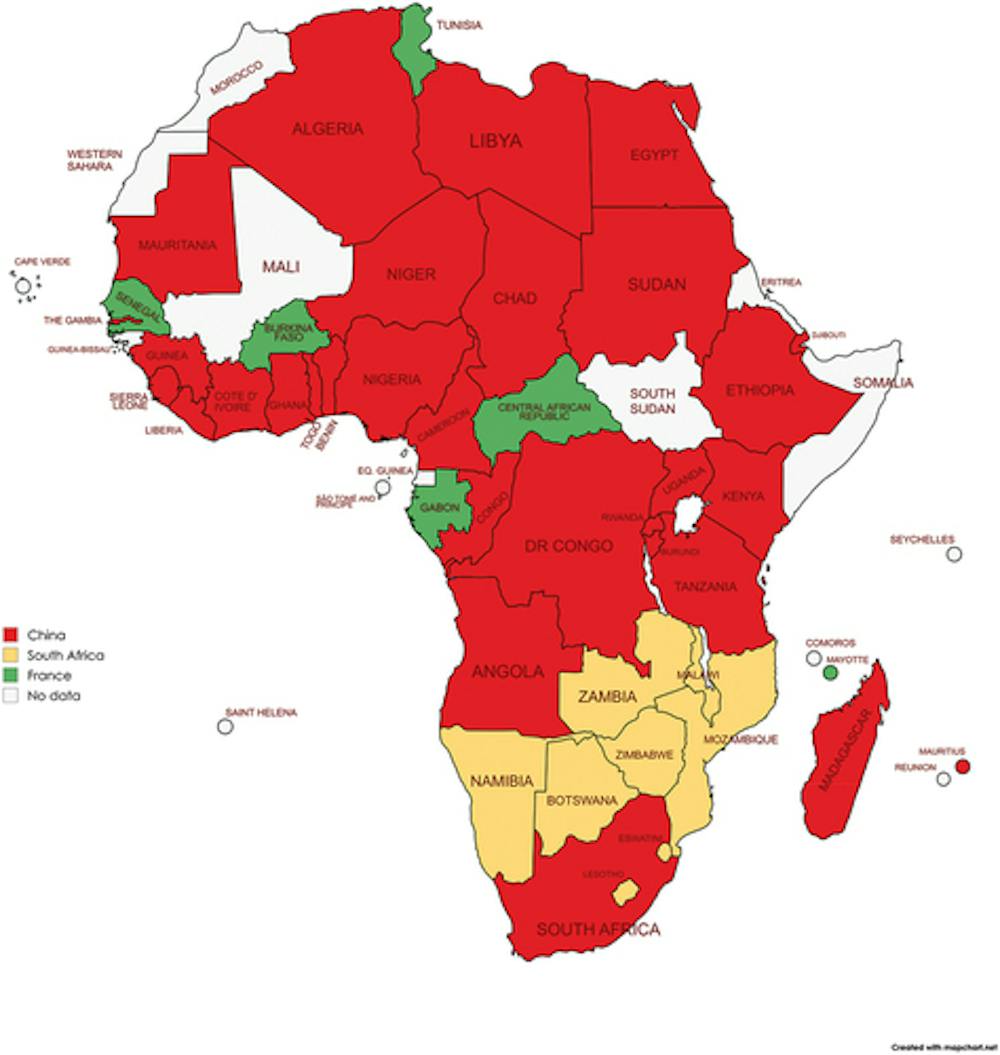
    Global power dynamics in Africa are shifting, with China eclipsing the influence of the US and France. China has become Africa’s single largest trading partner.

    In response, media and policymakers in traditionally dominant states are increasingly using maps drenched in red or stamped with Chinese flags to depict Beijing’s expanding footprint. One map reproduced by a US congressional committee, for instance, showed Beijing’s influence and reach across the continent in red stripes.

    But these visuals oversimplify a complex reality. This is an issue I explore in a new study. For over a decade, I have researched the interactions of sub-Saharan Africa with other states like Turkey, Arab Gulf states, Japan and China.

    In a recent paper I explored the use of maps that have been created of Africa showing China’s projects across the continent. I argue that, by overlaying Chinese flags on maps depicting Africa and its 54 states, media and policymakers turn economic ties into a visual representation of foreign encroachment.

    This process is called securitisation – the framing of something as a threat, even if it’s not one.

    This visual securitisation not only heightens fears of dependency but also primes certain audiences – in the US, Japan and France, for instance – to view China’s presence as a direct challenge to their interests.

    Certain threats – like terrorist groups or nuclear weapons – are self-evident. China’s presence in many African states, however, is different: if it’s a threat, who is threatened and why? Do Chinese-built roads or railways – and the debt African states accrue for this infrastructure – constitute the threat?

    My research shows that the answer to these questions is: it depends.

    Portraying China’s presence in Africa with flags on maps can distort African states’ sovereignty and their power to make decisions based on national interests. This visual portrayal reduces these countries to arenas of global power competition. It fails to recognise them as strategic actors.

    China tops imports to African states

    Illustration of China’s economic influence in 2021 drenched in red and drawn from media, think tanks and related literature. Author’s composite map illustrates securitisation of China in Africa. Brendon J. Cannon

    On the other hand, my research shows that China’s role may not be entirely benign.

    My study focuses mostly on east Africa, to include the Horn of Africa. Much of Beijing’s engagement here remains primarily economic (as it does in west, central and southern Africa). However, China’s growing control over critical infrastructure and digital networks, and its pursuit of military footholds near strategic maritime routes, present real security concerns.

    Policymakers need to separate legitimate risks from exaggerated securitisation narratives. This would help them avoid the pitfalls of reactionary policies.

    Negative consequences

    Presenting China as a threat in Africa has three negative consequences.

    First, it erodes the idea and reality of African sovereignty and agency. Maps portraying Africa as overrun by China suggest that governments and civil society are mere bystanders unable to negotiate their own foreign and domestic agendas.

    The reality is that countries like Kenya actively engage with China to attract investments for development projects, and to balance their relations with other international actors like the US and Japan.

    The result of securitisation is that American or Japanese policymakers, for instance, have begun to view Africa through the lens of their strategic competition with China. This is evident in Washington’s foreign policy rhetoric, for example. This increasingly frames African states not just as partners but also as strategic battlegrounds in the growing US-China rivalry. The risk is that African countries may start being treated as passive players.

    Second, securitisation inflates the perception of China as a global security threat.

    The repeated use of maps with Chinese flags covering ports, railways and industrial zones creates an exaggerated image of unchecked expansion. These maps fail to show the host of other external states operating on the continent.

    The US, multiple European states, Japan, India, Russia, Turkey, the United Arab Emirates and South Korea all have significant interests in Africa. While China is by far the largest, most prominent external actor, with the widest reach throughout Africa, it’s been singled out because of the perceived threats its presence in Africa may pose to the west.

    Third, securitisation can lead to knee-jerk reactions to limit China’s presence rather than engage constructively with Beijing’s investments in Africa. These reactions can result in ill-advised attempts by China’s competitors to push projects that don’t correspond to the needs of African states. This partly explains Ethiopia’s strained relations with the west. Sanctions and aid cuts over the Tigray conflict fuelled a pivot toward China and Russia.

    The security risks

    Securitisation raises valid concerns, but my research also underscores genuine security risks related to China’s presence in Africa. These shouldn’t be overlooked.

    China’s growing role and embeddedness in Africa’s digital ecosystem presents a double-edged sword, for instance. Huawei and other Chinese companies have contributed to Africa’s telecommunications and digital transformation. But these investments also increase Beijing’s potential influence over data security, cyber governance and information flows. These give China the option to exploit networks for surveillance, intelligence gathering or political coercion.

    Chinese-funded, built or operated infrastructure, ports and military bases

    A depiction of China’s infrastructure influence in 2023 from media, think tanks and related literature. Author’s composite map illustrates securitisation of China in Africa. Brendon J. Cannon

    China’s expanding control over dual-use infrastructure is another concern. Chinese-operated ports in Djibouti, for instance, can be used for commercial and military purposes. They potentially grant Beijing a strategic foothold in key maritime corridors, such as the Red Sea. China could restrict access to these ports in times of conflict. Or use them to extend its naval footprint, similar to what it’s done in the South China Sea.

    It’s China’s pursuit of other military facilities beyond its bases in Djibouti that will have the most serious implications for African states’ sovereignty. This is part of a deliberate Chinese strategy to expand its global power projection and protect access to critical resources like oil and gas.

    Agreements on military facilities may end up undermining and even challenging African agency of action. The addition of Chinese ships and soldiers alongside the growing presence of US, European, Indian, Japanese and other regional naval forces could escalate tensions. It also risks entangling African states in power rivalries that aren’t in their national interests.

    China’s presence in Africa has been securitised through maps drenched in red and stamped with flags, framing its engagement as a looming threat rather than a complex geopolitical reality. However, the real challenge for African states is ensuring that China’s growing influence – especially in infrastructure, digital networks, and security – does not erode their sovereignty. Whether Beijing’s presence becomes an opportunity or a liability will depend on how effectively African governments assert their national interests in shaping these partnerships on their own terms.

    – Maps showing China’s growing influence in Africa distort reality – but some risks are real
    – https://theconversation.com/maps-showing-chinas-growing-influence-in-africa-distort-reality-but-some-risks-are-real-249454

    MIL OSI Africa

  • MIL-OSI Russia: Sobyanin reported how the historical appearance of the Swiss House in Kuskovo is being preserved

    Translartion. Region: Russians Fedetion –

    Source: Moscow Government – Government of Moscow –

    Work is underway at the Kuskovo estate to preserve the historical appearance of the Swiss House. This in his telegram channel Sergei Sobyanin said.

    “It was built in the 19th century according to the design of Nikolai Benois. The building is unusual in that it combines a brick ground floor and a carved wooden upper tier. The last owner of the estate, Sergei Sheremetev, once lived here,” the Moscow Mayor noted.

    Source: Sergei Sobyanin’s Telegram channel @Mos_Sobyanin

    The Swiss house is built in the style of an Alpine chalet. Since the 18th century, Kuskovo has had a tradition of creating park pavilions and buildings with national accents, such as Dutch, French and Italian.

    The craftsmen have already started restoring the wooden log structure. This is a complex and painstaking process: the wooden part of the building was separated from the brick part and suspended using a special system. Now the restorers will have to replace the damaged logs and reconnect the log structure to the first floor. In addition, work will be carried out inside the building to preserve the historical stoves and chimneys.

    Comprehensive restoration is underway at the Kuskovo estate since 2017The palace facade, the Dutch House, the Grotto pavilion, the formal park, the 18th century sculptures and other objects have already been put in order. In addition, the forest part of the park has been landscaped, making it even more convenient for walks.

    Please note: This information is raw content directly from the source of the information. It is exactly what the source states and does not reflect the position of MIL-OSI or its clients.

    Please Note; This Information is Raw Content Directly from the Information Source. It is access to What the Source Is Stating and Does Not Reflect

    https: //vv.mos.ru/mayor/tkhemes/12443050/

    MIL OSI Russia News

  • MIL-OSI: Introducing New Cloud-Based CorelDRAW Go, Creative and Workflow Enhancements in CorelDRAW Graphics Suite 2025, and Browser-Based Design with CorelDRAW Web

    Source: GlobeNewswire (MIL-OSI)

    CorelDRAW Go provides a beginner-friendly design experience, empowering creativity from anywhere.

    CorelDRAW Graphics Suite delivers Painterly Brush tool enhancements and streamlined print to PDF workflows, alongside flexible, online design with CorelDRAW Web.

    OTTAWA, Ontario, March 04, 2025 (GLOBE NEWSWIRE) — Introducing CorelDRAW Go, a beginner-friendly online graphic design tool for creative enthusiasts and aspiring designers. This newest addition to the CorelDRAW family simplifies the creative process, equipping users with intuitive tools to design efficiently from anywhere.

    Alongside this, the latest updates to award-winning graphic design software, CorelDRAW Graphics Suite, are unveiled, including CorelDRAW Web, providing subscribers with a flexible, cloud-based design experience.

    “With CorelDRAW Go and CorelDRAW Web, we’re making creativity more accessible than ever,” said Prakash Channagiri, Senior Director of Product Management for CorelDRAW. “The flexibility of these new cloud-based tools combined with the latest creative and workflow enhancements in CorelDRAW Graphics Suite, reinforce our commitment to empowering design professionals and creative enthusiasts to work more efficiently and push the boundaries of what’s possible in graphic design.”

    CorelDRAW Go is a browser-based tool that makes design more intuitive and accessible, without the steep learning curve that comes with professional graphic design software. With an easy-to-use interface it delivers more advanced drawing and editing capabilities than many template-based alternatives.

    Here’s what’s available in CorelDRAW Go:

    Robust Design Tools

    • Interactive drawing tools
    • Realistic brushes
    • Straightforward node editing
    • User-friendly text tools
    • Easy-to-use masking controls
    • Essential image editing features

    Extensive Creative Assets

    • Fully customizable templates
    • Thousands of editable vector icons, illustrations, and clipart
    • More than 6 million royalty-free stock photos
    • Thousands of fonts

    In this latest release, CorelDRAW Graphics Suite customers get access to powerful tools and enhancements designed to elevate creativity and simplify workflows.

    Here’s what’s new in CorelDRAW Graphics Suite 2025:

    • NEW! CorelDRAW Web: CorelDRAW is more accessible than ever thanks to the introduction of CorelDRAW Web, a powerful browser-based version of the award-winning graphic design suite. Available exclusively to subscribers, CorelDRAW Web delivers a full CorelDRAW experience in the browser, allowing users to design seamlessly from any device.
    • NEW! Advanced Print to PDF capabilities: Streamline workflows and enjoy faster, more efficient output with new Print to PDF functionality, now integrated into CorelDRAW and Corel PHOTO-PAINT.
    • ENHANCED! Painterly Brush tool: Unleash creativity with the upgraded Painterly Brush tool, now featuring additional brush controls, and improved compatibility with other tools. Plus, subscribers get exclusive access to 50 additional free brushes, unlocking a world of new creative possibilities.
    • NEW! Simplified multi-seat license management: The redesigned Corel Customer Account Portal streamlines license administration, allowing businesses to assign licenses or deploy software without requiring individual user accounts.

    This latest release also includes performance and quality improvements, direct access to additional Google Fonts, and advanced security upgrades.

    Availability and Pricing

    CorelDRAW Graphics Suite is available on Windows, macOS, and web in English, German, Italian, French, Spanish, Brazilian Portuguese, Dutch, Polish, Czech, Russian, Simplified Chinese, Traditional Chinese, Turkish, Swedish, and Japanese. Subscription is $269 USD / €369 / £319 per year. CorelDRAW Graphics Suite 2025 is available for one-time purchase at the suggested retail price of $549 USD / €779 / £659. EUR and GBP prices include VAT.

    To compare purchase options of CorelDRAW Graphics Suite, please visit: https://www.coreldraw.com/coreldraw/#compare.

    For more information about business licenses, visit www.coreldraw.com/business, and for more information about education licenses, visit www.coreldraw.com/education.

    CorelDRAW Web is available to all CorelDRAW subscribers and active maintenance customers and is supported on the most recent versions of Google Chrome, Microsoft Edge, and Firefox, on both Windows and macOS. To learn more about CorelDRAW Web, or to try a 15-day trial, visit: www.coreldraw.corel.com.

    CorelDRAW Go performs best with Google Chrome or Microsoft Edge, with the latest updates, on both Windows and macOS, and is available in English, German, Italian, French, Spanish, Brazilian Portuguese, Dutch, Polish, and Czech. A subscription is $9.99 USD / €9.99 / £8.99 monthly or $99 USD / €115 / £95 per year. EUR and GBP prices include VAT. To learn more about CorelDRAW Go, visit: www.go.corel.com.

    About Alludo

    Alludo is a global technology company helping people work better and live better. We’re the people behind award-winning, globally recognizable brands including Parallels, Corel, MindManager, and WinZip. Our professional-caliber graphics, virtualization, and productivity solutions are finely tuned for the digital remote workforce delivering the freedom to work when, where, and how you want.

    With a 35+ year legacy of innovation, Alludo empowers all you do, helping more than 2.5 million paying customers to enable, ideate, create, and share on any device, anywhere. To learn more, visit www.alludo.com

    © 2025 Cascade Parent Limited trading as Alludo. All rights reserved. Alludo, and the Alludo logo are trademarks of Cascade Parent Limited in Canada, the United States and/or elsewhere. Corel, CorelDRAW, Corel PHOTO-PAINT, Go, MindManager and WinZip are trademarks or registered trademarks of Corel Corporation. Parallels is a registered trademark of Parallels International GmbH. MacOS is a trademark of Apple Inc. Google and Chrome are trademarks of Google LLC. All other company, product and service names, logos, brands and any registered or unregistered trademarks mentioned are used for identification purposes only and remain the exclusive property of their respective owners. For all notices and legal information please visit www.alludo.com/en/legal and www.corel.com/en/legal-information/.

    Contact:
    Ashley Ruess
    ashley.ruess@alludo.com

    Photos accompanying this announcement are available at:

    https://www.globenewswire.com/NewsRoom/AttachmentNg/9c05058a-e856-498a-88b3-2330c0f33de1

    https://www.globenewswire.com/NewsRoom/AttachmentNg/c0add386-97a5-490e-ad55-360995e05f1d

    https://www.globenewswire.com/NewsRoom/AttachmentNg/32ad5403-f765-41bd-8d7c-117c67db1399

    https://www.globenewswire.com/NewsRoom/AttachmentNg/94cf185e-48cb-4409-bd79-555aa6d1c49d

    The MIL Network

  • MIL-OSI United Kingdom: Lowry celebrates 25 years of culture in Salford

    Source: City of Salford

    As Lowry marks its 25th anniversary, Salford City Council is proud to join the celebrations and acknowledge the extraordinary impact this iconic cultural institution has had on the city. From its pivotal role in the regeneration of Salford Quays to its outstanding artistic and community achievements, Lowry continues to be a driving force for culture, creativity, and economic growth.

    The anniversary programme – packed with familiar names including Quentin Blake, Jeanette Winterson, and Aakash Odedra, theatre productions Gods of Salford and Dear England, immersive gallery experience LOWRY 360, alongside a brand new mural commissioned with French multi-disciplinary artist, Camille Walala – reflects Lowry’s influence on culture and the local community, one that Salford City Council wholeheartedly support and celebrate. 

    Since opening in April 2000, Lowry has welcomed over 18.5 million visitors, generating an annual £86 million in visitor spending and supporting over 600 jobs. More than just an arts centre, Lowry has played a fundamental role in transforming Salford Quays into a dynamic cultural hub.

    Paul Dennett, Salford City Mayor, highlighted the significance of Lowry in shaping the city’s future:

    “Lowry is a force for good in Salford and was a vital catalyst for the regeneration of the area. It is a place that is first and foremost for the people. It’s wonderful to reflect on the past 25 years – Lowry has not only brought world-class arts and theatre to the Quays but has also been instrumental in fostering community engagement, supporting young people, and strengthening our creative economy. It supports over 600 jobs, including 576 full-time jobs in the North West and 649 across the UK, demonstrating its critical role in the regional and national economy. It has contributed to a £1.3 billion GVA, acting as a foundational anchor for the development of MediaCityUK and positioning Salford as a major centre for arts, culture, and digital industries.

    Happy birthday Lowry, I look forward supporting your next exciting chapter!”

    Councillor Hannah Robinson-Smith, Lead Member for Culture, Heritage, Equalities, Sports and Leisure, echoed this sentiment, praising Lowry’s impact across generations:

    “Lowry is a cultural institution that has had an immense positive influence on communities across Salford. It has provided access to arts and culture for thousands of residents and continues to inspire new generations with its diverse and exciting programme. Its achievements to date are truly remarkable. Happy birthday, Lowry!”

    Findings from Lowry’s 2024 impact report reaffirm its invaluable contribution, with an estimated £22 million in social value generated annually. Lowry’s community outreach initiatives, including its Arts for Social Change programme and partnerships with local schools, continue to break down barriers and make the arts accessible to all.

    For further details on the anniversary programme, visit www.visitsalford.info/Lowry25 

    Share this


    Date published
    Tuesday 4 March 2025

    Press and media enquiries

    MIL OSI United Kingdom

  • MIL-OSI United Kingdom: Channel Islands Ministers visit Brussels04 March 2025 Channel Islands Ministers discussed the planned reset in relations between the EU and UK with senior EU and British diplomats during meetings in Brussels. The discussions took place on the sidelines… Read more

    Source: Channel Islands – Jersey

    04 March 2025

    Channel Islands Ministers discussed the planned reset in relations between the EU and UK with senior EU and British diplomats during meetings in Brussels. The discussions took place on the sidelines of a reception to mark the 15th anniversary of the Channel Islands’ Brussels Office. 

    The External Relations Ministers of Guernsey and Jersey, Deputy Jonathan Le Tocq and Deputy Ian Gorst, met with senior diplomats from France, the UK, Poland and Malta. Discussions also included the Islands’ relationship with France, their closest European neighbour, and promoted the Islands’ financial services interests, noting both Islands’ recent positive MONEYVAL assessments, as well as developments in sustainable finance.

    Ministers also drew attention to the significance of the Islands’ relationship with Europe and spoke to existing areas of cooperation with Member States. 

    Speaking after the visit, Jersey’s Minister for External Relations, Deputy Ian Gorst said: “It is more important than ever, post Brexit, to engage with representatives of European Member States. Direct engagement with the EU in Brussels is essential to ensure our interests are known and understood. I look forward to continuing to build on our discussions over the past days through the work of the Channel Islands Brussels Office.”

    Guernsey’s Minister for External Relations, Deputy Jonathan Le Tocq said: “The visit was a key opportunity to speak with representatives in Brussels and inform them of the interests of the Channel Islands. Regular engagement with EU partners is an essential part of our long-standing good neighbour policy. During these meetings I was pleased to discuss our financial services interests as well as noting the positive MONEYVAL assessment.” 

    The Ministers’ programme in Brussels included meetings with the Permanent Representatives (Ambassadors) to the EU of France and Malta, the Polish Political Counsellor, the UK Deputy Ambassador to the EU, the UK Ambassador to Belgium, and representatives of the Devolved Administrations and other Third Country offices in Brussels. 

    The Ministers hosted a reception for partners and stakeholders in Brussels to mark the 15th anniversary of the Channel Islands Brussels Office, the representative office for the governments of Guernsey and Jersey to the European Union. They were joined at this event by Jersey’s Director of Financial and Professional Services, Guernsey’s Director of Finance Sector Development, as well as representatives from Guernsey Finance and Jersey Finance who collectively promoted the Channel Islands’ financial services expertise to the European audience.​

    MIL OSI United Kingdom

  • MIL-OSI Europe: AFRICA/DR CONGO – South Kivu: Front lines between the M23 and the “Wazalendo” militias run through the Ruzizi plain

    Source: Agenzia Fides – MIL OSI

    Kinshasa (Agenzia Fides) – The front line between the M23 guerrillas and the “Wazalendo” militiamen runs through the Ruzizi plain (in the province of South Kivu, in the east of the Democratic Republic of Congo). According to a report by the local civil society “Association against Evil and for the Supervision of Youth and Human Rights” (ACMEJ) and sent to Fides, the M23 controls the village of Kamanyola, while Katogota is allegedly controlled by the “Wazalendo” militias.The latter control the bridge in Katogota. “This is causing great fear among the population of the two villages, as they have become the front line where the two elephants are waiting to meet and will end up like grass trampled by pachyderms,” the note says. Control of the Ruzizi plain is strategically important because it represents a natural border between the DRC and Burundi on the one hand, and between the DRC and Rwanda on the other. Control of the river plain would allow the M23 to approach both borders, threaten Burundi (an ally of the government in Kinshasa) and open up another route for the Rwandan army to deliver aid to the movement. And above all, to export strategic minerals illegally mined in the DRC to Rwanda. In previous wars in the east of the DRC, the village of Katogota was the scene of a massacre that left an indelible memory among its inhabitants. “During the RCD/Goma period, on May 14, 2000, the soldiers of this movement carried out a massacre of the civilian population in Katogota, which left 375 civilians dead and was accompanied by a systematic looting of the property of the civilian population,” the note says. The “Rassemblement Congolais pour la Démocratie” (RCD) is just one of the many names of a pro-Rwandan guerrilla movement that later became the M23 (see Fides, 18/2/2025). The note concludes with an appeal “to the international community, the UN Security Council, the European Union, France and other major world powers to fulfill their duty to save the Democratic Republic of Congo in this difficult period for its civilian population.” “In order to obtain the strategic minerals they seek, these countries should not obtain them via Rwanda, but directly from the Democratic Republic of Congo, which is the rightful owner,” it says. (L.M.) (Agenzia Fides, 4/3/2025)
    Share:

    MIL OSI Europe News

  • MIL-OSI Global: Maps showing China’s growing influence in Africa distort reality – but some risks are real

    Source: The Conversation – Africa – By Brendon J. Cannon, Associate Professor, Khalifa University

    Global power dynamics in Africa are shifting, with China eclipsing the influence of the US and France. China has become Africa’s single largest trading partner.

    In response, media and policymakers in traditionally dominant states are increasingly using maps drenched in red or stamped with Chinese flags to depict Beijing’s expanding footprint. One map reproduced by a US congressional committee, for instance, showed Beijing’s influence and reach across the continent in red stripes.

    But these visuals oversimplify a complex reality. This is an issue I explore in a new study. For over a decade, I have researched the interactions of sub-Saharan Africa with other states like Turkey, Arab Gulf states, Japan and China.

    In a recent paper I explored the use of maps that have been created of Africa showing China’s projects across the continent. I argue that, by overlaying Chinese flags on maps depicting Africa and its 54 states, media and policymakers turn economic ties into a visual representation of foreign encroachment.

    This process is called securitisation – the framing of something as a threat, even if it’s not one.

    This visual securitisation not only heightens fears of dependency but also primes certain audiences – in the US, Japan and France, for instance – to view China’s presence as a direct challenge to their interests.

    Certain threats – like terrorist groups or nuclear weapons – are self-evident. China’s presence in many African states, however, is different: if it’s a threat, who is threatened and why? Do Chinese-built roads or railways – and the debt African states accrue for this infrastructure – constitute the threat?

    My research shows that the answer to these questions is: it depends.

    Portraying China’s presence in Africa with flags on maps can distort African states’ sovereignty and their power to make decisions based on national interests. This visual portrayal reduces these countries to arenas of global power competition. It fails to recognise them as strategic actors.

    China tops imports to African states

    On the other hand, my research shows that China’s role may not be entirely benign.

    My study focuses mostly on east Africa, to include the Horn of Africa. Much of Beijing’s engagement here remains primarily economic (as it does in west, central and southern Africa). However, China’s growing control over critical infrastructure and digital networks, and its pursuit of military footholds near strategic maritime routes, present real security concerns.

    Policymakers need to separate legitimate risks from exaggerated securitisation narratives. This would help them avoid the pitfalls of reactionary policies.

    Negative consequences

    Presenting China as a threat in Africa has three negative consequences.

    First, it erodes the idea and reality of African sovereignty and agency. Maps portraying Africa as overrun by China suggest that governments and civil society are mere bystanders unable to negotiate their own foreign and domestic agendas.

    The reality is that countries like Kenya actively engage with China to attract investments for development projects, and to balance their relations with other international actors like the US and Japan.

    The result of securitisation is that American or Japanese policymakers, for instance, have begun to view Africa through the lens of their strategic competition with China. This is evident in Washington’s foreign policy rhetoric, for example. This increasingly frames African states not just as partners but also as strategic battlegrounds in the growing US-China rivalry. The risk is that African countries may start being treated as passive players.

    Second, securitisation inflates the perception of China as a global security threat.

    The repeated use of maps with Chinese flags covering ports, railways and industrial zones creates an exaggerated image of unchecked expansion. These maps fail to show the host of other external states operating on the continent.

    The US, multiple European states, Japan, India, Russia, Turkey, the United Arab Emirates and South Korea all have significant interests in Africa. While China is by far the largest, most prominent external actor, with the widest reach throughout Africa, it’s been singled out because of the perceived threats its presence in Africa may pose to the west.

    Third, securitisation can lead to knee-jerk reactions to limit China’s presence rather than engage constructively with Beijing’s investments in Africa. These reactions can result in ill-advised attempts by China’s competitors to push projects that don’t correspond to the needs of African states. This partly explains Ethiopia’s strained relations with the west. Sanctions and aid cuts over the Tigray conflict fuelled a pivot toward China and Russia.

    The security risks

    Securitisation raises valid concerns, but my research also underscores genuine security risks related to China’s presence in Africa. These shouldn’t be overlooked.

    China’s growing role and embeddedness in Africa’s digital ecosystem presents a double-edged sword, for instance. Huawei and other Chinese companies have contributed to Africa’s telecommunications and digital transformation. But these investments also increase Beijing’s potential influence over data security, cyber governance and information flows. These give China the option to exploit networks for surveillance, intelligence gathering or political coercion.

    Chinese-funded, built or operated infrastructure, ports and military bases

    China’s expanding control over dual-use infrastructure is another concern. Chinese-operated ports in Djibouti, for instance, can be used for commercial and military purposes. They potentially grant Beijing a strategic foothold in key maritime corridors, such as the Red Sea. China could restrict access to these ports in times of conflict. Or use them to extend its naval footprint, similar to what it’s done in the South China Sea.

    It’s China’s pursuit of other military facilities beyond its bases in Djibouti that will have the most serious implications for African states’ sovereignty. This is part of a deliberate Chinese strategy to expand its global power projection and protect access to critical resources like oil and gas.

    Agreements on military facilities may end up undermining and even challenging African agency of action. The addition of Chinese ships and soldiers alongside the growing presence of US, European, Indian, Japanese and other regional naval forces could escalate tensions. It also risks entangling African states in power rivalries that aren’t in their national interests.

    China’s presence in Africa has been securitised through maps drenched in red and stamped with flags, framing its engagement as a looming threat rather than a complex geopolitical reality. However, the real challenge for African states is ensuring that China’s growing influence – especially in infrastructure, digital networks, and security – does not erode their sovereignty. Whether Beijing’s presence becomes an opportunity or a liability will depend on how effectively African governments assert their national interests in shaping these partnerships on their own terms.

    Brendon J. Cannon does not work for, consult, own shares in or receive funding from any company or organisation that would benefit from this article, and has disclosed no relevant affiliations beyond their academic appointment.

    ref. Maps showing China’s growing influence in Africa distort reality – but some risks are real – https://theconversation.com/maps-showing-chinas-growing-influence-in-africa-distort-reality-but-some-risks-are-real-249454

    MIL OSI – Global Reports

  • MIL-OSI USA: Interview with Sean Colgan

    Source: NASA

    I’m really pleased that you agreed to take advantage of this opportunity.  I don’t recall if I have actually met you personally,  but if so, then I apologize for not remembering.

    I don’t think so, although you’ve certainly signed things for me.

    Well, I guess I have because I do remember seeing your name from time to time on various things. You’ve been at Ames a long time and we’ll have you talk about that in a little bit. The focus of these interviews is not specifically on your work. In fact, it was intended to broaden people’s understanding of who you are and what you do when you’re not at work, because we get compartmentalized and mostly get to know people through our work interactions, so we’ll be touching on your other interests. As you’ve seen if you’ve read some of these, we generally start with your childhood. I try to look up bios and things like that ahead of time to see what I can glean before these interviews but you don’t have a very substantial presence on the web.

    I’m not a very public person.

    I did find that out (laughs).

    I did not volunteer for these and I tried to lay low until you hunted me down! (laughs)

    Well, I think you’ll be pleased and as I said, you can stay as private as you want during this whole interview.

    Sounds good.

    We like to start with where you were born, your family at the time, what your parents did, if you have siblings, and then we ask when became aware of or developed an interest in what you have pursued as a career.

    OK, and I’m going to be looking sideways at my notes because I printed out your list of questions and thought about them. Hopefully I won’t mess it up too much. I’m a big believer in the written word. I was born in Oakland, just up the Bay.

    So was I, so we have a connection right there!

    Up through my preteen years I grew up split between Oakland and North Lake Tahoe. My dad was a masonry contractor. When school got out in June we would go up to Tahoe where there was lots of work for him, building foundations for homes and so forth. When Christmas break came in school, we came back down to Oakland. We had a home in both places and dad could get work in the winter in the Bay Area. In the middle of every year during my preteen years, I switched between two schools. It was usually a bit of a jolt because the Oakland schools were ahead of the Tahoe schools, so there were a couple weeks of flailing about in January trying to catch up. They all used the same textbooks, but we were a couple of chapters behind at that point and had to catch up.

    When I was 12, Dad had established his business well enough at Tahoe that my parents sold both of the houses, built a somewhat bigger one, and we moved to Tahoe permanently. So from seventh grade through high school it was all at the northern end of Lake Tahoe.

    I have one sibling, a brother.

    And when did I start thinking about becoming an astronomer? I can’t remember exactly, to be perfectly honest. I do remember my parents showing me the constellations. I can remember specifically which constellations my dad showed me and which ones my mom showed me. I can’t remember a time when I wasn’t interested primarily in being an astronomer, but I probably went through an astronaut phase because it was the ‘60’s!  I got an astronomy book for my birthday one year and I know it was before I could really read and understand it. I remember looking at the pictures. In thinking about this interview, I went back and looked.  That book was published when I was five, so probably by the time I was five I was talking about it enough that I got this book for my birthday. I don’t have any similar books on other topics from that time. All the other books I have from back then are astronomy books for kids.

    Well, you were living in Lake Tahoe, which by the elevation and the clarity and lack of ambient lights around you would have had a really good view of the stars and constellations.

    Right. It was great. Although before we moved up there full time we were mostly there in the summer, so it didn’t get dark until after my bedtime.  When we moved up there full time, then I could go out in the winter and yeah, we had a spectacular view of the southern sky. There were woods but we could see over the trees. We could see the center of the Milky Way, and so forth. I had binoculars and a couple of small telescopes that I’d use, along with a star atlas to point me toward interesting things to look at.

    Did you say what your mother did? Did she work outside the home?

    Mom was a writer.  We traveled each year when we were growing up. She would write travelogues of those trips and try to get them published. She also wrote haiku poetry, and she tried her hand at writing other things. She was published a bit, but not a whole lot. Mom did get one of her travelogues published in the Christian Science Monitor. That was a highlight for her.

    And was your brother older or younger?

    My brother is two years younger, and we had somewhat similar trajectories.  We’ll get to education later but he majored in physics as well. He followed me in similar universities, but ended up going into material sciences. He is now on the East Coast working for IBM.

    That’s great.

    He was named a Master Inventor in 2018.

    A what?

    A Master Inventor. He has over 200 patents, so IBM honored him with this title.

    That’s quite an honor!  Your education was interesting because of the split between the two schools.  But then at some point, when you went to college, you had to declare a major. You said you had already developed an interest in astronomy, so did you pursue that science discipline right off the bat?

    I went to UC Riverside for two years, and then I transferred to Caltech. My freshman year  I really nailed down my choice for astronomy. I remember going to the Career Center and taking an interest survey, which has nothing to do with what you’re able to do. It just asks what you’re interested in doing, and it came up as physicist or musician.  I have no musical skills so that pointed me in the other direction. I thought briefly about geology, since my dad had been a geology major, but I really settled on astronomy at that point, which is why I transferred. Riverside didn’t have an astronomy major,  they only had a physics major. I really wanted to get an astronomy background and start on it early.

    My time at Caltech was probably the toughest two years I’ve ever had. I was behind because I had gone to Riverside for two years and the Caltech student body was extremely competitive. Caltech was not generous with their transfer credits. I ended up taking a very heavy course load, but I did make it out in two years. From there I applied to a number of grad schools. I settled on Cornell for a couple reasons: First of all because they had groups working in the areas  of astronomy I thought I was interested in, which were radio and infrared. Second of all, after four years in southern California I really wanted to go to a more rural setting to continue my education.

    I have to ask this because when we’ve interviewed others who have gone to Cornell, most of them have mentioned the influence of Carl Sagan and I just wondered if that figured into your choice, or was he gone by the time you went there?

    Well, I  did meet Carl, at a second year reception he threw for the grad students.  He was gone most of my first year working on Cosmos the television show. He had taken a leave of absence and wasn’t around. When he came back he threw a reception for all of us, and I got to shake his hand. He was a planetary scientist, of course, and that was not where I was aiming my trajectory.  I didn’t see him a whole lot other than that one reception. Although from time to time the kind of people you really don’t want wandering around the halls would come around the building looking for Carl Sagan. Security would chase them down and get them out. These are really my most distinct memories of Carl.

    And your PhD was in astronomy, not physics?

    It was in astronomy and my dissertation was on radio astronomy. I did it almost exclusively at Arecibo (Arecibo Observatory, National Astronomy and Ionosphere Center, Arecibo, Puerto Rico) with a little bit at the VLA (Very Large Array Radio Telescope facility, near Socorro, New Mexico). I got to work with some really smart people at Cornell, observational and theoretical.

    At this point we usually inquire about the connection or the influence, that brought you from your PhD to NASA Ames.

    My degree was in radio astronomy but the other interest I always had along the way, which I hadn’t been able to look into, was infrared astronomy. Getting post docs is very competitive, back then we called them NRC’s. The NRC offer from Ed Erickson’s group at Ames was the best offer, so I came out for that. It wasn’t a sure thing, there was back and forth and the highest rated candidate had to turn down the job before they would make me an offer.  But fortunately for me the highest rated candidate was my office mate at Cornell. I knew he was going to turn down the offer as soon as he got another one he wanted, so I was aware a little bit in advance of getting the call from Ed that things had worked out.

    And Ed was your advisor?

    Ed was my advisor. So I came and did two years as an NRC and then continued working with the group. I had made myself sufficiently useful that when I was ready to apply for other jobs, Ed offered me a raise if I’d stay with the group and continue working. That was a really good time. We flew on the KAO (Kuiper Airborne Observatory). They didn’t really have facility instruments, so we had our own instrument, but we did support observers from outside our group. We probably had more flights than any other instrument on the KAO during that period. It was a lot of flights. We had to operate it ourselves. All of us had our own particular jobs on flights. We did everything from prepping for the observations, writing proposals, all the way through to seeing them published. We were a small team: Ed Erickson, Mike Haas; Jan Simpson, and Bob Rubin on the science side helped out. We had a shop guy, Gene Beckstrom, and others after him.  We had a lab technician, Jim Baltz. Dave Hollenbach would also work with us, and that was very rewarding. He was a very sharp guy in terms of theory, ideas and projects to do. Here is a photo of some of us with our instrument rack getting ready for a KAO flight:

    So you came in on an NRC postdoctoral fellowship in the mid-‘80’s?

    Yes, I started on October 6th, 1986.

    And your first work was on the KAO and then probably a decade later you continued on SOFIA (Stratospheric Observatory for Infrared Astronomy)?

    It was ‘95 or ‘96 when they shut down the KAO to use the funding for SOFIA development. I remember the meeting still. It was in the upstairs auditorium and they came in and announced they were shutting the KAO down. I think it was Dave Morrison, who was the division chief, who told us not to whine about shutting it down because planetary missions sometimes had years when they didn’t have their facilities. In this case it was only going to be two years and we would be up and flying in 1997. Of course, as we know, it was more like ten years after that before we were even close to flying.

    Yes, I thought the same thing, that it was not going to be two years. It always takes longer than that.

    Well, I don’t think anybody thought it was going to be as many years as it was.

    But you flew on both the KAO and SOFIA?

    I had ninety nine flights on the Kuiper (KAO) because I kept track of them, and on SOFIA I had two flights, so I was not a flyer on SOFIA. It was more of a facility observatory, and the people who flew a lot were really part of the observatory. They were operating the telescope or operating a science instrument. My flights on SOFIA were because I had written some software for the GREAT Instrument (German Receiver for Astronomy at Terahertz Frequencies, a modular dual-color heterodyne instrument for high-resolution far-infrared spectroscopy) to help them interface with SOFIA. I was along on  those commissioning flights for GREAT in case my software broke. They wanted me on board. Interestingly by the rules at the time, I wouldn’t be allowed to actually fix the software in flight because it was flight software and had to go through all the reviews. None of the people who could do the reviews were on the airplane, but I could see how it broke and maybe I could suggest workarounds. It was not nearly as much fun for me as the KAO. I didn’t really have a job. The software had issues from time to time, but it basically worked. Everybody else had jobs, so for me it was less interesting, which is why I didn’t make a huge effort to keep flying on SOFIA.

    Did you stay on the SOFIA project as a somewhat non flying support person?

    Yes, from when the Kuiper stopped flying until about, well now, my primary work on SOFIA has been first with the project science team during development – trying to make sure they met our requirements, helping everybody understand our requirements, trying to make sure they weren’t making any huge mistakes. They made them anyway, especially when they didn’t listen to us, but we did our best. During the early years of SOFIA, I was also on the Ames team developing AIRES – a facility Science Instrument for SOFIA. I led the software effort, but the development was canceled in 2001. I then got involved with the software that people would use to propose to SOFIA, the proposal software, the software to estimate how long you should be asking for time, the sensitivity of the instruments, pieces of software like that. I worked with Dave Goorvich. We got software from other observatories as starting points and then modified them for SOFIA, software “re-use” they called it. And that was basically my main job throughout SOFIA’s lifetime. Once we developed those, the USRA (Universities Space Research Association) folks built their team around maintaining them and I joined that team because I’d been working on this software for so long. I also got into the package I mentioned to help GREAT interface to SOFIA. It basically made SOFIA look like the telescope that the GREAT team had been using for years, an observatory called KOSMA. We called it the translator and it translated KOSMA commands into SOFIA commands; then SOFIA housekeeping back into KOSMA housekeeping, so they didn’t need to change their software to work with SOFIA. As the aircraft started flying, it became quite clear that I was oversubscribed. I was not meeting my deadlines for either of those two efforts, so I gave up the translator. They hired another fellow to maintain that, although I stayed in touch with it for some years, helping him when he had questions and so forth. I then focused my main effort over on SOFIA’s DCS (Data Cycle System) side.              

    What has been your most interesting work here at Ames?

    I’d say it was flying on the KAO, but very specifically it was Supernova 1987A which occurred after I had been here for only a couple of months. It went off in February of 1987. Nobody really knew what it would look like in the infrared to an instrument on an observatory like the KAO, so it was obviously a huge deal since it was the closest supernova for hundreds of years.  Our team just completely redirected  to carry out observations of the supernova.  Dave Hollenbach and I worked together to try and figure out what we would see. We wrote up the science portion of the proposal,. For these observations, our instrument – the CGS (Cooled-Grating-Spectrometer) – had to be fairly substantially reworked in the sense that the grating needed to be changed to go to lower resolution and the detectors needed to be changed to get wider bandwidth and go to shorter wavelengths. Ed and Mike worked long days, weeks, and months to make all of those changes happen. In our proposal we made some predictions about which lines we could see, mostly iron lines, and which ionization states. We put that in the proposal, which was accepted. We then wrote up the proposal as a separate paper. When we went down and did the observations, we actually got some of it right. Surprisingly, iron was indeed bright. We thought we’d be seeing all different ionized states of iron, from singly, doubly, triply ionized iron, when in fact it was very much concentrated in singly ionized iron with a little bit of doubly ionized iron, there was a faint line there. We had gotten the temperatures right, but we didn’t quite get the ionization right. We were in the ballpark, so I think this was really the most interesting work in that when we started nobody had really seen anything like it before. We were starting from very basic principles, and we followed that all the way through to a nice series of papers. We went down for three different epochs because the lines were changing with time as the supernova ejecta expanded. We obtained three sets of measurements, which resulted in three papers.

    What I’m currently working on? Well, SOFIA is, of course, shut down and I am working as part of the shutdown process. We’re trying to reprocess a lot of the data to bring it up to standard, especially the older data. We learned more about the instruments as time went on, so we can now do a better job of reducing the data. I’m helping out with reducing the data, getting it into the archive as we shut down, and of course, writing proposals.

    What comes next? So far I’ve collaborated mainly with Naseem, whom you have spoken to, Sarah Nickerson, whom you also have spoken to, and Doug Hoffman (whom we’ve also spoken to). So that’s proposals.

    How is your work relevant to Ames and the NASA mission? 

    Well, I’ve worked on NASA missions almost my entire career, so I think that’s the closest to relevance as you can get.

    What is a typical day like for you?

    I mostly work, well before the pandemic in my office, but now it’s back and forth. I do like to come into the office although this week is a little different. That’s why we’re doing this interview from home. My wife is out of town and I like to work at home on those weeks just to keep the dog out of trouble. So I’m at a computer. I’m a software guy and a data analysis guy, not a lab guy, so I work at the computer. I actually have several computers on my desk. I look like a real developer (laughs). If you see my desk, I’ve got a couple of big screens and couple of computers underneath hooked up to different things and I can switch them around. So that’s a typical day, but at home it’s a little tougher. I don’t have a desk that can really manage the big screens, so I’ve just got one little laptop screen to work with.

    Is home close enough that the pandemic shut down of the Center didn’t really save you a whole lot of commute time?

    I live across the Bay in Newark, which physically is not far, but traffic wise is not good. I typically come in later and stay later because that works with my wife’s schedule and also works with the traffic. We’re not so close that it’s easy. I hated during the pandemic having to work at home all the time because of the small screen and with no room to spread out piles of paper or stay organized. That was definitely a challenge. I was very glad to get back on site.

    What do you like most and least about your job?

    Most would be doing science, but I also enjoy coding. Least is probably the standard sorts of things that most people whine about when given any opportunity.  All the stuff that goes with the job that isn’t science or coding, like IT security and paperwork. Right now I’m in the midst of training, taking courses I’ve taken every year for the last ten years, which gets a little old after a while, things like that. But somebody thinks you need to do it, and I hope it makes us a better organization for everybody doing it.

    Do you have a favorite memory from your career? Or perhaps a research finding or breakthrough, or an unexpected research result?

    My favorite memory would be the Supernova 1987A work in general. We found some unexpected things there and we got some things right.

    If you could have a dream job, what would it be?

    My dream job is pretty close to what I have. Pretty close without all the extra stuff.

    What advice would you give to someone who wants a career like yours?

    Of course you’ve got to work hard, and you need to have an aptitude for it. It’s a very competitive field, so you’ve also got to realize that luck, or being in the right place at the right time, can be a factor in whether you continue or not.  I’ve had colleagues who were very good at what they do, but they just weren’t in the right place at the right time. They ended up leaving the field or doing something less than what they hoped. Some things are just out of your control.

    I did get lucky. I was in the right place at the right time. I flew on the Kuiper, and I developed skills. When SOFIA started, those skills were very much in demand.  That was my right place, right time moment, which is when I joined the civil service.  I had been a contractor  after my NRC ended through 1997. I became a civil servant then because there was so much work on SOFIA. I don’t know if that’s  helpful advice, but it’s just my take on things.

    Well, you’re right. There’s something to being in the right place, at the right time and being prepared, but there’s always the serendipity aspect, which is just part of life. You could have wound up somewhere else and been just as happy, you know.

    Oh yes, It doesn’t necessarily relate to happiness, but you’ve got to make the best with what you have.  I do feel lucky about that.

    Would you like to share anything about your family? Kids, pets, activities? You mentioned a dog?

    I’m going to mix the order up a little bit.

    Sure, go ahead.

    The accomplishment I’m most proud of that’s not science related would be 40 years of marriage to my fabulous wife. We just celebrated our 40th anniversary about a week and a half ago.

    Congratulations! That is indeed an accomplishment.

    So, no children but we do have a dog, a little Welsh Corgi. She’s our second corgi and she is just great. We do enjoy traveling. Typically, we’ll go on vacation in August. often to Europe. We’ve visited the UK five or six times, France a couple of times, Italy a couple of times. My father-in-law was born in Hungary, so we’ve gone there a couple times. Here is a photo of us at Lake Louise in 2019, with our Corgi.

    What do we do for fun the rest of the time? Besides leisure travel, I enjoy gardening. We also enjoy musical events.  We have season tickets to the San Jose Opera, for example, and we’ll go up to San Francisco for concerts a couple of times a year. We probably have an event every other month.  During the pandemic, the restaurants and movie theaters were closed, but wineries with outdoor spaces were open.  They started serving food during the pandemic, and they allowed dogs, so we got in the habit of doing a lot of wine tasting on weekends just to get out. We still do some of that. To celebrate our 40th, we went up to Napa and tasted a lot of great wines. (laughs)

    You mentioned that you’re not particularly musical, so you don’t play an instrument or anything, but you enjoy music and opera.

    I enjoy listening to music. I played instruments as a child but had no particular talent for it, so. . . .

    Do you like to read? And if so, any particular genre?

    I read a fair bit, and it’s sort of divided. For entertainment, I’ll read fantasy and science fiction, but when we go on our trips, I’m always buying books about what we’re doing. For example, if we go to France and visit cathedrals, I’ll buy books about how they built cathedrals; or in England I’ll read about old Stone Age tombs. Everybody’s heard about Stonehenge, but there are stone circles and other stacks of stones, big ones, all over the landscape, so I will buy books and read about them. I have books about Roman battle tactics, etc. Oh yes, and I also have a lot of geology books, depending on where we go. When we went to the Canadian Rockies, I got a lot of geology books about that locale. I bring those home, stack them up, and read them, hopefully before the next trip. So yes, a lot of reading. When my wife travels, sometimes I’ll go hiking. She’s gone up to 15-20 weekends a year  She’s a textile artist.She teaches lacemaking, which is the way they used to make lace by hand, before machines. There are groups around the country that enjoy lacemaking, so she travels to  teach workshops for them on weekends.

    Wow, that’s fascinating!

    This week, she’s actually up in Sparks, next to Reno, where the National Convention is going on. It moves around every year, but this year it’s relatively close. She travels a lot for that, which keeps her busy. When she’s away, our dog and I will sometimes go for hikes, if we don’t have too much other stuff to do. Interestingly,  we are not the only astronomer-lacemaker couple in the world (laughs). There’s an Australian couple – Ron and Jay Ekers – with Jay a lacemaker and Ron an astronomer. We had dinner with them once when they were visiting in the Bay Area because our wives knew each other. My wife had once traveled down to teach in Australia. Normally she just travels around the U.S., but she has done some international trips.

    Now, is this manual lacemaking with needles and thread or . . . ?

    There can be needles and thread. That’s one form of it. What my wife teaches is “bobbin lace”, which is made on a pillow usually stuffed with straw. Two bobbins are connected by a thread with many of these pairs used to weave threads together to create the pattern. Photos of Louise’s designs are on her website – https://colganlacestudio.com/. Here’s a photo of what a lace pillow looks like.

    Interesting. And when did she get interested in this? Was it something she learned as a child, from her mother or grandmother?

    No, it was at Cornell. She was in grad school there, which is where we met.

    And what was her course of study?

    She was in a Master’s program for historic preservation, basically how to preserve old buildings, of which there are many in upstate New York and few in the Bay Area. She had finished her class work, and I still had several years to go on my dissertation. She looked around for something to fill her time, and one of her friends – a colleague in her department – had already taken this up, and brought her to a meeting. She started taking classes from a local teacher, and by the time we moved west, she was well-versed. Not many people out here knew how to do it, so she started taking on students.

    So I’m calculating back, since I’m a numbers guy, that if you just celebrated your 40th anniversary, then you must have married her while you were still in grad school?

    Yes, about halfway through grad school, in 1983.

    Interesting. So you’re a little bit responsible for her developing this interest in lacemaking?

    I wouldn’t claim any of that.

    But you’re responsible for giving her the time to develop this interest in lacemaking that she has done so well in.

    It was all her effort. If anything, I made conditions difficult for her, and she found her way out (laughs). That’s probably the way I would phrase it.

    Fair enough. But it’s very interesting. I like when we can poke around a little bit and find out interesting things, because then people who read this will say, “Well, I didn’t know that he went there or that his wife does lacemaking or the other things that you’ve talked about. That’s part of the purpose of these interviews.  Who or what inspires you?

    That was a real easy one for me: the night sky.  It’s not so great in the Bay Area most times, but there’s so much going on up there. I mean, it’s really all laid out for you. Since I studied and read about  a lot about the sky as a kid, I know my way around it. a I also know fun little facts, so that’s entertaining to recall as well. When you get up in the mountains, of course it’s just beautiful.

    I feel the same way. I don’t see how anyone can look up at and ponder the night sky and not be just fascinated by it. The questions that come up about what it is, how it came to be, what its purpose is, if there is one, and all of that is just fascinating.

    Yes, I agree.

    Do you have a favorite image, of space or anything that is particularly meaningful to you?

    You know I don’t have one now. I mean, there are a lot of very nice ones out there. A big favorite I remember as a kid was a photo of H and Chi Persei, which is a double cluster of stars, not globular clusters but open clusters. It’s very colorful, with red stars and white stars and blue stars in the image – and just imagining it so far away, but these particular stars are so close together. I don’t know much about it, but something about it just impressed me. A photo like what I remember is at https://www.astrobin.com/337742/.

    The reason we ask about images is because we like to include them in the post, especially about things you’ve talked about.  You mentioned for example, the Supernova 1987A. If a picture from SOFIA came out of that it would be a great addition to this interview. And then maybe you have a picture of you and the corgi on a hike, or your wife doing lace work, anything like that would be great.

    Well, we’ll work on that.

    [Photo thoughts: The three of us from Lake Louise, link to H & Chi Persei photo on the web, Lace Pillow showing bobbins]

    That would be for when you return it after editing.  By the way the transcript is a living document so you can make changes right on it and that’s how it will go in. It isn’t all that formal, we’re not tracking edits or anything like that. We’ll add your pictures and get to a point where it’s set up as it would be when it gets posted and then we’ll send it to you for a final check.  We’re also several months out in terms of the queue of those that are going to be posted, so it won’t be immediate.

    Good.

    We’ve posted about 50 of these, but we’ve done another 20 that are in various stages of being made ready. We’ve sent them out but haven’t gotten them back yet because everybody’s so busy.  We do have a last question and that is do you have a favorite quote? One that you find meaningful, or witty, or clever, that kind of thing?

    I did think about it. Sometimes you asked the question in the online ones about inspirational quotes and this is definitely not inspirational.

    It doesn’t have to be.

    I was hoping that because you didn’t say it here. My favorite quote is one my mom said a lot when I was growing up. She always attributed it to her father. I actually looked it up on the web, because I would have thought Mark Twain perhaps said it. It doesn’t seem that anybody famous has said it though. The reference is in a book from just ten years ago. The quote is: “The reward for good work is more work.”

    Ah, I like that. That’s clever and witty and seems to be true.

    Right.

    One of my favorite quotes which I don’t think I put into my post because there’s so many of them is from Mike Griffin, former NASA Administrator. He was talking with the press, I think about risk management and why we do things that don’t always work out. He was explaining that there’s always a risk, and if you don’t accept the risk, then you don’t make progress, but they kept questioning him and pushing back on that idea. And he said, “I can explain it to you, but I can’t understand it for you.”  And I thought, that’s a good line!

    Anyway, you ran the table here on the questions and I appreciate that you prepared ahead of time and wrote some notes down, which made the interview go very well.

    As I said, I prefer the written word. I’m not as good at thinking on my feet.

    Is there something that you wish we had asked or had put down as a topic that we didn’t, that you would like to add here? And you can certainly add or change anything when we send this back. There’s a note on the transcript that you have full creative control. So if you wanted to say something but didn’t, you can type in an entire extra paragraph or extra question, or remove and cut out an entire section.

    And  with that, I’ll take the recording and start putting it on a paper and within a couple of weeks, I’ll send you the initial draft and then you can do with it as you wish and send any pictures or anything that relate to things that you talked about and then we’ll get it ready and put it in the queue and eventually you’ll get perhaps a few of your entitled 15 minutes of fame when this goes up. I will add that it goes up on the public side of the of the website so that your family or your friends, anybody can access it and read it.

    So if somebody googles names of interviews you’ve done, the links to the interviews come up.

    Well, I hope that doesn’t cause you heartburn.

    I’ve thought about that as I was phrasing my answers, and changed some passwords so I can include names in the photo captions

    I hadn’t thought of that aspect of it, but you’re probably right.

    Yeah.

    I never know what’s going to touch someone’s concerns.

    Well, just to be careful.

    (Mark) There’s another thing that even after we publish, we can still edit them years into the future. Everything on the main sites can be changed at any given moment. Also, Fred, just to note, our interviews rank pretty high on the Google rankings. Usually when you Google someone’s name and then NASA, our interviews are near the top of their results, like on the first screen that comes up.

    (Fred) Oh, really? I didn’t know that.

    (Mark) Yeah. This is a pretty good series, people check it out a lot.

    Which means that people googling names are clicking on the interviews and reading them.
    (Mark) People read these a lot.

    (Fred) The other series I do for the website is “Interesting Fact of the Month”.  Steve Howell suggested that would be a nice addition as we try to attract traffic to the website, and I heard a year or so ago that it was the top item on the code ST website, it got the most hits.

    (Mark) Yes, you’ve got spots one and two on your side projects!

    (Fred) Well, Sean, I appreciate that you were able to overcome your initial hesitation and take the time to work with us on this and I think you’ll be pleased with how it comes out. Thank you very much for being so organized.

    Thank you for your time.

    Interview conducted by Fred Van Wert and Mark Vorobets on June 29, 2023

    MIL OSI USA News

  • MIL-OSI Economics: Thales reports its 2024 full-year results

    Source: Thales Group

    Headline: Thales reports its 2024 full-year results

    • Order intake: €25.3 billion, up 9% (+6% on an organic basis1)
    • Sales: €20.6 billion, up 11.7% (+8.3% on an organic basis)
    • Adjusted EBIT2: €2,419 million, up 13.4% (+5.7% on an organic basis)
    • Adjusted net income, Group share2: €1,900 million, up 7%
    • Consolidated net income, Group share: €1,420 million, up sharply by 39%
    • Free operating cash flow from continuing operations 2,3: €2,142 million, up 9%
    • Free operating cash flow2: €2,027 million, stable against 2023
    • Dividend4of €3.70 per share, representing 40% of Adjusted net income, Group share
    • Non-financial performance: steady progress towards medium to long-term targets
    • 2025 objectives:
      • Book-to-bill5above 1
      • Organic sales growth of between +5% and +6%, corresponding to sales between €21.7 billion and €21.9 billion
      • Adjusted EBIT margin between 12.2% and 12.4%

    Thales’s Board of Directors (Euronext Paris: HO) met on March 3, 2025 to review the 2024 financial statements6.

    “2024 was once again a year of strong profitable growth for Thales.

    ​Thales, a world leader in advanced technologies in Defence, Aerospace, Cybersecurity and Digital, maintained excellent sales momentum throughout the year, achieving a record order intake of more than €25 billion. The record order book provides unprecedented visibility for all our activities.
    ​Sales exceeded the €20 billion mark with organic growth of 8.3%, above expectations. Defence activities, underpinned by an ongoing increase in the Group’s production capacity, the technological excellence of our products and the commitment from all our colleagues, contributed in particular to this performance.
    ​Thales also demonstrated once again its ability to generate profitable growth, with an increase in EBIT in absolute terms and as a percentage, reflecting the strength of its operating leverage.
    ​Thanks to its unique business model based on world-class products, systems and services, Thales generated free operating cash flow of more than €2 billion.
    ​Non-financial performance was also remarkable in 2024. The validity of our CSR strategy was acknowledged as Thales joined the CAC 40 ESG index in 2024.
    ​This historic performance is the result of the unfailing commitment of our 83,000 employees, and I would like to thank them sincerely for their dedication to our clients.

    ​We are starting 2025 with confidence and determination and a positive outlook for the vast majority of our activities. Thales presented its new strategic roadmap in November 2024. By drawing on its unique leadership positions serving growing markets and its ability to innovate and anticipate technological breakthroughs, the Group affirms its ambition to deliver accelerated, profitable and sustainable growth over the coming years, starting in 2025.”

    Patrice Caine, Chairman & Chief Executive Officer

    Key figures

    Order intake for the 2024 financial year increased by 9% compared with 2023 at €25,289 million and by +6% on an organic basis (i.e. at constant scope and exchange rates). Commercial performance was once again supported by strong demand in the Defence segment and by continued sustained momentum in the Aerospace segment. As at 31 December 2024, the consolidated order book amounted to nearly €51 billion, a record level, up by nearly €5.4 billion compared with the end of 2023.

    Sales totaled €20,577 million, up 11.7% from 2023 (+8.3% in organic growth). This robust growth reflects in particular the solid performance of the Defence business throughout the year.

    Adjusted EBIT7 stood at €2,419 million in 2024 (11.8% of sales), compared with €2,132 million (11.6% of sales) in 2023, an increase of 13.4% (+5.7% organic change).

    At €1,900 million, Adjusted net income, Group share7 was up +7% compared to 2023.

    Consolidated net income, Group share, stood at €1,420 million, up sharply by +39% from 2023. This increase can be explained notably by the recognition in 2023 of a non-current and non-recurring expense linked to the implementation of insurance coverage for the Group’s commitments under the Thales UK Pension Scheme. These commitments were transferred to Rothesay at the end of 2023.

    Free operating cash flow from continuing operations7,9 amounted to €2,142 million, compared with €1,968 million in 2023. Including the contribution of discontinued operations, free operating cash flow7 amounted to €2,027 million, compared with €2,026 million in 2023.
    ​Calculated on the basis of the scope of continuing operations, the cash conversion ratio of Adjusted net income, Group share, into operating free cash flow was 114%. This once again exceptional performance, which saw the cash conversion ratio exceed 100% for the fifth consecutive year, reflects the excellent momentum of new orders, the phasing effects on cash inflows related to contracts’ execution and the continued Group’s mobilization of its CA$H! plan aimed at optimizing this conversion ratio.

    In this context, the Board of Directors decided to propose the payment of a dividend of €3.70 per share, corresponding to a payout ratio of 40% of the Adjusted net income, Group share. An interim dividend of €0.85 per share was paid on December 5, 2024. The balance of €2.85 will be paid on May 22, 2025.

    Order intake

    Order intake for the 2024 financial year totaled €25,289 million, up 9% from 2023 in total change and up +6% at constant scope and exchange rates11. For the fourth consecutive year, the order intake was more than 20% higher than sales (book-to-bill). Thebook-to-bill ratio was 1.23, flat against 2023, and 1.28 excluding the Cyber & Digital business, where the order intake is structurally very close to sales.

    In 2024, Thales signed 35 large orders with a unit value of over €100 million, representing a total of €8,674 million:

    • Four large orders booked in Q1 2024:
      • The entry into force of the third phase of the order placed by Indonesia in 2022 for the purchase of 42 Rafale aircraft (18 aircraft and support services);
      • Phased contract with the French Defence Procurement Agency (DGA) to develop the next generation of sonars to equip French nuclear-powered ballistic-missile submarines (SSBN);
      • Order of an aerial surveillance system for a military customer in the Middle East;
      • Second tranche of the contract signed in 2023 between France and Italy for the production of 400 ASTER B1NT ground-to-air missiles.
    • Eight large orders booked in Q2 2024:
      • Order for a next generation cloud native “FLYTEDGE” InFlight Entertainment System for a major worldwide airline;
      • Order by SKY Perfect JSAT to Thales Alenia Space of JSAT-31, a new generation of satellite reconfigurable in orbit using Space INSPIRE technology;
      • Exomars 2028, a contract signed between industrial prime contractor Thales Alenia Space and the European Space Agency (ESA) to relaunch the European space mission dedicated to the exploration of the Red Planet;
      • Order of two new F126 frigates by the German Navy. This additional contract brings the number of F126 frigates acquired by the German Navy to six in the past four years;
      • Order by the Dutch Ministry of Defence of seven additional Ground Master 200 multi-mission compact radars;
      • Service contract for the maintenance of the Royal Australian Navy fleet;
      • Order by an Asian customer of latest-generation Ground Master 400 Alpha long-range air surveillance radars;
      • Order by France’s Joint Munitions Command (SiMu) of tens of thousands of 120mm rifled ammunition.
    • Seven major orders recorded in Q3 2024:
      • Notification by the DGA of the second tranche of the development of the future RBE2 XG radar for the Rafale F5;
      • Order for the supply of anti-submarine warfare systems for the first phase of the construction of six HUNTER-class frigates for the Royal Australian Navy;
      • Order for the renovation of an air traffic management system;
      • Order from the UK Ministry of Defence for the supply of Lightweight Multi-role Missiles (LMM) to strengthen Ukraine’s air defence capabilities;
      • Order of LMM for the British armed forces;
      • Order for the supply of Ground Fire multifunction radar and engagement modules following France’s acquisition of seven SAMP/T NG air defence systems;
      • Order for the supply of communications, vetronics, navigation and optronics equipment for vehicles in the French Army’s SCORPION program.
    • Sixteen large orders booked in Q4 2024:
      • Order for the supply of a satellite for the European Space Agency’s EnVision scientific mission to understand the planet Venus;
      • Contract amendment signed with OHB System for the payload of the third satellite of the European CO2M mission focused on CO2 emissions generated by human activity;
      • Amendment to the contract with the European Space Agency for the development of the ESPRIT communications and refueling module for the future lunar space station, Gateway;
      • Order for the development of the world’s first quantum key distribution (QKD) system from geostationary orbit, in collaboration with Hispasat;
      • Contract with the Mohammed Bin Rashid Space Centre to develop the Emirates Airlock Module on board the future lunar space station Gateway;
      • Entry into force of the contract for the supply of 12 Rafale to Serbia;
      • Order from Naval Group for the supply of equipment for the submarine delivery contract in the Netherlands;
      • Order under the AJISS contract to provide In-Service Support to Royal Canadian Navy ships;
      • Order for the development and production of 430 new-generation MICA-NG interception, combat and self-defence missile seekers;
      • Order from the UK Ministry of Defence for the development and preparation of large-scale production of STARStreak HVMs (High Velocity Missiles) for the armed forces;
      • Order from the French Air Navigation Services Directorate (DSNA) aimed at improving the 4-Flight air traffic management system;
      • Amendment to the CONTACT contract with the DGA providing the armed forces with a range of software-defined radios designed for collaborative combat;
      • Order from the UK Ministry of Defence to ensure the permanence and maneuverability of the Royal Navy’s operational communications;
      • Order from the DGA as part of the SYRACUSE IV program to equip the French army’s SCORPION vehicles with Thales’ secure satellite communications solution;
      • Order from the DGA for the design, delivery and maintenance of a resilient communication system;
      • Order from the DGA to produce an encryption key management and distribution system and key injector for the Ministry of the Armed Forces.

    With a total amount of €16,615 million, order intake with a unit value of less than €100 million continued to record favorable momentum.

    Geographically12, order intake in mature markets amounted to €19,010 million, very close to that recorded in 2023, which though included the £1.8 billion MSET contract in the United Kingdom. Sales momentum elsewhere was also solid, particularly in the rest of Europe (up by 16% on an organic basis) and in Australia and New Zealand (up by 13% on an organic basis). Order intake in emerging markets was up sharply in 2024, amounting to €6,279 million (+39% at constant scope and exchange rates) thanks to continued strong momentum in the Near and Middle East (with an organic increase of 80%).

    Order intake in the Aerospace segment totaled €6,434 million compared to €5,606 million in 2023 (+14% at constant scope and exchange rates). This solid growth reflects several trends.

    • The different segments of the Avionics market continued to record sustained demand in 2024;
    • The Space business posted sustained growth in order intake, including five orders with a unit value of more than €100 million recorded in the fourth quarter, four of which in OEN (Observation, Exploration & Science and Navigation) activities.
    • At December 31, 2024, the segment’s order book stood at €10.5 billion, up 13% from 2023.

    At €14,723 million compared to €13,944 million in 2023, order intake in the Defence segment set a new record (+5% at constant scope and exchange rates). The book-to-bill ratio was 1.34, above 1.2 for the sixth consecutive year. This high level is explained by continued strong demand in all activities, with twenty-seven contracts with a unit value of more than €100 million recorded in 2024. The segment’s order book reached a new record at €39.2 billion (up 12%), corresponding to 3.6 years of sales, offering strong visibility for the years ahead.

    At 4,032 million, order intake in the Cyber & Digital segment was structurally very close to sales as most business lines in this segment operate on short sales cycles. The order book is therefore not significant.

    Sales

    Note: full-year 2023 figures have been restated to reflect the transfer of cyber civil activities from the Defence segment to the Cyber & Digital segment.

    Sales for the 2024 financial year totaled €20,577 million, compared to €18,428 million in 2023, up 11.7% in total change and 8.3% in organic terms (at constant scope and exchange rates14), driven in particular by the robust performance of the Defence segment.

    Geographically15, sales recorded solid growth in both mature markets (+7.9% in organic terms) and emerging markets (+9.6% in organic terms), driven by double-digit growth in Asia.

    Sales in the Aerospace segment totaled €5,471 million, up 4.8% from 2023 (+2.9% at constant scope and exchange rates). Momentum in this segment reflects contrasting trends:

    • The Avionics business posted mid-single digit organic growth in 2024, notably driven by strong momentum in both original equipment activities and aftermarket services, with a return to pre-Covid levels in air traffic. However, as expected, the fourth quarter was impacted by delays in aircraft deliveries to airlines, which postponed in-flight entertainment (IFE) sales;
    • As expected, sales were almost flat in the Space business. The telecommunications segment continued to be impacted by structurally lower demand in the geostationary satellite market. Conversely, trends remain positive for OEN activities.

    Sales in the Defence segment totaled €10,969 million, up 13.9% from 2023 (+13.3% at constant scope and exchange rates). This strong growth came against a backdrop of steady growth in the Group’s production capacity, enabling it to meet high demand in all product lines. Growth was notably driven by land and air systems, such as tactical vehicles and systems or surface radars. The fourth quarter of 2024 also benefited from favorable cut-off effects.

    At €4,024 million, sales in the Cyber & Digital segment increased by 1.4% at constant scope and exchange rates (and +14.8% in total change including the positive scope effect of the acquisitions of Imperva and Tesserent). This moderate organic sales growth reflects different trends depending on the activities:

    • Strong momentum continued for cyber businesses, including a strong performance from Imperva;
    • Against a high comparison basis in 2023, payment services sales were impacted by destocking by our customers in North America;
    • Lastly, the digitalization of secure connectivity solutions maintained its strong growth. Sales generated in fully digital connectivity solutions (including eSIMs and on-demand connectivity platforms) recorded double-digit organic growth and accounted for more than half of sales of this secure connectivity solutions business in 2024.

    Results

    For 2024, the Group posted Adjusted EBIT16 of €2,419 million, or 11.8% of sales, compared to €2,132 million (11.6% of sales) in 2023.

    The Aerospace segment recorded Adjusted EBIT of €391 million (7.2% of sales), compared with €369 million (7.1% of sales) in 2023. The segment’s Adjusted EBIT margin is driven by the Avionics business, which posted a double-digit margin and improving, including the contribution of Cobham AeroComms. However, Space activities weighed on the segment’s margin, recording as expected a negative Adjusted EBIT margin in 2024 resulting from several factors: an expected increase in R&D spending, restructuring costs linked to the adaptation plan announced in March 2024 and the impact of inflation not reflected on past contracts.

    Adjusted EBIT for the Defence segment amounted to €1,432 million, compared with €1,270 million in 2023 (an increase of +13.0% at constant scope and exchange rates). The margin for this segment was stable at 13.1%, compared to 13.2% in 2023.

    At €585 million (14.5% of sales), Adjusted EBIT in the Cyber & Digital segment recorded solid growth in both value and margin. The improvement in profitability was notably due to the successful integration of Imperva and the robust margin on payment services and secure connectivity solutions for mobile networks in highly competitive markets.

    Naval Group’s contribution to the Group’s Adjusted EBIT amounted to €93 million in 2024, compared with €91 million in 2023.

    At -€166 million, compared with €2 million in 2023, net financial interest increased sharply, as expected. This increase was mainly linked to the substantial rise in debt following the acquisitions made in 2023. Other adjusted financial income16 stood at €35 million in 2024 versus -€37 million in 2023, reflecting the exceptional positive impact of dividends on non-consolidated affiliates and foreign exchange gains. The adjusted financial expense on pensions and other long-term employee benefits16 improved significantly (-€49 million compared with -€76 million in 2023), reflecting the removal of the interest expense following the transfer of UK pension obligations in December 2023.

    At €21 million, compared with €105 million in 2023, the Adjusted net income, Group share, from discontinued operations16 was in line with trends in the Transport business, which was sold on May 31, 2024.

    As a result, Adjusted net income, Group share16 was €1,900 million, compared to €1,768 million in 2023, after an adjusted income tax charge16 of -€427 million, compared to -€370 million in 2023. At 20.4% in 2024 compared to 20.1% in 2023, the effective tax rate was stable.

    The Adjusted net income, Group share, per share16 amounted to €9.24, up 9% from 2023 (€8.48).

    Consolidated net income, Group share, stood at €1,420 million, up 39% from 2023. This increase can be explained notably by the recognition in 2023 of a non-current and non-recurring expense linked to the implementation of insurance coverage for the Group’s commitments under the Thales UK Pension Scheme.

    Financial position at December 31, 2024

    Free operating cash flow17 amounted to €2,027 million compared to €2,026 million in 2023. It included a contribution of €2,142 million from continuing operations and -€116 million from discontinued operations. For continuing operations, the cash conversion ratio of Adjusted net income, Group share, into free operating cash flow was 114%.

    The net balance of acquisitions and disposals of subsidiaries and affiliates amounted to €359 million. Under its acquisition strategy, the Group completed two major operations in 2024:

    • The acquisition (on April 2, 2024) of Cobham Aerospace Communications, a leading supplier of cutting-edge technologies enabling flexible, integrated and more-autonomous avionics systems, based primarily in the United States and generating sales of approximately $200 million in 2023 (see press releases dated July 12, 2023 and April 2, 2024);
    • The sale (on 31 May 2024) to Hitachi Rail of the Transport business, a global leader in rail signaling and train control systems, telecommunications and supervision systems, and fare collection solutions (see press releases dated August 4, 2021 and May 31, 2024). This business generated sales of €1,822 million in 2023.

    As part of the share buyback program covering a maximum of 3.5% of the capital announced in March 2022 and completed in March 2024, 1,245,757 shares were repurchased during 2024, representing 0.6% of the share capital, for €176 million. The Group repurchased a total of 7,469,396 shares under this program, 3.5% of the share capital.

    At December 31, 2024, net debt amounted to €3,044 million compared with €4,190 million at December 31, 2023. This decrease reflects the impact of free operating cash flow generation, acquisitions and disposals for -€359 million (€3,464 million in 2023), the payment of €708 million in dividends (€634 million in 2023), new lease liabilities for €143 million (€166 million in 2023) and the share buyback program.

    Equity, Group share amounted to €7,515 million, compared with €6,830 million at December 31, 2023. This increase reflects the positive contribution of consolidated net income, Group share (€1,420 million) less the dividend payout (-€708 million) and share buybacks (-€176 million).

    Non-financial performance

    In line with its corporate purpose of “Building a future we can all trust”, Thales has set itself the ambition in terms of Corporate Social Responsibility (CSR): to contribute to a safer, greener and more inclusive world. First, the Group will seek to maximize the contribution of its portfolio of solutions to the planet and society. Secondly, Thales has set itself ambitious targets on three main priorities:

    • The fight against global warming;
    • Strengthening gender diversity at all levels;
    • The implementation of the best standards in terms of ethics and compliance.

    In terms of the fight against global warming, scope 1 & 2 CO2 emissions fell by 56.8% in 2024 compared to 2018 and scope 3 emissions fell by 24.7% compared to 2018. The Group has thus achieved its 2030 targets ahead of schedule for the second consecutive year. The absolute value reduction targets for carbon footprint remain relevant for 2030 given the Group’s growth prospects. To raise employee awareness to climate change and its impacts on society and on the Group, a voluntary training named “Thales Climate Passport” was deployed in 2024 with the aim of training 50% of managers. Over 67.4% of managers, representing around 35,000 employees, completed this training course in 2024, demonstrating the great success of this training.

    With regard to strengthening diversity, Thales has set itself an ambitious target for 2026 to have 75% of management committees with at least 4 women. Thus, at the end of 2024, 61.5% of the Group’s management committees had at least 4 women, compared to 52.6% at the end of 2023. The highest levels of responsibility comprised 21.1% women at the end of 2024[1]; a performance in line with the Group’s trajectory to reach the set goal of 22.5% by 2026 (compared to 20.4% at the end of 2023 and 16.6% at the end of 2018).

    In the area of ethics and compliance, 100% of employees concerned by the 2024 anti-corruption training campaign have been trained, demonstrating the Group’s continuous commitment to train all employees potentially exposed to risk situations. In 2024, the ISO 37001 certification “Anti-bribery management systems” was renewed for 3 years and extended to Germany, Australia, and New Zealand after Canada and the United States in 2023, and the United Kingdom and the Netherlands in 2022. Thus, in 2024, the revenue generated by certified entities represents 64% of the Group’s revenue (vs. 58% in 2023).

    [1] Percentage of women in the total workforce: 27.4%.

    Proposed dividend

    The Board of Directors decided to propose to the shareholders, who will convene at the Annual General Meeting on May 16, 2025, the payment of a dividend of €3.70 per share. This corresponds to a payout ratio of 40% of the Adjusted net income, Group share, per share.

    If approved, the ex-dividend date will be May 20, 2025, and the payment date will be May 22 2025. This dividend will be paid fully in cash and will amount to €2.85 per share, after deducting the interim dividend of €0.85 per share paid in December 2024.

    Outlook

    Thales is embarking on 2025 with confidence, bolstered by good visibility in the vast majority of its activities.

    In 2025, the Avionics business will be driven by both the original equipment and aftermarket services activities, the continued growth of the Cobham AeroComms business, and the gradual recovery of the IFE business. In the Space business, the outlook remains positive, particularly in the Observation, Exploration & Science, Navigation and military telecommunications activities. However, the structural weakness of demand in the geostationary satellite market will dampen the growth of this activity. Thales will continue to implement its cost adaptation plan, with the objective of an Adjusted EBIT margin of 7%+ in the Space business in 2028.

    The Defence segment, which enjoys a record order book, will be further supported by strong demand in 2025, against a backdrop of increasing military spending, particularly in the geographical areas where the Group operates. With the increase in its production capacity over the past several years and a portfolio of premium solutions incorporating differentiating leading technologies, Thales is ideally positioned to meet its customers’ needs.

    Lastly, the Cyber and Digital segment will benefit from positive momentum in 2025, supported by Thales’ unique positioning and leadership. The continued development of Imperva will strengthen the differentiating value proposition in cybersecurity activities in order to take advantage of the buoyant environment. The payment services business is also expected to gradually return to growth.

    The Group expects net investment expenses to slightly exceed €700 million in 2025 (after €617 million in 2024) to meet the need to increase production capacity, particularly in the Defence business.

    As a result, Thales sets the following targets for 2025:

    • A book-to-bill ratio above 1;
    • Organic sales growth of between +5% and +6%, corresponding to sales in the range of €21.7 billion to €21.9 billion;
    • An Adjusted EBIT18 margin between 12.2% and 12.4%, up 40 to 60 basis points from 2024.

    The Group also expects to maintain a high cash conversion ratio of between 95% and 100% in 2025.

    Note: assuming no new major disruptions of macroeconomic and geopolitical context; including tariff increase.

    Impact of new tax measures in France

    Following the adoption of the 2025 budget, which introduces various tax changes, the impacts for the Thales Group are as follows:

    • An additional tax expense of ~€80 million related to the temporary additional corporate tax charge, giving rise to an additional tax of 41.2% in 2025, resulting in an overall tax rate of 36.13% (instead of the current rate of 25.83%);
    • ~€8 million in taxes payable on share cancellations made in October 2024 as part of the share buyback program.

    The temporary additional contribution to corporate tax for Naval Group could have a negative impact of around €8 million on Thales’ Adjusted EBIT in 2025.

    These different impacts will represent an equivalent cash outflow in 2025.

    ****

    This press release contains certain forward-looking statements. Although Thales believes that its expectations are based on reasonable assumptions, actual results may differ significantly from the forward-looking statements due to various risks and uncertainties, as described in the Company’s Universal Registration Document, which has been filed with the French financial markets authority (Autorité des marchés financiers – AMF).


    1 In this press release, “organic” means “at constant scope and exchange rates”. See note on methodology on page 18 and calculation on page 23.

    2 Non-GAAP financial indicators, see definitions in the appendices, page 18. The title “EBIT” has been amended to “Adjusted EBIT”, in accordance with ESMA’s recommendation.The definition remains unchanged.

    3 Operating free cash flow from continuing operations, excluding the Transport activity sold on May 31, 2024.

    4 Proposed to the Annual General Meeting on May 16, 2025.

    5 Ratio of order intake to sales.

    6 As at the date of this press release, the verification process on the sustainability information is ongoing. With the exception of the possible impact of the conclusions of this process, the audit procedures have been carried out. The audit report will be issued following the Board of Directors’ meeting on April 2, after the finalization of the procedures related to sustainability information.

    7 Non-GAAP financial indicators, see definitions in the appendices, page 18.

    8 Proposed to the Annual General Meeting on May 16, 2025.

    9 Free operating cash flow from continuing operations, excluding the Transport activity sold on May 31, 2024.

    10 Mature markets: Europe, North America, Australia, New Zealand; emerging markets: all other countries. See table on page 22.

    11 Taking into account a currency effect of €49 million and a net scope effect of €625 million.

    12 See table on page 22.

    13 Mature markets: Europe, North America, Australia, New Zealand; emerging markets: all other countries. See table on page 22.

    14 The calculation of the organic change in sales is shown on page 23.

    15 See table on page 22.

    16 Non-GAAP financial indicator, see definition in the appendices, page 18 and calculation, pages 20 and 21.

    17 Non-GAAP financial indicator, see definition in the appendices, page 18.

    18 The title “EBIT” has been amended to “Adjusted EBIT”, in accordance with ESMA’s recommendation.The definition remains unchanged.

    MIL OSI Economics

  • MIL-OSI: The Eclipse Foundation to Showcase Advanced, Industry-Ready Open Source Embedded Technologies at embedded world 2025

    Source: GlobeNewswire (MIL-OSI)

    BRUSSELS, March 04, 2025 (GLOBE NEWSWIRE) — The Eclipse Foundation, one of the world’s largest open source software foundations, today announced its participation at embedded world 2025. Located in Hall 4, booth #4-554, the Eclipse Foundation booth will showcase a wide array of open source embedded projects, including the latest advancements from Eclipse ThreadX, the OpenHW Foundation, Eclipse Development Tools and IDEs, and cutting-edge solutions from the Software Defined Vehicle (SDV) Working Group.

    “We’re excited to once again engage with the developer community at embedded world 2025,” said Mike Milinkovich, executive director of the Eclipse Foundation. “Open source is at the forefront of embedded innovation, including increasing relevance in sectors requiring functional safety, driving growth across diverse use cases. Our expanding ecosystem reflects this momentum, with new members, groundbreaking projects, and continuous technological evolution.”

    Featured Innovations at embedded world 2025
    The Eclipse Foundation will showcase a comprehensive portfolio of open source solutions spanning industrial IoT, automotive, robotics, AI, and embedded software development tools. Key highlights include:

    • Eclipse ThreadX: The World’s First Safety-Certified Open Source RTOS

    Eclipse ThreadX is the industry’s first and only safety-certified open source Real-Time Operating System (RTOS), setting new benchmarks for reliability and security in embedded systems. Supported by the ThreadX Alliance, it fosters a vibrant ecosystem focused on long-term sustainability, industry collaboration, and safety certification resources. As a powerful open source alternative to proprietary RTOS solutions, Eclipse ThreadX meets the rigorous demands of automotive, medical, aerospace, industrial, and other safety-critical applications, enabling organizations to innovate without vendor lock-in.

    • OpenHW Foundation: High-Performance Open Source Cores and Processor IP

    The OpenHW Foundation is the world’s only non-profit organization dedicated to delivering verified, industrial-grade open source processor cores. At embedded world, OpenHW will showcase its latest RISC-V–based processor IP, with live demonstrations of production-ready cores optimized for high-performance, embedded, and AI-driven applications.

    • Eclipse Tools: Empowering Embedded Development with Open Tools and Platforms.

    The Eclipse Foundation will also feature its powerful open source IDEs and cloud-based development platforms, including Open VSX, Eclipse Theia, and the Eclipse IDE. These platforms provide flexible, scalable solutions for embedded programming, enhancing productivity, and fostering collaboration within the global developer community.

    • Software Defined Vehicle (SDV): Shaping the Future of Automotive Software

    The Eclipse SDV Working Group is driving innovation in automotive software with a comprehensive open source ecosystem. Attendees can explore an extensive suite of protocols, libraries, tools, and frameworks designed to accelerate the development of Software Defined Vehicles, enabling next-generation automotive features, connectivity, and functionality.

    • Open Regulatory Compliance: Navigating Complex Regulations

    The Open Regulatory Compliance Working Group plays a pivotal role in helping embedded technology providers navigate the evolving regulatory landscape. This initiative is focused on ensuring compliance with global standards and emerging regulations, such as the Cyber Resilience Act (CRA), empowering organizations to innovate confidently while meeting industry requirements, safeguarding both product integrity and market access.

    Join us at embedded world 2025
    Discover the future of open source embedded technology at embedded world 2025, taking place from March 11-13 at the Exhibition Centre Nuremberg. Meet with Eclipse Foundation representatives in Hall 4, Booth #4-554 to explore our cutting-edge solutions and learn how to get involved with our dynamic community.

    For more information on membership and participation, visit our membership page.

    About the Eclipse Foundation
    The Eclipse Foundation provides our global community of individuals and organisations with a business-friendly environment for open source software collaboration and innovation. We host the Eclipse IDE, Adoptium, Software Defined Vehicle, Jakarta EE, and over 420 open source projects, including runtimes, tools, specifications, and frameworks for cloud and embedded applications, IoT, AI, automotive, systems engineering, open processor designs, and many others. Headquartered in Brussels, Belgium, the Eclipse Foundation is an international non-profit association supported by over 300 members. To learn more, follow us on social media @EclipseFdn, LinkedIn, or visit eclipse.org.

    Third-party trademarks mentioned are the property of their respective owners.

    Media contacts:
    Schwartz Public Relations (Germany)
    Gloria Huppert/Marita Bäumer
    Sendlinger Straße 42A
    80331 Munich
    EclipseFoundation@schwartzpr.de
    +49 (89) 211 871 -70/ -62

    514 Media Ltd (France, Italy, Spain)
    Benoit Simoneau
    benoit@514-media.com
    M: +44 (0) 7891 920 370

    Nichols Communications (Global Press Contact)
    Jay Nichols
    jay@nicholscomm.com
    +1 408-772-1551

    The MIL Network

  • MIL-OSI Europe: Written question – The Digital Services Act and protecting young people’s mental health – E-000743/2025

    Source: European Parliament

    Question for written answer  E-000743/2025/rev.1
    to the Commission
    Rule 144
    Anne-Sophie Frigout (PfE), Malika Sorel (PfE), Mathilde Androuët (PfE), Viktória Ferenc (PfE), Enikő Győri (PfE), Marie-Luce Brasier-Clain (PfE), Valérie Deloge (PfE), Catherine Griset (PfE), François-Xavier Bellamy (PPE), Hans Neuhoff (ESN)

    Research has highlighted an explosion in mental health disorders in young people over the last decade.

    Seven French families have recently sued TikTok with that concern in mind: two of their children committed suicide, four have attempted suicide and another child is suffering from anorexia. The families cite overexposure to harmful content as a result of recommendations made on the basis of algorithms.

    Despite serious concerns over the role that algorithms are playing in the increase in mental health disorders among young people, researchers are finding it difficult to establish a causal link between the various forms of social media activity and the emergence of the disorders.

    A major obstacle is the lack of access to studies, tests and data on the algorithms used in social media, even though the Digital Services Act – which has been in force since 2022 – gives researchers that right of access.

    In the light of the foregoing:

    Can the Commission tell us what progress has been made in the investigations into TikTok and Meta, which may have failed to meet their obligation to allow researchers access to data?

    Supporter[1]

    Submitted: 18.2.2025

    • [1] This question is supported by a Member other than the authors: Angéline Furet (PfE)
    Last updated: 4 March 2025

    MIL OSI Europe News

  • MIL-OSI Economics: Nokia strategically invests in growth areas while divesting non-core assets, observes GlobalData

    Source: GlobalData

    Nokia strategically invests in growth areas while divesting non-core assets, observes GlobalData

    Posted in Business Fundamentals

    Following the news that Nokia has completed the acquisition of Infinera Corporation;

    Aurojyoti Bose, Lead Analyst at GlobalData, a leading data and analytics company, offers his view:

    “After the acquisition of Fenix Group and Rapid’s technology assets in 2024, Nokia has now completed the acquisition of Infinera. Infinera’s acquisition will complement Nokia’s optical network and enable in further improving its capabilities across this technology. Furthermore, the combined capabilities of Nokia and Infinera are anticipated to improve the competitive positioning in optical networking solutions and the move also forms a part of Nokia’s growth strategy to strengthen its presence in North America.

    “Interestingly, Nokia’s decision to acquire companies while simultaneously selling certain assets seems like a strategic manoeuvre aimed at optimizing its business portfolio and enhancing its market position. This dual approach is primarily focused on strengthening its core business segments, particularly in Network Infrastructure and Optical Networks.

    “For instance, in 2024, Nokia announced the sale of its Alcatel Submarine Networks business to the French State as part of a broader strategy to actively manage its portfolio and focus on more profitable segments within its Network Infrastructure business. The stratagem seems to be revolving around divesting less strategic businesses and investing in core areas where Nokia sees high growth potential.”

    MIL OSI Economics

  • MIL-OSI: Atos and Esri announce a strategic partnership to strengthen their offerings in the digital twins market for territory and infrastructure applications

    Source: GlobeNewswire (MIL-OSI)

    Press Release

    Atos and Esri announce a strategic partnership to strengthen their offerings in the digital twins market for territory and infrastructure applications

    Paris, France – March 4, 2025 – Atos today announces that it has signed a strategic partnership with Esri (Environmental Systems Research Institute), a world leader in Geographic Information Systems (GIS), to strengthen their offerings in the market related to AI powered digital twins for territories and infrastructure. These new software solutions will facilitate the collection, management and visualization of complex location-based information through the simulation and development enabled by these digital twins.

    For more than 50 years, Esri has been transforming the exponential volume of geomatics and map data available into actionable insights through decision software. This first-of-its-kind collaboration will combine Atos’s expertise in digital technologies and AI with Esri’s unparalleled experience in GIS to offer their customers new tools of unprecedented power.

    Atos will bring to the partnership its know-how in 3D system modeling and digital twin development for an improved user interface, its experience in integrating and managing complex projects, as well as its knowledge of specific markets such as defense or civil security. Esri, meanwhile, will leverage its capabilities in data integration and interoperability while ensuring that Atos and its customers have access to the necessary technical support, skills, training and certifications to take full advantage of GIS solutions. This will maximize the value of these tools and develop new business opportunities. The partners will be able to work together on new projects and apply their respective expertise to existing projects depending on the specific needs and requirements.

    By combining their strengths, Esri and Atos are expanding their service portfolio and opening up new opportunities in several key sectors such as:

    Public sector: Supporting local authorities in territorial planning and climate risk management, assisting governments with infrastructure and territorial planning, natural resource monitoring and disaster modelling.

    Private sector: Tailor-made solutions for industry, networks, trade in areas such as BIM, logistics, network and flow management, as well as subsurface exploration solutions for industries like oil and mining.

    Defense and security: Tools for advanced geospatial identification and humanitarian crisis management.

    Emergency response: Real-time analysis of disaster areas and logistics in the event of disasters and other geolocatable events.

    This partnership will also enable the development of a series of decision-making tools based on AI and GIS, providing public authorities with new and more advanced solutions to understand, prevent and adapt to climate risks, as well as to fine tune of natural resource management.

    We are delighted to have entered this new partnership with Esri, the world leader in mapping data, which embodies Atos’s excellence in geolocated data and geomatics tools,” said Laurent Clergue, Director of Inno’Labs, Atos. “The combination of our respective expertise opens up a brand-new field of opportunities and allows us to expand our knowledge in data and AI. We are now able to provide our customers with the best of our technologies in the simulation of natural and human environments, sustainable development, urban planning, or crisis management.”

    The implementation of digital twins for territory, infrastructure and subsurface markets is based on a solid ecosystem, combining a robust technological base and cutting-edge expertise. By combining Esri’s ArcGIS GIS platform, a true cornerstone for the modeling and analysis of spatial data, and Atos’s expertise in terms of specific services and developments, we are creating together the opportunities for innovative and efficient projects, to the benefit of tomorrow’s territories” said Lionel Henry, AEC Solutions Pilot, Esri France.

    ***

    About Esri

    Esri, a global leader in geographic information systems (GIS), geolocation, and mapping software, helps customers unlock the full potential of data to improve business and business outcomes. Founded in 1969 in Redlands, California, USA, Esri software is deployed in hundreds of thousands of organizations worldwide, including Fortune 500 companies, government agencies, nonprofits, and universities. Esri has regional offices, global distributors, and partners providing local support in more than 100 countries on six continents. Through its pioneering commitment to geospatial technology and analytics, Esri designs the most innovative solutions that use a geographic approach to solve some of the world’s most complex problems in the critical context of location. Visit us on www.esri.com

    About Atos

    Atos is a global leader in digital transformation with c. 82,000 employees and annual revenue of c. € 10 billion. European number one in cybersecurity, cloud and high-performance computing, the Group provides tailored end-to-end solutions for all industries in 69 countries. A pioneer in decarbonization services and products, Atos is committed to a secure and decarbonized digital for its clients. Atos is a SE (Societas Europaea) and listed on Euronext Paris.

    The purpose of Atos is to help design the future of the information space. Its expertise and services support the development of knowledge, education and research in a multicultural approach and contribute to the development of scientific and technological excellence. Across the world, the Group enables its customers and employees, and members of societies at large to live, work and develop sustainably, in a safe and secure information space.

    Press contacts

    Esri: Céline Rocheteau, crocheteau@esrifrance.fr, +33 (0) 7 60 77 75 94
    Atos: Laurent Massicot | laurent.massicot@atos.net | +33 (0)7 69 48 01 80

    Attachment

    The MIL Network

  • MIL-OSI Canada: Government of Yukon continues planning for a new school in downtown Whitehorse

    Government of Yukon continues planning for a new school in downtown Whitehorse
    jlutz

    The Government of Yukon is advancing plans for a new school in downtown Whitehorse.

    As part of the Government of Yukon’s work to modernize educational facilities across the territory, École Whitehorse Elementary is being relocated to the Takhini Land Reserve, where a new modern facility can be built to support French-language learners. The new facility will provide students with an upgraded learning environment, while ensuring continued access to quality education.

    As part of this work, the Government of Yukon has heard from downtown Whitehorse residents about the importance of having a school in their neighbourhood. Building off findings from the October 2023 report, What We Heard: Whitehorse Schools Capital Planning Public Engagement, the Department of Education has been meeting with the City of Whitehorse, Kwanlin Dün First Nation, Ta’an Kwäch’än Council and downtown commercial property owners to discuss potential opportunities for a new school in downtown Whitehorse.

    Additional engagement is planned with the downtown residents’ association, school councils in Riverdale and downtown, school boards and education stakeholders to gather information to evaluate educational, spatial and community needs for a potential new school.

    The Government of Yukon believes that downtown residents need to be involved in shaping the future of downtown. For this reason, the Government of Yukon has allocated $50,000 in Budget 2025–26 – subject to legislative approval – for the first round of public engagement about a school in downtown Whitehorse, starting in late spring 2025.

    This engagement will focus on understanding the community’s educational needs, identifying potential locations and sharing key findings from stakeholder meetings and demographic trends.

    MIL OSI Canada News

  • MIL-OSI China: Europe unveils plan for Ukraine peace deal

    Source: China State Council Information Office 3

    Following last week’s Trump-Zelensky White House clash, more than a dozen Western leaders gathered Sunday to revive efforts for a Ukraine peace deal and propose a settlement to Washington.

    British Prime Minister Keir Starmer described the summit as a “once-in-a-generation moment for the security of Europe.” Although the meeting could push the region toward greater self-reliance in security, many observers fear the measures may be too little and too late.

    Wake-up call

    Europe now finds itself at a moment of truth in its security strategy. Before Friday’s diplomatic debacle at the White House, Russia-U.S. talks on the Ukraine crisis took place in Riyadh on Feb. 18, with neither Europe nor Ukraine given a seat at the table.

    This photo shows a scene during a defense summit in London, Britain, March 2, 2025. [Photo/Lauren Hurley/No. 10 Downing Street handout via Xinhua]

    Just one week later, U.S. President Donald Trump announced a plan to impose a 25-percent tariff on all goods imported from the European Union (EU), and justified the move by claiming that the EU was formed to “screw” the United States.

    Europe was in a “moment of real fragility,” Starmer told the BBC’s Sunday with Laura Kuenssberg.

    Asked about the White House clash involving the duo of Trump and U.S. Vice President JD Vance and Ukrainian President Volodymyr Zelensky, Finnish President Alexander Stubb told BBC before the summit that the breakdown was a “wake-up call” for European nations, stressing that they must adopt a cohesive strategy for the Ukraine crisis and post-conflict arrangements.

    Stubb expressed frustration over shifting transatlantic ties, saying the U.S.-Europe relationship “is evolving,” and “we’re witnessing a more transactional United States, where the Trump administration — rightly or wrongly — is pursuing an ‘America First’ policy.”

    This has led European leaders to explore their own security solutions. At the Munich Security Conference last month, European Commission President Ursula von der Leyen pushed for an emergency clause that would allow governments to increase defense spending without being constrained by the EU’s strict budget deficit rules. After Sunday’s summit, she reiterated that Europe must “step up massively” and forge a common security approach.

    French President Emmanuel Macron proposed on Sunday that European countries should boost their defense spending to between 3 and 3.5 percent of gross domestic product (GDP). His proposal came a few days after Starmer’s announcement that Britain would increase its defense spending to 2.5 percent of its GDP by 2027 and to 3 percent in the next parliamentary term, which would mean by 2034 at the latest.

    Following a bilateral meeting with Ukraine on Saturday, Britain also agreed to loan Ukraine 2.26 billion pounds (2.84 billion U.S. dollars) to bolster its defense capabilities. Shortly after the summit, Britain further committed 1.6 billion pounds (2 billion dollars) in export finance, allowing Ukraine to purchase over 5,000 air defense missiles.

    More than eight years after Britain voted to depart from the EU, it has positioned itself at the forefront of European security efforts, trying to play the role of a “bridge” between Europe and the United States to secure a peace deal for Ukraine.

    Strengthened bond

    After Sunday’s summit, Starmer outlined a four-step plan to strengthen Ukraine and support peace: to maintain military aid to Ukraine while the conflict continues and increase economic pressure on Russia; to ensure that any lasting peace guarantees Ukraine’s sovereignty and security, with Ukraine at the table for any negotiations; to deter “any future invasion by Russia” in the event of a peace deal; and to establish a “coalition of the willing” to defend Ukraine and uphold peace in the country.

    The summit’s outcome was welcomed by European leaders. NATO Secretary General Mark Rutte called it “a good meeting,” saying “European countries are stepping up to ensure Ukraine has what it needs to fight for as long as necessary.”

    German Chancellor Olaf Scholz emphasized the importance of NATO and said on social media on Sunday: “In recent years, we have strengthened our alliance with new members and increased defense spending. This is the path we will continue to follow.”

    However, doubts remain over whether Europe can fully safeguard a peace deal on its own. When asked how Britain plans to persuade more countries to join the “coalition of the willing,” Starmer acknowledged that some countries may be reluctant to contribute militarily.

    “I strongly feel that unless some countries move forward, we will stay in the position we’re in and not be able to move forward,” he said, while admitting the goal to “stay in lockstep with the United States.”

    Transatlantic disagreements

    The EU and the Trump administration have a range of disagreements on the settlement of the Ukraine crisis, while the U.S. provision of security guarantees for Ukraine is foremost among the discussions.

    Within a week before the London summit, both Macron and Starmer visited Washington to seek U.S. security guarantees for Ukraine or Europe, but failed to persuade Trump in this regard.

    U.S. President Donald Trump (2nd L) welcomes Ukrainian President Volodymyr Zelensky (2nd R) at the White House in Washington, D.C., the United States, on Feb. 28, 2025. [Photo/Xinhua]

    Trump sidestepped the question of security guarantees, expressing confidence that his Russian counterpart, Vladimir Putin, would “keep his word” if an agreement is reached. He also ruled out the possibility of Ukraine joining NATO. Ukraine’s NATO membership has been a focal issue in the crisis.

    Earlier on Sunday before the summit, Starmer announced that Britain, France and Ukraine will work on a ceasefire plan to present to the United States. He named three essential points to achieve “lasting peace” — a strong Ukraine, a European element with security guarantees and a U.S. backstop, with the last one being the subject of “intense” discussion.

    After the announcement of the four-step plan to guarantee peace in Ukraine at the summit, the participating leaders also agreed to meet again soon to sustain the momentum behind these efforts.

    “Europe must do the heavy lifting,” Starmer said, emphasizing that the agreement needs U.S. backing.

    Iain Begg, a research fellow at the London School of Economics and Political Science, told Xinhua, “The real question is whether this will be enough to sway the White House. We’ve seen time and again that Washington can reverse its stance overnight.”

    Also on Sunday, Macron told a French newspaper that he was “trying to make Washington understand that disengaging from Ukraine is not in America’s interest.”

    While the summit has pushed Europe toward greater security commitments, the region still faces divisions over whether to deploy troops to Ukraine under a peacekeeping framework.

    For now, some major European countries, including Germany, Spain and Poland, remain hesitant to commit troops to Ukraine, with Britain and France taking the lead in potentially sending military forces.

    Meanwhile, the EU is still in the early stages of developing a defense budget plan. Some experts noted that Europe’s efforts to build its own defense capabilities may still have a long way to go.

    David Galbreath, a professor of international security at the University of Bath, pointed to the U.S. military’s capabilities: “The U.S. provides far sharper military capabilities, such as long-range strikes, sophisticated anti-tank systems and advanced surface-to-air missiles, than anything coming from Europe.”

    MIL OSI China News

  • MIL-OSI China: Europe unveils plan for Ukraine peace deal amid Transatlantic rifts

    Source: China State Council Information Office

    Following last week’s Trump-Zelensky White House clash, more than a dozen Western leaders gathered Sunday to revive efforts for a Ukraine peace deal and propose a settlement to Washington.

    British Prime Minister Keir Starmer described the summit as a “once-in-a-generation moment for the security of Europe.” Although the meeting could push the region toward greater self-reliance in security, many observers fear the measures may be too little and too late.

    WAKE-UP CALL

    Europe now finds itself at a moment of truth in its security strategy. Before Friday’s diplomatic debacle at the White House, Russia-U.S. talks on the Ukraine crisis took place in Riyadh on Feb. 18, with neither Europe nor Ukraine given a seat at the table.

    This photo shows a scene during a defense summit in London, Britain, March 2, 2025. (Lauren Hurley/No 10 Downing Street/Handout via Xinhua)

    Just one week later, U.S. President Donald Trump announced a plan to impose a 25-percent tariff on all goods imported from the European Union (EU), and justified the move by claiming that the EU was formed to “screw” the United States.

    Europe was in a “moment of real fragility,” Starmer told the BBC’s Sunday with Laura Kuenssberg.

    Asked about the White House clash involving the duo of Trump and U.S. Vice President JD Vance and Ukrainian President Volodymyr Zelensky, Finnish President Alexander Stubb told BBC before the summit that the breakdown was a “wake-up call” for European nations, stressing that they must adopt a cohesive strategy for the Ukraine crisis and post-conflict arrangements.

    Stubb expressed frustration over shifting transatlantic ties, saying the U.S.-Europe relationship “is evolving,” and “we’re witnessing a more transactional United States, where the Trump administration — rightly or wrongly — is pursuing an ‘America First’ policy.”

    This has led European leaders to explore their own security solutions. At the Munich Security Conference last month, European Commission President Ursula von der Leyen pushed for an emergency clause that would allow governments to increase defense spending without being constrained by the EU’s strict budget deficit rules. After Sunday’s summit, she reiterated that Europe must “step up massively” and forge a common security approach.

    French President Emmanuel Macron proposed on Sunday that European countries should boost their defense spending to between 3 and 3.5 percent of gross domestic product (GDP). His proposal came a few days after Starmer’s announcement that Britain would increase its defense spending to 2.5 percent of its GDP by 2027 and to 3 percent in the next parliamentary term, which would mean by 2034 at the latest.

    Following a bilateral meeting with Ukraine on Saturday, Britain also agreed to loan Ukraine 2.26 billion pounds (2.84 billion U.S. dollars) to bolster its defense capabilities. Shortly after the summit, Britain further committed 1.6 billion pounds (2 billion dollars) in export finance, allowing Ukraine to purchase over 5,000 air defense missiles.

    More than eight years after Britain voted to depart from the EU, it has positioned itself at the forefront of European security efforts, trying to play the role of a “bridge” between Europe and the United States to secure a peace deal for Ukraine.

    STRENGTHENED BOND

    After Sunday’s summit, Starmer outlined a four-step plan to strengthen Ukraine and support peace: to maintain military aid to Ukraine while the conflict continues and increase economic pressure on Russia; to ensure that any lasting peace guarantees Ukraine’s sovereignty and security, with Ukraine at the table for any negotiations; to deter “any future invasion by Russia” in the event of a peace deal; and to establish a “coalition of the willing” to defend Ukraine and uphold peace in the country.

    The summit’s outcome was welcomed by European leaders. NATO Secretary General Mark Rutte called it “a good meeting,” saying “European countries are stepping up to ensure Ukraine has what it needs to fight for as long as necessary.”

    German Chancellor Olaf Scholz emphasized the importance of NATO and said on social media on Sunday: “In recent years, we have strengthened our alliance with new members and increased defense spending. This is the path we will continue to follow.”

    However, doubts remain over whether Europe can fully safeguard a peace deal on its own. When asked how Britain plans to persuade more countries to join the “coalition of the willing,” Starmer acknowledged that some countries may be reluctant to contribute militarily.

    “I strongly feel that unless some countries move forward, we will stay in the position we’re in and not be able to move forward,” he said, while admitting the goal to “stay in lockstep with the United States.”

    TRANSATLANTIC DISAGREEMENTS

    The EU and the Trump administration have a range of disagreements on the settlement of the Ukraine crisis, while the U.S. provision of security guarantees for Ukraine is foremost among the discussions.

    Within a week before the London summit, both Macron and Starmer visited Washington to seek U.S. security guarantees for Ukraine or Europe, but failed to persuade Trump in this regard.

    Trump sidestepped the question of security guarantees, expressing confidence that his Russian counterpart, Vladimir Putin, would “keep his word” if an agreement is reached. He also ruled out the possibility of Ukraine joining NATO. Ukraine’s NATO membership has been a focal issue in the crisis.

    Earlier on Sunday before the summit, Starmer announced that Britain, France and Ukraine will work on a ceasefire plan to present to the United States. He named three essential points to achieve “lasting peace” — a strong Ukraine, a European element with security guarantees and a U.S. backstop, with the last one being the subject of “intense” discussion.

    After the announcement of the four-step plan to guarantee peace in Ukraine at the summit, the participating leaders also agreed to meet again soon to sustain the momentum behind these efforts.

    “Europe must do the heavy lifting,” Starmer said, emphasizing that the agreement needs U.S. backing.

    Iain Begg, a research fellow at the London School of Economics and Political Science, told Xinhua: “The real question is whether this will be enough to sway the White House. We’ve seen time and again that Washington can reverse its stance overnight.”

    Also on Sunday, Macron told a French newspaper that he was “trying to make Washington understand that disengaging from Ukraine is not in America’s interest.”

    While the summit has pushed Europe toward greater security commitments, the region still faces divisions over whether to deploy troops to Ukraine under a peacekeeping framework.

    For now, some major European countries, including Germany, Spain and Poland, remain hesitant to commit troops to Ukraine, with Britain and France taking the lead in potentially sending military forces.

    Meanwhile, the EU is still in the early stages of developing a defense budget plan. Some experts noted that Europe’s efforts to build its own defense capabilities may still have a long way to go.

    David Galbreath, a professor of international security at the University of Bath, pointed to the U.S. military’s capabilities: “The U.S. provides far sharper military capabilities, such as long-range strikes, sophisticated anti-tank systems and advanced surface-to-air missiles, than anything coming from Europe.”

    MIL OSI China News

  • MIL-OSI United Nations: Security Council Extends Al-Shabaab Sanctions Regime, Renews Panel of Experts in Resolution 2776 (2025)

    Source: United Nations MIL OSI b

    The Security Council today extended its authorization for Member States to intercept vessels transporting banned items to and from Somalia, including illegal arms imports and charcoal exports, until 13 December 2025, also renewing the mandate of the Panel of Experts assisting the Al-Shabaab sanctions regime until 13 January 2026.

    Unanimously adopting resolution 2776 (2025) (to be issued as document S/RES/2776(2025)), the 15-member Council — acting under Chapter VII of the Charter of the United Nations — decided that “all States shall, for the purposes of preventing Al-Shabaab and other actors intent on undermining peace and security in Somalia and the region from obtaining weapons and ammunition, take the necessary measures to prevent all deliveries of weapons, ammunition and military equipment to Somalia.” 

    It further decided that these measures shall not apply to deliveries or supplies to the Government of the Federal Republic of Somalia, the Somali National Army, the National Intelligence and Security Agency, the Somali National Police Force and the Somali Custodial Corps.

    Several Council members spoke after the vote.  The representative of Guyana, also speaking for Algeria, Sierra Leone and Somalia, said they supported the Council’s decision “because we continue to ascribe importance to these elements in the fight against Al-Shabaab”.  However, such regime should be assessed to determine its fitness to support the Government’s efforts to combat the group.

    In that regard, she welcomed the mandate given to the Secretary-General to assess the relevant arms embargo and report to the Council on this by 1 November 2025.  She also welcomed the Council’s intention to review the propriety of the sanctions regime once that report is received.  She added: “We urge the Council’s continued support and attention to the priorities identified by the [Government] during that review.”

    “This resolution retains a powerful package of sanctions designed to further degrade Al-Shabaab, disrupt its finances, strengthen international collaboration, and support Somalia in building its own capabilities,” observed the United Kingdom’s delegate.  The adopted resolution also recognizes the particular concern posed by flows of weapons from Yemen to Somalia. Al-Shabaab’s links to the Houthis are part of a wider pattern of Houthi destabilising activity beyond Yemen’s borders, she said, adding that the 2713 and 2140 sanctions committees “should coordinate closely to monitor and counter this trend”. 

    Other speakers also expressed concern for the flow of arms from Yemen to Somalia, with France’s saying the movement violates the relevant arms embargo.  “It is vital to prevent Al-Shabaab from establishing and exploiting ties with groups under sanctions in the region — including the Houthis,” he stressed.

    Echoing a similar sentiment, the representative from the United States expressed concern about growing ties between Al-Shabaab and the Houthis.  He encouraged dialogue between the Yemen and Al-Shabaab sanctions panels and countries in the Horn of Africa and the Arabian Peninsula “to shed light on and ultimately sever the ties between the Houthis and Al-Shabaab”.  If fully implemented by Member States, the measures in this resolution will curb Al-Shabaab’s and other non-State actors’ access to funds and weapons needed to carry out attacks.  “We urge our fellow Council members to support additional designations, including those of Al-Shabaab operatives,” he added.

    However, the representative of the Russian Federation countered that “the Yemen issue needs to be considered separately”.  The draft contains elements that meet the aspirations of the Somalian side regarding the upcoming review of the sanctions regime, which has been in effect since 1992, she said, welcoming the restriction on access to weapons acquisition by non-State bodies.  She further stated:  “The Council should pay greater attention to the positions expressed by African States, especially when parameters are being determined for the sanctions regime used against the terrorists which are active on their territories.”

    “Al-Shabaab’s ability to radicalize, recruit, raise funds via extortion and piracy and procure weapons must be disrupted,” stressed Pakistan’s delegate.  Continued humanitarian assistance and support for economic development of Somalia is vital to addressing the root causes of terrorism.  “Fighting the scourge of terrorism would require a united regional and global effort,” he emphasized.

    MIL OSI United Nations News

  • MIL-OSI USA: Base Redesignation

    Source: United States Army

    Secretary of Defense Hegseth directed the Army to change the name of Fort Moore to Fort Benning in honor of Cpl. Fred G. Benning, a Distinguished Service Cross (DSC) recipient, who heroically served in Machine-Gun Company, 16th Infantry Regiment, 1st Division, American Expeditionary Forces, in France during World War I. On October 9, 1918, the enemy killed Cpl. Benning’s platoon commander and disabled two senior noncommissioned officers in action south of Exermont, France. The Army awarded Cpl. Benning the DSC for his heroic actions that day as he courageously led the remaining 20 men through heavy fire to their assigned objective in support of the Meuse-Argonne Offensive.

    CPL Benning was the living embodiment of the Infantryman’s Creed: He was “swift, determined and courageous, armed with a fierce will to win.

    Fort Benning, home of the Army’s Maneuver Center of Excellence, trains thousands of Infantry, Armor, and Ranger warfighters to answer their nation’s call. Secretary Hegseth’s directive honors the warrior ethos and recognizes the heroes who have trained at the installation for decades.

    The Secretary of the Army will take immediate action to implement this decision.

    MIL OSI USA News

  • MIL-OSI United Nations: Committee on the Rights of Persons with Disabilities Opens Thirty-Second Session

    Source: United Nations – Geneva

    Six New Committee Members Make Solemn Declaration

    The Committee on the Rights of Persons with Disabilities today opened its thirty-second session, during which it will review the reports of Canada, Dominican Republic, European Union, Palau, Tuvalu and Viet Nam. 

    Andrea Ori, Chief of the Groups in Focus Section, Human Rights Treaties Branch, Human Rights Council and Treaty Mechanisms Division, Office of the High Commissioner for Human Rights, and Representative of the Secretary-General, extended a warm welcome to six new members of the Committee, namely: Magino Corporán Lorenzo (Dominican Republic); Mara Cristina Gabrilli (Brazil); Natalia Guala Beathyate (Uruguay); Christopher Nwanoro (Nigeria); Inmaculada Placencia Porrero (European Union); and Hiroshi Tamon (Japan). 

    He also congratulated the re-elected members of the Committee, namely: Gerel Dondovdorj (Mongolia); Abdelmajid Makni (Morocco); and Floyd Morris (Jamaica).

    Mr. Ori said that as a result of the election, the composition of the Committee had changed this year to 10 women and eight men.  It was one of the largest female representations in a treaty body.  The 192 ratifications to the Convention on the Rights of Persons with Disabilities showed the commitment of the international community to an inclusive and accessible world.  Since the last session, Eritrea had ratified the Convention. In addition, Ireland had ratified the Optional Protocol to the Convention, bringing the States parties to that instrument to 107. 

    The six new members made their solemn declaration to the Committee.

    The Committee then adopted the programme of work for the session.

    Gertrude Oforiwa Fefoame, outgoing Committee Chairperson, said this morning, the Committee would elect a Chair, three Vice-Chairs and a Rapporteur in a private meeting.  Ms. Fefoame then provided an overview of her activities undertaken since the last session.  She was filled with profound gratitude to have chaired the Committee for the past two years.  In times of crisis, persons with disabilities were too often left behind and this was not acceptable.  Ms. Fefoame thanked everyone who had supported her during her time as Chairperson. 

    Floyd Morris, Committee Expert, expressed profound appreciation on behalf of the Committee to Ms. Fefoame for her leadership. 

    Speaking at the opening of the session were representatives from the Committee on Victim Assistance; United Nations Women; World Intellectual Property Organization; Implementation Support Unit of the Convention on Cluster Munitions; International Disability Alliance; World Federation of the Deaf; Peace Inclusion Peace; Universal Rights Group; and United for Global Mental Health

    Summaries of the public meetings of the Committee can be found here, while webcasts of the public meetings can be found here.  The programme of work of the Committee’s thirty-second session and other documents related to the session can be found here.

    The Committee will next meet in public at 10 a.m. on Tuesday, 4 March to consider the initial report of Tuvalu (CRPD/C/TUV/1).

    Opening Statement

    ANDREA ORI, Chief of the Groups in Focus Section, Human Rights Treaties Branch, Human Rights Council and Treaty Mechanisms Division, Office of the High Commissioner for Human Rights, and Representative of the Secretary-General, extended a warm welcome to the six new members of the Committee: Magino Corporán Lorenzo (Dominican Republic); Mara Cristina Gabrilli (Brazil); Natalia Guala Beathyate (Uruguay); Christopher Nwanoro (Nigeria); Inmaculada Placencia Porrero (European Union); and Hiroshi Tamon (Japan).

    He also congratulated the re-elected members of the Committee: Gerel Dondovdorj (Mongolia); Abdelmajid Makni (Morocco); and Floyd Morris (Jamaica). 

    As a result of the election, the composition of the Committee had changed this year to 10 women and eight men among their members.  It was one of the largest female representations in a treaty body.  The 192 ratifications to the Convention on the Rights of Persons with Disabilities showed the commitment of the international community to an inclusive and accessible world.  Since the last session, Eritrea had ratified the Convention. In addition, Ireland had ratified the Optional Protocol to the Convention, bringing the States parties to that instrument to 107. 

    Mr. Ori then briefed the Committee on important events and developments related to disability rights at the international level since the Committee’s previous session, including the adoption of the Pact of the Future, the Global Digital Compact, and the Declaration on Future Generations in September 2024 by the General Assembly, which contained several relevant commitments for persons with disabilities. 

    Additionally, on 17 December 2024, the General Assembly adopted resolution 79/149, on “Inclusive development for and with persons with disabilities”, while the Human Rights Council, during its fifty-seventh session, held from 9 September to 11 October 2024, adopted several resolutions relevant to the rights of persons with disabilities. 

    In January 2025, the Office of the High Commissioner for Human Rights published a report on the rights of persons with disabilities and digital technologies and devices, including assistive technologies.  In February, the Office published a report on the human rights dimension of care and support. Mr. Ori said there were several important upcoming events related to disability rights, including the Global Disability Summit, being held on 3 and 4 April in Berlin; the seventeenth session of the Conference of States parties in New York from 11 to 13 June 2025; and during the current fifty-eighth session of the Human Rights Council, where, the Special Rapporteur on the rights of persons with disabilities would introduce her report.

    The Office of the High Commissioner continued its work to support the strengthening of the treaty bodies, with last year being particularly challenging.  In addition to the chronic resource constraints, the liquidity crisis hampered the planning and implementation of work.  Mr. Ori assured the Committee that the Office was doing its utmost to ensure that the Committee and other treaty bodies could implement their mandates.  However, all indications pointed to a continuation of the difficult liquidity situation for the foreseeable future. 

    The treaty body strengthening process remained active and reached a key moment, with the adoption last December of the biennial resolution on the treaty body system by the General Assembly. On Human Rights Day last year, an informal meeting was organised of the Chairs and focal points on working methods. The meeting explored the latest developments on the treaty body system and sought to identify possible ways forward to improve the harmonisation of procedures.  The Office of the High Commissioner would continue to work alongside the Chairs and all the treaty body experts to strengthen the system.

    Mr. Ori said during this session, the Committee would hold dialogues with six parties to the Convention: Canada, Dominican Republic, European Union, Palau, Tuvalu, and Viet Nam, and would also review individual communications under the Optional Protocol.  The Committee would hold a day of general discussion on 20 March 2025 on the right of persons with disabilities to participation in political and public life, aimed to help it to elaborate a general comment on article 29 of the Convention.  Mr. Ori expressed appreciation for the Committee’s work and wished it a successful and productive session.

    Discussion

    In the discussion, some speakers, among other things, sincerely appreciated the efforts of the Committee to promote the rights of persons with disabilities.  They congratulated the new members who had been elected to the Committee. It was clear to see the improvement in gender and regional diversity, which spoke to the Committee’s commitment to diversity and inclusion.  The Committee should be congratulated for its work to advance and monitor the Convention. The general comment on article 29 was key to advancing disability inclusion.  The work done so far on the general comment on article 11 was welcomed. It was crucial to ensure that persons with disabilities were not left behind in any form of conflicts, including in the occupied Palestinian territory. 

    One speaker said 164 States were party to the Ottowa Convention on the prohibition of anti-personnel mines and were required to provide assistance to survivors, families and communities who were victims of mines.  This Convention was the first disarmament convention which acknowledged the rights of those affected by an indiscriminate weapon, setting a positive precedent in the area of humanitarian disarmament.  Most survivors of mines had a disability, meaning the Convention on anti-personnel mines intersected with the Convention on the Rights of Persons with Disabilities. 

    A new five-year action plan, the Siam-Reap action plan, had been adopted in 2024 and included 10 actions linked to assistance to victims, and to the work of the Committee.  Some of the reports to be examined by the Committee were from States parties that had obligations to assist victims under the Convention on anti-personnel mines. The Committee was invited to include questions pertaining to mine survivors to these States. 

    Another speaker said the Convention on Cluster Munitions stood as a landmark humanitarian disarmament treaty, addressing the unacceptable consequences of the use of cluster munitions, and prohibiting the use, transfer and stockpiling of these weapons.  It also established a framework for cooperation ensuring victim assistance, care and rehabilitation for survivors and clearance of contaminated areas. 

    A speaker said disability, gender and discrimination were closely interlinked, with one in five women experiencing a gender-related exclusion.  Work was being done with women and girls with disabilities, including by supporting initiatives and policy work.  Programmes had been launched on mainstreaming disability within the humanitarian response to Ukrainian refugees. 

    The Marrakech Treaty allowed for the production of accessible books across national boundaries for people who were print disabled; 125 countries had joined the treaty since 2013 and Colombia had ratified the treaty last week.  One million titles were now available for cross-border exchange under the treaty.  While many countries had ratified the treaty, its provisions needed to be implemented into national law to allow people who were print disabled to fully benefit from it. Member States that wished to ratify or implement the treaty would be provided with support.

    One speaker said the potential lack of sign language interpretation was a concern; this would break 14 years of ensuring full inclusion of all Committee members and persons with disabilities, which was unacceptable.  Without access to sign language, deaf individuals were denied human rights and were excluded.  It was regretful that the Committee was meeting under circumstances where one of the new members, who was deaf, could not fully participate.  By continuing its thirty-second session, where a member did not have full access, the Committee was complicit in preventing the member from carrying out their full mandate.  It was hoped sign language interpretation would continue this session. The United Nations must ensure the accessibility of their events and meetings for deaf individuals to enable them to participate on an equal footing to other individuals. 

    One speaker said a new organization had been developed to support an inclusive society for all and in every field, including education, labour, welfare and the economy.  In 10 years, the organization had the ambitious goal of 100 billion dollars’ worth of new business creation.  Another speaker said a project was underway to analyse the recommendations on the rights of persons with disabilities extended by the treaty bodies, the Universal Periodic Review, and the Special Procedures to see what degree of United Nations support was being extended to the implementing States. Around 12,108 recommendations had been identified as relating to the rights of persons with disabilities.  The Committee had issued the majority of the recommendations.  On initial analysis, it seemed that implementation of the Convention was falling behind, and a key part of the project would be to understand why. 

    Another speaker said many persons with disabilities were locked in institutions; approximately 8.4 million people were in-patients in mental hospitals every year.  One in 10 people in institutions had been there for over 25 years, according to a study.  In 60 out of 100 countries, people were still being shackled for psychosocial disabilities. During its thirty-second session, the Committee was asked to commit to ending all forms of institutionalisation and to strengthen primary, secondary and community-based mental health care. 


    Produced by the United Nations Information Service in Geneva for use of the media; 
    not an official record. English and French versions of our releases are different as they are the product of two separate coverage teams that work independently.


    CRPD25.001E

    MIL OSI United Nations News

  • MIL-OSI United Nations: Human Right Committee Opens One Hundred and Forty-Third Session

    Source: United Nations – Geneva

    Committee Elects New Chairperson and Bureau, Five New Members Make Solemn Declaration

    The Human Right Committee this morning opened its one hundred and forty-third session, during which it will examine the reports of Albania, Burkina Faso, Haiti, Mongolia, Montenegro and Zimbabwe on their implementation of the provisions of the International Covenant on Civil and Political Rights.  The Committee elected a new Chairperson and Bureau, and five new members made their solemn declaration. 

    In her opening remarks, Wan-Hea Lee, Chief of the Civil, Political, Economic, Social and Cultural Rights Section, Human Rights Council and Treaty Mechanisms Division, Office of the United Nations High Commissioner for Human Rights, and Representative of the Secretary-General, said despite the liquidity situation currently facing the United Nations, the first sessions of all the treaty bodies this year had or were going to take place, thereby allowing the important work undertaken by Committees, including this one, to proceed. 

    The Office of the High Commissioner and the United Nations had and would continue to do their utmost to ensure that the Committee’s work could proceed to the maximum extent possible.

    Ms. Lee said they were living in exceptional times, marked by profound global challenges that tested the resilience of the international legal order.  The international system was going through a tectonic shift, and the human rights edifice that had been built up so painstakingly over decades had never been under so much strain.  The United Nations system, including the Committee, bore a shared responsibility to safeguard and reinforce these hard-fought achievements. Now, more than ever, collective action was necessary to defend the universality of human rights, preserve the integrity of international law, and ensure that it remained a robust shield against further regression.

    In its current session, Ms. Lee said, the Human Rights Council would hold interactive dialogues with the Special Rapporteurs on freedom of religion or belief, on the promotion and protection of human rights and fundamental freedoms while countering terrorism, and on the situation of human rights defenders. Last Tuesday, the Council held its biannual high-level panel discussion on the question of the death penalty, which focused on the contribution of the judiciary towards the abolition of the death penalty.  As of today, 113 countries had abolished the death penalty completely, and the global South was now leading the abolition movement. 

    Next Wednesday morning, 5 March, the Council would hold a panel discussion on early warning and genocide prevention.  The Council encouraged States to intensify conflict risk analysis to assess the risks of the perpetration of genocide and to identify situations where preventive measures might be necessary.  Ms. Lee said the work of the Committee needed to be considered a vital component of such risk assessment.

    Last year was particularly challenging, Ms. Lee stated.  In addition to chronic resource constraints, the liquidity crisis continued to hamper the planning and implementation of the Committee’s work – a point that the Chairs communicated forcefully during their meetings with Member States and other interlocutors in New York.  The Office of the High Commissioner was doing its utmost to ensure that the treaty bodies could implement their mandates, including by highlighting the direct impact that resource limitations had on human rights protection on the ground.  Nevertheless, all indications pointed to a continuation of the difficult liquidity situation for the foreseeable future.

    Ms. Lee said the treaty body strengthening process remained active.  It reached a key moment with the adoption last December of the biennial resolution on the treaty body system by the General Assembly. The resolution invited the treaty bodies and the Office of the High Commissioner to continue to work on coordination and predictability in the reporting process with the aim of achieving a regularised schedule for reporting, and to increase efforts to further use digital technologies.  However, the biennial resolution did not endorse certain detailed proposals, such as the one for an eight-year predictable schedule of reviews.

    On Human Rights Day last year, Ms. Lee said, the Geneva Human Rights Platform organised an informal meeting of the Chairs and focal points on working methods, which explored the latest developments in the treaty body system and sought to improve the harmonisation of procedures.  The Chairs and focal points also had the opportunity to interact with the Coordination Committee of Special Procedures Mandate Holders, discussing independence and actual or potential conflict of interest of experts, and an “all mechanisms” approach to the many challenges the human rights mechanisms were facing.  The High Commissioner’s Office would continue to work alongside the Chairs and all treaty body experts to strengthen the system.

    Ms. Lee said that the Committee had a busy agenda ahead of it, including six States party reviews, the consideration and adoption of eight lists of issues and lists of issues prior to reporting, as well as several individual communications under the Optional Protocol.  It would also hold briefings with various stakeholders.  She closed by wishing the Committee a successful and productive session.

    During the meeting, Changrok Soh (Republic of Korea) was elected as Chair of the Committee, and Wafaa Ashraf Moharram Bassim (Egypt), Hernán Quezada Cabrera (Chile), and Hélène Tigroudja (France) were elected as Vice-Chairs.  The election of a Committee Rapporteur was deferred.  Committee members expressed their support for the newly elected Chair and Bureau members and to the outgoing members.

    Mr. Soh expressed thanks for the Committee’s support and commended the work of former Chair Tania María Abdo Rocholl (Paraguay).  He said human rights were at the heart of his work, and he took on his duties with a strong sense of dedication.  The evolving global landscape and increasing financial pressures on the treaty body system called for increased collaboration.  The treaty bodies needed to leverage new methodologies and technologies to address their challenges.  Mr. Soh said he would do his utmost to deliver on the Committee’s mandate. Through collaboration with various stakeholders, he would work to ensure that the Committee could uphold the civil and political rights of persons worldwide.

    Ms. Abdo Rocholl took the floor to congratulate Mr. Soh and all elected bureau measures, who she expected would take the Committee far in difficult times.  During her tenure, she said, the Committee had held 41 dialogues with States parties, issued 12 lists of issues and 19 lists of issues prior to reporting, analysed five reports on implementation of concluding observations, adopted 610 decisions on individual communications, and delivered three follow-up reports on communications.  It had also implemented changes to finalise lists of issues at an earlier stage and improve the communications review procedure, time management in State party reviews, and document production.  The Committee had worked in a collaborative, harmonious environment, which allowed for the improvement of its work.  Ms. Abdo Rocholl expressed thanks to all who supported her throughout her two-year tenure as Chair.

    The Committee then adopted its agenda and programme of work for the session.

    Laurence R. Helfer, Committee Expert and Chair of the Working Group on individual communications, presented the report on the Working Group’s activities for the one hundred and forty-third session.  He said the Working Group had a very busy session and had extremely rich and interesting discussions.  The cases examined were submitted between 2016 and 2023 and covered 13 States parties from different regions, as well as different themes ranging from arbitrary deprivation of the right to life to forced pregnancy and forced maternity, non-refoulement, voting rights, forced displacement of indigenous communities, arbitrary detention, right to freedom of religion and belief, and right to freedom of expression and peaceful assembly.  Regarding the 20 drafts examined and 44 communications covered, the Working Group submitted to the plenary for its consideration four inadmissibility proposals, one proposal of no violation; 36 proposals of violations; and two proposals with two options.  The report was adopted.

    New members elected to the Committee made their solemn declaration.  They are Carlos Ramón Fernández Liesa (Spain), Konstantin Korkelia (Georgia), Dalia Leinarte (Lithuania), Akmal Kholmatovich Saidov (Uzbekistan), and Ivan Šimonovic (Croatia).  Ms. Abdo Rocholl, Mr. Soh and Ms. Bassim, as well as Mahjoub El Haiba (Morocco) and Imeru Tamerat Yigezu (Ethiopia), were re-elected to the Committee.

    The Human Rights Committee’s one hundred and forty-third session is being held from 3 to 28 March 2025.  All the documents relating to the Committee’s work, including reports submitted by States parties, can be found on the session’s webpage.  Meeting summary releases can be found here.  The webcast of the Committee’s public meetings can be accessed via the UN Web TV webpage.

    The Committee will next meet in public at 3 p.m. on Tuesday, 4 March, to begin its consideration of the second periodic report of Montenegro (CCPR/C/MNE/2).


    Produced by the United Nations Information Service in Geneva for use of the media; 
    not an official record. English and French versions of our releases are different as they are the product of two separate coverage teams that work independently.


    CCPR25.001E

    MIL OSI United Nations News

  • MIL-OSI Europe: Written question – Increase in drug trafficking in Europe and its impact on young people – E-000808/2025

    Source: European Parliament

    Question for written answer  E-000808/2025
    to the Commission
    Rule 144
    Nadine Morano (PPE)

    On 5 November 2024, EUR 1.2 million was seized from a vehicle as part of an anti-drug operation in Marseille. According to the European Union Drug Agency’s 2022 European Drug Report, 362 tonnes of cocaine were seized in Europe, up from 213 tonnes in 2020, the first time the haul was bigger in Europe than in the United States[1].

    In addition, more and more young people are involved in drug trafficking and the number of adolescents accused of drug-related homicide is on the rise.

    In 2023, 60% of victims of drug-related violence in France were under 25 years old[2]. These figures illustrate the increase in drug trafficking in Europe as well as its impact on young people in France and elsewhere in Europe.

    Against this backdrop:

    • 1.What action is the Commission taking to combat this increase in drug trafficking and to stop drugs reaching Europe?
    • 2.How will the Commission limit young people’s exposure to and recruitment into drug trafficking?

    Submitted: 21.2.2025

    • [1] European Drugs Agency, ‘Understanding Europe’s drug situation in 2024 – key developments’, European Drug Report 2024 https://www.euda.europa.eu/publications/european-drug-report/2024/drug-situation-in-europe-up-to-2024_en
    • [2] Thomas Saintourens, ‘Trafic de drogue : pourquoi la France atteint un point critique’, Le Monde, 17 November 2024, https://www.lemonde.fr/societe/article/2024/11/17/trafic-de-drogue-pourquoi-la-france-atteint-un-point-critique_6398366_3224.html
    Last updated: 3 March 2025

    MIL OSI Europe News

  • MIL-OSI USA: Secretary of Defense Pete Hegseth Renames Fort Moore to Fort Benning

    Source: United States Department of Defense

    Today Secretary of Defense Pete Hegseth signed a memorandum renaming Fort Moore in Georgia to Fort Benning. The new name pays tribute to Corporal (CPL) Fred G. Benning, who was awarded the Distinguished Service Cross for his extraordinary heroism in action during World War I with the U.S. Army in France in 1918. This change underscores the installation’s storied history of service to the United States of America, honors the warfighter ethos, and recognizes the heroes who have trained at the installation for decades and will continue to train on its storied ranges.

    MIL OSI USA News

  • MIL-Evening Report: Digital Luddites are rising. They want to democratise tech, not destroy it

    Source: The Conversation (Au and NZ) – By Raffaele F Ciriello, Senior Lecturer in Business Information Systems, University of Sydney

    Have you ever been called a Luddite? We have – usually as an insult, rooted in a popular misconception that Luddites are anti-progress fanatics.

    Nothing could be further from the truth. The original 19th century Luddites weren’t against technology. Rather, they resisted its oppressive use.

    Their rebellion was violently suppressed. But their core critique lives on: technology should benefit all of humanity, not a privileged few.

    Today, as Silicon Valley billionaires and United States president Donald Trump turbocharge corporate control of public digital infrastructure, this critique rings truer than ever.

    In response, we are a seeing a growing surge of attempts to wrest back control of technology for democratic ends. This is a kind of “digital Luddism” which echoes past struggles against high-tech injustice.

    The original Luddites

    The Luddites were 19th century English textile workers who destroyed machinery threatening their craft and livelihoods. Historians call their tactics “collective bargaining by riot”. They were fighting against technologies that centralised power and stripped workers of dignity.

    Luddite resistance was part of broader struggles for labour rights and socioeconomic justice.

    For example, in 18th century France, silk weavers similarly revolted against mechanisation that devalued their craft.

    Earlier, England’s Diggers and Levellers resisted the privatisation of communal lands. This foreshadowed today’s battles over corporate control of digital infrastructure.

    The Luddites faced severe punishment, including imprisonment and even execution. Despite this, their legacy endures. Today, dismissing critics of Big Tech as “Luddites” repeats the mistake of conflating resistance to exploitation with fear of progress.

    The Luddite resistance in the 19th century was part of broader struggles for labour rights and socioeconomic justice.
    Working Class Movement Library catalogue

    In the most extreme scenario, unchecked corporate power allied with monstrous government polices can lead to atrocities. In Nazi Germany, for example, Dehomag, a former subsidiary of computer giant IBM, provided data systems to the Nazis to track victims. Chemical company IG Farben also supplied Zyklon B gas for extermination camps. Many other companies profited from forced labour and funded the regime. This shows how complicity can make oppression more efficient.

    Today, digital technologies are deepening inequality, eroding democracy, undermining privacy, and concentrating power.

    Digital technologies are also fuelling surveillance capitalism, the displacement of human workers by AI algorithms and the growth of monopolistic platforms.

    Platforms and AI systems governed by “broligarchs” such as Elon Musk and Mark Zuckerberg are also shaping politics, culture, and beliefs globally.

    Digital Luddism, also known as neo-Luddism, tackles these issues through three strategies: resistance, removal and replacement.

    Resistance: blocking harmful systems

    Technology is not inevitable — it’s a choice. Sustained collective action can counter corporate dominance and align tech with democratic values.

    In 2018, more than 3,000 Google workers protested the company’s military AI contract, forcing it to adopt ethical guidelines. However, in February this year, Google expanded defence deals, showing how resistance must be sustained.

    Three years later, Facebook whistleblower Frances Haugen exposed the harmful algorithms at the heart of the social media platform.

    Then, in 2024, Amazon and Google staff also staged walkouts over a US$1.2 billion AI contract linked to Israeli military operations.

    Creative industries are also fighting back. For example, in 2023 screenwriters and actors in Hollywood protested against AI replacing their roles. Similarly, Australia’s “right to disconnect” law reflects Luddite principles of reclaiming autonomy.

    Non-profit organisations such as the Algorithmic Justice League and the Electronic Frontier Foundation empower digital rights advocates to take back control over digital spaces by exposing AI bias and through legal litigation.

    Digital Luddism doesn’t reject innovation. It demands technology serve stakeholders, not shareholders.

    Removal: dismantling entrenched power

    Some systems are beyond reform, requiring direct intervention. Removal involves political action and legal regulation. It also involves public pressure to break monopolies or impose penalties on unethical corporations.

    For example, the TraffickingHub petition has garnered more than two million signatories to hold adult website PornHub accountable for unethical or unlawful content. This has led financial institutions, such as Visa and Mastercard, to cut ties to the website. For more than 20 years, hacker collective Anonymous has carried out cyber-attacks on authoritarian regimes, extremists and corporations.

    Digital Luddites can also lend a hand to the long arm of the law.

    The European Union’s 2023 Digital Markets Act broke Apple’s app store monopoly. This sparked a surge in small EU developers.

    Big Tech has also repeatedly faced huge fines and antitrust lawsuits. However, breaking up or nationalising these corporations remains rhetoric for now.

    Replacement: building ethical alternatives

    Proprietary corporate systems have long been challenged by free, open-source alternatives.

    But digital Luddism isn’t just about using different tools. It’s about systemic change towards sustainable, transparent and user-controlled infrastructure.

    After Elon Musk’s Twitter takeover, decentralised alternatives that let users control content flourished. For example, Bluesky grew from 1 million to more than 27 million users in one year.

    The Australian government is also responding to a broader public demand for platform independence. For example, it has introduced policies aimed at enhancing people’s data rights. Its Digital Transformation Agency is also advocating for improved open data standards.

    Open-source AI projects such as China’s DeepSeek and HuggingFace’s Deep Research now rival corporate models, proving open tech is a force to reckon with.

    The original Luddites smashed machines. But the global nature of today’s digital infrastructure makes physical sabotage impractical. That’s why digital Luddism isn’t about smashing screens. Instead, it’s about smashing oppressive systems.

    The authors do not work for, consult, own shares in or receive funding from any company or organisation that would benefit from this article, and have disclosed no relevant affiliations beyond their academic appointment.

    ref. Digital Luddites are rising. They want to democratise tech, not destroy it – https://theconversation.com/digital-luddites-are-rising-they-want-to-democratise-tech-not-destroy-it-251155

    MIL OSI AnalysisEveningReport.nz

  • MIL-OSI: The GraniteShares YieldBoost TSLA ETF (TSYY) Yielded a February Annualized Distribution of Approximately 160.59% Generating a -8.38% Total Return. TSYY Went Ex-Dividend on February 28, 2025

    Source: GlobeNewswire (MIL-OSI)

    New York, New York, March 03, 2025 (GLOBE NEWSWIRE) — YieldBOOST is an innovative strategy that aims to combine high income potential by selling options on leveraged ETFs which generally command a higher premium than options on stocks, while focusing on NAV preservation by writing options which have a lower chance of being exercised (“out of the money” options). GraniteShares believes that this holistic approach is an improvement over existing option income strategies mainly known as “covered call” strategies.

    The main problem with covered call strategies is that they prioritize income or yield over total return. With a covered call, the options seller typically sells “at the money” which enables the seller to generate the maximum amount of premium at the point of sale. An option is considered at-the-money when the strike price is very close to the current market price of the underlying asset.

    This approach encompasses the problem that the option has a much higher chance of being exercised if the value of the underlying asset goes up, hence capping the upside. If the underlying asset falls in value, the strategy is fully exposed to the downside. The main design flaw with covered call strategies can be a nice yield but poor total return and therefore a poor investment long term.

    TSYY is the first ETF in GraniteShares’ YieldBOOST lineup, and additional YieldBOOST products are expected to come to market over the coming months. The fund’s primary investment objective is to seek current income. The fund’s secondary investment objective is to seek exposure to the performance of one or more exchange-traded funds whose shares trade on a U.S.-regulated securities exchange and that seek daily leverage investment results of 2 times (200%) the daily percentage of the common stock of Tesla Inc. (NASDAQ: TSLA) (the “Underlying Stock”) subject to a limit on potential investment gains.

    About GraniteShares:

    GraniteShares is an award-winning global investment firm dedicated to creating and managing ETFs. Headquartered in New York City, GraniteShares provides products on U.S., U.K, German, French & Italian stock exchanges. The firm is a market leader in leveraged single-stock ETFs and provides innovative, cutting-edge investment solutions for the high conviction investor.

    Founded in 2016, GraniteShares is an ETF provider focused on providing innovative, cutting-edge alternative investment solutions. Its U.S. ETF offerings include a broad-based commodity index fund, physically backed gold and platinum funds and a high-income pass-through securities index fund.

    GraniteShares also offers a suite of leveraged single stock ETFs, including those targeting NVIDIA, Coinbase and Tesla. The company has $8.9 billion in assets under management as of January 24, 2025.

    For complete information about the GraniteShares YieldBOOST TSLA ETF (TSYY), please visit:
    https://graniteshares.com/institutional/us/en-us/

    Link to Prospectus: https://graniteshares.com/institutional/us/en-us/etfs/tsyy/

    *January 30-Day SEC Yield: -3.03%

    Media Contact:

    GraniteShares Inc.
    Attn: Media Relations
    222 Broadway, 21 Floor,
    New York, NY, 10038
    844-476-8747
    info@graniteshares.com

    Disclaimer 

    IMPORTANT INFORMATION 

    This material must be preceded or accompanied by a Prospectus. Carefully consider the Fund’s investment objectives, risk factors, charges and expenses before investing. Please read the prospectus before investing.

    Shares are bought and sold at market price (not NAV) and are not individually redeemed from the ETF. There can be no guarantee that an active trading market for ETF shares will develop or be maintained, or that their listing will continue or remain unchanged. Buying or selling ETF shares on an exchange may require the payment of brokerage commissions and frequent trading may incur brokerage costs that detract significantly from investment returns. 

    An investment in the Fund involves risk, including the possible loss of principal. The Fund is non-diversified and includes risks associated with the Fund concentrating its investments in a particular industry, sector, or geographic region which can result in increased volatility. The use of derivatives such as option contracts and swaps are subject to market risks that may cause their price to fluctuate over time. Risks of the Fund include Risk of the Underlying ETF, Derivatives Risk, Affiliate Fund Risk, Counterparty Risk, Price Participation Risk, Distribution Risk, NAV Erosion Risk, Put Writing Strategy Risk, Option Market Liquidity Risk. These and other risks can be found in the prospectus.

    This information is not an offer to sell or a solicitation of an offer to buy shares of any Funds to any person in any jurisdiction in which an offer, solicitation, purchase or sale would be unlawful under the securities laws of such jurisdiction. Please consult your tax advisor about the tax consequences of an investment in Fund shares, including the possible application of foreign, state, and local tax laws. You could lose money by investing in the ETFs. There can be no assurance that the investment objective of the Funds will be achieved. None of the Funds should be relied upon as a complete investment program.

    The MIL Network

  • MIL-OSI Global: How gas keeps the UK’s electricity bills so high – despite lots of cheap wind power

    Source: The Conversation – UK – By Michael Tamvakis, Professor of Commodity Economics and Finance, City St George’s, University of London

    The UK has become a world leader in offshore wind power. iweta0077 / shutterstock

    Gas and electricity bills will rise again for millions of UK households on April 1, when the latest energy price cap takes effect. A typical household will pay £111 more per year.

    Though prices have fallen somewhat since their peak in 2022, bills are still considerably higher than they have been historically. That’s despite the construction over the past decade of vast wind farms in the North Sea – which, once built, provide electricity for very little extra cost.

    So what explains the UK’s pricey gas and electricity?

    Since the 1990s, the UK has been dependent on natural gas in more ways than one. In 2023 (the most recent year for which we have full statistics), gas accounted for 33% of the UK’s energy and almost as much of the electricity it generated. That year, wind contributed 29% to generation and solar an additional 5%, which is of some significance.

    As nearly all households are connected to mains gas, most energy bills reflect the global price of gas.

    The UK has to compete with demand for gas from other markets, especially, but not exclusively, the EU. The higher the demand, the higher the price. Before the Ukrainian crisis, many EU economies, especially Germany, were able to source abundant gas through pipelines from Russia.

    The UK, like other big European countries such as Spain, Italy and France, was able to meet some of its gas supply via pipelines (from Norway in the case of the UK), but also in the form of more expensive liquefied natural gas (LNG) from as far afield as Qatar, Algeria, West Africa and, more recently, the US.

    Since the Russian invasion of Ukraine in early 2022, the flow of pipeline gas has almost entirely stopped. Germany and western EU countries have to compete with everyone else to source their gas from Norway or international LNG markets. A few countries on the eastern side of the EU, such as Austria and Hungary, are still sourcing their gas from Russia but face western criticism for that continued dependence.

    This all matters to UK consumers because most of a household’s average energy bill reflects the vagaries of the international gas market. A relatively harsh winter in Europe means they have purchased more gas and paid more for it. In a global market the UK consumer will have to pay this price as well. Even a harsh winter in Japan means that more LNG is directed there, increasing prices for UK and EU consumers.

    We can’t suddenly turn on the wind

    Even the growth in renewables, especially wind power, does not offer protection against the vagaries of the global gas markets. It is well known that wind energy is intermittent and therefore difficult to forecast and base generation plans on.

    Wind energy is what people in the electricity industry call “non-dispatchable”. Because electricity is a universal good, which we expect to have whenever we ask for it, the national grid needs to be able to balance the randomness of wind generation with the immediate response of a reliable, quick-start, “dispatchable” source of generation. Gas fits the bill.

    As a result, expensive gas which is called on to make up for the loss of wind or solar generation, ends up setting the electricity price (called the “system price”) most days. Other countries experience something similar. Germany, for instance, generates just 15% of its electricity from gas (albeit with a further 25% from coal) and gets a higher proportion from renewables (28% wind and 12% solar). Yet it still has to use gas frequently to balance the electrical system, with the same effect as in the UK.

    Ultimately, the more variable renewable electricity we inject into the system, the more we need to plan for, and invest in, infrastructure that can support it. That means a smarter grid, fewer grid bottlenecks within the UK, more and bigger interconnections to other European countries and battery solutions which can store electricity both for short periods (minutes and hours) and for days and even weeks.

    Putting all these elements in place is a Herculean task. Gas fills the gap, but in a way which is more expensive (for now) and continues emitting greenhouse gases, albeit at half the rate that coal did.


    Don’t have time to read about climate change as much as you’d like?

    Get a weekly roundup in your inbox instead. Every Wednesday, The Conversation’s environment editor writes Imagine, a short email that goes a little deeper into just one climate issue. Join the 40,000+ readers who’ve subscribed so far.


    Michael Tamvakis does not work for, consult, own shares in or receive funding from any company or organisation that would benefit from this article, and has disclosed no relevant affiliations beyond their academic appointment.

    ref. How gas keeps the UK’s electricity bills so high – despite lots of cheap wind power – https://theconversation.com/how-gas-keeps-the-uks-electricity-bills-so-high-despite-lots-of-cheap-wind-power-251136

    MIL OSI – Global Reports

  • MIL-OSI United Nations: Oceans of opportunity squeezed dry by unsustainable use

    Source: United Nations MIL OSI b

    Climate and Environment

    The booming ocean economy sustains hundreds of millions of people, but it is being squeezed dry by overfishing, pollution, climate change and waste, UN economists warned on Monday, in a call for smarter, more concerted action to protect the world’s vast marine spaces for future generations.

    In the run-up to the UN Ocean Conference 2025 in June, the UN trade and development agency, UNCTAD, emphasised that oceans are essential to all life, by sustaining biodiversity, regulating the climate and generating oxygen.

    Oceans also have massive untapped economic potential that is capable of delivering food security, creating jobs and driving global trade.

    “The amount of exports of ocean goods and services reached $2.2 trillion in 2023, so it’s growing very fast,” said David Vivas, UNCTAD Chief for Trade, Environment and the Sustainable Development Branch, on the sidelines of the 5th UN Ocean Forum in Geneva.

    According to the UN agency, the world’s ocean economies have grown 250 per cent since 1995, far outpacing the global economy, which grew by 190 per cent over the same period.

    Soundcloud

    Rising tide of potential

    Behind this growth is growing South-South trade, where fresh fish exports have increased by 43 per cent; processed fish exports have risen by a staggering 89 per cent from 2021 to 2023.

    Today, 600 million people are sustained by and therefore dependent on the fishing industry alone, most of them in developing countries.

    According to UNCTAD, two thirds of species living in the ocean have yet to be identified, offering the potential for the discovery of new antibiotics, low-carbon foods and other bio-based materials such as plastic substitutes, which provide a $10.8 billion market opportunity alone.

    In 2025, the marine biotechnology market is set to grow by more than 50 per cent this year, compared to 2023.

    © Unsplash/Benjamin L. Jones

    Seagrass, which evolved over 70 million years ago from terrestrial grass, is one of the most diverse and valuable marine ecosystems on the planet.

    Looming dangers

    However, despite this potential, the ocean economy faces imminent threats from poor governance, underinvestment and climate shocks.

    These include our already warming oceans, rising sea levels and extreme weather hazards which endanger marine ecosystems, fish populations, coastal infrastructure and shipping routes, particularly for coastal communities.

    And while most national climate plans do not take into account the ocean economy, UNCTAD’s Mr. Vivas underscored its importance in achieving the goals of the Paris Climate Agreement as an estimated 11 per cent of all emissions worldwide are caused by ocean-based activities.

    Drop in the ocean

    Beyond climate-related impacts, woeful underfunding for ocean preservation and harmful practices further threaten the industry.

    “While oceans represent 70 per cent of the biosphere, less than one per cent of the global development assistance is invested into its conservation and sustainable use,” Mr. Vivas told journalists in Geneva.

    Achieving the universally agreed Sustainable Development Goal 14 of protecting life below water requires $175 billion annually, yet only $4 billion has been contributed from national funds, philanthropists and private investment, making it the most underfunded sustainability goal (SDG).

    The sum “is nothing less than peanuts; basically, politicians are not putting their money where their mouth is,” Mr. Vivas said. “This huge part of the planet is totally invisible in terms of sustainable-use conservation for future generations.”

    This stands in stark contrast to $22 billion invested in harmful subsidies in the global fishing industry, which contributes to overfishing.

    Further obstacles limiting the potential of the marine economy involve extraordinarily high tariffs among developing countries. While high-income countries apply 3.2 per cent tariffs on fish products, developing countries on average apply 14 per cent tariffs among themselves, curbing trade heavily.

    © FAO/Evandro Semedo

    The Fazenda de Camarão shrimp farm in Calhau, Cabo Verde, aligns with goals of promoting sustainable agriculture and fisheries.

    Buoyed by innovation

    Among the UN agencies calling for action, UNCTAD recommends:

    • integrating ocean-based sectors into national climate and biodiversity plans
    • reducing trade barriers
    • expanding data collection on ocean-related emissions, trade and investment
    • ending harmful subsidies
    • finalising legally binding treaties on plastic pollution

    To drive urgently needed progress, the UN agency’s Ocean Forum will launch initiatives that include a renewed Ocean Trade Database to help analyse the fast-evolving sector, a proposal for a UN task force on seaweed development and a project on evidence-based ocean climate action.

    The latter, involving UNCTAD and the UN Department of Economic and Social Affairs (DESA), uses artificial intelligence (AI) and data innovations to support Caribbean small island developing States in particular.

    The UN Ocean Conference 2025 takes place in the French Riviera city of Nice from 9 to 13 June.

    MIL OSI United Nations News

  • MIL-OSI Economics: Microsoft partners shaping the future of healthcare with Microsoft Dragon Copilot

    Source: Microsoft

    Headline: Microsoft partners shaping the future of healthcare with Microsoft Dragon Copilot

    Today, Microsoft is introducing Microsoft Dragon Copilot, the first AI assistant for clinical workflow that brings together proven natural language voice dictation and ambient listening capabilities with fine-tuned generative AI and healthcare-adapted safeguards. Part of Microsoft Cloud for Healthcare, Dragon Copilot enables healthcare partners and their customers to unlock new levels of efficiency and care by streamlining documentation, surfacing pertinent information, and automating tasks so clinicians can focus more on their patients and themselves.

    Dragon Copilot Partner Resources

    Dragon Copilot is bolstered by our collaboration with healthcare industry experts across our extensive global ecosystem of trusted partners. We work with leading independent software vendors (ISVs), system integrators (SIs), and cloud service providers (CSPs) across the globe to help our customers drive better healthcare outcomes.

    Unlock new AI use cases with Dragon Copilot

    Partnering with Microsoft allows organizations to tap into Dragon Copilot to accelerate innovation and unlock new avenues for future business growth through the Microsoft commercial marketplace.

    Dragon Copilot’s trusted AI models are trained on healthcare data, providing a host of AI solution possibilities. Partners can build even stronger healthcare solutions and offerings by leveraging a comprehensive end-to-end toolchain—including Microsoft Fabric, Microsoft Copilot Studio, and Microsoft Azure AI Foundry. Plus, a single integration to Dragon Copilot extends a partner’s AI clinical use cases throughout the entire Microsoft Azure ecosystem, opening new opportunities for innovation and collaboration.

    Embrace innovation with responsible AI

    Dragon Copilot’s new capabilities are built on a secure data estate and incorporate healthcare-specific clinical, chat, and compliance safeguards for accurate and safe AI outputs. They also align to Microsoft’s responsible AI principles to help guide AI development and use—transparency, reliability and safety, fairness, inclusiveness, accountability, privacy, and security. We remain committed to developing responsible AI by design and ensuring that these technologies positively impact both the healthcare ecosystem and broader society and will share our learnings on this journey with our customers.

    Driving better healthcare outcomes together

    Our healthcare partner ecosystem is constantly growing, highlighted below are just a few of the more than 30 major partners already working with Microsoft. We’re committed to advancing AI innovation in healthcare together with a diverse partner community that spans regions, partner types, and specialties.

    Independent software vendors

    Dragon Copilot empowers ISVs with trusted AI models to create innovative AI-powered use cases, along with opportunities for new revenue channels through the extensibility framework. Several of our industry-leading ISV partners—including MEDITECH, ChipSoft, Dedalus, Canary Speech, and Softway—are helping bring Dragon Copilot to life.

    Leading U.S.-based electronic health provider (EHR) provider MEDITECH is embedding Dragon Copilot into their Expanse EHR solution to improve clinical workflows.

    “We understand the challenges clinicians face today, and Dragon Copilot represents a significant step forward in alleviating those burdens. Integrating this innovative solution directly into Expanse streamlines documentation and ordering processes, reduces cognitive overload, and ultimately empowers providers to deliver superior, more patient-centered care. At MEDITECH, we’re proud to partner on solutions that prioritize both efficiency and clinician well-being.”

    Cathy Turner, Chief Marketing and Nurse Executive, MEDITECH

    ChipSoft, an EHR provider serving Dutch-speaking markets, is integrating new healthcare AI applications into their EHR solution HiX using Dragon Copilot to address the growing demand for digital solutions that reduce the workload of healthcare professionals.

    “We are excited to bring this cutting-edge AI platform to healthcare professionals, enabling them to work more efficiently and effectively. With the availability of AI in HiX, we take an important step in supporting healthcare professionals with their administrative burden. This helps to keep healthcare accessible despite increasing demand and ongoing staff shortages.”

     —Hans Mulder, CEO of ChipSoft

    European electronic medical record (EMR) market leader Dedalus, based in Italy, is integrating Dragon Copilot into their EMR solutions, providing clients with healthcare IT innovations that enhance clinical efficiency and improve patient outcomes.  

    Additionally, Canary Speech, a US-based leader in voice AI, sees Dragon Copilot as an opportunity to integrate their innovative voice technology with Microsoft’s robust cloud and AI capabilities, driving advancements in early disease detection, mental health assessment, and overall patient care.

    “Microsoft’s commitment to working with partners is helping drive digital transformation in healthcare. [The investments Microsoft is making into its partner ecosystem] are helping us transform our business to deliver impactful, human-centered solutions.”

    Henry O’Connell, CEO and co-founder of Canary Speech

    French healthcare enterprise resource planning (ERP) system provider Softway provides solutions that focus on the needs of the user, including improving the quality of life of nurses at work, optimizing care processes, increasing organizational efficiency, and improving quality of care.

    “We are committed to serving healthcare professionals, designing digital solutions that enable them to make informed decisions, while preserving their well-being and providing quality patient care. Partnering with Microsoft allows us to respond to the major challenges faced by healthcare organizations by providing innovative tools and applications.”

    Sherley Brothier, Chief Product and Technology Officer, Softway Medical Group

    System integrators

    With powerful AI infrastructure and technology that works across EMRs, Dragon Copilot provides SIs with a strong foundation for new AI use cases and integrations. Our SI partners such as Accenture-Avanade, Kyndryl, and Cognizant, to name a few, are at the forefront of AI innovation.

    To boost clinician productivity and provide better patient services, the Accenture-Avanade partnership uses generative AI capabilities powered by Tejash Shah, M.D., Managing Director and Global Care Reinvention Lead, Accenture Health

    Additionally, Kyndryl—the world’s largest IT infrastructure provider—co-creates solutions to help healthcare organizations reach their peak digital performance.

    “Today’s announcement marks a significant milestone in Kyndryl’s commitment to optimizing clinical workflows and improving patient care through ambient listening with advanced AI technology. We’re thrilled to be a Microsoft partner as we work to address clinician burnout and improve the overall healthcare experience. By automating routine tasks, we can help clinicians reclaim valuable time to spend with their patients, bringing the joy back into care.”

    Trent Sanders, Vice President for U.S. Healthcare and Life Sciences, Kyndryl

    Cognizant plans to integrate Dragon Copilot into its TriZetto Provider Solutions with the goal to provide their clients with state-of-the-art capabilities to streamline documentation and improve efficiencies.

    “This innovative solution represents an opportunity for us to help our clients transform the way they provide care. Dragon Copilot’s integrated AI technologies aim to enhance operational efficiency, reduce clinician burnout, and improve patient care. This partnership with Microsoft will underscore our commitment to driving innovation in healthcare and delivering exceptional value to our clients.”

    —Dr. Scott R. Schell PhD MD MBA, Chief Medical Officer, Cognizant

    Cloud service providers

    Dragon Copilot enables CSPs to reach new markets by leveraging robust AI infrastructure and technology that works across EHRs and EMRs to create innovative service offerings. We’re partnering with trailblazing CSP partners—including CDW, ORdigiNAL, and Clinically Speaking—to boost efficiency in healthcare with Dragon Copilot.

    Combined with the power of Mike Grisamore, Vice President of Healthcare, CDW

    A global value-added distributor based in the Netherlands, ORdigiNAL empowers healthcare organizations with the tools to improve operational efficiency and patient experience.

    “At ORdigiNAL, we recognize the critical need for technology that supports clinicians without disrupting their workflow. By partnering with Microsoft on Dragon Copilot, we are bringing an AI solution to healthcare professionals worldwide, helping them improve care quality, increase efficiency, and enhance patient outcomes.”

    Jordy Onrust, CEO and owner of ORdigiNAL

    EHR solution provider Clinically Speaking is looking forward to integrating the ambient and generative AI capabilities of Dragon Copilot to advance their documentation solutions and improve healthcare provider office workflows.

    “Combining our significant user base with the new AI and ambient recording capabilities from Microsoft, Clinically Speaking is uniquely positioned to deliver the maximum benefit from this new technology.”

    Michael Janas, President of Clinically Speaking

    Join our partner ecosystem today

    Whether you want to build, integrate, migrate, extend, or sell with Microsoft, we’ll help you grow across our extensive global healthcare channel.

    MIL OSI Economics

  • MIL-OSI: Planisware – Monthly information relating to the total number of shares and voting rights making-up the share capital – February 2025

    Source: GlobeNewswire (MIL-OSI)

    Monthly information relating to the total number of shares and voting rights making-up the share capital

    Information mensuelle relative au nombre total d’actions et de droits de vote composant le capital social

    Article L. 233-8 II of the French Commercial code and article 223-16
    of the AMF General Regulation

    Article L. 233-8-II du Code de commerce et article 223-16 du Règlement général de l’AMF

    Name and address of the Company:         Planisware SA
    Dénomination sociale de l’émetteur :        200 avenue de Paris
    92320 Châtillon
    France
    (ISIN code : FR001400PFU4)

    Date Total number
    of shares
    Nombre total d’actions composant le capital
    Number of theorical
    voting rights
    Nombre de droits
    de vote théoriques
    Number of effective
    voting rights*
    Nombre de droits
    de vote effectifs*
    28/02/2025 70,024,000 70,024,000 70,018,300

    *Treasury shares excluded / Actions auto-détenues exclues

    Attachment

    The MIL Network

  • MIL-OSI: CoinShares Announces Exercise of Employee Incentive Plan Options

    Source: GlobeNewswire (MIL-OSI)

    Monday, 3 March 2025 | SAINT HELIER, Jersey – CoinShares International Limited (“CoinShares” or the “Company“) (Nasdaq Stockholm Market: CS; US OTCQX: CNSRF), a global investment firm specializing in digital assets, today announced that a total of 52,241 options in the Company’s Employee Incentive Plan – November 2020 Tranche have been exercised for the corresponding number of shares, at an exercise price of GBP 1.43 (SEK 19.29) per share. Through the exercise of the employee share options, the Company receives a total of GBP 74,705 (SEK 1,007,566.36).

    The exercise request will be settled from the current balance of own shares held by the Company. After the issuance of these shares, the total number of shares in issue in CoinShares will be 66,678,210 and the Company will hold a total of 147,759 own shares.

    About CoinShares

    CoinShares is a leading global investment company specialising in digital assets, that delivers a broad range of financial services across investment management, trading and securities to a wide array of clients that includes corporations, financial institutions and individuals. Focusing on crypto since 2013, the firm is headquartered in Jersey, with offices in France, Sweden, Switzerland, the UK and the US. CoinShares is regulated in Jersey by the Jersey Financial Services Commission, in France by the Autorité des marchés financiers, and in the US by the Securities and Exchange Commission, National Futures Association and Financial Industry Regulatory Authority. CoinShares is publicly listed on the Nasdaq Stockholm under the ticker CS and the OTCQX under the ticker CNSRF.

    For more information on CoinShares, please visit: https://coinshares.com
    Company | +44 (0)1534 513 100 | enquiries@coinshares.com
    Investor Relations | +44 (0)1534 513 100 | enquiries@coinshares.com

    The MIL Network

  • MIL-OSI: Announcement of the total number of voting rights as at 28 February 2025

    Source: GlobeNewswire (MIL-OSI)

    Regulated information, Leuven, 3 March 2025 (17.40 hrs CET)

    Announcement of the total number of voting rights as at 28 February 2025

    In application of Article 15 of the Act of 2 May 2007 on the disclosure of major shareholdings in issuers whose shares are admitted to trading on a regulated market, KBC Ancora publishes on its website and via a press release on a monthly basis the total capital, the movements in the total number of voting shares and the total number of voting rights, in so far as these particulars have changed during the preceding month.

    Situation as at 28 February 2025
    Total capital :         EUR 3,158,128,455.28
    Total number of voting shares :            77,011,844
    Number of shares with double voting rights :        39,757,114
    Total number of voting rights (= denominator) :        116,768,958

    The total number of voting rights (the ‘denominator’) serves as the basis for the disclosure of major shareholdings by shareholders.

    On the basis of this information, shareholders of KBC Ancora can verify whether they are above or below one of the thresholds of 3% (threshold set by the Articles of Association), 5%, 10%, and so on (in multiples of five) of the total voting rights, and whether there is therefore an obligation to notify the company that they have exceeded this threshold.

    ———————————

    KBC Ancora is a listed company which holds 18.6% of the shares in KBC Group and which together with Cera, MRBB and the Other Permanent Shareholders ensures the shareholder stability and further development of the KBC group. As core shareholders of KBC Group, they have to this end signed a shareholder agreement.

    Financial calendar:
    29 August 2025                        Annual press release for the financial year 2024/2025
    23 September 2025 (17.40 CEST)        Annual report 2024/2025 available
    31 October 2025                        General Meeting of Shareholders

    This press release is available in Dutch, French and English on the website www.kbcancora.be.

    KBC Ancora Investor Relations & Press contact: Jan Bergmans
    tel.: +32 (0)16 27 96 72 – e-mail: jan.bergmans@kbcancora.be or mailbox@kbcancora.be

    Attachment

    The MIL Network