NewzIntel.com

    • Checkout Page
    • Contact Us
    • Default Redirect Page
    • Frontpage
    • Home-2
    • Home-3
    • Lost Password
    • Member Login
    • Member LogOut
    • Member TOS Page
    • My Account
    • NewzIntel Alert Control-Panel
    • NewzIntel Latest Reports
    • Post Views Counter
    • Privacy Policy
    • Public Individual Page
    • Register
    • Subscription Plan
    • Thank You Page

Category: France

  • MIL-OSI China: Chinese climber Pan makes history with victory in Bern

    Source: People’s Republic of China – State Council News

    Pan Yufei became the first Chinese climber to win the men’s Boulder event at the International Federation of Sport Climbing World Cup, edging out France’s Mejdi Schalck by 0.1 points on Sunday.

    Pan, whose previous best finish was fifth in Prague, the Czech Republic, last weekend, overtook Schalck in the final run on M4, topping out on his second attempt to score 84.2 points.

    Schalck had been in control for most of the final, topping M1, M2 and M3, but failed on M4 and finished with 84.1 points.

    “It feels unreal. My mind was so empty,” Pan said. “The last few years have been really tough for myself, I struggled so much and I thought I was not good enough. At the beginning of the season it was not so good, but this time I just wanted to enjoy myself.”

    Pan finished 12th at the 2024 Paris Olympic Games but did not qualify for the final of the men’s combined event, which includes both Boulder and Lead climbing.

    MIL OSI China News –

    June 16, 2025
  • MIL-Evening Report: Seabed mining is becoming an environmental flashpoint – NZ will have to pick a side soon

    Source: The Conversation (Au and NZ) – By Myra Williamson, Senior Lecturer in Law, Auckland University of Technology

    Getty Images

    Seabed mining could become one of the defining environmental battles of 2025. Around the world, governments are weighing up whether to allow mining of the ocean floor for metal ores and minerals. New Zealand is among them.

    The stakes are high. Deep-sea mining is highly controversial, with evidence showing mining activity can cause lasting damage to fragile marine ecosystems. One area off the east coast of the United States, mined as an experiment 50 years ago, still bears scars and shows little sign of recovery.

    With the world facing competing pressures – climate action and conservation versus demand for resources – New Zealand must now decide whether to fast-track mining, regulate it tightly, or pause it entirely.

    Who controls international seabed mining?

    A major flashpoint is governance in international waters. Under international law, seabed mining beyond national jurisdiction is managed by the International Seabed Authority (ISA), created by the United Nations Convention on the Law of the Sea (UNCLOS).

    But the US has never ratified UNCLOS. In April this year, President Donald Trump issued an executive order to bypass the ISA and allow companies to begin mining in international waters.

    The ISA has pushed back, warning unilateral action breaches international law. However, the declaration from the recently concluded UN Ocean Conference in France does not urge countries to adopt a precautionary approach, nor does it ban deep seabed mining.

    The declaration does “reiterate the need to increase scientific knowledge on deep sea ecosystems” and recognises the role of the ISA in setting “robust rules, regulations and procedures for exploitation of resources” in international waters.

    So, while the international community supports multilateralism and international law, deep-sea mining in the near future remains a real possibility.

    Fast-track approvals

    In the Pacific, some countries have already made up their minds about which way they will go. Nauru recently updated its agreement with Canadian-based The Metals Company to begin mining in the nearby Clarion Clipperton Zone. The deal favours the US’s go-it-alone approach over the ISA model.

    By contrast, in 2022, New Zealand’s Labour government backed the ISA’s moratorium and committed to a holistic ocean management strategy. Whether that position still holds is unclear, given the current government’s policies.

    The list of applications under the Fast-track Approvals Act 2024 – described by Regional Development Minister Shane Jones as “arguably the most permissive regime” in Australasia – includes two controversial seabed mining proposals in Bream Bay and off the Taranaki coast:

    • Trans-Tasman Resources’ proposal to extract up to 50 million tonnes of Taranaki seabed material annually to recover heavy mineral sands that contain iron ore as well as rare metal elements titanium and vanadium.

    • McCallum Brothers Ltd’s Bream Bay proposal to dredge up to 150,000 cubic metres of sand yearly for three years, and up to 250,000 cubic metres after that.

    Legal landscape changing

    Māori and environmental groups have opposed the fast-track policy, and the Treaty of Waitangi has so far been a powerful safeguard in seabed mining cases.

    Provisions referencing Treaty principles appear in key laws, including the Crown Minerals Act and the Exclusive Economic Zone and Continental Shelf (Environmental Effects) Act.

    In 2021, the Supreme Court cited these obligations when it rejected a 2016 marine discharge application by Trans-Tasman Resources to mine the seabed in the Taranaki Bight. The court ruled Treaty clauses must be interpreted in a “broad and generous” way, recognising tikanga Māori and customary marine rights.

    But that legal landscape could soon change. The Regulatory Standards Bill, now before parliament, would give priority to property rights over environmental or Indigenous protections in the formulation of new laws and regulations.

    The bill also allows for the review of existing legislation. In theory, if the Regulatory Standards Bill becomes law, it could result in the removal of Treaty principles clauses from legislation.

    This in turn could deny courts the tools they’ve previously used to uphold environmental and Treaty-based protections to block seabed mining applications. That would make it easier to approve fast-tracked projects such as the Bream Bay and Taranaki projects.

    Setting a precedent

    Meanwhile, Hawai’i has gone in a different direction. In 2024, the US state passed a law banning seabed mining in state waters – joining California (2022), Washington (2021) and Oregon (1991).

    Under the Hawai’i Seabed Mining Prevention Act, mining is banned except in rare cases such as beach restoration. The law cites the public’s right to a clean and healthy environment.

    As global conflict brews over seabed governance, New Zealand’s eventual position could set a precedent.

    Choosing to prohibit seabed mining in New Zealand waters, as Hawai’i has done, would send a strong message that environmental stewardship and Indigenous rights matter more than short-term resource extraction interests.

    If New Zealand does decide to go ahead with seabed mining, however, it could trigger a cascade of mining efforts across New Zealand and the Pacific. A crucial decision is fast approaching.

    Myra Williamson does not work for, consult, own shares in or receive funding from any company or organisation that would benefit from this article, and has disclosed no relevant affiliations beyond their academic appointment.

    – ref. Seabed mining is becoming an environmental flashpoint – NZ will have to pick a side soon – https://theconversation.com/seabed-mining-is-becoming-an-environmental-flashpoint-nz-will-have-to-pick-a-side-soon-258908

    MIL OSI Analysis – EveningReport.nz –

    June 16, 2025
  • MIL-OSI China: Maria wins Queen’s Club title in women’s return

    Source: People’s Republic of China – State Council News

    German qualifier Tatjana Maria defeated American world No. 15 Amanda Anisimova 6-3, 6-4 to be crowned at the Queen’s Club Championships on Sunday.

    After winning two qualifying matches to reach the main draw of the WTA 500 event, 37-year-old Maria outplayed former US Open runner-up Leylah Fernandez, former French Open runner-up Karolina Muchova, former Wimbledon champion Elena Rybakina and reigning Australian Open champion Madison Keys in a row to reach the final.

    “I’m a good example that even in my age you still can win big trophies. I’m super proud of myself that I could win this tournament,” said the mom of two who celebrated the winning moment with her husband and two daughters alongside.

    23-year-old Anisimova couldn’t overcome Maria’s sneaky slices.

    “Her game style is really suitable for grass,” said Anisimova, who beat China’s top seed Zheng Qinwen in Saturday’s semifinal. “It was really tough out there for me today playing against her. I guess I just wasn’t so prepared.”

    Women’s tournament was held at the Queen’s club for the first time in over 50 years while the men’s tournament is going to be unveiled next Monday. Top seed Carlos Alcaraz is drawn to face his Spanish compatriot Alejandro Davidovic Fokina in his first match on the grass this season on Tuesday.

    MIL OSI China News –

    June 16, 2025
  • MIL-Evening Report: ‘No kings!’: like the LA protesters, the early Romans hated kings, too

    Source: The Conversation (Au and NZ) – By Peter Edwell, Associate Professor in Ancient History, Macquarie University

    Protesters across the United States have brandished placards declaring “no kings!” in recent days, keen to send a message one-man rule is not acceptable.

    The defeat of the forces of King George III in the United States’ revolutionary war of 1775–83 saw the end of royal rule in the US. Touting itself as the world’s leading democracy, kings have not been welcome in America for 250 years. But for many, Donald Trump is increasingly behaving as one and now is the time to stop him.

    Having studied ancient Roman politics for years, America’s rejection of kingship reminds me vividly of the strong aversion to it in the Roman republic.

    Early Romans too, sought a society with “no kings!” – up until, that is, the period following the assassination of Julius Caesar, when everything changed.

    The seven kings of Rome

    Seven kings ruled Rome, one after the other, after the city was founded in 753 BCE. The first was Romulus who, according to some legends, gave the city its name.

    When the last of the kings of Rome was driven from the city in 509 BCE, his key opponent, Lucius Junius Brutus, vowed:

    I will pursue Lucius Tarquinius Superbus and his wicked wife and all his children, with sword, with fire, with whatever violence I may; and I will suffer neither him nor anyone else to be king in Rome!

    Tarquinius Superbus (meaning “the proud”) had ruled Rome for 25 years. He began his reign by executing uncooperative Senators.

    When Tarquinius’ son raped a noblewoman named Lucretia, the Roman population rebelled against the king’s long-running tyranny. The hubris of the king and his family was finally too much. They were driven from Rome and never allowed to return.

    A new system of government was ushered in: the republic.

    The rise of the Roman republic

    In the new system, power was shared among elected officials – including two consuls, who were elected annually.

    The consuls were the most powerful officials in the republic and were given power to wage war.

    The Senate, which represented the wealthiest sections of society (initially the patrician class), held power in some key areas, including foreign policy.

    Less affluent citizens elected tribunes of the plebs who had various powers, including the right to veto laws.

    In the republican system, the term king (rex in Latin) quickly became anathema.

    “No kings” would effectively remain the watchword through the Roman republic’s entire history. “Rex” was a word the Romans hated. It was short-hand for “tyranny”.

    The rise and fall of Julius Caesar

    Over time, powerful figures emerged who threatened the republic’s tight power-sharing rules.

    Figures such as the general Pompey (106–48 BCE) broke all the rules and behaved in suspiciously kingly ways. With military success and vast wealth, he was a populist who broke the mould. Pompey even staged a three-day military parade, known as a triumph, to coincide with his birthday in 61 BCE.

    But the ultimate populist was Julius Caesar.

    Born to a noble family claiming lineage from the goddess Venus, Caesar became fabulously wealthy.

    He also scored major military victories, including subduing the Gauls (across modern France and Belgium) from 58–50 BCE.

    In the 40s BCE, Caesar began taking offices over extended time frames – much longer periods than the rules technically allowed.

    Early in 44 BCE he gave himself the formal title “dictator for life” (Dictator Perpetuo), having been appointed dictator two years earlier. The dictatorship was only meant to be held in times of emergency for a period of six months.

    When Caesar was preparing a war against Parthia (in modern day Iran), some tried to hail him as king.

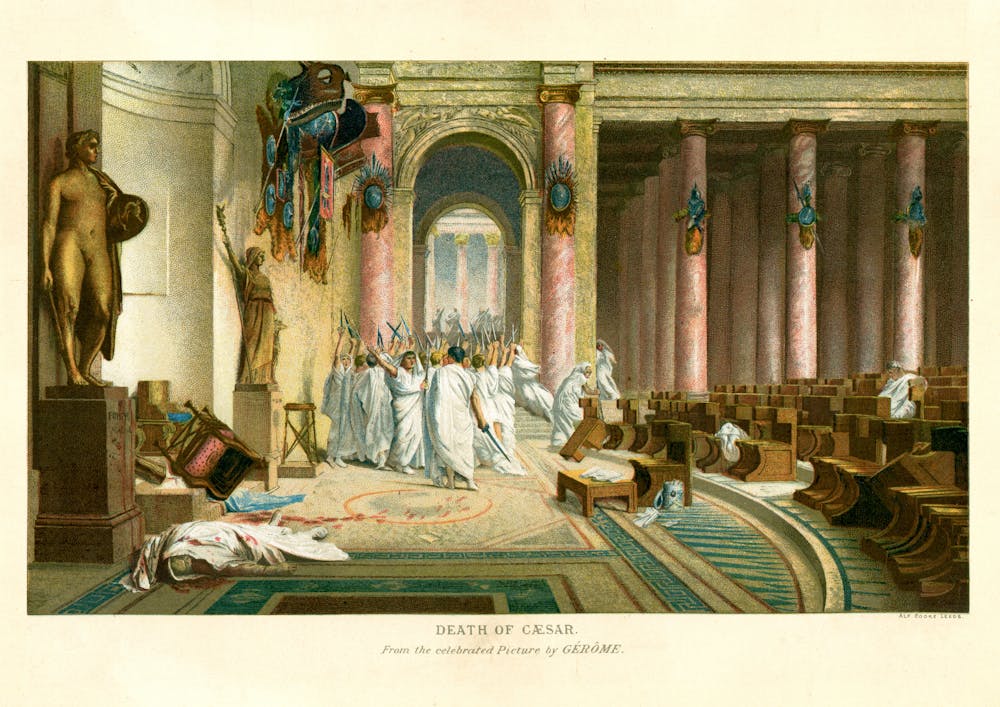
    Soon after, an angry group of 23 senators stabbed him to death in a vain attempt to save the republic. They were led by Marcus Junius Brutus, a descendant of the Brutus who killed the last Roman king, Tarquinius Superbus.

    The Roman republic was beyond saving despite Caesar’s death.
    duncan1890/Getty Images

    However, the Roman republic was beyond saving despite Caesar’s death. His great nephew Octavian eventually emerged as leader and became known as Augustus (27 BCE – 14 CE). With Augustus, an age of emperors was born.

    Emperors were kings in all but name. The strong aversion to kingship in Rome ensured their complete avoidance of the term rex.

    ‘No kings!’

    American protesters waving placards shouting “no kings!” are expressing clear concerns that their beloved democracy is under threat.

    Donald Trump has already declared eight national emergencies and issued 161 executive orders in his second term.

    When asked if he needs to uphold the Constitution, Trump declares “I don’t know.” He has joked about running for a third term as president, in breach of the longstanding limit of two terms.

    Like Caesar, is Donald Trump becoming a king in all but name? Is he setting a precedent for his successors to behave increasingly like emperors?

    The American aversion to “king” likely ensures the term will never return. But when protesters and others shout “no kings!”, they know the very meaning of the term “president” is changing before their eyes.

    Peter Edwell receives funding from the Australian Research Council.

    – ref. ‘No kings!’: like the LA protesters, the early Romans hated kings, too – https://theconversation.com/no-kings-like-the-la-protesters-the-early-romans-hated-kings-too-259011

    MIL OSI Analysis – EveningReport.nz –

    June 16, 2025
  • MIL-Evening Report: Keith Rankin Analysis – Clio: Whose side is ‘History’ on?

    Analysis by Keith Rankin.

    Keith Rankin, trained as an economic historian, is a retired lecturer in Economics and Statistics. He lives in Auckland, New Zealand.

    Is history binary? A judge of past behaviour with just two available options: thumbs-up, or thumbs-down? If you are not on the ‘right side’ of history, are you therefore on the ‘wrong side’?

    Can there be a ‘right side of history’? Given the contexts that we now proclaim to be the right or wrong sides of history, can we presume to evaluate future judgements of our behaviours as ‘history’? And, if we can, is ‘history’ about morals, or momentum; or, prosaically, is she just about facts? Can you (or we) ride history, like a wave? Clio, in Greek mythology, is the muse of history. She is not a straightforward lady.

    Are politicians who support, by word or deed, fascists (or racists or any other obviously nasty ‘ists’) in another country ‘on the wrong side of history’ or could they be ‘riding a historical wave’? I am reminded of the Hitler youth singing ‘Tomorrow Belongs to Me’ in the musical cabaret. In Natacha Butler’s report (Al Jazeera 10 June 2025, Europe’s far-right leaders, hosted by Marine Le Pen, rally in France) she notes “the conviction [by ‘far-right’ protesters] that history is on their side”.

    History as Momentum

    Whoever participates in a social or political movement believes that their movement will become sufficiently consequential for those in the future to believe that the movement affected the course of history. So, the Hitler youth were correct, in the sense that their movement made their tomorrow different to what it would otherwise have been. The Hitler youth, though, were expecting a favourable judgement by ‘us’ in 2025. Clearly, we judge their movement in highly unfavourable terms, while accepting that the world at the end of the twentieth century mighthave been a better world than the world would have been had Adolf Hitler been killed in combat in the Great World War in1918. Problematic, though, is the whole subjective idea of a ‘better world’; better for whom?

    An important example of historicism, or alleged historical momentum, is the writings of Karl Marx. He thought he was writing scientific history, of ‘historical materialism’, and many people believed him; a few still do. Marx fused classical Ricardian economics – the intellectual ancestor of today’s neoliberal macroeconomics – with the philosophical historicism of Georg Hegel. Josef Stalin, and others in his intellectually unaccommodating mould, killed people who spun different (or nuanced) stories of past or future history.

    History as a Judge

    From a judgment perspective, we place much weight on academic historians in the medium-term future to make (for all time) the correct verdict events in the present, immediate past, and immediate future.

    Whether or not Clio is qualified to judge as ‘good’ or ‘bad’ past events, people, or movements, we today can evaluate Clio today – or at least her mortal disciples – on her performance so far.

    Two of many issues we could look into are, first, Winston Churchill and the World War Two bombing campaigns by the ‘Allies’, and our present understanding of the Great Depression of the 1930s.

    Was Neville Chamberlain on the wrong side of history? And Churchill on the right side? (See my Invoking Munich, ‘Appeasement’, and the ‘Lessons of History’, 13 Mar 2025.)

    Churchill, more than most political leaders, features in many separable stories in history. His role in pursuing the Gallipoli campaign in 1915 has generally been awarded a ‘thumbs-down’. Likewise, his role as Chancellor of the Exchequer in 1925, when he decided to fix the British pound to gold at the overvalued pre-war (1914) exchange rate; this decision was one of the key events that led the world into the Great Depression.

    However, most post-war judgement of Churchill has focussed on his role as an opponent of ‘appeasement’ in 1938, and on his role as Great Britain’s leader for the majority of World War Two (though he had been removed as Britain’s leader, in a landslide electoral defeat, by the time the atomic bombs fell on Japan). On the ‘appeasement’ matter, Neville Chamberlain continues to be the epitome of someone ‘on the wrong side of history’, with Churchill on the ‘right side’.

    Churchill had his own personal political agenda in 1938; his lifelong pursuit of the glory of the British Empire. Churchill’s principal strategic interest was to maintain the Mediterranean Sea as ‘Britain’s Lake’; substantially but not only because it represented Britain’s sea passage to India. So many of his actions in World War Two can best be understood in terms of what he was fighting for, not what he was fighting against.

    In 1938, the alternatives to the ‘appeasement’ of Hitler were to abstain in the face of Nazi Germany’s clear-and immediate-threat to East Europe (a part of the non-Mediterranean world that Churchill was not interested in), or to threaten to declare war against Germany knowing that Britain couldn’t act on its threat and thereby risked revealing its weakness. (In the summer of 1939, Britain did reveal its weakness to Josef Stalin, who then relayed that information onto Hitler at the end of August, allowing Hitler to invade Poland in the sure knowledge that Britain had no military capacity to come to Poland’s aid. Chamberlain’s allowing that ‘information leak’ to happen was surely a bigger mistake than his 1938 Munich Accord with Hitler.) And we note that Churchill said that, rather than ‘peace in our time’, there “would be war”.

    Churchill did not claim that any of the alternative choices that Chamberlain faced could or would have prevented war. Unless, that is, Chamberlain had been able to terrify Hitler into not going ahead with his military plans. (Hitler would have been more likely to liken threats by Chamberlain to ‘being mauled by a mouse’; a famous if somewhat forgotten witticism of our own Robert Muldoon, speaking in reference to Opposition leader Bill Rowling.)

    Realistically, Hitler was never going to commit to putting his military toys away. I think that, in light of the alternatives, Chamberlain made the right call in 1938; he hoped that he had restricted Hitler’s military ambitions to the acquisition of territory inhabited by German-speaking people.

    On the matter of the Allied bombing campaign, being willing to commit unspeakable aerial executions upon tens of millions of ‘enemy’ civilians, history has largely been silent; those (over a million) who were actually barbecued by the Allies fell well short of those who Churchill’s ‘scientific adviser’ and onetime ‘best friend’ Friedrich Lindemann would have liked to have ‘dehoused’. (See my Barbecued Hamburgers and Churchill’s Bestie, 17 Apr 2025.) We cannot rely on academic historians to counter decades of myth; in part because we have too few competent historians, and in part because historians hunt in packs and are as liable to fall under the sway of the zeitgeists of their eras as are the rest of humanity’s intellectual communities.

    Despite Churchill’s firebombing efforts, most of which took place in the early months of 1945, it was American bombing specialist Curtis LeMay who became barbecuer-el-supremo. (See my Who Executed 100,000 Civilians in a Single Night?) In 1945, and mainly through his own initiative, he burned more Japanese civilians to death than those who died from the atomic bombs. Was Curtis LeMay on the right side of history? The Japanese ruling class thought so in 1964; LeMay had helped to make the new Japan possible. The Emperor had been saved, as an emperor without an empire. And Japan had been saved from Stalin’s advances, advances that stopped at Korea, Sakhalin, and the Kuril Islands.

    We note that the worst of the Allies’ terror campaign took place towards the end of the war, when the ‘evil’ Axis was in no position to reciprocate. Inherently, such crimes – on the scale that ‘we’ perpetrated them – are asymmetric warfare. Killing your enemies’ civilians seemingly grants your enemies a moral right to kill your civilians. I think that no party who commits those kinds of war crimes can ever be on ‘the right side of history’; though some other people may take more convincing. To compound the criminality of the Allied bombing campaign, it was ineffective, because World War Two was already asymmetric; the main turning points were Hitler’s foolish declaration of war against the United States, and the Battle of Stalingrad in the latter part of 1942. World War Two could have been ended much more quickly with carrot than with stick, by finding suitable ways for the retreating powers to ‘save face’. Truth and reconciliation always trump vengeance. Yet so many horrendous “killings of civilians to [allegedly] save ‘our’ soldiers” remain either on the ‘right side of history’ or concealed from view, obviating the popular requirement to cast judgement.

    The Great Depression was still much in historical memory in the 1970s and 1980s. In the 1930s, Josef Stalin and his comrades believed this was the beginning of the end of the capitalist world; and he executed any economists (eg Nikolai Kondratiev) who suggested otherwise. At the time, a number of progressive western economists (eg Alvin Hansen) to an extent agreed with Stalin.

    However, in the 1970s, a group of extremist ‘Chicago’ economists and economic historians – Milton Friedmanwould lay claim to being both an economist and a historian – successfully committed on the world an intellectual coup-d’etat which would distract the historical community from reality. Friedman’s coupsters scapegoated the United States Federal Reserve Bank (on the basis of a few quite minor ‘mistakes’ in monetary policy in 1929 and 1930). The net result was that the real culprits, the fiscal conservatives, escaped the condemnation of history.

    The Friedmanites, and their ‘intellectual’ descendants, have claimed the ‘right side of history’; claiming victories (without convincing counterfactuals) in the alleged titanic battle between the ‘inflation monster’ and the battlers of the ‘lower middle classes’. These faux historians claimed that small “mistakes” in monetary policy in 2003/04 and 2021/22 have been the predominant causes of the 2008/09 ‘global financial crisis’ and the 2022 to 2024 ‘cost of living’ crisis. When it comes to macroeconomics and macroeconomic policy, this writing of consumable history is about as pathetic (as intellectual history) as the claims of the Holocaust-deniers, or of the people (such as Herr Hitler) who claimed that Germany was ‘stabbed-in-the-back’ by international Jewry in 1918.

    Saying Sayonara to Clio?

    In the meantime, Aotearoa New Zealand’s political leaders – and their public service collaborators – are doing their best to deconstruct Clio, by shredding many many books held at the National Library. (See National Library to dispose of 500,000 books from overseas collection, OneNews, 12 Jun 2015; and Book dealer sickened by plan to destroy half a million books, RNZ 12 Jun 2015.) This purge is being justified as a nationalist purge of books written in another time, and therefore with another perspective, and not written in our little exceptionalist country. And also the possible loss of much of our historical memory, through the lack of support for Aotearoan memory banks such as Te Ara Encyclopaedia of NZ, Dictionary of New Zealand Biography, NZHistory, and Te Akomanga. Jock Phillips, recently retired historian in chief, is disgusted. (see More cuts proposed at Ministry for Culture and Heritage, RNZ, 13 June 2025.)

    Clio is a muse to be loved and cultivated. She gives much, but rarely in simplistic right-wrong terms; and she changes her mind, in response to both new information and new zeitgeists. Whereas Hitler’s Nazis burned the books they didn’t like – and many other books besides – Aotearoa’s fiscal conservatives are looking for a whimper – a tearless shredding – rather than a blaze. And our remaining unshredded public collections, our memories – our abilities to evaluate the rights and the wrongs and the waves of our national and international pasts – stand to depreciate, to wither.

    *******

    Keith Rankin (keith at rankin dot nz), trained as an economic historian, is a retired lecturer in Economics and Statistics. He lives in Auckland, New Zealand.

    MIL OSI Analysis – EveningReport.nz –

    June 16, 2025
  • MIL-Evening Report: Keith Rankin Analysis – Clio: Whose side is ‘History’ on?

    Analysis by Keith Rankin.

    Keith Rankin, trained as an economic historian, is a retired lecturer in Economics and Statistics. He lives in Auckland, New Zealand.

    Is history binary? A judge of past behaviour with just two available options: thumbs-up, or thumbs-down? If you are not on the ‘right side’ of history, are you therefore on the ‘wrong side’?

    Can there be a ‘right side of history’? Given the contexts that we now proclaim to be the right or wrong sides of history, can we presume to evaluate future judgements of our behaviours as ‘history’? And, if we can, is ‘history’ about morals, or momentum; or, prosaically, is she just about facts? Can you (or we) ride history, like a wave? Clio, in Greek mythology, is the muse of history. She is not a straightforward lady.

    Are politicians who support, by word or deed, fascists (or racists or any other obviously nasty ‘ists’) in another country ‘on the wrong side of history’ or could they be ‘riding a historical wave’? I am reminded of the Hitler youth singing ‘Tomorrow Belongs to Me’ in the musical cabaret. In Natacha Butler’s report (Al Jazeera 10 June 2025, Europe’s far-right leaders, hosted by Marine Le Pen, rally in France) she notes “the conviction [by ‘far-right’ protesters] that history is on their side”.

    History as Momentum

    Whoever participates in a social or political movement believes that their movement will become sufficiently consequential for those in the future to believe that the movement affected the course of history. So, the Hitler youth were correct, in the sense that their movement made their tomorrow different to what it would otherwise have been. The Hitler youth, though, were expecting a favourable judgement by ‘us’ in 2025. Clearly, we judge their movement in highly unfavourable terms, while accepting that the world at the end of the twentieth century mighthave been a better world than the world would have been had Adolf Hitler been killed in combat in the Great World War in1918. Problematic, though, is the whole subjective idea of a ‘better world’; better for whom?

    An important example of historicism, or alleged historical momentum, is the writings of Karl Marx. He thought he was writing scientific history, of ‘historical materialism’, and many people believed him; a few still do. Marx fused classical Ricardian economics – the intellectual ancestor of today’s neoliberal macroeconomics – with the philosophical historicism of Georg Hegel. Josef Stalin, and others in his intellectually unaccommodating mould, killed people who spun different (or nuanced) stories of past or future history.

    History as a Judge

    From a judgment perspective, we place much weight on academic historians in the medium-term future to make (for all time) the correct verdict events in the present, immediate past, and immediate future.

    Whether or not Clio is qualified to judge as ‘good’ or ‘bad’ past events, people, or movements, we today can evaluate Clio today – or at least her mortal disciples – on her performance so far.

    Two of many issues we could look into are, first, Winston Churchill and the World War Two bombing campaigns by the ‘Allies’, and our present understanding of the Great Depression of the 1930s.

    Was Neville Chamberlain on the wrong side of history? And Churchill on the right side? (See my Invoking Munich, ‘Appeasement’, and the ‘Lessons of History’, 13 Mar 2025.)

    Churchill, more than most political leaders, features in many separable stories in history. His role in pursuing the Gallipoli campaign in 1915 has generally been awarded a ‘thumbs-down’. Likewise, his role as Chancellor of the Exchequer in 1925, when he decided to fix the British pound to gold at the overvalued pre-war (1914) exchange rate; this decision was one of the key events that led the world into the Great Depression.

    However, most post-war judgement of Churchill has focussed on his role as an opponent of ‘appeasement’ in 1938, and on his role as Great Britain’s leader for the majority of World War Two (though he had been removed as Britain’s leader, in a landslide electoral defeat, by the time the atomic bombs fell on Japan). On the ‘appeasement’ matter, Neville Chamberlain continues to be the epitome of someone ‘on the wrong side of history’, with Churchill on the ‘right side’.

    Churchill had his own personal political agenda in 1938; his lifelong pursuit of the glory of the British Empire. Churchill’s principal strategic interest was to maintain the Mediterranean Sea as ‘Britain’s Lake’; substantially but not only because it represented Britain’s sea passage to India. So many of his actions in World War Two can best be understood in terms of what he was fighting for, not what he was fighting against.

    In 1938, the alternatives to the ‘appeasement’ of Hitler were to abstain in the face of Nazi Germany’s clear-and immediate-threat to East Europe (a part of the non-Mediterranean world that Churchill was not interested in), or to threaten to declare war against Germany knowing that Britain couldn’t act on its threat and thereby risked revealing its weakness. (In the summer of 1939, Britain did reveal its weakness to Josef Stalin, who then relayed that information onto Hitler at the end of August, allowing Hitler to invade Poland in the sure knowledge that Britain had no military capacity to come to Poland’s aid. Chamberlain’s allowing that ‘information leak’ to happen was surely a bigger mistake than his 1938 Munich Accord with Hitler.) And we note that Churchill said that, rather than ‘peace in our time’, there “would be war”.

    Churchill did not claim that any of the alternative choices that Chamberlain faced could or would have prevented war. Unless, that is, Chamberlain had been able to terrify Hitler into not going ahead with his military plans. (Hitler would have been more likely to liken threats by Chamberlain to ‘being mauled by a mouse’; a famous if somewhat forgotten witticism of our own Robert Muldoon, speaking in reference to Opposition leader Bill Rowling.)

    Realistically, Hitler was never going to commit to putting his military toys away. I think that, in light of the alternatives, Chamberlain made the right call in 1938; he hoped that he had restricted Hitler’s military ambitions to the acquisition of territory inhabited by German-speaking people.

    On the matter of the Allied bombing campaign, being willing to commit unspeakable aerial executions upon tens of millions of ‘enemy’ civilians, history has largely been silent; those (over a million) who were actually barbecued by the Allies fell well short of those who Churchill’s ‘scientific adviser’ and onetime ‘best friend’ Friedrich Lindemann would have liked to have ‘dehoused’. (See my Barbecued Hamburgers and Churchill’s Bestie, 17 Apr 2025.) We cannot rely on academic historians to counter decades of myth; in part because we have too few competent historians, and in part because historians hunt in packs and are as liable to fall under the sway of the zeitgeists of their eras as are the rest of humanity’s intellectual communities.

    Despite Churchill’s firebombing efforts, most of which took place in the early months of 1945, it was American bombing specialist Curtis LeMay who became barbecuer-el-supremo. (See my Who Executed 100,000 Civilians in a Single Night?) In 1945, and mainly through his own initiative, he burned more Japanese civilians to death than those who died from the atomic bombs. Was Curtis LeMay on the right side of history? The Japanese ruling class thought so in 1964; LeMay had helped to make the new Japan possible. The Emperor had been saved, as an emperor without an empire. And Japan had been saved from Stalin’s advances, advances that stopped at Korea, Sakhalin, and the Kuril Islands.

    We note that the worst of the Allies’ terror campaign took place towards the end of the war, when the ‘evil’ Axis was in no position to reciprocate. Inherently, such crimes – on the scale that ‘we’ perpetrated them – are asymmetric warfare. Killing your enemies’ civilians seemingly grants your enemies a moral right to kill your civilians. I think that no party who commits those kinds of war crimes can ever be on ‘the right side of history’; though some other people may take more convincing. To compound the criminality of the Allied bombing campaign, it was ineffective, because World War Two was already asymmetric; the main turning points were Hitler’s foolish declaration of war against the United States, and the Battle of Stalingrad in the latter part of 1942. World War Two could have been ended much more quickly with carrot than with stick, by finding suitable ways for the retreating powers to ‘save face’. Truth and reconciliation always trump vengeance. Yet so many horrendous “killings of civilians to [allegedly] save ‘our’ soldiers” remain either on the ‘right side of history’ or concealed from view, obviating the popular requirement to cast judgement.

    The Great Depression was still much in historical memory in the 1970s and 1980s. In the 1930s, Josef Stalin and his comrades believed this was the beginning of the end of the capitalist world; and he executed any economists (eg Nikolai Kondratiev) who suggested otherwise. At the time, a number of progressive western economists (eg Alvin Hansen) to an extent agreed with Stalin.

    However, in the 1970s, a group of extremist ‘Chicago’ economists and economic historians – Milton Friedmanwould lay claim to being both an economist and a historian – successfully committed on the world an intellectual coup-d’etat which would distract the historical community from reality. Friedman’s coupsters scapegoated the United States Federal Reserve Bank (on the basis of a few quite minor ‘mistakes’ in monetary policy in 1929 and 1930). The net result was that the real culprits, the fiscal conservatives, escaped the condemnation of history.

    The Friedmanites, and their ‘intellectual’ descendants, have claimed the ‘right side of history’; claiming victories (without convincing counterfactuals) in the alleged titanic battle between the ‘inflation monster’ and the battlers of the ‘lower middle classes’. These faux historians claimed that small “mistakes” in monetary policy in 2003/04 and 2021/22 have been the predominant causes of the 2008/09 ‘global financial crisis’ and the 2022 to 2024 ‘cost of living’ crisis. When it comes to macroeconomics and macroeconomic policy, this writing of consumable history is about as pathetic (as intellectual history) as the claims of the Holocaust-deniers, or of the people (such as Herr Hitler) who claimed that Germany was ‘stabbed-in-the-back’ by international Jewry in 1918.

    Saying Sayonara to Clio?

    In the meantime, Aotearoa New Zealand’s political leaders – and their public service collaborators – are doing their best to deconstruct Clio, by shredding many many books held at the National Library. (See National Library to dispose of 500,000 books from overseas collection, OneNews, 12 Jun 2015; and Book dealer sickened by plan to destroy half a million books, RNZ 12 Jun 2015.) This purge is being justified as a nationalist purge of books written in another time, and therefore with another perspective, and not written in our little exceptionalist country. And also the possible loss of much of our historical memory, through the lack of support for Aotearoan memory banks such as Te Ara Encyclopaedia of NZ, Dictionary of New Zealand Biography, NZHistory, and Te Akomanga. Jock Phillips, recently retired historian in chief, is disgusted. (see More cuts proposed at Ministry for Culture and Heritage, RNZ, 13 June 2025.)

    Clio is a muse to be loved and cultivated. She gives much, but rarely in simplistic right-wrong terms; and she changes her mind, in response to both new information and new zeitgeists. Whereas Hitler’s Nazis burned the books they didn’t like – and many other books besides – Aotearoa’s fiscal conservatives are looking for a whimper – a tearless shredding – rather than a blaze. And our remaining unshredded public collections, our memories – our abilities to evaluate the rights and the wrongs and the waves of our national and international pasts – stand to depreciate, to wither.

    *******

    Keith Rankin (keith at rankin dot nz), trained as an economic historian, is a retired lecturer in Economics and Statistics. He lives in Auckland, New Zealand.

    MIL OSI Analysis – EveningReport.nz –

    June 16, 2025
  • MIL-OSI Asia-Pac: Sun Dong begins Dutch visit

    Source: Hong Kong Information Services

    Secretary for Innovation, Technology & Industry Prof Sun Dong today met the management of internationally renowned semiconductor company Nexperia as he began his visit to the Netherlands.

    Apart from learning about Nexperia’s latest development directions and technology as well as its businesses in Hong Kong and globally, Prof Sun also explored with the company on its plan of further expansion in Hong Kong.

    Nexperia has businesses around the globe with research and development (R&D) facilities established in the Hong Kong Science Park.

    On Saturday, Prof Sun visited the showroom of Renault Group in Paris, France, and met the group’s management who gave him a briefing on the latest development and planning of the group and its brands as well as its various innovative businesses. Both sides also explored ways to deepen collaboration.

    BeyonCa, a premium electric vehicle enterprise backed by France’s Renault Group and China’s Dongfeng Motor Corporation, was established in Hong Kong in 2021 with its international headquarters being set up at the Hong Kong Science Park.

    Prof Sun pointed out that the Hong Kong Special Administrative Region Government has clearly stated in the Hong Kong Innovation & Technology Development Blueprint that the development of advanced manufacturing and new energy are one of the strategic technology industries.

    He highlighted that the Hong Kong Microelectronics Research & Development Institute, established in September last year, is preparing the set-up of two pilot lines at the Microelectronics Centre this year, striving to put them into operation next year to support product development and trial production.          

    MIL OSI Asia Pacific News –

    June 16, 2025
  • MIL-OSI Asia-Pac: SITI commences visit to Netherlands (with photos)

    Source: Hong Kong Government special administrative region

    ​The Secretary for Innovation, Technology and Industry, Professor Sun Dong, began his visit to the Netherlands today (June 15, Amsterdam time).
     
    Professor Sun met with the management of an internationally renowned semiconductor company Nexperia to learn about its latest development directions and technology, as well as its businesses in Hong Kong and globally. He also explored with the company on its plan of further expansion in Hong Kong. Nexperia has businesses around the globe with research and development (R&D) facilities established in the Hong Kong Science Park.
     
    Professor Sun visited the showroom of Renault Group in Paris, France and met with the group’s management yesterday (June 14, Paris time). BeyonCa, a premium electric vehicle enterprise backed by France’s Renault Group and China’s Dongfeng Motor Corporation, was established in Hong Kong in 2021 with its international headquarters being set up at the Hong Kong Science Park. Professor Sun was briefed on the latest development and planning of the group and its brands as well as its various innovative businesses. Both sides also explored ways to deepen collaboration.

    Professor Sun said, “The Hong Kong Special Administrative Region Government has clearly stated in the Hong Kong Innovation and Technology Development Blueprint that the development of advanced manufacturing and new energy are one of the strategic technology industries, and is actively enhancing support for strategic industries such as new energy vehicles and semiconductor technology, so as to promote new industrialisation in Hong Kong. In promoting microelectronics R&D, the Hong Kong Microelectronics Research and Development Institute was established in September last year to spearhead collaboration among universities, R&D centres and the industry on the R&D of third generation semiconductor core technology. The institute leverages the Greater Bay Area’s well-developed manufacturing industry chain and enormous market, and promotes the ‘1 to N’ transformation of R&D outcomes and industry development. It is preparing the set-up of two pilot lines at the Microelectronics Centre this year, striving to put them into operation next year to support product development and trial production.”
     
    During his stay in Paris, Professor Sun was interviewed by local media to introduce the latest situation and opportunities of Hong Kong’s I&T, telling the good I&T story of Hong Kong.
     
    Professor Sun will depart for The Hague this evening to continue his visit to the Netherlands.


    MIL OSI Asia Pacific News –

    June 16, 2025
  • MIL-OSI Africa: SA completes actions to exit greylist

    Source: South Africa News Agency

    The Financial Action Task Force (FATF) has confirmed that South Africa has substantially completed all 22 recommended action items outlined in the Action Plan adopted when the country was placed on the organisation’s grey list in February 2023.

    South Africa was placed on the FATF grey list due to deficiencies in its anti-money laundering and counter-terrorism financing (AML/CFT) regime.

    During its plenary session held in Strasbourg, France, the FATF made the initial determination that South Africa has substantially completed its action plan and warrants an on-site assessment. The on-site assessment will be to verify that the implementation of AML/CFT reforms has begun and is being sustained, and that the necessary political commitment remains in place to sustain implementation in the future. 

    According to the National Treasury, the completion of the Action Plan paves the way for the final step before the FATF can delist South Africa, which is an on-site visit to South Africa by the FATF Africa Joint Group (JG).

    A statement by FATF on (Jurisdictions under Increased Monitoring – 13 June 2025) noted that South Africa has undertaken a range of key reforms, including demonstrating a sustained increase in investigations and prosecutions of serious and complex money laundering and the full range of [terror financing] TF activities in line with its risk profile; and updating its TF Risk Assessment to inform the implementation of a comprehensive national counter financing of terrorism strategy.

    The National Treasury emphasised that the improvements to South Africa’s AML/CFT regime are particularly important for South Africa, given the legacy of state capture, one element of which was that law enforcement and prosecuting institutions were deliberately weakened. 

    “Improvements in these domains are critical not just for getting off the greylist, but for strengthening the fight against crime and corruption, and for contributing to the integrity of the South African financial system. Exiting the FATF greylist is a significant step forward as South Africa continues to improve and strengthen its supervisory and criminal justice systems,” National Treasury said on Friday.

    The on-site visit will take place before the next FATF Plenary, and, if the outcome of the visit is positive, the FATF will delist South Africa from the greylist at its next Plenary in October 2025. Preparations for the on-site visit have commenced.

    During this visit, the JG will confirm the country’s ongoing commitment in the implementation of the country’s fight against money laundering, terror financing and other financial crimes.

    “National Treasury commends the efforts and commitment of the law enforcement entities, especially the Directorate for Priority Crime Investigation (DPCI) of the South African Police Service, the State Security Agency, and the National Prosecuting Authority (NPA), for the sustained increase in investigations and prosecutions of serious and complex money laundering and terror financing activities. 

    “This made it possible for South Africa to secure the upgrades of the last two remaining action items, often considered to be the most difficult, in the current reporting cycle,” National Treasury said.

    South Africa also commended Mali and Tanzania, who were delisted from greylisting by the FATF Plenary. 

    “We also congratulate Nigeria, Mozambique and Burkina Faso, who like South Africa, were deemed to have substantially completed their action plans, and for whom on-site assessments were also approved.

    “National Treasury pays tribute to the late Advocate Rodney de Kock of the NPA, who played a leading role in preparing the groundwork for South Africa to address the action items, but sadly passed away in January 2025.” 

    The South African Reserve Bank (SARC) has welcomed the confirmation by the Financial Action Task Force’s (FATF) that South Africa has completed all 22 of its action items.

    “This is a significant step forward – but not the time for complacency,” the SARB said on Saturday.-SAnews.gov.za

    MIL OSI Africa –

    June 16, 2025
  • MIL-Evening Report: Why Israel’s shock and awe has proven its power but lost the war

    COMMENTARY: By Antony Loewenstein

    War is good for business and geopolitical posturing.

    Before Israeli Prime Minister Benjamin Netanyahu arrived in Washington in early February for his first visit to the US following President Donald Trump’s inauguration, he issued a bold statement on the strategic position of Israel.

    “The decisions we made in the war [since 7 October 2023] have already changed the face of the Middle East,” he said.

    “Our decisions and the courage of our soldiers have redrawn the map. But I believe that working closely with President Trump, we can redraw it even further.”

    How should this redrawn map be assessed?

    Hamas is bloodied but undefeated in Gaza. The territory lies in ruins, leaving its remaining population with barely any resources to rebuild. Death and starvation stalk everyone.

    Hezbollah in Lebanon has suffered military defeats, been infiltrated by Israeli intelligence, and now faces few viable options for projecting power in the near future. Political elites speak of disarming Hezbollah, though whether this is realistic is another question.

    Morocco, Bahrain and the UAE accounted for 12 percent of Israel’s record $14.8bn in arms sales in 2024 — up from just 3 percent the year before

    In Yemen, the Houthis continue to attack Israel, but pose no existential threat.

    Meanwhile, since the overthrow of dictator Bashar al-Assad in late 2024, Israel has attacked and threatened Syria, while the new government in Damascus is flirting with Israel in a possible bid for “normalisation“.

    The Gulf states remain friendly with Israel, and little has changed in the last 20 months to alter this relationship.

    According to Israel’s newly released arms sales figures for 2024, which reached a record $14.8bn, Morocco, Bahrain and the United Arab Emirates accounted for 12 percent of total weapons sales — up from just 3 percent in 2023.

    It is conceivable that Saudi Arabia will be coerced into signing a deal with Israel in the coming years, in exchange for arms and nuclear technology for the dictatorial kingdom.

    An Israeli and US-assisted war against Iran began on Friday.

    In the West Bank, Israel’s annexation plans are surging ahead with little more than weak European statements of concern. Israel’s plans for Greater Israel — vastly expanding its territorial reach — are well underway in Syria, Lebanon and beyond.

    Shifting alliances
    On paper, Israel appears to be riding high, boasting military victories and vanquished enemies. And yet, many Israelis and pro-war Jews in the diaspora do not feel confident or buoyed by success.

    Instead, there is an air of defeatism and insecurity, stemming from the belief that the war for Western public opinion has been lost — a sentiment reinforced by daily images of Israel’s campaign of deliberate mass destruction across the Gaza Strip.

    What Israel craves and desperately needs is not simply military prowess, but legitimacy in the public domain. And this is sorely lacking across virtually every demographic worldwide.

    It is why Israel is spending at least $150 million this year alone on “public diplomacy”.

    Get ready for an army of influencers, wined and dined in Tel Aviv’s restaurants and bars, to sell the virtues of Israeli democracy. Even pro-Israel journalists are beginning to question how this money is being spent, wishing Israeli PR were more responsive and effective.

    Today, Israeli Jews proudly back ethnic cleansing and genocide in Gaza in astoundingly high numbers. This reflects a Jewish supremacist mindset that is being fed a daily diet of extremist rhetoric in mainstream media.

    There is arguably no other Western country with such a high proportion of racist, genocidal mania permeating public discourse.

    According to a recent poll of Western European populations, Israel is viewed unfavourably in Germany, Denmark, France, Italy and Spain.

    Very few in these countries support Israeli actions. Only between 13 and 21 percent hold a positive view of Israel, compared to 63-70 percent who do not.

    The US-backed Pew Research Centre also released a global survey asking people in 24 countries about their views on Israel and Palestine. In 20 of the 24 nations, at least half of adults expressed a negative opinion of the Jewish state.

    A deeper reckoning
    Beyond Israel’s image problems lies a deeper question: can it ever expect full acceptance in the Middle East?

    Apart from kings, monarchs and elites from Dubai to Riyadh and Manama to Rabat, Israel’s vicious and genocidal actions since 7 October 2023 have rendered “normalisation” impossible with a state intent on building a Jewish theocracy that subjugates millions of Arabs indefinitely.

    While it is true that most states in the region are undemocratic, with gross human rights abuses a daily reality, Israel has long claimed to be different — “the only democracy in the Middle East”.

    But Israel’s entire political system, built with massive Western support and grounded in an unsustainable racial hierarchy, precludes it from ever being fully and formally integrated into the region.

    The American journalist Murtaza Hussain, writing for the US outlet Drop Site News, recently published a perceptive essay on this very subject.

    He argues that Israeli actions have been so vile and historically grave — comparable to other modern holocausts — that they cannot be forgotten or excused, especially as they are publicly carried out with the explicit goal of ethnically cleansing Palestine:

    “This genocide has been a political and cultural turning point beyond which we cannot continue as before. I express that with resignation rather than satisfaction, as it means that many generations of suffering are ahead on all sides.

    “Ultimately, the goal of Israel’s opponents must not be to replicate its crimes in Gaza and the West Bank, nor to indulge in nihilistic hatred for its own sake.

    “People in the region and beyond should work to build connections with those Israelis who are committed opponents of their regime, and who are ready to cooperate in the generational task of building a new political architecture.”

    The issue is not just Netanyahu and his government. All his likely successors hold similarly hardline views on Palestinian rights and self-determination.

    The monumental task ahead lies in crafting an alternative to today’s toxic Jewish theocracy.

    But this rebuilding must also take place in the West. Far too many Jews, conservatives and evangelical Christians continue to cling to the fantasy of eradicating, silencing or expelling Arabs from their land entirely.

    Pushing back against this fascism is one of the most urgent generational tasks of our time.

    Antony Loewenstein is an Australian/German independent, freelance, award-winning, investigative journalist, best-selling author and film-maker. In 2025, he released an award-winning documentary series on Al Jazeera English, The Palestine Laboratory, adapted from his global best-selling book of the same name. It won a major prize at the prestigious Telly Awards. This article is republished from Middle East Eye with permission.

    MIL OSI Analysis – EveningReport.nz –

    June 15, 2025
  • MIL-Evening Report: Why Israel’s shock and awe has proven its power but lost the war

    COMMENTARY: By Antony Loewenstein

    War is good for business and geopolitical posturing.

    Before Israeli Prime Minister Benjamin Netanyahu arrived in Washington in early February for his first visit to the US following President Donald Trump’s inauguration, he issued a bold statement on the strategic position of Israel.

    “The decisions we made in the war [since 7 October 2023] have already changed the face of the Middle East,” he said.

    “Our decisions and the courage of our soldiers have redrawn the map. But I believe that working closely with President Trump, we can redraw it even further.”

    How should this redrawn map be assessed?

    Hamas is bloodied but undefeated in Gaza. The territory lies in ruins, leaving its remaining population with barely any resources to rebuild. Death and starvation stalk everyone.

    Hezbollah in Lebanon has suffered military defeats, been infiltrated by Israeli intelligence, and now faces few viable options for projecting power in the near future. Political elites speak of disarming Hezbollah, though whether this is realistic is another question.

    Morocco, Bahrain and the UAE accounted for 12 percent of Israel’s record $14.8bn in arms sales in 2024 — up from just 3 percent the year before

    In Yemen, the Houthis continue to attack Israel, but pose no existential threat.

    Meanwhile, since the overthrow of dictator Bashar al-Assad in late 2024, Israel has attacked and threatened Syria, while the new government in Damascus is flirting with Israel in a possible bid for “normalisation“.

    The Gulf states remain friendly with Israel, and little has changed in the last 20 months to alter this relationship.

    According to Israel’s newly released arms sales figures for 2024, which reached a record $14.8bn, Morocco, Bahrain and the United Arab Emirates accounted for 12 percent of total weapons sales — up from just 3 percent in 2023.

    It is conceivable that Saudi Arabia will be coerced into signing a deal with Israel in the coming years, in exchange for arms and nuclear technology for the dictatorial kingdom.

    An Israeli and US-assisted war against Iran began on Friday.

    In the West Bank, Israel’s annexation plans are surging ahead with little more than weak European statements of concern. Israel’s plans for Greater Israel — vastly expanding its territorial reach — are well underway in Syria, Lebanon and beyond.

    Shifting alliances
    On paper, Israel appears to be riding high, boasting military victories and vanquished enemies. And yet, many Israelis and pro-war Jews in the diaspora do not feel confident or buoyed by success.

    Instead, there is an air of defeatism and insecurity, stemming from the belief that the war for Western public opinion has been lost — a sentiment reinforced by daily images of Israel’s campaign of deliberate mass destruction across the Gaza Strip.

    What Israel craves and desperately needs is not simply military prowess, but legitimacy in the public domain. And this is sorely lacking across virtually every demographic worldwide.

    It is why Israel is spending at least $150 million this year alone on “public diplomacy”.

    Get ready for an army of influencers, wined and dined in Tel Aviv’s restaurants and bars, to sell the virtues of Israeli democracy. Even pro-Israel journalists are beginning to question how this money is being spent, wishing Israeli PR were more responsive and effective.

    Today, Israeli Jews proudly back ethnic cleansing and genocide in Gaza in astoundingly high numbers. This reflects a Jewish supremacist mindset that is being fed a daily diet of extremist rhetoric in mainstream media.

    There is arguably no other Western country with such a high proportion of racist, genocidal mania permeating public discourse.

    According to a recent poll of Western European populations, Israel is viewed unfavourably in Germany, Denmark, France, Italy and Spain.

    Very few in these countries support Israeli actions. Only between 13 and 21 percent hold a positive view of Israel, compared to 63-70 percent who do not.

    The US-backed Pew Research Centre also released a global survey asking people in 24 countries about their views on Israel and Palestine. In 20 of the 24 nations, at least half of adults expressed a negative opinion of the Jewish state.

    A deeper reckoning
    Beyond Israel’s image problems lies a deeper question: can it ever expect full acceptance in the Middle East?

    Apart from kings, monarchs and elites from Dubai to Riyadh and Manama to Rabat, Israel’s vicious and genocidal actions since 7 October 2023 have rendered “normalisation” impossible with a state intent on building a Jewish theocracy that subjugates millions of Arabs indefinitely.

    While it is true that most states in the region are undemocratic, with gross human rights abuses a daily reality, Israel has long claimed to be different — “the only democracy in the Middle East”.

    But Israel’s entire political system, built with massive Western support and grounded in an unsustainable racial hierarchy, precludes it from ever being fully and formally integrated into the region.

    The American journalist Murtaza Hussain, writing for the US outlet Drop Site News, recently published a perceptive essay on this very subject.

    He argues that Israeli actions have been so vile and historically grave — comparable to other modern holocausts — that they cannot be forgotten or excused, especially as they are publicly carried out with the explicit goal of ethnically cleansing Palestine:

    “This genocide has been a political and cultural turning point beyond which we cannot continue as before. I express that with resignation rather than satisfaction, as it means that many generations of suffering are ahead on all sides.

    “Ultimately, the goal of Israel’s opponents must not be to replicate its crimes in Gaza and the West Bank, nor to indulge in nihilistic hatred for its own sake.

    “People in the region and beyond should work to build connections with those Israelis who are committed opponents of their regime, and who are ready to cooperate in the generational task of building a new political architecture.”

    The issue is not just Netanyahu and his government. All his likely successors hold similarly hardline views on Palestinian rights and self-determination.

    The monumental task ahead lies in crafting an alternative to today’s toxic Jewish theocracy.

    But this rebuilding must also take place in the West. Far too many Jews, conservatives and evangelical Christians continue to cling to the fantasy of eradicating, silencing or expelling Arabs from their land entirely.

    Pushing back against this fascism is one of the most urgent generational tasks of our time.

    Antony Loewenstein is an Australian/German independent, freelance, award-winning, investigative journalist, best-selling author and film-maker. In 2025, he released an award-winning documentary series on Al Jazeera English, The Palestine Laboratory, adapted from his global best-selling book of the same name. It won a major prize at the prestigious Telly Awards. This article is republished from Middle East Eye with permission.

    MIL OSI Analysis – EveningReport.nz –

    June 15, 2025
  • Germany, France, UK offer Iran talks over nuclear programme: Berlin

    Source: Government of India

    Source: Government of India (4)

    Germany, France and Britain are ready to hold immediate talks with Iran over Tehran’s nuclear programme in a bid to de-escalate the situation in the Middle East, German Foreign Minister Johann Wadephul said.

    Wadephul, who is on a visit to the Middle East, said he was trying to contribute towards a de-escalation of the conflict between Israel and Iran, and noted Tehran had previously failed to take the opportunity to enter into constructive talks.

    “I hope that’s still possible,” Wadephul told German public broadcaster ARD late on Saturday. “Germany, together with France and Britain are ready. We’re offering Iran immediate negotiations about the nuclear programme, I hope (the offer) is accepted.”

    “This is also a key prerequisite for reaching a pacification of this conflict, that Iran presents no danger to the region, for the state of Israel or to Europe.”

    (Reuters)

    June 15, 2025
  • Jannik Sinner seeks to put disappointment of French Open defeat behind him

    Source: Government of India

    Source: Government of India (4)

    World number one Jannik Sinner wants to use the Halle Open as a chance to bounce back from sleepless nights after his agonising loss to rival Carlos Alcaraz in the French Open final this month.

    In a thrilling showdown, Sinner took the first two sets and had three match points in the fourth set, but Spaniard Alcaraz persevered to grind out a 4-6 6-7(4) 6-4 7-6(3) 7-6(10-2) win in five hours and 29 minutes – the longest final at Roland Garros.

    Asked if he had thought about the championship points he failed to convert, Sinner told reporters on Saturday: “Often. It happens. I don’t know how it will look in the future.

    “I think that it is not the most important thing, but I nevertheless try to forget the negative things and see what I can do here” in Halle.

    “I think that for me to play another tournament is positive, because every match is a new beginning, and I must be mentally ready to give my all on the court. Therefore, it is great I can be here in Halle. Yes, I had already a few sleepless nights, but I think every day it gets better.”

    The 23-year-old Italian is the reigning champion at Halle and will seek to defend his crown at the tournament, which starts on Monday, as he gears up for Wimbledon, which will be held from June 30 to July 13 at the All England Lawn Tennis Club.

    “The first practice session was OK. I hadn’t played since Paris, so my general feelings on the court were not so perfect,” Sinner said.

    “I think a good grass-court player can move well. The ball can bounce a bit funny because of the grass, and you have to serve intelligently.

    “But in general, it is a surface on which I took a step forward last year and we will see how it goes this year.”

    (Reuters)

    June 15, 2025
  • MIL-OSI Asia-Pac: SITI attends Viva Technology 2025 in Paris, France (with photos)

    Source: Hong Kong Government special administrative region

    The Secretary for Innovation, Technology and Industry, Professor Sun Dong, attended Viva Technology 2025 (VivaTech) in Paris, France, yesterday (June 13, Paris time). In his keynote speech at a seminar and networking reception themed “From Hong Kong to the World: Embarking on the New Journey of Innovation” organised by the Hong Kong Trade Development Council (HKTDC), Professor Sun said Hong Kong is forging ahead with a clear vision to develop as an international innovation and technology (I&T) centre, and is committed to pushing boundaries, embracing change, and seizing global opportunities.

    Professor Sun said the Hong Kong Special Administrative Region (HKSAR) Government has been introducing agile policies, building world-class infrastructure and facilitating global I&T collaboration. He noted the flagship research and development (R&D) initiative, InnoHK, fosters global R&D collaboration. Hong Kong is also carrying out meticulous planning for building artificial intelligence (AI) ecosystem, including AI Supercomputing Centre opened last year and the Hong Kong AI Research and Development Institute to be established, together with $10 billion dollars-worth Innovation and Technology Industry-Oriented Fund channeling more market capital to turbocharge strategic industries, with AI at the core.

    Highlighting that Hong Kong being an ideal gateway for global enterprises to enter the Mainland market, Professor Sun said the HKSAR Government has been actively attracting overseas and the Mainland I&T enterprises to set up or expand their businesses in Hong Kong. Companies choosing HK for the international headquarters exemplify Hong Kong’s important role as a “super connector” and a “super value-adder” between Mainland China and the rest of the world, serving as a two-way springboard for attracting overseas enterprises and helping Mainland enterprises to “go global”.

    During the seminar and networking reception, Professor Sun also exchanged views with members of the local I&T sector, investors and start-ups’ founders on I&T development and collaboration.

    Professor Sun also visited the Hong Kong Tech Pavilion. Twenty start-ups from the Hong Kong Science and Technology Parks Corporation and Cyberport participated this year, showcasing cutting-edge solutions and innovations in areas of AI, robotics, HealthTech, sustainable and ClimateTech, and Fintech. At the same time, Professor Sun toured the Canada Pavilion set up by Canada which was selected as country of the year for VivaTech 2025, the China Pavilion and pavilions set up by other leading enterprises and start-ups where he had a brief exchange with representatives of the participating organisations to learn more on their innovative solutions.

    In the evening, Professor Sun met with Mr Emmanuel Carcassonne, the Chairman of La French Tech Hong Kong-Shenzhen, a community dedicated to supporting the development of the French startup ecosystem both in France and internationally. Professor Sun said that Hong Kong is a reliable partner for French startups to settle and expand businesses in Hong Kong.

    In the afternoon, Professor Sun paid a courtesy call on Minister Counsellor of the Chinese Embassy in France Mr Chen Li, to brief him on the work of developing Hong Kong into an international I&T centre, enhancing the I&T ecosystem, fostering co-ordinated development among upstream, midstream and downstream, as well as the city’s continuous efforts in integrating into national I&T development.

    Professor Sun will continue his visit to Paris today (June 14, Paris time) and depart for the Netherlands on June 15 (Amsterdam time).


    MIL OSI Asia Pacific News –

    June 15, 2025
  • MIL-OSI Russia: International peacekeeping exercises “In Search of Khaan-2025” have begun in Mongolia

    Translation. Region: Russian Federal

    Source: People’s Republic of China in Russian –

    Source: People’s Republic of China – State Council News

    ULAN BATOR, June 14 (Xinhua) — The international peacekeeping exercise “Searching for Khaan-2025” kicked off in Mongolia on Saturday at the training center of the Mongolian Armed Forces, 60 km from the capital Ulan Bator.

    At the opening ceremony, Deputy Chairman of the State Great Khural (parliament) of Mongolia Bukhchuluuny Purevdorj noted that the exercises serve as an important bridge for deepening international cooperation in peacekeeping operations and strengthening mutual trust and understanding between countries.

    “The scale, inclusiveness, content and programme of these multinational peacekeeping exercises continue to expand year on year, reflecting a commitment to tangible actions that contribute to global peace and security,” he added.

    A total of 1,200 peacekeepers from 24 countries, including Mongolia, China, Australia, Canada, Egypt, France, Germany, India, Japan and the United States, are taking part in 22 peacekeeping exercises organized by the Mongolian Armed Forces.

    The exercise, which will last until June 28, will cover command and staff and field activities.

    The exercises “In Search of Khaan” have been conducted since 2003 by the General Staff of the Armed Forces of Mongolia jointly with the US Pacific Fleet Command and the UN Peace Support Fund. Since 2006, the peacekeeping maneuvers have evolved into large-scale international peacekeeping exercises. –0–

    MIL OSI Russia News –

    June 15, 2025
  • MIL-OSI China: China launches satellite for natural disaster monitoring

    Source: People’s Republic of China – State Council News

    JIUQUAN, June 14 — China launched an electromagnetic monitoring satellite on Saturday, which is expected to enhance the country’s “space-air-ground” integrated monitoring capabilities for major natural disasters.

    A Long March-2D carrier rocket lifted off from the Jiuquan Satellite Launch Center in northwest China at 3:56 p.m. (Beijing Time), successfully sending the Zhangheng 1-02 satellite into its planned orbit, according to the China National Space Administration (CNSA).

    The CNSA said that this marks a significant step forward for China in the field of space-based observation of the Earth’s physical fields.

    Named after the ancient Chinese inventor Zhang Heng, who created the world’s first seismoscope over 1,800 years ago, the satellite was jointly developed by China and Italy. It is the first operational satellite dedicated to exploring the Earth’s physical fields under China’s medium and long-term civil space infrastructure development plan, according to the CNSA.

    With a designed lifespan of six years, the satellite is equipped with nine payloads, including an electric field detector co-developed by China and Italy, as well as a high-energy particle detector developed by Italy.

    It will carry out quasi-real-time monitoring of global electromagnetic fields, electromagnetic waves, the ionosphere and the neutral atmosphere, detecting electromagnetic anomalies caused by geological and human activities, as well as monitoring thunderstorm and lightning activity, according to CNSA.

    “Scientists will use these data to study the correlation between changes in the Earth’s physical fields and geological activities, and to support research on the prediction of earthquakes, tsunamis, volcanic eruptions, extreme weather, and space weather disasters,” said Peng Wei, deputy director of the system engineering department of the CNSA.

    The satellite will significantly enhance China’s early perception, risk assessment, and monitoring and early warning capabilities for major natural disasters, Peng added.

    It will also provide data support for emergency management, resource mapping, and communications and navigation industries, while fostering scientific and technological cooperation in related fields among countries and regions along the Belt and Road.

    The Zhangheng 1-01 satellite, launched in 2018, remains in normal operation, while the new satellite has richer physical measurements. Working in tandem, the two satellites will conduct collaborative observations, effectively improving the horizontal spatial and temporal resolution of observations, according to Peng.

    China and Italy have further deepened practical cooperation in satellite payload development, data sharing, and scientific research, said Peng.

    “The successful launch of this satellite marks another milestone in Sino-Italian aerospace collaboration, demonstrating closer scientific cooperation and exchanges between the two sides. It will also contribute to the well-being of the human community with a shared future,” he added.

    Francesco Longo, deputy director of engineering and technology of the Italian Space Agency, called the mission an important milestone. “We have a lot of expectations on the results that we acquire from this important Chinese-Italian mission.”

    He noted that, like China, Italy is a beautiful yet fragile country, prone to volcanoes, earthquakes and other events that can affect people’s lives. This mission, he said, will contribute to protecting and improving lives impacted by natural disasters.

    Longo also noted that adding this new satellite to the first, and eventually building a constellation, will double observation time, significantly boosting scientific prospects.

    The Italian team named the project Limadou, the pinyin transliteration of the Chinese name for the 16th-century Italian priest Matteo Ricci, in honor of his pivotal contributions to cultural exchanges between the East and the West.

    Both Marco Polo and Matteo Ricci served as bridges between Italian and Chinese cultures, and space, too, has the potential to unite all countries, Longo said.

    Saturday’s launch marked the 581st mission of China’s Long March rocket series.

    MIL OSI China News –

    June 15, 2025
  • MIL-OSI Asia-Pac: Sun Dong begins Paris visit

    Source: Hong Kong Information Services

    Secretary for Innovation, Technology & Industry Prof Sun Dong attended Viva Technology 2025 in Paris, France, on Friday where he toured the Hong Kong Tech Pavilion and gave a keynote speech at a seminar and networking reception.

    In his keynote speech, Prof Sun said that the Hong Kong Special Administrative Region Government has been introducing agile policies, building world-class infrastructure and facilitating global I&T collaboration.

    In addition to noting that the flagship research and development (R&D) initiative, InnoHK, fosters global R&D collaboration, he underscored that Hong Kong is also carrying out meticulous planning for building an artificial intelligence (AI) ecosystem, such as the Hong Kong AI Research & Development Institute to be established.

    While highlighting that Hong Kong is an ideal gateway for global enterprises to enter the Mainland market, Prof Sun said that companies choosing Hong Kong for their international headquarters exemplifies the city’s important role as a “super connector” and a “super value-adder” between Mainland China and the rest of the world, serving as a two-way springboard for attracting overseas enterprises and helping Mainland enterprises to go global.

    During the seminar and networking reception organised by the Hong Kong Trade Development Council, Prof Sun exchanged views with members of the local innovation and technology (I&T) sector, investors and startups’ founders, on I&T development and collaboration.

    Prof Sun also visited the Hong Kong Tech Pavilion, comprising 20 startups from the Hong Kong Science & Technology Parks Corporation and Cyberport to showcase cutting-edge solutions and innovations in areas of AI, robotics, HealthTech, sustainable and ClimateTech, and Fintech.

    Additionally, Prof Sun toured the pavilion set up by Canada, which was selected as country of the year for VivaTech 2025, the China Pavilion and the pavilions of other leading enterprises and startups to learn more about the innovative solutions of the participating organisations.

    In the evening, while Prof Sun met La French Tech Hong Kong-Shenzhen Chairman Emmanuel Carcassonne, he stressed that Hong Kong is a reliable partner for French startups to settle and expand businesses in Hong Kong.

    He described La French Tech Hong Kong-Shenzhen as a community dedicated to supporting the development of the French startup ecosystem both in France and internationally.

    On Friday afternoon, Prof Sun paid a courtesy call on Minister Counsellor of the Chinese Embassy in France Chen Li to brief him on the work of developing Hong Kong into an international I&T centre as well as the city’s ongoing efforts in integrating into national I&T development.

    MIL OSI Asia Pacific News –

    June 14, 2025
  • MIL-OSI China: Pilot programs to see speedy rollouts

    Source: People’s Republic of China – State Council News

    China will expedite pilot programs to further open up its services sector in key areas such as cloud computing, biotechnology and wholly foreign-owned hospitals, as part of broader efforts to create a more favorable environment for foreign investment, said a senior commerce official on Friday.

    Li Yongjie, deputy China international trade representative at the Ministry of Commerce, said the ministry will work with relevant government branches to gradually expand opening-up in more service areas and revise China’s Catalog of Encouraged Industries for Foreign Investment.

    Speaking at a news conference in Beijing, Li said the updated catalog will include more opportunities in strategic emerging sectors.

    The government is studying new policy measures to encourage reinvestment by foreign companies and will ensure that foreign-invested firms can participate on an equal footing in government procurement, as well as in nationwide programs such as large-scale equipment upgrades and the trade-in of consumer goods initiative, she added.

    To encourage more global businesses to invest in China, the sixth Qingdao Multinationals Summit will be convened from June 18 to 20 in Qingdao, East China’s Shandong province. A total of 557 guests, including executives of multinational corporations, heads of international organizations and government officials, will attend the event.

    In addition to traditional markets such as Japan, South Korea, Singapore, the United States, Germany and France, this year’s summit has seen increased participation from emerging markets, including member states of the Association of Southeast Asian Nations, and countries from the Middle East and Africa, said Wang Lei, director of Shandong’s provincial department of commerce.

    “For the first time, companies from nine countries, such as Vietnam and Egypt, will attend the event,” she said.

    A delegation of 35 representatives from 22 multinational companies based in the Middle East will also participate in the summit, seeking new cooperation opportunities in areas such as fund investment, new energy, modern agriculture and seawater desalination, Wang said.

    Gao Lingyun, a researcher at the Chinese Academy of Social Sciences in Beijing, said global firms see China as a key pillar in their long-term growth strategies amid growing geopolitical and economic uncertainties.

    An increasing number of global companies are recalibrating their strategies to capitalize on new opportunities driven by China’s consumption upgrade, digital transformation and green development efforts, said Gao.

    That sentiment aligns with the latest data.

    China’s actual use of foreign direct investment in high-tech industries reached 96.71 billion yuan ($13.47 billion) in the first four months of 2025, data from the Ministry of Commerce showed.

    In the meantime, FDI in e-commerce services surged 137 percent year-on-year, while investment in aerospace equipment manufacturing rose 86.2 percent on a yearly basis.

    Malaysia’s state-owned energy group Petronas said it will further expand its presence in the country, as it views China as a key strategic market in its global growth plans.

    Shamsairi Ibrahim, vice-president of Petronas’ LNG marketing and trading, gas and maritime business, said Petronas will accelerate the expansion of its global liquefied natural gas (LNG) portfolio to support China’s growing energy needs, as the nation deepens efforts to shift toward cleaner fuels and strengthen energy security.

    Ibrahim said that Petronas will also advance marine LNG solutions such as bunkering services and the expansion of its LNG fleet.

    Four of Petronas’ new LNG carriers are now being built at Hudong-Zhonghua Shipbuilding (Group) Co Ltd, a major shipyard based in Shanghai, he added.

    Xu Daquan, president of China unit at German industrial conglomerate Bosch Group, said China is becoming a major innovation hub for Bosch and many of its latest innovations will enter mass production in China this year.

    “The innovation and experience we gain here will not only serve the Chinese market, but also be applied to other countries as demand evolves,” he said.

    MIL OSI China News –

    June 14, 2025
  • MIL-OSI United Nations: UNESCO and Plastic Odyssey Join Forces to Tackle Plastic Pollution in Marine World Heritage Sites

    Source: United Nations

    UNESCO and Plastic Odyssey have announced a new strategic partnership to address the escalating crisis of plastic pollution threatening marine World Heritage sites. The collaboration was unveiled during the third United Nations Ocean Conference (UNOC3) in Nice, with the support of the French Ministry for Europe and Foreign Affairs.

    Covering more than 2 million km²—an area comparable to the size of South Africa—marine ecosystems inscribed on the UNESCO World Heritage List are among the most ecologically significant on the planet. These sites harbour over 10% of all known marine species, safeguard one-third of marine species at risk of extinction, and store 15% of the world’s blue carbon in their seagrasses, tidal marshes and mangroves. Despite their vital ecological role, these exceptional environments are increasingly impacted by the global plastic pollution crisis.

    Plastic pollution is a global crisis that affects oceans and coastlines worldwide, with waste often carried across vast distances by ocean currents, washing up even in the most remote and protected marine areas. To confront this challenge, UNESCO and Plastic Odyssey are joining forces to implement targeted operations that include plastic waste removal, the development of sustainable, community-based recycling initiatives, and scientific data collection to better understand and combat the problem.

    © UNESCO x Plastic Odyssey : United Against Plastic Pollution

    The cooperation agreement, signed on 10 June 2025, builds on the success of a pioneering mission carried out in 2024 on Henderson Island, a remote UNESCO World Heritage site in the South Pacific. Despite its isolation, the island is burdened by significant plastic accumulation. During the expedition, over 9 tonnes of plastic waste were recovered and transformed—an effort that demonstrated both the magnitude of the crisis and the feasibility of impactful solutions.

    “This new partnership enables UNESCO and Plastic Odyssey to work together to reduce plastic pollution in World Heritage marine sites. Through these expeditions, we will also promote the development of sustainable recycling chains that benefit local and Indigenous communities.”

    The next operation will take place at Aldabra Atoll in the Seychelles, another remote UNESCO World Heritage site facing increasing plastic accumulation. In October 2025, an expert team will carry out a preliminary mission to assess the situation on the ground—mapping plastic accumulation, testing removal methods, and developing scientific monitoring protocols. The results of this mission will inform a series of larger-scale cleanup efforts planned to begin in 2026.

    “This marks a turning point in the fight against ocean plastic pollution. For the first time, we are uniting our efforts with UNESCO to launch cleanup missions in some of the world’s most treasured and isolated marine sanctuaries.”

    Bridging science, innovation and community engagement, this partnership reflects UNESCO’s ongoing commitment to safeguarding marine World Heritage and fostering ocean resilience in the face of mounting environmental pressures.


    About Plastic Odyssey:

    Plastic Odyssey is a global NGO dedicated to combating plastic pollution through practical, locally driven solutions. Since 2022, its eponymous vessel has traveled across the world’s oceans, promoting small-scale recycling initiatives in coastal regions most affected by plastic waste.

    For more information, visit: https://plasticodyssey.org

    MIL OSI United Nations News –

    June 14, 2025
  • MIL-OSI United Nations: UNESCO and VELUX FOUNDATION Launch Global Initiative to Boost Climate Resilience in Marine Protected Areas

    Source: United Nations

    Nice, France – Thursday, 13 June 2025 – As global leaders gather in Nice for the third United Nations Ocean Conference (UNOC3), UNESCO is proud to unveil a bold new initiative to strengthen the resilience of marine protected areas (MPAs) in the face of accelerating climate change.

    MPAs are the cornerstone of ocean conservation, protecting biodiversity, supporting coastal and indigenous communities, and managing the sustainable use of vital ecosystems. With over 18,000 MPAs established worldwide, how these areas plan for, and adapt, to climate change will be central to the future health of our ocean.

    Launched jointly by UNESCO’s Intergovernmental Oceanographic Commission and the World Heritage Centre, and generously funded by the VELUX FOUNDATION, this new project will develop urgently needed guidance for assessing climate vulnerability and help MPAs define priorities for adaptation and resilience.

    The initiative will deliver a standardized, open-access climate vulnerability assessment tool – available in English and French – designed for global use across the MPA network. The project supports the UN Decade of Ocean Science for Sustainable Development and the Kunming-Montreal Global Biodiversity Framework, including the goal of protecting 30% of the ocean by 2030.

    “Sustainable ocean planning must be grounded in the best available science. This project is a powerful example of how we can accelerate the uptake of science in decision-making. A thriving ocean is essential for the future of our planet —and that starts with equipping marine protected areas to adapt to a rapidly changing climate.”

    UNESCO marine World Heritage sites are uniquely positioned to pioneer new approaches in ocean conservation. The initiative will pilot in two such sites, the Banc d’Arguin National Park in Mauritania and Ilulissat Icefjord in Greenland, Denmark. Insights from these locations will guide broader application across MPAs worldwide, advancing more resilient and science-informed ocean management.

    “UNESCO marine World Heritage sites are flagships of ocean conservation. This initiative will strengthen their resilience to climate change by integrating science, traditional knowledge, and the engagement of local communities”

    By connecting local communities, scientists, and conservation leaders, the initiative aims to transform how MPAs plan for the future—turning knowledge into action and building a more resilient ocean for generations to come.

    “Coastal areas face urgent climate adaptation challenges and restoring the ocean’s balance is essential for ecosystems to withstand climate change. This project expects to provide innovative tools and guidance to support action across all marine protected areas, not just UNESCO sites.” 

    This global initiative represents a critical investment in the future of our ocean. By equipping MPAs with practical tools, scientific insight, and local engagement, it lays the groundwork for a more sustainable, inclusive, and climate-resilient approach to ocean conservation—benefiting both people and planet.

    MIL OSI United Nations News –

    June 14, 2025
  • MIL-OSI USA: Scalise Announces 2025 Congressional Art Competition Winner

    Source: United States House of Representatives – Congressman Steve Scalise (1st District of Louisiana)

    WASHINGTON, D.C. — Today, House Majority Leader Steve Scalise (R-La.) announced Momin Mahmood, a sophomore at Destrehan High School in Destrehan, Louisiana, as the winner of the 2025 Congressional Art Competition for Louisiana’s First Congressional District. His artwork will be displayed in the U.S. Capitol for one year alongside the work of other winning artists from across the country. “Momin’s artwork beautifully expresses the pride our region has for our world-class culture and the joy we get from sharing it with the millions of visitors we host each year, especially for the Super Bowl! This piece highlights the jewel of the historic French Quarter, our iconic St. Louis Cathedral, with incredible detail and will showcase our state’s rich heritage for the many Capitol visitors from Louisiana and across the nation for the next year,” said Leader Scalise.

    Winner:Momin MahmoodDestrehan High School“Echoes of the Crescent City”Watercolor and Ink

    MIL OSI USA News –

    June 14, 2025
  • MIL-OSI New Zealand: UNOC3: “Fine words must now translate into action”, Greenpeace comment

    Source: Greenpeace

    Nice, France, The UN Ocean Conference (UNOC) concluded yesterday with significant progress made towards the ratification of the High Seas Treaty and a strong statement on a new plastics treaty signed by 95 governments. Once ratified, the Treaty will be the only legal tool that can create protected areas in international waters, making it fundamental to protecting 30% of the world’s oceans by 2030. To date 50 countries, plus the European Union, have now ratified the Treaty. 
    New Zealand has signed but is yet to ratify.
    Deep sea mining rose up the agenda in the conference debates, demonstrating the urgency of opposing this industry. The expectation from civil society and a large group of states, including both co-hosts of UNOC, was that governments would make progress towards stopping deep sea mining in Nice.
    UN Secretary General Guterres said the deep sea should not become the wild west. French President Macron said a deep sea mining moratorium is an international necessity. Four new countries pledged their support for a moratorium at UNOC bringing the total to 37. Attention now turns to what actions governments will take in July to stop this industry from starting.
    Megan Randles, Greenpeace Head of Delegation regarding the High Seas Treaty and progress towards stopping deep sea mining said: “High Seas Treaty ratification is within touching distance, but the progress made here in Nice feels hollow as this UN Ocean Conference

    MIL OSI New Zealand News –

    June 14, 2025
  • MIL-OSI NGOs: Greenpeace USA Slams U.S. Seabed Mining Plans off American Samoa

    Source: Greenpeace Statement –

    Victor Pickering, a Greenpeace International activist from Fiji displays a banner reading “Our Pacific Is Not Yours To Destroy” in front of the Maersk Launcher, a ship chartered by DeepGreen, one of the companies spearheading the drive to mine the barely understood deep sea ecosystem. The Rainbow Warrior is in the Clarion Clipperton Zone in the Pacific to bear witness to the deep sea mining industry. Part of the ongoing ‘Protect the Oceans’ campaign.
    © Marten van Dijl / Greenpeace

    Washington, D.C. (June 13, 2025) — In response to the Department of the Interior’s announcement yesterday of the publication of a Request for Information and Interest to explore the potential for seabed mineral leasing offshore American Samoa, Arlo Hemphill, Greenpeace USA’s Deep Sea Mining Campaign Lead, said: “Greenpeace USA is deeply disappointed that the Department of Interior is considering seabed mineral leasing near American Samoa — a U.S.territory that has placed a moratorium on the industry in its waters. This move disregards the sovereignty and voices of Pacific communities and opens the door to an industry that threatens their environment, culture, and livelihoods. 

    “The Pacific is not a sacrifice zone. Its people should not be forced to host a destructive industry they’ve clearly rejected. We urge the American public to stand in solidarity with those communities and send a resounding message during the public comment period: the deep sea is not for sale.” 

    This announcement follows President Trump’s executive order advancing deep sea mining in both U.S. and international waters — a move widely condemned by environmental organizations, Pacific Indigenous leaders, and other nations, including France, China, and the European Commission. Deep sea mining company, Impossible Metals, submitted a request to commence a leasing process for the exploration and potential mining of critical minerals in the deep sea off the coast of American Samoa in April. 

    Deep sea mining poses irreversible threats to biodiversity, imperils fragile ecosystems, and could have unforeseen impacts on the ocean’s carbon cycle, potentially impacting the climate crisis.

    Despite U.S. backpedaling, momentum for ocean protection continues to grow. As of the 2025 UN Ocean Conference, which concluded today in Nice, 37 countries have now publicly supported a moratorium on deep sea mining. There has also been significant progress toward ratifying the Global Ocean Treaty, a key agreement towards the goal of protecting at least 30% of the world’s oceans by 2030 — a critical threshold scientists say is needed to restore marine health and safeguard biodiversity.

    To meet this target, protection must extend across both national and international waters. Countries must not only ratify the Global Ocean Treaty, but also take bold domestic action to ban unsustainable extractive industries, such as deep sea mining, and ensure that local and Indigenous communities are at the center of marine conservation planning and decision-making processes.


    Contact: Tanya Brooks, Senior Communications Specialist at Greenpeace USA, [email protected]  

    Greenpeace USA is part of a global network of independent campaigning organizations that use peaceful protest and creative communication to expose global environmental problems and promote solutions that are essential to a green and peaceful future. Greenpeace USA is committed to transforming the country’s unjust social, environmental, and economic systems from the ground up to address the climate crisis, advance racial justice, and build an economy that puts people first. Learn more at www.greenpeace.org/usa.

    MIL OSI NGO –

    June 14, 2025
  • MIL-OSI USA: Governor Kehoe Announces First International Trade Mission

    Source: US State of Missouri

    JUNE 13, 2025

    Jefferson City — From June 16 – 20, Governor Mike Kehoe and a Missouri delegation will travel to Paris, France, for the Governor’s first international trade mission. The trade mission will include meetings with businesses that already have a presence in Missouri, as well as promoting Missouri to companies without a location in the state to encourage future investment.

    Consistent with Governor Kehoe’s economic development priorities, the goal of the trade mission is to build relationships with key international figures and businesses to promote Missouri’s strong capacity for partnership and trade. Governor Kehoe will meet with various government officials, diplomats, and business leaders to promote Missouri as a prime destination for business investment and expansion.

    “We’re looking forward to promoting the Show-Me State as the ideal place to invest during our first international trade mission,” Governor Kehoe said. “Missouri’s economic strengths have already attracted major investments from leading companies located across the globe. We look forward to strengthening existing business relationships while encouraging opportunities for further growth.”

    Governor Kehoe will meet with leaders of companies that already have locations in Missouri, including Boeing, Leonardo DRS, and Schneider Electric, among others. A meeting will also be held with the Movement of the Enterprises of France (MEDEF), France’s largest employer federation. Governor Kehoe will also attend the Paris Air Show, the largest trade event in the aerospace industry, and visit the Normandy American Cemetery and Memorial to honor Missouri’s fallen World War II veterans.

    France Highlights

    France is a key trade partner for Missouri, with $266 million in Missouri-made exports in 2024. Among the goods exported, basic chemicals, navigational/medical control instruments, and electrical equipment and components were among those in highest demand. France is the 13th largest export destination for Missouri goods, and more than 40 French companies are currently operating in Missouri.

    During Governor Kehoe’s absence, Lieutenant Governor Wasinger will serve as Acting Governor, allowing him to exercise certain gubernatorial powers with written consent of the Governor.

    The trade mission is funded by the Hawthorn Foundation, a Missouri nonprofit organization.

    For updates on the trade mission, follow Governor Mike Kehoe on Facebook and @GovMikeKehoe on X.

    ###

    MIL OSI USA News –

    June 14, 2025
  • MIL-OSI United Kingdom: The Military division of The King’s Birthday Honours List 2025

    Source: United Kingdom – Executive Government & Departments

    News story

    The Military division of The King’s Birthday Honours List 2025

    A number of military personnel have been granted state honours in the King’s Birthday Honours list for their work in the Armed Forces.

    Royal Navy Awards

    Promotions in and appointments to the military division of the most honourable order of the Bath

    As Companions

    • Rear Admiral Steven MCCARTHY
    • Rear Admiral Robert George PEDRE

    Promotions in and appointments to the military division of the most excellent order of the British Empire

    As Commanders

    • Commodore Paul Edward DUNN, OBE
    • Commodore Philip Gordon GAME
    • Commodore Timothy Cooper GREEN, ADC

    As Officers

    • Commander Jon James BROWETT
    • Commander Christopher Charles EVANS
    • Lieutenant Colonel Paul Stanley FITZPATRICK
    • Captain Pollyanna HATCHARD
    • Lieutenant Colonel Liam Michael METCALFE
    • Captain Eugene Peter MORGAN, RD, Royal Naval Reserve
    • Lieutenant Colonel Alexander Nicholas POUNDS

    As Members

    • Lieutenant Commander William George BARKER
    • Major Lewis BODYCOTE
    • Chief Petty Officer Air Engineering Technician (Avionics) Rhys DYAS
    • Commander Daniel GLOVER
    • Warrant Officer 1 Information Operations Robert GOVIER, Royal Naval Reserve
    • Warrant Officer 1 Air Engineering Technician (Mechanical) Michael HART
    • Commander Carla Lisa HIGGINS
    • Warrant Officer 1 Warfare Specialist (Underwater Warfare) Robin MCCOLL
    • Lieutenant Commander Hugo Christopher MITCHELL-HEGGS
    • Surgeon Commander Matthew Alec OSBORNE
    • Major  Lee Andrew STEWART
    • Commander James TIBBITTS
    • Chief Petty Officer Air Engineering Technician (Mechanical) Robert Lee WARNETT
    • Chief Petty Officer Warfare Specialist (Abovewater Warfare Weapons) Michael WATSON

    King’s Volunteer Reserves Medal

    • Warrant Officer 1 Logistician (Supply Chain) Samantha MARTIN, VR, Royal Naval Reserve

    King’s Commendation for Valuable Service

    • Warrant Officer Class 2 Engineering Technician (Marine Engineering) Michael John BARKER
    • Lieutenant Commander Matthew Peter JOHNSON

    Non-Operational Gallantry

    King’s Gallantry Medal

    • Leading Logistician (Catering Services) Dave Neala LA CROIX
    • Petty Officer (Diver) Craig Antony MADDOCK

    King’s Commendation for Bravery

    • Petty Officer (Diver) Paul Anthony Damian CARTWRIGHT

    Army Awards

    Promotions in and appointments to the military division of the most honourable order of the Bath

    As Companion

    • Major General Zachary Raymond STENNING, OBE

    Promotions in and appointments to the military division of the most excellent order of the British Empire

    As Knight Commander

    • Lieutenant General Charles Seymour COLLINS, DSO, OBE

    As Commanders

    • Colonel Nicholas Owen FITZGERALD, MBE, Army Reserve
    • Colonel Iain Edward GIBB, KHS
    • Colonel Graham John SEFTON
    • Brigadier Alexander James SMITH

    As Officers

    • Colonel Patrick Andrew ALLEN
    • Lieutenant Colonel Rupert Timothy ANDERSON, The Royal Gurkha Rifles
    • Major Paul Christopher CARNEY, Corps of Royal Engineers
    • Lieutenant Colonel Joanne Patrice D’ARCY, Royal Army Medical Service
    • Colonel Stephen Weatherley DAVIES, Army Reserve
    • Lieutenant Colonel Stuart Jon Young ELFORD, The Princess of Wales’s Royal Regiment
    • Lieutenant Colonel James Robert GREEN, Grenadier Guards
    • Lieutenant Colonel Glenis Jane Helena MALONEY, Royal Corps of Signals, Army Reserve
    • Lieutenant Colonel Douglas Andrew Wyville NELSON, Corps of Royal Engineers
    • Colonel Richard David NEWLAND
    • Lieutenant Colonel Steven Carnell PENGILLY, The Rifles
    • Lieutenant Colonel Frank Stanley REEVES, MBE, The Royal Regiment of Scotland

    As Members

    • Warrant Officer Class 2 Mehmet Alan ASIR, VR, The Parachute Regiment, Army Reserve
    • Major Timothy Richard BARKER, Royal Tank Regiment
    • Lieutenant Colonel Kevin Kenneth BINGHAM, VR, The Royal Logistic Corps, Army Reserve
    • Major Stephen Barry BROWN, Royal Corps of Signals
    • Staff Sergeant Gordon Alexander BRUCE, Royal Army Physical Training Corps
    • Lieutenant Colonel Stephen John CANDLIN, Corps of Royal Electrical and Mechanical Engineers, Army Reserve
    • Major William Edward COOK, Corps of Royal Electrical and Mechanical Engineers
    • Major Christopher Michael Roy DANBY, The Royal Regiment of Fusiliers
    • Major Neil Alan Richard DONAGHY, Royal Corps of Signals
    • Captain Michael Wayne EYNON, VR, Corps of Royal Electrical and Mechanical Engineers, Army Reserve
    • Major Alexander James FARRALL, The Royal Regiment of Scotland
    • Warrant Officer Class 1 Tracy Anne FREER, VR, Adjutant General’s Corps (Staff and Personnel Support Branch), Army Reserve
    • Major Douglas James GRAHAM, The Queen’s Royal Hussars
    • Major William Peter HODGSON, Adjutant General’s Corps (Staff and Personnel Support Branch)
    • Captain Thomas William HULME, General Service Corps, Army Reserve
    • Warrant Officer Class 1 Adam JOHNSTON, The Royal Logistic Corps
    • Warrant Officer Class 2 Stephen Alan JONES, Royal Regiment of Artillery
    • Lieutenant Colonel Bharat Sunil KARA, The Royal Logistic Corps, Army Reserve
    • Major David James LOVE, Adjutant General’s Corps (Royal Military Police)
    • Lieutenant Colonel James David LYON, Royal Army Medical Service
    • Major Jonathan Matthew MARSAY, Royal Regiment of Artillery
    • Warrant Officer Class 2 Donald Scott Cameron McGREGOR, Royal Army Physical Training Corps, Army Reserve
    • Sergeant Christopher John MORGAN, The Welsh Guards, Army Reserve
    • Major Amelia Anne MORRISSEY, Adjutant General’s Corps (Army Legal Services Branch)
    • Major Martin James MURPHY, The Royal Logistic Corps
    • Staff Sergeant Emmanuel OPPONG, Corps of Royal Electrical and Mechanical Engineers
    • Lieutenant John William PICKERING, Army Cadet Force
    • Major Andrew Victor POULTON, Adjutant General’s Corps (Staff and Personnel Support Branch)
    • Major James William REANEY, The Rifles
    • Major Marcus Alexander Rokeby ROBERTS, The Royal Regiment of Scotland, Army Reserve
    • Captain Richard Michael St John SHEEHAN, The Royal Scots Dragoon Guards
    • Warrant Officer Class 1 Colin Peter James Giblin SINCLAIR, The Royal Logistic Corps, Army Reserve
    • Lieutenant Colonel Katherine Frances BADHAM-THORNHILL, Corps of Royal Electrical and Mechanical Engineers
    • Major Luke William TURRELL, JP, Royal Regiment of Artillery
    • Major Tom Paterson WATSON, Royal Regiment of Artillery
    • Major William WELSH, Army Cadet Force
    • Corporal Ceiron Alexander WILLIAMS, The Parachute Regiment
    • Lieutenant Colonel Stephen WILSON, The Queen’ Royal Hussars
    • Major Paul William YOUNG, Corps of Royal Electrical and Mechanical Engineers

    Royal Red Cross

    As an Ordinary Associate of the Royal Red Cross, Second Class

    • Warrant Officer Class 1 Ashley Grant COULL, Royal Army Medical Service

    King’s Volunteer Reserves Medal

    • Warrant Officer Class 2 Mark Vere EBDON, VR, The Royal Welsh, Army Reserve
    • Colonel Alexander John Grindlay FORBES, TD, VR, Army Reserve
    • Warrant Officer Class 2 James Charles McMILLEN, VR, The Royal Logistic Corps, Army Reserve
    • Colonel Andrew James Gerard RYAN, TD, VR, Army Reserve
    • Warrant Officer Class 1 Nathan John TOMS, VR, Corps of Royal Engineers, Army Reserve

    King’s Commendation for Valuable Service

    • Major Brent Stephen William CARTER, Royal Army Medical Service
    • Corporal Connor-James Derek DAVIDSON, The Royal Regiment of Scotland
    • Lieutenant Colonel Matthew Cameron LONG, QGM, The Royal Logistic Corps
    • Major Jonathan Grant STUDWELL, MBE, Intelligence Corps
    • Major Paul Robert WOOSTER, Corps of Royal Electrical and Mechanical Engineers

    Non-Operational Gallantry

    King’s Commendation for Bravery

    • Lance Corporal Charley Dean DRAPER, Corps of Royal Engineers
    • Lance Corporal Rhys Jamie PETERSEN, Corps of Royal Engineers

    Royal Air Force Awards

    Promotions in and appointments to the military division of the most honourable order of the Bath

    As Knight Commander

    • Air Marshal John Jackson STRINGER, CBE

    As Companions

    • Air Vice-Marshal Mark William James CHAPPELL
    • Air Vice-Marshal Alastair Peter Thomas SMITH

    Promotions in and appointments to the military division of the most excellent order of the British Empire

    As Commanders

    • Group Captain Andrew BURTON
    • Air Commodore Ian James SHARROCKS, OBE

    As Officers

    • Group Captain Andrew Phillip BARON
    • Group Captain Paul BARONI
    • Group Captain Hannah Mary BISHOP
    • Group Captain Rachel Louise DIXON
    • Wing Commander Gemma Ann LONSDALE
    • Wing Commander Timothy Charles PAGE
    • Wing Commander Ankur Narendra PANDYA

    As Members

    • Corporal Emile-Josiah BANGURA
    • Squadron Leader Charles Benjamin Marr EMMERSON
    • Warrant Officer Craig HAMILTON
    • Sergeant Gareth Lloyd JONES
    • Flying Officer David Colin McCRAE
    • Flight Lieutenant Raj Kiran MEHTA
    • Flight Lieutenant Marcus William NORMAN
    • Squadron Leader Joseph Robert RUSHTON
    • Squadron Leader Thomas Anthony SMITH
    • Squadron Leader Mark David SUGDEN
    • Squadron Leader David James TAUDEVIN
    • Squadron Leader James Kevin WILYMAN

    Royal Red Cross

    As an Ordinary Associate of the Royal Red Cross, Second Class

    • Flight Sergeant Stephanie Louise ROBERTS

    King’s Volunteer Reserves Medal

    • Sergeant Darren James TYLER

    Distinguished Flying Cross

    • Flight Lieutenant Jason Aaron CHADWICK

    King’s Commendation for Valuable Service

    • Flight Sergeant Jonathan Paul GRAHAM
    • Squadron Leader Garry Ross MCKAY
    • Wing Commander Ieuan Donald Eddy ROBINSON
    • Squadron Leader Benjamin Robert Michael TRIPP

    Non-Operational Gallantry

    Air Force Cross

    • Squadron Leader Jonathan Mark Gerald HAWKINS
    • Flight Lieutenant Stephen Benjamin WATSON

    King’s Commendation for Bravery in the Air

    • Flight Lieutenant Michael Martin Tenison HOWELL

    Share this page

    The following links open in a new tab

    • Share on Facebook (opens in new tab)
    • Share on Twitter (opens in new tab)

    Updates to this page

    Published 13 June 2025

    MIL OSI United Kingdom –

    June 14, 2025
  • MIL-OSI Africa: Egypt: President El-Sisi Speaks with French President Macron


    Download logo

    Today, President Abdel Fattah El-Sisi received a phone call from French President Emmanuel Macron.
    The Spokesman for the Presidency, Ambassador Mohamed El-Shennawy, said that the call reviewed the latest regional and international developments, as well as the military escalation in the region.

    The call also touched on the Palestinian issue and the two-state solution conference. The two presidents emphasized the urgent necessity to respect established international rules, principles, and international law.

    The two presidents reiterated the significance of continued joint coordination in addressing regional and international crises, particularly in light of the pressing need to avoid escalation and regulate the situation in the Middle East. They also affirmed their commitment to continuing efforts to strengthen bilateral relations across various fields, especially in economic, trade, and investment aspects, thereby consolidating the close ties between the two friendly peoples.

    Distributed by APO Group on behalf of Presidency of the Arab Republic of Egypt.

    MIL OSI Africa –

    June 14, 2025
  • MIL-OSI: Real IQ Test Online | Quick IQ Test with Instant Results [Accurate & Legit] – Special 2025 Announcement

    Source: GlobeNewswire (MIL-OSI)

    San Francisco, CA, June 13, 2025 (GLOBE NEWSWIRE) —  Quick IQ Test has launched its most advanced IQ testing experience yet. The official IQ test 2025 is now live for anyone seeking a real IQ test online with instant, reliable results. This updated version delivers greater accuracy, a smoother interface, and smarter analytics, raising the standard for real IQ tests you can take from home.

    ⇒ Start a Real IQ Test with Instant Results at QuickIQTest.org

    Built with a refined scoring engine, the test measures key cognitive abilities, including reasoning, memory, pattern recognition, and problem-solving. Once completed, users receive a detailed report instantly—no delays, no hidden steps. It’s a real IQ test designed for individuals who value clear, science-based results.

    The 2025 version is fully optimized for mobile devices, with faster load times and a clean, focused interface. Whether you’re using a phone, tablet, or desktop, this legitimate IQ test runs seamlessly, providing a distraction-free environment that supports sharp thinking and optimal performance.

    ⇒ Try the Real Online IQ Test Millions Trust – QuickIQTest.org

    If you’re wondering how to take a real IQ test online or where to take a real IQ test, QuickIQTest.org offers an efficient, accessible solution. The process is simple: no account needed, no waiting for results, and no gimmicks. It’s a quick IQ test designed for students, professionals, job seekers, and anyone curious about their cognitive profile.

    This isn’t a game or casual quiz—it’s a real free IQ test developed using verified psychometric models. The format is based on fluid intelligence principles and structured for speed, balance, and measurable outcomes. It’s one of the most accurate IQ test options available online today.

    Whether you’re searching for a real IQ test free, a short IQ test, or a reliable IQ test that delivers legitimate results, QuickIQTest.org provides a smart and secure platform you can trust.

    Explore the latest in cognitive testing with the official IQ test 2025—the trusted way to assess your intelligence with clarity, precision, and immediate feedback.

    ⇒ Take a Legit Real IQ Test with Accurate Scoring!

    What Is a Real IQ Test?

    IQ, or Intelligence Quotient, is a score that reflects your ability to solve problems, recognize patterns, and think logically. A real IQ test online measures your cognitive abilities using scientifically designed questions to deliver a reliable score.

    Unlike casual quizzes or games, a real IQ test provides insights into memory, reasoning, and mental speed. It helps individuals understand how they process information, solve challenges, and make decisions in both academic and real-world settings.

    ⇒ Take the Most Accurate Real IQ Test Online!

    The Purpose of an IQ Test

    A well-structured, accurate IQ test is designed to assess key mental functions like logic, spatial reasoning, pattern recognition, and processing speed. These insights are useful for self-assessment, educational planning, career decisions, and personal development.

    A legit IQ test online, like the one offered at QuickIQTest.org, uses validated questions and a reliable scoring system to deliver measurable, science-backed results. Whether you’re a student, professional, or simply curious, this tool helps you understand your thinking style quickly and effectively.

    ⇒ Start Real IQ Test with Instant Results!

    Where Did IQ Tests Come From?

    IQ testing originated with French psychologist Alfred Binet, who created the first intelligence assessments to support students in schools. Over the years, these tests have evolved with advancements in psychology and technology.

    Today’s Official IQ Test 2025 at QuickIQTest.org builds on that foundation, combining modern research and a digital-friendly format to provide a smarter, more refined experience for anyone seeking a real IQ test online.

    ⇒ Try QuickIQTest.org for a Real, Trusted IQ Test

    What Types of Intelligence Are Measured?

    A complete IQ test real measures both fluid and crystallized intelligence. Fluid intelligence focuses on reasoning, pattern recognition, and problem-solving. Crystallized intelligence includes learned knowledge, like vocabulary and general information.

    A real free IQ test also evaluates visual-spatial awareness, memory, logic, and attention to detail. The Quick IQ Test covers all these areas, offering a balanced look at how your mind processes and analyzes information.

    If you’re looking for the most accurate IQ test online, balance is key. QuickIQTest.org achieves this through a wide variety of validated questions designed to provide honest, actionable feedback.

    ⇒ Discover Your IQ Score at QuickIQTest.org!

    How Do Online IQ Tests Work?

    The Quick IQ Test features a fast, focused format that delivers immediate feedback. You’ll answer a series of multiple-choice questions that test your ability to identify patterns, solve visual problems, and reason logically.

    The structure is distraction-free and easy to navigate, whether you’re taking the test on a phone, tablet, or computer. It’s ideal for anyone who wants a quick IQ test online without hassle.

    ⇒ Try a Real IQ Test Online – Accurate & Fast!

    Common Question Types in a Real IQ Test

    At QuickIQTest.org, the official IQ test online features a mix of visual-spatial and numerical reasoning questions. You might be asked to spot differences in images, complete pattern sequences, or solve logic-based math problems.

    These types of tasks are used in professional testing environments and are designed to accurately measure fluid intelligence. That’s why many people seeking a legitimate IQ test online choose this trusted format.

    ⇒ Start a Trusted Real IQ Test Today

    Time Limits and Accuracy

    This real IQ test uses a timed structure to ensure consistency and fairness. While the pace is steady—not rushed—it captures your natural processing speed, which is a critical element of cognitive ability.

    While some users prefer an untimed experience, a timed, reliable IQ test ensures results are comparable across users. QuickIQTest.org has implemented this system for users who want accurate scores with minimal bias.

    How IQ Scoring Works

    Once you complete the test, your answers are analyzed using real psychometric models. You’ll receive an IQ score along with a breakdown of your reasoning, memory, logic, and speed.

    There’s no need to register, wait for an email, or give personal information. Everything is immediate and private. This makes it a preferred choice for anyone searching for a free real IQ test with honest, fast results.

    ⇒ Get Legit IQ Test Results Now at QuickIQTest.org

    Where to Take a Real IQ Test Online

    Many ask: Where can I take a real IQ test that’s actually legitimate and reliable? The answer is QuickIQTest.org. This platform provides a straightforward process, quick feedback, and accurate scoring—all without the need to sign up or share personal data.

    Whether you’re seeking a short IQ test online, a fast IQ test online, or wondering how to take a real IQ test from the comfort of home, this platform offers a practical solution.

    Why Take an IQ Test Online?

    Taking a real IQ test online has many benefits:

    • Immediate results: Know your score within minutes.
    • Private and secure: No registration or personal info required.
    • Accessible anywhere: Take it on any device.
    • Research-based: Uses real psychometric frameworks.
    • Flexible: Designed for both quick assessments and in-depth analysis.

    This makes QuickIQTest.org one of the most trusted options for people looking for a legitimate IQ test with proven accuracy.

    ⇒ Take a Fast and Accurate IQ Test at QuickIQTest.org

    Perfect for Students, Professionals, and Curious Minds

    IQ tests can support school applications, career planning, or personal growth. A legit IQ test helps you identify strengths and potential areas to improve, making it a valuable tool for long-term development.

    If you’re curious about your thinking style or cognitive strengths, a real IQ test like the one at QuickIQTest.org gives you honest feedback you can use.

    A Real Free IQ Test You Can Trust

    If you’re still wondering where to take a real IQ test without hidden fees or sign-ups, start with QuickIQTest.org. It’s fast, flexible, and designed to deliver science-based results you can trust—whether you want a real IQ test free, a quick IQ test, or the most accurate IQ test you can find online today.

    ⇒ Take a Verified IQ Test Online Now on QuickIQTest.org

    Free vs. Paid Online IQ Tests: What You Need to Know

    If you’re looking to take a real IQ test online, you’ll quickly notice a wide range of options. Some are free and quick, while others require payment and promise deeper insights. But not all IQ tests are equal, and understanding the differences between a free, real IQ test and a pai,d legitimate IQ test online can help you make a smarter choice.

    ⇒ Real IQ Test Online – Start with Confidence!

    What Free IQ Tests Usually Offer

    Many people search for a real, free IQ test to get a quick glimpse into their cognitive abilities. These tests typically offer a handful of basic questions, often covering pattern recognition, visual puzzles, and short logic or math tasks. While they can be entertaining and a helpful starting point, they’re often limited in scope.

    Free versions don’t always provide an accurate IQ test result. Most lack in-depth scoring, detailed analysis, or a reliable structure based on psychometric research. Some free IQ test sites may also collect emails or serve ads instead of delivering real value. That’s why choosing a legitimate IQ test from a trustworthy source like QuickIQTest.org is so important.

    ⇒ Start a Real IQ Test That’s Backed by Data – QuickIQTest.org

    When It’s Worth Paying for a Real IQ Test

    If you’re serious about evaluating your cognitive strengths, a paid test is the better route. The Official IQ Test 2025 at QuickIQTest.org offers a full assessment including fluid intelligence, spatial reasoning, and pattern analysis. This real IQ test gives immediate results and actionable insights.

    People often ask, “Where can I take a real IQ test?” or “How to take a real IQ test that’s actually legit?”—and the answer often leads to paid platforms with research-backed designs. A legit IQ test online will offer structured scoring, real-time feedback, and a balanced mix of question types to ensure a reliable IQ test experience.

    ⇒ Try QuickIQTest.org – Real IQ Test, Real Accuracy

    Why QuickIQTest.org Stands Out

    QuickIQTest.org provides a real IQ test experience without gimmicks. You simply take the test, get your score instantly, and receive a breakdown of your reasoning skills. There are no upsells or long wait times. That’s why it’s a go-to site for users asking, “Where to take a real IQ test online?” or “What’s the most accurate IQ test available today?”

    Their platform is optimized for any device—desktop, tablet, or mobile—and offers a smooth and fast IQ test online experience. It’s ideal for anyone seeking a short IQ test online that still delivers genuine results.

    ⇒ Fast, Accurate IQ Testing Now at QuickIQTest.org

    Red Flags: What to Avoid

    Not every IQ test you find online is the real deal. Watch out for these warning signs:

    • Promises of “instant genius” or inflated scores
    • Hidden payment requirements before showing results
    • Lack of clear test structure or explanation
    • Redirects to unrelated products or services

    For a legitimate IQ test online, transparency and simplicity matter. QuickIQTest.org is clear about what it offers and delivers real, research-informed results.

    ⇒ Take the Legit IQ Test for 2025 at QuickIQTest.org

    How to Prepare for a Real IQ Test Online

    Whether you’re taking a quick IQ test online or a full-length, real IQ test, preparation helps improve focus and confidence. Here’s how to get ready.

    Know the Question Types

    Most real IQ tests use a mix of verbal, numerical, and visual-spatial questions. These formats test how well you recognize patterns, solve problems, and think logically. Familiarity can give you an edge.

    Common question formats include:

    • Visual puzzles: identifying missing parts or matching patterns
    • Numerical logic: solving sequences or simple math problems
    • Abstract reasoning: choosing shapes that follow a logical progression

    To experience these formats only, try the short IQ test at QuickIQTest.org. It’s designed to mirror what a legit IQ test feels like, with intuitive structure and real-time feedback.

    ⇒ Get Real, Fast IQ Scores Today at QuickIQTest.org

    Create a Stress-Free Testing Environment

    Anxiety can affect performance on even the most accurate IQ test online. Reduce stress with a few simple steps:

    • Choose a quiet location with no distractions
    • Silence notifications on your devices
    • Use deep breathing exercises to calm your mind
    • Ensure a strong and stable internet connection

    A little preparation makes a big difference. Tests from QuickIQTest.org are user-friendly and designed to minimize stress, helping you focus on your thinking, not the test format.

    ⇒ Take the IQ Test That Everyone’s Talking About

    Keep Your Mind Sharp

    To get the most from your real IQ test, stay mentally active. Play brain games, solve puzzles, or work through logic problems a few days before the test. Activities like Sudoku, crosswords, or memory challenges help train the types of skills measured in a legit IQ test.

    Avoid last-minute cramming. IQ tests aren’t about facts—they’re about how you think. That’s why a reliable IQ test like the one at QuickIQTest.org focuses on reasoning over knowledge.

    ⇒ Try the Most Accurate IQ Test Online

    Be Test-Ready

    Before you start, check that your device is charged, your internet connection is reliable, and your space is distraction-free. With those basics in place, you’re ready to take a real IQ test online that gives you fast, accurate insights.

    Whether you’re curious about your IQ or using the results for academic or career planning, QuickIQTest.org is a trusted destination. Start with their quick IQ test, then explore deeper with the Official IQ Test 2025, one of the most accurate IQ tests online, designed for real results and personal growth.

    ⇒ Find Out Your Score with a Legit IQ Test

    Most Accurate Online IQ Tests in 2025: What to Look For

    In 2025, the demand for accurate online IQ testing continues to grow. Whether you’re curious about your cognitive strengths or using results for academic or career purposes, choosing a real IQ test online that delivers valid and consistent results is essential. Unfortunately, many online options offer inflated or meaningless scores that don’t reflect true ability.

    To ensure reliability, the most accurate IQ test should follow modern cognitive science standards, assessing key areas such as logic, spatial reasoning, verbal comprehension, and pattern recognition. If you’re searching for where to take a real IQ test that actually provides useful insights, here’s what to look for.

    ⇒ Try This Quick and Reliable IQ Test

    What Makes an IQ Test Accurate and Reliable

    Not all IQ tests meet the same standard of rigor. A legit IQ test is structured to evaluate multiple areas of intelligence through scientifically validated methods. Tests using outdated formats, overly simple questions, or uncalibrated scoring systems are more likely to provide misleading results.

    To be considered an accurate IQ test, the following elements are essential:

    • Scientifically Validated Questions
      Reliable IQ tests use a question bank developed and reviewed by psychologists and cognitive researchers, ensuring each question measures specific cognitive skills.
    • Calibrated Scoring Systems
      Scores should be normalized across diverse test-taker populations to ensure accuracy and fairness across age, background, and education levels.
    • Regular Updates
      The most accurate platforms revise their content regularly to avoid predictability and to reflect ongoing research in intelligence testing.

    If you’re wondering how to test your IQ with confidence or want to know where to take a real IQ test without gimmicks, these criteria should guide your decision.

    ⇒ IQ Test with Real Results – Take It Now

    Why QuickIQTest.org Delivers Reliable Results in 2025

    One of the platforms leading the way in online IQ testing is QuickIQTest.org. Known for offering a real IQ test online, this platform combines scientific structure with a clean, intuitive user experience. It’s frequently recommended by individuals and educators alike who are looking for a legit IQ test that doesn’t rely on flashy claims or inflated scores.

    This year, QuickIQTest.org released an updated version of its real IQ test 2025, featuring new question types that better assess fluid intelligence, spatial logic, and abstract reasoning. Unlike many static tests, this one uses adaptive algorithms that adjust difficulty based on performance—an advanced method that reduces score distortion and ensures a more accurate IQ test result.

    ⇒ Take the Official IQ Test at QuickIQTest.org

    Updated Content and Adaptive Testing for Better Accuracy

    What sets QuickIQTest.org apart is its commitment to continuous improvement. Every question added to its database is reviewed for clarity, fairness, and relevance. The emphasis is on evaluating problem-solving and reasoning, not memory or prior knowledge, making the test more objective and one of the most legitimate IQ test options available online.

    Whether you’re looking for a short IQ test to get a general sense of your abilities or a deeper dive into your cognitive profile, QuickIQTest.org has both a free real IQ test and full-length options. The platform is suitable for casual users and those who want measurable insights into how they think and solve problems.

    ⇒ Begin Your Accurate IQ Test Now on QuickIQTest.org

    Trust, Transparency, and Social Proof

    QuickIQTest.org has earned its place among trusted IQ test providers through positive user feedback and word-of-mouth recommendations. Thousands of users have taken the real IQ test online and praised its ease of use, fast results, and fair scoring.

    In addition to individual praise, the test has gained attention in academic and educational communities. It’s often cited as a reliable tool for assessing general reasoning skills—especially when evaluating how people approach complex tasks. This credibility makes it a strong option for anyone searching for the most accurate IQ test available in 2025.

    Choosing the Right Online IQ Test

    With its adaptive testing, expert-reviewed questions, and straightforward format, QuickIQTest.org continues to be a trusted place to take a real IQ test online. It’s designed for anyone seeking clarity, not gimmicks. Start with a free real IQ test, then try the full version for deeper insights into your mental strengths and processing style.

    ⇒ Start the Legit IQ Test at QuickIQTest.org

    Understanding Your IQ Score: What It Really Means in 2025

    When you take a real IQ test online, you’ll receive a numerical score. But that number is only valuable if you understand what it measures—and what it doesn’t. A legit IQ test offers more than a quick result. It provides meaningful insight into how your brain handles logic, memory, and pattern recognition, helping you better understand your cognitive strengths.

    What Does Your IQ Score Mean?

    Most real IQ tests use a standard scoring system where the average is set at 100. This helps compare results across the population in a fair and meaningful way. Scoring above or below 100 doesn’t determine your potential or worth—it simply places your performance within a broader context.

    ⇒ Take the IQ Test That Reflects Your Potential

    Here’s a general guide to interpreting IQ scores:

    • Below 85: Below average. This may suggest different learning styles or unique problem-solving strategies, but it does not measure motivation or creativity.
    • 85–115: Average range. Most people fall here, showing balanced reasoning and comprehension skills.
    • 116–129: Above average. Individuals in this range often excel in logic, abstraction, and critical thinking.
    • 130 and above: Considered gifted. This score typically reflects advanced problem-solving and quick mental processing.

    When you test your IQ using a reliable IQ test, understanding your score can support academic planning, career development, or personal growth.

    ⇒ Want Real Results? Take This IQ Test

    What IQ Tests Don’t Measure

    Even the most accurate IQ test has limitations. IQ scores reflect certain types of intelligence—mainly logical reasoning and problem-solving—but they do not measure emotional intelligence, motivation, social skills, or creativity. These qualities play a major role in real-life success but are not captured in standard IQ assessments.

    A legitimate IQ test will never claim to define your full intelligence. Instead, it offers a snapshot—a helpful reference, not a fixed label.

    ⇒ Discover Your Strengths with an IQ Test

    Going Beyond the Number: Personality Insights from QuickIQTest.org

    QuickIQTest.org enhances the testing experience by including personality insights with every result. The Official IQ Test 2025 now offers feedback on how users manage pressure, solve problems, and approach challenges.

    While many search for a free real IQ test, those who take QuickIQTest.org’s version often discover the added value in its comprehensive approach. The updated platform includes:

    • Real-time scoring feedback
    • Adaptive question difficulty
    • Personality trait mapping

    This pairing of IQ and personality insights gives a well-rounded view of your cognitive profile—something not all online IQ tests offer.

    ⇒ Trusted by Thousands – Take Your IQ Test at QuickIQTest.org

    Clear Score Interpretation That Makes Sense

    Some online tests provide a raw number without context. QuickIQTest.org stands out by showing how your score compares across different groups and question types. You’ll know which sections challenged you and where you excelled.

    This feedback supports:

    • Students who want to shape their study habits
    • Professionals, seeking to build focus or improve decision-making
    • Curious individuals, eager to explore their thinking style

    If you’re wondering where to take a real IQ test that delivers actionable insights, QuickIQTest.org offers an accurate, modern solution.

    ⇒ Challenge Your Mind with an IQ Test

    Designed for All Ages: IQ Tests for Kids, Teens, and Adults

    Not all IQ tests adjust for age, and that can skew results. Children, teenagers, and adults process information differently, so accurate testing must reflect that.

    QuickIQTest.org uses age-adjusted scoring to ensure fairness. Whether you’re a parent testing your child, a student preparing for college, or an adult measuring personal growth, the platform delivers results calibrated for your age group.

    Why age matters:

    A 10-year-old and a 35-year-old might answer the same question correctly, but their scores should reflect how their peers performed. The Official IQ Test 2025 handles this behind the scenes, using updated scoring models for all age ranges.

    ⇒ IQ Test Built for All Ages – Try It

    Different Types of Intelligence Measured

    The IQ test at QuickIQTest.org focuses on cognitive performance, but the way this appears may vary by age or experience:

    • Educational Intelligence: Useful for teens planning academics or college.
    • Cognitive Intelligence: Problem-solving, logic, and pattern recognition.
    • Social Intelligence: While not fully measured, decision-making and reasoning are influenced by life experience.

    This flexibility makes QuickIQTest.org a strong choice for anyone seeking a legit IQ test that works across age groups.

    ⇒ Find Out Where You Rank – Take the IQ Test

    Benefits for Individuals, Schools, and Employers

    IQ testing has a range of applications:

    • Schools: Identify gifted students or tailor learning approaches.
    • Teens: Use test results for career and academic guidance.
    • Adults: Track cognitive strengths and areas for improvement.
    • Employers: Although not always required, many individuals use a real IQ test online to benchmark performance or focus on personal development.

    When used thoughtfully, IQ results can lead to practical self-improvement and goal setting.

    Built with Usability in Mind

    QuickIQTest.org designed the real IQ test 2025 to be intuitive and mobile-friendly. The platform adapts to each test-taker’s pace, and the interface is clear enough for both younger and older users. If you’re asking how to test your IQ or searching for where to take a real IQ test, this platform offers clarity, speed, and reliability in one place.

    ⇒ Take a Science-Backed IQ Test at QuickIQTest.org

    Is an Online IQ Test Legitimate?

    Many people ask: Can a digital test be trusted?

    The short answer: Yes—if it’s based on psychometric science.

    While clinical IQ tests are administered in person by professionals, a real IQ test online uses similar question types and scoring methods for broader accessibility.

    What sets QuickIQTest.org apart:

    • A psychometric-based question bank
    • Balanced and adaptive question structure
    • Real-time feedback and age-adjusted scoring
    • No gimmicks, pop-ups, or vague claims

    If you’re looking for a legit IQ test with proven credibility, QuickIQTest.org offers a trustworthy and accurate IQ test backed by thousands of satisfied users and repeat visitors.

    ⇒ Get Verified IQ Results at QuickIQTest.org

    Frequently Asked Questions 


    Is the Quick IQ Test a real IQ test?

    Yes. QuickIQTest.org offers a real IQ test online based on recognized psychometric methods. The questions are designed to accurately measure your reasoning, pattern recognition, and problem-solving abilities. The test reflects genuine cognitive ability, not guesswork.

    Where can I take a real IQ test?

    You can take a real IQ test online directly at QuickIQTest.org. The platform provides a simple, private, and secure experience with instant results. It suits students, professionals, and anyone curious about their cognitive strengths.

    Is Quick IQ Test legit?

    Yes. QuickIQTest.org is a legitimate IQ test platform with thousands of users worldwide. The site uses updated algorithms, verified question banks, and standardized scoring to provide real data, not entertainment quizzes.

    How accurate is the online IQ test?

    The Quick IQ Test is considered one of the most accurate IQ tests online. It measures several types of intelligence and provides consistent, repeatable scores. The new Official IQ Test 2025 version includes a refined scoring system for improved precision.

    Can I take a real IQ test free?

    You can begin with a real free IQ test at QuickIQTest.org. Free versions include core questions and a basic score. You can unlock the full report for a full breakdown, including personality insights and expanded metrics.

    How to test your IQ quickly?

    To test your IQ quickly, visit QuickIQTest.org. The short IQ test takes only a few minutes and gives you instant results. No downloads or prep are needed.

    What does an IQ score mean?

    Your IQ score shows how your cognitive skills compare to others in your age group. Scores typically range from below 85 (lower range) to above 130 (gifted range). A score of around 100 is considered average.

    How long does a Quick IQ Test take?

    The full test at QuickIQTest.org takes about 10–12 minutes. It’s a short IQ test designed for fast results without losing depth or reliability.

    What makes QuickIQTest.org a trusted platform?

    QuickIQTest.org is a reliable IQ test provider. It uses proven methods, clear scoring, and no gimmicks. The Official IQ Test 2025 version brings updates in accuracy, mobile access, and feedback tools, making it one of the most trusted real IQ tests online today.

    Final Thoughts

    QuickIQTest.org continues to lead in 2025 as a trusted source for real IQ testing online. With the launch of its Official IQ Test 2025, the platform has raised the bar in speed, accuracy, and user experience. The improved scoring system, mobile compatibility, and deeper analysis make it a reliable tool for anyone looking to test their intelligence from home.

    This real IQ test online offers more than basic number puzzles. It evaluates reasoning, logic, and cognitive patterns with precision. Designed for all age groups, QuickIQTest.org remains a go-to option for academic planning, career assessment, or personal growth.

    With clear scoring, real-time results, and high user trust, it is one of the most accurate IQ test platforms online. If you’re wondering how to take a real IQ test or where to find a legit IQ test in 2025, start with QuickIQTest.org.

    Media Contact

    Company: Quick IQ Test

    Contact Person: Sean C. Bailey

    Email: support@quickiqtest.org

    Address: 3445 Canterbury Drive, New York, NY 10016, USA

    URL: https://quickiqtest.org/

    Phone: +1 646-598-0584

    Content Accuracy Disclaimer
    Every effort has been made to ensure the accuracy of the information presented in this article. However, due to the dynamic nature of product formulations, promotions, and availability, details may change without notice. The publisher makes no warranties or representations as to the current completeness or accuracy of any content, including product claims, pricing, or ingredient lists.
    It is the responsibility of the reader to verify product information directly through the official website or manufacturer prior to making a purchasing decision. Any reliance placed on the information in this article is done strictly at your own risk.
    Affiliate Disclosure
    This article may contain affiliate links. If you purchase a product or service through these links, the publisher may earn a commission at no additional cost to you. These commissions help support the creation of in-depth reviews and educational wellness content.
    The publisher only promotes products that have been independently evaluated and deemed potentially beneficial to readers. However, this compensation may influence the content, topics, or products discussed in this article. The views and opinions expressed are those of the author and do not necessarily reflect the official policy or position of any affiliate partner or product provider.
    All product reviews and descriptions reflect the author’s honest opinion based on available public data, user feedback, and scientific references at the time of writing. The inclusion of affiliate links does not influence the objectivity or integrity of the content. However, readers are encouraged to independently verify product information and consult with healthcare professionals prior to purchase or use.
    No warranties, either expressed or implied, are made about the completeness, accuracy, reliability, or suitability of the content provided. The publisher and all affiliated parties expressly disclaim any and all liability arising directly or indirectly from the use of any information contained herein.
    Product and Trademark Rights
    All product names, logos, and brands mentioned are the property of their respective owners. Use of these names does not imply endorsement unless explicitly stated. QuickIQTest.org® are the trademarks of its respective brand owner.

    Attachment

    The MIL Network –

    June 14, 2025
  • MIL-OSI Canada: Minister Solomon concludes a successful visit to VivaTech 2025 in Paris

    Source: Government of Canada News (2)

    Canada’s participation as Country of the Year is a testament to the strength of its AI ecosystem

    June 13, 2025 – Paris, France

    Today, the Honourable Evan Solomon, Minister of Artificial Intelligence and Digital Innovation and Minister responsible for the Federal Economic Development Agency for Southern Ontario, concluded a successful visit to Paris, France, where he met with key industry and political leaders to advance Canada’s growth agenda.

    Minister Solomon led the Canadian delegation for the opening of the 9th edition of VivaTech. He welcomed President Emmanuel Macron to the Canada Pavilion on the first day of the conference and showcased some of Canada’s leading innovators to the French delegation. At President Macron’s invitation, Minister Solomon later participated in a working dinner with French business leaders at the Élysée Palace. 

    Minister Solomon participated in Montréal-based company Hypertec’s announcement of a $5 billion initiative to build one of Europe’s largest sovereign artificial intelligence (AI) infrastructure networks, with over 2 gigawatts of data centre capacity and nearly 100,000 NVIDIA graphics processing units planned in France, Italy, Portugal and the U.K. This initiative demonstrates Canadian leadership on the world stage and will translate to a $250 million investment by the company in Quebec to build next-generation server facilities and create over 100 specialized jobs in AI-related fields.

    Over the course of his visit, Minister Solomon held bilateral discussions with Clara Chappaz, Minister Delegate for Artificial Intelligence and Digital Technologies from France; Lex Delles, Minister of the Economy, SME, Energy and Tourism from Luxembourg; and His Excellency Abdulla Bin Touq Al Marri, Minister of the Economy from the United Arab Emirates. Their discussions reflected Canada’s commitment to develop collaborative research and development initiatives, to facilitate and accelerate the commercialization of Canadian products and services, and to build additional compute infrastructure in Canada.

    In focused discussions with political and business leaders, including with Jay Puri, Executive Vice President of Worldwide Field Operations at NVIDIA, Minister Solomon advanced key Canadian AI and digital priorities, including scaling our companies and ecosystems, unlocking productivity through technology adoption, fueling trust in a digital economy, and pursuing Canadian digital sovereign capabilities.

    As the Country of the Year, Canada greatly expanded its footprint at VivaTech with a Canada Pavilion of 500 square metres and a business delegation of over 230 Canadian companies. This showcase highlighted the innovation of Canadian companies and the maturity of Canada’s AI ecosystem and reinforced its reputation as a world leader in AI. The 2025 Canadian presence and business delegation was spearheaded by Scale AI, one of Canada’s global innovation clusters.

    The Canada Pavilion offered a nexus for Canadian companies to feature their technology and success and to pursue the trade diversification Canada needs for its products and companies. The world was introduced to Canadian innovators like Airudi, CGI, Cohere, Farpoint Technologies, IVADO Labs, Mappedin, Pontosense, Trusting Pixels, Videns and Vooban.

    As AI continues to shape our world in new and unexpected ways, the Government of Canada seeks to harness AI’s opportunities, mitigate its risks and foster trust. With strategic government investments and support for responsible AI adoption, Canada will grow its AI ecosystem and enhance productivity across the country.

    MIL OSI Canada News –

    June 14, 2025
  • MIL-OSI Europe: Written question – French intelligence services allegedly call on Telegram to censor conservative voices in Romania – E-002218/2025

    Source: European Parliament

    Question for written answer  E-002218/2025
    to the Commission
    Rule 144
    Christine Anderson (ESN)

    Pavel Durov, the founder of the Telegram messaging platform, has stated publicly that in spring 2025 Nicolas Lerner, the head of France’s foreign intelligence service (DGSE), asked him to suppress conservative Romanian voices on Telegram in the run-up to the presidential elections in Romania[1]. Durov maintains that he rejected the request. The French authorities have firmly rejected the allegations and described them as unfounded.

    • 1.Is the Commission aware of any attempts by the French authorities or intelligence services to influence content on platforms such as Telegram in connection with the presidential elections in Romania, and how does the Commission assess such allegations with regard to upholding fundamental rights in the EU, in particular the freedom of speech and the freedom of information?
    • 2.What steps is the Commission taking to ensure that Member States do not exert undue influence on digital platforms, especially in the context of elections in other Member States?
    • 3.Is the Commission planning to look into these allegations and, if necessary, take action to protect the integrity of elections and the independence of digital communication platforms in the EU?

    Submitted: 3.6.2025

    • [1] https://t.me/durov/232
    Last updated: 13 June 2025

    MIL OSI Europe News –

    June 14, 2025
  • MIL-OSI Banking: Influencers hail Nvidia-Mistral partnership as game-change for European tech, reveals GlobalData

    Source: GlobalData

    Influencers hail Nvidia-Mistral partnership as game-change for European tech, reveals GlobalData

    Posted in Business Fundamentals

    NVIDIA Corp (NVIDIA) has announced a significant partnership with French startup Mistral AI to build “Mistral Compute,” a powerful new AI cloud infrastructure. While influencers have universally praised the scale of the initiative, which will deploy tens of thousands of GPUs, influencers see it as a monumental win for both European AI sovereignty and the US-led open-source movement, reveals the Social Media Analytics Platform of GlobalData, a leading data and analytics company.

    Smitarani Tripathy, Social Media Analyst at GlobalData, comments: “Influencers lauded the partnership for creating an integrated AI stack that will massively increase AI compute capacity. However, a clear divergence emerged in their analysis. Some framed the deal as a game-changer for European tech, emphasizing the creation of a ‘Sovereign AI infrastructure.’ Also, a few others saw it as a ‘massive win for America,’ suggesting that open models running on US chips could become the global template.”

    Below are a few popular influencers opinions captured by GlobalData’s Social Media Analytics Platform:

    1. Ray Wang, Technologist:

    “1) One of the key partnerships announced is between Nvidia and French startup Mistral, which will build an “AI cloud” that will deploy 18,000 Nvidia Grace Blackwell chips. This will allow businesses to develop and use AI through Mistral’s models, Nvidia said. 2) In Germany, Nvidia said it is building what it has dubbed as an “industrial cloud” that will feature 10,000 GPUs and will be specifically designed to provide services for European manufacturers.”

    1. Paul Murphy, Partner at Lightspeed:

    “Our @lightspeedvp  portfolio company @MistralAI ‘s next big move – Mistral Compute 18,000 NVIDIA Grace Blackwell chips, 10x increase in EU AI compute capacity over 2 years. Sovereign AI infrastructure, game changing for European tech! ”

    1. Beth Kindig, Lead Tech Analyst at I/O Fund :

    “Mistral and Nvidia $NVDA are partnering to create Mistral Compute, offering customers a private and integrated AI stack spanning GPUs, orchestration, APIs, products and services, with “tens of thousands” of GPUs available..”

    1. Anjney Midha, General Partner @ a16z:

    “”Today we’re announcing we’re going to build an AI cloud together with @MistralAI”  Jensen @nvidia GTC today unveiling Mistral Compute This is a massive win for America and for open source Open models on US chips wil be the template for AI infrastructure buildouts globally.”

    MIL OSI Global Banks –

    June 14, 2025
←Previous Page
1 … 53 54 55 56 57 … 225
Next Page→
NewzIntel.com

NewzIntel.com

MIL Open Source Intelligence

  • Blog
  • About
  • FAQs
  • Authors
  • Events
  • Shop
  • Patterns
  • Themes

Twenty Twenty-Five

Designed with WordPress