Category: Germany

  • MIL-Evening Report: Victoria is looking into religious cults – here’s what it should examine

    Source: The Conversation (Au and NZ) – By Jaime Simpson, Doctoral Researcher, Domestic Family Violence Counsellor, University of Newcastle

    Paul shuang/Shutterstock

    The Victorian parliament has launched a long-overdue inquiry into abuse and coercive control within cults and religious fringe groups.

    It is a welcome acknowledgement of the damage that can flourish under the guise of faith, and the unquestioning obedience to authoritarian leaders in religious groups.

    The inquiry will hear victim-survivors can suffer a diverse range of harms, including sexual, financial and labour exploitation, spiritual manipulation, and institutional betrayal.

    Abusive practices

    Geelong state MP Christine Couzens says the Geelong Revival Centre has caused a great deal of hurt.
    Parliament of Victoria, CC BY

    The inquiry is the first of its kind in Australia.

    Prompted by recent events, including reports of coercive behaviour at the Geelong Revival Centre, the inquiry will examine “the methods used to recruit and control their members, and the impacts of coercive control”.

    According to the committee’s guidance note, the focus will be on techniques that can damage individuals emotionally, psychologically, financially and even physically.

    Importantly, the inquiry will interrogate “abusive practices”, not the beliefs behind them:

    There is a distinction between genuine religious practice and harmful behaviour. “Freedom of religion” is not freedom, for example, to defraud, nor is it freedom to cause significant psychological harm to any person.

    Consideration will be given to whether the law adequately protects people when cults and fringe groups cause the types of harm that should be criminalised.

    Sexual control

    My research examined the sexual exploitation of congregation members perpetrated by pastors within evangelical, Pentecostal faith communities in Australia.

    Respondents described feeling broken, shattered, and spiritually battered. The harms were similar to those experienced by survivors of incest, child sexual abuse and domestic violence.

    For example:

    • 72% of respondents were diagnosed with an anxiety disorder

    • 52% suffered Post Traumatic Stress Disorder (PTSD)

    • 48% were diagnosed with depression

    • 48% experienced suicidal ideation.

    As American sociologist and cult expert Janja Lalich explains:

    Sexual control is seen as the final step in the objectification of the cult member by the authoritarian leader, who is able to satisfy his needs through psychological manipulation leading to sexual exploitation.

    Power imbalance

    My research uncovered instances of sexual exploitation by pastors that constitutes a form of sexual violence and coercive control. The absence of a centralised reporting body means there is no accessible data on the extent of clergy sexual exploitation of adults in Australian faith communities.

    However, international research found around 3% of churchgoing women had been subjected to sexual advances from a married religious leader.

    Too often, institutions downplay the abuse as a “moral failing” or a mutual lapse into sin, ignoring the profound power imbalance that makes meaningful consent impossible.

    Pastor-congregant relationships are not consensual; they are violations of trust and authority. Survivors are often left with no pathways to justice or support because coercive control is not recognised in non-intimate settings.

    Search for belonging

    Victim-survivors would benefit from legal reform that formally recognises and criminalises this form of abuse.

    Coercive control legislation covering institutional and spiritual settings, would help protect congregation members targeted by predator pastors.

    I was recruited into a Pentecostal church as a teenager through a Bible college that was allowed into my public high school to “preach the gospel”. I know firsthand how easily these environments can entrap teenagers at an age when many are seeking identity outside of family.

    The parliamentary inquiry is not designed to question people’s religion, but to protect them from harmful behaviour.
    SibRapid/Shutterstock

    What began as a search for belonging led to years of grooming and coercion, and it took over two decades to name and report the abuse. The response from the church was just as harmful as the abuse itself.

    Fear and shame

    The harms often extend beyond sexual exploitation in many of these groups. Marginalised individuals are particularly vulnerable in these environments.

    LGBTQIA+ people in some evangelical churches have historically been subjected to conversion practices masquerading as prayer, counselling, or pastoral care. In one recent example, an evangelical church in New South Wales preached from the pulpit:

    A gay person is at least three times more likely to kill themselves. A transsexual is 15 times more likely to kill themselves. So if you are a parent and you love your kids make sure they are not gay or trans.

    This kind of messaging doesn’t protect children – it instils fear, shame, and self-hatred. It reflects a deeper pattern of spiritual abuse that pathologises identity and uses fear to exert control. The consequences are devastating, especially for young people already struggling to reconcile faith, identity, and belonging.

    Template for reform

    Many people fail to grasp how intelligent adults can become trapped in such environments.

    But coercive control is not about intelligence – it’s about power, dependency, and the slow erosion of critical thinking by spiritual authority.

    While coercive control in family violence is finally being addressed, spiritual and sexual coercive control within faith communities, cults, and fringe groups remains in a legal blind spot.

    This is exactly why the Victorian probe and follow-up law reform are both necessary.

    The inquiry should provide a framework for other states and territories to follow suit and scrutinise cults and organised fringe groups in their own jurisdictions.

    Lead author Jaime Simpson is a survivor of sexual exploitation in an evangelical community. The research mentioned is this article was conducted by her.

    Jaime Simpson received a Higher Degree Research tuition off-set to complete her Master in Philosophy

    Kathleen McPhillips receives funding from the Australian Research Theology Foundation ARTFinc), the Ian and Shirley Norman Foundation (ISNF) and the Australia-Germany Joint Research Cooperation Scheme.

    ref. Victoria is looking into religious cults – here’s what it should examine – https://theconversation.com/victoria-is-looking-into-religious-cults-heres-what-it-should-examine-259152

    MIL OSI AnalysisEveningReport.nz

  • MIL-Evening Report: Victoria is looking into religious cults – here’s what it should examine

    Source: The Conversation (Au and NZ) – By Jaime Simpson, Doctoral Researcher, Domestic Family Violence Counsellor, University of Newcastle

    Paul shuang/Shutterstock

    The Victorian parliament has launched a long-overdue inquiry into abuse and coercive control within cults and religious fringe groups.

    It is a welcome acknowledgement of the damage that can flourish under the guise of faith, and the unquestioning obedience to authoritarian leaders in religious groups.

    The inquiry will hear victim-survivors can suffer a diverse range of harms, including sexual, financial and labour exploitation, spiritual manipulation, and institutional betrayal.

    Abusive practices

    Geelong state MP Christine Couzens says the Geelong Revival Centre has caused a great deal of hurt.
    Parliament of Victoria, CC BY

    The inquiry is the first of its kind in Australia.

    Prompted by recent events, including reports of coercive behaviour at the Geelong Revival Centre, the inquiry will examine “the methods used to recruit and control their members, and the impacts of coercive control”.

    According to the committee’s guidance note, the focus will be on techniques that can damage individuals emotionally, psychologically, financially and even physically.

    Importantly, the inquiry will interrogate “abusive practices”, not the beliefs behind them:

    There is a distinction between genuine religious practice and harmful behaviour. “Freedom of religion” is not freedom, for example, to defraud, nor is it freedom to cause significant psychological harm to any person.

    Consideration will be given to whether the law adequately protects people when cults and fringe groups cause the types of harm that should be criminalised.

    Sexual control

    My research examined the sexual exploitation of congregation members perpetrated by pastors within evangelical, Pentecostal faith communities in Australia.

    Respondents described feeling broken, shattered, and spiritually battered. The harms were similar to those experienced by survivors of incest, child sexual abuse and domestic violence.

    For example:

    • 72% of respondents were diagnosed with an anxiety disorder

    • 52% suffered Post Traumatic Stress Disorder (PTSD)

    • 48% were diagnosed with depression

    • 48% experienced suicidal ideation.

    As American sociologist and cult expert Janja Lalich explains:

    Sexual control is seen as the final step in the objectification of the cult member by the authoritarian leader, who is able to satisfy his needs through psychological manipulation leading to sexual exploitation.

    Power imbalance

    My research uncovered instances of sexual exploitation by pastors that constitutes a form of sexual violence and coercive control. The absence of a centralised reporting body means there is no accessible data on the extent of clergy sexual exploitation of adults in Australian faith communities.

    However, international research found around 3% of churchgoing women had been subjected to sexual advances from a married religious leader.

    Too often, institutions downplay the abuse as a “moral failing” or a mutual lapse into sin, ignoring the profound power imbalance that makes meaningful consent impossible.

    Pastor-congregant relationships are not consensual; they are violations of trust and authority. Survivors are often left with no pathways to justice or support because coercive control is not recognised in non-intimate settings.

    Search for belonging

    Victim-survivors would benefit from legal reform that formally recognises and criminalises this form of abuse.

    Coercive control legislation covering institutional and spiritual settings, would help protect congregation members targeted by predator pastors.

    I was recruited into a Pentecostal church as a teenager through a Bible college that was allowed into my public high school to “preach the gospel”. I know firsthand how easily these environments can entrap teenagers at an age when many are seeking identity outside of family.

    The parliamentary inquiry is not designed to question people’s religion, but to protect them from harmful behaviour.
    SibRapid/Shutterstock

    What began as a search for belonging led to years of grooming and coercion, and it took over two decades to name and report the abuse. The response from the church was just as harmful as the abuse itself.

    Fear and shame

    The harms often extend beyond sexual exploitation in many of these groups. Marginalised individuals are particularly vulnerable in these environments.

    LGBTQIA+ people in some evangelical churches have historically been subjected to conversion practices masquerading as prayer, counselling, or pastoral care. In one recent example, an evangelical church in New South Wales preached from the pulpit:

    A gay person is at least three times more likely to kill themselves. A transsexual is 15 times more likely to kill themselves. So if you are a parent and you love your kids make sure they are not gay or trans.

    This kind of messaging doesn’t protect children – it instils fear, shame, and self-hatred. It reflects a deeper pattern of spiritual abuse that pathologises identity and uses fear to exert control. The consequences are devastating, especially for young people already struggling to reconcile faith, identity, and belonging.

    Template for reform

    Many people fail to grasp how intelligent adults can become trapped in such environments.

    But coercive control is not about intelligence – it’s about power, dependency, and the slow erosion of critical thinking by spiritual authority.

    While coercive control in family violence is finally being addressed, spiritual and sexual coercive control within faith communities, cults, and fringe groups remains in a legal blind spot.

    This is exactly why the Victorian probe and follow-up law reform are both necessary.

    The inquiry should provide a framework for other states and territories to follow suit and scrutinise cults and organised fringe groups in their own jurisdictions.

    Lead author Jaime Simpson is a survivor of sexual exploitation in an evangelical community. The research mentioned is this article was conducted by her.

    Jaime Simpson received a Higher Degree Research tuition off-set to complete her Master in Philosophy

    Kathleen McPhillips receives funding from the Australian Research Theology Foundation ARTFinc), the Ian and Shirley Norman Foundation (ISNF) and the Australia-Germany Joint Research Cooperation Scheme.

    ref. Victoria is looking into religious cults – here’s what it should examine – https://theconversation.com/victoria-is-looking-into-religious-cults-heres-what-it-should-examine-259152

    MIL OSI AnalysisEveningReport.nz

  • PM Modi meets German Chancellor Friedrich Merz on the sidelines of G7 Summit

    Source: Government of India

    Source: Government of India (4)

    Prime Minister Narendra Modi on Tuesday met the Chancellor of the Federal Republic of Germany, Friedrich Merz, on the sidelines of the G7 Summit in Kananaskis, Canada. This marked the first interaction between the two leaders since Chancellor Merz assumed office in May 2025.

    Prime Minister Modi congratulated Chancellor Merz on his recent electoral victory and his appointment as Chancellor. He also expressed heartfelt appreciation for the condolences extended by the German Government on the tragic plane crash in Ahmedabad last week.

    Both leaders reviewed the progress in bilateral relations and welcomed the sustained momentum in India-Germany ties. They reaffirmed their commitment to strengthening cooperation in key areas including trade and investment, defence and security, green and sustainable development, green energy, technology, innovation, education, and mobility.

    The leaders agreed to further deepen and diversify the India-Germany Strategic Partnership, especially as the two countries commemorate 25 years of this important bilateral framework.

    Condemning terrorism in all its forms, the two sides reiterated that it remains a serious threat to global peace and stability. Prime Minister Modi thanked Chancellor Merz for Germany’s strong support and solidarity with India’s counter-terrorism efforts.

    The leaders also exchanged views on regional and global developments of mutual interest. Prime Minister Modi said that he looks forward to welcoming Chancellor Merz to India at a mutually convenient time.

  • MIL-OSI Russia: Scientists have uncovered the genetic basis behind the evolution of ants

    Translation. Region: Russian Federal

    Source: People’s Republic of China in Russian – People’s Republic of China in Russian –

    Source: People’s Republic of China – State Council News

    SHENZHEN, June 18 (Xinhua) — Scientists from the Global Ant Genomics Alliance (GAGA) published a groundbreaking study in the international scientific journal Cell on Monday, revealing the genetic basis behind major adaptive changes in ants’ evolution and their social traits that evolved in parallel.

    Despite their small size, ants demonstrate impressive organizational skills. They are able to build intricate nests without using “language” to communicate, and they have the most rigorous system of division of labor.

    By analyzing whole-genome data from 163 ant species collected from around the world, the research team reconstructed the evolutionary tree of the ant family, covering 12 of the 16 extant subfamilies.

    The study sheds light on the complex phylogenetic relationships between ant species and traces the common ancestor of modern ants back to the late Jurassic period – about 157 million years ago – shedding light on the origins of ant organizational structure during the age of dinosaurs.

    Scientists have found that ant gene families associated with olfactory perception were significantly expanded in the common ancestor’s genome, suggesting that it already possessed key molecular mechanisms for social communication.

    The study also found that different ant species exhibit different mechanisms that regulate which ants become queens and which become workers, reflecting their adaptive evolution through natural selection.

    The study involved scientists from Zhejiang University, the Chinese Academy of Sciences (CAS), Nanchang University and BGI Research in China, as well as scientists from the University of Copenhagen in Denmark and the University of Münster in Germany. -0-

    MIL OSI Russia News

  • MIL-OSI Global: US and Iran have a long, complicated history, spanning far beyond Israel’s strikes on Tehran

    Source: The Conversation – USA – By Jeffrey Fields, Professor of the Practice of International Relations, USC Dornsife College of Letters, Arts and Sciences

    People observe fire and smoke from an Israeli airstrike on an oil depot in Tehran, Iran, on June 15, 2025. Stringer/Getty Images

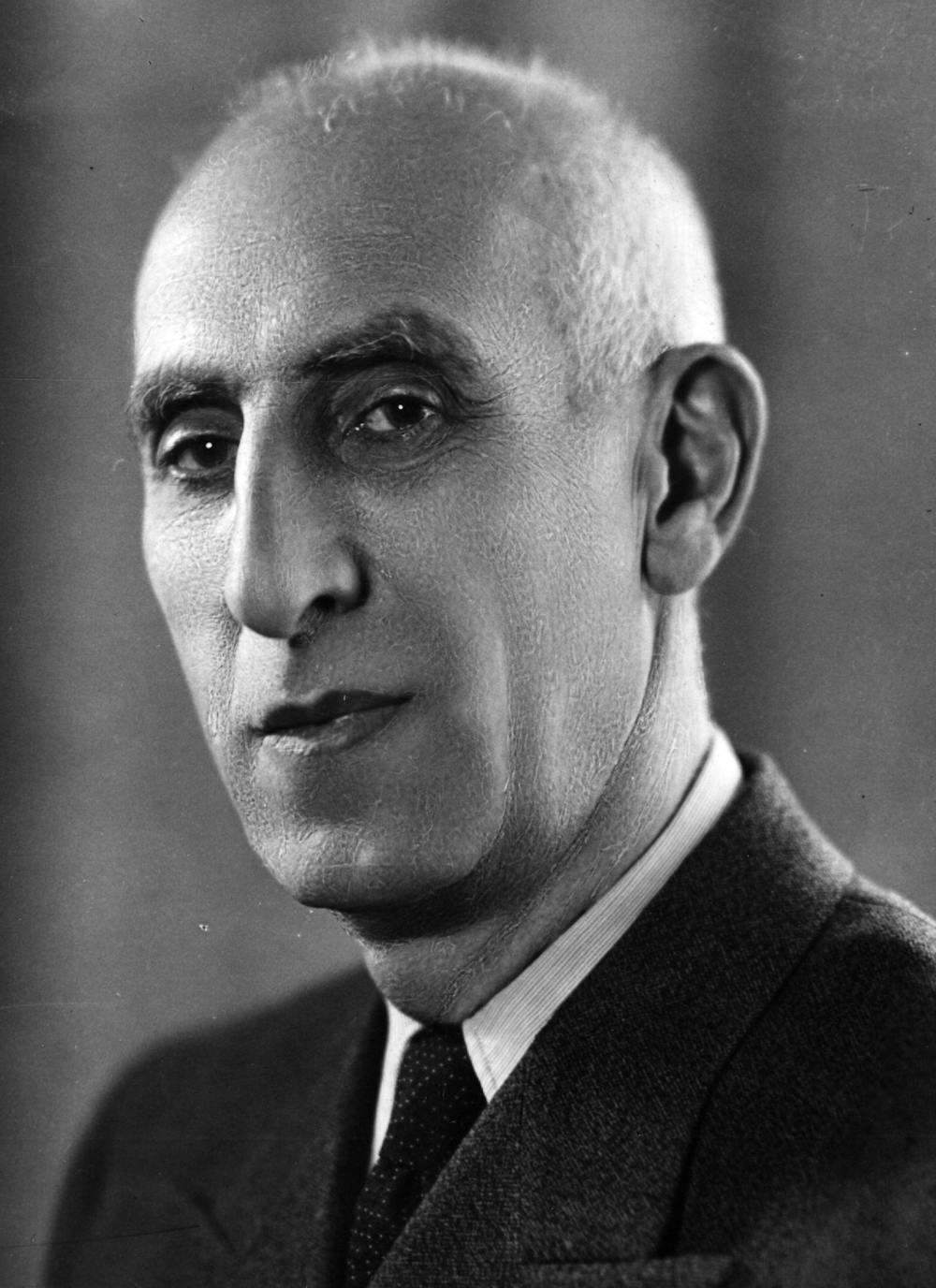
    Relations between the United States and Iran have been fraught for decades – at least since the U.S. helped overthrow a democracy-minded prime minister, Mohammed Mossadegh, in August 1953. The U.S. then supported the long, repressive reign of the Shah of Iran, whose security services brutalized Iranian citizens for decades.

    The two countries have been particularly hostile to each other since Iranian students took over the U.S. Embassy in Tehran in November 1979, resulting in economic sanctions and the severing of formal diplomatic relations between the nations.

    Since 1984, the U.S. State Department has listed Iran as a “state sponsor of terrorism,” alleging the Iranian government provides terrorists with training, money and weapons.

    Some of the major events in U.S.-Iran relations highlight the differences between the nations’ views, but others arguably presented real opportunities for reconciliation.

    1953: US overthrows Mossadegh

    Mohammed Mossadegh.
    Wikimedia Commons

    In 1951, the Iranian Parliament chose a new prime minister, Mossadegh, who then led lawmakers to vote in favor of taking over the Anglo-Iranian Oil Company, expelling the company’s British owners and saying they wanted to turn oil profits into investments in the Iranian people. The U.S. feared disruption in the global oil supply and worried about Iran falling prey to Soviet influence. The British feared the loss of cheap Iranian oil.

    President Dwight Eisenhower decided it was best for the U.S. and the U.K. to get rid of Mossadegh. Operation Ajax, a joint CIA-British operation, convinced the Shah of Iran, the country’s monarch, to dismiss Mossadegh and drive him from office by force. Mossadegh was replaced by a much more Western-friendly prime minister, handpicked by the CIA.

    Demonstrators in Tehran demand the establishment of an Islamic republic.
    AP Photo/Saris

    1979: Revolutionaries oust the shah, take hostages

    After more than 25 years of relative stability in U.S.-Iran relations, the Iranian public had grown unhappy with the social and economic conditions that developed under the dictatorial rule of Shah Mohammad Reza Pahlavi.

    Pahlavi enriched himself and used American aid to fund the military while many Iranians lived in poverty. Dissent was often violently quashed by SAVAK, the shah’s security service. In January 1979, the shah left Iran, ostensibly to seek cancer treatment. Two weeks later, Ayatollah Ruhollah Khomeini returned from exile in Iraq and led a drive to abolish the monarchy and proclaim an Islamic government.

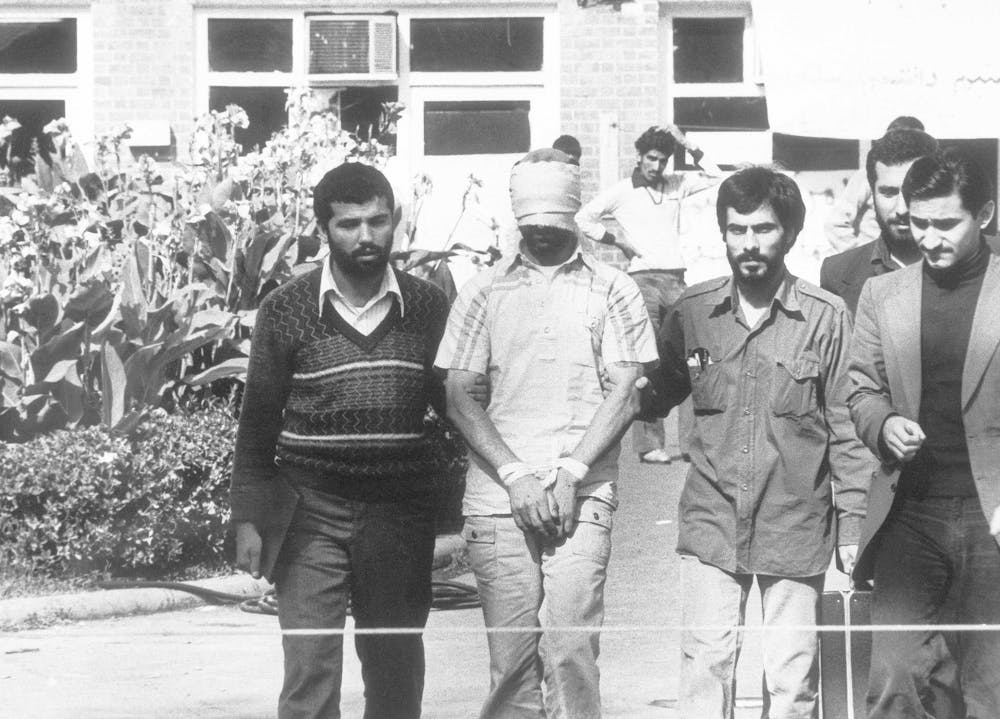
    Iranian students at the U.S. Embassy in Tehran show a blindfolded American hostage to the crowd in November 1979.
    AP Photo

    In October 1979, President Jimmy Carter agreed to allow the shah to come to the U.S. to seek advanced medical treatment. Outraged Iranian students stormed the U.S. Embassy in Tehran on Nov. 4, taking 52 Americans hostage. That convinced Carter to sever U.S. diplomatic relations with Iran on April 7, 1980.

    Two weeks later, the U.S. military launched a mission to rescue the hostages, but it failed, with aircraft crashes killing eight U.S. servicemembers.

    The shah died in Egypt in July 1980, but the hostages weren’t released until Jan. 20, 1981, after 444 days of captivity.

    An Iranian cleric, left, and an Iranian soldier wear gas masks to protect themselves against Iraqi chemical-weapons attacks in May 1988.
    Kaveh Kazemi/Getty Images

    1980-1988: US tacitly sides with Iraq

    In September 1980, Iraq invaded Iran, an escalation of the two countries’ regional rivalry and religious differences: Iraq was governed by Sunni Muslims but had a Shia Muslim majority population; Iran was led and populated mostly by Shiites.

    The U.S. was concerned that the conflict would limit the flow of Middle Eastern oil and wanted to ensure the conflict didn’t affect its close ally, Saudi Arabia.

    The U.S. supported Iraqi leader Saddam Hussein in his fight against the anti-American Iranian regime. As a result, the U.S. mostly turned a blind eye toward Iraq’s use of chemical weapons against Iran.

    U.S. officials moderated their usual opposition to those illegal and inhumane weapons because the U.S. State Department did not “wish to play into Iran’s hands by fueling its propaganda against Iraq.” In 1988, the war ended in a stalemate. More than 500,000 military and 100,000 civilians died.

    1981-1986: US secretly sells weapons to Iran

    The U.S. imposed an arms embargo after Iran was designated a state sponsor of terrorism in 1984. That left the Iranian military, in the middle of its war with Iraq, desperate for weapons and aircraft and vehicle parts to keep fighting.

    The Reagan administration decided that the embargo would likely push Iran to seek support from the Soviet Union, the U.S.’s Cold War rival. Rather than formally end the embargo, U.S. officials agreed to secretly sell weapons to Iran starting in 1981.

    The last shipment, of anti-tank missiles, was in October 1986. In November 1986, a Lebanese magazine exposed the deal. That revelation sparked the Iran-Contra scandal in the U.S., with Reagan’s officials found to have collected money from Iran for the weapons and illegally sent those funds to anti-socialist rebels – the Contras – in Nicaragua.

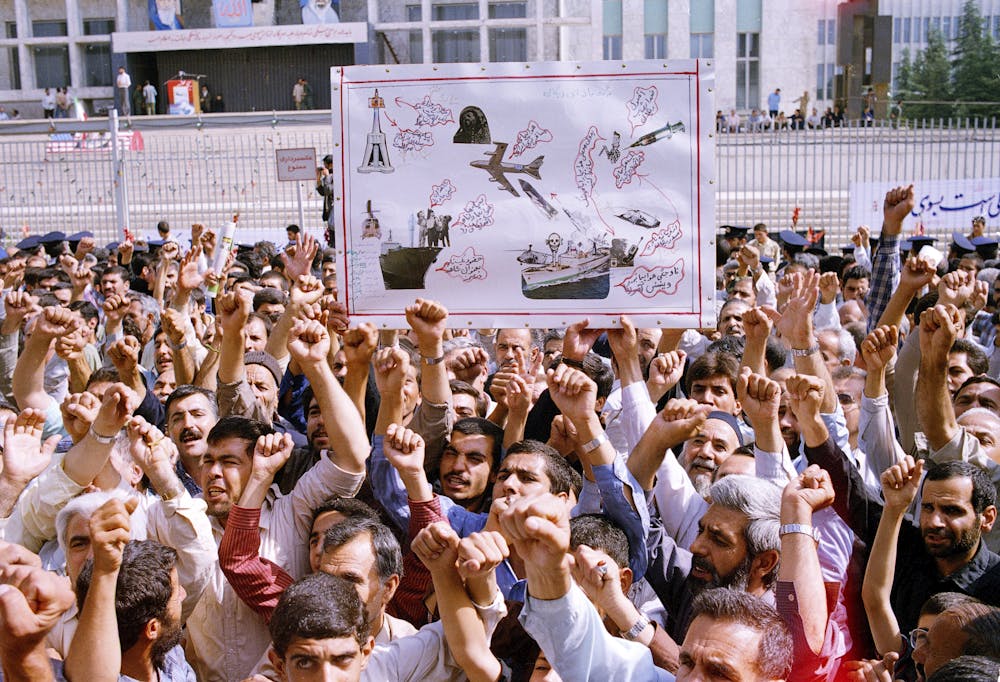
    At a mass funeral for 76 of the 290 people killed in the shootdown of Iran Air 655, mourners hold up a sign depicting the incident.
    AP Photo/CP/Mohammad Sayyad

    1988: US Navy shoots down Iran Air flight 655

    On the morning of July 8, 1988, the USS Vincennes, a guided missile cruiser patrolling in the international waters of the Persian Gulf, entered Iranian territorial waters while in a skirmish with Iranian gunboats.

    Either during or just after that exchange of gunfire, the Vincennes crew mistook a passing civilian Airbus passenger jet for an Iranian F-14 fighter. They shot it down, killing all 290 people aboard.

    The U.S. called it a “tragic and regrettable accident,” but Iran believed the plane’s downing was intentional. In 1996, the U.S. agreed to pay US$131.8 million in compensation to Iran.

    1997-1998: The US seeks contact

    In August 1997, a moderate reformer, Mohammad Khatami, won Iran’s presidential election.

    U.S. President Bill Clinton sensed an opportunity. He sent a message to Tehran through the Swiss ambassador there, proposing direct government-to-government talks.

    Shortly thereafter, in early January 1998, Khatami gave an interview to CNN in which he expressed “respect for the great American people,” denounced terrorism and recommended an “exchange of professors, writers, scholars, artists, journalists and tourists” between the United States and Iran.

    However, Supreme Leader Ayatollah Ali Khamenei didn’t agree, so not much came of the mutual overtures as Clinton’s time in office came to an end.

    In his 2002 State of the Union address, President George W. Bush characterized Iran, Iraq and North Korea as constituting an “Axis of Evil” supporting terrorism and pursuing weapons of mass destruction, straining relations even further.

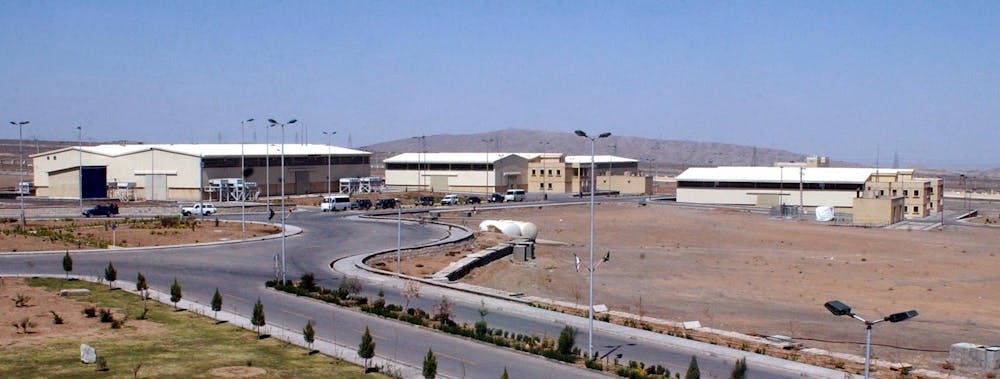
    Inside these buildings at the Natanz nuclear facility in Iran, technicians enrich uranium.
    AP Photo/Vahid Salemi

    2002: Iran’s nuclear program raises alarm

    In August 2002, an exiled rebel group announced that Iran had been secretly working on nuclear weapons at two installations that had not previously been publicly revealed.

    That was a violation of the terms of the Nuclear Nonproliferation Treaty, which Iran had signed, requiring countries to disclose their nuclear-related facilities to international inspectors.

    One of those formerly secret locations, Natanz, housed centrifuges for enriching uranium, which could be used in civilian nuclear reactors or enriched further for weapons.

    Starting in roughly 2005, U.S. and Israeli government cyberattackers together reportedly targeted the Natanz centrifuges with a custom-made piece of malicious software that became known as Stuxnet.

    That effort, which slowed down Iran’s nuclear program was one of many U.S. and international attempts – mostly unsuccessful – to curtail Iran’s progress toward building a nuclear bomb.

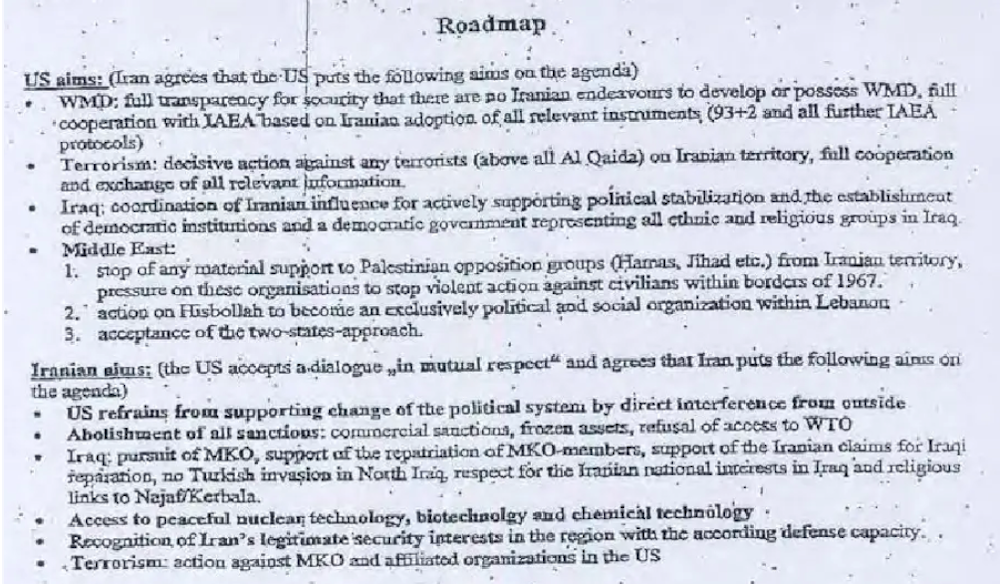
    2003: Iran writes to Bush administration

    An excerpt of the document sent from Iran, via the Swiss government, to the U.S. State Department in 2003, appears to seek talks between the U.S. and Iran.
    Washington Post via Scribd

    In May 2003, senior Iranian officials quietly contacted the State Department through the Swiss embassy in Iran, seeking “a dialogue ‘in mutual respect,’” addressing four big issues: nuclear weapons, terrorism, Palestinian resistance and stability in Iraq.

    Hardliners in the Bush administration weren’t interested in any major reconciliation, though Secretary of State Colin Powell favored dialogue and other officials had met with Iran about al-Qaida.

    When Iranian hardliner Mahmoud Ahmadinejad was elected president of Iran in 2005, the opportunity died. The following year, Ahmadinejad made his own overture to Washington in an 18-page letter to President Bush. The letter was widely dismissed; a senior State Department official told me in profane terms that it amounted to nothing.

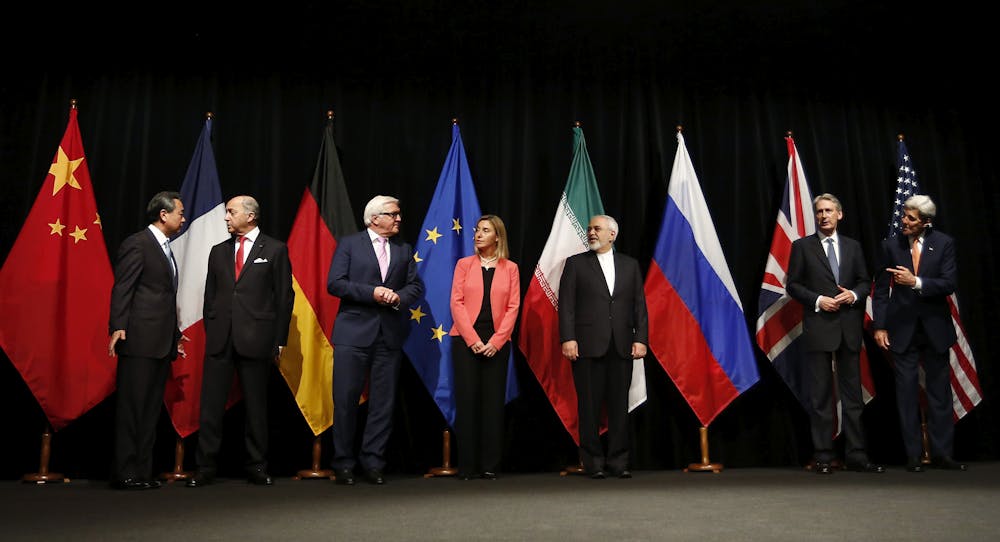
    Representatives of several nations met in Vienna in July 2015 to finalize the Iran nuclear deal.
    Austrian Federal Ministry for Europe, Integration and Foreign Affairs/Flickr

    2015: Iran nuclear deal signed

    After a decade of unsuccessful attempts to rein in Iran’s nuclear ambitions, the Obama administration undertook a direct diplomatic approach beginning in 2013.

    Two years of secret, direct negotiations initially bilaterally between the U.S. and Iran and later with other nuclear powers culminated in the Joint Comprehensive Plan of Action, often called the Iran nuclear deal.

    Two years of secret, direct negotiations conducted bilaterally at first between the U.S. and Iran and later with other nuclear powers culminated in the Joint Comprehensive Plan of Action, often called the Iran nuclear deal.

    Iran, the U.S., China, France, Germany, Russia and the United Kingdom signed the deal in 2015. It severely limited Iran’s capacity to enrich uranium and mandated that international inspectors monitor and enforce Iran’s compliance with the agreement.

    In return, Iran was granted relief from international and U.S. economic sanctions. Though the inspectors regularly certified that Iran was abiding by the agreement’s terms, President Donald Trump withdrew from the agreement in May 2018.

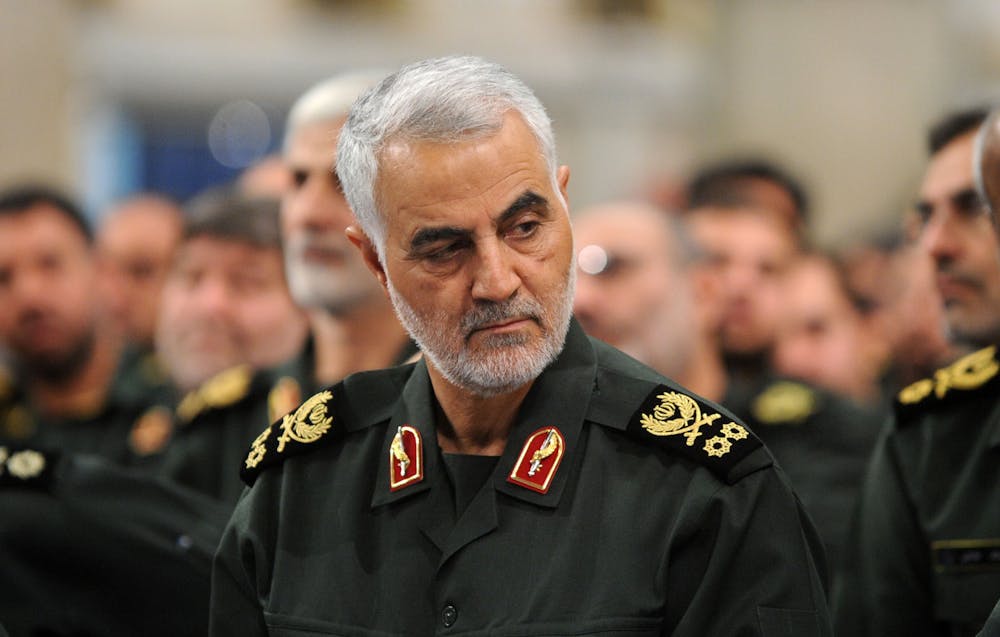
    2020: US drones kill Iranian Maj. Gen. Qassem Soleimani

    An official photo from the Iranian government shows Maj. Gen. Qassem Soleimani, who was killed in a Jan. 3 drone strike ordered by President Donald Trump.
    Iranian Supreme Leader Press Office/Anadolu Agency via Getty Images

    On Jan. 3, 2020, an American drone fired a missile that killed Maj. Gen. Qassem Soleimani, the leader of Iran’s elite Quds Force. Analysts considered Soleimani the second most powerful man in Iran, after Supreme Leader Ayatollah Khamenei.

    At the time, the Trump administration asserted that Soleimani was directing an imminent attack against U.S. assets in the region, but officials have not provided clear evidence to support that claim.

    Iran responded by launching ballistic missiles that hit two American bases in Iraq.

    2023: The Oct. 7 attacks on Israel

    Hamas’ brazen attack on Israel on Oct. 7, 2023, provoked a fearsome militarized response from Israel that continues today and served to severely weaken Iran’s proxies in the region, especially Hamas – the perpetrator of the attacks – and Hezbollah in Lebanon.

    2025: Trump 2.0 and Iran

    Trump saw an opportunity to forge a new nuclear deal with Iran and to pursue other business deals with Tehran. Once inaugurated for his second term, Trump appointed Steve Witkoff, a real estate investor who is the president’s friend, to serve as special envoy for the Middle East and to lead negotiations.

    Negotiations for a nuclear deal between Washington and Tehran began in April, but the countries did not reach a deal. They were planning a new round of talks when Israel struck Iran with a series of airstrikes on June 13, forcing the White House to reconsider is position.

    Jeffrey Fields receives funding from the Carnegie Corporation of New York and Schmidt Futures.

    ref. US and Iran have a long, complicated history, spanning far beyond Israel’s strikes on Tehran – https://theconversation.com/us-and-iran-have-a-long-complicated-history-spanning-far-beyond-israels-strikes-on-tehran-259240

    MIL OSI – Global Reports

  • MIL-OSI Analysis: How high can US debt go before it triggers a financial crisis?

    Source: The Conversation – Global Perspectives – By Luke Hartigan, Lecturer in Economics, University of Sydney

    rarrarorro/Shutterstock

    The tax cuts bill currently being debated by the US Senate will add another US$3 trillion (A$4.6 trillion) to US debt. President Donald Trump calls it the “big, beautiful bill”; his erstwhile policy adviser Elon Musk called it a “disgusting abomination”.

    Foreign investors have already been rattled by Trump’s upending of the global trade system. The eruption of war in the Middle East would usually lead to “flight to safety” buying of the US dollar, but the dollar has barely budged. That suggests US assets are not seen as the safe haven they used to be.

    Greg Combet, chair of Australia’s own sovereign wealth fund, the Future Fund, outlined many of the new risks arising from US policies in a speech on Tuesday.

    As investors turn cautious on the US, at some point the surging US debt pile will become unsustainable. That could risk a financial crisis. But at what point does that happen?

    The public sector holds a range of debt

    When talking about the sustainability of US government debt, we have to distinguish between total debt and public debt.

    Public debt is owed to individuals, companies, foreign governments and investors. This accounts for about 80% of total US debt. The remainder is intra-governmental debt held by government agencies and the Federal Reserve.

    Public debt is a more correct measure of US government debt. And it is much less than the headline total government debt amount that is frequently quoted, which is running at US$36 trillion or 121% of GDP.


    Are there limits to government debt?

    Governments are not like households. They can feasibly roll over debt indefinitely and don’t technically need to repay it, unlike a personal credit card. And countries such as the US that issue debt in their own currency can’t technically default unless they choose to.

    Debt also serves a useful role. It is the main way a government funds infrastructure projects. It is an important channel for monetary policy, because the US Federal Reserve sets the benchmark interest rate that affects borrowing costs across the economy. And because the US government issues bonds, known as Treasuries, to finance the debt, this is an important asset for investors.

    There is probably some limit to the amount of debt the US government can issue. But we don’t really know what this amount is, and we won’t know until we get there. Additionally, the US’s reserve currency status, due to the US dollar’s dominant role in international finance, gives the US government more leeway than other governments.

    Interest costs are surging

    What is important is the government’s ability to service its debt – that is, to pay the interest cost. This depends on two components: growth in economic activity, and the interest rate on government debt.

    If economic growth on average is higher than the interest rate, then the government’s effective interest cost is negative and it could sustainably carry its existing debt burden.

    The interest cost of US government debt has surged recently following a series of Federal Reserve interest rate hikes in 2022 and 2023 to quell inflation.

    The US government is now spending more on interest payments than on defence – about US$882 billion annually. This will soon start crowding out spending in other areas, unless taxes are raised or further spending cuts made.


    Recent policy decisions not helping

    The turmoil caused by Trump’s “Liberation Day” tariffs and heightened uncertainty about future government policy are expected to weaken US economic growth and raise inflation. This, coupled with the recent credit downgrade of US government debt by ratings agency Moody’s, is likely to put upward pressure on US interest rates, further increasing the servicing cost of US government debt.

    Moody’s cited concerns about the growth of US federal debt. This comes as the US House of Representatives passed the “One Big Beautiful Bill Act”, which seeks to extend the 2017 tax cuts indefinitely while slashing social spending. This has caused some to question the sustainability of the US government’s fiscal position.

    The non-partisan Congressional Budget Office estimates the bill will add a further US$3 trillion to government debt over the ten years to 2034, increasing debt to 124% of GDP. And this would increase to US$4.5 trillion over ten years and take debt to 128% of GDP if some tax initiatives were made permanent.

    Also troubling is Section 899 of the bill, known as the “revenge tax”. This controversial provision raises the tax payable by foreign investors and could further deter foreign investment, potentially making US government debt even less attractive.

    A compromised Federal Reserve is the next risk

    The passing of the tax and spending bill is unlikely to cause a financial crisis in the US. But the US could be entering into a period of “fiscal dominance”, which is just as concerning.

    In this situation, the independence of the Federal Reserve might be compromised if it is pressured to support the US government’s fiscal position. It would do this by keeping interest rates lower than otherwise, or buying government debt to support the government instead of targeting inflation. Trump has already been putting pressure on Federal Reserve chair Jerome Powell, demanding he cut rates immediately.

    This could lead to much higher inflation in the US, as occurred in Germany in the 1920s, and more recently in Argentina and Turkey.

    Luke Hartigan receives funding from the Australian Research Council (DP230100959)

    ref. How high can US debt go before it triggers a financial crisis? – https://theconversation.com/how-high-can-us-debt-go-before-it-triggers-a-financial-crisis-258812

    MIL OSI Analysis

  • MIL-Evening Report: How high can US debt go before it triggers a financial crisis?

    Source: The Conversation (Au and NZ) – By Luke Hartigan, Lecturer in Economics, University of Sydney

    rarrarorro/Shutterstock

    The tax cuts bill currently being debated by the US Senate will add another US$3 trillion (A$4.6 trillion) to US debt. President Donald Trump calls it the “big, beautiful bill”; his erstwhile policy adviser Elon Musk called it a “disgusting abomination”.

    Foreign investors have already been rattled by Trump’s upending of the global trade system. The eruption of war in the Middle East would usually lead to “flight to safety” buying of the US dollar, but the dollar has barely budged. That suggests US assets are not seen as the safe haven they used to be.

    Greg Combet, chair of Australia’s own sovereign wealth fund, the Future Fund, outlined many of the new risks arising from US policies in a speech on Tuesday.

    As investors turn cautious on the US, at some point the surging US debt pile will become unsustainable. That could risk a financial crisis. But at what point does that happen?

    The public sector holds a range of debt

    When talking about the sustainability of US government debt, we have to distinguish between total debt and public debt.

    Public debt is owed to individuals, companies, foreign governments and investors. This accounts for about 80% of total US debt. The remainder is intra-governmental debt held by government agencies and the Federal Reserve.

    Public debt is a more correct measure of US government debt. And it is much less than the headline total government debt amount that is frequently quoted, which is running at US$36 trillion or 121% of GDP.


    Are there limits to government debt?

    Governments are not like households. They can feasibly roll over debt indefinitely and don’t technically need to repay it, unlike a personal credit card. And countries such as the US that issue debt in their own currency can’t technically default unless they choose to.

    Debt also serves a useful role. It is the main way a government funds infrastructure projects. It is an important channel for monetary policy, because the US Federal Reserve sets the benchmark interest rate that affects borrowing costs across the economy. And because the US government issues bonds, known as Treasuries, to finance the debt, this is an important asset for investors.

    There is probably some limit to the amount of debt the US government can issue. But we don’t really know what this amount is, and we won’t know until we get there. Additionally, the US’s reserve currency status, due to the US dollar’s dominant role in international finance, gives the US government more leeway than other governments.

    Interest costs are surging

    What is important is the government’s ability to service its debt – that is, to pay the interest cost. This depends on two components: growth in economic activity, and the interest rate on government debt.

    If economic growth on average is higher than the interest rate, then the government’s effective interest cost is negative and it could sustainably carry its existing debt burden.

    The interest cost of US government debt has surged recently following a series of Federal Reserve interest rate hikes in 2022 and 2023 to quell inflation.

    The US government is now spending more on interest payments than on defence – about US$882 billion annually. This will soon start crowding out spending in other areas, unless taxes are raised or further spending cuts made.


    Recent policy decisions not helping

    The turmoil caused by Trump’s “Liberation Day” tariffs and heightened uncertainty about future government policy are expected to weaken US economic growth and raise inflation. This, coupled with the recent credit downgrade of US government debt by ratings agency Moody’s, is likely to put upward pressure on US interest rates, further increasing the servicing cost of US government debt.

    Moody’s cited concerns about the growth of US federal debt. This comes as the US House of Representatives passed the “One Big Beautiful Bill Act”, which seeks to extend the 2017 tax cuts indefinitely while slashing social spending. This has caused some to question the sustainability of the US government’s fiscal position.

    The non-partisan Congressional Budget Office estimates the bill will add a further US$3 trillion to government debt over the ten years to 2034, increasing debt to 124% of GDP. And this would increase to US$4.5 trillion over ten years and take debt to 128% of GDP if some tax initiatives were made permanent.

    Also troubling is Section 899 of the bill, known as the “revenge tax”. This controversial provision raises the tax payable by foreign investors and could further deter foreign investment, potentially making US government debt even less attractive.

    A compromised Federal Reserve is the next risk

    The passing of the tax and spending bill is unlikely to cause a financial crisis in the US. But the US could be entering into a period of “fiscal dominance”, which is just as concerning.

    In this situation, the independence of the Federal Reserve might be compromised if it is pressured to support the US government’s fiscal position. It would do this by keeping interest rates lower than otherwise, or buying government debt to support the government instead of targeting inflation. Trump has already been putting pressure on Federal Reserve chair Jerome Powell, demanding he cut rates immediately.

    This could lead to much higher inflation in the US, as occurred in Germany in the 1920s, and more recently in Argentina and Turkey.

    Luke Hartigan receives funding from the Australian Research Council (DP230100959)

    ref. How high can US debt go before it triggers a financial crisis? – https://theconversation.com/how-high-can-us-debt-go-before-it-triggers-a-financial-crisis-258812

    MIL OSI AnalysisEveningReport.nz

  • MIL-Evening Report: Would a corporate tax cut boost productivity in Australia? So far, the evidence is unclear

    Source: The Conversation (Au and NZ) – By Isaac Gross, Lecturer in Economics, Monash University

    The Conversation, CC BY-NC

    The first term of the Albanese government was defined by its fight against inflation, but the second looks like it will be defined by a need to kick start Australia’s sluggish productivity growth.

    Productivity is essentially the art of earning more while working less and is critical for driving our standard of living higher.

    The Productivity Commission, tasked with figuring out how to get Australia’s sluggish productivity back on track, is pushing hard for corporate tax cuts as a key part of their plan for building a “dynamic and resilient economy”.

    The idea? Lower taxes will attract more foreign investment, get businesses spending again and eventually boost workers’ productivity.

    Commission chair, Danielle Wood, said last week while the commission wanted to create more investment opportunities, it was aware this would hit the budget bottom line:

    So we’re looking at ways to spur investment while finding other ways we might be able to pick up revenue in the system.

    The general company tax rate is currently 30% for large firms, and there’s a reduced rate of 25% for smaller companies with an overall turnover of less than A$50 million.

    What the textbooks and other countries tell us

    The Productivity Commission’s theory makes sense: if you make capital cheaper and you should get more of it flowing in.

    A larger stock of capital means there is more to invest in Australian workers. This should make us more productive and help boost workers’ wages. And looking overseas, the evidence mostly backs this up.

    A meta-analysis of 25 studies covering the US, UK, Japan, France, Germany, Canada, Netherlands, Sweden, Italy, Switzerland,
    Denmark, Portugal and Finland found every percentage point you slice off the corporate tax rate brings in about 3.3% more foreign direct investment.

    Other research shows multinational companies really do move their operations to places with lower tax rates. This explains why we’re seeing this race to the bottom across Europe and North America, with countries constantly trying to undercut each other.

    Research on location decisions shows how multinationals reshuffle their operations based on effective average tax rates.

    Even within the United States, a US study found increases in corporate tax rates lead to big reductions in employment and wage income. However, corporate tax cuts can boost economic activity – though typically only if they are implemented during recessions.

    Australia’s limited track record

    Here in Australia we don’t have much local evidence to go on, and what we do have is pretty puzzling.

    This matters because Australia’s corporate tax system has some unique features that may make overseas evidence less relevant. We have dividend imputation (franking credits), different treatment of capital gains, access to immediate reimbursement for some small business expenses and complex capitalisation rules that limit debt deductions for multinationals.


    The Federal Government is focussed on improving productivity. In this five-part series, we’ve asked leading experts what that means for the economy, what’s holding us back and their best ideas for reform.


    A study by a group of Australian National University economists looked at how the tax system affects business investment. They examined the [2015 and 2016 corporate tax cuts] for small businesses using data on business investment from the Australian Bureau of Statistics combined with tax data from the Australian Tax Office.

    The findings were mixed. After the 2015 cut, firms already investing in buildings and equipment spent more — that is, the policy boosted investment only at the intensive margin.

    By contrast, there was no evidence it enticed firms that had not been investing to start doing so. The follow-up cut in 2016 had even less bite. Its estimated effect on investment was so small it is statistically indistinguishable from zero.

    It remains unclear why the previous corporate tax reductions largely failed to produce a measurable increase in investment. Perhaps the tax cut itself was simply too modest. Or the available data was too volatile to capture its effects.

    But it runs contrary to what economic theory tells us to expect. This should give us pause for thought.

    The big questions nobody can answer yet

    For politicians thinking about another round of corporate tax cuts, this creates an uncomfortable situation. We’ve got solid evidence from overseas it works, but only one weak data point from Australia, plus a lot of head-scratching about why the second cut didn’t move the dial.

    Fortunately, the Productivity Commission has the in-house expertise to further investigate this question.

    Before we make further cuts to the company tax rate, we should have an in-depth study of these two tax cuts replicating and extending the previous work to see what effect – if any – they had on investment, employment, productivity and Australian living standards.

    Until we can solve these puzzles, Australia’s debate over corporate tax rates will keep spinning its wheels. Much like our national productivity itself.

    Isaac Gross does not work for, consult, own shares in or receive funding from any company or organisation that would benefit from this article, and has disclosed no relevant affiliations beyond their academic appointment.

    ref. Would a corporate tax cut boost productivity in Australia? So far, the evidence is unclear – https://theconversation.com/would-a-corporate-tax-cut-boost-productivity-in-australia-so-far-the-evidence-is-unclear-258575

    MIL OSI AnalysisEveningReport.nz

  • Canadian PM Mark Carney welcomes PM Narendra Modi for G7 summit

    Source: Government of India

    Source: Government of India (4)

    Prime Minister Narendra Modi was on Tuesday welcomed by his Canadian counterpart Mark Carney as the Indian leader arrived for the G7 Outreach Summit.

    Confirming the meeting between Carney and PM Modi at the G7 Summit, the Ministry of External Affairs Spokesperson Randhir Jaiswal on social media platform X said: “Building bridges for global progress and cooperation. PM @MarkJCarney of Canada welcomed PM @narendramodi at the #G7 Summit in Kananaskis, Canada.”

    Earlier, PM Modi met with Mexico President Claudia Sheinbaum, South Korean President Lee Jae Myung, Australian PM Anthony Albanese and South African President Cyril Ramaphosa separately on the sidelines of the G7 Summit.

    These interactions came just weeks after India’s Operation Sindoor, a targeted strike on terror infrastructure in Pakistan and Pakistan-oOcupied Kashmir, following the Pahalgam terror attacks on April 22.

    The MEA said, “At the Summit, the Prime Minister will exchange views with leaders of G-7 countries, other invited outreach countries and Heads of International Organisations on crucial global issues, including energy security, technology and innovation, particularly the AI-energy nexus and Quantum-related issues.”

    Prime Minister Narendra Modi arrived in Calgary on Monday morning to attend the G7 Summit at Kananaskis, his first visit to Canada in a decade.

    He is set to discuss various topics of development, such as energy security, technology and innovation with world leaders.

    PM Modi said he will discuss important global issues and emphasise the priorities of the Global South.

    The Kananaskis gathering on June 16 to 17 is the Prime Minister’s sixth consecutive participation in the G7 Summit.

    Canadian PM Carney had extended an invite to PM Modi in an attempt to rebuild ties after India-Canada relations nosedived following former Prime Minister Justin Trudeau’s allegations on the killing of a Khalistani terrorist.

    In the last few months, the security officials of India and Canada resumed contact and both sides were looking at the possibility of appointing new High Commissioners.

    During his nearly 24-hour stay in Canada, Prime Minister Modi will not only attend the Outreach Session of the Summit but also hold several significant bilateral meetings with various world leaders before leaving for Zagreb early Wednesday, India time.

    The three-nation visit, PM Modi had stated while leaving New Delhi, is also to thank partner countries for their steadfast support to India in its fight against cross-border terrorism, and to galvanise global understanding on tackling terrorism in all its forms and manifestations.

    “Landed in Calgary, Canada, to take part in the G7 Summit. Will be meeting various leaders at the Summit and sharing my thoughts on important global issues. Will also be emphasising the priorities of the Global South,” PM Modi posted on his X handle after arriving in Canada.

    The Group of Seven (G7) is an informal grouping of seven of the world’s advanced economies — France, United States, United Kingdom, Germany, Japan, Italy and Canada and the European Union.

    At the Summit, PM Modi will be interacting with G7 leaders, including French President Emmanuel Macron, UK Prime Minister Keir Starmer, Italian PM Giorgia Meloni, Japanese Prime Minister Shigeru Ishiba, Chancellor Friedrich Merz of Germany and European Commission President Ursula von der Leyen along with Canada’s Prime Minister Mark Carney.

    (With IANS inputs)

  • Canadian PM Mark Carney welcomes PM Narendra Modi for G7 summit

    Source: Government of India

    Source: Government of India (4)

    Prime Minister Narendra Modi was on Tuesday welcomed by his Canadian counterpart Mark Carney as the Indian leader arrived for the G7 Outreach Summit.

    Confirming the meeting between Carney and PM Modi at the G7 Summit, the Ministry of External Affairs Spokesperson Randhir Jaiswal on social media platform X said: “Building bridges for global progress and cooperation. PM @MarkJCarney of Canada welcomed PM @narendramodi at the #G7 Summit in Kananaskis, Canada.”

    Earlier, PM Modi met with Mexico President Claudia Sheinbaum, South Korean President Lee Jae Myung, Australian PM Anthony Albanese and South African President Cyril Ramaphosa separately on the sidelines of the G7 Summit.

    These interactions came just weeks after India’s Operation Sindoor, a targeted strike on terror infrastructure in Pakistan and Pakistan-oOcupied Kashmir, following the Pahalgam terror attacks on April 22.

    The MEA said, “At the Summit, the Prime Minister will exchange views with leaders of G-7 countries, other invited outreach countries and Heads of International Organisations on crucial global issues, including energy security, technology and innovation, particularly the AI-energy nexus and Quantum-related issues.”

    Prime Minister Narendra Modi arrived in Calgary on Monday morning to attend the G7 Summit at Kananaskis, his first visit to Canada in a decade.

    He is set to discuss various topics of development, such as energy security, technology and innovation with world leaders.

    PM Modi said he will discuss important global issues and emphasise the priorities of the Global South.

    The Kananaskis gathering on June 16 to 17 is the Prime Minister’s sixth consecutive participation in the G7 Summit.

    Canadian PM Carney had extended an invite to PM Modi in an attempt to rebuild ties after India-Canada relations nosedived following former Prime Minister Justin Trudeau’s allegations on the killing of a Khalistani terrorist.

    In the last few months, the security officials of India and Canada resumed contact and both sides were looking at the possibility of appointing new High Commissioners.

    During his nearly 24-hour stay in Canada, Prime Minister Modi will not only attend the Outreach Session of the Summit but also hold several significant bilateral meetings with various world leaders before leaving for Zagreb early Wednesday, India time.

    The three-nation visit, PM Modi had stated while leaving New Delhi, is also to thank partner countries for their steadfast support to India in its fight against cross-border terrorism, and to galvanise global understanding on tackling terrorism in all its forms and manifestations.

    “Landed in Calgary, Canada, to take part in the G7 Summit. Will be meeting various leaders at the Summit and sharing my thoughts on important global issues. Will also be emphasising the priorities of the Global South,” PM Modi posted on his X handle after arriving in Canada.

    The Group of Seven (G7) is an informal grouping of seven of the world’s advanced economies — France, United States, United Kingdom, Germany, Japan, Italy and Canada and the European Union.

    At the Summit, PM Modi will be interacting with G7 leaders, including French President Emmanuel Macron, UK Prime Minister Keir Starmer, Italian PM Giorgia Meloni, Japanese Prime Minister Shigeru Ishiba, Chancellor Friedrich Merz of Germany and European Commission President Ursula von der Leyen along with Canada’s Prime Minister Mark Carney.

    (With IANS inputs)

  • MIL-OSI USA: NASA, German Aerospace Center to Expand Artemis Campaign Cooperation

    Source: NASA

    While attending the Paris Air Show June 16, NASA acting Administrator Janet Petro signed an agreement with DLR (German Aerospace Center, or Deutsches Zentrum für Luft- und Raumfahrt) to continue a partnership in space medicine research. This renewed collaboration builds on previous radiation mitigation efforts for human spaceflight. As NASA advances the Trump-Vance Administration’s goals for exploration on the Moon and Mars, minimizing exposure to space radiation is one of the key areas the agency is working to protect crew on long duration missions.
    With this agreement, DLR will leverage its human spaceflight expertise and provide new radiation sensors aboard the Orion spacecraft during NASA’s Artemis II mission, building on previous work in this area during the Artemis I mission. Scheduled for launch no later than April 2026, Artemis II will mark the first test flight with crew under Artemis.
    “In keeping with the historic agreements NASA has made with international partners as a part of Artemis, I am pleased to sign a new NASA-DLR joint agreement today, to enable radiation research aboard Artemis II,” said acting NASA Administrator Janet Petro. “The German Aerospace Center has been a valuable partner in Artemis, having previously worked with NASA to test technology critical to our understanding of radiation on humans aboard an Orion spacecraft on Artemis I and providing a CubeSat as part of Artemis II. Following a productive meeting between President Trump and German Chancellor Merz earlier this month, I am excited to build upon our great partnership with Germany.”
    During the Artemis II mission’s planned 10-day journey around the Moon and back, four of DLR’s newly developed M-42 extended (M-42 EXT) radiation detectors will be on board, contributing vital data to support astronaut safety. This next-generation device represents a new phase of research as NASA and DLR continue working together to safeguard human health in space.
    Under the leadership of President Trump, America’s Artemis campaign has reignited NASA’s ambition, sparking international cooperation and cutting-edge innovation. The continued partnership with DLR and the deployment of their advanced M-42 EXT radiation detectors aboard Artemis II exemplifies how the Trump-Vance Administration is leading a Golden Era of Exploration and Innovation that puts American astronauts on the path to the Moon, Mars, and beyond.
    “To develop effective protective measures against the impact of space radiation on the human body, comprehensive and coherent radiation measurements in open space are essential,” says Anke Pagels-Kerp, divisional board member for space at DLR. “At the end of 2022, Artemis I carried 12,000 passive and 16 active detectors inside the Helga and Zohar mannequins, which flew aboard the Orion spacecraft as part of DLR’s MARE project. These provided a valuable dataset – the first continuous radiation measurements ever recorded beyond low Earth orbit. We are now excited to take the next step together with NASA and send our upgraded radiation detectors around the Moon on the Artemis II mission.”
    Through the Artemis campaign, the agency will establish a long-term presence on the Moon for scientific exploration with our commercial and international partners, learn how to live and work away from home, and prepare for future human exploration of Mars.
    For more information about Artemis, visit:
    https://www.nasa.gov/artemis
    -end-
    Bethany Stevens / Rachel KraftHeadquarters202-358-1600bethany.c.stevens@nasa.gv / rachel.h.kraft@nasa.gov

    MIL OSI USA News

  • MIL-OSI Europe: Answer to a written question – Pending approval of state aid for the biomass package – E-001850/2025(ASW)

    Source: European Parliament

    Germany has not yet notified the measure indicated by the Honourable Member to the Commission.

    The Commission has two months after receipt of a complete notification from the Member State to render a decision on the measure’s compatibility with EU State aid rules.

    The Commission recalls the importance of ensuring that such support measures are fully aligned with relevant EU secondary legislation.

    Last updated: 17 June 2025

    MIL OSI Europe News

  • MIL-OSI Analysis: The Weimar triangle: how Germany’s new government could reinvigorate an important European security alliance

    Source: The Conversation – UK – By Rachel Herring, PhD candidate, Department of Politics, History and International Relations, Aston University

    Decisions made by German chancellor Friedrich Merz when he came to power in May indicate that a somewhat dormant regional partnership is about to take on new significance in Europe. Merz immediately travelled to Paris and Warsaw to meet Emmanuel Macron and Donald Tusk, suggesting the so-called Weimar triangle is a top priority for his government.

    Following Merz’s visit to Poland, Polish prime minister Tusk declared “a new beginning, perhaps the most important in the history of the last dozen or so years, in Polish-German relations”.

    If Tusk is right, the Weimar triangle – an alliance between France, Germany and Poland – will have a key role to play. The Weimar triangle was established in 1991 as a forum for the three countries to work together in the interest of European security. This involved integrating Poland into the EU, as well as providing another channel for Germany to pursue friendship and reconciliation with its neighbours.

    The Franco-German “special relationship” was already established, along with their shared reputation as Europe’s “motor”. But Poland’s inclusion was crucial. As a large, influential country in Central Europe, it was well placed to become a pillar of European security and a partner in European expansion following the collapse of Communist regimes.


    Get your news from actual experts, straight to your inbox. Sign up to our daily newsletter to receive all The Conversation UK’s latest coverage of news and research, from politics and business to the arts and sciences.


    As well as being a smaller security forum in which Germany, France and Poland can find common ground on EU security and foreign policy, the Weimar triangle has at times taken on an active international role. During the 2014 Ukraine crisis, ministers from the three Weimar triangle countries took the lead and negotiated on behalf of the EU.

    However, the importance and effectiveness of the format has declined in recent years due to deteriorating relations between the French, German and Polish governments.

    Russia’s invasion of Ukraine in February 2022 elevated the significance of the Weimar triangle once again. But in the early days of the war, although all three governments condemned the invasion, Poland, Germany and France were far from being on the same page.

    Germany’s cautious response provoked criticism in Poland – and indeed in other Central European countries. Many in the region had long been sceptical of Germany’s Russia policy and had warned of Russian aggression, but did not feel taken seriously.

    While the Polish government was quick to commit significant military support to Ukraine, Germany, under former chancellor Olaf Scholz, soon gained a reputation for being overly cautious in the eyes of its more hawkish allies. This led the Polish government to begin turning to security alliances in Scandinavia and the Baltics.

    Meanwhile, Scholz’s hesitancy and orientation towards Washington for leadership was also met with frustration in France, where the idea of “European sovereignty” in security issues had more traction.

    When the new Merz government made it clear that it wanted to prioritise foreign policy and the Weimar triangle, there was a sense that things were about to change. It is still early days, but the rhetoric of all three Weimar triangle leaders signals a commitment to making the alliance finally deliver, as well as an awareness of earlier failures.

    New challenges in Poland

    It won’t be plain sailing from here though. The election of nationalist Karol Nawrocki as president in Poland in early June was a blow for those that support a new, strong Weimar triangle.

    Poland’s current government is a centrist coalition led by pro-European prime minister Donald Tusk, but the concern now is that Nawrocki will block pro-European legislation as his predecessor did, given that he has the support of the nationalist, Eurosceptic Law and Justice (PiS) party. The PiS party (in government from 2015-2023) has a record of anti-German and anti-EU rhetoric.

    Nawrocki has not yet questioned Poland’s military aid to Ukraine but the Tusk government must now continue to balance pursuing its own more liberal agenda and more pro-German and pro-European approach with the alternative views that Nawrocki represents, and which are clearly backed by a significant portion of Polish voters.

    What next for the Weimar triangle?

    Given the centrality of the Weimar triangle countries in Europe and the EU, their alliance has consequences that go far beyond the bilateral and regional levels. With the ongoing war in Ukraine and the uncertain status of the US as a security partner since Donald Trump’s re-election, a strong and unified pillar at the centre of Europe would be an asset to the EU and European security.

    So far, the Weimar triangle has failed to deliver on the expectations attached to it, often due to domestic differences. However, it holds untapped potential. A divided Europe and EU is in the interest of Putin’s government, and is not the unified ally Ukraine needs.

    The Weimar triangle, in bringing together three key member states – crucially including from Central Europe – can both symbolically and practically strengthen European foreign and security policy.

    This will involve finding compromises to build a united front on security at the EU level, bringing issues and policies to the table, and strengthening understanding where security perspectives diverge. The positions and signals of France, Germany and Poland matter to other EU member states and to Ukraine. Joint efforts could have even more clout.

    Rachel Herring receives funding from the Economic and Social Research Council.

    ref. The Weimar triangle: how Germany’s new government could reinvigorate an important European security alliance – https://theconversation.com/the-weimar-triangle-how-germanys-new-government-could-reinvigorate-an-important-european-security-alliance-257995

    MIL OSI Analysis

  • MIL-OSI Global: Coal power plants were paid to close. Is it time to do the same for slaughterhouses?

    Source: The Conversation – UK – By Stephanie Walton, Researcher on Food Systems and Sustainable Finance, University of Oxford

    Ocphoto/Shutterstock

    The food industry will go to great lengths (and spend a fortune) to lobby policymakers, confuse the public and politicise scientific findings. You can see the results in the UK’s delay of a ban on junk food advertisers targeting children, or the orchestrated backlash to a report that recommended cutting red meat consumption and embracing more plant-based diets.

    It’s a well-worn playbook. When scientific evidence indicates the need to phase down environmentally harmful or unhealthy products, the responsible industry pushes back.

    Motivating this resistance, my colleagues and I believe, is something rarely discussed in the context of food systems: stranded assets. These are investments that lose value or stop generating revenue earlier than their owners and investors anticipated, due to changes in market conditions, technology or – of particular interest here – policy and regulation.

    This concept has been central to debates in the energy transition. For example, studies have shown that keeping global warming below 2 °C will require leaving fossil fuels in the ground and shutting down power plants before they’ve generated a return on investment, wiping off about US$1 trillion (£736 billion) in value for companies, financial institutions and investors.

    The same dynamic applies to the task of feeding everyone well and without substantial environmental harm. What we produce must change, as well as how we produce it.


    Get your news from actual experts, straight to your inbox. Sign up to our daily newsletter to receive all The Conversation UK’s latest coverage of news and research, from politics and business to the arts and sciences.


    Producing animal-sourced protein, especially beef and dairy, has environmental impacts that dwarf those of plant-based protein. Some new technologies may reduce these impacts, particularly feed additives to reduce methane emissions from cattle. But the negative impacts go far beyond cow burps to include deforestation, biodiversity loss, water scarcity and pollution.

    Beef in particular, even when produced using intensive systems like feedlots in the US, requires substantially more land to make 100 grams of protein than any other source (excluding lamb, which is produced in much lower quantities).

    As the global population increases and constraints on land use intensify, as much nourishing food as possible will need to be produced on as little land as possible. This will entail slashing the amount of land used for animal-sourced foods.

    However, companies consistently invest in the assets that produce, process, transport and store the foods we consume. These range from slaughterhouses to the grain silos and transport equipment for single-crop supply chains, to manufacturing plants and the research and development of ultra-processed foods.

    Crops are cultivated over vast acres of land to feed livestock.
    Ekrem Sahin/Shutterstock

    In order to curtail certain foods, as part of a global shift towards sustainable and healthy diets, these assets cannot generate the revenue they do now. This means writing off some of the capital that has been sunk into them, and any anticipated revenue.

    Our research identified £217 billion that has been invested in meatpacking plants, for example. A portion of this will be lost in service of a shift to more plant-based sustenance.

    Whether or not policymakers and researchers are aware of the stranded assets problem, food companies certainly are.

    Polluter pays or pay the polluter?

    We outline three things that need to happen.

    First, while it is laudable that companies set targets to cut emissions or deforestation, how they invest their money is not always consistent with these goals. Companies need to disclose to investors and the public which of their assets are incompatible with a sustainable future, and how they plan to phase them out.

    Second, lenders (typically banks) and investors (asset managers and their clients) must work with the companies they fund to manage these transitions rather than simply revoke financing or divest. Shutting down a meatpacking plant and building up a plant-based protein business is costly, and firms will need support.

    Divestment can play an important role symbolically, signalling an ethical and moral stance against certain activities. But unless it is done by all investors at once, assets like shares go to other buyers with little or no interest in sustainability.

    Third, and perhaps the thorniest problem, who pays for stranded assets? The money has already been spent. The investments have been made, the meatpacking plants and infrastructure already built, the anticipated revenue and maximised profit margins already embedded in the value of these companies.

    There is the cost of shutting down assets early as well as the opportunity cost of not making money that was expected from capital that has already been sunk. Who bears those costs?

    Many assume the answer is straightforward: the polluter should pay. This is certainly possible to achieve. Take the recent ruling in Germany, which determined that private companies can be held liable for their share in causing climate damages.

    But implementing this principle requires unusually strong political leadership and sustained public support. Both of these things are difficult to secure, particularly in food systems where industry lobbying is intense, livelihoods are at stake, public attention is fragmented and diets are highly personal and easily politicised.

    Capital sunk into infrastructure makes change costly.
    Catstyecam/Shutterstock

    Even when policies designed to improve public health or sustainability are passed, they can be easily rolled back. Which brings us to an uncomfortable alternative: paying the polluter.

    This approach already exists in other sectors. Since 2020, Germany has paid coal plants to retire early. The same has been done in the Netherlands, parts of the US and several other countries. In the Netherlands, the government paid farmers to reduce dairy herds in certain areas in order to hit pollution targets.

    Paying off food companies to phase out harmful assets sounds like a bailout and feels unfair, since a clean and thriving environment is a human right. Such an approach could only work if it allowed stronger regulation that ensured such pollution wouldn’t occur in the future. This is how abolitionists contributed to ending slavery in the UK.

    If we’re stuck between endless policy whiplash and slow-motion climate and health crises, paying the polluter may be worth considering. It’s politically fraught and emotionally frustrating, but when it comes to stopping pollution sooner rather than later, it is perhaps more tractable than waiting for political will, corporate courage and public consensus to converge.


    Don’t have time to read about climate change as much as you’d like?

    Get a weekly roundup in your inbox instead. Every Wednesday, The Conversation’s environment editor writes Imagine, a short email that goes a little deeper into just one climate issue. Join the 45,000+ readers who’ve subscribed so far.


    Stephanie Walton does not work for, consult, own shares in or receive funding from any company or organisation that would benefit from this article, and has disclosed no relevant affiliations beyond their academic appointment.

    ref. Coal power plants were paid to close. Is it time to do the same for slaughterhouses? – https://theconversation.com/coal-power-plants-were-paid-to-close-is-it-time-to-do-the-same-for-slaughterhouses-257418

    MIL OSI – Global Reports

  • MIL-OSI: Solutions30 Annual General Meeting Results – June 17, 2025

    Source: GlobeNewswire (MIL-OSI)

    Approval of all resolutions

    Nomination of new Supervisory Board members

    The Solutions 30 SE General Meeting was held in Luxembourg on June 17, 2025, chaired by Gianbeppi Fortis, Chairman of the Management Board.

    All resolutions proposed at the Annual General Meeting were adopted, including:

    • Approval of the annual accounts and the consolidated accounts of the Company for the financial year ended on 31 December 2024, and allocation of results;
    • Approval of the nomination of Mrs. Maria Zesch et de Mr. Olivier Domergue as members of the Supervisory Board, and approval of the renewal of Mrs. Pascale Mourvillier’s mandate as member of the Supervisory Board;
    • Re-appointment of PKF Audit & Conseil S. à r.l. as approved statutory auditor;
    • Appointment of PKF Audit & Conseil S. à r.l in relation to the assurance opinion on the sustainability reporting included in the management report for the financial year 2025;
    • Approval of the annual remuneration of the Supervisory Board members;
    • Approval of the remuneration report (advisory vote);     

    Solutions30 thanks its shareholders for their support and trust.

    Results of the votes will be available today on the Group’s website: www.solutions30.com.

    About Solutions30 SE

    Solutions30’s mission is to make the technological developments that are transforming our daily lives accessible to everyone, individuals and businesses alike, especially with regard to the digital transformation and the energy transition. With its network of more than 16,000 technicians, Solutions30 has completed over 65 million call-outs since its inception and led over 500 renewable energy projects with a combined maximum output surpassing 1800 MWp. Every day, Solutions30 is doing its part to build a more connected and sustainable world. Solutions30 has become an industry leader in Europe with operations in 10 countries: France, Italy, Germany, the Netherlands, Belgium, Luxembourg, Spain, Portugal, the United Kingdom, and Poland. The capital of Solutions30 SE consists of 107,127,984 shares, equal to the number of theoretical votes that can be exercised. Solutions30 SE is listed on the Euronext Paris exchange (ISIN FR0013379484- code S30). Indices : CAC Mid & Small | CAC Small | CAC Technology | Euro Stoxx Total Market Technology | Euronext Tech Croissance.

    Visit our website to learn more: www.solutions30.com

    Contact

    Individual Shareholders:
    Tel: +33 1 86 86 00 63 – shareholders@solutions30.com

    Investor relations
    Investor.relations@solutions30.com

    Press – Image 7:

    Charlotte Le Barbier – Tel: +33 6 78 37 27 60 – clebarbier@image7.fr

    Attachment

    The MIL Network

  • MIL-OSI Economics: Breaking down the chaos of a seemingly infinite workday

    Source: Microsoft

    Headline: Breaking down the chaos of a seemingly infinite workday

    In our recent 2025 Work Trend Index Annual Report, we charted the emergence of the Frontier Firm—powered by intelligence on tap, run by human-agent teams, and defined by a new role for every employee, the agent boss. These firms are redesigning business processes around AI and agents to scale rapidly, operate with agility, and generate value faster than traditional companies.

    But organizations will never complete their journey to becoming a Frontier Firm by concentrating on process alone. Our research, based on trillions of globally aggregated and anonymized Microsoft 365 productivity signals, reveals a challenging new roadblock: a seemingly infinite workday. 

    AI offers a way out of the mire, especially if paired with a reimagined rhythm of work. Otherwise, we risk using AI to accelerate a broken system. To get a handle on this barrier to transformation, let’s start our infinite workday. 

    The workday often begins before a lot of people are out of bed. By 6 am, many Microsoft 365 users are scanning overflowing inboxes in hopes of getting ahead. Our telemetry data shows:  

    • 40% of people who are online at 6 am are reviewing email for the day’s priorities. 

    • The average worker receives 117 emails daily—most of them skimmed in under 60 seconds. 

    • Mass emails with 20+ recipients are up 7% in the past year, while one-on-one threads are on the decline (-5%). 

    The inbox may still be the front door to work, but too often it opens to a flood of unprioritized chaos. 

    The chaos of the infinite workday

    It starts early, mostly in email, and quickly swells to a focus-sapping flood of messages, meetings, and interruptions. 

    By 8 am, Microsoft Teams overtakes email as the dominant communication channel, shifting the day into high gear.  

    • The average worker receives 153 Teams messages per weekday. 

    • Messages per person are up 6% YOY globally—more than 20% in regions like Central and Eastern Europe, the Middle East, and Africa, and over 15% in the UK and South Korea. 

    Each email or message notification may seem small, but together they can set a frenetic tempo for the day ahead.  

    The most valuable hours of the workday are often ruled by someone else’s agenda. Half (50%) of all meetings take place between 9–11 am and 1–3 pm—precisely when, as research shows, many people have a natural productivity spike in their day, due to their circadian rhythms. But our data reveals that we fill this time with meetings, leaving little room for deep focus. Tuesdays now carry the heaviest meeting load (23%), while Fridays taper to just 16%. Instead of deep work, these prime hours are spent cycling through a carousel of calls. 

    Meetings hijack prime focus time

    Studies show that many people have two natural performance spikes each day, but our data reveals that we fill one of them with meetings, leaving little room for focus work.

    An area chart showing average productivity levels for workers between the hours of 6 am and 12 am, indicating that a high percentage of meetings are often scheduled during peak productivity hours, leaving workers with less time to dedicate to focus work.

    But meetings aren’t the only force fracturing attention. By 11 am—peak productivity for many—message activity also surges, with 54% of users active. According to our telemetry data it’s the most overloaded hour of the day, as real-time messages, scheduled meetings, and constant app switching converge, making focus on any one task nearly impossible. 

    Calendars may show a break in meetings after lunch, but that could also be a mirage. During this time we see Word, Excel, and PowerPoint (WXP) usage surge as employees attempt focus work like writing, analyzing data, and creating decks—but that time is fragmented. Our telemetry data shows that, on average, employees using Microsoft 365 are interrupted every 2 minutes by a meeting, email, or notification. That competing digital noise doesn’t appear on calendars, but as many information workers will likely attest, it’s deeply felt. In fact, our global Work Trend Index survey shows that nearly half of employees (48%)—and more than half of leaders (52%)—say their work feels chaotic and fragmented. 

    The issue isn’t just volume—it’s sprawl. Our data shows that modes of communication are changing, coordination is more complex, and mental load is heavier.  

    • 57% of meetings are ad hoc calls without a calendar invite—and 1 in 10 scheduled meetings are booked at the last minute.  

    • Large meetings (65+ attendees) are the fastest-growing type—likely a result of employees navigating increasingly complex, cross-functional teams. 

    • Nearly a third of meetings now span multiple time zones—up 35% since 2021. 

    • And in the final 10 minutes before a meeting, PowerPoint edits spike 122%—the digital equivalent of cramming before an exam. 

    For many, the workday now feels like navigating chaos—reacting to others’ priorities and losing focus on what matters most. In a time when every hour counts, that drift could quietly drain energy and stall business progress. 

    The shift to the triple peak day that started during the pandemic is no longer a trend—for many, it’s the norm. Today’s workday stretches well into the evening. Our telemetry data shows that meetings after 8 pm are up 16% year over year, with global and flexible teams accounting for much of the increase. And it’s not just meetings: the average employee now sends or receives more than 50 messages outside of core business hours, and by 10 pm, nearly a third (29%) of active workers dive back into their inboxes, pointing to a steady rise in after-hours activity. 

    But “working late” can be experienced differently. A recent study from Microsoft Research found that remote workers often see evening hours as a productive window for quiet catch-up. Hybrid workers, by contrast, are more likely to experience that same time as a source of stress. For managers and leaders, this isn’t just a footnote—it’s a signal that can help set clearer expectations, shape team culture, and better support teams. 

    And for some, this pressure spills into the weekend—making Sunday feel like just another Monday:  

    • Our telemetry data shows a notable bump in weekend email usage. Nearly 20% of employees actively working on the weekend are checking their email before noon on Saturday and Sunday—waking up to work, even on typical days off. And over 5% are back in email on Sunday evenings (6 pm and later)—the Sunday scaries are real and measurable. 

    • And while email patterns mimic the workweek, other apps tell a different story: over the weekend, usage of WXP overtakes Teams messages as employees finally carve out time for uninterrupted focus work. 

    The infinite workday bleeds into evenings and weekends

    Boundaries are eroding as 1 in 3 employees say the pace of work over the past five years makes it impossible to keep up.

    This points to a larger truth: the modern workday for many has no clear start or finish. As business demands grow more complex and expectations continue to rise, time once reserved for focus or recovery may now be spent catching up, prepping, and chasing clarity. It’s the professional equivalent of needing to assemble a bike before every ride. Too much energy is spent organizing chaos before meaningful work can begin.  

    Leaders are feeling the squeeze. With flat budgets and rising pressure to perform, 1 in 3 employees in our global Work Trend Index survey responded that the pace of work over the past five years has made it impossible to keep up. The signals are clear: it’s time to break the cycle. The future of work won’t be defined by how much drudgery we automate, but by what we choose to fundamentally reimagine. AI can give us the leverage to redesign the rhythm of work, refocus our teams on new and differentiating work, and fix what has become a seemingly infinite workday. The question isn’t whether work will change. It’s whether we will. 

    Adopting AI isn’t enough. What you need now is a Frontier Firm mindset—one that questions how time is spent, how work gets done, and what truly drives impact. Here are three places to start: 

    1. Follow the 80/20 rule. In a world of flat budgets and shrinking attention, activity is not the same as progress. The most effective organizations know this—and act on it. Frontier Firms are putting the Pareto Principle into practice, focusing on the 20% of work that delivers 80% of the outcomes. AI makes this not only possible but scalable. By deploying AI and agents to streamline low-value tasks—status meetings, routine reports, admin churn—leaders can reclaim time for what moves the business: deep work, fast decisions, and focused execution. The companies that can win in the age of AI won’t just work harder—they’ll work smarter and sharper. Not sure where to start? Watch this leadership keynote from the Microsoft 365 Community Conference on Building the Future Firm.  

    2. Redesign for the Work Chart. Today, teams are organized by static functions like finance, marketing, and engineering. But with expertise available on demand through AI and agents, rigid structures add unnecessary friction. Take a product launch: content lives in marketing, data in analytics, budget in finance, and messaging with comms. A simple update like a price adjustment can take days and multiple meetings. It’s time to move from the org chart to the Work Chart—an agile, outcome-driven model in which lean teams form around a goal and use AI to fill skill gaps and move fast. At Supergood, an AI-first agency formerly called Supernatural, employees use a platform powered by decades of ad strategy to access insights instantly—no need to loop in a strategist on every brief. 

    3. Become an agent boss. There’s a new generation of professionals rising through the chaos—not by working more, but by working smarter. We call them agent bosses. Take Alex Farach, a researcher at Microsoft who uses a trio of agents to supercharge his work: one collects new research daily, the next runs statistical analysis, and the third drafts briefs to help connect the dots. Instead of getting bogged down in manual work, Farach can focus on what matters—fast, high-quality insights that benefit the entire team. This is the future of work: human-agent teams built to adapt and scale. 


    Methodology 

    Microsoft 365 Telemetry  
    All data is based on aggregated and anonymized Microsoft 365 productivity signals, ending February 15, 2025. Data excludes education (Edu) and European Union (EU) tenants. 

    • Interruptions 
      Employees are interrupted every two minutes during core work hours—275 times a day—by meetings, emails, or chats.  
      Calculated as a rolling 28-day sum of pings (meeting invites, emails, chats) per unique user per workday. The two-minute figure reflects the average time between pings during an eight-hour workday. The 275 is based on the 24-hour day. Based on the top 20% of users by ping volume received. 

    • Last-Minute PowerPoint Edits  
      Edits in PowerPoint spike 122% in the final 10 minutes before a meeting.  
      Calculated as a rolling 28-day sum of PowerPoint view and edit actions per meeting participant, measured across fixed time windows before meetings. 

    • Ad Hoc Meetings  
      60% of meetings are unscheduled or ad hoc.  
      Based on a rolling 28-day volume of unique meetings per user per workday. Represents the top 20% of users by meeting volume. 

    • After-Hours Chats  
      Chats sent outside the standard 9-to-5 workday are up 15% year over year, with an average of 58 messages per user now arriving before or after hours.  
      Calculated as a rolling 28-day sum of chats sent outside of Monday–Friday, 9 am–5 pm 

    • Late-Night Meetings & Cross–Time Zone Work  
      Meetings starting after 8 pm are up 16% year over year, driven by an increase in cross–time zone collaboration. 30% of meetings now span multiple time zones—a figure that has risen 8 percentage points since 2021.  
      Measured as a rolling 28-day sum of meetings starting between 8 pm and 11:59 pm, adjusted for each participant’s local time. 

    Work Trend Index Survey  
    The Work Trend Index survey was conducted by an independent research firm, Edelman Data x Intelligence, among 31,000 full-time employed or self-employed knowledge workers across 31 markets between February 6, 2025 and March 24, 2025. This survey was 20 minutes in length and conducted online, in either the English language or translated to local languages across markets. 1,000 full-time workers were surveyed in each market, and global results have been aggregated across all responses to provide an average. In the US, an additional sample of 4,500 full-time employed or self-employed knowledge workers was collected across nine sub-regions/metros. 

    Global markets surveyed include:   
    Argentina, Australia, Brazil, Canada, China, Colombia, Czech Republic, Finland, France, Germany, Hong Kong, India, Indonesia, Italy, Japan, Malaysia, Mexico, Netherlands, New Zealand, Philippines, Poland, Singapore, South Korea, Spain, Sweden, Switzerland, Taiwan, Thailand, United Kingdom, United States, and Vietnam. 

    Sub-regions/Metros in the United States surveyed include: Atlanta, Austin, Boston, DC Metro, Houston, New York City, North Carolina, Pittsburgh, and the San Francisco Bay Area. 

    Audiences mentioned in the report are defined as follows: 

    • Knowledge workers: Those who typically work at a desk (whether in an office or at home). This group includes those who are in person or working remotely in some capacity. 

    • Leaders: Knowledge workers in mid to upper job levels (e.g., SVP, VP, Sr. Director, General Manager, EVP, C-Suite, President, etc.) who have at least some decision-making influence related to hiring, budgeting, employee benefits, internal communications, operations, etc. 

    • Employees: Knowledge workers who are not in mid to upper job levels or have no influence on decision-making related to hiring, budgeting, employee benefits, internal communications, operations, etc. 

    • Managers: Knowledge workers who manage a team or group of employees. Managers can be business decision makers or non-business decision makers. 

    • Frontier Firms: Leaders who say their company has organization-wide deployment of AI and believe their organization is a leader in actively investing in AI, and is measuring ROI on these investments. They say they have seen some ROI from implementation of AI and believe it is critical to their long-term success as an organization. They believe agents will be key to realizing a return on their company’s AI investments. These leaders say they work at organizations that are currently using agents or other AI tools that bring previously outsourced skill sets in-house, or are using multi-agent systems that collaborate to achieve a goal or execute complex workflows. Their company plans to moderately or extensively incorporate agents into its AI strategy over the next 12–18 months. 

    MIL OSI Economics

  • MIL-OSI Europe: OSCE workshop fosters regional dialogue on climate change, human mobility, and security in South-Eastern Europe

    Source: Organization for Security and Co-operation in Europe – OSCE

    Headline: OSCE workshop fosters regional dialogue on climate change, human mobility, and security in South-Eastern Europe

    On 3 June, the Office of the Co-ordinator of OSCE Economic and Environmental Activities (OCEEA) hosted a regional workshop in Sarajevo, Bosnia and Herzegovina, bringing together over 50 experts, officials, civil society representatives, and practitioners from across South-Eastern Europe.
    Titled “Addressing the Interlinkages between Climate Change, Human Mobility and Security to Strengthen Resilience in South-Eastern Europe”, the workshop aimed to deepen evidence-based understanding of the complex links between climate change, migration, and security in the region. The event was organized in partnership with the OSCE Field Operations in South-Eastern Europe and the Regional Cooperation Council (RCC), with support from the United Kingdom.
    Discussions focused on the multi-faceted risks posed by climate change and environmental degradation, ranging from impacts on health and infrastructure to displacement and institutional strain, and explored opportunities for enhanced regional cooperation.
    “Climate change is already impacting health, infrastructure, livelihoods as well as driving displacement and straining institutions across South Eastern Europe. One-third of Europe’s disasters over the past century hit this region, with extensive socio-economic impact, also affecting public trust in institutions” said Umut Ergezer, Deputy Secretary General, RCC. “Strengthening collaboration of economies in the region is therefore important to decelerate depopulation and increase resilience of the region.”
    Opening remarks from the OCEEA emphasized the OSCE’s role in advancing economic and environmental security. The OSCE Mission to Bosnia and Herzegovina shared local perspectives, while the RCC and the International Organization for Migration (IOM) presented flagship initiatives, including the RCC’s ‘Green Agenda for the Western Balkans and IOM’s Institutional Strategy on Migration, Environment, and Climate Change’.
    Experts and project partners from the Berlin-based think-thank adelphi and the International Institute for Applied Systems Analysis (IIASA) shared early findings from a forthcoming OSCE study. The research assesses to which extent climate change and environmental degradation compound socio-economic drivers of mobility, with growing implications for regional stability.
    Through breakout and plenary sessions, participants engaged with the study’s preliminary findings, discussed governance challenges, and offered recommendations for future programming at the intersection of climate change, environment, human mobility and security. They also identified synergies with existing regional initiatives.
    “The OSCE study, to be published in November 2025, will provide a state-of-the-art analysis of the climate-mobility-security nexus in South Eastern Europe and outline ways to enhance regional and transboundary co-operation, mitigate climate risks, and strengthen resilience,” said Thomas Ritzer, Senior Advisor on Climate Change and Security at the OSCE, in closing the workshop.
    This workshop was held as part of the activity Strengthening the evidence-based understanding of the climate change, human mobility and security nexus in South Eastern Europe, co-managed by OCEEA Climate Change and Economic Governance Unit within the framework of the extra-budgetary project “Strengthening responses to security risks from climate change in South-Eastern Europe, Eastern Europe, the South Caucasus, and Central Asia” implemented by OCEEA in partnership with adelphi and in close collaboration with the OSCE field operations. The project is funded by Andorra, Austria, Czechia, Finland, France, Germany, Italy, Japan, Liechtenstein, Luxembourg, Norway, Poland, Slovenia, Sweden, Switzerland, the United Kingdom and the United States.

    MIL OSI Europe News

  • MIL-OSI United Kingdom: Chief of the General Staff Speech at RUSI Land Warfare Conference 2025

    Source: United Kingdom – Executive Government & Departments

    Speech

    Chief of the General Staff Speech at RUSI Land Warfare Conference 2025

    The Chief of the General Staff, General Sir Roly Walker’s speech at the RUSI Land Warfare Conference, 17 June 2025

    Good afternoon.

    We are 54 nations, and 17 Army Chiefs taking part in this conference: that’s the power of shared missions and interests. Welcome, and thanks for coming.

    I concluded this event last year by reflecting on the grim strategic situation.

    Amongst other things:

    Russia had seemingly abandoned the principle of mutual co-existence with us here in Europe, and so we needed to prepare accordingly.

    I also said that we needed to see a fundamental shift in how we fight on and from the land.

    And that this transformation, importantly, would need to be matched by an equally transformative relationship with our defence industrial base.

    I offered a vision of how 5th Gen land forces could set the joint force up for the unfair fight.

    And I shared an ambition to double then triple the fighting power of our land forces, by 2027 and 2030 respectively.

    A year on, I think those reflections have been validated, not least by the Government’s SDR.

    Today I want to open the event with three reports: what the SDR means to us; a ‘we said – we’ve done’ look at the last 12 months; and a ‘what next – what more’ for the year ahead.

    To the SDR, whose analysis and recommendations I fully support.

    For me it’s a story of reversal and change, as well as massive collective opportunity.

    So, the reversal is really of a trajectory in defence policy that characterised the second era of NATO, that ‘peace dividend’ period that followed the Cold War. That trajectory is now shifting, definitively, as a matter of policy.

    And being in the third era of NATO, we are now in the business of focusing our preparedness and resolve to fight war at scale and over time.

    For me, as Army Chief, that means generating the Allied Rapid Reaction Corps as one of NATO’s two strategic reserve forces, in both mission and taskorg. That is why last year I put the British Army’s specialist enabling brigades under Com ARRC’s command last year, and why he now has tactical command of both the 1st and 3rd UK divisions. The Corps-level of fighting is also the focus for accelerated modernisation, alongside hardening the edge at every echelon within.

    Secondly, rebuilding a national arsenal, an ‘always on’ system of production that innovates in peacetime and scales in wartime. More of that in a minute.

    And thirdly it means strengthening our ties with society – it takes a country to fight and win a war –  which we will do through the Standing Joint Command headquartered in Aldershot, the traditional home of the British Army, to enhance resilience, prepare to regenerate force, and help defend the homeland. It takes a country to fight a war, after all.

    The change comes in the way we fight, as signalled in the SDR, as an increasingly integrated force.

    The case for integrating greater autonomy and more robotics into our fighting system is well understood, but to unlock the extraordinary power they offer, we have to digitise our system deeper and wider than we’re doing at the moment, which is why I could not be more pleased to see in the SDR the commitment of at least £1Bn for a Digital Targeting Web. We will soon get the data, the all-important commodity, moving horizontally not just vertically, at light speed, with a precision focus on the defeat mechanisms to an adversary’s fighting system, from top to bottom, from back to front, from the fundamentals of how they build that fighting system, to the frontlines where they might use it. To me, it’s an approach of corrosion and erosion from within, not just explosion from without.

    And finally, to the big opportunity, let me explain my vision for how fighting power and market power come together, with a model we call Growth Through Transformation, it’s a pitch not a plan, to make this real, from the foxhole to the factory floor.

    For the sake of argument let’s say the square on the screen represents a pair of attack helicopters, or a pair of tanks, or a pair of self-propelled howitzers. Today nearly 100% the British Army’s lethality – our ability to project destructive force over an adversary, while protecting ourselves from attack, and doing this sustainably so n+1 works for us (ie they run out before we do)– comes from these highly sophisticated crewed platforms, and nearly 100% of our equipment budget goes on sustaining those platforms we have and acquiring new ones.

    In themselves, they sustain a decent and traditional defence industrial sector, and given where we are with CR3, Boxer and AJAX, is building resilience as well as growing it. It could be more, given the total addressable market for modernising AFVs around the world is judged to be $43Bn over 10years. That’s opportunity we need to position ourselves for.

    But…if those are the only platforms we fight from the land with, no matter the wizardry of our digital targeting web, I reckon we lose. Or at the very least, it won’t be an unfair fight we’re after.

    That’s because T hey take months to produce and years to train competent crews for. They’re also increasingly on the wrong side of the cost curve when it comes to price per kill. A £20M tank and four experienced crew members lost to a £1k drone operated by kid with only a few days training – who probably isn’t even on the same map sheet as the tank.

    Let me be abundantly clear though, we are going to need survivable and lethal platforms for as long as land forces need to seize and hold terrain, which means boots on the ground to close with and kill the enemy, if it comes to it. We wouldn’t put troops there without a rifle, radio, body armour and helmet, so why would we put their vehicles there without guns, armour plating and comms?

    What we do need is to layer around them a series of attritable platforms, from which more sensors sense at greater distances, and more munitions are launched. They fly, float and drive, and are the new source of combat mass. You don’t want to lose them, but it’s not a tragedy if you do because, although sophisticated, they’re uncrewed.

    And around them is a third layer of consumable systems. These are your even cheaper single-use platforms, like one-way effectors. When they’re gone, they’re gone.

    And that’s how we are multiplying our fighting power, with a three-ring source of lethality.

    The challenge for the team her is that in the future I want 20% of our lethality to come from the survivable layer, 40% from the attritable, and 40% from consumable. That does not mean I want 1/5th the number of crewed platforms in the PoR, it’s that I want each one to be five times more lethal, survivable and sustainable. Because that’s how we’ll meet NATO’s land capability targets, as well as service our part in the regional plans.

    And I want to spend 50% of our money on the 20% of crewed and expensive, and 50% on the remaining 80% of attritable. Why the maths?

    An example. We could double the fighting power of that AH mission from 16 stowed kills from 16km standoff to 32 kills from the same distance, by buying two more attack helicopters and making it a four-ship mission. Or, for the same amount of money the two new AH cost us, we could layer attritable mule drones and consumable OWE to make that over 200 kills from over 50kms standoff. That starts to look a lot more lethal than 2x or 3x, is more survivable, and on the right side of the cost curve.

    I want to test this hypothesis with a prototype on Ex STDE27, and I’m really excited that we’re close to going to market to make this happen, and to make a market in Land ACP.

    Because here’s the strategic bit…to do this, we need to grow a completely new sector in our Defence Industrial Ecosystem. Bringing that hi/lo mix of crewed and uncrewed systems into being will, we think, as a minimum, create thousands of new highly specialised jobs in software, AI and advanced robotics.

    A lot of this is dual-use: military and civilian. Which attracts private investment because it scales. So this is not just about the 2.6% of GDP the Government has announced for UK Defence, but about making Defence a great place for venture capital and private equity to invest in.

    It allows us to access a total addressable market in drones of around £70Bn/10 for drones and £28Bn/10 for OWEs. That is pretty eye watering compared to the traditional system.

    And this is as much a system of production and stockpiles as it is developing skills and talent in society.

    This is how the necessary transformation in how we fight…becomes a virtue: an energised national arsenal stimulating economic growth, and direct benefit into society writ large.

    So, to the double!

    I described our soldiers as our competitive advantage: our point of difference. They are ingeniously creative and astonishingly resilient.

    They are enabling Techcraft at every level – the fusion of fieldcraft and technology – every day. “Give us the tools and we will finish the job” was Churchill’s shout, and it still applies today our soldiers today.

    Project Asgard is delivering. Not just our pathfinder to show we can find, fund, and fight transformative capabilities differently, better, cheaper, and faster. It’s a project that is flipping our Forward Land Forces in Estonia from a strategic tripwire into an invasion stopping capability. When Russian soldiers eventually return to barracks across the River Narva, they’re going to find the same lethal recce-strike systems there, which gave them such a mauling in the Donbas.

    Last July we talked about it…in August we decided to do it…the Defence Secretary announced it in October…January saw partners on contract working alongside us…in May we exercised it in Estonia…and next month our first public expo here in the UK.

    It’s a project that, through AI-fuelled, software defined, and network enabled capabilities we are confident has made 4 Light Brigade capable of acting 10 times faster and 10 times further than it could last year.

    It’s a project that fields the first NATO FLF equipped with one way effectors, capable of striking targets over 250km away, or from 250km stand-off.

    It’s a project that’s involved 20 industry partners, has already created 200 skilled jobs, and sees Allies looking to those same partners to build their own systems.

    It’s effects were integrated into the Estonian Ex GRIFFIN LIGHTNING, enabling the ESTDIV to find and strike deeper than ever, with much greater precision and at a higher kill rate, though I admit in a simulated exercise.

    So we’ve proved it, to a point with an MVP, now we start scaling to the Corps level, and we’ll continue to share our knowledge with our allies.

    But it’s not just about Asgard.

    A better trained force will often defeat a bigger and better equipped one. A lesson Goliath learned from David. Our new Land Training System is preparing us to do just that.

    In the last 3 months alone, 72 fighting sub-units have gone through a new intensive 10 week ‘combat training at echelon’ programme. Over the next 12 months, 400 sub-units or around 90% of the Army will complete that training, an 80% increase compared to 2020.

    We’ve trained over 3,000 drone pilots, with another 6,000 over the next year, as well as providing 200 simulators into unit lines.

    That system has improved battlegroup performance against KPIs by 30% this year, reducing sensor to shooter time by 33% already.

    That system has validated both of our divisions and seven brigades for their NATO combat tasks this year – which is an unprecedented state of readiness as judged by our peers.

    And we’re making good strides with equipment too, although there is always room for improvement.

    We’ve fielded 121 AJAX vehicles this year, expanding to 356 next year.

    We’ve begun to field Boxer this year, with 113 next.

    We’ve launched a joint c-UAS project with the US called Project VANAHEIM, involving 20 industry partners, on mission in Germany now developing the system.

    We’ve begun recapitalising our MLRS, with first variants in service next year, doubling our range from 80 to 160km.

    We’ve fielded 28,000 new SA80 assault rifles and 3,000 world-leading night vision goggles this year.

    With edge processing we’ve integrated AI into existing equipment such as our Bowman radios, reducing packet size and prioritising the flow of data for targeting purposes, and that has seen faster decision cycles, increasing by an order of magnitude our lethality.

    Our Corps HQ, on Project Convergence, with its industry partners embedded, combined three different software applications on a secret comms bearer creating a digital kill chain that made the Corps four times quicker at engaging individual targets, down from 16 mins to 4 mins for a fire mission.

    The effect over multiple missions was even greater. The software-centric solutions reduced the Corps HQ’s cognitive load between missions enabling them to kill 10 times as many targets in a day.

    That is why I welcome the SDR’s ambition to 10X our fighting power by 2035 – because with the right people, software, training, and technology it’s possible to do it.

    So, I believe we’re on track…for now…to doubling our fighting power by 2027. The results are encouraging though I absolutelyacknowledge not all soldiers in all formations are experiencing this transformation yet.

    Looking ahead, my main effort is to accelerate modernisation, prioritising the Corps and those closest to the fight, our Forward Land Forces.

    I want to deepen our integration with SMEs through Taskforce RAPSTONE, with a clearer front door, simplifying our requirements into shared problems to solve. In short, we’ll be a better customer, standing shoulder-to-shoulder as genuine mission partners, in perpetual prototyping mode.

    But finally and most importantly my focus this year is also on our people.

    It’s absolutely pointless transforming if we don’t have enough of the right people, create the right environment for them to thrive, nor teach them the right skills. This is not just about recruiting and TEAMWORK, important though they are.

    At a fundamental level, we are rethinking what it means to be a soldier in the 21st century, because 21st century soldiering is going to be different in so many ways. At the heart lies the need for strong ethical and moral values to withstand the pressures of combat, and we have a role to project that narrative deeper and wider into society, including our youth, whether through the cadets or educational pathways, or by the example of our service, not least to help protect them and ourselves from the toxic influences of racism, hate, homophobia, and misogyny, which are the antithesis of what we need in our soldiers and citizens.

    I’m reminded of Monty’s memoirs where he said I shall take away many impressions into the evening of life. But the one I shall treasure above all is the picture of the British soldier – staunch and tenacious in adversity, kind and gentle in victory – the figure to whom the nation has again and again, in the hour of adversity, owed its safety and its honour.

    That’s who we need and that’s who we want – the British soldier as the unrivalled force multiplier. And all that I have seen this year confirms the Army remains a place that creates memories for a lifetime, offering adventure, skills, camaraderie and a place of belonging – whoever you are, wherever you come from and whatever you do.

    It’s very common to find people in the Army who grew up in some of the most deprived areas of our country. Many chose to become cadets to build confidence and find new friends. Many, just six years after joining, are earning £45,000 a year, with apprenticeships under their belts and their families in good-value accommodation,. This is a story told up and down the land amongst our officers and soldiers…testament to the Army’s extraordinary record on social mobility and our status as the country’s leading provider of apprenticeships, with over 13,000 at any one time.

    So, to those who aspire to be make a difference, come and join us. Whether as a regular or a reserve, we’re making it easier and faster to do so, more digital and intuitive, and with greater choice and opportunity. You can change your life through the Army, so why don’t you? 

    To conclude this opening speech, you’d not be surprised to hear a Chief of the General Staff remind you of the uncertain and dangerous times we live in. They are, and I have.

    With the commitments outlined in the vision of the SDR, we are building ever more lethal land forces, capable of operating over ever greater distances, in ways that will make fighting us such an unfair proposition that no-one in the right mind would do so. But if they try, we would fight.

    That is the Army the Nation needs, NATO wants, and frankly, our soldiers deserve.

    Thank you.

    Updates to this page

    Published 17 June 2025

    MIL OSI United Kingdom

  • MIL-OSI Europe: Schengen area turns 40

    Source: European Union 2

    Freedom and security

    What do Prague, Lisbon, Geneva and Schengen have in common? 

    They all speak the same language

    They are all cities of countries in the Schengen area

    They all share borders

    All the previous answers are correct

    Correct!

    They are all cities of countries in the Schengen area.

    Incorrect.

    The correct answer is: They are all cities of countries in the Schengen area.

    On 14 June 1985, Belgium, France, Germany, Luxembourg and the Netherlands came together in the town of Schengen and agreed to gradually abolish checks at their internal borders.

    They signed the Schengen Agreement, allowing for the free movement of people, goods, and services amongst themselves.

    Where is Schengen? 

    With a population of over 5 200 the village of Schengen in Luxembourg has been on everyone’s lips for 40 years.

    ©Getty Images | © Allard Schager

    ©Getty Images | © Allard Schager

    Did you know?

    Schengen is bordered by the Moselle, a river that is a shared territory between

    Luxembourg, France, and Germany.

    There is no better symbol of EU integration than this one.

    What does Schengen mean today?

    The Schengen area has blossomed into the world’s largest area of freedom and security.

    The widening of the Schengen area

    A beacon of freedom and opportunity

    People can travel freely between Schengen countries. 

    Shifting border controls to our common external borders has reduced paperwork, waiting times and costs.

    It has fundamentally transformed how people live, work and travel for the better.

    ©Getty Images | Thierry Monasse

    ©Getty Images | Thierry Monasse

    Did you know?

    Every year Europeans make an estimated

    1.25 billion journeys

    within the Schengen area.

    Working together: greater security

    We are safer too, thanks to Schengen.

    Reducing barriers internally was accompanied by increased cooperation between police forces, customs authorities and external border control authorities, helping to make Europe more secure and reinforcing our external borders and managing migration more effectively. 

    This is essential to fight terrorism, organised crime and hybrid threats.

    Schengen Information System (SIS) is the most widely used and largest information sharing system for security and border management in Europe and allows authorities to share and access security alerts in real time across Schengen.

    ©Getty Images | Hristo Rusev

    ©Getty Images | Hristo Rusev

    Did you know?

    Almost

    2 million

    police officers, border guards, immigration officers, and consular staff work and cooperate every day to ensure our freedom and security.

    A place where businesses and citizens can thrive

    Schengen is a major driver of competitiveness and a true enabler of the single market. Since workers and goods can move freely, companies are able to reduce administrative costs and access larger markets at the same time.

    The same goes for the tourism and cultural sectors. Schengen simplifies travel, making Europe an even more attractive tourist destination. For example, visitors coming from non-Schengen countries can access all Schengen 29 countries with just one Schengen visa. This in turn directly benefits revenues for local businesses and economies.

    ©Getty Images | Bloomberg

    ©Getty Images | Bloomberg

    Did you know?

    In 2024,

    nearly 1.5 billion nights

    were spent at tourism establishments across the Schengen countries by tourists from other Schengen states or outside Schengen.

    Freedom. Opportunity. Security. Unity.

    Thanks to Schengen, we have more of all of them.

    40 years of expanding our horizons, while bringing us closer together.

    Now that’s truly something to celebrate.

    MIL OSI Europe News

  • MIL-OSI Europe: Schengen area’s IT system celebrates 30 years

    Source: European Union 2

    In 2025, Europe marks two major milestones: 40 years of the Schengen Area and 30 years of the Schengen Information System (SIS) — the IT backbone that helps keep this border-free zone both secure and operational. 

    Since its launch in 1995, SIS has enabled real-time cooperation between national authorities across Europe, safeguarding citizens while supporting one of the EU’s greatest achievements — the freedom to travel without internal borders. 

    SIS is more than just a system — it is a cornerstone of trust, cooperation, and security in Europe. 

    A System at the Heart of European Security

    SIS is much more than a database — it is an operational tool vital to public safety, judicial cooperation, and migration management across the EU.

    Every day, SIS helps authorities locate missing persons, intercept criminals at borders, recover stolen assets, and support cross-border investigations — reinforcing trust between Member States.

    At eu-LISA, we are committed not only to keeping SIS running reliably, but also to ensuring it evolves to meet future needs — by expanding capabilities, integrating new technologies, and supporting the EU’s broader interoperability objectives.


    What is SIS? 

    The Schengen Information System (SIS) is Europe’s largest and most frequently used information-sharing platform for border security and law enforcement. It allows participating countries to issue and consult alerts related to: 

    By enabling instant data exchange, SIS helps police officers, border guards, customs officials, immigration authorities, and judicial actors to make fast, informed decisions across national borders. 

    Who Uses SIS? 

    As of 2025, SIS is used by 30 European countries, including all EU Member States (with both Ireland and Cyprus now connected), as well as Iceland, Liechtenstein, Norway, and Switzerland. 

    In addition, EU agencies such as Europol, Frontex, and Eurojust have access to the system to support their operational mandates. 

    The countries connected to SIS are: 
    Austria, Belgium, Bulgaria, Croatia, Cyprus, Czech Republic, Denmark, Estonia, Finland, France, Germany, Greece, Hungary, Iceland, Ireland, Italy, Latvia, Liechtenstein, Lithuania, Luxembourg, Malta, the Netherlands, Norway, Poland, Portugal, Romania, Slovakia, Slovenia, Spain, Sweden, and Switzerland. 

    Across Europe, more than 250,000 authorised users access SIS, including: 

    • Prosecutors and judges 

    Each participating country operates a SIRENE Bureau (Supplementary Information Request at the National Entry), which coordinates follow-up actions when SIS alerts are triggered. 

    How is SIS Managed? 

    Since 2013, eu-LISA — the EU Agency for the Operational Management of Large-Scale IT Systems in the Area of Freedom, Security and Justice — has been responsible for the management and further development of SIS. 

    eu-LISA’s tasks include: 

    A major upgrade, known as the SIS Recast, went live in March 2023. It introduced new features to better support counter-terrorism efforts, child protection, and the fight against irregular migration. 

    SIS in Numbers – 2024 Highlights 

    According to the SIS Annual Report 2024, the system continues to be a cornerstone of operational cooperation: 

    While alerts on individuals make up less than 2% of all entries, they are among the most critical. These include: 

    MIL OSI Europe News

  • MIL-OSI: Billion Dollar Sports Entertainment Facility Market Witnessing Significantly High Revenue Share

    Source: GlobeNewswire (MIL-OSI)

    PALM BEACH, Fla., June 17, 2025 (GLOBE NEWSWIRE) — FN Media Group News Commentary – Sports facilities are not just earning revenues from sports but are also creating additional revenues from entertainment and other events. A recent report from Market.us said that the Global Sports Facilities Market size is expected to be worth around USD 1,084.0 Billion by 2034, from USD 132.4 Billion in 2024, growing at a CAGR of 23.4% during the forecast period from 2025 to 2034. The report said: “Sports facilities are dedicated spaces for athletic activities, training, and competitions. They include stadiums, arenas, gymnasiums, and community sports complexes. Some focus on professional events, while others serve schools and local leagues. These facilities support various sports, offering equipment, seating, and amenities for players and spectators. The sports facilities market includes businesses that develop, operate, and manage venues for sports activities. It covers public and private stadiums, fitness centers, and training complexes. The market depends on sports popularity, event hosting, and investments in infrastructure. Revenue comes from ticket sales, sponsorships, memberships, and government funding. Sports facilities are evolving to meet rising demand. Governments and private investors are upgrading stadiums, gyms, and training centers to attract more visitors.” Active Entertainment companies active in the markets include: Venu Holding Corporation (NYSE American: VENU), Live Nation Entertainment (NYSE: LYV), TKO Group Holdings, Inc. (NYSE: TKO), Madison Square Garden Sports Corp. (NYSE: MSGS), DraftKings Inc. (NASDAQ: DKNG).

    “Major sports events significantly impact local economies. According to Wikipedia, every $1 spent on operating costs and venues generates $2 for the host city. Additionally, these events create over 18,000 jobs on average. For this reason, cities continue to bid for global tournaments despite the high cost of construction and maintenance. Growth in this market is driven by increased sports participation and tourism. New multi-purpose venues host concerts, exhibitions, and esports events alongside traditional sports. However, competition is intense, with regions vying for sponsorships and government funding. As a result, operators focus on technology, sustainability, and unique fan experiences to stay competitive. The impact of sports facilities extends beyond entertainment. Locally, they create jobs, boost tourism, and promote community engagement. On a larger scale, they strengthen the global sports economy. Well-maintained venues attract international events, driving revenue from ticket sales, sponsorships, and broadcasting rights. Consequently, sports infrastructure plays a key role in economic growth.”

    Venu Holding Corporation (NYSE: VENU) Closes $10.125 Million Strategic Investment from Institutional Investor, Issues Convertible Preferred Stock Venu Holding Corp. ($VENU) has closed a $10.125 million equity investment from a leading institutional investor through the issuance of 675 shares of Series B 4% Convertible Preferred Stock, priced at a Stated Value of $15,000 per share.

    Each share of Series B Preferred Stock is convertible into 1,000 shares of common stock, reflecting a conversion price of $15.00 per share, with a 4% annual cumulative dividend, payable in cash or registered common stock.

    Proceeds from the investment will support the continued development of the Company’s amphitheater buildout, including high-profile venues underway in McKinney, Texas and Tulsa, Oklahoma.

    Key terms of the Series B Preferred Stock include:

    • $15.00/share conversion price
    • Senior priority to common stock
    • Optional redemption rights for the investor if key venues are not operational by August 14, 2027
    • Company call option for conversion if common stock trades above $20.00 for 20 out of 30 consecutive trading days
    • Mandatory redemption if key long-term service agreements are terminated without replacement

    Additionally, the Company has entered into a Registration Rights Agreement and will file a registration statement with the SEC to cover the resale of any common shares issued under the preferred terms. This strategic capital infusion strengthens the Company’s balance sheet and further positions it to capitalize on demand for premium live entertainment infrastructure nationwide.   Read more about Venu Holding at:   https://venu.live/invest/

    In other developments and happenings in the sports/entertainment industry recently include:

    Live Nation Entertainment (NYSE: LYV), the global leader in live events, recently announced the election of Richard Grenell to its Board of Directors. Mr. Grenell brings decades of experience in diplomacy and negotiations, having served as U.S. Ambassador to Germany, Acting Director of National Intelligence, Presidential Envoy for Kosovo-Serbia Negotiations and Presidential Envoy for Special Missions. Mr. Grenell also currently serves as the President of the John F. Kennedy Center for the Performing Arts, where he oversees operations and programming at one of the nation’s premier cultural institutions.

    His career experience will help support Live Nation’s mission to bring more live music to the world, while also advocating for industry reforms that protect both fans and artists. “We are pleased to welcome Ric to our Board,” said Randall Mays, Chairman of the Board of Live Nation Entertainment. “His background will bring a valuable perspective as Live Nation continues to contribute to a growing live music industry around the globe.”

    TKO Group Holdings, Inc. (NYSE: TKO), a premium sports and entertainment company, recently announced that its board of directors has declared a quarterly cash dividend pursuant to which TKO’s Class A common stockholders will receive their pro rata share of an aggregate distribution of approximately $75 million from TKO Operating Company, LLC to its equityholders. The per share dividend to the holders of TKO’s Class A common stockholders will be $0.38 per share. The dividend will be paid on June 30, 2025 to Class A common stockholders of record as of the close of business on June 13, 2025.

    Future declarations of quarterly dividends are subject to the determination and discretion of TKO based on its consideration of various factors, such as its results of operations, financial condition, market conditions, earnings, cash flow requirements, restrictions in its debt agreements and legal requirements and other factors that TKO deems relevant.

    Madison Square Garden Sports Corp. (NYSE: MSGS) recently reported financial results for the fiscal third quarter ended March 31, 2025. Fiscal 2025 third quarter operating results reflected growth in average per-game revenues, including for tickets, sponsorship and premium hospitality offerings, across a combined two fewer New York Knicks (“Knicks”) and New York Rangers (“Rangers”) games played at the Madison Square Garden Arena (“The Garden”) as compared to the prior year quarter. In addition, fiscal 2025 third quarter operating results reflected the impact of expected reductions in local media rights fees as a result of proposed amendments to the Knicks’ and Rangers’ local media rights agreements with MSG Networks Inc. (“MSG Networks”) (as announced on April 25, 2025 and discussed in further detail in the Other Matters section of this earnings release), as well as the impact of the Knicks’ and Rangers’ rosters for the 2024-25 seasons.

    In March, the Company launched its 2025-26 Knicks and Rangers season ticket renewal initiative, which has seen strong demand to date. Subsequent to the end of the fiscal 2025 third quarter, both teams concluded their regular seasons, with the Knicks currently competing in the NBA playoffs.

    For the fiscal 2025 third quarter, the Company generated revenues of $424.2 million, a decrease of $5.8 million, or 1%, as compared to the prior year period. In addition, the Company reported operating income of $32.3 million, a decrease of $47.4 million, or 59%, and adjusted operating income of $36.9 million, a decrease of $51.8 million, or 58%, both as compared to the prior year period.

    In response to the recent and prior sports wagering tax increases passed by the Illinois state legislature on all mobile and online sports wagers placed with licensed operators, DraftKings Inc. (NASDAQ: DKNG) recently announced that it will implement a 50-cent transaction fee on all mobile and online bets placed in Illinois through DraftKings Sportsbook, effective September 1, 2025.

    “Illinois has been an important part of our growth, and we’re proud to have contributed meaningfully to the state through tax revenue, job creation, and a sustained investment in responsible gaming tools and resources,” said Jason Robins, Chief Executive Officer and Co-Founder of DraftKings. “We are disappointed that Illinois policymakers have chosen to more than triple our tax rate over the past two years, and we are very concerned about what this will do to the legal, regulated industry. Meanwhile, Illinois continues to fuel the rapidly growing illegal industry, which pays no taxes or fees and provides none of the consumer protections that regulated operators offer.”

    DraftKings continues to support collaborative policymaking that works for the state and allows for the long-term sustainability of the industry. Should the legislation be repealed, the company will immediately remove the Illinois-specific per wager transaction fee.

    About FN Media Group:

    At FN Media Group, via our top-rated online news portal at www.financialnewsmedia.com, we are one of the very few select firms providing top tier one syndicated news distribution, targeted ticker tag press releases and stock market news coverage for today’s emerging companies. #tickertagpressreleases #pressreleases

    Follow us on Facebook to receive the latest news updates: https://www.facebook.com/financialnewsmedia

    Follow us on Twitter for real time Market News: https://twitter.com/FNMgroup

    Follow us on Linkedin: https://www.linkedin.com/in/financialnewsmedia/

    DISCLAIMER:  FN Media Group LLC (FNM), which owns and operates FinancialNewsMedia.com and MarketNewsUpdates.com, is a third party publisher and news dissemination service provider, which disseminates electronic information through multiple online media channels.  FNM is NOT affiliated in any manner with any company mentioned herein.  FNM and its affiliated companies are a news dissemination solutions provider and are NOT a registered broker/dealer/analyst/adviser, holds no investment licenses and may NOT sell, offer to sell or offer to buy any security.  FNM’s market updates, news alerts and corporate profiles are NOT a solicitation or recommendation to buy, sell or hold securities.  The material in this release is intended to be strictly informational and is NEVER to be construed or interpreted as research material.  All readers are strongly urged to perform research and due diligence on their own and consult a licensed financial professional before considering any level of investing in stocks.  All material included herein is republished content and details which were previously disseminated by the companies mentioned in this release.  FNM is not liable for any investment decisions by its readers or subscribers.  Investors are cautioned that they may lose all or a portion of their investment when investing in stocks.  For current services performed FNM expects to be compensated twenty two hundred dollars for news coverage of the current press releases issued by Venu Holding Corporation by a non-affiliated third party.  FNM HOLDS NO SHARES OF ANY COMPANY NAMED IN THIS RELEASE.

    This release contains “forward-looking statements” within the meaning of Section 27A of the Securities Act of 1933, as amended, and Section 21E the Securities Exchange Act of 1934, as amended and such forward-looking statements are made pursuant to the safe harbor provisions of the Private Securities Litigation Reform Act of 1995. “Forward-looking statements” describe future expectations, plans, results, or strategies and are generally preceded by words such as “may”, “future”, “plan” or “planned”, “will” or “should”, “expected,” “anticipates”, “draft”, “eventually” or “projected”. You are cautioned that such statements are subject to a multitude of risks and uncertainties that could cause future circumstances, events, or results to differ materially from those projected in the forward-looking statements, including the risks that actual results may differ materially from those projected in the forward-looking statements as a result of various factors, and other risks identified in a company’s annual report on Form 10-K or 10-KSB and other filings made by such company with the Securities and Exchange Commission. You should consider these factors in evaluating the forward-looking statements included herein, and not place undue reliance on such statements. The forward-looking statements in this release are made as of the date hereof and FNM undertakes no obligation to update such statements.

    Contact Information:

    Media Contact email: editor@financialnewsmedia.com – +1(561)325-8757 

    SOURCE: FN Media Group

    The MIL Network

  • MIL-OSI Africa: Rolls-Royce Expands African Footprint with New Regional Headquarters and Training Facility for its Power Systems division

    • New facility in Johannesburg will meet the growing demand for local service solutions
    • Training up to 150 engineers per year

    Rolls-Royce (www.Rolls-Royce.com) has officially opened a new headquarters and training facility in Johannesburg, South Africa, to support its Power Systems division. The new facility is further evidence of the company’s long-term commitment to Africa and will support the growing fleet of Power Systems’ mtu mobile and stationary power solutions across critical sectors such as energy, technology, mining, transportation, and oil & gas.

    Located in a specially adapted facility spanning approximately 6,000m², the new site consolidates core customer-facing functions into a central hub, including service coordination, spare parts storage, logistics, and technical training. It complements Rolls-Royce’s existing footprint in South Africa, with mtu engine rebuild capability, and finance and logistics functions located in Cape Town.

    The training centre is designed to support between 100 and 150 trainees annually with a wide range of training engines, including mtu 2000 and 4000 series, used for power generation, mining and rail applications. Trainees will benefit from access to advanced tooling and use simulation equipment for electronic training. The centre will deliver certified practical and theoretical training, equipping customers and partners from across Africa with the knowledge and hands-on experience required to support a wide range of applications and industries. 

    The new facility, operated by Rolls-Royce Solutions Africa, features dedicated capacity for the engineering and assembly of repower modules, enabling the replacement of engines in mining haul trucks and excavators with more suitable mtu power solutions. This allows customers to select upgrade options tailored to their specific operational needs. Fitting mtu engines delivers clear commercial benefits, including lower Total Cost of Ownership through improved fuel efficiency, increased equipment availability, and reduced maintenance costs. With a strong focus on system resilience, the regional subsidiary Rolls-Royce Solutions Africa is committed to delivering robust, fit-for-purpose solutions designed to perform in the demanding and often harsh operating environments across the continent.

    Cobus Van Schalkwyk, Director Global Mining and Managing Director, Rolls-Royce Solutions Africa:

    “As we approach our 25th year in South Africa, this new facility is a clear signal of our confidence in Africa’s growth and our commitment to being closer to our customers.

    “By bringing support services, technical training, and parts availability together under one roof, we’re building the capabilities that matter most to our partners across the continent. This investment also supports our strategy to further localise operations, reduce lead times, and strengthen supply chain resilience — critical advantages for customers operating in remote or fast-paced environments.”

    Press photos for download can be found at Media Centre (https://apo-opa.co/3G5yjnr)

    Distributed by APO Group on behalf of Rolls-Royce.

    For further information, contact:
    Media
    Lydia-Claire Halliday
    Corporate Communications Africa
    LCH Consultancy
    Tel +254 708000510
    lydia@lchconsultancy.com

    About Rolls-Royce Holdings plc:
    1.    Rolls-Royce is a force for progress, powering, protecting and connecting people everywhere. Our products and service packages help our customers meet the growing need for power across multiple industries; enable governments to equip their armed forces with the power required to protect their citizens; and connect people, societies, cultures and economies together.

    2.  Rolls-Royce has a local presence in 48 countries and customers in over a hundred more, including airlines and aircraft leasing companies, armed forces and navies, and marine and industrial customers.

    3.  Through our multi-year transformation programme, we are building a high-performing, competitive, resilient and growing Rolls-Royce. We are building the financial capacity and agility to allow us to successfully develop and deliver the products that will support our customers through the energy transition.

    4.  Annual underlying revenue was £17.8 billion in 2024, and underlying operating profit was £2.46 billion.

    5.  Rolls-Royce Holdings plc is a publicly traded company (LSE: RR., ADR: RYCEY, LEI: 213800EC7997ZBLZJH69)5.     

    6.   Rolls-Royce Power Systems is headquartered in Friedrichshafen in southern Germany and employs more than 10,350 people. The product portfolio includes mtu-brand high-speed engines and propulsion systems for ships, heavy land, rail and defence vehicles and for the oil and gas industry. The portfolio also includes diesel and gas systems and battery containers for mission critical, standby and continuous power, combined generation of heat and power, and microgrids. With its climate friendly technologies, Rolls-Royce Power Systems is helping to drive the energy transition.

    www.Rolls-Royce.com
    www.mtu-Solutions.com

    MIL OSI Africa

  • MIL-OSI United Nations: 17 June 2025 News release The WHO Hub in Berlin: driving innovation to make the world safer from health threats

    Source: World Health Organisation

    WHO is developing new tools and innovative partnerships to boost countries’ defenses against future pandemics, including real-time threat detection and genomic analysis of viruses.

    In today’s interconnected world, health threats spread faster than ever. A new virus can cross continents in hours. An outbreak in one country can escalate into a global crisis in days. This reality requires constant innovation to protect lives and prevent the next pandemic.

    Building on lessons learned from the COVID-19 pandemic, the WHO Hub for Pandemic and Epidemic Intelligence in Berlin leverages innovative tools and collaborations for more effective disease surveillance worldwide. Just over three years after its inauguration, the Hub now supports over 150 countries in detecting health threats more effectively and rapidly.

    The Hub’s latest annual report highlights the growing impact of this work and provides key insights into progress made in 2024.

    As no country can tackle the next pandemic alone, WHO is supporting countries to implement Collaborative Surveillance, a new collaborative approach to disease surveillance that promotes data and information sharing so that outbreaks can be detected and controlled faster.

    The early warning system hosted at the Hub, called Epidemic Intelligence from Open Sources (EIOS), scans online sources in real time and uses AI technology to identify public health threats more efficiently.

    “The Hub is ensuring that the most robust tools and analytics are available to enhance early threat detection and rapid response and support decision-makers around the world,” said Dr Tedros Adhanom Ghebreyesus, WHO Director-General. “I have urged all WHO Member States to work closely with the Hub, not only to strengthen their own national and regional health security, but also to contribute to global preparedness and response.”

    Pathogen genomics, which analyses the genetic material of viruses and other pathogens, has become a powerful tool to track and predict outbreaks. The Hub’s International Pathogen Surveillance Network (IPSN) connects over 235 organizations and countries to expand genomic surveillance more equitably around the world, including through a US$ 4 million fund for low- and middle-income countries.

    “As part of the WHO Health Emergencies Programme, the WHO Hub for Pandemic and Epidemic Intelligence builds on proven surveillance approaches while continuously developing and integrating new, innovative methods for detecting and responding to health threats,” said Dr Mike Ryan, Executive Director of WHO’s Health Emergencies Programme.

    To help decision-makers better understand an emerging health emergency and plan an effective response, the Hub is developing a cutting-edge platform that will visualize disease transmission and simulate the impact of different countermeasures. Once launched, the pandemic simulator will provide actionable insights to policy-makers and support them in responding to a health crisis.

    “Our commitment to fostering trust, building partnerships and driving innovation has never been stronger. Together, we are building a safer, healthier world for all,” said Dr Chikwe Ihekweazu, Deputy Executive Director of WHO’s Health Emergencies Programme.

    The collaborative spirit is also evident in the Hub’s physical space in Berlin, a dynamic campus for global collaboration that welcomes thousands of experts and collaborators each year at more than 60 onsite workshops and events.

    “Germany has been a strong supporter of scientific innovation for global health security, including the vision to establish the WHO Hub for Pandemic and Epidemic Intelligence,” said Dr Oliver Morgan, Director of the WHO Hub for Pandemic and Epidemic Intelligence. “Germany recognized the urgent need for a space where science, technology and partnerships can come together to protect the world from future health threats. This vision is now a reality and we are proud to call Berlin the home for the Hub.”

    “The WHO Hub in Berlin is a vibrant place for collaboration and co-creation. By leveraging WHO’s convening power, we bring partners together, facilitate data sharing and joint analysis, and support the collective adoption of innovative approaches,” said Sara Hersey, Director of Collaborative Intelligence at the WHO Hub in Berlin.

    With the ongoing threat of future pandemics, WHO remains at the forefront of developing tools, building partnerships and strengthening public health intelligence and surveillance capacities worldwide.

    MIL OSI United Nations News

  • MIL-OSI Analysis: German chancellor’s rebuke of Israel marks a shift in state policy that has long put such criticism out of bounds

    Source: The Conversation – Global Perspectives – By Elisabeth Weber, Professor, University of California, Santa Barbara

    German Chancellor Friedrich Merz and Israeli President Isaac Herzog prepare to shake hands in Berlin on May 12, 2025. Sean Gallup/Getty Images

    Friedrich Merz did something unprecedented for a German chancellor in late May 2025: publicly criticize Israel in unvarnished, unequivocal terms.

    “What the Israeli army is doing in the Gaza Strip, I no longer understand the goal,” he said in a televised interview. He added, “To harm the civilian population in such a way … can no longer be justified as a fight against terrorism.”

    A day later, during a summit with prime ministers of Nordic countries in Finland, Merz doubled down. “I take a very, very critical view of what has happened in Gaza,” he said in reference to Israel’s bombing campaign and the blockade of food and other aid.

    Merz is not alone in the German government. Foreign Minister Johann Wadephul also weighed in, noting that Germany’s stance against antisemitism and its “full support” for the right of Israel to exist “must not be instrumentalized for the conflict and the warfare currently being waged in the Gaza Strip.”

    Criticism by outside governments of Israel’s response to the Oct. 7, 2023, attacks by Hamas that killed close to 1,200 people has been present since the war in Gaza began. At first, it was largely confined to countries in the Global South. But more recently it has included countries in the West.

    Still, as a scholar of the Shoah – the Hebrew term for the Holocaust – I know that this rebuke from Germany hits differently. Post-war Germany has a long-standing political commitment to Israel’s security. It is a commitment rooted in the nation’s historical responsibility for the Nazis’ annihilation of European Jews and that has been staunchly reaffirmed by German governments since the 1952 agreement of reparations between the first chancellor of the Federal Republic of Germany, Konrad Adenauer, and the first prime minister of Israel, David Ben-Gurion.

    ‘Staatsräson’ and its critics

    In 2008, then-chancellor Angela Merkel went so far as to call this commitment to Israel’s security Germany’s “Staatsräson,” or “reason of state.” In a speech she gave to the Israeli parliament, the Knesset, on March 18, 2008, Merkel emphasized that “only if Germany acknowledges its perpetual responsibility for the moral catastrophe of German history can we shape the future humanely.” She went on to assert that Germany’s “historic responsibility” is “part of my country’s raison d’état.” She added: “Israel’s security is never negotiable for me as German chancellor.”

    The argument that Israeli security is Germany’s “reason of state” was reiterated by Merkel’s successor, Olaf Scholz, during his visit to Israel on Oct. 17, 2023 – just 10 days after the Hamas attack. Standing next to Scholz, the Israeli Prime Minister Benjamin Netanyahu called the Palestinian militant group “the new Nazis.”

    Tracing back the term’s origins and history, renowned historian Enzo Traverso recently noted that theorists and practitioners of “reason of state” agree that the concept “denotes the violation by a political power of its own ethical principles in service to a higher interest, generally the safeguarding of its own power.”

    The problem with Germany’s invocation of the “Staatsräson” as prioritizing the security of Israel above other concerns is that it implies defending policies even if they contravene Germany’s foundational ethical principles, such as those declared in its constitution. Article 1 asserts that the German people “acknowledge inviolable and inalienable human rights as the basis of every community, of peace and of justice in the world.”

    Such principles were born out of the recognition of the horrendous violation of human rights under the Nazi regime and the acknowledgment of Germany’s “perpetual responsibility,” as Merkel put it.

    German Chancellor Angela Merkel speaks ahead of a special session of the Israeli parliament on March 18, 2008.
    Sebastian Scheiner/Pool/Getty Images

    In Germany’s public discourse, as well as school curricula, the Shoah is always described as absolutely unique.

    But as Israeli-American genocide and Holocaust scholar Omer Bartov has argued, this assertion is also open to criticism:

    “Germany’s commitment to the uniqueness of the Holocaust, from which it also derives its unique commitment to Israel, has arguably put it in a morally highly dubious position of both long denying its own past colonial crimes [in Namibia] and of denying Israel’s culpability in the present destruction of Gaza, including the killing and starvation of tens of thousands of Palestinian civilians.”

    Germany’s commitment to the uniqueness of the Shoah also leaves little room for an acknowledgment of the Nakba – the violent expulsion of around 800,000 Palestinians before, during and after the foundation of the state of Israel.

    And it leaves no room for a recognition of how both catastrophes, the Shoah and the Nakba, are, as Bartov insists, “inextricably entangled.”

    Antisemitism definitions — and their critics

    As a consequence of Germany’s responsibility for the Shoah and its commitment to its uniqueness, the country has some of the strictest laws to combat antisemitism in the world. But critics also note widespread conflation of antisemitism with criticism of Israel.

    Germany, like the United States,
    has adopted a definition of antisemitism authored in 2004 by American lawyer Kenneth Stern and espoused in 2016 by the International Holocaust Remembrance Alliance. That definition includes 11 examples of antisemitism, seven of which pertain to Israel.

    It has been criticized for being too vague, leading to the labeling of Jewish and non-Jewish people who oppose the current Israeli war in Gaza as “antisemitic.”

    Stern, who describes himself as Zionist, has sharply criticized the misuse of his definition to stifle academic freedom and criticism of the actions of the Israeli nation.

    In an article for the conservative Germany newspaper Frankfurter Allgemeine Zeitung, Israeli legal scholar Itamar Mann
    argued that Germany “needs a new definition of antisemitism.”

    He applauded the recent adoption, by the German leftist party Die Linke, of a separate definition of antisemitism laid out in the Jerusalem Declaration on Antisemitism. Formulated in 2021 by more than 350 respected scholars, many of them Jewish, the declaration rejects labeling as antisemitic political speech that “criticizes or opposes Zionism as a form of nationalism.”

    Mann calls on the German government to implement policies to “protect all Jews, including those who … reject the current Israeli government and insist on a vocabulary that allows us to be Jewish and to criticize Israel.”

    A historic shift?

    The recent remarks of Merz may represent a subtle but sure shift in Germany’s “Staatsräson” and how it engages with its historical debt, Israel and antisemitism.

    And that may be a first step in moving away from a “Staatsräson” that, in the words of scholar of Middle Eastern politics Lena Obermaier, is “detrimental for Palestinians and progressive Jews” and gives Israel international cover when accused of massive violations of international law.

    What Merkel called Germany’s “perpetual responsibility for the moral catastrophe” of the Holocaust would, from my perspective as a scholar of the Shoah, demand nothing less.

    Elisabeth Weber does not work for, consult, own shares in or receive funding from any company or organization that would benefit from this article, and has disclosed no relevant affiliations beyond their academic appointment.

    ref. German chancellor’s rebuke of Israel marks a shift in state policy that has long put such criticism out of bounds – https://theconversation.com/german-chancellors-rebuke-of-israel-marks-a-shift-in-state-policy-that-has-long-put-such-criticism-out-of-bounds-258156

    MIL OSI Analysis

  • MIL-OSI Global: German chancellor’s rebuke of Israel marks a shift in state policy that has long put such criticism out of bounds

    Source: The Conversation – Global Perspectives – By Elisabeth Weber, Professor, University of California, Santa Barbara

    German Chancellor Friedrich Merz and Israeli President Isaac Herzog prepare to shake hands in Berlin on May 12, 2025. Sean Gallup/Getty Images

    Friedrich Merz did something unprecedented for a German chancellor in late May 2025: publicly criticize Israel in unvarnished, unequivocal terms.

    “What the Israeli army is doing in the Gaza Strip, I no longer understand the goal,” he said in a televised interview. He added, “To harm the civilian population in such a way … can no longer be justified as a fight against terrorism.”

    A day later, during a summit with prime ministers of Nordic countries in Finland, Merz doubled down. “I take a very, very critical view of what has happened in Gaza,” he said in reference to Israel’s bombing campaign and the blockade of food and other aid.

    Merz is not alone in the German government. Foreign Minister Johann Wadephul also weighed in, noting that Germany’s stance against antisemitism and its “full support” for the right of Israel to exist “must not be instrumentalized for the conflict and the warfare currently being waged in the Gaza Strip.”

    Criticism by outside governments of Israel’s response to the Oct. 7, 2023, attacks by Hamas that killed close to 1,200 people has been present since the war in Gaza began. At first, it was largely confined to countries in the Global South. But more recently it has included countries in the West.

    Still, as a scholar of the Shoah – the Hebrew term for the Holocaust – I know that this rebuke from Germany hits differently. Post-war Germany has a long-standing political commitment to Israel’s security. It is a commitment rooted in the nation’s historical responsibility for the Nazis’ annihilation of European Jews and that has been staunchly reaffirmed by German governments since the 1952 agreement of reparations between the first chancellor of the Federal Republic of Germany, Konrad Adenauer, and the first prime minister of Israel, David Ben-Gurion.

    ‘Staatsräson’ and its critics

    In 2008, then-chancellor Angela Merkel went so far as to call this commitment to Israel’s security Germany’s “Staatsräson,” or “reason of state.” In a speech she gave to the Israeli parliament, the Knesset, on March 18, 2008, Merkel emphasized that “only if Germany acknowledges its perpetual responsibility for the moral catastrophe of German history can we shape the future humanely.” She went on to assert that Germany’s “historic responsibility” is “part of my country’s raison d’état.” She added: “Israel’s security is never negotiable for me as German chancellor.”

    The argument that Israeli security is Germany’s “reason of state” was reiterated by Merkel’s successor, Olaf Scholz, during his visit to Israel on Oct. 17, 2023 – just 10 days after the Hamas attack. Standing next to Scholz, the Israeli Prime Minister Benjamin Netanyahu called the Palestinian militant group “the new Nazis.”

    Tracing back the term’s origins and history, renowned historian Enzo Traverso recently noted that theorists and practitioners of “reason of state” agree that the concept “denotes the violation by a political power of its own ethical principles in service to a higher interest, generally the safeguarding of its own power.”

    The problem with Germany’s invocation of the “Staatsräson” as prioritizing the security of Israel above other concerns is that it implies defending policies even if they contravene Germany’s foundational ethical principles, such as those declared in its constitution. Article 1 asserts that the German people “acknowledge inviolable and inalienable human rights as the basis of every community, of peace and of justice in the world.”

    Such principles were born out of the recognition of the horrendous violation of human rights under the Nazi regime and the acknowledgment of Germany’s “perpetual responsibility,” as Merkel put it.

    German Chancellor Angela Merkel speaks ahead of a special session of the Israeli parliament on March 18, 2008.
    Sebastian Scheiner/Pool/Getty Images

    In Germany’s public discourse, as well as school curricula, the Shoah is always described as absolutely unique.

    But as Israeli-American genocide and Holocaust scholar Omer Bartov has argued, this assertion is also open to criticism:

    “Germany’s commitment to the uniqueness of the Holocaust, from which it also derives its unique commitment to Israel, has arguably put it in a morally highly dubious position of both long denying its own past colonial crimes [in Namibia] and of denying Israel’s culpability in the present destruction of Gaza, including the killing and starvation of tens of thousands of Palestinian civilians.”

    Germany’s commitment to the uniqueness of the Shoah also leaves little room for an acknowledgment of the Nakba – the violent expulsion of around 800,000 Palestinians before, during and after the foundation of the state of Israel.

    And it leaves no room for a recognition of how both catastrophes, the Shoah and the Nakba, are, as Bartov insists, “inextricably entangled.”

    Antisemitism definitions — and their critics

    As a consequence of Germany’s responsibility for the Shoah and its commitment to its uniqueness, the country has some of the strictest laws to combat antisemitism in the world. But critics also note widespread conflation of antisemitism with criticism of Israel.

    Germany, like the United States,
    has adopted a definition of antisemitism authored in 2004 by American lawyer Kenneth Stern and espoused in 2016 by the International Holocaust Remembrance Alliance. That definition includes 11 examples of antisemitism, seven of which pertain to Israel.

    It has been criticized for being too vague, leading to the labeling of Jewish and non-Jewish people who oppose the current Israeli war in Gaza as “antisemitic.”

    Stern, who describes himself as Zionist, has sharply criticized the misuse of his definition to stifle academic freedom and criticism of the actions of the Israeli nation.

    In an article for the conservative Germany newspaper Frankfurter Allgemeine Zeitung, Israeli legal scholar Itamar Mann
    argued that Germany “needs a new definition of antisemitism.”

    He applauded the recent adoption, by the German leftist party Die Linke, of a separate definition of antisemitism laid out in the Jerusalem Declaration on Antisemitism. Formulated in 2021 by more than 350 respected scholars, many of them Jewish, the declaration rejects labeling as antisemitic political speech that “criticizes or opposes Zionism as a form of nationalism.”

    Mann calls on the German government to implement policies to “protect all Jews, including those who … reject the current Israeli government and insist on a vocabulary that allows us to be Jewish and to criticize Israel.”

    A historic shift?

    The recent remarks of Merz may represent a subtle but sure shift in Germany’s “Staatsräson” and how it engages with its historical debt, Israel and antisemitism.

    And that may be a first step in moving away from a “Staatsräson” that, in the words of scholar of Middle Eastern politics Lena Obermaier, is “detrimental for Palestinians and progressive Jews” and gives Israel international cover when accused of massive violations of international law.

    What Merkel called Germany’s “perpetual responsibility for the moral catastrophe” of the Holocaust would, from my perspective as a scholar of the Shoah, demand nothing less.

    Elisabeth Weber does not work for, consult, own shares in or receive funding from any company or organization that would benefit from this article, and has disclosed no relevant affiliations beyond their academic appointment.

    ref. German chancellor’s rebuke of Israel marks a shift in state policy that has long put such criticism out of bounds – https://theconversation.com/german-chancellors-rebuke-of-israel-marks-a-shift-in-state-policy-that-has-long-put-such-criticism-out-of-bounds-258156

    MIL OSI – Global Reports

  • MIL-OSI: Intermex and the New York Red Bulls Join Forces to Bring Financial Services to Northeastern Communities Through the Shared Passion for Soccer

    Source: GlobeNewswire (MIL-OSI)

    MIAMI, June 17, 2025 (GLOBE NEWSWIRE) — International Money Express, Inc. (NASDAQ: IMXI) (“Intermex” or the “Company”), a leading money remittance provider to Latin America and the Caribbean, today announced a new official partnership with the New York Red Bulls, one of Major League Soccer’s most dynamic and community-focused clubs. This collaboration brings together two organizations committed to serving and celebrating the diverse cultural richness of the Latino community, using soccer as a powerful platform for connection.

    With over 85 million soccer fans across the United States and Latinos representing nearly 70% of MLS viewership, this partnership with the New York Red Bulls strengthens Intermex’s commitment to remain close to its customers in the northeast region — not only through financial services, but by supporting the sport that represents identity, family, and tradition for millions of Latino households.

    “Intermex was built by Latinos for Latinos. Partnering with the New York Red Bulls allows us to engage directly with the vibrant northeast latin communities we proudly serve, in one of the most culturally diverse regions in the world,” said Marcelo Theodoro, Chief Product, Marketing & Digital Officer at Intermex. “NY Red Bulls represents the cutting edge of the sport, This partnership demonstrates Intermex’s ambition to expand, grow, and redefine what it means to move money and provide financial services with meaning in the digital age.”

    “The Red Bulls and Sports Illustrated Stadium are proud to welcome Intermex to our club and venue,” said Scott Epstein, Head of Corporate Partnerships, New York Red Bulls. “As valued partners, we both pride ourselves on the exceptional customer and fan experience we strive to deliver.”

    Through this partnership, Intermex and the New York Red Bulls will collaborate on in-stadium activations, community outreach events, and cultural initiatives that spotlight the passion, pride, and identity that soccer brings to Latino families across the Tri-State area.

    About Intermex
    Founded in 1994, Intermex applies proprietary technology to enable consumers to send money from the United States, Canada, Spain, Italy, the United Kingdom, and Germany to more than 60 countries. The company facilitates digital money movement through its website and mobile app, as well as through a vast network of retail agents and company-operated stores. Headquartered in Miami, Florida, Intermex also operates international offices in Puebla, Mexico; Guatemala City, Guatemala; London, England; and Madrid, Spain. Learn more at www.intermexonline.com.

    About New York Red Bulls
    The New York Red Bulls are one of 29 teams in Major League Soccer (MLS). The club is owned by the global energy drink and media company Red Bull GmbH and plays its home matches at Red Bull Arena in Harrison, New Jersey. Since joining MLS as a founding member in 1996, the Red Bulls have won three Supporters’ Shields, earned multiple playoff appearances, and continue to serve as a leader in youth development through its Academy system. The club is deeply committed to connecting with the diverse communities of the New York and New Jersey metro area through soccer, community programs, and fan engagement. For more information, visit www.newyorkredbulls.com.

    Investor Relations Contact:
    Alex Sadowski
    Investor Relations Coordinator
    ir@intermexusa.com
    305-671-8000

    The MIL Network

  • MIL-OSI Russia: Russians’ interest in the Chinese city of Shanghai is steadily growing

    Translation. Region: Russian Federal

    Source: People’s Republic of China in Russian – People’s Republic of China in Russian –

    Source: People’s Republic of China – State Council News

    BEIJING, June 17 (Xinhua) — Russians’ interest in the Chinese city of Shanghai is steadily growing, according to data from the city’s immigration service.

    In the period from the beginning of January to June 12, 2025, Russia took 6th place in the tourist flow to Shanghai in terms of the number of tourists, writes the newspaper Xinmin Wanbao.

    According to this indicator, the top 10 countries include the Republic of Korea, Japan, the USA, Thailand, Malaysia, Russia, Singapore, Germany, Vietnam and Australia.

    According to official data, Shanghai received a total of over 2.3 million foreign tourists during the period, an increase of 45.6 percent year-on-year.

    Shanghai’s tourism boom is believed to be due to the ongoing optimization of its visa-free policy. China has introduced a visa-free regime for citizens of 47 countries and extended the permitted stay under visa-free transit to 240 hours for citizens of 55 countries.

    Statistics show that during the reporting period, about 1.27 million foreigners made visa-free tourist trips to Shanghai. Their share exceeded 50 percent.

    To make it more convenient for foreigners to travel to the city, the local immigration service hotline 12367 has introduced service functions in Russian and other languages. In addition, police officers who speak foreign languages, including Russian, English, Japanese, Korean and Arabic, are on duty at passport control points. -0-

    MIL OSI Russia News

  • MIL-OSI United Kingdom: Iran-Israel conflict: Foreign Secretary’s statement

    Source: United Kingdom – Executive Government & Departments 3

    Oral statement to Parliament

    Iran-Israel conflict: Foreign Secretary’s statement

    The Foreign Secretary made a statement to the House of Commons on 16 June 2025, updating on the Israel-Iran conflict.

    With permission, Mr Speaker, I will remind the House that the Foreign Office has been responding to 2 crises this past week.

    My Honourable Friend, Minister Falconer, will update on the Government’s extensive efforts to assist those who lost loved ones in Thursday’s devastating Air India plane crash.

    Just 9 days ago, I was in Delhi, strengthening our friendship. Our nations are mourning together. My thoughts are with all those suffering such terrible loss.

    With permission, Madam Deputy Speaker, I will now turn to the Middle East. Early last Friday morning, Israel launched extensive strikes across Iran. Targets including military sites, including the Iranian enrichment facility at Natanz, and key commanders and nuclear scientists.

    The last 72 hours has seen Iranian ballistic missile and drone strikes across Israel, killing at least 21 Israelis and injuring hundreds more. And Israeli strikes have continued, including on targets in Tehran, with the Iranian authorities reporting scores of civilian casualties. 

    Prime Minister Netanyahu has said his operations will “continue for as many days as it takes to remove the threat”. Supreme Leader Khameini has said Israel “must expect severe punishment”.

    Madam Deputy Speaker, in such crisis our first priority is of course the welfare of British nationals. On Friday, we swiftly stood up a crisis team in London and the region, and yesterday I announced that we now advise against all travel to Israel as well as our long-standing travel of not travelling to Iran.

    Madam Deputy Speaker, today I can update the House that we are asking all British nationals in Israel to register their presence with the FCDO, so that we can share important information on the situation and leaving the country.

    And I can announce today that we are further updating our Travel Advice to signpost border crossing points, and sending Rapid Deployment Teams to Egypt and Jordan to bolster our consular presence near the border with Israel, which has already been supporting British nationals on the ground.

    Israel and Iran have closed their airspace until further notice, and our ability therefore to provide support in Iran is extremely limited. British nationals in the region should closely monitor our Travel Advice for further updates.

    Madam Deputy Speaker, the situation remains fast-moving. We expect more strikes in the days to come. This is a moment of grave danger for the region.

    I want to be clear, the United Kingdom was not involved in the strikes against Iran. This is a military action conducted by Israel.

    It should come as no surprise that Israel considers the Iranian nuclear programme an existential threat. Khameini said in 2018 that Israel was a “cancerous tumour” that should be “removed and eradicated”.

    We have always supported Israeli security – that’s why Britain has sought to prevent Iran obtaining a nuclear weapon through extensive diplomacy. We agree with President Trump when he says negotiations are necessary and must lead to a deal.

    That has long been the view, Mr Speaker, of the so-called ‘E3’ – Britain, France and Germany – with whom we have worked so closely on this issue. The view of all of the G7 who have backed the efforts of President Trump’s envoy, Steve Witkoff. And for more than 2 decades, the cross-party view in this House.

    Lord Cameron of Chipping Norton and Lord Hague of Richmond led diplomatic efforts on the issue. Baroness May of Maidenhead and the former Right Honourable Member for Uxbridge did too, and this Government has continued to pursue negotiations, joining France and Germany in 5 rounds of talks with Iran this year alone.

    Ours is a hard-headed realist assessment of how best to tackle this grave threat. Fundamentally, no military action can put and end to Iran’s nuclear capabilities.

    Madam Deputy Speaker, just last week, the International Atomic Energy Agency Board of Governors passed a non-compliance resolution against Iran, the first such IAEA finding in 14 years.

    The Director-General’s Comprehensive Report details Iran’s failure to declare nuclear materials. Iran remains the only state without nuclear weapons accumulating uranium at such dangerously high levels. Its total enriched stockpile is now 40 times the limit in the JCPoA, and their nuclear programme is part of a wider pattern of destabilising activity.

    The Government has taken firm action in response. When they transferred ballistic missiles for use in Russia’s illegal war in Ukraine, we imposed extensive sanctions including against Iran Air, and cancelled our bilateral air services agreement.

    In the face of unacceptable IRGC threats here in the UK – with some 20 foiled plots since 2022 – the CPS has for the first time charged Iranian nationals under the National Security Act, and we have placed the Iranian state, including the IRGC, on the enhanced tier of the new Foreign Influence Registration Scheme.

    Madam Deputy Speaker, a widening war would have grave and unpredictable consequences, including for our partners in Jordan and the Gulf. The horrors of Gaza worsening, tensions in Lebanon, Syria and Iraq rising, the Houthi threat continuing.

    That’s why the Government’s firm view, as it was last October in the ballistic missile attack on Israel, is that further escalation in the Middle East is not in Britain’s interests, nor the interests of Israel, Iran or the region.

    There are hundreds of thousands of British nationals living in the region. And with Iran a major oil producer, and one fifth of total world oil consumption flowing through the Straits of Hormuz, escalating conflict poses real risks for the global economy.

    As missiles rain down, Israel has a right to defend itself and its citizens. But our priority now is de-escalation.

    Our message to both Israel and Iran is clear. Step back. Show restraint. Don’t get pulled ever deeper into a catastrophic conflict, whose consequences nobody can control.

    Madam Deputy Speaker, the Prime Minister chaired COBR on the situation last Friday and spoke to PM Netanyahu, President Trump and Saudi Crown Prince Mohammed bin Salman. He is now at the G7 Summit in Canada, discussing with our closest allies how to ease tensions.

    And the Government has deployed additional assets to the region, including jets for contingency support to UK forces and potentially our regional allies concerned about the escalating conflict.

    In the last 72 hours, my Honourable Friend the Minister for the Middle East and I have been flat out trying to carve out space for diplomacy. I have spoken to both Israeli Foreign Minister Sa’ar and Iranian Foreign Minister Araghchi, underlining Britain’s focus on de-escalation.

    I have also met Saudi Foreign Minister Prince Faisal. I’ve had calls with US Secretary Rubio, EU High Representative Kallas and my counterparts from France and Germany, the United Arab Emirates, Qatar, Oman, Jordan, Turkey and Iraq. These conversations are part of a collective drive to prevent a spiralling conflict.

    Madam Deputy Speaker, this new crisis has arisen as the appalling situation in Gaza continues. This weekend, hospitals in Gaza reported over 50 people were killed and more than 500 injured while trying to access food.

    This Government will not take our eye off the humanitarian catastrophe in Gaza. We will not stop calling for aid restrictions to be lifted and an immediate ceasefire. We will not forget about the hostages.

    This morning, I met Yocheved Lifschitz and her family, whose courage and dignity in the face of Hamas’ barbarism was a reminder of the plight of those still cruelly held in Gaza. We will not stop striving to free the hostages and end that war.

    Madam Deputy Speaker, our vision remains unchanged. An end to Iran’s nuclear programme and destabilising regional activity. Israel, secure in its borders and at peace with its neighbours. A sovereign Palestinian state, as part of the two-state solution.

    Diplomacy is indispensable to each of these goals. Britain will keep pressing all sides to choose a diplomatic path out of this crisis.

    I commend this statement to the House.

    Updates to this page

    Published 16 June 2025

    MIL OSI United Kingdom

  • MIL-OSI: xSuite Introduces New Feature for E-Invoice Delivery from SAP

    Source: GlobeNewswire (MIL-OSI)

    The cloud-based e-invoicing platform xSuite eDNA now supports both the receipt and transmission of e-invoices directly from SAP

    Ahrensburg/Germany, June 17, 2025 – In many countries around the world—including Germany, Poland, and France in Europe—electronic invoicing will become mandatory within the next one to five years. To support SAP users in this transition, xSuite Group is now offering an extension to its xSuite eDNA (electronic Document Network Adapter) product. This extension enables the creation and dispatch of outbound invoices from SAP SD in XML formats compliant with EN 16931. The cloud-based e-invoicing platform supports a wide range of e-invoicing formats and serves as a central hub between SAP and the global world of electronic invoicing. It is compatible with both SAP S/4HANA and SAP ECC.

    Since June 2024, xSuite eDNA has supported the receipt of various e-invoicing formats via the Peppol network, transferring invoice data directly into the customer’s SAP system to enable fast and efficient processing of inbound e-invoices.

    Now, xSuite eDNA also enables the creation and delivery of e-invoices from SAP. To achieve this, an xSuite add-on (transport) is installed in the SAP SD module. This add-on leverages SAP’s message control functionality. As soon as an invoice is created in SAP, the relevant data is captured via message control and sent to the cloud-based xSuite eDNA platform. The platform performs various validation steps in accordance with EN 16931—such as checking data integrity, mandatory fields, data types, and business rules. Format conversion and all subsequent processing take place entirely in the cloud. Any updates or enhancements (e.g., new e-invoice formats or versions) are implemented centrally in the cloud and are immediately available to all customers. This significantly reduces maintenance efforts on the customer side and ensures high flexibility.

    xSuite eDNA offers two transmission options: via email in formats such as BIS Billing, ZUGFeRD, and XRechnung (with more formats planned), and via the Peppol network. The portfolio of supported countries and portals is being continuously expanded with a strategic focus. Currently available networks and formats include:

    • Peppol (various countries and formats)
    • SdI – Sistema di Interscambio / Fattura PA (Italy)
    • ANAF – Agenția Națională de Administrare Fiscală / RO e-Factura (Romania)
    • NAV – Nemzeti Adó- és Vámhivatal (Hungary)
    • Others available upon request

    Sven Holtmann, Product Manager at xSuite, presents the new solution for sending e-invoices from SAP SD in a release webinar:

    Release Webinar
    Date: August 14, 2025
    Time: 3 PM – 4 PM
    Link: https://bit.ly/xSuite-eDNA-Outbound
    Participation is free of charge for both customers and interested parties.

    About xSuite Group

    xSuite is a software manufacturer of applications for document-based processes and provides standardized, digital solutions worldwide that enable simple, secure, and fast work. We focus mainly on the automation of important work processes in conjunction with end-to-end document management. Our core competence lies in accounts payable (AP) automation in SAP (including
    e-invoicing), for leading companies worldwide, as well as for public clients. This is supplemented by applications for purchasing and order processes as well as archiving – all delivered from a single source, including both software components and services. xSuite solutions operate in the cloud or in hybrid scenarios. We take pride in the high-quality solutions we offer, as evidenced by the regular certifications we receive for our SAP solutions and deployment environments.” With over 300,000 users benefitting from our solutions, xSuite processes more than 80 million documents per year in over 60 countries.

    Founded in 1994 and headquartered in Ahrensburg, Germany, xSuite has around 300 staff across nine locations worldwide – in Europe, Asia, and the United States. Our company has an established information security management system that is certified in accordance with ISO 27001:2022.

    Contact:
    Barbara Wirtz
    xSuite Group GmbH
    Marketing & PR
    Tel. +49 (0)4102/88 38 36
    barbara.wirtz@xsuite.com
    www.xsuite.com

    Attachment

    The MIL Network

  • MIL-OSI: EngageLab Empowers Tea Beverage Brand Global Expansion with Customer Engagement Solution

    Source: GlobeNewswire (MIL-OSI)

    SINGAPORE, June 17, 2025 (GLOBE NEWSWIRE) — EngageLab, a leading omni-channel customer engagement platform provider, is proud to announce its successful partnership with a prominent Chinese tea beverage brand, supporting the company’s global expansion through EngageLab’s high-delivery rate AppPush notification capabilities. This Chinese new tea beverage brand has recently achieved a significant breakthrough in overseas markets by presenting Eastern tea culture through a modern lens. Built on a foundation of premium original leaf tea, the brand has strategically expanded across global markets through carefully tailored localization strategies. The company has successfully established thousands of stores across more than 100 countries and regions, positioning itself as a leading Chinese brand in the fresh-made tea beverage sector throughout Southeast Asia, North America, and other key markets worldwide.

    With rapid business growth and global expansion, the brand encountered challenges in its overseas notification services, such as unstable channel quality and unreliable message delivery. These issues impacted user experience and the efficiency of global operations.

    To address these challenges, the brand partnered with EngageLab, adopting its AppPush solution to comprehensively optimize overseas messaging services and achieve three major improvements:

    • Superior Delivery Capabilities Supporting Global Expansion
      As the brand expanded to over 100 countries, especially in emerging markets like Southeast Asia, complex network environments posed challenges to efficient communication. EngageLab AppPush integrated international mainstream system channels such as FCM and APNS, along with major smartphone manufacturer push channels including Xiaomi, Huawei, OPPO, vivo, and self-built enhanced channels. This improved message delivery rates by approximately 40%, providing robust technical support for global operations.
    • Intelligent Cross-Regional Push Notifications Enabling Localized Operations
      Operating across diverse countries and regions, the brand faced varying user needs and operational strategies. EngageLab AppPush’s dynamic AppKey switching function brought tremendous convenience. When users switch countries within the app, the SDK can apply corresponding country/regional SDK configurations through simple API calls. This enables the brand to flexibly develop and implement independent push strategies, user behavior tracking, and marketing campaigns for different markets, without the need to develop and maintain multiple app versions, significantly reducing development and maintenance costs and enhancing regional market responsiveness.
    • Global Multi-Data Center Layout Ensuring Compliant Operations
      In a global environment where data sovereignty and privacy protection are highly valued, compliant handling of user data is crucial for international enterprises. EngageLab has deployed distributed data centers in multiple strategic locations worldwide (including Singapore, Virginia USA, Frankfurt Germany, Hong Kong China, etc.), providing robust localized data compliance solutions. The brand can intelligently select the most appropriate data storage and processing nodes based on users’ regions, strictly adhering to local privacy regulatory requirements.

    About EngageLab
    EngageLab is a world-leading AI-powered omnichannel customer engagement solution provider, unites technology and versatility to offer seamless customer interactions across every channel, including Email, AppPush, WebPush, OTP, SMS and WhatsApp Business. It empowers businesses to build lasting relationships and achieve higher conversions and retention. With a strong focus on innovation and performance, EngageLab supports businesses in over 220 countries and regions, delivering more than 1 million messages every second across various channels.

    For more information about EngageLab and its suite of solutions, visit www.engagelab.com.

    For Media Inquiries:
    Contact: marketing@engagelab.com
    Website: www.engagelab.com

    The MIL Network