France’s top diplomat in the Pacific region says talks around the “unfreezing” of New Caledonia’s highly controversial electoral roll are back on the table.
The French government intended to make a constitutional amendment that would lift restrictions prescribed under the Nouméa Accord, which disqualified around 20,000 French citizens who had not resided in the territory before 1998 from voting in the provincial elections.
The restrictions were viewed as a step to ensure indigenous Kanaks were not at risk of becoming a minority in their own country.
However, the Paris decision by Paris to move ahead with the changes last year triggered five months of civil unrest that has cost the New Caledonian economy more than 2.2 billion euros (NZ$4 billion).
However, this week, France’s Ambassador to the Pacific, Véronique Roger-Lacan, confirmed that the French Overseas Minister Manuel Valls is set to discuss the issue during next week’s high-level visit to Nouméa.
She said a date for the provincial elections, to be held at the end of this year, is also in the works.
Unfreezing of lists “The provincial elections were due in December last year, and because there was discussion on the unfreezing of the electoral lists, the whole process was stopped,” Roger-Lacan said at a press briefing in Wellington.
“The discussion on the unfreezing of the electoral list for the provincial elections continues.”
She said in a normal democratic system, everyone who pays taxes has the right to vote.
“Because when you pay taxes to a government, you have the choice of the government [to whom] you give your money. [In New Caledonia] there is a discrepancy,” she said.
“This was one point of contention that led to the riots.”
She said the French constitution states that if any of its overseas territories want self-determination, “they can have it”.
Self-determination is defined by the United Nations as either independence, state association (as in the Cook Islands), or integration within an already independent country, which is the case in New Caledonia, she said.
Peaceful choice “They can choose peacefully among those three solutions. But no riots, no insurrection.”
Roger-Lacan pointed out that there was a “strong split” within the pro-independence groups in New Caledonia.
She said there was a part of the pro-independence FLNKS (Kanak and Socialist National Liberation Front) who realised that “this discussion on the unfreezing of the electoral list does not make sense”.
“They agree that the unfreezing of this electoral list is the way to go. What are the criteria for the deferring of this electoral listing are a case of discussion.”
Roger-Lacan added that the provincial elections must take place before Christmas Day.
“The question is: with what type of electoral list they will take place.”
This article is republished under a community partnership agreement with RNZ.
The number of people in England choosing to enrol in an apprenticeship has declined markedly over the past decade. Apprenticeship participation has fallen overall from 908,700 in 2016-17 to 736,500 in 2023-24.
Particularly notable has been a shift away from apprenticeships providing introductory skills for young people towards them becoming higher level qualifications for older adults.
In 2023-24, 55,660 under-19s were taking part in an intermediate apprenticeship, down from 75,500 in 2019-20. On the other hand, 185,810 over-25s were participating in a higher level apprenticeship in 2023-24 – up from 109,770 in 2019-20.
“Apprenticeship starts for the under-25s fell by 38% in the period 2015-16 to 2022-23,” education secretary Bridget Phillipson told the House of Commons in September 2024. “It will fall to this Labour government to turn that around.”
Continued messaging from successive governments has emphasised that apprenticeships are for young people. “To every young person I meet my message is that no matter who you are, or where you’re from, or whatever career you want to do, an apprenticeship will open doors for you,” Robert Halfon, skills minister in the previous Conservative government, said in 2023.
Politicians present a decline in young people taking apprenticeships as a problem. But it is government policy that has turned these qualifications into something much more suitable for adults already in the workforce.
Employers first
A large reason for this is changes to how apprenticeships work that make them more centred on the role and needs of employers.
The changes to apprenticeships since 2012 include a levy on large employers. Companies with an annual pay bill of more than £3 million pay 0.5% of this into a time-limited pot that they can use for apprenticeships within the company or transfer a proportion to smaller companies.
Apprenticeships have also shifted from a focus on achieving qualifications towards meeting standards that focus on the knowledge, skills and behaviours of a job and often include a status or recognition from a professional body.
The employer recruits, employs and pays the apprentice. Employers appoint the training provider, and they set the standards.
Faced with using or losing money for apprenticeships and the choice between an unknown new recruit and an established member of staff, large employers might rationally opt to use apprenticeships to support their existing workforce to improve their skills.
Many adults enrol on apprenticeships to improve their skills. fizkes/Shutterstock
Adult apprentices typically have experience in relevant roles but want to improve their skills and progress in their careers.
The NHS, for example, sees apprenticeships as a key part of its workforce strategy. Emerging evidence from my research with colleagues at Sheffield Hallam University and charity the Edge Foundation suggests many people on health apprenticeships are adults and existing staff.
Reduced requirements
Policy announcements from the current government have cemented this shift. They include the removal of the need for English and maths qualifications for adult apprentices, and the reduced minimum time period for an apprenticeship from 12 months to eight.
In announcing the recent changes to English and maths, Bridget Phillipson said: “Businesses have been calling out for change to the apprenticeship system and these reforms show that we are listening. Our new offer of shorter apprenticeships and less red tape strikes the right balance between speed and quality, helping achieve our number one mission to grow the economy.”
These changes are designed to increase the number of adult apprentices who complete their apprenticeship. Shorter apprenticeships should allow adults’ substantial relevant experience to be recognised within their apprenticeship so they can complete it more quickly.
English and maths requirements had been a barrier for some adults to completing their apprenticeship. Some employers had made having English and maths qualifications a requirement for getting onto an apprenticeship. Without the requirements, more adults should be able to access and complete apprenticeships – but this change is only for those aged over 19.
Increased funding for small and medium enterprises to take on apprentices, which was introduced under the previous government, also prioritised employers, although it did come with an additional incentive for them to take on 16-to-18 year olds. Other employer-focused policy changes from the previous government include reducing the requirements for time spent training off-the-job.
The current government’s planned change to a growth and skills levy does include the creation of foundation apprenticeships. More detail on what they will entail in England is yet to come. But these do currently operate in Scotland, allowing younger people to gain substantial work experience whilst studying for qualifications at college.
This kind of programme could create a smoother transition into an apprenticeship for a young person, and may increase the number of young people participating in apprenticeships. But for now, employers and the skills needed for economic growth still seem to be the priority.
Sheffield Hallam has received funding for Charlynne Pullen to conduct related research on apprenticeships from the Low Pay Commission and the Edge Foundation. Charlynne was a Labour councillor in 2010-14 and a Labour parliamentary candidate in the 2015, 2017 and 2019 general elections, but has not been active in the party since 2019.
Exposure to air pollution is associated with around seven million premature deaths per year across the world. When we think of urban air pollution, diesel exhaust emissions are often portrayed as a key culprit – rightly so, given previous research findings. However, our latest research shows that dust from brake pads could be more harmful to our lungs.
Dust produced by wear of the road, tyres, and brakes, known as “non-exhaust emissions”, are now the major type of emissions from road transport, surpassing exhaust emissions across many European countries. Of these, brake dust is often the main contributor, but it’s not yet subject to regulation. There is much less known about the potential health effects of brake dust compared to diesel exhaust dust.
We grew cells in the lab to mimic the lining of the lung, and exposed these cells to both brake dust and diesel exhaust dust. Brake dust proved significantly more harmful to these cells across different measures that are linked to lung diseases such as cancer and asthma. Interestingly, we found that removing copper from the brake dust reduced these effects.
Despite this, current vehicle regulations in the UK only target exhaust emissions. Our findings suggest there is an urgent need to consider regulation of non-exhaust emissions as well. Reformulating brake pads might be one way to reduce the potential health burden imposed by these emissions.
Brake pads previously contained asbestos fibres to deal with overheating. However, asbestos was banned in the UK in 1999 because of links to lung disease. This resulted in the motor industry designing new brake pad linings, including non-asbestos organic (NAO) pads commonly used in vehicles today.
We compared the harmfulness of dust from the wear of different pad types. Ironically, we found that dust from the NAO pads, designed to replace asbestos-containing pads, was the most toxic to lung cells compared not only to dust from other pad types, but also to diesel exhaust dust. Some of the effects on our exposed cells relate to diseases such as lung cancer, lung fibrosis (lung scarring), asthma, and chronic obstructive pulmonary disease.
Previous research has shown that metals in air pollution particles can have toxic effects. We measured the metal content in the different types of brake dust and diesel exhaust dust. AI techniques identified high copper content as the defining characteristic of brake dust from NAO pads.
We also found that this copper could get inside exposed lung cells. Most interestingly, when we treated this brake dust with a chemical to neutralise copper, its toxic effects were diminished. This suggests that copper is causing at least some of the harmful properties of this dust.
Almost half of all copper in the air we breathe comes from brake and tyre wear. Various studies conducted by other research groups have found that exposure to high concentrations of copper is associated with impaired lung function, and overall risk of death.
EVs aren’t perfect
There is a huge body of evidence showing that airborne dusts are damaging to our health. Unfortunately, while the switch to electric vehicles (EVs) will eliminate exhaust emissions, which include toxic gases as well as dust, it will not eliminate road, tyre and brake dust. Studies indicate that, because they tend to be heavier, electric vehicles can generate more non-exhaust dust than petrol or diesel vehicles – the zero-emission label is clearly not accurate.
Electrification of transport won’t solve the problem of brake pad emissions. Sue Thatcher/Shutterstock
Some EVs are fitted with regenerative braking systems that allow the engine to act as a generator, slowing the car. However, EVs are still fitted with friction braking systems, which help bring the car to a full stop, so they still generate brake dust.
New brake pad formulations might reduce the total level of dust emissions or might be designed to exclude toxic components similarly to how asbestos was eliminated previously. Notably, in the US, both California and Washington have passed legislation to reduce copper content within brake pads, although this was primarily in response to concerns about the runoff of copper from brake dust into waterways, affecting aquatic life.
Non-exhaust emissions are all around us, making up around 60% of all vehicle-derived pollution particles in the UK. It is important for us to recognise that there is no air pollutant for which there is an established safe exposure level.
As we make the shift to electric cars, science and regulation must approach these emissions as seriously as those from the exhaust pipe.
Don’t have time to read about climate change as much as you’d like?
James Parkin works for the University of Southampton. He received funding from Wessex Medical Research.
Matt Loxham receives funding from the Biotechnology and Biological Sciences Research Council (BBSRC), Medical Research Council (MRC), Natural Environment Research Council (NERC), National Institute for Health and Care Research (NIHR), Academy of Medical Sciences, Southampton Marine and Maritime Institute, Wessex Medical Research, and Asthma Allergy and Inflammation Research (AAIR) Charity.
He is a member of the Committee on the Medical Effects of Air Pollutants (COMEAP), but he is writing here as an individual and his views do not necessarily represent those of the Committee or its members.
In its eagerness to appease supporters of Israel, the media is happy to ride roughshod over due process and basic rights. It’s damaging Australia’s (and New Zealand’s?) democracy.
COMMENTARY:By Bernard Keane
Two moments stand out so far from the Federal Court hearings relating to Antoinette Lattouf’s sacking by the ABC, insofar as they demonstrate how power works in Australia — and especially in Australia’s media.
The first is how the ABC’s senior management abandoned due process in the face of a sustained lobbying effort by a pro-Israel group to have Lattouf taken off air, under the confected basis she was “antisemitic”.
Managing director David Anderson admitted in court that there was a “step missing” in the process that led to her sacking — in particular, a failure to consult with the ABC’s HR area, and a failure to discuss the attacks on Lattouf with Lattouf herself, before kicking her out.
To this, it might be added, was acting editorial director Simon Melkman’s advice to management that Lattouf had not breached any editorial policies.
Anderson bizarrely singled out Lattouf’s authorship, alongside Cameron Wilson, of a Crikey article questioning the narrative that pro-Palestinian protesters had chanted “gas the Jews”, as basis for his concerns about her, only for one of his executives to point out the article was “balanced and journalistically sound“.
That is, by the ABC’s own admission, there was no basis to sack Lattouf and the sacking was conducted improperly. And yet, here we are, with the ABC tying itself in absurd knots — no such race as Lebanese, indeed — spending millions defending its inappropriate actions in response to a lobbying campaign.
The second moment that stands out is a decision by the court early in the trial to protect the identities of those calling for Lattouf’s sacking.
Abandoned due process The campaign that the group rolled out prompted the ABC chair and managing director to immediately react — and the ABC to abandon due process and procedural fairness. Yet the court protects their identities.
The reasoning — that the identities behind the complaints should be protected for their safety — may or may not be based on reasonable fears, but it’s the second time that institutions have worked to protect people who planned to undermine the careers of people — specifically, women — who have dared to criticise Israel.
The first was when some members — a minority — of a WhatsApp group supposedly composed of pro-Israel “creatives” discussed how to wreck the careers of, inter alia, Clementine Ford and Lauren Dubois for their criticism of Israel.
The publishing of the identities of this group was held by both the media and the political class to be an outrageous, antisemitic act of “doxxing”, and the federal government rushed through laws to make such publications illegal.
No mention of making the act of trying to destroy people’s careers because they hold different political views — or, cancel culture, as the right likes to call it — illegal.
Whether it’s courts, politicians or the media, it seems that the dice are always loaded in favour of those wanting to crush criticism of Israel, while its victims are left to fend for themselves.
Human rights lawyer and fighter against antisemitism Sarah Schwartz has been repeatedly threatened with (entirely vexatious) lawsuits by Israel supporters for her criticism of Israel, and her discussion of the exploitation of Australian Jews by Peter Dutton.
Opinion | Australian democracy and the rule of law is being damaged by the media’s willingness to abandon due process and attack those who criticise Israel, writes @bernardkeane.
Targeted by another News Corp smear campaign She’s been targeted by yet another News Corp smear campaign, based on nothing more than a wilfully misinterpreted slide. She has no government or court rushing to protect her.
Meanwhile, Peter Lalor, one of Australia’s finest sports journalists (and I write as someone who can’t abide most sports journalism) lost his job with SEN because he, too, dared to criticise Israel and call out the Palestinian genocide. No-one’s rushing to his aide, either.
No powerful institutions are weighing in to safeguard his privacy, or protect him from the consequences of his opinions.
The individual cases add up to a pattern: Australian institutions, and especially its major media institutions, will punish you for criticising Israel.
Pro-Israel groups will demand you be sacked, they will call for your career to be destroyed. Those groups will be protected.
Media companies will ride roughshod over basic rights and due process to comply with their demands. You will be smeared and publicly vilified on completely spurious bases. Politicians will join in, as Jason Clare did with the campaign against Schwartz and as Chris Minns is doing in NSW, imposing hate speech laws that even Christian groups think are a bad idea.
Australian journalist Antoinette Lattouf was sacked from her job at ABC because she shared an Instagram post from @hrw in which the NGS accused Israel of using starvation as a weapon of war. She is now taking the broadcaster to court. pic.twitter.com/jRmQW2AAl3
Damaging the fabric of democracy This is how the campaign to legitimise the Palestinian genocide and destroy critics of the Netanyahu government has damaged the fabric of Australia’s democracy and the rule of law.
The basic rights and protections that Australians should have under a legal system devoted to preventing discrimination can be stripped away in a moment, while those engaged in destroying people’s careers and livelihoods are protected.
Ill-advised laws are rushed in to stifle freedom of speech. Australian Jews are stereotyped as a politically convenient monolith aligned with the Israeli government.
The experience of Palestinians themselves, and of Arab communities in Australia, is minimised and erased. And the media are the worst perpetrators of all.
Bernard Keane is Crikey’s politics editor. Before that he was Crikey’s Canberra press gallery correspondent, covering politics, national security and economics. First published by Crikey.
Source: The Conversation – Canada – By Sara F.L. Kirk, Professor of Health Promotion; Scientific Director of the Healthy Populations Institute, Dalhousie University
Healthy eating sounds deceptively simple — just eat more fruits and vegetables and avoid junk food, right? However, healthy eating really isn’t easy.
A new report illustrates how ubiquitous unhealthy foods are, how aggressively they are promoted and how hard it is to access healthy foods in places we spend our time.
We are part of a team of 18 nutrition and food policy experts from across Canada who looked at research from the past five years to expose the environmental factors that influence what people in Canada buy and eat. We explored many different factors, like the quality of food, food marketing practices and what foods are available in places like hospitals, schools and grocery stores.
The report is part of an international network called INFORMAS (International Network for Food and Obesity/Non-communicable Diseases (NCDs) Research, Monitoring and Action Support). Our findings reinforce that, from homes to hospitals, Canada’s food supply needs reform.
What we see is what we get
Unhealthy food is everywhere, and that makes it hard to avoid: what we see is what we get. Our report found that most packaged foods in grocery stores are unhealthy. In fact, two-thirds of them were high in salt, sugar or saturated fat. Only 12 per cent were low in these nutrients.
Unhealthy foods are readily available for purchase. One study showed that children in Ottawa had, on average, 19 places to purchase foods within one kilometre of their school. In Vancouver, that number was as high as 45.
In-store environments also thwart healthy purchases: 50 per cent of stores had “power walls” of candy, snacks and sugary drinks, tempting consumers at the checkout, while only around one in five stores operated a junk-free checkout. And nearly all hospital cafeterias and recreation centre vending machines sold sugary drinks.
Unhealthy foods are also heavily marketed, particularly to children. One study estimated that children aged six to 11 see more than 4,000 food ads on their digital devices each year, while older children see twice that number. Around 90 per cent of the ads that children saw on their digital devices were deemed less healthy based on their sugar, sodium and saturated fat content.
A closer look at marketing on five food product categories in the INFORMAS Canada report found that one-third of products carried marketing targeting to children.
For example, almost 46 per cent of breakfast cereals used marketing techniques that made products look fun or cool, or used cartoon characters and celebrities, to entice young consumers. More than 90 per cent of products using these techniques were unhealthy. Of 75 per cent of foods that had some sort of health or nutrition claim on their packaging highlighting healthy attributes of products, 45 per cent of these products were also high in salt, sugar or saturated fat.
It doesn’t have to be this way. In addition to providing benchmarking data, our report offers a road map for policymakers, industry leaders and advocates to collaborate in creating healthier, more equitable food environments for all Canadians.
Canada can also draw inspiration from global leaders in food policy like Chile and Mexico. Both countries have introduced bold front-of-package warning labels for foods high in sugar, sodium or saturated fats, combined with restrictions on marketing unhealthy products to children and taxes on unhealthy foods.
Canada will follow suit with front-of-package labels in January 2026, but policy change in these others areas is lacking.
With the threat of tariffs being imposed by the United States and potentially creating major challenges for food affordability, more Canadians are looking for a food supply that is made in Canada. Creating healthier food environments and food systems takes a strong commitment from leaders at all levels (federal, provincial, territorial and municipal).
Our benchmarking report can help create a nutrition transition that nourishes our population and supports our healthy food producers, farmers and fisheries. This report makes the case for improving our food environments and shows the way to a healthier future for all Canadians.
Sara F.L. Kirk has received funding from the Canadian Institutes of Health Research, Public Health Agency of Canada, Research Nova Scotia and Dalhousie University Office of Advancement. She is a co-author on the report being discussed in this article.
Lana Vanderlee receives funding from the Canadian Institutes of Health Research, the US National Institutes of Health, the Fonds de recherche du Québec – Santé and has received funds from Health Canada. She is currently supported by a Canada Research Chair in Healthy Food Policy (Tier 2).
China has confirmed details of its meeting with Cook Islands Prime Minister Mark Brown for the first time, saying Beijing “stands ready to have an in-depth exchange” with the island nation.
Chinese Foreign Ministry spokesperson Guo Jiakun told reporters during his regular press conference that Brown’s itinerary, from February 10-16, would include attending the closing ceremony of the Asian Winter Games in Harbin as well as meeting with Premier of the State Council Li Qiang.
Guo also confirmed that Brown and his delegation had visited Shanghai and Shandong as part of the state visit.
“The Cook Islands is China’s cooperation partner in the South Pacific,” he said.
“Since the establishment of diplomatic ties, the two countries have respected each other, treated each other as equals, and sought common development.”
Guo told reporters that the relationship between the two countries was elevated to comprehensive strategic partnership in 2018.
“Our friendly cooperation is rooted in profound public support and delivers tangibly to the two peoples.
‘New progress in bilateral relations’ “Through Prime Minister Brown’s visit, China stands ready to have an in-depth exchange of views with the Cook Islands on our relations and work for new progress in bilateral relations.”
Locals in Rarotonga have accused New Zealand Foreign Minister Winston Peters of being a “bully”, while others are planning to protest against Brown’s leadership.
A local resident, Tim Buchanan, said Peters has “been a bit bullying”.
He said Peters had overacted and the whole issue had been “majorly” blown out of proportion.
‘It doesn’t involve security’ “It does not involve our national security, it does not involve borrowing a shit load of money, so what is your concern about?
“Why do we need to consult him? We have been a sovereign nation for 60 years, and all of a sudden he’s up in arms and wanted to know everything that we’re doing”
Brown previously told RNZ Pacific that he had assured Wellington “over and over” that there “will be no impact on our relationship and there certainly will be no surprises”.
However, New Zealand said it should have seen the text prior to Brown leaving for China.
Cook Islands opposition MP and leader of the Cook Islands United Party Teariki Heather . . . he has filed a vote filed a vote of no confidence motion against Prime Minister Mark Brown. Image: Caleb Fotheringham/RNZ Pacific
Vote of no confidence Cook Islands opposition MP Teariki Heather said he did not want anything to change with New Zealand.
“The response from the government and Winston Peters and the Prime Minister of New Zealand, that’s really what concerns us, because they are furious,” said Heather, who is the leader of Cook Islands United Party.
Heather has filed a no confidence motion against the Prime Minister and has been the main organiser for a protest against Brown’s leadership that will take place on Monday morning local time.
He is expecting about 1000 people to turn up, about one in every 15 people who reside in the country.
Opposition leader Tina Browne is backing the motion and will be at the protest which is also about the Prime Minister’s push for a local passport, which he has since dropped.
With only eight opposition members in the 24-seat parliament, Browne said the motion of no confidence is not about the numbers.
“It is about what are we the politicians, the members of Parliament, going to do about the two issues and for us, the best way to demonstrate our disapproval is to vote against it in Parliament, whether the members of Parliament join us or not that’s entirely up to them.”
The 2001 document argument Browne said that after reading the constitution and the 2001 Joint Centenary Declaration, she agreed with Peters that the Cook Islands should have first consulted New Zealand on the China deal.
“Our prime minister has stated that the agreement does not affect anything that he is obligated to consult with New Zealand. I’m very suspicious of that because if there is nothing offensive, why the secrecy then?
“I would have thought, irrespective, putting aside everything, that our 60 year relationship with New Zealand, who’s been our main partner warrants us to keep that line open for consultation and that’s even if it wasn’t in [the Joint Centenary Declaration].”
Other locals have been concerned by the lack of transparency from their government to the Cook Islands people.
But Cook Islands’ Foreign Minister Tingika Elikana said that is not how these deals were done.
“I think the people have to understand that in regards to agreements of this nature, there’s a lot of negotiations until the final day when it is signed and the Prime Minister is very open that the agreements will be made available publicly and then people can look at it.”
New Zealand Prime Minister Christopher Luxon said the government would wait to see what was in the agreement before deciding if any punishment should be imposed.
With the waiting, Elikana said he was concerned.
“We are worried but we want to see what will be their response and we’ve always reiterated that our relationship is important to us and our citizenship is really important to us, and we will try our best to remain and retain that,” Elikana said.
He did not speculate about the vote of no confidence motion.
“I think we just leave it to the day but I’m very confident in our team and very confident in our Prime Minister.”
‘Cook Islands does a lot for New Zealand’ Cultural leader and carver Mike Tavioni said he did not know why everyone was so afraid of the Asian superpower.
“I do not know why there is an issue with the Cook Islands and New Zealand, as long as Mark [Brown] does not commit this country to a deal with China with strings attached to it,” he said.
Tavioni said the Cook Islands does a lot for New Zealand also, with about 80,000 Cook Islanders living in New Zealand and contributing to it’s economy.
“The thing about consulting, asking for permission, it does not go down well because our relationship with Aotearoa should be taken into consideration.”
This article is republished under a community partnership agreement with RNZ.
Source: The Conversation – Canada – By Sabine Nolke, Research Associate in International Law, Western Academy for Advanced Research, Western University
Meme wars are one thing, but in the real world, threatening the sovereignty and territorial integrity of a foreign state is quite another. Canadian leaders have stopped laughing, and they now need to situate Trump’s dangerous rhetoric in the language of international law and state-to-state relations.
Trump’s threats make it an opportune time to provide a brief snapshot of the historical context for Trump’s rhetoric, and the necessary 21st-century vocabulary with which to respond and shape the public discourse.
Later that same day, Trump paused tariffs on Canada, ostensibly thanks to border measures that Canada, like Mexico, had already announced. But what is still being said by the president of one of the most powerful nations on Earth cannot be unsaid.
He used the phrase verbatim in his inaugural address in the context of planting a flag on Mars, but it is entirely consistent with his plans for, and rhetoric on, Canada.
As John O’Sullivan, the American diplomat who coined the phrase, wrote in a 1845 article entitled Annexation, it’s America’s destiny to “overspread the continent.” Trump appears to be taking that idea to heart.
“The extent of the national territory is a determining factor in the external security of the nation. The larger the territory which a people has at its disposal, the stronger are the national defences of that people.”
“We have never dreamt of incorporating into our Union any but the Caucasian race — the free white race. To incorporate Mexico, would be the very first instance of the kind, of incorporating an Indian race; for more than half of the Mexicans are Indians, and the other is composed chiefly of mixed tribes. I protest against such a union as that! Ours, sir, is the Government of a white race.”
In short, neither the context nor the history informing Trump’s designs on Canada are reassuring for Canadians.
Rules still matter
Trump’s dismissive approach to established borders ignores fundamental norms and principles on the sovereignty, equality and territorial integrity of states, codified following the Second World War in the Charter of the United Nations. Canada is a founding member of the UN; its status as a sovereign state is not subject to challenge under international law.
The charter clearly states that “all Members shall refrain in their international relations from the threat or use of force against the territorial integrity or political independence of any state, or in any other manner inconsistent with the purposes of the United Nations.”
Similarly, the North Atlantic Treaty obliges NATO member states to “refrain in their international relations from the threat or use of force in any manner inconsistent with the purposes of the United Nations.”
“A prohibited intervention must accordingly be one bearing on matters in which each State is permitted, by the principle of State sovereignty, to decide freely. One of these is the choice of a political, economic, social and cultural system, and the formulation of foreign policy. Intervention is wrongful when it uses methods of coercion in regard to such choices, which must remain free ones.”
Keeping score
It’s both right and righteous for our elected leaders to say that Canada will never be the 51st state.
But the time has come, especially in the context of Trump’s threats to buy Greenland, seize the Panama Canal and turn Gaza into a Middle Eastern Riviera, to call out his threats to Canada.
A threat to the sovereignty and territorial integrity of Canada;
Unlawful coercion and intervention in the affairs of a sovereign state;
A breach of the UN Charter;
A breach of the North Atlantic treaty.
Trump’s threats are no way to treat an ally, but unfortunately for him, international law is on Canada’s side.
Sabine Nolke does not work for, consult, own shares in or receive funding from any company or organisation that would benefit from this article, and has disclosed no relevant affiliations beyond their academic appointment.
The distinction given to the virtuoso — an artist recognized for exceptional skill and talent — is generated by their prominence and unique creative fortitude.
Oscar Peterson’s artistic identity as a conveyor of compelling passion, expressive freedom and technical command of the piano through jazz improvisation became a beacon of inspiration among his contemporaries, across the spectrum of music.
Here, as a professor of vocal jazz studies at University of Illinois, Urbana-Champaign, and as a performing vocal artist, pianist, choral conductor, jazz and gospel artist, I reflect on elements that contributed to Peterson’s identity, distinctive sound and mission as a Black artist.
Peterson’s legacy stands as a bright beacon among the trailblazers in technical virtuosity and soulful expression.
Peterson, who was born in 1925 and passed away in 2007, was a foundational catalyst for new generational keepers of artistic excellence due to his tremendous range, from rhapsodic spontaneity to vulnerable tenderness.
This contributed to his iconic stature, globally evidenced in sold-out concert halls, filled jazz clubs and many commissioned works. His media personality and his television appearances, including performing his acclaimed composition “Canadiana Suite” in 1964, contributed to the pop culture of his generation.
At Union’s observation of Martin Luther King Jr. Day, individuals spoke to the congregation and with me privately of their lifetime multi-generational sacrifices, accomplishments and efforts to combat racial injustice and employment inequities. These endeavours they undertook from their origin as a community of immigrants and parishioners of colour.
One meeting of great significance took place with Annie “Mildred” Rockhead, the sister-in-law of Rufus Nathaniel Rockhead (1896-1981), Jamaican-born entrepreneur and founder of the famed Rockhead’s Paradise Jazz Club in Little Burgundy.
Another was with Oliver Theophilus Jones, critically acclaimed African Canadian jazz pianist, composer and educator.
An amalgamation of concepts and cultural exposures established the platform for Peterson’s musical explorations. His training in western music theory and his immersion in Black vernacular traditions — comprising linguistic, oral and improvisational elements from Black cultural, popular and religious spaces, and music genres such as spirituals, gospel, blues and jazz — provided him with an expansive repertoire on which to build.
Peterson absorbed a wide range of stylistic influences in tempos and dynamics into his prevailing spiritual core of swing and blues.
‘Soulful swing’
Peterson’s tutelage and cultural absorption contributed to an identifiable expressive voice of stylistic grace, impeccable command of his instrument and execution of spiritual freedom.
I refer to this freedom as the identity of Peterson’s interminable musical statement of “soulful swing.” It draws on blues from its historical roots of cries, moans, and smiles through tears, of the hope and joyful praise of gospel and the pride and grace of jazz. These may all be woven into a charismatic tapestry of rhapsodic virtuosity or solemn stillness.
In exploring Oscar Peterson’s encompassing discography, I reference two mesmerizing excerpts from the Solo recording, featuring solo piano renditions performed for live audience in 1972, released 2002.
Peterson’s performance of the classic Edward Heyman jazz ballad, “Body and Soul,” contains innovative depth, improvisatory brilliance and transportive eloquence. Through these elements, and its structural pace-setting, the performance may be aligned to some of great virtuosi of music history, including such masters of the piano as Franz Liszt, Vladimir Horowitz and another Canadian, Glenn Gould.
Oscar Peterson’s ‘Body and Soul.’
Each statement of the song is presented in incremental segments. We hear the mastery of harmonic inflection, dramatic flare — and elements of surprise. Peterson escorts the listener through multiple doors of rapture, humour, joy and personal tenderness.
“Hogtown Blues” presents Oscar’s rhythmically precise, memorable melody punctuated by harmonic “call and response” phrases raised out of the African American diaspora from secular work songs to sacred songs of faith, hope and praise.
Throughout each consecutive chorus, Peterson extends this lyrical simplicity into euphoric release by the application of virtuosic complexity in keyboard techniques. Yet, during this journey, the constant dance groove remains at the forefront of Oscar’s signature expressive voice — swing!
Dignity, elegance, empowerment
As Canada celebrates Black History Month and the centennial commemoration of Peterson, I am most inspired by Peterson’s own words about his “Hymn to Freedom,” originally featured on the Night Train album with the Oscar Peterson Trio.
Of the song, inspired by the words and life of Martin Luther King Jr., Peterson said:
“I wrote the song with hope because the lyrics personified exactly what I was thinking): ‘When every man joins hands and forever sings in harmony, that’s when we’ll be free.‘”
As one of our most prolific representatives of dignity, elegance and empowerment over adversity, Peterson’s artistic profile and lifetime achievement remain a legacy to cherish.
The authors do not work for, consult, own shares in or receive funding from any company or organisation that would benefit from this article, and have disclosed no relevant affiliations beyond their academic appointment.
Annalena Baerbock, the German foreign minister, spoke for much of the European diplomatic community when she reacted to news of Donald Trump’s phone chat with Vladimir Putin: “This is the way the Trump administration operates,” she declared. “This is not how others do foreign policy, but this is now the reality.”
The resigned tone of Baerbock’s words was not matched by her colleague, defence minister Boris Pistorius, whose criticism that “the Trump administration has already made public concessions to Putin before negotiations have even begun” was rather more direct.
Their sentiments were echoed, not only by European leaders, but in the US itself: “Putin Scores a Big Victory, and Not on the Battlefield” read a headline in the New York Times. The newspaper opined that Trump’s call had succeeded in bringing Putin back in from the cold after three years in which Russia had become increasingly isolated both politically and economically.
This was not lost on the Russian media, where commentators boasted that the phone call “broke the west’s blockade”. The stock market gained 5% and the rouble strengthened against the dollar as a result.
Reflecting on the call, Putin’s spokesman, Dmitry Peskov, continued with operation flatter Donald Trump by comparing his attitude favourably with that of his predecessor in the White House, Joe Biden. “The previous US administration held the view that everything needed to be done to keep the war going. The current administration, as far as we understand, adheres to the point of view that everything must be done to stop the war and for peace to prevail.
“We are more impressed with the position of the current administration, and we are open to dialogue.”
Trump’s conversation with Putin roughly coincided with a meeting of senior European defence officials in Brussels which heard the new US secretary of defense, Pete Hegseth, outline America’s radical new outlook when it comes to European security. Namely that it’s not really America’s problem any more.
Hegseth also told the meeting in Brussels yesterday that the Trump administration’s position is that Nato membership for Ukraine has been taken off the table, that the idea it would get its 2014 borders back was unrealistic and that if Europe wanted to guarantee Ukraine’s security as part of any peace deal, that would be its business. Any peacekeeping force would not involve American troops and would not be a Nato operation, so it would not involve collective defence.
Sign up to receive our weekly World Affairs Briefing newsletter from The Conversation UK. Every Thursday we’ll bring you expert analysis of the big stories in international relations.
International security expert David Dunn believes that the fact that Trump considers himself a consummate deal maker makes the fact that his administration is willing to concede so much ground before negotiations proper have even got underway is remarkable. And not in a good way.
Dunn, who specialises in US foreign and security policy at the University of Birmingham, finds it significant that Trump spoke with Putin first and then called Ukraine’s president Volodymyr Zelensky to fill him in on the call. This order of priority, says Dunn, is a sign of the subordination of Ukraine’s role in the talks.
He concludes that “for the present at least, it appears that negotiations will be less about pressuring Putin to bring a just end to the war he started than forcing Ukraine to give in to the Russian leader’s demands”.
Hegseth’s briefing to European defence officials, meanwhile, came as little surprise to David Galbreath. Writing here, Galbreath – who specialises in defence and security at the University of Bath – says the US pivot away from a focus on Europe has been years in the making – “since the very end of the cold war”.
There has long been a feeling in Washington that the US has borne too much of the financial burden for European security. This is not just a Donald Trump thing, he believes, but an attitude percolating in US security circles for some decades. Once the Berlin Wall fell and the Soviet Union disintegrated, the focus for Nato become not so much collective defence as collective security, where “conflict would be managed on Nato’s borders”.
But it was then the US which invoked article 5 of the Nato treaty, which establishes that “an armed attack against one or more [member states] in Europe or North America shall be considered an attack against them all”. The Bush government invoked Article 5 the day after the 9/11 attacks and Nato responded by patrolling US skies to provide security.
Pete Hegseth dashes Ukraine’s hopes of a future guaranteed by Nato.
Galbreath notes that many European countries, particularly the newer ones such as Estonia and Latvia, sent troops to Iraq and Afghanistan. “The persistent justification I heard in the Baltic states was “we need to be there when the US needs us so that they will be there when we need them”.
The prospect of a profound shift in the world order are daunting after 80 years in which security – in Europe certainly – was guaranteed by successive US administrations and underpinned, not just by Nato but by a whole set of international agreements.
Now, instead of the US acting as the “world’s policeman”, we have a president talking seriously about taking control of Greenland, one way or another, who won’t rule out using force to seize the Panama Canal and who dreams of turning Gaza into a coastal “riviera” development.
Meanwhile Russia is engaged in a brutal war of conquest in Ukraine and is actively meddling in the affairs of several other countries. And in China, Xi Jinping regularly talks up the idea of reunifying with Taiwan, by force if necessary, and is fortifying islands in the South China Sea with a view to aggressively pursuing territorial claims there as well.
And we thought the age of empires was in the rear view mirror, writes historian Eric Storm of Leiden University. Storm, whose speciality is the rise of nation states, has discerned a resurgence of imperial tendencies around the world and fears that the rules-based order that has dominated the decades since the second world war now appears increasingly tenuous.
In any given week, you’d expect the imminent prospect of the collapse of the Gaza ceasefire to be the big international story. And certainly, while Trump and Putin were “flooding the zone” (see last week’s round-up for the origins of this phrase) the prospects of the deal lasting beyond its first phase have become more and more uncertain.
Hamas has recently pulled back from its threat not to release any more hostages. Earlier in the week it threatened to call a halt to the hostage-prisoner exchange, claiming that the Israel Defense Forces (IDF) had breached the terms of the ceasefire deal. Israeli prime minister, Benjamin Netanyahu, responded – with Trump’s backing – saying that unless all hostages were released on Saturday, all bets were off and the IDF would resume its military operations in the Gaza Strip. Trump added that “all hell is going to break out”.
The US president has also doubled down on his idea for a redeveloped Gaza and has continued to pressure Jordan and Egypt to accept millions of Palestinian refugees. This, as you would expect, has not made the population of Gaza feel any more secure.
Nils Mallock and Jeremy Ginges, behavioural psychologists at the London School of Economics, were in the region last month and conducted a survey of Israelis and Palestinians in Gaza to get a feel for how the two populations regard each other. It makes for depressing reading.
The number of Israelis who reject the idea of a two-state solution has risen sharply since the October 7 2023 attacks by Hamas, from 46% to 62%. And roughly the same proportion of people in Gaza can now no longer envisage living side by side with Israelis. Both sides think that the other side is motivated by hatred, something which is known to make any diplomatic solution less feasible.
We also asked Scott Lucas, a Middle East specialist at University College Dublin, to assess the likelihood of the ceasefire lasting into phase two, which is when the IDF is supposed to pull out of Gaza, allowing the people there room to being to rebuild, both physically and in terms of governance.
He responded with a hollow laugh and a shake of the head, before sending us this digest of the key developments in the Middle East crisis this week.
We’ve become very used to seeing apocalyptic photos of the devastation of Gaza: the pulverised streets, choked with rubble, that make the idea of rebuilding seem so remote. But the people of Gaza also cultivated a huge amount of crops – about half the food they ate was grown there. Gazan farmers grew tomatoes, peppers, cucumbers and strawberries in open fields as well as cultivating olive and citrus trees.
Geographers Lina Eklund, He Yin and Jamon Van Den Hoek have analysed satellite images across the Gaza Strip over the past 17 months to work out the scale of agricultural destruction. It makes for terrifying reading.
Enzymes are molecular machines that carry out the chemical reactions that sustain all life, an ability that has captured the attention of scientists like me.
Consider muscle movement. Your body releases a molecule called acetylcholine to trigger your muscle cells to contract. If acetylcholine sticks around for too long, it can paralyze your muscles – including your heart muscle cells – and, well, that’s that. This is where the enzyme acetylcholinesterase comes in. This enzyme can break down thousands of acetylcholine molecules per second to ensure muscle contraction is stopped, paralysis avoided and life continued. Without this enzyme, it would take a month for a molecule of acetylcholine to break down on its own – about 10 billion times slower.
You can imagine why enzymes are of particular interest to scientists looking to solve modern problems. What if there were a way to break down plastic, capture carbon dioxide or destroy cancer cells as fast as acetylcholinesterase breaks down acetylcholine? If the world needs to take action quickly, enzymes are a compelling candidate for the job – if only researchers could design them to handle those challenges on demand.
Designing enzymes, unfortunately, is very hard. It’s like working with an atom-sized Lego set, but the instructions were lost and the thing won’t hold together unless it’s assembled perfectly. Newly published research from our team suggests that machine learning can act as the architect on this Lego set, helping scientists build these complex molecular structures accurately.
What’s an enzyme?
Let’s take a closer look at what makes up an enzyme.
Enzymes are proteins – large molecules that do the behind-the-scenes work that keep all living things alive. These proteins are made up of amino acids, a set of building blocks that can be stitched together to form long strings that get knotted up into specific shapes.
The specific structure of a protein is key to its function in the same way that the shapes of everyday objects are. For example, much like a spoon is designed to hold liquid in a way that a knife simply can’t, the enzymes involved in moving your muscles aren’t well suited for photosynthesis in plants.
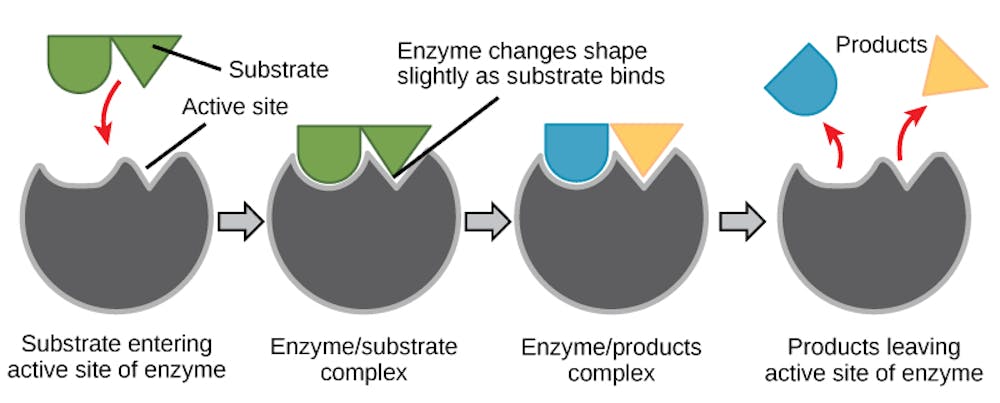
For an enzyme to function, it adopts a shape that perfectly matches the molecule it processes, much like a lock matches a key. The unique grooves in the enzyme – the lock – that interact with the target molecule – the key – are found in a region of the enzyme known as the active site.
The induced fit model of enzymes states that both the enzyme and its substrate change shape when they interact. OpenStax, CC BY-SA
The active site of the enzyme precisely orients amino acids to interact with the target molecule when it enters. This makes it easier for the molecule to undergo a chemical reaction to turn into a different one, making the process go faster. After the chemical reaction is done, the new molecule is released and the enzyme is ready to process another.
How do you design an enzyme?
Scientists have spent decades trying to design their own enzymes to make new molecules, materials or therapeutics. But making enzymes that look like and go as fast as those found in nature is incredibly difficult.
Enzymes have complex, irregular shapes that are made up of hundreds of amino acids. Each of these building blocks needs to be placed perfectly or else the enzyme will slow down or completely shut off. The difference between a speed racer and slowpoke enzyme can be a distance of less than the width of a single atom.
Initially, scientists focused on modifying the amino acid sequences of existing enzymes to improve their speed or stability. Early successes with this approach primarily improved the stability of enzymes, enabling them to catalyze chemical reactions at a higher range of temperatures. But this approach was less useful for improving the speed of enzymes. To this day, designing new enzymes by modifying individual amino acids is generally not an effective way to improve natural enzymes.
This model of acetylcholinesterase shows acetylcholine (green) bound to its active site. Sam Pellock, CC BY-SA
Researchers found that using a process called directed evolution, in which the amino acid sequence of an enzyme is randomly changed until it can perform a desired function, proved much more fruitful. For example, studies have shown that directed evolution can improve chemical reaction speed, thermostability, and even generate enzymes with properties that aren’t seen in nature. However, this approach is typically labor-intensive: You have to screen many mutants to find one that does what you want. In some cases, if there’s no good enzyme to start from, this method can fail to work at all.
Both of these approaches are limited by their reliance on natural enzymes. That is, restricting your design to the shapes of natural proteins likely limits the kinds of chemistry that enzymes can facilitate. Remember, you can’t eat soup with a knife.
Is it possible to make enzymes from scratch, rather than modify nature’s recipe? Yes, with computers.
Designing enzymes with computers
The first attempts to computationally design enzymes still largely relied on natural enzymes as a starting point, focusing on placing enzyme active sites into natural proteins.
This approach is akin to trying to find a suit at a thrift store: It is unlikely you will find a perfect fit because the geometry of an enzyme’s active site (your body in this analogy) is highly specific, so a random protein with a rigidly fixed structure (a suit with random measurements) is unlikely to perfectly accommodate it. The resulting enzymes from these efforts performed much more slowly than those found in nature, requiring further optimization with directed evolution to reach speeds common among natural enzymes.
Recent advances in deep learning have dramatically changed the landscape of designing enzymes with computers. Enzymes can now be generated in much the same way that AI models such as ChatGPT and DALL-E generate text or images, and you don’t need to use native protein structures to support your active site.
AI tools are helping researchers design new proteins.
Our team showed that when we prompt an AI model, called RFdiffusion, with the structure and amino acid sequence of an active site, it can generate the rest of the enzyme structure that would perfectly support it. This is equivalent to prompting ChatGPT to write an entire short story based on a prompt that only says to include the line “And sadly, the eggs never showed up.”
We used this AI model specifically to generate enzymes called serine hydrolases, a group of proteins that have potential applications in medicine and plastic recycling. After designing the enzymes, we mixed them with their intended molecular target to see whether they could catalyze its breakdown. Encouragingly, many of the designs we tested were able to break down the molecule, and better than previously designed enzymes for the same reaction.
To see how accurate our computational designs were, we used a method called X-ray crystallography to determine the shapes of these enzymes. We found that many of them were a nearly perfect match to what we digitally designed.
Our findings mark a key advance in enzyme design, highlighting how AI can help scientists start to tackle complex problems. Machine learning tools could help more researchers access enzyme design and tap into the full potential of enzymes to solve modern-day problems.
Sam Pellock receives funding from the Washington Research Foundation and Schmidt Futures program.
Annalena Baerbock, the German foreign minister, spoke for much of the European diplomatic community when she reacted to news of Donald Trump’s phone chat with Vladimir Putin: “This is the way the Trump administration operates,” she declared. “This is not how others do foreign policy, but this is now the reality.”
The resigned tone of Baerbock’s words was not matched by her colleague, defence minister Boris Pistorius, whose criticism that “the Trump administration has already made public concessions to Putin before negotiations have even begun” was rather more direct.
Their sentiments were echoed, not only by European leaders, but in the US itself: “Putin Scores a Big Victory, and Not on the Battlefield” read a headline in the New York Times. The newspaper opined that Trump’s call had succeeded in bringing Putin back in from the cold after three years in which Russia had become increasingly isolated both politically and economically.
This was not lost on the Russian media, where commentators boasted that the phone call “broke the west’s blockade”. The stock market gained 5% and the rouble strengthened against the dollar as a result.
Reflecting on the call, Putin’s spokesman, Dmitry Peskov, continued with operation flatter Donald Trump by comparing his attitude favourably with that of his predecessor in the White House, Joe Biden. “The previous US administration held the view that everything needed to be done to keep the war going. The current administration, as far as we understand, adheres to the point of view that everything must be done to stop the war and for peace to prevail.
“We are more impressed with the position of the current administration, and we are open to dialogue.”
Trump’s conversation with Putin roughly coincided with a meeting of senior European defence officials in Brussels which heard the new US secretary of defense, Pete Hegseth, outline America’s radical new outlook when it comes to European security. Namely that it’s not really America’s problem any more.
Hegseth also told the meeting in Brussels yesterday that the Trump administration’s position is that Nato membership for Ukraine has been taken off the table, that the idea it would get its 2014 borders back was unrealistic and that if Europe wanted to guarantee Ukraine’s security as part of any peace deal, that would be its business. Any peacekeeping force would not involve American troops and would not be a Nato operation, so it would not involve collective defence.
Sign up to receive our weekly World Affairs Briefing newsletter from The Conversation UK. Every Thursday we’ll bring you expert analysis of the big stories in international relations.
International security expert David Dunn believes that the fact that Trump considers himself a consummate deal maker makes the fact that his administration is willing to concede so much ground before negotiations proper have even got underway is remarkable. And not in a good way.
Dunn, who specialises in US foreign and security policy at the University of Birmingham, finds it significant that Trump spoke with Putin first and then called Ukraine’s president Volodymyr Zelensky to fill him in on the call. This order of priority, says Dunn, is a sign of the subordination of Ukraine’s role in the talks.
He concludes that “for the present at least, it appears that negotiations will be less about pressuring Putin to bring a just end to the war he started than forcing Ukraine to give in to the Russian leader’s demands”.
Hegseth’s briefing to European defence officials, meanwhile, came as little surprise to David Galbreath. Writing here, Galbreath – who specialises in defence and security at the University of Bath – says the US pivot away from a focus on Europe has been years in the making – “since the very end of the cold war”.
There has long been a feeling in Washington that the US has borne too much of the financial burden for European security. This is not just a Donald Trump thing, he believes, but an attitude percolating in US security circles for some decades. Once the Berlin Wall fell and the Soviet Union disintegrated, the focus for Nato become not so much collective defence as collective security, where “conflict would be managed on Nato’s borders”.
But it was then the US which invoked article 5 of the Nato treaty, which establishes that “an armed attack against one or more [member states] in Europe or North America shall be considered an attack against them all”. The Bush government invoked Article 5 the day after the 9/11 attacks and Nato responded by patrolling US skies to provide security.
Pete Hegseth dashes Ukraine’s hopes of a future guaranteed by Nato.
Galbreath notes that many European countries, particularly the newer ones such as Estonia and Latvia, sent troops to Iraq and Afghanistan. “The persistent justification I heard in the Baltic states was “we need to be there when the US needs us so that they will be there when we need them”.
The prospect of a profound shift in the world order are daunting after 80 years in which security – in Europe certainly – was guaranteed by successive US administrations and underpinned, not just by Nato but by a whole set of international agreements.
Now, instead of the US acting as the “world’s policeman”, we have a president talking seriously about taking control of Greenland, one way or another, who won’t rule out using force to seize the Panama Canal and who dreams of turning Gaza into a coastal “riviera” development.
Meanwhile Russia is engaged in a brutal war of conquest in Ukraine and is actively meddling in the affairs of several other countries. And in China, Xi Jinping regularly talks up the idea of reunifying with Taiwan, by force if necessary, and is fortifying islands in the South China Sea with a view to aggressively pursuing territorial claims there as well.
And we thought the age of empires was in the rear view mirror, writes historian Eric Storm of Leiden University. Storm, whose speciality is the rise of nation states, has discerned a resurgence of imperial tendencies around the world and fears that the rules-based order that has dominated the decades since the second world war now appears increasingly tenuous.
In any given week, you’d expect the imminent prospect of the collapse of the Gaza ceasefire to be the big international story. And certainly, while Trump and Putin were “flooding the zone” (see last week’s round-up for the origins of this phrase) the prospects of the deal lasting beyond its first phase have become more and more uncertain.
Hamas has recently pulled back from its threat not to release any more hostages. Earlier in the week it threatened to call a halt to the hostage-prisoner exchange, claiming that the Israel Defense Forces (IDF) had breached the terms of the ceasefire deal. Israeli prime minister, Benjamin Netanyahu, responded – with Trump’s backing – saying that unless all hostages were released on Saturday, all bets were off and the IDF would resume its military operations in the Gaza Strip. Trump added that “all hell is going to break out”.
The US president has also doubled down on his idea for a redeveloped Gaza and has continued to pressure Jordan and Egypt to accept millions of Palestinian refugees. This, as you would expect, has not made the population of Gaza feel any more secure.
Nils Mallock and Jeremy Ginges, behavioural psychologists at the London School of Economics, were in the region last month and conducted a survey of Israelis and Palestinians in Gaza to get a feel for how the two populations regard each other. It makes for depressing reading.
The number of Israelis who reject the idea of a two-state solution has risen sharply since the October 7 2023 attacks by Hamas, from 46% to 62%. And roughly the same proportion of people in Gaza can now no longer envisage living side by side with Israelis. Both sides think that the other side is motivated by hatred, something which is known to make any diplomatic solution less feasible.
We also asked Scott Lucas, a Middle East specialist at University College Dublin, to assess the likelihood of the ceasefire lasting into phase two, which is when the IDF is supposed to pull out of Gaza, allowing the people there room to being to rebuild, both physically and in terms of governance.
He responded with a hollow laugh and a shake of the head, before sending us this digest of the key developments in the Middle East crisis this week.
We’ve become very used to seeing apocalyptic photos of the devastation of Gaza: the pulverised streets, choked with rubble, that make the idea of rebuilding seem so remote. But the people of Gaza also cultivated a huge amount of crops – about half the food they ate was grown there. Gazan farmers grew tomatoes, peppers, cucumbers and strawberries in open fields as well as cultivating olive and citrus trees.
Geographers Lina Eklund, He Yin and Jamon Van Den Hoek have analysed satellite images across the Gaza Strip over the past 17 months to work out the scale of agricultural destruction. It makes for terrifying reading.
Flett was assigned a triage score of five, which is intended for non-urgent low-priority cases. The statement of claim alleges that the physician who finally saw Flett insinuated that he was hungover, saying something to the effect of: “I don’t know what to tell you, we don’t treat you here for hangovers.”. Flett was not given diagnostic tests, imaging, a physical examination or pain medication.
In a statement made through his lawyer, Flett said, “I knew that there was something seriously wrong with me and this doctor didn’t seem to want to take me seriously or help me. In that moment, I just felt worthless.”
Flett is a father of six, a building contractor, a resident of Winnipeg and a citizen of Tataskweyak First Nation.
Flett’s statement of claim says he endured an 11-hour bus trip to Winnipeg to seek the care he needed while in severe pain and without other healthcare alternatives.
Once in Winnipeg, Flett called 911 and requested an ambulance. He was instructed by the operator to take a taxi to Seven Oaks Hospital. There he was triaged as a priority but still told to wait.
He finally underwent surgery for acute appendicitis more than 30 hours after he first sought care. The surgery left Flett with complications.
Brian Sinclair is not here to personally tell his version of what happened in the 34 hours he spent in September 2008 in the emergency room of a major Winnipeg hospital.
Structures of Indifference by Mary Jane Logan McCallum and Adele Perry.
Sinclair, a middle-aged Anishinaabe man, died from what is normally an easily treated infection. In our 2018 book, Structures of Indifference: An Indigenous Life and Death in a Canadian City, we show how Sinclair’s tragic and unnecessary death reveals some painful truths about the ongoing history of settler colonialism, and how its legacies continue to devalue Indigenous life.
Sinclair was assumed to be drunk by medical staff and did not receive timely or adequate care, while Flett accuses medical authorities in Manitoba of the same treatment.
These types of experiences are not particular to Manitoba, but are mirrored by incidents of medical racism across Canada.
Tania Dick, Dzawada̱ʼenux̱w registered nurse and current Indigenous Nursing Lead at the University of British Columbia, explained to CBC’s The Current in 2018 that many Indigenous families have their own “Brian Sinclair story.”
This includes the family of Joyce Echaquan. Echaquan was a 34-year-old Atikamew mother of six, who recorded hospital staff hurling racial slurs at her while withholding medical treatment causing her death in a hospital north of Montréal in September 2020.
Inadequate treatment
Both Echequan’s and Sinclair’s families and communities made sure that their deaths did not go unnoticed.
In Sinclair’s case, an inquest and a number of reports resulted in significant changes to the way that patients are triaged and managed.
Echaquan’s experience led to an inquest and the development of Joyce’s Principle, which aims to “guarantee to all Indigenous people the right of equitable access, without any discrimination, to all social and health services.”
These cases have helped fuel a growing awareness about anti-Indigenous medical racism, including among organizations of medical professionals.
Apologies and pledges
Two years ago, the College of Physicians and Surgeons of Manitoba (CPSM) apologized and accepted responsibility for failing to fairly treat Indigenous patients and they pledged to take action against anti-Indigenous racism.
And last year, the Canadian Medical Association (CMA) also acknowledged the racism and discrimination that Indigenous patients and health care providers face. They apologized and pledged to “act against anti-Indigenous racism in health care.”
The inquests, reports and apologies appear to have fallen short. Flett’s lawsuit claims that his treatment violated Sections 7 and 15 of the Canadian Charter of Rights and Freedoms. It seeks damages under Section 24.1, which says that those whose rights or freedoms have been violated can seek remedies from the courts.
It is a good time for us all to think about the ongoing costs of anti-Indigenous racism in Canada’s past and present.
The authors do not work for, consult, own shares in or receive funding from any company or organisation that would benefit from this article, and have disclosed no relevant affiliations beyond their academic appointment.
Now, 85 years later, many people know “Cap” best from his depiction in the Marvel Cinematic Universe (MCU). The first film to bring the character to the big screen was Captain America: The First Avenger, in 2011. The film establishes what is probably the best known iteration of Captain America, a mantle taken up by the second world war “super-soldier” Steve Rogers (Chris Evans).
Each iteration of Captain America correlates to the real US of their time. For Trump’s America, that iteration is played by Anthony Mackie. His MCU character, Sam Wilson, formerly known as Falcon, takes up the mantle in Avengers: Endgame (2019). Mackie now appears in his first standalone film in the role, Captain America: Brave New World.
Looking for something good? Cut through the noise with a carefully curated selection of the latest releases, live events and exhibitions, straight to your inbox every fortnight, on Fridays. Sign up here.
Joe Simon and Jack Kirby, the creators of Captain America, conceived him explicitly as the antithesis to Hitler. By draping Steve Roger in stars and stripes and giving him the name Captain America, their superhero became the symbol of a nation.
With his origins in the second world war, the Steve Rogers iteration of Captain America is a fairly uncomplicated piece of propaganda, representing the righteousness of the US and its fight against Nazism. Captain America is the archetype of the nationalist superhero. He’s embodiment of the nation state and therefore represents and defends the ideal version of it.
However, as cultural geographer Jason Dittmer points out in his book Captain America and the Nationalist Superhero (2013), the state and the nation are not necessarily the same thing. The state is the governmental apparatus while the nation is the identity of its people.
Erskine explains why Rogers was chosen as a super-solder.
This difference is articulated, to an extent, in Captain America: The First Avenger (2011). The creator of the super-soldier serum, Abraham Erskine (Stanley Tucci) explains that the weak, sickly Rogers was chosen to become the first super-soldier because he understands the value of power. Having never had it, Erskine argues, he would not be corrupted by it. Rogers is not a perfect soldier, but he is a good man and that is more important.
If we map this onto the US, the implication is that America as a nation is fundamentally good and just, and therefore separate from any potentially problematic policies set by America the state.
As Rogers’ arc progresses across successive movies, the character becomes increasingly disillusioned with state power and control. His relationship with his own identity as Captain America fluctuates, with his ambivalence often symbolised by his either giving up or reclaiming the shield.
Enter Sam Wilson
In one of the closing scenes of Avengers: Endgame (2019), an aged Steve Rogers passes his shield to Sam Wilson (Anthony Mackie), the African-American superhero known as the Falcon.
In the world of the MCU, Captain America’s shield has never just been a shield – it is a symbol of heroism, of moral values and of “American-ness”. It can be read as a symbol of what America is, and what it could be.
Captain America: Brave New World is Anthony Mackie’s first standalone film in the role.
The legacy of Steve Rogers’ Captain America was explored in the TV show The Falcon and the Winter Soldier (2021). The series interrogated topics such as race, patriotism and American identity through the story arcs of two versions of Captain America: the Rogers-approved Wilson and the state-sponsored John Walker (Wyatt Russell). The series explores the concept of heroism and links it to questions of race.
In American Masculinities: A Historical Encyclopedia (2003), associate professor of American studies Holly Allen argues that: “The basis of American notions of both heroism and manliness has been a tension between virtuous devotion to a higher cause and the quest for personal achievement.”
This tension is palpably played out in the narrative arc of Rogers and in some ways resolved across the course of his films. His personal achievement (thanks to the super-soldier serum) is put in service of a higher cause, first during the second world war, later with the Avengers and finally in passing the shield to Wilson.
The state-sponsored shield
Despite his disillusionment, Rogers is positioned as being the living embodiment of the American dream, rather than a tool of the state. The same cannot be said of Walker, the white, blond, blue-eyed, highly decorated soldier selected to be the next Captain America by the US government.
Rogers’ Captain America was conceived of to fight against and be ideologically opposed to fascism. But Walker’s short-lived tenure sees him – with the backing of the “Global Repatriation Council” – carrying out raids on safe houses and refuges. He angrily demands that the people he is brutalising show him respect purely because he is Captain America.
Walker becomes, effectively, the public face of the Global Repatriation Council. Armed with the shield and dubbed the new “Star Spangled Man”, he embodies a particularly American brand of aggressive insertion into global politics. This can be interpreted as a critique of the positioning of America as “the world’s policeman”.
Wilson’s speech in The Falcon and The Winter Soldier.
During the show, Walker’s murder of an unarmed dissident brings his stint as Captain America to an end. The shield, mantle and title of Captain America therefore return to Wilson, whose climatic speech in the series’ finale articulates the hostility and judgment he faces as a black man wearing the stars and stripes.
During the recent promotional tour for Brave New World, Mackie stated that Captain America was a man with “honour, dignity and integrity”, noting that these are virtues not currently embodied by America the state.
He added that while Cap represents many things, “America” as it currently is should not be one of them. It looks likely then that Wilson’s Captain will return the character to the ideal of the nation as it should be, rather than a tool of state propaganda and repression.
Unsurprisingly, Mackie has faced enormous backlash to his comments – despite them being almost identical to sentiments expressed by Evans in 2011. Whatever the future of the character in the MCU, ideas around heroism, patriotism and race will be central to the continuing evolution of Captain America.
Laura Crossley does not work for, consult, own shares in or receive funding from any company or organisation that would benefit from this article, and has disclosed no relevant affiliations beyond their academic appointment.
As a nine-year-old, I loved singing and took every chance to do so enthusiastically during school assemblies and end-of-year shows. I developed a bit of a reputation, so much so that one day, a classmate asked me to serenade him and a girl. Cut to me belting Donna by 10CC from behind a bush outside his bedroom window.
My classmate was lacking in musical or lyrical abilities to write and perform his own song. However, if he found himself in a similar position this Valentine’s Day, he could get a little help from AI, and so can you.
Suno’s Valentine’s Day Experience is a tool to create personalised love songs in response to a three-question prompt. Keenan Freyberg, one of Suno’s co-founders, noted that their generator is similar to a mixtape, a curated collection of songs that can reflect the compiler’s feelings and intentions.
Music and dance have long served as mediators in matters of love. A British music publisher, writing in 1912, recounted in Pete Doggett’s Electric Shock, noted that music was essential at the start of a courtship, with song lyrics needing to be a blend of directness and obliqueness. This balance should allow the message to be understood while providing a safe way to ignore it if the sentiment is not reciprocated.
Looking for love this Valentine’s Day? Whether you want to improve your relationship with others or with yourself, The Quarter Life Glow-up can help.
This six-week newsletter course from The Conversation will bring you research-backed advice and tools to help improve your relationships, your career, your free time and your mental health – no supplements or skincare required.
So, for instance, if you send someone At Last by Etta James you can plausibly deny that it meant anything. You were just sharing a great song. If, however, they share the sentiment and hear a ring of reciprocal feeling in James’s voice then you can bond in a burgeoning romance where “life is like a song”.
Many of us have probably been guilty of doing this and there are so many love songs out there that there is quite possibly one to help convey every sort of romantic feeling.
A recent survey by the UK’s Performing Rights Society of 2,000 British respondents identified All of Me by John Legend as the UK’s favourite love song. The song was prompted by an old friend of Legend’s who suggested that he write one for his future-wife, Chrissy Teigen, that conveyed a similar message as Billy Joel’s She’s Always A Woman To Me. The idea that you could love someone, flaws and all, is a pretty powerful and universal sentiment.
In the US, a similar chart compiled by Billboard of the top 50 songs with love in their title, spanned hits from 1958 to 2011. The top track was Endless Love by Diana Ross and Lionel Richie, a true classic about undying feelings and commitment.
The most recently released song in the list was Rhianna’s We Found Love featuring Calvin Harris from 2011. The song’s lyrics and central hook, “We found love in a hopeless place,” were written by Calvin Harris and conveys perhaps a more youthful, possibly hedonistic message of love in a club based track.
All of these songs have really strong sentiments, but they aren’t quite the same as expressing your unique thoughts and feelings for your intended yourself. But if, like my 10CC-loving friend, you lack the skill, AI could help you craft something a bit more specific for your intended.
Suno’s love song generator asks for you to plug in your love interest’s name, where you met and something nice about them. The product is a personalised love song. While you might not be able to hide your feelings in the words of others with this AI-generated song, there is something brave and worthy about being so forthright.
Such a direct show of emotion might not be for you but this new development in AI makes clear that music and words have long been essential in the expression of love through the ages. As my experience at the tender age of nine confirms, providing the right words, with a suitable melody, at crucial moments mitigates the awkwardness of males, of all ages, where matters of the heart are concerned. Even in the age of AI.
Hussein Boon does not work for, consult, own shares in or receive funding from any company or organisation that would benefit from this article, and has disclosed no relevant affiliations beyond their academic appointment.
We may never know if St Valentine, a martyr beheaded for officiating the forbidden weddings of persecuted Christians, was keen on chocolate and flowers. But we do know that millions of people around the world will be using those very items to celebrate his name on February 14.
In the UK, it is estimated that 60% of the population will celebrate Valentine’s Day this year, each spending around £52 on gifts and other romantic gestures. The total spend in the US will be about US$27 billion (£22 bilion), including roughly $US500 million on roses.
So the tradition of spending money on your romantic partner on February 14 seems fairly well established. But it is hard to know exactly when the link began.
Up until the late 14th century, Valentine’s Day was solely a commemoration of his martyrdom. The shift toward an association with romantic love emerged in the Middle Ages, and is often attributed to the poet Geoffrey Chaucer, who linked Valentine’s Day to romance in his poem Parliament of Fowls.
But it was the 19th century industrial revolution which brought about the mass production of romantic gifts. Cadbury was the first chocolate maker to commercialise the association between romance and confectionery by producing heart-shaped boxes of chocolates for Valentine’s Day in 1868. These boxes were decorated with images of Cupid, roses and hearts, and would sometimes be kept to store romantic letters and mementos.
And while Hallmark did not invent the occasion, it played a big part in bolstering its popularity by selling Valentine’s Day postcards in 1910, and then printing its own greetings cards from 1916.
Now in the US, around 145 million Valentine’s Day cards are exchanged each year, making it the second largest annual occasion for card giving (after Christmas).
But it’s not just car sellers, florists and chocolate-makers who seek to benefit from the commercial opportunities Valentine’s Day provides. This year for example, IKEA has partnered with a dating app to give nine British couples a “once-in-a-lifetime” first date in an Ikea store, where they will share a meatball dinner for two in bed.
Lego has launched a travelling campaign in major cities around the world to show off its floral designs, and Coca-Cola has teamed up with a fast-food brand to create a Valentine-themed drive-thru experience.
Chocolate and marshmallows
These kinds of one-off marketing campaigns are only possible thanks to a long history of Valentine’s traditions, which vary around the world.
In Japan for example, it is a two-part celebration. On February 14, women often give “Giri-choco” (“obligation chocolate”) to friends and colleagues, while “home-choco” (“true-feeling chocolate”) is reserved for romantic partners. On March 14, known as White Day, men reciprocate by giving jewellery and less-expensive gifts that are white (marshmallows are a popular choice).
Celebrations in South Korea are similar to those in Japan, but with the addition of Black Day on April 14 when single people gather at restaurants to eat black noodles (jajangmyeon). In the Philippines, Valentine’s Day is marked by mass weddings organised by the government.
In Finland and Estonia, Valentine’s Day is known as “Friend’s Day” with the focus on celebrating non-romantic love and friendship. A similar idea, “Galentine’s Day”, which featured in a 2010 episode of the US sitcom Parks and Recreation, has become a popular way of celebrating female friendship.
Love for sale
Of course, not all consumers enjoy Valentine’s Day rituals. For many, there is pressure attached to romantic shopping, while for others it is just an unwelcome reminder of their single status.
But there is a market for that too. Anti-Valentine’s day sentiment has inspired other ways to (not) celebrate, including a box of chocolates aimed at single people.
And it can be a very valuable day for businesses, large and small. With high levels of participation and spending, Valentine’s Day brings a major surge in revenue for sectors including retail, hospitality and entertainment.
So although it might not sound very romantic, it’s worth remembering that while money can’t buy you love, love can provide a significant boost to the economy.
Sameer Hosany does not work for, consult, own shares in or receive funding from any company or organisation that would benefit from this article, and has disclosed no relevant affiliations beyond their academic appointment.
Source: The Conversation – UK – By Louise Gentle, Principal Lecturer in Wildlife Conservation, Nottingham Trent University
In Canada, male bears are becoming more nocturnal and overlapping less with females. Erik Mandre / shutterstock
Frustrated with which dating app to use? Unable to find “the one”? Spare a thought for some of the animal kingdom, where humanity has hampered their efforts to find a mate.
Humans have destroyed or polluted animal habitats. But perhaps the most obvious way that we have affected animals is by placing barriers, such as roads, between populations, making it hard for individual animals to reach each other. In response to this habitat fragmentation, reptile and bird species have increased the distances they move by 35% and 50% respectively.
Here are five more ways that humans have scuppered the love lives of animals.
Noise pollution causes animals to sing louder
Song is hugely important for birds and some other animals, as it indicates their fitness – those who sing louder, or more elaborately, are better able to defend territories against rivals and attract higher quality mates. But city-living great tits have to sing at a higher frequency than those in rural areas, in order to be heard over the sound of low frequency urban noises, such as traffic and machinery. They also sing faster, shorter songs.
Songbirds have learned to survive in a noisy world. Bildagentur Zoonar GmbH / shutterstock
And its not just terrestrial animals that have changed their behaviour in response to humans. As oceans are largely dark, most marine animals rely on non-visual cues, such as sound, to help them find food, navigate and attract mates. Although some whale song can be over 180 decibels in volume – comparable to the sound of a rocket launch – and heard thousands of miles away, ocean noises caused by humans can be even louder.
Not only does noise pollution make it much harder to communicate to potential mates, it has also been linked to more frequent strandings, reduced growth and low fertility in whales and dolphins. Narwhals, for example, have even responded to loud noises by diving deeper into the oceans, using up vital resources that they could be putting into reproducing.
Human disturbance makes mammals more nocturnal
Given that humans are daytime dwellers, it’s not surprising that some animals have developed nocturnal habits to avoid coming into contact with us. Animals often practice this sort of risk avoidance, but typically they move in space – away from us. With a reduction in available space, animals are also moving in time.
Mammals have been found to become more nocturnal in response to human disturbance. This disturbance could be anything from hiking to hunting: animals tend to view all human activity as threatening, whether it is or not.
For example, large male brown bears become more nocturnal when humans are present. But this creates less competition for food during the day. Consequently, the females stick to their daytime activity, essentially separating the males and females in time, and making it increasing difficult to find a mate that won’t fall asleep on them.
Introduced species hybridise with locals
Species that are introduced to areas where they are not usually found, whether on purpose or by accident, often wreak havoc on the native animals, spreading disease and out-competing, or even preying, on them.
The white headed duck is endangered, thanks to hunting, habitat loss, and the new thread of interbreeding with ruddy ducks. smutan / shutterstock
The ruddy duck was unintentionally introduced to Great Britain from North America around 75 years ago, and quickly spread throughout western Europe. After finding their way to Spain, they mated with the endangered white-headed duck, managing to produce fertile offspring and a new hybrid duck. This is pushing the white-headed duck to extinction – not good if you are a white-headed duck looking for love.
Chemical pollution turns males into females
Imagine searching for a reproductive partner only to find none of the opposite sex. This is the unfortunate situation some fish have found themselves in.
Some streams, containing wastewater or effluents, are polluted with synthetic oestrogens from birth-control pills. A study on fathead minnow fish found that increased levels of synthetic oestrogens caused males to have less developed testicles and early-stage eggs. The fish that developed these intersex traits – both male and female characteristics – were found to have fewer and less mobile sperm, which reduced their fertilisation success. This can lead to less sustainable populations, ultimately resulting in extinctions – hardly a good way to find love.
A rubbish Valentine’s Day gift
Animals often ingest plastic and other rubbish, or becoming tangled in it. But rubbish isn’t entirely bad news for all animals.
For instance, birds often use human-made materials when building nests, implying that some species are intentionally using rubbish to show off to members of the opposite sex. One particular species, the satin bower bird, constructs highly ornate bowers – stages where the males show off to the females – decorated with blue items. The more complex the bower, the better the mating success.
Bower building, with blue plastic litter. Ken Griffiths / shutterstock
But, as there are relatively few blue items in nature, the males now decorate their bowers with as many bright blue items of human rubbish as possible, including bottles tops, crisp packets, pegs and even blue condom wrappers. So, although humans are making it increasingly difficult for animals to survive and reproduce, for this particular bird, beauty really is in the eye of the beholder.
Louise Gentle works for Nottingham Trent University
The run up to February 14 is a good time for selling certain products. And alongside the jewellery and flowers, advertisers also try to sell us something broader: a notion of what we should consider romantic.
This might involve an idyllic and perfectly filmed holiday destination, or the casting of a glamorous Hollywood star to represent a particular perfume. For research has shown that advertising can shape our expectations of what love should look like – from the perfect partner to the things we should buy for them.
It’s become a familiar tactic for all kinds of advertising. And it fits with an idea explored by the French literary theorist Roland Barthes in his 1957 collection of essays, Mythologies: that if a message is repeated enough, it becomes true.
Advertisers seem to have embraced this notion, and we see the same kind of messages repeated year after year, telling potential customers what they should aspire to – and invest in – to achieve their best and most romanticised ideals.
Whether those ideals are realistic or not is not the goal here. Advertising generates money for brands by creating a commercially driven view of what love should look like.
There are various techniques available to advertisers to shape those expectations. Emotional appeals, for example, try to evoke feelings of passion and desire.
Google did this effectively in a simple video which tells a love story through the medium of an online search tool.
“Social proof” is a different advertising approach which involves relaying a specific message about what consumers can achieve if they turn to a particular brand. You too can be happy if you drink coffee with your new partner at a local branch of McDonalds for example.
This kind of marketing is designed to appeal to people’s need for social validation. It is advertising which implies that using certain products will lead to a fulfilling romantic life, and that your partner will really love you if you buy them a Toblerone this Valentine’s Day.
“Targeted marketing” is a method which focuses on creating personalised campaigns for specific audiences. This strategy has become more common as we spend more time online, providing big tech with plenty of data about our likes and dislikes.
And with online dating still growing in popularity, targeted marketing is applied through apps like Tinder and Hinge, which are able to provide valuable insights into users’ preferences, enabling advertisers to tailor their messages to specific demographics.
Match up
Marketing can also apply pressure to consumers to purchase gifts or experiences as a way of demonstrating affection. This could be anything from a box of chocolates to an engagement ring.
And who came up with the idea that one of those rings should cost the proposer the equivalent of two months’ salary? It was the jewellery company, De Beers.
In fact, it was only after the company’s 1947 advertising campaign with the slogan “A diamond is forever”, that diamond rings became an engagement tradition at all.
But depictions of diamonds and perfect lifestyles can lead to feelings of inadequacy or low self-esteem when people compare themselves to idealised portrayals in the media. Research suggests that how we process these romantic ideals is affected by our own attachment styles – the patterns of bonding that we learn as children and carry into our adult relationships.
Feelings of inadequacy have also inspired alternative Valentine’s Day celebrations. For instance, an Indian chocolate bar created a campaign to “destroy Valentine’s Day” using the assumption that as soon as uncles join a trend, such as celebrating February 14th, it becomes instantly unfashionable – and Generation Z runs for the hills.
Another harmful effect of advertising romance is how young people’s perception of relationships is shaped by the media promoting unrealistic lifestyles, body shapes and beauty standards. These kinds of branded messages are being delivered to romantic consumers of all ages as the battle for their money and time continues.
Advertisers want you to buy their products. And to make this happen, they also want you to buy into fabricated expectations of romantic love – through repetition, strategy and a familiar date in February.
Carl W. Jones does not work for, consult, own shares in or receive funding from any company or organisation that would benefit from this article, and has disclosed no relevant affiliations beyond their academic appointment.
Source: The Conversation – Canada – By DaLissa Alzner, Registered Psychotherapist, Adjunct faculty in the Department of Applied Psychology, Adler University
A healthy relationship is one where you feel comfortable being your authentic self.(Shutterstock)
Many people spend much of their lives searching for what is arguably one of the most subjective of human experiences — true love. From popular movies, TV shows and dating apps to a cultural focus on finding “the one,” the phenomenon of love is inescapable. Our preoccupation with social connectedness is biologically connected to our desire for human connection.
But how do we establish connections across all our relationships that positively contribute to our well-being? Identifying the characteristics of a healthy relationship and being mindful of red flags is a reasonable place to start.
Love is often one of those things that you just know when you feel it. While it is difficult to define love as an explicit experience or construct, there are certain guides we can use to understand what makes a loving relationship.
What makes a healthy relationship?
If you believe that friends are the family we choose, then you have been fortunate to experience a meaningful friendship that positively contributes to a reality where you feel appreciated, valued and have a sense of belonging.
This experience of connection can be defined as compassionate love — originally coined as a component of the Two-Factor Theory of Love, which suggests love is comprised of two main categories. The first is passionate love, which is the intense longing for someone that may end in sexual connection or rejection. The second is compassionate love, which is associated with friendship, companionship and affection.
Being your authentic self means aligning your actions and behaviours with your core values and beliefs. This allows you to engage in self-discovery and thrive in every environment or relationship you find yourself in.
This alignment fosters a sense of congruence between your internal self and external expressions, allowing you to interact with others genuinely. Engaging with others authentically allows you to navigate social interactions with integrity and fosters deeper, more meaningful relationships.
What does love look like?
While love can be a difficult thing to define, there are some ways that we can sense when it is present, and when it isn’t.
Celebrating differences: Embracing the authenticity and differences of friends, siblings and partners fosters appreciation. This can reduce criticism, unrealistic expectations and dissatisfaction in relationships. Forcing change may work briefly, but it often leads to resentment and unhappiness.
Putting in the work: The grass is greener where you water it. Whether it’s a 25-year or five-month partnership, relationships require effort and co-operation. Working through individual differences to achieve a common goal is crucial in relationships. Siblings may need to overlook disagreements, while friends should meet regularly.
Leaning into language: When extending a gesture or token of appreciation, consider how it will be received by your partner — not by you. For instance, if you enjoy going out for dessert, but the other person prefers staying at home, you might initially think to take them out for dessert. However, to ensure the gesture is meaningful, present it in a way that aligns with their preferences and how they receive affection.
Diffusion:Acceptance and commitment therapy encourages people to create psychological and emotional space when conflict arises. This makes space for them to process conflict objectively, while also de-personalizing the interaction, contributing to emotional regulation and an ability to respond intentionally. The ability to develop and facilitate this skill is a vital tool for emotional regulation across relationships and circumstances.
To curate healthy and meaningful relationships, be intentional about nurturing connection, authenticity and mutual respect. (Shutterstock)
Signs love may not be present
Our need to belong and form meaningful connections drives our desire for companionship. When these efforts fail or relationships break, it is painful. Yet, there are some potential signs that can indicate when love is no longer present in a relationship.
Lack of communication and avoiding conflict: Poor communication and avoiding conflict can harm relationships. Research shows that not communicating leads to misunderstandings, emotional withdrawal and unresolved issues. Avoiding conflict can result in internalizing emotions, passive-aggressive behaviour and tension. In friendships, poor communication can cause feelings of being unheard or undervalued. Studies indicate that healthy friendships rely on open communication and respectful conflict resolution.
In family relationships, dysfunctional communication often contributes to division and resentment. Family therapy research has found that a lack of open communication can contribute to generational misunderstandings, leading to dysfunctional family dynamics.
Within families, particularly between parents and children, the absence of empathy may lead to significant emotional strain. Research has found that if family members fail to offer emotional support or to recognize each other’s needs, it negatively impacts family cohesion and individual well-being.
Controlling or manipulative behavior: Controlling behaviours, like restricting autonomy or manipulating someone into believing they are the problem in every situation, poses a serious threat to the well-being of a relationship. Research has shown that controlling behaviours often reflect insecurity and can contribute to abusive dynamics in relationships.
In friendships, manipulation may present as guilt-tripping, isolating from others or using emotional leverage to get one’s way. Research in this area suggests that healthy friendships involve mutual respect and boundaries, and when manipulation is present, satisfaction and trust is significantly reduced.
In families, controlling behaviours from parents, siblings or other relatives may contribute to a decrease in personal growth. The creation of toxic family dynamics manipulation and control at the hands of family has been found to significantly contribute to damaging effects over time, particularly in the parent-child relationship.
To curate healthy and meaningful relationships, be intentional about nurturing connection, authenticity and mutual respect. By celebrating differences, putting in effort, communicating openly and practising emotional regulation, it is possible to create meaningful relationships that will positively contribute to our well-being.
At the same time, we need to be diligent in recognizing and addressing red flags like poor communication and manipulative behaviours. Doing so allows us to safeguard our emotional health. Start today — reflect on your relationships, embrace authenticity and take the steps necessary to build deeper, more supportive connections that enrich your life.
DaLissa Alzner does not work for, consult, own shares in or receive funding from any company or organisation that would benefit from this article, and has disclosed no relevant affiliations beyond their academic appointment.
Valentine’s Day is all about the hearts: heart-shaped chocolates, cards, balloons and even pizza. But the heart hasn’t always just been a symbol of romance.
Across cultures and centuries, the heart has been revered as the seat of the soul, a source of supernatural power and a vessel of identity. From ancient Egyptian afterlife beliefs to medieval relics, from necromantic rituals to modern heart transplants, this organ has been at the centre of both scientific curiosity and deep-seated mysticism.
Why has the heart, more than any other organ, been imbued with such deep symbolism and power? While anatomy tells us it is a muscular pump controlled by electrical impulses, history tells a more complex story – one of rituals, relics and even dark magic.
The human heart is a remarkably efficient pump, beating about 100,000 times a day and circulating about 7,500 litres of blood. It is driven by the sinoatrial node, a cluster of pacemaker cells that spontaneously generate electrical impulses independently of the brain.
As this intrinsic electrical system does not rely on direct nervous input but is influenced by it, the heart can continue beating for a short while even when removed from the body – provided it has an adequate supply of oxygen and electrolytes. This uncanny quality only reinforced superstitions that the heart was more than just a muscle and may explain why many early cultures viewed the heart as possessing a life force of its own.
But to present the heart as merely a pump ignores wider influences. The heart functions as an endocrine organ, releasing hormones that regulate blood pressure, fluid balance and cardiovascular health.
The connection between the heart and “love hormones”, such as oxytocin, extends beyond metaphor, as research suggests the heart not only responds to oxytocin but may also play a role in its release.
Oxytocin is primarily produced in the brain by the hypothalamus and released from the pituitary gland, flooding the body during moments of affection, trust and bonding. It is the chemical catalyst behind the deep emotional connections that define human relationships.
The heart is equipped with oxytocin receptors, and studies show that the hormone promotes vasodilation (widening of the blood vessels), reducing blood pressure and improving circulation. Beyond this, oxytocin may protect the heart, helping it repair itself and reducing inflammation after injury, such as during a heart attack.
However, the heart’s function was not always understood. The ancient Greeks believed it was the seat of intelligence, while Aristotle dismissed the brain as a mere “cooling fluid” for the heart’s divine fire.
Galen, a Greek physician, surgeon and philosopher who lived during Roman times, described the heart as the body’s furnace, while William Harvey’s 1628 discovery of circulation reshaped our understanding of this important organ. Even so, its symbolic and mystical significance never fully waned.
The seat of the soul
The ancient Egyptians preserved the heart during mummification, believing it would be weighed by Anubis against the Feather of Truth, the divine measure of justice. Ironically, the brain was discarded as totally useless. An excerpt from the Book of the Dead, an ancient Egyptian funerary text, reads:
O my heart which I had from my mother! which I had from my mother! O my heart of my different ages! Don’t stand up as a witness against me. Do not be opposed to me in the tribunal.
This spell is intended to pacify the heart and assert dominion, ensuring it remains loyal when weighed.
The idea that the heart carried more than just blood persisted into the Renaissance, with scholars debating whether it was the true locus of identity.
“If indeed from the heart alone rise anger or passion, fear, terror, and sadness; if from it alone spring shame, delight, and joy, why should I say more?” Andreas de Laguna, a Spanish physician wrote in 1535.
Even today, heart transplants fuel questions about whether a transplanted heart carries something of its donor. Some recipients report changes in personality, memories or food preferences, raising speculation about cellular memory. While no definitive scientific basis exists, such cases continue to intrigue.
Heart of darkness
The heart’s power was not only revered, but feared. In folk magic and necromancy, people believed that the hearts of executed criminals retained energy from their violent deaths. Some thought consuming, burning or preserving a heart could grant knowledge or strength.
In Scotland and England, people reportedly boiled the hearts of murderers to prevent their ghosts from haunting the living. Dried hearts were sometimes ground into powders for potions, while in occult traditions, they were burned in rituals to banish spirits or bind enemies.
More disturbing are accounts of unbaptised infants’ hearts in witchcraft traditions. Some sources claim they were used in hexes, flying ointments or dark pacts. While probably exaggerated during witch trials, such stories reflect a deep-rooted belief in the heart as a conduit of power.
The heart has been a vessel of the soul, a source of magic and a point of conflict between science and superstition. While modern medicine has demystified much of its function, its symbolism remains deeply ingrained in human culture.
This Valentine’s Day, as we exchange stylised hearts in celebration of love, we might pause to remember that the power of the heart has been a symbol of life, death and everything in between for millennia.
Michelle Spear does not work for, consult, own shares in or receive funding from any company or organisation that would benefit from this article, and has disclosed no relevant affiliations beyond their academic appointment.
A spontaneous memorial of flowers in St Petersburg, Russia, on the day of Alexei Navalny’s death, February 16 2024.Aleksey Dushutin/Shutterstock
This is the best day of the past five months for me … This is my home … I am not afraid of anything and I urge you not to be afraid of anything either.
These were Alexei Navalny’s words after landing at Moscow’s Sheremetyevo Airport on January 17 2021. Russia’s leading opposition figure had spent the past months recovering in Germany from an attempt on his life by the Russian Federal Security Service (FSB). Minutes after making his comments, Navalny was detained at border control. And he would remain behind bars until his death on February 16 2024, in the remote “Polar Wolf” penal colony within the Arctic Circle.
“Why did he return to Russia?” That’s the question I’m asked about Navalny most frequently. Wasn’t it a mistake to return to certain imprisonment, when he could have maintained his opposition to Russia’s president, Vladimir Putin, from abroad?
But Navalny’s decision to return didn’t surprise me. I’ve researched and written about him extensively, including co-authoring Navalny: Putin’s Nemesis, Russia’s Future?, the first English-language, book-length account of his life and political activities. Defying the Kremlin by returning was a signature move, reflecting both his obstinacy and bravery. He wanted to make sure his supporters and activists in Russia did not feel abandoned, risking their lives while he lived a cushy life in exile.
The Insights section is committed to high-quality longform journalism. Our editors work with academics from many different backgrounds who are tackling a wide range of societal and scientific challenges.
Besides, Navalny wasn’t returning to certain imprisonment. A close ally of his, Vladimir Ashurkov, told me in May 2022 that his “incarceration in Russia was not a certainty. It was a probability, a scenario – but it wasn’t like he was walking into a certain long-term prison term.”
Also, Navalny hadn’t chosen to leave Russia in the first place. He was unconscious when taken by plane from Omsk to Berlin for treatment following his poisoning with the nerve agent Novichok in August 2020. Navalny had been consistent in saying he was a Russian politician who needed to remain in Russia to be effective.
In a subsequent interview, conducted in a forest on the outskirts of the German capital as he slowly recovered, Navalny said: “In people’s minds, if you leave the country, that means you’ve surrendered.”
Video: ACF.
Outrage, detention and death
Two days after Navalny’s final return to Russia, the Anti-Corruption Foundation (ACF) – the organisation he established in 2011 – published its biggest ever investigation. The YouTube video exploring “Putin’s palace” on the Black Sea coast achieved an extraordinary 100 million views within ten days. By the start of February 2021, polling suggested it had been watched by more than a quarter of all adults in Russia.
Outrage at Navalny’s detention, combined with this Putin investigation, got people on to the streets. On January 23 2021, 160,000 people turned out across Russia in events that did not have prior approval from the authorities. More than 40% of the participants said they were taking part in a protest for the first time.
But the Russian authorities were determined to also make it their last time. Law enforcement mounted an awesome display of strength, detaining protesters and sometimes beating them. The number of participants at protests on January 31 and February 2 declined sharply as a result.
Between Navalny’s return to Russia in January 2021 and his death in February 2024, aged 47, he faced criminal case after criminal case, adding years and years to his time in prison and increasing the severity of his detention. By the time of his death, he was in the harshest type of prison in the Russian penitentiary system – a “special regime” colony – and was frequently sent to a punishment cell.
The obvious intent was to demoralise Navalny, his team and supporters – making an example of him to spread fear among anyone else who might consider mounting a challenge to the Kremlin. But Navalny fought back, as described in his posthumously published memoir, Patriot. He made legal challenges against his jailers. He went on hunger strike. And he formed a union for his fellow prisoners.
He also used his court appearances to make clear his political views, including following Russia’s full-scale invasion of Ukraine in February 2022, declaring: “I am against this war. I consider it immoral, fratricidal, and criminal.”
Navalny’s final public appearance was via video link. He was in good spirits, with his trademark optimism and humour still on display. Tongue firmly in cheek, he asked the judge for financial help:
Your Honour, I will send you my personal account number so that you can use your huge salary as a federal judge to ‘warm up’ my personal account, because I am running out of money.
Navalny died the following day. According to the prison authorities, he collapsed after a short walk and lost consciousness. Although the Russian authorities claimed he had died of natural causes, documents published in September 2024 by The Insider – a Russia-focused, Latvia-based independent investigative website – suggest Navalny may have been poisoned.
A mourner adds her tribute to Alexei Navalny’s grave in Moscow after his burial on March 1 2024. Aleksey Dushutin/Shutterstock
Whether or not Putin directly ordered his death, Russia’s president bears responsibility – for leading a system that tried to assassinate Navalny in August 2020, and for allowing his imprisonment following Navalny’s return to Russia in conditions designed to crush him.
Commenting in March 2024, Putin stated that, just days before Navalny’s death, he had agreed for his most vocal opponent to be included in a prisoner swap – on condition the opposition figure never returned to Russia. “But, unfortunately,” Putin added, “what happened, happened.”
‘No one will forget’
Putin is afraid of Alexei, even after he killed him.
Yulia Navalnaya, Navalny’s wife, wrote these words on January 10 2025 after reading a curious letter. His mother, Lyudmila Navalnaya, had written to Rosfinmonitoring – a Russian state body – with a request for her son’s name to be removed from their list of “extremists and terrorists” now he was no longer alive.
The official response was straight from Kafka. Navalny’s name could not be removed as it had been added following the initiation of a criminal case against him. Even though he was dead, Rosfinmonitoring had not been informed about a termination of the case “in accordance with the procedure established by law”, so his name would have to remain.
This appears to be yet another instance of the Russian state exercising cruelty behind the veil of bureaucratic legality – such as when the prison authorities initially refused to release Navalny’s body to his mother after his death.
“Putin is doing this to scare you,” Yulia continued. “He wants you to be afraid to even mention Alexei, and gradually to forget his name. But no one will forget.”
Alexei Navalny and his wife, Yulia Navalnaya, at a protest rally in Moscow, May 2012. Dmitry Laudin/Shutterstock
Today, Navalny’s family and team continue his work outside of Russia – and are fighting to keep his name alive back home. But the odds are against them. Polling suggests the share of Russians who say they know nothing about Navalny or his activities roughly doubled to 30% between his return in January 2021 and his death three years later.
Navalny fought against an autocratic system – and paid the price with his life. Given the very real fears Russians may have of voicing support for a man still labelled an extremist by the Putin regime, it’s not easy to assess what people there really think of him and his legacy. But we will also never know how popular Navalny would have been in the “normal” political system he fought for.
What made Navalny the force he was?
Navalny didn’t mean for the humble yellow rubber duck to become such a potent symbol of resistance.
In March 2017, the ACF published its latest investigation into elite corruption, this time focusing on then-prime minister (and former president), Dmitry Medvedev. Navalny’s team members had become masters of producing slick videos that enabled their message to reach a broad audience. A week after posting, the film had racked up over 7 million views on YouTube – an extraordinary number at that time.
The film included shocking details of Medvedev’s alleged avarice, including yachts and luxury properties. In the centre of a large pond in one of these properties was a duck house, footage of which was captured by the ACF using a drone.
Video: ACF.
Such luxuries jarred with many people’s view of Medvedev as being a bit different to Putin and his cronies. As Navalny wrote in his memoir, Medvedev had previously seemed “harmless and incongruous”. (At the time, Medvedev’s spokeswoman said it was “pointless” to comment on the ACF investigation, suggesting the report was a “propaganda attack from an opposition figure and a convict”.)
But people were angry, and the report triggered mass street protests across Russia. They carried yellow ducks and trainers, a second unintended symbol from the film given Medvedev’s penchant for them.
Another reason why so many people came out to protest on March 26 2017 was the organising work carried out by Navalny’s movement.
The previous December, Navalny had announced his intention to run in the 2018 presidential election. As part of the campaign, he and his team created a network of regional headquarters to bring together supporters and train activists across Russia. Although the authorities had rejected Navalny’s efforts to register an official political party, this regional network functioned in much the same way, gathering like-minded people in support of an electoral candidate. And this infrastructure helped get people out on the streets.
The Kremlin saw this as a clear threat. According to a December 2020 investigation by Bellingcat, CNN, Der Spiegel and The Insider, the FSB assassination squad implicated in the Novichok poisoning of Navalny had started trailing him in January 2017 – one month after he announced his run for the presidency.
At the protests against Medvedev, the authorities’ growing intolerance of Navalny was also on display – he was detained, fined and sentenced to 15 days’ imprisonment.
The Medvedev investigation was far from the beginning of Navalny’s story as a thorn in the Kremlin’s side. But this episode brings together all of the elements that made Navalny the force he was: anti-corruption activism, protest mobilisation, attempts to run as a “normal” politician in a system rigged against him, and savvy use of social media to raise his profile in all of these domains.
Courting controversy
In Patriot, Navalny writes that he always “felt sure a broad coalition was needed to fight Putin”. Yet over the years, his attempts to form that coalition led to some of the most controversial points of his political career.
In a 2007 video, Navalny referred to himself as a “certified nationalist”, advocating for the deportation of illegal immigrants, albeit without using violence and distancing himself from neo-Nazism. In the video, he says: “We have the right to be Russians in Russia, and we’ll defend that right.”
Although alienating some, Navalny was attempting to present a more acceptable face of nationalism, and he hoped to build a bridge between nationalists and liberals in taking on the Kremlin’s burgeoning authoritarianism.
But the prominence of nationalism in Navalny’s political identity varied markedly over time, probably reflecting his shifting estimations of which platform could attract the largest support within Russia. By the time of his thwarted run in the 2018 presidential election, nationalist talking points were all but absent from his rhetoric.
However, some of these former comments and positions continue to influence how people view him. For example, following Russia’s annexation of Crimea in 2014, Navalny tried to take a pragmatic stance. While acknowledging Russia’s flouting of international law, he said that Crimea was “now part of the Russian Federation” and would “never become part of Ukraine in the foreseeable future”.
Many Ukrainians take this as clear evidence that Navalny was a Russian imperialist. Though he later revised his position, saying Crimea should be returned to Ukraine, some saw this as too little, too late. But others were willing to look past the more controversial parts of his biography, recognising that Navalny represented the most effective domestic challenge to Putin.
Another key attempt to build a broad political coalition was Navalny’s Smart Voting initiative. This was a tactical voting project in which Navalny’s team encouraged voters to back the individual thought best-placed to defeat the ruling United Russia candidate, regardless of the challenger’s ideological position.
The project wasn’t met with universal approval. Some opposition figures and voters baulked at, or flatly refused to consider, the idea of voting for people whose ideological positions they found repugnant – or whom they viewed as being “fake” opposition figures, entirely in bed with the authorities. (This makes clear that Navalny was never the leader of the political opposition in Russia; he was, rather, the leading figure of a fractious constellation of individuals and groups.)
But others relished the opportunity to make rigged elections work in their favour. And there is evidence that Smart Voting did sometimes work, including in the September 2020 regional and local elections, for which Navalny had been campaigning when he was poisoned with Novichok.
In an astonishing moment captured on film during his recovery in Germany, Navalny speaks to an alleged member of the FSB squad sent to kill him. Pretending to be the aide to a senior FSB official, Navalny finds out that the nerve agent had been placed in his underpants.
How do Russians feel about Navalny now?
It’s like a member of the family has died.
This is what one Russian friend told me after hearing of Navalny’s death a year ago. Soon afterwards, the Levada Center – an independent Russian polling organisation – conducted a nationally representative survey to gauge the public’s reaction to the news.
The poll found that Navalny’s death was the second-most mentioned event by Russian people that month, after the capture of the Ukrainian city of Avdiivka by Russian troops. But when asked how they felt about his death, 69% of respondents said they had “no particular feelings” either way – while only 17% said they felt “sympathy” or “pity”.
And that broadly fits with Navalny’s approval ratings in Russia. After his poisoning in 2020, 20% of Russians said they approved of his activities – but this was down to 11% by February 2024.
Video: BBC.
Of course, these numbers must be taken for what they are: polling in an authoritarian state regarding a figure vilified and imprisoned by the regime, during a time of war and amid draconian restrictions on free speech. To what extent the drop in support for Navalny was real, rather than reflecting the increased fear people had in voicing their approval for an anti-regime figure, is hard to say with certainty.
When asked why they liked Navalny, 31% of those who approved of his activities said he spoke “the truth”, “honestly” or “directly”. For those who did not approve of his activities, 22% said he was “paid by the west”, “represented” the west’s interests, that he was a “foreign agent”, a “traitor” or a “puppet”.
The Kremlin had long tried to discredit Navalny as a western-backed traitor. After Navalny’s 2020 poisoning, Putin’s spokesman, Dmitry Peskov, said that “experts from the United States’ Central Intelligence Agency are working with him”. The Russian state claimed that, rather than a patriot exposing official malfeasance with a view to strengthening his country, Navalny was a CIA stooge intent on destroying Russia.
Peskov provided no evidence to back up this claim – and the official propaganda wasn’t believed by all. Thousands of Russians defied the authorities by coming out to pay their respects at Navalny’s funeral on March 1 2024. Many, if not all, knew this was a significant risk. Police employed video footage to track down members of the funeral crowd, including by using facial recognition technology.
The first person to be detained was a Muscovite the police claimed they heard shouting “Glory to the heroes!” – a traditional Ukrainian response to the declaration “Glory to Ukraine!”, but this time referencing Navalny. She spent a night in a police station before being fined for “displaying a banned symbol”.
Putin always avoided mentioning Navalny’s name in public while he was alive – instead referring to him as “this gentleman”, “the character you mentioned”, or the “Berlin patient”. (The only recorded instance of Putin using Navalny’s name in public when he was alive was in 2013.)
However, having been re-elected president in 2024 and with Navalny dead, Putin finally broke his long-held practice, saying: “As for Navalny, yes he passed away – this is always a sad event.” It was as if the death of his nemesis diminished the potency of his name – and the challenge that Navalny had long presented to Putin.
Nobody can become another Navalny
Someone else will rise up and take my place. I haven’t done anything unique or difficult. Anyone could do what I’ve done.
So wrote Navalny in the memoir published after his death. But that hasn’t happened: no Navalny 2.0 has yet emerged. And it’s no real surprise. The Kremlin has taken clear steps to ensure nobody can become another Navalny within Russia.
In 2021, the authorities made a clear decision to destroy Navalny’s organisations within Russia, including the ACF and his regional network. Without the organisational infrastructure and legal ability to function in Russia, no figure has been able to take his place directly.
More broadly, the fate of Navalny and his movement has had a chilling effect on the opposition landscape. So too have other steps taken by the authorities.
Russia has become markedly more repressive since the start of its war on Ukraine. The human rights NGO First Department looked into the number of cases relating to “treason”, “espionage” and “confidential cooperation with a foreign state” since Russia introduced the current version of its criminal code in 1997. Of the more than 1,000 cases, 792 – the vast majority – were initiated following Russia’s full-scale invasion of Ukraine in 2022.
Russian law enforcement has also used nebulous anti-extremism and anti-terrorism legislation to crack down on dissenting voices. Three of Navalny’s lawyers were sentenced in January 2025 for participating in an “extremist organisation”, as the ACF was designated by a Moscow court in June 2021. The Russian legislature has also passed a barrage of legislation relating to so-called “foreign agents”, to tarnish the work of those the regime regards as foreign-backed “fifth columnists”.
Mass street protests are largely a thing of the past in Russia. Restrictions were placed on public gatherings during the COVID pandemic – but these rules were applied selectively, with opposition individuals and groups being targeted. And opportunities for collective action were further reduced following the full-scale invasion of Ukraine.
Freedom of speech has also come under assault. Article 29, point five of the Russian constitution states: “Censorship shall be prohibited.” But in September 2024, Kremlin spokesperson Peskov said: “In the state of war that we are in, restrictions are justified, and censorship is justified.”
Legislation passed very soon after the 2022 invasion of Ukraine made it illegal to comment on the Russian military’s activities truthfully – and even to call the war a war.
YouTube – the platform so central to Navalny’s ability to spread his message – has been targeted. Without banning it outright – perhaps afraid of the public backlash this might cause – the Russian state media regulator, Roskomnadzor, has slowed down internet traffic to the site within Russia. The result has been a move of users to other websites supporting video content, including VKontakte – a Russian social media platform.
In short, conditions in Russia are very different now compared to when Navalny first emerged. The relative freedom of the 2000s and 2010s gave him the space to challenge the corruption and authoritarianism of an evolving system headed by Putin. But this space has shrunk over time, to the point where no room remains for a figure like him within Russia.
In 2019, Navalny told Ivan Zhdanov, who is now director of the ACF: “We changed the regime, but not in the way we wanted.” So, did Navalny and his team push the Kremlin to become more authoritarian – making it not only intolerant of him but also any possible successor?
There may be some truth in this. And yet, the drastic steps taken by the regime following the start of the war on Ukraine suggest there were other, even more significant factors that have laid bare the violent nature of Putin’s personal autocracy – and the president’s disdain for dissenters.
Plenty for Russians to be angry about
How can we win the war when dedushka [grandpa] is a moron?
In June 2023, Evgeny Prigozhin – a long-time associate of Putin and head of the private military Wagner Group – staged an armed rebellion, marching his forces on the Russian capital. This was not a full-blown political movement against Putin. But the target of Prigozhin’s invective against Russia’s military leadership had become increasingly blurry, testing the taboo of direct criticism of the president – who is sometimes referred to, disparagingly, as “grandpa” in Russia.
And Prigozhin paid the price. In August 2023, he was killed when the private jet he was flying in crashed after an explosion on board. Afterwards, Putin referred to Prigozhin as a “talented person” who “made serious mistakes in life”.
In the west, opposition to the Kremlin is often associated with more liberal figures like Navalny. Yet the most consequential domestic challenge to Putin’s rule came from a very different part of the ideological spectrum – a figure in Prigozhin leading a segment of Russian society that wanted the Kremlin to prosecute its war on Ukraine even more aggressively.
Video: BBC.
Today, there is plenty for Russians to be angry about, and Putin knows it. He recently acknowledged an “overheating of the economy”. This has resulted in high inflation, in part due to all the resources being channelled into supporting the war effort. Such cost-of-living concerns weigh more heavily than the war on the minds of most Russians.
A favourite talking point of the Kremlin is how Putin imposed order in Russia following the “wild 1990s” – characterised by economic turbulence and symbolised by then-president Boris Yeltsin’s public drunkenness. Many Russians attribute the stability and rise in living standards they experienced in the 2000s with Putin’s rule – and thank him for it by providing support for his continued leadership.
The current economic problems are an acute worry for the Kremlin because they jeopardise this basic social contract struck with the Russian people. In fact, one way the Kremlin tried to discredit Navalny was by comparing him with Yeltsin, suggesting he posed the same threats as a failed reformer. In his memoir, Navalny concedes that “few things get under my skin more”.
Although originally a fan of Yeltsin, Navalny became an ardent critic. His argument was that Yeltsin and those around him squandered the opportunity to make Russia a “normal” European country.
Navalny also wanted Russians to feel entitled to more. Rather than be content with their relative living standards compared with the early post-Soviet period, he encouraged them to imagine the level of wealth citizens could enjoy based on Russia’s extraordinary resources – but with the rule of law, less corruption, and real democratic processes.
‘Think of other possible Russias’
When looking at forms of criticism and dissent in Russia today, we need to distinguish between anti-war, anti-government, and anti-Putin activities.
Despite the risk of harsh consequences, there are daily forms of anti-war resistance, including arson attacks on military enlistment offices. Some are orchestrated from Ukraine, with Russians blackmailed into acting. But other cases are likely to be forms of domestic resistance.
Criticism of the government is still sometimes possible, largely because Russia has a “dual executive” system, consisting of a prime minister and presidency. This allows the much more powerful presidency to deflect blame to the government when things go wrong.
There are nominal opposition parties in Russia – sometimes referred to as the “systemic opposition”, because they are loyal to the Kremlin and therefore tolerated by the system. Within the State Duma, these parties often criticise particular government ministries for apparent failings. But they rarely, if ever, now dare criticise Putin directly.
Nothing anywhere close to the challenge presented by Navalny appears on the horizon in Russia – at either end of the political spectrum. But the presence of clear popular grievances, and the existence of organisations (albeit not Navalny’s) that could channel this anger should the Kremlin’s grip loosen, mean we cannot write off all opposition in Russia.
Navalny’s wife, Yulia, has vowed to continue her husband’s work. And his team in exile maintain focus on elite corruption in Russia, now from their base in Vilnius, Lithuania. The ACF’s most recent investigation is on Igor Sechin, CEO of the oil company Rosneft.
But some have argued this work is no longer as relevant as it was. Sam Greene, professor in Russian politics at King’s College London, captured this doubt in a recent Substack post:
[T]here is a palpable sense that these sorts of investigations may not be relevant to as many people as they used to be, given everything that has transpired since the mid-2010s, when they were the bread and butter of the Anti-Corruption Foundation. Some … have gone as far as to suggest that they have become effectively meaningless … and thus that Team Navalny should move on.
Navalny’s team are understandably irritated by suggestions they’re no longer as effective as they once were. But it’s important to note that this criticism has often been sharpest within Russia’s liberal opposition. The ACF has been rocked, for example, by recent accusations from Maxim Katz, one such liberal opposition figure, that the organisation helped “launder the reputations” of two former bank owners. In their response, posted on YouTube, the ACF referred to Katz’s accusations as “lies” – but this continued squabbling has left some Russians feeling “disillusioned and unrepresented”.
So, what will Navalny’s long-term legacy be? Patriot includes a revealing section on Mikhail Gorbachev – the last leader of the Soviet Union, whom Navalny describes as “unpopular in Russia, and also in our family”. He continues:
Usually, when you tell foreigners this, they are very surprised, because Gorbachev is thought of as the person who gave Eastern Europe back its freedom and thanks to whom Germany was reunited. Of course, that is true … but within Russia and the USSR he was not particularly liked.
At the moment, there is a similar split in perceptions of Navalny. Internationally, he was nominated for the Nobel Peace Prize, awarded the Sakharov Prize by the European Parliament, and a documentary about him won an Oscar.
But there are also those outside of Russia who remain critical: “Navalny’s life has brought no benefit to the Ukrainian victory; instead, he has caused considerable harm,” wrote one Ukrainian academic. “He fuelled the illusion in the west that democracy in Russia is possible.”
Trailer for the Oscar-winning documentary Navalny.
Inside Russia, according to Levada Center polling shortly after his death, 53% of Russians thought Navalny played “no special role” in the history of the country, while 19% said he played a “rather negative” role. Revealingly, when commenting on Navalny’s death, one man in Moscow told RFE/RL’s Russian Service: “I think that everyone who is against Russia is guilty, even if they are right.”
But, for a small minority in Russia, Navalny will go down as a messiah-like figure who miraculously cheated death in 2020, then made the ultimate sacrifice in his battle of good and evil with the Kremlin. This view may have been reinforced by Navalny’s increasing openness about his Christian faith.
Ultimately, Navalny’s long-term status in Russia will depend on the nature of the political system after Putin has gone. Since it seems likely that authoritarianism will outlast Putin, a more favourable official story about Navalny is unlikely to emerge any time soon. However, how any post-Putin regime tries to make sense of Navalny’s legacy will tell us a lot about that regime.
While he was alive, Navalny stood for the freer Russia in which he had emerged as a leading opposition figure – and also what he called the “Beautiful Russia of the Future”. Perhaps, after his death, his lasting legacy in Russia remains the ability for some to think – if only in private – of other possible Russias.
To hear about new Insights articles, join the hundreds of thousands of people who value The Conversation’s evidence-based news. Subscribe to our newsletter.
Ben Noble has previously received funding from the British Academy and the Leverhulme Trust. He is an Associate Fellow of Chatham House.
In the opening scene of Love, Actually, Hugh Grant’s character says how, whenever he gets gloomy with the state of the world, he thinks about the arrivals gate at Heathrow airport. The reason is on screen: we see couples kissing, old friends embracing, children smiling and laughing as they jump into the arms of their parents.
Airports are great places to really understand the importance of physical affection – hugging, kissing, cuddling, holding hands, or even just touching. But physical affection is ubiquitous in everyday life, too – and with good reason. Science shows that non-sexual physical affection produces more than just moments of joy – it also benefits our mental and physical health.
Physical affection is one of the most direct and important ways that people communicate intimacy in their romantic relationships. And it seems to occur in romantic relationships all over the world, despite cross-cultural differences in ideas of love and romance.
People in romantic relationships report more intimate physical affection than singletons. They’re also more comfortable allowing their partners to touch more of their bodies than strangers or friends. For example, most people are comfortable being touched on their thighs and abdomen by their partner, but not by other people.
Even how we touch our partners is different to how we touch other people. When participants in one study were asked to stroke their partner, a friend, a stranger, or an artificial arm, they did so more slowly with their partner. Slower strokes may may be experienced as more pleasant and erotic than quicker strokes. Even just thinking about physical affection from a partner evokes pleasant and erotic sensations.
There is now strong evidence showing that physical contact is associated with better physical and mental health. One review of “touch interventions” – think massage – in 212 studies involving more than 13,000 participants found that physical touch benefited everything from sleep patterns to blood pressure to fatigue. Touch interventions were especially helpful in reducing pain, depression and anxiety.
Couple’s therapy
Before you rush off to book yourself a massage, you should know that much of the evidence suggests the strongest benefits come from physical affection with romantic partners. Several studies have found that, in couples, physical affection is associated with a range of physiological effects, including lower blood pressure and better immune responses.
In couples, physical affection is also associated with better psychological wellbeing. One study found that couples who sleep-touched – cuddling shortly before or after sleep – felt happier and calmer in the morning, which meant they were more likely to enjoy the company of their partners.
Physical affection – including kissing and affection after sex – is also associated with greater relationship and sexual satisfaction, and better ratings of one’s relationship overall, which in turn contribute to better psychological wellbeing. And even when conflicts do occur, hugging seems to reduce levels of negative mood in couples.
Cuddle up, because there’s more. Receiving physical affection from a partner makes us feel psychologically stronger. One study found that women showed less activation in parts of the brain that respond to threat when holding their husband’s hand. Even just imagining touch from a partner can increase one’s willingness to take on challenging tasks.
Another way to look at this is to examine what happens when we lose physical affection. Studies have shown that “touch deprivation” – the absence of touch – is associated with greater symptoms of depression and anxiety. Indeed, the loss of affection from others during the pandemic hit many people hard. Among couples, a lack of physical affection is associated with lower relationship satisfaction, stress, and feelings of loneliness.
There are several ways in which physical affection provides these benefits. Affectionate touch is known to activate reward centres of the brain, which boosts our mood and promotes feelings of wellbeing. Touch also stimulates the release of oxytocin, which can strengthen social bonds and increase feelings of trust between individuals. It’s for these reasons that oxytocin is sometimes called the “cuddle chemical”.
Physical affection also reduces levels of the stress hormone cortisol and reduces perceived pain, which suppress physiological stress systems. One study found that a ten-minute neck-and-shoulder massage from one’s partner helped lower cortisol responses, helping to regulate levels of stress.
Psychologically, physical affection in romantic relationships is an important way to keep our emotions under control. Touching one’s partner in a caring manner helps to improve their mood and makes them feel loved, secure, and safe. As feelings of connection, trust, and belonging are strengthened through non-sexual physical signs of affection, negative effect is reduced and psychological well-being is improved.
However, not everyone likes to be touched, even if it is by their romantic partners. Some people are “touch avoidant” – and some people may actually be apprehensive about being touched. For instance, people with avoidant attachment styles – characterised by a discomfort with emotional closeness – often have very negative views about cuddling and are more hesitant to touch their partners. Conversely, people with anxious attachment styles – characterised by a fear of abandonment – may desire more touch than they receive.
But when couples have similar touch preferences, it can lead to greater attraction, closeness, and commitment to one another. And if you’re looking for a fun way to incorporate non-sexual physical affection into your relationships, consider home massage. One study found that couples who took turns massaging each other at home felt a deeper connection with each other, and felt more relaxed and less stressed.
Viren Swami does not work for, consult, own shares in or receive funding from any company or organisation that would benefit from this article, and has disclosed no relevant affiliations beyond their academic appointment.
European defence ministers left their meeting in Brussels on February 12 in shock after the new US secretary of defence, Pete Hegseth, told them they could no longer rely on the US to guarantee their security.
Hegseth said he was there “to directly and unambiguously express that stark strategic realities prevent the United States of America from being primarily focused on the security of Europe”.
He also insisted that European countries provide the “overwhelming” share of funding for Ukraine in the future. The US has been the biggest source of military aid to Ukraine, with its weapons, equipment and financial assistance crucial in helping Kyiv resist the Russian invasion.
Hegseth’s comments are in keeping with the stance of the US president, Donald Trump, on the Nato transatlantic military alliance. Trump sees Nato as an excessive financial burden on the US and has repeatedly called on its members to increase their defence spending.
But Hegseth’s remarks could also be seen as a sign of America’s waning commitment to the terms of Nato’s founding treaty. Signed in 1949 by the US, Canada and several western European nations, Article 5 of the treaty requires member states to defend each other in the event of an armed attack.
The US has the largest military – and the biggest stockpile of nuclear weapons – in Nato. So, on the face of it, efforts to recast the alliance appear a drastic shift in Europe’s security landscape in the post-cold war era.
However, those familiar with the political sentiment around Nato and the defence of Europe in the US will see that this move follows in the footsteps of what others have sought to do – starting from the very end of the cold war.
Changing over time
In 1991, following the collapse of the Soviet Union, Nato was under considerable pressure to change for the new world order. A rising China was not yet on the minds of many in Washington, but the feeling was that the financial commitments the US had made to defend western Europe during the cold war could not continue.
The so-called “peace dividend”, a slogan popularised by former US president George H.W. Bush and former UK prime minister Margaret Thatcher, allowed nearly all Nato states to reduce their military spending at this time.
In 1992, almost as soon as European Nato countries were shrinking their forces and moving away from mass armies to professional soldiering, the alliance became actively engaged in maintaining a no-fly zone over Yugoslavia.
A new Nato was becoming apparent. It was transitioning from being a collective defence organisation to one of collective security, where conflicts were managed on Nato’s borders.
This collective security arrangement worked well to keep the alliance together until 2001, when the administration of George W. Bush entered the White House and involved the US in wars in Afghanistan and Iraq. Following the 9/11 terrorist attacks in the US, Nato invoked Article 5 and returned to the principle of collective defence.
Many European countries, including the new, smaller Nato states like Estonia and Latvia, sent troops to Iraq and Afghanistan. The persistent justification I heard in the Baltic states was “we need to be there when the US needs us so that they will be there when we need them”.
Yet in 2011, before the wars in Iraq and Afghanistan were over, the administration of Barack Obama introduced a foreign policy strategy known as the “pivot to Asia”. The implication was that the US would shift its attention from primarily the western hemisphere to China.
By this point, China had become the second-largest economy in the world and was rapidly developing its military. The reaction to this US policy shift in European capitals was one of shock and disappointment. They saw it as the US deciding that its own security did not sit in Europe like it had since 1945.
Then, in 2014, Russia invaded Crimea and the Donbas in eastern Ukraine. The pivot to Asia looked like it had stalled. But US interest and investment in European defence continued to decline, with American military bases across Europe closed down. The first Trump administration continued the pattern set by Obama.
President Joe Biden, who entered office in 2021, used Russia’s invasion of Ukraine in 2022 to show European leaders that the US still saw its own security in Europe and that it would stand beside Ukraine.
But the US continued to insist that European countries invest in their own defence. The UK, Poland and France have all committed to increase their defence spending over recent years – though spending by European Nato states as a whole continued to fall.
There has been a long-held belief in the US that Europe is “freeriding” on American power. While the US saw its own security in Europe, this freeriding was allowed to continue.
But as the perspective of the US has changed, with the focus now on countering China, it has been keen to suggest that European defence should increasingly become the job of Europe itself.
Nato will not go out with a bang. It is much more likely to gradually disappear with a whimper. After all, who did Trump meet on his second day in office? Not Nato but the Quad: an alliance between Australia, India, Japan and the US in the Indo-Pacific.
David J. Galbreath has received research funding from the UKRI.
Source: The Conversation – UK – By David Hastings Dunn, Professor of International Politics in the Department of Political Science and International Studies, University of Birmingham
Donald Trump likes to portray himself as the great deal maker. Typically, his idea of the “Art of the Deal” had tended to involve outlandishly bullish opening demands – whether that’s on tariffs or trade deals – before settling on more moderate, but still exacting conditions. This context makes what happened when the US president spoke with his Russian counterpart Vladimir Putin about Ukraine so remarkable.
The very fact that Trump spoke with Putin at all was a diplomatic gift to the pariah state and its leader. For three years Russia has been diplomatically isolated by most western leaders, many of whom have called for Putin to face war crimes charges (there is currently an ICC arrest warrant out for Putin for the alleged illegal transfer of children from, Ukraine to Russia).
Indeed, the fact that Trump spoke with Putin and only then called the Ukrainian president, Volodymyr Zelensky, to inform him of their conversation indicates the subordination of Ukraine’s role in the talks.
Trumpeting the call as “highly productive” on his TruthSocial website, Trump wrote that the two leaders had spoken about the “strengths of our respective nations, and the great benefit that we will someday have in working together”. He said they had arranged to visit each other’s nations. In fact, the two will initially meet in Saudi Arabia – where Putin would not be arrested under the ICC’s warrant.
At the same time, Trump’s new defense secretary spelled out to a meeting of European defence officials the administration’s position on some of the key issues. It was clear that several of Ukraine’s “red lines” had already fallen by the wayside as far as the US is concerned.
Hegseth said that returning to Ukraine’s pre-2014 borders is “an unrealistic objective” and an “illusionary goal” and that any deal must be based on “a realistic assessment of the battlefield.”
Likewise Ukraine’s future Nato membership – something the US committed to support in the 2008 Budapest Declaration, was also a non-starter. And he said the US would not onlynot join any international force deployed to ensure Ukrainian security, but that if such a force were constituted it would not be a Nato operation. As such, he said, it would not be covered by the alliance’s article 5 pledge for collective security. This effectively dooms this initiative to failure.
As important as what was announced by the Trump administration on this subject, was what was omitted. Trump has never condemned Putin for his illegal invasion of Ukraine. And there has been no mention in his social media posts that Russia’s invasion of Ukraine was a violation of international law. Or the inviolability of Ukraine’s borders or the issue of Russian reparations for the material and human damage inflicted on Ukraine.
Russia celebrates
Russia, meanwhile, is cock-a-hoop. Kremlin spokesman Dmitri Peskov reported that Putin talked about Moscow’s demands, telling Trump of “the need to eliminate the root causes of the conflict”. This suggests that while Ukraine’s red lines are going to be ignored by the US, Russia will continue to insist on its maximalist demands that the Russians intend to take in their approach to the negotiation.
In addition to the concessions that Hegseth indicated the Trump administration has already decided to go along with, Russia is also likely to press for the demilitarisation of Ukraine. It will demand control, not just of the territory that it occupies, but of the remainder of the Ukrainian provinces that Putin has already declared to be “Russian”: Luhansk, Donetsk, Zaporizhzhia and Kherson, in the south and east of Ukraine.
Both the Russian stock market and the ruble rose sharply on the US announcement of the talks, and the government-controlled press in Russian could hardly hide their glee, reporting that: “Russia is ready for talks. But on its terms”.
European leaders shocked
The pace and scale of US concessions on Ukraine seen to have caught the US’s European Nato allies off guard. Like Ukraine itself, they have been sidelined by Trump’s decision to seek direct negotiations with Putin. The UK’s defence secretary, John Healey, issued a statement appealing that “that there can be no negotiation about Ukraine without Ukraine and Ukraine’s voice must be at the heart of any talks”.
German foreign minister, Anna Baerbock, meanwhile, said the call had come out of the blue without any consultation with Europe: “This is the way the Trump administration operates,” she said, adding: “This is not how others do foreign policy, but this is now the reality.” Baerbock said a deal must not be imposed on Ukraine and that Europe should be involved in negotiations: “This is about European peace. That’s why we Europeans must be involved.”
The French foreign ministry put out a statement saying that: “Ukraine and Europe must be part of any negotiations. Ukraine should be provided with strong security guarantees.”
Other commentators have been less diplomatic. Michael McFaul, who served as US ambassador to Russia under Barack Obama, took to X to question Trump’s tactics: “Diplomacy 101: Don’t give anything without getting something in return. Don’t negotiate in public. Don’t negotiate about Ukraine’s future without first coordinating your position with Ukrainians.”
We’ll know more about what – if any – agency Volodymyr Zelensky and his diplomats have in the future of their country after US secretary of state, Marco Rubio, and vice-president, JD Vance, meet with Zelensky at the Munich Security Conference on February 14-16.
But for the present at least, it appears that negotiations will be less about pressuring Putin to bring a just end to the war he started, than forcing Ukraine to give in to the Russian leader’s demands.
David Hastings Dunn has previously received funding from the ESRC, the Gerda Henkel Foundation, the Open Democracy Foundation and has previously been both a NATO and a Fulbright Fellow.
Source: The Conversation – UK – By Daniel Alge, Senior Lecturer in Criminology & Criminal Justice, Brunel University of London
Lucy Letby was convicted in two trials in 2023 and 2024 of murdering seven babies and attempting to murder six others in her care at the Countess of Chester hospital in north-west England between 2015 and 2016.
She is currently serving 15 whole life sentences for the murders. But the case has been called into question as a result of growing concerns about the expert evidence presented at her trial. Will she get a retrial? Here’s what happens next.
In the context of usually cautious expert opinion, the press conference held on February 4 2025 was extraordinary. An international panel of medical experts investigating the medical evidence against Lucy Letby concluded that there were alternative explanations for each of the deaths. They said they found no evidence of deliberate harm, and believe Letby did not murder any babies.
The panel’s chair, Dr Shoo Lee, is a retired neonatal care expert. His 1989 paper on air embolisms was heavily relied on by the prosecution in the Letby trial and appeals. However, Lee has previously said that his research was misinterpreted at trial. At the press conference he said, “we did not find any murders. In all cases, death or injury were due to natural causes or just bad medical care.”
Want more politics coverage from academic experts? Every week, we bring you informed analysis of developments in government and fact check the claims being made.
The panel’s findings put the case in uncharted territory, given Letby’s very recent convictions and the continuing public inquiry into the case.
The public inquiry – the Thirlwall Inquiry into events at the Countess of Chester hospital – will operate based on the assumption, following her convictions, that Letby is guilty. Letby’s barrister has called for the inquiry to be halted pending the Criminal Cases Review Commission (CCRC) review of her case.
Despite the findings of the expert panel, Letby’s release or even a retrial is by no means imminent, let alone guaranteed. Letby has already had two applications for leave to appeal refused. The grounds of appeal were related to what her defence argued were errors in judicial decision making during the trial, rather than the medical evidence. Nonetheless, this means that the CCRC is the only route left open to Letby to challenge her convictions.
Letby’s defence team confirmed that a preliminary application has been made to the CCRC, with a full submission to follow. The CCRC investigates potential miscarriages of justice in England, Wales and Northern Ireland.
The commission is expected to treat Letby’s case as a priority given the public interest. But it is still likely to take at least a year to review the considerable evidence before a referral back to the Court of Appeal could even be considered.
What evidence will be considered?
The CCRC aims to complete cases within 12 months of receiving the application. But the organisation has recently come under criticism over how it handled the case of Andrew Malkinson, who was wrongly jailed for 17 years for a crime he did not commit.
When the CCRC considers the full application, they have the power to refer the case back to the Court of Appeal. In order to do so, the commission requires new evidence or other relevant factors which would support a fresh appeal.
The findings of the medical panel will be part of the defence submission. The CCRC will decide, with other factors, whether they constitute fresh grounds for an appeal. It is particularly compelling that the prosecution case relied on Dr Lee’s research, and yet it is in part his expertise that has become a crucial element of the defence.
To send the case back for appeal, the CCRC would also need to conclude that there was a “real possibility” of the conviction being overturned.
It is important to remember that the case against Letby included statistical and circumstantial evidence as well as medical opinion. However, what are alleged to be numerous fallacies in the statistical evidence have been highlighted. And circumstantial evidence is just that – circumstantial. Letby was convicted on the medical evidence.
The evidence given as part of the Thirlwall Inquiry will be within the remit of the CCRC too. Although the inquiry has not yet formally concluded, all oral testimony has taken place. As would be expected given the inquiry’s terms of reference, much of the evidence heard has been less favourable to Letby.
The CCRC also has the power under the Criminal Appeals Act 1995 to instruct its own expert witnesses and interview previous and potential new witnesses.
If the CCRC ultimately decides to refer the case to the Court of Appeal, it will be treated like any other appeal. It could result either in the conviction being quashed and Letby going free, or a retrial.
A retrial would follow if the appeal judges believed that a retrial met the criteria set out in the Criminal Appeal Act 1968 and was in the interests of justice. The likelihood of this outcome depends on the strength of the medical evidence presented to the CCRC and the Court of Appeal.
As the Thirlwall Inquiry and the CCRC application are separate processes, is it technically not essential that the inquiry concludes before the CCRC makes a decision. Closing submissions to the inquiry are scheduled for March 2025, with the report expected later in the year. This should fit within the expected timeframe of the CCRC taking at least a year to consider the application.
A further complicating factor is Lee’s assertion that the Countess of Chester hospital provided such bad care that it would have been “shut down” in his home country of Canada. This will no doubt lead to legal claims against the NHS trust, particularly if Letby is exonerated and culpability for avoidable deaths is sought elsewhere.
Some, including Lee, have gone so far as to suggest the new evidence is so compelling that Letby should be released on house arrest pending the CCRC review. This would be highly unusual, and for the time being, Letby remains imprisoned as one of the worst child serial killers in modern British history.
Daniel Alge does not work for, consult, own shares in or receive funding from any company or organisation that would benefit from this article, and has disclosed no relevant affiliations beyond their academic appointment.
We’ve all experienced it: you’re in the middle of a conversation, searching for a word, a name, or a title, and… nothing. You know you know it–you can almost feel it–but it just won’t come. This phenomenon, known as having a word “on the tip of the tongue,” is both fascinating and frustrating. But what exactly is happening in the brain during these moments? Scientists have explored this question, uncovering some intriguing insights.
When a word is “on the tip of the tongue,” multiple regions of the brain spring into action, working to locate the missing term. Imagine a group of people frantically searching a library for a specific book. Similarly, the brain mobilizes specific areas to assist in this search. Three regions, in particular, play key roles: the anterior cingulate cortex, the prefrontal cortex and the insula.
The anterior cingulate cortex and the prefrontal cortex are part of a network responsible for cognitive control and perform complementary roles when a word is elusive. The anterior cingulate cortex acts like a supervisor, signaling that there’s a conflict: “I know this word, but I can’t retrieve it!” Meanwhile, the prefrontal cortex evaluates and verifies the information that surfaces during the search, ensuring that what is retrieved matches what you’re looking for. The insula, a deeper and less visible brain region, contributes to phonological retrieval–helping access the sounds that make up words.
Using tools like functional magnetic resonance imaging (fMRI), researchers have observed how these brain areas work together during such moments. It’s as if these regions collaborate like colleagues tackling a tough problem, pooling their efforts to find the missing word.
Interestingly, this frustrating experience becomes more frequent as we age. Studies show that parts of the brain involved in word retrieval–particularly the anterior cingulate cortex and the insula–tend to atrophy over time. This means they lose some efficiency, like a once-pristine library becoming disorganised, with misplaced books and poorly labelled shelves. As a result, retrieving a “book” or, in this case, a word, becomes more challenging.
For example, research has shown that in older adults, the insula is less active during word retrieval attempts. This diminished activity impairs the ability to assemble the phonological elements of words, making “tip-of-the-tongue” moments more common. The more affected the insula becomes with age, the harder it is to recover words that are otherwise familiar.
Despite its increased frequency with ageing, the “tip-of-the-tongue” phenomenon is entirely normal. It highlights the complexity of the brain, showing that even seemingly simple tasks–such as finding a word–rely on the coordinated action of many regions.
Moreover, there are ways to mitigate the effects of ageing on word retrieval. One strategy involves building what scientists call cognitive reserve–a protective factor bolstered by intellectual, physical and social activities. This reserve helps optimise brain health and cognitive ageing, making word-finding easier even as we grow older.
The next time a word is on the tip of your tongue, remember that your brain is hard at work trying to retrieve it. Partial information–such as certain sounds or related words–might surface first, encouraging you to keep searching. If the word doesn’t come to you right away, take a break and try again later with a clear mind. These moments are a testament to the brain’s complexity and remarkable efficiency.
Frédéric Bernard ne travaille pas, ne conseille pas, ne possède pas de parts, ne reçoit pas de fonds d’une organisation qui pourrait tirer profit de cet article, et n’a déclaré aucune autre affiliation que son organisme de recherche.
I grew up in San Gabriel Valley — also referred to as SGV or the 626. SGV is an ethnoburb — an ethnic enclave — that grew out of the 1970s, with its own economy and ecosystem that includes banks, grocery stores, hair salons and restaurants.
Since many early Asian immigrants to this country were barred from accessing white institutions, working together to build and protect this ethnic ecosystem was a matter of survival and necessity.
Wei Li, a Chinese American geographer, first proposed the term “ethnoburb” to describe the hybridity of ethnic enclaves and middle-class suburbs: suburban ethnic clusters of people and businesses.
The ethnoburb demonstrates that we can create our own power and belonging — without learning English, without participating in white institutions, and Americanizing. It is a communal endeavour, one that requires everybody’s imagination and care.
The ‘Chinese Beverly Hills’
Fuelled by foreign capital, ethnoburb immigrants redefined the entire landscape of the suburb and instigated an economic boom. The growth of Chinese American banking institutions, along with the political and economic factors that prompted the migration of wealthy ethnic Chinese from Taiwan and Hong Kong, played an important role in facilitating the Chinese economic growth in Monterey Park, a city in San Gabriel Valley.
With their resources, Chinese immigrants bought homes and started businesses with distinct Chinese and Vietnamese language signs to cater to fellow Asian transplants. Valley Boulevard, which runs through 10 cities in San Gabriel Valley, became home to Asian-owned malls, commercial plazas, office complexes, shops, hotels and industrial plants, often with trilingual signage in Chinese, Vietnamese and English.
By the 1980s, Monterey Park was known as “the first suburban Chinatown,” converting San Gabriel Valley from predominantly white suburbs into an Asian-majority ecosystem with a conspicuous and diverse first-generation, unassimilated immigrant presence.
Bypassing urban Chinatowns for the suburbs
The ethnoburb troubles the American construction of the suburbs as static sites of whiteness and socioeconomic mobility.
The majority of new immigrants, especially those with resources, bypassed urban ethnic enclaves like Chinatown that previously served as immigrant gateway cities and settled immediately into suburbs instead.
Zhou also says the direct insertion of new Asian immigrants into traditionally white middle-class suburbs offends the conventional understanding of immigration and assimilation. Ethnoburb immigrants were non-white, didn’t always speak English, made considerably less effort to acculturate into whiteness, and many of them were already educated and affluent. They broke the bounds of the American imagination of an immigrant.
In addition to higher levels of education and incomes, many ethnoburb immigrants also possessed expansive and transnational social networks that shaped their reluctance to acculturate. They did not need to learn English or go through the ethnic enclave to reach a middle-class dream of financial stability.
The ethnoburb was not a “staging ground” for somewhere better or whiter. The ethnoburb was the final desired destination.
In actuality, contrary to popular conceptions, the ethnoburb was not apolitical or insular at all. It was and remains a site of resistance against the confining, white imagination of suburbia. With the emergence of Monterey Park as an Asian ethnoburb, questions over group identity, spatial boundaries, and the character of Monterey Park became politicized.
White hostility in an ‘all-American’ city
Nativist white residents were at the forefront of erecting boundaries of belonging that stigmatized first-generation immigrants. In addition to Asian businesses changing the esthetic and cultural identity of Monterey Park, Asian immigrants took on local politics. This direct insertion of unassimilated Asian immigrants into traditionally white suburbs and its institutions troubled conventional American understandings of who an immigrant is, the norms they should follow, and how they should behave.
Lily Lee Chen’s official portrait as mayor of Monterey Park, California, 1983. The Huntington Library, Art Museum, and Botanical Gardens.
On Nov. 8, 1983, Lily Lee Chen, a first-generation immigrant from Taiwan, was inaugurated in Monterey Park as the first Chinese American mayor in the nation. Chen was relatable, charismatic, and not assimilated. The Los Angeles Times described Chen’s speech as “accented with pauses and grammatical errors, characteristic of someone speaking in their second language.”
In another Times article from 1985, Chen told the reporter that she enjoyed dressing in bright reds and jade greens, despite being told by her consultant to look more subdued because her bright colours made her appear “aggressive.” During her campaign, she was met with fierce resistance from white residents, who commonly took down her neighbourhood campaign signs.
As a response, Chen worked tirelessly on voter engagement among Asian Americans and Latinos, publishing multilingual voter handbooks, registering voters, and building relationships with ethnic communities, including working with Cesar Chavez to support the Latinos in Southern California.
The same year as Chen’s election, Monterey Park’s five-member city council became multiethnic, with two Mexican Americans, one Filipino American, one Chinese American, and one white council member.
As Monterey Park became touted as a “successful suburban melting pot” by journalists and even won an “All-American City” award in 1985 for its civic engagement and racial diversity, white flight accelerated and resentment festered among the minority of white residents.
The large influx and increasing influence of Chinese immigrants over a short period of time caused racial tension to build, with mounting struggles over cultural differences, language barriers, and explicit mistrust of immigrants. Chinese businesses, political candidates, religious institutions, and entrepreneurs became racialized targets of nativist animus.
A particularly contentious conflict emerged over the proliferation of business signs in languages other than English. In 1986, white hostility among the remaining white residents swept the council members of colour out of office, and replaced them with three long-established white residents, who promptly launched an anti-immigrant, “English-only” campaign attacking the proliferation of business signage in Chinese.
A scene from the 2010 play by Annette Lee about the English only movement from the 80s. 17-year-old Scarlett Wong, an ‘all-American teenager’ struggles with her neighbors who don’t speak English. Angry Asian Man/Annette Lee
The “English-only” movement in Monterey Park reflects the struggle to control the identity and narrative of a built environment. It represents the tension between America’s idea of how immigrants should assimilate, and how ethnoburb immigrants instead created their own unassimilable institutions and communities.
Frank Arcuri, one of the Monterey Park residents and community activists who started the “English-only” petition campaign, insisted, “Immigrants are welcome here, but they must realize that English is the language we use in America… They must realize they are making a negative impact on our city. They must adapt to our ways. They must use our language and respect our culture.”
The nativist, inflammatory rhetoric Arcuri employed to speak about immigrants is as American as apple pie, comparable to replacement theory touted by white nationalist conspiracists today.
The English-only conflict illustrates the deeper, ideological tensions behind an increasingly diverse and polyglot constituency, composed of politically active immigrants, and nostalgic white residents desperately (and at times violently) clinging on to institutional power and a homogeneous past.
Asian immigrants defied assimilation theories
Traditionally, sociologists of immigration and assimilation theorists believed that all immigrant groups would eventually assimilate and integrate into white Protestant American institutions, culture, and society. They argued that doing so would be in the best interests of immigrants. They were also all white scholars. For the most part, what they theorized was true for European immigrants.
However, Asian immigrants in the ethnoburb remained proudly unassimilable and trans-national. While the ethnoburb was their final destination, they maintained diasporic ties. Many with socioeconomic privilege shuttled back and forth to their home countries.
It is our diasporic connections to our motherlands and our ethnic communities, not necessarily our assimilation into whiteness, that help us thrive in the U.S.
Bianca Mabute-Louie is affiliated with Asian Texans for Justice.
Has a romantic partner, or someone you had a crush on, ever hurt your feelings? You’re far from alone. Very few people can boast a 100% success rate when it comes to attracting love interests. And even for those who have more “hits” than “misses”, no partner is capable of always being attentive to our needs, leading to conflicts, disappointments and breakups.
Given the ubiquity of romantic rejection, why is it often so challenging to respond in adaptive rather than destructive ways?
Humans are social creatures. Millennia of relying on our family and broader social communities for survival means that we have evolved complex psychological monitoring systems to track whether we are safely connected with others – or at risk of being pushed out of groups.
The evolutionary importance of social connection with others is so significant that some researchers have gone so far as to argue that people have a fundamental need for acceptance through positive and satisfying relationships.
If you’ve recently been rejected by someone you had feelings for, or a partner has ended your relationship, these psychology-backed tips will help you to move on.
Looking for love this Valentine’s Day? Whether you want to improve your relationship with others or with yourself, The Quarter Life Glow-up can help.
This six-week newsletter course from The Conversation will bring you research-backed advice and tools to help improve your relationships, your career, your free time and your mental health – no supplements or skincare required. Sign up here to start your glow-up at any time.
Why does rejection hurt so much?
In many societies, romantic relationships typically offer the strongest forms of connection – and consequently opportunities for rejection. From being rebuffed or ghosted by prospective partners, to having your emotional needs ignored in your relationship, through to recurring conflicts, breakups and divorces, romantic rejection can manifest at all stages of romantic life.
These moments of rejection amplify our need to belong. They motivate us to respond in a way that restores of feelings of safety and connection because they shine a spotlight on the psychological risks of being cast out and left vulnerable.
While romantic rejection is always unpleasant, not everyone notices or reacts to rejection in the same way.
People who are higher in rejection sensitivity more actively monitor for signs of rejection from their loved ones. This hypersensitivity often backfires, leading them to over-anticipate rejection and prevent others from behaving in ways that would provide reassurance.
Consider, for example, that you find out a group of friends met for coffee and didn’t invite you. It is natural to feel slighted even if this was not their intention. People lower in rejection sensitivity are more likely to conclude that the harm was unintentional, and focus instead on the positives. Perhaps, suggest that “it looks like you had a great time, I’d love to join next time”.
People higher in rejection sensitivity are more likely to conclude that the exclusion was not only intentional, but indicative that the friend group is harbouring some kind of resentment. These assumptions can lead to withdrawal. Instead of opening the door for an invite in the future or reassurance that their presence was missed, they close it behind them.
People who are sensitive to rejection are more likley to interpret friends getting coffee without them as a slight. Annika Knight/Dupe, CC BY-SA
This preoccupation with protecting the self from rejection often contributes to self-fulfilling prophecies. For example, people with lower self esteem often over-anticipate rejection from others. Consequently, they are more likely to believe that a potential romantic partner is disinterested.
This assumption of disinterest prevents them from even attempting to initiate a relationship with the object of their affection. Their potential partner may misinterpret reticence as disinterest, or may never even realise the door for connection was open, thus guaranteeing a “rejection”.
The only way to break this cycle is by trying to connect, rather than hoping or assuming the other person will always make the first move.
By contrast, people with high self esteem are less preoccupied with avoiding rejection and are therefore more likely to continue to see loved ones through rose-tinted glasses, even after experiencing rejection.
How to cope with romantic rejection
Being more sensitive to the warning signs of rejection does not mean that someone is immune to its sting. Experiencing rejection leads most people to feel worse about themselves and others. This can lead to aggressive and selfish actions.
Research has even shown that some people are more likely to say that being sexually coercive against a partner is permissible if they have been reminded about time they had been recently hurt by a close other. Therefore, in a cruel twist of fate, these hurt people often hurt others, thereby reducing the likelihood of reconnection.
So, how can you find more adaptive ways of coping with rejection? An important first step is self-reflection. People with low self-esteem or an insecure attachment style (people who have less positive self-regard and expect others to have poor regard for them as well) are more likely to be rejection sensitive. Ask yourself if this might describe you.
Spend time reflecting on your self esteem and attachment style to understand how you cope with rejection. Rawpixel.com/Shutterstock
Recognising that this is something you struggle with can help you be mindful in how you respond to experiences. Even people particularly sensitive to rejection benefit from being nonjudgmental about their inner experiences, and are less likely to report negative feelings following rejection.
Another strategy you can work on is constructive, rather than destructive, approaches to communication. Because rejection makes us feel defensive, it can lead us to express ourselves in overly negative and indirect ways. Try to avoid focusing on your love interest’s intent.
In a relationship, focus on how a transgression made you feel and what it would take to make it up to you now, and in the future. These sorts of positive, yet direct, approaches are more productive and increase the likelihood that your partners will be responsive to your needs in the future.
It is not necessary to run away from rejection. It is an important social cue that can motivate you towards self-improvement and connection with others. The people who can fully embrace the potential benefits the comes from connecting with others, in spite of any potential risks, are more likely to reap the rewards.
Veronica Lamarche has received funding from the ESRC, the British Academy, and the Royal Society.
Valentine’s Day is all about the hearts: heart-shaped chocolates, cards, balloons and even pizza. But the heart hasn’t always just been a symbol of romance.
Across cultures and centuries, the heart has been revered as the seat of the soul, a source of supernatural power and a vessel of identity. From ancient Egyptian afterlife beliefs to medieval relics, from necromantic rituals to modern heart transplants, this organ has been at the centre of both scientific curiosity and deep-seated mysticism.
Why has the heart, more than any other organ, been imbued with such deep symbolism and power? While anatomy tells us it is a muscular pump controlled by electrical impulses, history tells a more complex story – one of rituals, relics and even dark magic.
The human heart is a remarkably efficient pump, beating about 100,000 times a day and circulating about 7,500 litres of blood. It is driven by the sinoatrial node, a cluster of pacemaker cells that spontaneously generate electrical impulses independently of the brain.
As this intrinsic electrical system does not rely on direct nervous input but is influenced by it, the heart can continue beating for a short while even when removed from the body – provided it has an adequate supply of oxygen and electrolytes. This uncanny quality only reinforced superstitions that the heart was more than just a muscle and may explain why many early cultures viewed the heart as possessing a life force of its own.
But to present the heart as merely a pump ignores wider influences. The heart functions as an endocrine organ, releasing hormones that regulate blood pressure, fluid balance and cardiovascular health.
The connection between the heart and “love hormones”, such as oxytocin, extends beyond metaphor, as research suggests the heart not only responds to oxytocin but may also play a role in its release.
Oxytocin is primarily produced in the brain by the hypothalamus and released from the pituitary gland, flooding the body during moments of affection, trust and bonding. It is the chemical catalyst behind the deep emotional connections that define human relationships.
The heart is equipped with oxytocin receptors, and studies show that the hormone promotes vasodilation (widening of the blood vessels), reducing blood pressure and improving circulation. Beyond this, oxytocin may protect the heart, helping it repair itself and reducing inflammation after injury, such as during a heart attack.
However, the heart’s function was not always understood. The ancient Greeks believed it was the seat of intelligence, while Aristotle dismissed the brain as a mere “cooling fluid” for the heart’s divine fire.
Galen, a Greek physician, surgeon and philosopher who lived during Roman times, described the heart as the body’s furnace, while William Harvey’s 1628 discovery of circulation reshaped our understanding of this important organ. Even so, its symbolic and mystical significance never fully waned.
The seat of the soul
The ancient Egyptians preserved the heart during mummification, believing it would be weighed by Anubis against the Feather of Truth, the divine measure of justice. Ironically, the brain was discarded as totally useless. An excerpt from the Book of the Dead, an ancient Egyptian funerary text, reads:
O my heart which I had from my mother! which I had from my mother! O my heart of my different ages! Don’t stand up as a witness against me. Do not be opposed to me in the tribunal.
This spell is intended to pacify the heart and assert dominion, ensuring it remains loyal when weighed.
The idea that the heart carried more than just blood persisted into the Renaissance, with scholars debating whether it was the true locus of identity.
“If indeed from the heart alone rise anger or passion, fear, terror, and sadness; if from it alone spring shame, delight, and joy, why should I say more?” Andreas de Laguna, a Spanish physician wrote in 1535.
Even today, heart transplants fuel questions about whether a transplanted heart carries something of its donor. Some recipients report changes in personality, memories or food preferences, raising speculation about cellular memory. While no definitive scientific basis exists, such cases continue to intrigue.
Heart of darkness
The heart’s power was not only revered, but feared. In folk magic and necromancy, people believed that the hearts of executed criminals retained energy from their violent deaths. Some thought consuming, burning or preserving a heart could grant knowledge or strength.
In Scotland and England, people reportedly boiled the hearts of murderers to prevent their ghosts from haunting the living. Dried hearts were sometimes ground into powders for potions, while in occult traditions, they were burned in rituals to banish spirits or bind enemies.
More disturbing are accounts of unbaptised infants’ hearts in witchcraft traditions. Some sources claim they were used in hexes, flying ointments or dark pacts. While probably exaggerated during witch trials, such stories reflect a deep-rooted belief in the heart as a conduit of power.
The heart has been a vessel of the soul, a source of magic and a point of conflict between science and superstition. While modern medicine has demystified much of its function, its symbolism remains deeply ingrained in human culture.
This Valentine’s Day, as we exchange stylised hearts in celebration of love, we might pause to remember that the power of the heart has been a symbol of life, death and everything in between for millennia.
Michelle Spear does not work for, consult, own shares in or receive funding from any company or organisation that would benefit from this article, and has disclosed no relevant affiliations beyond their academic appointment.
For many of us, the run-up to Valentine’s Day is spent seeking out the least cringe-worthy card in the shop to gift to our significant other, and show them how we really feel. But, unfortunately, Hallmark rhymes rarely mine the depths of love and desire.
So, if you’re looking for the perfect words for your loved one this year, why not share one of these poems, which attempt to express the wonder and complexities of romantic love.
If you make a list of love poems, you’re obliged to include a Shakespearean sonnet, so I’ll start with a lesser known one, Sonnet 106.
In the poem, the bard compares the beauty of his lover to ancient poems that described beautiful knights and ladies. He declares that these older writers must have been prophets to know his lover’s true beauty. In fact, his lover is even more beautiful than these descriptions because the poets “had not skill enough your worth to sing”.
Here, Shakespeare addresses a problem that has plagued love poets throughout the ages: how to write of the love and beauty they feel and see when words may never match up.
Looking for something good? Cut through the noise with a carefully curated selection of the latest releases, live events and exhibitions, straight to your inbox every fortnight, on Fridays. Sign up here.
2. From the Irish by Ian Duhig (1997)
British-Irish poet, Ian Duhig confronts the same problem as Shakespeare in From the Irish. It is a poem that thinks as much about language as it does about love, but resolves in a sincere but frustrated attempt to tell his lover how he feels.
In trying to be precise in his use of language, he ends up telling his lover that their face “is like a slice of half-boiled turnip”.
This attempt to compare his lover’s face to the moon is not an insult, but instead part of his serious attempt to, as he says, “love you properly, according to Dinneen”.
3. Heart to Heart by Rita Dove (2004)
Rita Dove’s Heart to Heart likewise contemplates the relationship between love and language. In the poem, Dove, the former US poet laureate dismisses the clichéd ways in which we talk about the heart:
It doesn’t melt
or turn over,
break or harden.
The poet cannot tell her lover from “the bottom of it / how I feel” but gives it to them all the same.
Rita Dove reads her poem Heart to Heart.
4. He Seemed to Me Equal to the Gods by Sappho (translated by Anne Carson in 2002)
Closely aligned to the theme of romantic love is that of desire, and across the centuries poets have written about the torture of yearning. The Greek poet Sappho knew this even 2,600 years ago. Women are the objects of desire in her erotic poetry.
This poem, translated by the Canadian poet, Anne Carson, finds the poet watching her lover, which, says Sappho, “puts the heart in my chest on wings” but also renders her speechless. She describes the intensity and agony of desire:
fire is racing under skin
and in eyes no sight and drumming
fills ears.
These lines are a surviving fragment of a larger, lost poem, so what the poet might have “dared” at the end remains a mystery.
5. His Mistress Going to Bed by John Donne (circa 1590)
Perhaps more daring is John Donne’s His Mistress Going to Bed. Donne, an English poet who began writing in the 16th century, is considered one of the great love poets.
His Mistress Going to Bed is his attempt at seduction, undressing his lover across the poem’s lines: “Now off with those shoes, and then safely tread / In this love’s hallow’d temple, this soft bed.” The sexual act is seen as one of union: “As souls unbodied, bodies uncloth’d must be, / To taste whole joys.”
So prepared is the poet, we discover by the poem’s end, that he is already naked and ready to go to bed with his love.
6. Poem II by Adrienne Rich (1978)
As partnerships evolve, the initial intensity of sexual passion morphs into a more everyday, although no less exciting kind of love.
Poem II from Adrienne Rich’s sequence Twenty-One Love Poems describes the poet waking in her lover’s bed following a dream. She tenderly writes: “You’ve kissed my hair / to wake me.”
Adrienne Rich (right) with Audre Lorde (left) and Meridel Lesueur in 1980. K. Kendall/flickr, CC BY
The poem is a warm and intimate portrait of the love between two women, with Rich declaring:
I laugh and fall dreaming again
or the desire to show you to everyone I love,
to move openly together.
In this, the poet acknowledges the ease and depth of her love but also makes subtle reference to the lack of acceptance of homosexual relationships in the 1970s, when the poems were first published.
7. An Amish Rug by Michael Longley (1991)
Michael Longley, the Irish poet who passed away in January, presents a similarly private scene of an established relationship in his poem, An Amish Rug.
Describing the handmade rug he gifts to his wife, the poet contrasts the simplicity of the Amish lifestyle with its vivid woven colours.
If hung on the wall, the rug will become a stained-glass “cathedral window”. Or, it may be placed on the floor so that “whenever we undress for sleep or love / We shall step over it as over a flowerbed”.
There’s a Valentine’s gift to live up to.
8. The Orange by Wendy Cope (1992)
Wendy Cope’s The Orange almost unexpectedly turn into a love poem, as the poet describes the increasing “peace and contentment” that comes from sharing a “huge orange” with her colleagues. This, she says, “made me so happy, / As ordinary things often do”.
The Orange by Wendy Cope.
Its description of a lovely but ordinary day ends with the affirming line “I love you. I’m glad I exist,” revealing that profound reflections can come from small moments.
Ellen Howley does not work for, consult, own shares in or receive funding from any company or organisation that would benefit from this article, and has disclosed no relevant affiliations beyond their academic appointment.
Finding out you and your partner are expecting a baby throws many discussions that might have once been hypothetical into stark relief. This certainly may be the case if your partner speaks another language beyond the one spoken where you live and that the two of you communicate in.
“I’d like to bring the baby up to speak my language”, they say, and suddenly what seemed a wonderful idea – a bilingual child – might throw up panicked visions of being left out of private jokes and conversations at the dinner table. But growing up with two or more languages can be hugely beneficial for children, and there’s plenty you can do to help out and get involved.
When children acquire a minority language – a language other than the dominant language or languages in the place they live – spoken by one or both parents, they have the key to that culture. It offers the possibility of a deep relationship with extended family and others they might otherwise not be able to talk to at all. You really want to do everything in your power to support your partner and your child in this venture.
Learning something of your partner’s language will effectively solve your problem. You may be able to join a class to learn the language or even just use a language app such as Duolingo to get a head start on vocabulary and basic phrases. This becomes more challenging if the language in question is not a standard variety or is a language not spoken by many people.
If a parent is proficient in a lower-status and higher-status variety of a language – such as Cypriot Greek and standard Greek, or colloquial Singapore English and standard English – it may be tempting to want the child to learn the high-status variety. But the lower-status variety might be the one that the child will need to be able to visit family and feel like an insider. The higher-status variety can be added later if and when your child needs or wants it.
Even if you’re learning a non-standard language, and it takes time to achieve proficiency, you can learn a lot of useful language along with your baby. You just need to understand the gist of a conversation to be able to join in in your own language, and honestly, most conversations with a baby are not difficult to follow.
Even minimal effort towards learning to understand the language is worthwhile for the goodwill it encompasses. Just accepting that your partner will use another language with your child is really enough.
Family language policy
If your partner is speaking their language most of the time with your child, you don’t need to aspire to do that. Your job is to speak the other language.
Together you, your partner and your child will develop a family language policy about who speaks which language to whom. A popular approach is one-person-one-language: you speak your language to your child, your partner speaks theirs to them, and as parents you communicate in any available language, usually what you spoke together before you became parents.
This leads to dinner-table conversations with two or more languages, but children manage this easily. A major advantage of each parent mostly sticking to one language is that it is easier to get into the habit of using the languages, particularly a minority language that might not have had a place in your life as a couple before your baby was born.
The family linguistic repertoire can be said to be partially shared, with your child as the winner of the jackpot, developing skills in at least a couple of the languages spoken by their parents.
Learning the language spoken by extended family will help children build a relationship with them. Drazen Zigic/Shutterstock
Welcoming your partner’s language into your home means that you are preparing the ground for them and their extended family to support your child’s language development.
Grandparents are a powerful resource, especially if they have limited proficiency in the majority language – the language most commonly spoken where you live. They are often very motivated to help your child develop proficiency in their language so that they can have a relationship with them.
Your partner will face challenges, particularly as the child gets older and has more opportunity to hear and use the majority language with other children. It is likely that the child will at some point answer your partner in the majority language. Help them both to persevere with using the minority language.
Encourage your partner and child to make trips without you to environments where the minority language is spoken. You can help your partner create a linguistic landscape in your home: put up alphabet posters, and get books and children’s TV shows and films in their language.
Don’t worry about the majority language – your child has you and the surrounding community to support their majority language development. There is zero risk that your child will end up monolingual in the minority language if they have the opportunity to use the majority language with you and outside the home. Together, you and your partner can give your baby the gift of bilingualism.
Una Cunningham does not work for, consult, own shares in or receive funding from any company or organisation that would benefit from this article, and has disclosed no relevant affiliations beyond their academic appointment.