Category: Health

  • MIL-OSI United Nations: 5 May 2025 Building Resilience Through Preparedness: Scaling Up Mental Health and Psychosocial Support in Bangladesh

    Source: World Health Organisation

    From 2–4 December, WHO and UNHCR co-organized a three-day inter-agency workshop in Cox’s Bazar focused on operationalizing MHPSS preparedness as part of disaster risk management. This workshop was part of broader efforts under the WHO Special Initiative for Mental Health (SIMH) to expand sustainable mental health services in Bangladesh. More than 50 participants from across government and the humanitarian and development sectors joined the workshop. The MHPSS Ready training package aims to strengthen the capacity to manage risks to mental health and ensure timely and effective mental health and psychosocial support before, during and after emergencies. 

    To further support implementation, WHO and partners piloted the forthcoming MHPSS Preparedness Assessment Toolkit, using the toolkit’s capacity checklist to assess MHPSS readiness in SIMH-supported districts and in Cox’s Bazar refugee camps. To further assess readiness, two community risks and capacities focus group discussions were held in Cox’s Bazar to gather feedback from adults living in the refugee camps. Visits to health centres and community discussions further enriched findings, with more district-level assessments planned for 2025.

    Building on these activities,, a national stakeholder workshop on MHPSS preparedness was also held on 10 December in Dhaka. The workshop brought together representatives from the National Institute of Mental Health, NGOs, and UN agencies to define key challenges and next steps. Among the priorities identified were expanding community-based mental health systems, strengthening multisectoral coordination, and embedding MHPSS within national emergency and disaster management planning and structures.

    These initial steps mark important progress in strengthening MHPSS preparedness in Bangladesh. Through investment in coordination, capacity, and data, the country is moving toward more resilient systems. Strengthening MHPSS is  essential to protecting population well-being during emergencies, and boosting universal health coverage

    For more information, please contact Hasina Momotaz (momotazh@who.int) and Dr Brandon Gray (grayb@who.int

    “,”datePublished”:”2025-05-05T15:39:15.0000000+00:00″,”image”:”https://cdn.who.int/media/images/default-source/mental-health-and-substance-abuse/special-initiative-on-mental-health/mhpss-training.jpg?sfvrsn=ef7e5dfe_3″,”publisher”:{“@type”:”Organization”,”name”:”World Health Organization: WHO”,”logo”:{“@type”:”ImageObject”,”url”:”https://www.who.int/Images/SchemaOrg/schemaOrgLogo.jpg”,”width”:250,”height”:60}},”dateModified”:”2025-05-05T15:39:15.0000000+00:00″,”mainEntityOfPage”:”https://www.who.int/news-room/feature-stories/detail/building-resilience-through-preparedness–scaling-up-mental-health-and-psychosocial-support-in-bangladesh”,”@context”:”http://schema.org”,”@type”:”Article”};
    ]]>

    MIL OSI United Nations News

  • MIL-OSI United Nations: 6 May 2025 Departmental update Indigenous leadership and views must shape new Global Health Action Plan

    Source: World Health Organisation

    Credit: WHO/Sergio Abarca Fuente

    From left to right: Pauliina Nykanen-Rettaroli, Senior Technical Lead on Human Rights, WHO; Geoffrey Roth, Member of the United Nations Permanent Forum on Indigenous Issues (UNPFII); Binota Moy Dhamai, Member of the Expert Mechanism on the Rights of Indigenous Peoples (EMRIP); Emma Rawson Te-Patu, President of the World Federation of Public Health Associations

    At an interactive side event during the 24th Session of the United Nations Permanent Forum on Indigenous Issues (UNPFII), Indigenous leaders, health experts and advocates gathered to explore the guiding principles and priority areas for actions that will shape the Global Plan of Action (GPA) for the health of Indigenous Peoples. Co-hosted by the World Health Organization (WHO) and the Permanent Mission of Brazil, the event marked a step in advancing World Health Assembly Resolution 76.16, which calls for stronger rights-based action to address health disparities faced by Indigenous Peoples worldwide. Moderated by Geoffrey Roth (Lakota, Standing Rock and Member of the UNPFII), speakers and participants at the event emphasized that the GPA must be developed with Indigenous Peoples, not for them, and must reflect Indigenous conceptualizations of health, considering self-determination, culturally grounded healing systems and ancestral knowledge.

    A major theme of the event was the need for Indigenous leadership to guide the design, implementation and monitoring of the Global Plan, with speakers emphasizing that Indigenous Peoples, including those at the grassroots level, must be meaningfully involved. “Access means a meaningful and effective participation of Indigenous Peoples, including in this WHO global action plan,” said Binota Moy Dhamai, member of the Expert Mechanism on the Rights of Indigenous Peoples (EMRIP). “Their right to self-determination, protection of their land and territory, recognition of knowledge systems on traditional medicine, and Indigenous-led governance are crucial for maintaining Indigenous Peoples’ health.” Some concerns were raised about access to global mechanisms, which are often not user friendly and can exclude entire communities of people. Many highlighted the urgent need for Indigenous Peoples to be included in key discussions.

    Discussions also emphasized that Indigenous Peoples’ full conceptualizations of health, including the holistic connection rooted in balance with the land, spirit and communities, must be central to the GPA. “As an Indigenous woman, I don’t speak about myself first but about my land, my place, my ancestors,” said Emma Rawson Te-Patu, President of the World Federation of Public Health Associations. Such a holistic conceptualization includes addressing mental health concerns in ways that are community-informed and safeguard Indigenous medicinal knowledge and practices. It also involves the protection and promotion of traditional medicine systems as a whole; the safeguarding of Indigenous lands and languages; and the centring and embedding of ancestral knowledge into universal health coverage (UHC) and climate resilience strategies. Health systems must acknowledge not only individuals but also their ancestors, lands and communities as essential sources of healing and knowledge.

    Speakers called for practical collaboration across UN agencies and international frameworks to avoid fragmentation. WHO was urged to coordinate closely with related initiatives on biodiversity, traditional medicine and knowledge, climate change and desertification. WHO’s Global Traditional Medicine Centre was identified as an important mechanism to support the delivery of the Global Plan.

    Another strong recommendation was the establishment of a high-level Indigenous advisory body to guide and oversee the Plan’s development and implementation. Such a body would safeguard and promote human rights-based approaches to health, informed consent and sustainable Indigenous-led community funding mechanisms in implementing and monitoring the GPA.

    This event marked a clear call to move beyond dialogue and toward broader and sustained accountable partnerships that centre Indigenous voices in shaping their own health and well-being. It also emphasized the need for global and country health strategies to honour Indigenous knowledge and resilience. As Geoffrey Roth noted in his opening remarks, “We have the wisdom. We have the solutions. What we need now is sustained commitment.”

    MIL OSI United Nations News

  • MIL-OSI United Kingdom: Year 8 pupils offered life saving HPV vaccine

    Source: City of Wolverhampton

    The HPV vaccination programme, offered to girls since 2008 and boys from 2019, has markedly reduced HPV infections and rates of cervical cancer.

    It also helps protect against genital warts and some cancers of the genital areas and anus, as well as some mouth and throat cancers.

    However, with over a quarter of eligible pupils missing out on this vital life saving protection each year, the UK Health Security Agency is urging parents to give consent so their children don’t miss out.

    Consent forms have been provided by secondary schools, but parents and guardians can also provide consent by visiting the Vaccination UK website.

    Councillor Jasbir Jaspal, the City of Wolverhampton Council’s Cabinet Member for Adults and Wellbeing, said: “We’re urging parents of children eligible for the HPV vaccine to give their consent as soon as possible, as it helps protect against a virus causing mouth and throat cancer, and nearly all cases of cervical cancer.

    “Hundreds of women die of cervical cancer in England each year but data suggests that 99.8% of cases of cervical cancer are preventable through HPV vaccination and cervical screening, so this vaccine is crucial in our drive to eliminate the disease.”

    Dr Sharif Ismail, Consultant Epidemiologist at UKHSA, added: “The HPV vaccine is one of the most successful in the world, given as just a single dose helping to prevent HPV related cancers from developing in both boys and girls.

    “Some parents may still think that HPV is just for girls to protect against cervical cancer, but since 2019 the vaccine is also offered to all boys in Year 8 – protecting both boys and girls from several cancers caused by the HPV virus.”

    MIL OSI United Kingdom

  • MIL-OSI United Kingdom: GP SURGERY REFURBS TO ENABLE OVER 8 MILLION MORE APPOINTMENTS

    Source: United Kingdom – Executive Government & Departments

    Press release

    GP SURGERY REFURBS TO ENABLE OVER 8 MILLION MORE APPOINTMENTS

    Patients to access over 8.3 million new appointments this year, helping deliver the government’s Plan for Change

    Patients will benefit from over 8.3 million more appointments each year as over a thousand doctor’s surgeries receive a bricks and mortar upgrade to modernise practices.

    Backed by the government’s major cash injection of over £102 million, over 1000 GP surgeries will receive vital funding to create additional space to see more patients, boost productivity and improve patient care, following years of neglect.

    Right now, many GP surgeries could be seeing more patients, but don’t have enough room or the right facilities to accommodate them. From creating new consultation and treatment rooms to making better use of existing space, these quick fixes will help patients across the country be seen faster.

    This represents the biggest investment in GP facilities in five years and is only possible because of the difficult choices made by the government to invest £26 billion into the NHS. And it is another measure helping the government shift care out of hospital and into the community, as part of its Plan for Change.

    Health and Social Care Secretary, Wes Streeting, said:

    It will be a long road, but this government is putting in the work to fix our NHS and make it fit for the future.

    These are simple fixes for our GP surgeries but for too long they were left to ruin, allowing waiting lists to build and stopping doctors treating more patients.

    It is only because of the necessary decisions we took in the Budget that we are able to invest in GP surgeries, start tackling the 8am scramble and deliver better services for patients. The extra investment and reform this government is making, as part of its Plan for Change, will transform our NHS so it can once again be there for you when you need it.

    In Norwich, Prospect Medical Practice – serving nearly 7,000 patients in some of the city’s most deprived areas – will create new clinical rooms to deliver more patient consultations.

    In the Black Country, vacant office spaces in Harden Health Centre will be converted into clinical consulting rooms, allowing more patient access to primary care.

    Dr Amanda Doyle, National Director for Primary Care and Community Services, said:

    We know more needs to be done to improve patient access to general practice and this investment in over one thousand primary care premises will help do this.

    Bringing GP premises up to a similar condition across England is important to improve patient experience of NHS services, while making primary care a better working environment as we seek to retain and recruit more staff.

    It will also help to create additional space and extend the capacity of current premises as we improve access further and bring care closer to the communities where people live as part of the 10 Year Health Plan.

    Lord Darzi’s independent report found outdated, inefficient buildings create barriers to delivering high-quality patient care and reduce staff productivity. Today’s boost will tackle this, to make services fit for the future.

    Lord Ara Darzi said:

    My review found that the primary care estate is simply not fit for purpose, with many GP surgeries housed in inflexible, outdated buildings that cannot enable safe, high-quality care. Today’s investment marks a crucial turning point in addressing this long-standing issue, helping create the modern, purpose-built primary care facilities that patients and staff deserve.

    This is the first national capital fund for primary care estates since 2020 and part of a comprehensive package of GP support, alongside recruiting 1,500 additional GPs and reducing bureaucracy.

    Projects will be delivered during the 2025-26 financial year, with the first upgrades expected to begin in summer 2025.

    Rachel Power, Chief Executive of the Patients Association said:

    Today’s investment in improving GP surgeries is a much-needed step towards better access to care closer to home.

    Our reporting shows nearly one-third of patients struggle to book GP appointments, and we have long highlighted what matters in healthcare facilities: truly accessible spaces where everyone receives care with dignity. The potential for 8.3 million additional appointments from these refurbishments will make a real difference to communities waiting for care.

    Crucially, it delivers on what patients themselves have called for: modern, accessible spaces that support high-quality care. We look forward to seeing these upgrades rolled out, with a continued focus on ensuring patients everywhere get timely support in settings that support their dignity. This investment represents a meaningful step toward realising what patients have long been asking for. 

    Ruth Rankine, primary care director at the NHS Confederation, said:

    GPs and their teams welcome this vital capital funding to modernise premises to deliver high quality care, closer to home, and fit for the 21st century.

    Primary care is the front door of the health service and has been managing increasing demand, yet a historic lack of capital funding in estates has been one of the biggest barriers to improving productivity and creating buildings suitable for modern health care – with a fifth of GP estates pre-dating the NHS and half more than 30 years old.

    If we are serious about shifting care from hospital to community, from sickness to prevention, and from analogue to digital, then sustained investment in primary and community estates, equipment and technology is vital.

    Professor Kamila Hawthorne, Chair of the Royal College of GPs, said: 

    Our last survey of members found that two in five GPs considered their premises unfit for purpose. This not only makes for a poor experience for both patients and practice staff, but it restricts the care and services a practice can provide. Nearly 90% of respondents to our survey said their practice didn’t have enough consulting rooms, and three quarters didn’t have enough space to take on additional GP trainees.

    Today’s announcement is an encouraging interim measure that shows the Government is listening and acknowledges that inadequate GP infrastructure needs to be addressed. We now need to see this followed up by further long-term investment.

    These upgrades complement the Government’s wider NHS reforms, recognising that investment alone isn’t enough and fundamental reform is essential to fix our broken healthcare system.

    The Government is cutting pointless red tape through the new GP contract, expanding the NHS App to put patients in control of their healthcare, introducing the Advice and Guidance scheme to reduce unnecessary referrals, and enabling community pharmacists to prescribe for routine conditions with a new investment package.

    Together, these changes free up clinicians’ time and bring care closer to home.

    This is just the beginning of the transformation of primary care. Through our 10 Year Health Plan more care will be shifted out of hospitals and into communities where patients can access it more easily.

    This government is going further and faster than ever to turn around the NHS, making it fit for the future. Over 3.1 million elective appointments have already been delivered since July 2024, six months ahead of schedule.

    ENDS

    Updates to this page

    Published 6 May 2025

    MIL OSI United Kingdom

  • MIL-OSI United Kingdom: Appointment of 4 members to the Advisory Committee on Conscientious Objectors

    Source: United Kingdom – Executive Government & Departments

    News story

    Appointment of 4 members to the Advisory Committee on Conscientious Objectors

    The Secretary of State has announced the appointments of Dr Hannah Bows, Suzanne McCarthy, Sean Harvey and Asrar Ul-Haq as members of the Advisory Committee on Conscientious Objectors.

    The Secretary of State has announced the appointments of Dr Hannah Bows, Sean Harvey, Suzanne McCarthy and Asrar Ul-Haq as members of the Advisory Committee on Conscientious Objectors for ten years from 1 July 2025.

    Biographies

    Dr Hannah Bows

    Dr Bows is currently Professor in Criminal Law at Durham University. She is also the deputy director of the Centre for Research into Violence and Abuse, where she leads and teaches on the criminal law module and supervises undergraduate and postgraduate students.

    Dr Bows has declared no political activity.

    Suzanne McCarthy

    Mrs McCarthy has significant public sector experience in the areas of governance, regulation, standards, fitness to practice and audit and risk management. She is currently the Chair of the Fire Standards Board, the Valuation Tribunal Service, the National Guardian Office’s Accountability and Liaison Board and the Standards Committee of the Fundraising Regulator.

    Mrs McCarthy has declared no political activity.

    Sean Harvey

    Mr Harvey has a range of earlier career experiences, including ten years as a primary school teacher. He now sits as a lay panel member at the Health and Care Professions Council, as a member of the Conduct Committee at the Institute of Chartered Accountants in England and Wales and a panel chair at Social Care Wales. He is a magistrate who also sits in the Crown Court on appeals.

    Mr Harvey has declared no political activity.

    Asrar Ul-Haq

    Mr Ul-Haq is a retired Police Officer with over 30 years of experience in a variety of policing roles on a local and national level. He is a registered Subject Matter Expert with the National Crime Agency. He is also an independent lead consultant, supporting organisations to improve service delivery, develop leadership and professionalism. Mr Ul-Haq is a member of the Greater Manchester Advisory Committee to the Lord Chancellor and the Lord Chief Justice and an Independent Member of the Parole Board.

    Mr Ul-Haq had declared no political activity.

    The Advisory Committee on Conscientious Objectors (ACCO) makes recommendations on conscientious objection claims from Armed Forces personnel where an application to retire or resign a commission or for discharge on the grounds of conscience have not been accepted by service authorities. ACCO is a non-statutory Non-Departmental Public Body sponsored by the Ministry of Defence.

    It was established in 1970, but its history can be traced back to the tribunals set up by the National Service (Armed Forces) Act 1939. The 1970 arrangements included an agreement that the Lord Chancellor appoints to the public appointee roles on the Committee to ensure that ACCO maintains its independence from the MOD.

    It is for this reason that MOJ manages the campaign. As public appointments, the roles are subject to the provisions of the Governance Code on Public Appointments (the Code).

    Owned by the Cabinet Office, the Code sets out the principles governing such recruitment and the role of Ministers. Roles covered by the Code are also subject to regulation by the independent Commissioner for Public Appointments (CPA).

    Updates to this page

    Published 6 May 2025

    MIL OSI United Kingdom

  • MIL-OSI United Nations: 6 May 2025 Departmental update Working together to make asthma a global health priority

    Source: World Health Organisation

    To mark World Asthma Day 2025, the Global Asthma Network (GAN) launches the Global Asthma Report 2025: Patient Stories, a compelling collection of stories from people living with asthma around the world. The report shines a spotlight on the daily challenges individuals face – from delayed diagnoses to unaffordable or unavailable inhaled medicines – as well as the life-changing benefits of timely and effective treatment.  

    More than 250 million people worldwide are living with asthma – a significant global health burden. This year’s World Asthma Day theme, “Make inhaled treatments accessible for all,” reinforces the urgency of ensuring universal access to affordable, quality-assured asthma medicines. Despite decades of evidence showing that inhaled treatments — including bronchodilators and inhaled corticosteroids — reduce symptoms, improve quality of life, and prevent deaths, access remains inadequate in many low- and middle-income countries.

    Asthma inhalers are included in the WHO Model List of Essential Medicines, are core medicines in the WHO package of essential noncommunicable disease (NCD) interventions for primary health care, and are included in the WHO “Best Buys” for NCDs.

    The Forum of International Respiratory Societies (FIRS) is launching a campaign to raise awareness of these  gaps and is calling on Heads of State and global health leaders to invest in solutions that make inhaled treatments available to everyone who needs them.

    The upcoming fourth United Nations High-Level Meeting on NCDs, to be held in September 2025, offers a pivotal moment for Heads of State and Government, UN partners, Ministers of Health, civil society and donors to strengthen existing commitments to reduce premature mortality from NCDs by one third by 2030.

    “By prioritizing equitable access to medicines and strengthening primary healthcare systems, countries can not only meet global NCD targets but also enjoy significant economic and social returns,” said José Luis Castro, WHO Director General’s Special Envoy for Chronic Respiratory Diseases. “Improved asthma care leads to better health outcomes, enhanced education performance, and increased participation in the labour market.”

    WHO continues to lead global efforts to address chronic respiratory diseases.  Through its Global Alliance against Chronic Respiratory Diseases (GARD), WHO works with partners such as FIRS, GAN and the Global Initiative for Asthma (GINA), to strengthen global advocacy and technical support for countries.

    “The work of our longstanding, valued partners is vital,” said Dr Sarah Rylance, technical lead for chronic respiratory diseases at WHO. “Together, we are amplifying critical evidence-based messages and driving progress to ensure that every person with asthma – no matter where they live – can breathe freely.”

    WHO is currently updating the guidance on the diagnosis and management of asthma in primary care. Up-to-date, evidence-based global recommendations are essential to support countries to prioritise effective asthma treatment within their national health system planning and policy development. 

    MIL OSI United Nations News

  • MIL-OSI United Nations: 6 May 2025 News release Health inequities are shortening lives by decades

    Source: World Health Organisation

    A global report published by the World Health Organization (WHO) highlights that the underlying causes of ill health often stem from factors beyond the health sector, such as lack of quality housing, education and job opportunities.

    The new World report on social determinants of health equity shows that such determinants can be responsible for a dramatic reduction of healthy life expectancy – sometimes by decades – in high- and low-income countries alike. For example, people in the country with the lowest life expectancy will, on average, live 33 years shorter than those born in the country with the highest life expectancy. The social determinants of health equity can influence people’s health outcomes more than genetic influences or access to health care.

    “Our world is an unequal one. Where we are born, grow, live, work and age significantly influences our health and well-being,” said WHO Director-General Dr Tedros Adhanom Ghebreyesus. “But change for the better is possible. This world report illustrates the importance of addressing the interlinked social determinants and provides evidence-based strategies and policy recommendations to help countries improve health outcomes for all.”

    The report underscores that inequities in health are closely linked to degrees of social disadvantage and levels of discrimination. Health follows a social gradient whereby the more deprived the area in which people live, the lower their incomes are and they have fewer years of education, poorer health, with less number of healthy years to live. These inequities are exacerbated in populations that face discrimination and marginalization. One of the vivid examples is the fact that Indigenous Peoples have lower life expectancy than non-Indigenous Peoples in high- or low-income countries alike.

    Social injustice driving inequities

    The World report on social determinants of health equity is the first of its kind published since 2008 when the WHO Commission on Social Determinants of Health released its final report laying out targets for 2040 for reducing gaps between and within countries in life expectancy, childhood and maternal mortality. The 2025 world report, shows that these targets are likely to be missed.

    Although data is scarce, there is sufficient evidence to show that health inequities within countries are often widening. WHO data cites that children born in poorer countries are 13 times more likely to die before the age of 5 than in wealthier countries. Modelling shows that the lives of 1.8 million children annually could be saved by closing the gap and enhancing equity between the poorest and wealthiest sectors of the population within low- and-middle-income countries.

    The report shows that while there was a 40% decline in maternal mortality globally between 2000 and 2023, low- and lower-middle-income countries still account for 94% of maternal deaths.

    Women from disadvantaged groups are more likely to die from pregnancy-related causes. In many high-income countries, racial and ethnic inequities in maternal death rates persist, for example, in some areas Indigenous women were up to three times more likely to die during childbirth. There are also strong associations between higher levels of gender inequality, including child marriage, and higher maternal mortality rates.

    Breaking the cycle

    WHO emphasizes that measures to address income inequality, structural discrimination, conflict and climate disruptions are key to overcoming deep-seated health inequities. Climate change, for example, is estimated to push an additional 68–135 million people into extreme poverty over the next 5 years.

    Currently, 3.8 billion people worldwide are deprived of adequate social protection coverage, such as child/paid sick leave benefits, with direct and lasting impact on their health outcomes. High debt burdens have been crippling the capacity of governments to invest in these services, with the total value of interest payments made by the world’s 75 poorest countries increasing fourfold over the past decade.

    WHO calls for collective action from national and local governments and leaders within health, academia, research, civil society, alongside the private sector to:

    • address economic inequality and invest in social infrastructure and universal public services;
    • overcome structural discrimination and the determinants and impacts of conflicts, emergencies and forced migration;
    • manage the challenges and opportunities of climate action and the digital transformation to promote health equity co-benefits; and
    • promote governance arrangements that prioritize action on the social determinants of health equity, including maintaining cross-government policy platforms and strategies, allocating money, power and resources to the most local level where it can have greatest impact, and empowering community engagement and civil society.

    Editor’s note 

    In resolution WHA74.16 (2021), the Seventy-fourth World Health Assembly requested the WHO Director-General to prepare an updated report on the social determinants of health, their impact on health and health equity, progress made so far in addressing them, and recommendations for further action. The World report on social determinants of health equity provides an update to the conclusion of the WHO Commission on the Social Determinants of Health in 2008 which stated that “social injustice kills on a grand scale”.

    MIL OSI United Nations News

  • MIL-OSI Australia: Interview with Stephen Cenatiempo, Canberra Breakfast, 2CC

    Source: Australian Parliamentary Secretary to the Minister for Industry

    Stephen Cenatiempo:

    The Member for Fenner, Assistant Minister for Competition, Charities and Treasury, Dr Andrew Leigh. Good morning Andrew.

    Andrew Leigh:

    Good morning Stephen, good to be with you.

    Cenatiempo:

    The factional situation in the Labor Party is a lot more formalised and a lot more disciplined, but you fall outside of that. How do you negotiate that?

    Leigh:

    Well, the ACT has always had a tradition of having non‑factional members, going back to people like Bob McMullan. Alicia Payne and I are outside the factional system, and it just means you need to have more friends, hang out with more people and get to know a broad cross section of the party. Now, I’ve got a lot of respect for many people within the left and the right, but the pre‑selectors that chose me wanted someone who’s non‑aligned, and that’s the way I chose.

    Cenatiempo:

    From the perspective of Cabinet – because there’s reports around this morning suggesting that the left faction have now got more members in the Caucus than they previously had, so that will entitle them to more seats at the Cabinet table, and I understand that system but if you’re non‑factional how do you get to the Cabinet table?

    Leigh:

    Well, it’s a matter of engaging with a range of different colleagues. But you know, I’m really very happy doing what I’m doing working as part of the economics team. I’m pretty proud of the competition reforms last time around that Jim Chalmers was able to get through parliament. Being a part of reform really matters. I would always rather be an assistant minister in government than a shadow cabinet member.

    Cenatiempo:

    That’s right. It’s certainly a lot easier, that’s for sure. So what are your priorities for this next term?

    Leigh:

    We talked a lot about bulk‑billing during the campaign. I think getting those bulk‑billing rates up is going to be very important to Canberra. The next piece of the energy transition, that’ll now continue apace. I think there’s a lot of work to be done around productivity. The Treasurer spoke on Sunday about how in the first term it was inflation first, and then a focus on productivity. Now it’ll be around focusing on productivity, but also keeping an eye on inflation. So that means a lot to do around evidence‑based policy, competition reform. We’ve got the non‑compete reforms going through the parliament hopefully. All of that is aiming to see a more dynamic and competitive economy.

    Cenatiempo:

    I want to talk about the bulk‑billing thing, because the promise of 9 out of 10 GP visits being bulk‑billed, it’s just simply not possible – certainly not the ACT anyway. So how do you manage the expectation, given that that was one of the tent poles of the election campaign?

    Leigh:

    Well, I’m not as pessimistic as you Stephen, but I acknowledge it’s a hard task. One of the things we’re doing is making bulk‑billing stack up for the pure bulk‑billing practices. Our calculations were that previously, a pure bulk‑billing practice would have doctors earning around $260,000. Now with our reforms, doctors in those practices will be able to earn $400,000. So that makes it significantly more financially attractive to be part of a bulk‑billing practice, and it means critically, that you’re not relying in setting up your bulk‑billing practice on the altruism of doctors. In those bulk‑billing practices doctors can now earn what their counterparts earn in other parts of the sector.

    Cenatiempo:

    The difficulty you’ve got here in Canberra though, is the cost of doing business. Because every GP clinic is a small business, and we know that small businesses here in Canberra struggle, and that’s really out of the hands of the federal government.

    Leigh:

    Certainly, some of the ACT government settings make a difference and we need to be looking at those as well. But there’s a lot we’ve done at the federal level. The fact that Katy Gallagher has come from the ACT to the federal level, that she’s got that experience as ACT Health Minister which means that she’s acutely aware of those issues, as of course Dave, Alicia and I are.

    Cenatiempo:

    But communication with the ACT government, and you know, in the lead up to the last ACT election as well, you know, we can deal with a Labor government better than we can with a Coalition government. But the results haven’t gone out that way because of a level of belligerence here locally that the federal government doesn’t seem to be able to break through regardless of what Labor it is.

    Leigh:

    Well look, I wouldn’t use that term Stephen. Certainly, we engage frequently with the ACT government. We recognise they’ve got different pressures and different opportunities. Having that constructive working relationship is important, and certainly the ACT government recognises as much as the federal level, the need to get bulk‑billing rates up in Canberra. They’re well below any other jurisdiction, and that makes it hard for middle income Canberrans to go and see a doctor.

    Cenatiempo:

    Yeah. The elephant in the room. Yourself and Alicia both increased your margins which, you know, I don’t think anybody is surprised by. But David Smith seems to be in the fight for his life for his seat. What’s different about the southern part of Canberra?

    Leigh:

    Well, the southern part of Canberra is the part of Canberra that once elected a Liberal member in Brendan Smyth in 1995. So it has been swingier than the rest of the city. We’ll find out how much money went into the independent campaign down there, but I would have a guess that it was more than David Smith spent.

    Cenatiempo:

    I think that’s a lay down misère, yeah.

    Leigh:

    Yeah, I also wouldn’t take for granted the results up in the north. We do see now, the ACT Liberal Party moving quite out of step from Canberrans. Far be it from me to be giving advice to my opponents, but I think the ACT Liberal party would benefit from coming back to that kind of Kate Carnell or Gary Humphries philosophy. You know, something epitomised by your 2CC predecessor, Mark Parton.

    Cenatiempo:

    Yeah look, I don’t know if that’s necessarily true. My argument has always been in my 5 years here is that local politics shouldn’t be about ideology at all. We focus too much on ideology here in Canberra rather than service delivery which I think is the biggest problem, but that’s not an issue for federal politics although we could probably have a conversation about this over a beer one day. But personally, what do you see as your priorities in Fenner?

    Leigh:

    I’m really keen to continue engaging with the electorate. I think we need to constantly be innovating around democratic engagements, whether that’s telephone town halls, whether it’s looking at more opportunities to do things online. Democratic disengagement is a real risk to the political system and we now have a mandate in order to do a lot of things, but that’s also a mandate in order to engage very deeply with the community. Then in terms of the economic reforms, there’s an awful lot that needs to be done around evidence‑based policy, competition policy, productivity – you know, that’s my sweet spot as a former economics professor. So I’m really looking forward to working on the productivity challenge that Australia faces.

    Cenatiempo:

    Let’s talk about it broader level at the moment. In the Lower House you’ve got an absolute majority, so it’s not going to be a problem getting legislation passed through the House. But in the Senate it appears – I know counting is still going, but it appears you’re not going to have that. Given that the Prime Minister was adamant there would be no deals with the Greens, it looks like you’re going to need Greens support to get things through the Senate. Do you bypass them all together and go to the rest of the crossbench and I guess, hold up that promise so to speak?

    Leigh:

    Well, there will be a number of configurations for any bit of legislation, and you would have seen at the end of last year that there were a whole suite of bills that went through with different configurations. So, for example the merger reforms went through with broad support across the parliament. The campaign finance reform – putting ACT style expenditure caps in place – went through with the support of the Coalition. Other bits of legislation went through with support of the crossbench, so that’ll be case by case. We’ll be making our argument to everyone, and of course every bit of legislation we bring to the parliament will be a bit of legislation we reckon everyone should vote for.

    Cenatiempo:

    Well, yeah it stands to reason you would think. Look, let’s hope that you know. I mean John Howard’s Opposition leading up to the 1996 election – his policy was ‘well look if it’s sensible policy that we can all agree on let’s just pass it through and not be obstructionist’. Let’s hope that the Opposition makes that decision moving forward. Andrew, good to talk to you. We’ll catch up in a couple of weeks’ time.

    Leigh:

    Look forward to it Stephen, thank you.

    Cenatiempo:

    Andrew Leigh, the Assistant Minister for Competition, Charities and Treasury and the re‑elected member for Fenner.

    MIL OSI News

  • MIL-Evening Report: Why do some people get a curved back as they age and what can I do to avoid it?

    Source: The Conversation (Au and NZ) – By Jakub Mesinovic, Research Fellow at the Institute for Physical Activity and Nutrition, Deakin University

    fran_kie/Shutterstock

    As we age, it’s common to notice posture changes: shoulders rounding, head leaning forward, back starting to curve. You might associate this with older adults and wonder: will this happen to me? Can I prevent it?

    It’s sometimes called “hunchback” or “roundback”, but the medical term for a curved back is kyphosis.

    When the curve is beyond what’s considered normal (greater than 40 degrees), we refer to this as hyperkyphosis. In more severe cases, it may lead to pain, reduced mobility and physical function, or lower quality of life.

    Here’s how it happens, and how to reduce your risk.

    What causes a curved back?

    A healthy spine has an elongated s-shape, so a curve in the upper spine is completely normal.

    But when that curve becomes exaggerated and fixed (meaning you can’t stand up straight even if you try), it can signal a problem.

    One common cause of a curved back is poor posture. This type, called postural kyphosis, usually develops over time due to muscle imbalances, particularly in younger people who spend hours:

    • hunched over a desk
    • slouched in a chair, or
    • looking down at a phone.

    Fortunately, this kind of curved back is often reversible with the right exercises, stretches and posture awareness.

    When the curve in your back becomes exaggerated and fixed, it can signal a problem.
    Undrey/Shutterstock

    Older adults often develop a curved back, known as age-related kyphosis or hyperkyphosis.

    This is usually due to wear and tear in the spine, including vertebral compression fractures, which are tiny cracks in the bones of the spine (vertebrae).

    These cracks are most often caused by osteoporosis, a condition that makes bones more fragile with age.

    In these cases, it’s not just bad posture – it’s a structural change in the spine.

    Older adults often develop a curved back, known as age-related kyphosis or hyperkyphosis.
    nhk_nhk/Shutterstock

    How can you tell the difference?

    Signs of age-related hyperkyphosis include:

    • your back curves even when you try to stand up straight
    • back pain or stiffness
    • a loss of height (anything greater than 3-4 centimetres compared to your peak adult height may be considered outside of “normal” ageing).

    Other causes of a curved back include:

    • Scheuermann’s kyphosis (which often develops during adolescence when the bones in the spine grow unevenly, leading to a forward curve in the upper back)
    • congenital kyphosis (a rare condition present from birth, caused by improper formation of the spinal bones. It can result in a more severe, fixed curve that worsens as a child grows)
    • scoliosis (where the spine curves sideways into a c- or s-shape when viewed from behind), and
    • lordosis (an excessive inward curve in the lower back, when viewed from the side).

    In addition to these structural conditions, arthritis, and in rare cases, spinal injuries or infections, can also play a role.

    Should I see a doctor about my curved back?

    Yes, especially if you’ve noticed a curve developing, have ongoing back pain, or have lost height over time.

    These can be signs of vertebral fractures, which can occur in the absence of an obvious injury, and are often painless.

    While one in five older adults have a vertebral fracture, as many as two-thirds of these fractures are not diagnosed and treated.

    In Australia, the Royal Australian College of General Practitioners and Healthy Bones Australia recommend a spine x-ray for:

    • people with kyphosis
    • height loss equal to or more than 3 centimetres, or
    • unexplained back pain.

    What can I do to reduce my risk?

    If you’re young or middle-aged, the habits you build today matter.

    The best way to prevent a curved back is to keep your bones strong, muscles active, and posture in check. That means:

    • doing regular resistance training, especially targeting upper back muscles
    • staying physically active, aiming for at least 150 minutes per week
    • getting enough protein, calcium, and vitamin D to support bone and muscle health
    • avoiding smoking and limiting alcohol to reduce risk factors that worsen bone density and overall wellbeing

    Pay attention to your posture while sitting and standing. Position your head over your shoulders and shoulders over your hips. This reduces strain on your spine.

    If you’re young or middle-aged, the habits you build today matter.
    Doucefleur/Shutterstock

    What exercises help prevent and manage a curved back?

    Focus on exercises that strengthen the muscles that support an upright posture, particularly the upper back and core, while improving mobility in the chest and shoulders.

    In general, you want to prioritise extension-based movements. These involve straightening or lifting the spine and pulling the shoulders back.

    Repeated forward-bending (or flexion) movements may make things worse, especially in people with osteoporosis or spinal fractures.

    Good exercises include:

    • back extensions (gently lift your chest off the floor while lying face down)
    • resistance exercises targeting the muscles between your shoulder blades
    • weight-bearing activities (such as brisk walking, jogging, stair climbing, or dancing) to keep bones strong and support overall fitness
    • stretching your chest and hip flexors to open your posture and relieve tightness.

    Flexibility and balance training (such as yoga and pilates) can be beneficial, particularly for posture awareness, balance, and mobility. But research increasingly supports muscle strengthening as the cornerstone of prevention and management.

    Muscle strengthening exercises, such as weight lifting or resistance training, reduces spinal curvature while enhancing muscle and bone mass.

    If you suspect you have kyphosis or already have osteoporosis or a vertebral fracture, consult a health professional before starting an exercise program. There may be some activities to avoid.

    Resistance training is crucial.
    Yakobchuk Yiacheslav/Shutterstock

    Can a curved back be reversed?

    If it’s caused by poor posture and muscle weakness, then yes, it’s possible.

    But if it’s caused by bone changes, especially vertebral fractures, then full reversal is unlikely. However, treatment can reduce pain, improve function, and slow further progression.

    Protecting your posture isn’t just about appearance. It’s about staying strong, mobile and independent as you age.

    Jakub Mesinovic has received competitive research funding from the Medical Research Future Fund (MRFF).

    David Scott has received consulting fees from Pfizer Consumer Healthcare, Abbott Nutrition and Alexion AstraZenica. He has received research funding from the National Health and Medical Research Council (NHMRC), Australian Research Council (ARC), Medical Research Future Fund (MRFF), American Society for Bone and Mineral Research (ASBMR), Alexion AstraZenica, Healthy Bones Australia and Amgen Australia. He is a member of the International Osteoporosis Foundation’s Committee of Scientific Advisors.

    ref. Why do some people get a curved back as they age and what can I do to avoid it? – https://theconversation.com/why-do-some-people-get-a-curved-back-as-they-age-and-what-can-i-do-to-avoid-it-252811

    MIL OSI AnalysisEveningReport.nz

  • MIL-OSI Australia: Laos

    Source:

    Several foreign nationals, including Australians, were victims of methanol poisoning through consuming alcoholic drinks in 2024. Be alert to the potential risks, particularly with spirit-based drinks, including cocktails. For further advice on the risks around methanol poisoning as well as drink spiking (see ‘Safety’). Lao authorities issued an order prohibiting the sale and consumption of Tiger Vodka and Tiger Whisky due to their concerns about these products being a health risk. Australians should avoid consuming these products due to these serious safety concerns.

    Transport and tour operators don’t always follow safety and maintenance standards. This includes activities such as river tubing, zip lining, bungee jumping and riding in fast boats (see ‘Safety’).

    Dengue fever is endemic throughout the country year-round, and outbreaks are common during the rainy season (see ‘Health’).

    MIL OSI News

  • MIL-OSI USA: House Foreign Affairs Committee Ranking Member Meeks, Cherfilus-McCormick Send Letter Responding to FTO Designations on Haitian Gangs, Call on Rubio to Develop a Comprehensive Strategy on Haiti

    Source: United States House of Representatives – Congressman Gregory W Meeks (5th District of New York)

    Washington, D.C. – Representative Gregory W. Meeks, Ranking Member of the House Foreign Affairs Committee, and Representative Sheila Cherfilus-McCormick, Co-Chair of the House Haiti Caucus, today sent a letter to Secretary of State Marco Rubio expressing concern over the State Department’s decision to designate gangs in Haiti as Foreign Terrorist Organizations (FTOs) without even a concept of a plan for Haiti. The Members expressed their alarm that absent a clear and comprehensive plan to defeat those gangs and their enablers, this designation will unintentionally exacerbate the suffering of innocent Haitians and help gangs consolidate further control. The letter demands answers from the Secretary regarding the administration’s rationale for the designation absent an actual strategy to address the urgent needs of the Haitian people. 

    The full text of the letter can be found below. A PDF copy can be found here.

    Dear Secretary Rubio,

    We write to express our grave concern with the State Department’s stated intent to designate gangs in Haiti as Foreign Terrorist Organizations (FTOs) without first having a comprehensive strategy to support Haitian authorities’ ability to counter the gangs. We call on you to develop an actual strategy that addresses the urgent needs of the Haitian people, support for stabilizing the security situation, and policies that support greater economic opportunity, including the HOPE/HELP trade preference agreement for Haitians. While we support efforts to target the financial support of violent gangs wreaking havoc on innocent Haitians, we are concerned that an FTO designation, absent a clear, comprehensive U.S. strategy to defeat the gangs and their enablers, is counterproductive and will only exacerbate Haitians’ suffering. 

    An FTO designation imposes broad legal and financial sanctions that deter non-governmental organizations (NGOs) and international agencies from operating due to fear of legal exposure—even when their work is purely humanitarian in nature. Humanitarian aid serves as an essential bulwark against the gangs and their control of local economic activity in Haiti, and an FTO designation risks creating a chilling effect on the delivery of this much needed assistance. The gangs exploit the security vacuum they helped create, recruiting young men and children with false promises of protection and pay. If an FTO designation undermines aid delivery across 85% of Port-au-Prince or in Haiti’s Artibonite department, it’s the Haitian people—not the gangs—who will be punished. As reports of cholera and scabies in Haiti are on the rise, and with your cutting of funds to programs like the Improved Health Service Delivery project, which provided health services for maternal, newborn, child and adolescent health, nutrition, HIV, tuberculosis, and water, sanitation and hygiene to over 3 million people, including 20,000 living with HIVAIDS, further cuts to humanitarian assistance will have devastating results.

    We also believe the Department can make better use of sanctions authorities to levy targeted sanctions against individuals facilitating and benefitting from gang-fueled instability in Haiti. On August 20th, 2024, the Treasury Department sanctioned former President Michel Martelly for perpetuating the ongoing crisis in Haiti. If the State Department seeks more authorities to sanction enablers of Haiti’s crisis, we want to work with you to pass H.R. 2643, the Haiti Criminal Collusion Transparency Act of 2025, a bipartisan bill we have introduced that would levy sanctions on Haitian political and economic elites financing, arming, and benefitting from ongoing violence and the humanitarian crisis in Haiti. This legislation would enable a concerted effort against the gangs while keeping intact humanitarian assistance to Haitians enduring gang violence and instability. Prioritizing an FTO designation before taking full advantage of the other tools available to address the gang violence—like the use of additional unilateral or coordinated sanctions—or developing a strategy to make the Multilateral Support Mission effective is shortsighted. We remain concerned over the situation in Haiti and support a strong—and smart—U.S. response.

    So, we urge you to reconsider any designation that would prove counterproductive in countering the gangs and further increase the suffering of innocent Haitians. Thank you for your attention to this matter. 

    MIL OSI USA News

  • MIL-OSI New Zealand: Government Cuts – Government Rollback on Pay Equity is a Huge Step Backward for Women’s Rights, says ‘Mind the Gap’ co-founder – YWCA

    Source: Auckland YWCA

    The Government’s proposed amendments to the Equal Pay Act 1972 represent a major setback for pay equity and a breach of women’s fundamental rights, says leading gender advocate Dellwyn Stuart, co-founder of Mind the Gap and CEO of YWCA Auckland.
    “This move takes us backwards, not forwards,” says Ms Stuart. “It remains a violation of women’s human rights to be paid unfairly, and this Government is dismantling decades of hard-won progress to close the gender pay gap.”
    Female-dominated professions – including care work, nursing, and early childhood education – continue to be underpaid and undervalued compared to traditionally male-dominated sectors, despite their essential role in the wellbeing of Aotearoa.
    “We saw during Covid-19 how vital these roles are to society. Nurses and carers were rightly recognised as essential. Now, those same workers are being told that fair pay is off the table – that their aspirations for financial security and dignity at work don’t count,” says Ms Stuart.
    She warns that these changes will likely worsen the existing workforce crisis: “Skilled workers will continue to seek better opportunities overseas, leaving our health and social systems even more vulnerable.
    “With many pay equity claims involving government-employed workforces, Ms Stuart points to the contradiction at the heart of current policymaking: “This coalition government is actively perpetuating pay discrimination. At the same time, the Minister for Women is travelling the country asking businesses to close their pay gaps. How can the Government expect the private sector to commit to pay equity when it is not leading by example?”
    The gender pay gap remains a significant issue in Aotearoa New Zealand, particularly affecting Māori and Pacific women, who are already over-represented in lower-income statistics. While the national gender pay gap sits at 8.2%, it rises to 15% for Māori women and 17.3% for Pacific women (Source: Ministry for Women, 2024).
    “If we’re serious about fairness and decency in this country, we need to properly value the work of those who contribute the most to the wellbeing of our society,” say Ms Stuart.

    MIL OSI New Zealand News

  • MIL-OSI: 26/2025・Trifork Group: Interim report for the quarter ending 31 March 2025

    Source: GlobeNewswire (MIL-OSI)

    Trifork Group AG
    Company announcement no. 26/2025
    Schindellegi, Switzerland – 6 May 2025
    Interim Financial Report for the first quarter ending 31 March 2025

    Trifork Group reports revenue growth of 14.1% and EBITDA growth of 29.4% in Q1 2025

    CEO Jørn Larsen comments on the first quarter:
    “Q1 showed good progress toward our strategic ambition of becoming a more product- and solutions-led business. To support this direction, we revamped Trifork.com in Q1 to highlight our full range of products and platforms, and I invite you to explore our current offering. AI continues to break new ground, and we now discuss AI with most of our customers in one form or another. Our platforms Corax and AI Assist are seeing strong interest as they bring significant value to our customers very fast, in a very flexible, scalable, and secure way without customers needing to employ large data science teams.

    In Q1, we began to see the impact of several larger deals initiated in 2024. In Denmark, the good trend from Q4 continued in Q1, with the activities in the public sector increasing the most. The US business doubled its revenue and became the second-largest in the Group in Q1, proving that our IP-anchored strategy, executed in close collaboration with our Labs companies and global tech partners, can unlock new avenues of growth in revenue and profits.

    We have now completed most of the organizational changes announced last year and have identified cost-saving measures expected to deliver annual savings of EUR 10 million based on 2024 activity levels. For the remainder of 2025, we will continue to focus on further optimization and cost-efficiency across the Group, and I am encouraged by the strong and constructive cost savings efforts of our entire organization.”

    First quarter 2025

    • Trifork Group
      • In Q1 2025, Trifork Group revenue amounted to EURm 57.5, a net increase of 14.1% from Q1 2024, the combined result of an organic growth of 10.8% and an inorganic growth of 3.5%. In the quarter, Trifork had EURm 4.2 more revenue from hardware and third-party licenses compared to Q1 2024. Excluding these revenues, Group revenue growth was 5.9% in Q1 2025.
      • Trifork Group adjusted EBITDA amounted to EURm 6.9, corresponding to growth of 29.4% compared to Q1 2024. The margin was 11.9% (Q1 2024: 10.5%). No special items were recorded.
      • Trifork Group EBIT amounted to EURm 2.8, corresponding to growth of 95.5% compared to Q1 2024. The margin was 4.9% (Q1 2024: 2.8%).
    • Trifork Segment
      • In Q1 2025, adjusted EBITDA in the Trifork Segment amounted to EURm 7.4 (Q1 2024: EURm 5.8), corresponding to growth of 26.3%. The margin was 12.8% (Q1 2024: 11.6%).
      • Sub-segments
        • Inspire revenue increased by 25.0% to EURm 0.7 and realized an adjusted EBITDA of EURm -0.8 (Q1 2024: EURm -1.0).
        • Build revenue declined by -1.2% to EURm 38.3 and realized an adjusted EBITDA margin of 15.2% (Q1 2024: 15.7%).
        • Run revenue increased by 68.5% to EURm 18.5. Adjusted for hardware and third-party licenses, revenue growth was 33.9%. The adjusted EBITDA margin was 15.0% (Q1 2024: 13.1%).
    • Trifork Labs
      • In Q1 2025, fair value adjustment of Trifork Labs investments was EURm -0.1 (Q1 2024: EURm 2.0).
      • At 31 March 2025, the book value of active Labs investments amounted to EURm 82.7 (31 March 2024: EURm 73.4).

    The financial outlook for full-year 2025 provided on 28 February is maintained:

    • Revenue is expected to be in the range of EURm 215-225, equal to 4.4-9.3% total growth
    • Organic revenue growth is expected in the range of 2.9-7.8%
    • Adjusted EBITDA in Trifork Segment is expected in the range of EURm 32.0-37.0
    • EBIT in Trifork Group is expected to be in the range of EURm 14.5-19.5.

    The guidance does not include potential effects from new acquisitions or divestments.

    Main events in the first quarter of 2025

    • Inspire
      Q1 is seasonally a quarter with low conference activity. With more than 2 million views in Q1, the online GOTO universe have reached 83 million video views in total. At the end of the quarter, we had 1.1 million video subscribers. We are continuously sharpening our planning of events and have optimized our cost structure. Our business development efforts are anchored in technology partnerships, where workshop and conference presentations are central to the efforts. We hosted multiple events, including our Observability day in Copenhagen, and attended NVIDIA GTC together with Lenovo, who also co-attended an industrial conference in Germany with us. We held multiple events focusing on SAP.
    • Build
      Build revenue accounted for 66.6% of Group revenue in Q1 and declined by 1.2% compared to the same quarter last year. We spent the quarter focusing our Build activities closer to our own product offerings so that focus is more on implementation, integration, and customization of these and building individual extensions on top. Generally, corporates continued to take a cautious approach to IT spending in light of the global economic and geopolitical uncertainty, but our business development efforts made up for some of the private market weakness. Our public sector customer base primarily consists of Danish engagements. Danish public revenue grew 23.4% in Q1 compared to the same quarter last year and accounted for 47% of revenue in Denmark. In Q1, we announced new engagements with SBSYS (41 municipalities and two regions) and Aalborg University, and a new partnership with Cognizant focused on testing-as-a-service for implementation with KOMBIT (all Danish municipalities).
    • Run
      Run revenue accounted for 32.2% of Group revenue in Q1 and increased by 68.5% in Q1 compared to the same quarter last year (33.9% growth excluding revenues from third-party licenses and hardware, which can be volatile on a quarterly basis). In Q1, we revamped our website Trifork.com to increase focus on our products and platforms, which are central to our growth strategy and which provide more stability to our revenues as the licenses are sold on a recurring basis. Our Cloud Operations business has built a good pipeline supported by our Contain product offering, and it seems that the interest in cloud hosting in our Danish data centers increased in Q1. This was driven by both public and private customers. Our managed services security business continues to be in discussion with potential strategic partners to accelerate growth and market share, and we look forward to updating the market on the progress. Any potential deconsolidation is not included in the current financial guidance for the year. Overall, revenue within Hosting and Security operations increased by 23.2% in Q1.
    • Trifork Labs
      No new investments or exits were completed in Trifork Labs in Q1. Activities in the quarter primarily included reviewing investment proposals from new or existing investors in individual Labs companies in relation to upcoming financing rounds, including the announced EURm 11.5 financing round in Dawn Health led by existing investors Chr. Augustinus Fabrikker and the Export and Investment Fund of Denmark (EIFO). We see this as a testament to continued strong belief in the company’s potential after showing significant progress with large pharma partners such as Merck and Novartis. The investment is aimed at supporting Dawn Health’s strategy to deliver its platform and product suite through a SaaS model, while continuing to invest in further offerings within the Dawn Product Suite.

    Results presentation
    Trifork will host a results presentation and Q&A session with CEO Jørn Larsen and CFO Kristian Wulf-Andersen today, 6 May 2025 at 11:00 CEST in a live webcast that can be accessed via the following link, or via the investor website:

    https://trifork.zoom.us/j/96719631909?pwd=sI6nAeNybYebaVXxyFn3Wp8tpU5BOL.1#success

    A recording will be made available on our investor website. More information can be found at https://investor.trifork.com/events/.

    Investor & Media contact
    Frederik Svanholm, Group Investment Director
    frsv@trifork.com, +41 79 357 7317


    About Trifork Group

    Trifork is a pioneering and global technology partner, empowering enterprise and public sector customers with innovative digital solutions. With 1,215 professionals across 71 business units in 16 countries, Trifork specializes in designing, building, and operating advanced software across sectors such as public administration, healthcare, manufacturing, logistics, energy, financial services, retail, and real estate. The Group’s R&D arm, Trifork Labs, drives innovation by investing in and developing synergistic, high-potential technology companies. Trifork also owns GOTO, which inspires the global tech community through conferences and an online video channel with over 1.1 million subscribers and 83 million views. Trifork Group AG is publicly listed on Nasdaq Copenhagen. Learn more at trifork.com.

    Attachments

    The MIL Network

  • MIL-Evening Report: What’s the difference between osteoarthritis and rheumatoid arthritis?

    Source: The Conversation (Au and NZ) – By Giovanni E. Ferreira, NHMRC Emerging Leader Research Fellow, Institute of Musculoskeletal Health, University of Sydney

    Douglas Olivares/Shutterstock.

    Arthritis – an umbrella term for around 100 conditions that damage the joints – affects 4.1 million Australians. This is expected to rise by 31% to 5.4 million by 2040 and cost the Australian health-care system an estimated $12 billion each year.

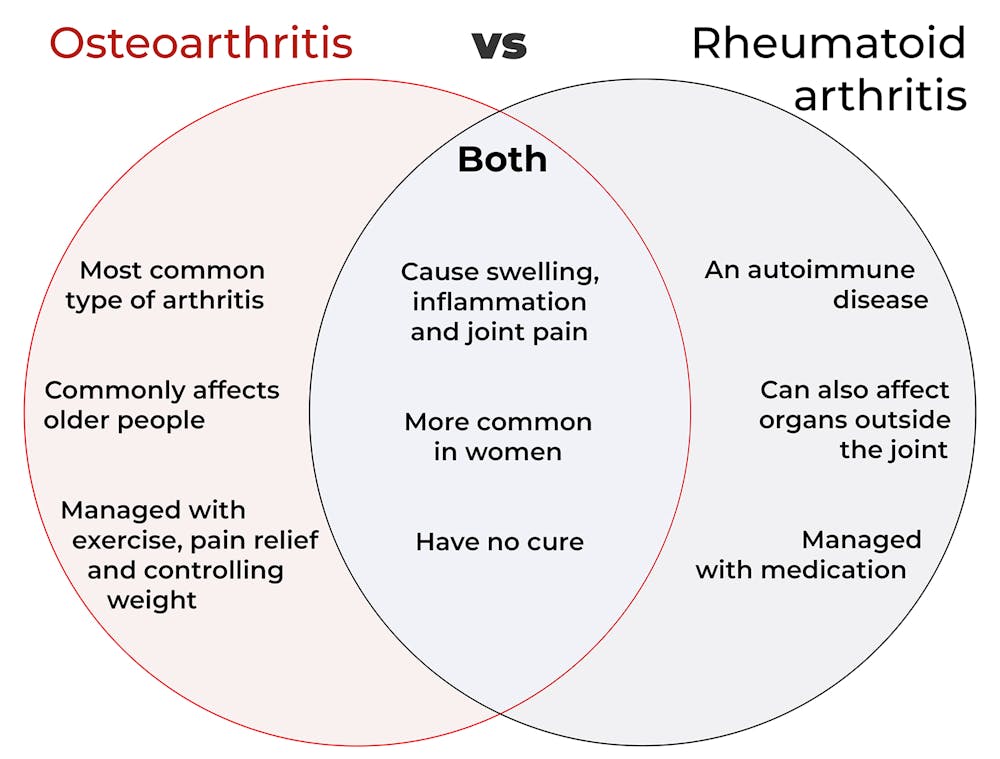
    The two most common types, osteoarthritis and rheumatoid arthritis, can both cause joint pain, swelling and stiffness. Both are more common in women. Neither can be cured.

    But their causes, risk factors and treatments are different – here’s what you need to know.

    What is osteoarthritis?

    Osteoarthritis is the most common form of arthritis. It affects 2.1 million Australians, mostly older people. About a third of Australians aged 75 and older have the condition.

    It can affect any joint but is most common in the knees, hips, fingers, thumbs and big toes.

    The main symptom is pain, especially during movement. Other symptoms may include swelling, stiffness and changes to the shape of joints.

    The main risk factors are ageing and obesity, as well as previous injuries or surgery. For osteoarthritis in the hands, genetics also play a big role.

    Signs of osteoarthritis can appear on knee scans from around age 45 and become more common with age.

    However, this type of arthritis not simply the “wear and tear” of ageing. Osteoarthritis is a complex disease that affects the whole joint. This includes the cartilage (“shock-absorbing” connective tissue protecting your bones), bones, ligaments (connective tissue holding bones and body parts in place) and joint lining.

    Osteoarthritis can change the shape of joints such as knuckles.
    joel bubble ben/Shutterstock

    How is it diagnosed?

    Diagnosis is based on symptoms (such as pain and restricted movement) and a physical exam.

    The disease generally worsens over time and cannot be reversed. But the severity of damage does not always correlate with pain levels.

    For this reason, x-rays and MRI scans are usually unhelpful. Some people with early osteoarthritis experience severe pain, but the damage won’t show up on a scan. Others with advanced and visible osteoarthritis may have few symptoms or none at all.

    What about rheumatoid arthritis?

    Unlike osteoarthritis, rheumatoid arthritis is an autoimmune disease. This means the immune system attacks the joint lining, causing inflammation and damage.

    Common symptoms include pain, joint swelling and stiffness, especially in the morning.

    Rheumatoid arthritis is less common than osteoarthritis, affecting around 514,000 Australians. It mostly impacts the wrists and small joints in the hands and feet, though larger joints such as the elbows, shoulders, knees and ankles can also be involved.

    It can also affect other organs, including the skin, lungs, eyes, heart and blood vessels. Fortunately, disease outside the joint has become less common in recent years, likely due to better and earlier treatment.

    Rheumatoid arthritis often develops earlier than osteoarthritis but can occur at any age. Onset is most frequent in those aged 35–64. Smoking increases your risk.

    How is it diagnosed?

    As with osteoarthritis, your doctor will diagnose rheumatoid arthritis based on your symptoms and a physical exam.

    Some other tests can be useful. Blood tests may pick up specific antibodies that indicate rheumatoid arthritis, although you can still have the condition with negative results.

    X-rays may also reveal joint damage if the disease is advanced. If there is uncertainty, an ultrasound or MRI can help detect inflammation.


    The Conversation, CC BY-SA

    How is osteoarthritis treated?

    No treatment can stop osteoarthritis progressing. However many people manage their symptoms well with advice from their doctor and self-care. Exercise, weight management and pain medicines can help.

    Exercise has been shown to be safe for osteoarthritis of the knee, hip and hand. Many types of exercise are effective at reducing pain, so you can choose what suits you best.

    For knee osteoarthritis, managing weight through diet and/or exercise is strongly recommended. This may be because it reduces pressure on the joint or because losing weight can reduce inflammation. Anti-obesity medicines may also reduce pain.

    Exercise can help manage weight and is safe and effective at managing joint pain.
    gelog67/Shutterstock

    Topical and oral anti-inflammatories are usually recommended to manage pain. However, opioids (such as tramadol or oxycodone) are not, due to their risks and limited evidence they help.

    In some cases antidepressants such as duloxetine may also be considered as a treatment for pain though, again, evidence they help is limited.

    What about rheumatoid arthritis?

    Treatments for rheumatoid arthritis focus on preventing joint damage and reducing inflammation.

    It’s essential to get an early referral to a rheumatologist, so that treatment with medication – called “disease-modifying anti-rheumatic drugs” – can begin quickly.

    These medicines suppress the immune system to stop inflammation and prevent damage to the joint.

    With no cure, the overall goal is to achieve remission (where the disease is inactive) or get symptoms under control.

    Advances in treatment

    There is an increasing interest in prevention for both types of arthritis.

    A large international clinical trial is currently investigating whether a diet and exercise program can prevent knee osteoarthritis in those with higher risk – in this case, women who are overweight and obese.

    For those already affected, new medicines in early-stage clinical trials show promise in reducing pain and improving function.

    There is also hope for rheumatoid arthritis with Australian researchers developing a new immunotherapy. This treatment aims to reprogram the immune system, similar to a vaccine, to help people achieve long-term remission without lifelong treatment.

    Giovanni E. Ferreira receives funding from The National Health and Medical Research Council, HCF Research Foundation, and Ramsay Hospital Research Foundation.

    Rachelle Buchbinder receives research funding from The National Health and Medical Research Council, Medical Research Future Fund, the Australian government, HCF Foundation and Arthritis Australia.

    ref. What’s the difference between osteoarthritis and rheumatoid arthritis? – https://theconversation.com/whats-the-difference-between-osteoarthritis-and-rheumatoid-arthritis-249154

    MIL OSI AnalysisEveningReport.nz

  • MIL-OSI China: More than 16,000 children killed in Gaza since war starts

    Source: People’s Republic of China – State Council News

    A Palestinian child suffering from severe malnutrition is pictured at the Al-Rantisi Children’s Hospital in Gaza City, May 4, 2025. [Photo/Xinhua]

    More than 16,000 children have been killed in the Gaza Strip since the onset of Israel’s military offensive on Oct. 7, 2023, at a rate of one child every 40 minutes, Gaza-based health authorities reported on Monday.

    Marwan al-Hams, director of field hospitals with Gaza’s health authorities, said the toll included 16,278 children, among them 908 infants and 311 newborns who died after birth. Al-Hams made the statement during a press briefing at the Nasser Medical Complex in Khan Younis, southern Gaza.

    Palestinian child Ahmed Khaled Hijazi (L) is pictured among the rubble in the town of Beit Lahia, northern Gaza Strip, April 27, 2025. [Photo/Xinhua]

    He highlighted that the humanitarian situation had significantly worsened since Israel closed the crossings in early March, disrupting essential healthcare services. This has left thousands of children and pregnant women without access to medical care, further exacerbating the crisis.

    Many children are surviving on just one incomplete meal a day, with limited access to clean drinking water and proper nutrition, due to the Israeli targeting of infrastructure and the denial of aid, he said.

    Palestinians wait to receive free food from a food distribution center in Gaza City, on April 24, 2025. [Photo/Xinhua]

    He also noted that thousands of children are living in displacement centers without basic necessities, while pregnant women face significant challenges in reaching hospitals.

    Israel halted the entry of goods and supplies into Gaza on March 2, following the expiration of the first phase of a January ceasefire agreement with Hamas. The second phase has yet to materialize, as the parties remain at an impasse.

    In a separate development, Gaza’s Civil Defense spokesperson Mahmoud Basal reported that at least 54 Palestinians were killed in Israeli airstrikes on Monday, which targeted homes, vehicles, and gatherings across various parts of Gaza.

    A Palestinian woman carries the body of a child killed in an Israeli airstrike in Gaza City, on April 23, 2025. [Photo/Xinhua]

    More than 52,000 Palestinians have been killed in Israeli strikes since October 2023, including about 2,500 who have died since Israel resumed its attacks on Gaza on March 18, marking the end of a two-month ceasefire.

    MIL OSI China News

  • MIL-OSI New Zealand: Daily progress for Thursday, 10 April 2025

    Source:

    Order Paper for Thursday, 10 April 2025

    2.00pm

    Business statement

    Hon Chris Bishop, Leader of the House, made a statement about the business of the House for the sitting week commencing on Tuesday, 6 May 2025.

    Government motion

    A motion acknowledging Claire Trevett’s service in the Press Gallery was agreed to. 

    Introduction of bills

    The following bills were introduced:

    Oral questions

    Twelve questions to Ministers were answered. 

    Government Business

    The second reading of the Principles of the Treaty of Waitangi Bill was not agreed to.

    The Medicines Amendment Bill was read a first time and referred to the Health Committee to be reported by 4 months and 1 day after the bill received its first reading.

    The United Arab Emirates Comprehensive Economic Partnership Agreement Legislation Amendment Bill was read a first time and referred to the Foreign Affairs, Defence and Trade Committee.

    The report of the Foreign Affairs, Defence and Trade Committee, International treaty examination of the NZ – UAE Comprehensive Economic Partnership Agreement, and Agreement between the Government of New Zealand and the Government of the United Arab Emirates on the Promotion and Protection of Investments, was noted.

    The debate on the first reading of the Education and Training Amendment Bill (No 2) was interrupted with 10 speeches remaining.

    Adjournment 

    At 6.00pm the House adjourned.

    MIL OSI

    MIL OSI New Zealand News

  • MIL-Evening Report: ER Report: A Roundup of Significant Articles on EveningReport.nz for May 6, 2025

    ER Report: Here is a summary of significant articles published on EveningReport.nz on May 6, 2025.

    Fiji media welcomes credible news services, but not ‘pop-up propagandists’, says Simpson
    By Anish Chand Entities and individuals that thrived under the previous government with public relations contracts now want to be part of the media or run media organisations, says Fiji Media Association (FMA) secretary Stanley Simpson. He made the comments yesterday while speaking at a World Press Freedom Day event hosted by the journalism programme

    Locked up then locked out: how NZ’s bank rules make life for ex-prisoners even harder
    Source: The Conversation (Au and NZ) – By Victoria Stace, Senior Lecturer, Te Herenga Waka — Victoria University of Wellington FotoDax/Shutterstock People coming out of prison in New Zealand face multiple hurdles reintegrating into society – starting with one of the most fundamental elements of modern life: getting a bank account. Not having a bank

    Can a wooden spoon really stop a pot from boiling over? Here’s the science
    Source: The Conversation (Au and NZ) – By Jay Deagon, Senior Lecturer of Home Economics, CQUniversity Australia Alexanderstock23/Shutterstock One moment, your spaghetti is happily bubbling away in the pot. A minute later, after busying yourself with something else, you turn around to find a hot mess all over your stove. Boiling liquid can rocket up

    How did sport become so popular? The ancient history of a modern obsession
    Source: The Conversation (Au and NZ) – By Konstantine Panegyres, Lecturer in Classics and Ancient History, The University of Western Australia Roman mosaics discovered in Sicily show women playing different sports. David Pineda Svenske/Shutterstock It’s almost impossible to go a day without seeing or hearing about sport. Walk around any city or town and you

    AI systems are built on English – but not the kind most of the world speaks
    Source: The Conversation (Au and NZ) – By Celeste Rodriguez Louro, Associate professor, Chair of Linguistics and Director of Language Lab, The University of Western Australia Reihaneh Golpayegani / Better Images of AI, CC BY An estimated 90% of the training data for current generative AI systems stems from English. However, English is an international

    Crikey, ChatGPT’s gone bush! How AI is learning the art of Aussie slang
    Source: The Conversation (Au and NZ) – By Ross Yates, Lecturer, Project Management, Edith Cowan University Shutterstock Ever tried to explain why a sausage would be referred to as a “snag” while overseas, or why the toilet is the “dunny”? If you found this challenging, spare a thought for large language models (LLMs) such as

    What are the key risk factors for developing knee osteoarthritis? We reviewed the evidence
    Source: The Conversation (Au and NZ) – By Christina Abdel Shaheed, Associate Professor, School of Public Health, University of Sydney Osteoarthritis is the most common joint disease, affecting more than 3 million Australians and over 500 million people worldwide. The knee is the most commonly affected joint, but osteoarthritis can also affect other joints including

    We’ve heard the promises. Now it’s up to Labor to deliver its housing, wages and other economic policies
    Source: The Conversation (Au and NZ) – By Michelle Cull, Associate Professor of Accounting and Financial Planning, Western Sydney University With a convincing win for a second term of government, the pressure is now on the new Labor government to deliver the economic policies central to its win. Prime Minister Anthony Albanese is wary of

    Labor has the chance to do something big in its second term. What policy reforms should it take on?
    Source: The Conversation (Au and NZ) – By Yee-Fui Ng, Associate Professor, Faculty of Law, Monash University Dan Breckwoldt/Shutterstock Labor’s historic election victory means the Albanese government has a rare opportunity to pursue a big, bold reform agenda. The scale of the victory all but guarantees a third term in office after the next election

    ‘I got sent something of people shooting themselves’ – research shows young people can’t avoid harmful content online
    Source: The Conversation (Au and NZ) – By Dougal Sutherland, Clinical Psychologist, Te Herenga Waka — Victoria University of Wellington Leon Neal/Getty Images A new report from New Zealand’s Classification Office has revealed how young people are being exposed to harmful content online and what it is doing to their mental health. The Classification Office

    Caitlin Johnstone: It was never about hostages. It was never about Hamas
    Report by Dr David Robie – Café Pacific. – COMMENTARY: By Caitlin Johnstone Benjamin Netanyahu said last Thursday that freeing the Israeli hostages in Gaza was not his top priority, suggesting instead that defeating Hamas should take precedence over a hostage deal. “We have many objectives, many goals in this war,” Netanyahu said. “We want

    Viral video shows Fiji prison chief throwing punches at Suva bar
    RNZ Pacific The head of Fiji’s prison service has been caught on camera involved in a fist fight that appears to have taken place at the popular O’Reilley’s Bar in the capital of Suva. Sevuloni Naucukidi, the acting Commissioner of the Fiji Corrections Service (FCS), can be seen in the viral video throwing punches at

    PINA on World Press Freedom Day – facing new and complex AI challenges
    By Kalafi Moala in Nuku’alofa On this World Press Freedom Day, we in the Pacific stand together to defend and promote the right to freedom of expression — now facing new and complex challenges in the age of Artificial Intelligence (AI). This year’s global theme is “Reporting a Brave New World: The impact of Artificial

    Late counting continues in several seats, with Goldstein and Melbourne among those too close to call
    Source: The Conversation (Au and NZ) – By Adrian Beaumont, Election Analyst (Psephologist) at The Conversation; and Honorary Associate, School of Mathematics and Statistics, The University of Melbourne With 78% of enrolled voters counted, the ABC is calling 85 of the 150 House of Representatives seats for Labor, 39 for the Coalition, zero for the

    Pacific ‘story sovereignty’ top of mind on World Press Freedom Day
    By Michelle Curran of Pasifika TV World Press Freedom Day is a poignant reminder that journalists and media workers are essential for a healthy, functioning society — including the Pacific. Held annually on May 3, World Press Freedom Day prompts governments about the need to respect press freedom, while serving as a day of reflection

    View from The Hill: a budding Trump-Albanese bromance?
    Source: The Conversation (Au and NZ) – By Michelle Grattan, Professorial Fellow, University of Canberra It took an election win, but Anthony Albanese on Monday finally received that much-awaited phone call from US President Donald Trump. The conversation was “warm and positive,” the prime minister told a news conference, thanking the president for “reaching out”.

    In its soul-searching, Australia’s rightist coalition should examine its relationship with the media
    ANALYSIS: By Matthew Ricketson, Deakin University and Andrew Dodd, The University of Melbourne Among the many lessons to be learnt by Australia’s defeated Liberal-National coalition parties from the election is that they should stop getting into bed with News Corporation. Why would a political party outsource its policy platform and strategy to people with plenty

    Is it dangerous to kiss someone who’s eaten gluten if you have coeliac disease?
    Source: The Conversation (Au and NZ) – By Vincent Ho, Associate Professor and Clinical Academic Gastroenterologist, Western Sydney University Lordn/Shutterstock Coeliac disease is not a food allergy or intolerance. It’s an autoimmune disease that makes the body attack the small intestine if gluten (a protein found in wheat, rye and barley) reaches the gut. Even

    After its landslide win, Labor should have courage and confidence on security – and our alliance with the US
    Source: The Conversation (Au and NZ) – By Joanne Wallis, Professor of International Security, University of Adelaide The re-election of the Albanese Labor government by such a wide margin should not mean “business as usual” for Australia’s security policy. The global uncertainty instigated by US President Donald Trump means Australia’s security landscape is very different

    5 huge climate opportunities await the next parliament – and it has the numbers to deliver
    Source: The Conversation (Au and NZ) – By Anna Skarbek, Climateworks CEO, Monash University Australians have returned an expanded Labor Party to government alongside a suite of climate-progressive independents. Meanwhile, the Coalition – which promoted nuclear energy and a slower renewables transition – suffered a historic defeat. Labor also looks set to have increased numbers

    MIL OSI AnalysisEveningReport.nz

  • MIL-OSI Russia: NSU teachers win Kolba award for women in science and technology

    Translation. Region: Russian Federal

    Source: Novosibirsk State University – Novosibirsk State University –

    On April 18, the Plekhanov Russian University of Economics hosted the third Kolba award ceremony for women in science and technology, as part of the annual forum of the same name. This year, 77 women scientists were recognized in 30 nominations in the following areas: natural, technological and exact, social and humanitarian, fundamental and applied sciences. Among them are two representatives of NSU: Olga Yarovaya, associate professor of the Department of Medical Chemistry of the Institute of Medicine and Medical Technologies of NSU, and Anna Lysova, senior lecturer of the Department of Physical Chemistry. Faculty of Natural Sciences of NSU.

    The Kolba Prize was established by the Foundation for the Development of Professional Initiatives “Women of the Nuclear Industry” with the aim of popularizing science through the formation of role models among women and girls – future scientists, creating a modern image and enhancing media significance, uniting women into the largest scientific community for the exchange of experience and knowledge, as well as strengthening the human and intellectual capital in the country.

    Olga Yarovaya is a chemist specializing in organic chemistry, medicinal chemistry, and the development of antiviral compounds. Olga spoke in more detail about her area of scientific interest:

    — I study terpenes and their derivatives (mono-, sesqui- and diterpenoids) to create antiviral drugs. My work covers the synthesis of compounds, analysis of their activity against influenza, Marburg and other pathogens, as well as the study of their mechanisms of action. In 2003, I defended my PhD thesis on the synthesis and antiviral activity of terpene compounds. And in 2023–2024, I published a number of articles in the journal Uspekhi Khimii, including studies of small molecules against hemorrhagic fever viruses and diterpenes.

    Anna Lysova is engaged in the synthesis of organometallic compounds, which, due to their porosity, are used as adsorbents for capturing and separating gases and various organic substances. Anna shared her opinion on why science is her life’s work and why such awards are important for scientists:

    — Science is what I do every day: my job, my hobby. I am lucky that I love my job and it gives me pleasure, that I do not get tired of it and it does not bore me. Science is what surrounds us: technology, smartphones, cars; what we use every day in our everyday life and what makes human life better, easier, more interesting. This award is important to me as recognition of the importance of scientific work of me and my team, as an opportunity to declare the results of my research to the whole country. I felt proud that our research was appreciated.

    The winners received the distinctive “Kolba” badge.

    This year, applications for the Kolba Prize are open from April 20 to December 31, 2025. by link

    Telegram 

    Vkontakte 

    Please note: This information is raw content directly from the source of the information. It is exactly what the source states and does not reflect the position of MIL-OSI or its clients.

    MIL OSI Russia News

  • MIL-OSI USA: Feenstra Supports Legislation to Study Prevalence of Cancer in Veterans who Served as Active-Duty Aircrew Members

    Source: United States House of Representatives – Representative Randy Feenstra (IA-04)

    WASHINGTON, D.C. – Today, U.S. Rep. Randy Feenstra (R-Hull) voted for the ACES Act, which would require the National Academies of Sciences, Engineering, and Medicine to conduct a study on the prevalence of cancer in veterans who served as active-duty aircrew members in our nation’s Armed Forces.

    “Providing our veterans, especially those who were exposed to toxic chemicals, with the high-quality healthcare that they have earned is non-negotiable. These patriotic and selfless Americans answered the call to serve our country and protect the freedoms that we hold dear. Caring for these men and women after their service is our duty as a grateful nation,” said Rep. Feenstra. “That’s why I voted for legislation to study the prevalence of cancer in U.S. troops who served as active-duty aircrew where exposure to chemicals and other synthetic compounds is a real risk. In Congress, I will always be a strong voice for our veterans and their families.”

    ###

    MIL OSI USA News

  • MIL-OSI New Zealand: Social Media Bill Should Be Government Bill

    Source: E-Commerce arrangement with China to boost Digital Exports

    MEDIA RELEASE – 6 May 2025

    Family First welcomes the introduction of a Social Media Age-Appropriate Users Bill by Catherine Webb, the National MP for Tukituki, which makes it a legal requirement for social media companies to verify users are sixteen years or older.

    However, with the supposed backing of the Prime Minister Christopher Luxon and the National Party, Family First is asking why this Bill is being left to the luck of the members bills’ ballot and not made a government Bill?

    “If as Ms Webb and Mr Luxon say in their introductory comments that this is intended to protect young people from bullying, inappropriate content and social media addiction, then why is it not a government priority which would actually see the idea made into law, or at the very least have a parliamentary & public discussion via a Select Committee process?” asks Bob McCoskrie, CEO of Family First.

    Family First has long advocated for better regulation of social media and support for parents so as to protect young people.

    “First and foremost, there needs to be a community response where parents unite to ensure their young children are not exposed to social media, but there is also room for government support to empower parents,” says Mr McCoskrie.

    Dr Jonathan Haidt – author of “The Anxious Generation: How the Great Rewiring of Childhood is Causing an Epidemic of Mental Illness” – notes in his acclaimed research that there is a clear correlation between the introduction of smart phones and a significant decline in young people’s mental health.  (Dr Haidt was a guest at last year’s Forum on the Family and he called on New Zealand and other countries to do more to protect young people from the harms online.)

    In Australia, a Guardian newspaper poll last year found that almost 70% wanted age limit raised from 13 years to 16 years when it came to social media.  Of this, 44% strongly supported the idea and 24% were somewhat supporting it.  Only 14% opposed the notion and 17% were unsure.

    In the US State of Virginia, legislation has just passed ensuring social media companies limit under sixteen year olds to a maximum of one hour of scrolling a day.

    Family First thanks Catherine Wedd for drafting the Bill but once again calls on all the coalition parties in the Government (ACT and NZ First) to adopt the bill as a Government bill and ultimately walk the talk when it comes to protecting children online.

    “This important discussion needs to be a priority for the Government and not left in a biscuit tin.”

    MIL OSI New Zealand News

  • MIL-OSI New Zealand: Politics and Health – Pay equity changes an attack on women: NZNO

    Source: New Zealand Nurses Organisation

    Changes by the Government to make pay equity claims harder to lodge and resolve are an attack on women, New Zealand Nurses Organisation Tōpūtanga Tapuhi Kaitiaki o Aotearoa (NZNO) says.
    Workplace Relations and Safety Minister Brooke Van Velden today announced changes saying they will “significantly reduce costs to the Crown”.
    NZNO chief executive Paul Goulter says nurses will be outraged that historical gender discrimination will not be addressed so the Government can save money.
    “This is a blatant and shameful attack on women.
    “Women in workforces predominantly performed by female employees have been underpaid and undervalued for generations. That is what pay equity claims seek to rectify.
    “This move by the Government will widen the pay gap between men and women,” Paul Goulter says.
    NZNO has at least 10 pay equity claims being progressed across branches of the health sector including Aged Care, Primary Health Care, Hospices, Plunket, Community Health and Laboratories covering many nurse and support worker roles.
    Paul Goulter says some of these claims have been going on for years.
    “Our members will be devastated that after years of waiting for settlements, the Government is now pulling the rug out from under their feet.
    “This move is particularly unfair to primary health and aged care nurses who are being denied the opportunity to close the pay gap with their hospital counterparts. Our Plunket and hospice members now face the injustice of having to redo their pay equity claims,” Paul Goulter says.

    MIL OSI New Zealand News

  • MIL-OSI Australia: Be alert to poisonous mushrooms growing in Victoria

    Source: Australian Capital Territory Policing

    Victorians are being reminded to be vigilant, with poisonous mushrooms becoming present in the community during autumn as the weather becomes wetter and cooler.

    Victorian Chief Health Officer Dr Christian McGrath is encouraging Victorians to be on the lookout for wild mushrooms growing in home gardens and publicly accessible areas.

    Poisonous mushrooms including death cap mushrooms and yellow-staining mushrooms become more evident in Victoria at this time of year, and initial symptoms of poisoning can include stomach pains, nausea, vomiting and diarrhoea.

    Dr McGrath said it was important to remove any wild mushrooms growing in home gardens to avoid young children and pets coming into any contact with them.

    “Adults and children should not touch wild mushrooms with their bare hands, let alone eat them, and animals should be kept well away from them,” Dr McGrath said.

    “Anyone who collects and consumes wild mushrooms of unknown species is putting themselves at risk of potential poisoning and serious illness. Consuming a death cap mushroom can be fatal.”

    With no home test available to distinguish safe and edible mushrooms from poisonous mushrooms, it is recommended to only eat mushrooms bought from the supermarket, greengrocer or another reputable source.

    “Unless you are an expert, do not pick and eat wild mushrooms.” Dr Christian McGrath said.

    Wild mushrooms growing in home gardens should only be removed by wearing gloves, carefully placing them in a bag and disposing of them in a closed general waste (landfill) rubbish bin.

    If you or anyone in your care may have eaten a poisonous mushroom, do not wait for symptoms to occur. Call the Victorian Poisons Information Centre immediately on 13 11 26 (24 hours a day, 7 days a week) for appropriate advice.

    If a person has trouble breathing, collapsed, is having a fit or is suffering an anaphylactic reaction, immediately call 000 for an ambulance. Do not call the Victorian Poisons Information Centre in an emergency.

    If your pet has ingested a wild mushroom, contact the Animal Poisons Helpline on 1300 869 738 for advice.

    More information on poisonous mushrooms is available on Better Health ChannelExternal Link.

    MIL OSI News

  • MIL-OSI New Zealand: Post-Cabinet Press Conference: Monday 5 May 2025

    Source: NZ Music Month takes to the streets

    POST-CABINET PRESS CONFERENCE: Monday, 5 May 2025

    EPIQ TRANSCRIPT

    PM:           Well, look, good afternoon, everyone. It’s great to be joined this afternoon by our awesome Trade Minister, Todd McClay, who’s doing some incredible work. As you know, it’s a big sitting block with the Budget at the end of it, and that Budget will then be there to underline this Government’s clear focus on economic growth and, as you know, growth is the primary focus of us and our Government and will continue to be at the core of everything we do. We know that these are challenging times and not easy. New Zealand is still recovering from the economic damage inflicted by Labour and further global instability has made things tough for Kiwis. But despite these challenges, we are overseeing a steady economic recovery with export-led growth and business confidence increasing, and we have started to turn the corner. 

    So this will be a growth Budget because economic growth means Kiwis have money in their pockets and we can fund better public services, and this will also be a responsible Budget, a predictable, steady approach to economic and fiscal management so that we can support economic growth. It is ultimately businesses that grow the economy through their decisions to expand, invest and create jobs, and the Government’s role is to create the conditions for them to do that, and this includes getting the basics right, such as low and stable inflation, manageable interest rates and credible fiscal management. 

    Promoting global growth and trade and investment is one of the five pillars to our Going for Growth plan, and it’s absolutely essential for New Zealand to maximise its potential and New Zealanders to enjoy higher incomes and better public services. As we so often say, we can’t get rich selling to ourselves, so the Government has a clear target to double the value of New Zealand’s exports in 10 years by 2034. And in 2023, to give you a feel for it, one in four of our jobs in New Zealand—around 680,000 New Zealanders—derive their livelihoods from producing goods and services for export. And in addition to bringing in additional revenue, businesses that export also boost New Zealand’s productivity by having more exposure to more diverse competition, connecting to new markets and consumers, and also investing in research and development and innovation. 

    I cannot overstate how important trade and investment is to this country, and that is why both Todd as Trade Minister and myself as Prime Minister are throwing our all into doing business with the world. My recent trip to the UK is actually a prime example. It was incredibly productive and the UK relationship, I think, has new vigour. We’ve always had very strong historical ties with a similar set of values and outlook on the world, but as Prime Minister Starmer and I noted, we now have new things to propel the relationship going forward in the years ahead, in the areas of defence and security, of course, but excitingly in our bilateral trade and investment too. Our free trade agreement with the UK provides New Zealand businesses with certainty of access to this high-value market and we have enjoyed export growth of more than 20 percent in the last 12 months. 

    But it’s not just the UK. The EU FTA, which we implemented earlier, has just reached its first anniversary and is already showing dividends since it was put into place, having generated an additional $1.2 billion and having grown exports up 28 percent. We’re opening up new markets as well, as you know, with our signed agreements in the UAE and the GCC recently, thanks to Todd’s relentless focus on closing those deals for the betterment of our exporters, and the launch of negotiations on an Indian FTA are an important step forward too. 

    So trade and growth will be critical to improving our economic prospects in the coming years and so our businesses can create those jobs and lift incomes for Kiwis. I’ll now pass over to Todd to talk a little bit more about our trade agenda and prospects ahead. 

    Hon Todd McClay:    Well, thank you, Prime Minister and good afternoon, everybody. It’s been a busy and important period of time for New Zealand trade and today I want to give an update on three key areas where we’re seeing growth and development: our trade growth with the EU one year after early entry into force of the free trade agreement, the first in-person free trade agreement negotiations with India, and our growing trade ties with the Gulf region. 

    Last week marked one year since the early entry into force of the New Zealand‒European Union free trade agreement, and the results speak for themselves. As the Prime Minister said, just in 12 months, total goods exports to the European Union from New Zealand surged by 28 percent, from $3.77 billion to $4.81 billion, and this is delivering real benefit for New Zealand exporters, particularly sheep meat exports, which grew 29 percent, worth an additional $216 million. Kiwifruit exports increased by 69 percent, worth an additional $316 million, and machinery exports were by 104 percent, which are worth an additional $173 million. 

    Importantly, the agreement delivers better market access, lower costs, and reduced barriers for New Zealand businesses. It’s also a strong example of our broader trade strategy, working to open up high-quality and high-value markets to double the value of exports in 10 years. We worked across the House last year to see the agreement entry into force many months earlier than had been forecast, and as an example, that meant that kiwifruit growers could take advantage of a full harvest season, adding an additional $18,000 on average for every kiwifruit grower in New Zealand. 

    I’m pleased to also confirm that the first in-person FTA negotiations between New Zealand and India will begin this week in India. This follows the Deputy Prime Minister’s successful visit to India last year, and the formal launch of negotiations by my counterpart, Minister Piyush Goyal, and myself during the Prime Minister’s very large and successful trade mission in April. India is one of the world’s fastest growing economies, with a current GDP of US$4.3 trillion, expected or forecast to grow to US$5.2 trillion by 2030. With a population of 1.4 billion people and current two-way trade of NZ$3.14 billion, there’s huge untapped potential for New Zealand exporters. These negotiations in person mark an important milestone and signal the intent of both governments to pursue a high-quality, comprehensive agreement that benefits both countries. The comprehensive FTA with India is also part of our strategy to diversify trade, expand export markets and deliver for all New Zealanders, and we’re focused on backing our exporters and attracting investment and growing the economy. 

    Finally, in the Middle East, following the conclusion of the GCC trade deal at the end of last year, momentum around trade and investment opportunities in that part of the world is growing. Last week I hosted Saudi Arabia’s Minister of Environment, Water and Agriculture, Minister Al-Fadley, for the 9th New Zealand‒Saudi Arabian Joint Ministerial Commission in Auckland. This is an opportunity to showcase what New Zealand has to offer from food security, agritech, clean technology and education. The Saudi Arabian delegation included 37 officials and business leaders, and a strong signal of the interest in what New Zealand brings to the table. We’re preparing to sign the New Zealand‒GCC free trade agreement, which will deliver duty-free access for 99 percent of our exports to that market over time. And Saudi Arabia is already our largest trading partner in the Gulf and this agreement will help us grow exports in agriculture, food innovation, fintech, and much more. 

    So, to recap, the EU deal is delivering 12 months into the agreement, India in-person negotiations are beginning, and the Middle East holds great potential for New Zealand exporters. We’re working across the Government hard for Kiwis, securing deals and backing New Zealand exporters to succeed on the world stage.

    PM:           Well, thank you, Todd, and can I just say also thank you for the work that you’re doing because I know you’re on the plane a lot and, as I say, you are Trade McClay and we really appreciate what you’re doing. With that, happy to take any questions you may have. 

    Media:      Sticking on trade for a minute, have you seen Donald Trump’s latest social media post relating to the film industry and are you concerned about the impact it could have on New Zealand’s film industry? 

    PM:           I have seen it. Obviously, we need to see what the detail is, but what I’d just say to you is, having been at Weta Unleashed recently with Sir Richard Taylor, we’ve got an absolutely world-class industry. This is the best place to make movies in, period, in the world. That’s why I spent a lot of time with Bollywood actors and directors, actually, when I was in India, making the case for making more movies here, and we’ll continue to do so. So we’ll have to see the detail of what actually ultimately emerges, but obviously I’m a great advocate, great champion of that sector and that industry, and I think, you know, we want to keep making, you know, strong moves on it. 

    Media:      Does the threat of a 100 percent tariff on imported movies make you reconsider the film subsidies that the Government offers at all? 

    PM:           Look, again, you know, we’ve seen a post on social media. We need to understand what any details are. 

    Media:      [Inaudible] quite a lot of them.

    PM:           Yeah, yeah, sure. We’ll have to see what the details are. I’m just saying to you it’s a fantastic industry. It’s got amazing people. It’s got incredible technology associated with it, great jobs, and we’re going to continue to advocate very strongly for the sector. 

    Media:      What about the language that he’s using, that it’s a national security threat, it’s propaganda, all the movies coming—

    PM:           Well, I don’t comment on every utterance of the US President. I’m focused on New Zealand and maximising the opportunities for New Zealand. And all I’m saying is that’s what I’ve been doing is, you know, in that sector, which I just think is truly world-class. You know, I’ve been advocating for it in India for that exact same reason. What would it take to get more Bollywood productions here in New Zealand, and other places as well? 

    Media:      How damaging would that be to your goal of economic growth? I think US productions account for about $1.5 billion to the New Zealand screen industry every single year. How would that affect our economy if he went through with those tariffs? 

    PM:           Well, look, I mean, as we’ve been quite upfront about, you know, it’s a pretty—you know, there’s a lot of volatility in the global economic space and the global economy at the moment. You know, we’ve advocated strongly, you know, that we don’t believe tariffs is the way to go forward. We’ll continue to do that. But importantly, there are also swings and roundabouts and opportunities that come in that environment as well. And so, you know, it’s not possible for me to say what the exact effect of that would be; I just think it’s way too early. Let’s see the detail and see what’s being proposed and what actually does get implemented. 

    Media:      Can you rule out any changes to the rebate? 

    PM:           Look, again, I’ve just seen the post on the way through, on the way down here. It’s not something that we’ve given a lot of thought to yet. All I’m focused on is making sure we grow that sector and grow that great industry. 

    Media:      Have you given any consideration to increasing the rebate to try and incentivise productions to still come to New Zealand? 

    PM:           Again, way too soon. We haven’t given any thought to it. We’ve just seen a post from the US President. As I said, I don’t get into the habit of commenting on everything the President says. I’m focused on New Zealand growing all sectors with as many countries as I can, expanding trade and investment, as you’ve seen us do over the last 18 months, and we’ll continue to do so. 

    Media:      Just on that pivot to Bollywood that you were talking about, what sort of reaction did you get over in India when you were talking about potentially New Zealand being a bit more of a hub for those sort of movies? 

    PM:           Really positive. I mean, they have made movies here in New Zealand in the last 20 years or so, and my question to them was: what else would it take for you to do more productions here in New Zealand? And they’re very, very open to it. I mean, there’s a—

    Media:      What did they say to that? What would it take for them to do more? 

    PM:           Well, there are—there are things that we can—you know, obviously connectivity between India and New Zealand so that you can actually move kit and people in and out of the country in a much more seamless way, which is why air connectivity and air services become so important into the future as well. But no, they’re very open to it and it’s about us actually, often, in many cases, just making the case to the influencers and to the people. And that’s why I do these meetings is because, you know, they’ve got every other country in the world telling them why they’re a great place to come and do it. 

    You know, they know they get well supported here. They have really talented people to be able to work with in the productions here. Many New Zealanders in that sector are very much generalists—they are able to do many things, not just have the specialists—and therefore you often end up with smaller but much more efficient crews working on those productions. So, you know, I think there’s just a lot of opportunity for New Zealand. It is an amazing sector, as you all know, and a very important sector here for this city as well. 

    Media:      Prime Minister, is it appropriate for a Minister to frequently use their private e-mail accounts for ministerial business, including discussing policy ideas with members of the public? 

    PM:           Well, look, there’ll be times under the Cabinet Manual where, you know, people—Ministers will use personal e-mail or personal phone numbers, and that may be for a number of reasons. They may have received unsolicited emails. In many cases, I’m aware Ministers in the past have had technical issues around IT and printing materials. But what’s super important is that any materials are fully retained so that under an official information request, they’re actually available. 

    Media:      Are you comfortable with how often Erica Stanford is using her personal e-mail to conduct ministerial business? 

    PM:           Well, again, my office has spoken with her. I understand it’s been very few occasions. What I’d say is that she has had tech issues with printing. That’s a good example. I’m aware Ministers in the previous Government had the same—used personal emails in the same way. I’m very relaxed with the fact—

    Media:      One News has two folders with hundreds of pages that includes documents and emails that she has been sending and receiving from her private e-mail. Does that sound like very limited instances? 

    PM:           Well, again, as I said, I’m very relaxed about it. The reality is, you know, she has—you know, she’s received unsolicited emails, she’s had printing issues, she’s had tech issues. She’s made changes subsequently, she’s got the IT support that she needs in place and I’m very comfortable with it. I think she’s doing a great job. 

    Media:      She also sent sensitive Budget documents, ahead of them being announced publicly, to her Gmail account. Is that appropriate? 

    PM:           Well, again, I just say to you there will be moments under the Cabinet Manual where it’s quite acceptable for Ministers to use their personal—

    Media:      Is that [Inaudible] Budget documents before they’re released publicly?

    PM:            Well, there may well be if it’s printing purposes, if it’s—if there’s—because there’s technical reasons. As I understand it, in her case it’s actually been about printing challenges. She’s actually made the changes in the settings that she needed to, which has been good and really advisable, and I think that’s a really good thing. But I’m very relaxed about it. 

    Media:      Do you trust Gmail as a secure platform when people, Ministers, are sending Budget details? 

    PM:           Well, I’ll just say to you I think, you know, there are moments when you may well use your personal accounts for—in order for printing and for receiving unsolicited emails, right? 

    Media:      But it’s not as secure, [Inaudible].

    Media:      Is there no tech support in the building to sort out a printer problem?

    PM:           She’s made—she’s made subsequent changes to her processes of how to do that. She’s got the right IT support in place now. I’m really comfortable about it. 

    Media:      She’s a Minister of the Crown. How was there not tech support available for that? This is the Beehive. 

    PM:           Sorry? 

    Media:      How was there not tech support available for printing? It’s the Beehive. 

    PM:           I think if you go back and look at the last administration, Chris Hipkins was an example of a Minister who used his personal accounts for printing materials that he might need as well. So that’s what I’m saying, there’s been a—there’s a history of where, occasionally—

    Media:      So you think it’s OK?

    PM:           No, on—occasionally, under the Cabinet Manual, it’s quite OK and quite acceptable that there will be moments in time where people might need to use their personal phones and emails in order for things like printing materials or IT tech support. In her case, she’s subsequently gone on and made changes which I think are advisable and are really appropriate that she’s done that, and made sure that she’s put in place some processes and changes around that.

    Media:      Every instance was for printing? If it’s hundreds of pages—

    PM:           Well, I’m saying that as an example of how you may end up using your personal accounts for those purposes. 

    Media:      The main directive of the Cabinet Manual is that Ministers don’t use their personal emails or mobile phone numbers, and Erica Stanford is frequently using her personal e-mail. Have you looked into it? Are you keen to look into that further? Is that appropriate? 

    PM:           Look, I’m super relaxed about it. I have to be honest about it. I’ve looked at the issue. Erica’s office has spoken to my office about it. She’s made the changes that she needed to make about the processes of which she engaged with unsolicited emails or—she did have printing issues, you know. That is a common thing that I’ve seen with other Ministers in previous administrations as well. Having said that, it’s advisable what she has done to put in place checks to make sure that she’s managing it better going forward. And at the end of the day, you know, this is a Minister doing a brilliant job and a great job and, you know, I’m proud of the work she did just on this weekend doing the parental portal. 

    Media:      Prime Minister, just a couple of questions around Corrections. Do you support Mark Mitchell and his comments around wanting longer sentences as a way of trying to reduce re-offending? 

    PM:           Well, I think there’s two things going on there. One is I would say we definitely support longer sentences. That’s why we’ve, you know, had the sentencing discount legislation come through. That’s why we’ve got three strikes coming through and the work of Paul Goldsmith in that area. But once someone is in the Corrections facility it’s important that we do everything we can to get rehabilitation services to them, and all Mark’s doing is actually trying to understand where does the rehabilitation services work, and does term of service actually, you know, play into that or not, and how would we make sure we take the opportunity to actually make sure that we get the right rehabilitation services to the prisoners involved. 

    Media:      Have you seen or has Mark Mitchell put forward any evidence that supports that those two things—

    PM:           That’s the work that he’s kicked off, to have a look at what are the impacts of rehabilitation and does term of—length of time in the facility actually lead to better rehabilitation outcomes with longer run services or not. So that’s all he’s doing. All he’s doing is just looking at making sure our rehabilitation services—we want them to be deployed as much as possible to remand Corrections facilities, as you’ve seen, prisoners, and also those that have been sentenced. We want to get rehabilitation services out to as much as we can. 

    Media:      The end result in there, if you play it out, is potentially a lot more prisoners in prison for a longer amount of time, so how much money are you prepared to throw at more prison beds and more prison expenses? 

    PM:           Well, we’re interested in lowering crime. So the point, as you know, is that we’re quite comfortable with longer prison sentences. We have made changes with our legislation recently to do exactly that, on the sentencing discounts that we’ve stopped. But this is about—this is a separate piece of work. 

    Media:      It’s a blank cheque around prison beds and prison expansion, for the greater good and all that?

    PM:           Well, you don’t—you drive it through a principle and a value, which is that if people have offended, they need to make sure they’ve got a penalty that fits their offence. And the old model of just saying the only target we’ve got on crime is reducing prisoners—we actually want to reduce crime and we’re making some good progress on that. So how many prisoners we have and how long they’re in there will be a consequence of what happens with respect to crime in New Zealand. Sorry, last question for Jo here. 

    Media:      RNZ has been talking to staff at Palmerston North Hospital who don’t feel safe at work. There are reports of health workers getting abused and assaulted, including a nurse being held at gunpoint and another health worker knocked unconscious. They’d like hospital security guards to be given the same powers as those in Parliament and court, in order to be able to physically restrain people. Do you support that? 

    PM:           Well, look, we have supported an increase of security in emergency departments, as you know. It’s one of the first actions we took when we came to Government, and Dr Shane Reti implemented that. I’m very open to considering what more we can do to make sure our workers are safe. I’m not aware of that particular issue, but feel free to raise that with Simeon Brown. 

    Media:      Minister McClay, just on the—

    PM:           Jack, welcome back. I saw you on TV covering some electorates over the weekend. Well done. 

    Media:      Thank you. We’ll get to that later. But Minister McClay, just on the Trump tariffs, New Zealand had one of the best deals under the previous tariffs. That might not be the case anymore with this 100 percent on film production. What do you say to that, that New Zealand’s sort of getting a raw deal now as the tariff situation progresses? 

    Hon Todd McClay:    Well, New Zealand’s not being treated worse than other countries, as we see it at the moment. It seems that the new bottom tariff rate out of the US will be 10 percent. There’s no evidence yet—although we’ll see whether or not they, through negotiation, will fall below that. There’s some early anecdotal evidence from our exporters that they are seeing increased interest from the US in products from New Zealand. Some of that could be because, you know, tariff rates elsewhere in the world have been fluctuated so US importers haven’t got the certainty that they need. But I think, as the Prime Minister has said, in everything we do, we’ve got to get as much information as we can. So, for instance, the announcement over films that you have just asked about, we’re not yet sure exactly how it will be put in place—whether it’s complete films, parts of films, just technology to add to films and so on. So once we get more information following the social media posts, we’ll be in a better position to provide that. 

    Media:      When the US first announced tariffs, they got the figure wrong on the reciprocal number. Have you had strengthened communication with the United States? I know you’ve been doing deals around the world, but have you been focusing on the US? 

    Hon Todd McClay:    So we’ve had a lot of engagement. I expect to meet my counterpart, Jamieson Greer, in about two weeks’ time at the APEC Trade Ministers’ meeting in Korea. it will be my first opportunity to meet in person, although we have had a long Zoom call with each other. In effect, the way it has been clarified is it wasn’t the tariff rate they were speaking of, they’d just taken the imbalance in trade and applied that to the equivalent of a tariff. Irrespective of that, the lowest tariff rate put on any country was 10 percent, which is where we are. I actually think Australia had a better trade deal than we did because we haven’t got a trade deal, and they faced 10 percent as well. 

    Media:      Just on [Inaudible], Prime Minister, sorry, Anthony Albanese was asked at a press conference today about the world leaders that had congratulated him. He unfortunately left New Zealand off the list initially. In that conversation, were you not speaking slowly enough and simply enough for the Prime Minister to understand?

    PM:           Can I just tell you, in that conversation I reckon he was still in his pyjamas, as I said to him, and I reckon he had a very hoarse voice so it was very early in the morning of the night after, the day after. But, look, he’s a good friend. I mean, obviously you know he and I knew each other before I came to politics as well and we’ve got a good personal relationship and chemistry, and we talked about, you know, a little bit about the election and then into how we can continue to do the good work of Australia and New Zealand out there on the world stage together. 

    Media:      On Lake Alice, there’s court action at the moment saying that the redress system is breaching international law and also that $150,000 isn’t enough. Have you got a response to those survivors? 

    PM:           Look, what I’ll just say to you, I acknowledge Mr Richards’ decision to seek a judicial review. I’m in a position where it’s inappropriate for me to comment on those individual circumstances or cases. 

    Media:      [Inaudible] haven’t signed on to the redress system so far? 

    PM:           We are working through improving the redress system, as you know, and we’ll have—Erica Stanford will have something to say about that very soon. 

    Media:      Just for a colleague, on the international investigation last week revealing how Chinese authorities targeted families of Chinese dissidents and Uyghur advocates in New Zealand after they spoke out, were you briefed on that situation and do you have any concerns following that? 

    PM:           It’s not something that I’ve been specifically briefed on at this point, but I’ll follow up after this. 

    Media:      Sorry, just going back to those Budget documents that were sent to a Gmail, are you comfortable that it was only that one case? Are there any other ones that you are concerned about? 

    PM:           Look, all I’m just saying to you is that the Cabinet Manual says there—you know, we want Ministers to be able to use their work devices and obviously e-mail and phones, but there will be on occasion reasons for why they need to use their personal ones. As I said, in the past it’s been because of printing issues. In Erica’s position that’s largely been, as I understand, what it’s been about. There’s also unsolicited emails that we get through personal e-mail accounts, and that’s—she’s put in place now processes to make sure that actually that’s all handled properly and everything’s directed through her account. 

    Media:      [Inaudible] sensitive Budget documents. Are you comfortable with that being sent to Gmail?

    PM:           Yeah, look, I’m really comfortable with where—what—the changes that Erica’s made. Completely advisable. But I’m just saying to you, you know, I’m very relaxed about it, yeah.

    Media:      On the CPTPP and EU kind of idea, what’s the latest on that? Have you had any further talks with leaders and how much of this is firming up into a real plan, versus sort of at a blue sky thinking stage? 

    PM:           Well, look, I mean, I’ve spoken to many different leaders. I spoke to Mark Carney again yesterday as well, and I spoke to Lawrence Wong, obviously around their elections, but on this issue in general. All we’re—all I was saying there was that, you know, in a world where what we’ve got—you know, you think about the US trade bloc. It’s about 13 percent of global trade, from memory. You know, you’ve got the CPTPP and you’ve got EU, probably 30 percent plus of global trade. You know, what we want to make sure is that we have people reaffirm the trading rules so that when there are disputes between countries, we want to make sure that they are following and compliant with those rules, you know. We don’t need tit-for-tat tariffs between different trading blocs, for example, emerging. 

    So that’s the nature of the conversation that we’ve been having with leaders. And, you know, I think—you know, and whether it’s been ASEAN leaders or whether it’s been CPTPP leaders or EU leaders, it’s just been making sure that we all understand that we want to maintain the trading system and we want to make sure that we continue to operate within it, and that where there are disputes and mechanisms, that they’re used properly. 

    Media:      So in terms of the outcomes that you’re looking for here, is it just—on those leader-to-leader conversations—making sure everyone’s still on the same page, or is there something more that you had expected or are expecting to come out of this in terms of some sort of formal understanding?  

    PM:           My immediate focus is to make sure that everyone’s staying cool, calm and collected through it, everybody’s making sure that we reaffirm the trading-based system so that we actually don’t get blocs going to war with each other as a consequence of the instability in the tariff situation globally, and just reassuring and making sure that everyone’s reassured around that. I spoke, as I said, to the Irish Prime Minister. I spoke to Keir Starmer about it. I spoke to Ursula von der Leyen and other leaders as well about it, and I think there’s very good alignment across the system to make sure that that doesn’t break down. 

    Media:      Prime Minister, do you believe that one of the factors in the Canadian and the Australian election wins was a backlash against Trump’s policies?

    PM:           No, what I believe it was about was—as I think about the Singaporean election, where the popular vote went up, when I think about the Australian election and the Canadian election, there were some different dynamics in each of those elections, obviously, but for me what it really is about is people wanting to endorse incumbent governments that actually have strong economic management in very uncertain times, and actually that’s what I think our Government’s done very well. We’ve been very focused from day one. You’ve heard me say it. Rebuild the economy to lower the cost of living. That’s what our task has been about, and actually we’ve got commercially literate, economically literate leadership in place in New Zealand in a very difficult and challenging time. So I think that’s really about strong economic management. Now, when you see the parties that have lost, it’s because they’ve been focused on things that actually haven’t mattered to the population. You’ve got to be able to be focused, you know, ruthlessly on lowering the cost of living. That’s what people care about. 

    Media:      Can you break that down in the Australian example? Are you saying that the left-leaning Labour Party are the strong economic managers, and the right-leaning, broad-church Liberal Party are not? 

    PM:           Well, I’m not commenting on the individual elections. I’m just saying to you when I look at, you could argue, a centre-right Government in Singapore that increased its vote because it’s got strong economic management in very uncertain times, which you heard Prime Minister Wong talk to—likewise, you see what’s happened in the UK, where a Conservative Government didn’t focus on the economics and manage the economy well. I think of Liz Truss and the damage that was done to the Conservative Party there. So I’m just saying it’s too simplistic to go, “It’s a centre-left or centre-right argument”. It’s actually about incumbent governments that have strong economic management. When the public’s feeling anxiety about global uncertainty, they want to know that there’s great leadership in place that can navigate them through that. 

    Media:      [Inaudible] the losers in those election results had been distracted by other things, so is it fair to say that the Libs in Australia were distracted by other things—

    PM:           Well, I’m not—

    Media:      —and would you categorise some of that as being about some of the Trump-like policies they were driving? 

    PM:           Well, no, all I’m saying to you is, as a leader of a political party in a coalition Government here in New Zealand, it’s very important that we are focused on the things that New Zealanders care about, and we are. And the number one thing that they care about, and you hear all the time, is about the economy and cost of living. That is the number one concern. That’s why it’s been—you know, you get sick of me talking about it, I know you guys do, but that’s why I’ve been banging on about the economy from day one, because that’s the thing that makes the single biggest difference to the people out there. That’s what they care about. And so all you’re seeing with those election results and those three over the last week is essentially, you know, the public, quite rightly, want their politicians focused on delivering for them and making their life better. And we do that by focusing on the economy, getting more money into their back pocket. 

    Media:      Prime Minister, Toitū Te Tiriti rōpū have been granted an urgent hearing in front of the Waitangi Tribunal on the Regulations Standards Bill. How concerned are you that the claimants—there’s 12,000 claimants to be heard in that claim. 

    PM:           Well, we’ll have more to say about the Regulatory Standards Bill. As you know, it’s on our quarterly action plan and we’ll talk about that in due course, but it would be premature for me to talk about that. 

    Media:      How concerned are you, though, that this could be as big as the hīkoi on the Treaty Principles Bill? 

    PM:           Well, again, we’ll go through a process about—you know, the objective of that Bill is to make sure we make better regulation in New Zealand. That’s what that’s about. And so, you know, let’s let that play out and go through the normal process, where I’m sure there’ll be submissions and feedback on the Bill as it goes through a select committee process. But it’s a bit too premature to jump to that conclusion. 

    Media:      Going through the process then, will you be voting it down at second reading? 

    PM:           Well, no, we’re going through a process. A Bill will get produced and go to a first reading. 

    Media:      I thought it was the same process as the Treaty Principles Bill. No? 

    PM:           Sorry, I don’t understand your question. 

    Media:      The Government’s support, the National Party’s support of the Regulatory Standards Bill. 

    PM:           No, we’re committed to delivering a Regulatory Standards Bill into law here in New Zealand, but we’ve got a process to work through. The Bill is about making sure this is—you know, that Governments make good regulation and that we make better rules and better laws and better—and do that policy development in a much better way. And so, you know, we need to let that Bill go through the process as it normally would, exactly as Fast Track did, as other Bills that we’ve gone through as a Government. We’ve worked our way through it. 

    Media:      Prime Minister, just back to Mark’s questions around chatting to world leaders around trade and stability there, have you had a chance to talk to Winston Peters further about this and your Government’s strategy, how you’re going to— 

    PM:           I think what you’re all misunderstanding is that there are four Ministers that have been working really closely together from day one, and we come together as a small group—in fact, we’re meeting again this week—and that is myself, obviously, as Prime Minister, Winston, obviously, as Foreign Minister, Judith as Defence Minister and Todd as Trade Minister. And in all of these conversations, which obviously have overlapping areas, we work really, really closely together. So we have conversations all the time on all of these issues and we’ll continue to do so. So we’re very aligned on what we’re trying to achieve. We’re trying to lift the intensity, the urgency and the relevancy of New Zealand with our partners, with the benefit of expanding defence and security, making sure that we can drive trade and investment, and making sure we have good standing with—and good reputation with all partners. 

    Media:      Sorry, just to follow up, I understand that you obviously meet regularly and that you’re on the same page there at a high level, but it was the Foreign Minister or the Deputy Prime Minister who raised specifically how you were doing that and whether the steps were being discussed.

    PM:           Look, I think I spoke about that ad nauseum several weeks ago when you first raised it. 

    Media:      Sure. 

    PM:           I’m just saying to you we know exactly what we’re doing and we’re very much in sync and lined up on all of this stuff. 

    Media:      On Lake Alice, the Attorney-General is named as a defendant on that case. I understand you can’t speak about the substance of the case, but has Judith Collins either recused herself or have you asked her to put in place any kind of management around response to the state abuse— 

    PM:           Look, I’m not going to get into the case and I—

    Media:      I’m sorry, I’m not asking you to get into the case.  

    PM:           Yeah, no, I get that. I understand. 

    Media:      Yeah. In terms of managing her conflict there, as she is now named as a—

    PM:           Any conflicts are well managed within our Government, yeah.

    Media:      And how is that being managed in this case?

    PM:           Again, I’m not going to go into detail with that now. Suffice to say that there’s an issue before the courts. We’ll let that complainant go through that process and we will manage any conflicts that are a result of that. 

    Media:      Prime Minister, with the respect to the CCCFA reform, the Government’s making the choice to retrospectively legislate, which is unusual. Aren’t you running the risk of looking as if the Government is favouring the Australian banks over New Zealand borrowers by doing so? What’s the rationale? 

    PM:           Look, again, I would encourage you to talk to Scott Simpson about the CCCFA because it’s quite a technical question and I think in fairness, as the Minister—

    Media:      You’re not aware of the Cabinet position? 

    PM:           No, I’m well aware of the Cabinet position, but what I’m saying to you is I also hold my Ministers accountable and I expect them to answer technical questions. If you want—

    Media:      [Inaudible] so unusual, I would have thought that you would have a view. 

    PM:           Well, no, we’re quite comfortable with it in this process. As I said, we passed this through the Cabinet. We discussed it. The CCCFA was a total dog’s breakfast from the previous administration, designed to clamp down on predatory lending and ended up actually squeezing a whole bunch of liquidity for people trying to access funding for mortgages. Getting asked how much you’re spending on Netflix, how much coffee you’re having, what sort of pet food you use; all of that stuff is not what it’s about. 

    Media:      [Inaudible] is retrospective legislation which would effectively kill off a piece of class action which has been underway for six years or so, and which starts with legislation which was effectively put in place by [Inaudible]—

    PM:           Yeah, again, I’ll just direct you to Scott Simpson if you want to talk about that. 

    Media:      The only benefactors of what Peter is talking about are the two Australian banks. Why, in the climate and given all of the rhetoric that has been going on around clamping down on banks, would the Government want to put themselves in a position where the banks get off scot-free? 

    PM:           Well, again, you know, we’re fixing the CCCFA, given the mess that it created, and we’ve made that decision as a Cabinet. If you want to direct technical questions, can I just suggest you talk to Scott Simpson about it? 

    Media:      It’s a very simple question. From a Government that has taken a very strong position on things like supermarkets, banks—you’ve made these inquiries and investigations—you have a situation in front of you where two Australian-owned banks who make significant, billion-dollar profits are the only people that are going to benefit from this retrospective legislation. Why would your Government want to take that position?

    PM:           No, we’re fixing legislation because of liquidity challenges, where regular people couldn’t get mortgages for their housing because something that was designed to deal with predatory lending has ended up creating, you know, an unintended or intended consequence or unintended consequence. So there’s a lot more going on in the legislation reset than just what you’re talking about. 

    Media:      The people who brought this class action might be facing their own liquidity challenges, and your retrospective legislation is effectively allowing hundreds of millions of dollars of money that they’re owed to go to Australian—

    PM:           Sorry guys, I’m not going to get into it. I’ll let you talk to Scott Simpson and he can go through the details with you. 

    Media:      But as a principle of natural justice and the rule of law, shouldn’t Cabinet have a position on the rightness of retrospectively legislating hundreds of millions of dollars away that people are owed in New Zealand? 

    PM:           Look, we’ve had our Cabinet conversation, this decision we’ve made and we’re comfortable with it. If you want to ask technical questions, go to Scott Simpson. OK, team—

    Media:      Did you have all the information when you made that decision—

    PM:           Yes. 

    Media:      —and are you going to go back and look at it at all? 

    PM:           We had all the decisions, and again, direct the questions to Scott. Right, last question. 

    Media:      Just back to Erica Stanford again, you’ve dismissed most of it as a printing issue, but if she was discussing policy ideas with members of the public from a personal e-mail account, do you not see that as problematic? 

    PM:           What is problematic is when materials from personal e-mail accounts are not retained for official information purposes. That is the problem. And so, in this case, as I—you know, all those materials—I’m not aware of any materials not having been retained and any official information requests that actually ask for those emails, they’ve been provided, as I understand it. 

    Media:      Is it a fact that she has been discussing policy issues with members of the public, and does that extend to budget-sensitive information? 

    PM:           Well, there is unsolicited e-mail correspondence that happens from, you know, relationships that she will have through—that come through a private e-mail account. Again, she’s now put in place mechanisms to make sure that actually that is managed more appropriately going forward. I think that is appropriate. She’s got technical fixes that actually help support that. That’s a good thing. OK. 

    Media:      On Sir Brian Roche—

    PM:           On Sir Brian Roche, yeah. 

    Media:      On Sir Brian Roche taking over the teachers’ negotiations, do you think he’ll do a better job than the Ministry would, and do you want to see him do collective negotiations more throughout the public service? 

    PM:           I’m a big supporter of more centralised bargaining, yeah, done through the PSC.

    Media:      Has she discussed budget-sensitive information with members of the public before it’s public? 

    PM:           Again—

    Media:      Stuart Nash got sacked for that. 

    PM:           Yeah, I’m just saying to you—no, I’m just saying to you it’s quite appropriate through the Cabinet Manual that actually people may use their personal e-mail accounts and phone numbers for conversations, but those materials have to be retained. They have been retained. They are available for official information requests. That’s the important thing here. OK. All right, guys. Thanks so much. 

    conclusion of press conference

    MIL OSI New Zealand News

  • MIL-OSI Europe: Written question – Review of EU rules on pigeons – E-001659/2025

    Source: European Parliament

    Question for written answer  E-001659/2025
    to the Commission
    Rule 144
    Hilde Vautmans (Renew)

    EU law (Regulation (EU) 2016/429 and Delegated Regulation (EU) 2020/687) classifies pigeons as ‘captive birds’ even though scientific studies show that they are a ‘dead-end host’ for the highly pathogenic avian influenza virus (HPAIV). The regulations do not take sufficient account of differences in susceptibility between bird species, although HPAIV is now endemic in wild populations.

    In addition, EU legislation does not distinguish between Newcastle Disease (NCD) in poultry and Pigeon Paramyxo Virus (PMV) in pigeons. This could lead to unjustified trade restrictions and loss of NCD-free status in the event of a PMV outbreak. In line with WOAH recommendations, the industry advocates recognising this distinction and limiting measures pertaining to NCD in poultry.

    Finally, the sector stresses the importance of providing for derogations for pigeon racing, given its genetic and cultural value and the negligible risk of it spreading HPAIV.

    • 1.Is the Commission willing, in cooperation with EFSA and the WOAH, to adapt regulations to the species-specific sensitivity of birds, such as pigeons?
    • 2.Can the Commission authorise derogations for low-risk bird species, such as racing pigeons?
    • 3.Will the Commission make a clear distinction between NCD and PMV in the EU legislation?

    Submitted: 24.4.2025

    Last updated: 5 May 2025

    MIL OSI Europe News

  • MIL-OSI Europe: Written question – Privatisation of preventive screening – E-001681/2025

    Source: European Parliament

    Question for written answer  E-001681/2025
    to the Commission
    Rule 144
    Emmanouil Fragkos (ECR)

    The Greek government is privatising preventive newborn screening by 2029, aiming to adopt a genetic analysis method through human genome sequencing instead of traditional biochemical testing. The process will be entrusted to RealGenix and Beginnings, with the research results belonging to these companies, which raises serious ethical and technical issues, as genetic analysis is still at the pilot stage worldwide.

    The ‘programmatic agreement’ between the Ministry of Health and the two companies provides for the conduct of genetic testing for 100,000 newborns by 2029, without prior scientific evaluation or opinion from competent institutions. This process raises concerns about the management of personal data, as well as the possible exploitation of citizens’ genetic material by private companies, with a potential benefit for multinational pharmaceutical and insurance companies. In the absence of transparency and safeguards in a programmatic agreement between the public sector and companies for the genomic analysis of 100,000 newborns, despite the official assurance of compliance with the GDPR, the genetic material becomes the property of the company without clear guarantees for its non-commercial exploitation.

    In view of this:

    • 1.Are the strict confidentiality clause, the lack of public access to the agreement and the opacity of funding compatible with the objective of protecting the personal data of future Greek children?
    • 2.Has the Commission examined whether the ‘programmatic agreement’ meets European standards for the protection of the GDPR?

    Submitted: 26.4.2025

    Last updated: 5 May 2025

    MIL OSI Europe News

  • MIL-OSI USA: California applies to expand essential health benefits to include IVF, hearing exams

    Source: US State of California 2

    May 5, 2025

    What you need to know: California applied to the federal government today to update the state’s benchmark plan, which would expand coverage requirements for essential health benefits (EHBs) like hearing aids and wheelchairs in the individual and small group markets starting in 2027.

    Sacramento, California – Today, Governor Gavin Newsom, through the Department of Managed Health Care (DMHC), submitted an application to the federal Centers for Medicare & Medicaid Services (CMS) to update California’s benchmark plan. The new benchmark plan would expand coverage requirements for essential health benefits (EHBs) in the individual and small group markets starting in 2027, following CMS approval. That expanded coverage would include services to such fertility treatments, annual hearing exams and hearing aids, and mobility devices such as walkers, manual and power wheelchairs, and scooters.

    “Quality health care should be available for all Californians, and one way we are working to achieve this goal is by updating the state’s benchmark plan for required health benefits. My administration has been working over the last year, in collaboration with the state Legislature, to expand coverage for important and needed health care services, including fertility services, hearing aids and wheelchairs. These new coverage requirements will have life-changing impacts for millions of Californians.”

    Governor Gavin Newsom

    Support from California’s leaders 

    Senator Caroline Menjivar (D-San Fernando Valley), MSW, Chair of the Senate Health Committee: “Moving towards expanding California’s Essential Health Benefits marks a huge step forward for people with hearing loss, disabilities, and those struggling with infertility. The new proposed benchmark plan means children who are hard of hearing or deaf will have coverage for the hearing aids that make a significant difference in their development and well-being. Folks who are currently cut off from family-building because of financial barriers will be able to make this important reproductive decision for themselves. And those whose mobility relies on access to durable medical equipment will have increased coverage for their means of independence. This additional coverage would be life-altering and I am thankful to the Administration, experts, and community stakeholders who came together to craft a benchmark plan that serves Californians.”

    Assemblymember Mia Bonta (D-Oakland), Chair of the Assembly Health Committee: “Expanding coverage to in vitro fertilization, annual hearing exams, hearing aids, and durable medical equipment in our state’s benchmark plan shows our statewide commitment to prioritizing meaningful access to care. I was proud to invest the time needed in a thorough, collaborative, and thoughtful process that is yielding real results for our constituents, who see the future of their coverage as more uncertain than ever. For the young couple who will finally be able to start their family, a child who will be able to hear their teacher, and someone with mobility limitations looking to remain independent, these changes will have impacts they feel every day. I’m thankful to everyone who made this possible.”

    California Health & Human Services Agency Secretary Kim Johnson: “The updates to California’s benchmark plan and essential health benefits will close coverage gaps for millions while enhancing access to fertility services, hearing aids, and wheelchairs, easing the burden on families seeking these vital health care services.”

    DMHC Director Mary Watanabe: “Selecting a new benchmark plan sets a new standard for commercial health coverage in California. I want to extend my sincerest gratitude to the state Legislature, health plans, providers, advocates and members of the public who participated in the process and provided thoughtful feedback and comments. This input has been essential, and was carefully considered, as we examined new opportunities to improve and expand health care coverage requirements under a new benchmark plan.”

    How we got here

    The federal Patient Protection and Affordable Care Act (ACA) requires health plans in the individual and small group markets to offer a comprehensive package of services, known as EHBs. EHBs must cover 10 broad categories of services including primary care, hospital services, prescription drugs, and emergency and urgent care services. Within these broad categories, a state can decide what specific services plans must cover by selecting its benchmark plan, which sets forth the EHB coverage requirements.

    The DMHC has been working over the last year with the Newsom administration and Legislature to update California’s benchmark plan, including holding public meetings to share information on expanding the EHBs and the process to update the state’s benchmark plan. These public meetings provided opportunities for the public to comment about the benefits that should be considered for inclusion in the new benchmark plan. In addition to the public meetings, the DMHC issued public notices on California’s work to update the benchmark plan and accepted public comments on the state’s draft benchmark plan summary. If approved by CMS, the new benchmark plan requirements would take effect January 1, 2027.

    Health care, Press Releases

    Recent news

    News What you need to know: California remains the #1 state for tourism, with record-high tourism spending reaching $157.3 billion in 2024. However, the Trump administration’s policies and rhetoric are driving away tourists, killing tourism and hospitality jobs, and…

    News SACRAMENTO — Governor Gavin Newsom issued the following statement today after the University of California Board of Regents named James Milliken the new president of the University of California: “California’s future depends on the strength of our institutions,…

    News What you need to know: As part of the California Jobs First initiative, the state is awarding $30.5 million in tax credits to seven companies committed to creating new jobs and investing over $2.1 billion across key industries like clean energy, advanced…

    MIL OSI USA News

  • MIL-OSI New Zealand: Politics and Health – Mental health workforce crisis exposed – urgent action needed now – PSA

    Source: PSA

    The Government must take urgent action on the acute shortage of mental health workers after revelations of the scale of problem.
    The PSA is demanding the Government:
    1. Immediately fill all vacancies
    2. Lift the hiring ban across the country
    3. Reinstate police support for all mental health call outs
    3 News has obtained a draft report showing the scale of the workforce crisis, but the official report to the Minister for Mental Health Matt Doocey removed the numbers. The draft report said 1,485 more frontline mental health and addiction workers were needed right now, including 470 specialist nurses, 145 psychiatrists and 145 clinical psychologists.
    “This is stark evidence of the Government failing to get on top off the workforce crisis and the public will be rightly shocked at the scale of the problem exposed by the media,” said Fleur Fitzsimons, National Secretary for the Public Service Association for Te Pūkenga Here Tikanga Mahi.
    “This not news to us. The PSA has been well aware of the scale of the problem for a long time. That’s why we have been repeatedly demanding that Health NZ Te Whatu Ora accelerate recruitment, but these numbers show that it’s not solving the problem fast enough.”
    The PSA represents most mental health workers including mental health nurses, community mental health workers, psychologists, social workers, and child and adolescent specialists.
    “There is a crisis in ever hospital where mental health workers are under more pressure than ever. The phased withdrawal of police support is compounding the problem.
    “But recruitment is happening at a snail’s pace. It can often take months for Health NZ to sign off on hiring even one worker, who is often lost to the private sector or to higher paying jobs overseas because of these long delays.
    “It’s just not good enough. We have a dedicated Minister for Mental Health for the first time and the Government promised New Zealanders it would get on top of the problem.
    “The buck stops with the Minister. But unless the Government properly funds and resources mental health, patient care will suffer. This is a critical frontline service and New Zealanders deserve better.”

    MIL OSI New Zealand News

  • MIL-OSI Europe: Written question – EMA’s role in COVID-19 vaccine approval procedures, inspections and good clinical practice checks – P-001695/2025

    Source: European Parliament

    Priority question for written answer  P-001695/2025
    to the Commission
    Rule 144
    Friedrich Pürner (NI)

    A recently published investigation by a German newspaper[1] has revealed that the European Medicines Agency (EMA) omitted or avoided crucial checks to test for side effects during the approval procedures for COVID-19 vaccines. Statutory good clinical practice checks by inspectors to review manufacturers’ clinical studies either did not take place or were limited in scope.

    • 1.Was the Commission aware of what happened? If so, when did it become aware and why did it not intervene?
    • 2.What inspection rules are in place for emergency use authorisation – particularly with regard to studies in non-EU countries – to make sure medicines are safe, the duty of care is upheld and patients are protected?
    • 3.Was the Commission informed by the EMA about occurrences of myocarditis (inflammation of the cardiac muscle) in Israel? If so, when (what date) and by whom (names of those involved), and how did the Commission handle this information on safety signals after mRNA vaccines were administered?

    Submitted: 28.4.2025

    • [1] https://www.welt.de/politik/plus256010158/Impfstoff-Kontrollen-Das-war-politisch-nicht-gewuenscht.html
    Last updated: 5 May 2025

    MIL OSI Europe News

  • MIL-OSI NGOs: Pakistan: Climate disasters increasing risks of death and disease amongst children and older people – new report

    Source: Amnesty International –

    • Healthcare and disaster response failing during floods and heatwaves
    • Collaboration with Indus Hospital & Health Network reveals extent of problem
    • Children and older people most likely to suffer; least likely to be counted

    Pakistan’s healthcare and disaster response systems are failing to meet the needs of children and older people who are most at risk of death and disease amid extreme weather events related to climate change, Amnesty International said in a new report.

    Uncounted: Invisible deaths of older people and children during climate disasters in Pakistan documents how increasingly frequent floods and heatwaves are overwhelming Pakistan’s underfunded healthcare system, leading to preventable deaths among young children and older adults in particular.

    Pakistan, which contributes about 1% of global greenhouse gas emissions annually, is the world’s fifth-most vulnerable country to climate disasters. In collaboration with Indus Hospital & Health Network (IHHN), a charity hospital that provides free healthcare in Pakistan, Amnesty International investigated how spikes in deaths often followed extreme weather events.

    Children and older people in Pakistan are suffering on the front line of the climate crisis.

    Laura Mills, researcher with Amnesty International’s Crisis Response Programme

    “Rising temperatures drive ever more intense and unpredictable weather. Children and older people in Pakistan are suffering on the front line of the climate crisis, exposed to extreme heat or floods that lead to disproportionate levels of death and disease,” said Laura Mills, researcher with Amnesty International’s Crisis Response Programme.

    “Pakistan’s healthcare system is woefully underfunded and overstretched, even in non-emergency times. The climate emergency creates an extra strain that is unbearable and the system is failing to deliver adequate care to those in need.”

    Floods often foster the spread of water- and mosquito-borne diseases and respiratory illnesses, which pose a major threat to older people and young children. Similarly, extreme heat is most dangerous for older adults, particularly those with preexisting health conditions, as well as infants. Pakistan collects virtually no mortality data on these impacts, limiting its ability to respond adequately and save lives.

    To understand the impact of extreme weather patterns on health, IHHN conducted a quantitative study, analysing deaths across three of its facilities in 2022: Badin (in Sindh province, most affected by floods), and Muzaffargarh and Bhong (in Punjab province, most affected by heatwaves). IHHN compared the relationship between mortality rates and climate indicators, including precipitation and temperature.

    To build on IHHN’s quantitative investigation, Amnesty International conducted qualitative interviews to further understand the situation. Amnesty International visited Sindh and Punjab provinces four times between April 2024 and January 2025, and conducted remote interviews in Khyber Pakhtunkhwa and Balochistan. In total, the organization interviewed 210 people, including 90 relatives of people whose deaths could credibly be explained by heatwaves or flooding.

    MIL OSI NGO

  • MIL-OSI Australia: Pop-up clinics helping families stay well this winter

    Source: Northern Territory Police and Fire Services

    As part of ACT Government’s ‘One Government, One Voice’ program, we are transitioning this website across to our . You can access everything you need through this website while it’s happening.

    Released 06/05/2025

    The ACT Government is making it easier for parents and carers to protect our youngest community members with a series of free pop-up influenza vaccination clinics for children.

    Minister for Health Rachel Stephen-Smith said the clinics – for aged 6 months to under 5 years – are a simple and convenient way for busy parents to keep their little ones protected against serious illness.

    The clinics can be accessed via booking or walk-in and will be located across the ACT, in Belconnen, Gungahlin, Central Canberra, Tuggeranong and Weston Creek.

    This service is another part of our commitment to high quality, free healthcare for Canberrans. The clinics are a part of the biggest investment in healthcare in our Territory’s history.

    “Respiratory illnesses like influenza (flu) can be serious for young children, and an annual influenza vaccine is the best way to reduce the risk of your child getting sick with influenza and spreading it to others,” Minister Stephen-Smith said.

    “We know it can be challenging for families to find time while juggling work, childcare and daily responsibilities. That’s why we have set up these after-hours pop-up clinics to make it faster and more convenient for parents to get their child’s annual influenza vaccine.

    “The clinics are available to families with children aged from 6 months to under five, with locations across Canberra. Influenza vaccination for this age group is also available through ACT Early Childhood Immunisation Clinics and GPs, so there are a range of options for parents and carers to have their young children vaccinated.”

    “There are also other simple actions you can take to keep yourself and your family well this winter, including practising good hand hygiene, staying home if you’re unwell, keeping active and eating well.”

    ACT Chief Health Officer Dr Kerryn Coleman encouraged all Canberrans to look after their health and wellbeing this winter, starting with getting an influenza vaccination.

    “Respiratory viruses are more than just a cold and they can be far more serious than you think,” Dr Coleman said.

    “For best protection against influenza, it is recommended for everyone aged 6 months and over to be vaccinated every year.

    “Vaccinations are a safe and easy way to protect both yourself and the people in your community who are at risk and now is the perfect time to schedule an appointment to visit our pop-up clinics”.

    For many people, the influenza vaccine is free under the National Immunisation Program, although providers may charge a fee to administer the vaccine. This includes:

    • children aged six months to under five years
    • people aged 65 years and older
    • Aboriginal and Torres Strait Islander people aged six months and older
    • pregnant people
    • people aged six months or older with underlying medical conditions

    Influenza and COVID-19 vaccines are widely available from GPs and a range of pharmacies around Canberra as well as at selected public health facilities for some eligible people.

    Walk-ins at the clinics are welcome but a booking is recommended, which can be made through myDHR or by calling: 02 5124 9977.

    For more information on the pop-up influenza vaccination clinics visit www.act.gov.au and search ’pop up clinic’.

    – Statement ends –

    Rachel Stephen-Smith, MLA | Media Releases

    «ACT Government Media Releases | «Minister Media Releases

    MIL OSI News