NewzIntel.com

    • Checkout Page
    • Contact Us
    • Default Redirect Page
    • Frontpage
    • Home-2
    • Home-3
    • Lost Password
    • Member Login
    • Member LogOut
    • Member TOS Page
    • My Account
    • NewzIntel Alert Control-Panel
    • NewzIntel Latest Reports
    • Post Views Counter
    • Privacy Policy
    • Public Individual Page
    • Register
    • Subscription Plan
    • Thank You Page

Category: Health

  • MIL-OSI Asia-Pac: DPIIT Secretary chairs PMG review of mega infrastructure projects in Uttar Pradesh, Haryana, Punjab and Uttarakhand

    Source: Government of India

    DPIIT Secretary chairs PMG review of mega infrastructure projects in Uttar Pradesh, Haryana, Punjab and Uttarakhand

    Projects worth over ₹14,096 crore reviewed

    Posted On: 23 APR 2025 1:35PM by PIB Delhi

    Secretary, Department for Promotion of Industry and Internal Trade (DPIIT), Shri Amardeep Bhatia, chaired a high-level meeting to review mega infrastructure projects in the states of Uttar Pradesh, Haryana, Punjab, and Uttarakhand. The review meeting, conducted under the aegis of the Project Monitoring Group (PMG), was attended by senior officials from central ministries, state governments, and project proponents.

    During the meeting, 19 issues across 17 significant projects were reviewed, with the total cost of these projects exceeding ₹14,096 crore. The discussions focused on fast-tracking resolution of implementation challenges through enhanced inter-ministerial and inter-state coordination.

    Among the major projects reviewed was the four-laning of the Jaunpur-Akbarpur road project, valued at ₹3,164.72 crore. The project involves two key issues across two work packages, and is crucial for improving regional connectivity and road infrastructure.

    The meeting also laid emphasis on the establishment of new ESI Hospitals at multiple strategic locations. These projects are part of the Government of India’s broader effort to strengthen healthcare infrastructure, particularly in underserved and high-demand regions. Shri Bhatia noted that the hospitals will significantly improve access to quality medical care and contribute to regional development, thereby supporting the well-being of the workforce and their families.

    The construction of the permanent campus of NIT Uttarakhand at Sumari in Pauri Garhwal district was another key project reviewed. Aimed at strengthening the region’s educational ecosystem, the campus will provide a state-of-the-art academic and administrative environment for the institute. Once operational, it is expected to elevate the quality of technical education and research in Uttarakhand and spur local socio-economic development.

    Shri Bhatia reiterated the Government’s commitment to reinforcing the institutional framework for project monitoring and urged all stakeholders to adopt a proactive approach for issue resolution. He encouraged private sector participants to actively engage with the PMG platform (https://pmg.dpiit.gov.in/) to expedite project implementation by leveraging streamlined coordination with the government and other key entities.

    ***

    Abhishek Dayal/ Abhijith Narayanan/ Ishita Biswas

    (Release ID: 2123748) Visitor Counter : 84

    MIL OSI Asia Pacific News –

    April 23, 2025
  • MIL-OSI Asia-Pac: PROCLAMATION OF EMERGENCY – 30-DAY ENERGY CRISIS

    Source:

    Share this:

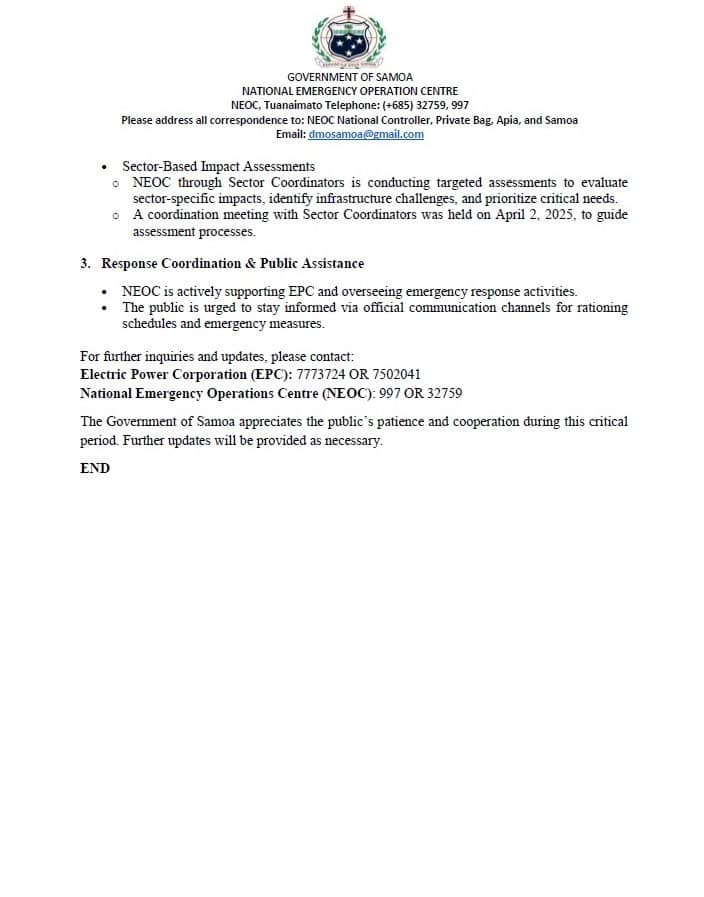
    [PRESS RELEASE April 7, 2025] – The Government of Samoa has declared a 30-day State of Emergency in response to the ongoing energy crisis. The Electric Power Corporation (EPC) and the National Emergency Operations Centre (NEOC) are working closely to ensure the continuity of essential services and minimize disruptions.

    1. EPC Power Supply Update

    EPC has implemented a Power Supply Rationing Schedule to manage electricity distribution. This schedule will be reviewed regularly to balance demand and generation capacity.

     Power Supply Rationing Schedule

    Planned on a weekly basis, with modifications as needed.

    Load balancing requires the activation of two feeders—one large and one small—simultaneously.

    Adjustments will be made case by case to optimize supply distribution.

    Critical service areas, including the National Hospital on the Hospital Feeder, hydro-generating areas supplied by the Fagaloa, Sauniatu, Taelefaga, and Lalomauga Feeders, as well as selected parts of the Vaitele Feeder, will remain unaffected

     Deployment of Hired Generators

    Temporary generators are scheduled to arrive today at 3pm to support EPC’s load-sharing efforts and reduce rationing impacts.

     Ongoing Infrastructure Repairs

    EPC is actively conducting maintenance and repair works to restore power generation capacity.

    2. NEOC Emergency Operations Update

    The NEOC is fully activated and operating 24/7 to coordinate emergency response efforts and disseminate real-time updates.

    Sector-Based Impact Assessments

    NEOC through Sector Coordinators is conducting targeted assessments to evaluate sector-specific impacts, identify infrastructure challenges, and prioritize critical needs.

    A coordination meeting with Sector Coordinators was held on April 2, 2025, to guide assessment processes.

    3. Response Coordination & Public Assistance

     NEOC is actively supporting EPC and overseeing emergency response activities.

     The public is urged to stay informed via official communication channels for rationing schedules and emergency measures.

    For further inquiries and updates, please contact: Electric Power Corporation (EPC): 7773724 OR 7502041 National Emergency Operations Centre (NEOC): 997 OR 32759

    The Government of Samoa appreciates the public’s patience and cooperation during this critical period. Further updates will be provided as necessary.

    END.

    POLOAIGA O FA’ALAVELAVE TUTUPU FA’AFUASE’I MO LE 30 ASO AUĀ LE TULAGA AFĀINA O LE ‘ELETISE UA I AI NEI.

    [PEPA O FA’AMATALAGA Aso Gafua, 07 Aperila 2025] – I le fa’amamaluina ai e le Malo o le 30 Aso o le Poloaiga o Faalavelave Tutupu Fa’afuase’i i le atunu’u atoa, e saili fofō ai i le mafatiaga o feagai nei ma le Faalapotopotoga o Malosi’aga Faa ‘Eletise [EPC] i le tau faasoasoaina o le ‘eletise i nisi o afio’aga i Upolu, o lo’o fa’aauau pea ona galulue vāvālalata le Ofisa Tutotonu mo le Fa’afoeina o Fa’alavelave Fa’afuase’i ma Matuiā [NEOC] ma le EPC ia mautinoa o lo’o fa’aauau pea le auaunaga mo’omia e fa’aitiitia ai nisi fa’afitauli e toe tutupu mai.

    1. Tala lata i le auaunaga a le EPC mo le ‘eletise.

    O lo’o faagasolo pea le faasoasoa o le ‘eletise ma mata’itū fa’afitauli e alia’e mai i taimi uma. O lea fetu’una’iga o lo’o iloilo toto’a mai lea taimi i lea taimi ina ia gafatia ma o gatusa ma le mana’omiaga;

     Fa’asoasoaina o le ‘eletise i taimi ma aso fa’atulagaina.

    Fa’atulaga le galuega fa’asoasoa mo le ‘eletise i le vaiaso fa’atasi ma suiga pe a mana’omia.

    Ia paleni tutusa laina malolosi o le ā fa’aāogajna i le taimi e tasi, e aofia ai le laina malosi tele ma le laina malosi laititi.

    Fetu’unā’iga talafeagai mai mataupu taitasi auā le fa’aleleia ma le fa’asoaina atu o le ‘eletise.

    Auaunaga i laina mālolosi o le ‘eletise mo nofoaga ma’ale’ale e aofia ai le Falema’i Tele i Moto’otua, ma nofoaga o lo’o fa’alagolago i le ‘eletise e gaosia mai le suāvai e pei o Fagaloa, Sauniatu, Ta’elefaga ma le laina malosi i Lalomauga, fa’apea se vaega o le laina malosi i Vaitele o lo’o tumau pea ona lē a’afia i le ‘eletise fa’asoasoa.

     Afi ‘Eletise Fa’aāoga Fa’avaitaimi

    Ua fuafua e taunuu mai i le itula e 3:00 i le asō ‘Afi ‘Eletise lē tumau e fesoasoani i le fa’asoasoaina o le ‘eletise i le atunu’u ma fa’aitiitia ai fa’afitauli ua tutupu mai.

    Fa’aauau pea galuega fa’aleleia mo le auaunaga tau ‘eletise O lo’o fa’aauau pea galuega fa’aleleia a le EPC ina ia mautinoa le toe vave fo’ia o le fa’afitauli o feagai nei ma se vaega o le atunu’u ona o le tau faasoasoaina o le ‘eletise.

    2: GALUEGA FA’AGASOLO A LE NEOC I LE TAIMI NEI.

    O lo’o fa’aauau pea ona galulue le NEOC mo le 24 itula i le 7 aso o le vaiaso, e mata’itū ma ta’imua i galuega mo ni fa’alavelave tutupu fa’afuase’i ma auaunaga tali atu auā le fa’asoaina o tala lata mai i le tulaga o i ai le auaunaga tau ‘eletise i le atunu’u.

     Iloilo toto’a a’afiaga o Vaega Maoti [Sector] mai le ‘eletise.

    O lo’o taula’i le iloiloga a le NEOC tauala atu i Vaega Maoti e māta’itū a’afiaga ma lu’itau aemaise o le fa’amuamua mana’omia o lo’o matuā ogaoga ona a’afiaga ona o le tulaga fa’asoasoa o i ai nei le ‘eletise.

    O le fonotaga ma ia vaega maoti sa faia i le aso 2 o Aperila 2025 auā ta’iala mo le fa’agasologa o lea iloiloga.

    Auaunaga Tali Atu & Fesoasoani mo le Lautele

     Fesoasoani le NEOC e galulue faatasi ma le EPC e silasila toto’a uma i le auaunaga tali atu mo Fa’alavelave Tutupu Fa’afuase’i.

     Fautuaina ma talosagaina le atunu’u lautele ina silasila i fa’asalalauga uma o lo’o tuuina atu i alafa’asalalau a le Malo mo le tulaga o le fa’agasologa o le fa’asoasoaina o le ‘eletise ma le tali atu i fa’alavelave fa’afuase’i.

    Mo nisi fa’amatalaga ma ni fesili, fa’amolemole feso’ota’i:

    Malosi’aga Tau ‘Eletise [EPC]: 7773724 po’o 7502041

    Ofisa Tutotonu mo le Fa’afoeina o Fa’alavelave Fa’afuase’i ma Matuiā [NEOC]: 997 po’o 32759

    E fa’afetaia pea e le Malo o Samoa le onosa’i ma le nofo malamalama o le atunu’u lautele a’o tatou i ai i lenei vaitau faigatā ona o le ‘eletise. O le ā fa’aauau pea ona tu’uina atu lipoti lata mai o le tulaga o lo’o i la tatou auaunaga.

    MAE’A

    Share this:

    April 23, 2025

    MIL OSI Asia Pacific News –

    April 23, 2025
  • MIL-OSI Asia-Pac: Government announces updates to routine drinking water testing programme and Enhanced Water Quality Monitoring Programme

    Source: Hong Kong Government special administrative region

    The Water Supplies Department (WSD) has been committed to providing high-quality and reliable drinking water to Hong Kong citizens in accordance with the guidelines of the World Health Organization (WHO). Following the release of the latest Guidelines for Drinking-water Quality (GDWQ) by the WHO in 2022, the Government has commissioned an expert consultant to review the routine drinking water testing programme for Hong Kong Drinking Water Standards. The review also covers the latest developments in drinking water standards/guidelines across a number of jurisdictions. Based on the review findings and recommendations of the expert consultant, the Government will update the routine drinking water testing programme, including the addition of three new parameters, namely “manganese”, “cylindrospermopsins” and “saxitoxins”, as well as the expansion of the coverage of an existing parameter “microcystin-LR”. These revisions were proposed in accordance with the latest WHO’s GDWQ and have been submitted to the Drinking Water Safety Advisory Committee, which comprises academics, medical experts and relevant industry stakeholders, for deliberation. The Committee’s agreement on the proposed revisions has been obtained.

    Regarding two parameters of “tetrachloroethene” and “uranium”, covered under the current testing programme, previous routine drinking water quality monitoring data showed that their contents were extremely low or even undetectable, far below the level that would pose a risk to health. These two parameters will be excluded from the routine testing programme, but will still be included in the Surveillance List to facilitate the WSD’s surveillance monitoring from time to time. The Committee’s agreement on the recommendation has also be obtained.

    Under the routine drinking water testing programme, water samples are taken from catchments, impounding reservoirs, water treatment works, service reservoirs, water distribution systems and water taps accessible to the general public (e.g. shopping centres, community facilities, sports venues, government offices, etc) for testing. The parameters covered by the programme are established in accordance with WHO’s GDWQ, with testing frequencies ranging from daily to monthly, while the parameters covered by the Surveillance List are usually tested once every six months.

    In addition, the WSD expands the scope of drinking-water quality monitoring through the Enhanced Water Quality Monitoring Programme (Enhanced Programme) to cover water taps of all residential and non-residential customers. Each year, about 670 premises will be randomly selected from all water accounts in Hong Kong. Samples will be collected from water taps of these premises for testing of six metals (namely antimony, cadmium, chromium, copper, lead and nickel), residual chlorine and Escherichia coli. According to the monitoring data over the past years, the levels of antimony in drinking water samples collected from these premises have always been below the reporting limit. Based on the advice of the expert consultant, the WSD will stop testing antimony under the Enhanced Programme, while the testing of other items remain unchanged. This arrangement has been agreed by the Committee.

    The above proposal will be implemented from June 2025. The public may visit the WSD’s website for the latest updates.

    Routine drinking water testing programme
    www.wsd.gov.hk/en/core-businesses/water-quality/my-drinking-water-quality/index.html

    Enhanced Water Quality Monitoring Programme
    www.wsd.gov.hk/en/core-businesses/water-quality/action-plan-for-enhancing-of-drinking-water-safety/drinking-water-standards-enhanced-water-quality/index.html

    MIL OSI Asia Pacific News –

    April 23, 2025
  • MIL-OSI Asia-Pac: List of Outcomes: State Visit of Prime Minister to Saudi Arabia

    Source: Government of India

    Posted On: 23 APR 2025 2:25AM by PIB Delhi

    I. Strategic Partnership Council

    • The second leaders meeting of the India-Saudi Arabia Strategic Partnership Council (SPC) was co-chaired by Hon’ble Prime Minister of India Shri Narendra Modi and His Royal Highness Prince Mohammed bin Salman, Crown Prince and Prime Minister of the Kingdom of Saudi Arabia on 22 April 2025 in Jeddah. The Council reviewed the work of the various committees, subcommittees and working groups under the SPC, which encompass political, defence, security, trade, investment, energy, technology, agriculture, culture and people-to-people ties. The discussions were followed by signing of the minutes by the two leaders.
    • To reflect the deepening of defence partnership over the past few years – including joint exercises, training programmes, and collaboration in defence industry, the Council decided to create a new Ministerial Committee on Defence Cooperation under the SPC.
    • To strengthen cultural and people-to-people ties, which has significant momentum in recent years, the Council decided to create a new Ministerial Committee on Tourism and Cultural Cooperation under the SPC.
    • The four committees under the India-Saudi Arabia SPC shall now be as follows:

      (1) Political, Consular and Security Cooperation Committee.

      (2) Defence Cooperation Committee.

      (3) Economy, Energy, Investment and Technology Committee.

      (4) Tourism and Cultural Cooperation Committee.

    II. High Level Task Force on Investment (HLTF)

    • Building on the commitment of Saudi Arabia to invest USD 100 billion in India in multiple areas including energy, petrochemicals, infrastructure, technology, fintech, digital infrastructure, telecommunications, pharmaceuticals, manufacturing and health, the joint High-Level Task Force on Investment came to an understanding in multiple areas to rapidly promote such investment flows.
    • Both sides agreed to collaborate on establishing two refineries in India.
    • The progress made by HLTF in areas such as taxation is a major breakthrough for greater investment cooperation in the future.

    III. List of MoUs/Agreements:

    • MoU between the Saudi Space Agency and the Department of Space of India on Cooperation in the field of Space Activities for Peaceful Purposes.
    • MoU between the Ministry of Health of Saudi Arabia and the Ministry of Health and Family Welfare of India on Cooperation in the field of Health.
    • MoU between the Saudi Arabian Anti-Doping Committee (SAADC) and the National Anti-Doping Agency, India (NADA) on Cooperation in the field of Anti-Doping Education and Prevention.
    • Agreement between the Saudi Post Corporation (SPL) and the Department of Posts, Ministry of Communications of India on Cooperation in Inward Surface Parcel.

    ***

    MJPS/SR 

    (Release ID: 2123660) Visitor Counter : 44

    MIL OSI Asia Pacific News –

    April 23, 2025
  • MIL-OSI Asia-Pac: Prime Minister meets with High Royal Highness the Crown Prince and Prime Minister of the Kingdom of Saudi Arabia and co-chairs the India–Saudi Arabia Strategic Partnership Council

    Source: Government of India

    Posted On: 23 APR 2025 2:20AM by PIB Delhi

    Prime Minister Shri Narendra Modi paid a State Visit to the Kingdom of Saudi Arabia on April 22, 2025. Prime Minister was received by His Royal Highness Prince Mohammed bin Salman, Crown Prince and Prime Minister of the Kingdom of Saudi Arabia at the Royal Palace in Jeddah and accorded a ceremonial welcome.

    ​Prime Minister and His Royal Highness Prince Mohammed bin Salman, Crown Prince and Prime Minister of the Kingdom of Saudi Arabia held official talks and co-chaired the second meeting of the India–Saudi Arabia Strategic Partnership Council (SPC). HRH Crown Prince strongly condemned the ghastly terror attack in Pahalgam and offered deepest condolences on the innocent lives lost. The two leaders resolved to combat terrorism tooth and nail.

    The leaders reviewed the progress under the Council since their last meeting in September 2023 in New Delhi. The leaders noted with appreciation the intensification in bilateral engagement and the large number of high-level visits across various Ministries that have built trust and mutual understanding on both sides. The two leaders discussed cooperation in the fields of energy, defence, trade, investment, technology, culture and people-to-people relations. Prime Minister thanked His Royal Highness for the support and welfare extended to the Indian community in Saudi Arabia. He also appreciated the support provided by the Saudi government for the Indian Haj pilgrims.

    Both leaders appreciated the progress in the discussions in the High-Level Task Force on Investment. They welcomed the understanding reached by the Task Force in multiple areas, which builds on the earlier commitment of Saudi Arabia to invest USD 100 billion in India across multiple sectors including energy, petrochemicals, infrastructure, technology, fintech, digital infrastructure, telecommunications, pharmaceuticals, manufacturing, and health. In this context, they particularly welcomed the agreement to collaborate on establishing two oil refineries in India, as well as the progress achieved on taxation issues. Prime Minister proposed that to further strengthen economic ties both countries could work for connecting payment gateways and trade settlement in local currencies.

    The two leaders discussed progress in India-Middle East Europe Economic Corridor [IMEEC], particularly the bilateral connectivity initiatives being undertaken by the two sides. Both leaders also exchanged views on regional and global issues of mutual interest.

    The two leaders expressed satisfaction at the outcomes of the work of the two Ministerial Committees under the Council, namely: (a) the Committee on Political, Security, Social and Cultural Cooperation and its subcommittees, and (b) the Committee on Economy and Investments and its Joint Working Groups.

    The two leaders welcomed the expansion of the Strategic Partnership Council with the establishment two new ministerial committees. In this context, to reflect the deepening of the defence partnership, the leaders agreed on the establishment of the Ministerial Committee on Defence Cooperation. Acknowledging the growing momentum in cultural cooperation between the two sides in recent years, they also agreed to establish a Ministerial Committee on Tourism and Culture Cooperation. After the meeting, the minutes of the second SPC were signed by the two leaders.

    The leaders welcomed the signing of 4 bilateral MoUs and agreements in the fields of Space, Health, Sports (Anti-Doping) and postal cooperation on the occasion of the visit. [List of Outcomes]

    Prime Minister invited His Royal Highness Prince Mohammed bin Salman to visit India for the third meeting of the Strategic Partnership Council.


    ***

    MJPS/SR

    (Release ID: 2123658) Visitor Counter : 52

    MIL OSI Asia Pacific News –

    April 23, 2025
  • MIL-OSI Asia-Pac: Software launch of CGHS Digital Health Platform

    Source: Government of India

    Software launch of CGHS Digital Health Platform

    CGHS to launch modernized Health Management Information System (HMIS) from 28th April 2025; legacy system to be discontinued

    All CGHS services, including those at Wellness Centres, to remain closed on 26th April 2025 (Saturday) to facilitate the transition

    PAN-based beneficiary identification, real-time tracking, automated payment verification, and fully online application workflows introduced

    Legacy websites www.cghs.gov.in and www.cghs.nic.in to become non-functional; new portal launched at www.cghs.mohfw.gov.in

    CGHS mobile applications for Android and iOS re-launched with upgraded interface and integrated digital services

    Posted On: 23 APR 2025 11:41AM by PIB Delhi

    The Central Government Health Scheme (CGHS), a flagship programme under the Ministry of Health and Family Welfare, Government of India, is undergoing a major digital transformation with the launch of the next-generation Health Management Information System (HMIS). Developed by the Centre for Development of Advanced Computing (C-DAC), this comprehensive digital platform is scheduled to go live from 28th April 2025.

    The transformation is being implemented in view of the technical obsolescence of the existing CGHS software, which has been in use since 2005 and lacks compatibility with modern IT standards, cyber security frameworks, and user expectations. The revamped HMIS will enable faster, more transparent, and user-friendly access to CGHS services, ensuring improved service delivery and administrative efficiency.

    To ensure a seamless rollout, all CGHS services including those at Wellness Centres shall remain closed for one day on 26th April 2025 (Saturday). This temporary suspension is necessary to complete data migration, switch-over activities, and final validation.

    Key Reforms and Technological Advancements in the New CGHS HMIS

    1. PAN-Based Unique Identification of Beneficiaries
      • Every beneficiary will now be mapped to a unique PAN-based identifier. This will eliminate duplication of records and help in streamlining the validation process for entitlements.
    2. Integrated Digital Verification & Contribution Tracking
      • Contribution payments will now be auto-verified through direct integration (Line of Business Application Integration) with Bharat Kosh. There will be no manual choosing of options, entry of details on Bharat Kosh portal which shall eliminate errors and refund issues.
    3. Pre-payment Scrutiny of Applications
      • New system enables scrutiny and approval of card applications before the payment stage. This ensures that applicants are guided regarding eligibility and contribution amount before making a payment.
    4. Online Card Modification Services
      • Services like card transfers, change in dependent status, and category change (Serving to Pensioner, etc.) can now be initiated and completed entirely online.
    5. Real-Time Application Tracking and Alerts
      • The system will generate SMS and email alerts at each stage of application processing. This increases transparency and reduces in-person follow-ups.
    6. Mandatory Password Reset and Secure Access
      • All existing users will be prompted to reset their passwords on first login. This is being enforced as a cyber hygiene measure in accordance with MeitY security advisories.
    7. DDO/PAO-Based Department Identification
      • Department identity will be verified using Pay and Accounts Office (PAO) and Drawing and Disbursing Officer (DDO) codes, as indicated in employee salary slips. This ensures backend mapping of sponsoring authorities.
    8. Mobile Application Relaunch (Android & iOS)
      • The official CGHS mobile apps have been re-developed and now offer an enhanced beneficiary experience with:
      • Access to Digital CGHS Card
      • Real-time status tracking
      • E-referrals and appointment scheduling (where applicable)
      • Integrated contact with Helpdesk and AD Offices

    Legacy System Deactivation and Website Migration

    From 28th April 2025, the old CGHS websites www.cghs.gov.in and www.cghs.nic.in will be deactivated. All services and information will henceforth be hosted on the new unified CGHS Digital Platform at www.cghs.mohfw.gov.in.

    Beneficiaries are advised to access all online services, including registration, application, grievance redressal, and information retrieval, through this new portal only.

    All legacy beneficiary data, including medical history and pharmacy transactions, are being securely migrated, ensuring no loss of records. The transition complies fully with government data privacy and protection standards.

    Additionally, the department shall be onboarded on the new CGHS Platform for a paperless approval process. In the interim, departments may continue to submit applications physically at the respective CGHS Card Sections.

    Advisory for Beneficiaries and Departments

    • 28th April onwards, CGHS Contribution shall be only through CGHS Website i.e. www.cghs.mohfw.gov.in. The existing manual process of payment available on www.bharatkosh.gov.in shall discontinue from 28th April 2025.
    • Applications for CGHS services in progress but not paid for by 27th April 2025 will lapse. A fresh application will be required through the new portal.
    • All Beneficiaries aged above 18 years are advised to link their PAN Card with their CGHS Beneficiary ID and apply for corrections in case of any errors through the beneficiary login on CGHS website www.cghs.mohfw.gov.in.
    • Instructions shall be issued for the Departments regarding onboarding on the new platform.
    • The existing issued cards shall continue to function normally.

    Support initiatives include:

    • CGHS Helpdesk and User Manuals are available on the CGHS website www.cghs.mohfw.gov.in and mobile app for use by Departments and Beneficiaries.
    • Continuous support through the CGHS Card Sections and respective Additional Director (AD) Offices.

    *****


    MV

    HFW/CGHS HMIS Software Launch/23 April 2025/1

    (Release ID: 2123696) Visitor Counter : 46

    MIL OSI Asia Pacific News –

    April 23, 2025
  • MIL-OSI Europe: Written question – Specific action by the EU to ensure the security of supply of critical medicines – E-001492/2025

    Source: European Parliament

    Question for written answer  E-001492/2025
    to the Commission
    Rule 144
    Gerald Hauser (PfE)

    The increasing dependence of EU Member States on third countries – particularly China and India – for their supply of medicines is undoubtedly one of the biggest problems facing the health-care sector. Currently, around 80% of all active pharmaceutical ingredients come from these two countries. This is considered one of the main reasons for the growing number of supply shortages of medicines.

    The Critical Medicines Alliance, set up in January 2024, is a consultative body tasked with proposing how to secure the EU’s of supply of critical medicines, supporting efforts to effectively prevent and resolve shortages.

    • 1.What specific measures does the Commission intend to take to ensure that critical medicines and their raw materials are once again produced in sufficient quantities in the EU and that supply chains are truly diversified?
    • 2.What specific measures does the Commission intend to take to shield patients from the foreseeable price rises in critical medicines as a result of increased production in the EU and the diversification of supply chains?

    Submitted: 10.4.2025

    Last updated: 23 April 2025

    MIL OSI Europe News –

    April 23, 2025
  • MIL-OSI United Kingdom: Lord Collins of Highbury, UK Minister for Africa visits Uganda

    Source: United Kingdom – Government Statements

    Press release

    Lord Collins of Highbury, UK Minister for Africa visits Uganda

    Lord Collins of Highbury visited Uganda on 3 and 4 April to reinforce the UK’s commitment to sustainable development and mutual economic growth.

    UK Minister for Africa Lord Collins with British High Commissioner Lisa Chesney, CEO of Uganda Airlines Jenifer Bamuturaki, and Minister of Works and Transport Katumba Wamala, at a reception to mark the Uganda Airlines’ direct flight to the UK, scheduled for 18 May 2025.

    During his 2-day visit, Lord Collins announced the launch of a new UK-Uganda Growth Dialogue between the UK and the Ministry of Finance, Planning and Economic Development.

    The UK-Uganda Growth Dialogue will be a quarterly series of discussions on commercial deals, business environment and economic policy to identify opportunities to increase trade and investment between the 2 nations. It will unblock barriers to trade and create new opportunities for collaboration.

    Lord Collins visited areas of UK investments such as Zembo, a leading e-mobility company in Uganda, which has received financing from UK Innovate and Private Infrastructure Development Group.

    Uganda’s green transition

    Funding has accelerated the adoption of electric motorcycles and other zero-emission vehicles, reducing carbon emissions and saving the average boda driver US$500 annually on traditional fuel and maintenance costs. The investment supports Uganda’s transition to greener mobility while creating new job opportunities.

    Lord Collins of Highbury stated:

    My visit to Uganda reaffirms the UK’s unwavering commitment to building equal partnerships that supporting sustainable development and drive mutually beneficial economic growth in the region. We are dedicated to working closely with our Ugandan partners to achieve shared prosperity and a brighter future for all.

    Celebrating direct flights between UK and Uganda

    Lord Collins and Uganda Airlines jointly hosted a reception to celebrate the new Uganda Airlines direct flight to the UK – the first in 10 years. The direct flights are expected to enhance trade, tourism, and people-to-people links between the UK and Uganda, further strengthening the 2 countries’ historic relationship.

    Lord Collins remarked:

    The introduction of direct flights between Entebbe and London Gatwick marks a pivotal moment in our efforts to deepen ties and foster mutual growth. We are excited about the opportunities this new connection will bring.

    Supporting Uganda’s research and innovation

    During his visit to Uganda, Lord Collins of Highbury visited the Uganda Virus Research Institute (UVRI), which boasts over £25 million in active funding from UK Universities and Medical Research Council and hosts many British medical researchers for and a 35-year partnership with the UK.

    UVRI has pioneered breakthroughs, including significant advancements in HIV/AIDS treatment and Ebola research, enhanced disease surveillance and provided expert advice on controlling viral infections.

    UVRI partners with the Ministry of Health, the UK’s Medical Research Council (MRC), the London School of Hygiene & Tropical Medicine, and other international and local experts to advance its mission

    Background

    UVRI (Uganda Virus Research Institute)

    UVRI is a leading research institute in Uganda, focusing on viral diseases and public health, collaborating with UK Universities and international partners.

    PIDG (Private Infrastructure Development Group)

    PIDG mobilises finance for infrastructure projects in Africa and Asia, promoting sustainable development through public-private partnerships.

    Innovate UK

    Innovate UK supports business-led innovation across sectors with financial support, expert advice and access to resources.

    Share this page

    The following links open in a new tab

    • Share on Facebook (opens in new tab)
    • Share on Twitter (opens in new tab)

    Updates to this page

    Published 23 April 2025

    MIL OSI United Kingdom –

    April 23, 2025
  • MIL-OSI China: National Health Commission Firmly Opposes White House Website Rehashing of the “Lab Leak” Allegation

    Source: People’s Republic of China Ministry of Health

    In responding to a recent article on the White House website titled “Lab Leak: The True Origins of COVID-19,” the spokesperson of the National Health Commission stated that like previous U.S. allegations of  “Wuhan lab leak,” the so-called rationale of the article completely lacks scientific basis, and the “evidence” is entirely fabricated. The U.S.’s repeated attempts to blame and smear China on the issue of the origins of SARS-CoV-2 only expose its malicious intent to politicize scientific issues, a practice long dismissed by the international scientific community. Its agenda to use the pandemic as a tool to contain China is doomed to fail. As growing information and evidence show that SARS-CoV-2 emerged in the U.S. at an even earlier date, the next phase of origin-tracing should be conducted in the U.S. We urge the U.S. to immediately cease its baseless accusations and smear campaign against China, be accountable for its own problem, and provide a credible, responsible explanation to the international community and people worldwide.

    MIL OSI China News –

    April 23, 2025
  • MIL-OSI NGOs: “Let us do our jobs” — Major aid groups in Gaza warn aid system is collapsing

    Source: Oxfam –

    After 18 months of war, a staggering toll on civilians and aid workers, and now a six-week total siege, the humanitarian aid system in Gaza is facing total collapse with the CEOs of 12 major aid organisations making an urgent plea: let us do our jobs. 

    A new humanitarian access survey of 43 international and Palestinian aid organisations working in Gaza found nearly all of them – 95% – have had to suspend or dramatically cut services since the ceasefire ended one month ago on 18 March, with widespread and indiscriminate bombing making it extremely dangerous to move around.

    The people of Gaza – particularly women and children – are paying the price. Families are living amongst the rubble of their destroyed homes.  Famine is not just a risk, but likely rapidly unfolding in almost all parts of Gaza. The UN has warned the humanitarian crisis in Gaza is the worst it has been in 18 months.

    Stripped of the means to keep people alive, hospitals have become morgues. More than 51,000 Palestinians have been reported killed. One of the last partially functioning hospitals, Al-Ahli Arab Hospital in northern Gaza, was bombed last Sunday.  

    “This is one of the worst humanitarian failures of our generation. Every single person in Gaza is relying on humanitarian aid to survive. That lifeline has been completely cut off since a blockade on all aid supplies was imposed by Israeli authorities on 2 March.  

    “We have supplies ready. We have trained medical staff. We have the expertise. What we don’t have is the access – or the guarantee by Israeli authorities that our teams can safely do their jobs.  

    “Survival itself is now slipping out of reach and the humanitarian system is at breaking point,” the CEOs of the 12 aid organisations said in their joint statement.  

    Twenty-four of the surveyed organisations reported increased movement restrictions in Gaza, impeding their ability to deliver aid.  Nineteen aid organisations reported having cargo stuck outside Gaza, totaling at least 9,000 pallets of aid supplies.  

    Gaza now holds the disastrous record of being the deadliest place on earth for humanitarian workers. We cannot operate under fire or stay silent while our staff are killed. 

    More than 400 aid workers and over 1,300 health workers have been reported killed in Gaza since October 2023, despite the requirement under international humanitarian law for humanitarian workers to be protected.  

    The recent killing of 15 Palestinian paramedics and rescue workers, whose bodies were found buried in a mass grave triggered global outrage, but many violations and attacks go unreported. 

    Despite hopes that the eight-week pause in hostilities would become a turning point, the violence against civilians and aid workers has only worsened. Since Israeli forces resumed bombardments, at least 14 organisations reported Israeli fire directly or indirectly hitting their staff or aid facilities.  

    Every day, aid workers – the majority of whom are Palestinian – are targeted, detained, obstructed or killed. Just as every day, rules meant to protect civilians in war are ignored with impunity.  When our staff and partners, our convoys, our offices, our warehouses are shelled, the message is loud and clear: even lifesaving aid is no longer protected. 

    This is unacceptable. 

    Meanwhile, Israeli authorities have proposed a new authorisation mechanism for the delivery of aid in Gaza that the UN Secretary-General has described as “limiting aid down to the last calorie and grain of flour.” This mechanism would set a dangerous new global precedent and eliminate any remaining space to deliver aid independent of military and political motivations. New NGO visa and registration rules, based on vague criteria, will censor humanitarian reporting and prevent us from fulfilling our mandate. 

    We call on all parties to guarantee the safety of our staff and to allow the safe, unfettered access of aid into and across Gaza through all entry points, and for world leaders to oppose further restrictions. 

    We call for the protection of civilians and civilian infrastructure including hospitals, schools and shelters and the immediate restoration of basic services – water, electricity, and sanitation as required under international law. 

    We call for the release of the hostages. 

    We call for the release of all Palestinians arbitrarily detained. 

    We call, yet again, resoundingly, for an immediate and permanent ceasefire. 

    Humanitarian aid must never be used as a political tool. Saving lives should not be controversial. Laws of war developed over centuries to govern conduct and protect civilians should not now be discarded. 

    Let us do our jobs.  

    INGER ASHING, CEO, Save the Children International 

    AMITABH BEHAR, Executive Director, Oxfam International 

    SEAN CARROLL, President and CEO, Anera

    STEVE CUTTS, interim Chief Executive Officer, Medical Aid for Palestinians (MAP)  

    NICOLAS DOTTA, CEO, Médecins du Monde Spain

    JAN EGELAND, Secretary General, Norwegian Refugee Council (NRC) 

    REENA GHELANI, CEO, Plan International

    MANUEL PATROUILLARD, Managing Director, Humanity & Inclusion – Handicap International  

    MORGANE ROUSSEAU, CEO, Médecins du Monde Switzerland

    REINTJE VAN HAERINGEN, Chair – Executive Committee, CARE International 

    JOEL WEILER, CEO, Médecins du Monde France

    ROB WILLIAMS, CEO, War Child Alliance

    MIL OSI NGO –

    April 23, 2025
  • MIL-OSI Global: Severance: what the hit show can teach us about cybersecurity and human risk

    Source: The Conversation – UK – By Oli Buckley, Professor in Cyber Security, Loughborough University

    What if your work self didn’t know about your personal life, and your home self had no idea what you did for a living? In Apple TV’s Severance, that’s exactly the deal: a surgical procedure splits the memories of employees into “innies” (who only exist at work) and “outies” (who never recall what they do from nine to five).

    On the surface, it sounds like an ideal solution to a growing cybersecurity problem of insider threats, such as leaks or sabotage by employees. After all, if an employee can’t remember what they accessed at work, how can they leak it, sabotage it, or sell it?

    As someone who has researched insider threats for the last decade I can’t help but see Severance as a cautionary tale of what happens when we try to eliminate threats without understanding people.

    The threat from within

    Insider threats really hit prominence in the wake of high-profile incidents like Chelsea Manning and Edward Snowden, who both leaked top secret government information. These threats are one of the most persistent challenges in security because unlike “traditional” hackers, insiders already have access to sensitive systems and information.

    They might act maliciously, stealing trade secrets or exposing data, or accidentally, through phishing links or lost devices. Either way, the consequences can be more serious because of the unprecedented levels of access someone has while working within an organisation.

    While we often think of the high-profile cases in the first instance, the reality of most insider incidents is far less dramatic. Think of the disgruntled employee who downloads a client database before leaving, or the well-meaning staff member who shares a sensitive file via the wrong link.

    In fact, one of the most iconic examples of an insider threat in fiction is Jurassic Park. The entire catastrophe begins, not with a dinosaur, but with a software engineer, Dennis Nedry, who disables the park’s security in an attempt to steal trade secrets. It’s a reminder that even the most sophisticated systems can be undone by a single rogue employee.

    Organisations try to manage this through access controls, behaviour monitoring and training. But people are unpredictable. Insider threats sit at the messy intersection of human behaviour, organisational culture and digital systems.

    This is where Severance strikes a chord. What if you could eliminate the human risk altogether, by turning employees into separate, tightly compartmentalised selves? In the show, workers at the shadowy Lumon Corporation have no memory of their job outside the office and vice versa.

    In a sense, it’s the ultimate form of “need to know.” An “innie” can’t tell anyone what they do because they don’t know anything beyond their desk. It’s a very elegant, although ethically problematic, solution for someone working in security. However, as the series unfolds, it becomes clear that the levels of control on offer through the process of severance come with a terrible cost.

    The problem with control

    The innies in Severance are trapped in an endless workday, unable to understand the meaning or value of their tasks. They form bonds, question authority and ultimately rebel. Ironically, it is the severed employees, the ones who are most closely controlled in the company, who become the greatest insider threat to Lumon.

    This mirrors something we know from real organisations: excessive surveillance, control and secrecy often backfires. For instance, Amazon has faced repeated criticism over its use of tracking technologies to monitor warehouse workers’ movements and productivity, with reports suggesting this has contributed to high stress, burnout and even rule-breaking as workers try to “game” the system.

    A 2022 study published in Harvard Business Review found that employees who feel overly monitored are significantly more likely to break rules or engage in counterproductive behaviour – undermining the very goals of workplace surveillance. If people feel undervalued or mistreated, they’re more likely to become disengaged or actively hostile. Security systems that ignore culture and trust are therefore often brittle.

    What Severance gets right is that insider threats are emotional and ethical problems as much as technical ones. They stem from how people feel about their role, their autonomy and their identity within a system. This is something that we can’t simply patch within a piece of software.

    Lessons from fiction

    Thankfully, no company in the real world is proposing surgical memory separation, at least not yet. But in an age of algorithmic management, increasing surveillance, and growing concerns about privacy, Severance resonates. It forces us to ask just how far should we go in the name of security?

    The answer isn’t to separate people from their work, but to build systems that are secure and respectful of the people within them; something increasingly backed by research.

    That means better design, clearer boundaries and a workplace culture that values openness, not just compliance. For example, implementing clear expectations around work hours and communication norms can help prevent burnout and promote wellbeing.

    Encouraging open communication channels, such as anonymous feedback systems, empowers employees to voice concerns without fear, fostering a culture of trust. Additionally, designing physical workspaces that promote collaboration, like open-plan areas and communal lounges, can enhance team cohesion and reflect organisational values.

    If we follow the example set by Lumon and try to remove all risk then we lose something far more essential – the humanity at the centre of our systems and organisations. Ultimately, removing that human focus could be the most significant vulnerability of all.

    Oli Buckley receives funding from Jason R.C. Nurse receives funding from The Engineering and Physical Sciences Research Council (EPSRC) and Responsible AI UK.

    – ref. Severance: what the hit show can teach us about cybersecurity and human risk – https://theconversation.com/severance-what-the-hit-show-can-teach-us-about-cybersecurity-and-human-risk-255024

    MIL OSI – Global Reports –

    April 23, 2025
  • MIL-OSI Russia: Cook with a Chemist and Play Chess with an Artist: How the Science and Ice Cream FEST Festival Will Be Held at VDNKh

    Translartion. Region: Russians Fedetion –

    Source: Moscow Government – Government of Moscow –

    The first Science and Ice Cream FEST festival will be held at VDNKh from May 23 to 25. More than 30 events are planned, with about three thousand people expected to attend. All events will be free. You can view the full program and pre-register for the events from April 28 on the website.

    The program will be held at 10 VDNKh sites, such as the Cosmonautics and Aviation Center, the Atom Museum, Pavilion No. 1 Central, the Moscow Transport Museum, the Biotech Museum, the Moscow Municipal Economy Museum, the summer cinema, Pavilion No. 25 Oil, the Books Pavilion Rosiso, and the Moscow Longevity Center. The festival is organized by VDNKh and the Future Time Foundation.

    Guests will meet with famous scientists and popularizers of science, including Doctor of Physical and Mathematical Sciences Alexey Semikhatov, famous chemist and crystallographer Artem Oganov, popularizer of evidence-based medicine Alexey Vodovozov, artist Rostan Tavasiev and candidate of psychological sciences Olga Svarnik.

    The Science and Ice Cream FEST festival will offer you to try yourself in unexpected roles and take a fresh look at familiar communication formats, erasing the boundaries between science, creativity and entertainment.

    Chess with an artist, cooking with a chemist, science with a film critic and more

    One of the most exciting events of the festival will be the “Chemical Party” at the Atom Museum. Guests will become part of an exciting scientific show, where chemical experiments by Artem Oganov, a crystallographer, doctor of physical and mathematical sciences and professor of the Russian Academy of Sciences (RAS), will turn into an exciting game. Participants will learn how chemical processes work. In addition, a culinary master class by Maria Kalinina, an expert in the field of colloid chemistry, will be organized. Everyone will be able to find out whether and how exactly to disassemble products into components in order to eat right, and talk about how exactly food chemistry affects our everyday life.

    At the Cosmonautics and Aviation Center, festival guests will be able not only to discuss quantum physics with Doctor of Physical and Mathematical Sciences Alexey Semikhatov, but also to take part in a photo shoot with the famous scientist. And in the dome space of the center, visitors will be greeted by artist Rostan Tavasiev, with whom they can talk about contemporary art inspired by space, and play chess.

    A master class on neurographics will be held at the Biotech Museum. Olga Svarnik, PhD in Psychology and leading researcher at the RAS Laboratory of Psychophysiology, will explore their unconscious together with the participants. During the class, guests will learn how this creative method helps solve personal and psychological problems, and will also be able to check how the human brain reacts to the process.

    Several events will be held at the Moscow Transport Museum. The public talk on bicycle transport design will appeal to those interested in innovations in transport technologies and design, as well as those wishing to participate in the development of the urban environment. The meeting “Teenage Vibe. Where Should We Get Off?” will discuss how modern teenagers see the world, and at the interactive lecture “Science Under the Hood: How Does an Internal Combustion Engine Work?” visitors will learn about the structure of the heart of a car.

    At the festival, you will also be able to join the program “Superschool Rules”, which will be hosted by science journalist and host of the podcast on Channel One “Schrödinger’s Cat” Grigory Tarasevich. Together with the guests, he will develop original mnemonic rules for memorizing scientific terms, the best of which will be offered to school teachers for use in the educational process.

    In addition, guests of all ages will be able to discuss science with a film critic and listen to medical folklore, play board games with scientists and writers, take part in botanical walks and scientific battles, create their own literary comics based on famous books, and join public lectures, live discussions, interactive master classes, and author’s programs from the country’s leading universities.

    Please note: This information is raw content directly from the source of the information. It is exactly what the source states and does not reflect the position of MIL-OSI or its clients.

    Please Note; This Information is Raw Content Directly from the Information Source. It is access to What the Source Is Stating and Does Not Reflect

    https: //vv.mos.ru/nevs/ite/152922073/

    MIL OSI Russia News –

    April 23, 2025
  • MIL-OSI Russia: Academic Commonwealth of St. Petersburg and Belarus

    Translartion. Region: Russians Fedetion –

    Source: Peter the Great St Petersburg Polytechnic University – Peter the Great St Petersburg Polytechnic University –

    A delegation from the St. Petersburg Branch of the Russian Academy of Sciences (SPbB RAS) visited the National Academy of Sciences of the Republic of Belarus (NAS of Belarus). The purpose of the visit was to establish a long-term and meaningful scientific partnership between the two academies based on the existing close ties between Peter the Great St. Petersburg Polytechnic University and the institutes of the SPbB RAS with scientific organizations of the Republic of Belarus.

    The Russian delegation was headed by the Chairman of the St. Petersburg Branch of the Russian Academy of Sciences, Rector of Peter the Great St. Petersburg Polytechnic University, Academician of the Russian Academy of Sciences Andrey Rudskoy. The delegation also included Deputy Chairman of the St. Petersburg Branch of the Russian Academy of Sciences, Vice-Rector for International Affairs of St. Petersburg Polytechnic University, Corresponding Member of the Russian Academy of Sciences Dmitry Arsenyev and Director of the Institute of Mechanical Engineering, Materials and Transport of St. Petersburg Polytechnic University Anatoly Popovich.

    The visit began with a visit to the Center for Systems Analysis and Strategic Research of the National Academy of Sciences of Belarus and the permanent exhibition “Achievements of Domestic Science for Production”, dedicated to unique developments and technologies that were created in the institutes of the National Academy of Sciences and have already been implemented in real production.

    The First Deputy Chairman of the Presidium of the National Academy of Sciences of Belarus, Academician Sergei Chizhik, and the Academician-Secretary of the Department of Physics, Mathematics and Informatics of the National Academy of Sciences of Belarus, Alexander Shumilin, presented the guests with the latest developments completed by order of industrial enterprises of Belarus, including joint projects with Russia, including nuclear energy and the space program.

    The central event of the visit was the official meeting at the Presidium of the National Academy of Sciences of Belarus. The Belarusian side was represented by the First Deputy Chairman of the Presidium of the National Academy of Sciences of Belarus Sergei Chizhik and academician-secretaries of the relevant departments of the National Academy of Sciences. The event is taking place in a significant year for both countries – the 80th anniversary of the Victory in the Great Patriotic War and the 25th anniversary of the establishment of partnership relations between St. Petersburg and the Republic of Belarus. The context of common historical heritage and sustainable cooperation in our days gave the event a special symbolic meaning.

    Andrey Rudskoy gave a report in which he spoke about the history of the creation of the SPbB RAS, about great scientists and academicians of Russia and Belarus, including graduates of SPbPU. He gave examples of successful scientific projects, fundamental and applied research implemented in partnership between the institutes of the two academies.

    “Scientific organizations of St. Petersburg and Belarus have been cooperating for many years. We are united not only by common cultural and scientific traditions, but also by common goals: technological sovereignty, sustainable development and strengthening of positions in world science,” noted Andrei Rudskoy.

    At the end of the official meeting, a ceremonial signing of an agreement on scientific and technical cooperation between the St. Petersburg Branch of the Russian Academy of Sciences and the National Academy of Sciences of Belarus took place.

    The agreement is aimed at developing fundamental and applied research, training highly qualified scientific personnel, joint implementation of scientific and technical projects and exchange of scientific information. The parties also agreed to support applications for national and international grants, develop educational programs and organize joint conferences and seminars.

    Particular attention is paid to creating conditions for the formation of scientific schools, promoting jointly created technologies and attracting partners from third countries to scientific interaction.

    The visit of the Russian delegation continued with a visit to the leading scientific institutes of the National Academy of Sciences of Belarus. At the B. I. Stepanov Institute of Physics (IPh), the guests from St. Petersburg were met by the director, Academician of the National Academy of Sciences of Belarus Sergei Gaponenko. After the official part, the representatives of the SPbB RAS got acquainted with the practical developments of the institute’s scientists. One of the most interesting projects is research in the field of creating transistors based on gallium nitride, in which the B. I. Stepanov Institute of Physics can compete with Chinese developers and manufacturers. In addition, unique devices developed at the Center for Laser and Optical Technologies for Medicine and Biology were presented.

    The next stop on the visit was the Institute of Applied Physics (IAP). Its director, Mikhail Kheifets, is a frequent guest of SPbPU and heads the dissertation council of SPbPU in the specialty “Technology and equipment for mechanical and physical-technical processing.” The institute he heads conducts important research, including with a number of scientific organizations and enterprises in St. Petersburg. For example, magnetometers are calibrated and verified using standards developed at the IAP, and then the devices are certified at the Mendeleyev Research Institute in St. Petersburg. Among other projects, a contactless ore measurement technology developed by the IAP in the interests of Severstal was presented. Significant potential for cooperation between the IAP and scientific and educational institutions of St. Petersburg is contained in the joint program for space research of Belarus and Russia, which is supervised by Academician Pyotr Vityaz, Head of the Aerospace Activities Department of the National Academy of Sciences of Belarus. This topic was actively discussed during the recent visit of the delegation of the National Academy of Sciences of Belarus to SPbPU, when visiting the laboratories of the Institute of Electronics and Telecommunications.

    The day’s program ended at the Institute of Powder Metallurgy named after Academician O. V. Roman. The guests were introduced to the exhibition of scientific and technical developments and products of the institute, the test stand, and the additive technologies section. After the inspection of the production sites, a scientific seminar was held, where representatives of the SPbB RAS and SPbPU heard reports on the institute’s developments in the field of additive technologies, obtaining metal and alloy powders for them, filled filaments. The head of the test stand presented methods for studying metal, ceramic and composite materials using the center’s equipment.

    SPbPU and the Roman Institute of Powder Metallurgy have been successfully cooperating for a long time. A joint project, “Development of a technology for producing composite materials based on ceramics and products using additive manufacturing,” is being implemented using a grant from the St. Petersburg Science Foundation. A joint monograph, “Additive Technologies. Materials and Technological Processes,” co-authored by SPbPU and the National Academy of Sciences of the Republic of Belarus, has been published. Director General Alexander Ilyushchenko proposed new topics for joint research, including in the field of surgical implants, new composite filaments for additive technologies, effective materials, and coatings made of radio-absorbing materials. The parties agreed to prepare a new program for the Union State in the field of modern materials science.

    “Today’s visit is a step towards a deeper scientific union. Belarus has always been and will be a key strategic partner for us,” Andrey Rudskoy, Chairman of the St. Petersburg Branch of the Russian Academy of Sciences, summed up the results of the visit to the NAS of Belarus.

    Please note: This information is raw content directly from the source of the information. It is exactly what the source states and does not reflect the position of MIL-OSI or its clients.

    MIL OSI Russia News –

    April 23, 2025
  • MIL-OSI USA: MATSUI AND BLUMENTHAL SLAM TERMINATION OF CRITICAL CRUISE LINE SANITATION PROGRAM AMID GROWING REPORTS OF ILLNESS OUTBREAKS

    Source: United States House of Representatives – Congresswoman Doris Matsui (D-CA)

    WASHINGTON, D.C. – Today, Congresswoman Doris Matsui (D-CA) and U.S. Senator Richard Blumenthal (D-CT) wrote to Acting Director of the Center for Disease Control and Prevention (CDC) Susan Monarez criticizing the elimination of all full-time staff at the CDC’s Vessel Sanitation Program (VSP), a vital program that works to prevent and control public health incidents and disease outbreaks aboard cruise ships. In their letter, Matsui and Blumenthal cite recent reports of illnesses spreading on cruise ships, including norovirus. The decimation of the VSP comes at a time of cuts, freezes, and firings at the CDC from the Trump Administration’s Department of Government Efficiency.

    “Through routine inspections, training of cruise ship personnel, and responses to and documentation of outbreaks aboard cruise ships, the VSP protects and promotes public health for cruisegoers everywhere. This critical information helps the traveling public make informed decisions before they sail,” wrote the lawmakers. “It is therefore confounding that the VSP has been swept up in the indiscriminate cuts that were initiated recently at the CDC.”

    “As we saw with the rampant spread of COVID-19 aboard cruise ships in the early days of the pandemic, these environments provide a prime opportunity for the transmission of disease. That is why it is absolutely critical that the CDC maintains the office and staff responsible for dealing with outbreaks on cruise ships. Severely reducing or eliminating the program that holds CDC’s subject matter expertise on this issue is short-sighted, and will ultimately lead to more illnesses,” continued Matsui and Blumenthal.

    The full text of the letter can be found below.

     Dear Acting Director Monarez,

     We are extremely alarmed by reports that all full-time employees of the Center for Disease Control’s (CDC) Vessel Sanitation Program (VSP) have been terminated.[1] As news of the worst outbreak aboard a cruise ship this year is making headlines, it is incomprehensible that the officials responsible for protecting the health of the cruise-going public would be abruptly terminated.[2]

     The VSP is a vital program that works to prevent, control, and publicize public health incidents aboard cruise ships.[3] Through routine inspections, training of cruise ship personnel, and responses to and documentation of outbreaks aboard cruise ships, the VSP protects and promotes public health for cruisegoers everywhere.[4] Among its most important functions are VSP’s maintenance of databases of outbreaks in its jurisdiction and inspection scores for cruise ships.[5] This critical information helps the traveling public make informed decisions before they sail. It is therefore confounding that the VSP has been swept up in the indiscriminate cuts that were initiated recently at the CDC. According to reports, the CDC’s Division of Environmental Health Science and Practice, which housed the VSP, was decimated by staff losses.[6] 

    Elimination of the VSP is especially concerning now, when just last month a massive norovirus outbreak was reported on a luxury cruise liner travelling from England to the Caribbean.[7] This outbreak aboard the Queen Mary 2 sickened 224 passengers and 17 crew members.[8] And indeed, while this is the most widespread cruise ship outbreak so far this year, it is far from the first. According to the database maintained by the VSP, there have already been thirteen confirmed outbreaks aboard cruise ships in the first three months of 2025, sickening almost 1,400 people this year alone.[9]

     As we saw with the rampant spread of COVID-19 aboard cruise ships in the early days of the pandemic, these environments provide a prime opportunity for the transmission of disease. That is why it is absolutely critical that the CDC maintains the office and staff responsible for dealing with outbreaks on cruise ships. Severely reducing or eliminating the program that holds CDC’s subject matter expertise on this issue is short-sighted, and will ultimately lead to more illnesses. 

    It is therefore critical to understand CDC’s plan to continue its vital cruise ship monitoring efforts, in the absence of the VSP. To that end, we request answers to the following questions by May 6, 2025:

    1. Please describe what plans, if any, the CDC has for eliminating the VSP.
      1. Please describe what metrics, if any, were used when evaluating the potential elimination of the VSP.
    2. Please describe how the CDC intends to fulfill its statutory obligations to protect public health aboard cruise ships in the absence of the VSP.
    3. How many employees working for the VSP have left since January 20, 2025? Please include employees who accepted a deferred resignation offer, had their employment terminated, or were placed on administrative leave.
    4. Will CDC continue to update its inspection scores database so the travelling public can make informed decisions when planning a cruise?
    5. Will CDC continue to update its database of outbreaks to ensure the public has access to critical public health information about illnesses on cruise ships?

     We appreciate your attention to this matter and look forward to your timely response. 

    # # #

    MIL OSI USA News –

    April 23, 2025
  • MIL-OSI Asia-Pac: President Lai meets US CNAS NextGen fellows

    Source: Republic of China Taiwan

    Details
    2025-04-18
    President Lai meets US delegation from Senate Foreign Relations Subcommittee on East Asia and the Pacific
    On the afternoon of April 18, President Lai Ching-te met with a delegation led by Senator Pete Ricketts, chairman of the United States Senate Foreign Relations Subcommittee on East Asia, the Pacific, and International Cybersecurity Policy. In remarks, President Lai said we hope to promote our Taiwan plus one policy, that is, new industrial arrangements for Taiwan plus the US, to leverage the strengths of both sides and reinforce our links in such areas as the economy, trade, and technological innovation. The president said that by deepening cooperation, Taiwan and the US will be better positioned to work together on building non-red supply chains. He said a more secure and sustainable economic and trade partnership will allow us to address the challenges posed by geopolitics, climate change, and the restructuring of global supply chains. A translation of President Lai’s remarks follows: I warmly welcome you all to Taiwan. I want to take this opportunity to especially thank Chairman Pete Ricketts and Ranking Member Chris Coons for their high regard and support for Taiwan. Chairman Ricketts has elected to visit Taiwan on his first overseas trip since taking up his new position in January. Ranking Member Coons made a dedicated trip to Taiwan in 2021 to announce a donation of COVID-19 vaccines on behalf of the US government. He also visited last May, soon after my inauguration, continuing to deepen Taiwan-US exchanges. Thanks to support from Chairman Ricketts and Ranking Member Coons, the US Congress has continued to introduce many concrete initiatives and resources to assist Taiwan through the National Defense Authorization Act and Consolidated Appropriations Act, bringing the Taiwan-US partnership even closer. For this, I want to again express my gratitude. There has long been bipartisan support in the US Congress for maintaining security in the Taiwan Strait. Faced with China’s persistent political and military intimidation, Taiwan will endeavor to reform national defense and enhance whole-of-society defense resilience. We will also make special budget allocations to ensure that our defense budget exceeds 3 percent of GDP, up from the current 2.5 percent, so as to enhance Taiwan’s self-defense capabilities. We look forward to Taiwan and the US continuing to work together to maintain peace and stability in the region. We will also promote our Taiwan plus one policy, that is, new industrial arrangements for Taiwan plus the US. We hope to leverage the strengths of both sides and reinforce our links in such areas as the economy, trade, and technological innovation, jointly promoting prosperity and development. We believe that by deepening cooperation through the Taiwan plus one policy, Taiwan and the US will be better positioned to work together on building non-red supply chains. A more secure and sustainable economic and trade partnership will allow us to address the challenges posed by geopolitics, climate change, and the restructuring of global supply chains. In closing, I wish Chairman Ricketts and Ranking Member Coons a smooth and successful visit. Chairman Ricketts then delivered remarks, first thanking President Lai for his hospitality. He said that he and his delegation have had a wonderful time meeting with government officials, industry representatives, and the team at the American Institute in Taiwan. Highlighting that Taiwan has long been a friend and partner of the US, he said their bipartisan delegation to Taiwan emphasizes long-time bipartisan support in the US Congress for Taiwan, and though administrations change, that bipartisan support remains. Chairman Ricketts stated that the US is committed to peace and stability in the Indo-Pacific and that they want to see peace across the Taiwan Strait. He also stated that the US opposes any unilateral change in the status of Taiwan and that they expect any differences between Taiwan and China to be resolved peacefully without coercion or the threat of force. To that end, he said, the US will continue to assist Taiwan in its self-defense and will also step up by bolstering its own defense capabilities, noting that there is broad consensus on this in the US Congress. Chairman Ricketts stated that they want to see Taiwan participate in international organizations and memberships where appropriate, and encourage Taiwan to reach out to current and past diplomatic allies to strengthen those bilateral relationships. He pointed out that the long economic relationship between the US and Taiwan is important for our as well as the entire world’s security and prosperity. He also noted that there are many opportunities for us to continue to grow the economic relationship that will help create more prosperity for our respective peoples and ensure that we are more secure in the world. Chairman Ricketts emphasized that they made this trip early on in the new US administration to work with Taiwan to develop three points: security, diplomatic relations, and the economy. He stated that in the face of rising aggression from communist China, the US will provide commensurate help to Taiwan in self-defense and that they will continue to provide the services and tools needed. In closing, Chairman Ricketts once again thanked President Lai for the hospitality and said he looks forward to dialogue on how we can continue these relationships. Ranking Member Coons then delivered remarks. Mentioning that their delegation also visited the Philippines on this trip, he said that there and in Taiwan, they have been focused on peace, stability, and security, and the ways for deepening and strengthening economic and security relations. He noted that 46 years ago, the US Senate passed the Taiwan Relations Act, adding that it was strongly bipartisan when enacted and that support for it is still strongly bipartisan today. Its core commitment, he said, is that the US will be engaged and will be a partner in ensuring that any dispute or challenge across the strait will be resolved peacefully, and that Taiwan will have the resources it needs for its self-defense. Ranking Member Coons said that between people, friendships are deepest and most enduring when they are based not just on interests but on values, and that the same is true between the US and Taiwan. Free press, free enterprise, free societies, democracy – these core shared values, he said, anchor our friendship and partnership, making them deeper. He remarked that they are grateful for the significant investment in the US being made by companies from Taiwan, but what anchors our partnership, in addition to these important investments and investments being made by Taiwan in its own security, are the values that mobilize our free-enterprise spirit and our commitment to free societies. In Europe in recent years, Ranking Member Coons said, an aggressive nation has tried to change boundaries and change history by force. He said that the US and dozens of countries committed to freedom have come to the aid of Ukraine to defend it, help it stabilize, and secure its future. So too in this region of the world, he added, the US and a bipartisan group in the US Senate are committed to stable, secure, peaceful relations and to deterring any unilateral effort to change the status quo by force. In closing, he said he is grateful for a chance to return to Taiwan after the pandemic and that he looks forward to our conversation, our partnership, and the important work we have in front of us. The delegation was accompanied to the Presidential Office by American Institute in Taiwan Taipei Office Director Raymond Greene.

    Details
    2025-04-17
    President Lai meets New Zealand delegation from All-Party Parliamentary Group on Taiwan  
    On the morning of April 17, President Lai Ching-te met with a delegation from New Zealand’s All-Party Parliamentary Group on Taiwan. In remarks, President Lai thanked the government of New Zealand for reiterating the importance of peace and stability across the Taiwan Strait on multiple occasions since last year. He also stated that this year, the Taiwan-New Zealand economic cooperation agreement (ANZTEC) is being implemented in its complete form. The president expressed hope that deeper collaboration in such fields as smart agriculture, food manufacturing, biomedicine, the digital economy, and clean energy, as well as exchanges among our indigenous peoples, will allow our economies and industries to continue evolving as they adapt to the challenges arising from global changes. A translation of President Lai’s remarks follows: I extend a warm welcome to all of our guests. New Zealand’s All-Party Parliamentary Group on Taiwan was established in 2023, marking a significant milestone in the deepening of Taiwan-New Zealand relations. I would like to thank Members of Parliament Stuart Smith and Tangi Utikere for leading this delegation, and thank all our guests for demonstrating support for Taiwan through action. We currently face a rapidly changing international landscape. Authoritarian regimes continue to converge and expand. Democracies must actively cooperate and jointly safeguard peace, stability, and the prosperous development of the Indo-Pacific region. Since last year, the government of New Zealand has on multiple occasions reiterated the importance of peace and stability across the Taiwan Strait. On behalf of the people of Taiwan, I would like to express our sincere gratitude for these statements and demonstrations of support. This year, ANZTEC is being implemented in its complete form. We look forward to exploring even more diverse markets with New Zealand. Deeper collaboration in such fields as smart agriculture, food manufacturing, biomedicine, the digital economy, and clean energy, as well as exchanges among indigenous peoples, will allow our economies and industries to continue evolving as they adapt to the challenges arising from global changes. Taiwan and New Zealand share the universal values of democracy, freedom, and respect for human rights, and parliamentary diplomacy is a tradition practiced by democracies around the world. Looking ahead, our parliamentary exchanges and mutual visits are bound to become more frequent. This will enable us to explore even more opportunities for cooperation and further deepen and solidify the democratic partnership between Taiwan and New Zealand. Thank you once again for making the long journey to visit us. I wish you a fruitful and successful trip. I also hope that everyone can take time to see more of Taiwan, try our local cuisine, and learn more about our culture. I hope our guests will fall in love with Taiwan. MP Smith then delivered remarks, saying that it is a great pleasure and an honor to be received by President Lai. The MP, noting that President Lai already covered many of the points he planned to make, went on to say that New Zealand and Taiwan share many values. He indicated that both are trading nations that rely on easy access for imports and exports, and that is why freedom of navigation is so important. That is why New Zealand had a naval vessel sail through the Taiwan Strait, he said, to underline the importance of freedom of navigation and our mutual security. MP Smith said that they look forward to building stronger relationships and enhancing the trade between our two nations. He added that New Zealand has much to offer in the field of geothermal energy to assist Taiwan, and mentioned that New Zealand is third largest in terms of the number of rocket launchers for satellites, which could assist Taiwan with communications in the future. New Zealand has other products as well, he said, but looks for assistance from Taiwan’s technology and technological sector. Lastly, MP Smith stated that he looks forward to a long and prosperous relationship between Taiwan and New Zealand. MP Utikere then delivered remarks, indicating that like Taiwan, New Zealand is a nation that is surrounded by ocean, which means that they rely on strong partnerships with communities of interest all around the globe. He said that the all-party parliamentary friendship group that was established and that they are a part of goes a long way in ensuring that a secure relationship between our two parliaments can continue to prosper. The MP also thanked Taiwan’s Representative to New Zealand Joanne Ou (歐江安) and her team for their work, which has ensured the success of the delegation’s visit. He said that the delegation experienced meetings with ministers in Taiwan’s government, members of the legislature, and those from the non-government organization sector as well. He also said that they enjoyed the opportunity to visit Wulai, and that the strength of the connections between the indigenous peoples of Taiwan and the indigenous peoples of Aotearoa New Zealand is something that certainly landed with members of the delegation. MP Utikere noted that he will take up President Lai’s offer on experiencing more of Taiwan, and will spend a few extra days in Tainan, which he understands has a very special place in the president’s heart, adding that he looks forward to his time and experiences there. The MP concluded his remarks by saying that this will be a relationship that continues to go from strength to strength. After their remarks, the New Zealand delegation sang the Māori song “Tutira Mai Nga Iwi” to extend best wishes to Taiwan. Also in attendance at the meeting were New Zealand Members of Parliament Jamie Arbuckle, Greg Fleming, Hamish Campbell, Cameron Luxton, and Helen White.  

    Details
    2025-04-15
    President Lai meets delegation led by Tuvalu Deputy Prime Minister Panapasi Nelesone 
    On the afternoon of April 15, President Lai Ching-te met with a delegation led by Tuvalu Deputy Prime Minister and Minister of Finance and Economic Development Panapasi Nelesone and his wife. In remarks, President Lai thanked Tuvalu for its staunch and long-term backing of Taiwan’s international participation. The president said he looks forward to our nations deepening bilateral ties in such areas as agriculture, medicine, education, and information and communications technology and working together toward greater peace, prosperity, and development in the Pacific region. A translation of President Lai’s remarks follows: I extend a very warm welcome to Deputy Prime Minister Nelesone and Madame Corinna Ituaso Laafai as they lead this delegation to Taiwan. Our distinguished guests are the first delegation from Tuvalu that I have received at the Presidential Office this year. During my visit to Tuvalu last year, I met and exchanged views with Deputy Prime Minister Nelesone and the ministers present. I am delighted to meet you again today and thank you once again for the hospitality you accorded my delegation. The culture of Tuvalu and the warmth of its people are not easily forgotten. Tuvalu’s support for Taiwan has also touched us deeply. I want to take this opportunity to thank Tuvalu for staunchly backing Taiwan’s international participation over the past several decades. Our two countries have supported each other like family and have together made contributions in the international arena. Last Tuesday, I received the credentials of Ambassador Lily Tangisia Faavae and expressed my hope for Taiwan and Tuvalu continuing to deepen bilateral relations. This visit by Deputy Prime Minister Nelesone is an important step in that regard. Our two countries will be signing a labor cooperation agreement and an agreement concerning the recognition of training and certification of seafarers. This will expand bilateral cooperation at multiple levels and bring our relations even closer. Taiwan and Tuvalu are maritime nations and share the values of democracy and freedom. Our two countries have stood shoulder to shoulder to protect marine resources and address the challenges posed by climate change and authoritarianism, and we aspire to work toward greater peace, prosperity, and development in the Pacific region. Our nations have produced fruitful results in such areas as agriculture, medicine, education, and information and communications technology. I anticipate that, with the support of Deputy Prime Minister Nelesone and our distinguished guests, we can continue to employ a more diverse range of strategies to begin a new chapter in our diplomatic partnership. Together, we can make even greater and more concrete contributions to regional development. Deputy Prime Minister Nelesone then delivered remarks, first thanking President Lai for his kind words of welcome and the warm hospitality extended to his delegation. On behalf of the government and people of Tuvalu, he conveyed their gratitude to the president and the people of Taiwan for the generous support, as well as for the enduring friendship we share. He said that Taiwan’s steadfast commitment to our bilateral relationship has been instrumental in advancing our shared values of democracy, resilience, and sustainable development. From vital development assistance to cooperation in health, education, and climate change resilience, he added, Taiwan’s contributions have made a significant impact on the lives of the people of Tuvalu.  For Taiwan’s recent generous donation of shoes for Tuvaluan primary school students, Deputy Prime Minister Nelesone expressed thanks to President Lai. He commented that these gifts, which underscore a deep commitment to the welfare of their youth, transcend mere material support; they are symbols of care, friendship, and hope for the future generations. Noting that our bilateral relationship is built on mutual respect, shared values, and a common vision for sustainable development in the Pacific, he expressed confidence that this partnership will continue to flourish and will serve as a beacon of cooperation and solidarity within our region.  The delegation also included Tuvalu Minister of Foreign Affairs, Labour, and Trade Paulson Panapa; Minister of Public Works, Infrastructure Development and Water Ampelosa Tehulu, and was accompanied to the Presidential Office by Tuvalu Ambassador Faavae.

    Details
    2025-04-10
    President Lai pens Bloomberg News article on Taiwan’s response to US reciprocal tariffs
    On April 10, an article penned by President Lai Ching-te entitled “Taiwan Has a Roadmap for Deeper US Trade Ties” was published by Bloomberg News, explaining to a global audience Taiwan’s strategy on trade with the United States, as well as how Taiwan will engage in dialogue with the aim of removing bilateral trade barriers, increasing investment between Taiwan and the US, and reducing tariffs to zero. The following is the full text of President Lai’s article: Last month, the first of Taiwan’s 66 new F-16Vs rolled off the assembly line in Greenville, South Carolina. Signed during President Donald Trump’s first term, the $8 billion deal stands as a testament to American ingenuity and leadership in advanced manufacturing. Beyond its economic impact – creating thousands of well-paying jobs across the US – it strengthens the foundations of peace and stability in the Indo-Pacific.  This deal is emblematic of the close interests shared between Taiwan and the US. Our bond is forged by an unwavering belief in freedom and liberty. For decades, our two countries have stood shoulder-to-shoulder in deterring communist expansionism. Even as Beijing intensifies its air force and naval exercises in our vicinity, we remain resolute. Taiwan will always be a bastion of democracy and peace in the region. This partnership extends well beyond the security realm. Though home to just 23 million people, Taiwan has in recent years become a significant investor in America. TSMC recently announced it will raise its total investment in the US to $165 billion – an initiative that will create 40,000 construction jobs and tens of thousands more in advanced chip manufacturing and R&D. This investment will bolster the emergence of a new high-tech cluster in Arizona. Taiwan is committed to strengthening bilateral cooperation in manufacturing and innovation. As a trade-dependent economy, our long-term success is built on trade relationships that are fair, reciprocal and mutually beneficial. Encouraging Taiwanese businesses to expand their global footprint, particularly in the US, is a vital part of this strategy. Deepening commercial ties between Taiwanese and American firms is another. These core principles will guide our response to President Trump’s reciprocal tariffs. First, we will seek to restart trade negotiations with a common objective of reducing all tariffs between Taiwan and the US. While Taiwan already maintains low tariffs, with an average nominal rate of 6%, we are willing to further cut this rate to zero on the basis of reciprocity with the US. By removing the last vestiges to free and fair trade, we seek to encourage greater trade and investment flows between our two countries. Second, Taiwan will rapidly expand procurement of American goods. Over the past five years, rising demand for semiconductors and AI-related components has increased our trade surplus. In response to these market trends, Taiwan will seek to narrow the trade imbalance through the procurement of energy, agriculture and other industrial goods from the US. These efforts will create thousands of new jobs across multiple sectors.  We’ll also pursue additional arms procurements that are vital to our self-defense and contribute to peace and stability over the Taiwan Strait. During President Trump’s first term, we secured $18 billion in arms deals, including advanced fighter jets, tanks and anti-ship missiles. Future purchases, which are not reflected in trade balances, build on our economic and security partnership while being essential to Taiwan’s “Peace Through Strength” approach. Third, new investments will be made across the US. Already, Taiwanese firms support 400,000 jobs throughout all 50 states. Beyond TSMC, we also see emerging opportunities in electronics, ICT, energy and petrochemicals. We will establish a cross-agency “US Investment Team” to support bilateral trade and investment – and we hope that efforts will be reciprocated by the Trump administration. Fourth, we are committed to removing non-tariff trade barriers. Taiwan will take concrete steps to resolve persistent issues that have long impeded trade negotiations. And finally, we will strongly address US concerns over export controls and improper transshipment of low-cost goods through Taiwan. These steps form the basis of a comprehensive roadmap for how Taiwan will navigate the shifting trade landscape, transforming challenges in the Taiwan-US economic relationship into new opportunities for growth, resilience and strategic alignment. At a time of growing global uncertainty, underpinned by growing Chinese assertiveness, closer trade ties are more than sound economics; they are a critical pillar of regional security. Our approach is long-term and principled, grounded in a lasting commitment to our friendship with the US, a firm belief in the benefits of fair and reciprocal trade, and an unwavering dedication to peace and stability across the Taiwan Strait. We are confident that our shared economic and security interests will not only overcome turbulence in the international trade environment – they will define the future of a free and open Indo-Pacific.

    Details
    2025-04-08
    President Lai receives credentials from new Tuvalu Ambassador Lily Tangisia Faavae  
    On the morning of April 8, President Lai Ching-te received the credentials of new Ambassador Extraordinary and Plenipotentiary of Tuvalu to the Republic of China (Taiwan) Lily Tangisia Faavae. In remarks, President Lai welcomed the ambassador to her new post and thanked Tuvalu for its long-term support for Taiwan’s international participation. The president also noted that joint efforts between our two countries have produced fruitful results in such areas as medicine and public health, agricultural and fisheries technology, and information and communications technology. He expressed his hope that we will continue to deepen our bilateral relations so as to generate even greater well-being for our peoples and promote peace, stability, and prosperity in the Pacific region. A translation of President Lai’s remarks follows: It is a great pleasure today to receive the credentials of Ambassador Extraordinary and Plenipotentiary of Tuvalu Lily Tangisia Faavae. On behalf of the Republic of China (Taiwan), I extend my warmest welcome to you. Last year, the Republic of China (Taiwan) and Tuvalu celebrated 45 years of diplomatic relations. Prime Minister Feleti Teo visited Taiwan in May last year for the inauguration of myself and Vice President Bi-khim Hsiao and again in October for our National Day celebrations. When I visited Tuvalu last December, I was warmly received by the government and people of Tuvalu, and I deeply felt that our two countries were like family. Ambassador Faavae’s posting to Taiwan demonstrates the importance Prime Minister Teo places on our ties. Widely recognized for her exceptional talent, Ambassador Faavae is an outstanding official with extensive experience in public service. Moreover, during her term as Permanent Secretary of the Ministry of Health and Social Welfare, she voiced support for Taiwan at the World Health Assembly. I believe that with her assistance, our two nations will further advance cooperation and exchanges. I want to thank the government of Tuvalu for long supporting Taiwan’s international participation. Furthermore, joint efforts between our two countries have produced fruitful results in such areas as medicine and public health, agricultural and fisheries technology, and information and communications technology. Last year, Prime Minister Teo and I signed a joint communiqué on advancing the comprehensive partnership between Taiwan and Tuvalu. Going forward, we will stand together in tackling the challenges we face, including climate change and expanding authoritarianism. And we will continue to deepen our bilateral relations so as to generate even greater well-being for our peoples and promote peace, stability, and prosperity in the Pacific region. Once again, I warmly welcome Ambassador Faavae to her new post in Taiwan. Please convey warmest regards from Taiwan to Prime Minister Teo and all of our friends in Tuvalu. I wish you all the best in work and life during your term in Taiwan. Ambassador Faavae then delivered remarks, saying that it is a great honor and privilege to meet with President Lai today as the new Ambassador Extraordinary and Plenipotentiary of Tuvalu to Taiwan, and to present to him her letter of credence. She then extended, on behalf of the government and people of Tuvalu, her warmest greetings and deep respect to the president and people of Taiwan. The letter of credence, she noted, signifies the trust and confidence that her government and governor-general have placed in her to represent their nation and to foster and strengthen the bonds of friendship and cooperation between our countries. Ambassador Faavae said that our two countries have enjoyed a longstanding relationship of 45 years based on mutual respect, cooperation, and shared values. She added that we have collaborated, and continue to do so, in such fields as education, health, climate change adaptation and sea level rise mitigation, agriculture, clean energy, and internet connectivity.  Ambassador Faavae pointed out that Tuvalu remains committed to deepening ties with Taiwan and that it values people-to-people connections and our shared Austronesian heritage. She noted that the people of Tuvalu, a small developing nation, have greatly benefited from Taiwan’s advanced technical expertise and diverse financial assistance. She said she believes Tuvalu and Taiwan share a common interest and are united in our efforts and commitment to upholding democracy, peace, stability, and prosperity for our people and making the world better and safer.  Ambassador Faavae stated that as ambassador of Tuvalu to Taiwan, she pledges to work diligently and respectfully to enhance our bilateral relations, promote mutual understanding, and facilitate collaboration in areas of shared concern. The ambassador said she looks forward to collaborating closely with the Taiwan government and other stakeholders to achieve our common objectives and to continue building a more prosperous and harmonious future for our nations. In closing, she thanked President Lai for the opportunity to serve and to further the enduring friendship between our two countries.  

    Details
    2025-04-06
    President Lai delivers remarks on US tariff policy response
    On April 6, President Lai Ching-te delivered recorded remarks regarding the impact of the 32 percent tariff that the United States government recently imposed on imports from Taiwan in the name of reciprocity. In his remarks, President Lai explained that the government will adopt five response strategies, including making every effort to improve reciprocal tariff rates through negotiations, adopting a support plan for affected domestic industries, adopting medium- and long-term economic development plans, forming new “Taiwan plus the US” arrangements, and launching industry listening tours. The president emphasized that as we face this latest challenge, the government and civil society will work hand in hand, and expressed hope that all parties, both ruling and opposition, will support the measures that the Executive Yuan will take to open up a broader path for Taiwan’s economy. A translation of President Lai’s remarks follows: My fellow citizens, good evening. The US government recently announced higher tariffs on countries around the world in the name of reciprocity, including imposing a 32 percent tariff on imports from Taiwan. This is bound to have a major impact on our nation. Various countries have already responded, and some have even adopted retaliatory measures. Tremendous changes in the global economy are expected. Taiwan is an export-led economy, and in facing future challenges there will inevitably be difficulties, so we must proceed carefully to turn danger into safety. During this time, I want to express gratitude to all sectors of society for providing valuable opinions, which the government regards highly, and will use as a reference to make policy decisions.  However, if we calmly and carefully analyze Taiwan’s trade with the US, we find that last year Taiwan’s exports to the US were valued at US$111.4 billion, accounting for 23.4 percent of total export value, with the other 75-plus percent of products sold worldwide to countries other than the US. Of products sold to the US, competitive ICT products and electronic components accounted for 65.4 percent. This shows that Taiwan’s economy does still have considerable resilience. As long as our response strategies are appropriate, and the public and private sectors join forces, we can reduce impacts. Please do not panic. To address the reciprocal tariffs by the US, Taiwan has no plans to adopt retaliatory tariffs. There will be no change in corporate investment commitments to the US, as long as they are consistent with national interests. But we must ensure the US clearly understands Taiwan’s contributions to US economic development. More importantly, we must actively seek to understand changes in the global economic situation, strengthen Taiwan-US industry cooperation, elevate the status of Taiwan industries in global supply chains, and with safeguarding the continued development of Taiwan’s economy as our goal, adopt the following five strategies to respond. Strategy one: Make every effort to improve reciprocal tariff rates through negotiations using the following five methods:  1. Taiwan has already formed a negotiation team led by Vice Premier Cheng Li-chiun (鄭麗君). The team includes members from the National Security Council, the Office of Trade Negotiations, and relevant Executive Yuan ministries and agencies, as well as academia and industry. Like the US-Mexico-Canada free trade agreement, negotiations on tariffs can start from Taiwan-US bilateral zero-tariff treatment. 2. To expand purchases from the US and thereby reduce the trade deficit, the Executive Yuan has already completed an inventory regarding large-scale procurement plans for agricultural, industrial, petroleum, and natural gas products, and the Ministry of National Defense has also proposed a military procurement list. All procurement plans will be actively pursued. 3. Expand investments in the US. Taiwan’s cumulative investment in the US already exceeds US$100 billion, creating approximately 400,000 jobs. In the future, in addition to increased investment in the US by Taiwan Semiconductor Manufacturing Company, other industries such as electronics, ICT, petrochemicals, and natural gas can all increase their US investments, deepening Taiwan-US industry cooperation. Taiwan’s government has helped form a “Taiwan investment in the US” team, and hopes that the US will reciprocate by forming a “US investment in Taiwan” team to bring about closer Taiwan-US trade cooperation, jointly creating a future economic golden age.  4. We must eliminate non-tariff barriers to trade. Non-tariff barriers are an indicator by which the US assesses whether a trading partner is trading fairly with the US. Therefore, we will proactively resolve longstanding non-tariff barriers so that negotiations can proceed more smoothly. 5. We must resolve two issues that have been matters of longstanding concern to the US. One regards high-tech export controls, and the other regards illegal transshipment of dumped goods, otherwise referred to as “origin washing.” Strategy two: We must adopt a plan for supporting our industries. For industries that will be affected by the tariffs, and especially traditional industries as well as micro-, small-, and medium-sized enterprises, we will provide timely and needed support and assistance. Premier Cho Jung-tai (卓榮泰) and his administrative team recently announced a package of 20 specific measures designed to address nine areas. Moving forward, the support we provide to different industries will depend on how they are affected by the tariffs, will take into account the particular features of each industry, and will help each industry innovate, upgrade, and transform. Strategy three: We must adopt medium- and long-term economic development plans. At this point in time, our government must simultaneously adopt new strategies for economic and industrial development. This is also the fundamental path to solutions for future economic challenges. The government will proactively cooperate with friends and allies, develop a diverse range of markets, and achieve closer integration of entities in the upper, middle, and lower reaches of industrial supply chains. This course of action will make Taiwan’s industrial ecosystem more complete, and will help Taiwanese industries upgrade and transform. We must also make good use of the competitive advantages we possess in such areas as semiconductor manufacturing, integrated chip design, ICT, and smart manufacturing to build Taiwan into an AI island, and promote relevant applications for food, clothing, housing, and transportation, as well as military, security and surveillance, next-generation communications, and the medical and health and wellness industries as we advance toward a smarter, more sustainable, and more prosperous new Taiwan. Strategy four: “Taiwan plus one,” i.e., new “Taiwan plus the US” arrangements: While staying firmly rooted in Taiwan, our enterprises are expanding their global presence and marketing worldwide. This has been our national economic development strategy, and the most important aspect is maintaining a solid base here in Taiwan. We absolutely must maintain a solid footing, and cannot allow the present strife to cause us to waver. Therefore, our government will incentivize investments, carry out deregulation, and continue to improve Taiwan’s investment climate by actively resolving problems involving access to water, electricity, land, human resources, and professional talent. This will enable corporations to stay in Taiwan and continue investing here. In addition, we must also help the overseas manufacturing facilities of offshore Taiwanese businesses to make necessary adjustments to support our “Taiwan plus one” policy, in that our national economic development strategy will be adjusted as follows: to stay firmly rooted in Taiwan while expanding our global presence, strengthening US ties, and marketing worldwide. We intend to make use of the new state of supply chains to strengthen cooperation between Taiwanese and US industries, and gain further access to US markets. Strategy five: Launch industry listening tours: All industrial firms, regardless of sector or size, will be affected to some degree once the US reciprocal tariffs go into effect. The administrative teams led by myself and Premier Cho will hear out industry concerns so that we can quickly resolve problems and make sure policies meet actual needs. My fellow citizens, over the past half-century and more, Taiwan has been through two energy crises, the Asian financial crisis, the global financial crisis, and pandemics. We have been able to not only withstand one test after another, but even turn crises into opportunities. The Taiwanese economy has emerged from these crises stronger and more resilient than ever. As we face this latest challenge, the government and civil society will work hand in hand, and I hope that all parties in the legislature, both ruling and opposition, will support the measures that the Executive Yuan will take to open up a broader path for Taiwan’s economy. Let us join together and give it our all. Thank you.

    MIL OSI Asia Pacific News –

    April 23, 2025
  • MIL-OSI United Nations: 23 April 2025 Policy and education: ways to end child marriage and prevent adolescent pregnancy

    Source: World Health Organisation

    Every year, an estimated 21 million girls aged 15–19 years in low- and middle-income countries become pregnant. Adolescent pregnancy leads to higher risks of maternal and infant mortality, a greater chance of mental health problems, and constraints for educational and economic prospects, which contributes to cycles of poverty and inequality that can span across generations

    In many parts of the world, adolescents lack access to the information and resources necessary to make informed decisions about their sexual and reproductive health (SRH). This leaves them vulnerable to unintended pregnancies; child marriage further fuels the risk.

    The World Health Organization (WHO) recently released an updated guideline for preventing early pregnancy and poor reproductive outcomes among adolescents in low- and middle-income countries, providing evidence-based normative guidance in two key areas: preventing child marriage and improving adolescents’ access to contraception. The recommendations highlight the importance of enabling laws and policies and education to achieve these goals.  

    The power of policy

    Many countries around the world have recently stepped up to make child marriage illegal. Colombia is one of these, with members of congress abolishing  a law in November 2024 that allowed marriages from the age of 14. Importantly, the new bill they introduced also includes measures to restore the rights of children and adolescents affected by underage marriages and unions, with a special emphasis on supporting indigenous people and other vulnerable communities.

    A joint effort by authorities and society is required to eradicate this practice and guarantee the protection of girls’ rights.

    Tamara Ospina / Government of Colombia’s Vice Minister of Women

     “The effective implementation of this law shows a change in the social norms that perpetuate child marriage. A joint effort by authorities and society is required to eradicate this practice and guarantee the protection of girls’ rights,” said Tamara Ospina, the Government of Colombia’s Vice Minister of Women. “It is essential to advance a campaign for cultural change that allows for the dismantling of traditional family views and promotes the participation of girls in different sectors, especially in the educational sector, to foster greater opportunities.”

    The WHO guideline recommends the formulation and implementation of such laws and policies that prevent marriage before age 18, in line with human rights standards. However, the guideline acknowledges, in agreement with the Human Right Council Resolution, that simply making child marriage illegal is not enough. Without additional support programmes, this approach could marginalize and stigmatize girls and families, and lead to more informal or unregistered marriages, unintentionally increasing the practice.

    This is why a comprehensive approach, that includes efforts to address the root causes of child marriage, such as poverty, gender inequality and access to education, is so important. The guideline also suggests the approach should also mobilize youth and adolescents, as well as political and governmental leaders, alongside religious, traditional and other influential people in the community to promote girls’ rights.

     The importance of comprehensive sexuality education

    The WHO guideline reinforces the interagency technical guidelines on sexuality education, emphasizing that comprehensive sexuality education is key to preventing adolescent pregnancy and improving contraceptive uptake. In Colombia, implementation of the law is facilitated by work led by adolescent girls to ensure that girls have access to sexuality education.

    Ángela Rosa Cervantes Bravo is a teen activist from a rural indigenous village in Colombia where she is heavily involved in an NGO called Sinumar Foundation that focuses on girls and sexuality education with the aim to prevent adolescent pregnancy in her community. Every year, the foundation organizes an entire week of speakers on sexual education. “During this time, our mothers, children in the community, and we, as young women, are guided and filled with knowledge about our bodies, contraceptive methods, and more. We sit down with boys and girls in mixed circles, talking about sexual education, violence and any other issue that might be relevant to the community,” Cervantes Bravo said.

    Discussing topics, such as adolescent pregnancy or child marriage, comes with its challenges due to the social stigma and traditional beliefs around it. “Some parents still get upset when they hear us discussing these things, but they need to understand that we are at a stage where these conversations are necessary,” she said. The experiences of Cervantes Bravo reinforce the need to engage parents and other community members in supporting adolescents, which is highlighted as another recommendation in the updated guideline.  

    Support tools for policy makers and programme managers will be rolled out to guide decision making and ensure that interventions are contextually relevant, to support the work of countries like Colombia and of NGO’s like Sinumar Foundation.

    Avni Amin, Unit Head of Rights and Equality Across the Life Course at WHO and the UN Special Programme on Human Reproduction (HRP) concludes: “While these guidelines offer a solid foundation for countries to address adolescent pregnancy and prevent child marriage, the true measure of their success lies in their implementation. It is essential that these guidelines are not only read but acted upon, integrated into national policies, and adapted to fit local contexts. Our goal is to see tangible changes on the ground that will empower young girls and protect their rights.” 

    Other countries that have taken recent measures to act on child marriage include Sierra Leone and Belize. Sierra Leone’s Prohibition of Child Marriage Act eliminated all exceptions that previously allowed marriage under 18, ensuring a strict nationwide ban. Similarly, Belize amended its Marriage Act to raise the legal marriage age from 16 to 18, without any exceptions, reinforcing its commitment to ending child marriage. 

    MIL OSI United Nations News –

    April 23, 2025
  • MIL-OSI United Nations: 23 April 2025 Medical product alert Medical Product Alert N°2/2025: Falsified HEALMOXY (Amoxicillin) Capsules 500mg

    Source: World Health Organisation

    Alert Summary

    This WHO Medical Product Alert refers to four batches of falsified HEALMOXY Capsules 500mg. The falsified products have been detected in Cameroon and the Central African Republic and were reported to the WHO in March 2025.

    The active pharmaceutical ingredient in genuine HEALMOXY capsules is amoxicillin: it is an antibiotic used to treat a variety of bacterial infections, including middle ear infections, pneumonia, skin infections, dental infections, and urinary tract infections.

    How to identify these falsified products

    These products are falsified as they deliberately misrepresent their identity, composition, and source.

    • Analysis of samples of the falsified HEALMOXY found the capsules did not contain the stated active ingredient, specifically amoxicillin.
    • At least two of the falsified products display inconsistent formats for manufacture and expiry dates. Dates on these falsified products are displayed as day/month/year in eight digits (e.g., 10/01/2027).

    Please refer to the Annex of this alert for full details of the falsified products.

    Risks

    These falsified products are unsafe and may pose significant health risks, particularly for severe infections or vulnerable individuals. The falsified HEALMOXY is not efficacious and should not be used to manage bacterial infections. Amoxicillin is an antibiotic that works by killing bacteria or preventing their growth. Without the active ingredient, these products would not be effective in treating the infection, which could lead to the infection worsening or spreading. It is crucial to detect and remove any falsified HEALMOXY from circulation to prevent harm to patients.

    Advice to healthcare professionals, regulatory authorities and the public

    Health-care professionals should report any incident of adverse effects, lack of therapeutic effect or suspected falsification to the National Regulatory Authorities or National Pharmacovigilance Centre.

    WHO advises increased surveillance and diligence within the supply chains of countries and regions likely to be affected by these falsified products. Increased surveillance of the informal/unregulated market is also advised. National regulatory authorities/health authorities/law enforcement are advised to immediately notify WHO if falsified products are detected in their country. If you are in possession of any of these products, WHO recommends that you do not use them. If you, or someone you know, has, or may have used, these products, or suffered an adverse event or unexpected side-effect after use, seek immediate medical advice from a health-care professional or contact a poisons control centre.

    All medical products must be obtained from authorized/licensed suppliers. If you have any information about the manufacture or supply of these falsified products, please contact WHO via rapidalert@who.int. 

    Annex: Products subject of WHO Medical Product Alert N°2/2025

    MIL OSI United Nations News –

    April 23, 2025
  • MIL-OSI Asia-Pac: Water schemes’ parameters changed

    Source: Hong Kong Information Services

    The Government today announced updates to the routine drinking water testing programme and Enhanced Water Quality Monitoring Programme.

    Three new parameters, namely “manganese”, “cylindrospermopsins” and “saxitoxins”, will be included in the routine drinking water testing programme, while the coverage of the existing parameter “microcystin-LR” will be expanded.

    These revisions were proposed in accordance with the latest World Health Organization guidelines for drinking-water quality. The Drinking Water Safety Advisory Committee agreed to the revisions after deliberation.

    Regarding “tetrachloroethene” and “uranium” covered under the current testing programme, previous routine drinking water quality monitoring showed that their contents were extremely low or even undetectable, far below the level that would pose a risk to health.

    These two parameters will be excluded from the routine testing programme, but will be included in the surveillance list to facilitate the Water Supplies Department’s surveillance monitoring from time to time.

    As regards the Enhanced Water Quality Monitoring Programme, according to the monitoring data over the past years, the levels of antimony in drinking water samples collected have always been below the reporting limit.

    Based on the advice of the Government-commissioned expert consultant, the department will stop testing antimony under the enhanced programme, while the testing of other items remain unchanged.

    The proposal will be implemented from June.

    MIL OSI Asia Pacific News –

    April 23, 2025
  • MIL-OSI Australia: Saudi Arabia

    Source:

    We continue to advise exercise a high degree of caution in Saudi Arabia. Higher levels apply in some areas.

    For the 2025 Hajj season, local authorities have introduced additional arrangements and restrictions for foreign travellers. This includes not entering or staying in Makkah between 29 April and 10 June and the requirement that all Umrah pilgrims must depart Saudi Arabia by 29 April 2025 (see ’Travel’ for more information). There are vaccination requirements for visitors travelling to Saudi Arabia to perform Umrah or visit Holy Mosques (see ‘Health’).

    Demonstrations and protests are illegal in Saudi Arabia, and there may be severe penalties for participation. Avoid all demonstrations and protests should they occur (see ‘Safety’).

    MIL OSI News –

    April 23, 2025
  • MIL-OSI New Zealand: Book launch – ‘Excellence in Care: A Guide for Managers and Nurses’ by Gillian Robinson-Gibb

    Source: Nazareth Care

    Endorsed by Honourable Tracey Martin, CEO of the Aged Care Association NZ, “Excellence in Care: A Guide for Managers and Nurses (2025)” is authored by Gillian Robinson-Gibb.

    With 30 years of background managing and nursing in Aged Care, Gillian is also the Founder of Healthcare Compliance Solutions Ltd, Registered Nurse, and Auditor.

    This new and well sought-after resource aims to support excellence in care and provide guidance for those new to aged care or new to management roles.  

    This event is a celebration of aged care!  The audience will include key members of New Zealand’s aged care, healthcare and community sector and this event will provide a unique opportunity to hear from current and aspiring leaders about the art of leading in this growing sector. It will also provide an excellent networking opportunity, where you can mingle with colleagues from across the sector.

    This will be a catered event. An allocation of 4 tickets per media organisation are available. To confirm your attendance, please register using the Trybooking link below:

    https://www.trybooking.com/nz/WRI

    Event details:

    Date:                  May 6th, 2025
    Time:                 1pm
    Venue:              Nazareth Care, 220 Brougham St, Christchurch
    RSVP by:          May 1st, 2025.

    MIL OSI New Zealand News –

    April 23, 2025
  • MIL-OSI United Nations: 23 April 2025 News release WHO releases new guideline to prevent adolescent pregnancies and improve girls’ health

    Source: World Health Organisation

    In a bid to tackle the leading cause of death globally among 15–19-year-old girls, the World Health Organization (WHO) today released a new guideline aimed at preventing adolescent pregnancy and its significant related health complications.

    Among other strategies, the guideline urges rapid action to end child marriage, extend girls’ schooling, and improve access to sexual and reproductive health services and information – all critical factors for reducing early pregnancies among teenagers around the world.

    “Early pregnancies can have serious physical and psychological consequences for girls and young women, and often reflect fundamental inequalities that affect their ability to shape their relationships and their lives,” said Dr Pascale Allotey, Director of Sexual and Reproductive Health and Research at WHO and the United Nations’ Special Programme in Human Reproduction (HRP). “Tackling this issue therefore means creating conditions where girls and young women can thrive – by ensuring they can stay in school, be protected from violence and coercion, access sexual and reproductive health services that uphold their rights, and have real choices about their futures.”

    More than 21 million adolescent girls become pregnant each year in low and middle-income countries, around half of which are unintended. With impacts on girls’ education, social connection and future employment prospects, early pregnancy can create cycles of intergenerational poverty that become difficult to break. It also brings serious health risks, including relatively higher rates of infections and preterm births as well as complications from unsafe abortions – linked to particular challenges in accessing safe and respectful care.

    Reasons for early pregnancy are varied and interrelated, including gender inequities, poverty, lack of opportunity and inability to access sexual and reproductive health services. There is a strong correlation with child marriage: in low- and middle-income countries, 9 in 10 adolescent births take place among girls who were married before the age of 18.

    The guideline recommends holistic efforts to provide viable alternatives to early marriage by strengthening girls’ education, savings and employment prospects. If all girls finished their secondary schooling, it has been estimated that child marriages could be reduced by as much as two thirds. For girls at highest risk, the guideline recommends considering incentives to support secondary school completion, such as targeted financial stipends or scholarship programmes. The guideline also recommends laws to prohibit marriage below the age of 18, consistent with human rights standards, and community engagement to prevent the practice.

    “Early marriage denies girls their childhood and has severe consequences for their health,” said Dr Sheri Bastien, Scientist for Adolescent Sexual and Reproductive Health at WHO. “Education is critical to change the future for young girls, while empowering adolescents – both boys and girls – to understand consent, take charge of their health, and challenge the major gender inequalities that continue to drive high rates of child marriage and early pregnancy in many parts of the world.”

    The recommendations highlight the need to ensure adolescents can access high quality, adolescent-responsive sexual and reproductive health services including contraceptive options. In some countries, consent from an adult is required to access services, which is a significant barrier to their use. Young girls who get pregnant also need to be able to access high quality and respectful healthcare during and after pregnancy and birth, free from stigma and discrimination, as well as safe abortion care.

    Finally, comprehensive sexuality education is essential for both boys and girls to ensure they know where to access such services and how to use different types of contraception. It has been shown to reduce early pregnancies, delay the onset of sexual activity, and improve adolescents’ knowledge about their bodies and reproductive health. 

    This guideline updates an earlier edition of the guideline on adolescent pregnancy prevention from 2011 and focuses particularly on preventing child marriage and improving adolescents’ access to and use of contraception. It complements WHO’s related guidance around health services for adolescents, comprehensive sexuality education and gender-based violence.

    Globally, there has been progress in reducing adolescent pregnancies and births. In 2021, an estimated 1 in 25 girls gave birth before the age of 20, compared to 1 in 15 two decades prior. There remain significant disparities. In some countries, close to 1 in 10 adolescent girls (15–19 years) give birth each year.

    MIL OSI United Nations News –

    April 23, 2025
  • MIL-OSI: Philipp Rüede appointed CEO SCOR L&H and Member of SCOR’s Executive Committee

    Source: GlobeNewswire (MIL-OSI)

    Press release
    23 April 2025 – N° 08

    Philipp Rüede appointed CEO SCOR L&H 
    and Member of SCOR’s Executive Committee

    We are pleased to announce Philipp Rüede as the new CEO SCOR Life & Health and a Member of the Executive Committee. Philipp is replacing Frieder Knüpling who stepped down in July 2024. Philipp’s immediate priorities will be to drive the L&H new business strategy, to protect and deliver the in-force value, and to improve the cash profile of the L&H business, in line with the updated L&H strategy unveiled at our Investor Day in December 2024.

    Philipp Rüede, a dual Swiss and German citizen, is a graduate of the Ecole Polytechnique in Paris and holds a Master’s degree in Engineering from the Swiss Federal Institute of Technology (ETH Zürich). He has more than 20 years of experience in Banking and Reinsurance. Philipp began his career in 1999, in the Equity Derivatives Structuring and Trading department at Bank Vontobel in Zurich. From 2000 to 2010, he was Global Co-Head of Equity Derivatives Structuring at CS First Boston, splitting his time between the Zurich and Hong Kong offices. In 2010, he became a Partner at the Swiss electronic trading company Arbillon Capital AG. Moving into the reinsurance industry in 2013, he joined Swiss Re in Zurich as Head of Reinsurance Capital Management, overseeing the optimization of capital efficiency within the Group. From 2015 to 2019, he led a dedicated team of more than 75 professionals as Global Head of P&C Structured Solutions. In 2019, he was appointed Head of the newly formed Alternative Capital Partners team, collaborating across P&C and L&H (re)insurance lines to proactively manage risk limits and enhance the company’s flexible capital structure.

    Philipp will take up his position on 1 June 2025.

    Thierry Léger, Chief Executive Officer of SCOR, comments: “Philipp will bring very valuable and complementary skills to SCOR. With his extensive experience and wide-ranging expertise, Philipp has all the qualities required to continue the transformation of our L&H business, restore its profitability, and improve its cash profile. The whole Executive Committee joins me in welcoming Philipp and wishing him every success in his new responsibilities.”

    *

    *        *

    SCOR, a leading global reinsurer

    As a leading global reinsurer, SCOR offers its clients a diversified and innovative range of reinsurance and insurance solutions and services to control and manage risk. Applying “The Art & Science of Risk,” SCOR uses its industry-recognized expertise and cutting-edge financial solutions to serve its clients and contribute to the welfare and resilience of society.

    The Group generated premiums of EUR 20.1 billion in 2024 and serves clients in more than 150 countries from its 37 offices worldwide.

    For more information, visit: www.scor.com

    Media Relations
    Alexandre Garcia
    media@scor.com

    Investor Relations
    Thomas Fossard
    InvestorRelations@scor.com

    Follow us on LinkedIn


    All content published by the SCOR group since January 1, 2024, is certified with Wiztrust. You can check the authenticity of this content at wiztrust.com.

    Attachment

    • SCOR Press Release

    The MIL Network –

    April 23, 2025
  • MIL-OSI: VERAXA Biotech and Voyager Acquisition Corp. Announce Business Combination Agreement to Create Nasdaq-Listed Biopharmaceutical Company Advancing a Pipeline of Next-Generation Cancer Therapies

    Source: GlobeNewswire (MIL-OSI)

    • VERAXA’s Novel BiTAC Platform has the Potential to Deliver Multiple Next-Generation Solid Tumor Cancer Therapies, Including Novel Antibody-Drug Conjugate (“ADC”) and Bispecific T-cell Engager (“TCE”) Candidates, with Strong and Differentiated Clinical Profiles
    • Company Pursuing Multiple Strategic Partnerships and Licensing Opportunities in 2025 and 2026
    • Transaction Values VERAXA at a Pre-money Equity Value of $1.3 Billion
    • Actively Working with Existing and New VERAXA Investors to Raise a Crossover Financing Round, which is Expected to Close Ahead of the Business Combination, Alongside up to $253 Million in Cash Held in Trust
    • Business Combination is Expected to be Completed in the Fourth Quarter of 2025
    • A Joint Investor Presentation Providing an Overview of the Proposed Transaction can be Viewed: https://dealroadshow.com/e/VER2025

    ZURICH, Switzerland, and BROOKLYN, New York, April 23, 2025 (GLOBE NEWSWIRE) — VERAXA Biotech AG (“VERAXA” or the “Company”), an emerging leader in designing novel cancer therapies, and Voyager Acquisition Corp., a Cayman Islands exempted company and special purpose acquisition company targeting the healthcare sector (NASDAQ: VACH, “Voyager” or the “SPAC”), announced today that they have entered into a definitive business combination agreement (the “Business Combination Agreement”). The proposed business combination (the “Business Combination”) would create a publicly traded, clinical-stage biopharmaceutical company focused on the development of a comprehensive pipeline of next-generation cancer therapies. Upon closing of the transaction, VERAXA Biotech AG is expected to list on NASDAQ under the proposed ticker symbol “VERX.”

    VERAXA Overview

    VERAXA is advancing a premier drug discovery and development engine for ADCs and other novel antibody-based therapy concepts. Through Bi-Targeted Antibody Cytotoxicity (“BiTAC”), a powerful and scalable proprietary technology platform that enables a highly specific dual-marker approach, the Company is accelerating a pipeline of next-generation cancer therapies that have the potential to expand the therapeutic window of current solid tumor standard of care treatments through improved safety and efficacy profiles.

    The Company has recently widened the scope of its AI-enabled technology platform and is now actively pursuing two major drug modalities:

    • Next-generation bispecific antibody drug conjugates, BiTAC ADCs and bsADCs, and
    • Bi-specific antibodies targeting key immune cells, also called T cell engagers, or TCEs.

    Both therapeutic modalities represent highly active and growing markets within the cancer therapy sector, respectively. The global TCE market is projected to reach $112 billion in 2030 with a CAGR of >44%. Similarly, the global ADC market size is projected to reach $57 billion by 2030 with a CAGR of close to 30%.

    “VERAXA is committed to developing and delivering the next wave of safe and highly efficacious cancer therapies. Our platform technologies can be applied to empower multiple therapeutic strategies spanning next-generation antibody-drug conjugates including our BiTAC ADCs and bi-specific BiTAC immune cell engagers,” stated Christoph Antz, Ph.D., CEO and Co-Founder of VERAXA. “Side effects too often limit today’s cancer therapies and prevent doctors from applying optimal dose levels. Our latest platform innovation, the BiTAC format, is designed to specifically address this issue and create first-in-class drug candidates with unprecedented safety and efficacy.”

    VERAXA’s pipeline currently comprises nine discovery and development programs at various stages in development, including an active Phase 1 program in leukemia. The Company’s most advanced clinical asset, VX-A901, is a highly differentiated Fc-enhanced therapeutic antibody targeting FLT3 and has shown potent anti-cancer activity. VX-A901 has backbone therapy potential addressing different patient groups across several treatment lines and settings with a complementary Mechanism of Action to currently available treatment options. Through a two-fold approach of pursuing both internal innovation and strategic partnerships, the Company anticipates having a robust pipeline by 2029, including three proprietary development programs in the clinic and a growing portfolio of licensed assets.

    VERAXA is led by an experienced team headed by Chief Executive Officer Christoph Antz, Ph.D and Chief Business Officer Heinz Schwer, Ph.D., MBA., both serial entrepreneurs and former venture capital investors. The leadership team is supported by international scientific advisors including Prof. Dr. Ralf C. Bargou, a renowned immuno-oncology expert whose scientific work has contributed to the successful development of the first FDA-approved bispecific cancer therapy with blinatumomab.

    VERAXA Biotech’s majority shareholders are Xlife Sciences AG (SIX: XLS), a Swiss-based publicly listed life science incubator fund, the European Molecular Biology Laboratory (“EMBL”), and its technology transfer arm EMBLEM.

    “Voyager’s mission is to identify innovative healthcare companies positioned for long-term success with strong business models and expansive total addressable markets. VERAXA exemplifies all these compelling characteristics, underscored by a steadfast commitment to bring transformative drug modalities to cancer patients through pursuing strategic global partnerships and advancing its proprietary pipeline,” stated Adeel Rouf, Chief Executive Officer and Director of Voyager Acquisition Corp. “We believe that the rapid change that ADCs and bispecific therapies have delivered and will continue to deliver to cancer therapy creates compelling opportunities for those with the vision to capitalize on them.”

    “The planned NASDAQ listing of VERAXA Biotech marks a pivotal milestone for both VERAXA and Xlife Sciences and exemplifies our mission of bringing groundbreaking science from the lab to life – and to the market,” stated Oliver Baumann, Acting Chairman of the VERAXA Board and CEO of Xlife Sciences. “The access to the U.S. capital markets provided by this combination will support the realization of Veraxa’s powerful technology platform and clinical assets, paving the way for potential significant value creation. We are proud to have supported VERAXA from its inception and, as one of the Company’s largest shareholders, we are confident that this transaction will significantly accelerate its ability to deliver first-in-class therapies to patients worldwide.”

    “We believe next-generation ADCs and bispecifics will continue to revolutionize oncology, due to their significant improvement over standard of care treatments and higher probability of technical and regulatory success compared to other oncology drugs, as evidenced by multiple deals in excess of $1 billion each since 2023 in this space,” stated Warren Hosseinion, M.D., Chairman of the Board of Voyager Acquisition Corp. “VERAXA’s robust pipeline of drug candidates was developed by leveraging its next-generation technology platform approach to drug discovery, development, and delivery, which we believe has the potential to dramatically cut development costs and time.”

    Transaction Overview

    Under the terms of the Business Combination Agreement, VERAXA’s equity value contribution into the Business Combination will amount to approximately $1.3 billion. Accordingly, VERAXA’s shareholders will receive approximately 130 million ordinary shares of the combined company in exchange for their existing VERAXA shares. Existing VERAXA shareholders and management will not receive any cash proceeds as part of the transaction and will roll over 100% of their equity into the combined company.

    Assuming a share price of $10.00 per share and no redemptions of Voyager’s shares by Voyager’s public shareholders, VERAXA (as a combined entity) is expected to have an implied pro forma equity value of approximately $1.64 billion at closing.

    Upon the closing of the Business Combination, VERAXA anticipates access to approximately up to $253 million in cash held in trust by Voyager, prior to the payment of transaction costs of VERAXA and Voyager, and assuming no redemptions by Voyager’s public shareholders.

    Additionally, VERAXA is actively raising a crossover financing round from existing and new investors, which the Company expects to close prior to the completion of the Business Combination. Net proceeds from this capital raise are expected to provide VERAXA with sufficient capital for the next two years, not including various potential partnering and co-development opportunities.

    The boards of directors of both Voyager and VERAXA have unanimously approved the Business Combination. Voyager and VERAXA expect the Business Combination to close in the fourth quarter of 2025. The transaction is subject to approval of Voyager’s and VERAXA’s shareholders and the satisfaction of certain other customary closing conditions.

    Additional information about the transaction will be provided in a Current Report on Form 8-K that will contain an investor presentation to be filed with the Securities and Exchange Commission (“SEC”) and will be available at www.sec.gov. In addition, VERAXA intends to file relevant materials with the SEC, including a registration statement on Form F-4 (the “Registration Statement”) to be filed with the SEC, which will include a proxy statement/prospectus of Voyager, and will file other documents regarding the Business Combination with the SEC. This communication Is not intended to be, and is not, a substitute for the proxy statement/prospectus or any other document that Voyager has filed or may file with the SEC in connection with the Business Combination.

    Advisors

    Anne Martina Group is acting as sole M&A advisor to VERAXA. Duane Morris LLP is acting as legal counsel to VERAXA. Winston & Strawn LLP is serving as legal counsel to Voyager.

    Transaction Presentation Details

    A presentation providing further details on the transaction can be found here: https://dealroadshow.com/e/VER2025

    About VERAXA Biotech

    At VERAXA Biotech, we are building a premier engine for the discovery and development of next-generation antibody-based therapeutics, including BiTAC antibody-drug conjugates (“BiTAC ADCs”), bispecific T cell engagers (“BiTAC TCEs”), and other innovative formats. Powered by a suite of transformative technologies and guided by rigorous quality-by-design principles, we are rapidly advancing our pipeline of ADCs and proprietary BiTAC formats into clinical development and beyond. VERAXA Biotech was founded on scientific breakthroughs made at the European Molecular Biology Laboratory (“EMBL”), a world-renowned institution known for pioneering life science research and cutting-edge technologies. For more information, please visit www.veraxa.com.

    About Voyager Acquisition Corp.

    Voyager Acquisition Corp. is a special purpose acquisition company with a bold mission: to revolutionize the healthcare sector through a merger, stock purchase, or business combination. Our team of experienced executives includes unparalleled expertise in investing, operations, and medical innovation, supported by a vast network of connections. With these strengths, we not only seek to drive success but commit to scaling companies to unprecedented heights in the healthcare industry. For more information, please visit https://www.voyageracq.com.

    About Xlife Sciences AG (SIX: XLS)

    Xlife Sciences is a Swiss company focused as incubator and accelerator on the value development and commercialization of promising research projects from universities and other research institutions in the life sciences sector, with the aim of providing solutions for high unmet medical needs and a better quality of life. The goal is to bridge research and development to healthcare markets. Xlife Sciences takes carefully selected projects in the four areas of technological platforms, biotechnology/ therapies, medical technology, and artificial intelligence/digital health to the next stage of development and participates in their subsequent performance. For more information, visit https://www.xlifesciences.ch/en/home

    Participants In the Solicitation

    Voyager, VERAXA, and their respective directors, executive officers, other members of management and employees may be deemed participants in the solicitation of proxies from Voyager’s stockholders with respect to the Business Combination. Investors and security holders may obtain more detailed information regarding the names and interests in the Business Combination of Voyager’s directors and officers in Voyager’s filings with the SEC, including, when filed with the SEC, the preliminary proxy statement/prospectus, the definitive proxy statement/prospectus, amendments and supplements thereto, and other documents filed with the SEC. Such information with respect to VERAXA’s directors and executive officers will also be included in the proxy statement/prospectus. You may obtain free copies of these documents as described below under the heading “Additional Information and Where to Find It”.

    Non-Solicitation

    This press release is not a proxy statement or solicitation of a proxy, consent or authorization with respect to any securities or in respect of the potential transaction and shall not constitute an offer to sell or a solicitation of an offer to buy the securities of Voyager or VERAXA, nor shall there be any sale of any such securities in any state or jurisdiction in which such offer, solicitation, or sale would be unlawful prior to registration or qualification under the securities laws of such state or jurisdiction. No offer of securities shall be made except by means of a prospectus meeting the requirements of the Securities Act of 1933, as amended.

    Forward-Looking Statements

    This press release includes certain statements that may be considered forward-looking statements within the meaning of the federal securities laws. Forward-looking statements include, without limitation, statements about future events or Voyager’s or VERAXA’s future financial or operating performance. For example, statements regarding VERAXA’s anticipated growth and the anticipated growth and other metrics, statements regarding the benefits of the Business Combination, and the anticipated timing of the completion of the Business Combination are forward-looking statements. In some cases, you can identify forward-looking statements by terminology such as “may,” “should,” “could,” “might,” “plan,” “possible,” “project,” “strive,” “budget,” “forecast,” “expect,” “intend,” “will,” “estimate,” “anticipate,” “believe,” “predict,” “potential” or “continue,” or the negatives of these terms or variations of them or similar terminology.

    These forward-looking statements regarding future events and the future results of Voyager and VERAXA are based on current expectations, estimates, forecasts, and projections about the industry in which VERAXA operates, as well as the beliefs and assumptions of Voyager’s management and VERAXA’s management. These forward-looking statements are only predictions and are subject to, without limitation, (i) known and unknown risks, including the risks and uncertainties indicated from time to time in the final prospectus of Voyager relating to its initial public offering filed with the SEC, including those under “Risk Factors” therein, and other documents filed or to be filed with the SEC by Voyager; (ii) uncertainties; (iii) assumptions; and (v) other factors beyond Voyager’s or VERAXA’s control that are difficult to predict because they relate to events and depend on circumstances that will occur in the future. They are neither statements of historical fact nor promises or guarantees of future performance. Therefore, VERAXA’s actual results may differ materially and adversely from those expressed or implied in any forward-looking statements and Voyager and VERAXA therefore caution against relying on any of these forward-looking statements.

    These forward-looking statements are based upon estimates and assumptions that, while considered reasonable by Voyager and its management, VERAXA and its management, as the case may be, are inherently uncertain and are inherently subject to risks, variability and contingencies, many of which are beyond Voyager’s or VERAXA’s control. Factors that may cause actual results to differ materially from current expectations include, but are not limited to: (i) the occurrence of any event, change or other circumstances that could give rise to the termination of the Business Combination Agreement and any subsequent definitive agreements with respect to the Business Combination; (ii) the outcome of any legal proceedings that may be instituted against Voyager, VERAXA, or others following the announcement of the Business Combination and any definitive agreements with respect thereto; (iii) the inability to complete the Business Combination due to the failure to obtain consents and approvals of the shareholders of Voyager, to obtain financing to complete the Business Combination or to satisfy other conditions to closing, or delays in obtaining, adverse conditions contained in, or the inability to obtain necessary regulatory approvals required to complete the transactions contemplated by the Business Combination Agreement; (iv) changes to the proposed structure of the Business Combination that may be required or appropriate as a result of applicable laws or regulations or as a condition to obtaining regulatory approval of the Business Combination; (v) projections, estimates and forecasts of revenue and other financial and performance metrics, projections of market opportunity and expectations, and the estimated implied enterprise value of VERAXA; (vi) VERAXA’s ability to scale and grow its business, and the advantages and expected growth of VERAXA; (vii) VERAXA’s ability to source and retain talent, the cash position of VERAXA following closing of the Business Combination; (viii) the ability to meet stock exchange listing standards in connection with, and following, the consummation of the Business Combination; (ix) the risk that the Business Combination disrupts current plans and operations of VERAXA as a result of the announcement and consummation of the Business Combination; (x) the ability to recognize the anticipated benefits of the Business Combination, which may be affected by, among other things, competition, the ability of VERAXA to grow and manage growth profitably, maintain key relationships and retain its management and key employees; (xi) costs related to the Business Combination; (xii) changes in applicable laws, regulations, political and economic developments; (xiii) the possibility that VERAXA may be adversely affected by other economic, business and/or competitive factors; (xiv) VERAXA’s estimates of expenses and profitability; (xv) the failure to realize estimated shareholder redemptions, purchase price and other adjustments; and (xvi) other risks and uncertainties set forth in the filings by Voyager with the SEC. There may be additional risks that neither Voyager nor VERAXA presently know or that Voyager and VERAXA currently believe are immaterial that could also cause actual results to differ from those contained in the forward-looking statements. Any forward-looking statements made by or on behalf of Voyager or VERAXA speak only as of the date they are made. None of Voyager or VERAXA undertakes any obligation to update any forward-looking statements to reflect any changes in their respective expectations with regard thereto or any changes in events, conditions or circumstances on which any such statement is based.

    Additional Information and Where to Find It

    In connection with the Business Combination, Voyager and/or VERAXA intend to file relevant materials with the SEC, including the Registration Statement, which will include a proxy statement/prospectus of Voyager, and will file other documents regarding the proposed transaction with the SEC. This communication is not intended to be, and is not, a substitute for the proxy statement/prospectus or any other document that Voyager has filed or may file with the SEC in connection with the proposed transaction. When available, the definitive proxy statement and other relevant materials for the proposed transaction will be mailed or made available to stockholders of Voyager as of a record date to be established for voting on the proposed transaction.

    Before making any voting or investment decision, investors and stockholders of Voyager are urged to carefully read, when they become available, the entire registration statement, the proxy statement/prospectus, and any other relevant documents filed with the SEC, as well as any amendments or supplements to these documents, and the documents incorporated by reference therein, because they will contain important information about Voyager, VERAXA, and the proposed transaction. Voyager’s investors and stockholders and other interested persons will also be able to obtain copies of the registration statement, the preliminary proxy statement/prospectus, the definitive proxy statement/prospectus, other documents filed with the SEC that will be incorporated by reference therein, and all other relevant documents filed with the SEC by Voyager in connection with the Transaction, without charge, once available, at the SEC’s website at www.sec.gov, or by directing a request to Voyager at the address set forth below.

    Contact

    The MIL Network –

    April 23, 2025
  • MIL-OSI New Zealand: Speech to Nelson Tasman Chamber of Commerce

    Source: New Zealand Government

    Tēnā koutou katoa. Nga mihi ki nga manawhenua o tenie rohe  me nga waka katoa ki tae mai nei.

    Good afternoon everyone.

    Thank you for the opportunity to be here today.

    I want to acknowledge the work the Nelson Tasman Chamber of Commerce does. 

    And I want to acknowledge the Nelson Tasman business community. You are at the heart of your communities, creating jobs, generating income for locals and producing a diverse range of goods and services.

    I always enjoy visiting Nelson and have enjoyed many visits here since becoming an MP.  Your local Mayor and Former MP Nick Smith has made sure of that!  

    But my first iconic Nelson-Tasman experience was not in fact a  Nick Smith related one. 

    I have especially fond memories of kayaking and hiking through the Abel Tasman National Park around 20 years ago with my then boyfriend – now husband – and being dazzled by its majesty, complete with frolicking baby seals, enthusiastic trampers playing 500 in the huts. A Thai green curry and cold beer providing a grand finale at what I think must have been the Park Café Mārahau. 

    My personally memorable experience is not unique. 

    The Nelson Tasman region is a really special part of New Zealand. That’s demonstrated by the number of people who choose to visit here – from around the country and the world, and the number of migrants who choose to move here and make this place home. 

    Like many other areas of the country, the communities of this region are facing both exciting economic opportunities and a range of economic challenges.  

    On the one hand there is so much to feel optimistic about, from your thriving and diverse food and beverage sector, the growing and potential-filled blue economy, your leadership in forestry and wood product manufacturing, and your growing visitor economy, all of which sustain jobs and incomes today and have the ability to deliver even more in future.  

    These growing industries are good news for the future of people here, and, beyond that, will help New Zealand earn the additional revenue we need to fund great health care, education services and physical infrastructure. Like the Hope Bypass, upgrades to Nelson Hospital and repairs to local schools.  

    I’ve had the pleasure today of visiting some of the people leading in these sectors: I spent time at the Cawthron Aquaculture Park and felt excited by their vision for driving forward the Government’s goal of quadrupling the size of the aquaculture sector over the next decade.

    I visited Trinder Engineering and was wowed by their commitment to research, innovation and a positive workplace culture.

    And I visited Pic’s Peanut Butter:  whose story began with a product made in a concrete mixer winning over die-hard fans at the Nelson Farmer’s Market and has now expanded to produce 25,000 jars a day for peanut butter lovers the world over.

    There are good news stories like this across New Zealand, and I think we should all do more to celebrate our great Kiwi success stories.  

    These successes came about because of clever, brave people who decided to take a risk, to take a loan to invest in big ideas, to work hard to make things happen, to hire good people and offer them meaningful careers, to pursue a vision and keep going in the face of adversity.  

    In doing so, these enterprises, and the hundreds like them across Nelson and New Zealand, have supported thousands of people into good jobs, providing income for their families and investments for their communities.  

    They’ve also paid a lot of tax along the way – which has allowed the Government to increase its annual investments in schools, health services, superannuation support, and other essential public services.  

    That contribution by business and hard working taxpayers too often goes unacknowledged:  We all have hopes for new investments and better services, but before we dream up new ways of spending, we first need to collectively earn the dollars required to sustainably fund that spending. 

    Growing regional economies, and successful local businesses are vital to that equation.  Put simply: To deliver the kind of country we all want – with better living standards, better opportunities for our kids and more financially secure families, Nelson and New Zealand needs more success stories like Cawthorn, Trinder and Pic’s.  

    That’s why our Government is so focused on delivering policies that support economic productivity and that give entrepreneurs, employers and firms the confidence they need to invest, hire, expand and grow.  

    That includes getting the basics right, such as low and stable inflation, manageable interest rates and credible fiscal management.  

    It means ensuring the Government doesn’t make it harder to do business by tying people up in red tape, endless consent processes, or sticking rigidly to rules that simply don’t make sense. 

    These sensible policy approaches are the base from which we will deliver better choices and investments in the years ahead.  

    I have enormous optimism in New Zealand’s economic growth potential.  

    We are a safe, secure country with established trading relationships and a global reputation as a good place to do business.  

    We are blessed with abundant natural resources – everything from ocean to freshwater, fertile land to minerals and temperate weather.  

    In a world worried about food security, we feed more than 40 million people with levels of efficiency and sustainability that are the envy of the world.  

    We have a long history of stable democracy, strong institutions and rule of law.  

    We’ve produced world-leading scientific breakthroughs, send rockets to space and continue to produce some of the world’s best digital effects.

    There are many reasons for New Zealand to be optimistic that better times are ahead.  

    Even so, I’m not a total Pollyanna.  

    I’m conscious of the challenging economic circumstances many people in Nelson, and around the country for that matter, have experienced in the past few years and in some cases continue to experience.  

    Local employers and households have come through a post-Covid period of very high inflation and rapidly rising interest rates. 

    High inflation and high interest rates aren’t just numbers for economists – they’ve had big human impacts:  elevating the cost of living, and putting a handbrake on business activity, with significant impacts for people’s jobs and incomes.  

    Our country has also been left with a sea of debt and red-ink in the Government books that will take time to repair.  

    The post-Covid ‘structural deficit’ has left a big gap between what the country needs to fund to deliver on the spending commitments we’ve made and what we need to earn to pay for that spending. 

    In effect, the Government is borrowing billions to bridge the gap, with a $13 billion deficit this year and forecasters anticipating deficits in future years too.  

    That obviously can’t go on forever, or else our kids and grandkids will be left with unsustainable debt and considerable economic uncertainty.  

    That’s why our Government is working carefully to bring the country’s finances back into balance: so we can start to pay down our debt and create better buffers for the future.  

    We want to ensure New Zealand is financially strong and resilient enough to effectively respond to whatever the future may throw at us: be it earthquakes, extreme climatic events or other events outside our control. 

    Restoring that fiscal balance, while continuing to increase investment in essential front line public services, requires careful prioritisation and some tough – but unavoidable –  choices.

    Believe me – I too would love the freedom to throw today’s Budget constraints out the door – but I’m always conscious that the dollars we spend today eventually need to be repaid.  Freedom today could mean serfdom tomorrow.

    The good news is that New Zealand has in recent months been turning the corner in our post-Covid recovery.  

    Inflation has been brought back under control, interest rates have dropped 200 basis points, exports have been growing, commodity prices have improved, tourists have been returning and business and consumer confidence has been on the up.  

    That growth is positive for Kiwis’ jobs and incomes and for the Government’s books.  It provided a welcome backdrop as the Government started putting together this year’s Budget.  

    But, there’s a but. As you know, the world economy is now facing further headwinds, with United States trade policy changes, counter-tariffs, retaliatory measures, tariff pauses and still unfolding estimates of what this could all mean for global and regional growth.  

    Uncertainty abounds.

    The impacts for New Zealand are twofold.  

    On the one hand, there is the first-order impact for our exporters who now face the prospect of higher tariffs being charged for them to export their goods to the US.  

    I know many exporters are finding it very difficult to see through the noise and plan for what might lie around the corner for them.  

    I think for example of the wine exporters of the Nelson-Marlborough region, who are nervous about the many implications different tariff regimes could have for their existing customers and for the way wine is traded around the world.  Will they be competing with more European wine in the UK?  Will they be better placed in a relative sense in the US?  

    It’s simply too soon for wine exporters to know and this makes it very difficult for them to plan.  

    Direct tariff impacts may well be uneven from firm to firm, sector to sector and market to market.  

    There will inevitably be both swings and roundabouts. For example, I spoke to a beverage manufacturer in Wellington last week who’d just taken a large order from China, as importers there were looking to find alternatives to US products which they expect will carry much higher tariffs into the future.  

    The Government has moved swiftly to gather the best possible information and insights about these unfolding implications for our exporters, relying on our incredible network of diplomats and representatives around the world.  

    Officials are addressing queries from exporters, have hotlines established, are delivering information webinars and are working with individual firms to help them understand the practical implications of tariffs, including for firms who have manufacturing in third countries or product already en-route to the US.  

    New Zealand Trade and Enterprise is currently providing tailored support to a group of 1000 larger exporters, including access to their in-market staff, their network of private sector exporters and financial advice.    

    For now, most business appear to be looking to navigate through the initial uncertainty rather than making dramatic changes in response.

    The Government will keep providing exporters with information and advisory support and assess impacts as more certain information becomes available.

    Beyond direct tariff effects, the second-order impact for the New Zealand economy is what forecasters are now predicting will be more financial uncertainty, potentially increased inflation pressure and a lower growth trajectory for the global economy and many of the countries with which New Zealand trades.  

    These are just forecasts at this stage, and, once again the actual impacts are still unclear.  Put simply though: all these developments will make New Zealand’s economic recovery harder.  

    We can’t wish that away.  

    What we can do is focus on the things we can control.  

    This means it is more important than ever that New Zealand offers a predictable, steady approach to our economic and fiscal management.  

    In an unstable world we need to stay the course with responsible policies that provide stability, support investment and make us an attractive place for the world to trade and do business with.  

    New Zealand has the opportunity to position ourselves as a safe haven, and to continue our long history of honouring existing trade agreements and forging new ones.  

    Earlier this year, well before “Liberation Day”, I released the Government’s Going for Growth framework which sets out 88 policy actions to do just that.  These actions are grouped under the Government’s five key thematic growth pillars.  

    Promoting global trade and investment was a key pillar then and it’s a key pillar now.  

    Our goal is to double the value of New Zealand exports within a decade so we are working to grow and strengthen our trade relationships around the world. 

    The Prime Minister kicked off the year in Dubai signing a new trade agreement with the United Arab Emirates and trade talks with India, soon to be the world’s third largest economy, are underway.

    At the same time, we are making it much easier for New Zealand to benefit from international capital and investment. 

    A new agency, Invest NZ, is being established to welcome international investment into New Zealand, and the Overseas Investment Act is being reformed to make it easier for businesses to receive new investment, grow and pay higher wages.  

    There are four additional pillars in the Government’s Going for Growth agenda:

    • Developing talent
    • Competitive business settings
    • Innovation, technology and science; and
    • Infrastructure for growth

    I encourage you to check out the full plan online but let me make just a few remarks about each.  

    Developing talent:  This is about making the most of our most important asset, human capital, getting back to basics and arresting the woeful decline in the literacy and numeracy skills of our school leavers. 

     We simply can’t be the wealthy country we want to be if too many of our school leavers emerge from the school system without the basic skills they need to succeed in the modern world. 

    We’ve already acted to stop the slide and re-introduced structured literacy and maths to our schools, ensuring kids are receiving instruction in ways that work.  We’re bringing practical knowledge and skills back to the curriculum and reporting on performance. 

    At the same time, we’re tuning-up our vocational education system to make it more responsive to industry and regional needs, and to ensure people wanting to acquire skills for a new trade or industry have good choices for upskilling. This means ensuring institutions like the Nelson Marlborough Institute of Technology can be locally nimble and responsive.  

    Competitive business settings:  This is about both cutting red tape and ensuring we have rules that foster competition between big firms to deliver a better deal for New Zealand consumers. 

    In my view, in recent years New Zealand has in too many areas of life become stultifyingly risk-averse, and we now have a spaghetti of costly and complex rules and regulations that are holding back sensible development and clever ideas.  

    The Government has already zeroed in on a key target in this regard: the Resource Management Act.  

    We’ve passed a new fast-track law to bypass the burdensome court process and accelerate the yes for dozens of major projects that, if approved through a streamlined panel process, will drive jobs and growth across the country.  

    In this region, three projects have been identified as potential fast-track initiatives.  

    They include the Hope Bypass, already confirmed as a Road of National Significance in our land transport plan, with a proposal to alter the existing designation and acquire additional land outside that designation. 

    They also include the Maitahi Village housing development, including plans for a commercial centre and retirement village.  I’m advised that this project is already being progressed through the fast-track panel process, with final decisions still pending.  

    The Mapua Housing Development, is also listed as a fast-track project with potential to enter the process. I’m advised that project would include up to 320 residential allotments, a recreational reserve, a community amenities building and parking, a wetland and restoration of the Season Valley stream.   

    Beyond the fast-track process we are also working at pace 

    to replace the Resource Management Act as a whole.  

    We’re advised our plans will deliver a 45 per cent reduction in administrative and compliance costs. 

    We’ve also worked quickly to lessen the regulatory burden on the agricultural sector. We back farmers, and we don’t want unwieldy rules stopping them making sensible decisions for their farming businesses.

    Reform of the Health and Safety at Work Act is underway to reduce box ticking exercises and compliance costs. 

    The other aspect of this work is in the competition space. 

    Everyday Kiwis, visiting OECD economists and Ministers around our Cabinet table share concerns about the concentration of large businesses in some of our major industries, with mounting evidence that competition has suffered as a result, and that New Zealand consumers are missing out on a fair deal.

    You’ll probably have noticed that we’re acting to improve competition in the banking and grocery sectors and we’ll have more to say about those as well as other sectors in the coming months. 

    Innovation, technology and science:  This is about not only the Government’s investment in science but also the steps we’re taking to make it easier for businesses and industries to pursue their own innovation agendas. 

    Government science institutions are being streamlined into four much more commercially focused entities that will ensure our taxpayer investment in science is connected with the needs of a growing economy.  

    We’re also thinking hard about what we can do to incentivise New Zealand businesses to invest in the new machinery, technology and equipment that will lift productivity in the years ahead.  

    We know that faster-growing countries tend to have more ‘capital intensity’ in their businesses, which helps drive productivity.  I’m keen to unlock more of that in New Zealand and am considering the best ways to support it.

    Finally, infrastructure for growth. Roads, ports, hospitals, schools and more. 

    New Zealand has an infrastructure deficit that is reducing productivity and living standards. 

    We need to catch up with the rest of the world when it comes to how we plan, fund and build modern infrastructure.  

    We are putting together a 30 year National Infrastructure Plan and a new national infrastructure agency.  Just last week we released New Zealand’s first health infrastructure plan, which sets out a national, long-term approach to renewing and expanding the country’s public health facilities.  

    Instead of building single, large-scale structures, the plan proposes a staged approach – delivering smaller, more manageable facilities in phases. This will mean patients benefit from modern healthcare environments sooner, while providing greater certainty around delivery timeframes and costs.  

    And yes, rest assured, redeveloping Nelson Hospital is a key priority for the Government. Work is already underway to expand the Emergency Department at Nelson Hospital, and earthquake strengthening of the George Mason Building is also underway. The $10.6 million ED expansion project is designed to meet the growing demand for emergency care in the area as part of the wider redevelopment programme for the hospital.

    The Health Infrastructure Plan highlights the need for increased bed capacity at Nelson Hospital, earthquake strengthening, a new energy centre and a refurbishment of the George Mason Building. These improvements are key to ensuring the hospital is able to deliver timely and quality healthcare for the people of Nelson. These stages of development of course remain subject to future Budget funding allocations.  

    Conclusion

    Taken together, all of this work represents a significant economic change agenda.  

    I doubt all of this will be welcomed by everyone. 

    It’s easy to say no to a new mine, to say no to concerts at Eden Park, to say no to more tourists, to say no to more housing, to say no to change. But cumulatively all those little “no’s” add up;  they add up to a smaller, poorer country.  

    New Zealanders can’t afford that.  We have to make it easier to get things done in this great country.  We have to deliver on our untapped potential. We owe that to our kids.

    Let me finish on a positive note: New Zealand faces some significant challenges and those challenges have only grown in recent weeks. 

    But if I could choose to be any country at this particular moment in time, I would choose New Zealand. 

    Our Government has a plan, and our plan will mean a stronger, growing economy and that growth will mean New Zealanders can live better lives. And that is what it is all about. Thank you and I look forward to your questions.

    MIL OSI New Zealand News –
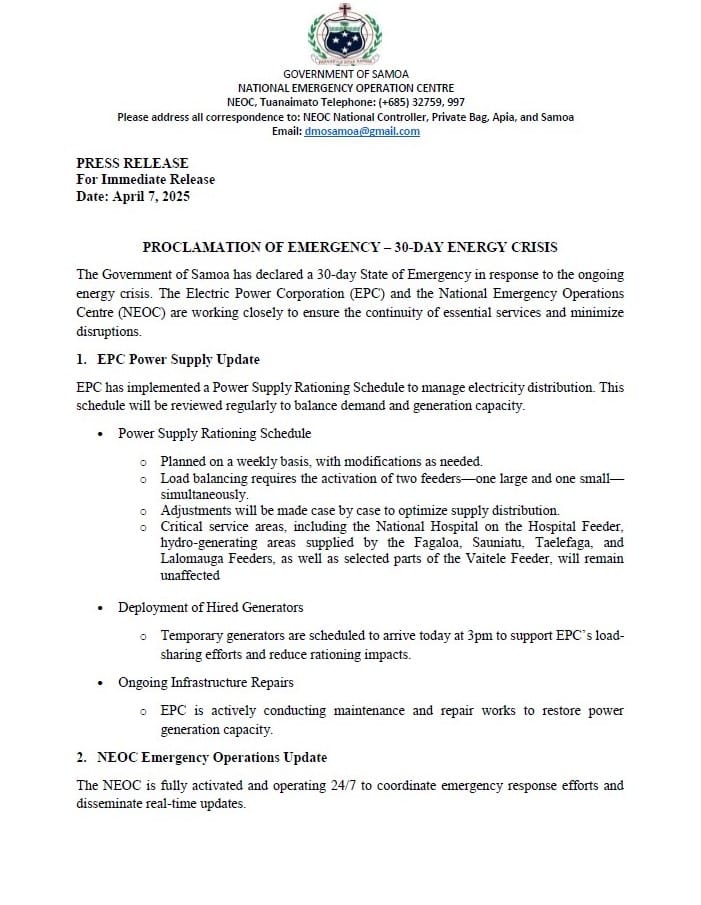
    April 23, 2025
  • MIL-OSI New Zealand: Aid cuts threaten the lives of 110,000 children with severe malnutrition reliant on emergency treatment from Save the Children

    Source: Save the Children

    At least 110,000- severely acutely malnourished children supported by Save the Children in 10 countries could be left without access to life-saving ready-to-use emergency food and nutrition programmes as aid cuts hit supplies in coming months, according to a Save the Children analysis.
    Globally, one in five deaths among children aged under 5 are attributed to severe acute malnutrition, making it one of the top threats to child survival. Community-based programmes combining medical treatment and therapeutic foods, including a fortified peanut paste, have a 90% success rate.
    Ready-to-Use Therapeutic Food (RUTF) is an energy-dense, micronutrient paste typically made using peanuts, sugar, milk powder, oil, vitamins and minerals that is packaged in foil pouches with a long shelf life and no need of refrigeration. Over the past 30 years this emergency therapeutic food has saved the lives of millions of children facing acute malnutrition [1] [2].
    At a time when global hunger is skyrocketing [3], the current global supply of RUTF is already not even meeting 40% of global needs, Save the Children said, leaving millions of children without access to this life-saving intervention.
    In 2024 there were large-scale breaks in the supply of RUTF as rising malnutrition rates drove up demand and due to disruptions in global supply chains and insufficient funding. This situation is expected to worsen in 2025. An analysis by Save the Children of the 10 countries forecast to have the biggest gaps in supplies found 110,000 malnourished children could miss out on this vital treatment by the end of the year. RUTF supplies are expected to run out in many locations from next month due to a lack of funding.
    Globally at least 18.2 million children were born into hunger in 2024, or about 35 children a minute, with children in conflict zones from Gaza to Ukraine, to Haiti, Sudan to the Democratic Republic of the Congo (DRC), struggling daily to get enough to eat. Famine has been declared in several parts of Sudan where people are resorting to eating grass to stay alive.
    Hannah Stephenson, Head of Hunger and Nutrition at Save the Children, said:
    “Right now, funding shortfalls mean essential nutrition packs are not reaching the children who desperately need them. We know we have the expertise and the track record to reach children around the world but what we urgently need now is the funding to ensure children can receive life-saving treatment. We are running out of time, and t his will cost children’s lives.
    “We also need to see long-term commitments to tackle the root causes of hunger and malnutrition, or else we will continue to see the reversal of progress made for children.”
    In Kenya, one of the countries where Save the Children treats acute malnutrition cases, 18-month-old Ereng has just recovered from malnutrition with treatment from Community Health Promoter Charles, who was trained in basic healthcare by Save the Children.
    Lomanat and Daniel, Ereng’s parents, walked for several kilometres to reach Charles’ clinic. The family are pastoralists, but recent droughts have killed their livestock, and the family now has no sustainable income and no reliable food source.
    They know how important treatment is for children like Ereng, who gained 2.4 kgs (5.3 pounds) in two months once she started receiving nutrition treatment using the fortified peanut paste which has about 500 calories in each portion. Lomanat said:
    “Our  child was in a very bad shape, and the doctor helped by giving her peanut paste. I am very happy, because she is cured.”
    In Somalia, where Save the Children also treats child with acute malnutrition, 7-month-Mukhtar- arrived at a health centre in Puntland after contracting flu which led to breathing difficulties and malnutrition.
    His mother Shamso, 40, who has eight other children, feared her son would not survive with the family struggling after drought killed all but six of their herd of 30 goats. But after receiving medical care and treatment for malnutrition with peanut paste, Mukhtar recovered and returned home.
    “His condition was serious when I brought him in and I didn’t expect him to reach the town alive ,” said Shamso. “My biggest worry is the children, whether my own, those of the relatives or those of my neighbours. When drought comes, it follows that hunger will strike.”
    Children are always the most vulnerable in food crises and, without enough to eat and the right nutritional balance, they are at high risk of becoming acutely malnourished.
    Malnutrition can cause stunting, impede mental and physical development, and increase the risk of contracting deadly diseases.
    About 1.12 billion children globally – or almost half of the world’s children – are unable to afford a balanced diet now, according to data from Save the Children released last month.
    In 2025, Save the Children aims to treat 260,000 children for severe acute malnutrition at outpatient sites in 10 countries that are now experiencing therapeutic food shortages.
    Save the Children is urgently trying to raise $7 million to provide 110,000 severely malnourished children with life-saving RUTF and the critical services needed to treat malnutrition 1 including skilled health workers, community follow-up, immunizations, safe spaces for treatment, safe water, hygiene and sanitation support.
    In the United States, actress and Save the Children ambassador Jennifer Garner launched her #67Strong4Kids campaign on her birthday last week. For #67Strong4Kids she is running a mile a day for 67 consecutive days to raise awareness about Ready-to-Use Therapeutic Food (RUTF). The amount $67 covers a six-week course of RUTF that treats a child suffering from severe acute malnutrition and potentially saves their life.
    NOTES:
    -Methodology: Save the Children used the target reach figures for all outpatient severe acute malnutrition treatment in 10 countries facing the largest disruption to the RUTF supply and compared with the current funding gaps for RUTF in those countries. Given the continued uncertainty in supply funding these figures are preliminary and up to date as of 26 March 2025. The 10 countries facing the largest disruptions are Afghanistan, Ethiopia, Kenya, Mali, Myanmar, Nigeria, Somalia, South Sudan, Sudan, and Yemen.
    REFERENCES
    [1] UNICEF https://www.unicef.org/nutrition/RUTF
    [2] UN News https://news.un.org/en/story/2024/10/1155756
    [3] WFP https://www.wfp.org/news/tens-millions-risk-extreme-hunger-and-starvation-unprecedented-funding-crisis-spirals
    About Save the Children NZ:
    Save the Children works in 120 countries across the world. The organisation responds to emergencies and works with children and their communities to ensure they survive, learn and are protected.
    Save the Children NZ currently supports international programmes in Fiji, Cambodia, Bangladesh, Laos, Nepal, Vanuatu, Solomon Islands and Papua New Guinea. Areas of work include child protection, education and literacy, disaster risk reduction and climate adaptation, and alleviating child poverty.

    MIL OSI New Zealand News –

    April 23, 2025
  • MIL-Evening Report: Feeling mad? New research suggests mindfulness could help manage anger and aggression

    Source: The Conversation (Au and NZ) – By Siobhan O’Dean, Research Fellow, The Matilda Centre for Research in Mental Health and Substance Use, University of Sydney

    Kaboompics.com/Pexels

    There’s no shortage of things to feel angry about these days. Whether it’s politics, social injustice, climate change or the cost-of-living crisis, the world can feel like a pressure cooker.

    Research suggests nearly one-quarter of the world’s population feels angry on any given day. While anger is a normal human emotion, if it’s intense and poorly managed, it can quickly lead to aggression, and potentially cause harm.

    Feeling angry often can also have negative effects on our relationships, as well as our mental and physical health.

    So how should you manage feelings of anger to keep them in check? Our new research suggests mindfulness can be an effective tool for regulating anger and reducing aggression.

    What is mindfulness?

    Mindfulness is the ability to observe and focus on your thoughts, emotions and bodily sensations in the present moment with acceptance and without judgement.

    Mindfulness has been practised for thousands of years, most notably in Buddhist traditions. But more recently it has been adapted into secular programs to support mental health and emotional regulation.

    Mindfulness is taught in a variety of ways, including in-person classes, residential retreats and through digital apps. These programs typically involve guided meditations, and practices that help people become more aware of their thoughts, feelings and surroundings.

    Mindfulness is linked to a range of mental health benefits, including reduced anxiety, depression and stress.

    Neuroscience research also suggests mindfulness is associated with reduced activity in brain regions linked to emotional reactivity, and greater activity in those involved in self-regulation (the ability to manage our thoughts, emotions and behaviours).

    In this way, mindfulness could foster emotional awareness essential for the effective regulation of emotions such as anger. And when people are less overwhelmed by anger, they may be better able to think clearly, reflect on what matters and take meaningful action, rather than reacting impulsively or shutting down.

    Anger is a normal human emotion – but it can sometimes have destructive consequences.
    Inzmam Khan/Pexels

    We reviewed the evidence

    To better understand whether mindfulness actually helps with regulating anger and aggression, we conducted a meta-analysis. This is a study that combines the results of many previous studies to look at the overall evidence.

    We analysed findings from 118 studies across different populations and countries, including both people who were naturally more mindful and people who were randomly assigned to take part in interventions aimed at increasing mindfulness.

    People who were naturally more mindful were those who scored higher on questionnaires measuring traits such as present-moment awareness and non-judgmental thinking. We found these people tended to report less anger and behave less aggressively.

    However, mindfulness isn’t just something you have or don’t have – it’s also a skill you can develop. And our results show the benefits of lower anger and aggression extend to people who learn mindfulness skills through practice or training.

    We also wanted to know whether mindfulness might work better for certain people or in particular settings. Interestingly, our results suggest these benefits are broadly universal. Practising mindfulness was effective in reducing anger and aggression across different age groups, genders and contexts, including whether people were seeking treatment for mental health or general wellbeing, or not.

    Some anger management strategies aren’t backed by science

    To manage feelings of anger, many people turn to strategies that are not supported by evidence.

    Research suggests “letting off steam” while thinking about your anger is not a healthy strategy and may intensify and prolong experiences of anger.

    For example, in one experiment, research participants were asked to hit a punching bag while thinking of someone who made them angry. This so-called “cathartic release” made people angrier and more aggressive rather than less so.

    Breaking things in rage rooms, while increasingly popular, is similarly not an evidence-based strategy for reducing anger and aggression.

    On the other hand, our research shows there’s good evidence to support mindfulness as a tool to regulate anger.

    Mindfulness may reduce anger and aggression by helping people become more aware of their emotional reactions without immediately acting on them. It can foster a non-judgmental and accepting stance toward difficult emotions such as anger, which may interrupt the cycle whereby anger leads to aggressive behaviour.

    Mindfulness can help people become more aware of their emotions.
    New Africa/Shutterstock

    Mindfulness is not a magic bullet

    All that said, it’s important to keep in mind that mindfulness is not a magic bullet or a quick fix. Like any new skill, mindfulness can be challenging at first, takes time to master, and works best when practised regularly.

    It’s also important to note mindfulness may not be suitable for everyone – particularly when used as a standalone approach for managing more complex mental health concerns. For ongoing emotional challenges it’s always a good idea to seek support from a qualified mental health professional.

    However, if you’re looking to dial down the impact of daily frustrations, there are plenty of accessible ways to give mindfulness a go. You can get started with just a few minutes per day. Popular apps such as Smiling Mind and Headspace offer short, guided sessions that make it easy to explore mindfulness at your own pace — no prior experience needed.

    While mindfulness may not solve the problems that make us angry, our research shows it could help improve how we experience and respond to them.

    The authors do not work for, consult, own shares in or receive funding from any company or organisation that would benefit from this article, and have disclosed no relevant affiliations beyond their academic appointment.

    – ref. Feeling mad? New research suggests mindfulness could help manage anger and aggression – https://theconversation.com/feeling-mad-new-research-suggests-mindfulness-could-help-manage-anger-and-aggression-254391

    MIL OSI Analysis – EveningReport.nz –

    April 23, 2025
  • MIL-Evening Report: ER Report: A Roundup of Significant Articles on EveningReport.nz for April 23, 2025

    ER Report: Here is a summary of significant articles published on EveningReport.nz on April 23, 2025.

    The ‘responsible gambling’ mantra does nothing to prevent harm. It probably makes things worse
    Source: The Conversation (Au and NZ) – By Charles Livingstone, Associate Professor, School of Public Health and Preventive Medicine, Monash University Haelen Haagen/Shutterstock Recent royal commissions and inquiries into Crown and Star casino groups attracted much media attention. Most of this was focused on money laundering and other illegalities. The Victorian royal commission found widespread

    This election, Gen Z and Millennials hold most of the voting power. How might they wield it?
    Source: The Conversation (Au and NZ) – By Intifar Chowdhury, Lecturer in Government, Flinders University The centre of gravity of Australian politics has shifted. Millennials and Gen Z voters, now comprising 47% of the electorate, have taken over as the dominant voting bloc. But this generational shift isn’t just about numerical dominance. It’s also about

    Only a third of Australians support increasing defence spending: new research
    Source: The Conversation (Au and NZ) – By Richard Dunley, Senior Lecturer in History and Maritime Strategy, UNSW Sydney National security issues have been a constant feature of this federal election campaign. Both major parties have spruiked their national security credentials by promising additional defence spending. The Coalition has pledged to spend 3% of Australia’s

    After stunning comeback, centre-left Liberals likely to win majority of seats at Canadian election
    Source: The Conversation (Au and NZ) – By Adrian Beaumont, Election Analyst (Psephologist) at The Conversation; and Honorary Associate, School of Mathematics and Statistics, The University of Melbourne In Canada, the governing centre-left Liberals had trailed the Conservatives by more than 20 points in January, but now lead by five points and are likely to

    The Greens are hoping for another ‘greenslide’ election. What do the polls say?
    Source: The Conversation (Au and NZ) – By Narelle Miragliotta, Associate Professor in Politics, Murdoch University Election talk is inevitably focused on Labor and the Coalition because they are the parties that customarily form government. But a minor party like the Greens is consequential, regardless of whether the election delivers a minority government. Certainly, the

    Victory for US press freedom and workers – court grants injunction in VOA media case
    Asia Pacific Report The US District Court for the District of Columbia has granted a preliminary injunction in Widakuswara v Lake, affirming the US Agency for Global Media (USAGM) was unlawfully shuttered by the Trump administration, Acting Director Victor Morales and Special Adviser Kari Lake. The decision enshrines that USAGM must fulfill its legally required

    Scientists claim to have found evidence of alien life. But ‘biosignatures’ might hide more than they reveal
    Source: The Conversation (Au and NZ) – By Campbell Rider, PhD Candidate in Philosophy – Philosophy of Biology, University of Sydney Artist’s impression of the exoplanet K2-18b A. Smith/N. Madhusudhan (University of Cambridge) Whether or not we’re alone in the universe is one of the biggest questions in science. A recent study, led by astrophysicist Nikku

    What would change your mind about climate change? We asked 5,000 Australians – here’s what they told us
    Source: The Conversation (Au and NZ) – By Kelly Kirkland, Research Fellow in Psychology, The University of Queensland LOOKSLIKEPHOTO/Shutterstock Australia just sweltered through one of its hottest summers on record, and heat has pushed well into autumn. Once-in-a-generation floods are now striking with alarming regularity. As disasters escalate, insurers are warning some properties may soon

    Even experts disagree over whether social media is bad for kids. We examined why
    Source: The Conversation (Au and NZ) – By Simon Knight, Associate Professor, Transdisciplinary School, University of Technology Sydney A low relief sculpture depicting Plato and Aristotle arguing adorning the external wall of Florence Cathedral. Krikkiat/Shutterstock Disagreement and uncertainty are common features of everyday life. They’re also common and expected features of scientific research. Despite this,

    Australian women are wary of AI being used in breast cancer screening – new research
    Source: The Conversation (Au and NZ) – By Alison Pearce, Associate Professor, Health Economics, University of Sydney Okrasiuk/Shutterstock Artificial intelligence (AI) is becoming increasingly relevant in many aspects of society, including health care. For example, it’s already used for robotic surgery and to provide virtual mental health support. In recent years, scientists have developed AI

    These 3 climate misinformation campaigns are operating during the election run-up. Here’s how to spot them
    Source: The Conversation (Au and NZ) – By Alfie Chadwick, PhD Candidate, Monash Climate Change Communication Research Hub, Monash University Australia’s climate and energy wars are at the forefront of the federal election campaign as the major parties outline vastly different plans to reduce greenhouse gas emissions and tackle soaring power prices. Meanwhile, misinformation about

    Port of Darwin’s struggling Chinese leaseholder may welcome an Australian buy-out
    Source: The Conversation (Au and NZ) – By Colin Hawes, Associate professor of law, University of Technology Sydney Slow Walker/Shutterstock Far from causing trade frictions, an Australian buyout of the Port of Darwin lease may provide a lifeline for its struggling Chinese parent company Landbridge Group. Both Labor and the Coalition have proposed such a

    When rock music met ancient archeology: the enduring power of Pink Floyd Live at Pompeii
    Source: The Conversation (Au and NZ) – By Craig Barker, Head, Public Engagement, Chau Chak Wing Museum, University of Sydney Sony Music The 1972 concert film Pink Floyd Live at Pompeii, back in cinemas this week, remains one of the most unique concert documentaries ever recorded by a rock band. The movie captured the band

    Gambling in Australia: how bad is the problem, who gets harmed most and where may we be heading?
    Source: The Conversation (Au and NZ) – By Alex Russell, Principal Research Fellow, CQUniversity Australia Mick Tsikas/AAP, Joel Carret/AAP, Darren England/AAP, Ihor Koptilin/Shutterstock, The Conversation, CC BY Gambling prevalence studies provide a snapshot of gambling behaviour, problems and harm in our communities. They are typically conducted about every five years. In some Australian states and

    Lest we forget? Aside from Anzac Day, NZ has been slow to remember its military veterans
    Source: The Conversation (Au and NZ) – By Alexander Gillespie, Professor of Law, University of Waikato Fiona Goodall/Getty Images Following some very public protests, including Victoria Cross recipient Willie Apiata handing back his medal, the government’s announcement of an expanded official definition of the term “veteran” brings some good news for former military personnel ahead

    Dutton promises Coalition would increase defence spending to 3% of GDP ‘within a decade’
    Source: The Conversation (Au and NZ) – By Michelle Grattan, Professorial Fellow, University of Canberra Opposition Leader Peter Dutton will promise a Coalition government would boost Australia’s spending on defence to 2.5% of GDP within five years and 3% within a decade. Launching the Coalition’s long-awaited defence policy on Wednesday in Western Australia, Dutton will

    Leaders trade barbs and well-worn lines in unspectacular third election debate
    Source: The Conversation (Au and NZ) – By Joshua Black, Visitor, School of History, Australian National University Anthony Albanese and Peter Dutton have met for the third leaders’ debate of this election campaign, this time on the Nine network. And while the debate traversed much of the same ground as the first two, the quick-fire

    Election Diary: Dutton in third debate gives Labor ammunition for its scare about cuts
    Source: The Conversation (Au and NZ) – By Michelle Grattan, Professorial Fellow, University of Canberra In the leaders’ third head-to-head encounter, on Nine on Tuesday, Peter Dutton’s bluntness when pressed on cuts has given more ammunition to Labor’s scare campaign about what a Coalition government might do. “When John Howard came into power, there was

    To truly understand Pope Francis’ theology – and impact – you need to look to his life in Buenos Aires
    Source: The Conversation (Au and NZ) – By Fernanda Peñaloza, Senior Lecturer in Latin American Studies, University of Sydney Pope Francis’ journey from the streets of Flores, a neighbourhood in Buenos Aires, Argentina, to the Vatican, is a remarkable tale. Born in 1936, Jorge Bergoglio was raised in a middle-class family of Italian Catholic immigrants.

    Bougainville takes the initiative in mediation over independence
    By Don Wiseman, RNZ Pacific senior journalist In recent weeks, Bougainville has taken the initiative, boldly stating that it expects to be independent by 1 September 2027. It also expects the PNG Parliament to quickly ratify the 2019 referendum, in which an overwhelming majority of Bougainvilleans supported independence. In a third move, it established a

    MIL OSI Analysis – EveningReport.nz –

    April 23, 2025
  • MIL-OSI USA: Senator Murray Holds Roundtable on How Trump Attacks on Health Care, Child Care, and Social Security in WA State Put Families at Risk

    US Senate News:

    Source: United States Senator for Washington State Patty Murray

    ICYMI: Senator Murray Statement on Trump Budget Proposal to Fully Eliminate Head Start

    ICYMI: Senator Murray Statement on Trump Admin Ripping Away Billions—Including Over $160 Million for Washington State—to Protect People from Public Health Threats

    ICYMI: Senator Murray Statement on Evisceration of Seattle HHS Office and Spokane NIOSH Office Amidst Mass Layoffs at HHS

    ***AUDIO HERE; PHOTOS and B-ROLL HERE***

    Seattle, WA— Today, U.S. Senator Patty Murray (D-WA), Vice Chair of the Senate Appropriations Committee, held a roundtable discussion at Solid Ground in Seattle about how President Trump’s indiscriminate mass firings across the federal workforce, his funding freezes and attempts to rip away billions in public health funding for communities, and the deep cuts he is now proposing to our nation’s health care and child care infrastructure—and much else—puts programs and services that families across Washington state rely on every day at grave risk.

    Senator Murray was joined for the discussion by: Tana Senn, Secretary for the WA Department of Children, Youth, and Families (DCYF); Dr. Tao Kwan-Gett, State Health Officer, Washington State Department of Health; Shalimar Gonzales, CEO of Solid Ground; Janice Deguchi, Executive Director of Neighborhood House, a Head Start provider in Seattle; and Sarah Stafford, a Senior Tribal Specialist who worked in HHS’s Administration for Children and Families office in Seattle but is being fired through no fault of her own by Trump and Elon as part of the wide-scale Reduction in Force (RIF) at HHS.

    “We are talking about incredibly essential, basic necessities here—programs that get communities health care, programs that help families afford groceries, pay their energy bill, get child care—and let’s not forget Social Security offices are being shuttered, and Republicans are getting ready to gut Medicaid. We are getting our first look at Trump’s budget plans—it will be a bloodbath for programs our communities rely on,” said Senator Murray. “I know child care is make or break for so many families—and it has become a crisis, not just for parents, but for our economy. But Trump is already choking off funding for preschool, child care, and early learning programs. His funding delays temporarily closed at least a dozen of Head Start classrooms in Washington state—over 450 kids lost support, and more than 50 employees were out of work. Thankfully, they got their grant eventually, but the chaos is unacceptable and the threat remains. If Trump has his way with his budget, this is going to get catastrophically worse.

    “And it’s not just child care that Trump wants to zero out,” Senator Murray continued. “He is closing the HHS office in Seattle, undermining services for the Pacific Northwest. He illegally tried to rip away over $160 million awarded to Washington state for basic public health work. He wants to eliminate rural health programs—leaving our rural hospitals high and dry, shuttering our programs to train doctors in rural areas, and cutting families off from care. And he wants to cut 40 percent of NIH funding, which will push bright young minds out of our country. I am going to keep lifting up the voices of families in Washington state and I am going to fight tooth and nail to protect the programs that help them meet their basic needs from Trump’s and Elon’s chainsaw.”

    In late March, President Trump and Department of Health and Human Services (HHS) Secretary RFK Jr. announced plans to cut HHS’s workforce from 82,000 to 62,000 (a 25 percent reduction) through a combination of mass firings and buy-outs and hollow out the Department, which is responsible for protecting Americans’ health and delivering essential health and social services. The announcement followed weeks of mass firings and chaos at HHS that prevented the Department from executing its mission to protect people’s health, and an onslaught of detrimental policies that are halting lifesaving biomedical research and more.

    As part of the restructuring, the administration abruptly shuttered the HHS Region 10 office, which is based in Seattle but covers all of Washington, Alaska, Idaho, and Oregon, and has the greatest number of federally recognized Tribes (272) of all HHS regions. The closure of the HHS Region 10 office also included the closure of the Seattle Office of Head Start—among many other HHS subagency offices—and the termination of all employees who worked there.

    Since taking office, President Trump has gutted the offices that keep Head Start centers and child care programs across the country running and shuttered half of the regional offices at the Office of Head Start, which are responsible for ensuring high-quality Head Start services are available to families nationwide. Last week, new reporting revealed President Trump will propose zeroing out funding for Head Start in his forthcoming budget request—a goal proposed in Project 2025, which would cut off essential services and early childhood educational opportunities for hundreds of thousands of families nationwide. Head Start currently serves over 750,000 kids nationwide—with over 17,000 Head Start centers across the country, which are particularly important in serving rural communities with fewer options for care.

    “We are on the brink of seeing more of our communities fall victim to a deliberate and entirely preventable crisis when they are already suffering from historically high housing and food costs. If these proposed cuts to SNAP and Medicaid go through, the human toll will be profound: more families going without enough food, more people becoming seriously ill because they can’t get the medical care they need, and more of our neighbors losing their homes,” said Shalimar Gonzales, CEO of Solid Ground. “Solid Ground is committed to doing everything in our power to meet these growing needs, but we need support from partners and the local community, particularly as we face the loss of critical funding from the federal government.”

    “These cuts hurt kids,” said Tana Senn, Secretary for the Washington State Department of Children, Youth, and Families. “While there are a lot of unknowns about what’s to come, we do know that a pause or termination of federal funds would have a devastating impact on Washington families and DCYF’s ability to provide them with much-needed services.”

    “These federal cuts are weakening public health in Washington state. The closure of the Seattle HHS office took away a critical connection between our region and Washington DC—professionals who understood our unique geographic challenges and health needs,” said Dr. Tao Kwan-Gett, State Health Officer at Washington State Department of Health. “The termination of over $11 billion nationally in CDC grants, with $140 million to Washington state would devastate our disease tracking systems, cancel over 100 planned vaccine clinics including 35 school-based clinics reaching 800 children, and cripple our laboratory response capacity for emerging threats. While we’re grateful for the temporary restraining order protecting these funds, the interruptions have already disrupted critical services, and the ongoing uncertainty puts them at greater risk. These chaotic federal changes threaten to put us on a path towards more illness and shorter lives.”

    “Neighborhood House’s Head Start and Early Head Start program serves 429 low-income children pre-natal to age 5 through home based and center-based services at 4 locations, with a 5th opening at White Center in May. There are 186 eligible children on our waitlist. Head Start and Early Head Start is comprehensive, we support the whole child: their academic, social emotional growth, medical, dental, and nutritional health. Head Start and Early Head Start supports the whole family, connecting parents to jobs, housing, health care, and providing opportunities for leadership development. Defunding Head Start would cut a vital lifeline for our nation’s children and families by eliminating a bridge to stability and economic opportunity,” said Janice Deguchi, Executive Director of Neighborhood House, a Head Start provider in Seattle. “Without Low Income Heating and Assistance Program, many hard-working people Neighborhood House serves will face the impossible choice between paying utility bills and meeting other basic needs like food and medication. Eliminating LIHEAP will leave vulnerable families without the support they rely on to stay safe and stable in their homes. Community Services Block Grant advances economic independence and strengthens local communities by empowering local Community Action Agencies like Solid Ground and Neighborhood House to respond to pressing and quickly changing community needs.”

    “The [HHS] Region 10 team recruited me to work with them because the CCDF, or Child Care Development Fund, serves many tribal nations within Region 10. I would say the majority of federally recognized tribes are within Region 10 and Region 9, so it was really important previously to have a staff that represented the communities that were being served for that program…There was zero transition of planning happening, there are files that cannot be accessed that are needed by the remaining staff. The staff that are left of course are qualified and dedicated, however the years of expertise from the staff that were RIF’d—you just can’t make any sense out of it,” said Sarah Stafford, a Senior Tribal Specialist in HHS’ Administration for Children and Families who is being fired for no reason and through no fault of her own by Trump and Elon as part of the HHS Reduction in Force (RIF). “In Region 10…those staff in particular spend so much time relationship building with tribal nations and states, no two states are the same, and no two tribal nations are the same. CCDF requirements are quite complex, and people are really innovative in the ways that they choose to deliver those services, and so absent having that expertise and guidance on policy, historical institutional policy knowledge, questions are going to go unanswered, grant applications are going to take a long time to review…Our office was understaffed before, and we made some great progress within the last four years, but all of that has been completely wiped—and without any tribal consultation, which is required anytime you make substantial changes that impact tribal nations as well.”

    Senator Murray has been a leading voice raising the alarm about how Trump and Elon’s mass firings across the federal workforce will undermine services all Americans rely on and hurt families, veterans, small businesses, farmers, and so many others in Washington state and across the country. Senator Murray has spoken out on the Senate floor repeatedly against this administration’s attacks on federal workers, held multiple press conferences  with federal workers—including at NOAA—who are being fired for no reason and through no fault of their own, released information about the mass firings, and repeatedly outlined her concerns with the administration’s so-called “Fork in the Road” offer to her constituents in Washington state.

    A fact sheet on how Trump and RFK Jr. hollowing out HHS is threatening Americans’ health and wellbeing is HERE.

    MIL OSI USA News –

    April 23, 2025
  • MIL-OSI USA: After Trump Admin Refuses to Allow VA to Host Discussion on Women Veterans’ Health Care, Senator Murray Meets with Women Veterans and Advocates In Seattle

    US Senate News:

    Source: United States Senator for Washington State Patty Murray

    ICYMI: Senator Murray Demands Answers from Secretary Collins Over VA’s Unprecedented Refusal to Allow VA Puget Sound to Participate in Women Veterans Roundtable

    ICYMI: REPORT: Trump’s Mass Firings at VA Hurt WA Veterans

    ICYMI: Murray Statement on Trump & Elon Plans to Decimate the VA, Firing 80,000 Employees and Putting Veterans’ Care in Grave Danger

    ***AUDIO HERE; PHOTOS and B-ROLL HERE***

    Seattle, WA — Today,U.S. Senator Patty Murray (D-WA), a senior member and former Chair of the Senate Veterans’ Affairs Committee, hosted a roundtable discussion at the Ballard-Eagleston VFW Post 3063 with women veterans and veteran advocates to discuss the challenges women veterans face in receiving quality care at the U.S. Department of Veterans Affairs (VA), and how the Trump administration’s steep cuts across the federal workforce—including at VA—are affecting veterans. Senator Murray’s roundtable at the VFW took place only after the Trump administration refused to allow VA Puget Sound to host or participate in a discussion about the current state of women veterans’ health care. Audio of the full roundtable discussion is available HERE.

    Senator Murray has been outspoken in calling attention to how Trump and Elon’s indiscriminate mass layoffs are hurting people—especially veterans—across the country and will undermine services Americans everywhere rely on. She has hosted multiple press conferences with veterans and VA employees in Washington state who are being laid off by Trump and Elon for no reason and through no fault of their own.

    Participating in the discussion with Senator Murray today were: Minnette Mason, Veterans Training Support Center Program Manager at the Washington Department of Veterans Affairs (WDVA); Alyson Teeter, Commander of VFW Post 3063; Barbara Heston-Moore, President of VFW Post 2289 Auxiliary; Sarah Rubin with VFW Post 3063; Dr. Samantha Powers, Director of UW Veteran Student Life; and Shellie Willis, Chair of the WDVA Women’s Veterans Advisory Committee.

    “I’m furious that under Trump, VA leadership is barring VA Puget Sound from participating in or hosting this important discussion on women veterans’ issues. Throughout my time in Congress, under both Republican and Democratic administrations, I have been able to have open and honest conversations with VA and engage with my veteran constituents in Washington state—but this administration has proven to be vastly different,” Senator Murray said. Yesterday, Senator Murray sent a letter to VA Secretary Doug Collins expressing concern and dismay over the unprecedented refusal—with no justification—by VA to allow VA Puget Sound to participate in today’s roundtable. In the hearing on his nomination to lead VA, his meeting with Senator Murray ahead of the Senate vote on his nomination, and in his own public statements, Doug Collins promised to be maximally transparent with Congress if confirmed.

    “Even though women are more likely to seek care through VA, and are more likely to be dealing with depression, anxiety, or sexual trauma—women are also more likely to face barriers to getting the care they need,” Senator Murray said. “And it’s been deeply frustrating to see the Trump administration undermine VA care, fire researchers, and push out other crucial workers who help veterans get care over the past few months, to say nothing of the disrespect they have shown female veterans—literally erasing the history of some women in uniform and denigrating the service of women in combat. I’m going to push every day to make sure you get the respect you deserve, and the care you were promised—whether that’s making sure VA is implementing women’s health care laws I worked to pass, fighting to expand access to IVF services and menopause research, and providing the federal resources we need for VA to improve care for women veterans.”

    Senator Murray was the first woman to join the Senate Veterans’ Affairs Committee and the first woman to chair the Committee—as the daughter of a WWII veteran, supporting veterans and their families has always been an important priority for Murray. Advocating for women veterans in particular has been a longtime focus for Senator Murray. As Chair of the Senate Veterans’ Affairs Committee in 2010, Senator Murray passed her landmark Women Veterans Health Improvement Act into law. Murray has worked to permanently authorize the VA child care pilot program to increase access to free, quality child care for veterans during their appointments, make much-needed improvements to the women veterans call center, and fix a loophole that left veterans footing the bill for medically-necessary emergency newborn transportation that VA should be covering. Murray introduced and helped pass the Deborah Sampson Act, legislation to address gender disparities at VA that established a dedicated Office of Women’s Health at VA and required every VA health facility to have a dedicated women’s health primary care provider, among other things. Murray also helped to pass the MAMMO Act to expand access to high-quality breast cancer screening and treatment services for veterans.

    Last year as Chair of the Senate Appropriations Committee, Senator Murray delivered a record $900 million investment in women veterans’ health care. Earlier this month, Senator Murray introduced bipartisan legislation to require VA and the Department of Defense (DoD) to research and study the effects of menopause on women servicemembers and women veterans.

    Senator Murray has also been a leading voice in the Senate in speaking out forcefully against President Trump and Elon Musk’s mass firing of VA employees and VA researchers across the country and Elon Musk and DOGE’s infiltration of the VA, including accessing veterans’ sensitive personal information. In recent weeks, Senator Murray and her colleagues sent letters to VA Secretary Doug Collins demanding that the VA swiftly reverse moves to cut VA researchers, as well as multiple letters pressing Secretary Collins to sever Elon Musk and DOGE’s access to any VA or other government system with information about veterans, and protect veterans, their families, and VA staff from unprecedented access to sensitive information. Senator Murray grilled Trump’s nominee for VA Deputy Secretary, Dr. Paul Lawrence, on the mass firings of VA employees and VA researchers, and voted against Doug Collins’s nomination to be VA Secretary in early February, sounding the alarm over reports of DOGE at the VA and making clear that the Trump administration’s lawlessness was putting our national security and our veterans at risk.

    MIL OSI USA News –

    April 23, 2025
  • MIL-Evening Report: The ‘responsible gambling’ mantra does nothing to prevent harm. It probably makes things worse

    Source: The Conversation (Au and NZ) – By Charles Livingstone, Associate Professor, School of Public Health and Preventive Medicine, Monash University

    Haelen Haagen/Shutterstock

    Recent royal commissions and inquiries into Crown and Star casino groups attracted much media attention. Most of this was focused on money laundering and other illegalities.

    The Victorian royal commission found widespread evidence that Crown also took advantage of vulnerable people.

    The regulatory framework that in large part allows this to occur is known as “responsible gambling”.


    Read more:
    Whatever happens to Star, the age of unfettered gambling revenue for casinos may have ended


    What is ‘responsible gambling’?

    Gambling operators usually adhere to a system of purported harm minimisation known as responsible gambling.

    In practice, this requires gambling operators to adopt and supposedly implement a “responsible gambling code of practice”.

    This is supposed to protect people from experiencing gambling harm. Crown and Star, like other gambling venues, are required to adopt such codes.

    Royal Commissioner Ray Finkelstein, overseeing the Victorian Crown inquiry, was scathing in his assessment of Crown’s implementation:

    Crown Melbourne had for years held itself out as having a world’s best approach to problem gambling. Nothing can be further from the truth.

    Unfortunately, Finkelstein’ comments about Crown could readily be made about most other gambling operators.

    How it all began

    The responsible gambling framework was developed by gambling operators as a way of deflecting attention from the serious harm of gambling.

    The document that arguably consolidated this was prepared in 2004 by a group of gambling researchers gathered, naturally, in Reno, Nevada (close to Las Vegas, the spiritual home of gambling excesses).

    This document argued the choice to gamble should be left to people and no external organisation should interfere with this.

    Now, responsible gambling is cemented in law, regulation, and practice. It is the overwhelming frame for gambling operators, governments and regulators to conceal gambling’s downside.

    Stacking the odds

    Responsible gambling depicts gambling harm as an issue for a small minority of people: so-called problem gamblers.

    So from this perspective, any issues with gambling are issues with people.

    But little if any attention is devoted to the environment in which gambling is available. Often, even less is devoted to examining the nature of gambling products.

    When it comes to wagering marketing, the Australian gambling ecosystem has argued very effectively to forestall prohibition or further regulation in recent years.

    The far-reaching power of this conglomeration of self-interested actors is hard to overestimate.


    Read more:
    Will the government’s online gambling advertising legislation ever eventuate? Don’t bet on it


    At venue level, responsible gambling interventions required include signage, referral to counselling and mottos such as “gamble responsibly”.

    With few exceptions, little of this is evidence based. Almost none of it is effective.

    Codes of conduct, for example, argue it is possible to intervene at a venue when a gambler shows signs of distress, or has a gambling disorder. While this is theoretically possible, the problem is to do so would rob venue operators of their most lucrative customers.

    The available evidence indicates such interventions are extremely rare, or nonexistent.

    Another major element is self-exclusion: an opportunity for people (or in some states their relatives) to ban themselves from gambling at particular venues.

    This is, again, fine in theory. But it has generally been poorly enforced at “bricks and mortar” venues.

    There are two fundamental issues with this approach:

    • those who self-exclude are very much in the minority of those with gambling problems
    • self-exclusion is generally undertaken only by those who are at rock-bottom. It is not a preventive approach.

    The other major intervention in the responsible gambling coda is treatment.

    Gambling treatment services are available and free via Gamblers Help but fewer than 10% of those who might benefit from treatment actually seek it.

    Unfortunately, attrition rates for counselling are high, so both the lack of help-seeking and the attrition rates when help is sought are at least partially attributable to another side effect of the responsible gambling mantra: shame and stigma, which are commonly reported by those struggling with gambling disorders.

    The blame game

    Responsible gambling effectively blames people for getting into trouble.

    It argues problem gamblers are far outnumbered by “responsible gamblers”, and deflects attention away from the highly addictive nature of many gambling products.

    It largely absolves operators of responsibility, while maintaining their revenues and stigmatising those who bear the consequences.

    As it does all this, it also provides a smokescreen of concern, a suggestion that gambling operators and governments care about gambling harm.

    Ideas for the future

    The best way to curb gambling harm is to view it as a public health problem.

    Public health is generally focused on prevention (think vaccines and clean water). At this stage, the most likely effective preventive intervention is what is known as pre-commitment, which uses technology to allow people to determine the amount of money they want to gamble.

    High-intensity gambling products rely on people becoming highly immersed in the product. Gamblers call this “the zone” – which limits or negates a person’s ability to make rational decisions.

    But pre-commitment systems allow this choice to be made outside of “the zone”.

    Unsurprisingly, few gambling operators support such a solution, even though these systems are now commonplace in many European countries.

    Pre-commitment and cashless systems are now required for casinos in NSW and Victoria, and shortly in Queensland, as recommended by the Crown and Star inquiries.

    These are welcome steps but much more is needed.

    A long overdue change

    Responsible gambling has allowed gambling operators to self-regulate and blame people for harmful gambling practices.

    It has made gambling businesses – casinos, wagering companies, pokie pubs and clubs – extraordinary profitable. But this has come at considerable cost to hundreds of thousands of Australians, and their families and friends.

    Ditching the responsible gambling mantra is long overdue. Along with effective interventions to prevent harm, doing so will dramatically reduce the damage that gambling does.

    Charles Livingstone has received funding from the Victorian Responsible Gambling Foundation, the (former) Victorian Gambling Research Panel, and the South Australian Independent Gambling Authority (the funds for which were derived from hypothecation of gambling tax revenue to research purposes), from the Australian and New Zealand School of Government and the Foundation for Alcohol Research and Education, and from non-government organisations for research into multiple aspects of poker machine gambling, including regulatory reform, existing harm minimisation practices, and technical characteristics of gambling forms. He has received travel and co-operation grants from the Alberta Problem Gambling Research Institute, the Finnish Institute for Public Health, the Finnish Alcohol Research Foundation, the Ontario Problem Gambling Research Committee, the Turkish Red Crescent Society, and the Problem Gambling Foundation of New Zealand. He was a Chief Investigator on an Australian Research Council funded project researching mechanisms of influence on government by the tobacco, alcohol and gambling industries. He has undertaken consultancy research for local governments and non-government organisations in Australia and the UK seeking to restrict or reduce the concentration of poker machines and gambling impacts, and was a member of the Australian government’s Ministerial Expert Advisory Group on Gambling in 2010-11. He is a member of the Lancet Public Health Commission into gambling, and of the World Health Organisation expert group on gambling and gambling harm. He made a submission to and appeared before the HoR Standing Committee on Social Policy and Legal Affairs inquiry into online gambling and its impacts on those experiencing gambling harm.

    – ref. The ‘responsible gambling’ mantra does nothing to prevent harm. It probably makes things worse – https://theconversation.com/the-responsible-gambling-mantra-does-nothing-to-prevent-harm-it-probably-makes-things-worse-251487

    MIL OSI Analysis – EveningReport.nz –

    April 23, 2025
←Previous Page
1 … 278 279 280 281 282 … 608
Next Page→
NewzIntel.com

NewzIntel.com

MIL Open Source Intelligence

  • Blog
  • About
  • FAQs
  • Authors
  • Events
  • Shop
  • Patterns
  • Themes

Twenty Twenty-Five

Designed with WordPress