NewzIntel.com

    • Checkout Page
    • Contact Us
    • Default Redirect Page
    • Frontpage
    • Home-2
    • Home-3
    • Lost Password
    • Member Login
    • Member LogOut
    • Member TOS Page
    • My Account
    • NewzIntel Alert Control-Panel
    • NewzIntel Latest Reports
    • Post Views Counter
    • Privacy Policy
    • Public Individual Page
    • Register
    • Subscription Plan
    • Thank You Page

Category: Health

  • MIL-OSI USA: New Jersey High School Students Explore Career Paths Through IAM Local 447 Worksite Tour

    Source: US GOIAM Union

    Seventeen students from three northern New Jersey high schools – Clifton High School, Kearny High School, and Lyndhurst High School – recently participated in an immersive worksite tour hosted by IAM Local 447. These students, all aspiring automotive and diesel technicians, are considering enrollment in the IAM CREST Auto and Diesel Technician’s Apprenticeship Program.

    The tour’s purpose was to provide students with firsthand insight into life on the job. They visited two active IAM Local 447 worksites – Hudson Toyota in Jersey City and Penske Truck Leasing in Linden – where they had the opportunity to engage with supervisors, journeyman technicians, and former apprentices. These mentors shared their experiences and offered advice about what it takes to succeed in the industry.

    These shops are just two of many in northern New Jersey that actively support the IAM apprenticeship program by hosting and mentoring apprentices. New entrants to the program typically begin with basic maintenance tasks and progress through a structured pathway toward becoming fully certified journeyman mechanics.

    “Giving students the chance to see real-world work environments and speak directly with experienced technicians is invaluable,” said IAM Safety and Health, Apprenticeships, and Scholarships Director Michael Oathout. “It helps them connect their career goals with a clear path forward through our apprenticeship program.”

    The IAM CREST Auto and Diesel Technician’s Apprenticeship Program is registered with the U.S. Department of Labor and receives support from the New Jersey Department of Labor.

    Share and Follow:

    MIL OSI USA News –

    April 16, 2025
  • MIL-OSI Global: Ritual murder of children: study in Ghana and Kenya explores who’s doing it and why

    Source: The Conversation – Africa – By Emmanuel Sarpong Owusu, Doctoral Researcher and Lecturer, Aberystwyth University

    Superstition, an irrational belief in paranormal influences or a false attribution of events, is an age-old phenomenon found in probably all human societies or cultures. It encompasses a wide range of beliefs, practices and behaviours. Some of these have harmful or even deadly consequences.

    In many African communities, there are widespread beliefs relating to the use of human body parts for traditional healing rituals. Human body parts and blood are said to enhance the potency of traditional medicines and rituals that supposedly guarantee wealth, business success, fertility, protection and longevity, among others.

    Ritual killings, including those of children, are reported regularly around Africa. A case in point is the targeting of children with albinism for ritual purposes in Tanzania. One research report says one in five people in Mozambique and one in four people in South Africa believe that rituals and traditional medicines made with human body parts are more potent and effective than those using nonhuman objects.

    Children are particularly targeted for killing because they can’t repel attacks, and because of beliefs about the potency of their body parts. The victims in more than half of all the ritual murders reported in Ghana and Kenya in 2022 were children.

    I am a legal scholar with years of research on superstition-driven crimes against vulnerable groups in African settings and the criminal justice response to such crimes. In a recent study I explored the magnitude, characteristics and motivations, as well as the socio-cultural and economic contexts, of ritual child murder in Ghana and Kenya. My study was carried out through in-depth analysis of news reports of ritual murders for a period of 10 years, coupled with semi-structured interviews with academics and other experts.

    I found that the major factors contributing to the persistence of ritual child murders were superstition, economic hardship, illiteracy and inefficient criminal justice systems. A new consumerist ethos also plays a role: wanting a life of luxury and the admiration that comes with it.

    The study seeks to enhance awareness of the ritual child murder phenomenon and encourage support for the enforcement of child rights protection laws. When policymakers know more about the scale and circumstances of ritual child murders, they are better equipped to act on it.

    Ritual murders in Ghana and Kenya

    Belief in juju is widespread in Ghana and Kenya. This is the belief that people can mystically control events by using incantations (“magic words”) and, sometimes, objects.

    My study analysed data drawn from online news reports in eight media outlets in Ghana and Kenya. I used media content because the countries don’t have national data sets on ritual homicide, and empirical research is limited. Secondly, I interviewed 28 experts in criminology and criminal justice, sociology, African religions, and child and family welfare and social protection. These participants were selected using the purposeful sampling technique.

    In Ghana, the media reported at least 160 ritual murders between 2012 and 2021. Of this number, 94 (about 58.8%) were children. This suggests that an average of 9.4 children fall victim to ritual murder each year in the country. Of the 102 ritual murders in Kenya in the study period, 66 (64.7%) were children. This represents an annual average of 6.6 in the country.

    In both countries, most victims (over 80%) tend to be drawn from families of low socio-economic backgrounds in rural and semi-rural communities. In Kenya, children with albinism are also targeted.

    The overwhelming majority of offenders are males. There are three main categories of perpetrators of ritual child murders:

    • the juju practitioner or traditional healer who usually prescribes the required body parts and effects the medicine or ritual

    • the client who consults traditional healers and stands to benefit directly from the ritual or medicine

    • the (hired) ritual murderer, who abducts the victim and extracts the required body parts.

    Data from media reports show that most of the perpetrators apprehended are those directly involved in the killing. They are usually aged between 20 and 39 years and of low socio-economic status in rural communities. However, some interviewees insisted that some rich and prominent persons are also involved.

    In Ghana, uncles, fathers and stepfathers were the dominant perpetrators in cases where victims and perpetrators were known to be related. Unlike other types of homicide, ritual child murder generally involves strangers nearly as often as it involves family members and acquaintances.

    Motivations and responses

    The dominant motivation for ritual murder is financial gain. This conclusion is drawn from the media accounts and the interviews. Perpetrators are promised money in exchange for specific human body parts. Others kill to use the body parts for rituals that are supposed to ensure a long life, fertility, business growth, or protection against evil. In Kenya, some perpetrators kill in fulfilment of their obligations as members of occult sects.

    Other factors that sustain the practice – based on media reports and interviews – are superstition, unemployment and economic hardship. Adding to these are illiteracy, which fosters unfounded beliefs, and an inefficient criminal justice system, which enables these crimes to thrive.

    Poor parental supervision is an important risk factor for ritual child murder. In both countries, over 70% of the ritual murder victims were under 10 years old. They were abducted or murdered while going to or returning home from school. Others were abducted while running errands such as fetching water from a stream unaccompanied. Some may have been playing outside their homes unsupervised, or running errands by themselves for relatives.

    In both countries, the criminal justice system’s response is evidently ineffective. In Kenya, over 90% of perpetrators are not apprehended. Of 68 suspects arrested in Ghana, only four convictions were reported. Crime scenes are poorly managed and preserved by police officers and detectives in both countries.

    Crime scene videos show the victims’ remains being removed by authorities and conveyed to the morgue without diligent forensic examination of the body and the crime scene for evidence.

    What governments can do

    The belief in the power of juju and associated rituals and medicines cannot be wished away. It can only be combated in various ways:

    • bringing the activities of traditional healers and occult-related sects under closer scrutiny

    • promoting education and awareness, emphasising the need for supervision of children

    • stronger criminal justice systems.

    Emmanuel Sarpong Owusu does not work for, consult, own shares in or receive funding from any company or organisation that would benefit from this article, and has disclosed no relevant affiliations beyond their academic appointment.

    – ref. Ritual murder of children: study in Ghana and Kenya explores who’s doing it and why – https://theconversation.com/ritual-murder-of-children-study-in-ghana-and-kenya-explores-whos-doing-it-and-why-249173

    MIL OSI – Global Reports –

    April 16, 2025
  • MIL-OSI Global: South Africans don’t donate enough blood – technology can help drive the numbers

    Source: The Conversation – Africa – By Relebohiseng Matubatuba, Lecturer in Marketing, University of the Witwatersrand

    The shortage of blood for medical use is a global challenge. South Africa is not exempt. Blood collection organisations such as the South African National Blood Service struggle to meet the demand for blood products, because of insufficient blood donations and the scarcity of loyal blood donors.

    Blood collection organisations rely on the goodwill of a few individuals who voluntarily donate blood. To maintain a sustainable supply of blood, the World Health Organization (WHO) has recommended that at least 1% of a country’s population donate blood. In South Africa the donation rate is below this.

    There are two blood collection organisations in South Africa – the Western Cape Blood Service operates exclusively in the Western Cape province while the South African National Blood Service, operates in the other eight provinces of the country.

    To increase the numbers, the country’s blood donation organisations have focused on the recruitment of new donors and awareness initiatives, using research findings that look at what motivates, and what deters, people from donating blood. But little focus has been put on the behaviour of those who already donate.


    Read more:
    Blood donation saves lives but few South Africans are regular donors


    I have conducted research in a bid to fill this gap. In a recent paper I examined factors influencing consumers’ intention to donate blood. In addition, in my recently completed PhD, I looked at the retention of existing blood donors and what drives their donation behaviour.

    The research suggests that blood collection organisations need to shift focus from acquiring new blood donors to building relationships with existing blood donors. Existing donors are an important cohort because they are reliable, and have higher donation eligibility and lower recruitment costs.

    The aim should be to drive loyalty.

    I considered the use of technology to encourage people to donate blood regularly. I concluded from my findings that blood collection organisations should customise appeals to various types of donors. They need to appeal to people in a personalised way if they want to drive loyalty.

    The drivers

    To understand what drives donor loyalty, it was important to understand why people donate blood.

    As part of my research, 658 blood donors completed the survey and I conducted interviews with 18 blood donors. The interviews revealed various reasons for donating blood. These included:

    • Awareness of the importance of donating blood

    As one participant in my research put it:

    I’ve been in and out of hospital for my kids and for my wife when she was pregnant. If I don’t donate, where are they going to get that blood from?

    • Contribution to society – saving or changing someone’s life

    This was articulated by one person:

    I’m past the point of only going for a reward, but I actually want to go, because I want to save someone’s life and do good in the community.

    • Moral responsibility

    As one participant put it:

    When I don’t donate blood, I feel bad because, as a universal donor, I could potentially be saving lives as my blood is not limited, as opposed to other groups.

    • Health-related benefits, like free health checks and the requirement to live a healthy lifestyle

    • Incentives

    The gifts make me feel appreciated. It makes me want to donate more and more.

    Beyond just donating blood, some donors also expressed that they shared their blood donation experiences with their friends, family, co-workers and on their social media platforms to encourage others to donate.

    The use of technology

    Findings from my PhD show that donors would like personalised communication from the blood collection organisations. This should include:

    • sharing information about blood donation achievements specific to them (the donor)

    • checking up on the donors who are not donating as they used to or may have stopped donating

    • following up on deferred donors to encourage them to return for a checkup and subsequent donation. Deferred donors are those who were unable to donate during a donation drive because they didn’t meet the donation requirements (for example they had low iron levels).

    • reminding donors of their upcoming donations.

    Others shared that they would like more interactive communication beyond being told that they have saved three lives after donating blood. This could include sharing specific information about the impact of the donors donation – “your donation helped a cancer patient recover” – and stories to make their contribution more tangible.

    What needs to be done

    Research has shown that digital technologies have been used successfully to foster customer engagement, enhance customer experiences and satisfaction, facilitate communication and information-sharing, and offer opportunities to shape and influence behaviour. To achieve this, donor organisations have large amounts of donor data and other data (big data) which they can use to gain insights that can be used in the following ways.

    Firstly, they should analyse donor data to identify patterns and segment donors based on factors such as how long an individual has been donating, donation frequency, blood type, location, and preferred communication channels.

    This information can be used to tailor communication and engagement strategies to specific donor groups. Donors follow different donor paths over time and cannot be viewed as a single segment.

    Secondly, organisations should monitor donation trends over time. This will help to understand seasonal fluctuations, identify peak donation periods, and anticipate potential donor needs. These insights can be used to plan targeted recruitment campaigns and allocate resources.


    Read more:
    Explainer: what are blood groups and why do they matter?


    Thirdly, organisations should consider personalised communication. This could include:

    • Targeted nudging: timely and relevant communication, like reminders for upcoming donation appointments, personalised thank-you messages, information about the donation they have made or invitations to special donor events.

    • Multi-channel engagement: reaching donors through their preferred communication channels, such as email, SMS, or social media.

    • Loyalty programmes: rewarding frequent donors with exclusive merchandise, discounts or special recognition, based on individual donor preferences and donation history.

    • Gamification: using game-like elements to make communication and the donation process more engaging and fun, using challenges, leaderboards and badges to motivate donors and foster a sense of community.

    • Predictive analytics: using data history and past events to establish donor patterns and predicts future outcomes. This data can be used to identify donors who might lapse and reach out to them with personalised communication.

    Relebohiseng Matubatuba does not work for, consult, own shares in or receive funding from any company or organisation that would benefit from this article, and has disclosed no relevant affiliations beyond their academic appointment.

    – ref. South Africans don’t donate enough blood – technology can help drive the numbers – https://theconversation.com/south-africans-dont-donate-enough-blood-technology-can-help-drive-the-numbers-251827

    MIL OSI – Global Reports –

    April 16, 2025
  • MIL-OSI USA: Law Library Publishes New Report on Permitted Uses of Antimicrobials in Animal Agriculture

    Source: US Global Legal Monitor

    Antimicrobials are medicines used to prevent and treat infections in humans, animals, and plants. However, the misuse and overuse of antimicrobials in people and animals, especially food-producing animals, may lead to antimicrobial resistance (AMR), meaning “the ability of bacteria, parasites, viruses and fungi to resist these medicines.” In 2019, the World Health Organization (WHO) named AMR one of the top 10 threats to global health. Similarly, in 2022, the European Union’s (EU’s) Health Emergency Preparedness and Response Authority (HERA), together with the EU member states, identified threats resulting from AMR as one of the top three serious cross-border health threats in the EU. Data from the WHO shows that AMR resulted in over 1.27 million global deaths in 2019 and contributed to 4.95 million deaths. The U.S. Centers for Disease Control and Prevention (CDC) has reported that more than 2.8 million antimicrobial-resistant infections occur each year in the U.S., and that more than 35,000 people die as a result.

    The Global Legal Research Directorate (GLRD) of the Law Library of Congress recently completed research on the permitted uses of antimicrobials in animal agriculture in selected jurisdictions, namely Argentina, Brazil, Canada, the EU, Great Britain, Japan, New Zealand, Norway, and Russia. The report that resulted from this research focuses on whether antimicrobials are allowed as food and feed additives to promote growth and increase yield, or to prevent, control, or treat disease in animals. In addition, it provides information on whether the surveyed jurisdictions follow a “One Health Approach” concerning AMR. One Health recognizes that the health of humans, domestic and wild animals, plants, and the environment are closely linked and interdependent. Lastly, the report includes statistics on antimicrobial use (AMU), antimicrobial consumption (AMC), and AMR.

    We invite you to review the information provided in our report here. 

    The report is an addition to the Law Library’s Legal Reports (Publications of the Law Library of Congress) collection, which includes over 4,000 historical and contemporary legal reports covering a variety of jurisdictions, researched and written by foreign law specialists with expertise in each area. To receive alerts when new reports are published, you can subscribe to email updates and the RSS feed for Law Library Reports (click the “subscribe” button on the Law Library’s website). The Law Library also regularly publishes articles related to agriculture and food, animals, and the food industry in the Global Legal Monitor.


    Subscribe to In Custodia Legis – it’s free! – to receive interesting posts drawn from the Law Library of Congress’s vast collections and our staff’s expertise in U.S., foreign, and international law.

    MIL OSI USA News –

    April 16, 2025
  • MIL-OSI Australia: Canberra nursery brings a new plant to light

    Source: Northern Territory Police and Fire Services

    The Yarralumla Nursery team are proud to share their discovery with the Canberra community.


    In brief:

    • The team at Yarralumla Nursery have discovered a new plant variety.
    • Hardenbergia violacea ‘Out of the Dark’ has burgundy leaves and violet flowers.
    • Limited stock of the plant is now available at local nurseries with more in production.

    Staff at Yarralumla Nursery have discovered a new variety of the plant,  Hardenbergia.

    Unlike the standard Hardenbergia with green foliage, this variety has deep burgundy leaves.

    In 2018, seed was collected from the base of the Brindabellas along the Murrumbidgee River.

    The nursery team grew 1500 plants from those seeds. Out of the entire batch, a single plant had distinct burgundy foliage.

    The team at the nursery isolated the plant. They monitored it over the following four years to make sure the leaves didn’t revert back to green. The leaves kept their striking burgundy colour, which contrast against the deep-purple pea flowers.

    Yarralumla Nursery chose “Out of the Dark” as the name for this variety. It references the flowers emerging from the dark burgundy foliage in late winter.

    You can use this plant as a groundcover or as a twining climber for a trellis. It loves dappled shade and is frost tolerant once established. Out of the Dark can be planted in a wide range of soil types.

    A discovery like this has only happened a handful of times in the 110-year history of Yarralumla Nursery.

    “The whole team at Yarralumla Nursery are proud to release this new variety of Hardenbergia violacea, Out of the Dark, to the Canberra community and the whole country,” Dr Matthew Parker, General Manager of Yarralumla Nursery said.

    Yarralumla Nursery have released a small number of this new plant to local nurseries across Canberra.

    If you can’t get your hands on any this time around, don’t worry. Yarralumla Nursery are producing more for future sale.

    Watch this short video to find out more.

    Read more like this:


    Get ACT news and events delivered straight to your inbox, sign up to our email newsletter:


    MIL OSI News –

    April 16, 2025
  • MIL-OSI: Winners of Inaugural Atlantic Canada Cleantech Awards Showcase East Coast Excellence

    Source: GlobeNewswire (MIL-OSI)

    HALIFAX, Canada, April 15, 2025 (GLOBE NEWSWIRE) — Foresight Canada announced the winners of the inaugural Atlantic Canada Cleantech Awards at last night’s sold-out ceremony in Halifax. The event celebrated the region’s innovators, funders, adopters, and supporters collectively accelerating clean technology adoption, catalyzing economic resilience, and advancing net zero goals. This year’s award winners exemplify the region’s capability to turn visionary ideas into tangible progress.

    Driven by breakthroughs in ocean technology and increased adoption of renewable energy, the East Coast’s growing cleantech sector is well-positioned to increase efficiency and productivity of key industries and lead a more sustainable, economically prosperous future. In 2024 alone, the Government of Canada, through the Atlantic Canada Opportunities Agency (ACOA), invested $72M in 166 cleantech projects, anticipated to generate 100,000 new clean energy jobs in Atlantic Canada by mid-century. This projected growth underscores the momentum of Atlantic Canada’s cleantech sector. Foresight Canada is proud to establish this new tradition on the East Coast, celebrating leaders whose dedication and ingenuity are shaping a resilient and sustainable economy.

    Meet the Winners

    Adopter of the Year: City of Summerside

    Summerside has emerged as a Canadian leader in community-driven sustainability. By expanding its smart grid, integrating renewable energy sources, and introducing innovative programs for energy efficiency and clean transportation, the city is paving the way toward a more sustainable future. Additionally, Summerside supports cleantech business growth through its Eco Park, a dedicated space that encourages clean economic development in the region.

    Supporter of the Year: Dalhousie University

    Researchers at Dalhousie University are developing clean, carbon-free technologies that will facilitate the transition to a more sustainable future. Their work encompasses engineering and commercializing innovative breakthroughs, including clean fuels, chemicals and materials, and long-life batteries for electric mobility. Dalhousie is playing a key role in advancing battery innovation through the establishment of Canada’s first university-based battery prototyping and testing facility, set to open in fall 2025.

    Funder of the Year: Carbon to Sea

    Carbon to Sea is the leading nonprofit evaluating ocean alkalinity enhancement for CO₂ removal at scale. Its work is aligned with key scientific bodies, such as IPCC and the National Academies of Sciences, Engineering, and Medicine. As the world’s foremost organization pursuing ocean alkalinity enhancement, Carbon to Sea funds exceptional researchers to close knowledge gaps and build a responsible sector.

    Startup Venture of the Year: pHathom Technologies

    pHathom is advancing a breakthrough carbon removal technology through its Accelerated Weathering of Limestone (AWL) process, which uses seawater and limestone to capture biogenic CO₂ while helping to reduce ocean acidification. The company aims to launch a commercial demonstration by 2027, with the potential to remove gigatons of carbon and unlock substantial revenue opportunities.

    Scaleup Venture of the Year: CarbonRun

    CarbonRun’s innovative river restoration method permanently removes CO₂ from the atmosphere and improves river health simultaneously. By adding limestone to rivers, they enhance natural carbon absorption and restore salmon habitats. With commitments from large corporate buyers for its credits, and a robust pipeline of projects that are being developed, CarbonRun is poised to make a major impact on global CDR goals.

    Learn more about all our 2025 Canada Cleantech Awards finalists and winners.

    Quotes

    “For the City of Summerside, being nominated for and receiving this award is like a boost of clean tech energy—fueling our momentum and reaffirming our path forward. Over the past 20 years, we’ve been deeply committed to validating and scaling solutions in the innovation and clean tech space. Along the way, we’ve learned that real progress takes a united effort—it takes a community to move mountains. The work we do with our partners can be complex, but it’s incredibly rewarding. By leveraging our infrastructure, collaborating with leading businesses, and cultivating a thriving ecosystem for change, Summerside is proud to lead and support Canada’s transition toward a sustainable future. Driving innovation, clean tech solutions and economic growth isn’t just our mission—it’s our passion.” — Mike Thususka, Director of Economic Development, City of Summerside

    “We are extremely honoured to be recognized by the Atlantic Canada Cleantech community. We are thankful for the support of our partners and the broader network in helping us get to this stage, and we hope to live up to your expectations by continuing to fight climate change while also restoring and enhancing the ecosystems we depend on.” — Dr. Halfyard, Co-Founder and CTO, CarbonRun

    “We’re capturing CO₂ right at the source and using natural ocean chemistry to lock it away safely for thousands of years. It’s high-integrity carbon removal, rooted in science, and it’s happening right here in Atlantic Canada. We’re honoured to accept this award and proud to be doing that work here, in a region that understands resilience, collaboration, and bold ideas.” — Kim Gilbert, CEO, pHathom Technologies

    “Nova Scotia’s growing reputation as a home for innovation makes it a great location to advance ocean climate science, and Carbon to Sea is proud to play a role in that. As the world grapples with the need to remove billions of tons of carbon from the atmosphere safely in the coming decades, we look forward to deepening our work here. We’re grateful to Foresight for this recognition, and for all they do to support climate innovation across Canada.” — Miriam Zitner, Canadian General Manager, Carbon to Sea Initiative

    “A heartfelt congratulations to the winners of the inaugural Atlantic Canada Cleantech Awards! Your innovative spirit is propelling the region’s cleantech growth in exciting new directions. We celebrate your vision and look forward to witnessing the ecosystem thrive and the significant contributions you’ll make in transforming East Coast industries.” — Jeanette Jackson, CEO, Foresight Canada

    “Marking a pivotal moment, the first Atlantic Canada Cleantech Awards celebrated the remarkable strength and innovation thriving within our region. The achievements of this year’s winners pave the way for a future where Atlantic Canada is a true leader in clean technology, and I can’t wait to see what comes next in East Coast innovation.” — Lindsay Murray, Sr. Manager, Partnerships, Foresight Canada

    About Foresight Canada

    ​​Foresight Canada helps the world do more with less, sustainably. As Canada’s largest cleantech innovation and adoption accelerator, they connect public and private sectors to the world’s best clean technologies, de-risking and simplifying the adoption of innovative solutions that improve productivity, profitability, and economic competitiveness, all while addressing today’s most urgent climate challenges.

    Contact:
    Heather Kingdon
    Manager, Communications
    hkingdon@foresightcac.com

    The Atlantic Canada Cleantech Awards are presented by Foresight and Bloom Funding with support from Bonsai Growth, MNP, Springboard Atlantic, and the Atlantic Canada Opportunities Agency (ACOA). Event hosted in partnership with Smart Energy Halifax.

    A photo accompanying this announcement is available at https://www.globenewswire.com/NewsRoom/AttachmentNg/c628c430-d0e3-4bef-905a-fd0639b1317d

    The MIL Network –

    April 16, 2025
  • MIL-OSI: White River Bancshares Co. Reports Net Income of $2.63 million, or $1.07 Per Diluted Share, for the First Quarter of 2025

    Source: GlobeNewswire (MIL-OSI)

    FAYETTEVILLE, Ark., April 15, 2025 (GLOBE NEWSWIRE) — White River Bancshares Company (OTCQX: WRIV), (the “Company”) the holding company for Signature Bank of Arkansas (the “Bank”), today reported net income increased to $2.63 million, or $1.07 per diluted share, in the first quarter of 2025, compared to $509,000, or $0.26 per diluted share, in the first quarter of 2024. The Company reported net income of $1.83 million, or $0.75 per diluted share, for the prior quarter. All financial results are unaudited and all per share data has been adjusted to reflect the two-for-one stock split effected September 4, 2024.

    “Thanks to a solid start to the year, we produced the strongest first quarter earnings in our Bank’s history,” said Gary Head, Chairman and CEO. “Loan portfolio growth contributed to an increase in net interest income compared to the first quarter of 2024. This is exactly the kind of excitement I’ve been ‘banking on’ as we head into the second quarter and celebrate the Bank’s 20 year anniversary. I am confident in our team’s capability and enthusiasm to build upon this momentum for the rest of the year.”

    “Expanding our deposit base to fund new loan growth remains our top priority, and also our biggest challenge as a community bank,” said Scott Sandlin, Chief Strategy Officer. “The Company has made deposit gathering the primary focus and our team has done an excellent job of expanding existing client relationships as well as attracting new customers to the Bank. As a result, total deposits increased 9.9% during the first quarter of 2025 and 18.9% year-over-year. At quarter end, demand and non-interest bearing accounts represented 19.3% of total deposits, and savings and interest-bearing transaction accounts represented 38.0% of total deposits. We will continue to look for additional opportunities for growing deposits in the year ahead to keep up with loan demand.”

    First Quarter 2025 Financial Highlights:

    • Net income for the first quarter of 2025 increased to $2.63 million, or $1.07 per diluted share, compared to $509,000, or $0.26 per diluted share, in the first quarter of 2024.
    • Net interest income increased 32.0% to $10.6 million in the first quarter of 2025, compared to $8.0 million in the first quarter of 2024.
    • Net interest margin (“NIM”) increased 42 basis points to 3.39% in the first quarter of 2025, compared to 2.97% in the first quarter of 2024.
    • The Company recorded a $670,000 provision for credit losses in the first quarter of 2025, compared to a $550,000 provision in the fourth quarter of 2024, and a $648,000 provision in the first quarter of 2024.
    • Net loans increased 16.3% to $1.128 billion at March 31, 2025, compared to $969.7 million at March 31, 2024.
    • Nonperforming loans totaled $420,000, or 0.04% of total loans at March 31, 2025, compared to 0.18% a year ago.
    • Total deposits increased $190.7 million, or 18.9%, year-over-year, to $1.201 billion at March 31, 2025, compared to $1.010 billion at March 31, 2024.
    • Core deposits (demand and non-interest-bearing, and savings and interest-bearing transaction accounts, and CDs under $250,000) represent 70.25% of total deposits at March 31, 2025.
    • Total risk-based capital ratio estimates of 12.30%, Tier 1 ratio of 11.05%, and Leverage ratio of 9.35% for the Bank at March 31, 2025.
    • Tangible book value per common share was $40.33 at March 31, 2025, compared to $39.05 a year ago.

    Income Statement

    In the first quarter of 2025, the Company generated a return on average assets of 0.79% and a return on average equity of 10.64%, compared to 0.58% and 7.34%, respectively, in the fourth quarter of 2024 and 0.18% and 2.52%, respectively, in the first quarter of 2024.

    “Our strong loan growth and higher yields on interest earning assets contributed to the four basis point NIM expansion during the first quarter of 2025 compared to the prior quarter and the 42 basis point increase compared to the year ago quarter,” said Brant Ward, President. NIM was 3.39% in the first quarter of 2025, compared to 3.35% in the fourth quarter of 2024, and 2.97% in the first quarter of 2024.

    Net interest income increased 32.0% to $10.6 million in the first quarter of 2025, compared to $8.0 million in the first quarter of 2024. The increase was primarily due to year-over-year loan growth. Total interest income increased 23.6% to $19.8 million in the first quarter of 2025, compared to $16.0 million in the first quarter of 2024, primarily attributable to increased loans. Total interest expense increased to $9.2 million in the first quarter of 2025, from $8.0 million in the first quarter of 2024, primarily due to an increase in deposit costs.

    Noninterest income increased 22.7% to $1.9 million in the first quarter of 2025, compared to $1.6 million in the first quarter of 2024. The increase was primarily due to a $172,000 increase in wealth management fee income, the largest component of noninterest income, and a $72,000 increase in secondary market fee income during the first quarter of 2025.

    Noninterest expense was $8.4 million in the first quarter of 2025, compared to $8.3 million in the first quarter of 2024, as expenses have normalized following the investment in expanding the Company’s market presence over the past few years.

    Balance Sheet

    Total assets increased 17.2% to $1.379 billion at March 31, 2025, from $1.177 billion at March 31, 2024, and increased 7.0% compared to $1.290 billion at December 31, 2024. Cash and cash equivalents totaled $48.4 million at March 31, 2025, compared to $33.4 million a year ago. Investment securities totaled $135.0 million at March 31, 2025, an increase from $113.0 million at March 31, 2024.

    Loans, net of allowance for credit losses, increased 16.3% to $1.128 billion at March 31, 2025, compared to $969.7 million at March 31, 2024, and increased 6.0% compared to $1.064 billion at December 31, 2024.

    Total deposits increased 18.9% to $1.201 billion at March 31, 2025, compared to $1.010 billion at March 31, 2024, and increased 9.9% compared to $1.093 billion at December 31, 2024. Demand and non-interest-bearing deposits decreased less than 1% compared to March 31, 2024 while savings and interest-bearing transaction accounts increased 34.7% compared to March 31, 2024.

    FHLB advances were $21.6 million at March 31, 2025, compared to $36.9 million at March 31, 2024, and $43.7 million at December 31, 2024. Total stockholders’ equity increased to $100.5 million at March 31, 2025, compared to $79.4 million at March 31, 2024, and $96.6 million at December 31, 2024. Tangible book value per common share was $40.33 at March 31, 2025, compared to $39.05 at March 31, 2024, and $38.74 at December 31, 2024.

    Credit Quality

    Due to strong quarterly loan growth, the Company recorded a $670,000 provision for credit losses in the first quarter of 2025. This is compared to a $550,000 provision for credit losses in the fourth quarter of 2024, and a $648,000 provision for credit losses in the first quarter of 2024.

    There were $420,000 in nonperforming loans at March 31, 2025. This compared to $55,000 in nonperforming loans at December 31, 2024, and $1.7 million in nonperforming loans at March 31, 2024. Nonperforming loans represented 0.04% of total loans on March 31, 2025, 0.01% of total loans on December 31, 2024, and 0.18% of total loans a year ago.

    “We continue to take a prudent approach to building our allowance for credit losses by monitoring our portfolio mix and evaluating loan growth and local and national economic conditions to maintain what we believe to be an appropriate allowance,” said Jeff Maland, Chief Risk Officer. The allowance for credit losses was $13.3 million, or 1.17% of total loans, at March 31, 2025, compared to $12.8 million, or 1.19% of total loans, at December 31, 2024, and $12.1 million, or 1.23% of total loans, at March 31, 2024.

    Net loan charge-offs were $137,000 in the first quarter of 2025. This compared to net loan recoveries of $106,000 in the fourth quarter of 2024, and net loan recoveries of $21,000 in the first quarter of 2024.

    Capital

    The Bank’s capital ratios continued to exceed regulatory “well-capitalized” requirements, with a Total risk-based capital ratio estimate of 12.30%, a Tier 1 ratio of 11.05%, and a Leverage ratio of 9.35% for the Bank at March 31, 2025.

    About White River Bancshares Company

    White River Bancshares Company is the single bank holding company for Signature Bank of Arkansas, headquartered in Fayetteville, Arkansas. The Bank has locations in Fayetteville, Springdale, Bentonville, Rogers, Brinkley, Harrison and Jonesboro, Arkansas. Founded in 2005, Signature Bank of Arkansas provides a full line of financial services to small businesses, families and farms. White River Bancshares Company (OTCQX: WRIV), trades on the OTCQX® Best Market.  

    White River Bancshares Company and Signature Bank of Arkansas will celebrate its 20-year anniversary in May 2025.

    About the Region

    White River Bancshares Company is headquartered in thriving Northwest Arkansas in the Fayetteville-Springdale-Rogers MSA. The region is home to the corporate headquarters for Walmart Stores Inc, Sam’s Club, Tyson Foods, Simmons Foods, and J.B. Hunt Transport. Hundreds of other market-leading companies including Procter & Gamble, Johnson & Johnson, Coca-Cola and Rubbermaid maintain offices in the region in order to maintain their relationships with the locally based Fortune 500 companies. Northwest Arkansas is also home to the state’s flagship public educational institution, The University of Arkansas, and its Sam M. Walton College of Business. The region has seen significant growth in its medical and arts infrastructures with the continued expansion of Washington Regional Medical System, Northwest Medical System, Mercy Health System of Northwest Arkansas and Arkansas Children’s Hospital Northwest. Crystal Bridges Museum of American Art and the Walton Arts Center have led the expansion of the arts. Northwest Arkansas has been repeatedly recognized in recent years as one of the best places to live in the country and remains one of the nation’s fastest-growing regions. In May 2024, Walmart issued a relocation mandate requiring most of its remote employees, as well as most of its office workers in Dallas, Atlanta and Toronto to move to, in most cases, Bentonville by November 1, 2024. While the company did not disclose a number, Bloomberg reported that the number of Walmart employees who would be moving to Bentonville would be in the thousands. Walmart is making a major investment in its hometown facilities, building a new, 350-acre headquarters campus, including walking and biking trails, a hotel, fitness facilities and a large childcare center.

    The Company has expanded eastward, with new markets in Jonesboro and Harrison. Jonesboro, located in Craighead County, is a city located on Crowley’s Ridge in the northeastern corner of Arkansas. It is the home of Arkansas State University and the cultural and economic center of Northeast Arkansas. Jonesboro also houses the region’s hospital network. U.S. Steel Corp. announced that it would locate a new $3 billion steel factory in Northeast Arkansas in Osceola, a move expected to create 900 jobs with an average pay over $100,000 annually, making it the largest capital investment project in Arkansas history. Harrison sits below Branson, Missouri, which is a family tourist destination and outdoor recreation, and is well known as an entertainment destination.

    The Company currently operates out of ten locations; three in Washington County; three in Benton County; two in Monroe County; one in Boone County; and one in Craighead County.

    The housing market in Washington and Benton counties remains robust. According to the Northwest Arkansas Board of Realtors, the average home in Washington County sold for $390,000 in February 2025, with an average of 103 days on the market. For Benton County, the average house sold for $446,000, with an average of 108 days on the market.

    Source:
    http://www.nwarealtors.org/market-statistics/

    Forward Looking Statements

    This press release contains statements about future events. These forward-looking statements, which are based on certain assumptions of management of the Company and the Bank and describe our future plans, strategies and expectations, can generally be identified by use of forward-looking terminology such as “may,” “will,” “believe,” “plan,” “expect,” “intend,” “anticipate,” “estimate,” “project,” or similar expressions or the negative of those terms. Our ability to predict results of future events and the actual effect of future plans or strategies are inherently uncertain, and actual results may differ materially from those predicted in such forward-looking statements. Factors that could have a material adverse effect on our operations and future prospects or that could affect the outcome of such forward-looking statements include, but are not limited to, changes in interest rates; the economic health of the local real estate market; general economic conditions; credit deterioration in our loan portfolio that would cause us to increase our allowance for loan losses; legislative or regulatory changes; technological developments; monetary and fiscal policies of the U.S. government, including policies of the U.S. Treasury and the Federal Reserve Board; the quality or composition of our loan and securities portfolios; demand for loan products in our market areas; deposit flows and costs of capital; competition; retention and recruitment of qualified personnel; demand for financial services in our market areas; and changes in accounting principles, policies, and guidelines. These risks and uncertainties should be considered in evaluating forward-looking statements, and undue reliance should not be placed on such statements. The Company does not undertake and specifically declines any obligation to publicly release the result of any revisions that may be made to any forward-looking statements to reflect events or circumstances after the date of such statements or to reflect the occurrence of anticipated or unanticipated events.

    Contact:   Scott Sandlin, Chief Strategy Officer
        479-684-3754
    WHITE RIVER BANCSHARES COMPANY
    CONSOLIDATED STATEMENTS OF INCOME
    (Unaudited)
                   
        For the Three Months Ended  
        March 31,   December 31,   March 31,  
         2025    2024    2024  
                   
    INTEREST INCOME              
    Loans, including fees   $ 18,315,006   $ 17,118,955   $ 14,994,922  
    Investment securities     1,258,571     1,300,977     929,040  
    Federal funds sold and other     232,978     262,856     96,154  
    Total interest income     19,806,555     18,682,788     16,020,116  
                   
    INTEREST EXPENSE              
    Deposits     8,312,455     7,963,925     6,984,793  
    Federal Home Loan Bank advances     393,057     300,137     520,319  
    Notes payable     475,425     396,899     398,017  
    Federal funds purchased and other     13,022     4,101     78,260  
    Total interest expense     9,193,959     8,665,062     7,981,389  
    NET INTEREST INCOME     10,612,596     10,017,726     8,038,727  
    Provision for credit losses     670,000     550,000     648,000  
    NET INTEREST INCOME AFTER PROVISION FOR CREDIT LOSSES   9,942,596     9,467,726     7,390,727  
                   
    NON-INTEREST INCOME              
    Service charges and fees on deposits     171,186     182,870     150,349  
    Wealth management fee income     1,017,829     1,035,160     845,506  
    Secondary market fee income     128,824     196,277     57,064  
    Bank owned-life insurance income     80,603     82,171     79,881  
    Gain on sales and write-downs of foreclosed assets     –     11,085     1,050  
    Other     544,141     535,284     449,255  
    TOTAL NON-INTEREST INCOME     1,942,583     2,042,847     1,583,105  
                   
    NON-INTEREST EXPENSE              
    Salaries and benefits     4,931,692     5,226,075     4,999,533  
    Occupancy and equipment     1,145,101     1,130,174     928,124  
    Data processing     858,115     806,411     790,569  
    Marketing and business development     397,137     518,628     463,697  
    Professional services     650,708     660,860     669,867  
    Amortization of other intangible assets     53,036     53,032     53,036  
    Other     393,498     445,998     403,836  
    TOTAL NON-INTEREST EXPENSE     8,429,287     8,841,178     8,308,662  
                   
    Income before income taxes     3,455,892     2,669,395     665,170  
    Income tax provision     826,085     834,444     155,942  
    NET INCOME   $ 2,629,807   $ 1,834,951   $ 509,228  
                   
    EARNINGS PER SHARE              
    Basic (1)   $ 1.07   $ 0.75   $ 0.26  
    Diluted (1)   $ 1.07   $ 0.75   $ 0.26  
                   
        (1)  Prior periods adjusted to give effect to stock split effected
    in the form of a dividend on September 4, 2024.
     
                         
    WHITE RIVER BANCSHARES COMPANY  
    CONSOLIDATED BALANCE SHEETS  
    (Unaudited)  
                   
        March 31, 2025   December 31, 2024   March 31, 2024  
                   
    ASSETS      
    Cash and cash equivalents   $ 48,360,156     $ 22,149,012     $ 33,147,221    
    Investment securities     134,968,153       133,228,210       113,033,028    
    Loans held for sale     874,009       1,117,750       696,271    
    Loans     1,141,369,199       1,076,674,377       981,829,042    
    Allowance for credit losses     (13,347,855 )     (12,814,824 )     (12,113,099 )  
    Net loans     1,128,021,344       1,063,859,553       969,715,943    
    Premises and equipment, net     35,647,835       36,335,828       29,442,303    
    Foreclosed assets held for sale     310,406       310,406       640,574    
    Accrued interest receivable     6,629,881       6,035,084       4,966,665    
    Bank owned life insurance     9,859,911       9,779,307       9,534,373    
    Deferred income taxes     4,220,559       4,390,227       4,888,369    
    Other investments     6,782,614       8,421,651       7,548,338    
    Intangible assets, net     1,750,204       1,803,240       1,962,350    
    Other assets     1,825,830       2,080,346       1,323,255    
    TOTAL ASSETS   $ 1,379,250,902     $ 1,289,510,614     $ 1,176,898,690    
                   
    LIABILITIES & STOCKHOLDERS’ EQUITY      
    Deposits:              
    Demand and non-interest-bearing   $ 231,331,391     $ 214,838,920     $ 233,082,292    
    Savings and interest-bearing transaction accounts     456,733,576       429,293,348       339,042,365    
    Time deposits     512,882,444       448,909,115       438,110,170    
    Total deposits     1,200,947,411       1,093,041,383       1,010,234,827    
    Federal Home Loan Bank advances     21,593,143       43,667,559       36,887,028    
    Notes payable     26,141,832       26,124,556       26,337,909    
    Operating lease liability     20,029,714       20,851,721       16,128,536    
    Reserve for losses on unfunded commitments     1,478,000       1,478,000       1,433,000    
    Accrued interest payable     2,731,699       2,838,298       2,635,771    
    Other liabilities     5,798,159       4,919,715       3,868,383    
    TOTAL LIABILITIES     1,278,719,958       1,192,921,232       1,097,525,454    
                   
    Stockholders’ equity:              
    Common stock (1)     24,882       24,854       20,162    
    Surplus (1)     102,784,831       102,679,096       90,538,459    
    Retained earnings (accumulated deficit)     4,714,375       2,084,568       (3,115,687 )  
    Treasury stock, at cost     (1,265,731 )     (1,265,715 )     (1,119,100 )  
    Accumulated other comprehensive loss     (5,727,413 )     (6,933,421 )     (6,950,598 )  
    TOTAL STOCKHOLDERS’ EQUITY     100,530,944       96,589,382       79,373,236    
                   
      TOTAL LIABILITIES AND STOCKHOLDERS’ EQUITY   $ 1,379,250,902     $ 1,289,510,614     $ 1,176,898,690    
                   
         (1) Prior periods adjusted to give effect to stock split effected
    in the form of a dividend on September 4, 2024. 
                               
    WHITE RIVER BANCSHARES COMPANY
    SUPPLEMENTAL INFORMATION
                   
        (Unaudited)  
        Three Months Ended  
        March 31,   December 31,   March 31,  
         2025     2024     2024   
                   
    FOR THE PERIOD              
    Net income   $ 2,629,807     $ 1,834,951     $ 509,228    
    Net income before taxes     3,455,892       2,669,395       665,170    
    Dividends declared per share (1)     –       –       –    
                   
                   
    PERIOD END BALANCE              
    Total assets   $ 1,379,250,902     $ 1,289,510,614     $ 1,176,898,690    
    Total investments     134,968,153       133,228,210       113,033,028    
    Total loans, net     1,128,021,344       1,063,859,553       969,715,943    
    Allowance for credit losses     (13,347,855 )     (12,814,824 )     (12,113,099 )  
    Total deposits     1,200,947,411       1,093,041,383       1,010,234,827    
    Stockholders’ equity     100,530,944       96,589,382       79,373,236    
                   
                   
    RATIO ANALYSIS              
    Return on average assets (annualized)     0.79 %     0.58 %     0.18 %  
    Return on average equity (annualized)     10.64 %     7.34 %     2.52 %  
    Net loans/Deposits     93.93 %     97.33 %     95.99 %  
    Total Stockholders’ Equity/Total assets     7.29 %     7.49 %     6.74 %  
    Net loan losses/Total loans     0.01 %     -0.01 %     -0.00 %  
    Uninsured & unpledged deposits     31.00 %     31.78 %     30.22 %  
                   
                   
    PER SHARE DATA              
    Shares oustanding (1)     2,449,317       2,446,563       1,982,630    
    Weighted average shares outstanding (1)     2,446,747       2,446,241       1,983,378    
    Diluted weighted average shares outstanding (1)   2,451,161       2,446,471       1,983,378    
    Basic earnings (1)   $ 1.07     $ 0.75     $ 0.26    
    Diluted earnings (1)     1.07       0.75       0.26    
    Book value (1)     41.04       39.48       40.03    
    Tangible book value (1)     40.33       38.74       39.05    
                   
                   
    ASSET QUALITY              
    Net (recoveries) charge-offs   $ 136,970     $ (106,340 )   $ (21,195 )  
    Classified assets     853,745       494,828       2,657,273    
    Nonperforming loans     419,985       55,132       1,718,805    
    Nonperforming assets     730,391       365,538       2,359,378    
    Total nonperforming loans/Total loans     0.04 %     0.01 %     0.18 %  
    Total nonperforming loans/Total assets     0.03 %     0.00 %     0.15 %  
    Total nonperforming assets/Total assets     0.05 %     0.03 %     0.20 %  
    Allowance for credit losses/Total loans     1.17 %     1.19 %     1.23 %  
                   
                   
        (1) Prior periods adjusted to give effect to stock split effected
    in the form of a dividend on September 4, 2024. 
                               
    WHITE RIVER BANCSHARES COMPANY  
    INTEREST INCOME AND EXPENSE  
    (Unaudited)  
                                           
        Three Months Ended  
        March 31,   December 31,   March 31,  
         2025     2024     2024   
        Average       Average   Average       Average   Average       Average  
        Balance   Interest   Yield/Rate   Balance   Interest   Yield/Rate   Balance   Interest   Yield/Rate  
                                           
    Interest-earning assets:                                      
    Federal funds sold and other   $ 23,287,989   $ 232,978   4.06 %   $ 20,998,114   $ 262,856   4.98 %   $ 8,343,674   $ 96,154   4.63 %  
    Investment securities available-for-sale (1)     133,405,472     1,208,821   3.67 %     132,386,055     1,150,282   3.46 %     114,440,538     900,886   3.17 %  
    Loans receivable     1,106,648,533     18,315,006   6.71 %     1,018,919,798     17,118,955   6.68 %     960,808,253     14,994,922   6.28 %  
    Total interest-earning assets     1,263,341,994   $ 19,756,805   6.34 %     1,172,303,967   $ 18,532,093   6.29 %     1,083,592,465   $ 15,991,962   5.94 %  
    Noninterest-earning assets     81,821,189             81,203,717             70,720,928          
    Total assets   $ 1,345,163,183           $ 1,253,507,684           $ 1,154,313,393          
    Interest-bearing liabilities:                                      
    Interest-bearing deposits   $ 937,669,969   $ 8,312,455   3.60 %   $ 847,808,178   $ 7,963,925   3.74 %   $ 762,899,599   $ 6,984,793   3.68 %  
    FHLB advances and federal funds purchased   36,654,930     406,079   4.49 %     28,097,088     304,238   4.31 %     50,749,219     598,579   4.74 %  
    Notes payable     26,131,761     475,425   7.38 %     26,118,547     396,899   6.05 %     25,489,325     398,017   6.28 %  
    Total interest-bearing liabilities     1,000,456,660   $ 9,193,959   3.73 %     902,023,813   $ 8,665,062   3.82 %     839,138,143   $ 7,981,389   3.83 %  
    Noninterest-bearing liabilities     244,466,979             252,089,008             233,847,965          
    Total liabilities     1,244,923,639             1,154,112,821             1,072,986,108          
    Stockholders’ equity     100,239,544             99,394,863             81,327,285          
    Total liabilities and stockholders’ equity   $ 1,345,163,183           $ 1,253,507,684           $ 1,154,313,393          
    Net interest-earning assets   $ 262,885,334           $ 270,280,154           $ 244,454,322          
    Net interest spread       $ 10,562,846   2.62 %       $ 9,867,031   2.47 %       $ 8,010,573   2.11 %  
    Net interest margin           3.39 %           3.35 %           2.97 %  
                                           
         (1) Excludes investments in bank stock (Federal Reserve Bank, Federal Home Loan Bank, and First National Bankers Bankshares).  
                                           

    The MIL Network –

    April 16, 2025
  • MIL-OSI: Global Robotic Exoskeleton Market Size Expected to Reach $30 Billion By 2032 as A.I. Influence Disrupts the Industry

    Source: GlobeNewswire (MIL-OSI)

    PALM BEACH, Fla., April 15, 2025 (GLOBE NEWSWIRE) — FN Media Group News Commentary – Industry experts project that the wearable robotic exoskeleton market, which has experienced notable growth over the past decade, driven by advancements in robotics, the increasing need for rehabilitation technologies, and heightened emphasis on workplace safety, will continue to grow substantially. The market’s growth has been particularly robust in the healthcare and manufacturing sectors, where both assistive and powered exoskeletons are in high demand. Furthermore, the market’s expansion is propelled by technological innovations, with powered systems holding the largest wearable robotic exoskeleton market share due to their superior performance and adaptability. Ongoing technological advancements, particularly in AI, sensors, and battery efficiency, are expected to drive further adoption across various sectors. The healthcare sector is anticipated to witness increased adoption of rehabilitation and assistive solutions. At the same time, the defense and manufacturing industries continue to seek solutions for enhancing human endurance and reducing injury risks. With strong growth projections, especially in emerging markets such as Asia Pacific, the market is expected to see continued investment and development over the forecast period. A report from Fortune Business Insights said that the global wearable robotic exoskeleton market size is projected to grow to USD 30.56 billion by 2032, exhibiting a CAGR of 43.1% during the forecast period. North America dominated the global market with a share of 38.64% in 2024. Active companies in news today include: KULR Technology Group, Inc. (NYSE: KULR), C.H. Robinson Worldwide, Inc. (NASDAQ: CHRW), Pitney Bowes (NYSE: PBI), GXO Logistics, Inc. (NYSE: GXO), Microbot Medical Inc. (NASDAQ: MBOT).

    The Fortune Business Insights report continued: “A key trend in the wearable robotic exoskeleton market is the integration of Artificial Intelligence (AI) and advanced sensor technologies to improve precision, functionality, and user experience. AI-powered exoskeletons are capable of learning and adapting to the user’s movements, offering personalized assistance based on real-time data. This adaptive functionality is particularly beneficial in rehabilitation, where exoskeletons can adjust their support levels according to the patient’s progress, enhancing recovery outcomes. Advanced sensors, including pressure, motion, and biofeedback sensors, are enabling more intuitive control, allowing the exoskeleton to respond seamlessly to the user’s body movements. These innovations are improving the ease of use and reducing the cognitive load on users, making the technology more accessible and effective for a broader audience. As AI and sensor technology continue to evolve, the capabilities of wearable exoskeletons are expected to grow, driving higher adoption across various sectors, from healthcare to industrial applications.”

    KULR Technology Group, Inc. (NYSE American: KULR) Expands into High-Growth Robotics Market with German Bionic AI-Powered Exoskeletons for U.S. Workforce – KULR Technology Group, Inc. (the “Company” or “KULR”) ($KULR), a leader in advanced energy management platforms, today announced the launch of a new strategic partnership with German Bionic (“GB”), a leading global robotics company known for its groundbreaking robotic exoskeleton, Apogee ULTRA, to expand into the rapidly growing fields of robotics and artificial intelligence. GB counts global logistics companies, large retailers, hospitals, and major international airports among its customers, including Dachser Intelligent Logistics, GXO, Nuremberg Airport, Canadian Tire, the British consumer electronics retailer Currys, and the Charité Hospital Berlin. According to Spherical Insights, the global wearable robotic exoskeleton market size is expected to reach $41.5 billion by 2033.

    The initiative includes the formation of a dedicated business unit, KULR AI & Robotics, aimed at driving innovation and commercialization of affordable and mature robotic solutions to support the US workforce and reshoring of manufacturing. During their EOY and Q4 earnings call, KULR also announced that their website has been updated and relaunched as KULR.ai to reflect this shift and the introduction of the new business unit. The new unit will be led by Josh Steinmann, VP of AI and Robotics.

    “This partnership exemplifies our broader strategy to leverage our energy management expertise and become a key enabler of the robotics and AI ecosystem, as these applications demand higher battery performance and more efficient thermal management for their high-performance electronics,” said Michael Mo, CEO of KULR Technology Group. “AI is a critical enabler of robotics, and we’re aggressively focused on this area – through this partnership and other strategic initiatives – to help shape the future of human-machine interface.”

    “We are pleased to have KULR as a key partner, joining us in the journey to scale and deliver the world’s strongest data-driven exoskeletons to North America and beyond,” says Armin G. Schmidt, Founder and CEO of German Bionic. “At the core of our innovation is a clear understanding of energy as a fundamental force – something unseen yet essential in driving both progress and human advancement. Our exoskeletons are designed to empower and elevate frontline workers, unlocking their full potential each day. This partnership is the natural unfolding of our mission to infuse the world with greater value, vitality, and purpose.”

    The sixth-generation Apogee ULTRA is a proven, in-market solution engineered for large-scale deployment. Apogee ULTRA and anticipated future generations of the exoskeleton can enhance human energy output significantly and materially reduce workplace injuries, driving outsized returns on investment, employee satisfaction and retention, and reduced healthcare costs. This technology has demonstrated success across multiple sectors, including delivery logistics, supply chain solutions, manufacturing, construction, and healthcare.   CONTINUED…   Read this entire press release and more news for KULR at: https://www.financialnewsmedia.com/news-kulr/.

    In other developments in the markets of note:

    C.H. Robinson Worldwide, Inc. (NASDAQ: CHRW) recently announced that it will issue its first quarter 2025 results after the market closes on Wednesday, April 30, 2025. The company will hold a conference call from 5:00 pm – 6:00 pm Eastern Time on the same day to discuss the quarterly results and answer live questions from the investment community. Presentation slides and a simultaneous audio webcast of the conference call may be accessed at http://investor.chrobinson.com. To participate in the conference call by telephone, please call ten minutes early by dialing 877-269-7756. An audio replay will be available at http://investor.chrobinson.com.

    C.H. Robinson delivers logistics like no one else™. Companies around the world look to us to reimagine supply chains, advance freight technology, and solve logistics challenges—from the simple to the most complex. 83,000 customers and 450,000 contract carriers in our network trust us to manage 37 million shipments and $23 billion in freight annually. Through our unmatched expertise, unrivaled scale, and tailored solutions, we ensure the seamless delivery of goods across industries and continents via truckload, less-than-truckload, ocean, air, and beyond. As a responsible global citizen, we make supply chains more sustainable and proudly contribute millions to the causes that matter most to our employees.

    Pitney Bowes (NYSE: PBI) recently announced Pitney Bowes has been recognized as the Top Company in Shipping Software for 2025 by Logistics Tech Outlook, a leading enterprise technology magazine trusted by senior-level leaders and decision-makers in the logistics industry. This award highlights Pitney Bowes’ commitment to delivering cutting-edge shipping technology that empowers businesses to streamline their logistics operations.

    “Pitney Bowes has set a new benchmark in the shipping software industry by providing highly adaptable, secure, and data-driven solutions,” said Linda James, Managing Editor of Logistics Tech Outlook. “Their ability to continually innovate and address the evolving needs of businesses, from eCommerce retailers to large enterprises, made them a clear choice for this recognition.”

    GXO Logistics, Inc. (NYSE: GXO) recently announced a new strategic partnership with Hisense, a global leader in technology, televisions, home appliances and HVAC equipment. GXO will be responsible for managing Hisense’s logistics operations at a new 36,000-square-meter site in Albuixech, Valencia. Operations will include distribution, returns and repacking as well as value-added services such as repalletization.

    ‘We are very proud of this new strategic partnership with Hisense, a company that shares our values of innovation and excellence,” said Rui Marques, Managing Director of GXO in Spain and Portugal. “Our ability to address supply chain challenges such as peak demand, as well as operate an environmentally sustainable facility, are key to enabling increased customer satisfaction for Hisense.”

    Microbot Medical Inc. (NASDAQ: MBOT), developer of the innovative LIBERTY® Endovascular Robotic System, recently presented for the first time the data from its ACCESS-PVI pivotal trial at the Society of Interventional Radiology (SIR) annual meeting. The study was performed at three leading medical centers in the U.S.; Memorial Sloan Kettering Cancer Center (New York, NY), Baptist Hospital of Miami (Miami, FL) and Brigham and Women’s Hospital (Boston, MA). The late-breaking podium presentation was given by Francois Cornelis, M.D., PhD, Director of the Neuro Vascular Interventional Radiology Program at Memorial Sloan Kettering Cancer Center.

    The data presented concluded that robotic endovascular procedures using LIBERTY® are feasible and significantly minimize radiation exposure.

    About FN Media Group:

    At FN Media Group, via our top-rated online news portal at www.financialnewsmedia.com, we are one of the very few select firms providing top tier one syndicated news distribution, targeted ticker tag press releases and stock market news coverage for today’s emerging companies. #tickertagpressreleases #pressreleases

    Follow us on Facebook to receive the latest news updates: https://www.facebook.com/financialnewsmedia

    Follow us on Twitter for real time Market News: https://twitter.com/FNMgroup

    Follow us on Linkedin: https://www.linkedin.com/in/financialnewsmedia/

    DISCLAIMER: FN Media Group LLC (FNM), which owns and operates Financialnewsmedia.com and MarketNewsUpdates.com, is a third party publisher and news dissemination service provider, which disseminates electronic information through multiple online media channels. FNM is NOT affiliated in any manner with any company mentioned herein. FNM and its affiliated companies are a news dissemination solutions provider and are NOT a registered broker/dealer/analyst/adviser, holds no investment licenses and may NOT sell, offer to sell or offer to buy any security. FNM’s market updates, news alerts and corporate profiles are NOT a solicitation or recommendation to buy, sell or hold securities. The material in this release is intended to be strictly informational and is NEVER to be construed or interpreted as research material. All readers are strongly urged to perform research and due diligence on their own and consult a licensed financial professional before considering any level of investing in stocks. All material included herein is republished content and details which were previously disseminated by the companies mentioned in this release. FNM is not liable for any investment decisions by its readers or subscribers. Investors are cautioned that they may lose all or a portion of their investment when investing in stocks. For current services performed FNM was compensated forty six hundred dollars for news coverage of the current press releases issued by KULR Technology Group, Inc. by a non-affiliated third party. FNM HOLDS NO SHARES OF ANY COMPANY NAMED IN THIS RELEASE.

    This release contains “forward-looking statements” within the meaning of Section 27A of the Securities Act of 1933, as amended, and Section 21E the Securities Exchange Act of 1934, as amended and such forward-looking statements are made pursuant to the safe harbor provisions of the Private Securities Litigation Reform Act of 1995. “Forward-looking statements” describe future expectations, plans, results, or strategies and are generally preceded by words such as “may”, “future”, “plan” or “planned”, “will” or “should”, “expected,” “anticipates”, “draft”, “eventually” or “projected”. You are cautioned that such statements are subject to a multitude of risks and uncertainties that could cause future circumstances, events, or results to differ materially from those projected in the forward-looking statements, including the risks that actual results may differ materially from those projected in the forward-looking statements as a result of various factors, and other risks identified in a company’s annual report on Form 10-K or 10-KSB and other filings made by such company with the Securities and Exchange Commission. You should consider these factors in evaluating the forward-looking statements included herein, and not place undue reliance on such statements. The forward-looking statements in this release are made as of the date hereof and FNM undertakes no obligation to update such statements.

    Contact Information:

    Media Contact email: editor@financialnewsmedia.com – +1(561)325-8757 

    SOURCE: FN Media Group

    The MIL Network –

    April 16, 2025
  • MIL-OSI Global: Volcanic ash is a silent killer, more so than lava: What Alaska needs to know with Mount Spurr likely to erupt

    Source: The Conversation – USA – By David Kitchen, Associate Professor of Geology, University of Richmond

    One of two main craters on Alaska’s Mount Spurr, shown in 1991. Earthquake activity suggests the volcano is close to erupting again in 2025. R.G. McGimsey/Alaska Volcano Observatory/U.S. Geological Survey, CC BY

    Volcanoes inspire awe with spectacular eruptions and incandescent rivers of lava, but often their deadliest hazard is what quietly falls from the sky.

    When a large volcano erupts, as Mount Spurr appears close to doing about 80 miles from Anchorage, Alaska, it can release enormous volumes of ash. Fine ash can infiltrate the lungs of people and animals who breathe it in, poison crops and disrupt aquatic life. Thick deposits of ash can collapse roofs, cripple utilities and disrupt transport networks.

    Ash may lack the visual impact of flowing lava, but as a geologist who studies disasters, I’m aware that ash travels farther, lasts longer and leaves deep scars.

    Ash buried cars and buildings after the 1984 eruption of Rabaul in Papua New Guinea.
    Volcano Hazards Program, U.S. Geological Survey

    Volcanic ash: What it is, and why it matters

    Volcanic ash forms when viscous magma – molten rock from deep beneath Earth’s surface – erupts, exploding into shards of rock, mineral and glass carried in a near-supersonic stream of hot gas.

    Towering clouds of ash rise several miles into the atmosphere, where the ash is captured by high-altitude winds that can carry it hundreds or even thousands of miles.

    As the volcanic ash settles back to Earth, it accumulates in layers that typically decrease in thickness with distance from the eruption source. Near the vent, the ash may be several feet deep, but communities farther away may see only a dusting.

    When Mount Spurr erupted in 1992, a dark column of ash and gas shot into the atmosphere from the volcano’s Crater Peak vent. Wind patterns determine where the ash will fall.
    U.S. Geological Survey

    Breathing danger: Health risks from ash

    Breathing volcanic ash can irritate the throat and lungs, trigger asthma attacks and aggravate chronic respiratory conditions such as COPD.

    The finest particles pose the greatest risk because they can penetrate deep into the lungs and cause death by asphyxiation in the worst cases. Mild, short-term symptoms often resolve with rest. However, the long-term consequences of ash exposure can include silicosis, a lung disease and a possible cause of cancer.

    The danger increases in dry regions where fallen ash can be kicked up into the air again by wind or human activity.

    Risks to pets and livestock

    Humans aren’t the only ones at risk. Animals experience similar respiratory symptoms to humans.

    Domestic pets can develop respiratory distress, eye inflammation and paw irritation from exposure to ash.

    Ash covers sheep in Argentina after the 2011 Puyehue volcanic eruption in Chile.
    Federico Grosso/U.S. Geological Survey

    Livestock face greater dangers. If grazing animals eat volcanic ash, it can damage their teeth, block their intestines and poison them.

    During the 2010 Eyjafjallajökull eruption in Iceland, farmers were advised to shelter sheep and cattle because the ash contained fluoride concentrations above the recognized safety threshold of 400 parts per million. Animals that remained exposed became sick and some died.

    Harm to crops, soil and water

    Soil and crops can also be damaged. Volcanic ash alters the acidity of soil and introduces harmful elements such as arsenic and sulfur into the environment.

    While the ash can add nutrients such as potassium and phosphorus that enhance fertility, the immediate impact is mostly harmful.

    Ash can smother crops, block sunlight and clog the tiny stomata, or pores, in leaves that allow plants to exchange gases with the atmosphere. It can also introduce toxins that render food unmarketable. Vegetables, fruit trees and vines are particularly vulnerable, but even sturdy cereals and grasses can die if ash remains on leaves or poisons emerging shoots.

    Following the 1991 Mount Pinatubo eruption, vast tracts of farmland in central Luzon in the Philippines were rendered unproductive for years due to acidic ash and buried topsoil. If multiple ashfalls occur in a growing season, crop failure becomes a near certainty. It was the cause of a historic famine that followed the eruption of Mount Tambora in 1815.

    Ash from a 1953 eruption of Mount Spurr included very fine grains, like powder. The ash cloud reached about 70,000 feet high and left Anchorage under a blanket of ash up to a quarter-inch deep, according to a U.S. Geological Survey report at the time.
    James St. John via Wikimedia Commons, CC BY
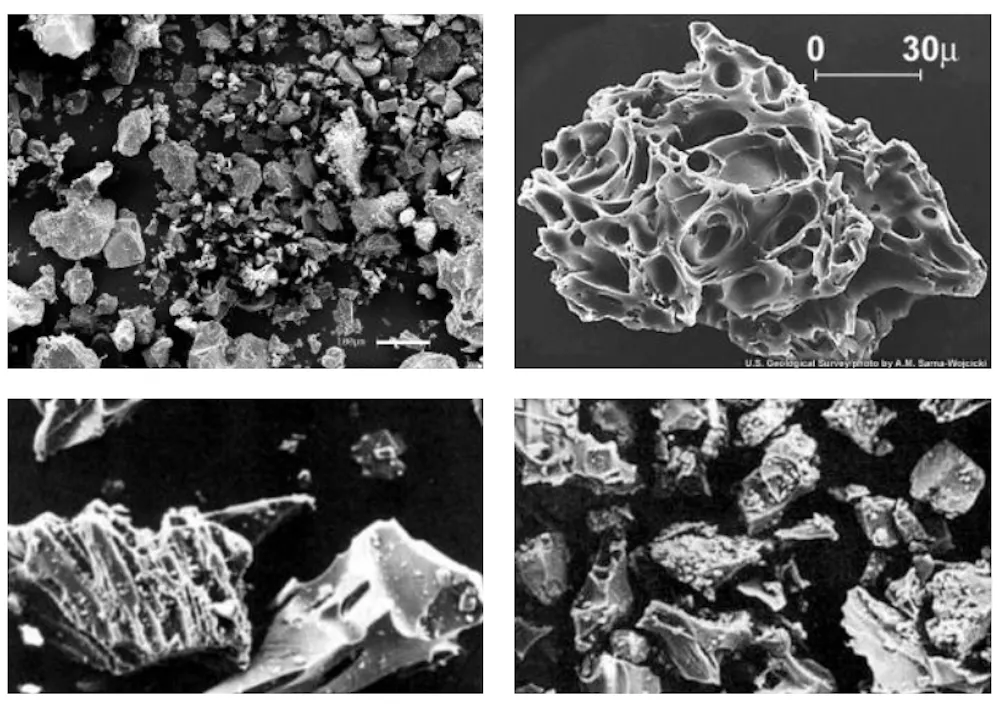
    Electron microscope images of ash show how sharp the shards are. The top left image of shards from Mount Etna in 2002 is 1 mm across. Top right is an ash particle from Mount St. Helens magnified 200 times. The shards in the lower images are less than 0.064 mm.
    Volcano Hazards Program, U.S. Geological Survey

    Ash can also contaminate surface water by introducing toxins and increasing the water’s acidity. The toxins can leach into groundwater, contaminating wells. Fine ash particles can also settle in waterways and smother aquatic plants and animals. During the 2008 Chaitén eruption in Chile, ash contamination led to widespread fish deaths in the Río Blanco.

    Ash can ground airplanes, gum up infrastructure

    Ash clouds are extremely dangerous to aircraft. The glassy ash particles melt when sucked into jet turbines, clog fuel systems and can stall engines in midair.

    In 1982, British Airways Flight 9 lost power in all four engines after flying through an ash cloud. A similar incident occurred in 1989 to KLM Flight 867 over Alaska. In 2010, Iceland’s Eyjafjallajökull eruption grounded more than 100,000 flights across Europe, disrupting travel for over 10 million passengers and costing the global economy billions of dollars.

    Volcanic ash can also wreak havoc on infrastructure by clogging water supplies, short-circuiting electrical systems and collapsing roofs under its weight. It can disrupt transportation, communication, rescue and power networks, as the 1991 eruption of Mount Pinatubo in the Philippines dramatically demonstrated.

    What to do during ashfall

    During an ashfall event, the most effective strategy to stay safe is to stay indoors as much as possible and avoid inhaling ash particles.

    Anyone who must go outside should wear a properly fitted N95 or P2 mask. Cloth masks provide little protection against fine ash. Rainwater tanks, troughs and open wells should be covered and monitored for contamination. Livestock should be moved to clean pastures or given uncontaminated fodder.

    The challenges Alaska is facing if Mount Spurr erupts.

    To reduce structural damage, ash should be cleared from roofs and gutters promptly, especially before rainfall.

    Older adults, children and people who are sick are at greatest risk, particularly those living in poorly ventilated homes. Rural communities that are dependent on agriculture and livestock are disproportionately affected by ashfall, as are low-income people who lack access to clean water, protective masks or safe shelter.

    Communities can stay informed about ash risks through official alerts, including those from the Volcanic Ash Advisory Centers, which monitor ash dispersion and issue timely warnings. The International Volcanic Health Hazard Network also offers guidelines on personal protection, emergency planning and ash cleanup.

    The long tail of ash

    Volcanic ash may fall quietly, but its effects are widespread, persistent and potentially deadly. It poses a chronic threat to health, agriculture, infrastructure and aquatic systems.

    Recognizing the risk is a crucial first step to protecting lives. Effective planning and public awareness can further help reduce the damage.

    David Kitchen does not work for, consult, own shares in or receive funding from any company or organization that would benefit from this article, and has disclosed no relevant affiliations beyond their academic appointment.

    – ref. Volcanic ash is a silent killer, more so than lava: What Alaska needs to know with Mount Spurr likely to erupt – https://theconversation.com/volcanic-ash-is-a-silent-killer-more-so-than-lava-what-alaska-needs-to-know-with-mount-spurr-likely-to-erupt-254461

    MIL OSI – Global Reports –

    April 16, 2025
  • MIL-OSI Global: 25 years of Everglades restoration has improved drinking water for millions in Florida, but a new risk is rising

    Source: The Conversation – USA – By John Kominoski, Professor of Biological Sciences, Florida International University

    The Everglades has often been referred to as a vast river of grass. National Park Service/B.Call via Flickr

    Do you know where your drinking water comes from?

    In South Florida, drinking water comes from the Everglades, a vast landscape of wetlands that has long filtered the water relied on by millions of people.

    But as the Everglades has shrunk over the past century, the region’s water supply and water quality have become increasingly threatened, including by harmful algal blooms fueled by agriculture runoff. Now, the water supply faces another rising challenge: saltwater intrusion.

    Waterways cut through the Everglades.
    South Florida Water Management District/Flickr, CC BY-ND

    Protecting South Florida’s water hinges on restoring the Everglades. That’s why, 25 years ago, the federal government and universities launched the world’s largest ecosystem restoration effort ever attempted.

    I’m involved in this work as an ecosystem ecologist. The risks I see suggest continuing to restore the Everglades is more crucial today than ever.

    What happened to the Everglades?

    The Florida Everglades is a broad mosaic of fresh water, sawgrass marshes, cypress domes and tree islands, mangrove forests and seagrass meadows all connected by water.

    But it is half its original size. In the early 1900s, the U.S. Army Corps of Engineers began installing canals and levees to control flooding in the Everglades, which allowed people to build farms and communities along its edges. The Tamiami Trail became the first road across the Everglades in 1928. It connected Tampa to Miami, but the road and canals cut off or diverted some of the natural water flow in South Florida.

    Maps show how the Everglades changed over time. Source: USGS.

    Since then, Florida’s economy, agriculture and population have exploded – and with them has come a nutrient pollution problem in the Everglades.

    The major crop, sugarcane, is grown in a region south of Lake Okeechobee covering 1,100 square miles that’s known as the Everglades Agricultural Area. Nearly 80 tons of phosphorus fertilizer from federally subsidized farm fields runs off into the Everglades wetlands each year. And that has become a water quality concern. Drinking water with elevated nitrogen is linked to human health problems, and elevated phosphorus and associated algal blooms can cause microbes to accumulate toxins such as mercury.

    Healthy wetlands can filter out those nutrients and other pollutants, cleaning the water.

    Some of the ways the Everglades filters water contaminated with phosphorus.
    South Florida Water Management District

    Rain falling in the Everglades percolates through the porous limestone and recharges the Biscayne Aquifer, which supplies drinking water for 1 in 3 Floridians.

    But wetlands need time and space to function properly, and the damage from farm pollution has harmed that natural filtering system.

    By the 1990s, Everglades wetlands and the wildlife they support hit a critical stress level from elevated concentrations of phosphorus, a nutrient in fertilizer that washes off farm fields and fuels the growth of toxic algal blooms and invasive species that can choke out native plant populations.

    The changes led to seagrass die-offs and widespread invasion of sawgrass marshes by cattail and harmful algal blooms. Degraded wetlands can themselves become pollution sources that can contaminate surface water and groundwater quality by decreasing oxygen in the water, which can harm aquatic life, and releasing chemicals and nutrients as they decay.

    A vast restoration campaign

    Congress approved the Comprehensive Everglades Restoration Plan in 2000 to support reducing phosphorus concentrations by recreating large wetlands areas to remove excess nutrients and reestablishing more of the natural water depth to bolster native populations.

    That restoration effort is making progress in reconnecting wetlands to natural water flows by rehydrating large areas that were cut off. Phosphorus levels are lower in many wetlands that now remain hydrated longer, and in these wetlands fresh water is recharging the aquifer, helping sustain the drinking water supply.

    However, delays in critically important components of that work have left some wetlands in degraded conditions for longer than expected, especially in regions near and downstream of the Everglades Agricultural Area, where phosphorus concentrations remain stubbornly high.

    An algal bloom spreads in Florida’s Lake Okeechobee, at the heart of the Everglades.
    Nicholas Aumen/USGS

    South Florida continues to experience harmful algal blooms from phosphorus reaching rivers and the coast, resulting in fish kills and the deaths of manatees. Red tide can shut down fishing and keep beach-going tourists away, harming local economies. This pollution is estimated to have cost Florida’s economy US$2.7 billion in 2018.

    The unexpected risk: Saltwater

    An unforeseen threat has also started to creep into the Everglades: saltwater.

    As sea level rises, saltwater reaches further inland, both in rivers and underground through the porous limestone beneath South Florida. Saltwater intrusion also occurs when wells draw down aquifers to provide water for drinking or irrigation. That saltwater is causing parts of the Everglades marshes, often referred to as a river of grass, to collapse into open water.

    Saltwater intrusion into South Miami and how Everglades restoration can help. Source: Emily Northrop and Rachael Johnson, University of Miami.
    The red line shows how far saltwater had intruded into aquifers beneath Fort Lauderdale as of 2019.
    South Florida Water Management District

    The loss of these freshwater marshes reduces the capacity of the Everglades to remove phosphorus from the water. And that means more nutrients flowing downstream, contaminating aquifers and causing harmful algal blooms to form in coastal waters.

    Scientists have learned that marsh plants need freshwater pulses during the wet season, from April to November, to avoid saltwater intrusion.

    For example, saltwater intruded about one mile inland between 2009 and 2019 in parts of the Fort Lauderdale area. More fresh water is needed to push the saltwater back out to sea.

    However, the restoration effort was never intended to combat saltwater intrusion.

    Reasons for optimism

    Despite the continuing challenges, I am optimistic because of how scientists, policymakers and communities are working together to protect the Everglades and drinking water.

    I lead part of that restoration work through the Florida Coastal Everglades Long Term Ecological Research program. The effort started at Florida International University on May 1, 2000, the same year the Everglades restoration plan was authorized by Congress.

    Our research was used to set the levels of nutrients allowable to still protect the region’s water supplies, and we have been working for 25 years to reduce saltwater intrusion and phosphorus pollution to ensure drinking water for South Florida remains both fresh and clean. We continually use our research to inform water managers and policymakers of the best practices to reduce saltwater intrusion and pollution.

    A roseate spoonbill hunts for dinner in Everglades National Park.
    National Park Service, R. Cammauf, via Flickr

    As saltwater intrusion continues to threaten South Florida’s freshwater aquifer, Everglades restoration and protection will be increasingly important.

    Everyone in the region can help.

    By rehabilitating degraded wetlands, allowing for more fresh water to flow throughout the Everglades ecosystems, reducing the use of fresh water on lawns and crops, and reusing municipal water for outdoor needs, South Florida can keep its drinking water safe for generations of future residents and visitors. This is something that everyone can contribute to.

    Mangroves along Turner River in the Everglades.
    Chauncey Davis/Flickr, CC BY

    Marjory Stoneman Douglas, Miami’s renowned conservationist who helped establish the Everglades National Park, often said, “The Everglades is a test. If we pass it, we may get to keep the planet.”

    John Kominoski works for Florida International University. He receives funding from federal agencies, such as the National Park Service and the National Science Foundation.

    – ref. 25 years of Everglades restoration has improved drinking water for millions in Florida, but a new risk is rising – https://theconversation.com/25-years-of-everglades-restoration-has-improved-drinking-water-for-millions-in-florida-but-a-new-risk-is-rising-253167

    MIL OSI – Global Reports –

    April 16, 2025
  • MIL-OSI Global: Preventive care may no longer be free in 2026 because of HIV stigma − unless the Trump administration successfully defends the ACA

    Source: The Conversation – USA – By Kristefer Stojanovski, Assistant Professor of Social, Behavioral and Population Sciences, Tulane University

    Americans may lose free coverage for cancer and blood pressure screenings, HIV prevention medication and other essential services. Halfpoint Images/Moment via Getty Images

    Many Americans were relieved when the Supreme Court left the Affordable Care Act in place following the law’s third major legal challenge in June 2021. This decision permitted widely supported policies to continue, such as ensuring health coverage regardless of preexisting conditions, allowing coverage for dependents up to age 26 on their parents’ plan, and removing annual and lifetime benefit limits.

    But millions are still at risk of losing access to lifesaving medicine and preventive services, following the Supreme Court’s decision to hear another case – Robert F. Kennedy, Jr. v. Braidwood – that has been working its way through lower courts for several years.

    Interestingly, the Trump administration has chosen to build upon the same argument the Biden administration used to defend the law.

    HIV stigma and preventive care

    The case the Supreme Court is scheduled to hear in April 2025 was filed by Braidwood Management, a Christian for-profit corporation owned by Steven Hotze, a Texas physician and Republican activist who has previously filed multiple lawsuits against the Affordable Care Act.

    Braidwood and its co-plaintiffs, a group of conservative Christian employers, objected to providing their 70 employees free access to preexposure prophylaxis, or PrEP, a medicine that prevents HIV infection. Hotze claimed that PrEP “facilitates and encourages homosexual behavior, intravenous drug use and sexual activity outside of marriage between one man and one woman,” without citing scientific evidence to support this. He and his plaintiffs argue that religious beliefs prevent them from providing PrEP under their insurance plans.

    The AIDS epidemic has been claiming lives for decades.

    Since the HIV/AIDS epidemic began in the 1980s, the disease has been politicized and stigmatized. Because it had predominantly affected men who had sex with men, AIDS was initially called gay-related immune deficiency, making people reluctant to be associated with the disease. It was only after a teenage boy from Indiana named Ryan White contracted HIV from a blood transfusion to treat his hemophilia, along with public statements from high-profile celebrities such as Arthur Ashe and Magic Johnson about their HIV status, that social attitudes began to shift with more education about AIDS.

    Yet, the same stigma is still at play in the Braidwood case and other recent policy decisions. In 2023, for example, Tennessee officials declined US$9 million in federal funding for HIV prevention. Those federal funds focused on groups most affected by HIV, including men who have sex with men, heterosexual Black women and people who inject drugs.

    Tennessee has since transitioned to using state dollars for HIV prevention, with a focus on first responders, pregnant women and sex trafficking survivors, groups that aren’t major at-risk populations. Researchers have found that this pivot will be a less efficient use of funds, costing $1 million per life-year saved versus $68,600 when focusing on the most at-risk populations.

    Preventive care and the Affordable Care Act

    The ongoing stigma and politicization of HIV/AIDS may not only hamper the national goal of ending the HIV epidemic but also lead to less or no preventive care for many people.

    Section 2713 of the Affordable Care Act requires insurers to offer full coverage of preventive services endorsed by one of three federal groups: the U.S. Preventive Services Task Force, the Advisory Committee on Immunization Practices or the Health Resources and Services Administration. For example, the CARES Act, which allocated emergency funding in response to the COVID-19 pandemic, used this provision to ensure COVID-19 vaccines would be free for many Americans.

    For a preventive service to be covered by this provision, it requires an A or B rating from the Preventive Services Task Force, an independent body of experts trained in research methods, statistics and medicine that evaluates the rigor and quality of available scientific evidence, with support from the Agency for Healthcare Research and Quality. Vaccinations require a recommendation from the Advisory Committee on Immunization Practices of the Centers for Disease Control and Prevention, while women’s health services require approval from the Health Resources and Services Administration.

    PrEP received an A rating in June 2019, given its near 100% effectiveness. This paved the way for it to be covered at no cost for millions of people.

    PrEP is a key tool to helping the U.S. reach its goal of substantially reducing new HIV infections by 2030.
    AP Photo/Pablo Martinez Monsivais

    Over 150 million Americans with private health insurance are able to benefit from free preventive care through the Affordable Care Act, with around 60% using at least one free preventive service each year.

    The consequences of losing these benefits would likely be an increase in the number of people getting and dying from preventable diseases. Raising the cost barrier for PrEP, for example, would disproportionately harm younger patients, people of color and those with lower incomes. It will also increase the cost of HIV prevention.

    As public health researchers who study sexual health and health insurance, we believe that prevention and health equity in the U.S. stand to take a big step backward, depending on the outcome of the Braidwood case.

    Future of preventive care lies with Supreme Court

    The most recent ruling in Braidwood – made by a lower court in 2023 – focuses on the appointments clause of the U.S. Constitution, which specifies that certain governmental positions require presidential appointment and Senate confirmation, while other positions have a lower bar.

    District Judge Reed O’Connor ruled that because the Preventive Services Task Force is an independent volunteer panel and not made up of officers of the U.S. government, it does not have appropriate authority to make decisions about what preventive care should be free, unlike the Advisory Committee on Immunization Practices or Health Resources and Services Administration. O’Connor also ruled that being forced to cover PrEP violated the religious freedom of the plaintiffs.

    O’Connor invalidated all of the task force’s recommendations since the Affordable Care Act was passed in March 2010, returning the power to insurers and employers to decide which, if any, preventive care would remain free to their patients. A few of the recommendations affected by his ruling besides PrEP include blood pressure, diabetes, lung and skin cancer screenings, along with medications to lower cholesterol and reduce breast cancer risk.

    The Trump administration filed a brief continuing the argument from the Biden administration that because the Preventive Services Task Force is overseen by the secretary of Health and Human Services, there is appropriate oversight of the task force and its decision-making by a Senate-confirmed officer. Oral arguments in the case are scheduled for April 21, 2025.

    The Affordable Care Act has faced many legal challenges over the years.
    AP Photo/Alex Brandon

    Insurance contracts are typically defined by calendar year, so if the Supreme Court rules against the government, people would likely see changes starting in 2026. Importantly, these services will likely still need to be covered by health insurance plans as essential health benefits through a separate provision of the ACA − they just won’t be free anymore.

    There were concerns that the Supreme Court could take the ruling even further, endangering the free coverage of contraception and other preventive care that wasn’t covered by the lower court ruling. The Trump administration’s support for the case may make this less likely by leaning into the authority of Robert F. Kennedy Jr. as secretary to support or override recommendations made by the Preventive Services Task Force and the other bodies.

    However, this could also mean the secretary of HHS can more directly control the task force’s recommendations, potentially determining whether PrEP, contraception and other services are available at no cost to patients. Building more political authority into the process − as well as partisan differences in support for LGBTQ+ health − belies the original intent of having nonpartisan medical experts make decisions about preventive care coverage. Legal experts we have spoken to caution that this approach may be more about preserving powers for the executive branch rather than actually protecting preventive care.

    All of this is happening in the context of massive layoffs at HHS. The Agency for Healthcare Research and Quality, which supports the Preventive Services Task Force, was not spared from the recent cuts. It is unclear how all of this will affect the task force’s ability to continue its work, separate from the outcome of Braidwood.

    One way or another, the end to this yearslong case is nearing, with important implications for America’s ability to reach its goals in fighting cancer, diabetes and the HIV epidemic.

    Portions of this article originally appeared in previous articles published on Sept. 7, 2021, Dec. 1, 2021, Sept. 13, 2022, and April 7, 2023.

    Paul Shafer receives research funding from the National Institutes of Health, Agency for Healthcare Research and Quality, and Department of Veterans Affairs. The views expressed in this article are those of the authors and do not necessarily reflect the position or policy of these agencies or the United States government.

    Kristefer Stojanovski does not work for, consult, own shares in or receive funding from any company or organization that would benefit from this article, and has disclosed no relevant affiliations beyond their academic appointment.

    – ref. Preventive care may no longer be free in 2026 because of HIV stigma − unless the Trump administration successfully defends the ACA – https://theconversation.com/preventive-care-may-no-longer-be-free-in-2026-because-of-hiv-stigma-unless-the-trump-administration-successfully-defends-the-aca-250011

    MIL OSI – Global Reports –

    April 16, 2025
  • MIL-OSI Global: How bird flu differs from seasonal flu − an infectious disease researcher explains

    Source: The Conversation – USA – By Hanna D. Paton, PhD Candidate in Immunology, University of Iowa

    There is currently no bird flu vaccine for people. Digicomphoto/ Science Photo Library via Getty Images

    The flu sickens millions of people in the U.S. every year, and the past year has been particularly tough. Although infections are trending downward, the Centers for Disease Control and Prevention has called the winter of 2024-2025 a “high severity” season with the highest hospitalization rate in 15 years.

    Since early 2024, a different kind of flu called bird flu, formally known as avian influenza, has been spreading in birds as well as in cattle. The current bird flu outbreak has infected 70 Americans and caused two deaths as of April 8, 2025. Public health and infectious disease experts say the risk to people is currently low, but they have expressed concern that this strain of the bird flu virus may mutate to spread between people.

    As a doctoral candidate in immunology, I study how pathogens that make us sick interact with our immune system. The viruses that cause seasonal flu and bird flu are distinct but still closely related. Understanding their similarities and differences can help people protect themselves and their loved ones.

    What is influenza?

    The flu has long been a threat to public health. The first recorded influenza pandemic occurred in 1518, but references to illnesses possibly caused by influenza stretch back as as early as 412 B.C., to a treatise called Of the Epidemics by the Greek physician Hippocrates.

    Today, the World Health Organization estimates that the flu infects 1 billion people every year. Of these, 3 million to 5 million infections cause severe illness, and hundreds of thousands are fatal.

    Influenza is part of a large family of viruses called orthomyxoviruses. This family contains several subtypes of influenza, referred to as A, B, C and D, which differ in their genetic makeup and in the types of infections they cause. Influenza A and B pose the largest threat to humans and can cause severe disease. Influenza C causes mild disease, and influenza D is not known to infect people. Since the turn of the 20th century, influenza A has caused four pandemics. Influenza B has never caused a pandemic.

    A notice from Oct. 18, 1918, during the Spanish flu pandemic, about protecting yourself from infection.
    Illustrated Current News/National Library of Medicine, CC BY

    An influenza A strain called H1N1 caused the famous 1918 Spanish flu pandemic, which killed about 50 million people worldwide. A related H1N1 virus was responsible for the most recent influenza A pandemic in 2009, commonly referred to as the swine flu pandemic. In that case, scientists believe multiple different types of influenza A virus mixed their genetic information to produce a new and especially virulent strain of the virus that infected more than 60 million people in the U.S. from April 12, 2009, to April 10, 2010, and caused huge losses to the agriculture and travel industries.

    Both swine and avian influenza are strains of influenza A. Just as swine flu strains tend to infect pigs, avian flu strains tend to infect birds. But the potential for influenza A viruses that typically infect animals to cause pandemics in humans like the swine flu pandemic is why experts are concerned about the current avian influenza outbreak.

    Seasonal flu versus bird flu

    Different strains of influenza A and influenza B emerge each year from about October to May as seasonal flu. The CDC collects and analyzes data from public health and clinical labs to determine which strains are circulating through the population and in what proportions. For example, recent data shows that H1N1 and H3N2, both influenza A viruses, were responsible for the vast majority of cases this season. Standard tests for influenza generally determine whether illness is caused by an A or B strain, but not which strain specifically.

    Officials at the Food and Drug Administration use this information to make strain recommendations for the following season’s influenza vaccine. Although the meeting at which FDA advisers were to decide the makeup of the 2026 flu vaccine was unexpectedly canceled in late February, the FDA still released its strain recommendations to manufacturers.

    The recommendations do not include H5N1, the influenza A strain that causes avian flu. The number of strains that can be added into seasonal influenza vaccines is limited. Because cases of people infected with H5N1 are minimal, population-level vaccination is not currently necessary. As such, seasonal flu vaccines are not designed to protect against avian influenza. No commercially available human vaccines currently exist for avian influenza viruses.

    How do people get bird flu?

    Although H5N1 mainly infects birds, it occasionally infects people, too. Human cases, first reported in 1997 in Hong Kong, have primarily occurred in poultry farm workers or others who have interacted closely with infected birds.

    Initially identified in China in 1996, the first major outbreak of H5 family avian flu occurred in North America in 2014-2015. This 2014 outbreak was caused by the H5N8 strain, a close relative of H5N1. The first H5N1 outbreak in North America began in 2021 when infected birds carried the virus across the ocean. It then ripped through poultry farms across the continent.

    The H5N1 strain of influenza A generally infects birds but has infected people, too.
    NIAID and CDC/flickr, CC BY

    In March 2024, epidemiologists identified H5N1 infections in cows on dairy farms. This is the first time that bird flu was reported to infect cows. Then, on April 1, 2024, health officials in Texas reported the first case of a person catching bird flu from infected cattle. This was the first time transmission of bird flu between mammals was documented.

    As of March 21, 2025, there have been 988 human cases of H5N1 worldwide since 1997, about half of which resulted in death. The current outbreak in the U.S. accounts for 70 of those infections and one death. Importantly, there have been no reports of H5N1 spreading directly from one person to another.

    Since avian flu is an influenza A strain, it would show up as positive on a standard rapid flu test. However, there is no evidence so far that avian flu is significantly contributing to current influenza cases. Specific testing is required to confirm that a person has avian flu. This testing is not done unless there is reason to believe the person was exposed to sick birds or other sources of infection.

    How might avian flu become more dangerous?

    As viruses replicate within the cells of their host, their genetic information can get copied incorrectly. Some of these genetic mutations cause no immediate differences, while others alter some key viral characteristics.

    Influenza viruses mutate in a special way called reassortment, which occurs when multiple strains infect the same cell and trade pieces of their genome with one another, potentially creating new, unique strains. This process prolongs the time the virus can inhabit a host before an infection is cleared. Even a slight change in a strain of influenza can result in the immune system’s inability to recognize the virus. As a result, this process forces our immune systems to build new defenses instead of using immunity from previous infections.

    Reassortment can also change how harmful strains are to their host and can even enable a strain to infect a different species of host. For example, strains that typically infect pigs or birds may acquire the ability to infect people. Influenza A can infect many different types of animals, including cattle, birds, pigs and horses. This means there are many strains that can intermingle to create novel strains that people’s immune systems have not encountered before – and are therefore not primed to fight.

    It is possible for this type of transformation to also occur in H5N1. The CDC monitors which strains of flu are circulating in order prepare for that possibility. Additionally, the U.S. Department of Agriculture has a surveillance system for monitoring potential threats for spillover from birds and other animals, although this capacity may be at risk due to staff cuts in the department.

    These systems are critical to ensure that public health officials have the most up-to-date information on the threat that H5N1 poses to public health and can take action as early as possible when a threat is evident.

    Hanna D. Paton does not work for, consult, own shares in or receive funding from any company or organization that would benefit from this article, and has disclosed no relevant affiliations beyond their academic appointment.

    – ref. How bird flu differs from seasonal flu − an infectious disease researcher explains – https://theconversation.com/how-bird-flu-differs-from-seasonal-flu-an-infectious-disease-researcher-explains-248407

    MIL OSI – Global Reports –

    April 16, 2025
  • MIL-OSI Russia: Sobyanin told how social coordinators help hospital patients

    Translartion. Region: Russians Fedetion –

    Source: Moscow Government – Government of Moscow –

    Contact relatives, help restore documents and accompany them when they are discharged: over 3.5 years, social coordinators and psychologists have helped 150 thousand city residents. Sergei Sobyanin reported this in on your telegram channel.

    “Right now, all hospitals in the city are working

    social coordinators. Since the project was launched, they have resolved 350,000 non-medical issues. Almost a third concerns psychological support. Specialists help cope with anxiety, tune in to treatment, restore strength and motivation. Social coordinators do the most important work: they surround patients with care, help maintain emotional balance and confidence, which are so necessary on the path to recovery,” the Mayor of Moscow wrote.

    Source: Sergei Sobyanin’s Telegram channel @Mos_Sobyanin 

    Since 2022, all adult and children’s city clinics have been providing the necessary social assistance. You don’t need to write any applications for this – just contact one of the 120 social coordinators and 40 psychologists working in Moscow hospitals.

    The specialist will clarify the patient’s needs, study their life circumstances, develop an individual assistance route and offer solutions in the event of a crisis. It is social coordinators who now contact relatives if the patient cannot call themselves, and deal with more complex cases, such as assistance in restoring lost documents.

    The most important task of the coordinators is to take care of the solution of the patient’s social problems that arise after discharge from the hospital in advance. At the same time, if a person is urgently taken to the hospital, but does not need hospitalization, social support will be provided to him if necessary.

    Thanks to social coordinators, the non-core workload of doctors and mid-level medical personnel is significantly reduced. They can devote more time and attention to their main functions – treating patients.

    Moscow’s advanced experience is also being used in other Russian cities, such as Lipetsk and Khabarovsk. Tyumen Oblast plans to join the project in the near future.

    Psychological help

    Almost a third of non-medical services provided to patients in Moscow hospitals are psychological consultations (more than 100 thousand in 3.5 years). Specialists help patients cope with emotions and experiences, prepare for treatment and mobilize additional resources for recovery.

    For those who have encountered an oncological disease, the staff of the Moscow Oncopsychologist Service, formed in 2023, conduct consultations and organize support groups. In such cases, it is important to carry out treatment as quickly as possible. However, fears, uncertainty and doubts often prevent making the right decision. It is difficult for a patient to share his inner experiences with loved ones because he protects their feelings – and then oncopsychologists come to the rescue. Today, 17 specialized specialists work in Moscow outpatient oncology care centers.

    Psychologists support patients and their loved ones at all stages of treatment. You can seek an in-person consultation without an appointment. In addition, a remote format is available – a special platform for online consultations via video link “Psychology for Life”. Since the start of the project, oncopsychologists have conducted over 18 thousand offline and online consultations.

    For cancer patients and their loved ones, there is a support group called “Equal to Equal”, where, during a confidential conversation, you can discuss your fears and worries not only with an oncopsychologist, but also with people who have already gone through a similar path and overcome the disease. At the end of 2024, the group also launched an online format. During the project’s implementation, 330 groups were organized, which were joined by more than 1.2 thousand people.

    At the end of February 2025, the EMIAS.INFO mobile application introduced the ability to leave a request for psychological assistance by phone. Oncopsychologists contact the patient, provide support and, if necessary, refer them to an in-person or remote appointment or enroll them in a support group. Over 420 requests were received in March.

    “Sometimes after discharge, a person may need special care. For Muscovites who independently care for their loved ones, there is a free project called “School of Relative Care”. The school’s specialists not only teach professional skills, but also provide further support at home,” Sergei Sobyanin said in

    on your telegram channel.

    Source: Sergei Sobyanin’s Telegram channel @Mos_Sobyanin 

    Accompanying patients over 65 years of age

    In November last year, a new service was launched in Moscow — support for patients over 65 years old when they are discharged from hospital. Social coordinators help them collect their personal belongings, contact relatives or a social worker if necessary, and call a taxi.

    If a person is alone and has no one to take care of him, specialists help arrange social services at home. Already in the hospital, coordinators hand over needy patients to Moscow social workers, who from that moment on begin to care for their health and well-being. This seamless approach makes the process of discharging patients over 65 from the hospital as comfortable and safe as possible. More than 37 thousand senior Muscovites have already used the new service.

    How do social coordinators work?

    An 88-year-old Muscovite was admitted to the I.V. Davydovsky City Clinical Hospital No. 23 after losing consciousness in a grocery store. She was taken by ambulance and was very nervous when she arrived at the hospital. In a conversation with the social coordinator, the elderly woman shared that she lives alone and has no relatives, so she is worried about how she will be discharged and how she will carry heavy bags of groceries.

    With the patient’s consent, while she was undergoing treatment in the hospital, specialists helped with the arrangement of social services at home. After recovery, the woman was not only accompanied when she was discharged, but also informed the social worker in advance when she needed to be met and taken home. Thanks to the social coordinators, the elderly Muscovite has an assistant who now takes care of her and helps with her everyday life.

    Peace of mind for patients is not only the absence of stress, but also good emotions during inpatient treatment. Social coordinators provide care to patients every day. For example, during her stay at the Moscow Multidisciplinary Clinical Center “Kommunarka”, one of the patients turned 95 years old. Her condition did not allow her to receive visitors, so the specialists decided to improvise – they organized a video call with relatives. The birthday girl was congratulated by her entire family, the woman did not hide her joy, and her health improved significantly as a result.

    Please note: This information is raw content directly from the source of the information. It is exactly what the source states and does not reflect the position of MIL-OSI or its clients.

    Please Note; This Information is Raw Content Directly from the Information Source. It is access to What the Source Is Stating and Does Not Reflect

    HTTPS: //vv.mos.ru/mayor/tkhemes/12621050/

    MIL OSI Russia News –

    April 16, 2025
  • MIL-OSI USA: Repurposing a blood pressure drug may prevent vision loss in inherited blinding diseases

    Source: US Department of Health and Human Services – 2

    News Release
    Tuesday, April 15, 2025

    NIH studies in animals show reserpine protects retinal-neurons necessary for vision, especially in females.

    New studies in rats suggest the drug reserpine, approved in 1955 for high blood pressure, might treat the blinding disease retinitis pigmentosa. No therapy exists for this rare inherited disease, which starts affecting vision from childhood. A report on the studies, conducted at the National Institutes of Health (NIH), published today in eLife.
    “The discovery of reserpine’s effectiveness may greatly speed therapeutics for retinitis pigmentosa and many other inherited retinal dystrophies, which can be caused by one of more than a thousand possible mutations affecting more than 100 genes. Reserpine’s neuroprotective effect is independent of any specific underlying gene mutation,” said the study’s lead investigator, Anand Swaroop, Ph.D., senior investigator at NIH’s National Eye Institute.
    Inherited retinal dystrophies cause degeneration of the retina, the light-sensing tissue at the back of the eye. Vision loss can be present at birth or develop later in early adulthood. Disease progression varies depending on the gene involved. Some genetic defects may be inherited as dominant, where a mutation in just one of the two copies of the gene (one each from the mother and father) is sufficient to cause vision loss. Other genetic defects are recessive, where both copies of a gene must carry a mutation to cause vision loss. Gene therapies to correct inherited retinal dystrophies are promising, but take a long time to develop, are gene specific, and are often quite expensive.
    The findings are the latest evidence that reserpine improves survival of photoreceptor cells, the light-detecting retinal neurons that die in retinitis pigmentosa and other retinal dystrophies. In 2023, the Swaroop Lab demonstrated reserpine’s potential for preventing vision loss from LCA10, a retinal dystrophy caused by mutations in the CEP290 gene.
    In its latest work, Swaroop’s team tested reserpine in a rat model of a dominant form of retinitis pigmentosa caused by a mutation in the visual pigment gene rhodopsin. This disease mutation is common in Irish Americans with retinitis pigmentosa. Compared to untreated rats, reserpine preserved the process by which photoreceptors convert light that enters the eye into electrical signals that are sent to the brain to produce vision, known as phototransduction, in retinal cells called rod photoreceptors. Rod photoreceptors enable low-light vision; cone photoreceptors enable color vision in bright light.
    Unexpectedly, reserpine better protected rod photoreceptors in female rats compared to males. The scientists also observed significant preservation of cone photoreceptors in female rats compared to male rats.
    “We can only speculate about these sex-specific differences. However, future research would benefit from teasing out these differences and understanding them to lay a foundation for personalized approaches to retinal disease therapy,” Swaroop said.
    Swaroop’s lab is developing additional, and more potent reserpine-related drugs. The idea would be to use such options to treat late-onset or slowly progressing inherited retinal dystrophies or to simply stall vision loss in aggressive retinitis pigmentosa varieties until more effective treatments are developed that can reverse that vision loss.
    Reserpine is no longer used for treating high blood pressure because of its side effects. The required dosage for treating retinal degeneration, however, would be very low and directly delivered in the eye. Reserpine is a small molecule therapy, which makes it easy to deliver to target tissues in the eye.
    This work was supported by the NEI Intramural Research Program. 
    NEI leads the federal government’s research on the visual system and eye diseases. NEI supports basic and clinical science programs to develop sight-saving treatments and address special needs of people with vision loss. For more information, visit https://www.nei.nih.gov.    
    About the National Institutes of Health (NIH): NIH, the nation’s medical research agency, includes 27 Institutes and Centers and is a component of the U.S. Department of Health and Human Services. NIH is the primary federal agency conducting and supporting basic, clinical, and translational medical research, and is investigating the causes, treatments, and cures for both common and rare diseases. For more information about NIH and its programs, visit www.nih.gov.
    NIH…Turning Discovery Into Health®

    References
    Song HB, Campello L, Mondal AK, Chen HY, English MA, Glen M, Vanlandingham P, Farjo R, Swaroop A. “Sex-specific attenuation of photoreceptor degeneration by reserpine in a rhodopsin P23H rat model of autosomal dominant retinitis pigmentosa”. PUBLISHED DATE HERE eLife14:RP103888 https://doi.org/10.7554/eLife.103888.1

    ###

    MIL OSI USA News –

    April 16, 2025
  • MIL-OSI USA: Go Baby Go Provides Modified Cars for Children with Disabilities

    Source: US State of Connecticut

    On Friday, April 4, three children with disabilities received cars custom modified for them by UConn engineering and doctor of physical therapy (DPT) students through the Go Baby Go program.

    Go Baby Go modifies commercially available battery-powered cars for children, typically one to five years old, with mobility-related disabilities. These modifications allow the children to control the vehicle independently.

    With the cars, these children can better interact with their peers, engage in family activities, and get around more independently.

    Students work with children to modify battery-powered cars.
    UConn Engineering and Doctor of Physical Therapy (DPT) students in the Department of Kinesiology in the College of Agriculture, Health and Natural Resources modified commercially available battery-powered cars to customize them for children with mobility-related disabilities through the Go Baby Go program in the Peter J. Werth Residence Tower (WTRH). Apr. 4, 2025. (Claire Tremont/UConn Photo)
    Students work with children to modify battery-powered cars.
    UConn Engineering and Doctor of Physical Therapy (DPT) students in the Department of Kinesiology in the College of Agriculture, Health and Natural Resources modified commercially available battery-powered cars to customize them for children with mobility-related disabilities through the Go Baby Go program in the Peter J. Werth Residence Tower (WTRH). Apr. 4, 2025. (Claire Tremont/UConn Photo)
    Students work with children to modify battery-powered cars.
    UConn Engineering and Doctor of Physical Therapy (DPT) students in the Department of Kinesiology in the College of Agriculture, Health and Natural Resources modified commercially available battery-powered cars to customize them for children with mobility-related disabilities through the Go Baby Go program in the Peter J. Werth Residence Tower (WTRH). Apr. 4, 2025. (Claire Tremont/UConn Photo)
    Students work with children to modify battery-powered cars.
    UConn Engineering and Doctor of Physical Therapy (DPT) students in the Department of Kinesiology in the College of Agriculture, Health and Natural Resources modified commercially available battery-powered cars to customize them for children with mobility-related disabilities through the Go Baby Go program in the Peter J. Werth Residence Tower (WTRH). Apr. 4, 2025. (Claire Tremont/UConn Photo)
    Students work with children to modify battery-powered cars.
    UConn Engineering and Doctor of Physical Therapy (DPT) students in the Department of Kinesiology in the College of Agriculture, Health and Natural Resources modified commercially available battery-powered cars to customize them for children with mobility-related disabilities through the Go Baby Go program in the Peter J. Werth Residence Tower (WTRH). Apr. 4, 2025. (Claire Tremont/UConn Photo)
    Students work with children to modify battery-powered cars.
    UConn Engineering and Doctor of Physical Therapy (DPT) students in the Department of Kinesiology in the College of Agriculture, Health and Natural Resources modified commercially available battery-powered cars to customize them for children with mobility-related disabilities through the Go Baby Go program in the Peter J. Werth Residence Tower (WTRH). Apr. 4, 2025. (Claire Tremont/UConn Photo)

    “Sociability and mobility are the biggest components of the Go Baby Go car,” says Kelly Conte, associated faculty in the Department of Kinesiology in the College of Agriculture, Health and Natural Resources (CAHNR). “You’re allowing them to move and interact with people.”

    Mubin Kamran’s son received a car last summer.

    “Everyone was so great, so respectful,” Kamran says. “It was the best event. Every parent was happy, every kid was happy.”

    Kamran’s son, who is now three, uses his car at the park and playground with his family.

    “He loves to ride on it,” Kamran says. “He sits like a boss in the car.”

    Based on the needs of the individual child, the team from UConn’s College of Engineering installs an electrical switch that the child can operate with their hand or head to make the car go. There are ropes attached to the car so caregivers can help steer.

    Students in the Engineering House Learning Community spend the year working on Go Baby Go. This year, 40 engineering students were involved. Alex Clonan ‘22 (ENG, CLAS) a Ph.D. candidate at UConn, is the project lead.

    The students are broken into three teams: an electrical team, a build team, and a design team.

    The build team assembles the car out of the box and makes any necessary physical modifications, like adding a roll cage. The electrical team works out the switch mechanism. The design team works on the exterior, personalizing it for each child based on their interests.

    “The biggest value for the students is obviously the engineering aspects that are related to this,” Nick Delaney, director of experiential education in the College of Engineering, says. “But more than anything, being able to help a family. It’s their skills and what they’ve learned being delivered directly to a child.”

    During the events Go Baby Go holds throughout the year, DPT students make on-site adjustments to ensure the child can sit comfortably and safely in the car. DPT students participate in the event through PT CARES (Community Access to Rehabilitation and Education Services), a free community engagement program run by DPT students and their faculty advisors.

    Kelsey Zator ‘26 (CAHNR) is a DPT student who has participated in Go Baby Go twice so far.

    “It’s just seeing them be happy, being able to do something for themselves for once and not have to be handled by somebody else,” Zator says.

    Ahead of the event, the two student groups meet to tell each other about the modifications they have made or will make on the day of the event.

    “I think that interdisciplinary work for a project like this, it adds perspective and particularly for our students, who are sophomores, to get the opportunity to work with doctoral students is really helpful too,” Delaney says.

    CAHNR and Engineering have been collaborating on Go Baby Go for the last year. In that time, there have been more than a dozen events with three or four children at each. Prior to the partnership, DPT students and faculty ran the program annually since 2017.

    “Dr. Sudha Srinivasan and Dr. Bubela, professors in our program, worked through DPT’s Advanced Pediatrics course,” says Maryclaire Capetta, interim director of physical therapy. “Prior to the Engineering students getting involved, they performed the vehicle modifications themselves.”

    Go Baby Go was initially conceived by Cole Galloway, a professor of physical therapy at the University of Delaware, in the early 2000s. Since then, the program has spread throughout the country. Central Connecticut State University (CCSU) has been running their own version since 2015.

    Conte collaborates in leading this project with Michele Dischino a CCSU engineering professor; Misty Olsen, an occupational therapist at Quinnipiac University; and Jennifer Rodriguez-MacClintic, a pediatric physical therapist at Connecticut Children’s Medical Center.

    “The four of us together have taken on this project of getting cars to as many children as we can,” Conte says.

    To get involved with the event, interested families can fill out this application form.

    This work relates to CAHNR’s Strategic Vision area focused on Enhancing Health and Promoting Diversity, Equity, Inclusion and Justice.

    Follow UConn CAHNR and UConn Engineering on social media

    MIL OSI USA News –

    April 16, 2025
  • MIL-OSI USA: Learning Community Students Celebrate Public Health Week with Child Health Researchers

    Source: US State of Connecticut

    UConn researchers met with undergraduate students in the UConn Public Health House Learning Community on April 8 in a celebration of public health week and as part of a long-running collaboration between the community and the UConn Collaboratory on School and Child Health (CSCH).

    Over 75 first- and second-year students gathered in Werth Tower to hear from the researchers, all of whom are CSCH affiliates who work on issues relating to school and child health.

    The researchers included:

    • Sandra Chafouleas, Board of Trustees Distinguished Professor and Neag Endowed Professor, Department of Educational Psychology and co-director of CSCH
    • Kevin Ferreira van Leer, assistant professor, Human Development and Family Sciences
    • Jessica Koslouski, assistant research professor, Educational Psychology
    • Maria LaRusso, assistant professor, Human Development and Family Sciences
    • Christina Ross, assistant professor, School of Nursing
    • Sudha Srinivasan, assistant professor, Kinesiology

    Jaci VanHeest, associate professor in Educational Psychology, faculty director of the Public Health Learning Community, and CSCH steering committee member, moderated the event.

    CSCH researchers led small group discussions about their career path and current projects at the April 8 event with the Public Health House. (Helene Marcy/UConn CSCH)

    After giving brief introductions about their background, the six researchers — from four UConn schools and colleges — each led a small group discussion about their career path and their current projects. Students rotated to a different researcher halfway through the event.

    Areas of research represented at the event included children’s social-emotional learning and well-being; child and parent well-being in immigrant families; trauma-informed approaches in schools; the use of puppets to teach kids coping strategies; the development of fun assistive technologies that can help children with developmental disabilities; and the development of an app to help Black adolescent females learn about sexual health.

    “The range of faculty showcased the variety of fields that work to promote child health as well as many overlapping areas of focus and inquiry,” Koslouski said.

    “Learning about their fields of study and current projects gave me a new perspective on how broad the field is,” said Hannah Tuxbury, a second-year physiology and neurobiology major. “I was able to see how passionate these professionals were about the work that they do, which made me excited to explore the opportunities that are out there.”

    The small group discussions gave students a chance to also ask questions of the researchers in an informal setting. Students asked specific questions about particular research projects, fields as a whole, what classes the researchers recommended, and the impact of the research.

    “I enjoyed getting to know the students, learning about their experience in the learning community, and discussing research with them,” Ross said.

    “I was really struck by the critical questions students asked about how research can influence policy that support children’s well-being,” Ferreira van Leer said. “Multiple students asked nitty gritty questions about how the research process can center policy-relevant questions and use findings to inform policy.”

    Both researchers and students also appreciated the more casual format.

    “Learning about [the researchers’] fields of study and current projects gave me a new perspective on how broad the field is. … which made me excited to explore the opportunities that are out there.” &#8212 Hannah Tuxbury, student

    “It is a wonderful initiative for students to have the opportunity to connect with researchers on campus in a safe, non-intimidating environment,” Srinivasan said.

    “I thought that it was a great way to get people talking to professors about research in a conversational way,” agreed Avery Hawthorne, a second-year physiology and neurobiology major.

    And students weren’t the only ones learning at the event.

    “I learned a lot about what other faculty across campus are working on and getting to know them was a pleasure,” Ross said. “I hope other faculty get to engage in this activity in the future.”

    Over the past seven years, UConn Public Health House and CSCH have collaborated on many events, including panel discussions, participating in the recording of CSCH Live Talks, research panels, UConn Gives, and the building of puppets through the Feel Your Best Self project.

    Assistant professor Christina Ross leads a discussion with Public Health House students on April 8. (Helene Marcy/UConn CSCH)

    “Our collaboration with the Public Health House Learning Community has been the highlight of my spring semester for many years,” Chafouleas said. “Although our activities have varied by year, each opportunity has presented terrific opportunities to amplify collective interests in child, family, and school health.”

    “The partnership between PHLC and CSCH has been a cornerstone of our scholarly activities over the past seven years,” VanHeest said. “Our students have been challenged to explore themselves and the broad scope of health issues through these interactions. We are excited about furthering this partnership.”

    Part of the Collaboratory’s mission is to educate and mentor students in the science of school and child health. This is the third meet-the-researcher event put together by the two teams; the style and content of the event has been a consistent hit with involved students and faculty.

    It was an amazing experience,” said first-year student Amelia Espinal, a speech, language and hearing sciences major. “I learned so much about things that will truly help me with my future career. The presenters were incredibly friendly and eager to help, always ready to answer any questions my friends and I had.”

    “The opportunity to interact with young, curious, and enthusiastic minds was invigorating,” Srinivasan said. “It was wonderful to be able to share my journey with the students, hear their questions, and offer my perspective.”

    “I really enjoyed the roundtable conversations,” Ferreira van Leer said. “I left the conversation hopeful about the role students can play in research and excited to see the large interest in getting involved in the research process.”

    MIL OSI USA News –

    April 16, 2025
  • MIL-OSI Global: When dogs return to nature – just how domesticated are our pooches really?

    Source: The Conversation – UK – By Jacqueline Boyd, Senior Lecturer in Animal Science, Nottingham Trent University

    Photobox.ks/Shutterstock

    It’s hard to imagine a beloved pet dog surviving in the world. But reports of a 4 kg miniature dachshund looking well 500 days after she escaped during a family holiday is raising questions about how dependent our dogs really are on their humans. Our loyal pooches may be less domesticated than we like to think.

    In November 2023, Valerie, a black and tan dachshund, went on holiday with her family. They visited Kanagaroo island off the south Australian coast, an area famous for its wildlife, including koalas and sea lions. During the holiday, Valerie vanished from her family’s campsite.

    Initially there were local sightings of Valerie, wearing her little pink collar, but she refused to be caught and gradually, reported sightings slowed. Her owners were shocked she had survived even one night alone because she was a pampered dog who “never left” their side.

    Now, well over a year since she went missing, Valerie has been sighted again still apparently choosing to be wild and free. A local wildlife rescue organisation is trying to track and catch Valerie with cameras and traps to return the plucky pooch home.

    Dependent dogs?

    Dogs and humans have lived together for more than 15,000 years, longer than any other domesticated animal. During that time, dogs have changed considerably from their early ancestors both physically and behaviourally. This is a result of human preferences and selection for particular characteristics, such as flat faces as seen in pugs, or working ability.

    The close relationship we typically have with dogs as friends and family members makes it easy to view them as dependent upon us.

    The reality however, is probably a little less “Lassie come home” and more “the call of the wild”.

    Not all dogs are pets

    The global dog population is estimated to be around 500 million. The majority of these dogs live on the edges of human society as feral, pariah or street dogs and are often viewed as pests rather than cuddly companions. These dogs largely exist on human-derived food sources including waste and faecal matter, but otherwise generally live successfully, independent of human care and management.

    Dogs evolved as highly efficient scavengers, eating a mixed diet. Many of those traits remain in our canine companions. Pet dog behaviour we often label problematic, including counter-surfing and poop eating, stems from their scavenging characteristics.

    This means that even dogs living lives of luxury can survive in extreme situations. This might help to explain Valerie’s apparent independence on Kangaroo Island, where she is presumed to be living on roadkill, carrion and natural fresh water.

    The abundant wildlife on the island, such as birds and small rodents, might partly account for Valerie’s success, especially as dachshunds were developed as hunting dogs, shaped for squeezing into animal burrows. Even highly domesticated dogs have been known to hunt independently and cooperatively with each other. One report from the 1990s, describes a pack of dogs hunting humans in Newfoundland, Canada, after they were abandoned on a remote island.

    The dogs of Chernobyl also reveal their ability to adapt to changing circumstances. A population of dogs survives in the vicinity of the Chernobyl nuclear power plant that was destroyed in a catastrophic incident in 1986. These dogs probably originate from strays or once-loved family pets who were released immediately following the accident and have diverged to two separate breeding populations. Notably, the dogs of Chernobyl appear to be surviving and breeding successfully, without direct human intervention.

    Homeward bound

    Despite the evidence suggesting that Valerie and her canine cousins might have impressive survival skills, this can create challenges for other animals.

    Dogs can be problematic in many ecosystems causing damage and spreading disease. This applies to our beloved pets as well as stray and free-living dogs. Cases of domestic dogs interbreeding with local wildlife,, including foxes and endangered species, are concerning for conservationists.

    So efforts to return Valerie back home are important for the island wildlife too.

    When dogs go missing, the vast majority return home quickly and safely. Occasionally stories of faithful dogs finding their family hit the headlines, but these stories are the exception to the norm and many lost pets sadly never return to their original home.

    Part of responsible canine caregiving is ensuring that dogs wear identification, and are microchipped, so that if found, they can be quickly returned home. Combining this with essential skills such as recall can go a long way to keeping your dog safe.

    Should the worst happen and your dog does go missing, seek professional advice from local dog wardens, walkers and vets. Many lost dogs will quickly enter survival mode, making even the most human-oriented dog wary of people, including their family members. This means experienced advice is essential.

    Valerie the valiant dachshund gives us a fascinating insight to the survival capabilities and behavioural adaptability of our domestic dogs. Hopefully it won’t be too long before she is safely returned to her home comforts.

    Jacqueline Boyd is affiliated with The Kennel Club (UK) through membership and as advisor to the Health Advisory Group. Jacqueline is a full member of the Association of Pet Dog Trainers (APDT #01583) and she also writes, consults and coaches on canine matters on an independent basis, in addition to her academic affiliation at Nottingham Trent University.

    – ref. When dogs return to nature – just how domesticated are our pooches really? – https://theconversation.com/when-dogs-return-to-nature-just-how-domesticated-are-our-pooches-really-253265

    MIL OSI – Global Reports –

    April 15, 2025
  • MIL-OSI Australia: Call for information – Aggravated Assault – Karama

    Source: Northern Territory Police and Fire Services

    The Northern Territory Police Force is calling for information after an aggravated assault occurred in Karama overnight.

    Around 10:10pm, police received reports that a 28-year-old male delivery driver was allegedly assaulted by four male youths after delivering food on Lippia Court.

    It is alleged the group demanded money and goods from the victim before one of them assaulted him with a rock.

    One of the males entered the vehicle and the victim attempted to drive away before he pulled over and called police, causing the offender to flee.

    Police attended and provided first aid to the victim who had suffered a laceration to his forehead. He was then transported to Royal Darwin Hospital by a friend.

    Occupants from the food delivery address are not believed to be involved in the assault.

    Four offenders remain outstanding, and investigations are ongoing.

    Police urge anyone with information in relation to the incident to make contact on 131 444. Please quote reference number NTP2500038848. Anonymous reports can be made through Crime Stoppers on 1800 333 000 or via https://crimestoppersnt.com.au/.

    MIL OSI News –

    April 15, 2025
  • MIL-OSI United Kingdom: Dozens attend Reverse Jobs Fair

    Source: City of Wolverhampton

    It took place at the Black Country Living Museum to mark National Supported Internships Day and was facilitated by the council’s specialist Supported Employment team.

    Unlike a traditional jobs fair where employers host the stands, the Reverse Jobs Fair saw dozens of jobseekers showcase their skills to employers from across the West Midlands, with some being offered roles on the spot.

    Councillor Chris Burden, Cabinet Member for City Development, Jobs and Skills, said: “As a council, we are determined to support people into paid employment, and events like this Reverse Jobs Fair are a fantastic way in which we can provide a platform for jobseekers with additional needs to show off their talents to potential employees.

    “I am delighted that so many were able to either secure employment or get help and advice to further their work opportunities as a result of taking part in this wonderful event.”

    Among those taking part was Alyssa Dunn from Tettenhall Wood School. She said: “I spoke to several people, one of whom offered me a chance to do some volunteer work. I’d just like to thank everyone for giving me the chance to go to the fair and I hope it’ll be the first of many.”

    Statistics show that only 21.1% of the UK population with autism are in paid employment, as are just 5.4% of people with learning disabilities or autism who are known to social care.

    The Supported Employment team can support anyone aged 16 to 67 with a learning disability or autism, providing employment opportunities and offering in work support via a Job Coach who will provide help and guidance to the jobseeker and agree reasonable adjustments with the employer.

    People aged 16 to 24 who have an Education, Health and Care Plan can also consider a Supported Internship provided by Adult Education Wolverhampton and the City of Wolverhampton College. Learners will spend 70% of their course on placement preparing for employment with the opportunity of paid employment following completion of the course.

    To find out more about the help available from the Supported Employment team please call 01902 554411 or email supportedemployment@wolverhampton.gov.uk.

    April is World Autism Acceptance Month. The Wolverhampton Autism Board website, includes information about autism, upcoming events, parent/guardian workshops, support groups for autistic individuals and professionals working with autistic people, community opportunities, information about Wolverhampton Autism Board and links to online resources and strategies.

    To find out more please visit World Autism Acceptance Month.

    MIL OSI United Kingdom –

    April 15, 2025
  • MIL-OSI United Nations: Africa Centres for Disease Control and Prevention

    Source: UNISDR Disaster Risk Reduction

    Mission

    Africa Centres for Disease Control and Prevention (Africa CDC) is a continental autonomous health agency of the African Union established to support public health initiatives of Member States and strengthen the capacity of their public health institutions to detect, prevent, control and respond quickly and effectively to disease threats. Africa CDC supports African Union Member States in providing coordinated and integrated solutions to the inadequacies in their public health infrastructure, human resource capacity, disease surveillance, laboratory diagnostics, and preparedness and response to health emergencies and disasters.

    Established in January 2016 by the 26th Ordinary Assembly of Heads of State and Government and officially launched in January 2017, Africa CDC is guided by the principles of leadership, credibility, ownership, delegated authority, timely dissemination of information, and transparency in carrying out its day-to-day activities. The institution serves as a platform for Member States to share and exchange knowledge and lessons from public health interventions.

    MIL OSI United Nations News –

    April 15, 2025
  • MIL-OSI Economics: Artificial Intelligence fuels rise of hard-to-detect bots that now make up more than half of global internet traffic, according to the 2025 Imperva Bad Bot Report

    Source: Thales Group

    Headline: Artificial Intelligence fuels rise of hard-to-detect bots that now make up more than half of global internet traffic, according to the 2025 Imperva Bad Bot Report

    15 Apr 2025

    Share this article

    • Rise in accessible AI tools significantly lowered the barrier to entry for cyber attackers, enabling them to create and deploy malicious bots at scale.
    • For the first time in a decade, automated traffic surpassed human activity, accounting for 51% of all web traffic.
    • API-directed attacks surged to 44% of advanced bot traffic, with the travel sector topping the list for bot attacks overall.

    Thales, the leading global technology and security provider, today announced the release of the 2025 Imperva Bad Bot Report, a global analysis of automated bot traffic across the internet. This year’s report, the 12thannual research study, reveals that generative artificial intelligence (AI) is revolutionizing the development of bots, allowing less sophisticated actors to launch a higher volume of bot attacks with increased frequency. Today’s attackers are also leveraging AI to scrutinize their unsuccessful attempts and refine techniques to evade security measures with heightened efficiency, amidst a growing Bots-As-A-Service (BaaS) ecosystem of commercialized bot services.


    Automated bot traffic surpassed human-generated traffic for the first time in a decade, constituting 51% of all web traffic in 2024. This shift is largely attributed to the rise of AI and Large Language Models (LLMs), which have simplified the creation and scaling of bots for malicious purposes. As AI tools become more accessible, cyber criminals are increasingly leveraging these technologies to create and deploy malicious bots which now account for 37% of all internet traffic – a significant increase from 32% in 2023. This is the sixth consecutive year of growth in bad bot activity, posing security challenges for organizations striving to safeguard their digital assets.

    Both the Travel and the Retail sectors face an advanced bot problem, with bad bots making up 41% and 59% of their traffic respectively. In 2024, the travel industry became the most attacked sector, accounting for 27% of all bot attacks, up from 21% in 2023. The most notable shift in 2024 is the decline in advanced bot attacks targeting the travel industry (41%, down from 61% in 2023) and the sharp increase in simple bot attacks (52%, up from 34%). This shift indicates that AI-powered automation tools have lowered the barriers to entry for attackers, allowing less sophisticated actors to initiate more basic bot attacks. Rather than relying exclusively on sophisticated techniques, cybercriminals are increasingly utilizing high volumes of simpler bots to inundate travel sites, resulting in more frequent and widespread attacks.

    The Rise of AI-Driven Bots: A New Era of Cybersecurity Challenges

    The emergence of advanced AI tools, including ChatGPT, ByteSpider Bot, ClaudeBot, Google Gemini, Perplexity AI, and Cohere AI, are transforming not just user interactions but also the methods by which attackers execute cyber threats. According to the Imperva Threat Research team, widely used AI tools are being leveraged for cyberattacks, with ByteSpider Bot alone responsible for 54% of all AI-enabled attacks. Other significant contributors include AppleBot at 26%, ClaudeBot at 13%, and ChatGPT User Bot at 6%.

    “The surge in AI-driven bot creation has serious implications for businesses worldwide,” said Tim Chang, General Manager of Application Security, Thales Cybersecurity Products. “As automated traffic accounts for more than half of all web activity, organizations face heightened risks from bad bots, which are becoming more prolific every day.”

    As attackers become more adept at utilizing AI, they can execute a variety of cyber threats—ranging from DDoS attacks to custom rules exploitation and API violations. While bot-driven attacks have become increasingly sophisticated, they pose significant challenges for detection efforts.

    “This year’s report sheds light on the evolving tactics and techniques utilized by bot attackers. What were once deemed advanced evasion methods have now become standard practice for many malicious bots,” Chang said. “In this rapidly changing environment, businesses must evolve their strategies. It’s crucial to adopt an adaptive and proactive approach, leveraging sophisticated bot detection tools and comprehensive cybersecurity management solutions to build a resilient defense against the ever-shifting landscape of bot-related threats.”

    Bad Bots Targeting API Business Logic Pose Increased Threat to Modern Enterprises

    Recent findings from the Imperva Threat Research team reveal a significant surge in API-directed attacks, with 44% of advanced bot traffic targeting APIs. These attacks aren’t just limited to overwhelming API endpoints; rather, they target the intricate business logic that defines how APIs operate. Attackers deploy bots specifically designed to exploit vulnerabilities in API workflows, engaging in automated payment fraud, account hijacking, and data exfiltration.

    Analysis in the report reveals a deliberate strategy by cyber attackers to exploit API endpoints that manage sensitive and high-value data. Implications of this trend are especially impactful for industries that rely on APIs for their critical operations and transactions. Financial services, healthcare, and e-commerce sectors are bearing the brunt of these sophisticated bot attacks, making them prime targets for malicious actors seeking to breach sensitive information.

    APIs serve as the backbone of modern applications, enabling connectivity across services, streamlining operations, and delivering personalized customer experiences at scale. They underpin essential functions such as payment processing, supply chain management, and AI-driven analytics, making them indispensable for enhancing efficiency, accelerating product development, and unlocking new revenue streams.

    “The business logic inherent to APIs is powerful, but it also creates unique vulnerabilities that malicious actors are eager to exploit,” Chang said. “As organizations embrace cloud-based services and microservices architectures, it’s vital to understand that the very features that make APIs essential can also leave them susceptible to risk of fraud and data breaches.”

    Financial Services, Healthcare, and E-commerce Industries Face Heightened Risk

    The 2025 Imperva Bad Bot Report provides an in-depth analysis highlighting the industries most at risk. Financial services, healthcare, and e-commerce are the most affected sectors, industries that rely on APIs for critical operations and sensitive transactions, making them attractive targets for sophisticated bot attacks.

    The financial services sector was the most targeted industry for account takeover (ATO) attacks, accounting for 22% of all incidents, followed by Telecoms and ISPs with 18%, and Computing & IT with 17%. Financial Services has long been a prime target for ATO attacks due to the high value of accounts and the sensitive nature of the data at stake. Banks, credit card companies, and fintech platforms possess vast amounts of Personally Identifiable Information (PII), including credit card and bank account details, which can be profitably sold on the dark web. Additionally, the growing proliferation of APIs within the industry has broadened the attack surface, allowing cyber criminals to exploit vulnerabilities such as weak authentication and authorization methods, thereby facilitating account takeovers and data theft.

    About the Research

    The 12th Annual Imperva Bad Bot Report is based on insights from our Threat Research and Security Analyst Services (SAS) teams. Our analysis draws from data collected from across the Imperva global network in 2024, including the blocking of 13 trillion bad bot requests across thousands of domains and industries. This dataset provides key insights into bot activity to help organizations understand and address the growing risks of automated attacks.

    About Thales

    Thales (Euronext Paris: HO) is a global leader in advanced technologies for the Defence, Aerospace, and Cyber & Digital sectors. Its portfolio of innovative products and services addresses several major challenges: sovereignty, security, sustainability and inclusion.

    The Group invests more than €4 billion per year in Research & Development in key areas, particularly for critical environments, such as Artificial Intelligence, cybersecurity, quantum and cloud technologies.

    Thales has more than 83,000 employees in 68 countries. In 2024, the Group generated sales of €20.6 billion.

    MIL OSI Economics –

    April 15, 2025
  • MIL-OSI Asia-Pac: CHP reminds public on precautions against heat stroke during very hot weather

    Source: Hong Kong Government special administrative region

    CHP reminds public on precautions against heat stroke during very hot weather ​The public should also note the latest and the forecast Ultraviolet (UV) Index released by the Hong Kong Observatory (HKO). When the UV Index is high (6 or above):
     ​If symptoms develop, such as dizziness, headache, nausea, shortness of breath or confusion, rest and seek help immediately, and seek medical advice as soon as possible.

    ​The public may obtain more information from the DH’s Health Education Infoline (2833 0111), heat strokeIssued at HKT 13:48

    NNNN

    CategoriesMIL-OSI

    MIL OSI Asia Pacific News –

    April 15, 2025
  • MIL-OSI Asia-Pac: Union Health Minister Shri JP Nadda presides over 5th Convocation Ceremony of AIIMS Rishikesh

    Source: Government of India

    Union Health Minister Shri JP Nadda presides over 5th Convocation Ceremony of AIIMS Rishikesh

    Convocation ceremony is a special occasion which marks recognition for the achievements made by students: Shri JP Nadda

    “The government is focused on providing healthcare which is not only curative but also preventive, palliative and rehabilitative”

    “1.75 lakh Ayushman Arogya Mandirs are operational across the country. In the last 10 years, medical colleges have seen an increase of 101%. There has been a 130% increase in MBBS seats while PG seats have seen an increase of 138% in the last 10 years”

    Inaugurates several healthcare facilities including Integrated Medicine in the Ayush Department, a PET scan machine in the Nuclear Medicine Department, PACS facility in the Radiology Department and a Centre for Advanced Pediatrics in Pediatric Care

    AIIMS Rishikesh is providing advanced medical treatment like robotic surgery, neuro surgery and radiation therapy to patients: Shri Pushkar Singh Dhami

    434 Students Awarded Degrees during the convocation

    Posted On: 15 APR 2025 2:29PM by PIB Delhi

    Union Health and Family Welfare Minister Shri Jagat Prakash Nadda presided over the fifth convocation ceremony of AIIMS Rishikesh, today. He was joined by Shri Pushkar Singh Dhami, Chief Minister, Uttarakhand; Shri Dhan Singh Rawat, Health and Education Minister, Uttarakhand; Members of Lok Sabha, Shri Ajay Bhatt, Shri Ajay Tamta and Shri Trivendra Singh Rawat; and Smt. Ritu Khanduri Bhushan, Speaker of Uttarakhand Legislative Assembly.

    Addressing the gathering, Shri JP Nadda stated that “convocation ceremony is a special occasion which marks recognition for the achievements made by students.” He said providing affordable and quality healthcare to every poor person in the country is a priority of the central government.

    Shri JP Nadda highlighted the achievements of AIIMS institutes across the country in medical education and services. He stated that “till the advent of this century, India only had on AIIMS in the country. Today, there are 22 AIIMS operating in the country.” He stated that AIIMS Rishikesh has carved a unique identity among healthcare institutes due to its superior services.

    He reiterated the central government’s commitment to providing world-class healthcare for the citizenry. “The government is focused on providing healthcare which is not only curative but also preventive, palliative and rehabilitative”, he stated.

    Highlighting the achievements of the Union Government in the health sector, Shri Nadda stated, “today, 1.75 lakh Ayushman Arogya Mandirs are operational across the country providing a range of services pertaining to healthcare and wellness. In the last 10 years, there has been a 101% increase in medical colleges, totaling 780 across the country. There has been a 130% increase in MBBS seats while PG seats have seen an increase of 138% in the last 10 years”. “Similarly, to cater to the paramedics, 157 nursing colleges are also being established, to be co-located with the medical colleges”, he further stated.

    The Union Health Minister appreciated AIIM Rishikesh for effectively utilizing the helicopter and drone services by rescuing 309 critical patients using the services. He also congratulated AIIMS Rishikesh for being one of the best institutes in the country for using digital services like telemedicine (eSanjeevani) to serve the remote and underserved areas of the state.

    Shri Nadda concluded his address by encouraging students to approach their work with compassion, integrity, and dedication. Emphasizing that the government spends between Rs. 30-35 lakh for every MBBS student, he urged the new doctors to shoulder more responsibilities as they embark on their professional careers.

    During the event, Shri Nadda inaugurated several healthcare facilities to enhance the institute’s medical services, including Integrated Medicine in the Ayush Department, a PET scan machine in the Nuclear Medicine Department, PACS facility in the Radiology Department, and a Centre for Advanced Pediatrics in Pediatric Care.

    During the ceremony, Shri Nadda awarded gold medals and degrees to 10 medical students from MBBS, DM, MSc Nursing, BSc Nursing, and BSc Allied Health Sciences programs. A total of 434 students received degrees during the convocation including 98 MBBS students, 95 BSc (Hons) Nursing students, 54 BSc Allied Health Sciences students, 109 MD/MS/MDS students, 17 MSc Nursing students, 1 MSc Medical Allied student, 12 Master of Public Health students, 40 DM/MCh students, and 8 PhD students.

    Speaking on the occasion, Shri Pushkar Singh Dhami said that India’s healthcare sector has seen a significant uplift in the last decade with the launch of initiatives like Ayushman Bharat and establishment of new AIIMS and medical colleges.

    He stated that AIIMS Rishikesh is providing quality and affordable healthcare services and facilities to people from across the state. He stated that the institute is providing advanced medical treatment like robotic surgery, neuro surgery and radiation therapy to patients. He also highlighted the inauguration of Heli-ambulance services in AIIMS Rishikesh.

    Shri Dhami also highlighted that today more than 5,000 Gram Panchayats in Uttarakhand are TB free. He stated the government is working to set up a medical college in every district of the state and expand the network of Jan Aushadi Kendras in the state.

    The event was also attended by AIIMS Rishikesh President, Prof. Samiran Nandy; Executive Director, Prof. Meenu Singh; Dean Academics, Prof. Jaya Chaturvedi; Medical Superintendent, Prof. B. Satya Shri; Deputy Director (Administration), Col. Rajiv Sen Roy; Dean Examinations, Prof. Prashant Patil; Financial Advisor, Lt. Col. S. Siddharth; Organizing Committee Chairperson, Prof. Latika Mohan; heads of various departments, faculty members, officers, and medical and nursing students.

    *****

    MV

    HFW/ HFM AIIMS Rishikesh Convocation/15 April 2025/1

    (Release ID: 2121816) Visitor Counter : 22

    MIL OSI Asia Pacific News –

    April 15, 2025
  • MIL-OSI Asia-Pac: Union Minister of State for Women and Child Development Smt. Savitri Thakur to visit Meghalaya

    Source: Government of India

    Posted On: 14 APR 2025 7:08PM by PIB Shillong

    Union Minister of State for Women and Child Development, Government of India, Smt. Savitri Thakur, will be on a three-day official visit to Meghalaya from April 15 to 17, 2025.

    During her visit, the Minister will hold a review meeting with the Department of Social Welfare, Government of Meghalaya, focusing on Central Government-sponsored schemes and programmes under the Ministry of Women and Child Development. She will also meet the Governor of Meghalaya for a courtesy call and conduct a detailed district-level review in East Khasi Hills as per the guidelines of the Ministry of Development of North Eastern Region (DoNER).

    On April 16, the Minister will visit key institutions and welfare centers in Shillong, including the One Stop Center at Ganesh Das Hospital, Shakti Sadan at Mawroh, and a Child Care Institution in Mawkasiang. She will then visit the Community Health Center, Anganwadi Centre at Mawsmai, and inspection of development projects under MGNREGA and PMAY(G) and also visit the Aqua Park cum Visitor Information Centre at Khliehshnong and inspect PMGSY roads in the area.

    ****

    (Release ID: 2121631) Visitor Counter : 84

    MIL OSI Asia Pacific News –

    April 15, 2025
  • MIL-OSI Europe: Written question – Clarification on the Commission’s position regarding the COVID-19 lab leak theory – E-001403/2025

    Source: European Parliament

    Question for written answer  E-001403/2025
    to the Commission
    Rule 144
    Christine Anderson (ESN)

    Multiple Western intelligence sources and legislative bodies have revived the theory that COVID-19 may have originated from a laboratory incident in China.

    – The US Central Intelligence Agency now considers a lab leak to be a plausible origin, though with low confidence.

    – In 2020, Germany’s Federal Intelligence Service reportedly assessed that there was an 80–90 % likelihood of an accidental lab leak.

    – A 2024 US Congressional report concluded that the virus ‘likely emerged due to a laboratory or research-related mishap’, further revealing that gain-of-function research funded by the National Institute of Health was conducted at the Wuhan Institute of Virology prior to the outbreak.

    Although no scientific consensus has emerged so far, these developments raise serious questions about biosafety, research funding oversight and international accountability.

    In this context, I seek clarification on the following points:

    • 1.Has the Commission reviewed or reassessed its position on the origins of COVID-19 in light of recent intelligence findings by US and German authorities?
    • 2.Has any EU-funded research directly or indirectly supported the Wuhan Institute of Virology or other institutions engaged in high-risk virological work prior to the pandemic?
    • 3.What measures is the Commission taking to ensure greater transparency, traceability and safety in EU-funded research involving gain-of-function or dual-use biological experiments, both within the EU and internationally?

    Submitted: 7.4.2025

    Last updated: 15 April 2025

    MIL OSI Europe News –

    April 15, 2025
  • MIL-OSI United Kingdom: Education Secretary visits University of Dundee

    Source: Scottish Government

    Taskforce membership is announced.

    Education Secretary Jenny Gilruth has met with staff and students as she visited the University of Dundee’s School of Life Sciences.

    It came as the wider membership of an external Taskforce, set up to advise the University on its current financial challenges, was announced, including business and industry organisations, trades unions, enterprise agencies, NHS and academic representatives.

    Visiting the Drug Discovery and Medical Research units at the school, Ms Gilruth heard about how its work has helped contribute to the treatment of conditions like Parkinson’s Disease.

    The university was ranked top in Biological Sciences in the most recent Research Excellence Framework, a UK-wide assessment of research quality at higher education institutions.

    Meeting with university Principal Shane O’Neill, the Education Secretary underlined the Scottish Government’s determination to support the University through its current financial challenges, with a wide-ranging package of financial support and expertise in place to help secure its future.

    Ms Gilruth said: 

    “It was inspiring to hear about the world-leading and life changing work being undertaken at the Life Sciences school here at Dundee. This is vitally important research which underlines the strength of academic excellence and innovation in Scotland

    “This work and research also has a major impact on inward investment for the area and the Scottish Government is clear it should be a vital component of our knowledge economy for the coming generations.

    “We know that this unit and the wider Life Sciences school at Dundee attracts students, researchers and cutting-edge companies from across the globe to the city.

    “That’s why this Government has been clear in our determination to ensure that the University of Dundee is fully supported and the wider membership of the taskforce we are setting out today will provide the right mix knowledge and experience to help advise on the current financial challenges.”

    Professor Shane O’Neill, Interim Principal and Vice-Chancellor of the University of Dundee, said:

    “We are extremely grateful to the Scottish Government for their continued support and we have been delighted to welcome the Cabinet Secretary today to see first hand the impactful work of our researchers in Life Sciences.

    “We will continue to work with the Government and the Scottish Funding Council towards a secure and successful future for the University, and we will also engage fully with the Advisory Taskforce regarding our wider impact on Dundee, the Tay Cities region and beyond.”

    Background

    In addition to the Chair Alan Langlands University of Dundee, City of Dundee Council, Scottish Funding Council and the Scottish Government, the membership of the Taskforce will include:

    • Universities Scotland
    • Abertay University
    • University of St Andrews
    • Dundee and Angus College
    • Trade Unions representation
    • Student Union representation
    • Tay Cities Regional Economic  Partnership / City Deal
    • Dundee and Angus Chamber of Commerce
    • Scottish Enterprise
    • Skills Development Scotland
    • NHS Education for Scotland
    • Business representation
    • Alumni/graduates representation

    The Scottish Government has provided £25 million to the Scottish Funding Council (SFC) to support universities like Dundee facing immediate financial challenges. This is on top of £1.1 billion of investment already in the budget for university teaching and research

    Deputy First Minister chairs a regular cross-government group in support of SFC and to consider the issues

    REF 2021 in Life Sciences | University of Dundee, UK

    MIL OSI United Kingdom –

    April 15, 2025
  • MIL-OSI United Kingdom: Reappointments and extension of members of Cafcass

    Source: United Kingdom – Executive Government & Departments

    News story

    Reappointments and extension of members of Cafcass

    The Lord Chancellor and Secretary of State has approved the extension of the tenure of Rohan Sivanandan as a member of the Board of Children and Family Court Advisory Support Service (Cafcass).

    The Secretary of State has approved the extension of tenure of Rohan Sivanandan as a member of the Board of the Children and Family Court Advisory and Support Service (Cafcass) from 1 July to 31 December 2025.

    Rohan Sivanandan

    Rohan Sivanandan worked as an economist and senior executive in the private sector before moving into the education field. He has held a number of board, non-executive and trustee positions. Currently, he is: a non-executive director for Cambridge University Hospitals NHS Foundation Trust where he chairs the Workforce and Education committee; a lay member of the Independent Reconfiguration Panel which provides advice to the Secretary of State for Health and Social Care; an independent member of the Greater London Authority on Mayoral appointments; an investigation panel member for the Nursing and Midwifery Council and; a panel chair of NHS Mental Health Act hearings.

    Rohan did not declare any political activity.

    Cafcass is the statutory body that safeguards and promotes the welfare of children in Family Court proceedings.

    Appointments to the Cafcass Board are made by the Secretary of State for Justice. Appointments are regulated by the Commissioner for Public Appointments and recruitment processes comply with the Governance Code on Public Appointments.

    Share this page

    The following links open in a new tab

    • Share on Facebook (opens in new tab)
    • Share on Twitter (opens in new tab)

    Updates to this page

    Published 15 April 2025

    MIL OSI United Kingdom –

    April 15, 2025
  • MIL-OSI: Medāna Enters the Spanish Market with an AI Platform to Transform Healthcare Across Europe

    Source: GlobeNewswire (MIL-OSI)

    LISBON, Portugal, April 15, 2025 (GLOBE NEWSWIRE) — Spain is about to welcome one of the most disruptive technologies in digital health. Medāna (www.medana.ai), the global startup founded by Dr. Tal Patalon , has announced its strategic entry into the Spanish healthcare market as part of its broader European expansion from Portugal.

    The company is aiming to bridge the gap between AI and the lack of real world implementations, and developed a state-of-the-art AI infrastructure seamlessly integrated into existing health organization systems, including hospitals, insurance and pharma companies. Its platform analyzes clinical, genetic data in real time, enabling advanced multi-omics based algorithm validation & health scoring, transforming existing health organizations data & workflows, into a dynamic, proactive and AI ready environment.

    Medāna reduces delays in treatment, and empowers both patients and healthcare providers – improving outcomes and optimizing care pathways, identifying the next best step for patients and populations.

    “Spain has exceptional professionals, a solid hospital network, and a clear openness to innovation. We want to collaborate with the Spanish ecosystem to accelerate the digital transformation of healthcare,” says Dr. Tal Patalon, Medāna’s Co-Founder & CEO.

    Dr. Patalon, MD, LLB, MBA, an active clinician specialized in family and emergency medicine, recognized by Nature magazine as one of the global changemakers shaping the future of medicine, is also Head of R&D at Maccabi Healthcare Services, and a contributor to Forbes.com on health innovation. Following market entry in Portugal, Medāna is initiating its activity with Spanish healthcare organizations. The company also brings economic value through the creation of skilled jobs, changing and growing the health ecosystem.

    With €2M initial investment from Maccabi Foundation, a strategic investor and leading healthcare organization, and its operational hub in Lisbon, Medāna positions itself as a key player in Europe’s healthtech landscape. Its technology has already attracted interest from investment funds and institutional stakeholders.

    The company now invites Spanish hospitals, insurers, pharma, investors, and public health leaders to join its vision: a smarter, more sustainable, and patient-centered healthcare future – resulting in personalized, proactive, and transformed medicine.

    Improving outcomes and optimizing care pathways, Medāna’s solution saves unnecessary tests and treatments, while transforming healthcare into a more efficient, proactive, and patient-centered experience.

    Contact info:
    Ricardo Rodrigues
    rr@pressmediaonline.com

    Photo: https://www.globenewswire.com/NewsRoom/AttachmentNg/6b1622db-729d-4c5d-bc90-c5ca5d575f41

    The MIL Network –

    April 15, 2025
  • MIL-OSI: Medāna Enters the Netherlands Market with an AI Platform to Transform Healthcare Across Europe

    Source: GlobeNewswire (MIL-OSI)

    LISBON, Portugal, April 15, 2025 (GLOBE NEWSWIRE) — Netherlands is about to welcome one of the most disruptive technologies in digital health. Medāna (www.medana.ai), the global startup founded by Dr. Tal Patalon, has announced its strategic entry into the Netherlands healthcare market as part of its broader European expansion from Portugal.

    The company is aiming to bridge the gap between AI and the lack of real world implementations, and developed a state-of-the-art AI infrastructure seamlessly integrated into existing health organization systems, including hospitals, insurance and pharma companies. Its platform enables advanced multi-omics based algorithm validation & health scoring, transforming existing health organizations data & workflows, into a dynamic, proactive and AI ready environment.

    Medāna reduces delays in treatment, and empowers both patients and healthcare providers – improving outcomes and optimizing care pathways, identifying the next best step for patients and populations.

    “The Netherlands has world-class talent, a strong knowledge infrastructure, and a growing ambition to lead in deep tech and digital innovation. We believe the Dutch ecosystem is ready to scale bold ideas into global solutions — and we want to be one of the leaders in this collective effort to turn vision into action,” says Dr. Tal Patalon, Medāna’s Founder & CEO.

    Dr. Patalon, MD, LLB, MBA, an active clinician specialized in family and emergency medicine, recognized by Nature magazine as one of the global changemakers shaping the future of medicine, is also Head of R&D at Maccabi Healthcare Services, and a contributor to Forbes.com on health innovation. Following market entry in Portugal, Medāna is initiating its activity with Netherlands healthcare organizations. The company also brings economic value through the creation of skilled jobs, changing and growing the health ecosystem.

    With €2M initial investment from Maccabi Foundation, a strategic investor and leading healthcare organization, and its operational hub in Lisbon, Medāna positions itself as a key player in Europe’s healthtech landscape. Its technology has already attracted interest from investment funds and institutional stakeholders.

    The company now invites Netherlands hospitals, insurers, pharma, investors, and public health leaders to join its vision: a smarter, more sustainable, and patient-centered healthcare future – resulting in personalized, proactive, and transformed medicine.

    Contact info:
    Ricardo Rodrigues
    rr@pressmediaonline.com

    A photo accompanying this announcement is available at https://www.globenewswire.com/NewsRoom/AttachmentNg/5e71c32d-93ee-4d4a-9181-5a0cedbd5e7e

    The MIL Network –

    April 15, 2025
  • MIL-OSI United Kingdom: Service enhancements improve bus connection between hospital and city centre

    Source: City of Derby

    Derby City Council and Notts and Derby are working to deliver an improved Link 2 bus service between the City Centre and Royal Derby Hospital, via Mickleover and Mackworth.

    With the help of funding from the Council’s Bus Service Improvement Plan, improvements to the existing Link 2 service will see the service head into the city centre and back to the hospital via the A52 Ashbourne Road.

    The service will also run every hour and complement hospital shift times, making it easier for staff to get to and from work.

    The Council is carrying out an ongoing review of the city’s bus network as it works to make Derby a better connected, sustainable city, and enhance links to key destinations such as the Royal Derby Hospital.

    Earlier this year the Council and Notts and Derby worked together to improve services connecting Spondon Train Station and Spondon Village.

    These enhancements have been funded by the National Bus Strategy: Bus Service Improvement Plan (BSIP), which calls for Local Transport Authorities to deliver better bus services and implement measures to improve public transport. Derby’s BSIP can be viewed on the Derby City Council website.

    Councillor Carmel Swan, Cabinet Member for Climate Change, Transport and Sustainability, said:

    As a Council we are committed to creating a greener, better-connected city. It is enhancements like this that give our communities better, more sustainable options.

    As chair of the Enhanced Partnership Board, I’m glad we’ve been able to work with Notts and Derby to deliver the services our city needs.

    Stuart Frost, Manager at Notts & Derby said:

    We are really looking forward to be providing a reliable service to the residents of Mackworth and Mickelover to hopefully make there connections much easier.

    MIL OSI United Kingdom –

    April 15, 2025
←Previous Page
1 … 294 295 296 297 298 … 608
Next Page→
NewzIntel.com

NewzIntel.com

MIL Open Source Intelligence

  • Blog
  • About
  • FAQs
  • Authors
  • Events
  • Shop
  • Patterns
  • Themes

Twenty Twenty-Five

Designed with WordPress