Source: United States Senator for Vermont – Bernie Sanders
WASHINGTON, March 17 – As the Trump administration and Elon Musk attack public education in America by closing offices and laying off 1,300 workers at the Department of Education, Sen. Bernie Sanders (I-Vt.), Ranking Member of the Senate Committee on Health, Education, Labor, and Pensions (HELP), alongside 37 Senate colleagues, today sent a letter to Secretary of Education Linda McMahon expressing outrage at the administration’s reckless and illegal firing of half of the workforce at the U.S. Department of Education, which will devastate America’s public education system and impact students across the country.
Joining Sanders on the letter are Sens. Maize Hirono (D-Hawaii), Ruben Gallego (D-Ariz.), Richard Blumenthal (D-Conn.), Tina Smith (D-Minn.), Ben Ray Luján (D-N.M.), Chris Murphy (D-Conn.), Adam Schiff (D-Calif.), Ron Wyden (D-Ore.), Elizabeth Warren (D-Mass.), Ed Markey (D-Mass.), Dick Durbin (D-Ill.), Brian Schatz (D-Hawaii), Lisa Blunt Rochester (D-Del.), Chris Van Hollen (D-Md.), Angela Alsobrooks (D-Md.), Peter Welch (D-Vt.), Amy Klobuchar (D-Minn.), Tim Kaine (D-Va.), Kirsten Gillibrand (D-N.Y.), Jack Reed (D-R.I.), Tammy Duckworth (D-Ill.), Chuck Schumer (D-N.Y.), Patty Murray (D-Wash.), Tammy Baldwin (D-Wis.), Jeanne Shaheen (D-N.H.), Sheldon Whitehouse (D-R.I.), Alex Padilla (D-Calif.), Cory Booker (D-N.J.), Jacky Rosen (D-Nev.), Raphael Warnock (D-Ga.), Jeff Merkley (D-Ore.), Andy Kim (D-N.J.), Maria Cantwell (D-Wash.), Mark Warner (D-Va.), Chris Coons (D-Del.), Gary Peters (D-Mich.) and Elissa Slotkin (D-Mich.).
“At a time of massive income and wealth inequality, when 60 percent of people live paycheck to paycheck, millions of Americans cannot afford higher education, and 40 percent of our nation’s 4th graders and 33 percent of 8th graders read below basic proficiency, it is a national disgrace that the Trump Administration is attempting to illegally abolish the Department of Education and thus, undermine a high-quality education for our students,” wrote Sanders and the lawmakers.
The lawmakers noted that these layoffs and closures will have devastating effects on the nation’s students, including by limiting the department’s ability to guarantee federal funding reaches communities that rely on it, ensure students can access federal financial aid, and uphold students’ civil rights. Not even 24 hours after the staff reductions were announced, the Free Application for Federal Financial Aid (FAFSA) experienced a glitch that prevented students and families from accessing the application. Education Department workers responsible for fixing it had reportedly been fired.
The lawmakers continue: “[The layoffs] would also mean decreased enforcement of rights for children with disabilities and fewer resources for students from low-income backgrounds and children with disabilities, like the 26 million students from low-income backgrounds and over 100,000 public schools in every community across this country that rely on Title I funding; the 7.5 million students with disabilities who benefit under the Individuals with Disabilities Education Act, and the 7 million students who receive Pell grants to help access higher education.”
“We will not stand by as you attempt to turn back the clock on education in this country through gutting the Department of Education. Our nation’s public schools, colleges, and universities are preparing the next generation of America’s leaders—we must take steps to strengthen education in this country, not take a wrecking ball to the agency that exists to do so,” concluded Sanders and the lawmakers.
Source: United States Senator for Maine Angus King
WASHINGTON, D.C. — U.S. Senators Angus King, a member of the Senate Armed Services Committee (SASC) and the Select Senate Committee on Intelligence (SSCI), and Susan Collins, Chair of the Senate Appropriations Committee and member of SSCI and the Health, Education, Labor and Pensions (HELP) Committee, today lauded the passage of bipartisan legislation that would crack down on illegal fentanyl trafficking. The Halt All Lethal Trafficking (HALT) of Fentanyl Act will permanently classify fentanyl-related substances (FRS) — any substance that is structurally related to fentanyl by one or more listed modifications — as Schedule I controlled drugs. These drugs have no current accepted medical use and have a high potential for abuse.
A permanent scheduling classification of FRS is required to make penalties for drug-related crimes clear and enforceable under the Drug Enforcement Administration (DEA). The legislation would also streamline the process for scientists seeking approval from the U.S. Department of Health and Human Services (DHHS) to research those substances. The bill passed the Senate in a 84-16 vote.
“Opioids like fentanyl have devastated families and communities across Maine and the country for far too long,” said Senator King. “As we continue working to combat the fentanyl and overdose crisis, commonsense bills like the HALT Fentanyl Act will pave a the way toward a safer tomorrow. I am thankful to my colleagues for putting partisanship aside and recommitting to keeping our families out of harm’s way.”
“The fentanyl epidemic has devastated lives and wreaked havoc on communities all over the United States, including here in Maine,” said Senator Collins. “This bipartisan legislation will permanently classify fentanyl analogues as a Schedule I substance, ensuring law enforcement always has the tools they need to combat the scourge of fentanyl and hold cartels accountable.”
The Centers for Disease Control and Prevention (CDC) estimates that there were 107,543 overdose deaths in the United States in 2023. Fentanyl and fentanyl-related substances accounted for nearly 75,000 of those deaths. Since 1999, the overdose crisis has increasingly been characterized by deaths involving these illicitly manufactured synthetic opioids, which are commonly sold through illicit drug markets for their fentanyl-like effect, and are often mixed with heroin or other drugs, such as cocaine, or pressed in to counterfeit prescription pills. The New England Journal of Medicine estimated that 22 teenagers died of overdoses each week in 2022.
Since 2013, Maine has experienced tragically significant growth in total deaths from fentanyl-related overdoses. In 2021, 77% of all drug overdoses in Maine were due to fentanyl. The University of Maine estimates fentanyl to be 25 times more potent than oxycodone and 50-100 times more potent than heroin.
However, there have recently been positive downward trends for overdose deaths in Maine and nationwide. Overall, the CDC found that drug overdose deaths in the United States decreased by three percent in 2023, the first annual decrease since 2018. Drug overdose deaths in Maine decreased by nearly 16% over this same period; this was the first year-over-year reduction in fatalities since 2018. Provisional data from the CDC also shows that overdose deaths for last year decreased 25% nationwide and 24% in Maine.
As a member of the Senate Armed Services Committee and Select Senate Committee on Intelligence, Senator King has previously supported legislation to combat illicit drug use and decrease overdoses. He is a cosponsor of the Synthetics Trafficking and Overdose Prevention Act, bipartisan legislation that is designed to stop dangerous synthetic drugs like fentanyl and carfentanil from being shipped through our borders. Senator King also cosponsored the INTERDICT Act, bipartisan legislation to help halt the flow of illicit fentanyl from Mexico, China and other nations around the world into the United States. During an open hearing of the Select Senate Intelligence Committee last year, Senator King pressed Avril Haines, the former Director of National Intelligence and Christopher Wray, the former Director of the Federal Bureau of Investigation (FBI), about what the intelligence community is doing to halt the flow of illicit drugs — including fentanyl — from Mexico, China and other nations into the United States.
Senator Collins has also been working to combat the fentanyl epidemic for years. Senator Collins is a cosponsor of the FEND Off Fentanyl Act , which was signed into law last year. This bill disrupts the flow of fentanyl into the United States, including by requiring the President to sanction criminal organizations and drug cartels involved in trafficking fentanyl and its precursors. Last Congress, she also introduced the Fighting Illicit Goods, Helping Trustworthy Importers, and Netting Gains (FIGHTING) for America Act to crack down on fentanyl smuggling.
PUNE, India, March 17, 2025 (GLOBE NEWSWIRE) — India’s evolving consumption landscape offers opportunity to investors, thanks to a growing middle class and shifting consumer habits. The Bajaj Finserv Consumption Fund stands as a gateway for those looking to capitalize on this surge. By strategically investing in key sectors poised for growth, this fund targets long-term potential gains driven by rising domestic consumption.
India’s consumption wave
The consumption boom in India is powered by a union of socio-economic changes. As more people enter the middle class with increased purchasing power, the demand for a diverse range of goods and services is expected to grow. This transformation is shaped by several trends:
Rising affluence: India is seeing a shift toward more affluent consumers, who are now prioritizing quality over quantity in their purchasing decisions. The demand for luxury and premium products is rapidly increasing, with people seeking value-added goods that improve their lifestyles.
Health and wellness: A growing focus on well-being has led to a rise in demand for health-centric products. Consumers are now more conscious about what they consume, choosing items that align with a health-conscious lifestyle, such as organic food, fitness-related products, and immunity-boosting supplements.
Convenience: Convenience-driven purchasing has skyrocketed, with online shopping, food delivery, and quick-service solutions gaining traction. Today’s consumers want easy and fast access to products, shifting the retail sector toward e-commerce and other digital platforms.
Broadening consumption horizons: India’s rural markets are registering growing demand and provide an opportunity for driving the consumption sector.
How the Bajaj Finserv Consumption Fund taps into these trends
The Bajaj Finserv Consumption Fund seeks to leverage these trends by investing in companies directly benefiting from India’s growing consumption sector. Here’s how it aligns with the evolving market:
Investing in high-growth sectors: The fund targets businesses that are positioned to capitalize on the changing consumer behaviour. By investing in emerging sectors, it taps into the rapid growth driven by rising disposable incomes and evolving consumer preferences.
Focused approach: Staying true to its theme, the fund focuses on sectors and companies directly impacted by increased consumption. This detailed and defined strategy ensures that every investment decision aligns with the broader goal of capturing growth in the consumption space.
Diverse market exposure: Unlike traditional funds that focus solely on large cap stocks, the Bajaj Finserv Consumption Fund adopts a more flexible approach. It invests across the market cap spectrum, balancing the stability of established firms with the growth potential of mid and small cap companies.
Future-oriented investment philosophy: The fund focuses on long-term growth by identifying emerging trends and high-potential companies. This proactive approach ensures that the fund remains ahead of the curve and positions itself to benefit from the next wave of consumption-driven growth.
Who should consider this fund?
The Bajaj Finserv Consumption Fund may be well-suited for a wide range of investors. Whether you are looking for high-growth potential or diversification in your existing portfolio, this fund offers several advantages:
Lumpsum investors: For those looking to make a one-time investment, the fund presents a unique opportunity to tap into India’s expanding consumption market.
Risk-tolerant investors: If you are open to higher risks in pursuit of returns, this fund aligns well with your objectives. The consumption sector has the potential for both high growth and volatility, making it suitable for those with a higher risk tolerance.
Tactical portfolio diversification: If you want to add depth and variety to your equity portfolio, this fund can be a way to diversify into a specific sector that shows tremendous growth potential. It complements broader investment strategies and enhances overall portfolio performance.
Long-term investors: The fund is a suitable option for those with a five-year or more investment horizon. By focusing on long-term growth, the fund allows investors to ride out market fluctuations while benefiting from the overall rise in consumption.
Enhancing your investment strategy
To optimize the potential of your investment, consider using tools like a monthly SIP calculator. This tool allows you to systematically invest small amounts over time, leveraging the power of compounding and making it easier to achieve your investment goals in the long run.
The Bajaj Finserv Consumption Fund offers opportunity to invest in India’s dynamic consumption sector. With its focused investment strategy and forward-looking approach, it may benefit from the projected growth in domestic consumer demand. Whether you are a seasoned investor or just getting started, this fund provides the tools and strategy necessary to tap into the evolving consumption trends and build wealth for the future.
Mutual Fund investments are subject to market risks, read all scheme related documents carefully.
This document should not be treated as endorsement of the views/opinions or as investment advice. This document should not be construed as a research report or a recommendation to buy or sell any security. This document is for information purpose only and should not be construed as a promise on minimum returns or safeguard of capital. This document alone is not sufficient and should not be used for the development or implementation of an investment strategy. The recipient should note and understand that the information provided above may not contain all the material aspects relevant for making an investment decision. Investors are advised to consult their own investment advisor before making any investment decision in light of their risk appetite, investment goals and horizon. This information is subject to change without any prior notice.
Bajaj Finserv Consumption Fund is an open ended equity scheme following consumption theme.
Disclaimer: This press release is provided by the Bajaj Finserv Asset Management. The statements, views, and opinions expressed in this content are solely those of the content provider and do not necessarily reflect the views of this media platform or its publisher. We do not endorse, verify, or guarantee the accuracy, completeness, or reliability of any information presented. This content is for informational purposes only and should not be considered financial, investment, or trading advice. Investing involves significant risks, including the potential loss of capital. Readers are strongly encouraged to conduct their own research and consult with a qualified financial advisor before making any investment decisions. Neither the media platform nor the publisher shall be held responsible for any fraudulent activities, misrepresentations, or financial losses arising from the content of this press release.
Legal Disclaimer: This media platform provides the content of this article on an “as-is” basis, without any warranties or representations of any kind, express or implied. We do not assume any responsibility or liability for the accuracy, content, images, videos, licenses, completeness, legality, or reliability of the information presented herein. Any concerns, complaints, or copyright issues related to this article should be directed to the content provider mentioned above.
An official website of the United States government
Here’s how you know
Official websites use .gov A .gov website belongs to an official government organization in the United States.
Secure .gov websites use HTTPS A lock ( ) or https:// means you’ve safely connected to the .gov website. Share sensitive information only on official, secure websites.
WASHINGTON – In response to President Trump’s Defending Women from Gender Ideology Extremism and Restoring Biological Truth to the Federal Government executive order, VA announced today that it will phase out medical treatments for gender dysphoria.
President Trump’s Defending Women EO states, “It is the policy of the United States to recognize two sexes, male and female. These sexes are not changeable and are grounded in fundamental and incontrovertible reality.” VA is adjusting its policies to fully comply with the EO.
Any and all savings VA achieves by stopping specific medical treatments for gender dysphoria will be redirected to help severely injured VA beneficiaries – such as paralyzed Veterans and amputees – regain their independence.
Effective immediately, VA will not offer cross-sex hormone therapy to Veterans who have a current diagnosis or history of, or exhibit symptoms consistent with gender dysphoria, unless:
Such Veterans are already receiving such care from VA; or
Such Veterans were receiving such care from the military as part of and upon their separation from military service and they are eligible for VA health care.
Veterans who do not meet the criteria above are not eligible for cross-sex hormone therapy through VA health care. VA will not provide any other medical or surgical therapy for gender dysphoria to any patients in any circumstance.
“I mean no disrespect to anyone, but VA should not be focused on helping Veterans attempt to change their sex. The vast majority of Veterans and Americans agree, and that is why this is the right decision,” said VA Secretary Doug Collins. “All eligible Veterans – including trans-identified Veterans – will always be welcome at VA and will always receive the benefits and services they’ve earned under the law. But if Veterans want to attempt to change their sex, they can do so on their own dime.”
Eligible Veterans diagnosed with gender dysphoria or identifying as trans will continue to receive comprehensive VA health care, which includes preventive and mental health care. Today’s announcement does not affect VA medical care for eligible Veterans who identify as lesbian, gay, bisexual and queer.
VA’s LGBTQ+ Veteran Care Coordinator (VCC) and VISN Lead roles are not affected by this policy change, as they ensure clinically competent, Veteran-centered, and effective care. VCCs are familiar with best clinical practices, understand how to address health issues for LGBTQ+ Veterans, and provide education and guidance at VA medical facilities.
Although VA has never offered sex-change surgeries, the department has been providing treatment for gender dysphoria for more than a decade. VA has not kept consistent and reliable records regarding the total number of Veterans who endured these procedures, the total amount of money spent on them or the total number of employees involved. Veterans Health Administration estimates indicate that less than one tenth of one percent of the 9.1 million Veterans enrolled in VA health care are trans-identified.
Until recently, however, VA had been promoting an array of services designed to help Veterans attempt to change their sex, including:
cross-sex hormone therapy
voice and communication training
so-called gender-affirming prosthetics, including breast forms, chest binders, dilator sets for post-vaginoplasty, packers, surgical compression vests, and wigs
Additionally, VA had been providing letters of support encouraging non-VA providers to perform sex-change surgeries on Veterans. The aforementioned services had been authorized under Veterans Health Administration (VHA) Directive 1341(4), which has now been rescinded.
In addition to the changes announced today, VA facilities have already ensured that all intimate spaces, such as bathrooms, locker rooms and patient rooms, are designated by sex (male or female) or unisex for single-person spaces.
Reporters and media outlets with questions or comments should contact the Office of Media Relations at vapublicaffairs@va.gov
Veterans with questions about their health care and benefits (including GI Bill). Questions, updates and documents can be submitted online.
Contact us online through Ask VA
Veterans can also use our chatbot to get information about VA benefits and services. The chatbot won’t connect you with a person, but it can show you where to go on VA.gov to find answers to some common questions.
Learn about our chatbot and ask a question
Subscribe today to receive these news releases in your inbox.
overnor Kathy Hochul today announced the launch of DFS Connect; a new digital program launched by the Department of Financial Services (DFS) that will centralize the Department’s interactions with both regulated entities and consumers and ensure better service to businesses and consumers. Building on the State’s actions to protect New Yorkers from rising drug costs, the initial functions launched today on DFS Connect provide a streamlined and transparent way to file complaints for prescription drug prices that increase more than 50 percent over the course of a year and Pharmacy Benefit Managers (PBMs). Additionally, individuals can file complaints via mail or by calling the DFS Hotline.
“New Yorkers deserve a transparent and accessible option for reporting drug price spikes and holding PBMs and drug manufacturers accountable for their rising costs of prescription medication,” Governor Hochul said. “DFS Connect allows for individuals to report these spikes to the State and provide a more efficient service to both consumers and businesses.”
New York State Department of Financial Services Superintendent Adrienne Harris said, “Over the last three years, we have cultivated a culture of innovation, invested in new technological infrastructure and updated key processes. DFS Connect is a pivotal example of how we are innovating to enhance regulatory oversight while making it easier for New Yorkers and businesses to engage directly with the agency.”
New York State Health Commissioner Dr. James McDonald said, “Under Governor Hochul’s leadership we continue to protect the health and wellbeing of all New Yorkers and ensure everyone has equitable access to the medications and resources necessary for a quality and healthy life. DFS Connect will give New Yorkers a voice and opportunity to help keep drug prices affordable and drug manufacturers accountable for overpriced prescription medication.”
Assemblymember Amy Paulin said, “Congratulations to Governor Hochul and her team on the release of DFS Connect. The ever-rising cost of medications impacts all New Yorkers, especially seniors and those living on fixed income. Every step that can be taken to help protect New Yorkers from these cost increases, like the new DFS Connect system, is needed.”
In 2021, Governor Hochul signed landmark legislation to bring transparency and a comprehensive regulatory structure to otherwise unregulated PBMs. DFS adopted new market conduct regulations to govern PBMs operating in New York State; helping to protect New Yorkers’ access to prescription drugs, prohibiting business practices that increase the cost of certain drugs, and ensuring that small, independent pharmacies compete on a fair playing field with large pharmacies affiliated with Pharmacy Benefit Managers. Since January 2022, DFS has received over 300 complaints regarding PBMs and has recovered a total of more than $1.3 million for pharmacies and consumers.
With today’s launch of DFS Connect, New Yorkers can now submit complaints about prescription drug spikes, PBMs and drug manufacturers. Once a complaint is submitted through DFS Connect, an individual can track its status in real-time and communicate directly with DFS staff about their issue. DFS Connect eliminates bureaucratic red tape and creates a user-friendly platform that enhances oversight and ensures better service to regulate businesses and consumers alike. Pharmacies will also be able to report problematic business practices of Pharmacy Benefit Managers (PBMs) and drug manufacturers.
Over the next three years, all of DFS’s regulatory processes and consumer support services will be rolled out on the platform:
Q2-Q3 2025: Insurance Acquisition of Control, Reinsurance Agreements, Reinsurer Applications, Disclaimer of Control, Free Trade Zone Applications, Management Services Agreements, Schedule C-1 Filings
Q4 2025: Billing and Assessments, Foreclosure Management System Replacement
Q1-Q2 2027: Full transition of all regulatory processes to DFS Connect, including all consumer complaints
This tool is also modernizing how DFS oversees financial institutions, ensuring that critical regulatory functions, such as licensing, renewals, examinations and legal filings, are handled seamlessly. Additional functionalities, including insurance-related licensing and examination modules, will be introduced over the next two years, with the full transition to DFS Connect expected in 2026.
As part of its larger operational transformation, DFS has also invested heavily in strengthening its workforce. Over the past three years, DFS has hired and promoted more than 1,000 individuals, including the first class of financial services examiner trainees since 2018. This investment ensures the Department can effectively oversee New York’s financial and insurance industries while continuing to enhance consumer protections.
New Yorkers can submit PBM or drug price spike complaints online using DFS Connect, which can be accessed with a new or existing NY.gov account. Paper complaints are available on the Consumer Complaint page, and can be mailed to the Department of Financial Services, Attn: Office of Pharmacy Benefits, 1 Commerce Plaza, Albany, NY 12257. Additionally, the DFS Hotline is staffed Monday through Friday, from 8:30 AM to 4:30 PM. Call DFS at (800) 342-3736.
For more information or to sign up for DFS Connect, visit the DFS website or the DFS Connect platform.
Data on overdose deaths in Philly in 2024 is not yet available. However, new research shows that drug deaths are dropping in all 50 states and the District of Columbia.
Still, opioid overdose deaths in Philadelphia remain what public health researchers call a “wicked problem.” These are complex, multifaceted challenges that are constantly changing and have no clear solution.
The Conversation U.S. published several articles over the past year that sought to untangle various threads of this wicked problem in Philadelphia. Here are four essential reads.
1. Overdose deaths down – but still high
Philadelphia’s 7% drop in fatal overdoses in 2023 is notable. Still, opioid use disorder claimed the lives of over 1,100 residents that year – more than three times as many lives as 10 years earlier.
“Local drug-testing efforts found as much as a fiftyfold difference in potency between bags of fentanyl that appear identical,” Cocchiaro writes. “It’s like cracking a beer and not knowing whether drinking it will get you mildly buzzed or send you to the graveyard.
Forensic testing has revealed that over 90% of street heroin and fentanyl samples in Philly now contain xylazine, an animal tranquilizer with no FDA-approved use in humans.
Rachel McFadden is an emergency room nurse at the Hospital of the University of Pennsylvania and also works at a walk-in clinic in North Philadelphia that serves people who use drugs. Before xylazine, she says, most of the wounds she saw were minor skin infections that she treated with antibiotics.
But that changed in late 2019.
“Participants at the wound care clinic started to come in with a different kind of wound. They were filled with black and yellow dead tissue and tunneled deep into the skin. They were not wounds from infection but rather from tissue death or necrosis,” McFadden writes.
McFadden explains the protocol for treating these serious wounds, which involves removing the dead tissue, administering antimicrobials and antibiotics for the inflammation and infection, and keeping the wound moist and dressed. She says it’s also important that people’s other basic needs, including food, shelter and a place to shower, are met so they can properly heal.
The combination of fentanyl and xylazine in Philly street opioids has made withdrawal symptoms far more excruciating than those experienced by heroin users in the past.
That’s according to Kory London, an emergency room doctor and associate professor of emergency medicine at Thomas Jefferson University. London says these withdrawal symptoms lead many patients who are addicted to opioids to discharge themselves from the hospital before their treatment is complete.
“Patients with opioid use disorder will often do whatever they can to stay out of the hospital due to fear of withdrawal,” he writes. “Asking how withdrawal symptoms are managed, therefore, is often their first priority when hospitalized. We see this even when they have conditions that require complicated and time-sensitive treatments.
Beginning in 2022, London and colleagues began experimenting with new approaches to treating “tranq” dope withdrawal in Philly. The new protocols reduced the likelihood of these patients leaving early by more than half – from 10% to just under 4%.
Researchers Karli Hochstatter and Fernando Montero at Columbia University are part of a team that tests fentanyl samples collected in the Kensington neighborhood of Philadelphia each month. Those tests have turned up a new adulterant: an industrial chemical known as BTMPS that is used in making plastics.
“We first detected BTMPS in Philadelphia in June 2024. We found it in two of the eight samples – 25% – that we collected that month. By November 2024, 12 of 22 samples – or 55% – contained BTMPS,” Hochstatter and Montero write. “What’s more, the amount, or concentration, of this industrial chemical in the drug samples often exceeded the amount of fentanyl.”
BTMPS has not been studied in humans, but rat studies reveal exposure – at far lower levels than what is found in the Philly fentanyl samples – can cause heart defects, serious eye damage and death.
A unit of RM 8048 consists of four vials each from two dietary pools: omnivore and vegetarian.
Credit: NIST
The National Institute of Standards and Technology (NIST) has released a human stool reference material that will help scientists accurately measure the gut microbiome. The initiative aims to speed progress in a cutting-edge field of medical research targeting some of humanity’s most serious and intractable diseases.
The human gut microbiome is a rich, teeming ecosystem of microorganisms and their byproducts that line the human gastrointestinal tract. Over the last decade, scientists have linked activity in the gut microbiome to obesity, diabetes, mental illness, cancer and other medical conditions. Researchers believe that a new class of drugs targeting the gut microbiome can treat many of these conditions.
NIST’s Human Gut Microbiome Reference Material consists of eight frozen vials of exhaustively studied human feces suspended in aqueous solution, along with more than 25 pages of data identifying the key microbes and biomolecules the material contains. Scientists, including those working at biopharmaceutical and biotech companies, can use this material to further their research and develop new drugs that target the microbiome, including new treatments that contain living bacteria. bacteria.
NIST’s stool reference material is “the most precisely measured, scientifically analyzed and richly characterized human fecal standard ever produced,” said NIST molecular geneticist Scott Jackson. “We hope our reference material will lay the foundation for gut microbiome research to thrive and reach its full potential.”
Gut Microbiome Medicine
NIST researchers remove a fecal sample from deep freeze for analysis. Samples were stored at minus 80 Celsius.
Credit: D. Ellisor/NIST
As unappealing as it may sound, one of the most promising areas of medical and health research involves treatments and medicines derived from human feces.
Two such drugs have been approved by the FDA to treat recurrent C. difficile infection. This bacterial infection, commonly picked up in hospitals, is associated with up to 30,000 deaths in the U.S. every year.
Fecal transplants — literally transplanting stool from one person to another — have also been used to treat recurrent C. difficile infection. This proved so effective, with a success rate of 95%, that researchers are exploring the use of fecal transplants to treat a broad range of other diseases that may involve the gut microbiome, including alcoholic hepatitis, cancer, colitis and many other illnesses.
Feces-derived treatments work by altering the composition and behavior of the gut microbiome to boost health. Many probiotics sold over the counter at pharmacies today make generic health claims, but they aren’t FDA-approved or thoroughly vetted for clinical efficacy.
Jackson said the next generation of microbial medicines will be scientifically tested and proved to be efficacious at treating specific diseases. NIST’s reference material will help to make this possible.
“We are at the beginning of a new era of live microbial therapies,” said Jackson, “This isn’t just wishful thinking. It’s already happening.”
Why a Reference Material Is Needed
Gut microbiome research is a fast-moving, highly competitive field. Scientists consistently report breakthroughs, and companies invest billions to develop new drugs. However, the field is still relatively new, and researchers use a variety of methods to measure the human microbiome. The myriad approaches can, and often do, lead to differing results that cannot be compared in a meaningful way.
“If you give two different laboratories the same stool sample for analysis, you’ll likely get strikingly different results,” Jackson said.
Scientists recognize that the wide range of approaches creates problems with reproducibility, where they cannot replicate each other’s results. Reproducibility is considered vital in science as it enables researchers to validate and build upon each other’s experiments.
The NIST fecal RM aims to help standardize research on the gut microbiome. “It will help ensure accuracy, consistency, comparability and reproducibility in the field,” Jackson said.
How the Reference Material Can Be Used
NIST produces over 1,000 reference materials, many for the life sciences, including cholesterol, human DNA and human blood serum. Laboratories use them to ensure accuracy, precision and quality control. NIST’s cholesterol reference material, for example, helps ensure that doctors and patients can trust the accuracy of their cholesterol test results.
“We are at the beginning of a new era of live microbial therapies. This isn’t just wishful thinking. It’s already happening.” —Scott Jackson, NIST molecular geneticist
Among the possible uses for NIST’s stool reference material are:
Comparing diverse methods and techniques. The reference material can serve as a “gold standard” or benchmark for evaluating the wide array of approaches researchers and companies use to measure and analyze human feces. The results of these approaches can be compared to NIST’s results and to each other to determine which is best suited to achieving specific objectives.
Enabling reproducibility. If two different labs get similar findings using NIST’s reference material, they know that their methods and techniques produce results that can be meaningfully compared.
How the Reference Material Was Made
To obtain fecal material, NIST contracted with a medical services company that recruited individuals and collected stool samples from them. The individuals were all healthy adults, including both men and women. Roughly half were vegetarians and half were omnivores. Because diet affects the composition of the gut microbiome, using these two cohorts ensured that the RM captured a broad range of variability. NIST has no information on the individual donors.
Analyzing the material was a challenge. Fecal matter contains trillions of microorganisms from hundreds of different species, food particles, human cells, and countless proteins, enzymes and metabolites. It is considered one of the most complex biological materials on the planet.
Over a dozen scientists worked for six years to turn those samples into NIST’s microbiome reference material. They identified more than 150 metabolites using advanced chemical analysis techniques and more than 150 species of microbes based on their genetic signatures.
They also ensured that the reference material is stable — it’s designed to have a shelf life of at least five years — and homogeneous — every sample is the same, within the bounds of stated uncertainties in the measurements.
“Through a lot of trial and error, brainstorming and collaboration with the scientific community, we were able to create a reference material that fulfills the needs of our stakeholders,” Jackson said.
The reference material includes eight 100-milligram tubes — four from the vegetarian cohort and four from the omnivores — along with a wealth of information about the microbes and metabolites that NIST identified. The NIST team focused special attention on those compounds and organisms thought to be most relevant to human health and new medical treatments.
“The release of our reference material is a significant step forward,” said Jackson. “We’re moving toward a time when we can all agree on exactly what we’re talking about when we’re discussing the human gut microbiome.”
The Director-General of the World Health Organization (WHO) is hereby transmitting the report of the third meeting of the International Health Regulations (2005) (IHR) Emergency Committee (Committee) regarding the upsurge of mpox 2024, held on Tuesday, 25 February 2025, from 12:00 to 17:00 CET.
Concurring with the advice unanimously expressed by the Committee during the meeting, the WHO Director-General determined that the upsurge of mpox 2024 continues to meet the criteria of a public health emergency of international concern (PHEIC) and, accordingly, on 27 February 2025, issued temporary recommendations to States Parties.
The WHO Director-General expresses his most sincere gratitude to the Chair, Members, and Advisors of the Committee.
Proceedings of the meeting
Sixteen (16) Members of, and two Advisors to, the International Health Regulations (2005) (IHR) Emergency Committee (Committee) were convened by teleconference, via Zoom, on Tuesday, 25 February 2025, from 12:00 to 17:00 CET. Fourteen (14) of the 16 Committee Members, and one of the two Advisors to the Committee participated in the meeting.
On behalf of the Director-General of the World Health Organization (WHO), the Deputy Director-General welcomed Members of and Advisors to the Committee, as well as Government Officials designated to present their views to the Committee on behalf of the ten invited States Parties – Burundi, Canada, China, the Democratic Republic of the Congo (DRC), Nepal, Nigeria, Rwanda, Sierra Leone, Uganda, United Arab Emirates and United Kingdom of Great Britain and Northern Ireland (United Kingdom).
In his opening remarks, the WHO Deputy Director-General recalled that, on 14 August 2024, the upsurge of mpox was determined to constitute a public health emergency of international concern (PHEIC). He noted that, over the three years from 1 January 2022 through 31 January 2025, almost 130 000 confirmed cases of mpox, including over 280 deaths, were reported to WHO from 130 countries and territories in all six WHO Regions, including seven countries and territories that had reported their first mpox cases since the previous meeting of the Committee on 22 November 2024. The WHO African Region, where some States Parties are continuing to experience sustained community transmission, accounts for 61% of the cases and 72% of the deaths reported globally over the past 12 months.
The WHO Deputy Director-General highlighted that, since the last meeting of the Committee, the epidemiological situation continues to be volatile. Despite observed improvements pertaining to several aspects of the response – emergency coordination, surveillance, laboratory diagnostics, empowerment of communities, furthering equitable access to medical countermeasures and tools – several critical challenges had emerged, including: (a) rising geopolitical instability in the DRC due to escalating conflict affecting mpox response operations resulting in temporary pauses in operation, relocation of staff and restricted access to affected populations; (b) concurrent health emergencies requiring States Parties and partners to respond (e.g. Sudan virus disease outbreak in Uganda); and (c) uncertainties related to the pause in financial support from the United States of America (United States) occurring in the broader landscape of declining foreign assistance. To date, globally, one-third of the funds supporting the response to mpox had been pledged by the United States. Without sufficient funds, the ability of States Parties, WHO and partners to maintain, sustain, and expand the response to mpox would be compromised.
The Representative of the Office of Legal Counsel then briefed the Members and Advisors on their roles and responsibilities and identified the mandate of the Committee under the relevant articles of the IHR. The Ethics Officer from the Department of Compliance, Risk Management, and Ethics provided the Members and Advisors with an overview of the WHO Declaration of Interests process. The Members and Advisors were made aware of their individual responsibility to disclose to WHO, in a timely manner, any interests of a personal, professional, financial, intellectual or commercial nature that may give rise to a perceived or actual conflict of interest. They were additionally reminded of their duty to maintain the confidentiality of the meeting discussions and the work of the Committee. Each Member and Advisor was surveyed, with no conflicts of interest identified.
The meeting was handed over to the Chair who introduced the objectives of the meeting, which were to provide views to the WHO Director-General on whether the event continues to constitute a PHEIC, and if so, to provide views on the potential proposed temporary recommendations.
Session open to representatives of States Parties invited to present their views
The WHO Secretariat presented an overview of the global epidemiological situation of mpox, including all circulating clades of monkeypox virus (MPXV). Outside the WHO African Region, cases of mpox reported to WHO are associated with the spread of MPXV clade IIb, with a decline in the number of cases reported in recent months. In the WHO African Region, amid the circulation of multiple MPXV clades, the still growing number of cases reported monthly is driven by the spread of MPXV clade Ib. Since the Committee last met, on 22 November 2024, exported travel-related cases of confirmed MPXV clade Ib infection have been detected in eight additional countries outside the WHO African Region.
The WHO Secretariat then focused on the three countries reporting most cases of MPXV clade Ib since January 2024 – the DRC (over 15 000 cases, including cases in areas where MPXV clade Ia is circulating); Burundi (over 3000 cases, with a sustained decrease reported weekly and a geographic shift to the administrative capital Gitega since the Committee last met); and Uganda (nearly 3000 cases, with an exponential increase in and around the capital Kampala since the Committee last met). Notwithstanding changes in the case definition of mpox cases, uneven surveillance coverage (including due to the conflict in the eastern provinces of the country), and limited laboratory testing capacity in the DRC introducing some challenges in the interpretation of data , the number of mpox cases reported weekly is plateauing and the geographic distribution of cases, in all provinces in the country, remained very similar to the situation presented at the previous meeting of the Committee. Mathematical modelling work suggests that, since the PHEIC was determined in mid-August 2024 in the DRC, the transmission rate has decreased in certain health zones of the North Kivu and South Kivu Provinces, as well as in some health zones of the capital Kinshasa where vaccination efforts are underway.
The spread of MPXV clade Ia and Ib, in North Kivu, South Kivu, and Kinshasa Provinces of the DRC, as well as in Burundi and Uganda, appears to have started among adults, including through sexual networks involving commercial sex workers and their clients, disproportionately affecting the 20–39 years age group. Since then, in North Kivu and South Kivu Provinces of the DRC, more age group became affected reflecting community transmission through close contact, including household, whereas, in the capital Kinshasa, the spread has remained within the adult population. In Burundi and Uganda, the age distribution of mpox cases shows a bimodal pattern, with high incidence observed among young adults and younger children. This pattern reflects both ongoing sexual transmission and close contact transmission in household settings. The strikingly high proportion of cases among younger children (0-9 age group) observed in Burundi is possibly attributable to transmission occurring within health care facilities settings.
In addition to the three aforementioned countries, community transmission of MPXV clade Ib is also observed in Kenya, Rwanda, and Zambia, while travel-related imported cases have been reported both, by countries in the WHO African Region (Angola, Zimbabwe, with cases in Tanzania being under investigation), and by 14 countries in the five remaining WHO Regions. Most travel-related imported cases are male and, in instances where limited secondary transmission in the country of importation has occurred, a few children have been infected through household contact, including child-to-child transmission on one occasion. The five imported cases with sole travel history to the United Arab Emirates may signal wider mpox transmission in that country.
Mortality associated with the different MPXV clades in the WHO African Region, and notwithstanding the limitation of surveillance and laboratory diagnostics in the DRC, clade Ia accounts for the majority of fatal cases (1345), corresponding to an average case fatality rate (CFR%) of 2.5-3%, being highest in children under 1 year of age (4–5%). The CFR attributed with clade Ib infection remains very low at around 0.2%, and similar to the that attributed to clade IIb, with recorded deaths associated with specific risk factors such as uncontrolled HIV and other comorbidities.
The WHO Secretariat also noted an increase in mpox cases reported in West African countries since the PHEIC was determined in mid-August 2024, including the first cases of mpox, due to MPXV clade IIa, reported by Sierra Leone.
The WHO Secretariat presented the assessed risk by MPXV clades and further expressed in terms of overall public health risk where any given clade/s is/are circulating, as: Clade Ib – high public health risk in the DRC and neighbouring countries; Clade Ia – moderate public health risk in the DRC; Clade II – moderate public health risk in Nigeria and countries of West and Central Africa where mpox is endemic; and lade IIb – moderate public health risk globally.
The WHO Secretariat subsequently provided an update on response actions taken together with States Parties and partners since the Committee last met. In addition to the overview provided by the WHO Deputy Director-General, and in the epidemiological overview, the WHO Secretariat provided details on progress and challenges focusing on the aspects of the response outlined below.
The coordination of emergency operations by the WHO Secretariat was readjusted – including based on action reviews and leveraging the comparative advantages of WHO, State Parties, and partners –prioritizing a flexible, agile, and delivery-focused response. However, while decentralized field operations have intensified, such shifts take time, particularly in specific settings in the DRC and amid changes in geopolitical partnerships. The operational decentralization continues to emphasize increased laboratory diagnostic support, increased dissemination of standards and guidance to deliver safe clinical care, and empowering communities to enhance their efforts to protect themselves from risks associated with mpox.
Additionally, through the Access and Allocation Mechanism (AAM), WHO and partners (Africa Centres for Disease Control and Prevention (Africa CDC), the Coalition for Epidemic Preparedness Innovations (CEPI), Gavi, The Vaccine Alliance (Gavi), and the United Nations Children’s Fund (UNICEF)) are continuing coordinated and multifaceted efforts to prioritize access to and roll out mpox vaccines in an equitable manner.
In September 2024, the WHO Secretariat launched an appeal for US$ 87.4 million to support mpox response efforts WHO appeal: mpox public health emergency 2024 with US$ 65.5 million raised by the time of this meeting. The contribution from the United States had accounted for 33% of the funds raised, of which US$ 7.5 million is currently inaccessible due to the freeze of funds from the United States. As part of planning for the extension of the SPRP, the WHO Secretariat is conducting a review of available resources to address priority needs and mitigate potential future gaps in the delivery of the response. While the above-mentioned freeze is expected to primarily impact operations in Burundi, the Central African Republic, the DRC, the Republic of the Congo, and Rwanda, broader challenges are anticipated for the second and third quarters of 2025. Given the evolving epidemiological situation and challenges noted above, the reduction in predictable and flexible funding throughout 2025 will put at risk the progress of the mpox response to date.
Representatives of Burundi, the DRC, Nigeria, Sierra Leone, and Uganda updated the Committee on the mpox epidemiological situation in their countries and their current control and response efforts, needs and challenges, including those related to the freeze of the funds from the United States. The use of mpox vaccine is contemplated in the response plans of the DRC, Nigeria, Sierra Leone, and Uganda. In Burundi, following action review, community-based interventions that are being strengthened in areas experiencing high incident of mpox include risk communication and awareness raising.
Members of, and the Advisor to, the Committee then engaged in questions and answers, revolving around the issues and challenges enumerated below, with the presenters from States Parties and the WHO Secretariat, as well as with representatives of States Parties invited to submit a written statement to the Committee ahead of the meeting – Canada, China, Nepal, the United Arab Emirates, and the United Kingdom.
Funding – The Committee reiterated the importance of efforts to mobilize domestic financial resources to support mpox response activities. Burundi and the DRC indicated the funds allocated to the response by their respective Governments, also providing details of specific activities supported. The DRC indicated that, at present, the freeze of the funds from the United States is impacting the transportation of clinical specimens and laboratory diagnostics, with a decline in the testing rate, and that the Government is exploring solutions with other partners. The WHO Secretariat added that alternative funding sources are being explored with non-traditional donors.
Age distribution of mpox cases – The WHO Secretariat indicated that (a) there are studies ongoing to determine the secondary attack rate by age group and type of exposure; (b) at least in Burundi, there is no evidence of large outbreaks in settings where children are congregating and, hence, supporting evidence of child-to-child transmission; and (c) in the South Kivu Proving of the DRC, it remains unknown the extent to which transmission to children is occurring beyond the household setting.
Impact of vaccination on transmission – The DRC indicated that, at present, there is no information about whether the use of the limited amount of mpox vaccine available is being effective in interrupting mpox transmission.
The DRC – The DRC indicated that, due to insecurity and to decrease in laboratory testing rate, any apparent decrease of the number of reported mpox cases may represent an artifact and should be interpreted with caution. The WHO Secretariat highlighted that, being mpox a relatively mild illness, the rate of underreporting is unknown and that the trends of mpox surveillance data are critical to monitor the evolution of the situation. With respect to detection of a new MPXV clade Ia lineage in Kinshasa, the WHO Secretariat indicated that the strain, similarly to clade Ib, has increased human-to-human transmission potential.
Uganda – Uganda elaborated on the shift of the dynamics of mpox transmission from lower to higher income groups. The initial spread of MPXV clade Ib initiated long-distance truck drivers, it continued in fishing communities, and then within commercial sex networks in the capital Kampala. The fact that more affluent individuals are now affected poses a public health risk both, nationally and internationally. Therefore, the use of mpox vaccine is focused among sex workers in Kampala.
Nigeria – Nigeria indicated that, in the context of the mpox response, the human health and animal health sectors are working very closely and that, despite the numerous research initiatives, to date, there is no evidence of animal involvement in sustaining the mpox outbreak in the human population. Nigeria, with a population of 200 million persons, indicated that 20 000 doses of mpox vaccine have been used in the country, targeting health care workers, female sex workers, and men who have sex with men.
The United Arab Emirates – Considering that, in five instances, travel-related imported cases of MPXV clade Ib infection had sole travel history to the United Arab Emirates, the representative of the country (a) indicated that the National IHR Focal Point reported to WHO the first case of MPXV clade Ib infection; (b) briefly described the surveillance, laboratory diagnostic, case management, and risk communication approaches in place; (c) indicated that mpox vaccine is available to health care workers and as a post-exposure measure; and (d) recalled that the country is bilaterally supporting the response efforts of some African countries.
The United Kingdom – The United Kingdom (a) described the detection, investigation, and clinical and public health management of the travel-related imported mpox cases; and (b) highlighted that the countries of origin of the imported cases are systematically informed about the occurrences.
Deliberative session
Following the session open to invited States Parties, the Committee reconvened in a closed session to examine the questions in relation to whether the event constitutes a PHEIC or not, and if so, to consider the temporary recommendations drafted by the WHO Secretariat in accordance with IHR provisions.
The Chair reminded the Committee Members of their mandate and recalled that a PHEIC is defined in the IHR as an “extraordinary event, which constitutes a public health risk to other States through the international spread of disease, and potentially requires a coordinated international response”.
The Committee was unanimous in expressing the views that the ongoing upsurge of mpox still meets the criteria of a PHEIC and that the Director-General be advised accordingly
The overarching considerations underpinning the advice of the Committee are (a) the insecurity in the eastern provinces and in the capital of the DRC – the State Party epicenter of the MPXV clade Ib outbreak –, hampering mpox response field operations and with the potential to morph into a larger scale humanitarian response; (b) the freeze of funding by the United States both, of specific mpox response activities as well as of other, directly or indirectly related, aid interventions; and (c) the continuing detection of travel-related imported mpox cases in States Parties within and outside the WHO African Region.
On that basis, the Committee considered that:
The event is “extraordinary” because of (a) the persistent, if not increasing, challenges in gauging the actual magnitude and trend of the MPXV clade Ib outbreak, especially in the DRC. This is thwarting the ability to assess progress, if any, towards controlling the spread of mpox and to adjust response interventions. The Committee’s reading is that, overall, the epidemiological situation is worryingly similar to that observed in November 2024; (b) the unfolding dynamics of MPXV clade Ib transmission, resulting in the shift in age groups affected and, hence, posing challenges in timely targeting response interventions; (c) the co-circulation and the risk of mutations of MPXV clades in the context of sustained community transmission; and (d) the possibility of change in the severity of disease resulting from food insecurity and interruption in the delivery of HIV-related care due to the freeze of aid.
The event “constitutes a public health risk to other States through the international spread of disease” because of (a) the doubling of the number of States Parties having detected travel-related imported cases of MPXV clade Ib infection since the Committee last met, both in the WHO African Region and in all five other WHO Regions; (b) the possible influx of refugees from the eastern provinces of the DRC into neighbouring countries.
The event “requires a coordinated international response” because of the needs (a) to mobilize, and optimize the use, of financial and other resources to sustain response efforts, at the required level, in the medium term, following the freeze of funding by the United States; and (b) to continue facilitating and increasing equitable access to mpox vaccines and diagnostics.
The Committee subsequently considered the draft of the temporary recommendations proposed by the WHO Secretariat
Anticipating the possibility that the WHO Director-General may determine that the event continues to constitute a PHEIC, the Committee had received a proposed set of revised temporary recommendations ahead of the meeting. This reflected the proposal to extend most of the temporary recommendations issued on 27 November 2024. The Committee indicated that it would be giving them further consideration with a view to share its advice in that regard with the WHO Director-General as soon as possible. In such a way, should the WHO Director-General determine that the event continues to constitute a PHEIC, he could proceed, without delay, with issuing such communication together with a prospective revised set of temporary recommendations.
The Committee agreed to finalize the report of its third meeting during the week of 3 March 2025.
Conclusions
The Committee reiterated its concern regarding the continuing spread of MPXV in and beyond Africa, considering global geopolitical developments, the humanitarian situation in the DRC, as well as the foreseeable options and opportunities to secure sustainable funding to support response efforts. The Committee considered that the determination by the WHO Director-General that the upsurge of mpox still constitutes a PHEIC would be warranted. However, the Committee cautioned about the possible unintended consequences of determining an event to constitute a PHEIC for extended periods of time, since this could undermine the global public health alert function intrinsic to such a determination and reduce the leverage of a PHEIC in boosting domestic and international response efforts for future events. To that effect, the Committee reiterated the need to elaborate on considerations, related to the three criteria defining a PHEIC, that would inform its future advice to the WHO Director-General as to the termination of this PHEIC.
The Incident Manager for mpox at WHO headquarters, on behalf of the WHO Deputy Director-General, expressed his gratitude to the Committee’s Officers, its Members and Advisor and closed the meeting.
The Government is inviting Islanders to give their feedback on proposed changes to the Termination of Pregnancy Law. The Minister for Health and Social Services has made a commitment to lodge the proposed law changes before the end of 2025.
Feedback from the termination of pregnancy consultation in 2023, has helped to shape the proposals set out in this consultation. Islanders are encouraged to complete the online survey at gov.je/consultations. The consultation will be open until Monday 14 April.
Assistant Minister for Health and Social Services, Deputy Andy Howell, said: “We want to make sure our legislation reflects societal values, meets the needs of women, and adapts to changes in medical practice. We are committed to considering all feedback and aim to have a clear and fit-for-purpose legal framework that takes account of changes in medical practice.”
Two faculty in UConn’s College of Agriculture, Health and Natural Resources were among the world’s most highly cited researchers in 2024.
Yangchao Luo, associate professor of nutritional sciences, and Zhe Zhu, associate professor of natural resources and the environment, are the two UConn faculty named to the list.
The 2024 Highly Cited Researchers list, released by Clarivate and the Web of Science index, uses both quantitative and qualitative analysis to identify individuals from around the world who have demonstrated significant and broad influence in their chosen field of research.
The list of Highly Cited Researchers is drawn from the highly cited papers that rank in the top one percent by citations for field and publication year in the Web of Science citation index over the past decade.
The list also identifies the research institutions and regions where they are based.
Yangchao Luo of the Department of Nutritional Sciences in the College of Agriculture, Health and Natural Resources works in a laboratory in the Advanced Technology Laboratory. (Jason Sheldon/UConn Photo)
The methodology that determines the “who’s who” of influential researchers draws on the data and analysis performed by bibliometric experts and data scientists at the Institute for Scientific Information at Clarivate.
At the time of the report, Luo has a total of 175 publications and has been cited more than 11,000 times in over 8,000 articles.
Luo’s research leverages food engineering, nanotechnology, and machine learning to enhance food safety, quality, functionality, and sustainability.
Associate professor of natural resources and the environment Zhe Zhu. (Carson Stifel/UConn Photo)
At the time of the report, Zhu has published 90 articles. He has been cited over 20,000 times across over 8,000 articles.
Zhu’s research interests include remote sensing, global environmental change, land cover and land use change, disaster and hazard monitoring, time series analysis, machine learning, biodiversity conservation, and climate change.
This is the fifth year in a row Zhu has been on this list. Luo has been named five times since 2019.
Source: The Conversation – USA – By Paul Bierman, Fellow of the Gund Institute for Environment, Professor of Natural Resources and Environmental Science, University of Vermont
In 1957, Hollywood released “The Deadly Mantis,” a B-grade monster movie starring a praying mantis of nightmare proportions. Its premise: Melting Arctic ice has released a very hungry, million-year-old megabug, and scientists and the U.S. military will have to stop it.
Yes, it’s over-the-top fiction, but the movie holds some truth about the U.S. military’s concerns then and now about the Arctic’s stability and its role in national security.
A poster advertises ‘The Deadly Mantis,’ a movie released in 1957, a time when Americans worried about a Russian invasion. The film used military footage to promote the nation’s radar defenses along the Distant Early Warning line in the Arctic. LMPC via Getty Images
It was the beginning of the military’s understanding that climate change couldn’t be ignored.
Army engineers test the properties of snow on Greenland’s ice sheet in 1955, a critical determinant of mobility on the ice and one that changes rapidly with temperature and climate. U.S. Army
As I was writing “When the Ice is Gone,” my recent book about Greenland, climate science and the U.S. military, I read government documents from the 1950s and 1960s showing how the Pentagon poured support into climate and cold-region research to boost the national defense.
Ice roads, ice cores and bases inside the ice sheet
The military’s snow and ice engineering in the 1950s made it possible for convoys of tracked vehicles to routinely cross Greenland’s ice sheet, while planes landed and took off from ice and snow runways.
In 1953, the Army even built a pair of secret surveillance sites inside the ice sheet, both equipped with Air Force radar units looking 24/7 for Soviet missiles and aircraft, but also with weather stations to understand the Arctic climate system.
The public reveal of U.S. military bases somewhere – that remained classified – inside Greenland’s ice sheet, in the February 1955 edition of REAL. Paul Bierman collection.
The military wasn’t shy about its climate change research successes. The Army’s chief ice scientist, Dr. Henri Bader, spoke on the Voice of America. He promoted ice coring as a way to investigate climates of the past, provide a new understanding of weather, and understand past climatic patterns to gauge and predict the one we are living in today – all strategically important.
Henri Bader describes drilling high on Greenland’s ice sheet in 1956 or 1957 in a Voice of America recording (National Archives), “The Snows of Yesteryear,” and a movie (U.S. Army). Created by Quincy Massey-Bierman.
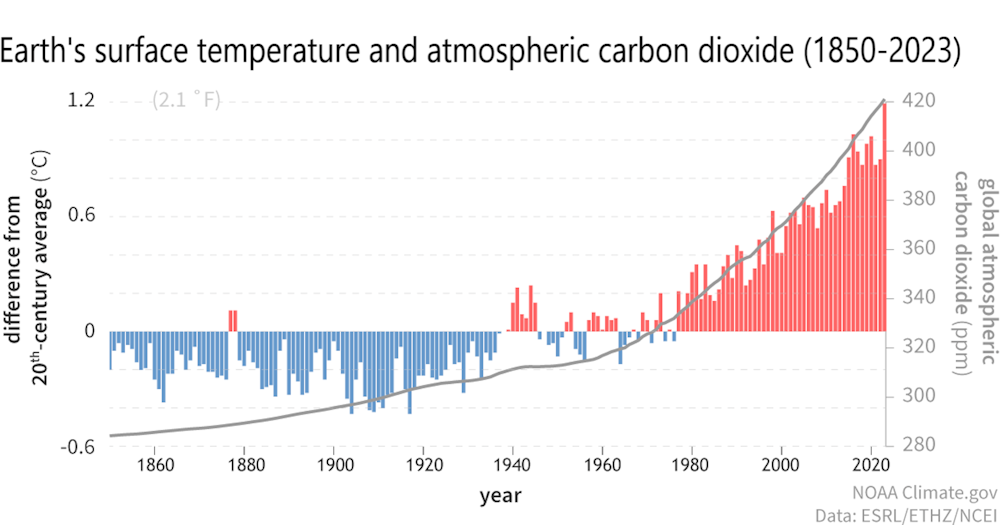
In the 1970s, painstaking laboratory work on the Camp Century ice core extracted minuscule amounts of ancient air trapped in tiny bubbles in the ice. Analyses of that gas revealed that levels of carbon dioxide in the atmosphere were lower for tens of thousands of years before the industrial revolution. After 1850, carbon dioxide levels crept up slowly at first and then rapidly accelerated. It was direct evidence that people’s actions, including burning coal and oil, were changing the composition of the atmosphere.
Since 1850, carbon dioxide levels in the atmosphere have spiked and global temperatures have warmed by more than 2.5 degrees Fahrenheit (1.3 Celsius). The past 10 years have been the hottest since recordkeeping began, with 2024 now holding the record. Climate change is now affecting the entire Earth – but most especially the Arctic, which is warming several times faster than the rest of the planet.
Since 1850, global average temperature and carbon dioxide concentrations in the atmosphere have risen together, reflecting human emissions of greenhouse gases. Red bars indicate warmer years; blue bars indicate colder years. NOAA
A view of aircraft carriers docked at the sprawling Naval Station Norfolk show how much of the region is within a few feet of sea level. Stocktrek Images via Getty Images
Consider Naval Station Norfolk. It’s the largest military port facility in the world and sits just above sea level on Virginia’s Atlantic coast. Sea level there rose more than 1.5 feet in the last century, and it’s on track to rise that much again by 2050 as glaciers around the world melt and warming ocean water expands.
High tides already cause delays in repair work, and major storms and their storm surges have damaged expensive equipment. The Navy has built sea walls and worked to restore coastal dunes and marshlands to protect its Virginia properties, but the risks continue to increase.
Planning for the future, the Navy incorporates scientists’ projections of sea level rise and increasing hurricane strength to design more resilient facilities. By adapting to climate change, the U.S. Navy will avoid the fate of another famous marine power: the Norse, forced to abandon their flooded Greenland settlements when sea level there rose about 600 years ago.
As the impacts of climate change grow in both frequency and magnitude, the costs of inaction are increasing. Most economists agree that it’s cheaper to act now than deal with the consequences. Yet, in the past 20 years, the political discourse around addressing the cause and effects of climate change has become increasingly politicized and partisan, stymieing effective action.
In my view, the military’s approach to problem-solving and threat reduction provides a model for civil society to address climate change in two ways: reducing carbon emissions and adapting to inevitable climate change impacts.
The U.S. military emits more planet warming carbon than Sweden and spent more than US$2 billion on energy in 2021. It accounts for more than 70% of energy used by the federal government.
Solar panels generate power on many U.S. military bases. This array at Joint Forces Training Base in Los Alamitos, Calif., generates enough power for more than 15,000 homes and has a backup battery system to provide power when the sun isn’t shining. Frederic J . Brown/AFP via Getty Images
As sea ice melts and Arctic temperatures rise, the polar region has again become a strategic priority. Russia and China are expanding Arctic shipping routes and eyeing critical mineral deposits as they become accessible. The military knows climate change affects national security, which is why it continues to take steps to address the threats a changing climate presents.
Paul Bierman receives funding from the US National Science Foundation, this work in part supported by grant EAR-2114629.
Source: The Conversation – USA – By Kate Coleman-Minahan, Associate Professor of Nursing, University of Colorado Anschutz Medical Campus
Since 2022, Colorado and 10 other states have passed voter initiatives to protect or expand abortion access. Yet, seven of these states, including Colorado, require people under the age of 18 to get consent from or notify a parent prior to receiving abortion services.
In January 2025, my colleagues and I published research using in-depth interviews with 33 people ages 15 to 22 in Colorado who considered or obtained abortion care between 2020 and 2023. Our study suggests that Colorado’s parental notification law delays young people’s access to abortion, complicates already complex family relationships, and forces unwanted disclosure of the pregnancy and abortion.
As a nurse, I have provided health care to young people and their families for more than two decades, and as a researcher, I have spent the past 10 years studying young people’s experiences with parental involvement laws.
Expanding abortion access, but not for adolescents
In the U.S., 38 states allow abortion services at some point in pregnancy. Of those,24 states have parental involvement laws. And of those, 12 states require young people to obtain consent from a parent or guardian; seven require young people to notify a parent or guardian; and five require both notification and consent. Three states – Kansas, Missouri and North Dakota – require involvement of both parents.
In 2024, Colorado passed a constitutional amendment that protects the right to abortion and allows funding through Medicaid. Yet, Colorado still requires parental notification for people under 18 to obtain abortion services. There have been no recent state-led efforts to remove this law.
We found that even in a state like Colorado that has expanded abortion access, the law creates barriers to services. It takes time for young people to learn the law exists and figure out how to comply with it. That’s true for both young people who can tell their parents and those who cannot. Delays due to parental involvement laws can increase the cost of abortion services, restrict adolescents’ choice of abortion methods and push adolescents past the gestational limit of the clinic or state.
For some Colorado young people, following the law resulted in unwanted disclosure of their pregnancy and abortion to parents and others, which is associated with negative mental health outcomes and exposes some young people to emotional or physical abuse.
Judicial bypass
In states that mandate parental involvement, young people who feel they cannot involve a parent can try to obtain a judicial bypass. The young person must go to court to prove to a judge that they are mature and well informed or that abortion without parental involvement is in their best interest.
Judicial bypass also delays access to abortion. For one participant in our Colorado study, the two- to three-week delay contributed to her inability to obtain her wanted abortion because it pushed her past the gestational limit of her chosen clinic.
Another participant thought the judicial bypass process would take too long, so she instead tried to end the pregnancy herself. She took vitamin C, which is not effective, and considered but did not take large doses of over-the-counter medications such as ibuprofen, which could have caused organ damage.
The delays and burdens of the judicial bypass process led some study participants’ parents to find out about the pregnancy. This unwanted disclosure breached the privacy that judicial bypass is meant to protect.
Policymakers in some states with abortion bans, such as Idaho, Tennessee and Mississippi, are trying to stop people from traveling out of state for services by targeting young people. These proposed laws would make it a crime to help a young person under 18 leave the state for abortion services without parental consent.
Colorado protects the right to abortion in its state constitution but still requires minors to notify a parent to get an abortion. The Washington Post/Contributor/GettyImages
Our research found that Colorado young people want their parents’ or guardians’ support when considering abortion, yet some felt it was not safe for them to ask for it.
Confirming prior research, we found a number of reasons young people felt unable to disclose their pregnancies to a parent. Those include fearing a parent’s reaction, feeling a parent would not respect their pregnancy decision, and not living with or not having a supportive relationship with a parent.
In addition to those reasons, young people also accurately predicted their parents’ reactions. Young people recounted emotional abuse and abandonment or feeling coerced into either continuing the pregnancy or having an abortion when a parent they did not feel they could tell found out about the pregnancy. Research, including our new study in Colorado, shows we can trust young people to decide who to involve in their pregnancy decision.
The views expressed here are her own and not those of the University of Colorado. Kate Coleman-Minahan receives funding from the Eunice Kennedy Shriver National Institute of Child Health and Human Development (NICHD) and the Society of Family Planning.
Green Rain Solar Partners with ChargeTronix for EV Charging Expansion Green Rain Solar, a subsidiary of The Now Corporation (OTC: NWPN), has secured a reseller agreement with ChargeTronix to distribute state-of-the-art EV charging stations across North America, advancing sustainable energy solutions.
Strategic Growth in Hospitality: EV Charging at Hilton Locations Green Rain Solar has identified 13 Hilton locations for EV charging installations, supporting Hilton’s sustainability initiatives while expanding its presence in the hospitality sector and urban EV infrastructure.
White-Label EV Charging Solutions for Businesses The partnership allows Green Rain Solar to offer white-labeled EV charging stations, enabling businesses to integrate branded, clean energy solutions that drive EV adoption and sustainable growth.
PASADENA, Calif., March 17, 2025 (GLOBE NEWSWIRE) — The Now Corporation’s (OTC: NWPN) wholly-owned subsidiary, Green Rain Solar Inc., has entered into a reseller agreement with ChargeTronix, Inc., a leading manufacturer and distributor of electric vehicle supply equipment (EVSE). This partnership positions Green Rain Solar to accelerate its impact in the renewable energy and electric vehicle (EV) sectors by providing advanced EV charging solutions under its white-label branding.
This agreement allows Green Rain Solar to resell ChargeTronix’s state-of-the-art EV charging stations across North America. Through this collaboration, Green Rain Solar strengthens its commitment to sustainable energy solutions, contributing to the growing adoption of EVs while enhancing the EV infrastructure in urban markets.
As part of this partnership, Green Rain Solar has already identified 13 Hilton locations as ideal candidates for EV charging station installations, further expanding its presence in the hospitality sector. These installations will play a key role in supporting Hilton’s sustainability initiatives and providing convenience for EV drivers.
Alfredo Papadakis, CEO of The Now Corporation, commented: “This partnership with ChargeTronix aligns perfectly with our mission to transform urban energy infrastructure. By integrating EV charging into our renewable energy solutions, Green Rain Solar is setting a new standard for innovation and sustainability.”
This agreement also enables Green Rain Solar to offer customized, white-labeled EV charging solutions, allowing businesses to showcase their own branding while promoting clean energy initiatives.
With the addition of 13 new Hilton locations and the strategic capabilities offered by ChargeTronix’s advanced technology, Green Rain Solar is poised to revolutionize the EV charging landscape, further cementing its position as a leader in urban renewable energy solutions.
About The Now Corporation (OTC: NWPN):
The Now Corporation is a diversified holding company focused on acquiring and developing innovative technologies and sustainable solutions. Through its subsidiaries, the company is committed to driving positive change in industries such as renewable energy, electric mobility, and advanced manufacturing.
About Green Rain Solar Inc.:
Green Rain Solar Inc., a subsidiary of The Now Corporation, specializes in the design, installation, and maintenance of solar energy systems and EV charging infrastructure. With a focus on sustainability and innovation, Green Rain Solar is dedicated to helping businesses and communities transition to clean energy.
This press release contains forward-looking statements under the meaning of Section 27A of the Securities Act of 1933 and Section 21E of the Securities Exchange Act of 1934. These statements may include expectations for future events, financial results, and growth prospects, subject to risks and uncertainties. The Now Corporation undertakes no obligation to publicly update any forward-looking statements except as required by applicable laws.
The Centre for Health Protection today said it is investigating a cluster of acute gastroenteritis (AGE) symptoms among six secondary students who participated in an exchange tour to Xiamen last week.
The latest cluster involves 36 teachers and students from a Kwun Tong secondary school, who joined a Xiamen exchange tour between March 13 and 15.
On the second night of the tour, six students developed AGE symptoms – vomiting, diarrhoea and fever, from about 9pm to about 7am the next day. Five of them sought medical attention in Xiamen, and none required hospitalisation.
Preliminary epidemiological investigations revealed that all six students had not consumed any common food items other than the group meals, and had no other common exposure history in Hong Kong prior to their departure.
Hence, at this stage, the centre could not rule out the possibility that the cases were infected by consuming contaminated food.
It has notified the Mainland health authority of the epidemiological investigations and information about the restaurants concerned, in addition to collecting stool specimens from the patients for laboratory testing and notifying the Education Bureau of its assessment of the new cases.
The centre also gave an update of the three clusters of students participating in exchange tours to Shaoguan who developed gastroenteritis symptoms earlier.
Its follow-up investigation found that three more students developed gastroenteritis symptoms on March 7 and 9 respectively, bringing the total number of affected people to 55 teachers and students.
Among them, 16 have sought medical attention, and three have tested positive for norovirus. The centre will continue to work closely with the Guangdong authority and take necessary follow-up action.
In view of the recent high activity of norovirus, the centre has issued a letter to all schools in Hong Kong to provide health advice on the transmission, prevention and infection control of AGE.
It also organised an online meeting for the bureau and the exchange tours service contractors last week to provide health advice on the prevention of communicable diseases and food safety during trips.
Apart from the Mainland, there have been recent outbreaks of AGE in other popular travel destinations for Hong Kong citizens, such as Japan, Singapore, and Taiwan.
The centre reminds members of the public to remain vigilant and maintain personal, environmental and food hygiene at all times to minimise the risk of being infected while travelling.
Visit the centre’s website for information on viral gastroenteritis.
Beira (Agenzia Fides) – “Since its founding in 1995, the Catholic University of Mozambique (UCM) has responded to educational challenges with seriousness and innovation, with the firm desire to educate citizens of integrity,” said the Rector, Fr. Filipe Sungo. “We seek not only well-prepared and qualified professionals in their field, but also leaders committed to the common good.”Three decades of history have enabled the UCM to realize an educational project that today stands out at the national level for its academic rigor, innovation, internationalization, and, last but not least, its human value. This is affirmed by the medical aid organization “Doctors with Africa Cuamm,” which carries out numerous initiatives in collaboration with the university and was represented at the opening event of the academic year on Friday, March 14, in Beira by its director, Don Dante Carraro, accompanied by Professor Alberto Mantovani, internationally renowned immunologist and scientific director of “Humanitas,” as well as other priests and supporters from the Diocese of Padua.”An institution closely linked to the community,” is how Don Dante defines the UCM, emphasizing that science, research and expertise must not forget to serve the poorest and most vulnerable. “The future begins right here, where knowledge is built and shared,” said Professor Mantovani, who has been a visiting professor in Beira several times over the years.”The university is certainly a place where science is cultivated with seriousness, but it is also a place where hearts and minds are formed not only for academic excellence but also for generous service to humanity,” said Bishop Claudio Dalla Zuanna of Beira, who attended the ceremony, echoing the words of Pope Francis. “The university must not be a self-contained ivory tower, but must be able to listen to society, accept challenges, and provide answers.”The UCM is now the country’s second university campus, located about 1,500 km from the capital, Maputo. A few years after its founding, the Faculty of Medicine of the Catholic University of Mozambique was opened, not least at the urging of “Doctors with Africa Cuamm” and thanks to decades of collaboration between the aid organization and the city’s health authorities. Since the first courses in anatomy, surgery, and internal medicine, launched by CUAMM physicians in 2004, the commitment to the UCM Medical School has never stopped, but has actually grown over time. On August 25, 2007, the first aspiring doctors graduated in Beira. “A historic date for the entire country,” as the university’s rector, Father Alberto Ferreira, called it. They were the first students to be trained outside the capital, Maputo, in the north-central part of the country, where there was barely one doctor per 100,000 inhabitants (see Fides, 8/10/2009). (AP) (Agenzia Fides, 17/3/2025)
Cuamm
Following the emergence of mpox subclade Ib in the Democratic Republic of the Congo in September 2023, the World Health Organization declared mpox a Public Health Emergency of International Concern (PHEIC).
Following the first allocation round in November 2024, where the Access and Allocation Mechanism (AAM) allocated 899 000 vaccine doses to nine African countries, the AAM has allocated an additional 238 000 doses during a second allocation round. These doses will benefit four countries severely affected by the mpox surge: Angola, Guinea, Sierra Leone and Uganda. These countries are in the process of accepting the doses, and shipment arrangements are underway. These vaccines are vital in reducing transmission and containing outbreaks of mpox.
The work of the AAM, which is a collaboration of Africa Centres for Disease Control and Prevention; the Coalition for Epidemic Preparedness Innovations; Gavi, the Vaccine Alliance; UNICEF and WHO, highlights the importance of international coordination in addressing public health emergencies. By working together, countries and organizations can ensure that medical countermeasures reach those most in need, ultimately saving lives and preventing further spread of the disease. This second allocation of mpox vaccines marks a significant step towards a coordinated and targeted response to the ongoing health crisis.
Teams of undergraduates proved their mettle and creativity as they left their mark on the annual HackUConn event, held this year over the course of a weekend that ended earlier this month.
Billed as “Universities of Tomorrow,” the annual hackathon offered students a chance to apply their own solutions to issues in modern academia. The teams had 20 hours to apply their own ingenuity and talents and apply advanced technology, such as laser cutters and 3D printers, to accomplish their tasks.
The winning teams of the 2025 HackUConn “Universities of Tomorrow” challenge. Photo contributed by Aaron Rosman.
Additionally, the teams received mentorship from staff of the Werth Institute for Entrepreneurship and Innovation, several departments on campus, as well as UConn’s Technology Commercialization Services (TCS). The latter is the technology transfer and entrepreneurship wing of the Office of the Vice President for Research.
The competition took place in the Werth Residence Tower in UConn’s Hilltop residence hall complex. About 75 students took part in the event, which included guest speakers and invaluable opportunities for the teams to interact with industry professionals.
Aaron Rosman ’16 (CAHNR) ’21 MBA , the Werth Institute’s operation manager and fiscal officer, worked with the Institute’s students to plan and implement the competition. Their approach was simple: pose challenges based on the issues and realities impacting UConn undergraduates. From there, teams build on the talents and skills of the individual members, including first-time participants as well as experienced hackers.
“Our biggest goal is that this an event for students by students,” says Rosman. “The student planning team can learn everything from how to get funding from sponsors to logistically planning an event. We try to provide students with as many skills as possible. They choose the theme every year, and no two years are alike.”
“Universities of Tomorrow” focused on three categories that the teams could explore:
Curriculum and career – how students can apply what they learn to the workforce, such as skills gained from the Academic Achievement Center and the Center for Career Readiness and Life Skills
Quality of life and stress relief – working with the Student Recreation Center and Student Health and Wellness to establish healthy work-life balance
Systems and services – How to maximize and improve student experience in offices such as the Registrar, Financial Aid, and the Bursar.
The 20 hours the teams were allotted were filled with more than just work amongst their partners. They received orientation, were offered mentorship, and listened to a keynote address from Abhijit Banerjee, UConn’s Associate Vice President for Research, Innovation and Entrepreneurship.
“The students taking part in events like HackUConn are the inventors and entrepreneurs of the future,” Banerjee says. “The skills they demonstrate – including critical thinking and ability to adapt to challenges – are exactly what they will require in their future career endeavors. We are pleased to work with the Werth Institute to provide a forum for UConn students to apply their talents.”
TCS experts also helped serve as judges for the different projects. Rosman credited TCS as an excellent bridge between UConn and the market economy, mirroring the purpose of the Werth Institute.
HackUConn originated in 2016 as a small hackathon event designed for students focused on technology. The criteria eventually expanded to include undergraduates across a myriad of majors and programs.
“The quality of this year was absolutely amazing,” Rosman says. “Based on the feedback I received from mentors, judges, and competitors, the quality of interactions between all three parties were genuinely exciting. I had students telling me how much they learned from judges, and vice versa! It goes to show you, when you bring different parts of a university together, there is so much to be gained. The connections made here will last a lifetime.”
The following are the winners of the respective categories:
Nearly five years after opening as a specialty pharmacy, UConn Health Pharmacy Services Inc. is establishing itself as a competitive option in the retail pharmacy market.
Most retail medications are available there, in addition to specialty drugs. Nearly all insurance plans are accepted, including Caremark, which is part of the state employee benefit package.
Prescriptions filled by UConn Health Pharmacy Services Inc. (UHPSI) are available for pickup weekdays from 8 a.m. to 5:30 p.m. at Building One of the Exchange, 270 Farmington Ave., which is across the street from UConn Health’s main campus. Shipping to the home is also an option with most medications.
“We’re an accredited pharmacy, which sets us apart from other retail,” says Dr. Hetal Patel, the pharmacy manager.
“The accreditation standards we maintain ensure every patient has access to the pharmacy professionals at UConn Health,” says Pharmacy Director Emmett Sullivan, ’93 (PHARM). “Our team treats every patient as individual and will help them with their specific needs. This best summarized as UHPSI providing exceptional service and care.”
Dr. Hetal Patel (left) is pharmacy manager and Emmett Sullivan (right) is pharmacy director at UConn Health Pharmacy Services Inc., located in Building 1 of the Exchange, 270 Farmington Ave., across the street from UConn Health’s main campus in Farmington. (Tina Encarnacion/UConn Health photo)
Another accreditation standard is responsiveness to callers.
“We have an 11-second turnaround time and 99.9% patient satisfaction when it comes to answering our phones,” Patel says.
“If there was a question that a patient had about any medication they’re getting filled in the community, they can call us and talk to the UConn Health pharmacist and see how we can service them,” Sullivan says. “Because there are questions that come up, and we have pharmacists here who can answer those questions.”
UConn Health Pharmacy Services Inc. opened in 2020 as a specialty pharmacy with a staff of three, no insurance contracts, and little inventory. In recent years, patients who were going there for specialty drugs started filling their traditional prescriptions there too.
“From 2021 to today, we’ve increased our volume by about 500%,” Sullivan says. “Over the course of time, we realized there was a greater need for traditional retail prescriptions, especially as we’ve heard the pains people have been suffering at retail pharmacies, whether it’s a decrease in hours or closings. We want to make sure we’re here to help the people of our community and extend as much access as we possibly can.”
“The growth of UHPSI is a true reflection of the vision of UConn Health leadership five-plus years ago and the pharmacy team in place since and now,” says Kevin Chamberlin ’01 (PHARM), ’03 Pharm.D., associate vice president and chief pharmacy officer. “Their investment in the business model and patient-first approach has led the trajectory of success being realized today.”
Although the Caremark prescription plan is associated with CVS, members are not limited to CVS for their prescriptions and they still would be in-network if they filled their prescriptions at UConn Health Pharmacy Services Inc.
Switching from CVS or any other retail pharmacy starts with simple a phone call to UConn Health Pharmacy Services Inc. at 860-676-4036 or toll free 833-777-4276.
“We would call the pharmacy for a transfer, and we’ll get the provider to make sure your therapy is current, and get the meds transferred over,” Sullivan says.
“You would give us a call when you’re ready to have it refilled,” Patel adds. “You will be in charge of your own therapy, compared to a retail pharmacy calling you six weeks in advance before you even need the medication.”
UConn Health Pharmacy Services Inc. is an option available in the patient portal of UConn Health’s electronic health record (not to be confused with the UConn Health Infusion Pharmacy). (Imaged from MyChart in UConn Health’s Epic electronic health record)
And the out-of-pocket expenses are comparable if not favorable.
“It may be the same, and if not, we’re going to look at if there’s a co-pay program from the manufacturer that may even make it lower for you,” Sullivan says. “We do that on a quite regular basis.”
UConn Health Pharmacy Services Inc. is an option in UConn Health’s electronic health record system, Epic. Patients using the corresponding patient portal, MyChart, can select it through the “Manage My Pharmacies” option on the “Medications” page, noting that “UConn Health Infusion Pharmacy” is also a choice. Those seeking to fill traditional retail prescriptions should be sure to choose “UConn Health Pharmacy Services.”
Learn more about UConn Health Pharmacy Services Inc.
Liverpool’s award-winning Stanley Park Market is set to return for a second straight year later this month.
Launching on Wednesday 19 March, the weekly market will run between 9am and 3pm until mid-December.
Its return is closely followed by the spring edition of St George’s Hall Artisan Market, which takes place four days later.
Stanley Park Market’s inaugural year saw the market double in size from its initial 50 stalls.
Its growing success was celebrated at this year’s Great British Market Awards, where it took home the title of Best Community Market.
The market will be held every Wednesday, except when there are evening football matches or concerts held at Goodison Park or Anfield Stadium, as the site is reserved for those events.
Each week, there will be up to 100 stalls selling items including fresh local produce, clothing, homeware, toys, and more. Visitors can also choose from lots of hot food and drink stalls, with plenty of seating available.
Throughout the year, the market will host a variety of community groups and other local organisations to support people with their health and wellbeing. Last year this included special set ups by Everton in the Community and social care initiatives.
Continuing the theme of local craft being on show, Sunday 23 March sees the return of an artisan market at the Grade 1 listed St George’s Hall. The free market launched last year and has already attracted thousands of visitors.
Taking place between 10am and 4.30pm, people will be able to browse almost 70 stalls, offering the likes of homemade jewellery, artwork, artisan chocolate, and specialist drinks. The market will also be home to several hot street food vendors and live music performances throughout the day.
Liverpool is home to a many beloved markets, from the weekly Great Homer Street Market (Greatie Market) to a regular programme of farmers and craft markets. For a full list of dates and locations, visit the Council’s markets webpage.
Councillor Harry Doyle, Liverpool City Council’s Cabinet Member for Culture, Health and Wellbeing, said: “Stanley Park Market exceeded our expectations last year and I can’t wait to see what it brings in 2025. Having it and the St George’s artisan market return this year just goes to show how popular and highly successful these community-driven events have been.
“Liverpool is known for its collective spirit and there’s no better place to witness it than in any one of our incredible markets. They’re a fantastic way to connect neighbourhoods and support our local businesses and community groups.
“There are loads of markets happening all through the year, and I encourage everyone to head down to one local to you and see what you can find.”
Louise Pritchard, owner of Just Bee Gorgeous said: “I am really looking forward to taking my stall ‘Just Bee Gorgeous’ to both Stanley Park and St George’s Hall, once again this year.
“Last year Stanley Park market had a fantastic community feel to it, because it was a place where people could meet up with their neighbours, family and friends, do a spot of shopping and also have a bite to eat, choosing from the impressive and reasonably-priced food options available.
“St George’s Hall artisan market is held less frequently (roughly every quarter) but WOW is it worth the wait, because what a backdrop! Everyone is impressed by the stunning surroundings, and it is just the perfect venue to host an artisan market, where there is such a wealth of talent on display. What a great way for small businesses to showcase their work.
“It is crucial to support your local small businesses because they are the life-blood of all communities. Your custom means so much more to a small business owner than to a giant multi-national corporation and could be the difference between being able or being unable to afford a sports kit for a child, fund medical expenses or even just pay for a short break for the family. Apart from the financial aspect, you are supporting someone’s dream which is fantastic.”
Source: Hong Kong Government special administrative region
The following is issued on behalf of the Working Family and Student Financial Assistance Agency:
The 38th Awards Presentation Ceremony of the Sir Edward Youde Memorial Fund (SEYMF) was held at Hong Kong City Hall today (March 16). Nine hundred and fifty-eight students, four apprentices and five working adults were presented with scholarships and awards.
Officiating at the ceremony were the Chairman of the SEYMF Council, Mr Ma Ching-cheng, the Chairman of the Board of Trustees, Ms Kwan Sau-ha, and other members of the Council and the Board of Trustees.
In Lady Youde’s message for the ceremony, she remarked, “The Fund has already disbursed more than $269 million. Over 880 000 students have received our awards or joined our sponsored activities. It has been a privilege to see how the Fund has made it possible for our young people, as well as more mature working adults, to take on new challenges and fulfil their ambitions.”
In the 2024/25 academic year, the Fund disbursed $2.94 million. The awards presented this year included one fellowship award for overseas studies ($300,000); one overseas fellowship for a disabled student ($300,000); three fellowships for local postgraduate students ($50,000 each); six scholarships for local undergraduate students ($40,000 each); one local scholarship for a disabled undergraduate student ($40,000); six medals for students who achieved outstanding results in the Hong Kong Diploma of Secondary Education (HKDSE) Examination ($5,000 each); 928 prizes for senior secondary school students and 12 prizes for students of the Vocational Training Council ($1,000 each); four awards for outstanding apprentices ($5,000 each); and five awards for working adults who underwent retraining and successfully applied what they learned in their new positions ($5,000 each).
Competition for overseas fellowships and scholarships for the 2025/26 academic year was extremely keen. Among 187 applicants, Miss Suen Tsz-ching was selected as the awardee of the overseas fellowship. She is currently a judicial assistant at the Hong Kong Court of Final Appeal and intends to pursue a Master of Laws degree at Harvard University in the United States.
The recipient of the 2025/26 overseas fellowship for disabled students is Miss Poon Sze-ling of the Chinese University of Hong Kong. She intends to pursue a Master’s degree in Linguistics at the University of Edinburgh in the United Kingdom.
The six students who were awarded the Sir Edward Youde Memorial Medals for outstanding results in the 2024 HKDSE Examination are:
(1) Mr Wong Shue-hei of St Paul’s Co-Educational College;
(2) Mr Liu Chun-cheung Ander of St Joseph’s College;
(3) Miss Leung Ying-hin of TWGHs Wong Fut Nam College;
(4) Mr Choy Ching-hei of Queen’s College;
(5) Mr Chan Hei-ching of Baptist Lui Ming Choi Secondary School; and
(6) Miss Ho Nga-chi of Diocesan Girls’ School.
​The four apprentices, nominated by the Director of Apprenticeship, who received the Outstanding Apprentice Awards are:
(1) Miss Chung Hiu-ying, who attained a Diploma of Vocational Education – Earn and Learn Scheme (Electrical Engineering) and is currently a technician II;
(2) Mr Wong Chi-wai, who attained a Higher Diploma in Computer and Electronic Engineering and is currently a technician;
(3) Mr Wong Wai-cheung, who attained a Higher Diploma in Building Services Engineering and is currently an assistant electrical and mechanical engineer; and
(4) Mr Yung Tsz-hung, who attained a Certificate of Vocational Education (Electrical Engineering) and is currently an assistant technician.
​The five working adults, nominated by the Employees Retraining Board and the Construction Industry Council, who received the Awards for Self-Improvement for Working Adults are:
(1) Mr Chan Kwok-fai, who completed a Certificate in Health Worker Training and is currently a night-shift dormitory assistant;
(2) Mr Lee Chi-ho, who completed a Certificate in Site Surveying and is currently an assistant surveyor;
(3) Mr Poon Yuk-pui, who completed a Foundation Certificate in Exhibition Booth Setting and Decoration and is currently a leveller;
(4) Mr Tse Chi-wing, who completed a Foundation Certificate in Electrical Generator Technician Trainee Training (Tailor-Made Course) and is currently a generation trainee; and
(5) Ms Tsoi Mei-shuen, who completed a Foundation Certificate in Physical Fitness Instructor Training (Physical Fitness Foundation Certification Open Examination) and is currently the founder and chief executive officer of a cross-curriculum physical fitness social enterprise.
Since its inception, the SEYMF has supported around 31 500 Hong Kong students under its major schemes. Over 2 890 scholars and fellows have completed their studies and are now working in different sectors in Hong Kong, contributing to the well-being and development of society.
In 2024/25, the Fund continued to provide an annual sponsorship of $600,000 towards the Young Friends of the Hong Kong Arts Festival to increase the exposure of secondary school and tertiary students to performing arts. During the year, around 4 200 students became members of the Young Friends, and around 11 000 students participated in various programmes and activities under this scheme.
The 14thmeeting of ASEAN Defence Ministers’ Meeting-Plus (ADMM-Plus) Experts Working Group (EWG) on Counter-Terrorism will be held in New Delhi from March 19 to 20, 2025. India and Malaysia will co-chair the ibid meeting. Delegations from 10 ASEAN members (Brunei, Cambodia, Indonesia, Lao PDR, Malaysia, Myanmar, Philippines, Vietnam, Singapore and Thailand) and eight dialogue partners (Australia, New Zealand, RoK, Japan, China, USA and Russia) along with Timor Leste and ASEAN Secretariat will be participating in the meeting.
India will co-chair the EWG on Counter-Terrorism for the first time. On March 19, 2025, Defence Secretary Shri Rajesh Kumar Singh will deliver the keynote address during the opening ceremony.
This will be the first meeting for activities planned for EWG on Counter-Terrorism for the ongoing cycle from 2024-2027. Discussions will focus on evolving a robust and comprehensive strategy designed to tackle the evolving threat of terrorism and extremism. The meeting aims to share the on-ground experience of the Defence Forces of ASEAN and its dialogue partners. It will lay the foundation for the activities/exercises/seminars/workshop planned for the cycle 2024-2027.
The ADMM-Plus serves as a platform for practical cooperation amongst the participating countries’ defence establishments. It currently focuses on seven areas of practical cooperation – Counter-Terrorism, Maritime Security, Humanitarian Assistance and Disaster Management, Peacekeeping Operations, Military Medicine, Humanitarian Mine Action and Cyber Security. EWGs have been established to facilitate cooperation in these areas.
The EWGs are each co-chaired by one ASEAN member state and one dialogue partner following a three-year cycle. The task of the co-chairs is to lay down the objectives, policy guidelines and directions for the EWG for the three-year cycle at the commencement of the chairmanship, conduct of regular EWG meetings (minimum two in a year) and an exercise of any form (Table-Top/Field Training/Staff/Communication etc.) for all member nations in the third year to test the progress made in practical cooperation during the three-year cycle.
Source: United Kingdom – Executive Government & Departments
World news story
British Embassy Zagreb invites bids for Impact Fund 2025 to 2026
British Embassy Zagreb invites organisations to submit proposals by 14 April 2025 for projects demonstrating impact in areas of strengthening inter-community relations in Southeast Europe.
The British Embassy in Zagreb is inviting organisations to submit project proposals for funding from our Impact Fund. As the name suggests, the purpose of the fund is to achieve impact, so we’re looking for projects that make a real difference in the highlighted priority areas. Project proposals which strengthen and nurture relationships between Croatian and UK people and organisations are particularly welcome.
Themes
This year, the call will focus on organisations, projects and activities, which link to the following thematic areas:
Regional stability and development: connecting and strengthening societies in Southeast Europe
Projects which promote harmonious and constructive relations between communities within Croatia, and between communities in Croatia and its neighbours, to enable stability, European integration and socio-economic advancement in the context of global and domestic challenges. We will prioritise projects in the following areas:
strengthening inter-community understanding, tolerance and constructive cooperation, both domestically and cross-border within Southeast Europe
defending against threats to inter-community relations in Southeast Europe, e.g. countering hate speech, historic distortion, and disinformation; supporting a healthy media landscape; and promoting factual, inclusive public discourse and narratives
empowering women and girls, enhancing female civic participation and equality, contributing to prosperity and security in the region
Special emphasis should be placed on activities which generate change, with wider and lasting social impact.
Innovation for growth: building and nurturing UK-Croatia research & innovation, science, technology, and business partnerships.
Projects which nurture long-term research & innovation, science, technology, and business partnerships, with a special emphasis on fostering economic growth and UK-Croatia cooperation. We will prioritise projects in the following areas:
establishing new partnerships between researchers, businesses and institutions in the UK and Croatia. In particular, large-scale UK-Croatia collaboration between researchers and organisations within Horizon Europe and other programmes (note: while we cannot directly fund research covered by these other programmes, but we can support establishing the research connections)
projects focused on policy and regulation, exchanging knowledge and best practice and other activities which promote and support research (this excludes direct funding) relating to AI, quantum technologies, high-performance computing, nuclear fusion, semiconductors, Health tech and engineering biology. Including values-based governance and regulation of new and emerging technologies, especially AI
building expertise on the commercialisation of innovation, connecting Croatian companies to venture capitals and tech ecosystems, and enabling the UK and Croatian business partnerships
addressing barriers to market access between the UK and Croatia (e.g. policy, implementation of regulations)
Energy and climate: promoting green growth and energy transition
Projects which promote green and sustainable growth, support the transition to clean energy sources such as offshore wind, hydrogen and nuclear, and deeper UK-Croatia cooperation. Also, projects that tackle the climate crisis and mitigate its impacts, as well as tackling and reversing bio-diversity loss will be considered for funding. We will prioritise projects in the following areas:
establishing UK-Croatia commercial and scientific partnerships in the development of net zero technologies, with focus on hydrogen and nuclear fission and fusion (e.g. joint initiatives, building partnerships within Horizon Europe, exchange programmes between the UK and Croatian institutions)
establishing UK-Croatia commercial and scientific partnerships in energy efficiency and storage, emission reduction, and accelerating to achieving net zero
establishing UK-Croatia commercial and scientific partnerships in tackling the climate crisis, mitigating its impacts by strengthening social, economic and ecological resilience, unlocking climate and nature finance
Activity bid guidance
The British Embassy will support projects with activities taking place between 20 June 2025 and 15 February 2026, with no expectation of continued funding beyond the stated period.
Maximum project budget limit: 11,500 Euros.
Project bids will be assessed against the following criteria:
alignment with thematic priorities and likelihood of achieving a real-world impact
outcomes that are achievable within the funding period and offer value for money
activity design that includes clear evaluation procedures and measures of impact
activity design that includes risk and financial accountability procedures
that the organisation’s safeguarding policies ensure protection of beneficiaries, especially vulnerable individuals and children
all proposals must be received by 12:00 pm on 14 April 2025. Late proposals will not be considered
successful bidders will be notified by the end of May
Transparency and further questions
The British Embassy in Zagreb will organise an online question and answer session about the bidding process on Wednesday 26 March 2025 at 2pm (CET). You can join the live session using this link.
Additional information and documentation
All project implementers will be expected to sign a standard contract or grant agreement with the Embassy provided by the UK Foreign, Commonwealth & Development Office (FCDO).
The terms of the contract or agreement are not negotiable.
All projects are expected to have achieved 85% spend by end of December 2025. Proposed budgets must reflect this requirement.
NEW YORK, March 17, 2025 (GLOBE NEWSWIRE) — Evome Medical Technologies Inc. (the “Company”) (TSXV: EVMT) announces the appointment of Michael Dalsin as Chairman of the Board of Directors. Kenneth Kashkin, MD will take the role of Vice-Chairman. Bill Garbarini will retain his role as COO while stepping off the Board of Directors. Chris Heath was also appointed as a new Director increasing the size of the Board of Directors from five to six.
Mr. Dalsin is best known in Canada as the former Chairman of Convalo Health International, Corp. (“Convalo”) and Patient Home Monitoring Corp. (“PHM”), which were both listed on the TSX Venture Exchange. After spinning off its VieMed business unit (now listed on Nasdaq), PHM uplisted to TSX and listed on Nasdaq under its new name Quipt Home Medical Corp. Mr. Heath was CEO of Convalo and was most recently the CEO of MedBright AI Investments Inc., a CSE listed issuer.
“I asked Michael Dalsin to step in as Chairman to help assess the opportunities in the fertility market,” said Dr. Kashkin. “This management team has deep contacts and knowledge in this market. Before joining Evome, our CEO, Mike Seckler, was global head of Marketing at Ferring Pharmaceuticals and Mr. Garbarini was COO at Conceivable Life Sciences, TMRW Life Sciences and Reproductive Medicine Associates of NJ. In each of their roles these two executives broke new ground and grew their businesses. The fertility market is quickly growing due to rising infertility rates caused by factors such as lifestyle changes and delayed childbearing. In addition, increasing awareness and acceptance of fertility treatments, along with advancements in reproductive technologies, are driving market growth.”
“I am grateful to Michael Dalsin, one of our biggest shareholders, for stepping into this leadership position,” said Mr. Seckler. “Bill and I are optimistic about finding additional opportunities in the fertility market. Michael’s experience in deal making will be invaluable in this effort.”
The Company and Mr. Dalsin plan to release a corporate update to the market before April 1, 2025.
Michael Dalsin Chairman Tel: 1 (800) 760-6826 Email: info@salonaglobal.com
Additional Information
Neither the TSX Venture Exchange nor its Regulation Services Provider (as that term is defined in the policies of the TSX Venture Exchange) accepts responsibility for the adequacy or accuracy of this release.
Certain statements contained in this press release constitute “forward-looking information” within the meaning of the Private Securities Litigation Reform Act of 1995 and applicable Canadian securities laws. These statements can be identified by the use of forward-looking terminology such as “expects”, “believes”, “estimates”, “may”, “would”, “could”, “should”, “potential”, “will”, “seek”, “intend”, “plan”, and “anticipate”, and similar expressions as they relate to the Company.All statements other than statements of historical fact may be forward-looking information. Such statements reflect the Company’s current views and intentions with respect to future events, and current information available to the Company, and are subject to certain risks, uncertainties and assumptions. The Company cautions that the forward-looking statements contained herein are qualified by important factors that could cause actual results to differ materially from those reflected by such statements. Such factors include but are not limited to the general business and economic conditions in the regions in which the Company operates; the ability of the Company to execute on key priorities, including the successful completion of acquisitions, business retention, and strategic plans and to attract, develop and retain key executives; difficulty integrating newly acquired businesses; ongoing or new disruptions in the supply chain, the extent and scope of such supply chain disruptions, and the timing or extent of the resolution or improvement of such disruptions; the ability to implement business strategies and pursue business opportunities; disruptions in or attacks (including cyber-attacks) on the Company’s information technology, internet, network access or other voice or data communications systems or services; the evolution of various types of fraud or other criminal behavior to which the Company is exposed; the failure of third parties to comply with their obligations to the Company or its affiliates; the impact of new and changes to, or application of, current laws and regulations; granting of permits and licenses in a highly regulated business; the overall difficult litigation environment, including in the United States; increased competition; changes in foreign currency rates; increased funding costs and market volatility due to market illiquidity and competition for funding; the availability of funds and resources to pursue operations; critical accounting estimates and changes to accounting standards, policies, and methods used by the Company; the occurrence of natural and unnatural catastrophic events and claims resulting from such events; as well as those risk factors discussed or referred to in the Company’s disclosure documents filed with United States Securities and Exchange Commission and available at www.sec.gov, and with the securities regulatory authorities in certain provinces of Canada and available at www.sedarplus.com. Should any factor affect the Company in an unexpected manner, or should assumptions underlying the forward-looking information prove incorrect, the actual results or events may differ materially from the results or events predicted. Any such forward-looking information is expressly qualified in its entirety by this cautionary statement. Moreover, the Company does not assume responsibility for the accuracy or completeness of such forward-looking information. The forward-looking information included in this press release is made as of the date of this press release and the Company undertakes no obligation to publicly update or revise any forward-looking information, other than as required by applicable law.
Union Minister of State for Health and Family Welfare, Smt. Anupriya Patel inaugurates QUAD Workshop on Pandemic Preparedness for Indo-Pacific Region The rise of emerging and re-emerging health threats in recent times underscores the critical necessity of strengthened preparedness, enhanced surveillance, and well-coordinated international response mechanisms to safeguard global health security: Smt. Anupriya Patel
“India has led Digital Health initiatives, leveraging technology to improve health access, outcomes, and create sustainable, data-driven systems”
“India’s digital disease surveillance system offers a valuable model for other countries seeking to strengthen their public health infrastructure”
“India, as a lighthouse country in digital health technologies, has been at the forefront of deliberations across various international forums”
There is a need for sharing of technologies for better surveillance, disease modelling and improve public health systems for better preparedness: Principal Scientific Advisor to Govt. of India
By leveraging India’s vast vaccine production capacity, the United States’ cutting-edge research, Japan’s technological expertise, and Australia’s strong regional engagement, the Quad has emerged as a force for health security in the Indo-Pacific and beyond: Union Health Secretary
Posted On: 17 MAR 2025 11:44AM by PIB Delhi
Union Minister of State for Health and Family Welfare, Smt. Anupriya Singh Patel inaugurated the QUAD Workshop on Pandemic Preparedness for Indo-Pacific Region, here today.
The purpose of the 3-day workshop, jointly organised by the Ministry of Health and Family Welfare and the Ministry of External Affairs, is to strengthen global health emergency frameworks, enhancing preparedness and resilience to health threats, and ensure coordinated responses to evolving pandemics as well as the implementation of One Health approach, addressing human, animal, and environmental health through a multisectoral lens.
Addressing the gathering, Smt. Patel said that “the rise of emerging and re-emerging health threats in recent times underscores the critical necessity of strengthened preparedness, enhanced surveillance, and well-coordinated international response mechanisms to safeguard global health security.”
Highlighting India’s commitment to strengthening global pandemic preparedness and response efforts, Smt. Patel informed that “India has contributed USD 10 million towards the establishment of the Pandemic Fund which was specially conceptualized for fighting pandemics”. “India has further pledged an additional USD 12 million to support its sustained functioning”, she added.
Smt. Patel stated that India has led Digital Health initiatives, leveraging technology to improve health access, outcomes, and create sustainable, data-driven systems. These efforts are central to building a health system capable of addressing both current as well as future health and climate challenges. She added that towards the vision of creating and stabilizing a resilient and pandemic-ready healthcare system, India has established a comprehensive health emergency coordination framework, strategically focused on preparedness, response, and resilience-building through setting up several key initiatives within the healthcare system such as Integrated Disease Surveillance Program (IDSP), National One Health Program for Prevention and Control of Zoonosis and National Vector Borne Disease Control and Prevention (NVBDCP), among others.
The Union Minister highlighted that India’s harnessing of digital technology in healthcare through initiatives like the Ayushman Bharat Digital Mission (ABDM) and tools like the CoWIN platform, eSanjeevani, National Telemedicine Service, Tele-MANAS to manage mental health diseases, and the Ni-Kshay portal for tracking monitoring and management of Tuberculosis patients. “Our robust digital disease surveillance system offers a valuable model for other countries seeking to strengthen their public health infrastructure”, she added.
Smt. Patel stated that India, as a lighthouse country in digital health technologies, has been at the forefront of deliberations across various international forums. “India is keen to share our Digital Public Infrastructures (DPIs) with the global community, especially with our friends in the Global South to enable modern healthcare approaches. We are also willing to offer courses and capacity building trainings in partnership with our MEA in identified areas of interest in the health sector” she further stated.
She concluded her address by emphasizing the importance of unity and collaboration in health initiatives to ensure “a safer and healthier future for all”.
Prof. Ajay Kumar Sood, Principal Scientific Advisor to the Government of India, highlighted the efforts being taken to integrate health services in India. He stated that this workshop presents a unique approach to address health challenges collaboratively with like-minded partner countries.
He emphasized the need to strengthen regional health networks and prepare for zoonotic diseases, especially for countries with a significant livestock sector. He stressed on sharing of technologies for better surveillance, disease modelling and improve public health systems for better preparedness. He also highlighted the need for more engagement among students and scientific community for fostering innovation.
Smt. Punya Salila Srivastava, Union Health Secretary stated that “this workshop is a valuable opportunity to exchange knowledge, best practices and most importantly strengthen health systems in the Indo-Pacific region by putting people at the centre of preparedness and equiping them to respond effectively to future healthcare crisis.” She highlighted that “by leveraging India’s vast vaccine production capacity, the United States’ cutting-edge research, Japan’s technological expertise, and Australia’s strong regional engagement, the Quad has emerged as a force for health security in the Indo-Pacific and beyond.”
The Union Health Secretary noted that pandemics necessitate prompt, urgent and sustained stewardship, global solidarity, and multilateral cooperation. Aligning with this, she advocated for strengthening pandemic preparedness capacity at all levels and extended India’s steadfast support to any such initiative.
Background:
India is hosting the Quad Workshop on Pandemic Preparedness for the Indo-Pacific Region from March 17-19, 2025. This workshop is a direct outcome of the 6th Quad Leaders’ Summit held in September 2024, during which the Quad leaders, including Hon’ble Prime Minister of India, Shri Narendra Modi, committed to enhancing collaboration in health security and pandemic preparedness. The workshop is a crucial platform for collaborative discussions, mutual learning, and the exchange of best practices on pandemic preparedness and response among countries in the Indo-Pacific region.
Over the next three days, participating countries, including Quad partners, will be delivering presentations and sharing their distinctive pandemic preparedness experiences, challenges, and successes, with a focus on governance, surveillance, and technological innovations. They will also be engaging in group work and simulation exercises on pandemics like Avian Influenza, Mpox, and Ebola and refine response strategies, emphasizing timely decision-making and cross-border coordination for future health emergencies.
A field visit to India’s National Centre for Disease Control (NCDC) and the National Centre for Vector-Borne Disease Control is part of the program. Participants are set to gain first-hand insight into India’s public health infrastructure, surveillance systems, and emergency response capabilities while highlighting India’s efforts to enhance pandemic preparedness and resilience and showcasing advanced practices in disease control and public health management.
The Quad Workshop on Pandemic Preparedness is a critical milestone in building a more robust, coordinated global health security framework, ensuring that nations are better equipped to face future public health challenges with resilience and unity.
Smt. Hekali Zhimomi, Addl. Secretary, Ministry of Health and Family Welfare; Shri K Nagaraj Naidu, Addl. Secretary (Americas), Ministry of External Affairs; Dr Roderico H. Ofrin, WHO Representative to India; Senior health officials and technical experts from the Quad nations—India, the United States, Japan, and Australia—along with 36 delegates from 15 countries across the Indo-Pacific region and international health organizations, participated in the workshop.
****
MV
HFW/MoS Inauguration of QUAD Workshop/17March2025/1
Source: Hong Kong Government special administrative region
New Director-General of Hong Kong Economic and Trade Office, London, assumes office (with photo) Miss Chau said, “I am honoured to take up this position and look forward to working with our partners from different sectors to promote the core strengths, the international competitiveness, the vast business potential and the cultural diversity of Hong Kong, with a view to strengthening the economic, commercial and cultural ties between Hong Kong and the nine countries under the purview of the office.”
Miss Chau joined the Government in 1989. She served in the Trade Officer Grade before joining the Administrative Service in 2014. She has served in various bureaux and departments, including the Trade and Industry Department, the HKETO in Washington DC, the Office of the Government of the Hong Kong Special Administrative Region in Beijing, the Financial Services and the Treasury Bureau, the former Food and Health Bureau and the HKETO in Brussels. Before assuming the post of the Director-General of the HKETO in London, Miss Chau was the Principal Assistant Secretary in the Development Bureau, overseeing the urban renewal policies. Issued at HKT 10:30
The Prime Minister Shri Narendra Modi interacted with Lex Fridman in a podcast about various topics today. In a candid conversation, when asked about why he fasts and how he manages, the Prime Minister expressed gratitude to Lex Fridman for his gesture of fasting as a mark of respect for the PM. “In India, religious traditions are deeply intertwined with daily life”, said Shri Modi, adding that Hinduism is not merely about rituals but a philosophy guiding life, as interpreted by the Honorable Supreme Court of India. He emphasized that fasting is a tool for cultivating discipline and balancing the inner and outer self. The Prime Minister noted that fasting heightens the senses, making them more sensitive and aware. He observed that during fasting, one can perceive even subtle aromas and details more vividly. He also highlighted that fasting accelerates the thinking process, providing fresh perspectives and encouraging out-of-the-box thinking. Shri Modi clarified that fasting is not just about abstaining from food; it involves a scientific process of preparation and detoxification. He emphasized that he prepares his body for fasting by following Ayurvedic and yoga practices for several days beforehand and stressed the importance of hydration during this period. Once fasting begins, he views it as an act of devotion and self-discipline, allowing for deep introspection and focus. The Prime Minister shared that his practice of fasting originated from personal experience, starting with a movement inspired by Mahatma Gandhi during his school days. He felt a surge of energy and awareness during his first fast, which convinced him of its transformative power. He highlighted that fasting does not slow him down; instead, it often increases his productivity. He noted that during fasting, his thoughts flow more freely and creatively, making it an incredible experience for expressing himself.
On being asked how he carried out his role as a leader on the world stage, all fasted, and sometimes nine days, Shri Modi highlighted the ancient Indian tradition of Chaturmas, observed during the monsoon season when digestion naturally slows. He remarked that during this period, many Indians follow the practice of consuming only one meal a day. For him, this tradition begins around mid-June and continues until after Diwali in November, spanning four to four and a half months. He added that during the Navratri Festival in September or October, which celebrates strength, devotion, and spiritual discipline, he completely abstains from food and consumes only hot water for nine days. He further shared that during the Chaitra Navratri in March or April, he follows a unique fasting practice by consuming only one specific fruit once a day for nine days. For instance, if he chooses papaya, he eats only papaya throughout the fasting period. He emphasized that these fasting practices are deeply ingrained in his life and have been followed consistently for 50 to 55 years.
The Prime Minister remarked that his fasting practices were initially personal and not publicly known. However, they became more widely recognized after he became Chief Minister and Prime Minister, he added noting that he does not mind sharing his experiences now, as they might be beneficial to others, aligning with his life’s dedication to the well-being of others. He also shared an instance during a bilateral meeting at the White House with former President of USA, Mr. Barack Obama when he was fasting.
On being asked about his early life, the Prime Minister reflected on his birthplace, Vadnagar, Mehsana district in North Gujarat, highlighting its rich historical significance. He noted that Vadnagar was a major center for Buddhist learning, attracting figures like the Chinese philosopher Hiuen Tsang. He mentioned that the town was also a prominent Buddhist educational hub around the 1400s, highlighting that his village had a unique environment where Buddhist, Jain, and Hindu traditions co-existed harmoniously. He emphasized that history was not confined to books, as every stone and wall in Vadnagar told a story. During his tenure as Chief Minister, he initiated large-scale excavation projects that uncovered evidence dating back 2,800 years, proving the city’s continuous existence. Shri Modi remarked that these findings have led to the establishment of an international-level museum in Vadnagar, which is now a major area of study, especially for archaeology students. He expressed gratitude for being born in such a historically significant place, seeing it as his good fortune. The Prime Minister also shared aspects of his childhood, describing his family’s life in a small house without windows, where he grew up in extreme poverty. However, he added that they never felt the burden of poverty, as they had no basis for comparison. His father was disciplined and hardworking, known for his punctuality, he said. Shri Modi highlighted his mother’s hard work and her spirit of caring for others, which instilled in him a sense of empathy and service. He recalled how his mother would treat children with traditional remedies early in the morning, gathering them at their home, and emphasized that these experiences shaped his life and values. The Prime Minister noted that his journey into politics brought his humble beginnings to light, as media coverage during his oath-taking as Chief Minister revealed his background to the public. He expressed that his life’s experiences, whether seen as fortune or misfortune, have unfolded in a way that now informs his public life.
Shri Modi encouraged young people to remain patient and self-confident, emphasizing that challenges are part of life but should not define one’s purpose, when asked for his advice to the young people. He highlighted that difficulties are tests of endurance, meant to strengthen individuals rather than defeat them, adding that every crisis presents an opportunity for growth and improvement. The Prime Minister remarked that there are no shortcuts in life, using the analogy of railway station signs that warn against crossing tracks, stating, “Shortcut will cut you short.” He emphasized the importance of patience and perseverance in achieving success. He also stressed the need to pour one’s heart into every responsibility and live life with passion, finding fulfillment in the journey. Highlighting that abundance alone does not guarantee success, as even those with resources must continue to grow and contribute to society, the Prime Minister emphasized the importance of never stopping learning, as personal growth is essential throughout life. He shared his own experience of learning from interactions at his father’s tea shop, which taught him the value of continuous learning and self-improvement. He noted that many people set big targets and feel disappointed if they fall short. He advised focusing on doing something rather than just becoming something, as this mindset allows for continued determination and progress toward goals. He emphasized that true contentment comes from what one gives, rather than what one gets, and encouraged young people to cultivate a mindset centered on contribution and service.
On being asked about his journey in the Himalayas, Shri Modi reflected on his upbringing in a small town, where community life was central. He often visited the local library, finding inspiration in books about figures like Swami Vivekananda and Chhatrapati Shivaji Maharaj. This sparked a desire to shape his life similarly, leading him to experiment with his physical limits, such as sleeping outside in cold weather to test his endurance, he added. Highlighting the influence of Swami Vivekananda’s teachings, particularly a story where Vivekananda, despite needing help for his ill mother, could not bring himself to ask Goddess Kali for anything during meditation, an experience which instilled in Vivekananda a spirit of giving, Shri Modi said that this left an impression on him, stressing that true contentment comes from giving and serving others. He recalled an incident where he chose to stay behind and care for a saint during a family wedding, demonstrating his early inclination towards spiritual pursuits. He noted that seeing soldiers in his village inspired him to serve the nation, though he didn’t have a clear path at the time. The Prime Minister mentioned his deep longing to understand life’s meaning and his journey in exploring it. He highlighted his connection with saints like Swami Atmasthanandji, who guided him on the importance of serving society. He shared that during his time in the mission, he met remarkable saints who showered him with love and blessings. Shri Modi also spoke about his experiences in the Himalayas, where solitude and encounters with ascetics helped shape him and discover his inner strength. He emphasized the role of meditation, service, and devotion in his personal growth.
Sharing his experience with Swami Atmasthanandaji in Ramakrishna Mission which led him to a decision to live a life of service at every scale, Shri Modi said that while others may view him as the Prime Minister or Chief Minister, he remains deeply committed to spiritual principles, highlighting that his inner consistency is rooted in serving others, whether through helping his mother care for children, wandering in the Himalayas, or working from his current position of responsibility. The Prime Minister remarked that to him, there is no real difference between a saint and a leader, as both roles are guided by the same core values. He emphasized that while external aspects like attire and work may change, his dedication to service remains constant. He underlined that he carries out every responsibility with the same sense of calm, focus, and dedication.
Discussing about the impact that the Rashtriya Swayamsevak Sangh (RSS) has had on his early life, Prime Minister mentioned his childhood fascination with patriotic songs, particularly those sung by a man named Makoshi, who would visit his village with a tambourine. He said that these songs deeply touched him and played a role in his eventual involvement with RSS. He highlighted that the RSS instilled in him core values such as doing everything with a purpose, whether studying or exercising, to contribute to the nation. Shri Modi remarked that the RSS provides a clear direction toward a purpose in life, emphasizing that serving people is akin to serving God. He noted that the RSS is nearing its 100th anniversary and is a massive volunteer organization with millions of members worldwide. Highlighting various initiatives inspired by the RSS, such as Seva Bharati, which runs over 1,25,000 service projects in slums and settlements without government assistance, Shri Modi also mentioned Vanvasi Kalyan Ashram, which has established over 70,000 one-teacher schools in tribal regions, and Vidya Bharati, which operates nearly 25,000 schools educating around 30 lakh students. He emphasized that the RSS prioritizes education and values, ensuring students remain grounded and learn skills to avoid becoming a burden on society. He highlighted the Indian Labor Union, which has millions of members across the country, adopting a unique approach by focusing on “workers unite the world,” contrasting with traditional labor movements. The Prime Minister expressed gratitude for the life values and purpose he gained from the RSS and the spiritual guidance he received from saints like Swami Atmasthananda.
On the topic of India, Shri Modi said that India is a cultural identity and a civilization that dates back thousands of years. Highlighting the vastness of India, with over 100 languages and thousands of dialects, emphasizing the saying that every 20 miles, the language, customs, cuisine, and clothing styles change, he said that despite this immense diversity, there is a common thread that unites the country. The Prime Minister highlighted the stories of Lord Ram, which resonate across India, and pointed out how names inspired by Lord Ram are found in every region, from Rambhai in Gujarat to Ramachandran in Tamil Nadu and Ram Bhau in Maharashtra. He remarked that this unique cultural bond unites India as one civilization. Shri Modi emphasized the ritual of remembering all the rivers of India during bathing, where people chant the names of rivers like Ganga, Yamuna, Godavari, Saraswati, Narmada, Sindhu, and Kaveri. He noted that this sentiment of unity is deeply ingrained in Indian traditions and is reflected in the resolutions made during important events and rituals, which also serve as historical records. Underlining the meticulous guidance of Indian scriptures in practices such as invoking the universe during ceremonies, starting from Jambudweep and narrowing down to the family deity, the Prime Minister remarked that these practices are still alive and observed daily across India. He observed that while Western and global models view nations as administrative systems, India’s unity lies in its cultural bonds. He noted that India has had varied administrative systems throughout history, but its unity has been preserved through cultural traditions. Shri Modi also underscored the role of pilgrimage traditions in maintaining India’s unity, mentioning Shankaracharya’s establishment of four pilgrimage sites. He remarked that even today, millions of people travel for pilgrimage, such as bringing water from Rameshwaram to Kashi and vice versa. He also pointed out the richness of India’s Hindu calendar, which reflects the country’s diverse traditions.
Discussing Mahatma Gandhi’s Legacy and India’s Struggle for Independence, the Prime Minister reiterated that he was born in Gujarat, with Gujarati as his mother tongue, just like Mahatma Gandhi. He highlighted that Gandhi, despite having opportunities abroad as an attorney, chose to devote his life to serving the people of India, guided by a deep sense of duty and family values. He emphasized that Gandhi’s principles and actions continue to influence every Indian to this day. Underlining Gandhi’s advocacy for cleanliness, noting that he practiced it himself and made it a central topic in his discussions, Shri Modi remarked on India’s long struggle for independence, during which the flame of freedom burned brightly across the nation despite centuries of colonial rule. Millions sacrificed their lives, enduring imprisonment and martyrdom, to ensure India’s freedom, he added. Shri Modi observed that while many freedom fighters made lasting impacts, it was Mahatma Gandhi who awakened the nation by leading a mass movement rooted in truth. He highlighted Gandhi’s ability to involve every individual in the freedom struggle, from sweepers to teachers, spinners, and caregivers. He remarked that Gandhi transformed ordinary citizens into soldiers for freedom, creating a movement so immense that the British could not fully comprehend it. He noted the significance of the Dandi March, where a pinch of salt sparked a revolution. The Prime Minister shared an anecdote from a Roundtable Conference, where Gandhi, dressed in his breechcloth, met King George at Buckingham Palace. He highlighted Gandhi’s witty remark, “Your king is wearing enough clothes for the both of us,” showcasing his whimsical charm. Shri Modi reflected on Gandhi’s call for unity and recognition of people’s strength, which continues to resonate. He emphasized his own commitment to including the common man in every initiative and fostering social change, rather than relying solely on the government.
Shri Modi further mentioned that Mahatma Gandhi’s legacy transcends centuries, emphasizing that his relevance endures to this day. He highlighted his own sense of responsibility, stating that his strength lies not in his name but in the backing of 140 crore Indians and thousands of years of timeless culture and heritage. “When I shake hands with a world leader, it’s not Modi, but 140 crore Indians doing so”, he added humbly. Recalling the widespread criticism he faced in 2013 when he was declared his party’s prime ministerial candidate, Shri Modi said that critics questioned his understanding of foreign policy and global geopolitics. He responded at the time, “India will neither allow itself to be looked down upon, nor will it ever look up to anyone. India will now see eye-to-eye with her counterparts.” He reaffirmed that this belief remains central to his foreign policy, emphasizing that the country always comes first. Prime Minister highlighted India’s long-standing advocacy for global peace and brotherhood, rooted in the vision of the world as one family. He remarked on India’s contributions to global initiatives, such as the concept of “One Sun, One World, One Grid” for renewable energy and “One Earth, One Health” for global healthcare, which extends to all flora and fauna. He emphasized the importance of fostering global well-being and called for collective efforts from the international community. Touching upon India’s hosting of the G20 Summit with the motto, “One Earth, One Family, One Future,” Shri Modi underscored the duty to share India’s timeless wisdom with the world. He remarked on the interconnected nature of today’s world, stating, “No country can thrive in isolation. We all depend upon one another.” He emphasized the need for synchronization and collaboration to propel global initiatives forward. He also addressed the relevance of global organizations like the United Nations, noting that their inability to evolve with the times has sparked a global debate on their effectiveness.
On the topic of the path to peace in Ukraine, Shri Modi said that he represents the land of Lord Buddha and Mahatma Gandhi, great souls whose teachings and actions were entirely dedicated to peace. He emphasized that India’s strong cultural and historical background ensures that when India speaks of peace, the world listens. He highlighted that Indians are not hardwired for conflict but instead espouse harmony, standing for peace and embracing the responsibility of peacemaking wherever possible. The Prime Minister reflected on his close relationships with both Russia and Ukraine, stating that he can engage with President Putin to emphasize that this is not the time for war and can also convey to President Zelensky that resolutions will not be achieved on the battlefield but through negotiations. He added that discussions must include both parties to be fruitful and noted that the current situation presents an opportunity for meaningful talks between Ukraine and Russia. Highlighting the suffering caused by the conflict, including its impact on the global south, which has faced crises in food, fuel, and fertilizer, the Prime Minister called for the global community to unite in the pursuit of peace. He reaffirmed his stance, stating, “I am not neutral. I have a stance, and that is peace, and peace is what I strive for.”
Discussing the topic of India and Pakistan relations, the Prime Minister touched upon the painful reality of India’s partition in 1947, highlighting the grief and bloodshed that followed. He described the harrowing sight of trains arriving from Pakistan filled with wounded people and corpses. He noted that despite expectations of harmonious coexistence, Pakistan chose a path of hostility, waging a proxy war against India. The Prime Minister questioned the ideology that thrives on bloodshed and terror, emphasizing that terrorism is a menace not just for India but for the world. He pointed out that the trail of terror often leads to Pakistan, citing the example of Osama bin Laden, who was found taking refuge there. He remarked that Pakistan has become an epicenter of turmoil and urged them to abandon state-sponsored terrorism. “What do you hope to gain by surrendering your nation to lawless forces?”, he questioned. Shri Modi shared his personal efforts to foster peace, including his visit to Lahore and the invitation extended to Pakistan for his swearing-in ceremony as Prime Minister. He highlighted this diplomatic gesture as a testament to India’s commitment to peace and harmony, as captured in the memoir of former President Shri Pranab Mukherjee. However, he noted that these efforts were met with hostility and betrayal.
Stressing on the unifying power of sports, Shri Modi said that they connect people on a deeper level and energize the world. He stated, “Sports play a major role in human evolution. They’re not just games; they bring people together across nations.” He noted that while he is not an expert in sports techniques, results often speak for themselves, as seen in a recent cricket match between India and Pakistan. The Prime Minister also highlighted India’s strong football culture, noting the impressive performance of the women’s football team and the progress of the men’s team. Reflecting on the past, he remarked that for the 1980s generation, Maradona was a true hero, while today’s generation immediately mentions Messi. Shri Modi shared a memorable visit to Shahdol, a tribal district in Madhya Pradesh, where he encountered a community deeply dedicated to football. He recounted meeting young players who proudly referred to their village as “mini Brazil,” a name earned through four generations of football tradition and nearly 80 national-level players. He noted that their annual football matches attract 20,000 to 25,000 spectators from nearby villages. He expressed optimism about the growing passion for football in India, stating that it not only fuels enthusiasm but also builds true team spirit.
On being asked about the President of the USA, H.E. Mr. Donald Trump, the Prime Minister reminisced about a memorable event, the “Howdy Modi” rally in Houston, where he and President Trump addressed a packed stadium. He remarked on President Trump’s humility, noting how he sat in the audience during Modi’s speech and later agreed to walk around the stadium with him, showcasing mutual trust and a strong bond. He highlighted President Trump’s courage and decision-making, recalling his resilience even after being shot during a campaign. Shri Modi reflected on his first visit to the White House, where President Trump broke formal protocols to personally give him a tour. He mentioned Trump’s deep respect for American history, as he shared details about past Presidents and significant moments without notes or assistance. He emphasized the strong trust and communication between them, which remained unshaken even during Trump’s absence from office. Remarking on President Trump’s graciousness in calling him a great negotiator, attributing it to Trump’s humility, the Prime Minister stated that his negotiation approach always prioritizes India’s interests, advocating positively without causing offense. He emphasized that his nation is his high command, and he honors the responsibility entrusted to him by the people of India. Highlighting his productive meetings with individuals like Elon Musk, Tulsi Gabbard, Vivek Ramaswamy, and JD Vance during his recent visit to the United States, Shri Modi spoke of the warm, family-like atmosphere and shared his long-standing acquaintance with Elon Musk. He expressed happiness over Musk’s excitement about the DOGE mission and drew parallels to his own efforts to eliminate inefficiencies and harmful practices in governance since taking office in 2014. Prime Minister shared examples of governance reforms, including the removal of 10 crore fake or duplicate names from welfare schemes, saving massive amounts of money. He introduced direct benefit transfers to ensure transparency and eliminate middlemen, saving nearly three lakh crore rupees. He also launched the GeM portal for government purchases, reducing costs and improving quality. Additionally, he eliminated 40,000 unnecessary compliances and removed 1,500 outdated laws to streamline governance. He added that these bold changes have made India a topic of global discussion, just as innovative missions like DOGE capture worldwide attention.
On being asked about the bilateral relations with India and China, the Prime Minister emphasised their shared history of learning from each other and contributing to global good, highlighting that at one point, India and China together accounted for over 50% of the world’s GDP, showcasing their massive contributions. He noted the deep cultural connections, including the profound influence of Buddhism in China, which originated in India. Shri Modi stressed the importance of maintaining and strengthening the relationship between the two nations. He acknowledged that differences are natural between neighbors but stressed the need to prevent these differences from escalating into disputes. “Dialogue is the key to building a stable and cooperative relationship that benefits both nations”, he added. Addressing the ongoing border disputes, Prime Minister acknowledged the tensions that arose in 2020 but noted that his recent meeting with President Xi has led to a return to normalcy at the border. He highlighted efforts to restore conditions to pre-2020 levels and expressed optimism that trust, enthusiasm, and energy would gradually return. He emphasized that cooperation between India and China is essential for global stability and prosperity, advocating for healthy competition rather than conflict.
On global tensions, the Prime Minister reflected on the lessons from COVID-19, which exposed the limitations of every nation and underscored the need for unity. He remarked that instead of moving toward peace, the world has become more fragmented, leading to uncertainty and worsening conflicts. He highlighted the irrelevance of international organizations like the UN due to a lack of reforms and the disregard for international laws. Shri Modi called for a shift from conflict to cooperation, advocating for a development-driven approach as the way forward. He reiterated that expansionism will not work in an interconnected and interdependent world, emphasizing the need for nations to support one another. He expressed hope for the restoration of peace, noting the deep concern shared by global forums over ongoing conflicts.
On the topic of 2002 Gujarat riots, Shri Modi provided a detailed account of the volatile atmosphere leading up to it, highlighting a series of global and national crises, including the Kandahar hijacking, the Red Fort attack, and the 9/11 terror attacks. He remarked on the tense environment and the challenges he faced as a newly appointed Chief Minister, including overseeing rehabilitation after a devastating earthquake and managing the aftermath of the tragic Godhra incident. The Prime Minister addressed misconceptions about the 2002 riots, noting that Gujarat had a long history of communal violence before his tenure. He emphasized that the judiciary thoroughly investigated the matter and found him completely innocent. He highlighted that Gujarat has remained peaceful for 22 years since 2002, attributing this to a governance approach focused on development for all and trust from all. Talking about criticism, Shri Modi stated, “Criticism is the soul of democracy”, emphasising the importance of genuine, well-informed criticism, which he believes leads to better policy making. However, he expressed concern over the prevalence of baseless allegations, which he distinguished from constructive criticism. He remarked, “Allegations benefit no one; they just cause unnecessary conflicts.” The Prime Minister shared his perspective on journalism, advocating for a balanced approach. He recounted an analogy he once shared, comparing journalism to a bee that collects nectar and spreads sweetness but can also sting powerfully when necessary. He expressed disappointment over selective interpretations of his analogy, emphasizing the need for journalism to focus on truth and constructive impact rather than sensationalism.
Discussing his extensive experience in politics, highlighting his early focus on organizational work, managing elections, and strategizing campaigns, Shri Modi stated that for 24 years, the people of Gujarat and India have placed their trust in him, and he remains committed to honoring this sacred duty with unwavering dedication. He emphasized his government’s commitment to ensuring welfare schemes reach every citizen without discrimination based on caste, creed, faith, wealth, or ideology. He remarked that fostering trust is the cornerstone of his governance model, ensuring that even those not directly benefiting from schemes feel included and assured of future opportunities. “Our governance is rooted in the people, not the polls, and is dedicated to the well-being of citizens and the nation”, said the Prime Minister, sharing his perspective of revering the nation and its people as manifestations of the Divine, likening his role to that of a devoted priest serving the people. He emphasized his lack of conflicts of interest, noting that he has no friends or relatives who stand to gain from his position, which resonates with the common man and builds trust. The Prime Minister expressed pride in belonging to the world’s largest political party, which he credited to the tireless efforts of millions of dedicated volunteers. He remarked that these volunteers, devoted to the welfare of India and its citizens, have no personal stakes in politics and are widely recognized for their selfless service. He highlighted that this trust in his party is reflected in election results, which he attributes to the blessings of the people.
Further talking about the incredible logistics of conducting elections in India, citing the 2024 general elections as an example, Shri Modi highlighted that there were 98 crore registered voters, surpassing the population of North America and the European Union combined. Out of these, 64.6 crore voters braved intense heat to cast their votes, he added. He noted that India had over one million polling booths and more than 2,500 registered political parties, showcasing the scale of its democracy. He emphasized that even the remotest villages had polling stations, with helicopters used to transport voting machines to inaccessible areas. He shared anecdotes, such as a polling booth set up in Gujarat’s Gir Forest for a single voter, underscoring India’s commitment to democracy. The Prime Minister praised the Election Commission of India for setting a global benchmark in conducting free and fair elections. He remarked that the management of Indian elections should be studied as a case study by top universities worldwide, given the immense depth of political awareness and logistical excellence involved.
Reflecting on his leadership, Shri Modi stated that he identifies himself as a “prime servant” rather than a Prime Minister, with service as the guiding principle of his work ethic. He emphasized that his focus is on productivity and bringing positive change to people’s lives, rather than seeking power. He remarked, “I entered politics not to play power games, but to serve.”
Addressing the notion of loneliness, the Prime Minister shared that he never experiences it, as he believes in the philosophy of “one plus one,” representing himself and the Almighty. He remarked that serving the nation and its people is akin to serving the divine. During the pandemic, he stayed engaged by designing a governance model through videoconferencing and personally connecting with party volunteers aged 70 and above, inquiring about their well-being and reliving old memories, he added.
On being asked the secret about hard work, Shri Modi remarked that his motivation comes from observing the hard work of people around him, including farmers, soldiers, laborers, and mothers who tirelessly dedicate themselves to their families and communities. He stated, “How can I sleep? How can I relax? The motivation is right in front of my eyes.” He emphasized that the responsibilities entrusted to him by his fellow citizens push him to give his absolute best. He recalled the promises he made during his 2014 campaign: to never fall behind in hard work for the country, to never act with bad intentions, and to never do anything for personal gain. He affirmed that he has upheld these standards throughout his 24 years as head of government. Prime Minister highlighted that his inspiration comes from serving 140 crore people, understanding their aspirations, and addressing their needs. He remarked, “I am always determined to do as much as I can, work as hard as possible. Even today, my energy remains just as strong.”
Expressing his deep respect for Srinivasa Ramanujan, widely regarded as one of the greatest mathematicians of all time, Shri Modi remarked that Ramanujan’s life and work exemplify the profound connection between science and spirituality. He highlighted Ramanujan’s belief that his mathematical ideas were inspired by the goddess he worshiped, emphasizing that such ideas emerge from spiritual discipline. He stated, “Discipline is more than just hard work; it means fully devoting yourself to a task and completely immersing yourself into it so much that you become one with your work.” The Prime Minister underscored the importance of being open to diverse sources of knowledge, noting that this openness fosters the emergence of new ideas. He emphasized the distinction between information and knowledge, stating, “Some people mistakenly confuse information with knowledge. Knowledge is something deeper; it gradually evolves through processing, reflection, and understanding.” He highlighted the need to recognize this difference in order to handle both effectively.
Discussing the factors influencing his decision-making, Shri Modi highlighted his extensive travel across 85-90% of India’s districts before his current role. He emphasized that these experiences provided him with firsthand knowledge of grassroots realities. He stated, “I carry no baggage that weighs me down or forces me to act a certain way.” He shared that his guiding principle is “My country first,” and he draws inspiration from Mahatma Gandhi’s wisdom of considering the poorest person’s face when making decisions. The Prime Minister highlighted his well-connected administration, noting that his numerous and active information channels provide him with diverse perspectives. He remarked, “When someone comes to brief me, that’s not my only source of information.” He also emphasized maintaining a learner’s mindset, asking questions like a student and playing devil’s advocate to analyze issues from multiple angles. Shri Modi shared his decision-making process during the COVID-19 crisis, where he resisted pressure to follow global economic theories blindly. He stated, “I wouldn’t let the poor sleep hungry. I wouldn’t allow social tensions to arise over basic daily needs.” He emphasized that his approach, rooted in patience and discipline, helped India avoid severe inflation and emerge as one of the fastest-growing major economies in the world. The Prime Minister highlighted his risk-taking capacity, stating, “If something is right for my country, for the people, I’m always prepared to take the risk.” He emphasized taking ownership of his decisions, remarking, “If something goes wrong, I don’t shift blame to others. I stand up, take responsibility, and own the outcome.” He noted that this approach fosters deep commitment within his team and builds trust among citizens. “I can make mistakes, but I won’t act with bad intentions”, he added, emphasising that society accepts him for his honest intentions, even if outcomes do not always go as planned.
“Artificial Intelligence (AI) development is fundamentally a collaborative effort, no nation can develop AI entirely on its own”, emphasised Shri Modi when asked about the role of India in promoting AI. He stated, “No matter what the world does with AI, it will remain incomplete without India.” He highlighted India’s active work on AI-driven applications for specific use cases and its unique marketplace-based model to ensure broad accessibility. He noted that India’s vast talent pool is its greatest strength, remarking, “Artificial intelligence is fundamentally powered, shaped, and guided by human intelligence, and that real intelligence exists abundantly in India’s youth.” The Prime Minister shared an example of India’s rapid progress in 5G rollout, which surpassed global expectations. He highlighted the cost-effectiveness of India’s space missions, such as Chandrayaan, which cost less than a Hollywood blockbuster, showcasing India’s efficiency and innovation. He emphasized that these achievements generate global respect for Indian talent and reflect India’s civilizational ethos. Shri Modi also reflected on the success of Indian-origin leaders in global tech, attributing it to India’s cultural values of dedication, ethics, and collaboration. He remarked, “People raised in India, especially those from joint families and open societies, find it easier to lead complex tasks and large teams effectively.” He highlighted the problem-solving abilities and analytical thinking of Indian professionals, which make them globally competitive. Addressing concerns about AI replacing humans, the Prime Minister remarked that technology has always advanced alongside humanity, with humans adapting and staying a step ahead. He stated, “Human imagination is the fuel. AI can create many things based on that, but no technology can ever replace the boundless creativity and imagination of the human mind.” He emphasized that AI challenges humans to reflect on what it truly means to be human, highlighting the innate human ability to care for one another, which AI cannot replicate.
Touching upon the topic of Education, Exams, and Student Success, Shri Modi said that the societal mindset places undue pressure on students, with schools and families often measuring success by rankings. He emphasized that this mentality has led children to believe their entire lives depend on 10th and 12th-grade exams. He highlighted the significant changes introduced in India’s new education policy to address these issues and shared his commitment to easing students’ burdens through initiatives like Pariksha Pe Charcha. The Prime Minister emphasized that exams should not be the sole measure of a person’s potential, stating, “Many people may not score high academically, yet can hit a century in cricket because that’s where their true strength lies.” He shared anecdotes from his school days, highlighting innovative teaching methods that made learning enjoyable and effective. He noted that such techniques have been incorporated into the new education policy. Shri Modi advised students to perform every task with dedication and sincerity, emphasizing that enhanced skills and capabilities open doors to success. He encouraged young people not to feel discouraged, stating, “There’s certainly some task out there destined just for you. Focus on enhancing your skills, and opportunities will come.” He highlighted the importance of connecting one’s life to a greater purpose, which brings inspiration and meaning. Addressing stress and difficulties, the Prime Minister urged parents to stop using their children as status symbols and to understand that life is not just about exams. He advised students to prepare well, trust their abilities, and approach exams with confidence. He emphasized the importance of systematic time management and regular practice to overcome challenges during exams. He reaffirmed his belief in every individual’s unique capabilities, encouraging students to maintain trust in themselves and their abilities to succeed.
Prime Minister also shared his approach to learning, emphasizing the importance of being fully present in the moment. He remarked, “Whenever I meet someone, I am fully present in the moment. This complete focus allows me to grasp new concepts quickly.” He encouraged others to embrace this habit, stating that it sharpens the mind and improves learning ability. He highlighted the value of practice, remarking, “You cannot master driving merely by reading the life stories of great drivers. You must get behind the wheel and take the road yourself.” Shri Modi reflected on the certainty of death, emphasizing the importance of embracing life, enriching it with purpose, and letting go of the fear of death, as it is inevitable. He remarked, “Commit to enriching, refining, and elevating your life so you can live fully and with a purpose before death comes knocking.”
Prime Minister expressed his optimism about the future, stating that pessimism and negativity are not part of his mindset. He highlighted humanity’s resilience in overcoming crises and embracing change throughout history. He remarked, “In every era, it is in human nature to adapt to the ever-flowing current of change.” He emphasized the potential for extraordinary breakthroughs when people break free from outdated thinking patterns and embrace transformation.
Speaking on the topics of Spirituality, Meditation, and Universal Well-Being, Shri Modi highlighted the significance of the Gayatri Mantra, describing it as a powerful tool for spiritual enlightenment dedicated to the radiant power of the sun. He remarked that many Hindu mantras are deeply intertwined with science and nature, bringing profound and lasting benefits when chanted daily. The Prime Minister emphasised that meditation was about freeing oneself from distractions and being present in the moment. He recounted an experience from his time in the Himalayas, where a sage taught him to focus on the rhythmic sound of water droplets falling onto a bowl. He described this practice as “divine resonance,” which helped him develop concentration and evolve into meditation. Reflecting on Hindu philosophy, Shri Modi quoted mantras emphasizing the interconnectedness of life and the importance of universal well-being. He remarked, “Hindus never focus solely on individual well-being. We wish for the well-being and prosperity of all.” He highlighted that every Hindu mantra concludes with the invocation of peace, symbolizing the essence of life and the spiritual practices of sages. The Prime Minister concluded by expressing gratitude for the opportunity to share his thoughts, noting that the conversation allowed him to explore and articulate ideas he had long kept within himself.
Dr. Mansukh Mandaviya Inaugurates Star-Packed First-Ever Fit India Carnival Bollywood actor Ayushmann Khurrana joined the celebrations alongside wrestling champion Sangram Singh, renowned wellness expert Mickey Mehta, former WWE wrestler Shanky Singh and Guinness World Record holder Rohtash Chaudhary
Posted On: 16 MAR 2025 9:45PM by PIB Delhi
The much-anticipated Fit India Carnival kicked off with a grand inauguration at the JLN Stadium in New Delhi today, setting the stage for three days of high-energy fitness and wellness activities. The event was graced by Union Minister for Youth Affairs and Sports, Dr. Mansukh Mandaviya, and adding a touch of star power, Bollywood actor Ayushmann Khurrana joined the celebrations alongside wrestling champion Sangram Singh, renowned wellness expert Mickey Mehta, former WWE wrestler Shanky Singh and Guinness World Record holder Rohtash Chaudhary.
Inaugurating the first-of-its-kind three-day event today, Dr. Mandaviya emphasized the importance of fitness in nation-building. “This is a start to make sports a culture and amplify the message of fitness among all. We want to start this as a movement like the Sundays on Cycle. We want to have the Fit India Carnival organised in other towns and cities across India. This is not just a fitness but a wellness carnival with focus on mental health, emotional wealth, nutrition and more.”
Ayushmann Khurrana, honoured as a ‘Fit India Icon’ at the event, shared his thoughts on the significance of health and wellness. “Health is Wealth – everyone knows this and I feel a healthy nation is a wealthy nation. The Fit India Movement, launched by the Government of India, is aimed at promoting physical fitness and a healthy lifestyle among its citizens. I thank the PM of India, Shri Narendra Modi ji for his sharp vision to making India fitter and the Union Minister of Youth Affairs and Sports, Dr. Mansukh Mandaviya for his relentless work towards this key national goal,” he said.
The evening began with electrifying performances of Kalaripayattu, Gatka and Mallakhamb, showcasing India’s rich martial arts heritage. Set to continue over the next two days, the carnival features an exciting lineup of sports and fitness challenges, including rope skipping, arm wrestling, cricket bowling, push-up and squat competitions. Additionally, experts from the Sports Authority of India’s National Centre of Sports Sciences and Research (NCSSR) are offering free health assessments, including nutrition and psychological consultations for attendees.
A special highlight of the evening was the launch of the book, “Benefits of Cycling”, curated by the NCSSR team to underscore the importance of incorporating cycling into daily routines for a healthier lifestyle. Union Minister also led a thought-provoking Q&A session with the fitness icons, further reinforcing the importance of an active lifestyle.
The fitness-packed evening also saw a thrilling cultural segment, ‘Fitness through Dance,’ captivating the audience with energetic performances. The event’s interactive session also witnessed Ayushmann Khurrana, Sangram Singh, and Mickey Mehta engaging in a fun fitness challenge, inspiring attendees to push their limits.
The event concluded with Union Minister Dr. Mansukh Mandaviya visiting various stalls showcasing the health and wellness initiatives.
CPI inflation moderated to a 7-month low of 3.6% in February 2025, aided by a sharp decline in vegetable prices.
Core inflation crossed 4% for the first time in 14 months, reaching 4.08%.
Industrial growth strengthened, with IIP expanding by 5.0% in January 2025, led by manufacturing and mining.
Rural inflation remains higher than urban inflation, influenced by food price trends.
Imported inflation surged, rising from 1.3% in June 2024 to 31.1% in February 2025, driven by rising prices of precious metals, oils, and fats.
RBI expected to implement at least 75 basis points of rate cuts in 2025, with successive reductions anticipated in April and August.
Corporate performance remains strong, with revenue, EBITDA, and PAT growth of 6.2%, 11%, and 12%, respectively, in Q3FY25.
The above are the major findings of the SBI Ecowrap report, published by the State Bank of India’s Economic Research Department. SBI Ecowrap is a research report that analyzes the Indian economy, including GDP growth, agricultural reforms, and formal and informal economies. The latest edition of SBI’s Ecowrap, released on March 12, 2025, provides a detailed analysis of India’s economic landscape in February 2025. It focuses on Consumer Price Index (CPI) inflation, industrial growth, imported inflation, and corporate performance. The report highlights a significant moderation in inflation, particularly in food and beverages, while also projecting future trends in monetary policy and industrial output.
CPI Inflation Moderation
India’s CPI inflation fell to a 7-month low of 3.6% in February 2025 due to a substantial decline in food and beverage prices.
Food & Beverages inflationeased by 185 basis points (m-o-m) to 3.84%, mainly due to a sharp decline in vegetable prices.
Vegetable CPI declined sharply, entering negative territory (1.07%) for the first time in 20 months.
Approximately 80% of this decline was attributed to garlic, potatoes, and tomatoes.
A notable drop in garlic prices is potentially linked to dietary changes during the Maha Kumbh, which may have led to reduced consumption of non-vegetarian food.
Fruit inflation surged to a 10-year high of 14.8%, potentially due to increased demand during fasting periods associated with the Maha Kumbh.
Fuel and light deflation is still continued for 18 months.
Non-vegetarian food inflation (Egg/Meat/Fish) decelerated, possibly due to the Maha Kumbh period.
While overall inflation moderated, the core inflation crossed the 4.0% mark after 14 months to 4.08%. Core Inflation corresponds to the component of inflation that is likely to continue for a long period. Thus, core inflation captures the underlying trend of inflation and is, therefore, more stable.
Future CPI Inflation Trends
CPI inflation is expected to decline to 3.9% in Q4 FY25 and average 4.7% for FY25.
FY26 inflation is projected in the range of 4.0-4.2%, while core inflation may range between 4.2-4.4%.
The Reserve Bank of India (RBI) may implement successive rate cuts in April and August 2025, with an overall expected cumulative rate cut of at least 75 basis points.
The cycle of rate cuts may continue from October 2025, following an intervening gap in August 2025.
State-wise Inflation Analysis
12 states recorded rural inflationabove the national rural average.
10 states reported urban inflation higher than the national urban average.
Rural inflation continued to outpace urban inflation due to higher food prices and a larger food basket share (54.2% for rural areas vs. 36.3% for urban areas).
The highest inflation rates were recorded in Kerala (7.3%) and Chhattisgarh (4.9%).
State
Rural Inflation (%)
Urban Inflation (%)
Overall Inflation (%)
Kerala
8.0
4.5
7.3
Chhattisgarh
5.6
3.3
4.9
Goa
6.2
1.5
4.8
Bihar
4.3
4.7
4.5
Karnataka
4.6
3.0
4.5
The lowest inflation rates were recorded in Telangana (1.3%) and Delhi (1.5%).
State
Rural Inflation (%)
Urban Inflation (%)
Overall Inflation (%)
Telangana
0.5
1.3
1.3
Delhi
2.6
3.5
1.5
Goa
6.2
1.5
1.8
Maharashtra
2.2
2.4
3.1
Himachal Pradesh
3.3
4.0
3.3
Rising Share of Imported Inflation
Despite the overall decline in CPI inflation, the share of imported inflation rose from 1.3% in June 2024 to 31.1% in February 2025.
Key drivers include rising prices of precious metals, oils, fats, and chemical products.
The contribution of energy prices to imported inflation remains negative and in declining in absolute amount.
Industrial Growth and IIP Expansion
India’s Index of Industrial Production (IIP) expanded by 5.0% in January 2025, the highest in eight months, compared to 3.2% in December 2024.
Consumer Non-Durables (immediate consumption goods) contracted by 0.2%, indicating weak demand in that segment.
Sectoral Growth Trends
Capital Goods, Consumer Durables, FMCG, Healthcare, and Pharmaceuticals showed strong year-on-year growth in Q3FY25.
The Interest Coverage Ratio of listed entities improved by 20 basis points in Q3FY25, reflecting improved margins and financial stability.
More than 4000 corporates in the listed space reported revenue growth of 6.2%, with earnings before interest, taxes, depreciation and amortization (EBITDA) and profit after tax (PAT) growing by 11% and 12%, respectively, in Q3FY25 compared to Q3FY24.
Corporate ex-BFSI (more than 3400 listed entities) reported revenue and PAT growth of 5% (recovering from negative growth in previous quarters) and 9% in Q3FY25, respectively.
Monetary Policy Outlook & Corporate Capex Cycle
The combination of a strong balance sheet, comfortable interest coverage, and a downward interest rate cycle is expected to support the next capex cycle for Indian industries.
Improved corporate margins and liquidity conditions make Indian Inc. well-positioned for capital expenditure growth.
The aggregate EBITDA margin improved by 44 basis points in Q3FY25, reaching 14.84% from 14.4% in Q2FY25.
Conclusion
India’s economic indicators for February 2025 reflect a moderation in inflation, improved industrial output, and strong corporate earnings. While inflation trends remain favorable in the short term, imported inflation risks and rupee depreciation pose challenges going forward. The RBI’s expected rate cuts could further bolster growth, providing a positive environment for capex expansion and industrial performance. The evolving economic landscape suggests a cautious but optimistic outlook for the coming months.
Union Minister Dr Mansukh Mandaviya Leads Fit India Sundays on Cycle Event in Ahmedabad; Guinness World Record Holder Rohtash Chaudhary Joins from Delhi “A Healthy Citizen Builds a Prosperous Nation”, Dr. Mandaviya Highlights Importance of Cycling at Fit India Sundays on Cycle Event
Posted On: 16 MAR 2025 4:10PM by PIB Delhi
The Fit India Sundays on Cycle event witnessed massive participation across the country, with Union Minister for Youth Affairs and Sports, Dr. Mansukh Mandaviya leading the charge at the iconic Sabarmati Riverfront in Ahmedabad today. Organized by SAI Gandhinagar, the event saw around 650 cyclists, including members of the Indian Medical Association (IMA) Gujarat, Ahmedabad Medical Association, and MPs Hasmukhbhai Patel and Dineshbhai Makwana. The event was flagged off by Paralympian athlete Bhavana Choudhary.
Dr. Mansukh Mandaviya in his address expressed his enthusiasm about the growing movement of “Sunday on Cycle” event. Dr. Mandaviya mentioned that the Fit India movement is progressing across the country, with “Sunday on Cycle” gradually becoming a cultural phenomenon. He highlighted that today’s event happened at over 5,000 locations, with doctors actively joining in to promote the message of a fit and obesity-free India.
Dr. Mandaviya mentioned that cycling should be encouraged as a part of daily life, whether for commuting to work or for simple tasks like grocery shopping. He also emphasized the importance of cycling for physical fitness, environmental protection, and reducing pollution.
He highlighted how cycling is a key tool in the fight against obesity, a movement initiated by Prime Minister Narendra Modi, and mentioned that cycling could potentially be linked to carbon credit schemes in the future.
He encouraged doctors to prescribe cycling as a means of maintaining health, urging the medical community to motivate patients to adopt cycling as part of their lifestyle. Dr. Mandaviya reiterated that “A healthy citizen builds a healthy society, and a healthy society can build a prosperous nation.”, and achieving the vision of a Viksit Bharat by 2047 requires the nation to stay fit, with cycling playing a crucial role in this transformation.
Meanwhile, in the national capital, the Fit India movement received a boost with Guinness World Record holder Rohtash Chaudhary, famously known as the “Push-up Man of India,” inspiring participants at the Major Dhyanchand National Stadium. Rohtash, who holds the record for the most push-ups (one leg raised carrying a 27.2 kg pack) in one hour, joined 500 cycling enthusiasts including doctors of the Indian Medical Association (IMA), school and college students, members of Yogasana Bharat and corporate professionals in the cycling event.
“Sundays on Cycle is a great initiative by Fit India. The enthusiasm among participants was remarkable, but I urge everyone, especially the youth, to cycle not just on Sundays but every day,” Rohtash said. Highlighting the need for fitness, he added, “India has the third-highest number of obesity cases in the world after China and the USA. We need to be at the top in development, not obesity. Staying fit is crucial for the growth of our country.
The IMA has organized Sundays on Cycle in 25 locations across the country. Dr. Piyush Jain, Finance Secretary of the Indian Medical Association, emphasized the importance of fitness in preventing lifestyle diseases. “IMA is fully committed to the Fit India movement because prevention is better than cure. It’s crucial for everyone to maintain a healthy diet and exercise regularly. Cycling is a great full-body workout and also benefits mental well-being, making it an ideal exercise,” he said.
The event not only promoted cycling but also showcased the importance of overall physical fitness, with push-ups being highlighted as a simple yet effective exercise. The combination of cycling and strength training aimed to encourage participants to push their limits and embrace a healthier lifestyle.
Since its launch in December 2024 by Dr. Mansukh Mandaviya, the Fit India Sundays on Cycle initiative has reached over 4,500 locations across the country. The event is simultaneously held nationwide at SAI Regional Centres, National Centres of Excellence (NCOEs), and Khelo India Centres (KICs), reinforcing the government’s commitment to promoting fitness and an active lifestyle among citizens.
Source: United States Senator for Washington Maria Cantwell
03.14.25
Cantwell Statement on Voting Against GOP’s Continuing Resolution Bill
WASHINGTON, D.C. – Today, the Senate voted on a Continuing Resolution (CR) bill written by House Republicans that would fund the government through Sept. 30, while making cuts to important programs and ceding more authority over federal spending to the Trump Administration.
U.S. Senator Maria Cantwell (D-WA), ranking member of the Senate Committee on Commerce, Science, and Transportation and senior member of the Senate Finance Committee, voted against the CR. She gave the following statement:
“I am not going to vote for a partisan funding bill that makes deep cuts to essential government functions. This bill endangers the health of Americans by cutting $280 million from the National Institutes of Health; jeopardizes the state of Washington’s maritime economy by slashing the Army Corps of Engineers by 44 percent; and impacts our farmers by cutting $57 million from important USDA’s Agriculture Research Services account. A bipartisan congressional effort to finish all appropriations bills would have delivered better results for taxpayers.
Congress has the authority and responsibility to direct federal spending based on the needs of their constituents. Turning that work over to the White House puts important programs like NOAA experts working on salmon recovery or creating weather forecasts at risk.”