The XL Center in Hartford was a sea of pink on Sunday, Feb. 3, as fans traded their UConn blue for pink attire at the annual UConn Women’s Basketball Play4Kay game. Among those participating in the celebration were breast cancer patients, doctors and staff from the Breast Cancer Program at the Carole and Ray Neag Comprehensive Cancer Center at UConn Health.
Play4Kay brings communities together and honors cancer survivors in their struggle with cancers affecting women. Play4Kay was the vision of Hall of Fame Coach Kay Yow of the University of North Carolina, who was diagnosed with breast cancer in 1987 and after a 22-year on-again, off-again public battle, passed away in 2009.
Each year, UConn Women’s Basketball partners with UConn Health’s Cancer Center to create an unforgettable experience for patients battling cancer. At Sunday’s game, seven courageous individuals were given the opportunity to participate in a special pregame and halftime ceremony, celebrating their strength and resilience.
Before the game, patients June Gonzalez, Bobette Hylton, Jane Buden, Natasha Santana, Kristy Lankford, Crystal Driscoll, and Michelle Behme stood in the player’s tunnel, high-fiving and cheering on the UConn Women’s Basketball team as they took the court. The moment was filled with joy, encouragement, and a powerful display of community support.
At halftime, these inspiring patients returned to center court, where they were honored alongside doctors, nurses, and staff from the UConn Health Cancer Center. The crowd erupted in applause, recognizing not only the patients’ ongoing fight against cancer but also the dedication of the medical team that supports them. Each participant was gifted a UConn basketball signed by Coach Geno Auriemma as a gift from the team.
Crystal Driscoll and Dr. Susan Tannenbaum
Dr. Susan Tannenbaum, an associate professor of medicine who will be retiring from UConn Health later this year after more than twenty years of dedicated service, joined the patients in recognition of the exceptional care provided to them, alongside Dr. Yueming Chang, assistant professor of medicine, Dr. Alvaro Alvarez-Soto, third-year oncology fellow, and Jessica Santos-Martinez, Breast Cancer Program Coordinator.
Since joining UConn Health in 2003, Dr. Tannenbaum has been a pillar of strength and a guiding light for countless cancer patients and their families. With unwavering dedication, compassion, and expertise, Dr. Tannenbaum has made a profound impact, providing care and hope during some of life’s most challenging moments and will be missed by many.
For the patients, the experience was both uplifting and unforgettable. “It was such an incredible moment to feel that love and support and be there with Dr. Tannenbaum who I am going to miss so much,” said Michelle Behme. “To be on that court, surrounded by so much encouragement, meant the world to me.”
Kristy Lankford, a teacher in her early 40s moved to Connecticut and was maintaining care for a stage 0 cancer caught in 2020. Last October when she was feeling ill, she visited a walk-in center thinking she had a virus but was sent to oncology where she was surprised to learn that the cancer had spread to her liver and bones. She had eight months of chemotherapy, and continued to work throughout her treatment as her students provided a good distraction. In addition to the care she receives from Dr. Tannenbaum, she also receives treatment at the Dana-Farber Institute. “Working with both Dr. Tannenbaum at UConn Health and the Dana-Farber Institute feels like having multiple levels of coordinated care, ensuring I have the best options,” said Lankford.
June Gonzalez, known to her friends as Jewels, had been treated for thyroid cancer in 2006, in October of 2024 she was diagnosed with breast cancer and had surgery in December. She had started radiation just days before her attendance at the game. She has been recieving care with Dr. Chang for her breast cancer and Dr. Beatriz Raquel Tendler for her thyroid. “I am blessed to have my care at UConn Health, everyone at UConn Health is amazing. I wouldn’t change anything about my doctors and the staff there,” said Gonzalez.
All the patients agree that annual breast cancer screenings, listening to your body, and self-advocacy are essential for early detection, effective treatment, and improved outcomes.
“This event is about celebrating hope and resilience,” said Jessica Santos-Martinez- Breast Cancer Program Coordinator. “Our patients are warriors, and we are proud to stand beside them in their journey.”
The collaboration between UConn Women’s Basketball and UConn Health is a testament to the power of sports, community, and compassionate care. It serves as a reminder that no one fights cancer alone and that every victory, big or small, deserves to be celebrated.
UConn Health’s Cancer Center is dedicated to providing top-tier care, groundbreaking research, and unwavering support to patients and their families.
The worsening security situation in the eastern Democratic Republic of the Congo (DRC) has forced many mpox patients to flee treatment centres, increasing the risk of transmission, the UN health agency (WHO) warned on Monday.
Fighting escalated sharply in late January, as Rwanda-backed M23 rebels seized control of parts of North Kivu, including areas near the regional capital Goma, and advanced towards South Kivu.
Before the latest violence, mpox cases had been stabilizing, said WHO Director-General Tedros Adhanom Ghebreyesus, in a speech to the agency’s executive board.
Health system overwhelmed
Healthcare facilities are struggling to cope with a surge in casualties, alongside patients suffering from multiple endemic diseases, including mpox, cholera, malaria and measles.
WHO reported that shells hit a hospital in Goma, resulting in civilian casualties, including infants and pregnant women. Stocks of essential medicines in Minova (South Kivu) are rapidly depleting, as M23 rebels advance towards the city.
The agency said health partners are doing “everything possible” to provide lifesaving services “despite the risks posed by heavy artillery and the proximity of frontline fighting.”
Concerns over attacks on civilians, sexual violence, and other human rights violations have also reached alarming levels.
IDPs at risk, again
Ongoing clashes also threatens hundreds of thousands of internally displaced people (IDPs) sheltering in Goma, along with the aid workers supporting them.
“Thousands of displaced people sheltering close to Goma have had to flee for safety as heavy bombing and shelling struck close to the camps due to the proximity of military installations,” the UN World Food Programme (WFP) reported.
Many displaced families are now staying with host communities, while others are setting up temporary shelters in schools and public buildings. Host communities themselves could face “significant humanitarian needs”.
WFP
An IDP camp in eastern DRC hosting tens of thousands of vulnerable families.
Infrastructure hit
The violence has severely damaged essential infrastructure, including water, electricity, and communication networks.
In Goma, water and electricity remain cut off and people are forced to rely on unsafe water, increasing risk of disease outbreaks. Telecommunications (phones) and Internet access is also disrupted.
Public and private property – including WFP and non-governmental organization-run warehouses – have been looted.
“Coupled with severed access to the city, food and other essential supplies are almost depleted,” WFP said, adding that scarcity has driven prices up, making it even harder for vulnerable communities to afford basic necessities.
Hard-won development gains at risk
In addition to threatening the safety and wellbeing of millions, the fighting has put years of hard-won development gains at risk.
Achim Steiner, Administrator of the UN Development Programme (UNDP) underscored that it is not just a humanitarian emergency but a development crisis jeopardizing progress toward the Sustainable Development Goals (SDGs).
“Every day the conflict continues, access to education and healthcare is disrupted, businesses collapse, and vital infrastructure is damaged – deepening hardship for communities and eroding the foundation for long-term recovery, resilience and sustainable development,” he said in a statement on Sunday.
“I call on all actors to prioritize dialogue, uphold international humanitarian law, and pursue a peaceful resolution to this crisis,” he added.
NEW ORLEANS, LA – U.S. Attorney Duane A. Evans announced that ROBERT LAKE (“LAKE”), age 62, a resident of East Rockaway, New York, was arrested in the Dallas Fort Worth International Airport, after disembarking from an international flight, after being previously indicted for federal healthcare fraud.
LAKE had been indicted on October 18, 2025 for one count of conspiracy to commit healthcare fraud, in violation of 18 U.S.C. §§ 1347 and 1349, and three counts of healthcare fraud, in violation of 18 U.S.C. § 1347. According to the indictment, LAKE wasa licensed prosthetist and orthotist who operated his own durable medical equipment (“DME”) supply companies, TRISETO and ORTHO WORKS. From 2017 to around July 2019, LAKE purchased doctors’ orders for medically unnecessary orthotic braces and submitted claims to Medicare. After Medicare revoked TRISETO’s enrollment in the program in July 2019, LAKE shifted to selling doctors’ orders through his marketing company, CRANIAL SCIENTIFIC, in exchange for kickbacks. The doctors’ orders were medically unnecessary and, at times, manipulated at LAKE’s direction.
LAKE is charged with conspiring with others, including Houma resident, Patrick Haydel. Haydel had previously pled guilty to his role in this same fraudulent scheme. Haydel and LAKE later learned that several physicians complained that they never signed the orders sold by LAKE, and further that Medicare beneficiaries and their caregivers, complained they neither requested nor needed the DME they received. After the government executed a search warrant on Haydel’s business, LAKE transferred over $2 million to a Philippine account. In total, LAKE and Haydel submitted more than $17 million in fraudulent DME claims to Medicare, for which Medicare reimbursed them more than $8 million.
As to each count, LAKE faces up to ten years in prison, followed by up to three years of supervised release after release from prison, a fine of up to $250,000, or twice the gross gain to LAKE or the gross loss to any victims, and a mandatory $100 special assessment fee.
U.S. Attorney Evans reiterated that an indictment is merely a charge and that the guilt of the defendant must be proven beyond a reasonable doubt.
U.S. Attorney Evans praised the work of the Health and Human Services Office of Inspector General. Trial Attorney Kelly Walters of the Criminal Division’s Fraud Section and Assistant U.S. Attorney Nicholas Moses, Healthcare Fraud Coordinator for the Eastern District of Louisiana, are prosecuting the case.
JACKSON, Wyo., Feb. 03, 2025 (GLOBE NEWSWIRE) — Brand EngagementNetwork Inc. (“BEN” or the “Company”) (Nasdaq: BNAI), a global leader in secure and reliable conversational AI solutions, today announced that Paul Chang, CEO, will present live at the Small Cap Growth Virtual Investor Conference hosted by VirtualInvestorConferences.com, on February 6th, 2025.
DATE: February 6th TIME: 2:00 PM ET LINK:https://bit.ly/42JmFaP Available for 1×1 meetings: February 6th and 7th
This will be a live, interactive online event inviting investors to ask the company questions in real-time. If attendees cannot join the event live on the day of the conference, an archived webcast will also be made available after the event. It is recommended that online investors pre-register and run the online system check to expedite participation and receive event updates. Learn more about the event at www.virtualinvestorconferences.com.
Why BEN?
High-Growth Market Leader: BEN is positioned to capture opportunities in the $30B conversational AI industry with tailored, impactful solutions. Unlike generalist AI models that rely on expensive GPUs, BEN AI’s small language models run efficiently on CPUs, offering unmatched scalability and cost-effectiveness for businesses.
Proven Innovation and Technology: With 21 granted and 27 pending patents, BEN leads in personalization, adaptive AI, and secure integration. Cataneo’s MYDAS platform optimizes advertising for major broadcasters like Disney and BBC, unlocking new revenue streams.
Industry Versatility: BEN’s scalable AI-powered solutions transform customer engagement across industries, including automotive, healthcare, and media, creating measurable impact and value.
Commitment to Trust and Security: BEN AI ensures transparency, reliability, and U.S.-based data security with HIPAA and SOC2 compliance. Its Virginia-hosted servers and offline capabilities make it ideal for regulated industries like healthcare.
Visionary Leadership: BEN’s leadership team has the expertise to drive industry transformation and maintain its position at the forefront of customer engagement.
Recent Company Highlights:
Transformational Acquisition: BEN recently announced the acquisition of Cataneo GmbH, a media technology leader managing over €5 billion in annual media spend. This $19.5 million deal combines BEN’s Generative AI with Cataneo’s Mydas platform, setting a new benchmark in global media engagement and interactive advertising.
Strategic Partnerships: The Company has partnered with Kangaroo Health, IntelliTek, and INTERVENT to advance AI-driven solutions in healthcare, enhancing patient engagement, chronic care management, and operational efficiency.
Expanding Market Reach: BEN continues to explore new verticals and applications for its AI solutions, positioning the company to capture untapped opportunities and deliver sustained growth.
About BEN Brand Engagement Network Inc. is a global leader in providing secure and reliable conversational AI solutions for businesses and consumers. With offices in Jackson, Wyoming, and Seoul, South Korea, BEN offers a powerful and flexible platform that enhances customer experiences, boosts productivity, and delivers business value. At the heart of BEN’s offerings are AI-powered digital assistants and lifelike avatars, providing more personal and engaging experiences through browsers, mobile applications, and even life-size kiosks. These safe, intelligent, and inherently scalable AI solutions empower businesses to efficiently serve customers using validated data delivered through SaaS, Private Cloud, and On-Premises technology. BEN’s commitment to data sovereignty ensures that consumer and business data remain private, protected, and wholly owned by the respective parties. BEN’s mission is to make AI friendly and helpful for all, ensuring more people benefit from the AI-enhanced world. For more information about BEN’s safe, intelligent, scalable AI, please visit www.beninc.ai.
About Virtual Investor Conferences® Virtual Investor Conferences (VIC) is the leading proprietary investor conference series that provides an interactive forum for publicly traded companies to seamlessly present directly to investors.
Providing a real-time investor engagement solution, VIC is specifically designed to offer companies more efficient investor access. Replicating the components of an on-site investor conference, VIC offers companies enhanced capabilities to connect with investors, schedule targeted one-on-one meetings and enhance their presentations with dynamic video content. Accelerating the next level of investor engagement, Virtual Investor Conferences delivers leading investor communications to a global network of retail and institutional investors.
Media Contact Amy Rouyer E: amy@beninc.ai P: 503-367-7596
Virtual Investor Conferences John M. Viglotti SVP Corporate Services, Investor Access OTC Markets Group (212) 220-2221 johnv@otcmarkets.com
Forward-Looking Statements This communication contains “forward-looking statements” within the meaning of Section 27A of the Securities Act of 1933, as amended, and Section 21E of the Securities Exchange Act of 1934, as amended, that are not historical facts and involve risks and uncertainties that could cause actual results of BEN to differ materially from those expected and projected. These forward-looking statements can be identified by the use of forward-looking terminology, including the words “anticipates,” “believes,” “continue,” “estimates,” “expects,” “intends,” “may,” “plans,” “potential,” “predicts,” “projects,” “should,” “will,” or “would,” or, in each case, their negative or other variations or comparable terminology.
These forward-looking statements involve significant risks and uncertainties that could cause the actual results to differ materially from the expected results. Most of these factors are outside BEN’s control and are difficult to predict. Factors that may cause such differences include, but are not limited to, the risk factors that are described under the section titled “Risk Factors” in BEN’s Annual Report on Form 10-K and Quarterly Reports on Form 10-Q subsequently filed with the Securities and Exchange Commission.
BEN cautions that the foregoing list of factors is not exclusive. BEN cautions readers not to place undue reliance upon any forward-looking statements, which speak only as of the date made. BEN does not undertake nor does it accept any obligation or undertaking to release publicly any updates or revisions to any forward-looking statements to reflect any change in its expectations or any change in events, conditions or circumstances on which any such statement is based, and it does not intend to do so unless required by applicable law. Further information about factors that could materially affect BEN, including its results of operations and financial condition, is set forth under “Risk Factors” in BEN’s Annual Report on Form 10-K and Quarterly Reports on Form 10-Q subsequently filed with the Securities and Exchange Commission.
In January, the United States’ Office of the Surgeon General, the country’s leading public health spokesperson, recommended warnings about alcohol’s cancer risks should be displayed on drink packaging.
So, do they work? And should we mandate them here?
Isn’t a glass of wine or two good for me?
Most of us know heavy drinking is unhealthy.
Yet the belief a few glasses of wine helps protect against heart disease and other conditions has persisted. That is despite evidence in recent years showing the benefits have been overestimated and the harms underplayed.
In fact, any level of alcohol use increases the risk for several types of cancer, including colorectal cancer (affecting the large intestine and rectum) and breast cancer.
One study estimated how many new cancer cases will develop across the lifetimes of the 18.8 million Australian adults who were alive in 2016. It predicted a quarter of a million (249,700) new cancers – mostly colorectal – will arise due to alcohol.
We know what causes this harm. For example, acetaldehyde – a chemical produced by the body when it processes alcohol – is carcinogenic.
Alcohol also increases cancer risk through “oxidative stress”, an imbalance in the body’s antioxidants and free radicals which causes damage to DNA and inflammation.
It can also affect hormone levels, which raises the risk for breast cancer in particular.
Australians unaware of the risk
While the harms are well-known to researchers, many Australians remain unaware.
This follows Ireland, the first country to mandate cancer labels for alcohol. From 2026, alcohol packaging will include the warning: “there is a direct link between alcohol and fatal cancers”.
Since 2017, alcohol producers in South Korea have had to choose between three compulsory warning labels – two of which warn of cancer risks. However they can instead opt for a label which warns about alcohol’s risks for dementia, stroke and memory loss.
Currently, whether to include warnings about alcohol’s general health risks is at the discretion of the manufacturer.
Many use vague “drink responsibly” messages or templates provided by DrinkWise, an organisation funded by the alcohol industry.
Pregnancy warning labels (“Alcohol can cause lifelong harm to your baby”) only became obligatory in 2023. Although this covers just one of alcohol’s established health effects, it has set an important precedent.
We now have a template for how introducing cancer and other health warnings might work.
Cancer warnings already feature on some tobacco products in Australia. Galexia/Shutterstock
Would it work?
We know the existing “drink responsibly”-style warnings are not enough. Research shows consumers find these messages ambiguous.
But would warnings about cancer be an improvement? Ireland’s rules are yet to come into effect, and it’s too early to tell how well South Korea’s policy has worked (there are also limitations give manufacturers can choose a warning not related to cancer).
But a trial of cancer warnings in one Canadian liquor store found they increased knowledge of the alcohol–cancer link by 10% among store customers.
Cancer messages would likely increase awareness about risks. But more than that – a 2016 study that tested cancer warnings on a group of 1,680 adults across Australia found they were also effective at reducing people’s intentions to drink.
It may take years before Australia changes its rules on alcohol labelling.
In the meantime, it’s important to familiarise yourself with the current national low-risk drinking guidelines, which aim to minimise harm from alcohol across a range of health conditions.
Rachel Visontay receives funding from the University of Sydney and the University of New South Wales.
Louise Mewton receives funding from the National Institutes of Health (NIH), Dementa Australia, Australian Rotary Health, National Health and Medical Research Council (NHMRC), Australian Government Department of Health and Aged Care (DoHAC).
WASHINGTON, DC – U.S. Senators Ron Wyden and Jeff Merkley said today they are demanding the immediate reinstatement of Inspectors General (IGs) from at least 18 government agencies, in a letter to Donald Trump strongly condemning his recent decision to remove them from their crucial posts.
The IGs who were removed included those overseeing the Departments of Defense, State, Education, Transportation, Veterans Affairs, Housing and Urban Development, Interior, Energy, Commerce, Agriculture, Labor, Health and Human Services, and Treasury, as well as the Environmental Protection Agency, the Office of Personnel Management, the Small Business Administration, the Social Security Administration, and the Special Inspector General for Afghanistan Reconstruction. In the letter, which Wyden and Merkley sent with 30 colleagues, the senators underscored that Trump’s actions violated the law and threaten the independence of these non-partisan watchdogs.
“Inspectors General are responsible for providing independent oversight of federal programs by working to root out waste, fraud, and abuse and protect taxpayer dollars – oversight our federal agencies desperately need,” the senators wrote. “The federal government and the American people count on these officials to operate in a professional and non-partisan way to hold our government accountable—regardless of who is in power. Without strong, qualified, and independent officials to lead these critical efforts, the Administration risks wasting taxpayer dollars, and allowing fraud and misconduct to go unchecked.”
The senators continued: “While the President has the authority to remove Inspectors General from office, Congress has established clear requirements to ensure such removals are transparent and are not politicized,” wrote the senators. “With respect to your firings Friday night, Congress has not received either the mandatory 30-day notice or a rationale for their removal. Because your actions violated the law, these IGs should be reinstated immediately, until such time as you have provided in writing ‘the substantive rationale, including detailed and case-specific reasons’ for each of the affected Inspectors General and the 30-day notice period has expired.”
The new Ta’talu Elementary has created more than 500 student seats in Surrey.
“Ta’talu Elementary is part of our government’s commitment to meeting the needs of growing communities like Surrey,” said Lisa Beare, Minister of Education and Child Care. “Providing hundreds of new seats, Ta’talu Elementary ensures more students and families in Surrey have modern spaces to learn, grow and play.”
Ta’talu Elementary is the seventh new school to open in Surrey since 2017. The three-storey school has space for 655 students, in addition to child care space. Building the new Ta’talu Elementary school was funded with more than $39 million provided by the Province and $5 million from the Surrey School District.
“More families are settling down in Surrey and we need to make sure there are safe and comfortable schools to support their kids as they grow and learn,” said Bowinn Ma, Minister of Infrastructure. “That’s why we’re making record investments in schools, housing and health-care facilities so that families can get the services they need in their communities.”
This school is part of the government’s ongoing work over the past seven years to deliver new and expanded schools in Surrey. In the past few months, an 800-seat addition was announced for Fleetwood Park Secondary, as well as prefabricated additions for Old Yale Road Elementary, Latimer Road Elementary, William Watson Elementary and Martha Currie Elementary.
Construction is also underway for the new Snokomish Elementary, and additions at Semiahmoo Trail Elementary and South Meridian Elementary. These projects will create 3,500 new student seats in Surrey.
“Ta’talu is the perfect example of the kind of learning environment every single Surrey student deserves – a beautiful building with a gym, library, music room and dedicated space for students with diverse learning needs,” said Gary Tymoschuk, chair of the Surrey Board of Education. “This is exactly the type of investment our growing communities need so that students in Surrey can thrive and succeed.”
The school’s name was gifted to Surrey school district by Chief Harley Chappell of the Semiahmoo First Nation. Derived from the SENĆOŦEN language, it translates to “little arms.” It pays homage to the school’s location near Campbell River and its tributaries, often referred to as the little arms of the river.
Ta’talu Elementary is part of an investment of nearly $1 billion in schools in the area. To further support the growing population in Surrey, the Province is also building a new hospital and cancer centre, and expanding Surrey Memorial Hospital to include a new renal hemodialysis facility and new interventional cardiology and radiology suites. In addition, the Simon Fraser University Surrey campus is set to open Western Canada’s first medical school in 55 years in 2026.
Quotes:
Garry Begg, MLA for Surrey-Guilford –
“Surrey is a wonderful place to call home. This new school will be an excellent addition to the community and provide Surrey children and families with the infrastructure they need to thrive for generations to come.”
Jessie Sunner, MLA for Surrey-Newton –
“I’m thrilled to see the completion of Ta’talu Elementary. This school will be a modern, vibrant space for Surrey’s students, ensuring they have the safe, innovative and spacious learning environments they need to succeed.”
Jagrup Brar, MLA for Surrey-Fleetwood –
“Surrey is growing quickly, and the completion of another new school is great news for students and families in our community. This school will provide lasting benefits to the community for years to come.”
Amna Shah, MLA for Surrey City Centre –
“The opening of Ta’talu Elementary is part of the Province’s continued commitment to meet the needs of growing communities like Surrey. With hundreds of new seats, we are ensuring Surrey students have the spaces they need to learn and play.”
Learn More:
For more information about Surrey School District, visit: https://www.surreyschools.ca/
For more information about K-12 school capital projects in B.C., visit: https://www2.gov.bc.ca/gov/content/education-training/k-12/administration/capital
For more information about health capital projects in B.C., visit: https://www2.gov.bc.ca/gov/content/health/accessing-health-care/capital-projects
OAKLAND —Attorney General Bonta today annnounced a nationwide settlement against Pfizer-owned Biohaven Pharmaceutical Holding Company for submitting false claims to the Medicaid program and other government healthcare programs. The settlement addresses claims that Biohaven participated in a kickback scheme from 2020 to 2022, where they provided cash and extravagant gifts to healthcare providers in return for prescribing their medication, Nurtec. As part of today’s settlement, Pfizer has agreed to pay, on behalf of Biohaven, a total of nearly $60 million to resolve federal and state violations, most of which resulted in losses to the federal Medicare program. The State of California will receive $413,776 for its share of losses to California’s Medicaid program, Medi-Cal.
“The best interests of patients must always come first,” said Attorney General Bonta. “It is up to us, along with our state and federal partners, to keep violations like those alleged against Biohaven in check. Today’s settlement returns critical funding to our communities and programs like Medicaid that keep them healthy.”
Pfizer has agreed to pay $59,746,277, plus interest, on behalf of Biohaven to resolve allegations that Biohaven engaged in unlawful kickback practices to encourage providers to prescribe Nurtec, a prescription medication designed for the treatment of migraine headaches, to patients who use Medicaid for insurance. That payment will be shared by the federal government and several states, including California. The claims assert that kickbacks were provided to healthcare professionals in the form of cash payments, lavish meals, and honoraria, thereby breaching the Anti-Kickback Statute.
The California Department of Justice’s DMFEA protects Californians by investigating and prosecuting those who defraud the Medi-Cal program as well as those who commit elder abuse. These settlements are made possible only through the coordination and collaboration of governmental agencies, as well as the critical help from whistleblowers who report incidences of abuse or Medi-Cal fraud at oag.ca.gov/dmfea/reporting.
The Division of Medi-Cal Fraud and Elder Abuse receives 75 percent of its funding from the U.S. Department of Health and Human Services under a grant award totaling $69,244,976 for Federal fiscal year (FY) 2025. The remaining 25 percent is funded by the State of California. FY 2025 is from October 1, 2024 through September 30, 2025.
Through our fast-growing programmes and the Rays of Hope initiative, the IAEA is expanding access to nuclear medicine and cancer treatment in low- and middle-income countries, supporting care to patients around the world with little or no access to treatment. Learn more about the IAEA’s work to close the global cancer care gap: #CancerCare4All
It has taken decades for some to accept the devastating effects of climate change on our planet. Despite scientific evidence that was available years ago, many people were reluctant to make the connection between increasing use of fossil fuels, rising global temperatures and devastating weather events.
A key reason for this reluctance is the dislocation of cause and effect, both in time and geography. And here there are clear parallels with another deadly human activity that is causing increasing levels of suffering across the planet: the production, trafficking and consumption of illicit drugs. Here are some troubling “highlights” from the UN’s latest World Drugs Report:
Cocaine production is reaching record highs, with production climbing in Latin America coupled with drug use and markets expanding in Europe, Africa and Asia.
Synthetic drugs are also inflicting great harm on people and communities, caused by an increase in methamphetamine trafficking in south-west Asia, the near and Middle East and south-eastern Europe, and fentanyl overdoses in North America.
Meanwhile, the opium ban imposed by the de facto authorities in Afghanistan is having a significant impact on farmers’ livelihoods and incomes, necessitating a sustainable humanitarian response.
The report notes how organised criminal groups are “exploiting instability and gaps in the rule of law” to expand their trafficking operations, “while damaging fragile ecosystems and perpetuating other forms of organised crime such as human trafficking”.
Illicit drug use is damaging large parts of the world socially, politically and environmentally. Patterns of supply and demand are changing rapidly. In our new longform series Addicted, leading drug experts bring you the latest insights on drug use and production as we ask: is it time to declare a planetary emergency?
At every stage of the process of producing drugs such as cocaine, there are not only societal impacts but environmental ones too. An example of the interconnected relationship between climate change and drugs is demonstrated in the use of land.
Demand for cocaine has grown rapidly across many western countries, and meeting this can only be met by changing how land is used. Forests are cleared in South America to make way for growing coca plants. The refinement of coca into cocaine involves toxic chemicals that pollute the soil and nearby watercourses. This in turn compromises those living in these areas as access to clean water and fertile land is reduced.
Until this is reversed, these local communities will not be able to cultivate the land to earn an income or rely on water sources to live. And each year, some of their number will add to the hundreds of thousands of people around the world who die, directly or indirectly, as a result of illicit drug use.
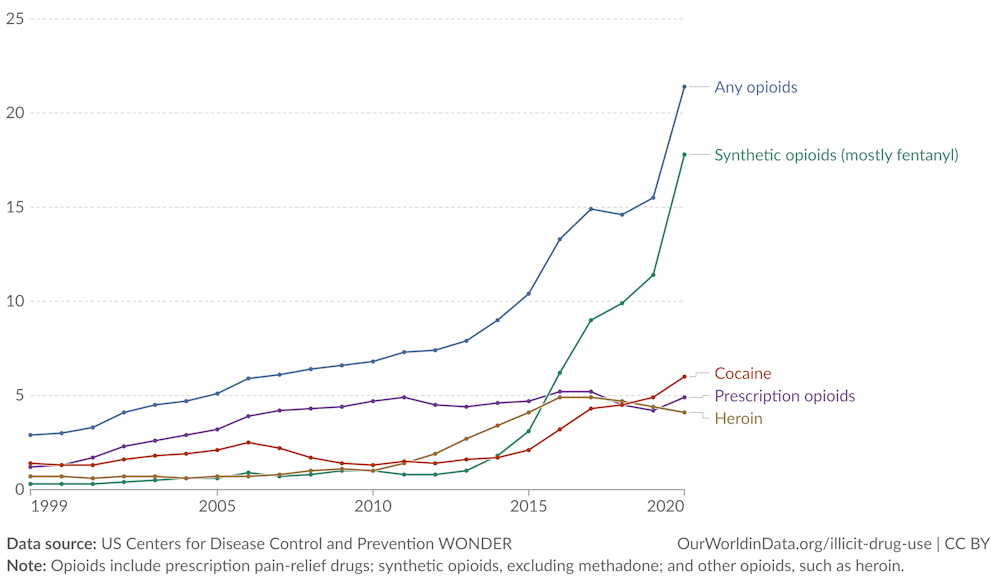
People in the world with drug use disorders (1990-2021)
Having spent most of my career researching the human toll of drug use at almost every stage of the supply and consumption chain, I believe a complete shift in the way we think about the world’s drug problem is required.
We already have many years of evidence of the ways that drugs – both natural and (increasingly) synthetic – are destabilising countries’ legal and political institutions, devastating entire communities, and destroying millions of lives. My question is, as with climate change, why are we so slow to recognise the existential threat that drug use poses to humanity?
The disconnect between users and producers
For decades, problems with drugs have been viewed as a mainly western issue, affecting Europe, North America and Australasia in terms of drug taking. This perception was fostered in part by US president Richard Nixon’s “war on drugs” announcement in June 1971, when he declared drug abuse to be “public enemy number one”.
This western-centric focus has come at a cost – we still have little data and information about drug use and problems in Africa, for example. But we are beginning to see how far drugs and their associated devastation has reached beyond traditional western borders.
Illicit drug use has increased by 20% over the past decade, only partly due to population growth. Almost 300 million people are estimated to consume illicit drugs regularly, with the three most popular being cannabis (228 million users), opioids (60 million) and cocaine (23 million). According to the UN report:
The range of drugs available to consumers has expanded, making patterns of use increasingly complex and polydrug use a common feature in most drug markets. One in 81 people (64 million) worldwide were suffering from a drug use disorder in 2022, an increase of 3% compared with 2018.
There are multiple harmful consequences of drug use. The largest global burden of disease continues to be attributed to opioids, use of which appears to have remained stable at the global level since 2019, in contrast to other drugs.
In the same way that climate change has threatened whole populations, so too have drugs. Yet many of us remain disconnected from how they are produced and distributed – and the misery they cause throughout the supply chain, all over the world.
The production of cocaine, for example, is associated with violence and exploitation at every stage of the manufacturing process. Death threats to farmers and unwilling traffickers have all increased in parallel with the growing demand for cocaine in the US and Europe.
Global drug use disorder deaths by substance (2000-21):
Organised crime groups not only supply and distribute drugs but also trade in people, whether for the commercial sex trade or other forms of modern slavery. This makes sense as the infrastructure and contacts to move drugs are similar to those used to move humans across borders and even continents. Yet many cocaine users are oblivious – wilfully or otherwise – of the violence associated with how this drug is supplied to them. As the UK National Crime Agency points out:
Reducing demand is another critical factor in reducing the supply of illegal drugs. Many people see recreational drug use as a victimless crime. The reality is that the production of illegal drugs for western markets has a devastating impact in source countries in terms of violence, exploitation of vulnerable and indigenous people and environmental destruction.
While some of the suffering associated with the production of drugs like cocaine makes the headlines, it’s often overshadowed by the glamorisation of criminal drug gangs in films and on TV. To the extent that people worry about the impact of drugs, it’s usually focused on those in our immediate communities, such as people dependent on heroin who are sleeping rough and vulnerable to exploitation. But there have already been other victims before the drug reaches our streets.
Shifts in the global supply chain
Tracking heroin routes demonstrates the way that drug supply is an international effort which affects every community on its journey, from the Afghan farmer to officials who are bribed so the drug can cross borders or be let through ports without being seized, to the person injecting or smoking the finished product.
Much of Europe’s heroin is produced in Afghanistan by small farming operations growing opium, which is then transformed into the drug. Most Afghan farmers are simply surviving growing the crop, and don’t reap significant wealth from their harvest. It is those supplying and distributing the opium as heroin who can make serious money from it.
Meanwhile, following the return of the Taliban to power in Afghanistan in August 2021, those farmers’ livelihoods have faced a new threat.
The Taliban is ideologically opposed to the production of opium. Soon after assuming control, its leaders issued a decree banning farmers from growing opium. They have enforced this by destroying crops when farmers have ignored the ban – although there is still believed to be a significant stockpile of heroin in the country, meaning that as yet, there has not been a big impact on supply to Europe and the UK. But this could change amid the emergence of more deadly synthetic alternatives, including nitazenes and other new synthetic opioids.
Heroin trafficking flows based on reported seizures (2019-22):
Either way, the drug gangs who traffic heroin won’t worry about the opium farmers’ wellbeing. As so often happens with changes in the availability of illicit drugs, when there is a shortage, these groups prove adaptable and nimble at providing alternatives quickly.
While gathering intelligence about organised crime gangs is difficult and potentially dangerous, the European Union Drugs Agency (EUDA) has provided some insights about who these groups are and how they operate. The Netherlands remains an important hub for the distribution of heroin, with several Dutch criminal groups involved in importing and distributing heroin from Afghanistan.
But others are involved too: the EUDA’s intelligence shows that criminal networks with members from Kurdish background are central to the wholesale supply and have control over many parts of the supply chain. These professional, well-organised groups have established legal businesses throughout the route of supply that facilitate their illicit activities – largely along the Balkan route with hubs in Europe.
Intermediate & final recipients of heroin shipments (2019-22):
Unlike these organised crime gangs, governments and law enforcement appear to respond to emerging threats slowly and lack the flexibility and ingenuity that the gangs repeatedly demonstrate.
As drug detection techniques have improved, organised crime has shown how inventive it can be. Taking advantage of the COVID-19 pandemic, dealers used consignments of surgical masks to conceal large quantities of cocaine being trafficked to China and Hong Kong from South America.
And as western markets for cocaine become saturated, organised crime gangs have exploited new markets in Asia, where cocaine seizures, a proxy for use of cocaine, have increased. But the shifting landscape is also reflected in changes in consumption, with use of the synthetic stimulant methamphetamine growing rapidly in Asia – reflected in record levels of seizures in the region in 2023.
For the organised crime gangs, production and supply of synthetic drugs is in many ways easier, as it is not reliant on an agricultural crop in the way that heroin and cocaine are and can be manufactured locally. This reduces the distribution logistics and distance needed for an effective supply chain. According to the UN Office on Drugs and Crime, organised crime gangs are exploiting gaps in law enforcement and state governance to both traffic large volumes of drugs and expand their production in the region.
Where there is destabilisation, there is opportunity for those who seek to profit from drug addiction. In Syria, Russia and Ukraine, war has made some people very rich.
Syria and Russia: the new drug hotspots
The wars in Syria and Ukraine bear testament to the way drugs provide solutions to people who are experiencing the worst of times – and to governments that are ready to exploit evolving situations.
As the war in Syria progressed, the Bashar Al-Assad regime actively developed a strategy to dominate the captagon market in the Middle East and North Africa. First produced in the 1960s in Germany to treat conditions such as attention deficit disorders and narcolepsy and other conditions, captagon is a stimulant that staves off hunger and sleep, making it ideal for military use – particularly in countries where food supplies are inconsistent. It has been referred to as the “drug of jihad” used by Islamic fighters in the region.
As the war progressed in Syria, the country and its leader became increasingly isolated, its economy crashed creating the perfect conditions to develop the trade in captagon. Rather than drug production leading to the collapse of law and order, it was the other way round.
Isolated by the west and with a historically strained relationship with its neighbours including Saudi Arabia, the Assad regime – under the guidance, reportedly, of Assad’s brother Maher al-Assad– ruthlessly positioned itself as the world’s main producer and distributor of this drug, then used this position to leverage its influence and try to reintegrate into the Arab world.
Video by TRT World.
Captagon also provided much-needed revenue for the Assad regime. The drug was estimated to be worth US$5.7 billion annually to the Syrian economy – at a time when western governments have placed severe sanctions on the country, restricting its ability to raise revenue. Saudi Arabia was one of the main countries being supplied captagon by Syria. Until the fall of Assad, it was the senior leadership in Syria that controlled the supply and distribution of the drug – giving rise to the label “the world’s largest narco state”.
The Assad government achieved this position by making captagon good value – a viable alternative to alcohol in terms of price and for those who don’t drink. Exploiting many of its own citizens, the regime encouraged individuals and businesses to participate in manufacturing and distributing the drug.
The fall of Assad and his hurried escape to Russia left the rebel fighters to pick up vast hauls of captagon and other drug ingredients. “We found a large number of devices that were stuffed with packages of captagon pills meant to be smuggled out of the country. It’s a huge quantity,” one fighter belonging to the Hayat Tahrir al-Sham (HTS) group told the Guardian. What this will do to drug production and supply in the region is unclear.
While the latest UN World Drug Report highlights “a rapid increase in both the scale and sophistication of drug trafficking operations in the region over the past decade”, it goes on to highlight that “one of the most striking changes worldwide in drug trafficking and drug use over the past decade has taken place in Central Asia, Transcaucasia [Armenia, Azerbaijan and Georgia] and eastern Europe”, where there has been a shift “away from opiates, mostly originating in Afghanistan – towards the use of synthetic stimulants, notably cathinones … There is hardly any other region where cathinones play such a significant role.”
This is part of “a groundbreaking shift in the global drug trade, pioneered in Russia and now spreading globally,” according to the Global Initiative Against Transnational Organized Crime. This shift is changing the nature of drug sales, using “darknet markets and cryptocurrency for anonymous transactions, allowing buyers to retrieve drugs from hidden physical locations or ‘dead drops’, rather than direct exchanges.”
The rise of Russia’s dead drop drug trade stems from several unique national factors: restrictive anti-drug policies, strained western trade relations, and a strong technological foundation. Enabled by these conditions, the dead drop model has reshaped how drugs are distributed in Russia.
Drug transactions now involve no face-to-face interactions; instead, orders are placed online, paid for with cryptocurrency, and retrieved from secret locations across cities within hours. This system, offering convenience and anonymity, has seen synthetic drugs – especially synthetic cathinones like mephedrone – overtake traditional imported substances like cocaine and heroin in Russia … These potent synthetic drugs are cheap, easy to manufacture, and readily distributed through Russia’s vast delivery networks.
The report notes that this shift in drug distribution has been accompanied by rising levels of violence including punishment beatings, and a public health crisis.
Podcast by the Global Initiative Against Transnational Organized Crime.
Yet officially, there is very little reliable data about drug use in Russia. Under the premiership of Vladimir Putin, Russia has no sympathy with those who are dependent, viewing them as weak and without value. And its invasion of Ukraine three years ago has had ramifications for Ukraine’s users too.
Prior to the war, Ukraine had demonstrated an increasingly progressive policy towards those who had problems with drugs, establishing treatment centers and encouraging access to treatment. Since Russia invaded Ukraine in February 2022, this strategy has been severely set back, with many people who need access to substitute treatments such as methadone unable to secure consistent supply of these drugs.
Another global blind spot is China, where, like Russia, little is known about the extent or type of problems that drugs are causing. Both regimes are ideologically opposed to recreational or problem drug use and, as far as we know, there is no state-funded rehabilitation provided in either country; the approach is to criminalise people rather than offer health-based interventions.
We shouldn’t be too critical as many western countries, including the UK, also need to pivot from a criminal approach to drug problems towards a health-focused one. Portugal made such a policy change several years ago, recognising that people who develop problems with drugs such as dependency need help rather than punishment.
This radical shift in thinking has made a significant change to the way those using drugs are treated, in the main offered help and specialist support rather than being arrested and sent to jail, only to be released and then repeat the same cycle of drug use, arrest and prison.
The evidence of this policy change is impressive: not only have drug-related deaths fallen, but population-level drug use is among the lowest in Europe. Nowhere is this policy shift more urgent than the US.
North America: epicentre of the opioid crisis
In the US, the synthetic opioids fentanyl and oxycodone have contributed to more than 100,000 fatal overdoses each year since 2021. While there are signs this deaths toll is at last beginning to fall, the harm and pain of addiction and overdose affects every strata of American society – as shown in moving portrayals of America’s opioid crisis such as Painkiller and Dopesick. Most fatalities are caused by respiratory depression where breathing is significantly slowed or stops altogether.
Official trailer for Painkiller (Netflix)
Fentanyl is an analgesic drug that is 50-100 times more potent than heroin or morphine. Where China used to be the principal manufacturer and supplier of fentanyl to the US, Mexico is now the primary source. In December 2024, Mexican authorities announced “the largest mass seizure of fentanyl pills ever made” – amounting to more than 20 million doses of fentanyl pills worth nearly US$400 million. The pills were found in Mexico’s Sinaloa state, home of the Sinaloa drug cartel and a hub of fentanyl production,
“This is what makes us rich,” one fentanyl cook recently told the New York Times. He was scathing about the idea that Donald Trump would be able to stamp out the supply of fentanyl from Mexico to the US by threatening Mexico’s government with tariffs. “Drug trafficking is the main economy here.”
However, the introduction of synthetic opioids to the US came not via organised crime but through a deliberate strategy of the pharmaceutical industry. Upon launching its prescription opioid painkiller OxyContin (a brand name for oxycodone) in 1996, Perdue Pharma, owned by the Sackler family, devised a plan to increase prescriptions of the drug by incentivizing and rewarding doctors to give these drugs to their patients. On a business level, this was a success; on a human level, it has been a disaster.
As patients quickly developed tolerance to drugs such as OxyContin, they had to take higher doses to avoid withdrawal symptoms or the positive feelings it gave them. Taking more of these opiates increases the risk of accidental overdose, many of which proved to be fatal. It has also driven those dependent on drugs to the black market, and into the hands of organised drug gangs, as they seek the drugs in greater quantities.
Dependency on fentanyl and other opioids is all-consuming. When not using these drugs, people are entirely focused on ensuring sufficient supply of the next dose. This includes funding supply which can take people to places they thought they would never be, for example breaking the law, shoplifting or getting involved in commercial sex to make enough money to buy drugs.
Synthetic opiates like OxyContin and fentanyl have proved to be classless, ageless and sex blind. The first-hand experience of addiction and fatalities have radically altered the way many Americans think about drugs and the problems they cause. Canada, too, is suffering a major crisis.
Compounding this tragedy is the failure of the state to provide interventions and treatment that could have reduced fatal and non-fatal overdoses. It is only now that evidence-based interventions are beginning to be made widely available, such as access to Naloxone – a drug that can reverse the effects of opiates and potentially save a life.
Of course, it isn’t just hospitals and health professionals that are challenged by the results of widespread use of opioids, but public services like the police and fire service. In some areas of the US, there have been so many daily overdoses that every service was called on to try and deal with it. Local mayors have made it a priority to train police and fire personnel to be trained as first responders, such is the scale of the problem.
But it is not just in North America that we see the failure of politicians and the state to act when faced with growing problems with drugs. In the UK, where record numbers are dying because of using drugs such as heroin, the government has not invested in overdose prevention strategies. At a time when fatal overdoses increase year on year, budgets for specialist treatment have been reduced. It remains to be seen what the recently elected Labour government will do, if anything, to tackle the tragic rise in drug related fatalities.
What connects both examples from the US and UK is the attitude and perception of drug use many of us have. Drug use and the heavy use of prescription painkillers is still heavily stigmatised. Many of us still view this as something individuals bring on themselves or have a choice about.
So, if we don’t care about what happens to people who develop problems with drugs, why should our elected representatives? In part, it is our bigotry that is enabling the lack of timely intervention, despite us possessing the knowledge and evidence of how drug harms can be minimised.
Latin America: breakdown of the rule of law
Under the last Conservative government, the UK Home Office asserted that people who used cocaine recreationally are supporting violence not only in the UK but in the countries that produce its raw ingredients. It’s not clear if this has made any difference to those using cocaine in the UK – personally, I doubt many people consider or are aware of how cocaine is produced or its provenance.
Perhaps if those using cocaine, mainly in western countries, realised the extent of violence and suffering that cocaine manufacture causes they might think again. Latin America has suffered enormously, with few countries there not touched in some way by the violence and breakdown of law associated with drug production and supply. According to the latest UN World Drugs Report:
Global cocaine supply reached a record high in 2022, with more than 2,700 tons of cocaine produced that year, 20% more than in the previous year … The impact of increased cocaine trafficking has been felt in Ecuador in particular, which has seen a wave of lethal violence in recent years linked to both local and transnational crime groups, most notably from Mexico and the Balkan countries.
Cocaine seizures and homicide rates increased five-fold between 2019 and 2022 in Ecuador, with the highest such rates reported in the coastal areas used for trafficking the drug to major destination markets in North America and Europe.
Cocaine trafficking flows based on reported seizures (2019-22):
As with opium production in Afghanistan, it is small-scale farmers in Colombia, Peru and Bolivia that grow the coca plant that will be turned into cocaine. Like their Afghan counterparts, they grow coca as it is more profitable than alternatives such as coffee. While it may be profitable in the short term, there are greater costs to them and their society.
Cocaine production brings with it violence as those further up the drug production chain try to control its trade. Few parts of these societies are unscathed, from bribing local politicians through to whole regions that are controlled by organised crime. Keeping control means that the use of firearms and violence increases. Against this backdrop, it is unsurprising that basic health and social services suffer.
So, while a coca grower may have more money, every other aspect of their life is negatively impacted. Whether it is regional or state institutions, both are compromised by the drug trade and those that control it. While this may not lead to the total collapse of law and order, it does create injustice and distorts the rule of law in many areas of Latin America and the Caribbean, where competition between gangs has also resulted in an increase in homicides.
The impact is on all sectors of society, now and into the future. For example, while historically the role of women has been largely underrepresented in research and drug policy, the UN report recognises that this is changing:
As women increasingly participate in economic activities, the role that women play in the drug phenomenon may become increasingly important. For example, a shift away from plant-based drug production may affect many women in rural households involved in opium poppy and coca bush cultivation.
The UN also identifies the specific risk to young people and the drugs trade, highlighting:
Long-term efforts to dismantle drug economies must provide socioeconomic opportunities and alternatives, which go beyond merely replacing illicit crops or incomes and instead address the root structural causes behind illicit crop cultivation, such as poverty, underdevelopment, and insecurity. They must also target the factors driving the recruitment of young people into the drug trade, who are at particular risk of synthetic drug use.
Meanwhile, demand for treatment in Europe due to problems with cocaine has risen significantly in recent years, since 2011 there has been an 80% increase in treatment presentations. This reflects the growing number of people using cocaine and the rise in purity of the drug.
Amid what may seem to be a story of unrelenting despair and hopelessness, there are local initiatives and even a few state-wide policies that provide optimism that change is possible.
In my roles both as clinician and scientist, I’ve often been amazed by how ingenious people can be when faced with the apparently impossible. For example, the way some people use heroin to dampen their psychotic symptoms, such as auditory and visual hallucinations – or the development of Naloxone, a drug that can temporarily reverse the effects of opioids, providing a short window for emergency services to treat people who have overdosed.
Early in my career, I witnessed the emergence of HIV in the UK in the 1980s. The speed at which this disease spread was not matched by our ability to treat it. Our response to HIV was undoubtedly hampered by prejudice and stigma towards marginalised groups in society, namely gay men and those using drugs (particularly injecting them).
However, unexpectedly and courageously, the Conservative government recognised those who were most at risk of contracting HIV, and organised a package of measures to contain the spread of infection. One part of this was a media campaign based on public health messaging designed to reduce the risk of contracting the disease. But the government also invested in treatment for those who had been infected and engaged with people at high risk, such as those intravenously injecting drugs.
I worked in specialist HIV clinics for those using drugs. At the time, methadone and diamorphine were provided as an alternative to heroin. Regulations and protocols that restricted the prescribing of these medical opioids were eased, so we could ensure patients attending these clinics were given sufficient oral and injectable opioids that they didn’t need to source street heroin.
This meant they had access to medical grade opioids and, crucially, were given regular supplies of sterile injecting equipment. It was this that reduced the risk of contracting HIV, as some people would share injecting equipment when using heroin.
This impressive policy ran counter to the Conservative party’s ideology at the time, which was to punish rather than help those using drugs like heroin. It showed me how, even with traditional mindsets, it is possible to shift policy thinking in the face of a health crisis. And make no mistake, the global drug problem is an ongoing health crisis. Today, the UN points to the risks that intravenous users of drugs still face:
An estimated 13.9 million people injected drugs in 2022, with the largest number living in North America and East and South-East Asia … The relative risk of acquiring HIV is 14 times higher for those who inject drugs than in the wider population globally.
There are, though, signs of positive change in the way some countries and regions are changing their drug policies. Scotland recently opened a drug consumption facility in Glasgow – a safe place for people to use their drugs, usually injecting drugs like heroin. Such spaces provide access to sterile injecting equipment, reducing the risk of blood-borne infections such as HIV or Hepatitis. At the same time, they offer the opportunity to engage with people who have not accessed traditional health services.
Portugal, as mentioned earlier, has made substantial changes to the way it approaches drug use and the problems associated with it. This policy shift since 2000 has saved lives and brought a more humane way of treating people who develop problems with drugs.
Contrast this with the wasted effort and resources ploughed into the war on drugs – initiated by Nixon and followed by so many western governments ever since. My plea to policymakers is simple: employ the same evidence-based science you use for health issues towards drugs and problem drug use.
Science and research can help in many ways, if given the chance. Some of it might seem radical, like providing safe drug consumption spaces. Some of it is more mundane, but vital – like tackling inequality, a clear driver of problem drug use across the world.
But while we often look to politicians to take the lead on change, it is people – us – that really hold the solution. By far the greatest threat to people and society from drugs is ignorance and bigotry. So many lives have been lost to drugs because of shame, either as a driver of drug use or a barrier to seeking help.
Beliefs are notoriously difficult to shift. As with climate change, the most powerful driver of change is personal experience. We know that when a family or community is affected by a drug overdose, their beliefs and perceptions change. But this is not the way any of us should want to see change happen.
To hear about new Insights articles, join the hundreds of thousands of people who value The Conversation’s evidence-based news. Subscribe to our newsletter.
Ian Hamilton does not work for, consult, own shares in or receive funding from any company or organisation that would benefit from this article, and has disclosed no relevant affiliations beyond their academic appointment.
The Pat and Jim Calhoun Cardiology Center is celebrating its 20th anniversary.
It was founded thanks to the generous philanthropic support of the Calhoun family in 2004.
Dr. Bruce T. Liang, cardiovascular physician-scientist at the Calhoun Cardiology Center (Tina Encarnacion/UConn Health photo)
“As founding director of the Calhoun Cardiology Center, the last two decades have been quite an exciting ride. It’s been a wonderful and gratifying experience seeing the comprehensive center triple its growth in both patient volumes and providers and adding new specialties such as electrophysiology, vascular surgery, and cardiovascular surgery,” says Dean Dr. Bruce T. Liang, the Ray Neag Distinguished Professor of Cardiovascular Biology and Medicine.
Coach Jim Calhoun and his wife Pat visited the Center on May 8 to applaud the cardiology faculty and staff for their longstanding contributions advancing cardiovascular care, research breakthroughs, and education of the next generation of heart specialists.
The Center is also on the forefront of cardiovascular research thanks to the endowment of the Calhoun family, and NIH funding to the Center has grown to millions of dollars annually for cutting-edge research. One of those innovative NIH-funded researchers is Dr. Travis Hinson, cardiovascular physician-scientist at UConn Health/JAX who serves as the Pat and Jim Calhoun Endowed Professor.
His Cardiovascular Genetics Program is translating innovative laboratory findings for the next generation of patient treatments.
UConn Health/JAX”s Dr. Travis J. Hinson leads the successful Cardiovascular Genetics Program of the Calhoun Cardiology Center.
“Our translational cardiovascular medicine makes UConn very unique. Thanks to the Calhouns we have exponentially expanded genetic precision medicine and have tested over 1,000 heart patients and their families to help them get the best, personalized treatments possible. It’s really exciting. Coach Calhoun, Pat, and their family’s recognition of UConn’s excellence have helped us grow. The Calhouns have made a huge impact.”
Liang concludes, “Coach Calhoun is larger than life and is an inspiring figure on and off the court at UConn. He believes in the power of the Calhoun Cardiology Center and has put his heart and soul into it. We are extremely thankful to Coach. Thank you.”
Marc H. Silverman, Acting United States Attorney for the District of Connecticut, today announced that on January 31, 2025, THELMA “WENDY” EPPS, 60, of Hartford, was sentenced by U.S. District Judge Kari A. Dooley in Bridgeport to 27 months of imprisonment, followed by three years of supervised release, for health care fraud.
According to court documents and statements made in court, Epps was a Licensed Alcohol and Drug Abuse Counselor (LADC) with an office located at 330 Main Street in Hartford. In April 2013, she enrolled as a participating provider in the Connecticut Medicaid program along with an entity affiliated with Epps called Miracles to Destiny LLC. In July 2018, the Medicaid program suspended Epps from participating as a provider in the program based on a finding of a credible allegation of fraud. Medicaid told Epps that any attempt to circumvent her suspension by submitting claims for services performed by Epps or Miracles to Destiny LLC through other agencies or other billing numbers would result in termination of her provider agreement.
In 2019, Epps entered into an agreement with Dennis Tomczak, a Connecticut LADC who was a participating provider in Medicaid. Epps and Tomczak agreed that Tomczak would bill Medicaid using his Medicaid provider number for psychotherapy counseling services purportedly provided by Epps. These claims falsely represented that Tomczak had personally provided the services. In return for Tomczak billing the services, Epps agreed to pay Tomczak 25 percent of the amount Medicaid paid Tomczak. Between approximately April 2019 and November 2022, Medicaid paid Tomczak $330,547.71 for fraudulent claims for services purportedly provided by Epps that were billed under Tomczak’s provider number.
At some point during their scheme, Tomczak expressed concerns to Epps about the number and frequency of services that Epps told Tomczak she was providing. At about this time, Epps entered into a similar agreement with Shawn Tyson, a LADC in Connecticut, whereby Tyson would use his Medicaid provider number to submit claims to Medicaid for services Epps purportedly provided to Medicaid clients.
In November 2019, Epps assisted Tyson with the process of enrolling Tyson as a participating provider in Medicaid. Tyson’s provider application listed the location at which Tyson would provide services as 330 Main Street, Third Floor, in Hartford, the location of Epps’s and Miracles to Destiny LLC’s office. Once Tyson was enrolled as a Medicaid provider, Tyson provided Epps with his login information to the online portal for submitting claims to Medicaid, which Epps then used to submit claims. For a brief period before Tyson was enrolled as a Medicaid provider, unbeknownst to Tomczak, Epps submitted claims through Tomczak’s provider number for services purportedly provided by Tyson, by representing to Tomczak that she had performed these services. Medicaid paid Tomczak a total of $7,879.40 for these services.
During the scheme involving Epps and Tyson, Tyson would provide Epps the names of Medicaid patients and dates that Tyson purportedly provided psychotherapy counseling services to the patients, and Epps would then bill Medicaid for these services using Tyson’s provider number. Epps would also submit claims using Tyson’s provider number for services she purportedly provided to Medicaid patients. These claims falsely represented that Tyson had personally provided the services to the patients.
Epps and Tyson submitted and caused to be submitted claims for hundreds of thousands of dollars of psychotherapy services that neither Epps nor Tyson had actually provided to Medicaid clients. When Epps warned Tyson that he should not bill Medicaid for having provided psychotherapy to patients on holidays, such as July 4 and Thanksgiving, Tyson would typically change the dates of services and resubmit the list of services to Epps.
Medicaid paid Tyson $663,081.32 for claims that falsely represented that Tyson had personally provided services, or falsely represented that services had been provided when, in fact, they were not provided at all.
Judge Dooley ordered Epps to pay $1,001,058.43 in restitution to the Connecticut Medicaid program.
On November 8, 2024, Epps pleaded guilty to health care fraud. Epps, who is released on a $50,000 bond, is required to report to prion on March 3.
Tomczak and Tyson pleaded guilty to related charges and await sentencing.
This investigation was conducted by the U.S. Department of Health and Human Services, Office of the Inspector General (HHS-OIG) and the Federal Bureau of Investigation, with the assistance of the Connecticut Department of Social Services. The case was prosecuted by Assistant U.S. Attorney David J. Sheldon and Auditor Susan Spiegel.
The U.S. Attorney’s Office, Connecticut Chief State’s Attorney’s Office, and Connecticut Attorney General’s Office meet regularly as part of The Medicaid Fraud Working Group. The Working Group also includes representatives from the Connecticut Department of Social Services; the Connecticut Department of Public Health; the Drug Control Division of the Connecticut Department of Consumer Protection; the Office of the Inspector General of the U.S. Department of Health and Human Services, and the FBI. The Working Group reviews pending issues and cases, identifies trends that might indicate fraudulent activity, and coordinates efforts for maximum results.
People who suspect health care fraud are encouraged to report it by calling 1-800-HHS-TIPS.
Headline: NCDHHS Program Celebrates 25 Years of Promoting Healthy Smiles for Young Children
NCDHHS Program Celebrates 25 Years of Promoting Healthy Smiles for Young Children hejones1
The North Carolina Department of Health and Human Services is celebrating the 25th anniversary of the Into the Mouths of Babes program, a partnership that delivers preventive oral health services to young children insured by NC Medicaid. Since 2000, this program has helped medical providers across the state give infants and toddlers early dental evaluations, preventive oral health care and other dental services that lay the foundation for good health.
“Tooth decay is the most common chronic disease in children,” said Dr. Patrick Roberson, DDS, North Carolina State Dental Director. “This program provides vital oral health services for children who need it most and connects medical and dental care to improve outcomes.”
Into the Mouths of Babes was originally piloted in nine western North Carolina counties as the “Smart Smiles” program in the mid-1990’s. In 2001, the program expanded statewide and established a reimbursement package through NC Medicaid.
“Since Into the Mouths of Babes began, more than 2.8 million claims have been submitted for preventive oral health services,” said Dr. Mark Casey, DDS, MPH, Dental Officer for NC Medicaid. “This is the finest example of a cost-effective preventive oral health care program at work.”
Early oral health evaluations provided through Into the Mouths of Babes allow medical providers to identify issues before they become serious, ensuring families can get help early. Additionally, caregiver education provided by the program gives families the tools they need to support healthy habits for life.
“Our rural pediatric practice has provided fluoride treatments to infants and toddlers for over 15 years,” said Dr. Marston Crawford, MD, FAAP, pediatrician for Coastal Children’s Clinic. “These treatments, combined with caregiver discussion about early oral health, have sharply reduced cavities and preventable dental surgery. The majority of our children enter kindergarten cavity-free.”
Training and community outreach are key to the program’s long-term success. NCDHHS employs 20 public health dental hygienists in 10 regions across the state who provide training for Into the Mouths of Babes. The American Academy of Family Physicians also provides continuing medical education hours to physicians who attend an NCDHHS training session.
Key program partners include NC Medicaid, the NCDHHS Division of Public Health’s Oral Health Section, UNC Adams School of Dentistry, UNC Gillings School of Global Public Health, the North Carolina Pediatric Society and the North Carolina Academy of Family Physicians among others.
“The NC Academy of Family Physicians is proud to support this program,” said Gregory Griggs, Executive Vice President of the Academy. “It has made a huge difference in reducing tooth decay for children across North Carolina.”
For more information on the program, including partnerships and the online toolkit, visit the Into the Mouths of Babes webpage.
El Departamento de Salud y Servicios Humanos de Carolina del Norte celebra el 25 aniversario del programaInto the Mouth of Babes, una colaboración que brinda servicios preventivos de salud oral a niños pequeños asegurados por NC Medicaid. Desde el año 2000, este programa ha ayudado a los proveedores médicos de todo el estado a brindar evaluaciones dentales tempranas a bebés y niños pequeños, atención preventiva de la salud oral y otros servicios dentales que sientan las bases para una buena salud.
“La caries dental es la enfermedad crónica más común en los niños”, dijo Dr. Patrick Roberson, DDS, Director Dental del Estado de Carolina del Norte. “Este programa proporciona servicios vitales de salud oral para los niños que más lo necesitan y conecta la atención médica y dental para mejorar los objetivos”.
Into the Mouths of Babes se había iniciado originalmente en nueve condados del oeste de Carolina del Norte como el programa “Smart Smiles” a mediados de la década de 1990. En 2001, el programa se expandió por todo el estado y estableció un paquete de reembolso a través de NC Medicaid.
“Desde que comenzó Into the Mouth of Babes, se han presentado más de 2,8 millones de solicitudes de servicios preventivos de salud oral”, dijo la Dra. Mark Casey, DDS, MPH, Oficial Dental de NC Medicaid. “Este es el mejor ejemplo de un programa de costo económico de atención preventiva de la salud oral que funciona”.
Las evaluaciones tempranas de salud oral proporcionadas a través de Into the Mouth of Babes permiten a los proveedores médicos identificar los problemas antes de que se agraven, asegurando que las familias puedan obtener ayuda temprano. Además, la educación para los cuidadores proporcionada por el programa brinda a las familias las herramientas que necesitan para mantener hábitos saludables de por vida.
“Nuestra práctica pediátrica rural ha proporcionado tratamientos con flúor a bebés y niños pequeños durante más de 15 años”, dijo el Dr. Marston Crawford, MD, FAAP, pediatra de Coastal Children’s Clinic. “Estos tratamientos, combinados con la charla con los cuidadores sobre la salud oral en los primeros años de edad, han reducido drásticamente las caries e intervenciones quirúrgicas dentales menores. La mayoría de nuestros niños entran al jardín de infantes sin caries”.
La capacitación y el alcance comunitario son clave para el éxito a largo plazo del programa. El Departamento de Salud y Servicios Humanos de Carolina del Norte, (NCDHHS, por sus siglas en inglés), emplea a 20 higienistas dentales de salud pública en diez regiones de todo el estado quienes proporcionan formación para Into the Mouth of Babes. La Academia Estadounidense de Médicos de Familia también ofrece horas de educación médica continua a los médicos que asisten a una sesión de capacitación del NCDHHS.
Los socios clave del programa incluyen NC Medicaid, la Sección de Salud Oral de la División de Salud Pública de NCDHHS, la Escuela de Odontología UNC Adams, la Escuela de Salud Pública Global UNC Gillings, la Sociedad Pediátrica de Carolina del Norte y la Academia de Médicos de Familia de Carolina del Norte, entre otros.
“La Academia de Médicos de Familia de Carolina del Norte se enorgullece de apoyar este programa”, dijo Gregory Griggs, Vicepresidente Ejecutivo de la Academia. “Ha marcado una gran diferencia en la reducción de la caries dental en los niños de Carolina del Norte”.
Para obtener más información sobre el programa, incluidas las colaboraciones y el kit de herramientas en línea, visite la página web deInto the Mouths of Babes.
The Rhode Island Department of Health (RIDOH) is advising consumers that Blue Ridge Beef is recalling 5,700 pounds of their two-pound log Natural Mix dog food due to a contamination of Salmonella.
The recalled products have the Lot number N25/12/31. (Lot numbers are stamped in the clips on the end of the chubs/bags.) The products have UPC# 854298001054.
Salmonella can affect animals eating the products and there is risk to humans from handling contaminated pet products, especially if they have not thoroughly washed their hands after having contact with the products or any surfaces exposed to these products.
Healthy people infected with Salmonella should monitor themselves for some or all of the following symptoms: nausea, vomiting, diarrhea or bloody diarrhea, abdominal cramping and fever. Rarely, Salmonella can result in more serious ailments, including arterial infections, endocarditis, arthritis, muscle pain, eye irritation, and urinary tract symptoms. Consumers exhibiting these signs after having contact with this product should contact their healthcare providers.
Pets with Salmonella infections may be lethargic and have diarrhea or bloody diarrhea, fever, and vomiting. Some pets will have only decreased appetite, fever, and abdominal pain. Infected but otherwise healthy pets can be carriers and infect other animals or humans. If your pet has consumed the recalled product and has these symptoms, please contact your veterinarian.
Samples of the product were collected on 01/08/25 by the North Carolina Department of Agriculture and tested by the North Carolina Department of Agriculture Food and Drug Protection Laboratory. The product tested positive for Salmonella.
On 01/27/2025 the firm was notified by the FDA that the product tested positive for Salmonella.
These products were distributed between January 3, 2025 and January 24, 2025. The product is packaged in clear plastic and was sold primarily in retail stores located in Virginia, Maryland, Pennsylvania, Connecticut, Massachusetts, New York State, Tennessee, and Rhode Island.
Consumers who have purchased this product are urged to return to place of purchase or destroy the food in a way that children, pets, and wildlife cannot access it.
For more information contact blueridgebeefnc@yahoo.com or 704-873-2072.
MIAMI – On Jan. 30, a federal district judge in West Palm Beach, Florida sentenced Anthony Raul Del Valle, 29, of Lake Worth Beach, Florida, to 120 months in federal prison. The sentence comes after a federal jury found Del Valle guilty of distributing acetyl fentanyl and fentanyl and possessing a firearm in furtherance of a drug trafficking crime in November 2024.
On April 8, 2024, Del Valle distributed pills that appeared to be oxycodone, but in fact were fentanyl and acetyl fentanyl, to three family members in Lantana, Florida. All three family members immediately ingested the pills after the distribution. Two of the family members died less than two hours after the distribution.
On April 10, 2024, law enforcement agents identified and arrested Del Valle as the source of the pills after conducting a controlled purchase from Del Valle. Law enforcement agents recovered a loaded firearm from Del Valle during the arrest.
U.S. Attorney Hayden P. O’Byrne for the Southern District of Florida, Special Agent in Charge Deanne L. Reuter of the Drug Enforcement Administration (DEA), Miami Field Division, announced the sentence.
The DEA, Miami Field Division investigated the case with assistance from the Bureau of Alcohol, Tobacco, Firearms, and Explosives (ATF), Miami Field Office, Lantana Police Department, Boynton Beach Police Department and Palm Beach County Sheriff’s Office. Assistant United States Attorneys Shannon O’Shea Darsch and Alexandra Chase prosecuted it.
According to the DEA’s National Drug Threat Assessment, synthetic drugs, such as fentanyl, are poisoning our nation. Fentanyl has proven to be a deadly poison that does not discriminate. Its victims include every gender, race, age, and economic background, and its debilitating effects are the same across all demographics. Fentanyl is a synthetic opioid that is up to 50 times stronger than heroin and 100 times stronger than morphine. Even in small doses, fentanyl can be deadly. Just one fentanyl pill can kill, as noted in DEA’s One Pill Can Kill campaign. As little as two milligrams, about the size of 5 grains of salt, can be fatal. According to the Centers for Disease Control and Prevention (CDC), fentanyl and other synthetic opioids are the most common drugs involved in overdose deaths. Over 150 people die every day from overdoses related to synthetic opioids like fentanyl. The State of Florida has also seen an exponential increase in overdoses associated with fentanyl. In 2022, more than 5,622 people died from overdoses involving fentanyl and fentanyl analogs in Florida.
You may find a copy of this press release (and any updates) on the website of the United States Attorney’s Office for the Southern District of Florida at www.justice.gov/usao-sdfl.
Related court documents and information may be found on the website of the District Court for the Southern District of Florida at www.flsd.uscourts.gov or at http://pacer.flsd.uscourts.gov, under case number 24-cr-80062.
HOUSTON, Feb. 03, 2025 (GLOBE NEWSWIRE) — Skyward Specialty Insurance Group, Inc.™ (NASDAQ: SKWD) (“Skyward Specialty” or “the Company”) expects to issue its fourth quarter 2024 earnings results after the market closes on Tuesday, February 25th which will be available on the Company website at investors.skywardinsurance.com/ under Quarterly Results.
Skyward Specialty will host its earnings call to review the fourth quarter 2024 financial results on Wednesday, February 26 at 9:30 a.m. EDT.
Investors may access the live audio webcast via the link on the Company’s investor site at investors.skywardinsurance.com/ under Events & Presentations. Additionally, investors can access the earnings call via conference call by registering via the conference link. Users will receive dial-in information and a unique PIN to join the call upon registering.
A webcast replay will be available two hours following the call in the same location on the Company’s investor website.
About Skyward Specialty
Skyward Specialty (NASDAQ: SKWD) is a rapidly growing and innovative specialty insurance company, delivering commercial property and casualty products and solutions on a non-admitted and admitted basis. The Company operates through eight underwriting divisions — Accident & Health, Captives, Global Property & Agriculture, Industry Solutions, Professional Lines, Programs, Surety and Transactional E&S.
Skyward Specialty’s subsidiary insurance companies consist of Houston Specialty Insurance Company, Imperium Insurance Company, Great Midwest Insurance Company, and Oklahoma Specialty Insurance Company. These insurance companies are rated A (Excellent) with a stable outlook by A.M. Best Company. For more information about Skyward Specialty, its people, and its products, please visit skywardinsurance.com.
Source: US Department of Health and Human Services – 3
Thisrecallinvolves correcting certain devices, and does not involve removing them from where they are used or sold. The FDA has identified this recall as the most serious type. This device may cause serious injury or death if you continue to use it without correction.
Affected Product
Product Names: Becker External Drainage and Monitoring System, Exacta External Drainage and Monitoring System (EDMS)
Unique Device Identifier (UDI)/Model: See full list of affected products.
What to Do
Inspect all Becker and Exacta EDMS devices for cracks or leaks.
If there are cracks and/or leaks, do not use the these devices.
Monitor all patients with EDMS for evidence of infection.
In November 2024, Medtronic Neurosurgery sent all affected customers an Urgent Medical Device Correction recommending the following actions:
For providers
Inspect all stopcocks and connections before use to make sure connections are secure and there are no visible cracks.
Do not use the device if cracks or leaks are identified. Return it to Medtronic.
Pre-fill the system with sterile isotonic saline solution before connecting to the patient.
Check all connections to make sure fittings (connections) are finger-tight and leak-free.
Finger tighten all connections. Over tightening can cause cracks and leaks.
Allow device to air dry completely after cleaning with alcohol or a disinfectant containing alcohol.
Replace any system that develops cracks or leaks during use using sterile technique. Return the damaged system to Medtronic.
Consider application of hemostat or other clamp to the proximal patient line during replacement if blocking the patient line will not create patient risk.
Monitor all patients with EDMS for evidence of infection.
Replace any system with cracks or leaks and continue monitoring the patient for evidence of infection.
For customers
Complete and return the enclosed customer confirmation form to acknowledge the letter.
Post a copy of the notification near impacted product as a reminder of the issue and recommended actions.
Keep a copy of the letter and completed response form for institutional records.
Contact Medtronic Customer Service via email: rs.jaxcustomerservice@medtronic.com, or phone: 1-800-874-5797 Option 1, and mention FA1452, to initiate the returns process.
Medtronic will honor return of unused product for a full credit.
Reason for Recall
Medtronic Neurosurgery is recalling certain Becker and Exacta EDMS due to a risk for cracks and or leaks in device stopcocks.
The use of affected product may cause serious adverse health consequences, including leaks of cerebrospinal fluid, infections, and death.
There have been 15 reported injuries. There have been no reports of death.
Device Use
Becker and Exacta External Drainage and Monitoring Systems (EDMS) provide a complete closed system to drain cerebrospinal fluid (CSF) from specific parts of the brain and to monitor CSF pressure and flow rate from these areas.
Contact Information
Customers in the U.S. with questions about this recall should contact their Medtronic representative or Medtronic Technical Support at 1-888-826-5603 (reference FA1452).
Full List of Affected Devices (if applicable)
Product Names
Medtronic Product Number (REF)
GTIN
EDMS 24146 BECKER NO Y-SITEEDMS 24146 BECKER NO Y-SITE
24146
00763000333423
EDMS 24146 BECKER NO Y-SITE
24146
00763000572839
EDMS II 25120 BECKER W/1-WAY VALVE
25120
00763000333430
EDMS II 25120 BECKER W/1-WAY VALVE
25120
00763000431297
KIT 26040 BECKER EDMS II
26040
00763000333447
KIT 26040 BECKER EDMS II
26040
00763000406066
KIT 27581 EXACTA W/EDM VCATH 35CM
27581
00763000333478
BECKER 27609 W/NEEDLESLESS INJ. SITE
27609
00763000333485
BECKER 27609 W/NEEDLESLESS INJ. SITE
27609
00763000529307
EDM 27636 EXACTA W/BRAIDED CORD LOCK
27636
00763000333492
EDM 27666 EXCTA W GLUE STPCK GR PT LN
27666
00763000333515
BECKER 27670 STOP BELOW DC NDL-LS IN
27670
00763000333522
BECKER 27670 STOP BELOW DC NDL-LS IN
27670
00763000529314
BECKER 27672 ONEWAY VLV Y-SITE PT LN
27672
00763000333539
EDMS 27702 EURO BECKER II GR PT LN
27702
00763000333553
EDMS 27702 EURO BECKER II GR PT LN
27702
00763000467326
EDM 27732 EXACTA W/NDL-LS INJ. ST W/CAP
27732
00763000333560
BECKER 27761 STOP BCNDLESS PATLN 24
27761
00763000333577
BECKER 27761 STOP BCNDLESS PATLN 24
27761
00763000529338
BECKER 27767 NO STPCOCK ON PTLN 63
27767
00763000333584
EDMS 27779 BECKER BC NDLESS BOND CONN
27779
00763000333591
EDMS 27779 BECKER BC NDLESS BOND CONN
27779
00763000529345
EDMS 27785 EXACTA 50ML BC NDLESS INJ
27785
00763000333607
EDMS 27795 EXACTA 100ML CATH
27795
00763000333614
EDMS 27811 BECKER GRN PL VCATH
27811
00763000333638
EDMS 27861 EXACTA 50ML ANTIRFLUX GRNPL
27861
00763000333645
EDMS 27873 BECKR W/SC BLW DC W/NLESS INJ
27873
00763000333652
EDMS 27931 BECKER GS TUBING SMARTSITES
27931
00763000333669
EDMS 27931 BECKER GS TUBING SMARTSITES
27931
00763000467364
EDMS 46128 BECKER II BLUE PT LN
46128
00763000333676
EDMS 46128 BECKER II BLUE PT LN
46128
00763000406073
EDMS 46129 EURO BECKER II BLUE PT LN
46129
00763000333683
EDMS 46129 EURO BECKER II BLUE PT LN
46129
00763000431259
SYSTEM 46700 EXACTA DISP. DRAINAGE
46700
00763000333690
SYSTEM 46705 EXACTA DRAINAGE 100ML
46705
00763000333706
Additional FDA Resources (listed in order of most to least recent):
FDA’s Enforcement Report
Medical Device Recall Database
Unique Device Identifier (UDI)
The unique device identifier (UDI) helps identify individual medical devices sold in the United States from manufacturing through distribution to patient use. The UDI allows for more accurate reporting, reviewing, and analyzing of adverse event reports so that devices can be identified, and problems potentially corrected more quickly.
How do I report a problem?
Health care professionals and consumers may report adverse reactions or quality problems they experienced using these devices to MedWatch: The FDA Safety Information and Adverse Event Reporting Program.
Governor Kathy Hochul today announced $20.7 million to support SNUG Street Outreach programs that work to reduce gun violence and save lives in 14 communities across New York State. These grants to community-based organizations and hospitals fund outreach workers, hospital responders, social workers and case managers who are credible messengers and work with individuals at risk of gun violence, connecting them with support and services to change behavior and increase opportunities. Last week, Governor Hochul announced that shooting incidents with injury reported in communities participating in the State’s Gun Involved Violence initiative reached record lows in 2024 with 588 incidents reported compared to 817 in 2023, a 28 percent reduction. The Governor’s FY26 Executive Budget continues unprecedented support for SNUG, Gun Involved Violence and other initiatives in communities that report 90 percent of violent crimes with firearms and 85 percent of violent crimes outside of New York City.
“Public safety is my number one priority — that’s why my Budget invests in proven initiatives like the SNUG program to drive down gun violence, save lives and keep New Yorkers safe,” Governor Hochul said. “Outreach teams across the State are working alongside law enforcement and local partners to target gun violence anywhere it occurs, and to engage stakeholders in a comprehensive approach that makes our communities safer for all.”
New York State’s SNUG program uses a public health approach to address gun violence by identifying the source, interrupting transmission and treating individuals, families and communities affected by the violence. Administered by the state Division of Criminal Justice Services, SNUG, Gun Involved Violence (GIVE) initiative, the State’s nationally recognized Crime Analysis Centers Network and Project RISE (Respond, Invest, Sustain, Empower) are key components of Governor Hochul’s comprehensive plan to address the causes and consequences of gun violence and other crimes.
New York State Division of Criminal Justice Services Commissioner Rossana Rosado said, “Our SNUG Street Outreach teams are a critical component of Governor Hochul’s comprehensive crime reduction and public safety plan. These dedicated individuals work in communities disproportionately affected by gun violence. They mediate and defuse conflicts and provide access to programs and support, including counseling and case management, so youth and families can thrive, and communities can heal. We thank Governor Hochul for her continued support of this work and for her leadership on public safety.”
The $20.7 million will fund staff, programs, services, equipment and technology for the SNUG locations during the 2025 calendar year. Community-based organizations and hospitals receive the funding, which supports 181 full-time and 39 part-time employees who work in specific neighborhoods in Albany, the Bronx, Buffalo, Hempstead, Mt. Vernon, Newburgh, Niagara Falls, Poughkeepsie, Syracuse, Rochester, Troy, Utica, Wyandanch and Yonkers. DCJS tracks shooting data in these “SNUG zones” and last year, those zones collectively reported significant, double-digit decreases in shooting victims, individuals killed by gun violence and shooting incidents with injury when compared to 2023.
SNUG outreach workers, social workers, case managers and hospital responders work in neighborhoods disproportionately affected by gun violence, and the program also embeds social workers and hospital responders at Level One trauma centers in Albany, Buffalo, the Bronx, Rochester and Syracuse. These professionals work with individuals and families in the aftermath of a violent incident to offer support, services and connect them to the SNUG program in their communities for additional assistance.
SNUG staff are credible messengers who live in the communities in which they work, and some have been involved with the criminal justice system or lost loved ones to violence. They work with teens and young adults to detect and defuse disputes before they escalate; respond to shootings to prevent retaliation through mediation and assist family members of those who have been injured or killed; and mentor youth involved with the program to set goals and connect them with educational and job opportunities as well as other services. The programs also engage the community, religious organizations and clergy, and local businesses by sponsoring anti-violence marches, job fairs, block parties, sporting events and other community gatherings.
The following organizations and hospitals will receive funding and support from DCJS to administer SNUG:
New York City and Long Island
Bronx – Jacobi Medical Center: $2,702,617
Hempstead – Family and Children’s Association: $1,164,397
Wyandanch – Economic Opportunity Council of Suffolk: $746,522
Hudson Valley
Mt. Vernon – Family Services of Westchester: $1,088,391
Newburgh – Regional Economic Community Action Plan: $896,799
Poughkeepsie – Family Services Inc.: $1,076,245
Yonkers – Yonkers YMCA: $1,010,259
Capital Region
Albany – Trinity Alliance of the Capital Region: $1,820,329 and Albany Medical Center: $262,310
Troy – Trinity Alliance of the Capital Region: $860,134
Central New York
Syracuse – Syracuse Model Neighborhood Facility: $1,820,189 and SUNY Upstate Medical Center: $464,374
Mohawk Valley
Utica – Integrated Community Alternatives Network: $792,673
Finger Lakes
Rochester – PathStone Corp.: $1,949,426 and Rochester General Hospital: $571,002
Western New York
Buffalo – Erie County Medical Center: $2,800,915
Niagara Falls – Community Missions of Niagara Frontier: $ 677,170
Comprehensive training, site visits and support from DCJS set SNUG apart from other community-based violence interruption programs across the state and country. New staff must complete 40 hours of training and new supervisors complete 32 hours of management training. All staff must also complete 40 hours of professional development training annually. This ongoing training and support help ensure that the program operates consistently across all SNUG sites despite being operated by different community-based organizations and hospitals.
State Senate Majority Leader Andrea Stewart-Cousins said, “As a State Senator, I was proud to advocate for the first SNUG investments in Yonkers and New York State because I knew that real community-driven solutions were key to reducing gun violence and keeping our neighborhoods safe. We’ve seen firsthand how SNUG has changed lives—interrupting cycles of violence, providing critical support, and helping young people find a better path. I’m so proud that Yonkers is receiving more than $1 million in new funding to support this lifesaving program. As Majority Leader, I remain committed to continuing smart, effective investments like SNUG across Westchester and New York. I thank Governor Hochul, my Westchester Delegation and Majority Senators, as well as our partners in the Assembly for their continued leadership and partnership in the fight against gun violence. I look forward to building on this progress together to keep our communities safe.”
State Senator Jamaal Bailey said, “Investing $20.7 million in SNUG to enhance efforts such as preventing gun violence, supporting at-risk individuals, and strengthening communities across New York State is essential. SNUG has been a pivotal partner in preventing gun violence and an organization that has significantly impacted my district, and will continue to do so as Mt. Vernon – Family Services of Westchester is receiving $1,088,391. By funding outreach workers, social workers, and hospital responders, future conflicts can de-escalate and create safer neighborhoods and brighter futures for all of us. Thank you to Governor Hochul for your leadership and prioritizing the safety of our community.”
State Senator Nathalia Fernandez said, “This funding for SNUG, is about more than just intervention—it’s about changing the conditions that lead to violence in the first place. Jacobi Hospital’s Standing Up to Violence program has done just that in its years in service. By supporting credible messengers, outreach workers, and trauma responders, we’re making sure the right people are in place to mediate conflicts, connect at-risk individuals with opportunities, and prevent the next tragedy before it happens. I commend Governor Hochul for investing in real solutions, because every neighborhood, every family, every child in the Bronx deserves to grow up safe from gun violence.”
State Senator Samra G. Brouk said, “Every member of our community deserves to feel safe, wherever they may be. Over $20 million dollars in funding to reduce gun violence across New York State will build upon the tremendous impact that programs such as GIVE have already had on communities like Rochester. I applaud Governor Hochul for addressing the root causes of violence and supporting working solutions to protect our fellow New Yorkers.”
State Senator Sean Ryan said, “Promoting public safety in Buffalo and across our state is a top priority. It’s why we have passed the toughest gun safety laws in the nation and continue to fund initiatives that reduce crime and strengthen communities. I am thankful for Governor Hochul’s support for these outreach programs, which have a proven track record of reducing gun violence.”
State Senator Monica Martinez said, “Gun violence is taking the lives of New Yorkers and instilling fear within our communities. The SNUG Street Outreach program is a proven tool that preempts these devastating tragedies by engaging at-risk individuals and providing them with the support needed to choose a different path. Thank you, Governor Hochul, for enshrining our shared commitment to ending gun violence in New York State in this year’s executive budget.”
State Senator Patricia Fahy said, “Investing in evidence-based programming and on-the-ground resources is exactly how we combat the scourge of gun violence. Partnering with law enforcement, community-based interrupters in cycles of violence like the Trinity Alliance of the Capital Region and increasing the state’s commitment to funding these initiatives is why we’re seeing gun violence rates drop in communities across the state. Thank you to Governor Hochul and my legislative colleagues for continuing to work to ensure that New Yorkers everywhere feel safe on our streets, and to ending the epidemic of gun violence here in New York State.”
State Senator Siela Bynoe said, “The epidemic of gun violence that has taken the lives of too many people across Long Island, and the nation, must end. Addressing the root causes of gun violence through programs that offer outreach where it’s most needed, is both necessary and impactful. I am grateful for Governor Hochul’s support of community-based solutions in the district.”
State Senator Joseph Griffo said, “It is imperative that we continue to look for ways to address and reduce gun violence in the state. This funding will strengthen the SNUG program in Utica by supporting a variety of important services and resources that will enhance public safety in the city and region.”
State Senator Rachel May said, “The state has demonstrated real progress in reducing gun violence rates, and this is our opportunity to continue that success. By increasing funding for the Syracuse Model Neighborhood Facility and SUNY Upstate Medical Center, we can make a meaningful impact on our communities where the scourge of gun violence is widespread. Thank you to Governor Hochul for her leadership, as well as to my colleagues in the legislature for their commitment to curb gun violence in New York State.”
Assembly Majority Leader Crystal Peoples-Stokes said, “We know that outreach works. When people in the community are supporting efforts to combat gun violence, lives get saved. I support the GIVE Initiative and other anti-violence initiatives as well as the work SNUG continues to do in our communities. The Response Teams at Erie County Medical Center continue to be top of the line.”
Assemblymember J. Gary Pretlow said, “As we continue to combat gun violence in our communities, investing in programs like SNUG is not just necessary—it’s life-saving. This funding from Governor Hochul ensures that we can provide resources, mentorship, and intervention to those most at risk, creating safer neighborhoods for everyone. I am proud to support SNUG and the dedicated individuals working tirelessly to break the cycle of violence in Mount Vernon and beyond.”
Assemblymember William B. Magnarelli said, “Reducing gun violence is a priority in protecting our communities. By working with organizations in the community, together we can reinforce safety measures and prevention methods to decrease gun violence.”
Assemblymember John T. McDonald III said, “As one of the original supporters of SNUG which started here in the Capital Region, I have worked closely with Trinity Alliance and those who are part of SNUG and have seen the positive impact of the program. That is why I am appreciative of the Governor’s support to continue to grow the program, including in the City of Troy where the program has taken roots and is welcomed by the public safety team. The data validates the critical need and impact of the program which is making our communities safer.”
Assemblymember Pamela J. Hunter said, “I am grateful for Governor Hochul’s leadership and commitment to reducing gun violence in our communities. The $20.7 million investment in SNUG Street Outreach programs, including critical funding for Syracuse Model Neighborhood Facility and SUNY Upstate Medical Center, will have a direct and positive impact on the lives of people in the 128th Assembly District. By supporting outreach workers, hospital responders, and case managers, this initiative provides life-changing resources to those most at risk, helping to break cycles of violence and create safer neighborhoods. I look forward to seeing the continued progress of these evidence-based efforts to protect and uplift our communities.”
Assemblymember Jonathan Jacobson said, “Unfortunately, gun violence plagues the cities of Newburgh and Poughkeepsie as it does too many areas of the State and the Nation. Gun violence must be addressed in three ways: ending gun trafficking from outside of New York State; enforcing our gun laws including full application of our red flags laws; and engaging the community through community-based organizations to discourage and stop gun violence before it starts. I wish to applaud Governor Hochul for her commitment to stopping gun violence using all three avenues and for the investment in this year’s budget in anti-gun violence initiatives with community-based organizations.”
Assemblymember Marianne Buttenschon said, “We unfortunately continue to see our youth negatively impacted by gun violence and this program works to reduce the violence. I appreciate the Governor providing additional funding to SNUG Programs.”
Assemblymember Demond Meeks said, “Community-based programs like SNUG and GIVE are making a real difference in the fight against gun violence. By focusing on mediation, mentorship, and support, they’re helping to change behaviors and address the root causes of this complex issue. The data is clear: these programs are strengthening our neighborhoods and saving lives. I commend Governor Hochul for her ongoing commitment to investing in these vital resources that directly support communities disproportionately impacted by crime.”
Assemblymember Jen Lunsford said, “Tangible investments in grassroots organizations working to stop gun violence in our community have paid dividends over the past year. We can see crime trending down in nearly every gun-related category thanks to this kind of targeted delivery of resources. This announcement from the Governor of large scale funding for gun violence prevention will help us continue to reduce violence and bring peace and stability to our neighborhoods.”
Assemblymember John Zaccaro, Jr. said, “Far too many families in the Bronx and across our communities in New York have felt the devastating effects of gun violence. The SNUG program will strengthen intervention efforts and connect at-risk individuals with critical resources. By addressing the root causes of violence and providing meaningful intervention, we are not only preventing tragedies but also creating pathways to brighter futures for individuals and families. I thank Governor Hochul for her leadership and commitment to investing in proven violence prevention programs that make a tangible difference in the lives of New Yorkers.”
Assemblymember Kwani B. O’Pharrow said, “Investing in community outreach and support programs like SNUG is crucial for reducing gun violence and fostering safer environments. Thank you, Governor Hochul, for your commitment to transforming lives and creating lasting change in our communities.”
Assemblymember Gabriella Romero said, “With a partner like Governor Kathy Hochul investing in our communities that need it most, we are making real strides in reducing gun violence and saving lives. I want to thank the Governor for her continued commitment to evidence-based, community-driven solutions like SNUG. This $20.7 million investment—including over $2 million for Albany’s Trinity Alliance and Albany Medical Center—will ensure that outreach workers, hospital responders, and social service professionals can continue their critical work to proactively reduce gun violence. These initiatives are making a difference, and I remain committed to securing the resources Albany needs to keep our neighborhoods safe.”
Assemblymember Noah Burroughs said, “SNUG has been doing excellent work in the community within my district. Gun-related crimes are down and we would like to see those numbers decrease more. This is a great opportunity for the 14 communities in New York State that Snug services to continue doing good work throughout all of its communities. Thank you Governor Hochul for this investment in Hempstead.”
Assemblymember Harry Bronson said, “SNUG Street Outreach is impactful because it empowers community-based organizations to leverage their existing relationships and partnerships to reduce gun violence in the areas where they serve. Since implementing SNUG, Rochester has seen a significant and marked decrease in violence, at all levels. But we still have work to do. The funding the Governor is providing to Rochester General Hospital and Pathstone will enable them to bring on the staff, programming and services they need to expand this successful public safety initiative.”
Erie County Executive Mark C. Poloncarz said, “Investing in SNUG programs helps to build safer communities and reduce gun violence. This grant award will help provide the ongoing training and support that is critical to SNUG and I thank Governor Hochul for her partnership in helping to keep our citizens safe.”
Albany Mayor Kathy Sheehan said, “I want to thank and applaud Governor Kathy Hochul and DCJS for their continued investments for SNUG & GIVE initiatives. I have said it many times before, that this Governor isn’t just talk, but action. The investments in these programs allow cities like Albany to wisely make strategic choices to get resources on the ground, establish connections with our neighbors and allow alternative approaches to focusing on public safety. Just this week at my State of the City we highlighted a reduction of crime of 3% compared to the 5-year average & a reduction of 21% since I assumed office. Today’s announcement of an additional $2 million dollars to keep these programs going is something celebrated by every resident in the City of Albany. Thank you Governor!”
Buffalo Mayor Chris Scanlon said, “I want to thank Governor Hochul for her continued investment in violence prevention efforts here in Buffalo. The $2.8 million awarded to Erie County Medical Center for the SNUG Street Outreach program will provide critical resources to community organizations and trauma responders who work tirelessly to prevent gun violence and save lives. In recent years, we’ve seen firsthand how these initiatives make a real difference in our neighborhoods and this funding will allow us to continue that progress—connecting at-risk individuals with the support they need and ensuring a safer, healthier, stronger Buffalo for all.”
Syracuse Mayor Ben Walsh said, “With New York State’s strong support, teamwork with community partners and effective intervention by Syracuse Police, gun violence is down significantly in the City of Syracuse. In 2024, gun violence dropped more than 26% across all of the major categories and the most serious violence – shooting victims injured or deceased dropped 39%. This funding for outreach programs shows Governor Hochul knows reducing gun violence requires the full community working together which is the focus of our Mayor’s Office to Reduce Gun Violence. I’m deeply grateful for the Governor’s help and for the caring and effective work the SNUG Street Outreach team does every day in Syracuse.”
Rochester Mayor Malik D. Evans said, “Governor Hochul’s leadership and continued investments in programs like GIVE and Project RISE have played a major role in helping us reduce gun violence in Rochester by more than 50 percent from the peak years of the pandemic. This investment in SNUG outreach workers is yet another example of her commitment and resolve on this critical issue and the city of Rochester is fortunate for the governor’s partnership.”
Niagara Falls Mayor Robert Restaino said, “We appreciate the continued investment by Governor Hochul in programs that help keep our communities safe. We know that our community benefits from the various initiatives advanced by the Governor. These additional resources will help continue our efforts to keep our City safe.”
Poughkeepsie Mayor Yvonne D. Flowers said, “Governor Hochul continues to deliver for the City of Poughkeepsie, and we are grateful for her commitment to our community. Investing in vital outreach programs like SNUG strengthens our city by expanding our ability to engage and support our youth, guiding them toward positive opportunities. With the TRAC Program no longer in operation, I encourage Family Services Inc. and SNUG to use this funding to develop additional gun violence prevention initiatives and create safe spaces for our children after school. Congratulations to SNUG and I look forward to collaborating with them as we work together to unite our community in the fight against gun violence.”
Utica Mayor Michael Galime said, “To truly be proactive with the issues of Gun Violence we must make sure to approach it from every angle. Good policing will always be at the forefront but additional resources like SNUG are essential to providing additional boots on the ground to raise awareness and prevention. In Utica we are grateful for this funding and will continue to support SNUG however possible.”
Newburgh Mayor Torrance Harvey said, “A huge thank you goes out to Governor Hochul for allocating more funds for anti-violence initiatives in the city of Newburgh! This funding is a significant step toward fostering safer communities and reducing violence. Thank you again, Governor Hochul, for your commitment to making Newburgh a safer place!”
Hempstead Mayor Waylyn Hobbs, Jr. said, “Thank you Governor Hochul for supporting our village through programs such as SNUG that have successful results in our community.”
Troy Mayor Carmella Mantello said, “I commend Governor Hochul for her continued investment in SNUG and the critical work of violence prevention programs across New York State. In Troy, we have seen firsthand the positive impact of SNUG in engaging our communities, de-escalating conflicts, and providing essential support to those at risk. This funding will help strengthen these efforts and help make our neighborhoods safer.”
The Division of Criminal Justice Services provides critical support to all facets of the state’s criminal justice system, including, but not limited to: training law enforcement and other criminal justice professionals; overseeing a law enforcement accreditation program; ensuring Breathalyzer and speed enforcement equipment used by local law enforcement operate correctly; managing criminal justice grant funding; analyzing statewide crime and program data; providing research support; overseeing county probation departments and alternatives to incarceration programs; and coordinating youth justice policy. Follow DCJS on Facebook, Instagram, LinkedIn and X (formerly Twitter).
Source: United Kingdom – Executive Government & Departments
The Government has announced the appointment of three non-executive directors to the Board of the UK Statistics Authority.
The Authority’s statutory objective is to promote and safeguard the production and publication of official statistics that serve the public good.
The three appointees are:
Peter Barron, who is a Northern-Irish communications expert with senior experience in consumer technology and public affairs. He spent more than 20 years working in television news and current affairs at the BBC, ITV, and Channel 4, before working in external relations at Google from 2008 to 2018, and then at Stripe from 2021 to 2023. Peter holds a BSc in European Studies and Modern Languages from the University of Manchester (UMIST) and is a trustee of the Disasters Emergency Committee and the Quentin Blake Centre for Illustration.
Professor Mairi Spowage, who is Director of the Fraser of Allander Institute, Scotland’s leading economic research institute at the University of Strathclyde. Mairi leads research on modelling economic impact, economic measurement, regional economic and trade performance and public sector finances. Mairi has previously held roles as the Deputy Chief Executive of the Scottish Fiscal Commission and Head of National Accounts at the Scottish Government, with almost 20 years of experience of working in statistics and analysis, including transport, household surveys and performance measurement.
Dr Sarah Walsh, a risk and governance specialist who is currently advising clients in different sectors. Sarah has 20 years’ generalist experience, including Risk Director roles at Telegraph Media Group, Guardian Media Group, Save the Children and Imperial College London. Presently, she serves as a non-executive director at the Royal College of Nursing Publishing, including membership of the Royal College of Nursing’s Audit Committee and Equity, Diversity and Inclusion Committee. She also serves as independent non-executive member of the Audit and Risk Committees for Science Museum Group, St John’s Ambulance and the Royal Institute of Chartered Surveyors. Sarah holds a Master’s degree in Astronautics and Space Engineering from Cranfield University, and a PhD in Aerodynamics from the University of Manchester.
Appointments to the Board of the UK Statistics Authority are regulated. These appointments were made by Rt Hon Nick Thomas–Symonds MP, Minister for Cabinet Office. The advisory assessment panel was: Sir Robert Chote, Chair, UKSA (Chair of the panel); Steffan Jones, Director, Joint Data and Analysis Centre, Cabinet Office and Zarin Patel, Non Executive Director, HM Treasury.
Appointees began their roles at the end of January 2025.
Saskatchewan is investing a total of $3.8 million to 16 agencies over the next two years under the National Action Plan to End Gender-based Violence.
The investment will provide for enhanced programs, supports and tools in Saskatchewan communities. The funding includes money to build capacity in transition homes and second stage housing facilities, providing learning resources on healthy relationships to Saskatchewan residents, support enhanced early intervention for families at risk of violence, and develop additional tools to ensure appropriate responses to survivors and perpetrators of interpersonal violence.
“The funding and programming we are announcing today are a critical part of our ongoing work under the National Action Plan to End Gender-based Violence, and align strongly with the recommendations contained in the recently released Domestic Violence Death Review,” Justice Minister and Attorney General Tim McLeod said. “I am grateful to all our partner organizations for collaborating with us on this, and the work they do across Saskatchewan to address and prevent gender-based violence.”
“Saskatchewan’s implementation of the National Action Plan to End Gender-based Violence is focused on prevention, awareness, and building supports for survivors and their loved ones,” Minister Responsible for the Status of Women Alana Ross said. “Our government remains committed to preventing interpersonal violence and abuse in all forms.”
This funding will be provided to the following community-based partners and agencies to develop tools which can be used for outreach, programming and advocacy.
Natural Supports Program ($635,000): Saskatchewan Toward Offering Partnership Solutions to Violence;
Enhanced Early Intervention Supports ($1,100,000): Collaboration between Family Service Regina Inc. and Family Service Saskatoon;
Healthy Relationships Program ($513,000): The John Howard Society;
Adverse Childhood Experiences Awareness and Prevention ($485,000): Praxis Consulting Inc.;
Common Intimate Partner Violence Assessment Tool ($300,000): Provincial Association of Transition Houses and Services of Saskatchewan Inc. (PATHS); and
Human Trafficking Prevention Toolkit ($297,000): Saskatoon Downtown Youth Centre (EGADZ).
Second Stage Housing Capacity ($215,000):
Lloydminster Interval Home Society Inc. ($40,000);
Prince Albert Safe Shelter for Women Inc. ($40,000);
Sofia House Inc. ($40,000);
YWCA Regina Inc. ($38,855);
YWCA Saskatoon Inc. ($36,000); and
Saskatoon Interval House Inc. ($20,000).
Transition Home Capacity ($214,000):
Lloydminster Interval Home Society ($40,000);
Regina Transition House ($40,000);
YWCA Regina Inc. ($39,644);
YWCA Prince Albert Inc. ($39,000);
Moose Jaw Women’s Transition Association Inc. ($35,000);
Saskatoon Interval House Inc. ($20,000); and
Safe and Together Training ($42,000): PATHS.
Additional information about these programs is available in the attached backgrounder.
“The National Action Plan was developed with significant input from survivors, academics and community organizations including PATHS,” PATHS Regina Jo-Anne Dusel said. “The projects currently underway address root causes of violence, provide early intervention and promote the use of common language and tools to determine and manage risk. PATHS is privileged to be working with partners to develop a way for professionals across sectors to speak the same language, effectively identify and manage risk, and where possible, share risk information to reduce the incidence and impact of intimate partner and family violence in our communities. The National Action Plan is a collaboration between the provinces, territories and the federal government which included significant engagement with multiple stakeholder groups, including Saskatchewan Indigenous organizations.”
Under the plan, the federal government is providing a total of $539.3 million over four years in cost-sharing agreements with provinces and territories to implement the National Action Plan to End Gender-Based Violence.
This year, the Government of Saskatchewan is dedicating a total of $31.7 million to community-based partners that facilitate interpersonal violence programs and services. This includes the $14.2 million per year being provided to community-based partners, annualized funding for second-stage shelters and additional funding for Victims Services and other important supports.
The way you see nutrition labels on food packaging is about to change. By 2025, new front-of-package labels will start appearing on grocery store shelves, and by January 2026, they’ll be mandatory.
Over the past two decades, nutrition labelling has evolved into a cornerstone of public health strategies worldwide. Traditional back-of-package labels, which provide comprehensive nutritional details, are often overlooked due to their complexity and placement, making them less effective in guiding consumer choices.
Front-of-package labels address this issue by simplifying key nutritional information and positioning it in a more prominent, visible space. This streamlined approach has proven successful in leading consumers toward healthier choices, as research indicates that simplified, visible labels can influence purchasing decisions.
Globally, front-of-package systems vary, with some countries employing warning symbols to flag excessive nutrient levels, while others use colour-coded “traffic light” systems or endorsement icons to promote healthier options.
Canadian policy
The Canadian government’s new policy requiring front-of-package nutrition symbols aims to guide consumers toward healthier food choices by highlighting foods high in sodium, sugars or saturated fats. These nutrients are closely linked to chronic conditions such as heart disease, diabetes and hypertension.
Designed for simplicity and consistency, the labels feature a black-and-white magnifying glass icon. This design’s uniformity in size, placement and bilingual presentation is intended to make it easily recognizable and understandable.
Fresh produce, plain dairy products and raw, single-ingredient meats are exempt from the regulations, acknowledging their inherent nutritional benefits.
The policy is intended to promote transparency and improve public health by helping Canadians make more informed food choices. With full implementation set for January 2026, further research and targeted actions such as meetings and correspondence on healthy eating by Health Canada are required to ensure the effectiveness of the policy.
Since 2016, extensive consumer testing, including focus groups, online surveys and in-store experiments, has informed decisions regarding the labels’ design, size and placement. As a result, the labels have been refined to better meet their goal of providing consumers with clearer, more actionable nutritional information.
While the initiative holds promise, several gaps could undermine its overall effectiveness. Varying levels of health literacy may hinder consumers’ ability to fully comprehend and act on the front-of-package labels, with some potentially unaware of the health risks associated with flagged nutrients like sodium, sugars and saturated fats.
Additionally, manufacturers face challenges in adhering to new labelling standards, reformulating products to meet healthier benchmarks and overcoming potential consumer resistance.
Addressing these issues requires significant investment in consumer education, alongside targeted support for manufacturers from the Canadian government in form of consultation in adapting to the new requirements.
The policy also presents an opportunity to engage consumers more deeply in their health choices. Education campaigns such as community workshops and public health initiatives, and point of sale posters that explain the purpose and interpretation of front-of-package labels, can empower consumers to make informed decisions.
These campaigns should address disparities in health literacy, ensuring that all Canadians benefit from the initiative regardless of socioeconomic status. Collaborative efforts among government agencies, health-care providers and community organizations could amplify these educational initiatives, reaching a wider audience.
Industry response
For manufacturers, the introduction of front-of-package labels often triggers efforts to reformulate products, reducing sodium, sugars or saturated fats to avoid negative labelling.
This process frequently involves ingredient substitution, recipe adjustments or portion size reductions. However, retaining the taste, texture and overall consumer satisfaction of a product while meeting nutritional targets requires significant innovation. If reformulated products fail to meet consumer expectations, brands risk losing loyalty and market share.
The stakes are particularly high for manufacturers whose flagship products are most at risk of being flagged. To overcome these challenges, collaboration with food scientists, ingredient suppliers and regulatory bodies is essential. Research and development efforts must focus on finding innovative solutions that meet regulatory requirements without sacrificing consumer preferences.
Beyond reformulation, compliance with front-of-package labelling requirements presents logistical and financial challenges. Packaging must be redesigned to incorporate the bilingual, standardized labels, often at significant cost. Smaller manufacturers with limited resources may find these changes particularly burdensome.
Updating supply chains to include new packaging materials and ensuring consistent application across product lines add further complexity. In addition to these financial and operational pressures, reformulation may affect production processes and shelf life, necessitating further adjustments.
Potential impact
Despite these challenges, front-of-package labelling has the potential to drive significant change within the food industry. By prioritizing healthier formulations, companies can gain a competitive advantage, particularly as consumer demand for health-conscious products grows.
Over time, this shift could lead to broader industry trends, pushing manufacturers toward greater transparency and accountability in their product offerings.
However, these positive outcomes require supportive policies. Tax incentives, subsidies for reformulation and clear regulatory guidance can help ease the financial and operational burdens faced by manufacturers, particularly smaller businesses.
While front-of-package labelling shows promise in promoting healthier choices and encouraging innovation, its long-term impact remains to be fully understood.
Key areas for future research include examining how manufacturers prioritize reformulation, tracking changes in nutrient composition over time, and analyzing consumer behaviour in response to labelled products. Studies that link front-of-package labels to dietary intake and health outcomes could provide a comprehensive view of their effectiveness in achieving public health goals.
This story was co-authored by Christopher Marinangeli. He is a nutrition scientist and regulatory expert with the Centre for Regulatory Research and Innovation at Protein Industries Canada, a not-for-profit organization and one of Canada’s five Global Innovation Clusters.
Zahra Saghafi receives funding from Arrell Food Institute, Protein Industries Canada, and Mitacs for her PhD research. She is affiliated with the Lang School of Business and Economics at the University of Guelph.
Source: United Nations General Assembly and Security Council
The following Security Council press statement was issued today by Council President Amar Bendjama (Algeria):
The members of the Security Council expressed deep concern over escalating violence, including in and around El Fasher, North Darfur.
Council members strongly condemned the ongoing and intensifying assaults on El Fasher in recent days by the Rapid Support Forces (RSF), as well as reports of an attack on the Saudi Teaching Maternal Hospital in El Fasher on 24 January, which killed over 70 patients receiving critical care and their relatives, and wounded dozens. Recalling resolution 2736 (2024), Council members reiterated their demand that RSF halt the siege of El Fasher; and their call for an immediate halt to the fighting and for de-escalation in and around El Fasher.
Council members called on the parties to the conflict to ensure the protection of civilians and civilian infrastructure in accordance with international humanitarian law and, as applicable, human rights law. They expressed their grave concern over the situation of civilians in El Fasher and the nearby Zamzam internally displaced persons camp who have been displaced multiple times and are already experiencing a humanitarian crisis.
Council members called on the parties to the conflict to seek an immediate cessation of hostilities and pursue a sustainable resolution to the conflict through dialogue.
They urged all Member States to refrain from external interference which seeks to foment conflict and instability and instead to support efforts for durable peace and reminded all parties to the conflict and Member States to adhere to their obligations to comply with the arms embargo measures as stipulated in paragraphs 7 and 8 of resolution 1556 (2004) and reiterated in resolution 2750 (2024).
Source: United Kingdom – Executive Government & Departments
A study published in Nature Medicine looks at microplastic accumulation in human organs.
Prof Oliver Jones, Professor of Chemistry, RMIT University, said:
“I can see this paper getting a lot of attention due to its scary-sounding title, but I’d urge caution. Before we get headlines like “Our brains are now made of plastics,” we need to step back and look at how this study was conducted and what that might mean for the results.
“There are two main questions to consider with this study: 1) Are the results correct (exceptional claims need exceptional evidence)? 2) If so, what would that mean for human health?
“Let’s look at the data first. I have questions here.
“The press release says the authors tested 28 brain samples from 2016 and 24 from 2024, which is only 52 samples in total. There is not enough data to make firm conclusions on the occurrence of microplastics in New Mexico, let alone globally.
“Only data from two years – 2016 and 2024 are presented. It is not explained why only these two years were studied, but regardless, you simply can’t make a trend from data from just two years. Data from 2017-2023 would be needed to say if there was an actual trend or if it was just a random variation.
“The concentrations of microplastics in brain samples from 2024 have much less variation than any of the other data. This does not seem likely to me, but it is not explained. Similarly, in 2016, the kidney samples seemed to contain a more diverse range of plastics than liver samples, but in 2024, the liver had a more diverse range. The brain samples are consistent at both time points. This also seems odd but is not discussed.
“The main analytical method used in this study was pyrolysis gas chromatography-mass spectrometry. This method can give false results when used to measure plastics because fats (which the brain is mainly made of) give the same pyrolysis products as polyethylene (the main plastic reported) [1]. The authors did try to address this concern but I am not certain they were able to account for everything.
“It is also challenging to properly account for potential contamination while handling or analysing samples in microplastic studies. This paper says that the findings are not likely to be lab contamination because samples were consistently handled and processed. I don’t think this is necessarily true. After all, consistent protocols could potentially result in consistent contamination. Even standard lab equipment, such as disposable lab gloves, can give false microplastic readings [2]. We also don’t know what happened to the samples during the original autopsy (bodybags are made of polyethylene, for example). There is also the issue of background contamination in any laboratory that needs to be controlled for [3]. Plastic contamination is almost everywhere, so how can we be confident that any particles found are evidence that plastic is crossing membranes in the human body or if it is just contamination from plastic in the clothes or lab equipment or background contamination in the air, etc?
“But let’s assume there are plastics in our brains. What would that mean?
“There is a suggestion that microplastics might be associated with brain disease based on testing the brains from 12 people with dementia. This is not enough data to base this conclusion on (the patients didn’t all have the same kind of dementia).
“To get to the brain, microplastics would need to cross the gut wall (which is relatively thick and well-regulated), be transported in the blood, and then cross the blood-brain barrier, which is also very well-regulated. Certainly, more work would be needed to see if this was even possible.
“If microplastics could get into the brain, then theoretically, so could other small particulates that we are exposed to every day, e.g. from air pollution. If so any actual effects might be down to those substances – but the authors only tested for microplastics.
“We don’t know if microplastics or any other particles would stay in the brain or if they would be removed by the body. Again more work would be needed to test this.
“Overall, the work is interesting, but the low sample numbers and potential analytical issues mean that care should be taken when interpreting the results. While it is not impossible that there are microplastics in the brains of some people, this study does not prove that this occurs, and, as the authors themselves note, there is as yet no strong evidence of any health effects.”
[1] Rauert C. et al. Extraction and pyrolysis-GC-MS analysis of polyethylene in samples with medium to high lipid content. Journal of Environmental Exposure Assessment 2022. 1(2): p. 13. http://dx.doi.org/10.20517/jeea.2022.04
[2] Witzig C.S. et al. When good intentions go bad—false positive microplastic detection caused by disposable gloves. Environmental Science & Technology 2020. 54(19): p. 12164-12172. https://doi.org/10.1021/acs.est.0c03742
[3] Rauert C. et al. Blueprint for the design construction and validation of a plastic and phthalate-minimised laboratory. Journal of Hazardous Materials 2024. 468: p. 133803. https://doi.org/10.1016/j.jhazmat.2024.133803
Prof Tamara Galloway, Professor of Ecotoxicology, University of Exeter, said:
“Microplastics are a ubiquitous consequence of modern life, present in air, water and food and it should come as no surprise to find that most people have microplastics present in their bodies. What we don’t yet know is what the implications are for human health.
“To understand more about this, Nihart and colleagues took a detailed look at how microplastics were distributed in the human brain, using postmortem samples. Their study identified tiny shards and flakes of plastic in the brains they studied, most of which were made out of polyethylene, a plastic widely used in food and drinks packaging and the most common component of plastic litter.
“Two things stand out from this study. The first is that there was no relationship between the age of the subjects and the amount of microplastics present in the brain samples. This is important because it suggests that microplastics do not accumulate continuously in brain tissues as we age.
“The second thing to stand out is the increase in levels of contamination over time, with a 50% increase in levels of microplastics present in the brain samples collected over the last 8 years, reflecting the increased production and use of plastics over a similar timeframe. This is significant because it suggests that if we were to reduce environmental contamination with microplastics, the levels of human exposure would also decrease, offering a strong incentive to focus on innovations that reduce exposure.
“A final note of interest is in the nature of the contamination. Polyethylene (PE) is the most widely encountered polymer in environmental plastic litter, it is used for making disposable food and drinks packaging amongst other uses and its abundance in human brain tissues reflects its abundance in wildlife samples. Perhaps of more concern is the apparent presence of other polymers including polyvinylchloride (PVC) and styrene butadiene rubber (SBD), both of which were present in smaller amounts in the samples. PVC has many uses eg. in construction and packaging, and SBD rubber is used in car tyres and other items.
“Both substances have raised concerns over their potential environment and human health effects and whilst the current study offers no evidence that they are causing harm, it does highlight the importance of understanding more about the many materials we use in daily life.”
Prof Theodore B. Henry, Professor of Environmental Toxicology from the School of Energy, Geoscience, Infrastructure and Society at Heriot-Watt University, said:
“The Nihart et al. (2025) article presents interesting initial results about contamination of human tissues by plastics, and, as with any such results, we must be careful not to speculate about the implications until independent confirmation can validate the findings.
“Without doubt the increasing presence of plastic particles in the environment and potential negative effects on humans are a concern.
“The difficulty in assessing the accumulation of plastic particles in internal organs because of a lack of analytical methods is addressed to some extent in this paper and this advancement is noteworthy.
“A disadvantage of the pyrolysis-GC-MS analytical method used in the study is that because any plastic polymers present are disintegrated into small fragments in the process it is then not possible to determine the size, characteristics, or number of particles present in the original sample. Another challenge of interpretation of these results is the difficulty in finding suitable control tissues, or tissues that have not been exposed to plastics, for which presence of polymers does not occur and the presence in the tissues can be compared (essentially all tissues had plastic polymers, which does suggest that there could be artifacts or analytical issues that are affecting the analyses that are not accounted for).
“The reported presence of plastic particles in histological sections of tissues by polarised wave microscopy should be verified independently and could readily be done within existing banks of preserved human tissue sections held at many institutions. Given the levels of particles that are reported in the present study it is surprising that similar particles have not been detected in other studies or examinations of the same tissues that have applied the same techniques. The authors of this article correctly note in their conclusion that their results of detection of plastic polymers in tissues are associative and not linked to any negative health outcome.”
Dr Antonis Myridakis, Lecturer in Environmental Sciences, Brunel University of London, said:
“The study by Nihart et al. provides compelling evidence that microplastics (MPs) and nanoplastics (NPs) (plastic particles from 500 µm down to 1 nm) can cross the blood-brain barrier (the security filter protecting the brain from harmful entities) and accumulate in human brain tissue, particularly polyethylene, with concentrations increasing over time. The authors employ state-of -the-art and complimentary methodologies to detect, identify and quantify these particles (Py-GC-MS, SEM-EDS, ATR-FTIR), strengthening the credibility of their findings.”
Does the press release accurately reflect the science?
“Yes, the study does support convincingly the claim that these particles are detectable in human brains. However, it is crucial to emphasise that the study does not establish causality between MPs/NPs and any negative health impacts.”
Is this good quality research? Are the conclusions backed up by solid data?
“The methodology is robust and multidisciplinary, using complementary analytical techniques to measure MPs and NPs. The data show a trend of increasing microplastic accumulation over time and higher concentrations in dementia cases. However, the sample size remains relatively small, and causation cannot be inferred at this stage.”
How does this work fit with existing evidence?
“This study aligns with recent findings that MPs/NPs are present in blood and major organs. The discovery of MPs in cerebrovascular walls and immune cells adds new insight into their potential role in neuroinflammation and warrants further investigation.”
Have the authors accounted for confounders? Are there important limitations?
“The study controls for key demographic factors (age, sex, cause of death) and finds no correlation between age and MP accumulation, suggesting environmental exposure may be increasing over time. However, it does not account for lifestyle-related factors (diet, occupation, regional pollution exposure), which could influence individual MP burdens. The inevitable use of post-mortem samples also limits the ability for functional assessments of MP toxicity in living brains.”
Real-world implications: Over-speculation or justified concern?
“The finding that MPs are accumulating in human brains is concerning, however, it is too early to draw conclusions about direct health risks. Further research is needed to determine whether MPs actively contribute to neurological disorders or if they are merely bystanders in an increasingly plastic-polluted environment.”
‘Bioaccumulation of microplastics in decedent human brains’by Nihart et al. was published in Nature Medicine at 16:00 UK time on Monday 3rd February.
DOI:10.1038/s41591-024-03453-1
Declared interests:
Prof Oliver Jones “I am a Professor of Chemistry at RMIT University in Melbourne. I have no conflicts of interest to declare, but I have previously published research on microplastics in the environment. I have in the past received funds from the Environment Protection Authority Victoria and various Australian Water utilities for research into environmental pollution.”
Source: United Kingdom – Executive Government & Departments
A study published in Nature Aging looks at the effects of of omega-3, vitamin D and exercise on biological ageing.
Prof Dame Linda Partridge FRS FMedSci, Weldon Professor of Biometry at the Institute of Healthy Ageing, UCL; Biological Secretary of the Royal Society; and Founding Director Emeritus of the Max Planck Institute for the Biology of Ageing, said:
“The press release describes a study that is part of a clinical trial and is hence experimental rather than observational in nature, greatly reducing the likely involvement of confounders. The team previously found that intake of omega-3 alone reduced the rate of infections by 13% and the rate of falls by 10%, and that all three interventions (omega-3, vitamin D, exercise at home) combined had a significant additive benefit on reducing prefrailty by 39% and incident invasive cancer by 61% over a 3-year follow-up. The press release inadvertently gives the misleading impression that these findings came from the current study.
“The new study aimed to understand the molecular basis of the beneficial effects, and to develop biomarkers. Clinical trials that investigate the effects of interventions to improve health during ageing have two big challenges. First, there are multiple possible outcome measures because many aspects of health could be affected, and this can bring statistical problems. Second, it may take a long time for any benefits to become apparent. For both reasons, biomarkers are needed that report on the pathways to health improvements and that can predict clinical outcomes before they happen.
“The biomarkers investigated were derived from several well authenticated DNA methylation clocks. These clocks are trained to predict biological, as opposed to chronological age. Individuals differ in the speed of change in their DNA methylation clocks and can thus be characterised as slow or fast agers. These clock age deviations can be better predictors of time to death than chronological age.
“Omega-3 intake alone had slowed 3 of the 4 clocks used at the end of the 3-year trial period, and those individuals that started with lower omega-3 levels showed the largest response. All 3 treatments together slowed one of the 4 clocks. Omega-3 treatment thus had the greatest effect on the clocks. However, whether there is any direct link between the molecular events mediating the responses of the methylation clocks and the improvements in health awaits further study.
“The limitations of the work are well discussed. The study population was relatively healthy and homogeneous and longer term effects of the interventions are unknown. The study was well conducted, and consistent with other studies showing slowing of molecular biomarkers of ageing by interventions that improve health at later ages.”
Dr Julian Mutz, King’s Prize Research Fellow, King’s College London, said:
“Evaluating the effectiveness of preventative strategies and interventions in improving health span (i.e., how long individuals live in good health) is challenging due to the long human lifespan. Epigenetic aging clocks provide a proxy measure of biological aging and have the potential to play a crucial role in studies assessing such interventions. While most research on biological aging and health-promoting interventions has been cross-sectional (examining correlations between epigenetic age and factors such as diet at a single time point), this study provides important preliminary evidence that epigenetic aging may slow over three years in response to intervention.
“The authors identified a beneficial effect of daily omega-3 supplementation, particularly in individuals with lower baseline omega-3 levels. However, no such effect was observed for vitamin D or a three-day-per-week home exercise program. These findings contribute valuable new data but given the relatively small sample size (98 participants receiving omega-3 and 95 receiving a placebo) and the sample’s composition, which is healthier than the general population, the results should be considered preliminary. Future trials should aim to assess the generalisability of these findings, including in younger populations.”
Dr Mary Ni Lochlann, NIHR Research Fellow in Geriatric Medicine, Centre for Ageing Resilience in a Changing Environment, King’s College London, said:
“It’s exciting to see these results showing the benefits of omega-3, vitamin D and exercise on ageing. While the study was focused on healthy and active older adults, and led to a relatively small improvement in their ageing-biological-clocks, it adds to the growing evidence that these simple and fairly low-cost interventions are beneficial and, based on this and previous existing research, worth engaging in for adults as they get older.”
Prof Kevin McConway, Emeritus Professor of Applied Statistics, Open University, said:
“This is an interesting study. It has some important limitations, as the researchers themselves make clear. I think these put important boundaries around the evidence it can provide on the effects on aging of the treatments used in the clinical trial. There’s just too much that we don’t know yet.
“The press release mentions a key limitation, that there is no agreed gold-standard measure of biological aging. Because of that, the researchers concentrated on four different biological clocks, but they also presented results on another two older biological clock measures in the main research paper, and indeed present a few findings on another two in the supplementary data tables.
“These biological aging clocks were all developed by taking measurements of certain types of biomarker in large samples of people, and comparing them with the people’s chronological ages and death rates. But the details of how the developers of the clocks analysed these data and produced their biological aging measures were different from one another, and there isn’t (yet) agreement on the best way to do that. So the researchers on this new study analysed their data using several clocks, and reported the results from all of them.
“I think it makes good sense to look at several clocks, but we have to take into account that they give different information about the effect of the treatments in the trial, and it’s not possible to say that the findings from one biological clock are better than those from another clock.
“There is a certain amount of consistency on the findings, in that trial participants who took the omega-3 supplement had biological aging clocks that aged (on average) less over the three years of the study than was the case in people who didn’t take that supplement, at least for the main ‘clocks’ that the researchers considered. But there was a lot of statistical variability between people in how big this change in biological aging actually was, and there were also quite substantial differences in the estimates of the changes based on different biological clocks.
“One of the biological clocks produced the very neat finding that the three interventions in the trial (vitamin D supplements, omega-3 supplements, and a home exercise programme) seemed to add up in their effects, so that participants who had two of three interventions had more slowing of their biological clocks than those who had only one, and the clocks of those who had all three interventions had yet more slowing of their biological clocks.
“But that doesn’t mean that this particular clock is getting at an underlying truth more reliably than the other clocks, that don’t show this additive pattern. We just can’t say yet – because the study hasn’t yet produced relevant results beyond its three-year duration. The authors write, “Whether the DO-HEALTH treatments resulted in a persistent slowing of biological aging, leading to the prevention or delay of frailty and chronic disease beyond the 3-year follow-up, is currently unknown.” (DO-HEALTH is the name of this clinical trial.)
“Likewise, they mention that they don’t have data on long-term survival rates of the people in the study. Maybe one of the other clocks will eventually turn out to relate more closely to survival rates and future health. Maybe the pattern of how the effects of the three interventions combine will be different. We just can’t say yet.
“Also we can’t say whether the effect on biological aging clocks will continue after three years, because that wasn’t studied. Maybe taking omega-3 supplements for longer will have a greater impact on biological aging, or maybe it won’t. And the study doesn’t indicate what the effect on these biological clocks would be if people, who had been taking a supplement, stop taking it.
“This study is an interesting start, but there’s so much that it can’t tell us.
Further information
“Other findings from the same clinical trial have already been published, and some is mentioned in the new paper near the beginning. (There’s more at https://do-health.eu/.) For example, taking the omega-3 supplement reduced the rate of infections, and of falls. People who took both supplements and also participated in the home exercise programme, all together, had a substantial reduction in cancer diagnoses (61% over three years) compared to people who had none of these interventions, and also did better on measure called pre-frailty, based on weakness, fatigue, weight loss, low walking speed and low activity level.
“Whether people were classed as ‘robust’, pre-frail or frail depended on how many of these five measures were below par. (None below par meant they were robust, just one or two meant they were classified as pre-frail, more than that would classify them as frail.) The trial looked at people who started out as robust (that is, satisfactory on all these measures) and saw how many moved to being pre-frail or frail, and having all three interventions (the two supplements and the exercise) reduced pre-frailty by 39%. It didn’t have a clear effect on frailty, measured in this way, but that was probably just because very few participants moved from being robust all the way to frail in the three-year period.
“The press release seems (to me) to imply that these findings were part of the new research. They aren’t, though they do come from the same clinical trial and involved some of the same researchers. (Also, to nit-pick, the press release refers to ‘frailty’ whereas the findings are actually about pre-frailty, a somewhat different concept.).”
‘Individual and additive effects of vitamin D, omega-3 and exercise on DNA methylation clocks of biological aging in older adults from the DO-HEALTH trial’ by Heike A. Bischoff-Ferrari et al. was published in Nature Aging at 16:00 UK time on Monday 3 February 2025.
DOI: 10.1038/s43587-024-00793-y
Declared interests
Prof Dame Linda Partridge: “None.”
Dr Julian Mutz: “No COIs.”
Prof Kevin McConway: “Previously a Trustee of the SMC and a member of its Advisory Committee.”
For all other experts, no reply to our request for DOIs was received.
NEW YORK – New York Attorney General Letitia James today released the following statement after a grand jury in Louisiana indicted a New York doctor for providing abortion care:
“Abortion care is health care. The criminalization of abortion care is a direct and brazen attack on Americans’ bodily autonomy and their right to reproductive freedom. This cowardly attempt out of Louisiana to weaponize the law against out-of-state providers is unjust and un-American. We will not allow bad actors to undermine our providers’ ability to deliver critical care. Medication abortion is safe, effective, and necessary, and New York will ensure that it remains available to all Americans who need it.”
Health Minister Jeremy Cockrill has proclaimed February to be Therapeutic Recreation Awareness Month across Saskatchewan.
This month is an opportunity to recognize therapeutic recreation professionals who encourage, advance, and promote therapeutic recreation through health, wellness and sport.
“Therapeutic recreation professionals play a critical role in helping many regain strength, mobility and a higher quality of life,” Health Minister Jeremy Cockrill said. “I want to thank these professionals for their dedication across various health care settings, including rehabilitation services, mental health programs, long-term care facilities, and hospitals, where they make a meaningful difference in the lives of Saskatchewan residents.”
Therapeutic recreation is known to be important in long-term care and rehabilitation centres, and other settings, as it provides improved mental and physical health, cognitive stimulation, social interaction, increased independence, pain management and relaxation, improved self-esteem and confidence as well as an improved overall quality of life.
“Therapeutic Recreation Awareness Month is a vital opportunity to celebrate the incredible impact therapeutic recreation professionals have on enhancing quality of life across Saskatchewan,” Saskatchewan Association of Recreation Professionals (SARP) Executive Director Jordan Wall said. “At SARP, we are proud to support and advocate for this essential field, which fosters connection, well being, and innovation in care.”
The Saskatchewan Association of Recreation Professionals represents approximately 150 therapeutic recreation professionals and others committed to working in sectors such as sport, recreation, and culture, while promoting a consistent standard of care.
Pursuant to President Trump’s Executive Order on Additional Measures to Combat Anti-Semitism, the Justice Department announced today the formation of a multi-agency Task Force to Combat Anti-Semitism. The Task Force’s first priority will be to root out anti-Semitic harassment in schools and on college campuses.
In addition to the Department of Justice, the Task Force will include representatives from the U.S. Department of Education, U.S. Department of Health and Human Services, and other agencies as it develops. The Task Force will be coordinated through the Department’s Civil Rights Division.
“Anti-Semitism in any environment is repugnant to this Nation’s ideals,” said Senior Counsel to the Assistant Attorney General for Civil Rights Leo Terrell, who will be heading the Task Force. “The Department takes seriously our responsibility to eradicate this hatred wherever it is found. The Task Force to Combat Anti-Semitism is the first step in giving life to President Trump’s renewed commitment to ending anti-Semitism in our schools.”
If you have been discriminated against, you can file a complaint with the Civil Rights Division, at Contact the Civil Rights Division | Department of Justice (https://civilrights.justice.gov). President Trump’s Executive Order can be found here: Additional Measures to Combat Anti-Semitism – The White House.
Pursuant to President Trump’s Executive Order on Additional Measures to Combat Anti-Semitism, the Justice Department announced today the formation of a multi-agency Task Force to Combat Anti-Semitism. The Task Force’s first priority will be to root out anti-Semitic harassment in schools and on college campuses.
In addition to the Department of Justice, the Task Force will include representatives from the U.S. Department of Education, U.S. Department of Health and Human Services, and other agencies as it develops. The Task Force will be coordinated through the Department’s Civil Rights Division.
“Anti-Semitism in any environment is repugnant to this Nation’s ideals,” said Senior Counsel to the Assistant Attorney General for Civil Rights Leo Terrell, who will be heading the Task Force. “The Department takes seriously our responsibility to eradicate this hatred wherever it is found. The Task Force to Combat Anti-Semitism is the first step in giving life to President Trump’s renewed commitment to ending anti-Semitism in our schools.”
HOUSTON, Feb. 03, 2025 (GLOBE NEWSWIRE) — Kahuna Workforce Solutions, a leading skills and competency management SaaS platform, continues to gain momentum as more organizations embrace skills-based workforce strategies. With remarkable company growth across its customer base, product offerings and partnerships, Kahuna is well-positioned to build on this success and drive greater impact in 2025.
“Kahuna’s growth this past year is a testament to the trust our customers place in us to solve mission-critical workforce challenges,” said Jai Shah, chief executive officer of Kahuna. “We’ve strengthened our team, expanded our technology, and deepened our industry partnerships—all with a relentless focus on delivering real value. As we move forward in 2025, I’m excited about what’s ahead: a growing community of customer advocates, a strong go-to-market strategy and evolving technology solutions to meet our customers’ needs.”
Key Milestones from 2024:
Customer Growth: Kahuna saw a 31% increase in new customers, welcoming enterprise organizations across healthcare, manufacturing, energy and field service.
Customer Satisfaction: Kahuna’s commitment to long-term success for customers is reflected in a 98% Gross Dollar Retention Rate and a 116% Net Dollar Retention Rate. The company also earned top recognition from G2, including badges for Best Support, Users Most Likely to Recommend, Easiest to Do Business With and Highest User Adoption.
Strategic Industry Collaboration: New partnerships with PXO and Amplifire and collaboration with one of the top-rated hospital networks in the world, expanded market reach and delivered greater value to customers. The Kahuna Advisory Board (KAB) also grew by 221%, strengthening knowledge sharing among Kahuna customers.
Product Innovation: Kahuna continued to enhance its product offerings, with new solutions launching in 2025 that will help organizations leverage skills data for career development, operational efficiency and workforce planning.
Investments: Memorial Hermann Health System deepened its partnership with Kahuna by becoming an investor, reinforcing a shared commitment to developing innovative solutions that help build more resilient, future-ready workforces.
Team Growth: Kahuna expanded its team significantly, with key leadership additions including Vijay Kalvakuntla as chief financial officer, Diane Mitchell as chief marketing officer and Jeff Durand as vice president of channels and business development.
With a strong foundation in place, Kahuna is set to continue helping customers use validated skills data to build more agile workforces and operate more effectively in 2025, and beyond.
About Kahuna Workforce Solutions Kahuna Workforce Solutions is a leading skills and competency management SaaS platform designed for operations, learning and human resources. The platform provides enterprises with validated skills data, offering valuable insights into workforce capabilities, aligning talent supply and demand and maximizing training investments. Kahuna helps organizations build a more skilled, adaptable, and competitive workforce. Learn more: kahunaworkforce.com
Médecins Sans Frontières (MSF) is actively supporting the response to an outbreak of Marburg virus in Tanzania’s Kagera region, which is being led by the Ministry of Health. The outbreak was declared by Tanzanian authorities on 20 January 2025.
Working alongside the Ministry of Health and other partners, including the World Health Organization (WHO), an MSF team with experience responding to epidemics is in Kagera region to strengthen the local response capacity. We are providing trainings and essential protective and medical equipment to frontline healthcare staff.
An MSF team experienced in outbreak management was invited by the Ministry of Health to take part in the assessment of local response capacities in January in Kagera, together with the WHO and other partners. Tanzania, January 2025.Clemence/WHO
“The Tanzanian authorities have made significant efforts to contain the epidemic and promote collaboration between various health agencies,” says Tommaso Santo, MSF’s head of mission. “For the time being, our response is focussed on technical aspects, such as reinforcing case management capacities and implementing infection prevention and control measures.”
MSF will ensure that its response contributes effectively to limiting the impact of the outbreak on affected communities and preventing the disease from spreading further.
As of 28 January, the Ministry of Health has reported two confirmed cases, two deaths among confirmed cases and eight additional probable deaths, with 64 suspected cases and 281 contacts being monitored for symptoms of the disease.
You could also be interested in
Conflict in Sudan
MSF renews call for immediate action to prevent death and starvation in Sudan