Category: Horticulture

  • MIL-OSI Asia-Pac: The cumulative exports (merchandise & services) during FY 2024-25 (April-March) is estimated to grow by 5.50% at US$ 820.93 Billion, as compared to US$ 778.13 Billion in FY 2023-24 (April-March).

    Source: Government of India

    Posted On: 16 APR 2025 8:48AM by PIB Delhi

     The cumulative value of merchandise exports during FY 2024-25 (April-March) was US$ 437.42 Billion, registering a positive growth of 0.08%, as compared to US$ 437.07 Billion during FY 2023-24 (April-March).

    The cumulative Non-Petroleum exports in FY 2024-25 (April-March) valued at US$ 374.08 Billion registered an increase of 6.0% as compared to US$ 352.92 Billion in FY 2023-24

    Major drivers of merchandise exports growth in FY 2024-25 (April-March) include Coffee, Tobacco, Electronic Goods, Rice, Jute Mfg. including Floor Covering, Meat, dairy & poultry products, Tea, Carpet, Plastic & Linoleum, RMG of all Textiles, Drugs & Pharmaceuticals, Cereal preparations & miscellaneous processed items, Mica, Coal & Other Ores, Minerals including processed minerals, Engineering Goods and Fruits & Vegetables.

    Coffee exports increased by 40.37% from US$ 1.29 Billion in FY 2023-24 (April-March) to US$ 1.81 Billion in FY 2024-25 (April-March).

    Tobacco exports increased by 36.53% from US$ 1.45 Billion in FY 2023-24 (April-March) to US$ 1.98 Billion in FY 2024-25 (April-March).

    Electronic Goods exports increased by 32.47% from US$ 29.12 Billion in FY 2023-24 (April-March) to US$ 38.58 Billion in FY 2024-25 (April-March).

    Rice exports increased by 19.73% from US$ 10.42 Billion in FY 2023-24 (April-March) to US$ 12.47 Billion in FY 2024-25 (April-March).

    Jute Mfg. including Floor Covering exports increased by 13.35% from US$ 0.34 Billion in FY 2023-24 (April-March) to US$ 0.38 Billion in FY 2024-25 (April-March).

    Meat, dairy & poultry products exports increased by 12.57% from US$ 4.53 Billion in FY 2023-24 (April-March) to US$ 5.1 Billion in FY 2024-25 (April-March).

    Tea exports increased by 11.84% from US$ 0.83 Billion in FY 2023-24 (April-March) to US$ 0.92 Billion in FY 2024-25 (April-March).

    Carpet exports increased by 10.46% from US$ 1.4 Billion in FY 2023-24 (April-March) to US$ 1.54 Billion in FY 2024-25 (April-March).

    Plastic & Linoleum exports increased by 10.23% from US$ 8.09 Billion in FY 2023-24 (April-March) to US$ 8.92 Billion in FY 2024-25 (April-March).

    RMG of all Textiles exports increased by 10.03% from US$ 14.53 Billion in FY 2023-24 (April-March) to US$ 15.99 Billion in FY 2024-25 (April-March).

    Drugs & Pharmaceuticals exports increased by 9.39% from US$ 27.85 Billion in FY 2023-24 (April-March) to US$ 30.47 Billion in FY 2024-25 (April-March).

    Cereal preparations & miscellaneous processed items exports increased by 8.71% from US$ 2.85 Billion in FY 2023-24 (April-March) to US$ 3.1 Billion in FY 2024-25 (April-March).

    Mica, Coal & Other Ores, Minerals including processed minerals exports increased by 6.95% from US$ 4.68 Billion in FY 2023-24 (April-March) to US$ 5.01 Billion in FY 2024-25 (April-March).

    Engineering Goods exports increased by 6.74% from US$ 109.3 Billion in FY 2023-24 (April-March) to US$ 116.67 Billion in FY 2024-25 (April-March).

    Fruits & Vegetables exports increased by 5.67% from US$ 3.66 Billion in FY 2023-24 (April-March) to US$ 3.87 Billion in FY 2024-25 (April-March).

    India’s total exports (Merchandise and Services combined) for March 2025* is estimated at US$ 73.61 Billion, registering a positive growth of 2.65 percent vis-à-vis March 2024. Total imports (Merchandise and Services combined) for March 2025* is estimated at US$ 77.23 Billion, registering a positive growth of 4.90 percent vis-à-vis March 2024.

    Table 1: Trade during March 2025*

    March 2025

    (US$ Billion)

    March 2024

    (US$ Billion)

    Merchandise

    Exports

    41.97

    41.69

    Imports

    63.51

    57.03

    Services*

    Exports

    31.64

    30.01

    Imports

    13.73

    16.60

    Total Trade

    (Merchandise +Services) *

    Exports

    73.61

    71.71

    Imports

    77.23

    73.63

    Trade Balance

    -3.63

    -1.92

    * Note: The latest data for services sector released by RBI is for February 2025. The data for March 2025 is an estimation, which will be revised based on RBI’s subsequent release. (ii) Data for FY 2023-24 (April-March) and April-December 2024 has been revised on pro-rata basis using quarterly balance of payments data.

    Fig 1: Total Trade during March 2025*

    • India’s total exports during FY 2024-25 (April-March)* is estimated at US$ 820.93 Billion registering a positive growth of 5.50 percent. Total imports during FY 2024-25 (April-March)* is estimated at US$ 915.19 Billion registering a growth of 6.85 percent.


    Table 2: Trade during FY 2024-25 (April-March)*

    FY 2024-25

     (US$ Billion)

    FY 2023-24

     (US$ Billion)

    Merchandise

    Exports

    437.42

    437.07

    Imports

    720.24

    678.21

    Services*

    Exports

    383.51

    341.06

    Imports

    194.95

    178.31

    Total Trade

    (Merchandise +Services) *

    Exports

    820.93

    778.13

    Imports

    915.19

    856.52

    Trade Balance

    -94.26

    -78.39


    Fig 2: Total Trade during FY 2024-25 (April-March)*

    MERCHANDISE TRADE

    • Merchandise exports during March 2025 were US$ 41.97 Billion as compared to US$ 41.69 Billion in March 2024.
    • Merchandise imports during March 2025 were US$ 63.51 Billion as compared to US$ 57.03 Billion in March 2024.


    Fig 3: Merchandise Trade during March 2025

    • Merchandise exports during FY 2024-25 (April-March) were US$ 437.42 Billion as compared to US$ 437.07 Billion during FY 2023-24 (April-March).
    • Merchandise imports during FY 2024-25 (April-March) were US$ 720.24 Billion as compared to US$ 678.21 Billion during FY 2023-24 (April-March).
    • Merchandise trade deficit during FY 2024-25 (April-March) was US$ 282.83 Billion as compared to US$ 241.14 Billion during FY 2023-24 (April-March).


    Fig 4: Merchandise Trade during FY 2024-25 (April-March)

    • Non-petroleum and non-gems & jewellery exports in March 2025 were US$ 34.17 Billion compared to US$ 33.66 Billion in March 2024.
    • Non-petroleum, non-gems & jewellery (gold, silver & precious metals) imports in March 2025 were US$ 37.76 Billion compared to US$ 35.85 Billion in March 2024.

    Table 3: Trade excluding Petroleum and Gems & Jewellery during March 2025

    March 2025

    (US$ Billion)

    March 2024

    (US$ Billion)

    Non- petroleum exports

    37.07

    36.28

    Non- petroleum imports

    44.50

    40.68

    Non-petroleum & Non-Gems & Jewellery exports

    34.17

    33.66

    Non-petroleum & Non-Gems & Jewellery imports

    37.76

    35.85

    Note: Gems & Jewellery Imports include Gold, Silver & Pearls, precious & Semi-precious stones


    Fig 5: Trade excluding Petroleum and Gems & Jewellery during March 2025


    • Non-petroleum and non-gems & jewellery exports in FY 2024-25 (April-March) were US$ 344.26 Billion, compared to US$ 320.21 Billion in FY 2023-24 (April-March).
    • Non-petroleum, non-gems & jewellery (gold, silver & precious metals) imports in FY 2024-25 (April-March) were US$ 453.62 Billion, compared to US$ 424.67 Billion in FY 2023-24 (April-March).

    Table 4: Trade excluding Petroleum and Gems & Jewellery during FY 2024-25 (April-March)

    FY 2024-25

     (US$ Billion)

    FY 2023-24

     (US$ Billion)

    Non- petroleum exports

    374.08

    352.92

    Non- petroleum imports

    534.46

    499.48

    Non-petroleum & Non Gems & Jewellery exports

    344.26

    320.21

    Non-petroleum & Non Gems & Jewellery imports

    453.62

    424.67

    Note: Gems & Jewellery Imports include Gold, Silver & Pearls, precious & Semi-precious stones

    Fig 6: Trade excluding Petroleum and Gems & Jewellery during FY 2024-25 (April-March)

    SERVICES TRADE

    • The estimated value of services export for March 2025* is US$ 31.64 Billion as compared to US$ 30.01 Billion in March 2024.
    • The estimated value of services imports for March 2025* is US$ 13.73 Billion as compared to US$ 16.60 Billion in March 2024.


    Fig 7: Services Trade during March 2025*


    • The estimated value of service exports during FY 2024-25 (April-March)* is US$ 383.51 Billion as compared to US$ 341.06 Billion in FY 2023-24 (April-March).
    • The estimated value of service imports during FY 2024-25 (April-March)* is US$ 194.95 Billion as compared to US$ 178.31 Billion in FY 2023-24 (April-March).
    • The services trade surplus for FY 2024-25 (April-March)* is US$ 188.57 Billion as compared to US$ 162.75 Billion in FY 2023-24 (April-March).

    Fig 8: Services Trade during FY 2024-25 (April-March)*

    • Exports of  Coffee (39.2%), Drugs & Pharmaceuticals (31.21%), Electronic Goods (29.57%), Marine Products (28.56%), Jute Mfg. Including Floor Covering (21.67%), Meat, Dairy & Poultry Products (16.62%), Tobacco (13.95%), Tea (11.25%), Gems & Jewellery (10.62%), Fruits & Vegetables (8.57%), Rice (7.62%), Carpet (6.52%), Mica, Coal & Other Ores, Minerals Including Processed Minerals (6.35%), Rmg Of All Textiles (3.97%), Leather & Leather Products (3.48%), Cereal Preparations & Miscellaneous Processed Items (3.35%), Cotton Yarn/Fabs./Made-Ups, Handloom Products Etc. (2.16%), and Plastic & Linoleum (1.56%) record positive growth during March 2025 over the corresponding month of last year.
    • Exports of Tea (11.84%), Coffee (40.37%), Rice (19.73%), Tobacco (36.53%), Spices (4.78%), Fruits & vegetables (5.67%), Cereal preparations & miscellaneous processed items (8.71%), Marine products (0.45%), Meat, dairy & poultry products (12.57%), Mica, coal & other ores, minerals including processed minerals (6.95%), Leather and leather products (2.06%), Drugs and pharmaceuticals (9.39%), engineering goods (6.74%), Electronics goods (32.47%), Cotton yarn/fabs/makeups etc (3.19%), Man-made/ yarn/Fabs/made ups etc (4.07%), RMG of Textiles (10.03%), Jute Mfg. including Floor Covering (13.35%), Carpet (10.46%), and Plastic & Linoleum (10.23%) registered positive growth during FY 2024-25 over the previous FY 2023-24.
    • Imports of Project Goods (-87.25%), Silver (-85.39%), Coal, Coke & Briquettes, Etc. (-30.18%), Transport Equipment (-25.53%), Pulses (-23.45%), Newsprint (-17.99%), Pearls, Precious & Semi-Precious Stones (-13.77%) and Pulp and Waste Paper (-11.8%) record negative growth during March 2025 over the corresponding month of last year.
    • Imports of Fertilisers, Crude & Manufactured (-2.21%), Coal, coke & briquettes (20.03%), Dyeing/tanning/colouring materials (-13.42%), Newsprint (-2.71%), Pearls, precious & semi-precious stones (-24.41%), Iron & Steel (-4.61%), Project goods (-18.45%), and Silver (-11.24%) registered negative growth during FY 2024-25 over the previous year FY 2023-24.
    • Services exports is estimated to grow by 12.45 percent during FY 2024-25 (April-March)* over FY 2023-24 (April-March).
    • Top 5 export destinations, in terms of change in value, exhibiting positive growth in March 2025 vis a vis March 2024 are U S A (35.06%), Australia (70.81%), Kenya (98.46%), Togo (46.52%) and             U K (8.43%).
    • Top 5 export destinations, in terms of change in value, exhibiting positive growth in FY 2024-25 (April-March) vis a vis FY 2023-24 (April-March) are U S A (11.59%), U K (12.08%), Japan (21.12%), U Arab Emts (2.84%) and France (11.42%).
    • Top 5 import sources, in terms of change in value, exhibiting growth in March 2025 vis a vis March 2024 are U Arab Emts (57.25%), China P Rp (25.02%), Saudi Arab (44.03%), Kuwait (93.8%) and Ireland (208.09%).
    • Top 5 import sources, in terms of change in value, exhibiting growth in FY 2024-25 (April-March) vis a vis FY 2023-24 (April-March) are U Arab Emts (32.06%), China P Rp (11.52%), Thailand (43.99%), U S A (7.44%) and Russia (4.39%).

    *Link for Quick Estimates

    ***

    Abhishek Dayal

    (Release ID: 2122016) Visitor Counter : 49

    MIL OSI Asia Pacific News

  • MIL-OSI Asia-Pac: CONSUMER PRICE INDEX NUMBERS ON BASE 2012=100 FOR RURAL,

    Source: Government of India

    Ministry of Statistics & Programme Implementation

    CONSUMER PRICE INDEX NUMBERS ON BASE 2012=100 FOR RURAL,

    URBAN AND COMBINED FOR THE MONTH OF MARCH, 2025

    Posted On: 15 APR 2025 4:00PM by PIB Delhi

    I. Key highlights:

    1. Year-on-year inflation rate based on All India Consumer Price Index (CPI) for the month of March, 2025 over March, 2024 is 3.34% (Provisional). There is a decline of 27 basis points in headline inflation of March, 2025 in comparison to February, 2025. It is the lowest year-on-year inflation after August, 2019.
    1. Food Inflation: Year-on-year inflation rate based on All India Consumer Food Price Index (CFPI) for the month of March, 2025 over March, 2024 is 2.69% (Provisional). Corresponding inflation rate for rural and urban are 2.82% and 2.48%, respectively. All India inflation rates for CPI (General) and CFPI over the last 13 months are shown below. A sharp decline of 106 basis point is observed in food inflation in March, 2025 in comparison to February, 2025. The food inflation in March, 2025 is the lowest after November, 2021.
    1. The significant decline in headline inflation and food inflation during the month of March, 2025 is mainly attributed to decline in inflation of Vegetables, Eggs, Pulses & products, Meat & fish, Cereals & Products and Milk & products.
    2. Rural Inflation: Sharp decline in headline and food inflation in rural sector observed in March, 2025. The headline inflation is 3.25% (provisional) in March, 2025 while the same was 3.79% in February, 2025. The CFPI based food inflation in rural sector is observed as 2.82% in March, 2025 in comparison to 4.06% in February, 2025.
    3. Urban Inflation: Marginal increase from 3.32% in February, 2025 to 3.43% (Provisional) in March, 2025 is observed in headline inflation of urban sector. However, significant decline is observed in food inflation from 3.15% in February, 2025 to 2.48% in March, 2025.
    4. Housing Inflation: Year-on-year Housing inflation rate for the month of March, 2025 is 3.03%. Corresponding inflation rate for the month of February, 2025 was 2.91%. The housing index is compiled for urban sector only.
    5. Fuel & light: Year-on-year Fuel & light inflation rate for the month of March, 2025 is 1.48%. Corresponding inflation rate for the month of February, 2025 was -1.33%. It is the combined inflation rate for both rural and urban sector.
    6. Education Inflation: Year-on-year Education inflation rate for the month of March, 2025 is 3.98%.  The inflation rate observed in the month of February, 2025 was 3.83%. It is the combined education inflation for both rural and urban sector.
    7. Health Inflation: Year-on-year Health inflation rate for the month of March, 2025 is 4.26%. Corresponding inflation rate for the month of February, 2025 was 4.12%.  It is the combined health inflation for both rural and urban sector.
    8. Transport & Communication: Year-on-year Transport & communication inflation rate for the month of March, 2025 is 3.30%. Corresponding inflation rate for the month of February, 2025 was 2.93%. It is combined inflation rate for both rural and urban sector.
    9. Top five items with highest inflation: The top five items showing highest year on year Inflation at All India level in March, 2025 are coconut oil (56.81%), coconut (42.05%), gold (34.09%), silver (31.57%) and grapes (25.55%)
    10. Top five items with lowest inflation: The key items having lowest year on year inflation in March, 2025 are ginger (-38.11%), tomato (-34.96%), cauliflower (-25.99%), jeera (-25.86%) and garlic (-25.22%). For other data related to All India Item Index and Inflation, please visit the website www.cpi.mospi.gov.in.
    11. Top five major states with high Year on Year inflation for the month of March, 2025 are shown in the graph below.


    1. All India Inflation rates (on point to point basis i.e. current month March, 2025 viz-a-viz last Month, i.e. February, 2025 and over same month of last year i.e. March, 2024), based on General Indices and CFPIs are given as follows:


    All India year-on-year inflation rates (%) based on CPI (General) and CFPI: March, 2025 over

    March, 2024


    March, 2025 (Prov.)

    February, 2025 (Final)

    March, 2024

    Rural

    Urban

    Combd.

    Rural

    Urban

    Combd.

    Rural

    Urban

    Combd.

    Inflation

    CPI (General)

    3.25

    3.43

    3.34

    3.79

    3.32

    3.61

    5.51

    4.14

    4.85

    CFPI

    2.82

    2.48

    2.69

    4.06

    3.15

    3.75

    8.55

    8.41

    8.52

    Index

    CPI (General)

    193.9

    189.9

    192.0

    194.5

    190.1

    192.5

    187.8

    183.6

    185.8

    CFPI

    193.1

    198.2

    194.9

    194.8

    199.8

    196.6

    187.8

    193.4

    189.8

                          Notes: Prov.  – Provisional, Combd. – Combined


    1.  Monthly changes in the General Indices and CFPIs are given below:

         Monthly changes (%) in All India CPI (General) and CFPI: March, 2025 over February, 2025

    Indices

    March 2025 (Prov.)

    February, 2025 (Final)

    Monthly change (%)

    Rural

    Urban

    Combd.

    Rural

    Urban

    Combd.

    Rural

    Urban

    Combd.

    CPI (General)

    193.9

    189.9

    192.0

    194.5

    190.1

    192.5

    -0.31

    -0.11

    -0.26

    CFPI

    193.1

    198.2

    194.9

    194.8

    199.8

    196.6

    -0.87

    -0.80

    -0.86

                                  Notes: Prov.  – Provisional, Combd. – Combined


    1. Response rate: The price data are collected from selected 1114 urban Markets and 1181 villages covering all States/UTs through personal visits by field staff of Field Operations Division of NSO, MoSPI on a weekly roster. During the month of March, 2025, NSO collected prices from 100% villages and 98.6% urban markets while the market-wise prices reported therein were 89.8% for rural and 92.6% for urban.
    2. Next date of release for April, 2025 CPI is 12th May, 2025 (Monday). For more details, please visit the website www.cpi.mospi.gov.in or esankhyiki.mospi.gov.in


    List of Annex

    Annex

    Title

    I

    All-India General, Group and Sub-group level CPI and CFPI numbers for February, 2025 (Final) and March, 2025 (Provisional) for Rural, Urban and Combined (Annexure I)

    II

    All-India inflation rates (%) for General, Group and Sub-group level CPI and CFPI numbers for March, 2025 (Provisional) for Rural, Urban and Combined (Annexure II)

    III

    General CPI for States for Rural, Urban and Combined for February, 2025 (Final) and March, 2025 (Provisional) (Annexure III)

    IV

    Year-on-year inflation rates (%) of major States for Rural, Urban and Combined for March, 2025 (Provisional) (Annexure IV)

    V

     Time Series Data for All India General CPI (Base 2012 =100) Since January, 2013 (Annexure V)

    VI


    Annexure- I

    All-India General, Group and Sub-group level CPI and CFPI numbers for February, 2025 (Final) and March, 2025 (Provisional) for Rural, Urban and Combined (Base: 2012=100)

    Group Code

    Sub-group Code

    Description

    Rural

    Urban

    Combined


    Weights

    Feb. 25 Index
    (Final)

    Mar. 25 Index
    (Prov.)

    Weights

    Feb. 25 Index
    (Final)

    Mar. 25 Index
    (Prov.)

    Weights

    Feb. 25 Index
    (Final)

    Mar. 25 Index
    (Prov.)


    (1)

    (2)

    (3)

    (4)

    (5)

    (6)

    (7)

    (8)

    (9)

    (10)

    (11)

    (12)


    1.1.01

    Cereals and products

    12.35

    200.6

    200.8

    6.59

    198.6

    198.9

    9.67

    200.0

    200.2


    1.1.02

    Meat and fish

    4.38

    219.1

    218.1

    2.73

    229.0

    228.3

    3.61

    222.6

    221.7


    1.1.03

    Egg

    0.49

    194.9

    185.3

    0.36

    200.0

    190.3

    0.43

    196.9

    187.2


    1.1.04

    Milk and products

    7.72

    187.6

    187.9

    5.33

    188.4

    188.3

    6.61

    187.9

    188.0


    1.1.05

    Oils and fats

    4.21

    188.9

    189.7

    2.81

    176.0

    177.4

    3.56

    184.2

    185.2


    1.1.06

    Fruits

    2.88

    195.1

    201.6

    2.90

    198.7

    204.7

    2.89

    196.8

    203.0


    1.1.07

    Vegetables

    7.46

    181.2

    171.0

    4.41

    216.8

    204.3

    6.04

    193.3

    182.3


    1.1.08

    Pulses and products

    2.95

    200.2

    194.3

    1.73

    205.1

    199.3

    2.38

    201.9

    196.0


    1.1.09

    Sugar and Confectionery

    1.70

    131.4

    133.1

    0.97

    133.8

    135.0

    1.36

    132.2

    133.7


    1.1.10

    Spices

    3.11

    224.8

    222.9

    1.79

    222.1

    220.5

    2.50

    223.9

    222.1


    1.2.11

    Non-alcoholic beverages

    1.37

    188.3

    188.9

    1.13

    177.3

    178.0

    1.26

    183.7

    184.3


    1.1.12

    Prepared meals, snacks, sweets etc.

    5.56

    202.4

    202.9

    5.54

    214.0

    214.9

    5.55

    207.8

    208.5


    1


    Food and beverages

    54.18

    195.4

    194.0

    36.29

    201.3

    200.1

    45.86

    197.6

    196.2


    2


    Pan, tobacco and intoxicants

    3.26

    209.0

    209.7

    1.36

    213.4

    213.8

    2.38

    210.2

    210.8


    3.1.01

    Clothing

    6.32

    200.7

    201.0

    4.72

    190.8

    191.2

    5.58

    196.8

    197.1


    3.1.02

    Footwear

    1.04

    194.1

    194.3

    0.85

    176.2

    176.7

    0.95

    186.7

    187.0


    3


    Clothing and footwear

    7.36

    199.8

    200.0

    5.57

    188.6

    189.0

    6.53

    195.4

    195.6


    4


    Housing

    21.67

    183.7

    183.6

    10.07

    183.7

    183.6


    5


    Fuel and light

    7.94

    182.8

    182.7

    5.58

    171.0

    171.3

    6.84

    178.3

    178.4


    6.1.01

    Household goods and services

    3.75

    187.7

    187.3

    3.87

    179.1

    179.6

    3.80

    183.6

    183.7


    6.1.02

    Health

    6.83

    201.6

    202.4

    4.81

    196.3

    197.4

    5.89

    199.6

    200.5


    6.1.03

    Transport and communication

    7.60

    177.7

    178.1

    9.73

    166.6

    166.9

    8.59

    171.9

    172.2


    6.1.04

    Recreation and amusement

    1.37

    181.9

    181.1

    2.04

    177.3

    177.7

    1.68

    179.3

    179.2


    6.1.05

    Education

    3.46

    192.6

    193.1

    5.62

    188.2

    188.6

    4.46

    190.0

    190.5


    6.1.06

    Personal care and effects

    4.25

    214.2

    216.8

    3.47

    216.3

    219.2

    3.89

    215.1

    217.8


    6


    Miscellaneous

    27.26

    192.9

    193.5

    29.53

    183.8

    184.6

    28.32

    188.5

    189.2


    General Index (All Groups)

    100.00

    194.5

    193.9

    100.00

    190.1

    189.9

    100.00

    192.5

    192.0


    Consumer Food Price Index (CFPI)

    47.25

    194.8

    193.1

    29.62

    199.8

    198.2

    39.06

    196.6

    194.9


    Notes:

    1. Prov.       : Provisional.
    2. CFPI        : Out of 12 sub-groups contained in ‘Food and Beverages’ group, CFPI is based on ten sub-groups, excluding ‘Non-alcoholic beverages’ and ‘Prepared meals, snacks, sweets etc.’.
    1. –   : CPI (Rural) for housing is not compiled.

    Annexure- II


    All-India year-on-year inflation rates (%) for General, Group and Sub-group level CPI and CFPI numbers for March, 2025 (Provisional) for Rural, Urban and Combined (Base: 2012=100)


    Group Code

    Sub-group Code

    Description

    Rural

    Urban

    Combined


    Mar. 24 Index
    (Final)

    Mar. 25

    Index
    (Prov.)

    Inflation Rate
    (%)

    Mar. 24 Index
    (Final)

    Mar. 25

    Index
    (Prov.)

    Inflation Rate
    (%)

    Mar. 24 Index
    (Final)

    Mar. 25

    Index
    (Prov.)

    Inflation Rate
    (%)


    (1)

    (2)

    (3)

    (4)

    (5)

    (6)

    (7)

    (8)

    (9)

    (10)

    (11)

    (12)


    1.1.01

    Cereals and products

    189.3

    200.8

    6.08

    188.5

    198.9

    5.52

    189.0

    200.2

    5.93


    1.1.02

    Meat and fish

    217.9

    218.1

    0.09

    226.7

    228.3

    0.71

    221.0

    221.7

    0.32


    1.1.03

    Egg

    192.7

    185.3

    -3.84

    194.3

    190.3

    -2.06

    193.3

    187.2

    -3.16


    1.1.04

    Milk and products

    183.2

    187.9

    2.57

    183.6

    188.3

    2.56

    183.3

    188.0

    2.56


    1.1.05

    Oils and fats

    160.2

    189.7

    18.41

    154.7

    177.4

    14.67

    158.2

    185.2

    17.07


    1.1.06

    Fruits

    172.8

    201.6

    16.67

    176.7

    204.7

    15.85

    174.6

    203.0

    16.27


    1.1.07

    Vegetables

    182.5

    171.0

    -6.30

    222.6

    204.3

    -8.22

    196.1

    182.3

    -7.04


    1.1.08

    Pulses and products

    199.7

    194.3

    -2.70

    205.0

    199.3

    -2.78

    201.5

    196.0

    -2.73


    1.1.09

    Sugar and Confectionery

    128.0

    133.1

    3.98

    130.1

    135.0

    3.77

    128.7

    133.7

    3.89


    1.1.10

    Spices

    236.3

    222.9

    -5.67

    228.2

    220.5

    -3.37

    233.6

    222.1

    -4.92


    1.2.11

    Non-alcoholic beverages

    182.1

    188.9

    3.73

    170.3

    178.0

    4.52

    177.2

    184.3

    4.01


    1.1.12

    Prepared meals, snacks, sweets etc.

    195.9

    202.9

    3.57

    204.6

    214.9

    5.03

    199.9

    208.5

    4.30


    1


    Food and beverages

    188.5

    194.0

    2.92

    194.4

    200.1

    2.93

    190.7

    196.2

    2.88


    2


    Pan, tobacco and intoxicants

    204.0

    209.7

    2.79

    210.2

    213.8

    1.71

    205.7

    210.8

    2.48


    3.1.01

    Clothing

    195.8

    201.0

    2.66

    185.8

    191.2

    2.91

    191.9

    197.1

    2.71


    3.1.02

    Footwear

    191.1

    194.3

    1.67

    172.3

    176.7

    2.55

    183.3

    187.0

    2.02


    3


    Clothing and footwear

    195.1

    200.0

    2.51

    183.8

    189.0

    2.83

    190.6

    195.6

    2.62


    4


    Housing

    178.2

    183.6

    3.03

    178.2

    183.6

    3.03


    5


    Fuel and light

    181.0

    182.7

    0.94

    167.4

    171.3

    2.33

    175.8

    178.4

    1.48


    6.1.01

    Household goods and services

    183.3

    187.3

    2.18

    174.0

    179.6

    3.22

    178.9

    183.7

    2.68


    6.1.02

    Health

    194.3

    202.4

    4.17

    189.1

    197.4

    4.39

    192.3

    200.5

    4.26


    6.1.03

    Transport and communication

    172.0

    178.1

    3.55

    161.9

    166.9

    3.09

    166.7

    172.2

    3.30


    6.1.04

    Recreation and amusement

    177.8

    181.1

    1.86

    172.8

    177.7

    2.84

    175.0

    179.2

    2.40


    6.1.05

    Education

    186.1

    193.1

    3.76

    181.2

    188.6

    4.08

    183.2

    190.5

    3.98


    6.1.06

    Personal care and effects

    191.3

    216.8

    13.33

    192.8

    219.2

    13.69

    191.9

    217.8

    13.50


    6


    Miscellaneous

    184.2

    193.5

    5.05

    176.0

    184.6

    4.89

    180.2

    189.2

    4.99


    General Index (All Groups)

    187.8

    193.9

    3.25

    183.6

    189.9

    3.43

    185.8

    192.0

    3.34


    Consumer Food Price Index

    187.8

    193.1

    2.82

    193.4

    198.2

    2.48

    189.8

    194.9

    2.69


    Notes:

    1. Prov.       : Provisional.
    2. –               : CPI (Rural) for housing is not compiled.


    Annexure- III


    General CPI for States for Rural, Urban and Combined for February, 2025 (Final) and March, 2025 (Provisional) (Base: 2012=100)


    Sl. No.

    Name of the State/UT

    Rural

    Urban

    Combined


    Weights

    Feb. 25 Index
    (Final)

    Mar. 25 Index
    (Prov.)

    Weights

    Feb. 25 Index
    (Final)

    Mar. 25 Index
    (Prov.)

    Weights

    Feb. 25 Index
    (Final)

    Mar. 25 Index
    (Prov.)


    (1)

    (2)

    (3)

    (4)

    (5)

    (6)

    (7)

    (8)

    (9)

    (10)

    (11)


    1

    Andhra Pradesh

    5.40

    196.3

    195.7

    3.64

    198.5

    197.9

    4.58

    197.1

    196.5


    2

    Arunachal Pradesh

    0.14

    196.9

    196.2

    0.06

    0.10

    196.9

    196.2


    3

    Assam

    2.63

    196.8

    195.8

    0.79

    194.4

    194.0

    1.77

    196.3

    195.4


    4

    Bihar

    8.21

    187.8

    187.4

    1.62

    197.8

    197.2

    5.14

    189.3

    188.8


    5

    Chhattisgarh

    1.68

    186.6

    185.7

    1.22

    181.4

    180.8

    1.46

    184.6

    183.8


    6

    Delhi

    0.28

    174.5

    174.2

    5.64

    171.6

    171.8

    2.77

    171.8

    171.9


    7

    Goa

    0.14

    184.0

    185.6

    0.25

    182.1

    182.8

    0.19

    182.8

    183.9


    8

    Gujarat

    4.54

    189.4

    188.7

    6.82

    178.6

    179.0

    5.60

    183.3

    183.2


    9

    Haryana

    3.30

    196.2

    196.1

    3.35

    184.0

    184.6

    3.32

    190.5

    190.7


    10

    Himachal Pradesh

    1.03

    180.0

    179.4

    0.26

    184.9

    184.7

    0.67

    180.9

    180.4


    11

    Jharkhand

    1.96

    186.2

    185.1

    1.39

    189.6

    189.8

    1.69

    187.5

    186.9


    12

    Karnataka

    5.09

    199.1

    198.3

    6.81

    201.0

    201.0

    5.89

    200.1

    199.8


    13

    Kerala

    5.50

    207.6

    207.5

    3.46

    201.6

    201.4

    4.55

    205.5

    205.3


    14

    Madhya Pradesh

    4.93

    191.5

    191.1

    3.97

    192.4

    192.4

    4.48

    191.9

    191.6


    15

    Maharashtra

    8.25

    192.4

    192.0

    18.86

    186.7

    186.6

    13.18

    188.6

    188.4


    16

    Manipur

    0.23

    229.5

    227.2

    0.12

    189.2

    188.7

    0.18

    216.7

    215.0


    17

    Meghalaya

    0.28

    178.6

    178.2

    0.15

    186.5

    186.0

    0.22

    181.1

    180.6


    18

    Mizoram

    0.07

    207.3

    207.1

    0.13

    181.5

    181.9

    0.10

    191.6

    191.7


    19

    Nagaland

    0.14

    202.4

    201.5

    0.12

    184.4

    184.3

    0.13

    194.7

    194.2


    20

    Odisha

    2.93

    196.4

    195.3

    1.31

    186.7

    186.1

    2.18

    193.7

    192.7


    21

    Punjab

    3.31

    188.6

    188.8

    3.09

    178.3

    179.3

    3.21

    184.0

    184.5


    22

    Rajasthan

    6.63

    190.5

    189.9

    4.23

    188.2

    188.1

    5.51

    189.7

    189.3


    23

    Sikkim

    0.06

    203.1

    201.4

    0.03

    188.1

    187.8

    0.05

    198.2

    197.0


    24

    Tamil Nadu

    5.55

    202.3

    200.3

    9.20

    199.2

    198.3

    7.25

    200.5

    199.1


    25

    Telangana

    3.16

    203.4

    202.2

    4.41

    199.9

    198.5

    3.74

    201.5

    200.2


    26

    Tripura

    0.35

    208.5

    209.8

    0.14

    200.0

    199.4

    0.25

    206.3

    207.1


    27

    Uttar Pradesh

    14.83

    193.1

    192.8

    9.54

    190.2

    190.2

    12.37

    192.1

    191.9


    28

    Uttarakhand

    1.06

    187.2

    187.4

    0.73

    192.3

    192.7

    0.91

    189.1

    189.4


    29

    West Bengal

    6.99

    196.8

    196.5

    7.20

    193.8

    193.4

    7.09

    195.4

    195.0


    30

    Andaman & Nicobar Islands

    0.05

    200.1

    200.1

    0.07

    188.2

    187.6

    0.06

    194.0

    193.7


    31

    Chandigarh

    0.02

    189.9

    190.0

    0.34

    177.5

    177.6

    0.17

    178.2

    178.3


    32

    Dadra & Nagar Haveli

    0.02

    178.5

    176.7

    0.04

    186.3

    185.2

    0.03

    183.7

    182.4


    33

    Daman & Diu

    0.02

    197.6

    196.9

    0.02

    186.8

    186.4

    0.02

    193.1

    192.5


    34

    Jammu & Kashmir*

    1.14

    204.7

    205.4

    0.72

    197.7

    197.7

    0.94

    202.2

    202.7


    35

    Lakshadweep

    0.01

    198.3

    197.9

    0.01

    188.1

    189.6

    0.01

    193.1

    193.7


    36

    Puducherry

    0.08

    206.6

    203.9

    0.27

    197.6

    196.5

    0.17

    199.9

    198.4


    All India

    100.00

    194.5

    193.9

    100.00

    190.1

    189.9

    100.00

    192.5

    192.0


    Notes:

    1. Prov.:  Provisional
    2. –:  indicates the receipt of price schedules is less than 80% of allocated schedules and therefore indices are not compiled.
    3. *: Figures of this row pertain to the prices and weights of the combined Union Territories of Jammu & Kashmir

    and Ladakh (erstwhile State of Jammu & Kashmir).


    Annexure- IV


    Year-on-year inflation rates (%) of major@ States for Rural, Urban and Combined for March, 2025 (Provisional) (Base: 2012=100)

    Sl. No.

    Name of the State/UT

    Rural

    Urban

    Combined


    Mar. 24 Index
    (Final)

    Mar. 25

    Index
    (Prov.)

    Inflation Rate
    (%)

    Mar. 24 Index
    (Final)

    Mar. 25

    Index
    (Prov.)

    Inflation Rate
    (%)

    Mar. 24 Index
    (Final)

    Mar. 25

    Index
    (Prov.)

    Inflation Rate
    (%)


    (1)

    (2)

    (3)

    (4)

    (5)

    (6)

    (7)

    (8)

    (9)

    (10)

    (11)


    1

    Andhra Pradesh

    191.6

    195.7

    2.14

    191.9

    197.9

    3.13

    191.7

    196.5

    2.50


    2

    Assam

    189.4

    195.8

    3.38

    184.8

    194.0

    4.98

    188.5

    195.4

    3.66


    3

    Bihar

    182.2

    187.4

    2.85

    188.7

    197.2

    4.50

    183.1

    188.8

    3.11


    4

    Chhattisgarh

    177.4

    185.7

    4.68

    174.5

    180.8

    3.61

    176.3

    183.8

    4.25


    5

    Delhi

    169.6

    174.2

    2.71

    169.4

    171.8

    1.42

    169.4

    171.9

    1.48


    6

    Gujarat

    183.9

    188.7

    2.61

    174.3

    179.0

    2.70

    178.5

    183.2

    2.63


    7

    Haryana

    188.9

    196.1

    3.81

    177.8

    184.6

    3.82

    183.7

    190.7

    3.81


    8

    Himachal Pradesh

    173.9

    179.4

    3.16

    178.7

    184.7

    3.36

    174.8

    180.4

    3.20


    9

    Jharkhand

    182.5

    185.1

    1.42

    184.0

    189.8

    3.15

    183.1

    186.9

    2.08


    10

    Karnataka

    190.5

    198.3

    4.09

    191.9

    201.0

    4.74

    191.3

    199.8

    4.44


    11

    Kerala

    193.4

    207.5

    7.29

    191.1

    201.4

    5.39

    192.6

    205.3

    6.59


    12

    Madhya Pradesh

    184.7

    191.1

    3.47

    187.4

    192.4

    2.67

    185.8

    191.6

    3.12


    13

    Maharashtra

    186.3

    192.0

    3.06

    179.0

    186.6

    4.25

    181.4

    188.4

    3.86


    14

    Odisha

    188.8

    195.3

    3.44

    181.3

    186.1

    2.65

    186.7

    192.7

    3.21


    15

    Punjab

    181.4

    188.8

    4.08

    173.8

    179.3

    3.16

    178.0

    184.5

    3.65


    16

    Rajasthan

    184.9

    189.9

    2.70

    183.6

    188.1

    2.45

    184.4

    189.3

    2.66


    17

    Tamil Nadu

    193.3

    200.3

    3.62

    190.9

    198.3

    3.88

    191.9

    199.1

    3.75


    18

    Telangana

    201.8

    202.2

    0.20

    195.0

    198.5

    1.79

    198.1

    200.2

    1.06


    19

    Uttar Pradesh

    187.2

    192.8

    2.99

    184.8

    190.2

    2.92

    186.3

    191.9

    3.01


    20

    Uttarakhand

    181.9

    187.4

    3.02

    183.6

    192.7

    4.96

    182.5

    189.4

    3.78


    21

    West Bengal

    190.5

    196.5

    3.15

    187.3

    193.4

    3.26

    189.0

    195.0

    3.17


    22

    Jammu & Kashmir*

    196.8

    205.4

    4.37

    191.4

    197.7

    3.29

    194.9

    202.7

    4.00


    All India

    187.8

    193.9

    3.25

    183.6

    189.9

    3.43

    185.8

    192.0

    3.34


    Notes:

    1. Prov.     :  Provisional.
    2. *               : Figures of this row pertain to the prices and weights of the combined Union Territories of Jammu &                            Kashmir and Ladakh (erstwhile State of Jammu & Kashmir).
    3. @               : States having population more than 50 lakhs as per Population Census 2011.


    Annexure-V

    Time Series Data for All India General CPI (Base 2012 =100) Since January, 2013


    Year

    Jan

    Feb

    Mar

    Apr

    May

    Jun

    Jul

    Aug

    Sep

    Oct

    Nov

    Dec

    2013

    104.6

    105.3

    105.5

    106.1

    106.9

    109.3

    111.0

    112.4

    113.7

    114.8

    116.3

    114.5

    2014

    113.6

    113.6

    114.2

    115.1

    115.8

    116.7

    119.2

    120.3

    120.1

    120.1

    120.1

    119.4

    2015

    119.5

    119.7

    120.2

    120.7

    121.6

    123.0

    123.6

    124.8

    125.4

    126.1

    126.6

    126.1

    2016

    126.3

    126.0

    126.0

    127.3

    128.6

    130.1

    131.1

    131.1

    130.9

    131.4

    131.2

    130.4

    2017

    130.3

    130.6

    130.9

    131.1

    131.4

    132.0

    134.2

    135.4

    135.2

    136.1

    137.6

    137.2

    2018

    136.9

    136.4

    136.5

    137.1

    137.8

    138.5

    139.8

    140.4

    140.2

    140.7

    140.8

    140.1

    2019

    139.6

    139.9

    140.4

    141.2

    142.0

    142.9

    144.2

    145.0

    145.8

    147.2

    148.6

    150.4

    2020

    150.2

    149.1

    148.6

    151.4

    150.9

    151.8

    153.9

    154.7

    156.4

    158.4

    158.9

    157.3

    2021

    156.3

    156.6

    156.8

    157.8

    160.4

    161.3

    162.5

    162.9

    163.2

    165.5

    166.7

    166.2

    2022

    165.7

    166.1

    167.7

    170.1

    171.7

    172.6

    173.4

    174.3

    175.3

    176.7

    176.5

    175.7

    2023

    176.5

    176.8

    177.2

    178.1

    179.1

    181.0

    186.3

    186.2

    184.1

    185.3

    186.3

    185.7

    2024

    185.5

    185.8

    185.8

    186.7

    187.7

    190.2

    193.0

    193.0

    194.2

    196.8

    196.5

    195.4

    2025

    193.4

    192.5

    192.0*


    Notes:

    1. * : Index Value for March 2025  is  Provisional.


    Annexure-VI

    Year

    Jan

    Feb

    Mar

    Apr

    May

    Jun

    Jul

    Aug

    Sep

    Oct

    Nov

    Dec

    2014

    8.60

    7.88

    8.25

    8.48

    8.33

    6.77

    7.39

    7.03

    5.63

    4.62

    3.27

    4.28

    2015

    5.19

    5.37

    5.25

    4.87

    5.01

    5.40

    3.69

    3.74

    4.41

    5.00

    5.41

    5.61

    2016

    5.69

    5.26

    4.83

    5.47

    5.76

    5.77

    6.07

    5.05

    4.39

    4.20

    3.63

    3.41

    2017

    3.17

    3.65

    3.89

    2.99

    2.18

    1.46

    2.36

    3.28

    3.28

    3.58

    4.88

    5.21

    2018

    5.07

    4.44

    4.28

    4.58

    4.87

    4.92

    4.17

    3.69

    3.70

    3.38

    2.33

    2.11

    2019

    1.97

    2.57

    2.86

    2.99

    3.05

    3.18

    3.15

    3.28

    3.99

    4.62

    5.54

    7.35

    2020

    7.59

    6.58

    5.84

    6.23

    6.73

    6.69

    7.27

    7.61

    6.93

    4.59

    2021

    4.06

    5.03

    5.52

    4.23

    6.30

    6.26

    5.59

    5.30

    4.35

    4.48

    4.91

    5.66

    2022

    6.01

    6.07

    6.95

    7.79

    7.04

    7.01

    6.71

    7.00

    7.41

    6.77

    5.88

    5.72

    2023

    6.52

    6.44

    5.66

    4.70

    4.31

    4.87

    7.44

    6.83

    5.02

    4.87

    5.55

    5.69

    2024

    5.10

    5.09

    4.85

    4.83

    4.80

    5.08

    3.60

    3.65

    5.49

    6.21

    5.48

    5.22

    2025

    4.26

    3.61

    3.34*


    Notes:

    1. * : Inflation Value for March  2025  is Provisional.
    2. – : Inflation was not compiled and released due to Covid-19 pandemic outbreak. 

    Click here to see PDF.

    ****

    Samrat

    (Release ID: 2121843)

    MIL OSI Asia Pacific News

  • MIL-OSI USA: Rep. Cammack Leads The Charge & Secures Department of Commerce’s Withdrawal From 2019 Suspension Agreement On Fresh Tomatoes From Mexico

    Source: United States House of Representatives – Congresswoman Kat Cammack (R-FL-03)

    GAINESVILLE, FL — This morning, Congresswoman Kat Cammack issued the following statement about the U.S. Department of Commerce’s announcement of its intent to withdraw from the 2019 Agreement Suspending the Antidumping Investigation on Fresh Tomatoes from Mexico, with termination effective in 90 days. 

    “This has been a priority of ours for years in Florida,” said Rep. Kat Cammack. “For half a decade now, our producers have been subject to an unfair marketplace. In the past five years alone, Mexican tomato producers have violated the suspension agreement over 100 times. The economic impact of these violations has been catastrophic on our domestic tomato producers.”

    “I’ve long been a champion of free but fair trade. Since the beginning of 2000 we have dropped from 250 producers to just 25. I’m grateful the Trump administration is working so hard to enforce international U.S. trade laws, and I know our tomato producers in Florida will be relieved to once more have a level playing field. As the only Florida Member on the House Agriculture Committee, I’m proud to work on behalf of our farmers, ranchers, and producers to deliver the support they deserve and keep their industry alive. Food security is national security which is why ensuring our producers are protected from unfair trade practices is critical,” Rep. Cammack added.

    The Department of Commerce currently maintains 734 antidumping and countervailing duty orders which provide relief to American companies and industries impacted by unfair trade. These duty orders provide American workers with a mechanism to seek relief from harmful unfair pricing of imports.

    “A great injustice to our Florida tomato producers has finally been addressed,” said Jeb Smith, President of the Florida Farm Bureau. “Thank you to Congresswoman Cammack for heeding the pleas of our growers and leading the charge. Many thanks to Secretary Lutnick, Secretary Rollins, and others in this administration for acting. For decades our farmers have simply sought strict enforcement of U.S. trade law, including the 2019 Tomato Suspension Agreement. At last, we are witnessing such. With the institution of the antidumping duty order resulting in duties of 20.91 percent on most imports of tomatoes from Mexico, fair trade could be attainable. It is an exciting day for tomato growers in the Sunshine State and the broader produce industry!” 

    “For decades, unfair foreign trade practices have taken their toll on U.S. growers of fresh fruits and vegetables,” said Mike Joyner, president of the Florida Fruit & Vegetable Association. “The termination of the 2019 Tomato Suspension Agreement is a positive step toward helping tomato growers compete on a level playing field and ensure American consumers are not forced to rely on foreign sources for fresh fruits and vegetables. We sincerely appreciate the support and efforts of this administration and Congresswoman Cammack for effectively implementing U.S. trade laws and protecting domestic tomato growers.”

    ###

    MIL OSI USA News

  • MIL-OSI Global: Volcanic ash is a silent killer, more so than lava: What Alaska needs to know with Mount Spurr likely to erupt

    Source: The Conversation – USA – By David Kitchen, Associate Professor of Geology, University of Richmond

    One of two main craters on Alaska’s Mount Spurr, shown in 1991. Earthquake activity suggests the volcano is close to erupting again in 2025. R.G. McGimsey/Alaska Volcano Observatory/U.S. Geological Survey, CC BY

    Volcanoes inspire awe with spectacular eruptions and incandescent rivers of lava, but often their deadliest hazard is what quietly falls from the sky.

    When a large volcano erupts, as Mount Spurr appears close to doing about 80 miles from Anchorage, Alaska, it can release enormous volumes of ash. Fine ash can infiltrate the lungs of people and animals who breathe it in, poison crops and disrupt aquatic life. Thick deposits of ash can collapse roofs, cripple utilities and disrupt transport networks.

    Ash may lack the visual impact of flowing lava, but as a geologist who studies disasters, I’m aware that ash travels farther, lasts longer and leaves deep scars.

    Ash buried cars and buildings after the 1984 eruption of Rabaul in Papua New Guinea.
    Volcano Hazards Program, U.S. Geological Survey

    Volcanic ash: What it is, and why it matters

    Volcanic ash forms when viscous magma – molten rock from deep beneath Earth’s surface – erupts, exploding into shards of rock, mineral and glass carried in a near-supersonic stream of hot gas.

    Towering clouds of ash rise several miles into the atmosphere, where the ash is captured by high-altitude winds that can carry it hundreds or even thousands of miles.

    As the volcanic ash settles back to Earth, it accumulates in layers that typically decrease in thickness with distance from the eruption source. Near the vent, the ash may be several feet deep, but communities farther away may see only a dusting.

    When Mount Spurr erupted in 1992, a dark column of ash and gas shot into the atmosphere from the volcano’s Crater Peak vent. Wind patterns determine where the ash will fall.
    U.S. Geological Survey

    Breathing danger: Health risks from ash

    Breathing volcanic ash can irritate the throat and lungs, trigger asthma attacks and aggravate chronic respiratory conditions such as COPD.

    The finest particles pose the greatest risk because they can penetrate deep into the lungs and cause death by asphyxiation in the worst cases. Mild, short-term symptoms often resolve with rest. However, the long-term consequences of ash exposure can include silicosis, a lung disease and a possible cause of cancer.

    The danger increases in dry regions where fallen ash can be kicked up into the air again by wind or human activity.

    Risks to pets and livestock

    Humans aren’t the only ones at risk. Animals experience similar respiratory symptoms to humans.

    Domestic pets can develop respiratory distress, eye inflammation and paw irritation from exposure to ash.

    Ash covers sheep in Argentina after the 2011 Puyehue volcanic eruption in Chile.
    Federico Grosso/U.S. Geological Survey

    Livestock face greater dangers. If grazing animals eat volcanic ash, it can damage their teeth, block their intestines and poison them.

    During the 2010 Eyjafjallajökull eruption in Iceland, farmers were advised to shelter sheep and cattle because the ash contained fluoride concentrations above the recognized safety threshold of 400 parts per million. Animals that remained exposed became sick and some died.

    Harm to crops, soil and water

    Soil and crops can also be damaged. Volcanic ash alters the acidity of soil and introduces harmful elements such as arsenic and sulfur into the environment.

    While the ash can add nutrients such as potassium and phosphorus that enhance fertility, the immediate impact is mostly harmful.

    Ash can smother crops, block sunlight and clog the tiny stomata, or pores, in leaves that allow plants to exchange gases with the atmosphere. It can also introduce toxins that render food unmarketable. Vegetables, fruit trees and vines are particularly vulnerable, but even sturdy cereals and grasses can die if ash remains on leaves or poisons emerging shoots.

    Following the 1991 Mount Pinatubo eruption, vast tracts of farmland in central Luzon in the Philippines were rendered unproductive for years due to acidic ash and buried topsoil. If multiple ashfalls occur in a growing season, crop failure becomes a near certainty. It was the cause of a historic famine that followed the eruption of Mount Tambora in 1815.

    Ash from a 1953 eruption of Mount Spurr included very fine grains, like powder. The ash cloud reached about 70,000 feet high and left Anchorage under a blanket of ash up to a quarter-inch deep, according to a U.S. Geological Survey report at the time.
    James St. John via Wikimedia Commons, CC BY
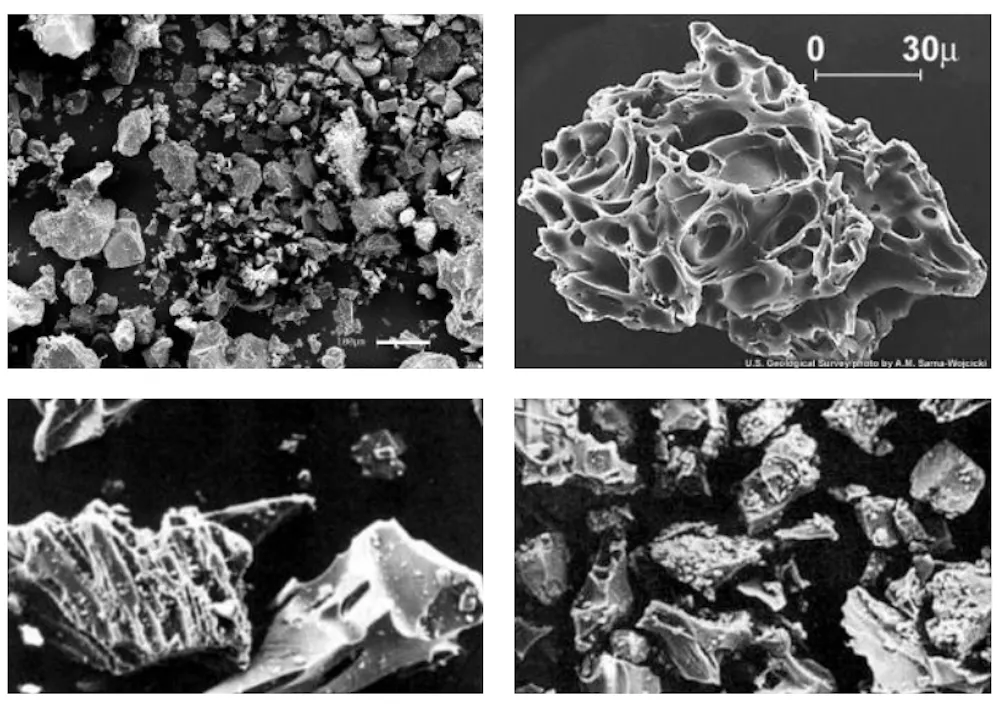
    Electron microscope images of ash show how sharp the shards are. The top left image of shards from Mount Etna in 2002 is 1 mm across. Top right is an ash particle from Mount St. Helens magnified 200 times. The shards in the lower images are less than 0.064 mm.
    Volcano Hazards Program, U.S. Geological Survey

    Ash can also contaminate surface water by introducing toxins and increasing the water’s acidity. The toxins can leach into groundwater, contaminating wells. Fine ash particles can also settle in waterways and smother aquatic plants and animals. During the 2008 Chaitén eruption in Chile, ash contamination led to widespread fish deaths in the Río Blanco.

    Ash can ground airplanes, gum up infrastructure

    Ash clouds are extremely dangerous to aircraft. The glassy ash particles melt when sucked into jet turbines, clog fuel systems and can stall engines in midair.

    In 1982, British Airways Flight 9 lost power in all four engines after flying through an ash cloud. A similar incident occurred in 1989 to KLM Flight 867 over Alaska. In 2010, Iceland’s Eyjafjallajökull eruption grounded more than 100,000 flights across Europe, disrupting travel for over 10 million passengers and costing the global economy billions of dollars.

    Volcanic ash can also wreak havoc on infrastructure by clogging water supplies, short-circuiting electrical systems and collapsing roofs under its weight. It can disrupt transportation, communication, rescue and power networks, as the 1991 eruption of Mount Pinatubo in the Philippines dramatically demonstrated.

    What to do during ashfall

    During an ashfall event, the most effective strategy to stay safe is to stay indoors as much as possible and avoid inhaling ash particles.

    Anyone who must go outside should wear a properly fitted N95 or P2 mask. Cloth masks provide little protection against fine ash. Rainwater tanks, troughs and open wells should be covered and monitored for contamination. Livestock should be moved to clean pastures or given uncontaminated fodder.

    The challenges Alaska is facing if Mount Spurr erupts.

    To reduce structural damage, ash should be cleared from roofs and gutters promptly, especially before rainfall.

    Older adults, children and people who are sick are at greatest risk, particularly those living in poorly ventilated homes. Rural communities that are dependent on agriculture and livestock are disproportionately affected by ashfall, as are low-income people who lack access to clean water, protective masks or safe shelter.

    Communities can stay informed about ash risks through official alerts, including those from the Volcanic Ash Advisory Centers, which monitor ash dispersion and issue timely warnings. The International Volcanic Health Hazard Network also offers guidelines on personal protection, emergency planning and ash cleanup.

    The long tail of ash

    Volcanic ash may fall quietly, but its effects are widespread, persistent and potentially deadly. It poses a chronic threat to health, agriculture, infrastructure and aquatic systems.

    Recognizing the risk is a crucial first step to protecting lives. Effective planning and public awareness can further help reduce the damage.

    David Kitchen does not work for, consult, own shares in or receive funding from any company or organization that would benefit from this article, and has disclosed no relevant affiliations beyond their academic appointment.

    ref. Volcanic ash is a silent killer, more so than lava: What Alaska needs to know with Mount Spurr likely to erupt – https://theconversation.com/volcanic-ash-is-a-silent-killer-more-so-than-lava-what-alaska-needs-to-know-with-mount-spurr-likely-to-erupt-254461

    MIL OSI – Global Reports

  • MIL-OSI Asia-Pac: Union Minister Shri Shivraj Singh Chouhan to attend 15th BRICS Agriculture Ministers Meeting at Brasilia, Brazil

    Source: Government of India

    Union Minister Shri Shivraj Singh Chouhan to attend 15th BRICS Agriculture Ministers Meeting at Brasilia, Brazil

    Shir Chouhan to hold bilateral meetings with Brazil Minister of Agriculture & Livestock Mr Carlos Henrique Baqueta Fávaro, Minister of Agrarian Development and Family Farming Mr Luiz Paulo Teixeira,

    Theme of 15th BRICS Agricultural Ministerial Meeting is “Promoting Inclusive and Sustainable Agriculture through Cooperation, Innovation, and Equitable Trade among BRICS Countries”

    Posted On: 15 APR 2025 10:54AM by PIB Delhi

    Union Minister for Agriculture & Farmers’ Welfare and Rural Development, Shri Shivraj Singh Chouhan, is leading the Indian delegation to the 15th BRICS Agriculture Ministers’ Meeting (AMM), scheduled to be held on 17th April, 2025 in Brasilia, Brazil. The theme of 15th BRICS AMM is “Promoting Inclusive and Sustainable Agriculture through Cooperation, Innovation, and Equitable Trade among BRICS Countries”. Agriculture Ministers and senior officials from BRICS member countries, including Brazil, Russia, India, China, South Africa, Saudi Arabia, Egypt, United Arab Emirates, Ethiopia, Indonesia, and Iran are expected to attend the Meeting.

    During the visit, Shri Chouhan will hold bilateral meetings with key Brazilian counterparts, including Mr. Carlos Henrique Baqueta Fávaro, Minister of Agriculture and Livestock, and Mr. Luiz Paulo Teixeira, Minister of Agrarian Development and Family Farming (MDA). These meetings will focus on enhancing collaboration between India and Brazil in various areas of agriculture, agri-technology, rural development, and food security.

    The Minister will interact with leaders of major Brazilian agribusiness companies and representatives of the Brazilian Association of Vegetable Oil Industries in São Paulo, exploring avenues for partnership and investment in the agriculture value chain. As part of his visit, the Minister will also participate in a tree plantation drive at the Embassy of India in Brasilia, under the noble initiative “Ek Ped Maa Ke Naam”, aimed at raising environmental consciousness and honouring motherhood. In addition, the Minister will interact with the vibrant Indian diaspora in São Paulo, acknowledging their role as cultural ambassadors and contributors to bilateral ties. This visit reaffirms India’s commitment to deepen cooperation with BRICS nations and to advance South-South cooperation in agricultural innovation, resilience, and sustainability.

    ***

    PSF/KSR/AR

    (Release ID: 2121725) Visitor Counter : 83

    MIL OSI Asia Pacific News

  • MIL-OSI Asia-Pac: Index Numbers of Wholesale Price in India for the Month of March, 2025 (Base Year: 2011-12)

    Source: Government of India

    Posted On: 15 APR 2025 12:00PM by PIB Delhi

    The annual rate of inflation based on all India Wholesale Price Index (WPI) number is 2.05% (provisional) for the month of March, 2025 (over March, 2024). Positive rate of inflation in March, 2025 is primarily due to increase in prices of manufacture of food products, other manufacturing, food articles, electricity and manufacture of textiles etc. The index numbers and inflation rate for the last three months of all commodities and WPI components are given below:

    Index Numbers and Annual Rate of Inflation (Y-o-Y in %) *

    All Commodities/Major Groups

    Weight (%)

    January-25 (F)

    February-25 (P)

    March-25 (P)

    Index

    Inflation

    Index

    Inflation

    Index

    Inflation

    All Commodities

    100.00

    155.0

    2.51

    154.8

    2.38

    154.5

    2.05

    I. Primary Articles

    22.62

    189.7

    4.58

    186.6

    2.81

    184.6

    0.76

    II. Fuel & Power

    13.15

    152.0

    -1.87

    153.8

    -0.71

    152.4

    0.20

    III. Manufactured Products

    64.23

    143.4

    2.65

    143.8

    2.86

    144.4

    3.07

    Food Index

    24.38

    191.5

    7.52

    189.0

    5.94

    188.8

    4.66

    Note: F: Final, P: Provisional, *Annual rate of WPI inflation calculated over the corresponding month of previous year

    The month over month change in WPI for the month of March, 2025 stood at (-) 0.19% as compared to February, 2025. The monthly change in WPI for last six-month is summarized below:

    Month Over Month (M-o-M in %) change in WPI Index#

    All Commodities/Major Groups

    Weight

    Oct-24

    Nov-24

    Dec-24

    Jan-25 (F)

    Feb-25 (P)

    Mar-25 (P)

    All Commodities

    100.00

    1.29

    -0.19

    -0.45

    -0.45

    -0.13

    -0.19

    I. Primary Articles

    22.62

    2.61

    -1.35

    -2.07

    -2.12

    -1.63

    -1.07

    II. Fuel & Power

    13.15

    1.09

    0.74

    1.27

    0.13

    1.18

    -0.91

    III. Manufactured Products

    64.23

    0.70

    0.14

    -0.07

    0.28

    0.28

    0.42

    Food Index

    24.38

    3.22

    -0.99

    -2.10

    -2.30

    -1.31

    -0.11

    Note: F: Final, P: Provisional, #Monthly rate of change, based on month over month (M-o-M) WPI calculated over the preceding month


    Month-over-Month Change in Major Groups of WPI:

    1. Primary Articles (Weight 22.62%): – The index for this major group decreased by 1.07% to 184.6 (provisional) in March, 2025 from 186.6 (provisional) for the month of February, 2025. Price of crude petroleum & natural gas (-2.42%), non-food articles (-2.40%) and food articles (-0.72%) decreased in March, 2025 as compared to February, 2025. The price of minerals (0.31%) increased in March, 2025 as compared to February, 2025.
    2. Fuel & Power (Weight 13.15%): – The index for this major group decreased by 0.91% to 152.4 (provisional) in March, 2025 from 153.8 (provisional) for the month of February, 2025. Price of electricity (-2.31%) and mineral oils (-0.70%) decreased in March, 2025 as compared to February, 2025. The price of coal remained same as in the previous month.
    3. Manufactured Products (Weight 64.23%): – The index for this major group increased by 0.42% to 144.4 (Provisional) in March, 2025 from 143.8 (Provisional) for the month of February, 2025. Out of the 22 NIC two-digit groups for manufactured products, 16 groups witnessed an increase in prices, 5 groups witnessed a decrease in prices and 1 group witnessed no change in prices. Some of the important groups that showed month-over-month increase in prices were manufacture of basic metals; food products; other transport equipment; other manufacturing and machinery and equipment etc. Some of the groups that witnessed a decrease in prices were manufacture of textiles; chemicals and chemical products; computer, electronic and optical products; printing and reproduction of recorded media and furniture etc in March, 2025 as compared to February, 2025.

    WPI Food Index (Weight 24.38%): The Food Index consisting of ‘food articles’ from primary articles group and ‘food product’ from manufactured products group decreased from 189.0 in February, 2025 to 188.8 in March, 2025. The annual rate of inflation based on WPI Food Index decreased from 5.94% in February, 2025 to 4.66% in March, 2025.

    Final Index for the month of January, 2025 (Base Year: 2011-12=100): For the month of January, 2025, the final Wholesale Price Index and inflation rate for ‘All Commodities’ (Base: 2011-12=100) stood at 155.0 and 2.51% respectively. The details of all India Wholesale Price Indices and Rates of Inflation for different commodity groups based on updated figures are at Annex I. The Annual rate of Inflation (Y-o-Y) based on WPI for different commodity groups in the last six months is at Annex II. WPI for different commodity groups in the last six months is at Annex III.

    Response Rate: The WPI for March, 2025 has been compiled at a weighted response rate of 82.7 per cent, while the final figure for January, 2025 is based on the weighted response rate of 95.4 per cent. The provisional figures of WPI will undergo revision as per the revision policy of WPI. This press release, item indices, and inflation numbers are available at our home page http://eaindustry.nic.in.

    Next date of Press Release: WPI for the month of April, 2025 would be released on 14/05/2025.

    Note: DPIIT releases index number of wholesale price in India on monthly basis on 14th of every month (or next working day, if 14th falls on holiday) with a time lag of two weeks of the reference month, and the index number is compiled with data received from institutional sources and selected manufacturing units across the country. This press release contains WPI (Base Year 2011-12=100) for the month of March, 2025 (Provisional), January, 2025 (Final) and other months/years. Provisional figures of WPI are finalised after 10 weeks (from the month of reference), and frozen thereafter.

    Annex-I

    All India Wholesale Price Indices and Rates of Inflation (Base Year: 2011-12=100) for March, 2025

    Commodities/Major Groups/Groups/Sub-Groups/Items

    Weight

    Index

    March-25*

    Latest month over Month (MoM)

    Inflation (YoY)

    Rate of Inflation (YoY)

    Feb-Mar 2024

    Feb-Mar

    2025*

    2023-24 (Apr-Mar)

    2024-25* (Apr-Mar)

    Mar-24

    Mar-25*

    ALL COMMODITIES

    100.00

    154.5

    0.13

    -0.19

    -0.73

    2.25

    0.26

    2.05

    I. PRIMARY ARTICLES

    22.62

    184.6

    0.94

    -1.07

    3.54

    5.13

    4.57

    0.76

    A. Food Articles

    15.26

    194.4

    1.06

    -0.72

    6.61

    7.30

    7.05

    1.57

    Cereals

    2.82

    211.2

    0.35

    -0.85

    7.17

    7.88

    9.04

    5.49

    Paddy

    1.43

    203.6

    1.24

    0.00

    9.31

    8.42

    11.74

    3.88

    Wheat

    1.03

    217.1

    -0.20

    -1.68

    4.53

    7.64

    7.48

    7.96

    Pulses

    0.64

    205.1

    0.33

    -1.63

    14.38

    10.70

    17.18

    -2.98

    Vegetables

    1.87

    177.5

    5.55

    -5.74

    9.00

    16.64

    20.09

    -15.88

    Potato

    0.28

    199.7

    26.30

    -7.67

    -17.06

    65.71

    58.43

    -6.77

    Onion

    0.16

    273.7

    5.31

    -9.91

    40.36

    42.59

    56.48

    26.65

    Fruits

    1.60

    218.5

    4.33

    4.25

    -1.07

    12.03

    -3.05

    20.78

    Milk

    4.44

    186.8

    0.38

    0.21

    7.46

    3.02

    5.08

    1.41

    Eggs, Meat & Fish

    2.40

    170.1

    -0.06

    -0.82

    0.88

    0.71

    -1.75

    0.71

    B. Non-Food Articles

    4.12

    162.8

    0.57

    -2.40

    -5.64

    -0.42

    -4.25

    1.75

    Oil Seeds

    1.12

    179.3

    0.00

    0.22

    -9.81

    -1.94

    -7.17

    0.34

    C. Minerals

    0.83

    227.9

    -1.51

    0.31

    6.95

    4.49

    -0.36

    2.84

    D. Crude Petroleum & Natural gas

    2.41

    145.1

    1.35

    -2.42

    -3.04

    -1.54

    4.87

    -7.64

    Crude Petroleum

    1.95

    120.8

    0.96

    -2.89

    -7.79

    -2.55

    10.26

    -11.50

    II. FUEL & POWER

    13.15

    152.4

    -1.81

    -0.91

    -4.70

    -1.30

    -2.75

    0.20

    LPG

    0.64

    123.7

    1.23

    0.57

    -10.79

    2.77

    -10.19

    0.24

    Petrol

    1.60

    151.8

    -0.82

    -0.46

    -3.27

    -3.73

    -0.94

    -3.86

    HSD

    3.10

    165.4

    -1.05

    -0.72

    -10.21

    -3.40

    -3.51

    -2.88

    III. MANUFACTURED PRODUCTS

    64.23

    144.4

    0.21

    0.42

    -1.69

    1.71

    -0.85

    3.07

    Mf/o Food Products

    9.12

    179.4

    1.25

    0.90

    -2.92

    7.12

    0.81

    10.67

    Vegetable & Animal Oils and Fats

    2.64

    190.8

    3.26

    1.22

    -20.30

    16.14

    -7.73

    30.95

    Mf/o Beverages

    0.91

    134.6

    0.15

    0.07

    2.02

    1.91

    1.69

    1.58

    Mf/o Tobacco Products

    0.51

    180.2

    0.63

    0.11

    4.98

    2.39

    4.20

    2.21

    Mf/o Textiles

    4.88

    136.6

    -0.07

    -0.29

    -5.65

    1.25

    -1.83

    1.71

    Mf/o Wearing Apparel

    0.81

    154.5

    -0.13

    0.13

    1.45

    1.72

    1.00

    1.98

    Mf/o Leather and Related Products

    0.54

    126.2

    0.00

    0.32

    1.58

    0.93

    1.14

    2.02

    Mf/o Wood and of Products of Wood and Cork

    0.77

    150.0

    -0.27

    0.81

    2.38

    1.75

    4.27

    0.60

    Mf/o Paper and Paper Products

    1.11

    141.3

    0.07

    0.36

    -7.71

    -0.77

    -6.12

    2.39

    Mf/o Chemicals and Chemical Products

    6.47

    136.9

    0.15

    -0.15

    -5.88

    -0.29

    -4.64

    0.96

    Mf/o Pharmaceuticals, Medicinal Chemical and Botanical Products

    1.99

    145.2

    -0.35

    0.14

    1.43

    1.03

    1.20

    1.26

    Mf/o Rubber and Plastics Products

    2.30

    129.7

    0.39

    0.00

    -1.68

    1.19

    -0.08

    1.17

    Mf/o other Non-Metallic Mineral Products

    3.20

    132.7

    -0.52

    0.08

    0.71

    -2.42

    -1.11

    -0.30

    Cement, Lime and Plaster

    1.64

    131.6

    -1.40

    0.30

    0.07

    -5.10

    -2.61

    -2.01

    Mf/o Basic Metals

    9.65

    139.1

    0.14

    1.09

    -5.20

    -0.98

    -5.13

    0.29

    Mild Steel – Semi Finished Steel

    1.27

    118.2

    0.26

    0.77

    -5.59

    -1.68

    -7.14

    1.03

    Mf/o Fabricated Metal Products, Except Machinery and Equipment

    3.15

    136.4

    -1.02

    0.15

    -0.29

    -1.86

    -2.16

    0.15

    Note: * = Provisional. Mf/o = Manufacture of

    Annex-II

    WPI Inflation (Base Year: 2011-12=100) for last 6 months

    Commodities/Major Groups/Groups/Sub-Groups/Items

    Weight

    WPI based inflation (YoY) figures for last 6 months

    Oct-24

    Nov-24

    Dec-24

    Jan-25

    Feb-25*

    Mar-25*

    ALL COMMODITIES

    100.00

    2.75

    2.16

    2.57

    2.51

    2.38

    2.05

    I. PRIMARY ARTICLES

    22.62

    8.26

    5.49

    6.02

    4.58

    2.81

    0.76

    A. Food Articles

    15.26

    13.49

    8.48

    8.53

    5.83

    3.38

    1.57

    Cereals

    2.82

    7.80

    7.71

    6.77

    7.33

    6.77

    5.49

    Paddy

    1.43

    7.47

    7.58

    6.93

    6.22

    5.17

    3.88

    Wheat

    1.03

    8.04

    8.20

    7.48

    9.75

    9.58

    7.96

    Pulses

    0.64

    9.27

    5.97

    5.02

    5.13

    -1.04

    -2.98

    Vegetables

    1.87

    62.86

    29.34

    28.57

    8.11

    -5.80

    -15.88

    Potato

    0.28

    79.11

    82.64

    92.36

    72.57

    27.54

    -6.77

    Onion

    0.16

    39.25

    1.08

    16.98

    28.33

    48.05

    26.65

    Fruits

    1.60

    13.60

    5.59

    11.16

    15.30

    20.88

    20.78

    Milk

    4.44

    3.00

    2.04

    2.15

    2.58

    1.58

    1.41

    Eggs, Meat & Fish

    2.40

    -0.52

    3.16

    5.43

    3.56

    1.48

    0.71

    B. Non-Food Articles

    4.12

    -1.34

    -0.61

    2.40

    3.01

    4.84

    1.75

    Oil Seeds

    1.12

    1.98

    0.32

    -1.35

    0.16

    0.11

    0.34

    C. Minerals

    0.83

    4.51

    6.30

    5.70

    1.56

    0.98

    2.84

    D. Crude Petroleum & Natural gas

    2.41

    -11.80

    -7.74

    -6.77

    -0.53

    -4.06

    -7.64

    Crude Petroleum

    1.95

    -12.49

    -7.20

    -6.86

    -0.76

    -7.99

    -11.50

    II. FUEL & POWER

    13.15

    -4.31

    -4.03

    -2.57

    -1.87

    -0.71

    0.20

    LPG

    0.64

    2.57

    1.81

    2.47

    2.23

    0.90

    0.24

    Petrol

    1.60

    -7.35

    -6.83

    -5.09

    -3.64

    -4.21

    -3.86

    HSD

    3.10

    -6.23

    -5.68

    -4.30

    -3.61

    -3.20

    -2.88

    III. MANUFACTURED PRODUCTS

    64.23

    1.78

    2.07

    2.14

    2.65

    2.86

    3.07

    Mf/o Food Products

    9.12

    9.39

    9.57

    9.75

    10.73

    11.06

    10.67

    Vegetable & Animal Oils and Fats

    2.64

    26.03

    28.83

    31.82

    33.74

    33.59

    30.95

    Mf/o Beverages

    0.91

    2.13

    2.28

    1.89

    1.51

    1.66

    1.58

    Mf/o Tobacco Products

    0.51

    1.09

    1.14

    4.40

    4.02

    2.74

    2.21

    Mf/o Textiles

    4.88

    0.89

    1.42

    2.32

    2.24

    1.93

    1.71

    Mf/o Wearing Apparel

    0.81

    1.25

    1.52

    1.65

    2.19

    1.71

    1.98

    Mf/o Leather and Related Products

    0.54

    1.37

    1.45

    1.53

    3.24

    1.70

    2.02

    Mf/o Wood and of Products of Wood and Cork

    0.77

    1.09

    0.54

    0.47

    1.01

    -0.47

    0.60

    Mf/o Paper and Paper Products

    1.11

    0.94

    0.07

    -0.07

    0.58

    2.10

    2.39

    Mf/o Chemicals and Chemical Products

    6.47

    -0.22

    0.29

    0.59

    1.03

    1.26

    0.96

    Mf/o Pharmaceuticals, Medicinal Chemical and Botanical Products

    1.99

    0.42

    1.19

    0.49

    1.40

    0.76

    1.26

    Mf/o Rubber and Plastics Products

    2.30

    1.89

    1.42

    1.18

    1.65

    1.57

    1.17

    Mf/o other Non-Metallic Mineral Products

    3.20

    -3.83

    -2.38

    -2.73

    -1.64

    -0.90

    -0.30

    Cement, Lime and Plaster

    1.64

    -7.20

    -5.38

    -6.26

    -5.10

    -3.67

    -2.01

    Mf/o Basic Metals

    9.65

    -2.04

    -1.14

    -1.50

    -1.15

    -0.65

    0.29

    Mild Steel – Semi Finished Steel

    1.27

    -1.67

    -0.68

    -0.85

    0.09

    0.51

    1.03

    Mf/o Fabricated Metal Products, Except Machinery and Equipment

    3.15

    -2.81

    -2.87

    -1.45

    -1.81

    -1.02

    0.15

    Note: * = Provisional. Mf/o = Manufacture of


    Annex-III

    Wholesale Price Indices (Base Year: 2011-12=100) for last 6 months

    Commodities/Major Groups/Groups/Sub-Groups/Items

    Weight

    WPI Numbers for last 6 months

    Oct-24

    Nov-24

    Dec-24

    Jan-25

    Feb-25*

    Mar-25*

    ALL COMMODITIES

    100.00

    156.7

    156.4

    155.7

    155.0

    154.8

    154.5

    I. PRIMARY ARTICLES

    22.62

    200.6

    197.9

    193.8

    189.7

    186.6

    184.6

    A. Food Articles

    15.26

    217.9

    213.7

    207.5

    199.8

    195.8

    194.4

    Cereals

    2.82

    208.6

    211.0

    211.4

    212.3

    213.0

    211.2

    Paddy

    1.43

    204.4

    205.9

    205.3

    203.1

    203.6

    203.6

    Wheat

    1.03

    209.6

    213.8

    215.5

    219.6

    220.8

    217.1

    Pulses

    0.64

    234.5

    230.8

    224.0

    217.1

    208.5

    205.1

    Vegetables

    1.87

    360.9

    334.6

    288.5

    222.6

    188.3

    177.5

    Potato

    0.28

    375.6

    384.1

    365.1

    292.5

    216.3

    199.7

    Onion

    0.16

    478.2

    495.8

    414.7

    316.6

    303.8

    273.7

    Fruits

    1.60

    210.5

    198.4

    193.3

    196.7

    209.6

    218.5

    Milk

    4.44

    185.6

    185.2

    185.6

    187.0

    186.4

    186.8

    Eggs, Meat & Fish

    2.40

    171.0

    173.1

    174.7

    174.7

    171.5

    170.1

    B. Non-Food Articles

    4.12

    161.9

    162.8

    166.2

    167.5

    166.8

    162.8

    Oil Seeds

    1.12

    185.4

    185.6

    182.8

    183.4

    178.9

    179.3

    C. Minerals

    0.83

    229.6

    229.4

    230.1

    227.2

    227.2

    227.9

    D. Crude Petroleum & Natural gas

    2.41

    147.3

    146.7

    141.9

    150.9

    148.7

    145.1

    Crude Petroleum

    1.95

    126.1

    125.0

    119.5

    130.0

    124.4

    120.8

    II. FUEL & POWER

    13.15

    148.8

    149.9

    151.8

    152.0

    153.8

    152.4

    LPG

    0.64

    119.8

    123.6

    124.6

    123.7

    123.0

    123.7

    Petrol

    1.60

    149.9

    148.7

    149.2

    150.8

    152.5

    151.8

    HSD

    3.10

    164.2

    164.4

    164.6

    165.6

    166.6

    165.4

    III. MANUFACTURED PRODUCTS

    64.23

    142.9

    143.1

    143.0

    143.4

    143.8

    144.4

    Mf/o Food Products

    9.12

    175.9

    177.5

    176.8

    177.5

    177.8

    179.4

    Vegetable & Animal Oils and Fats

    2.64

    178.2

    183.2

    185.6

    187.5

    188.5

    190.8

    Mf/o Beverages

    0.91

    134.5

    134.7

    134.5

    134.4

    134.5

    134.6

    Mf/o Tobacco Products

    0.51

    176.0

    177.0

    180.3

    181.2

    180.0

    180.2

    Mf/o Textiles

    4.88

    135.9

    136.1

    136.8

    137.0

    137.0

    136.6

    Mf/o Wearing Apparel

    0.81

    153.9

    153.7

    154.4

    154.2

    154.3

    154.5

    Mf/o Leather and Related Products

    0.54

    125.7

    125.8

    126.0

    127.5

    125.8

    126.2

    Mf/o Wood and of Products of Wood and Cork

    0.77

    148.7

    148.5

    148.3

    149.6

    148.8

    150.0

    Mf/o Paper and Paper Products

    1.11

    139.8

    138.5

    138.3

    139.5

    140.8

    141.3

    Mf/o Chemicals and Chemical Products

    6.47

    136.3

    136.4

    136.5

    136.8

    137.1

    136.9

    Mf/o Pharmaceuticals, Medicinal Chemical and Botanical Products

    1.99

    143.5

    144.1

    144.0

    145.0

    145.0

    145.2

    Mf/o Rubber and Plastics Products

    2.30

    129.6

    128.6

    129.0

    129.3

    129.7

    129.7

    Mf/o other Non-Metallic Mineral Products

    3.20

    130.4

    131.4

    131.7

    132.2

    132.6

    132.7

    Cement, Lime and Plaster

    1.64

    128.8

    130.1

    130.2

    130.2

    131.2

    131.6

    Mf/o Basic Metals

    9.65

    139.3

    138.6

    137.5

    137.2

    137.6

    139.1

    Mild Steel – Semi Finished Steel

    1.27

    118.0

    117.5

    116.8

    117.3

    117.3

    118.2

    Mf/o Fabricated Metal Products, Except Machinery and Equipment

    3.15

    135.0

    135.3

    135.9

    135.3

    136.2

    136.4

    Note: * = Provisional. Mf/o = Manufacture of

    ***

    Abhishek Dayal

    (Release ID: 2121751) Visitor Counter : 188

    MIL OSI Asia Pacific News

  • MIL-OSI Russia: Sergei Sobyanin: Large-scale project “Summer in Moscow” will begin on June 1

    Translartion. Region: Russians Fedetion –

    Source: Moscow Government – Government of Moscow –

    The large-scale city project “Summer in Moscow” will begin in the capital on June 1. Sergei Sobyanin spoke about this in his telegram channel.

    “Every day for three months, charity, cultural and sports events will be held in all districts and in every area of the capital. Most of them will be free and outdoors,” the Moscow Mayor wrote.

    Source: Sergei Sobyanin’s Telegram channel @Mos_Sobyanin

    The unique project will unite all the events of the summer, including the popular festivals “Tastes of Russia”, “Teatralny Boulevard”, “Gardens and Flowers”, “Times and Epochs”, “Moscow Estates” and “Moscow – on the Wave. Fish Week”.

    In addition, they plan to hold many new musical, sports, youth and patriotic events. Thus, the creative camp “Youth of Moscow” will open for the first time in the Moskino cinema park. Participants will be able to choose and master one of the following areas: “KVN”, “Vocals and Music”, “Original Genre”, “Cinema”, “Producing and Organizing Events”.

    For the capital’s entrepreneurs, the “Summer in Moscow” project will be a good opportunity to make a name for themselves, hold an event on their own site or in one of the 200 city public spaces, and also receive support in promotion.

    Entrepreneurs will also be offered the opportunity to present their products in 13 Made in Moscow art pavilions. Those interested must submit an application on the website project to support local brands.

    Last year, the project’s activities “Summer in Moscow” More than 38 million city residents and guests of the capital visited it.

    Please note: This information is raw content directly from the source of the information. It is exactly what the source states and does not reflect the position of MIL-OSI or its clients.

    Please Note; This Information is Raw Content Directly from the Information Source. It is access to What the Source Is Stating and Does Not Reflect

    HTTPS: //vv.mos.ru/mayor/tkhemes/12619050/

    MIL OSI Russia News

  • MIL-OSI USA: Reps. Mann, Kaptur, Budzinski Lead Bipartisan, Bicameral Legislation to Prioritize Domestic Feedlots and Biofuels

    Source: United States House of Representatives – Representative Tracey Mann (Kansas, 1)

    WASHINGTON, D.C. –  U.S. Representatives Tracey Mann (KS-01), Marcy Kaptur (OH-09), and Nikki Budzinski (IL-13) reintroduced the bipartisan, bicameral Farmer First Fuel Incentives Act. The bill would restrict the eligibility of the 45Z Tax Credit to renewable fuels made only from domestically sourced feedstocks and extend the credit through 2034. U.S. Senators Roger Marshall, M.D. (R-KS) and Amy Klobuchar (D-MN) introduced companion legislation in the Senate. 

    “American tax incentives should benefit American-grown products and American farmers, not foreign producers,” said Rep. Mann. “Foreign feedstocks can play a significant role in producing domestically manufactured ethanol, biodiesel, renewable diesel, and sustainable aviation fuel, but we cannot allow them to displace harvest grown right in our backyard. Our tax code should reward the grit and tenacity of American producers, not prop up feedstocks grown overseas.”

    “Today, I joined my colleagues in this important bicameral and bipartisan effort because helping American farmers, producers, and growers goes beyond state and party lines, and is more important now than ever,” said Rep. Kaptur. “We must ensure the Clean Fuel Production tax credit is structured in a way that benefits domestic producers, and not one that advantages foreign-produced feedstocks from China or Brazil. Our legislation extends this credit through 2034 and will bolster American energy independence by prioritizing American producers and the production of domestic biofuels.”

    The Farmer First Fuel Incentives Act would extend the 45Z tax credit and give the ethanol industry the time and financial incentive to build up the infrastructure needed for the U.S. to be less reliant on foreign fuel, open new markets for farmers, and increase ethanol production across the Midwest. Additionally, this bill fixes the glaring flaw in 45Z that negatively impacts farmers wanting to sell feedstocks to the biodiesel and renewable diesel industry. If 45Z continues as-is, taxpayers are at risk of further subsidizing Chinese-used cooking oil and undermining the use of soy, canola, sorghum, and corn oil in renewable fuels.

    “The Farmer First Fuel Incentives Act is commonsense legislation that stops sending American taxpayer dollars to China, expands robust domestic markets for agriculture producers, and increases certainty for the biofuels industry,” said Sen. Marshall. “With President Trump in the White House and Republicans leading both the Senate and House, we are finally putting American farmers first and supporting biofuels made in the U.S.A. It’s time our energy and agricultural policies reflect that.”

    “Domestically produced biofuel strengthens our energy independence, supports our farmers, and boosts rural economies,” said Sen. Klobuchar. “The introduction of the Farmers First Fuel Incentives Act is an important step as we work to maximize the potential of the 45Z Clean Fuel Production Credit and clean fuel investments across rural America. By extending the credit for another ten years, this legislation gives farmers and biofuel producers the certainty they need to provide consumers with affordable, lower-carbon fuel options.” 

    The legislation is supported by Growth Energy, American Soybean Association, National Oilseed Processors Association (NOPA), National Corn Growers Association, National Sorghum Producers, U.S. Canola Association, and Renewable Fuels Association.

    “We are deeply appreciative of these leaders for introducing legislation that establishes requirements for a tax credit that will level the playing field for America’s corn growers,” said National Corn Growers Association President Kenneth Hartman Jr. “This bill brings American farmers a step closer to unlocking an exciting new market with global reach.”

    “We appreciate the focus on “farmers first” legislation and the support of 45Z and domestic feedstocks like sorghum,” said Amy France, Chair of the National Sorghum Producers. “Domestic biofuel production remains critical to our farm and our country’s success.”

    In September 2024, Rep. Mann introduced the Farmers First Fuel Incentives Act in the 118th Congress. That same month, Reps. Mann and Kaptur penned a letter to then-Treasury Secretary Janet Yellen, urging the Treasury to expedite the issuance of the 45Z tax credit. 

    ###


    For more information on Rep. Mann visit www.mann.house.gov

    MIL OSI USA News

  • MIL-OSI Asia-Pac: Agricultural and Processed Food Products Export Development Authority (APEDA) and Government of Arunachal Pradesh hosts International Conclave cum Buyer-Seller Meet at Tawang, Arunachal Pradesh

    Source: Government of India

    Agricultural and Processed Food Products Export Development Authority (APEDA) and Government of Arunachal Pradesh hosts International Conclave cum Buyer-Seller Meet at Tawang, Arunachal Pradesh

    11 Buyers from 3 countries, 17 Indian exporters from 7 States and Union Territories (UTs) and over 200 farmers participate

    Posted On: 12 APR 2025 11:44AM by PIB Delhi

    The Agricultural and Processed Food Products Export Development Authority (APEDA) in collaboration with the Government of Arunachal Pradesh, hosted an International Conclave cum Buyer-Seller Meet (IBSM) at Kalawangpo Convention Hall in Tawang, Arunachal Pradesh to promote agricultural and processed food products exports from Arunachal Pradesh and the broader North-Eastern Region (NER) of India.

    In his keynote address, the Chief Minister of Arunachal Pradesh, Shri Pema Khandu committed to developing the agricultural & allied sectors, enhancing farmer’s livelihoods, empowering Self-Help Groups and encouraged women led development. He envisions enhancing agri-exports of GI tagged Khaw Tai Rice (known as Khamti Rice), Mandarin Orange, Kiwi, Apple, Persimmon, Yak Cheese (Churpi), amongst others to South East Asian and ASEAN Countries. He encouraged domestic and international buyers to be a boon for the state and invest in the state’s untapped potential.

    The Minister of Agriculture, Govt. of Arunachal Pradesh, Shri Gabriel Denwang Wangsu emphasized on the need to generate awareness and build capacity of the farmers of the state in order to ensure fair price for their agriculture products in domestic and international markets. He appreciated the farmers of the region for their unwavering commitment in producing the state’s finest Kiwi, Mandarin Oranges, Apples, walnuts and Value-Added Products like wines, amongst others.

    The International Conclave cum Buyer Seller Meet (BSM) was also graced by Chief Secretary (CS), Govt. of Arunachal Pradesh, Shri Manish Gupta, Former Union Secretary, Government of India, Shri Siraj Hussain and Chairman of APEDA, Shri Abhishek Dev, amongst several officers of the Central and State Government of India.

    The Chairman of APEDA, Shri Abhishek Dev, encouraged the identification of Farmer Producer Organisations (FPOs)/ Farmer Producer Companies (FPCs) from Arunachal Pradesh for participation in key national and international Trade Fairs for market access, promotion and outreach. He assured that APEDA and the Government of Arunachal Pradesh are committed to working together closely for the identification and development of focused agriculture products from Arunachal Pradesh for exports to international markets, infrastructure development, training and capacity building of farmers, Farmer Producer Organisation (FPO), Farmer Producer Companies (FPCs), Women’s Self Help Groups (SHGs), Start-ups and Exporters from the region as well as branding and international promotions of agriculture produce and Value Added Products from the state.

    The International Conclave cum Buyer-Seller Meet enabled direct interactions between 11 international Buyers from 3 countries including UAE, Nepal and Bhutan with 17 Indian exporters from 7 states and Union Territories (UTs) including Assam, Maharashtra, Delhi, Hyderabad, Karnataka, Gujarat and West Bengal. The exporters from across the country also interacted with over 50 FPOs and 200 farmers from Arunachal Pradesh who participated in the event to understand the agri produce quality, availability and production quantities.

    APEDA facilitated meaningful trade discussions amongst Policymakers, Buyers, Exporters, Exhibitors, industry leaders and experts from key sectors such as Organic produce, Millets, Honey, Fresh Fruits and Vegetables, Processed Food, Spices and Tea aimed at unlocking the potential of Arunachal Pradesh’s agri-business and processed food export sectors.

    To realise the Hon’ble Prime Minister, Shri Narendra Modi’s vision of a “Viksit North East,” the Government of India through the Ministry of Commerce and Industry, Ministry of Agriculture and Farmer’s Welfare, Ministry of Development of the North Eastern Region, Government of Arunachal Pradesh and APEDA are working in close coordination.

    Background:

    The Agricultural and Processed Food Products Export Development Authority (APEDA) is a statutory body under the Ministry of Commerce & Industry, Government of India. APEDA works to develop, facilitate and promote the export of agricultural and processed food products products, providing invaluable support to Farmer Producer Organisations (FPOs), Farmer Producer Companies and Indian exporters in navigating international markets.


    ***

    Abhishek Dayal/Nihi Sharma

    (Release ID: 2121149) Visitor Counter : 21

    MIL OSI Asia Pacific News

  • MIL-OSI China: Xi’s Southeast Asia tour to cement neighborly bond, bolster regional cooperation

    Source: People’s Republic of China – State Council News

    HONG KONG, April 13 — Chinese President Xi Jinping will visit Vietnam, Malaysia and Cambodia from Monday to Friday, marking his first overseas trip of the year. The journey underscores the emphasis China places on its Southeast Asian neighbors — partners bound not only by geographical proximity, but by decades of cooperation and mutual support.

    The visits aim to deepen ties and chart the course for future cooperation. From infrastructure to trade, China and its neighbors are aligning their modernization efforts. At each stop, the two sides will work together to strengthen political trust and expand practical cooperation.

    The trip reflects China’s broader vision of building a community with a shared future with its neighboring countries. In an era of global uncertainty, Asia’s unity, coupled with the promise of common development, presents a model of stability and progress.

    “CAMARADERIE PLUS BROTHERHOOD”

    In October 2024, the China-Vietnam Detian-Ban Gioc Waterfall cross-border tourism cooperation zone was officially launched. Tourists from both sides of the border can now leisurely walk through the streets that seamlessly blend Chinese and Vietnamese architectural styles, while enjoying the magnificent vista of the shared waterfall. This landmark project, China’s first cross-border tourism cooperation zone, stands as a testament to the strengthening of people-to-people ties between the two neighboring countries.

    This year marks the 75th anniversary of China-Vietnam diplomatic relations. From their early revolutionary struggles to their current modernization efforts, the two countries have forged a profound bond featuring “camaraderie plus brotherhood.”

    During Xi’s visit to the country in December 2023, bilateral ties were elevated to a China-Vietnam community with a shared future that carries strategic significance. Xi proposed the six major goals of “greater political mutual trust, more substantive security cooperation, deeper practical cooperation, more solid popular foundation, closer multilateral coordination and collaboration, and more proper management of differences.” That laid the groundwork for the vision of building a China-Vietnam community with a shared future.

    In August 2024, then Vietnamese President To Lam chose China as the destination for his first overseas visit only two weeks after being elected general secretary of the Communist Party of Vietnam Central Committee. During the visit, the two sides reaffirmed the six goals and emphasized joint efforts to advance shared development.

    Trade remains the engine of their relationship. China is Vietnam’s largest trading partner, and infrastructure links from rail to ports are expanding fast. Fruit from Vietnam frequents Chinese tables while Chinese raw materials and machinery fuel Vietnamese industry. The China-proposed Belt and Road Initiative (BRI) and Vietnam’s Two Corridors and One Economic Circle strategy are increasingly aligned.

    Under the strategic guidance of head-of-state diplomacy, Vietnam-China relations have developed rapidly in recent years, said Nguyen Thi Phuong Hoa, deputy director at the Institute of Chinese Studies of Vietnam Academy of Social Sciences. She expressed confidence that the profound friendship between the two countries will be passed down from generation to generation.

    FRIENDSHIP FORGED IN HISTORY

    At the Gombak station site along Malaysia’s East Coast Rail Link, cranes swing vigorously under the scorching sun while Chinese and Malaysian workers assemble steel girders together. This railway, slated for completion in 2027, stands as a prestigious project within the BRI cooperation framework. It will link Malaysia’s east and west coasts for the first time, emerging as a powerful symbol of the deepening partnership between these two nations.

    China-Malaysia ties run deep. From the voyages of renowned Chinese navigator Zheng He (1371-1433) to the establishment of diplomatic relations in 1974, the two countries have long enjoyed cultural affinity and strategic trust. During Xi’s 2013 visit, they upgraded ties to a comprehensive strategic partnership. A decade later, the relationship was elevated again to a China-Malaysia community with a shared future.

    Economic cooperation continues to thrive. China has maintained its position as Malaysia’s leading trading partner for 16 consecutive years. On top of that, bilateral initiatives like the “Two Countries, Twin Parks” program, which pairs industrial zones in Qinzhou and Kuantan, have emerged as a model for regional collaboration. This partnership has spurred the expansion of port collaboration and infrastructure connection. Furthermore, Malaysian fresh durians have been on sale in the Chinese market since last August, witnessing rising popularity among Chinese consumers.

    People-to-people exchanges are also flourishing. From international students to visa-free travel arrangements, cultural exchanges are growing deeper and more meaningful. Collaborative efforts now span a wide range of activities, from panda research to the joint pursuit of getting the lion dance recognized as a UNESCO intangible cultural heritage.

    With Malaysia serving as the 2025 chair of ASEAN and a BRICS partner country, the two countries are working more closely on regional cooperation, with an eye on stability and shared prosperity in a shifting global landscape.

    “The bilateral relationship between Malaysia and China is currently at its best,” said Dato’ Abdul Majid Ahmad Khan, president of the Malaysia-China Friendship Association and former Malaysian ambassador to China.

    IRONCLAD FRIENDSHIP

    Through towering pillars and glass walls, sunlight streams into Techo International Airport, evoking a tranquil ambiance reminiscent of standing beneath the sugar palm trees that dot the Cambodian landscape.

    Scheduled to commence operations in July, the new airport constructed by a Chinese company is expected to significantly enhance the tourism capacity of Cambodian capital Phnom Penh. This project marks yet another notable milestone in China-Cambodia cooperation within the framework of the BRI.

    China and Cambodia are ironclad friends who always support each other and stand together through thick and thin. Under the care of the leaders of both nations, the tree of China-Cambodia friendship has flourished, yielding a bountiful harvest of cooperation and mutual trust.

    The two countries have maintained frequent high-level exchanges and strategic communication. In September 2023, Cambodian Prime Minister Hun Manet visited China on his first official trip abroad after taking office. One month later, Hun Manet was in China again to attend the third Belt and Road Forum for International Cooperation.

    In December 2024, Cambodian People’s Party President and Senate President Samdech Techo Hun Sen visited China. Xi said in a meeting with Hun Sen that the ironclad friendship between China and Cambodia is of high quality, while Hun Sen described China as Cambodia’s most trusted friend.

    Under the strategic guidance of the leaders of the two countries, the building of a China-Cambodia community with a shared future has progressed into a new era characterized by high quality, high level and high standard.

    China has remained Cambodia’s biggest source of foreign investment and biggest trading partner for years. The China-Cambodia free trade agreement, along with the Regional Comprehensive Economic Partnership, has given a substantial boost to trade growth between the two nations.

    The two countries have seen frequent people-to-people exchanges. In 2024, various events were held to celebrate the China-Cambodia people-to-people exchange year, bringing tangible benefits to the two peoples.

    With the collaborative efforts of scholars from both countries, a new Khmer version of The Customs of Cambodia, an ancient Chinese travelogue that serves as a crucial source for studying Cambodia’s history, was released in April last year.

    Over the decades, Chinese experts have been working with their Cambodian peers in preserving and restoring Angkor temples to revive the invaluable treasures of Cambodia.

    Thong Mengdavid, a lecturer at the Institute for International Studies and Public Policy of the Royal University of Phnom Penh, said the deeply rooted Cambodia-China ties are rock-solid and unbreakable, serving as a paragon of South-South cooperation

    MIL OSI China News

  • MIL-OSI Australia: Helping Canberra’s community gardens take climate action

    Source: Northern Territory Police and Fire Services

    Community gardens give easy access to fresh produce and increase the resilience of local food production.

    Twelve Canberra projects have received a grant through the Community Garden Grants Program.

    They will each receive a share of $100,000 in total funding.

    The benefits of community gardens

    Community gardens offer opportunities for local climate action.

    The program also helps Canberrans connect and learn in a shared space.

    The gardens give easy access to fresh produce and increase the resilience of local food production.

    Havelock Community Garden

    The Canberra Student Housing Co-operative is a 2024 recipient.

    They plan to use their grant funds to turn the Havelock Community Garden in Turner into a communal food production space.

    This will make it a place for community connection and socialising.

    They also see it as a means of engaging and educating the student community on growing and maintaining a garden.

    “Education is a big part of what we’re trying to do. Through the grant, we can carry out all these projects we wouldn’t have been able to do before,” Cooperative Director Benjamin Mason said.

    While volunteers and skills are plentiful, cost has been a barrier.

    “This grant means we will be spending less of our budget on the inventory required to run the garden. It means we can now start gardening,” Benjamin said.

    Growing their own food will bring substantial cost benefits, as well as environmental and social ones.

    “We have our own bulk food storage that all residents can access as part of the housing co-operative. The overarching plan is to eat the food from the garden, but anything we can’t eat fresh will be used in our pickling program,” he said.

    2024 Community Garden Grant funding streams

    There are two funding streams in 2024.

    In Stream 1, there is a total of $40,000 to:

    • improve and enhance existing gardens
    • build non-food-related gardens.

    In Stream 2, there is a total of $60,000 to:

    • set up large-scale food production community gardens
    • build significant infrastructure to increase food production in existing gardens.

    2024 grant recipients

    Stream 1:

    • Canberra Environment Centre: $7,835.76 to boost capacity to produce food in their community garden and increase resilience to climate change
    • Canberra Organic Growers Society Inc: $2,000.00 to buy zero-emission power tools for the Charnwood Community Garden
    • Holy Spirit Parish, Gungahlin: $2,641.79 to enhance the productivity and sustainability of their existing gardens
    • The Food Cooperative Shop: $2,872.72 to install vertical garden infrastructure and hold composting workshops
    • Red Hill Primary School P&C: $4,068.65 to plant a bush tucker garden and enhance existing food gardens
    • Church of Christ Ainslie ACT Inc: $3,922.60 to improve seed raising capabilities, build more garden beds and create a frog bog along with native plantings
    • Canberra Student Housing Co-operative: $2,239.00 to convert the Havelock Community Garden into a communal food production space
    • Miles Franklin Primary School P&C: $8,000.00 to build the Gambara Garden, complete with fruit trees and vegetable gardens
    • Scullin Community Group Inc: $2,832.84 to plant an edible sensory hedge at the Scullin Shops.

    Stream 2:

    • Old Narrabundah Community Council: $18,947.00 to install secure fencing around their newly renovated gardens
    • Canberra Muslim Community Inc: $22,000.00 to build the GM Multicultural Community Garden at Gungahlin Mosque
    • SEE Change Belconnen: $22,470.41 to build the demonstration verge garden network. This will build verge gardens in five locations across Belconnen.

    The Community Garden Grants Program began in 2015. It has since supported 87 community garden projects.

    Find more information on the Community Garden Grants program and this year’s recipients at the Everyday Climate Choices website.

    The Canberra Student Housing Co-operative plans to use their grant funds to turn the Havelock Community Garden in Turner into a communal food production space.


    Get ACT news and events delivered straight to your inbox, sign up to our email newsletter:


    MIL OSI News

  • MIL-OSI Australia: Former Citizen of the Year blooms

    Source: Northern Territory Police and Fire Services

    Nip started GG’s Flowers to support her younger sister Gayana, who has Down Syndrome.


    In brief:

    • Nip Wijewickrema was awarded Young Canberra Citizen of the Year in 2014.
    • Nip is the co-founder of GG’s Flowers, a social enterprise employing people with a disability.
    • Nominations for Young Canberra Citizen of the Year close on 30 September 2024.

    In 2014 Nip Wijewickrema was named the Young Canberra Citizen of the Year. The award recognised her work co-founding GG’s Flowers – a social enterprise employing people with disability.

    Ten years on from the award, Nip is still changing the world one flower at a time.

    “I’m still so passionate about meaningful employment for people with a disability,” she explains.

    Nip started the business to support her younger sister Gayana, who has Down Syndrome. She wanted to make sure Gayana would have support in the workplace and a chance to become more independent. Nip has grown GG’s Florist to a successful business spreading colour and joy across Canberra.

    “I feel like I have lived a lifetime in the last 10 years,” Nip says.

    “When I won the award, I was just freshly 21 and had no idea what the world had in store for me.”

    Being named Young Canberra Citizen of the Year gave Nip a helping hand at an important time.

    “Having the honour of being a Young Canberra Citizen was life affirming and really helped me on the journey to chase the stars in social enterprise land,” she explains.

    “Social entrepreneurs often don’t have a long shelf life. It’s a hard industry and almost impossible to remain profitable and viable as the years go on. Being able to fly that flag for 10 years is truly so wonderful.”

    So, 10 years on what does life look like?

    “I’m still working at GG’s Flowers, helping the team send beautiful flowers and gift hampers and create innovative NDIS disability support,” Nip says.

    “I’m wearing the same pink uniform and having a blast doing so! I can proudly say I still absolutely adore my job and love getting up every morning with purpose.”

    Each year the Young Canberra Citizen of the Year recognises an outstanding individual aged 12 to 25 who is:

    * is an exceptional role model

    * has championed youth issues

    * has significantly contributed to the ACT.

    Nip has words of advice to offer anyone thinking of nominating an outstanding young person this year.

    “I truly believe in acknowledging our unsung heroes to help them create good in our community. I know no one does good things for recognition, but if the recognition can help you do better and create social good – then go for it!”

    Nominations for Young Canberra Citizen of the Year are open to 30 September 2024. Find out more or make a nomination.

    Read more like this


    Get ACT news and events delivered straight to your inbox, sign up to our email newsletter:


    MIL OSI News

  • MIL-OSI Australia: AMC makes a difference through native plants

    Source: Northern Territory Police and Fire Services

    Leigh, Production Nursery and Horticulture Program supervisor at the Alexander Maconochie Centre

    Alexander Maconochie Centre (AMC) detainees are helping climate-proof the region through an innovative program.

    There are seven people employed in the AMC’s Production Nursery and Horticulture Program.

    Together, they are working to restore endangered grassy woodlands in the Yass region.

    Over the past year, they have propagated around 3,000 native plants to help the Murrumbateman Landcare Group (MLG).

    Plants include eucalypts, wattles, shrubs and groundcovers. The MLG chose these varieties for their ability to withstand future climate conditions.

    These were grown as seeds from both local and non-local sources to ensure genetic diversity.

    They will also improve soil health on both private and public lands in the region.

    The program has been running for three years at the AMC, which has commercial grow houses and stock gardens on site.

    It is one of several opportunities offered to help detainees build new skills and confidence and give back to the community.

    Those involved have learned various propagation techniques and have even raised species that have struggled to grow in Murrumbateman.

    “The experience has also given detainees a real sense of achievement while nurturing their own personal growth. For some, these programs are more than a way to pass the time of their sentences – it can open up pathways for life after prison,” AMC Production Nursery and Horticulture Program supervisor Leigh said.

    The AMC’s partnership with MLG demonstrates that rehabilitation and community engagement can go hand-in-hand, with positive results.

    “This partnership is a wonderful example of how we can work together to achieve positive outcomes for both the environment and individuals involved,” MLG Committee Member Gill Hall said.


    Get ACT news and events delivered straight to your inbox, sign up to our email newsletter:


    MIL OSI News

  • MIL-OSI Australia: Gungahlin’s best public art

    Source: Northern Territory Police and Fire Services

    Stopping to Smell the Flowers is located near the Joey Park Playground in Throsby.

    Gungahlin in a multicultural region that’s home to many families.

    Many of the artworks scattered through Gungahlin feature playful elements that both adults and children will love.

    Set out for a day of art and adventure with this handy guide:

    Hall toilet block mural

    Location: Gladstone Street, Hall

    Artist: Geoff Filmer and Raphael

    Wildlife street artist Geoff Filmer collaborated with the Hall community to make this vibrant mural. The mural painted on the Hall toilet block channels a wildlife theme. Hall community members told Geoff how an echidna often runs across the road and into the park. This inspired Geoff to include two echidnas in the mural.

    The mural is a collaboration with an emerging artist who goes by the name of Raphael. To see more of Geoff’s work visit his Instagram page or Facebook page.

    Harrison School mural

    Artist: Eddie Longford

    Eddie Longford is a local Aboriginal artist who painted a mural at Harrison School. He collaborated with members of Harrison School to capture the essence of the school community.

    The mural depicts the mountain range behind the school along with native flora and fauna.

    For more of Eddie’s work, check out his Instagram.

    Ernest Cavanagh Street mural

    Location: near Communities @ Work, Ernest Cavanagh Street, Gungahlin

    Artist: Eddie Mowat

    This mural celebrates our essential workers during COVID-19. The piece depicts an empowering portrait of a nurse. The vibrant and captivating piece displays artist Eddie Mowat’s gratitude to essential workers. The mural is an ongoing reminder to our community of the hard work essential workers in Canberra do.

    Ginninginderry Light

    Artist: Geoff Farquhar-Still

    Ginninginderry is an Aboriginal word that means “sparkling” or “throwing out rays of light”. This sculpture is made of stainless steel and is embedded with millions of tiny glass beads. These beads reflect the light of the sun, the moon and local traffic to light up the Crace Pedestrian Plaza.

    Lady With Flowers

    Artist: Dean Bowen

    Melbourne artist Dean Bowen makes bronze sculptures with child-like whimsy. Lady with Flowers is close to a bus stop. It’s easy to imagine her catching a bus to the city to visit Bowen’s other Canberra sculpture, The Big Little Man.

    Stopping to Smell the Flowers

    Artist: Jimmy Rix

    This sculpture is close to the Joey Park Playground in Throsby. It was commissioned to celebrate the 30th anniversary of Floriade in 2017. It depicts the exchange of flowers as a representation of expressing love.

    A is for Alexander B is for Bunyip C is for Canberra

    Artist: Anne Ross

    The Monster that Ate Canberra is a children’s book written by author and illustrator, Michael Salmon. This sculpture features the books main character, Alexander Bunyip. You can find it near the Gungahlin Library.

    The Goongarline

    Artist: Malcolm Utley

    The local Indigenous people called Gungahlin’s rocky hills ‘Goongarline’. This sculpture is inspired by that landscape. It’s located near the Gungahlin Place Playground.

    Read more like this:


    Get ACT news and events delivered straight to your inbox, sign up to our email newsletter:


    MIL OSI News

  • MIL-OSI USA: Kaptur and Mann Lead Bipartisan, Bicameral Legislation Fighting for Farmers with Biofuel Tax Credit

    Source: United States House of Representatives – Congresswoman Marcy Kaptur (OH-09)

    Washington, DC – Today, Congresswoman Marcy Kaptur (OH-09), and Tracey Mann (KS-01) reintroduced the bipartisan and bicameral Farmer First Fuel Incentives Act, which would protect American farmers by restricting the eligibility of the 45Z Tax Credit to renewable fuels made only from domestically sourced feedstocks. Senators Amy Klobuchar (D-MN) and Roger Marshall, MD (R-KS) have introduced an identical companion bill in the United States Senate.

    “Today, I joined my colleagues in this important bicameral and bipartisan effort because helping American farmers, producers, and growers goes beyond state and party lines, and is more important now than ever,” said Congresswoman Marcy Kaptur (OH-09).“We must ensure the Clean Fuel Production tax credit is structured in a way that benefits domestic producers, and not one that advantages foreign-produced feedstocks from China or Brazil. Our legislation extends this credit through 2034 and will bolster American energy independence by prioritizing American producers and the production of domestic biofuels.”

    “American tax incentives should benefit American-grown products and American farmers, not foreign producers,” said Congressman Tracey Mann (KS-01). “Foreign feedstocks can play a significant role in producing domestically manufactured ethanol, biodiesel, renewable diesel, and sustainable aviation fuel, but we cannot allow them to displace harvest grown right in our backyard. Our tax code should reward their grit and tenacity, not prop up feedstocks grown overseas.”

    This legislation would extend the 45Z tax credit and give the ethanol industry the time and financial incentive to build up the infrastructure needed for the US to be less reliant on foreign fuel, open new markets for farmers, and increase ethanol production across the Midwest. Additionally, this bill fixes the glaring flaw in 45Z that negatively impacts farmers wanting to sell feedstocks to the biodiesel and renewable diesel industry. If 45Z continues as-is, taxpayers are at risk of further subsidizing Chinese-used cooking oil and undermining the use of soy, canola, sorghum, and corn oil in renewable fuels.

    “Domestically produced biofuel strengthens our energy independence, supports our farmers, and boosts rural economies,” said Senator Amy Klobuchar (D-MN). “The introduction of the Farmers First Fuel Incentives Act is an important step as we work to maximize the potential of the 45Z Clean Fuel Production Credit and clean fuel investments across rural America. By extending the credit for another ten years, this legislation gives farmers and biofuel producers the certainty they need to provide consumers with affordable, lower-carbon fuel options.”

    “The Farmer First Fuel Incentives Act is commonsense legislation that stops sending American taxpayer dollars to China, expands robust domestic markets for agriculture producers, and increases certainty for the biofuels industry,” said Senator Roger Marshall (R-KS). “With President Trump in the White House and Republicans leading both the Senate and House, we are finally putting American farmers first and supporting biofuels made in the USA It’s time our energy and agricultural policies reflect that.”

    The Senate companion legislation is cosponsored by US Senators Joni Ernst (R-IA), Deb Fischer (R-NE), Elissa Slotkin (D-MI), Tammy Baldwin (D-WI), and Pete Ricketts (R-NE). 

    The legislation is supported by Growth Energy, American Soybean Association, National Oilseed Processors Association (NOPA), National Corn Growers Association, National Sorghum Producers, US Canola Association, and Renewable Fuels Association.

    “Farmers and businesses need to know this tax credit is here to stay before they can invest in dozens of new energy projects across rural America. With this bill they’ll have the certainty they need to accelerate innovation, create thousands of new jobs, and secure new markets for farmers and biofuel producers,” said Growth Energy CEO Emily Skor. “We applaud this leadership and thank all our rural champions for working to put American renewable fuel producers and farmers in the best possible position to succeed in next generation fuel markets.”

    “ASA thanks Senators Marshall and Klobuchar for their leadership to ensure the 45Z tax credit supports domestic biofuel producers and domestic biofuel feedstock suppliers like soybean farmers,” said American Soybean Association President Caleb Ragland. “The updated Farmers First Fuel Incentives Act includes one of our top priorities: removing arbitrary indirect land use change calculations, which put soy and all of US agriculture at a disadvantage to imported waste feedstocks of dubious origin. This legislation provides a roadmap for how the 45Z tax credit can be improved to support farmers, and we are glad to support its introduction.”

    “American tax incentives should support American farmers — not put them at a disadvantage. Ensuring that only domestic feedstocks such as U.S.-grown soybeans qualify for U.S. tax credits is a straightforward way to strengthen our domestic supply chain and rural economy,” said National Oilseed Processors Association (NOPA) President and CEO Devin Mogler. “At the same time, eliminating the outdated and flawed Indirect Land Use Change (ILUC) penalty removes an arbitrary barrier that unfairly punishes US producers while benefiting foreign competitors. We appreciate Congresswoman Kaptur, Congressman Mann, and Senators Marshall and Klobuchar for their leadership to ensure the Clean Fuel Production Credit works as intended — to support American agriculture and American energy.”

    “We are deeply appreciative of these leaders for introducing legislation that establishes requirements for a tax credit that will level the playing field for America’s corn growers,” said National Corn Growers Association President Kenneth Hartman Jr. “This bill brings American farmers a step closer to unlocking an exciting new market with global reach.”

    “We appreciate the focus on “farmers first” legislation and the support of 45Z and domestic feedstocks like sorghum,” said Amy France, Chair of the National Sorghum Producers. “Domestic biofuel production remains critical to our farm and our country’s success.”

    “The US Canola Association strongly supports the removal of arbitrary and uncertain indirect land use change (ILUC) assumptions from the calculation of federal clean fuel production tax credits,” said Tim Mickelson, President of the US Canola Association. “We applaud the sponsors and co-sponsors for their efforts to improve and extend the tax credit for biofuels. The flawed assumptions used to calculate indirect emissions have resulted in canola being excluded despite being a proven feedstock that the US EPA’s analysis conservatively shows reduces emissions up to 78%.  We urge Congress to enact these important changes to provide certainty, stability, and market opportunity for canola growers and our biofuels industry partners.” 

    You can find the full House bill text by clicking here.

    Background:

    • In 2024, Congresswoman Kaptur also led multiple bipartisan letters calling for the US Department of the Treasury to restrict the eligibility of the 45Z Tax Credit to renewable fuels made only from domestically sourced feedstocks, like Kansas soybean oil and corn oil.

    # # #

    MIL OSI USA News

  • MIL-OSI USA: Senators Marshall and Klobuchar Lead Bipartisan, Bicameral Legislation Fighting for Farmers with Biofuel Tax Credit 

    US Senate News:

    Source: United States Senator for Kansas Roger Marshall
    Washington – U.S. Senators Roger Marshall, M.D. (R-Kansas) and Amy Klobuchar (D-Minnesota) today reintroduced the bipartisan and bicameral Farmer First Fuel Incentives Act, which would protect American farmers by restricting the eligibility of the 45Z Tax Credit to renewable fuels made only from domestically sourced feedstocks. U.S. Representatives Tracey Mann (R-Kansas-01) and Marcy Kaptur (D-Ohio-09) have introduced an identical bill in the House of Representatives.
    This bill would extend the 45Z tax credit and give the ethanol industry the time and financial incentive to build up the infrastructure needed for the U.S. to be less reliant on foreign fuel, open new markets for farmers, and increase ethanol production across the Midwest. Additionally, this bill fixes the glaring flaw in 45Z that negatively impacts farmers wanting to sell feedstocks to the biodiesel and renewable diesel industry. If 45Z continues as-is, taxpayers are at risk of further subsidizing Chinese-used cooking oil and undermining the use of soy, canola, sorghum, and corn oil in renewable fuels.
    “The Farmer First Fuel Incentives Act is commonsense legislation that stops sending American taxpayer dollars to China, expands robust domestic markets for agriculture producers, and increases certainty for the biofuels industry,” said Senator Marshall. “With President Trump in the White House and Republicans leading both the Senate and House, we are finally putting American farmers first and supporting biofuels made in the U.S.A. It’s time our energy and agricultural policies reflect that.”
    “Domestically produced biofuel strengthens our energy independence, supports our farmers, and boosts rural economies,” said Senator Klobuchar. “The introduction of the Farmers First Fuel Incentives Act is an important step as we work to maximize the potential of the 45Z Clean Fuel Production Credit and clean fuel investments across rural America. By extending the credit for another ten years, this legislation gives farmers and biofuel producers the certainty they need to provide consumers with affordable, lower-carbon fuel options.” 
    “American tax incentives should benefit American-grown products and American farmers, not foreign producers,” said Representative Mann. “Foreign feedstocks can play a significant role in producing domestically manufactured ethanol, biodiesel, renewable diesel, and sustainable aviation fuel, but we cannot allow them to displace harvest grown right in our backyard. Our tax code should reward their grit and tenacity, not prop up feedstocks grown overseas.”
    “Today, I joined my colleagues in this important bicameral and bipartisan effort because helping American farmers, producers, and growers goes beyond state and party lines, and is more important now than ever,” said Representative Kaptur. “We must ensure the Clean Fuel Production tax credit is structured in a way that benefits domestic producers, and not one that advantages foreign-produced feedstocks from China or Brazil. Our legislation extends this credit through 2034 and will bolster American energy independence by prioritizing American producers and the production of domestic biofuels.”
    This legislation is cosponsored by U.S. Senators Joni Ernst (R-Iowa), Deb Fischer (R-Nebraska), Elissa Slotkin (D-Michigan), Tammy Baldwin (D-Wisconsin), and Pete Ricketts (R-Nebraska).  
    “Throughout my time in Congress, I’ve led the charge to build certainty and clarity into biofuel policies and put Iowa farmers at the forefront of delivering better, more affordable options at the gas pump,” said Senator Ernst. “The Farmer First Fuel Incentives Act does just that by giving producers the long-term certainty they need to go all-in on increasing production of domestic biofuels. It’s critical that we fully leverage homegrown, American biofuels and ensure not a cent of taxpayer dollars fund fuel produced with foreign crops.”
    “America’s biofuel producers are a key piece in helping to secure U.S. energy independence,” said Senator Fischer. “That’s why Americans’ hard-earned tax dollars should support home-grown feedstocks—not incentivize foreign competitors. Our bipartisan legislation ensures that renewable fuel tax incentives support American producers—not overseas interests.” 
    “American tax credits should support American farmers. The Farmer First Fuel Incentives Act provides long-term certainty for Nebraskan producers through tax policy that makes sense,” said Senator Ricketts. “By bolstering the development of a domestic fuel supply chain, this bipartisan bill puts American farmers first.”
    The legislation is supported by Growth Energy, American Soybean Association, National Oilseed Processors Association (NOPA), National Corn Growers Association, National Sorghum Producers, U.S. Canola Association, and Renewable Fuels Association.
    “Farmers and businesses need to know this tax credit is here to stay before they can invest in dozens of new energy projects across rural America. With this bill they’ll have the certainty they need to accelerate innovation, create thousands of new jobs, and secure new markets for farmers and biofuel producers,” said Growth Energy CEO Emily Skor. “We applaud Sen. Marshall and Sen. Klobuchar for their leadership and thank all our rural champions for working to put American renewable fuel producers and farmers in the best possible position to succeed in next generation fuel markets.”
    “ASA thanks Senators Marshall and Klobuchar for their leadership to ensure the 45Z tax credit supports domestic biofuel producers and domestic biofuel feedstock suppliers like soybean farmers,” said American Soybean Association President Caleb Ragland. “The updated Farmers First Fuel Incentives Act includes one of our top priorities: removing arbitrary indirect land use change calculations, which put soy and all of U.S. agriculture at a disadvantage to imported waste feedstocks of dubious origin. This legislation provides a roadmap for how the 45Z tax credit can be improved to support farmers, and we are glad to support its introduction.”
    “American tax incentives should support American farmers — not put them at a disadvantage. Ensuring that only domestic feedstocks such as U.S.-grown soybeans qualify for U.S. tax credits is a straightforward way to strengthen our domestic supply chain and rural economy,” said National Oilseed Processors Association (NOPA) President and CEO Devin Mogler. “At the same time, eliminating the outdated and flawed Indirect Land Use Change (ILUC) penalty removes an arbitrary barrier that unfairly punishes U.S. producers while benefiting foreign competitors. We appreciate Senators Marshall and Klobuchar for their leadership to ensure the Clean Fuel Production Credit works as intended — to support American agriculture and American energy.”
    “We are deeply appreciative of these leaders for introducing legislation that establishes requirements for a tax credit that will level the playing field for America’s corn growers,” said National Corn Growers Association President Kenneth Hartman Jr. “This bill brings American farmers a step closer to unlocking an exciting new market with global reach.”
    “We appreciate the focus on “farmers first” legislation and the support of 45Z and domestic feedstocks like sorghum,” said Amy France, Chair of the National Sorghum Producers. “Domestic biofuel production remains critical to our farm and our country’s success.”
    “The U.S. Canola Association strongly supports the removal of arbitrary and uncertain indirect land use change (ILUC) assumptions from the calculation of federal clean fuel production tax credits,” said Tim Mickelson, President of the U.S. Canola Association. “We applaud Senator Marshall, Senator Klobuchar and the co-sponsors for their efforts to improve and extend the tax credit for biofuels. The flawed assumptions used to calculate indirect emissions have resulted in canola being excluded despite being a proven feedstock that the U.S. EPA’s analysis conservatively shows reduces emissions up to 78%.  We urge Congress to enact these important changes to provide certainty, stability, and market opportunity for canola growers and our biofuels industry partners.” 
    Click HERE to read the full bill text.
    Background:
    Senator Marshall initially introduced this legislation in 2024.
    In 2024, Senator Marshall also led a bipartisan letter calling for the U.S. Department of the Treasury to restrict the eligibility of the 45Z Tax Credit to renewable fuels made only from domestically sourced feedstocks, like Kansas soybean oil and corn oil.

    MIL OSI USA News

  • MIL-OSI USA: Feenstra Leads Legislation to Support Cutting-Edge Research into Corn Genetics and Yields

    Source: United States House of Representatives – Representative Randy Feenstra (IA-04)

    WASHINGTON, D.C. – Today, U.S. Rep. Randy Feenstra (R-Hull) introduced the Genome to Phenome Initiative Reauthorization Act, which would support continued agricultural research to expand knowledge of crop and animal genetics and phenomics. This includes critical research taking place at Iowa State University to increase crop yields while keeping costs low for Iowa farmers and producers.

    More specifically, this legislation reauthorizes the National Institute of Food and Agriculture’s Genome to Phenome Initiative (AG2PI) – which was included in the 2018 Farm Bill as a competitive grant program – at $40 million to fund research concerning genomes and phenomes of both crops and animals critical to American agriculture. Investing in this research will ensure that our producers can reach their full potential through more efficient and secure agricultural production. 

    “Last year, I invited House Agriculture Committee Chairman G.T. Thompson to Iowa to meet with our farmers, producers, and agricultural community. In addition to attending the Farm Progress Show in Boone to see the newest advancements in farm technology, we had the opportunity to learn more about research taking place at Iowa State University through the Genome to Phenome Initiative. In part, this initiative studies plant genetics – particularly corn – to determine how to increase yields and make crops more resilient,” said Rep. Feenstra. “Investments in agricultural research are critical to our farm economy and the long-term strength of Iowa agriculture. It’s why I introduced legislation to reauthorize the Genome to Phenome Initiative and ensure that this program receives funding to continue this cutting-edge research. Representing the second largest agricultural-producing congressional district in the nation, increasing yields, lowering input costs, and supporting our farmers are important priorities for agriculture and our rural communities.”

    “In Iowa, we continue to grow more with less and this progress is largely due to our ongoing efforts to enhance corn’s resilience against various environmental challenges through Genomes to Phenomes research,” said Stu Swanson, Iowa Corn Growers Association (ICGA) President and farmer from Galt, Iowa. “Genomes to Phenomes funding plays an important role as we continue advancing corn research and production, ensuring it meets the needs of both farmers and consumers in an ever-changing world. ICGA appreciates Congressman Feenstra’s continued leadership on this important issue.”

    Sitting on the House Agriculture Subcommittee for Conservation, Research, and Biotechnology, promoting critical investment in agricultural research has been a priority for Feenstra. Recently, Feenstra helped introduce the Future Funding for Agricultural Research, Mentorship, and Education Reauthorization (Future FARMER) Act, which includes funding for the Food and Agricultural Sciences Education account in the Farm Bill, helping to promote several agricultural research and education priorities.

    ###

    MIL OSI USA News

  • MIL-OSI Asia-Pac: Enhancement of ‘Material Cost’ under the Pradhan Mantri Poshan Shakti Nirman (PM POSHAN) Scheme

    Source: Government of India

    Posted On: 10 APR 2025 11:27AM by PIB Delhi

    PM POSHAN Scheme is a centrally sponsored scheme under which one hot cooked meal is served to 11.20 crore students studying in Balvatika and classes I to VIII, in 10.36 lakh Government and Government-aided schools on all school-days. The Scheme aims at providing nutritional support and enhancing school participation of students.

    Under the PM POSHAN Scheme, ‘Material Cost’ is provided for procurement of following ingredients required for cooking the meals:

    Ingredients

    Per student per meal quantity

    Bal Vatika & Primary

    Upper Primary

    Pulses

    20 gm

    30 gm

    Vegetables

    50 gm

    75 gm

    Oil

    5 gm

    7.5 gm

    Spices & Condiments

    As per need

    As per need

    Fuel

    As per need

    As per need

    The Labour Bureau, Ministry of Labour provides data on inflation for these items under the PM POSHAN basket on the basis of Consumer Price Index – Rural Labourers (CPI-RL) in consonance with CPI index for PM POSHAN and accordingly CPI index for PM POSHAN basket has been worked out. The CPI-RL is constructed by Labour Bureau, Chandigarh on the basis of collecting continuous monthly prices from the sample of 600 villages spread over 20 States of the country.

    On the basis of inflation index provided by the Labour Bureau, the Ministry of Education, Government of India, has enhanced the ‘Material Cost’ by 9.50 %. The new rates will be applicable across all the States and UTs w.e.f. 01.05.2025. The Central Government will bear the additional cost of Rs 954 crore approximately in FY 2025-26 due to this enhancement. The per student per day Material cost is as under: –

    (in Rs.)

    Classes

    Existing material cost

    Enhanced material cost w.e.f. 01.05.2025

    Enhancement

    Bal Vatika 

    6.19

    6.78

    0.59

    Primary

    6.19

    6.78

    0.59

    Upper Primary

    9.29

    10.17

    0.88

    These rates of Material Cost are the minimum mandatory rates, however, States / UTs are free to contribute more than their prescribed share, as some States/UTs have been contributing more than their minimum mandatory share from their own resources for providing meals with augmented nutrition under the PM POSHAN Scheme.

    In addition to the Material Cost, the Govt. of India provides about 26 lakh MT foodgrains through Food Corporation of India. The Govt. of India bears 100% cost of foodgrains including subsidy of approx. Rs. 9000 crore per annum and 100% transportation cost of foodgrains from FCI depot to schools. The per meal cost after adding all components including foodgrains cost under the scheme comes to approx. Rs 12.13 for Bal Vatika and Primary classes and Rs 17.62 for upper primary classes.

    *****

    MV/AK

    (Release ID: 2120666) Visitor Counter : 37

    MIL OSI Asia Pacific News

  • MIL-OSI United Kingdom: Hiroshima tree of hope finds new home in Gate Lodge Gardens

    Source: Northern Ireland – City of Derry

    Hiroshima tree of hope finds new home in Gate Lodge Gardens

    10 April 2025

    Horticulture students from Greenmount College shared a message of hope this week at the newly opened Gate Lodge Gardens in Derry’s St Columb’s Park, with the planting of a special tree cultivated from Ginkgo Biloba seeds from Hiroshima. 

    Eighty years since the devastating atomic bomb that destroyed the Japanese city, the seeds of the Hibaku-jumoku – Japanese for survivor trees – now have a new purpose, representing resilience and rebirth.  

    Students at the College of Agriculture, Farming, and Rural Enterprise (CAFRE) at Greenmount have been entrusted with sharing their important legacy though the Green Legacy Hiroshima Project, working with partners throughout the world to reinforce the message of peace. St Columbs Park has been selected as one of a number of special sites to locate a tree, which has been grown from seedlings cultivated by the students. 

    The group met with the Mayor of Derry and Strabane, Councillor Lilian Seenoi Barr, to plant the tree at the recently completed Gate Lodge which is part of the Acorn Farm project.  

    It’s a particularly fitting symbol of hope and peace to mark the 80th anniversary of the end of WW2. Members of Foyle Obon representing the local Japanese Community also joined the Mayor and the students for the planting. 

    The Mayor heard more about the Green Legacy Hiroshima Project, and plans for the college to work closely with the Acorn Farm project, Derry’s first urban farm. Acorn Farm is an exciting and innovative project currently transforming a disused military site into a vibrant urban food growing space. 

    Speaking afterwards Mayor Barr said: “I want to thank Greenmount College for gifting the tree to Council and dedicating it to St Columb’s Park as the home for one of the Hiroshima Trees. It sends a wonderful message of peace and solidarity at a time when sadly there is much conflict and upheaval in the world.  

    “In a city where peace and reconciliation has led to such a positive transformation, I think our example can be one of hope for other places embroiled in war. We stand in solidarity with all the innocent victims of violence and conflict. 80 years since the end of the Second World War, it’s a timely opportunity to reflect and reinforce our message that peace is the only way forward and no one should be oppressed because of their race, politics or religion.” 

    The Acorn Farm project has partnered with Greenmount College and will offer student placements as part of their education offering hands on practical experience as part of the project’s Green Academy programme of community education and engagement around sustainable food production.  

    The £6.2million capital project is being led by Derry City and Strabane District Council, funded by the UK, and is delivered by a partnership team consisting of Council, The Community Foundation for Northern Ireland, The Conservation Volunteers, Developing Healthy Communities and Community Garden Support. 

    David Dowd from CAFRE said the students were looking forward to learning and contributing to the project. “We are delighted to be here today and to pass on this sapling which has been carefully nurtured by the students at Greenmount. It will be well looked after here, and become part of the wonderful shared community space that is being created.  

    “I know the students are really looking forward to continuing to engage with the learning academy that is being developed at Acorn Farm, and to playing an active role in developing new approaches to growing food in a sustainable and environmentally friendly way.” 

    MIL OSI United Kingdom

  • MIL-OSI USA: REPS. LAUREN BOEBERT AND TOM TIFFANY’S GRAY WOLF BILL PASSES THROUGH HOUSE NATURAL RESOURCES COMMITTEE

    Source: United States House of Representatives – Representative Lauren Boebert (Colorado, 3)

    WASHINGTON D.C.– The Pet and Livestock Protection Act (PALPA) introduced by Congresswoman Lauren Boebert (CO-04) and Congressman Tom Tiffany (WI-07) passed through the House Natural Resources Committee today, a major milestone for this legislation’s path to President Trump’s desk. The House Natural Resources Committee voted 24-17 to advance the bill to the House floor.

    The bill delists the gray wolf from the Endangered Species List, prioritizes the safety and success of America’s agriculture community, removes the ability of progressive, activist judges to get in the way of science and allows states to set their own rules and regulations for managing their gray wolf population. 

    “I’m very excited to see PALPA take another step towards being signed into law, which will be a huge victory for our ranchers, farmers, and landowners in Colorado and across America,”said Congresswoman Boebert. “The science has been very clear on this topic for years: gray wolves are fully recovered and their comeback should be touted as a success story. Now it’s time we encourage states to set their own guidelines and allow ranchers, farmers, and landowners to protect their livelihoods. I look forward to voting for this bill on the House floor and ultimately getting it to President Trump for his signature.”

    “The damage to pets, livestock, and wildlife from an unmanaged wolf population can no longer be ignored. The gray wolf has exceeded federal and state recovery goals, with over 1,000 wolves now thriving in Wisconsin. It’s time to take the next step, delist them, and let the people closest to the gray wolf manage their population levels.” said Congressman Tiffany.

    “The Endangered Species Act was never meant to be a Hotel California where species check in but never leave. Congresswoman Boebert and Congressman Tiffany’s Pet and Livestock Protection Act will allow the recovered gray wolf to check out and return management to the states who know the species best. I thank Ms. Boebert and Mr. Tiffany for their work on this important issue,” said House Natural Resources Committee Chairman Bruce Westerman (AR-04).

    “The Colorado Wool Growers Association greatly appreciates Congresswoman Boebert and Congressman Tiffany’s leadership on the efforts to delist the gray wolf,” said Bonnie Eddy, Executive Director of the Colorado Wool Growers Association. “With over 2,000 wolves on the landscape in the western United States, the species has been biologically recovered for years.  Unfortunately, ESA species are often used to restrict land use and control habitat.  Delisting will give farmers, ranchers, and agencies much needed flexibility to manage depredating wolves that kill livestock and to manage the negative impacts to our big game herds.”

    “Hunter Nation salutes the House Natural Resources Committee for voting the ‘Pet and Livestock Protection Act’ out of committee, and thanks Congressman Tom Tiffany and Congresswoman Lauren Boebert for their unwavering support of hunters and our hunting lifestyle,” said Keith Mark, President/Founder of Hunter Nation. “The delisting of the gray wolf is a policy change we have been fighting for since our founding. The recovery of the gray wolf is an incredible conservation success story that should be celebrated. This legislation allows each state to manage the now recovered wolf population just as they manage all other wildlife within the state. The best part of this legislation is the provision that prevents judicial review of the legislative action which will preclude anti-hunting groups from using activist judges to interfere with sound, science-based conservation.”

    “Colorado’s Western Slope has the second largest deposit of natural gas in the world, and wolves on the landscape will put drilling and investing at a full stop–you can open up all the leases and it won’t make a difference if wolves aren’t delisted and dealt with. Energy producers need this bill to pass, or they’ll just pack up and leave the wolves and Colorado’s economy behind,” said Mike Clark, Chairman of the Colorado Conservation Alliance. 

    Congresswoman Boebert’s opening statement from today’s Committee hearing can be found HERE.

    Additional Reading:

    9News: Wolf from Great Lakes dies in Elbert County, Colorado

    USA Today: Colorado Gray Wolf killed after attacking 5 sheep in Wyoming

    The Gazette: Wolves from Canada Arrive in Colorado, Destination Unknown

    Colorado Sun: Ranchers hit Colorado with $580,000 in wolf depredation claims after gray wolf attacks on livestock

    Background:

    The Pet and Livestock Protection Act requires the Secretary of the Interior to reissue the 2020 Department of the Interior final rule that delisted gray wolves in the lower 48 United States. It also ensures this rule cannot be overturned through judicial review, preventing activist judges, like the California judge who vacated the rule in 2022, from relisting the gray wolf by judicial fiat.

    In 2020, the Department of the Interior and the U.S. Fish and Wildlife Service under President Trump delisted the gray wolf in the lower 48 United States through a process that included the best science and data available. At over 6,000 wolves at the time of delisting, the gray wolf has been the latest Endangered Species Act (ESA) success story with significant population recoveries in the Rocky Mountains and western Great Lakes regions.

    Despite clear evidence of recovery, a California judge overturned the rule in 2022, relisting the gray wolf under the ESA. In Colorado, foreign gray wolves have been imported in from Canada despite strong pushback from local stakeholders and confusion about how to fund wolf depredation claims.

    32 Members of Congress cosponsored the Pet and Livestock Protection Act, including: Reps. Nick Begich (AK-At-Large), Jack Bergman (MI-01), Andy Biggs (AZ-05), Cliff Bentz (OR-02), Jeff Crank (CO-05), Eli Crane (AZ-02), Troy Downing (MT-02), Tom Emmer (MN-06), Gabe Evans (CO-08), Scott Fitzgerald (WI-05), Brad Finstad (MN-01), Michelle Fischbach (MN-07), Russ Fulcher (ID-01), Paul Gosar (AZ-09), Glenn Grothman (WI-06), Harriet Hagemann (WY-At-Large), Andy Harris (MD-01), Jeff Hurd (CO-03), Richard Hudson (NC-09), Mike Kennedy (UT-03), Doug LaMalfa (CA-01), Max Miller (OH-07), John Moolenaar (MI-02), Dan Newhouse (WA-04), Troy Nehls (TX-22), Andy Ogles (TN-05), Scott Perry (PA-10), Bryan Steil (WI-01), Pete Stauber (MN-08), Derrick Van Orden (WI-03), and Tony Wied (WI-08).

    Stakeholders that support the Pet and Livestock Protection Act include: American Farm Bureau Federation, National Cattlemen’s Beef Association (NCBA), Public Lands Council (PLC), National Rifle Association (NRA), Safari Club International (SCI), Hunter Nation, International Order of T. Roosevelt (IOTR), Congressional Sportsmen’s Foundation, Mule Deer Foundation, Blacktail Deer Foundation, Colorado Farm Bureau, Colorado Conservation Alliance, Colorado Wool Growers, New Mexico Cattle Growers, Mesa County, CO, Minnesota Lamb & Wool Producers Association, Coalition of Arizona/New Mexico Counties, Rocky Mountain Elk Foundation, Wisconsin Farm Bureau Federation, Wisconsin Cattlemen’s Association, Nebraska Cattlemen, and Wisconsin Bear Hunters Association.

    MIL OSI USA News

  • MIL-OSI USA: Tiffany’s Wolf Delisting Bill Clears House Natural Resources Committee

    Source: United States House of Representatives – Representative Tom Tiffany (WI-07)

    WASHINGTON, DC – Today, Congressman Tom Tiffany (WI-07) and Congresswoman Lauren Boebert’s (CO-04) legislation to delist the gray wolf from the Endangered Species List and ensure that action is not subject to judicial review passed out of the House Natural Resources Committee. The Pet and Livestock Protection Act will restore authority back to state lawmakers and state wildlife officials to control the gray wolf population. H.R. 845 will now head to the full House of Representatives for a vote.   

    “The damage to pets, livestock, and wildlife from an unmanaged wolf population can no longer be ignored. The gray wolf has exceeded federal and state recovery goals, with over 1,000 wolves now thriving in Wisconsin. It’s time to take the next step, delist them, and let the people closest to the gray wolf manage their population levels,” said Congressman Tiffany.  

    “I’m very excited to see PALPA take another step towards being signed into law, which will be a huge victory for our ranchers, farmers, and landowners in Colorado and across America,” said Congresswoman Boebert. “The science has been very clear on this topic for years: gray wolves are fully recovered and their comeback should be touted as a success story. Now it’s time we encourage states to set their own guidelines and allow ranchers, farmers, and landowners to protect their livelihoods. I look forward to voting for this bill on the House floor and ultimately getting it to President Trump for his signature.”

    “The Endangered Species Act was never meant to be a Hotel California where species check in but never leave. Congresswoman Boebert and Congressman Tiffany’s Pet and Livestock Protection Act will allow the recovered gray wolf to check out and return management to the states who know the species best. I thank Ms. Boebert and Mr. Tiffany for their work on this important issue,” said Natural Resources Committee Chairman Bruce Westerman.

    “Hunter Nation salutes the House Natural Resources Committee for voting the ‘Pet and Livestock Protection Act’ out of committee, and thanks Congressman Tom Tiffany and Congresswoman Lauren Boebert for their unwavering support of hunters and our hunting lifestyle,” said Keith Mark, President/Founder of Hunter Nation. “The delisting of the gray wolf is a policy change we have been fighting for since our founding. The recovery of the gray wolf is an incredible conservation success story that should be celebrated. This legislation allows each state to manage the now recovered wolf population just as they manage all other wildlife within the state. The best part of this legislation is the provision that prevents judicial review of the legislative action which will preclude anti-hunting groups from using activist judges to interfere with sound, science-based conservation.”

    In 2020, the Department of the Interior and the U.S. Fish and Wildlife Service delisted the gray wolf in the lower 48 United States through a process that included the best science and data available. At over 6,000 wolves at the time of delisting, the gray wolf has been the latestEndangered Species Act success story with significant population recoveries in the Rocky Mountains and western Great Lakes regions. However, despite ample scientific evidence of the gray wolf’s recovery, a California judge unilaterally relisted the gray wolf under the ESA last year. The Pet and Livestock Protection Act requires the Secretary of the Interior to reissue the 2020 Department of the Interior final rule that delisted gray wolves in the lower 48 United States.

    32 Members of Congress cosponsored Rep. Tiffany and Rep. Boebert’s legislation, including the entire Wisconsin Republican Congressional Delegation. 

    Stakeholders that support the Pet and Livestock Protection Act include: Hunter Nation, American Farm Bureau Federation, National Cattlemen’s Beef Association (NCBA), Public Lands Council (PLC), National Rifle Association (NRA), Safari Club International (SCI), International Order of T. Roosevelt (IOTR), Congressional Sportsmen’s Foundation, Mule Deer Foundation, Blacktail Deer Foundation, Colorado Farm Bureau, Colorado Wool Growers, New Mexico Cattle Growers, Minnesota Lamb & Wool Producers Association, Coalition of Arizona/New Mexico Counties, Rocky Mountain Elk Foundation, Wisconsin Farm Bureau Federation, Wisconsin Cattlemen’s Association, Nebraska Cattlemen, and Wisconsin Bear Hunters Association   

    The full text of the Pet and Livestock Protection Act can be found here.

    ###

    MIL OSI USA News

  • MIL-OSI: Diamond Equity Research Initiates Coverage on Brillia Inc. (NYSEAM: BRIA)

    Source: GlobeNewswire (MIL-OSI)

    New York, NY, April 09, 2025 (GLOBE NEWSWIRE) — Diamond Equity Research, a leading equity research firm with a focus on small capitalization public companies has initiated coverage of Brillia, Inc. (NYSEAM: BRIA). The in-depth 28-page initiation report includes detailed information on Brillia Inc’s business model, services, industry overview, financials, valuation, management profile, and risks.

    The full research report is available below.

    Brillia Initiation Report


    Highlights from the report include:

    • Stable, Cash Flow Positive, Asset-Light Business Model with Underappreciated Optionality and Upside from High-Margin Brand Expansion: BrilliA’s established business model, anchored by enduring partnerships with global industry leaders, delivers stable cash flow and reliable revenue streams. Its integrated operations provide room for expansion into higher-margin opportunities through the DIANA brand rollout. Further enhancing operational agility, BrilliA’s asset-light structure, maintained by minimizing physical assets, allows the company to channel resources more effectively into its core competencies. From our vantage point, this robust financial foundation enables BrilliA to respond to market shifts and invest strategically in long-term growth initiatives. Given the current valuation, the market may not yet fully appreciate BrilliA’s ability to leverage its asset-light model and established relationships to pursue profitable brand-driven expansion initiatives, providing meaningful upside potential.
    • Strategic Market Positioning Enabled by Long-Standing Global Partnerships and Industry Expertise: Long-term relationships with over 20 major brands, including (but not limited to) Fruit of the Loom, Hanes Brands, Jockey International, Hennes & Mauritz, Canadelle, and Li & Fung, underscore BrilliA’s competitive advantage. These enduring partnerships not only secure a stable revenue base but also validate the company’s operational capabilities in the intimate apparel market. This strategic positioning strengthens its reputation and provides leverage for negotiating favorable terms in future contracts.
    • Existing Business Supports Strategic Opportunity in the Rapidly Expanding Asian Lingerie Market: The global lingerie market is on a strong growth trajectory, expanding from $90 billion in 2024 to a projected $142 billion by 2030, driven by evolving consumer preferences, digital transformation, and increasing demand for comfort, inclusivity, and sustainability. While North America and Europe remain key markets, the Asia-Pacific dominates, contributing 40% of global lingerie revenues, with Southeast Asia emerging as a high-potential region led by Indonesia. Consumers are increasingly prioritizing comfort, inclusivity, and sustainability, fueling demand for innovative fabrics, diverse sizing, and ethical sourcing. Digital disruption is reshaping the competitive landscape, as traditional players like Victoria’s Secret, Hanesbrands, and Triumph International face mounting pressure from agile, direct-to-consumer brands. BrilliA’s DIANA brand is strategically positioned to tap into Southeast Asia’s growing demand by expanding product offerings, strengthening its digital presence, and integrating sustainability-focused initiatives, aiming to establish itself as a dominant player in the region’s evolving lingerie market. In our view, established businesses leveraging core competencies to enter new segments typically bear lower risk compared to startup enterprises lacking a proven operational track record.
    • Vertically Integrated Supply Chain Model Efficiently Manages Lead Times, Reduces Production Risks, and Maintains Pricing Power, Representing a Significant Competitive Advantage : BrilliA’s end-to-end integration, from design & prototyping to production & quality control, promotes efficient operations and cost-effective manufacturing. This vertical integration supports competitive pricing, timely delivery, and consistent product quality, forming a robust foundation for scaling the business. By streamlining production processes and reducing lead times, the company is well-equipped to respond to market demands swiftly and efficiently. Additionally, BrilliA is finalizing a manufacturing agreement with Magic Link Garment Ltd in Cambodia to expand capacity and leverage trade benefits such as duty-free access to Canada and preferential treatment under the EU’s EBA program. This move is expected to enhance operational efficiency and support an internally projected revenue increase of up to $5 million in 2025, subject to market conditions.
    • Analysis Indicates Meaningful Upside Potential from Geographical, Product, and Digital Expansion Initiatives: With plans to expand into key markets in Southeast Asia and Europe, along with diversifying into adjacent product categories such as sleepwear, activewear, baby wear, and period underwear, BrilliA is well-positioned to target new market segments. This strategy mitigates regional risks while driving long-term growth by broadening the customer base and enhancing cross-selling opportunities and revenue stability. We believe targeted investments in digital marketing can effectively drive online engagement and new customer acquisition, while the ongoing recruitment of design talent positions the company to sustain innovation and competitiveness. Additionally, based on preliminary analysis of reciprocal tariffs introduced by the Trump Administration on April 3, 2025, BrilliA’s production exposure in Indonesia (32% tarrif) could position it more favorably than peers with higher exposure to Vietnam (46%), Thailand (36%), or Cambodia (49%), potentially enabling the company to better manage cost volatility and trade disruptions. Collectively, our analysis suggests that BrilliA has multiple avenues available to expand beyond its existing business segments while being relatively insulated from near-term geopolitical trade risks.
    • Valuation: BrilliA, Inc. is strategically positioned for growth, leveraging its established B2B operations to support the expansion of the high-margin D2C DIANA brand in the luxury intimate apparel market. With strong industry partnerships and a focus on quality, innovation, and digital transformation, BrilliA aims to capture significant opportunities in the multi-billion-dollar global lingerie market. Its dual business model balances the profitability and stability of its B2B segment with the high-growth potential of its D2C brand. We believe the market currently undervalues the embedded optionality associated with the successful expansion into the premium D2C segment, presenting additional upside potential. Using a valuation methodology weighted 80% toward a DCF analysis (WACC at 12.25%, terminal growth rate at 1.5%) and 20% toward a sum-of-the-parts approach, we model the company’s value at approximately $183.81 million, or $6.00 per share. Achieving this valuation hinges on successfully scaling DIANA, while preserving robust cash flows from its B2B operations and overall successful execution.

    About Brillia, Inc.  

    Brillia Inc., established in 2023, specializes in the design, production, and distribution of women’s intimate apparel across global markets, including North America, the European Union, the Asia-Pacific, Latin America, and the Middle East. Its product range encompasses bras, panties, bodysuits, swimwear, dresses, and related apparel. 

    About Diamond Equity Research

    Diamond Equity Research is a leading equity research and corporate access firm focused on small capitalization companies. Diamond Equity Research is an approved sell-side provider on major institutional investor platforms.

    For more information, visit https://www.diamondequityresearch.com.

    Disclosures:

    Diamond Equity Research LLC is being compensated by BrilliA, Inc. for producing research materials regarding BrilliA, Inc. and its securities, which is meant to subsidize the high cost of creating the report and monitoring the security, however the views in the report reflect that of Diamond Equity Research. All payments are received upfront and are billed for research engagement. As of 04/09/25 the issuer had paid us $30,000 for our company sponsored research services, which commenced 12/30/2024 and is billed annually. Diamond Equity Research LLC may be compensated for non-research related services, including presenting at Diamond Equity Research investment conferences, press releases and other additional services. The non-research related service cost is dependent on the company, but usually do not exceed $5,000. The issuer has not paid us for non-research related services as of 04/09/2025. Issuers are not required to engage us for these additional services. Additional fees may have accrued since then. Although Diamond Equity Research company sponsored reports are based on publicly available information and although no investment recommendations are made within our company sponsored research reports, given the small capitalization nature of the companies we cover we have adopted an internal trading procedure around the public companies by whom we are engaged, with investors able to find such policy on our website public disclosures page. This report and press release do not consider individual circumstances and does not take into consideration individual investor preferences. Statements within this report may constitute forward-looking statements, these statements involve many risk factors and general uncertainties around the business, industry, and macroeconomic environment. Investors need to be aware of the high degree of risk in small capitalization equities including the complete loss of their investment.This report does not explicitly or implicitly affirm that the information contained within this document is accurate and/or comprehensive, and as such should not be relied on in such a capacity. All information contained within this report is subject to change without any formal or other notice provided.  Investors can find various risk factors in the initiation report and in the respective financial filings for Brillia, Inc. Please review initiation report attached for full disclosure page.   

    Contact:
    Diamond Equity Research
    research@diamondequityresearch.com

    Attachment

    The MIL Network

  • MIL-OSI USA: Ernst, Grassley, Marshall Protect Family Farms, Consumers from Burdensome Government Overreach

    US Senate News:

    Source: United States Senator Joni Ernst (R-IA)
    WASHINGTON – After the U.S. Supreme Court left an open invitation for Congress to strike down California’s Proposition 12, U.S. Senator Joni Ernst (R-Iowa) is leading her colleagues in ending this unjustified and burdensome regulatory overreach to protect family farms and bring down pork prices for consumers.
    The Food Security and Farm Protection Act prohibits any state or local government from interfering with commerce and agricultural practices in another state outside their jurisdiction. The bill is co-led by Ernst’s fellow Senate Agriculture Committee members Senators Chuck Grassley (R-Iowa) and Roger Marshall (R-Kan.).
    “Proposition 12 is dangerous and arbitrary overregulation that stands in direct opposition to the livelihoods of Iowa pork producers, increases costs for both farmers and consumers, and jeopardizes our nation’s food security,” said Senator Ernst. “I’m proud to be leading the charge to strike down this harmful measure and will keep fighting to make sure the voices of the farmers and experts who know best – not liberal California activists – are heard.”
    “California’s Proposition 12, along with Massachusetts’ Question 3, are based on arbitrary, nonsensical standards and have resulted in a harmful patchwork of regulations across the 50 states. They’re a threat to Iowa, which leads the nation in pork production, and to farmers and consumers across this country. Consistent with its authorities under the Commerce Clause, it’s time for Congress to solve this problem by passing legislation. Our bill will end California’s war on breakfast and make sure delicious Iowa pork can be sold everywhere,” said Senator Grassley.
    “The United States is constantly faced with non-tariff trade barriers from protectionist countries, which hurts American agriculture’s access to new markets. The last thing we need is for states like California imposing its will on ag-heavy states like Kansas with regulations that will also restrict our ability to trade among the states,” said Senator Marshall. “Midwest farmers and ranchers who produce our nation’s food supply should not be hamstrung by coastal activist agendas that dictate production standards from hundreds of miles away, and I am proud to support this legislation that gives Kansas agriculture producers the freedom to produce safe, affordable food for all.”
    Agriculture organizations across Iowa support Ernst’s effort:
    “We appreciate Sen. Ernst fighting to protect the livelihoods of Iowa pig farmers by introducing this legislation. The Supreme Court said Congress should address California’s Proposition 12 law regulating sow housing,” said Iowa Pork Producers Association President and pig farmer from Carroll, Iowa, Aaron Juergens. “Congress must act this year to prevent a patchwork of more state regulations from being enacted into law in the future. Since this overburdensome regulation has gone into effect, it’s not only proven costly for producers but consumers as well. We hope Sen. Ernst’s colleagues will join her in supporting efforts to stop Prop 12,”
    “We thank Senator Ernst for standing up for the American pork producer, especially during these times of uncertainty. U.S. pork producers have just suffered the worst 18 months of financial losses in history, and many farm families are contemplating whether they can pass along their farm to the next generation,” said National Pork Producers Council President and Ohio pork producer, Duane Stateler. “We urge the Senate to take up this legislation immediately to provide us much-needed relief.”
    “Iowa soybean farmers are grateful for Senator Ernst’s leadership to address challenges Prop 12 creates for Iowa farmers. It’s crucial we recognize the negative consequences regulations like this create for the entire supply chain, starting with farmers and ending with increased prices for consumers. California’s Prop 12 creates a patchwork of rules that force farmers, including those in Iowa, to comply with costly regulations,” said Iowa Soybean Association President and farmer, Brent Swart. “Not only do the increased costs of compliance threaten to put pork farmers out of business, Prop 12 increases the price of pork at the grocery store by as much as 40%. Higher prices for pork dampen demand for this high-quality protein which negatively impacts market demand for soybeans used for pig feed. This legislation gives us a chance to protect our farms, our livelihoods, and ultimately, families that need affordable food.”
    “The Iowa Cattle industry has made it clear that government overreach and overregulation is incredibly burdensome to industries that provide safe, quality, and sustainable products for the world. Proposition 12 has the potential to further dismantle the livestock industry with the lack of science-based measures. Proposition 12 has already proven to be an unfunded mandate with consumers unwilling to pay premiums for the products that must be compliant with the proposition,” said Iowa Cattlemen’s Association President, Rob Medberry. “The inherent cost to become compliant is overbearing and the simple fact of dollars and cents does not add up. The Iowa Cattlemen’s Association believes that consumers have the right to buy products that fit their desires. However, ICA does not support state-by-state regulation of interstate commerce and fervently opposes proposition 12 and similar legislation that has no sound scientific backing.”
    “Turkey farmers across the nation work tirelessly to ensure the production of safe, wholesome, and nutritious turkey products. Through collaboration with veterinarians and industry experts, farmers adhere to rigorous standards and practices designed to provide optimal care for their birds. This effort includes implementing auditable systems that are continuously monitored and improved to meet evolving standards of animal welfare, food safety, and environmental responsibility,” said Iowa Turkey Federation Executive Director, Gretta Irwin. “The proliferation of varying state and local laws that attempt to regulate farming and processing practices presents significant challenges. These inconsistencies create unnecessary burdens for farmers operating across state lines, hinder efficient production, and undermine well-established, science-based practices developed in coordination with industry experts.
    “The Iowa Corn Growers Association (ICGA) thanks Senator Ernst for her continued pushback on California’s Proposition 12,” said ICGA President and farmer from Galt, Iowa, Stu Swanson. “Iowa’s corn and pig farmers work together to provide nutritious pork to families across the U.S. With barriers like Proposition 12 cutting off our ability to supply fellow Americans with Iowa grown pork, it’s not only those families who are being affected, but also our farm families here in Iowa. As farmers, we take pride in the crops and livestock we raise, and we need support, not restrictions, as we continue supplying a safe, nutritious product to the growing world. We will continue to work with our livestock partners to see that this issue gets resolved.”
    Background:
    Since Proposition 12 passed in 2018, Ernst has been a vocal opponent of California’s attempts to regulate hardworking pork producers in Iowa and is leading the charge to strike down this harmful initiative that threatens all of American agriculture. She has secured critical support from the Trump administration to aid in these efforts.

    MIL OSI USA News

  • MIL-OSI USA: Governor Shapiro Delivers Keynote at Pennsylvania Farm Bureau State Legislative Conference in Harrisburg, Highlighting His Administration’s Historic Investments in Agriculture to Support the Commonwealth’s Farmers, Growers, and Producers

    Source: US State of Pennsylvania

    April 08, 2025Harrisburg, PA

    Governor Shapiro Delivers Keynote at Pennsylvania Farm Bureau State Legislative Conference in Harrisburg, Highlighting His Administration’s Historic Investments in Agriculture to Support the Commonwealth’s Farmers, Growers, and Producers

    Governor Josh Shapiro delivered the keynote address at the annual Pennsylvania Farm Bureau (PFB) State Legislative Conference, speaking to agricultural industry leaders from all across the Commonwealth about his Administration’s strong record of supporting Pennsylvania’s farmers. During his remarks, the Governor reaffirmed his commitment to investing in the Commonwealth’s agricultural industry, and warned of the risks posed by new federal tariffs and cuts to U.S. Department of Agriculture programs that support farmers and food banks.

    Governor Shapiro emphasized that agriculture is at the center of his Administration’s efforts to create economic opportunity across Pennsylvania. The Governor’s Economic Development Strategy – the first statewide economic development plan in nearly two decades – puts agriculture at the forefront, recognizing that a thriving agricultural industry is essential to the Commonwealth’s economic growth. The Shapiro Administration has consistently prioritized investments that strengthen and support the agriculture sector.

    “Over the last two years, I’ve spent a lot of time on farms across Pennsylvania, listening to our farmers and seeing firsthand the challenges they face and the incredible work they do to power our economy and put food on our tables. I kept those conversations top of mind as we developed the Commonwealth’s first Economic Development Strategy in nearly 20 years – and I made sure agriculture is front and center in that plan,” said Governor Shapiro. “My Administration has made real investments in the future of agriculture – from funding the PA Farm Bill, to launching the first-in-the-nation Agricultural Innovation Grant Program, to opening new Centers of Excellence, and expanding PA Preferred. We’ve delivered commonsense solutions to help farmers lower costs, preserve farmland, open new markets, address the real challenges they face, and strengthen the entire agricultural industry. Pennsylvania is leading the way in driving economic growth in our agriculture sector, and I will keep fighting for our farming families.”

    Speaker list:
    Chris Hoffman, President, Pennsylvania Farm Bureau
    Agriculture Secretary Russell Redding
    Governor Josh Shapiro

    MIL OSI USA News

  • MIL-OSI Asia-Pac: Meeting between Union Agriculture Minister Shri Shivraj Singh Chouhan and Israel’s Minister of Agriculture and Food Security Mr. Avi Dicter

    Source: Government of India

    Meeting between Union Agriculture Minister Shri Shivraj Singh Chouhan and Israel’s Minister of Agriculture and Food Security Mr. Avi Dicter

    Agreement signed to strengthen cooperation in the field of Agriculture

    Work Plan exchanged between India and Israel in Horticulture Sector

    Under the leadership of PM Shri Narendra Modi, India is continuously working to strengthen its agriculture sector- Shri Shivraj Singh Chouhan

    India is a country that moves forward with the philosophy of “Vasudhaiva Kutumbakam”- Shri Shivraj Singh Chouhan

    Agreed to work together on food security, technology transfer, quality seeds, expanding CoEs, R&D, pest management, capacity building, and post-harvest technologies

    To explore a Five-Year Seed Improvement Plan (FYSIP) to boost agricultural productivity and sustainability

    Through joint efforts in agriculture, both countries will achieve meaningful outcomes and promote innovation and technology exchange

    Posted On: 08 APR 2025 6:42PM by PIB Delhi

    To enhance cooperation in the field of agriculture and food security, a high-level meeting was held today at the International Guest House, National Agricultural Science Complex, New Delhi, between the Union Minister for Agriculture, Farmers’ Welfare and Rural Development, Shri Shivraj Singh Chouhan, and Israel’s Minister of Agriculture and Food Security, Mr. Avi Dicter. The meeting marks the first official visit of Mr. Avi Dicter to India in his capacity as Agriculture and Food Security Minister of Israel.

    Both countries have taken a significant step forward in strengthening their agricultural partnership with the signing of Agriculture Cooperation Agreement and Work Plan during the high-level meeting held in New Delhi today. This Agreement will strengthen the cooperation in the fields of soil and water management, horticultural & agricultural production, post-harvest and processing technology, agriculture mechanization, animal husbandry and research & development.

    Shri Shivraj Singh Chouhan highlighted that India believes in the ideals of “Sarve Bhavantu Sukhinah, Sarve Santu Niramayah” (May all be happy, may all be free from illness) and “Parhit Saris Dharma Nahi Bhai” (There is no religion greater than serving others). He further emphasized that under the leadership of Hon’ble Prime Minister Shri Narendra Modi, India is emerging as the fastest-growing major economy in the world.

    He praised the role of MASHAV in the success of India-Israel Agricultural Work Plans, particularly through the network of 43 Centers of Excellence (CoEs) of which 35 fully functional CoEs across India. He noted that Israel’s concept of Villages of Excellence (VoE), aiming to connect 30 villages to each CoE, is a transformative step towards rural outreach. The Hon’ble Minister extended a cordial invitation to Israel delegation for World Food India 2025.

    Mr. Avi Dicter, the Minister of Agriculture and Food Security of Israel, highlighted that Israel and India share a deep bond and both countries can work together in the development of high yielding seed varietiesand technology among other areas. He also added that given the challenges of climate change innovation in the agriculture sector is required to ensure food security in future.

    The two sides agreed on the need to work together on several key areas, including food security, technology transfer, the development of high-quality seeds, the expansion of Centers of Excellence (CoE), research and development, pest management, capacity building, and the advancement of post-harvest technologies. Additionally, they agreed to explore to a Five-Year Seed Improvement Plan (FYSIP) to enhance agricultural productivity and sustainability.

    Considering the challenges of increasing population and decreasing landholdings, Shri Shivraj Singh Chouhan emphasized the need to enhance agricultural productivity. He underlined the importance of collaborative efforts between Indian and Israeli scientists to ensure that improved seeds reach farmers. The meeting also saw discussions on various innovations and other important issues related to agriculture.

    Israeli side also showed keen interest in india’s digital agriculture mission and the way it is empowering farmers in India.

    Shri Shivraj Singh Chouhan reiterated India’s commitment to global welfare, highlighting how India and Israel can contribute significantly to resolving the global food security crisis. A Joint Working Group is being established to ensure continuous dialogue and the development of a clear roadmap with defined goals and timelines.

    Both sides shared challenges & priorities in their agriculture sector and also reviewed the ongoing collaborations in the horticulture sector. They also exchanged views on the issues related to market access.

    Besides the Ministers of Agriculture and Food Security of Israel, Ambassador Mr Reuven Azar and Yakov Poleg, Deputy Director General Foreign Trade and International Cooperationalso participated as part of members of the Israeli delegation. From the Indian side, Secretary DA&FW and DARE Sh. Devesh Chaturvedi along with Joint Secretaries of International Cooperation Division (IC), Mission for Integrated Development of Horticulture (MIDH), Natural Resource Management (NRM), Plant Protection (PP) and Joint Secretary (WANA) from Ministry of External Affairs (MEA) participated in the meeting.

    The meeting concluded with warm wishes for a successful and productive visit to India.

    *****

    PSF/KSR/AR

    (Release ID: 2120150) Visitor Counter : 55

    MIL OSI Asia Pacific News

  • MIL-OSI USA: Creating Jobs and Saving People Money: Polis Administration Announces New Recycling Facility in Mesa County

    Source: US State of Colorado

    GRAND JUNCTION – Today, Governor Polis, the Colorado Office of Economic Development & International Trade (OEDIT) and the Grand Junction Economic Partnership (GJEP) announced that Bruin Waste Management will expand in Grand Junction, Colorado, with support from the state’s Rural Jump-Start Program. Bruin Waste Management will launch a new, independent division focused on advancing recycling and materials sortation to better serve Western Colorado’s waste management and sustainability needs. 

    “Colorado is proud to support businesses like Bruin Waste that are leaders in recycling and provide reliable services to Coloradans on the Western Slope. Investing in our local businesses is an investment in our communities, and by creating sustainable pathways through the Rural Jumpstart initiative, we are helping businesses grow, create new jobs, and contribute to Colorado’s economy,” said Governor Jared Polis. I

    n Grand Junction, Bruin Waste’s new division will provide services previously available to the region only in Utah, reducing transportation costs for western Colorado communities. The new facility is expected to create up to 30 new primary jobs, offering wages near the county’s average, currently at $56,524. This facility will introduce state-of-the-art sortation technology, including AI-driven systems, to improve recycling efficiency, reduce greenhouse gas emissions, and shorten regional supply chain costs. Plans for the facility also include an on-site community viewing room to educate students, residents, and stakeholders about modern recycling practices and environmental responsibility. 

    “We are thrilled to partner with the City of Grand Junction to bring this critical infrastructure to the Western Slope. The lack of recycling infrastructure in the region has really constrained the recycling rates over the last few years and is preventing communities from meeting their sustainability goals. The support we are getting from the Rural Jump-Start program will support this mission, and we are grateful for the partnership of OEDIT and GJEP,” stated Jeff Kendall, President and CEO of Bruin Waste. 

    The new division will be headquartered in Grand Junction on a 10.5-acre parcel located at 365 32 Road, part of a city-led initiative to develop a modern materials recovery facility (MRF) on the former Haliburton property. The Grand Junction City Council approved a $5.6 million land purchase to support the facility, which is expected to cost between $18 and $19 million and serve as critical infrastructure for the region’s growing recycling needs. 

    “We’re proud to partner with Bruin Waste and expand recycling efforts across the Western Slope. Grand Junction’s commitment to sustainability and resilience directly reflects the work of City Council and staff as one of our strategic priorities, developed from the direction provided by our community’s comprehensive plan,” said Grand Junction Mayor Abram Herman. “The Materials Recovery Facility (MRF) will expand access to recycling services not only for Grand Junction residents but surrounding communities as well, with Grand Junction as a central hub and innovative leader in this area. By expanding recycling services, we divert more waste from landfills, save taxpayer money, reduce environmental impacts, and create lasting change for our community.” 

    Bruin Waste Management’s new division will be managed separately from its existing waste services and is designed to operate independently, qualifying it for the Rural Jump-Start Program. Through the program, the new division will be eligible for significant financial incentives and tax relief, including exemption from state and local income taxes for up to eight years. The company will be eligible to receive up to $20,000 in grant funding to offset startup costs. Through the program, the company will also collaborate with Colorado Mesa University to access its talent pipeline for internships, recent graduates, and alumni. 

    “We are thrilled to see the Rural Jump-Start Program support Bruin Waste Management as it launches a new division in Western Colorado. By providing a much-needed service, the company will improve recycling and waste management while providing as many as 30 new jobs and career advancement opportunities for students at Colorado Mesa University. That is a win for Grand Junction and for Colorado,” said Eve Lieberman, OEDIT Executive Director. 

    Bruin Waste worked closely with the Grand Junction Economic Partnership throughout the expansion, receiving assistance with key connections to state and local leadership and facilitating the application for the Rural Jump-Start Program. 

    “Bruin Waste’s expansion and new recycling facility aligns with our community’s goals for economic diversification and sustainability,” said Curtis Englehart, Executive Director of the Grand Junction Economic Partnership. “It is great to see Bruin Waste partner with the City of Grand Junction and take the lead on building out regional recycling infrastructure, growing its presence here in Grand Junction. We are thrilled to support this project through the Rural Jump-Start Program and look forward to the long-term benefits it will bring to our community.” 

    About the Grand Junction Economic Partnership 

    The Grand Junction Economic Partnership (GJEP) works to enhance the economic vitality and quality of life in the Grand Junction area by supporting high-impact capital investment and job creation. GJEP is a single stop for businesses looking to relocate or expand in the cities of Grand Junction and Fruita, the Town of Palisade, and surrounding communities in Mesa County. Operating as a 501(c)3, GJEP offers free services that help businesses navigate incentives and opportunity zones and connect with realtors and developers, the workforce, local leadership, and more. Visit www.gjep.org for more information. 

    About the Colorado Office of Economic Development and International Trade 

    The Colorado Office of Economic Development and International Trade (OEDIT) works to empower all to thrive in Colorado’s economy. Under the leadership of the Governor and in collaboration with economic development partners across the state, we foster a thriving business environment through funding and financial programs, training, consulting and informational resources across industries and regions. We promote economic growth and long-term job creation by recruiting, retaining, and expanding Colorado businesses and providing programs that support entrepreneurs and businesses of all sizes at every stage of growth. Our goal is to protect what makes our state a great place to live, work, start a business, raise a family, visit and retire—and make it accessible to everyone. Learn more about OEDIT. 

    ###

    MIL OSI USA News

  • MIL-OSI United Kingdom: Portsmouth joins a royal celebration of community music

    Source: City of Portsmouth

    Portsmouth musicians joined a special reception hosted by his Majesty King Charles at Windsor Castle to celebrate the work of community musicians across the country.

    Matt Dixon, David Mallett and Heather Uden had the honour of representing Portsmouth Music Hub, joining around 350 guests for an evening that placed music – and the people who make it – at its heart.

    The celebration began with a concert featuring performances from the London Gay Men’s Chorus, students from the Royal College of Music, the Sing for Freedom Choir, and saxophonist YolanDa Brown.

    During the reception, guests were treated to further performances from The Songs for Ukraine Chorus and the wonderfully inventive London Vegetable Orchestra. One of the most memorable moments came when His Majesty joined in with the orchestra, playing along with Twinkle Twinkle Little Star on a carrot.

    Portsmouth City Council Leader Cllr Steve Pitt said: “Portsmouth Music Hub offers an innovative, award-winning musical education to Portsmouth children and young people from different backgrounds, so it’s great the Music Hub and staff were part of this national celebration. It was an evening that proved once again how music brings communities together in really meaningful ways.”

    MIL OSI United Kingdom

  • MIL-OSI Australia: Community Garden Grants open for applications

    Source: Northern Territory Police and Fire Services

    The new shelter at Charnwood Community Gardens will help to protect gardeners in extreme weather events.

    Applications are now open for the 2024–25 Community Garden Grants program.

    This year’s Community Garden Grants program provides up to $100,000 in funding for projects that:

    • build healthier communities
    • demonstrate best-practice sustainability
    • have strong community support.

    Over the past nine years, the program has helped establish 87 community gardens across Canberra.

    One of these is in Charnwood. There, local gardeners have shown how a community garden can offer refuge in a changing climate.

    The group used their funding to build a shelter to protect gardeners in extreme weather events.

    “In recent years, we’ve had a lot of hailstorms,” Charnwood Community Garden Convenor Teresa Rose said.

    “One time, two gardeners got caught in a hailstorm and there wasn’t anywhere to shelter. They really got pelted. They were quite upset and very afraid. That’s when we decided to apply for a Community Garden Grant to construct a shelter.

    “We were pleased to receive about $4,500 in Community Garden Grant funding. We got matched funding from the Canberra Organic Growers Society. We also matched the funding with nearly $5,000 raised by our gardeners at Bunnings barbecues,” she said.

    Once they had finished, it was time for celebration. However, Teresa doesn’t think the shelter would be complete, without the grant.

    “We wouldn’t have made that extra effort to go ‘okay, we’ve got the money from the government, now we’ve got to do it,’” she said.

    Under the shelter, it is several degrees cooler than outside.

    “People come down after a stressful day at work and come and dig in the garden. Even on a hot day you can come here and it’s so much cooler with all the grass and the gardens,” Teresa said.

    The shelter now serves as a central meeting spot for Charnwood Community Garden committee meetings and community-building events. It also protects fresh produce from wilting in the sun and offers respite for gardeners during working bees.

    Grant applications

    This year, there is $100,000 of Community Garden Grant funding available, split across two streams.

    • Stream One includes $40,000 (up to $8,000 per project) to fund minor improvements or expansion of existing gardens and establishing new, small low-impact gardens.
    • Stream Two includes $60,000 (up to $30,000 per project) to establish new large-scale food production community gardens, and significant garden infrastructure to increase food production in existing gardens.

    Not-for-profit community organisations, schools, churches and owners’ corporations are eligible to apply.

    Community gardens have many benefits, including:

    • creating opportunities for people to grow and consume local food
    • offering a place for people to meet with others and connect with nature
    • providing opportunities for movement and recreation
    • helping people to develop skills and knowledge, and much more.

    For more information, please visit the Community Garden Grants webpage.

    Applications close 5:00pm on Thursday 11 July 2024.


    Get ACT news and events delivered straight to your inbox, sign up to our email newsletter:


    MIL OSI News

  • MIL-OSI China: Flowers in full bloom across China

    Source: People’s Republic of China – State Council News

    Flowers in full bloom across China

    Updated: April 7, 2025 07:14 Xinhua
    People enjoy cherry blossoms at Wuhan University in Wuhan, capital of central China’s Hubei Province, March 22, 2025. [Photo/Xinhua]
    People enjoy cherry blossoms at Wuhan University in Wuhan, capital of central China’s Hubei Province, March 22, 2025. [Photo/Xinhua]
    People enjoy flowers at the Zijingang campus of Zhejiang University in Hangzhou, capital of east China’s Zhejiang Province, April 6, 2025. [Photo/Xinhua]
    Students walk past flowers at the Zijingang campus of Zhejiang University in Hangzhou, capital of east China’s Zhejiang Province, April 6, 2025. [Photo/Xinhua]
    People take photos of blossoms at Beijing Forestry University in Beijing, capital of China, April 4, 2025. [Photo/Xinhua]
    A woman poses for a photo under cherry blossoms at Wuhan University in Wuhan, capital of central China’s Hubei Province, March 22, 2025. [Photo/Xinhua]
    People enjoy cherry blossoms at Wuhan University in Wuhan, capital of central China’s Hubei Province, March 24, 2025. [Photo/Xinhua]
    People walk at Beijing Forestry University in Beijing, capital of China, April 4, 2025. [Photo/Xinhua]
    People cycle at the Zijingang campus of Zhejiang University in Hangzhou, capital of east China’s Zhejiang Province, April 6, 2025. [Photo/Xinhua]
    People enjoy cherry blossoms at Wuhan University in Wuhan, capital of central China’s Hubei Province, March 22, 2025. [Photo/Xinhua]
    An aerial drone photo taken on March 25, 2025 shows a view of the Moganshan campus of Zhejiang University of Technology in Huzhou, east China’s Zhejiang Province. [Photo/Xinhua]
    People enjoy cherry blossoms at Wuhan University in Wuhan, capital of central China’s Hubei Province, March 24, 2025. [Photo/Xinhua]
    People enjoy cherry blossoms at Wuhan University in Wuhan, capital of central China’s Hubei Province, March 22, 2025. [Photo/Xinhua]
    A student poses for photos under blossoms at Beijing Forestry University in Beijing, capital of China, April 4, 2025. [Photo/Xinhua]
    This photo shows a view of the Moganshan campus of Zhejiang University of Technology in Huzhou, east China’s Zhejiang Province, March 25, 2025. [Photo/Xinhua]

    MIL OSI China News