NewzIntel.com

    • Checkout Page
    • Contact Us
    • Default Redirect Page
    • Frontpage
    • Home-2
    • Home-3
    • Lost Password
    • Member Login
    • Member LogOut
    • Member TOS Page
    • My Account
    • NewzIntel Alert Control-Panel
    • NewzIntel Latest Reports
    • Post Views Counter
    • Privacy Policy
    • Public Individual Page
    • Register
    • Subscription Plan
    • Thank You Page

Category: housing

  • MIL-OSI Europe: Answer to a written question – Non-performing loans and auctions in Greece – E-002620/2024(ASW)

    Source: European Parliament

    The protection of distressed homeowners in the framework of forced execution proceedings falls within the legislative purview of the Greek State.

    The Greek Code of Civil Procedure contains provisions affording protection to debtors in the context of such proceedings, including the possibility to file various kinds of objections with the competent court and to ask for the redress of procedural errors and the suspension of enforcement proceedings pending the issuance of a judgment.

    Furthermore, in order to protect mortgage borrowers and avoid foreclosures, the Mortgage Credit Directive 2014/17/EU[1] ( MCD) provides a number of safeguards in cases in which the mortgage loan cannot be paid back.

    Article 28 MCD, as amended by Directive (EU) 2021/2167 (NPLD)[2], obliges creditors to have adequate policies and procedures in place so that they make efforts to exercise, where appropriate, reasonable forbearance before foreclosure proceedings are initiated[3].

    Beyond the protections granted by the Mortgage Credit Directive itself, Article 2 of MCD enables Member States to introduce more stringent provisions in order to protect mortgage borrowers.

    For example, the Greek insolvency code[4] already establishes a safety net for vulnerable debtors, with a temporary subsidy of their loan instalment in out-of-court restructuring and a sale-and-leaseback regime in case of insolvency or if their primary residence is about to be auctioned.

    • [1] 1 Directive 2014/17/EU of the European Parliament and of the Council of 4 February 2014 on credit agreements for consumers relating to residential immovable property and amending Directives 2008/48/EC and 2013/36/EU and Regulation (EU) No 1093/2010 (OJ L 60, 28.2.2014, p. 34, http://data.europa.eu/eli/dir/2014/17/oj).
    • [2] 2 Directive (EU) 2021/2167 of the European Parliament and of the Council of 24 November 2021 on credit servicers and credit purchasers and amending Directives 2008/48/EC and 2014/17/EU (OJ L 438, 8.12.2021, p. 1, http://data.europa.eu/eli/dir/2021/2167/oj).
    • [3] 3 Such measures may consist of a total or partial refinancing of a credit agreement, or of a modification of the existing terms and conditions of a credit agreement.
    • [4] 4 Law 4738/2020 transposing Directive (EU) 2019/1023, as amended by law 4818/2021 and law 5024/2023. The new sale-and-leaseback regime aims to avoid past moral hazard behaviour and the adverse impact it has had in the cost of credit in Greece. Until said mechanism becomes operational, law 4916/2022 provides for the protection of the primary residence of eligible vulnerable debtors by means of a state subsidy and the suspension of liquidation measures.
    Last updated: 6 February 2025

    MIL OSI Europe News –

    February 7, 2025
  • MIL-OSI Europe: Written question – The principle of technological neutrality following the publication of the second mission letter for the Commissioner for Energy and Housing – P-000453/2025

    Source: European Parliament

    Priority question for written answer  P-000453/2025
    to the Commission
    Rule 144
    Pierre-Romain Thionnet (PfE), Pascale Piera (PfE), Julie Rechagneux (PfE), Aleksandar Nikolic (PfE)

    On 1 December 2024, the Commission published a second version of the mission letter for the European Commissioner for Energy and Housing, Mr Jørgensen. In deviation from the first version of the letter, published prior to the hearing and appointment of the Commissioner, a ‘2040 renewable energy target’ was added[1].

    However, a target of 42.5 % has already been set 2030 and a higher percentage for 2040 would run counter to the principle of technological neutrality. Indeed, an overly renewables-based decarbonisation will inevitably lead to a reduction in the share of nuclear energy in the energy mix. This reduction will increase the volatility and intermittency of European energy, thus penalising consumers and the competitiveness of our industries.

    While the advantages of deploying small modular reactors are recognised in this letter, can the Commission say whether it intends to:

    • 1.reaffirm that investment in renewable energies must not be at the expense of the nuclear sector and existing power stations, something that an additional target of 2040 is liable to entail?
    • 2.reiterate the commitment to the principle of technological neutrality and thus include all carbon-free energy, not just renewable energy, in the decarbonisation targets for 2040?

    Submitted: 3.2.2025

    • [1] https://commission.europa.eu/document/download/35154547-48c1-4671-8d34-13e098859a57_en?filename=mission-letter-jorgensen.pdf
    Last updated: 6 February 2025

    MIL OSI Europe News –

    February 7, 2025
  • MIL-OSI Video: UN Chief on DRC – Security Council Media Stakeout | United Nations

    Source: United Nations (Video News)

    Press briefing by UN Secretary-General António Guterres on DRC.

    Good morning.

    I wanted to say a few words about the deeply concerning situation in the Democratic Republic of the Congo.

    We are at a pivotal moment and it is time to rally together for peace.

    Tomorrow, leaders from the East African Community and the Southern African Development Community will take part in a Summit in Tanzania.

    The focus will be addressing the crisis in the face of the offensive by the M23, supported by the Rwandan Defence Forces.

    Next week, in Addis Ababa, I will take part in a Summit-level meeting of the African Union Peace and Security Council where this crisis will be also front and centre.

    In advance of these crucial gatherings, I want to make a special appeal for peace.

    Thousands of people have been killed – including women and children – and hundreds of thousands have been forced from their homes in the eastern DRC.

    We also see the continued threat by other armed groups, either Congolese or foreign.

    All of this is having an enormous human toll.

    We have countless reports of human rights abuses, including sexual and gender-based violence, forced recruitment, and the disruption of lifesaving aid.

    The humanitarian situation in and around Goma is perilous.

    Hundreds of thousands of people are on the move, with many of the previous sites hosting displaced people north of the city now looted, destroyed or abandoned.

    Healthcare facilities are overwhelmed.

    And other basic services – including schools, water, electricity, phone lines and the internet – are severely limited.

    Meanwhile, the conflict continues to rage in South Kivu and risks engulfing the entire region.

    I want to pay tribute to all those who have lost their lives, including MONUSCO blue helmets and regional forces.

    And I express my solidarity with the Congolese people who find themselves yet again the victims of a seemingly endless cycle of violence.

    As the Summit in Tanzania gets underway, and as I prepare to leave for Addis Ababa, my message is clear:

    Silence the guns.

    Stop the escalation.

    Respect the sovereignty and territorial integrity of the Democratic Republic of the Congo.

    Uphold international human rights law and international humanitarian law.

    There is no military solution.

    It is time for all the signatories of the Peace, Security and Cooperation Framework for the DRC and the region to honour their commitments.

    It is time for mediation. It is time to end this crisis. It is time for peace.

    The stakes are too high.

    We need the active and constructive role of all players — namely neighbouring countries, subregional organizations, the African Union and the United Nations.

    Let us all act together for peace.

    Thank you.

    https://www.youtube.com/watch?v=9wzsinL2SRw

    MIL OSI Video –

    February 7, 2025
  • MIL-OSI USA: Lee, Ogles Introduce BOWSER Act to End DC Home Rule

    US Senate News:

    Source: United States Senator for Utah Mike Lee

    WASHINGTON –Today, Senator Mike Lee (R-UT) and Rep. Andy Ogles (R-TN) introduced the Bringing Oversight to Washington and Safety to Every Resident (BOWSER) Act in the Senate and House, named after District of Columbia Mayor Muriel Bowser. In response to the mayor and city council’s failure to prevent violent crime, corruption, and voting by non-citizens, the bill would repeal the District of Columbia Home Rule Act one year after passage. Congress has the authority to manage the nation’s capital according to Article 1, Section 8, Clause 17 of the Constitution. Rep. Andy Ogles (R-TN) is the lead sponsor of the bill in the House of Representatives.

    “The corruption, crime, and incompetence of the D.C. government has been an embarrassment to our nation’s capital for decades,” said Sen Lee. “It is long past time that Congress restored the honor and integrity of George Washington to the beautiful city which bears his name.” 

    “The radically progressive regime of D.C. Mayor Bowser has left our nation’s Capital in crime-ridden shambles.” said Rep. Ogles. “Washington is now known for its homicides, rapes, drug overdoses, violence, theft, and homelessness. Bowser and her corrupt Washington City Council are incapable of managing the city. As such, it seems appropriate for Congress to reclaim its Constitutional authority and restore the nation’s Capital. The epicenter of not only the United States Federal Government but also the world geopolitics cannot continue to be a cesspool of Democrats’ failed policies.”

    Failures of governance in the District of Columbia include:

    You can read the Text of the BOWSER Act HERE.

    You can read the One Pager HERE.

    MIL OSI USA News –

    February 7, 2025
  • MIL-OSI USA: Boozman-Backed Recycling Legislation Passes Senate Committee

    US Senate News:

    Source: United States Senator for Arkansas – John Boozman

    WASHINGTON––U.S. Senators John Boozman (R-AR), Chair of the Senate Recycling Caucus, Shelley Moore Capito (R-WV), Chairman of the Senate Committee on Environment and Public Works (EPW), and Sheldon Whitehouse (D-RI), Ranking Member of the Senate EPW Committee, applauded committee passage of the Strategies to Eliminate Waste and Accelerate Recycling Development (STEWARD) Act.

    The STEWARD Act, approved unanimously by Boozman’s EPW Committee colleagues, would improve our nation’s recycling and composting systems and establish a pilot recycling program at the Environmental Protection Agency (EPA) to award grants on a competitive basis to communities interested in improving their recycling accessibility. 

    “Strengthening our commitment to recycling in order to preserve the resources we are blessed with, as well as spur economic growth and encourage industry innovation, benefits all Americans,” said Boozman. “I am proud to see the STEWARD Act advance with bipartisan support as we continue our efforts to encourage sustainable recycling infrastructure systems and practices.”

    “For too many Americans, recycling remains out of reach – either because facilities don’t exist in their communities or because the infrastructure to make recycling economically viable is not in place. The STEWARD Act aims to close these gaps by ensuring that recycling services are accessible to all communities. The bill also recognizes that, to solve a problem, you need to measure and understand it first. The data provisions in the STEWARD Act will empower decision-makers to track progress, identify areas for improvement, and make informed decisions that will drive real change in our nation’s recycling systems,” Capito said.

    “I’m proud to join Chairman Capito and Senator Boozman to lead the STEWARD Act, which is an essential preliminary step in reducing the amount of plastics seeping into our bodies and environment,” said Whitehouse. “Recycling is a stopgap in the rising flood of plastic waste, and I look forward to working with my colleagues—on both sides of the aisle—to tackle this issue on all fronts.”

    Boozman, Capito and Whitehouse introduced the STEWARD Act last month. The measure combines Boozman-authored legislation from previous Congresses known as the Recycling and Composting Accountability Act and the Recycling Infrastructure and Accessibility Act that aim to enhance commercial and curbside recycling.

    As a leader of the Senate Recycling Caucus, Boozman has also hosted events bringing together industry leaders to promote sustainability and preservation of our natural resources.

    Find a one-pager explanation of the bill here.

    MIL OSI USA News –

    February 7, 2025
  • MIL-OSI USA: Guatemalan national sentenced for conspiracy and illegal reentry

    Source: US Immigration and Customs Enforcement

    PROVIDENCE, R.I. — A twice-deported Guatemalan national has been sentenced to 30 months in federal prison on charges of conspiracy to commit interstate transportation of stolen property and illegal reentry into the United States as a result of a large-scale Homeland Security Investigations (HSI) organized retail crime case.

    Marvin Estuardo Morales De Paz, 30, of Cranston, was one of as many as a dozen members of a Rhode Island-based conspiracy of individuals who traveled to home improvement and clothing stores in at least five states to commit thefts. The group then transported the stolen merchandise to Rhode Island to sell. Court documents describe Morales as being “the most consistent member” of the organized group and was present for nearly every theft and set prices and directed sales of the stolen items.

    According to information presented to the court, the ring was involved in at least 35 documented thefts in Rhode Island, Massachusetts, Connecticut, Pennsylvania, and New Jersey. It is estimated that members of the conspiracy stole more than $280,000 worth of merchandise. Tens of thousands of dollars’ worth of stolen goods was recovered from Morales’s residence when HSI special agents arrested him on April 11, 2024.

    Morales was sentenced Jan. 31 by U.S. District Court Senior Judge William E. Smith to 30 months of incarceration to be followed by one year of supervised release. Morales will be turned over to U.S. Immigration and Customs Enforcement and faces deportation upon completion of his term of incarceration.

    The matter was investigated by HSI New England’s Providence Resident Agent in Charge office, with the assistance of HSI Boston and HSI Allentown, Pennsylvania. Additional assistance was provided by police departments in Providence, Coventry, Warwick, Smithfield, and Johnston in Rhode Island; Boston, Norwood, Bellingham, Marlboro, Seekonk, Avon, Auburn police departments in Massachusetts; Montville and Fairfield police departments in Connecticut; Parkesburg, Downingtown, Lebanon, Wyomissing, and Reading police departments in Pennsylvania; Nashua police department in New Hampshire; and Marlboro Police Department in New Jersey.

    MIL OSI USA News –

    February 7, 2025
  • MIL-OSI Global: Gaza: we analysed a year of satellite images to map the scale of agricultural destruction

    Source: The Conversation – UK – By Lina Eklund, Associate Senior Lecturer, Lund University

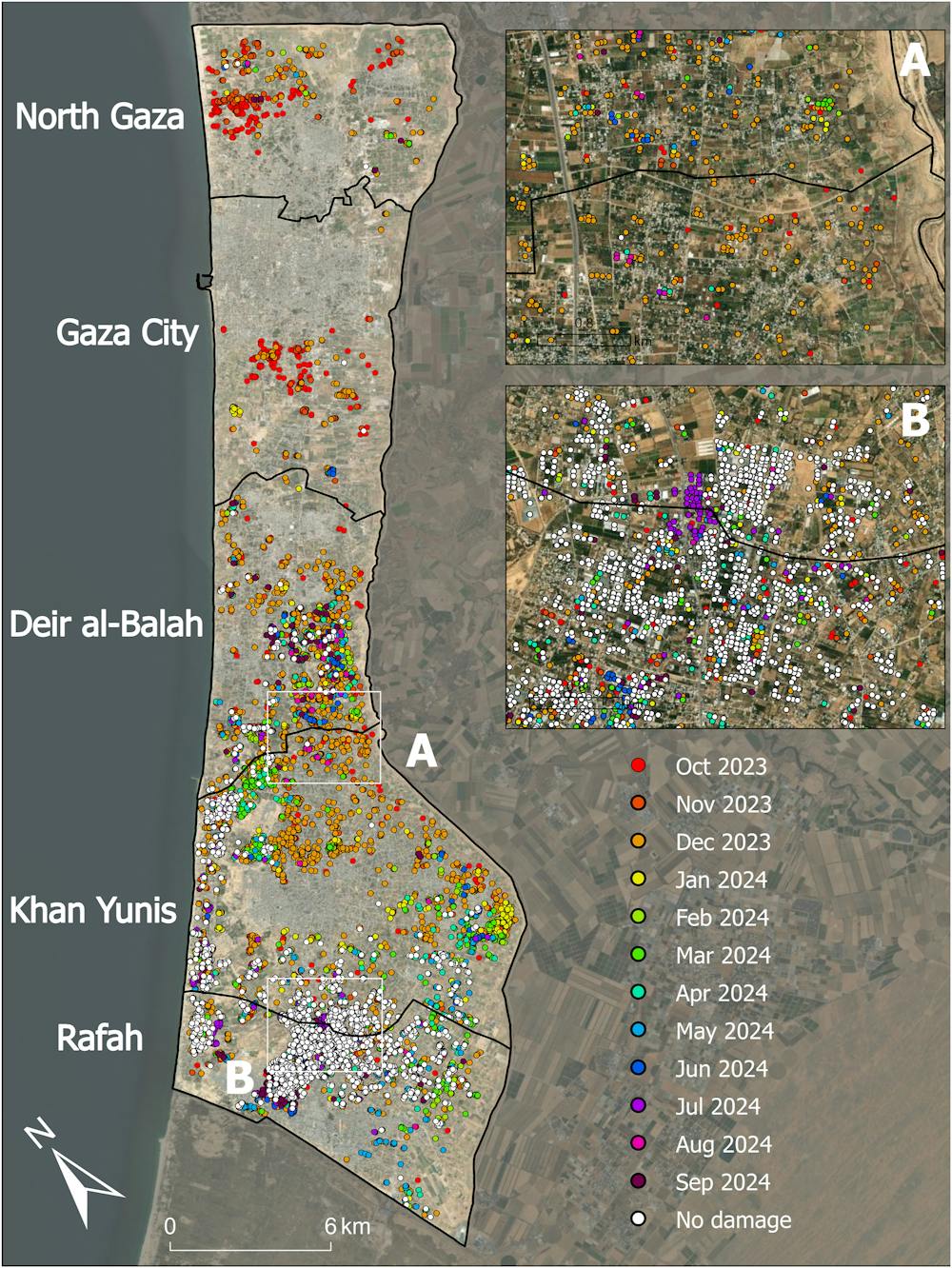
    Part of North Gaza in November 2023, and again in July 2024.

    SkySat imagery © 2025/Planet Labs PBC

    The ceasefire agreed between Israel and Hamas makes provisions for the passage of food and humanitarian aid into Gaza. This support is much needed given that Gaza’s agricultural system has been severely damaged over the course of the war.

    Over the past 17 months we have analysed satellite images across the Gaza Strip to quantify the scale of agricultural destruction across the region. Our newly published research reveals not only the widespread extent of this destruction but also the potentially unprecedented pace at which it occurred. Our work covers the period until September 2024 but further data through to January 2025 is also available.

    Before the war, tomatoes, peppers, cucumbers and strawberries were grown in open fields and greenhouses, and olive and citrus trees lined rows across the Gazan landscape. The trees in particular are an important cultural heritage in the region, and agriculture was a vital part of Gaza’s economy. About half of the food eaten there was produced in the territory itself, and food made up a similar portion of its exports.

    By December 2023, only two months into the war, there were official warnings that the entire population of Gaza, more than 2 million people, was facing high levels of acute food insecurity. While that assessment was based on interviews and survey data, the level of agricultural damage across the whole landscape remained out of view.

    Most olive and citrus trees are gone

    To address this problem, we mapped the damage to tree crops – mostly olive and citrus trees – in Gaza each month over the course of the war up until September 2024. Together with our colleagues Dimah Habash and Mazin Qumsiyeh, we did this using very high-resolution satellite imagery, detailed enough to focus on individual trees.

    We first visually identified tree crops with and without damage to “train” our computer program, or model, so it knew what to look for. We then ran the model on all the satellite data. We also looked over a sample of results ourselves to confirm it was accurate.

    Our results showed that between 64% and 70% of all tree crop fields in Gaza had been damaged. That can either mean a few trees being destroyed, the whole field of trees completely removed, or anything in between. Most damage took place during the first few months of the war in autumn 2023. Exactly who destroyed these trees and why is beyond the scope of our research or expertise.

    In some areas, every greenhouse is gone

    As greenhouses look very different in satellite images, we used a separate method to map damage to them. We found over 4,000 had been damaged by September 2024, which is more than half of the total we had identified before the start of the war.

    Greenhouses and the date of initial damage between October 2023 and September 2024.
    Yin et al (2025)

    In the south of the territory, where most greenhouses were found, the destruction was fairly steady from December 2023 onwards.

    But in north Gaza and Gaza City, the two most northerly of the territory’s five governorates, most of the damage had already taken place by November and December 2023. By the end of our study period, all 578 greenhouses there had been destroyed.

    North Gaza and Gaza City have also seen the most damage to tree crop fields. By September 2024, over 90% of all tree crops in Gaza City had been destroyed, and 73% had been lost in north Gaza. In the three southern governorates, Khan Younis, Deir al-Balah and Rafah, around 50% of all tree crops had been destroyed.

    Agricultural damage is common in armed conflict, and has been documented with satellite analysis in Ukraine since the 2022 Russian invasion, in Syria and Iraq during the ISIS occupation in 2015, and in the Caucasus during the Chechen wars in the 1990s and 2000s.

    The exact impact can differ from conflict to conflict. War may directly damage lands, as we have seen in Gaza, or it may lead to more fallow areas as infrastructure is damaged and farmers are forced to flee. A conflict also increases the need for local agricultural production, especially when food imports are restricted.

    Our assessment shows a very high rate of direct and extensive damage to Gaza’s agricultural system, both compared to previous conflict escalations there in 2014 and 2021, and in other conflict settings. For example, during the July-August war in 2014, around 1,200 greenhouses were damaged in Gaza. This time round at least three times as many have been damaged.

    Agricultural attacks are unlawful

    Attacks on agricultural lands are prohibited under international law. The Rome Statute of the International Criminal Court from 1998 defines the intentional use of starvation of civilians through “depriving them of objects indispensable to their survival” as a war crime. The Geneva conventions further define such indispensable objects as “foodstuffs, agricultural areas for the production offoodstuffs, crops, livestock, drinking water installations and supplies and irrigation works”.

    Our study provides transparent statistics on the extent and timing of damage to Gaza’s agricultural system. As well as documenting the impacts of the war, we hope it can help the massive rebuilding efforts that will be required.

    Restoring Gaza’s agricultural system goes beyond clearing debris and rubble, and rebuilding greenhouses. The soils need to be cleaned from possible contamination. Sewage and irrigation infrastructure need to be rebuilt.

    Such efforts may take a generation or more to complete. After all, olive and citrus trees can take five or more years to become productive, and 15 years to reach full maturity. After previous attacks on Gaza the trees were mostly replanted, and perhaps the same will happen again this time. But it’s for good reason they say that only people with hope for the future plant trees.

    Lina Eklund receives funding from the Swedish National Space Agency and the Strategic Research Area: The Middle East in the Contemporary World (MECW) at the Centre for Advanced Middle Eastern Studies, Lund University, Sweden.

    He Yin receives funding from NASA.

    Jamon Van Den Hoek receives funding from NASA.

    – ref. Gaza: we analysed a year of satellite images to map the scale of agricultural destruction – https://theconversation.com/gaza-we-analysed-a-year-of-satellite-images-to-map-the-scale-of-agricultural-destruction-248796

    MIL OSI – Global Reports –

    February 7, 2025
  • MIL-OSI Global: Fines for term-time holidays are at record levels – this will further erode trust between parents and schools

    Source: The Conversation – UK – By Charlotte Haines Lyon, Associate Professor: Education, York St John University

    PeopleImages.com – Yuri A/Shutterstock

    Recently released government statistics show a record number of fines were given to parents for their children’s absence from school in 2023-24 in England. Of the 487,344 fines issued, 91% were for unauthorised family holidays.

    If these fines, known as fixed penalty notices, go unpaid or in some cases have been previously issued, parents are taken to court. In 2023-24, 28,296 parents were prosecuted over their children’s school attendance.

    Whether the fines have any effect on ensuring attendance is debatable. The figures show that thousands of parents are willing to book a term-time holiday anyway. But fines are certainly affecting the crucial relationship between schools and families.

    When I carried out my doctoral research between 2014 and 2016 on the relationships between schools and parents, these bonds were already quite fragile. People in my study argued that endless “dictats” from school built a “brick wall” rather than a partnership.

    Now, it’s likely that an increasingly strict application of attendance rules is further breaking down trust.

    Fines were first introduced by a Labour government in 2004 as a last resort to tackle truancy. In 2014, then education secretary Michael Gove widened the application of the fines. Local authorities were encouraged to use penalty notices for parents who took their children on holiday during school term time.

    Since Gove, education secretaries – including current education minister Bridget Phillipson – have insisted that every day matters in school, and that there are very few reasons to miss school. Holidays are seen as unacceptable.

    Since the pandemic, even more focus has been placed on attendance as persistent absence rates have increased.

    Trust between parents and school staff is very important.
    fizkes/Shutterstock

    Government statistics show a correlation between attendance and exam results. However, whether lower attendance causes lower results is difficult to prove, especially when factors such as poverty are taken into account.

    What’s more, when holiday absence has been analysed separately, this has not been found to have the same negative affect on achievement at school as other reasons for absence.

    The record number of fines issued last year came before new guidance was set in August 2024. Now, fixed penalty notices have risen from £60 to £80 for a first offence (if paid within 21 days) and to £160 for a second offence (if paid within 28 days). If parents receive two fixed penalty notices within three years, the next offence will result in prosecution. However, councils may choose prosecution earlier if they wish.

    Whereas previously there was more discretion and variance between authorities and schools, all headteachers must now consider the above approach if a child misses more than five days of school. It can only be assumed that the number of fines and prosecutions will increase.

    As a side-effect, we are seeing schools encouraged to clamp down on child illness for fear that parents are lying and are in fact on holiday. While government guidance says that in most cases a parent’s word should be enough evidence that their child is sick, it also states that evidence of illness should be requested in cases where there is “genuine and reasonable doubt about the authenticity of the illness”.

    This suggests that schools should be questioning their trust in their pupils’ parents. This is a fundamental break down of the school-parent relationship, not to mention a strain on NHS time.

    Why parents book term-time holidays

    Term-time holidays are often seen as a way for parents to book a cheaper break, as holidays are generally more expensive during school holidays. But, even leaving aside that many families may only be able to afford a holiday at all if it is taken in term time due to the cost of living crisis, the situation is more complicated.

    There are many reasons for taking holidays within school term time. Families might be visiting relatives overseas for a wedding, funeral or because of a family member’s terminal illness. Often, a school might grant one day of absence, but no more.

    Parents may be unable to take leave from work during school holidays as a result of the industry they work in. They may have family members who work away for long periods, and want to spend time together with the children when they return. They may have a child with particular needs who is unable to cope with busy holiday times, or children in different schools with different holiday periods.

    Relationship breakdown

    When a headteacher refuses to authorise such a holiday this leads to resentment from parents. Resentment like this may cause some to withdraw children from school and choose to home educate.

    There is some effort now for schools to offer support first before legal intervention for families who might have attendance issues for other reasons, such as emotionally based school avoidance. But there is little to no desire to work with families around their complex needs for holidays.

    Partnership with parents is often touted by schools as central to pupils’ wellbeing, progress and attainment. But the power in this partnership is often skewed towards the professionals.

    Parents and schools should work together for the good of children. This does not simply mean parents obeying schools; that is not a recipe for partnership. Instead, it means understanding the different contexts that families and teachers live and work in. If parent engagement is essential to wellbeing and school progress, it is not worth continuing down the road of alienation and punishment.

    Dr Charlotte Haines Lyon is affiliated with Labour Party and UNISON.

    – ref. Fines for term-time holidays are at record levels – this will further erode trust between parents and schools – https://theconversation.com/fines-for-term-time-holidays-are-at-record-levels-this-will-further-erode-trust-between-parents-and-schools-249085

    MIL OSI – Global Reports –

    February 7, 2025
  • MIL-OSI Global: Trump’s Gaza and Ukraine plans come under the spotlight

    Source: The Conversation – UK – By Jonathan Este, Senior International Affairs Editor, Associate Editor

    Steve Bannon may no longer be in Donald Trump’s inner circle, but the newly reinstated US president appears to be adhering to a dictum the conservative disrupter-in-chief outlined back in 2018 as he reflected on his role in getting Trump elected the first time. “The Democrats don’t matter. The real opposition is the media. And the way to deal with them is to flood the zone with shit.”

    It’s fair to say that for the first two weeks of Trump’s second presidency the Democrats haven’t really mattered. But Trump and his advisers have got news organisations struggling to work out which way to look.

    In any normal news cycle, the appointment of vaccine-sceptic RFK Jnr. as health secretary would dominate the headlines, as would the successful installation of any of the more bizarre Trump cabinet picks. But at the same time the media has had to deal with a steady stream of other attention-grabbing announcements: the idea that the US could one way or the other acquire Greenland from Denmark, for instance, or the threats to use force to take control of the Panama Canal. We’ve had conflicting statements about how to end the war in Ukraine (more of which later) and the now you see them, now you don’t tariff threats against Mexico and Canada, not to mention the idea that the latter could be incorporated as the 51st state of the USA.

    The zone has been well and truly flooded. Meanwhile, the administration’s plan to take complete control of the civil service (which appears to be straight out of the Project 2025 playbook) has proceeded apace with career public servants being dismissed in their droves to make way for true Maga (Make America Great Again) believers in key roles. This, needless to say, has struggled for attention in light of all the eye-catching news stories.


    Sign up to receive our weekly World Affairs Briefing newsletter from The Conversation UK. Every Thursday we’ll bring you expert analysis of the big stories in international relations.


    This week’s big idea has to do with his vision for a post-conflict Gaza. Trump foreshadowed this plan last week when he announced he was talking with the leaders of Egypt and Jordan about resettling Gazans there – whether permanently or just for a period of reconstruction of Gaza was not clear, his statement was short on detail. But this week, hosting the Israeli prime minister in Washington (significantly the first foreign leader to visit since his inauguration), Trump expanded on his vision while Benjamin Netanyahu looked on approvingly.

    Initially, it appeared that Trump’s plan was for the permanent relocation of all 2.2 million Gazans to other countries while the Trump administration and its allies considered the considerable real estate investment opportunities presented by turning the 360km² Gaza Strip, with its 40km Mediterranean coastline into the “Middle East Riviera”. But as Simon Mabon notes here, administration officials were later quick to insist that the relocation would only last for as long as it takes to rebuild the stricken enclave.

    Mabon, professor of international relations at the University of Lancaster who specialises in Middle East politics, also notes that the proposal did what few other issues seem able to do: united the Arab nations in opposition. He also believes that while both Egypt and Jordan have signed peace deals with Israel, the relationship is often fractious and this latest announcement won’t have helped.

    Most importantly, perhaps, will be the reaction of Saudi Arabia. Israel (with Washington’s encouragement) has been pursuing normalisation of relations with Riyadh for some years. But the Saudi ruler, Crown Prince Mohammed bin Salman, has explicitly rejected “any attempts to displace the Palestinians from their land as well as affirming that relations with Israel would depend on the establishment of a Palestinian state.


    Read more:
    What Trump’s proposal to ‘take over’ Gaza could mean for Arab-Israeli relations


    It’s not the first time, by any means, that the idea of clearing Gaza of Palestinians has been mooted. It’s not even the first time that the real estate investment potential of such a plan has been discussed by a senior Trump official. Back in March last year, Jared Kushner, Trump’s son-in-law and former senior adviser who was the architect of Trump’s 2020 peace plan, talked up the idea of resettling Gazans in the Negev desert while noting that “Gaza’s waterfront property could be very valuable”.

    Israel’s far-right settler movement, meanwhile, has long yearned to empty out the strip. In December 2023 the leader of the Nachala Israeli settlement movement, Daniella Weiss, declared that Gaza City had always been “one of the cities of Israel. We’re just going back. There was a historical mistake and now we are fixing it.”

    The relocation of Palestinians outside Palestine was actually part of the founding mission of UN agency Unrwa – which, incidentally was banned by Israel last week and has been defunded by the US since allegations surfaced last year that a number of Unrwa employees had taken part in the Hamas attacks on October 2023.

    Anne Irfan of University College London, a specialist in refugees and displacement, and Jo Kelcey of the Lebanese American University, whose core research area covers the politics of education in marginalised communities such as Gaza, recount here that Unrwa was set up in 1949 following the Nakba (catastrophe) when more than 700,000 Palestinians were displaced in fighting before and after the foundation of the State of Israel.

    Unrwa was set up with the aim of resettling the displaced people and sponsoring projects that would create jobs and promote economic development in their new host countries: the “works” in the agency’s title.

    As Irfan and Kelcey note, the staunchest opponents of this plan were Palestinians themselves. They could read between the lines of this mission, that their exile was intended to be permanent. It was a non-starter and within five years of Unrwa’s establishment the resettlement policy was shelved in favour of a focus on education, which remains to this day.

    Not that Trump would be keen to associate any plan of his with Unrwa. In 2018 he fully defunded the agency, the first time a US president has done this. He has also more recently extended Joe Biden’s suspension of Unrwa funding after the allegations of Hamas infiltration and has made it clear he supports Netanyahu’s ban on the agency operating in Israel.


    Read more:
    Trump plans to ‘permanently resettle’ Palestinians outside Gaza – the very reason Unrwa was originally created


    Meanwhile, how would the Gaza plan sit in terms of Trump’s “America First” strategy? Mark Shanahan, of the University of Surrey, believes this is all part of what he refers to here as “Trumperialism”. It’s not so much America as the light on the hill, trying to find a way to fix global problems and seek peaceful solutions to dangerous and distressing conflicts. Rather, in this case at least, it sees Gaza as “an opportunity for American business to build wealth – the classic US economic hegemony of the populist America First political theory”.

    Rather than emulating the Marshall plan of what feels now like a more enlightened era, Trump’s plan for Gaza, at least as he laid it out after his meeting with Netanyahu, is more akin to the plan for the rebuilding of Iraq after the 2003 invasion, writes Shanahan. That is: US private funding for beachside condos and luxury developments while the countries to whom the displaced Palestinians are relocated would be expected to pay for the privilege.

    But Trump also hinted this might mean US boots on the ground in the Middle East, cautions Shanahan, adding that “delivering Mar-a-Lago on the Med may mean thousands of American combat troops deployed to Gaza for years at daily risk of death. How do main-street Americans benefit from that?”


    Read more:
    How Trump’s Gaza plan does – and doesn’t – fit in with his pledge to put America first


    And if you wondered whether – like so many of Trump’s big plans and executive orders issued since his second inauguration – the Gaza Riviera scheme might fall foul of the law, it would. As Tamer Morris –
    an expert in international law at the University of Sydney – explains, the US would require the consent of the Palestinian people to take control of Gaza. And this is not going to happen.

    Forced relocation is forbidden under the Geneva Conventions as is helping another state forcibly relocate people. It could also be interpreted as ethnic cleansing, as defined by the Commission of Experts report on the former state of Yugoslavia to the UN Security Council in 1994.


    Read more:
    Trump wants the US to ‘take over’ Gaza and relocate the people. Is this legal?


    Meanwhile in Ukraine

    Meanwhile, the US president has also been making noises about his ideas for bringing peace to Ukraine. The latest, aired this week, involved linking continuing US support with favourable concessions on Ukraine’s supply of rare earths and other strategic resources. Stefan Wolff, of the University of Birmingham, has been watching the diplomatic manoeuvrings around Trump, Putin, Xi and Ukraine since the war began nearly three years ago. In the past fortnight, he’s been looking at the prospect of a peace deal brokered by the US.

    Wolff thinks it unlikely that anything will be resolved in the foreseeable future beyond a ceasefire and freezing of the battle lines. And that’s not even much more than a distant possibility given that neither Kyiv nor the Kremlin seem to want this for reasons of their own.


    Read more:
    Trump’s vision of a peace deal for Ukraine is limited to a ceasefire – and it’s not even clear if Kyiv or Moscow are going to play ball


    The possibility of Europe bearing the burden of maintaining support to Ukraine without the US bearing the lion’s share of the burden also looks remote. Domestic politics in many EU member states is threatening the bloc’s unity – and, in any case, the ability of Europe to make up the shortfall caused by a possible US withdrawal of aid to Ukraine is distinctly doubtful. And unlikely improve any time soon.


    Read more:
    Ukraine: prospects for peace are slim unless Europe grips the reality of Trump’s world


    It appears, meanwhile, that Putin’s ally Kim Jong-un is poised to send another wave of North Koreans to help. Jennifer Mathers, of Aberystwyth University, takes a detailed look at what we know about how these troops have fared thus far. She concludes that, given the terribly heavy losses the North Korean units are reported to be suffering, it’s possible that their leader may be trading the high casualty rate for much-needed combat experience in case his army might want to fight in a conflict nearer to home.


    Read more:
    North Korea: Kim Jong-un is sending a second wave of soldiers to Ukraine – here’s why


    World Affairs Briefing from The Conversation UK is available as a weekly email newsletter. Click here to get our updates directly in your inbox.


    – ref. Trump’s Gaza and Ukraine plans come under the spotlight – https://theconversation.com/trumps-gaza-and-ukraine-plans-come-under-the-spotlight-249311

    MIL OSI – Global Reports –

    February 7, 2025
  • MIL-OSI Global: Reading Whistler’s Nocturne in Blue and Gold – Old Battersea Bridge as a piece of music

    Source: The Conversation – UK – By Frances Fowle, Personal Chair of Nineteenth-Century Art, History of Art, University of Edinburgh

    Nocturne in Blue and Gold – Old Battersea Bridge by James Abbott McNeill Whistler (1872-5). Tate/Canva, CC BY-SA

    In 1877 the American artist James McNeill Whistler (1834-1903) achieved notoriety when he exhibited his recent views of the river Thames at the Grosvenor Gallery in London. He gave his paintings musical titles: Nocturne in Black and Gold – The Falling Rocket (1875) and Nocturne in Blue and Gold – Old Battersea Bridge (circa 1872-5).

    The view of Battersea Bridge includes Chelsea Church and the then newly constructed Albert Bridge. The lights of Cremorne Pleasure Gardens twinkle in the distance, while fireworks explode in the pale sky above.

    The painting is remarkable for its intense, light blue tonality suggestive of evening, the time of day sometimes known as “the blue hour”. Painting from memory, Whistler thinned his paint with copal (a tree resin), turpentine and linseed oil. This created what he called a “sauce”, which he applied in thin, transparent layers, wiping it away until he was satisfied. He left areas of the dark preparatory layer unpainted to create the illusion of the bridge. Inspired by Japanese woodblock prints, he exaggerated its height.


    This article is part of Rethinking the Classics. The stories in this series offer insightful new ways to think about and interpret classic books, films and artworks. This is the canon – with a twist.


    All this was lost on the critics, however. The author Oscar Wilde reviewed the exhibition and wrote that the Battersea Bridge Nocturne was “worth looking at for about as long as one looks at a real rocket, that is, for somewhat less than a quarter of a minute”.

    A few years earlier Whistler had exhibited another view of the Thames, Nocturne: Blue and Silver – Chelsea (1871), at the Dudley Gallery in London. The critic for The Times summed up Whistler’s intention, observing that the painting was:

    So closely akin to music that the colours of the one may and should be used, like the ordered sounds of the other; that painting should not aim at expressing dramatic emotions, depicting incidents of history or recording facts of nature, but should be content with moulding our moods and stirring our imaginations, by subtle combinations of colour.

    Arrangement in Gray: Portrait of the Painter by Whistler (1872).
    Detroit Institute of Arts

    Whistler’s paintings were first compared to music as early as 1863 when the French critic Paul Manz described his haunting portrait, The White Girl (1872), as a “symphony in white”. Whistler adopted the title retrospectively, creating a series of three aesthetic mood paintings or “symphonies”, featuring young women in flowing white dresses.

    Press and public alike were puzzled by the artist’s insistence that his paintings lacked any specific narrative or moral message.

    When he witnessed the abstraction of Whistler’s latest Nocturnes at the Grosvenor Gallery, the leading English art critic John Ruskin published a venomous review. “I have seen, and heard much of Cockney impudence before now,” he wrote, “but never expected to hear a coxcomb ask 200 guineas for flinging a pot of paint in the public’s face.”

    Whistler’s retort

    Whistler sued Ruskin for libel and used the ensuing two-day trial to defend his views on art. He referred to his paintings throughout proceedings in musical terms, as “arrangements”, “symphonies” or “nocturnes”. When asked what the Battersea Bridge painting was intended to represent, he replied:

    I did not intend it to be a ‘correct’ portrait of the bridge. It is only a moonlight scene … As to what the picture represents, that depends upon who looks at it. To some persons it may represent all that is intended; to others it may represent nothing.

    Whistler won the court case, but was awarded only a farthing in damages, resulting in his bankruptcy. Undaunted, the following year (1878) he published The Red Rag, in which he articulated his aesthetic theory:

    Art should be independent of all clap-trap – should stand alone, and appeal to the artistic sense of eye or ear, without confounding this with emotions entirely foreign to it, as devotion, pity, love, patriotism, and the like. All these have no kind of concern with it, and that is why I insist on calling my works “arrangements” and “harmonies”.


    Looking for something good? Cut through the noise with a carefully curated selection of the latest releases, live events and exhibitions, straight to your inbox every fortnight, on Fridays. Sign up here.


    In 1885 he delivered his, now famous, 10 o’clock Lecture. In it reiterated his aesthetic theory. “Nature,” he wrote, “contains the elements, in colour and form, of all pictures, as the keyboard contains the notes of all music”. He urged artists not to copy nature slavishly, as Ruskin had recommended, but to approach it more like a musician, waiting for that moment when:

    The evening mist clothes the riverside with poetry, as with a veil, and the poor buildings lose themselves in the dim sky, and the tall chimneys become campanili and the warehouses are palaces in the night, and the whole city hangs in the heavens, and fairy-land is before us.

    It is then, he argued, that nature “sings her exquisite song to the artist alone”.

    Beyond the canon

    As part of the Rethinking the Classics series, we’re asking our experts to recommend a book or artwork that tackles similar themes to the canonical work in question, but isn’t (yet) considered a classic itself. Here is Frances Fowles’ suggestion:

    Whistler was not the only artist of this period to view his art as the equivalent of music. His work anticipated symbolism, a literary and artistic movement that rejected naturalistic representation in favour of more abstract concerns, such as the connections between words, colours and musical notes.

    Mikalojus Čiurlionis and his 1908 painting, Stellar Sonata.
    Wiki Commons

    The relationship between colour, rhythm and sound was central to the work of French artist Paul Signac (1863-1935), who worked in a pointillist technique (applying dots of colour), and assigned his paintings opus numbers and tempos. The Lithuanian painter and composer Mikalojus Čiurlionis (1875-1911), too, fused music and colour and gave his artworks musical titles.

    Frances Fowle does not work for, consult, own shares in or receive funding from any company or organisation that would benefit from this article, and has disclosed no relevant affiliations beyond their academic appointment.

    – ref. Reading Whistler’s Nocturne in Blue and Gold – Old Battersea Bridge as a piece of music – https://theconversation.com/reading-whistlers-nocturne-in-blue-and-gold-old-battersea-bridge-as-a-piece-of-music-241075

    MIL OSI – Global Reports –

    February 7, 2025
  • MIL-OSI USA: HSI investigation leads to guilty pleas for Chinese nationals in fraudulent gift card conspiracy

    Source: US Immigration and Customs Enforcement

    CONCORD, N.H. — Three Chinese nationals pleaded guilty Jan. 14 for their roles in a large-scale fraud conspiracy based in China after their activity was uncovered during a Homeland Security Investigations (HSI) probe.

    Naxin Wu, 26, Mengying Jiang, 34, and Mingdong Chen, 28, pleaded guilty in federal court in Concord to conspiracy to commit wire fraud. Judge Landya B. McCafferty scheduled Wu’s sentencing for April 8, 2025 and Jiang’s sentencing for April 22, 2025. Judge Joseph N. Laplante scheduled Chen’s sentencing for April 11, 2025.

    According to HSI’s investigation, organized criminal elements in China acquire gift cards through multiple fraudulent means. For example, gift cards are obtained by hacking U.S. companies, and targeting U.S. citizens through romance and elder fraud schemes. The criminal elements then send the gift card data to multiple cells of Chinese nationals operating in the United States through a Chinese-based messaging platform.

    Once U.S.-based cells receive the gift card data, they then spend the gift cards to purchase high-value electronics, principally Apple products. After purchasing the Apple products, cell members consolidate the electronics in warehouses for shipment to China, Hong Kong, or countries in Southeast Asia. The cells primarily operate in states with no sales tax, such as New Hampshire, to maximize their profits.

    Wu, Jiang, and Chen are members of one cell in New Hampshire. Wu and Jiang purchased fraudulent gift cards at a discount from their face value. They then either personally used the cards or disseminated them to others, including Chen, to use. Wu was responsible for $1.4 million, Jiang for $3 million, and Chen for $400,000 of fraudulent gift cards.

    The charge of conspiracy to commit wire fraud provides for a sentence of up to 20 years in prison and a fine of up to $250,000 or twice the gross gain or loss, whichever is greater. Sentences are imposed by a federal district court judge based upon the U.S. Sentencing Guidelines and statutes which govern the determination of a sentence in a criminal case.

    HSI New England’s Manchester Resident Agent in Charge office, Internal Revenue Service’s Criminal Investigations, the U.S. Postal Inspection Service, and the Concord Police Department led the investigation. The Merrimack County Attorney’s Office has provided valuable assistance.

    Gift card fraud has become a growing concern for consumers and businesses alike. Under Project Red Hook, HSI is teaming up with our law enforcement partners and businesses to raise awareness of how Chinese organized crime groups are exploiting gift cards to launder money.

    Follow us on X, formerly known as Twitter, at @HSINewEngland to learn more about HSI’s global missions and operations.

    MIL OSI USA News –

    February 7, 2025
  • MIL-OSI USA: HSI Los Angeles special agents arrest 8 in customs fraud scheme involving goods from China

    Source: US Immigration and Customs Enforcement

    LOS ANGELES — HSI Los Angeles has arrested eight individuals for their part in an internal conspiracy among logistic companies’ executives, warehouse owners and truck drivers to smuggle hundreds of millions of dollars’ worth of counterfeit and other illegal goods from China into the United States via the Ports of Los Angeles and Long Beach.

    The 15-count indictment, returned last month and unsealed on Jan. 24, charges nine defendants with conspiracy, smuggling and breaking customs seals. The defendants allegedly took containers flagged for off-site secondary inspection, unloaded the contraband, then stuffed the targeted containers with filler cargo to deceive customs officials and evade law enforcement.

    According to the indictment, a search of one warehouse used by the group led to the seizure in June 2024 of $20 million worth of counterfeit items including shoes, perfume, luxury handbags, apparel and watches.

    Seven defendants were arrested on Jan. 24, an eighth was taken into custody on Jan. 25, and one defendant is a fugitive. A trial date was scheduled for March 18. The eighth defendant, who was arrested on unrelated state charges, is expected to be arraigned in federal court in the coming days.

    “Homeland Security Investigations (HSI) Los Angeles and its partners are committed to enforcing customs laws and practices, facilitating legitimate trade, and protecting the integrity of the nation’s supply chain,” said HSI Los Angeles Special Agent in Charge Eddy Wang. “The $1.3 billion dollars’ worth of contraband seized during the investigation into this type of scheme illuminates how complex smuggling schemes try to exploit our legitimate trade practices and the American consumer.”

    The 15-count indictment details a conspiracy to coordinate the shipment of large quantities of contraband from China to the United States through the Port of Los Angeles from at least August 2023 to June 2024. The individuals arrested are:

    • Hexi Wang, 32, of El Monte, who manages K&P International Logistics LLC, a City of Industry-based company that hires commercial truckers to transport shipping containers from the Port of Los Angeles;
    • Jin “Mark” Liu, 42, of Irvine, the owner of K&P International Logistics LLC and who managed the finances of one of the warehouses where contraband was unloaded and issued payments to truck drivers who transported smuggled goods;
    • Dong “Liam” Lin, 31, of Hacienda Heights, who — along with Zheng — controlled and operated one of the contraband warehouses;
    • Marck Anthony Gomez, 49, of West Covina, the owner and operator of Fannum Trucks LLC, a West Covina-based company that coordinated the movement of shipping containers from the Port of Los Angeles, including large shipments of contraband smuggled into the United States from China;
    • Andy Estuardo Castillo Perez, 32, of Apple Valley, a driver for M4 Transportation Inc., a Carson-based company that transports shipping containers from the Port of Los Angeles;
    • Jesse James Rosales, 41, of Apple Valley, who coordinated truckers from the ports to warehouses;
    • Daniel Acosta Hoffman, 41, of Hacienda Heights, worked with Rosales to bring cargo containers from the Port of Los Angeles to warehouses; and
    • Galvin Biao Liufu, 33, of Ontario, directed and managed truck drivers to bring the contraband into the warehouses.

    According to the indictment, Wang, Liu and others maintained and operated warehouses to store, conceal and sell large amounts of contraband goods that were illegally imported into the United States from China. When the contraband containers were selected by U.S. Customs and Border Protection (CBP) for inspection, the defendants hired commercial truck drivers to transport the containers from the Port of Los Angeles to locations that the conspirators controlled, including warehouses in the City of Industry that were controlled or managed by Zheng, Wang and others.

    At these locations, co-conspirators broke the security seals on the shipping containers and removed the contraband from inside. Then, they affixed counterfeit security seals onto the containers to conceal that cargo had been removed from them. After emptying some of the cargo and re-securing the containers with counterfeit seals, Wang and others then directed co-conspirators to transport the containers to CBP-authorized locations for the remaining cargo to be presented to customs officials for inspection.

    Wang, Liu and others paid fees to co-conspirators, including Gomez and Castillo Perez, that were substantially above normal trucking fees to transport the contraband shipping containers.

    To date, law enforcement has seized more than $1.3 billion worth of counterfeit goods associated with this and similar seal-swapping schemes.

    If convicted of all charges, the defendants would face a statutory maximum sentence of five years in federal prison for each conspiracy count, up to 10 years in federal prison for each count of breaking customs seals, and up to 20 years in prison for each smuggling count.

    Anyone with information on alleged customs fraud are encouraged to call the HSI Tip Line at 877-4-HSI-TIP.

    Learn more about HSI’s mission to protect the U.S. economy in your community on X, formerly known as Twitter, at @HSILosAngeles.

    MIL OSI USA News –

    February 7, 2025
  • MIL-OSI USA: Former Bosnian prison camp supervisor sentenced to over 5 years in prison for concealing participation in wartime persecution

    Source: US Immigration and Customs Enforcement

    BOSTON — A Swampscott man was sentenced Jan. 22 in federal court in Boston after Homeland Security Investigations (HSI) uncovered a 25-year scheme to conceal his persecution of ethnic Serbs during the Bosnian War as well as making false claims to come to the United States and ultimately become a United States citizen.

    Kemal Mrndzic, 52, was sentenced by U.S. District Court Judge Denise J. Casper to 65 months in prison to be followed by three years of supervised release. In October 2024, Mrndzic was convicted by a federal jury of engaging in a scheme to conceal his involvement in the persecution of Serb prisoners at the notorious Celebici prison camp in Bosnia in 1992; making a false statement to federal agents about his role at the camp; possessing a fraudulently obtained naturalization certificate and Social Security card; and using a fraudulently obtained passport and certificate of naturalization.

    “Through the brave testimony of the survivors of the Celebici prison camp, the persecution Mrndzic attempted to conceal was finally brought to light after over 30 years. Though we can never undo what the survivors endured, I hope this sentence brings some measure of justice, no matter how long delayed,” said HSI New England Special Agent in Charge Michael J. Krol. “HSI remains tireless in our effort to pursue war criminals and human rights violators who attempt to evade justice.”

    “For over two decades, Mr. Mrndzic evaded accountability for his participation in the persecution and torture of countless victims at the camp. By holding him accountable for his lies and fraudulent conduct, this sentence reinforces our resolve to ensure that those responsible for war crimes and human rights abuses are identified, exposed, and prosecuted. This case underscores that we will not allow our nation to be a refuge for those who seek to escape justice,” said United States Attorney Leah B. Foley. “The government will be working to ensure that his fraudulently obtained U.S. citizenship is revoked.”

    Mrndzic served as a supervisor of the guards at the notorious Celebici prison camp in Bosnia and Herzegovina during the sectarian war which fractured the country in the 1990s. Twenty-one former detainees described Mrndzic as one of the most notable guards at the camp, who was widely known for his particularly vicious treatment of prisoners and his close association with the camp deputy commander. Mrndzic participated in the systematic and pervasive brutal torture and deprivation of basic human needs of hundreds of captive victims — some of whom were elderly — at the Celebici prison camp. For seven months, victims were forcibly detained with starvation rations, at times forced into lightless, airless manholes that were sealed for hours at a time. Victims also endured daily and nightly beatings that were administered by the guards at the camp — with baseball bats, wooden poles and rifle butts.

    Camp survivors who testified at trial in October 2024 recounted murders, the burning of one detainee’s tongue with a heated knife blade, the wrapping of another detainee with a long explosive fuse cord and then lighting it on fire, sexual abuse and other harrowing acts committed over a period of many months. One survivor recounted the beating death of a 70-year-old detainee whom guards pinned a political party badge to his forehead while he was still dying. Survivors also testified about being starved and deprived of the most basic needs, including sleeping on the concrete floor of a sheet metal hangar for months on end while being fed only a slice of bread a day.

    A United Nations tribunal investigated the crimes committed at Celebici and in 1998 convicted the two top commanders of the camp and one particularly sadistic guard on numerous crimes including murder and torture. While Mrndzic was interviewed by investigators in connection with that case in 1996, he was not charged by international authorities. Mrndzic subsequently concocted a scheme to leave Bosnia by crossing the border into Croatia and applying to immigrate to the United States using a fabricated story. In his immigration application and interview, he falsely claimed to U.S. immigration authorities that he fled his home after he was captured, interrogated and abused by Serb forces, and could not return home for fear of future persecution. As the government argued at trial, Mrndzic used his own experience as a persecutor to press a false narrative that he had been persecuted. He was admitted to the U.S. in 1999, and ultimately became a naturalized U.S. citizen in 2009.

    Many Celebici survivors became refugees during and after the Bosnian War. Some came to the United States and have since become U.S. citizens. The survivors living in the United States played a central role in the investigation and prosecution of this case. They provided critical trial testimony and submitted moving victim impact statements.

    The investigation was led by HSI New England’s Document and Benefit Fraud Task Force and HSI’s Human Rights Violators & War Crimes Center (HRVWCC) with assistance from the Social Security Administration Office of Inspector General’s Boston Field Office; the U.S. Department of State’s Diplomatic Security Service, Boston Field Office; and U.S. Customs and Border Protection, Boston Field Office. Additional support was provided by the Justice Department’s Office of International Affairs, U.S. Citizen and Immigration Services, DOJ’s Criminal Division’s Human Rights and Special Prosecutions Section and the U.S. Embassies in Sarajevo, Belgrade and Helsinki. The United Nations International Residual Mechanism for Criminal Tribunals (IRMCT) in The Hague, Netherlands, the Australian Federal Police, Bosnian and Herzegovinian Ministry of Justice, Serbian Ministry of Justice, law enforcement authorities in Finland and the Royal Canadian Mounted Police all provided valuable assistance as did the Cook County Sheriff’s Office in Illinois and the Swampscott Police Department in Massachusetts.

    The HRVWCC is led by HSI and leverages the expertise of criminal investigators, attorneys, historians, intelligence analysts and federal partners to provide a whole of government approach to prevent the United States from becoming a safe haven for individuals who commit war crimes, genocide, torture and other human rights abuses around the globe. Currently, HSI has more than 180 active investigations into suspected human rights violators and is pursuing more than 1,945 leads and removals cases involving suspected human rights violators from 95 different countries. Since 2003, the HRVWCC has issued more than 79,000 lookouts for potential perpetrators of human rights abuses, and stopped over 390 human rights violators and war crimes suspects from entering the U.S.

    MIL OSI USA News –

    February 7, 2025
  • MIL-OSI Security: Man Who Sexually Abused Friend’s 4-Year-Old Sentenced to 25 Years in Federal Prison

    Source: Federal Bureau of Investigation (FBI) State Crime Alerts (c)

    An Abilene man who sexually abused his friend’s four-year-old son was sentenced today to 25 years in federal prison, announced Acting U.S. Attorney for the Northern District of Texas Chad Meacham.

    Victor Van Taylor, 31, was charged via criminal complaint in June 2024 and indicted the following month. He pleaded guilty in September 2024 to production of child pornography and was sentenced Tuesday by U.S. District Judge James Wesley Hendrix to 25 years in federal prison. He will also be required to register as a sex offender. 

    According to plea papers, in June 2024, law enforcement identified a 26-second video of an adult man sexually abusing a four-year-old child on the darkweb.  The man was later identified as Mr. Taylor. 

    While executing a search warrant at his home, officers showed Mr. Taylor a screengrab of the video and asked if he produced it. Mr. Taylor lowered his head and admitted that he had produced the video and posted it online in exchange for other child sexual abuse material. 

    Law enforcement identified the victim as the son of Mr. Taylor’s friend.  The child’s mother told officers the assault likely happened while Mr. Taylor was babysitting.  

    The Federal Bureau of Investigation’s Dallas Field Office conducted the investigation. The U.S. Attorney’s Office for the Northern District of Texas – Abilene Division prosecuted the case.

    MIL Security OSI –

    February 7, 2025
  • MIL-OSI Security: Fentanyl Trafficker Sentenced to 165 Months for Bringing Thousands of Counterfeit Oxycodone Pills into the District

    Source: Office of United States Attorneys

                WASHINGTON – Craig Eastman, 21, of Washington D.C., was sentenced today in U.S. District Court to 165 months in federal prison for participating in a massive fentanyl trafficking conspiracy that distributed hundreds of thousands of fentanyl-laced counterfeit oxycodone pills from Southern California to destinations throughout the United States, including the District. Eastman was one of more than two dozen co-defendants arrested over the course of 2023 in D.C., Virginia, Maryland, San Diego, and Los Angeles and charged in the conspiracy.

                The sentence was announced by U.S. Attorney Edward R. Martin, Jr., DEA Special Agent in Charge Ibrar A. Mian of the Washington Division, Inspector in Charge Damon E. Wood of the U.S. Postal Inspection Service Washington Division, and Chief Pamela Smith of the Metropolitan Police Department.

                Eastman pleaded guilty on July 25, 2024, to conspiring to distribute 400 grams or more of fentanyl. In addition to the 165-month prison term, U.S. District Judge Colleen Kollar-Kotelly ordered Eastman to serve five years of supervised release.

                The impetus for this investigation was the overdose death of Diamond Lynch, a young mother in Southeast D.C. In addition to investigating and prosecuting the death-resulting case,[1] law enforcement followed the evidence and uncovered a vast network of traffickers who transported fentanyl from Mexico to Los Angeles to the District of Columbia. Since then, investigators have seized more than 450,000 fentanyl pills, 1.5 kilograms of fentanyl powder, and 30 firearms.         

                According to court documents, Eastman entered into the conspiracy after he was introduced to a Los Angeles-based drug trafficker, who was a distributor of fentanyl-laced counterfeit oxycodone pills. Eastman traveled to Southern California to purchase the fake oxycodone from the L.A. supplier and returned to the District with the drugs. Eastman and his co-conspirators employed two primary methods to transport the pills to the District: they smuggled them in luggage or carry-on items on airline flights, or they shipped the pills utilizing the U.S. Postal Service and commercial mail carriers

                After transporting the fentanyl-laced pills back to the District of Columbia, Eastman redistributed them for profit, primarily in collaboration with a co-defendant. Two redistributors of the pills were his siblings, Larry and Justice Eastman, who later were convicted of conspiracy to distribute and possess with intent to distribute fentanyl. Ms. Lynch was a customer of Larry and Justice Eastman.

                Craig Eastman not only knew of Ms. Lynch’s overdose death, but proceeded to attempt to sell the batch of pills that included Ms. Lynch’s fatal dose at a discount rather than simply destroy them and incur the financial loss. Specifically, the month after Ms. Lynch’s overdose death, Craig Eastman marketed the same bulk supply of pills that included Ms. Lynch’s fatal dose. Craig Eastman informed a prospective customer that he “caught a bad batch of some 30s,” and asked the customer to “see if [he] got somebody to sell em to[,] I got endless.”

                Craig Eastman also had been found in residences containing firearms on multiple occasions. On September 1, 2021, law enforcement searched Craig Eastman’s residence in the 2300 block of Raynolds Place SE. Agents found him inside his bedroom, along with 204 fentanyl-laced counterfeit oxycodone pills, multiple firearms and accompanying magazines and ammunition, as well as several thousand dollars in cash. On December 4, 2021, officers searched Eastman’s residence and recovered four firearms, about $1,700 in cash, and distribution quantities of fentanyl-laced counterfeit oxycodone pills. In his bedroom specifically, officers found a Glock 17 equipped with a high-capacity magazine and a machine gun conversion device, along with fentanyl-laced counterfeit oxycodone pills. When Craig Eastman was arrested along with co-defendant Charles Taylor on March 22, 2023, in a stash house in the District, officers recovered seven firearms (including one machine gun), assorted ammunition, more than a dozen pounds of marijuana, and a pill bottle containing fentanyl-laced counterfeit oxycodone pills.

    DEFENDANT

    AGE

    LOCATION

    CHARGES/SENTENCE

    Hector David Valdez,

    aka “Curl”


    27

    Santa Fe Springs, California

    Conspiracy to distribute and possess with intent to distribute 400 grams or more of fentanyl;

    Conspiracy to commit international money laundering.

    Craig Eastman


    21

    Washington, D.C. Sentenced on February 6, 2025, to 165 months for conspiracy to distribute more than 400 grams of fentanyl.
    Charles Jeffrey Taylor

    21

    Washington, D.C. Conspiracy to distribute and possess with intent to distribute 400 grams or more of fentanyl.
    Raymond Nava, Jr.

    20

    Bell Gardens,

    California

    Sentenced September 17, 2024, to 14 years for conspiracy to distribute and possess with intent to distribute 400 grams or more of fentanyl.
    Ulises Aldaz

    28

    Bell Gardens,

    California

    Sentenced June 28, 2024, to 95 months in prison for conspiracy to distribute and possess with intent to distribute 400 grams or more of fentanyl.
    Max Alexander Carias Torres

    27

    Bell Gardens,

    California

    Conspiracy to distribute and possess with intent to distribute 400 grams or more of fentanyl;

    Conspiracy to commit international money laundering

    Teron Deandre McNeil, aka “Wild Boy”

    34

    Washington, D.C. Conspiracy to distribute and possess with intent to distribute 400 grams or more of fentanyl.

    Marvin Anthony Bussie,

    aka “Money Marr”

    22

    Washington, D.C. Sentenced June 28, 2024, to 120 months in prison for conspiracy to distribute and possess with intent to distribute 400 grams or more of fentanyl.
    Marcus Orlando Brown

    29

    Washington, D.C. Sentenced October 3, 2024, to 108 months in prison for conspiracy to distribute and possess with intent to distribute 40 grams or more of fentanyl.
    Columbian Thomas, aka “Cruddy Murda”

    27

    Washington, D.C. Sentenced October 22, 2024, to 160 months in prison for conspiracy to distribute and possess with intent to distribute 400 grams or more of fentanyl.
    Wayne Rodell Carr-Maiden

    30

    Washington, D.C. Sentenced April 29, 2024, to 45 months in prison for conspiracy to distribute and possess with intent to distribute 40 grams or more of fentanyl.

    Andre Malik Edmond,

    aka “Draco”

    23

    Temple Hills, Maryland Sentenced July 22, 2024, to 130 months in prison for conspiracy to distribute and possess with intent to distribute 400 grams or more of fentanyl.

    Treyveon James Johnson,

    aka “Treyski”

    20

    Alexandria, Virginia Sentenced September 5, 2024, to 108 months in prison for conspiracy to distribute and possess with intent to distribute 40 grams or more of fentanyl.

    Karon Olufemi Blalock,

    aka “Fat Bags”

    30

    Alexandria, Virginia Conspiracy to distribute and possess with intent to distribute 400 grams or more of fentanyl.

    Ronte Ricardo Greene,

    aka “Cardiddy”

    29

    Washington, D.C. Conspiracy to distribute and possess with intent to distribute 400 grams or more of fentanyl.
    Melvin Edward Allen, Jr., aka “21”

    39

    Washington, D.C. Pleaded guilty on December 18, 2024, to conspiracy to distribute and possess with intent to distribute 40 grams or more of fentanyl.

    Darius Quincy Hodges,

    aka “Brick”

    34

    Glen Allen, Virginia Conspiracy to distribute and possess with intent to distribute 400 grams or more of fentanyl.

    Lamin Sesay,

    aka “Rock Star”

    28

    Alexandria, Virginia Conspiracy to distribute and possess with intent to distribute 400 grams or more of fentanyl.
    Paul Alejandro Felix

    26

    Glendale,

    California

    Sentenced November 12, 2024, to 164 months in prison for conspiracy to distribute and possess with intent to distribute 400 grams or more of fentanyl.

    Omar Arana,

    aka “Frogs”

    27

    Cudahy,

    California

    Pleaded guilty January 3, 2025, to conspiracy to distribute and possess with intent to distribute 400 grams or more of fentanyl.
    Edgar Balderas, Jr., aka “Nano”

    27

    San Diego,

    California

    Pleaded guilty December 19, 2024, to conspiracy to distribute and possess with intent to distribute 400 grams or more of fentanyl.
    Raul Pacheco Ramirez

    30

    Long Beach,

    California

    Sentenced November 26, 2024, to 95 months for conspiracy to distribute and possess with intent to distribute 400 grams or more of fentanyl.
    Giovani Alejandro Briones

    30

    Victorville, California Pleaded guilty October 24, 2024, to conspiracy to distribute and possess with intent to distribute 400 grams or more of fentanyl.
    Alfredo Rodriguez Gonzalez

    26

    Rosarito, Mexico

    Conspiracy to distribute and possess with intent to distribute 400 grams or more of fentanyl;

    Conspiracy to commit international money laundering.

               These prosecutions followed a joint investigation by the DEA Washington Division and the U.S. Postal Inspection Service Washington Division, in partnership with the Metropolitan Police Department and the Bureau of Alcohol, Tobacco, Firearms and Explosives (ATF). The investigation had additional support from the DEA’s Los Angeles, San Diego, and Riverside Field Divisions, the FBI Washington Field Office, and the Charles County, Maryland, Sheriff’s Office. Valuable assistance was provided by the U.S. Attorney’s Offices in the Central and Southern Districts of California, the Eastern District of Virginia, and the District of Maryland.

                The case is being prosecuted by Assistant U.S. Attorneys Matthew W. Kinskey, Solomon S. Eppel, and Iris McCranie of the Violence Reduction and Trafficking Offenses (VRTO) Section. 

    MIL Security OSI –

    February 7, 2025
  • MIL-OSI Security: Grand Falls-Windsor — Grand Falls-Windsor RCMP investigates theft of snowmobile from residence in Bishops Falls

    Source: Royal Canadian Mounted Police

    Grand Falls-Windsor RCMP is investigating the theft of a snowmobile from a residential property in Bishops Falls that occurred sometime between December 25, 2024 – January 28, 2025.

    The snowmobile, a red/burgundy 2023 Polaris Indy 550 LXT NorthStar Edition, was stolen while parked on a residential property on Furey’s Lane in Bishops Falls. Images of the snowmobile, including a stock image, are attached.

    The investigation is continuing.

    Anyone having information about the current location of the snowmobile, the person(s) responsible for the theft or information about this crime is asked to contact Grand Falls-Windsor RCMP at 709-489-2121. To remain anonymous, contact Crime Stoppers: #SayItHere 1-800-222-TIPS (8477), visit www.nlcrimestoppers.com or use the P3Tips app.

    MIL Security OSI –

    February 7, 2025
  • MIL-OSI USA: HSI undercover operation nets 10-year sentence for former Tufts Medical Center doctor for attempted sex trafficking of a child

    Source: US Immigration and Customs Enforcement

    BOSTON — A former anesthesiologist at Tufts Medical Center in Boston was sentenced Jan. 28 for attempted sex trafficking of a child after he was caught by a Homeland Security Investigations (HSI) undercover operation.

    Sadeq Ali Quraishi, 47, was sentenced by U.S. District Court Judge Angel Kelley to 10 years in prison, to be followed by five years of supervised release. In October 2024, Quraishi was convicted of one count of attempted sex trafficking of a child.

    “As a doctor, Quraishi was in a position of public trust. He abused that trust when he actively sought out and agreed to pay to sexually abuse a child. Fortunately, instead of the vulnerable child he planned to meet, he was met with an undercover HSI special agent,” said HSI New England Special Agent in Charge Michael J. Krol. “It is a heartbreaking truth that children are trafficked every day, but HSI remains steadfast in our commitment to fight the exploitation of children here in Massachusetts and around the world.”

    “Today’s sentence reflects the seriousness of Mr. Quraishi’s heinous actions and underscores our unwavering commitment to protecting children from exploitation. Our office, alongside our law enforcement partners, will continue to aggressively pursue individuals who fuel the market for child sex trafficking and hold them accountable for their crimes. This sentence reflects our dedication to identifying those who prey on our most vulnerable and holding them accountable for their inhumane acts,” said United States Attorney Leah B. Foley.

    In November 2022, law enforcement conducted an undercover operation designed to identify and apprehend people who sought to pay for sex with children. To that end, law enforcement placed advertisements online offering commercial sex with two young girls who were purportedly 12 and 14 years old.

    Quraishi, then a practicing anesthesiologist at Tufts Medical Center, responded to one of the advertisements. Through an ensuing text conversation with undercover HSI special agents posing as the seller of the two girls, Quraishi agreed to pay $250 for a sex act to be performed by a 14-year-old girl. Shortly thereafter, Quraishi obtained cash from an ATM, and drove from his Boston home to a Waltham hotel to meet with the purported seller. Once at the hotel, he met with an undercover agent, confirmed he had the money to pay for the commercial sex act, and accepted a keycard he believed would give him access to the room where the 14-year-old girl would be. During that meeting, Quraishi was arrested and found to be in possession of exactly $250.

    HSI’s investigation was led by HSI New England’s Boston Human Trafficking and Smuggling unit.

    HSI plays an integral role in combating human trafficking by working with its law enforcement partners to deter, disrupt and dismantle the criminal networks that engage in it. Special agents use their expertise and rely on HSI’s authorities to seize assets and eliminate profit incentives, work with nongovernmental organizations to protect and assist victims, and bring traffickers to justice. HSI leads the DHS Center for Countering Human Trafficking (CCHT) to advance counter human trafficking law enforcement operations, protect victims and enhance prevention efforts. The CCHT integrates the efforts of every component within DHS involved in combating human trafficking, including criminal investigations, victim assistance, identifying and reporting human trafficking, external outreach, intelligence and training.

    HSI’s Victim Assistance Program (VAP) provides a critical resource to HSI investigations and criminal prosecutions. The VAP helps preserve victims’ and survivors’ rights, helps connect them with the services they’re legally entitled to receive and provides them with the support they need to fully participate in the criminal justice process.

    If you suspect human trafficking, call the HSI Tip Line at 877-4-HSI-TIP. Callers may remain anonymous.

    Follow us on X, formerly known as Twitter, at @HSINewEngland to learn more about HSI’s global missions and operations.

    MIL OSI USA News –

    February 7, 2025
  • MIL-OSI USA: Scottish man sentenced to 25 years for transporting child sexual abuse material into US

    Source: US Immigration and Customs Enforcement

    ORLANDO, Fla. — A Scottish man has been sentenced to 25 years in federal prison for possessing and transporting nearly 4,000 images and videos of child sexual abuse material into the United States following a joint investigation with Homeland Security Investigations (HSI) Orlando.

    Steven Paul McInally, 36, of Scotland, pleaded guilty on Nov. 1, 2024.

    According to court documents, on Aug. 25, 2023, McInally arrived at the Orlando International Airport on vacation. Upon his arrival, McInally was subjected to a border search where law enforcement found child sexual abuse material on McInally’s cellphone. Some of the child sexual abuse material found on McInally’s cellphone included images of minors that had been taken during a sleepover party that the minors attended at his home. A forensic review revealed approximately 3,900 images and 70 videos of child sexual abuse material on McInally’s cellphone.

    This case was investigated by HSI Orlando and U.S. Customs and Border Protection. It was prosecuted by Assistant U.S. Attorney Stephanie A. McNeff.

    HSI Tampa’s area of responsibility, which includes 10 geographically strategic offices, covers more than 51,600 square miles of the total 65,757 square miles in the state of Florida. This region has more than 14.2 million people and includes 58 of the 67 counties. HSI Tampa also includes five of the 10 largest cities in Florida, 15 primary commercial service airports, and 11 seaports.

    Learn more about HSI Tampa’s mission to increase public safety in Florida communities on X, formerly known as Twitter, at @HSITampa.

    MIL OSI USA News –

    February 7, 2025
  • MIL-OSI USA: HSI New York led arrest of Tren De Aragua fugitive found in possession of loaded firearm

    Source: US Immigration and Customs Enforcement

    NEW YORK — Homeland Security Investigations (HSI) New York led the arrest of a Tren De Aragua fugitive during an operation with federal and state partners Jan. 28 in the Bronx, New York.

    Anderson Zambrano-Pacheco, 26, of Venezuela, is charged with being a fugitive in possession of a firearm and ammunition, via a criminal complaint, with being a fugitive from justice in possession of a firearm. at the U.S. District Court for the District of Southern New York. Additionally, Zambrano-Pacheco was ordered to be detained.

    “Anderson Zambrano-Pacheco is an alleged dangerous fugitive affiliated with Tren de Aragua, a violent transnational criminal organization known for terrorizing the American public as seen in horrifying videos from Colorado,” said HSI New York Special Agent in Charge William S. Walker. “HSI’s operation yesterday is proof that collaboration between federal, state and law enforcement partners is essential to combat emerging threats and trends to our communities wherever we encounter them. We are committed to leading multijurisdictional and international investigations that target gang leaders, members and associates in the United States and abroad to maintain public safety.”

    According to the investigation, on Jan. 28, law enforcement tracked Zambrano-Pacheco to an apartment in the Bronx, New York, where they saw a Smith and Wesson 9mm Pro Series pistol in a dresser drawer. The gun was loaded with nine rounds of ammunition.

    HSI Denver, the Aurora Police Department, the Arapahoe County District Attorney’s Office, the U.S. Border Patrol’s Intelligence Unit, and the New York Police Department supported the investigation leading to the charges.

    “As alleged, the defendant — a member of the violent Venezuelan transnational gang known as Tren de Aragua — went on the lam for several months after committing an armed home invasion and other crimes in Colorado,” said U.S. Attorney Danielle R. Sasson. “When he was located and arrested in New York City, he was found with a gun and ammunition. This Office is committed to addressing the threat of Tren de Aragua head-on. Thanks to the work of the career prosecutors of this Office and our law enforcement partners, the defendant is now apprehended and members of Tren de Aragua are being brought to justice.”

    As alleged in the complaint filed Jan. 28, law enforcement officers have been conducting an investigation of suspected members and affiliates of the violent transnational gang Tren de Aragua (“TDA”), including Zambrano-Pacheco. TDA originated in Venezuela and has established a substantial foothold in the U.S., including in New York City. There are substantial intra-gang conflicts within TDA, and, in some cases, TDA members have disavowed the gang and described themselves as “Anti-Tren.” TDA members have engaged in numerous shootings and murders, and much of this violence is driven by hostilities between TDA and “Anti-Tren” members.

    On Aug. 18, 2024, police officers in Aurora, Colorado, responded to the report of a shooting that left one person dead. Surveillance footage from a nearby apartment building showed six armed men — including a person later identified to be Zambrano-Pacheco — entering two apartment units while armed with handguns and an assault rifle. A warrant was issued for Zambrano-Pacheco’s arrest in Colorado on or about Sept. 17, 2024, based on an arrest affidavit seeking to charge Zambrano-Pacheco with burglary and menacing. On or about Oct. 22, 2024, a separate warrant was issued for Zambrano-Pacheco’s arrest relating to other charges, including kidnapping, criminal extortion, and menacing.

    MIL OSI USA News –

    February 7, 2025
  • MIL-OSI Economics: Candy Crush Solitaire combines two beloved games on iOS and Android devices

    Source: Microsoft

    Headline: Candy Crush Solitaire combines two beloved games on iOS and Android devices

    Candy Crush Saga is among the most popular games of the modern age. With hundreds of millions of players, it’s a game that combines relaxation with a compelling “just one more go” approach. You could say much the same thing about casual gaming classic, Microsoft Solitaire, the game that introduced many of us to the beloved solo card game when it was included on Windows PCs from 1990.

    Perhaps it’s no wonder, then, that today sees the release of Candy Crush Solitaire for iOS and Android devices – it’s a combination of Candy Crush’s vibrant looks and beloved mechanics with Solitaire’s enduring appeal.

    “We saw an opportunity to bring together two timeless gaming experiences, Candy Crush Saga and Solitaire, both of which offer a satisfying balance of relaxation and challenge,” King Executive Producer Marta Cortinas tells me. “Extensive research and player testing showed strong demand for a product that combines strategic card play with engaging visuals and creative mechanics. The goal was to create a fresh, immersive experience that retains the strategic depth of Solitaire while incorporating the vibrant and rewarding gameplay that Candy Crush Saga is known for​. The first step was identifying the right type of solitaire gameplay that would best align with the Candy Crush experience.”

    [embedded content]

    Unlike the suit-matching solitaire you might be familiar with – known as Klondike – a key change here is that Candy Crush Solitaire bases itself on another variant, known as TriPeaks.

    “TriPeaks Solitaire differs from Klondike in that it focuses more on clearing a board by playing cards in ascending or descending order, rather than building suits,” explains Cortinas. “This means players can focus on making strategic decisions without being restricted by suit or color. It was the right choice for Candy Crush Solitaire because it allows for a faster-paced, more intuitive gameplay experience that aligns with the rewarding, pick-up-and-play nature of the Candy Crush franchise​.

    “Its mechanics provide a great blend of strategy and progression, similar to how players advance in Candy Crush levels. From there, we layered in the signature Candy Crush Saga elements, colorful boosters, engaging progression, and collectible rewards, ensuring that players would recognize the familiar sense of accomplishment and fun from our franchise​.”

    For Candy Crush players, those elements will be immediately familiar. The Color Bomb and Lollipop Hammer boosters from Saga make appearances here to help you along, obstacles in your game will (of course) be candy-themed, and Candy Crush characters will make appearances along the way, taking you on an adventure outside of the Candy Kingdom for the first time.

    Which brings us to another big change to Solitaire – progression. The original card game tends to be built for standalone rounds but, in classic Candy Crush style, each round of Candy Crush Solitaire is now part of a series of escalating levels.

    “Progression in Candy Crush Solitaire is designed to feel just as rewarding as in other Candy Crush games,” says Cortinas. “Players advance by completing levels and unlocking postcards from various locations around the world, adding a collectible element to the game. Additionally, we’ve introduced the ‘Hold Slot’ mechanic, which allows players to strategically set aside a card for later use, adding another layer of progression and planning​. We have the same plan for Candy Crush Solitaire – as with our other live games – of adding new levels each week to help our players keep progressing through the game and always refining and tweaking those levels, to ensure we are hitting expectations when it comes to delivering the best quality content for our players.”

    The team at King is committed not only to adding new levels, but tweaking the game based on player feedback, introducing new gameplay mechanics, and keeping things moving with seasonal events, challenges, and rewards. Solitaire might be a static game, but Candy Crush Solitaire certainly won’t be.

    As the first new Candy Crush game since 2018, it’s clearly something King is very proud of, and excited to release. I ask why this game was chosen to continue the franchise’s lineage:

    “We only launch a new game when we believe we have something truly special to offer,” enthuses Cortinas. “Our business is built on testing and learning, to ensure the experience we’re giving our players is the best we can deliver. The Solitaire genre has been growing, and our research showed strong interest from both Candy Crush players and Solitaire fans in a game that merges the best of both worlds. After extensive testing and refinement, we saw that Candy Crush Solitaire had the potential to be a meaningful and engaging addition to the franchise​.”

    It’s all the more special that King is now a part of Microsoft, home of the version of Solitaire many played for the very first time. In some ways, this game is the continuation of two gaming lineages.

    Candy Crush Solitaire is available today for iOS and Android devices.

    MIL OSI Economics –

    February 7, 2025
  • MIL-OSI Canada: Government of Yukon releases Rapid Response to Homelessness report

    Government of Yukon releases Rapid Response to Homelessness report
    jlutz
    February 5, 2025 – 2:42 pm

    The Government of Yukon has released its Rapid Response to Homelessness report, outlining the initiatives undertaken by the Government of Yukon from March 2023 to September 2024. This report provides an opportunity to take account of actions completed since March 2023, identify lessons learned and chart a path forward with community partners.

    The report details actions taken by the Government of Yukon to help reduce the number of people experiencing homelessness, improve housing and wellness outcomes, meet the immediate needs of Yukoners who are experiencing or at risk of homelessness and help to create stable and accessible housing options.

    Homelessness is a complex issue that requires a multi-year, multi-sectoral approach supported by governments, non-governmental organizations and industry.

    The Government of Yukon will continue to work with all partners towards a future where all Yukoners have a safe place to call home.

    MIL OSI Canada News –

    February 7, 2025
  • MIL-OSI Global: Anti-LGBTQ+ policies harm the health of not only LGBTQ+ people, but all Americans

    Source: The Conversation – USA – By Nathaniel Tran, Assistant Professor of Health Policy and Administration, University of Illinois Chicago

    Courts across the nation are debating whether LGBTQ+ people should be protected from discrimination. Kevin Dietsch/Getty Images

    In 2024, state legislatures introduced an all-time record of 533 bills targeting LGBTQ+ populations. These policies create a patchwork of legal landscapes that vary widely between and within states, affecting aspects of everyday life ranging from how kids learn and play to where adults live and work.

    All of these policies have implications for the health of not only LGBTQ+ people but also the general public.

    I am a health policy researcher who studies how state and federal legislation affect public health. Research has shown that the social determinants of health – the opportunities and resources that affect how people live, learn, play, work and age – play a significant role in LGBTQ+ well-being. Newly published work from my colleagues and I show how anti-LGBTQ+ public policies can have lasting effects on everyone’s health.

    Existing policies and LGBTQ+ health

    Same-sex marriage provides a clear example of the direct and indirect ways public policies affect LGBTQ+ health.

    Most people in the U.S. have health insurance through their employer, which usually offers coverage for employees and their family, including a spouse and children. A landmark 2015 study found that health coverage significantly increased for adults in same-sex marriages after its legalization in New York state. After same-sex marriage was legalized nationwide, a follow-up study also showed an increase in health insurance coverage among gay and lesbian couples.

    Even among single LGBTQ+ people who did not get married, same-sex marriage may have also improved their health by improving social attitudes toward LGBTQ+ people overall. Researchers found that gay and bisexual men, regardless of whether they were single or married, spent less on medical visits, mental health visits and overall health care spending after Massachusetts legalized same-sex marriage in 2004.

    Massachusetts was the first state to legalize same-sex marriage.
    Victoria Arocho/AP Photo

    Access to gender-affirming care provides another example of how public policies affect the health of LGBTQ+ people.

    A 2020 national study of nearly 30,000 transgender and nonbinary people found that suicide attempts and mental health hospitalizations declined in states that passed policies requiring private insurers to equally cover services they already provide for cisgender people for transgender people. No other studies directly analyze how policies regulating access to care affect the health of trans and nonbinary people.

    However, a large body of clinical research supports the health benefits of gender-affirming care. A randomized clinical trial and prospective study found that starting gender-affirming hormone therapy reduced depression and suicidality in transgender and nonbinary people. Several recent systematic reviews analyzing 124 peer-reviewed studies conducted over the past 50 years also found that gender-affirming surgery and hormone therapy improved quality of life and mental health.

    Policies outside health affect LGBTQ+ well-being

    Policies outside of health care – such as nondiscrimination, education and workplace protections – also affect LGBTQ+ well-being.

    For example, transgender and nonbinary people living in states with policies that specifically include gender identity in hate crime and discrimination protections reported better mental health than those in states without protections. Similarly, LGBTQ+ students in schools with designated safe spaces reported lower rates of suicidal thoughts.

    However, the surge in anti-LGBTQ+ policies in the U.S., initially focusing on youth, has significantly increased polarization between and within states. For example, while 17 states have implemented guidances to make schools safer and more inclusive for transgender youth, 25 states have banned transgender youth from using bathrooms and playing on sports teams that align with their gender. Meanwhile, South Dakota and Missouri have enacted laws to preempt progressive schools and districts from adding LGBTQ+ student protections and supportive resources.

    The Trump administration is also actively targeting resources that support LGBTQ+ students by reducing funding to schools that offer these programs.

    Inclusive spaces can help support the health of LGBTQ+ students.
    Jessica Hill/AP Photo

    In 2020, the Supreme Court ruled 6-3 in Bostock v. Clayton County that federal sex-based nondiscrimination protections in the workplace included discrimination based on gender identity and sexual orientation. Researchers found that LGBTQ+ older adults with co-workers supportive of their gender and sexuality experienced less workplace conflict and cognitive health problems compared with those who did not.

    The Trump administration is working to restrict the scope of federal antidiscrimination protections to exclude LGBTQ+ people.

    Harms of emerging anti-LGBTQ policies

    Emerging anti-LGBTQ+ policies could also have consequences for large swaths of the population beyond LGBTQ+ people.

    In 2025, the Supreme Court will hear Braidwood v. Becerra, a case arguing that requiring employers to cover PrEP – a once-a-day pill that is highly effective at preventing HIV infection – as part of the insurance plan they offer employees violates their religious freedom. Texas District Judge Reed O’Connor agreed that mandating PrEP coverage requires the plaintiffs to “facilitate and encourage homosexual behavior.”

    O’Connor ruled in 2023 to overturn the Affordable Care Act’s requirement that insurers fully cover preventive care. He argues this can be done on the grounds that the U.S. Preventive Services Task Force – a group of physicians and researchers that evaluates the quality and efficacy of preventive services – is unconstitutional. This legal challenge puts free coverage of mammograms, vaccinations and other preventive services into limbo for millions of Americans.

    The Trump administration has taken down CDC pages providing information about HIV.

    The Trump administration has scrubbed federal web pages of resources, programs and documents that reference gender and LGBTQ+ people. This order includes removing datasets that have been continuously updated since the 1980s to track public health issues such as homelessness, bullying in schools, and smoking and drinking, likely because they include LGBTQ+ demographic information.

    The administration has also ordered federal health agencies to retract scientific research that may be inclusive of LGBTQ+ people by searching for specific keywords, such as “gender.” The National Science Foundation is also screening active scientific research projects that use words like “women,” “trauma” and “disability.” Removing this data not only hamstrings public health research and programming for LGBTQ+ populations, but also restricts it for all Americans.

    These decisions are in stark contrast to countries such as England, Wales, New Zealand and Australia, which have collected or are planning to collect LGBTQ+ demographic data as part of their national census. Including LGBTQ+ people in demographic data reflects best practices that were outlined in the Federal Evidence Agenda on LGBTQI+ Equity issued under the Biden administration. These guidelines have since been removed.

    Far-reaching consequences

    The rapid escalation of anti-LGBTQ+ policies in recent years is already taking its toll on youth, with negative news coverage of LGBTQ+ issues causing spikes in suicidal thoughts.

    These policies also have far-reaching consequences for the broader public. Rigorous and long-standing research demonstrates that LGBTQ+-inclusive policies support safer communities and stronger economies for everyone, while exclusionary laws worsen and limit access to essential services.

    Ongoing legal battles and policy shifts will shape the future of LGBTQ+ rights, with rippling effects on public health, workplace protections and health care access for all Americans.

    Nathaniel Tran does not work for, consult, own shares in or receive funding from any company or organization that would benefit from this article, and has disclosed no relevant affiliations beyond their academic appointment.

    – ref. Anti-LGBTQ+ policies harm the health of not only LGBTQ+ people, but all Americans – https://theconversation.com/anti-lgbtq-policies-harm-the-health-of-not-only-lgbtq-people-but-all-americans-248992

    MIL OSI – Global Reports –

    February 7, 2025
  • MIL-OSI United Nations: WFP Deputy Executive Director calls for urgent action to rebuild Gaza after visit

    Source: World Food Programme

    JERUSALEM/ROME – The United Nations World Food Programme (WFP) Deputy Executive Director Carl Skau appealed today for an increase in international support to boost humanitarian assistance for millions of people in Gaza as they seek to rebuild their lives.

    WFP has sent in more than 15,000 tonnes of food since the ceasefire began on 19 January, reaching more than 525,000 people with food parcels, hot meals and cash. Meeting with families, Skau noted a sense of relief as families are able to reunite and eat together – often amidst the rubble of their homes. With flour and fuel, WFP is now operating 22 bakeries across Gaza and is providing cash so that families can decide for themselves how to meet their most basic needs – beyond food.

    “This is a strong step in the right direction but it is not enough,” said Skau. “The scale of the needs is enormous and progress must be maintained. The ceasefire must hold. We cannot go back. And in critical sectors beyond food – water, sanitation, shelter, even getting children back into school – we need to work together. WFP, with its logistics expertise, is ready to support all efforts.” 

    While it is too early to focus on recovery, Skau noted that it is critical that WFP and the entire humanitarian community assist Gazans to become self-sufficient and boost their long-term resilience against hunger. This may be through helping them re-establish commercial markets and local food systems – from farming and food processing to fishing.

    “The people of Gaza are unique in their strength, resilience and capacity to rebuild. Our assistance should increasingly be geared towards supporting them in their first steps towards rebuilding their lives. But this requires funding,” added Skau. “We call on the international community and all donors to continue supporting WFP’s life-saving assistance at this pivotal moment.”

    During his two-day visit to Gaza, Skau went to Jabalia, Gaza City and Khan Younis where he met families impacted by the conflict, visited WFP operations and met heads of UN agencies. Skau’s previous visit to Northern Gaza was in June 2024. 

    Note to the editor: Broadcast quality footage here.

    #                     #                         #

    The United Nations World Food Programme is the world’s largest humanitarian organization saving lives in emergencies and using food assistance to build a pathway to peace, stability and prosperity for people recovering from conflict, disasters and the impact of climate change.

    Follow us on X, formerly Twitter, via @wfp_media 

    MIL OSI United Nations News –

    February 7, 2025
  • MIL-OSI USA: Maine Return Preparer Charged with Preparing False Tax Returns for Clients

    Source: US State of California

    A grand jury returned an indictment yesterday charging a Maine man with preparing false tax returns for clients and scheming to defraud clients, among other crimes.

    According to the indictment, Thierry Musese, a paid return preparer, ran a tax preparation business out of a barbershop he owned and operated in Auburn, Maine. During the 2021 and 2022 tax years, Musese allegedly prepared and filed with the IRS false tax returns on behalf of 17 taxpayers. These tax returns allegedly included false business losses, fuel tax credits and residential energy credits, resulting in tax refunds these clients were not entitled to receive. For the 2023 tax year, Musese allegedly continued to prepare false tax returns for clients even after his electronic filing identification number was revoked by the IRS. According to the indictment, Musese also falsified his own tax returns for 2021 and 2022.

    Musese also allegedly defrauded some of his clients by diverting to himself a portion of their tax refunds without their permission. According to the indictment, he provided these clients with copies of their tax returns that differed from the versions he filed with the IRS.

    Musese will make his initial court appearance before a U.S. Magistrate Judge for the District of Maine at a later date. If convicted, Musese faces up to three years in prison for each count of filing a false tax return and a maximum penalty of up to 20 years in prison for each count of wire fraud. A federal district court judge will determine any sentence after considering the U.S. Sentencing Guidelines and other statutory factors.

    Acting Deputy Assistant Attorney General Karen Kelly of the Justice Department’s Tax Division and U.S. Attorney Darcie N. McElwee for the District of Maine made the announcement.

    IRS Criminal Investigation is investigating the case.

    Trial Attorney Likhitha Butchireddygari of the Tax Division and Assistant U.S. Attorney Daniel Perry for the District of Maine are prosecuting the case.

    An indictment is merely an allegation. All defendants are presumed innocent until proven guilty beyond a reasonable doubt in a court of law.

    MIL OSI USA News –

    February 7, 2025
  • MIL-OSI Security: Former Utah Gymnastics Coach Admits to Having a Hidden Camera to Produce Child Sexual Abuse Materials

    Source: Office of United States Attorneys

    SALT LAKE CITY, Utah – A Utah gymnastics coach and owner of USA Gymnastics World pleaded guilty to transportation of a minor with intent to engage in criminal sexual activity.

    Adam Richard Jacobs, 34, of Woods Cross, Utah, was charged by indictment in April 2023. See press release: Utah Gymnastics Coach Arrested on Child Exploitation Charges

    According to court documents and admissions made at the change of plea hearing, Jacobs, beginning on a date unknown and continuing until March 2023, transported a minor from Utah to other states including Florida and Texas as his gymnastics coach. During this time, he placed a hidden camera in the minor’s hotel room and bathroom to produce child sexual abuse materials. Jacobs further admitted that all electronic devices seized pursuant to a search warrant served in March 2023 were used to further participate in the production of child sexual abuse materials.

    As stated in court documents, a USA Gymnastics World employee discovered a hidden camera twice in a unisex restroom at the facility and contacted police. A subsequent investigation recovered approximately 120 video files of victims in the restroom. Approximately 40 videos showed Jacobs setting up the cameras in his home and at USA Gymnastics World.

    Jacobs is scheduled to be sentenced August 14, 2025, at 3:00 p.m. before a U.S. District Court Judge at the Orrin G. Hatch United States District Courthouse in downtown Salt Lake City.

    U.S. Attorney, Trina A. Higgins, of the District of Utah made the announcement.

    The case is being investigated jointly by Homeland Security Investigations (HSI), Woods Cross Police Department, the Utah Attorney General’s Office Internet Crimes Against Children Task Force, Kaysville Police Department, Clearfield Police Department, the United States Secret Service, and the Davis County Attorney’s Office.

    Special Assistant United States Attorney Carl Hollan and Assistant United States Attorney Carol Dain of the U.S. Attorney’s Office for the District of Utah are prosecuting the case.

    This case was brought as part of Project Safe Childhood, a nationwide initiative to combat the growing epidemic of child sexual exploitation and abuse launched in May 2006 by the Department of Justice. Led by U.S. Attorneys’ Offices and CEOS, Project Safe Childhood marshals federal, state, and local resources to better locate, apprehend and prosecute individuals who exploit children via the Internet, as well as to identify and rescue victims. For more information about Project Safe Childhood, please visit https://www.justice.gov/psc.

    MIL Security OSI –

    February 7, 2025
  • MIL-OSI Security: Eleven Members And Associates Of Paterson Based Gang Known As “100k” Indicted For Racketeering For Their Roles In A Murder, Three Shootings, Two Robberies, Drug Trafficking Activities, Bank Fraud, And Other Crimes

    Source: Office of United States Attorneys

    NEWARK, N.J. – Eleven members of the Paterson based neighborhood street gang known as “100k” were indicted for their roles in a violent racketeering conspiracy, Acting U.S. Attorney Vikas Khanna announced today.

    The Indictment charges Jasun Allah, a/k/a “Rackz,” 21, of Paterson (“J.Allah”); Christopher Thomas, a/k/a “CJ,” 27, of Hackensack; Michael Davis, a/k/a “Baby 3,” 27, of Paterson; Jazmeir Reyes, a/k/a “Baby Joe,” a/k/a “Joe,” 19, of Paterson; Kyzeik Robinson, a/k/a “Doo Doo,” a/k/a “King Sparks,” a/k/a “Sparks,” 19, of Paterson; Jacim Pitts, a/k/a “Jefe,” 24, of Paterson; Born Allah, a/k/a “Freedom,” 23, of Paterson (“B.Allah”); Elijah Rubio, a/k/a “Lottery,” 20, of Paterson; Trasean Short, a/k/a “Hound,” 19, of Elmwood Park; Elijah Byrd, a/k/a “CEO,” 19, of Paterson; and Quincy Franklin, a/k/a “Double O,” 27, of Paterson with one count of conspiracy to violate the Racketeer Influenced Corrupt Organizations statute (“RICO”), in violation of Title 18, United States Code, Section 1962(d) (“RICO conspiracy”). The Indictment also incorporates charges connected to a drug conspiracy involving Reyes, Davis, Robinson, and Pitts and the attempted armed robbery of a postal inspector by Reyes, which were previously charged on complaint.

    These charges are the result of a long-running investigation coordinated between the Bureau of Alcohol, Tobacco, Firearms and Explosives, the New Jersey State Police, the United States Postal Inspection Service, and the Passaic County Sheriff’s Office, among other law enforcement agencies.

    According to documents filed in this case and statements made in court:

    J.Allah, Thomas, Davis, Reyes, Robinson, Pitts, B.Allah, Rubio, Short, Byrd, and Franklin are all members and associates of the neighborhood based street gang known as “100k,” which operates in the area of North Main Street and Jefferson Street in Paterson, New Jersey (the “100k Enterprise”).  Since in or around January 2022, these members and associates of the 100k Enterprise have engaged in numerous criminal acts in furtherance of their gang, including murder, shootings, robberies, drug trafficking, and bank and wire fraud.

    Since the gangs founding in 2016, members and associates of the 100k Enterprise have engaged in acts of violence against members of rival gangs, such as their primary rival, “the Blockboyz,” which operates out of the Presidential Tower Housing Complex in Paterson, among other rival gangs, such as “4k,” which operates in the area of Rosa Parks Boulevard near Lyon Street, Keen Street, and Mercer Street, also in Paterson.

    Several of these acts of violence are charged in the Superseding Indictment. Specifically, on or about October 1, 2023, in retaliation for the death of a high ranking member of the 100k Enterprise, J.Allah, Thomas, Davis, and other members and associates of the 100k Enterprise shot and killed Victim-2, in territory controlled by the Blockboyz.

    On or about May 27, 2024, Pitts and other members and associates of the 100k Enterprise shot and injured Victim-3, a member of the rival gang “4k.”

    On or about October 3, 2024, Short exchanged fire with Victim-4 in territory controlled by the 100k Enterprise. Weeks later, on or about November 17, 2024, Short shot and injured Victim-5, a member of the Blockboyz, in territory controlled by the Blockboyz, and Byrd acted as the driver in that November shooting.

    The defendants raised money for themselves and the 100k Enterprise by engaging in robberies, drug trafficking, and bank fraud and other financial schemes. Two such robberies are charged in the Indictment, including the armed robbery of a commercial marijuana store on or about January 13, 2022 by Reyes, B.Allah, Short, Rubio, and others; and the attempted armed robbery of Victim-1, a United States Postal Service employee, on or about July 28, 2023 by Reyes, who tried to obtain an arrow key from the victim. This arrow key would have allowed members of the 100k Enterprise to gain access to United States Postal Service mailboxes within a certain geographic area or postal route.

    The gang’s drug trafficking activities were extensive, with investigators conducting 16 controlled buys with Reyes, Robinson, Davis, and Pitts by utilizing undercover officers and observing countless more drug deals committed by the defendants within and around the territory of Paterson controlled by the 100k Enterprise through physical surveillance and review of cell phone records and social media accounts controlled by the defendants.  

    The charge of RICO conspiracy in the Indictment carries a maximum statutory penalty of life in prison as to J.Allah, Thomas, and Davis, and a maximum statutory penalty of 20 years in prison as to Reyes, Robinson, Pitts, B.Allah, Rubio, Short, Byrd, and Franklin.

    The count of conspiracy to distribute controlled substances charged in the Indictment against Reyes, Robinson, Davis, and Pitts carries a mandatory minimum term of 5 years in prison and a maximum penalty of 40 years in prison and a fine of at least $5 million. On each of the counts of distribution and possession with intent to distribute controlled substances, Reyes, Robinson, Davis, and Pitts face a maximum penalty of 20 years in prison and a maximum fine of $1 million.

    On each of the counts of attempted Hobbs Act robbery and assaulting or impeding certain United States officers or employees, Reyes faces a maximum penalty of 20 years’ imprisonment and up to a $250,000 fine, or twice the gain or loss from the offense, whichever is greatest. On the count of brandishing a firearm in connection with a crime of violence, Reyes faces a mandatory minimum term of 7 years and a maximum term of life imprisonment, which must run consecutively to any other prison sentence imposed, and a fine of up to $250,000.  

    Acting U.S. Attorney Khanna credited law enforcement members with the Bureau of Alcohol, Tobacco, Firearms and Explosives, Newark Field Division, under the direction of Special Agent in Charge L.C. Cheeks, Jr.; the New Jersey State Police, Gangs and Organized Crime North Unit, under the direction of Col. Patrick J. Callahan; the United States Postal Inspection Service, under the direction of Inspector in Charge Christopher Nielsen; the Passaic County Sheriff’s Office, under the direction of Sheriff Thomas Adamo; the Paterson Police Department, under the direction of Officer In Charge Patrick Murray; the Bergen County Sheriff’s Office under the direction of Sheriff Anthony Cureton; the Passaic County Prosecutor’s Office under the direction of Prosecutor Camelia Valdes; and the Bergen County Prosecutor’s Office under the direction of Prosecutor Mark Musella with the investigation leading to today’s charges.

    This case is part of the Paterson Violent Crime Initiative (VCI), which was formed in 2020 by the U.S. Attorney’s Office for the District of New Jersey, the Passaic County Prosecutor’s Office, and the City of Paterson’s Department of Public Safety for the purpose of combatting violent crime in and around Paterson. As part of this partnership, federal, state, county, and city agencies collaborate and pool resources to prosecute violent offenders who endanger the safety of the community. The VCI is composed of the U.S. Attorney’s Office, the FBI, the ATF, the Drug Enforcement Administration, the U.S. Marshals, the Paterson Department of Public Safety, the Paterson Police Department, the Passaic County Prosecutor’s Office, the Passaic County Sheriff’s Office, N.J. State Parole, Bergen County Jail, N.J. State Police Regional Operations and Intelligence Center/Real Time Crime Center, and N.J. Department of Corrections.

    The government is represented by Assistant U.S. Attorney Jake A. Nasar of the Criminal Division in Newark.
     

    MIL Security OSI –

    February 7, 2025
  • MIL-OSI: Glen Burnie Bancorp Announces Fourth Quarter and Full Year 2024 Results

    Source: GlobeNewswire (MIL-OSI)

    GLEN BURNIE, Md., Feb. 06, 2025 (GLOBE NEWSWIRE) — Glen Burnie Bancorp (“Bancorp”) (NASDAQ: GLBZ), the bank holding company for The Bank of Glen Burnie (“Bank”), announced today net loss of $39,000, or -$0.01 per basic and diluted common share, for the three-month period ended December 31, 2024, compared to net income of $167,000, or $0.06 per basic and diluted common share, for the three-month period ended December 31, 2023. Bancorp reported a net loss of $112,000, or -$0.04 per basic and diluted common share, for the twelve-month period ended December 31, 2024, compared to net income of $1.4 million, or $0.50 per basic and diluted common share, for the same period in 2023. On December 31, 2024, Bancorp had total assets of $358.9 million. Bancorp is the oldest independent commercial bank in Anne Arundel County.

    “Our financial performance in 2024 is disappointing and represents the challenges inherent in navigating the interest rate environment of the last several years. The Company’s focus on generating additional interest-earning assets at higher current market interest rates and rebuilding our base of core, low-cost deposits was moderately successful,” said Mark C. Hanna, President, and Chief Executive Officer. “Despite the challenges of declining net interest income, the Company’s financial strength is reflected in a strong capital position, available liquidity, and prudent expense management. Although interest expense increased significantly in year over year comparisons, loan growth of $28.9 million and higher yields on earning assets contributed to expanded interest income that partially offset higher interest expense and helped mitigate margin compression.”

    In closing, Mr. Hanna added, “To invest in strategic opportunities that will benefit the long-term performance of the Bank, the difficult decision was made to change the longstanding practice of approving quarterly cash dividends for shareholders. As the Bank evaluates our next 75 years, we are committed to our business model and the economic strength of the communities we serve. To better serve the evolving needs of our clients, there is a need to reinvest in our people, technology, products, and facilities. Based on our capital levels, conservative underwriting policies, on- and off-balance sheet liquidity, strong loan diversification, and current economic conditions within the markets we serve, management expects to navigate the uncertainties and remain well-capitalized. Our focus remains continued execution on our strategic priorities to generate organic loan and deposit growth.”

    Highlights for the Quarter and Year ended December 31, 2024

    Despite growth in loans and deposits for the twelve-month period ending December 31, 2024, net interest income decreased $1.2 million, or 9.84% to $10.9 million through December 31, 2024, as compared to $12.1 million during the same period of 2023. The decrease resulted primarily from a $3.1 million increase in interest expenses, offset by a $1.9 million increase in interest and fees on loans. The $2.0 million increase in interest on deposits was driven by the higher cost of money market deposit balances. The $1.0 million increase in interest on borrowings was driven by a $20.1 million increase in the average balance of borrowed funds due to the elevated level of deposit runoff that occurred in 2023.

    Total interest income increased $1.9 million to $15.2 million for the twelve-month period ending December 31, 2024, compared to the same period in 2023 as the result of a $1.9 million increase in interest and fees on loans. The increase in interest income was driven by rate adjustments on loans offerings consistent with the higher interest rate environment. However, loan pricing pressure/competition will continue to place pressure on the Company’s net interest margin.

    The Company expects that its strong liquidity and capital positions, along with the Bank’s total regulatory capital to risk weighted assets of 16.40% on December 31, 2024, compared to 18.40% for the same period of 2023, will provide ample capacity for future growth.

    Return on average assets for the three-month period ended December 31, 2024, was -0.04%, compared to 0.19% for the three-month period ended December 31, 2023. Return on average equity for the three-month period ended December 31, 2024, was -0.75%, compared to 4.65% for the three-month period ended December 31, 2023. Lower net income and higher average balances drove the lower return on average assets and the lower return on average equity.

    The cost of funds was 1.38% for the quarter ended December 31, 2024, compared to 0.64% for the quarter ended December 31, 2023. The 0.74% increase was primarily driven by the increase in the cost of money market deposits and borrowed funds.

    The book value per share of Bancorp’s common stock was $6.14 on December 31, 2024, compared to $6.70 per share on December 31, 2023. The decrease was primarily due to the increase in unrealized losses on available for sale securities caused by higher market interest rates.

    On December 31, 2024, the Bank remained above all “well-capitalized” regulatory requirement levels. The Bank’s tier 1 risk-based capital ratio was approximately 15.15% on December 31, 2024, compared to 17.37% on December 31, 2023. Liquidity remained strong due to managed cash and cash equivalents, borrowing lines with the FHLB of Atlanta, the Federal Reserve and correspondent banks, and the size and composition of the bond portfolio.

    Balance Sheet Review

    Total assets were $358.9 million on December 31, 2024, an increase of $7.1 million or 2.03%, from $351.8 million on December 31, 2023. Investment securities decreased by $31.5 million or 22.58%, to $107.9 million as of December 31, 2024, compared to $139.4 million for the same period of 2023. Loans, net of deferred fees and costs, were $205.2 million on December 31, 2024, an increase of $28.9 million or 16.40%, from $176.3 million on December 31, 2023. Cash and cash equivalents increased $9.2 million or 60.51%, from $15.2 million on December 31, 2023, to $24.4 million on December 31, 2024.

    Total deposits were $309.2 million on December 31, 2024, an increase of $9.1 million or 3.04%, from $300.1 million on December 31, 2023. Noninterest-bearing deposits were $100.7 million on December 31, 2024, a decrease of $16.2 million or 13.83%, from $116.9 million on December 31, 2023. Interest-bearing deposits were $208.4 million on December 31, 2024, an increase of $25.3 million or 13.81%, from $183.1 million on December 31, 2023. Total borrowings were $30.0 million on December 31, 2024, unchanged from December 31, 2023.

    As of December 31, 2024, total stockholders’ equity was $17.8 million (4.96% of total assets), equivalent to a book value of $6.14 per common share. Total stockholders’ equity on December 31, 2023, was $19.3 million (5.49% of total assets), equivalent to a book value of $6.70 per common share. The decrease in the ratio of stockholders’ equity to total assets was primarily due to the $1.5 million decline in net earnings for the year ended December 31, 2024 compared to the prior year, the $0.6 million after-tax increase in market value loss on the Company’s available-for-sale securities portfolio and a $7.1 million increase in total assets. The increase in unrealized losses primarily resulted from increasing market interest rates year-over-year, which decreased the fair value of the investment securities.

    Asset quality, which has trended within a narrow range over the past several years, remained sound on December 31, 2024. Nonperforming assets, which consist of nonaccrual loans, loans to borrowers experiencing financial difficulty, accruing loans past due 90 days or more, and other real estate owned (“OREO”), represented 0.10% of total assets on December 31, 2024, compared to 0.15% on December 31, 2023. The $7.1 million increase in total assets from December 31, 2023, to December 31, 2024, and the $167,000 decrease in nonperforming assets drove the 0.05% decline. The allowance for credit losses on loans was $2.8 million, or 1.38% of total loans, as of December 31, 2024, compared to $2.2 million, or 1.22% of total loans, as of December 31, 2023. The allowance for credit losses for unfunded commitments was $584,000 as of December 31, 2024, compared to $473,000 as of December 31, 2023.

    Review of Financial Results

    For the three-month periods ended December 31, 2024, and 2023

    Net loss for the three-month period ended December 31, 2024, was $39,000, compared to net income of $167,000 for the three-month period ended December 31, 2023.

    Net interest income for the three-month period ended December 31, 2024, totaled $2.8 million, a decrease of $128,000 from the three-month period ended December 31, 2023. Despite a $520,000 increase in interest income, the decrease in net interest income was primarily due to a $648,000 increase in interest expenses predominantly related to the advantage money market deposit product.

    Net interest margin for the three-month period ended December 31, 2024, was 2.98%, compared to 3.17% for the same period of 2023. Higher average yields and balances on interest-earning assets combined with higher average interest-bearing funds, lower average noninterest-bearing funds, and higher cost of funds were the primary drivers of year-over-year results.

    The average balance of interest-earning assets increased $7.1 million while the yield increased 0.50% from 3.77% to 4.27%, when comparing the three-month periods ending December 31, 2023, and 2024, respectively. The average balance of interest-bearing funds increased $28.9 million, the average balance of noninterest-bearing funds decreased $21.3 million, and the cost of funds increased 0.74%, when comparing the three-month periods ending December 31, 2023, and 2024, respectively.

    The average balance of interest-bearing deposits in banks and investment securities decreased $22.1 million from $185.9 million to $163.8 million for the fourth quarter of 2024, compared to the same period of 2023 while the yield increased 0.01% from 2.68% to 2.69% during that same period.

    Average loan balances increased $29.2 million to $204.7 million for the three-month period ended December 31, 2024, compared to $175.5 million for the same period of 2023, while the yield increased from 4.96% to 5.54% during that same period. The increase in loan yields for the fourth quarter of 2024 reflected continued runoff of the low-yielding indirect automobile loan portfolio and new loan originations at higher yields.

    The provision of allowance for credit loss on loans for the three-month period ended December 31, 2024, was $71,000, compared to $103,000 for the same period of 2023.

    Noninterest income for the three-month period ended December 31, 2024, was $332,000, compared to $299,000 for the three-month period ended December 31, 2023, an increase of $33,000 or 11.04%. The increase was primarily driven by a $31,000 casualty gain due to insurance proceeds exceeding the book value of assets destroyed by water damage.

    For the three-month period ended December 31, 2024, noninterest expense was $3.1 million, compared to $2.9 million for the three-month period ended December 31, 2023, an increase of $171,000 or 5.82%. The primary contributors to the $171,000 increase, when compared to the three-month period ended December 31, 2023, were increases in salary and employee benefits, legal, accounting, and other professional fees, data processing and item processing services and other expenses.

    For the twelve-month periods ended December 31, 2024, and 2023

    Net loss for the twelve-month period ended December 31, 2024, was $112,000, compared to net income of $1.4 million for the twelve-month period ended December 31, 2023.

    Net interest income for the twelve-month period ended December 31, 2024, totaled $10.9 million, a decrease of $1.2 million from $12.1 million for the twelve-month period ended December 31, 2023. The decrease in net interest income was primarily due to a $3.1 million increase in interest expenses related to growth of the advantage money market deposit product balances and short-term borrowings necessitated by the deposit runoff during 2023, offset by $1.9 million higher interest and fees on loans.

    Net interest margin for the twelve-month period ended December 31, 2024, was 2.98%, compared to 3.31% for the same period of 2023. Higher average yields and lower average balances of interest-earning assets combined with higher average interest-bearing funds, lower average noninterest-bearing funds, and higher cost of funds were the primary drivers of year-over-year results.

    The average balance of interest-earning assets decreased $252,000, while the yield increased 0.52% from 3.63% to 4.15%, when comparing the twelve-month periods ending December 31, 2023, and 2024, respectively. The average balance of interest-bearing funds increased $20.2 million, the average balance of noninterest-bearing funds decreased $20.3 million, and the cost of funds increased 0.90%, when comparing the twelve-month periods ending December 31, 2023, and 2024, respectively.

    The average balance of interest-bearing deposits in banks and investment securities decreased $13.1 million from $187.4 million to $174.3 million for the twelve-month period ending December 31, 2024, compared to the same period of 2023. The yield increased 0.16% from 2.55% to 2.71% during that same period. The increase in yields for the twelve-month period can be attributed to the change in the mix of cash balances held in interest-bearing deposits in banks and investment securities available for sale and increases in the overnight federal funds rate between the years.

    Average loan balances increased $12.8 million to $192.6 million for the twelve-month period ended December 31, 2024, compared to $179.8 million for the same period of 2023. The yield increased 0.69% from 4.76% to 5.45% during that same period. The increase in loan yields for the twelve-month period ending December 31, 2024, reflected continued runoff of the low-yielding indirect automobile loan portfolio and new loan originations at higher yields.

    The Company recorded a provision of allowance for credit loss on loans of $844,000 for the twelve-month period ending December 31, 2024, compared to $96,000 for the same period in 2023. The $748,000 increase in the provision in 2024 compared to 2023, primarily reflects a $61,000 increase in net charge offs, a $28.2 million increase in the reservable balance of the loan portfolio and a 0.16% increase in the current expected credit loss percentage. As a result, the allowance for credit loss on loans was $2.8 million on December 31, 2024, representing 1.38% of total loans, compared to $2.2 million, or 1.22% of total loans on December 31, 2023.

    Noninterest income for the twelve-month period ended December 31, 2024, was $1.2 million, compared to $1.1 million for the twelve-month period ended December 31, 2023, an increase of $57,000 or 5.20%. The increase was driven primarily by a $52,000 increase in other fees and commissions which included a $31,000 casualty gain due to insurance proceeds exceeding the book value of assets destroyed by water damage.

    For the twelve-month period ended December 31, 2024, noninterest expense was $11.9 million, compared to $11.6 million for the twelve-month period ended December 31, 2023. The primary contributors to the $253,000 increase when compared to the twelve-month period ended December 31, 2023, were increases in legal, accounting, and other professional fees, occupancy and equipment expenses, and other expenses which included the allowance for unfunded commitments, partially offset by decreases in salary and employee benefits costs.

    Glen Burnie Bancorp Information

    Glen Burnie Bancorp is a bank holding company headquartered in Glen Burnie, Maryland. Founded in 1949, The Bank of Glen Burnie® is a locally owned community bank with seven branch offices serving Anne Arundel County. The Bank is engaged in the commercial and retail banking business including the acceptance of demand and time deposits, and the origination of loans to individuals, associations, partnerships, and corporations. The Bank’s real estate financing consists of residential first and second mortgage loans, home equity lines of credit and commercial mortgage loans. The Bank also originates automobile loans through arrangements with local automobile dealers. Additional information is available at www.thebankofglenburnie.com.

    Forward-Looking Statements

    The statements contained herein that are not historical financial information may be deemed to constitute forward-looking statements within the meaning of the Private Securities Litigation Reform Act of 1995. Such statements are subject to certain risks and uncertainties, which could cause the company’s actual results in the future to differ materially from its historical results and those presently anticipated or projected. These statements are evidenced by terms such as “anticipate,” “estimate,” “should,” “expect,” “believe,” “intend,” and similar expressions. Although these statements reflect management’s good faith beliefs and projections, they are not guarantees of future performance and they may not prove true. For a more complete discussion of these and other risk factors, please see the company’s reports filed with the Securities and Exchange Commission.

             
    GLEN BURNIE BANCORP AND SUBSIDIARY
    CONSOLIDATED BALANCE SHEETS
    (dollars in thousands)
               
               
      December 31,   September 30,   December 31,
      2024   2024   2023
      (unaudited)   (unaudited)   (audited)
    ASSETS          
    Cash and due from banks $ 2,012     $ 2,255     $ 1,940  
    Interest-bearing deposits in other financial institutions   22,452       20,207       13,301  
    Total Cash and Cash Equivalents   24,464       22,462       15,241  
               
    Investment securities available for sale, at fair value   107,949       119,958       139,427  
    Restricted equity securities, at cost   1,671       246       1,217  
               
    Loans, net of deferred fees and costs   205,219       206,975       176,307  
    Less: Allowance for credit losses   (2,839 )     (2,748 )     (2,157 )
    Loans, net   202,380       204,227       174,150  
               
    Premises and equipment, net   2,630       2,723       3,046  
    Bank owned life insurance   8,834       8,789       8,657  
    Deferred tax assets, net   8,548       6,879       7,897  
    Accrued interest receivable   1,345       1,478       1,192  
    Accrued taxes receivable   148       497       121  
    Prepaid expenses   471       486       475  
    Other assets   516       614       390  
    Total Assets $ 358,956     $ 368,359     $ 351,813  
               
    LIABILITIES          
    Noninterest-bearing deposits $ 100,747     $ 115,938     $ 116,922  
    Interest-bearing deposits   208,442       198,335       183,145  
    Total Deposits   309,189       314,273       300,067  
               
    Short-term borrowings   30,000       30,000       30,000  
    Defined pension liability   330       329       324  
    Accrued expenses and other liabilities   1,620       2,597       2,097  
    Total Liabilities   341,139       347,199       332,488  
               
    STOCKHOLDERS’ EQUITY          
    Common stock, par value $1, authorized 15,000,000 shares, issued and outstanding 2,900,681; 2,900,681; 2,882,627; shares as of December 31, 2024, September 30, 2024, and December 31, 2023 respectively.   2,901       2,901       2,883  
    Additional paid-in capital   11,037       11,037       10,964  
    Retained earnings   22,882       22,921       23,859  
    Accumulated other comprehensive loss   (19,003 )     (15,699 )     (18,381 )
    Total Stockholders’ Equity   17,817       21,160       19,325  
    Total Liabilities and Stockholders’ Equity $ 358,956     $ 368,359     $ 351,813  
               
    GLEN BURNIE BANCORP AND SUBSIDIARY
    CONSOLIDATED STATEMENTS OF INCOME
    (dollars in thousands, except per share amounts)
    (unaudited)
                     
         Three Months Ended
    December 31,
      Twelve Months Ended
    December 31,
          2024       2023       2024       2023  
    Interest income                                
    Interest and fees on loans   $ 2,851     $ 2,192     $ 10,498     $ 8,559  
    Interest and dividends on securities     773       1,082       3,379       4,147  
    Interest on deposits with banks and federal funds sold     332       162       1,335       631  
    Total Interest Income     3,956       3,436       15,212       13,337  
                                     
    Interest expense                                
    Interest on deposits     818       176       2,533       513  
    Interest on short-term borrowings     375       369       1,738       689  
    Total Interest Expense     1,193       545       4,271       1,202  
                                     
    Net Interest Income     2,763       2,891       10,941       12,135  
    Provision of credit loss allowance     71       103       844       96  
    Net interest income after release of credit loss provision     2,692       2,788       10,097       12,039  
                                     
    Noninterest income                                
    Service charges on deposit accounts     42       39       150       159  
    Other fees and commissions     245       217       829       777  
    Income on life insurance     45       43       178       164  
    Total Noninterest Income     332       299       1,157       1,100  
                                     
    Noninterest expenses                                
    Salary and employee benefits     1,708       1,621       6,580       6,710  
    Occupancy and equipment expenses     330       339       1,325       1,294  
    Legal, accounting and other professional fees     346       301       1,115       993  
    Data processing and item processing services     260       250       1,016       1,005  
    FDIC insurance costs     42       40       161       163  
    Advertising and marketing related expenses     29       25       117       97  
    Loan collection costs     13       8       25       22  
    Telephone costs     44       39       154       151  
    Other expenses     346       324       1,398       1,203  
    Total Noninterest Expenses     3,118       2,947       11,891       11,638  
                                     
    (Loss) income before income taxes     (94 )     140       (637 )     1,501  
    Income tax (benefit) expense     (55 )     (27 )     (525 )     72  
                                     
    Net income (loss)   $ (39 )   $ 167     $ (112 )   $ 1,429  
                                     
    Basic and diluted net income (loss) per common share   $ (0.01 )   $ 0.06     $ (0.04 )   $ 0.50  
                                     
    GLEN BURNIE BANCORP AND SUBSIDIARY
    CONSOLIDATED STATEMENT OF CHANGES IN STOCKHOLDERS’ EQUITY
    For the twelve months ended December 31, 2024 and 2023
    (dollars in thousands)
    (unaudited)
                       
                  Accumulated    
          Additional       Other   Total
      Common   Paid-in   Retained   Comprehensive   Stockholders’
      Stock   Capital   Earnings   (Loss) Income   Equity
    Balance, December 31, 2022 $ 2,865     $ 10,862     $ 23,579     $ (21,252 )   $ 16,054  
                                           
    Net income   –       –       1,429       –       1,429  
    Cash dividends, $0.40 per share   –       –       (1,149 )     –       (1,149 )
    Dividends reinvested under dividend reinvestment plan   18       102       –       –       120  
    Other comprehensive income   –       –       –       2,871       2,871  
    Balance, December 31, 2023 $ 2,883     $ 10,964     $ 23,859     $ (18,381 )   $ 19,325  
                                           
                                           
                              Accumulated
           
              Additional
              Other
      Total
      Common
      Paid-in
      Retained
      Comprehensive
      Stockholders’
      Stock
      Capital
      Earnings
      Loss
      Equity
    Balance, December 31, 2023 $ 2,883     $ 10,964     $ 23,859     $ (18,381 )   $ 19,325  
                                           
    Net loss   –       –       (112 )     –       (112 )
    Cash dividends, $0.30 per share   –       –       (865 )     –       (865 )
    Dividends reinvested under dividend reinvestment plan   18       73       –       –       91  
    Other comprehensive loss   –       –       –       (622 )     (622 )
    Balance, December 31, 2024 $ 2,901     $ 11,037     $ 22,882     $ (19,003 )   $ 17,817  
                                           
    THE BANK OF GLEN BURNIE
    CAPITAL RATIOS
    (dollars in thousands)
    (unaudited)
                     
                  To Be Well
                  Capitalized Under
            To Be Considered   Prompt Corrective
            Adequately Capitalized Action Provisions
      Amount Ratio   Amount Ratio   Amount Ratio
    As of December 31, 2024:                
    Common Equity Tier 1 Capital $ 36,481 15.15 %   $ 10,837 4.50 %   $ 15,653 6.50 %
    Total Risk-Based Capital $ 39,496 16.40 %   $ 19,265 8.00 %   $ 24,082 10.00 %
    Tier 1 Risk-Based Capital $ 36,481 15.15 %   $ 14,449 6.00 %   $ 19,265 8.00 %
    Tier 1 Leverage $ 36,481 9.97 %   $ 14,640 4.00 %   $ 18,300 5.00 %
                     
    As of September 30, 2024:                
    Common Equity Tier 1 Capital $ 36,755 15.47 %   $ 10,691 4.50 %   $ 15,443 6.50 %
    Total Risk-Based Capital $ 39,729 16.72 %   $ 19,006 8.00 %   $ 23,758 10.00 %
    Tier 1 Risk-Based Capital $ 36,755 15.47 %   $ 14,255 6.00 %   $ 19,006 8.00 %
    Tier 1 Leverage $ 36,755 10.11 %   $ 14,539 4.00 %   $ 18,173 5.00 %
                     
    As of December 31, 2023:                
    Common Equity Tier 1 Capital $ 37,975 17.37 %   $ 9,840 4.50 %   $ 14,213 6.50 %
    Total Risk-Based Capital $ 40,237 18.40 %   $ 17,493 8.00 %   $ 21,867 10.00 %
    Tier 1 Risk-Based Capital $ 37,975 17.37 %   $ 13,120 6.00 %   $ 17,493 8.00 %
    Tier 1 Leverage $ 37,975 10.76 %   $ 14,113 4.00 %   $ 17,641 5.00 %
                     
    GLEN BURNIE BANCORP AND SUBSIDIARY
    SELECTED FINANCIAL DATA
    (dollars in thousands, except per share amounts)
                         
                         
        Three Months Ended   Twelve Months Ended
        December 31 September 30 December 31 December 31   December 31
        2024   2024   2023   2024   2023
        (unaudited)   (unaudited)   (unaudited)   (unaudited)   (audited)
                         
    Financial Data                    
    Assets   $ 358,956     $ 368,359     $ 351,813     $ 358,956     $ 351,813  
    Investment securities     107,949       119,958       139,427       107,949       139,427  
    Loans, (net of deferred fees & costs)   205,219       206,975       176,307       205,219       176,307  
    Allowance for loan losses     2,839       2,748       2,157       2,839       2,157  
    Deposits     309,189       314,273       300,067       309,189       300,067  
    Borrowings     30,000       30,000       30,000       30,000       30,000  
    Stockholders’ equity     17,817       21,160       19,325       17,817       19,325  
    Net income     (39 )     129       167       (112 )     1,429  
                         
    Average Balances                    
    Assets   $ 366,888     $ 364,127     $ 353,085     $ 363,994     $ 361,731  
    Investment securities     136,868       142,972       174,581       148,037       173,902  
    Loans, (net of deferred fees & costs)   204,703       203,316       175,456       192,646       179,790  
    Deposits     314,046       312,019       310,168       309,838       330,095  
    Borrowings     30,323       30,001       26,579       32,720       12,580  
    Stockholders’ equity     20,664       19,559       14,253       19,169       17,105  
                         
    Performance Ratios                    
    Annualized return on average assets   -0.04 %     0.14 %     0.19 %     -0.03 %     0.40 %
    Annualized return on average equity   -0.75 %     2.63 %     4.65 %     -0.58 %     8.35 %
    Net interest margin     2.98 %     3.06 %     3.17 %     2.98 %     3.31 %
    Dividend payout ratio     0 %     224 %     172 %     -773 %     80 %
    Book value per share   $ 6.14     $ 7.29     $ 6.70     $ 6.14     $ 6.70  
    Basic and diluted net income per share     (0.01 )     0.04       0.06       (0.04 )     0.50  
    Cash dividends declared per share     0.00       0.10       0.10       0.30       0.40  
    Basic and diluted weighted average shares outstanding     2,900,681       2,897,929       2,880,398       2,893,871       2,873,500  
                         
    Asset Quality Ratios                    
    Allowance for loan losses to loans     1.38 %     1.33 %     1.22 %     1.38 %     1.22 %
    Nonperforming loans to avg. loans     0.18 %     0.14 %     0.30 %     0.19 %     0.29 %
    Allowance for loan losses to nonaccrual & 90+ past due loans     789.1 %     937.5 %     409.3 %     789.1 %     409.3 %
    Net charge-offs annualize to avg. loans     -0.04 %     -0.09 %     0.08 %     0.08 %     0.06 %
                         
    Capital Ratios                    
    Common Equity Tier 1 Capital     15.15 %     15.47 %     17.37 %     15.15 %     17.37 %
    Tier 1 Risk-based Capital Ratio     15.15 %     15.47 %     17.37 %     15.15 %     17.37 %
    Leverage Ratio     9.97 %     10.11 %     10.76 %     9.97 %     10.76 %
    Total Risk-Based Capital Ratio     16.40 %     16.72 %     18.40 %     16.40 %     18.40 %

    The MIL Network –

    February 7, 2025
  • MIL-OSI: Real Matters Announces Election of Directors

    Source: GlobeNewswire (MIL-OSI)

    TORONTO, Feb. 06, 2025 (GLOBE NEWSWIRE) — Real Matters Inc. (“Real Matters”), a leading network management services platform for the mortgage and insurance industries, today announced that all of the nominees listed in Real Matters’ management information circular dated December 13, 2024, were elected as directors of Real Matters. The detailed results of the vote for the election of directors held at Real Matters’ Annual Meeting of Shareholders are set out below:

    Each of the following six nominees proposed by management was elected as a director of Real Matters:

    Nominee Votes For % Votes For Votes Against % Votes Against
    Kay Brekken 42,303,499 84.11% 7,994,373 15.89%
    Garry Foster 41,379,919 82.27% 8,917,953 17.73%
    Brian Lang 50,252,277 99.91% 45,595 0.09%
    Karen Martin 50,282,787 99.97% 15,085 0.03%
    Frank McMahon 41,488,620 82.49% 8,809,252 17.51%
    Peter Vukanovich 50,262,177 99.93% 35,695 0.07%

    Final voting results on all matters voted on at the Annual Meeting of Shareholders held earlier today will be published on www.realmatters.com, and filed with the Canadian securities regulators.

    About Real Matters
    Real Matters is a leading network management services provider for the mortgage lending and insurance industries. Real Matters’ platform combines its proprietary technology and network management capabilities with tens of thousands of independent qualified field professionals to create an efficient marketplace for the provision of mortgage lending and insurance industry services. Our clients include top 100 mortgage lenders in the U.S. and some of the largest banks and insurance companies in North America. We are a leading independent provider of residential real estate appraisals to the mortgage market and a leading independent provider of title services in the U.S. Headquartered in Markham (ON), Real Matters has principal offices in Buffalo (NY) and Middletown (RI). Real Matters is listed on the Toronto Stock Exchange under the symbol REAL. For more information, visit www.realmatters.com.

    For more information:
    Lyne Beauregard
    Vice President, Investor Relations and Corporate Communications
    Real Matters
    lbeauregard@realmatters.com
    416.994.5930

    The MIL Network –

    February 7, 2025
  • MIL-OSI USA: Kennedy, Cramer reintroduce bill to prevent banks from discriminating against law-abiding businesses

    US Senate News:

    Source: United States Senator John Kennedy (Louisiana)

    WASHINGTON – Sen. John Kennedy (R-La.), a member of the Senate Banking Committee, joined Sen. Kevin Cramer (R-N.D.) in reintroducing the Fair Access to Banking Act to prevent banks from denying services to law-abiding businesses for political purposes.  

    “Banks shouldn’t stop customers from accessing accounts or services based on political affiliation or industry. I’m proud to help introduce the Fair Access to Banking Act to make sure financial institutions aren’t working as political activists against law-abiding Americans,” said Kennedy.

    “When progressives failed at banning these entire industries, what they did instead is they turned to weaponizing banks as sort of a backdoor to carry out their activist goals. Financial institutions are backed by taxpayers, for crying out loud! They should be obligated to provide services in an unbiased, risk-based manner. The Fair Access to Banking Act ensures that banks provide fair access to services and enacts strict penalties for categorically discriminating against legal industries and individuals,” said Cramer.

    In 2021, the Trump administration finalized its Fair Access Rule to require banks to make individual risk assessments and stop broad discrimination against customers. However, the Biden administration paused the rule’s implementation. 

    The Fair Access to Banking Act would penalize banks and credit unions with more than $10 billion in assets for refusing services to law-abiding companies or people. The bill also requires banks to give a written explanation for denying services to a customer.

    Background:

    • The Fair Access to Banking Act would protect Americans in the wake of major banks’ move to discriminate against legal businesses. Some of the largest U.S. banks have blocked businesses and consumers from accessing financial services based on political ideology.
    • In 2020, five of the country’s largest banks announced they will not provide loans or credit to support oil and gas drilling in the Arctic National Wildlife Refuge even though Congress explicitly authorized it.
    • In 2021, JPMorgan Chase declared it would refuse financial services to coal producers. Bank of America also began a politically motivated effort to achieve net-zero greenhouse gas emissions from its financing activities by 2050, an effort directly targeting producers of reliable American energy. Earlier this year, however, Bank of America quietly withdrew from a climate alliance seeking net-zero emissions.
    • Payment services like Apple Pay and PayPal have denied their services for transactions involving firearms or ammunition.

    Sens. Jim Banks (R-Ind.), John Barrasso (R-Wyo.), Marsha Blackburn (R-Tenn.), John Boozman (R-Ark.), Katie Britt (R-Ala.), Ted Budd (R-N.C.), Shelley Moore Capito (R-W.Va.), Bill Cassidy (R-La.), John Cornyn (R-Texas), Tom Cotton (R-Ark.), Mike Crapo (R-Idaho), Ted Cruz (R-Texas), John Curtis (R-Utah), Steve Daines (R-Mont.), Joni Ernst (R-Iowa), Deb Fischer (R-Neb.), Lindsey Graham (R-S.C.), Bill Hagerty (R-Tenn.), John Hoeven (R-N.D.), Cindy Hyde-Smith (R-Miss.), Ron Johnson (R-Wis.), Jim Justice (R-W.Va.), James Lankford (R-Okla.), Cynthia Lummis (R-Wyo.), Roger Marshall (R-Kan.), Dave McCormick (R-Pa.), Jerry Moran (R-Kan.), Bernie Moreno (R-Ohio), Markwayne Mullin (R-Okla.), Pete Ricketts (R-Neb.), Jim Risch (R-Idaho), Eric Schmitt (R-Mo.), Rick Scott (R-Fla.), Tim Scott (R-S.C.), Tim Sheehy (R-Mont.), Dan Sullivan (R-Alaska), Thom Tillis (R-N.C.), Tommy Tuberville (R-Ala.) and Roger Wicker (R-Miss.) also cosponsored the bill. 

    The full bill text is available here.

    MIL OSI USA News –

    February 7, 2025
  • MIL-OSI United Kingdom: Home Secretary hosts summit on mobile phone theft

    Source: United Kingdom – Government Statements

    The Home Secretary brought together law enforcement and leading tech companies to drive new action to tackle mobile phone thefts.

    Yvette Cooper and Diana Johnson host phone theft summit.

    Today the Home Secretary brought together policing leaders, the National Crime Agency, the Mayor of London and leading tech companies to drive new action to tackle mobile phone thefts and secure a collective effort to grip this criminality.    

    The summit comes as street crime has soared by 43% nationwide, driven by a significant rise in snatch theft, including of mobile phones.   

    For too long crimes like these have been neglected, which is why as part of the Government’s Plan for Change, the Home Secretary says she will legislate where necessary to ensure police have the powers they need to treat this with the seriousness it warrants, and police are expected to agree to step up enforcement activity nationwide.     

    This will include better use of intelligence to drive more hotspot policing and targeted operations, particularly around high-risk periods such as Christmas and when a new phone is released.     

    The Home Secretary urged companies including Apple, Google and Samsung, and law enforcement to join forces to build on existing anti-theft security measures and help design out and disincentivise phone theft, by making phones effectively worthless to criminals.    

    She called for a much deeper dive on all available sources of data and intelligence to build a much more comprehensive diagnosis of the problems and scale of the criminal market, to drive joint solutions.  

    All in attendance agreed to greater collaboration between police and tech by significantly boosting intelligence sharing, on both sides, and to reconvene in 3 months’ time. 

    It follows the government kickstarting the recruitment of 13,000 neighbourhood police officers, police community support officers and specials with £200 million investment so that every community will have a named, contactable officer who knows their patch.    

    Home Secretary Yvette Cooper said:    

    Over the last few years, mobile phone thefts have shot up – often driven by organised crime – leaving our streets feeling less safe. That has to change.   

    I brought together tech companies and law enforcement today to pursue stronger action against organised criminality and to prevent phone theft on our streets. It was a significant step forward in addressing the need to come together as partners to disrupt, design-out and disincentivise these damaging crimes.   

    At the same time, this government is doubling new investment into neighbourhood policing to tackle theft on high streets and in our communities, to keep our streets safe.  

    The commitment follows the Met Police’s significant recent intensification operation, which led to 1,000 phones seized and 230 arrests.  

    The Mayor of London, Sadiq Khan, said:  

    I’m really pleased to have joined today’s roundtable discussion with mobile phone firms, the Home Secretary, Met Police and National Crime Agency to discuss our ongoing partnership-led approach to tackle mobile phone crime. 

    The Met’s hard-working officers have stepped up their work in London to prevent and tackle mobile phone theft – with patrols and plain-clothed operations in hotspot areas and are increasingly using phone-tracking data and intelligence. This work is being backed up with record funding from City Hall which is boosting neighbourhood policing in our communities. 

    But we know that we can’t arrest our way out of mobile phone crime – which has become a national and international issue and needs innovative solutions. I welcome recent security updates by leading mobile phone companies that we supported and we spoke today about how we can build on those and work together to ‘design out’ the scourge of mobile phone crime to build a safer London for all.

    Aleyne Johnson, Director of Government and External Relations, Samsung UK, said: 

    Samsung is deeply committed to working closely with the Home Office, Mayor’s Office, the Met Police and authorities in London on the issue of mobile phone theft and related crimes and are encouraged by collaborative discussions held at the Mobile Phone Theft Summit today, to look at existing and potential new solutions to help combat this complex issue and improve the safety of mobile phone users.  

    We encourage all of our customers to protect their devices by setting up existing Android security and privacy features, like Theft Detection Lock, Offline Device Lock and Remote Lock and our recent One UI 7 update has built further on those protections with new anti-theft features such as identity check, biometric authentication and security delay, all featured in our latest Galaxy S25 series. 

    Alex Rawle, Safety and Security Lead, Google UK said: 

    Android devices offer added protection for millions around the UK. We encourage users to make use of existing security and privacy features, like Theft Detection Lock, Offline Device Lock and Remote Lock, to improve the safety of their devices and data.  

    We welcome today’s summit and are committed to continue working with our partners to support efforts against mobile phone theft.

    Gary Davis, Senior Director, Regulatory Legal, Apple, said: 

    Apple works closely with law enforcement bodies in the UK and globally to fight phone theft, and we welcome the opportunity to further collaborate at today’s event.  

    Apple has industry leading features that help users keep their devices and data safe. These include Activation Lock, a feature that is enabled automatically when Find My is activated and works in the background to make it more difficult for someone to use or sell your iPhone or iPad if it’s ever lost or stolen.  

    Stolen Device Protection adds additional security if a device is away from familiar locations. These are complemented by tools such as Recovery Key, a method to regain control if you lose access to your account and Find My, a tool that you can use to locate the device and protect your personal information.

    Share this page

    The following links open in a new tab

    • Share on Facebook (opens in new tab)
    • Share on Twitter (opens in new tab)

    Updates to this page

    Published 6 February 2025

    MIL OSI United Kingdom –

    February 7, 2025
←Previous Page
1 … 1,114 1,115 1,116 1,117 1,118 … 1,471
Next Page→
NewzIntel.com

NewzIntel.com

MIL Open Source Intelligence

  • Blog
  • About
  • FAQs
  • Authors
  • Events
  • Shop
  • Patterns
  • Themes

Twenty Twenty-Five

Designed with WordPress