NewzIntel.com

    • Checkout Page
    • Contact Us
    • Default Redirect Page
    • Frontpage
    • Home-2
    • Home-3
    • Lost Password
    • Member Login
    • Member LogOut
    • Member TOS Page
    • My Account
    • NewzIntel Alert Control-Panel
    • NewzIntel Latest Reports
    • Post Views Counter
    • Privacy Policy
    • Public Individual Page
    • Register
    • Subscription Plan
    • Thank You Page

Category: housing

  • MIL-OSI NGOs: Battle of Ideas: Political Lawfare and the Destitution of Pedro Castillo

    Source: Council on Hemispheric Affairs –

    COHA

    On June 29, Radio Negro Primero, a community-based station in Venezuela, and affiliates, will examine the jailing and prosecution of Peru’s constitutional president, Pedro Castillo. The program, Battle of Ideas, hosted by William Camacaro (Senior Analyst for COHA) and Mary Dugarte (Venezuelan Journalist), will feature distinguished panelists: Roger Waters (renowned musician and human rights defender), Lilia Paredes de Castillo (wife of President Castillo), and Walter Ayala (constitutional lawyer and former Minister of Defense for President Pedro Castillo).

    Pedro Castillo’s 2021 presidential victory marked a historic shift: a rural schoolteacher and union leader, propelled by Peru’s rural poor, Indigenous communities, and working-class voters, defeated Keiko Fujimori by just over 44,000 votes. Although he won by a narrow margin, his win nevertheless signaled a rupture with Lima’s political elite and a call for reform.

    From the outset, his administration was besieged. A right-wing Congress, dominated by Fujimoristas, obstructed his agenda and launched three impeachment attempts in 18 months. Cabinet instability—dozens of ministerial changes in his first year—reflected both internal tensions and external obstructionism.

    On December 7, 2022, facing imminent removal, Castillo announced the dissolution of Congress and called for new elections. Lacking institutional support, he was swiftly arrested and charged with rebellion, conspiracy, and abuse of authority. The stakes are high. Prosecutors are seeking a 34-year sentence. After his ouster, Dina Boluarte took office with right-wing backing, unleashing state violence against protesters—predominantly Indigenous and rural—that human rights groups have condemned as serious violations.

    Critics argue Castillo’s case exemplifies the weaponization of legal tools to neutralize progressive leadership. For example, the vague constitutional clause of ‘moral incapacity’ was invoked during the impeachment process in lieu of a legitimate legal rationale. Moreover, his legal defenders maintain that his trial, now underway in a highly politicized climate, is marred by procedural irregularities and prolonged detention.

    Castillo’s removal reveals the fragility of Peru’s democratic institutions when faced with demands for structural change. This episode also reflects a broader pattern in Latin America: the criminalization of leftist leaders who challenge entrenched power. Castillo’s plight is not just legal—it’s part of an ongoing struggle against oligarchic resistance to a politics of liberation.

    Zoon Link: https://mailchi.mp/7dd44aa5e764/peru-pedro-castillo-a-kidnapped-president

    MIL OSI NGO –

    June 29, 2025
  • Mann Ki Baat: PM Modi extends best wishes to devotees going on religious yatras, praises spirit of service

    Source: Government of India

    Source: Government of India (4)

    Prime Minister Narendra Modi on Sunday extended heartfelt wishes to devotees embarking on various religious yatras across the country through his monthly radio show ‘Mann Ki Baat’.

    He also lauded those who, with a selfless spirit of service, contribute to the smooth and safe conduct of these spiritual journeys.

    “When one embarks on a pilgrimage, the first feeling that arises is ‘Let’s go, we have been called!’ This emotion is the soul of our pilgrimage. These pilgrimages are a means of discipline of the body, purification of the heart, of mutual love and brotherhood and a means to connect with God,” the Prime Minister said.

    He added that beyond personal spiritual fulfilment, pilgrimages also represent collective service.

    “There is another significant aspect to these journeys. These pilgrimages are also a great ritual of opportunities for service. Whenever a pilgrimage takes place, more people engage in serving the pilgrims than those who go on the pilgrimage. Everywhere, free community kitchens and food stalls are organised, people arrange for drinking water alongside the roads with a spirit of service, medical camps and facilities are set up, and many people even arrange lodging and rest houses for pilgrims,” he said.

    PM Modi expressed joy over the resumption of the Kailash Mansarovar Yatra after a long gap.

    “Kailash Mansarovar means the abode of Lord Shiva. In every tradition – be it Hindu, Buddhist, or Jain – Kailash is considered to be the centre of faith and devotion,” he noted.

    Highlighting the spiritual vibrancy across India, he added, “The holy Amarnath Yatra is going to start from July 3, and the holy month of Sawan is also just a few days away. Just a few days ago, we have also seen the Rath Yatra of Lord Jagannath ji.”

    The Jagannath Rath Yatra, one of the most sacred festivals of the country, draws lakhs of devotees from across the country, who converge at the temple town to take part in it every year.

    He praised the scale and unity reflected in these events. “Whether it is Odisha, Gujarat, or any other corner of the country, millions of devotees participate in this pilgrimage. From North to South and from East to West, these pilgrimages reflect the spirit of ‘Ek Bharat, Shrestha Bharat’,” he said.

    “When we undertake these pilgrimages with full devotion and discipline, then we also receive their rewards,” the Prime Minister said, concluding with a message of goodwill.

    “I extend my best wishes to all the fortunate devotees going on the various Yatras. I also commend those who are engaged in making these Yatras successful and safe with a spirit of service,” he said.

    (With inputs from IANS)


    June 29, 2025
  • MIL-OSI Russia: Japan launches H2A rocket for the last time

    Translation. Region: Russian Federal

    Source: People’s Republic of China in Russian – People’s Republic of China in Russian –

    Source: People’s Republic of China – State Council News

    TOKYO, June 29 (Xinhua) — Japan successfully launched the 50th and final H2A rocket early Sunday, marking the end of more than two decades of service for the rocket model.

    The launch took place from the Tanegashima Space Center in Kagoshima Prefecture at around 01:33 local time, as scheduled.

    The rocket carried a satellite developed by Japan’s Ministry of the Environment, the National Institute of Environmental Studies and the Japan Aerospace Exploration Agency (JAXA) to monitor greenhouse gases from space.

    Since its launch in 2001, the H2A spacecraft has played a vital role in advancing Japan’s scientific efforts in space exploration, launching numerous satellites into orbit.

    With the retirement of the H2A, Japan will fully transition to the next-generation H3 rocket to reduce costs and improve global competitiveness. –0–

    MIL OSI Russia News –

    June 29, 2025
  • MIL-OSI: Online Payday Loans with Same Day Approval No Credit Check – Radcred Launches Instant Loan Platform for US Borrowers

    Source: GlobeNewswire (MIL-OSI)

    Glendale, California, June 29, 2025 (GLOBE NEWSWIRE) — Radcred, a leading innovator in financial technology, has launched a new platform that delivers online payday loans no credit check with instant approval. Built for borrowers who need same-day cash particularly those with poor credit, the service compresses the application into an encrypted, two-minute process and transfers funds within the same day.

    Recent industry reviews that benchmarked lenders for state compliance, APR transparency, and fee caps ranked Radcred’s no credit check solution among the most consumer-friendly online payday loan options. Analysts praised the platform’s fully licensed-lender network and clear, upfront cost disclosures, which help users cover urgent expenses such as medical bills, car repairs, or unexpected household costs.

    What Are Online Payday Loans?

    Online payday loans are short-term, small-dollar advances typically $100 to $500 repaid on the borrower’s next payday. Because applications are completed entirely online and decisions are automated, funds can arrive within hours, making them a practical stop-gap for emergency costs when savings or conventional credit are unavailable.

    How Radcred’s Online Payday Loans Work

    Radcred’s online payday loan application process is designed to be fast and hassle-free. This process makes it easy for borrowers to access instant payday loans without the traditional waiting time and paperwork.

    • Step 1: Complete the Online Form – Borrowers provide personal and financial information through an easy-to-complete digital form.
    • Step 2: Instant Loan Approval – Radcred’s automated system processes applications and provides approval within minutes.
    • Step 3: No Credit Checks – The platform utilizes soft credit checks, making it accessible for borrowers with poor or no credit history.
    • Step 4: Funds Transfer – Approved loans are transferred directly to borrowers’ bank accounts, often within hours.
    • Step 5: Repayment Terms – Clear instructions are provided for loan repayment, typically due within a short window.

    Who Can Apply For Online Payday Loans through Radcred

    Many borrowers turn to online payday loans to bridge sudden cash gaps when savings or traditional credit aren’t available. Typical applicants include:

    Individuals With Bad Credit
    Consumers whose FICO scores fall below prime levels often struggle to qualify for bank credit cards or personal loans. Because payday lenders rely mainly on proof of income rather than full credit underwriting people with poor credit histories can still access quick funds without a hard inquiry.

    Gig-Economy and Hourly Workers
    Ride-share drivers, delivery couriers, and part-time employees may experience irregular pay cycles. When tips or shifts fluctuate, an online payday loan no credit check can provide predictable cash to cover rent or utility bills until the next deposit hits.

    Households Facing Emergency Expenses
    Unexpected medical bills, urgent car repairs, or last-minute travel can’t always wait for a traditional loan to process. Payday loans deliver same-day funding, allowing families to resolve crises rapidly.

    New Credit Builders
    Young adults or recent immigrants with thin credit files sometimes use a small payday advance to establish payment history though they must repay on time to avoid high costs.

    Pros and Cons of Online Payday Loans

    Pros

    • Fast Funding: Many online lenders offer same day payday loan or next-business-day deposits, giving borrowers immediate cash for emergencies.
    • No Hard Credit Check: Lenders typically use soft inquiries, so applicants with bad credit can still qualify without damaging their FICO scores.
    • 24/7 Application: The entire process is digital; you can apply, sign, and receive funds from any device at any hour.
    • Minimal Documentation: Unlike traditional personal loans, online payday loans require only basic ID, income proof, and a checking account with no collateral or lengthy forms.

    Cons 

    • High APRs: Annual percentage rates on online payday loans can exceed 200 %–400 %, making them one of the costliest short-term credit options.
    • Short Repayment Window: Balances are usually due on the next payday (14–31 days), which can strain tight budgets.
    • Debt-Cycle Risk: Rolling over or re-borrowing to cover an unpaid balance may trap borrowers in escalating fees and interest.
    • Limited Availability: Payday lending is restricted or banned in several U.S. states, and lenders must comply with varying local rate caps.

    Benefits of Online Payday Loans Through Radcred

    Radcred preserves the speed of online payday loans while fixing common pain points tied to high-cost borrowing. By partnering with vetted direct payday loan lenders, the platform offers fast cash without many of the usual drawbacks. Borrowers enjoy:

    • Licensed Direct Lenders Only – Every same-day payday loan complies with state rules, protecting consumers from illegal fees.
    • Soft Credit Inquiry – Ideal for payday loans for bad credit; no hard pull means FICO scores stay intact.
    • Transparent APR & Fee Display – Up-front cost breakdown eliminates hidden charges and meets APR-disclosure laws.
    • Encrypted Two-Minute Application – Mobile-friendly, 24/7 access for urgent fast cash requests.
    • Same Day Funding – Most applicants receive money within hours, turning an instant approval into real-time relief.

    Rates, Fees & State-by-State Compliance

    Payday loan APRs vary by jurisdiction; many states cap total cost between 200 % and 400 % APR. Radcred partners exclusively with lenders licensed in the borrower’s state and discloses all fees and annual percentage rates before e-signature. The company employs bank-grade encryption and follows industry PCI-DSS standards to protect personal data.

    (e.g., “A $255 loan in CA may cost $45, total repay $300, ≈ 369 % APR.”)

    About Radcred

    Radcred is a U.S.-based fintech platform that specializes in providing fast, no-credit-check payday loans. The platform connects borrowers with licensed lenders, enabling them to access online payday loans quickly and securely. Radcred is committed to offering fast, transparent, and easy-to-understand loan services, helping individuals meet their urgent financial needs.

    Final Thoughts: Online Payday Loans for Immediate Relief

    Radcred’s payday loans online provide fast and accessible financial relief. With a simple application process, no credit checks, and quick funding, Radcred ensures that individuals can get the help they need during emergencies.

    The platform’s fully licensed lender network, transparent APR disclosures, and strict state-level compliance safeguards further protect borrowers, while Radcred’s educational resources promote responsible borrowing helping users close short-term cash gaps without jeopardizing their long-term financial health.

    FAQ – Online Payday Loans & No-Credit-Check Funding

    Q1: How fast will I get my money?
    Most approved borrowers receive their payday-loan proceeds in the same business day, often within a few hours of e-signing the offer. Exact timing depends on the lender’s release window and your bank’s ACH cutoff; submissions made late in the afternoon or on weekends typically settle the next banking morning.

    Q2: Will applying hurt my credit score?
    Submitting an application through Radcred triggers only a soft credit inquiry, which never appears on consumer credit files or lowers FICO points. However, if a borrower later misses payments or defaults, some partnered lenders may report the delinquency, which could negatively affect credit history. 

    Q3: What is the maximum first-time loan amount?
    Initial loan limits are governed by state law and lender policy; in many jurisdictions the cap ranges from $255 to $500. During Radcred’s application flow, the platform instantly displays the exact ceiling for your ZIP code, ensuring you never request more than legal or responsible borrowing guidelines permit.

    Q4: Are online payday loans legal in every state?
    Payday lending is restricted or prohibited in 15 states and D.C. Radcred automatically blocks applications where loans are not permitted.

    Disclaimer

    Radcred’s payday loans are for short-term emergency needs. Borrowers should ensure they understand the terms before applying for a loan. Online payday loans may not be suitable for all individuals.

    The MIL Network –

    June 29, 2025
  • MIL-OSI: Online Payday Loans with Same Day Approval No Credit Check – Radcred Launches Instant Loan Platform for US Borrowers

    Source: GlobeNewswire (MIL-OSI)

    Glendale, California, June 29, 2025 (GLOBE NEWSWIRE) — Radcred, a leading innovator in financial technology, has launched a new platform that delivers online payday loans no credit check with instant approval. Built for borrowers who need same-day cash particularly those with poor credit, the service compresses the application into an encrypted, two-minute process and transfers funds within the same day.

    Recent industry reviews that benchmarked lenders for state compliance, APR transparency, and fee caps ranked Radcred’s no credit check solution among the most consumer-friendly online payday loan options. Analysts praised the platform’s fully licensed-lender network and clear, upfront cost disclosures, which help users cover urgent expenses such as medical bills, car repairs, or unexpected household costs.

    What Are Online Payday Loans?

    Online payday loans are short-term, small-dollar advances typically $100 to $500 repaid on the borrower’s next payday. Because applications are completed entirely online and decisions are automated, funds can arrive within hours, making them a practical stop-gap for emergency costs when savings or conventional credit are unavailable.

    How Radcred’s Online Payday Loans Work

    Radcred’s online payday loan application process is designed to be fast and hassle-free. This process makes it easy for borrowers to access instant payday loans without the traditional waiting time and paperwork.

    • Step 1: Complete the Online Form – Borrowers provide personal and financial information through an easy-to-complete digital form.
    • Step 2: Instant Loan Approval – Radcred’s automated system processes applications and provides approval within minutes.
    • Step 3: No Credit Checks – The platform utilizes soft credit checks, making it accessible for borrowers with poor or no credit history.
    • Step 4: Funds Transfer – Approved loans are transferred directly to borrowers’ bank accounts, often within hours.
    • Step 5: Repayment Terms – Clear instructions are provided for loan repayment, typically due within a short window.

    Who Can Apply For Online Payday Loans through Radcred

    Many borrowers turn to online payday loans to bridge sudden cash gaps when savings or traditional credit aren’t available. Typical applicants include:

    Individuals With Bad Credit
    Consumers whose FICO scores fall below prime levels often struggle to qualify for bank credit cards or personal loans. Because payday lenders rely mainly on proof of income rather than full credit underwriting people with poor credit histories can still access quick funds without a hard inquiry.

    Gig-Economy and Hourly Workers
    Ride-share drivers, delivery couriers, and part-time employees may experience irregular pay cycles. When tips or shifts fluctuate, an online payday loan no credit check can provide predictable cash to cover rent or utility bills until the next deposit hits.

    Households Facing Emergency Expenses
    Unexpected medical bills, urgent car repairs, or last-minute travel can’t always wait for a traditional loan to process. Payday loans deliver same-day funding, allowing families to resolve crises rapidly.

    New Credit Builders
    Young adults or recent immigrants with thin credit files sometimes use a small payday advance to establish payment history though they must repay on time to avoid high costs.

    Pros and Cons of Online Payday Loans

    Pros

    • Fast Funding: Many online lenders offer same day payday loan or next-business-day deposits, giving borrowers immediate cash for emergencies.
    • No Hard Credit Check: Lenders typically use soft inquiries, so applicants with bad credit can still qualify without damaging their FICO scores.
    • 24/7 Application: The entire process is digital; you can apply, sign, and receive funds from any device at any hour.
    • Minimal Documentation: Unlike traditional personal loans, online payday loans require only basic ID, income proof, and a checking account with no collateral or lengthy forms.

    Cons 

    • High APRs: Annual percentage rates on online payday loans can exceed 200 %–400 %, making them one of the costliest short-term credit options.
    • Short Repayment Window: Balances are usually due on the next payday (14–31 days), which can strain tight budgets.
    • Debt-Cycle Risk: Rolling over or re-borrowing to cover an unpaid balance may trap borrowers in escalating fees and interest.
    • Limited Availability: Payday lending is restricted or banned in several U.S. states, and lenders must comply with varying local rate caps.

    Benefits of Online Payday Loans Through Radcred

    Radcred preserves the speed of online payday loans while fixing common pain points tied to high-cost borrowing. By partnering with vetted direct payday loan lenders, the platform offers fast cash without many of the usual drawbacks. Borrowers enjoy:

    • Licensed Direct Lenders Only – Every same-day payday loan complies with state rules, protecting consumers from illegal fees.
    • Soft Credit Inquiry – Ideal for payday loans for bad credit; no hard pull means FICO scores stay intact.
    • Transparent APR & Fee Display – Up-front cost breakdown eliminates hidden charges and meets APR-disclosure laws.
    • Encrypted Two-Minute Application – Mobile-friendly, 24/7 access for urgent fast cash requests.
    • Same Day Funding – Most applicants receive money within hours, turning an instant approval into real-time relief.

    Rates, Fees & State-by-State Compliance

    Payday loan APRs vary by jurisdiction; many states cap total cost between 200 % and 400 % APR. Radcred partners exclusively with lenders licensed in the borrower’s state and discloses all fees and annual percentage rates before e-signature. The company employs bank-grade encryption and follows industry PCI-DSS standards to protect personal data.

    (e.g., “A $255 loan in CA may cost $45, total repay $300, ≈ 369 % APR.”)

    About Radcred

    Radcred is a U.S.-based fintech platform that specializes in providing fast, no-credit-check payday loans. The platform connects borrowers with licensed lenders, enabling them to access online payday loans quickly and securely. Radcred is committed to offering fast, transparent, and easy-to-understand loan services, helping individuals meet their urgent financial needs.

    Final Thoughts: Online Payday Loans for Immediate Relief

    Radcred’s payday loans online provide fast and accessible financial relief. With a simple application process, no credit checks, and quick funding, Radcred ensures that individuals can get the help they need during emergencies.

    The platform’s fully licensed lender network, transparent APR disclosures, and strict state-level compliance safeguards further protect borrowers, while Radcred’s educational resources promote responsible borrowing helping users close short-term cash gaps without jeopardizing their long-term financial health.

    FAQ – Online Payday Loans & No-Credit-Check Funding

    Q1: How fast will I get my money?
    Most approved borrowers receive their payday-loan proceeds in the same business day, often within a few hours of e-signing the offer. Exact timing depends on the lender’s release window and your bank’s ACH cutoff; submissions made late in the afternoon or on weekends typically settle the next banking morning.

    Q2: Will applying hurt my credit score?
    Submitting an application through Radcred triggers only a soft credit inquiry, which never appears on consumer credit files or lowers FICO points. However, if a borrower later misses payments or defaults, some partnered lenders may report the delinquency, which could negatively affect credit history. 

    Q3: What is the maximum first-time loan amount?
    Initial loan limits are governed by state law and lender policy; in many jurisdictions the cap ranges from $255 to $500. During Radcred’s application flow, the platform instantly displays the exact ceiling for your ZIP code, ensuring you never request more than legal or responsible borrowing guidelines permit.

    Q4: Are online payday loans legal in every state?
    Payday lending is restricted or prohibited in 15 states and D.C. Radcred automatically blocks applications where loans are not permitted.

    Disclaimer

    Radcred’s payday loans are for short-term emergency needs. Borrowers should ensure they understand the terms before applying for a loan. Online payday loans may not be suitable for all individuals.

    The MIL Network –

    June 29, 2025
  • MIL-OSI Russia: 45 Palestinians killed in Israeli attacks on Gaza

    Translation. Region: Russian Federal

    Source: People’s Republic of China in Russian – People’s Republic of China in Russian –

    Source: People’s Republic of China – State Council News

    GAZA, June 29 (Xinhua) — At least 45 Palestinians were killed in Israeli attacks on the Gaza Strip on Saturday, Mahmoud Basal, spokesman for the Palestinian Civil Defense in Gaza, told Xinhua.

    He said Israeli warplanes carried out airstrikes on civilian areas, including a popular market, a school, tents sheltering displaced persons, residential buildings and crowded areas in various parts of the enclave.

    The air strikes killed 37 people, including women and children, and left dozens injured to varying degrees. All the wounded were taken to hospitals, he said.

    Basal added that eight civilians were killed by Israeli shelling in two separate incidents near US aid distribution points in the southern and central Gaza Strip.

    The Israeli army has not yet commented on the incidents. –0–

    MIL OSI Russia News –

    June 29, 2025
  • MIL-Evening Report: Why manufacturing consent for war with Iran failed this time

    COMMENTARY: By Ahmad Ibsais

    On June 22, American warplanes crossed into Iranian airspace and dropped 14 massive bombs.

    The attack was not in response to a provocation; it came on the heels of illegal Israeli aggression that took the lives of more than 600 Iranians.

    This was a return to something familiar and well-practised: an empire bombing innocents across the orientalist abstraction called “the Middle East”.

    That night, US President Donald Trump, flanked by his vice-president and two state secretaries, told the world: “Iran, the bully of the Middle East, must now make peace”.

    There is something chilling about how bombs are baptised with the language of diplomacy and how destruction is dressed in the garments of stability. To call that peace is not merely a misnomer; it is a criminal distortion.

    But what is peace in this world, if not submission to the West? And what is diplomacy, if not the insistence that the attacked plead with their attackers?

    In the 12 days that Israel’s illegal assault on Iran lasted, images of Iranian children pulled from the wreckage remained absent from the front pages of Western media. In their place were lengthy features about Israelis hiding in fortified bunkers.

    Victimhood serving narrative
    Western media, fluent in the language of erasure, broadcasts only the victimhood that serves the war narrative.

    And that is not just in its coverage of Iran. For 20 months now, the people of Gaza have been starved and incinerated. By the official count, more than 55,000 lives have been taken; realistic estimates put the number at hundreds of thousands.

    Every hospital in Gaza has been bombed. Most schools have been attacked and destroyed.

    Leading human rights groups like Amnesty International and Human Rights Watch have already declared that Israel is committing genocide, and yet, most Western media would not utter that word and would add elaborate caveats when someone does dare say it live on TV.

    Presenters and editors would do anything but recognise Israel’s unending violence in an active voice.

    Despite detailed evidence of war crimes, the Israeli military has faced no media censure, no criticism or scrutiny. Its generals hold war meetings near civilian buildings, and yet, there are no media cries of Israelis being used as “human shields”.

    Israeli army and government officials are regularly caught lying or making genocidal statements, and yet, their words are still reported as “the truth”.

    Bias over Palestinian deaths
    A recent study found that on the BBC, Israeli deaths received 33 times more coverage per fatality than Palestinian deaths, despite Palestinians dying at a rate of 34 to 1 compared with Israelis. Such bias is no exception, it is the rule for Western media.

    Like Palestine, Iran is described in carefully chosen language. Iran is never framed as a nation, only as a regime. Iran is not a government, but a threat — not a people, but a problem.

    The word “Islamic” is affixed to it like a slur in every report. This is instrumental in quietly signalling that Muslim resistance to Western domination must be extinguished.

    Iran does not possess nuclear weapons; Israel and the United States do. And yet only Iran is cast as an existential threat to world order.

    Because the problem is not what Iran holds, but what it refuses to surrender. It has survived coups, sanctions, assassinations, and sabotage. It has outlived every attempt to starve, coerce, or isolate it into submission.

    It is a state that, despite the violence hurled at it, has not yet been broken.

    And so the myth of the threat of weapons of mass destruction becomes indispensable. It is the same myth that was used to justify the illegal invasion of Iraq. For three decades, American headlines have whispered that Iran is just “weeks away” from the bomb, three decades of deadlines that never arrive, of predictions that never materialise.

    Fear over false ‘nuclear threat’
    But fear, even when unfounded, is useful. If you can keep people afraid, you can keep them quiet. Say “nuclear threat” often enough, and no one will think to ask about the children killed in the name of “keeping the world safe”.

    This is the modus operandi of Western media: a media architecture not built to illuminate truth, but to manufacture permission for violence, to dress state aggression in technical language and animated graphics, to anaesthetise the public with euphemisms.

    Time Magazine does not write about the crushed bones of innocents under the rubble in Tehran or Rafah, it writes about “The New Middle East” with a cover strikingly similar to the one it used to propagandise regime change in Iraq 22 years ago.

    But this is not 2003. After decades of war, and livestreamed genocide, most Americans no longer buy into the old slogans and distortions. When Israel attacked Iran, a poll showed that only 16 percent of US respondents supported the US joining the war.

    After Trump ordered the air strikes, another poll confirmed this resistance to manufactured consent: only 36 percent of respondents supported the move, and only 32 percent supported continuing the bombardment

    The failure to manufacture consent for war with Iran reveals a profound shift in the American consciousness. Americans remember the invasions of Afghanistan and Iraq that left hundreds of thousands of Afghans and Iraqis dead and an entire region in flames. They remember the lies about weapons of mass destruction and democracy and the result: the thousands of American soldiers dead and the tens of thousands maimed.

    They remember the humiliating retreat from Afghanistan after 20 years of war and the never-ending bloody entanglement in Iraq.

    Low social justice spending
    At home, Americans are told there is no money for housing, healthcare, or education, but there is always money for bombs, for foreign occupations, for further militarisation. More than 700,000 Americans are homeless, more than 40 million live under the official poverty line and more than 27 million have no health insurance.

    And yet, the US government maintains by far the highest defence budget in the world.

    Americans know the precarity they face at home, but they are also increasingly aware of the impact US imperial adventurism has abroad. For 20 months now, they have watched a US-sponsored genocide broadcast live.

    They have seen countless times on their phones bloodied Palestinian children pulled from rubble while mainstream media insists, this is Israeli “self-defence”.

    The old alchemy of dehumanising victims to excuse their murder has lost its power. The digital age has shattered the monopoly on narrative that once made distant wars feel abstract and necessary. Americans are now increasingly refusing to be moved by the familiar war drumbeat.

    The growing fractures in public consent have not gone unnoticed in Washington. Trump, ever the opportunist, understands that the American public has no appetite for another war.

    ‘Don’t drop bombs’
    And so, on June 24, he took to social media to announce, “the ceasefire is in effect”, telling Israel to “DO NOT DROP THOSE BOMBS,” after the Israeli army continued to attack Iran.

    Trump, like so many in the US and Israeli political elites, wants to call himself a peacemaker while waging war. To leaders like him, peace has come to mean something altogether different: the unimpeded freedom to commit genocide and other atrocities while the world watches on.

    But they have failed to manufacture our consent. We know what peace is, and it does not come dressed in war. It is not dropped from the sky.

    Peace can only be achieved where there is freedom. And no matter how many times they strike, the people remain, from Palestine to Iran — unbroken, unbought, and unwilling to kneel to terror.

    Ahmad Ibsais is a first-generation Palestinian American and law student who writes the newsletter State of Siege.

    MIL OSI Analysis – EveningReport.nz –

    June 29, 2025
  • MIL-Evening Report: ‘Bridge for peace – not more bombs,’ say CNMI Gaza protesters

    By Bryan Manabat in Saipan

    Advocacy groups in the Commonwealth of the Northern Mariana Islands (CNMI) disrupted the US Department of Defense’s public meeting this week, which tackled proposed military training plans on Tinian, voicing strong opposition to further militarisation in the Marianas.

    Members of the Marianas for Palestine, Prutehi Guahan and Commonwealth670 burst into the public hearing at the Crowne Plaza hotel in Garapan, chanting, “No build-up! No war!” and “Free, free, Palestine!”

    As the chanting echoed throughout the venue on Wednesday, the DOD continued the proceedings to gather public input on its CNMI Joint Military Training proposal.

    The US plan includes live-fire ranges, a base camp, communications infrastructure, and a biosecurity facility. Officials said feedback from Tinian, Saipan and Rota communities would help shape the final environmental impact statement.

    Salam Castro Younis, of Chamorro-Palestinian descent, linked the military expansion to global conflicts in Gaza and Iran.

    “More militarisation isn’t the answer,” Younis said. “We don’t need to lose more land. Diplomacy and peace are the way forward – not more bombs.”

    Saipan-born Chamorro activist Anufat Pangelinan echoed Younis’s sentiment, citing research connecting climate change and environmental degradation to global militarisation.

    ‘No part of a war’
    “We don’t want to be part of a war we don’t support,” he said. “The Marianas shouldn’t be a tip of the spear – we should be a bridge for peace.”

    The groups argue that CJMT could make Tinian a target, increasing regional hostility.

    “We want to sustain ourselves without the looming threat of war,” Pangelinan added.

    In response to public concerns from the 2015 draft EIS, the DOD scaled back its plans, reducing live-fire ranges from 14 to 2 and eliminating artillery, rocket and mortar exercises.

    Mark Hashimoto, executive director of the US Marine Corps Forces Pacific, emphasised the importance of community input.

    “The proposal includes live-fire ranges, a base camp, communications infrastructure and a biosecurity facility,” he said.

    Hashimoto noted that military lease lands on Tinian could support quarterly exercises involving up to 1000 personnel.

    Economic impact concerns
    Tinian residents expressed concerns about economic impacts, job opportunities, noise, environmental effects and further strain on local infrastructure.

    The DOD is expected to issue a Record of Decision by spring 2026, balancing public feedback with national security and environmental considerations.

    In a joint statement earlier this week, the activist groups said the people of Guam and the CNMI were “burdened by processes not meant to serve their home’s interests”.

    The groups were referring to public input requirements for military plans involving the use of Guam and CNMI lands and waters for war training and testing.

    “As colonies of the United States, the Mariana Islands continue to be forced into conflicts not of our people’s making,” the statement read.

    “ After decades of displacement and political disenfranchisement, our communities are now in subservient positions that force an obligation to extend our lands, airspace, and waters for use in America’s never-ending cycle of war.”

    They also lamented the “intense environmental degradation” and “growing housing and food insecurity” resulting from military expansion.

    “Like other Pacific Islanders, we are also overrepresented disproportionately in the military and in combat,” they said.

    “Meanwhile, prices on imported food, fuel, and essential goods will continue to rise with inflation and war.”

    Republished from Pacific Island Times.

    MIL OSI Analysis – EveningReport.nz –

    June 29, 2025
  • MIL-OSI USA: Nearly 800 Attend Congressman Brad Sherman’s Town Hall Focused on Combating Trump’s Extreme Agenda

    Source: United States House of Representatives – Congressman Brad Sherman (D-CA)

    Canoga Park, CA – Today, Congressman Brad Sherman (D-Sherman Oaks) hosted an in-person Town Hall at Canoga Park Senior High School, drawing hundreds of residents for a wide-ranging discussion on the national and local issues weighing on the country. From economic instability to radical immigration enforcement, constituents voiced concerns—and Sherman made clear his continued opposition to what he called “Donald Trump’s extreme and costly policy agenda.”

    “Our communities deserve a representative who shows up, fights back, and keeps them informed,” said Congressman Sherman. “That’s why I continue to hold these town hall meetings regularly, to hear from my constituents directly, give them straight answers, and help keep them connected to what’s happening in Washington that affects their lives.”

    During the event, many constituents shared personal stories and voiced their fears about Trump’s renewed and frenzied push for mass deportations and the recent I.C.E. crackdowns that have rattled families throughout Los Angeles. Sherman condemned the raids as “cruel, unnecessary, and undermine the values this country was built on,” and reassured the attendees of his firm support for immigrant rights, while also outlining the steps he and his Democratic colleagues are taking to combat such crackdowns.

    Another focal point was Trump’s so-called “Big Beautiful Bill” Act—a sweeping proposal that Sherman dubbed “One Big Ugly Bill” and criticized as a “reckless blueprint for corporate giveaways and political theater that will harm our economy.” He warned the bill would gut social safety nets while ballooning the national deficit. 

    A Senior Member of the House Foreign Affairs Committee, Congressman Sherman also addressed the current global concerns facing the United States. Several attendees questioned U.S. involvement in the rapidly escalating conflict in the Middle East. Sherman called for a return to diplomatic leadership and cautioned against Trump’s inflammatory rhetoric and erratic foreign policy. “We need a steady hand guiding our foreign policy—not one that tweets us closer to war,” he said. 

    Throughout the Town Hall, residents raised a vast array of issues from protecting healthcare rights, achieving housing affordability, improving public education and more. Sherman answered each directly and laid out his legislative priorities moving forward. And despite some interruptions by a few anti-Israel agitators, Sherman was able to keep the focus on the concerns raised by the Town Hall attendees. 

    The Canoga Park Town Hall is the latest in a long-running series of Town Hall meetings Sherman has consistently hosted throughout his tenure in Congress, reinforcing his belief that government should be accountable, transparent, and engaged with the people it serves. “Our democracy only works when we show up, listen, and speak the truth,” Sherman concluded. 

    During the Town Hall, Sherman requested input from residents by asking a series of survey questions about their thoughts and concerns.

    The results of the survey questions are as follows:


    A) Do you support the passage of Congressional Republicans’ so-called One Big Beautiful Bill Act that provides a tax cut of $82,000 to those who make over $1 million per year, takes away healthcare from 14 million Americans, and increases the U.S. debt by over $5 trillion?

    – Yes: 1%

    – No / Hell No: 96%

    – Unsure: 3%


    B) Metro has recently released details for a mass transit line through the Sepulveda Pass and given the community until August 30th to identify its preferred option. Which of the following options do you like best?

    -ALTERNATIVE 1: An entirely Ariel Monorail along the 405 freeway (with no direct connection to UCLA) that will take 28 minutes to get from the Valley to the Westside. This option costs $15.4 billion and takes 12 years to build. (Metro estimates 65k daily boardings.): 13%

    -ALTERNATIVE 3: A mostly Ariel Monorail along the 405 freeway -but includes an underground segment connecting directly to UCLA- that will take 32 minutes to get from the Valley to the Westside, costs $21 billion, and takes 14 years to build. (Metro estimates 86k daily boardings.): 7%

    -ALTERNATIVE 4: Aboveground Heavy Rail in the Valley -running along Sepulveda Blvd.- which then dives underground at Ventura Blvd and continues underground through the Sepulveda Pass to UCLA. This option will take 20 minutes to get from the Valley to the Westside, cost $20 billion, and will take 14 years to build. (Metro estimates 120k daily boardings.): 18%

    -ALTERNATIVE 5: Entirely underground Heavy Rail -below Sepulveda Blvd. in the Valley- and continuing underground through the Sepulveda Pass to UCLA. This option will take just 19 minutes to get from the Valley to the Westside, costs $24 billion, and will take 14 years to build. (Metro estimates 121k daily boardings.): 17%

    -ALTERNATIVE 6: Entirely underground Heavy Rail -running below Van Nuys Blvd in the Valley- and continuing underground through the Sepulveda Pass to UCLA. This option will take 18 minutes to get from the Valley to the Westside, cost $24.4 billion, and take 15 years to build. (Metro estimates 107k daily boardings.): 26%

    -Unsure: 14%

    -Do Not Build: 6%


    C) Do you support Republican’s proposal in the “big, beautiful bill” to prohibit states from enacting any safety regulations against AI for 10 years?

    –Yes, we should have a ban on states regulating AI for 10 years: 2%

    -No, states should be able to enact safety regulations related to AI if their residents support it: 92%

    -Unsure: 6%


    MIL OSI USA News –

    June 29, 2025
  • MIL-Evening Report: A return to Nature.

    Headline: A return to Nature. – 36th Parallel Assessments

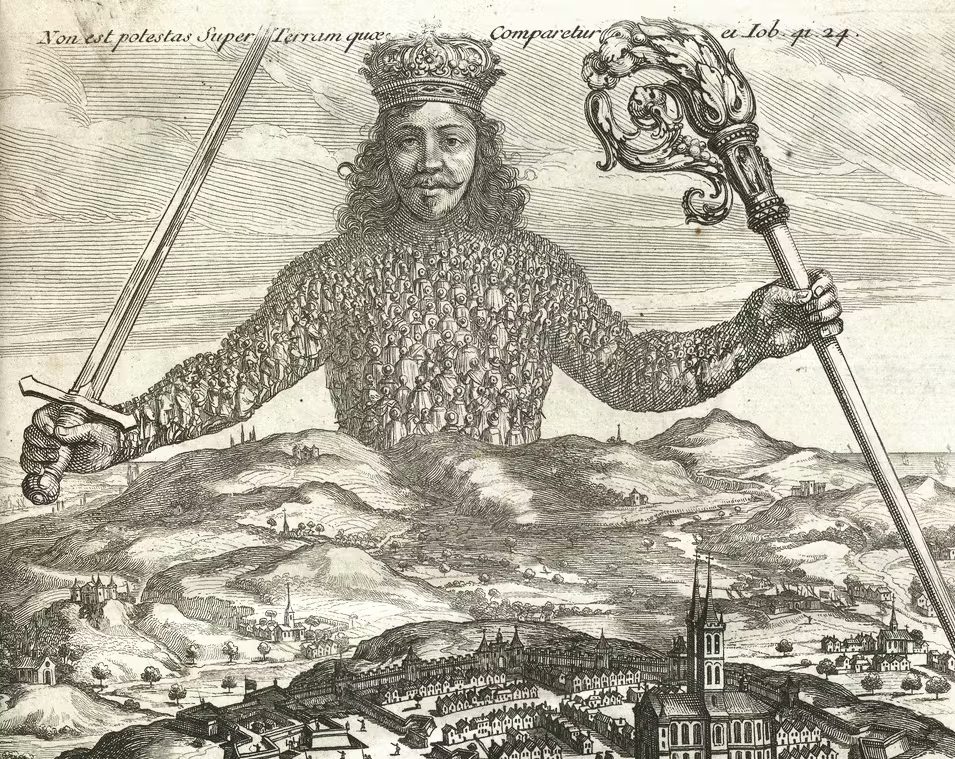
    Thomas Hobbes wrote his seminal work Leviathan in 1651. In it he describes the world system as it was then as being in “a state of nature,” something that some have interpreted as anarchy. However, anarchy has order and purpose. It is not chaos. In fact, if we think of Adam Smith’s “invisible hand of the market” we get something similar to what anarchy is in practice: the aggregate of individual acts of self-interest can lead to the optimisation of value and outcomes at the collective level. Anarchy clears; chaos does not.

    For Hobbes, the state of nature was chaos. Absent a “Sovereign” (i.e. a government) that could impose order on global and domestic societies, humans were destined to lead lives the were “solitary, poor, nasty, brutish and short.” This has translated into notions of “might makes right,” “survival of the fittest,” “to the victor goes the spoils” and other axioms of so-called power politics. The most elaborate of these, international relations realism, is a school of thought that is based on the belief that because the international system has no superseding Sovereign in the form of world government with comprehensive enforcement powers, and because there are no universally shared values and mores throughout the globe community that ideologically bind cultures, groups and individuals, global society exists as a state of nature where, even if there are attempts to manage the relationships between States (and other actors) via rules, norms, institutions and the like, the bottom line is that States (and other actors) have interests, not friends.

    Interests are pursued in a context of power differentials. Alliances are temporary and based on the convergence of mutual interests. Values are not universal and so are inconsequential. International exchange is transactional, not altruistic. Actors with greater resources at their disposal (human, natural, intellectual) prevail over those that have less. In case of resource parity between States or other actors, balances of power become systems regulators, but these are fluid and contingent, not permanent. Geography matters in that regard, which is why geopolitics (the relationship of power to geography) is the core of international relations.

    It is worth remembering this when evaluating contemporary international relations. It has been well established by now that the liberal international order of the post WW2 era has largely been dismantled in the context of increasing multipolarity in inter-State relations and the rise of the Global South within the emerging order. As I have written before, the long transition and systemic realignment in international affairs has led to norm erosion, rules violations, multinational institutional and international organizational decay or irrelevance and the rise of conflict (be it in trade, diplomacy or armed force) as the new systems regulator.

    These developments have accentuated over the last decade and now have a catalyst for a full move into a new global moment–but not into a multipolar or multiplex constellation arrangement in which rising and established powers move between multilateral blocs depending on the issues involved. Instead, the move appears to be one towards a modern Hobbesian state of nature, with the precipitant being the MAGA administration of Donald Trump and its foreign policy approach.

    We must be clear that it is not Trump who is the architect of this move. As mentioned in pervious posts, he is an empty vessel consumed by his own self-worth. That makes him a useful tool of far smarter people than he, people who work in the shadow of relative anonymity and who cut their teeth in rightwing think tanks and policy centres. In their view the liberal internationalist order placed too many constraints on the exercise of US power while at the same time requiring the US to over-extend itself as the “world’s policeman” and international aid donor . Bound by international conventions on the one hand and besieged by foreign rent-seekers and adversaries on the other, the US was increasingly bent under the weight of overlapped demands in which existential national interests were subsumed to a plethora of frivolous diversions (such as human rights and democracy promotion).

    For these strategists, the solution to the dilemma was not to be found in any new multipolar (or even technopolar) constellation but in a dismantling of the entire edifice of international order, something that was based on an architecture of rules, institutions and norms nearly 500 years in the making. Many have mentioned Trump’s apparent mercantilist inclinations and his admiration for former US president William McKinley’s tariff policies in the late 1890s. Although that may be true, the Trump/MAGA agenda is far broader in scope than trade. In fact, the US had its greatest period of (neo-imperial) expansion during McKinley’s tenure as president (1897-1901), winning the Spanish-American War and annexing Hawai’i, Puerto Rico, Guam, American Samoa and the Philippines, so Trump’s admiration for him may well be based on notions of territorial expansionism as well.

    Whatever Trump’s views of McKinley, the basic idea under-riding his foreign policy team’s approach is that in a world where the exercise of power is the ultimate arbiter of a State’s international status, the US remains the greatest Power of them all. It does not matter if the PRC or Russia challenge the US or if other emerging powers join the competition. Without the hobbling effect of its liberal obligations the US can and will dominate them all. This involves trade but also the exercise of raw (neo) imperialist ambitions in places like Greenland, the Panama Canal and even Canada. It involves sidelining the UN, NATO, EU and other international organisations where the US had to share equal votes with lesser powers who flaunted the respect and tribute that should naturally be given in recognition of the US’s superior power base.

    There appears to be a belief in this approach that the US can be a new hegemon–but not Sovereign–in a unipolar world, even more so than during the post-USSR-pre 9/11 interregnum. In a new state of nature it can sit at the core of the international system, orbited by constellations of lesser Great Powers like the PRC, Russia, the EU, perhaps India, who in turn would be circled by lesser powers of various stripes. The US will not seek to police the world or waste time and resources on well-meaning but ultimately futile soft power exercises like those involving foreign aid and humanitarian assistance. Its power projection will be sharp on all dimensions, be it trade, diplomacy or in military-security affairs. It will use leverage, intimidation and varying degrees of coercion as well as persuasion (and perhaps even bribery) as diplomatic tools. It will engage the world primarily in bilateral fashion, eschewing multilateralism for others to pursue according to their own interests and power capabilities. That may suit them, but for the US multilateralism is just another obsolescent vestige of the liberal internationalist past.

    Source: Northrop-Grumman.

    A possible (and partial) explanation for the change in the US foreign policy approach may be the learning effect in the US of Russia’s invasion of Ukraine and Israel’s scorched earth campaign in Gaza. Trump and his advisors may have learned that impunity has its own rewards, that no country or group of countries other than the US (if it has the will) can effectively confront a state determined to pursue its interests regardless of international law, the laws of war or institutional censorship (say, by the UN or International Criminal Court), or any other type of countervailing power. The Russians and Israelis have gotten away with their behaviour because, all rhetoric and hand-wringing aside, there is no actor or group of actors who have the will or capability to stop them. For Trump strategists, these lesser powers are pursuing their interests regardless of diplomatic niceties and international conventions, and they are prevailing precisely because of that. Other than providing military assistance to Ukraine, no one has lifted a serious finger against the Russians other than the Ukrainians themselves, and even fewer have seriously moved to confront Israel’s now evident ethnic cleansing campaign in part because the US has backed Israel unequivocally. The exercise of power in each case occurred in a norm enforcement vacuum in spite of the plethora of agencies and institutions designed to prevent such egregious violations of international standards.

    Put another way: if Israel and Russia can get away with their disproportionate and indiscriminate aggression, imagine what the US can do.

    If we go on to include the PRC’s successful aggressive military “diplomacy” in East/SE Asia, the use of targeted assassinations, hacking, disinformation and covert direct influence campaigns overseas by various States and assorted other unpunished violations of international conventions, then it is entirely plausible that Trump’s foreign policy brain trust sees the moment as ripe for finally breaking the shackles of liberal internationalism. Also recall that many in Trump’s inner circle subscribe to chaos or disruption theory, in which a norms-breaking “disruptor” like Trump seizes the opportunities presented by the breakdown of the status quo ante.

    Before the US could hollow out liberal internationalism abroad and replace it with a modern international state of nature it had to crush liberalism at home. Using Executive Orders as a bludgeon and with a complaint Republican-dominated Congress and Republican-adjacent federal courts. the Trump administration has openly exercised increasingly authoritarian control powers with the intention of subjugating US civil society to its will. Be it in its deportation policies, rollbacks of civil rights protections, attacks on higher education, diminishing of federal government capacity and services (except in the security field), venomous scapegoating of opponents and vulnerable groups, the Trump/MAGA domestic agenda not only seeks to turn the US into a illiberal or “hard” democracy (what Spanish language scholars call a “democradura” as a play on words mixing the terms democracia and dura (hard)). It also serves notice that the US under Trump/MAGA is willing to do whatever is necessary to re-impose its supremacy in world affairs, even if it means hurting its own in order to prove the point. By its actions at home Trump’s administration demonstrates capability, intent and steadfast resolve as it establishes a reputation for ruthless pursuit of its policy agenda. Foreign interlocutors will have to take note of this and adjust accordingly. Hence, for Trump’s advisors, authoritarianism at home is the first step towards undisputed supremacy abroad.

    The Trump embrace of international state of nature differs from Hobbes because it does not see the need for a superseding global governance network but instead believes that the US can dominate the world without the encumbrances of power-sharing with lesser players. In this view hegemony means domination, no more or less. It implies no attempt at playing the role of a Sovereign imposing order on a disorderly and recalcitrant community of Nation-States and non-State actors that do not share common values, much less interests.

    This is the core of the current US foreign policy approach. It is not about reorganising the international order within the extant frameworks as given. It is about removing those frameworks entirely and replacing them with an America First, go it alone agenda where the US, by virtue of its unrivalled power differential relative to all other States and global actors, can maximise its self-interest in largely unconstrained fashion. Some vestiges of the old international order may remain, but they will be marginalised and crippled the longer the US project is in force.

    What does not seem to be happening in Trump’s foreign policy circle are three things. First, recognition that other States and international actors may band together against the US move to unipolarity in a new state of nature and that for all its talk the US may not be able to impose unipolar dominance over them. Second, understanding that States like the PRC, Russia and other Great Powers and communities (like the EU) may resist the US move and challenge it before it can consolidate the new international status quo. Third, foreseeing that the technology titans who today are influential in the Trump administration may decide to transfer there loyalties elsewhere, especially if Trump’s ego starts becoming a hindrance to their (economic and digital) power bases. The fusion of private technology control and US State power may not be as compatible over time as presently appears to be the case, something that may not occur with States such as the PRC, India or Japan that have different corporate cultures and political structures. As the current investment in the Middle Eastern oligarchies shows, the fusion of State and private techno power may be easier to accomplish in those contexts rather than the US.

    In any event, whether it be a short-term interlude or a longue durée feature of international life, a modern state of nature is now our new global reality.

    Analysis syndicated by 36th Parallel Assessments –

    MIL OSI Analysis – EveningReport.nz –

    June 29, 2025
  • MIL-OSI China: Beijing breaks into global top 5 startup hubs

    Source: People’s Republic of China – State Council News

    This photo taken from Jingshan Hill on Aug. 12, 2024 shows the skyscrapers of the central business district (CBD) on a sunny day in Beijing, capital of China. [Photo/Xinhua]

    Beijing tied with Boston for fifth place in a global ranking of startup ecosystems, making it China’s sole city in the top five, according to the Global Startup Ecosystem Report 2025 released on June 12 by research firm Startup Genome.

    Silicon Valley held the top spot, followed by New York, London and Tel Aviv in second through fourth place, respectively. Other Chinese hubs, including Shanghai, Shenzhen, Hangzhou, Hong Kong and Guangzhou, also ranked among the top 40, with all except Hong Kong moving up the list.

    The report assessed six metrics: performance, funding, talent and expertise, market reach, AI-native transformation and knowledge supply. Beijing ranked third globally in performance and fourth in both talent and knowledge supply.

    The city far exceeded the global average in ecosystem value, number of active unicorn companies, software engineer salaries and total venture capital. From 2022 to 2024, the city’s startup ecosystem was valued at $533 billion, over 26 times the global average of $20.4 billion, and it boasted 61 active unicorn companies, compared to the global average of four.

    The report attributes Beijing’s robust innovation growth to strong government support, intellectual backing from top universities and a thriving capital market.

    In terms of policy support, Beijing has encouraged major commercial banks to increase investment in non-listed firms as part of broader efforts to support its startup ecosystem. In 2024, loans to small and micro businesses and entrepreneurs in Beijing jumped, with entrepreneurship guaranteed loans rising 79.6% year on year. That same year, the city also introduced over 250 business reform measures and added 287,000 new market entities.

    Beijing is home to 46 publicly listed companies focused on AI, big data and analytics, with a combined market value of $590.96 billion. The city has earned international recognition in AI-driven data analytics, life sciences and fintech, and has become a leading center for payment technology.

    To attract startups, Beijing has continued to bolster its support for tech companies, financing options and advanced research infrastructure. In August 2024, officials announced plans to expand the number of specialized, innovation-driven firms in Beijing to over 10,000 and introduced new policies and funding to support digital upgrades. 

    Several new investment funds have been set up targeting key technology sectors, while infrastructure initiatives such as a super-node computing power cluster and the rollout of 5G-Advanced mobile networks are expected to further support startup development.

    MIL OSI China News –

    June 29, 2025
  • MIL-OSI USA: Tillis Statement on Senate Reconciliation Vote

    US Senate News:

    Source: United States Senator for North Carolina Thom Tillis

    WASHINGTON, D.C. – Today, Senator Thom Tillis (R-NC) issued the below statement on the Senate reconciliation vote: 

    “I will always do what is in the best interest of North Carolina, even when that puts me at odds with my own party. When Senate leaders of my party presented this bill, I did what every American should expect from their U.S. Senator: I worked to gather the facts and comprehensively analyze what the impact would be on the people I swore an oath to represent. 

    “I did my homework on behalf of North Carolinians, and I cannot support this bill in its current form. It would result in tens of billions of dollars in lost funding for North Carolina, including our hospitals and rural communities. This will force the state to make painful decisions like eliminating Medicaid coverage for hundreds of thousands in the expansion population, and even reducing critical services for those in the traditional Medicaid population. 

    “We can and must do better than this. The Senate should return to the House’s Medicaid approach. That plan includes commonsense reforms to address waste, fraud, and abuse, and implements work requirements for some able-bodied adults to ensure taxpayer-funded benefits are going to our most vulnerable neighbors.

    “There is a lot for North Carolinians to love about the rest of the One Big Beautiful Bill, including extending the historic Trump Tax Cuts, increasing the child tax credit, providing historic funding for border security, and ending wasteful spending. We can and must accomplish this without hurting our rural communities and hospitals, and without jeopardizing access to care for hundreds of thousands of North Carolinians who need it the most.”

    See the analysis HERE.

    MIL OSI USA News –

    June 29, 2025
  • MIL-OSI USA: Norton Introduces D.C. Zoning Commission Home Rule Act

    Source: United States House of Representatives – Congresswoman Eleanor Holmes Norton (District of Columbia)

    The bill would give D.C. the authority to appoint all members of its zoning commission, which currently has seats for two federal officials.

    WASHINGTON, D.C. – Congresswoman Eleanor Holmes Norton (D-DC) introduced the District of Columbia Zoning Commission Home Rule Act today, which would give D.C. the authority to appoint all members of the D.C. Zoning Commission (Commission). Even though the Commission has no authority over federal property, it currently consists of two federal officials (the Architect of the Capitol and the Director of the National Park Service), in addition to three members appointed by D.C.’s mayor with the D.C. Council’s approval. Despite the D.C. Home Rule Act, which gave D.C. authority over local matters, 40 percent of the members of the Commission are federal officials who are unaccountable to nearly 700,000 D.C. residents.

    “This bill is an essential step to increase home rule in the District of Columbia,” Norton said. “Land use is a local matter in every situation, no matter the context. The federal government loses nothing because the interests of the federal government in land use in the nation’s capital are protected by federal law. If anything, this will allow the federal government more resources to pursue issues within their jurisdiction.”

    The Commission creates zoning maps and regulations, which must “not be inconsistent with the comprehensive plan for the national capital.” The mayor is responsible for the local elements of the comprehensive plan, subject to Council approval. The National Capital Planning Commission (NCPC), which is the central federal planning agency for the federal government in D.C. and approves federal projects here, is responsible for the federal elements of the comprehensive plan. This bill would not alter the comprehensive plan process nor the authority of NCPC and the Commission.

    ###

    MIL OSI USA News –

    June 29, 2025
  • MIL-OSI USA: Norton Requests Comprehensive GAO Study on Railway Noise Pollution

    Source: United States House of Representatives – Congresswoman Eleanor Holmes Norton (District of Columbia)

    WASHINGTON, D.C. — As ranking member of the House Transportation & Infrastructure Subcommittee on Highways and Transit, Congresswoman Eleanor Holmes Norton (D-DC) today wrote the Comptroller General of the U.S. Government Accountability Office (GAO) requesting that it conduct a comprehensive study on the causes and effects of railway noise pollution. Additionally, Norton asked GAO to propose ways that the federal government can reduce the negative effects of railway noise pollution. The request is similar to a bill Norton reintroduced in April to require the GAO to submit recommendations to Congress on how to reduce train noise and vibrations near homes.

    “D.C. residents contact me regularly about the negative impacts train noise and vibrations have on their health, quality of life and even the structural integrity of their homes,” Norton said. “Although trains provide an essential mode of transportation, we can’t simply ignore the harms suffered by those who live near them, which can include structural damage, reduced property values and negative health effects. We must examine whether there are viable, cost-effective ways to mitigate the harms caused by long-term exposure to train noise and vibrations.”

    Norton’s letter follows, with personal contact information redacted. 

    June 23, 2025

    The Honorable Gene L. Dodaro
    Comptroller General
    U.S. Government Accountability Office
    441 G Street NW
    Washington, DC 20548

    Dear Comptroller General Dodaro:

    Passenger and freight railway traffic is a top contributor of unwanted and excessive sounds and vibrations (i.e., noise pollution). Noise pollution is emitted from train movements on tracks, horns and warnings, braking and engine idling and accelerating.  Noise pollution can reduce property values and labor productivity and have adverse health effects.

    The U.S. Department of Transportation is responsible for regulating railway noise pollution.  For example, the Federal Railroad Administration enforces regulations that set maximum sound levels from railroad equipment and locomotive horns. The Federal Transit Administration develops guidance for assessing noise pollution from transit projects that receive federal funding, including conventional rail lines.

    I am requesting that the U.S. Government Accountability Office conduct a comprehensive review of railway noise pollution.  The review should address the following questions: 

    1. What factors contribute to railway noise pollution, and how much noise pollution can such factors emit?
    2. What actions can railway manufacturers and operators take to reduce railway noise pollution, and what are the costs and benefits of such actions?
    3. How can the federal government reduce negative effects associated with railway noise pollution? 

    Thank you for considering this request. 

    Sincerely,

    Eleanor Holmes Norton
    Ranking Member
    Subcommittee on Highways and Transit

    ###

    MIL OSI USA News –

    June 29, 2025
  • MIL-OSI USA: Norton Introduces Bill to Rename Post Office for “Godfather of Go-Go” Chuck Brown

    Source: United States House of Representatives – Congresswoman Eleanor Holmes Norton (District of Columbia)

    WASHINGTON, D.C. — Congresswoman Eleanor Holmes Norton (D-DC) introduced a bill to name the post office located at 3401 12th Street NE after musician and singer Chuck Brown, the “Godfather of Go-Go,” who holds particular significance to D.C. residents for creating and popularizing go-go music and for his support of D.C. statehood.

    “As the ‘Godfather of Go-Go,’ Chuck Brown gave D.C. a unique hometown sound that was distinctly our own and brought enjoyment to all who heard him here and throughout the nation,” Norton said. “Go-go is the beat of D.C., giving D.C. its own musical identity and reminding the nation that D.C. has always been the hometown of talented artists. We’ll never forget the free concert in 2010 Chuck Brown played in front of the Capitol for D.C. statehood and voting rights. He loved the District, and naming post office after him is a way D.C. can honor him in return.”

    Norton’s introductory statement follows.

    Statement of Congresswoman Eleanor Holmes Norton

    on the Introduction of a bill to designate the facility of the United States Postal Service located at 3401 12th Street Northeast in Washington,

    District of Columbia, as the ‘‘Chuck Brown Post Office’’

    June 23, 2025

    Today, I introduce a bill to name the post office at 3401 12th Street NE in the District of Columbia for go-go legend Chuck Brown.

    Chuck Brown, the “Godfather of Go-Go,” is beloved by D.C. for his innovative and unique sound, which gave us go-go music. Go-go is the beat of D.C., giving D.C. its own musical identity and reminding the nation that D.C. has always been the hometown of talented artists.  Chuck Brown was a strong supporter of D.C. statehood, including playing a concert on a hot and humid day on the U.S. Capitol Grounds in 2010 in support of statehood.

    Chuck Brown was born on August 22, 1936, and passed away on May 16, 2012.  He was a D.C. resident most of his life.  He taught himself to play guitar, becoming a virtuoso singer, songwriter, guitarist and band leader.  His musical catalogue spanned 22 studio albums over three decades.  He earned a Grammy nomination in 2010 for the song “Love” from his album “We Got This,” and was awarded a National Endowment for the Arts National Heritage Fellowship in 2005.

    D.C. named a park located at 2901 20th Street, NE, for Chuck Brown, and named a street near the historic Howard Theater for him.

    I urge my colleagues to support this bill.

    ###

    MIL OSI USA News –

    June 29, 2025
  • MIL-OSI United Nations: Deputy Secretary-General’s remarks at the Graduation Ceremony of the Paris School of International Affairs, Sciences Po

    Source: United Nations secretary general

    Dean Gonzalez, distinguished faculty members, ladies and gentlemen, 
      
    Most importantly, graduates, 

    Let me begin with the most important word of all: congratulations! 

    You now join a long line of Sciences Po alumni who have shaped our world – including some of whom are doing it every day at the United Nations as they work in my office supporting the Secretary-General. 

    Let’s also take a moment to recognise your families, friends and loved ones – who have been with you every step of the way.  

    They deserve a round of applause.   

    Students representing more than 120 nationalities come here to learn how the world works, and how it can work better.  

    That spirit of global curiosity and purpose has also carried me through every chapter of my own journey.   

    Designing schools and hospitals in my home country of Nigeria. 

    Advising four Presidents on poverty reduction, development policy planning and public sector reform. 

    Supporting Member States to lead the process that transformed global aspirations into the Sustainable Development Goals. 

    And now as the longest-serving Deputy Secretary-General in United Nations history, supporting the Secretary-General on some of the most complex situations in our history, from COVID, to Ukraine, to Sudan and Gaza and today’s continuing crisis in the Middle East.

    Today, I want to reflect on the lessons I have learned along the way.

    First, don’t agonise, organise. 

    We live in a world of hurt.  A world that is messy, complicated and often overwhelming.  

    And I know it might be easy to feel paralyzed by the scale and hopelessness of today’s challenges.  

    Don’t.

    Because more than ever, those challenges are connected – and we solve them by seeing those connections and coming together. 

    When I served as Nigeria’s Minister of Environment, my job was never just about the environment.  

    When Lake Chad was drying up, it wasn’t just an ecological crisis – it was a security crisis.  Boko Haram was born and abducted 200 school girls. 

    When we faced population and urban sprawl and tensions rose between farmers and herders, it wasn’t just about water  access– it was about food systems and growing cities. 

    When I met girls walking hours to fetch water, missing school every day – it wasn’t just about resources – it was about gender equality.  

    We didn’t work in siloes.  We built coalitions across sectors – civil society, young people, traditional leaders, the private sector – to find real solutions.  

    We didn’t agonize, we organized. 

    And, yes, there’s plenty to agonize about today – especially when multilateralism is under attack and international cooperation is on the back foot. 

    But I have seen what’s possible when we find common ground and forge ahead.  

    Just look at the last two months at the UN.  

    A landmark Pandemic Treaty approved at the World Health Organization. 

    Major new protections for our oceans at the World Ocean Conference in Nice.  

    And from Paris, I head to Sevilla — where the world is coming together to commit to better finance sustainable development. 

    So, when the problems seem larger than life, too tangled, too tough — don’t agonize.

    Organize. 

    Mobilize. 

    And help realize the change our world so urgently needs. 

    Remember you did not fail for want of trying.

    The second lesson – keep learning and delivering.  

    Graduation isn’t the end of learning.  In many ways, it’s just the start of your lifelong journey.

    When I joined the UN, I was not steeped in the intricacies of international diplomacy.

    Throughout my career, I have had to learn fast – and deliver even faster.  

    So will you.  

    Even now, I am learning every day – about AI, about geothermal energy, space debris, biotechnology, cybersecurity.  

    You will face even more change, even faster, especially in the new era of super technologies. 

    Regardless of the task that is put in front of you, get ahead of it.  Learn more.  Do more.  Show your stuff and deliver.  Performance opens doors.  

    Yes, some of life is luck and privilege.  

    But I guarantee: the harder you work, the luckier you will get.  

    Third, make hope your most powerful asset. 
    The world is a cynical place. And international affairs is not for the faint of heart. 

    There will be setbacks and critics. 

    There will be many days when the problems seem too big, and the politics too small. When anxieties grip you like a fever.

    Just look around:  war in Ukraine, atrocities in Sudan, catastrophe in Gaza, climate chaos everywhere. 

    But never forget, hope is not a four-letter word. 

    Hope is the courage to build when others are tearing down. 

    Hope is the decision to get up one more time, to negotiate one more deal, even when the odds are against you.

    I have sat with young girls who survived the worst horrors of war and sexual violence. 

    And in their eyes, I saw not just pain – but power. 

    The power to heal. To lead.  To hope. To survive and thrive. 

    Hope is not the absence of fear.  It is the refusal to be defined by it.

    So, carry it with you. Guard it fiercely.  

    Because hope is not just a feeling.  It’s a force.  

    Fourth, hold onto your moral compass. 

    Your degree will open doors. 

    But your integrity will tell you which ones are worth walking through.

    And in today’s world – where the global moral compass is spinning – that clarity matters more than ever. 

    We live in a world where military spending is soaring, while development budgets shrink.  

    Where fossil fuel subsidies dwarf investments in climate action.  

    Where conflict and hardship has forced more people from their homes than at any time since the Second World War.

    In this world, your role as changemakers is not just to make the right deals. 

    It is to draw the right lines. 

    There will be pressure to stay silent. 

    There will be moments when abandoning principles may seem an easier choice.

    But integrity matters most.

    As Deputy Secretary-General, I have had to tell hard truths to powerful people.

    To remind leaders of the many promises they made – and the people they made them to. 

    It is never easy to challenge power. 

    But we don’t serve power. 

    We serve people.

    And if we truly serve people, we must use our superpower and stand for justice, dignity, and solidarity. 

    As we mark Beijing+30, we cannot talk about a future and leave women and girls behind.

    Gender equality is not charity.  It powers our agency. And human rights.   

    And everyone wins when we leave no one behind.  

    But let’s be honest, we are not there yet. 

    So, to the men here today, I say: don’t stand in the way.  

    Don’t walk ahead.  

    Walk with. Stand with.  And speak up. For the other half of your society, women.

    The final lesson is this: invest time in what truly sustains you. 

    Your career will have highs and lows. 

    Plans change. 

    Titles come and go.

    But what will carry you through are the people who know you beyond your résumé. 

    Friends, families, mentors, partners. 

    Protect those bonds. Nurture them.

    Because in the toughest moments, those relationships will remind you of who you are, why you started, and why you must keep going.

    So, no matter how far you go, or how fast — never lose sight of what, and who, matters most.

    Dear graduates,

    Today, you are not just stepping into the world. 

    You are inheriting its unfinished business, and its boundless possibilities.

    As I look out, I see the next generation of climate champions, human rights defenders, and world class diplomats.

    And I am filled with hope. 

    Whatever path you choose, walk it with courage and conviction.  

    Congratulations, Class of 2025.

    The world is waiting.

    And I, for one, can’t wait to see what you will do.

    Thank you.
     

    MIL OSI United Nations News –
    June 29, 2025
  • MIL-OSI China: Disaster relief efforts underway in flood-hit southwest China county

    Source: People’s Republic of China – State Council News

    GUIYANG, June 28 — Heavy flooding has returned to Rongjiang County in southwest China’s Guizhou Province, prompting local authorities to re-activate the highest-level emergency flood response, effective from 12:30 p.m. Saturday.

    At 6:30 p.m., the Shihuichang Hydrological Station on Duliu River recorded a water level of 253.06 meters, with a flow rate of 8,000 cubic meters per second, surpassing the guaranteed water level of 251.5 meters by 1.56 meters. This was slightly lower than its earlier forecast, which estimated a peak flood level of 253.5 meters at around 5 p.m. However, water levels continue to rise gradually by 6:30 p.m.

    The local flood control and drought relief headquarters has upgraded the flood control emergency response from Level II to Level I, the highest level in China’s four-tier weather warning system.

    Local authorities are evacuating residents from affected areas. By 6 p.m. on Saturday, Rongjiang had organized the urgent evacuation and relocation of 11,992 households and 41,574 individuals.

    Rongjiang has received an influx of over 1,000 soldiers equipped with heavy machinery, including excavators, bulldozers and loaders, to provide urgent assistance.

    Since flooding began, Rongjiang, with a population of 385,000, has received prompt rescue efforts from both authorities and volunteers.

    The disaster relief work is advancing in an orderly manner, Rongjiang’s flood control and drought relief headquarters said late Saturday.

    However, due to the limited road capacity in the affected areas, local authorities requested that non-government rescue teams halt heading to the affected areas until coordinating with the county’s flood control and drought relief headquarters.

    Since June 24, Rongjiang has been hit by severe flooding due to persistent rainstorms. As of midday on Thursday, six people had died as a result of the floods.

    MIL OSI China News –

    June 29, 2025
  • MIL-OSI USA: ICYMI: Lankford Urges Passage of One Big Beautiful Bill

    US Senate News:

    Source: United States Senator for Oklahoma James Lankford

    WASHINGTON, DC — US Senator James Lankford (R-OK), a member of the Senate Finance and Homeland Security Committees, recently highlighted that the One Big Beautiful Bill delivers the largest tax cut in history for hardworking Americans, secures the border, strengthens Medicaid, and rebuilds the military, all while cutting out-of-control spending.

    “Right now, Democrats are running on rumors, innuendo, and quite frankly, just stuff they’ve made up that’s not in the bill—never been considered in the bill,” said Lankford on Fox Business.

    “Yeah, we’re hoping to get a vote as quickly as we can get everything all together,” said Lankford on ABC News. “Most of it has been out there in public for now, days to weeks, actually, as we’ve released each chapter day by day over the last two weeks. But we’ve got several different issues that are all coming together at the end.”

    “We’re going to just keep pushing to be able to get the work done,” said Lankford on Newsmax.

    Background

    Lankford remains outspoken on what it means for Oklahomans if the One Big Beautiful Bill isn’t passed, and President Trump’s 2017 Tax Cuts expire: 

    • A staggering 63,000 jobs projected to be lost
    • Average Oklahoma family faces a $2,013 tax increase
    • Nearly 449,000 households will see their child tax credit reduced by 50%
    • Over 233,000 small business owners hit with significant tax hikes
    • More than 1.5 million families will have their standard deduction cut in half

    You can learn more about the positive impacts of the One big Beautiful Bill, HERE.

    MIL OSI USA News –

    June 29, 2025
  • MIL-OSI United Kingdom: Two million meals already served at free breakfast clubs

    Source: United Kingdom – Government Statements

    Press release

    Two million meals already served at free breakfast clubs

    The first wave of the government’s free breakfast clubs have already served two million meals, delivering on the Plan for Change.

    Thousands of families across the country are already benefitting from the government’s flagship free breakfast club programme, with two million meals served in its first term.  

    The programme, which is set to give parents almost 100 hours back each year and save up to £450 in childcare costs, is one in a number of government measures to back working families, with new data revealing the benefits felt by parents and children.  

    The 30 minutes of free childcare give parents extra breathing space in busy mornings, allowing them to get to work easier, make time for appointments and help them juggle family life. According to the latest parent poll over half (59%) say the cost saving would motivate them to use a free breakfast club, and eight in ten say breakfast clubs help them to get to work on time and drop their kids off at school more easily.   

    The rollout delivers on the government’s manifesto promise to ensure state schools offer free breakfast clubs to all pupils, while supporting its Plan for Change milestone to ensure tens of thousands more children start school ready to learn. 

    Free breakfast clubs can make a significant impact on children’s attendance, behaviour and attendance, and the latest findings show this being felt on the ground. A third of parents think their children focus better in lessons (31%) and almost half think it’s easier to get their child out of bed and into school (48%).  

    The top draws for children going to a breakfast club are seeing friends (69%) and playing before school (63%), backing the government’s intention to enable a supportive start to the school day.  And children get to enjoy their top breakfast picks, leading with cereal (39%), followed by toast (32%) and fruit and yoghurt (8%).  

    It comes alongside wider action the government is taking to tackle the cost of living including increasing the National Living wage, extending free school meals to all children in households on Universal Credit – saving parents £500 a year – and expanding the Warm Homes Discount to save £150 for 6 million families next winter. 

    Bridget Phillipson, Education Secretary, said: 

    “This milestone in our Plan for Change will make all the difference to working families, as every child deserves the chance to start the day supported and ready to learn.

    “That’s why we are determined to break the link between background and success – delivering two million meals in the first term of free breakfast clubs, making an immediate and direct impact and easing the pressures on working families. We know parents are living busy lives, juggling family time and jobs, so I urge all parents who can to make use of the clubs.

    “Coupled with the historic step to tackle child poverty through offering free school meals to every single child who’s family claim Universal Credit and legislating cost saving measures such as a branded uniform cap, we are delivering the change families deserve.”  

    This government has set out a clear commitment to break down barriers to opportunity for every child, with breakfast clubs proven to boost children’s reading, writing and maths by an average of two months.  

    Annika Fox, mum of two children aged 6 and 2 years old said:   

    “The government’s free breakfast clubs have been a lifesaver to help me balance motherhood and work.   

    “As a full-time executive assistant, and often being the only adult in the house, I have to juggle getting two small kids ready for the day – all prior to commuting into London three times a week!  

    “The club gives me the flexibility I need, tripling the time I have to make drop off in the morning and making sure that my son isn’t rushed in the morning.”    

    Michael Lobo, Headteacher at St Patrick’s Catholic Primary School said:  

    “The funding for the free breakfast clubs has been instrumental to expanding our provision and offering children fun activities – like table tennis!   

    “For us, we’ve seen an improvement in punctuality for children attending school, as it gives a bigger window for parents to make drop off and lets them stagger their arrival with traffic.   

    “Our clubs mean children are settled, calmer in the mornings and engaged, ready to learn. It has been particularly valuable for children with SEN and anxiety.”  

    Free breakfast clubs in the early adopter schools will shape the future of the national breakfast club policy, contributing directly to its implementation. Further details on the national rollout of the breakfast clubs programme will follow in due course.  

    NOTES TO EDITORS  

    • The government has committed to fund free breakfast clubs in every primary school in England.  

    • Six in 10 parents say a free breakfast club would make them more likely to send their child to school – see HERE 

    • An Education Endowment Foundation (EEF) impact evaluation of the Magic Breakfast programme found that offering pupils in primary schools a free, universal, before-school breakfast club which includes a breakfast can boost their reading, writing, and maths attainment by an average of 2 months’ additional progress in Key Stage 1.    

    • Research shows that breakfast clubs can improve concentration, behaviour, and attendance, leaders and teachers have confirmed this, alongside findings from the National School Breakfast programme.  

    • Estimates of May pupil take-up for early adopter schools can be found here

    • All other new parent data included has been gathered by MadeForMums Breakfast Clubs Survey (June 2025, 279 respondents) – see here.

    • For more information about the free breakfast clubs programme, visit Free breakfast club roll out: everything you need to know  – The Education Hub.  

    • The early adopter scheme started at the beginning of the summer term, this was 22nd April for most schools

    DfE media enquiries

    Central newsdesk – for journalists 020 7783 8300

    Share this page

    The following links open in a new tab

    • Share on Facebook (opens in new tab)
    • Share on Twitter (opens in new tab)

    Updates to this page

    Published 29 June 2025

    MIL OSI United Kingdom –

    June 29, 2025
  • MIL-OSI Asia-Pac: Embracing greener final farewells

    Source: Hong Kong Information Services

    The desire to return to nature is one shared by many, not least when it comes to post-funeral arrangements. Tapping into a growing trend, the Food & Environmental Hygiene Department (FEHD) has in recent years stepped up efforts to promote green burials, where remains are returned directly to the earth, or scattered at sea.

    The department’s endeavours include organising tours of facilities such as the Tsang Tsui Columbarium & Garden of Remembrance in Tuen Mun. On one such tour recently, elderly participants shared their thoughts on green burials as an eco-friendly end-of-life choice.

    Besides explore the facility and its services, the visit gave them the chance to reflect on their approach to life’s final journey. In fact, several remarked that they had already received the full support of their families in their wish for a green burial.

    Tranquil setting

    Visiting the Garden of Remembrance for the first time, 82-year-old Lee Yuk-sim described its seaside setting as open and tranquil. “The sound of waves lifts my spirits,” she said.

    Ms Lee wishes to have her ashes scattered along the garden’s pebble path, however. Despite her love for the ocean, following a heart-to-heart conversation with her daughters she decided scattering at sea was not an option for her.

    “I once told my daughters, ‘I love the sea.’ They replied, ‘The sea is full of swimmers, and every time we pass by it, we will think of you, and we don’t want that.’ Then they said, ‘The Garden of Remembrance is different. It is about dust returning to dust, earth to earth.”

    Meanwhile, 87-year-old Choi Sau-ling, also on her first visit to the Garden of Remembrance, found it strikingly different from what she had expected.

    “There were rumours that stray dogs and cats might disturb the ashes, but that is a complete misconception,” she said. “The truth is that the Garden of Remembrance is absolutely beautiful, with a sea view.”

    Ms Choi highlighted that the garden’s peaceful atmosphere makes it both an ideal resting place and a convenient site for families to pay their respects.

    “It is breezy and uncrowded, like wandering in a garden,” she commented. “It hits differently. Without the need to burn incense or make extra preparations, the experience feels lighter for everyone.”

    Dignified farewell

    Cheng Ting-fai, 87, had already made trips to the Gardens of Remembrance in Diamond Hill and Cape Collinson before visiting Tsang Tsui. He said he had also spoken to his children about his wish to have his ashes scattered.

    “Placing ashes in an urn is almost like trapping them. There is no sense of freedom, and over time no-one may be around to look after them.”

    Mr Cheng described scattering ashes in a Garden of Remembrance as a better option. “The ashes can bask in the sunshine, and experience the changing weather,” he explained.

    He also expressed his hope that all 18 districts in Hong Kong can have a Garden of Remembrance. “Born here, raised here, and laid to rest here. How wonderful is that?”

    At present, those choosing green burials can have their ashes scattered at either of three designated maritime areas or in one of the Gardens of Remembrance.

    The department manages 13 Gardens of Remembrance, with Tsang Tsui being the largest. The site also features a ceremonial hall where simple memorial services can be held before the scattering of ashes.

    The garden’s layout includes a boat-shaped wooden artwork, helping to create a symbolic space of transition. Visitors are invited to inscribe dedication cards with heartfelt messages, giving their loved ones a dignified farewell.

    Meanwhile, a fourteenth garden – the Shek Mun Columbarium & Garden of Remembrance – is expected to open for use in the third quarter of this year.

    Growing trend

    Moving away from traditional funeral customs is no easy transition, but – thanks in no small part to the Government’s promotional efforts – green burial, as a sustainable means of handling ashes, has been gaining wider acceptance in society.

    FEHD Senior Health Inspector Alan Li said that, as of the end of May, more than 15,800 names were registered in the Green Burial Central Register.

    “About 70% of deceased registrants had their ashes disposed of in the form of green burial. Even if there is no prior registration, descendants can still adopt green burial for the deceased.”

    The department stated that green burials accounted for a record-high 18.2% of disposals last year, with 8,522 individuals’ remains being scattered in Gardens of Remembrance and 1,032 at sea.

    To enhance the sea burial experience, the FEHD has upgraded its free ferry service, available every Saturday, by introducing a new vessel design.

    Public education

    Meanwhile, in August of last year the department launched a large-scale “School of Life” programme that explores life’s closing chapters and sustainable options for being laid to rest.

    The programme includes a “Life & Death Expo”, showcasing support services for ageing and end-of-life planning, as well as community walking tours that encourage reflection on life’s transitions. These initiatives have attracted around 5,000 participants so far, and people of all ages are welcome to take part.

    The department also arranges green burial talks, guided tours to Gardens of Remembrance, and community tours, with these activities engaging more than 20,000 citizens to date.

    FEHD Chief Health Inspector Daniel Lam said the department will continue to enhance green burial facilities, promote advance planning for after-death arrangements through the “School of Life” programme, and strengthen public education and publicity, in order to gradually establish green burial as the common practice for handling ashes.

    MIL OSI Asia Pacific News –

    June 29, 2025
  • MIL-OSI USA: ICYMI: ENERGY SECRETARY: It’s Time to Stop Subsidizing Solar and Wind in Perpuity

    Source: US Department of Energy

    New York Post

    June 27, 2025

    “How the Big Beautiful Bill will lower energy costs, shore up the electric grid — and unleash American prosperity”

    By Chris Wright

    How much would you pay for an Uber if you didn’t know when it would pick you up or where it was going to drop you off? Probably not much.

    Yet this is the same effect that variable generation sources like wind and solar have on our power grids.

    You never know if these energy sources will actually be able to produce electricity when you need it — because you don’t know if the sun will be shining or the wind blowing.

    Even so, the federal government has subsidized these sources for decades, resulting in higher electricity prices and a less stable grid.

    . . .

    President Donald Trump knows what to do: Eliminate green tax credits from the Democrats’ so-called Inflation Reduction Act, including those for wind and solar power.

    The One Big Beautiful Bill seeks to do that: Along with other proposals, like canceling billions in Biden Green New Deal money and making much-needed investments in the Strategic Petroleum Reserve, it aims to set an aggressive end date for these subsidies and build on the president’s push for affordable, abundant, and secure energy for the nation.

    . . .

    As Secretary of Energy — and someone who’s devoted his life to advancing energy innovation to better human lives — I, too, know how these Green New Deal subsidies are fleecing Americans.

    Wind and solar subsidies have been particularly wasteful and counterproductive.

    One example: The Renewable Electricity Production Tax Credit was first introduced in 1992, when wind energy was a nascent industry. This tax credit, originally set to phase out in 1999, was sold on a promise of low-cost energy with fewer tradeoffs.

    Since 1999, the REPTC has been extended a whopping 12 times, yet consumers continue to pay more on average for their home electric bills than in 1992, even after adjusting for inflation.

    Plus, today, more than 75% of US electricity comes from natural gas, nuclear and coal — and they supply it 24/7, independent of the weather.

    . . .

    At 8 p.m. on Inauguration Day, amid bitter cold across much of the Eastern seaboard, we reached peak demand for electricity in the mid-Atlantic region. At that point in time, PJM Interconnection, which supplies the Mid-Atlantic United States, got approximately 44% of its power from coal, 24% from natural gas, 25% from nuclear, 3% from oil, 3% from wind, 1% from hydro and 0% from solar.

    Think about that: When Americans most needed dependable power to heat their homes and businesses to stay alive, solar and wind were non-factors.

    Our homes, hospitals and businesses only continued to operate because there was enough reliable, baseload energy from natural gas, coal and nuclear available to meet demand.

    How valuable is a teammate who occasionally shows up for practice but is never there at game time?

    And the more we load our grid with intermittent generation, the worse the grid performs during times of maximum stress and demand.

    Subsidies are meant to drive prices down and boost supply. But subsidizing wind and solar has done exactly the opposite.

    . . .

    Bottom line: higher costs. Indeed, wind and solar subsidies not only cost taxpayers but also force providers to add more dispatchable resources to the grid, at their expense.

    These costs are then passed on to ratepayers.

    In other words, more wind and solar brings us the worst of two worlds: less reliable energy delivery and higher electric bills.

    It’s time to stop subsidizing such insanity in perpetuity. If sources are truly economically viable, let’s allow them to stand on their own, and stop forcing Americans to pick up the tab if they’re not.

    Read the full article here

    MIL OSI USA News –

    June 29, 2025
  • MIL-OSI USA: Senator Marshall: This is the Beginning of America’s Great Golden Era

    US Senate News:

    Source: United States Senator for Kansas Roger Marshall
    Senator Marshall Joins Fox News to Discuss the Reconciliation Bill, Medicaid, and Operation Midnight Hammer.
    Washington – On Saturday, U.S. Senator Roger Marshall, M.D. (R-Kansas), joined Rich Edson on Fox News’ Fox News Live to discuss the Senate’s latest timeline to move the reconciliation bill forward, the negotiations around the SALT deduction, the best way to save Medicaid for those who need it most, and what’s next for America in the ongoing conflicts abroad.
    Click HERE or on the image above to watch the full interview. 
    On the Republican reconciliation bill:
    “In my career as an obstetrician, I feel like this bill is three weeks past its due date. It’s time to have the baby. Everyone’s upset – that means we’re probably close to where it needs to be. We cannot blow this chance. This is the President’s legacy, his agenda. If you supported President Trump, you should support this bill. This will be the largest tax decrease in American history. We’re going to secure the border – a whole lot of other good things, but mostly this is the beginning of America’s great, golden era.”
    On the SALT Deduction and its impact on negotiations:
    “… Over in the house, I think we have a little tighter margin. And again, I think that what we asked the President to do here was split the baby, but he’s keeping the baby together. This is the best we can get. Speaker Johnson was there with us yesterday, negotiating this to the last second. I think everyone has thrown their best argument on the table – I think that’s a great step forward. I wish we were cutting more spending, including this, but this is the best bill that we can get through the finish line.”
    On how to save Medicaid from disaster:
    “Again, just because you have Medicaid doesn’t mean you have access to care. You pointed out that a third of doctors don’t accept Medicaid, and another third basically rule them out through the schedule. What our bill does is give a block grant for rural hospitals and for Community Health Centers. One of my three pillars of MAHA is making sure that everyone has meaningful, affordable access to primary care. Even Bernie Sanders agrees with me that these Community Health Centers are a great way to do that. I think that healthcare will be better.
    “And in this bill, we absolutely preserve Medicaid for those who need it the most. We don’t touch seniors in nursing homes, people with disabilities, pregnant women, or children. So, we will protect Medicaid for those who need it the most. And on the other hand, we want to make sure everyone has access to care. We’ll do it through a block grant – I’m so proud of the work we’ve done here, as far as making health care more affordable and more accessible.”
    On where the Medicaid savings will come from:
    “So, the savings come from a couple of things. One, something called a provider tax, which is absolutely a scam, a money laundering scam, where you have one state, maybe getting 25 times more per person than what a state like Kansas is getting. So, we need to level out those provider taxes.
    “And then, as we talk about people that may lose Medicaid, half of them are people that are on it fraudulently or through some type of error. And the other half will be those that are refusing to work 20 hours a day. Again, 60, 70% of Americans support some type of work requirements if you don’t have a disability, you’re working age, you don’t have a child under the age of 13, then I think it’s reasonable to ask people to work or volunteer for 20 hours a week.”
    On what’s next for America in the Israel and Iran conflict:
    “I think it will take them years just to restart their nuclear program. I think that they can’t control their airspace. They don’t have the will to do it. From what I’ve seen, I’m in shock and awe. You know, it’s shocking how much damage we did to their facilities. Obliterated is a great term. I’m in awe of our military, the great job that they did.
    “Thanks to all those Air Force guys who did this off. I’m an Army guy, but I’m still going to salute them. They did a great job. And thanks to all of our soldiers over in the Middle East, I don’t see Iran getting back in this ball game for several years.
    “Iran cannot have any type of nuclear bomb if they don’t want to move things in a different direction right now, then we need to double down on our sanctions. Whatever we need to do. Look, I don’t want boots on the ground. I’m tired of all the killing. I want all the killing to stop in Gaza, in Iran – all these different places, Ukraine. But at the end of the game, Iran cannot have a nuclear warhead.”

    MIL OSI USA News –

    June 29, 2025
  • MIL-OSI USA: Cantwell Statement on Latest Republican Public Lands Sell Off Proposal

    US Senate News:

    Source: United States Senator for Washington Maria Cantwell

    06.28.25

    Cantwell Statement on Latest Republican Public Lands Sell Off Proposal

    Trump’s Statement of Administration Policy supports the land sales provision

    WASHINGTON, D.C. – Today, U.S. Senator Maria Cantwell (D-WA), a senior member of the Senate Committee on Energy and Natural Resources, released this statement regarding inclusion of Senator Mike Lee’s (R-UT) public lands sell off plan in the Senate reconciliation bill released by Republicans early this morning.

    “Despite a nationwide outcry, Senate Republicans are barreling ahead with Senator Lee’s deranged proposal to sell our shared public lands to the highest bidder,” said Sen. Cantwell. “Let me be clear: I will not stop fighting until this proposal is dead and buried. Americans will not stand to have the hiking, climbing, and hunting spots we love put up for sale.”

    The Senate Republican proposal comes as part of a larger Trump Administration push to privatize public lands. Interior Secretary Doug Burgum has stated on multiple occasions that public lands should be recognized as valuable assets on the nation’s balance sheet and potentially used to generate revenue. Earlier this year, President Trump signed an executive order that described the nation’s natural resources and public lands as a “sum of asset value,” in the context of establishing a “Sovereign Wealth Fund.”  Subsequently, Senator Mike Lee (R-UT), Chairman of the U.S. Senate Committee on Energy and Natural Resources, proposed greenlighting the sale of over 250 millions of acres of public lands, which could constitute the “largest single sale of national public land in modern history.”  While the Senate Parliamentarian rejected Lee’s opening gambit, deeming the proposal ineligible under budget reconciliation process rules, Lee responded, “I’m doing everything I can to support President Trump and move this forward.” He promised, “We’re just getting started.”

    The revised proposal released today would sell at least between 0.25 and 0.50 percent of Bureau of Land Management Land, within a 5-mile radius of a population center, in 11 Western states, except Montana –up to 1.2 million acres of public land, at least.

    Sen. Cantwell is strongly opposed to selling off federal lands.

    On Tuesday she held a virtual press conference with the mayor of Boise, professional climbers, a leader from outdoor gear retailer REI, and a spokesperson for a hunting and angling advocacy group to push back on the GOP’s plans.

    In a committee hearing on June 10, she took U.S. Secretary of the Interior Doug Burgum to task over the administration’s alarming budget proposal for the Department of the Interior: “We’re all amazed that you seem to be putting forth a budget that is basically saying, ‘I don’t want to acquire. I want to actually sell public lands,’” she said.

    Opposition to the plan is bipartisan. On Thursday, U.S. Rep Dan Newhouse (WA-04) joined four other House Republicans in sending a letter to Speaker Mike Johnson, saying: “If a provision to sell public lands is in the bill that reaches the House floor, we will be forced to vote no.”

    MIL OSI USA News –

    June 29, 2025
  • MIL-OSI USA: CONGRESSWOMAN PLASKETT EXPRESSES DEEP CONCERN OVER THE TRUMP ADMINISTRATION’S DECISION TO END PROTECTIONS FOR HAITIAN IMMIGRANTS

    Source: United States House of Representatives – Congresswoman Stacey E. Plaskett (USVI)

    For Immediate Release                                          Contact: Tionee Scotland
    June 28, 2025                                                           202-808-6129

    PRESS RELEASE

    CONGRESSWOMAN PLASKETT EXPRESSES DEEP CONCERN OVER THE TRUMP ADMINISTRATION’S DECISION TO END PROTECTIONS FOR HAITIAN IMMIGRANTS

    Washington, DC – Congresswoman Stacey E. Plaskett (VI-AL) today strongly condemned the Trump administration’s announcement that it will terminate Temporary Protected Status (TPS) for more than 300,000 Haitian immigrants currently living in the United States, calling the decision “morally unconscionable and recklessly shortsighted to our national interest.”

    “The Trump administration’s decision to end TPS for Haitians is not just cruel—it is potentially deadly. Haiti remains in a state of complete collapse, overrun by gangs, wracked with violence, and under a state of emergency. The State Department itself warns Americans not to travel there due to widespread violent crime. Furthermore, the U.S. State Department has been in negotiations with multiple country partners to find ways to stem the continued collapse of the country. How can this administration claim it is safe to deport hundreds of thousands of people to a country they themselves have designated as too dangerous for American tourists and a threat to regional stability?

    “The Department of Homeland Security’s announcement on Friday that the protections, which have shielded Haitians from deportation since 2010 following the devastating earthquake, will expire on September 2, 2025. The administration justified the decision by claiming that, ‘the environmental situation in Haiti has improved enough that it is safe for Haitian citizens to return home’—a statement that directly contradicts the State Department’s actions regarding Haiti. 

    “This administration is playing politics with people’s lives. These are families who have built lives here, contribute to our communities, pay taxes from their wages and deserve our protection—not deportation to a nation in chaos. Throughout my tenure in Congress, I have worked tirelessly to ensure that our immigration policies reflect our values of compassion and humanity. This includes my work as a Co-Chair of the Congressional Caribbean Caucus to push back against discriminatory policies, to recognize the national security threat to the United States from a de-stabled Haiti, and my efforts to secure humanitarian aid for the Caribbean region.

    “This is part of a systematic campaign to dismantle protections for the world’s most vulnerable people. Congress must act swiftly to provide legislative protections for these families. We cannot stand by while this administration turns its back on our moral obligations and puts hundreds of thousands of lives at risk. Additionally, the financial support those in the United States provide to families back in Haiti through remittances have been key to staving off poverty and additional instability in the country. In 2023, U.S. remittances to Haiti were over $3.8 Billion dollars. 

    Plaskett went on to discuss, “As a member of the Intelligence Committee, I have focused quite a bit on our third border—the Caribbean region—and threats to the United States. Instability in the Caribbean presents threats of increased human and drug trafficking into the mainland, democratic collapse with malign influence of China and Russia, and reduced economic trade.” 

    “This action does not advance American interests.  The administration’s actions betray the best of American values, Western Hemisphere interests and Caribbean solidarity.”

    ###

    MIL OSI USA News –

    June 29, 2025
  • MIL-OSI USA: Preserving the Lake Placid Horse Show

    Source: US State of New York

    overnor Kathy Hochul today announced a $6 million State investment to replace the Long Building at the North Elba Showgrounds in Lake Placid, ensuring the continued success of the internationally recognized Lake Placid and I Love New York Horse Shows. The Governor made the announcement during the 55th annual horse shows, which generate $17.9 million in economic activity and support 164 jobs in the Adirondack region.

    “I’ll always remember visiting Lake Placid as a kid and experiencing the wonders of this community, and it’s those experiences — shared by residents and tourists alike — that make investments like this one in the North Elba Showgrounds so important,” Governor Hochul said. “This facility will create jobs and spur economic activity for generations of North Country residents, and I look forward to seeing the community grow alongside it into a brighter future.”

    The funding, which will be administered by the Dormitory Authority of the State of New York (DASNY), will enable the complete replacement of the aging Long Building, a central facility used for spectator services, catering and event operations during the two-week horse show. The modern facility will provide improved amenities, accessible features, and flexible space to support year-round community programming including Camp Placid, a youth summer program.

    The North Elba Showgrounds have hosted the Lake Placid and I Love New York Horse Shows for 54 years, with the event spanning the July 4 holiday period. Recent facility assessments determined that without significant infrastructure improvements, the venue risked losing its ability to attract top-tier competitors and maintain its international standing in equestrian sport.

    The horse shows represent a significant economic engine for the Adirondack region, generating $17.9 million in total economic impact annually. This includes $13.9 million in direct spending, $2.8 million in state and local tax revenue and support for 164 total jobs. Visitors spend $12.2 million on lodging, dining, retail and entertainment throughout the region during the two-week event.

    The project is part of a comprehensive two-phase renovation of the showgrounds designed to meet international competition standards. Phase One, completed this year with $2.1 million in investments from the Town of North Elba and Lake Placid Horse Show Association, included arena improvements, new all-weather competition footing, and infrastructure upgrades. Phase Two is anticipated to begin following the conclusion of this year’s horse shows in July, with the new Long Building planned for completion ahead of the 2026 season.

    The Long Building serves multiple functions beyond the annual horse shows. Throughout the year, it hosts community events and provides essential infrastructure for other activities at the showgrounds, including serving as a staging area for Olympic Regional Development Authority events at the nearby ski jumps, home to the 1980 Olympic Torch.

    The new facility will feature modern amenities including accessible restrooms, a commercial kitchen, emergency shelter capabilities and flexible space designed to accommodate both large-scale equestrian events and smaller community gatherings. The building will be constructed to current code standards with enhanced fire safety features and ADA compliance.

    DASNY President and CEO Robert J. Rodriguez said, “DASNY is proud to administer this important investment in Lake Placid’s tourism infrastructure. The North Elba Showgrounds project exemplifies how strategic capital investments can preserve economic drivers while enhancing community assets for generations to come.”

    The Lake Placid and I Love New York Horse Shows attract competitors and spectators from across North America and internationally, drawing riders who participate in major competitions including the Olympics and World Equestrian Games. The event strengthens Lake Placid’s reputation as a premier destination for both winter and summer sports, building on the community’s Olympic legacy.

    This investment represents Governor Hochul’s continued commitment to supporting tourism infrastructure and economic development in the Adirondack region, ensuring that key attractions and events can continue to draw visitors and generate economic activity for local communities.

    MIL OSI USA News –

    June 29, 2025
  • MIL-OSI Banking: American Clean Power Statement: Clean Energy Tax Hikes in Senate Budget Bill

    Source: American Clean Power Association (ACP)

    Headline: American Clean Power Statement: Clean Energy Tax Hikes in Senate Budget Bill

    WASHINGTON DC, June 28, 2025 – The American Clean Power Association (ACP) issued the following statement from CEO Jason Grumet after the Senate released updated bill text late Friday night. The text imposes new taxes that would freeze energy investments, reduce domestic energy production, and drive-up household energy bills.
    “With no warning, the Senate has proposed new language that would increase taxes on domestic energy production.
    “In what can only be described as ‘midnight dumping,’ the Senate has proposed a punitive tax hike targeting the fastest-growing sectors of our energy industry. It is astounding that the Senate would intentionally raise prices on consumers rather than encouraging economic growth and addressing the affordability crisis facing American households.
    “These new taxes will strand hundreds of billions of dollars in current investments, threaten energy security, undermine growth in domestic manufacturing and land hardest on rural communities who would have been the greatest beneficiaries of clean energy investment.
    “We understand the Senate’s desire to meet the President’s July 4th deadline, but the stakes here are very high. We urge Senate leadership to strike these last-minute tax increases and to take the time to responsibly analyze the impacts of this new tax regime on American businesses and communities.”

    MIL OSI Global Banks –

    June 29, 2025
  • MIL-OSI USA: IAM Union Blasts Whirlpool Layoffs as a Betrayal of American Workers

    Source: US GOIAM Union

    AMANA, Iowa, June 28, 2025—The International Association of Machinists and Aerospace Workers (IAM Union) issued a statement following Whirlpool Corporation’s announcement of approximately 250 devastating layoffs at its Amana, Iowa manufacturing facility, which directly impacted IAM Union Local 1526 members (District 6).

    “Our hearts ache for every single member and family on Whirlpool management’s decision to lay off approximately 250 workers at its Amana facility. It is a heavy blow to a community that relies on the good, union jobs that have sustained thousands of Iowa families for generations.

    “The IAM is committed to doing everything in our power to protect every worker. We are disappointed that Whirlpool is spinning this cold-hearted announcement aimed at seeking applause for reducing the number of layoffs. 

    “Whirlpool deserves no praise for slashing good-paying union jobs while using the tired excuse of global competition and cost-cutting. This announcement is another example of corporate America abandoning working families and small communities nationwide.

    “The IAM challenges Whirlpool to demonstrate a real commitment to the United States. If Whirlpool is truly serious about investing in America, it should bring all its manufacturing back home. Thousands of American jobs have been systematically eliminated over the years, all while executives peddle hollow commitments to U.S. operations. Hold the applause. Working families in Iowa deserve far better than pink slips and broken promises.

    “Our Union is actively working to ensure the rights of our members are protected throughout this crisis. We will engage with local leaders and elected officials to mobilize the community and identify every resource for those affected.”

    The IAM Union (International Association of Machinists and Aerospace Workers) is one of North America’s largest and most diverse industrial trade unions, representing approximately 600,000 active and retired members in the aerospace, defense, airlines, shipbuilding, railroad, transit, healthcare, automotive, and other industries across the United States and Canada.

    goIAM.org | @IAM_Union

    The post IAM Union Blasts Whirlpool Layoffs as a Betrayal of American Workers appeared first on IAM Union.

    MIL OSI USA News –

    June 29, 2025
  • MIL-OSI: Loans for People with Bad Credit: Overview of Low Credit Finance

    Source: GlobeNewswire (MIL-OSI)

    Miami, June 28, 2025 (GLOBE NEWSWIRE) —

    Do you often find yourself in a troubling financial situation and have no one to turn to for a loan or a financial institution that can lend you money? You are not alone. Many Americans go through the same issue day in and day out.

    However, worry not! We have created a list of lenders who can help you, regardless of your credit score. These recommended lenders willingly provide loans for people with bad credit and extend the loans to the borrowers in the shortest time possible to help meet their needs.

    Read our list of the top companies offering loans for people with bad credit in the US in 2025 and find the best rates for amounts ranging from $100 to $5000+.

    Top Company Offering Loans for People with Bad Credit

    The above lenders are the best providers of loans for people with bad credit in the US in 2025. They are quick to provide financial aid regardless of one’s credit history or rating.

    We have discussed each lender’s features further to help you make an informed decision and choose the one that best meets your needs. Read on to find the lender that best suits your financial needs.

    1. Low Credit Finance: Same-day instant transactions

    Low Credit Finance is a lender that gives loans to people with bad credit without considering their credit background or credit scores. Low Credit Finance is known for its quick loan processing times, as a borrower can have their money in their account in as short as 60 minutes once approved. All FICO scores are welcome, making it easier for you to secure a loan even with a bad credit history.

    Benefits of choosing Low Credit Finance:

    • All credit types are welcomed
    • Repayment terms that suit your needs
    • Same day decisions
    • Loan deposited instantly to account once approved
    • Secure application process

    Low Credit Finance fiancé provides a top alternative to you as a borrower with a bad credit score. It uses other criteria to approve loans other than the creditworthiness or history of the borrower

    A failure to meet the minimum requirement makes it harder for people with bad credit to secure loans from most lenders.

    How to get a loan with bad credit

    Even with a poor credit score, getting a personal loan has been made easier in the US in 2025. As you take your time to work on your credit, it is necessary to consider the following tips for finding the best loan options when you have a bad credit score or history:

    Checking your credit score

    It is important to be up to date with your credit score, which helps gauge the type of lenders that would be willing to extend their loans to you. Online sites can help in checking your credit score, or you can do the same through your financial institution. The credit score report is used to generate the credit score, and it is possible to request such reports through bureaus such as AnnualCreditReport.com.

    Check whether you prequalify for a loan

    Loan prequalification tests help you understand the possibility of getting a loan with a bad credit history or score. The process of inquiring for qualification does not in any way affect your credit score. It is also a way of knowing how much it would cost you if you obtained a loan for people with bad credit from the recommended online lenders.

    Comparing loan offers

    Different companies offer different rates on their loans. It is necessary to compare such offers to ensure that you get the best offer that best meets your financial needs within the market

    Submitting an application

    After requesting a pre-qualification, narrow down your options and submit a formal application for the loan. This will trigger a hard inquiry, which could affect your credit score.

    Who offers loans for people with bad credit?

    Various institutions offer loans to people with poor or bad credit. Below are some of the lending institutions that are likely to offer such loans:

    Banks– in most cases banks rely on the credit history to extend loans to consumers. However, some banks such as Wells Fargo offer personal loans. They might however require the lender to go to the bank in person at their nearest branch for further application.

    Online lenders– they are the easiest way of getting a loan with poor credit. The process is solely done online and can be done from the comfort of your home. Once you have applied, you will be requested to verify some information such as your identity and income status.

    Credit unions– they also provide personal loans but have a drawback as an individual has to be a member of the institution. Individuals with bad credit can get personal loans from credit unions if they have guarantors who must also be members of the credit union.

    Knowing your credit score category

    If you desire to take out a loan and have poor credit, it is important to understand the different categories of credit score as it influence the loan repayment loan terms. Individuals with poor credit scores fall between the 300 and 579 marks. Below is a schedule of different categories of credit scores and the estimated interest rate on loans for each category:

    The data on the table shows that individuals with the lowest credit score are more likely to get expensive loan terms, ten times more than individuals with a high credit score.

    How to compare lenders for loans for people with bad credit

    The repayment terms

    The repayment terms determine the amount of money that the borrower pays back to the lender. It is important to have the most favorable loan terms that are within your financial capabilities. That would ensure repayment of the loan without the stress of getting deeper into debt. Longer repayment terms are most advisable as they reduce the principal and interest amounts that are paid each month. It is, however, necessary to note that a higher repayment period leads to a higher rate of interest (APR) on the loan.

    Additional fees

    Most borrowers fail to understand the additional fees associated with a loan, which makes the loan unnecessarily expensive. The lender selected might charge a fee in addition to the annual interest earned on the loans. Some of the hidden costs of loans lenders fail to communicate about include administrative fees that are deducted upfront from the amount borrowed, loan origination fees, late payment fees, and prepayment penalties. A lender with unnecessary loan fees should always be the last resort.

    The APRs

    The annual percentage rate (APR) is considered the cost of the loan and signifies the amount the lender will charge you on top of the principal amount. A lower APR leads to a lower cost of the loan, and vice versa applies. As a borrower, understand all the possible lenders and their APRs and choose the one offering the lowest APR on their loans for people with bad credit.

    Can I be conned by lenders online?

    The simple answer is yes! It is possible to get scammed online by individuals posing as legit lenders. Such people understand your urgent need for cash and take advantage of the same. Loans for people with bad credit seem too good to be true. It is therefore necessary to look for the following signs to avoid being scammed:

    Demand for upfront fees to get a loan– legitimate lenders do not need the borrower to pay an upfront fee to process a loan. Legitimate lenders do not ask for payments before you are approved and have received your loan. In the case that a legit lender requires application fees, they are taken directly from the amount that you borrow.

    Unregistered lender– all lenders have to be registered as per the federal law of the US. The Federal Trade Commission requires all lenders to be registered within their state of operations. To find out whether your lender of choice is registered, contact the state attorney general’s office.

    Lender communicates first– in such a scenario, it is like a doctor looking for the patient rather than the patient seeking the doctor’s services. If you did not initiate the contact, there is a high probability of being scammed. Credible lenders do not call borrowers to ask for their personal information with the promise of offering loans to the borrower.

    Types of loans for people with bad credit

    Secured loans

    A borrower who takes a secured loan will have to provide the lender with collateral, such as a car or a home mortgage. The collateral is valuable, and it makes it easier for the borrower to get a loan at a better rate despite their poor credit score status.

    It is the best form of loan for people with poor credit but valuable collateral they can afford to lose if they default on their loan. In default, the lender may legally confiscate the collateral and use it to recover owed amounts and any additional damages.

    Unsecured loans

    Such loans do not rely on the availability of collateral; therefore, other factors such as the borrower’s credit history or ability to pay back the loan should be considered. On default of the unsecured loan, the lender cannot seize the lender’s assets, and thus, such loans attract high interest rates, making them more expensive.

    Payday loans

    They are alternative loans for people with bad credit. They are considered dubious loans due to their high fees and interest rates. The lender relies on the borrower’s income to pay back borrowed amounts, which are often taken directly from the paycheck. The high interest rates lead to borrowers taking additional loans to service existing ones, thus tying them in a circle of debt.

    Cash advances

    They are small short-term loans that an individual with a poor credit score can get from their credit company. They are primarily appropriate for individuals with emergencies or quick need for cash. Most lenders do not carry out credit checks on borrowers, making it easier for them to get approved and receive funds as individuals with poor credit.

    How can I improve my credit score?

    Loans for people with bad credit attract high interest rates and poor repayment terms compared to loans extended to people with better credit scores. It is, therefore, important to improve credit ratings to ensure access to better loans and loan terms in the future. The following are some of the ways that you can improve your credit score:

    1. Register as a voter- it increases the credit score in that it confirms your address to the lender
    2. Check the credit reports regularly- it helps identify the mistakes on the report that hurt credit ratings. For errors, contact the credit reference agency to make amendments
    3. Pay bills on time
    4. Avoid making too many loan applications
    5. Keep the utilization ratio of your credit low by trying not to use more than 50% of the credit limit
    6. Close any unused credit card accounts

    FAQS

    How easy is it to get a loan with a bad credit score?

    It is fairly easy to get a loan with a poor credit score. However, one should excel in other factors that determine the ability to repay the loan. The easiest way to get loans for people with bad credit is through payday loans and pawn shop loans.

    What is the best personal loan company in the US?

    Our list above provides information on the best companies that offer loans for people with bad credit in the US in 2025. It is necessary to go through the pros and cons of each of the lenders and carry out due diligence and further research to understand the lender that best meets your financial needs.

    How much money can I borrow with a poor credit score?

    Depending on other factors other than your credit score, the amount of loans offered to borrowers changes from lender to lender. Loans can range from $200 to as much as $50000

    Are there risks associated with bad credit loans?

    Unfortunately, there are huge risks associated with loans for people with bad credit. For instance, it becomes hard to get out of debt, especially when you are already struggling financially.

    What happens if I miss loan repayment?

    Missing a loan repayment is likely to attract additional loan fees and interest. It would also negatively impact your credit score, making it harder to get loans at better offers when you are in dire need of emergency cash.

    • Email Support: support@lowcreditfinance.com
    • Phone Number: 1-844-870-5672

    Disclaimer and Affiliate Disclosure

    The information provided in this article is for general informational purposes only and does not constitute financial, legal, or professional advice. While every effort has been made to ensure the accuracy and reliability of the content at the time of publication, neither the publisher nor any syndication partners assume any responsibility for errors, omissions, or inaccuracies, including typographical mistakes or outdated data. Readers are strongly encouraged to verify all terms, rates, and offerings directly with the lending institutions or financial service providers mentioned herein.

    This article may contain affiliate links. If a reader clicks on such a link and proceeds to make a purchase or take action, the publisher may earn a commission at no additional cost to the reader. These commissions help support the creation of educational content and do not influence the integrity or objectivity of the editorial process.

    The publisher and all affiliated entities, including but not limited to content distributors, media platforms, and downstream partners, disclaim all liability for any direct, indirect, incidental, or consequential loss or damage resulting from the use or interpretation of the information presented. No guarantees are made regarding the availability, approval, or terms of any loan or financial product. Lending decisions, terms, and timelines remain at the sole discretion of the respective financial institutions.

    This article does not endorse or recommend any specific lender, loan product, or financial solution. Individuals are urged to conduct their own independent research and consult with qualified professionals before making any financial decisions.

    The MIL Network –

    June 29, 2025
  • MIL-OSI: Loans for People with Bad Credit: Overview of Low Credit Finance

    Source: GlobeNewswire (MIL-OSI)

    Miami, June 28, 2025 (GLOBE NEWSWIRE) —

    Do you often find yourself in a troubling financial situation and have no one to turn to for a loan or a financial institution that can lend you money? You are not alone. Many Americans go through the same issue day in and day out.

    However, worry not! We have created a list of lenders who can help you, regardless of your credit score. These recommended lenders willingly provide loans for people with bad credit and extend the loans to the borrowers in the shortest time possible to help meet their needs.

    Read our list of the top companies offering loans for people with bad credit in the US in 2025 and find the best rates for amounts ranging from $100 to $5000+.

    Top Company Offering Loans for People with Bad Credit

    The above lenders are the best providers of loans for people with bad credit in the US in 2025. They are quick to provide financial aid regardless of one’s credit history or rating.

    We have discussed each lender’s features further to help you make an informed decision and choose the one that best meets your needs. Read on to find the lender that best suits your financial needs.

    1. Low Credit Finance: Same-day instant transactions

    Low Credit Finance is a lender that gives loans to people with bad credit without considering their credit background or credit scores. Low Credit Finance is known for its quick loan processing times, as a borrower can have their money in their account in as short as 60 minutes once approved. All FICO scores are welcome, making it easier for you to secure a loan even with a bad credit history.

    Benefits of choosing Low Credit Finance:

    • All credit types are welcomed
    • Repayment terms that suit your needs
    • Same day decisions
    • Loan deposited instantly to account once approved
    • Secure application process

    Low Credit Finance fiancé provides a top alternative to you as a borrower with a bad credit score. It uses other criteria to approve loans other than the creditworthiness or history of the borrower

    A failure to meet the minimum requirement makes it harder for people with bad credit to secure loans from most lenders.

    How to get a loan with bad credit

    Even with a poor credit score, getting a personal loan has been made easier in the US in 2025. As you take your time to work on your credit, it is necessary to consider the following tips for finding the best loan options when you have a bad credit score or history:

    Checking your credit score

    It is important to be up to date with your credit score, which helps gauge the type of lenders that would be willing to extend their loans to you. Online sites can help in checking your credit score, or you can do the same through your financial institution. The credit score report is used to generate the credit score, and it is possible to request such reports through bureaus such as AnnualCreditReport.com.

    Check whether you prequalify for a loan

    Loan prequalification tests help you understand the possibility of getting a loan with a bad credit history or score. The process of inquiring for qualification does not in any way affect your credit score. It is also a way of knowing how much it would cost you if you obtained a loan for people with bad credit from the recommended online lenders.

    Comparing loan offers

    Different companies offer different rates on their loans. It is necessary to compare such offers to ensure that you get the best offer that best meets your financial needs within the market

    Submitting an application

    After requesting a pre-qualification, narrow down your options and submit a formal application for the loan. This will trigger a hard inquiry, which could affect your credit score.

    Who offers loans for people with bad credit?

    Various institutions offer loans to people with poor or bad credit. Below are some of the lending institutions that are likely to offer such loans:

    Banks– in most cases banks rely on the credit history to extend loans to consumers. However, some banks such as Wells Fargo offer personal loans. They might however require the lender to go to the bank in person at their nearest branch for further application.

    Online lenders– they are the easiest way of getting a loan with poor credit. The process is solely done online and can be done from the comfort of your home. Once you have applied, you will be requested to verify some information such as your identity and income status.

    Credit unions– they also provide personal loans but have a drawback as an individual has to be a member of the institution. Individuals with bad credit can get personal loans from credit unions if they have guarantors who must also be members of the credit union.

    Knowing your credit score category

    If you desire to take out a loan and have poor credit, it is important to understand the different categories of credit score as it influence the loan repayment loan terms. Individuals with poor credit scores fall between the 300 and 579 marks. Below is a schedule of different categories of credit scores and the estimated interest rate on loans for each category:

    The data on the table shows that individuals with the lowest credit score are more likely to get expensive loan terms, ten times more than individuals with a high credit score.

    How to compare lenders for loans for people with bad credit

    The repayment terms

    The repayment terms determine the amount of money that the borrower pays back to the lender. It is important to have the most favorable loan terms that are within your financial capabilities. That would ensure repayment of the loan without the stress of getting deeper into debt. Longer repayment terms are most advisable as they reduce the principal and interest amounts that are paid each month. It is, however, necessary to note that a higher repayment period leads to a higher rate of interest (APR) on the loan.

    Additional fees

    Most borrowers fail to understand the additional fees associated with a loan, which makes the loan unnecessarily expensive. The lender selected might charge a fee in addition to the annual interest earned on the loans. Some of the hidden costs of loans lenders fail to communicate about include administrative fees that are deducted upfront from the amount borrowed, loan origination fees, late payment fees, and prepayment penalties. A lender with unnecessary loan fees should always be the last resort.

    The APRs

    The annual percentage rate (APR) is considered the cost of the loan and signifies the amount the lender will charge you on top of the principal amount. A lower APR leads to a lower cost of the loan, and vice versa applies. As a borrower, understand all the possible lenders and their APRs and choose the one offering the lowest APR on their loans for people with bad credit.

    Can I be conned by lenders online?

    The simple answer is yes! It is possible to get scammed online by individuals posing as legit lenders. Such people understand your urgent need for cash and take advantage of the same. Loans for people with bad credit seem too good to be true. It is therefore necessary to look for the following signs to avoid being scammed:

    Demand for upfront fees to get a loan– legitimate lenders do not need the borrower to pay an upfront fee to process a loan. Legitimate lenders do not ask for payments before you are approved and have received your loan. In the case that a legit lender requires application fees, they are taken directly from the amount that you borrow.

    Unregistered lender– all lenders have to be registered as per the federal law of the US. The Federal Trade Commission requires all lenders to be registered within their state of operations. To find out whether your lender of choice is registered, contact the state attorney general’s office.

    Lender communicates first– in such a scenario, it is like a doctor looking for the patient rather than the patient seeking the doctor’s services. If you did not initiate the contact, there is a high probability of being scammed. Credible lenders do not call borrowers to ask for their personal information with the promise of offering loans to the borrower.

    Types of loans for people with bad credit

    Secured loans

    A borrower who takes a secured loan will have to provide the lender with collateral, such as a car or a home mortgage. The collateral is valuable, and it makes it easier for the borrower to get a loan at a better rate despite their poor credit score status.

    It is the best form of loan for people with poor credit but valuable collateral they can afford to lose if they default on their loan. In default, the lender may legally confiscate the collateral and use it to recover owed amounts and any additional damages.

    Unsecured loans

    Such loans do not rely on the availability of collateral; therefore, other factors such as the borrower’s credit history or ability to pay back the loan should be considered. On default of the unsecured loan, the lender cannot seize the lender’s assets, and thus, such loans attract high interest rates, making them more expensive.

    Payday loans

    They are alternative loans for people with bad credit. They are considered dubious loans due to their high fees and interest rates. The lender relies on the borrower’s income to pay back borrowed amounts, which are often taken directly from the paycheck. The high interest rates lead to borrowers taking additional loans to service existing ones, thus tying them in a circle of debt.

    Cash advances

    They are small short-term loans that an individual with a poor credit score can get from their credit company. They are primarily appropriate for individuals with emergencies or quick need for cash. Most lenders do not carry out credit checks on borrowers, making it easier for them to get approved and receive funds as individuals with poor credit.

    How can I improve my credit score?

    Loans for people with bad credit attract high interest rates and poor repayment terms compared to loans extended to people with better credit scores. It is, therefore, important to improve credit ratings to ensure access to better loans and loan terms in the future. The following are some of the ways that you can improve your credit score:

    1. Register as a voter- it increases the credit score in that it confirms your address to the lender
    2. Check the credit reports regularly- it helps identify the mistakes on the report that hurt credit ratings. For errors, contact the credit reference agency to make amendments
    3. Pay bills on time
    4. Avoid making too many loan applications
    5. Keep the utilization ratio of your credit low by trying not to use more than 50% of the credit limit
    6. Close any unused credit card accounts

    FAQS

    How easy is it to get a loan with a bad credit score?

    It is fairly easy to get a loan with a poor credit score. However, one should excel in other factors that determine the ability to repay the loan. The easiest way to get loans for people with bad credit is through payday loans and pawn shop loans.

    What is the best personal loan company in the US?

    Our list above provides information on the best companies that offer loans for people with bad credit in the US in 2025. It is necessary to go through the pros and cons of each of the lenders and carry out due diligence and further research to understand the lender that best meets your financial needs.

    How much money can I borrow with a poor credit score?

    Depending on other factors other than your credit score, the amount of loans offered to borrowers changes from lender to lender. Loans can range from $200 to as much as $50000

    Are there risks associated with bad credit loans?

    Unfortunately, there are huge risks associated with loans for people with bad credit. For instance, it becomes hard to get out of debt, especially when you are already struggling financially.

    What happens if I miss loan repayment?

    Missing a loan repayment is likely to attract additional loan fees and interest. It would also negatively impact your credit score, making it harder to get loans at better offers when you are in dire need of emergency cash.

    • Email Support: support@lowcreditfinance.com
    • Phone Number: 1-844-870-5672

    Disclaimer and Affiliate Disclosure

    The information provided in this article is for general informational purposes only and does not constitute financial, legal, or professional advice. While every effort has been made to ensure the accuracy and reliability of the content at the time of publication, neither the publisher nor any syndication partners assume any responsibility for errors, omissions, or inaccuracies, including typographical mistakes or outdated data. Readers are strongly encouraged to verify all terms, rates, and offerings directly with the lending institutions or financial service providers mentioned herein.

    This article may contain affiliate links. If a reader clicks on such a link and proceeds to make a purchase or take action, the publisher may earn a commission at no additional cost to the reader. These commissions help support the creation of educational content and do not influence the integrity or objectivity of the editorial process.

    The publisher and all affiliated entities, including but not limited to content distributors, media platforms, and downstream partners, disclaim all liability for any direct, indirect, incidental, or consequential loss or damage resulting from the use or interpretation of the information presented. No guarantees are made regarding the availability, approval, or terms of any loan or financial product. Lending decisions, terms, and timelines remain at the sole discretion of the respective financial institutions.

    This article does not endorse or recommend any specific lender, loan product, or financial solution. Individuals are urged to conduct their own independent research and consult with qualified professionals before making any financial decisions.

    The MIL Network –

    June 29, 2025
  • MIL-OSI Analysis: Iran emerged weakened and vulnerable after war with Israel − and that could mean trouble for country’s ethnic minorities

    Source: The Conversation – Global Perspectives – By Shukriya Bradost, Ph.D. Student of Planning, Governance and Globalization, Virginia Tech

    Iranians celebrate the ceasefire in downtown Tehran, but many blame their own leaders for the escalation. Morteza Nikoubazl/NurPhoto via Getty Images

    The 12-day confrontation between Iran and Israel in June 2025 may not have escalated into a full-scale regional war, but it marks a potentially critical turning point in Iran’s internal political landscape.

    Though the Islamic Republic has entered into direct conflict with a foreign adversary before, it has never done so while so militarily weakened, internally fractured and increasingly alienated from its own population.

    And unlike the Iran-Iraq war of the 1980s, when national unity coalesced around the defense of Iranian sovereignty, this time the government appeared to fight without significant public support. While accurate polling from within Iran is hard to come by, the lack of pro-government rallies, the low approval numbers for the government ahead of the war and the government’s subsequent crackdown since tell their own stories.

    As a researcher of different ethnic groups within the country, I know that many Iranians – especially those from historically marginalized communities – viewed the conflict with Israel not as a defense of the nation but as a reckless consequence of the government’s ideological adventurism and regional proxy campaigns. It puts the Islamic Republic in its most vulnerable position since its establishment after the Iranian Revolution in 1979.

    Hard and soft power diminished

    It is worth taking a snapshot of just how diminished the Iranian government is following the recent series of blows.

    Its soft power – once built on revolutionary legitimacy, Shiite ideological influence and anti-Western propaganda – has eroded dramatically.

    For decades, the Islamic Republic relied on a powerful narrative: that it was the only government bold enough to confront the United States and Israel, defend Muslim causes globally and serve as the spiritual leader of the Islamic world. This image, projected through state media, proxy militias and religious rhetoric, helped the government justify its foreign interventions and massive military spending, particularly on nuclear development and regional militias.

    But that narrative no longer resonates the way it once did. The leaders of Iran can no longer claim to inspire unity at home or fear abroad. Even among Shiite populations in Lebanon, Iraq and Yemen, support during the Israel-Iran confrontation was muted. Inside Iran, meanwhile, propaganda portraying Israel as the existential enemy has lost its grip, especially among the youth, who increasingly identify with human rights movements rather than government slogans.

    It is also clear that Iran’s hard power is getting weaker. The loss of senior commanders and the destruction of important military infrastructure have shown that the government’s intelligence and security systems are severely compromised.

    Even before Israel’s attack, a number of reports showed that Iran’s military was in its weakest state in decades. The real surprise in the recent war came not from the scale of the damage by Israeli and U.S. bombs but from how deeply Israel had penetrated the upper echelons of the Iranian military and intelligence sectors. The recent conflict amounted to a security as well as a military failure.

    Externally defeated, internally adrift

    As its power across the region appears diminished, so too is the Iranian government’s grip loosening internally. A 2024 survey by Iran’s Ministry of Culture revealed “discontent” among the population, with over 90% of Iranians “dissatisfied” with the country’s current position. Elections in November 2024 saw a turnout of under 40%, further underscoring Iranians’ discontent with the political process.

    And reporting from inside Iran suggests many Iranians blame government policies for the war with Israel. “I place the blame on this country’s decision-makers,” one resident of Rasht told Reuters, “their policies have brought war and destruction upon us.”

    The government has responded with a tactic it has used before: repression. According to government-aligned media, over 700 people were arrested during and immediately after the conflict, accused of collaborating with the Mossad, the Israeli intelligence agency.

    As in past crackdowns, ethnic minority regions – particularly Kurdish areas – have been targeted.

    One day after the ceasefire with Israel, the government executed three Kurdish cross-border laborers who rely on smuggling goods to survive in Iran’s underdeveloped Kurdish provinces.

    These executions, which were done without a trial or legal counsel, fit a pattern of how the government uses ethnic scapegoating to stay in power. And it echoes a historic pattern: When the government feels threatened, it strikes the Kurds first.

    A historical pattern of repression

    Kurds are estimated to number 10-12 million in Iran, composing roughly 12% to 15% of the country’s total population – making them the third-largest ethnic group after Persians and Azeris. Iran also includes significant Baluch and Arab minorities.

    When the Islamic Republic was established in 1979, many ethnic groups supported the revolution. They hoped for a more inclusive and democratic Iran than what preceded it – the brutal autocracy of the shah that had frequently targeted minorities.

    Those hopes were quickly dashed. By rejecting pluralism and promoting a unifying ideology centered on Shiite Islam and Persian identity, Ayatollah Ruhollah Khomeini marginalized non-Persian and non-Shiite groups.

    Other ethnic groups were viewed with suspicion, while Shiite Azerbaijanis were mainly co-opted into the system.

    Khomeini declared jihad against Kurdish resistance groups, labeling them infidels, separatists and agents of Israel and the United States.

    Armed with advanced weaponry inherited from the last Pahlavi shah, the government launched a military campaign in Kurdistan province. Many Kurdish villages and towns were destroyed, and approximately 50,000 Iranian Kurds were killed between 1979 and 1988.

    The region was turned into a militarized zone – a status that continues today.

    Campaign against Kurds

    After the Iran-Iraq war ended in August 1988, the government – economically strained and militarily weakened – feared a domestic uprising.

    But instead of embracing political reform, it responded with one of the most brutal crackdowns in Iran’s history. Khomeini issued a fatwa, or religious edict, ordering the execution of political prisoners, including large numbers of Kurdish dissidents.

    Between late July and September 1988, thousands of political prisoners were executed – many without trial or any legal process. At least 5,000 people were killed and buried in unmarked mass graves, according to Amnesty International.

    Khomeini labeled them “mohareb,” or “warriors against God,” and criticized the Revolutionary Courts for not sentencing them to death sooner. This mass execution campaign signaled the government’s resolve to eliminate all dissent, regardless of legal precedent or human rights norms.

    In the years that followed, the government systematically assassinated prominent Kurdish leaders and other opposition leaders, both in Iran and overseas.

    This targeted elimination of Kurdish leadership, combined with the mass executions of political prisoners, was a deliberate strategy to decapitate any organized opposition before it could challenge the government’s survival.

    A new crisis, the same strategy

    The Islamic Republic appears to be using the same playbook now, but under far more fragile conditions.

    Given the precarious state of the government, it is fair to ask why there are not more protests now, especially in ethnic minority regions. For many, the answer is fear over what happens next.

    Many Kurds have learned from previous uprisings – particularly the 2022 “Women, Life, Freedom” movement – that when they lead protests, they face the harshest crackdown. Over 56% of those killed and persecuted in the subsequent crackdown were Kurds.

    Meanwhile, the overall opposition remains fractured and leaderless, both along ethnic lines and in terms of goals. The main opposition groups have traditionally been reluctant to acknowledge ethnic rights, let alone include them in any vision for a future Iran. Rather, they insist on “territorial integrity” as a precondition for any dialogue, echoing the Islamic Republic’s rhetoric.

    This is a key legacy of the Islamic Republic: Its propaganda has not only shaped domestic opinion but also influenced the opposition, dividing Iranians at home and abroad. And it has long mobilized the dominant ethnic group against minorities, especially Kurds, by portraying them as internal enemies.

    Shukriya Bradost does not work for, consult, own shares in or receive funding from any company or organization that would benefit from this article, and has disclosed no relevant affiliations beyond their academic appointment.

    – ref. Iran emerged weakened and vulnerable after war with Israel − and that could mean trouble for country’s ethnic minorities – https://theconversation.com/iran-emerged-weakened-and-vulnerable-after-war-with-israel-and-that-could-mean-trouble-for-countrys-ethnic-minorities-259753

    MIL OSI Analysis –

    June 29, 2025
←Previous Page
1 … 221 222 223 224 225 … 1,471
Next Page→
NewzIntel.com

NewzIntel.com

MIL Open Source Intelligence

  • Blog
  • About
  • FAQs
  • Authors
  • Events
  • Shop
  • Patterns
  • Themes

Twenty Twenty-Five

Designed with WordPress