Category: housing

  • MIL-OSI Australia: Communication history

    Source: New places to play in Gungahlin

    What you can access

    The Communication history gives you access to view available digital correspondence we send to your clients on the following channels:

    Some communications cannot be sent digitally. These will continue to be sent by post and won’t be viewable in Communication history. We’ll continue to add more communication types to enhance this function further.

    Viewing communications history

    To view a client’s communication history, see Communication history – client summary.

    To view your communication history, from the agent home page:

    • select Communication then Communication history  
      • select or deselect All clients depending on the communications you want to view.
      • for up to 3 clients deselect All clients and type the client identifier.
      • if searching for multiple clients you can only use the same identifier type, TFN or ABN – you can use a combination of the identifier and name.
    • select Type  
    • select Time period using the drop-down menu – Last 24 hours; Last 7 days; Last 30 days; Last 5 years (client summary only); or Choose dates
    • select Channel
      • myGov
      • email
      • SMS
      • paper
      • agent digital
      • ATO online
      • ATO app
    • then Search – results will be displayed
    • select Download CSV – a new window will open with the search results as an Excel spreadsheet
    • select Print friendly version to print or save a copy.

    You can also watch our How to view client communication history video.

    Viewing and downloading statements

    You can view and download a digital activity statement notice for quarterly GST and PAYG instalments (forms R, S and T) for your clients who lodge activity statements electronically.

    To view and download a client’s digital activity statement notice from the agent home page:

    • select Communication then Communication history
    • select or deselect All Clients depending on what you want to view  
      • then select Activity statements box, and deselect Communications box
      • select the Time period and then Search – this’ll display the list of clients and their Digital Activity Statement Notice.

    Paper delivery preference

    If your client’s registered delivery preference is paper, we’ll continue to send paper instalment notices. We don’t change their delivery preferences from paper to electronic unless you have lodged electronically.

    MIL OSI News

  • MIL-OSI Global: Earth is trapping much more heat than climate models forecast – and the rate has doubled in 20 years

    Source: The Conversation – Global Perspectives – By Steven Sherwood, Professor of Atmospheric Sciences, Climate Change Research Centre, UNSW Sydney

    NASA, CC BY-NC-ND

    How do you measure climate change? One way is by recording temperatures in different places over a long period of time. While this works well, natural variation can make it harder to see longer-term trends.

    But another approach can give us a very clear sense of what’s going on: track how much heat enters Earth’s atmosphere and how much heat leaves. This is Earth’s energy budget, and it’s now well and truly out of balance.

    Our recent research found this imbalance has more than doubled over the last 20 years. Other researchers have come to the same conclusions. This imbalance is now substantially more than climate models have suggested.

    In the mid-2000s, the energy imbalance was about 0.6 watts per square metre (W/m2) on average. In recent years, the average was about 1.3 W/m2. This means the rate at which energy is accumulating near the planet’s surface has doubled.

    These findings suggest climate change might well accelerate in the coming years. Worse still, this worrying imbalance is emerging even as funding uncertainty in the United States threatens our ability to track the flows of heat.

    Energy in, energy out

    Earth’s energy budget functions a bit like your bank account, where money comes in and money goes out. If you reduce your spending, you’ll build up cash in your account. Here, energy is the currency.

    Life on Earth depends on a balance between heat coming in from the Sun and heat leaving. This balance is tipping to one side.

    Solar energy hits Earth and warms it. The atmosphere’s heat-trapping greenhouse gases keep some of this energy.

    But the burning of coal, oil and gas has now added more than two trillion tonnes of carbon dioxide and other greenhouse gases to the atmosphere. These trap more and more heat, preventing it from leaving.

    Some of this extra heat is warming the land or melting sea ice, glaciers and ice sheets. But this is a tiny fraction. Fully 90% has gone into the oceans due to their huge heat capacity.

    Earth naturally sheds heat in several ways. One way is by reflecting incoming heat off of clouds, snow and ice and back out to space. Infrared radiation is also emitted back to space.

    From the beginning of human civilisation up until just a century ago, the average surface temperature was about 14°C. The accumulating energy imbalance has now pushed average temperatures 1.3-1.5°C higher.

    Ice and reflective clouds reflect heat back to space. As the Earth heats up, most trapped heat goes into the oceans but some melts ice and heats the land and air. Pictured: Icebergs from the Jacobshavn glacier in Greenland, the largest outside Antarctica.
    Ashley Cooper/Getty

    Tracking faster than the models

    Scientists keep track of the energy budget in two ways.

    First, we can directly measure the heat coming from the Sun and going back out to space, using the sensitive radiometers on monitoring satellites. This dataset and its predecessors date back to the late 1980s.

    Second, we can accurately track the build-up of heat in the oceans and atmosphere by taking temperature readings. Thousands of robotic floats have monitored temperatures in the world’s oceans since the 1990s.

    Both methods show the energy imbalance has grown rapidly.

    The doubling of the energy imbalance has come as a shock, because the sophisticated climate models we use largely didn’t predict such a large and rapid change.

    Typically, the models forecast less than half of the change we’re seeing in the real world.

    Why has it changed so fast?

    We don’t yet have a full explanation. But new research suggests changes in clouds is a big factor.

    Clouds have a cooling effect overall. But the area covered by highly reflective white clouds has shrunk, while the area of jumbled, less reflective clouds has grown.

    It isn’t clear why the clouds are changing. One possible factor could be the consequences of successful efforts to reduce sulfur in shipping fuel from 2020, as burning the dirtier fuel may have had a brightening effect on clouds. However, the accelerating energy budget imbalance began before this change.

    Natural fluctuations in the climate system such as the Pacific Decadal Oscillation might also be playing a role. Finally – and most worryingly – the cloud changes might be part of a trend caused by global warming itself, that is, a positive feedback on climate change.

    Dense blankets of white clouds reflect the most heat. But the area covered by these clouds is shrinking.
    Adhivaswut/Shutterstock

    What does this mean?

    These findings suggest recent extremely hot years are not one-offs but may reflect a strengthening of warming over the coming decade or longer.

    This will mean a higher chance of more intense climate impacts from searing heatwaves, droughts and extreme rains on land, and more intense and long lasting marine heatwaves.

    This imbalance may lead to worse longer-term consequences. New research shows the only climate models coming close to simulating real world measurements are those with a higher “climate sensitivity”. That means these models predict more severe warming beyond the next few decades in scenarios where emissions are not rapidly reduced.

    We don’t know yet whether other factors are at play, however. It’s still too early to definitively say we are on a high-sensitivity trajectory.

    Our eyes in the sky

    We’ve known the solution for a long time: stop the routine burning of fossil fuels and phase out human activities causing emissions such as deforestation.

    Keeping accurate records over long periods of time is essential if we are to spot unexpected changes.

    Satellites, in particular, are our advance warning system, telling us about heat storage changes roughly a decade before other methods.

    But funding cuts and drastic priority shifts in the United States may threaten essential satellite climate monitoring.

    Steven Sherwood receives funding from the Australian Research Council and the Mindaroo Foundation.

    Benoit Meyssignac receives funding from the European Commission, the European Space Agency and the French National Space Agency.

    Thorsten Mauritsen receives funding from the European Research Council, the European Space Agency, the Swedish Research Council, the Swedish National Space Agency and the Bolin Centre for Climate Research.

    ref. Earth is trapping much more heat than climate models forecast – and the rate has doubled in 20 years – https://theconversation.com/earth-is-trapping-much-more-heat-than-climate-models-forecast-and-the-rate-has-doubled-in-20-years-258822

    MIL OSI – Global Reports

  • MIL-OSI Global: Mr Smith or Gary? Why some teachers ask students to call them by their first name

    Source: The Conversation – Global Perspectives – By Nicole Brownlie, Lecturer in Education, University of Southern Queensland

    Johnny Greig/ Getty Images

    When you went to school, did you call your teacher Mrs, Ms or Mr, followed by their surname? Perhaps you even called them Sir or Miss.

    The tradition of addressing teachers in a formal manner goes back centuries. For many of us, calling a teacher by their first name would have been unthinkable.

    But that’s not automatically the case anymore. Some teachers in mainstream schools now ask students to call them by their first name.

    Why is this? And what impact can teachers’ names have in the classroom?

    There’s no rule

    There’s no official rule in Australia on what students should call teachers.
    Naming is usually decided by schools or individual teachers. This is no official training on this topic before teachers start in classrooms.

    Some primary school teachers now use first names or a less formal name such as “Mr D”. Teachers say this helps break down barriers, especially for young students or those who are learning English as an additional language.

    High schools are more likely to stick with tradition, partly to maintain structure and boundaries, especially with teenagers. Using formal titles can also support early-career teachers or those from minority
    backgrounds
    assert their authority in a classroom.

    But even so, some high school teachers are using their first names to foster a sense of trust and encourage students to see them as a partner in learning, rather than simply an authority figure.

    What does the research say?

    Research – which is mainly from the United States – suggests names have an impact on how students perceive their teachers and feel about school.

    In one study of US high school students, teenagers described teachers they addressed with formal titles as more distant and harder to connect with. Teachers who invited students to use their first name were seen as more supportive, approachable and trustworthy.

    A secondary school principal in the state of Maryland reported students felt more included and respected when they could use teachers’ first names. It made classrooms feel less hierarchical and more collaborative.

    A 2020 US study on teaching students doing practical placements found those who used their first name observed greater student engagement than those who did not. This came as a surprise to the student teachers who expected students would not respect them if they used their first names.

    These findings don’t necessarily mean titles are bad. Rather, they show first names can support stronger teacher-student relationships.

    It’s important to note society in general has become less formal in recent decades in terms of how we address and refer to each other.

    So, what should students call their teachers?

    What works in one school, or even one classroom, may not work in another.

    For example, for Indigenous students or students from non-English speaking households, name practices that show cultural respect and mutual choice can be vital. They help create a sense of safety and inclusion.

    But for other teachers, being called by their title may be a key part of their professional persona.

    That’s why it’s important for naming decisions to be thoughtful and based on the needs of the teacher, students and broader school community.

    The key is to treat naming as part of the broader relationship, not just a habit or automatic tradition. Whether students say “Mrs Lee” or “Jess” matters less than whether they feel safe, respected and included. It’s about the tone and relationship behind the name, not simply what someone is called.

    Nicole Brownlie does not work for, consult, own shares in or receive funding from any company or organisation that would benefit from this article, and has disclosed no relevant affiliations beyond their academic appointment.

    ref. Mr Smith or Gary? Why some teachers ask students to call them by their first name – https://theconversation.com/mr-smith-or-gary-why-some-teachers-ask-students-to-call-them-by-their-first-name-259790

    MIL OSI – Global Reports

  • MIL-OSI Global: Could we live with a nuclear-armed Iran? Reluctantly, yes

    Source: The Conversation – Global Perspectives – By Benjamin Zala, Senior Lecturer, Politics & International Relations, Monash University

    As the ceasefire between Israel and Iran seems to be holding for now, it is important to reflect on whether this whole episode was worth the risks.

    Wider escalation was (and remains) possible, and we do not know whether Iran will seek a nuclear weapon with renewed vigour in the future.

    So, could we live with a nuclear-armed Iran, if it does indeed continue to pursue a bomb?

    Is an Iranian bomb an existential threat?

    The conventional wisdom, at least in the Western world, is that an Iranian nuclear weapon would pose an existential threat to Israel, and possibly the United States as well.

    Israeli Prime Minister Benjamin Netanyahu said his country’s strikes on Iran’s nuclear facilities were aimed at rolling back “the Iranian threat to Israel’s very survival”.

    White House press secretary Karoline Leavitt described an Iranian bomb as “an existential threat, not just to Israel, but to the United States, and to the entire world”.

    The same mantra has been repeated by leaders in Europe, at the G7 meeting, and in Australia.

    Iran, of course, did not yet possess a nuclear weapon when the strikes occurred, as the UN nuclear watchdog attested. The strikes were aimed at preventing Iran from being able to do so in the future – a prospect seen by Israel and the US as simply “unthinkable”.

    But if Iran had built a nuclear weapon before the Israeli and US strikes – or manages to do so in the future – would this pose an existential threat to Israel or the US?

    The answer is no. And for a very simple reason: nuclear deterrence works.

    Why deterrence works

    If Iran had a monopoly on nuclear weapons, it would be different. But it does not.

    Israel has maintained a robust nuclear arsenal for more than half a century. Every authoritative assessment of global nuclear weapons stockpiles includes Israel’s roughly 90 nuclear warheads.

    The Israeli government officially neither confirms nor denies the existence of its nuclear arsenal. But thanks to leaks from inside the Israeli nuclear program – as well as the best assessments from around the world – we can be quite sure they exist. It also explains why Israel has never signed the Nuclear Non-proliferation Treaty – it can’t without giving up this stockpile.

    The US, of course, has been nuclear-armed since 1945 and openly maintains an inventory of thousands of nuclear warheads. These provide a deterrent against nuclear attacks on the United States.

    Washington also provides extended nuclear deterrence guarantees to over 30 states, including members of NATO, Japan, South Korea and Australia. It does not need to provide this for Israel given the Israeli arsenal. But if there was ever any doubt about Israel’s stockpile, it certainly could.

    After 80 years of living with nuclear weapons, we know the deterrent effect of assured nuclear retaliation is very powerful. It deterred both the Soviets and Americans from using nuclear weapons against each other through multiple Cold War crises. It has deterred both India and Pakistan from using them in multiple standoffs, including quite recently. It has deterred both North Korea and the US from striking each other.

    Similarly, Iran would no doubt be deterred from using a nuclear weapon by a certain Israeli or American response.

    Iranian leaders have called for the destruction of Israel, and the chants of “death to Israel” and “death to America” are a common occurrence at rallies held by supporters of the regime.

    But beneath the fiery rhetoric lies a truism: no Iranian leader would destroy Israel with a nuclear weapon if it came at the expense of the destruction of Iran.

    In the history of the nation-state, not a single one has ever knowingly committed suicide. Not for any reason – ideological, religious, political or any other. All nations value survival over everything else because this allows for the achievement of other goals, such as power and prosperity.

    Further, Iran is ruled by a brutally authoritarian, theocratic regime. And for authoritarian regimes, staying in power is the number one priority. There is no staying in power the day after a nuclear exchange.

    Not a panacea

    This does not mean an Iranian nuclear weapon would be a welcome development. Far from it.

    Every new nuclear-armed state provides another opportunity for miscalculation or accident. It adds extra stress to an already fragile non-proliferation regime.

    In addition, nuclear deterrence is not just and can be considered ethically questionable. It may not even be sustainable over the longer term.

    There is no doubt the existence of over 12,000 nuclear weapons globally poses a potentially existential risk to all of humanity.

    But the idea that a nuclear-armed Iran would pose a unique risk to Israel or the United States simply does not stand up to scrutiny. If we can live with a nuclear-armed North Korea, nuclear-armed Pakistan, and for that matter, a nuclear-armed Israel, we can live, however reluctantly, with a nuclear-armed Iran.

    Regardless of whether the current proposed ceasefire between Israel and Iran holds, the military operation initiated by Israel and bolstered by the United States was extremely dangerous and unnecessary, based on both countries’ justification.

    The regime in Tehran is brutal, authoritarian, openly antisemitic and worthy of our disdain. But there is no evidence it is suicidal.

    The claim an Iranian nuclear bomb would pose an existential threat to Israel or the United States and justifies unilateral, preventive military attacks makes no sense.

    It is time to stop repeating it.

    Benjamin Zala has received funding from the Stanton Foundation, a US philanthropic group that funds nuclear research. He is an honorary fellow at the University of Leicester on a project that is funded by the European Research Council.

    ref. Could we live with a nuclear-armed Iran? Reluctantly, yes – https://theconversation.com/could-we-live-with-a-nuclear-armed-iran-reluctantly-yes-259905

    MIL OSI – Global Reports

  • MIL-OSI Global: Could we live with a nuclear-armed Iran? Reluctantly, yes

    Source: The Conversation – Global Perspectives – By Benjamin Zala, Senior Lecturer, Politics & International Relations, Monash University

    As the ceasefire between Israel and Iran seems to be holding for now, it is important to reflect on whether this whole episode was worth the risks.

    Wider escalation was (and remains) possible, and we do not know whether Iran will seek a nuclear weapon with renewed vigour in the future.

    So, could we live with a nuclear-armed Iran, if it does indeed continue to pursue a bomb?

    Is an Iranian bomb an existential threat?

    The conventional wisdom, at least in the Western world, is that an Iranian nuclear weapon would pose an existential threat to Israel, and possibly the United States as well.

    Israeli Prime Minister Benjamin Netanyahu said his country’s strikes on Iran’s nuclear facilities were aimed at rolling back “the Iranian threat to Israel’s very survival”.

    White House press secretary Karoline Leavitt described an Iranian bomb as “an existential threat, not just to Israel, but to the United States, and to the entire world”.

    The same mantra has been repeated by leaders in Europe, at the G7 meeting, and in Australia.

    Iran, of course, did not yet possess a nuclear weapon when the strikes occurred, as the UN nuclear watchdog attested. The strikes were aimed at preventing Iran from being able to do so in the future – a prospect seen by Israel and the US as simply “unthinkable”.

    But if Iran had built a nuclear weapon before the Israeli and US strikes – or manages to do so in the future – would this pose an existential threat to Israel or the US?

    The answer is no. And for a very simple reason: nuclear deterrence works.

    Why deterrence works

    If Iran had a monopoly on nuclear weapons, it would be different. But it does not.

    Israel has maintained a robust nuclear arsenal for more than half a century. Every authoritative assessment of global nuclear weapons stockpiles includes Israel’s roughly 90 nuclear warheads.

    The Israeli government officially neither confirms nor denies the existence of its nuclear arsenal. But thanks to leaks from inside the Israeli nuclear program – as well as the best assessments from around the world – we can be quite sure they exist. It also explains why Israel has never signed the Nuclear Non-proliferation Treaty – it can’t without giving up this stockpile.

    The US, of course, has been nuclear-armed since 1945 and openly maintains an inventory of thousands of nuclear warheads. These provide a deterrent against nuclear attacks on the United States.

    Washington also provides extended nuclear deterrence guarantees to over 30 states, including members of NATO, Japan, South Korea and Australia. It does not need to provide this for Israel given the Israeli arsenal. But if there was ever any doubt about Israel’s stockpile, it certainly could.

    After 80 years of living with nuclear weapons, we know the deterrent effect of assured nuclear retaliation is very powerful. It deterred both the Soviets and Americans from using nuclear weapons against each other through multiple Cold War crises. It has deterred both India and Pakistan from using them in multiple standoffs, including quite recently. It has deterred both North Korea and the US from striking each other.

    Similarly, Iran would no doubt be deterred from using a nuclear weapon by a certain Israeli or American response.

    Iranian leaders have called for the destruction of Israel, and the chants of “death to Israel” and “death to America” are a common occurrence at rallies held by supporters of the regime.

    But beneath the fiery rhetoric lies a truism: no Iranian leader would destroy Israel with a nuclear weapon if it came at the expense of the destruction of Iran.

    In the history of the nation-state, not a single one has ever knowingly committed suicide. Not for any reason – ideological, religious, political or any other. All nations value survival over everything else because this allows for the achievement of other goals, such as power and prosperity.

    Further, Iran is ruled by a brutally authoritarian, theocratic regime. And for authoritarian regimes, staying in power is the number one priority. There is no staying in power the day after a nuclear exchange.

    Not a panacea

    This does not mean an Iranian nuclear weapon would be a welcome development. Far from it.

    Every new nuclear-armed state provides another opportunity for miscalculation or accident. It adds extra stress to an already fragile non-proliferation regime.

    In addition, nuclear deterrence is not just and can be considered ethically questionable. It may not even be sustainable over the longer term.

    There is no doubt the existence of over 12,000 nuclear weapons globally poses a potentially existential risk to all of humanity.

    But the idea that a nuclear-armed Iran would pose a unique risk to Israel or the United States simply does not stand up to scrutiny. If we can live with a nuclear-armed North Korea, nuclear-armed Pakistan, and for that matter, a nuclear-armed Israel, we can live, however reluctantly, with a nuclear-armed Iran.

    Regardless of whether the current proposed ceasefire between Israel and Iran holds, the military operation initiated by Israel and bolstered by the United States was extremely dangerous and unnecessary, based on both countries’ justification.

    The regime in Tehran is brutal, authoritarian, openly antisemitic and worthy of our disdain. But there is no evidence it is suicidal.

    The claim an Iranian nuclear bomb would pose an existential threat to Israel or the United States and justifies unilateral, preventive military attacks makes no sense.

    It is time to stop repeating it.

    Benjamin Zala has received funding from the Stanton Foundation, a US philanthropic group that funds nuclear research. He is an honorary fellow at the University of Leicester on a project that is funded by the European Research Council.

    ref. Could we live with a nuclear-armed Iran? Reluctantly, yes – https://theconversation.com/could-we-live-with-a-nuclear-armed-iran-reluctantly-yes-259905

    MIL OSI – Global Reports

  • MIL-OSI China: Norris fends off Piastri for Austrian GP victory

    Source: People’s Republic of China – State Council News

    McLaren’s Lando Norris shrugged off the heartache of retirement last time out in Canada to beat teammate Oscar Piastri to victory in Sunday’s F1 Austrian Grand Prix, as Red Bull’s Max Verstappen failed to finish after being hit by Kimi Antonelli on lap 1.

    Starting from pole position in searing heat at the Red Bull Ring, Norris was made to work hard for the win. Piastri started third but immediately overtook Charles Leclerc at the first corner, and kept relentless pressure on the Briton throughout the race.

    The first potential flashpoint came on lap 11, when Piastri capitalized on a DRS opportunity to briefly snatch the lead into Turn 3. But Norris struck back almost immediately, reclaiming the position later in the lap.

    From there, Norris maintained a slender but crucial advantage, managing the gap while negotiating backmarkers and battling minor front wing damage in the closing stages. Despite Piastri’s pace and several moments where the Australian appeared poised to launch another attack, McLaren made clear over team radio that both drivers were free to race, but with the understanding that both cars needed to come home cleanly.

    Norris ultimately crossed the line 2.7 seconds ahead of Piastri to take his third victory of the season and reduce his points deficit to the Australian to just 15.

    The win marked an emphatic turnaround for Norris after his Canadian Grand Prix ended with him crashing into the back of Piastri during a late-race battle for fourth position. That incident, which Norris admitted was his fault, not only cost him a points finish but also handed Piastri momentum in their championship fight.

    Sunday’s victory allowed Norris to trim Piastri’s lead in the standings to 15 points, breathing new life into the title race ahead of Norris’s home Grand Prix at Silverstone next weekend.

    The Austrian race began in chaotic fashion. Carlos Sainz’s Williams stalled on the formation lap, forcing an aborted start and reducing the race distance from 71 to 70 laps.

    When the lights finally went out, Mercedes’ Antonelli misjudged his braking point and collided with Verstappen at Turn 3, taking both cars out of the race. The collision ended Verstappen’s 31-race points streak, disappointing the legions of fans who had thronged to support him at the Red Bull-owned circuit.

    Behind the dominant McLarens, Ferrari’s Leclerc emerged as best of the rest, finishing a distant third for his fourth podium finish of the season. Teammate Lewis Hamilton followed in a lonely fourth place, with Mercedes’ George Russell rounding out the top five.

    Further down the order, Racing Bulls’ Liam Lawson and Aston Martin’s Fernando Alonso both maximized one-stop strategies to score valuable points in sixth and seventh. Gabriel Bortoleto finished a strong weekend to score his first ever F1 points in eighth, ahead of Sauber teammate Nico Hulkenberg, while Esteban Ocon delivered the final point for Haas in tenth.

    In the updated Drivers’ championship standings, Piastri leads with 216 points, with Norris closing in on 201 and Verstappen remaining on 155.

    In the Constructors’ standings, McLaren’s total now stands at 417 points, with Ferrari moving up to second on 210, one point ahead of Mercedes.

    F1 now heads to Silverstone for next weekend’s British Grand Prix – a race that neither Norris nor Piastri has previously won.

    MIL OSI China News

  • MIL-OSI China: Calvert-Lewin confirms departure from Everton

    Source: People’s Republic of China – State Council News

    Everton forward Dominic Calvert-Lewin announced on Sunday that he will leave the club as a free agent when his contract expires at the end of June.

    The news ends the 28-year-old’s nine seasons at the club after 71 goals in 274 appearances.

    Calvert-Lewin announced his decision in an open letter published on social media.

    Chelsea’s Andreas Christensen (L) challenges for a header with Dominic Calvert-Lewin of Everton during a Premier League match in London, March 8, 2021. (Xinhua)

    “To Everton Football Club and the Evertonians. After nine remarkable years at this club, I’ve made the incredibly difficult decision, together with my family, to begin a new chapter in my career.”

    “This isn’t something I chose lightly. Everton has been my home since I was 19 years old. It’s the place that saw potential in me, challenged me to grow, and shaped me both as a footballer and as a man.”

    “This choice to move on was not simply about me – it was a decision my family and I spent a long time considering together.”

    “We believe it’s the right moment to seek a new challenge and continue growing, but that doesn’t lessen the bond I’ll always have with Everton,” he wrote.

    The striker enjoyed his two best seasons with Everton in the 2019-20 and 2020-21 campaigns, but has struggled with injuries since, making only 34 league appearances and netting just seven goals. Last season, he played 26 times in the Premier League with 19 starts.

    MIL OSI China News

  • MIL-Evening Report: Tahiti prepares for its first Matari’i public holiday

    RNZ Te Manu Korihi

    Tahiti will mark Matari’i as a national public holiday for the first time in November, following in the footsteps of Matariki in Aotearoa New Zealand.

    Matari’i refers to the same star cluster as Matariki. And for Tahitians, November 20 will mark the start of Matari’i i ni’a — the “season of abundance” — which lasts for six months to be followed by Matari’i i raro, the “season of scarcity”.

    Te Māreikura Whakataka-Brightwell is a New Zealand artist who was born in Tahiti and raised in Tūranganui-a-Kiwa, Gisborne, with whakapapa links to both countries. He spoke to RNZ’s Matariki programme from the island of Moorea.

    His father was the master carver Matahi Whakataka-Brightwell, and his grandfather was the renowned Tahitian navigator Francis Puara Cowan.

    In Tahiti, there has been a series of cultural revival practices, and with the support of the likes of Professor Rangi Mātāmua, there is hope to bring these practices out into the public arena, he said.

    The people of Tahiti had always lived in accordance with Matari’i i ni’a and Matari’i i raro, with six months of abundance and six months of scarcity, he said.

    “Bringing that back into the public space is good to sort of recognise the ancestral practice of not only Matariki in terms of the abundance but also giving more credence to our tūpuna kōrero and mātauranga tuku iho.”

    Little controversy
    Whakataka-Brightwell said there had been a little controversy around the new holiday as it replaced another public holiday, Internal Autonomy Day, on June 29, which marked the French annexation of Tahiti.

    But he said a lot of people in Tahiti liked the shift towards having local practices represented in a holiday.

    There would be several public celebrations organised for the inaugural public holiday but most people on the islands would be holding more intimate ceremonies at home, he said.

    “A lot of people already had practices of celebrating Matariki which was more about now marking the season of abundance, so I think at a whānau level people will continue to do that, I think this will be a little bit more of an incentive for everything else to align to those sorts of celebrations.”

    Many of the traditions surrounding Matari’i related to the Arioi clan, whose ranks included artists, priests, navigators and diplomats who would celebrate the rituals of Matari’i, he said.

    “Tahiti is an island of artists, it’s an island of rejuvenation, so I’m pretty sure they’ll be doing a lot of that and basing some of those traditions on the Arioi traditions.”

    Whakataka-Brightwell encouraged anyone with Māori heritage to make the pilgrimage to Tahiti at some point in their lives, as the place where many of the waka that carried Māori ancestors were launched.

    “I’ve always been a firm believer of particular people with whakapapa Māori to come back, hoki mai ki te whenua o Tahiti roa, Tahiti pāmamao.

    “Those connections still exist, I mean, people still have the same last names as people in Aotearoa, and it’s not very far away, so I would encourage everybody to explore their own connections but also hoki mai ki te whenua (return to the land).”

    This article is republished under a community partnership agreement with RNZ.

    MIL OSI AnalysisEveningReport.nz

  • MIL-Evening Report: Cities are heating up the planet – how they can do more to fight climate change

    Source: The Conversation (Au and NZ) – By Anna Hurlimann, Associate Professor in Urban Planning, The University of Melbourne

    Quality Stock Arts/Shutterstock

    Cities have a central role to play tackling climate change. They contribute 67–72% of the greenhouse gas emissions which are heating up the planet.

    At the same time, cities are increasingly at risk from global warming. Flood, fire and drought are affecting everything from the cost of insuring homes and businesses, through to impacts on health and safety.

    This is critical given 90% of Australians live in urban areas. Globally, cities are home to more than four billion people.

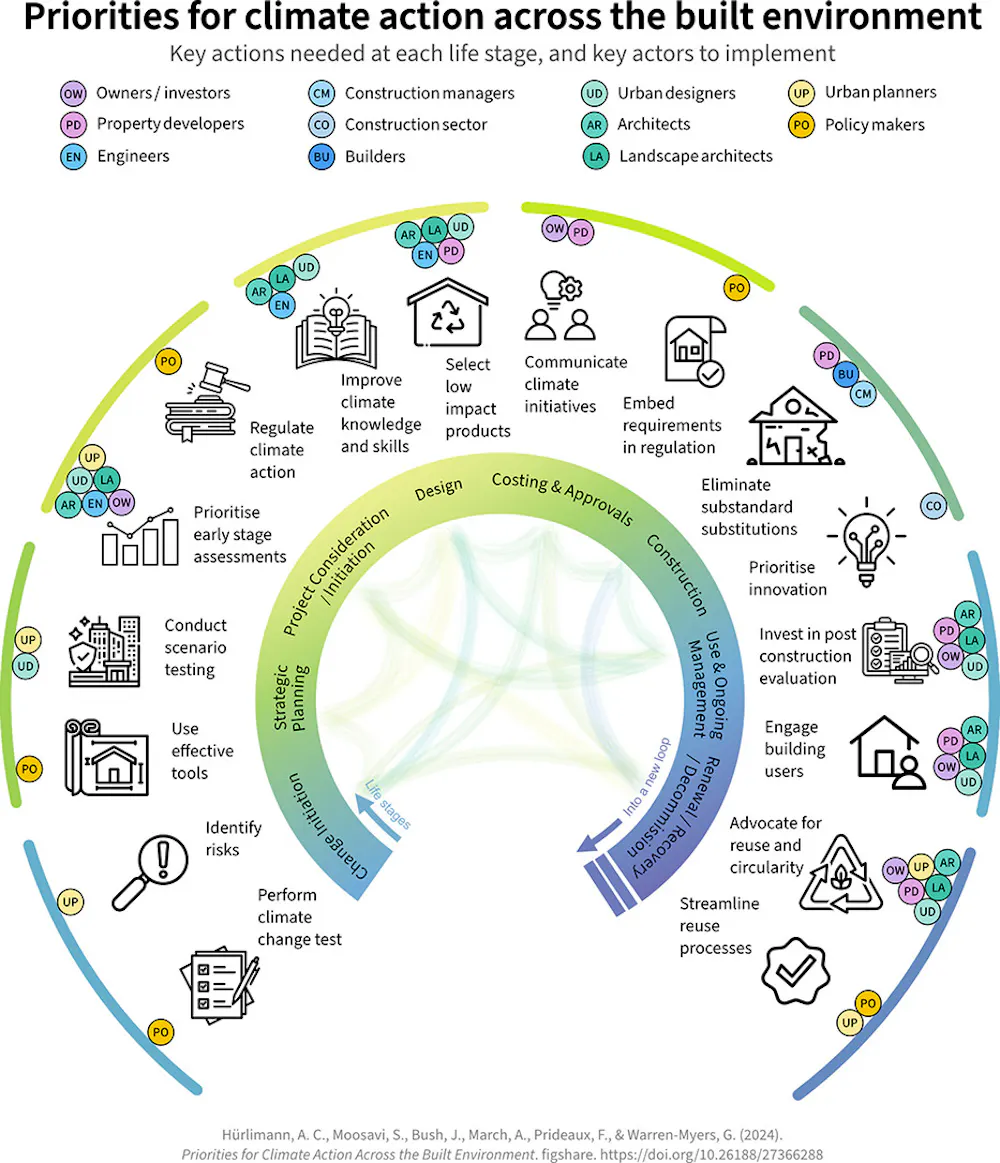
    Our new study identifies 16 priority actions to address climate change in the construction and management of cities.

    Building smarter

    Climate change must be a key consideration when designing, building and managing our cities. The emissions generated need to be minimised and eventually eliminated.

    We must build in locations, and in ways, that reduce climate risks. But policies governing how our cities are designed and constructed don’t achieve this.

    A recent study of three local government areas identified only limited action on adaptation and mitigation. Other research has found few urban development policies include carbon reduction goals that meet international targets.

    The National Housing Accord will see more than one million houses built by 2029. These new homes must address the climate challenge.

    16 areas for priority action

    The priority areas in our new study were informed by interviews with more than 150 stakeholders working in urban planning, architecture, landscape architecture, urban design, sustainability, construction and property.

    Priority areas for minimising damaging emissions generated by cities.
    CC BY

    The actions they identified cover the entire life cycle of the built environment.

    One of the first barriers to overcome is the perceived lack of agency among industry professionals to initiate or demand climate action. They perceive others, such as property owners or clients, to have more influence.

    Climate change risks should be identified in the early stages of planning new developments, backed up by effective tools to make risk identification and action easier:

    There were areas that were identified as being flood prone or risk prone. But there was no strategy to deal with what happens to those areas – An urban planner

    Once specific projects are being considered it is important to prioritise early stage climate assessments, supported by policies which mandate climate action:

    Everyone has good intentions but without big formal legislation around it, everyone’s just sort of making their way in the dark – A construction industry professional

    In the design stage, steps to improve the climate knowledge and skills of the workforce beyond disciplinary boundaries is critical. The selection of low-impact products and materials will also help ensure design is more climate responsive.

    Climate action must be embedded in all stages of design and construction of Australian cities.
    GagliardiPhotography/Shutterstock

    The highest number of hurdles to climate action were found to occur during the costing and approvals stage. Participants spoke of a highly competitive building industry. If climate change initiatives introduced at an earlier stage aren’t required by law, they are likely to be cut.

    unless there’s something in it for them in terms of return on investment, it’s going to be hard to get them to do it, unless we make them – An urban planner

    During the construction phase, product and material substitutions that have detrimental environmental impact should be eliminated. Innovation should be encouraged:

    If you want to push the envelope a little bit in terms of using recycled materials […] that’s a bit of a barrier. To push innovation is difficult – A landscape architect

    Post-construction

    Once construction is complete and buildings and public spaces are being used, it is important to invest in a thorough evaluation process. Building users should be involved to ensure buildings are maintained for optimal climate outcomes:

    [We] tried to achieve the six star rating […] the client has to maintain it [the building] for a year, and that’s when things start to fall off – An architect

    When it comes to area upgrades or building renewals, advocating for reuse and materials circularity is important. But the custom of demolishing and building anew, is hard to shift:

    The reuse of the existing building obviously generates significantly less waste and involves less material. So, design decisions and strategic decisions around using existing buildings is really important – An urban designer

    Working together

    This is a time of significant change in our urban areas.

    We need to make sure climate action is embedded in every stage of decision making. This may mean more efficient use, and reuse, of the existing built stock. This will require an overhaul of policies regarding building retrofits, and a change in mindsets.

    The priority actions to address climate change in cities can be implemented across a range of levels for:

    • individual professionals – pursue development of their climate change skills, including opportunities provided by professional associations

    • professional practices – review internal processes to ensure climate action is mainstreamed across projects, and in company decision making

    • universities teaching built environment professional degrees – embed climate change knowledge, skills, and competencies across the curriculum

    • governments at all levels – review policy settings to mandate mitigation and adaption.

    By addressing these actions, we can collectively work towards achieving our emission reduction targets and making sure our cities minimise climate change risks.

    Anna Hurlimann received funding for the research reported in this article from the Australian Research Council – Discovery Grant DP200101378, with co-chief investigators Georgia Warren-Myers, Alan March, Sareh Moosavi and Judy Bush. She is a member of the Planning Institute of Australia.

    Sareh Moosavi received funding for the research reported in this article from the Australian Research Council – Discovery Grant DP200101378, with co-chief investigators Anna Hurlimann, Georgia Warren-Myers, Alan March, and Judy Bush.

    ref. Cities are heating up the planet – how they can do more to fight climate change – https://theconversation.com/cities-are-heating-up-the-planet-how-they-can-do-more-to-fight-climate-change-259391

    MIL OSI AnalysisEveningReport.nz

  • MIL-OSI New Zealand: Health and Housing – Many rentals may still fall short as healthy homes deadline arrives

    Source: Asthma and Respiratory Foundation

    As winter grips the country, many Kiwis will go to sleep tonight in rental homes that may still be putting their health at risk.
    From midnight tonight, all private residential landlords must ensure their properties fully comply with the Healthy Homes Standards – a legal requirement introduced in 2019 to make rental homes warmer, drier, and healthier. These standards introduced minimum standards for heating, insulation, ventilation, moisture ingress and drainage, and draught stopping in rental properties.
    Yet despite having six years to prepare, questions remain about how many rental homes will truly be compliant come July 1.
    The Asthma and Respiratory Foundation NZ warns that without effective enforcement, these standards risk leaving tenants, especially those with respiratory conditions, exposed to cold, damp homes that threaten their health.
    Foundation Medical Director Professor Bob Hancox says one thing we have learnt from research into housing and health in New Zealand is that many homes are too cold and too damp.
    “Having a warm and dry house is very important for respiratory health, particularly for people with respiratory diseases such as asthma or COPD.
    “Improving the quality of housing is one of the best ways to help people stay well through the winter.”
    Currently, landlords can self-certify that their property meets the Healthy Homes Standards, and there is no requirement for an independent, physical inspection of the property.
    “Implementing the healthy homes standard would go a long way to keep people out of hospital and GP clinics, but at the moment, we don’t know how well the standards are being applied,” Professor Hancox says.
    The Foundation is renewing its call to the Government to require independent, accredited assessments of all rental homes to ensure that the Healthy Homes Standards are actually being met.
    New Zealand Institute of Building Inspectors Chief Executive Neville Scott says the fact that landlords can self-certify is a loophole that undermines the intent of the law.
    “We fully support the Foundation in their call to Government, as we see – all too often – cases where properties are signed off by landlords but clearly fall short of the standards.
    “Without qualified, independent inspections, there’s no way to guarantee consistency or integrity in the process,” he says.
    “It’s like letting drivers issue their own warrants of fitness.”
    According to Tenancy Services NZ, more than 600,000 households rent in New Zealand, and research shows that rental stock is of poorer quality than owner-occupied homes.
    A recent report by Stats NZ on housing in New Zealand revealed that almost 30 per cent of households that did not own their home experienced dampness at least some of the time. Those same households were more likely to experience visible mould over A4 size at least some of the time (22.9 per cent).
    Dr Lucy Telfar-Barnard, public health researcher and member of the Foundation’s Scientific Advisory Board, says the current state of many rental properties is both unacceptable and avoidable.
    “We’re still seeing families living in mouldy, poorly ventilated homes that actively worsen chronic conditions like asthma.
    “Effective enforcement of the healthy homes standards is essential for protecting our most vulnerable populations and reducing health inequities.”
    The Foundation’s call is part of its ongoing commitment to improve the health outcomes of those living with respiratory conditions in NZ.

    MIL OSI New Zealand News

  • MIL-OSI Economics: Samsung Showcases AI Home Appliance Innovations at DA Global Tech Seminars Across Five Regions

    Source: Samsung

    From March to June, Samsung Electronics hosted Digital Appliances (DA) Global Tech Seminars across five regions — the United States, Europe, Latin America, Southeast Asia and Southwest Asia — to showcase its latest innovations to audiences around the world. The seminars welcomed about 240 media representatives and tech influencers from 40 countries to experience Samsung’s latest AI home appliances firsthand and observe how the company is tailoring features to meet the unique needs of each region.1 Attendees also participated in Q&A sessions with product developers, who shared in-depth insights and explanations.
     
    Samsung Newsroom recaps each regional seminar with on-site highlights and photos.
     
     
    United States: Large-Capacity Washer-Dryers Win Praise for Practicality and Efficiency
    ▲ 2025 DA Global Tech Seminar held in the U.S.
     
    The U.S. Tech Seminar took place on March 18 at Samsung Home, a Bespoke AI experience space in SoHo, New York City — a neighborhood synonymous with art and creative living.
     
    American consumers tend to prioritize practicality and efficiency. Taking this into account, Samsung set up a dedicated experience zone for the large-capacity Bespoke AI Laundry Vented Combo, featuring a product cutaway mock-up that allowed visitors to intuitively understand the product’s core technologies and features. In addition, a live cooking demonstration showcased the AI capabilities of the Bespoke AI Oven, while the Bespoke AI Hybrid Refrigerator — which boosts energy efficiency using a semiconductor-based Peltier module — also mesmerized guests.
     
     
    Europe: Bespoke AI Jet Ultra Takes Center Stage With Industry-Leading Suction Power
    ▲ 2025 DA Global Tech Seminar held in Germany
     
    On the same day, the European Tech Seminar kicked off in Frankfurt, Germany, at World of Samsung — a global showcase designed to provide an in-depth look at Samsung’s products.
     
    A key highlight was the Bespoke AI Jet Ultra, which features the world’s most powerful suction for a cordless stick vacuum cleaner at 400W. Samsung developers gave presentations, offering insight into the vacuum cleaner’s high-performance engineering. The Bespoke AI Jet Ultra recently earned 4.5 out of 5 stars from U.K.-based review outlet Trusted Reviews and ranked first among 43 cordless vacuums tested by German IT outlet Chip.
     
     
    Latin America: SmartThings-Connected Home Appliances Growing at Twice the Global Rate
    ▲ 2025 DA Global Tech Seminar held in Mexico
     
    The Latin America Tech Seminar took place on June 3 in the vibrant metropolis of Mexico City, Mexico, drawing media and influencers from 13 countries to experience Samsung’s new lineup firsthand. Consumers in the region have shown high interest in connected living, with SmartThings-connected appliance adoption growing at more than twice the global average.2
     
    Reflecting this demand, demonstrations highlighted various features including Map View, Bixby, Routines — all easily accessible via SmartThings or the AI Home screen. Attendees also visited Sam’s House, a premium residential showroom where they engaged in hands-on interactions with Samsung’s connected products.
     
     
    Southeast Asia: AI Appliances Optimized for Hot, Humid Climates
    ▲ 2025 DA Global Tech Seminar held in Thailand
     
    On June 20, Samsung held the Southeast Asia Tech Seminar at a showroom in Bangkok, Thailand, where attendees explored the company’s latest products in settings simulating both commercial and residential spaces.
     
    Through demonstrations, attendees experienced how the Voice ID feature on the Bespoke AI Family Hub refrigerator can recognize individual voices to deliver personalized responses. They also saw how Samsung is localizing AI home appliances to better suit Southeast Asia’s hot and humid climate — for example, the 1-Way Cassette system air conditioner and the Bespoke AI Top Load Washer. “The use of AI to enhance user experience and facilitate both usage and energy savings is particularly valuable and useful,” said Kemachad Gunpai of Future Trends Thailand who attended the seminar.
     
     
    Southwest Asia: AI-Powered, Efficient Cooling Solutions in the Spotlight
    ▲ 2025 DA Global Tech Seminar held in India
     
    Held on June 25 in Gurugram, India, the Southwest Asia Tech Seminar focused on SmartThings-connected solutions and energy-efficient features tailored to local preferences.
     
    Among the demonstrations were AI appliances responding to sleep patterns detected by motion sensors, alongside cooling solutions tailored for Indian consumers. Attendees also received detailed explanations on how to track energy usage via SmartThings, a particularly relevant feature amid rising electricity costs. Samsung employees also explained how each product operates in AI Energy Mode to maximize efficiency and minimize energy consumption.
     
    “Samsung will continue to develop and expand the Global Tech Seminars in ways that reflect the unique local characteristics of each region,” said Soohyuk Ro, Vice President and Head of Tech Insight Group at Digital Appliances (DA) Business, Samsung Electronics, as the seminars came to an end. “In doing so, we will provide even deeper insights into how Samsung’s AI Home and innovative AI appliances can bring meaningful benefits to daily life for everyone.”
     
     
    1 Product names and features mentioned in this article may vary by region.
    2 Based on internal data from Samsung, aggregated via BDC (BI & Analytics), reflecting the cumulative annual ratio of Wi-Fi-connected devices.

    MIL OSI Economics

  • MIL-OSI USA: Myth vs. Fact: The One Big Beautiful Bill

    US Senate News:

    Source: US Whitehouse
    While Democrats spend the day launching desperate, hollow attacks in a last-ditch effort to block President Trump’s One Big Beautiful Bill, the FACTS speak for themselves.
    MYTH: The One Big Beautiful Bill is “just a tax break for billionaires.”FACT: The One Big Beautiful Bill delivers the largest middle- and working-class tax cut in U.S. history. The President’s legislation will put more than $10,000 a year back in the pockets of typical hardworking families. This is the most pro-growth, pro-worker, pro-family legislation ever crafted.
    MYTH: The One Big Beautiful Bill “takes from the poor to give to the rich.”FACT: The lowest-income workers receive the largest percentage tax cuts. The One Big Beautiful Bill delivers the largest tax cut in history for working-and -middle class Americans.
    MYTH: The One Big Beautiful Bill “makes life more unaffordable.”FACT: The bill delivers bigger paychecks, expanding take-home pay by over $10,000 per year for a typical family.
    MYTH: The One Big Beautiful Bill “hurts low-income families.”FACT: The One Big Beautiful Bill is the most pro-family legislation ever crafted. It will deliver bigger paychecks, giving more than a $10,000 boost annually to everyday families. We are also expanding Opportunity Zones, expanding childcare access, increasing the child tax credit, and creating newborn savings accounts.
    MYTH: The One Big Beautiful Bill “is just a handout to corporations.”FACT: This bill drives a Blue-Collar BOOM with tax relief for workers, support for small businesses, and investments in American manufacturing. The One Big Beautiful Bill delivers the largest middle- and working-class tax cut in U.S. history.
    MYTH: The One Big Beautiful Bill “leaves American workers behind.”FACT: This is the most pro-American worker bill in history. The One Big Beautiful Bill boosts pay for millions—and with no tax on tips or overtime, those working hourly and service jobs receive additional tax relief.
    MYTH: The One Big Beautiful Bill “hurts small businesses.”FACT: The One Big Beautiful Bill will make the Trump Tax Cuts permanent, including the small business deduction—helping Main Street grow and hire. Failure to pass this legislation would result in a $4 trillion tax hike.
    MYTH: The One Big Beautiful Bill “kicks American families off Medicaid.”FACT: As the President has said numerous times, there will be no cuts to Medicaid. The One Big Beautiful Bill protects and strengthens Medicaid for those who rely on it—pregnant women, children, seniors, people with disabilities, and low-income families—while eliminating waste, fraud, and abuse. The One Big Beautiful Bill removes illegal aliens, enforces work requirements, and protects Medicaid for the truly vulnerable.
    MYTH: The One Big Beautiful Bill “cuts Medicare.”FACT: Medicare has not been touched in this bill— absolutely nothing in the bill reduces spending on Medicare benefits. This legislation does not make a single cut to welfare programs—it safeguards and protects these programs for all eligible Americans.
    MYTH: The One Big Beautiful Bill “will close rural hospitals.”FACT: Rural hospitals comprise just 7% of all hospital spending on Medicaid, illustrating that they have not benefited from the massive increase in waste, fraud, and abuse under the Biden administration. By strengthening Medicaid, we are making more resources available for vulnerable populations and safety net providers, like rural hospitals. We are expanding rural hospital protection, providing targeted funds for rural care, and giving states flexibility to support local providers.
    MYTH: “People will literally die” from the One Big Beautiful Bill — “and millions will be kicked off their healthcare.”FACT: This is one of the most egregious, deranged attacks from the Left peddling fear over the facts. The One Big Beautiful Bill protects eligible Americans on federal welfare – including Medicaid. By strengthening the integrity of Medicaid by eliminating waste, fraud, and abuse, its resources can be refocused on providing better care for those whom the program was designed to serve: pregnant women, children, people with disabilities, low-income seniors, and other vulnerable low-income families.
    MYTH: The One Big Beautiful Bill “will hurt people with disabilities.”FACT: The One Big Beautiful Bill protects and strengthens Medicaid for Americans with disabilities. Rest assured, those with disabilities receiving Medicaid will receive no loss or change in coverage.
    MYTH: The One Big Beautiful Bill “punishes vulnerable Americans with work requirements to receive their benefits.”FACT: Not true. The 20-hour weekly work requirement applies only to able-bodied adults without young children and promotes dignity, stability, and better health outcomes for families. The One Big Beautiful Bill restores the dignity of work with historically bipartisan work requirements for able-bodied Americans. We are implementing commonsense, Clinton-era work, volunteer, education, or training requirements with broad bipartisan support.
    MYTH: “There’s no fraud in Medicaid — Republicans are just taking coverage away from vulnerable populations.”FACT: In the last 10 years, CMS admitted that improper payments for Medicaid have exceeded HALF A TRILLION dollars. In just the past year, taxpayers spent $56 billion on benefits for able-bodied adults abusing the system—and over a million illegal aliens are receiving free health care on the backs of taxpayers. The One Big Beautiful Bill removes illegal aliens, enacts work requirements for able-bodied adults, and protects Medicaid for the truly vulnerable.
    MYTH: “SNAP work requirements are unnecessary.”FACT: Only 28% of able-bodied adults on SNAP work. The One Big Beautiful Bill promotes work, responsibility, and restores SNAP to serve the truly needy. SNAP enrollment remains high even in a strong economy, including millions of able-bodied adults who could work. In fact, almost three-quarters of able-bodied adults without dependents on SNAP have no earned income. The mission of the program has failed. SNAP was intended to be temporary help for those who encounter tough times—we are strengthening this program to serve those who need it most.
    MYTH: “Illegal aliens don’t get federal benefits.”FACT: Illegals burden taxpayers with billions in costs for free health care and welfare benefits. The One Big Beautiful Bill ends Medicaid and SNAP fraud and ensures these programs serve only eligible Americans.
    MYTH: The One Big Beautiful Bill “doesn’t actually end taxes on Social Security.”FACT: The One Big Beautiful Bill delivers historic tax relief to seniors, with a new tax deduction that, combined with other deductions, ensures the average Social Security beneficiary will pay zero taxes on Social Security.
    MYTH: The One Big Beautiful Bill “increases the deficit.”FACT: The One Big Beautiful Bill reduces deficits by over $2 trillion by increasing economic growth and cutting waste, fraud, and abuse across government programs at an unprecedented rate. This legislation delivers historic levels of mandatory savings. President Trump’s pro-growth economic formula will reduce the deficit, increase wages, deliver American jobs, and drive down the cost of living.
    MYTH: “But the CBO says….”FACT: The Crooked Budget Office has a terrible record with its predictions and hasn’t earned the attention the media gives it. The CBO misreads the economic consequences of not extending the Trump Tax Cuts. The One Big Beautiful Bill delivers real savings that will unleash our economy and prevent the largest tax hike in history, resulting in historic prosperity, while lowering the debt burden.
    MYTH: “There’s too much ‘pork’ in this bill.”FACT: There’s no pork in the bill. Every single provision in the One Big Beautiful Bill is a campaign promise the American people elected President Trump to deliver. The only new spending in the bill is to secure the homeland of the United States and save American sovereignty — which is fully paid for by increased visa fees on foreigners.
    MYTH: “The One Big Beautiful Bill won’t strengthen national security.”FACT: The One Big Beautiful Bill delivers on President Trump’s Peace Through Strength agenda by funding the Golden Dome missile defense system and modernizing our military to prioritize lethality and readiness. It fully equips our war fighters with the resources they need while modernizing and revolutionizing our equipment and technology.
    MYTH: The One Big Beautiful Bill “helps ‘Big Oil’ and locks up U.S. energy resources.”FACT: Quite the opposite. It unleashes American energy, refills the Strategic Petroleum Reserve, and repeals the Green New Scam policies. The One Big Beautiful Bill unleashes clean, American-made energy and will reduce the cost of living for Americans nationwide.
    MYTH: “Manufacturing jobs will still go overseas.”FACT: The One Big Beautiful Bill delivers 100% expensing for new domestic factories, revitalizes Opportunity Zones, and incentivizes companies to keep jobs in America.
    MYTH: The One Big Beautiful Bill “neglects rural America.”FACT: This bill invests in rural communities, expands market access, and delivers historic support to farm families. The One Big Beautiful Bill provides the certainty America’s farm families need to continue operating and producing the affordable, safe, and abundant supply of food, fuel, and fiber that our nation relies on.
    MYTH: “SNAP is being gutted and cutting food stamps for families, causing them to go hungry.”FACT: The One Big Beautiful Bill protects and strengthens SNAP. Right now, almost three-quarters of able-bodied adults without dependents on SNAP have no earned income and the fraud rate is high. The mission of the program has failed: SNAP was intended to be temporary help for those who encounter tough times. Now, it’s become so bloated that it is leaving fewer resources for those who truly need help. We are committed to preserving SNAP for the truly needy.
    MYTH: “Republicans are shutting Democrats out of the legislative process.”FACT: This is not a partisan bill—Democrats shut themselves out by supporting higher taxes, open borders, and giveaways to illegal immigrants. The One Big Beautiful Bill delivers on Republican promises to lower taxes, secure the border, cut spending, and put Americans first.
    MYTH: The One Big Beautiful Bill “border package is not necessary since President Trump has secured the border.”FACT: We must ensure that the invasion we witnessed as a nation under Joe Biden and Kamala Harris never happens again. The One Big Beautiful Bill’s historic investment in our border security ensures we permanently secure our border and protect our homeland by finishing the border wall, hiring 10,000 new ICE officers, and funding efforts to stop the flow of fentanyl.

    MIL OSI USA News

  • MIL-OSI USA: McCaul, McGovern Introduce Bipartisan Resolution Commemorating His Holiness the Dalai Lama’s 90th Birthday as “A Day of Compassion”

    Source: United States House of Representatives – Congressman Michael McCaul (10th District of Texas)

    WASHINGTON  Today, U.S. Congressman Michael McCaul (R-Texas) — chairman emeritus of the House Committee on Foreign Affairs — introduced a resolution alongside Rep. Jim McGovern (D-Mass.) designating July 6th, 2025, as “A Day of Compassion” in honor of His Holiness the 14th Dalai Lama’s 90th birthday. 

    “Despite having faced persecution, oppression, and unspeakable violence at the hands of the CCP, His Holiness the Dalai Lama has maintained inner peace and continues to preach compassion — inspiring not only his own people, but the entire world,” said Rep. McCaul. “I was honored to meet him in Dharamsala last year to voice the U.S. government’s support for the people of Tibet, emphasize the friendship between our two peoples, and learn more of his courageous, peaceful, and sacrificial leadership. Ahead of His Holiness’s 90th birthday, I am proud to introduce this resolution calling for ‘A Day of Compassion’ and affirming Tibetans’ fundamental human rights as we look forward to the day the Dalai Lama and his people can return to their homeland in peace.”

    “His Holiness the Dalai Lama is an inspiration to millions of people around the world, including to me,” said Rep. McGovern. “His teachings on religious tolerance, non-violent responses to conflict and violent extremism, and peace-building are both timeless and urgently needed in our present circumstances. He has been a passionate advocate for the freedom and dignity for the Tibetan people. It is appropriate for Congress to honor the 14th Dalai Lama and his countless accomplishments on his 90th birthday. May his next one be celebrated in Lhasa.” 

    “This resolution expresses a wonderful, bipartisan recognition that His Holiness the Dalai Lama stands as a global icon of compassion and honors his lifelong commitment to strive for peace and justice for his homeland and the people of Tibet,” said International Campaign for Tibet (ICT) President Tencho Gyatso. “Swift passage of this resolution led by HFAC Chairman Emeritus McCaul and Congressman McGovern, will bring joy and inspiration to all those celebrating the Dalai Lama’s 90th birthday, and perhaps most critically, provide hope and inspiration to the Tibetan people in Tibet for whom even a simple public acknowledgement of the Dalai Lama’s birthday remains a dangerous act.”

    The resolution is co-signed by Representatives Joe Wilson (R-S.C.), Mike Lawler (R-N.Y.), Raja Krishnamoorthi (D-Ill.), Jamie Raskin (D-Md.), Janice Schakowsky (D-Ill.), and Young Kim (R-Calif.).

    Background:

    This resolution designates July 6, 2025, as “A Day of Compassion” to honor the upcoming 90th birthday of His Holiness the 14th Dalai Lama and recognize his lifelong commitment to peace, nonviolence, human rights, and the preservation of Tibetan culture. It reaffirms bipartisan U.S. support for the Tibetan people’s right to self-determination, opposes Chinese government interference in Tibetan practices, and expresses deep respect for the Dalai Lama’s moral leadership and humanitarian contributions to the international community.

    To read the full resolution text, click here.

    ###

    MIL OSI USA News

  • MIL-OSI USA: McCaul Hosts Ceremony in Bastrop to Dedicate Post Office in Sergeant Major Billy D. Waugh’s Honor

    Source: United States House of Representatives – Congressman Michael McCaul (10th District of Texas)

    McCaul’s bill to dedicate the post office in honor of Sergeant Waugh became law in 2024

    Bastrop, Texas  Today, U.S. Congressman Michael McCaul (R-Texas) honored a U.S. Army veteran and American military hero, Sergeant Major Billy D. Waugh, at a ceremony to officially dedicate the facility of the United States Postal Service located at 1106 Main Street in Bastrop as the “Sergeant Major Billy D. Waugh Post Office.” McCaul hosted the event in conjunction with the family of Sergeant Waugh and the United States Postal Service.

    “A member of the Greatest Generation, Sergeant Major Billy D. Waugh was a true American hero who dedicated himself to a life of courage, patriotism, and self-sacrifice,” said Rep. McCaul. “I’m amazed and inspired by the longevity of his service, which included time in the Special Forces — where he gained eight purple hearts — the Central Intelligence Agency, and even the United States Postal Service. Throughout his impressive career, he never lost his sense of duty, his patriotism, or his enduring love of freedom. I am proud to officially dedicate the Bastrop Post Office in his honor so all Texans can remember his incredible life of service and pay homage to this great American Hero.”

    McCaul delivers remarks at ceremony

    McCaul with Sergeant Waugh’s family members

    Background:

    During the 118th Congress, Rep. McCaul introduced a bill to designate the United States Postal Service located at 1106 Main Street in Bastrop, Texas, as the “Sergeant Major Billy D Waugh Post Office,” which passed Congress unanimously late last year. 

    Sergeant Major Billy D. Waugh was born December 1929 and raised in Bastrop, Texas. He served his country as an Army paratrooper and Special Forces soldier from 1948 to 1972, including seven years in combat during the Korean and Vietnam wars. He also was part of the first high-altitude, low-opening (HALO) combat parachute assault in military history. 

    For his service, Mr. Waugh received dozens of awards and medals, including eight Purple Hearts for his combat wounds — placing him third on the list of most Purple Hearts ever received. After retirement, he joined the United States Postal Service. Then, he once again served his country as a paramilitary operations officer in the Central Intelligence Agency, where he successfully pursued terrorists including Carlos the Jackal and Osama Bin Laden.

    He eventually returned to his hometown of Bastrop and passed away in April 2023 at the age of 93.

    ###

    MIL OSI USA News

  • MIL-OSI New Zealand: Rare slab hut refurbishment keeps traditional ways alive

    Source: NZ Department of Conservation

    Date:  30 June 2025

    The historic Slaty Creek Hut, in the Grey Valley, was originally built as a winter project in 1952 by deer cullers. The hut was built with timber milled with hand tools using logs from the beech forest surrounding the site. It’s now used by recreational hunters, trampers and climbers.

    Slab huts are a surviving form of the slab houses which European settlers built in 19th century New Zealand to accommodate themselves in a practical and cost-effective way, using a material found readily in many areas – trees.

    Before the introduction of water and steam powered sawmills, trees were dissembled by splitting, sawing or hewing, and it is these techniques that were carried on into the 20th century in building slab huts for deer cullers, musterers and gold fossickers in rural areas of New Zealand.

    Because of the impermanence of wood due to rot, and that slab houses were only seen by settlers as temporary housing until something more permanent could be built when resources allowed, very few slab houses or buildings remain, making slab huts like Slaty Creek Hut a real link to the past. There are 12 slab huts on public conservation land in the South Island.

    Because so few people still have the skills to hew timber from logs with hand tools, maintaining historic huts like Slaty Creek is becoming more difficult -which is why rangers spent time learning about the techniques.

    The rangers spent a day breaking down beech logs and hewing these into hand shaped timber, which was used to replace boards and framing on Slaty Creek Hut. While the rangers were at Slaty Creek they also replaced the hearth of the fire, installed a new sub floor structure, dug drainage channels around the hut and gave it a good spruce up.

    Ranger Casey Rhodes, who has been on the team restoring the hut says, “We went in six months ago and scoped it out and worked out which boards needed to be replaced and made a list, so we’re only replacing the minimum to try and keep as much heritage factor as we can”.

    Mike Gillies, a Senior Heritage Advisor who is sharing his skills in these historic building methods, says it’s important to maintain traditions of how huts and structures were built.

    “We could use modern methods and materials on the hut, but you pretty soon lose authenticity, whereas doing it using the same tools and techniques ensures that craft and those traditions stay alive. So the guys are using axes and draw knifes and wedges and mauls, the same way people have been building for hundreds of years.

    “It’s the best feeling in the world, compared to a modern building site where there are lots of power tools and you are working with treated timber. It’s very quiet, all you can hear are the axes and adzes hewing. It’s a real privilege to be able to continue this tradition and this craft that’s been passed down for a really long time.”

    Background information

    Slaty Creek Hut is a backcountry hut and there is no formed track leading to it. Anyone wanting to visit should be experienced and well equipped, with suitable route finding and navigational skills.

    The hut is on the Amuri Pass tramping route, an advanced multi-day trip which follows a historic route between the West Coast and Canterbury which was once used to move stock.

    Contact

    For media enquiries contact:

    Email: media@doc.govt.nz

    MIL OSI New Zealand News

  • MIL-OSI USA: Statement from Senator Thom Tillis

    US Senate News:

    Source: United States Senator for North Carolina Thom Tillis
    WASHINGTON, D.C. – Today, North Carolina U.S. Senator Thom Tillis issued the following statement:
    “It has been a blessing to go on a journey from living in a trailer park and making minimum wage as a young man to having the honor of serving as U.S. Senator for North Carolina. 
    “I am proud of my career in public service, including hard-fought victories like passing historic tax reform as North Carolina Speaker, and working in the Senate to help pass the Tax Cuts and Jobs Act and confirm three conservative Supreme Court justices and counting.  
    “What I’m most proud of are the bipartisan victories: passing the first-in-the-nation eugenics compensation as Speaker, and working across the aisle in the Senate to pass the largest investment in mental health in American history, passing the Respect for Marriage Act and monumental infrastructure investments, and reestablishing the Senate NATO Observer Group. Sometimes those bipartisan initiatives got me into trouble with my own party, but I wouldn’t have changed a single one.  
    “In Washington over the last few years, it’s become increasingly evident that leaders who are willing to embrace bipartisanship, compromise, and demonstrate independent thinking are becoming an endangered species.  
    “Democrats recently lost two such leaders who were dedicated to making the Senate more of a functional and productive legislative body. They got things done. But they were shunned after they courageously refused to cave to their party bosses to nuke the filibuster for the sake of political expediency. They ultimately retired and their presence in the Senate chamber has been sorely missed every day since. 
    “It underscores the greatest form of hypocrisy in American politics. When people see independent thinking on the other side, they cheer. But when those very same people see independent thinking coming from their side, they scorn, ostracize, and even censure them. 
    “Too many elected officials are motivated by pure raw politics who really don’t give a damn about the people they promised to represent on the campaign trail. After they get elected, they don’t bother to do the hard work to research the policies they seek to implement and understand the consequences those policies could have on that young adult living in a trailer park, struggling to make ends meet. 
    “As many of my colleagues have noticed over the last year, and at times even joked about, I haven’t exactly been excited about running for another term. That is true since the choice is between spending another six years navigating the political theatre and partisan gridlock in Washington or spending that time with the love of my life Susan, our two children, three beautiful grandchildren, and the rest of our extended family back home. It’s not a hard choice, and I will not be seeking re-election. 
    “I am beyond grateful for the friends I’ve made over the years in North Carolina and our nation’s capital, as well as my amazing staff who are among the very best the Senate has to offer.  
    “I still look forward to continuing to serve North Carolina over the next 18 months. I look forward to solely focusing on producing meaningful results without the distraction of raising money or campaigning for another election. I look forward to having the pure freedom to call the balls and strikes as I see fit and representing the great people of North Carolina to the best of my ability.” 

    MIL OSI USA News

  • MIL-OSI USA: Congressman Jonathan L. Jackson Reintroduces Bipartisan Bill, The Marshall “Major” Taylor Congressional Gold Medal Act

    Source: United States House of Representatives – Representative Jonathan Jackson – Illinois (1st District)

    FOR IMMEDIATE RELEASE

    WASHINGTON, D.C. — U.S. Representatives Jonathan L. Jackson (D-IL-01) and Jim Baird (R-IN-04) led 43 of their colleagues in reintroducing the bipartisan Marshall “Major” Taylor Congressional Gold Medal Act. This legislation would posthumously award a Congressional Gold Medal to Marshall Walter “Major” Taylor — America’s first Black sports star, recognizing his significance to the nation as a trailblazing athlete. 

    Taylor managed to become the first African American world champion in any sport and earned the title of “world’s fastest man” despite the extraordinary challenges of the Jim Crow era. He endured attempts by white promoters in both the North and South to exclude him from races. White riders, too, subjected Taylor to curses, insults, and even physical harm during competitions. Despite these adversities, Taylor’s exceptional talent and tenacity turned him into a sensation, drawing tens of thousands at races across the United States, Europe, and Australia.

    “It is without question that Marshall ‘Major’ Taylor was a man before his time, a stellar athlete, a leader in the field of cycling, and a trailblazer,” said Rep. Jackson. “I believe it is fitting that Congress award the ‘world’s fastest man’ one of our nation’s most prestigious honors.”

    “Even when compared to today’s athletes, Marshall ‘Major’ Taylor is among the greatest cyclists of all time,” said Rep. Baird. “His accomplishments are especially impressive considering the challenges he faced on his climb to cycling greatness. Marshall Taylor is one of the greatest athletes in Indiana history, and I can think of no one better suited to receive the Congressional Gold Medal.”

    “Marshall W. ‘Major’ Taylor challenged both the odds and the adversity of his time with dignity and determination, and he went on to ultimately triumph,” said Karen Brown Donovan, the great-granddaughter of Major Taylor. “The awarding of a posthumous Congressional Gold Medal would be a significant achievement towards honoring his life and legacy.”

    Supporting Individuals and Groups

    119th Congress

    Co-lead: Jim Baird (R-IN-04)

    Original Cosponsors (44 total): Shontel Brown (D-OH-11), LaMonica McIver (D-NJ-10), Bonnie Watson Coleman (D-NJ-12), Raja Krishnamoorthi (D-IL-08), Stacey Plaskett (D-VI-AL), Marc Veasey (D-TX-33), Kweisi Mfume (D-MD-07), David Scott (D-GA-13), Sanford Bishop (D-GA-02),  Delia Ramirez (D-IL-03), Frederica Wilson (D-FL-24), Sharice Davis (D-KS-03),  Jan Schakowsky (D-IL-09),  Robin Kelly (D-IL-02), Maxwell Frost (D-FL-10), Hank Johnson (D-GA-04),  Eleanor Holmes Norton (D-DC),  Mikie Sherrill (D-NJ-11), Gwen Moore (D-WI-04), Debbie Dingell (D-MI-06), Maxine Waters (D-CA-43), Sean Casten (D-IL-06), Danny Davis (D-IL-07),  Rashida Tlaib (D-MI-12),  Shri Thanedar (D-MI-13), Cleo Fields (D-LA-06),  Jim McGovern (D-MA-02), Andre Carson (D-IN-07), Jasmine Crockett (D-TX-30), Ro Khanna (D-CA-17), John Garamendi (D-CA-08), Ayanna Pressley (D-MA-07), Ted Lieu (D-CA-36), Becca Balint (D-VT-AL), Timothy Kennedy (D-NY-26), Nanette Barragan (D-CA-44), Troy Carter (D-LA-02),  Terri Sewell (D-AL-07), Brad Sherman (D-CA-32), Robert Garcia (D-CA-42), Dina Titus (D-NV-01), Steven Horsford (D-NV-04), Shomari Figures (D-AL-02).

    Supporting Organizations: Washington Area Bicyclist Association, The League of American Bicyclists, Major Taylor Association, Bike to the Beach, and Black Girls Do Bike, Inc.

    118th Congress

    Co-lead: Jim Baird (R-IN-04)

    Original Cosponsors (32 total): Danny Davis (D-IL-07), Robin Kelly (D-IL-02), André Carson (D-IN-07), Henry “Hank” Johnson (D-GA-04), Barbara Lee (D-CA-12), Eleanor Holmes-Norton (D-DC), Janice Schakowsky (D-IL-09), Mike Quigley (D-IL-05), Earl Blumenauer (D-WA-03), James McGovern (D-MA-02), David Scott (D-GA-13), Gwen Moore (D-WI-04), Sheila Jackson-Lee (D-TX-18), Mike Thompson (D-CA-04), Jasmine Crockett (D-TX-30), Raul Grijalva (D-AZ-07), Alma Adams (D-NC-12), Al Green (D-TX-09), Rashida Tlaib (D-MI-12), Raja Krishnamoorthi (D-IL-08), Sheila Cherfilus-McCormick (D-FL-20), Chuy Garcia (D-IL-04), David Trone (D-MD-06), Ann Kuster (D-NH-02), John Duarte (R-CA-13), Frederica Wilson (D-FL-24), Tony Gonzales (R-TX-23), Debbie Dingell (D-MI-06), Ted Lieu (D-CA-36), Maxwell Frost (D-FL-10), Joe Wilson (R-SC-02). 

    Supporting Organizations: Bronzeville Trail Task Force, Inc., Major Taylor Association, Washington Area Bicyclist Association, League of American Bicyclists, ADD Impact Network & Bike to the Beach, and Black Girls Do Bike, Inc. 

    About Major Taylor

    Taylor, the son of a veteran who fought in the Civil War, was born in 1878. Despite racial tension, Taylor was educated and viewed as an adopted son by an affluent white family from Indianapolis, Indiana, who also employed his father, Gilbert Taylor. Due to his relationship with the family, Taylor received gifts, including his first bicycle. Upon receiving the bicycle, Taylor displayed natural talent. 

    Taylor received the nickname “Major” as a child while performing bicycle tricks outside of his workplace at Hay & Willits Manufacturing, Indiana Bicycle Co., in Indianapolis. His employer was so impressed with his abilities that the company enrolled him in his first race, which he won at the age of eleven. Taylor moved to Worcester, Massachusetts, with his employer, mentor, and racing manager, Louis D. “Birdie” Munger, in 1895, because Munger was forced out of his Indianapolis-based firm due to his mentorship of Taylor. 

    In 1896, at the age of eighteen, Taylor received a professional racing license from the League of American Wheelmen, despite the league’s 1894 “white only” rule for amateur membership. This membership led to his eventual professional debut.  

    Later that year, Taylor gained notoriety in his first professional contest by competing in the “Six Day Race” at Madison Square Garden in New York City. This race was considered a test of endurance, where cyclists would test both their mental and physical ability in front of a packed house at the Garden. At the conclusion of day six, Taylor finished eighth out of twenty-six and cycled roughly 1,732 miles. 

    In 1899, Taylor would win the world one-mile sprint championship in Montréal, becoming the first Black American and the second Black athlete to win a world title. Taylor would go on to set seven cycling records and become the first Black world champion, which led to his being considered the first international superstar. Taylor would even revolutionize the sport by creating an innovative adjustable handlebar stem, which to date is called the “Major Taylor Stem.”

    While experiencing racial prejudice throughout his career, Taylor became one of the first Black athletes to secure corporate sponsorships. He represented bicycle brands such as Iver Johnson, Sager, Stearns, and Orient, eventually becoming one of the wealthiest Black men in America. Due to his devout commitment to his faith, Taylor refused to race on Sundays, which led to him turning down a significant number of lucrative offers to race in Europe. However, once he achieved international superstardom, Taylor was able to negotiate “no Sundays” provisions in his European racing contracts. 

    Taylor retired from racing in 1910 and started many business ventures. In 1928, he published his autobiography “The Fastest Bicycle Rider in the World” with the intent of impacting justice, equal rights, and the ‘square deal’ for African Americans in sports. 

    About the Congressional Gold Medal

    Since the late 1700s, Congress has expressed public gratitude to individuals and groups by awarding medals and other similar decorations. The Continental Congress awarded the first Congressional Gold Medals. Since that time, Congress has awarded gold medals to express public gratitude for distinguished contributions, dramatize the virtues of patriotism, and perpetuate the remembrance of great events. Two-thirds of both the House and Senate must cosponsor the legislation to advance it.

    MIL OSI USA News

  • MIL-OSI United Kingdom: Further details on welfare reforms published ahead of Second Reading

    Source: United Kingdom – Executive Government & Departments

    Press release

    Further details on welfare reforms published ahead of Second Reading

    New details on the Government’s welfare reforms will be published today (Monday 30 June 2025) ahead of Second Reading of the Universal Credit and Personal Independence Payment Bill on Tuesday.

    • Terms of reference for the first comprehensive review of the Personal Independence Payment (PIP) assessment in a decade to be published today.
    • Comes alongside draft regulations for the new Right to Try Guarantee – enshrining protections in law for disabled people and people with health conditions who want to try work.
    • Reforms to deliver greater certainty, independence, and dignity for disabled people, while ensuring the system is fair, sustainable, and fit for the future as part of the Plan for Change.

    New details on the government’s welfare reforms will be published today (Monday 30 June 2025) ahead of Second Reading of the Universal Credit (UC) and PIP Bill on Tuesday.

    The terms of reference for the first ever comprehensive review of the PIP assessment in over a decade will be published today. The review – led by Minister for Social Security and Disability Sir Stephen Timms – will ensure the system is fair, supportive and reflects the realities of modern life.

    It will be co-produced with disabled people, the organisations that represent them, and MPs with the core objective of delivering better experiences and better outcomes for disabled people and people with health conditions.

    The review aims to respond to the changing picture of population health over the last decade including the rising prevalence of long-term health conditions and disability in the working-age population.

    Monthly PIP awards have more than doubled since the pandemic, rising from 13,000 to 34,000 – a rate of around 1,000 new claims per day, or the population of Leicester every year. Much of this increase is driven by mental health conditions with awards for anxiety and depression having tripled from 2,500 per month in 2019 to 8,200 in 2023.

    To better help those with mental ill health, the government has recruited more than 6,700 extra mental health workers since July while rolling out more access to occupational health services and developing digital resources, so employers better support their staff’s mental wellbeing.

    Many people have also reported poor experiences with the assessment process. The current system often fails to reflect the real-world impact of disability on daily life and is no longer fit for purpose – making reform urgent and essential.

    Alongside the review, draft regulations for the new Right to Try Guarantee will be laid in Parliament. This will, for the first time, enshrine in law the right for people receiving health and disability benefits to try work without fear of reassessment. This includes disabled people and people with health conditions – such as those recovering from illness – who want to return to work now their health has improved.

    This responds directly to concerns raised by disabled people and people with health conditions – 37% of whom say they want to work but are held back by fear of losing their benefits according to a DWP survey.

    Fixing the broken welfare system this government inherited is central to breaking down barriers to opportunity and driving up living standards – delivering on the government’s Plan for Change. The government’s reforms will ensure disabled people have the support they need to live independently, with dignity, and will unlock opportunities to get into work without facing the prospect of losing the help they need.

    Work and Pensions Secretary Liz Kendall said:

    We must build a welfare system that provides security for those who cannot work and the right support for those who can. Too often, disabled people feel trapped – worried that if they try to work, they could lose the support they depend on.

    That is why we are taking action to remove those barriers, support disabled people to live with dignity and independence, and open routes into employment for those who want to pursue it.

    This is about delivering a fairer, more compassionate system as part of our Plan for Change which supports people to thrive, whatever their circumstances.

    The Government will also set out details today of the changes they intend to make to the Bill as part of the government’s welfare reforms. The Government has listened to MPs who support the principle of reform but are worried about the pace of change for those already supported by the social security system.

    That’s why ministers have confirmed that as part of the Bill:

    • All existing PIP recipients will remain on the current system and the proposed changes to eligibility as part of the bill will only apply to new claims from November 2026.
    • 200,000 individuals in the Severe Conditions Criteria group – individuals with the most severe, lifelong conditions who are unlikely to recover – will not be called for a UC reassessment.
    • All existing recipients of the UC health element and new customers with 12 months or less to live or who meet the Severe Conditions Criteria will see their standard allowance combined with their Limited Capability for Work Related Activity (LCWRA) rise at least in line with inflation every year from 2026/27 to 2029/30.

    Nearly 4 million households will receive an income boost with the main rate of UC set to increase above inflation every year for the next four years – estimated to be worth £725 by 2029/30 for a single household aged 25 or over. This is around £250 higher than an inflation only increases.

    The Bill will also rebalance UC rates by reducing the health element for new UC claims to the equivalent of £50 per week from April 2026, fixing a system which incentivises people to define themselves as incapable of work by paying health element recipients more than double the standard amount.

    These reforms will be also underpinned by a significant investment in employment support. Funding will be brought forward to accelerate tailored employment, health and skills support to help disabled people and those with health conditions get into work as part of our Pathways to Work guarantee.

    £300 million will be brought forward over the next three years, increasing total employment support by £2.2 billion over four years – upholding our commitment to spend £1 billion per year by the end of the decade.

    This investment will accelerate the pace of new planned investment in employment support programmes, building on and learning from successes such as the Connect to Work programme, which already provides disabled people and people with health conditions with one-to-one support at the point when they feel ready to work.

    And for people whose health challenges make it difficult to find or stay in work, our initiative in partnership with the NHS, WorkWell, will offer personalised support to help individuals manage their health while preparing for or returning to employment. This will build on progress already made to get 384,000 people into work since this government entered office and will come alongside fundamental reforms to patient support as part of the landmark 10 Year Health Plan.

    Health professionals will be on hand to connect people with services like physiotherapy, mental health support, and more. They will also be supported by a dedicated employment adviser who understands their specific health needs and guide them every step of the way.

    For too long, meaningful reform to our welfare system has been ducked and delayed – stunting productivity, slowing down growth and ultimately holding British people and our country back. The government is taking decisive action and the difficult decisions needed to restore trust and faith in the system, providing opportunities for those who can work, and security for those who cannot.

    Further information

    • The UC and PIP Bill is scheduled for Second Reading in the House of Commons Parliament on Tuesday 1 July 2025.
    • The UC and PIP Bill legislates for:
    • A new additional eligibility requirement for the daily living component of PIP so that from November 2026 new claimants must score a minimum of 4 points must be scored on at least one daily living activity to be eligible for the daily living component.
    • Rebalancing of UC health and standard elementsincluding reducing the health top-up for new claims to £50 per week from April 2026.
    • Ensure that all existing recipients of the UC health element – and any new claimant meeting the Severe Conditions Criteria and/or that has their claims considered under the Special Rules for End of Life (SREL) – will receive the higher UC health payment after April 2026.
    • Increasing the UC standard allowance above inflation for the next four years – worth an estimated £725 by 2029/30 for a single adult aged 25 or over.
    • Exemptions from reassessment for those with the most severe, lifelong conditions.
    • The Government has also confirmed that it will amend the Bill at Commons Committee stage to:
    • Provide protection for existing PIP claimants—ensuring they remain on the current system and are unaffected by new eligibility rules.
    • For all existing recipients of the UC health element – and any new claimant meeting the Severe Conditions Criteria and/or that has their claims considered under the Special Rules for End of Life (SREL) – the LCWRA rate for this group will now be uprated each year this Parliament to ensure their combined rate of the Universal Credit standard allowance and LCWRA is protected in real terms.
    • The Bill currently includes a 13-week transitional period for the PIP changes, but this will be superseded by long-term protections for existing claimants.
    • The Terms of reference for the PIP review, draft regulations for the Right to Try Guarantee, the draft amendment to the Bill which will enact the change to PIP, and analysis of poverty impacts will be published later today.
    • The DWP work aspirations survey can be found here: Work aspirations and support needs of health and disability customers: Interim findings – GOV.UK; PDF, 1.2MB
    • Latest data published last week shows almost one-in-four adults in England have common mental health conditions – and that adults with problem debt and those out of work are far more likely to experience mental health conditions.
    • To better help those with mental ill health, the government is boosting access to support, with more than 6,700 extra mental health workers since July, marking a significant milestone towards its goal of 8,500 by the end of this Parliament.
    • It has also started rolling out more access to occupational health services and developing digital resources so employers can better support their staff’s mental wellbeing as part of its drive to get people back to health and back to work.

    Updates to this page

    Published 30 June 2025

    MIL OSI United Kingdom

  • MIL-OSI United Kingdom: Upgrading national grid to power AI future to be tackled at AI Energy Council

    Source: United Kingdom – Executive Government & Departments

    Press release

    Upgrading national grid to power AI future to be tackled at AI Energy Council

    The Technology and Energy Secretaries will chair the second meeting of the AI Energy Council today.

    AI Energy Council helping to power new AI breakthroughs.

    • Second meeting to focus on bringing the energy grid up to speed to power the next wave of AI breakthroughs.
    • Major tech and energy companies to attend, following £2 billion to accelerate the use of AI in boosting productivity and growth across the UK.
    • Comes in addition to reforming the connections process so data centres can quickly get up and running – increasing investment and speeding up breakthroughs using AI.

    The energy demands to drive the processing power needed for new waves of AI breakthroughs, and the future energy needs of the wider AI sector will be on the agenda as the AI Energy Council gathers today (30 June).

    With energy providers, tech companies, energy regulator Ofgem and the National Energy System Operator (NESO) convening, this second meeting will discuss how to work together to forecast how much energy will be needed to deliver a twenty-fold increase in compute capacity over the next 5 years.

    Compute represents the key building block of AI development. It captures the vital resources which make AI models work, such as the processing power which allows them to be trained on data and process information. By increasing the UK’s capacity, it will give scientists and AI companies from across the UK access to the systems they need for their cutting-edge research – making the next big breakthrough from personalised medical treatments, more sustainable air travel, or developing new tools in the fight against climate change.

    The meeting is also expected to cover which sectors are likely to quickly adopt AI and how this could drive significant shifts in energy demand. Discussions will focus on what assumptions need to be made to accurately forecast that demand, ensuring the energy system is prepared for AI

    Chaired by the Technology and Energy Secretaries, the meeting comes hot on the heels of the UK government announcing £2 billion to deliver the AI Opportunities Action Plan.

    The Action Plan serves as a blueprint to turbocharge the use of AI, whether it’s in hospitals to help diagnose patients more quickly, in schools to help with lesson planning so teachers have more time in front of the whiteboard, or delivering new AI Growth Zones which will unlock scores of new investment and jobs to revitalize local communities and deliver the economic growth driving the government’s Plan for Change.

    Secretary of State for Science, Innovation, and Technology, Peter Kyle said:

    Giving our researchers and innovators access to the processing power they need will not only maintain our standing as the world’s third-biggest AI power, but put British expertise at the heart of the AI breakthroughs which will improve our lives, modernise our public services, and spark the economic growth which is the cornerstone of our Plan for Change.

    We are clear-eyed though on the need to make sure we can power this golden era for British AI through responsible, sustainable energy sources. Today’s talks will help us drive forward that mission, delivering AI infrastructure which will benefit communities up and down the country for generations to come without ever compromising on our clean energy superpower ambitions.

    Secretary of State for Energy Security and Net Zero, Ed Miliband said:

    We are making the UK a clean energy superpower, building the homegrown energy this country needs to get bills down for good and create new jobs as part of our Plan for Change.

    Bringing together the biggest players in AI and energy will help us discuss the role AI can play an important role in building a new era of clean electricity for our country, and meeting the power demands of new technology as we build a clean power system for families and businesses.

    With energy providers, tech companies, energy regulator Ofgem and the National Energy System Operator (NESO) convening today, they’ll discuss how to work together to forecast how much energy will be needed to deliver this twenty-fold increase in compute capacity over the next 5 years. The meeting is also expected to cover which sectors are likely to quickly adopt AI and how this could drive significant shifts in energy demand. 

    The meeting will consider the future energy needs of the AI sector more widely, as the government also continues to move forward with its plans to roll out AI Growth Zones across the country. These hotbeds of AI development will unlock billions in investment and deliver scores of new jobs across the country, with communities throughout the UK having already expressed an interest in being home to future growth zone sites. 

    Since establishing the AI Energy Council in January, government has been deepening its work both Ofgem and the National Energy System Operator (NESO) to deliver fundamental reforms to the UK’s connections process. Once final signoffs from Ofgem are in place, this could mean more than 400GW of additional capacity is freed up from the grid connection queue – turbocharging the AI projects which are vital to economic growth. 

    Further Information

    The Technology and Energy Secretary are joined at today’s meeting by representatives of:

    • Google
    • Microsoft
    • Amazon Web Services
    • Equinix
    • Brookfield
    • ARM
    • Advanced Research and Invention Agency (ARIA)
    • National Energy System Operator (NESO)
    • Ofgem
    • National Grid
    • Energy Networks Association
    • Scottish Power
    • Nuclear Industry Association
    • EDF Energy
    • International Energy Agency

    DSIT media enquiries

    Email press@dsit.gov.uk

    Monday to Friday, 8:30am to 6pm 020 7215 3000

    Updates to this page

    Published 30 June 2025

    MIL OSI United Kingdom

  • MIL-OSI United Kingdom: Reforms to Building Safety Regulator to accelerate housebuilding

    Source: United Kingdom – Executive Government & Departments

    Press release

    Reforms to Building Safety Regulator to accelerate housebuilding

    Reforms to the Building Safety Regulator bring new leadership, investment and process to accelerate housebuilding

    • New Fast Track Process to enhance the review of newbuild applications, unblock delays and boost sector confidence   

    • Measures will help delivery of 1.5 million safe, high-quality homes and speed up remediation  

    • Reforms pave the way for the creation of a single construction regulator, as recommended by the Grenfell Tower Inquiry

    Delays to building new high-rise homes will be unblocked through a new package of reforms to the Building Safety Regulator (BSR) announced today. These reforms, which include a new Fast Track Process, changes to leadership and fresh investment, aim to support the delivery of 1.5 million safe, high-quality homes and take early steps toward establishing a single construction regulator – a key recommendation from the Grenfell Tower Inquiry. 

    Andy Roe KFSM has been appointed as non-executive chair of a new board of the Ministry of Housing, Communities and Local Government (MHCLG) to take on the functions of the BSR as part of initial steps towards creating a single construction regulator.   

    Andy brings a wealth of experience in safety regulation and leadership from his previous role as Commissioner of London Fire Brigade and he will be supported by a new Chief Executive Officer for the BSR, Charlie Pugsley.   

    Alex Norris, Minister for Building Safety, said:  

    “The establishment of the Building Safety Regulator has been fundamental to centralising safety in the construction process and it’s time to take the next steps to build on that precedent and create a system that works for the sector whilst keeping residents and their safety at the heart of the process.   

    “That’s why we’re announcing a package of reforms to the BSR today to enhance operations, reduce delays, and unlock the homes this country desperately needs – delivering on our Plan for Change.”  

    This new organisational structure reflects the government’s commitment to prioritising building safety in its drive to build 1.5m new homes, and builds on the strong foundation created by the HSE in establishing the BSR, which has played a pivotal role in placing raising safety standards across the sector.   

    To support industry in achieving the government’s ambitious housebuilding targets, the BSR is also introducing a new Fast Track Process which will bring building inspector and engineer capacity directly into the BSR to enhance the processing and review of existing newbuild cases and remediation decisions. This will respond to concerns in the sector around delays whilst crucially keeping building and residents’ safety at the core of the process.   

    Alongside these improvements, long-term investment in the capacity of the BSR is being bolstered with the addition of over 100 new members of staff to support with enhancing operations, reducing delays and supporting progress towards building 1.5m safe, high-quality homes as part of our Plan for Change.       

    Andy Roe, non-exec Chair of the BSR, said:   

    “The creation of the new Building Safety Regulator was a watershed moment for housing and construction in this country.    

    “However, it is also clear that the BSR processes’ need to continue to evolve and improve, to ensure that it plays its part in enabling the homes this country desperately needs to be built.   

    “I look forward to working with colleagues both in industry and the BSR to tackle the current issues and delays head on and help get those homes built safely.”   

    HSE Chair, Sarah Newton said:  

     “Setting up an entirely new regulator has been complex and huge progress has been made in a short space of time.   

    “Protecting residents and making sure there is never another tragedy like Grenfell has been our priority throughout this process. We wish the new BSR team well in this most important mission.  

    “We are very proud of the work we have done to establish the BSR. It was always an option that once the new regulator was established that it would move out of HSE to enable the Government to implement the Grenfell Public Inquiry recommendations and we will work hard to enable the smooth transition to the next stage.”   

    Notes to editors: 

    • Government and the BSR are also working constructively with the sector to help industry meet the BSR’s requirements and demonstrate compliance with the law to reduce the number of rejected and unsuccessful applications.   

    • The Health and Safety Executive (HSE) is Britain’s national regulator for workplace health and safety. We are dedicated to protecting people and places, and helping everyone lead safer and healthier lives.  

    • The Building Safety Regulator (BSR) is an independent body established by the Building Safety Act, 2022 and is part of HSE. The government asked HSE to establish BSR in the wake of the Grenfell Tower disaster and following recommendations in the ‘Building a Safer Future’ report by Dame Judith Hackitt.  

    • A new arm’s length body to MHCLG is being established with the intention for this to take on the functions of the BSR from the Health and Safety Executive (HSE) in due course. Andy Roe has been appointed to a shadow board pending its establishment as Executive Agency.  

    • BSR regulates the safe design, construction and occupation of higher-risk buildings in England and provides oversight for the safety and standards of all buildings, promoting competence across industry.

    Updates to this page

    Published 30 June 2025

    MIL OSI United Kingdom

  • MIL-OSI USA: Additional Mississippi Counties Designated Under Amended Presidential Disaster Declaration for Public Assistance

    Source: United States Small Business Administration

    ATLANTA – In response to an amended Presidential disaster declaration, the U.S. Small Business Administration (SBA) announced the availability of low interest federal disaster loans to private nonprofit (PNP) organizations in one additional Mississippi county affected by the severe storms and flooding occurring Mar. 14-15, 2025.

    The amended declaration covers the newly designated county of Montgomery.

    Under this declaration, PNPs providing non-critical services of a governmental nature who suffered financial losses directly related to the disaster are eligible to apply for both physical damage loans and Economic Injury Disaster Loans (EIDLs) from the SBA. Examples of eligible non-critical PNP organizations include, but are not limited to, food kitchens, homeless shelters, museums, libraries, community centers, schools, and colleges.

    PNPs may borrow up to $2 million to repair or replace damaged or destroyed real estate, machinery and equipment, inventory, and other business assets. Applicants may also be eligible for a loan increase of up to 20% of their physical damages, as verified by the SBA, for mitigation purposes.

    EIDLs are for working capital needs caused by the disaster and are available even if the PNP did not suffer any physical damage. The loans may be used to pay fixed debts, payroll, accounts payable, and other bills not paid due to the disaster.

    “SBA loans help eligible small businesses and private nonprofits cover operating expenses after a disaster, which is crucial for their recovery,” said Chris Stallings, associate administrator of the Office of Disaster Recovery and Resilience at the SBA. “These loans not only help business owners get back on their feet but also play a key role in sustaining local economies in the aftermath of a disaster.”  

    The interest rate can be as low as 3.625%, with terms up to 30 years. Interest does not begin to accrue, and monthly payments are not due until 12 months from the date of the initial disbursement. The SBA sets loan amounts and terms based on each applicant’s financial condition.

    To apply online visit sba.gov/disaster. Applicants may also call the SBA’s Customer Service Center at (800) 659-2955 or email disastercustomerservice@sba.gov for information on SBA disaster assistance. For people who are deaf, hard of hearing, or have a speech disability, please dial 7-1-1 to access telecommunications relay services.

    The filing deadline to submit applications for physical property damage is July 22, 2025. The deadline to submit economic injury applications is Feb. 23, 2026.

    ###

    About the U.S. Small Business Administration

    The U.S. Small Business Administration helps power the American dream of business ownership. As the only go-to resource and voice for small businesses backed by the strength of the federal government, the SBA empowers entrepreneurs and small business owners with the resources and support they need to start, grow or expand their businesses, or recover from a declared disaster. It delivers services through an extensive network of SBA field offices and partnerships with public and private organizations. To learn more, visit www.sba.gov. 

    MIL OSI USA News

  • MIL-OSI USA: SBA Opened Business Recovery Centers in Tennessee to Assist Small Businesses, Private Nonprofits and Residents Affected by Adverse Weather

    Source: United States Small Business Administration

    ATLANTA – The U.S. Small Business Administration (SBA) opened Business Recovery Centers (BRCs) in Davidson and McNairy Counties to assist small businesses, private nonprofits and residents affected by severe storms, straight-line winds, tornadoes and flooding occurring on April 2-24, 2025.

    SBA customer service representatives will be on hand at the BRCs to answer questions about SBA’s disaster loan program, explain the application process and help individuals complete their application. Walk-ins are accepted, but you can schedule an in-person appointment in advance at appointment.sba.gov. The BRCs hours of operation are listed below.

    Business Recovery Center (BRC)  

    Davidson County  

    SBA District Office, Nashville

    2 International Plaza  

    Nashville, TN 37217

    Hours:    Monday – Sunday, 8 a.m. to 6 p.m.  

     Temporary Closed:   Friday, July, 4th  

    in observance of 4th of July Holiday  

    Business Recovery Center (BRC)  

    McNairy County  

     The Latta Theatre

    205 W Court Ave.  

    Selmer, TN 38375

    Hours:   Monday – Sunday, 8 a.m. to 6 p.m.  

     Temporary Closed:   Friday, July, 4th  

    in observance of 4th of July Holiday  

    “SBA’s Business Recovery Centers have consistently proven their value to business owners following a disaster,” said Chris Stallings, associate administrator of the Office of Disaster Recovery and Resilience at the SBA. “Business owners can visit these centers to meet face-to-face with specialists who will guide them through the disaster loan application process and connect them with resources to support their recovery.”

    The SBA’s Economic Injury Disaster Loan (EIDL) program is available to small businesses, small agricultural cooperatives and private nonprofit (PNP) organizations with financial losses directly related to the disaster. The SBA is unable to provide disaster loans to agricultural producers, farmers, or ranchers, except for small aquaculture enterprises.

    EIDLs are available for working capital needs caused by the disaster and are available even if the business or PNP did not suffer any physical damage. The loans may be used to pay fixed debts, payroll, accounts payable, and other bills not paid due to the disaster.

    Businesses and nonprofits are eligible to apply for business physical disaster loans and may borrow up to $2 million to repair or replace disaster-damaged or destroyed real estate, machinery and equipment, inventory, and other business assets.

    Homeowners and renters are eligible to apply for home and personal property loans and may borrow up to $100,000 to replace or repair personal property, such as clothing, furniture, cars, and appliances. Homeowners may apply for up to $500,000 to replace or repair their primary residence.

    Applicants may also be eligible for a loan increase of up to 20% of their physical damage, as verified by the SBA, for mitigation purposes. Eligible mitigation improvements include strengthening structures to protect against high wind damage, upgrading to wind rated garage doors, and installing a safe room or storm shelter to help protect property and occupants from future damage.

    Interest rates are as low as 4% for small businesses, 3.625% for PNPs, and 2.75% for homeowners and renters, with terms up to 30 years. Interest does not begin to accrue, and payments are not due until 12 months from the date of the first loan disbursement. The SBA sets loan amounts and terms based on each applicant’s financial condition.

    Disaster survivors should not wait to settle with their insurance company before applying for a disaster loan. If a survivor does not know how much of their loss will be covered by insurance or other sources, SBA can make a low-interest disaster loan for the total loss up to its loan limits, provided the borrower agrees to use insurance proceeds to reduce or repay the loan.

    With the changes to FEMA’s Sequence of Delivery, survivors are now encouraged to simultaneously apply for FEMA grants and the SBA low-interest disaster loan assistance to fully recover.  FEMA grants are intended to cover necessary expenses and serious needs not paid by insurance or other sources. The SBA disaster loan program is designed for your long-term recovery, to make you whole and get you back to your pre-disaster condition.

    To apply online, visit sba.gov/disaster. Applicants may also call SBA’s Customer Service Center at (800) 659-2955 or email disastercustomerservice@sba.gov for more information on SBA disaster assistance. For people who are deaf, hard of hearing, or have a speech disability, please dial 7-1-1 to access telecommunications relay services.

    The filing deadline to return applications for physical property damage is Aug. 19, 2025. The deadline to return economic injury applications is March 19, 2026.

    ###

    About the U.S. Small Business Administration

    The U.S. Small Business Administration helps power the American dream of business ownership. As the only go-to resource and voice for small businesses backed by the strength of the federal government, the SBA empowers entrepreneurs and small business owners with the resources and support they need to start, grow or expand their businesses, or recover from a declared disaster. It delivers services through an extensive network of SBA field offices and partnerships with public and private organizations. To learn more, visit www.sba.gov. 

    MIL OSI USA News

  • MIL-OSI USA: Cantwell, Red State Leaders Warn Entire Communities Will Suffer if Residents Lose Health Insurance Due to Medicaid Cuts

    US Senate News:

    Source: United States Senator for Washington Maria Cantwell
    06.29.25
    Cantwell, Red State Leaders Warn Entire Communities Will Suffer if Residents Lose Health Insurance Due to Medicaid Cuts
    Misguided legislation would leave 16 million Americans without health insurance; Officials on the ground in MO, UT, and NC say fewer federal resources means more uninsured Americans, cuts in services, and even hospital closures – with states & counties left to pick up the slack
    WASHINGTON, D.C. – Today, U.S. Senator Maria Cantwell (D-WA), ranking member of the Senate Committee on Commerce, Science, and Transportation and senior member of the Senate Finance Committee, joined local leaders from red states for a virtual press conference to warn that cutting 16 million Americans off of health insurance will put a dramatic strain on the budgets and health of their communities.
    “Policies in this legislation hamper the abilities for states to fund their Medicaid programs,” said Sen. Cantwell. “To make up for lost federal dollars, state governments will have to consider cutting reimbursements to providers, cutting types of services, cutting people from Medicaid rolls, or raising everyone’s taxes. All these decisions lead to poor health outcomes. They increase the cost for taxpayers and strain our healthcare system.”
    “We have a dramatic shortage of mental health beds in our state, and our jails have come become the largest repository for individuals,” said Steve Hobbs, Missouri Association of Counties Executive Director and former Missouri State Representative (R-21), who called into the virtual presser from inside a skid steer at his farm. “Any changes to the premium tax would have a huge impact on our rural hospitals — all of our hospitals, our nursing homes, and so we’re really concerned about those changes as well.”
    “No one knows exactly where the shrapnel will fall, but it will be a very large change to our state budget and the services that we can provide. So I’m really hoping we can find some other, better way forward,” said Utah State Representative Ray Ward (R-19).
    In total, 16 million Americans – including over 300,000 Washingtonians –  will lose the health care coverage they need to get regular check-ups, behavioral health care, family planning services, long-term care, urgent care, and more if the pending reconciliation bill passes the U.S. Senate and is signed into law. Those living in rural areas – which have a higher proportion of residents who rely on Medicaid for health insurance coverage, and where smaller hospitals operate on slimmer margins – would be hit hardest.
    People without health insurance tend to wait until their health problem is an emergency before seeking care in local hospitals. This leads to more crowded emergency rooms for everyone. And hospitals must factor the uncompensated cost of additional uninsured patients into already strained finances – finances which are especially strained at rural hospitals.
    The additional stress and costs to the system will be shared by everyone as premiums rise, hospitals close or cut services, and localities increase taxes to keep up with greater demand for first responders and law enforcement.
    The Congressional Budget Office (CBO) published its updated analysis, available here, after the House of Representatives narrowly passed their budget reconciliation bill with over $800 billion in cuts and significant changes to Medicaid. A Joint Economic Committee (JEC) fact sheet, available here, provides updated estimates for all 50 states and D.C. of the estimated number of people losing their health insurance. The JEC data broken down by Congressional District is available here.
    Sen. Cantwell was joined at today’s virtual press conference by:
    Steve Hobbs, Missouri Association of Counties Executive Director and former Missouri State Representative [link to footage]
    Ray Ward, Utah State Representative (R-19) [link to footage]
    Kevin Leonard, North Carolina Association of County Commissioners Executive Director [link to footage]
    Wendy Sisk, CEO of Peninsula Behavioral Health
    Tristan Twohig, Emergency Department Registered Nurse at Providence Sacred Heart Medical Center in Spokane
     Video of today’s virtual press conference is available HERE; a transcript is available HERE.

    MIL OSI USA News

  • MIL-OSI USA: ICYMI: Senator Mullin on Moving Forward with President Trump’s Big, Beautiful, Bill on NBC

    US Senate News:

    Source: United States Senator MarkWayne Mullin (R-Oklahoma)

    ICYMI: Senator Mullin on Moving Forward with President Trump’s Big, Beautiful, Bill on NBC

    Washington, D.C. – On Sunday, U.S. Senator Markwayne Mullin (R-OK) joined NBC’s “Meet the Press” to discuss moving forward with President Trump’s ‘One Big, Beautiful Bill,’ and the destruction of Iran’s nuclear program. Highlights below.

    Sen. Mullin’s full interview can be found here.

    On final passage of the One Big, Beautiful, Bill:

     “Right now, there’s a stall tactic, obviously by the Democrats, that’s making them read page by page, which I think is great. I hope the American people pay attention to it. I hope the Democrats pay attention to it, because it’s going to be very hard for them to argue about what this actually does. It cuts spending. It’s the largest deficit cut by any Congress ever in history. It makes tax cuts permanent… I hope the Democrats pay attention and realize we’re delivering for the American people… We’re going to pass this bill, and we’re very confident we have the votes to do that.”

    On delivering for the American people:

    “What we’re doing is delivering for the American people, and they know that. So, if you look at any polling in the red states, especially where President Trump won, which he won the red states overwhelmingly, President Trump is popular, and the bill is extremely popular.” 

    “When we vote on this… every Republican and every Democrat is going to have two choices for the American people. We either one, move forward as a yes vote and move forward into President Trump’s era and his policies, bringing back the economy, securing our border, making it safer home and abroad, and making sure we have energy independence, and bringing down deficits, and making sure tax cuts are permanent or B we go back to the Biden era policies, which was wrecking our economy. We had an unsecure border. We weren’t appreciated or even respected around the world, and our economy was in the tank.”

    “So, you have a yes vote or no vote, stay where we’re at or move forward. And I think the American people made it very clear in November, they want to move forward.” 

    On the destruction of Iranian nuclear sites:

    “Every president since Clinton has talked about it, Trump’s the first one to actually do it.”

    “Now, why would we leave the airspace when we controlled it completely, we could have stayed there for a month if we wanted to, if we didn’t believe and have actual knowledge to know that we destroyed their infrastructure… Fordow was in the Iranian regime’s mind that it was indestructible… and Fordow destroyed. There’s no way that they can bring their program back without rebuilding it, and that will take years for them to rebuild it.”

    MIL OSI USA News

  • MIL-OSI USA: ICYMI: ENERGY SECRETARY: It’s Time to Stop Subsidizing Solar and Wind in Perpetuity

    Source: US Department of Energy

    New York Post

    June 27, 2025

    “How the Big Beautiful Bill will lower energy costs, shore up the electric grid — and unleash American prosperity”

    By Chris Wright

    How much would you pay for an Uber if you didn’t know when it would pick you up or where it was going to drop you off? Probably not much.

    Yet this is the same effect that variable generation sources like wind and solar have on our power grids.

    You never know if these energy sources will actually be able to produce electricity when you need it — because you don’t know if the sun will be shining or the wind blowing.

    Even so, the federal government has subsidized these sources for decades, resulting in higher electricity prices and a less stable grid.

    . . .

    President Donald Trump knows what to do: Eliminate green tax credits from the Democrats’ so-called Inflation Reduction Act, including those for wind and solar power.

    The One Big Beautiful Bill seeks to do that: Along with other proposals, like canceling billions in Biden Green New Deal money and making much-needed investments in the Strategic Petroleum Reserve, it aims to set an aggressive end date for these subsidies and build on the president’s push for affordable, abundant, and secure energy for the nation.

    . . .

    As Secretary of Energy — and someone who’s devoted his life to advancing energy innovation to better human lives — I, too, know how these Green New Deal subsidies are fleecing Americans.

    Wind and solar subsidies have been particularly wasteful and counterproductive.

    One example: The Renewable Electricity Production Tax Credit was first introduced in 1992, when wind energy was a nascent industry. This tax credit, originally set to phase out in 1999, was sold on a promise of low-cost energy with fewer tradeoffs.

    Since 1999, the REPTC has been extended a whopping 12 times, yet consumers continue to pay more on average for their home electric bills than in 1992, even after adjusting for inflation.

    Plus, today, more than 75% of US electricity comes from natural gas, nuclear and coal — and they supply it 24/7, independent of the weather.

    . . .

    At 8 p.m. on Inauguration Day, amid bitter cold across much of the Eastern seaboard, we reached peak demand for electricity in the mid-Atlantic region. At that point in time, PJM Interconnection, which supplies the Mid-Atlantic United States, got approximately 44% of its power from coal, 24% from natural gas, 25% from nuclear, 3% from oil, 3% from wind, 1% from hydro and 0% from solar.

    Think about that: When Americans most needed dependable power to heat their homes and businesses to stay alive, solar and wind were non-factors.

    Our homes, hospitals and businesses only continued to operate because there was enough reliable, baseload energy from natural gas, coal and nuclear available to meet demand.

    How valuable is a teammate who occasionally shows up for practice but is never there at game time?

    And the more we load our grid with intermittent generation, the worse the grid performs during times of maximum stress and demand.

    Subsidies are meant to drive prices down and boost supply. But subsidizing wind and solar has done exactly the opposite.

    . . .

    Bottom line: higher costs. Indeed, wind and solar subsidies not only cost taxpayers but also force providers to add more dispatchable resources to the grid, at their expense.

    These costs are then passed on to ratepayers.

    In other words, more wind and solar brings us the worst of two worlds: less reliable energy delivery and higher electric bills.

    It’s time to stop subsidizing such insanity in perpetuity. If sources are truly economically viable, let’s allow them to stand on their own, and stop forcing Americans to pick up the tab if they’re not.

    Read the full article here

    MIL OSI USA News

  • MIL-OSI USA: Senator Murray Rips Into Republicans for Using Deceptive “Current Policy Baseline” to Hide True Cost of Deficit-Busting Tax Cuts for Billionaires

    US Senate News:

    Source: United States Senator for Washington State Patty Murray

    Murray: “Things have never worked this way—where one party so egregiously ignores the precedent, process, and Parliamentarian, and does that all in order to wipe away trillions of dollars of costs for a bill that could just be the most expensive legislation this body ever passes.”

    ***VIDEO of Senator Murray’s remarks HERE***

    Washington, D.C. – Today, U.S. Senator Patty Murray (D-WA), Vice Chair of the Senate Appropriations Committee and a senior member and former chair of the Senate Budget Committee, took to the Senate floor to speak out against Republicans’ use of a so-called “current policy baseline” to hide the true cost of their deficit-busting tax cuts for billionaires.

    Republicans’ 940-page reconciliation bill—the One Big Beautiful Bill Act—which they released in the dead of night, cuts more than $900 billion from Medicaid—$100 billion more than the House bill. More than 17 million Americans will lose their health care, more than 300 rural hospitals could close, and more than 500 nursing homes could close. The legislation makes the largest cut to the Supplemental Nutrition Assistance Program (SNAP) in history and will rip away nutrition assistance entirely from more than 5 million Americans and shift tens of billions of dollars in costs to states. The legislation also increases the debt by at least estimated $4 trillion dollars—a trillion more than the House bill. About two in three Americans oppose the bill.

    Senator Murray’s full remarks are below and HERE:

    “I have been here a long time. Not only have I been the Budget chair, I am the longest serving Democrat on that Committee.

    “And in my 33 years here in the United States Senate, things have never—never—worked this way, where one party so egregiously ignores precedent, process, and the Parliamentarian. And does that all in order to wipe away trillions of dollars of costs for a bill that could just be the most expensive legislation this body ever passes.

    “Forget Senate procedure for minute, math—Mr. President—has never worked that way.

    “I taught preschool, and I’ll tell you: even our littlest kids knows the difference between a trillion and zero.

    “It doesn’t take a preschooler to tell you they’re using magic math. Or that you can’t just ignore the rules you don’t like.

    “How many times have my colleagues cried about the debt? How many times have they told me ‘I know you want to invest in child care, Patty—but we got to get this budget under control?’

    “But now that it’s tax cuts for billionaires and corporations—suddenly the budget doesn’t matter anymore! Suddenly the rules do not matter anymore.

    “Suddenly, a couple trillion goes away with a sprinkle of fairy dust, and bypassing the parliamentarian and precedent isn’t really bypassing if you just close your eyes and just pretend real hard.

    “Have you no shame?

    “If you think you can look the American people in the face and tell them ‘we have to bring down the debt’ after passing what might be the most expensive bill in history—if you think you can do that, and then be taken seriously?

    “Well, you know what? If you believe that, maybe you are foolish enough to think that zero and a trillion are the same.

    “Mr. President, I can’t believe this is what we’re doing today. Because I can tell you right now, if this happens, we will all laugh you out of the room, because we have never seen anything like this. Not in my time here in the Senate.  Not in my time on this planet!

    “We are not going to let anyone forget that you’re trashing the rules in order to pass this egregious bill. I yield the floor.”

    MIL OSI USA News

  • MIL-OSI USA: Welch Amendments to Senate Republicans’ Tax Bill Aim to Protect Health Care and Support Rural Hospitals, Food Assistance Programs

    US Senate News:

    Source: United States Senator Peter Welch (D-Vermont)

    Trump and Republicans’ so-called ‘One Big Beautiful Bill Act’ will kick millions off Medicaid and SNAP, explode deficits
    WASHINGTON, D.C. – U.S. Senator Peter Welch (D-Vt.), a member of the Senate Finance Committee, today proposed changes to President Trump and Senate Republicans’ disastrous One Big Beautiful Bill Act, which will pay for tax cuts for billionaires by kicking millions of Americans off Medicaid and closing rural hospitals, cutting food assistance programs, and tanking the economy.
    Senator Welch’s changes to the Republican tax bill would protect Vermonters’ access to health care, food assistance, and other critical programs. The Senator’s proposed changes include provisions to prevent harm to rural hospitals, strengthen access to Medicaid and the Affordable Care Act, block cuts and policies that weaken the Supplemental Nutrition Assistance Program (SNAP) and other food assistance programs, protect home energy efficiency tax credits and the home efficiency workforce, and support federal public defenders.  
    “Republicans’ so-called ‘One Big Beautiful Bill’ is a betrayal of American values and an abdication of our responsibility as United States Senators to look out for our constituents. All of us say we are here to help working families in every state succeed, but this bill will only cause bipartisan pain—all to pay for a tax break for those who need it least,” said Senator Welch. “This bill is un-fixable and needs a major rewrite. But I’ll continue to do everything I can to protect the health care, food assistance, and federal programs Vermonters need.” 
    Senator Welch offered amendments and changes to the Republican budget resolution to:   
    Protect Access to Health Care and Support Rural Hospitals: 

    Welch proposed requiring the Finance Committee to rewrite the bill to prevent harm to rural health care and the fiscal wellbeing of rural hospitals; 
    Welch proposed requiring the Finance Committee to exempt managed care programs operated by state governments like Vermont from any changes proposed to state directed payments. 
    Welch proposed requiring the Finance Committee to strike any changes to provider taxes, including changes that would impact states like Vermont with Medicaid expansion; 
    Welch proposed requiring the Health, Education, Labor and Pensions (HELP) Committee to make it easier to verify eligibility for the Affordable Care Act’s premium tax credits, and expand special enrollment periods under certain circumstances.

    Defend Food Assistance Programs: 

    Welch proposed requiring the Agriculture Committee to strike any cost-shifts of administering  SNAP to states, which would kick American families off the food assistance they need and strain state budgets; 
    Welch proposed an amendment to strike administrative cost-shifts for SNAP; 
    Welch proposed an amendment to adjust the Thrifty Food Plan for cities, counties, and regions where the price of food is 10% higher than the national average; 
    Welch proposed an amendment that places a floor on SNAP allotments to households instead of a ceiling; 
    Welch proposed requiring the Agriculture Committee to rewrite the bill to allow volunteer work to qualify under SNAP’s work requirements.  

    Protect Programs and Government Services: 

    Welch proposed requiring the Finance Committee to rewrite the bill to maintain the energy efficient home improvement tax credit at current levels through 2028; 
    Welch proposed an amendment to strike the repeal of several home energy efficiency tax credits, including credits for home energy, rooftop solar, energy efficient homes for homebuilders, and more; 
    Welch proposed striking language in the bill that would rescind funding for state-based contractor training grants, as required in Welch’s HOPE for HOMES Act, passed as part of the Inflation Reduction Act; 
    Welch proposed striking language in the bill that would institute taxes on international remittances. 
    Welch proposed an amendment to dedicate funding for residential reentry centers, which are needed in Vermont; 
    Welch proposed an amendment to dedicate funding for the federal public defenders program, which is currently underfunded. 

    Senator Welch has been an outspoken opponent of the Republicans’ tax bill, the One Big Beautiful Bill Act, which Republicans are advancing through reconciliation process without Democratic support. Welch has slammed the bill for threatening access to health care and cutting food assistance, and has sounded the alarm about how this bill will add more than $4 trillion to the national debt and tank the economy.  
    Learn more about Senator Welch’s work by visiting his website or by following him on social media. 

    MIL OSI USA News

  • MIL-OSI USA News: SUNDAY SHOWS: Send the One Big Beautiful Bill to President Trump’s Desk

    Source: US Whitehouse

    This morning, Members of Congress joined President Donald J. Trump on the Sunday shows to discuss the overwhelmingly positive impacts of the One Big Beautiful Bill — which will deliver unprecedented tax relief, generational welfare reform, and historic spending cuts for the American people.

    Here’s what you missed:

    President Trump on Sunday Morning Futures

    • “We’re cutting $1.7 trillion … We’re going to have growth like we’ve never seen before.” (Watch)
    • “It takes care of the border. There’s also No Tax on Tips, No Tax on Social Security, No Tax on Overtime.” (Watch)

    Senator Markwayne Mullin on Meet the Press

    • “This cuts spending. It’s the largest deficit cut by any Congress ever in history. It makes tax cuts permanent — which, instead of taxes going up January 1 by $4 trillion, it actually restores the tax cuts and the average household of four is going to bring home pay over $10,000 more a year.” (Watch)
    • “What we’re doing is cutting the waste, fraud, and abuse out of the Medicaid system and make sure it’s for the people that it was originally intended for.” (Watch)

    Senator Jim Banks on Fox News Sunday

    • “This is the biggest spending cut in American history — a $1.6 trillion spending cut, getting rid of the Green New Deal scams from the Biden Administration, and it’s the biggest tax cut in American history for working class families.” (Watch)
    • “Everyone in my family is blue collar, working class. They’re all going to get socked by another $2,000, on average, every year. They already tell me they can’t keep up right now, and the Democrats want them to pay more in taxes? … Democrats are focused on screwing the working class with higher taxes … President Trump and Republicans are serious about cutting taxes on the people who need it the most.” (Watch)

    Senator Katie Britt on State of the Union

    • “We’re going to make sure that hardworking people can keep more of their money. We’re going to make sure that we have secure borders — not just now, but for generations to come. We’re going to make sure that we have a strong national defense so that our warfighter is the best trained, equipped, and ready across the planet. We’re going to unleash American energy … We want to make sure that these programs are available for the people who need them and we want to make sure that people who are working know that we see them and that they have a great opportunity to achieve the American Dream — and that’s what this bill does.” (Watch)
    • “The reforms in this bill are necessary and we’re going to deliver actual solutions to the American people … This bill does No Tax on Tips, it does No Tax on Overtime. Real, hardworking Americans are going to see results from this.” (Watch)

    MIL OSI USA News

  • MIL-OSI Russia: At least 71 killed in Israeli strike on Tehran prison: judiciary official

    Translation. Region: Russian Federal

    Source: People’s Republic of China in Russian – People’s Republic of China in Russian –

    Source: People’s Republic of China – State Council News

    TEHRAN, June 29 (Xinhua) — At least 71 people were killed in an Israeli strike on Evin prison in the Iranian capital Tehran last week, Iranian judiciary spokesman Asghar Jahangir said on Sunday.

    As reported by the Mizan news agency, which is linked to the Iranian judicial system, citing A. Jahangir, the victims of the attack on June 23 were prison staff, conscript soldiers, prisoners and visiting family members, and residents of nearby houses.

    The spokesman noted that Israel had once again demonstrated its lack of commitment to international law with its “terrorist and brutal” attack on the prison. According to Jahangir, the infirmary, technical and engineering departments and the visiting area inside the prison complex were hit.

    He called the attack a “total crime,” adding that nearby homes were badly damaged and residents were seriously injured. -0-

    MIL OSI Russia News

  • MIL-Evening Report: Murdoch’s News Corp has moved into the mortgage business. Where are the regulators?

    Source: The Conversation (Au and NZ) – By Roberta Esbitt, Associate, RMIT University

    If you want to advertise a house online in Australia, you don’t have many options. Just two companies dominate the market.

    Australia’s largest property listings platform, realestate.com.au, belongs to digital media company REA Group, which is majority-owned by Rupert Murdoch’s US-based media conglomerate News Corporation (News Corp).

    REA claims average traffic of 11.9 million viewers per month, substantially more than that of its nearest rival, Domain.

    That’s led to widespread concern about REA’s dominant market power and the potential for price-gouging, which are currently subject to an ongoing probe by the Australian Competition and Consumer Commission (ACCC).

    Meanwhile, my research has revealed that REA has expanded into mortgage lending, an important new direction which, until now, has escaped attention.

    The implications here are worth considering. News Corp, a foreign-owned media company, now has a direct stake in framing the Australian housing narrative and influencing policy, while profiting through its property platform from listings, data, and its own mortgages.

    It’s a shrewd business strategy. But Australia currently doesn’t have a regulator fit for overseeing such a hybrid entity, raising serious questions about who is keeping watch.

    ‘Good debt’

    Australian households have long accepted the prevailing narrative, promoted by the media, that housing investment is their “path to wealth”. Mortgages are endorsed as the way to manage the growing gap between flatlined wages and rising house prices.

    Primed for finance in this way, many households have come to embrace mortgages as an aspirational form of “good debt”, the mark of a savvy player rather than a long-term financial burden.

    This has helped fuel what could be described as a housing “frenzy”, a volatile situation in which escalating housing prices and indebtedness undermine household wellbeing. Younger generations and the disadvantaged, among others, are left out in the cold.

    From newspapers to platforms to finance

    As digitisation has forced legacy media players such as News Corp to seek new strategies to stay viable, so too has it disrupted the finance industry by opening it up to non-bank players.

    Taking advantage of this opportunity, REA Group entered the mortgage market in 2016, starting with a partnership with National Australia Bank. It purchased mortgage brokerages the following year.

    The realestate.com.au platform was then redesigned to include a mortgage portal to direct millions of Australian homeseekers to lending through those channels. This provides REA with revenue from platform leads to the bank, as well as up-front and trailing mortgage commissions from their brokers.

    REA also harvests the extensive financial data supplied by millions of users via their financial profiles and the calculator tools embedded in the website.

    That data, an increasingly valuable asset, can be monetised through the platform’s advertiser and homebuyer markets, and News Corp’s extensive partnerships with data broker and analytics companies.

    Selling mortgages

    Most recently, REA Group has taken its finance strategy one step further. In October 2024, it purchased a 19.9% stake in digital non-bank lender Athena Home Loans.

    This allows REA to profit directly from its own mortgages offered to platform users through its current brokerage, Mortgage Choice.

    For REA Group (and its owner, News Corp), this move is both logical and strategically compelling in a challenging media environment. As well as influencing policy, REA Group and News Corp are proficient in crafting and cross-promoting a powerful message about housing and debt to the public.

    With their profit now even more directly tied to the housing mortgage market – and thereby customers’ debt – the Athena acquisition can only strengthen REA’s vested interest in the continued rise in house prices and household indebtedness. This has the potential to undermine policies to improve housing affordability.

    The law can’t keep up

    The power imbalance against consumers is stark. So which regulator is keeping an eye on it?

    Such an initiative combining housing, finance and media can slip through the cracks in Australia’s fragmented regulatory system with its narrowly-focused legislation.

    The legislation lags behind the technology as well. A platform’s persuasive design, with its algorithmic tools, predetermined paths and data harvesting, obscures its prioritisation of commercial interests over that of consumers.

    Players from different industries interacting through the “black box” of a platform appear to come under looser regulatory oversight than those from a single industry or operating outside a platform.

    As an ACCC representative admitted:

    the legislation isn’t updated in the way that […] keeps pace with the evolving technology, trends and emerging markets.

    In a landscape where such complex digital initiatives are becoming the norm, regulators urgently need to update their understanding and broaden their jurisdiction to include them.

    And not just in Australia. REA has confirmed that a successful trial of its initiative here will lead to its rollout across its broad global property platform network.

    Nor just REA. Other companies are eyeing this space. REA’s closest competitor, Domain, is currently under acquisition by CoStar, a major digital real estate player in the United States, with the aim to challenge REA.

    The rapid and major disruptions caused by such initiatives, such as Airbnb’s negative impact on housing affordability globally, can be difficult to redress retrospectively.

    Somebody needs to keep watch.

    REA Group declined to comment on this article.

    Roberta Esbitt does not work for, consult, own shares in or receive funding from any company or organisation that would benefit from this article, and has disclosed no relevant affiliations beyond their academic appointment.

    ref. Murdoch’s News Corp has moved into the mortgage business. Where are the regulators? – https://theconversation.com/murdochs-news-corp-has-moved-into-the-mortgage-business-where-are-the-regulators-259039

    MIL OSI AnalysisEveningReport.nz