Category: housing

  • MIL-OSI USA: Hickenlooper, Blackburn Cheer Senate Passage of Bipartisan American Music Tourism Act

    US Senate News:

    Source: United States Senator John Hickenlooper – Colorado

    WASHINGTON – U.S. Senators John Hickenlooper and Marsha Blackburn cheered the Senate passage of their bipartisan American Music Tourism Act, which would support and increase music tourism for both domestic and international visitors. The bill now awaits passage from the House of Representatives before being signed into law by the President. 

    “Colorado’s vibrant music scene attracts artists and fans from around the world,” said Hickenlooper. “Our bipartisan bill will help our local music venues thrive and expand.”

    “The Volunteer State is home to so many iconic musical landmarks for tourists to experience – from Graceland in Memphis to the Grand Ole Opry in Nashville to Dollywood in Pigeon Forge,” said Blackburn. “Music tourism has such a positive impact on Tennessee’s economy, and we need to ensure that fans from all over the world can continue to celebrate our state’s rich history of music for generations to come. The Senate’s passage of the American Music Tourism Act gets us closer to that by promoting and supporting the fast-growing music tourism industry.”

    Music tourism is projected to bring in over $11.3 billion in revenue nationwide by 2032. The United States boasts one of the world’s largest music industries that generates over $43 billion in revenue each year and benefits from international interest in music tourism.

    Specifically, the bipartisan legislation would:

    • Require the Commerce Department’s Assistant Secretary for Travel and Tourism to implement a plan to support and increase music tourism for both domestic and international visitors.
    • Require a report to Congress on the findings and achievements of the Assistant Secretary’s efforts to promote travel and tourism.

    This legislation is supported by the Colorado Creative Industries Division of the Colorado Office of Economic Development and International Trade, Denver Arts & Venues, the Recording Academy, the Recording Industry Association of America, Live Nation Entertainment, the National Independent Venues Association, the Nashville Songwriters Association International, Colorado Music Hall of Fame, Colorado Chamber Players, Youth on Record, Underground Music Showcase, Jazz Aspen Snowmass, Swallow Hill Music, and eTown Music.

    Full text available HERE.

    MIL OSI USA News

  • MIL-OSI USA: Governor Lamont Announces the Governor’s Residence Will Be Open for Public Tours on Saturday as Part of Connecticut Open House Day

    Source: US State of Connecticut

    (HARTFORD, CT) – Governor Ned Lamont today announced that the Connecticut Governor’s Residence will be open to the public for tours on Saturday, June 14, 2025, from 10:00 a.m. to 2:00 p.m., as part of the annual Connecticut Open House Day festivities.

    Located at 990 Prospect Avenue in Hartford, the Governor’s Residence is used as a site for many official functions of Connecticut’s governor and is listed on the National Register of Historic Places. The house was built in 1909 and has hosted every governor since Governor Raymond E. Baldwin, who moved into the home in September 1945.

    Neither tickets nor reservations are needed to participate in the tours, and there is no admittance fee. Visitors will be able to tour the first floor of the house, as well as the outdoor garden near the pool. Artwork will be on display that is on loan from the New Britain Museum of Art and the Wadsworth Museum, as well as pieces from the Lamont family’s personal collection. Floral arrangements have been provided by the West Hartford Garden Club and the Garden Club of Hartford. Additionally, ice cream from the Ice Cream Depot, located on Main Street in Stafford Springs, will be served on the patio.

    Volunteer docents will be on site to answer any questions. The Governor’s Residence is ADA accessible. There is no parking on the grounds, and all visitors are encouraged to park on Belknap Road, directly across the street from the Governor’s Residence. For security reasons, items such as bags, briefcases, and packages will be subject to inspection.

    Visitors will be able to purchase the annual Governor’s Residence holiday ornaments that have been created over the years to celebrate the holidays. Money raised from those purchases benefits the nonprofit Governor’s Residence Conservancy.

    Connecticut Open House Day is an annual celebration organized by the Connecticut Office of Tourism showcasing destinations and experiences the state has to offer. More than 170 attractions across the state are participating, including museums, arts and cultural venues, historical sites, farms, and restaurants, and many of them are offering visitors free or discounted admission or other types of special offers for the day.

    To view the list of more than 170 attractions that are participating in Connecticut Open House Day, visit CTvisit.com.

    For more information on the history of the Governor’s Residence, click here.


    MIL OSI USA News

  • MIL-OSI USA: Kamlager-Dove Leads Federal Push to Support Increased Pay, Workplace Protections, and Opportunities for Incarcerated Firefighters

    Source: United States House of Representatives – Congresswoman Sydney Kamlager California (37th District)

    LOS ANGELES, CA — Today, during a press conference hosted at the Los Angeles City Stentorians, Congresswoman Sydney Kamlager-Dove (CA-37) announced the introduction of the Fairness, Inclusion, Rehabilitation, and Expungement for Incarcerated Firefighters (FIRE) Act. Rep. Kamlager-Dove was joined by Rep. Judy Chu (CA-28), who represents a district that was heavily impacted by the Eaton Fire, and advocates from the Forestry Fire Recruitment Program, Vera Institute of Justice, American Civil Liberties Union, and the entertainment industry.

    The FIRE Act is a response to the involvement of over 1,000 incarcerated firefighters in combating the devastating wildfires in southern California at the beginning of 2025, despite making $5-$10 dollars per day. This legislation supports incarcerated firefighters by establishing fair labor standards, providing occupational protections, and expanding opportunities for both current and formerly incarcerated individuals in firefighting.

    “Earlier this year, over 1,000 incarcerated firefighters quite literally saved our city. Yet, they were only compensated $5 to $10 per day for their heroic efforts—and despite demonstrating their commitment to serving our community, will face barriers to employment and service when returning to society,” said Congresswoman Kamlager-Dove. “I’m proud to introduce the FIRE Act, which honors the dignity and service of our incarcerated firefighters by establishing fair labor standards, providing career training opportunities, and creating a clear pathway to expungement for those who have already demonstrated their commitment to rehabilitation. The American dream is about second chances—and the FIRE Act offers exactly that.”

    “In my district, the Eaton Fire scorched 14,000 acres, destroyed 9,500 structures, displaced 20,000 residents, and claimed 18 lives. The devastation was heartbreaking, but if not for the heroic efforts of our firefighters, it could have been even worse. And the reality is that hundreds of these firefighters were face-to-face with these fires using nothing but hand tools, while earning just a few dollars per day, just because they are incarcerated,” said Congresswoman Chu. “I’m proud to join Rep. Kamlager-Dove in introducing the FIRE Act legislation that ensures incarcerated firefighters can continue serving our communities with dignity by receiving fair wages, labor and safety protections, and a pathway to full-time firefighting careers upon re-entry.”

    “The FIRE Act is a necessary step toward fairness and inclusion in the fire service,” said Robert Hawkins, President of The Los Angeles City Stentorians. “We’ve witnessed firsthand the dedication of incarcerated firefighters protecting our communities. This legislation honors their service and promotes the equity our profession stands for.”

    “Thank you to Congresswoman Kamlager-Dove for recognizing the contributions of incarcerated individuals who are serving our communities as wildland firefighters,” said Royal Ramey, Co-Founder and CEO of The Forestry and Fire Recruitment Program. “She has stood by us ever since she was a State Senator, and the FIre Act ensures that our government cares for these individuals while they are incarcerated and expands the career opportunities available to them when they return home.”

    “As a former incarcerated firefighter, I know firsthand the risks these workers take, the challenges they face upon release, and the care they have for the communities they protect.” said Andony Corleto, program associate for Vera California at the Vera Institute of Justice. “It’s time to honor these heroes with fair wages, safety on the job, and the chance to keep protecting California upon their release.”

    “The FIRE Act will help incarcerated firefighters carry out their emergency responsive work and pursue meaningful and rewarding careers upon release. It is far past time for the nation to recognize and support the safety, labor, and re-entry needs of incarcerated people who risk it all to protect our communities,” said Summer Lacey, criminal justice director at the ACLU of Southern California.

    To support both currently and formerly incarcerated firefighters, the Fairness, Inclusion, Rehabilitation, and Expungement for Incarcerated Firefighters (FIRE) Act would: 

    • Expand occupational safety coverage to incarcerated firefighters in state and federal correctional facilities.
    • Require annual safety reports from all relevant facilities.
    • Recognize incarcerated firefighters as employees entitled to wage protections.
    • Provide $20 million annually for states to adopt safety and wage protections and enforce compliance.
    • Fund job training, placement, and mentoring programs to help formerly incarcerated firefighters secure long-term employment.
    • Establish a pathway for expungement for incarcerated firefighters upon successful completion of probation and reentry.

    The FIRE Act was cosponsored by Reps. Ted Lieu (CA-36), Maxine Waters (CA-43), Judy Chu (CA-28), John Garamendi (CA-08), Eleanor Holmes-Nortion (DC-AL), Rashida Tlaib (MI-12), and Cleo Fields (LA-06).

    This legislation is endorsed by the ACLU, National Urban League, Prison Policy Initiative, Brennan Center for Justice, Reentry Working Group, Law Enforcement Action Partnership, Center for Employment Opportunities, National Legal Aid & Defender Association, Amity Foundation, Anti-Recidivism Coalition.

    Bill text is available here.

    # # #

    MIL OSI USA News

  • MIL-OSI USA: Risch Celebrates Committee Passage of Legislation to Counter Adversary Nuclear Energy Programs

    US Senate News:

    Source: United States Senator for Idaho James E Risch

    WASHINGTON – U.S. Senator Jim Risch (R-Idaho), chairman of the Senate Foreign Relations Committee, celebrated the committee’s passage of his International Nuclear Energy Act.

    The bill aims to support the U.S. domestic energy industry’s leadership and offset China and Russia’s growing influence on international nuclear energy development. Senator Risch’s legislation now awaits consideration on the Senate floor.

    “Nuclear energy is America’s creation. We cannot allow authoritarian aggressors like China and Russia to take our place as the world’s nuclear energy supplier,” said Risch. “My International Nuclear Energy Act will ensure the U.S. is at the forefront of nuclear leadership, and I urge the Senate to take up this important legislation.”

    The International Nuclear Energy Act aligns with key provisions in four executive orders signed by President Trump to promote American nuclear energy. It is cosponsored by U.S. Senators Chris Coons (D-Del.), Mike Lee (R-Utah), and Martin Heinrich (D-N.M.).

    Senator Risch has long advocated for domestic nuclear energy production and the commercialization of advanced nuclear technologies. In a recent Washington Times editorial, Senator Risch underscored the critical role of nuclear energy in powering America’s current and future energy needs.

    Idaho is home to the Idaho National Laboratory (INL), which is the flagship laboratory for civil nuclear research and the first place in the world to generate electricity with a nuclear reactor. INL is driving significant progress in new nuclear research by collaborating with industry to demonstrate advanced technologies like small modular reactors, microreactors, and safer, more efficient nuclear fuels. These efforts, made possible through public-private partnerships at INL, will contribute to the nation’s energy independence and strengthen U.S. leadership in civil nuclear energy around the world. 

    MIL OSI USA News

  • MIL-OSI USA: Senator Coons celebrates passage of five bills out of the Senate Foreign Relations Committee

    US Senate News:

    Source: United States Senator for Delaware Christopher Coons

    WASHINGTON – U.S. Senator Chris Coons (D-Del.) celebrated the passage of five of his bills focused on strengthening U.S. national security and international engagement out of the Senate Foreign Relations Committee during a markup session Thursday. Senator Coons is a member of the committee.

    “From opposing hostage diplomacy to expanding our access to global sources of critical minerals, these bipartisan bills will strengthen our alliances, keep Americans safe, and advance our standing in the world,” said Senator Coons. “I’m grateful to my colleagues on both sides of the aisle for their support, and to Chairman Risch and Ranking Member Shaheen for their leadership in holding last week’s markup. All five of these bills are commonsense pieces of legislation that protect our citizens and better position our nation for the future, and I hope the full Senate will swiftly take up and pass these bills.”

    The following bills written by Senator Coons passed out of the Senate Foreign Relations Committee last week:

    • Defending International Security by Restricting Unlawful Partnerships and Tactics (DISRUPT) Act of 2025: The DISRUPT Act was introduced alongside Senator David McCormick (R-Pa.) to address “adversary alignment,” the growing cooperation between U.S. adversaries that threatens our nation’s interests. Authoritarian regimes in China, Russia, Iran, and North Korea have intensified their cooperation, threatening global stability through increased technology and arms transfers, joint operations, and combined efforts to evade sanctions and export controls. The DISRUPT Act highlights the need for the U.S. to counter these threats and prepare for simultaneous challenges across regions, and requires the executive branch to craft a whole-of-government strategy to approach this phenomenon.
    • Combating PRC Overseas and Unlawful Networked Threats through Enhanced Resilience (COUNTER) Act: The COUNTER Act, introduced with Senator Pete Ricketts (R-Neb.), would combat the People’s Republic of China’s (PRC) attempts to strengthen its global reach by building and expanding military bases in strategically important locations. The PRC has intensified its efforts to establish an overseas network of military bases, which would allow the People’s Liberation Army to project and expand military power. The bill would mitigate this threat by requiring an intelligence assessment of these activities and a strategy from the State Department and Department of Defense. It would also create an interagency task force to implement the strategy and identify proactive measures to counteract both current and future Chinese attempts to add military bases in strategic locations.
    • Countering Wrongful Detention Act: Originally introduced last year alongside Senator James Risch (R-Idaho) to combat “hostage diplomacy,” the legislation would create new tools for the U.S. government to deter states from wrongfully detaining Americans abroad and support wrongful detainees upon their return home. The bill would create a U.S. State Department designation called the “State Sponsor of Unlawful or Wrongful Detention” to hold foreign governments accountable for wrongfully detaining Americans abroad. It aims to refine existing U.S. government responses to wrongful detentions, enhance awareness of travel advisories for Americans in high-risk countries, and establish an advisory council on wrongful detention consisting of survivors, family members, and experts to provide policy recommendations to the executive branch. Seven of the 10 provisions contained in the Countering Wrongful Detention Act were passed into law as part of the FY 2025 NDAA.
    • Finding Opportunities for Resource Exploration (Finding ORE) Act: The Finding ORE act, introduced with Senator Todd Young (R-Ind.) would strengthen U.S. critical mineral security and reduce strategic vulnerabilities. Critical minerals are essential to producing technologies in the defense, semiconductor, automotive, and energy sectors—industries that will shape America’s economic future and global standing. This bill aims to utilize the U.S. Geological Survey’s (USGS) expertise in mapping critical mineral reserves while giving U.S. companies an advantage in responsibly developing mineral resources globally.
    • International Nuclear Energy Act: Introduced alongside Senator Jim Risch (R-Idaho), this bill aims to strengthen the U.S. nuclear industry and offset China’s and Russia’s influence on international nuclear energy development. The bill would create an office to coordinate nuclear export strategies and financing, promoting regulatory harmonization and standardization, and enhancing safeguards and security. The act also would form programs to promote international collaboration and hold cabinet-level biennial summits. Senator Coons is a Co-Chair of the bipartisan Senate Climate Solutions Caucus.

    MIL OSI USA News

  • MIL-OSI Canada: Premier’s Response to Prime Minister Carney’s Defence Announcement

    Source: Government of Canada regional news

    NOTE: The following is a statement from Premier Tim Houston.

    Our government welcomes Prime Minister Carney’s commitment to invest in Canada’s armed forces. This will better protect our country.

    Nova Scotia is ready to step up to help protect Canada while creating good-paying jobs through manufacturing, technology and the development of the critical minerals and raw materials needed to rebuild our military right here.

    We have a proud history of military service, with the most military members per capita across Canada.

    Our province is home to a significant portion of Canada’s military assets, including the country’s most populated military base, CFB Halifax, the regional office of NATO’s Defence Innovation Accelerator for the North Atlantic (DIANA), and the Canadian Coast Guard College in Westmount.

    I look forward to hearing from Prime Minister Carney details for Nova Scotia’s involvement in Canada’s renewed focus on defence.


    MIL OSI Canada News

  • MIL-OSI USA: SBA Offers Disaster Assistance to Oklahoma Small Businesses, Private Nonprofits and Residents Affected by May Storms

    Source: United States Small Business Administration

    SACRAMENTO, Calif. – The U.S. Small Business Administration (SBA) announced the availability of low interest federal disaster loans to Oklahoma small businesses, private nonprofits and residents to offset physical and economic losses from severe storms, tornadoes, straight-line winds and flooding occurring May 19. The SBA issued a disaster declaration in response to a request received from Gov. Kevin Stitt on June 4.

    The declaration covers the Oklahoma counties of Atoka, Coal, Haskell, Hughes, Latimer, McIntosh, Pittsburg and Pushmataha.

    Businesses and nonprofits are eligible to apply for business physical disaster loans and may borrow up to $2 million to repair or replace disaster-damaged or destroyed real estate, machinery and equipment, inventory, and other business assets.

    Homeowners and renters are eligible to apply for home and personal property loans and may borrow up to $100,000 to replace or repair personal property, such as clothing, furniture, cars, and appliances. Homeowners may apply for up to $500,000 to replace or repair their primary residence.

    Applicants may be eligible for a loan increase of up to 20% of their physical damages, as verified by the SBA, for mitigation purposes. Eligible mitigation improvements include insulating pipes, walls and attics, weather stripping doors and windows, and installing storm windows to help protect property and occupants from future disasters.

    SBA’s Economic Injury Disaster Loan (EIDL) program is available to eligible small businesses, small agricultural cooperatives, nurseries and private nonprofit (PNP)organizations impacted by financial losses directly related to this disaster. The SBA is unable to provide disaster loans to agricultural producers, farmers, or ranchers, except for aquaculture enterprises.

    EIDLs are for working capital needs caused by the disaster and are available even if the business or PNP did not suffer any physical damage. They may be used to pay fixed debts, payroll, accounts payable, and other bills not paid due to the disaster.

    Interest rates are as low as 4% for businesses, 3.62% for nonprofits, and 2.81% for homeowners and renters with terms up to 30 years. Interest does not begin to accrue, and payments are not due until 12 months from the date of the first loan disbursement. The SBA sets loan amounts and terms based on each applicant’s financial condition.

    “When disasters strike, SBA’s Disaster Loan Outreach Centers play a vital role in helping small businesses and their communities recover,” said Chris Stallings, associate administrator of the Office of Disaster Recovery and Resilience at the SBA. “At these centers, SBA specialists assist business owners and residents with disaster loan applications and provide information on the full range of recovery programs available.”

    Beginning Tuesday, June 10, SBA customer service representatives will be on hand at the following Disaster Loan Outreach Center (DLOC) to answer questions about SBA’s disaster loan program, explain the application process and help each individual complete their application. Walk-ins are accepted, but you can schedule an in-person appointment in advance at appointment.sba.gov.

    The DLOC hours of operations are listed below.

    PITTSBURG COUNTY

    Disaster Loan Outreach Center

    Pittsburg Public School

    Old Gymnasium

    200 West Grand St.

    Pittsburg, OK  74560

    Opens at 12 p.m., Tuesday, June 10

    Mondays – Fridays, 9 a.m. – 6 p.m.

    Closes at 6 p.m., Wednesday, July 2

    To apply online, visit sba.gov/disaster. Applicants may also call SBA’s Customer Service Center at (800) 659-2955 or email disastercustomerservice@sba.gov for more information on SBA disaster assistance. For people who are deaf, hard of hearing, or have a speech disability, please dial 7-1-1 to access telecommunications relay services.

    The deadline to return physical damage applications is Aug. 5, 2025. The deadline to return economic injury applications is March 6, 2026.

    ###

    About the U.S. Small Business Administration

    The U.S. Small Business Administration helps power the American dream of business ownership. As the only go-to resource and voice for small businesses backed by the strength of the federal government, the SBA empowers entrepreneurs and small business owners with the resources and support they need to start, grow, expand their businesses, or recover from a declared disaster. It delivers services through an extensive network of SBA field offices and partnerships with public and private organizations. To learn more, visit www.sba.gov.

    MIL OSI USA News

  • MIL-OSI USA: SBA Offers Relief to Kansas Private Nonprofits Affected by Adverse Weather

    Source: United States Small Business Administration

    SACRAMENTO, Calif. – The U.S. Small Business Administration (SBA) announced the availability of low interest federal disaster loans to private nonprofit (PNP) organizations in Kansas affected by the severe winter storm, straight-line winds, flooding and wildfires occurring March 14-19.

    The disaster declaration covers the Kansas counties of Barton, Chautauqua, Edwards, Elk, Ellis, Gove, Graham, Gray, Greeley, Hodgeman, Jewell, Lincoln, Logan, Ness, Norton, Osborne, Pawnee, Phillips, Rice, Rooks, Rush, Russell, Sheridan, Sherman, Smith, Stafford, Wallace and Woodson.

    Under this declaration, PNPs providing non-critical services of a governmental nature impacted by physical damages or financial losses directly related to the disaster are eligible to apply for both business physical damage loans and Economic Injury Disaster Loans (EIDLs) from the SBA. Examples of eligible non-critical PNP organizations include, but are not limited to, food kitchens, homeless shelters, museums, libraries, community centers, schools, and colleges.

    PNPs may borrow up to $2 million to repair or replace damaged or destroyed real estate, machinery and equipment, inventory, and other business assets. Applicants may also be eligible for a loan increase of up to 20% of their physical damages, as verified by the SBA, for mitigation purposes.

    EIDLs are for working capital needs caused by the disaster and are available even if the PNP did not suffer any physical damage. The loans may be used to pay fixed debts, payroll, accounts payable, and other bills not paid due to the disaster.

    “SBA loans help eligible small businesses and private nonprofits cover operating expenses after a disaster, which is crucial for their recovery,” said Chris Stallings, associate administrator of the Office of Disaster Recovery and Resilience at the SBA. “These loans not only help business owners get back on their feet but also play a key role in sustaining local economies in the aftermath of a disaster.”

    Interest rates are as low 3.62% for PNPs with terms up to 30 years. Interest does not begin to accrue, and payments are not due until 12 months from the date of the first loan disbursement. The SBA will set loan amounts and terms based on each applicant’s financial condition.

    The SBA encourages applicants to submit their loan applications promptly. Applications will be prioritized in the order they are received, and the SBA remains committed to processing them as efficiently as possible.

    To apply online, visit sba.gov/disaster. Applicants may also call SBA’s Customer Service Center at (800) 659-2955 or email disastercustomerservice@sba.gov for more information on SBA disaster assistance. For people who are deaf, hard of hearing, or have a speech disability, please dial 7-1-1 to access telecommunications relay services.

    The deadline to return physical damage applications is July 22, 2025. The deadline to return economic injury applications is Feb. 23, 2026.

    ###

    About the U.S. Small Business Administration

    The U.S. Small Business Administration helps power the American dream of business ownership. As the only go-to resource and voice for small businesses backed by the strength of the federal government, the SBA empowers entrepreneurs and small business owners with the resources and support they need to start, grow, expand their businesses, or recover from a declared disaster. It delivers services through an extensive network of SBA field offices and partnerships with public and private organizations. To learn more, visit www.sba.gov.

    MIL OSI USA News

  • MIL-OSI USA: SBA Offers Relief to Nebraska Private Nonprofits Affected by March Storms

    Source: United States Small Business Administration

    SACRAMENTO, Calif. – The U.S. Small Business Administration (SBA) announced the availability of low interest federal disaster loans to private nonprofit (PNP) organizations in Nebraska affected by the severe winter storm and straight-line winds occurring March 18-19.

    The disaster declaration covers the Nebraska counties of Boone, Burt, Butler, Cass, Clay, Colfax, Cuming, Dodge, Douglas, Fillmore, Hamilton, Jefferson, Johnson, Lancaster, Nuckolls, Otoe, Platte, Polk, Saline, Sarpy, Saunders, Seward, Thayer, Thurston, Washington, Webster and York.

    Under this declaration, PNPs providing non-critical services of a governmental nature impacted by physical damages or financial losses directly related to the disaster are eligible to apply for both business physical damage loans and Economic Injury Disaster Loans (EIDLs) from the SBA. Examples of eligible non-critical PNP organizations include, but are not limited to, food kitchens, homeless shelters, museums, libraries, community centers, schools, and colleges.

    PNPs may borrow up to $2 million to repair or replace damaged or destroyed real estate, machinery and equipment, inventory, and other business assets. Applicants may also be eligible for a loan increase of up to 20% of their physical damages, as verified by the SBA, for mitigation purposes.

    EIDLs are for working capital needs caused by the disaster and are available even if the PNP did not suffer any physical damage. The loans may be used to pay fixed debts, payroll, accounts payable, and other bills not paid due to the disaster.

    “SBA loans help eligible small businesses and private nonprofits cover operating expenses after a disaster, which is crucial for their recovery,” said Chris Stallings, associate administrator of the Office of Disaster Recovery and Resilience at the SBA. “These loans not only help business owners get back on their feet but also play a key role in sustaining local economies in the aftermath of a disaster.”

    Interest rates are as low 3.62% for PNPs with terms up to 30 years. Interest does not begin to accrue, and payments are not due until 12 months from the date of the first loan disbursement. The SBA will set loan amounts and terms based on each applicant’s financial condition.

    The SBA encourages applicants to submit their loan applications promptly. Applications will be prioritized in the order they are received, and the SBA remains committed to processing them as efficiently as possible.

    To apply online, visit sba.gov/disaster. Applicants may also call SBA’s Customer Service Center at (800) 659-2955 or email disastercustomerservice@sba.gov for more information on SBA disaster assistance. For people who are deaf, hard of hearing, or have a speech disability, please dial 7-1-1 to access telecommunications relay services.

    The deadline to return physical damage applications is July 22, 2025. The deadline to return economic injury applications is Feb. 23, 2026.

    ###

    About the U.S. Small Business Administration

    The U.S. Small Business Administration helps power the American dream of business ownership. As the only go-to resource and voice for small businesses backed by the strength of the federal government, the SBA empowers entrepreneurs and small business owners with the resources and support they need to start, grow, expand their businesses, or recover from a declared disaster. It delivers services through an extensive network of SBA field offices and partnerships with public and private organizations. To learn more, visit www.sba.gov.

    MIL OSI USA News

  • MIL-OSI USA: SBA Offers Relief to Iowa Private Nonprofits Affected by March Storms

    Source: United States Small Business Administration

    SACRAMENTO, Calif. – The U.S. Small Business Administration (SBA) announced the availability of low interest federal disaster loans to private nonprofit (PNP) organizations in Iowa affected by the severe winter storm occurring March 19.

    The disaster declaration covers the Iowa counties of Crawford, Harrison, Monona and Woodbury.

    Under this declaration, PNPs providing non-critical services of a governmental nature impacted by physical damages or financial losses directly related to the disaster are eligible to apply for both business physical damage loans and Economic Injury Disaster Loans (EIDLs) from the SBA. Examples of eligible non-critical PNP organizations include, but are not limited to, food kitchens, homeless shelters, museums, libraries, community centers, schools, and colleges.

    PNPs may borrow up to $2 million to repair or replace damaged or destroyed real estate, machinery and equipment, inventory, and other business assets. Applicants may also be eligible for a loan increase of up to 20% of their physical damages, as verified by the SBA, for mitigation purposes.

    EIDLs are for working capital needs caused by the disaster and are available even if the PNP did not suffer any physical damage. The loans may be used to pay fixed debts, payroll, accounts payable, and other bills not paid due to the disaster.

    “SBA loans help eligible small businesses and private nonprofits cover operating expenses after a disaster, which is crucial for their recovery,” said Chris Stallings, associate administrator of the Office of Disaster Recovery and Resilience at the SBA. “These loans not only help business owners get back on their feet but also play a key role in sustaining local economies in the aftermath of a disaster.”

    Interest rates are as low 3.62% for PNPs with terms up to 30 years. Interest does not begin to accrue, and payments are not due until 12 months from the date of the first loan disbursement. The SBA will set loan amounts and terms based on each applicant’s financial condition.

    The SBA encourages applicants to submit their loan applications promptly. Applications will be prioritized in the order they are received, and the SBA remains committed to processing them as efficiently as possible.

    To apply online, visit sba.gov/disaster. Applicants may also call SBA’s Customer Service Center at (800) 659-2955 or email disastercustomerservice@sba.gov for more information on SBA disaster assistance. For people who are deaf, hard of hearing, or have a speech disability, please dial 7-1-1 to access telecommunications relay services.

    The deadline to return physical damage applications is July 22, 2025. The deadline to return economic injury applications is Feb. 23, 2026.

    ###

    About the U.S. Small Business Administration

    The U.S. Small Business Administration helps power the American dream of business ownership. As the only go-to resource and voice for small businesses backed by the strength of the federal government, the SBA empowers entrepreneurs and small business owners with the resources and support they need to start, grow, expand their businesses, or recover from a declared disaster. It delivers services through an extensive network of SBA field offices and partnerships with public and private organizations. To learn more, visit www.sba.gov.

    MIL OSI USA News

  • MIL-OSI USA: Peters, Slotkin, Bergman Call on Small Business Administration to Approve Disaster Declaration to Assist Communities Impacted by Northern Michigan Ice Storms

    US Senate News:

    Source: United States Senator for Michigan Gary Peters

    WASHINGTON, DC – U.S. Senators Gary Peters (MI) and Elissa Slotkin (MI), as well as U.S. Representative Jack Bergman (MI-01), are calling on President Trump to approve the State of Michigan’s Small Business Administration (SBA) Rapid Administrative Disaster Declaration request following the severe winter storms that impacted Northern Michigan and the Eastern Upper Peninsula in late March. In a letter to SBA Administrator Kelly Loeffler, the lawmakers expressed their support for Governor Gretchen Whitmer’s request to the SBA, which would help provide federal assistance to businesses, homeowners, renters, and private nonprofit organizations that were negatively impacted by the storm.  

    “The economic fallout from the storm has been staggering,” the lawmakers wrote. “In Emmet County, the second-most populous county in Northern Michigan, a local business survey conducted in the storm’s aftermath found that 97 percent of businesses experienced disruption, with 86 percent forced to suspend operations, and 71 percent reporting employees unable to report to work. More than half of these businesses reported infrastructure damage, inventory loss, or supply chain disruptions. Small businesses throughout the region, many of which are already operating on thin margins, are now struggling to recover.” 

    The National Weather Service has ranked this storm one of the most significant ice storms ever recorded in Northern Michigan. State and Federal officials estimate the storms caused $137 million in immediate response costs and inflicted severe damage to homes, businesses, and critical infrastructure. In addition to the immediate damage recorded, the summer tourism industry is expected to be impacted as well as other industries after devastating damage to 3 million acres of forest. The SBA Rapid Administrative Disaster Declaration would allow eligible businesses, homeowners, renters, and private nonprofits in the disaster area, specifically Cheboygan, Mackinac, Emmet, Charlevoix, Otsego, Montmorency, and Presque Isle Counties, as well as the Little Traverse Bay Band of Odawa Indians, to apply for SBA disaster loans to help them recover. 

    The lawmakers continued: “The hardworking people and businesses of Northern Michigan and the Upper Peninsula are strong and resilient. Yet, local capacity is limited, and recovery of this magnitude requires a coordinated effort at all levels of government. As such, we respectfully request that SBA swiftly approve Governor Whitmer’s request for an administrative declaration of disaster. This declaration would make available critical federal support and resources to struggling business owners as they continue working to stabilize operations, preserve jobs, and rebuild.” 

    Peters, Slotkin, and Bergman have worked in a bipartisan way to aid Northern Michigan communities impacted by this devastating storm. In May, the lawmakers urged President Trump to swiftly approve Governor Whitmer’s Major Disaster Declaration request for Individual Assistance and Public Assistance, which, if approved, would help the affected areas recover from these severe winter storms. In the days following the storm, the lawmakers also wrote Governor Whitmer a letter expressing their willingness to provide any federal support needed as part of the State of Michigan’s response.  

    Text of the letter is available here. 

    MIL OSI USA News

  • MIL-OSI USA: Ahead of Hurricane Season, Welch Leads Colleagues in Calling on President Trump to Nominate an Experienced FEMA Administrator

    US Senate News:

    Source: United States Senator Peter Welch (D-Vermont)

    WASHINGTON, D.C. – U.S. Senator Peter Welch (D-Vt.) this week led his colleagues in urging President Trump to expeditiously nominate a qualified Federal Emergency Management Agency (FEMA) Administrator that will restore confidence in the agency as peak disaster season approaches. In their letter, the Senators expressed serious concern about the ongoing absence of a Senate-confirmed FEMA Administrator and steps the Trump Administration has taken to weaken and destabilize the agency, including the abrupt termination last month of Cameron Hamilton, the Senior Official Performing the Duties of FEMA Administrator.  
    “In recent months, your administration has reduced FEMA staff by roughly 30%, rescinded grant funding local communities rely on to recover from disasters and significantly scaled back emergency management training for state officials,” wrote the Senators. “Taken together, these actions have impeded ongoing recovery efforts and undermined the national response to future natural disasters.” 
    To date, President Trump has failed to nominate an Administrator or appoint someone who satisfies the qualifications specified for the role. David Richardson—Mr. Hamilton’s replacement as the Senior Official Performing the Duties of FEMA Administrator—told agency staff last week that he did not know the United States has a hurricane season. Mr. Richardson will head the federal response to any hurricanes that hit our shores this season. 
    The Senators concluded: “We agree that FEMA can do better and needs reform. But dismantling the agency and weakening its leadership will only leave states and localities stranded when disaster strikes. To preserve the long-term integrity of FEMA and ensure our nation’s preparedness for future disasters, we urge you to nominate a qualified Administrator that will restore confidence in the agency as soon as possible.” 
    In addition to Senator Welch, the letter was cosigned by Senators Angus King (I-Maine), Sheldon Whitehouse (D-R.I.), Mazie Hirono (D-Hawaii), Jack Reed (D-R.I.), Richard Blumenthal (D-Conn.), Jeanne Shaheen (D-N.H.), and Maggie Hassan (D-N.H.). 
    Read and download the full text of the letter to President Trump. 

    MIL OSI USA News

  • MIL-OSI Global: The food affordability crisis is one reason governments need to step up for school food

    Source: The Conversation – Canada – By Tina Moffat, Professor, Department of Anthropology, McMaster University

    Despite the hard work and dedication of hundreds of local grassroots organizations across the country to deliver student nutrition programs, there are, too often, not enough funds to purchase the food to meet student needs.

    As described in a study of elementary school parents’ and teachers’ perspectives on school food in southern Ontario, in the city of Hamilton and Peel Region, far too many school food programs cannot adequately meet existing nutritional needs of hungry students. Some teachers described how students, as young as four years old, come to school without enough nutritious food to fuel them through the day.

    As a researcher who examines biological and cultural determinants of human nutrition and food security, I conducted this study with academic colleagues in partnership with the Coalition for Healthy School Food.

    Fortunately, in 2024 the government of Canada announced a new National School Food Program and policy. As of March 10, 2025, the federal government has made school food agreements with all provinces and territories.

    This is an opportunity to reinvent school food across Canada and to catch up to other G7 countries that have long-running traditions of school food programs.

    Perspectives on school food programs

    In our study we asked parents through an online survey and focus group discussions in Hamilton and Peel Region to tell us what they envision for a future national school food program.

    Eighty-three per cent of the respondents were women; respondents self-identfied as South Asian (eight per cent), Black (five per cent), Indigenous (four per cent), Middle Eastern (four per cent), Southeast Asian (three per cent), Latino (three per cent), East Asian (three per cent) and white (70 per cent).

    Forty-three per cent of households were classified as experiencing some level of food insecurity, with 41 per cent having an annual household income of less than $69,999.

    Ninety-six per cent of survey respondents said they want their child to participate in a school food program, and 77 per cent said they would be willing to pay some amount for it. In parent focus groups, and teacher interviews, participants cited such benefits as:

    • Improving the nutritional quality of what students eat;
    • Reducing the consumption of highly processed foods;
    • Improving behaviour, learning, mental health and energy levels;
    • And connections to curriculum like nutrition and food literacy education.

    Participants saw affordability as one of the major barriers to an accessible program. Suggestions for funding models ranged from universal free programs to government-funded programs subsidized by optional parent contributions, and corporate donor funding.


    Read more:
    School gardens and kitchens could grow with Ontario’s proposed food literacy act


    Most parents and teachers were adamant that programs be universally accessible with nutritious and diverse food options for all students regardless of ability to pay.

    Severely underfunded provinces

    Federal funding of $79 million flowed to the provinces and programs in the first year of the government’s National School Food Program, but those funds were quickly used up.

    As noted by the Coalition for Healthy School Food, not all provinces are contributing in the same way towards school food programs to date.

    In Saskatchewan and Ontario, school food is severely underfunded relative to other provinces and territories. Saskatchewan and Ontario’s per capita investments are four times lower than the national median of 63 cents per student per day: Nova Scotia contributes $3.30 whereas Saskatchewan and Ontario are at the bottom of the pack at three and nine cents per student per day respectively. That’s based on an annual average of 190 school days per year across Canada.

    Without significant funding increases from those provincial governments, none of the hopes and dreams for a National School Food Program in Saskatchewan and Ontario will come to fruition.

    Challenges and opportunities ahead

    While the need for more funding is paramount, there are also logistical issues to tackle. Without commercial-grade kitchens in elementary schools, some survey respondents suggested centralized food preparation models by upgrading existing neighbourhood or high school infrastructure, from which meals could be distributed to local schools.


    Read more:
    What needs to happen next for Canada to have a successful school food program


    Others were in favour of contracting local food businesses as providers. A few parents raised the concern that school boards might contract large food conglomerates, resulting in a situation where corporate profit compromises food quality.

    Teachers voiced the need for adequate staffing and volunteer support so as not to unduly burden school staff. Some parents and teachers felt strongly about minimizing packaging waste. As one teacher stated:

    “I would be concerned about the environmental impact, going from trying to conserve and be mindful of what we use, like reusable containers, to a disposable model … I think it would send a poor message to kids who we’re asking to protect their environment.”

    The topic of how much time students have to eat arose frequently in discussions. In Ontario, many schools at the elementary level adhere to a two-break or balanced day model, where students have a “nutrition break” in the morning with recess, and another in early afternoon (instead of two short recesses and a mid-day window for lunch/recess). This may be a reason why parents and some teachers say that kids don’t have enough time to eat.

    Diversity and inclusion

    In addition to logistical operations and accessibility, parents and teachers voiced the need to consider social and cultural diversity and inclusion. They noted the diversity of student dietary requirements and preferences — from food allergies/intolerances and cultural and religious foods to concerns about what respondents referred to as their “picky eaters.”

    Teachers pointed out that halal and/or vegetarian foods must be made available. The oversight of food safety and offering a diversity of healthy food choices was mentioned repeatedly by parents.

    Meals and ingredients could be posted in weekly or monthly menus — like they are in in France, for example — to ensure students and their families are aware of what is being served.

    Programs engaged with students, community

    There was enthusiasm for exposing kids to culturally diverse menu options that would make students from all backgrounds feel included and welcome.

    While some parents were concerned that their kids might not eat foods they’re unfamiliar with, others thought it would be great to expose them to new foods that they might eat at school even if they wouldn’t at home.

    Some parents were excited about the prospect of community involvement, including volunteers but also students in food prep, distribution and cleanup. Beyond the school community, some proposed fostering partnerships with local farms, community gardens and local food providers.

    In sum, participants voiced the need for flexible programs that could be tailored to specific school, family and community needs — with clear communication with all families and school staff about the school food programs’ goals and operations.

    Much more work to do

    We have a tremendous need and opportunity in Canada to strengthen our food system and food security with the National School Food Program.

    We have just begun this project with the commitment of some federal, provincial and municipal funding, but there is much more work to do in developing school food programs in each part of the country.

    The continued food affordability crisis and the threat of tariffs by the United States make it clear how important these programs are.

    No matter how these programs end up evolving, parents and teachers in Hamilton and Peel Region have clearly voiced their desire for equity — school food program accessibility, regardless of family income. They also want to see food offerings meeting students’ diverse dietary requirements, and the inclusion of student, family, educator and local community partners.

    Tina Moffat receives funding from SSHRC.

    ref. The food affordability crisis is one reason governments need to step up for school food – https://theconversation.com/the-food-affordability-crisis-is-one-reason-governments-need-to-step-up-for-school-food-257868
    MIL OSI – Global Reports

  • MIL-OSI United Kingdom: Council crackdown sees more than 2,600 homes tidied up

    Source: City of Stoke-on-Trent

    Published: Monday, 9th June 2025

    More than 17,000 council properties have been inspected over the last 12 months as part of an ongoing commitment to ensure housing estates are kept clean and tidy.

    Stoke-on-Trent City Council has carried out street inspections at 17,285 homes all over the city since June 2024 – and identified 2,949 cases of untidy gardens, fly-tipping and graffiti.

    In that time, estate officers have worked proactively with tenants to clean up and maintain their gardens – and 88 per cent of cases have already been resolved.

    Now the council is reminding tenants that it is their responsibility to keep their gardens or yards tidy and free from rubbish.

    Councillor Chris Robinson, cabinet member for housing and planning, said: “If you are a council tenant, it is your responsibility to ensure your gardens and yards are kept tidy and visually pleasing.

    “Our officers have worked extremely hard over the last 12 months and have successfully visited every street in their individual patches. They have also worked closely with tenants to resolve some of the issues which were identified, and I’m pleased that over 2,600 cases have already been closed. I hope that residents have started to notice improvements in their neighbourhood.

    “We have identified a number of hotspot areas where we will be stepping up our street inspections in the future and we will continue to work with our tenants to ensure all of our estates are kept clean and tidy.

    “Everyone has a right to live in a cleaner, greener and safer city so we will not hesitate to take enforcement action where necessary.” 

    Council tenants struggling to maintain their gardens should contact their housing officer for support.

    Stoke-on-Trent City Council offers a chargeable bulky waste collection service for large items that may require removal.  To book a collection call 01782 234234 or visit: www.stoke.gov.uk/bulkywaste

    MIL OSI United Kingdom

  • MIL-OSI USA: Amid Trump-Musk Fight, Warren Presses Rubio on National Security Contingency Plans for Musk-Linked Government Contracts

    US Senate News:

    Source: United States Senator for Massachusetts – Elizabeth Warren

    June 07, 2025

    After Trump threatened to cancel Musk’s contracts, Musk warned that SpaceX would “begin decommissioning its Dragon spacecraft immediately”

    “If Mr. Musk breaches his current contracts or they are canceled immediately, it could leave critical gaps that endanger U.S. interests and national security.”

    Text of Letter (PDF)

    Washington, D.C. – U.S. Senator Elizabeth Warren (D-Mass.), a member of the Senate Armed Services Committee, pressed Acting National Security Advisor Marco Rubio on contingency plans in place if Elon Musk violates his current contractual obligations and fails to deliver services national security agencies are counting on to keep Americans safe. As part of their public feud earlier this week, President Trump threatened to cancel Musk’s government contracts — and Musk, in turn, warned that SpaceX would begin decommissioning its Dragon spacecraft “immediately.”

    “No petty social media fight between the president and a billionaire should jeopardize U.S. national security,” wrote Senator Warren.

    Elon Musk’s companies have significant contracts with the U.S. government to provide key national security services, including NASA’s approximately $5 billion contract with SpaceX to send and bring home astronauts and supplies to the International Space Station. SpaceX’s Dragon capsule, which Musk threatened to decommission, is the only U.S. vessel capable of carrying astronauts to and from the station. The Department of Defense also relies heavily on SpaceX, including for launch services that support Space Force operations and spy satellites.

    “If Mr. Musk breaches his current contracts or they are canceled immediately, it could leave critical gaps that endanger U.S. interests and national security,” wrote Senator Warren. 

    Senator Warren has previously raised concerns that the U.S. government’s dependence on a mercurial billionaire puts U.S. national security at risk, including in May 2024, when she urged the Department of Defense to hold SpaceX accountable following reports that the company was allowing Starlink terminals to be used by Russian forces and sanctioned paramilitary forces. 

    As the Trump-Musk feud continues, Senator Warren pressed Secretary Rubio for answers to a series of questions in order to understand what contingency plans and options the administration could exercise to ensure that reckless decisions do not create an interruption in critical national security services.

    Senator Warren has long fought to ensure federal contractors are acting the best interest of the American people: 

    • In May 2025, Senators Warren, Warner, Shaheen and other lawmakers pushed for corruption investigations into the Trump Administration’s favors for Elon Musk’s Starlink.
    • In March 2025, Senator Warren, Representative Raskin, Senator Blumenthal, and other lawmakers pushed White House Chief of Staff Susie Wiles on corruption by the Trump Administration.
    • In a May 2024 hearing held by the Senate Armed Services Committee’s Strategic Forces subcommittee, Senator Warren pressed Department of Defense officials on what steps they were taking to hold SpaceX accountable for Russia’s illegal use of Starlink.
    • In May 2024, Senator Warren sent a letter calling on the Department of Defense to hold SpaceX accountable for the use of Starlink by Russia and other sanctioned U.S. adversaries.

    MIL OSI USA News

  • MIL-OSI USA: MENG INTRODUCES LEGISLATION PROVIDING BACK PAY TO UNJUSTLY FIRED VA EMPLOYEES

    Source: United States House of Representatives – Congresswoman Grace Meng (6th District of New York)

    WASHINGTON, D.C. – U.S. Rep. Grace Meng (NY-06) introduced legislation to require full back pay for employees at the Department of Veterans Affairs (VA) who were unjustly fired and later reinstated. The Reinstating Employee Salaries to Original Rates and Entitlements (RESTORE) Act (H.R.3192) would apply to all VA employees who were terminated and later rehired on or after January 20, 2025.

    In January, the President issued an Executive Order calling for significant reductions in the federal workforce in conjunction with the so-called “Department of Government Efficiency (DOGE). Department communications show that as of March, VA officials had already fired 6,000 employees, and were planning to cut another 80,000 jobs, which would return staffing to 2019 levels. In addition to career civil servants, these actions have mainly targeted probationary employees, who have been in their positions for less than two years or recently received a promotion. As a result, thousands of veterans and federal workers have been terminated across multiple federal agencies, including the VA. These employees were responsible for providing core VA services, including health care, benefits services, housing loans, and burial and memorial services, among others.

    This year, Meng invited Luke Graziani, a constituent from Woodside, Queens and a 20-year U.S. Army veteran who was unjustly fired from his job as a public affairs officer at a New York City veterans’ hospital, as her guest to President Trump’s address to Congress in March to stand against the ongoing mass firings of federal employees and veterans. He was among the tens of thousands of federal workers that the Administration has unfairly terminated across the federal government since January. 

    “VA employees, like Luke Graziani, take an oath to serve our veterans, regardless of who is in the Oval Office. Without them, veterans would be left without the care and benefits they were promised when they made the commitment to serve and protect our nation,” said Meng. “These dedicated public servants, many of whom are veterans themselves, should never have been fired from their jobs. The RESTORE Act guarantees back pay for thousands of these illegally fired VA employees who have devoted their careers to serving our communities. They are not government waste, nor are the salaries they rely on.”

    Graziani was abruptly laid off in February as the Administration began its attempts at sweeping cuts to the federal workforce. Meng had intervened with the VA on his behalf, urging the agency to reinstate him. He was rehired in April after a federal judge ordered the VA and other federal agencies to reinstate probationary workers who were fired. Fortunately, Graziani was reinstated with backpay, but many VA employees haven’t had the same experience, and current federal law doesn’t mandate the Administration provide it in this circumstance. 

    Across the country there are about 2.3 million federal workers who serve their communities each day. Approximately 6,000 federal workers live in Meng’s Congressional District alone.

    Now introduced in the House, the RESTORE Act must be passed by the House Committee on Veteran Affairs before it can be brought to the floor for a vote.

    MIL OSI USA News

  • MIL-OSI USA: Representatives Doggett and Ocasio-Cortez Urge DOJ To Investigate New Allegations That UnitedHealth is Endangering Patients to Maximize Profits from Medicare Advantage Program

    Source: United States House of Representatives – Congressman Lloyd Doggett (D-TX)

    Reporting from The Guardian alleges UnitedHealth Group is paying nursing homes to reduce hospital transfers and promote do-not-resuscitate orders to increase profits

    Contact: Alexis.Torres@mail.house.gov

    Washington, D.C. – Today, Representatives Lloyd Doggett (TX-37) and Alexandria Ocasio-Cortez (NY-14) sent a letter to U.S. Attorney General Pam Bondi urging the Department of Justice to expand its reported investigation into UnitedHealth Group to include reports that the company is engaging in fraud through the Medicare Advantage program. Investigative reporting from The Guardian accuses the healthcare conglomerate of trying to deliberately reduce access to care for nursing home residents in order to pocket more money from the federal government.

    “The potential harm of UnitedHealth’s business practices extends far beyond waste of taxpayer dollars and appears to be endangering enrollees and harming health outcomes. We strongly urge you to expand your ongoing investigations to include the allegations outlined in The Guardian and other appropriate lines of inquiry concerning the impact of UnitedHealth’s business practices on patients,” wrote the lawmakers.

    The full letter is available here.

    Last month, it was reported that the Department of Justice opened up a criminal investigation into UnitedHealth Group for possible Medicare fraud. The lawmakers request Attorney General Bondi expand the DOJ’s current investigation to include new allegations that UnitedHealth Group has engaged in the following business practices regarding the Medicare Advantage Program:

    • Paying nursing homes to delay or deny patients hospitalizations to increase profits.
    • Pressuring patients to establish do-not-resuscitate orders, which instruct providers to not perform CPR for patients who have stopped breathing.
    • Providing financial incentives for enrolling residents in UnitedHealth’s Medicare Advantage long-term care plans.

    Last month, Representatives Alexandria Ocasio-Cortez (NY-14) and Raul Ruiz (CA-25) introduced an amendment to the Republicans’ reconciliation bill to crack down on corporate profiteering in the Medicare Advantage program and strengthen traditional Medicare. Separately, Representative Doggett led House Members in urging Republican leadership to pass legislation to rein in rampant taxpayer overpayments to Medicare Advantage plans. 

    MIL OSI USA News

  • MIL-OSI USA: Major Mexican Narcotrafficker Sentenced to Nearly 20 Years in Prison

    Source: US State of California

    A Mexican national who operated as a high-level cocaine trafficker was sentenced today to 232 months in prison for directing an international drug trafficking conspiracy.

    According to court documents, Jorge Humberto Perez Cazares, also known as Cadete, 41, of Sinaloa, Mexico, was a leader and organizer of a transnational drug trafficking organization that was responsible for shipping multiple tons of cocaine from Central America into Mexico for further distribution into the United States, specifically Los Angeles. Perez Cazares used violence to protect his narcotics shipments and worked with a close affiliate of the co-leader of the Sinaloa Cartel.

    “Jorge Humberto Perez Cazares was a major Mexican narcotrafficker responsible for shipping multiple tons of cocaine from Central America into Mexico for distribution in Los Angeles,” said Matthew R. Galeotti, Head of the Justice Department’s Criminal Division. “Drug traffickers like Perez Cazares use violence to profit off bringing poisonous drugs into the United States with no regard for the welfare of our citizens. Today’s sentence demonstrates that the Department of Justice will not rest in bringing drug trafficking leaders to justice.”

    “This sentence marks the downfall of a trafficker who fueled violence and addiction on both sides of the border,” said Assistant Director Jose A. Perez of the FBI’s Criminal Investigative Division. “The FBI and our law enforcement partners will continue to target the command structure of these cartels and dismantle their operations.”

    “Jorge ‘Cadete’ Perez Cazares wasn’t just moving multi-ton quantities of cocaine — he was fueling a criminal empire. Perez Cazares funneled substantial amounts of narcotics into the United States and profited off the pain of addiction,” said Acting Administrator Robert Murphy of the Drug Enforcement Administration (DEA). “The government proved he was no middleman — he was a leader. And now, justice is delivering a sentence worthy of the destruction he caused.”

    In February 2014, U.S. law enforcement targeted Perez Cazares’s Los Angeles-based distribution network, raiding three stash houses and seizing $1.4 million in cash and more than 70 kilograms of cocaine. Around the same time, Perez Cazares personally negotiated a deal with a Guatemalan drug trafficker for over $23 million in cocaine. Days later, he was arrested by Guatemalan authorities while traveling in a truck with 514 kilograms of cocaine. In June 2016, he was arrested again in Mexico pursuant to a U.S. provisional arrest warrant and extradited to the United States on July 30, 2021.

    In April 2024, shortly before trial, Perez Cazares pleaded guilty to the sole count of conspiracy to import five kilograms or more of cocaine into the United States.

    The FBI Washington Field Office investigated the case. The DEA Miami Office and DEA Guatemala Country Office provided critical assistance. Perez Cazares’s capture and extradition were made possible thanks to key international coordination between the Government of Guatemala, the U.S. Marshals Service, and the Justice Department’s Office of International Affairs.

    Trial Attorney Douglas Meisel of the Criminal Division’s Narcotic and Dangerous Drug Section is prosecuting the case.

    This case is part of Operation Take Back America, a nationwide initiative that marshals the full resources of the Department of Justice to repel the invasion of illegal immigration, achieve the total elimination of cartels and other transnational criminal organizations and protect our communities from the perpetrators of violent crime. Operation Take Back America streamlines efforts and resources from the Department’s Organized Crime Drug Enforcement Task Forces and Project Safe Neighborhoods. 

    MIL OSI USA News

  • MIL-OSI Security: Major Mexican Narcotrafficker Sentenced to Nearly 20 Years in Prison

    Source: United States Attorneys General 9

    A Mexican national who operated as a high-level cocaine trafficker was sentenced today to 232 months in prison for directing an international drug trafficking conspiracy.

    According to court documents, Jorge Humberto Perez Cazares, also known as Cadete, 41, of Sinaloa, Mexico, was a leader and organizer of a transnational drug trafficking organization that was responsible for shipping multiple tons of cocaine from Central America into Mexico for further distribution into the United States, specifically Los Angeles. Perez Cazares used violence to protect his narcotics shipments and worked with a close affiliate of the co-leader of the Sinaloa Cartel.

    “Jorge Humberto Perez Cazares was a major Mexican narcotrafficker responsible for shipping multiple tons of cocaine from Central America into Mexico for distribution in Los Angeles,” said Matthew R. Galeotti, Head of the Justice Department’s Criminal Division. “Drug traffickers like Perez Cazares use violence to profit off bringing poisonous drugs into the United States with no regard for the welfare of our citizens. Today’s sentence demonstrates that the Department of Justice will not rest in bringing drug trafficking leaders to justice.”

    “This sentence marks the downfall of a trafficker who fueled violence and addiction on both sides of the border,” said Assistant Director Jose A. Perez of the FBI’s Criminal Investigative Division. “The FBI and our law enforcement partners will continue to target the command structure of these cartels and dismantle their operations.”

    “Jorge ‘Cadete’ Perez Cazares wasn’t just moving multi-ton quantities of cocaine — he was fueling a criminal empire. Perez Cazares funneled substantial amounts of narcotics into the United States and profited off the pain of addiction,” said Acting Administrator Robert Murphy of the Drug Enforcement Administration (DEA). “The government proved he was no middleman — he was a leader. And now, justice is delivering a sentence worthy of the destruction he caused.”

    In February 2014, U.S. law enforcement targeted Perez Cazares’s Los Angeles-based distribution network, raiding three stash houses and seizing $1.4 million in cash and more than 70 kilograms of cocaine. Around the same time, Perez Cazares personally negotiated a deal with a Guatemalan drug trafficker for over $23 million in cocaine. Days later, he was arrested by Guatemalan authorities while traveling in a truck with 514 kilograms of cocaine. In June 2016, he was arrested again in Mexico pursuant to a U.S. provisional arrest warrant and extradited to the United States on July 30, 2021.

    In April 2024, shortly before trial, Perez Cazares pleaded guilty to the sole count of conspiracy to import five kilograms or more of cocaine into the United States.

    The FBI Washington Field Office investigated the case. The DEA Miami Office and DEA Guatemala Country Office provided critical assistance. Perez Cazares’s capture and extradition were made possible thanks to key international coordination between the Government of Guatemala, the U.S. Marshals Service, and the Justice Department’s Office of International Affairs.

    Trial Attorney Douglas Meisel of the Criminal Division’s Narcotic and Dangerous Drug Section is prosecuting the case.

    This case is part of Operation Take Back America, a nationwide initiative that marshals the full resources of the Department of Justice to repel the invasion of illegal immigration, achieve the total elimination of cartels and other transnational criminal organizations and protect our communities from the perpetrators of violent crime. Operation Take Back America streamlines efforts and resources from the Department’s Organized Crime Drug Enforcement Task Forces and Project Safe Neighborhoods. 

    MIL Security OSI

  • MIL-OSI United Kingdom: UNOCA’s role in early warning, preventive diplomacy and regional coordination is more vital than ever: UK statement at the UN Security Council

    Source: United Kingdom – Government Statements

    Speech

    UNOCA’s role in early warning, preventive diplomacy and regional coordination is more vital than ever: UK statement at the UN Security Council

    Statement by Ambassador James Kariuki, UK Deputy Permanent Representative to the UN, at the UN Security Council meeting on UNOCA.

    First, the United Kingdom welcomes Gabon’s continued progress toward democratic governance and commends SRSG Abarry’s support for a credible, inclusive and transparent transition. 

    The peaceful conduct of the April 2025 presidential elections was a positive step and we are encouraged by Gabon’s readmission to the African Union. The legislative and senatorial elections in September will be an important milestone. 

    And we encourage the government of Gabon to remain committed to transparency and due process as they look to deliver for the Gabonese people.

    Second, the United Kingdom remains concerned by ongoing violence in Cameroon’s North-West and South-West regions and its impact on civilians. We note that UNOCA is well-placed to support a Cameroonian-led dialogue and resolution to the conflict.

    We also note that the long-standing crisis in the Lake Chad Basin is affecting Cameroon’s Far North region, with government forces fighting Boko Haram and Islamic State.

    Given the cross-border nature of this threat, we urge greater regional cooperation through the Lake Chad Basin Commission and the Multinational Joint Task Force.

    Third, we recognise the completion of Chad’s political transition. We welcome the increased representation of women and the increased diversity of the National Assembly. 

    But we note concern at reports of corruption, harassment and the intimidation of opposition parties during the electoral process. We urge Chad to increase political and media freedoms to ensure a more peaceful, pluralistic, and transparent democracy.

    Finally, President, the United Kingdom maintains its steadfast support for the work of UNOCA and its good offices. UNOCA’s role in early warning, preventive diplomacy, and regional coordination is more vital than ever. 

    We encourage continued collaboration with ECCAS and other regional actors to address cross-border threats and promote sustainable peace for the region.

    Updates to this page

    Published 9 June 2025

    MIL OSI United Kingdom

  • MIL-OSI Global: Wildfire smoke can harm your brain, not just your lungs

    Source: The Conversation – Canada – By Dr Bhavini Gohel, Clinical Associate Professor, Cumming School of Medicine, University of Calgary

    Wildfires are already burning in parts of Canada, and as they do, many communities are already facing the familiar thick haze as smoke drifts in.

    Smoke from wildfires has already led Environment Canada to issue air quality warnings for much of Ontario. In Toronto, smoke led to the city briefly having the worst air quality in the world.

    Anyone who has experienced wildfire smoke knows how it can leave you with a scratchy throat, stinging eyes and impact your lungs. However, smoke can also affect your brain. Tiny airborne pollutants found in smoke have been linked to increased risk of stroke, dementia and flare-ups in neurological diseases like multiple sclerosis (MS).

    These effects can disproportionately impact older adults, people with disabilities, Indigenous Peoples and those living in low-income communities. This isn’t just about climate. It’s about equity, and health systems need to catch up.

    Canada’s 2023 wildfire season was the worst on record, and as climate change worsens wildfires, it may be a sign of what’s to come.

    Animation of Canada’s 2023 wildfire season by cartographer Peter Atwood, using NASA data to show the daily spread of fires and smoke across the country. (Peter Atwood)

    A direct path to the brain

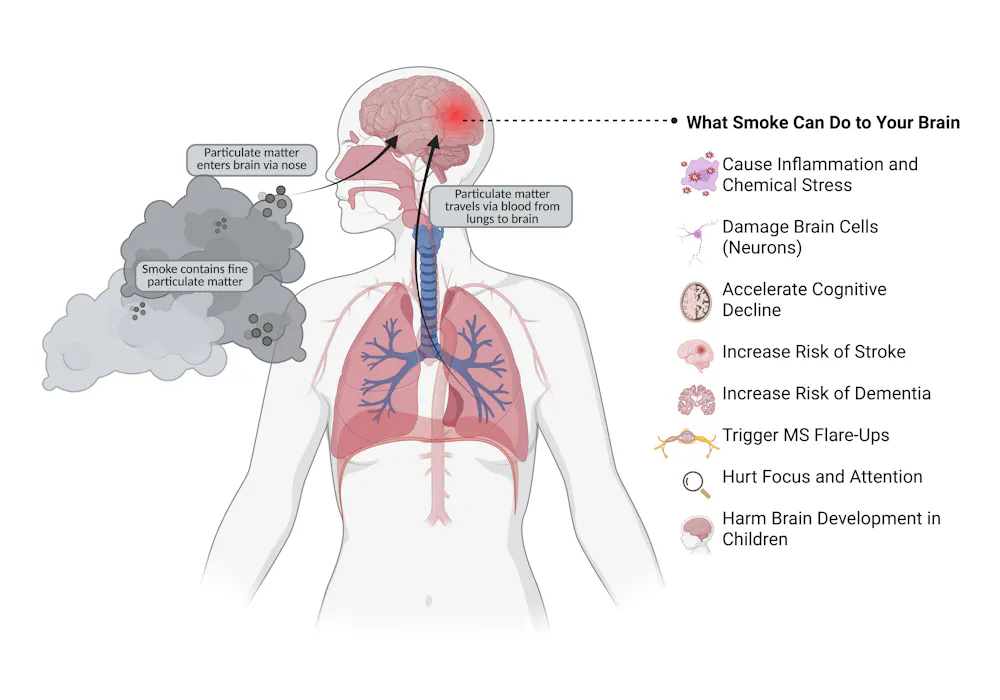
    Alongside harmful gases and heavy metals, wildfire smoke contains fine particulate matter, also known as PM2.5. These tiny particles can travel deep into your lungs, slip into your bloodstream and even reach your brain. Some even bypass the lungs entirely, entering the brain directly through the nose.

    After entering the brain, these toxins can cause inflammation and stress, damage nerve cells and even accelerate cognitive decline. Studies have linked exposure to air pollution to an increased risk of stroke and dementia. Even short-term spikes in smoke exposure, like those during wildfires, lead to a surge in emergency visits for strokes, especially among people over 65.

    A 2022 experiment had thousands of adults participate in an online attention task under smoky conditions. It found that just a three-hour spike in fine particulate matter, typical of a heavy smoke episode, led to measurably worse attention scores. This fits other evidence that breathing smoke makes people mentally foggy, forgetful or fatigued.

    Fine particulate matter in wildfire smoke can reach the brain via the lungs or nose, causing inflammation, neuronal damage, and raising the risk of stroke, dementia, cognitive decline, and MS flare-ups.
    (Muskaan Muse Laroyia)

    Wildfire smoke, dementia and MS

    In 2024, a study found that chronic exposure to wildfire-related air pollution significantly increased the likelihood of someone being diagnosed with dementia. The risk was most pronounced in low-income communities, where people often have less access to clean air, health care and protective measures.

    For people already living with neurological conditions like MS or Parkinson’s disease, the stakes are even higher. Exposure to fine particulate pollution has been linked with increased hospital admissions for MS relapses, particularly in young patients. Other research points to worsening symptoms of epilepsy and cognitive decline under extreme heat and polluted air conditions.

    Despite these mounting risks, neurological health considerations have been largely absent from wildfire preparedness initiatives and public health responses. That needs to change.

    If you want to stay informed about local smoke exposure, tools like AQmap can help you track PM2.5 levels in real time across Canada.

    Some more impacted than others

    Some face far greater risk from wildfire smoke than others, including older adults, those with pre-existing health conditions, people with lower socio-economic status, Indigenous populations, people residing in remote areas and children. This is a health equity issue as much as a medical one.

    Each of these groups faces unique and compounding challenges during smoke events. For example, older adults are more vulnerable to the cardiovascular and neurological effects of smoke. They also face greater barriers to accessing filtered environments.

    People with disabilities or chronic illnesses, including those with neurological conditions, often can’t relocate during smoke events and may rely on power-dependent medical devices that can fail during climate emergencies.

    Low-income families are more likely to live in housing without proper air filtration or cooling. These same communities often face higher baseline rates of neurological disease.

    Indigenous communities, more than 80 per cent of which are located near fire-prone areas, face recurring displacement, interruptions to care and disproportionate exposure to smoke each summer.

    Children and adolescents are particularly susceptible to the harmful neurological effects of wildfires. Because their brains are still developing and they breathe more air per body weight than adults, children are especially vulnerable to harmful pollutants.

    Studies have linked early-life exposure to fine particulate matter with an increased risk of neuro-developmental disorders, lower cognitive function and structural brain changes.

    These populations aren’t just more exposed, they also have fewer resources to respond.

    Rethinking Canada’s health systems

    Recognizing these inequities, we are developing a climate-health equity framework for Canada, with a specific focus on neurological health. Our interdisciplinary team is asking: how can we build health systems that protect vulnerable brains during climate emergencies?

    Health-care workers in Alberta Health Services have designed the Climate-Resilient Acute Care Clinical Operations Framework. This framework supports hospitals in becoming both greener and more resilient, ensuring care can continue during wildfires, floods and extreme heat events.

    Importantly, it also centres the needs of equity-deserving populations, integrating climate adaptation into emergency care, supply chains, staffing and patient communication.

    What needs to change?

    1. Public awareness must expand beyond respiratory health. Neurological effects of smoke should be included in public health messaging, especially for high-risk groups.

    2. Health systems must be climate-ready, with clean air shelters, evacuation protocols and services tailored to meet the needs of neurological patients.

    3. Communities need support, from funding for air filtration to co-ordinated outreach during smoke events. Indigenous-led fire stewardship and community health initiatives should be part of national planning. Supporting Indigenous-led fire stewardship not only strengthens wildfire response but also respects Indigenous sovereignty and traditional ecological knowledge.

    4. Clinicians must be empowered to address climate-related health risks. Training in environmental health, including its impact on the brain, is increasingly essential.

    Wildfire season is back, and with it, an urgent need to protect more than just our lungs. The science is clear: breathing smoky air affects our minds, especially for those already facing health and social vulnerabilities.

    Climate change is a brain health issue. Building a healthier, more equitable future requires us to treat it that way, starting now.

    Dr Bhavini Gohel works for the Canadian Coalition for Green Healthcare.

    Muskaan Muse Laroyia does not work for, consult, own shares in or receive funding from any company or organisation that would benefit from this article, and has disclosed no relevant affiliations beyond their academic appointment.

    ref. Wildfire smoke can harm your brain, not just your lungs – https://theconversation.com/wildfire-smoke-can-harm-your-brain-not-just-your-lungs-258052

    MIL OSI – Global Reports

  • MIL-OSI United Kingdom: Fairer system for debt collection to boost protections for financially vulnerable

    Source: United Kingdom – Executive Government & Departments

    Press release

    Fairer system for debt collection to boost protections for financially vulnerable

    Government to consult on regulation of enforcement sector as well as increase protections for those facing debt enforcement action and raise fees recoverable by bailiff firms

    • Three-pronged package of measures to deliver a fairer system of debt enforcement
    • Plans to improve independent regulation of the enforcement industry to boost oversight
    • Number of doorstep visits by bailiffs to be reduced to limit unfair build-up of fees

    New reforms to the enforcement sector will protect the financially vulnerable and give those facing debt greater opportunity to settle at the earliest and cheapest stage possible.

    Setting out plans to overhaul to the way sector operates, the Government today (Monday 9 June) outlined it will:

    • Consult on plans for greater regulation of bailiff firms, including oversight from an independent body accountable to Parliament.
    • Encourage earlier and cheaper settlement of debt, reducing the number of “doorstep visits” and avoiding the accumulation of enforcement fees.
    • Increase fees bailiff firms can collect for the first time since 2014 to ensure a sustainable sector while better supporting people in debt. The threshold which bailiff firms can charge an additional fee will also be raised to reduce the number of people in debt paying this additional fee.

    Minister of State for Courts and Legal Services Minister Sackman, said: 

    Debt recovery must be fair to everyone. If you’re an organisation or individual who is owed money you should be able to get it back. And if you fall into debt you should be treated fairly and supported to get back on your feet.

    That is why we are reforming the enforcement sector – to safeguard debtors and creditors alike whilst building a more sustainable system.

    The consultation launched today also seeks views on the role an independent statutory regulator should play in enforcement. This includes how the regulator could work with other regulatory bodies, and how it would be held to account by the Government. 

    While most bailiff firms have already signed up to the Enforcement Conduct Board’s voluntary accreditation scheme, the government proposals would see all bailiff firms regulated to the same standards and overseen by the same independent body, ensuring greater protections for vulnerable people.  

    To reduce the number of doorstep visits and help prevent people from falling into more debt through accrued enforcement fees, reforms will increase the minimum notice period which must be given before enforcement officers can visit those in debt to 14 days (from seven) – and to 28 days if requested by a debt advisor.

    This will give people more time to access debt advice, and/or set up a payment agreement.  

    To support a fair, viable, and effective enforcement system, the fees bailiff firms can collect from those facing action will be uplifted by 5%. This is the first fee increase since 2014 and reflects the impact of rising costs on bailiff firms. To protect the interests of financially vulnerable individual, it will be made clear that creditors should not share the profits made from the use of bailiff firms and the charging of fees.

    Minister of State for Local Government and English Devolution, Jim McMahon OBE said:

    These reforms will help make sure those facing the enforcement system are properly protected and supported in dealing with their debts – and we won’t just stop here.

    We will shortly be consulting on improvements to council tax administration including the way council tax is collected and enforced, so people can have their say in delivering a fairer system to support both vulnerable households and local councils.

    Background information

    • The Enforcement Conduct Board (ECB) was established in 2022, tasked with providing voluntary, independent oversight of the sector to ensure fair treatment for every party facing enforcement action
    • The Government is consulting on how to ensure that there is independent oversight of firms that employ enforcement agents and High Court Enforcement Officers to enforce debts using the Taking Control of Goods procedure in England and Wales. The consultation will run for six weeks. Responses will inform legislation to be brought forward as soon as parliamentary time allows
    • As set out in the Chancellor of the Exchequer’s Regulation Action Plan, when regulation is designed well it can be an essential tool to promote growth and investment and protect the public. We will introduce independent statutory regulation of the sector in line with the objectives in the Action Plan, and our work across Government to cut the administrative costs of regulation by 25% by the end of parliament
    • The threshold above which bailiff firms can charge an additional percentage fee will be raised by 24%. Currently, an additional one-off fee of 7.5% of any debt over a set threshold can be recovered by bailiff firms if the debt reaches the enforcement (visit) stage. The 24% rise to this threshold will rebalance these fees in line with inflation and reduce the number of people in debt paying the additional fee
    • The reforms to the regulations about when fees can be recovered and uplifts to the fees and thresholds will be implemented when parliamentary time allows

    Updates to this page

    Published 9 June 2025

    MIL OSI United Kingdom

  • MIL-OSI USA: King, Colleagues to White House: “Immediately Reverse” Damaging, Unconstitutional Cuts to Job Corps

    US Senate News:

    Source: United States Senator for Maine Angus King

    WASHINGTON, D.C. — With the Trump administration attempting to shutter the nation’s largest jobs training program for low-income and at-risk young people, Senator Angus King (I-ME), alongside 39 of his Senate colleagues, sent a letter to Department of Labor (DOL) Secretary Lori Chavez-DeRemer urging her to reverse the unconstitutional and illegal cuts to the Job Corps program that are harming student and communities in Maine and across the country. These cuts have left 25,000 students and thousands of staff across 99 Job Corps centers in the lurch, including nearly 500 Maine students and nearly 270 Maine employees

    “The Administration’s decision to illegally and abruptly terminate Job Corps center operations has left 25,000 students and thousands of staff across 99 Job Corps centers in the lurch,” wrote the senators. “The sudden ‘pause’ of operations at Job Corps centers puts young people’s lives at risk, especially a significant number of students who were experiencing homelessness before arriving to the program. Local communities will pay a steep price, especially the thousands of individuals who work at the centers and will lose their livelihoods.” 

    “We urge you to immediately reverse this decision to prevent a lapse in education and services for Job Corps students. We further urge that the Department restart enrollments, expeditiously restart background checks, and make any contract extensions or modifications necessary to ensure no interruptions or delays for students or program operations,” concluded the senators. 

    For more than 60 years, Job Corps has helped millions of young people in rural communities and cities alike to finish high school, learn technical skills and get good-paying jobs while providing stable housing, medical and mental health care, and other supportive services. Through Job Corps programs, young people receive the training they need to start in good-paying jobs that support their communities after graduation – including as wildland firefighters, nurses, electricians, machinists, pipefitters, and welders. Last month, however, the Trump administration indefinitely ‘paused’ operations at Job Corps sites across the country. 

    Joining Senator King on the letter are Senators Tammy Duckworth (D-IL.), Richard Blumenthal (D-CT), Tim Kaine (D-VA), Ed Markey (D-MA), Angela Alsobrooks (D-MD), Peter Welch (D-VT), Bernie Sanders (I-VT), Lisa Blunt Rochester (D-DE), Kirsten Gillibrand (D-NY), Mazie Hirono (D-HI), Elizabeth Warren (D-MA), Chris Murphy (D-CT), Chris Coons (D-DE), John Fetterman (D-PA), Elissa Slotkin (D-MI.), Ben Ray Lujan (D-NM), Amy Klobuchar (D-MN), Jacky Rosen (D-NV), Martin Heinrich (D-NM), Tina Smith (D-MN), Jack Reed (D-RI), Chuck Schumer (D-NY), Alex Padilla (D-CA), Raphael Warnock (D-GR), Jeff Merkley (D-OR), Brian Schatz (D-HI), Cory Booker (D-NJ), John Hickenlooper (D-CO), Andy Kim (D-NJ), Chris Van Hollen (D-MD), Dick Durbin (D-IL), Catherine Cortez Masto (D-NV), Mark Warner (D-VA), Jeanne Shaheen (D-NH), Mark Kelly (D-AZ), Ron Wyden (D-OR), Gary Peters (D-MI.), Tammy Baldwin (D-WI) and Patty Murray (D-WA). 

    Senator King has been consistently sounding the alarm on President Donald Trump’s existential threat to the Constitution. He previously gave a speech on the Senate floor sharing that this administration is doing ‘exactly what the Framers [of the Constitution] most feared” and a speech where he shared his growing concerns over the Trump Administration’s usurpation of Congressional authority. Senator King also previously declared that the proposal to halt all federal grant and loan disbursement was illegal and a direct assault on the Constitution. Previously, he joined 36 Senators in a letter to Secretary of State Marco Rubio, sharing the detrimental effects of  the Trump Administration’s dismantling of the U.S. Agency for International Development (USAID), and has also joined fellow Senate Select Committee on Intelligence (SSCI) colleagues in writing a letter to the White House about the risks to national security by allowing unvetted Department of Government Efficiency (DOGE) staff and representatives to access classified and sensitive government materials.

    The full text of the letter is available here and below.

    +++

    Dear Secretary Chavez-DeRemer:

    We write to express our grave concern with the “pause” of operations that began at Job Corps centers on May 29, 2025, which will harm students and local economies in every state across the country. The Administration’s decision to illegally and abruptly terminate Job Corps center operations has left 25,000 students and thousands of staff across 99 Job Corps centers in the lurch. The sudden “pause” of operations at Job Corps centers puts young people’s lives at risk, especially a significant number of students who were experiencing homelessness before arriving to the program. Local communities will pay a steep price, especially the thousands of individuals who work at the centers and will lose their livelihoods.

    We urge you to immediately reverse this decision to prevent a lapse in education and services for Job Corps students. We further urge that the Department restart enrollments, expeditiously restart background checks, and make any contract extensions or modifications necessary to ensure no interruptions or delays for students or program operations. Congress passed the Full-Year Continuing Appropriations and Extensions Act of 2025, which includes $1,760,155,000 for Job Corps and ensures that Job Corps Centers are funded for the new program year that begins on July 1, 2025. We write to remind you of your obligation to faithfully implement the law.

    Since 1964, Job Corps has helped millions of low-income or at-risk young people develop the skills and resilience needed to succeed in work and life. As the largest free residential education and job training program for young adults ages 16-24, Job Corps programs help students complete their high school education, learn high-value technical skills, and connect to employment through intensive education, training, and support services in a residential setting while providing stable housing, medical and mental health care, and other supportive services to ensure their success. At a time when more than 72 percent of jobs will require training beyond a high school diploma, Job Corps provides students with the opportunity to become wildland firefighters, nurses, electricians, machinists, pipefitters, CDL drivers and welders and more.

    Job Corps centers operate in rural and metropolitan regions nationwide and contribute to their local communities and economies. Many centers have partnered with employers, local workforce development boards, government agencies, and community-based organizations to develop the future workforce and meet the needs of local employers.

    Abruptly canceling contracts for the nation’s Job Corps centers will leave students and communities in the lurch and undermine opportunities for young people to get education and training to succeed in valuable trades. Rather than gutting this valuable program, we urge you to work with Congress to strengthen accountability and program quality for the betterment of young workers, employers needing skilled labor, and communities nationwide, such as reforms included in the bipartisan, bicameral WIOA reauthorization bill from last Congress. We request that you provide written answers to the following questions as soon as possible, but not later than June 20, 2025.

    1. Please provide a list of onboard strength (enrollment) at each center before January 20, 2025 and before the operations pause on May 28, 2025.
    2. With Job Corps operations on pause, how does the department plan to fulfill its obligations to implement the Full-Year Continuing Appropriations and Extensions Act, 2025, which includes $1,760,155,00 for Job Corps serving students?
    3. Please provide information on the number of students experiencing homelessness prior to enrollment at a Job Corps center based on enrollment at each center on May 28, 2025.
    4. Please provide a list of every contract that has been terminated or modified since January 20, 2025, including the total amount of funds to each operator, the amount of funds that each operator has spent up to the date of the contract’s termination or modification, and the amount of remaining unspent funds for each contract.
    5. What authority is the Department using to “pause” operations? Please provide a citation in law or regulation.
    6. The concept of a “pause” does not exist in Job Corps authorizing statute and appears to be an attempt to illegally shut down Job Corps operations without following requirements in law. Section 159 of the Workforce Innovation and Opportunity Act (WIOA) includes clear requirements and processes for the closure of Job Corps Centers that were not followed in this “pause”. How does the Department define a “pause” and how is it different than a “termination”?
    7. On April 25, 2025, the Department’s Employment and Training Administration (ETA) released the first-ever Job Corps Transparency Report, which is used throughout the DOL press release to pause operations at centers.
      1. Centers have returned funding to DOL when enrollments were lower than expected (but that’s not reflected in this report.) Please provide an updated cost per enrollee that accounts for money returned to DOL.
      2. The report also provides cost per enrollee based on enrollment from program year 2023. DOL has much more up-to-date enrollment numbers. Please provide an updated cost per enrollee with the enrollments on campuses as of May 28, 2025, incorporating onboard strength at each campus.

    Sincerely,

    MIL OSI USA News

  • MIL-OSI United Kingdom: Attracting more investment for housing

    Source: Scottish Government

    Boosting growth potential

    Proposals to build investor confidence in the housing market have been published by an independent group of experts. 

    The Housing Investment Taskforce report makes a number of recommendations to increase investment across the social, affordable and private housing sectors including:

    • Attracting other funds, in addition to public money, for affordable housing.
    • Creating conditions to support more shared home ownership
    • Supporting a more entrepreneurial approach from public bodies.

    Welcoming the taskforce report Housing Minister Paul McLennan said:

    “It is my ambition, shared by the members of the Housing Investment Taskforce, to make Scotland the best place for housing investment. The report has identified a range of actions to support more investment across all tenures of the housing system to meet Scotland’s growth potential.

    “We’re taking forward these recommendations in the Programme for Government and will work in partnership with taskforce members and other organisations to grow investor confidence to support the delivery of more homes across Scotland.”

    MODA Planning Director James Blakey said:

    “Addressing the housing emergency needs bold, imaginative and concrete actions, and we are proud to have collaborated with the Housing Minister and the taskforce over the last year to shape these. Working in partnership to create market certainty and viability is key to attracting crucial investment into Scotland so we can build the new homes people want and need.”

    Communications Director of Springfield Karen Campbell said:

    “The taskforce’s report is clear on the value in building confidence, supporting new partnerships and creating the economic opportunity to unlock new and existing investment in Scotland. Working together we can now take those actions forward to deliver more homes across all tenures.”

    HIT report

    Ken Gibb report

    MIL OSI United Kingdom

  • MIL-OSI United Kingdom: Manchester Central Library and Town Hall Extension to temporarily close for major ICT investment

    Source: City of Manchester

    Manchester Central Library, along with the Town Hall Extension, are closing temporarily in August for the replacement and upgrade of ICT networks and Wi-Fi systems.

    They will be closed for three weeks from 2- 24 August with no access for staff or the public as there will be no ICT network access available while cabling and upgrade work is carried out, which means no connectivity for laptops, PCs, printers and other digital infrastructure. 

    The ICT project will update the Local Area Network (LAN) and the Wireless Local Area Network (WLAN). It will ensure that the Central Library and the Town Hall Extension will have a flexible ICT network providing seamless connectivity for staff and the public using our buildings, as well as third parties including the NHS, GMP and other local authorities. 

    To date, more than 120 buildings have been completed with feedback from staff, library visitors and our partners highlighting its transformative impact. 

    Manchester’s 21 local libraries will be open as usual providing PCs, book lending and study space, all of which have already had successful LAN and Wi-Fi network updates.  

    Find further information on all Manchester Libraries services.  

    Staff hours will be increased in nine key libraries in the city, and we will continue to operate a visitor information service and accept books that are being returned.  

    Staff will be on hand at Central Library entrances to advise customers and residents of the closure and signpost to alternative libraries, places to sightsee, meet or enjoy a coffee in the city. 

    Find out everything you need to know about the temporary Manchester Central Library closure .

    The St Peter’s Square Generator enterprise hub will also be closed but all the services for businesses will be available at the Generator hub site at  Royal Mills Ancoats which opened in 2024. 

    The Town Hall Extension will be fully closed and affected staff will work remotely, while alternative arrangements are being made for in-person pre-booked appointments carried out in the Town Hall Extension, including alternative locations for in-person homelessness appointments and for taxi drivers to attend in-person to present legal documentation.

    Councillor Garry Bridges, Deputy Leader of Manchester City Council, said:  

    “We need to carry out important work to upgrade the network systems which were implemented during the major refurbishment works in 2013.   

    “Currently there is patchy network coverage in critical areas across the buildings, and the upgrade will give us a flexible ICT network that is more fitting to modern ways of working and our digital strategy goals.  

    “We are sorry for the inconvenience that these temporary closures may cause but we are making alternative plans for the services during this time, and we hope that people will understand that the end point of this critical work will be beneficial to everyone who uses the buildings for years to come.” 


    Councillor John Hacking, Executive Member for Skills, Employment and Leisure said:

    “Although there is never a good time to shut Manchester Central Library, we cannot move forward in updating the network without this necessary closure. I can assure people that we will be working at pace to bring a better and faster Wi-Fi provision for our customers when we reopen. 

    “Our library staff will be relocated to our branch libraries during the closure to ensure they can continue to provide the vital services our residents have come to expect while the work is undertaken – and of course a range of library services are also available online.” 


    MIL OSI United Kingdom

  • MIL-OSI Canada: The answer to global energy security

    Alberta’s energy industry contributes billions of dollars to Alberta’s economy and plays a vital role in the global responsible energy supply.

    Premier Danielle Smith, Minister of Energy and Minerals Brian Jean, and other government officials will attend the Global Energy Show from June 10 to 12 to welcome international delegates and promote Alberta’s responsible energy development. Their participation will focus on strengthening Alberta’s position as a trusted energy partner, advancing investment opportunities, and highlighting the province’s role in reducing global energy poverty through secure, sustainable supply.

    With current geopolitical challenges, Alberta’s role in energy security has never been more important for Canada’s stability and that of our trading partners, particularly in North America and Asia.

    “Alberta’s energy industry has been built from the ground up by innovative minds who saw opportunity where others see challenges – and they continue to do so today. Thanks to this ingenuity, Alberta has risen in the global ranks as an energy powerhouse with an equally strong environmental record. With global demand for energy security at an all-time high, Alberta stands ready to provide the solutions our partners need.”

    Danielle Smith, Premier

    “The world needs reliable, responsible and affordable energy from a producer they can trust. Alberta’s vast resources are positioned to meet long-term energy demand and will be key in obtaining North American and global energy security and helping defeat energy poverty. We intend to showcase this to attendees from all over the world at this year’s Global Energy Show.”

    Brian Jean, Minister of Energy and Minerals

    While at the Global Energy Show, Premier Smith and Minister Jean will meet with international officials and business leaders to promote Alberta’s energy sector and vast resource base. Their discussions will focus on strengthening Alberta’s position as a reliable resource partner, identifying new opportunities to meet evolving energy needs, and reducing global reliance on energy from conflict zones.

    “As Canada’s largest international energy gathering, the event will address critical issues including energy security, affordability, access and investment. With delegates from over 100 countries, Calgary will highlight Canada’s leadership in shaping the future of energy at home and globally.”

    Nick Samain, Senior Vice President at dmg events

    The conference is an annual event in Calgary, the heart of Canada’s energy sector, and will take place at the BMO Centre with numerous panels, keynote speakers and opportunities for delegates to network.

    Related information

    • Global Energy Show

    MIL OSI Canada News

  • MIL-OSI USA: Senators Coons, McCormick introduce legislation to reduce overcrowded emergency departments

    US Senate News:

    Source: United States Senator for Delaware Christopher Coons

    WASHINGTON – U.S. Senator Chris Coons (D-Del.) and David McCormick (R-Pa.) introduced the Addressing Boarding and Crowding in the Emergency Department (ABC-ED) Act, bipartisan legislation to help alleviate emergency department overcrowding by improving the efficiency of emergency care to deliver better health outcomes.

    When inpatient hospital beds reach capacity, patients are often required to “board” in the emergency department (ED). Although this practice is meant to be temporary, a staggering 97% of emergency doctors report caring for patients who have been boarding in the ED for more than 24-hours, according to the American College of Emergency Physicians. This gridlock delays care for new patients and puts ED nurses – who are often responsible for 10 or more patients at once – under even higher pressure and stress.

    The ABC-ED Act would alleviate these issues by allowing public health data modernization grants to be used for developing and maintaining real-time systems that track hospital bed availability to inform state and regional emergency care planning. Improving data systems for hospitals serving neighboring communities – like those on the border of Delaware and Pennsylvania – can reduce wait times, improve patient flow, and support emergency medical staff.

    “If you’ve ever had to go to an emergency room in Delaware, you know that wait times are just too long,” said Senator Coons. “Too many patients end up having to wait hours, or even days, for a bed to open up in the hospital, no matter the emergency. I’ve heard from so many Delawareans about this problem, and I’m proud to lead the federal effort to find solutions. I urge our colleagues to take up this bipartisan bill that will help hospitals modernize their systems, take stress off emergency rooms, and ensure more Americans are getting the care they need as soon as possible.”

    “Advanced technology and AI are re-shaping the way our country and economy work,” said Senator McCormick. “It’s critical to Americans’ long-term health and wellbeing that our nation’s hospitals can access technological resources to update their procedures and practices and ensure patients are receiving the care they need in a timely fashion. I’m grateful to work across the aisle with Senator Coons to help improve the quality and efficiency of our nation’s healthcare system.”

    In addition to Senators Coons and McCormick, the legislation is co-sponsored by U.S. Senators Lisa Blunt Rochester (D-Del.), Thom Tillis (R-N.C.), Angus King (I-Maine), and Markwayne Mullin (R-Okla.). It is led in the House by Representatives Joyce (R-Pa.) and Dingell (D-Mich.).

    “This bipartisan legislation is a practical step towards addressing overcrowding in emergency departments across the nation,” said Senator Tillis. “By giving states the tools to better track and manage hospital capacity in real-time, we can improve patient care, reduce delays, and help save lives.”

    “Overcrowded emergency departments can mean longer wait times for patients and a lack of resources for staff,” said Senator Blunt Rochester. “We need to confront this part of our health care crisis by investing in technology that can identify shortages before they become a problem. I’m glad to be introducing this bill and hope to see it brought to the Floor for a vote.”  

    “Emergency departments in Oklahoma and across the country are overwhelmed. This bill is a critical step in the right direction to address this crisis.” said Senator Mullin. “I’m proud to partner with my colleagues on this to get our hospitals and healthcare workers the resources they need to improve the patient experience in emergency departments.”

    Specifically, the ABC-ED Act would:

    1. Expand public health data grants to support hospital bed tracking systems
    2. Direct the Government Accountability Office to conduct a study to determine best practices for the development and maintenance of public health data systems for tracking hospital capacity
    3. Authorize the Centers for Medicare and Medicaid Services Innovation Center to pilot improved care programs for patients most likely to experience ED boarding, including seniors and those with acute psychiatric needs

    The bill is endorsed by the American College of Emergency Physicians (ACEP) and the Delaware Healthcare Association.

    “Boarding in the emergency department is a national public health crisis that puts patient lives at risk and strains emergency physicians and care teams every day,” said Alison Haddock, MD, FACEP, President of the American College of Emergency Physicians. “We are deeply grateful to Senators Coons, McCormick, Tillis, King, Mullin, and Blunt Rochester for their leadership on this critical issue for emergency medicine, and for joining our House champions, Representatives Joyce and Dingell, to ensure this legislation is a bipartisan, bicameral priority. The ABC-ED Act equips emergency physicians with resources and real-time data to inform medical decisions that can reduce dangerous delays and improve the flow of patients through the emergency care continuum.”

    “Crowded emergency departments and long wait times can put a strain on our healthcare workforce and lead to patients abandoning care. We thank Senator Coons for his leadership in introducing the ABC-ED Act and his bipartisan work on solutions to address this growing challenge. Many factors contribute to ED wait times like increased utilization during respiratory illness season and barriers that prevent individuals from being transferred to post-acute care facilities. Efforts like this legislation will reduce wait times and help enhance our system of care for both patients and our workforce,” said Brian Frazee, President & CEO of the Delaware Healthcare Association. 

    “Delaware ACEP would like to thank Senators Coons, Blunt Rochester, and their colleagues for their support of access to emergency care in Delaware and in the country.  Delaware citizens have seen some of the longest wait-times in the country for ER visits, with hundreds of patients waiting for hours for care in the ERs state-wide at busy times. With his sponsorship of the ABC-ED Act, Sen. Coons has shown his understanding and support for the emergency healthcare team.  Bottlenecks in the entire healthcare system lead to patients who are admitted to the hospital waiting for their hospital beds in the ER.  This results in worse health outcomes for those patients as well as the patients who are waiting to be seen in the space that is occupied by admitted patients.  It is with deep gratitude that the physicians of Delaware ACEP proudly support Senator Coons’ sponsorship of the ABC-ED act to address these concerns and improve health outcomes for this state and for the country,” said the Delaware ACEP Board of Directors.

    Delawareans have dealt with longer ED wait times than nearly every other state for more than a decade. The average ED visit time in Delaware was 141 minutes in 2023 – only a marginal improvement from the 156 minutes averaged in 2013. As a result of long wait times, Delawareans are also more likely to leave without treatment, putting their lives unnecessarily at risk. Long ED wait times are the result of intersecting challenges ranging from health workforce and primary care shortages to insufficient options for discharge due to a shortage of nursing home and behavioral health care options. Last year, the Delaware Healthcare Association reported that more than 300 long-stay patients were boarding in Delaware’s hospitals – using about 10% of the state’s hospital beds – despite being medically ready for discharge. Recent hospital closures in Pennsylvania will further strain hospital capacity issues in the region, making this federal initiative to complement state and local leadership more pressing than ever. 

    The text of the bill is available here.

    MIL OSI USA News

  • MIL-OSI USA: Davids Announces New Federal Grant to Lower Energy Costs in Franklin, Anderson Counties

    Source: United States House of Representatives – Congresswoman Sharice Davids (KS-3)

    Today, Representative Sharice Davids announced a federal grant to help two rural Kansas nursing and rehabilitation centers lower their energy costs through solar power. The investments, totaling nearly $200,000, are part of the Rural Energy for America Program (REAP), which helps small businesses and farms in rural areas make energy-efficient upgrades. Davids was the only member of Kansas’ Congressional Delegation to vote for the Inflation Reduction Act, which supports this program. “High energy bills are one of the biggest costs for Kansas businesses, especially in rural areas,” said Davids. “This funding helps local facilities save thousands of dollars each year—money they can reinvest into their operations and community. I’ll keep working to bring down costs and make smart investments like this across our state.” Recover-Care Richmond, a nursing and rehab facility in Franklin County, received $99,995 to install new solar technology. This is expected to save the facility over $13,000 a year and cover 51 percent of its total energy use. Parkview Heights Nursing & Rehab Center in Anderson County also received $99,995 for new solar technology. This will replace nearly 95,000 kilowatt hours of electricity each year — enough to power eight homes — helping the facility save money and reduce its reliance on the grid. Davids has made it a priority to lower energy costs for Kansas businesses and families. Through tax credits in the Inflation Reduction Act, which she voted to pass, 3.4 million American families have already saved more than $8 billion on their utility bills. The law also caps the cost of insulin at $35 a month for seniors and finally lets Medicare negotiate for lower prescription drug prices, saving 74,000 Kansans on Medicare up to 79 percent on certain medicines. REAP provides grants and loans to rural small businesses and farms to help them install renewable energy systems or improve energy efficiency. The program is administered by the U.S. Department of Agriculture and is part of a broader effort to invest in rural communities across the country.

    MIL OSI USA News

  • MIL-OSI USA: House Democrats Challenge Trump’s Unconstitutional Birthright Citizenship Executive Order in Court

    Source: United States House of Representatives – Congressman Hakeem Jeffries (8th District of New York)

    Washington, D.C. —  On Friday, House Democrats’ Litigation and Rapid Response Task Force, remaining steadfast in their commitment to fighting against the Trump Administration’s illegal attacks on the constitutional principle of birthright citizenship, filed an amicus brief in the matter of Trump v. Casa, Inc., which is now before the 4th Circuit Court of Appeals. The Trump Administration filed this appeal to overturn a nationwide preliminary injunction blocking the President’s attempt to change the constitutional right to birthright citizenship via executive order. 

    The amicus brief–signed by 170 House Democrats–provides overwhelming evidence that President Trump’s Executive Order violates the Constitution and over a century of Supreme Court rulings, as well as laws enacted by Congress. It also signifies the lawmakers’ commitment to defending birthright citizenship, following their amicus briefs filed in State of Washington v. Trump before the Ninth Circuit Court of Appeals, and in the Supreme Court cases Trump v. Washington, Trump v. CASA, Inc., and Trump v. New Jersey.

    The full brief is available HERE.   

    The effort is once again being helmed by House Democratic Leader Hakeem Jeffries, along with Litigation Task Force Chair Assistant Leader Joe Neguse and Co-Chair, Judiciary Committee Ranking Member Jamie Raskin; Representatives Bennie Thompson, Ranking Member of the Homeland Security Committee, and Pramila Jayapal, Ranking Member of the Subcommittee on Immigration Integrity, Security, and Enforcement; as well as Congressional Black Caucus (CBC) Chair Yvette Clarke, Congressional Hispanic Caucus (CHC) Chair Adriano Espaillat, Congressional Asian Pacific American Caucus (CAPAC) Chair Grace Meng, and Congressional Jewish Caucus (CJC) Co-Chairs Jerry Nadler and Brad Schneider.

    See what they had to say below: 

    “Donald Trump and Elon Musk are taking a chainsaw to the United States Constitution. Their disgraceful actions on birthright citizenship violate our nation’s laws and are an assault on the American way of life. House Democrats will continue to push back aggressively against them in the courts, in Congress and in our communities. The Supreme Court of the United States must stand on the side of the Constitution and reject this outrageous effort. I am thankful for the leadership of Rep. Raskin, Rep. Thompson, Rep. Jayapal, Rep. Clarke, Rep. Espaillat, Rep. Meng, Rep. Nadler, Rep. Schneider and Assistant Leader Neguse of the Litigation Working Group and Rapid Response Task Force in standing up for the rule of law,” said House Democratic Leader Hakeem Jeffries

    “President Trump’s executive order on birthright citizenship is unconstitutional, and as our amicus brief makes clear, House Democrats will continue to vindicate our constitution,” said Assistant Democratic Leader Joe Neguse

    “Donald Trump’s executive order purporting to eliminate birthright citizenship violates not only the first sentence of the Fourteenth Amendment but decades of Supreme Court interpretation and federal laws enacted by Congress,” said Ranking Member Jamie Raskin. “The Fourteenth Amendment is clear that people born in the United States are American citizens regardless of their parents’ origin or status. A Presidential executive order cannot override the U.S. Constitution to strip millions of Americans born here of their rights and freedoms. We will fight to defend this core principle of Constitutional equality and membership.”

     “We will not allow the Trump administration to redefine what it is to be an American just to fit their extreme anti-immigrant beliefs. Under the Constitution, people born here are United States citizens – no matter who they are, what they look like, or where their families came from. Americans reject what Trump is attempting to do, and the Supreme Court must too,” said Ranking Member Bennie Thompson

    “Birthright citizenship is a core piece of our Constitution. Ending it through executive order is simply unconstitutional and a dangerous overreach of executive power,” said Ranking Member Pramila Jayapal. “All persons born on U.S. soil are U.S. citizens, that is what our Constitution dictates and is something President Trump cannot undo by waving a pen. As the first immigrant to serve as Ranking Member of the Subcommittee on Immigration, Integrity, Security, and Enforcement, I am proud to be co-leading on this amicus brief to stand up for the immigration laws of this country.”

    “Birthright citizenship is enshrined in our Constitution and has been affirmed by the Supreme Court numerous times — including in the landmark United States v. Wong Kim Ark decision. No matter what President Trump says or does, he cannot unilaterally overrule the law of the land by signing a piece of paper. As Chair of the Congressional Asian Pacific American Caucus, I join my colleagues in standing up for American values and against this unconstitutional executive overreach,” said CAPAC Chair Grace Meng.

    “Birthright citizenship is a moral imperative in the United States because of its origins. It’s about our collective recovery from the evils of slavery, yes, but it’s also about equal opportunity for every American born in this country,” said CHC Chair Adriano Espaillat. “This brief reminds the Supreme Court of the historical weight of the 14th amendment and of the very real costs that would be imposed by additional legal requirements on all growing families by a spurious reinterpretation of this keystone amendment.”

    “Donald Trump is not a king. He cannot dismiss a century and a half of legal and judicial precedent that affirms the plain language of the Fourteenth Amendment of our Constitution with the swipe of a pen. Our Constitution clearly says if you are born here, you are a citizen. I’m hopeful that our highest court will follow the precedent set by its predecessors and send a clear message to the President that his flagrant, illegal overreach will be stopped,” said CJC Co-Chair Brad Schneider.

    “Donald Trump’s divisive and xenophobic policies seek to divide and distract us,” said CJC Co-Chair Jerry Nadler. “We are dealing with a President who believes he is not just above the law, but above the U.S. Constitution.  The 14th Amendment is clear that persons born in the United States are U.S. citizens. And yet, President Trump feels compelled to single-handedly change what has been universally understood about the law since the Amendment was adopted in 1868.  All Americans should be disturbed by Trump’s assertion that he can unilaterally change the Constitution at will to suit his purposes.  This represents an assault on our democracy, and we cannot stand idly by and allow the President to disregard fundamental pillars of the Constitution. That is why I am proud as the Congressional Jewish Caucus Co-chair to join my colleagues in leading this effort.” 

    Background on the Task Force’s Wins:

    The Litigation and Rapid Response Task Force first took the unprecedented step of filing a trial court amicus brief to defend American consumers from predatory lenders and bad actors. They were successful in this case after a federal judge blocked efforts to dismantle the CFPB, citing the group’s argument multiple times throughout the 112-page ruling. The Task Force was also able to effectively prevent the Trump Administration from dismantling the Department of Education, filing another such brief that led to a federal court demanding the immediate rehiring of unlawfully terminated staff. House Democrats have so far filed eight amicus briefs in cases against Administration lawlessness. 

    For more information on House Democrats efforts to protect Americans against the unlawful actions of the Trump Administration, visit litigationandresponse.house.gov. 

    ###

    MIL OSI USA News

  • MIL-OSI Russia: The container hub project in the port of Aktau gives a new powerful impetus to the development of TMTC

    Translation. Region: Russian Federal

    Source: People’s Republic of China in Russian – People’s Republic of China in Russian –

    Source: People’s Republic of China – State Council News

    NANJING, June 9 (Xinhua) — The first phase of the first launch complex of the container hub project in the Aktau port of Kazakhstan was officially put into operation on Monday, which will give a new powerful impetus to the development of the Trans-Caspian International Transport Corridor (TITC), experts said.

    The above-mentioned project, located on the eastern coast of the Caspian Sea, is a key hub that connects the port of Baku in Azerbaijan and increases the capacity and efficiency of the TMTC.

    “The launch of the first launch complex of the container hub in the port of Aktau is an important stage in the development of the transport system of Kazakhstan and the Trans-Caspian route connecting China with Europe via Central Asia and the Caspian Sea,” noted Damir Kozhakhmetov, General Director of KTZ Express JSC.

    According to him, the emergence of modern transshipment infrastructure on the Caspian Sea coast will reduce the overall time of cargo delivery between China, Central Asian countries and Europe. This will make TMTC more reliable, competitive and convenient for business.

    According to the data, the total area of the project is about 19 hectares, and its designed throughput capacity is 240 thousand standard containers /TEU, twenty-foot equivalent/ per year.

    “The project contributes to the creation of new jobs, stimulates the development of related industries, such as warehouse logistics and terminal services, and also opens up additional opportunities for export-import operations,” added D. Kozhakhmetov.

    Over the years of joint work between China and Kazakhstan in the transport and logistics sector, such large infrastructure projects as the Kazakh-Chinese logistics base in the port of Lianyungang /Jiangsu Province, East China/, the land port “Khorgos – Eastern Gate” on the border of the two countries, and the international transit motor corridor “Western Europe – Western China” have been put into operation.

    D. Kozhakhmetov believes that these facilities have become the basis for building a modern logistics infrastructure between the two countries. And the container hub in Aktau is a logical continuation of joint work.

    “It unites more than 7 thousand km of transport network – from the east coast of China to the Caspian Sea, forming a full-fledged land-sea route within the framework of the Belt and Road initiative,” said D. Kozhakhmetov.

    Chairman of the Board of JSC “FB “Samruk-Kazyna” Nurlan Zhakupov said that this project is an important step in the development of the transport and logistics sector of Kazakhstan.

    He emphasized that Kazakhstan is located at the junctions of the international transport corridors “North-South” and the Trans-Caspian International Transport Route /Middle Corridor/. This emphasizes the importance of the Aktau port in regional and international logistics.

    Deputy Mayor of Lianyungang Ren Dong noted that the container hub project in Aktau port demonstrates the forward-looking planning of China and Kazakhstan within the framework of the joint construction of the “Belt and Road”. It will further deepen interconnectivity, increase the throughput capacity of the TMTC, and promote trade and economic development of countries along the route.

    Let us recall that the project is being implemented in two stages. The first stage occupies an area of 9.1 hectares, on the territory of which 3 railway loading and unloading lines and about 690 container sites have been built. It will allow for a full cycle of operations – container handling, customs inspection and handling of hazardous cargo. -0-

    MIL OSI Russia News