Category: housing

  • MIL-OSI: New heat illness course from Traliant helps employers protect employees and stay compliant as temperatures – and regulations – rise

    Source: GlobeNewswire (MIL-OSI)

    NEW YORK, July 23, 2025 (GLOBE NEWSWIRE) — Traliant, a leader in online compliance training, today announced the launch of its new Heat Illness Prevention training, a targeted, regulation-compliant course designed to protect employees working in high-heat conditions both indoors and outdoors.

    Heat illness is a serious safety concern for employers, with the US Bureau of Labor Statistics reporting 55 work-related fatalities and 5,770 DART (Days Away, Restricted, or Transferred) cases due to heat exposure in 2023. To better protect employees working in hot environments, heat illness prevention mandates are becoming increasingly common at the federal and state levels. In addition to the Occupational Safety and Health Administration (OSHA) actively developing a federal heat illness prevention standard, state-level regulations already in effect in California, Nevada and Oregon require annual training for employees exposed to high-heat conditions.

    “As temperatures rise, so does the risk to workers — and employers have both a legal and ethical obligation to act,” said Bailey Whitsitt, Compliance Counsel at Traliant. “Training equips employees and supervisors to recognize early symptoms of heat-related illness and respond quickly — saving lives, reducing risk and creating a safer work environment.”

    Created with oversight from legal and compliance experts, Traliant’s Heat Illness Prevention course provides employers with training that meets California, Nevada and Oregon state requirements, will also serving as a strong foundation for organizations across the US. The course covers what heat illness is, prevention strategies, emergency response, reporting protocols and supervisor responsibilities.

    Vital for workers across manufacturing, construction, food services, utilities, landscaping and more, the training:

    • Addresses indoor and outdoor heat risks with realistic scenarios — including factors like physical exertion, clothing and environmental conditions.
    • Educates workers and managers on how to spot early symptoms of heat stress and respond effectively — including first aid and emergency procedures.
    • Helps reduce avoidable disruptions such as heat-related absences, injuries and claims — enabling organizations to maintain productivity and control costs.
    • Demonstrates to regulators, insurers and employees that your organization is taking proactive and reasonable steps to prevent heat-related harm.

    To learn more about Traliant, visit: https://www.traliant.com/.

    About Traliant
    Traliant, a leader in compliance training, is on a mission to help make workplaces better, for everyone. Committed to a customer promise of “compliance you can trust, training you will love,” Traliant delivers continuously compliant online courses, backed by an unparalleled in-house legal team, with engaging, story-based training designed to create truly enjoyable learning experiences.
      
    Traliant supports over 14,000 organizations worldwide with a library of curated essential courses to broaden employee perspectives, achieve compliance and elevate workplace culture, including sexual harassment training, inclusion training, code of conduct training, and many more.
      
    Backed by PSG, a leading growth equity firm, Traliant holds a coveted position on Inc.’s 5000 fastest-growing private companies in America for four consecutive years, along with numerous awards for its products and workplace culture. For more information, visit http://www.traliant.com and follow us on LinkedIn.

    Contact
    Reagan Bennet
    traliant@v2comms.com

    The MIL Network

  • MIL-OSI: Usio to Host Second Quarter 2025 Conference Call to Discuss Results and Provide Company Update on August 6, 2025

    Source: GlobeNewswire (MIL-OSI)

    SAN ANTONIO, July 23, 2025 (GLOBE NEWSWIRE) — Usio, Inc. (Nasdaq:USIO), a leading provider of integrated, cloud-based electronic payment and embedded financial solutions, today announced it will release second quarter 2025 financial results for the period ended June 30, 2025, after the market closes on Wednesday, August 6, 2025.

    Usio’s management will host a conference call the same day, August 6, 2025, beginning at 4:30 p.m. Eastern time to review financial results and provide a business update. Following management’s formal remarks, there will be a question-and-answer session.

    To listen to the conference call, interested parties within the U.S. should call 1-888-999-6281. International callers should call 1-848-280-6550. All callers should ask for the Usio conference call. The conference call will also be available through a live webcast, which can be accessed via the company’s website at usio.com/events/.

    A replay of the call will be available approximately one hour after the end of the call through August 20, 2025. The replay can be accessed via the Company’s website or by dialing 1-877-344-7529 (U.S.), 1-855-669-9658 (Canada) or 1-412-317-0088 (all other international). The replay conference playback code is: 9584705.

    About Usio, Inc.
    Usio, Inc. (Nasdaq: USIO), a leading, cloud-based, integrated FinTech electronic payment solutions provider, offers a wide range of payment solutions to merchants, billers, banks, service bureaus, integrated software vendors and card issuers. The Company operates credit, debit/prepaid, and ACH payment processing platforms to deliver convenient, world-class payment solutions and services clients through its unique payment facilitation platform as a service. The company, through its Usio Output Solutions division, offers services relating to electronic bill presentment, document composition, document decomposition and printing and mailing services. The strength of the Company lies in its ability to provide tailored solutions for card issuance, payment acceptance, and bill payments as well as its unique technology in the card issuing sector. Usio is headquartered in San Antonio, Texas, and has offices in Austin, Texas.

    Websites: www.usio.com and www.akimbocard.com
    Find us on LinkedIn, Facebook® and Twitter.

    FORWARD-LOOKING STATEMENTS DISCLAIMER

    Except for the historical information contained herein, the matters discussed in this release include forward-looking statements which are covered by safe harbors. Those statements include, but may not be limited to, all statements regarding management’s intent, belief, and expectations, such as statements concerning our future and our operating and growth strategy. These forward-looking statements are identified by the use of words such as “believe,” “intend,” “look forward,” “anticipate,” “schedule,” and “expect” among others. Forward-looking statements in this press release are subject to certain risks and uncertainties inherent in the Company’s business that could cause actual results to vary, including such risks related to an economic downturn as a result of the COVID-19 pandemic, the realization of opportunities from the IMS acquisition, the management of the Company’s growth, the loss of key resellers, the relationships with the Automated Clearinghouse network, bank sponsors, third-party card processing providers and merchants, the security of our software, hardware and information, the volatility of the stock price, the need to obtain additional financing, risks associated with new tax legislation, and compliance with complex federal, state and local laws and regulations, and other risks detailed from time to time in the Company’s filings with the Securities and Exchange Commission including its annual report on Form 10-K for the fiscal year ended December 31, 2024. One or more of these factors have affected, and in the future, could affect the Company’s businesses and financial results in the future and could cause actual results to differ materially from plans and projections. The Company believes that the assumptions underlying the forward-looking statements included in this release will prove to be accurate. In light of the significant uncertainties inherent in the forward-looking statements included herein, the inclusion of such information should not be regarded as a representation by us or any other person that the objectives and plans will be achieved. All forward-looking statements made in this release are based on information presently available to management. The Company assumes no obligation to update any forward-looking statements, except as required by law.

    Contact
    Paul Manley
    Senior Vice President, Investor Relations
    paul.manley@usio.com
    612-834-1804

    The MIL Network

  • MIL-OSI USA: Pfluger Participates in Energy Subcommittee Hearing on Pipeline Safety

    Source: United States House of Representatives – Congressman August Pfluger (TX-11)

    Pfluger Participates in Energy Subcommittee Hearing on Pipeline Safety

    Washington, July 22, 2025

    WASHINGTON, DC — Congressman August Pfluger (TX-11), a member of the U.S. House Energy and Commerce Committee, participated in an Energy Subcommittee Hearing titled “Strengthening American Energy: A Review of Pipeline Safety Policy.”

    During the hearing, Rep. Pfluger emphasized the critical need for natural gas pipelines and their purpose for powering homes across the country. Rep. Pfluger pointed out that as energy demand rises, natural gas will continue to be the backbone of a reliable energy grid.

    Rep. Pfluger then questioned witnesses on how Congress can address burdensome federal oversight of natural gas pipelines while not compromising safety.

    Watch his full line of questioning HERE or by clicking the image below.

    Read highlights from the interaction below:

    Rep. Pfluger: “Mrs. Miller, I’ll stick with you. And I’ll start with the gas gathering rule. As you’re aware, this significantly expanded PHMSA’s jurisdiction, bringing more than 400,000 additional miles of gathering lines under federal oversight, and they’re located in districts like mine in the Permian Basin, where there’s a heavy presence of production that is very important. And the scope and implementation of this rule could have major implications for how the gathering systems are built and operated going forward. So, we want to get this right. We want to be reasonable, and safety is important. It is a major concern, and there are other concerns as well. But from your perspective, what implementation challenges are operators currently facing on the ground, and how can PHMSA better distinguish between high-risk and then lower-risk areas?”

    Mrs. Miller: “I appreciate that question very much. Yes, we do very much value the opportunity to have a risk-based assessment of safety concerns there. For example, a pipeline may have two different pipelines may have similar diameters or similar pressure, and there are other circumstances to consider in order to make sure that we’re assessing what the risk is. Appropriately, including, for example, proximity to populations, length of pipeline. One of the things I also wanted to make sure that this subcommittee is familiar with is the differences that exist between gathering pipelines and transmission pipelines, not only physically, but commercially. So, it’s important to remember that the interstate pipelines are subject to regulated rates with uniform tariffs. Versus gathering pipelines are subject to market-based negotiated compensation and negotiated commercial terms. So very different application.”

    Rep. Pfluger: “In your view, is there any realistic path to a reliable grid without natural gas playing a role as the backbone?”

    Mr. Moriarty: “Yes, I would agree with that natural gas pipelines are the safest way to move the energy that this nation needs, and there’s ever more demand for energy across our service territories, which is in United States, and to meet those demands, we need to construct and safely operate pipelines as well as LNG storage facilities.”

    MIL OSI USA News

  • MIL-OSI: Global Blockchain Artificial Intelligence Market Size Estimated to Reach $4.33 Billion By 2034

    Source: GlobeNewswire (MIL-OSI)

    PALM BEACH, Fla., July 23, 2025 (GLOBE NEWSWIRE) — FN Media Group News Commentary – The global blockchain Artificial Intelligence (AI) market is rapidly evolving due to the influence of its secure and decentralized technology and advanced data processing capabilities provided by AI with blockchain. A recent report from Precedence Research said: “The market has a considerable expansion rate due to rising demand for efficient data handling, data transparency, and security. Key applications for the market are supply-chain management, healthcare domain, BFSI, fraud detection methods, etc. Major tech companies are investing heavily in the development and research to enhance the functionalities of blockchain AI technology and integrate AI algorithms into the blockchain.” It projected: “The global blockchain AI market size was calculated at USD 550.70 million in 2024 and is expected to reach around USD 4,338.66 million by 2034. The market is expanding at a solid CAGR of 22.93% over the forecast period 2024 to 2033. An increasing amount of data generation pervades almost every sector, which needs to be analyzed precisely with advanced technology like AI and blockchain to provide a secure ledger system. Based on a regional perspective, North America currently dominates the blockchain AI technology market, while Asia Pacific shows the highest growth rate owing to technological advancements and supportive regulatory backup. Despite the number of benefits, the blockchain AI market is challenged by some hurdles, like the need for a highly skilled workforce and limitations in scalability. However, as the technology grows and matures with time, these hurdles will be mitigated. Thus, the market presents a promising future and the potential to transform several industries.”   Active companies in the markets this week include: Intellistake Technologies Corp. (CSE: ISTK) (OTC: ISTKF), Strategy Incorporated (NASDAQ: MSTR), Galaxy Digital Inc. (NASDAQ: GLXY) (TSX: GLXY), MARA Holdings, Inc. (NASDAQ: MARA), Riot Platforms, Inc. (NASDAQ: RIOT).

    Precedence Research continued: “The primary driver for the blockchain AI market is the highly secure and immutable ledger system offered by blockchain, which further provides decentralization data that aids in reliable transactions and reduces data privacy concerns. Blockchain AI systems can be deployable in major industries like automation, healthcare, electronics and services, banking, fiancé, etc., due to their data integrity to avoid financial loss and, thereby, the reputation of firms or institutes. When AI is combined with blockchain, which excels at analyzing and processing vast amount of data, it holds potential to create more efficient and secure system is substantial. Moreover, the integration of blockchain and AI can enhance the functionalities of smart contracts and decentralized applications to foster innovations and new business models, which again propels the blockchain AI market. Furthermore, AI can enhance security measures by detecting and mitigating fraudulent activities on blockchain networks, thus building greater trust among users. By combining AI’s data processing capabilities with blockchain’s transparency and security, this integration can drive the next wave of innovation in financial services, making them more accessible, efficient, and secure.”

    Intellistake Technologies Corp. (CSE: ISTK) (OTC: ISTKF) Appoints Mario Casiraghi, Leading AI Digital Asset Ecosystem CFO at SingularityNET Foundation and CEO of Established $90M USD AUM Digital Asset Firm Singularity Venture Hub, to Advisory Board to Bridge Traditional Finance and Digital Asset Markets Intellistake Technologies Corp. (FSE: 3KZ) (“GFCO” or the “Company”) is pleased to announce the appointment of Mario Casiraghi to its Advisory Board. A globally recognized financial strategist with over a decade of experience bridging traditional capital markets and decentralized technology. Casiraghi will provide strategic guidance to support the Company’s operations as a technology company focused on decentralized artificial intelligence (“AI”) and digital currencies.

    Casiraghi brings exceptional expertise from both traditional finance and the digital asset ecosystem. As a former investment banker at Bank of America Merrill Lynch and ING Bank, he executed over $80 billion in structured transactions across Europe and the United States, including the landmark $46 billion AB InBev acquisition financing—the second-largest corporate debt offering in U.S. history. His traditional finance background includes 15+ major debt capital markets transactions and liability management exercises for Fortune 500 companies.

    Recognizing the transformative potential of blockchain technology, Casiraghi transitioned from traditional investment banking to become a pioneer in digital asset infrastructure. In 2020, he became Group CFO of SingularityNET Foundation and co-founded SingularityDAO Labs, where he led a $6 million USD Series A funding round and scaled the decentralized finance protocol to manage up to $200 million USD in total value locked.

    In his role as Group CFO, Casiraghi has scaled a multi-token digital ecosystem from $40 million USD to over $5 billion USD market cap, positioning him as one of the leading financial architects in decentralized AI infrastructure. He led the structuring of the Artificial Superintelligence Alliance (ASI)—a $6 billion USD token-based merger between three of the world’s largest decentralized AI networks, representing one of the most significant consolidations in blockchain and artificial intelligence history. As part of this ecosystem expansion, he participated in the $100 million USD acquisition of Cudos, the largest decentralized compute network in Web 3.0 by available computing power.

    “Mario’s unique combination of traditional finance background and deep understanding of digital asset ecosystems makes him a great addition to our Advisory Board,” said Jason Dussault, CEO of Intellistake Technologies Corp. “His experience executing billion-dollar transactions in both traditional and digital markets provides invaluable perspective as we build infrastructure bridging AI and blockchain technology.”

    Casiraghi is also Founder and CEO of Singularity Venture Hub, a venture and treasury advisory firm managing over $90 million USD in assets. The firm provides capital allocation strategy, risk governance, and regulatory structuring to fast-scaling AI and blockchain companies.

    “Mario’s expertise will strengthen Intellistake’s role of providing traditional investors with regulated access to the intersection of artificial intelligence and blockchain technology through familiar stock exchange mechanisms,” added Mr. Dussault.

    “Joining the advisory board at Intellistake is a natural progression in what has already been a strong and growing relationship” said Mario Casiraghi, CEO of Singularity Venture Hub. “I’ve had the privilege of working closely with their team and have been consistently impressed by their vision and execution. This next step allows us to converge even more deeply on the innovative work Intellistake is doing in decentralized finance and AI—two sectors I believe are shaping the future.” CONTINUED Read this full press release and more news for Intellistake Technologies at:   https://www.financialnewsmedia.com/news-istk/

    Other recent developments in the blockchain/digital currency industry of note include:

    Strategy Incorporated (NASDAQ: MSTR), the largest corporate holder of Bitcoin and the world’s first Bitcoin Treasury Company, recently announced the general availability of Strategy Mosaic™, a groundbreaking AI-powered Universal Intelligence Layer designed to enable AI applications. As organizations modernize their data infrastructures, they often encounter challenges with siloed systems that lead to inconsistent metrics and governance gaps. This lack of clean, connected, and organized data is one of the greatest barriers to AI adoption. Strategy Mosaic addresses this issue by connecting disparate data sources across the enterprise, providing consistent and secure access to information that empowers both business users and AI applications.

    Sitting atop any database or data warehouse, Strategy Mosaic allows organizations to access diverse data sources. This unified layer supports AI, applications, and analytics use cases, enabling rapid development of data products without the need for custom data warehouses. Unlike traditional data catalogs and virtual data warehouses, Mosaic uses business definitions and user-friendly objects to represent data.

    Galaxy Digital Inc. (NASDAQ: GLXY) (TSX: GLXY) recently announced that it will report second quarter 2025 financial results before the opening of Nasdaq and the Toronto Stock Exchange on Tuesday August 5th, 2025. Michael Novogratz, CEO and Founder of Galaxy, and members of management will host a conference call to provide an update to investors and analysts on the Company’s activities and results on the same day at 8:30 AM Eastern Time.

    A live webcast will be available at https://investor.galaxy.com/. The conference call can also be accessed by investors and analysts in the United States or Canada by dialing 1-844-746-0741, or +1-412-317-5107(outside the U.S. and Canada) using the Conference ID: 2449863. A replay of the webcast will be available and can be accessed in the same manner as the live webcast on the Company’s Investor Relations website.

    MARA Holdings, Inc. (NASDAQ: MARA), a vertically integrated digital energy and infrastructure company that leverages high-intensity compute, such as bitcoin (“bitcoin” or “BTC”) mining, to monetize excess energy and optimize power management, recently published unaudited bitcoin production updates for April 2025.

    “In April, our production saw a 15% month-over-month decrease in blocks won, as global hashrate had its second largest monthly gain on record and mining difficulty grew 8% from March,” said Fred Thiel, MARA’s chairman and CEO. “Despite these headwinds, our energized hashrate grew 5.5% over the prior month. We completed a 50-megawatt (“MW”) expansion at our fully owned data center in Ohio, bringing total operational capacity to 100 MW, with the site designed to scale up to 200 MW. Additionally, we installed over 12,000 S21 Pro miners at the location.

    “Last month, we fully energized our 25 MW gas-to-power operations across wellheads in North Dakota and Texas. These sites currently provide us with our lowest cost per BTC mined while monetizing excess gas and mitigating methane emissions for the producers.

    Riot Platforms, Inc. (NASDAQ: RIOT) recently announced the hiring of Jonathan Gibbs as Chief Data Center Officer (“CDCO”) to lead the development of Riot’s data center platform. In this role, Jonathan will lead the strategic development and operations of this new platform, which will focus on building and operating state-of-the-art data centers specifically tailored to serve hyperscale and enterprise tenants.

    The creation of this new data center platform furthers Riot’s strategy to maximize the value of its assets by expanding into the development of non-bitcoin-related data centers, which diversifies the Company’s revenues, enhances Riot’s ability to generate long-term cash returns for investors and strengthens its capabilities to contract with the world’s leading technology companies. This additional platform will build on the success of Riot’s vertically-integrated strategy of utilizing bitcoin mining at scale to create significant value across its land and power portfolio and positions the Company to capitalize on the upsurge in demand for digital infrastructure driven by the growing need for cloud computing, AI and other compute-intensive applications.

    About FN Media Group:

    At FN Media Group, via our top-rated online news portal at www.financialnewsmedia.com, we are one of the very few select firms providing top tier one syndicated news distribution, targeted ticker tag press releases and stock market news coverage for today’s emerging companies. #tickertagpressreleases #pressreleases

    Follow us on Facebook to receive the latest news updates: https://www.facebook.com/financialnewsmedia

    Follow us on Twitter for real time Market News: https://twitter.com/FNMgroup

    Follow us on Linkedin: https://www.linkedin.com/in/financialnewsmedia/

    DISCLAIMER: FN Media Group LLC (FNM), which owns and operates FinancialNewsMedia.com and MarketNewsUpdates.com, is a third party publisher and news dissemination service provider, which disseminates electronic information through multiple online media channels.  FNM is NOT affiliated in any manner with any company mentioned herein. FNM and its affiliated companies are a news dissemination solutions provider and are NOT a registered broker/dealer/analyst/adviser, holds no investment licenses and may NOT sell, offer to sell or offer to buy any security. FNM’s market updates, news alerts and corporate profiles are NOT a solicitation or recommendation to buy, sell or hold securities. The material in this release is intended to be strictly informational and is NEVER to be construed or interpreted as research material. All readers are strongly urged to perform research and due diligence on their own and consult a licensed financial professional before considering any level of investing in stocks.  All material included herein is republished content and details which were previously disseminated by the companies mentioned in this release. FNM is not liable for any investment decisions by its readers or subscribers. Investors are cautioned that they may lose all or a portion of their investment when investing in stocks. For current services performed FNM was compensated forty two hundred dollars for news coverage of the current press releases issued by Intellistake Technologies Corp. by the company. FNM HOLDS NO SHARES OF ANY COMPANY NAMED IN THIS RELEASE.

    This release contains “forward-looking statements” within the meaning of Section 27A of the Securities Act of 1933, as amended, and Section 21E the Securities Exchange Act of 1934, as amended and such forward-looking statements are made pursuant to the safe harbor provisions of the Private Securities Litigation Reform Act of 1995. “Forward-looking statements” describe future expectations, plans, results, or strategies and are generally preceded by words such as “may”, “future”, “plan” or “planned”, “will” or “should”, “expected,” “anticipates”, “draft”, “eventually” or “projected”. You are cautioned that such statements are subject to a multitude of risks and uncertainties that could cause future circumstances, events, or results to differ materially from those projected in the forward-looking statements, including the risks that actual results may differ materially from those projected in the forward-looking statements as a result of various factors, and other risks identified in a company’s annual report on Form 10-K or 10-KSB and other filings made by such company with the Securities and Exchange Commission. You should consider these factors in evaluating the forward-looking statements included herein, and not place undue reliance on such statements. The forward-looking statements in this release are made as of the date hereof and FNM undertakes no obligation to update such statements.

    Contact Information:

    Media Contact email: editor@financialnewsmedia.com – +1(561)325-8757 

    SOURCE: FN Media Group, LLC.

    The MIL Network

  • MIL-OSI Submissions: I teach college and report on Colorado media — there should be more professors doing the same in other states

    Source: The Conversation – USA (2) – By Corey Hutchins, Manager, Colorado College Journalism Institute, Colorado College

    Newsletters that cover a state’s media landscape are few and far between, according to a new report. iStock / Getty Images Plus

    Over the years, the crisis facing local news has meant the disappearance of reporting on the arts, politics, sports and local government.

    Newspapers have disappeared from many local communities, and the ranks of individual local journalists have plummeted over the past two decades.

    The retrenchment has also led to a loss of something else: reporters and columnists at local news organizations who decades ago regularly focused on their local media as a beat.

    There are very few of them left.

    I’m an instructor at Colorado College, where I manage the Journalism Institute. I also compulsively keep track of our state’s shifting media landscape.

    Recently, I produced a nationwide study called “Local News as a Public Good: Increasing Visibility Through University-Led Statewide Newsletters.”

    The Center for Community News at the University of Vermont solicited and published the report. The goal was to find out who is doing similar work and where.

    The Center for Community News is interested in fostering partnerships between academic programs and local newsrooms. The center is also seeking to find other ways higher-ed institutions are supporting their state’s media ecosystem — so they were especially interested in media newsletters being produced at a college or university.

    Few state-based newsletters

    The problem is, there weren’t many to track. I found just six, including my own, while researching for the report.

    Very few states, it turns out, “have a dedicated publication, site, or newsletter that regularly and independently reports on and analyzes ongoing developments in the local media scene,” the report found.

    ‘Inside the News in Colorado’ is the author’s newsletter, in which he obsessively tracks the media landscape in Colorado.
    Corey Hutchins via Substack

    My own weekly Substack newsletter is called “Inside the News in Colorado.” Each week, I report on, comment on and analyze the goings on in Colorado’s media scene. I connect local developments to what’s happening nationally, and I explore what makes the state’s local news ecosystem unique.

    My newsletter also pokes and prods, critiques and uplifts, and seeks to spark debate and a better understanding about the practice of local journalism. And it maintains a weekly running tab on the health of the state’s media landscape.

    Other newsletters across the country include NC Local, authored by Catherine Komp. The Newsroom Digest, out of the Center for Cooperative Media at Montclair State University in New Jersey, is another. Gateway Journalism Review from Southern Illinois University Carbondale’s School of Journalism, in the College of Arts and Media made the list. And Media Nation by Northeastern University professor Dan Kennedy in Massachusetts is another.

    Kennedy has been producing Media Nation for more than 20 years and writes more about national media issues. But he mixes it with plenty of local and regional happenings.

    If someone were to, say, leak an internal email from The Boston Globe, it is likely they would do so with Media Nation.

    The NC Local newsletter’s format is a mix of digestible roundups and some original reporting.

    A recurring item titled “Well Done” offers “noteworthy work from the NC news & information ecosystem.” The most-clicked links each week tend to come from a bulletin board section where Komp rounds up job postings and opportunities.

    The chunky Newsroom Digest newsletter highlights notable local journalism in New Jersey. It comes with a “Media Moves” section that introduces its audience to new local journalists and tracks newsroom personnel changes.

    While they differ in style and delivery, each is filling a gap in coverage in their state or region by reporting on an important industry: their own.

    “When I was at the (Boston) Phoenix, I think all of us at the alternative press thought big local media were a powerful local institution that ought to be held to account just like big business and everything else,” Media Nation’s Kennedy said for the report.

    Where to house the news about the news?

    I believe colleges and universities make good places to produce these kinds of state-based media newsletters.

    Journalism departments in particular are likely equipped to run them, especially if they have practitioners on the faculty. They are outside of a state’s established media organizations but also adjacent to them.

    Richard Watts, the director of the Center for Community News, commissioned the “Local News as a Public Good” study. He says there are important reasons for more newsletters consistently reporting on local media in individual states.

    “They draw attention to the key role local news plays by writing about the stories and the impact of those stories,” he said. “They help amplify and they showcase the importance of the media ecosystem for a vibrant democracy.”

    Furthermore, such newsletters can serve as the “canary in the coal mine to draw attention to media platforms in trouble, or actions by unscrupulous owners,” Watts added. “And they can share ideas and best practices across the system to help strengthen individual media platforms. And, lastly, they help create a community of stakeholders committed to the importance of a free press.”

    To that end, the Center for Community News at the University of Vermont is looking to help anyone in a higher-ed program who might be interested in launching a state-based media newsletter.

    “I think a really good person to do something like this is, first, someone who is doing more than just reporting on the industry or ecosystem,” said Komp of NC Local in the Center for Community News study.

    “It does need to be somebody who is engaging with journalists, with publishers, with journalism educators, with students, with funders, in ways that are not just reporting on what’s happening but in ways that are looking to always find solutions and address challenges.”

    Read more of our stories about Colorado.

    Corey Hutchins consults for the Center for Community News at the University of Vermont where he is working on a project to help colleges and universities create state-based media newsletters.

    ref. I teach college and report on Colorado media — there should be more professors doing the same in other states – https://theconversation.com/i-teach-college-and-report-on-colorado-media-there-should-be-more-professors-doing-the-same-in-other-states-260891

    MIL OSI

  • MIL-OSI Submissions: Caution in the C-suite: How business leaders are navigating Trump 2.0

    Source: The Conversation – USA (2) – By Erran Carmel, Professor of Business, American University Kogod School of Business

    In the first months of Donald Trump’s second term as president, his policies – from sweeping tariffs and aggressive immigration enforcement to attacks on diversity, equity and inclusion – have thrown U.S. businesses into turmoil, leading to a 26-point decline in CEO confidence.

    Yet despite this volatility, many American corporations have remained notably restrained in their public responses.

    This might come as a surprise. After all, in recent decades, CEOs have become increasingly willing to speak out about social and political issues. But while some universities and law firms have publicly pushed back against the Trump administration, business leaders are seemingly opting for caution.

    What would it take for these titans of corporate America to speak out against Trump’s policies? We are a professor and a graduate student who study business, and back in 2018, one of us – Dr. Carmel – conducted an analysis asking this very question. More recently, we gathered new data looking at how business leaders are responding to Trump’s second term.

    The 2018 analysis, involving data from about 200 leading U.S. CEOs, found that most business leaders remained publicly neutral on Trump, and only a handful expressed strong opposition. Silence was often a strategic choice, with many leaders staying mum due to fear of retaliation. The evidence also suggested that Trump could one day cross a line that would prompt a broader CEO backlash.

    Seven years later, that line hasn’t yet appeared, even as Trump’s footprint on corporate America is now far more direct and substantial.

    Most notable are Trump’s tariffs, first announced in April 2025, which have roiled global markets and unnerved CEOs. And there are many other ripples: Some companies, such as CBS’ parent company, Paramount – which is seeking the Trump administration’s approval for a merger – have decided to self-censor. Others, including Disney and Meta, gave in to Trump’s lawsuits and paid multimillion-dollar settlements, against the counsel of many outside experts. CEOs also have to deal with the threat of backlash from both the right and left.

    Against this backdrop, we collected new public data to see how corporate leaders are responding to the second Trump administration. Just as in 2018, we examined the 232 companies that make up the Business Roundtable – a club of the most powerful American businesses.

    We assessed the actions that these companies took regarding DEI and whether they experienced any backlash. We focused on these criteria as a way to assess whether CEOs are seeking either to support or placate Trump, or to stand on other principles. We also collected other data, including public statements from CEOs and campaign donations.

    DEI as a bellwether

    Corporate DEI actions were an early, useful way to gauge a business’s stances, since, from the outset, the Trump administration identified DEI as a “scourge” to be eliminated. Although the White House’s anti-DEI directives have applied to the executive branch and federal contractors, some private businesses rushed to make changes as well.

    By May, just a bit over 100 days into Trump’s second term, a significant number of companies had decided to go along with Trump’s preferences. Sixty-nine of the 232 companies in the Business Roundtable rolled back their DEI initiatives in some way, while just 20 companies announced that they kept their DEI programs in place. There’s no information either way on the remaining 61% – likely because they decided it’s better to stay out of the news.

    DEI-related actions have tapered off since May, but there’s still an impact. For example, the Federal Communications Commission pressured T-Mobile to eliminate DEI. Only then was its merger approved.

    Companies that scaled back their DEI initiatives sometimes pointed to the political environment as a factor. Meta, for example, said in an internal memo that it was ending its DEI efforts due to a “shifting legal and policy landscape.” Other companies, including Verizon and Comcast, reportedly rolled back DEI programs because they feared legal action by the federal government.

    Some corporations announced changes through internal announcements, legal filings or quiet updates to their websites, suggesting they want to stay out of the media spotlight.

    A small number of Business Roundtable companies stood firm on their DEI policies – to mixed results. When Marriott’s CEO voiced support for DEI at a corporate leadership event, he reportedly received 40,000 appreciative emails from employees. On the other hand, after Coca-Cola reiterated its “commitment to sponsoring an inclusive workplace,” the right-wing activist Robby Starbuck — who The New York Times has described as “the anti-DEI agitator that companies fear most” – said Coca-Cola “should be very nervous about continuing with its woke policies.”

    Bracing for backlash

    Overall, 22% of Business Roundtable companies saw some sort of backlash to their actions. Most came from the political right: 36 companies were called out by conservatives, another eight by progressives, and eight more faced bipartisan backlash.

    With more than three years left in Trump’s second term, it’s worth asking what lies ahead. We think the most likely scenario is that companies will continue to try to stay off the president’s radar and placate him when they must. After all, following the split with Elon Musk, Trump quite explicitly threatened to use presidential powers to hurt Musk’s businesses. Any CEO gets the implications.

    While our analysis primarily focused on social issues, policies at the business core may push U.S. companies to confront Trump. Tariff policy is a prime example. Back in April, major retailers like Walmart quietly warned Trump that tariffs could lead to empty shelves and higher prices. More recently, the CEO of Goldman Sachs publicly warned that tariffs “have raised the level of uncertainty to a degree I do not think is healthy for investment and growth.”

    These are voices of criticism – but worded quite softly.

    The authors do not work for, consult, own shares in or receive funding from any company or organization that would benefit from this article, and have disclosed no relevant affiliations beyond their academic appointment.

    ref. Caution in the C-suite: How business leaders are navigating Trump 2.0 – https://theconversation.com/caution-in-the-c-suite-how-business-leaders-are-navigating-trump-2-0-260557

    MIL OSI

  • MIL-OSI Submissions: 2 ways cities can beat the heat: Which is best, urban trees or cool roofs?

    Source: The Conversation – USA (2) – By Ian Smith, Research Scientist in Earth & Environment, Boston University

    Trees like these in Boston can help keep neighborhoods cooler on hot days. Yassine Khalfalli/Unsplash, CC BY

    When summer turns up the heat, cities can start to feel like an oven, as buildings and pavement trap the sun’s warmth and vehicles and air conditioners release more heat into the air.

    The temperature in an urban neighborhood with few trees can be more than 10 degrees Fahrenheit (5.5 Celsius) higher than in nearby suburbs. That means air conditioning works harder, straining the electrical grid and leaving communities vulnerable to power outages.

    There are some proven steps that cities can take to help cool the air – planting trees that provide shade and moisture, for example, or creating cool roofs that reflect solar energy away from the neighborhood rather than absorbing it.

    But do these steps pay off everywhere?

    We study heat risk in cities as urban ecologists and have been exploring the impact of tree-planting and reflective roofs in different cities and different neighborhoods across cities. What we’re learning can help cities and homeowners be more targeted in their efforts to beat the heat.

    The wonder of trees

    Urban trees offer a natural defense against rising temperatures. They cast shade and release water vapor through their leaves, a process akin to human sweating. That cools the surrounding air and reduces afternoon heat.

    Adding trees to city streets, parks and residential yards can make a meaningful difference in how hot a neighborhood feels, with blocks that have tree canopies nearly 3 F (1.7 C) cooler than blocks without trees.

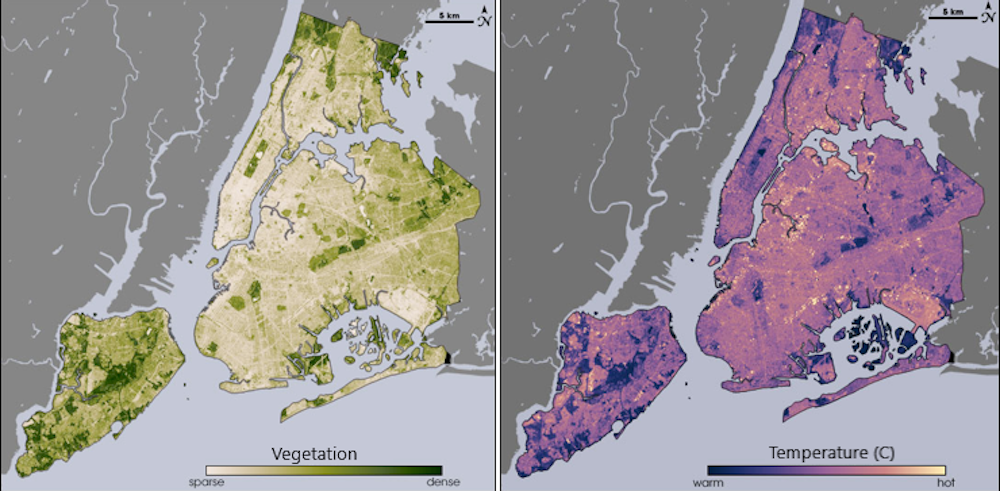
    Comparing maps of New York’s vegetation and temperature shows the cooling effect of parks and neighborhoods with more trees. In the map on the left, lighter colors are areas with fewer trees. Light areas in the map on the right are hotter.
    NASA/USGS Landsat

    But planting trees isn’t always simple.

    In hot, dry cities, trees often require irrigation to survive, which can strain already limited water resources. Trees must survive for decades to grow large enough to provide shade and release enough water vapor to reduce air temperatures.

    Annual maintenance costs – about US$900 per tree per year in Boston – can surpass the initial planting investment.

    Most challenging of all, dense urban neighborhoods where heat is most intense are often too packed with buildings and roads to grow more trees.

    How cool roofs can help on hot days

    Another option is “cool roofs.” Coating rooftops with reflective paint or using light-colored materials allows buildings to reflect more sunlight back into the atmosphere rather than absorbing it as heat.

    These roofs can lower the temperature inside an apartment building without air conditioning by about 2 to 6 F (1 to 3.3 C), and can cut peak cooling demand by as much as 27% in air-conditioned buildings, one study found. They can also provide immediate relief by reducing outdoor temperatures in densely populated areas. The maintenance costs are also lower than expanding urban forests.

    Two workers apply a white coating to the roof of a row home in Philadelphia.
    AP Photo/Matt Rourke

    However, like trees, cool roofs come with limits. Cool roofs work better on flat roofs than sloped roofs with shingles, as flat roofs are often covered by heat-trapping rubber and are exposed to more direct sunlight over the course of an afternoon.

    Cities also have a finite number of rooftops that can be retrofitted. And in cities that already have many light-colored roofs, a few more might help lower cooling costs in those buildings, but they won’t do much more for the neighborhood.

    By weighing the trade-offs of both strategies, cities can design location-specific plans to beat the heat.

    Choosing the right mix of cooling solutions

    Many cities around the world have taken steps to adapt to extreme heat, with tree planting and cool roof programs that implement reflectivity requirements or incentivize cool roof adoption.

    In Detroit, nonprofit organizations have planted more than 166,000 trees since 1989. In Los Angeles, building codes now require new residential roofs to meet specific reflectivity standards.

    In a recent study, we analyzed Boston’s potential to lower heat in vulnerable neighborhoods across the city. The results demonstrate how a balanced, budget-conscious strategy could deliver significant cooling benefits.

    For example, we found that planting trees can cool the air 35% more than installing cool roofs in places where trees can actually be planted.

    However, many of the best places for new trees in Boston aren’t in the neighborhoods that need help. In these neighborhoods, we found that reflective roofs were the better choice.

    By investing less than 1% of the city’s annual operating budget, about US$34 million, in 2,500 new trees and 3,000 cool roofs targeting the most at-risk areas, we found that Boston could reduce heat exposure for nearly 80,000 residents. The results would reduce summertime afternoon air temperatures by over 1 F (0.6 C) in those neighborhoods.

    While that reduction might seem modest, reductions of this magnitude have been found to dramatically reduce heat-related illness and death, increase labor productivity and reduce energy costs associated with building cooling.

    Not every city will benefit from the same mix. Boston’s urban landscape includes many flat, black rooftops that reflect only about 12% of sunlight, making cool roofs that reflect over 65% of sunlight an especially effective intervention. Boston also has a relatively moist growing season that supports a thriving urban tree canopy, making both solutions viable.

    Phoenix, left, already has a lot of light-colored roots, compared with Boston, right, where roofs are mostly dark.
    Imagery © Google 2025.

    In places with fewer flat, dark rooftops suitable for cool roof conversion, tree planting may offer more value. Conversely, in cities with little room left for new trees or where extreme heat and drought limit tree survival, cool roofs may be the better bet.

    Phoenix, for example, already has many light-colored roofs. Trees might be an option there, but they will require irrigation.

    Getting the solutions where people need them

    Adding shade along sidewalks can do double-duty by giving pedestrians a place to get out of the sun and cooling buildings. In New York City, for example, street trees account for an estimated 25% of the entire urban forest.

    Cool roofs can be more difficult for a government to implement because they require working with building owners. That often means cities need to provide incentives. Louisville, Kentucky, for example, offers rebates of up to $2,000 for homeowners who install reflective roofing materials, and up to $5,000 for commercial businesses with flat roofs that use reflective coatings.

    In Boston, planting trees, left, and increasing roof reflectivity, right, were both found to be effective ways to cool urban areas.
    Ian Smith et al. 2025

    Efforts like these can help spread cool roof benefits across densely populated neighborhoods that need cooling help most.

    As climate change drives more frequent and intense urban heat, cities have powerful tools for lowering the temperature. With some attention to what already exists and what’s feasible, they can find the right budget-conscious strategy that will deliver cooling benefits for everyone.

    Lucy Hutyra has received funding from the U.S. federal government and foundations including the World Resources Institute and Burroughs Wellcome Fund for her scholarship on urban climate and mitigation strategies. She was a recipient of a 2023 MacArthur Fellowship for her work in this area.

    Ian Smith does not work for, consult, own shares in or receive funding from any company or organization that would benefit from this article, and has disclosed no relevant affiliations beyond their academic appointment.

    ref. 2 ways cities can beat the heat: Which is best, urban trees or cool roofs? – https://theconversation.com/2-ways-cities-can-beat-the-heat-which-is-best-urban-trees-or-cool-roofs-260188

    MIL OSI

  • MIL-OSI Submissions: How the nature of environmental law is changing in defense of the planet and the climate

    Source: The Conversation – USA (2) – By Dana Zartner, Professor of International Studies, University of San Francisco

    A 2017 New Zealand law recognizes inherent rights of the Whanganui River. Jason Pratt, CC BY-SA

    While the dangerous effects of climate change continue to worsen, legal efforts to address a range of environmental issues are also on the rise.

    Headlines across the globe tout many of these legal actions: South Korea’s Climate Law Violates Rights of Future Generations; Ukraine is Ground Zero in Battle for Ecocide Law; Paris Wants to Grant the River Seine Legal Personhood; and Montana Court Rules Children Have the Right to a Healthy Environment, to name a few recent examples.

    As an environmental lawyer, I see that most of these suits use one of five legal strategies that have been developed over the past couple of decades. These approaches vary in terms of who is filing the lawsuit, against whom, and whether the underlying legal perspective is based on protecting human rights or the rights of the environment itself. But they all share an innovative approach to protect all life on this planet.

    1. Right to a healthy environment

    In 2022, the United Nations declared that humans have “the right to a clean, healthy and sustainable environment … essential to protecting human life, well-being and dignity.” More than 150 countries have similar declarations in their constitutions or laws, often alongside protections for other human rights, such as those to education and medical care.

    These rights are held by humans, so people can sue for alleged violations. Typically they sue one or more government agencies, whose responsibility it is to protect human rights.

    One recent case using this approach was Held v. Montana, in which a group of young people in 2024 won a lawsuit against the state of Montana for violating the state constitution’s right to a “clean and healthful environment.” The state Supreme Court agreed with the plaintiffs and struck down a law barring the consideration of climate effects when evaluating proposals for fossil fuel extraction. Similar cases have been heard in the U.S. and other countries around the world.

    Rikki Held, the lead plaintiff in the Montana case, center seated, confers with the Our Children’s Trust legal team before the start of the trial on June 12, 2023.
    William Campbell/Getty Images

    2. The rights of future generations

    A legal concept called “intergenerational equity” is the idea that present generations must “responsibly use and conserve natural resources for the benefit of future generations.” First codified in international law in the 1972 Stockholm Declaration, the principle has been gaining popularity in recent decades. International organizations and national governments have enshrined this principle in law.

    Focused on humans’ rights, these laws allow people and groups to bring claims, usually against governments, for allowing activities that are altering the environment in ways that will harm future generations. One well-known case that relied on this legal principle is Future Generations v. Ministry of the Environment and Others, in which a Colombian court in 2018 agreed with young people who had sued, finding that the Colombian government’s allowance of “rampant deforestation in the Amazon” violated the pact of intergenerational equity.

    3. Government responsibility

    Another human-centered approach is the public trust doctrine, which establishes “that certain natural and cultural resources are preserved for public use” and that governments have a responsibility to protect them for everyone’s benefit.

    While the concept of “public trust” has long existed in the law, recently it has been used to bring suit against governments for their failure to address climate change and other environmental degradation. In Urgenda Foundation v. the State of the Netherlands, a Dutch court held in 2019 that the government has a responsibility to mitigate the effects of climate change due to the “severity of the consequences of climate change and the great risk of climate change occurring.” Since the decision, the Dutch government has sought to reduce emissions by phasing out the use of coal, increasing reliance on renewable energy and aiming to achieve carbon neutrality by 2050.

    Government responsibility for the public trust was also a basis of the Juliana v. U.S. case, where a group of young people sued the U.S. government for breaching the public trust by not doing enough to curb greenhouse gas emissions. The U.S. Supreme Court ultimately declined to hear an appeal of a lower court’s ruling, but the lack of a specific ruling by the nation’s highest court has given continued hope to new cases, which continue to be filed based on the same principle.

    A documentary examining the movement to protect the rights of nature.

    4. Rights of nature

    The rights of nature is one of the fastest-growing environmental legal strategies of the past decade. Since Ecuador recognized the rights of Pachamama, the Quechua name for Mother Earth, in its Constitution in 2008, more than 500 laws on the rights of nature have been enacted around the world.

    The principle recognizes the legal rights of natural entities, such as rivers, mountains, ecosystems or even something as specific as wild rice. The laws that grant these rights don’t focus on humans but rather nature itself, often including language that the natural entity has the right to “exist and persist.”

    The laws then provide a mechanism for the natural entity – whether through a specific group assigned legal guardianship or other community efforts – to protect itself by filing lawsuits in court. In the 2018 Colombian case, the court found that the Amazon ecosystem has rights, which must be respected and protected.

    Similarly, in Bangladesh in 2019 the courts recognized the rights of all the country’s rivers, requiring, among other things, a halt on damaging development along the rivers that block their natural flow. The court also created a commission to serve as legal guardians of the country’s rivers.

    The destruction of a dam in Ukraine, which emptied this former reservoir, is being investigated as a possible crime of ecocide.
    Tarasov/Ukrinform/Future Publishing via Getty Images

    5. Defining a new crime: Ecocide

    In 2024, the governments of Vanuatu, Fiji and Samoa formally proposed that the international community recognize a new crime under international law. Called “ecocide,” the principle takes a nature-focused approach and includes any unlawful act committed with “the knowledge that there is a substantial likelihood of severe and either widespread or long-term damage to the environment.”

    Put another way, what genocide is to humans, ecocide is to nature. It is being proposed as an addition to the 2002 Rome Statute, which created the International Criminal Court to prosecute war crimes, genocide and crimes against humanity.

    While the idea is relatively new, in addition to the international efforts, several countries have incorporated ecocide into their laws – including Vietnam, France, Chile and Ukraine. A Ukrainian prosecutor is currently investigating the June 2023 destruction of a dam in a Russian-occupied area of the country as a potential crime of ecocide, because of the widespread flooding and habitat destruction that resulted.

    The European Union has also incorporated ecocide into its Environmental Crime Directive, which applies to all EU member countries, providing them with a mechanism to hear ecocide claims in their national courts.

    Using these ideas

    Each of these legal concepts has the potential to increase protection for the environment – and the people who live in it. But determining which strategy has the greatest chance of success depends on the details of the existing law and legal system in each community.

    All of these legal strategies have a role in the fight to protect and preserve the environment as an integral, interdependent living thing that is vitally important to us as humans but also in its own right.

    Dana Zartner is a volunteer with the Earth Law Center assisting with the editing of toolkits and guides, but has not worked on any of its lawsuits.

    ref. How the nature of environmental law is changing in defense of the planet and the climate – https://theconversation.com/how-the-nature-of-environmental-law-is-changing-in-defense-of-the-planet-and-the-climate-258982

    MIL OSI

  • MIL-OSI Submissions: Trump has fired the head of the Library of Congress, but the 225-year-old institution remains a ‘library for all’ – so far

    Source: The Conversation – USA – By Alex H. Poole, Associate Professor of Information Science, Drexel University

    The main reading room is seen at the Library of Congress on June 13, 2025, in Washington. Kevin Carter/Getty Images

    Carla Hayden, the 14th librarian of Congress, who has held the position since 2016, received an unexpected email on May 8, 2025.

    “Carla, on behalf of President Donald J. Trump, I am writing to inform you that your position as the Librarian of Congress is terminated effective immediately. Thank you for your service,” wrote Trent Morse, deputy director of presidential personnel at the White House.

    White House Press Secretary Karoline Leavitt later explained that Hayden, who was the first woman, Black person and professionally trained librarian to oversee the Library of Congress, had done “quite concerning things,” on the job, including “putting inappropriate books in the library for children.”

    Democratic politicians sharply criticized Hayden’s termination, saying the firing was unjust. It was actually about Trump punishing civil servants “who don’t bend to his every will,” New York Sen. Chuck Schumer said.

    An information science scholar, I have written extensively about the history of libraries and archives, including the Library of Congress. To fully understand the role Hayden played for the past nine years, I think it is important to understand what the Library of Congress does, and the overlooked and underappreciated role it has played in American life.

    Carla Hayden, the recently fired librarian of Congress, attends an event in March 2025 in Washington.
    Shannon Finney/Getty Images

    The Library of Congress’ work

    The Library of Congress is an agency that was first established, by an act of Congress, in 1800. The act provided for “the purchase of such books as may be necessary for the use of Congress at the said city of Washington, and for fitting up a suitable apartment for containing them.” Its chief librarian is appointed by the president and confirmed by the Senate.

    The library has six buildings in Washington that hold a print and online collection of nearly 26 million books, as well as more than 136 million other items, including manuscripts, maps, sheet music and prints and photographs.

    It also houses historic documents, like Thomas Jefferson’s rough draft of the Declaration of Independence and James Madison’s notes on the 1787 Constitutional Convention.

    The library is the property of the American people. Anyone over the age of 16 with a government-issued photo identification can enter its buildings and read or view its materials on-site. The Library of Congress was partially designed as a research institution to suit the needs of members of Congress, and only Congress members can borrow items from the library and take them home.

    The Library of Congress has an annual budget of about US$900 million, with a staff of 3,263. In 2024, the library’s staff helped acquire 1,437,832 million new items, issue nearly 69,000 library cards and answer more than 764,000 reference requests, among other tasks.

    The library’s deep roots

    The library has evolved alongside the U.S. itself. Five years before the Constitutional Convention of 1787, future president James Madison called for a library to provide materials to help inform Congress and its members. In 1800, President John Adams signed a bill that established the institution, which began with a $5,000 government appropriation, equivalent to more than $127,000 today.

    The library’s first collection included 152 works in 740 volumes imported from England. It occupied a space in a Washington Senate office that measured just 22 feet by 34 feet.

    The British army torched the infant library and its collection that had grown to 3,000 books in 1814, during the War of 1812. In response, former president Thomas Jefferson sold his personal collection of 6,479 books to the library, which he called “unquestionably the choicest collection of books in the U.S.

    Tragedy struck again in 1851, with a fire that incinerated two-thirds of the library’s 55,000 volumes, including most of Jefferson’s personal collection.

    The organization rebounded in the next few years, as it purchased the 40,000-volume Smithsonian library in 1866, among other new acquisitions.

    Ainsworth Spofford, the sixth librarian of Congress, boosted the library’s national image in the late 1800s when he tried to centralize the country’s patchwork copyright system.

    Spofford also successfully lobbied Congress to pass the Copyright Act of 1870, which stipulated that any party registering a work for copyright needed to deposit two copies of that work with the library.

    A growing place in American life

    As its collections burgeoned in both scale and scope in the latter part of the 19th century, the library assumed an increasingly visible role and became known by some as “the nation’s library.” By 1900, it had nearly 1 million printed books and other materials.

    The opening of a new library building in 1897, offering services to blind people with a designated reading room containing 500 raised character – or braille – books and music items, epitomized the library’s new status.

    President Theodore Roosevelt said in 1901 that the library was “the one national library of the United States” and that was “a unique opportunity to render to the libraries of this country – to American scholarship – service of the highest importance.”

    The library’s work, and global approach, continued to grow during the 20th century.

    By the late 1900s, the library held materials in more than 450 languages.

    It continued to add remarkable items to its collection, including a Gutenberg Bible, the first book printed in Europe from movable metal type, a kind of printing technology, in 1455.

    Documenting the evolution of democracy, the library also assumed stewardship of 23 presidents’ official papers, from George Washington to Calvin Coolidge, during this time frame.

    A public service

    While primarily designated a research institution for Congress, the library has also catered to a diverse range of patrons, including by mail and telephone.

    As one Science Digest writer noted in 1960, reference staff members fielded questions ranging from “What was the color of a mastodon’s eye?” to “How many words are there in the English language?” and “Could you suggest a name for twins?”

    The library’s register of copyrights received similarly diverse and even humorous inquiries. One older woman seeking to publish her poetry wrote in 1954 to request “a poetic license” to ensure her work conformed to the law.

    In the late 20th century, the library focused on a new democratic national and international mission, as it embraced a new role. Daniel Boorstin, the librarian from 1975 to 1987, termed that role a “multimedia encyclopedia.”

    A congressional resolution marking the Library of Congress’s bicentennial in 2000 noted that it was “the largest and most inclusive library in human history,” as it digitized its collections to extend its reach still further with the growth of the internet.

    As the library marks its 225th year, it continues to represent, as David Mearns, chief of the library’s manuscript division, said in 1947, “the American story.”

    The Thomas Jefferson Building of the Library of Congress is seen on June 11, 2025, in Washington.
    Kevin Carter/Getty Images

    A library for all

    Following Hayden’s dismissal, Trump appointed Deputy Attorney General Todd Blanche, his former personal lawyer, as acting librarian of Congress.

    Hayden has contended that her dismissal, which occurred alongside other firings of top civil servants, including the national archivist, represents a broad threat to people’s right to easily access free information.

    Democracies are not to be taken for granted,” Hayden said in June. She explained in an interview with CBS that she never had a problem with a presidential administration and is not sure why she was dismissed.

    “And the institutions that support democracy should not be taken for granted,” Hayden added.

    In her final annual report as librarian, Hayden characterized the institution as “truly, a library for all.” So far, even without her leadership, it remains just that.

    Alex H. Poole does not work for, consult, own shares in or receive funding from any company or organization that would benefit from this article, and has disclosed no relevant affiliations beyond their academic appointment.

    ref. Trump has fired the head of the Library of Congress, but the 225-year-old institution remains a ‘library for all’ – so far – https://theconversation.com/trump-has-fired-the-head-of-the-library-of-congress-but-the-225-year-old-institution-remains-a-library-for-all-so-far-257508

    MIL OSI

  • MIL-OSI United Kingdom: Scottish Greens propose holiday homes tax to protect Gaelic language

    Source: Scottish Greens

    Holiday homes are increasing house prices out and hollowing out communities

    The Scottish Greens have unveiled new plans to protect Gaelic-speaking communities by increasing taxes on holiday homes and Airbnb-style short term lets. The move is designed to tackle the acute housing crisis in Gaelic communities and to support young people who want to stay in the areas they have grown up in.

    The party’s finance spokesperson, Ross Greer MSP, intends to force a vote on the proposals when Holyrood considers amendments to the Housing Bill in the autumn. His amendments would allow ministers to levy a special surcharge on those buying holiday homes or other additional properties in areas with high numbers of Gaelic speakers, such as Skye and the Outer Hebrides.

    Average house prices in Skye are £60,000 higher than the national average and one local councillor recently estimated that almost 60% of local properties were either holiday homes or short term lets. This is forcing many young people off the island and putting Gaelic’s survival as a community language at risk. Lack of available housing is commonly cited as a key reason why Gaelic is now on the edge of extinction in its historic communities.

    Greer’s proposals follow the Scottish Parliament recently passing the Scottish Languages Act, which allows for communities where Gaelic is widely spoken to be designated as “Areas of Linguistic Significance”. The additional charge on holiday homes purchases the Scottish Green MSP has put forward would apply in the areas with this designation.

    Ross Greer said:

    “Gaelic is an essential part of Scottish culture and national identity, but it is on the verge of extinction as a living language. We need to take bold action immediately, or the decline will be impossible to reverse. The Languages Act is a good starting point, but we know that one of the biggest threats to the language is the housing crisis in areas like Skye.

    “Young Gaelic speakers are being forced out of the last communities where it is still the spoken language because holiday homes and Airbnb-style short term lets have driven up house prices to levels they cannot hope to compete with. As a result, they are forced to move to areas where they cannot use Gaelic in their everyday interactions. This is one of the biggest threats to Gaelic’s continued existence. 

    “My proposals would make it harder for wealthier people to buy up second homes and short-term lets in Gaelic-speaking communities and in turn make it easier for locals, especially first-time buyers, to secure their own home.

    “Changes to Council Tax already delivered by Scottish Green MSPs reduced the number of second and holiday homes across Scotland by 2,500 last year, freeing up more properties for people who need a home to live in. We can build on this success with further targeted actions and ensure that our Gaelic-speaking communities can thrive rather than be treated purely as holiday parks for tourists and the super-rich.”

    MIL OSI United Kingdom

  • MIL-OSI Africa: Agricultural cooperatives in Senegal: Driving the sector’s modernization

    Source: APO


    .

    With an agricultural sector that employs more than 909,000 households, according to ANSD, organizing Senegal’s producers into well-equipped, operational cooperatives is a key lever for achieving the goals of the Senegal Vision 2050.

    The West Africa Competitiveness Programme in Senegal (PACAO-Senegal) serves as a relevant model as it supported the creation or compliance of 29 cooperative societies as well as strengthened their managerial and organizational capacities. Together, these cooperatives bring together over 545 producer organizations active in the mango and onion value chains. 

    Among these 29 cooperatives, the Cooperative Society for Support to Production, Processing, and Marketing (SCAPTC) of Pout (Thiès) perfectly illustrates the impact of this support.

    Created in 2021, the Cooperative SCAPTC covers four municipalities in the Thiès region (Pout, Diander, Keur Moussa, and Moroland) and brings together almost 2,940 members, including 20 producer organizations and over 20 individuals. Specializing in onion production, the cooperative was born from an urgent need to structure and professionalize producers who previously worked in a scattered manner, without coordination or appropriate management tools.

    Doudou Diop, President of the Board of Directors of the SCAPTC, recalls the difficult beginnings: “Before our cooperative society was born, our groups were not even structured. We didn’t have statutes or internal regulations. We each worked on our own, without a common strategy.”

    With support from PACAO-Senegal, SCAPTC benefited from training in financial management, leadership, conflict resolution, and strategic planning, which enabled its members to transform an informal structure into a high-performing, sustainable organization.

    Mamadou Lèye, a doctoral student in applied physics at Cheikh Anta Diop University committed to agriculture, combines his studies with farm work and serves as the Secretary General of SCAPTC. He says: “We learned to manage our cooperative like a business. We now organize our meetings efficiently, manage our finances rigorously, and resolve internal conflicts constructively. All these skills, acquired through PACAO-Senegal’s support, are key to our success.”

    Today, SCAPTC is cited as an example in the region for its rigorous management and effective organization. “Other cooperatives and even the supervising ministry send experts to study our model and draw inspiration from it,” adds Mamadou Lèye proudly.

    Amy Ndiaye, hired by PACAO-Senegal as a community development officer, confirms this transformation: “Meetings are held regularly, the General Assembly is organized every year, and members have become autonomous in managing their activities. SCAPTC has become a benchmark model in the region.”

    The members of SCAPTC have improved their yields and incomes. “Today, we have full control of our activity from A to Z, from production to marketing. It has changed our lives,” says Doudou Diop.

    From informal to a benchmark model, SCAPTC illustrates the transformative potential of cooperative societies. Thanks to targeted support, they become frameworks for structuring, formalizing, and strengthening agricultural value chains, thereby contributing to achieving the goals of Senegal Vision 2050.

    Distributed by APO Group on behalf of International Trade Centre.

    MIL OSI Africa

  • MIL-OSI United Kingdom: Inspection report published: An inspection of the Home Office’s use of age assessments (July 2024 – February 2025)

    Source: United Kingdom – Executive Government & Departments

    News story

    Inspection report published: An inspection of the Home Office’s use of age assessments (July 2024 – February 2025)

    The Independent Chief Inspector, David Bolt CBE, comments on the inspection report on the Home Office’s use of age assessments, and the Home Office’s response, following its publication yesterday.

    My report on the Home Office use of age assessments was published yesterday (22 July 2025). The report was sent to the Home Secretary on 20 May 2025, so publication fell just outside the agreed 8-week target timescale. I made eight recommendations designed to improve training, guidance, assurance, resources and communication and I am pleased that all were accepted.  

    When a young person claims asylum in the UK, the Home Office must determine whether they will be treated as an adult or as a child while their claim is being processed. The focus is on chronological age, reflecting the fact that immigration and other relevant legislation is framed around 18 years as the bright line between childhood and adulthood. However, the binary nature of the determination and the absence of a foolproof ‘test’ of chronological age mean that the Home Office will sometimes get it wrong. This is clearly a cause for concern, especially where a child is denied the rights and protections to which they are entitled.

    This inspection examined initial age decisions based on appearance and demeanour made by the Home Office when first encountering young people who claim asylum, in particular those arriving by small boat. It also examined subsequent age assessments, including those conducted by the National Age Assessment Board (NAAB), which sits within the Home Office and since 2023 has been assisting local authorities by conducting Merton-compliant age assessments on their behalf.

    Inspectors set out to understand how far the Home Office went to ensure that its assessments were sufficiently mindful of the difficulty of getting it right and of the consequences of getting it wrong. Inspectors looked for evidence that processes were methodical, fairly and consistently applied, and child-sensitive; that decisions were balanced and reasonable; and that those involved were open to learning from others and from their mistakes.

    Inspectors found that many of the long-standing concerns about policy and practice, especially in respect of initial age decisions, remain unanswered, and for small boat arrivals some of these concerns had increased. Yet there was a surprising lack of curiosity about decisions that were subsequently disputed and overturned, and a prevailing view that there was no learning to take from these later assessments as the processes were too dissimilar.

    For those disputing their initial age decision, the greater reliance on qualified social workers, whether employed by local authorities or by the NAAB, the recognised Merton ‘standard’, and the fact that there is more time to probe and reflect, made for a more careful and thorough process, though still not guaranteed to get it right. Here there was a need to improve information sharing (with local authorities regarding age disputed individuals dispersed to their area) and capacity (especially of the NAAB to meet the demand it had generated for its services), along with record-keeping, data and quality assurance. 

    Previous inspections have raised concerns about the Home Office’s ability to identify vulnerable adults and respond effectively. In focusing on determining chronological age the Home Office needs to take care that it is not deflected from making a more holistic assessment of individual needs, since a young person who is assessed correctly to be over 18 may nonetheless be vulnerable and at risk if placed with other adults. 

    Underlying my eight recommendations the overall message is that the Home Office should look to work more closely and collaboratively with external stakeholders, including local authorities in England and Wales and their equivalents in Scotland and Northern Ireland, Strategic Migration Partnerships, Non-Governmental Organisations, and should involve others (interpreters, social workers, experts and practitioners in supporting and providing services for children and young people) as much as possible in designing and delivering its processes.

    Home Office policies and practice in relation to age assessments will always be hotly contested, not least because of what is at stake. But a more open and inclusive approach will make it easier for the Home Office and its critics to maintain a constructive dialogue about how to ensure that the best interests of children are served. Committing to better communication, engagement and collaboration would be a start.

    Yesterday, the government also issued a written ministerial statement regarding the use of scientific methods to help determine age. As no scientific methods are currently in use, this was out of scope for this inspection. However, the ICIBI will no doubt wish to return to age assessments at some point to follow up on its recommendations, and this will also be an opportunity to inspect any new methods that are in use at that time.

    David Bolt CBE, Independent Chief Inspector of Borders and Immigration

    23 July 2025

    Updates to this page

    Published 23 July 2025

    MIL OSI United Kingdom

  • ECI begins process to elect new Vice-President after Dhankhar’s resignation

    Source: Government of India

    Source: Government of India (4)

    The Election Commission of India (ECI) on Wednesday announced that it had initiated the process to conduct elections for the office of the Vice-President of India, two days after Jagdeep Dhankhar resigned from the post citing health reasons.

    In an official statement, the Commission said, “The Election Commission of India, under Article 324, is mandated to conduct the election to the office of the Vice President of India. The election to the office of the Vice President of India is governed by The Presidential and Vice-Presidential Elections Act, 1952 and the rules made thereunder, namely The Presidential and Vice-Presidential Elections Rules, 1974,”

    Under Article 66(1) of the Constitution, the Vice-President is elected by an electoral college comprising members of both the Lok Sabha and the Rajya Sabha, using the system of proportional representation by means of a single transferable vote, with voting conducted by secret ballot.

    The Commission added that it had already started the process of constituting the electoral college and was finalising the appointment of returning officers. The official election schedule would be announced after the completion of these preparatory steps.

    Dhankhar’s tenure was originally set to end on August 10, 2027.

  • MIL-OSI Security: District Man Sentenced to 11.5 Years in Scheme to Steal Residential Real Estate Using Fraudulent Deeds

    Source: US FBI

               WASHINGTON – Jeffrey M. Young-Bey, 68, of the District of Columbia, was sentenced today to 138 months in prison for his role a scheme that stole residential real estate property in order to generate more than $850,000 in fraudulent loans, announced U.S. Attorney Jeanine Ferris Pirro.

               Young-Bey was found guilty by a jury on Feb.12, 2024, on 12 federal charges: one count of conspiracy to commit mail fraud and bank fraud, two counts of bank fraud, two counts of mail fraud, two counts of money laundering, and five counts of aggravated identity theft. In addition to the  term of incarceration, U.S. District Judge Colleen Kollar-Kotelly ordered five years of supervised release.

               Joining in the announcement was FBI Assistant Director in Charge Steven J. Jensen of the Washington Field Office, which led the investigation. 

               According to the government’s evidence, beginning in November 2019, Young-Bey conspired to steal a residential townhome located in LeDroit Park in order to obtain mortgage financing against the stolen property. 

               Young-Bey identified a target property owned free and clear by an elderly homeowner. He then prepared a fraudulent property deed, including forged signatures of the true owners and used a fake notary stamp to make the deed appear legitimate.

               Young-Bey filed the deed with the District of Columbia Recorder of Deeds, transferring the title from the true owners to a corporate entity. Young-Bey passed a check to the D.C. Recorder of Deeds to pay for the transfer taxes but put a stop payment order on the check before the D.C. government could cash the check. After causing the fake deed to be recorded with the D.C. Recorder of Deeds, he falsely told a mortgage services business that another individual had inherited the property and wanted to take a large loan against the value of the home.

               Young-Bey created a fake rental lease and deceived the mortgage company into loaning one of his associates approximately $360,000 against the value of the home they did not own, which was split evenly between the two. Young-Bey used his half of the proceeds to buy a BMW 3-Series valued at approximately $23,000. 

               After succeeding on the first scam, Young-Bey executed a second fraudulent scheme on a Shephard Park property in the District, forging the names of the two owners, using the fake notary stamp, and recording the deed at the D.C. Recorder of Deeds Office. Young-Bey again put a stop payment order on the transfer tax check before it could be cashed. Young-Bey used the recorded deed to obtain a construction loan of more than $500,000 against the value of the house.  Young-Bey took a portion of the loan and purchased a BMW 7-Series worth approximately $120,000. He promptly sold the home to a legitimate real estate company for an additional $42,000 in profit. The fraud was discovered when the real estate company began performing renovations on the home and the rightful owners were alerted to the construction and demolition by their neighbors. 

               This case was investigated by the FBI’s Washington Field Office with assistance from the Metropolitan Police Department. It was prosecuted by Assistant U.S. Attorneys Christopher R. Howland and Kevin L. Rosenberg of the Fraud, Public Corruption, and Civil Rights Section with the assistance of Paralegal Specialist Gina Torres. Valuable assistance was provided by Assistant U.S. Attorney Joshua S. Rothstein, who investigated and indicted the case, as well as former Assistant U.S. Attorney Virginia Cheatham, former Special Assistant U.S. Attorney Viviana Vasiu, and Paralegal Specialist Lisa Abbe, each of whom assisted in investigating the case. The prosecution team was also assisted by Tonya Jones from the Victim Witness Assistance Unit and Assistant U.S. Attorney Daniel Lenerz from the Appellate Section.

    21cr661

    MIL Security OSI

  • MIL-OSI: YieldMax® ETFs Announces Distributions on HOOY, CONY, ULTY, AMDY, YMAG, and Others

    Source: GlobeNewswire (MIL-OSI)

    CHICAGO and MILWAUKEE and NEW YORK, July 23, 2025 (GLOBE NEWSWIRE) — YieldMax® today announced distributions for the YieldMax® Weekly Payers and Group C ETFs listed in the table below.

    ETF
    Ticker
    1
    ETF Name Distribution
    Frequency
    Distribution
    per Share
    Distribution
    Rate
    2,4
    30-Day
    SEC Yield3
    ROC5 Ex-Date &
    Record
    Date
    Payment
    Date
    CHPY YieldMax® Semiconductor Portfolio Option Income ETF Weekly $0.3723 35.54% 0.04% 100.00% 7/24/25 7/25/25
    GPTY YieldMax® AI & Tech Portfolio Option Income ETF Weekly $0.3219 35.36% 0.00% 100.00% 7/24/25 7/25/25
    LFGY YieldMax® Crypto Industry & Tech Portfolio Option Income ETF Weekly $0.4876 62.94% 0.00% 100.00% 7/24/25 7/25/25
    QDTY YieldMax® Nasdaq 100 0DTE Covered Call ETF Weekly $0.1944 22.64% 0.00% 86.12% 7/24/25 7/25/25
    RDTY YieldMax® R2000 0DTE Covered Call ETF Weekly $0.3901 44.01% 1.65% 100.00% 7/24/25 7/25/25
    SDTY YieldMax® S&P 500 0DTE Covered Call ETF Weekly $0.1607 18.44% 0.07% 42.60% 7/24/25 7/25/25
    ULTY YieldMax® Ultra Option Income Strategy ETF Weekly $0.1029 85.29% 0.00% 100.00% 7/24/25 7/25/25
    YMAG YieldMax® Magnificent 7 Fund of Option Income ETFs Weekly $0.2033 68.60% 63.17% 42.42% 7/24/25 7/25/25
    YMAX YieldMax® Universe Fund of Option Income ETFs Weekly $0.1838 68.48% 82.40% 6.23% 7/24/25 7/25/25
    ABNY YieldMax® ABNB Option Income Strategy ETF Every 4
    weeks
    $0.3748 40.32% 2.85% 0.00% 7/24/25 7/25/25
    AMDY YieldMax® AMD Option Income Strategy ETF Every 4
    weeks
    $0.5656 85.13% 2.82% 0.00% 7/24/25 7/25/25
    CONY YieldMax® COIN Option Income Strategy ETF Every 4
    weeks
    $0.7951 103.37% 2.93% 0.00% 7/24/25 7/25/25
    CVNY YieldMax® CVNA Option Income Strategy ETF Every 4
    weeks
    $2.0473 61.43% 2.71% 97.34% 7/24/25 7/25/25
    DRAY* YieldMax® DKNG Option Income Strategy ETF Every 4
    weeks
     
    FIAT YieldMax® Short COIN Option Income Strategy ETF Every 4
    weeks
    $0.1381 60.28% 4.73% 93.10% 7/24/25 7/25/25
    HOOY YieldMax® HOOD Option Income Strategy ETF Every 4
    weeks
    $6.8981 121.23% 1.43% 100.00% 7/24/25 7/25/25
    MSFO YieldMax® MSFT Option Income Strategy ETF Every 4
    weeks
    $0.4139 29.80% 2.97% 0.00% 7/24/25 7/25/25
    NFLY YieldMax® NFLX Option Income Strategy ETF Every 4
    weeks
    $0.4350 32.40% 2.80% 0.00% 7/24/25 7/25/25
    PYPY YieldMax® PYPL Option Income Strategy ETF Every 4
    weeks
    $0.2731 27.61% 3.48% 0.00% 7/24/25 7/25/25
    Weekly Payers & Group D ETFs scheduled for next week: CHPY GPTY LFGY QDTY RDTY SDTY ULTY YMAG YMAX AIYY AMZY APLY DISO MSTY SMCY WNTR XYZY YQQQ


    Standardized Performance and Fund details can be obtained by clicking the ETF Ticker in the table above or by visiting us at
    www.yieldmaxetfs.com

    Performance data quoted represents past performance and is no guarantee of future results. Investment return and principal value of an investment will fluctuate so that an investor’s shares, when sold or redeemed, may be worth more or less than their original cost and current performance may be lower or higher than the performance quoted above. Performance current to the most recent month-end can be obtained by calling (866) 864 3968.

    Note: DIPS, FIAT, CRSH, YQQQ and WNTR are hereinafter referred to as the “Short ETFs.”

    Distributions are not guaranteed. The Distribution Rate and 30-Day SEC Yield are not indicative of future distributions, if any, on the ETFs. In particular, future distributions on any ETF may differ significantly from its Distribution Rate or 30-Day SEC Yield. You are not guaranteed a distribution under the ETFs. Distributions for the ETFs (if any) are variable and may vary significantly from period to period and may be zero. Accordingly, the Distribution Rate and 30-Day SEC Yield will change over time, and such change may be significant.

    Investors in the Funds will not have rights to receive dividends or other distributions with respect to the underlying reference asset(s).

    *The inception date for DRAY is July 14, 2025

    1All YieldMax® ETFs shown in the table above (except YMAX, YMAG, FEAT, FIVY and ULTY) have a gross expense ratio of 0.99%. YMAX, FEAT have a Management Fee of 0.29% and Acquired Fund Fees and Expenses of 0.99% for a gross expense ratio of 1.28%. YMAG has a management fee of 0.29% and Acquired Fund Fees and Expenses of 0.83% for a gross expense ratio of 1.12%. FIVY has a Management Fee of 0.29% and Acquired Fund Fees and Expenses of 0.59% for a gross expense ratio of 0.88%. “Acquired Fund Fees and Expenses” are indirect fees and expenses that the Fund incurs from investing in the shares of other investment companies, namely other YieldMax® ETFs. ULTY has a gross expense ratio of 1.40%, and a net expense ratio after the fee waiver of 1.30%. The Advisor has agreed to a fee waiver of 0.10% through at least February 28, 2026.

    2The Distribution Rate shown is as of close on July 22, 2025. The Distribution Rate is the annual distribution rate an investor would receive if the most recent distribution, which includes option income, remained the same going forward. The Distribution Rate is calculated by annualizing an ETF’s Distribution per Share and dividing such annualized amount by the ETF’s most recent NAV. The Distribution Rate represents a single distribution from the ETF and does not represent its total return. Distributions may also include a combination of ordinary dividends, capital gain, and return of investor capital, which may decrease an ETF’s NAV and trading price over time. As a result, an investor may suffer significant losses to their investment. These Distribution Rates may be caused by unusually favorable market conditions and may not be sustainable. Such conditions may not continue to exist and there should be no expectation that this performance may be repeated in the future.

    3 The 30-Day SEC Yield represents net investment income, which excludes option income, earned by such ETF over the 30-Day period ended June 30, 2025, expressed as an annual percentage rate based on such ETF’s share price at the end of the 30-Day period.

    4 Each ETF’s strategy (except those of the Short ETFs) will cap potential gains if its reference asset’s shares increase in value, yet subjects an investor to all potential losses if the reference asset’s shares decrease in value. Such potential losses may not be offset by income received by the ETF. Each Short ETF’s strategy will cap potential gains if its reference asset decreases in value, yet subjects an investor to all potential losses if the reference asset increases in value. Such potential losses may not be offset by income received by the ETF.

    5ROC refers to Return of Capital. The ROC percentage indicates how much the distribution reflects an investor’s initial investment. The figures shown for each Fund in the table above are estimates and may later be determined to be taxable net investment income, short-term gains, long-term gains (to the extent permitted by law), or return of capital. Actual amounts and sources for tax reporting will depend upon the Fund’s investment activities during the remainder of the fiscal year and may be subject to changes based on tax regulations. Your broker will send you a Form 1099-DIV for the calendar year to tell you how to report these distributions for federal income tax purposes.

    Each Fund has a limited operating history and while each Fund’s objective is to provide current income, there is no guarantee the Fund will make a distribution. Distributions are likely to vary greatly in amount.

    Important Information

    This material must be preceded or accompanied by the prospectus. For all prospectuses, click here.

    Tidal Financial Group is the adviser for all YieldMax® ETFs.

    THE FUND, TRUST, AND ADVISER ARE NOT AFFILIATED WITH ANY UNDERLYING REFERENCE ASSET.

    Risk Disclosures (applicable to all YieldMax ETFs referenced above, except the Short ETFs)

    YMAX, YMAG, FEAT and FIVY generally invest in other YieldMax® ETFs. As such, these Funds are subject to the risks listed in this section, which apply to all the YieldMax® ETFs they may hold from time to time.

    Investing involves risk. Principal loss is possible.

    Referenced Index Risk. The Fund invests in options contracts that are based on the value of the Index (or the Index ETFs). This subjects the Fund to certain of the same risks as if it owned shares of companies that comprised the Index or an ETF that tracks the Index, even though it does not.

    Indirect Investment Risk. The Index is not affiliated with the Trust, the Fund, the Adviser, or their respective affiliates and is not involved with this offering in any way. Investors in the Fund will not have the right to receive dividends or other distributions or any other rights with respect to the companies that comprise the Index but will be subject to declines in the performance of the Index.

    Russell 2000 Index Risks. The Index, which consists of small-cap U.S. companies, is particularly susceptible to economic changes, as these firms often have less financial resilience than larger companies. Market volatility can disproportionately affect these smaller businesses, leading to significant price swings. Additionally, these companies are often more exposed to specific industry risks and have less diverse revenue streams. They can also be more vulnerable to changes in domestic regulatory or policy environments.

    Call Writing Strategy Risk. The path dependency (i.e., the continued use) of the Fund’s call writing strategy will impact the extent that the Fund participates in the positive price returns of the underlying reference asset and, in turn, the Fund’s returns, both during the term of the sold call options and over longer periods.

    Counterparty Risk. The Fund is subject to counterparty risk by virtue of its investments in options contracts. Transactions in some types of derivatives, including options, are required to be centrally cleared (“cleared derivatives”). In a transaction involving cleared derivatives, the Fund’s counterparty is a clearing house rather than a bank or broker. Since the Fund is not a member of clearing houses and only members of a clearing house (“clearing members”) can participate directly in the clearing house, the Fund will hold cleared derivatives through accounts at clearing members.

    Derivatives Risk. Derivatives are financial instruments that derive value from the underlying reference asset or assets, such as stocks, bonds, or funds (including ETFs), interest rates or indexes. The Fund’s investments in derivatives may pose risks in addition to, and greater than, those associated with directly investing in securities or other ordinary investments, including risk related to the market, imperfect correlation with underlying investments or the Fund’s other portfolio holdings, higher price volatility, lack of availability, counterparty risk, liquidity, valuation and legal restrictions.

    Options Contracts. The use of options contracts involves investment strategies and risks different from those associated with ordinary portfolio securities transactions. The prices of options are volatile and are influenced by, among other things, actual and anticipated changes in the value of the underlying instrument, including the anticipated volatility, which are affected by fiscal and monetary policies and by national and international political, changes in the actual or implied volatility or the reference asset, the time remaining until the expiration of the option contract and economic events.

    Distribution Risk. As part of the Fund’s investment objective, the Fund seeks to provide current income. There is no assurance that the Fund will make a distribution in any given period. If the Fund does make distributions, the amounts of such distributions will likely vary greatly from one distribution to the next.

    High Portfolio Turnover Risk. The Fund may actively and frequently trade all or a significant portion of the Fund’s holdings. A high portfolio turnover rate increases transaction costs, which may increase the Fund’s expenses.

    Liquidity Risk. Some securities held by the Fund, including options contracts, may be difficult to sell or be illiquid, particularly during times of market turmoil.

    Non-Diversification Risk. Because the Fund is “non-diversified,” it may invest a greater percentage of its assets in the securities of a single issuer or a smaller number of issuers than if it was a diversified fund.

    New Fund Risk. The Fund is a recently organized management investment company with no operating history. As a result, prospective investors do not have a track record or history on which to base their investment decisions.

    Price Participation Risk. The Fund employs an investment strategy that includes the sale of call option contracts, which limits the degree to which the Fund will participate in increases in value experienced by the underlying reference asset over the Call Period.

    Single Issuer Risk. Issuer-specific attributes may cause an investment in the Fund to be more volatile than a traditional pooled investment which diversifies risk or the market generally. The value of the Fund, which focuses on an individual security (ARKK, TSLA, AAPL, NVDA, AMZN, META, GOOGL, NFLX, COIN, MSFT, DIS, XOM, JPM, AMD, PYPL, SQ, MRNA, AI, MSTR, Bitcoin ETP, GDX®, SNOW, ABNB, BABA, TSM, SMCI, PLTR, MARA, CVNA, HOOD, BRK.B, DKNG), may be more volatile than a traditional pooled investment or the market as a whole and may perform differently from the value of a traditional pooled investment or the market as a whole.

    Inflation Risk. Inflation risk is the risk that the value of assets or income from investments will be less in the future as inflation decreases the value of money. As inflation increases, the present value of the Fund’s assets and distributions, if any, may decline.

    Indirect Investment Risk. The Index is not affiliated with the Trust, the Fund, the Adviser, or their respective affiliates and is not involved with this offering in any way.

    Risk Disclosures (applicable only to GPTY)

    Artificial Intelligence Risk. Issuers engaged in artificial intelligence typically have high research and capital expenditures and, as a result, their profitability can vary widely, if they are profitable at all. The space in which they are engaged is highly competitive and issuers’ products and services may become obsolete very quickly. These companies are heavily dependent on intellectual property rights and may be adversely affected by loss or impairment of those rights. The issuers are also subject to legal, regulatory, and political changes that may have a large impact on their profitability. A failure in an issuer’s product or even questions about the safety of the product could be devastating to the issuer, especially if it is the marquee product of the issuer. It can be difficult to accurately capture what qualifies as an artificial intelligence company.

    Technology Sector Risk. The Fund will invest substantially in companies in the information technology sector, and therefore the performance of the Fund could be negatively impacted by events affecting this sector. Market or economic factors impacting technology companies and companies that rely heavily on technological advances could have a significant effect on the value of the Fund’s investments. The value of stocks of information technology companies and companies that rely heavily on technology is particularly vulnerable to rapid changes in technology product cycles, rapid product obsolescence, government regulation and competition, both domestically and internationally, including competition from foreign competitors with lower production costs. Stocks of information technology companies and companies that rely heavily on technology, especially those of smaller, less-seasoned companies, tend to be more volatile than the overall market. Information technology companies are heavily dependent on patent and intellectual property rights, the loss or impairment of which may adversely affect profitability.

    Risk Disclosure (applicable only to MARO)

    Digital Assets Risk: The Fund does not invest directly in Bitcoin or any other digital assets. The Fund does not invest directly in derivatives that track the performance of Bitcoin or any other digital assets. The Fund does not invest in or seek direct exposure to the current “spot” or cash price of Bitcoin. Investors seeking direct exposure to the price of Bitcoin should consider an investment other than the Fund. Digital assets like Bitcoin, designed as mediums of exchange, are still an emerging asset class. They operate independently of any central authority or government backing and are subject to regulatory changes and extreme price volatility.

    Risk Disclosures (applicable only to BABO and TSMY)

    Currency Risk: Indirect exposure to foreign currencies subjects the Fund to the risk that currencies will decline in value relative to the U.S. dollar. Currency rates in foreign countries may fluctuate significantly over short periods of time for a number of reasons, including changes in interest rates and the imposition of currency controls or other political developments in the U.S. or abroad.

    Depositary Receipts Risk: The securities underlying BABO and TSMY are American Depositary Receipts (“ADRs”). Investment in ADRs may be less liquid than the underlying shares in their primary trading market.

    Foreign Market and Trading Risk: The trading markets for many foreign securities are not as active as U.S. markets and may have less governmental regulation and oversight.

    Foreign Securities Risk: Investments in securities of non-U.S. issuers involve certain risks that may not be present with investments in securities of U.S. issuers, such as risk of loss due to foreign currency fluctuations or to political or economic instability, as well as varying regulatory requirements applicable to investments in non-U.S. issuers. There may be less information publicly available about a non-U.S. issuer than a U.S. issuer. Non-U.S. issuers may also be subject to different regulatory, accounting, auditing, financial reporting, and investor protection standards than U.S. issuers.

    Risk Disclosures (applicable only to GDXY)

    Risk of Investing in Foreign Securities. The Fund is exposed indirectly to the securities of foreign issuers selected by GDX®’s investment adviser, which subjects the Fund to the risks associated with such companies. Investments in the securities of foreign issuers involve risks beyond those associated with investments in U.S. securities.

    Risk of Investing in Gold and Silver Mining Companies. The Fund is exposed indirectly to gold and silver mining companies selected by GDX®’s investment adviser, which subjects the Fund to the risks associated with such companies.

    The Fund invests in options contracts based on the value of the VanEck Gold Miners ETF (GDX®), which subjects the Fund to some of the same risks as if it owned GDX®, as well as the risks associated with Canadian, Australian and Emerging Market Issuers, and Small-and Medium-Capitalization companies.

    Risk Disclosures (applicable only to YBIT)

    YBIT does not invest directly in Bitcoin or any other digital assets. YBIT does not invest directly in derivatives that track the performance of Bitcoin or any other digital assets. YBIT does not invest in or seek direct exposure to the current “spot” or cash price of Bitcoin. Investors seeking direct exposure to the price of Bitcoin should consider an investment other than YBIT.

    Bitcoin Investment Risk: The Fund’s indirect investment in Bitcoin, through holdings in one or more Underlying ETPs, exposes it to the unique risks of this emerging innovation. Bitcoin’s price is highly volatile, and its market is influenced by the changing Bitcoin network, fluctuating acceptance levels, and unpredictable usage trends.

    Digital Assets Risk: Digital assets like Bitcoin, designed as mediums of exchange, are still an emerging asset class. They operate independently of any central authority or government backing and are subject to regulatory changes and extreme price volatility. Potentially No 1940 Act Protections. As of the date of this Prospectus, there is only a single eligible Underlying ETP, and it is an investment company subject to the 1940 Act.

    Bitcoin ETP Risk: The Fund invests in options contracts that are based on the value of the Bitcoin ETP. This subjects the Fund to certain of the same risks as if it owned shares of the Bitcoin ETP, even though it does not. Bitcoin ETPs are subject, but not limited, to significant risk and heightened volatility. An investor in a Bitcoin ETP may lose their entire investment. Bitcoin ETPs are not suitable for all investors. In addition, not all Bitcoin ETPs are registered under the Investment Company Act of 1940. Those Bitcoin ETPs that are not registered under such statute are therefore not subject to the same regulations as exchange traded products that are so registered.

    Risk Disclosures (applicable only to the Short ETFs)

    Investing involves risk. Principal loss is possible.

    Price Appreciation Risk. As part of the Fund’s synthetic covered put strategy, the Fund purchases and sells call and put option contracts that are based on the value of the underlying reference asset. This strategy subjects the Fund to certain of the same risks as if it shorted the underlying reference asset, even though it does not. By virtue of the Fund’s indirect inverse exposure to changes in the value of the underlying reference asset, the Fund is subject to the risk that the value of the underlying reference asset increases. If the value of the underlying reference asset increases, the Fund will likely lose value and, as a result, the Fund may suffer significant losses.

    Put Writing Strategy Risk. The path dependency (i.e., the continued use) of the Fund’s put writing (selling) strategy will impact the extent that the Fund participates in decreases in the value of the underlying reference asset and, in turn, the Fund’s returns, both during the term of the sold put options and over longer periods.

    Purchased OTM Call Options Risk. The Fund’s strategy is subject to potential losses if the underlying reference asset increases in value, which may not be offset by the purchase of out-of-the-money (OTM) call options. The Fund purchases OTM calls to seek to manage (cap) the Fund’s potential losses from the Fund’s short exposure to the underlying reference asset if it appreciates significantly in value. However, the OTM call options will cap the Fund’s losses only to the extent that the value of the underlying reference asset increases to a level that is at or above the strike level of the purchased OTM call options. Any increase in the value of the underlying reference asset to a level that is below the strike level of the purchased OTM call options will result in a corresponding loss for the Fund. For example, if the OTM call options have a strike level that is approximately 100% above the then-current value of the underlying reference asset at the time of the call option purchase, and the value of the underlying reference asset increases by at least 100% during the term of the purchased OTM call options, the Fund will lose all its value. Since the Fund bears the costs of purchasing the OTM calls, such costs will decrease the Fund’s value and/or any income otherwise generated by the Fund’s investment strategy.

    Counterparty Risk. The Fund is subject to counterparty risk by virtue of its investments in options contracts. Transactions in some types of derivatives, including options, are required to be centrally cleared (“cleared derivatives”). In a transaction involving cleared derivatives, the Fund’s counterparty is a clearing house rather than a bank or broker. Since the Fund is not a member of clearing houses and only members of a clearing house (“clearing members”) can participate directly in the clearing house, the Fund will hold cleared derivatives through accounts at clearing members.

    Derivatives Risk. Derivatives are financial instruments that derive value from the underlying reference asset or assets, such as stocks, bonds, or funds (including ETFs), interest rates or indexes. The Fund’s investments in derivatives may pose risks in addition to, and greater than, those associated with directly investing in securities or other ordinary investments, including risk related to the market, imperfect correlation with underlying investments or the Fund’s other portfolio holdings, higher price volatility, lack of availability, counterparty risk, liquidity, valuation and legal restrictions.

    Options Contracts. The use of options contracts involves investment strategies and risks different from those associated with ordinary portfolio securities transactions. The prices of options are volatile and are influenced by, among other things, actual and anticipated changes in the value of the underlying reference asset, including the anticipated volatility, which are affected by fiscal and monetary policies and by national and international political, changes in the actual or implied volatility or the reference asset, the time remaining until the expiration of the option contract and economic events.

    Distribution Risk. As part of the Fund’s investment objective, the Fund seeks to provide current income. There is no assurance that the Fund will make a distribution in any given period. If the Fund does make distributions, the amounts of such distributions will likely vary greatly from one distribution to the next.

    High Portfolio Turnover Risk. The Fund may actively and frequently trade all or a significant portion of the Fund’s holdings.

    Liquidity Risk. Some securities held by the Fund, including options contracts, may be difficult to sell or be illiquid, particularly during times of market turmoil.

    Non-Diversification Risk. Because the Fund is “non-diversified,” it may invest a greater percentage of its assets in the securities of a single issuer or a smaller number of issuers than if it was a diversified fund.

    New Fund Risk. The Fund is a recently organized management investment company with no operating history. As a result, prospective investors do not have a track record or history on which to base their investment decisions.

    Price Participation Risk. The Fund employs an investment strategy that includes the sale of put option contracts, which limits the degree to which the Fund will participate in decreases in value experienced by the underlying reference asset over the Put Period.

    Single Issuer Risk. Issuer-specific attributes may cause an investment in the Fund to be more volatile than a traditional pooled investment which diversifies risk or the market generally. The value of the Fund, for any Fund that focuses on an individual security (e.g., TSLA, COIN, NVDA, MSTR), may be more volatile than a traditional pooled investment or the market as a whole and may perform differently from the value of a traditional pooled investment or the market as a whole. Inflation Risk. Inflation risk is the risk that the value of assets or income from investments will be less in the future as inflation decreases the value of money. As inflation increases, the present value of the Fund’s assets and distributions, if any, may decline.

    Risk Disclosures (applicable only to CHPY)

    Semiconductor Industry Risk. Semiconductor companies may face intense competition, both domestically and internationally, and such competition may have an adverse effect on their profit margins. Semiconductor companies may have limited product lines, markets, financial resources or personnel. Semiconductor companies’ supply chain and operations are dependent on the availability of materials that meet exacting standards and the use of third parties to provide components and services.

    The products of semiconductor companies may face obsolescence due to rapid technological developments and frequent new product introduction, unpredictable changes in growth rates and competition for the services of qualified personnel. Capital equipment expenditures could be substantial, and equipment generally suffers from rapid obsolescence. Companies in the semiconductor industry are heavily dependent on patent and intellectual property rights. The loss or impairment of these rights would adversely affect the profitability of these companies.

    Risk Disclosures (applicable only to YQQQ)

    Index Overview. The Nasdaq 100 Index is a benchmark index that includes 100 of the largest non-financial companies listed on the Nasdaq Stock Market, based on market capitalization.

    Index Level Appreciation Risk. As part of the Fund’s synthetic covered put strategy, the Fund purchases and sells call and put option contracts that are based on the Index level. This strategy subjects the Fund to certain of the same risks as if it shorted the Index, even though it does not. By virtue of the Fund’s indirect inverse exposure to changes in the Index level, the Fund is subject to the risk that the Index level increases. If the Index level increases, the Fund will likely lose value and, as a result, the Fund may suffer significant losses. The Fund may also be subject to the following risks: innovation and technological advancement; strong market presence of Index constituent companies; adaptability to global market trends; and resilience and recovery potential.

    Index Level Participation Risk. The Fund employs an investment strategy that includes the sale of put option contracts, which limits the degree to which the Fund will benefit from decreases in the Index level experienced over the Put Period. This means that if the Index level experiences a decrease in value below the strike level of the sold put options during a Put Period, the Fund will likely not experience that increase to the same extent and any Fund gains may significantly differ from the level of the Index losses over the Put Period. Additionally, because the Fund is limited in the degree to which it will participate in decreases in value experienced by the Index level over each Put Period, but has significant negative exposure to any increases in value experienced by the Index level over the Put Period, the NAV of the Fund may decrease over any given period. The Fund’s NAV is dependent on the value of each options portfolio, which is based principally upon the inverse of the performance of the Index level. The Fund’s ability to benefit from the Index level decreases will depend on prevailing market conditions, especially market volatility, at the time the Fund enters into the sold put option contracts and will vary from Put Period to Put Period. The value of the options contracts is affected by changes in the value and dividend rates of component companies that comprise the Index, changes in interest rates, changes in the actual or perceived volatility of the Index and the remaining time to the options’ expiration, as well as trading conditions in the options market. As the Index level changes and time moves towards the expiration of each Put Period, the value of the options contracts, and therefore the Fund’s NAV, will change. However, it is not expected for the Fund’s NAV to directly inversely correlate on a day-to-day basis with the returns of the Index level. The amount of time remaining until the options contract’s expiration date affects the impact that the value of the options contracts has on the Fund’s NAV, which may not be in full effect until the expiration date of the Fund’s options contracts. Therefore, while changes in the Index level will result in changes to the Fund’s NAV, the Fund generally anticipates that the rate of change in the Fund’s NAV will be different than the inverse of the changes experienced by the Index level.

    YieldMax® ETFs are distributed by Foreside Fund Services, LLC. Foreside is not affiliated with Tidal Financial Group, or YieldMax® ETFs.

    © 2025 YieldMax® ETFs

    The MIL Network

  • MIL-OSI United Nations: How can we harness AI to tackle the complexity of disaster risk?

    Source: UNISDR Disaster Risk Reduction

    To say that artificial intelligence will reshape the way we live and work is to state the obvious. However, reflecting on its promise and perils for one’s own area of work is quite another matter.

    Earlier this month I had the opportunity to participate in the ITU-hosted ‘AI for Good’ summit in Geneva, where during several sessions we explored the many ways that generative, predictive and integrated AI promises a vast range of benefits for disaster risk reduction and disaster response. Later, in New York, I joined a discussion with students, academics and practitioners at Columbia University’s National Centre for Disaster Preparedness, where I was struck – and greatly encouraged – by the focus on building multidisciplinary approaches to managing increasingly complex and systemic risks.

    What stayed with me was the sense of convergence: the technological leaps in AI are rising to match the complexity of systemic risk.

    Below are five reflections on how we might use AI not only to do more, but to do better.


    One: Let’s start by asking the right questions

    The need for deeper and greater dialogue between producers of solutions and users of such solutions is nothing new – but with AI tools the stakes may be higher, and the opportunities more available.

    Problems once deemed intractable – those requiring swift analysis of vast and varied data drawn from scattered sources – are now within reach. But we need to be prudent in how we allocate our resources towards these new possibilities.

    We could use the new tools to build an AI-based epidemiological model for earthquakes that very rapidly estimates the type and quantum of search-and-rescue and medical needs after a seismic event. We may be able to develop faster ways of alerting lightning-strike-prone communities ahead of electrical storms. We could find ways to rapidly identify sources and control the spread of misinformation to avoid panic during an emergency.

    To decide how and where we employ our new AI toolkits, we must articulate the demand from both disaster risk reduction practitioners and at-risk communities, and prioritize the problems that matter most. 


    Two: We must redefine disaster risk governance for the AI era

    Our systems of risk governance were born in a simpler time, so we need to retrofit them for an AI-enabled future. Machine learning and artificial intelligence are not only going to redefine traditional professions – but also traditional institutions.

    For example, at present, the formal institutions of the state have the authority to issue alerts and ask people to evacuate in the wake of an impending cyclone. We are already beginning to see situations where competing sources of information are sometimes more agile, more nimble, and more accurate. Such developments are likely to displace the traditional state institutions that have the sole authority for actions such as evacuating people in the face of an impending hazardous event. We are going to need to find ways to ensure that decisions are streamlined, but institutional accountability remains in place.

    Authorities must still be held responsible for taking the best possible decisions – whether those decisions are made in data-constrained or data-rich environments. We need to remember that AI is no more than a tool to help us do our jobs better.


    Three: AI will become critical infrastructure

    Yes – AI holds great promise for disaster risk reduction, and for just about every other sector, in many cases being put to good use keeping complex systems flowing smoothly. 

    We need to remember that AI itself relies on infrastructure – data centres, energy infrastructure, digital connectivity infrastructure – and this too needs to be resilient to physical hazards and climate risk. AI infrastructure is growing rapidly, spanning multiple geographies across the world. As a result, it will inevitably be exposed to a range of hazards – many of them increasingly frequent and intense. 

    We must make sure that we plan, locate, design and build AI infrastructure to manage these risks – now and into the future. As we inevitably rely more on AI systems to manage disaster risks, if compromised by disasters, these systems could trigger complex cascading risks leading to potentially catastrophic systemic failure.

    This infrastructure brings sustainability challenges, and, if unmanaged, will create new risks. Data centres consume huge amounts of power and water. As demand for AI grows, we’ll need more investment in green computing and low-resource solutions – including safeguards so that the environmental costs don’t fall on those already bearing the heaviest burdens.


    Four: It’s time to rethink disaster education for an AI era

    Over the past two decades formal disaster risk reduction education has expanded rapidly. 

    In India alone more than two dozen universities or colleges offer Masters’ degrees in disaster risk management. But many of the subjects taught – like multi-sectoral policy analysis for disaster risk reduction; hazard, vulnerability and risk assessment; disaster risk reduction planning; early warning systems – are likely to increasingly be performed by AI. Such programmes will need to equip students to use new tools, and adapt further to future developments.

    These skills must be taught not only at elite institutions – to avoid knowledge inequality we must make sure that access is widespread. This is part of a much broader challenge – those communities that stand to gain the most from AI are those that are currently least served: lacking in connectivity, living in data-poor zones, and whose voices are unrepresented and ignored.

    There are emerging initiatives for public-good AI models that are trained to serve priority needs in vulnerable regions, and these must be supported and encouraged so we can fill those gaps.


    Five: We must keep risk knowledge grounded in people

    There is a deeper issue: If there is one single learning from the practice of disaster risk reduction over the last three decades, it is that disaster risk is socially constructed.

    It’s the behaviour of human beings in social, economic, political and cultural spheres that leads to accumulation of risk in a society. To date the AI use cases for disaster risk reduction are heavily loaded towards understanding, observing and predicting hazards. At best they are focused on forecasting the impacts based on the people, capital assets and economic activity in the path of hazards and how vulnerable they are. It stops well short of helping us understand why they are where they are and why they are fragile in the first place.

    If we are going to use AI to foster the agency of individuals, persons, households, communities, and local governments to take actions that reduce risk – we must target not just short term actions but also long-term development choices. AI can only work with the data it’s given, and risk is often under-represented or misrepresented in marginalized areas. This is both a technical and a social issue: we must make sure that community-generated data feeds into AI-supported solutions, and that all people are given agency to act – and not just to be analyzed.

    We must find ways to use AI to support deeper transformations in our society that lower risk and build resilience for all. If we fail to do this our efforts will be focused largely on more efficient band-aids.


    AI opens up powerful new possibilities for disaster risk reduction. But real progress won’t come from algorithms alone. It will come from asking better questions, forging stronger partnerships, and keeping justice, equity, and long-term resilience at the core of our innovation.

    MIL OSI United Nations News

  • MIL-OSI Economics: Canada contributes CAD 250,000 for food, animal and plant health standards

    Source: WTO

    Headline: Canada contributes CAD 250,000 for food, animal and plant health standards

    WTO Director-General Ngozi Okonjo-Iweala welcomed Canada’s donation: “Compliance with international standards enhances food security in both importing and exporting countries by facilitating trade in agricultural products. The long-term impact of STDF-related programs will benefit producers, traders and governments along global and regional value chains, helping them raise export revenues, income levels and living standards. The STDF will continue to facilitate inclusive and safe trade worldwide, in close partnership with Canada.”
    Heath MacDonald, Canada’s Minister of Agriculture and Agri-Food, said: “The Government of Canada will continue to support global efforts to adopt international standards for food safety and animal and plant health. Investing in larger-scale capacity building projects, like the Standards and Trade Development Facility, will help improve food security, reduce poverty, and promote sustainable economic growth around the world.”
    Beyond participation in the STDF Working Group, Canadian officials have shared expertise to strengthen the delivery of STDF projects. This includes innovative projects to pilot the use of Codex Guidelines on voluntary third-party assurance programmes (vTPA) in Africa and Central America for more effective risk-based food safety systems. For instance, the Canadian Food Inspection Agency (CFIA) hosted a learning visit for regulators from Honduras and Belize in 2024, and co-organized webinars in March and April 2025 attended by more than 100 experts, many in Africa, to share insights from Canada’s risk-based food safety model. Additionally, the CFIA will host a learning visit for regulators from Rwanda and Uganda in September 2025, as a follow up to the April 2025 webinar and to further share information on this model.  
    This donation underscores Canada’s major and long-standing commitment to the STDF’s programme goal, bringing its total contributions to CHF 7.6 million since 2005.
    Canada has contributed over CHF 15 million to WTO trust funds over the past 23 years.
    The STDF is a global multi-stakeholder partnership that promotes safe and inclusive trade. It was established by the Food and Agriculture Organization of the United Nations (FAO), the World Bank Group, the World Health Organization (WHO), the World Organization for Animal Health (WOAH), and the WTO, which houses and manages the partnership.
    In support of the United Nations’ Sustainable Development Goals (SDGs), the STDF responds to evolving SPS needs, drives inclusive trade and contributes to sustainable economic growth, poverty reduction, food security and resilience to climate change.
    Developing economies and least developed countries are encouraged to apply to the STDF for SPS project and project preparation grants. Information on how to apply is available here.
    To date, the STDF has funded over 260 safe trade projects benefiting developing and least developed country economies.

    MIL OSI Economics

  • MIL-OSI NGOs: Gaza: As starvation spreads, our colleagues and those we serve are wasting away – joint statement

    Source: Amnesty International –

    As the Israeli government’s siege starves the people of Gaza, aid workers are now joining the same food lines, risking being shot just to feed their families. With supplies now totally depleted, humanitarian organisations are witnessing their own colleagues and partners waste away before their eyes.

    Exactly two months since the Israeli government-controlled scheme, the Gaza Humanitarian Foundation, began operating, 109 organisations are sounding the alarm, urging governments to act: open all land crossings; restore the full flow of food, clean water, medical supplies, shelter items, and fuel through a principled, UN-led mechanism; end the siege, and agree to a ceasefire now.

    “Each morning, the same question echoes across Gaza: will I eat today?” said one agency representative. 

    Massacres at food distribution sites in Gaza are occurring near-daily. As of July 13, the UN confirmed 875 Palestinians were killed while seeking food, 201 on aid routes and the rest at distribution points. Thousands more have been injured. Meanwhile, Israeli forces have forcibly displaced nearly two million exhausted Palestinians with the most recent mass displacement order issued on July 20, confining Palestinians to less than 12 per cent of Gaza. WFP warns that current conditions make operations untenable. The starvation of civilians as a method of warfare is a war crime. 

    Just outside Gaza, in warehouses – and even within Gaza itself – tons of food, clean water, medical supplies, shelter items and fuel sit untouched with humanitarian organisations blocked from accessing or delivering them. The Government of Israel’s restrictions, delays, and fragmentation under its total siege have created chaos, starvation, and death. An aid worker providing psychosocial support spoke of the devastating impact on children: “Children tell their parents they want to go to heaven, because at least heaven has food.” 

    Doctors report record rates of acute malnutrition, especially among children and older people. Illnesses like acute watery diarrhoea are spreading, markets are empty, waste is piling up, and adults are collapsing on the streets from hunger and dehydration. Distributions in Gaza average just 28 trucks a day, far from enough for over two million people, many of whom have gone weeks without assistance.

    The UN-led humanitarian system has not failed, it has been prevented from functioning. 

    Humanitarian agencies have the capacity and supplies to respond at scale. But, with access denied, we are blocked from reaching those in need, including our own exhausted and starved teams. On July 10, the EU and Israel announced steps to scale up aid. But these promises of ‘progress’ ring hollow when there is no real change on the ground. Every day without a sustained flow means more people dying of preventable illnesses. Children starve while waiting for promises that never arrive. 

    Palestinians are trapped in a cycle of hope and heartbreak, waiting for assistance and ceasefires, only to wake up to worsening conditions. It is not just physical torment, but psychological. Survival is dangled like a mirage. The humanitarian system cannot run on false promises. Humanitarians cannot operate on shifting timelines or wait for political commitments that fail to deliver access.

    Governments must stop waiting for permission to act. We cannot continue to hope that current arrangements will work. It is time to take decisive action: demand an immediate and permanent ceasefire; lift all bureaucratic and administrative restrictions; open all land crossings; ensure access to everyone in all of Gaza; reject military-controlled distribution models; restore a principled, UN-led humanitarian response and continue to fund principled and impartial humanitarian organisations. States must pursue concrete measures to end the siege, such as halting the transfer of weapons and ammunition. 

    Piecemeal arrangements and symbolic gestures, like airdrops or flawed aid deals, serve as a smokescreen for inaction. They cannot replace states’ legal and moral obligations to protect Palestinian civilians and ensure meaningful access at scale. States can and must save lives before there are none left to save.

    Signatories: 

    1. American Friends Service Committee (AFSC)
    2. A.M. Qattan Foundation
    3. A New Policy
    4. ACT Alliance
    5. Action Against Hunger (ACF)
    6. Action for Humanity
    7. ActionAid International
    8. American Baptist Churches Palestine Justice Network
    9. Amnesty International
    10. Asamblea de Cooperación por la Paz
    11. Associazione Cooperazione e Solidarietà (ACS)
    12. Bystanders No More
    13. Campain
    14. CARE 
    15. Caritas Germany
    16. Caritas Internationalis
    17. Caritas Jerusalem
    18. Catholic Agency for Overseas Development (CAFOD)
    19. Center for Mind-Body Medicine (CMBM)
    20. CESVI Fondazione
    21. Children Not Numbers
    22. Christian Aid
    23. Churches for Middle East Peace (CMEP)
    24. CIDSE- International Family of Catholic Social Justice Organisations
    25. Cooperazione Internazionale Sud Sud (CISS)
    26. Council for Arab‑British Understanding (CAABU)
    27. DanChurchAid (DCA)
    28. Danish Refugee Council (DRC)
    29. Doctors against Genocide
    30. Episcopal Peace Fellowship
    31. EuroMed Rights
    32. Friends Committee on National Legislation (FCNL)
    33. Forum Ziviler Friedensdienst e.V.
    34. Gender Action for Peace and Security
    35. Global Legal Action Network (GLAN)
    36. Global Witness
    37. Health Workers 4 Palestine
    38. HelpAge International
    39. Humanity & Inclusion (HI)
    40. Humanity First UK
    41. Indiana Center for Middle East Peace
    42. Insight Insecurity
    43. International Media Support
    44. International NGO Safety Organisation
    45. Islamic Relief
    46. Jahalin Solidarity
    47. Japan International Volunteer Center (JVC)
    48. Kenya Association of Muslim Medical Professionals (KAMMP)
    49. Kvinna till Kvinna Foundation
    50. MedGlobal
    51. Medico International
    52. Medico International Switzerland (medico international schweiz)
    53. Medical Aid for Palestinians (MAP)
    54. Mennonite Central Committee (MCC)
    55. Médecins Sans Frontières (MSF)
    56. Médecins du Monde France
    57. Médecins du Monde Spain
    58. Médecins du Monde Switzerland
    59. Mercy Corps
    60. Middle East Children’s Alliance (MECA)
    61. Movement for Peace (MPDL)
    62. Muslim Aid
    63. National Justice and Peace Network in England and Wales
    64. Nonviolence International
    65. Norwegian Aid Committee (NORWAC)
    66. Norwegian Church Aid (NCA)
    67. Norwegian People’s Aid (NPA)
    68. Norwegian Refugee Council (NRC)
    69. Oxfam International
    70. Pax Christi England and Wales
    71. Pax Christi International
    72. Pax Christi Merseyside
    73. Pax Christi USA
    74. Pal Law Commission
    75. Palestinian American Medical Association
    76. Palestinian Children’s Relief Fund (PCRF)
    77. Palestinian Medical Relief Society (PMRS)
    78. Peace Direct
    79. Peace Winds
    80. Pediatricians for Palestine
    81. People in Need
    82. Plan International
    83. Première Urgence Internationale (PUI)
    84. Progettomondo
    85. Project HOPE
    86. Quaker Palestine Israel Network
    87. Rebuilding Alliance
    88. Saferworld
    89. Sabeel‑Kairos UK
    90. Save the Children (SCI)
    91. Scottish Catholic International Aid Fund
    92. Solidarités International
    93. Støtteforeningen Det Danske Hus i Palæstina
    94. Swiss Church Aid (HEKS/EPER)
    95. Terre des Hommes Italia
    96. Terre des Hommes Lausanne
    97. Terre des Hommes Nederland
    98. The Borgen Project
    99. The Center for Mind-Body Medicine (CMBM)
    100. The Glia Project
    101. The Global Centre for the Responsibility to Protect (GCR2P)
    102. The Institute for the Understanding of Anti‑Palestinian Racism
    103. Un Ponte Per (UPP)
    104. United Against Inhumanity (UAI)
    105. War Child Alliance
    106. War Child UK
    107. War on Want
    108. Weltfriedensdienst e.V.
    109. Welthungerhilfe (WHH)


    MIL OSI NGO

  • MIL-OSI NGOs: As mass starvation spreads across Gaza, our colleagues and those we serve are wasting away

    Source: Amnesty International –

    As the Israeli government’s siege starves the people of Gaza, aid workers are now joining the same food lines, risking being shot just to feed their families. With supplies now totally depleted, humanitarian organisations are witnessing their own colleagues and partners waste away before their eyes.

    Exactly two months since the Israeli government-controlled scheme, the Gaza Humanitarian Foundation, began operating, 109 organisations are sounding the alarm, urging governments to act: open all land crossings; restore the full flow of food, clean water, medical supplies, shelter items, and fuel through a principled, UN-led mechanism; end the siege, and agree to a ceasefire now.

    “Each morning, the same question echoes across Gaza: will I eat today?” said one agency representative. 

    Each morning, the same question echoes across Gaza: will I eat today?

    Humanitarian agency representative in Gaza

    Massacres at food distribution sites in Gaza are occurring near-daily. As of July 13, the UN confirmed 875 Palestinians were killed while seeking food, 201 on aid routes and the rest at distribution points. Thousands more have been injured. Meanwhile, Israeli forces have forcibly displaced nearly two million exhausted Palestinians with the most recent mass displacement order issued on July 20, confining Palestinians to less than 12 per cent of Gaza. WFP warns that current conditions make operations untenable. The starvation of civilians as a method of warfare is a war crime. 

    Just outside Gaza, in warehouses – and even within Gaza itself – tons of food, clean water, medical supplies, shelter items and fuel sit untouched with humanitarian organisations blocked from accessing or delivering them. The Government of Israel’s restrictions, delays, and fragmentation under its total siege have created chaos, starvation, and death. An aid worker providing psychosocial support spoke of the devastating impact on children: “Children tell their parents they want to go to heaven, because at least heaven has food.” 

    Doctors report record rates of acute malnutrition, especially among children and older people. Illnesses like acute watery diarrhoea are spreading, markets are empty, waste is piling up, and adults are collapsing on the streets from hunger and dehydration. Distributions in Gaza average just 28 trucks a day, far from enough for over two million people, many of whom have gone weeks without assistance.

    The UN-led humanitarian system has not failed, it has been prevented from functioning. 

    Humanitarian agencies have the capacity and supplies to respond at scale. But, with access denied, we are blocked from reaching those in need, including our own exhausted and starved teams. On July 10, the EU and Israel announced steps to scale up aid. But these promises of ‘progress’ ring hollow when there is no real change on the ground. Every day without a sustained flow means more people dying of preventable illnesses. Children starve while waiting for promises that never arrive. 

    Palestinians are trapped in a cycle of hope and heartbreak, waiting for assistance and ceasefires, only to wake up to worsening conditions. It is not just physical torment, but psychological. Survival is dangled like a mirage. The humanitarian system cannot run on false promises. Humanitarians cannot operate on shifting timelines or wait for political commitments that fail to deliver access.

    Governments must stop waiting for permission to act. We cannot continue to hope that current arrangements will work. It is time to take decisive action: demand an immediate and permanent ceasefire; lift all bureaucratic and administrative restrictions; open all land crossings; ensure access to everyone in all of Gaza; reject military-controlled distribution models; restore a principled, UN-led humanitarian response and continue to fund principled and impartial humanitarian organisations. States must pursue concrete measures to end the siege, such as halting the transfer of weapons and ammunition. 

    Piecemeal arrangements and symbolic gestures, like airdrops or flawed aid deals, serve as a smokescreen for inaction. They cannot replace states’ legal and moral obligations to protect Palestinian civilians and ensure meaningful access at scale. States can and must save lives before there are none left to save.

    Signatories: 

    1. American Friends Service Committee (AFSC)
    2. A.M. Qattan Foundation
    3. A New Policy
    4. ACT Alliance
    5. Action Against Hunger (ACF)
    6. Action for Humanity
    7. ActionAid International
    8. American Baptist Churches Palestine Justice Network
    9. Amnesty International
    10. Asamblea de Cooperación por la Paz
    11. Associazione Cooperazione e Solidarietà (ACS)
    12. Bystanders No More
    13. Campain
    14. CARE 
    15. Caritas Germany
    16. Caritas Internationalis
    17. Caritas Jerusalem
    18. Catholic Agency for Overseas Development (CAFOD)
    19. Center for Mind-Body Medicine (CMBM)
    20. CESVI Fondazione
    21. Children Not Numbers
    22. Christian Aid
    23. Churches for Middle East Peace (CMEP)
    24. CIDSE- International Family of Catholic Social Justice Organisations
    25. Cooperazione Internazionale Sud Sud (CISS)
    26. Council for Arab‑British Understanding (CAABU)
    27. DanChurchAid (DCA)
    28. Danish Refugee Council (DRC)
    29. Doctors against Genocide
    30. Episcopal Peace Fellowship
    31. EuroMed Rights
    32. Friends Committee on National Legislation (FCNL)
    33. Forum Ziviler Friedensdienst e.V.
    34. Gender Action for Peace and Security
    35. Global Legal Action Network (GLAN)
    36. Global Witness
    37. Health Workers 4 Palestine
    38. HelpAge International
    39. Humanity & Inclusion (HI)
    40. Humanity First UK
    41. Indiana Center for Middle East Peace
    42. Insight Insecurity
    43. International Media Support
    44. International NGO Safety Organisation
    45. Islamic Relief
    46. Jahalin Solidarity
    47. Japan International Volunteer Center (JVC)
    48. Kenya Association of Muslim Medical Professionals (KAMMP)
    49. Kvinna till Kvinna Foundation
    50. MedGlobal
    51. Medico International
    52. Medico International Switzerland (medico international schweiz)
    53. Medical Aid for Palestinians (MAP)
    54. Mennonite Central Committee (MCC)
    55. Médecins Sans Frontières (MSF)
    56. Médecins du Monde France
    57. Médecins du Monde Spain
    58. Médecins du Monde Switzerland
    59. Mercy Corps
    60. Middle East Children’s Alliance (MECA)
    61. Movement for Peace (MPDL)
    62. Muslim Aid
    63. National Justice and Peace Network in England and Wales
    64. Nonviolence International
    65. Norwegian Aid Committee (NORWAC)
    66. Norwegian Church Aid (NCA)
    67. Norwegian People’s Aid (NPA)
    68. Norwegian Refugee Council (NRC)
    69. Oxfam International
    70. Pax Christi England and Wales
    71. Pax Christi International
    72. Pax Christi Merseyside
    73. Pax Christi USA
    74. Pal Law Commission
    75. Palestinian American Medical Association
    76. Palestinian Children’s Relief Fund (PCRF)
    77. Palestinian Medical Relief Society (PMRS)
    78. Peace Direct
    79. Peace Winds
    80. Pediatricians for Palestine
    81. People in Need
    82. Plan International
    83. Première Urgence Internationale (PUI)
    84. Progettomondo
    85. Project HOPE
    86. Quaker Palestine Israel Network
    87. Rebuilding Alliance
    88. Saferworld
    89. Sabeel‑Kairos UK
    90. Save the Children (SCI)
    91. Scottish Catholic International Aid Fund
    92. Solidarités International
    93. Støtteforeningen Det Danske Hus i Palæstina
    94. Swiss Church Aid (HEKS/EPER)
    95. Terre des Hommes Italia
    96. Terre des Hommes Lausanne
    97. Terre des Hommes Nederland
    98. The Borgen Project
    99. The Center for Mind-Body Medicine (CMBM)
    100. The Glia Project
    101. The Global Centre for the Responsibility to Protect (GCR2P)
    102. The Institute for the Understanding of Anti‑Palestinian Racism
    103. Un Ponte Per (UPP)
    104. United Against Inhumanity (UAI)
    105. War Child Alliance
    106. War Child UK
    107. War on Want
    108. Weltfriedensdienst e.V.
    109. Welthungerhilfe (WHH)

    MIL OSI NGO

  • MIL-OSI United Kingdom: Jobs unlocked as first wave of hydrogen projects sign contracts

    Source: United Kingdom – Government Statements

    Press release

    Jobs unlocked as first wave of hydrogen projects sign contracts

    10 projects from the first phase of the government’s flagship hydrogen programme can begin construction.

    • Spades in the ground as 10 of the UK’s first commercial-scale green hydrogen projects sign contracts, boosting growth as part of Plan for Change
    • homegrown, green hydrogen to fuel range of British business and industry with clean power, from tissue manufacturing and waste disposal to breweries and bus services
    • projects to unlock more than 700 good jobs across Britain in the clean energy industries of the future, while delivering on clean energy mission and industrial strategy

    Skilled jobs will be created in Britain’s industrial heartlands, as the first commercial-scale green hydrogen projects in the country sign long-term contracts to fuel heavy industry with clean, homegrown energy. 

    In an update to the hydrogen market, the government has confirmed that 10 projects from the first phase of its flagship hydrogen programme – Hydrogen Allocation Round (HAR1) – can begin construction, supporting the government’s mission to become a clean energy superpower.   

    This means spades can now enter the ground across the country in a major boost to the UK’s hydrogen industry, creating highly skilled jobs in industrial cities and regions such as South Wales, Bradford (North West), North Scotland and Teesside (North East).  

    These projects will support British industry to move away from using fossil fuels towards domestically-produced low-carbon hydrogen, reducing emissions heavy industry – such as steel, glass and heavy transport – ensuring decarbonisation is a route to reindustrialisation. 

    The HyMarnham project in Newark, Nottinghamshire has already started construction. The project is transforming the old High Marnham coal-fired power station into a clean energy hub by using hydrogen to decarbonise waste disposal operations.  

    Cromarty Hydrogen Project in Northeast Scotland is another of the 10 projects. The project’s 3 5MW electrolysers – which use electricity to split water into hydrogen and oxygen – will power local industrial users, including distilleries. 

    Taken together, the projects are expected to create over 700 jobs, including roles for apprentices, graduates, pipefitters and engineers. They are also expected to bring in over £400 million of private capital investment which has been committed between 2024 and 2026 – driving economic growth and British innovation through the Plan for Change. 

    The update comes as Andrex and Kleenex producer Kimberly-Clark announces that it will be the first major consumer goods company in the UK to make a significant commitment to green hydrogen. Kimberly-Clark, together with energy partners HYRO, Carlton Power, and Schroders Greencoat, will invest a combined £125 million into HAR1 projects at two plants in Barrow-in-Furness, Cumbria and Northfleet, Kent.

    Minister for Industry, Sarah Jones, said: 

    This government is rolling out hydrogen out at scale for the first time, with 10 of the first projects now shovel-ready to start powering businesses with clean, homegrown energy from Teesside to Devon.  

    Hydrogen will help us cut industrial emissions and support Britain’s industrial renewal by creating thousands of jobs in our industrial heartlands as part of the Plan for Change. 

    Neil McDermott, Chief Executive of Low Carbon Contracts Company (LCCC), said: 

    LCCC is proud to have signed the UK’s first Low Carbon Hydrogen Agreements, supporting the development of projects under the Hydrogen Production Business Model.  

    These agreements provide revenue stability for producers, and a clear signal that low-carbon hydrogen has a key role to play in the UK’s future energy system.  

    We look forward to working closely with project developers to bring these projects into operation.

    Dan Howell, Managing Director at Kimberly-Clark UK & Ireland said:  

    We are delighted to be the first UK consumer goods manufacturer to really embrace green hydrogen, showing that manufacturing industries can take the lead and overcome the technical challenge and adopt green hydrogen at scale. This initiative builds on the investments and progress we’ve already made with innovative technologies for our business, our consumers and our customers.

    Today’s announcement follows the Spending Review which saw an extra £500 million confirmed for the first ever hydrogen transport and storage network as part of Britain’s industrial renewal, connecting hydrogen producers with vital end users, including power stations and industry for the first time. 

    The government has also announced that it will consult on transmission-level hydrogen blending – assessing the economic and technical feasibility for hydrogen to be blended into the networks that are the backbone of Britain’s gas system, before it is safely transported into homes and businesses. 

    Hydrogen transmission blending has the potential to reduce costs for hydrogen production projects and the wider energy system, and the consultation will also gather evidence to assess whether hydrogen blending could lower consumers’ energy bills. 

    Clare Jackson, CEO of Hydrogen UK, said:  

    Signing these contracts demonstrates the confidence and commitment of both the government and industry in building a sustainable hydrogen sector.   

    Our members are at the forefront of this transition, and their projects will play a vital role in meeting the UK’s net-zero targets while driving economic growth and job creation.

    Dr Emma Guthrie, CEO of the Hydrogen Energy Association, said:  

    This announcement marks a significant and encouraging milestone for the UK’s hydrogen sector.   

    The signing of contracts for 10 projects under HAR1 provides vital momentum and confidence for industry and investors alike.   

    We look forward to seeing these projects move into the next phase, helping to scale up the UK’s low carbon hydrogen economy.

    Pierre de Raphélis-Soissan, CEO of Hynamics UK who are developing the Tees Green Hydrogen project, said:  

    We are delighted that Tees Green Hydrogen has successfully signed a contract as part of the Hydrogen Allocation Round.   

    We are committed to advancing low carbon hydrogen solutions that not only support the UK’s energy transition but also contribute to a sustainable future for our communities.   

    This achievement marks a significant milestone in the journey towards industrial decarbonisation within the Tees Valley region.

    Gareth Mills and Kevin Selleslags, on behalf of Bradford Low Carbon Hydrogen (BLCH) said: 

    Signing our contract to take the largest HAR 1 project forward is a significant step.  

    Thanks to the government’s investment, we’re able to continue to progress our plans to transform Birkshall from a former fossil fuel gas site powering Bradford’s homes and businesses to a flagship low carbon hydrogen production facility and fuelling station.  

    The scheme will not only help the area decarbonise with cleaner fuel but will vitally create around £120 million and support 125 jobs in the regional economy.

    Alistair Collins, Director at HyMarnham Power, said:   

    As one of the first HAR1 projects now commissioning electrolyser systems, we’re proud to demonstrate what government support can unlock, real infrastructure, green hydrogen production and a tangible contribution to the UK’s net zero and energy security goals.

    Lucy Whitford, RES’ Managing Director, UK&I, said:  

    Green hydrogen, created using British low carbon energy, will revolutionise how we power industry, helping the UK to build a globally competitive, zero carbon economy in the process.  

    We are proud of the success of HYRO’s Northfleet project, which will show how we can make green hydrogen a reality.

    Notes to editors

    HAR1 projects are expected to access over £2 billion over 15 years in revenue support from the Hydrogen Production Business Model and over £90 million in capital expenditure support via the Net Zero Hydrogen Fund. 

    Further details of the 10 projects which have signed to HAR1 are detailed in the table below, with contracts available on the LCCC registry

    Government is working collaboratively with the project developer of the final HAR1 project to ensure they are ready to sign the Low Carbon Hydrogen Agreement as soon as possible. 

    See the transmission blending consultation.

    Project name Developer Constituency Summary
    Cromarty Hydrogen Project Scottish Power & Storegga Caithness, Sutherland and Easter Ross Cromarty Green Hydrogen Project is located in northeast Scotland and is being developed by Scottish Power and Storegga. The project will use electricity from nearby wind farms produce hydrogen that could be sold to local industrial offtakers, including distilleries.
    Bradford Low Carbon Hygen Bradford East Bradford Low Carbon Hydrogen is located within the city centre of Bradford, Yorkshire and is being developed by Hygen in partnership with Ryze. The project will use renewable electricity to produce hydrogen for use in a range of offtakers in the mobility sector. JCB and Wrightbus are key potential customers.
    West Wales Hydrogen Project Morgen & Trafigura Mid and South Pembrokeshire West Wales Hydrogen Project is located in Milford Haven, West Wales, and is being developed by MorGen and Trafigura. The project will produce hydrogen could be sold to local industrial offtakers including Natural Gas facilities to decarbonise their operations.
    High Marnham JG Pears & GeoPura Newark HyMarnham is located on the site of an old coal power station in the East Midlands and is being developed by JG Pears and GeoPura. Hydrogen produced is expected to be used by GeoPura to supply their remote power generation units and by JG Pears as part of their waste disposal operations.
    Whitelee Green Hydrogen Scottish Power Kilmarnock and Loudoun Whitelee Green Hydrogen is located in central Scotland, 14 miles south of Glasgow and is being developed by Scottish Power. The project will use electricity from Whitelee Wind Farm to produce hydrogen to be sold to local distilleries and transportation companies to decarbonise their operations.
    Green Hydrogen 3 HYRO Gravesham Green Hydrogen 3 is located in Northfleet, South east, and is developed by HYRO. Electricity will be sourced through a renewable Power Purchase Agreement and aims to be used to produce hydrogen for use in a paper mill to power industrial boilers.
    Trafford Carlton Power Stretford and Urmston (Greater Manchester) Trafford Hydrogen Project is located in Trafford, Manchester and is being developed by Carlton Power. The project will produce hydrogen to be sold to a range of local industrial offtakers.
    Barrow   Barrow-in-Furness (Cumbria) Barrow Hydrogen is located in Cumbria and is being developed by Carlton Power. The project could provide low carbon hydrogen to the neighbouring Kimberly Clark tissue manufacturing site.
    Langage   South West Devon (Plymouth) Langage green hydrogen is located in Plymouth and is being developed by Carlton Power. The project will supply hydrogen to companies located in Langage Energy Park which could utilise Hydrogen in place of gas in industrial processes such as minerals processing.
    Tees Green EDF/Hynamics Redcar (Teesside) The Tees Green hydrogen project is located in Teeside. Low carbon hydrogen will be produced from electricity generated in the Teesside Offshore Wind Farm for use in the production of Sustainable Aviation Fuel, helping decarbonise the aviation industry in the future.

    Updates to this page

    Published 23 July 2025

    MIL OSI United Kingdom

  • MIL-OSI Banking: RBI Bulletin – July 2025

    Source: Reserve Bank of India

    Today, the Reserve Bank released the July 2025 issue of its monthly Bulletin. The Bulletin includes four speeches, four articles and current statistics.

    The four articles are: I. State of the Economy; II. Revisiting the Oil Price and Inflation Nexus in India; III. Determinants of Overnight Uncollateralised Money Market Volume- An Empirical Assessment; and IV. Household Inflation Expectations in India: Emerging Trends, Determinants and Impact of Monetary Policy.

    I. State of the Economy

    The global macroeconomic environment remained fluid in June and July so far amidst geo-political tensions and tariff policy uncertainties. Domestic economic activity held up, with improving kharif agricultural season prospects, continuation of strong momentum in the services sector and modest growth in industrial activity. Headline CPI inflation remained below 4 per cent for the fifth consecutive month in June driven by deflation in food prices. System liquidity remained in surplus to facilitate a faster transmission of policy rate cuts to the credit markets. The external sector remained resilient, backed by ample foreign exchange reserves and a moderate external debt-to-GDP ratio.

    II. Revisiting the Oil Price and Inflation Nexus in India

    By Sujata Kundu, Soumasree Tewari and Indranil Bhattacharyya

    In the backdrop of volatile global crude oil prices and a less regulated petrol and diesel prices regime, this paper reassesses the impact of international crude oil price movements on headline inflation in the Indian context.

    Highlights:

    • Since the pandemic, the global economy has experienced large gyrations in crude oil prices. India, being a net oil importer, has remained susceptible to the vagaries of global crude oil prices and has been actively intervening in the domestic fuel market to contain the adverse fallout of higher oil prices on domestic inflation and output.

    • Empirical estimates suggest that a 10 per cent rise in global crude oil prices could increase India’s headline inflation by around 20 basis points on a contemporaneous basis. In the post-pandemic period, the impact on inflation, although largely contained, has been statistically significant with the surge in crude oil prices owing to the post-pandemic demand revival, which further intensified due to the supply chain disruptions caused by the outbreak of the Russia-Ukraine war in early 2022.

    • While Government measures have limited the impact of global crude oil price fluctuations on headline inflation, increase in oil import dependency warrants measures not only to contain the spillovers to domestic prices but also to gradually transit towards alternative sources of fuel for more efficient management of domestic fuel prices in the long run.

    III. Determinants of Overnight Uncollateralised Money Market Volume – An Empirical Assessment

    By Srijashree Sardar and Alqama Pervez

    The uncollateralised money market holds a pivotal position in India’s monetary framework, serving as the principal avenue for the exchange of central bank reserves. Its significance is further underscored by the fact that the weighted average call rate (WACR) functions as the operating target of the Reserve Bank of India’s monetary policy. Against this backdrop, the article seeks to empirically examine the factors influencing trading volumes in the unsecured interbank segment of the Indian money market.

    Highlights:

    • The temporal distribution of trades in the call money market exhibits skewness within the day. The bulk of the trades occur in the first hour of any given day which may be attributed to the fact that primary dealers, the major borrowers in the segment, tend to fulfil their funding needs early in the day.

    • System liquidity conditions, spread of the weighted average call rate over the policy repo rate, divergence of overnight forward premia from interest rate differential, inflows to and outflows from government accounts, trading volume of the collateralised segment and market trading hours are found to have a significant impact on call volume during the period of the study (2019-2024).

    • Divergence of overnight forward premia from the interest rate differential has a positive impact on call volume, indicating arbitrage by banks during times of such divergence.

    • Co-operative banks participation in call money market decreased significantly after the Reserve Bank’s directive for mandatory membership on NDS-CALL trading platform for call money market activity. It has, however, rebounded in the recent months, following an increase in membership of co-operative banks.

    IV. Household Inflation Expectations in India: Emerging Trends, Determinants and Impact of Monetary Policy

    By Ankit Ruhi, Kanupriya Sharma and Subhadhra Sankaran

    Household inflation expectations rose in the aftermath of the COVID-19 pandemic and geopolitical tensions, and have remained largely elevated since. In view of these developments, this article analyses the evolving trends in household inflation expectations. It proposes alternative methods for adjusting higher values of expectations reported in Inflation Expectations Survey of Households and identifies the key macroeconomic factors influencing these expectations. Finally, the impact of policy interventions, especially since the adoption of flexible inflation targeting (FIT) regime, is also examined.

    Highlights:

    • Households’ inflation expectations exhibit systematic upward bias compared to those of professionals and businesses, even in periods of stable or low inflation.

    • Median inflation expectation and the disagreement across demographic groups is gradually moderating since 2023-24.

    • Perceived past inflation expectations add to stickiness in household expectations even as influence of realised inflation dynamics becomes stronger when expectations are adjusted for extreme values.

    • Transition to the FIT regime has successfully aided in stabilising inflation expectations. Monetary policy actions are found to effectively anchor inflation expectations.

    • While headline inflation is more influential than food inflation, volatile and broad-based food inflation may keep overall expectations elevated, underscoring the importance of continued policy emphasis on headline inflation.

    The views expressed in the Bulletin articles are of the authors and do not represent the views of the Reserve Bank of India.

    (Puneet Pancholy)  
    Chief General Manager

    Press Release: 2025-2026/769

    MIL OSI Global Banks

  • MIL-OSI USA: NASA eClips STEM Student Ambassadors Light Up CNU’s 2025 STEM Community Day

    Source: NASA

    More than 2,000 curious visitors from Newport News and the surrounding Hampton Roads region of Virginia flocked to Christopher Newport University (CNU) on May 31, 2025 for their annual STEM (Science, Technology, Engineering, & Mathematics) Community Day, and the NASA eClips team from the National Institute of Aerospace’s Center for Integrative STEM Education (NIA-CISE) made sure every one of them left with their eyes—and imaginations—fixed on the Sun.
    At the heart of the NASA eClips exhibit were NIA’s STEM Student Ambassadors—a team of carefully selected high school students from the Tidewater region of Virginia who underwent extensive training with NASA eClips educators during the summer of 2024. These bright, enthusiastic young leaders are passionate about communicating about and advocating for STEM. The STEM Student Ambassador program is made possible through a Coastal Virginia STEM Hub grant from the Virginia General Assembly and is already having an impact.
    Throughout the day, the Ambassadors engaged learners of all ages with two creative, hands-on experiences that connected STEM and the arts:

    Chalk Corona – Using black construction paper and vibrant chalk, participants recreated the Sun’s corona—the super-hot, gaseous “crown” that’s visible during a total solar eclipse. While they shaded and smudged, the Ambassadors explained why the corona is so important to solar research and handed out certified solar viewers for safe Sun-watching back home.
    Pastel Auroras – Visitors also discovered how solar wind, storms, and coronal mass ejections (aka Sun “sneezes”) spark Earth’s dazzling auroras. Guided by the Ambassadors, budding artists layered pastels to capture swirling curtains of light, tying recent mid-Atlantic aurora sightings to real-time space weather.

    Throughout the day, the Ambassadors’ energy was contagious, turning complex heliophysics into hands-on fun and opening eyes to the opportunities and careers that await in STEM. Judging by the smiles—and the dusting of chalk and pastels—NASA eClips’ presence was, quite literally, the “crowning” touch on an unforgettable community celebration of STEM.
    The NASA eClips project provides educators with standards-based videos, activities, and lessons to increase STEM literacy through the lens of NASA. It is supported by NASA under cooperative agreement award number NNX16AB91A and is part of NASA’s Science Activation Portfolio. Learn more about how Science Activation connects NASA science experts, real content, and experiences with community leaders to do science in ways that activate minds and promote deeper understanding of our world and beyond: https://science.nasa.gov/learn

    MIL OSI USA News

  • MIL-OSI USA: Stay in Touch with FEMA and SBA to Keep Recovery on Track

    Source: US Federal Emergency Management Agency

    Headline: Stay in Touch with FEMA and SBA to Keep Recovery on Track

    Stay in Touch with FEMA and SBA to Keep Recovery on Track

    ST

    LOUIS – If you have applied for help after recent disasters in Missouri, stay in touch with FEMA and the U

    S

    Small Business Administration about your on-going recovery needs

    Helpful Tips: Read your letter from FEMA carefully

    Provide contractor estimates for disaster-related repairs

    Must include the contractor’s contact information

    When contacting FEMA, provide your nine-digit FEMA registration ID number

    Keep receipts for disaster-related purchases (items to make repairs to home, hotel receipts, etc

    )

    Contact FEMA if your current housing situation, phone number, or mailing address have changed

     You can stay in touch with FEMA by visiting DisasterAssistance

    gov, calling the FEMA Helpline at 1-800-621-3362, or visiting a Disaster Recovery Center

    Visit a Disaster Recovery CenterLOCATIONSHOURS OF OPERATIONUnion Tabernacle M

    B

    Church626 N

    Newstead Ave

    St

    Louis, MO 63108Monday-Friday: 8 a

    m

    -7 p

    m

    Saturday: 9 a

    m

    -4 p

    m

     Sunday: ClosedUrban League Entrepreneurship and Women’s Business Center 4401 Natural Bridge Ave

    St

    Louis, MO 63115Monday-Friday: 8 a

    m

    -7 p

    m

    Saturday: 9 a

    m

    -4 p

    m

     Sunday: ClosedSumner High School — Parking Lot4248 Cottage Ave

    St

    Louis, MO 63113Monday-Friday: 8 a

    m

    -7 p

    m

    Saturday: 9 a

    m

    -4 p

    m

     Sunday: ClosedSt

    Louis County LibraryMid-County Branch7821 Maryland Ave

    Clayton, MO 63105Tuesday-Thursday: 8 a

    m

    -7 p

    m

    Closing Permanently: Thursday, July 24St

    Louis County LibraryPrairie Commons Branch915 Utz Ln

    Hazelwood, MO 63042Tuesday-Thursday:  8 a

    m

    -7 p

    m

    Closing Permanently: Thursday, July 24U

    S

    Small Business Administration (SBA) CentersIf you do not qualify for FEMA assistance, or to supplement FEMA assistance, a disaster loan from the SBA may be available

    SBA’s Business Recovery Centers and Disaster Loan Outreach Centers serve as a one-stop shop for disaster assistance

    These centers provide in-person support with SBA disaster loan applications, help applicants check their loan status, and offer guidance on funds available to businesses, nonprofits, homeowners, and renters impacted in a declared disaster area

    SBA representatives are also in all Disaster Recovery Centers

    LOCATIONSHOURS OF OPERATIONSBA Business Recovery CenterSt

    Louis Community College – Harrison Education Center3140 Cass Ave

     St

    Louis, MO 63106Monday-Friday: 8:30 a

    m

    -6:30 p

    m

    Saturday and Sunday: ClosedSBA Disaster Loan Outreach CenterSt

    Louis County Library – Florissant Valley Branch195 S New Florissant Rd

     Florissant, MO 63031Monday-Thursday: 9 a

    m

    -6 p

    m

    Friday and Saturday: 9 a

    m

    -5 p

    m

     Sunday: ClosedSBA Disaster Loan Outreach CenterSt

    Louis County Library – Mid-County Branch7821 Maryland Ave

    Clayton, MO 63105Opening Friday, July 25Monday-Thursday: 9 a

    m

    -6 p

    m

    Friday: 9 a

    m

    -5 p

    m

     Saturday: 9 a

    m

    -4 p

    m

    Sunday: Closed Important Deadline – March 14-15 Missouri DisasterHomeowners and renters affected by the March 14-15 disaster in Bollinger, Butler, Camden, Carter, Franklin, Howell, Iron, Jefferson, Oregon, Ozark, Perry, Phelps, Reynolds, Ripley, St

    Louis, Wayne, Webster and Wright counties may be eligible

    The deadline to apply for FEMA Individual Assistance is July 22, 2025

    Important Deadline – May 16 Missouri DisasterHomeowners and renters affected by the May 16 disaster in St

    Louis City, St

    Louis County and Scott County may also be eligible

    The deadline to apply for FEMA Individual Assistance is August 11, 2025

    You can still ask for additional assistance, as long as you submit an initial application before the deadline

    sara

    zuckerman
    Tue, 07/22/2025 – 20:04

    MIL OSI USA News

  • MIL-OSI USA: Office of the Governor – News Release – Gov. Green, First Lady, DHS Director Urge Families to Apply for SUN Bucks

    Source: US State of Hawaii

    FOR IMMEDIATE RELEASE
    July 22, 2025

    HONOLULU – Governor Josh Green, M.D., First Lady Jaime Kanani Green and Department of Human Services (DHS) Director Ryan Yamane, gathered today to raise awareness about the SUN Bucks Summer EBT program and encourage families to apply before the fast-approaching August 3, 2025 deadline.

    SUN Bucks is a new and permanent program that provides $177 per eligible child in food benefits to help families during the summer months when access to school meals is limited. The program is a joint effort between the state of Hawai‘i and the U.S. Department of Agriculture that aims to bridge the summer nutrition gap for keiki across the islands.

    “Today is about something simple, but incredibly important — making sure our children have enough to eat,” said Governor Green. “SUN Bucks is a reminder that when we invest in our keiki, we invest in the future of our state. These benefits don’t just help families — they strengthen our local economy by putting dollars directly into our grocery stores, farmers markets and food systems.”

    First Lady Green, who has championed the effort since its launch in 2024, emphasized her commitment to ending childhood hunger across Hawai‘i.

    “In Hawai‘i, we care for one another — we mālama our keiki, our kūpuna and our ‘ohana,” she said. “SUN Bucks reflects those values. It’s about ensuring every child has what they need nutritionally to grow and thrive — not just during the school year, but all year long. No child in Hawai‘i should ever go hungry and this program helps us live up to that kuleana.”

    According to DHS, more than 80,000 children statewide have already received benefits, representing over $14 million in food assistance. However, thousands more may still be eligible.

    “We’re proud of the progress so far — but we also know many families still need support,” said DHS Director Yamane. “If your child was approved for free or reduced-price meals, or your family received SNAP or TANF, you’re already eligible and don’t need to apply. But if you’re not sure, don’t wait — visit sunbucks.dhs.hawaii.gov or call 1-888-975-7328. We’re here to help.”

    Eligible families that don’t automatically qualify have until August 3, 2025, to submit an application. Cards are mailed to qualifying households and can be used anywhere EBT is accepted, including local farmers markets through the Da Bux program.

    For more information or to apply, visit sunbucks.dhs.hawaii.gov or call 1-888-975-SEBT (7328).

    Photos from today’s news conference can be found here.
    Video footage from today’s news conference can be found here.

    MIL OSI USA News

  • MIL-OSI Africa: Emergency food assistance grinds to a halt in Nigeria amid surging insecurity and record hunger

    Source: APO – Report:

    .

    The United Nations World Food Programme (WFP) will be forced to suspend all emergency food and nutrition aid for 1.3 million people in northeast Nigeria at the end of July. This is due to critical funding shortfalls which come at a time of escalating violence and record levels of hunger.

    WFP’s food and nutrition stocks have been completely exhausted. The organization’s last supplies left warehouses in early July and life-saving assistance will end after the current round of distributions is completed.

    Without immediate funding, millions of vulnerable people will face impossible choices: endure increasingly severe hunger, migrate, or possibly risk exploitation by extremist groups in the region.  

    “Nearly 31 million people in Nigeria are now facing acute hunger, a record number,” said David Stevenson, WFP Country Director for Nigeria. “At the same time, WFP’s operations in northeast Nigeria will collapse without immediate, sustained funding. This is no longer just a humanitarian crisis, it’s a growing threat to regional stability, as families pushed beyond their limits are left with nowhere to turn.” 

    Children will be among the worst affected if vital aid ends. More than 150 WFP-supported nutrition clinics in Borno and Yobe states will close, ending potentially life-saving treatment for more than 300,000 children under two and placing them at increased risk of wasting. 

    In conflict-affected northern areas, escalating violence from extremist groups is driving mass displacement. Some 2.3 million people across the Lake Chad Basin have been forced to flee their homes, straining already limited resources and pushing communities to the brink.  

    “When emergency assistance ends, many will migrate in search of food and shelter. Others will adopt negative coping mechanisms – including potentially joining insurgent groups – to survive,” added Stevenson. “Food assistance can often prevent these outcomes. It allows us to feed families, help rebuild economies and support long-term recovery.”

    In the first half of 2025, WFP has been able to hold hunger at bay across northern Nigeria, reaching 1.3 million people with life-saving food and nutrition assistance. Support for an additional 720,000 people was planned for the second half of the year before funding shortfalls put life-saving programmes in jeopardy.  

    WFP has the capacity and expertise to deliver and scale-up its humanitarian response, but the critical funding gap is paralyzing operations. WFP urgently requires US$130 million to prevent an imminent pipeline break and sustain food and nutrition operations through the end of 2025. 

    – on behalf of World Food Programme (WFP).

    MIL OSI Africa

  • MIL-OSI Africa: European Union Commits €1.5m for Victims of Yelwata Crises and Other IDPs in Benue State and Supports Nigeria in Addressing the Nutrition Emergnecy Situation Particularly in the North-West and North-East

    Source: APO – Report:

    .

    The European Union (EU) has committed 1.5 million Euros (€1.5m) to support victims of the recent Benue State conflict.  The envelope is composed by the rapid humanitarian response from EU Humanitarian Office ECHO (€0.5m) and a repurposing of EU funded SIDPIN project for durable solutions (€1m).  IOM, UNHCR UNICEF, and UN-HABITAT as other international NGOs are among the agencies dealing with the response.

    The European Union (EU) has committed 1.5 million Euros (€1.5m) to support victims of the recent Benue State conflict.  The envelope is composed by the rapid humanitarian response from EU Humanitarian Office ECHO (€0.5m) and a repurposing of EU funded SIDPIN project for durable solutions (€1m).  IOM, UNHCR UNICEF, and UN-HABITAT as other international NGOs are among the agencies dealing with the response.

    This was disclosed by the EU Ambassador to Nigeria, H.E Gautier Mignot during a meeting between the EU delegation with the Honourable Minister of Humanitarian Affairs and Poverty Reduction, Professor Nentawe Goshwe Yilwatda, Honourable Minister of State Dr Yusuf Tanko Sununu, Permanent Secretary Dr Yakubu Adam Kofarmata and Directors of the Ministry, held in the Minister’s Office in Abuja on 14th July 2025. 

    The delegation was in the Ministry to follow up on the visit to Benue State (24-25 June 2025) and explore ways of support to the victims in the IDP camps in the State as well as discuss on high level of severe malnutrition and food crisis affecting the North East and North West and other emerging hot spots in the country in particular during the ongoing lean season.  Through ECHO, the EU has already brought 35 M€ of humanitarian assistance to Nigeria, mainly focused on nutrition, in 2025 and a possible top-up is being considered, in addition to the assistance also provided by several EU Member States. 

    The Minister, Professor Nentawe Goshwe Yilwatda reiterated President Bola Ahmed Tinubu’s appreciation of the continuous support of the International Community for vulnerable persons in the country. He said he recently visited Borno and Benue States and the communities are in dare need of humanitarian support “We are in acute need of nutrition for children under five years and lactating mothers” he said.

    He acknowledged EU contributions and Presidential commitment to leaving no one behind and confirmed ongoing food support mobilization and validated needs assessments, especially in Benue state. He stated plans to establish a pooled funding mechanism with Federal, State and donor contributions, advocacy engagement with the Nigerian Governors Forum and commitment to declare malnutrition an emergency.

    The two parties agreed to establish a task force to define roles and accelerate interventions in relation to the current nutrition emergency situation in the northern regions and collaborate on joint food security assessment, streamline supply chain processes and convene a collaborative platform with partners to coordinate humanitarian response to address the high level of malnutrition and food insecurity.

    Finally, on 19-20 July, Minister Nentawe Goshwe Yilwatda and Ambassador Gautier Mignot went for a joint visit to Sokoto State together with humanitarian partners (UNICEF, ACF, MSF). They paid a courtesy call to the Executive Governor of Sokoto H.E Ahmad Aliyu Sokoto and visited nutrition stabilization centers for children under 5 operated by ACF and MSF and with the support of UNICEF, to get a first-hand knowledge of the situation and discuss urgent next steps to face the crisis. 

    – on behalf of Delegation of the European Union to the Federal Republic of Nigeria and ECOWAS.

    MIL OSI Africa

  • MIL-OSI Asia-Pac: LCQ8: Combating illegal rental activities

    Source: Hong Kong Government special administrative region – 4

         Following is a question by the Hon Shang Hailong and a written reply by the Secretary for Security, Mr Tang Ping-keung, in the Legislative Council today (July 23):
     
    Question:
     
         It has been reported that the Police neutralised a rental fraud syndicate several months ago, involving at least 150 victims and approximately HK$13 million in losses. Through an apartment management company, the syndicate recruited local individuals as agents (“principal tenants”) with high commissions on websites or social media platforms, luring talent admitted to Hong Kong under talent admission schemes and students that were “drifters in Hong Kong” to prepay one year’s rent before defrauding the victims of their rent using fake tenancy agreements. There are views that the incident highlights gaps in the current regulatory framework for the property rental market. In this connection, will the Government inform this Council:
     
    (1) whether it will consider improving the current regulatory framework for domestic tenancies in response to the aforementioned case in which “principal tenants” allegedly defrauded tenants through illegal means, so as to protect the rights and interests of landlords and tenants;
     
    (2) whether it will require the Estate Agents Authority to strengthen random inspections of property rental advertisements on Mainland and local social media platforms to root out advertisements containing fraudulent or misleading content;
     
    (3) whether the authorities will collaborate with the relevant Mainland authorities and Hong Kong’s higher education institutions to develop “guidelines on fraud prevention in the local rental market”, which will be distributed to relevant individuals after the Immigration Department issues visas under the Top Talent Pass Scheme and before students’ arrival in Hong Kong;
     
    (4) whether the Police will strengthen co-operation with social media platforms to promptly remove and follow up on residential property rental advertisements containing fraudulent content; and
     
    (5) how the Police will strengthen efforts to combat activities where lawbreakers entice students to participate in rental scams using high commissions; whether penalties be increased to serve as a deterrent?
     
    Reply:
     
    President,
     
         The Government has noted recent illegal rental activities perpetrated by fraud syndicates targeting new arrivals in Hong Kong. Through the social media, criminals impersonating owners of residential units contact new arrivals searching for rental units. The criminals falsely claim that they can sublet the units to the new arrivals at a discounted price and lure them into paying rent. Unfamiliar with Hong Kong’s tenancy system and ways of seeking help, the new arrivals are prone to fall victims to the fraudsters.
     
         The Government has paid close attention to these rental-related scams. In this connection, the Government combats these activities through a multi-pronged approach, including strengthening monitoring work to ensure compliance of property rental advertisements, conducting targeted law enforcement actions and stepping up publicity and education.
     
         In consultation with the Housing Bureau, the reply to the Member’s question is as follows:
     
    (1) The Government’s policy on the private residential rental market is to maintain a stable environment and minimise unnecessary intervention, with a view to facilitating free operation and steady development of the market. The Landlord and Tenant (Consolidation) Ordinance (Cap. 7) provides a framework for legal tenancy matters. Part IV of Cap. 7 is applicable to general domestic tenancy, where landlords and tenants may draw up the terms and conditions of the tenancy agreements as mutually agreed, and execute the tenancy arrangements in accordance with the spirit of the contracts. The “principal tenants” mentioned in the question, who deceived the sub-tenants by illegal means, may have committed fraud-related offences, which are regulated under the Theft Ordinance (Cap. 210) and the Organized and Serious Crimes Ordinance (Cap. 455). Furthermore, the Estate Agents Ordinance (Cap. 511) regulates companies and individuals engaged in the estate agency trade. Estate agents and salespersons must comply with Cap. 511 and its subsidiary legislation. They should also comply with the Code of Ethics and Practice Circulars issued by the Estate Agents Authority (EAA). Persons who fail to do so may be liable to disciplinary action. If a licensee is convicted of a criminal offence, the EAA may suspend or revoke the licence of such a person.
     
    (2) The EAA has all along been conducting cyber patrols to closely monitor online advertisements on the sale and letting of properties in Hong Kong (including those posted on social media platforms in the Mainland and Hong Kong), and examine whether they comply with the provisions of the Estate Agents Ordinance and its subsidiary legislation, such as whether the advertisements contain any false or misleading information. The EAA has stepped up these efforts in recent years. A total of 862 random checks on online property advertisements were conducted in the first half of 2025, representing an increase of 21 per cent compared to the same period last year. In case of any suspected non-compliance, the EAA will conduct follow-up investigations. Cases involving criminal elements (such as suspected fraud) will be referred by the EAA to law enforcement agencies for follow-up actions.
     
    (3) To raise the vigilance of new arrivals to Hong Kong against rental-related scams, the Police and the EAA work jointly with relevant Mainland authorities and local stakeholders (including tertiary institutions) to provide new arrivals with online and offline information on rental-related fraudulent activities both before and after their arrivals, so as to help them identify and guard against the scams.
     
    Pre-arrival information
     
         To enable new arrivals to learn about Hong Kong’s tenancy system and the fraudsters’ common deception tactics as early as possible, the Police have disseminated anti-fraud promotional materials specifically tailored for new arrivals through social media platforms such as Xiaohongshu and Douyin. In addition, the Police have produced a video clip in collaboration with the National Immigration Administration, the Criminal Investigation Bureau of the Ministry of Public Security and the Hong Kong Immigration Department (ImmD). Adopting a first-person perspective of the new arrivals, the video clip demonstrates the modus operandi of fraudsters, with a view to raising the awareness of the new arrivals. The National Immigration Administration will also arrange for the viewing of these videos by the prospective new arrivals during their visa application process. Meanwhile, these videos are disseminated across border control points, exit-entry service halls in the Mainland as well as social media platforms including Xiaohongshu and Douyin.
     
         To strengthen protection of students who newly arrive in Hong Kong, the Police, in collaboration with the National Anti-Fraud Center, have organised both online and offline sharing sessions specifically for Mainland students coming to Hong Kong for studies and their parents. Additionally, anti-fraud information, including details on rental-related scams and ways of seeking help, has been distributed to parents.
     
    Post-arrival information
     
         To ensure that new arrivals stay vigilant after arriving in Hong Kong, the Police distribute anti-fraud booklets and leaflets to them through the six regional public service counters of the ImmD, the Labour and Welfare Bureau and major tertiary institutions across Hong Kong. These materials include methods to prevent rental scams.
     
         Additionally, to broaden the reach of the information, the Police collaborate with relevant industries, including the real estate sector, the banking sector and telecommunications service providers, to distribute anti-fraud promotional packages to new arrivals. These promotional materials are updated from time to time, so as to remind new arrivals to be aware of the latest scam tactics, including rental-related scams.
     
         Furthermore, the EAA is committed to educating consumers on the salient points pertaining to renting and purchasing properties. In view of the fraudulent cases relating to property purchase or rental encountered by new arrivals in recent years, in addition to the promotional measures jointly rolled out with the Police, the EAA has, since the beginning of 2025, been actively collaborating with the Hong Kong Talent Engage, Economic and Trade Offices in the Mainland, the Consumer Council, higher education institutions, non-governmental organisations supporting new arrivals and local media to provide new arrivals with information on renting and purchasing properties in Hong Kong. An online public seminar, which was broadcast live on local and Mainland social media platforms, was also organised to enhance new arrivals’ knowledge on the procedures for renting and purchasing properties in Hong Kong as well as fraud prevention. The EAA has put up a number of online advertisements through the Mainland’s media network, and has participated in a seminar organised by the Hong Kong Talent Engage, reminding consumers that they should appoint licensed estate agents to better protect their own interests. In this connection, the EAA website provides the Licence List (www.eaa.org.hk/en-us/Licence-list), through which the public can input the full name or licence number of an agent to ascertain whether the agent is holding a valid licence. Moreover, the EAA distributes booklets such as “A Guide to Tenancy” and “Tenancy Guide for Non-local Students in Hong Kong” to various collaborating units. The public may also download these publications from the EAA website (smart.eaa.org.hk/publications) for reference. In future, the EAA will continue with its proactive publicity and education efforts through various channels and means, including preparing the launch of a new educational website, with a view to enhancing publicity on the steps and points to note when renting and purchasing properties in Hong Kong, so as to raise the anti-fraud awareness amongst the general public and new arrivals.
     
    (4) The Police have been maintaining close collaboration with social media platforms. Should suspected fraudulent (including rental-related) content be found, the Police will request the platforms concerned to immediately remove the content and take appropriate follow-up actions. During the period between January and May this year, the platforms concerned have reviewed and removed over 33 000 items of fraudulent content at the request of the Police.
     
    (5) As mentioned in the introduction of our reply, the Government has been paying close attention to the above-mentioned rental-related scams and adopting a multi-pronged approach, which includes enhanced targeted enforcement actions, to combat these activities. For example, in February this year, the Police carried out the Operation Black Fire, during which a criminal syndicate manipulated by triads involving “fake estate agents” was smashed. A total of 14 persons, including a syndicate mastermind, a licensed estate agent and 12 syndicate members, have been arrested so far. The fraud syndicate was involved in over 270 cases, with crime proceeds amounting to approximately HK$30 million. While the Police are continuing with their investigation, one of the arrested persons has already been charged with one count of “conspiracy to defraud”, and more of them may be charged.
     
         Lawbreakers enticing students to participate in rental scams using commissions may have committed fraud-related offences, including the offence of “fraud” under section 16A and the offence of “obtaining property by deception” under section 17 of the Theft Ordinance, and are liable to imprisonment for up to 14 years and 10 years respectively. In addition, under section 159C of the Crimes Ordinance (Cap. 200), a person who has committed the offence of “conspiracy to defraud” is liable on conviction to imprisonment for up to 14 years, while a person charged with “dealing with property known or believed to represent proceeds of indictable offence” under section 25 of the Organized and Serious Crimes Ordinance for proceeds of deception is liable to maximum penalties of 14 years’ imprisonment and a fine of HK$5 million. Depending on the nature and gravity of the case, the Police may also apply to the court for invocation of section 27 of the Organized and Serious Crimes Ordinance to seek enhanced sentences and thus strengthen deterrence. Members of the public are urged not to commit the offence out of greed.
     
         In conclusion, the Government will continue to adopt a multi-pronged approach to stringently combat rental scams, and raise the new arrivals’ vigilance against related scams through enhanced publicity and education.

    MIL OSI Asia Pacific News

  • MIL-OSI Asia-Pac: LCQ9: Improving labour importation policy

    Source: Hong Kong Government special administrative region – 4

         Following is a question by the Hon Chau Siu-chung and a written reply by the Secretary for Labour and Welfare, Mr Chris Sun, in the Legislative Council today (July 23):
     
    Question:

         Regarding the improvement of labour importation policy, will the Government inform this Council:
     
    (1) as it has been reported that some employers have engaged in “bogus recruitment” (e.g. rejecting suitable local job seekers after interviews on the grounds that they do not meet the requirements) in order to create the false impression of difficulties in local recruitment, so as to justify applications to the Government for labour importation, while some unscrupulous employers have exploited the imported labour they employed through various means, resulting in the issue of “cheap imported labour”, and there are views pointing out that such non-compliant practices severely undermine employment opportunities for local workers, whether the Government will consider establishing a blacklist system to regularly publish information on companies involved in substantiated cases of violation of labour importation regulations (including company names, the industries to which they belong, nature and dates of violations, the labour importation schemes involved, and follow-up actions taken by the authorities), so as to enhance monitoring and increase deterrence;
     
    (2) whether it will study the feasibility of introducing an administrative penalty system to impose heavy fines on employers who violate regulations related to imported labour (including reducing the working hours of local employees or dismissing them after recruiting imported labour) in order to enhance deterrence;
     
    (3) as there are views pointing out that the median monthly wages for some job categories (particularly those in the catering industry) on the List of Common Posts under the current Enhanced Supplementary Labour Scheme are below market levels, which may bring down the wages for local workers in related job categories and even discourage employers from recruiting local workers, whether the authorities will review and refine the methodology for determining the median wage levels on the List to better align them with market levels;
     
    (4) as there are views that local labour market statistics (including size of labour force, unemployment rate, underemployment rate and monthly employment earnings of employed persons) regularly published by the Census and Statistics Department do not process data on imported labour separately, making it difficult for such statistics to effectively reflect the impact of labour importation policy on the local labour market (including the employment and wages of local workers), whether the authorities will consider regularly compiling and publishing relevant labour market statistics that exclude the factor of imported labour; and
     
    (5) whether the authorities will consider proactively and regularly publishing statistics on imported labour (including the numbers of applications, approvals and arrivals to Hong Kong for work, broken down by labour importation scheme, industry and job category, as well as the number and names of enterprises employing imported labour, the industries involved, and the number of local employees and imported workers), so that society can better understand the implementation of the labour importation policy?

    Reply:
     
    President,
     
         To cope with the challenges brought by manpower shortage and on the premise of ensuring employment priority for local workers, the Government suitably allows employers to apply for importation of workers. Apart from launching sector-specific labour importation schemes for the construction sector, transport sector, and residential care homes for the elderly and residential care homes for persons with disabilities, the Labour Department (LD) has implemented the Enhanced Supplementary Labour Scheme (ESLS) since September 4, 2023 to suspend the general exclusion of the 26 job categories as well as unskilled or low-skilled posts from labour importation under the previous Supplementary Labour Scheme for two years.
     
         In consultation with the Census and Statistics Department (C&SD), the reply to the Member’s question is as follows:
     
    (1) and (2) To safeguard employment priority for local workers, applicant employers of the ESLS must undertake a four-week local open recruitment and accord priority to employing qualified local workers to fill the job vacancies at a salary not lower than the prevailing median monthly wage of a comparable position in the market. Upon completion of the local recruitment procedures, employers shall report the results and submit recruitment advertisements to the LD for verification. The LD will contact each of the unsuccessful local job seekers to verify the interview details and confirm if the reasons for not employing the job seekers as reported by the employers are consistent with the facts and reasonable, so as to assess whether the employers have sincerity in recruiting local workers. If there is evidence showing that an employer has violated the requirements of local recruitment or refused to employ qualified local job seekers without reasonable grounds, the LD will terminate the processing of the relevant application. The LD will also impose administrative sanction on the employer and refuse to process any other application(s) submitted by the employer concerned in the following year. In parallel, employers approved to import workers are required to sign a Standard Employment Contract (SEC) with imported workers, and shall pay a salary not lower than the median monthly wage of a comparable position to prevent the imported workers from becoming “cheap labour” and undermining the employment opportunities of local workers.

         Since June 17 this year, the LD has implemented a series of new measures to strengthen the protection of the employment priority for local workers, including launching an online complaint form on the ESLS dedicated webpage to enable local employees and imported workers to lodge complaints against employers for suspected breaches of the requirements of the ESLS, displaying the names of applicant companies when publishing job vacancies for local recruitment under the ESLS on the Interactive Employment Service website to increase the information transparency of local recruitment, launching a special inspection campaign to check whether establishments employing imported workers have continuously met the manning ratio requirement of full-time local employees to imported workers of 2:1, requiring employers to report information on full-time local employees and imported workers as well as the relevant manning ratios based on a risk-based approach, and refusing to process other application(s) submitted by the same employer within six months after the employer submitted an application under the ESLS. Besides, the LD launched additional measures in July to strengthen monitoring of employers’ local recruitment arrangements to ensure fairness and authenticity in the local recruitment process.
     
         The ESLS also requires employers not to displace local workers with imported workers. In the event of redundancy, imported workers should be retrenched first. If there is sufficient evidence substantiating violation of the relevant requirements, the LD will impose administrative sanction, including withdrawal of approvals for importation of labour previously granted to the employer and refusal to process applications for labour importation submitted by the employer in the following two years.
     
         With regard to the treatment of imported workers, the Government attaches great importance to protecting their employment rights and benefits. Imported workers also enjoy the protection of labour laws in Hong Kong. The Government adopts a multi-pronged strategy, including requiring employers and imported workers to sign the SEC, requiring that wages be paid directly into imported workers’ bank accounts in Hong Kong by automatic payment, conducting surprise inspections to workplaces of imported workers, and organising briefings on employment rights to ensure imported workers understand their employment rights and benefits. For cases of suspected exploitation of imported workers, the Government has set up an inter-departmental task force to follow up and investigate whether criminal elements are involved. If there is sufficient evidence, law enforcement agencies will take out prosecution. In addition, the LD launched the Imported Workers Support Scheme in January this year to strengthen support for imported workers who are suspected of being exploited, including case consultation, follow-up and guidance, as well as assisting imported workers whose employment has been terminated by their employers to arrange temporary accommodation and apply for relevant subsidies.
     
    (3) In consultation with relevant government bureaux/ departments/ training bodies/ professional organisations and making reference to details of the applied posts commonly processed under the ESLS, the LD complies the List of Common Posts under the ESLS (including the scope of duties, academic requirements, years of experience, normal working hours per day, and median monthly wages of relevant posts). Among others, the median monthly wages are mainly determined by the C&SD’s data of wages earned by relevant employed labour force in the specified survey reference month. The LD will continue to closely monitor the local labour market and relevant statistics, and continuously review the operation and implementation arrangements of the ESLS, striving to safeguard the employment priority for local workers.
     
    (4) To reflect the latest conditions of the overall labour force (including imported workers in Hong Kong), the C&SD conducts regular sample surveys to compile and disseminate statistics on the labour force, employment, unemployment and underemployment, etc, in Hong Kong. As imported workers in Hong Kong only constitute a very small proportion of the labour force, the relevant breakdowns will have significant sampling error. Taking into account the accuracy of the statistics, it is difficult to segregate the factor of imported workers and publish the statistics separately.
     
    (5) The Government reports regularly to the Labour Advisory Board on the implementation and relevant statistics of the labour importation schemes, and will continue to closely monitor changes in the local labour market and the manpower situation of different industries, and from time to time review the operation and implementation arrangements of the sector-specific labour importation schemes and the ESLS to ensure measures for safeguarding employment priority for local workers are implemented.

    MIL OSI Asia Pacific News

  • MIL-OSI Asia-Pac: LCQ2: Increasing Government revenue from land premium

    Source: Hong Kong Government special administrative region – 4

    Following is a question by the Hon Rock Chen and a reply by the Acting Secretary for Development, Mr David Lam, in the Legislative Council today (July 23):
     
    Question:
     
    Land premium is one of the major revenue sources of the Government. However, there are views pointing out that the current high inventory of new private residential units has reduced developers’ willingness to bid for land, apply for payment of land premium and redevelop old buildings. This has led to significant fluctuations in public finances. In this connection, will the Government inform this Council:
     
    (1) whether it will consider introducing targeted measures to lower the initial investment costs for developers’ projects, e.g. enhancing the additional conditions for land sales and splitting up sites for sale, etc, as well as stepping up publicity to attract more local and overseas developers to invest in land, thereby increasing the revenue from land premium; if so, of the details; if not, the reasons for that;
     
    (2) whether it will re-launch the “Application List” system (i.e. the Government puts land up for sale hinges on whether there is any developer triggers a certain piece of land) in order to strike a balance between market demand and the Government’s dominant position; if so, of the details; if not, the reasons for that; and
     
    (3) apart from lowering the application threshold for compulsory sale for the redevelopment of old buildings, will the Government consider adjusting the upper limits of plot ratios in various districts to attract developers to participate in the redevelopment of old buildings by raising the plot ratios of sites earmarked for redevelopment; if so, of the details; if not, the reasons for that?
     
    Reply:
     
    President,
     
    The Government land revenue primarily comes from premium generated from land sales, private treaty grants and lease modifications. The market sentiment can be affected by economic and property market conditions, resulting in fluctuations in land revenue. The Government’s policy objective is to maintain a sustained and stable land supply to support society and industry development in Hong Kong. The Government will continuously create land and roll out such land to the market in an orderly manner in light of the latest situation.
     
    Regarding various parts of the Hon Chen’s question, the Development Bureau (DEVB)’s reply is as follows:
     
    Firstly, regardless of external environment or property market conditions, the Government will strive to enhance the attractiveness of land sale sites. When formulating the annual land sale list and deciding when to dispose of individual sites to the market, the Government has been closely monitoring market conditions and listening to the views of the industry and potential investors. In recent years, the Government has introduced smaller-scale residential sites located in mature neighbourhood with simple tender terms. The market response has been positive, with all four residential sites successfully tendered out in the previous financial year (2024-25).
     
    Apart from individual land sale sites, we are mindful of the need to alleviate the financial pressure on developers participating in projects of larger scale. Last December, the Government conducted an expressions of interest exercise for three pilot areas under large-scale land disposal in the Northern Metropolis (NM). We have invited the market to provide views on, among other things, various financial arrangements including payment of premium by instalment with certain interest rate. We would liaise with the banking sector on any facilitating arrangements for developers to finance the NM projects. To enhance development incentives of the developers, we will consider allowing land owners to voluntarily surrender land planned to be resumed by the Government in the NM to offset the premium payable for in-situ land exchange or large-scale land disposal in new development areas. In addition, we are exploring wider application of the “pay for what you build” approach, which allows developers to pay premium for lease modifications that is determined based on the actual floor area and actual use, thereby reducing their development costs.
     
    On publicity, we held the Enterprise Participation in Northern Metropolis Development Event last November. Over 80 enterprise representatives attended and signed a Memorandum of Understanding about supporting and participating in the NM development. During the ceremony, 35 enterprise representatives also signed agreements among them to collaborate in the NM development, with a total investment of over $100 billion, demonstrating strong confidence and interest in the NM.

    We also joined hands with other bureaux, the Office for Attracting Strategic Enterprises (OASES) and Invest Hong Kong (InvestHK) in promoting the NM and facilitating the development of various industries therein. In particular, OASES is tasked with attracting high-potential and representative strategic enterprises from around the globe, and has announced four batches of 84 strategic enterprises that have set up or expanded their businesses in Hong Kong, many of which have also expressed interest in establishing their presence in the NM. InvestHK, on the other hand, is committed to assisting Mainland and overseas enterprises to set up and expand in Hong Kong by providing one-stop support services. Last year, InvestHK assisted over 500 enterprises to set up or expand in Hong Kong, including those which have expressed interest in the land for industries in the NM. OASES, InvestHK and the Northern Metropolis Co-ordination Office under the DEVB will further collaborate to follow up on the needs of those enterprises interested in setting up businesses in the NM.
     
    Secondly, under the prevailing system, the Government will announce the Land Sale List in advance on a yearly basis, and also the land tender programme on a quarterly basis based on considerations such as policy needs, market conditions and other sources of supply. We consider that the current system enables the Government to assume the lead in land disposal, thereby ensuring that it can increase the supply of land in a stable and prudent manner. At present, the Government has no intention to re-launch the “Application List” system, nor does it have any plan to implement a dual-track approach of land sale and adopting the “Application List” system, so as not to cause disruption to the Government’s strategy and pace regarding land disposal and send confusing signals to the market. If developers are interested in particular sites, they may express their interest to the DEVB through various channels for its reference.
     
    As one of the Government’s measures to encourage the private sector to participate in the redevelopment of old buildings, the Land (Compulsory Sale for Redevelopment) (Amendment) Ordinance 2024 (the Amendment Ordinance) was implemented last December to lower the compulsory sale application thresholds and facilitate multiple adjoining-lot compulsory sale applications. Since the implementation of the Amendment Ordinance, the Lands Tribunal has received four compulsory sale applications.
     
    The Government has also implemented other measures in recent years to incentivise the private sector to participate in the redevelopment of old buildings, so as to expedite the pace of urban renewal. For example, we have been progressively implementing the recommendations proposed in the District Study for Yau Ma Tei and Mong Kok completed in 2021, including piloting the transfer of plot ratio within the same district and permitting interchangeability of domestic and non-domestic plot ratio, with a view to enhancing the financial viability of redevelopment projects. For the ongoing district studies for Sham Shui Po and Tsuen Wan being undertaken by the Urban Renewal Authority (URA), we would explore the feasibility of adjusting the maximum plot ratio of individual district, as well as increasing the maximum plot ratio of individual old building site upon redevelopment. The URA will submit the Master Renewal Plans to the Government in the second half of this year. Moreover, the DEVB is studying the use of newly developed land to drive large-scale urban redevelopment projects, including considering cross-district transfer of unutilised plot ratio be allowed from old districts to new development areas, and reducing the density of old districts. We will complete the relevant study and put forward preliminary recommendations within this year.

    MIL OSI Asia Pacific News

  • MIL-OSI Asia-Pac: LCQ3: Village land and Small House Policy

    Source: Hong Kong Government special administrative region – 4

         Following is a question by Dr the Hon Junius Ho and a reply by the Acting Secretary for Development, Mr David Lam, in the Legislative Council today (July 23):
     
    Question:
     
    Article 40 of the Basic Law stipulates that the lawful traditional rights and interests of the indigenous inhabitants of the “New Territories” shall be protected by the Hong Kong Special Administrative Region. According to the Court of Final Appeal’s judgment in 2021, all components under the Small House Policy are lawful traditional rights and interests of the indigenous inhabitants of the New Territories. However, there are views that the existing Small House Policy, which has been in force for over 50 ‍years, has become outdated in terms of its implementation and details. Regarding village land and the Small House Policy, will the Government inform this Council:
     
    (1) whether it has recently reviewed the Small House Policy for indigenous inhabitants of the New Territories; if so, of the details; if not, the reasons for that;
     
    (2) given that according to the paper submitted by the Government to the Panel on Development of this Council in December last year, the Government has commenced a consultancy study on how to promote urban-rural integration in the entire Northern Metropolis, which will include formulating guidelines on implementation of urban-rural integration, of the progress of the relevant work and the specific measures in place to promote village participation in development, so as to unleash land potential; and
     
    (3) given that some members of the community have put forward a proposal for “ding” buildings, which involves pooling the rights and interests of various indigenous inhabitants of the New Territories in building small houses (commonly known as “ding” rights) to develop modern apartment buildings, whether the Government will take this proposal into consideration?
     
    Reply:
     
    President,
     
    The New Territories Small House Policy has been implemented since 1972, to allow a male indigenous villager aged 18 years old or above who is descended through the male line from a resident in 1898 of a recognised village in the New Territories to apply for permission to erect, for once in his lifetime, a small house for himself on a suitable site within his own village.
     
    In response to the respective parts raised by Dr the Hon Ho, our reply is as follows:
     
    (1) The Court of Final Appeal (CFA) ruled on the judicial review of the Small House Policy in 2021, confirming that all components under the Small House Policy, namely Free Building Licence, Private Treaty Grant and Land Exchange, are lawful traditional rights and interests of the indigenous inhabitants of the New Territories within the meaning of Article 40 of the Basic Law. In view of the historical background of the Small House Policy, having been in operation for many years, and that the CFA has upheld its lawfulness and compatibility with the Basic Law, we currently have no plans to review the relevant policy.
     
    That being said, we appreciate the needs for eligible New Territories indigenous villagers to build small houses. Since 2021, the Government has streamlined the procedures for processing small house applications with a view to expediting approvals under the existing policy framework, including processing procedures under various aspects in parallel, simplifying the procedures for handling objections and conducting face-to-face meetings with applicants for direct discussion.
     
    The above measures have gradually shown results. The average number of small house applications processed by the Lands Department (LandsD) each year increased to more than 2 500 cases in the years from 2022 to 2024, surpassing its performance pledge of 2 300 cases, while the number of applications approved per year also increased from over 500 in 2022 to over 800 in 2024, representing an increase of more than 55 per cent.
     
    In addition, to expedite the development of small houses, the LandsD implemented in January this year, on a pilot basis, a self-certification scheme at the District Lands Office (DLO), Yuen Long, which allows lot owners to appoint registered professionals at their own expense to prepare and submit the relevant documents for self-certification of compliance of relevant approval requirements, thereby leveraging the resources in the industry and expediting the approval process. The LandsD will also streamline and expedite the approval process for applications submitted under the scheme with the target of completing the processing of cases within 10 weeks upon receipt of all required documents. The LandsD has extended the coverage of the scheme to DLO, North in July this year.
     
    (2) The Northern Metropolis (NM) possesses many historical and traditional rural townships and precious natural ecology, which are embedded with rich historical and cultural resources. “Urban-rural integration” is one of the key focuses in the development of the NM. In planning new development areas, we will preserve the layout and appearance of traditional villages. Through proper planning to soften the urban-rural interface, we can integrate new development areas and the rural areas in harmony. The villagers will also benefit from new transport and other infrastructure and facilities, as well as new and diverse employment opportunities. With a view to bringing new business opportunities to villages and facilitating visitors to experience the rural culture, we are exploring further facilitation measures under the prevailing Small House Policy to encourage an appropriate provision of village shops, restaurants and home-stay lodging facilities. We will also appropriately conserve and revitalise historical buildings and provide venues for carrying out traditional activities to promote cultural heritage. By combining tourism resources such as natural ecology and historical buildings, we can promote “tourism is everywhere” and enrich the rural living experience.
     
    The Government has engaged a consultant to formulate the policies and approaches to further promote “urban-rural integration” in the development of the NM. During the process, various stakeholders including the villagers would be consulted. We will report the progress to the Legislative Council at an appropriate juncture.
     
    (3) The intent of the Small House Policy is to enable the habitation of indigenous inhabitants in low-density village environments. The permission of “ding” buildings or high-density development is not compatible with the policy intention. The existing legislation has also set out clear rules regarding development of small houses. In accordance with the Buildings Ordinance (Application to the New Territories) Ordinance (Cap. 121), a small house shall neither contain more than three storeys nor exceed a height of 8.23 metres (27 feet) and the maximum roofed-over area of the house shall not exceed 65.03 square metres (700 square feet). From a planning perspective, land originally planned for low-rise and low-density development may not be suitable for high-rise and high-density development.
     
    Hence, whether seen from either the policy, legal or planning perspective, the “ding” building proposal will represent a significant deviation from or change to the prevailing arrangements for small houses. Separately, the Government is taking forward the development of the NM in full force. The NM closely relates to the overall public interest and, upon its full development, will supply 3 000 hectares of land with 500 000 new housing units for members of the public from all walks of life, and provide substantial land for industry development and create diverse employment opportunities. Development of the NM is both a consensus of our society and the priority of the Government. Given its controversy, we therefore do not consider it appropriate to consider the “ding” building proposal at this juncture, as doing so will invariably spark discussion and divert the Government’s efforts and resources.
     
    Thank you, President.

    MIL OSI Asia Pacific News